All Matches Now FREE at Family Tree DNA for Transfer Kits

Family Tree DNA just sent the following e-mail to the project administrators regarding the new Ancestry and 23andMe file upload ability. It’s full of good news! This information is in addition to my article this morning, available here.

Exciting new points are that ALL of your matches are free for transfer kits, not just the first 20 matches. In addition, the matrix feature is free too, so you can see if your matches also match each other. Great added free features and a reduced unlock price for the rest of Family Tree DNA’s nine autosomal tools.

Did you already upload your results, but never unlocked? Now you can unlock for just $19.

family tree dna logo

Dear Project Administrators,

You’ve all been waiting for it, and it’s finally here – transfers for 23andMe© V4 and AncestryDNA™ V2 files!

Here are the details, point by point.

  • Customers can now transfer 23andMe© V4 and AncestryDNA™ V2 files in addition to the 23andMe© V3 and AncestryDNA™ V1 files that Family Tree DNA accepted previously. MyHeritage and Genographic transfers will be supported in the coming weeks.
  • Family Tree DNA still does not accept 23andMe© processed prior to November 2010. A Family Finder test will need to be purchased.
  • 23andMe© V3 and AncestryDNA™ V1 now receive a full list of matches and the ability to use the Matrix feature FOR FREE. For only $19, the customer can unlock the Chromosome Browser, myOrigins, and ancientOrigins.

ftdna-myorigins-transfer

  • 23andMe© V4 and AncestryDNA™ V2 receive all but the most speculative matches (6th to remote cousins), also for free. After transferring, if the customer wants to receive speculative matches, they will have to submit a sample and have a Family Finder run at the reduced price of $59.
  • Matches should take somewhere between one and 24 hours to appear, depending on the volume of tests in the autosomal pipeline.
  • myOrigins update will be released in the coming weeks. Until then transfers will include only broad populations.
  • Additionally, all previously transferred files that have not been unlocked will receive their matches and have access to the Matrix feature for free as long as the release form is signed.  These kits will be also be able to unlock the other Family Finder features for $19. If the transfer was on a kit with another product where the release form has already been signed, then the matches will appear with no further action necessary.
  • The Autosomal Transfer webpage has been enhanced to include a new image and a FAQ section. The FAQ section is displayed towards the bottom of the page.

ftdna-new-transfer

  • If a customer tries to transfer the same autosomal file a second time, a message will be displayed that the file is a duplicate and will list the kit number of the original kit.
  • The main Autosomal Transfer topic in the Learning Center has been updated. This topic contains the most recent information and now includes all transfer subtopics on the same page. Additional FAQ information will be added to this topic as needed in the future.

Click here to get started!!!

______________________________________________________________

Disclosure

I receive a small contribution when you click on some of the links to vendors in my articles. This does NOT increase the price you pay but helps me to keep the lights on and this informational blog free for everyone. Please click on the links in the articles or to the vendors below if you are purchasing products or DNA testing.

Thank you so much.

DNA Purchases and Free Transfers

Genealogy Services

Genealogy Research

Family Tree DNA Now Accepts All Ancestry Autosomal Transfers Plus 23andMe V3 and V4

Great news!

Family Tree DNA now accepts autosomal file transfers for all Ancestry tests (meaning both V1 and V2) along with 23andMe V3 and V4 files.

Before today, Family Tree DNA had only accepted Ancestry V1 and 23andMe V3 transfers, the files before Ancestry and 23andMe changed to proprietary chips. As of today, Family Tree DNA accepts all Ancestry files and all contemporary 23andMe files (since November 2013).

You’ll need to download your autosomal raw data file from either Ancestry or 23andMe, then upload it to Family Tree DNA. You’ll be able to do the actual transfer for free, and see your 20 top matches – but to utilize and access the rest of the tools including the chromosome browser, ethnicity estimates and the balance of your matches, you’ll need to pay the $19 unlock fee.

Previously, the unlock fee was $39, so this too is a great value. The cost of purchasing the autosomal Family Finder test at Family Tree DNA is $79, so the $19 unlock fee represents a substantial savings of $60 if you’ve already tested elsewhere.

To get started, click here and you’ll see the following “autosomal transfer” menu option in the upper left hand corner of the Family Tree DNA page:

ftdna-transfer

The process is now drag and drop, and includes instructions for how to download your files from both 23andMe and Ancestry.

ftdna-transfer-instructions

Please note that if you already have an autosomal test at Family Tree DNA, there is no benefit to adding a second test.  So if you have taken the Family Finder test or already transferred an Ancestry V1 or 23andMe V3 kit, you won’t be able to add a second autosomal test to the same account.  If you really want to transfer a second kit, you’ll need to set up a new account for the second autosomal kit, because every kit at Family Tree DNA needs to be able to have it’s own unique kit number – and if you already have an autosomal test on your account, you can’t add a second one.

What will you discover today? I hope you didn’t have anything else planned. Have fun!!!

______________________________________________________________

Disclosure

I receive a small contribution when you click on some of the links to vendors in my articles. This does NOT increase the price you pay but helps me to keep the lights on and this informational blog free for everyone. Please click on the links in the articles or to the vendors below if you are purchasing products or DNA testing.

Thank you so much.

DNA Purchases and Free Transfers

Genealogy Services

Genealogy Research

Valentine’s Day – Can You Really Love Your Facebook Cousins and Friends?

In the new world of DNA testing, now combined with social media, the word cousin and its meaning have morphed a bit.

Classically, historically, your cousins were the children of your parents’ siblings. Often you were the same age and grew up with them as neighbors, especially in a rural, small town or farming community. Typically your cousins were your playmates and the people you got into trouble with when you were teenagers, and maybe who you married as an adult. You would likely be lifelong friends as well, attending the same church and social functions. Your kids knew each other too, and the pattern repeated itself generation after generation.  Your cousins were the people you saw every single day of your life, cradle to grave.

But often, that’s not the case anymore.

My Neighbor, My Cousin

A good example of a historical cousin relationship would be my grandfather, John, who lived across the street in the tiny town of Silver Lake from his brother, Roscoe. Their children, first cousins, grew up as neighbors. My mother’s first cousin is Cheryl.

cousins-pedigree-2

The stories of Cheryl and Mom are typical of small town America where there were no jobs. Mom moved away for a job and married. Mom visited her parents often, living an hour or so away, but after her parents died, Mom had no reason to go back to Silver Lake.  Mom did keep track of family members and exchanged letters and Christmas cards with many, updating addresses and phone numbers religiously in her address book. Phone calls, being “long distance” were expensive, reserved for Sunday evenings when the rates were lower, and often placed only in emergencies.

Mom’s brother, Lore, went to college and eventually moved out of state, living in several locations in his lifetime. After moving away, he seldom returned to Indiana. His daughter, Nancy, lived a couple hours away and was close to Mom, but his son, Mike, moved to Arizona and then on to China. A world apart.

Cheryl, Mom’s first cousin, the first woman in our family to graduate from college, moved about 40 miles away, also for employment. Cheryl’s degree was in education, and sadly, her incredible aptitude for science wasn’t realized, at least not in a professional setting.  Women of her generation simply weren’t encouraged or allowed to study science. Even when I was in school, a number of years later, I was told that a seat in an advanced placement science class wasn’t going to be” wasted on a girl” and was going to be “saved for a boy who would make something of himself.” Cheryl did amazingly well for herself, especially considering what she had to contend with throughout her career. She was indeed a woman on the frontier.

Cheryl’s brother Don, after serving in the military, still lives in Silver Lake near where he grew up. He’s the only one – everyone else is gone – scattered like dust in the wind.

I’m one generation removed, and I never met Cheryl until I was in my late 30s. I knew she existed, but really wasn’t sure how we were related. That all changed due to genealogy and in a very ironic twist of fate, Cheryl and I are much closer than Mom and Cheryl were, or than I am to any other family members in that line.

cousin-cheryl-holland

If Cheryl and I look like we’re having a wonderful time and maybe engaged in a bit of mischief, we were, I assure you. You’ll get to read about those stories when I write the articles about our Dutch ancestors and our visit to Holland.

Moving Away

Moving, across the state, the country or the world bifurcated families, especially before the days of the internet and Facebook. The family moved, and while that generation may have remained in touch through occasional letters, the next generation didn’t know each other, and the next generation didn’t even know OF each other, let alone know each other. You can see the perfect example in the pedigree chart of my own family, above. There was no family connection at all after a couple generations. I guarantee you, my children can’t recall the names of Lore’s children, let alone Nancy’s children who they’ve never met.

The past 20 years or so has dramatically changed the nature of moving away and distance. E-mail made communications easy and Facebook made it instantaneous. “Long distance” phone charges no longer apply and for the most part communicating with family has never been easier.

Bifurcated Families

This past week, the message about bifurcated families came home to roost.

My first cousin, Nancy, died….last July…and no one, not one person, notified me, or my sister-in-law, or Cheryl or Don. Nancy had a sibling and children and a spouse, all of whom we knew. Yet no one in this day of electronic media and incredible findability made a phone call or sent a note.

I knew Nancy my entire life. Nancy was beautiful and lovely and smart and talented – shown here with our shared grandmother.

cousin-nancy

Nancy’s father was my mother’s brother, and they visited the farm where I grew up. There was never a family issue or rift.

cousin-nancy-farm

Mother’s brother, Lore, and daughter Nancy at the table on the farm in 1977. Mom even used the “special occasion” plates and was always thrilled when family visited.

After Dad died in1994 and Mom moved to town, she drove to Ohio to visit Nancy several times. I visited Nancy a few years ago, but Nancy did not reply to e-mails nor did she reply to letters. You cannot sustain a one-sided relationship. There didn’t seem to be any hard feelings, and we had a lovely visit, but apparently communicating wasn’t Nancy’s strong suite. Nancy also had a degenerative disease that I’m sure eventually took her life.

I discovered Nancy’s death by googling the surname for something genealogical in nature, when her obituary popped up. Imagine my surprise. And then the sorrow. And then realizing that we hadn’t been notified of her death.

What is Family?

I’ve thought about this a lot the past few days, and about the definition of family. I realize that I’m very close to several cousins who aren’t my first cousins and some who turned out not to be cousins at all. In fact, I met all of them (except one) as a result of either genealogy or DNA testing.

Before genealogy, DNA testing and Facebook, my world of cousins would have been a lot smaller.

Ironically, Cheryl isn’t on Facebook, but the rest are. I’m still working on Cheryl.

While I met these folks as a result of common ancestors, and genealogy was our introduction, I’ve become close friends with many.

Daryl

Daryl and I met through genealogy about 15 years ago now, when we met for lunch and coffee, and managed to consume the entire afternoon.  Since we virtually disappeared, and both of us were meeting someone we “met on the internet,” both husbands were nearly ready to call the police about our disappearance.  Fortunately, we went home in time to avert that phone call – but it was close! After that, we journeyed across the country on many genealogy adventures together.

In fact, our adventures are legendary. Daryl and I have the distinction of being cornered in a cemetery by a bull. We think he wanted to add us to his harem. We were held captive until Mr. Bull got bored with courting us – and then we ran like hell for the car. That would have been very comical to watch.

clarkson-cemetery-bull

Quite a handsome guy, wouldn’t you say???

Daryl and I have been through some really rough spots, including the death of both of our mothers. Now, Daryl’s son Brent desperately needs a kidney donor, and we are going through that together as well.

lovin daryl

Daryl and I wading in a cool creek one miserably hot summer day on a genealogy adventure.  Love you Daryl!

Dolores

My cousin Dolores and I used to write handwritten letters on stationery back in the 1980s, believe it or not.  I still have them. Now we communicate regularly through our Facebook feed and an occasional e-mail. I feel much more involved in her life. Before, I only knew her as a genealogist, and she is an incredible wealth of knowledge, but now, I know her on a much more personal level. We recently discovered, thanks to Facebook, that Dolores’s neighbor is my other cousin, Kay.  Small world!

In Dolores’ recent “Friend’s Day” video I noticed a quilt that I made for another cousin and presented when several of us were together for an event in Richmond, Virginia. Seeing that made me feel good and brought back such warm memories. Yes, I love Dolores.

cousin-dolores-friend

Lola-Margaret

And there’s Lola-Margaret, that “other cousin” mentioned above – bless Lola-Margaret. She and I share the same ancestor that Dolores and I do, Nicholas Speaks. Should I admit in public that I kinda sorta kidnapped Lola-Margaret and Dolores in Middlesboro, KY one time? Ummm…probably not. I don’t think the statute of limitations has yet expired.  However, they were willing victims, especially after they discovered that I had kidnapped them to see the newly rediscovered and restored cabin of our ancestor, Nicholas.

nicholas-speaks-cabin-winter

Lola-Margaret and I have been on several adventures together, the last one returning to the land of our ancestor in Maryland, with another dear cousin, Susan, between Lola-Margaret and me, below.

societies5

I met Lola-Margaret in the hazy past through the Speaks Family Association although I feel like she has been in my life forever. We are very different but have some undefinable bond that neither of us fully understands. I clearly love her, very much.

societies6

In the photo above, we three cousins are walking the land of our ancestor together in what can only be described as a spiritual adventure. That day was such an incredible blessing – especially given that Lola-Margaret traveled across the country just 10 days out of back surgery. To say Lola-Margaret is incredible would be an understatement.

Susan

Susan, another cousin who is near and dear to my heart arranged a trip to England after we discovered, through DNA testing, where our Speaks ancestor was from.

Speak Family at St Mary Whalley

Descendants of the Speak family, cousins from literally around the globe rendezvoused in England, many meeting for the first time. As I look at this photo, I think about how fortunate I am, in so many ways – and were it not for DNA testing, Susan and social media – none of this would have happened. I love Susan for her tenacity and wonderful ability to get things done.

I love this group photo, because I see Mary, another cousin that I love, and John, and Dolores is there too….you get the idea.

Mary

lovin mary

At the church where our ancestors worshipped, cousin Mary and I exchange hugs. Yep, I love Mary too! Bless her heart, she called me to see how I was doing this past week – when she herself has had so many challenges this past year.

These are all people, so far, that I’ve eventually met, but there are many I have never met in person.

Kathy

Looking at my Facebook feed, just today, I see my Estes line cousin Kathy who I love and supported through a health challenge that she thankfully overcame.  I felt incredibly powerless – all I could do was make her a quilt and say prayers.

kathy-amazing-grace-quilt

I’ve never met Kathy personally, but I now “know” her family, and her cat who is an honorary cousin to my cats. I always look forward to her posts and to seeing what she is doing.  Sometimes having someone to talk to who cares about you but that isn’t right in the middle of the emotional dilemma is a blessing. I also know that if I had a health crisis, she would be there for me too.

In the middle of her own health issue, she helped me post daily flower pictures for my brother John (when I had to be gone) to help him through a very rough spot in his journey. I know that doesn’t sound like much, but it meant the world to John during very dark days when that is literally all he had to look forward to, and Kathy’s help meant the world to me. Yes, I love Kathy and John too.

John

John, my “brother” who is neither my biological brother nor even a bio-cousin, but my adopted brother, as of a couple years ago.  John’s story and our bond are very unique. We met through an e-mail list about the Cumberland Gap region that I began as an offshoot of the Cumberland Gap DNA project. He offered to send me fabrics from Japan where he lived at the time to help with making quilts for a fund-raiser.

crane-quilt

John is an amazing example of bravery and triumph over tragedy and is incredibly inspiring after cheating the grim reaper, not once, but twice. In fact, John was the inspiration for this new blog, Victory Garden Day by Day with the hope that it will inspire others.

john-mcdonald-and-son

I love this picture of John and his son, because it shows his inner spirit of courage and joy.  Love you oceans, JT!!!

Los and Denise

There’s Los with his two lovely children. I would never have met Los or cousin Denise were it not for our naughty ancestor, William Harrell, with two wives. This all came to light with genealogy followed by DNA testing.

I love that ancestor story, but I love even more Carlos and what he has made of his life, what it represents, his intelligence, drive and conviction. Can I brag on Los for a minute?  He’s a double PhD teaching at a university and he’s an absolutely incredible father, driving across the country alone with 2 small children for the genealogy reunion in the photo below. He’s an amazing man. I love my cousin, Los and his wonderful babies, who aren’t exactly babies anymore. I’ve gotten to watch them grow up, thanks to Facebook. I would love to be their honorary grandma if we lived closer.

lovin los and denise

Here, me, Carlos, his daughter and our cousin Denise meet for the first (and so far, only) time. Denise has an amazing story of resilience and success of her own.  Denise found our cousin group, scattered across the country, through genealogy, drew us together, and the rest, as they say, is history. I’m so fortunate to have been found by these wonderful cousins and so proud to claim them as my own.

Denny

I love my amazing cousin, Denny, aka Santa. Denny’s Santa activities are focused on nursing homes, the elderly and often forgotten. Denny just dropped me a line to say that he is thinking about me. Sometimes it’s just nice to know that someone cares about you. Obviously, I’m not on Santa’s bad list – maybe it’s still too early in the year. Give me time!

Denny Santa

I made Denny’s acquaintance a dozen years ago by accident when someone at his high school reunion told him that some lady was looking for Lore family descendants from Warren County, PA on a rootsweb forum.  That woman was me, and Denny replied.

I met Denny and his lovely wife when I visited during a research trip the next summer. A few years later, we lamented on the phone that we wished were siblings. Denny’s research and knowledge of Warren County, PA were indispensable in understanding the life of Anthony Lore, our own personal adventurer, trader, pirate, whatever. I see his resilient spirit in Denny and recognize it, because I have it too.

Kathy and Mary

One last cousin story that falls in the “truth is stranger than fiction” category.

I was working at a client site about 16 or 17 years ago, when I became increasingly close to one particular woman, Kathy. We went to lunch often, and we just seemed to be on the same page repeatedly. She told me she was trying to finish a quilt, and I invited her to my house to “quilt day” with a few of my friends. I never, ever did this with clients, but Kathy was the exception and we got along so well.

One day, Kathy and I were the only two people on time for a meeting, and we were discussing technology in the conference room as we waited for the tardy attendees. I made a comment that my Brethren great-grandmother would roll over in her grave to know that her great-granddaughter not only drove a car (gasp), but embraced all things technology – you know – like electricity and telephones – not to mention computers. Kathy said that she had Brethren family as well.

The following conversation went something like this:

Me: “I didn’t know there were any Brethren communities in this area.”

Kathy: “My family was from northern Indiana.”

Me: “Where in Northern Indiana?”

Kathy: “Around Elkhart.”

Me: “My family too. What is their name?”

Kathy: “Miller.”

Me: “SERIOUSLY???? Mine too.”

Kathy: I’ll bring my genealogy file tomorrow.

I’m sure you’ve guessed by now that Kathy and I are cousins too through our ancestor, Daniel Miller, whose children settled in Elkhart County, Indiana.

Not only is Kathy my cousin, she is my very close friend, all these years later, and my quilt sister too.

kathy mary quilt

Here, Kathy, at left above, and I are presenting our other quilt sister, Mary, at right, in the photo below, with a memory quilt for her 50th wedding anniversary. Yes, Kathy and Mary and I all follow each other on Facebook and that’s how we keep track of each other and each other’s families – which are our families too!

me mary quilt

Do I love Kathy and Mary? You bet your britches I do. In fact, my husband and I have spent every Christmas Eve evening with Mary and her family since my mother passed away a decade ago. I do believe we have created a new tradition. Above, Mary and I are working on a care quilt together at her son’s house.

No, Mary and I aren’t biologically related – and yes, she tested her DNA just to be sure.

Kathy and Mary are family in every sense of the word – whether by blood or not. Which brings us full circle.

A New Definition of Family

Sometimes the family we were born into slips away, intentionally or otherwise. But family we choose, our family of heart is what sustains us. All of the people above are my family, in various ways and for differing reasons – but the common unifying fact is that they are family and live in my heart – along with many more people not mentioned.

Today, with the availability of Facebook and other electronic communications, we can follow families as they grow up and remain in touch outside of that yearly Christmas card. Those relationships we cultivate and nurture are the ones that survive. The rest starve to death and die of neglect.

In my case, this social evolution or maybe revolution has redefined what cousin means, as well as family. Aside from Cheryl and her brother, I can’t tell you how distantly or closely related I am to any of my cousins, at least not without cheating and looking at my genealogy software. But I know we are “cousins” and that’s really all I need to know.

Occasionally, “cousin” might just mean a close relationship with someone I “feel” is a cousin. In some cases, cousin refers to someone we thought was a cousin, only to discover they weren’t, genealogically or biologically, but they are still “cousins” of heart and referred to as such.

In the south, elder cousins (and sometimes elders that aren’t related) that you are close to and respect are referred to as “aunt” and “uncle,” as in Uncle Buster who was really my first cousin once removed.  So yes, the word cousin is now redefined a bit and has become more a term of affection or simply stating that one is related in some fashion rather than referring to a specific degree of relationship.  In a way, it harkens back to the southern word, “kin.”  “We’re kin” means “we’re somehow related but I’m not sure how.”

Social media is an incredibly powerful venue – as politicians have recently discovered. But for family, both close and distant, social media has the ability to help us forge relationships and nurture them, keeping them strong and allowing us to maintain a continuity never before available – an advantage our ancestors never had. Genealogy and DNA testing has allowed us to expand the size of our known family, and social media has facilitated easily becoming more inclusionary – encompassing and cultivating our ever-expanding family.

Don

As I was finishing this article, I received one of those phone calls no one wants to receive. It wasn’t about a cousin’s death, but that of a friend.  Yes, my cousins didn’t call, but my friend did.

Our mutual friend, Don, died unexpectedly this morning.  I didn’t always agree with Don, but I valued his friendship and always looked forward to his research and what he had to say.  We were warriors on a common path, seeking the truth.

We are all bonded and bound by the seeds we sew, those common causes that draw us together, and we are united by years on a collective journey.

I will miss Don.  He always sent me a Jackie Lawson card e-mail at various holidays and when I was feeling blue.  His e-mails, contentious or reflective, will no longer grace my inbox.  His journey is finished, but ours wasn’t, nor was his work complete. I am gravely saddened. I hope I enriched his life as much as he enriched mine.

However, Don’s death vividly points out that while I was related to Nancy, our only commonality was that we were born into the same family, while my common journey with my “Facebook cousins” and close friends is one of reciprocal caring, shared experiences and mutual interests – having walked side by side, step by step and sometimes hand in hand over the rocky road of life for many years.

Love

Fortunately, love is not like a pie that is divided into pieces and when it’s gone, it’s gone. It’s the only resource in our human arsenal that isn’t decreased when some is given away. Love is boundless and endless, a renewable and ever-expanding resource that enriches both the giver and receiver. The more you give, the more you receive. I am so very blessed to have many “cousins” and family members of heart. While I have only mentioned a few cousins and friends, I am unbelievably blessed to have a great many.  So if your name isn’t here, it’s not because I don’t love you.

Sometimes family isn’t who you are, or the relatives you are born to, but the family you make, woven into a whole from the strands and fibers of love from each individual, colorful and unique person. The most beautiful patchwork quilt imaginable.

We are all on a journey together – enriching each others lives. That enrichment is what we will be remembered for – and why we will be missed when it’s our turn to finish our earthly journey.

So yes, you can indeed love your Facebook cousins and friends! What a wonderful unintended consequence of genealogy and DNA testing!

Love, it’s a renewable resource – give it away! Tell your family and friends you love them.  You never know when it will be the last opportunity – don’t miss it.

Here’s wishing you a Happy Valentine’s Day and many wonderful cousins to love!!!

nested-hearts

______________________________________________________________

Disclosure

I receive a small contribution when you click on some of the links to vendors in my articles. This does NOT increase the price you pay but helps me to keep the lights on and this informational blog free for everyone. Please click on the links in the articles or to the vendors below if you are purchasing products or DNA testing.

Thank you so much.

DNA Purchases and Free Transfers

Genealogy Services

Genealogy Research

LeVar Burton’s Keynote at RootsTech 2017 – From Kunta Kinte to Star Trek and The Power of Imagination

Not only is LeVar Burton an incredible actor, portraying Kunta Kinte in 1977 in Alex Haley’s roots, followed by Lt. Commander Geordi La Forge in Star Trek, but he’s an unbelievably insightful man with a powerful story to tell.

levar-burton

I wasn’t able to attend Rootstech this year, but thankfully LeVar Burton’s absolutely incredible keynote is finally available online. I’ve been hearing about it for days and I was finally able to watch this morning.

If you watch only one thing this year, watch LeVar’s keynote. And I don’t mean if you’re black, I mean if you’re human. It’s only half an hour and, I promise, you’ll not regret it. In fact, you’ll need a box of Kleenex and leave feeling wonderful, renewed and inspired.

And please, do the “One Minute Exercise” with LeVar.

Aside from LeVar’s incredibly interesting delivery and poignant stories about his mother, Roots and Star Trek, he made the following points:

  • LeVar said his mother was determined that he would reach his full potential, “even if she had to kill me.”  I’m sure we can all related to that.
  • We all have an important story to tell and an equally important contribution to make to humanity.
  • Close your eyes and bring into your mind a person who has seen your potential in life and helped you realize your gift, what your contribution to the world might be. Someone who saw you and recognized your brilliance and helped bring it into being.
  • None of us get through this life on our own. We all have assistance on this journey.
  • You can do what you can imagine. Focus equals manifestation.
  • Unless you can be still you may never hear that voice of God within. Pay attention or you might miss something incredibly important that is key to delivering our gift to the world.

The Desert News provided some additional coverage here.

LeVar’s session is not on the RootsTech video selection, but other sessions are available for free viewing here if you scroll down a bit.

Thank you LeVar for the single most incredible, inspiring keynote speech on any topic I have ever witnessed.

______________________________________________________________

Disclosure

I receive a small contribution when you click on some of the links to vendors in my articles. This does NOT increase the price you pay but helps me to keep the lights on and this informational blog free for everyone. Please click on the links in the articles or to the vendors below if you are purchasing products or DNA testing.

Thank you so much.

DNA Purchases and Free Transfers

Genealogy Services

Genealogy Research

Margaret Dagord (1708-?) of North Farnham Parish, 52 Ancestors #147

Margaret Dagord (Dagod, Doggett, Doged, Doget, Dogged, Dogett, Dogget and probably a few more) was born in North Farnham Parish, Richmond County, VA on April 30, 1708 to Henry Doggett (Dagod) and an unknown wife. She was married on April 30, 1726, her 18th birthday, in the same location to George Dodson, son of Thomas Dodson.

I can’t help but wonder if there is any significance to the fact that she married on her 18th birthday. Was that the age in Virginia in 1726 that a female could marry without her father’s permission? The records I could find say that the age of majority and also to marry without approval for males and females was 21, although I’m sure I’ve seen otherwise. Margaret’s father or a male in the family would have had to approve and post bond. Did Margaret’s father not approve of the marriage? Were there extenuating circumstances? On the other hand, maybe the fact that Margaret married on her 18th birthday is purely circumstantial or celebratory with no other inferences at all. We’ll never know. So many questions with no answers.

dagord-marriage

I’m not really sure how Margaret came to be called Margaret Dagord instead of Margaret Doggett or Dagod, given the marriage transcription above.  Nonetheless – that is how she is known within the Dodson family, so that is how I’m referring to her, even though it looks for all the world to me that she should be called Margaret Doggett.

Cheryl Sendtko, on her website reports that Margaret’s surname and that of her father are recorded numerous ways in the North Farnham Parish Registers, and that the surname is probably a variant of Doggett. She also states that Henry came from Scotland before 1649. I have not found this information elsewhere nor have I been able to verify, but I’m researching with the hope of doing so. I’m aware that the website contains unsourced and some incorrect information, but all information can serve as a clue for additional research.

Clearly, Margaret Dagord grew up near where she was born and married a local boy in the same location. George Dodson was about 6 years older than Margaret Dagord, so when she was in grade school, he would have been a bit older. They were not likely playmates as children, but had probably always known each other.

As George matured into a young man in his early or mid-20s, Margaret was probably a vivacious teen and the attraction blossomed. This was the typical age and time for young people to marry at that time in Virginia, and marry they did.

Clearly, Henry, Margaret’s father, assuming he did not pass away, also lived in the same region.

To discover more about Margaret Dagord’s family, Lancaster, York, Old Rappahannock and Richmond County land and court records need to be checked closely for any of the variant spellings of Dagord.

Richmond County was formed in 1692 from Old Rappahannok County which was formed in 1656 from Lancaster County. These early county records may hold clues before Richmond County.

The Early Church

North Farnham Parish was originally constituted as Farnham Parish in about 1656 in Old Rappahannock County. North Farnham Parish was created about 1683 when South Farnham was also created, splitting the parish in half.

The current North Farnham Parish Church was built about 1737, so clearly, there was an earlier church someplace, if not in the same location. What little we do know about the earlier church comes from the book, “Old Churches, Ministers and Families of Virginia: In Two Volumes” written by William Meade in 1861 which discusses that there was indeed an earlier church and as a bonus, describes the typical burial vaults used by the Northern Neck families.

dagord-meade-article

dagord-meade-article-2

Margaret would have been baptized in that original church whose foundation was only left in 1861 when Meade was gathering historical information and writing.

I sure wish we knew where that original church was located today, and I can’t help but wonder if there was a cemetery adjacent or if all burials were in vaults on family land. What few references I could find, and none with pictures, indicated the vaults were in private family cemeteries or were the cemetery. I wonder if the water level was too high to bury people in the ground.  The old burial vaults all seem to have deteriorated and collapsed today.  Of course, they would have been more than 300 years old and their shape was an arch.

dagord-map

If the original church was half way between the present-day church, at the red balloon, and Warsaw, the county seat, the church would probably have been someplace near Emmerton and where the highway crosses Totuskey Creek, northwest of Emmerton.

Margaret and George in Richmond County

Margaret Dagord and George Dodson lived in Richmond County, much as their parents did, for the first 30 years of their married life. They settled down on land owned by George’s father, Thomas Dodson. They likely cleared this land, built a cabin and farmed the land until Thomas’s death in 1739 when he leaves them “150 acres of land whereon the said George Dodson is now living.”

If Thomas Dodson’s funeral was held in a church, it would have been held in the new North Farnham Parish Church, built two years earlier in 1737. Margaret and George would have stood in this very building for Thomas’s funeral services.

george-dodson-north-farnham-parish-church

The North Farnham Parish Church building, having been refurbished a few times, and used as a stable during and several decades prior to the Civil War, still stands today.

The births of the children of George and Margaret are also recorded in the North Farnham Parish Register, as follows:

  • Mary Dodson born December 21, 1726
  • Lazarus Dodson born October 7, 1728
  • Rawleigh Dodson born February 16, 1730
  • Thomas Dodson born May, 25, 1735
  • George Dodson born October 31, 1737

It was about the time of George’s birth that the new North Farnham Parish Church was built.

  • Fortunatus Dodson born March 31, 1740
  • Hannah Dodson born May 2, 1747

Children were born to colonial couples about every two years, and sure enough, true to form, Margaret had a baby every other year or so, until the gap between 1740 and 1747.

We don’t really know for sure if the birth date given in the North Farnham Parish Registers is actually a birth date, or if it is a baptism date. If a child was born and died, that birth is likely not registered. It’s very unlikely that Margaret had no children between 1740 and 1747 when at least 2 children would have been expected to have been born.

The Reverend Elias Dodson, writing in 1859 indicates that a David Dodson, later found in Pittsylvania County, VA, alongside many of Margaret’s children, was born to Margaret Dagord and George Dodson as well. If that’s accurate, David was certainly born after 1740, because there were no available birth spaces before 1740.

Margaret would have been age 32 in 1740, and age 39 in 1747. We could expect her to have additional children in approximately 1749 and possibly 1751 and 1753. Most women stopped having children sometime in their early/mid 40s.

In other words, there are two children missing in 1743 and 1745 and at least 2 missing between 1749-1753, and possibly more.

I don’t know if the North Farnham Parish Register records are missing or incomplete during this timeframe. If so, then those births may have been recorded and subsequently went missing.

If the records are complete, but these births are missing, then the children probably died before the births were recorded, or before they were baptized.

The Chicken or the Egg

Margaret was born into the Anglican Church and her family as well as the Dodson’s were clearly active. However, that doesn’t mean by choice, necessarily.

Citizens at that time in Virginia were required to be church members and to attend church regularly, upon penalty of a fine for every missed Sunday service. Holding any public office required one to be a church member in good standing. Church vestries handled many government functions including moral breaches, such as adultery, and took care of the poor. The churches owned “glebe land” purchased with tax money for the support of the minister and the poor in the care of the church.

By the 1760s, dissenting religions of both Methodists and Baptists were taking hold as itinerant preachers rode and preached wherever they could. One could join a dissenting church, but one still had to pay taxes to the Anglican church until the 1780s. Dissenters were also barred from public office, and in many ways, treated as second class citizens. Often the dissenters formed an enclave unto themselves.

By 1786, after the revolution, Virginia passed a Religious Freedom Act crafted by Thomas Jefferson and the disadvantages inherent in attending a dissenting church disappeared.

We know that in Richmond County, the Dodson family was involved with the North Farnham Parish Church where their births and marriages are recorded. We don’t know if George and Margaret left that church before selling their land in 1756. Could they have sold their land with the intention of moving west where their children could find land too, and joining the dissenting Baptists? That’s certainly possible. It’s also possible that they moved west, but did not join the Baptists, even though their children did.

Was the move a reaction to the dissenting religion, or was founding the Broad Run Baptist Church in 1762 a result of missionaries on the frontier after the Dodson family sold their land and moved west?

It’s most likely that the Dodsons had already moved when the Baptist circuit riding preachers came through a few years later in the early 1760s and inspired the entire family, and many of their neighbors.  1756 was probably on the early side for the move to be inspired by religion, but we can’t say for sure.

Selling Land

In 1756, George and Margaret sell their land in Richmond County, with Margaret signing the deed, and go…someplace…but we don’t know where. At that time, their oldest children were probably already married and having children – or ready to marry. Land on the Northern Neck of Virginia was limited, and there was likely little room for expansion. Many people were moving further west where land was both plentiful and cheap.

George Sightings

After George and Margaret sold their land, most of their children moved to Faquier County, VA, but we lose George, Margaret and their son, Rawleigh, in the process. Our only hint is that there is one George Dodson on the Faquier County rent roll in 1770, but none before and none after. That George could be any one of the other three known Georges as well as the George married to Margaret Dagord. There are no Georges in Faquier County before or after in any records.

The next George sighting is in Pittsylvania County with a land transaction in 1771, although again, we don’t know which George. Rawleigh, George and Margaret’s son, appeared with his siblings in Halifax County in 1766. Rawleigh’s siblings, but not Rawleigh, were dismissed from the Broad Run Church in Fauquier County.

Margaret’s daughters, Mary and Hannah Dodson either died or married as we lose them entirely.

Margaret and George’s son, George Dodson born in 1737 could be the George in 1771, but who knows with a name like George Dodson. The good news is that George Dodson was obviously well thought of which is why there were several George Dodsons in the next generation. The bad news is that there were several George Dodsons and it’s impossible to tell them apart, or even exactly how many different George’s there actually were.

The Migration

There has been a lot of speculation and no conclusive facts about what happened to George and Margaret. In 1756, George was about 54 and Margaret was 48. They could have sold their land and one or both of them died during or after a move.

They could have moved elsewhere – meaning away from Richmond County but not to Faquier County with at least some of their children.

They could have moved to Faquier County, but not joined the Broad Run Baptist Church, a dissenting church at that time.

One hint may be the fact that in 1762, Thomas Dodson of Faquier County, George’s brother, released his right to his claim on his father’s estate to George’s brothers; Greenham Dodson of Amelia County, as well as Abraham, Joshua and Elisha of Farguier County. George Dodson isn’t mentioned.

George’s omission could have been due to any one of four things:

  • An oversight
  • A feud
  • George’s siblings together bought Thomas’s share, but George did not
  • George is dead and Thomas chose to relinquish his share only to his living male siblings and not to George’s heirs

Even if Thomas had relinquished part of his share to George’s heirs, that still wouldn’t tell us if Margaret was living, because at that time, a widow was due one third of her husband’s estate, but if George was already deceased when Thomas relinquished his share, George’s share of Thomas’s portion would not have fallen into George’s estate, which would have been assessed immediately after his death. Instead, the funds would have gone directly to George’s children. Colonial wives got left out…a lot.

George and Margaret Confusion

To make matters worse, there is a great deal of confusion surrounding multiple George Dodsons in Pittsylvania and Halifax County, Virginia where many of the Dodson families wound up in the 1760s and after. At least one George MAY have been married to a Margaret in 1777, but we’re really not sure. One George was for sure married to a Margaret in 1825 when he died, but that George and Margaret lived way too long to be the couple we are looking for. Margaret Dagord Dodson was born in 1708. However, the George and Margaret of 1825 may have been the George and Margaret of the 1777 land transaction who could have been the same George as the 1771 land transaction.

I just love the woulda, coulda, shouldas in the form of “may have been” and “could have been.”  Not.

I discussed the various George and Margaret possibilities ad nauseum in George Dodson’s article, so if you have a bad case of insomnia, read that article. Guaranteed, all those George’s will put you to sleep!

After 1756, the best we can do is to tell the story of Margaret through her children.

Margaret and George’s Children

Mary Dodson – born on December 21, 1726, just 8 months after Margaret married George on April 20th. While I’m not passing any judgement on George and Margaret in terms of pre-marital behavior, I am interested in Mary’s birth because it may have been premature. Based on a conception calculator, for Mary to have been born a full term 40-week baby, she would have been conceived between March 26 and April 3. Today, a baby that is a month early stands a wonderful chance of survival, that wasn’t necessarily true in 1726.

We don’t hear any more about Mary, so it’s certainly possible that she died.

However, since the next child isn’t born for 22 months, it’s unlikely that she died immediately, or the next child would have been born 9 or 10 months later, not 22. So, if Mary died, it probably wasn’t due to a premature birth. It would certainly have been tragic if Mary survived a premature birth but then died of something else anyway.

Death was a regular visitor to colonial couples who lost many children, often half of the children born to them.

Lazarus Dodson – born October 7, 1728, Lazarus Dodson was a Baptist minister at the Sandy Creek Church in Pittsylvania County, VA. He married Alice Dodson, his first cousin, the daughter of Thomas Dodson and Elizabeth Rose. In 1763, Lazarus was a member of the Broad Run Baptist Church in Faquier County and was dismissed to Halifax County, the part that later became Pittsylvania County. He may also have been a minister in Faquier County. Lazarus died in 1799, leaving a will written on May 2, 1795 and proven on Sept. 16, 1799. His heirs were his widow Alice, 5 daughters, Elizabeth, Rachel, Rhoda, Margaret and Tabitha, and 2 sons George and Elisha. Another son, Rolly, is attributed to this couple by the Rev. Elias Dodson, but not mentioned in the will.

Rawleigh Dodson – born Feb. 16, 1730, Rawleigh Dodson married a wife named Mary whose surname is unknown. Raleigh was in Halifax County by 1766. Rawleigh purchased land in Caswell County, NC, across the border from Pittsylvania County, VA, which they subsequently sold in 1778 to move to the Holston River settlement that was then in western North Carolina, but would eventually become Hawkins County, TN. Raleigh, a Revolutionary War Veteran, died about 1794, leaving a will dated July 20, 1793. Raleigh and Mary had 4 sons, Rawleigh (Jr.), Lazarus, Tolliver and James, and 3 daughters Margaret, Eleanor (Nellie) and a daughter who was deceased by 1793 but who had married a Shelton and had 2 daughters.

George Dodson – born Oct. 31, 1737 in Richmond County, VA and recorded in the North Farnham Church Parish Register. Unfortunately, there are so many George Dodsons in Pittsylvania and Halifax County, Virginia, that it’s virtually impossible to tell them apart. I created a chart detailing what we do know in George Dodson’s article. There is a George Dodson who died and whose will is recorded in Pittsylvania County in 1825 who could possibly be the son of George Dodson and Margaret Dagord. Until we have some proof that the George who died in 1825 is George and Margaret’s son, I’m very hesitate to attribute any additional information to him, because I feel it will just make a confusing situation even moreso.

Fortunatis (Fortune) Dodson – born March 31, 1740 in Richmond County, married Margaret Dodson, his first cousin, the daughter of Elisha and Sarah Averitt Dodson. After his death, Margaret, his widow married one of the Raleigh Dodsons. Fortune is first recorded in Pittsylvania County with the other Dodson families. His will was dated Oct. 2, 1776 and was probated May 22, 1777, leaving his widow, one son, David and three daughters, Lydia, Sarah and Deborah.

David Dodson (possibly) – born after 1740, in Richmond County (if he is Margaret and George’s child) and is reported by the Rev. Elias Dodson to have married Betty, the daughter of Second Fork Thomas Dodson – although based on the ages and generations of the individuals involved, that is somewhat doubtful if Second Fork Thomas is who we think he is. David is in Pittsylvania County by 1773 and eventually migrated to Pulaski County, KY by about 1800, then on to Maury County, TN where he apparently died sometime before 1816. His wife may have been Elizabeth, enumerated on the 1820 census with children. He had at least 6 sons, Fortunatus, Asa, Abner, David, Joseph and Absalom and two daughters, Ann and Elizabeth.

Hannah Dodson – born May 2, 1747 in Richmond County, VA and recorded in the North Farnham County Parish Register. We have no further information about Hannah, so she may have died.

For two of Margaret and George’s sons, Lazarus and Fortunatis, to have married their first cousins, they would have to have been living nearby, close enough to court.  Lazarus married the daughter of Thomas Dodson and Elizabeth Rose and Fortunatis married the daughter of Elisha Dodson and Sarah Averett.  The 1762 deed from Thomas to his siblings tells us that both of these men were living in Fauquier County at that time, which also means that Fortunatis and Lazarus were probably living in Fauquier County at that time as well, before they married, which implies that would have been while they were living with their parents.  Single men generally didn’t live alone before marriage.  The only way Lazarus and Fortunatis would NOT have been living with their parents is if their parents were deceased and they were living with other family members instead. So, the logical conclusion is that either Margaret and George were deceased or they were living in Fauquier County or very close by.

Was Judith Kenner a Daughter of Margaret Dagord?

Virginia is full of mysteries – in part because so many records are missing that it leaves us with something that looks like historical swiss cheese.

We know that many of the early colonial Virginia families migrated across the country together, county by county and then state by state as the ever-moving frontier line inched further westward. Most often, if you find one family member, you’ll find more.

Raleigh Dodson, Margaret Dagord’s son moved to Hawkins County in 1778. Another Dodson, Elisha was there very early as well and owned land amid Raleigh and his sons. The identity of this Elisha still escapes Dodson researchers.

Across the Holston river from Raleigh lived one Thomas Dodson who had purchased land by 1792. This Thomas could well have been Raleigh’s brother, but we just don’t know.

Another player on the Hawkins County frontier was Rodham Kenner. Rodham is clearly involved with Raleigh Dodson, witnessing his will. Raleigh made Rodham co-executor with his son, Lazarus, a position of trust likely given only to a family member or exceptionally close friend.

It’s certainly reasonable that one could and would make their brother-in-law their executor. The brother-in-law would have nothing to gain personally, so there would be no conflict of interest, and being of the same generation, they probably had a long history together – especially if the families had bonded journeying and establishing homes on the frontier.

Family on the frontier often made the difference between life and death.

In addition to Rodham witnessing Raleigh’s will, he also witnessed the sale of Raleigh’s land in November 1808, by Raleigh Jr.

There is some evidence to suggest that Judith Kenner, wife of Rodham Kenner is the daughter of Margaret Duguard. Is Duguard yet another spelling for Dagord? It certainly could be. The deeper I dug, the more seemingly conflicting information I found.

Margaret Dugourd, by whatever spelling, is a very unusual name. How many of these women could there be in Virginia? And what are the chances of two children of two different Margaret Dagord/Duguard’s winding up being near neighbors on the Holston River in Hawkins County in the late 1700s?

Let’s take a look at what we have.

The Quandry About Judith Kenner

Judith Kenner wrote her will November 16, 1819 and died March 3, 1833 in Hawkins County, TN, stating that she is the daughter of Margaret Duguard.

Her husband was Rodham Kenner, although there were multiple Rodham Kenners.

Rodham Kenner witnessed the will of Raleigh Dodson in Hawkins County in 1793. Raleigh Dodson appointed “my son Lazarus and my neighbor Rodham Kenner my executors.”

The Rodham Kenner Ford is located just above the Dodson Ford, where Raleigh Dodson had a ferry business, on the Holston River.

According to FindAGrave:

The Rodham Kenner Cemetery is located on the north bank of the Holston River near a site formerly known as the “Rodham Kenner Ford”. The location is on the site of the original Rodham Kenner Plantation, which was established before Tennessee Statehood [1796]. Publications of the DAR verify that this is the last resting place of Rodham Kenner, and possibly many other family members. Unfortunately, extended usage for pasture has caused most of the headstones to be overturned by cattle.

Unfortunately, the location is not marked on a map on FindAGrave and instead it says:

Plot: Private Cemetery in disrepair; North side of Holston River, on bluff not far from power plant. Cattle have overturned some headstones, but a few remain upright.

The FindAGrave memorial shows Rodham Kenner married to Malinda Payne.

Judith Kenner’s will was written on November 16, 1819, with the following extracted section:

Gave to my mother Margaret Duguard the use or profits of all my estate real & personal during her life, provided nevertheless that the same shall be under the care and management of my executor from the time of my death and during the lifetime of my mother. Gave to daughter Lucy Beverly Winston the use of my negro girl Mary during her life, and after the death of my daughter Lucy, I give my said negro Mary and Mary’s increase to my granddaughter Margaret Winston. Gave to son Lawrence Sterns Kenner one horse, one bed and furniture, and one Beaufat. Gave to daughter Judith Cardin one bed and furniture. Gave to daughters Lucy Beverly Winston and Judith Cardin all my wearing apparel to be equally divided. Gave to grandson William Winston Kenner the tract of land whereon I now live containing 110 acres by estimation. Gave to grandson Roaham Beverly Kenner my negro girl Eliza and her increase. Gave the residue of estate real and personal to grand children, equally divided. Names “my worthey friend” William Simpson of Rogersville executor. Signed Judith Kenner. Wits. Hezekiah Hamblen, George McCollough

Summary:

  • Margaret Duguard – mother
  • Lucy Beverly Winston – daughter
  • Margaret Winston – daughter of Lucy above
  • Lawrence Sterns Kenner – son
  • Judity Cardin – daughter
  • William Winston Kenner – grandson
  • Roaham Beverly Kenner – grandson

Clearly, if our Margaret Dagord Dodson is Judith Kenner’s mother, she is not still living in 1819 at age 111, or at least it’s very doubtful – but was this will transcribed into the will book from the original, and then from the will book correctly?

Think you’re confused? Wait till you read this next item.

1821, 12 Oct: Judith Kenner of the state of TN of the 1st part, and Mackenzie Beverly of Caroline Co., VA of the 2nd part, and Wm. Gray of the town of Port Royal of the 3rd part. M. Beverley instituted a suit against the representatives of Rodham Kenner in the county court of Westmoreland for the purpose of recovering damages for a fraud supposed to have been practiced upon the said Beverley by said Rodham Kenner in his lifetime. That suit is pending and undetermined and the said Judith Kenner is entitled to the estate and effects of the said Rodham by virtue of his will, duly recorded in Westmoreland, and is about to remove part of the same out of the state. Said Beverly obtained a ne exent against Judith KENNER & who has a balance in the hands of one Leroy Boulware of 200 pounds VA currency, which she devised from the will of her brother, Rodham KENNER. Judith Kenner wishes that, in case the said M. Beverley shall recover damages against her said brother’s representative, that the same shall be secured to the said Beverley, she does grant to Gray, in consideration of $1 paid by William Gray, her right in the claim and tenement which she has in her hands of Peter Boulware, that is to say 100 pounds VA currency due 1 Jan next, and the 100 pounds due 1 Jan 1823, and does also sell her interest in the hands of one Thomas Dillard for the years 1822 and 1823, which annolment amounts to 42 pounds VA currency, which said sums she is entitled to by her brother Rodham’s will. The said Wm. Gray is to collect the rents as soon as they are due & to lend them out to some responsible person will pay the interest. The aforesaid conveyance is upon the express condition that in case McKenzie Beverly shall recover against the said Rodham Kenner’s representatives, that William Gray shall pay over and satisfy the said judgments and all costs thereon out of the monies to be recovered of the said Leroy Boulware and Thomas Dillard. But in case Beverly loses the suit, that then these presents shall cease and be void. And it is expressly understood by Judith Kenner and McKenzie Beverley that this conveyance is not to affect the merits of the suit. Signed by Judith Kenner, McKenzie Beverly, Wm. Gray. Wits. James Gray, Richard C. Corbin, Corn’s Tuomey, Daniel Turner. Should there be a balance left in the hands of the trustee after satisfying the said McKenzie Beverly, should he recover the suit, the balance is to be paid over in full to us Judith Kenner on her order, and if the said Beverly should lose, the full amount is to be paid over to Judith Kenner on her order. Signed William Gray. Wits. James Gray, Corns. Twomey, Dn’l Turner.

It looks for all the world like Judith Kenner was a Kenner by birth, given that her brother was Rodham Kenner, and she married a Kenner. However, if she was born a Kenner, then how is her mother Margaret Duguard? Or did her mother remarry perhaps after Judith’s father died? In which case, Judith Kenner is NOT the daughter of Margaret Dagord who married George Dodson. I’m still scratching my head. I feel like I need a roadmap and a score card.

And then:

1829, 13 Feb: Judith Kenner of Hawkins Co., TN made her wilI. Gave to two grandsons Rodham Kenner and William W. Kenner all my land containing about 300 acres, their heirs and assigns in fee simple, to be equally divided when William W. Kenner comes of age. Gave to said grandsons William W. Kenner and Rodham Kenner one negro woman called Eliza together with her offspring, equally divided, when William W. Kenner cones of age. Gave to said grandson Rodham Kenner my walking cane, marked on the head with Rodham Kenner, also my silver table spoons. Gave to said grandson William W. Kenner my silver watch, also I give and bequeath unto the said William W. Kenner my silver teaspoons. It is my desire that my negro man called Martin shall be sold and one half of the money to be put in the hands of my grandson William 0. Winston for the special benefit of his mother, my daughter Lucy, and the other half to be equally divided between my two grandsons Columbus Carden and Joseph Carden, children of my daughter Judith Carden, to be put out on interest till Joseph comes of age. In case one of them should die, the whole of said half to go to the survivor. Gave to all my grand children all my claims and interests in the State of Virginia, to be equally divided between them, share and share alike whenever settled. Gave to granddaughter Beverly J. Carden the bed and bed furniture on which I lay. It is my desire that my negroes called John, Nann & Caroline shall remain on the place whereon I now live, that all my stock and household furniture and farming utensils shall be kept together and nothing sold till the time herein after mentioned, and it is my desire that Lucy Winston my daughter shall take possession & live on the place & the house whereon & wherein I now reside till William W. Kenner comes of age or so long as my said daughter Lucy sees fit to reside on said place till the coming of age of said William W. Kenner, it is also my desire that my negro woman Eliza with her children shall remain on the said place, together with John, Nann & Caroline and assist in making provisions for my two grandsons Rodham Kenner and William W. Kenner and my daughter Lucy Winston till William W. Kenner comes of age, and it is my desire that all things be kept together on said place by my daughter Lucy just in the situation as I leave them till William W. Kenner comes of age, and then my old negroes John, Nann & Caroline are to always find a home on the place whereon I now live or live with whomsoever of my daughters or grand children they see fit, that when said William comes of age it is my desire that all my stock and household furniture be sold and out of the proceeds of said sale, I give and bequeath unto my grand daughter Margaret Findley $60.00, unto my grandson John G. Winston $60.00 & unto my grandson Columbus Carden $60.00, and after paying over the said sums, I give and bequeath unto my daughters Lucy Winston & Judith Carden the residue of said proceeds. Appoints William Simpson executor, revoking all former wills. Signed Judith Kenner. (1a) Will proved by oaths of witnesses 0. Rice, G. W. Huntsman

Summary:

  • Rodham Kenner – grandson
  • William W. Kenner – grandson underage
  • William O. Winston – grandson
  • Lucy Winston – daughter
  • Columbus Carden – grandson
  • Joseph Carden – grandson underage
  • Judith Carden – daughter
  • Beverly J. Carden – granddaughter
  • Margaret Findley – granddaughter
  • John G. Winston – grandson

The Judith Kenner with the 1829 will is clearly the same woman who wrote the 1819 will. Obviously, she thought she was going to die, and didn’t.

The will book in Hawkins County burned during the Civil War, and the wills were recopied from originals into a will book sometime later. Of course, the probate dates and estate information were burned, but at least the individual wills were preserved.

I have compiled information about the Kenner family from the Hawkins County Tennessee wills, from FindAGrave and from WikiTree, one of the few genealogy websites that allows and encourages the copying of free form text like wills, and citing sources.

If this is accurate, the following tree shows the interrelationships of Judith Kenner. Judith is married to the Rodham Kenner noted in green. Just like George Dodsons, there seem to be a plethora of Rodham Kenners too.

kenner-tree

This does indeed show Judith’s mother as Margaret who was apparently living in 1819, but not in 1829 and had apparently remarried to a Duguard by 1819, because if Judith’s father was living and her mother had not remarried, she would have been called Mrs. Rodham Kenner or Margaret Kenner if a widow – never by her maiden name.

If George Kenner (see tree) was born about the time of Rodham Kenner’s death, then his eventual wife, Margaret, would have been born about the same time, meaning about 1733. This means that she would not have had daughter Judith Kenner before 1750 or 51, at the earliest.   Therefore, Judith Kenner’s mother, Margaret, referenced as Margaret Duguard, born about 1733 is not our Margaret Dagord born in 1708. These two Margarets are an entire generation offset. I’d actually much rather for this relationship to be impossible than ambiguous.

Whew, what a time unraveling that knotted up ball of twine.

Margaret’s Mitochondrial DNA

Now for the bad news. Because Judith Kenner is NOT the daughter of our Margaret Dagord, the mitochondrial DNA of our Margaret Dagord appears to be deader than a doornail.

Mothers contribute their mitochondrial DNA to each child, but only the females pass it on. So to find Margaret’s mitochondrial DNA today, we would need to track it through all females from Margaret to the current generation, where the DNA recipients can be male.

We know that Margaret had daughters Mary and Hannah, but either they both died or married and are lost to us in time.

Now that we know that Judith Kenner wasn’t Margaret’s daughter, either, that pretty much ends our possibilities.

I mentioned in the beginning of this article that Cheryl Sendtko indicated that Dagord was spelled numerous ways in the North Farnham Parish Registers, but in searching those records at both Ancestry and MyHeritage, I didn’t find any surnames that began with Dag or Dog, so I’m not sure quite what Cheryl was seeing or perhaps she was referencing what others had said previously.

I do know that the North Farnham Parish Church registers have been indexed, but there are comments that the quality of the original records was poor, and that they were apparently transcribed from a copy of a copy.  Sometimes you just have to be happy that anything survived!

I was searching for any other births to Henry Dagord, by any surname variant. I even looked up all Henry’s by first name with nothing resembling Dagord beginning with either Dag or Dog. I was hopeful of discovering that Margaret Dagord had a sister, but I was unable to find any record of another Dagord birth. One thing is for sure, if Henry Dagord’s daughter, Margaret, was born in North Farnham Parish in 1708 and married there in 1726, there is little question that they lived there between 1708 and 1726. Someplace, Margaret likely had siblings.

Focused research needs to be done in Virginia.

Acknowledgements

Much of the information about the early Dodson lines, specifically prior to Raleigh, comes from the wonderful two volume set written by the Reverend Silas Lucas, published originally in 1988, titled The Dodson (Dotson) Family of North Farnham Parish, Richmond County, Virginia – A History and Genealogy of Their Descendants.

I am extremely grateful to Reverend Lucas for the thousands of hours and years he spent compiling not just genealogical information, but searching through county records in Virginia, North Carolina, Tennessee, and more. His work from his first publication in 1958 to his two-volume set 30 years later in 1988 stands as a model of what can and should be done for each colonial family – especially given that they were known to move from state to state without leaving any type of “forwarding address” for genealogists seeking them a few hundred years later. Without his books, Dodson researchers would be greatly hindered, if not entirely lost, today.

800 Articles Strong

800-strong

Today is something of a red-letter day. This is the 801st article published on this blog.

This blog, DNA-Explained, was christened on July 11, 2012 and will soon be 5 years old, as hard as that is to believe. In some ways, it feels like this blog has been around “forever” and in other ways, it feels like it’s very new, because there is always some interesting topic to write about.

Truthfully, I can’t believe I’ve written 800 articles. No wonder some of the letters are worn off of my keyboard. And it’s my second keyboard!

My original goal was one article per week, which would have been about 235 articles by now. I wasn’t sure I could accomplish that. It’s amazing what inspiration can do! I love genetic genealogy every bit as much today as I did then, if not more. What an incredibly exciting time to be alive with an unbelievable opportunity to participate in an unfolding field with new discoveries being made on an almost daily basis.

I had been considering a DNA blog when Spencer Wells, then Scientist in Residence at the National Geographic Society, suggested that I SHOULD author a blog. That encouragement was all it took to motivate me. Thanks so much Spencer for that final nudge!!!

spencer and me

Just 12 days after DNA-Explained’s launch, the Genographic 2.0 product was introduced and I was privileged to participate in that announcement.

I started writing articles in self-defense, truthfully, because I was receiving the same questions over and over again. I figured if I could write the answer once, I could then just point the next person with that same question to an answer that included graphics and illustrations and was a much better answer than I could provide in an e-mail.

Plus, repetitively recreating the same answer was a time-waster – and blogging to share publicly with the goal of helping lots of people learn seemed the perfect solution.

I had no idea, and I mean none, that DNA testing in the direct to consumer marketplace would explode like it has. I’m glad I started writing when I did, because there are ever-more people asking questions. That’s a good thing, because it means people are testing and learning what messages their DNA has for them.

Our DNA is the most personal record of our ancestors that we’ll ever have – and today more and more tools exist to interpret what those ancestors are telling us. We are still panning for gold on the frontier of science although we know infinitely more than we did a decade or 5 years ago, and we know less than we will 5 or 10 years from now. We are still learning every single day. That’s what makes this field so exciting, and infinitely personal.

Here’s part of what I said in my introductory article:

Genetic genealogy is a world full of promise, but it changes rapidly and can be confusing. People need to understand how to use the numerous tools available to us to unravel our ancestral history.

People also love to share stories. We become inspired by the successes of others, and ideas are often forthcoming that we would not have otherwise thought of.

In light of that, I’ve tried to include a wide variety of articles at every level so that there is something for everyone. I hope I’ve managed to make genetics interesting and shared some of my enthusiasm with you over the years.

In Celebration

To celebrate this 800 article-versary, I’m going to share a few things.

  • Article organization and how to find what you want
  • The 10 most popular articles of those 800
  • Two things people can do to help themselves
  • Articles I wish people would read
  • Questions asked most frequently

Then, I’m going to ask you what you’d like for me to write about in the future.

Articles Organization aka How To Find What You Want

Blogs allow you to group articles by both categories and tags, two ways of organizing your articles so that people and search engines can find them.

Each article is identified by categories. You can click on any of the categories, below, to see which articles fall into that category. These are also some of the keywords for the blog search feature.

I’ve also grouped articles by tags as shown on the sidebar of the blog. The larger text indicates tags with more articles.

800-tags

You can click on any of those as well (on the actual blog page) to view all the articles that fall into that tag group.

For example, one of my 52 Ancestor Stories would be tagged with “52 Weeks of Ancestors” but if it discussed Y DNA, that would be one of the categories selected.

At the end of every blog article, you can see the category or categories the article is posted under, tags and other pertinent information about that article.

800-end-of-article

The Top 10 Articles

  1. Proving Native American Ancestry Using DNA
  2. 4 Kinds of DNA for Genetic Genealogy
  3. Ethnicity Results – True or Not?
  4. Mythbusting – Women, Fathers and DNA
  5. Genealogy and Ethnicity DNA Testing – 3 Legitimate Companies
  6. How Much Indian Do I Have in Me???
  7. What is a Haplogroup?
  8. Thick Hair, Small Boobs, Shovel Shaped Teeth and More
  9. Ethnicity Testing and Results
  10. 23andMe, Ancestry and Selling Your DNA Information

The Two Things People Can Do To Help Themselves

  1. Search first.

Before asking a question, I wish people would try searching my blog for the answer. Using the search box in the upper right hand corner, the blog is fully key word searchable.

800-search

Furthermore, even if you can’t figure out the right key word to search, you can also find articles on my blog by searching for phrases using google.

2. Upload GEDCOM files.

Your DNA testing is only as good as the comparisons you can make, and the ancestors and ancestral links you can find. Please, please, PLEASE upload GEDCOM files to Family Tree DNA and GedMatch. If you don’t have a tree, you can create one at Family Tree DNA. Link your tree to your DNA results on Ancestry and share your results. 23andMe has no tree ability at this time.

The Articles I Wish People Would Read

In addition to some of the articles already listed in the top 10, I wish people would read:

Questions Asked Most Frequently

  • Questions relating to Native American heritage and testing.
  • Questions relating to ethnicity, especially when the results are unexpected or don’t seem to align with what is known or family oral history.
  • Overwhelmed newbies who receive results and don’t have any idea how to interpret what they’ve received, which is why I created the Help page.

The Future – What Articles Would You Like to See?

It’s your turn.

What topics would you like to see me cover in upcoming articles? Is there something in particular that you find confusing, or enticing, or exciting?

I’m not promising that I’ll write about every topic, and some may be combined, but articles are often prompted by questions and suggestions from readers.

And speaking of readers…

Thank You

A very big thank you to all of my subscribers and followers for making DNA-Explained so popular and such a success. You folks are amazing, infinitely giving and helpful. We really are a community!

thank-you

______________________________________________________________

Disclosure

I receive a small contribution when you click on some of the links to vendors in my articles. This does NOT increase the price you pay but helps me to keep the lights on and this informational blog free for everyone. Please click on the links in the articles or to the vendors below if you are purchasing products or DNA testing.

Thank you so much.

DNA Purchases and Free Transfers

Genealogy Services

Genealogy Research


Using X and Mitochondrial DNA Charts by Charting Companion

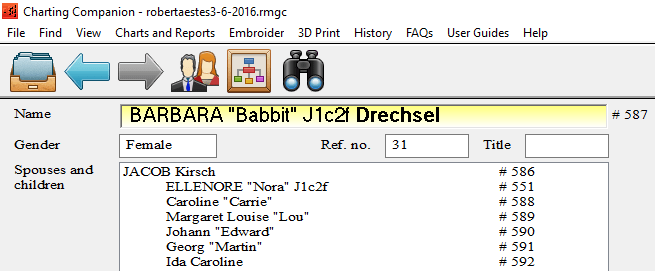
Charting Companion by Progeny Genealogy interfaces with many genealogy software programs to produce lovely charts and graphs not available within the genealogy software applications themselves. I first installed Charting Companion when I used PAF and was very glad to see that it interfaces with RootsMagic too, the software I switched to when PAF was no longer supported. RIP PAF🙁

Over the past couple years, Charting Companion has implemented DNA focused reports. I covered their first report, the X Ancestor Chart when it was first introduced, but they have since added mtDNA charts, and most recently X Descendant Charts. I love these reports and how useful they are to the genealogist.

It’s important to understand that both your mitochondrial DNA and the X chromosome have special inheritance paths and therefore, special uses for genetic genealogy research. I wrote about the X chromosome here and here.

The article 4 Kinds of DNA for Genetic Genealogy is a brief description of the various kinds of DNA testing available to genetic genealogists, and who can test for which kind.

X Chromosome Inheritance Path

In males, the X chromosome is only inherited from the mother, because the father gives the male a Y chromosome, which is what makes the male, male. In females, the father contributes his X chromosome to his daughter, as does her mother. However, the father only received an X from his mother – so you can see that the inheritance pattern for the X chromosome is not the same as other chromosomes where all children receive 50% of their inherited DNA from each parent.

Because of this unusual inheritance pattern, you can easily tell whether an autosomal match that shares an X chromosome could descend from the ancestor you think they might. If you’re a male and you think an X match comes through your father or one of his ancestors – think again, because it can’t.

Here’s my hand-drawn chart of the ancestors that portions of my X chromosome could have descended from.

X Chart0001

Now that I have Charting Companion, I no longer have to hand draw this chart. Charting Companion does it quickly and easily for me. And it’s much, MUCH neater!

x fan

The X chromosome is tested as part of an autosomal DNA test, but not all vendors report X matches. Ancestry does not provide information about the chromosomes where you match anyone, so at Ancestry, there is no way to know if you match someone on the X chromosome. Family Tree DNA’s Family Finder test does test for and report X chromosome matching and so does GedMatch if you upload your raw data files from any vendor.

Mitochondrial DNA Inheritance Path

Mitochondrial DNA is not passed to the children from males. Females pass their mitochondrial DNA to both genders of their children, but only females pass it on.

This pedigree chart below shows the Y and mitochondrial DNA inheritance path for a brother and sister. Both siblings received their mother’s mtDNA, which reaches back in time directly up the matrilineal line ONLY.

Y and mito

The great news is that since the mitochondrial DNA is never admixed with the father’s DNA, it’s a direct pipeline that informs us about the matrilineal line for hundreds and thousands of years back in time.

The bad news is that in order to find out about the mitochondrial DNA of another ancestor in your tree – meaning all of your ancestors that don’t have red circles in the chart above, you must find someone descended from a female through all females to the current generation, which can be a male. Testing for mitochondrial DNA is available through Family Tree DNA.

Let’s say you want to find out about the mitochondrial DNA of your father’s mother to fill in one of the haplogroups in your DNA pedigree chart. You would need to locate an individual to test who carries your father’s mother’s mitochondrial DNA. Your father can test, if he’s living and willing. If your father is deceased, and he had no siblings, and his mother is deceased with no siblings, you’re going to have to go on back up that tree until you find someone with living descendants who descend through only females to the current generation, which can include males.

Charting Companion makes finding those descendants easy.

Getting Started

You can purchase Charting Companion at this link.

After installing Charting Companion, which is painless (I had to install the latest upgrade for this article), Charting Companion opens the file you indicate, which is typically your production file for your genealogy software. You’ll select the person you want to be reflected as the source or center of your charts or reports in the yellow Name field, shown below. In my case, I selected Barbara Dreschel to be the person around whom the reports will center.

In case you’re wondering, “Babbit” was her nickname and J1c2f is her mitochondrial DNA haplogroup.  The only effective way I’ve discovered to maintain haplogroup information is as a middle name, so that’s what you’re seeing.

chart-drechsel

Next, you’ll select the type of report that you want to create.

You’ll want to click on the “Charts and Reports” tab and for the X chromosome charts, you’ll want to select either the Ancestor Charts, or the Descendant Charts.

chart companion

Net, you’ll select the X version, which is located under “color” because the proper people are colorized in pink and blue.

Ancestor chart options

Ancestor X Charts

Ancestor charts generally start with you and work their way back in time.   My X version shows which ancestors I inherited my X chromosome from. This can be very helpful when evaluating matches. In some cases, you cannot have a match to a particular person on the X chromosome from the particular line in question.

Ancestor charts come in two flavors, one is a traditional ancestor chart, the fan version shown earlier in this article, and the second version is a pedigree chart.

x pedigree 1

x pedigree 2

These charts make it easy to see who you could have received your X chromosome from – so X matches must be from the pink and blue colored ancestors and cannot be from ancestors whose boxes are not colored.

For example, if I match a descendant of John Y. Estes, located at the top of the pedigree chart, above, on the X chromosome, I know the common ancestor that I received the X DNA from is NOT John Y. Estes, because I couldn’t have inherited any X DNA from him. That’s easy to discern, because there is no coloration in John Y.’s box. So an X match to a descendant of John Y. Estes is not FROM John Y. Estes. It’s either a false match or the matching X chromosome is from another common ancestor. Of course, that doesn’t mean we both aren’t descended from John Y. Estes – it only means that our X match is not from John Y.  I wrote about false matches here.

When I receive an X match to someone and we’re trying to find a common ancestor, I suggest that my match print this same chart for themselves and that will help them determine which ancestors or ancestral lines we might potentially have in common.

Descendant X Charts

Recently Charting Companion announced a new tool, Descendant X Charts. On these charts, the ancestor is the focus and the descendants who inherited their X chromosome are colored either pink or blue. Part of the Descendant X Chart for Barbara Drechsel is shown below. You can click on any graphic to enlarge.

chart-descendant-drechsel

Descendant Charts look a little different than Ancestor Charts. Don’t be confused by the white box between Elnora Kirsch and her daughters. That’s just her husband, Curtis Benjamin Lore. While he contributes an X chromosome (with daughters) or doesn’t (with sons,) it’s not HIS X chromosome we’re tracking in this chart, it’s the X chromosome of Barbara Drechsel. Curtis would be shown either on his own ancestor chart, or you can create a Descendant X Chart for Curtis.

You might notice in this diagram that this family is particularly prone to not having children. Trying to find ANY DNA participants has been very challenging. However, when I do find them (fingers crossed) I’ll know immediately if they (and I) could possibly carry the X chromosome of Barbara Drechsel by looking at these charts. I’m someplace to the left on this chart, but off the edge of the graphic above.

My favorite Charting Companion charts are still the fan charts though, shown below, because they are compact and succinct and you can see everything on one chart on one page.

chart-descendant-fan

Mitochondrial DNA Charts

To find descendants who carry the mitochondrial DNA of any female, select the person whose mtDNA-carrying descendants you want to find. Then click on the Charts and Reports tab and select the Descendant Chart. You’ll then see various options at the top, where you’ll want to click on the Contents tab.

chart-mtdna-menu

Select Mitochondrial DNA. Note that you can also select the Y chromosome DNA, but that’s much more evident if you’re looking for a male, because the surname stays the same, so DNA testing candidates are generally rather obvious.

chart-mtdna-descendants

On the mtDNA Descendants Chart above, the people in pink and blue carry the mtDNA of Barbara Drechsel. The blue people, males, won’t pass it on to their offspring, but the pink people, females, will if they have offspring. You can see that many females in this family did not have children, so there are several dead ends for Barbara’s mtDNA, including one more daughter who is off of the right hand side of the page. On your computer, you can scroll and the printed reports allow you to overlap.

The Mitochondrial DNA Chart is a great tool to find out who carries the mitochondrial DNA of any ancestor.

Summary

I love tools that help people understand their DNA and how it’s useful to their genealogy. The X charts make seeing the X inheritance path so much easier than trying to explain in verbiage (or drawing by hand) – and provides an easy visual to quickly identify whether a particular ancestor could potentially be responsible for an X DNA match.

For mitochondrial DNA, the charting tool makes the task of finding appropriate descendants to test much easier. It can also work in reverse. If you want to know if a particular person is a candidate for testing for a specific ancestor’s mtDNA, it’s easy to see immediately if their box is colored pink or blue.

I especially love tools that are ubiquitous and run with almost any software package and that don’t require special plugins. Furthermore, I’m particularly enamored with vendors who listen to and take suggestions to heart from their customer base. No, this suggestion wasn’t mine, but the X Descendant Chart was implemented within a week of when it was suggested by a customer. Two weeks later, it was in production – and now all Charting Companion customers benefit. A big thank you to Pierre Clouthier at Progeny Genealogy.

_____________________________________________________________

Disclosure

I receive a small contribution when you click on some of the links to vendors in my articles. This does NOT increase the price you pay but helps me to keep the lights on and this informational blog free for everyone. Please click on the links in the articles or to the vendors below if you are purchasing products or DNA testing.

Thank you so much.

DNA Purchases and Free Transfers

Genealogy Products and Services

Genealogy Research

Fun DNA Stuff

  • Celebrate DNA – customized DNA themed t-shirts, bags and other items

How Jacob Kirsch Lost His Eye, 52 Ancestors #146

I already wrote about Jacob Kirsch in the article, Jacob Kirsch (1841-1917), Lynching Saloonist With a Glass Eye, but as you might have already guessed, some new and very interesting information has come to light. I not only want to document this portion of Jacob’s life – this man was anything but dull – but I want to share how I discovered this information with you. You may discover something very interesting too.

Jacob is Living in an Antique Shop

This entire chapter in Jacob’s ancestor journey started less than 10 days ago with a message from an Ancestry user, Linda. She didn’t match my DNA, but she had found something even more valuable. I know you don’t believe that I think anything is more valuable than DNA, but Linda had found a picture of my great-great-grandfather, Jacob Kirsch, taken in 1891.

jacob-kirsch-1891

Linda found this photo, plus one of Jacob’s daughter, Ida Kirsch Galbreath, in an antique shop in Brownstown, Indiana, about 70 miles west of Aurora, Indiana where Jacob lived.

ida-kirsch-galbreath

The photographs were not displayed together, but Linda took pictures of them with her phone and decided to see if she could find their family. All I can say is “bless you Linda.”

Fortunately, the names and in Ida’s case, her birth and death years were written on the front.

Linda, genealogy angel-in-human-form, went home and promptly got on Ancestry, found my tree, and sent me a message. Thankfully, I actually received the message too.

Within an hour, Linda had e-mailed me the pictures she had taken with her phone and I was frantically trying to find the phone number of the antique shop. The shop, it turns out, had changed owners, and names, and phone numbers. Linda went back, on my behalf, to find a current phone number. Talk about a genealogical act of kindness – times two.

The Missing Trapshooting Champion Article

Jacob Kirsch owned the Kirsch House in Aurora, Indiana and when I was researching for his article and that of his wife, Barbara Drechsel, I was very fortunate to meet a gal named Jenny who is associated with the Historical Society in Aurora. Jenny was immensely helpful, and we became friends, finding additional common ground in our genealogy work and quilting.

Sometime after I published Jacob’s original story, January 31, 2016, but several months ago, either Jenny or I made a discovery. I think Jenny made the discovery, but neither of us can find hide nor hair of this discovery now. To say I’m mad at myself would be a massive understatement.

One of us found an article about Jacob Kirsch being a champion trapshooter. We remarked that we were surprised, because Jacob was missing one eye. Not only did this (now missing) article say he was a champion, but his team won the tri-state championship. He was a member of the Cincinnati Gun Club.

I had no idea Jacob was a trapshooter until I saw that now-missing article. In fact, I didn’t really know what trapshooting was, and discovered that it’s competitive shooting with a shotgun at clay pigeons that are launched aerially. They used to use live birds released from “traps” which is how the name trapshooting originated.  In the late 1800s, glass balls and then clay pigeons replaced live birds, thankfully.

Jenny religiously reads the old newspapers from Aurora, Indiana, so I’m thinking she may have found that article there. It was clearly a newspaper article, and I remember seeing it.

When I saw Jacob’s photo, I immediately thought the photo had to be Jacob and his trapshooting gun, even though I’ve never seen a trapshooting gun.  I wanted to reread the article to verify what it said, but I couldn’t find that article.

I sent Jenny a note. She remembered, but she couldn’t find anything either. So both of us, the only two people who would have been remotely interested, have now come up entirely empty handed.

So either Jenny and I had coordinated dreams, or I’ve lost the article. How could that have happened given that Jenny and I e-mail and message – leaving a trail for both of us?

Re-Researching the Article

If that article could be found once, it could be found again. Or so I thought.

Jenny and I, last year, were discussing how we thought Jacob had lost his eye before the Civil War because Jacob’s obituary said he couldn’t pass the physical so he served in the Civil War as a cook and teamster instead of as a soldier.

We knew, beyond a doubt, from two people who had met him in person that he had a glass eye when he was an old man – and liked to pop it out and scare the local kids – who all came round the Kirsch House to watch him pop his eye out and run away screaming.  Jacob never disappointed them!

Can you tell which of his two eyes is the glass eye in this closeup of the 1891 picture?

jacob-1891-closeup

Even closer…

jacob-1891-very-close

I think it’s his left eye.  What do you think?

The fact that Jacob was missing an eye was one reason why I was initially surprised when that trapshooting championship article appeared, because I initially assumed that lack of two eyes would make someone a poor shot – or at least significantly challenged. And my presumption was that the military thought so too – given that he couldn’t pass his physical. Turns out I was wrong on both accounts.

Well, let me tell you what – presume and assume are one and the same. I don’t know why Jacob couldn’t pass his military physical, and now, I’m not sure that is even true – but I can tell you that it wasn’t because of his missing eye. Because Jacob’s eye wasn’t missing then.

How did I figure that out? I began with Google. I Googled a variety of terms, but finally “Jacob Kirsch Trapshooting Cincinnati” turned up a direct match…that sent me to Newspapers.com.

Newspapers.com is a subscription site. I’m not a subscriber – or I wasn’t. I am now.

There is nothing a genealogist won’t do to glean that tidbit, that sure thing, about an ancestor behind a paywall – especially at midnight when the only thing standing between them and their ancestor is a credit card number.

Found at Newspapers.com

Years ago, I was a Newspapers.com subscriber, and not once did I ever find anything useful. They kept telling me how many new newspapers they had brought online, but none of those mattered for my ancestors. I let my subscription lapse long ago.

However, Newspapers.com has imaged and indexed many new newspapers since then, including the major Cincinnati newspapers. Aurora, Indiana, where Jacob lived, is just a hop, skip and a jump from Cincinnati, 30 miles downtown to downtown, a short ride on the train – and the Kirsch House that Jacob owned was located beside the train depot. Today, Aurora is functionally a Cincinnati suburb with many commuting back and forth to work.

The first article I found indeed confirmed that I had not been dreaming that Jacob was a crack shot. In the following article published in the Cincinnati Enquirer, Jacob Kirsch, J. C. Small and H. Hill from Aurora were listed as a team in this national competition.

Cincinnati Enquirer, Cincinnati, Ohio – Monday, October 31, 1898

jacob-kirsch-1898-article

Ok, I’m redeemed and my sanity is still at least somewhat intact. I was feeling validated by now, my subscription justified, although that still isn’t the original article that told about Jacob winning a tri-state championship. Furthermore, I wondered about the outcome of this particular event.

I searched for the phrase “Cincinnati Gun Club” and the date of November, 1898.  I discovered that the surname OCR (optical character recognition) doesn’t always work.  However, I was able to find 2 or 3 articles about who won the competition.  Jacob Kirsch’s name was in the first article, but the OCR scanning hadn’t picked it up.

The first thing I discovered is that the club boasted that they had 2500 live pigeons in large cages, all of whom would be killed for this event – making it not a shooting competition, but a pointless blood sport.  The pigeons wouldn’t even be consumed, just used and discarded in a bloody mutilated pile – many probably not dead and still suffering.

This saddens me greatly.  Ironically, events like this are part of what led to the extinction of the passenger pigeon.  The last passenger pigeon, died, ironically, in the Cincinnati Zoo in 1914.  Wonderful, my ancestor directly participated in a species becoming extinct. Now there’s something to be proud of…

On Friday, Jacob Kirsch participated in Event #3 where there were 15 targets (meaning pigeons) and he placed 4th, hitting 12 of the birds.  I hope the other 3 flew far away and never returned.  Then, in Event #8, he placed third, hitting 8 of 10 pigeons.  On Saturday, he didn’t place at all.  I did notice that the purse was noted as $700 cash plus a silver trophy worth $300.  The entrance fee for each event was $1.50.

Learning that Jacob killed live birds for sport with no thought about the inhumanity of his actions certainly dampened and colored my perspective of his accomplishments. And this, even after he had been shot himself, so it’s certainly not like he didn’t know what it felt like. Yet, he continued and obviously enjoyed the carnage.

Regardless, I wanted to know about Jacob, and I’m learning – the positive and negative. It’s just not at all what I expected.

Utilize Different Search Criteria

Becoming frustrated and a bit disheartened, I changed my search criteria to “Indiana” instead of Cincinnati, Ohio and found this.

Indianapolis News – July 25, 1917, also the Fort Wayne Weekly Sentinel – July 26, 1917

jacob-kirsch-trapshooter-death

There it is – the fact that they won the tri-state championship. This article from 1917 says that championship was more than 20 years ago. We know that event wasn’t the 1898 event at the Cincinnati Gun Club, so it must have been earlier.

Expand the Net

A little later (in the night, like about 3 AM) I decided to check one more thing. Just one more search and I’ll go to bed. That should be the genealogists’ rallying battle cry!

Jacob’s daughter, my great-grandmother, Nora Kirsch moved with her husband Curtis Benjamin Lore to Rushville, Indiana and I decided to search for the name Kirsch there. I mean, you never know…right?

Aug 22, 1889 – Rushville Republican, Rushville Indiana

jacob-kirsch-trumbower-shot

Ouch!!! I never expected to find anything like this. It makes sense that Jacob would have some sort of target practice available nearby…but at the hotel, beside the train depot with the passenger platform being between the Kirsch House and the depot building?

In the photo below, the Kirsch House (today) is the red building at right with the yellow sale or lease sign in the window and the refurbished depot can be seen at left. The old Kirsch House building is up against the property line on the right side, so the only location available to shoot would have been the garden area to the rear of the Kirsch House which is actually L shaped, between the depot and the Kirsch House.

jacob-kirsch-house-and-depot-area

The driveway area between the Kirsch House and the depot, at that time, was the platform where passengers waited to board the train and where merchandise was loaded and unloaded onto horse-drawn wagons. A busy place indeed with lots of activity.

In the satellite view below, you can see that the only place with any space for shooting would be the small area of grass immediately behind the L-shaped Kirsch House.

jacob-kirsch-house-depot-aerial

Shooting in that area doesn’t seem very safe to me. And apparently it wasn’t, although not dangerous to the people I expected.

I surely wonder if J. E. Trumbower died. The Indianapolis News carried an article too, but they only said Trumbower was shooting with a target rifle and inflicted a dangerous wound.

No wonder the Kirsch House is supposed to be haunted. Between this and Jacob’s son-in-law who intentionally shot (and killed) himself in the courtyard area behind the hotel on Halloween night.

More Tidbits

A thorough examination of every single Kirsch, Kirch, Kirsh match in the Cincinnati papers revealed more interesting tidbits about Jacob’s life.  By the way, newspapers spell horribly – just FYI.

Cincinnati Daily Star – November 5, 1879

Miss Mary Cramnier of St. Louis, sister of Jacob Kirsch, of the Kirsch House and of Mrs. Koehler, of Lawrenceburg, who came to attend the funeral of Martin Koehler, will be a guest of relatives for two weeks.

Jacob’s sister, Mary, came home for the funeral of their brother-in-law. Martin Koehler was married to Katharina Barbara Kirsch, Jacob’s sister. I have already confirmed that Mary Kirsch Cramer/Kramer and Katharina Barbara Kirsch Koehler were Jacob’s sisters, but at one time, I would have willingly bled for this information.

Cincinnati Daily Star – March 24, 1880

Jacob Kirsch, of the Kirsch House is a candidate for Councilman in the First Ward.

Cincinnati Daily Star – Thursday Evening, May 6, 1880

jacob-kirsch-john-dreckler

This very short newspaper entry in which Drechsel or Drexler is misspelled as Dreckler answers a very long-standing question. John is the brother of Jacob Kirsch’s wife, Barbara. John was born in 1856 and we find him on early census records, but then he disappears. He was 23 when he died. I wonder where he is buried. And I wonder why his parents didn’t bring him back to Aurora for the funeral and burial. So many unanswered questions. Furthermore, why weren’t his parents or sisters listed in the article? Surely John’s parents and sisters attended his funeral, along with Jacob and Barbara. They would likely have ridden the train from Aurora together.

Unfortunately, John Drechsel is the only male to carry the Drechsel Y DNA, so this article confirms that I can stop looking for his line with the hopes of Y DNA testing.  This Y line is now dead to us, barring an unforeseen discovery back in Germany.

Cincinnati Daily Star – Wednesday Evening, March 24, 1880

Aurora, Indiana – Jacob Kirsch of the Kirsch House is a candidate for Councilman in the Third Ward.

I had no idea Jacob was politically involved. Not only that, but according to this next article, Jacob was a Democrat. And look, Jacob’s shooting buddy, Joe Small was a Republican. Some of this commentary about “municipal muttons” leads one to believe politics might not have changed a lot since then.

Cincinnati Enquirer – Sunday, June 5, 1881, page 12

jacob-kirsch-1881-article

Just look at this next tidbit.

March 3, 1887 – Indianapolis News

jacob-kirsch-1887-article

As luck would have it, I discovered a newspaper article in Aurora when I visited in the 1980s about this lynching, but just imagine if I had never known. Furthermore, given that Jacob held political office – this would have been even extra juicy and newsworthy.

Why, oh why, cannot the Aurora newspaper be indexed at Newspapers.com?????

Imagine what else we might find.

August 7, 1905 – Daily Republican, Rushville, Indiana

Miss Ida Kirsch who has been the guest of Mr. and Mrs. C. B. Lore returned home today to Aurora, Indiana.

Nora’s sister, Ida, whose photo was found in the antique shop with Jacob’s, went visiting. Ida would have been 29 years old and she wasn’t married. An “old maid” in the terms of the day. However, her labor and presence would have been very valuable to her mother at the Kirsch House. She was a much beloved family member and lived until 1966, age 90.  I never heard anyone say one negative thing about “Aunt Ida.”  Quite the opposite, actually.

May 10, 1907 – Daily Republican, Rushville, Indiana

Jacob Kirsch of Aurora, who has been here this week at the home of his daughter, Mrs. C. B. Lore and family, of West Second Street, returned home yesterday.

These articles generally say “Mr. and Mrs. Jacob Kirsch” if the wife is along, so I suspect Barbara stayed home to run the Kirsch House while Jacob visited, or perhaps Jacob chaperoned the Lore granddaughters on a return trip home. According to the Rushville paper, the Lore granddaughters visited their grandparents in Aurora quite often. I know my grandmother, Edith Lore, was very close to her grandparents and spent a lot of time at the Kirsch House.

The Rushville paper, which has been indexed by Newspapers.com, has a quite healthy social section that told who was visiting whom, and from where. According to the numerous listings involving the Lore family, only one makes mention of Jacob visiting. I would wager that it was difficult for him to get away from the Kirsch House for any extended period of time.

This visit occured right after his son-in-law, Curt Lore, had typhoid and was not expected to live. Perhaps Jacob visited Curt to share his wisdom about survival against all odds.

The Bombshell

Then, this bombshell, a “special dispatch,” caused me to inhale sharply and catch my breath.

Cincinnati Enquirer Friday Morning – October 28, 1892

jacob-kirsch-shot-in-face

This was just so difficult to read. It has a ring of disbelief, given that Jacob is my ancestor, and I never knew about this. An event that disfigured Jacob, nearly killed him and literally blew his eye out – and my mother never heard this story? Jacob’s granddaughter, Edith Lore, who lived at the Kirsch House while she was attending business school in Cincinnati was my mother’s mother.  My grandmother’s sister, Jacob’s granddaughter Eloise Lore lived until well after I was an adult and helped me with my genealogy – and she either never knew this story or never thought to mention it. Maybe she thought it was common knowledge and everyone already knew.  I surely didn’t.

I was dumbstruck.

This story has even more implications from subtle messages, after one recovers from the initial shock.

  • This article entirely negates the theory of Jacob losing his eye as a child and not being able to fight in the Civil War because he was blind in one eye.
  • Did you notice how they referred to Jacob? Captain. This is the one and only time I have ever seen this, but it strongly suggests military service. In fact, they refer to him that way twice.
  • Jacob’s wife filed for a widow’s Civil War Pension after Jacob died in 1917 and swore he had served. She would have had first hand knowledge as she knew him at the time. They married in 1866.
  • Perhaps this reference, in addition to the information in the Civil War pension application helps to validate Jacob’s Civil War service.
  • This article also says that Jacob had won many valuable prizes through his marksmanship. Surely he would never been able to shoot again, if he even lived, which was clearly doubtful at the time.
  • But Jacob did live, until 1917 when he died of stomach cancer.
  • In the antique shop photo, I was just sure that Jacob’s left eye was the glass eye, because it looks “funny” in the photo.
  • But guess what, the antique shop picture was taken in 1891 and Jacob lost his eye in 1892, so the antique shop photo precedes his devastating accident.  Yes, that question I asked you about whether or not you could tell which eye was glass in the 1891 photo was a trick. (Sorry.)  However, I surely thought the glass eye was his left one before I discovered that he hadn’t lost his eye until the following year  This illustrates how easily we can see something we’re looking for – even if it isn’t there.
  • Even more remarkable, Jacob not only recovered, but it was AFTER this accident that he won the tri-state championship, assuming that the “more than 20 years ago” comment in his 1917 death announcement wasn’t actually more than 25 years before.
  • Regardless of when he won the tri-state championship (yes, I’m still mad at myself about that article being missing), he was clearly able to participate in the 1898 Cincinnati Gun Club national event as part of the team representing Aurora – so he certainly was still a good shot even though he didn’t win – 6 years after this devastating accident that resulting in him losing his eye. That’s amazing!

There is only one reasonable photo of Jacob after this time, and it’s one of two photos taken the same day.

Jacob Kirsch family photo crop

One photo is a group family picture (above) which helps to date the event, and the second, a closer photo of just Jacob and wife Barbara is shown below.

Jacob Kirsch and Barbara Drechsel

One can’t really see Jacob’s face well, although you can tell that his eyes don’t look the same. I’m guessing that his left eye is the glass eye, but it’s really difficult to tell – and yes, I’m positive this was taken after the accident. No trick, I promise.

closeup-of-jacob-kirschThis photo was taken after Jacob’s youngest granddaughters were born in 1899 and 1903, probably after Jacob’s brother who lived with them died in 1905 (since he’s absent in the family photo) and before Jacob’s son-in law, Curt Lore (present in the family photo) became ill in early 1909 and died in November, so sometime between 1905 and late 1908, probably 1907 or 1908 based on the apparent age of the youngest child. More than a dozen years after Jacob’s accident.

The accident must have surely disfigured Jacob’s face badly, with a blast powerful enough to remove his eye and affect the jugular vein area – both. I’m surprised he didn’t bleed to death. Amazingly enough, his obituary never mentioned this accident, nor his trapshooting – even though his death notice in the Indianapolis and Fort Wayne papers only mentioned his fame as a trapshooter.

I marvel sometimes at the things about our ancestors lives that would be so fascinating…if we only knew them.

That Danged Article

I do not want to even admit this, but ahem….look what I found…just after I finished all this research.

The Hamilton Ohio Evening Journal – July 25, 1917

Jacob Kirsch death

Yep, that’s the original article – you know, the one I couldn’t find. It was, um, errrr, let’s just say hiding in plain sight. However, had I not been desperately searching for this doggone slippery article online again (where I never did find it), I wouldn’t have found any of this additional information about Jacob, his wife’s brother’s death, Jacob’s public service, his political party affiliation, his bloody hobby or how he lost his eye.

And it all started with Linda’s genealogical act of kindness and two photos in an antique shop.  Thank you so much, Linda!!!

______________________________________________________________

Disclosure

I receive a small contribution when you click on some of the links to vendors in my articles. This does NOT increase the price you pay but helps me to keep the lights on and this informational blog free for everyone. Please click on the links in the articles or to the vendors below if you are purchasing products or DNA testing.

Thank you so much.

DNA Purchases and Free Transfers

Genealogy Services

Genealogy Research

Revisiting AncestryDNA Matches – Methods and Hints

I think all too often we make the presumption about businesses like Ancestry that “our” information that is on their site, in our account, will always be there. That’s not necessarily true – for Ancestry or any other business. Additionally, at Ancestry, being a subscription site, the information may be there, but inaccessible if your subscription lapses.

For a long time, I didn’t keep a spreadsheet of my matches at Ancestry, and when I began, not all of the information available today was available then – so my records are incomplete. Conversely, some of the matches that were there then are gone now. A spreadsheet or other type of record that you keep separately from Ancestry preserves all of your match information.

I was recently working on a particular line, and I couldn’t find some of the DNA Shared Ancestor Hints (aka green leaves) that were previously shown as matches. That’s because they aren’t there anymore. They’ve disappeared.

Granted, Ancestry has been through a few generations of their software and has made changes more than once, but these matches remained through those. However, they are unquestionably gone now. I would never have noticed if I hadn’t been keeping a spreadsheet.

Now, I have a confession to make. At Ancestry, the ONLY matches that I really work with are the DNA matches where I ALSO have a leaf hint – the Shared Ancestor Hint Matches.

ancestry-ancestor-hint

That’s not to say that this approach is right or wrong, but it’s what works best for me.  The only real exception is close matches, 3rd cousins or closer.  Those I “should” be able to unravel.

I’m not interested in trying to unravel the rest. About 50% of my matches have trees, and those trees do the work for me, telling me the common ancestor we match if one can be identified. For me, those 367 green Ancestor Hints DNA+tree-matches are the most productive.

So I’m not interested in utilizing the third party tools that download all of my Ancestry matches. I also don’t really want all of that information either – just certain fields.

Adding the match to my spreadsheet gives me the opportunity to review the match information and assures that I don’t get in a hurry and skim over or skip something.

So, when some of my matches came up missing, I knew it because I HAVE the spreadsheet, and I still have their information because I entered it on the spreadsheet.

Here’s an example. In a chart where I worked with the descendants of George Dodson, I realized that three of my sixteen matches (19%) to descendants of George Dodson are gone. That’s really not trivial.

ancestry-match-information

If you’re wondering how I could not notice that my matches dropped, I asked the same question. After all, Ancestry clearly shows how many Shared Ancestor hints I have.

Ancestry matches periodically have a habit of coming and going, so I’ve never been too concerned about a drop of 1 in the total matches – especially given adoptee shadow trees and such. Generally, my match numbers increase, slowly. What I think has actually been happening is that while I have 3 new matches, what really happened is that I lost two and gained 5 – so the net looks like 3 and I never realized what was happening.

ancestry-dna-main-page

Because I’m only interested in the Shared Ancestor Hint matches, that’s also the only number I monitor – and it’s easy because it’s dead center in the middle of my page.

When I realized I have missing matches, I also realized that I had better go back and enter the information that is missing in my spreadsheet for my early matches– such as the total segment match size, the number of matching segments and the confidence level. That’s the best we can do without a chromosome browser. It would be so nice if Ancestry provided a match download, like the other vendors do, so we don’t have to create this spreadsheet manually.

The silk purse in this sow’s ear is that in the process of reviewing my Ancestry matches, I learned some things I didn’t know.

Why Revisit Your Matches?

So, let’s take a look a why it’s a good idea to go back and revisit your Ancestry Shared Ancestor Hints from time to time.

  • People change their user name.
  • People change their ancestors.
  • You may now share more than one ancestral line, where you didn’t originally. I’ve had this happen several times.
  • People change their tree from public to private.
  • People change their tree from private to public.
  • Your matches may not be there later.
  • Circles come, and Circles go, and come, and go, and come and go…
  • If you contacted someone in the past about a private tree, requesting access, they may have never replied to you (or you didn’t receive their correspondence,) but they may have granted you access to their tree. Who knew!!!
  • Check, and recheck Shared Surnames, because trees change. You can see the Shared Surnames in the box directly below the pedigree lineage to the common ancestor for you and your match.

ancestry-shared-surnames

  • Ancestry sometimes changes relationship ranges. For example, all of the range formerly titled “Distant Cousin” appears to be 5th – 8th cousins now.
  • When people have private trees, you’re not entirely out of luck. You can utilize the Shared Matches function to see which matches you and they both match that have leaf hints. Originally, there were seldom enough people in the data base to make this worthwhile, but now I can tell which family line they match for about half of my Shared Ancestor Hint matches (leaf matches) that are private.

This is also my first step if I do happen to be working with someone who doesn’t have a tree posted or linked to their DNA.

Click on the “View Match” link on your main match page for the match you want to see, then on the “Shared Matches” in the middle of the gray bar.

ancestry-shared-matches

The hint that you are looking for in the shared matches are those leaf hints, because you can look at that person’s tree and see your common ancestor with them, which should (might, may) provide a hint as to why the person you match is also matching them. It’s not foolproof, but it’s a hint.

ancestry-shared-matches-leaf

Of course, if you find 3 or 4 of those leaf hints, all pointing to the same ancestral couple, that’s a mega-hint.

Unfortunately, that’s the best sleuthing we can we can do for private matches with no tree to view and no chromosome browser.

  • You may have forgotten to record a match, or made an error.
  • Take the opportunity to make a note on your Ancestry match. The “Add Note” button is just above the “Pedigree and Surnames” button and just below the DNA Circle Connection.

ancestry-note

On your main match page, you can then click on the little note icon and see what you’ve recorded – which is an easy way to view your common ancestor with a match without having to click through to their match page. When the person has a private tree, I enter the day that I sent a message, along with any common tree leaf hint shared matches that might indicate a common ancestor.

ancestry-note-n-match-page

Tracked Information

Part of the information I track in my spreadsheet is provided directly by Ancestry, and some is not. However, the matching lines back to a common ancestor makes other information easy to retrieve.  The spreadsheet headings are shown below.  Click to enlarge.

ancestry-spreadsheet-headings

I utilize the following columns, thus:

  • Name – Ancestry’s user name for the match. If their account is handled by someone else, I enter the information as “C. T. by johndoe.”
  • Est Relationship – ancestry’s estimated relationship range of the match.
  • Generation – how many generations from me through the common ancestor with my match. Hint – it’s always two more than the relationship under the common ancestor. So if the identification of the common ancestor says 5th great-grandfather, then the person (or couple) is 7 generations back from me.
  • Ancestor – the common ancestor or couple with the match.
  • Child – the child of that couple that the match descends from.
  • Relationship – my relationship to the match. This information is available in the box showing the match in the shared ancestor hint. In this case, EHVannoy (below) and I are third cousins.
  • Common Lines – meaning whether we have additional lines that are NOT shown in Ancestor Hints. You’ll need to look through the Shared Surnames below the Shared Ancestor Hint box. I often say things in this field like, “probably Campbell” or “possibly Anderson” when it seems likely because either I’ve hit a dead end, or the family is found in the same geographic location.

ancestry-common-lines

  • Shared cMs – available in the little “i” to the right of the Confidence bar, shown below.

ancestry-shared-cms

Click on the “i” to show the amount of shared DNA, and the number of shared segments.

  • Confidence – the confidence level shown, above.
  • MtDNA – whether or not this person is a direct mitochondrial line descendant from the female of the ancestral couple. If so, or if their father is if they aren’t, I note it as such.
  • Y DNA – if this person, or if a female, their father or grandfather is a direct Y line descendant of this couple.

I’m sure you’ve figured out by now that if they are mtDNA or Y descendants, and I don’t already have that haplogroup information, I’m going to be contacting them and asking if they have taken that test at Family Tree DNA. If they have not, I’m going to ask if they would be willing. And yes, I’ll probably be offering to pay for it too. It’s worth it to me to obtain that information which can’t be otherwise obtained.

  • Comments – where I record anything else I might have to say – like their tree isn’t displaying correctly, or there is an error in their tree, or they contacted me via e-mail, etc. I may make these same types of notes in the notes field on the match at Ancestry.

Musings

It’s interesting that at least one of my matches that was removed when Ancestry introduced their Timber phasing is back now.

However, and this is the bad news, 82 previous leaf hint matches are now gone. Some disappeared in the adjustment done back in May 2016, but not all disappearances can be attributed to that house-cleaning. I noted the matches that disappeared at that time.

If you look at my current 367 matches and add 82, that means I’ve had a total of 449 Ancestor Hint matches since the Timber introduction – not counting the matches removed because of Timber. That means I’ve lost 18% of my matches since Timber, or said another way, if those 82 remained, I’d have 22% more Ancestor Hint matches than I have today.

Suffice it to say I wish I had more information about the matches that are gone now. I’d also like to know why I lost them. It’s not that they have private trees, they are simply gone.

As you may recall, I took the Ancestry V2 test when it became available to compare against the V1 version of the Ancestry test that I had taken originally.

ancestry-v2-match

It’s interesting that my own V2 second test doesn’t show as a shared match in several instances, example above and below.

ancestry-no-v2-match

It should show, since I’m my own “identical twin,” and the fact that it does not show on several individual’s shared matched with my V1 kit indicates that my match to that individual (E.B. in this case) was on the 300,000 or so SNPs that Ancestry replaced on their V2 chip with other locations that are more medically friendly. All or part of that V1 match was on the now obsolete portion of the V1 chip that my V2 test, on the newer chip, isn’t shown as a match. That’s 44% of the DNA that was available for matching on the V1 chip that isn’t now on the V2 chip.

My smallest match was 6cM. Based on the original white paper, Ancestry was utilizing 5cM for matches. Apparently that changed at some point. Frankly, without a chromosome browser, I’m fine with 6cM. There’s nothing I can do with that information, beyond tree matching without a chromosome browser anyway – and Ancestry already does tree matching for us.

Frustrations and Hints

Aside from the lack of a chromosome browser, which is a perpetual thorn in my side, I have two really big frustrations with Ancestry’s DNA implementation.

My first frustration is the search function, or lack thereof. If I turn up bald one day, this is why.

Here’s the search function for DNA matches.

ancestry-search

I can’t search for a user ID that I’ve recorded in my notes that I know matches me.

I can’t narrow searches beyond just a surname. For example, I’d like to search for that surname ONLY in trees with Shared Ancestor Hints, or maybe only in trees without hints, or only people in my matches with that surname, or only people who have this surname in their direct line, not just someplace in their tree. Just try searching for the surname Smith and you’ll get an idea of the magnitude of the problem. Not to mention that Ancestry searches do not reliably return the correct or even the same information. Ancestry lives and dies on searching, so I know darned good and well they can do better. I don’t know of any way around this search issue, so if you do, PLEASE DO TELL!!!

My second frustration is the messaging system, but I do have a couple hints for you to circumvent this issue.

I have discovered that there are two ways to contact your matches, and those two methodologies are by far NOT equal.

On your DNA match page, there is a green “Send Message” button in the upper right. Don’t use this button.

ancestry-messaging-green-button

The problem with using this button is that Ancestry does NOT send the recipient an e-mail telling them they received a message. Users have to both know and remember to look for the little grey envelope at the top of their task bar by their user name. Most don’t. It’s tiny and many people have no idea it’s there, especially if they are receiving e-mails when other people contact them through Ancestry. They assume that they’ll receive an e-mail anytime anyone wants to contact them. Reasonable, but not true.

I’m embarrassed to tell you that by the time I realized that envelope was there, I had over 100 messages waiting for me, all from people who thought I was willfully disregarding them, and I wasn’t.

So, if you use the green button, you’ve sent the message, but they have no idea they received a message. And you’re waiting, with your hopes dropping every day, or every hour if it’s an important match.

If you click on your little gray envelope, you’ll see any messages you’ve sent or received through the green contact button on the DNA page.

You can remedy this notification problem by utilizing the regular Ancestry contact button. Click on the user name beside their member profile on this same DNA page. In this case, EHVannoy.

You’ll then see their profile page, with a tan “Contact EHVannoy” button, EHVannoy being the user name.

ancestry-messaging-brown-button

Use this tan contact button to contact your matches, because it generates an e-mail. However, the tan button does NOT add the message to your gray envelope, and I don’t know of any way to track messages sent through the tan button. I note in my spreadsheet the date I send messages and a summary of the content. I also put this information in the Ancestry note field.

What’s Next?

Now, I know what you’re going to be doing next. You’re going to be going to look at your grey envelope and resend all of those messages using the tan button. There is an easy way to do this.

First, click on the grey envelope, then on the “Sent” box on the left hand side. You will then see all the messages you’ve sent.

ancestry-sent

Then, just click on the user name of any of your matches and that will take you to their profile page with the tan button!!! You can even copy/paste your original message to them. Do be sure to check your inbox to be sure they didn’t answer before you send them a new message.

ancestry-sent-to-profile

Hopefully some of the people who didn’t answer when you sent green button messages will answer with tan button messages. Fingers crossed!!!

______________________________________________________________

Disclosure

I receive a small contribution when you click on some of the links to vendors in my articles. This does NOT increase the price you pay but helps me to keep the lights on and this informational blog free for everyone. Please click on the links in the articles or to the vendors below if you are purchasing products or DNA testing.

Thank you so much.

DNA Purchases and Free Transfers

Genealogy Services

Genealogy Research

George Dodson (1702 – after 1756), Disappeared Without a Trace, 52 Ancestors #145

Ancestors born in the early 1700s and earlier in colonial America become increasingly more difficult to trace. The Dodson line is no exception. The Dodson family does have an ace in the hole however, and that’s the compiled research of the Reverend Silas Lucas, published in a 2-volume set titled The Dodson (Dotson) Family of North Farnham Parish, Richmond County, Virginia – A History and Genealogy of Their Descendants.

Reverend Lucas includes information from an earlier manuscript by the Reverend Elias Dodson titled Genealogy of the Dodson Families of Pittsylvania and Halifax Counties in the State of Virginia which was written about 1859. The Reverend Elias may have confused the various Raleighs, unfortunately for my line, but he can be forgiven for doing so 100 years after the fact. He was also somewhat ambiguous about the various Georges. Certainly his manuscript in conjunction with the extracted and transcribed historical records is the only avenue one would ever have to sort through these families today. Dodsons are pretty much like rabbits and all of the cute baby rabbits have the same names, generation after generation.

Much of the information about George Dodson comes from Reverend Lucas.

Between 2000 and 2015, I visited many of the Virginia, North Carolina and Tennessee counties involved, including historical societies, courthouses, museums, Virginia, Tennessee and North Carolina State Archives and Jamestown, and I came away with little that Reverend Lucas had missed. To date, there doesn’t seem to be anything relevant in the Virginia Chancery Suite Index either, except, wouldn’t you know it, Pittsylvania County records aren’t indexed yet. When I visited Pittsylvania County a decade or so ago, their chancery suits were an abysmal mess and they allowed anyone to paw through them, opening bundles with no prayer of ever getting the right documents back in the right packet. It was a horrible and sad state of affairs and I’m positive that their chancery records, if they ever do come online, will be incomplete at best.

North Farnham Parish, The Home of the Dodsons

George Dodson was born on October 31, 1702 in Richmond County, Virginia, according to the North Farnham Parish Records, the son of Thomas Dodson and Mary Durham.

George Dodson married Margaret Dagord, 6 years his junior, daughter of Henry Dagord, on April 20, 1726, also according to the North Farnham Parish Records.

George’s father, Thomas Dodson, wrote his will in 1739 and died either in 1739 or 1740, leaving George “150 acres of land whereon the said George Dodson is now living.” Like many other colonial sons, George had set up housekeeping on some of his father’s land, likely with the anticipation that he would clear it, farm it and one day inherit the fruits of his labor.

In both 1746 and 1751, George Dodson was shown on the Richmond County quit rent rolls, a form of taxation. Thank goodness for taxes!!!

In 1756, George and Margaret Dodson sold their 150 acres to William Forrister and apparently moved on.

Richmond County Deeds 11-421 – Date illegible, 1756. George Dodson and wife Margaret of North Farnham Parish to Robert Forrister of same for 16 pounds and 4000 pounds of a crop of tobacco, 150 acres being a tract of land whereon they now dweleth, beginning at the mouth of William Everett’s spring branch, William Forrister’s line, the Rowling? Branch.. Witnesses: John Hill, Gabriel Smith, Ja. (x) Forrester.

Recorded April 2, 1756 and Margaret Dodson relinquished dower.

Now, if we just knew where William Everett’s spring branch was located, or William Forrister’s land or the Rowling Branch, which is probably Rolling Branch. I have not done this, but utilizing the property records of William Everett and William Forrister and bringing them to current, if that is possible, might well reveal the original location of the Dodson land. Absent that information, let’s take a look at what we can surmise.

The Forrister Property

We do have something of a juicy clue. In 1723, one Dr. William Forrester who lived in the Northern Neck area of Richmond County made a house call to the Glascock Family who lived on Glascock’s Landing on Farnham Creek which connected with the Chesapeake Bay. Something went very wrong, and Dr. Forrester was murdered. However, the subsequent testimony says that, “Gregory Glascock being examined saith that on the 5th of November last about midnight he set off in a boat with his father, Thomas Glascock from their Landing on Farnham Creek…”

George Dodson would have been 21 years old. This murder and the subsequent escape of the Glascock’s had to be the topic of discussion in every family, in church and at every public meeting for months, if not years.

george-dodson-northern-neck

By Ali Zifan – Own work; used a blank map from here., CC BY-SA 4.0, https://commons.wikimedia.org/w/index.php?curid=44344137

The Northern Neck of Virginia is described as the northernmost of the 3 peninsulas on the western short of the Chesapeake Bay, bounded by the Potomac River on the north the Rappahannock River on the south. It encompasses Lancaster, Northumberland, Richmond and Westmoreland Counties today, as shown on the map above.

dodson-northern-neck

On the bottom right areas of this survey map from 1736/1737, above, you can see Richmond County. On the contemporary map below, you can see Farnham Creek intersecting with the Rappahannock River. Farnham Creek begins in the upper right hand corner and looks to travel about 5 miles or so southeast to the Rappahannock, marked by the red balloon.

george-dodson-farnham-creek

It’s not far across the neck to the Potomac and the Chesapeake.

george-dodson-neck

Another William Forrester testified in his Revolutionary War pension application in 1836 that in 1779 or 1780 the enemy had landed on Indian banks or Glasscock’s warehouse in the Rappahannock River.

george-dodson-indian-banks

Indian Banks Road is shown by the red balloon, above, very close to Farnham Creek.

We encamped at Leeds town where the Companys remained for upwards of 6 weeks – Leeds town is a small village located between the Rappahannock and Potowmac [sic: Potomac] rivers. the object in placing us at that point was that we might aid in repelling any incursion which might be made by the enemy from either river. We remarched from Leeds town to Richmond Courthouse under the Command of Captain Harrison from thence to Farnham Church & from thence to Indian banks Glasscock’s Warehouse. The cause of our returning to the latter point was the information received of the approach of the enemy up the Rappahannock river. We remained for some time precise period not remembered. We marched to Farnham Church from thence & were discharged at the expiration of 3 months the term of our enlistment.

The North Farnham Parish Church on North Farnham Church Road, below, was built in 1737 and has been restored several times.

george-dodson-north-farnham-parish-church

On the map below, we find Indian Banks Road very close to Farnham Creek. The North Farnham Church and Indian Banks are both shown at opposite ends of the blue line on the map below.

george-dodson-church-to-indian-banks

Clearly, the Forrester family lived in this area, and so did the Dodsons who were their neighbors. Based on the two stories about the Forrester family, one from 1723 when Dr. Forrister was murdered, and the second from the Revolutionary War almost 60 years later, the Forrester family didn’t move. They still lived near Glascock’s Lansing on North Farnham Creek and the Rappahannock, and this is likely where George Dodson lived too, given that William Forrister was his neighbor and bought his land.

The French and Indian War

For the most part, Richmond County was spared the brunt of the French and Indian War which lasted for 7 years, beginning in 1754. However, men from Richmond County did belong to militias and furnished supplies to Washington’s army. Unfortunately, none of those militia lists remain today, at least not that I could find, so we don’t know if George Dodsons or his sons, perhaps, were involved.

French and Indian war

By Hoodinski – Own work, CC BY-SA 3.0, https://commons.wikimedia.org/w/index.php?curid=30865550

Moving On

In 1756, George and Margaret Dagord Dodson were not youngsters. George would have been 54 and Margaret, 48. Their children ranged in age from Lazarus who was 28 years old and probably already married, to daughter Hannah, about age 9, born about 1747. Hannah may have died by 1756, because nothing is known of her after her birth is recorded in the church records.

George may have decided that moving was a “now or never” proposition, because their older children were of marriage age. Unless they wanted to leave their older children behind, if they were going to move, they should sell now and take them along while they still could – before the children became settled as adults into the area and wouldn’t want to leave.

The problem is that we don’t know where George and Margaret went.

George’s siblings went to Faquier County and joined the Broad Run Baptist Church there, but there is no sign of George on the list of members when the church was constituted in December of 1762, nor in any subsequent records with the exception of a 1770 rent roll.

In 1762, Thomas Dodson of Faquier County, George’s brother, released his right to his claim on the estate of his father, Thomas, to his brothers; Greenham Dodson of Amelia County, Abraham, Joshua and Elisha of Faquier County…but no George. Was this just an oversight?

Where was George, and why wasn’t he mentioned in this list? Was this an omission, or had he passed away? If he passed away, wouldn’t Thomas release his rights to George’s heirs? Or perhaps, just those siblings mentioned purchased Thomas’s portion of their father’s estate and George did not.

Between 1759 and 1761, George’s son, Raleigh was probably living in King William County, as he was noted in one court record, but there is no mention of George. Raleigh is also missing after that until he appears witnessing a deed in Halifax County in 1766 between Thomas Dodson and Joseph Terry. But again, no George.

Many researchers think that George joined his siblings and their children in Pittsylvania and Halifax County, Virginia, after 1766 when many Dodsons from the Broad Run congregation moved south. That’s possible, but there is no George with a wife Margaret before 1777 when George would have been 75 years old, and there were eventually many George Dodsons. George was certainly a popular name in the Dodson family.

Pittsylvania County, Virginia Records

The earliest record we have of a George Dodson in Pittsylvania County is a 1771 land grant for 400 acres to George Dodson, next to John Madding, and on Birches Creek, the location where so many other Dodsons settled. Tracking this land forward in time through deeds would tell us whether this belonged to our George, who likely died not terribly long afterwards, or to another George Dodson.

george-dodson-1777-document

However, there is another tantalizing tidbit. On February 8, 1777, George Dodson, Margaret (X) Dodson and Thomas Wyatt witness a deed of sale from Thomas Dodson to John Creel, for negroes. Seeing this saddened my heart, although we have absolutely no indication that our George owned other humans. Still, it reminds us of the ingrained institution of slavery that George would have witnessed on a daily basis.

Based on earlier transactions, the conveyor would have been “Second Fork Thomas,” either the son, brother or or nephew of George Dodson and Margaret Dagord. If this George was our George Dodson, he was likely a witness because he lived close or was nearby when the sale was consummated. This would suggest that George lived near the Birches Creek land an area gently sloping and partially wooded, shown below.

george-dodson-second-fork-birches-creek

This area falls between Highway 360, known as the Old Richmond Road, and the bottom of the map in the satellite view, below.

george-dodson-second-fork-map

This photo of an old building was taken at the intersection of Oak Level and River Road in Halifax County, an area that would have been very familiar to George if he lived long enough to make it to Halifax County near the Pittsylvania County border.

george-dodson-old-building

George and Margaret Dodson who witnessed that 1777 deed of sale may have been ours.  It was originally thought that this George and Margaret may have been the Reverend George Dodson whose wife’s name was Margaret too and also lived in Pittsylvania County. However, he is married to Eleanor in 1783 and didn’t marry Margaret until after that, according to Rev. Lucas. Therefore, the George and Margaret in 1777 cannot be the Reverend George and his wife, unless the other Reverend George Dodson’s wife was also named Margaret. Little is known about the other Reverend George Dodson.  Does everyone have to be named George and be a Reverend?

The George Dodson who died in 1825 was married to Margaret at the time he died.  She may not have been his first wife.  George’s children were born beginning about 1765 and marrying from the 1780s to 1812. This George and Margaret were not an older couple, so this is not the George Dodson who married Margaret Dagord.

In 1777, George Dodson begins a series of land transactions on Birches Creek which runs near and across the border between Halifax and Pittsylvania Counties. Furthermore, from this time forward, several George, Lazarus, Raleigh and Thomas Dodsons have a long intertwined series of relationships and transactions. We know that the Lazarus and Raleigh in these transactions aren’t ours, because George’s son, Raleigh Dodson left for what would become Hawkins County, Tennessee in 1778 when he sold his land in Caswell County and took his son, Lazarus Dodson, with him. That much, we know for sure!

Sorting Georges and Margarets

Reverend Lucas says that the Rev. Elias Dodson tried to straighten out the George’s apparently, saying the following:

  • Thomas and Elizabeth Rose Dodson were the parents of “Lame George the Preacher.”

The Thomas Dodson married to Elizabeth Rose is the son of Thomas Dodson who was married to Mary Durham and was the brother to George. Thomas, George’s brother’s will was probated in 1783 in Pittsylvania County.

  • Greenham Dodson was the father of “George the Preacher.”

Greenham was the brother of George Dodson and disappeared from Pittsylvania County records after 1777.

  • On page one of his manuscript, the Reverend Elias provides a list of the children of George Dodson and Margaret Dagord, but he only lists three of their children: Lazarus, Fortune (Fortunas) and David.
  • “Peggy married the 1st time Fortune Dodson, son of George on the first page of this book.”

Peggy is a nickname for Margaret. Peggy is the daughter of Elisha and Sarah Averett Dodson. Elisha is our George’s brother, making Peggy and Fortunas 1st cousins. Fortunas appears in the records in 1776 when he writes his will and in 1777 when the will is probated. Nothing is known of Fortunas between his birth in 1740 and his death in 1776, except that he married and was having children by 1766.

Elisha, Peggy’s father, was a member of the Broad Run Baptist Church. In December of 1762, Elisha and wife Sarah were “dismissed to Halifax.” This would suggest that George’s son Fortunas and Elisha’s daughter Peggy were in the same place by 1766 or so in order to have married and be having children. Was our George Dodson in Halifax by 1766, or was Fortunas traveling with his brothers or maybe living with his uncle, Elisha.

The following chart shows the complex intertwining of the various George, Margaret and Raleigh Dodsons, along with a few other twists and curves.  Click to enlarge.

george-dodson-chart-2

  • Lame George the Preacher, son of Thomas Dodson and Eleanor Rose, had wife Eleanor in 1779 and 1783. His known children are not the same as the George who died in 1825.
  • George who died in 1825 had wife Margaret at that time.  He may or may not have been the son of George and Margaret Dagord. The daughter of the George who died in 1825 married a Thomas Madding in 1798. John Madding owned land next to 1771 land grant to George Dodson.
  • Rachel, daughter of Rev. Lazarus Dodson married a Thomas Madding according to Lazarus’s 1799 will.
  • George the Preacher, son of Greenham, and George born in 1737 may have been conflated in the records.  We know that Greenham had a son George who was a preacher.  We don’t know what happened to George Dodson and Margaret Dagord’s son, George.
  • George born in 1737 may not have been the same George that died in 1825.
  • George, either the son of Greenham or the one born 1737, had wife Elizabeth when he lived in Patrick and Henry County in the later 1780s and 1790s. He apparently moved back to Pittsylvania County in the 1790s
  • George the Preacher, if he is not the same person as George born in 1737, could have had a wife named Margaret.
  • A Rolly Dodson has a land grant in 1765 on Smith River near Falls Creek which is in Patrick and Henry Counties (today) on the same river and creek as Lambeth Dodson patented land in 1747.  Lambeth was a brother to Thomas Dodson who married Mary Durham.  The Smith River area is about 20 miles further west than the Birches Creek area of Halifax/Pittsylvania County where the Dodson clan who arrived in the 1766 timeframe would settle.  No further info about this land patented by Rolly has been found in any county. This Rolly may not be directly connected to the Birches Creek group, or he may simply have arrived a year before the rest, sold the patent without registering it as a deed and moved east later when they arrived.
  • The Rolly above may not be Raleigh born in 1730 who bought land in Caswell Co., NC in 1766.
  • We know there is another Raleigh and Lazarus because in 1777 they take an oath of allegiance in Pittsylvania County.  Parts of Pittsylvania would later become Patrick and Henry Counties.
  • There is confusion stating that the wife of Second Fork Thomas was the daughter of Lame George, the Preacher, which is very unlikely as this chart is drawn and as reported by Rev. Lucas.
  • It’s possible that Second Fork Thomas is actually Thomas, the son of Thomas who was married to Elizabeth Rose, who could then have married his first cousin, the daughter of Lame George.
  • Needless to say, the Thomases, Georges, Raleighs and Margarets are confused and confusing in Halifax and Pittsylvania County, Virginia.

I tried to sort through the Peggy/Margaret scenario, but find the recorded facts to be somewhat suspect. If Fortunas died in 1776, he could have had an infant child. Assuming he did, the 3 other children would have been born between 1770 and 1774. That means Peggy would have been born in roughly 1750 at the latest.

If Peggy remarried to Raleigh Dodson Sr.’s son, Raleigh Jr., several years her junior who was born about 1756, and then had an additional 4 (documented by Raleigh’s will) or 6 children (oral history), one as late as 1790, Peggy would have been 40 or older when she had her last child. That’s certainly possible. One fly in this ointment is that Raleigh Jr.’s wife in Hawkins County in 1806 appears to be Sarah, not Peggy.

However, the Raleighs in Hawkins, Giles and Williamson County of the same generation all seem to be confused with conflicting information, so I would not bet any money on the accuracy of which Raleigh Peggy married after Fortunas died. There are at least two, if not 3, Raleighs of the same generation. One died in Giles County, TN in 1815, one in Williamson County, TN in 1836 who was (apparently) married to a Margaret and the Raleigh of Hawkins County who disappears after 1808. Reverend Lucas thinks that the Raleigh who was married to Peggy in Pittsylvania County, and Raleigh who sold land in April of 1806 in Pittsylvania County was the son of Raleigh Sr. However, the Raleigh that is the son of Raleigh Sr. is noted as “of Hawkins County” when he sells land in February of 1806 in Hawkins County, two months before the Raleigh in Pittsylvania County sold his land there.

Did Peggy, who is very clearly married to a Raleigh Dodson in 1791 when she and her siblings sell her father’s land, marry a different Raleigh?

Based on the 1777 loyalty oaths sworn, we do know for sure that there is at least one other Raleigh in Pittsylvania County at that time, because George’s son Raleigh Sr. is living in Caswell County, NC, and Raleigh Jr. would have been living with his father, barring any unusual circumstances. The Reverend Elias Dodson attributes a son “Rolly” to Rev. Lazarus Dodson, brother of Raleigh Sr., but Rev. Lazarus’s will in 1799 does not reflect a son by that name, by any spelling.

By 1766 when the Dodsons migrated en masse from Faquier County to Halifax and Pittsylvania County, our George would have been 64 years old. He had long surpassed his life expectancy at that time of 37 years, and George may simply have sold his land in 1756, at age 54, and died without purchasing additional land elsewhere. Not all records from this timeframe exist. Several counties have burned records between the Revolutionary War, the War of 1812 and the Civil War, not to mention courthouse fires. George could have moved to a county whose records don’t survive today, but the most likely place for George to be found, if he was living, was with his siblings and children in Farquhar County and then in Halifax and Pittsylvania County, Virginia.

George’s Children

George’s children are recorded in the records of the North Farnham Parish Church. It’s a good thing, because without a will or estate records for George, we would have no information.

  • Mary born December 21, 1726
  • Lazarus Dodson born October 7, 1728
  • Rawleigh Dodson born February 16, 1730
  • Thomas Dodson born May 25, 1735
  • George Dodson born October 31, 1737
  • Fortunatus Dodson born March 31, 1740
  • Hannah Dodson born May 2, 1747
  • David Dodson probably born after 1740 if he is the son of George as identified by the Reverend Elias Dodson. However, he in not recorded in the North Farnham Parish Church records.

For more information about the children of George Dodson and Margaret Dagord, please see Margaret Dagord’s story.

DNA

I keep hoping that I’ll be included in a DNA Circle at Ancestry for George Dodson. Ancestry Circles are formed somewhat mystically, kind of like when the Circle fairy sprinkles fairy dust on your ancestors, you might receive one.

Ancestry does discuss how Circles are formed, in generalities. Circles are supposed to be formed when you have 3 or more individuals whose DNA matches and you share a common ancestor, but suffice it to say, I’m not included in a George Dodson Circle yet, even though I match or have matched 16 other people who share him as an ancestor. A few of the individuals I have matched in the past are no longer shown on my match list.  However, I still match 13 people who share George with me in our trees, as indicated by those green leaf Ancestor Hints.

The chart below shows my DNA+tree matches to descendants of George Dodson who married Margaret Dagord. I’s interesting, in light of the confusion about George, the son of George Dodson and Margaret Dagord, with absolutely nothing concrete about whether son George even lived, that 9 different people claim him as their ancestor, although their individual trees are highly disparate. One match claims “Second Fork” Thomas, who wasn’t a son of George Dodson and Mary Dagord at all. Still, my DNA matches theirs and we share George Dodson and Mary Dagord in our trees – however accurate or inaccurate those trees might be.

Match Predicted Relationship Relation-ship Child of George Shared cMs Confi-dence At FTDNA or Status
Cindy 4th cousin 7C David 32, 2 segments High
Claude 5-8th cousin 7C George 18.7, 1 segment Good FTDNA largest segment 39.19 cM
Beverly 5th-8th cousin 7C1R George 10.6, 1 segment Mod
DT Lazarus gone
Prince 5th-8th 6C1R George 8.1, 1 segment Mod
GD 5th – 8th 6C1R George 6.2, 1 segment Mod
Lou 5th-8th 7C George 15.8, 1 segment Mod
Lumpy 5th-8th 7C Fortunas 9.6, 1 seg Mod
LW 5th – 8th 7C George 9.1, 1 segment Mod
WT 5th-8th David gone
Erin 5th – 8th 7C George 7.5, 1 segment Mod
Missouri 5th-8th George gone
William 5th – 8th 7C Lazarus 7.3, 1 segment Mod
Brian 5th-8th 7C Lazarus 7.5, 1 segment Mod
Sybil 5th-8th 7C Thomas “Second Fork” 7.5, 1 segment Mod
Jack 5th-8th 7C George 6.5, 1 segment Mod FTDNA largest segment 19.31cM

Note that with the two people who are also found at Family Tree DNA, the largest segment size is very different. Unfortunately, as we all know by now, there is no chromosome browser at Ancestry, so I’ll just have to do the best I can without that tool.

Ancestry is known for stripping out sections of DNA that they feel is “too matchy” utilizing their Timber program, so I wanted to see if any of these matches at Ancestry could be found at Family Tree DNA who has a chromosome browser and provides chromosome matching information. In some cases, Ancestry users utilize their name as their user name, so are readily recognizable when you search at Family Tree DNA within your matches. I found two of my Ancestry matches at Family Tree DNA.

Claude has also tested at Family Tree DNA and his results there shows the single longest segment to be a whopping 39cM. The fact that Ancestry stripped this out made me wonder if perhaps that segment was found in one of the pileup regions, so I took a look.

george-dodson-ftdna-segments

The segment on chromosome 5 is a total of 39.19 cM. The next largest segment is 3.44 cM and found on chromosome 16. There is no pileup region on chromosome 5, so the missing 20.49 cM has nothing to do with a known pileup region. Apparently, there were enough people matching me on this segment that Ancestry felt it was “too matchy,” indicating a segment that they interpreted as either a pileup or an ancestry because we share a common population, and they removed it. That’s unfortunate, because as we’ll see, it’s clearly a relevant Dodson segment.

I moved to my Master DNA spreadsheet where I track my chromosome segments and do triangulation, and sure enough, this same segment has been preserved nearly intact in other Dodson descendants as well. You can see that one individual whose surname today is Durham carries a large part of this segment. Followup may indeed indicate that this segment came from the George Dodson’s mother, Mary Durham.

george-dodson-match-segments

A second individual who matches me at Family Tree DNA is Jack. We share 19.31 cM on chromosome 4 at Family Tree DNA, but the match disappeared entirely at Ancestry for awhile, then returned with only 1 segment of 6.5cM matching. My match to Jack is shown on the Family Tree DNA chromosome browser, below.

george-dodson-jack-segments

We may have lost George after 1756 on paper, but George really isn’t lost. Clearly, identifiable parts of George Dodson’s DNA have been handed down to his descendants. He is us.

Summary

We are fortunate to have any information at all about George. Were it not for the North Farnham Parish Church records, we wouldn’t know the date of his birth, the names of his parents or the name of his wife.

Our only other direct tie to the past is, of course, George’s father’s will where he leaves George land.

I wish we had more than the barest snippets about George’s life. We lose him entirely after 1756 when he sells his land in Richmond County, with the possible exception of that tantalizing February 8, 1777 deed in Pittsylvania County where George and Margaret are witnesses to a sale. Of course, we don’t know if that George and Margaret are married to each other, and we don’t know the name of the wife of at least one of the other George Dodson’s living in that area.  We do know that the George who died in 1825 was married at that time to a Margaret, and if she was his only wife, they were having children beginning in about 1765 and lived in the Halifax/Pittsylvania County area. That couple is not our George and Margaret.  So the 1771 land grant to George and the 1777 George and Margaret pair could well NOT be our George. But then again, it could. If it is, he is a hearty 74 years old in 1777, looking towards his three quarter of a century mark birthday that October 31st.

In my heart of hearts, I suspect that our George died sometime after he sold his Richmond County land in 1756 and before the 1766 Dodson migration to Halifax and Pittsylvania Counties. I think he really did disappear without a trace. No records, no will or estate, no oral history, nothing – except his DNA carried by his descendants today.

Acknowledgements

Much of the information about the early Dodson lines, specifically prior to Raleigh, comes from the wonderful two volume set written by the Reverend Silas Lucas, published originally in 1988, titled The Dodson (Dotson) Family of North Farnham Parish, Richmond County, Virginia – A History and Genealogy of Their Descendants.

I am extremely grateful to Reverend Lucas for the thousands of hours and years he spent compiling not just genealogical information, but searching through county records in Virginia, North Carolina, Tennessee, and more. His work from his first publication in 1958 to his two-volume set 30 years later in 1988 stands as a model of what can and should be done for each colonial family – especially given that they were known to move from state to state without leaving any type of “forwarding address” for genealogists seeking them a few hundred years later. Without his books, Dodson researchers would be greatly hindered, if not entirely lost, today.

______________________________________________________________

Disclosure

I receive a small contribution when you click on some of the links to vendors in my articles. This does NOT increase the price you pay but helps me to keep the lights on and this informational blog free for everyone. Please click on the links in the articles or to the vendors below if you are purchasing products or DNA testing.

Thank you so much.

DNA Purchases and Free Transfers

Genealogy Services

Genealogy Research