Concepts – “Who To Test?” Series

I often receive questions about who to test to obtain (discover) the Y or mitochondrial DNA of a particular ancestor in one’s tree. The question often arises when people are attempting to find either Y or mitochondrial DNA to confirm that an ancestor descends from or belongs to a particular population.

For example, “My great-great-grandmother was supposed to be Cherokee.  How can I tell if she was?”

The answer would be that if she was Cherokee on her mother’s direct maternal side, testing the mitochondrial DNA of specific descendants would yield the answer.

Regardless of origins, the concept and techniques apply to everyone. People of Native American, African, Jewish, European and Asian heritage carry specific haplogroups and match people who have similar roots.

You may want to read this short article, 4 Kinds of DNA for Genetic Genealogy to understand the difference between Y, mitochondrial and autosomal DNA, what testing can tell you, and how they can help your genetic genealogy.

At a very basic level:

  • Y DNA testing tests the direct paternal (typically surname) line only, for males only. The Y chromosome is only passed from fathers to sons, so it is not divided nor mixed with the mother’s DNA. Females don’t have a Y chromosome, which is why they can’t test.
  • Mitochondrial DNA testing tests the direct matrilineal line only, for everyone, males and females both. The mitochondria is passed from mothers to all of her children, but is only passed on by females. It is not mixed with the father’s DNA, so it is not divided during the inheritance process.
  • Autosomal DNA testing tests all of your DNA, providing cousin matches and ethnicity estimates – but does not provide you with specifics about any individual line. You inherit half the autosomal DNA of each of your parents, so ancestral DNA diminishes by half in each generation. Autosomal testing is a great overview of all of your DNA lineages, but can’t tell you where any particular line comes from.

Testing the appropriate descendants of each ancestor allows us to build a DNA pedigree chart in order to determine the proven, specific heritage and origins of each individual line.

Here’s what my DNA Pedigree Chart looks like through my 8 great-grandparents where I’ve successfully obtained the Y and mitochondrial DNA of their descendants. Y and mitochondrial DNA, of course, has special properties and reaches back hundreds and thousands of years in time, because the Y and mitochondrial DNA is not diluted by the DNA of the other parent during inheritance.

I’ve converted the relationships in my pedigree chart above to an Ancestor Pedigree Chart, below, because we will be working with each individual and adding lines for other family members as we determine who we can test. You can click to enlarge the image.

In the Ancestor Pedigree Chart, shown above, there are 16 different people who all carry mitochondrial DNA, representing 8 different mitochondrial lines. Mitochondrial contributors, all women, shown in pink both carry and contribute mitochondrial DNA. Mothers contribute their mitochondrial DNA to the males, shown by pink hearts, but the men don’t pass it on. The daughters pass their mitochondrial DNA to all of their children.

There are 8 people, shown in blue, who carry and contribute Y DNA, representing 4 different Y lines.

Each mitochondrial and Y line of DNA has a story to tell that can’t be told any other way. Autosomal DNA does not provide specific information about the genesis or ethnicity of any particular line, but Y and mtDNA does. If you want to know specifically where, what part of the world, or what clan that particular ancestor descended from, Y and mitochondrial DNA may tell you.

The question becomes, who can be tested that is living today to obtain that specific information about each particular ancestor.

Of course, the answer of who to test to find the ancestral Y and mitochondrial DNA varies depending on the gender of the person, and where they are located in your tree.

If the person in the tree is no longer living, the answer about who to test may hinge on their siblings, and the descendants of their siblings or maybe cousins. Or perhaps you’ll need to go back up the tree a generation or two to find appropriately descended relatives to test.

For each of the individuals in this tree, I’m going to answer the question of whom to test to obtain their Y and mitochondrial DNA – and how to find a suitable candidate. Talking them into testing, however, is all up to you:)

If you haven’t tested your Y or mitochondrial DNA, and you want to, you can order those tests at Family Tree DNA.  I suggest a minimum of 37 markers for Y DNA. You can always upgrade later to 67 or 111 markers.  Regardless of your testing level, you’ll receive haplogroup estimates, matches and other information.  For mitochondrial DNA, order the full sequence test so you’ll receive your full haplogroup designation. Several Y and mitochondrial haplogroups originated in Asia, with some lines settling in Europe, some in Asia and some in the Americas – so you need as much information as you can extract from your DNA.

Please join me for the “Concepts – Who To Test?” Series – coming soon to a this blog, so stay tuned!!!

______________________________________________________________

Disclosure

I receive a small contribution when you click on some of the links to vendors in my articles. This does NOT increase the price you pay but helps me to keep the lights on and this informational blog free for everyone. Please click on the links in the articles or to the vendors below if you are purchasing products or DNA testing.

Thank you so much.

DNA Purchases and Free Transfers

Genealogy Services

Genealogy Research

Thomas Dodson (1681-1740), Planter on Totuskey Creek, 52 Ancestors #151

Thomas Dodson’s birth on May 15, 1681 to Charles Dodson and wife, Anne, is recorded in the North Farnham Parish register. At the time of Thomas’s birth, this part of Virginia, now Richmond County, was Old Rappahannock County.

Thomas’s birth was just 74 years after the founding of Jamestown, and Jamestown was still the colonial capital of the colony of Virginia – very early in the history of America.

The part of Virginia where Thomas was born, the Northern Neck began to be settled in about 1735.

In 1692, Old Rappahannock County was dissolved and the portion of Old Rappahannock where the Dodson family lived became Richmond County where Thomas spent his life. Fortunately, the Richmond County records are for the most part, intact.

I must say that these records, especially the court orders, have been key into not just identifying Thomas by his birth and death dates, and maybe marriage and children’s births thrown in for good measure – but by the rhythm of daily life in colonial Virginia. All males attended court which was, other than church, the only entertainment in pre-electronic America. Church every Sunday was mandatory. The regular births of children and deaths of neighbors and family members. The plantations, the tobacco, the spats recorded in those old notes. Life was much richer than those birth and death dates.

I’ve grouped items in a few cases, but mostly, I’ve used these records to walk through Thomas’s life in order, to give us a flavor today for what his life was actually like. Oh, how I wish we had something, anything, that he actually wrote that would shed light on how he thought and what he was like. But Thomas couldn’t write. The closest we can get is to create our vision of Thomas by his actions and those he was closest to.

Thomas’s Mother

Thomas’s mother’s name was Ann or Anne, but her surname is unknown, although I have seen it listed several times as Elmore. However, I have never seen any documentation behind the Elmore surname. Sometimes, surnames attached to trees are copied and pasted so many times that people just assume that they have to be accurate because they are “all over the place,” but copying a tree repeatedly has absolutely no bearing on the accuracy of the fruit of the tree. Copying it 1000 or 2000 times doesn’t make it any truer – just more plentiful.

Because I was bound and determine to end the mystery of Elmore, if it was at all possible, I embarked on a research trip and indeed, I solved the mystery. I’ll tell Ann’s story in her own article, but suffice it to say here that her surname was not Elmore. Thomas Dodson’s mother’s surname remains a mystery.

Nancy the Cow

The first record involving Thomas Dodson occurred when Thomas was 12 years old, which is a bit unusual. However, this recorded deed seems to be a preemptive strike or a reaction perhaps to criticism for the exchange of one cow for another. Yes, a cow.

1692-1694 Richmond County, VA, Deed Book 1; Antient Press: (Page 165)

I Charles Dodson do give & convey unto & with my beloved Son, Tho: Dodson, one brown Cow called by the name of Nancy marked with a crop & swallow forke on the left Eare, & a crop on the right tare, together with all her female increase being in Exchange with him my sd Son, Thomas, for One Cow given him by his Godfather, Peter Elmore, To have & to hold unto him the said Thomas his Executrs: Admstrs: or assignes together was aforesaid from me my heirs forever, And I do hereby warrant the sd Cow together with all her female increase unto him the sd Thomas his Executrs: &c. of & from the claimes of me the sd Charles, my Executrs; &c. & all & every other persons what so ever, In Witness whereof I have hereunto sett my hand & seale this 31st day of July Ano: 1693 Sealed & delivered in presence of us Wm Ward, Charles Dodson Wm. Colston Record Richmond Co. 31st die Julii 1693

I do have to wonder why they traded cows, and why the trade was recorded and not just done without fanfare. I’m sure there’s more to this story that we’ll never know. Recording deeds was not free, nor convenient, so there had to be something else.

This deed probably explains where the Elmore surname attached to Anne originated, but Godfather does not mean that Thomas’s mother was an Elmore. Godfather simply means that Peter Elmore, who it turns out, was another neighbor, stood up with Charles and Ann Dodson when baby Thomas was baptized in the North Farnham Parish church in 1681.

How Many Thomas’s Were There?

Seldom do we find records of children in court or land records, unless their parents die or the transaction is unusual, like Nancy the cow.

The early mention of Thomas caused me some concern, because I began to wonder if there was more than one Thomas. Was Thomas really a minor, or were there two Thomas Dodsons?

Two or more Thomas Dodsons in the same records at the same time might become intermixed. I assembled the early records and was greatly relieved to see that in spite of that fact that there were several Charles Dodsons, other than Thomas Dodson Sr.’s son, Thomas Jr., there were no other Thomas Dodsons during this timeframe to muddy the waters. Charles Dodson and Thomas Durham were neighbors, and I do wonder if perhaps Thomas Dodson was named for Thomas Durham. Ironically, if so, Thomas Dodson married Thomas Durham’s daughter, Mary.

Please note that you can click to enlarge any image.

On the pedigree chart above, the individuals in green are my ancestors. The ones in tan are the various Charles Dodsons. Fortunately, there was only one Thomas in the records before his son, Thomas Jr., came of age in about 1725 when he married Elizabeth Rose.

Marriage

Twenty years and three months after his birth, on August 1, 1701, Thomas Dodson married Mary Durham, daughter of Thomas and Dorothy Smoot Durham, their neighbors in what had become Richmond County, VA. Age 20 is on the young side for a male to marry at that time, but perhaps the fact that his father was willing to give him land helped secure the deal.

According to a 1723 deed, the land of Thomas Durham conveyed to Thomas Dodson was marked by the corner tree of Charles Dodson. This tells us that the Dodsons and Durhams were neighbors and Thomas Dodson literally married the girl next door.

The book, “Virginia Marriages of the Northern Neck of Virginia, 1649-1800” found on Ancestry provides us with additional information.

Thomas Received Land From His Father

When Thomas first appears in deed records as an adult, he had recently married and would have been looking to establish a homestead.

Thomas Dodson’s father wrote his will on January 11, 1702/1703 in which he leaves to Thomas “a plantation seated in a neck formerly called the Rich Neck with 150 acres of land to him and the male heires lawfully begotten of his own body forever and if the above said Thomas Dodson should dye without any male that then the land should returned to the next heire of the Dodson.“

Just a few days later, Charles deeded adjacent tracts of land to Thomas and his brother Charles. It might appear that Charles was rushing to get his affairs in order. Was Charles ill, thinking he would die soon?

P 210-212 Feb. 2, 1702 Deed of Gift. Charles Dodson of North Farnham Parish Richmond Co. for natural love and fatherly affection that I have and bear towards my son Thomas Dodson of the same county and parish, and for divers other good causes and to the male heirs of his body lawfully begotten plantation and tract of land whereon he now lives in the same county and parish 150 acres formerly known by the name or called Travers’s Quarter it being the one half of the tract of land purchased by me of the said Capt. Samuel Travers containing 300 acres and bounded by a branch that runs up between the said plantation and track of land known or called by the name Rich Neck that Charles Dodson Jr. now lives on. Grant to Charles Dodson or to any of the heires male of me that the said Charles Dodson or to the lineally descend from him the said Charles Dodson Jr to the heires male that shall be next of kin by consanguinity so that the same and every part thereof may be and remain and endure in the tenure occupation and possession of the relacons and male issue of the Dodson forever. I do by these presents debar and forever make voyd any manner of sale lease mortgage or conveyance that my said son Thomas Dodson or his heires male as aforesaid or the heires male of any or either of them shallmake of any part or parcel of the premises to any person or persons whatsoever (expect it be one of his brothers to whom it shall and maybe lawfull for him to sell and convey the same in case he shall want such issue as it aforesaid) according to the provisions and limitation herein before mentioned and reserved, but to no other use intent of purposes whatsoever. Signed. Wit William Fitzherbert and William Noris by mark Ack Feb. 3, 1703 Book 3 page 105

Court Orders Page 221 Feb. 3, 1702/3 Charles Dodson ack deed of gift of land to Thomas Dodson and ordered recorded.

Sons Born

The first child born to Thomas Dodson and Mary Durham recorded in the parish books, which are known to be incomplete, is George Dodson born in October of 1702. However, it makes more sense that son Thomas Dodson, whose birth is unrecorded, would have been born first and named after his father. If that is true, then Thomas would have been born almost immediately after their marriage, August 1, 1701, for Mary to have gotten pregnant again and had George in October of 1702. The more reasonable scenario is that Thomas was born about 1704, but that begs the question of who George Dodson, firstborn, was named after?

Given that we don’t know who either Charles nor Ann’s father was, George could have been a family name on either side.

Church Non-Attendance

During this time, the court order books are full of people being “presented” to the court for not attending church. The Anglican church was the official church of the crown in Virginia and attendance was mandatory. Non-attendance was prosecuted and fines levied. One would ask themselves why a man would not attend church, knowing the consequences. When you find groups of men, known to be associated, one wonders if their non-attendance was a religious or a political statement, or something else perhaps – but what?

Court Order Book Page 18 December 6, 1704 Charles Dodson Jr. and Thomas Dodson and Thomas Durham summoned to court for not going to church for two months together.

Court Order Book Page 34 February 7, 1704/05 Peter Elmore, Thomas Dodson, Charles Dodson Jr. and Thomas Durham summoned to court to answer presentment of grand jury against them for not going to church for 2 months together and not appearing, ordered they be fined according to law and pay same with costs.

Thomas’s Father Dies

Charles Dodson’s will was proven in court on February 6, 1705/6, two years after he wrote it.

Thomas Can’t Write

Aside from Thomas’s noncompliance with church attendance, his life appears to be very “normal” for the time and place, with Thomas occasionally being summoned, along with other men, for occasional civic duty.

Court Order Book Page 111 February 6, 1705 Petition of Christopher Petty that he might build or erect a mill on a run or water course of Totuskey and having only and on one side it was ordered by the aforesaid court that Peter Elmore and Thomas Dodson and Charles Dodson should layout and value one acre of land on the opposite side which accordingly we the subscribers have done to the best of our judgements and do value said acre to be worth 20 shillings. Signed Peter Elmore, his mark, Charles Dodson his mark and Thomas Dodson his marke,

This record tells us that Thomas Dodson cannot sign his name, and therefore, very likely cannot read. One record extractor recreated the “marks” of the people who signed, and Thomas always signed with a “T.” Thomas’s father, Charles Dodson always signed his name – so probably was literate. The Charles Dodson in this record is Thomas’s brother, Charles, who also signed with a mark.  The Dodson boys never learned to read or write.

Thomas’s Mother Remarries

We know that Thomas’s father died around January of 1705/06, because Charles’ will was probated on February 6th of that year. Generally, wills were probated between 30 and 90 days after the individual died, meaning at the next county court session.

Estates and remarriages are almost always interesting, and thankfully, produce records when conflicts arose. Thomas’s mother, Ann, remarried not long after Charles death, to John Hill, according to court records.

On July 3, 1706, the court ordered that John Hill and his wife Anne, executrix of the last will and testament of Charles Dodson dec’d meet at the house of said John Hill and ordered that John Rankin, William Smoote, John Mills and Richard White inventory and appraise all the estate of the said Charles Dodson. Court Order Book 4-171.

This would suggest one of two things. Either John Hill moved into the home of Charles Dodson and Ann when he married widow Ann Dodson, or someone else is living in the Charles Dodson home and Charles’ remaining estate had been taken with Ann to John Hill’s house. Lambeth Dodson, the son to whom Charles leaves his new plantation would only have been 16, not old enough to work the plantation alone.

Thomas is Ill

Court Order Book Page 198 Oct. 2, 1706 Thomas Dodson summoned to appeare as one of the last grand jury and not appearing was fined according to law and it now appearing to this court that Thomas Dodson was sick at the time when the grand jury made their appearance it is thereupon ordered that the fine be remitted.

Apparently, not long after his father dies, Thomas is ill as well. Charles Dodson died when he was 57 and when Thomas was 25. A sad time with a father gone too soon.

By the spring of 1707, things got interesting.

Ejected

Court Order Book Page 261 April 3 1707 Ejection firma depending in this court between James Greenehead plt and Thomas Dod deft is dismissed plt not prosecuting.

Plt is short for plaintiff and def or deft for defendant.

This record is copied exactly from a transcript, not the original. I believe this is Jeremiah Greenham and Thomas Dodson. There is a John Dodd in Richmond County, but never did I encounter a Thomas Dod.

An ejection firmae, according to “A Law Dictionary” by Henry Campbell Black, is an ejection of ejectment of farm. The name or a writ or action of trespass which lay at common law where lands or tenements were let for a term of years, and afterwards the lessor, reversioner, remainder-man or any stranger ejected or ousted the lessee of his term, terme or farm. In this case the latter might have his writ of ejection, by which he recovered at first damages for the trespass only, but it was afterwards made a remedy to recover back the term itself, or the remainder of it, with damages. It is the foundation of the modern action of ejectment. Ejectment is the action which lay for the recovery of the possession of land and for damages for the unlawful detention of its possession.

This certainly sounds like an adversarial situation. Ironically, Thomas Dodson’s mother-in-law, as a widow in 1715, would marry Jeremiah Greenham.

Thomas Dodson Sues His Step-Father

On April 3rd in 1707, Thomas Dodson was having a particularly bad day, because in addition to the ejectment, above, he files suit against his step-father as executor of his father’s estate after marrying Thomas’s mother, then apparently drops the suit.

Court Order Book Page 262 April 3 1707 Action brought by Thomas Dodson against John Hill marrying the executrix of Charles Dodson is dismissed, plt not prosecuting.

This probably means that there was some issue with Charles Dodson’s will or estate and after filing the suit (although we don’t have the filing itself) the parties came to an agreement. Charles Dodson’s estate was fairly straightforward, as he left land to sons and conveyed that land to Thomas before his death, making this suit very curious. Charles left the rest of his “moveable estate” to his wife and daughters, who did not file suit.

Trespass

On June 2, 1708, Thomas (X) Dodson and Bar’t Rich’d Dodson witnessed a complaint of damages on trespass of land involving James Toone, John Fan and John Miller.

At that time, trespass generally meant that one man was somehow infringing upon the land or resources of another, as in cut down his tree in the forest, not trespass as we think of it today. The men generally disagreed about where the property line was located, which were much less defined then than they are now.

Fornication

Not only was a family squabble occurring in the Dodson family between Thomas and his step-father and maybe his mother, but it appears that Thomas’s wife’s Durham family was having some high drama of their own as well that spilled over to Thomas Dodson. Keep in mind that the Durhams are neighbors of Thomas Dodson, in addition to being his in-laws.

Court Order Book Page 372 July 7, 1708 Anne Kelly, servant to Thomas Durham, bring brought before the court by her master for committing the sin of fornication and having a bastard child and said Anne refusing to confess who was the father of the child, the court have ordered she be committed to the county goale there to remaine until such time as she shall confess who is the true father of her child and it is also ordered that she serve her master or his assignes after he time by indenture custome or otherwise shall be fully expired according to law in compensation for the trouble of his house during the time of her childbirth.

Note that the county goale was how jail was spelled at that time.

Court Order Book Page 372, July 7 1708 This day Dorothy Durham for and on the behalf of her husband Thomas Durham confessed judgement to the church wardens of Northfarnham parish to the use of the parish for 500 pounds tobacco the same being the fine of Anne Kelly for committing the sin of fornication and having a bastard child which is ordered to be paid with costs.

So Anne Kelly won’t tell who the father is, but Dorothy, Thomas Durham’s wife, won’t let her go to jail. Hurray for Dorothy – stepping up. I’d love to have been a mouse in that house.

Anne Kelly was indentured to the Durham family when she was just 14, in June of 1699, and fresh off the boat, literally. She was brought into court to have her age adjudged to determine the length of her indenture.

Nine years later, Anne is still indentured, now with a child, and 23 years old. Generally, servants are required to serve an additional 5 years if they have a child while indentured. Plus they are fined for fornication, even though they are not permitted to marry, and if they or someone can’t pay the fine, they are jailed. She was brave to not tell, but who was she protecting? Or was Anne afraid?

Eight months later, we discover the identity of the father.

Court Order Book Page 4 March 2, 1708/9 Anne Kelly came into court and made oath that Thomas Durham Jr. is the true father of 2 bastard children borne of her body in the time of her service with his father, Thomas Durham the elder. Upon motion of the Queen’s attorney ordered that Thomas Durham Jr. be summoned to next court to enter into bond with security for the indemnification of the parish and what charge may acrew to the parish for or by reason of the children aforesaid.

Thomas has to enter into a bond, but not pay a fine. A bond is only confiscated if the child becomes a financial burden to the church. So, in colonial Virginia, the woman is fined and sentenced for fornication, but the man is not. Apparently the fact that “it took 2” didn’t matter, or perhaps a certain level of morality was expected of women but not men.

Court Order Book Page 5 March 2, 1708/09 Anne Kelly servant to Thomas Dodson being this day brought before this court for committing the sin of fornication and having a bastard child the court have ordered Anne Kelly to serve Thomas Dodson or his assignes according to law after her time by indenture or otherwise is fully expired, in consideration of his paying her fine for committing the offence aforesaid.

Court Order Book Page 5 March 2 1708/09 Thomas Dodson confest judgement to the churchwardens of North Farnham parish for the use of the parish for 500 pounds tobacco being the fine of Anne Kelley for committing the sin of fornication and having a bastard child and it ordered that he pay the same with costs.

I had to read this twice. It appears that while Anne Kelly is indentured to Thomas Durham Sr., she is working for Thomas Dodson going to work additional time for Thomas Dodson after her indenture to Thomas Durham is completed because Thomas Dodson paid her fine.

So, I have to ask, where the Hell is Thomas Durham Jr. in all of this????? Why isn’t he paying the fine? Why isn’t he stepping up?

As it turns out, Thomas was a minor, although that’s clearly not an excuse.

Thomas Durham Jr. was born on June 27, 1690, meaning that in 1708 he was 18 years old. Anne was 5 years older than Thomas Jr. who had been 17 (or younger) when Anne got pregnant, the first time, depending on when she actually had the child. The second time, in March 1709, when Anne had borne 2 children by Thomas, he was just shy of 19 and she was about 24 – and by then she was facing at least 10 more years of servitude to Durham (plus whatever was left of her original time) plus some servitude time to Thomas Dodson as well – probably another 5 years. This means that Anne Kelly would have served at least until she was 39 if not 44, adding in the first fine that Dorothy Durham paid.

Indeed, the crime of fornication was expensive…for the woman. The male involved, as we will see shortly, was free to live his life unencumbered.

Back to Boring Old Land

After all that fornication excitement, these land records are just outright boring!

Court Order Book Page 55 B – In obedience to an order of court dated June 2, 1709 wherein it was ordered that a jury should go upon the land in difference between James Tone by his nearest friend John Fan, plt and John Miller, def, to survey according to the most known and reputed bounds thereof the land aforesaid, we by the named jury underwritten met upon the land and find the def a trespasser and that said deft has committed damage upon the said land to the value of 5 shillings sterling. July 5, 1709 signers include Bar: Richd Dodson, Thomas (T his mark) Dodson

Court Order Book Page 14 April 2, 1712 Christopher Petty and Thomas Dodson, processioners appointed for one of the precincts of Northfarnham Parish have made returns that Robert Downeman has refused to procession the land of William Downeman Sr. and Hugh Cambell being undecided, it is ordered that the sheriff summon a jury of the most able and antient freeholders to lay out and survey the land of William Downeman and Hugh Cambell.

Processioners were men appointed to periodically review the property lines with all parties concerned within the parish. This was to reduce conflicts and gain agreement by all to the location of those lines. Antient is an obsolete spelling of ancient.

I can just see these men tromping around in the swamps.

Thomas’s Dodson’s Father-In-Law Dies

Thomas Durham, Thomas Dodson’s father-in-law, wrote his will in 1711, but did not pass away until 1715, when his will was probated in June.

Will Book page 210 – Thomas Durham, North Farnham Parish, will August 4, 1711, probated June 1 ,1715, wife Dorothy the plantation, after her death to son Thomas and Mary his wife, son John, dau Mary Dodson, grandson Thomas Dodson, ex: wife; no witnesses.

In Thomas Durham’s 1711 will, he specifically mentions his daughter, Mary Dodson and her son, Thomas Dodson, which would be the son of Thomas Dodson and Mary Durham.

Alice Dodson Born

Daughter Alice was probably born about 1712.

Thomas’s Brother and Wife Die

In addition to Thomas Dodson’s father-in-law’s death in May of 1715, Thomas’s brother was ill, apparently for several months, and died as well. Sadly, Charles’s daughter, Anne was born on July 16, 1715, 8 days after Charles wrote his will but before his will was probated in May of 1716 by his widow.  They had a newborn child, a very sick husband and a questionable wife, as she wrote her will in 1718 and died in 1719, leaving several orphans. It appears that daughter Anne died too, because nothing more is known of her and she is not mentioned in her mother’s will.

We don’t know who raised Thomas’s brother’s children, but given that there were several Dodson siblings, they along with the wife’s siblings were the most likely candidates.

Court Order Book Page 250 – Charles Dodson, Farnham Parish, will July 8, 1715, probated May 2, 1716, son Charles all land between spring branch and the branch that parts by land from the land of Thomas Dodson, son Furtunatus all land below by spring branch. Wife Anne, ex: wife; wits Bartholomew R. Dodson, George Petty

The Thomas Dodson family would have been greatly aggrieved and making regular trips to the cemetery, wherever that was.

Mary Dodson Born

Daughter Mary Dodson was born October 5, 1715, in the midst of the Durham and Dodson deaths.

This must have been a terribly emotional time.

Thomas’s Mother-In-Law Remarries

In February 1715/16, Thomas Dodson’s mother-in-law remarries to Jeremiah Greenham.

David and Greenham Dodson Born

Sons David and Greenham Dodson were both probably born between 1715 and 1720. Greenham, probably named for Jeremiah Greenham would have been born sometime after Jeremiah married Dorothy in February of 1715/16.

Thomas as Appraiser

Court Order Book Page 143 Oct. 7, 1719 Ann Ayes formerly Ann Elmore and made oath that Peter Elmore Jr. departed this life without making any will and giving security for her administration of the estate.

John Harris, Hugh Harris, Christopher Petty and Thomas Dodson or any 3 of them to appraise estate of Peter Elmore. All sworn plus Ann Ayres.

Will Book Page 135 Peter Elmore estate appraised and signed by John Harris, Thomas Dodson (T his mark) Hugh Harris Nov. 4, 1719

While all we see here are the court records, keep in mind that Peter Elmore was Thomas Dodson’s godfather and the Dodson neighbor, probably for his entire life.

Ann Elmore, Peter’s daughter had married Robert Ayres, so she is clearly not Ann Dodson, wife of Charles.

John Hill

Court Order Book Page 36 March 7, 1721/22 Frances Hill wife of John Hill relinquished right of dower in piece of land sold by her husband unto Thomas Creele and ack last Jan court.

We have no way of knowing if this John Hill is the same John Hill as Ann Dodson married in 1706, but the Dodson family involvement with this John seems to suggest so. If that is the case, then between 1706 and 1722, Ann Dodson Hill died and John remarried to Frances.

John Hill and Frances Hill, relict of Robert Reynolds, decd came into court and made oath that Robert Reynolds departed this life without making any will so farr as they know or believe and on their petition and giving security for their just and faithful administration of the decds estate, certificate granted them for obtaining probate.

John Hill, Frances Hill, Caron Brannon and James Neale came into court and ack bond for John Hill and Frances Hill admin of estate of Robert Reynolds, decd.

Thomas Dodson, Christopher Petty, Bartholomew Richard Dodson and Thomas Scurlock or any 3 of them to appraise estate of Robert Reynolds decd. All sworn plus John and Frances Hill, the admins.

Jeremiah Greenham

Court Order Book Page 38 – April 4, 1722 George Davenport, John Mills, Jeremiah Greenham and Thomas Dodson or any 3 of them to appraise estate of Thomas Welch. All sworn and also Elizabeth Welch, executrix.

Thomas Dodson and his wife’s step-father Jeremiah Greenham apparently get along well, as they are paired numerous times in various affairs.

Bridle Road

Court Order Book Page 40 April 4, 1722 Upon motion of Thomas Dodson and others ordered that Mr. Travers Downman forthwith cause a sufficient bridle road to be cleared round his plantation into the Ridge Road.

That bridle road is probably a real road today, if we just knew where the Ridge Road was, we might be able to find some candidates along Totuskey Creek.

On the map below, the Ridge Road is marked with the red pin. Downman’s land may have been towards Moratico, at the bottom of this picture, below the red pin. Today, Ridge Road, Richmond Road and History Land Highway are paved, and the rest of the roads are still dirt.

Totuskey Creek is the spider-like structure to the upper left of the red pin on the left side.

There are several small roads intertwined with Totuskey Creek.

This picture is facing Totuskey Creek at its closest point to Ridge Road. I don’t know if this was the Dodson land, but Thomas was assuredly familiar with this land.

More Estates Appraised

As men aged, they were perceived to be wiser, or just perhaps more experienced. When possible, estate appraisers consisted of the deceased person’s largest creditor, a person related to the widow to represent her interests and someone unconnected with the deceased but a county resident familiar with prices of goods. Finding someone “unconnected” in a community where everyone knew everyone well, and many families were intermarried must have been challenging. I suspect that many times the third man was really a respected member of the community. These three men would agree, with their various interests, on the value of the estate, so the process was deemed to be fair to all involved.

Court Order Book Page 202 Robert Reanolds estate inventory signed by Christopher Petty, Thomas Dodson and Thomas Skourlock April 4, 1722

Court Order Book Page 209 Inventory of Thomas Welch signed by Jeremiah Greenham, George Devenport and Thomas Dodson May 2, 1722

Court Order Book Page 124 Nov. 6, 1723 Thomas Dodson sworn on grand jury.

Abraham Born

Son Abraham Dodson was born in April 1723.

Thomas Buys Land From His Brother-in-Law

1720-1733 Richmond Co VA Deed Book 8; Antient Press: (Page 240

This indenture made the Tenth day of December Anno Dm. 1723 Between Thomas Durham of County of Richmond of one part and Thomas Dodson Senr. of County aforesaid of other part; Witnesseth that Thomas Durham in consideration of sum of Five shillings of lawfull money of England to him in hand paid by Thomas Dodson Senr., do by these presents bargaine and sell unto Thomas Dodson Senr. his heirs a parcel! of land containing One hundred acres formerly belonging to Abraham Marshall sitaute in County of Richmond and bounded; Begining at a Spanish Oak corner tree of Charles Dodson, being part of a Pattent formerly granted to Wm: Thatcher by the Maine Branch of Totoskey, and extending thence S. 12 degrees W. 122 perches to a Mulberrie tree, thence S. 54 degrees E. 98 by a red Oak, corner tree, thence E. N. E. 34 perches by a red Oak, thence No, 24 degrees E. 104 perches to a Poplar in said Maine Branch, thence down said Branch its severall courses to the first station; Together with all Timber trees and other trees with all prof itts comodites and priviledges; To have and to hold the hundred acres of land and premises unto Thomas Dodson Senr, his heirs dureing the full term of one year paying therefore the Rent of one Eare of Indian Corn on the Feast Day of the Birth of our Lord God next ensueing if lawfully demanded, to the end that by vertue of these presents and of the Statute for transferring uses into possession, Thomas Dodson Senr, may be in the actuall possession of the land and premises and thereby enabled to take a grant of the inheritance thereof to him and his heirs; In Witness whereof the parties abovesaid to these presents interchangeably have set their hands and seals the day and year first above written

Signed Thomas and Mary Durham, wit John Hill, William Walker and Jeremiah Greenham

Dec 10, 1723 between Thomas Durham to Thomas Dodson Sr of Richmond Co. 5000 pounds tobacco received by Thomas Dodson Sr certain parcel of land formerly belonging to Abraham Marshall bearing date 25th of 9ber, 1692, containing 100 acres bounded (same as lease above). Signed Thomas Durham, Mary Durham, wit John Hill, William Walker, Jeremiah Greenham

This land appears to be the same as above, but the payment amount/method is different. The extractions are taken from two different sources.

Dec. 10, 1723 Mary Dodson appeared in court and released her dower

This deed or deeds provide a lot of information. First, the deed locates the land on Totuskey Creek for Thomas Dodson, Charles Dodson and Thomas Durham Sr. Second, this tells us that Thomas Durham Jr., the man who impregnated the indentured servant, twice, did not marry the servant, but instead married Mary Smoote in about 1710, a year or so after the second child was born of Anne Kelly.

Thomas Durham’s involvement with Anne Kelly and her two children was apparently done. By 1723, Anne might have been raising those children, now teenagers and serving several more years to Thomas Dodson in payment for her “sin” and his payment of HER fine for fornication, but Thomas Durham skated free, married and is living the life of his choice while living very near to Anne Kelly, probably next door, as she suffers the permanent consequences of their “fornication.”

At a Court held for Richmond County the sixth day of May 1724, Thomas Durham came into Court and acknowledged this his Deed unto Thomas Dodson Senr. which was admitted to Record

The mouth of Totuskey Creek is shown above, where it intersects with the Rappahannock River. We know that the Dodsons lived someplace on the main branch of Totuskey Creek. Farnham, to the right down 3 (History Land Highway) is the location of the North Farnham Parish Church.

Much of the area remains low and swampy today.

The photos above and below are Totuskey Creek near its intersection with highway 3, named the History Land Highway. Minus the houses and modern reminders, this area probably didn’t look a lot different then. Swamp where it was too wet for trees, then woods and fields where they could be cleared.

We don’t know exactly where Briery Swamp was located on the Totuskey, but we do know that there was a North Branch. Other family names with deeds reflecting Briery Swamp were Mills, Goad, Headley, Lawson, Downman and Griffin.

Judging Workmanship

It appears that perhaps Thomas Dodson was selected for a peacekeeping role, perhaps reflecting a respected position within the community. At age 43, he had already outlived the average life expectancy for that time of 37 years old.

Court Order Book Page 154 May 7, 1724 In action between Robert Schofield plt and Mary Dalton deft by consent of both parties that Thomas Dodson and William Hanks appointed between now and next court and view the work done by the plt for the deft and report whether in their opinion it be done in a workmanlike manner and the suit continued.

Court Order Book Page 173 Sept 2, 1724 Thomas Dodson Sr and Jeremian Greenham sworn on jury.

Joshua Born

Son Joshua Dodson was born in May 1725.

Stafford County Land

Stafford County, Virginia Deed Book J, 1722 – 1728; {Antient Press}: pp 340-346

This indenture made 13th January and Last day January 1726 between Jeremiah Greenham of County Richmond and Parish of North farnam sawyer of one part and Thomas Dodson and Greenham Dodson, Planters of the above said county Witnesseth Jeremiah Greenham in consideration sum ten shillings of good is lawfull money of great Britain by deeds of lease release hath granted all that tract of land between the Branches of Potomack and Accakeek runs in the Parish Overwharton containing 316 acres being the Moyety of 632 acres of land granted in Joynt Tenancy to one Thomas Leechman and one William Williams and the said 316 acres was also made over by less & reless dated 9th July 1714 unto Jeremiah Greenham the aforesaid 632 acres granted to Leachman & Williams was by a deed from the Proprietors office dated 21st July 1710 and the aforementioned 316 acres is bounded … beginning at a corner marked red oak standing by the Path that leads from the head of Accakeek run to Capt. Mountjoys Mill being one of the corner trees mentioned in the said Deed .. to corner marked gum tree standing by the said Path .. to corner marked Pine standing in the line of land survey’d for James Harvey thence along Harvey’s line .. thence East to the stony lick branch to corner marked black oak standing in the said bank being marked for a Dividing tree between Leechman and Williams by Mr. George Crosby Sr.. & Mr. John Addams persons well acquainted with the said land Indifferently chosen by the said Leechman and Williams to make a division between them in manner may appear by an agreement Division in writeing duly executed dated 13th June last past ..

Presence Thos. Humston, Jere: Greenham

Rawleigh Travers

At Court held for Stafford County 8th February 1726 Jeremiah Greenham acknowledged this deed lease and release’.. admitted to record.

I wonder why Jeremiah Greenham sold this land to the Dodson brothers. Furthermore, I wonder if Dorothy was now deceased, because she did not relinquish her dower right in the land.

I could find no record of children for Jeremiah Greenham.

Stafford County was north of Richmond County, along the Potomac, but not far.

This area appears to be a Nature Preserve today, unless their land was further inland.

The head of Accokeek Creek seems to be in the area just Northwest of Ramoth in the upper left corner of the map below, and the branches of the Potomac are just below that location, so perhaps this is where Thomas’s land fell.  There is no record of what happened to this land.

Back in Richmond County

Clearly, Thomas Dodson never lived on the land in Stafford County, as he continued to function in Richmond County, often serving on the jury or appraising estates for neighbors that have passed away.

Court Order Book Page 272 March 3, 1725/26 Thomas Dodson action of debt against Adam McLeroy dismissed the plt not prosecuting.

This is the only record where Thomas sued for debt, which compared to other planters, was rather amazing.  However, he obviously wasn’t averse when necessary.

Page 308 October 5, 1726 Will of Peter Elmore decd presented by Charity Elmore his executrix who made oath and proved by Bartholomew Richard Dodson and Thomas Dodson, two of the witnesses.

Bartholomew Richard Dodson, Thomas Dodson, John Oldham and James Oldham or any 3 of them to appraise estate of Peter Elmore. All sworn plus Charity Elmore, executrix.

Elisha Born

Elisha Dodson was born in February of 1727.

Another Estate

Court Order Book Page 338 April 5, 1727 Thomas Scurlock, Thomas Dodson, William Everitt and Abraham Goad or any 3 of them to appraise estate of John Petty, decd. All sworn.

This William Everitt is probably the father of Sarah Everett who married Thomas’s son, Elisha. When Thomas’s son, George sold the land in 1756 that his father, Thomas, left to him, it abutted the land of a William Everett.

John Hill Dies

Court Order Book Page 399 April 3, 1728 Last will of John Hill decd presented by Frances Hill, executrix and oath of James Wilson and John Hightower, two witnesses.

Frances Hill, John Hightower and Lambert Dodson came into court and ack bond for Frances Hill’s administration of will of John Hill decd.

Thomas Scurlock, Thomas Dodson, John Hightower and Bartholomew Richard Dodson or any 3 of them to appraise estate of John Hill. Oaths admin to all 3 plus Frances Hill.

Is this the same John Hill that was married to Ann Dodson? Given the family association with Thomas Dodson and two of his brothers, I would guess so. He obviously remarried.

More Jury Duty

Court Order Book Page 599 Sept. 2, 1731 Thomas Dodson and Charles Dodson on jury.

Court Order Book Page 602, 603 Sept. 2, 1731 Thomas Dodson and Charles Dodson on jury to hear case for “tending of second for tobacco.”

I’m not entirely clear was “tending of second” was, but Hening’s Statutes discuss it in 1730 and it seems to be related to practices involving the pruning and care of plants to increase the quality of the tobacco as opposed to the yield. Thomas wasn’t accused of this, but obviously someone was and it wasn’t a trivial offense.

Court Order Book Page 603 September 2, 1731 Thomas Dodson and Charles Dodson on jury, twice.

Court Order Book Page 604 September 2, 1731 John Dodson is security for John and Ann Elmore.

Court Order Book Page 605, 606 September 2, 1731 Thomas Dodson and Charles Dodson on jury, twice.

Court Order Book Page 644 May 3, 1732 Thomas Dodson, Sr, Jeremiah Greenham and John Hill on grand jury.

Family Squabble

Court Order Book Page 625 March 2, 1731/32 Thomas Dodson Jr. pl vs Lambert Dodson deft 2747 pounds tobacco due by account, the def being called and not appearing on the motion of the plt judgement is granted him against the def and John Gibson his security for the aforesaid sum and costs unless def appears at next court and answers the action.

Court Order Book Page 5 Nov. 7, 1732 Thomas Dodson Jr. vs Lambert Dodson continued till next court.

Court Order Book Page 12 Nov. 7, 1732 Thomas Dodson Jr. plt vs Lambert Dodson def for 2747 pounds tobacco due by account being called and not appearing the judgement of the March court is again confirmed.

It looks like the family has another squabble between Thomas Jr. and his uncle. This is the first mention of Thomas Dodson Jr. in the record books. Ironically, it isn’t the uncle claiming his nephew owes him, but the other way around.  Furthermore, Lambert never shows up in court and the case is found for Thomas Jr.  This one is a head scratcher too.  Thomas Jr. would have been about 32 at this time, so clearly old enough to be farming or functioning as a “planter” and conducting business.

Thomas Jr. Buys Land

Deed Book 8, p.660 August 6, 1733 Abraham & Winifred Daile and Ellinor Southorn to Thomas Dodson Jr. 30 acres formerly belonging to Daniel O’Neal. Rec. August 6, 1733

Father and Son Sell Land

Deed Book Page 12 Lease and release Dec 6-7, 1733 from Thomas Dodson Sr and Mary his wife and Thomas Dodson Jr and Eliza his wife all of NFP to John’n Lyell of same in consideration of a negro woman to be delivered to said Dodson as soon as any comes to Virginia to be sold as the said Dodson Jr. wished about 130 acres in NFP and bounded by Charles Dodson by the main swamp of Totuskey. The other 30 acres of land is bounded by old Cone path formerly belonging to Daniel Oneal, a line of trees that divides the land of Mr. Spencer and the land of Thomas Dusin, corner oak formerly belonging to William Matthews, along Matthews line the land formerly belonging to John Henly. Of the 130 acres, 100 acres formerly belonged to Abraham Marshall by a deed dates 25 9ber 1692 and from thence conveyed to Thomas Durham and by the said Durham sold to Thomas Dodson Sr. The other 30 acres was formerly sold by Thomas Dusin to Thomas Southern by deed dated 21 7ber 1687. Signed Thomas Dodson Sr his mark T, Mary her mark M, Thomas Dodson Jr, Elizabeth her mark, wit Robert Reynolds and George Gibson and William Creel Rec April 1, 1734

This hurts my heart. Until now, we had no evidence that Thomas Dodson was participating in the slave trade, but now we do. Raising tobacco was a very labor intensive endeavor. There weren’t enough people to do the work, and indentured servants, if they weren’t worked to death, eventually had to be freed. Not so with Africans, although there weren’t enough slaves arriving either. Native people were being enslaved by this time as well, as evidenced by a 1711 record in Richmond County, although not having to do with the Dodson family.

Court Order Book Page 170 Mary Dodson wife of Thomas Dodson Sr and Eliza Dodson wife of Thomas Dodson Jr both of NFP appoint friend Henry Miskell of same POA to ack 130 acres land which was sold by our husbands to Mr. John’s Lyell of same by deed dated today. Signed Dec. 7 1733 both by mark. Wit Robert Reynolds (Renold) and George Gibson, William Creele Rec April 1, 1734

Court Order Book Page 170 Thomas Dodson and Thomas Dodson Jr. came into court and ack their deeds of lease and release for land unto Jonathan Lyell.

Court Order Book Page 171 April 1, 1734 Henry Miskell by virtue of power of attorney from Mary Dodson and Elizabeth Dodson the wives of Thomas Dodson and Thomas Dodson Jr to him in that behalf made relinquished the said Mary and Elizabeth’s right of dower in the land conveyed in the deeds unto Jonathan Lyell.

Women often did not want to attend court, so they would appoint a male, who was going to attend court anyway, to be their power of attorney and give their word, on their behalf, that they did indeed relinquish their dower right in the land.

There is a Lyell church at Rich Neck in Richmond County, the green area just below Rich Neck on the map below.  A crossroads named Lyells if located about 3.5 miles, as the crow flies, to the northwest of Rich Neck, at the intersection of Oldham’s Road and King’s Highway (History Land Highway.) The Lyell family was certainly located in this area.

Another Neighbor Dies

Court Order Book Page 170 April 1, 1734 John Oldum, Thomas Dodson, Richard Brown and John Flynt or any 3 of them to appraise estate of Robert Mathews. All sworn plus Sarah Mathews and James Oldum, executors.

Every time we see an estate record, we know that one of Thomas’s neighbors, and probably his friends, has died. Thomas Dodson’s daughter, Mary, married an Oldham.

Thomas Buys Brother Bartholomew Richard’s Land

Deed Book 9 Page 21 May 5-6 1734, Bartholomew Richard Dodson and wife Elizabeth of Weecomoce (Wicomico) Parish in Northumberland County to Thomas Dodson of North Farnham Parish (NFP) in Richmond County for 4500 pounds tobacco, 150 acres lying between the Oke neck and Hickory Neck Branch in Richmond county which land (is part of 500 acres that) [part in parenthesis lines out in transcription] was formerly sold by Capt. Samuel Traverse to Charles Dodson, father to the said Bartholomew Richard Dodson. Land is bounded by Daniel Everit. Signed by him, her mark, Wit Thomas Legg, H Miskell, Jeremiah Greenham, Rec May 6, 1734 and Elizabeth Dodson relinquish dower.

Based on the 1702 will of Charles Dodson, Bartholomew inherited the land at Oak Neck and William inherited the land called Hickory Neck, from their father. I wonder if Oak Neck and Hickory Neck are near Rich Neck, the land inherited by son Thomas.

Charles Dodson Sr. obviously felt very strongly about the land that he left his sons. However, he made it very difficult for them to move on, because he stipulated that they could only leave it to heirs of their body, or sell it to their brothers, assuring that it would always stay in the family. The sons attempted to honor his wishes.

Court Order Book Page 181 May 6, 1734 Bartholomew Richard Dodson and Elizabeth wife ack deed for lease and release to Thomas Dodson.

Power of Attorney

Obviously, Thomas Dodson was already in court this day.

Deed Book 9 Page 25 Jane Lawson of Christ Church Parish in Lancaster County, Power of Attorney (POA) to Thomas Dodson to ack in Richmond County court a deed dated today for 450 ac to Robert Mitchell of St. Mary White Chapel in Lancaster County. Deed made my me, John Steptoe Jr and Joanne, his wife. Signed May 4, 1734 wit Tobias Phillips, John Brown rec May 6 1734

Court Order Book Page 182 May 6, 1734 POA from Jean Lawson to Thomas Dodson proved with oath of Tobias Phillips and John Brown, witnesses.

Court Order Book Page 182 Thomas Dodson by virtue of a POA from Jane Lawson to him ack the same Jane Lawson’s deed for land and the livery of seizen thereon until Robert Mitchell and John Steptoe Jr and Johanna his wife.

Court Order Book Page 186 May 6, 1734 Jeremiah Greenham and Thomas Dodson on jury.

Court Order Book Page 393 May 3, 1736 – Henry Miskell, William Deavenport, John Hightower and Thomas Dodson or any 3 of them to appraise estate of John Ogleby decd. Sworn along with Margery Ogleby admin.

Fortunatis Dies

Court Order Book Page 600 May 1, 1738 Thomas Dodson, William Everett, George Glascock and John Hightower or any 3 of them to appraise estate of Fortunatus Dodson, decd. All sworn, plus Alice Dodson admin.

Fortunatus was Thomas Dodson’s nephew, son of his brother Charles who died more than 20 years before.

Thomas must have thought to himself that the next generation was beginning to pass on. By this time, Thomas was 57 years old and Fortunatis would have been about 38, having married Alice Goad a dozen years earlier.

Page 622 July 3, 1738 Thomas Dodson on jury.

Surveyor

Court Order Book Page 632 July 4, 1738 Thomas Dodson appointed surveyor of the highways for this ensuing year of the Coach Road from Richard Oldums to the lower end of the county and ordered he clear the same according to law. A coach road would have had to have been a substantial road in good repair to be able to handle the width of a coach and team of horses without vibrating the passengers to death.

Court Order Book Page 638 July 4 1738 Thomas Dodson on jury.

Court Order Book 1738/1739 – Page 81 – Thomas Dodson, William Everitt, James Tarpley and Richard (B?) or any 3 of them to appraise estate of James Oldham decd. All sworn plus Juney and John Oldham, execs.

Again, we don’t know exactly where the Oldham family lived, but there is a location called Oldhams, just a mile or so from Rich Neck.

If Thomas was responsible for the road from Oldham’s to the southern end of the county, that would mean from Oldham’s on Road 600 to what is now 360, intersecting with Ridge Road, also road 600, and on south. There were only two roads that traversed the county north to south. Given that we know that this road, now 600, was called the Ridge Road, perhaps the Coach Road was the other road, running closer to the Rappahannock that is today called either the King’s Road, a holdover from colonial times, or History Land Highway.  Thomas was responsible for one or the other.

Thomas Dodson’s Will

Thomas Dodson wrote his own will on February 17, 1739/40 when he was only 58 years old. The will was probated on March 2, 1740/41.

In The Name Of God Amen I Thomas Dodson of North Farnham p’ish in Richmond County Being sick and Weak of Body but in Perfect since and Memory do make and ordain this to be my Last Will and Testam.t in manner and forme –

Impri I lend to my Wife Mary Dodson my Plantation whereon I now Live and the Land thereto Blonging with all my Negroes and Moveable Estate dureing her Natural Life –

Item. I give to my Son Thomas Dodson Five Shill’s to be Paid by Ex’rrs

I give to my Son George Dodson and his heirs for Ever one hundred and fifty Acres of Land whereon he ye sd George Dodson is now Liveing

I Give to my Son Greenham Dodson and his heirs for Ever the Whole Tract of Land I bought of Lambarth Dodson –

I give to my Sone Elisha Dodson & his Heirs for Ever the Plantation whereon I now Live and Land Land therto Belonging after my Wife Mary Dodsons Decease –

I Give to my Daughter Alice Creel One Negroe Girl named Sarah –

I give to my Daughter Mary Oldam one New Suit of calica Cloaths –

I Give to my Son Greenham Dodson one Negroe man Named Harry –

I GIve to my Son Abraham Dodson one Negroe Woman named Bess and one Negroe Boy named Joe –

I Give to my Son Josha Dodson one Negroe woman Named Sue and one Negroe Boy named Dick –

I give to my son Elisha Dodson one Negroe Girl Named Nan –

I give to my son Greenham Dodson one feather Bed and furniture –

I give to my son Abraham Dodson one feather Bed and furniture –

I give to my son Joshua Dodson one feather Bed and furniture –

I give to my son Elisha Dodson one feather Bed and furniture –

I Give to Granddaughter ye Daughter of David Dodson Twenty Shill’s

All the Remaining Part of My Estate be the same more or Less I give to be Equally Divided between three of my sons: Vist Abraham Dodson Joshua Dodson & Elisha Dodson

I Likewise ordain and Appoint my Wife Mary Dodson and my son Greenham Dodson to be the true and Lawful Exr.s of the my Last will & Tesatament as Witness my hand and seal this 17th Day of February 1739

(S) Thomas (T his mark) Dodson (Seal)

Wits: H. Miskell, John (X) Hightower, Charles Dodson

Thomas’s will removes all doubt about his participation in the slave trade. He owned at least 7 slaves, and potentially more.  While at the time, owning slaves was clearly a sign of prosperity for the slave owner and “normal” in that society, today, seeing these records causes no small amount of anguish.  All I can say is that I hope he was a kind and generous man.

The death of Thomas Dodson is recorded in the North Farnham Parish Records as November 21, 1740. Typically wills are probated within 90 days, at the next court, so the probate date of March 2, 1740/1741, which is the current year of 1741, makes sense. At that time, the new year did not begin until March 25, March 2 would have been considered 1740 at that time, but is 1741 today.

Richmond County Will Book 5 p.380 – Thomas DODSON, inv; 6 Apr 1741. p.387 – Thomas DODSON, f.inv; 3 Aug 1741.

Will Book 5 has not been transcribed.  I have written for a copy of Thomas’s inventory.  I hope it’s long and detailed! I will add it here when it arrives.

Thomas left multiple tracts of land:

  • To wife Mary, “the plantation whereon I now live and the land thereto belonging” and at the death of Mary, the plantation should go to son Elisha Dodson
  • To son George Dodson, “150 acres of land whereon the said George Dodson is now living
  • To son Greenham Dodson “the whole tract of land I bought of Lambarth Dodson.”

Unfortunately, there is no record of what became of the land Thomas left to Elisha, which would have informed us of where Thomas actually lived at that time.

One of the first two tracts, according to Reverend Silas Lucas, is the Travers land. That land, called Rich Neck, was sold by the heirs of Thomas Dodson to Charles Lovelace, date no specified but apparently in Richmond County. In later years, the heirs of Lovelace sold the land back to James Boothe Dodson, son of Charles.

If today’s Rich Neck is the same Rich Neck as the references on a contemporary map, I’ve found it!!!
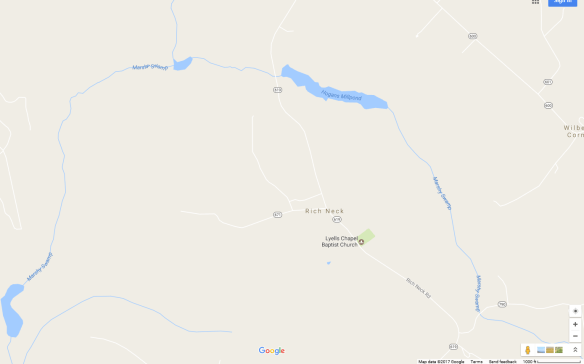
It’s surrounded by Marshy Swamp, which could well have been the Briery Swamp of the 1600s and early 1700s. Marsh Swamp has mill ponds and we know that Briery did as well.

There certainly is a north branch of Marshy Swamp, so I’m thinking this fits the bill quite nicely and I don’t see any other candidate waterways that fit all of the criteria, including a location named Rich Neck and Lyell Church.  I do believe these dots are connected!

The satellite view shows that indeed, there is farmland surrounded by the Creek which is a branch of Totuskey.

Unfortunately, 619 does not have Street View, so I can’t “drive down” it remotely.

Here’s Richmond Road where it crosses Marshy Swamp

Thomas’s Estate Didn’t End With the Will

After Thomas’s death, his widow, Mary Durham Dodson married Robert Galbreath on September 29, 1743 and sure enough, lawsuits followed – just 10 months later.

On July 3, 1744, in chancery court, Greenham Dodson files on behalf of himself as executor of the estate of Thomas Dodson, and others, against Robert Galbreath. (Court Record Book 11-406)

On May 7, 1745, the suit was resolved and the court decided that the petitioner, Greenham Dodson, should “take possession of the coverture, according to the intention of the testators will” and that he should use it for the benefit of Mary Galbreath during her coverture. Robert Galbreath refused to give security and was ordered to pay costs. (Court Record Book 11-458)

That doesn’t sound terribly friendly. The term coverture means the legal status of a married woman, considered to be under her husband’s protection and authority. Perhaps the Dodson children felt that Robert Galbreath was utilizing the estate of Thomas Dodson for himself, not for Mary. Mary would have been 57 years old.

I checked the Virginia Chancery Suit index site for Richmond County, and either those records never made it to the State Library, or they aren’t online yet. I would love to see the entire case file for this suit.

Where was Thomas Dodson Buried?

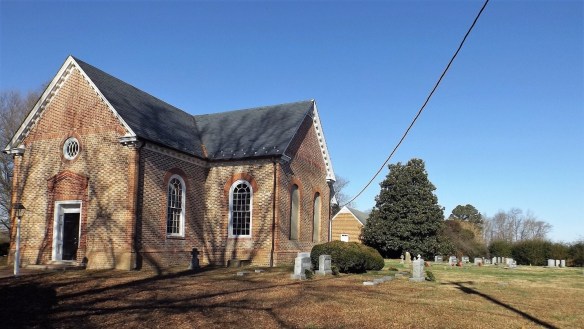
We don’t know where Thomas Dodson was buried, but he may be buried at the North Farnham Parish church.
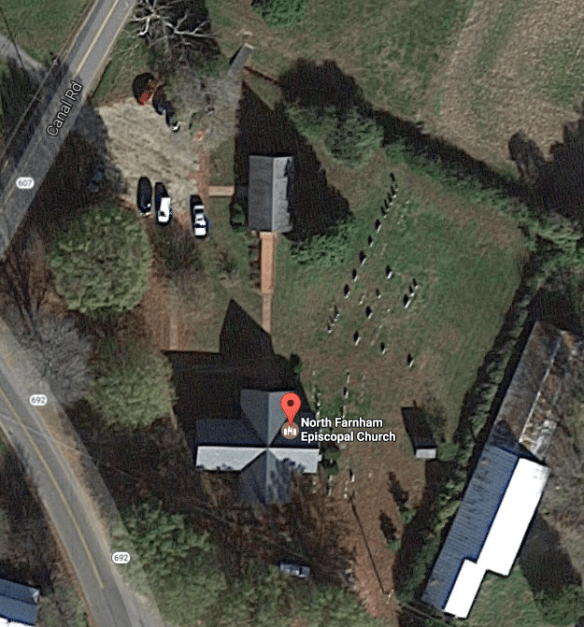
You can see that there is a cemetery behind the North Farnham Parish Church, built in 1737, just a few years before Thomas died. Thomas may have helped to build this church.
DNA

The Dodson DNA is quite interesting. While I have not been able to find males close to me genealogically to test, I’m quite fortunate that several Dodson males who descend from this line have already tested. And thankfully, their Y DNA matches each other, so we know that the Dodson Y DNA lineage looks like. I’m incredible grateful for projects at Family Tree DNA, because without projects, there would be no avenue to “find” our ancestor’s DNA lineage, at least not without being able to find someone to test. Projects allow us to leverage the combined tests of others for our own genealogy. Hopefully, we’re reciprocating in kind by joining appropriate projects with our own tests.

As it turns out, there is more than one line of Dodsons, genetically speaking. To begin with, there are haplogroup I Dodsons and two haplogroup R Dodson groups, plus additional Dodsons who don’t match anyone. Charles Dodson’s line is haplogroup R, or more specifically, R-M269.

Charles County, Maryland lies directly across the Potomac River from the Northern Neck, but the Dodson family descended from John Dodson who settled there is NOT the same Dodson family. This isn’t what I would have expected.

The Dodson Y DNA project has several members. The DNA project itself can be found at this link, and a description of some of the lineages can be found at this link.

These lineages as listed on the website include two individuals who descend from Charles Dodson (1645-1705) through son Thomas (1681-1740) and his son Thomas (1707-1783), in blue and yellow, above.

Both men descended through Charles’ son Thomas have marker value of 13 at DYS439, in red above, which could be a line marker mutation. What we don’t know is when this mutation occurred in this line. In fact, it could have been anyplace from Thomas Sr. through Isaac.

Kit 17119 – Charles – Thomas – Thomas – Joseph – Caleb – Isaac – William – (plus 3 more generations)

Kit 24573 – Charles – Thomas – Thomas – Joseph – Caleb – Isaac – John – (plus 5 more generations)

Kit 8571 – Charles – Thomas – George – Lazarus – Elisha – (plus several generations)

The one additional individual, kit 8571, who descends through Thomas has only tested to 12 markers. However, we’re in luck because marker 439 is contained within that panel and carries a value of 14.

Therefore, we know that the mutation to 13 occurred someplace below Thomas Sr. and between Thomas Jr. and Isaac. Thomas Sr. did not carry this mutation, because the descendant of his son George does not have the mutation. Therefore 439=13 is NOT a line marker mutation for Thomas Sr.

What Does the Dodson DNA Look Like?

The Dodson DNA project documents that many of Charles Dodson’s descendants have tested and together, form the genetic Y DNA STR signature of the Northern Neck, Richmond County, Virginia line in America.  STRs are short tandem repeat markers, meaning those shown in the results below.

As you can see, in many cases, there is no question about the original marker value, because there are no mutations and all of the descendants match. In other cases, for other markers, there are several mutations. Mutations from the “normal” value for the group of participants is shown by colorized cells.

We can reconstruct the original STR markers of Charles Dodson’s DNA by determining the most common values.

The Dodson project was one of the early projects established, so people have tested at all different levels. The lower levels, such as 12 markers, are less useful. Additionally, few have uploaded Gedcom files, which makes determining who is descended from which of Charles’ sons somewhat difficult.

I have utilized the information listed on the Dodson public project page, shown above, to create the chart below, listing the original Charles Dodson value for each marker, plus the percentage of the time this marker is found in haplogroup R-M343, which is R1b. This will inform us of any unusual or rare marker values for the Dodson lineage – forming in essence a Dodson rare marker genetic signature that should suffice to isolate Dodson men from others. Markers that appear in less than 10% of the people who carry this haplogroup are bolded.

Allele Location Dodson Value % in R-M343 (R1b)
393 13 91
390 24 60
19 15 9
391 11 67
385a 11 87
385b 13 11
426 12 98
388 12 98
439 14 2
389-1 13 71
392 13 86
389-2 29 63
458 16 18
459a 9 95
459b 10 81
455 11 97
454 11 98
447 25 69
437 15 85
448 19 78
449 28 11
464a 15 80
464b 15 71
464c 17 48
464d 17 69
460 10 probably, or 11 19 (10) or 74 (11)
GATA H4 11 71
YCA II a 19 95
YCA II b 23 81
456 16 40
607 15 70
576 18 42
570 17 57
CDY a 36 30
CDY b 39 22
442 11 12
438 12 94
531 11 92
578 9 97
395S1a 15 93
395S1b 16 96
590 8 99
537 10 90
641 10 98
472 8 100
406S1 10 85
511 10 85
425 12 100
413a 22 15
413b 23 89
557 16 73
594 10 96
436 12 99
490 12 97
534 17 8
450 8 97
444 12 73
481 22 60
520 20 85
446 13 76
617 12 91
568 11 95
487 13 92
572 11 88
640 11 95
492 12 73
565 12 88
710 33 16
485 15 84
632 9 98
495 16 87
540 12 85
714 25 31
716 26 93
717 19 88
505 12 80
556 11 94
549 12 33
589 12 92
522 10 52
494 9 98
533 13 22
636 12 91
575 10 100
638 11 97
462 11 95
452 31 9
445 13 6
GATA A10 14 8
463 23 5
441 13 83
GGAAT 1B07 10 92
525 10 85
712 20 31
593 15 98
650 18 33
532 14 23
715 24 62
504 17 56
513 12 72
561 15 87
552 24 77
726 12 99
635 23 80
587 18 92
643 10 83
497 14 92
510 17 71
434 9 96
461 12 80
435 11 98

Summary

Thomas Dodson’s life was probably very typically colonial. Thomas wasn’t aristocracy, wasn’t a Burgess or man representing the government in Virginia, but he wasn’t poor either. He inherited land and bought more, raising tobacco and amassing enough to leave each of his sons a plantation. He was an up-and-comer. He had indentured servants as well as slaves – unfortunately, the norm for a successful planter in Virginia of that time. He was a man making his way in a new land, in rather uncharted territory. Many of his children would continue the legacy and push on to new frontiers.

Thomas wasn’t just a planter. He took an active role in the community.  At various times he was a processioner, a surveyor, a bondsman and many times, a juror and estate appraiser.  Yes, once or twice, he was on the wrong end of the stick as well.  Perhaps he sewed a few wild oats, but apparently not nearly as many as his brother-in-law, young Thomas Durham Jr.

Thomas Dodson would have heard about England, the old country, and the King or Queen, but he was born in the new colony of “Virginny” and probably couldn’t relate to a place and aristocracy he didn’t know. He was part of the first generation of people thoroughly “American.” He was born a generation after the tenuous establishment of Jamestown and almost 40 years after the 1722 Indian raid that nearly destroyed the English settlement.

Thomas died less than a half century before the American Revolution and before the French and Indian War. Thomas and his generation began the foundation of what would, some 40 years after his death, become the United States of America. Thomas became the transition between the fledgling colony clinging to the coast by establishing a thriving tobacco-based economy that would expand and evolve into the foundation for an independent country, something for which his grandchildren stood firm and would fight.

Acknowledgements

Much of the information about the early Dodson lines, including Thomas Dodson, Mary Durham and their children, comes from the wonderful two volume set written by the Reverend Silas Lucas, published originally in 1988, titled The Dodson (Dotson) Family of North Farnham Parish, Richmond County, Virginia – A History and Genealogy of Their Descendants.

I am extremely grateful to Reverend Lucas for the thousands of hours and years he spent compiling not just genealogical information, but searching through county records in Virginia, North Carolina, Tennessee, and more. His work from his first publication in 1958 to his two-volume set 30 years later in 1988 stands as a model of what can and should be done for each colonial family – especially given that they were known to move from state to state without leaving any type of “forwarding address” for genealogists seeking them a few hundred years later. Without his books, Dodson researchers would be greatly hindered, if not entirely lost, today.

Sources

  • Richmond County Virginia Marriage References and Family Relationships 1692-1800 by F. Edward Wright
  • Richmond Co., VA Miscellaneous Records, 1699-1724 TLC Genealogy
  • Deed Abstracts of Richmond County 1692-1695 by Ruth and Sam Sparacio
  • Deed Abstracts of Richmond County 1695-1701 by Ruth and Sam Sparacio
  • Deed Abstracts of Richmond County 1701-1704 by Ruth and Sam Sparacio
  • Deed Abstracts of Richmond County 1705-1708 by Ruth and Sam Sparacio
  • Abstracts of Land Records of Richmond County, VA 1692-1704 by Mary Marshall Brewer
  • Richmond Co., VA 1714-1715 Deeds by Ruth and Sam Sparicio
  • Deed Abstracts Richmond Co., VA 1715-1718 by Ruth and Sam Sparacio
  • Richmond Co., VA 1719-1721 Deeds by Ruth and Sam Sparicio
  • Richmond Co., VA 1721-1725 Deeds by Ruth and Sam Sparicio
  • Richmond County VA Deeds and Bonds 1721 and 1734 by TLC Genealogy
  • Richmond County VA Deeds and Bonds 1734 and 1741 by TLC Genealogy
  • The Registers of North Farnham Parish 1663-1814 and Lunenburg Parish 1783-1800 Richmond County, Virginia Compiled and Published by George Harrison Sanford King 1966
  • Marriages of Richmond County, VA 1668-1853 by George Harrison Sanford King
  • Wills of Richmond Co., Va 1699-1800 by Robert K. Keadley, Jr
  • Richmond Co Will Book 4 1717-1725 by TLC
  • Richmond County Order Book Abstracts 1692-1694 by Ruth and Sam Sparacio
  • Richmond County Order Book Abstracts 1694-1697 by Ruth and Sam Sparacio
  • Richmond County Order Book Abstracts 1698-1699 by Ruth and Sam Sparacio
  • Richmond County Order Book Abstracts 1699-1701 by Ruth and Sam Sparacio
  • Richmond County Order Book 1702-1704 by Ruth and Sam Sparacio
  • Richmond County Order Book 1704-1708 by Ruth and Sam Sparacio
  • Richmond County Order Book 1705-1706 by Ruth and Sam Sparacio
  • Richmond County Order Book 1707-1708 by Ruth and Sam Sparacio
  • Richmond County Order Book 1708-1709 by Ruth and Sam Sparacio
  • Richmond County Order Book 1711-1713 by Ruth and Sam Sparacio
  • Richmond County Order Book 1714-1715 by Ruth and Sam Sparacio
  • Richmond County Order Book Abstracts 1716-1717 by Ruth and Sam Sparacio
  • Richmond County Order Book Abstracts 1718-1719 by Ruth and Sam Sparacio
  • Richmond County Order Book Abstracts 1722-1724 by Ruth and Sam Sparacio
  • Richmond County Order Book Abstracts 1724-1725 by Ruth and Sam Sparacio
  • Richmond County Order Book Abstracts 1726-1727 by Ruth and Sam Sparacio
  • Richmond County Order Book Abstracts 1728-1729 by Ruth and Sam Sparacio
  • Richmond County Order Book Abstracts 1729-1730 by Ruth and Sam Sparacio
  • Richmond County Order Book Abstracts 1731-1732 by Ruth and Sam Sparacio
  • Richmond County Order Book Abstracts 1732-1734 by Ruth and Sam Sparacio
  • Richmond County Order Book Abstracts 1732-1739 by Ruth and Sam Sparacio
  • Richmond County Order Book Abstracts 1735-1736 by Ruth and Sam Sparacio
  • Richmond County Order Book Abstracts 1737-1738 by Ruth and Sam Sparacio
  • Richmond County, Virginia Court Orders 1721-1752 An Every Name Index by TLC Genealogy

Note that at the Allen County Public Library multiple books were rebound together and sometimes the title did not accurately reflect the contents. I searched all of the Richmond County books available which their catalog reflects includes contiguous dates.

______________________________________________________________

Disclosure

I receive a small contribution when you click on some of the links to vendors in my articles. This does NOT increase the price you pay but helps me to keep the lights on and this informational blog free for everyone. Please click on the links in the articles or to the vendors below if you are purchasing products or DNA testing.

Thank you so much.

DNA Purchases and Free Transfers

Genealogy Services

Genealogy Research

Julie Bowen – Who Do You Think You Are – “Pride and Forgiveness”

I just love the Who Do You Think You Are? series. Each episode is like a genealogy “who done it,” chocked full of history and sleuthing, travel and of course, good guys and bad guys. Try to ignore the unfortunately huge commercial load. The mute button works miracles and you’ll have plenty of time for a BR break or to pop some popcorn or even to go online and check your DNA results if you haven’t done that yet for the day.

On this upcoming Sunday, March 12th, the new episode of Who Do You Think You Are? airs at 10/9c on TLC.  Actress Julie Bowen uncovers fascinating stories of her ancestors on both sides of her family.

First, Julie travels to Chicago to learn about her mother’s side of the family. She knew that her ancestor, “Big Charlie” was the artist in the family. Born the son of a plumber in Denver, Big Charlie headed east, instead of west, to Chicago, the land of opportunity for an up and coming artist.

Big Charlie’s art was fresh and new and even by today’s standards, looks quite contemporary. Still in his early 20s, he founded his own company and was the “big bright light of advertising illustration.”

Charlie was the poster boy for the American dream, ambitious and talented, but then…the rest of the story. You knew there had to be a “rest of the story,” right?

The next revelation pulls Julie down a dark hole…one that affected my ancestors too, but that I had never heard of before this episode. A dark chapter in American history that is oh so relevant once again today and is guaranteed to make you think.

You’ll have to watch this one for yourself. All I can say is that you’ll never, ever guess this plot twist…and I don’t want to spoil it for you. Big Charlie wasn’t exactly what he seemed, nor quite how he was remembered by the family.

Next, Julie looks to discover more about her father’s ancestor, a man rumored to have been a doctor associated with the underground railroad. Is this story too good to be true? Julie said she had never looked into this family lore because she loved the legend so much just the way it was. She didn’t want to risk finding out that maybe it wasn’t accurate, that maybe her ancestor had been a slave-owner instead. I think, in one way or another, we can all identify with that sentiment.

Julie travels to Washington County, Pennsylvania, and you know it’s going to be a good story when your ancestor’s home is now the local historical society. How often has that ever happened to me? Exactly none!

Julie learns that her 3 times great-grandfather, Francis Julius LeMoyne, was a highly sought after speaker and a radical abolitionist who risked his life and the lives of his family repeatedly, for years, decades actually, to help free fugitive slaves. Francis’s activism began long before the movement to free the slaves became a reality. Francis signed on early, before 1837, as a founder of the American Anti-Slavery Society. All of this was at incredible personal risk to Francis and his family who clearly supported his efforts.

Francis’s lectures and meetings didn’t always go well, even in the North where he lived. At one event, when a group was meeting at his house in the garden, an unhappy crowd gathered outside. Standing on the balcony, surveying the unruly crowd, Francis’s father, also a physician, suggested that if the crowd became threatening, that he kept bee hives underneath the porch roof. I’ll let you guess what happened next!

The revelations that Julie experienced in Washington County are as heart-warming as the ones in Chicago were bone-chilling.

Julie, in the end, can’t help but notice the parallels between the acts of her ancestors with what’s going on in today’s world. She reflects that it’s nice to have heroes and that your ancestors, for bad or good, make you ask yourself “who you want to stand up for.” It’s certainly “not the easy choice to fight for people who had no choice.”

It’s difficult to discover ancestors whose actions and sentiments chafe at everything we believe. It’s emotionally unsettling, and for Julie to find both a hero and a villain in such a short time must have been akin to an ancestral emotional roller-coaster ride. Her perspective is both encouraging and enlightening. She closes by saying that we must “love them, hear their story, and find a better way.”

A great episode that will keep you on your toes all the way to the end.

Concepts – The Faces of Endogamy

Recently, while checking Facebook, I saw this posting from my friend who researches in the same Native admixed group of families in North Carolina and Virginia that I do. Researchers have been trying for years to sort through these interrelated families. As I read Justin’s post, I realized, this is a great example of endogamy and often how it presents itself to genealogists.

I match a lot of people from the Indian Woods [Bertie County, NC] area via DNA, with names like Bunch, Butler, Mitchell, Bazemore, Castellow, and, of course, Collins. While it’s hard to narrow in on which family these matching segments come from, I can find ‘neighborhoods’ that fit the bill genetically. This [census entry] is from near Quitsna in 1860. You see Bunch, Collins, Castellow, Carter, and Mitchell in neighboring households.

Which begs the question, what is endogamy, do you have it and how can you tell?

Definition

Endogamy is the practice or custom or marrying within a specific group, population, geography or tribe.

Examples that come to mind are Ashkenazi Jews, Native Americans (before European and African admixture), Amish, Acadians and Mennonite communities.

Some groups marry within their own ranks due to religious practices. Jewish, Amish and Mennonite would fall under this umbrella. Some intermarry due to cultural practices, such as Acadians, although their endogamy could also partly be attributed to their staunch Catholic beliefs in a primarily non-Catholic region. Some people practice endogamy due to lack of other eligible partners such as Native Americans before contact with Europeans and Africans.  People who live on  islands or in villages whose populations were restricted geographically are prime candidates for endogamy.

In the case of Justin’s group of families who were probably admixed with Native, European and African ancestors, they intermarried because there were socially no other reasonable local options. In Virginia during that timeframe, mixed race marriages were illegal. Not only that, but you married who lived close by and who you knew – in essence the neighbors who were also your relatives.

Endogamy and Genetic Genealogy

In some cases, endogamy is good news for the genealogist. For example, if you’re working with Acadian records and know which Catholic church your ancestors attended. Assuming those church records still exist, you’re practically guaranteed that you’ll find the entire family because Acadians nearly always married within the Acadian community, and the entire Acadian community was Catholic. Catholics kept wonderful records. Even when the Acadians married a Native person, the Native spouse is almost always baptized and recorded with a non-Native name in the Catholic church records, which paved the way for a Catholic marriage.

In other cases, such as Justin’s admixed group, the Brethren who notoriously kept no church records or the Jewish people whose records were largely destroyed during the Holocaust, endogamy has the opposite effect – meaning that actual records are often beyond the reach of genealogists – but the DNA is not.

It’s in cases like this that people reach for DNA to help them find their families and connections.

What Does Endogamy Look Like?

If you know nothing about your heritage, how would you know whether you are endogamous or not? What does it look like? How do you recognize it?

The answer is…it depends. Unfortunately, there’s no endogamy button that lights up on your DNA results, but there are a range of substantial clues.  Let’s divide up the question into pieces that make sense and look at a variety of useful tools.

Full or Part?

First of all, fully and partly endogamous ancestry, and endogamy from different sources, has different signs and symptoms, so to speak.

A fully endogamous person, depending on their endogamy group, may have either strikingly more than average autosomal DNA matches, or very few.

Another factor will be geography, where you live, which serves to rule out some groups entirely. If you live in Australia, your ancestors may be European but they aren’t going to be Native American.

How many people in your endogamous group that have DNA tested is another factor that weighs very heavily in terms of what endogamy looks like, as is the age of the group. The older the group, generally the more descendants available to test although that’s not always the case. For example warfare, cultural genocide and disease wiped out many or most of the Native population in the United States, especially east of the Mississippi and particularly in the easternmost seaboard regions.

Because of the genocide perpetrated upon the Jewish people, followed by the scattering of survivors, Jewish descendants are inclined to test to find family connections. Jewish surnames may have been changed or not adopted in some cases until late, in the 1800s, and finding family after displacement was impossible in the 1940s for those who survived.

Let’s look at autosomal DNA matches for fully and partly endogamous individuals.

Jewish people, in particular Ashkenazi, generally have roughly three times as many matches as non-endogamous individuals.

Conversely, because very few Native people have tested, Native testers, especially non-admixed Native individuals, may have very few matches.

It’s ironic that my mother, the last person listed, with two endogamous lines, still has fewer matches than I do, the first person listed.  This is because my father has deep colonial roots with lots of descendants to test, and my mother has recent immigration in her family line – even though a quarter of her ancestry is endogamous.

To determine whether we are looking at endogamy, sometimes we need to look for other clues.

There are lots of ways to discover additional clues.

Surnames

Is there a trend among the surnames of your matches?

At the top of your Family Finder match page your three most common surnames are displayed.

A fully endogamous Jewish individual’s most common surnames are shown above. If you see Cohen among your most common surnames, you are probably Jewish, given that the Kohanim have special religious responsibilities within the Jewish faith.

Of course, especially with autosomal DNA, the person’s current surname may not be indicative, but there tends to be a discernable pattern with someone who is highly endogamous. When someone who is fully endogamous, such as the Jewish population, intermarries with other Jewish people, the surnames will likely still be recognizably Jewish.

Our Jewish individual’s first matching page, meaning his closest matches, includes the following surnames:

  • Cohen
  • Levi
  • Bernstein
  • Kohn
  • Goldstein

The Sioux individual only has 137 matches, but his first page of matches includes the following surnames:

  • Sunbear
  • Deer With Horns
  • Eagleman
  • Yelloweyes
  • Long Turkey
  • Fire
  • Bad Wound
  • Growing Thunder

These surnames are very suggestive of Native American ancestry in a tribe that did not adopt European surnames early in their history. In other words, not east of the Mississippi.

At Family Tree DNA, every person has the opportunity to list their family surnames and locations, so don’t just look at the tester’s surname, but at their family surnames and locations too. The Ancestral Surname column is located to the far right on the Family Finder matches page. If you can’t see all of the surnames, click on the person’s profile picture to see their entire profile and all of the surnames they have listed.

Please note that you can click to enlarge all graphics.

If you haven’t listed your family surnames, now would be a good time. You can do this by clicking on the orange “Manage Personal Information” link near your profile picture on the left of your personal page.

The orange link takes you to the account settings page. Click on the Genealogy tab, then on surnames. Be sure to click the orange “save” when you are finished.

Partial Endogamy

Let’s take a look at a case study of someone who is partially endogamous, meaning that they have endogamous lines, but aren’t fully endogamous. My mother, who is the partially endogamous individual with 1231 matches is a good example.

Mother is a conglomeration of immigrants. Her 8 great-grandparents break down as follows:

In mother’s case, a few different forces are working against each other. Let’s take a look.

The case of recent immigration from the Netherlands, in the 1850s, would serve to reduce mother’s matches because there has been little time in the US for descendants to accrue and test. Because people in the Netherlands tend to be very reluctant about DNA testing, very few have tested, also having the effect of reducing her number of matches.

Mother’s Dutch ancestors were Mennonites, an endogamous group within the Netherlands, which would further reduce her possibilities of having matches on these lines since she would be less likely to match the general population and more likely to match individuals within the endogamous group. If people from the Mennonite group tested, she would likely match many within that group. In other words, for her to find Dutch matches, people descended from the endogamous Dutch Mennonite population would need to test. At Family Tree DNA, there is a Low Mennonite Y DNA and Anabaptist autosomal DNA project both, but these groups tend to attract the Mennonites that migrated to Russia and Poland, not the group that stayed in the Netherlands. Another issue, at least in mother’s case, is that her Mennonite relatives “seem” to have been later converts, not part of the original Mennonite group – although it’s difficult to tell for sure in the records that exist.

Mother’s Kirsch and Drechsel ancestors were also recent immigrants in the 1850s, from Germany, with very few descendants in the US today. The villages from where her Kirsch ancestors immigrated, based on the church records, did tend to be rather endogamous.  However, that endogamy would only have reached back about 200 years, as far as the 30 Years’ War when that region was almost entirely, if not entirely, depopulated. So while there was recent endogamy, there (probably) wasn’t deep endogamy. Of course, it would require someone from those villages to test so mother could have matches before endogamy can relevant. DNA testing is not popular in Germany either.

Because of recent immigration, altogether one half of mother’s heritage would reduce her number of matches significantly. Recent immigrants simply have fewer descendants to test.

On the other hand, mother’s English line has been in the US for a long time, some since the Mayflower, so she could expect many matches from that line, although they are not endogamous. If you’re thinking to yourself that deep colonial ancestry can sometime mimic endogamy in terms of lots of matches, you’re right – but still not nearly to the level of a fully endogamous Jewish person.

Mother’s Acadian line has been settled in North America in Nova Scotia since the early 1600s, marrying within their own community, mixing with the Native people and then scattering in different directions after 1755 when they were forcibly removed. Acadians, however, tended to remain in their cultural groups, even after relocation. Many Acadian descendants DNA test and all Acadians descend from a limited and relatively well documented original population. That level of documentation is very unusual for endogamous groups. Acadian surnames are well known and are French. The best Acadian genealogical resource in is Karen Theriot’s comprehensive tree on Rootsweb in combination with the Mothers of Acadia DNA project at Family Tree DNA. I wish there was a similar Fathers of Acadia project.

Mother’s Brethren line is much less well documented due to a lack of church records. The Brethren community immigrated in the early 1700s from primarily Switzerland and Germany, was initially relatively small, lived in clusters in specific areas, traveled together and did not marry outside the Brethren faith. Therefore, Brethren heritage and names also tend to be rather specific, but not as recognizable as Acadian names. After all, the Brethren were German/Swiss and in mother’s case, she also has another 1/4th of her heritage that are recently immigrated Germans – so differentiating one German group from the other can be tricky. The only way to tell Brethren matches from other German matches is that the Brethren also tend to match each other.

In Common With

If you notice a group of similar appearing surnames, use the ICW (in common with) tool at Family Tree DNA to see who you match in common with those individuals. If you find that you match a whole group of people with similar surnames or geography, contact your matches and ask if they know any of the other matches and how they might be related. I always recommend beginning with your closest matches because your common ancestor is likely to be closer in time than people who match you more distantly.

In the ICW match example below, all of the matches who do show ancestral surnames include Acadian surnames and/or locations.

Acadians, of course, became Cajuns in Louisiana where one group settled after their displacement in Nova Scotia. The bolded surnames match surnames on the tester’s surname list.

The ICW tools work particular well if you know of or can identify one person who matches you within a group, or simply on one side of your family.

Don Worth’s Autosomal DNA Segment Analyzer is an excellent tool to genetically group your matches by chromosome. It’s then easy to use the chromosome browser at Family Tree DNA to see which of these people match you on the same segments. These tools work wonderfully together.

The group above is an Acadian match group. By hovering over the match names, you can see their ancestral surnames which make the Acadian connection immediately evident.

The Matrix

In addition to seeing the people you match in common with your matches by utilizing the ICW tool at Family Tree DNA, you can also utilize the Matrix tool to see if your matches also match each other. While this isn’t the same as triangulation, because it doesn’t tell you if they match each other on the same exact segment, it’s a wonderful tool, because in the absence of cooperation or communication from your matches to determine triangulation between multiple people, the Matrix is a very good secondary approach and often predicts triangulation accurately.

In the Matrix, above, the blue boxes indicates that these individuals (from your match list) also match each other.

For additional information on various autosomal tools available for your use, click here to read the article, Nine Autosomal Tools at Family Tree DNA.

MyOrigins

Everyone who takes the Family Finder test also receives their ethnicity estimates on the MyOrigins tab.

In the case of our Jewish friend, above, his MyOrigins map clearly shows his endogamous heritage. He does have some Middle Eastern region admixture, but I’ve seen Ashkenazi Jewish results that are 100% Ashkenazi Jewish.

The same situation exists with our Sioux individual, above. Heavily Native, removing any doubt about his ancestry.

However, mother’s European admixture blends her MyOrigins results into a colorful but unhelpful European map, at least in terms of determining whether she is endogamous or has endogamous lines.

European endogamous admixture, except for Jewish heritage, tends to not be remarkable enough to stand out as anything except European heritage utilizing ethnicity tools. In addition, keep in mind that DNA testing in France for genealogy is illegal, so often there is a distinct absence in that region that is a function of the lack of testing candidates. Acadians may not show up as French.

Ethnicity testing tends to be excellent at determining majority ethnicity, and determining differences between continental level ethnicity, but less helpful otherwise. In terms of endogamy, Jewish and Native American tend to be the two largest endogamous groups that are revealed by ethnicity testing – and for that purpose, ethnicity testing is wonderful.

Y and Mitochondrial DNA and Endogamy

Autosomal tools aren’t the only tools available to the genetic genealogist. In fact, if someone is 100% endogamous, or even half endogamous, chances are very good that either the Y DNA for males on the direct paternal line, or the mitochondrial DNA for males and females on the direct matrilineal line will be very informative.

On the pedigree chart above, the blue squares represent the Y DNA that the father contributes to only his sons and the red circles represent the mitochondrial DNA (mtDNA) that mothers contribute to both genders of their children, but is only passed on by the females.

By utilizing Y and mtDNA testing, you can obtain a direct periscope view back in time many generations, because the Y and mitochondrial DNA is preserved intact, except for an occasional mutation. Unlike autosomal DNA, the DNA of the other parent is not admixed with the Y or mitochondrial DNA. Therefore, the DNA that you’re looking at is the DNA of your ancestors, generations back in time, as opposed to autosomal DNA which can only reliably reach back 5 or 6 generations in terms of ethnicity because it gets halved in every generation and mixed with the DNA of the other parent.

With autosomal DNA, we can see THAT it exists, but not who it came from.  With Y and mtDNA DNA, we know exactly who in your tree that specific DNA came from

We do depend on occasional Y and mtDNA mutations to allow our lines to accrue enough mutations to differentiate us from others who aren’t related, but those mutations accrue very slowly over hundreds to thousands of years.

Our “clans,” over time, are defined by haplogroups and both our individual matches and our haplogroup or clan designation can be very useful. Your haplogroup will indicate whether you are European, Jewish, Asian, Native American or African on the Y and/or mtDNA line.

In cases of endogamous groups where the members are known to marry only within the group, Y and mtDNA can be especially helpful in identifying potential families of origin.  This is evident in the Mothers of Acadia DNA project as well a particular brick wall I’m working on in mother’s Brethren line. Success, of course, hinges on members of that population testing their Y or mtDNA and being available for comparison.

Always test your Y (males only) and mitochondrial DNA (males and females.) You don’t know what you don’t know, and sometimes those lines may just hold the key you’re looking for. It would be a shame to neglect the test with the answer, or at least a reasonably good hint! Stories of people discovering their ethnic heritage, at least for that line, by taking a Y or mtDNA test are legendary.

Jewish Y and Mitochondrial DNA

Fortunately, for genetic genealogists, Jewish people carry specific sub-haplogroups that are readily identified as Jewish, although carrying these subgroups don’t always mean you’re Jewish. “Jewish” is a religion as well as a culture that has been in existence as an endogamous group long enough in isolation in the diaspora areas to develop specific mutations that identify group members. Furthermore, the Jewish people originated in the Near East and are therefore relatively easy, relative to Y and mtDNA, to differentiate from the people native to the regions outside of the Near East where groups of Jewish people settled.

The first place to look for hints of your heritage is your main page at Family Tree DNA. First, note your haplogroups and any badges you may have in the upper right hand corner of your results page.

In this man’s case, the Cohen badge is this man’s first clue that he matches or closely matches the known DNA signature for Jewish Cohen men.

Both Y DNA and mitochondrial DNA results have multiple tabs that hold important information.

Two tabs, Haplogroup Origins and Ancestral Origins are especially important for participants to review.

The Haplogroup Origins tab shows a combination of academic research results identifying your haplogroup with locations, as well as some Ancestral Origins mixed in.

A Jewish Y DNA Haplogroup Origins page is shown above.

The Ancestral Origins page, below, reflects the location where your matches SAY their most distant direct matrilineal (for mtDNA) or patrilineal (for Y DNA) ancestors were found. Clearly, this information can be open to incorrect interpretation, and sometimes is. For example, people often don’t understand that “most distant maternal ancestor” means the direct line female on your mother’s mother’s mother’s side.  However, you’re not looking at any one entry. You are looking instead for trends.

The Ancestral Origins page for a Jewish man’s Y DNA is shown above.

The Haplogroup Origins page for Jewish mitochondrial DNA, below, looks much the same, with lots of Ashkenazi entries.

The mitochindrial Ancestral Origins results, below, generally become more granular and specific with the higher test levels. That’s because the more general results get weeded out a higher levels. Your closest matches at the highest level of testing are the most relevant to you, although sometimes people who tested at lower levels would be relevant, if they upgraded their tests.

Native American Y and Mitochondrial DNA

Native Americans, like Jewish people, are very fortunate in that they carry very specific sub-haplogroups for Y and mitochondrial DNA. The Native people had a very limited number of founders in the Americas when they originally arrived, between roughly 10,000 and 25,000 years ago, depending on which model you prefer to use. Descendants had no choice but to intermarry with each other for thousands of years before European and African contact brought new genes to the Native people.

Fortunately, because Y and mtDNA don’t mix with the other parents’ DNA, no matter how admixed the individual today, testers’ Y and mtDNA still shows exactly the origins of that lineage.

Native American Y DNA shows up as such on the Haplogroup Origins and Ancestral Origins tabs, as illustrated below.

The haplogroup assigned is shown along with a designation as Native on the Haplogroup Origins and Ancestral Origins pages. The haplogroup is assigned through DNA testing, but the Native designation and location is entered by the tester. Do be aware that some people record the fact that their “mother’s side” or “father’s side” is reported to have a Native ancestor, which is not (necessarily) the same as the matrilineal or patrilineal line. Their “mother’s side” and “father’s side” can have any number of both male and female ancestors.

If the tester’s haplogroup comes back as non-Native, the erroneous Native designation shows up in their matches Ancestral Origins page as “Native,” because that is what the tester initially entered.  I wrote about this situation here, but there isn’t much that can be done about this unless the tester either realizes their error or thinks to go back and change their designation from Native American when they realize the DNA does not support the family story, at least not on this particular line line. Erroneous labeling applies to both Y and mtDNA.

Native Y DNA falls within a subset of haplogroups C and Q. However, most subgroups of C and Q are NOT Native, but are European or Asian or in one case, a subgroup of haplogroup Q is Jewish. This does NOT means that the Jewish people and the Native people are related within many thousands of years. It means they had a common ancestor in Asia thousands of years ago that gave birth to both groups. In essence, one group of the original Q moved east and eventually into the Americas, and one moved west, winding up in Europe. Today, mutations (SNPs) have accrued to each group that very successfully differentiate them from one another. In order to determine whether your branch of C or Q is Native, you must take additional SNP tests which further identify your haplogroup – meaning which branch of haplogroup C or Q that you belong to.

Native Americans Y-DNA, to date, must fall into a subset of haplogroup C-P39, a subgroup of C-M217 or Q-M3, Q-M971/Z780 or possibly Q-B143 (ancient Saqquq in Greenland), according to The study of human Y chromosome variation through ancient DNA. Each of these branches also has sub-branches except for Q-B143 which may be extinct. This isn’t to say additional haplogroups or sub-haplogroups won’t be discovered in the future. In fact, haplogroup O is a very good candidate, but enough evidence doesn’t yet exist today to definitively state that haplogroup O is also Native.

STR marker testing, meaning panels of markers from 12-111, provides all participants with a major haplogroup estimate, such as C or Q. However, to confirm the Y DNA haplogroup subgroup further down the tree, one must take additional SNP testing. I wrote an article about the differences between STR markers and SNPs, if you’d like to read it, here and why you might want to SNP test, here.

Testers can purchase individual SNPs, such as the proven Native SNPs, which will prove or disprove Native ancestry, a panel of SNPs which have been combined to be cost efficient (for most haplogroups), or the Big Y test which scans the entire Y chromosome and provides additional matching.

When financially possible, the Big Y is always recommended. The Big Y results for the Sioux man showed 61 previously unknown SNPs. The Big Y test is a test of discovery, and is how we learn about new branches of the Y haplotree. You can see the most current version of the haplogroup C and Q trees on your Family Tree DNA results page or on the ISOGG tree.

Native mitochondrial DNA can be determined by full sequence testing the mitochondrial DNA. The mtPlus test only tests a smaller subset of the mtDNA and assigns a base haplogroup such as A. To confirm Native ancestry, one needs to take the full sequence mitochondrial test to obtain their full haplogroup designation which can only be determined by testing the full mitochondrial sequence.

Native mitochondrial haplogroups fall into base haplogroups A, B, C, D, X and M, with F as a possibility. The most recent paper on Native Mitochondrial DNA Discoveries can be found here and a site containing all known Native American mitochondrial DNA haplogroups is here.

Not Native or Jewish

Unfortunately, other endogamous groups aren’t as fortunate as Jewish and Native people, because they don’t have haplogroups or subgroups associated with their endogamy group. However, that doesn’t mean there aren’t a few other tools that can be useful.

Don’t forget about your Matches Maps. While your haplogroup may not be specific enough to identify your heritage, your matches may hold clues. Each individual tester is encouraged to enter the identity of their most distant ancestor in both their Y (if male) and mtDNA lines. Additionally, on the bottom of the Matches Map, testers can enter the location where that most distant ancestor is found. If you haven’t done that yet, this is a good time to do that too!

When looking at your Matches Map, clusters and distribution of your matches most distant ancestor locations are important.

This person’s matches, above, suggest that they might look at the history of Nova Scotia and French immigrants – and the history of Nova Scotia is synonymous with the Acadians but the waterway distribution can also signal French, but not Acadian. Native people are also associated with Nova Scotia and river travel. The person’s haplogroup would add to this story and focus on or eliminate some options.

This second example above, suggests the person look to the history of Norway and Sweden, although their ancestor, indicated by the white balloon, is from Germany. If the tester’s genealogy is stuck in the US, this grouping could be a significant clue relative to either recent or deeper history. Do they live in a region where Scandinavian people settled? What history connects the region where the ancestor is found with Scandinavia?

This third example, above, strongly suggests Acadian, given the matches restricted to Nova Scotia, and, as it turns out, this individual does have strong Acadian heritage. Again, their haplogroup is additionally informative and points directly to the European or Native side of the Acadian heritage for this particular line.

In Summary

Sometimes endogamy is up front and in your face, evident from the minute your DNA results are returned. Other times, endogamous lines in ethnically mixed individuals reveal themselves more subtly, like with my friend Justin. Fortunately, the different types of DNA tests and the different tools at our disposal each contain the potential for a different puzzle piece to be revealed. Many times, our DNA results need to be interpreted with some amount of historical context to reveal the story of our ancestors.

When I first discovered that my mother’s line was Acadian, my newly found cousin said to me, “If you’re related to one Acadian, you’re related to all Acadians.” He wasn’t kidding. For that very reason, endogamous genetic genealogy is tricky at best and frustrating at worst.

When possible, Y and mtDNA is the most definitive answer, because the centuries or millennia or intermarriage don’t affect Y and mtDNA. If you are Jewish or Native on the appropriate lines for testing, Y and mtDNA is very definitive. If you’re not Jewish or Native on your Y or mtDNA lines, check your matches for clues, including surnames, Haplogroup and Ancestral Origins, and your Matches Map.

Consider building a DNA pedigree chart that documents each of your ancestors’ Y and mtDNA for lines that aren’t revealed in your own test. The story of Y and mtDNA is not confused or watered down by admixture and is one of the most powerful, and overlooked, tools in the genealogist’s toolbox.

Autosomal DNA when dealing with endogamy can be quite challenging, even when working with well-documented Acadian genealogy – because you truly are related to everyone.  Trying to figure out which DNA segments go with, or descend from, which ancestors reaching back several generations is the ultimate jigsaw puzzle. Often, I work with a specific segment and see how far back I can track that segment in the ancestral line of me and my matches. On good days, we arrive at one common ancestor. On other days, we arrive at dead ends that are not a common ancestor – which means of course that we keep searching genealogically – or pick a different segment to work with.

When working with autosomal DNA of endogamous individuals (or endogamous lines of partially endogamous individuals,) I generally use a larger matching threshold than with non-endogamous, because we already know that these people will have segments that match because they descend from the same populations. In general, I ignore anything below 10cM and often below 15cM if I’m looking for a genealogical connection in the past few generations. If I’m simply mapping DNA to ancestors, then I use the smaller segments, down to either 7 or 5cM. If you want to read more about segments that are identical by chance (also known as false matches,) identical by population and identical by descent (genealogically relevant matches,) click here.

The good news about endogamy is that its evidence persists in the DNA of the population, literally almost forever, as long as that “population” exists in descendants – meaning you can find it!  In my case, my Acadian brick wall would have fallen much sooner had I know what endogamy looked like and what I was seeing actually meant.

A perfect example of persistent endogamy is that our Sioux male today, along with other nearly fully Native people, including people from South America, matches the ancient DNA of the Anzick child who died and was buried in Montana 12,500 years ago.

These people don’t just match on small segments, but at contemporary matching levels at Family Tree DNA and GedMatch, both.  One individual shows a match of 109 total cM and a single largest segment of DNA at 20.7 cM, a match that would indicate a contemporary relationship of between 3.5 and 4 generations distant – meaning 2nd to 3rd cousins. Clearly, that isn’t possible, but the DNA shared by Anzick Child and that individual today has been intact in the Native population for more than 12,500 years.

The DNA that Anzick Child carried is the same DNA that the Sioux people carry today – because there was no DNA from outside the founder population, no DNA to wash out the DNA carried by Anzick Child’s ancestors – the same exact ancestors of the Sioux and other Native or Native admixed people today.

While endogamy can sometimes be frustrating, the great news is that you will have found an entire population of relatives, a new “clan,” so to speak.  You’ll understand a lot more about your family history and you’ll have lots of new cousins!

Endogamy is both the blessing and the curse of genetic genealogy!

______________________________________________________________

Disclosure

I receive a small contribution when you click on some of the links to vendors in my articles. This does NOT increase the price you pay but helps me to keep the lights on and this informational blog free for everyone. Please click on the links in the articles or to the vendors below if you are purchasing products or DNA testing.

Thank you so much.

DNA Purchases and Free Transfers

Genealogy Services

Genealogy Research

Henry Dagord or Dagod or Maybe Doggett (c 1660/1683 – after 1708), 52 Ancestors #150

Very little is known about Henry Dagod or Dagord except that he was the father of Margaret Dagod or Dagord born in North Farnham Parish in Richmond County, Virginia on April 30, 1708. The North Farnham Parish register record does not tell us who Henry’s wife is, and there are absolutely no other records in Richmond County that can be attributed to Henry Dagord. Not one. Nada.

In fact, we’re not even sure of his surname.

In the document, “The Registers of North Farnham Parish 1663-1814 and Lunenburg Parish 1673-1800, Richmond County, Virginia” compiled by George Harrison and Sanford King and published in 1866, they record Margaret’s surname as Dagod, not Dagord. This is the first and to my knowledge only publication of the North Farnham Parish registers, so we’re just going to have to trust their interpretation.

The publication “Married Well and Often: Marriages of the Northern Neck of Virginia, 1649-1800,” available at Ancestry shows the Dodson/Dagod marriage as well.

dagord-marriage

These folks obviously thought that Dagod was a misspelling of Doggett, and there were Doggett families in the area. They may have been right – and they may have been wrong.

However, for some reason, within the Dodson family, Margaret’s surname has always been listed as Dagord, not Dagod or Doggett, either one. The great irony is that no place in these records or the Richmond County records does Dagord, spelled as such, ever appear.

Speaking of the North Farnham Church Register, the original parish register no longer exists and apparently hasn’t for about 200 years or so. We’re working with a disintegrating (but now preserved) leatherbound alphabetized transcription housed at the Virginia State Archives that includes records from 1663 to 1814. It’s these records, already alphabetized and transcribed once that were transcribed a second time by Harrison and King in 1866.

These records can very effectively be used in conjunction with the existing marriage records from the area which exist beginning in 1668. Neither set of documents appears to be complete. Pages are missing from the North Farnham Parish register. At least three sets of page numbers have been added at different times (pen, ink and crayon) and are not in sync with each other, not to mention that it’s obvious in an alphabetized list when sections or pages are missing.

In 1663, North Farnham Parish was still Farnham Parish which was split between north and south in 1684. North was north of the Rappahannock River, now Richmond County and South was south of the river, now Essex County.

Another challenge is the spelling of the Dagord surname. It may not be Dagord, and whatever it was, it could certainly have been spelled myriad ways. I found variations that included Dagod, Doggett, Doged, Doget, Dogged, Dogett, Doggett, Daggett…you get the idea. So I looked for every somewhat similar record beginning with Da and Do. The good and bad news both is that there really weren’t many records at all.

I thought sure that perhaps researchers hadn’t researched thoroughly, so I undertook that task, perusing not just Richmond County, but also the preceeding counties from which Richmond was formed. I checked Lancaster, York, Old Rappahannock and Richmond County land, probate and court records closely.

I did not check Essex County records since Essex was located across a mile-wide river, which would not have placed Margaret Dagod in close enough proximity to George Dodson to get to know each other well enough to marry, given that the Dodsons lived on or near Totuskey Creek in Richmond County.  A ferry ride would have been the most expedient way to cross the Rappahannock River, and ferries were not free.

Old Rappahannock County, Virginia

northern-neck

Settlement in the Northern Neck of Virginia, shown above as the neck of land that today includes the counties of Westmoreland, Northumberland, Richmond and Lancaster, began about 1635 when the area was part of York County, one of the original counties formed in 1634. St. Mary’s and St. Charles Counties in Maryland are just across the Potomac River, on the north side of the neck.

In 1619, the area which is now York County was included in two of the four incorporations (or “citties”) of the proprietary Virginia Company of London which were known as Elizabeth Cittie and James Cittie.

In 1634, what became York County was formed as Charles River Shire, one of the eight original shires of Virginia.

During the English Civil War, Charles River County and the Charles River (also named for the King) were changed to York County and York River, respectively. The river, county, and town of Yorktown are believed to have been named for York, a city in Northern England.

York County land records and probate began in 1633.

In 1648, Northumberland was formed from York and then in 1652 Lancaster was formed Northumberland and York. Land records in Northumberland began in 1650 and probate in 1652.

Old Rappahannock County (not to be confused with the current Rappahannock County) was formed in 1656 from Lancaster County, VA. Land records begin in 1656 and probate in 1665. In 1692, old Rappahannock was dissolved and divided into Essex and Richmond Counties.

Old Rappahannock County was named for the Native Americans who inhabited the area, Rappahannock reportedly meaning “people of the alternating (i.e., tidal) stream.” The county’s origins lay in the first efforts by English immigrants to “seat” the land along the Rappahannock River in the 1640s. The primitive travel capabilities of the day and the county’s relatively large area contributed to the settlers’ hardship in travel to the county seat to transact business, and became the primary reason for the county’s division by an Act of the Virginia General Assembly in 1691 to form the two smaller counties of Essex and Richmond.

According to the library of Virginia, old Rappahannock wills are with the Essex County wills, although they have been transcribed and published separately.

Richmond County was formed in 1692 from Old Rappahannock, with land records beginning in 1692 and probate in 1699, although many records are lost for unknown reasons.

You would think that at least some Dagord (or similar surname) records would be found in the following locations:

dagord-old-counties

If Margaret Dagod/Dagord was born in 1708, her father would have been living in the parish at that time, and again in 1726 when she married George Dodson. It’s very likely that Margaret’s parents lived nearby the Dodson family in Richmond County that entire time. Let’s see what the records tell us.

Northumberland County

The Northern Neck counties of Virginia are blessed by a series of books, by county, written by F. Edward Wright titled “Marriage References and Family Relationships.” Each county has one of these books, and they do intertwine somewhat. The author has assembled the various records from marriages, wills, deeds and other resources to piece these families together.

In the “Family” book for Northumberland County, we find the following:

  • Benjamin Doggett son of Rev. Benjamin and Jane Gerrard Doggett, married before 1712.
  • John Doggett died by 1740, widow Mary.
  • William Doggett/Dogged married Elizabeth, surname unknown, and had children beginning in 1770. If William didn’t move from someplace else, this family was in the vicinity since the early 1700s but had almost transactions at all in county records.

Interestingly, the Reverand Bejamin Doggett was the rector at the Saint Mary’s Whitechapel Church in present day Lancaster County from 1670-1682 when he died and is buried there, marked by the red pin below, not far from Farnham, where the North Farnham Parish Church is located.

dagord-doggett-white-chapel

The Dodson family lived on Totuskey Creek, between Kennard and 614 in the upper left of the map, probably on or near the main road, “3,” about 18 miles distant from Saint Mary’s.

There was nothing in early York or Lancaster County records, so apparently Reverend Doggett immigrated after that portion of Lancaster had become Old Rappahannock. I did not check later records in those counties.

There is no record of the Reverend Benjamin Doggett having a son Henry, and his sons were too young to have sons having children by 1708.

Richmond County

The North Farnham Parish Registers hold the following records:

  • Isaac Doggett and Elizabeth Churchwell, married in 1729.
  • Ann, daughter of John and Mary Doggitt born October 1725.
  • John Doged son of Isaac Doged born in 1730.
  • Samuel Doged son of Isaac and Elizabeth Doged born June 1733.

Absolutely nothing for Henry or any other births anyplace close to Margaret’s in 1708, nor are there records in the 1600s.

Richmond County is fortunate in that a book has been published that provides an every name index for court orders from 1721-1752. No, that’s not early, but it will help nonetheless and covers the time in 1726 when Margaret Dagord married Charles Dodson.

We find the surname spelled Doged, Doggett, Doggitt and Doghead. First names include Isaac, Ann, Richard and that’s it.

The Richmond County “Family” book provides the following:

  • Isaac Doggett married in December 1729 to Elizabeth Churchwell, children John and Samuel.
  • John Doggitt married Mary, surname unknown, daughter Ann born in 1725.
  • Richard Doggitt/Doged married before October 1727 to Ann, only daughter of Thomas Ascough.

As I checked the extant records for all of the early counties plus Richmond County records, including court order books, there were very few records for any spelling of this surname, and absolutely none for Henry, with one exception.

1649

Henry Dagord, by that spelling, is mentioned in one 1649 record.

I found this tantalizing record at Ancestry, which told me that there was a record, but exactly nothing about the content.

dagord-ancestry

As it turns out, Google is my friend. I found the Virginia Magazine of History and Biography online.

dagord-virginia-magazine

The following will of Walter Walton is the sole mention of Henry Dagord.

Walter Walton. Will 30 November 1649; proved 17 August 1650. Mr. Alexander Ewes and Mr. Richard Lawson to be my executors in the behalf of my mother, Johane Walton, living in Spoford in the parish of Spoford, Yorkshire, England. They to pay all my debts demanded in this my voyage in the adventure now in Verginney bound for Maryland, and I give power to John Underhill and Benjamin Cowell of the said ship to receive what is due me. One servant that I brought over sold for twelve C tobacco. Henry Dagord for one sute and cloke three C tobacco. John Smith, a passenger, 30 lbs tobacco. Simon Asbe 27 ft tobacco. Nathaniel Foord 9 lb tobacco. Mr. Walker 374 lb tobacco. Henry Dagord 9 lb tobacco. Witnesses: Thomas May, Peter Walker, John Addams, Miles Cooke, Richard ?. Proved by Richard Lawson, with power reserved.

Unfortunately, this record doesn’t tell us WHERE Walter Walton’s will was proved, but I found the will in the Prerogative Court of Canterbury, in England.

Was Henry Dagord sailing on the same ship, the Adventure, as Walter Walton? Was Henry an indentured servant to Walter Walton?

Is the Henry Dagord in this record the same Henry Dagord who had daughter Margaret in 1708?

If Henry Dagord was age 15 in 1649, he would have been 84 in 1708 when Margaret was born. That’s not very likely.

A child or teen would not have ordered a suit and cloak, so it’s likely that the Henry Dagord in this record was an adult, making him older than 84 in 1708.

This Henry Dagord might have been the grandfather of Margaret Dagord, but it’s very unlikely that he was her father. Furthermore, based on this record, we really don’t know if the Henry Dagord referenced was even in the colonies. Walter may have been referencing a debt incurred by a man in England. We just don’t know.

One online tree shows a Henry Dagord born in 1749 in Cane, Scotland, but no source and I can find no records to suggest this. Furthermore, even if a Henry Dagord was born in Cane, Scotland, connecting the dots and proving that he was the same Henry that immigrated would be required as step one. A newborn would hot have been ordering a suit and cloak, so a Henry born in Scotland in 1749 cannot be the same man mentioned in Walter Walton’s will. Step two would be finding a way to prove Henry DaGord’s connection to Margaret some 59 years later. Unfortunately, there just aren’t any records that connect those dots. That’s why so many brick walls remain in these early colonial genealogies.

Mystery

One of the big mysteries is how a man in Virginia in this timeframe can remain almost entirely non-existent in records. I must admit, given the court order books, deeds, wills and the parish register, Richmond County and its preceding counties are quite record-rich – at least by comparison to other counties. It’s hard to believe that Henry Dagord or Henry by whatever Dag… or Dog… surname, was entirely transparent. The only circumstance I can think that would lend itself to this situation would be if he was an indentured servant. The problem with that, of course, is that indentured servants weren’t married, didn’t have children, and sold themselves into bondage for a few years to earn their passage – delaying the rest of their life until their stint in servitude was complete.

Henry clearly was married, did have children and lived in Farnham Parish from at least 1708 to 1726, assuming Henry was alive that entire time. Daughter Margaret had to live close enough to the Dodson family to court.

Henry clearly didn’t own land, never got subpoenaed to court for anything, went to church every Sunday (or he would have been subpoenaed to court) and never witnessed any document for anyone. In fact, were it not for the North Farnham Parish Church Register and Margaret’s birth and marriage, we wouldn’t even know Henry existed.

Most Virginia families that intermarried had various types of social interactions with one another.  They were neighbors, often, and witnessed deeds for each other, for example.  There is not one record of any Dagod or similar surname associated with any Dodson or closely affiliated family.

The Dodson and Dagod families may have been from different social strata.  It may be very relevant that Margaret married on her 18th birthday and her first child was born 8 months and one day after her marriage to Charles Dodson.  While the Dodson family, who did own land and appeared to be more successful than Henry Dagod would have been very unhappy about their son marrying into a poorer class, they probably would not have forbid it because of the pregnancy. Legally, if Charles was of age, the family couldn’t prevent the marriage. So perhaps this pregnancy was planned as a method for two young lovers to be allowed to marry.  Stranger things have happened! If that was the case, it certainly worked quite effectively.

The other possibility, of course, is that Henry was not entirely white – which would also explain his apparent poverty as well as his absence from court records. However, if Henry was not white, meaning not all white, it would be extremely unlikely that his daughter would be marrying a Dodson male – although the pregnancy might have been a contributing or deciding factor there too. Virginia criminalized marriage between whites and Indians in 1691, but omitted the word “Indian” in similar 1705 legislation, leaving the law to apply only to whites and blacks/mulattoes.

How I wish we could peek back into time and be a fly on the wall. Who was Henry Dagod?  Or Dagord?  Or Doggett?

The Best We Can Do

The very best we can do for Henry is to use his daughter’s birth year as an anchor point and figure his age ranges from that.

I’m going to use the assume word a lot, which I dislike doing, but it’s the only choice we have.

First, I’m going to assume Henry’s wife was about his age or maybe as much as 5 years younger than he was. This would have been typical for the time.

If Henry was newly married when Margaret was born, he would probably have been age 25, which is about the age young men married at that time.

But let’s say he was only 20, to get the fullest range. If that was the case, he would have been born absolutely no later than 1688.

If Henry’s wife was at the end of her childbearing years, age 43 or so, and Henry was the same age, he would have been born about 1665. If he was 5 years older than his wife, he would have been born about 1660.

The range we have for Henry’s birth is 1660-1688 and more likely 1660-1683.

Indentured servants were not allowed to marry. If Henry was an indentured servant in 1708 and had gotten a female pregnant, the child would not have carried his surname. This tells us that by the time Margaret was born, Henry was married to her mother.

This also suggests that Henry could have been an older parent, because if he served an indenture before marrying, he could well have not married until later than normal for unfettered males. Indentured servants after release were often poor, never owning land. There is no evidence that Henry ever owned land, which is somewhat unusual in and of itself in Virginia, the land of opportunity and available land.

We have absolutely no idea when Henry died. All we know positively is that he died sometime after Margaret was conceived, and probably after her birth, but I don’t know if the register would have said if the father was dead by the time the child was born. Many marriages don’t list any parents, but I didn’t see any that mentioned deceased parents.

DNA

Unfortunately, because of the difficulty identifying either Henry Dagod/Dagord himself, or even the surname exactly, DNA identification is quite difficult.

At Family Tree DNA, a feature exists to see if:

  • Anyone by the surname you are searching has tested and…
  • If a surname project exists.

Simply click here, then click on the projects tab in the upper left hand corner.

dagord-project-search

You will then see the above screen, where you can browse alphabetically for surname projects. I generally prefer entering the surname into the search box, at upper right. However, in this case, because I want to look for projects by several spellings, I’ll just look under the Ds for surname projects.

Unfortunately, there is no Dagord or Doggett project or anything similar. However, with so little information about Henry, it would be nearly impossible to confirm that any Dag… or Dog… surname originating from Richmond County, VA is this line.

Next step, I’ll look further to see if anyone by the surnames of Doggett or Daggett has individually tested.

I entered the surname Doggett in the Project Search box in the upper right, because I want to see if any individuals by that surname have tested. This is different than looking for surname projects. Good news, there are 14 people who have tested who currently carry the Doggett surname, although some maybe females.

dagord-surname-search

There are also 15 Daggetts who have tested.

dagord-daggett-search

This looks to be a really good opportunity to start a surname project that includes both surnames, plus Dagord, of course. Anyone interested?

Autosomal DNA

I’d love to see if I share autosomal DNA with anyone descended from any of these lines. If I do, it could indeed confirm that Margaret was really a Doggett or Daggett.

If a Doggett or Daggett surname project existed, I could join that project and search for any matches within that project. If I matched with someone in the Doggett/Daggett project, that would be significant, assuming we don’t share any other genealogy. You just never know what might break down that brick wall. Since there is no project to join, and not everyone joins projects anyway, there are other methodologies to utilize.

Autosomal DNA might, just might, provide the link I need, although the connection is several generations back in time. However, if you don’t look, you’ll never find, so here goes!

dagord-pedigree

In order to discover whether or not I share any DNA with anyone who has Doggett or Daggett lines, I searched for those surnames (and variant spellings) in my match list in Family Finder. The red arrow is the search bar where I entered Doggett.

dagord-match-list-search

Surprisingly, I did find two Doggetts, and glory be, one shows Ann Doggett who is indeed from Lancaster County, Virginia, born in 1700. My match’s tree shows that she married George Reeves.

dagord-ann-daggett

I checked the tree of my match, Jason, and we don’t seem to have any other ancestors in common, at least none that are evident – so maybe our common ancestral surname is Doggett.  But there are more things to check before we can reach that conclusion.

Master DNA Spreadsheet

Next, I checked my Master DNA Match Spreadsheet to see which segments over 5cM where Jason and I match and I also match to other people. There is one larger matching segment at just under 8cM on chromosome 16.

It’s possible that I’ve already triangulated some of the other people who match on that same segment in terms of our common ancestor.

Sure enough, there were 32 other people with whom I match on all or part of that same segment where I match Jason. You can see the example below from my Master DNA Spreadsheet where I match 5 individuals on the exact same segment, including Jason.

dagord-master-matches

Some matches turned out to be from my mother’s side, so I eliminated those. My mother tested, so that was easy to do.

Unfortunately, I have not triangulated this group, meaning worked on discovering and assigning a common ancestor, so now is a good time to work on this exercise.

The first thing I did was to see if any of the people who share any portion this segment with me are on my list of Dodson matches by typing Dodson in to the Family Finder search. They were not.

dagord-surname-list

Next, I checked every single individual that matches me in Family Finder (on the same segment where I match Jason) to view their matching surname list and view their tree, shown above. Surnames, at right, are taken only from surnames entered specifically by the tester, NOT from the direct ancestral line in their tree, so you need to check both their Ancestral Surnames and their tree. It’s a bit tedious, but can pay off big time.

dagord-jemima-dodson

Sure enough, look here. This person does not show up in a Dodson search, because the Dodson surname is not listed in the ancestral surnames list, but viewing their tree reveals….you guessed it, a Dodson.

Now, this doesn’t mean our match is necessarily attributed to Dodson DNA, which could include Doggett DNA of course. But it’s a great first step to build that case.

Of the 26 individuals, I found the following:

  • 10 had no trees and no ancestral surnames listed. Very frustrating.
  • 12 had trees and/or surnames, but I didn’t see any evident family lines.
  • One listed Derham, as opposed to Durham – but their Derham was directly from Ireland and did not immigrate into Virginia. This appears not to be related although the connection can’t be ruled out entirely.
  • Jason was the Doggett match
  • One had Jemima Dodson in their tree.
  • One had a Dobson, consistently spelled in that manner, that immigrated from London. This does not appear to be relevant.

Unfortunately, I could not find any other Dodson or Doggett/Daggett family lines in this match group.

Master Cousin Match List

As a secondary tactic, I turned to the big guns – my master cousin list. I haven’t written about this tool before.

I download the matches of each cousin whose test I’ve paid for (and who have granted permission) and combine them into one humongous spreadsheet file. This allows me to sort by matches to all of the cousins at one time. Therefore, I can see who, of my cousins, also matches Jason, as illustrated in the example below.

dagord-cousin-match-group

While this is just an example, you’ll note that all of these people match Jason on chromosome 2. Some people match Jason on the same segments. While this example shows only small segments, the premise is the same. The next step would be to see if the cousins who match Jason on the same segments also match each other on those segments too. That’s triangulation. However, if I’m not included in the triangulated match group, then it’s not triangulation for me on those segments. It would, however, shows that these families do descend from a common ancestor – especially with larger segments of 5cM or over.

Looking at who one individual (like Jason) matches consistently can be a powerful hint as to which family line they are associated with.

I looked through my master cousin list for all of the 26 people who I match on the same segment with Jason, which means I sorted by matchname and then looked to see which cousins, if any, the individual matches.

I found the following interesting information on the Master Cousin Match List spreadsheet for the 26 matches to Jason:

  • 11 people match me only and none of my cousins on the master cousin list
  • Two match different Crumley family members, which do not include a Dodson. line. However, I did spot Mercers in Richmond County, a name that married into the Crumley line although there is no evidence that it’s the same line. It’s also possible that we have a “buried” Dodson marriage in the Crumley line, as we don’t know the surnames of all the wives.
  • 4 match my Vannoy cousins which do not have a known Dodson or Doggett link. This might suggest that the link between Jason, me and our match group is NOT through Dodson or Doggett. However, the Vannoy line also includes the Crumley line, which is the same issue as discussed above.
  • 5 match cousins who descend from the Dodson line but who also descend through the Vannoy/Crumley line.  Elizabeth Vannoy is my great-grandmother.

Last Resort

As a last resort, I checked my “oldest” cousin, Buster, who is a generation closer to the ancestors than I am. In Family Finder, he too has a Doggett match, Daniel, who descends from Richard Doggett and Ann Ascough, son of Rev. Benjamin Doggett and Jane Garrard. However, Buster’s match, Daniel, also has a Smoot line, as do both Buster and I. The Smoots married into the Durham line which married into the Dodson line. Daniel’s Smoot line is not the same as my and Buster’s Smoot line, but it’s from just across the Potomac River in St. Mary’s County, Maryland in the same timeframe. Clearly, it could actually be the same Smoot line, given that both Smoot lines run into brick walls at the same time. Hey, maybe this is a clue that we weren’t actually looking for! No problem – I’ll take it!

Where Are We?

Buster’s match, Daniel, had not yet tested when I did the cousin match downloads, so I need to do those downloads again to be able to check for him. This takes quite a bit of time because there are several.

I should probably individually search the FTDNA accounts of all of my cousins descended from the Dodson line for Doggett and Daggett.

The master cousin matches to a common individual aren’t definitive proof. They point to common matches between groups of people suggesting family lines, meaning they point the way towards more meaningful research. They provide hints, albeit sometimes very compelling hints.

The matches on the same segments within a match group might be proof – if they also match each other AND have a common ancestor or ancestral line.  We’re not quite there yet.

The only definitive proof would be triangulation – hopefully with people whose lines are complete back to the common ancestor. Otherwise, there can be common DNA from other unknown lines. I have this problem in my own pedigree chart with Lazarus Dodson who married Jane, surname unknown, with Rawleigh Dodson who married Mary, surname unknown, and with Charles Dodson who married Ann, surname unknown. Right there are three opportunities for unknown families and their DNA to enter into my genetic line. It’s likely, of course, that these men married women from the neighborhood, so it’s very likely that Ann, Charles Dodson’s wife, is from the Northern Neck of Virginia, unless he married her before immigrating. It’s likely that anyone who I match from this same time period is also going to have a few brick walls, so it’s very difficult to definitively assign colonial DNA to a specific ancestor.

In cases like this, I don’t like to decide that triangulation has occurred with only 3 people. I think the further back in time, the less solid the pedigree charts, the more proof you need. Of course, the further back in time, the less likely you are to match with descendants and the smaller the matching DNA segments. So while you need more proof, proof is increasingly difficult to garner.

In terms of triangulation, we do have the Jemima Dodson line, me with a Dodson ancestor and Jason with a Doggett ancestor, all matching on the same segment, although the person with Jemima Dodson in their tree does not have a full overlap of the entire segment, making their matching portion smaller – about half the size of the match between me and Jason. Is it a legitmate match? I don’t know.

The bottom line is that we don’t know if Dagord/Doged was Doggett or Daggett or unrelated. The answer seems tantalizingly close. It feels within reach. Daggett or Doggett is not a common surname, so more than one random match seems unlikely. Yet, Buster and I both have a different Doggett match. However, I’ve seen the unlikely happen more than once. Genealogy seems to delight in leading me down the primrose path just to laugh and say, “just kidding” at the end when I’m standing in the brier patch instead, wondering how I got there. Now, I’m justifiably suspicious of anything and everything without proof.

Maybe if I download the cousin matches again the newer matches will provide the answer. Maybe if I check all my cousins for Doggett/Daggett matches. Maybe if someone else tests, the answer will be there tomorrow, or the next day, or next week. My fingers are crossed that Doggett and Daggett descendants from Richmond County that are not related to the Dodson, Durham or Smoot families will test – and that we’ll find some definitive triangulated matches. I’d love to know if Dagod is really Doggett or Daggett.

And while I’m at it, I’d think that those families would want to know if Doggett is Daggett too – or maybe Y DNA testing has already provided that answer. If so, the answer is not at Ysearch today.

If you descend from one of the Dagod, Doggett or Daggett families from close to Richmond County, or a similar surname, and have DNA tested, let me know. Let’s see if we match.

______________________________________________________________

Disclosure

I receive a small contribution when you click on some of the links to vendors in my articles. This does NOT increase the price you pay but helps me to keep the lights on and this informational blog free for everyone. Please click on the links in the articles or to the vendors below if you are purchasing products or DNA testing.

Thank you so much.

DNA Purchases and Free Transfers

Genealogy Services

Genealogy Research

New Native American Mitochondrial DNA Haplogroups

At the November 2016 Family Tree DNA International Conference on Genetic Genealogy, I was invited to give a presentation about my Native American research findings utilizing the Genographic Project data base in addition to other resources. I was very pleased to be offered the opportunity, especially given that the 2016 conference marked the one year anniversary of the Genographic Project Affiliate Researcher program.

The results of this collaborative research effort have produced an amazing number of newly identified Native American mitochondrial haplogroups. Previously, 145 Native American mitochondrial haplogroups had been identified. This research project increased that number by 79% added another 114 haplogroups, raising the total to 259 Native American haplogroups.

Guilt by Genetic Association

Bennett Greenspan, President of Family Tree DNA, gave a presentation several years ago wherein he described genetic genealogy as “guilt by genetic association.” This description of genetic genealogy is one of the best I have ever heard, especially as it pertains to the identification of ancestral populations by Y and mitochondrial DNA.

As DNA testing has become more mainstream, many people want to see if they have Native ancestry. While autosomal DNA can only measure back in time relative to ethnicity reliably about 5 or 6 generations, Y and mitochondrial DNA due to their unique inheritance paths and the fact that they do not mix with the other parent’s DNA can peer directly back in time thousands of years.

Native American Mitochondrial DNA

Native American mitochondrial DNA consists of five base haplogroups, A, B, C, D and X. Within those five major haplogroups are found many Native as well as non-Native sub-haplogroups. Over the last 15 years, researchers have been documenting haplogroups found within the Native community although progress has been slow for various reasons, including but not limited to the lack of participants with proven Native heritage on the relevant matrilineal genealogical line.

In the paper, “Large scale mitochondrial sequencing in Mexican Americans suggests a reappraisal of Native American origins,” published in 2011, Kumar et al state the following:

For mtDNA variation, some studies have measured Native American, European and African contributions to Mexican and Mexican American populations, revealing 85 to 90% of mtDNA lineages are of Native American origin, with the remainder having European (5-7%) or African ancestry (3-5%). Thus the observed frequency of Native American mtDNA in Mexican/Mexican Americans is higher than was expected on the basis of autosomal estimates of Native American admixture for these populations i.e. ~ 30-46%. The difference is indicative of directional mating involving preferentially immigrant men and Native American women.

The actual Native mtDNA rate in their study of 384 completely sequenced Mexican genomes was 83.3% with 3.1% being African and 13.6% European.

This means that Mexican Americans and those south of the US in Mesoamerica provide a virtually untapped resource for Native American mitochondrial DNA.

The Genographic Project Affiliate Researcher Program

At the Family Tree DNA International Conference in November 2015, Dr. Miguel Vilar announced that the Genographic Project data base would be made available for qualified affiliate researchers outside of academia. There is, of course, an application process and aspiring affiliate researchers are required to submit a research project plan for consideration.

I don’t know if I was the first applicant, but if not, I was certainly one of the first because I wasted absolutely no time in submitting my application. In fact, my proposal likely arrived in Washington DC before Dr. Vilar did!

One of my original personal goals for genetic genealogy was to identify my Native American ancestors. It didn’t take long before I realized that one of the aspects of genetic genealogy where we desperately needed additional research was relative to Native people, specifically within Native language groups or tribes and from individuals who unquestionably know their ancestry and can document that their direct Y or mtDNA ancestors were Native.

Additionally, we needed DNA from pre-European-contact burials to ascertain whether haplogroups found in Europe and Africa were introduced into the Native population post-contact or existed within the Native population as a result of a previously unknown/undocumented contact. Some of both of these types of research has occurred, but not enough.

Slowly, over the years, additional sub-haplogroups have been added for both the Y and mitochondrial Native DNA. In 2007, Tamm et al published the first comprehensive paper providing an overview of the migration pathways and haplogroups in their landmark paper, “Beringian Standstill and the Spread of Native American Founders.” Other research papers have added to that baseline over the years.

beringia map

“Beringian Standstill and the Spread of Native American Founders” by Tamm et al

In essence, whether you are an advocate of one migration or multiple migration waves, the dates of 10,000 to 25,000 years ago are a safe range for migration from Asia, across the then-present land-mass, Beringia, into the Americas. Recently another alternative suggesting that the migration may have occurred by water, in multiple waves, following coastlines, has been proposed as well – but following the same basic pathway. It makes little difference whether the transportation method was foot or kayak, or both, or one or more migration events. Our interest lies in identifying which haplogroups arrived with the Asians who became the indigenous people of the Americas.

Haplogroups

To date, proven base Native haplogroups are:

Y DNA:

  • Q
  • C

Mitochondrial DNA

  • A
  • B
  • C
  • D
  • X

Given that the Native, First Nations or aboriginal people, by whatever name you call them, descended from Asia, across the Beringian land bridge sometime between roughly 10,000 and 25,000 years ago, depending on which academic model you choose to embrace, none of the base haplogroups shown above are entirely Native. Only portions, meaning specific subgroups, are known to be Native, while other subgroups are Asian and often European as well. The descendants of the base haplogroups, all born in Asia, expanded North, South, East and West across the globe. Therefore, today, it’s imperative to test mitochondrial DNA to the full sequence level and undergo SNP testing for Y DNA to determine subgroups in order to be able to determine with certainty if your Y or mtDNA ancestor was Native.

And herein lies the rub.

Certainty is relative, pardon the pun.

We know unquestionably that some haplogroups, as defined by Y SNPs and mtDNA full sequence testing, ARE Native, and we know that some haplogroups have never (to date) been found in a Native population, but there are other haplogroup subgroups that are ambiguous and are either found in both Asia/Europe and the Americas, or their origin is uncertain. One by one, as more people test and we obtain additional data, we solve these mysteries.

Let’s look at a recent example.

Haplogroup X2b4

Haplogroup X2b4 was found in the descendants of Radegonde Lambert, an Acadian woman born sometime in the 1620s and found in Acadia (present day Nova Scotia) married to Jean Blanchard as an adult. It was widely believed that she was the daughter of Jean Lambert and his Native wife. However, some years later, a conflicting record arose in which the husband of Radegonde’s great-granddaughter gave a deposition in which he stated that Radegonde came from France with her husband.

Which scenario was true? For years, no one else tested with haplogroup X2b4 that had any information as to the genesis of their ancestors, although several participants tested who descended from Radegonde.

Finally, in 2016, we were able to solve this mystery once and for all. I had formed the X2b4 project with Marie Rundquist and Tom Glad, hoping to attract people with haplogroup X2b4. Two pivotal events happened.

  • Additional people tested at Family Tree DNA and joined the X2b4 project.
  • Genographic Project records became available to me as an affiliate researcher.

At Family Tree DNA, we found other occurrences of X2b4 in:

  • The Czech Republic
  • Devon in the UK
  • Birmingham in the UK

Was it possible that X2b4 could be both European and Native, meaning that some descendants had migrated east and crossed the Beringia land bridge, and some has migrated westward into Europe?

Dr. Doron Behar in the supplement to his publication, “A Copernican” Reassessment of the Human Mitochondrial DNA Tree from its Root” provides the creation dates for haplogroup X through X2b4 as follows:

native-mt-x2b4

These dates would read 31,718 years ago plus or minus 11,709 (eliminating the numbers after the decimal point) which would give us a range for the birth of haplogroup X from 43,427 years ago to 20,009 years ago, with 31,718 being the most likely date.

Given that X2b4 was “born” between 2,992 and 8,186 years ago, the answer has to be no, X2b4 cannot be found both in the Native population and European population since at the oldest date, 8,100 years ago, the Native people had already been in the Americas between 2,000 and 18,000 years.

Of course, all kinds of speculation could be (and has been) offered, about Native people being taken to Europe, although that speculation is a tad bit difficult to rationalize in the Czech Republic.

The next logical question is if there are documented instances of X2b4 in the Native population in the Americas?

I turned to the Genographic Project where I found no instances of X2b4 in the Native population and the following instances of X2b4 in Europe.

  • Ireland
  • Czech
  • Serbia
  • Germany (6)
  • France (2)
  • Denmark
  • Switzerland
  • Russia
  • Warsaw, Poland
  • Norway
  • Romania
  • England (2)
  • Slovakia
  • Scotland (2)

The conclusion relative to X2b4 is clearly that X2b4 is European, and not aboriginally Native.

The Genographic Project Data Base

As a researcher, I was absolutely thrilled to have access to another 700,000+ results, over 475,000 of which are mitochondrial.

The Genographic Project tests people whose identity remains anonymous. One of the benefits to researchers is that individuals in the public participation portion of the project can contribute their own information anonymously for research by answering a series of questions.

I was very pleased to see that one of the questions asked is the location of the birth of the participant’s most distant matrilineal ancestor.

Tabulation and analysis should be a piece of cake, right? Just look at that “most distant ancestor” response, or better yet, utilize the Genographic data base search features, sort, count, and there you go…

Well, guess again, because one trait that is universal, apparently, between people is that they don’t follow instructions well, if at all.

The Genographic Project, whether by design or happy accident, has safeguards built in, to some extent, because they ask respondents for the same or similar information in a number of ways. In any case, this technique provides researchers multiple opportunities to either obtain the answer directly or to put 2+2 together in order to obtain the answer indirectly.

Individuals are identified in the data base by an assigned numeric ID. Fields that provide information that could be relevant to ascertaining mitochondrial ethnicity and ancestral location are:

native-mt-geno-categories

I utilized these fields in reverse order, giving preference to the earliest maternal ancestor (green) fields first, then maternal grandmother (teal), then mother (yellow), then the tester’s place of birth (grey) supplemented by their location, language and ethnicity if applicable.

Since I was looking for very specific information, such as information that would tell me directly or suggest that the participant was or could be Native, versus someone who very clearly wasn’t, this approach was quite useful.

It also allowed me to compare answers to make sure they made sense. In some cases, people obviously confused answers or didn’t understand the questions, because the three earliest ancestor answers cannot contain information that directly contradict each other. For example, the earliest ancestor place of birth cannot be Ireland and the language be German and the ethnicity be Cherokee. In situations like this, I omitted the entire record from the results because there was no reliable way to resolve the conflicting information.

In other cases, it was obvious that if the maternal grandmother and mother and tester were all born in China, that their earliest maternal ancestor was not very likely to be Native American, so I counted that answer as “China” even though the respondent did not directly answer the earliest maternal ancestor questions.

Unfortunately, that means that every response had to be individually evaluated and tabulated. There was no sort and go! The analysis took several weeks in the fall of 2016.

By Haplogroup – Master and Summary Tables

For each sub-haplogroup, I compiled, minimally, the following information shown as an example for haplogroup A with no subgroup:

native-mt-master-chart

The “Previously Proven Native” link is to my article titled Native American Mitochondrial Haplogroups where I maintain an updated list of haplogroups proven or suspected Native, along with the source(s), generally academic papers, for that information.

In some cases, to resolve ambiguity if any remained, I also referenced Phylotree, mtDNA Community and/or GenBank.

For each haplogroup or subgroup within haplogroup, I evaluated and listed the locations for the Genographic “earliest maternal ancestor place of birth” locations, but in the case of the haplogroup A example above, with 4198 responses, the results did not fit into the field so I added the information as supplemental.

By analyzing this information after completing a master tablet for each major haplogroup and subgroups, meaning A, B, C, D and X, I created summary tables provided in the haplogroup sections in this paper.

Family Tree DNA Projects

Another source of haplogroup information is the various mitochondrial DNA projects at Family Tree DNA.

Each project is managed differently, by volunteers, and displays or includes different information publicly. While different information displayed and lack of standardization does present challenges, there is still valuable information available from the public webpages for each mitochondrial haplogroup referenced.

Challenges

The first challenge is haplogroup naming. For those “old enough” to remember when Y DNA haplogroups used to be called by names such as R1b1c and then R1b1a2, as opposed to the current R-M269 – mitochondrial DNA is having the same issue. In other words, when a new branch needs to be added to the tree, or an entire branch needs to be moved someplace else, the haplogroup names can and do change.

In October and November 2016 when I extracted Genographic project data, Family Tree DNA was on Phylotree version 14 and the Genographic Project was on version 16. The information provided in various academic papers often references earlier versions of the phylotree, and the papers seldom indicate which phylotree version they are using. Phylotree is the official name for the mitochondrial DNA haplogroup tree.

Generally, between Phylotree versions, the haplogroup versions, meaning names, such as A1a, remain fairly consistent and the majority of the changes are refinements in haplogroup names where subgroups are added and all or part of A1a becomes A1a1 or A1a2, for example. However, that’s not always true. When new versions are released, some haplogroup names remain entirely unchanged (A1a), some people fall into updated haplogroups as in the example above, and some find themselves in entirely different haplogroups, generally within the same main haplogroup. For example, in Phylotree version 17, all of haplogroup A4 is obsoleted, renamed and shifted elsewhere in the haplogroup A tree.

The good news is that both Family Tree DNA and the Genographic project plan to update to Phylotree V17 in 2017. After that occurs, I plan to “equalize” the results, hopefully “upgrading” the information from academic papers to current haplogroup terminology as well if the authors provided us with the information as to the haplogroup defining mutations that they utilized at publication along with the entire list of sample mutations.

A second challenge is that not all haplogroup projects are created equal. In fact, some are entirely closed to the public, although I have no idea why a haplogroup project would be closed. Other projects show only the map. Some show surnames but not the oldest ancestor or location. There was no consistency between projects, so the project information is clearly incomplete, although I utilized both the public project pages and maps together to compile as much information as possible.

A third challenge is that not every participant enters their most distant ancestor (correctly) nor their ancestral location, which reduces the relevance of results, whether inside of projects, meaning matches to individual testers, or outside of projects.

A fourth challenge is that not every participant enables public project sharing nor do they allow the project administrators to view their coding region results, which makes participant classification within projects difficult and often impossible.

A fifth challenge is that in Family Tree DNA mitochondrial projects, not everyone has tested to the full sequence level, so some people who are noted as base haplogroup “A,” for example, would have a more fully defined haplogroup is they tested further. On the other hand, for some people, haplogroup A is their complete haplogroup designation, so not all designations of haplogroup A are created equal.

A sixth challenge is that in the Genographic Project, everyone has been tested via probes, meaning that haplogroup defining mutation locations are tested to determine full haplogroups, but not all mitochondrial locations are not tested. This removes the possibility of defining additional haplogroups by grouping participants by common mutations outside of haplogroup defining mutations.

A seventh challenge is that some resources for mitochondrial DNA list haplogroup mutations utilizing the CRS (Cambridge Reference Sequence) model and some utilize the RSRS (Reconstructed Sapiens Reference Sequence) model, meaning that the information needs to be converted to be useful.

Resources

Let’s look at the resources available for each resource type utilized to gather information.

native-mt-resources

The table above summarizes the differences between the various sources of information regarding mitochondrial haplogroups.

Before we look at each Native American haplogroup, let’s look at common myths, family stories and what constitutes proof of Native ancestry.

Family Stories

In the US, especially in families with roots in Appalachia, many families have the “Cherokee” or “Indian Princess” story. The oral history is often that “grandma” was an “Indian princess” and most often, Cherokee as well. That was universally the story in my family, and although it wasn’t grandma, it was great-grandma and every single line of the family carried this same story. The trouble was, it proved to be untrue.

Not only did the mitochondrial DNA disprove this story, the genealogy also disproved it, once I stopped looking frantically for any hint of this family line on the Cherokee rolls and started following where the genealogy research indicated. Now, of course this isn’t to say there is no Native IN that line, but it is to say that great-grandma’s direct matrilineal (mitochondrial) line is NOT Native as the family story suggests. Of course family stories can be misconstrued, mis-repeated and embellished, intentionally or otherwise with retelling.

Family stories and myths are often cherished, having been handed down for generations, and die hard.

In fact, today, some unscrupulous individuals attempt to utilize the family myths of those who “self-identify” their ancestor as “Cherokee” and present the myths and resulting non-Native DNA haplogrouip results as evidence that European and African haplogroups are Native American. Utilizing this methodology, they confirm, of course, that everyone with a myth and a European/African haplogroup is really Native after all!

As the project administrator of several projects including the American Indian and Cherokee projects, I can tell you that I have yet to find anyone who has a documented, as in proven lineage, to a Native tribe on a matrilineal line that does not have a Native American haplogroup. However, it’s going to happen one day, because adoptions of females into tribes did occur, and those adopted females were considered to be full tribal members. In this circumstance, your ancestor would be considered a tribal member, even if their DNA was not Native.

Given the Native tribal adoption culture, tribal membership of an individual who has a non-Native haplogroup would not be proof that the haplogroup itself was aboriginally Native – meaning came from Asia with the other Native people and not from Europe or Africa with post-Columbus contact. However, documenting tribal membership and generational connectivity via proven documentation for every generation between that tribally enrolled ancestor and the tester would be a first step in consideration of other haplogroups as potentially Native.

In Canada, the typical story is French-Canadian or metis, although that’s often not a myth and can often be proven true. We rely on the mtDNA in conjunction with other records to indicate whether or not the direct matrilineal ancestor was French/European or aboriginal Canadian.

In Mexico, the Caribbean and points south, “Spain” in the prevalent family story, probably because the surnames are predominantly Spanish, even when the mtDNA very clearly says “Native.” Many family legends also include the Canary Islands, a stopping point in the journey from Europe to the Caribbean.

Cultural Pressures

It’s worth noting that culturally there were benefits in the US to being Native (as opposed to mixed blood African) and sometimes as opposed to entirely white. Specifically, the Native people received head-right land payments in the 1890s and early 1900s if they could prove tribal descent by blood. Tribal lands, specifically those in Oklahoma owned by the 5 Civilized Tribes (Cherokee, Choctaw, Chickasaw, Creek and Seminole) which had been previously held by the tribe were to be divided and allotted to individual tribal members and could then be sold. Suddenly, many families “remembered” that they were of Native descent, whether they were or not.

Culturally and socially, there may have been benefits to being Spanish over Native in some areas as well.

It’s also easy to see how one could assume that Spain was the genesis of the family if Spanish was the spoken language – so care had to be exercised when interpreting some Genographic answers. Chinese can be interpreted to mean “China” or at least Asia, meaning, in this case, “not Native,” but Spanish in Mexico or south of the US cannot be interpreted to mean Spain without other correlating information.

Language does not (always) equal origins. Speaking English does not mean your ancestors came from England, speaking Spanish does not mean your ancestors came from Spain and speaking French does not mean your ancestors came from France.

However, if your ancestors lived in a country where the predominant language was English, Spanish or French, and your ancestor lived in a location with other Native people and spoke a Native language or dialect, that’s a very compelling piece of evidence – especially in conjunction with a Native DNA haplogroup.

What Constitutes Proof?

What academic papers use as “proof” of Native ancestry varies widely. In many cases, the researchers don’t make a case for what they use as proof, they simply state that they had one instance of A2x from Mexico, for example. In other cases, they include tribal information, if known. When stated in the papers, I’ve included that information on the Native American Mitochondrial Haplogroups page.

Methodology

I have adopted a similar methodology, tempered by the “guilt by genetic association” guideline, keeping in mind that both FTDNA projects and Genographic project public participants all provide their own genealogy and self-identify. In other words, no researcher traveled to Guatemala and took a cheek swab or blood sample. The academic samples and samples taken by the Genographic Project in the field are not included in the Genographic public data base available to researchers.

However, if the participant and their ancestors noted were all born in Guatemala, there is no reason to doubt that their ancestors were also found in the Guatemala region.

Unfortunately, not everything was that straightforward.

Examples:

  • If there were multiple data base results as subsets of base haplogroups previously known to be Native from Mexico and none from anyplace else in the world, I’m comfortable calling the results “Native.”
  • If there are 3 results from Mexico, and 10 from Europe, especially if the European results are NOT from Spain or Portugal, I’m NOT comfortable identifying that haplogroup as Native. I would identify it as European so long as the oldest date in the date ranges identifying when the haplogroup was born is AFTER the youngest migration date. For example, if the haplogroup was born 5,000 years ago and the last known Beringia migration date is 10,000 years ago, people with the same haplogroup cannot be found both in Europe and the Americas indigenously. If the haplogroup birth date is 20,000 years ago and the migration date is 10,000 years ago, clearly the haplogroup CAN potentially be found on both continents as indigenous.
  • In some cases, we have the reverse situation where the majority of results are from south of the US border, but one or two claim Spanish or Portuguese ancestry, which I suspect is incorrect. In this case, I will call the results Native so long as there are a significant number of results that do NOT claim Spanish or Portuguese ancestry AND none of the actual testers were born in Spain or Portugal.
  • In a few cases, the FTDNA project and/or Genographic data refute or at least challenge previous data from academic papers. Future information may do the same with this information today, especially where the data sample is small.

Because of ambiguity, in the master data table (not provided in this paper) for each base haplogroup, I have listed every one of the sub-haplogroups and all the locations for the oldest ancestors, plus any other information provided when relevant in the actual extracted data.

When in doubt, I have NOT counted a result as Native. When the data itself is questionable or unreliable, I removed the result from the data and count entirely.

I intentionally included all of the information, Native and non-Native, in my master extracted data tables so that others can judge for themselves, although I am only providing summary tables here. Detailed information will be provided in a series of articles or in an academic paper after both the Family Tree DNA data base and the Genographic data base are upgraded to Phylotree V17.

The Haplogroup Summary Table

The summary table format used for each haplogroup includes the following columns and labels:

  • Hap = Haplogroup as listed at Family Tree DNA, in academic papers and in the Genographic project.
  • Previous Academic Proven = Previously proven or cited as Native American, generally in Academic papers. A list of these haplogroups and papers is provided in the article, Native American Mitochondrial Haplogroups.
  • Academic Confirmed = Academic paper haplogroup assignments confirmed by the Genographic Project and/or Family Tree DNA Projects.
  • Previous Suspected = Not academically proven or cited at Native, but suspected through any number of sources. The reasons each haplogroup is suspected is also noted in the article, Native American Mitochondrial DNA Haplogroups.
  • Suspected Confirmed = Suspected Native haplogroups confirmed as Native.
  • FTDNA Project Proven = Mitochondrial haplogroup proven or confirmed through FTDNA project(s).
  • Geno Confirmed = Mitochondrial haplogroup proven or confirmed through the Genographic Project data base.

Color Legend:

native-mt-color-legend

Additional Information:

  • Possibly, probably or uncertain indicates that the data is not clear on whether the haplogroup is Native and additional results are needed before a definitive assignment is made.
  • No data means that there was no data for this haplogroup through this source.
  • Hap not listed means that the original haplogroup is not listed in the Genographic data base indicating the original haplogroup has been obsoleted and the haplogroup has been renamed.

The following table shows only the A haplogroups that have now been proven Native, omitting haplogroups proven not to be Native through this process, although the original master data table (not included here) includes all information extracted including for haplogroups that are not Native. Summary tables show only Native or potentially Native results.

Let’s look at the summary results grouped by major haplogroup.

Haplogroup A

Haplogroup A is the largest Native American haplogroup.

native-mt-hap-a-pie

More than 43% of the individuals who carry Native American mitochondrial DNA fall into a subgroup of A.

Like the other Native American haplogroups, the base haplogroup was formed in Asia.

Family Tree DNA individual participant pages provide participants with both a Haplogroup Frequency Map, shown above, and a Haplogroup Migration Map, shown below.

native-mt-migration

The Genographic project provides heat maps showing the distribution of major haplogroups on a continental level. You can see that, according to this heat map from when the Genographic Project was created, the majority of haplogroup A is found in the northern portion of the Americas.

native-mt-hap-a-heat

Additionally, the Genographic Project data base also provides a nice tree structure for each haplogroup, beginning with Mitochondrial Eve, in Africa, noted as the root, and progressing to the current day haplogroups.

native-mt-hap-a-tree-root

native-mt-hap-a-tree

Haplogroup A Projects

I enjoy the added benefit of being one of the administrators, along with Marie Rundquist, of the haplogroup A project at Family Tree DNA, as well as the A10, A2 and A4 projects. However, in this paper, I only included information available on the projects’ public pages and not information participants sent to the administrators privately.

The Haplogroup A Project at Family Tree DNA is a public project, meaning available for anyone with haplogroup A to join, and fully publicly viewable with the exception of the participant’s surname, since that is meaningless when the surname traditionally changes with every generation. However, both the results, complete with the Maternal Ancestor Name, and the map, are visible. HVR1 and HVR2 results are displayed, but coding region results are never available to be shown in projects, by design.

native-mt-hap-a-project

The map below shows all participants for the entire project who have entered a geographic location. The three markers in the Middle East appear to be mis-located, a result of erroneous user geographic location input. The geographic locations are selected by participants indicating the location of their most distant mitochondrial ancestor. All 3 are Spanish surnames and one is supposed to be in Mexico. Please disregard those 3 Middle Eastern pins on the map below.

native-mt-hap-a-project-map

Haplogroup A Summary Table

The subgroups of haplogroup A and the resulting summary data are shown in the table below.

native-mt-hap-a-chart-1

native-mt-hap-a-chart-2

native-mt-hap-a-chart-3

  • Total haplogroups Native – 75
  • Total haplogroups uncertain – 1
  • Total haplogroups probable – 1
  • Total new Native haplogroups – 38, 1 probable.
  • Total new Native haplogroups proven by FTDNA Projects – 9, 1 possibly
  • Total new Native haplogroups proven by Genographic Project – 35, 1 probable

Haplogroup B

Haplogroup B is the second largest Native American haplogroup, with 23.53% of Native participants falling into this haplogroup.

native-mt-hap-b-pie

The Genographic project provides the following heat map for haplogroup B4, which includes B2, the primary Native subgroup.

native-mt-hap-b-heat

The haplogroup B tree looks like this:

native-mt-hap-b-tree-root

native-mt-hap-b-tree

native-mt-hap-b-tree-2

B4 and B5 are main branches.

You will note below that B2 falls underneath B4b.

native-mt-hap-b-tree-3

Haplogroup B Projects

At Family Tree DNA, there is no haplogroup B project, but there is a haplogroup B2 project, which is where the majority of the Native results fall. Haplogroup B Project administrators have included a full project display, along with a map. All of the project participants are shown on the map below.

native-mt-hap-b-project-map

Please note that the pins colored other than violet (haplogroup B) should not be shown in this project. Only haplogroup B pins are violet.

Haplogroup B Summary Table

native-mt-hap-b-chart-1

native-mt-hap-b-chart-2

  • Total haplogroups Native – 63
  • Total haplogroups refuted – 1
  • Total new Native haplogroups – 43
  • Total new Native haplogroups proven by Family Tree DNA projects – 12
  • Total new Native haplogroups proven by Genographic Project – 41

Haplogroup C

Haplogroup C is the third largest Native haplogroup with 22.99% of the Native population falling into this haplogroup.

native-mt-hap-c-pie

Haplogroup C is primarily found in Asia per the Genographic heat map.

native-mt-hap-c-heat

The haplogroup C tree is as follows:

native-mt-hap-c-root

native-mt-hap-c-tree-1

native-mt-hap-c-tree-2

Haplogroup C Project

Unfortunately, at Family Tree DNA, the haplogroup C project has not enabled their project pages, even for project members.

When I first began compiling this data, the Haplogroup C project map was viewable.

native-mt-hap-c-project-map-world

Haplogroup C Summary Table

native-mt-hap-c-chart-1

native-mt-hap-c-chart-2

  • Total haplogroups Native – 61
  • Total haplogroups refuted – 2
  • Total haplogroups possible – 1
  • Total haplogroups probable – 1
  • Total new Native haplogroups – 8
  • Total new Native haplogroups proven by Family Tree DNA projects – 6
  • Total new Native haplogroups proven by Genographic Project – 5, 1 possible, 1 probable

Haplogroup D

Haplogroup D is the 4th largest, or 2nd smallest Native haplogroup, depending on your point of view, with 6.38% of Native participants falling into this haplogroup.

native-mt-hap-d-pie

Haplogroup D is found throughout Asia, into Europe and throughout the Americas.

native-mt-hap-d-heat

Haplogroups D1 and D2 are the two subgroups primarily found in the New World.

native-mt-hap-d-heat-d1

The haplogroup D1 heat map is shown above and D2 is shown below.

native-mt-hap-d-heat-d2

The Tree for haplogroup D is a subset of M.

native-mt-hap-d-tree-root

Haplogroup D begins as a subhaplogroup of M80..

native-mt-hap-d-tree-2

Haplogroup D Projects

D is publicly viewable, but shows testers last name, no ancestor information and no location, so I utilized maps once again.

native-mt-hap-d-project-map

Haplogroup D Summary Table

native-hap-d-chart-1

native-hap-d-chart-2

  • Total haplogroups Native – 50
  • Total haplogroups possibly both – 3
  • Total haplogroups uncertain – 2
  • Total haplogroups probable – 1
  • Total haplogroups refuted – 3
  • Total new Native Haplogroups – 25
  • Total new Native haplogroups proven by Family Tree DNA projects – 2
  • Total new Native haplogroups proven by Genographic Project – 22, 1 probably

Haplogroup X

Haplogroup X is the smallest of the known Native base haplogroups.

native-mt-hap-x-pie

Just over 3% of the Native population falls into haplogroup X.

The heat map for haplogroup X looks very different than haplogroups A-D.

native-mt-hap-x-heat

The tree for haplogroup X shows that it too is also a subgroup of M and N.

native-mt-hap-x-root

native-mt-hap-x-tree

Haplogroup X Project

At Family Tree DNA, the Haplogroup X project is visible, but with no ancestral locations displayed. I utilized the map, which was visible.

native-mt-hap-x-project-map

This map of the entire haplogroup X project tells you immediately that the migration route for Native X was not primarily southward, but east. Haplogroup X is found primarily in the US and in the eastern half of Canada.

Haplogroup X Summary Table

native-mt-hap-x-chart

  • Total haplogroups Native – 10
  • Total haplogroups uncertain, possible or possible both Native and other – 8
  • Total New Native haplogroups – 0

Haplogroup M

Haplogroup M, a very large, old haplogroup with many subgroups, is not typically considered a Native haplogroup.

The Genographic project shows the following heat map for haplogroup M.

native-mt-hap-m-heat

The heat map for haplogroup M includes both North and South America, but according to Dr. Miguel Vilar, Science Manager for the Genographic Project, this is because both haplogroups C and D are subsets of M.

native-mt-hap-m-migration

The haplogroup M migration map from the Genographic Project shows haplogroup M expanding across southern Asia.

native-mt-hap-m-root

The tree for haplogroup M, above, is abbreviated, without the various subgroups being expanded.

native-mt-hap-m1-tree

The M1 and M1a1e haplogroups shown above are discussed in the following section, as is M18b, below.

native-mt-hap-m18b-tree

The Haplogroup M Project

The haplogroup M project at Family Tree DNA shows the worldwide presence of haplogroup M and subgroups.

native-mt-hap-m-project-map

Native Presence

Haplogroup M was originally reported in two Native burials in the Americas. Dr. Ripan Malhi reported haplogroup M (excluding M7, M8 and M9) from two separate skeletons from the same burial in China Lake, British Columbia, Canada, about 150 miles north of the Washington State border, dating from about 5000 years ago. Both skeletons were sequenced separately in 2007, with identical results and are believed to be related.

While some researchers are suspicious of these findings as being incomplete, a subsequent paper in 2013, Ancient DNA-Analysis of Mid-Holocene Individuals from the Northwest Coast of North America Reveals Different Evolutionary Paths for Mitogenomes, which included Mahli as a co-author states the following:

Two individuals from China Lake, British Columbia, found in the same burial with a radiocarbon date of 4950+/−170 years BP were determined to belong to a form of macrohaplogroup M that has yet to be identified in any extant Native American population [24], [26]. The China Lake study suggests that individuals in the early to mid-Holocene may exhibit mitogenomes that have since gone extinct in a specific geographic region or in all of the Americas.

Haplogroup M Summary Table

native-mt-hap-m-chart

One additional source for haplogroup M was found in GenBank noted as M1a1e “USA”, but there were also several Eurasian submissions for M1a1e as well. However, Doron Behar’s dates for M1a1e indicate that the haplogroup was born about 9,813 years ago, plus or minus 4,022 years, giving it a range of 5,971 to 13,835 years ago, meaning that M1a1e could reasonably be found in both Asia and the Americas. There were no Genographic results for M1a1e. At this point, M1a1e cannot be classified as Native, but remains on the radar.

Hapologroup M1 was founded 23,679 years ago +-4377 years. It is found in the Genographic Project in Cuba, Venezuela and is noted as Native in the Midwest US. M1 is also found in Colorado and Missouri in the haplogroup M project at Family Tree DNA, but the individuals did not have full sequence tests nor was additional family information available in the public project.

The following information is from the master data table for haplogroup M potentially Native haplogroups.

Haplogroup M Master Data Table for Potentially Native Haplogroups

The complete master data tables includes all subhaplogroups of M, the partial table below show only the Native haplogroups.

native-mt-hap-m-chart-1

native-mt-hap-m-master-data-chart-2

Haplogroup M18b is somewhat different in that two individuals with this haplogroup at Family Tree DNA have no other matches.  They both have a proven connection to Native families from interrelated regions in North Carolina.

I initiated communications with both individuals who tested at Family Tree DNA who subsequently provided their genealogical information. Both family histories reach back into the late 1700s, one in the location where the Waccamaw were shown on maps in in the early 1700s, and one near the border of Virginia and NC. One participant is a member of the Waccamaw tribe today. A family migration pattern exists between the NC/VA border region and families to the Waccamaw region as well. An affidavit exists wherein the family of the individual from the NC/VA border region is sworn to be “mixed” but with no negro blood.

In summary:

  • Haplogroups M and M1 could easily be both Native as well as Asian/European, given the birth age of the haplogroup.
  • Haplogroup M1a1e needs additional results.
  • Haplogroup M18b appears to be Native, but could also be found elsewhere given the range of the haplogroup birth age. Additional proven Native results could bolster this evidence.
  • In addition to the two individuals with ancestors from North Carolina, M18b is also reported in a Sioux individuals with mixed race ethnicity

The Dark Horse Late Arrival – Haplogroup F

I debated whether I should include this information, because it’s tenuous at best.

The American Indian project at Family Tree DNA includes a sample of F1a1 full sequence result whose most distant matrilineal ancestor is found in Mexico.

Haplogroup F is an Asian haplogroup, not found in Europe or in the Americas.

native-mt-hap-f-heat

native-mt-hap-f-migration

Haplogroup F, according to the Genographic Project, expands across central and southern Asia.

native-mt-hap-f-root

native-mt-hap-f1a1-tree

According to Doron Behar, F1a1 was born about 10,863 years ago +- 2990 years, giving it a range of 7,873 – 13,853.

Is this Mexican F1a1 family Native? If not, how did F1a1 arrive in Mexico, and when? F1a1 is not found in either Europe or Africa.

In August, 2015, an article published in Science, Genomic evidence for the Pleistocene and recent population history of Native Americans by Raghaven et al suggested that a secondary migration occurred from further south in Asia, specifically the Australo-Melanesians, as shown in the diagram below from the paper. If accurate, this East Asian migration originating further south could explain both the haplogroup M and F results.

native-mt-nature-map

A second paper, published in Nature in September 2015 titled Genetic evidence for two founding populations of the Americas by Skoglund et al says that South Americans share ancestry with Australasian populations that is not seen in Mesoamericans or North Americans.

The Genographic project has no results for F1a1 outside of Asia.

I have not yet extracted the balance of haplogroup F in the Genographic project to look for other indications of haplogroups that could potentially be Native.

Haplogroup F Project

The haplogroup F project at Family Tree DNA shows no participants in the Americas, but several in Asia, as far south as Indonesia and also into southern Europe and Russia.

native-mt-hap-f-project-map

Haplogroup F Summary Table

native-mt-hap-f-chart

Haplogroup F1a1 deserves additional attention as more people test and additional samples become available.

Native Mitochondrial Haplogroup Summary

Research in partnership with the Genographic Project as well as the publicly available portions of the projects at Family Tree DNA has been very productive. In total, we now have 259 proven Native haplogroups. This research project has identified 114 new Native haplogroups, or 44% of the total known haplogroups being newly discovered within the Genographic Project and the Family Tree DNA projects.

native-mt-hap-summary

Acknowledgements

______________________________________________________________

Disclosure

I receive a small contribution when you click on some of the links to vendors in my articles. This does NOT increase the price you pay but helps me to keep the lights on and this informational blog free for everyone. Please click on the links in the articles or to the vendors below if you are purchasing products or DNA testing.

Thank you so much.

DNA Purchases and Free Transfers

Genealogy Services

Genealogy Research

Sadowski WWII Scrapbooks Salvaged From Trash Heap, 52 Ancestors #149

In the 2015 Memorial Day article, Frank Sadowski, My Almost Father, I shared the story of the man my mother was engaged to before his untimely death in WWII, killed in action on April 19, 1945.

Frank Sadowski

I thought when I finished that article, and hit the publish button, Frank’s story was complete. After all, Frank was killed 70 years earlier, now almost 72 years ago.

But Frank’s story wasn’t yet over. In fact, in many ways, that was a new beginning.

Chapter 2

Exactly a month later, Frank’s nephew, Curtis, found me in a moment of spontaneous serendipity when on a whim he typed Frank’s name into Google and discovered my article.

A month after that, in July 2015, I met Curtis and his wife, Janet, half way between where we live and gave Curtis the original photos of Frank and Frank’s father, Curtis’s grandfather. The family photos had all disappeared, so Curtis was extremely grateful for those two, shown above and below.

Frank Sadowski and father

During the visit with Curtis, I also returned Frank’s class ring to the Sadowski family – the ring my mother had cherished her entire life. Certainly not a decision I reached without a lot of soul-searching.

Frank's ring in box

With mother gone, the ring would have faced a lonely dead end in my family, especially after I join mother on the other side. Frank’s ring belonged with the Sadowski’s…in particular…one special person – and I was on a journey to make that happen.

Now this sounds all matter-of-fact, dry and boring today, but let me assure you, it was anything but. In fact, I cried my way across Indiana that hot July day in 2015. Not only was I about to return Frank’s ring, 70 years later, but I was also “driving through my life,” places I hadn’t visited in years. Where Mom last lived, the farm where my brother, John, lived, past the restaurants where we all met and shared meals on Sunday after church. I passed near where Mom and John both died and are buried and drove through the Indiana of both my and Mom’s childhood – past tractors and corn fields, inhaling the smell of Indiana summertime – all of which brought intense memories rushing back. Every landmark brought fresh tears. All of those things, plus the errand I was on combined into a huge emotional swirley to become a bleary-eyed tornado. I certainly didn’t anticipate any of that. I turned on the radio to divert my mind…only to hear songs that reminded me of…yep…mother and life in Indiana.

Word to the wise – never listen to country music if you’re already crying. It doesn’t help a bit, but you can at least cry with the radio blaring and sing along with the sobbing songs.

Emotional avalanche or not, that trip was destined to be.

At Christmas 2015, when Bert, Curtis’s son was home on leave, Frank’s ring went to Bert who is today serving in Kuwait with a medical unit in the Army. That’s when I published the article, Frank’s Ring Goes Home.

When Bert put that ring on his finger, I felt closure. I knew the ring was where Mom and Frank would have both wanted it to be, protecting Bert, with a future in the Sadowski family.

I thought the Sadowski book was closed for sure then, but it wasn’t.

Chapter 3

A week ago, I received another one of those very unexpected messages on my blog. The kind that makes you blink to be sure you’ve seen what you thought you saw. You read it a second and then a third time, then sit in utter shock for a few minutes, trying to decide if it’s for real. The Sadowski’s seem to produce this kind of unexpected phenomenon.

Joan Mikol, who shall forevermore be referred to as “the angel,” was walking her dog a dozen years or so ago, in Chicago, when she spotted some scrapbooks in the trash. It looked like a home was being cleaned out and there were bags and bags of trash waiting for the trash truck, but one of the bags had popped open and scrapbooks were peeking out.

Curious, Joan stopped and took a look. She saw what appeared to be old letters, and then looking closer, noticed that they were from WWII.  Joan couldn’t leave them in the trash. Having lost a family member in that war, Joan gathered them up and took them home.

Then, Joan read the letters, one by one. She sobbed. Her husband couldn’t read them.

Joan didn’t quite know what to do with the scrapbooks, so her sister took them to California for 5 or 6 years and for awhile, considered writing a book. She didn’t, and once again, the scrapbooks came back to Illinois. Thankfully!

Joan contacted a museum in Washington DC who was hesitant to accept them and encouraged her to try to find the family. They suggested she type Frank’s name into a search engine – which is exactly what Joan did and found my article. Next, Joan contacted me.  You can click to enlarge Joan’s message, below.

scrapbook-e-mail

As you’ve probably guessed already, in a very kind and loving gesture, Joan returned the scrapbooks to the Sadowski family.

scrapbook-joan

This is both a beautiful and a heartwrenching story, and I’d like to share it with you.

But before this most recent chapter unfolds, let’s step back in time some 70 years and take a look at how the scrapbooks became lost in the first place.

The Aftermath

Frank’s death was devastating for the Sadowski family, a loss they collectively and individually never recovered from. According to Curtis, it was like someone extinguished a flame and the light never came back on.

When Curtis and I were discussing how Frank’s death dramatically affected so many lives, because in an unmistakable way, Frank’s death affected me too – Curtis quite succinctly said, “We’ve all grown up in the shadow of the same man.”

The three Sadowski children were very close in age, with Frank having been born in 1921, Margie in 1922 and Bobbie in 1924.

Frank’s mother, Harriett, dreamed that all 3 of her children would marry and all live in the Sadowski home together, raising their families under one roof. Not only was that not to be, but two of the Sadowski children never had children and the only one to remain at home was Margie who cared for her parents.

After Frank’s death, the Sadowski family tried to rebuild their lives, but their world was clearly divided into two halves, as was my mother’s. Before Frank’s death, and after. Harriett blamed Frank’s father for encouraging Frank to enlist. Harriett didn’t want either of her sons to serve. She had visited a fortune teller before the war who told her that two sons would serve, but only one would come home. Frank’s father probably blamed himself. At one point after Frank’s death, his parents nearly divorced.

Frank’s brother, Edmund Robert Sadowski, known affectionately as Bobbie, was also serving in the military at the time that Frank was killed and experienced what we today know as survivor guilt. Frank’s father, Dr. Frank Sadowski Sr., a general practice physician, begged Bobbie to come home, sending him letters filled with myriad reasons why he, medically, shouldn’t be serving and encouraging him to seek a medical discharge.

Bobbie finished his tour and eventually did come home, much to the relief of his parents and sister, Margaret Rita Sadowski, known as Margie.

Mother met Margie about 1942 or 1943 when they were both dancing with the Dorothy Hild Dancers at the Edgewater Beach Hotel in Chicago, then a swanky upscale lakefront property where featured acts like Bing Crosby performed. The dancers opened for those acts, and when less famous names weren’t on the marquee, their dance programs were the entertainment.

Dorothy Hild Dancers

Bobbie came home the war, married in the early 1950s and started a family. Margie never had children, but that wasn’t the life she had planned.

On December 10, 1952, Margie obtained a marriage license and had a civil marriage ceremony, but never the Catholic wedding her husband promised. In fact, before the all-important church wedding could occur, he abandoned Margie and then, when she divorced the cad, the Catholic Church excommunicated her, so Margie lost both, plus her dreams. Margie did not do well with any of this and spent time “hospitalized” out of state as she tried to recover. At that time, this type of medical event was termed a “nervous breakdown” and both the breakdown and the “failed” secret marriage followed by divorce and excommunication were colored by shame and embarrassment, to be hidden away and never discussed, ever.

One of the ways that Margie dealt with the losses in her life was by volunteering at the St. Mary of Nazareth hospital where her father treated patients as a physician.

scrapbook-margie-1957

In 1956 Margie was a featured speaker for the annual luncheon and in 1957, she received a special award for more than 1000 hours of volunteer work through the women’s auxiliary. Looking at the photos above, with Margie at right, you can see that this was truly a dress up and wear gloves social event. Margie was truly a beautiful woman, inside and out.

Despite the fact that Margie, for the most part, never “worked” outside the home, she had a degree from Northwestern University in Chicago.  In the 1941 Steinmetz High School Yearbook, she is quoted as saying she wanted to dance professionally and obtain a music degree. Margie accomplished both goals. She played the piano and had a beautiful voice, in addition to dancing. Margie’s photo from the 1941 yearbook is shown below.

scrapbook-margaret-1941-yearbook

Margie lived in the family home, caring for her aging parents and with Frank’s ever present photo. Curtis tells that Frank’s mother placed his photograph dead center on top of the grand piano in the living room and that Frank’s eyes followed you everyplace you went in the room, the silent sentinel watching everything, always, never resting.

On June 18, 1971, Frank’s mother, Harriett died after a long illness.

scrapbook-harriett-1971

I’m sure that Margie and her father struggled after Harriett’s death. Harriet had been an invalid for years, and Margie had probably taken over household duties years before. By this time, Margie was just shy of 50 years old and Dr. Frank was 83 and still practicing medicine.

Margie’s life would change dramatically in the not too distant future.

Murder

Just when you think this story couldn’t possibly get any sadder, it does.

scrapbook-frank-murder

Published Dec. 6, 1971, Chicago Tribune

Dr. Sadowski practiced at a time when doctors dispensed their own prescriptions. Furthermore, doctors still made house calls with their infamous black bags – something doctor Sadowski continued to do, often not returning home until 9 or 10 at night after a full day seeing patients in his office.  He would then smoke a cigar and have a beer with a raw egg before turning in.

scrapbook-doctor-bag

By Sandrine Z – Own work, CC BY-SA 4.0

Everyone knew the local doctors, and when the doctor arrived at your house carrying his black bag, the entire neighborhood knew someone was “too sick” to go to the doctor’s office. Often, doctors of that generation made house calls until they retired or died, but the next generation didn’t, of course.

I recall when I was growing up that you never went to a pharmacy – in fact – there weren’t pharmacies. No need. The doctor had everything you needed and you left the doctor’s office with a small while envelope, about 2 by 3 inches, if not smaller, with instructions for how to take the medication written on the outside with the medicine on the inside.

Apparently, others knew that too. According to the family, drug seekers broke into Dr. Sadowski’s office when he was alone completing paperwork, demanded drugs and beat the good doctor when he refused their demands. At 83, Dr. Sadowski, a former wrestler, was no slouch and could still take his sons arm-wrestling. He put up a good fight, but was outnumbered. Did they simply land a lucky punch?  We’ll never know, but that beating eventually proved fatal.

Dr. Sadowski didn’t die right away. He lingered for a couple months in the hospital, finally having a stroke that took him. By that point, it was probably a blessing. He was severely injured, more so than the articled indicated.  And in case you’re wondering, two men were tried for murder but not convicted. It’s difficult for the prosecution when the victim who is the only one who can positively identify the perpetrators dies. The defense argued, of course, that it wasn’t their clients who beat the doctor, and that the beating didn’t kill the doctor, the stroke did – and that the stroke was unrelated to the beating. That was before the days of DNA evidence, of course.  The trial might have an entirely different outcome today.

The family, who attended the trial daily, said that when the judge dismissed the charges he said, “Well, he was an old man anyway.”  They found that comment both incredibly inhumane as well as unbelievable.

scrapbook-frank-sr-obit

Published Feb. 7, 1972, Chicago Tribune

During the time that Margie’s father was in the hospital, she met a man named Ray Stehl whose family member was also in the hospital and also died. After Margie’s father died, she married Ray within months. She also inherited the Sadowski family home.

scrapbook-estate-sale

For some reason, the estate auction wasn’t held for another 6 years, in September of 1978.  While the property itself was apparently included in the sale, the home was not sold.

The Memory Keeper

It was Margie that lovingly assembled the scrap books.

scrapbook-franks-letter

Each letter was carefully centered and its envelope exactly centered on the facing page or above the letter, if there was space.

scrapbook-envelope

I’d wager she read those letters over and over again. Maybe they were her link to sanity, or comfort when she had none other. These scrapbooks were Margie’s way of memorializing Frank’s life.

Frank wrote letters home to his parents and to Margie as well. She kept all of those letters, mounting them in the scrapbook, plus included other family memorabilia like her grandfather’s naturalization papers.

Frank Sr. wrote letters to son Bobbie when he was in the service, and Bobbie brought those letters home. Margie included them in the scrapbooks too.

It’s easy to tell what Margie felt was important by what she included in the scrapbooks.

Frank’s personal effects were never returned after his death, including any letters he had in his possession. It took Frank’s father 4 years of constant fighting to have Frank’s body returned. I can’t help but wonder if the body shipped home was actually Frank’s, but it really doesn’t matter now and it didn’t matter then if it brought the family comfort.

Talk about an open wound. I hope the family had some semblance of closure when they finally buried Frank and had a funeral in 1949.

The family never forgot and never stopped grieving. I don’t believe they ever healed.

In 1973, Margie placed a memorial in the newspaper on Frank’s death date, April 19th – 28 years after he died.

scrapbook-1973-memorial

Later that same year, she memorialized her parents’ 54th wedding anniversary.

scrapbook-1973-anniversary

And Frank’s birthday in 1974.

scrapbook-1974-birthday

Her father in 1975.

scrapbook-1975-memorial

Her mother in 1981.

scrapbook-1981-memorial

Margie continued to place memorials for Frank and her parents. In a sense, this is the social equivalent of posting to your Facebook page, except newspaper memorials weren’t free and required advance planning and thought.

In 1996, Bobbie passed away, having blessed Frank and Harriett with grandchildren and great-grandchildren, even if they didn’t all live under the same roof as Harriett had once hoped.

Haunting

After Dr. Frank’s 1971 death and their marriage later that year, Margie and Ray lived in the Sadowski home, referred to by the family as “the big house.”  By all reports, the house was extremely haunted.  The home, originally build in 1896, shown below as it appears today on Google Maps Streetview.

scrapbook-2350-north-oak-park-avenue

The Sadowski children and grandchildren report that they saw shadowey figures walking up to the attic, heard footsteps on the second floor when no one was there and continually heard voices in the house, just out of earshot. Neighbors reported repeatedly seeing a woman watching them from the sewing room in the tower. That house was anything but peaceful.

Eventually, Margie and Ray couldn’t stand the haunting anymore, purchased a motor home and lived in the back yard. Sometime later, they moved to the home that Ray inherited, about 10 blocks away, but still owned the Sadowski home although it sat fully furnished, just like it always had been, but abandoned in time. It was burglarized in 1972 while Margie and Ray were on an extended honeymoon, and ransacked, taking Margie and her brother Bobbie and his children years to straighten out entirely.

The ironic part of this equation is that Margie took the Sadowski scrapbooks with her to Ray’s house, because where Joan found them in the trash was on North Luna Street in the Jefferson Park area where Ray lived, not in the 2300 block of North Oak Park Avenue where the Sadowski home was located.

Even in her later years, those scrapbooks obviously meant a lot to Margie. I wonder what happened to Frank’s picture on the piano and the other family photos as well.

Margie’s Death

Margie died in April of 2004.

scrapbook-margie-death

Joan Mikol tells us that she found the scrapbooks in about 2005, so very near Margie’s death.

According to the Social Security Death Index, Ray died on March 31, 2008.

As her husband, Ray inherited all of Margie’s estate. The Sadowski family was not informed of Ray’s death and his family disposed of his possessions and estate however they saw fit. Ray had no children.

So, now you know the rest of the story…how Frank’s letters came to be found on a trash pile some 60 years after his death a few blocks from the family home. I’m betting Margie turned over in her grave. That’s not all that got thrown away. All of the family photos bit the dust too – all of them. All the family had left were memories of those eyes, watching them from the piano.

Frank’s Voice

These scrapbooks give Frank one last chance to speak. His letters give shape and a personality to the man who died 72 years ago. They also give a contemporary voice to other family members, allowing everyone memorialized in the scrapbook to speak from the other side of the grave.

I can’t help but wonder what was in the letters Frank had in his possession when he was killed in Okinawa. You know as a GI he coveted each letter from home, and especially from his girlfriend, my mother.

And since I’m wondering, I wonder what became of the letters that Frank wrote mother. I know she would never have thrown them away. Given that I never saw them, not as a child nor as an adult – nor at her death – I know beyond any doubt that they were either lost or thrown away by someone else – not mother. I’m sure they were extremely personal and probably quite intimate. Aside from professing their deep love for one another, the letters probably discussed their dreams for their future together, their wedding and their eventual family.

I suspect Frank’s letters to mother were disposed of in a fit of jealousy. Mother told me that my father was insanely jealous of Frank, even though Frank was dead and had been a decade before I was born. Maybe the jealousy was so intense because Frank was dead – and died a hero. You cannot compete with a ghost that someone still loves, and I’m sure in many ways no one could or ever did live up to Frank in mother’s eyes.

Mother must have grieved the loss of those letters too. She, like Margie, probably read them repeatedly, seeking any shred of solace. Another part of Frank taken from her, ripped from her very heart.

The Scrapbooks Go Home

On the morning of February 22, 2017, following a sleepless night due to adrenaline and excitement – Curtis drove from southern Illinois and I drove from Michigan on a grey but unseasonably warm winter day. We met Joan at a McDonalds in Portage, Indiana where she gave us the scrapbooks.

scrapbook-mcdonalds

Bless Joan for salvaging what little can be recovered of Frank’s all-too-brief life. My mother too, plays a part in those letters – albeit a bit role.

scrapbook-joan-with-books

Curtis’s wife, Janet, is going to scan all 4 scrapbooks and share the images. I started to read one letter, written near Christmastime just four months before Frank’s death, and teared up immediately. I stopped, because blubbering for hours in a McDonalds reading scrapbooks is unacceptable – especially times 3 people and 4 scrapbooks. They would have called the men with the white coats and the butterfly nets to come and get us.

Instead, Curtis, Janet and I had a lovely visit, for about 3 hours. I love e-mail, but visiting in person is just so much fun!

scrapbook-me-and-curtis

Were it not for that bullet, Curtis and I would have been first cousins. We’d be comparing our DNA results. I’d be part Polish and those scrapbooks that include a few early letters from 1917, written in Polish, would have made my heart quicken and skip a beat.

Curtis and I aren’t biologically related, but our families are certainly indelibly entwined, a kinship, for lack of a better word, formed by the same tragic death almost 72 years ago, before either of us was born.

I never knew before these scrapbooks surfaced that Frank was killed on only his 4th day on that particular medical unit assignment. Frank had previously been ill with malaria and injured his foot with an ax. Oh, that the malaria had been just a little worse or his foot injury had been severe enough to disqualify him from active duty. As a medic, Frank dove, under fire, to rescue an injured soldier, only to be killed himself. I wonder if the other soldier survived, and if so, if he or his family had any idea what Frank sacrificed. Or did those two soldiers die together on the battlefield that day?

The fourth day.

The. Fourth. Day.

And VE Day was just a month away. VJ Day was just 4 months after that. The war was ending. How horribly tragic, in every sense of the word.

Frank came so close to NOT dying.  Four days one way, a few seconds perhaps on the battlefield, a few weeks in the other direction and Frank wouldn’t have died. But he did and that bullet irreversibly changed the lives of so many people, snuffing out possibilities in an instant. Giving me a different father a decade later.  Making Curtis and I only partners on this bittersweet co-journey and not cousins.

Gratitude

Curtis, Janet and I parted so incredibly grateful for Joan’s generosity and that our reunion was for such a wonderful occasion. A homecoming of the best kind – beyond anything we could ever have imagined in our wildest dreams.

I hope Mom and Frank were watching. Maybe somehow they helped. I can see them smiling and applauding – the young Frank and mother, happy, back in 1944 before Frank left the last time.

After I have an opportunity to read and digest the letters, you’ll be hearing Frank’s voice. I promise you, there will be a Chapter 4 – thanks to Joan and the generosity of the Sadowski family.

Thank you Joan, from the bottom of our hearts.  You’ve assuredly earned your halo!

Curtis, Janet and Roberta

scrapbook-curtis-me-janet

______________________________________________________________

Disclosure

I receive a small contribution when you click on some of the links to vendors in my articles. This does NOT increase the price you pay but helps me to keep the lights on and this informational blog free for everyone. Please click on the links in the articles or to the vendors below if you are purchasing products or DNA testing.

Thank you so much.

DNA Purchases and Free Transfers

Genealogy Services

Genealogy Research

MyHeritage – Broken Promises and Matching Issues

For additional information and updates to parts of this article, written three months later, please see MyHeritage Ethnicity Results. My concerns about imputed matching, discussed in this original article, remain unchanged, but MyHeritage has honored their original ethnicity report promises for uploaders.

As of July 2019, these issues have been resolved.

Original Article below:

My Heritage, now nine months into their DNA foray, so far has proven to be a disappointment. The problems are twofold.

  • MyHeritage has matching issues, combined with absolutely no tools to be able to work with results. Their product certainly doesn’t seem to be ready for prime time.
  • Worse yet, MyHeritage has reneged on a promise made to early uploaders that Ethnicity Reports would be free. MyHeritage used the DNA of the early uploaders to build their matching data base, then changed their mind about providing the promised free ethnicity reports.

In May 2016, MyHeritage began encouraging people to upload their DNA kits from other vendors, specifically those who tested at 23andMe, Ancestry and Family Tree DNA and announced that they would provide a free matching service.

Here is what MyHeritage said about ethnicity reports in that announcement:

myheritage-may-2016

Initially, I saw no matching benefit to uploading, since I’ve already tested at all 3 vendors and there were no additional possible matches, because everyone that uploaded to MyHeritage would also be in the vendor’s data bases where they had tested, not to mention avid genetic genealogists also upload to GedMatch.

Three months later, in September 2016, when MyHeritage actually began DNA matching, they said this about ethnicity testing:

myheritage-sept-2016

An “amazing ethnicity report” for free. Ok, I’m sold. I’ll upload so I’m in line for the “amazing ethnicity report.”

Matching Utilizing Imputation

MyHeritage started DNA matching in September, 2016 and frankly, they had a mess, some of which was sorted out by November when they started selling their own DNA tests, but much of which remains today.

MyHeritage facilitates matching between vendors who test on only a small number of overlapping autosomal locations by utilizing a process called imputation. In a nutshell, imputation is the process of an “educated guess” as to what your DNA would look like at locations where you haven’t tested. So, yes, MyHeritage fills in your blanks by estimating what your DNA would look like based on population models.

Here’s what MyHeritage says about imputation.

MyHeritage has created and refined the capability to read the DNA data files that you can export from all main vendors and bring them to the same common ground, a process that is called imputation. Thanks to this capability — which is accomplished with very high accuracy —MyHeritage can, for example, successfully match the DNA of an Ancestry customer (utilizing the recent version 2 chip) with the DNA of a 23andMe customer utilizing 23andMe’s current chip, which is their version 4. We can also match either one of them to any Family Tree DNA customer, or match any customers who have used earlier versions of those chips.

Needless to say, when you’re doing matching to other people – you’re looking for mutations that have occurred in the past few generations, which is after all, what defines genetic cousins. Adding in segments of generic DNA results found in populations is not only incorrect, because it’s not your DNA, it also produces erroneous matches, because it’s not your DNA. Additionally, it can’t report real genealogical mutations in those regions that do match, because it’s not your DNA.

Let’s look at a quick example. Let’s say you and another person are both from a common population, say, Caucasian European. Your values at locations 1-100 are imputed to be all As because you’re a member of the Caucasian European population. The next person, to whom you are NOT related, is also a Caucasian European. Because imputation is being used, their values in locations 1-100 are also imputed to be all As. Voila! A match. Except, it’s not real because it’s based on imputed data.

Selling Their Own DNA Tests

In November, MyHeritage announced that they are selling their own DNA tests and that they were “now out of beta” for DNA matching. The processing lab is Family Tree DNA, so they are testing the same markers, but MyHeritage is providing the analysis and matching. This means that the results you see, as a customer, have nothing in common with the results at Family Tree DNA. The only common factor is the processing lab for the raw DNA data.

Because MyHeritage is a subscription genealogy company that is not America-centric, they have the potential to appeal to testers in Europe that don’t subscribe to Ancestry and perhaps wouldn’t consider DNA testing at all if it wasn’t tied to the company they research through.

Clearly, without the autosomal DNA files of people who uploaded from May to November 2016, MyHeritage would have had no data base to compare their own tests to. Without a matching data base, DNA testing is pointless and useless.

In essence, those of us who uploaded our data files allowed MyHeritage to use our files to build their data base, so they could profitably sell kits with something to compare results to – in exchange for that promised “amazing ethnicity report.” At that time, there was no other draw for uploaders.

We didn’t know, before November, when MyHeritage began selling their own tests, that there would ever be any possibility of matching someone who had not tested at the Big 3. So for early uploaders, the draw wasn’t matching, because that could clearly be done elsewhere, without imputation. The draw was that “amazing ethnicity report” for free.

No Free Ethnicity Reports

In November, when MyHeritage announced that they were selling their own kits, they appeared to be backpedaling on the free ethnicity report for early uploaders and said the following:

myheritage-nov-2016

Sure enough, today, even for early uploaders who were promised the ethnicity report for free, in order to receive ethnicity estimates, you must purchase a new test. And by the way, I’m a MyHeritage subscriber to the tune of $99.94 in 2016 for a Premium Plus Membership, so it’s not like they aren’t getting anything from me. Irrespective of that, a promise is a promise.

Bait and Renege

When MyHeritage needed our kits to build their data base, they were very accommodating and promised an “amazing ethnicity report” for free. When they actually produced the ethnicity report as part of their product offering, they are requiring those same people whose kits they used to build their data base to purchase a brand new test, from them, for $79.

Frankly, this is unconscionable. It’s not only unethical, their change of direction takes advantage of the good will of the genetic genealogy community. Given that MyHeritage committed to ethnicity reports for transfers, they need to live up to that promise. I guarantee you, had I known the truth, I would never have uploaded my DNA results to allow them to build their data base only to have them rescind that promise after they built that data base. I feel like I’ve been fleeced.

As a basis of comparison, Family Tree DNA, who does NOT make anything off of subscriptions, only charges $19 to unlock ethnicity results for transfers, along with all of their other tools like a chromosome browser which MyHeritage also doesn’t currently have.

Ok, so let’s try to find the silk purse in this sows ear.

So, How’s the Imputed Matching?

I uploaded my Family Tree DNA autosomal file with about 700,000 SNP locations to MyHeritage.

Today, I have a total of 34 matches at MyHeritage, compared to around 2,200 at Family Tree DNA, 1,700 at 23andMe (not all of which share), and thousands at Ancestry. And no, 34 is not a typo. I had 28 matches in December, so matches are being gained at the rate of 3 per month. The MyHeritage data base size is still clearly very small.

MyHeritage has no tree matching and no tools like a chromosome browser today, so I can’t compare actual DNA segments at MyHeritage. There are promises that these types of tools are coming, but based on their track record of promises so far, I wouldn’t hold my breath.

However, I did recognize that my second closest match at MyHeritage is also a match at Ancestry.

My match tested at Ancestry, with about 382,000 common SNPs with a Family Tree DNA test, so MyHeritage would be imputing at least 300,000 SNPs for me – the SNPs that Ancestry tests and Family Tree DNA doesn’t, almost half of the SNPs needed to match to Ancestry files. MyHeritage has to be imputing about that many for my match’s file too, so that we have an equal number of SNPs for comparison. Combined, this would mean that my match and I are comparing 382,000 actual common SNPs that we both tested, and roughly 600,000 SNPs that we did not test and were imputed.

Here’s a rough diagram of how imputation between a Family Tree DNA file and an Ancestry V2 file would work to compare all of the locations in both files to each other.

myheritage-imputation

Please note that for purposes of concept illustration, I have shown all of the common locations, in blue, as contiguous. The common locations are not contiguous, but are scattered across the entire range that each vendor tests.

You can see that the number of imputed locations for matching between two people, shown in tan, is larger than the number of actual matching locations shown in blue. The amount of actual common data being compared is roughly 382,000 of 1,100,000 total locations, or 35%.

Let’s see how the actual matches compare.

2016-myheritage-second-match

Here’s the match at MyHeritage, above, and the same match at Ancestry, below.

2016-myheritage-at-ancestry

In the chart below, you can see the same information at both companies.

myheritage-ancestry

Clearly, there’s a significant difference in these results between the same two people at Ancestry and at MyHeritage. Ancestry shows only 13% of the total shared DNA that MyHeritage shows, and only 1 segment as compared to 7.

While I think Ancestry’s Timber strips out too much DNA, there is clearly a HUGE difference in the reported results. I suspect the majority of this issue likely lies with MyHeritage’s imputated DNA data and matching routines.

Regardless of why, and the “why” could be a combination of factors, the matching is not consistent and quite “off.”

Actual match names are used at MyHertiage (unless the user chooses a different display name), and with the exception of MyHeritage’s maddening usage of female married names, it’s easy to search at Family Tree DNA for the same person in your match list. I found three, who, as luck would have it, had also uploaded to GedMatch. Additionally, I also found two at Ancestry. Unfortunately, MyHeritage does not have any download capability, so this is an entirely manual process. Since I only have 34 matches, it’s not overwhelming today.

myheritage-multiple-vendors

*We don’t know the matching thresholds at MyHeritage. My smallest cM match at MyHeritage is 12.4 cM. At the other vendors, I have matches equivalent to the actual matching threshold, so I’m guessing that the MyHeritage threshold is someplace near that 12.4. Smaller matches are more plentiful, so I would not expect that it would be under 12cM. Unfortunately, MyHeritage has not provided us with this information.  Nor do we know how MyHeritage is counting their total cM, but I suspect it’s total cM over their matching threshold.

For comparison, at Family Tree DNA, I used the chromosome browser default of 5cM and 5cM at GedMatch. This means that if we could truly equalize the matching at 5cM, the MyHeritage totals and number of matching segments might well be higher. Using a 10cM threshold, Family Tree DNA loses Match 3 altogether and GedMatch loses one of the two Match 2 segments.

**I could not find a match for Match 1 at Ancestry, even though based on their kit type uploaded to GedMatch, it’s clear that they tested at Ancestry. Ancestry users often don’t use their name, just their user ID, which may not be readily discernable as their name. It’s also possible that Match 1 is not a match to me at Ancestry.

Summary

Any new vendor is going to have birthing pains. Genetic genealogists who have been around the block a couple of times will give the vendors a lot of space to self-correct, fix bugs, etc.

In the case of MyHeritage, I think their choice to use imputation is hindering accurate matching. Social media is reporting additional matching issues that I have not covered here.

I do understand why MyHeritage chose to utilize imputation as opposed to just matching the subset of common DNA for any two matches from disparate vendors. MyHeritage wanted to be able to provide more matches than just that overlapping subset of data would provide. When matching only half of the DNA, because the vendors don’t test the same locations, you’ll likely only have half the matches. Family Tree DNA now imports both the 23andMe V4 file and the Ancestry V2 file, who test just over half the same locations at Family Tree DNA, and Family Tree DNA provides transfer customers with their closest matches. For more distant or speculative matches, you need to test on the same platform.

However, if MyHeritage provides inaccurate matches due to imputation, that’s the worst possible scenario for everyone and could prove especially detrimental to the adoptee/parent search community.

Companies bear the responsibility to do beta testing in house before releasing a product. Once MyHeritage announced they were out of beta testing, the matching results should be reliable.  The genetic genealogy community should not be debugging MyHeritage matching on Facebook.  Minimally, testers should be informed that their results and matches should still be considered beta and they are part of an experiment. This isn’t a new feature to an existing product, it’s THE product.

I hope MyHeritage rethinks their approach. In the case of matching actual DNA to determine genealogical genetic relationships, quality is far, far more important than quantity. We absolutely must have accuracy. Triangulation and identifying common ancestors based on common matching segments requires that those matching segments be OUR OWN DNA, and the matches be accurate.

I view the matching issues as technical issues that (still) need to be resolved and have been complicated by the introduction of imputation.  However, the broken promise relative to ethnicity reports falls into another category entirely – that of willful deception – a choice, not a mistake or birthing pains. While I’m relatively tolerant of what I perceive to be (hopefully) transient matching issues, I’m not at all tolerant of being lied to, especially not with the intention of exploiting my DNA.

Relative to the “amazing ethnicity reports”, breaking promises, meaning bait and switch or simply bait and renege in this case, is completely unacceptable. This lapse of moral judgement will color the community’s perception of MyHeritage. Taking unfair advantage of people is never a good idea. Under these circumstances, I would never recommend MyHeritage.

I would hope that this is not the way MyHeritage plans to do business in the genetic genealogy arena and that they will see fit to reconsider and do right by the people whose uploaded tests they used as a foundation for their DNA business with a promise of a future “amazing ethnicity report.”

I don’t know if the ethnicity report is actually amazing, because I guarantee you, I won’t be paying $79, or any price, for something that was promised for free. It’s a matter of principle.

If MyHeritage does decide to reconsider, honor their promise and provide ethnicity reports to uploaders, I’ll be glad to share its relative amazingness with you.

______________________________________________________________

Disclosure

I receive a small contribution when you click on some of the links to vendors in my articles. This does NOT increase the price you pay but helps me to keep the lights on and this informational blog free for everyone. Please click on the links in the articles or to the vendors below if you are purchasing products or DNA testing.

Thank you so much.

DNA Purchases and Free Transfers

Genealogy Services

Genealogy Research

Andreas Kirsch (1774-1819) of Fussgoenheim, Bayern, Germany, 52 Ancestors #148

Andreas.

Such a beautiful name. I’ve loved it since I first saw the name as part of our family history, although that first time was in such a sad context.

When researching the Kirsch family in Ripley County, Indiana, I ran across a cemetery listing for the child, Andreas Kirsch, by himself in a long-abandoned cemetery. I wondered to myself, was this child “ours,” and why was he all alone?

The child, Andreas Kirsch, was born right after the immigrants, Philip Jacob Kirsch and Katharina Barbara Lemmert arrived in the US in 1848. Andreas was recorded in the 1850 census with his parents in Ripley County, Indiana, but died in 1851 or so, still a toddler. He is buried in the “Old Lutheran Cemetery” near Milan, the location of a Lutheran Church founded by German immigrants, probably a log cabin, long gone now and remembered by none.

Lutheran lost church cemetery

The only reminder is a few old gravestones, including Andreas’ now illegible marker. Andreas is buried alone, with no other family members close by. After the church was abandoned, the family attended church elsewhere, and eventually, the parents died and were buried near Aurora near where their son, Jacob Kirsch, lived.

Andreas Kirsch stone

Andreas was the youngest son of Philip Jacob Kirsch, whose father was an earlier Andreas Kirsch…a man who never left Germany. The younger Andreas was named after his grandfather nearly 30 years after the elder Andreas died.

fussgoenheim-sign

Andreas married Margaretha Elisabetha Kohler or Koehler sometime before December 1798 when their (probably first) child was born, also in Fussgoenheim. If this isn’t their first child, it’s the first child that we know survived. Unfortunately, the church records don’t appear to be complete.

Equally as unfortunately, there were multiple men named Andreas Kirsch living in Fussgoenheim at the same time, so figuring out who was who was challenging, to say the least. Family records failed me. It was church records that saved me. Fortunately, Germans recorded almost everything in the church records. If you missed a birth, you’d have another opportunity to glean information about the child’s parents when they married, or died, and perhaps at other times as well.

Philip Jacob Kirsch and his wife, Katharine Barbara Lemmert weren’t the only people from the Kirsch family to immigrate to Indiana. Philip Jacob Kirsch’s sister, Anna Margaretha Kirsch married Johann Martin Koehler and the two families immigrated together and settled in Ripley County, Indiana.

Another family who immigrated with the Kirschs, on the same ship, and is found living beside them in Ripley County in the 1850 census is the Andrew (Andreas in German) Weynacht family. The Weynacht’s are also found functioning as Godparents for Kirsch baptisms in Fussgoenheim. I’m not sure how, but the Weynacht family is surely related in one or perhaps several ways. Often children were named for their Godparent, so I wonder if Andreas Weynacht was the Godfather to baby Andreas Kirsch when he was born and christened in the now-forgotten Lutheran church in Ripley County, just weeks after these families arrived from Germany. So perhaps Andreas Kirsch was named after his grandfather with his name given by his godfather as well. At that time, it was the Godparents’ responsibility to raise the child if something happened to the parents.  This would have been very important to immigrants to a land where they knew no one nor the language.  All they had was their circle of immigrants.

The marriage record from the Fussgoenheim Lutheran Church of Andreas Kirsch’s daughter, Anna Margaretha Kirsch to Johann Martin Koehler in 1821 states that Andreas Kirsch is deceased by this time.

kirsch-anna-margaretha-to-johann-martin-koehler

Translated by Elke, a German interpreter and my friend, back in the 1980s, the record says:

Johann Martin Koehler, farmer, single, 24 years 11 months born and residing in Ellerstadt son of Philipp Jacob Koehler son of Peter Koehler farmer in Ellerstadt, present and consenting and his wife who died in Ellerstadt, Maria Katharina Merck and Anna Margaretha Kirsch, single, no profession 17 years 7 months born and residing here daughter of the deceased Andreas Kirsch and his surviving wife Elisabeth Koehler, present and consenting.

Witnesses Ludwig Merck (brother of Maria Katharina, his mother), farmer in Ellerstadt 10 years 6 months old uncle of the groom, Peer Merck, farmer, from here, 43 years old, uncle of the groom (his mother’s other brother) and Johannes Koob, farmer, from here 70 years old, uncle of the bride and Mathias Koob, farmer from here, cousin of the bride.

You might be wondering if Johann Martin Koehler who married Anna Margaretha Kirsch was related to Anna Margaretha’s mother, Margaretha Elisabetha Koehler. Why, as a matter of fact, yes. Johann Martin Koehler’s father was Philip Jacob Koehler, brother of Margaretha Elisabetha Koehler, making Anna Margaretha Kirsch and Johann Martin Koehler first cousins, shown in yellow below.

Are you getting the idea that these families in Mutterstadt were all heavily intermarried?

koehler-intermarriage-2

And because I wasn’t confused enough, the son of Anna Margaretha Kirsch and Johann Martin Koehler Sr., shown above in green as Johann Martin Koehler born in 1829, married his mother’s youngest sister, his aunt, Katharina Barbara Kirsch born in 1833. One of Anna Margaretha Kirsch and Johann Martin Koehler’s other children, Philip Jacob Koehler married Anna Elisabetha Kirsch, but she wasn’t as closely related. These families married and intermarried for generations, using the same names repeatedly, causing massive confusion trying to sort through the families and who belonged to whom.

Noting the relationships mentioned in the 1821 marriage record, if Johannes Koob, age 70, so born about 1751, was Anna Margaretha’s uncle, he had to be either a sibling of one of Anna Margaretha’s parents (Andreas Kirsch or Anna Margaretha Koehler) or the husband of a sibling of one of her parents.

We know that Anna Margaretha (Andreas’ wife) was a Koehler, not a Koob, so Johannes had to be the husband of one of Anna Margaretha’s aunts through either her mother, Margaretha Elisabetha Koehler, or father, Andreas Kirsch.

Checking the church records, I’ve only found 3 of Andreas Kirsch’s siblings. One is female, Maria Catharina Kirsch born Sept. 30, 1772 and I don’t know who she married.

The records shows that Margaetha Elisabetha Koehler had at least 7 sisters. Of those, Anna Elisabeth Koehler born October 3, 1781 married Johann Mathias Koob, born November 9, 1774. This could be one of the Koob men in question, although I don’t have marriages for 5 of the daughters. The Kirsch, Koob and Koehler families intermarried often and for generations.

A second record confirms that Andreas Kirsch married Margaretha Koehler. Philip Jacob Kirsch’s marriage record, shown from the original church record as follows:

Kirsch Lemmert 1829 marriage

It translates as:

Today the 22nd of December 1829 were married and blessed Philipp Jacob Kirsch from Fussgoenheim, the legitimate, unmarried son of the deceased couple, Andreas Kirsch and Margaretha Koehler and Katharina Barbara Lemmerth the legitimate unmarried daughter of the deceased local citizen Jacob Lemmerth and his surviving wife Gertrude Steiger, both of protestant religion.

This tells us that by 1829, both Andreas and his wife, Margaretha had passed away.

This marriage record and translation is further confirmed by this record at FamilySearch.

kirsch-lemmert-marriage

We know from Anna Margaretha Kirsch’s 1821 marriage record that her father, Andreas had already passed away by that time. We discover his death date through a record from Ancestry.

andreas-kirsch-death

Ancestry has select deaths and burials, 1582-1958 and Andreas Kirsch’s burial date is listed as May 22, 1819 in Fussgonheim with his wife listed as Margaretha Elisabetha Kohler. That’s now three independent confirmations that Andreas Kirsch’s wife was Margaretha Elisabeth Koehler.

Generally, burials are recorded in the church record, because that’s when the minister was involved. People died a day or two before they were buried.- never longer in the days before refrigeration, at least not unless it was winter.

Why Are These Three Records So Important?

There was a great amount of confusion surrounding who Andreas Kirsch married, and for good reason.

The church records show that the Andreas married to Margaretha Elisabetha Koehler died before 1821.  Andreas’ wife’s name is again confirmed by the 1829 marriage record, followed by discovering Andreas’ own 1819 death record.

However, a now deceased cousin and long-time researcher, Irene, showed the couple as Johannes Andreas Kirsch married to Anna Margaretha Koob, not Koehler.

Walter, another cousin, showed Andreas’ wife as Anna Margaretha Koob, his occupation as schmiedemeister – master smithy. Andreas is noted as Johannes II “der Junge” in Walter’s records, so there may be some generational confusion.

As it turns out, Walter wasn’t entirely wrong – but he wasn’t entirely right either. That couple did exist – but the husband wasn’t our Andreas Kirsch.

There was an Anna Margaretha Koob married to a Johannes Kirsch. Their son, Johannes Kirsch married Maria Catharina Koob born in 1802.

Anna Elisabetha Kirsch (1828-1876), daughter of Johannes Kirsch and Maria Catharina Koob (above) married Philip Jacob Koehler (1821-1873), son of Anna Margaretha Kirsch (1804-1888, daughter of our Andreas Kirsch and Margaretha Elisabetha Koehler) and Johann Martin Koehler (1765-1847/8), and moved with the immigrating group to Ripley County, Indiana. It’s no wonder people living more than 100 years later were confused.

Two additional cousins, Joyce from Indiana and Marliese, who still resided in Germany, also showed that Andreas was married to Anna Margaretha Koob, born in 1771 and who died in 1833, instead of to Margaretha Elizabetha Koehler. Marliese indicated that this information was from family records. The family history stated that the Kirsch brothers were married to Koob twin sisters.

The death record of Anna Margaretha Koob shows her husband as Johannes Kirsch Senior, not Andreas Kirsch – but I didn’t have this record yet at that time.

koob-anna-margaretha-1833-death

I began to wonder if I was losing my mind and if the original record I had was wrong – or for the wrong person with all of the same name confusion. However, the marriage record for Philip Jacob Kirsch and Katharina Barbara Lemmert clearly said that Andreas Kirsch was his father and Margaretha Elisabetha Koehler was his mother.  Philip Jacob and Katharina Barbara are my ancestors, and the Lemmert family was from Mutterstadt, so not heavily intermarried with the Kirsch line – meaning that mistaking this couple for any other couple was a remote possibility.  Furthermore, the church records indicate that they and their children all immigrated, and Katherina Barbara’s obituary in Indiana gives her birth location – so it’s unquestionably the same couple. Their 1829 marriage record is very clear, but still, I was doubting.

Mistakes do sometimes happen and at that point, it was 4 researchers who I respected with the same information, against one, me, with one church record. Was the church record somehow wrong?  Elke, my friend and interpreter said no, it wasn’t wrong, and dug harder and deeper and searched for more records, eventually finding the second  marriage record from 1821 that also indicated Andreas Kirsch’s wife was Margaretha Elisabetha Koehler.

Before additional records surfaced, given these conflicts, I struggled with knowing what to believe. Now, given three different church records that show Andreas as married to Margaretha Elisabetha Koehler, it would take a lot to convince me otherwise. I am so grateful for those German church records.

Of course, the repeated use of the same names make this puzzle even more difficult to unravel. It seems that all women were named either Maria, Katharina, Barbara or Elizabetha, sometimes with a Margaretha thrown in for good measure. Men almost always had the given name of Johann or Johannes and were generally called by their middle name, if they had one, which was the same as many of their cousins of course. You could have shouted “Andreas” or “Johannes” in the middle of the main street in Fussgoenheim, been heard to each end of town, and at least one person would probably have answered from each household.

DNA and Endogamy

To make this confusing situation even more difficult by rendering autosomal DNA useless, these families all resided in the small village of Fussgoenheim and the neighboring village of Ellerstadt, and were likely already very intermarried and had been for 200 years or so by the time our family immigrated. This is the very definition of endogamy.

Not to mention that Germans aren’t terribly enamored with DNA testing for genealogy. Most of the families in Germany feel they don’t need to DNA test because they have been there “forever.” No need to discover where you are “from” because you’re not “from” anyplace else.

One of the challenges in Fussgoenheim is that the church records are incomplete, leaving holes in the history and therefore out knowledge.  Limited numbers of families meant little choice in marriage partners. Young people had to live close enough to court, on foot – generally at church, school and at the girl’s parents home. You married your neighbors, who were also your relatives at some level. There was no other choice. Endogamy was the norm.

Y DNA

Autosomal DNA is probably too far removed generationally to be useful, not to mention the endogamy.  However, I’d love to find out for sure if a group of Kirsch/Koehler descendants would test.  Being an immigrant line, there are few descendants in the US, at least not as compared to lines descending from colonial immigrants in the 1600s.

On the other hand, Y DNA, were we able to obtain the Kirsch Y DNA, would be very useful. Y DNA provides us with a periscope to look back in time hundreds and thousands of years, since the Y chromosome is only inherited by men from their fathers. The Y chromosome is like looking backwards through time to see where your Kirsch ancestor came from, and when, meaning before Fussgoenheim. Yes, there was a “before Fussgoenheim,” believe it or not.

Andreas Kirsch (1774-1819) didn’t have a lot of sons.  Only two are confirmed as his sons and had male children.

  • Johann Adam Kirsch was born on December 5, 1798, married Maria Katherina Koob and died in 1863 in Fussgoenheim, noted as a deceased farmer. Family documents suggest he was one of the wealthiest farmers in the valley. Johann Adam had sons Andreas born in 1817, Valentine born in 1819, Johannes born in 1822 and Carl born in 1826, all in Fussgoenheim. It’s certainly possible that some of these men lived long and prospered, having sons who have Kirsch male descendants who live today.
  • Johann Wilhelm Kirsch married Katharina Barbara Koob. This person may not be a son of Andreas. The relationship is assumed because this couple acted as the godparents of the child of Philip Jacob Kirsch. This may NOT be a valid assumption. It’s unknown if Johann Wilhelm Kirsch had male children.
  • Philip Jacob Kirsch, the immigrant to Indiana did have several sons, all of whom immigrated with their parents to Indiana. Philip Jacob Kirsch born in 1830 never married. Johann William Kirsch married Caroline Kuntz, had two sons, but neither had sons that lived to adulthood, ending that male Kirsch line. Johannes, or John, born in 1835 married Mary Blatz in Ripley County, Indiana and moved to Marion County where he died in February 1927. John had sons Frank and Andrew Kirsch. Frank died in August, 1927 and left sons Albert and John Kirsch. Philip Jacob’s son, Jacob, had son Martin who had a son Edgar who had no children. Jacob also had son Edward who had son Deveraux “Devero” who had son William Kirsch, who has living male descendants today.

Summary

Fortunately, we finally confirmed who Andreas married – Margaretha Elisabetha Koehler. Andreas, if he is watching, is probably greatly relieved that we have him married to the correct wife now…or maybe he’s just amused.

Looking back, Marliese’s family in Germany reestablished communications with the Kirsch/Koehler family in Indiana during the 1930s and shared her family genealogical information. By that time, the Kirsch/Koehler families here had no information on the historical family back in Germany.

These families maintained some level of interaction, writing letters, for the next two generations. I think that the family genealogy information from Germany, much of it from family memory, was inadvertently in error relative to Andreas Kirsch’s wife. The German family members graciously shared their information with various researchers in the US, who shared it with others. Therefore, the original “remembered” information was incorrect in exactly the same way when gathered some 50 years later from descendants. I don’t know how the US researchers would have obtained the identically incorrect information otherwise. That was before the days of online trees that could easily be copied and even before the days of the LDS church’s microfilmed records, which is where I found the records for Elke to translate in the 1980s. Of course, there are even more records available today through FamilySearch and Ancestry.

Sadly, my Kirsch cousins have all passed on now. I would love to share this with them. I’m sure they would be grateful to learn that we know unquestionably, confirmed by three individual church records, who Andreas married. That was a brick wall and sticking point for a very long time.

Andreas did not live a long life. He was born in 1774 and died in 1819. Surely, at roughly 45 years of age, he didn’t die because he was elderly. Perhaps one day, we’ll obtain the actual death record from the church which may include his cause of death. Some churches were religious (pardon the pun) about recording as much information as possible, including causes of death and scriptures read at the funeral, and others recorded the bare minimum.

I’m grateful to know Andreas a little better. I like to think he was rooting for me as I searched for accurate records. I hope that someday, a record will be found to tell us a little more about his actual life – like his occupation, perhaps. Hope springs eternal!

For more information about Andreas Kirsch, please read Andreas Kirsch (1774-1819) Gets New and Improved Parents – 52 Ancestors #224.

______________________________________________________________

Disclosure

I receive a small contribution when you click on some of the links to vendors in my articles. This does NOT increase the price you pay but helps me to keep the lights on and this informational blog free for everyone. Please click on the links in the articles or to the vendors below if you are purchasing products or DNA testing.

Thank you so much.

DNA Purchases and Free Transfers

Genealogy Services

Genealogy Research

Seventh Season “Who Do You Think You Are?” Airing March 5th

I received a very welcome e-mail this week about the 7th season of my favorite genealogy program, WHO DO YOU THINK YOU ARE? (WDYTYA). I can hardly wait!

These programs are inspiring to everyone, novices to experienced genealogists. They embody the search and the discoveries we all seek. Not only are the shows just plain fun and interesting, we can pick up valuable research tips and historical information relevant to our own family.  We all seek those AHA moments that the featured celebrities often find – and you just never know where your AHA-producing tidbit will be found.

I mean, let’s face it (pardon the pun), who among us DOESN’T want this expression on our face relative to a genealogy discovery?

wdytya-season-7

From the press release:

TLC’s Emmy Award-winning series, WHO DO YOU THINK YOU ARE? returns this spring with a new group of celebrities ready to delve into their lineage and get answers to the questions they’ve wondered about their entire lives. Eight new one-hour episodes bring more unexpected turns and surprising discoveries of great historical significance. Executive Produced by Lisa Kudrow and Dan Bucatinsky, the new season premieres on Sunday, March 5th at 10/9c.

This season’s celebrity contributors include:

  • Jessica Biel makes surprising discoveries that change what she thought knew about her heritage.
  • Julie Bowen uncovers the story of two relatives whose moral codes are from opposite ends of the spectrum.
  • Courteney Cox traces her maternal line back seven centuries to the Medieval times to discover royalty in her lineage and an unbelievable tale of family drama.
  • Jennifer Grey uncovers new information about the grandfather she thought she knew, learning how he survived adversity to become a beacon of his community.
  • Smokey Robinson searches for answers behind the mystery of why his grandfather disappeared from his children’s lives and finds a man tangled in a swirl of controversy.
  • John Stamos digs into the mystery of how his grandfather became an orphan, and learns of tensions between families that led to a horrible crime.
  • Liv Tyler learns that her family is tied into the complicated racial narrative of America.
  • Noah Wyle unravels the mystery of his maternal line, uncovering an ancestor who survived one of America’s bloodiest battles.

For a sneak peek, take a look at this link.

I’ll be writing about each episode and I hope many will include DNA. If not, we’ll discuss how DNA might aid and abet the search!