New Haplogroup C Native American Subgroups

Haplogroup C is one of two haplogroups, the other being Q, which are found as part of the Native American paternal population in the Americas.  Both C and Q were founded in Asia and subgroups of both are found today in Asia, Europe and the New World.  The subgroups found in the Americas are generally unique to that location.  I wrote about some of the early results of haplogroup Q being divided into subgroups through Big Y testing here.

In the Americas, haplogroup Q is much more prevalent in the Native population.  Haplogroup C is rarely found and originally, mostly in Canada.

Hap C Americas

This chart, compliments of Family Tree DNA, shows the frequency distribution in the Americas between haplogroups Q and C.

However, in the Zegura et al article in 2004, haplogroup C was found in very small percentages elsewhere.

The authors found the following P39 men among the samples:

Northern Athabaskan:

  • Tanana of Alaska, 5 of 12

Southern Athabaskan:

  • Apache, 14 of 96
  • Navajo, 1 of 78

Algonquian (Plains):

  • Cheyenne, 7 of 44

Siouan–Catawban (Plains):

  • Sioux, 5 of 44

I was speaking with Spencer Wells (from the Genographic Project) about this at one point and he said to keep in mind that the Athabaskan migration to the Southwest was only about 600 years ago. That is why our one Southwestern C-P39 looks like he is related to all the other families about 600 years ago.

There are competing theories about whether the Athabaskan came down across the plains or along the western mountains/coast. I found a few recent studies that say both are likely true.  We don’t know if the C-P39 found on the Plains is residual from the migration event or from another source.

In the American Indian DNA Project and other relevant DNA projects, we find haplogroup C in New Mexico, Virginia, Illinois, Canada, New Brunswick, Ontario and Nova Scotia.

In 2012, Marie Rundquist, founder of the Amerindian Ancestry Out of Acadia DNA Project as well as co-founder the C-P39 DNA project wrote a paper titled “C3b Y Chromosome DNA Test Results Point to Native American Deep Ancestry, Relatedness, among United States and Canadian Study Participants.

At this that time, haplogroup C-P39 (formerly C3b) was the only identified Native American subgroup of haplogroup C.  Since that time, additional people have tested and the Big Y has been introduced.  Just recently, another subgroup of haplogroup C, C-M217, was proven to be Native and can be seen as the first line in the haplotree chart shown below.

The past 18 months or so with the advent of full genome sequencing of the Y chromosome with the Big Y test from Family Tree DNA and other similar tests have provided significant information about new haplotree branches in all haplogroups.

Ray Banks, one of the administrators of the Y DNA haplogroup C project and a haplogroup coordinator for the ISOGG tree has been focused on sorting the newly found SNPs and novel variants discovered during Big Y testing into their proper location on the Y haplogroup tree.

I asked Ray to write a summary of his findings relative to the Native American aspect of haplogroup C.  He kindly complied, as follows:

By way of a simplified explanation, a 2012 study by Dulik et al. reported that southern Altains (south central Russia) were the closest living relatives of Amerindian Haplogroup Q men they could identify.

Male haplogroup Q is the dominant finding within Amerindian populations of the Americas.

But male haplogroup C-P39 is also found in smaller percentages among Amerindians of North America.  A second type, of a different, poorly defined C, has been identified among rainforest Indians of northwestern South America.

The 2004 study by Zegura et al. reported that C-P39 was present in some quantities among some Plains and Southwest Indians of the United State, as well among Tananas of Alaska.  No one has done a comprehensive inventory of Amerindian Y-DNA haplogroups.  A high percentage of the Amerindian samples at Family Tree DNA that are P39, in contrast, report ancestry in central or eastern Canada.

It does not seem that anyone has yet definitively addressed whether C-P39 men have a different relationship pattern in relation to Asian groups than seen in haplogroup Q.  Another question is whether they might have been involved in a more recent migration from Asia than Q men who seem to have quickly migrated to all areas of South America as well.

Four men in the Haplogroup C Projects have made their Big Y results available for analysis.  All are from Canada, living in areas varying from central to maritime Canada.

These results show that the four men can be divided into two main groups.  The mutations Z30750 and Z30764 have been tentatively assigned to represent these subgroups.  The number of unique mutations for each man suggests these two subgroups each diverged from the overall P39 group about 3,500 years ago.  This is based on the 150 years per mutation figure that is being widely used.  There is no consensus for what number of years per mutation should be used.  Likewise, the total number of shared SNPs within P39, suggests 14,100 years as the divergence time from any other identified Y-DNA subgroup.  The Composite Y-DNA Tree by Ray Banks contains about 3,700 Y subgroups for comparison.

Ray Banks C Tree 3

The nearest subgroup to P39 has been identified as the F1756 subgroup, last line in the chart above.  These both share as a common earlier subgroup, F4015.   This parallel F1756 subgroup has been identified in Geno 2.0 testing as well as Big Y as containing mostly men from Kazakhstan, Kyrgyzstan and Afghanistan.  Some apparently have a tradition of a migration from Siberia.

There is available a Big Y test from among this group, and more recently complete Y sequencing in the sample file GS27578 at the Estonian Genome Centre.

Each of these men potentially could have shared one or more of the P39 equivalents creating a new subgroup older than P39.  But this is not the case.  The Big Y results are not complete genome sequencing, and they perhaps miss 30% of useful SNPs, mostly due to inconclusive reads.

The man in the Estonian collection is of particular interest because he is described as an Altaian of Kaysyn in Siberia, Russia.  He is not from the same town as samples in the earlier Dulik study, and thus no direct comparisons can be made.

The Big Y F1756 sample is geographically atypical because the man is Polish but still shares the unusual DYS448=null feature seen in all the available F1756 men in the C Project.  The project P39 men have either 20 or 21 repeats at this marker, instead of a null value.

In conclusion, the age of the P39 group and the failure of others so far to share its many equivalent mutations suggest together that the C-P39 men could have been part of the earliest migration to the Americas.  Like the Q men, the nearest relatives to C-P39 men have central Asian or Siberian origins.

Despite some identification of P39 branching.  Much work needs to be done to understand the branching due to the lack of availability of samples.

So, what’s the bottom line?

  1. C-P39 is being divided into subgroups as more Big Y and similar test results become available. If additional individuals who carry C-P39 were to take the Big Y test, especially from the more unusual locations, we might well find additional new, undiscovered, haplogroups or subgroups.  Eventually, we may be able to associate subgroups with tribes or at least languages or regions.
  2. If you are a Y DNA haplogroup C individual, and in particular C-P39, and have taken the Big Y test, PLEASE join the haplogroup C and C-P39 projects. Without a basis for comparison, much of the benefit of these tests in terms of understanding haplogroup structure is lost entirely.

As always, the power of DNA testing is in sharing and comparing.

Thank you Ray Banks, Marie Rundquist and DNA testers who have contributed by testing and sharing.

______________________________________________________________

Disclosure

I receive a small contribution when you click on some of the links to vendors in my articles. This does NOT increase the price you pay but helps me to keep the lights on and this informational blog free for everyone. Please click on the links in the articles or to the vendors below if you are purchasing products or DNA testing.

Thank you so much.

DNA Purchases and Free Transfers

Genealogy Services

Genealogy Research

John R. Estes (1787-1885), War of 1812 Veteran, 52 Ancestors #62

John R. Estes has been one of my favorite ancestors since I discovered him, not terribly long after I began to do genealogy, which was itself, a happy accident on a blizzardy winter’s day back in 1978.  It has been a very long and twisty path, with more than a few boulders, dead ends and false starts, to another blizzardy day, as I write this some 37 years later.

John R. Estes would become my obsession and eventually, I would come to know him very well, or at least as well as someone born in the 20th century can know a man born in the late spring or early summer of 1787.

John was a legend and even if he did remain in the shadows most of his life, he still left quite a legacy – scattered about like scraps from a quilt – which I would gather over almost four decades like colorful Easter eggs placed lovingly in a basket as each one was found.

It’s impossible not to be fascinated by this man who lived to just under 100 years of age and survived two wars – serving in the War of 1812 as a solder and living in the battlefield of the Civil War in Claiborne County, Tennessee, near Cumberland Gap.  The second, ironically, far more dangerous than the first.

Much of the information about John R. Estes has dribbled in, bit by bit, over the years. Other segments have had to be pieced together by process of elimination.  The quilt of his life wasn’t easy to reconstruct – and there are still a few missing pieces.

Based on working with all of the old records, and their dates, I’ve been able to narrow his birth date to sometime between March 13th and June 12th, 1787.  But it took all of the records and 37 years to be able to do that.  Genealogy is not for the easily discouraged or faint of heart!

It was just last year that we think we finally found a picture of John R. Estes – maybe.  One of the Estes cousins visited the family of an elderly Estes family member who had passed on, and based on who owned this picture both currently and previously, and its relative age compared to other photos we can identify, we believe this to be John R. Estes.

The original tintype is very dark.  John died in 1885, so for this to be John, it would have to have been taken prior to that time, and the man in this tintype does not look to be incredibly elderly, so perhaps taken in the 1860s or so?

John R. Estes tintype

A family member restored and enhanced the photo, digitally, and this is what was forthcoming.

John R. Estes restored

Much like his picture, John R. Estes lived in the shadows for his entire life.  Cousin Garmon summed it up when he said John “flew under the radar.”  Why?

For example, we know that John had 3 land grants, which he immediately sold, along with at least two inheritances.  Yet, he seemed to have very little in terms of worldly goods.  Not owning land and is the antithesis of the American dream, especially for pioneers pushing the frontier.  If you didn’t own land, you couldn’t vote, you couldn’t sit on a jury and you were a second class citizen.  And John R. Estes clearly had that opportunity and traded it for immediate cash…three different times over a 30 year period.  Why?

Why is a question I would ask over and over again.  So much didn’t and still doesn’t make sense.

There is much we don’t know about John R. Estes, beginning with his middle name.  That is one piece of information that has always eluded me, although we do have a hint.  His grandson, John Reagan (or Regan or Ragan) Estes is supposed to have been named for him.  If that is true, then Reagan is likely one of John’s ancestral surnames.

We know the names, positively, of three of John’s grandparents and probably the 4th as well.  But of his great-grandparents, 4 are entirely unknown, one has no surname and one is speculative.  You’ll notice in my pedigree chart below that John R. is numbered (14) – that’s because I had to number the Johns in this family to sort out who was whom.  The Estes family, like most families, tended to reuse names generation after generation, and that combined with a trend towards slow westward migration mixed the stew, so to speak.  Figuring out who belonged to whom was quite a challenge.

John R. Estes pedigree

I just know that John R. is someplace having a good chuckle because I’ve never been able to figure all of this out, at least not to my satisfaction – especially that issue of his middle name.  It will give us something to discuss one day when I get to meet him in person.  I have a list of questions for all of my ancestors for when that day comes.

I first discovered John R. Estes in Claiborne County, Tennessee, the progenitor of the Estes family of Estes Holler off of Little Sycamore.  Today, that’s Little Sycamore Road, but when John R. Estes first settled there, the road would have been nothing more than a wagon path along Little Sycamore Creek.

In the satellite view below, which covers about about 2.5 miles from the left to the middle arrow, Estes Holler is to the far left with the arrow pointing to the land owned by John R. Estes’s sons.  The middle arrow is the Campbell homestead.  We know John R. Estes lived in close proximity, as his son, John Y. Estes married Rutha Dodson, being raised in that home by her Campbell grandparents.  Based on what little information we have, John likely lived most of his adult life between these two arrows – and Little Sycamore is the road that runs along the Creek in that Valley.  You can see it just below the middle arrow.

Little Sycamore

At the end of John’s life, he had moved to Yellow Springs after he married the Cook widow, which is the third arrow at the right.  After moving to Claiborne County, he spent most of his life on Little Sycamore, the little white road in the valley where the Campbell homestead stood, beside Liberty Church today.

I first started searching for my family heritage information in 1978 and I discovered John R. not long after.  But it would be at least another 20 years until I discovered the name of his father, and where John R. Estes was from.  It was a long journey, and it took me many trips and miles on a labyrinth rollercoaster adventure.  All the time, with every journey, getting to know John a little better, his life, his children, where he lived – and where he didn’t.

Let’s share the journey and let’s start where I found John

Tazewell, Tennessee

Tazewell, that’s the name of the town nearest to where John R. Estes lived in Claiborne County.  I initially thought he lived in that town. Little did I know.  I would discover how remote Estes Holler was when I would first visit, but until that time, I didn’t know there WAS an Estes Holler and I really had no concept of the beautiful mountain ruggedness of Appalachia just south of the Cumberland Gap.  I grew up in Indiana, which was, in essence, flat.

The photo below is of the Powell River, Wallen’s Ridge on the right, just below Cumberland Gap, photographed from the Pinnacle.

This is the land of my people, my ancestors.  Their bones rest here.  Their lives were lived here in these remote and stunning mountains.

Cumberland Gap from pinnacle

Not all of me was Hoosier, because when I first visited Claiborne County, I knew in my heart that I had indeed, come home.  Those mountains spoke to a part of my soul that I never knew existed.  That part of me was dormant until I drank in the view and the essence of this amazing land.  My heart lives in Appalachia.

Back in the 1970s and 1980s, in-between motherhood duties, a career and graduate school, I wrote letters to people who lived in Claiborne County.  They sent me snippets and stories once they came to trust me and accept me as one of their own kin.  Claiborne County and that entire region is very clannish, or was at that time.  They might feud like hell between themselves, ala the Hatfields and McCoys, but let a stranger enter the picture and they were solidly one front, at least for the minute.  Eventually, they would forgive me for being a Yankee, knowing I had no choice in the matter of where I was born.

I used to wait excitedly for the mailman to arrive.  If I wasn’t home, the first thing I checked upon arrival was the mail, because some precious genealogy or family document might be in the days booty.  Letters were treasures.  Otherwise it was just junk mail or bills.

One day, a letter arrived from one of the “Old Widows,” as they called themselves, with a juicy, wonderful tidbit – a newspaper clipping.  She had been able to find information about a man named John R. Estes.

Up to this point, I had been scavenging all of the old court records, reading them page by page, and the deeds and any other early records I could find hoping to find a connection between my John Y. Estes and any earlier Estes male.  There were several Estes men who came and went through the county, found in the early records, often as road hands.  There just had to be a connection, and I was determined to find it.

In Claiborne County, P.G. Fulkerson, a local lawyer, born in 1840 and who died in 1929, had kept a ledger where he wrote information when he talked to the old families.  After his death, someone had written a series of articles from information out of his ledger which were published in the Tazewell Observer, the local newspaper, every Wednesday beginning in 1979 and extending into 1981.  The locals referred to “The Fulkerson Papers” as “The Genealogy Bible.”  After all, he knew most of the early settlers or their children, he interviewed people and he, thankfully, wrote down the results!

Given that the Claiborne County courthouse burned in 1838, destroying many, but not all, records, some of the information provided by Fulkerson would otherwise have been lost to posterity.  Some of the information Fulkerson gleaned, of course, would never have been in those records in the first place.

On January 2, 1980, the column was about the Estes family, as follows:

John R. Estes came prior to 1800 from Fairfax County, VA to Little Sycamore Creek.  He married Nancy Moore before coming.  His children were:  Jechonias who married Nancy Bray, William married Jemima McVey removed to Loudon Co., Tempy married Adam Cloud, removed to Ky, Mary married William Hurst, Nancy married William Rudledge, removed to Iowa, John Y married Martha Dotson, removed to Ky, George married a Willis removed to Iowa, Lucy married a Rush.  John R. Estes died at the age of 104.

This was it, the proverbial jackpot – the gold vein – the mother lode. Not only did I now know the identity of the father of John Y. Estes, I also knew the name of John R. Estes’s wife and where he came from.  Bingo, BIG BINGO.

I took this to the proverbial genealogy bank and began my search in Fairfax County, Virginia.  That was a long search, a veeeeerrrrryyyyy long, and extremely unfruitful search that took years between ordering and reading rolls and rolls of microfilm.  Why was it so unfruitful, producing absolutely nothing?  Because P.G. Fulkerson was wrong.

Now, with the benefit of hindsight, we know that John R. Estes did not come to Tennessee prior to 1800, but in roughly 1818 or between 1818 and 1820.  He did not come from Fairfax County, but Halifax County, Virginia.  William married Jane or Jennie McVey not Jemima and he died in Kentucky, not Loudon County.  Tempy married Adam Clouse, not Cloud.  John Y. married Rutha Dodson, not Martha Dotson, and her father removed to Kentucky, not her or John Y. Estes who removed to Texas.  George married Ollie Pittman, not a Willis. And John R. Estes did not live to be 104, but he only missed it by five or six few years.

Let’s just say that over the years, as I painfully discovered how many errors were in the P.G. Fulkerson papers, he rather fell off of his pedestal of perfection.  At least he did have the names of all of John R. Estes’s children – which is more than any other source ever provided and gave me a base to work with.  And he was right about one thing – John Y. Estes was the son of John R. Estes.

However, I think P. G. Fulkerson did us one other favor.  In the early 1900s, before 1910, the local newspaper, the Claiborne Progress ran a series of articles called “Our Early History” and I think those articles were written by Fulkerson.  In one article, the author tells a funny story about John.

John R. Estes came here before the county was organized from Virginia. He had a son John who lived to be an old man.  John said his wife had a lot of ducks that bothered him.  One Sunday she went to visit a neighbor and left him to keep house.  The ducks came up to the porch to be fed.  He said he then remembered that his wife had a lot of dried beans and he went to feeding them.  After a while they went to the spring branch to get a drink and then as usual with a duck they were ready for more and they again got all they could eat.  Soon he could see their crops were swelling and the ducks were getting restless.  After a while he heard one of their crops pop and then for a quarter of an hour he had a big fourth of July fireworks and afterwards a big paddle duck funeral.

Again, when he arrived isn’t accurate, but the story gives us one of the only glimpses into John the person and his personality.  I can only imagine how unhappy his wife was with him when she returned home.  Clearly, it became a community story that amused many for a long time.

In another article, Fulkerson tells us the following about John:

In discussing the tariff I compared Robert Patterson the manufacturer with his brother Jas. Patterson the farmer, and showed what each had accumulated. Uncle John Estes was present and I frequently called on him to verify my statements.  When the speaking was over Uncle John took me about 100 yards from the crowd and said, “Now I stood by you like a man didn’t I.  Well, I didn’t mind it this time, but I thought I ought to tell you that if you want any more blamed lies proved you must get someone else.”

I don’t know here if Fulkerson is the one with the sense of humor, or John Estes, or both!

I spent a lot of time reconstructing the family of John R. Estes based on early census and remaining marriage records, and was able to verify most of Fulkerson’s information.  There was another male Estes in Claiborne County at this same time, Elisha, a distant cousin to John R. Estes, but thankfully not in Estes Holler and with children having entirely different names except for Nancy and John, but Elisha’s son John was John J.F. not John Y.

I found, quite by accident, a land survey for John R. Estes in 1826.

John R. Estes survey

This was quite an unexpected find, because it was not indexed to John R. Estes.  He sold it immediately, signing off on the actual survey, and it was indexed to the next owner.

The actual survey metes and bounds on subsequent pages is against the “Old Indian Boundary,” a statement that alone sparked years of speculative discussion within the family.

Note John’s signature is the bottom right of the survey page relinquishing his rights and this land to John Harris “for value received.”

John had lived in Claiborne County 6 or 8 years by this time.  Shortly thereafter, John and Ann would have their last child.  Their children were:

  • William Estes born about 1812, married Jennie McVey and removed to Kentucky where he died in 1864. Two of his sons and two of his son-in-laws served in the Union Army.
  • Lucy Estes born April 7, 1813, married Coleman Rush in 1833 and removed to Waubaunsee County, Kansas where she died in 1878.  Coleman fought for the Union.
  • Jechonias Estes born in 1814 in Halifax County, Virginia, married Nancy Bray in 1841, the same week and perhaps the same day as his brother John married Rutha Dodson. Jechonias died in 1888 and is likely buried in the upper Estes cemetery in Estes Holler in Claiborne County, TN, on his land.
  • John Y. Estes born Dec. 29, 1818, married Rutha Dodson in 1841, had several children before he and Rutha divorced by 1880. He walked to Texas (twice) where he died in Nocona, Montague County, in 1895.
  • Temperance “Tempy” Estes born in 1817/1818 who married Adam Clouse about 1835. In 1880 they were living in Madison County, KY.  Adam fought for the Union in the Civil War.
  • Nancy Estes born about 1820 married William Rutledge and then Nathaniel Hooper before 1850. Widowed before 1870, she died between 1880-1900 in Claiborne County.
  • George William Estes born about 1827, married Ollie Pittman in 1847 and removed with her family to Iowa in 1852 where he departed to the California gold fields, never to return, and presumed died.
  • Mary Estes born 1830/1831, married William Hurst in 1851.
  • A female child shown in the 1830 census as born between 1820-1825 but who did not live to the 1840 census or married young. In any event, we don’t know her name.  She may have been the first Estes buried in Claiborne County or vicinity.

Next Stop – Halifax County, Virginia

It would be at least another decade before a letter from my cousin, Garmon, would arrive with a new piece of information.  A composite list of Virginia marriages had been published, and Garmon noted that John Estes had married Ann Moore in Halifax County, Virginia on November 25, 1811.

Halifax County, not Fairfax County.  Just two little letters difference – and a world apart.

Garmon had dug around a little more and felt sure that this was “it,” just as I had been sure about Fairfax County a decade earlier, thanks to P.G. Fulkerson.  Nonetheless, we had to search.

This time, I just got in the car and drove to Halifax County.  Garmon wasn’t getting any younger and I had wasted so many years on Fairfax and other wild goose chases.  I own more Virginia County history books than you can shake a stick at.  In an absolute moment of insanity, I had promised Garmon, years before, that I would find the answer – and I meant to honor that commitment – even though I kicked myself from here to Virginia for making it in the first place.

Halifax County, VA was quite different from Claiborne County, TN.  While Claiborne is unquestionably mountainous, Halifax is more rolling foothills.  There is a lot more flat land and the hills are much gentler, slower to rise and fall.

William Moore land Halifax

This photo is the land that was owned by Nancy Ann Moore’s father, William Moore, looking off in the distance.  If you travel an hour west of Halifax County, you are into the Smokey mountains, but Halifax was still the land of colonial gentleman farmers and their rolling plantations manned by slaves, tenant farmers (meaning generally poor whites) and indentured servants.

In the days when my ancestors lived in Halifax County, anyone wanting “day work,” white or black, would gather on the courthouse lawn in the morning, and anyone needing day workers or laborers would show up and hire folks.  My ancestors were surely there, some in the capacity of laborers and some likely as farmers hiring workers….and it was this courthouse that I would be visiting.  The same steps to the same building my ancestors had climbed for generations – to get married, pay taxes, file deeds and attend court – the social event of their time.

Halifax courthourse

The first thing I did upon arrival in Halifax County, as you might imagine, was to confirm that marriage record.  Indeed, it was there and contained both the signature of John Estes and William Moore, Ann’s father.  However, it was mis-indexed as Ann Moon.

John R Estes Ann Moore marriage

Given the propensity for this family to send me off on wild goose chases, I would have felt a LOT better if this document had said John R. Estes, not John Estes, but it didn’t and it was the closest thing we had to a document at the right time in the right place.

We knew that John R. Estes had migrated to Claiborne County sometime around 1820, or slightly before, based on the birth locations of his various children.  We didn’t have many years to look for him in Halifax County.  There were many, MANY other Estes men, and I spent my week in Halifax extracting dozens of records from the court records, deeds, marriages and anything else I could find to extract while I was there.

The old court records are kept in the dusty, moldy courthouse basement.  It’s actually a blessing to get to work there, because you are not in the hustle and bustle of the realtors and title people needing to look through the more current records.  Nice as those people are, novices are clearly in the way upstairs.  Besides that, the basement could have been a movie set directly from the 1700s with the stone and brick walls, not modern, except for one hanging light over the one table, so you have a much more realistic setting for looking in those old books with the handwritten notes.  It’s easy to lose yourself in those records and be transported back in time, reading the rhythmic handwriting of the court clerk in the 1700s.

Occasionally one of the ladies that works there will come downstairs to check and see if you need anything, or have died since you were last checked on.  I told one of the women that I was a bit overwhelmed with the sheer number of shelves of old record books and I wasn’t sure I was looking in the right places.  She asked me the family name and I told her Estes.  She looked at me again, doing a bit of a double take, and said to me, “Honey, your people aren’t in that book (plaintiffs), they are in this book (defendants.)”  Then she went and got another book and brought it to me and said, “And in here too.”  The court minutes.  I didn’t realize the significance of what she was telling me at the time, because I was just starting out with my Halifax research, but suffice it to say that she was right – my families role in lawsuits had not changed much over the generations.

I love my colorful family.  Those court records were just full of good stuff….like Rebecca Estes, a white woman, who was prosecuted for living with a black man, and then prosecuted for living in sin, unmarried….but according to Virginia law at that time, a white person was prohibited from marrying a black person…so what was she to do?  Next she was prosecuted for having a “mulatto bastard.”  Yep, my family for sure and the court clerk some 200 years later STILL knew it!  Rebecca had a lot of spunk, because she ran a business and sued people for debt and other infractions.  I liked and respected Rebecca a lot.  I also felt terribly sorry for what she had to endure – and I always wondered what happened to her, because she simply disappears from the records.  Perhaps she moved on…perhaps not.

Another Estes female, Susannah Y. Estes, had 5 children and NEVER married.  According to depositions about her estate after her death, she “had always conducted business as if she had been a man.”  Susannah and Rebecca, it turns out, were John R. Estes’s family.  Susannah was his sister and Rebecca was either his niece or cousin.  My family was nonconformant and unconventional.  I knew I had found the right family – and indeed – I had.  I come by it honest.  You might say it’s in my genes!

I didn’t find much that trip to tie things together, but I found a lot of fodder, scraps and puzzle pieces.  I found enough that I knew I would have to make a second trip after I went home and put the pieces of the puzzle I was gathering together.

The War of 1812

By the time I got back home, with my piles and piles of paper, another document of interest had surfaced out of Claiborne County.  It seems that back in the 1930s, the WPA (Works Progress Administration) had indexed some records in Claiborne County.

In those records were depositions for Claiborne County men who filed for military benefits for either the Revolutionary War or the War of 1812.

In the records titled, “Abstract of Pensions of the Revolution, War of 1812 and All Wars Prior to 1883 of Claiborne County, Tennessee”  compiled by Annie Walker Burns Page 78 – Section 69, we find:

John R. Estes or John R. Estis:  War of 1812, So. 2273, S.C.2147 Bounty Land Warrants 29686,40-50 and 52720-120-55

He served as a Private in Capt. Grief Barksdale’s Company Virginia Militia, enlisted 9-1-1814, discharged 12-6-1814, residence of Soldier 1851, 1871 Claiborne Co. Tenn, at Tazewell, marriage of soldier and widow 11-25-1811 Halifax Co., VA., maiden name of widow was Ann Moore, death of soldier was 5-30-1885 Yellow Springs, Tenn.

There is a huge amount of information in this document, and from John’s own mouth.  First, it confirms for us that indeed we do have the correct John Estes and Ann Moore.  Thanks Heavens!  Second, it tells us that John served, and where, that he received land, and when he died.

As it turns out, according to his service records from the National Archives, John R. Estes applied for three different benefits, at different times, spanning 20 years – all three necessitating an application then which was a goldmine now.  It’s interesting, because when I ordered his pension file then, and comparing it to the file on www.fold3.com now, there are some different documents in either set that aren’t in the other.

John R. Estes War 1812 index card

John completed an application on Sept. 28, 1850 and signed the document on February 3, 1851 swearing to his service in order to apply for a service-based land grant based on a Congressional Act of September 1850.  It seems it did not take long for word to travel.  He wrote the application the same month as the congressional act.

John R. Estes bounty app 1850

John R. Estes bounty app 1850 2

In this document, John R. Estes states that he was 63 years of age, which I presume was in September 1850 when he completed the form.  That would put his year of birth about 1787, assuming he had already had his birthday by September.  This was one of the documents used to reconstruct his birth month and year.

Forty acres was granted in Milan, Missouri in January 1854 which John R. Estes sold to George Estes of Claiborne County, TN and which was registered on April 22, 1857 in Missouri.

John R. Estes 40 acres

John R. Estes 40 acres registered

The land office however, included a very interesting letter that says in part:

Military land warrant # 29686 issued to John R. Estes under the Act of Sept. 28, 1850 located by Joshua R. Barbee at…..on Sept. 18, 1852 and returned to the land office for the reason that there was some name erased and another (Mr. Barbee) inserted.  Affiant says that the name erased was George W. Estes that he (affiant) erased the name of George W. Estes by the knowledge, consent and direction of said George W. Estes.  That said Estes went to California some time in the year 1853 and that he is supposed to have died at any rate his whereabouts is unknown to his relatives in the section of the country.  Sworn and subscribed before me this 2nd of March 1857.

John R. Estes 40 acres erasure letter

Attached to the certificate is the sale document where John R. Estes sold his land on April 23, 1852, after which time his son George left Claiborne County with the intention of settling on that land in Missouri.  You can see the “erasure” in the second line below where Joshua Barbee’s name has been overwritten over something else.

John R. Estes 40 acres signoff

Following this document is an affidavit in which Joshua Barbee says that George W. Estes directed him to remove his (George’s) name and insert his own.  He also tells us that George went to California in 1853 and his family doesn’t know his whereabouts.

John R. Estes Barbee affidavit

This land was registered in 1857 for Barbee, so apparently something convinced the land office of the legitimacy of Barbee’s claim.

We know for a fact that George W. Estes and family set out from Claiborne County for Missouri where George planned to claim his father’s War of 1812 Bounty Land.  However, something along the way changed his mind and it appears that George Estes never made it to Missouri. There are three different accounts of this story, and although they differ in details, they all agree in substance, as told by the family.

In the spring of 1852, three families living in Claiborne County, Tennessee, traveled west by covered wagon seeking a new home. They reached a spot on the line between Missouri and Iowa and there they settled. The place at that time was known as Pleasant Plains and eventually became known as Pleasanton, Iowa.

The families were those of Patrick Willis, George Estes and James Pittman, father of George Estes’s wife, Ollie Pittman. But Patrick Willis and George Estes didn’t stay long in Iowa as they had heard of the discovery of gold in California. They left their families in Iowa and went to make their fortunes.

In the course of a couple of years, Patrick Willis returned with a small fortune. George Estes was doing so well he decided to stay and add to his fortune, apparently having several productive gold claims. In the summer of 1854 George Estes wrote to his wife that he was returning, and that was the last that she ever heard from him. He sold his claims and left with a man from Kentucky.  When he didn’t return, the man was contacted. He said that Estes had become ill and that he was taken to a hospital in St. Louis. Inquiries were made but the hospitals had no record of him, and no trace of him was ever found.  It’s believed that he was murdered for his money, probably by the man from Kentucky.

Another version of this story says that George was robbed and killed on the way to California.  Is it possible that he was carrying the money from his father’s land that he had sold?  Or maybe his father’s land grant was the seed money for those gold claims.

On March 19, 1855, John R. Estes applied for additional land due to him based on the Act of Congress on March 3, 1855.  Again, word traveled fast – this time 16 days.  In this application, he says that he sold the original 40 acres to George Estes.

John R. Estes 1855 bounty

When the warrant wasn’t forthcoming, an inquiry was sent on behalf of John.  I suspect that John could not write, or not well enough to compose a letter.

We don’t know if his application went missing or the office was just overwhelmed with lots of applications for land, but on August 4, 1856 John R. Estes was awarded an additional 120 acres of land in Plattsburg, MO.

John R. Estes 120 acres

When we sometimes wonder why pioneers moved from the states east of the Mississippi to Missouri, these land grants were probably a big part of what spurred the exodus.  Most of the veterans were too old to homestead, and many of them had already done it once.  But their sons were looking for land, cheaper land, and enough land that they weren’t hemmed in by their brothers and sisters.  Plus, that pioneer spirit was burning.

John R. Estes sold this second land grant to John W. Wilson from Mifflin, PA on March 17, 1856.  There must have been some kind of exchange or system for buyers and sellers to come to arrangements, because assuredly John R. Estes was not in PA and it’s unlikely that John Wilson was in Claiborne County, TN.

On March 13, 1871, John R. Estes applied for a pension.  If John thought the land grant process was cumbersome, he hadn’t seen anything yet.

John completed an application form – yes – they had printed forms back then, and signed as the applicant – although his handwriting is a lot shakier at 83 than it was at 63.

This document tells us a great deal, like that he was drafted and did not volunteer.  He served from September 1814 to December 1814 when he was discharged at Ellicott’s Mills in Maryland. He served in VA., and Maryland was under Col. Greenhill and Gen. Joel Leftridge and had resided in Claiborne since March 1814 (which we know is incorrect) and currently lives 4 miles east of Tazewell.  This document also says that he is married and his wife’s name is Ann Moore and gives their marriage date along with his age as 83, if he remembered correctly.

John R. Estes 1871 pension app

This information is confusing, because the 1870 census tells us something different.

In the 1850 census, John Estus, age 61 is shown as a shoemaker with his wife Nancy, age 65 and youngest daughter Mary, age 19.  It does not appear that John lives in Estes Holler at this point, based on the neighbors, but does live in the general vicinity.

John R. Estes 1850 census

Martha Cook is a 35 year old widow, her youngest child being age 2.  John and Martha live no place close to each other.

Based on the neighbors, by the 1860 census, John has moved down into the Estes Holler area, probably slightly east, near John Campbell and the Cook land.  Note that there is a Cook cemetery in Estes Holler, so these families certainly lived adjacent.  In the 1860 census, both John R. Estes and Nancy Ann were living.  He is shown as a miller with no real estate but $65 worth of personal property.  So, how does a miller mill with no mill?  Just wondering.  Obviously he works for someone else, but I don’t see a miller nearby.

John R. Estes 1860 census

In 1860, Temperance’s daughter, Mary Clouse is living with John R. and Ann Estes, although it could be for her to help them as they are in their 70s.

John is living beside Thomas Campbell and a group of Cooks.  One house away we find the widow Martha Cook, significantly his junior, raising her family.

Of course, between 1860 and 1870, the Civil War ripped through Claiborne County like one forest fire after another, pretty much devastating everything in its wake.  John R. Estes was more than 75 years of age.  We don’t’ know when John’s wife, Nancy or Anne (she went by both names), died, but it was sometime in that decade.  We have no idea what happened to them during the Civil War.  There are no family stories that have been handed down.

What we do know is that John R.’s son, John Y. Estes fought for the Confederacy and was held as a Prisoner of War.  This must have worried John R. Estes terribly, presuming that somehow they had received word.  Otherwise, he was just gone…and for too long.

By this time, John’s son George had perished, or more accurately, “disappeared.”  John’s son, William, died in Kentucky in 1864, but we don’t know the circumstances.  It may have been related to the war.  William’s sons and sons-in-law both fought for the Union.  John’s daughters had all married and moved on, except for Nancy and perhaps Mary.  Lucy and Tempy’s husbands were fighting for the Union.  John’s daughter-in-law, Ruthy lived close by and managed to feed her children while John Y. fought for the Confederacy.  And of course, on top of everything else, Nancy died.

Martha Cook 1860 census

By 1870, John R. was married to Martha, age 67 (born 1803), the widow Cook, shown with daughters Rachel and Nancy, ages 25 and 21, above in 1860.  I believe these to be the Cook daughters, which is how we identified who John R. Estes married.  Note that Martha’s daughter Nancy is noted as “idiotic” on both census schedules.

John R Estes 1870 census

John R. Estes applied for a pension from the War of 1812 in 1871, stating that he was married to Ann Moore.  Did he forget who he was married to?  Was there confusion about who he was married to at the time of the war versus who he was married to when he applied for the pension?  Was he not married to Martha Cook?  If that was the case, then where was Nancy?  She is not listed living with anyone else in the 1870 census.

John R. Estes could have married Martha Cook in Hancock County, as the Hancock County records burned, but why would they have married in Hancock County, given that they were both Claiborne County residents?

John R. Estes stated that he lived 4 miles East of Tazewell.  We know that John’s children owned land at the end of Estes Holler behind Pleasant View Church, and this works out to be about 4 miles, so I’m sure this is the vicinity where John R. Estes lived too.  Jechonias is shown on the tax lists with land in 1851 in this area and John Y. Estes lived in Estes Holler in 1851, according to a lawsuit.  Jechonias bought the adjacent land in 1874.  The census shows that John R. lived in this area as well.

Estes upper cemetery

This land would be owned by several generations of Estes families.  The photo above is taken from the oldest Estes cemetery, near the top of the ridge, looking down the mountain across Estes lands.  I don’t know that John R. Estes ever actually lived on this land, but he assuredly lived close, because the name of the neighbors are all familiar and eventually, many would become relatives by marrying his children and grandchildren.  He is likely buried here.  Jechonias was the only Estes to own land at the time that Ann and John died.

Ironically, we know, at least as of 1871, how John R. claimed to have sided in the Civil War.  Men were required to have someone sign an affidavit that they were loyal during the Civil War to apply for a War of 1812 pension.  John had William Cunningham who fought for the Union, sign as testimony for his allegiance.  Whether he was always a Union man or this was revisionist history in order to obtain his pension, we’ll never know, but given that a Union veteran signed for him, it’s more likely to be true.  William Cunningham continues to be connected with the Estes family, eventually loaning Rutha money to purchase the Estes lands after John Y. Estes left for Texas.

John R. Estes Cunningham signature

This wasn’t the end of the paper work however.  There are at least 7 different bureaucratic documents and filings in John’s pension file relative to people testifying that neither John R. Estes nor his witnesses were Confederates and internal memos from one department to another requesting verification of John’s service record….and on the right forms please.  The postmaster at Tazewell testified that William Cunningham served for the Union in the Civil War.

If John R. Estes really was a Union man during the Civil War, this may have put him at odds with his son, John Y. Estes, who fought for the Confederacy, but John R. Estes did sign as a witness for John Y. when he signed all of his worldly goods over to his teenage son in 1865 a few months after returning from the Civil War.  Furthermore, John Y. names his last son, born in 1871, after his father, so it doesn’t appear they were at odds with each other.

I think if your son was held as a POW, and lived to tell the tale, after being injured, you wouldn’t care which side he fought for – only that he was back home again.  But he wasn’t home permanently.  In 1879, at about age 61, John Y. Estes left Claiborne County, walked to Texas and established a new life there.  Some say that was his second trip to Texas on foot, that he walked the first time, returned to Tennessee and then went back.  John R. Estes, at age 92 or 93, said goodbye to his son for the last time.  I wonder how John R. felt.  Was he sad to see John Y. go, upset that he was leaving his family or glad for his new opportunity?  Maybe some of each.

In 1880, John R. Estes, age 93, is shown as a pensioner and living still with Martha, age 66, and her daughter Rachel O. Cook age 35, noted as step-daughter.   Martha’s youngest daughter, Nancy, is gone and has probably died.

John R. Estes 1880 census

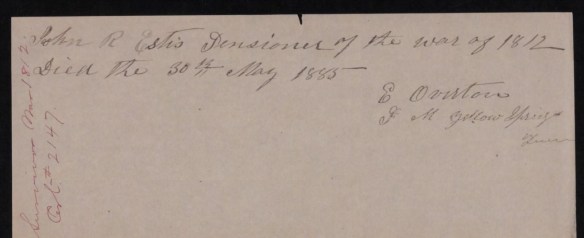
John R. Estis died May 30, 1885, at Yellow Springs, TN, in Claiborne County.

John R. Estes death

The postmaster of Yellow Springs signed an affidavit as to his date of death.  John had outlived at least 4 of his 9 children.
John R. Estes death 2

Yellow Springs is an area towards Hancock County from Estes Holler and it’s clearly more than 4 miles from Tazewell, so John moved once again between 1871 and 1885 when he passed away.

Now that we know when John R. died, and about his years in Claiborne County, let’s look back and see what we can discover about John’s life in Halifax County before moving to Claiborne.

We have discovered a lot about John R., but we still don’t know who his parents were.

Halifax County, Virginia

After my return from trips to Halifax County and Claiborne County, I ordered every microfilm available for either county and read them, page by page, at the Family History Center.

I made spreadsheets of what I found, because Halifax County was not only a popular place for Estes men to settle, but it was a popular “stopping off point” it seems, on the way west.  A few years there and then they were gone.

Complicating things further, there were several men named John.

The Tax Man Cometh

One of the most valuable tools turned out to be the two types of tax records.

One type of tax was taxes paid on land owned and the second type was paid on personal property.  That way, they could tax everyone on something and some people on both.  Personal property tax included tax on males over the age of 16 and items like cows and horses.  Some years they taxed people on far more, like clocks and curtains.  The sheriff took the list for each district and was responsible for collecting the taxes due.

Once you knew who the neighbors were in each location you could tell which John was which, for example, based on where they lived, which district, and their neighbors.

Now all the Estes men in Halifax County did not behave and stay put – they wandered around a bit – especially the young land-free ones.  I suspect they rented land or were laborers for others.  The men who owned land, of course, could be reliably found on both lists year after year in the same location, with their sons showing up as neighbors as they came of age and married.

John R. Estes never owned land.  Plus there were about a dozen John Estes’s.  Many were easy to eliminate, because they appeared on the tax list too early to be John R. Estes, or they were clearly associated with a specific family group, or had a middle name that didn’t begin with R.

Through this associative process, I eliminated all but 3 or 4 Johns.

Even more confounding was that the Estes families in Halifax County lived in the eastern half of the county, in and near South Boston and in the far northeast corner of the county.  On the other hand, the Moore family, William Moore, Nancy Moore’s father lived on the far western side of the county, almost to the Pittsylvania County line.

South Boston to Mount Vernon

This situation was very unusual and didn’t make sense, at least not at first.  Remember, you don’t marry who you don’t see, and in that time and place, you normally saw your neighbors, your family and the people who attended your church.  How did John R. Estes come to meet Nancy Ann Moore?

Hint – Ann’s father, William Moore, was a minister for a “dissenting religion,” according to the court records – those radical Methodists.  He married many members of John R. Estes’s mother’s family, according to marriage returns.  Of course, we didn’t figure this out until after we figured out who John’s mother was!

The 1810 tax list shows a John Estes where a John Estes never resided before, in the western part of the county, whose taxes were taken the same day as James Moore, who was exempt due to age.  James Moore was Ann Moore’s grandfather.  Perhaps John R. Estes was farming James Moore’s land for him or helping on his farm.  John was taxed for 1 white male and 1 horse.

But wait.  To add confusion, a second John Estes was also taxed in that district, and he was taxed the same day as William Moore, Nancy’s father, for 1 white male and 1 horse.  These tax lists were taken a month apart – so it’s possible but unlikely that the John Estes record was a duplicate.

From painstakingly recreating all of the Estes families over the previous decade, I know that there are four John’s of about the same age.  One is John, son of Abraham, one is John son of Bartlett who died in 1804, a third is John, son of Bartlett (son of Moses) and Rachel pounds and fourth, John, son of someone else.  But I wasn’t sure which John was ours and telling them apart was sometimes a challenge.

John, son of Abraham is easier to discern, generally, because he does not tend to live in the Estes cluster that includes Bartlett and other descendants of Moses Estes Jr, in South Boston.  His father, Abraham, lived in the northeast corner of the county.  Bartlett who died in 1804’s son was younger, born in 1793 or 1794, so he isn’t listed early.  He also lived in the north part of the county.  Bartlett and George Estes were brothers, sons of Moses Jr. and lived adjacent, on their father’s land, in what is now South Boston.

The 1811 tax list shows us one very, very important clue.  This is probably the most subtle clue I’ve ever received.  Do you see it?

Date Name White Slaves Horses Comments
Mar 4 Moses (2) 1 0 6
Mar 4 Josiah 1 0 0 Son of Moses
Apr 9 William 1 0 1 Son of Bartlett (son of Moses)
Apr 9 Marcus 1 0 1 Son of George
Apr 9 George 1 0 1 Son of Moses
Apr 9 John 1 0 0 Son of Abe or Bartlett?
Apr 10 John (SG) 1 0 0 Son of George
Mar 19 Bartlett (north) 1 0 0 Son of Moses
Mar 25 Bartlett (north) 2 1 6 Son of Bartlett, son of Moses?

SG – that’s it – that’s the clue.  In the vernacular of how Halifax County tax lists read, that means “son of George.”  Glory be.  That is our answer.  Our John R. Estes is the son of George.

The next year, 1812, cements that relationship.

We show John SD or SB.  SD makes no sense, because there is no D Estes male, but SB would be son of Bartlett.  Bartlett is George’s brother and they live adjacent in South Boston.  We show George with his other son Marcus.  The John with Marcus would be John (SG) because the other John is SD or SB, leaving John on the 27th unaccounted for and likely son of Abraham from the North.  John, son of Bartlett who died in 1804 is still too young to be shown on the tax lists individually.

Date Name White Slaves Horses Comments
Apr 4 Moses (2) 1 0 5
Apr 18 Josiah 1 0 2 Son of Moses
Apr 29 John (SD or perhaps SB) Son of Bartlett
Apr 27 John Son of Abe
May 5 George 1 0 2 Son of Moses
May 12 Marcus 1 0 0 Son of George
May 12 John (SG) 1 0 0 Son of George

In 1815, John is once again listed as (SG) and in 1816 and 1817, he is listed as John R. Estes instead of John (SG), but living in this same cluster.  Hallejuah!!!!!

These tax lists are one way that we know when John R. Estes actually left Halifax County.

Serving in the War of 1812

John R. Estes served in the War of 1812 while living in Halifax County, VA.  He was drafted for the period of three months.  What did he do while he was away in the War, serving in Grief Barksdale’s company?

According to the 1812 Virginia Historical site:

Capt Grief Barksdale’s Company of Riflemen from Charlotte County, VA during the period Sept. 1, 1814 until Dec. 1, 1814. His company was attached to LT Col William C. Greenhill’s 4th Regiment of Virginia Militia and sent to Camp Fairfield on the James River near Richmond. This regiment was made part of Brig General Joel Leftwich’s 2d Brigade and on October 12th it departed from nearby Fort Mimms and arrived at Camp Snowden, MD on Oct. 27, 1814., then it proceeded to Camp Crossroads near Elliot Mill’s, a few miles from Baltimore arriving there on November 9, 1814. They arrived too late to have any contact with the British and were discharged in late November 1814. Source: Butler’s ” A Guide to VA Militia Units in the War of 1812″, 2d edition dated 2011, pages 24,57,& 240.

On page 240, the author indicates that Lt Col William C. Greenhill’s 4th Regiment was a part of the 2nd Brigade commanded by Brig. General Joel Leftwich which was created on September 5, 1814 at Camp Fairfield located near the James River leading into Richmond. On October 5th it was ordered to march with General Breckenridge’s brigade to Washington, DC. On October 12th it left Camp Mims near Richmond and arrived at Camp Snowden, MD on October 27th. The brigade arrived at Ellicott Mills near Baltimore on November 9th and was discharged at the end of November. The Battle of Baltimore had taken place on September 13th and after their defeat the British had left the area. Colonel Greenhill’s regiment consisted of seven company sized units from the counties of Pittsylvania, Halifax and Charlotte.

The conditions, however, were punishing.  Rains that fall were unrelenting.  At one time, three fourths of the men were ill.

In a letter of September 18, Brig. Gen. Thomas Marsh Forman, commander of the First Brigade, Maryland Militia, wrote of “a most tremendous Northwester which is punishing our poor soldiers, most of whom are in very thin clothing.”

Thus, John R. Estes was not involved in any encounter with the enemy.  John R. was lucky.  He was in the right place at the right time and avoided warfare, even though he was probably waterlogged.  In years to follow, because he did serve, he would obtain two land grants and a pension for his service of $8 a month.  That pension probably made a big difference in his quality of life.

John’s son, Jechonias, was probably born while he was gone.

Courthouse Basement Finds

Another find in the basement of the Halifax County courthouse was the chancery records – and I don’t mean the index or minutes – I mean the actual case packets – tied neatly in bundles with little ribbons.  Chancery court is a court that focuses on solutions for civil actions as opposed to criminal prosecutions for breaking the law.  Today, divorces are held in chancery court since a solution as to the division of property, assets and debts needs to be found.

These old chancery records have been indexed and scanned and will soon be available at the State of Virginia archives site – so no need to sort through boxes in the basement anymore.  It’s a good thing too, because those case bundles which included all kinds of information had a habit of walking away – not to mention many were in bad shape.  Being 200 years old will do that to you!

A long and complex case in which Thomas Yates and his wife, Phoebe Combs Yates sues Joseph Farguson about the ownership of a slave styled “Halifax Co., Va. Chancery 1812-019, Yates vs Farguson and Combs” includes depositions by John R. Estes and also his father George Estes whose mother was Luremia Combs.

John Eastes says that some time since Dec. 25, 1811 he saw Joseph Farguson carry the negro boy Jess to Thomas Yates and told him he did not consider they had any right to him, but if they would pay him what they were owing him on account of said negro, he would give him up and they refused to do it.

Given under the hand and seal Nov. 27, 1812. Sarah Farguson signed with a mark, Thomas Douglas signed, Lemuel Moore with a mark, Joseph Denman with a mark, John R. Estes signed.

Agreeable to a court order dated June 15, 1813 we met at the dwelling house of Jacob Farguson decd and proceeded to take the depositions of Sarah Farguson, Thomas Douglas and John R. Estes.  All three of these depositions are the same as given earlier except there were two questions posed to John R. Estes:

Q: By the plaintiff who were they that refused to take the negro boy Jesse and pay up the money?

A: I saw Mrs. Phebe Yates and Mrs. Combs

Q: By the same did you not understand that Thomas Yates about that time was gone to Linchburg?

A: Some time before that I did

Q: How long was it before you carried the notice for to take deposition at Chalmers Store?

A: I don’t know.

This day John R. Estes came before me and made oath that he delivered a true copy of the within to Thomas Yates on the 19th (of July) given under my hand this July 23rd 1814. Charles Harris. There is a note in John R. Estes hand (in light pencil unfortunately) that says On the 19th of July 1814, I John R. Estes delivered a true copy of the within to Thomas Yates.

Another note dated Nov 27, 1814 that John R. Estes came before Joseph Sanford, a JP, and made oath that he delivered a true copy of the within notice in Thomas Yates house to Mrs. Combs and William Yates.

Yet another note dated July 19, 1814 that John R. Estes of lawful age personally appeared before William Bailey and made oath that he delivered on the 24th, 25th or 26th of November 1812 a copy of the within notice in the dwelling house of Thomas Yates with Mrs. Combs and Yates wife.

Deducing John R.’s Father

In summary, there were only 4 possible fathers for John R. Estes; Bartlett who died in 1804 and lived in the north, Abraham whose son John who married in 1808 and moved to Charlotte County, Bartlett who married Rachel Pounds or George who married Mary Younger.  There were no other men who don’t already have sons John attributed to them and accounted for, who lived in Halifax when John R. was born about 1787 and who remain in Halifax County until he reaches 21 in about 1809, so we have no other reasonable candidates.

Bartlett and Rachel had a son the same year or within a year of when John R was born, also named John.  However, one John is designated as SG, and one as SB or SD, so we now know that George did in fact have more children than just Susannah Y., including a John of exactly the right age.

Furthermore, John, son of Bartlett appears to still be living in Halifax in 1837 during Moses’ estate settlement, eliminating him as a possibility for our John.

Abraham’s son John lived in the north and goes back and forth between Halifax and Charlotte Counties.

I have never been able to find the John, son of Bartlett who died 1804.  However, he is too young regardless, having been born in 1793/1794.  Based on a subsequent lawsuit after Bartlett’s widow’s death in 1824, I believe that this John died, which would eliminate him from being our John.

George Estes who married Mary Younger and had a son John (designated as SG), was previously unknown, and is the most likely candidate for the father of our John R.  John R. named one of his sons George and one of his daughters Mary.  John R. also named one of his sons John Y.  George’s daughter Susannah was named Susannah Y. and his son was named William Y.  John R’s daughter Lucy had a daughter whose middle name was Younger.  Neither Bartlett’s name nor those of any of his children appear in John R’s family.  George Estes’s wife was Mary Younger.

Therefore, I concluded that John R. Estes’s parents were George Estes, son of Moses Estes Jr., and Mary Younger, daughter of Marcus Younger.

The final confirmation of John R’s parents came from a most unexpected set of records.

Mary Younger Estes’s parents were Susannah and Marcus Younger.  Marcus died in 1816, but in 1842, a chancery suit was filed having to do with the distribution of his estate after an unmarried daughter’s death.

I extracted data from the “Younger, Marcus Chancery Suit 1842-057, Halifax Co. Va.” and in the documents from that suit, I found the payments made to the various heirs of Marcus Younger.  In the case of John Estes, he was listed as an heir because his mother was deceased.  John was listed as married to Nancy and as living in Tennessee.

It is noted that Mary Younger Estes’s children will receive one sixth of her one quarter share of the 83 acres to be sold following the death of Mary’s unmarried sister.

The children of Mary Estes were listed as: John Estes, William, Susannah, Sally wife of T. Estes, Polly wife of James Smith and a grandchild name Mark Estes.  So, not only do we have John’s name, we have the entire list of his siblings.

This was followed by another document listing the locations of the heirs, including:

Younger Wyatt and Polly his wife – Rutherford County Tennessee

John Estes and Nancy his wife – “ditto marks” under Rutherford County.  John was actually in Claiborne at this time and there was no John Estes in the 1840 census in Rutherford County.  John’s wife was Nancy (Ann) Moore.  None of the other John’s married Nancys or Anns.

This was an EXTREMELY long way around the block to discover the identity of the parents of John R. Estes – and it’s nothing short of a miracle that I did actually find the information scattered in extremely obtuse locations – like a genealogy version of a scavenger hunt.  There were many times I just wanted to give up and asked myself if it was really, REALLY that important.

The night I made the discovery of “SG” on the tax list, I knew in that instant who John’s father was.  I was in the Family History Center and they were closing for the evening.  I was excited, very excited – decades of searching Happy Dance excited.  The librarian virtually patted me on the head and told me to go home.

I was far too excited to just do that.  I lived half an hour away so by the time I got home, it was getting late.

I decided to call Garmon, regardless of how late it was.  After all, he had been searching for the answer for 45 years, which made my 20 or so look puny.

Garmon answered the phone groggily, “hhh….hello.”

“Wake up.”

“Who is this?”

“Your cousin, Bobbi.”

“Bobbi?”

“Yes Bobbi.  I know who John R. Estes’s parents were.”

Very alert now….”You DO???”

“Yes, do you want to know?”

“Do I want to know?  I’d stand in the corner on my head and clap my hands to know.”

“George – it was George Estes…and Mary Younger.”

“Well, I’ll be.”

As I looked out my kitchen window at the peaceful moon that night rising over the trees and happily visited with Garmon, my long time research buddy and cousin, telling him the story of “SG,” I had no idea of the landmines that would lurk in the future, threatening to derail our discovery.

The DNA Landmine

When I first visited Halifax County, DNA testing for genealogy didn’t yet exist.

When I first visited Halifax County, Virginia, after the advent of DNA testing, autosomal testing didn’t yet exist and we were happily testing for 12 and then 25 Y DNA markers.

In the Estes DNA project, we had several descendants of the immigrant, Abraham Estes who had tested, but so far, no one proven from his son, Moses’s line.

Garmon, of course, was the very first Estes to test, but we didn’t know which line we descended from.  We were just pleased that we matched up to Abraham’s Y DNA genetic profile.

Abraham, the immigrant had a son, Moses, who settled in Halifax County, VA, who had a son Moses Jr., who remained in Halifax County and had several sons as well.  Moses Jr.’s son, George served in the Revolutionary War and we would eventually discover that he was the father of John R. Estes, my ancestor.  George also had three other sons.  These several generations of men made up the pool of many of the Estes families in the southern part of Halifax County.

I was fortunate to be able to meet one elderly Estes gentleman, we’ll call Beau, and spent several hours on multiple days listening to his stories about his life and ancestors, including “Granpappy George” who died at either 105 or 116, depending on which version of the story you liked and which day he was telling it.

His cousin, a female, Pat, was also very involved in genealogy and she joined us as well.  We drank iced tea and sat in the shade under trees so old they probably had stories about our ancestors themselves, had they been able to talk.  Glorious summer days in the south.

I had discovered the location of the old family land and Pat knew the story of why and where the graves had been moved.  There was no resting in peace in this family.

Beau and Pat’s line of the family descends from George, the Revolutionary War soldier, through his daughter Susannah Y. Estes who reportedly married her cousin, also an Estes, some say Tom Estes, which is why her surname remained Estes.  She lived among the rest of the Estes clan on Estes land owned originally by Moses Jr., father of George.  Susannah’s son, Ezekiel, from whom Beau descends, is shown below in what I believe is a death photo, taken in 1885.

Ezekiel Estes

Ezekiel bears a striking resemblance to his uncle, John R. Estes.

This Estes line descends to Beau and Beau was quite eager to take a DNA test to represent our George Estes line.  As a responsible genetic genealogist, I of course had a DNA kit handy, and Beau happily swabbed as I timed the event.  I brought his kit home and mailed it to Family Tree DNA.

A few weeks later, I received a message that Beau’s DNA results were available, but as a project administrator, I didn’t receive the notification that the other kits in the project had matches.  I remember thinking, “that’s odd.”

I signed in to see Beau’s results, and what awaited me was every genealogists nightmare.  The George Estes line, represented by Beau, did not match the ancestral Abraham Estes line.  And yes, to answer the next question, we had tests from several descendant lines from Abraham, so we know positively what his DNA looked like – and it looked nothing at all like Beau’s.

no match

I was sick, just sick.  It took me a day or two to process this information.  Truthfully, I was in shock and it threw a terrible monkey wrench into genealogy?

Should I stop researching my Estes genealogy since we were obviously not Esteses in the original sense of the word?  Was Moses Sr. not Abraham’s son?  Was Moses Jr. not Moses Sr.’s son?  Was George not Moses Jr’s son?  Who didn’t begat whom?  And under what circumstances?  How come Garmon matches the Abraham ancestral line, but Beau didn’t?  Was I in the wrong damned county barking up the wrong tree…..AGAIN????

And then that little voice started talking to me……was Susannah Y. Estes ever really married to her Estes cousin?

I had to know.

If Susannah was not married to an Estes cousin when she had son Ezekiel, from whom Beau descends, then the DNA wouldn’t be Estes, but the surname would be, given that the child took her surname.

But the family was sure, absolutely positive.  I called Pat and talked to her about this without saying too much, and she was very indignant that Susannah absolutely had been married to her cousin and that George, Susannah’s father, “would not have put up with any other kind of behavior.”

I could tell that another trip to Halifax County was in the offing.  I needed more records and I needed to concentrate on Susannah, someone I hadn’t necessarily neglected, but who I certainly wasn’t focused on.

On my return trip, the first place I went was the courthouse, to find Susannah’s marriage record.  Some of the Halifax records are either very thin or missing altogether.  For example, there were virtually no marriage records during the Revolutionary War.  Now you know people were still getting married, but since they didn’t know who was going to win the war, they weren’t paying any money to have anything registered – or the records have disappeared, all but 2 or 3 of them.  It’s this type of information you can’t glean from just finding your own ancestor’s records, because you have no idea if they are the only person in the marriage records for the year or just one of several thousand.  Context can make a big difference in how you interpret a missing record.

Susannah was born about 1800 and her first child, the son in question, Ezekiel, was born about 1814.  That is awfully, awfully young and there was no marriage record.  In fact, this is so young it smacks of a nonconsensual relationship of some sort.

Susannah’s next children were born in 1818, 1825, 1828 and 1835.  Three were females and one additional male, Marcus, who died between 1850 and 1860. In Susannah’s estate after her death in 1870, she said and her heirs say she had no idea where Marcus’s wife and children are or were and that she did not hear from them after they left the area years before.  She didn’t know if she had grandchildren through Marcus or not, but she had provided for them if she did.  How sad for Susannah.  She had no idea she had outlived her son by 10-20 years.

However, since there was no marriage record for Susannah, I was dead in the water at this point, with no proof of anything and DNA that didn’t match what it was supposed to match.  I felt like a fish flopping out of water, gasping, with no help in sight.

One of the things I learned a long time ago about genealogy is that the more work you do, the better the chance of opportune accidents happening. In other words, sometimes fate takes pity on you – or maybe it’s just your turn.

When I extract records for a particular surname, I extract all of the records of the relevant timeframe and often beyond.  I worry about putting them together later….and yes…I’m fully aware that I waste a lot of time doing work that turns out to be irrelevant.  But sometimes, it’s not entirely irrelevant and there may be tidbits that are extremely important….later.

Like the marriage records of Susannah’s children, for example.

Her eldest son, Ezekiel Estes married Martha Barley on December 10, 1854.

The clerk’s office had the actual minister’s return and it was chocked full of information, including that both Ezekiel and Martha were illegitimate, and both of their fathers’ were unknown, or at least not named, and that they married at the home of the bride’s mother.

Ezekiel Estes marriage

Oh.  Illegitimate…no father’s name.  Nonmatching DNA.  Hmmmmm….

Let’s look at Susannah’s other children who married in Halifax County.  Another child’s entry says that the father is unknown and a third simply has a line drawn through the father’s name space.  Another child married out of the county, but I had what I needed.

Finally, after Susannah’s death when Ezekiel was trying to settle her estate, depositions were taken regarding the division of her estate and in particular, the validity of some debts.

In this testimony, from various people, it is verified that Susannah never married and that she conducted all of her own business – in other words, there was never a male partner in her life.

Through the sources we would normally use to verify a marriage, we come up empty handed – but lack of evidence does not constitute proof that she never married.  Absence of evidence is not necessarily evidence of absence.   Susannah could have married in an adjacent county.  However, the fact that her children’s marriage licenses all reflect an unknown father and an illegitimate legal status sheds light on Susannah’s marital status, as do the depositions after her death.  And Susannah’s surname never changed.  She was born an Estes and died an Estes too.

So, Pat was wrong, but not entirely wrong – because if you look back at the chancery suit distributing the assets of Mary Younger Estes, John R.’s sister, Sally, did marry a T. Estes.  So the family had taken the information that one of George’s daughter’s married an Estes cousin and attached that information, opportunistically, to Susannah.  It made sense, and given that both of the women’s names began with S, it would have been easy to genuinely confuse the daughters, especially a generation or two later.

George indeed did tolerate Susannah having illegitimate children, 5 of them apparently, and he supported her through the process, eventually signing his Revolutionary War bounty lands over to her as well as his assets in Halifax County.  I’m sure he knew all too well that she needed the help.  After the death of George’s wife, between 1830 and 1842, Susannah likely took care of George until he died in 1859.  In fact, it was her son, Ezekiel that reported George’s death.  So George stood by Susannah and Susannah took care of George.

So, back to the DNA.  Based on Ezekiel’s marriage license, we know that his mother, Susannah was not married at the time of his birth.  We also know, from the DNA itself that she did not get pregnant by an Estes male.

The DNA of George’s line has since been confirmed by other Estes male descendants.

When I did eventually explain this to Beau, he wasn’t very happy, but I explained to him that his line can be proud to establish a new Estes DNA line and what a strong woman Susannah had been.  However, when I explained that he is still related to Granpappy George, through Susannah, just like he always was, and he carries Granpappy’s George’s surname, he was much MUCH happier.  He didn’t really care about the DNA, but he surely cared a lot about being related to Granpappy George.

Out of all of this, I have to look at Susannah through a different lens.  Yes, I do wonder why.  Why did she get pregnant so young and why did she never marry?  Why did she continue to have illegitimate children?  But I also have grown to have an admiration for Susannah, knowing how difficult it would have been in that time and place to hold your head upright in spite of everyone and the hateful and derogatory things that were assuredly said about you behind your back and in front of your face.  She must have been quite a spunky lady.  She raised her children, took loans, bought property and pretty much acted like any man of that day.  She was assuredly a woman born before her time.

But as for that pesky DNA issue – this type of situation is exactly why it’s so very important to test more than one male line from each ancestor.  You just never know if one line really represents that ancestor otherwise – unless they match a descendant of someone further upstream or a descendant of another son.

This also illustrates why it’s important to verify information provided.  I’m sure at some point that a conversation about Susannah went like this:

“Why did Susannah still have the Estes surname after having 5 children?”  and the answer went something like this:

“She must have been married to her Estes cousin.  Grandpappy George’s daughter married her Estes cousin, you know.”

That not entirely untrue answer probably took on a life of its own and became Susannah’s family truth.

I’m glad this wasn’t the first Estes DNA participant test or we could have been led badly astray.  I’m also glad that we were able to find additional descendants of George to test for DNA validation.

Over the years, I’ve become quite the skeptic about the “full truth” of both family stories and single DNA tests for any line and now I need proof of everything!  I’m not saying I think people intentionally tell untruths, I think it’s generally more like that childhood game of telephone where you whisper a phrase like, “Beau has brown shoes,” in your neighbor’s ear and 15 whispers later to 15 other people, the end result is something like, “Bows are brown mushrooms.”

I’m sorry I wasted the time in Fairfax County, but even the frustration in Halifax County caused by the Beau’s unexpected DNA results wasn’t a waste.  Indeed, it caused me to dig deeper, and even though I was searching for information about Susannah at that point, and not John R. Estes, I found more and more about the entire family that provided perspective and understanding of their life and times – including that all-important chancery suit naming Mary Younger Estes’s heirs.

It was just a jig in the road and not a dead end after all, but it certainly seemed like a disaster at the time.

???????????????????????????????

______________________________________________________________

Disclosure

I receive a small contribution when you click on some of the links to vendors in my articles. This does NOT increase the price you pay but helps me to keep the lights on and this informational blog free for everyone. Please click on the links in the articles or to the vendors below if you are purchasing products or DNA testing.

Thank you so much.

DNA Purchases and Free Transfers

Genealogy Services

Genealogy Research

Haplogroups and The Three Brothers

3 brothers group

Do you remember when you first started working with genealogy and you encountered your first “three brothers” story?

For those of you who don’t have one, it goes like this:

There were three brothers who came to <fill in the location.>  They had an argument about <a woman, religion, where to settle, other> and they all three went in different directions, never to see each other or speak again.

Well, of course, that might have happened and it probably did from time to time, but not nearly as often as the story would have you believe.

In my case, I had several “three brother” stories and even a “seven brother” story.  Even as a novice genealogist, I began to get suspicious when I heard the third or fourth story and they all seemed eerily similar.  Too similar.  Too convenient.

Enter the age of DNA testing.  Many of the three brothers stories seem to stem from three men with the same surname found in different or sometimes not-so-distant locations whose ancestries could not be tied nearly together, so surely someone said, “well they must have been three brothers who went different ways” and from that the “three brothers “ myth was born, to take on an entire life of its own.

But then, there are the stories that are real.  In some cases, the DNA testing does prove that those men descended from a common ancestor.  Of course, we can’t ever prove that they were brothers by their descendants DNA testing today.  We can only prove that they weren’t, if their Y DNA doesn’t match.

Recently, someone asked me a very basic DNA question, and the answer that came to mind was, “well, there were three brothers, you see…..”

The question was: “How can one haplogroup have descendants on different continents?

For example, how can a specific haplogroup include people who are Asian, European and Native American.

Let’s take a look at how that works.  It’s a lot like a pedigree chart.  In fact, it’s exactly the same.

There isn’t a haplogroup Z Y-DNA haplogroup, so let’s use that as a hypothetical example.  This example is equally applicable to mitochondrial DNA as well.

3 brothers

In our example, haplogroup Z was born a very long time ago, let’s say 30,000 or 40,000 years ago in Eurasia – we don’t know where and it doesn’t matter.

Haplogroup Z had two sons, and each one had a mutation different from the father, haplogroup Z, so the sons were named haplogroups Z1 and Z2.  One liked the hill to the west and one liked the river to the east, so they settled in opposite directions from their father.

Over time, the families and descendants of these two sons expanded until they had to move to new ground in order to have enough game to hunt.

Haplogroup Z1’s descendants had had two mutations as well.  One group, Z1a, went to Siberia and one group, Z1b went to China – or what is today China.

On the other hand, haplogroup Z2’s descendants also had two mutations that set their lines apart from each other.  One of these, Z2c went to what is now Europe and one, Z2d, went north to Scandinavia.

You can see as you look on out to the fourth generation that haplogroup Z1a, in Siberia had two sons with mutations.  Z1a1 went to Russia and Z1a2 crossed into Beringia, following game, and eventually would settle in North America.

Z1a2 then had two sons as well, both with mutations.  One of those, Z1a2a, traveled across the north and today his descendants are found primarily in eastern Canada and the US.

Now here’s the important part.  Z1a2a is known ONLY as Native American, because that mutation happened here, in the New World, and is not found in either Europe or Asia.  Z1a2b is also only Native American, found primarily in South America because that son followed the western coastline instead of traveling east cross country.

On the other hand, haplogroup Z1a2 might be found in BOTH Asia and the New World if it was born in Siberia but then migrated to the New World.  Some carriers might be found in both places, so if found in the New World, it likely indicates Native American, and yet it is also found in Siberia.  It is not found in other parts of the world though.

You can see that while the base haplogroup Z is today found worldwide, as defined by its subgroups, the subgroups themselves tend to be localized to specific regions.  You can also begin to see why determining locations of the birth of haplogroups is so difficult.  Europe is one big melting pot, and so is the UK, the US, Canada, Australia and New Zealand.

We, as the genetic genealogy community, are still trying to sort through this, which is why you see new haplogroup subgroup designations on nearly a daily basis.  The Y tree changes almost hourly (thanks to advanced tests like the Big Y at Family Tree DNA) and the mitochondrial tree has had many additions in the past months and years, with more yet to come shortly as a result of ongoing research.

In the mitochondrial DNA world, haplogroups are still named in the pedigree type fashion.  For example, I’m J1c2f.  However, in the Y tree, the names became so unwieldy, some up to about 20 characters long, that the pedigree type name has been replaced by the defining mutation (SNP) for that haplogroup.  So, R1b1a2, the most common male haplogroup in Europe, is now referred to as R-M269.  Not as easy to tell the pedigree by looking, but much more meaningful, especially as branches are added and rearranged.  The SNP name assigned to the branch will never change, no matter where the branch is moved on the tree as more discoveries are made.

If a DNA participant only tests to the most basic of levels, they are only going to receive a rather basic haplogroup designation.  Let’s say, in our example, Z or Z1 or Z2.  Clearly, additional testing would be in order to figure out whether that individual is Native American or from Scandinavia.  And yes, we have exactly this situation in many of the Native American haplogroups – because all the Native American base haplogroups for Y DNA: C and Q, and for mitochondrial DNA: A, B, C, D, X and possibly M, were founded and born in Asia, thousands of years ago.

And yes, it seems they all had three siblings…..

______________________________________________________________

Disclosure

I receive a small contribution when you click on some of the links to vendors in my articles. This does NOT increase the price you pay but helps me to keep the lights on and this informational blog free for everyone. Please click on the links in the articles or to the vendors below if you are purchasing products or DNA testing.

Thank you so much.

DNA Purchases and Free Transfers

Genealogy Services

Genealogy Research

Lazarus Estes (1848-1918), Huckster and Gravestone Carver, 52 Ancestors #59

Lazarus.

I’ve always loved that name.  It’s just so interesting and different – and thankfully, not another John or William.  I have so many of those names that I can’t keep them straight.  But Lazarus is much more unique and he turned out to be a very unique individual as well, as I came to know him through various tidbits of his life.

Lazarus holds a special place in my heart.  Lazarus was my first official “find” in genealogy, you see.  Well, his marriage record anyway.

One evening, many, MANY years ago, I took advantage of a free seminar the Mormon Church was offering on searching for your ancestors.  They said to bring what records you did have, so I gathered up my family group sheets, all half a dozen of them, and off I went.  I was a bit nervous, as I knew nothing about the Mormons, except they “did genealogy,” and I was, you know, raised Baptist.

Was lightning going to strike me as I stepped into the Mormon church???  And if so, was the bolt from the Mormons or the Baptists, or both?  Or worse yet, was someone going to try to convert or recruit me??

I decided to risk it.  I later learned that my concerns were entirely unfounded.

After their little talk, they had several volunteers available to help.  One very nice lady sat down with me and looked at what I had brought along, and then suggested that we look on the “reader” for “something.”  Ok.

She did, and said, “hey, look at this.”  Now, genealogists among us know those as the Fatal Words of Addiction.

And this is what we saw…..

Elizabeth Vannoy Lazarus Estes marriage crop

Oh my gosh – it was THEM – reaching out from more than 100 years ago and touching me…my heart just stopped.

Sure enough, she had found an index entry for the marriage record of Lazarus Estes and Elizabeth Vannoy, in Claiborne County, Tennessee.  And yes, I was hooked, hopelessly hooked.  We ordered the film, and then another film, and another film….and the rest, as they say, is history.  I developed tendonitis in my right arm associated with cranking microfilm machines.  All “old” genealogists are now laughing…and remembering.

Lazarus Estes was born in May 1848 in Claiborne County, TN, to John Y. Estes and Rutha Dodson.  They lived in a place known as Estes Holler, right off of Little Sycamore Road, just past Pleasant View Church (below), where they probably attended, then past a couple of cemeteries, and across Little Sycamore Creek which they would have forded at the time, because there was no bridge then.

Pleasant View Church 2

Lazarus was born where two generations of Estes’s had lived before him and several would live after.  Estes families still live in Estes Holler today, and it’s still called Estes Holler – right across the ridge from Vannoy Holler.

estes holler map

Some years later, I went to visit and meet Uncle George, Lazarus’s grandson, in person.  I wanted to see Estes Holler for myself and visit Lazarus’s grave.  Uncle George and his wife, Edith, who is also my cousin on two different lines, were the most gracious hosts.

George and Edith Estes

George took me in his truck “up the mountain.”  Here we are, in the back of George’s truck, in the livestock pen.  The livestock pen?   If I said, “don’t ask,”  would that do?  Let’s just say trucks are sometimes a bit rough there.

Uncle George and Me

Uncle George, who is really my cousin, but “honored” as an uncle, remembered when Lazarus was buried, standing by his grave as a child during the funeral.  George would take me to visit the same cemetery, to stand by the same grave, some 70 years later.

When I got to Claiborne County, Uncle George had a little surprise for me.

Lazarus Estes and Elizabeth Vannoy

This is a picture of Lazarus Estes and Elizabeth Vannoy Estes, my great-grandparents.

I remember being utterly mesmerized by this picture – staring into the eyes of my ancestor.  It’s hard to see Elizabeth’s eyes, but Lazarus is looking right at me, across the years, almost 100 years after his death – piercingly.

In the family history center, before I went to Claiborne County, I eventually found Lazarus on a census roll.  I ordered the roll and then waited for 2 weeks for it to arrive.  Today, we just sign on to Ancestry.com and look.

Estes 1850 census

John Y. Estes and Rutha Dodson hadn’t been married long, and Lazarus was their first child, named for Rutha’s father, Lazarus Dodson.  Lazarus is shown here as 2 years old, born in 1848, and I’m inclined to think this this is more correct than the 1900 census which shows that he was born in 1845.  By 1900, when Lazarus is more than 50, age can be misremembered or approximated, but pretty much everyone is going to know if their only child is 2 or not.  Furthermore, this census was taken in September, and if his birthday was in May, he would have just turned 2.  His mother was likely pregnant with her next child.  As icing on the cake, cousin Debbie found a Bible that we think belonged to his daughter after a death in the family a few years ago, and Lazarus’s birth year is given as 1848, so 1848 it is!!!

By 1860, Lazarus has 4 siblings and was 12 years old.

After that, life in Claiborne County got complicated – and downright ugly.  The Civil War erupted in January 1861 when 7 southern states seceded from the Union.  Claiborne County found itself in the middle of the conflict.  The first shots were fired in April, and although Tennessee wasn’t one of the first states to secede, they did after April, 1861, aligning themselves with the South, along with their neighbor state, Virginia. However, Kentucky, their other neighbor to the north permitted slavery but did not secede.  This created a dividing line between the states which just happened to be at the Cumberland Gap, not far from Estes Holler.

Cumberland Gap was just a few miles up the Old Kentucky Road and the Gap was a critical and strategic location to control the entrance to the north from the south and vice versa. In 1863, slaves were freed via the Emancipation Proclamation, but the war didn’t end until 1865.  No one in Estes Holler owned slaves.

The war was brutal on both sides, and fighting took place in and around Estes Holler.  People in that region were still digging cannon balls out of their land in the 1980s.

One of the houses in Estes Holler, still standing, was used as a Union hospital.  The locals know which house and where the bodies are buried too.  The area looks a lot more cheerful today!

Estes holler garden

The soldiers scavenged the countryside for food, constantly, since the thousands of men stationed at Cumberland Gap, whether from the Union or Confederacy, depending on who was holding the Gap at the time, never had enough food.

Lazarus would have been 13 when the war broke out.  He would have been 17 when it ended.  Those four years were living hell for the Estes family, their land constantly embattled and the sounds of cannon and gunfire echoing in the holler a regular occurrence.

Lazarus’s father, John Y. Estes fought for the south, as did neighbors, Sterling and John Nunn.  I was dumbstruck when I discovered this fact, especially since no one in Estes Holler owned slaves.  John Y. Estes was eventually captured and served time in a northern prison camp, being paroled at the end of the war.

Did the family know John had been captured?  Did they think he was dead?  How were they notified, if they were notified?  Sometimes, POW camps, on both sides were a fate worse than death, often followed by death.

The family, back in Claiborne County, had all they could do not to starve to death – and Lazarus, as the oldest male child, a teenager, was likely in charge.

The soldiers took the family’s one cow.  The baby of the family needed milk to drink.  Lazarus’s younger sister, Elizabeth, then 12 or 13, had been taking care of the cow as one of her chores, and she decided that she was simply going to go and get the cow.  As soon as it got dark, she slipped through the woods to where she knew the soldiers were camped.  The cow knew her voice and scent, and as soon as she found the cow, she simply slipped the bell off the cow and led the cow home, under cover of darkness.  She was the family hero and the family told that story in Tennessee and where Elizabeth eventually lived in Texas –  for the next 150 years.  Her descendants told me that story when I visited Texas in 2005!  It’s a family legend.  Another version of the story says it was the family horse that she recovered, and a third story says she did both!  In one version when she retook the horse, she snuck through enemy lines.

Her grandchildren tell of how Elizabeth, in the photo below, would regale them for hours with stories of life in a remote place called Tennessee during the Civil War when Rebel soldiers would come into their house and take everything.  She told about how the family hid, afraid they would be harmed.  She shared stories about the hardships on the trail in the covered wagon as they came to Texas and about the wagon rush when they opened up Indian Territory to homesteaders.  Maybe land is why all of Lazarus’s siblings wound up living in Texas.  In the end, only Lazarus remained in Tennessee.

Elizabeth Estes Vannoy

This is Lazarus’s sister Elizabeth Estes who married George Vannoy, the brother of Elizabeth Vannoy that Lazarus married, celebrating her 95th birthday in Nocona, Texas.  I think she looks a lot like her brother, Lazarus.

Lazarus is lucky that he was not captured and conscripted, on either side, during the Civil War.  Rutha probably depended heavily on Lazarus, as her next oldest boy wasn’t born until 1855.

John Y. Estes was finally discharged and released as a POW on March 20, 1865.  He probably walked home, begging food along the way, like so many other bedraggled soldiers, probably fearful of what he would find at home when he arrived.  Would there even be a home left?  Was his family alive?  All of them?  Part of them? Which part?

Shortly after arriving home, on October 9, 1865, John Y. Estes stated that he was moving and gave six head of sheep, one horse, fourteen head of hogs, one cow and calf, two yearlings, the corn crop, all the fodder, and all the household and kitchen furniture to his son Lazarus.  But John didn’t move.  Lazarus would only have been 17 or 18 at that time.  What precipitated this unusual transaction to an underage, unmarried boy with no household of his own?

Lazarus Estes married Elizabeth Vannoy sixteen months later, on February 6, 1867.

The 1870 census shows us a nuclear family, the way families worked in Tennessee.  Newlyweds just built a cabin by their parents.  In this case, Lazarus and Elizabeth lived beside both his and her parents.

Estes 1870 census

Now, the census can be deceptive, because the Esteses and Vannoys actually lived across the holler from each other, but that tells us that there was only one unoccupied house between them so the holler didn’t have as many people living there that it does today.

Still, they lived very close.

Lazarus lived on this V where Nunn Road and Vannoy Road leaves Estes Road.

Lazarus Estes homesite

You can see where a house used to be and a little cemetery – but that is NOT where Lazarus is buried. It is where some of his adult children are buried….and no, I do not know why.

Lazarus Estes land 2

In this picture, taken from across the road, you can see the location of the cemetery on Lazarus land, just about dead center, with a man inside and a truck to the right behind a big cedar tree.  Lazarus’s house sat to the left of the cemetery probably just inside or just outside of the picture.

There is an untold story involving the cemeteries in Estes Holler that I suspect involves a family feud of some sort.  In part, I think this because even in the 1970s, the two families living on opposite sides of the only road in Estes Holler would claim they “weren’t kin” to each other, when they clearly were.  They did not WANT to be kin to each other….so they weren’t…end of subject.  Although both families were very nice to me.  Feuds in Appalachia outlive the fueders and the descendants don’t even know WHY they are feuding, just that they are.

The “Upper Estes Cemetery” which is likely on the original John R. Estes land, eventually owned by son Jechonias, was not used by Lazarus who descended from Jechonias’s brother, John Y. Estes.  Furthermore, while Lazarus had a cemetery on his own land that included a grave for the unknown school teacher that Lazarus buried, he himself was buried in Pleasant View, then known as the Venable Cemetery, as was his wife and mother and his children that died in his lifetime.  Pleasant View is the cemetery at the end of Estes Holler, past the Cook cemetery, beside Pleasant View Church, although Lazarus was never reported to be terribly religious.  To me, being buried away from Estes land almost sounds like a protest of some sort.  I’m clearly missing some piece of the puzzle and I doubt anyone living has that piece.

We know there was some kind of problem and although the chancery court records tell us tantalizingly little – they do tell us something.

In 1888, George Estes, son of John Y. Estes, filed suit against his uncle Jechonias Estes regarding the boundaries of some land that Jechonias had sold to George in 1887.  Lazarus was the security for George, his brother, so his allegiance is clear.  From the May 1893 chancery docket, we know that Jechonias cross-filed and the court found that no one was entitled to anything from anyone, except the lawyers who put a lien on the property for payment of their fees. Jechonias had died in 1888, is buried in the Upper Estes Cemetery, and George Buchanan Estes along with his younger brother, John Reagan Estes, subsequently left for Texas where their father, John Y. Estes, was already settled.  However, at least three of George Buchanan Estes’s children are buried in the Upper Estes Cemetery.

John Y Estes clearing

This is actually the land behind Lazarus’s house, or where his house stood, but the ridge between Estes Holler and Vannoy Holler looked much the same.  I think that John Y. Estes lived in that clearing on the hillside.  The old Upper Estes Cemetery would be to the right about 3 or 4 photo-lengths, also on the hillside.  Of course, in Estes Holler, everything is on a hillside.  You can see the Upper Estes Cemetery, below in the clearing.

Upper Estes Cemetery clearing

Uncle George took me up the mountainside in his truck so that I could see the holler.  It’s a beautiful place, often bathed in the blue/grey mists that give the Smokey Mountains their name.

Estes holler mists

There is a steep wagon path, or put in modern terms, a 2 track Jeep path, over the ridge between the hollers at the end because it’s a mile or two to the front where you can go around – and then of course a mile or two back on the other side.

estes holler pano

The people who live there know every nook and cranny well – but to outsiders, it’s a confusing labyrinth of intertwined mountains, paths and valleys and very, VERY easy to become disoriented and lost.

This is the land where Lazarus was born, lived his entire life, and died.  He probably never went further than Knoxville, about 50 miles away.

This photo is labeled as Lazarus, but I’m not entirely convinced – although the woman does look something like Elizabeth.

Estes possibly Lazarus and Elizabeth

In this photo, Lazarus and Elizabeth look to be maybe 35 or 40, so this would have been taken in about the 1880s.  Lazarus, if this is him, has full facial hair, so he doesn’t even look like himself, compared to the other photos.  Furthermore, it looks like a caterpillar is crawling up one side of his nose.  I have my doubts if this is Lazarus, and I actually think it may be a photo of his father, John Y. Estes.

Update: Two subscribers offered expertise, for which I’m very grateful.

Therese overlayed the photo of the middle-aged couple onto the photo of Lazarus and Elizabeth as seniors in Photoshop and says:  “I’m sure they’re the same couple, you can take it to the bank. 😉 Even accounting for the different head angles and posture, their features lined up really well. Lazarus still had the same light-colored, slightly downturned eyes, straight brows, and the same mole or scar on the left cheek, which had grown some by his later years (Along with his ear lobes!! Too bad the ears and nose never stop growing.) The “caterpillar” appears to be some discoloration of the photo itself. The wrinkle between his brows also lines up well, although it became more pronounced with age. His shoulders appear to have atrophied some, which is to be expected. The hairlines and marionette lines for both Lazarus and Elizabeth in the two photos are also perfect matches. He even kept the same part in his hair. Elizabeth’s deep set eyes, thin lips, and square chin were little changed through the years.”

Jan says, “The sleeve of her black-striped jacket did not come into fashion until 1890. The pouf at the upper arm area grew to outrageous proportions over the next 7-8 years. With that in mind, I believe the photograph was likely take in 1890-93. It was certainly taken after 1890, making Lazarus at least 51-52.

By 1880 things had changed a bit in Estes Holler, to put it mildly.

I don’t think things were ever “right” after the Civil War.  John Y. probably witnessed the unspeakable and many men in this area fought for the Union, so he may not have been well accepted back in Estes Holler.  That deed he signed just a few months after his release tells us that something was amiss.  Perhaps his wife told him that his son, Lazarus, had taken care of all of the “man things” on the farm for the past several years while John Y. was gone.  We’ll never know.

On June 20, 1879, John Y. Estes signed papers granting James Bolton and William Parks permission to make a road across his land in order to enable Bolton and Parks to have access to their own lands. That same day, Lazarus and Elizabeth sold the men acreage and obviously, John’s land stood between that acreage and the road.  As long as the land was within family, access to the road didn’t matter, but now being sold, it did.

In the 1880 census, a year later, Ruthy is shown in Claiborne Co. with children Nancy, Rutha and John Reagan Estes, as divorced. Back then, no one ever got divorced – it was rare as chicken’s teeth.  Not to mention, this couple was 60 years old.  They had already tolerated each other most of their adult lives.  What precipitated a divorce?

John Y. Estes is shown in Montague Co., Texas, living with the S. C. Clark family as a lodger.

The Texas Estes family tells the story that John Y. Estes walked to Texas, twice – implying of course that he walked back to Tennessee once.

John Y’s last child was born in 1871, so I’m wondering if he didn’t go to Texas and return home, sign that deed, and go back to Texas by the 1880 census.  To the best of my knowledge, he never returned to Claiborne County.

And once again, Lazarus was left to take care of things.  His mother had children from the ages of 9 to 22 at home and the only son was the youngest, John.  Someone had to plow and farm and put food on the table.

The 1880 census showed Lazarus and Elizabeth with 4 living children and his occupation was a huckster.

Now that’s a very interesting occupation.  I asked cousin George about it, and he knew exactly what that meant.

Lazarus became an entrepreneur, of sorts, although not the same kind of “entrepreneur” his son, William George Estes would become.  Lazarus had a wagon and once a month he would hitch up his oxen and go to Knoxville.  It took him two days to get there and then he would sell whatever people from Little Sycamore in Claiborne had to sell or trade.  Then, he would load the wagon up with supplies and come back home.

We don’t know that this was Lazarus’s wagon, but it was in the Estes pictures and although we don’t know who is sitting in the wagon, we do know that the ox’s name is Jim Bow.

Estes wagon

In the field just across Little Sycamore creek, at the end of Estes Holler, Lazarus would park his wagon and everyone could come and visit to pick up their order or just to see what he had.  I guess he was a peddler of sorts.

Lazarus huckster field

Today, this homemade bridge is the entrance into Estes Holler, crossing Little Sycamore Creek.  There was no bridge then.

Bridge over Little Sycamore Creek

You can see, across the bridge and to the left that there is an open field.  Lazarus would pull the wagon into that field and set up shop, so to speak, according to Uncle George.

Lazarus huckster field 2

You know that word traveled like wildfire up and down the holler that Lazarus was back, and everyone wanted to see what he had brought, what was available, how much their goods sold for….and maybe more importantly, the news….what was the news.

Lazarus huckster field 3

I can see his wagon parked here, can’t you?  Is that his old wagon wheel?

However, this family had another little problem that no one probably discussed – at least not out loud.

Imagine my surprise to find this in the court records:

On Oct. 4, 1886, Lazarus Estes was granted $26 by the court for “conveying Joel Vannoy to the hospital for the insane.”  Joel Vannoy was Lazarus’s father-in-law.

That hospital was opened in Knoxville in May of that year.  You know, right about now, I’m tempted to say something like, “Well, that explains a lot.”  However, that’s probably inappropriate, because this really is very sad for everyone in the holler.  Lazarus was the one to take care of things, probably the same way he did for his mother during the Civil War.  Lazarus always seemed to be the one to “take care of things.”

So, in addition to his own mother, Lazarus now was taking care of his mother-in-law as well who had older children and grandchildren living with her.

Lazarus was one busy man.

In this photo, Lazarus looks to be about age 40-50, which would have been about 1890.  I cannot imagine wearing those long dresses in the Tennessee summer heat, but they did.

Lazarus and Elizabeth Estes 2

The 1890 census is missing, of course, so we don’t see Lazarus again until 1900.

In 1900, Lazarus and Elizabeth are living in-between Lazarus’s mother Ruthy and his son, William George Estes who married Ollie Bolton in 1894.

Estes 1900 census

William George has been out of work for 6 months.  I’m guessing Lazarus is once again, “taking care of things.”

Uncle George and the Texas family both tell us that Lazarus’s mother, Ruthy was bedfast for years, 22 years to be exact, with arthritis.  That means she would have been afflicted from about 1881, or about the time John Y. left for Texas.  Uncle George told me that Lazarus and some other family members had to go “up the mountain” and carry Ruthy “down the mountain” on a litter.  Lazarus and Elizabeth took care of her from that time forward.

The 1900 census also tells us that Rutha had 8 children and 6 were living.  Two of Ruthy’s adult daughters had died 2 days apart in 1888.  The family story says that there was smallpox in the holler and no one would bury the bodies, except Lazarus, so he buried all that died, alone.

Lazarus was no stranger to the cemetery.  The census tells us that he and Elizabeth had 10 children and 5 were living.  That wasn’t quite right.  They had 11 children, but one birth was twins who both either died the same day or were stillborn.

Lazarus and Elizabeth visited the cemetery far too often to bury children; in 1872 to bury twins, in 1873 to bury three year old Ruthy, in 1884 to bury 17 year old Phoebe, and in 1875 to bury 9 year old Thaddeus.  Of course, they buried Lazarus’s sisters 2 days apart in 1888 and his uncle as well.  Lazarus’s grandfather John R. Estes died in 1885, nearly 100 years old.  It’s hard to grieve that passing – more like a celebration of an amazingly long life.

So, you see, there was one more thing that Lazarus did, that he took care of for the family.  He hand carved gravestones.

Elihu and David Estes stone

This one was for twins, Elihu and David.

Lazarus Estes infant stone

And this one for his namesake.

These stones were for his brother, George Buchanan Estes’s children, buried in the Upper Estes Cemetery, where the land dispute would split the family in the 1880s and 1890s.  Maybe it was because the children were buried here that there was such a connection to this land.  George Buchanan Estes’s father in law, Rev. David King is also buried in this cemetery.  The Upper Estes Cemetery was located on Jechonias’ land, the original Estes land in Estes Holler.  This is probably where John R. Estes and his wife, the original Estes settlers in Claiborne County, are buried as well.

Upper Estes Cemetery

Lazarus and Elizabeth would bury yet one more child, Martha, in 1911, in Pleasant View cemetery before their four remaining children would bury them.

In 1902, William Norris, who had married Lazarus’s daughter Martha a couple of years earlier bought land from Lazarus.  I wonder if William and Martha Norris bought Rutha Estes’s old house.

In 1903, the family would bury Lazarus’s mother, Rutha, in Pleasant View Cemetery (then called Venable Cemetery), beside the church where Lazarus and Elizabeth would be buried next to her just a few years later.

Rutha Estes stone

Lazarus hand carved her stone too.  The photo below shows the area where Rutha, Lazarus and Elizabeth all rest together.

Estes area in Venable cemetery

The last census where Lazarus was enumerated was in 1910.  He is still farming.  His two youngest sons are living with him and his sister Rutha, age 50 is also living in the household, probably since his mother, Rutha’s, death. The census tells us Lazarus and Elizabeth have been married 45 years.  They’ve surely seen a lot together, especially given that they also knew each other as children.

They live one house from William Norris and Martha Estes, their daughter, who would die the following year, probably in childbirth.

In about 1915, there was a “small family issue” with William George Estes, Lazarus’s son.  William George and Ollie Bolton Estes, his wife, had left Estes Holler sometime after the 1910 census to live in Fowler, Indiana.  It seems that Ollie’s cousin, 20 years her junior, visited in Indiana, and Ollie came home and found William George “in the act” with her cousin.  As you might imagine, all hell broke loose, and they could probably hear the ensuing ruckus all the way to Estes Holler in Tennessee.  Ollie reportedly horsewhipped William George, nearly killing him.

Ollie was reportedly pregnant at that time, and the situation caused her to go into labor and lose the baby, or twins, the stories vary.  Long story short, Ollie and William split.  Their two sons, William Sterling (my father) and Joseph “Dode” somehow got lost or abandoned in the shuffle and not knowing what else to do, wound up hopping a freight train, at about ages 10-13, and making their way back to their grandparents in Estes Holler – arriving hungry, dirty and full of tales about their parents.  Lazarus was furious.

Shortly thereafter, William George reportedly also showed up back in Estes Holler, not with Ollie, the wife he left with, but with her young cousin instead, whom he would eventually marry.  The family story tells us that Lazarus was having none of that behavior, and he threw William George, along with the young cousin, out of Estes Holler, “for doing Ollie wrong” and told him if he came back, he’s shoot him.  To my knowledge, William George Estes holds the distinct honor of being the only person ever thrown out of Estes Holler – and that’s saying something!

Part of this story I know to be true, but I can’t vouch for all of it.  I do know that William George Estes was not entirely disowned, meaning he did have some inheritance, and he went back to visit his sister, Cornie, in the 1940s and 1950s, long after his parents were gone.

Apparently Lazarus knew his time on earth was limited and did not want to leave the fate of his land and possessions to chance, or to an executor, especially given the extenuating circumstances, so he took care of things himself before he passed over.

Lazarus Elizabeth 1915 deed

Lazarus created this deed leaving his land to daughter Cornie Epperson, but instructing Cornie and Worth, her husband, to pay Lazarus’s other heirs, William George and the heirs of his daughter, Martha, who had died in 1911, although William George received less.  On the second page, Lazarus reserved a life estate for he and his wife of half an acre and also states the condition that Cornie and Worth allow him to pasture a cow and horse on the property as well.

You don’t think of having problems finding death dates in the 1900s, but we had fits establishing in which year Lazarus died.  Cousin Debbie has a Bible that says he died in 1916.  His wife, Elizabeth died in October 1918 and is listed as a widow.  Cousin George, Lazarus’s grandson, who was at his funeral said he died in 1918.  Normally I’d say that the Bible is probably the most reliable, but in this case, we have a deed signed by Lazarus on March the 7th, 1918 – and as far as I know, the dead can’t sign deeds.  The death date we have, however, and it was on July 7th.  So, by process of elimination, Lazarus died on July 7, 1918.

As fate would have it, I’m not at all sure that Lazarus didn’t carve his own headstone, or at least part of it – the name.  I know that sounds morose, but for the man in the family that took care of everything, it’s somehow fitting.

Lazarus Estes original stone

Elizabeth’s stone, next to his, has no carving, at least none that remains today.

In the 1980s, George Estes and I bought new stones for both Lazarus and Elizabeth, because you could barely read Lazarus’s stone at all, in the 1980s.

Lazarus Estes new stone

The old stones were left in place, and the new stones put at the foot of the graves, shown below.

Venable cemetery new Estes stones

Lazarus and Elizabeth Vannoy Estes had the following children:

  • Phebe Ann born December 21, 1867, died August 21, 1884, not even a month after her younger brother Thaddeus died. I wonder if he was ill and she was caring of him. Phebe and Thaddeus’s are the only markers in this family that are not hand carved.

Phebe Ann Estes stone

  • Ruthy Jane born January 11, 1870, died Sept. 4, 1873
  • David born and died April 6, 1872
  • Alexander born and died April 6, 1872

Ruthy Jane, David and Alexander have hand-carved stones in the Venable Cemetery, but they are no longer readable.

  • William George Estes born March 30, 1873, died November 29, 1971, Harlan County, KY, married Ollie Bolton, Joice Hatfield and Crocie Brewer. Children who lived past childhood were Charles Estel, William Sterling, Joseph “Dode”, Margaret LeJean, Minnie May, by wife Ollie, then Virginia by wife Joice, then Evelyn and Josephine by wife Crocie.

William George Estes

  • Thaddeous Estes born Sept. 22, 1875, died July 28, 1884

Thaddeous Estes stone

  • Cornie Estes born June 22, 1878, died February, 14, 1958, married Worth Epperson and had children Edna, Bill, Edith, Catherine “Katy”, Kermit, Lucy Mae, William “Bill”, Everett and James “Bert”. In the photo below, Cornie and worth are celebrating their 60th wedding anniversary.

Cornie and Worth Epperson

Cornie and Worth were buried in the lower Estes Cemetery, on Lazarus old land, which was, of course, their land.

Cornie Estes Epperson stone

  • Martha A. was born Oct. 25, 1880 and died January 10, 1911, married William I. Norris and had children Jesse, Otis, Etta, Glen and Mae.

Martha Estes and William Norris family

Martha’s stone was hand carved too.  I had to dig part of it out.

Martha Estes Norris stone

  • James Columbus “Lum” Estes born March 25, 1883, died Nov. 15, 1924, married Creola “Thole” Greer and had children Myrtle, Heady “Hettie”, Charlie, Molly and Clarence. Lum and his brother, Charlie, married Greer sisters. James lived his entire life in Estes Holler and is buried in the Lower Estes Cemetery, on Lazarus’s land. He died of peritonitis because he “ruptured himself” picking apples and did not “get it taken care of.” The death certificate says he had medical attention for 3 days, but by that time, the damage was done. His death from peritonitis must have been awful.

James Columbus Estes

James Columbus Estes stone

  • Charlie Tomas (sic) born December 9, 1885, died October 2, 1927, married Nannie Greer and had children George Lazarus, Grace, Jessie, Lyde Waylen, Robert Tipton and Betty Louise. Charlie and Nannie obtained their marriage license in Claiborne County, not realizing they would not be able to marry in Hancock County. So, they married at the county line, in the road. She stood on a horse step. Charlie died of typhoid fever when he was 42. His death certificate says there was no doctor in attendance, which is not unusual in that region, although typhoid typically takes about 4 weeks to either kill the person or for them to begin to recover. George said that two of his sisters contracted typhoid too at that time, but they both recovered. His father died. Uncle George would have been 16 and Buster would have been 7. Charlie bought the farm in Hancock County, very close to the Lee County line that was still in the family when I visited Uncle Buster, his last living son, in 2005. Buster was living in the house his father had built with his own hands.

Charlie Tomas and James Columbus Estes

I particularly like this picture above of the two boys, Charlie and Lum (James Columbus) Estes, taken sometime in the 1890s.  I love their homespun shirts and pants.  You know these were their “good” clothes, yet they are barefoot.  I don’t think most of the children had shoes, and what shoes there were, were shared among family members in case someone had to go outside in the particularly cold winter months.  Of course, outhouses were all outside, so I’m guessing several trips a day were made.

Charlie, below, as an adult with Nannie Greer.

Charlie Tomas Estes and Nannie Greer

Charlie was Uncle George’s father.  Uncle George took me to see the house that Charlie built the family, in Estes Holler.  It’s where George lived until he was 10 years old, when they moved back to Hancock County where Charlie’s wife’s “people were from.”Estes house build by Charlie Tomas Estes

The land in Estes Holler, however, was sold to Charlie’s brother, Lum, when they moved to Hancock County, as reflected in the deeds, for $1.  These brothers were close their entire life.  Charlie was brought back and buried in the Lower Estes cemetery, on Lazarus’ land, near his brother, the day after he died.

Charlie Tomas Estes stone

Estes DNA and the Cousin Wedding

Estes is my maiden name.  I have always been an Estes.  I always will be.  I probably identify with my surname like most men do.  It’s mine, I own it, it owns me – and I’m very attached to my lineage.

You can understand, then, why I very much….one might say desperately….wanted to prove the Claiborne County Estes lineage to the proven ancestral Estes lineage from Kent, England.  And I don’t mean I wanted to prove it from someone 5 or 6 generations back – I mean I wanted to prove it from the current Estes family members.

Now, not that I’m saying that I had any specific reason to suspect that there might be a “problem.”  I’m not saying that at all.  Just because I’ve got a moonshiner between me and thee, Abraham Estes, immigrant, and a few other colorful characters too, is not reason to think that maybe, just maybe, “something” might have happened along the way.  Just saying, of course.  And of course, it also has nothing to do with the fact that I’ve spent more than 30 years working on Estes genealogy.  Nope, nothing to do with that either.

Unfortunately, by the time DNA testing has come upon the scene, Uncle George had passed on to the place where genealogists have all the answers.  He had no children, so that possibility was gone.  However, his younger brother, Uncle Buster was still living.  I always loved visiting with Buster.  He always came and joined in the party when I went to visit Uncle George.  He had a very dry wit, was always joking with someone and loved, just loved, a good prank.  Sometimes, it was difficult to tell when he was kidding and when he was serious.

Buster was also deaf as a post – so it’s not like you could call him up and ask him a question.  Nor was he a letter writer.  So, you just had to get in the car and go and visit Buster – 500 miles and 3 or 4 states away, depending on how you count that last winding 2 miles up the mountain on the Tennessee/Virginia border.

Now, I wish, just desperately wish, I had taken a picture from WITHIN the car when I pulled in Buster’s driveway during my last visit.  Buster was in his 90s.  He lived high up in the mountains, on the old home place, where you had to cross the state line once or twice on a twisty two-track road to get to his house.  You couldn’t see his house till you had missed it and had to turn around, but he could see you coming for 2 miles.  And that was long enough to get his gun and have it loaded, ready and leveled.  After all, no one had any business up there in “them mountains” that didn’t live there or wasn’t the postal service.  He just knew you were up to no-good – and most of the time he would have been right.  Buster was absolutely no nonsense, and everyone knew it.  I doubt he ever had to use that gun, because everyone knew unquestionably that he would.

That day, I pulled into the path to his house and pulled up, stopping maybe 20 or 30 feet before getting to his house.  He was sitting on the porch, the shotgun already on his lap and leveled.  There were only 2 things to do.

One – back the hell up and leave, or two, get out of the car, start walking toward him, smiling and waving.  Buster understands friendly gestures.  And I hadn’t come that far to turn around and leave, at least not without getting shot at, at least once.  Most people give warning shots.

My cousin, on the other hand, riding shotgun, pardon the pun, started muttering things about this not being such a good idea.  She slid down behind the dash as I got out of the car and started my friendly advance towards Buster.  About half way to the house, he lowered the gun, put it down and got up and walked out and gave me a huge hug.  I went back and got my cousin, and we went in and had a lovely visit with Uncle Buster, his Beagles and Chihuahua, Baby.  I still regret not bringing one of his puppies home.

Now, I probably shouldn’t say this, but I’m going to anyway.  Uncle Buster was one of the handsomest men I’ve ever met.  Even into his 90s, that man was not just handsome on the outside, but a lovely person inside too – and fun – such fun to be with.  Here’s Buster at about age 85.

Robert (Buster) Estes crop

That’s Buster’s “official” picture, but I like the candid shots better – not to mention he didn’t look like himself without a hat.

Buster Estes cowboy hat

Now Uncle Buster gave me an unexpected gift during that visit.  And no, I’m not talking about DNA – although he willingly gave that too.  He got a box of photos out from the bottom of a cupboard and in that box, we found photos that I never knew existed of John Y. Estes, our ancestor.  Buster thought Uncle George had already given them to me.  I don’t think George, his brother, had them, or he would have.

So Buster and my cousin and I spent a lovely afternoon at his kitchen table going through old photos and scanning them.  Here’s one of Buster on a plow in his younger years.  No tractors back then.

Buster Estes on plow

Buster told me stories that George hadn’t.  Stories about the family, about who did what to whom, and when, and why.  Stories about when his only son died in the Air Force and about his wife, before she passed over too.  And little tidbits here and there, like he thinks he recalls being told that my great-great-grandmother, Rutha, had red hair.  Buster’s parents knew Rutha, of course.  She may have had red hair, but according to 23andMe, I don’t carry the red hair gene.

As the morning wore on, the neighbors started spontaneously arriving, some on foot, some by car.  They saw my Jeep on the road too, and they knew it was a “strange vehicle” and with out-of-state plates, so it didn’t take long for their curiosity to get the best of them.  Buster wound up having a homecoming party and he didn’t even know he was expecting company.  Finally, we decided to go into town for lunch, so Buster could introduce me and my cousin to the rest of the “folk” at the one restaurant in all of Hancock County.  Buster was clearly tickled to have company.

I looked at Buster and Uncle George both and I saw my father, or the ghost of my father.  I just wanted to be positive.  I had to know – for sure.  I learned a long time ago, you can look at someone and see anything you want to see.

After we got past the shotgun on the porch incident, getting a DNA sample was a piece of cake.  I really struggled with how I was going to explain DNA for genealogy and why I needed it, to Buster.  It was, of course, complicated by his hearing loss.  I was all prepared with the best explanation I could come up with, along with drawings – and I finally decided to bag the explanation altogether and just to ask him to DNA test as a favor to me because I needed to prove I was really an Estes.  Sometimes, that’s the most effective approach.

He was perfectly willing.  However, he wanted something in return.  He wanted to go and visit his sister together.  Now, I had never met his sister, in all those years I visited Uncle George.  She was busy with her family and not interested in genealogy or meeting distant family, so I was a bit hesitant, but I could tell Buster really wanted to go and visit with her, so off we went.

Buster’s wife had passed away in 1991 and Buster had always had a “girlfriend,” never anyone he was terribly serious about, but someone to go and have lunch or dinner with and to visit with from time to time.  In fact, I think Buster might have had several girlfriends.  He certainly could have.  A man in his 70s and 80s who has enough money, a farm, can drive, has a (relatively) new truck and doesn’t want anyone to take care of him is a hot commodity anyplace!  And he was good looking and a respectful gentleman to boot!

We arrived at Buster’s sister’s house.  I was a bit hesitant, but Buster walked right in, put his arm around me, and told her that he wanted to introduce her to his new wife.

Ummm….I was not prepared for this.

You could have knocked me over with a feather.  You could have knocked her over with a feather too.  I’ll never forget the look on her face.  Buster was in hog heaven. She was not amused.  I was in shock, but recovered before she did.  Let’s just say that visit did not go well, as far as I was concerned.  Buster thought it went swimmingly!  My cousin was mortified.

Here’s how it all went down.

Buster – “I want you to meet someone.”

Sister – “I heard you were in town with someone for lunch.”

Buster – “Yep, I was.  We went to the courthouse.”

Sister – “What were you doing at the courthouse?”

Buster  – Long pause, deep breath, big smile….

Buster – “Gettin’ married.”

Sister – Shocked, horrified look, mouth falls open.

Buster – “Yep, we just got hitched.  What do you think of my new bride?  Ain’t she beautiful?”  Kisses me on the cheek.

Sister – trying to recover….immediately looks at my hand and sees a wedding ring …talking to Buster, ignoring me, like I’m not there…

Sister – “I heard she was from out of town.”

Buster – “Yep.”

Sister – now looking at me…”So what brings you here?”

Nothing like being direct.

Buster – “She came here to marry me.

Sister – hands on hips, getting agitated

Sister – “Well, how do you two know each other?”

Buster – “This is Bobbi, our cousin.  Don’t you remember her???”

Sister – “WHAT????  YOU MARRIED A COUSIN???”

Buster – looking at me… “Well, we ain’t gonna have any more kids, I don’t think, are we?”

Me – shyly… “Well, I was kinda countin on it.”

Sister’s mouth fell open again….

I finally started laughing, uncontrollably, so hard I couldn’t talk.  The more I tried to stop, the worse it got.  So did Buster.  We left.  I told him he was bad for doing that, in between guffaws, when I could speak.  Tears were streaming down my face I was laughing so hard  I could barely get my breath.  Buster shook his head yes, said he knew, and kept right on laughing too.  I bet she never forgave him – or me.  My cousin was even more mortified, having been the honorary maid of honor at the mythical wedding.  Thankfully, by this time, she was laughing too.

I laugh to this day thinking about that entire bizarre situation.  Buster’s sister was NOT amused – and I heard tell that Buster’s girlfriends weren’t either. His sister called them right up and tattled on him.  So had the girls at the restaurant in town.  You can’t do anything there without everyone knowing about it.  He probably “paid” for that little trick for years!  But knowing Buster, he probably thought it was well worth it and was right proud of himself!

However, at the end of the day, my cousin and I returned to Middlesboro with a DNA kit complete with Buster’s DNA (and signature), scanned photos, including many I had never seen, and another chapter is a set of stories that never seems to end in the Estes family.  We had a lovely day, my Jeep was undamaged, which is not always the case in these remote locations, and we had not been shot at.  And amazingly, my cousin still travels with me.

I couldn’t have been more grateful – for the DNA and the wonderful memories, old and new.  And my cousins, I love my cousins – the amused, the unamused and the co-conspirators.  My life would be so diminished without them.  There is nothing in this world as uplifting and bonding as laughing so hard you cry with your cousins.

And Buster, bless his heart, God love his soul, as they say down south, may he Rest in Peace – at least till his sister catches up with him.

Buster and Baby

______________________________________________________________

Disclosure

I receive a small contribution when you click on some of the links to vendors in my articles. This does NOT increase the price you pay but helps me to keep the lights on and this informational blog free for everyone. Please click on the links in the articles or to the vendors below if you are purchasing products or DNA testing.

Thank you so much.

DNA Purchases and Free Transfers

Genealogy Services

Genealogy Research

Finally – A “How To” Class for Working With Autosomal DNA Results

Update: The details are out of date, but the classes are still great.

DNAadoptionI can’t tell you how happy I was to receive an e-mail this week from Dianne Harman-Hoog with the DNAadoption group announcing classes for how to work with autosomal DNA – not just from any specific vendor, but utilizing the various vendor’s products along with third party tools, like those from www.dnagedcom.com and www.gedmatch.com.

There’s even a class for Y DNA as well.

These classes are open to everyone, not just adoptees.  Adoptees face the worst possible challenge – trying to build a tree with no known relatives.  If you’re not an adoptee, your autosomal DNA situation is already improved.  If they can do it, so can you – and these classes will share the methods developed for adoptees to reconstruct their families.

Here is a list of classes and schedules.

Here is their announcement:

DNAadoption Has Reorganized And Is Proudly Presenting a Full Slate of Classes.

Registration is open now. We are working on developing a full series of classes to guide you through the whole process of using Genetic Genealogy to find your heritage. Classes were designed for adoptees but they are not just for adoptees anymore!

First Results Series

Developed by Stephanie Wyatt, Barbara Rae-Venter, Barbara Taylor and Diane Harman-Hoog

One day online classes – $5 each

This new series will be for people who just got their test results and will help them figure out the basics of what the results mean. It will be a series of 3 classes that can be taken independently.

      • Ancestry First Results
      • FTDNA First Results
      • 23andme First Results

These classes are designed for the person new to DNA testing.  We receive many requests for help starting with “I just got my results and I am so confused”. The student will learn how to navigate the site get basic information on what the results mean and how to find out more. Anyone can benefit from these classes and get started in Genetic Genealogy before taking the more complete course. They are Autosomal DNA courses.

Depending on your interests and level of comfort you can then move into Beginning Autosomal DNA or the Working With Autosomal DNA course. The Y-DNA is also an option.

Working With Autosomal DNA

Written by Mesa Foard and Utilizing a Methodology Developed and Refined by Diane Harman-Hoog, Gaye Tannenbaum and Karin Corbeil

6 week online workshop -$35

Do you want to unlock the secrets in your family tree? Are you an adoptee, a genealogist who has hit a roadblock, or just curious about your roots.

This 6 week, online self-paced course starts with a basic introduction of DNA and then goes on to use FTDNA results to explain triangulation move toward  the identification of common ancestors. This method uses spreadsheets and the great tools from DNAGedcom.com as well as third party tools to organize and analyze your data.

23andme and AncestryDNA results are then introduced and discussed and results from all three companies combined and triangulated.

The course also shows how to take advantage of the thousands of surnames introduce by all three testing companies, gedcoms and trees, along with the Ancestors of Relatives list from Ancestry DNA Helper and in combination with Gworks on DNAGedcom, work through trees to find your heritage.

We show you how to work through your own data in this course.  Over 550 people have taken the workshop.

Y-DNA

Written and taught by Gale French this class has received rave reviews from Students

2 week on line class – $25

The Y-DNA test offers males a clear path from you to a known or likely direct paternal ancestor(s). The course will also show how women can use the test by recruiting a father, brother, cousin or uncle to do the test. Gale teaches how to interpret your Y-DNA data and explores how to use that data to search for ancestors through innovative methods.

Our Classes

    • Working with Autosomal DNA Results – This class is $35 and has been updated to include recent changes at the three major Autosomal DNA testing companies. It is a 6 week course and teachers are available for Q&A along the way.
    • Y-DNA Basics – This class is $25. We are in the process of updating this class and will open additional class dates soon.
    • First Results – Classes will focus on each company and give a basic introduction to results (AncestryDNA, FTDNA & 23andMe). Each class focuses a different company and they are $5 each.
    • Autosomal DNA for Beginners – This is an introductory course to Autosomal DNA for $25 with 3 lessons/weeks. Students will not work as much in excel but can be used as a prep course for our Working with Autosomal DNA Results class. This class is still in the development stage but we want you to know it is coming soon!

Our Schedule

Working with Autosomal DNA

  • Session 16           3/13
  • Session 18           4/10
  • Session 19           4/24
  • Session 20           5/8
  • Session 21           5/22

First Results

  • First Results: Intro to 23andMe         3/14
  • First Results: Intro to AncestryDNA   3/21
  • First Results: Intro to FTDNA            3/28

Our Enrollment Process

We are excited about our new Self Registration Process. All students have the ability to self register on the updated site. Payment for classes is accepted during the enrollment process. As always, we have a hardship policy. We want all students to be able to better understand their results. If you cannot afford our classes but need to learn more, please contact us at

We hope that through this new self-registration process, our few teachers will have more time for additional classes and less administrative work. Please let us know if you have any issues.

The log in process has tested well with more than a dozen users. If you have already taken a class through DNAAdoption and Moodle, you will use the same username/password. If you have not taken a class previously, you will need to create a profile. You will be prompted for payment through paypal or for a Hardship “Key” after choosing your preferred class.

This link will take you to registration.

______________________________________________________________

Disclosure

I receive a small contribution when you click on some of the links to vendors in my articles. This does NOT increase the price you pay but helps me to keep the lights on and this informational blog free for everyone. Please click on the links in the articles or to the vendors below if you are purchasing products or DNA testing.

Thank you so much.

DNA Purchases and Free Transfers

Genealogy Services

Genealogy Research


Charles Speak (November 19, 1804/5 -1840/1850), Church Trustee, 52 Ancestors #54

Charles Speak was born on November 19 in either 1804 or 1805, in Washington County, Virginia, the first child of Nicholas Speak and Sarah Faires.

We know little about the childhood of Charles, except by inference.

On August 12, 1804, Sarah and Nicholas were married in Washington  County, VA by the Rev. Charles Cummings.  Rev. Cummings was of the Presbyterian faith as were many of Sarah’s relatives, indicating that they were probably of Scotch-Irish descent. Reverend Cummings answered the call to minister about a mile northwest of present day Abington, VA and established the Sinking Springs and Ebbing Springs Churches.  Rev. Cummings died in 1812 and was buried at Sinking Springs, so it’s very likely that the Faires and Speak families were members of the Sinking Springs Church at that time and that the church of Charles’ childhood was likely Presbyterian.

Cummings Cabin Sinking Springs

Today, the log cabin of Reverend Cummings sits in the Sinking Springs Cemetery, founded in 1774, where the early settler burials are found in unmarked graves.  The photo above, courtesy the Historical Society of Washington County Virginia, shows the current church in the background.

There is a notation in the journal of Methodist Bishop Francis Asbury that he had visited in the home of Gideon Faires, so it is likely that Gideon embraced the faith of this new religion of Methodism sometime between 1802 when Nicholas and Sarah were married and 1816 when Francis Asbury died.  Perhaps Sarah and Nicholas were also caught up in this new faith.  In addition to Asbury, Methodist circuit riders traveled the area evangelizing the settlers.

In 1814, Charles’ father, Nicholas left in August to serve in the War of 1812 and was gone until he was discharged in February of 1815.  Sarah had 5 children by then, ranging in age from 9 or 10 to the baby at 13 months.  Charles was the eldest, turning 9 or 10 that November, and he would have been left to help his mother as best he could.  Nicholas would have left crops in the field which had to be harvested that fall, and I’m betting that young Charles did far more work than most children that harvest season.  While they expected and hoped that Nicholas would come home, they didn’t really know.  Many men didn’t.  This must have been a trying time for the family.

In the 1820 Washington County census, Charles would have been 14 or 15 and he is shown living with his parents.  Not long after the 1820 census, his father, Nicholas Speaks, would decide to move to Lee County, Virginia where he purchased land on  November 29, 1823 on Glade’s Branch, now known as Speak’s Branch, in the southern part of the county not far from the border with Tennessee.

Charles Speak married his sweetheart, Ann McKee on February 27, 1823, the same year that the Speak family bought the land in Lee County.  I wonder how that marriage proposal occurred.  Did Charles know his father was pulling up stakes and moving?  Had Nicholas been contemplating this move for some time, discussing it with his eldest son?  Did Charles tell Ann that he was going, moving to the frontier, and that he wanted her to come along?  Did she try to convince him to stay in Washington County?  Ann’s father was deceased, but was her mother still living?  Was this looked upon with high expectations and great anticipation, or dreaded, knowing the amount of work they faced, homesteading in the wilderness?

Was this move precipitated by religious conviction?  Nicholas Speak founded the church still known as Speak Chapel on Glade Branch and founded the Methodist religion in Lee County, shortly after his arrival.

The photo below of the original Nicholas Speak cabin was taken in the 1960s, more than 140 years after it was built.

Nicholas Speaks Cabin

Regardless of how it happened, it did, and Charles took his young bride to Lee County where they settled, their first child arriving about a year later in 1824.

Charles and Ann had the following children:

  • Sarah Jane Speak born about 1824, died 1888, married Andrew M. Callahan
  • Nicholas Speak born December 13, 1825, died after 1864, married Rachel Rhoda Callahan
  • Andrew McKee Speak born about 1826, died December 19, 1900 in Grant Co., KY, married Lavina Chance
  • Rebecca Speak born about 1827, married James Painter
  • Charity Speak born about 1829, died after 1880, married Adam Harvey Johnson
  • Elizabeth “Bettie” Speak born July 26, 1832 in Indiana, died Oct. 3, 1907 in Hancock County, TN, married Samuel Claxton

We have a picture of Elizabeth Speak with husband, Samuel Claxton/Clarkson in his Union army uniform before his death in 1876.

Samuel Claxton Elizabeth Speaks

Charles’ son, Nicholas Speak, named after his grandfather, fought with the Confederacy in the Civil War.

Nicholas enlisted on Sept. 30, 1861 as a private.  He was promoted to 2nd Lieutenant, served in Virginia, and was commissioned an officer in Company C, Virginia 21st Infantry Battalion.  He then transferred to company E, Virginia 64th on Dec. 1, 1862.  He rejoined on October 20, 1863.  He is “present” on pay muster rolls through August 30, 1864.  However, it is noted in September and October of 1864 that he “is dismounted at present” which means he was without a horse.  In November and December 1864, he is “absent to get a horse but his time has expired.”  His last record is that he is a prisoner of War and was paroled on April 29, 1865 at Cumberland Gap at the end of the war.  The record on Ancestry which is a compiled service record says he did not survive he war, but I find nothing in his actual records on Fold 3 to indicate otherwise.  He was a POW, released at the end of the war.

I found Nicholas’s POW records as well which say he was at the Military prison in Louisville, KY, captured in Lee Co., VA, on May 17, 1864, initially sent to Nashville, received in Louisville on July 14, 1864 and sent to Camp Douglas in Illinois the same day.  Nicholas’s record says that he, “claim to have been loyal.  Was conscript in the rebel army and desire to take oath of allegiance and become a loyal citizen.”  That tactic, true or otherwise, apparently did not work, because he remained a POW until the end of the war.

Samuel Patton Speak, son of Charles’ brother, Samuel Speak, also served and was captured the same day but died Nov. 20, 1864 of smallpox and was buried near Camp Douglas.  Samuel Patton Speak’s brother, William Hardy Speak was also captured the same day as the other two Speak men, sent to the same prison, but survived the war.  There are abbreviated notes that indicate he may have claimed he was conscripted as well.

Charles Speak’s sister, Rebecca, had been married to William Henderson Rosenbalm (Rosenbaum.)  Rebecca died in February of 1859 and with four small children to raise, William remarried that November to her sister, Frances, known as Fannie, also a sister of Charles.  They had 4 more children in quick succession.  William Henderson Rosenbalm enlisted as a confederate soldier on April 18, 1863, was captured in Lee County, VA on May 17, 1864.  On July 17th, he was in Louisville in the Military prison and was transferred to Camp Douglas, noted as conscripted, where he was received the next day.  His military records show that he died on September 25, 1864, a prisoner of war, also at Camp Douglas.

All 4 men were captured the same day in Lee County.  They must have been together, probably patrolling at night from the pieces I put together of their combined service records.  These men were Charles son, Nicholas, Charles’ nephews Samuel and William and Charles’ (deceased and living) sisters’ husband, William Rosenbalm.  This must have been a terribly devastating day for the Speak family.  And this at the same time that Charles’ sister, Elizabeth’s husband, Samuel Claxton, was serving the Union and several of his family members died in that service.  The families only lived 6 or 7 miles apart although clearly their allegiances were worlds apart.

Camp Douglas, south of Chicago, Illinois, on the prairie, was one of the largest POW camps for Confederate soldiers and became known as the North’s Andersonville.  In the aftermath of the war, Camp Douglas came to be noted for its poor conditions and death rate of between seventeen and twenty-three percent.

Toward the end of 1864, surgeons refused to send recovering prisoners back to the barracks due to the rampant scurvy, attributed to the policy of withholding vegetables from the prisoners. In October 1864, 984 of 7,402 prisoners were reported as sick in the barracks and were believed to have been significantly underreported.

Meanwhile, in November 1864, as repairs were being carried out, water was cut off to the camp and even to the hospital. Prisoners had to risk being shot in order to gather snow, even beyond the dead line, for coffee and other uses.  This was the time during which both William Rosenbalm and Samuel Speak died, on September 25th and November 20th, 1864, respectively.

Some 4,275 Confederate prisoners were known to be reinterred from the shallow camp cemetery to a mass grave at Oak Woods Cemetery after the war.

It’s doubtful that Nicholas was conscripted, given that he was an officer and he signed this receipt as such.  It’s impossible to tell without being there, but it would appear that the Speak family in Lee County, Virginia, were Confederates.

Nicholas Speaks Civil War

It must have been difficult after the Civil War for Charles Speak’s adult children to resolve the breach of the Civil War.

Elizabeth Speak Claxton’s husband, Samuel Claxton, died as a result of his Union service in 1876 while Elizabeth’s brother, Nicholas Speak, fought for the Confederacy and was a POW under horrific conditions.  Nicholas reportedly died in the 1860s, after the war ended.  Samuel Patton and William H. Speak, two of Charles’ nephews also fought in the same unit with Nicholas, were captured along with him on “nite duty.”  One of the newphews died.  William Rosenbalm, Charles’ brother-in-law was also captured that fateful night and died as a POW as well.  If those men really were conscripted, then perhaps family relationships might not have been so difficult.  Regardless, having spent all of those months in a Union prison would have been life altering and would not make anyone fond of the Union.  Maybe it’s a good thing Charles and his wife didn’t live to see this misery and the very large wedge the Civil War probably drove between their children.

Other than the census, the only other piece of information we have about  Charles Speak is his mention in a deed in 1839 when Nicholas Speak transferred the land for Speaks Methodist Church to the trustees that included his son Charles.

To Tandy Welch, Trustee of Speaks Chapel Methodist Episcopal Church

This Indenture made this ____ day of ____ in the year of our Lord one thousand eight hundred and thirty nine Between Nicholas Speak of Lee County and State of Virginia of one part and Tandy Welch, William Morgan, Adam Yeary, Charles Speak and Nathan Hobbs, trustees in trust for the use and purpose herein after mentioned all of the County of Lee and State aforesaid (Morgan, Welch and Yeary of Claiborne County and State of Tennessee) Witnesseth that the said Nicholas Speak for and in consideration of the sum of one dollar in specie to him in hand paid the receipt whereof is hereby acknowledged hath given granted bargained and sold and by these presents doth grant bargain and sell unto the said Tandy Welch, William Morgan, Adam Yeary, Charles Speak and Nathan Hobbs and their successors (trustees) a certain lot or parcel of land containing one acre and 9 poles lying and being in the county and State aforesaid and bounded as follows Beginning at a white oak on the west side of Glade branch S 150 W 13 poles crossing the branch to a white oak near rocks N700 E 13 poles to a double dogwood & white oak N 150 E 13 poles to a white oak thence a strait line to the Beginning to have and to hold the said tract of land with all appurtenances, and privileges thereunto belonging, or in any ways appertaining unto the said Tandy Welch, William Morgan, Adam Yeary, Charles Speak and Nathan Hobbs and their successors in office forever for the use of the members of the Methodist Episcopal Church in the United States according to the rules and disciplin which from time to time may be agreed upon and adopted by the ministers and preachers of the said Church, at their general Conference in the United States. And in further trust and confidence that they shall at all times permit such ministers and preachers, belonging to said M. E. Church to preach and expound the word of God therein. And the said Nicholas Speak doth by these presents warrant and forever defend the before mentioned piece of land with the appurtenances thereto belong unto the before mentioned trustees and their successors in office forever against the claim of all persons whomsoever. In testimony whereof the said Nicholas Speak has hereunto set his hand and seal the day and year aforesaid.

Nicholas Speak {Seal}

At a court of quarter sessions continued and held for Lee County at the courthouse thereof on the 19th day of June 1839 This Indenture of bargain and sale for land between Nicholas Speak of the one part, and Tandy Welch, William Morgan, Adam Yeary, Charles Speak and Nathan Hobbs of the other part, was acknowledged in open court and ordered to be recorded.

Teste F.W.S. Morison CC

Speak Chapel

The church, shown above, is not the original which was a log structure and burned in the late 1800s.  The current church was constructed about 1900 and still stands.

In the 1840 census, Charles is shown with 1 male age 30-40, wife age 30-40, 6 children; 2 males 10-15, 1 female 10-15, 2 females 5-10, 1 female under age 5.

The 1840 Lee County census is taken in house order and has not been alphabetized.  There are 6 Speak households living adjacent in Lee County so I’m suspecting that the entire Speak family all lived on Nicholas’ land adjacent the church.  James Bartley, married to Charles’ sister, Sarah Jane Speak, also lives next door.

Speak Lee Co 1840 census

Speak Lee Co 1840 census 2

Charles and his wife both died between 1840 and 1850 and are assuredly buried in the Speak family cemetery, across from Speak Methodist Church, even though they have no stone.  Their graves are among those unmarked or marked with field stones.  At the time, the family members knew where they were buried, as they stood beside the graves at the funeral, and that was all that mattered.  They weren’t thinking about great-great-great-grandchildren returning 170+ years later.

speak cemetery

Charles and Ann were both between 40 and 50 years of age when they died, certainly not elderly.  They had no children after 1829, or at least none that we know of.  Ann would have been just under 30 in 1829, so perhaps she had health issues, or children were born and died.  Apparently whatever killed Charles and Ann wasn’t terribly contagious, because none of their children died, nor did Charles parents or siblings who obviously lived in close proximity.

Both of Charles parents, Nicholas and Sarah Faires Speak would have stood beside the grave as they buried Charles.  It was unusual in that time for both aged parents to be alive.  They would have stood over Ann McKee Speak’s grave too, as they buried her, probably without any of her family in attendance since Ann and Charles moved away from Washington County, Virginia, when they married.  Nicholas likely preached the sermon for both his son and daughter-in-law.  He was not a young man himself, between 58 and 68.  While Nicholas committed their bodies to the soil and their souls to God, Sarah assuredly gathered their 6 children to her and cried as she buried her son and daughter-in-law, her grandchildren’s father and mother, both within such a short period of time.

Neither Charles nor Ann are found in the 1850 census.  Charles’ daughter Rebecca is living with her grandparents Nicholas and Sarah Speak.  Charles’ daughter Charity is living with her sister, Sarah, who married Andrew Callahan.

Elizabeth Speak, age 18, Charles’ youngest daughter was married to Samuel Claxton earlier in 1850, by her grandfather, Nicholas Speaks, the Methodist minister, by then 68 years of age, at the home of Tandy Welch.  Tandy Welch had married Mary Polly Clarkson (Claxton), daughter of James Lee Clarkson and his wife Sarah Cook.  James and Sarah also had a son, Fairwick Clarkson, who married Agnes Muncy, and their son Samuel Claxton married Elizabeth Speak.  Tandy was one of the Speak Chapel church trustees noted in the 1839 church deed.

On the map below, the Claxton land where Elizabeth Speak and Samuel Claxton lived is represented by the red balloon, and Speak Chapel is at the top.  The walking directions and options are shown. Certainly a horse and wagon would have been quicker, but still, it’s not like the siblings lived next door.  Tandy Welch lived near the Claxton’s as well, so Speak Methodist Church was a long way to go for Sunday services.  He was obviously very committed.

Speak chapel map

Charles and Ann only had 2 sons, and those two sons only had 3 sons between them.  We weren’t able to obtain a Y DNA sample from Charles’ line, but this is when having a large family comes in quite handy.  When the Speak(e)(es) DNA project was founded in 2004, we were able to obtain a Y DNA sample from another of Nicholas’ sons, James Allen Speak’s descendant.

Many times in DNA testing, when you can’t find a suitable candidate in your own line, you need to go back up the tree and follow sons lines until you find someone with living direct male descendants who are willing to test.

In our case, the SFA, Speak Family Association was the key to finding other Speak descendants who are interested in genealogy and therefore, willing to test.  Since that time, we have another two Nicholas lines represented, through sons Joseph and Jesse, but still no Y DNA candidates for son Charles.  Three of Nicholas’s 7 sons are now represented in the Speak Y DNA project.

Autosomal, another type of DNA testing for genealogy, confirms that the cousins from the various lines are related, but still, I’d like to see Charles Y DNA results, because he’s my direct ancestor.

Maybe someday!

That’s the great thing about DNA testing, you never know who is going to test and match.  There is a new surprise just about every day.

______________________________________________________________

Disclosure

I receive a small contribution when you click on some of the links to vendors in my articles. This does NOT increase the price you pay but helps me to keep the lights on and this informational blog free for everyone. Please click on the links in the articles or to the vendors below if you are purchasing products or DNA testing.

Thank you so much.

DNA Purchases and Free Transfers

Genealogy Services

Genealogy Research

William George Estes (1873-1971), You’ll Never Leave Harlan Alive, 52 Ancestors #53

Bloody Harlan, it’s called, and aye, for a reason it is.  Yes, indeed, Harlan County, Kentucky is and was a place where justice is decided and meted out outside of the law as often as within the law.  Families often live by the “old school” there and people believe, right or wrong that the laws don’t apply to them.  Sometimes vigilante justice is much swifter and with much less mercy that the laws of the land, and other times, justice never occurs.  One way or another, Harlan County, Kentucky is certainly an interesting location.

harlan map

And Harlan County, of course, is where my grandfather, William George Estes, known as Will, wound up living after he and my grandmother, Ollie Bolton divorced in the mid 19-teens in Indiana.

Harlan still

Harlan, a center of bootleg moonshining activity for all of the 1900s and before, is, ironically a dry county, in which one single small city, Cumberland, allows liquor sales.  I guess that means it’s a damp county, not entirely dry.  Now that’s no problem, since many stills (examples shown here) survive up on that desolate mountain.

Harlan still 2

That would be Black Mountain, the largest, tallest mountain in all of Kentucky.  I drove for 70 miles and still wasn’t at the top.  Black Mountain is the border between Kentucky and Virginia, and the further East you go into Harlan County, the further up you go as well, until you either turn around or descend across the crest into Virginia.  There are two roads in, both culminating in the city of Harlan and two roads out, both crossing the ridge into Virginia.  One of the roads in is called “Kingdom Come” which is the original 119.  That’s where Will Estes lived in his later years, I’m told, “above Cumberland” on 119.  He’s buried in the D.L. Creech cemetery near the red balloon below, probably close to where he lived.  Notice the “new” 119 is relatively straight, but the “old road” looks like a snake’s path back and forth winding across the new road like laces in a shoe.

Harlan Creech cemetery map

Words like remote don’t even begin to describe the step back in time one experiences when visiting Harlan County. Harlan is also stunningly beautiful.

harlan view

Most people in Harlan County are very nice, albeit a bit suspicious about why you are there and asking questions, unless you startle them or cross them.  The rest, well, just beware.

Today, along with moonshine, Harlan produces both marijuana and meth, and that population doesn’t want either of those crops interfered with. Now when you’re graveyard hunting….you’re not on the beaten path, so it tends to be a little more, um, precarious.

To put things in perspective, Harlan County has one fast food restaurant.  There is one gas station between Pineville and Harlan, a distance of 70 miles, and that gas station has a very large padlock on the restroom door and once inside, it smells worse than any outhouse I’ve ever visited.  It was last cleaned about 1960.  The convenience store clerk is openly wearing a gun and the “fried chicken” portion of the store closed long ago but the greasy smell still permeates everything.  Yep, you’ve arrived.  Gas station pumps don’t take credit cards.  The sign on the door says three things.

The first sign says:

  1. Prepay after dark.

That sign is marked through and written in is:

  1. Only customers that are known to cashier don’t have to prepay.

That is marked through and below that is scratched.

  1. Cashier says everyone including Jesus Christ must prepay.

I wish I had taken a picture.

Pretty much all jobs in Harlan County, the legal ones that is, revolve around the mines.  Harlan has a love/hate relationship with the mines and mining companies.  Back in the 1930s the mines and mining companies owned the towns and people.  Workers were paid in “script”, below, money only redeemable at the company stores, where everything was overpriced.

minimg script

Poverty was rampant. Eventually, riots ensued in the 1930s with many murders on both sides of the fence, the miners and their families and the “company men”.  The nickname “Bloody Harlan” arose during this time.  Another similar strike occurred in the 1970s.  Women were actively involved in the “war” too, and an award winning documentary film was created in 1976 entitled “Harlan County, USA”.  Life has never been easy nor peaceful in Harlan County.  Life has always been tough, really tough.

The country song “You’ll Never Leave Harlan Alive” strikes the chord I felt in Harlan County.  Please listen to Darrell Scott sing this hauntingly beautiful song.  Soulful country music at its best – recording the history of our people.  Patty Loveless originally recorded this song and her video includes photos of the region that speak thousands of words.

“Spend your life thinking about how to get away”…..but few do.

“Sun comes up about 10 in the morning and goes down about 3 in the day”…..that’s because the valleys are so deep and steep.  GPS and satellite radio don’t work there because they can’t see outside the valleys to the satellites.  Cell phones?  Mine was useless.  Don’t bother trying.

My grandfather lived the second half of his life in Harlan County, died there and is buried in a grave with no marker.  So very Harlan.

No, you’ll never leave Harlan alive…

William George Estes obit

We don’t have any photos of William George Estes as a child, but one of his earliest known photos with Ollie is shown below.  Ironically, one of the things that Will did was to take photographs of people, so he’s not in many, at least not until he acquired a timer for the camera.

Ollie and William Estes

Will was probably about 40 years old in this photo.  He was born in Claiborne County on March 30, 1874 to Lazarus Estes and his wife Elizabeth Vannoy Estes.  On September 26, 1892 he married Ollie Bolton in Claiborne County.  Their first child, Samuel, was born in July the next year and would live only 6 weeks before they buried him in the family cemetery.  Not a good start for a young couple.

William George Estes and Ollie Bolton would have several children:

  • Samuel Estes born and died in 1893

Venable - Samuel Estes

  • Charles Estel Sebastian Estes (1894-1972) married Edith May Parkey

His delayed Arkansas birth certificate was issued in 1957 and signed by his father, attesting to his birth.

Estel Estes

  • Infant (1896 – before 1900) born and died in Arkansas
  • Robert Estes (1898 – before 1907), died when the house burned
  • Infant (born and died about 1900)
  • William Sterling Estes (1902/3-1963), below, married several times.

William Sterling Estes in WWI

  • Joseph “Dode” Estes (1904-1994) married Lucille Latta and had two sons. Robert Vernon Estes (1931-1951) was taken as a POW in Korea and died in captivity, his body never returned. Charles Arthur Estes (1928-1986) married and had a daughter. This photo, according to Aunt Margaret, was taken either in Quantico, VA or Balboa in San Diego when he was 13, posing as 18 to join the military.

Joseph Dode Estes in WWI

  • Margaret Estes (1906-2005) married Ed O’Rourke, had one son that died.

Margaret Estes

  • Minnie Estes (1908-2008), married several times but had one son with John Raymond Price.

Minnie Estes pearls

  • Twins (born and died in roughly 1913)
  • Elsia (born and died roughly 1914 or 1915)

After their first child died, William George Estes and Ollie left Claiborne County for a new beginning and moved to Springdale, Arkansas, shown below outside the post office about the time that Will and Ollie lived there.

Springdale Arkansas downtown

Fifteen months after Samuel died, their next child Charles Estel was born in Arkansas.

Two years later another baby was born, died and was buried in the Arkansas soil, alone.  In 1898, Robert was born.  Ollie ran a boarding house in Springdale.  By all reports, Will spent his days fishing and his nights drinking.

During my visit to Springdale in 2004, I noticed the bridge and creek across from the old “hotel” in what is now “old town.”  I figured while Ollie was changing beds and cleaning chamber pots and spittoons and taking care of her young children, Will was fishing off the bridge.  It must have been a tough life for Ollie.  For some reason, this area was settled by several Claiborne County families, so they did have at least some distant Clarkson/Claxton family there.

By the 1900 census, they were back in Claiborne County and Will has been out of work for 6 months.  Uncle George (Estes) told me before his death that Will and Ollie moved back to Estes Holler and lived in a little cabin just down from Lazarus’s land, along the creek.  I suspect that they might have had another child that died in 1900.  However, we do know that my father was born in (or about) 1902, followed by Joseph “Dode” in 1904, Margaret in 1906 and Minnie in 1908.  Sometime before 1907, the cabin caught on fire.  Some family said that Ollie was outside in the yard.  Others said she was at a party.  No one said anything about where William George was.  Estel tried to get little Robert out, but he crawled under the bed.  Robert died in the fire.  William George and Ollie buried Robert beside their first child in Estes Holler. Uncle George later planted a willow tree where the cabin burned, and that tree has since fallen and is gone, with nothing left to mark the place where they lived and their child died.  I am probably the last person alive who knows where that cabin was located.  Perhaps it’s a memory better left to dissipate with the winds of time.

Ollie 1907

The photo above shows my father, standing on the ground, along with Estel, the oldest child, standing.  The blonde child on the chair was probably Joseph Dode since he looks to be younger than my father and Dode was born in 1904. The baby is Margaret, born in 1906.  This photo was probably taken about 1907 and the note on the back says Cumberland Gap.  Ollie Bolton Estes does not look like a happy woman.  She would have recently lost her son, Robert.

Shortly thereafter, Ollie and Will departed again, this time for the farmlands of Indiana.

Outside of Fowler, Indiana, farms needed tenant farmers and it seemed like a land with more opportunity than the limited land that Estes Holler had to offer.  Aunt Margaret, before she passed away, and before she became too demented, told me that there were twins born and died in 1913.  She told me that Will and Ollie’s last child, Elsia, was born in 1914 in Fowler and that she later died in Cook County, Illinois. She said that Elsia was “retarded” as special needs children were called at the time.  At one point Margaret also mentioned another set of twins born in 1918, but if this is correct, they may not have been Will’s and they did not survive.  He was back in Tennessee/Kentucky by 1918.  Margaret was one of the Crazy Aunts, so you never really knew what or how much to believe.

Estes family 1914

The photo above, the only photo of the entire family, minus the deceased children, of course, was taken in Fowler, Indiana in about 1914.

It was in Fowler that Ollie and Will’s marriage deteriorated to the point of divorce.  According to several sources, Ollie’s cousin, Joice, said as Joicey, was visiting in Indiana.

Now just out of curiosity, I had to figure out just how Ollie and Joice were related.  And this just goes to show how the word “cousin” is interpreted in Appalachia.  Are you ready for this?

George Hatfield had a son Lynch who had a son Walter who married Mary Polly Hurst, whose mother was Mahala Claxton, daughter of James Lee Claxton and Sarah Cook.  George Hatfield also had a son Ralph who had a son Lynch who had a son Lynch who had daughter Joice.  So Ollie’s grandfather’s 1st cousin (or Ollie’s 1st cousin twice removed), Mary Polly Hurst, married Walter Hatfield.  Walter Hatfield’s father’s brother’s great-granddaughter was Joice Hatfield. So, in case you’re having trouble following this, I tried to chart the connection.

Hatfield Clarkson Tree

If you’re looking at this saying to yourself, “they aren’t related by blood, only by marriage,” you would be right.  Not only that, but related by marriage going back up the tree 4 generations, then down two, from both sides.  This explains, better than anything else, the concept of kinship in the south – or at least in this part of Tennessee.  Probably more important than anything was that these families still lived, for the most part, on the same land or at least in the same holler that their ancestors did, as close neighbors, so the kinship connection remained strong and encompassed everyone closely or distantly related.  So, four generations out, you were literally related to everyone in that part of the county.  By the way, that also made their business your business….just saying.  Oh, and if you didn’t like them, you just claimed they “weren’t kin” even if they lived across the road with the same last name.

Ollie came home one day to find Will “in the act” with her young teenage cousin, born in 1893, 20 years younger than Ollie.  Ollie took a horsewhip to them both and from all accounts, nearly killed Will.  The neighbors had to restrain Ollie and it reportedly took several men to get it done.  She was pregnant with either Elsia or the twins at the time, depending on whose version of the story you are listening to.  One version says the incident made Ollie go into labor early and she had the twins prematurely and they were stillborn.  If that is true, then she subsequently got pregnant with Elsia, if the dates are correct.  I have never been able to substantiate the births or deaths of either the twins or Elsia, but I have no reason to think they did not exist, especially since multiple people told me of their births.

Regardless of the exact timing and order of those unfortunate events, sometime around 1915, Ollie left Fowler for Chicago, without Will, and took Minnie and Margaret with her.  Aunt Margaret’s letters written many years later to my step-mother said that neither Ollie nor Will wanted the boys.  Estel, by then age 19 or 20 was old enough to fend for himself.  However, my father William Sterling known as “Bill” and also as “Sterl,” and Joseph known as “Dode” were only early teens, if that, and didn’t know exactly what to do.

Bill and Dode hopped a freight train for Tennessee and found their way back to Claiborne County looking for family and food.  They showed up half-starved and filthy and telling tales about what happened between their mother and father.  By the time Will showed up back in Estes Holler with young Joice in tow, Lazarus Estes, his father, was having none of that, and Will got himself chased out of Estes Holler for “doing Ollie wrong.”  To my knowledge, no one had ever been run out of Estes Holler, and we’ve got some pretty colorful characters to our credit.  Lazarus told Will if he came back, he’d kill him, or so the story goes.  Lazarus Estes and his wife Elizabeth Vannoy are shown below.

Lazarus and Eliabeth Vannoy Estes

The only place rougher than Estes Holler was Harlan County, and Will could go there and “hide out” (Will’s words) from both his Estes kin, Ollie’s kin and Joice Hatfield’s kin.  It seems that everyone except Joice was mad at Will.  And she would be shortly.

And yes, these are the Hatfield’s of Hatfield and McCoy feud fame and yes, Will fit right in in Harlan County.  In March of 1918, Joice had daughter, Virginia Estes, shown together below.

Joice Hatfield and Virginia Estes crop

This photo is from Virginia’s obituary in 2000.

Virginia Estes Brewer obit - dau of william George

We don’t know exactly when William George Estes came back to Claiborne County, but do know he registered for the draft on September 12, 1918 and he was living in Claiborne County at that time and Joisce is listed as his nearest relative.

WGEstes crop

The 1920 census shows us that Will is living with wife Joice, daughter Virginia, and with them, we find Joice’s younger cousin, Croice (also Crosha, Croshie) Brewer, along with her young son, Horace.  There is no further record of Horace.  Crocie was listed as “deaf and dumb.”  You know what’s coming next don’t you?

What is the best predictor of future behavior?  Past performance.

Yep, Will, again, finds himself involved with his wife’s younger cousin who is living with them.  You’d think that Joice would have known better, all things considered.

According to Margaret and cousins in Estes holler, Will actually wound up married to both of these women at the same time, one “over the mountain” in KY and one in TN.  Does this sound familiar?  Did his son, William Sterling Estes, follow in his bigamist footsteps?  That old apple and tree saying seems to hold true.  What a mess Will made.  Eventually he reportedly would live with neither wife.  I have no idea how he got himself untangled from two simultaneous marriages, or if he ever did, assuming the story is true in the first place.

Josephine Estes crop

Will had three children by Crocie, Josephine, above, born in 1923.  There appear to be pages missing, or at least several residences missed in the 1930 census on Black Mountain, but the 1940 census reports that Josephine was born in Arkansas, so Will and Crocie may have lived there for a time but were back in Harlan County by 1925.

In 1925, a baby girl names Helen May Estes was born in Lynch, Kentucky.  No one in the family ever talked about this child, or, for that matter, their son William James Estes. Helen May died when she was six years old.  Her death certificate says that she died of broncho-pneumonia on April 3, 1931, and that she had smallpox.  She was buried in the Gillam Cemetery, where their son would also be buried a few years later.  I found it odd that Helen wasn’t buried until almost a full month later, on April 4th.  It must have been a terrible month for the family.  Given that the address on the death certificate was listed as “Shack #74, Lynch,” the issue could have been money for a burial plot.  Crocie was also heavily pregnant for Evelyn as well, and may have been ill herself.

“Red-headed Evelyn” was born shortly after Helen’s death in 1931 in Kentucky and a son, William James, who was born in 1935 died as an infant in 1937 under questionable circumstances.  His death certificate states the following:  “Died of acute intestinal indigestion” and it’s noted that it was “from improper food. 2 years 6 months old and buried in the Gilliam Cemetery,” located just above Cumberland on the map below.  Remembering what Margaret said about having no food when they were children, and being fed alcohol, I have to wonder what happened to poor William James Estes.

William James Estes burial

There was some question for a long time whether Josephine was the child of Joice or Crocie.  However, since Josephine is buried in the cemetery where Evelyn, Will and Crocie are buried, she is most probably Crocie’s daughter.

Joice went back home to Hancock County, Tennessee. In the 1930 census, she is listed as Jaysey Hatfield, living with her parents, Lynch Hatfield and Virginia Foley Hatfield.  Daughter Virginia is also listed under the Hatfield surname, and there is no daughter Josephine.

In 1940, Virginia Estes is found married to Little Brewer in Hancock County, with Dorothy aged 2, and Gennett (Jannette,) 7 months old.  Virginia and Little Brewer moved to Anderson, Indiana and lived there most of their lives, working in the auto plants.  They had one more child, a son, Ambrose, born in 1942 who predeceased Virginia, who passed away in 2000.

Both Evelyn, who married Marco Pusice, a polish miner, and Josephine who married Andy Jackson lived their lives in Harlan County.  Both women, their husbands, Will and one of his wives, a “Mrs. Estes” who we presume is Crocie who died in 1961, are all buried in Harlan County in the D.L. Creech cemetery.  Joice died in 1965 in Anderson, Indiana where Virginia, her daughter, lived.

I’m sure that the Bolton/Hatfield/Brewer family reunions were interesting after that, especially given that Virginia married into the family of Crocie, Will’s third wife and Joice’s cousin who cheated with Will.  Of course, that’s kind of karmic in a sense, because Joice also cheated with Will, on her cousin, Ollie.  What’s that saying…what goes around, comes around.

If Will was a smart man, he steered very clear of any family of these women, especially male family members.  Maybe he just stayed out of Hancock County altogether.  He’s lucky he didn’t just “disappear” although the remoteness of Black Mountain and the roughness of Harlan County was probably very intimidating to anyone not from there – and it probably served to protect Will.

William George Estes in tie

To the best of my knowledge Will never worked inside the mines.  He reportedly made pilings for shoring up the mines.  Some said he wound up with a lot of mine land, but the deed index of Harlan County shows that Will owned no land at all, neither did he have a will.

The 1940 census and the entries surrounding those of William George Estes are quite interesting and gives us a flavor of what life was like in Harlan County.  Among other things, this census tells us that William George Estes never attended school.  Crocie has 4 years of school. Josephine at age 17 was classified as H3, probably 3rd year of high school.  Sadly, Eveline had no school at 8 years of age.  Perhaps Josephine was staying with someone in town.

1940 Harlan Ky census

Most of the families, for pages and pages in each direction were listed with a margin note that said “shack.”  William George was listed with a note that said “lease.”  However, the number is “74” which is the same location as given in the 1931 death certificate for Helen May.  William George is listed as a farmer and everyone else, with no exceptions, is listed in some way associated with the coal mines, or as a timberman.  I’m reminded of the family stories that said Will “made a lot of money” selling timbers to shore up the mines.  A “lot of money” may have been relative, when compared to hundreds of families living in shacks.  Someone who leased land might have been considered wealthy.  And given that we know that he was a moonshiner, we know in this case, what farmer really meant.

There is a column for where each family lived in 1935 and a surprisingly high number of these families lived in the “same house.  Will’s says the same thing, so this is where they were living in 1935 when their son was born and in 1931 when their daughter died.  They are missing in the 1930 census, but this is also likely where they were living then as well and possibly in 1925 when Helen was born.

Three entries before Will we find a margin note saying “Big Looney Creek” on leased land and 5 shacks before that another lease that says “Looney Creek.”

Seven shacks after Will’s leased land, we find Looney Creek listed again, and right beside that, two shacks later, “Top Black Mountain.”  So, Will didn’t live quite at the highest elevation in all of Kentucky, “in the last house at the end of ‘bad ass street'” as it was termed where I grew up, he lived about 10 houses below the summit.

This red balloon shows Looney Creek just below the top of Black Mountain where it crosses at the summit into Virginia.  The road follows the creek path from the top of the mountain through Lynch and Benham to Cumberland.

Looney Creek Harlan

Below is a satellite image of this area today.  We know that Will lived “above Cumberland” near Looney Creek and below the top of Black Mountain.

Looney Creek Harlan satellite

On the census, Gap Branch In Lynch, KY, is shown before Will’s location, several pages.  Today, there are no houses or “shacks” on 160 south of the two 160 markers at the top of the photo, below.  Lynch is the community that includes Gap Branch located between those top two 160 markers (below), between Benham and the red balloon (above).

Gap Branch and Looney Creek

To put this in further perspective, Will is buried above Cumberland on 119 near the first red arrow on the map below.  His son William James and daughter Helen May are buried “above Cumberland” between Cumberland and Benham, near the second arrow.  William lived someplace on 160 between Gap Branch (In Lynch, KY), the red arrow between the two 160 markers below Benham on this picture, which in Harlan County would be termed “above Benham” because of the elevation.  This arrow is located between the two 160 markers, between Benham and the top of Black Mountain.  The fourth, furthest right, red arrow is the last location of any housing today, at the 160 marker.  The red balloon is the google location for Looney Creek.  Looney Creek actually begins about half way between the red balloon and the top of the Mountain.  That would be where the freshest water would be found, so the safest to drink.  Black Mountain is the highest and most rugged and inaccessible location in Kentucky.  In the earlier 1900s, when coal was first discovered here, it was reported that there was only one mule path across this mountain.

Harlan satellite with arrows

Mom said that when she went to visit with my father in the 1950s, his house was extremely remote and difficult to get to.  She shuddered to think of it.  Mom met Crocie so she apparently lived with him at that time.  Mother didn’t care for how he treated Crocie, although she was never specific.  Mother never went back. Others referred to Crocie as Will’s virtual slave.

By the 1960s, Will was writing letters to my father about having Evelyn “hid out” until things settled down.  I don’t know what Evelyn was doing that time, but another letter mentions “bad checks.”  Both Evelyn and Josephine were exceptionally beautiful women and known in the vernacular of the day as “sirens.” It’s not surprising that they were somewhat wild, given their genetic heritage.  Furthermore, their Dad was a known moonshiner and bootlegger.  White lightning greasing the skids of popularity I’m sure for those girls, as did their beauty.

Black Mountain Harlan County

But moonshining wasn’t the whole story.  The whispered family history, and there was a LOT of whispered family history, revealed stories of Will killing a revenuer in the 1920s or 1930s.  The story goes that the revenuer had the bad judgment to try to take Will alone up on Black Mountain, shown in the photo above.  It never happened, and the revenue agent was never seen again.  Now I chalked this up to old family gossip, known in the south as “no account talk,” especially since so many of the stories about this family have proven to be unfounded or at least unsubstantiated.  However, a few years ago, through another source entirely, I heard the story of a revenue agent, who supposedly went up on Black Mountain after a moonshiner in the 1920s and was never heard from again.  It seems very odd that a revenue agent would work alone in that venue.  It almost smells like some kind of payola deal gone bad.  I have always wondered if those two stories are just coincidence – or maybe one fed the other.  Only Will knows for sure, and he’s not talking.

That’s not the end of the extraordinary stories about this family either.  It seems that something happened to Evelyn, Will’s daughter.  Two different children of Estel’s told me that Evelyn was murdered, her throat cut and she was nearly decapitated in front of her children.  One version says that she was married to a “Jake”  whom she divorced, then married “an old man,” one source says a doctor, who she took care of until she died.  Another family source says that a robber broke into their home and she was nearly beheaded in front of her children, murdered.

I found Evelyn’s death certificate and she died of a hyperglycemic coma at age 46, BUT, an autopsy was indeed performed, which is extremely odd under those circumstances.  Anemia was a contributing factor, but no injuries were listed.  If you were “anemic” because your throat had been slashed, I’d think that would be noted on the death certificate as a contributing factor.  Evelyn had one daughter, Joyce, according to her obituary and the obituary said nothing about being murdered.  I told you my family had incredible stories, and these weren’t even from the Crazy Aunts!

My visit in October 2009 to Harlan County was to locate and visit my grandfather’s grave.  With all of the genealogy work I’ve done on my older ancestors, it seemed unholy somehow that I had never made it to Harlan County to visit my grandfather.  You know, it’s not like Harlan County is on the way TO anyplace.

Will lived to be a very old man and he was only ill for a few days before his death of pneumonia.  He died November 29, 1971 in Harlan, KY, age 98.  He was buried 2 days later.  He is shown below with his sister Cornie Epperson who died in 1958.

Will Estes and Cornie Estes Epperson

I was a teenager in 1971.  I didn’t even know my grandfather was still alive, let alone that he died.  I don’t think mother knew he was alive either.  He did not attend my father’s funeral in 1963.  It was in 1973 that Virgie, my step-mother, who kept in touch with Aunt Margaret, told me that my grandfather had died. Since my father was gone, it never occurred to me that my grandfather might still have been alive.

I would have at least liked to have had the opportunity to have known him, although I’m not sure my mother would have approved, all things considered, and with good reason.  There appeared to be at least 14 grandchildren in total, although he outlived at least two of them and probably more.

My trip to locate and visit his grave was, thankfully, not reflective of the drama that heralded his life.  I had called ahead to the “rescue squad” which is associated with the Johnson Funeral home where Will’s services were held to see if they knew where the D.L. Creech Cemetery was located.  They did, and told me if I’d come up to Lynch, they’d take me and show me.  I learned a long time ago that volunteer fire and rescue are the best sources in these areas.  They know everyone and know how to get everyplace.  And they know how to stay safe.

I told them I was stopping at the courthouse on the way to Lynch, as Harlan is the county seat and you have to pass right through there on the way to Cumberland, then Lynch.  Harlan is a very small town.  One Arby’s and that’s it for fast food.

Harlan Courthouse

The courthouse and “justice center,” a building adjacent to and the size of the courthouse, was easy to find.  Outside the courthouse was a large sign that says something akin to “no firearms, knives, weapons, etc.” which is typical for a courthouse, but then there was another sign that said something like “cell phones must be turned off and by decree of Judge Jones on such and such a date, anyone observed using a cell phone in the courthouse will have the cell phone confiscated and the phone will not be returned.”  Hmmm, welcome to no nonsense Harlan County.  I turned off my cell phone.  It didn’t work anyway.  I wondered how doctors were supposed to get calls, and then I remembered that I was in Harlan County and the closest doctor was probably in Pineville, a good 35 miles away.  Question answered, there were none.  No problem.  Well, there used to be two doctors, but they were both arrested and convicted for illegal drug trafficking, per the mortician.

I went inside and through the metal detector which looked sorely out of place and appeared to be a serious intrusion from the 21st century into this 19th century courthouse.  After determining that deeds were in the next building, I left.  I had to return though as probate records for individuals without wills were located back in this initial building. Back through the metal detector, except this time, when I walked in the door, I stopped dead in my tracks, for in front of me, a man had pulled out his gun.  I drew a short breath and was trying to unroot my feet from under me while my mind was racing, along with my heart, trying to decide if I should stand still and hope he doesn’t notice me or turn tail and run like the wind.  Fortunately, he put the gun in a locker, locked the lock and took the key and then went through the metal detector.

I was quite stunned, to say the least, especially in light of their exceptionally strict policy regarding cell phone usage (as if cell phones worked there anyway.)  After the man left, I asked one of the deputies attending the metal detector about what I had just witnessed and he said that they allow people to check their guns because everyone knew you were coming out of the courthouse not “packing heat,” because it wasn’t allowed, so the street in front of the courthouse became prime pickins for murders.  So now, you can check your gun in a locker.  Yep, welcome to Bloody Harlan.

I didn’t want to bother the rescue squad unless it was absolutely necessary, so I went on up to where Google maps showed me the D.L. Creech cemetery should be.  However, at the beginning of Creech Cemetery Road, I stopped short and turned around.  There was a large hill crossing a railroad track leading to a cluster of mobile homes and there was an iron gate that could be closed across the tracks.  I couldn’t see the cemetery, so I had no idea how far up this dirt road I’d have to drive.  With the terrain and elevation of the tracks, there was one way into this place and one way out, even with a Jeep, and I was not about to get caught behind that iron gate. Off I went to the rescue squad.

They were expecting me, as I had called twice with questions in preparation for my trip.  The younger men were on a run, but an older gentleman, Derrell, the retired mortician, was there to help me.  His daughter, Stephanie had taken over the funeral home and the ambulance business and he is now officially “retired”, but he was also bored out of his mind so this was a good diversion for him and he enjoyed talking about the area and its colorful population.

I learned that Josephine wore red lipstick, literally, until the day she died, that she was considered a “siren.”  Andy Jackson, her husband, who had lived at Jackson Bottom, had “gone crazy” on them at one time and that he had only died 3 or 4 years before.  I told you, the rescue guys know everything about everyone.

I followed Derrell to the cemetery and felt much better with him along.  It was actually a very nice cemetery, well maintained, but that’s because Derrell had his crew take care of it when they had breaks in their other duties.  We walked the cemetery looking for Will’s grave, twice, with no results.  I asked if there was a cemetery map or a sextant.  Derrell said that a very cranky eccentric old woman had the map and you couldn’t get it or any information from her.   Will didn’t have a headstone.  I commented to Derrell that it’s too bad that we couldn’t locate my grandfather’s grave, because if I wanted to purchase a stone, I wouldn’t be able to do so because we wouldn’t know where to place it.

All of a sudden, Derrell remembered who to ask about the cemetery map, and maybe the women’s son-in-law had it.  He did.

Creech Cemetery plots

The map seems to be a plot of when the lots were sold, and in the case of the Jacksons, just a suggestion of how people were to be buried.  Josie Estes and Andrew Jackson are buried side by side in lots 2 and 4, not one in front of the other.  It’s unclear if anyone is buried in lot 3.  Back to the cemetery we went to locate Will’s grave. On the cemetery map above, the road into the cemetery runs along the left side and the 40 foot area is a graveled parking area.  Will’s grave should be easy to locate.

We had already located Evelyn’s stone.  She was married to Marco Pusice who predeceased her and they both share a common stone.

Pusice Stone

Apparently, Crocie was the first of the group to die in 1961 followed by Will in 1971,  Marco Pusice in 1972,  Evelyn Estes Pusice in 1977, Josephine Estes Jackson in 1979 and Andrew Jackson in 2004.  Crocie only has a fieldstone for a headstone.  Josephine, her husband Andy Jackson, Will and apparently Crocie are buried together near the front of the cemetery.  None of them have stones except for Crocie (assuming she is Mrs. Estes) and she just has a rock, as shown below.  Will is buried beside her to the left in front of the grey flat stone marker with the metal inscription on top.

Will Estes burial lots

To the left of the large Dixon stone in the photo below, you can see two metal markers, one lying flat and one upright. Those are the graves of Josephine and Andrew Jackson.

Creech cemetery view

Andy still had the funeral home metal marker, but when it’s gone, that will be all there is. Josephine has a concrete block and her funeral home marker is stuck in the top of the concrete block that has sunk into the ground.  Rather sad, actually.

Andy and Josephine Jackson burials

Derrell purchased the funeral home in the 1980s, so he didn’t know my grandfather Will, although his daughter knew Andy and remembered Josephine.

Derrell did, however, tell me some other stories of Harlan County, such as about the undertaker that embezzled all of the funeral prepayments.  He went to jail for that, because he preferred that to being dealt with by the local families.  Probably a good thing and much safer.  They do have a sense of humor in Harlan County and he would probably have been buried in one of those unmarked graves.

In addition to moonshining and womanizing, William George Estes was also a photographer.  I know that’s a really unlikely occupation for someone in the hills and hollers of Appalachia.  I suspect that it was something he rather “fell into” in some fashion.  He had a large black camera with a black cloth and a tripod and he could set the timer to take pictures.  The photographs of the family between 1907 and 1915 or so when he and Ollie divorced were taken in that manner.  He must have gotten the camera about 1907 because there are no family photos before that.

When I first visited Claiborne County, many people told me he used to go to family reunions, which used to last for several days, and took pictures of people.  Of course, he ate and drank with them.  Then, after the pictures were developed, he would go back down and visit with the family for a couple days to deliver the pictures.  I’m sure he also delivered some other products as well, and probably stayed to help drink that product.  Everyone seemed to like Will, well, except for his x-wives families, which was probably half of the county.  So the other half of the county liked him.

Will Estes and Worth Epperson

The photo above is Worth Epperson (d 1959), Will’s brother-in-law, and William George Estes.

A few years ago, I was with family members in the old Estes cemetery in Estes Holler, which one has to be let into because it’s far up the mountain on private land behind fences.  I was laying on the ground on my belly trying to get my new camera to cooperate and take a photo of a stone where the engraving, or in this case, rough hand chiseling, was worn almost smooth by rain and time.  So I fiddled and fussed and tried to get the light to shadow the grooves in the stone. I heard one of them say to the other, “she’s certainly Will’s granddaughter.”  Apparently he had to fiddle and fuss with his camera too.

William George Estes was clearly an eccentric man who walked to the beat of his own drummer.  But that was a time when taking a couple days to do something didn’t matter, especially if you didn’t have a job to get to.  And that job thing seemed to be something that never plagued Will.  He also, amazingly, didn’t drive, but being a moonshiner, he probably always had something to trade for a ride and lots of people were probably more than happy to take him.  Since he did live to a ripe old age, I’d wager a bet that he didn’t pay up until he got out of the vehicle!

It seems that Will passed moonshining on to at least one of his sons.  Sadly, he passed the proclivity for problem drinking on to all three.  My Aunt wrote in her letters that at times there wasn’t enough to eat when they were children, so they were given moonshine to drink so that their stomach’s wouldn’t hurt and they would go to sleep.  My heart just breaks for my father and his siblings.  That’s where my father’s alcoholism started – as a child, due to hunger, through no choice of his own.

Fleming Kentucky

Fleming, Kentucky, above, was a coal mining town in Letcher County.  Will’s son, Estel lived here and worked the mines when his family was young.  Estel also had a side job, delivering moonshining.  His daughter told me that they used to paint milk bottles white on the outside and he would have the kids deliver the “moonshine” camouflaged in white milk bottles.  The family was innovative – you’ve got to give them credit for that!

Will Estes with pipe

One of the Estes cousins who lives in Claiborne County, TN, tells another story about Will.  Since he didn’t drive, he would catch the bus in Harlan County, Kentucky and ride it to the closest drop off location in Claiborne County, about an hour distant and then walk on to Estes Holler to visit, after his father, Lazarus, who had banished him, died.

Will had a bullet in his pocket with his tobacco.  He filled his pipe with tobacco and started to smoke it on the bus, but unbeknownst to him, he had also gotten the bullet in the pipe.  Well, the bullet, and with it, the pipe exploded on the bus during the trip.  Scared him and the other passengers and nearly caused the driver to wreck the bus.  From then on,  he was banned from riding the bus.  I guess you might just say that’s our special family version of going out with a bang!

In 1915, Will’s parents deeded land to one of their children, Cornie Estes Epperson and her husband, Worth Epperson, and in the deed, stipulated that she and her husband were to pay the other children a specific sum of money.  This land transaction was in lieu of a will.  In William’s case, that sum was $120.  In 1957, some 42 years later, he signed the edge of that document that he had indeed received the money.  I’ve always wondered if Lazarus and Elizabeth signed this 1915 deed before or after Will returned to Estes Holler after his escapades in Indiana.  I’m guessing that it was before, given the fact that Lazarus was evidently very angry with Will when he returned, without Ollie, with Joice and after his two young sons, about ages 10 and 12, or at most 12 and 14, had arrived as hobos in desperate need.

Will Estes signature

All things considered, it’s absolutely amazing that his man lived to be 98 and a half years old, and died after a short illness of natural causes – what would once simply have been termed “old age.”

Will Estes, Wayne, Edith and Josephine

William George Estes, his grandson, Wayne Estes, Wayne’s mother Edith Mae Parkey Estes and Will’s daughter, Josephine Estes, probably in the 1960s, not long before Will’s death.  Will would have been in his 90s.

Who’s Your Daddy?

One thing that always bothered me was that my father, at right below, really didn’t look anything like his father, William George Estes.

William George and William Sterling Estes

There are no photos of Will as a young man, and my father died in his early 60s, so I’ve tried to compare photos at ages that looked to be approximately equal.  The first row, below is of Will and the second row is my father.

William George and William Sterling Estes composite

I looked and looked, and I simply could not see much resemblance.

DNA testing promised an answer to the long-standing question of whether or not I had been doing someone else’s genealogy for 30 years or so.

However, DNA testing was not to be as easy as it sounded.

We had a baseline of what the ancestral Estes Y line DNA should look like, if there were no misattributed paternal events, or adoptions.  However, my father had no sons, at least not that we could find, until we found David.  Will’s other male children did not go forth and multiply fruitfully, and those that did had children that died young.

Suffice it to say that finding a suitable DNA candidate from William’s line proved to be extremely challenging.  We tried a couple of tactics, and let’s just say that nothing worked the way it was supposed to.  In fact, no one was matching who they were supposed to be matching, nor each other.  In the case of one of William George’s descendants, the results were off just enough to be suspicious – but not enough to be definitive.  The green line below shows the ancestral Estes DNA, as finally proven by Uncle Buster.  The yellow was unknown.  The purple should match the green, and would prove William George’s line, but the purple individual was the one with just enough mutations to be inconclusive.  David, my half-brother, didn’t match anyone.

Digging up dad 1

I studied the photographs of every person in the family who descended from Lazarus.  I think my father looked more like Uncle George than anyone.

And then there was David, my father’s supposed son, who was an entirely different haplogroup and didn’t match either the primary Estes line nor the purple descendant of William George Estes.

This was making me crazy, seriously crazy.  Bang my head against the wall crazy.

I began to doubt everyone.  There was obviously a break, or maybe two, but where?

Digging up dad 2

John Y. Estes is on the left, then his son Lazarus and his son William George to the right.

My father just didn’t look like these men, and William George really didn’t look like Lazarus either.

OMG

I’m hyperventilating by now.

Looking back up the line, we had confirmed that John R. Estes did match the ancestral Estes line, but from there to current, we had no clue except that we had problems.

Finally, I realized that Uncle Buster was still living (at that time) and I went to visit him in Tennessee.  He was so deaf that you couldn’t call him and have a conversation, plus, I hadn’t seen him in years.  How do you explain all of this to a deaf man in his 90s?  Answer – in person.

When we pulled up in his driveway after driving the two mile two-track “road” to his house, he greeted us on his porch with a shotgun.  That’s how everyone whose car isn’t recognized gets greeted.  You just get out and start waving both hands in the air and shouting at Uncle Buster.  My cousin, who was along, didn’t think that was such a good idea!

Uncle Buster was gracious enough to DNA test, that day, and thankfully, he matched the Estes ancestral line as well, so we proved that Lazarus Estes, the father of William George Estes was a genetic Estes, but was William George Estes and was my father?

The fact that my brother, David, and I didn’t match each other autosomally (using old CODIS marker technology) had raised the ugly specter for me that perhaps David WAS my father’s child, and I wasn’t.  Given that I could not dig up Dad for DNA testing, although the thought was tempting, I had to know.

My brother David had become ill with hepatitis C, contracted when he received a blood transfusion when his chopper was shot down in Vietnam.  He needed a liver transplant.  David was very ill, but if he “heard” the discussions that occurred in the hospital, it was obvious that I was not a transplant candidate. I was never clear about why – the team really didn’t seem to want to talk about “incidental findings,” until I cornered one of them.  No, they admitted, we “probably” weren’t siblings.

When the initial 23andMe autosomal tests became available, David and I tested immediately.  We have previously tested at a two private labs utilizing the CODIS markers and the results were inconclusive, stating that we were “probably not half siblings, but probably related.”  Turns out, they were dead wrong.  We not only weren’t half siblings, we weren’t related at all.

At 23andMe, David and I didn’t match.  However, I didn’t know which of us, if either, was my father’s child.  Not matching David was bad enough, but not knowing the rest of the story was worse.

A few months later, I was at the Cumberland Gap reunion, telling my cousin, Deb, who also descends through Lazarus Estes via daughter Cornie Estes Epperson, a sibling to William George Estes, about my DNA woes.

Suddenly, the light bulb clicked on.  DUH!!!

If Deb tested, she would likely match me or David, assuming that the genetic break was NOT between Lazarus and William George Estes and NOT between William George Estes and my father.  In any case, the fact that she MIGHT match one of us was a gamble I was certainly willing to take, and she agreed to test.  It was a long shot, but it was the only shot I had, and I took it.

By this time, after several years of not knowing, I no longer cared which outcome developed, I just needed an answer and closure. And I thought Dave did too.

I ordered Deb’s kit, she spat, and we waited…an interminably long time it seemed.

Finally, the day arrived and the results were in my inbox.  I clicked to open, signed on, and there it was, in living color…

…the answer…

Deb matched…

…right now I was slamming my eyes shut and peeking out the slits…

…I wanted to know…

…but I didn’t want to know what I feared the answer would be…

…the truth…

…finally, the truth…

Deb matched…

Me…

DEB MATCHED ME…

Not Dave.

OH GOD!

Oh God.

I was overwhelmed with relief and at the exact same time, overwhelmed with sorrow for my brother.  I tried to tell David a couple of times and he simply did not want to hear the results, so I never pushed it.  By this time, he was gravely ill.  He was my brother and I loved him and still do, regardless.  If anything, he needed my love more than ever, although he would never have admitted to needing anything.

However, as the consummate genealogist, it really did matter to me, and not in the way most people would presume.  I wanted to know if I should stop doing my Estes side genealogy.  I didn’t want to waste any more time, if I had been wasting time, and I didn’t want to stop if the Estes line was mine genetically.  For me, that DNA test bought me out of genealogical purgatory!

About that time, Family Tree DNA also introduced the Family Finder test.  Given that Uncle Buster had already tested his Y chromosome there, his DNA was archived there, so we upgraded his test and David’s to see who matched Uncle Buster, who is actually my first cousin once removed.  Yes, I’m a born skeptic and I guess I just needed two independent proofs.  Again, the results were the same.  Buster matched me and not David.

So, with one test, either Deb’s or Buster’s, we proved the Y lines of the men involved by inference.  We know that my father matched William George’s Y chromosome and William George matched Lazarus’s – or we would not have matched autosomally at the level we were.  We also matched with other descendants of Lazarus and other Estes cousins from on up the tree as well.  Not to mention, we salvaged my grandmother’s reputation which had come under a bit of a cloud.  Sorry grandma!

As soap operas go, this one had as happy an ending as there could have been.  Soap operas NEVER have happy endings you know.  My brother never knew or admitted that he knew we weren’t biological siblings, so he was spared any emotional pain.  I loved him regardless, so it didn’t matter to me in that way.

My great regret is that I wasn’t a transplant match, but I subsequently discovered that the hospital where Dave was being treated stopped doing live donor transplants about that time, and only used cadavers, so even if I had been a match, it’s doubtful that they would have done the surgery.  Dave never received a transplant and passed away after developing liver cancer.

On the genealogy front, I was relieved to confirm that I had not wasted 30 years on someone else’s genealogy.  And, I didn’t have to dig up Dad, or William George, to do it!  Good thing, since we still don’t know precisely where William George is buried – just a general vicinity – which would be good enough for a tombstone, but not for DNA testing.

William George Estes tombstone

Nope, he never left Harlan alive.

______________________________________________________________

Disclosure

I receive a small contribution when you click on some of the links to vendors in my articles. This does NOT increase the price you pay but helps me to keep the lights on and this informational blog free for everyone. Please click on the links in the articles or to the vendors below if you are purchasing products or DNA testing.

Thank you so much.

DNA Purchases and Free Transfers

Genealogy Services

Genealogy Research

2014 Top Genetic Genealogy Happenings – A Baker’s Dozen +1

It’s that time again, to look over the year that has just passed and take stock of what has happened in the genetic genealogy world.  I wrote a review in both 2012 and 2013 as well.  Looking back, these momentous happenings seem quite “old hat” now.  For example, both www.GedMatch.com and www.DNAGedcom.com, once new, have become indispensable tools that we take for granted.  Please keep in mind that both of these tools (as well as others in the Tools section, below) depend on contributions, although GedMatch now has a tier 1 subscription offering for $10 per month as well.

So what was the big news in 2014?

Beyond the Tipping Point

Genetic genealogy has gone over the tipping point.  Genetic genealogy is now, unquestionably, mainstream and lots of people are taking part.  From the best I can figure, there are now approaching or have surpassed three million tests or test records, although certainly some of those are duplicates.

  • 500,000+ at 23andMe
  • 700,000+ at Ancestry
  • 700,000+ at Genographic

The organizations above represent “one-test” companies.  Family Tree DNA provides various kinds of genetic genealogy tests to the community and they have over 380,000 individuals with more than 700,000 test records.

In addition to the above mentioned mainstream firms, there are other companies that provide niche testing, often in addition to Family Tree DNA Y results.

In addition, there is what I would refer to as a secondary market for testing as well which certainly attracts people who are not necessarily genetic genealogists but who happen across their corporate information and decide the test looks interesting.  There is no way of knowing how many of those tests exist.

Additionally, there is still the Sorenson data base with Y and mtDNA tests which reportedly exceeded their 100,000 goal.

Spencer Wells spoke about the “viral spread threshold” in his talk in Houston at the International Genetic Genealogy Conference in October and terms 2013 as the year of infection.  I would certainly agree.

spencer near term

Autosomal Now the New Normal

Another change in the landscape is that now, autosomal DNA has become the “normal” test.  The big attraction to autosomal testing is that anyone can play and you get lots of matches.  Earlier in the year, one of my cousins was very disappointed in her brother’s Y DNA test because he only had a few matches, and couldn’t understand why anyone would test the Y instead of autosomal where you get lots and lots of matches.  Of course, she didn’t understand the difference in the tests or the goals of the tests – but I think as more and more people enter the playground – percentagewise – fewer and fewer do understand the differences.

Case in point is that someone contacted me about DNA and genealogy.  I asked them which tests they had taken and where and their answer was “the regular one.”  With a little more probing, I discovered that they took Ancestry’s autosomal test and had no clue there were any other types of tests available, what they could tell him about his ancestors or genetic history or that there were other vendors and pools to swim in as well.

A few years ago, we not only had to explain about DNA tests, but why the Y and mtDNA is important.  Today, we’ve come full circle in a sense – because now we don’t have to explain about DNA testing for genealogy in general but we still have to explain about those “unknown” tests, the Y and mtDNA.  One person recently asked me, “oh, are those new?”

Ancient DNA

This year has seen many ancient DNA specimens analyzed and sequenced at the full genomic level.

The year began with a paper titled, “When Populations Collide” which revealed that contemporary Europeans carry between 1-4% of Neanderthal DNA most often associated with hair and skin color, or keratin.  Africans, on the other hand, carry none or very little Neanderthal DNA.

http://dna-explained.com/2014/01/30/neanderthal-genome-further-defined-in-contemporary-eurasians/

A month later, a monumental paper was published that detailed the results of sequencing a 12,500 Clovis child, subsequently named Anzick or referred to as the Anzick Clovis child, in Montana.  That child is closely related to Native American people of today.

http://dna-explained.com/2014/02/13/clovis-people-are-native-americans-and-from-asia-not-europe/

In June, another paper emerged where the authors had analyzed 8000 year old bones from the Fertile Crescent that shed light on the Neolithic area before the expansion from the Fertile Crescent into Europe.  These would be the farmers that assimilated with or replaced the hunter-gatherers already living in Europe.

http://dna-explained.com/2014/06/09/dna-analysis-of-8000-year-old-bones-allows-peek-into-the-neolithic/

Svante Paabo is the scientist who first sequenced the Neanderthal genome.  Here is a neanderthal mangreat interview and speech.  This man is so interesting.  If you have not read his book, “Neanderthal Man, In Search of Lost Genomes,” I strongly recommend it.

http://dna-explained.com/2014/07/22/finding-your-inner-neanderthal-with-evolutionary-geneticist-svante-paabo/

In the fall, yet another paper was released that contained extremely interesting information about the peopling and migration of humans across Europe and Asia.  This was just before Michael Hammer’s presentation at the Family Tree DNA conference, so I covered the paper along with Michael’s information about European ancestral populations in one article.  The take away messages from this are two-fold.  First, there was a previously undefined “ghost population” called Ancient North Eurasian (ANE) that is found in the northern portion of Asia that contributed to both Asian populations, including those that would become the Native Americans and European populations as well.  Secondarily, the people we thought were in Europe early may not have been, based on the ancient DNA remains we have to date.  Of course, that may change when more ancient DNA is fully sequenced which seems to be happening at an ever-increasing rate.

http://dna-explained.com/2014/10/21/peopling-of-europe-2014-identifying-the-ghost-population/

Lazaridis tree

Ancient DNA Available for Citizen Scientists

If I were to give a Citizen Scientist of the Year award, this year’s award would go unquestionably to Felix Chandrakumar for his work with the ancient genome files and making them accessible to the genetic genealogy world.  Felix obtained the full genome files from the scientists involved in full genome analysis of ancient remains, reduced the files to the SNPs utilized by the autosomal testing companies in the genetic genealogy community, and has made them available at GedMatch.

http://dna-explained.com/2014/09/22/utilizing-ancient-dna-at-gedmatch/

If this topic is of interest to you, I encourage you to visit his blog and read his many posts over the past several months.

https://plus.google.com/+FelixChandrakumar/posts

The availability of these ancient results set off a sea of comparisons.  Many people with Native heritage matched Anzick’s file at some level, and many who are heavily Native American, particularly from Central and South America where there is less admixture match Anzick at what would statistically be considered within a genealogical timeframe.  Clearly, this isn’t possible, but it does speak to how endogamous populations affect DNA, even across thousands of years.

http://dna-explained.com/2014/09/23/analyzing-the-native-american-clovis-anzick-ancient-results/

Because Anzick is matching so heavily with the Mexican, Central and South American populations, it gives us the opportunity to extract mitochondrial DNA haplogroups from the matches that either are or may be Native, if they have not been recorded before.

http://dna-explained.com/2014/09/23/analyzing-the-native-american-clovis-anzick-ancient-results/

Needless to say, the matches of these ancient kits with contemporary people has left many people questioning how to interpret the results.  The answer is that we don’t really know yet, but there is a lot of study as well as speculation occurring.  In the citizen science community, this is how forward progress is made…eventually.

http://dna-explained.com/2014/09/25/ancient-dna-matches-what-do-they-mean/

http://dna-explained.com/2014/09/30/ancient-dna-matching-a-cautionary-tale/

More ancient DNA samples for comparison:

http://dna-explained.com/2014/10/04/more-ancient-dna-samples-for-comparison/

A Siberian sample that also matches the Malta Child whose remains were analyzed in late 2013.

http://dna-explained.com/2014/11/12/kostenki14-a-new-ancient-siberian-dna-sample/

Felix has prepared a list of kits that he has processed, along with their GedMatch numbers and other relevant information, like gender, haplogroup(s), age and location of sample.

http://www.y-str.org/p/ancient-dna.html

Furthermore, in a collaborative effort with Family Tree DNA, Felix formed an Ancient DNA project and uploaded the ancient autosomal files.  This is the first time that consumers can match with Ancient kits within the vendor’s data bases.

https://www.familytreedna.com/public/Ancient_DNA

Recently, GedMatch added a composite Archaic DNA Match comparison tool where your kit number is compared against all of the ancient DNA kits available.  The output is a heat map showing which samples you match most closely.

gedmatch ancient heat map

Indeed, it has been a banner year for ancient DNA and making additional discoveries about DNA and our ancestors.  Thank you Felix.

Haplogroup Definition

That SNP tsunami that we discussed last year…well, it made landfall this year and it has been storming all year long…in a good way.  At least, ultimately, it will be a good thing.  If you asked the haplogroup administrators today about that, they would probably be too tired to answer – as they’ve been quite overwhelmed with results.

The Big Y testing has been fantastically successful.  This is not from a Family Tree DNA perspective, but from a genetic genealogy perspective.  Branches have been being added to and sawed off of the haplotree on a daily basis.  This forced the renaming of the haplogroups from the old traditional R1b1a2 to R-M269 in 2012.  While there was some whimpering then, it would be nothing like the outright wailing now that would be occurring as haplogroup named reached 20 or so digits.

Alice Fairhurst discussed the SNP tsunami at the DNA Conference in Houston in October and I’m sure that the pace hasn’t slowed any between now and then.  According to Alice, in early 2014, there were 4115 individual SNPs on the ISOGG Tree, and as of the conference, there were 14,238 SNPs, with the 2014 addition total at that time standing at 10,213.  That is over 1000 per month or about 35 per day, every day.

Yes, indeed, that is the definition of a tsunami.  Every one of those additions requires one of a number of volunteers, generally haplogroup project administrators to evaluate the various Big Y results, the SNPs and novel variants included, where they need to be inserted in the tree and if branches need to be rearranged.  In some cases, naming request for previously unknown SNPs also need to be submitted.  This is all done behind the scenes and it’s not trivial.

The project I’m closest to is the R1b L-21 project because my Estes males fall into that group.  We’ve tested several, and I’ll be writing an article as soon as the final test is back.

The tree has grown unbelievably in this past year just within the L21 group.  This project includes over 700 individuals who have taken the Big Y test and shared their results which has defined about 440 branches of the L21 tree.  Currently there are almost 800 kits available if you count the ones on order and the 20 or so from another vendor.

Here is the L21 tree in January of 2014

L21 Jan 2014 crop

Compare this with today’s tree, below.

L21 dec 2014

Michael Walsh, Richard Stevens, David Stedman need to be commended for their incredible work in the R-L21 project.  Other administrators are doing equivalent work in other haplogroup projects as well.  I big thank you to everyone.  We’d be lost without you!

One of the results of this onslaught of information is that there have been fewer and fewer academic papers about haplogroups in the past few years.  In essence, by the time a paper can make it through the peer review cycle and into publication, the data in the paper is often already outdated relative to the Y chromosome.  Recently a new paper was released about haplogroup C3*.  While the data is quite valid, the authors didn’t utilize the new SNP naming nomenclature.  Before writing about the topic, I had to translate into SNPese.  Fortunately, C3* has been relatively stable.

http://dna-explained.com/2014/12/23/haplogroup-c3-previously-believed-east-asian-haplogroup-is-proven-native-american/

10th Annual International Conference on Genetic Genealogy

The Family Tree DNA International Conference on Genetic Genealogy for project administrators is always wonderful, but this year was special because it was the 10th annual.  And yes, it was my 10th year attending as well.  In all these years, I had never had a photo with both Max and Bennett.  Everyone is always so busy at the conferences.  Getting any 3 people, especially those two, in the same place at the same time takes something just short of a miracle.

roberta, max and bennett

Ten years ago, it was the first genetic genealogy conference ever held, and was the only place to obtain genetic genealogy education outside of the rootsweb genealogy DNA list, which is still in existence today.  Family Tree DNA always has a nice blend of sessions.  I always particularly appreciate the scientific sessions because those topics generally aren’t covered elsewhere.

http://dna-explained.com/2014/10/11/tenth-annual-family-tree-dna-conference-opening-reception/

http://dna-explained.com/2014/10/12/tenth-annual-family-tree-dna-conference-day-2/

http://dna-explained.com/2014/10/13/tenth-annual-family-tree-dna-conference-day-3/

http://dna-explained.com/2014/10/15/tenth-annual-family-tree-dna-conference-wrapup/

Jennifer Zinck wrote great recaps of each session and the ISOGG meeting.

http://www.ancestorcentral.com/decennial-conference-on-genetic-genealogy/

http://www.ancestorcentral.com/decennial-conference-on-genetic-genealogy-isogg-meeting/

http://www.ancestorcentral.com/decennial-conference-on-genetic-genealogy-sunday/

I thank Family Tree DNA for sponsoring all 10 conferences and continuing the tradition.  It’s really an amazing feat when you consider that 15 years ago, this industry didn’t exist at all and wouldn’t exist today if not for Max and Bennett.

Education

Two educational venues offered classes for genetic genealogists and have made their presentations available either for free or very reasonably.  One of the problems with genetic genealogy is that the field is so fast moving that last year’s session, unless it’s the very basics, is probably out of date today.  That’s the good news and the bad news.

http://dna-explained.com/2014/11/12/genetic-genealogy-ireland-2014-presentations 

http://dna-explained.com/2014/09/26/educational-videos-from-international-genetic-genealogy-conference-now-available/

In addition, three books have been released in 2014.emily book

In January, Emily Aulicino released Genetic Genealogy, The Basics and Beyond.

richard hill book

In October, Richard Hill released “Guide to DNA Testing: How to Identify Ancestors, Confirm Relationships and Measure Ethnicity through DNA Testing.”

david dowell book

Most recently, David Dowell’s new book, NextGen Genealogy: The DNA Connection was released right after Thanksgiving.


Ancestor Reconstruction – Raising the Dead

This seems to be the year that genetic genealogists are beginning to reconstruct their ancestors (on paper, not in the flesh) based on the DNA that the ancestors passed on to various descendants.  Those segments are “gathered up” and reassembled in a virtual ancestor.

I utilized Kitty Cooper’s tool to do just that.

http://dna-explained.com/2014/10/03/ancestor-reconstruction/

henry bolton probablyI know it doesn’t look like much yet but this is what I’ve been able to gather of Henry Bolton, my great-great-great-grandfather.

Kitty did it herself too.

http://blog.kittycooper.com/2014/08/mapping-an-ancestral-couple-a-backwards-use-of-my-segment-mapper/

http://blog.kittycooper.com/2014/09/segment-mapper-tool-improvements-another-wold-dna-map/

Ancestry.com wrote a paper about the fact that they have figured out how to do this as well in a research environment.

http://corporate.ancestry.com/press/press-releases/2014/12/ancestrydna-reconstructs-partial-genome-of-person-living-200-years-ago/

http://www.thegeneticgenealogist.com/2014/12/16/ancestrydna-recreates-portions-genome-david-speegle-two-wives/

GedMatch has created a tool called, appropriately, Lazarus that does the same thing, gathers up the DNA of your ancestor from their descendants and reassembles it into a DNA kit.

Blaine Bettinger has been working with and writing about his experiences with Lazarus.

http://www.thegeneticgenealogist.com/2014/10/20/finally-gedmatch-announces-monetization-strategy-way-raise-dead/

http://www.thegeneticgenealogist.com/2014/12/09/recreating-grandmothers-genome-part-1/

http://www.thegeneticgenealogist.com/2014/12/14/recreating-grandmothers-genome-part-2/

Tools

Speaking of tools, we have some new tools that have been introduced this year as well.

Genome Mate is a desktop tool used to organize data collected by researching DNA comparsions and aids in identifying common ancestors.  I have not used this tool, but there are others who are quite satisfied.  It does require Microsoft Silverlight be installed on your desktop.

The Autosomal DNA Segment Analyzer is available through www.dnagedcom.com and is a tool that I have used and found very helpful.  It assists you by visually grouping your matches, by chromosome, and who you match in common with.

adsa cluster 1

Charting Companion from Progeny Software, another tool I use, allows you to colorize and print or create pdf files that includes X chromosome groupings.  This greatly facilitates seeing how the X is passed through your ancestors to you and your parents.

x fan

WikiTree is a free resource for genealogists to be able to sort through relationships involving pedigree charts.  In November, they announced Relationship Finder.

Probably the best example I can show of how WikiTree has utilized DNA is using the results of King Richard III.

wiki richard

By clicking on the DNA icon, you see the following:

wiki richard 2

And then Richard’s Y, mitochondrial and X chromosome paths.

wiki richard 3

Since Richard had no descendants, to see how descendants work, click on his mother, Cecily of York’s DNA descendants and you’re shown up to 10 generations.

wiki richard 4

While this isn’t terribly useful for Cecily of York who lived and died in the 1400s, it would be incredibly useful for finding mitochondrial descendants of my ancestor born in 1802 in Virginia.  I’d love to prove she is the daughter of a specific set of parents by comparing her DNA with that of a proven daughter of those parents!  Maybe I’ll see if I can find her parents at WikiTree.

Kitty Cooper’s blog talks about additional tools.  I have used Kitty’s Chromosome mapping tools as discussed in ancestor reconstruction.

Felix Chandrakumar has created a number of fun tools as well.  Take a look.  I have not used most of these tools, but there are several I’ll be playing with shortly.

Exits and Entrances

With very little fanfare, deCODEme discontinued their consumer testing and reminded people to download their date before year end.

http://dna-explained.com/2014/09/30/decodeme-consumer-tests-discontinued/

I find this unfortunate because at one time, deCODEme seemed like a company full of promise for genetic genealogy.  They failed to take the rope and run.

On a sad note, Lucas Martin who founded DNA Tribes unexpectedly passed away in the fall.  DNA Tribes has been a long-time player in the ethnicity field of genetic genealogy.  I have often wondered if Lucas Martin was a pseudonym, as very little information about Lucas was available, even from Lucas himself.  Neither did I find an obituary.  Regardless, it’s sad to see someone with whom the community has worked for years pass away.  The website says that they expect to resume offering services in January 2015. I would be cautious about ordering until the structure of the new company is understood.

http://www.dnatribes.com/

In the last month, a new offering has become available that may be trying to piggyback on the name and feel of DNA Tribes, but I’m very hesitant to provide a link until it can be determined if this is legitimate or bogus.  If it’s legitimate, I’ll be writing about it in the future.

However, the big news exit was Ancestry’s exit from the Y and mtDNA testing arena.  We suspected this would happen when they stopped selling kits, but we NEVER expected that they would destroy the existing data bases, especially since they maintain the Sorenson data base as part of their agreement when they obtained the Sorenson data.

http://dna-explained.com/2014/10/02/ancestry-destroys-irreplaceable-dna-database/

The community is still hopeful that Ancestry may reverse that decision.

Ancestry – The Chromosome Browser War and DNA Circles

There has been an ongoing battle between Ancestry and the more seasoned or “hard-core” genetic genealogists for some time – actually for a long time.

The current and most long-standing issue is the lack of a chromosome browser, or any similar tools, that will allow genealogists to actually compare and confirm that their DNA match is genuine.  Ancestry maintains that we don’t need it, wouldn’t know how to use it, and that they have privacy concerns.

Other than their sessions and presentations, they had remained very quiet about this and not addressed it to the community as a whole, simply saying that they were building something better, a better mousetrap.

In the fall, Ancestry invited a small group of bloggers and educators to visit with them in an all-day meeting, which came to be called DNA Day.

http://dna-explained.com/2014/10/08/dna-day-with-ancestry/

In retrospect, I think that Ancestry perceived that they were going to have a huge public relations issue on their hands when they introduced their new feature called DNA Circles and in the process, people would lose approximately 80% of their current matches.  I think they were hopeful that if they could educate, or convince us, of the utility of their new phasing techniques and resulting DNA Circles feature that it would ease the pain of people’s loss in matches.

I am grateful that they reached out to the community.  Some very useful dialogue did occur between all participants.  However, to date, nothing more has happened nor have we received any additional updates after the release of Circles.

Time will tell.

http://dna-explained.com/2014/11/18/in-anticipation-of-ancestrys-better-mousetrap/

http://dna-explained.com/2014/11/19/ancestrys-better-mousetrap-dna-circles/

DNA Circles 12-29-2014

DNA Circles, while interesting and somewhat useful, is certainly NOT a replacement for a chromosome browser, nor is it a better mousetrap.

http://dna-explained.com/2014/11/30/chromosome-browser-war/

In fact, the first thing you have to do when you find a DNA Circle that you have not verified utilizing raw data and/or chromosome browser tools from either 23andMe, Family Tree DNA or Gedmatch, is to talk your matches into transferring their DNA to Family Tree DNA or download to Gedmatch, or both.

http://dna-explained.com/2014/11/27/sarah-hickerson-c1752-lost-ancestor-found-52-ancestors-48/

I might add that the great irony of finding the Hickerson DNA Circle that led me to confirm that ancestry utilizing both Family Tree DNA and GedMatch is that today, when I checked at Ancestry, the Hickerson DNA Circle is no longer listed.  So, I guess I’ve been somehow pruned from the circle.  I wonder if that is the same as being voted off of the island.  So, word to the wise…check your circles often…they change and not always in the upwards direction.

The Seamy Side – Lies, Snake Oil Salesmen and Bullys

Unfortunately a seamy side, an underbelly that’s rather ugly has developed in and around the genetic genealogy industry.  I guess this was to be expected with the rapid acceptance and increasing popularity of DNA testing, but it’s still very unfortunate.

Some of this I expected, but I didn’t expect it to be so…well…blatant.

I don’t watch late night TV, but I’m sure there are now DNA diets and DNA dating and just about anything else that could be sold with the allure of DNA attached to the title.

I googled to see if this was true, and it is, although I’m not about to click on any of those links.

google dna dating

google dna diet

Unfortunately, within the ever-growing genetic genealogy community a rather large rift has developed over the past couple of years.  Obviously everyone can’t get along, but this goes beyond that.  When someone disagrees, a group actively “stalks” the person, trying to cost them their employment, saying hate filled and untrue things and even going so far as to create a Facebook page titled “Against<personname>.”  That page has now been removed, but the fact that a group in the community found it acceptable to create something like that, and their friends joined, is remarkable, to say the least.  That was accompanied by death threats.

Bullying behavior like this does not make others feel particularly safe in expressing their opinions either and is not conducive to free and open discussion. As one of the law enforcement officers said, relative to the events, “This is not about genealogy.  I don’t know what it is about, yet, probably money, but it’s not about genealogy.”

Another phenomenon is that DNA is now a hot topic and is obviously “selling.”  Just this week, this report was published, and it is, as best we can tell, entirely untrue.

http://worldnewsdailyreport.com/usa-archaeologists-discover-remains-of-first-british-settlers-in-north-america/

There were several tip offs, like the city (Lanford) and county (Laurens County) is not in the state where it is attributed (it’s in SC not NC), and the name of the institution is incorrect (Johns Hopkins, not John Hopkins).  Additionally, if you google the name of the magazine, you’ll see that they specialize in tabloid “faux reporting.”  It also reads a lot like the King Richard genuine press release.

http://urbanlegends.about.com/od/Fake-News/tp/A-Guide-to-Fake-News-Websites.01.htm

Earlier this year, there was a bogus institutional site created as well.

On one of the DNA forums that I frequent, people often post links to articles they find that are relevant to DNA.  There was an interesting article, which has now been removed, correlating DNA results with latitude and altitude.  I thought to myself, I’ve never heard of that…how interesting.   Here’s part of what the article said:

Researchers at Aberdeen College’s Havering Centre for Genetic Research have discovered an important connection between our DNA and where our ancestors used to live.

Tiny sequence variations in the human genome sometimes called Single Nucleotide Polymorphisms (SNPs) occur with varying frequency in our DNA.  These have been studied for decades to understand the major migrations of large human populations.  Now Aberdeen College’s Dr. Miko Laerton and a team of scientists have developed pioneering research that shows that these differences in our DNA also reveal a detailed map of where our own ancestors lived going back thousands of years.

Dr. Laerton explains:  “Certain DNA sequence variations have always been important signposts in our understanding of human evolution because their ages can be estimated.  We’ve known for years that they occur most frequently in certain regions [of DNA], and that some alleles are more common to certain geographic or ethnic groups, but we have never fully understood the underlying reasons.  What our team found is that the variations in an individual’s DNA correlate with the latitudes and altitudes where their ancestors were living at the time that those genetic variations occurred.  We’re still working towards a complete understanding, but the knowledge that sequence variations are connected to latitude and altitude is a huge breakthrough by itself because those are enough to pinpoint where our ancestors lived at critical moments in history.”

The story goes on, but at the bottom, the traditional link to the publication journal is found.

The full study by Dr. Laerton and her team was published in the September issue of the Journal of Genetic Science.

I thought to myself, that’s odd, I’ve never heard of any of these people or this journal, and then I clicked to find this.

Aberdeen College bogus site

About that time, Debbie Kennett, DNA watchdog of the UK, posted this:

April Fools Day appears to have arrived early! There is no such institution as Aberdeen College founded in 1394. The University of Aberdeen in Scotland was founded in 1495 and is divided into three colleges: http://www.abdn.ac.uk/about/colleges-schools-institutes/colleges-53.php

The picture on the masthead of the “Aberdeen College” website looks very much like a photo of Aberdeen University. This fake news item seems to be the only live page on the Aberdeen College website. If you click on any other links, including the link to the so-called “Journal of Genetic Science”, you get a message that the website is experienced “unusually high traffic”. There appears to be no such journal anyway.

We also realized that Dr. Laerton, reversed, is “not real.”

I still have no idea why someone would invest the time and effort into the fake website emulating the University of Aberdeen, but I’m absolutely positive that their motives were not beneficial to any of us.

What is the take-away of all of this?  Be aware, very aware, skeptical and vigilant.  Stick with the mainstream vendors unless you realize you’re experimenting.

King Richard

King Richard III

The much anticipated and long-awaited DNA results on the remains of King Richard III became available with a very unexpected twist.  While the science team feels that they have positively identified the remains as those of Richard, the Y DNA of Richard and another group of men supposed to have been descended from a common ancestor with Richard carry DNA that does not match.

http://dna-explained.com/2014/12/09/henry-iii-king-of-england-fox-in-the-henhouse-52-ancestors-49/

http://dna-explained.com/2014/12/05/mitochondrial-dna-mutation-rates-and-common-ancestors/

Debbie Kennett wrote a great summary article.

http://cruwys.blogspot.com/2014/12/richard-iii-and-use-of-dna-as-evidence.html

More Alike than Different

One of the life lessons that genetic genealogy has held for me is that we are more closely related that we ever knew, to more people than we ever expected, and we are far more alike than different.  A recent paper recently published by 23andMe scientists documents that people’s ethnicity reflect the historic events that took place in the part of the country where their ancestors lived, such as slavery, the Trail of Tears and immigration from various worldwide locations.

23andMe European African map

From the 23andMe blog:

The study leverages samples of unprecedented size and precise estimates of ancestry to reveal the rate of ancestry mixing among American populations, and where it has occurred geographically:

  • All three groups – African Americans, European Americans and Latinos – have ancestry from Africa, Europe and the Americas.
  • Approximately 3.5 percent of European Americans have 1 percent or more African ancestry. Many of these European Americans who describe themselves as “white” may be unaware of their African ancestry since the African ancestor may be 5-10 generations in the past.
  • European Americans with African ancestry are found at much higher frequencies in southern states than in other parts of the US.

The ancestry proportions point to the different regional impacts of slavery, immigration, migration and colonization within the United States:

  • The highest levels of African ancestry among self-reported African Americans are found in southern states, especially South Carolina and Georgia.
  • One in every 20 African Americans carries Native American ancestry.
  • More than 14 percent of African Americans from Oklahoma carry at least 2 percent Native American ancestry, likely reflecting the Trail of Tears migration following the Indian Removal Act of 1830.
  • Among self-reported Latinos in the US, those from states in the southwest, especially from states bordering Mexico, have the highest levels of Native American ancestry.

http://news.sciencemag.org/biology/2014/12/genetic-study-reveals-surprising-ancestry-many-americans?utm_campaign=email-news-weekly&utm_source=eloqua

23andMe provides a very nice summary of the graphics in the article at this link:

http://blog.23andme.com/wp-content/uploads/2014/10/Bryc_ASHG2014_textboxes.pdf

The academic article can be found here:

http://www.cell.com/ajhg/home

2015

So what does 2015 hold? I don’t know, but I can’t wait to find out. Hopefully, it holds more ancestors, whether discovered through plain old paper research, cousin DNA testing or virtually raised from the dead!

What would my wish list look like?

  • More ancient genomes sequenced, including ones from North and South America.
  • Ancestor reconstruction on a large scale.
  • The haplotree becoming fleshed out and stable.
  • Big Y sequencing combined with STR panels for enhanced genealogical research.
  • Improved ethnicity reporting.
  • Mitochondrial DNA search by ancestor for descendants who have tested.
  • More tools, always more tools….
  • More time to use the tools!

Here’s wishing you an ancestor filled 2015!

______________________________________________________________

Disclosure

I receive a small contribution when you click on some of the links to vendors in my articles. This does NOT increase the price you pay but helps me to keep the lights on and this informational blog free for everyone. Please click on the links in the articles or to the vendors below if you are purchasing products or DNA testing.

Thank you so much.

DNA Purchases and Free Transfers

Genealogy Services

Genealogy Research


Haplogroup C3* – Previously Believed East Asian Haplogroup is Proven Native American

In a paper just released, “Insights into the origin of rare haplogroup C3* Y chromosomes in South America from high-density autosomal SNP genotyping,” by Mezzavilla et al, research shows that haplogroup C3* (M217, P44, Z1453), previously believed to be exclusively East Asian, is indeed, Native American.

Subgroup C-P39 (formerly C3b) was previously proven to be Native and is found primarily in the eastern US and Canada although it was also reported among the Na-Dene in the 2004 paper by Zegura et all titled “High-resolution SNPs and microsatellite haplotypes point to a single recent entry of Native American Y chromosomes into the Americas.”

The discovery of C3* as Native is great news, as it more fully defines the indigenous American Y chromosome landscape.  It also is encouraging in that several mitochondrial haplogroups, including variants of M, have also been found in Central and South America, also not previously found in North America and also only previously found in Asia, Polynesia and even as far away as Madagascar.  They too had to come from someplace and desperately need additional research of this type.  There is a great deal that we don’t know today that remains to be discovered.  As in the past, what is thought to be fact doesn’t always hold water under the weight of new discoveries – so it’s never wise to drive a stake too far in the ground in the emerging world of genetics.  It’s likely to get moved!

You can view the Y DNA projects for C-M217 here, C-P39 here, and the main C project here.  Please note that on the latest version of the ISOGG tree, M217, P44 and Z1453 are now listed as C2, not C3.  Also note that I added the SNP names in this article.  The Mezzavilla paper references the earlier C3 type naming convention which I have used in discussing their article to avoid confusion.

In the Messavilla study, fourteen individuals from the Kichwa and Waorani populations of South America were discovered to carry haplogroup C3*.  Most of the individuals within these populations carry variants of expected haplogroup Q, with the balance of 26% of the Kichwa samples and 7.5% of the Waorani samples carrying C3*.  MRCA estimates between the groups are estimated to be between 5.0-6.2 KYA, or years before present.

Other than one C3* individual in Alaska, C3* is unknown in the rest of the Native world including all of North American and the balance of Central and South America, but is common and widespread in East Asia.

In the paper, the authors state that:

We set out to test whether or not the haplogroup C3* Y chromosomes found at a mean frequency of 17% in two Ecuadorian populations could have been introduced by migration from East Asia, where this haplogroup is common. We considered recent admixture in the last few generations and, based on an archaeological link between the middle Jōmon culture in Japan and the Valdivia culture in Ecuador, a specific example of ancient admixture between Japan and Ecuador 6 Kya.

In a paper, written by Estrada et all, titled “Possible Transpacific Contact on the Cost of Ecuador”, Estrada states that the earliest pottery-producing culture on the coast of Ecuador, the Valdivia culture, shows many striking similarities in decoration and vessel shape to pottery of eastern Asia. In Japan, resemblances are closest to the Middle Jomon period. Both early Valdivia and Middle Jomon are dated between 2000 and 3000 B.C. A transpacific contact from Asia to Ecuador during this time is postulated.

This of course, opens the door for Asian haplogroups not found elsewhere to be found in Ecuador.

The introduction of the Mezzabilla paper states:

The consensus view of the peopling of the Americas, incorporating archaeological, linguistic and genetic evidence, proposes colonization by a small founder population from Northeast Asia via Beringia 15–20 Kya (thousand years ago), followed by one or two additional migrations also via Alaska, contributing only to the gene pools of North Americans, and little subsequent migration into the Americas south of the Arctic Circle before the voyages from Europe initiated by Columbus in 1492.

In the most detailed genetic analysis thus far, for example, Reich and colleagues identified three sources of Native American ancestry: a ‘First American’ stream contributing to all Native populations, a second stream contributing only to Eskimo-Aleut-speaking Arctic populations, and a third stream contributing only to a Na-Dene-speaking North American population.

Nevertheless, there is strong evidence for additional long-distance contacts between the Americas and other continents between these initial migrations and 1492. Norse explorers reached North America around 1000 CE and established a short-lived colony, documented in the Vinland Sagas and supported by archaeological excavations. The sweet potato (Ipomoea batatas) was domesticated in South America (probably Peru), but combined genetic and historical analyses demonstrate that it was transported from South America to Polynesia before 1000–1100 CE. Some inhabitants of Easter Island (Rapa Nui) carry HLA alleles characteristic of South America, most readily explained by gene flow after the colonization of the island around 1200 CE but before European contact in 1722. In Brazil, two nineteenth-century Botocudo skulls carrying the mtDNA Polynesian motif have been reported, and a Pre-Columbian date for entry of this motif into the Americas discussed, although a more recent date was considered more likely. Thus South America was in two-way contact with other continental regions in prehistoric times, but there is currently no unequivocal evidence for outside gene flow into South America between the initial colonization by the ‘First American’ stream and European contact.

The researchers originally felt that the drift concept, which means that the line was simply lost to time in other American locations outside of Ecuador, was not likely because the populations of North and Central America have in general experienced less drift and retained more diversity than those in South America.

The paper abstract states:

The colonization of Americas is thought to have occurred 15–20 thousand years ago (Kya), with little or no subsequent migration into South America until the European expansions beginning 0.5 Kya. Recently, however, haplogroup C3* Y chromosomes were discovered in two nearby Native American populations from Ecuador. Since this haplogroup is otherwise nearly absent from the Americas but is common in East Asia, and an archaeological link between Ecuador and Japan is known from 6 Kya, an additional migration 6 Kya was suggested.

Here, we have generated high-density autosomal SNP genotypes from the Ecuadorian populations and compared them with genotypes from East Asia and elsewhere to evaluate three hypotheses: a recent migration from Japan, a single pulse of migration from Japan 6 Kya, and no migration after the First Americans.

First, using forward-time simulations and an appropriate demographic model, we investigated our power to detect both ancient and recent gene flow at different levels. Second, we analyzed 207,321 single nucleotide polymorphisms from 16 Ecuadorian individuals, comparing them with populations from the HGDP panel using descriptive and formal tests for admixture. Our simulations revealed good power to detect recent admixture, and that ≥5% admixture 6 Kya ago could be detected.

However, in the experimental data we saw no evidence of gene flow from Japan to Ecuador. In summary, we can exclude recent migration and probably admixture 6 Kya as the source of the C3* Y chromosomes in Ecuador, and thus suggest that they represent a rare founding lineage lost by drift elsewhere.

This graphic from the paper, shows the three hypothesis that were being tested, with recent admixture being ruled out entirely, and admixture 6000 years ago most likely being ruled out as well by utilizing autosomal DNA.

Mezzavilla Map crop

The conclusions from the paper states that:

Three different hypotheses to explain the presence of C3* Y chromosomes in Ecuador but not elsewhere in the Americas were tested: recent admixture, ancient admixture ∼6 Kya, or entry as a founder haplogroup 15–20 Kya with subsequent loss by drift elsewhere. We can convincingly exclude the recent admixture model, and find no support for the ancient admixture scenario, although cannot completely exclude it. Overall, our analyses support the hypothesis that C3* Y chromosomes were present in the “First American” ancestral population, and have been lost by drift from most modern populations except the Ecuadorians.

It will be interesting as additional people are tested and more ancient DNA is discovered and processed to see what other haplogroups will be found in Native people and remains that were previously thought to be exclusively Asian, or perhaps even African or European.

This discovery also begs a different sort of question that will eventually need to be answered.  Clearly, we classify the descendants of people who arrived with the original Beringian and subsequent wave migrants as Native American, Indigenous American or First Nations.  However, how would we classify these individuals if they had arrived 6000 years ago, or 2000 years ago – still before Columbus or significant European or African admixture – but not with the first wave of Asian founders?  If found today in South Americans, could they be taken as evidence of Native American heritage?  Clearly, in this context, yes – as opposed to African or European.  Would they still be considered only Asian or both Asian and Native American in certain contexts – as is now the case for haplogroup C3* (M217)?  This scenario could easily and probably will happen with other haplogroups as well.

______________________________________________________________

Disclosure

I receive a small contribution when you click on some of the links to vendors in my articles. This does NOT increase the price you pay but helps me to keep the lights on and this informational blog free for everyone. Please click on the links in the articles or to the vendors below if you are purchasing products or DNA testing.

Thank you so much.

DNA Purchases and Free Transfers

Genealogy Services

Genealogy Research

Baby Boy Hacht – Born July 1944 – Dead, or Kidnapped and Alive Today??

A baby boy who was never named was born in July 1944, in Detroit, Michigan.  The family believes that he was kidnapped and another dead baby substituted for Baby Boy Hacht.  While at first this sounds improbable, if not incredulous, it isn’t.

That child, if still living, would be 70 today.  So, if you or a male family member was born in the summer of 1944, in or near Detroit, please consider this possibility as you read this article.  It’s also possible that if the child was part of a black market baby ring, the birth location could have been falsified, so any birth in late July 1944 should be considered.

What Happened?

John James Hacht & Jean Marie Mlasko were married on November 18, 1942 in  Michigan.
hacht wedding

In 1943, Jean became pregnant, and in the heat of the summer in 1944, on July 29th, their first child, a boy was born at Grace Hospital, a Catholic hospital, in Detroit.

This date is very important, as is the fact that the hospital was Catholic as this story unfolds.

I met Patti Hacht, the sister of Baby Boy Hacht, in 2009.  We worked on this mystery for some time, but have hit a dead end.  Patti’s living brother tested at Family Tree DNA for the Y DNA and Patti has tested at Family Tree DNA, 23andMe and at Ancestry for autosomal DNA.

I’ve asked Patti to tell this story in her own words.

On 29 July 1944 a first child was born to my parents – a son who never received a name other than Baby Boy Hacht (BBH.) BBH was born at Grace Hospital in Detroit, Michigan. My mom fed him for several days and then one day “medical personnel” came in and told her that her baby had died.

BBH had not been ill, and my dad’s sister worked at Grace Hospital. These three family members never believed BBH died. They always believed he was “switched” with another baby, one that really had died.  My mother did not see the baby after death, but my father did, and he never believed the dead child was his child.

When I first heard of BBH, I was in my mid-late 40’s. I was driving in the car with my mother one day as we were driving by White Chapel Cemetery, about a year before she died, and she casually said, “That’s where our first baby is buried,” then added, “but we never believed our baby died.”  I almost drove off the freeway!

First baby?

Died????

Didn’t die??

Wha…..???

It took me 3 years to find BBH at White Chapel.  As it turns out, he was not buried there.  He was cremated there, but his cremains were sent back to the funeral director.

Having been a family researcher for over 30 years, I went to the Detroit Vital Records Department to get a Death Certificate for BBH. As I walked away from the counter, reading this new document, I saw that BBH was listed as “stillborn.”

Stillborn???

That was impossible.

You can’t feed a stillborn baby for “several days.”

BBH Death

So I went back to the counter, hoping to find out what was going on with this “wrong” Death Certificate. The clerk suggested we look for a Birth Record.

Ten minutes later, we had that record, and it too stated that BBH was “stillborn.”  I later discovered that a stillborn baby never received a birth certificate at that time, only a death certificate.  In 2003, Michigan began issuing Certificates of Stillbirth in addition to death certificates.

BBH birth

On closer inspection, it was clear that the Certificate of Death had been heavily altered. Someone had taken what appeared to be a thin Scripto pen (which had not even been invented yet in 1944) and “wrote over” what had originally been written on the document. The written over date was “29”, the year was “44” and the time was “9:57 a.m.”

Additionally, except for the signatures, all of the other information for BBH was typed, except for the birth date and death information…almost like the death certificate was being pre-prepared.

BBH modification

I noticed another odd detail – BBH had been cremated. This was unheard of in this timeframe and was expressly prohibited by the Catholic church.  Grace was a Catholic hospital.  My parents were actively Catholic.  All of their children attended Catholic school.  White Chapel Cemetery, where the cremation occurred told me that they would have only cremated “maybe one person” a year in 1944, and never a newborn baby.

However, his certificate clearly states that BBH was cremated.

For several years I tried to find the funeral home, J. P. Miller on Van Dyke in Detroit. Apparently my parents never picked up BBH’s cremains, apparently because they believed he had been buried, and I wondered if I might find viable DNA in them.

After about four years, I talked with someone at the funeral home. It had been sold a couple times, and the man I spoke with was retiring the very day I had called. He said that any cremains that might have remained in the building would have been destroyed as the building had been abandoned for several years and the roof had collapsed, so the inside of the building was exposed to the elements for many years.

I wondered why my Catholic family would have cremated their child and why they never picked up the cremains or had them buried.  It makes sense only in the context that my parents never believed the dead child was their son and they sent the child’s remains who were substituted for their own child’s to be handled in the least expensive way possible.  They likely had no idea that the child’s cremains weren’t buried and were returned to the funeral home.  They never visited the grave because they never believed their child died.  Unfortunately, by the time all of the details unfolded, my parents had passed away and couldn’t be asked.

This was also a very difficult time for the family for other reasons as well.  My father’s mother was terminal with cancer and would die a couple of months later.  This young couple had their hands full.

For several years the family pondered over those “write overs” in BBH’s Certificate of Death. In April of 2006 we hired Speckin Forensic Laboratory in Okemos, Michigan to conduct a forensic exam on BBH’s original Death Certificate – we wanted to know what had been “written over.” Getting to the exam had been a lengthy process. I was appointed BBH’s Personal Representative in Probate Court, and we had to obtain a court order for the State of Michigan to allow the forensic exam.

The forensic exam showed three chemical erasures – someone used some sort of chemical to first try to “erase” what had originally been written. Then they just wrote right over those chemical erasures. The original writings were: Day, 31 July. (This had been overwritten to read “29” July); Time, 10:00 a.m. (This had been overwritten to read “9:57 a.m.) So the date was changed from 31 July to 29 July and the time was changed from 10 a.m. to 9:57 a.m.  The exam also clearly showed that the “overwritten” information was written with a different ink that the original writing.

Death Day Death Time
Original Entry July 31 10 AM
Overwritten Entry July 29 9:57 AM

It was the opinion of the examiner (who was a retired Michigan State Police Officer) that the Certificate of Death was probably altered to “match” BBH’s Certificate of Birth. There probably was a baby that died and for whatever reason, and this baby probably died on 31 July. Then BBH was “substituted” for this deceased baby, and records were created that would make BBH’s Certificate of Birth and Certificate of Death “match.”  If his birth and death date and time didn’t match, by three minutes, then he wasn’t “stillborn.”

speckin 1

speckin 2

The Detroit Legal News at that time published all the births in Wayne County. The males and females each had their own column, and the name and address of the mother was listed, along with the date of her child’s birth. I have compiled a list of about 200 male births in all of Wayne County from 27 July through 31 July. I believe one of these mothers took BBH home from the hospital and raised him as her own. She may have never known BBH was not her biological child.

I have been trying for years to narrow this list of 200+ names to ONLY babies born at Grace Hospital. All attempts to accomplish this have proved unsuccessful.  Hospital records reportedly “burned” several years ago.

St. Patrick’s Catholic Church on Parson’s Street in Detroit would have been the Church that handled emergency baptisms for babies born at Grace Hospital – babies that became ill and needed to be baptized immediately. The baby baptized would have been one of those babies on my list of 200+ names from the Detroit Legal News. St. Patrick’s records do not have a baptism for BBH or any of the other names on my list. I do not know if you had to be Catholic to deliver a baby at Grace Hospital. Perhaps the baby that really died was not born to Catholic parents, so there would not be a record of a Catholic baptism?  A stillborn baby is not baptized either.

We don’t know WHY Baby Boy Hacht was substituted for a deceased baby. Were the dead baby’s parents from an elite Detroit area family? A member of the Mob? Was it someone that hospital personnel was afraid to inform that their baby had died?  Were hospital personnel negligent with someone else’s baby and decided to switch the dead baby for BBH, thinking these were young parents and they could just have another baby the next year? Did BBH become part of a black market baby ring?  Why was the death certificate backdated to say that BBH was stillborn instead of having died 2 days later?

Or was there perhaps a widow whose husband had just been killed in WWII who  delivered a stillborn baby and doctors determined to “fix” the situation for a new widow? This last idea was nixed – as in 1944, the thinking was more “stiff upper lip” and people did not necessarily treat the bereaved gently.  The thinking of the day was to “get on with your life”, and giving a recent widow someone else’s baby didn’t mesh with that way of thinking.

Possibilities

If something wasn’t being covered up, then why were the dates and time changed, and why was a child who had lived for 2 days listed as stillborn?

Let’s take a look at scenarios of different possibilities.

  • One Time Baby Swap – The baby of another patient died or was stillborn on the 31st and BBH was swapped for that child. If this is the case, then the swap was unplanned and the mother was likely from the area. BBH’s paperwork was altered to reflect that he was the stillborn child, on the 29th, not on the 31st as originally recorded on his death certificate.
  • BBH Died of Natural Causes – If BBH simply died, the hospital would have completed a death certificate and not gone to the trouble to falsify his death certificate, claiming a still birth to match his birth certificate time and date.
  • BBH Died of an Accident by Hospital Staff – Let’s say someone on the hospital staff accidentally dropped the baby and the baby died. This might get sticky and making the death a stillbirth, which was much more common, would avoid any questions.
  • BBH Died of an Accident by His Parents – Let’s say one of his parents accidentally dropped the baby at the hospital and he died. In this case, the hospital would certainly not have been complicit in a coverup and would not have falsified the death certificate, nor claimed that the child was stillborn. There would have been a death certificate that reflected the actual death date and cause, and not a stillbirth.
  • BBH Was Part of a Larger Baby Market Ring – In this case, the couple who raised BBH as their own would not have necessarily been from the Detroit area. Young and naïve parents would have been the best targets as they would be less likely to ask questions and/or make waves. This would also have required the involvement of at least one doctor (to sign death certificates) and more likely several medical personnel including nurses. However, this would have been much more effective if the child was simply spirited away at birth and the parents told the child was dead, not after the parents having handled the child for “several days.” Given that BBH’s paternal aunt worked at that hospital, if there was something of this nature, you would think that over the years she would have at least heard rumblings, especially given that the family, including her, believed that BBH had been swapped for a dead child.

Either the One Time Baby Swap or the Accidental Death by Hospital Staff make the most sense.  If the BBH was swapped, as his parents and family believed, then he may be alive today.

It’s very possible that the parents who raised BBH had no idea what happened, and therefore, neither does BBH himself.

Babies Born in Detroit

I asked Patti to provide the various documents involved, as well as the names of the other families who were listed as having given birth in the Detroit area in the surrounding days.

It’s most likely that the baby that died passed away on July 31st and that BBH’s death certificate was amended on July 31st, as the original writing stated, to reflect that he was stillborn on July 29th instead.  Although, I certainly have to wonder if the doctor who signed as the attending physician didn’t think that the parents would have noticed at the discrepancy – especially since the child had been attended by his parents for part of the 29th, the 30th and the 31st until he “died.”  At that time, however, one simply did not question someone like a doctor.

Perhaps the amendment was actually done after the doctor signed the original death certificate, but that is unlikely, because a cause of death would have been completed by the doctor and there is no other cause of death listed other than stillborn, which was unquestionably not true.

In any event, this first list is the list of surnames of families whose children were born in Wayne County on July 31st.  The 31st is the most likely day for the baby who was stillborn to have been born since that is the original death certificate date on BBH’s death certificate.  There is no way to determine which of these babies were born at Grace Hospital.

Also, please keep in mind that this list is very likely incomplete – births of illegitimate children and children who died weren’t listed.  Others, such as famous or notorious people, may not have been listed either.  The hospital was very clearly in control of which births were submitted for publication, and which were not – and if there was something “funny” about the birth of BBH or the other child – or the parents were famous or infamous, that birth may not have been listed.  It’s also possible that the parents who wound up with BBH were not from Detroit.

  • Akin
  • Bailey
  • Bennett
  • Boytim
  • Brow
  • Bruce
  • Cappo
  • Craver
  • Davis
  • Dellamore
  • Dinneweth
  • Downes
  • DuBois
  • Elmasian
  • Faron
  • Fletcher
  • Flood
  • Gampel
  • Grandmaison
  • Harter
  • Hicks
  • Hill
  • Jones
  • Karas
  • Kekaha
  • Koblicz
  • Kraemer
  • Liss.
  • Mitchell
  • Nadolny
  • Pospeshil
  • Quiroz
  • Ready
  • Rotenberg
  • Rutzel
  • Shoemaker
  • Shoemaker
  • Smith
  • Stallings
  • Swartz
  • Thompson
  • William
  • Zimostrad

This second list includes the surnames of all of the babies born in Wayne County between July 27 and July 31, 1944 with the municipality as listed in the birth announcements in the newspaper.

7/30 Acker Detroit
7/30 Ackerman East Detroit
7/31 Akin Detroit
7/29 Anderson Detroit
7/29 Ash Detroit
7/31 Bailey Dearborn
7/27 Bartlett
7/28 Bawiee Detroit
7/27 Bazell Detroit
7/27 Beninati Detroit
7/31 Bennett Detroit
7/29 Bills Detroit
7/30 Blankenship Detroit
7/28 Bobo Detroit
7/27 Bombalski Detroit
7/30 Bond Detroit
7/28 Boorgois Gr. Pte Woods
7/28 Bourgeois Detroit
7/28 Bowman Detroit
7/29 Bowser Detroit
7/29 Boyce Detroit
7/29 Boyd Detroit
7/31 Boytim Centerline
7/29 Brantley Detroit
7/30 Brenner Detroit
7/27 Briggs Detroit
7/31 Brow Hazel Park
7/28 Brown Detroit
7/27 Brownlee Detroit
7/31 Bruce Detroit
7/30 Burchby Detroit
7/27 Burges Detroit
7/28 Burley Highland Park
7/30 Canfield Detroit
7/31 Cappo Dearborn
7/29 Carswell Detroit
7/27 Chobot Dearborn
7/28 Ciavone Detroit
7/27 Clifton Detroit
7/27 Coba Dearborn
7/29 Common Detroit
7/28 Cook Redford
7/27 Cooper Detroit
7/31 Craver Detroit
7/28 Crichton Detroit
7/29 Cromwell Grosse Pointe
7/27 Cummins Detroit
7/27 Davidson Detroit
7/28 Davio Detroit
7/31 Davis Detroit
7/31 Dellamore Detroit
7/28 Dennis Detroit
7/27 Deraedt Detroit
7/29 Dilda Detroit
7/31 Dinneweth Detroit
7/28 Donati Detroit
7/31 Downes Detroit
7/31 DuBois Detroit
7/27 Dunn Detroit
7/27 Earl Detroit
7/28 Ehrisman Detroit
7/28 Eldridge Ferndale
7/31 Elmasian Detroit
7/29 Engel Detroit
7/28 Ettinger Detroit
7/29 Fane Detroit
7/31 Faron Detroit
7/28 Fenstermacher Detroit
7/31 Fletcher Detroit
7/31 Flood Inkster
7/27 Fontana Detroit
7/29 Fung Yee Detroit
7/31 Gampel Detroit
7/29 Garrett Detroit
7/30 George Detroit
7/28 Glasnier Detroit
7/28 Gondos Detroit
7/31 Grandmaison Detroit
7/29 Greggie Birmingham
7/28 Griem Detroit
7/27 Gualdoni Detroit
7/30 Gunderson Detroit
7/29 Gurski Detroit
7/30 Hagerstrom Detroit
7/28 Harris Detroit
7/31 Harter Detroit
7/27 Haugh Detroit
7/27 Heiner Detroit
7/31 Hicks Detroit
7/28 Higgens Detroit
7/31 Hill North Carolina
7/30 Hillier Redford
7/27 Husak Detroit
7/28 Hussett Detroit
7/30 Ilby Plymouth
7/29 Jackson Detroit
7/30 Jackson Inkster
7/30 Jerimias Royal Oak
7/31 Jones Detroit
7/27 Jorden Detroit
7/30 Jozsa Detroit
7/28 July Van Dyke (??)
7/27 Kaczmarczyk Detroit
7/29 Kampa Detroit
7/31 Karas Detroit
7/30 Kaump Detroit
7/31 Kekaha Hazel Park
7/27 Kibler Detroit
7/27 Kilgore Highland Park
7/27 Kipp Royal Oak
7/31 Koblicz Detroit
7/27 Koerber Detroit
7/28 Kolongowski Detroit
7/31 Kraemer Detroit
7/27 Kuczenski Detroit
7/30 Kujawski Detroit
7/28 LaRose Detroit
7/28 Larsen Detroit
7/28 Leland Detroit
7/29 Lennert Detroit
7/29 Lightle Wyandotte
7/30 Lisiecki Hamtramak
7/31 Liss. Dearborn
7/30 Lovince Hamtramak
7/29 Lubs Allen Park
7/30 Lucey Grosse Pt. Park
7/27 Lupo Detroit
7/28 Malczyk Detroit
7/28 Maloney Detroit
7/29 Martin Detroit
7/30 Martin Detroit
7/30 Matley Detroit
7/30 Mattei Detroit
7/29 Mc Flgunn Detroit
7/28 Mc Millan Detroit
7/30 Meisner Detroit
7/27 Mitchell Detroit
7/28 Mitchell Grosse Pointe
7/29 Mitchell Ferndale
7/31 Mitchell Detroit
7/29 Moore Farmington
7/30 Moore Farmington
7/30 Morehead Inkster
7/27 Moses Detroit
7/31 Nadolny Allen Park
7/27 Neilson Detroit
7/30 Neu. Detroit
7/29 Noder Detroit
7/28 Nowakowski Detroit
7/27 Or Detroit
7/28 Pacult Detroit
7/29 Palmer Berkley
7/29 Parker Inkster
7/30 Parr Detroit
7/29 Peguese Detroit
7/29 Perri Dearborn
7/31 Pospeshil Detroit
7/30 Powell Detroit
7/27 Prange Detroit
7/31 Quiroz Detroit
7/27 Rabidue Detroit
7/30 Randolph Detroit
7/27 Ranin Detroit
7/31 Ready Detroit
7/29 Reiss Detroit
7/28 Rey Mt. Clemens
7/30 Rhodes Detroit
7/28 Richardson Detroit
7/27 Roberts Detroit
7/31 Rotenberg Detroit
7/28 Roush Detroit
7/31 Rutzel Detroit
7/30 Ryback Detroit
7/29 Rychlicki Detroit
7/29 Scafero Detroit
7/29 Schart Detroit
7/27 Schneider Detroit
7/30 Scott Detroit
7/28 Serling Detroit
7/29 Sevener Grosse Pt. Park
7/29 Shackney Detroit
7/27 Shipley Ferndale
7/31 Shoemaker Farmington
7/31 Shoemaker Detroit
7/28 Sievert Dearborn
7/29 Simm Detroit
7/27 Slavko Detroit
7/28 Smith Detroit
7/29 Smith Detroit
7/31 Smith Detroit
7/30 Springer Detroit
7/31 Stallings Detroit
7/27 Stanton Detroit
7/29 Stefanic Detroit
7/28 Steiner Detroit
7/29 Stepulla Hamtramak
7/27 Stoven Detroit
7/31 Swartz Detroit
7/28 Tekel Melvindale
7/27 Terhaar Detroit
7/31 Thompson Detroit
7/28 Towe Detroit
7/29 Tromburrini Detroit
7/28 Trouttchaud Dearborn
7/27 Turner Detroit
7/27 Vitagliano Detroit
7/27 Voss Detroit
7/27 Watkins Detroit
7/29 Watson Hazel Park
7/30 Wenban Detroit
7/29 Westland Detroit
7/27 Wheeler Detroit
7/29 Whitman Detroit
7/31 William Detroit
7/28 Williams Detroit
7/30 Williams Detroit
7/29 Winfrey Detroit
7/29 Winters Detroit
7/28 Wolfbauer East Detroit
7/29 Wright Pleasant Ridge
7/30 Wyka Detroit
7/27 Yeszin Detroit
7/28 Yokubison Detroit
7/27 Zielinski Detroit
7/31 Zimostrad Wayne
7/30 Zink Birmingham
7/27 Zoulets Royal Oak

For additional information, contact Patti Hacht at duncaha@gmail.com.  Patti does have additional information about each family from the birth announcements.

What Might Baby Boy Hacht Have Looked Like?

This first photo is of two of BBH’s siblings, as children.

Patti & Jimmy Hacht

This second photo is of the 4 Hacht siblings as adults.

Colleen, Mark (back) Jimmy & Patti Hacht

Contact

If you think you might be Baby Boy Hacht, or might know of someone who would be a candidate – please contact Patti Hacht at duncaha@gmail.com.  Patti does have additional information about these families, such as the mother’s first name and the addresses.

If you would like to DNA test first to see if you match Patti’s brother’s Y DNA or Patti’s family by autosomal DNA, please test at Family Tree DNA.

The Y chromosome is passed from father to son intact and is what makes males male.  BBH carries his father’s Y chromosome and BBH’s sons would carry his.

Autosomal DNA is contributed to a child from both parents.  The child receives half of the DNA of both of his parents.  You can read more about how DNA is used for genetic genealogy here.

The Y DNA of Baby Boy Hacht or a his male child or male grandchild through a son will match that of Patti’s brother.  The autosomal DNA of Baby Boy Hacht or his children or grandchildren of any gender will match with Patti and her family.

If you would like to DNA test, we recommend the 37 marker Y DNA test at Family Tree DNA for males and the Family Finder autosomal test for either gender

Here’s the link if you’re interested.

______________________________________________________________

Disclosure

I receive a small contribution when you click on some of the links to vendors in my articles. This does NOT increase the price you pay but helps me to keep the lights on and this informational blog free for everyone. Please click on the links in the articles or to the vendors below if you are purchasing products or DNA testing.

Thank you so much.

DNA Purchases and Free Transfers

Genealogy Services

Genealogy Research