Ancient DNA Matches – What Do They Mean?

The good news is that my three articles about the Anzick and other ancient DNA of the past few days have generated a lot of interest.

The bad news is that it has generated hundreds of e-mails every day – and I can’t possibly answer them all personally.  So, if you’ve written me and I don’t reply, I apologize and  I hope you’ll understand.  Many of the questions I’ve received are similar in nature and I’m going to answer them in this article.  In essence, people who have matches want to know what they mean.

Q – I had a match at GedMatch to <fill in the blank ancient DNA sample name> and I want to know if this is valid.

A – Generally, when someone asks if an autosomal match is “valid,” what they really mean is whether or not this is a genealogically relevant match or if it’s what is typically referred to as IBS, or identical by state.  Genealogically relevant samples are referred to as IBD, or identical by descent.  I wrote about that in this article with a full explanation and examples, but let me do a brief recap here.

In genealogy terms, IBD is typically used to mean matches over a particular threshold that can be or are GENEALOGICALLY RELEVANT.  Those last two words are the clue here.  In other words, we can match them with an ancestor with some genealogy work and triangulation.  If the segment is large, and by that I mean significantly over the threshold of 700 SNPs and 7cM, even if we can’t identify the common ancestor with another person, the segment is presumed to be IBD simply because of the math involved with the breakdown of segment into pieces.  In other words, a large segment match generally means a relatively recent ancestor and a smaller segment means a more distant ancestor.  You can readily see this breakdown on this ISOGG page detailing autosomal DNA transmission and breakdown.

Unfortunately, often smaller segments, or ones determined to be IBS are considered to be useless, but they aren’t, as I’ve demonstrated several times when utilizing them for matching to distant ancestors.  That aside, there are two kinds of IBS segments.

One kind of IBS segment is where you do indeed share a common ancestor, but the segment is small and you can’t necessarily connect it to the ancestor.  These are known as population matches and are interpreted to mean your common ancestor comes from a common population with the other person, back in time, but you can’t find the common ancestor.  By population, we could mean something like Amish, Jewish or Native American, or a country like Germany or the Netherlands.

In the cases where I’ve utilized segments significantly under 7cM to triangulate ancestors, those segments would have been considered IBS until I mapped them to an ancestor, and then they suddenly fell into the IBD category.

As you can see, the definitions are a bit fluid and are really defined by the genealogy involved.

The second kind of IBS is where you really DON’T share an ancestor, but your DNA and your matches DNA has managed to mutate to a common state by convergence, or, where your Mom’s and Dad’s DNA combined form a pseudo match, where you match someone on a segment run long enough to be considered a match at a low level.  I discussed how this works, with examples, in this article.  Look at example four, “a false match.”

So, in a nutshell, if you know who your common ancestor is on a segment match with someone, you are IBD, identical by descent.  If you don’t know who your common ancestor is, and the segment is below the normal threshold, then you are generally considered to be IBS – although that may or may not always be true.  There is no way to know if you are truly IBS by population or IBS by convergence, with the possible exception of phased data.

Data phasing is when you can compare your autosomal DNA with one or both parents to determine which half you obtained from whom.  If you are a match by convergence where your DNA run matches that of someone else because the combination of your parents DNA happens to match their segment, phasing will show that clearly.  Here’s an example for only one location utilizing only my mother’s data phased with mine.  My father is deceased and we have to infer his results based on my mother’s and my own.  In other words, mine minus the part I inherited from my mother = my father’s DNA.

My Result My Result Mother’s Result Mother’s Result Father’s Inferred Result Father’s Inferred Result
T A T G A

In this example of just one location, you can see that I carry a T and an A in that location.  My mother carries a T and a G, so I obviously inherited the T from her because I don’t have a G.  Therefore, my father had to have carried at least an A, but we can’t discern his second value.

This example utilized only one location.  Your autosomal data file will hold between 500,000 and 700,000 location, depending on the vendor you tested with and the version level.

You can phase your DNA with that of your parent(s) at GedMatch.  However, if both of your parents are living, an easier test would be to see if either of your parents match the individual in question.  If neither of your parents match them, then your match is a result of convergence or a data read error.

So, this long conversation about IBD and IBS is to reach this conclusion.

All of the ancient specimens are just that, ancient, so by definition, you cannot find a genealogy match to them, so they are not IBD.  Best case, they are IBS by population.  Worse case, IBS by convergence.  You may or may not be able to tell the difference.  The reason, in my example earlier this week, that I utilized my mother’s DNA and only looked at locations where we both matched the ancient specimens was because I knew those matches were not by convergence – they were in fact IBS by population because my mother and I both matched Anzick.

ancient compare5

Q – What does this ancient match mean to me?

A – Doggone if I know.  No, I’m serious.  Let’s look at a couple possibilities, but they all have to do with the research you have, or have not, done.

If you’ve done what I’ve done, and you’ve mapped your DNA segments to specific ancestors, then you can compare your ancient matching segments to your ancestral spreadsheet map, especially if you can tell unquestionably which side the ancestral DNA matches.  In my case, shown above, the Clovis Anzik matched my mother and me on the same segment and we both matched Cousin Herbie.  We know unquestionably who our common ancestor is with cousin Herbie – so we know, in our family line, which line this segment of DNA shared with Anzick descends through.

ancient compare6

If you’re not doing ancestor mapping, then I guess the Anzick match would come in the category of, “well, isn’t that interesting.”  For some, this is a spiritual connection to the past, a genetic epiphany.  For other, it’s “so what.”

Maybe this is a good reason to start ancestor mapping!  This article tells you how to get started.

Q – Does my match to Anzick mean he is my ancestor?

A – No, it means that you and Anzick share common ancestry someplace back in time, perhaps tens of thousands of years ago.

Q – I match the Anzick sample.  Does this prove that I have Native American heritage? 

A – No, and it depends.  Don’t you just hate answers like this?

No, this match alone does not prove Native American heritage, especially not at IBS levels.  In fact, many people who don’t have Native heritage match small segments?  How can this be?  Well, refer to the IBS by convergence discussion above.  In addition, Anzick child came from an Asian population when his ancestors migrated, crossing from Asia via Beringia.  That Eurasian population also settled part of Europe – so you could be matching on very small segments from a common population in Eurasia long ago.  In a paper just last year, this was discussed when Siberian ancient DNA was shown to be related to both Native Americans and Europeans.

In some cases, a match to Anzick on a segment already attributed to a Native line can confirm or help to confirm that attribution.  In my case, I found the Anzick match on segments in the Lore family who descend from the Acadians who were admixed with the Micmac.  I have several Anzick match segments that fit that criteria.

A match to Anzick alone doesn’t prove anything, except that you match Anzick, which in and of itself is pretty cool.

Q – I’m European with no ancestors from America, and I match Anzick too.  How can that be?

A – That’s really quite amazing isn’t it.  Just this week in Nature, a new article was published discussing the three “tribes” that settled or founded the European populations.  This, combined with the Siberian ancient DNA results that connect the dots between an ancient population that contributed to both Europeans and Native Americans explains a lot.

3 European Tribes

If you think about it, this isn’t a lot different than the discovery that all Europeans carry some small amount of Neanderthal and Denisovan DNA.

Well, guess what….so does Anzick.

Here are his matches to the Altai Neanderthal.

Chr Start Location End Location Centimorgans (cM) SNPs
2 241484216 242399416 1.1 138
3 19333171 21041833 2.6 132
6 31655771 32889754 1.1 133

He does not match the Caucasus Neanderthal.  He does, however, match the Denisovan individual on one location.

Chr Start Location End Location Centimorgans (cM) SNPs
3 19333171 20792925 2.1 107

Q – Maybe the scientists are just wrong and the burial is not 12,500 years old,  maybe just 100 years old and that’s why the results are matching contemporary people.

A – I’m not an archaeologist, nor do I play one…but I have been closely involved with numerous archaeological excavations over the past decade with The Lost Colony Research Group, several of which recovered human remains.  The photo below is me with Anne Poole, my co-director, sifting at one of the digs.

anne and me on dig

There are very specific protocols that are followed during and following excavation and an error of this magnitude would be almost impossible to fathom.  It would require  kindergarten level incompetence on the part of not one, but all professionals involved.

In the Montana Anzick case, in the paper itself, the findings and protocols are both discussed.  First, the burial was discovered directly beneath the Clovis layer where more than 100 tools were found, and the Clovis layer was undisturbed, meaning that this is not a contemporary burial that was buried through the Clovis layer.  Second, the DNA fragmentation that occurs as DNA degrades correlated closely to what would be expected in that type of environment at the expected age based on the Clovis layer.  Third, the bones themselves were directly dated using XAD-collagen to 12,707-12,556 calendar years ago.  Lastly, if the remains were younger, the skeletal remains would match most closely with Native Americans of that region, and that isn’t the case.  This graphic from the paper shows that the closest matches are to South Americans, not North Americans.

anzick matches

This match pattern is also confirmed independently by the recent closest GedMatch matches to South Americans.

Q – How can this match from so long ago possibly be real?

A – That’s a great question and one that was terribly perplexing to Dr. Svante Paabo, the man who is responsible for producing the full genome sequence of the first, and now several more, Neanderthals.  The expectation was, understanding autosomal DNA gets watered down by 50% in every generation though recombination, that ancient genomes would be long gone and not present in modern populations.  Imagine Svante’s surprise when he discovered that not only isn’t true, but those ancient DNA segmetns are present in all Europeans and many Asians as well.  He too agonized over the question about how this is possible, which he discussed in this great video.  In fact he repeated these tests over and over in different ways because he was convinced that modern individuals could not carry Neanderthal DNA – but all those repeated tests did was to prove him right.  (Paabo’s book, Neanderthal Man, In Search of Lost Genomes is an incredible read that I would highly recommend.)

What this means is that the population at one time, and probably at several different times, had to be very small.  In fact, it’s very likely that many times different pockets of the human race was in great jeopardy of dying out.  We know about the ones that survived.  Probably many did perish leaving no descendants today.  For example, no Neanderthal mitochondrial DNA has been found in any living or recent human.

In a small population, let’s say 5 males and 5 females who some how got separated from their family group and founded a new group, by necessity.  In fact, this could well be a description of how the Native Americans crossed Beringia.  Those 5 males and 5 females are the founding population of the new group.  If they survive, all of the males will carry the men’s haplogroups – let’s say they are Q and C, and all of the descendants will carry the mitochondrial haplogroups of the females – let’s say A, B, C, D and X.

There is a very limited amount of autosomal DNA to pass around.  If all of those 10 people are entirely unrelated, which is virtually impossible, there will be only 10 possible combinations of DNA to be selected from.  Within a few generations, everyone will carry part of those 10 ancestor’s DNA.  We all have 8 ancestors at the great-grandparent level.  By the time those original settlers’ descendants had great-great-grandparents – of which each one had 16, at least 6 of those original people would be repeated twice in their tree.

There was only so much DNA to be passed around.  In time, some of the segments would no longer be able to be recombined because when you look at phasing, the parents DNA was exactly the same, example below.  This is what happens in endogamous populations.

My Result My Result Mother’s Result Mother’s Result Father’s Result Father’s  Result
T T T T T T

Let’s say this group’s descendants lived without contact with other groups, for maybe 15,000 years in their new country.  That same DNA is still being passed around and around because there was no source for new DNA.  Mutations did occur from time to time, and those were also passed on, of course, but that was the only source of changed DNA – until they had contact with a new population.

When they had contact with a new population and admixture occurred, the normal 50% recombination/washout in every generation began – but for the previous 15,000 years, there had been no 50% shift because the DNA of the population was, in essence, all the same.  A study about the Ashkenazi Jews that suggests they had only a founding population of about 350 people 700 years ago was released this week – explaining why Ashkenazi Jewish descendants have thousands of autosomal matches and match almost everyone else who is Ashkenazi.  I hope that eventually scientists will do this same kind of study with Anzick and Native Americans.

If the “new population” we’ve been discussing was Native Americans, their males 15,000 year later would still carry haplogroups Q and C and the mitochondrial DNA would still be A, B, C, D and X.  Those haplogroups, and subgroups formed from mutations that occurred in their descendants, would come to define their population group.

In some cases, today, Anzick matches people who have virtually no non-Native admixture at the same level as if they were just a few generations removed, shown on the chart below.

anzick gedmatch one to all

Since, in essence, these people still haven’t admixed with a new population group, those same ancient DNA segments are being passed around intact, which tells us how incredibly inbred this original small population must have been.  This is known as a genetic bottleneck.

The admixture report below is for the first individual on the Anzick one to all Gedmatch compare at 700 SNPs and 7cM, above.  In essence, this currently living non-admixed individual still hasn’t met that new population group.

anzick1

If this “new population” group was Neanderthal, perhaps they lived in small groups for tens of thousands of years, until they met people exiting Africa, or Denisovans, and admixed with them.

There weren’t a lot of people anyplace on the globe, so by virtue of necessity, everyone lived in small population groups.  Looking at the odds of survival, it’s amazing that any of us are here today.

But, we are, and we carry the remains, the remnants of those precious ancestors, the Denisovans, the Neanderthals and Anzick.  Through their DNA, and ours, we reach back tens of thousands of years on the human migration path.  Their journey is also our journey.  It’s absolutely amazing and it’s no wonder people have so many questions and such a sense of enchantment.  But it’s true – and only you can determine exactly what this means to you.

______________________________________________________________

Disclosure

I receive a small contribution when you click on some of the links to vendors in my articles. This does NOT increase the price you pay but helps me to keep the lights on and this informational blog free for everyone. Please click on the links in the articles or to the vendors below if you are purchasing products or DNA testing.

Thank you so much.

DNA Purchases and Free Transfers

Genealogy Services

Genealogy Research

Abraham Estes, (c 1647-1720), The Immigrant, 52 Ancestors #35

Abraham Estes, the man who emigrated from Kent, England to Virginia in 1673 is probably the most cussed and discussed Estes man in history.  It wasn’t until just a few years ago that Y DNA testing confirmed that this was our Abraham, and that the Kent Estes line was the same line as the Virginia line.

To make matters worse, Abraham was born during the English Civil War.  Baptisms happened, but they sometimes didn’t get written down, and records were patchy during this time.  We believe Abraham was probably born in Nonington, Kent.  His next older sibling was baptized there in 1644.  By 1649, Abraham’s father, Sylvester, was dead.  His mother, Ellen (Ellin) Martin Estes was living in Waldershare, probably in the household with her oldest son.  On April 5th, 1649, she wrote her will, saying she was a widow, and dividing her worldly goods between her children.  From then, for many years, the screen goes blank for Abraham Estes.

Who raised him?  He was all of two when his mother died.  It must have broken her heart to know that she was leaving an infant son who would be an orphan.  And she did know, because her will was written on April the 5th and her will was proven in London on December 6th of that year.  She could have died several months prior.  Did she hold her son close in those last weeks or was she too ill, maybe wanting to spare him her disease, whatever it was?  Abraham would have had no memory of his mother at all, nor his father.

There may be a clue in the fact that Abraham named one of his sons Moses Estes.  Abraham’s sister, Ellen, married her second cousin once removed, Moses Estes in St. Leonard’s Church in 1667.  This tells us that the two Estes families remained close, and it also tells us that Ellen’s home church was St. Leonard’s, in Deal.  It could mean that the Estes family in Deal, Moses’s parents, Richard Eastes and Sarah Norman Estes could have raised their 1st cousin’s children, at least the younger ones.  Ellen, John and Abraham would all 3 have fit right in agewise with the children of Richard and Sarah.

We do know just this one thing about Abraham from the time his mother died until we find him as an adult – he was very probably in St. Leonard’s Church in Deal on December 23, 1667, just two days before Christmas, when his sister married in this chancel.  It would have been a joyous Christmas for Ellen and Moses, and it’s certainly possible that young Abraham lived with them after their marriage.

???????????????????????????????

At 10 years of age, Abraham was probably being admonished to “sit still” and wasn’t terribly impressed with much of anything that was happening at the altar.  Ten year old boys haven’t changed much in 350 years!

OLYMPUS DIGITAL CAMERA

Another clue as to how Abraham was raised is that he was a weaver in Sandwich.  Sandwich is just a few miles up the coast from Deal.  Worth is given to be a mile from Sandwich and 3 miles from Deal on the local roads.

sandwich deal map

To learn to be a weaver, Abraham would have had to have been apprenticed.  As an apprentice, he would have lived with the master weaver and worked for his keep.

Abraham was the first recorded weaver in a family with a very long history of the maritime trade, although it appears that Abraham’s father, Sylvester, was not a fisherman or mariner, but a yeoman farmer.

Roy Eastes, in his research, found that weavers in Sandwich during this time began apprenticeships about the age of 15.  As with other skilled crafts, weavers protected and controlled their membership by maintaining tight control over who could and did join the guild.

weavers sandwichTo make matters even more interesting, it seems that Deal was a bit of a rough, cantankerous neighborhood.

deal castle from beach

Captain Taverner, head of the garrison at Deal Castle, involved himself in local events and charities.  In 1653 he recommended a widow with 7 children for poor relief whose husband, a Deal pilot who had supported Parliament in the Civil war, had “lost much in the Kentish Rebellion.”

deal castle across moat

We also know, based on Taverners notes, that he was furious when Deal townfolk set up maypoles to celebrate the pagan festival of Maying.  Openly, they decked the poles with the Royalist flag and toasted the return of the exiled Prince Charles.  He reportedly “resisted sending troops to fire warning shots into the drunken crowd.”

Taverner also tells us that the dissenting Baptists met in the open air in the fields next to Deal Castle.  Taverner snuck over to see what they were doing, but became convinced and joined the Baptist movement himself.  Ironically, a law passed in 1665 forbade the Baptists from living in some areas.  Deal, not yet a corporate borough, being outside those areas became very attractive for the dissenting Baptists and many settled in Lower Deal.

In the 1650s and 1660, the castles along the coast were invaluable in protecting shipping in the Downs.

War broke out with Holland, right across the channel, in the summer of 1652.  The admiralty pressed for increased armaments to protect the ships which “ride under the castles.”  The intensive recruitment among the seamen along the coast “by the beat of drum” was surprisingly successful.  Preparations for an invasion included the hire of a house for service as a hospital.

On January 3, 1653, the Dutch fleet was sighted in the Channel.

In 1658, England was once again thrown into upheaval by the death of Oliver Cromwell who had been ruling the country since the execution of Charles I in 1649.  In 1659, Charles II, the son of Charles I, was invited to return to England as King.  He exacted revenge on the murderers of his father, including exhuming the corpse of Cromwell, beheading him and displaying his head on the pikes of London Bridge.

In 1664, Charles II assigned Colonel Hutchinson to Sandown Castle and he found Sandown in a deplorable state.  It’s likely that Deal Castle was in the same state, or worse, or Hutchinson would have moved to Deal. He found the castle “a lamentable old ruin’d place…the rooms all out of repair, not weather-free, no kind of accommodation either for lodging or diet or any conveniency of life.”  He noted that the guns were almost dismounted upon rotten carriages.

A dispatch from Dover was sent to help guard the place, “pittifull weake fellows, halfe sterv’d and eaten up with vermine, whom the Governor of Dover cheated of halfe their pay and the other halfe they spent in drinke.”

His wife complained of the walls constantly covered in mildew, even in summer, and even “though the walls were foure yards thick, yet it rain’d in through cracks in them, and then one might seepe off a peck of salt peter off them every day, which stood in a perpetuall sweate upon them.”

Finally, his wife and children moved to “the cut-throate towne of Deal,” finding it preferable to the castle.

Deal Castle certainly would have been a landmark to young Abraham, as it has been for generations to Estes families.

The Plague

In 1663, when Abraham was 17, the plague struck, probably carried by the rats that came along with the ships that frequented the Downs and the Kent coastline.

Ravages of the plague were recorded in the St. Leonard’s parish registers:

  • 1663 – 45 burials
  • 1664 – 78 burials
  • 1665 – 210 burials
  • 1666 – 233 burials
  • 1667 – 29 burials

The first outbreak occurred among the seamen of the fleet of Deal so that from 1665 to 1666 the records of burials of sailors are frequent.  From the latter end of 1666, the names of townsfolk are in the majority until the plague subsided the following year.

In 1665, in one week in September, in London, over 7000 people died of the Plague.  In 1666, London was already suffering from the plague when the “Great Fire” struck, consuming over 13,000 homes and 87 churches.

Another War

By 1672, Abraham might just have had enough of warfare, the plague and finally, the death of his wife.  He may have felt the promise of a the New World and a new life, especially given that Charles II had just started another war which lasted from 1672-1674 and focused on England’s attempts to blockade Dutch ports.

Although previously favourable to the Crown, the Cavalier Parliament was alienated by the king’s wars and religious policies during the 1670s. In 1672, Charles II issued the Royal Declaration of Indulgence, in which he purported to suspend all penal laws against Catholics and other religious dissenters. In the same year, he openly supported Catholic France and started the Third Anglo-Dutch War.  The Battle of Solebay took place near Suffolk of the coast of England not far from Kent on June 7, 1672.

battle of solebay

The Wedding

Abraham married Ann Burton, widow of John Burton, on December 29, 1672 in the village of Worth, in Kent.  Ann Burton’s former husband, John Burton, died in March of 1672 and is buried at St. Peter’s church in Sandwich, along with several of their children.

The Bishop’s transcript of Abraham Estes and Ann Burton’s marriage is shown below.

estes burton marriage record

The bond reads thus:

“Abraham Eastes of Sandwich, linen weaver, bachelor, 25 and Ann Burton of the same Parish, widow of John Burton, at Worth. Richard Scrimshaw of Canterbury, linen weaver, bondsman 27th December 1672.”

It’s this record that provides Abraham’s birth year as 1647.

Worth church

The church at Worth where Ann Burton and Abraham Estes were married is shown above and below.

worth church 2

Ann and Abraham weren’t married very long.

The next record we find for Abraham is that he sailed for Virginia in October of 1673.  October is a very unusual time to sail.  Perhaps he was grief stricken over his young wife’s demise and simply decided to leave as soon as possible for a new life, bad winter weather and a war taking place or not.

There is no record of Ann sailing with him, and no record of Ann joining him later, so we must presume that Ann died, perhaps in childbirth.  From the time they were married until Abraham was sailing for America was between 9 and 10 months.

Why America?

It seems odd that Abraham, clearly with a skill and in the weaver’s guild, so as secure as a middle class person in England could be, would step away from everything familiar and head for a foreign land.  Why would one even consider doing that?

In a word, land.  Or at least, the opportunity for land.  After Abraham’s wife’s death, he may have realized that he was dealing with a “now or never” situation, because if he remarried in England, he would be dealing not with one person’s immigration expenses, but with at least two and possibly more if children were involved.

American needed people to settle and to farm.  Landless people in England were lured through the promise of 50 acres of land for everyone who settled.  Some people who couldn’t pay their way traded that 50 acres to a sponsor and/or worked in indentured servitude for approximately 7 years to pay for their passage.  Some who paid their own way traded their 50 acres called headrights for other things.  Headrights were utilized like money and some were traded several times, the land not actually being redeemed for many years.  Therefore, there might not be an association between someone who held a headright for an immigrant and the immigrant the headright was issued to.  The law calling for the issue of headrights was passed in 1618 and in 1634, the Privy Council ordered that land patents for headrights be issued.

Voyage to America

For as much information as we don’t have about Abraham’s early years, we have quite a bit from an unusual source about his voyage to America.

Roy Eastes in his book The Eastes-Estes Families of America – Our English Roots, shares information with us about the voyage.

While researching Abraham, Roy was contacted by a member of the Bobbitt family and the story of Abraham’s voyage unfolded.  I’ll let Roy tell you himself, in his own words.

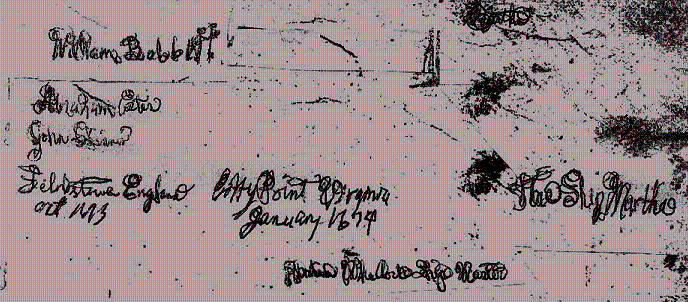
Abraham Estes departed England in late October 1673.  He embarked on the Flyboat Martha, Captained by Abraham Wheelock.  The ship carried only 3 passengers William Bobbet, Abraham Estes and John Skinner. The voyage began in London and made stops in Felixstowe and the western coast of Wales. There were probably other stops in between to take on additional cargo. They completed the long voyage when they docked at Ciity Point on the James River in the Colony of Virginia in January 1674. The voyage had taken about two months.

Evidence shows that while the Flyboat Martha was docked in Felixstowe, two passengers William Bobbit and John Skinner were taken on board along with their personal cargos destined for the Colony of Virginia. It is unknown where Abraham Estes boarded but he was in Sandwich shortly before this time and the port city of Felixstowe is located in southeast Suffolk County, north of Kent. The Martha may have stopped at any of the several other ports along the channel, so he could have boarded at one of them.

The term Flyboat identifies the Martha as being a large ship of Dutch origin, having a high stern, broad beam, shallow draft and one or two masts, generally square-rigged and around 600 tons.  It has been confirmed that the Martha was Dutch built but English registered in London. This type of craft was slim with tall sails, it was very fast and commonly used along coastal waters, but they also carried  passengers and cargo to the Colonies.

After leaving London and Felixstrowe in late October 1773, The Martha probably stopped in other ports and finally in Wales to take on more cargo. In late 1673 while tied up to a dock in one of these ports, the artist Jacob Knyff painted “A Dock Scene in a British Port.” King Charles II had previously commissioned this famous artist to paint port scenes exactly as he saw them.

bristol port dock scene

Dock Scene at a British Port – by artist Jacob Knyff – 1673

The description of this painting says:

England and Dutch ships taking on stores or cargo at a port. The activities relating to the loading has been closely observed. It has been set in the harbor, with the tower of a gate and a quay visible on the right, and the coast in the distance on the left. An England flagship is on the right, firing a salute and flying the ensign from the stern carved with the royal coat of arms. Beside the quay is an English flyboat that, from her shape, was probably Dutch-built.

A royal yacht is arriving on the left and this has prompted the firing of the salute. On the extreme left is the stern of a Dutch ship. On the quay two bales of stores or goods with clear markings have been positioned in the foreground. Men are involved in loading up small craft. a horse dragging a barrel on skids to the water’s edge and there are several groups of gentlemen and women observing the activities. A guard stands outside a sentry box in the gate-way.

Bobbit Family researchers have evidence that this was painted in Felixstowe showing the “Martha.” an English flyboat, loaded with guns, and a only few male passengers. So, as we look at the painting, we wonder if Jacob Knyff was watching Abraham Estes and his fellow passengers as they stretched their legs along the dock.  Are we looking at Abraham in this painting?

The winter of 1673/74 was a dangerous time to travel the seas. England was a war with the Dutch until November 10, 1674. During this time, the Dutch were blockading the ports of the New World to prevent supplies from coming in and commandeering the rich shipments of tobacco leaving for markets in England. Also, most passenger travel was normally limited to spring until fall of the year to avoid the terrible rough seas.  Even today, these winter seas are recognized as hazardous, so this may account for the ship only carrying the 3 passengers on this voyage.

At this time ships were not required to post passenger lists and many were in operation that were not documented. A passenger list for the 1673 voyage may exist somewhere within other documents but so far, it has remained elusive. However, there is a record that shows the Martha arriving in New Jersey at the end of summer of 1677 bringing 114 passengers. This must have been a crowded and very uncomfortable voyage!

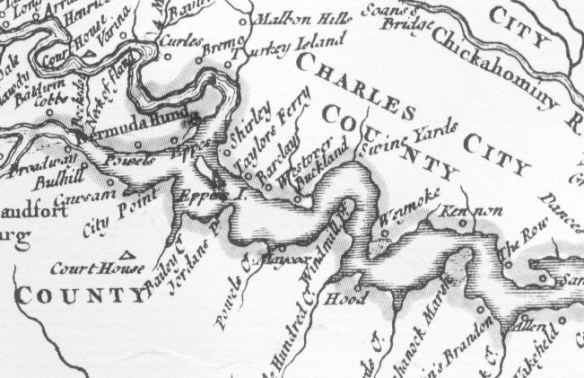
The long and hazardous voyage for Abraham Estes ended when the Flyboat Martha docked in Ciity Point, in the Colony of Virginia in January 1674.
citty point map

Ciity Point over looked the James and Appomattox Rivers and was a town in Prince George County, Virginia that is now extinct. The town became part of the independent City of Hopewell in 1923 and  the old Ciity Point is now considered a part of it.  However in the Civil War photo below, Ciity Point was still independent.

citty point civil war

1865 – ” City Point , Virginia (vicinity). Medical supply boat Planter at General Hospital wharf on the Appomattox ”

The proof of Abraham Estes making this voyage on the Flyboat Martha is found in the Bobbit Family History records displayed on their web site:http://www.keithbobbitt.com/England/sourcesexplanations.htm

Within these records there is the story of the migration of William Bobbit, along with relevant sources including the Bobbitt family Bible which includes the name of Abraham Estes.

The following statements were extracted from this history:

  • In late 1673 and 1674 Immigration: Ship “Martha” sail to Virginia from London, England with a stop in Wales.
  • Captain Abraham Wheelock filed a will Aug 1673, “Being now outwards bound on a voyage to the seas and with all considering the dangers hazards… . . .”
  • There are documents found in the Public Records Office in London stating that Abraham Wheelock was the shipmaster of the Martha and the Good Hope. Will probated 11/372, Public Records Office,  London, Documents E190/59/01 and E190/72/1, Public Records Office, London.
  • The only passengers on the flyboat “Martha” in 1673 were :
    1. William Bobbet
    2. Abraham Estes – Statement on this web site says, – “Abraham Estes, Indentured to Thoroughgood Keeling who arranged for passage from England” although the Bobbit Family researchers say this statement is not in the original file
    3. John Skinner

This close up of the Bible page was provided by the Bobbit family.

Bobbit Bible

This of a page from the Bobbit family Bible, although faded with time and subsequently retraced, clearly shows the name, places and dates as stated in the family history.  This Bible is an 1860 version which had earlier entries copied from another Bible into the pages.

In a letter dated August 2007, Marsha Berry confirms the Bible Page:

This page is a zerox copy of a page from the bible of my ancestor Isham Drury Bobbitt, Jr.  This page is a stiff paper glued into the bible. My cousin contacted me recently and reminded me that a few years ago they had it tested though professional dating and the paper dates back at least to the grandson of  William Bobbett the immigrant, the William Bobbitt born 1704 Prince George County, Virginia and died 1768 Granville, North Carolina.  That makes the Bible record proof stronger than ever as my William Bobbett on the ship MARTHA was alive until after 18 June 1712. 

Did Abraham sail on the Martha?  We’ll likely never know.  I think it’s a good possibility.  One has to question why Abraham’s name and that Bible record would exist at all in the Bobbitt family Bible otherwise. 

Yet Another War

Abraham either must have been entirely exasperated with warfare, as it seems he had lived with it in some capacity his entire life.  Either that or he was entirely used to it and a constant state of warfare seemed “normal” to him.  Wouldn’t that be a sad commentary.

When Abraham arrived in 1673, presuming the Bobbitt Bible is accurate, he would not have escaped the war with the Dutch.  They sailed through the English channel blockade when they left, and they sailed through the Chesapeake that was being blockaded and attacked by the Dutch when they arrived in America.  The Dutch were attacking sites all along the Atlantic seaboard from the West Indies to New York, including Virginia.

It’s no wonder that Captain Wheelock wrote and filed his will before leaving England and that the Martha, who could obviously hold many more passengers, had only 3.  It also begs the question of why Abraham would have been so desperate as to sail in the winter, through the English end of the war into the American end of the same event – although clearly he could have been unaware of the American end of things.  It’s unlikely that Wheelock was unaware however, as the Dutch issues had been taking place for several months – and Wheelock did write and file his will.

Obviously, Abraham arrived safely and settled in, someplace, doing something.  I wonder if the ship encountered any issues or had close calls during the voyage.  Were there times that his heart was racing in his chest and the ship bobbed like a huge cork on heavy seas?  Was he seasick on top of everything else?

I bet Abraham had wonderful stories for his grandchildren.  There were probably several times during his lifetime that he wondered if he would have children, let alone grandchildren, if he had time or was so inclined to think about such things at all.

Bacon’s Rebellion 

Just about the time Abraham would have thought everything was settled in America, yet another war unfolded.

In 1676, Virginia had its own mini-Civil war.  While this sounds “cute,” it was anything but.  For Abraham, who was likely a relatively fresh immigrant, having to pick sides and potentially to fight must have not been a terribly good feeling.  Did he wonder what he had gotten himself into?  Did he question his decision to leave England?  Was this the first time he had to engage in battle?  Did he engage in battle?

The fact that many of the other men who signed a 1683 petition, along with Abraham, were supporters of Nathaniel Bacon suggests strongly that Abraham would have taken the same position of his neighbors and those of his social circle.  In 1676, Nathaniel Bacon and many settlers rebelled against the governor, attacking Native Americans, and eventually burning Jamestown.

You either declared “for” the renegades, or they ransacked your home and maybe worse.

In part, Bacon’s Rebellion was fueled by Bacon’s compulsive, unwielding position that all Indians needed to be attacked and killed.  In addition, the landed class did not like the fact that the governor had signed into law sweeping reforms passed by the House of Burgesses allowing unlanded free men the right to vote.

After passage of these laws, Bacon arrived with 500 followers in Jamestown to demand a commission to lead militia against the Native Americans. The governor, however, refused to yield to the pressure. When Bacon had his men take aim at Berkeley, he responded by “baring his breast” to Bacon and told Bacon to shoot him himself. Seeing that the Governor would not be moved, Bacon then had his men take aim at the assembled burgesses, who quickly granted Bacon his commission. Bacon had earlier been promised a commission before he retired to his estate if he could only be on “good” behavior for two weeks. While Bacon was at Jamestown with his small army, eight colonists were killed on the frontier in Henrico County (where he marched from) due to a lack of manpower on the frontier.

On July 30, 1676, Bacon and his army issued the “Declaration of the People of Virginia“. The declaration criticized Berkeley’s administration in detail. It accused him of levying unfair taxes, appointing friends to high positions, and failing to protect frontier settlers from Indian attack.

Bacon and his men attacked the innocent (and friendly) Pamunkey Indians. The tribe had remained allies of the English throughout other Native American raids. They were supplying warriors to aid the English when Bacon took power.

When Governor Sir William Berkeley refused to march against the Native Americans, farmers gathered around at the report of a new raiding party. Nathaniel Bacon arrived with a quantity of brandy; after it was distributed, he was elected leader. Against Berkeley’s orders, the group struck south until they came to the Occaneechi tribe. After getting the Occaneechi to attack the Susquehannock, Bacon and his men followed by slaughtering most of the men, women, and children at the village.

After months of conflict, Bacon’s forces, numbering 300-500 men, moved to Jamestown. They burned the colonial capital to the ground on September 19, 1676, pictured in the 18th century drawing, below. Outnumbered, Berkeley retreated across the river.

Bacon burning Jamestown

Eventually, the governor prevailed, but that was not the sure and certain outcome for much of the rebellion and probably would not have been had Bacon not died.

Before an English naval squadron could arrive to aid Berkeley and his forces, Bacon died from dysentery on October 26, 1676. John Ingram took over leadership of the rebellion, but many followers drifted away. The Rebellion did not last long after that.

Berkeley launched a series of successful amphibious attacks across the Chesapeake Bay and defeated the rebels. His forces defeated the small pockets of insurgents spread across the Tidewater. Thomas Grantham, a Captain of a ship cruising the York River, used cunning and force to disarm the rebels. He tricked his way into the garrison of the rebellion, and promised to pardon everyone involved once they got back onto the ship. However, once they were safely ensconced in the hold, he trained the ship’s guns on them, and disarmed the rebellion. Through various other tactics, the other rebel garrisons were likewise overcome

The 71-year-old governor Berkeley returned to the burned capital and a looted home at the end of January 1677. His wife described Green Spring in a letter to her cousin:

“It looked like one of those the boys pull down at Shrovetide, and was almost as much to repair as if it had been new to build, and no sign that ever there had been a fence around it…”

Bacon’s wealthy landowning followers returned their loyalty to the Virginia Government after Bacon’s death. Governor Berkeley returned to power. He seized the property of several rebels for the colony and executed 23 men by hanging, including the former governor of the Albemarle Sound colony, William Drummond.

After an investigative committee returned its report to King Charles II, Berkeley was relieved of the governorship, and recalled to England. “The fear of civil war among whites frightened Virginia’s ruling elite, who took steps to consolidate power and improve their image: for example, restoration of property qualifications for voting, reducing taxes and adoption of a more aggressive Indian policy.” Charles II was reported to have commented, “That old fool has put to death more people in that naked country than I did here for the murder of my father.”

Indentured servants both black and white joined the frontier rebellion. Seeing them united in a cause alarmed the ruling class. Historians believe the rebellion hastened the hardening of racial lines associated with slavery, as a way for planters and the colony to control some of the poor.

We don’t know what Abraham Estes did or his sentiments during Bacon’s Rebellion, but there wasn’t such a thing in that time and place as someone who was uncommitted or ambivalent.  You were on one side or the other, and if you didn’t decide for yourself, someone would be deciding on your behalf. 

The Petition

The next record we find for Abraham is a petition in St. Stephen’s Parish in King and Queen County that he signed in 1683, along with many of the men who supported Bacon’s Rebellion.  Abraham obviously had strong opinions and wasn’t afraid to express them.

king and queen map

The fact that he signed the petition would have indicated that he was a free man, and very likely, a property owner.  He was also literate, able to sign his name – probably a result of his weaving apprenticeship.

1683 petition with signature

This petition was signed by 66 inhabitants of St. Stephen’s Parish in King and Queen County, Virginia in 1683. Directed to Deputy Governor Sir Henry Chicheley, the petitioners complained of the government’s imposition on them of unfit church leaders:

That yo’r Petition’rs have beene for severall years past burthened w’th an Illegal Vestry Elected and made up for the major part without the knowledge or consent of the parish as the Law Injoynes: and of such Illiterate and Ignorant men as are and have been, Ever Ruled and Awed by one or two particular persons, who are soe Insulting, and of such Ill disposed and turbulent spirits and dispositions, That noe Minister Cann or will. Stay w’th us or teach amongst us: by w’ch meenes, the Service of God is wholly neglected, our Church gon to Ruine, and Church Desipline and Government: almost all Clearely laid aside: And forasmuch as our said parish is not destitute of such Able, discreet, and honest men as may fittly supply the places of severall week and Ignorant persons of the present vestry according to the good Lawes of this Country: Yo’r Pet’rs in all humility supplicateth y’or honn’rs that wee may have Liberty to Elect and make Cleare by the Gen’ll voat of the Inhabitants of our said Parish of Persons (for a new vestry) as in our Judgm’t may seeme meet and convenient which will Indubiately much to the Glory of God, And the peace and welfare of the whole Parish. And yo’r Pet’rs as in all Humility and Duty bound for yo’r Honn’rs shall Ever pray etc.

Abraham’s signature on this petition is our only remaining relic of “him,” except for the DNA of descendants.  It is also the oldest known Estes signature.

1683 petition signature

This is the only known occurrence of Abraham’s signature.  Tangibly, it’s all that we have left of him, personally, today.

apple tree churchApple Tree Church, also known as St. Clement’s Church, served as St. Stephen’s Parish’s upper church in the eighteenth century.

apple tree roadside

Today, the church is remembered by this roadside marker.

king and queen historical markers

The marker on the same road and to the right (east) of St. Stephen’s Church is near Miller Tavern and Bruington Road, a location known to be close to where Abraham Estes lived.

Was Abraham an Indentured Servant?

The question has been raised repeatedly whether Abraham was an indentured servant who would have had to sell several years of his service to pay for his passage.  Those discussions are centered around this following entry from Cavaliers and Pioneers, Abstracts of Virginia Land Patients and Grants, Vol. 2: 1666-1695, Indexed by Claudia B. Grundman, Richmond, VA, page 234:

LUCY KEELING, daughter of Thorowgood Keeling, deceased, 300 acres, Lower Norfolk Co.; Lynhaven Parish, 20 April 1682, page 146. Beginning on a point on the Dildoe branch to branch dividing this & Jno. Johnson; &c. Bequeathed by said Keeling to said Lucy, to be possessed with the same after the death of my wife Lucy (now Lucy Haise) etc.- Trans. of 6 persons Abraham Easter, Jno Rose, Richard Cock, Margaret Wollingham, Elizab. Sixworth, Robt Calderwood.

This record lists Abraham’s surname as Easter. Researchers have always assumed that it was misspelled and meant to be Estes. It may not have been.

Research has shown there was an Abraham Easter who lived in Hyde County, North Carolina — south of Lower Norfolk County, Virginia. This is where the Keeling who recorded 300 acres was located, the same Keeling that claimed Abraham Easter as an indentured servant. A Will for Abraham Easter has been located in Grimes Abstracts of Wills, 1690-1760 p. 107 that states: Easter, Abraham – Hyde County, NC – November 18, 1751. December Court, 1751; and names a son James, a daughter Mary and wife Elizabeth.

Thus, this entry in Cavaliers and Pioneers cannot be accepted as conclusive evidence that Abraham Estes was an indentured servant, as it may not refer to our Abraham.  Even if it does refer to our Abraham, headrights can and were bought and sold and used as currency.  Owing headrights also does not automatically mean that Abraham was indentured.  He could have traded his headrights for something, like all or part of his passage or something much more immediately useful, like a cow, ox or horse.

If Abraham were indentured in 1673, for the typical 7 years, he would have been finished with his indenture in 1680.  It’s unlikely that he could have amassed enough money to purchase property between 1680 and 1683 when he signed the petition. However, in 1676, Governor Berkeley granted the right to vote to all free men, not just property-holders, so it’s unclear whether petitioners would have had to own property to sign that 1683 petition.

In 1704 Abraham paid quit rent on 200 acres in King and Queen County.

Abraham’s Children

Abraham died November 21, 1720, in King and Queen County, Virginia, leaving his estate to his wife, Barbara.  We only know that Abraham had a will because Barbara’s will, now missing from the archives, mentions his will, and the subsequent lawsuit.

Barbara made her will November 25,1720, just 4 days after Abraham died, leaving part of the estate to several of her children and the remainder to Elisha Estes and Thomas Poor and wife Susanna, for the raising of Moses and Barbara.

The timing of Barbara’s will, and her obvious passing shortly thereafter, makes me wonder if Abraham and Barbara had the same malady that took both of their lives., but spared all of their children.

In America, no record of Abraham’s marriage in Virginia is found, but there is a possible hint as to when it occurred.  Niel Gunson in his English Ancestry of the American Estes, 1992 supposedly obtained the marriage date of December 29, 1682 from the Universal Parish Directory of Deal, 1793.

I found this more than a little suspect.  Why would an American marriage record be recorded in Deal?  And if it were, why wouldn’t it include the wife’s name?  David Powell ordered this book from the Kent Historical Society and has verified that indeed, Abraham’s marriage record is NOT in this book and there is no reference to him.  It appears that someone has confused a source record someplace.  Looking at the date of December 29, 1682 again, I realized that Abraham’s marriage to Anne Burton occurred on December 29, 1672.  I’m thinking that perhaps a typo happened and a source got confused.  To date, there is no record found anyplace for Abraham’s marriage to Barbara, in 1682  or othewise. I you find one, with a source, please, PLEASE, send it to me.

Children of Abraham are believed to be:

  • Sylvester born about 1684, in Spotsylvania Co., VA in 1728 with wife Rachel, believed moved to Bertie and then Northampton Co., NC, died after 1754.
  • Samuel born 1686 married Rebecca, believed moved to Spotsylvania and Greene Co., Va, died after 1728 when he is found with Rebekah in King and Queen County. He is not proven to be Abraham’s child.
  • Thomas born 1688 died 1744/45, Spotsylvania and Caroline Co, married to Ann Rogers.
  • Mary Estes born 1690 married Thomas Watkins.
  • Susanna born about 1688, married Thomas Poore and raised Moses and Barbara Estes after Abraham and Barbara died.
  • Elisha born 1693, died 1782 Henry County, married Mary Ann Mumford.
  • Robert Estes born 1695 died 1775 in Lunenburg County. In 1743 John and Richard were living beside Robert in Hanover County. Moses was there too. Robert married Mary Smith?.
  • Abraham born before 1697 died 1759, Caroline County, married Ann possibly Watkins, second marriage to Elizabeth Jeter. Not mentioned in Abraham or Barbara’s will.
  • Richard born 1699 died 1742/43 Hanover County, married Mary Yancey.
  • John born 1701 died circa 1766 Louisa County, married Elizabeth “Nutty” Pickett.
  • Moses born 1710 died 1788 Halifax County, married Elizabeth possibly Webb, married second in 1782 Elizabeth Talburt/Talbot (nee Jones), a widow.
  • Barbara born 1712 died 1729, epileptic.

The date ranges of the children of Abraham the immigrant shows a range of 28 years in their ages, meaning that if they shared the same mother for all children, she was bearing children for 29 years, from approximately age 18-47.  This is not impossible, but is somewhat unlikely, especially given that Abraham had to be somewhat older than this woman if he married her when she was age 17 in 1683 or 84.  He would have been age 36 or so marrying a girl at age 17.

A significant amount of speculation exists as to whether the oldest children were from a different wife, perhaps Ann Burton.  However, if Ann, who Abraham married in England, was the mother of the first children, why were there no children between the years of 1672 and 1684 when Sylvester was born?  One would expect at least 6 children to be born in this timeframe.  Some could have died, but all of them?

This too seems unlikely, leading us to the question of whether Abraham had at least 3 wives during his lifetime.  Ann Burton first who died in England.  He then immigrated and either married two separate women, or, he married a girl of about 17.

Another significant gap occurs between John born about 1701 and Moses born 1710 which could signify the death of one wife and a remarriage, although there is nothing in Barbara’s will that alludes to any of the children mentioned not being hers.

The Lawsuit

No colonial Virginia family story would be complete without the lawsuit and a spat between siblings over their parent’s estate.  Well, this family is no different and they have a juicy one that looks like a life-long rift.  Those colonial families loved to sue in chancery court – and as genealogists, we’re extremely glad they did.  Many times, the best genealogy information we have, plus a few juicy tidbits, come from these suits.

Amelia Co. VA chancery causes 1785-007

Eastis vs Eastis

Your orator Moses Eastis that in the year of our lord 1721 on the 21st day of Nov your orator’s late father Abraham Eastes departed this life after making and constituting in writing his last will and testament and thereby after specifically leaving? part of his estate did give or further lend his who personal estate to his wife Barbara during her natural life and to be disposed of amongst his children then living as she might think proper.  He further stated? that the said Barbara Eastes agreeable to the trust and in the presence aforesaid reposed in her by your orator’s father on the 25th day of Nov. 1720 she made in writing her last will and testament in writing and surety? after giving an inconsiderable part of her aforesaid husband’s estate to several of her children therein mentioned directly that the remainder should remain in the hands of her executor Elisha Eastes, Thomas Poor and Susana his wife for the sole benefit of your orator and Barbara Eastes your orator’s sister whom she concluded were incapable of getting their living. But with a precise that they should become an ? in their leave? or either of them should die then the same to be equally divided amongst Sylvester, Thomas, Elisha, Robert, Richard, John, Moses Eastes, Martha Watkins, Susana Poor and Sarah Eastes or the survivors of them as by the said last will and testament will more fully appear reference being that there to and to which your orator for greater certainty refer and on the day of <blank> departed this life without altering or revoking the will.  Your orator further shows that in consequence of the said appointment the said Elisha Eastes did understate the trust and execution of the said last will and testament first qualifying himself as an executor thereto agreeable to law.  Your orator further sheweth that sometime after in the <blank> day of <blank> your orator’s sister Barbara Eastes died wherefore your orator concluded himself entitled to his proportionate part of his said father’s estate according to the will of the said Barbara and made several friendly applications to the said Elisha the said executor for the same who has hereto refused such reasonable requests pretending that he had expended the whole or the greatest part in the support and maintenance of your orator and his deceased sister.  Notwithstanding there is still as your orator charges the truth to be a considerable part still remaining in his hands.  Your orator is remedyless and prays that Elisha be compelled to make full answer to these several matters and especially whether your orator’s late father did not make in writing such last will and testament as before mentioned and whether your orator’s late mother and widow of the said father did not in consequence of the trust reported make and ? of the estate  before ? and to the uses and purposes aforesaid.  Whether the said Elisha did not qualify as an executor thereto and came upon himself the management and execution thereof. Whether he has fully executed the directions of the said will.  Whether there is not still a considerable part of the said ? property left in his hand sand how much your orator prays that the said Elisha may be compelled to account for he had managed the same and if on a fair settlement of account there is any part still remaining that he may have his equal portion thereof according to the will of the aid Barbara Eastis and that he may have such further and other receipts as may be agreeable to the equity court.

Next document

Answer of Elisha Estis to the many untruths of the petition and bill contained for answer thereto or as much of as he feels is material for him to make answer to.  He was nominated as one of the executors of Barbary Estis as in the said bill and that after dividing some legacies in her will did direct the remainder to be retained in the hands of the executor for the support of Barbary and Moses Estis the said Moses being very sickly and the said Barbary accustom to have fits and otherwise helpless so that she required to be nursed and dressed as a child.  The amount of the appraisement of the estate left by the said Barbary Estis was to the sum of 98 pounds 10 shillings and 9 pence, half? being? exclusive of the slaves and one horse and mare show appraisement amounted to 50 pounds fifteen shillings which after the death of the said Barbary were allotted to the children of the said Barbary and her husband Abram by the will of the said Barbary to which together with the said appraisement this defendant for greater clarity begs leave to refer and prays may be made part of this his answer, this def further saith that he expended a considerable deal of money for doctor’s means in endeavoring to cure the said Barbary and Moses and that for the space of 8 years boarded and maintained the said Barbery and Moses of which the def had made an account to which also he beggs leave to refer and prays may be made part of his answer and whereby it appears that the def. account is considerable more ? the said estate than the said appraisement amounts to, the def denies all combination ? and prays to be dismissed with his costs expended.

Elisha Estis (signature)

June 29, 1770

Next document

The deposition of Thomas Poor of full age being sworn…says that about 49 years since Moses and Barbary Estis, orphans of Abraham Estis came to live with Thomas Poor, this deponents father, who was an executor to the decd Barbary Estis and to whom the care of these orphans was committed and this deponent remembers that when these orphans came to his father’s house that Moses Estis was about 10 years old and Barbary Estis was about 8 years old both which children were very sickly the boy being very Buston and commonly seemed inclined to the Kickiosey and for whose benefit three doctors were commonly employed the girl being deponent says lived til she was about 16 years old he also says that she was an idiot having convulsion fits frequently and that this deponent remembers his father was at the expense of 6 shillings a month as satisfaction to Elizabeth Yeates who attended this girl three years.  He also remembers that Moses Estis went to school 2 years while he lived with Thomas Poor this deponent’s father and he further says that since the death of Barbery Estis, Moses Estis and several others with him came to his father’s house and were speaking of settling the orphan’s estate upon which Thomas Poor this deponent’s father said he was ready for settlement brought some papers and as this deponent thinks satisfies those people amongst whom was Moses Estis who also seemed satisfied that nothing was due the orphans upon a just settlement.

April 16 1770                      Thomas Poor (signature)

Moses came to live with Thomas Poor about 1721, so he was born about 1711 and Barbara his sister about 1713.  This makes his mother’s age about 43 in 1713, so born about 1670 and married to Abraham probably about 1690/93.  There are 11 children listed in her will, so that is about 22 years, plus Abraham who was not listed, if he is in fact her child.  Doing the math, if her last child was born when she was 43, give 2 years per child, then the first child was conceived 22-23 years previous, or about 1689-91.  To add two more children, given the 2 years between children, would mean that she was having children in 1685 which means she had children for a contiguous 28 years.  Most women married at 20 or 21, so that would imply that she had children until she was 48 or 49, which is highly improbably, or married extremely young, which is also very improbable, or there were twins, which aren’t mentioned.

Children who might also have received land could also have been omitted in the division of the remainder.  In fact Abraham the immigrant might well have provided land to his two children from a previous marriage intentionally to avoid any issues with the children form the “current” marriage.  Perhaps neither Abraham Jr. nor Samuel, if he was Abraham’s son, were children of Barbara.

Next chancery document:

Elisabeth Harris aged about 60 being first sworn…says that about 48 or 49 years ago Moses and Barbary orphans of Abraham Estis came to live with Thomas Poor, this deponant’s father who was an executor to the decd Barbary Estis and that the said Moses Estis was Buston and Kiskififid and that he had 2 years schooling as well as this deponent remembers.  The said Barbary Estis was an idiot and quite incapable of taking the least care of her self and subject to fits and that there was medicines had for ? of the said orphans and the deponent remembers that Elisabeth Yates was employed by Thomas Poor to take care of the said Barbary and that the said Barbary damaged two beds considerably in tome of her indisposition.       Elisabeth “|” Harris (her mark)

I would surely like to know what “buston and kiskififid” refers to.

Next document

Summons to Elisha Estis, surviving executor of Barbary and Abraham Estis decd to appear in court to answer the case on April 7th, 1769.

Next document

October 1769 – justices ordered to take depositions

It’s absolutely amazing to me that 50 years after Abraham and Barbara died, the family is still fighting about that will.  This also strongly suggests that Moses was alienated from at least one of his siblings, Elisha, probably for the duration of his entire adult life.  I’m thinking there were not too many family picnics in the park on Sunday afternoons.

Family rifts are nothing new.

Barbara’s Will

Barbara made her will only 4 or 5 days after Abraham’s death in either 1720 or 1721.  (Abraham’s death date is believe to be 1720, but one document says 1721.)

This was not a time in history that one typically made a will months or years in advance when you were feeling fine.  You made a will when you thought you might need it – when the inevitable was…well…inevitable.  The distance of only 5 days certainly makes one wonder if Abraham had something contagious and Barbara caught it caring for him.

Barbara’s will is now missing, but Helen Easter extracted information from her will, from the original, some years ago, obviously before it went missing.  Helen and her sister spent summers in the 1950s and 1960s traveling the Virginia counties extracting Estes and Easter records from original county records.  According to Helen’s notes, the names of children in the will left by Barbara proved in Amelia Co. include Elisha, Sussana Poore, Moses, Barbara, Sylvistas, Thomas, Robert, Richard, John, Mary Watkins, and Sarah.  Not mentioned were Abraham Jr. and Samuel, believed to also be children (Amelia File Box 1784-5, Virginia State Library).  Helen adds that she thought that Barbara mentioned them as “my children,” but she can’t remember for sure.

Who Was the Oldest Son?

If we were to presume the standard naming convention, Sylvester would be the eldest son of Abraham.  However, if the original Sylvester died, another child might have been named Sylvester later.  Typically, the eldest son inherited the land.

Judy Russell, The Legal Genealogist, mentions this, as follows:

Here’s the deal. We all know that when one of our landowner ancestors died in England and didn’t leave a will, all of his lands went to his oldest son under the rule of primogeniture. That was the law following the Norman conquest, and the oldest son couldn’t even be disinherited by will until the Statute of Wills in 1540.

The rule of primogeniture crossed the Atlantic with English common law, and that’s why you’ll see some early wills in colonial America that don’t mention land and don’t mention an oldest son: unless the will specifically said otherwise, land went to the oldest son, period.

Primogeniture was relatively short-lived in America — the first state to abolish it was Georgia, in its constitution of 1777 — but it remained the law in England until repealed in 1925.

But it was never the law everywhere, even in England. Enter, stage left, gavelkind and, stage right, borough-english.

Gavelkind was the particular custom throughout the County of Kent by which lands descended to all of the sons in equal measure. It also existed in small areas of Nottinghamshire, Norfolk, Leicestershire, Monmouthshire, Archenfeld, and Kentish Town near Highgate.

There were even some areas where the particular custom was for land to descend equally to all sons and daughters.

So pervasive was the custom in Kent that it wasn’t necessary to prove that lands there were subject to partition among all the sons; it was only necessary to prove the contrary — that particular lands were not subject to being divided equally.

Based on Judy’s information, we might not expect to see the eldest son mentioned in the will.  And indeed, Abraham and Samuel are missing, but neither of them appear to be the eldest son.

Another tidbit comes to light that also suggests that Abraham and Samuel were not the eldest.

In Cavaliers and Pioneers, by Nell Nugent, page 237, there is mention of a Robert Parish.  In a record dates, 22.6.1722 (old style date), he possessed land in King and Queen County that was bordered on one side by that of Silvester Estice. This date was after Abraham and Barbara’s death and was most likely the original land of Abraham Estes, suggesting that Silvester might be the oldest son.

Unfortunately, Abraham’s will is missing, as King and Queen is a burned county, and we simply don’t know if Abraham had already taken care of Sylvester, Samuel and Abraham or if Sylvester simply automatically inherited the land.  Given the traditional naming patterns of the man’s father’s name being used to name the first son, Sylvester would have likely been the eldest.

Where did Abraham live?

A few years ago, I wrote a paper titled “Estes of  King and Queen County, Va. Bordering Essex County, Va.”  I am extracting from that information here.

Sometimes the pieces just fall into place.  I never set out to actively search for the original land of Abraham Estes, the immigrant, because I thought we would not be able to locate it.  After all, King and Queen County is a burned county.

Well, never assume.  I was wrong.  A series of seemingly unrelated events occurred, and I’m writing this article because I’m afraid if I don’t, I’ll manage to forget some vital piece, or worse yet, know that I knew it and never be able to find it again.

Recently, cousin Robin Rankin Willis sent me another of her wonderful original extracted tables, this time for Hanover County, VA.  I was actually chasing the land of Robert, John, Moses and Richard Estes in Louisa County which was originally taken from Hanover County.  Hanover and King and Queen Counties were both originally taken from New Kent, so these lands aren’t terribly far apart.

Since King and Queen is a burned county, and that is where our Abraham died in 1720, most of our Estes truly vital records are gone.  However, sometimes all it takes is the right tidbit at the right time.

Robin found the following entry on September 12, 1748:

John Hoskins & Samuel Hoskins patent 1,430A in St. Stephen Parish, K & Q Co., north side Essex Road adj Col. Grymes, Abraham Estes & Chapman.

This sent me on what could well have been a proverbial wild goose chase.  I’m a genealogist, so I’m used to wild goose chases that wind up with me having spent hours with nothing to show for it but a pile of unrelated notes that I don’t know where to file since they weren’t relevant after all.

Robin had also recently sent me another document about Abraham.

The King and Queen County Religious Petition of 1683 is the earliest existent document from King and Queen County.  This early petition was somewhat scandalous.  The important item of note about this document is that our Abraham owned land by 1683.  This was not long after he immigrated, and although he could potentially have arrived as an indentured servant, Robin and I agree, given a number of circumstances, that this is doubtful.

We know that Abraham, nor any other Estes for that matter, obtained a land patent at this early day.  While the King and Queen County records burned, the land grant books did not burn and the patents are available from the Library of Virginia.  In fact, many genealogists are teaming up to map the original deeds through a deedmapping project to reconstruct the early colonial maps.

Abraham purchased land and it was before 1683.  Given that he was married in England in 1672, and that he probably immigrated after the death of his first wife about 1673, this only allows Abraham 10 years, or less, to serve an indenture which was in essence white slavery, and then somehow amass enough money to purchase land.  Most indentures were for 7 years.  If his wife died in passage, he still would have had to pay for her passage, so the indenture would have been longer.  Any man who had enough money to purchase land would have instead purchased his own passage.  Indentured servants were not paid.  Generally, they only had to be provided with a set of clothes when their indenture was complete.  Often they died.

Therefore, given these facts plus a pinch of speculation, it is doubtful that Abraham was an indentured servant.

From this information, I immediately began to study the Hoskins information.  We know that this land was on the north side of Essex Road, but today’s maps and atlases show the Virginia roads with numbers, not names.  This is so frustrating, because we know that Essex road had to be a main artery road between King and Queen, and Essex counties, but which one.

I posted a note to the King and Queen rootsweb site, with no results except a reference to a Hoskins family book, “Hoskins of Virginia and related families”.  This book is available on Heritage quest.

On page 21, it states that a John Hoskins is found in King and Queen County and that he lived on a plantation called “Mount Pleasant” which was patented on 1661-62 by Col. Thomas Brereton, Clerk of Northumberland County.  His father is believed to be Thomas Hoskins.  By 1683, Thomas Hoskins was living in St. Stephens Parish, New Kent County.  This parish in 1691 would be annexed to King and Queen County.  He signed a petition with 65 men for a popularly elected church vestry in the parish.  Of these signers, several were men who had fought for Nathaniel Bacon in 1676.  This petition is one of the finest expressions of seventeenth century democratic idealism in our American heritage, and it took place a full century before the Revolutionary War.  Only during the commonwealth period (1649-1660) and during Bacon’s Rebellion in 1676 were the vestries popularly elected by the residents of the parish.  They would not be again until after the Revolutionary War.  Signing near Thomas Hoskins was William Brereton.  The Hoskins, Breretons and Claibornes who were allied were all wealthy families and were associated with the House of Burgesses, having individuals who served from time to time, and shared the same viewpoint, opposition to centralized authority.

By 1738, the Breretons were gone from King and Queen County and the Hoskins were in possession under the terms of the will of Samuel Hoskins of 1430 acres of Brereton Property.  The Brereton patents of 1661-62 were for 2 tracts of 1500 acres each or 3000 acres.  Please note that this name is also spelled Hodgkins.

The Hoskins were directly preceded at Mount Pleasant by the Breretons.  This we know from the 1683 petition and from a deed between Jasper Cofton of St. Ann’s Parish in Essex County and Robert Farish of St. Stephens Parish of King and Queen.  The year is 1716 and refers to the neighborhood known as Millers Tavern.  Cofton sells to Farish 250 acres being a part of a patent of 1000 acres formerly granted to Richard Jones and George Turnor in 1672 situated and being in Essex and King and Queen upon the head of the Dragon adjoining to the tracts of Col. Goodrich and Capt Brereton’s lands.

In 1734 William Covington sold land to Richard Jones of South Farnham Parish, Essex Co.  This land had been heired by his wife Mrs. Ann Covington from her father Robert Coleman.  The land was described as “a certain tract of division of land …part in the aforesaid county of Essex and part thereof in the county of King and Queen…beginning at the corner of said Richard Jones Jr. standing in the line formerly Goodriches….to another white oak of the said Richard Jones standing in Brereton’s line thereto along the said Brereton’s line south by east”

The earliest patents relating to this plantation were on May 25, 1661 and Nov. 28, 1662 for 1500 acres each or a total of 3000 acres patented by Col. Thomas Brereton, Clerk of Northumberland.  These patents were described a being in New Kent and were on the north side of the Mattaponi River on the west and east side of Hoor Cocke Swamp, the 1661 patent beginning at a former dividend of Mr. Chapman running N by W and C and granted to George Chapman Sept. 1, 1658 by him assigned unto said Brereton.  The 1662 patent adjoined land formerly belonging to Anthony Haines.

By 1738 John and Samuel Hoskins had inherited from Samuel Hoskins 1430 acres of this Brereton land and they confirmed it by patent which reads “800 acres part thereof was given and part devised to the said John Hoskins and Samuel Hoskins by the last will and testament of Samuel Hoskins, decd, and the residue (630 acres) thereof being surplus land found within the bounds of the said 800 acres.”

The patent was granted and confirmed and the purpose was to determine the amount of acreage inherited under the will of Samuel Hoskins and then have it recorded by patent.

The 1738 patent describes it as beginning on the north side of Essex road running south by Col. Grymes line thence east by north to Abraham Estis then up the branch to Chapman’s corner, thence north by west to the beginning.  This included the area from St. Paul’s church to Dogwood swamp on the Bruington road, a stretch about 4 miles long and one mile wide.

In 1805 the Mutual Assurance Society policy taken out by Col. John Hoskins wherein he calls his home “Mount Pleasant”, the land owner on his eastern boundary is George M. Chapman.  This plantation was in the same family until sold by the executors of George Hoskins in 1852.  The north end of Mount Pleasant became known as Holly Springs and was still in the family in 1860.

From a personal interview with an elderly lady who had visited Mount Pleasant when she was a child, “The Mount Pleasant house was situated about 2 miles from the border of Essex on the most direct road from Tappahannock on the Rappahannock River to Walkerton on the Mattaponi.  The house stood on a high hill overlooking the mill pond, dam and mill.  That house no longer stands, but the present house is in the same location on the brow of the first hill one ascends when proceeding along the road from St. Paul’s church to Bruington.

mount pleasant

Abraham Estes land in 1738 abuts the Hoskins and Grymes land.  Today this marker resides on 360 East of St. Stephen’s Church.

http://photos.historical-markers.org/va-kingandqueen/198_9801

estes land map

Going with the info from the various locations to my trusty atlas, I find that in King and Queen County, on 360 where it crosses 14 and then East on 360 from that location, we have an intersection with 631 and 621 before getting to Miller’s Tavern.  Miller’s Tavern is too far East,  It looks like this land is between Bruington which is at the intersection of 14 and 621 as one point on the triangle, 621 itself as another point on the triangle, and probably St. Stephen’s church as another point.  I can find no history whatsoever of a St. Paul’s church in this area.  You also see Dogwood Fork which surely is connected to Dogwood swamp.  Abraham’s land seemed to be on the NE quadrant of this land, so probably nearer to 621.  In a much larger sense, it’s between the Rappahannock and the Mattaponi, but nearer to the Mattaponi.

Land Grants with associated names:

June 22, 1722 – Grant of Robert Farish described as 775 acres in the Counties of King and Queen and Essex. Beg. of Silvester Estice standing in Thomas Cranes line; thence &c. on the south side a branch of Mattapony River. And then 775 acres in the Counties of King and Queen and Essex adjoining the land of Silvester Estice, Thos. Crane &c. on the south side of a branch of Mattapony River and crossing several branches of Rappa: River.

This is less than two years after Abraham died, so is very likely his original land.

Abraham’s DNA

One of the things we hoped to prove when we began this project was whether or not Samuel Estes, found in Spotsylvania County, and Abraham Estes were sons of the Abraham who died in 1720/21.   By testing the Y DNA of males who descend from these two men, we can tell if they are from this Estes line, although we cannot prove, beyond a doubt that they were Abraham’s sons.  Given that we know that Abraham was the only known Estes to be living in this location in Virginia at this time, we could then surmise that they were his sons if they matches Abraham’s Y DNA finger print.

Genealogists hate that word, surmise.

To be clear, there are some mystery Estes men who also showed up in Virginia, but we have absolutely no further records of them, and it’s possible they didn’t survive.  David Powell covers this in his article, “American Estes Before Abraham.”

We’ve been fortunate in the Estes DNA Project that many Estes descendants are looking for their roots.  Even better, many of the people who tested had their lines proven back to Abraham.

I assembled a chart some time back of the 23 individuals who have proven connections to sons of Abraham, and you’ll never guess who is missing.  Yep, elusive Samuel.  So, either he didn’t have a male line that survived, or the people who descend from him can’t connect to him, or they simply haven’t tested yet.

The good news is that we do have descendants of Thomas, Richard, Robert, Moses, John, Sylvester, Elisha and yes, Abraham.  And yes, they do all match the Estes DNA fingerprint and many lines have defining line marker mutations.

What is the Estes DNA fingerprint and what is a line marker mutation?

The Estes DNA fingerprint is the combined values that make the Estes DNA sequence, or haplotype, recognizable as such.  It separates us from everyone else, or hopefully, most people.  And line marker mutations are mutations at specific markers that have occurred in sons lines since Abraham and identify those lines individually as well.

Why is this important?  When an Estes tests that doesn’t know which of Abraham’s sons lines they are from if they have one of the line marker mutations, I can often tell them, or at least point them in the right direction.  Worst case, I can narrow the options.

How did I determine the Abraham Estes DNA fingerprint and his sons’ line marker mutations, which constitute their fingerprints?  Let’s take a look.

Reconstructing Abraham

The first thing I did, using triangulation which I explained in the Robert Estes (1555-1616), Householder in Ringwould, 52 Ancestors #30 article as well as in this “Triangulation for Y DNA” article, was to determine what Abraham’s DNA markers looked like by evaluating the results at each marker for his many descendants.  I call this profile, “Abraham Reconstructed” and I compare every other Abraham descendant to this profile in a spreadsheet.

abraham reconstruct

I have only shown this to 25 markers, above.  Otherwise, the print is too small to see and looks like the lowest line on an eye chart that I’ve never personally seen in my life.

Looking at just Abraham’s first 12 markers, on my spreadsheet, you will notice that there is a red value and a bold, red underscored value.

abraham reconstruct 2

The red bold indicates a rare marker value found in less than 25% of the testers for R1b and red, bold, underscored means this value is very rare and found in 6% or less of all R1b testers.  Why is this here?  Because these rare and very rare marker values, in combination with each other, is what determine the individual Estes rare marker signature that differentiates us from every other R1b male in Europe.

Where did I find these rare marker numbers?  I maintain a spreadsheet for all  haplogroups that I utilize for my own projects and every client who purchases a Personalized Y DNA Report.  No, this is not available publicly anyplace, but I will gladly provide this information for anyone, for their individual results, who purchases a Quick Consult.

Abraham reconstruct3

Line Marker Mutations

The next step in this process is to compare the results of each participant to that of Abraham.  In this case, kit 12088 is a descendant of Abraham’s son, Thomas, in fact the only descendant.  In his case, he has a mutation, when compared to Abraham Reconstructed at marker numbers 390 and 391.

Because there is only one confirmed descendant of Thomas who has tested, we don’t know how far back these mutations go.  In other words, the mutation(s) could have happened between Abraham and Thomas, or between the tester and his father, or at any generation in-between.  Having more people who descend from Thomas will help determine if this is a line marker mutation for all of Thomas’s descendants or just a particular line of Thomas’s descendants.

Let’s look at another son of Abraham, Abraham Jr.

Abraham reconstruct4

In this case we have only one marker with any difference from Abraham Reconstructed, and that’s 449 and only in one tester.  This tells us that clearly, the mutation did not happen between Abraham and Abraham Jr.  In fact, in this case, two brothers tested, and the mutation at 449 was present in one brother, and not the other, so we know exactly where this mutation occurred.  This mutation will be a line marker mutation for the brother in whose line it occurred and will be a beacon for future generations.

Now let’s look at Abraham’s son, Moses’s line.

abraham reconstruct5

In this case, we have more testers and from two of Moses’s son’s lines.  Moses only had 3 sons, and we have descendants of two of the three, John and Moses Jr., with only William missing.

We can see that in John’s line, there are three mutations difference from Abraham, two of which occur in both participants.  This means that for those two common mutations, the mutation occurred someplace between their common ancestor and Abraham.

Unfortunately, because one of the two men has not provided their Estes ancestors, I can’t tell who their common ancestor was.  I bet you’re wondering…If he didn’t provide his genealogy, how did he get into the “Moses via son John” group?  Because his mutations match those of kit 55666, so I can discern his genetic line even without his genealogy.  Let’s look at how this works.

The owner of kit 55666 is 7 generations from Moses’ son, John Estes.  If the common ancestor between the two kits was kit 55666’s great-grandfather, Samuel Estes, then we would know that two of these mutations, 391 and 458 occurred someplace in the 4 generations between Samuel and John Estes, because the mutations occur in both of Samuel’s son’s lines.  Conversely, the mutation at location 389-2 would have occurred someplace between Samuel and the current generation, because it does not occur in the descendant of Samuel’s other son.

This Moses becomes even more interesting though, because we have descendants of Abraham through son Moses, and in particular, one specific line –  through Moses Jr., son George, then son John R. Estes.  This line carries a different line marker mutation for location 458.  While John’s line is showing a value of 19, one more than Abraham, Moses’s line is showing a value of 17, one less than Abraham.  Because all 4 of these participants descend from John R. Estes through different sons, we can say with certainty that this mutation happened someplace between Abraham Estes and John R. Estes.  A second mutation in this line, at location 449, occurred someplace downstream of John R. Estes in the three generations between John R. and the participant.  The value of 31 at location 449 will in the future be a line marker mutation within John R’s line for that specific line, while the value of 17 is a line marker mutation for John R.’s entire line.  The value of 17 at 458 might also be a line marker mutation for George, John R.’s father, or Moses Jr, his grandfather.  Because no one else has tested for any of these lines, we don’t know.  But we do know that it’s not a line marker mutation for Moses Sr.’s line because Moses Sr. has had 2 sons test and their values of 458 don’t match either Abraham or each other.  Therefore, we don’t know what the value of marker 458 was in Moses Sr. himself.  It would be extremely interesting to have a descendant of Moses Sr.’s other son, William test.  He would be a tie breaker in terms of this marker value in Moses Sr., assuming he matches either Moses Jr., John or Abraham’s marker value.

Another of Abraham’s sons, Robert, has a defining line marker mutation on marker 391, with the exception of one descendant.

abraham reconstruct6

Back mutations do happen, but rarely.  In this case, it may well be what has happened though, because kit 14220 and 28361 share a common ancestor two generations below Robert, descending from Robert’s son George.  The other two participants descend from different sons of Robert, so in total, three of Robert’s sons are confirmed at Family Tree DNA, plus two additional at Sorenson through data base retrievals.  The last kit, 201558 has not provided their genealogy, but I’ve placed them here because they match value 11 at 391.  Therefore, the only conclusion we can draw from this scenario is that the value of 12 at marker 391 in kit 14220, assuming the genealogy is accurate, is a back mutation.

Summary

Abraham Estes made an amazing journey in his lifetime.  His life was certainly not without adventure.  He was born during a war and his father may have given his life in the Kentish Uprising.  In any event, he was orphaned when he was two years old, when his mother died.  Had it not been for his mother’s will, we would never be able to tie Abraham to his family, because we have never been able to find his baptism records.

Abraham’s first wife died and we presume there were no children.  If Abraham immigrated in 1673, he and his wife were married less than a year and it would be a safe bet that she died in childbirth, along with the child.  He sailed for America in the middle of a second war, encountering Dutch warships on both ends of the journey.

In 1676, in Virginia, he would have been involved in some way in Bacon’s Rebellion, likely siding with Nathaniel Bacon against the government.  If so, he was probably involved in the burning of Jamestown.  This may well have been America’s first civil war.

In 1683, in Virginia, Abraham signed a petition, a free man and we know that by 1704 he owned land in King and Queen County that he purchased (or inherited), not that he received as a land grant.

Abraham Estes died in 1720 married to Barbara Estes, but there is not one single shred of evidence to suggest that his wife’s maiden name was Barbara Brock.  That surname was introduced into the family line by a novel in the 1980s wherein the author utilized Estes historical characters and built upon those characters.  It also didn’t help that Abraham Jr.’s daughter, Barbara Estes married Henry Brock.  Unfortunately, Barbara’s surname, listed as Brock has been copied and recopied so many times that it has entered into the realm of urban legend.  Regardless of how many times the story is retold, or copied and pasted, it won’t be accepted by serious researchers until some evidence, someplace, is found. To date, there is none.  I am hopeful that as more Virginia Counties chancery suits are brought online by the Virginia State Archives that in some county, someplace, a document will surface that will identify Barbara Estes’s maiden name.

In my opinion, the most likely place to find Barbara’s surname is among the petitioners on that 1683 petition.  We know her family lived in Virginia and she would have had to live local to Abraham to have met him.  Her father, brothers and perhaps uncles are most likely among the petition signers.  Brock is not one of the surnames.  Those surnames are:

  • Abbott
  • Arnold
  • Blake
  • Brae
  • Bredings
  • Burch
  • Cammell
  • Camwell
  • Carter
  • Cave
  • Claiton
  • Cockerham
  • Coleman
  • Conaway
  • Cooke
  • Davud
  • Derham
  • Didlock
  • Dobbs
  • Ey?
  • Finney
  • Gardner
  • Gray
  • Grilles
  • Haile
  • Hanes
  • Harman
  • Harper
  • Holcomb
  • Hopkins
  • Lovey or Iovey
  • Lumpkin
  • Lylly
  • Madison
  • Major
  • Middelton
  • Newis
  • Nichols
  • Owen
  • Parker
  • Phillips
  • Piggs
  • Plunket
  • Pollard
  • Ramsey
  • Richards
  • Richardson
  • Scandon(s)
  • Shurly
  • Smith
  • Spencer
  • Symore
  • Taylor
  • Vies
  • Weston
  • White
  • Williams
  • Wood
  • Wyatt
  • Yorke

Beverly Fleet, a noted researcher, extracted these names when transcribing the 1683 petition in the Virginia Colonial Records in the 1930s and 1940s and provided her commentary , as follows:

Of the 66 signatures on this petition, exactly half, 33, made marks.  Not so bad considering the disturbed times in England and conditions in Virginia.  The comment in regard to English education is made in that, contrary to the prevailing cavalier tradition, I believe that many of these men were of Cromwellian affiliation and came to Virginia to escape the hatred at home.  If they were so Cavalier, then why did they come to this Godforsaken and wild country just after the Restoration?  Not that there were not a plenty of gentlemen too, but the rank and file are always in the majority so far as numbers are concerned.  This petition is a protest of the people against two or three of the upper class.  Would to God that these men could have known just what happened exactly 100 years after they sent in their protest.

In Abraham’s case, I doubt that he was Cromwellian, especially if his father died in the Kentish uprising siding against Cromwell and with the deposed King Charles.  On the other hand, it’s a possibility I had never previously considered.  If he was, for some reason, pro-Cromwell, it might well have alienated him from other family members who did support the deposed Charles and welcomed the reinstatement of his son, Charles II, known as “The Restoration,” in 1660.  Kent was heavily pro-Charles and anti-Cromwell.  It would seem to me that in 1660, Abraham, at age 12 or 13 would be too young to be politically thoughtful.  However, Beverly Fleet may have been accurate in that many of the older men in Virginia may well have left in the late 1550s when Cromwell’s reign was coming to an end.

Regardless of why Abraham left England, all of the thousands of American descendants need to be exceedingly grateful that he did, and survived, or we wouldn’t be here and who we are today.  I asked David Powell who maintains the most comprehensive list of descendants that I’m aware of in his Estes/Eastes Pages, how many descendants Abraham has, and he indicated it was about 27,000.  That’s just an amazing number, and we know we don’t have all of them.

I asked David how many descendants that Nicholas Estes, the first proven Estes ancestor from Deal, born about 1495, with only one documented son in his will, has today.  His answer?  About 35,000.  Of those, 27,000 are attributed to Abraham, another 6000 to the Northern US Estes line and a couple thousand in England.  Just think how many there might really be if we knew how many children Nicholas actually had.  Ironically, it’s the English line that really hasn’t been thoroughly documented – the descendants of those who stayed – and David is working on that now – so we may see this number rise significantly in the future.

If you are working on your Estes genealogy, please consider DNA testing.  This article explains about the different kinds of DNA tests for genealogy.

If you are an Estes male, carrying the surname, you’ll need to order the Y DNA test through Family Tree DNA and join the Estes DNA project, of course.  Everyone who descends from an Estes can participate by taking the Family Finder autosomal test at Family Tree DNA. All Estes descendants, regardless of which test they take, are welcome in the Estes DNA Project.

If you are looking for genealogy information on your Estes lines, please visit David Powell’s wonderful Estes pages.  Happy hunting!

Also, a $15 yearly subscription to Estes trails, and purchasing the back issues for the past many years is a wise investment.  Contact Larry Duke at estestrails@aol.com.

I want to thank David Powell, Larry Duke, Roy Eastes and Stew Estes for their invaluable input, assistance and resources for his article.  In addition, a bit thank you to all of the Estes family DNA testers.  We couldn’t be doing this without you.

______________________________________________________________

Disclosure

I receive a small contribution when you click on some of the links to vendors in my articles. This does NOT increase the price you pay but helps me to keep the lights on and this informational blog free for everyone. Please click on the links in the articles or to the vendors below if you are purchasing products or DNA testing.

Thank you so much.

DNA Purchases and Free Transfers

Genealogy Services

Genealogy Research

Robert Eastes (1555-1616), Householder in Ringwould, 52 Ancestors #30

Robert Eastes, reported by family researchers as a mariner, was born about 1555, probably at Deal, Kent, and died about 1616, at age 61 in Ringwould, Kent. He married Anne Woodward on December 2, 1591 at St. Nicholas Church in Sholden, Kent, just a quarter mile or so up the road from St. Leonard’s Church of Deal where the Estes family was a long-time member.

St Nicholas Sholden interior

Robert Eastes and Anne Woodward were married in St. Nicholas church at Shoulden, in this chancel, minus the carpet of course.  Anne would have walked up this aisle 423 years ago.

Anne Woodward was born about 1570/1574.  Baptism records began to be kept in 1569, so hopefully a record for her still exists in some location and has simply yet to be found.  It’s likely that her family attended the church at Sholden as well and she may well have been born there and baptized in this very font that still exists in the church today.

St Nicholas Sholden bapistry crop

Anne made her will on April 21,1630. She was buried on May 18, 1630 at Ringwould, less than a month later. Her will was probated on June 9, 1630, and listed nine children.  Unfortunately, the archives cannot locate Anne’s will and now claims that it doesn’t exist.  Perhaps it is filed under a different surname spelling.

Robert and Anne spent the first few years of their married life at Sholden, moving to Ringwould by September, 1595, according to baptismal records of their children.

Robert’s parents were Sylvester, a fisherman, who died in 1579 when Robert would have been 24 years old, and Jone, his mother, who was buried at St. Leonard’s Church in Deal in 1661, when Robert would have been about 6.  Eighteen years later, Sylvester died, but would be buried in Ringwould for some unknown reason.  There is no record of Sylvester remarrying.  So when Robert Eastes married Anne Woodward in 1591, neither of his parents could attend his wedding.

If Robert was born in 1555, he waited quite some time before marrying.  In 1591, he would have been 36 years old.  I have to wonder, especially if he was a mariner, if the English war with Spain might have had something to do with his delayed marriage.  During this war, the coastline of Kent was on high alert.  The Spanish Armada was expected to attack at any minute, and indeed, in 1588, they did move up the English Channel in an arc preparing to attack England.

armada 1588

However, between the weather and the English “Navy” such as it was with few warships and mostly conscripted merchant and fishing boats, the Spanish were defeated off of the coast of France.

Nonetheless, the watch for the Armada had been underway in Kent, between Dover and Deal, night and day in specially constructed watchhouses, along the Kent coastline that was preparing to take the brunt of the battle.

signal station

Deal and the rest of the coast prepared, as best they could.  Deal is reported to have had six vessels ready, along with the men to man them.  Robert, at his age, 33 at the time, had to be involved in some capacity.

The English fleet may have been victorious, but they weren’t out of harm’s way yet.  The English fleet anchored in the Downs to allow their victorious crews to be paid off before they were demobilised and dispersed.  However, a gale wind blew for several days, stranding the entire fleet.  An infection caused by “sour beer” disabled the crews.  The gale, still blowing, made the transportation of supplies, food and medicine to the stranded ships impossible.  The crew, without pay, turned mutinous.  Slowly, boats managed to land thousands of sick and wounded seamen who then lined the beaches, “dying where they lay,” at Deal, Sandwich, Margate and Dover.  Sir John Hawkins, pirate, treasurer of the Navy, hardened seaman, slave trader and adventurer wrote that, “It would grieve any man’s heart to see them that have served so valiantly to die so miserably.”  Anything that could touch his heart must have truly been horrible.

If Robert were a mariner, he was understandably busy, not to mention that warfare disrupts commerce.  Maybe he couldn’t afford to marry until 1591.  Or maybe, he just hadn’t met the right young woman.  But he did marry and he and Anne had a family.

It’s interesting, because Anne, based on the marriage and birth date of her first child was three months pregnant then they married, which may have been why they married when they did.  I noticed in Ringwould that church records were pretty unforgiving and very direct about illegitimacy if the parents remained unmarried at the time of the child’s birth.  However, Robert and Ellen married and there is nothing in the child’s baptism record that indicates anything “odd.”

While today, we think of a wedding as a definite legal dividing line between married and unmarried, in the past, marriage was more of a process. In fact, the betrothal was the beginning of the marriage process and that is when sexual relations, referred to as spousals, began as well.  Children conceived while betrothed but before marriage were considered legitimate as long as the couple married.[1]

The term “processual marriage” is sometimes used to describe these arrangements, that is, “where the formation of marriage was regarded as a process rather than a clearly defined rite of passage” (S. Parker Informal Marriage, Cohabitation and the Law, 1750-1989).

It is no longer generally recognized that the Anglican marriage service was an attempt to combine elements of two separate occasions into a single liturgical event. Alan Macfarlane develops the point in detail: “In Anglo-Saxon England the ‘wedding’ was the occasion when the betrothal or pledging of the couple to each other in words of the present tense took place. This was in effect the legally binding act: It was, combined with consummation, the marriage. Later, a public celebration and announcement of the wedding might take place — the ‘gift’, the ‘bridal’, or ‘nuptials’, as it became known. This was the occasion when friends and relatives assembled to feast and to hear the financial details. These two stages remained separate in essence until they were united into one occasion after the Reformation. Thus the modern Anglican wedding service includes both spousals and nuptials (Macfarlane).

This pre-modern distinction between spousals and nuptials has been largely forgotten; indeed, its very recollection is likely to be resisted because it shows a cherished assumption about the entry into marriage — that it necessarily begins with a wedding — to be historically dubious. Betrothal, says Gillis, “constituted the recognized rite of transition from friends to lovers, conferring on the couple the right to sexual as well as social intimacy.” Betrothal “granted them freedom to explore any personal faults or incompatibilities that had remained hidden during the earlier, more inhibited phases of courtship and could be disastrous if carried into the indissoluble status of marriage.”

It has also been forgotten that about half of all brides in Britain and North America were pregnant at their weddings in the 18th century (L. Stone, “Passionate Attachments in the West in Historical Perspective,” in K. Scott and Mr. Warren [eds.], Perspectives on Marriage: A Reader). According to Stone, “this tells us more about sexual customs than about passionate attachments: Sex began at the moment of engagement, and marriage in church came later, often triggered by the pregnancy.”  This certainly could have been the case with Robert Eastes and Anne Woodward.

The children of Robert Eastes, and Anne Woodward are:

1. Matthew Eastes, baptized 11 June 1592 at Sholden, Kent, died as infant.  He is likely buried in the church yard at Sholden.

sholden roadside

It’s also likely that they lost a second child, between Matthew and Sylvester, given the 4 year birth span.  Alternatively, another child could have been born but the birth record no longer in existence or baptized elsewhere.

2.  Sylvester Eastes, baptized 26 September 1596 at Ringwould, Kent.

3. Alice Eastes, baptized 26 March 1597 at Ringwould, Kent.  She married Thomas Beane, 28 October 1628 at Ringwould, Kent, and had children: Christopher (1628); Richard (1632) of St. Mary the Virgin, Dover, Kent; Mary (1636) of Great Mongeham, Kent; Sarah (1638) of Westminster, London; Judith (1642); and, Thomas (1643) of All Hallows Staining, London.  Notably, her children were all baptized in different locations.

4. Matthew Eastes, mariner, born 1601, Ringwould, Kent, died 1621, buried 4 June 1621, St Leonard’s, Deal, Kent, he married Margaret Johnson, 23 November 1620, Deal, Kent. Margaret died and was buried 15 October 1622, St Leonard’s, Deal, Kent. Children: Martha (1621) of Deal, Kent, and William (1621-1687) of Ringwould, Kent.

5. Robert Eastes, Jr. was baptized 29 May 1603, Ringwould, Kent, he married Dorothy Wilson, 31 January 1634, Ringwould, Kent. Children: Robert (1635), Thomas (1636), Sylvester (1638), Sarah (1640), infant (1643) of Ringwould, Kent, Matthew (1645-1723) and Richard (1647-1737), both born at Dover, Kent and died in America.  Matthew and Richard constitute the “Northern Estes” line in America.  They settled in Strafford Co., NH and then moved on to Essex Co., MA.  David Powell details this line on his website.

6. Thomas Eastes, baptized 2 June 1605 at Ringwould, Kent, died in 1671, at Ringwould, Kent.  He married Joan Wilson, 21 November 1636, at Ringwould, Kent. Joan died 1672, at Walmer, Kent. Children: John (1642), John (1645), Joan (1645) and Robert (1647) of Ringwould, Kent.

7. Susan Eastes, baptized 30 October 1608 at Ringwould, Kent.

8. John Eastes, baptized 3 March 1610 at Ringwould, Kent, he spent the latter years of his life in poverty, living on parish assistance. John died in 1684, at Ripple, Kent. He married unknown, and had son John, born 1642 of Eastry, Kent.

9. Female Infant Eastes, born in 1616 at Ringwould, Kent, died at birth.

In 1601, when James I ascended the throne, he declared the war with Spain officially over and the people of Kent could relax a bit.  However, the long years of  tensions along the coast might have encouraged some folks to move a ways inland.  Robert was reported to be a mariner, but the only record I have been able to find indicating his occupation was at his death and lists him only as a householder, meaning one who heads a house.  However, given that Robert’s mother died when he was young, and his father was assuredly a fisherman, as well as his son Matthew, it’s likely that Robert was too.

From 1595 until their deaths in 1616 and 1630, respectively, Robert and Anne would count Ringwould as their home church.  It’s very likely that they lived in very close proximity as well, as the various churches in the villages were only a couple of miles apart.  Ringwould was less than a mile from the sea and a couple miles from Deal where the fishing fleet was centered.  If Robert were fishing, it would not make much sense for him to move away from the area where fishing occurred.  Ringwould was a farming area.

If you drew a circle half way between Ringwould and all of the other adjacent churches, that circle would certainly include Robert and Anne’s home and wouldn’t be more than a mile distant from Ringwould at any point.

ringwould aerial crop

In the satellite photo, above, St. Nicholas church is located by the C in Church Lane and the cemetery takes up the rest of the churchyard.  The photo below is the church from the main road, take from about the location of the blue dot to the right of “A258” and looking over the field to the church and churchyard.

st nicholas ringwould main road

The small village of Ringwould lies on the A258, known as Dover Road, the main road between Dover and Deal, it has a population of about 350, this has remained roughly the same for the last 200 years, although the number of houses in the village has doubled in that period. Today Ringwould is a quiet village with a Pub, a Church and a village hall. The school moved to Kingsdown in about 1980 and the Post Office closed not long after.  Today, there isn’t even a convenience store.

The village was first recorded more than 200 years before the Domesday survey, in an Anglo-Saxon Charter dated 861 AD under the name of Roedligwealda (the forest of Hredel’s people). The site of a Roman period farm has been identified close to the present Ripple windmill; which is in the parish, although metal detector finds and other relics which have been found, suggest that the area was populated well before the Roman invasion. The oldest coin ever found in England was discovered by a metal detectorist working close to Ringwould. It seems probable that the village was established sometime during the Anglo-Saxon period, probably in the 6th century AD, a thousand years before the Norman Conquest of 1066.  In 1326, King Edward II granted a charter giving permission for a weekly market and an annual fair in Ringwould on the feast of St. Nicholas celebrated on December 6th each year.

By the late Norman period the timber Anglo-Saxon Church had been replaced by the present parish church which is thought to have been built about 1130. It has grown with the settlement and still contains a record of the alterations made through the centuries in its fabric.

The church originally had a wooden spire, but in 1627, the villagers petitioned the archdeacon to demolish the spire and replace it with a flint and brick tower.  The villagers requested that they be allowed to keep the lead worth 28 pounds which would help offset the expenses anticipated to be 100 pounds to build the new tower.  The new tower was to have pinnaces or ornaments, but today only the cupola remains.  For many years, the year 1628, in iron figures, probably created in the forge just down the path, was affixed to the tower.  There were originally 5 bells in the new tower, one original bell from the 1300s, 4 added in 1628, and a 6th added in 1957.  Hence, the name of the local pub, Five Bells.

Anne Woodward Eastes would have been involved with the petition, although, being a woman, she may not have been allowed to sign.  She would have watched the new tower being built, as it was three years before her death.   During the construction, services went on as normal.  There is an Estes marriage and christening during this time.

As late as the 1940’s Ringwould was still very much a manor village, with the squire, the Monins family, living in Ringwould House and a fair proportion of the village residents working on the manor property and living in houses owned by the manor.  The Monins family is the historical manorial patron family beginning with Richard Monins in 1727, but it’s unclear who the earlier manorial family would have been.  This is very interesting as it suggests that the Estes family in the 1600s would have likely been doing the same thing and very likely worked for the manorial family.

The following church records provide us with a glimpse of the events in the church most assuredly attended faithfully by our Estes family.  Note that the transcribed records that I photographed at the church do not agree entirely with the records extracted by Estes researchers from original documents earlier, as reflected in the list of children given above.  Roy Eastes in his book The Eastes-Estes Families of America – Our English Roots, stated that Donald Bowler utilized the Bishop’s returns.  The records in the Ringwould church are from their own books, not duplicate copies sent to the Bishop.  either set of records could certainly have omissions for various reasons.

September 26, 1596 – Silvester Estey, son of Robert, christened

Silvester is the son of Robert Estes who married Ann Woodward at Shoulden on December 2, 1591.  Their first child, Matthew, was baptized at Shoulden in 1592.  Silvester is their second child and the first record of an Estes in Ringwould except for the burial of Robert’s father, Sylvester, in 1579.

March 28, 1598 – Allice Estey daughter of Robert christened.

It looks like they lost two children here or the births aren’t recorded.

June 2, 1605 – Thomas Estis, son of Robert christened.

They may have lost a child here.

Oct 30, 1608 – Susas Estis, daughter of Robert christened.

March 3, 1610 – John Eastis, son of Robert christened.

And perhaps lost another child here.

Nov. 4, 1616 – Robert Eustace, householder buried.

Dec. 22, 1616 – daughter of Robert Eustace, not baptized, buried.

These two records, of Robert’s death and then just 6 weeks later, of Anne losing the child she was pregnant with when Robert died, are simply profoundly sad.  I can see the grieving woman, with her children, ranging in age from 6 to 20, and heavily pregnant, standing in the churchyard beside the casket as they lowered it into the ground, burying her husband.  A few weeks later, she would return to the same cemetery to bury her youngest child, just like she buried her oldest child years before.  Life then was not easy, nor was it fair.  My heart still breaks for her, almost 400 years later.

Anne did, however, live to see two of her children married and she would have certainly attended those weddings.

November 24, 1625 – Silvester Esties and Ellen Martin married

Silvester and Ellen would name their first child after Silvester’s deceased father, Robert.

Sept. 10, 1626 – Robert Esties, son of Selvester christened.

Silvester and Ellen’s second child was a daughter that they named after Silvester’s mother.  She was, assuredly at the baptism of those children and it was most certainly a joyful day.

Nov. 25, 1627 – Anne Esties, daughter of Selvester christened.

October 20, 1628 – Thomas Beane and Alice Esties married.

Anne’s second child married, another joyful day of celebration.

May 31, 1629 – Selvester Esties, daughter of Selvester christened.

Note that Selvester is now a female in this generation.  This is not the only female Sylvester in the Estes family.

March 20, 1630 – Susan Esties, daughter of Selvester christened.

May 18, 1630 – Anne Esties, widdowe, buried.

watercolourSt. Nicholas Church at Ringwould, more than 800 years old, dating from about 1130, is near and dear to my heart.  It is a smaller church than beautiful and majestic St. Leonard’s in Deal.  It’s a country or manorial church in the vernacular of that day and time, meaning is was supported by the manorial family who owned the land.  It reminds me in many ways of the simpler country church where I grew up.  Of course, it was a very different time and place, but the cohesive bond formed by church members in a small church probably wasn’t any different then than now.  St Nicholas, even today reflects a feeling of warmth and intimacy.  You know that everyone knew everyone else and probably everything about everyone too.  In 1578, the year before Sylvester Estes was buried in the churchyard, the church was recorded as having 60 communicants, meaning those taking Communion.  By 1640, 60 years later and 10 years after Anne died, they had 170 communicants – so it was a growing community.

The church then was the center and focal point of the community.  Important events occurred there, transactions took place on the porch of the church, and it was the center of the lives of the people, both religiously and socially.  The church was expanded at least three times, as shown below.

ChurchplanBig

Church in 1807 by F.PetrieThe Victorian renovation in 1867-1869 was extensive and swept away much of the original interior of the church, including the box pews, pulpit, choir stalls and sadly, the original baptismal font.  They also removed the “rendering” on the outside of the church and replaced it with flint facing.  This drawing is before the renovations to the exterior.

The church in Ringwould was also physically at the center of the original village.  Church Lane curves around the church and cemetery, the main road abutted the church lands and a path approached the church, just wide enough for a coffin carried by 2 men on either side.

st nicholas ringwould church lane

This approach is from Church Lane.

In front of the church is one of two giant yew trees, remnants from Anglo-Saxon pagan days of worship, the hollow one being dated as 1300 years old, so a seedling in about the year 700, and a second one, below, 1000 years old.  A Bronze age village is known to have existed here and Saxon graves were recorded nearby.

st nicholas ringwould yew2

Two doors welcome visitors today.  This looks to be the older door.

st nicholas ringwould front

The green door is the second entryway and the one utilized today with a porch.

st nicholas ringwould side

The old footpath, below, passes the forge before arriving at the church “gate.”  This, of course, would have been the original way that the villagers arrived at the church.

st nicholas ringwould cart path

This gate wasn’t present at that time, but it’s likely that some gate was to prevent the livestock from grazing in the churchyard.

st nicholas ringwould cart path entrance

They walked up this walkway, carrying gifts, children and sometimes, caskets.  We are walking in the footsteps of generations.

The porch was added in the 1300s and was likely a very welcome addition.  Some of the rites, such as baptism, started outside the church and had been open to the weather.

st nicholas ringwould porch

Walking around the end of the church to the side with the porch provides a beautiful view of the hand carved crosses on the roof.

st nicholas ringwould carved cross

The porch also includes a 12th century Mass Dial, used like a sun dial, before the advent of clocks so that the priest and others could tell the times of the several daily services.

Mass Dial


There are several “Crusaders Crosses” well cut into the stonework fo the original main door frame.  Legend has it that the Crusaders returning from the Holy Land would blunt their swords on the doors of the first church they saw.  The last of the Crusades ended in 1291.

Entering the church through the porch, we see the very unique atmosphere found only in the seafaring communities near the waterfront in Kent.

st nicholas ringwould porch window

st nicholas ringwould porch window2

Flint was used routinely for churches in this part of England.  In fact, there is a sign at the Five Bells Pub on the corner that says they have the “Oldest Flint in Kent.”

five bells flint

I’m not quite sure how they determined that this was older than the rest, but it’s just a block away from St. Nicholas Church.  This would imply that this building is perhaps older than the church, or maybe simply reflects that the flint on the church was added in the 1800s.  But, back to the church.

st nicholas ringwould nave windows crop

Entering the church, we see the stained glass windows in the chancel, where our ancestors would have watched the Catholic priests, then later the Protestant ministers, deliver the message, be it inspirational, damning or comforting.

Today, the pulpit is just outside of the chancel in the nave.  These are not the original pews, but this is where our ancestors sat.

st nicholas ringwould interior

Looking to the left, we see the alcove where the organ is found today, but would have been originally a place where candles were lit in the Catholic church to saints.

st nicholas ringwould interior left

Beautiful stained glass windows in Norman arches.  This church was built in the 1300s, with renovations in 1638 when the tower was built.

st nicholas ringwould windows crop

And of course, the sedilia, the seats for the priests, carved into the walls.  I looked for a piscina nearby but did not see one.  It could have been behind something or removed during the Victorian renovations.

st nicholas ringwould sedilia

St. Nicholas has lots of small beautiful stained glass windows tucked into arches

st nicholas ringwould windows2

st nicholas ringwould windows3

st nicholas ringwould windows4

st nicholas ringwould windows5

Of course, a window and statue for St. Nicholas, the church’s patron Saint.

st nicholas ringwould windows6

st nicholas ringwould windows7

st nicholas ringwould windows8

st nicholas ringwould windows9

st nicholas ringwould windows10

st nicholas ringwould tapestry

This beautiful tapestry hung in the church.  The message of Madonna and child is universal in the Christian world.  This is the church where Anne Woodward Estes raised her children after Robert’s passing in 1616, so the message of the Holy Mother would certainly have resonated with her.

st nicholas ringwould bapistry2 crop2

The bapistry where our ancestor, Silvester, would have been baptized, as well as some of his children.  Unfortunately, this bapistry is from the late 1800s.

St Nicholas Ringwould bapistry

Anne was buried in in the churchyard in 1630, preceded by her husband and unbaptized daughter in 1616.  The fact that her daughter was unbaptized meant that the child was either stillborn or died very quickly after birth and was therefore not named.  Later, there were at least three more Estes burials reflected in the records, none with stones that survive today.

Yes, we know that Anne, Robert and their unnamed daughter are here, in addition to Robert’s father, Sylvester, so let’s take a walk around the churchyard in the cemetery.

st nicholas ringwould yew3

Many of the stones are quite aged, from the 1700s, and this church does not appear to have removed older stones.

st nicholas ringwould churchyard

The cemetery, or churchyard, is beautiful, it’s ancient trees speaking to the age of the bones and dust that lie here as well.  There are likely burials here from at least the 1200s.

st nicholas ringwould churchyard2

Tombstones weren’t utilized until the late 1600s, but I do wonder if people took mementos and left them when visiting the graves of their loved ones.  Did Robert have an anchor on his grave or something from his line of work?  Did Robert visit his father, Sylvester, the fisherman’s grave?  Did Anne take flowers to put on her daughter’s grave that assuredly lay beside her husband?  Were all of the Estes family buried together, or scattered about the churchyard?

This yew, as well as the second one, would both have been old trees by the time that Robert and Anne died.  Did they stand in their shade.  Did Sylvester play among these trees as he grew to adulthood?  Did he court Ellen Martin here?  Kiss her maybe?

st nicholas ringwould churchyard3

These are the three windows in the chancel of the church with the yew in the side yard.

DSC_0170

The beautiful stone cross visible above.

st nicholas ringwould churchyard5

Graves not arranged, but scattered everyplace.

st nicholas ringwould churchyard6

st nicholas ringwould churchyard7

Most of these stones are illegible today.

st nicholas ringwould churchyard8

I wonder if the vacant spots were known burial locations of ancestors and were intentionally avoided, or if they just haven’t been reused.

st nicholas ringwould hollow yew

The oldest, hollow, yew.

st nicholas ringwould hollow yew2

I find this starkly beautiful and wonder if it was hollow when our ancestors lived here.  If so, you can count on the fact that the kids played here.  A hollow tree would have been unavoidably attractive to little boys!

st nicholas ringwould churchyard11

A door bricked in and no longer in use on the back side.

I don’t know what the orange bubble on the photo is beside the yew tree, above.  Some say dust on the camera lens, but others suggest that bubbles like this are spirits manifesting themselves.  If that could possibly be true, we know whose spirit is here.

st nicholas ringwould churchyard9

st nicholas ringwould churchyard10

st nicholas ringwould churchyard12

There are newer graves here, but they are off to the side.

st nicholas ringwould churchyard13

View from the second yew.  A woman we met at the church said that when she was a child, the men used the wood from the yew for arrows for archery practice.  I’m guessing that was a very old tradition.

st nicholas ringwould churchyard14

And of course, with all of these old English churches, there is always someone buried just outside the door.

We may not know where, but we know that the family rests here someplace, and we have visited them.

Anne was buried here in May 1630 after writing her will a month earlier.  She would have been about 60 years old.  Not old by today’s standards, but then the average life expectancy was about 37, although that was likely partly because of infant mortality.  In other words, if you survived childhood, you might have lived beyond 37.  For women, childbirth was extremely risky as well, but she survived all of those risks.  She clearly had some warning that the grim reaper was about to visit because she had the opportunity to make a will.  I wish the burial records told us why or how people died.

What record we do have of Anne’s will, reported by Donald Bowler who did the original research, says her will referred to 9 children. In the records above, we show 5 children living and “room” for four more.  Were those children’s baptisms simply not recorded, or were they baptized in a different church?  Perhaps the transcriptions are incomplete.  We know one set of records is from the bishop’s copies and one is from the actual church records.  Or, were the 9 children in her will actually 9 individuals, perhaps a combination of children and grandchildren?  Without her will, we’ll never know.

Obtaining Robert’s DNA Without Digging Him Up

What we do know is that Robert and Ellen Woodward Eastes’ son, Silvester, from whom I descend, married Ellen Martin in this same church.  Silvester had two sons, Abraham and Richard, and descendants of both lines have DNA tested.

Robert and Ellen also had son Matthew, who had two sons, William and John, who founded the Northern US Estes line.  We have DNA results from both of these sons’ lines as well.

This means that Robert Estes is our oldest ancestor we can confirm genetically in the Estes line.  If a male Estes, a direct descendant of one of the sons of Robert’s father, Sylvester, or grandfather, Nicholas, were to test, then we could confirm yet another generation or two up the tree – but today, we’re lucky to have Robert confirmed.  That’s 12 generations for some of our DNA participants.

When a man has descendants who test through at least two different sons, we are able to “reconstruct” his Y DNA, for the most part, based on his descendants’ values.

In our case, we aren’t limited to two descendants, we have 25 proven descendants through 2 sons and 4 different grandsons.

What does this tell us about Robert’s DNA?

It gives us the ability to reconstruct Robert’s DNA values through a process called triangulation.

When the men from Robert’s 2 sons lines all match, we know, easily, the value of Robert’s DNA at those markers. It’s the same as both sons’ lines.

When it doesn’t match, then we have to look and see if we can figure out where the mutation took place in the various lines in question, and from that, if we can usually determine the oldest ancestral value of the marker in question.

The genealogy of Robert’s descendants looks roughly like the chart below.

robert eastes gen

*See footnote 2

This chart means that Robert and Anne Woodward Eastes had two sons who are represented in our testing, Sylvester and Matthew.  Matthew had two sons, William and John, and today, several generations later, 10 to 12 to be exact, we have one proven descendant from each of those two sons whose DNA kit numbers are shown.  Robert and Anne’s son Sylvester had two sons, Abraham and Richard, noted in green on the chart below.  Richard’s descendant who DNA tested still lives in England, but Abraham was the immigrant to Virginia, and he has 22 kits with solidly proven descent to six of his eight sons.  The other two sons have tentative (unproven) links, but I did not use their information in this study because they are unproven.

robert eastes dna

You can see on the chart above that of the first 18 markers, all except three match exactly, so we can easily fill in the values for all of those markers for Robert.  Note that you can double click on the image to see a larger version.

Now, let’s look at the other three markers where mutations have occurred.

In Abraham’s case, I’m using a composite value created by using this same triangulation method.  For the other’s we have only one kit from a descending line, so we are using that value.

The first marker with a discrepancy is 391.

robert eastes marker 391

Unfortunately, determining Robert’s original value of this marker, 10, or 12, or even possibly 11 if each line mutated in opposite directions, is impossible.  Why? Because both of Sylvester’s descendants have a value of 12 and both of Matthew’s descendants have a value of 10.  This means that we have confirmation back to those men, and the mutation likely took place in the generation between Robert and his sons, Sylvester and Matthew.  To make things even more complex, some of Abraham’s descendants have a value of 11, but there are more values of 12 than of 11 in his son’s lines, so his composite has a value of 12.  This marker may simply be very prone to mutation in the Estes family.  If another of Robert’s sons’ descendants were to test, they could break the tie, but until then, we simply won’t know.

The second marker with a discrepancy is 439.

robert eastes marker 439

In this case, determining the value is possible, because even though there are three different values showing, 11, 12 and 13, one each of Sylvester’s and Matthew’s descendants have a value of 12, so Robert’s value is most likely 12 as well.  Checking Abraham’s composite, it’s clearly a 12, so no issue there.

The third marker with a mutation is 447.

robert eastes marker 447

This call is easy, because three of the 4 descendants, including both sons Sylvester and Matthew have a value of 26, so the 25 is clearly the mutation.  Therefore, Robert’s value has to be 26.

So Robert, who has been dead and buried in an unmarked grave since 1616, 398 years, can have his DNA values determined, and without digging him up!  Not that we could do that anyway.  His values are as shown below, except for marker 391 which could be either 10, 11 or 12.

Robert Eastes triang markers

Now, if I could just find someone who carries Anne Woodward’s mitochondrial DNA, I’d be ecstatic!  Of course, that would have to be descended from her through all females to the current generation where it could be a man – and yes, in case you were wondering, there is a scholarship for anyone fitting that bill!

Footnotes:

[1] Before or After the Wedding by Adrian Thatcher at http://thewitness.org/archive/april2000/marriage.html

2. Since this article was written, a third son of Robert and Anne Woodward Eastes has been documented, through son Robert Eastye and Dorothy Wilson, their son Richard born 1647who married Elizabeth Beck and subsequently immigrated to the US.  Richard died in 1737.  The descendant’s results can be viewed as kit number 264340 in the Estes DNA project.

______________________________________________________________

Disclosure

I receive a small contribution when you click on some of the links to vendors in my articles. This does NOT increase the price you pay but helps me to keep the lights on and this informational blog free for everyone. Please click on the links in the articles or to the vendors below if you are purchasing products or DNA testing.

Thank you so much.

DNA Purchases and Free Transfers

Genealogy Services

Genealogy Research

Bowling Speake (1674-1755) Drinks to the Pretender – 52 Ancestors #12

Bowling Speake was born in 1674 in St. Mary’s County, Maryland and died there, in the same location, which by then was Charles County, Maryland, after he signed a deed on July 23, 1755 and before his will was probated on Sept. 13, 1755.

Thomas Speake, his father, had arrived in the colonies about 1660 and subsequently married Elizabeth Bowling.  They were having children by 1665 when their son John, known as John the Innkeeper, was born.  A record of their marriage does not exist.

Their only other known child was Bowling Speake, although it would have been very unusual to have only two children.  John and Bowling are the only ones named in the will of Thomas or that we can find in either earlier or subsequent records.

We know positively that Elizabeth Bowling and Thomas Speake were Catholic because Thomas states in his will “that my Loving brother in Law James Bowling hath the Disposall of my children to be brought up in the Roman Catholick faith.”

According to Harold Speake, early Speake historian, now deceased, John Speak left the Catholic Church when he married Winifred Wheeler, an Anglican (the date of the wedding was apparently August 11, 1685).  Bowling Speak remained a Catholic and retained the family homestead.

In March of 1722, Bowling gives a deposition about the bounds of a tract of land called Mudd’s Rest that he purchased about 13 years prior from the daughter of Thomas Mudd.  This would put his land purchase in about 1709.

In 1718, we discover that Bowling was a shoemaker.

Charles Co. Land Records Liber D2 p. 203
6 Aug 1718 mentions Bowling Speake, shoemaker.

In September of 1718, Bowling Speak acquired land called “The Mistake,” 200 acres, for 5000 pounds of tobacco, in an area known as Zekiah Manor which is today the land on which the current St. Peter’s Church is located.  I have always wondered how “The Mistake” got it’s name.  There has to be a good story in there someplace!

Land known as “Speak’s Enlargement” abutted “The Mistake,” according to a 1754 deed in which he deeded both to his son Thomas in which the land was identified as “where Thomas Speake’s dwelling place now is.”

In August of 1718, Bowling also purchased part of a tract called “Boarman’s Reserve” for 9000 pounds tobacco and later, in 1739, patented land called “Speake Meadow” which abutted Boarman’s Reserve.

These two tracts of land were located about 7 miles apart in Charles County, Maryland.

Bowling lived on his land at Boarman Manor, according to his will which says he leaves Edward “my dwelling plantation and a small tract of land called the Meadow.”  Before Bowling’s death, he had sold part of the Boarman’s Manor land.

Upon  Bowling’s death in 1755, he left the balance of his “Mistake” and “Speake’s Enlargement” lands to his children.  In his will, he gives the location of this land which Speak cousin, Jerry Draney, traced through deeds to the current owners, the Catholic Church.   Bowling’s son, Thomas (known as Thomas of Zachiah or Zekiah), born about 1698, lived on this land.

On July 23, 1755, Bowling Speake deeded land to his son Thomas Speake.  Bowling’s will was then probated on September 13, 1755.  On August 2, 1755, Thomas Speake, Bowling’s son, wrote and dated his will.  His will was also probated September 13, 1755, the same day as his father.  I can’t help but wonder if his father’s death in some way contributed to his own death.  Or perhaps Thomas’s death was more than Bowling could stand.

Bowling’s poor wife, Mary – to lose her husband and her son within days of each other must have been almost too much to bear.  We know she was alive at Bowling’s death according to his will, unless she had died between October 20, 1750, when he wrote his will and his death nearly 5 years later.  It was unusual during that timeframe for men to make wills significantly prior to their death.  He may have had an earlier scare and recovered.  Wills at that time were often much more of an “on my deathbed” kind of event.  Mary signed a release of dower in 1744 but when land was sold but in 1754 and 1755, no dower release was signed.  We don’t know when she died.

Thomas’s children lost both a father and grandfather as well.  The entire family was in double mourning.

Thomas of Zachiah left his land, today the land of St. Peter’s church, to his children, specifically to sons Charles Beckworth (or Beckwith) Speake and Nicholas Speake.  Thomas’s will and his father Bowling’s will were probated at the same court session on September 13, 1755.  That must have been a very sad day.

St Peter's Jordan Run

St Peters tour

Charles Beckworth (or Beckwith) Speake was born in 1741 to Thomas of Zachiah and wife Jane.  His brother Nicholas, who shared the land with him, was born in 1734.  To date, a sale of this land has never been found, but it surely was sold, because Charles Beckworth Speak would strike out for North Carolina by 1788, taking with him his young son Nicholas Speak, born in 1782, who would in the 1820s found the Speaks Methodist Church in Lee County, Virginia.  Nicholas’s great-grandfather, Bowling, probably turned over in his grave!  His grandson had become a Protestant!

You can read more about this land and see it today in the article “Thomas Speak (c1634-1681) – The Catholic Immigrant.”

In a 1739 record, we discover that Bowling Speak married Mary Benson, via this archival record dealing with land in 1739 and that her father’s name was Hugh Benson.

Archives of MD v40 Assembly Proceedings, May 1–June 12, 1739
(LHJ Lib. No. 45)

Your Commitee find on Inspecting the papers of the Petitioners and Land Called Crackburns Purchase Containing Two Hundred acres was Granted on the 24th Day of October Ann. Domr. 1659 unto Richard Crackburn assignee of Walter Peak and Peter Mills assignee of Paul Simpson in ffee.  Your Committee furhter find that the said Richard Crackburn by his deed bearing Date the 17th Day of November 1681, Did bargain and sell the said Tract of Land to Richard Gardiner of St. Marys County in ffee.

Your Committee also find that Richard Gardiner and Mary his wife of St. Marys County afd. Did Convey to Hugh Benson of the same County Planter one Hundred acres part of the said Tract in ffee.

Your Committee Likewise find that Mary the Daughter and Heiress at Law of Hugh Benson Intermarried with Bowling Speak of Charles County and that the said Bowling Speak and the said Mary his wife by their Deed bearing Date the 31st day of March 1739 did Convey the said Parcell of Land unto the Petitioners in ffee….

Bowling’s Act of Defiance

This next 1752 record involving Bowling is just a wonderful peek into his life.

Archives of MD 50, p57-58
Assembly Proceedings, June 3-23, 1752  The Lower House.
L.H.J. Liber No.47; June 17 (p237-238)

The Lord Proprietary against Bowlen Speak} The said Bowlen Speak being bound by Recognizance for his Appearance here this Court, to answer of and concerning a Presentment by the Grand Jurors, for the Body of the Province of Maryland, against him found; for that he, on or about the first Day of March last, did, in a public Manner, drink the Pretenders Health, and good Success in his Proceedings; and being demanded whether he is guilty of the Premisses in the Presentment aforesaid mentioned, or not guilty, says he is guilty thereof, and submits to the Court’s Judgment thereon.

Therefore it is considered by the Justices here, that the said Bowlen Speak, for the Offence aforesaid, be fined to his Lordship the Lord Proprietary in the Sum of Ten Pounds Current Money; and he is ordered to give Security for the Payment of the Fine aforesaid: But for the Want thereof, he is committed to the Custody of the Sheriff of Charles County, there to remain until, &c. who being present here in Court, took Charge of him accordingly.

And it is further ordered, that he give Security in the Sum of Fifty Pounds Current Money, himself, with one Security, in the like Sum, or two Securities in the Sum of Twenty-five Pounds like Money each, for his the said Bowlen Speak’s keeping the Peace, and being of good Behaviour, until next Court; and do for the payment of the several Officers Fees arising due by Occasion of the Premisses aforesaid.

Thereupon the said Bowlen Speak, being present here in Court, acknowleges himself to owe and stand justly indebted to his Lordship, the Right Honourable the Lord Proprietary, in the Sum of Fifty Pounds Current Money, together with William Bryant of Charles County, Planter, as his Security, being likewise present here in Court, acknowleges himself also to owe and stand justly indebted unto his Lordship, the Right Honourable the Lord Proprietary, in the like Sum of Fifty Pounds like Money: And they severally acknowlege, that the several above Sums shall be levied on their respective Bodies, Goods, Chattels, Lands and Tenements, to and for the Use of his said Lordship, his Heirs, and Successors; in case he the said Bowlen Speak, shall not keep the Peace, and be of good Behaviour, until the next Provincial Court, and shall not pay the several Officers Fees arising due by Occasion of the Premisses aforesaid.

A true Copy from the Records of the Provincial Court, Liber E I, No. 10.
Folios 231 and 232.
Per R. Burdus, Clerk.
In Testimony whereof the Seal of the said Provincial Court is hereunto affixed, this 15th Day of June, Anno Domini 1752. L.S.

What was Bowling doing, and why?  The Pretender here probably refers to “Bonnie Prince Charlie” given the date of 1751 when Bowling uttered these traitorous words for which he stated he was guilty and was remanded to jail because he did not have the fine of 10 pounds.  Ironically, his security recognizance to be released, after paying the 10 pounds, to assure his good behavior “until the next court” was 5 times that much – 50 pounds.  Apparently the judges felt that Bowling’s good behavior was anything but a sure bet!

However, Bowling’s friend, William Bryant, paid the security, of course, assuming I’m sure that Bowling would behave and his security money would be returned.  The lesson here is never open your mouth unless you can afford the consequences or you’ll wind up in jail!!!

Bowling was not a young man when this happened.  He was 78 years of age.  His children were in their 50s, probably rolling their eyes and scurrying about trying to scrape together the money to bail Bowling out of jail.  It makes me wonder if he was suffering perhaps from dementia that made him forget what was politically correct.  Or maybe, at age 78, he simply didn’t care anymore.  He was going to say what he wanted, the consequences be damned.  I love his spirited heart and am so glad he left us this unquestionable view of his beliefs.

The Jacobites

All of this dissention hearkens back to the Protestant vs Catholic battles and politics in England, Scotland and Ireland, and was at the heart of the Jacobite movement.  Remember that the US was a colony of Great Britain, so indeed, this mattered to the people who lived here.  It involved who officially ruled them.  The phrase “Pretender” alluded to one who believes he is rightfully entitled to the English throne, but who is currently not King. In this case, the men who would have been King has England been a Catholic country at that time.

Jacobitism was the political movement in Great Britain and Ireland to restore the Roman Catholic Stuart King James II of England and his heirs to the thrones of England, Scotland and Ireland. The movement took its name from Jacobus, the Latinised form of James, and refers to a long series of Jacobite risings between 1688 and 1746.  After James II was deposed in 1688 and replaced by his Protestant daughter Mary II, ruling jointly with her Protestant husband and first cousin (James’s nephew) William III, the Stuarts lived in exile, occasionally attempting to regain the throne. The strongholds of Jacobitism were the Scottish Highlands, Ireland and Northern England. Significant support also existed in Wales and South-West England.

The Jacobites believed that parliamentary interference with monarchical succession was illegal. Catholics also hoped the Stuarts would end recussancy. In Scotland, the Jacobite cause became entangled in the last throes of the warrior clan system.

The emblem of the Jacobites is the White Cockade. White Rose Day is celebrated on 10 June, the anniversary of the birth of the Old Pretender in 1688.

Yorkshire rose

Yorkshire Rose, heraldic symbol of the House of York

White Rose of York

White Rose of York from a manuscript of Edward IV in the late 1400s

After the execution of Charles I in 1649, his son Charles II became Pretender until his restoration 11 years later.

After the overthrow of the Catholic James II and VII in the Glorious Revolution in 1688, many refused to accept the legality of the new regime of William and Mary, James’s Protestant daughter and son-in-law, and continued to recognize James as King. James made a significant effort in 1690 to recover Ireland, but was defeated by William at the Battle of the Boyne. After James’s death, his supporters recognized his son, James Francis Edward Stuart, the Roman Catholic son of the deposed King James VII and II.

James was barred from the succession to the throne by the Act of Settlement 1701. Notwithstanding the Act of Union 1707, he claimed the separate thrones of Scotland, as James VIII, and of England and Ireland, as James III, until his death in 1766. In Jacobite terms, Acts of Parliament (of England or Scotland) after 1688, (including the Acts of Union) did not receive the required Royal Assent of the legitimate Jacobite monarch and, therefore, were without legal effect. James was responsible for a number of conspiracies and rebellions, particularly in the Highlands of Scotland. The most notable was The Fifteen, which took place in 1715-16.

Charles Edward Stuart, James’ elder son, the would-be Charles III, known as Bonnie Prince Charlie, led in his father’s name the last major Jacobite rebellion, the Forty-Five, in 1745-46. He died in 1788, without legitimate issue.

In essence, what Bowling said, publicly, in 1752, probably, if I had to guess, after having a bit too much to drink, was that he supported the overthrow of the government under which he was living.  Not a wise thing to say in public.  However, for Bowling’s descendants, it makes him a colorful man and allows us a peek at his true character.  We know he remained a strong Catholic.  This also tells us that his wife would have been Catholic as well, and his children baptized in that faith.

Bowling’s Will

Bowling Speake, born in 1674, according to several depositions during his lifetime, in St. Mary’s County, Maryland, died in August or early September 1755 in Charles County, Maryland, just three years after publicly drinking to the Pretender. His will was probated on September 13, 1755.

In the name of God Amen I Bowling Speake of Charles County in the province of Maryland being in perfect health and memory thanks be to God do make & ordain this my will & testament in manner & form following Viz.

Imprimis I give and bequeath to my son Thomas Speake his heirs & assigns forever 121 acres of land being part of a tract of land. ..Mistake beginning at the first bound tree and running thence to Jordan Branch & up the Branch to a small (sic) next of his Dwelling place and thence to the beginning to make acres –

Item I give and bequeath to my son William Speake two hundred and two acres with Dwelling place being part of a tract of land called mistake to him & his heirs forever and bequeath to my well beloved wife my Dwelling plantation and the use of all my persc Estate during her natural life and after her decease I give and bequeath to my grandson Speake the son of Thomas Speake my Dwelling Plantation and also a small tract of land c(alled) the meadow also his first choice of the negroes and the first choice of my beds and fuz

Item I give and bequeath to my granddaughter Ann Higdon the second choice of my beds an furniture my great chest one Dish & three plates one iron pot & Cattle and Sheep that a make to her without interuption –

Item I give & bequeath to my Daughter Mary Baggott th 112 of my cattle and sheep one feather bed and furniture and one chest

Item I give & to my son William one negro –

Lastly I do hereby nominate constitute and appoint my beloved wife Mary Speake and my aforesaid grandson Edward Speake the son of Thomas Speake full sole Executors of this my last will and textament

In Witness whereof I have hereunto se hand and affixed my seal this this(sic) Twentieth day of October in the year of our Lc Signed sealed published & delivered in the presence of us

Will McPherson Junr Wm Comes                                    Bowling Speake     seal
Ma–maduke Semmes

Annexed to the foregoing will was the foll(owin)g probate to wit

Maryland for 13th September 1755 Marmaduke Semmes William McPherson Junior and William Coomes the three subscribing witnesses to the foregoing will being duly & solemn sworn on the hole Evangels deposeth and saith that they saw the Testator Bowking Speake & seal the within will and heard him publish & declare the same to be his last will and and that at the time of his so doing was to the best of their apprehensions of sound & mind & memory and that they severally subscribed as witnesses to the said will in the presence of the Testator & at his request which was taken in the presence of Edwd Speake heiz who did not object to the same.

Perhaps Edward was Bowling’s executor because his son Thomas was already ill.

Children of Bowling Speake and Mary Benson were:

  • Thomas Speake, born 1698 in St Mary’s County, Maryland; died between August 2nd and September 13, 1755, in Charles County, Maryland; married Jane, last name unknown
  • William Speake, born about 1699.
  • Mary Speake, born about 1700; married ? Higdon and a Baggott?

However, it seems there was more than religion that separated John Speake from his brother, Bowling.  As it turns out, there might be DNA as well.

Lancashire DNA Speaks

In 2013, on our Speaks family trip to Lancashire, we were very fortunate to meet several of our Speak(e) cousins in various locations.  Several joined us for dinner one evening at the Stirk House, a country manor house once owned and restored by Harry Speak himself.

Our trip was precipitated upon DNA findings. Our cousin, Doug, from New Zealand tested and matched our American line descended from Thomas Speak(e) born about 1634 and who immigrated to America around 1660.  The blessing was that Doug knew exactly where his Speak ancestors were from – Gisburn, Lancashire, England.

During and shortly after our visit, three of our British cousins, Gary, Stan and David took the Y DNA test to see if they matched each other as well as Doug.  The prevailing sentiment was that indeed, the Speak families were not related to each other.

David, based on his genealogy, we know is a cousin of our New Zealand cousin, Doug, who matches the American line.  In fact, it’s  Doug’s fault that we were all there, in Gisburn – because our New Zealand cousin knew who his oldest ancestor was – John Speak – the man whose children were baptized in the 1700s in St. Mary’s of Gisburn.

Gary indicated that he was told that his line is not related to ours.  By this time, in the 1900s, the different Speaks families were on the other side of Pendle Hill, not terribly close to each other and in different communities.  The known ancestral villages of the three different Speaks lines are shown on the map below.  Pendle Hill is the high area in the middle.  The two most distant points, Gisburn and Bolton are about 25 miles as the crow flies, or about 30 miles driving, and Bolton is a more recent location.

Lancashire men map cropped

So indeed, we are all quite interested in the outcome of the Y DNA testing.

And the answer is……drum roll…..all 4 men, Doug, David, Stan and Gary do share a common paternal ancestor.  So yes, we are all related. Of course, figuring out exactly how we are related, and how far back, is another matter altogether.

I’ve reconstructed their pedigree charts as best I can.  The men graciously provided me with their genealogy information.

Lancashire men SS

What I’ve tried to do with these results is to group them according to ancestor.  In other words, in the group above, 201632 and 312514 both share a common lineage via the John born in 1822 in Burnley and who married Mary.

Lancashire men ss 2

This second chart is a bit more complex.  We know that Gary’s ancestor Thomas was the brother of Harry who owned the Stirk House.  Gary is still working on his ancestry, but in the mean time, I found a lovely family tree on Ancestry.com provided by the granddaughter of Harry Speak.  It’s fully sourced, so I felt good about using it.  So even though we don’t have a DNA sample from Harry of the Stirk House, we do have his genealogy which I aligned side by side with Gary’s, as the genealogy should be identical from brothers Thomas and Harry on back in time.

As you can see, the oldest ancestors here are Henry who was born in Twiston and baptized in Downham in 1650 and John born in 1700, location unknown, but who died in Hey, Houlridge and who married Mary.

The common ancestor between these two groups is further back in time.  We really don’t know how much further back, but we do know it was after the adoption of surnames.  The first mention of a Speak or similar surname male in this region is found in 1305 when Robert Speke was named as a landowner in Billington, which is inside the Whalley parish.  This is the earliest known Speak or similar surname record.  Given this information, we can safely say that the common Speak ancestor lived sometime between the 1300s and about 1650, a span of about 14 generations.

Let’s take a look at the DNA results found in the Speakes DNA project.

Lancashire dna headerLancashire DNA body

In the first section, after the kit number, you can see the names of the participants oldest ancestors, followed by DNA values at specific markers found on the Y chromosome which they inherited from their fathers unmixed with any DNA from their mother.  Therefore, their Y chromosome also matches that of their father, and grandfather, on back in time on the paternal side – except for an occasional mutation.  We count on those mutations to identify families and within families, to identify specific lines of descent.

Lancashire line markers

This is actually quite interesting, because all of the British men, plus Doug from New Zealand, have a value of 17 at location DYS19.  Two of the American participants have this value as well.  This tells me one thing and then begs a second question.

The piece of information this provides me for sure is that the value of our original ancestor in this location was 17. We know this because all of the British samples and the New Zealand sample have this value.  This tells me that the mutation happened either in Thomas, the American immigrant’s generation, or thereafter.

The fact that two American samples also have this value isn’t unusual, as one would expect for Thomas to have carried this value as well.  However, here’s the fly in the ointment.  The two American men who carry this value are from two different sons of Thomas the immigrant.  However, none of the rest of the American men have this value.  This means one of a few things – options below.

  1. The genealogy of one of the two American men who carry this value is incorrect and they both descend from the same son of Thomas who carried the original mutation.  This means that Thomas’s other son had a mutation to a value of 16.
  2. Both of Thomas’s sons had a value of 17, and both of their lines fairly quickly had a mutation to a value of  16.  This is unlikely but not unheard of.
  3. Of course, the problem is that both of the two known descendants of Thomas Speak, the immigrant, have additional descendants that have tested and who don’t carry a value of 17.

How can we find out what happened here?  We can’t.  We can continue to research and if we find something significant in the research that suggests a different genealogy for one participant, that might shed light on the topic.  But assuming this is a genetic mutation and not a genealogical problem, the only way we could ever sort through this to test people who descend from every generation of men along the way to see when and where this mutation took place. It’s interesting, but it’s not THAT interesting nor will it answer the question of which Lancashire line the American line is closer to genetically.

What I was hoping to find was a marker that differed between the Lancashire men.  For example, if the green group of Lancashire men had a value of 12 at the first marker, 393, and the red group of men had a value of 13 at 393, we would immediately surmise that we most likely were more closely related to the group that sported a value of 13, since all of the Americans carry that value. Unfortunately, there is no marker yet tested in the British men that shows this level of differentiation.

However, we also haven’t tested everyone to 111 markers.  The 111 marker upgrade was created for exactly this type of situation.  Indeed, the answer may well be waiting for us, waiting to be uncovered or discovered in the 111 marker test.

______________________________________________________________

Disclosure

I receive a small contribution when you click on some of the links to vendors in my articles. This does NOT increase the price you pay but helps me to keep the lights on and this informational blog free for everyone. Please click on the links in the articles or to the vendors below if you are purchasing products or DNA testing.

Thank you so much.

DNA Purchases and Free Transfers

Genealogy Services

Genealogy Research

Thomas Speak (c1634-1681) – The Catholic Immigrant – 52 Ancestors #11

Thomas Speak(e) is 10 generations upstream from me, or my 8 times great-grandfather.  He is also the original immigrant in the Speak family, the one who braved the icy waters of the Atlantic to reach out for a better land, and apparently, religious tolerance, if not opportunity, in colonial Maryland.

My connection to Thomas works like this.

  • Thomas Speak born circa 1630 in Lancashire, England and died August 6, 1681 St. Mary’s County, Maryland, married Elizabeth Bowling before November 3, 1663 when she was subpoenaed to court to testify.
  • Bowling Speak born 1665 St. Mary’s Co., MD died between July 23, 1755 and September 13, 1755 when his will was probated in St. Charles Co., MD, married Mary Benson
  • Thomas Speak born 1698 St. Mary’s Co., MD, died between August 2, 1755 and September 13, 1755 when his will was probated, the same day as his father’s, in St. Charles Co., MD, married Jane, last name uncertain
  • Charles Beckworth (or Beckwith) Speak born 1741 in St. Charles Co., MD, died 1793/94 Iredell Co., NC, married Anne, last name unknown
  • Nicholas Speak born 1782 in Charles Co., MD, died 1852 in Lee Co. VA, married Sarah Faires 1804 in Washington Co., VA
  • Charles Speak born 1804 Washington Co., VA, died 1840-1850 Lee Co., VA, married Ann McKee in 1823 in Washington Co., VA
  • Elizabeth “Bettie” Speak born 1832 Indiana or Virginia, died 1907 Hancock Co., TN, married Samuel Claxton/Clarkson
  • Margaret Claxton born 1851 Hancock Co., TN, died 1920 Hancock Co., TN, married Joseph Bolton
  • Ollie Bolton born 1874 Hoop Creek, Hancock County, TN, died 1955 Chicago, Illinois, married William George Estes

Ollie Bolton and William George Estes were my grandparents.

Thomas was the first Speak ancestor to set foot on American soil.  That was while we were still a British colony.  I was lucky enough to visit St. Mary’s County, Maryland in 2011 where the original Speak family settled and lived for several generations.  The annual Speak(e)(s) Family convention was held in St. Mary’s County, and through the generous research of several family members, original Speakes land was identified and much of our early history was pieced together.  I wrote an article about the visit for the SFA newsletter, which I’ve adapted for this article.

St Ignatius

This research was only possible due to the collaboration of several people.  The early Maryland research was completed by John Morris and published in the SFA Newsletters at various times, the land records, research and maps of Bowling Speak(e)(s) land by Jerry Draney, the history of St. Ignatius church from their website, and most of the photography by me during my visit in October of 2011 with the Speaks Family Association.  The photo above is from the St. Ignatius church website at http://www.chapelpoint.org/history.asp.

Our first ancestor to come to the land that would one day become America, Thomas Speak was already in Maryland and had married Elizabeth Bowling before 1664.  The first record in Maryland that can be directly attributed to our Thomas referred to as Thomas of St. Mary’s, not to be confused with Colonel Thomas Speak who started out in Maryland and wound up, a wealthy man, in Virginia, was his land grant of 50 acres in 1670 “for service”.

John Morris in his 1998 article about the life and times of both Thomas Speak states that there is ample evidence of Thomas of St. Mary’s in Maryland before 1661.  In January of 1661 a summons was issued to the sheriff in Charles County Maryland for a Thomas Speake to testify on behalf of the government about a crime.  Col. Thomas Speake had been dead for 18 months and his son Thomas, who died without issue, was not yet 21, so the Thomas being summoned had to be, by process of elimination, our Thomas of St. Mary’s.  On November 3, 1663, Elizabeth Bowling Speak was also mentioned in a court record, having been subpoenaed to testify.

In 1662/63 Thomas Speake filed a lawsuit against Arthur Turner in Charles County to collect debt and he described himself as a tailor and signed with his mark “TS”.  Our Thomas did not know how to write.  John Morris, a lawyer by trade, states that this record shows that Thomas Speake was not indentured at the time this was filed, because if he had been, the claim would have belonged to his master.  However, we know he had been indentured, because he received 50 acres in 1670 for his “service.”  If his indenture was the traditional 5 or 7 years, this pushes his arrival date back to between 1655 and 1657.  John suggests that he was probably a young man, between the ages of 15 and 20 when he arrived, pushing his birth back to about 1630 or so.

The oldest son of Thomas Speake and Elizabeth Bowling was their son John (whom we call John the innkeeper) who testified at a later date that he had been born “about 1665” in St. Mary’s County.  Charles County was originally part of St. Mary’s County and is adjacent today.

In 1668, Thomas filed with the court requesting that his cattle be recorded as marked in the following manner: “Cropt of both eares, overkeel’d of both eares and a nick underneath both eares.”

In 1670, Thomas received his land grant after having served his time as an indentured servant to pay for his passage to Maryland.  Indentured servants were not allowed to marry.  Typically, but not always, indentures were for 7 years.  If this is the case, and he married Elizabeth Bowling in 1663, he would have been indentured by 1656 or perhaps, if only indentured for 5 years, as late as 1658.  If he married earlier, then he would have been indentured earlier as well.  He would have entered the country at the time of his indenture.  He would probably have been between 18 and 30, so probably born between 1626 and 1638.

Although things would have changed between 1634 and 1655 or so when Thomas arrived, this drawing of St. Mary’s City in 1634 from the Maryland State archives map collection gives us some idea of what Thomas might have seen upon arrival.  Note the Piscataway Indian village located just outside the fort on the left.  As we now know, the Speak family had some sort of relationship with the Indian tribe as they lived on the land owned by Bowling and subsequently, his son Thomas (of Zachia) and his son, Charles Beckworth Speak.  Today, archaeological excavations continue at the site of the Indian village on historical Speak family land.

St Marys city 1634

Thomas is believed to have been born about 1634.  He died in 1681 with a will that tells us a great deal about him, in particular that Thomas of St. Mary’s was a Catholic.

Thoms Speaks will1

Thomas Speaks will

… I give unto my Loving Son John Speake all my Lands after the Decease of my Loving wife Eliz. but in Case she my said wife shall marry then she two Enjoy only her third according to law my will is also that my Loving brother in Law James Bowling [Bouring, Bowing] hath the Disposall of my children to be brought up in the Roman Catholick faith And … that my body may be decent lead. At the discretion of my loving brother James Bowling [Bouring, Bowing] my above said Exec.. And I do hereby revoke disannul and make void all former wills and Testaments by me heretofore made in witness whereof fire the said Thomas Speake to this my last Will and Testaments have set to my hand and seal this 6th of May 1681.

My meaning is to give…… Speake my loving Son all my lands to him and his heirs for Ever and to my personall Estate to be Equally Divided my wife first having… third… Rest amongst mind Children.

Not only was Thomas a Catholic, but he was a practicing Catholic and his religion was obviously very important to him.

This will also tells us that Thomas’s land, although never located, was probably in Port Tobacco, because that is where we find John Speake, known as John the Innkeeper, living, later.  Bowling Speake, however, not being the eldest son, was on his own in terms of finding and acquiring land after he reached adulthood.

St. Ignatius Catholic Church of St. Thomas Manor at Chapel Point, Maryland

In England, Catholics were forbidden to practice their faith. They couldn’t hold office, and many unbearable restrictions were put upon them. In the late 1620’s, the Calvert family provided a plan for the colonization of Maryland; a new colony in the new world with freedom of religion possible for all. In November of 1633, the expedition set sail for America in two ships, the Ark and the Dove, with Fr. White among the colonists along with two other Jesuits, Fr. John Altham and Brother Thomas Gervase. The two ships arrived at St. Clement’s Island in March 1634. Fr. White celebrated the first Mass in Maryland and set about establishing the Church in this new land.

Catholic settlers began to move westward along the Potomac River. Fr. White established a claim for St. Thomas Manor lands and took up his residence. A chapel had been erected at the point of land now known as Chapel Point. Fr. White labored among the Indians, broke the language barrier, and wrote a catechism in their language.

St Ignatius window cropped

The window above the entrance (and shown above) of the Church commemorates the baptism of the Indian King and Queen of the Piscataways. Fr. White also blessed their marriage, and baptized their child.

St Ignatius cornerstone

St. Ignatius Church at Chapel Point was founded in 1641 by Father Andrew White, a prominent English Jesuit, who was born in London in 1579 and who was one of the first Jesuits to arrive in Maryland.

Father John G. Shea, S.J., an authority on U.S. Catholic history, tells of a remarkable miracle wrought through the large relic of the True Cross (shown below) which Father White carried in a specially designed receptacle hung around his neck.

Fr. White was called to attend an Indian who had been impaled by the limb of a tree. The branch had gone through the upper part of his body and he was in great agony and near death. Fr. White was able to impart the necessary articles of faith, which the Indian accepted, and then baptized him and administered the last Sacraments. Leaving instructions that, upon death, the body was to be kept for burial with the Church’s ritual, he blessed the Indian with the relic of the True Cross, and departed.

The next day, Fr. White returned to bury the Indian and was astonished to find the Indian recovered and out fishing. Two small marks were all that was left of the wounds. The same relic of the True Cross which Fr. White brought to America remains at the Church.

St Ignatius relic

The present Church was built in 1798 by Fr. Charles Sewall, S.J., and is dedicated to God and to St. Ignatius Loyola.

St Ignatius interior

St Ignatius interior 2

The bricks of the Church, house, and chapel are laid in an attractive Flemish Bond, with a header in between each of the two stretches which was a style most popular in colonial days.

St Ignatius front

On December 27, 1866, a disastrous fire occurred, destroying the interior of the Church, chapel, and Manor.  Irreplaceable losses at this time were the Church records and other historic documents.  The baptism book begun in 1862 was saved. The walls stood firmly and the interiors were restored in 1867-68. Some Church furnishings saved during the fire include the Church doors, a carved wooden crucifix, and the tabernacle. Former slaves are said to have carried the tabernacle from the burning Church. The old wooden tabernacle is of mahogany from Santo Domingo and the sewing within it was done by the Carmelites before 1830.

The photo below is the church and behind the church, the priest’s quarters in 1933, from a photo hanging in the priest’s home today.

St Ignatius 1933

Below, the church today across the cemetery.

St Ignatius cemetery

Aside from the historical and religious significance of this church, it is also provides one of the most beautiful vistas of the Port Tobacco River to be found.  From in front of the church looking across the cemetery, you look down over the river.  A simply stunning and inspiring vista on a warm and windy fall day in October of 2011.

Port Tobacco River

St Ignatius cemetery 2

St Ignatius cemetery and me

Back to Thomas

Given that Thomas Speak had to have been here before 1660, and the first and only Catholic church at that time was St. Ignatius, that had to be the church that Thomas attended.  His children were Catholic was well, Bowling, his son, at one time being fined as such, and they were surely baptized there.  Thomas is most likely buried on his farm, which has not been located, but there is also a possibility that he is buried in the churchyard at St. Ignatius.  Whether he was buried here or not, he most assuredly attended here and stood on this land and of a more personal nature, touched and saw the “relic of the true cross” and took communion from this very chalice, complete with its bumps, bruises and dings from its life being carried in a saddle bag by the priests in their travels.  Thomas may have been one of the settlers who hosted Mass in his home.

St Ignatius chalice

The “relic of the true cross” was brought from England by Fr. Andrew White, S.J. in 1634. He wore it around his neck in a silver and glass case, which was specially made for the relic.

St Ignatius relic label

This piece of wood was brought back from the Holy Land during the crusades and is supposed to be a piece of the cross upon which Jesus was crucified.  Miracles are associated with people praying and touching the vial that today holds the cross.  The relic can be “proven” to the silver makers mark of 1633 in London.

St Ignatius chalice bell

The silver “saddle chalice”, which can be taken apart and disguised as a bell, was used by the early Jesuit missionaries as they traveled the mission circuit.

St Ignatius chalice 2

Sometimes Mass was said at the manor houses, not just at church.  In fact the houses had everything they needed, except a priest and the chalice.  This chalice was the one carried by the priest when he visited manor houses and from which he gave communion in the church as well.

Thomas’s Eldest Son, John

Thomas’s eldest son, John was an innkeeper at Port Tobacco.  The inn was located beside and slightly behind Chimney House.  John’s Inn was a neighbor to this home which still stands today.  John would have visited Chimney House as well as been in the court house regularly.  The court house stands adjacent to Chimney House today, but at that time, these buildings would have been part of a much larger “square” which historical records tell us included several inns, merchants, the court house of course, and homes of course of the “movers and shakers” of the day, who wanted to live close to the port and the court.  Port Tobacco was designated as the county seat as early as 1686 and by then, John was already living there.  A courthouse was built in 1730, telling us that prior to that, court was held in private residences, or perhaps, inns.  The courthouse today is at least the third courthouse following replacements and fires.  Chimney House, however, is original, and our ancestors surely gazed upon this house and trod its floors as we did today.  Note the “Pent closets”, windows in the chimney, a feature exclusive to southern Maryland homes in this time period.  The purpose is unclear.

Chimney House

Thomas’s Second Son, Bowling

Thomas’s second son, Bowling, owned land in two locations, 6 or 7 miles apart, in Charles County, Maryland.

You can see on the map below that these various locations were not far distant from each other.  Because of the topography, there is no such thing as “as the crow flies”.  Today’s major roads, 5 and 6, were both Indian trails.  The Indians had identified the paths of least resistance, and fewest swamps, etc., and the English followed suit.

A = St. Peter’s Church adjacent Bowling Speak’s land called “The Mistake”  and “Speaks Enlargement.”

B = Bowling’s land at Boarman’s Manor which included “Speaks Meadow.”  This land is located 6.7 miles from point A.

C = Port Tobacco which is where John Speak, brother of Bowling, was an Innkeeper and lived near the courthouse.  This land is 12.1 miles from point B.

D = St. Ignatious Church, the first Catholic Church where Thomas, the father of both Bowling and John would have been a member.  This land is 3.6 miles from point C.

St Mary Co Map

One group of tracts was in Boarman’s Manor at Bryantown and the second was adjacent Zachia Manor.  Part of Bowling’s Zachia(h) Manor land is now occupied by St. Peter’s Church.  In that timeframe, everyone named their land.  Bowling’s land where the church is located was called “The Mistake,” a name which lends itself to sure and certain speculation.

Bowling’s 220 acre Boarman’s Manor tract of land purchased in 1718 from Mary Gardiner is shown in the drawing below as parcels A (orange), B (green) and C (yellow).

The deed of sale from Mary Gardiner to Bowling Speak described it as “being part of a greater tract of land commonly called or known by ye name of Bormans Reserve beginning at a bounded poplar of Williams Hardys Land.” Boarmans Reserve was later incorporated into Boarmans Manor, a tract that occupied approximately 4,000 acres.

The 1797 patent of Cedar Grove, 537 acres, by Alexander McPherson is also shown on the drawing and includes a part of Bowling Speaks land identified below as parcel A and the uncolored parcels to the left and right.

Speaks parcels B, C and D (blue) are not included in Cedar Grove.

Cousin Jerry Draney found and mapped this land in anticipation of our 2011 visit.  Today this land is located near Hunter Hill Place off of Bryantown Road.

Updated Bowling land plots

Speaks Meadow (17 acres), shown on the above drawing identified as parcel D (blue) was patented by Bowling Speak in 1739. It was described as adjoining to the upper end of Boarmans Manor beginning at a bounded white oak standing in the northwest line of said Manor.

Jerry plotted this on a topo map, above, but here’s the same land using Bing, today.  You can see the triangle shaped land characteristics and Leonardtown Road.

Bryantown Bowling cropped

Here, these tracts are overlayed on the map.

In 1754 Bowling sold 60 acres, tract C, to Philip Edelen, who passed it to his son Richard Edelen. This parcel has not been found in the land records subsequent to this sale.

The tracts in the drawing above colored orange, green and blue, were willed to Edward Speak by Bowling Speak in 1755. The will states “my dwelling plantation and a small tract of land called the Meadow.” Edward Speaks sold all the land and by 1779 it was all owned by the Edelen family.

It’s believed that Bowling’s earliest land, that purchase in 1709 from the Mudd family was in fact a few miles up the road, located on what would become Boarman’s Manor, near Bryantown.

In an attempt to better understand these locations and their proximity to each other, and to sort out confusion between the different tracts, I found the current location of St. Peter’s church and the location on Hunter Hill Place where we visited Bowling’s Bryantown lands.  The church is the red arrow a the top and the Bryantown location is at the bottom.

St Peters and Bryantown

The map below shows the location of Bowling’s land, The Mistake, at St. Peter’s Church at the top, the location where the family group visited shown by the large arrow at the bottom and the triangle shape that encloses all of Bowling’s Boarman’s Manor land with small red arrows near the bottom.

Boarman map

During the 2011 visit to Maryland, the family group visited the Boarman’s Manor lands owned by Bowling.

Mistake satellite cropped

Hunter Hill place, shown above, is a private road and the location of the large red arrow at the bottom of the maps shown above. It’s believed that Bowling’s Boarman Manor land is located here.  Below are photographs of the area, left to right, forming a panorama.

Speaks Meadow 1

Speaks Meadow 2

Speaks Meadow 3

Below, the Speak(e)(s) family group in front of Bowling’s land.

Speak Family Bowling land cropped

Bowling was born about 1674 and would have reached adulthood about 1695.  We know that in 1752, Bowling is still an active Catholic based on the following entry:

Archives of MD 50, p57-58
Assembly Proceedings, June 3-23, 1752  The Lower House.
L.H.J. Liber No.47; June 17 (p237-238)

The Lord Proprietary against Bowlen Speak} The said Bowlen Speak being bound by Recognizance for his Appearance here this Court, to answer of and concerning a Pre-sentment by the Grand Jurors, for the Body of the Province of Maryland, against him found; for that he, on or about the first Day of March last, did, in a public Manner, drink the Pretenders Health, and good Success in his Proceedings; and being demanded whether he is guilty of the Premisses in the Presentment aforesaid mentioned, or not guilty, says he is guilty thereof, and submits to the Court’s Judgment thereon.

The Pretender is of course, James, son of King James and his Catholic wife.  England feared the return of Catholicism.

In 1718, Bowling Speak acquired land called “The Mistake” where the current St. Peter’s Church is located.  He also had land called “Speak’s Enlargement” which abutted “The Mistake.”

Upon Bowling’s death in 1755, he left his “Mistake” and “Speake’s Enlargement” lands to his children.  In his will, he gives the location of this land which Jerry Draney traced through deeds to the current owners, the Catholic Church.   Bowling’s son, Thomas (known as Thomas of Zachiah), born about 1698, lived on this land.  Later the same year, within a month of his father’s death, Thomas died as well, leaving his land to his children, but specifically to Charles Beckworth Speake and his brother, Nicholas Speaks.  Charles Beckworth Speake was born in 1741 and his brother Nicholas, who shared the land with him, in 1734.  To date, a sale of this land has never been found.

The plat in the drawing below created by Jerry Draney shows Bowling Speake’s Mistake land as it was divided after his death. Bowling Speak sold the tract labeled B (250 acres) to John Lancaster in 1744 and tract C (100 acres) to James Montgomery in 1754. The remaining acres were willed to his children as follows:

  1. To Thomas Speaks described as 121 acres of land being part of a tract of land called Mistake beginning at the first bound tree and running thence to Jordan Branch and up the said Branch to a swale next of his dwelling place and thence to the beginning to make out 121 acres tracts F and G in drawing below. Note: The first bound tree is located in the south east corner of the Mistake.
  2. To his son William Speake “202 acres with his dwelling place located on Mistake ( tracts D and E below). (Note: Although the will states 202 acres when all the acreages are summed the total is 672 which is 100 acres more than the resurveyed Mistake.)

Thomas Speak, Bowling’s son, also died in 1755 and willed his land to his children as well.  Speaks Enlargement has not been found in Maryland land records so it is assumed that it was never recorded.

  1. To sons Thomas Bowling and John Speake “120 acres of land to begin at the second course or a line of a tract of land called Mistake and to run with the course of the land as they are laid out for me in the said tract of land called Mistake at the end of the course next to Jordan’s Swamp.
  2. To my loving wife Jane Speake my dwelling plantation whereon I now live during her natural life together with all that tract or parcel of land called Speake’s Enlargement.
  3. To my two sons Charles Beckworth Speake and Nicholas Speake all the remaining part of that tract of land called Speake’s Enlargement and my remaining part of that tract called Mistake containing both together 90 acres after the decease of my wife Jane Speake to be equally divided between them by a line drawn from Jordan’s Swamp to the opposite line.”

According to research by Joyce Candland there is no record that Charles Beckworth or Nicholas ever sold any land in Charles County. In 1779 William Speak sold 6.75 acres (tract E) to John Smith. The deed mentions the inclusion of dwellings, orchards and improvements indicating that William Speak must have lived on this land.

William also sold tract D to Elizabeth Askin.

Bowling heirs tract

Jerry plotted the Bowling land, “The Mistake”, on a map adjacent the land owned by the Catholic church.

Mistake plot

On the map you can see the current church and within the yellow boundary, the old cemetery.  The land outlined in Green that intersects the land in yellow is land that Bowling lost in a resurvey.  Today it is the “point” in the photo below.  You can also see the high power lines that transect the land today.

In the photos below, you can see the “point” in green which overlays the yellow.

Jordan's Run

Jordan’s Run is right beyond the trees below, which are the trees at left, above.

Jordans run 2

There is beauty hidden everyplace.  Here is Bowling’s spider:)

Bowling's spider

St. Peter’s Church

In 1673, Governor Charles Calvert moved his residence to “his Lordship’s Manor of Sachay (Zacchia)” for greater security and brought with him a Franciscan priest who established a mission, Lower Zacchia, which was the beginning of St. Peter’s neighboring parish, St. Mary’s or Bryantown.  A short time later, the Franciscans built a second mission in Upper Zacchia, which is now known as Waldorf, but was then nothing more than a cabin, with the loft used to house passing missionaries.  When the friar arrived, a bell was rung long and loud so that the Catholics for miles around could be notified of his presence.  He would stay but a short time, hearing confessions, saying Mass and otherwise helping the parishioners any way he could.  Marriages were performed, babies baptized and other sacraments administered according to the needs of the day.

For the most part, until 1700, the mission church in Upper Zacchia was served by the Jesuits from St. Thomas Manor in Port Tobacco (St. Ignatius).  In 1700, the log cabin was replaced by a church, probably a looking like an ordinary small frame house without a steeple to avoid  the penalties places on Roman Catholic churches at that time.  This church was located in the old cemetery about a mile east of the present church.

The location of this cemetery is right across the road from the church on Bowling (then Thomas of Zekiah’s) land. It’s not unlikely that the old cemetery contains a few, or perhaps more, burials of our families.  More specifically, it’s very likely that Thomas, son of Bowling, is buried there along with his wife.  Bowling may be buried here as well, especially given that both Bowling and his son Thomas died very near the same time.  Both of their estates were probated at the same term of court in September 1755.  There are many unmarked graves in this old cemetery and the records have been destroyed.

Bowling old cemetery

Bowling old cemetery 2

By the early 1800s a large portion of The Mistake was owned by Thomas C. Reeves. In 1767 Hezekiah Reeves, father of Thomas Reeves, purchased the 250 acre tract Bowling sold to John Lancaster and in 1801 (Tract B above). Hezekiah Reeves executed a gift deed giving to Thomas Reeves “that tract or parcel of land where he now dwells.” (Tract B above) The drawing below was obtained from St. Peters Catholic Church and shows the plat of a portion of the land willed to by Thomas C. Reeves to St. Peters in 1825. Notice that the plat shows 37 acres identified as The Mistake where the St. Peters Church is now located.

Mistake and St Peters

The drawing below shows an overlay of the Bowling Speaks property on a current image from Google Earth. The names are the land owners as of the early 1800’s.

Bowling land today

Zekiah Manor

I was confused as to why Bowling Speak would have had to, or chosen to, have his land resurveyed, especially given that he lost acreage in the deal.  However, looking at this map, and who owned the neighboring land (Lord Baltimore), it now makes sense.  A picture IS worth 1000 words.

Zekiah Manor outlined in red as it existed in 1789, with the boot of Bowling Speake’s land that he lost in the resurvey shown over lapping.

Zechiah tract 1789

Thomas of Zachiah, in 1749, also apparently leased additional land.

An article entitled “The Speake Famiy of Maryland” written by Harold Speake refers to a book entitled Poverty in the Land of Plenty by Dr. Gregory Stiverson. On p. 13 of Harold’s article, he states that “Thomas {Speake} leased Lot 68 from the Lord Proprietory in 1749.”

The entire survey of Zachiah Manor is shown, below.

zachiah 1789 survey

Zachia Manor abutted the Speak property, and we find that lot 68 is on the northern boundary, shown occupied in 1789 by a man named Baggett.

Baggett 1789

In an article about the Alvin family, we discover some interesting information about the lands of Zachia Manor, which would certainly extend to the Speak lands as well, abutting the Zachia Manor lands.

“The lease was relatively cheap—Zachia Manor had the poorest soil of any of Lord Baltimore’s manors. And Lord Baltimore’s leases were on better terms than private landlords could afford to offer.”

Therefore tenants in Zachia Manor tended to be relatively poor.

This article also tells us that Lord Baltimore allowed leases for extended periods. One for a Mr. Key, as follows:

We know that Mr. Key did negotiate a lease on a certain Lott No. 34 of Zachiah Manor in Charles County from the proprietor, Lord Baltimore, and that the lease began on Christmas Day, 1750. The annual rent was set at ₤1 and 10 shillings per year, and the term was to extend over the life of his youngest son, Francis Key, who was Clerk of Cecil County. Lord Baltimore allowed leases on his manor lands to be set for a term extending over the lifetime of up to three persons designated by the lessee, or over a set number of years.

After the Revolutionary War, the land would have been sold as Lord Proproprietors were no longer needed. This survey was for the sale of the tracts that Lord Baltimore had been leasing previously.

Back to Bowling and Thomas

Bowling was assuredly a Catholic, and one could safely presume his children were as well.  All of them probably baptized in St. Ignatius Church in Port Tobacco.  It’s unlikely that all of the children born to Thomas, Bowling or Thomas (of Zekiah) survived.  Those children were probably buried, after being baptized, if possible, either in the family cemetery, now lost, or in the St. Ignatius churchyard, whose early records are also lost.  After 1700, they could have been buried in the old church cemetery on Bowlings and then Thomas’s land.

Charles Beckworth Speake lived with his father, Thomas, on Zekiah Manor from his birth in about 1741, inheriting land in 1755 at his father’s death, until he moved to Rowan/Iredell County, NC.  He was on the Rowan County tax lists by 1787 and had died by 1793, leaving young orphans.  Apparently his wife had died too, as the children were made wards of a Richard Speak.  Nicholas, the son of Charles Beckworth Speake, reported being born in Maryland in 1782, so apparently Charles Beckwith Speak(e)(s) moved to NC between 1782 and 1787.

Charles Beckworth was probably born Catholic in Maryland, but may have switched to the “church of opportunity” after leaving Maryland.  Charles’ son, Nicholas, as we know was a Methodist minister, never wavering from his path, establishing Speaks Methodist Church in Lee County, Virginia in the 1820s, near 1830.

Back in Maryland, we can rest assured that indeed, the two churches, St. Ignatius and St. Peters served the needs of at least the first 3 if not 4 or 5 generations of our Speak(e)(s) ancestors in Charles County, Maryland.

Me with chalice and relic cropped

In the photo above, I am holding both the “relic of the true cross” and the chalice.  Both of these items were assuredly near and dear to the hearts of Thomas, the immigrant, and his wife, Elizabeth Bowling who, along with her brother James, were assuredly Catholic.  Their sons would also have taken communion from this chalice, Bowling and John.  Bowling was a practicing Catholic, so we can presume his wife Mary Benson was as well.  Their sons would also have been baptized Catholic, which included Thomas of Zekiah who died in 1755.  Thomas’s wife, Jane was probably Catholic as well, but it’s about this time that we can no longer tell for sure.  It’s likely that Thomas remained Catholic and that his son Charles Beckworth Speak was as well.  Charles moved to North Carolina and died while his children were yet young, in 1793 or 1794.  By 1820, Charles’ son, Nicholas was a devout Methodist.  If Charles was still a practicing Catholic, then Nicholas would have been initially baptized Catholic, probably in St. Peter’s Church, when he was born in Maryland in 1782.

I am a 10th generation descendant of Thomas, the immigrant, and Elizabeth Bowling Speak.  I’m sure that Thomas and Elizabeth never dreamed that 355 years later, their great-great-great-great-great-great-great-great-granddaughter (yes, that’s 8 greats) would come back to Maryland, from someplace that at that time had no name (Michigan) and had not yet even been “discovered,” in one days time, in an incredible metal carriage with no horse, on roads with hard surfaces, at unbelievable speeds, to stand where he worshiped, to hold the chalice he drank from and the relic he prayed with.  Perhaps he prayed for the life of my ancestor or his other children.  Perhaps he prayed not to be forgotten, and perhaps, just perhaps, his prayers were answered.

Indeed, he hasn’t been.  Not only did a group of his descendants come back to visit him, and homelands where he lived, his DNA lives on as well

DNA and the Speak Lines

Several Speaks men have tested who descend, or thought they descended from Thomas Speak.

Speaks chart

You might notice on the chart above, that not all of the “sons” are yellow, the color of John, Bowling and Thomas.  In fact, Capt. Francis and William are blue and red, and John E. is both green and yellow striped.  This means that the descendants who tested in these lines do not match.  Whether that is actually because Francis, for example, really was not the son of Richard, or whether an undocumented adoption has occurred some place in the line or the genealogy is incorrect has yet to be determined.  In order to further define those lines, we need additional men from those lines to test.

Speaks chart 2

John, on the other hand was schizophrenically colored with yellow and green stripes because his two sons lines DNA did not match.  However, we know that the Thomas line is yellow because people from various sons lines all matches the yellow DNA results.

The Charles Beckworth to Nicholas Speaks line is the yellow line to the far right, above.

Based on this information and the combined DNA results of his descendants, we know that Thomas the immigrant was “yellow” because that DNA is found identically in both of his sons lines and from this, we have been able to reconstruct Thomas’s marker values.  It’s really kind of amazing, to be able to reconstruct part of the DNA sequence of a man who died 333 years ago, and all without a shovel!

Speaks triangulation cropped

The chart above shows that these four individuals all descend from Thomas, 2 through son Bowling, and 2 through son John.  All 4 of these men match exactly on all of the markers shown.  Therefore, we know that Thomas, the immigrant carried these exact same marker values.  This process is called triangulation, and it’s how we “reconstruct” the DNA of an ancestor by utilizing the DNA of his descendants, preferably through multiple sons.

It would be the Y DNA of Thomas’s descendants that would match the Lancashire DNA and would, in 2013, guide us home, back across the sea, tracing Thomas’s footsteps, in reverse.  What would he think?

http://dna-explained.com/2012/10/18/the-speak-family-3-continents-and-a-dash-of-luck/

http://dna-explained.com/2014/02/17/coventry-and-the-ribble-valley/

http://dna-explained.com/2014/02/28/following-the-ribble-river-to-gisburn-lancashire/

http://dna-explained.com/2014/03/12/downham-and-whalley-lancashire-next-stop-on-the-dna-journey/

The story isn’t finished.  Check back for articles in the 52 Ancestors series and the 2013 DNA Trip series as well.

______________________________________________________________

Disclosure

I receive a small contribution when you click on some of the links to vendors in my articles. This does NOT increase the price you pay but helps me to keep the lights on and this informational blog free for everyone. Please click on the links in the articles or to the vendors below if you are purchasing products or DNA testing.

Thank you so much.

DNA Purchases and Free Transfers

Genealogy Services

Genealogy Research

2013’s Dynamic Dozen – Top Genetic Genealogy Happenings

dna 8 ball

Last year I wrote a column at the end of the year titled  “2012 Top 10 Genetic Genealogy Happenings.”  It’s amazing the changes in this industry in just one year.  It certainly makes me wonder what the landscape a year from now will look like.

I’ve done the same thing this year, except we have a dozen.  I couldn’t whittle it down to 10, partly because there has been so much more going on and so much change – or in the case of Ancestry, who is noteworthy because they had so little positive movement.

If I were to characterize this year of genetic genealogy, I would call it The Year of the SNP, because that applies to both Y DNA and autosomal.  Maybe I’d call it The Legal SNP, because it is also the year of law, court decisions, lawsuits and FDA intervention.  To say it has been interesting is like calling the Eiffel Tower an oversized coat hanger.

I’ll say one thing…it has kept those of us who work and play in this industry hopping busy!  I guarantee you, the words “I’m bored” have come out of the mouth of no one in this industry this past year.

I’ve put these events in what I consider to be relatively accurate order.  We could debate all day about whether the SNP Tsunami or the 23andMe mess is more important or relevant – and there would be lots of arguing points and counterpoints…see…I told you lawyers were involved….but in reality, we don’t know yet, and in the end….it doesn’t matter what order they are in on the list:)

Y Chromosome SNP Tsunami Begins

The SNP tsumani began as a ripple a few years ago with the introduction at Family Tree DNA of the Walk the Y program in 2007.  This was an intensively manual process of SNP discovery, but it was effective.

By the time that the Geno 2.0 chip was introduced in 2012, 12,000+ SNPs would be included on that chip, including many that were always presumed to be equivalent and not regularly tested.  However, the Nat Geo chip tested them and indeed, the Y tree became massively shuffled.  The resolution to this tree shuffling hasn’t yet come out in the wash.  Family Tree DNA can’t really update their Y tree until a publication comes out with the new tree defined.  That publication has been discussed and anticipated for some time now, but it has yet to materialize.  In the mean time, the volunteers who maintain the ISOGG tree are swamped, to say the least.

Another similar test is the Chromo2 introduced this year by Britain’s DNA which scans 15,000 SNPs, many of them S SNPs not on the tree nor academically published, adding to the difficulty of figuring out where they fit on the Y tree.  While there are some very happy campers with their Chromo2 results, there is also a great deal of sloppy science, reporting and interpretation of “facts” through this company.  Kind of like Jekyll and Hyde.  See the Sloppy Science section.

But Walk the Y, Chromo2 and Geno 2.0, are only the tip of the iceburg.  The new “full Y” sequencing tests brought into the marketspace quietly in early 2013 by Full Genomes and then with a bang by Family Tree DNA with the their Big Y in November promise to revolutionize what we know about the Y chromosome by discovering thousands of previously unknown SNPs.  This will in effect swamp the Y tree whose branches we thought were already pretty robust, with thousands and thousands of leaves.

In essence, the promise of the “fully” sequenced Y is that what we might term personal or family SNPs will make SNP testing as useful as STR testing and give us yet another genealogy tool with which to separate various lines of one genetic family and to ratchet down on the time that the most common recent ancestor lived.

http://dna-explained.com/2013/03/31/new-y-dna-haplogroup-naming-convention/

http://dna-explained.com/2013/11/10/family-tree-dna-announces-the-big-y/

http://dna-explained.com/2013/11/16/what-about-the-big-y/

http://www.yourgeneticgenealogist.com/2013/11/first-look-at-full-genomes-y-sequencing.html

http://cruwys.blogspot.com/2013/12/a-first-look-at-britainsdna-chromo-2-y.html

http://cruwys.blogspot.com/2013/11/yseqnet-new-company-offering-single-snp.html

http://cruwys.blogspot.com/2013/11/the-y-chromosome-sequence.html

http://cruwys.blogspot.com/2013/11/a-confusion-of-snps.html

http://cruwys.blogspot.com/2013/11/a-simplified-y-tree-and-common-standard.html

23andMe Comes Unraveled

The story of 23andMe began as the consummate American dotcom fairy tale, but sadly, has deteriorated into a saga with all of the components of a soap opera.  A wealthy wife starts what could be viewed as an upscale hobby business, followed by a messy divorce and a mystery run-in with the powerful overlording evil-step-mother FDA.  One of the founders of 23andMe is/was married to the founder of Google, so funding, at least initially wasn’t an issue, giving 23andMe the opportunity to make an unprecedented contribution in the genetic, health care and genetic genealogy world.

Another way of looking at this is that 23andMe is the epitome of the American Dream business, a startup, with altruism and good health, both thrown in for good measure, well intentioned, but poorly managed.  And as customers, be it for health or genealogy or both, we all bought into the altruistic “feel good” culture of helping find cures for dread diseases, like Parkinson’s, Alzheimer’s and cancer by contributing our DNA and responding to surveys.

The genetic genealogy community’s love affair with 23andMe began in 2009 when 23andMe started focusing on genealogy reporting for their tests, meaning cousin matches.  We, as a community, suddenly woke up and started ordering these tests in droves.  A few months later, Family Tree DNA also began offering this type of testing as well.  The defining difference being that 23andMe’s primary focus has always been on health and medical information with Family Tree DNA focused on genetic genealogy.  To 23andMe, the genetic genealogy community was an afterthought and genetic genealogy was just another marketing avenue to obtain more people for their health research data base.  For us, that wasn’t necessarily a bad thing.

For awhile, this love affair went along swimmingly, but then, in 2012, 23andMe obtained a patent for Parkinson’s Disease.  That act caused a lot of people to begin to question the corporate focus of 23andMe in the larger quagmire of the ethics of patenting genes as a whole.  Judy Russell, the Legal Genealogist, discussed this here.  It’s difficult to defend 23andMe’s Parkinson’s patent while flaying alive Myriad for their BRCA patent.  Was 23andMe really as altruistic as they would have us believe?

Personally, this event made me very nervous, but I withheld judgment.  But clearly, that was not the purpose for which I thought my DNA, and others, was being used.

But then came the Designer Baby patent in 2013.  This made me decidedly uncomfortable.  Yes, I know, some people said this really can’t be done, today, while others said that it’s being done anyway in some aspects…but the fact that this has been the corporate focus of 23andMe with their research, using our data, bothered me a great deal.  I have absolutely no issue with using this information to assure or select for healthy offspring – but I have a personal issue with technology to enable parents who would select a “beauty child,” one with blonde hair and blue eyes and who has the correct muscles to be a star athlete, or cheerleader, or whatever their vision of their as-yet-unconceived “perfect” child would be.  And clearly, based on 23andMe’s own patent submission, that is the focus of their patent.

Upon the issuance of the patent, 23andMe then said they have no intention of using it.  They did not say they won’t sell it.  This also makes absolutely no business sense, to focus valuable corporate resources on something you have no intention of using?  So either they weren’t being truthful, they lack effective management or they’ve changed their mind, but didn’t state such.

What came next, in late 2013 certainly points towards a lack of responsible management.

23andMe had been working with the FDA for approval the health and medical aspect of their product (which they were already providing to consumers prior to the November 22nd cease and desist order) for several years.  The FDA wants assurances that what 23andMe is telling consumers is accurate.  Based on the letter issued to 23andMe on November 22nd, and subsequent commentary, it appears that both entities were jointly working towards that common goal…until earlier this year when 23andMe mysteriously “somehow forgot” about the FDA, the information they owed them, their submissions, etc.  They also forgot their phone number and their e-mail addresses apparently as well, because the FDA said they had heard nothing from them in 6 months, which backdates to May of 2013.

It may be relevant that 23andMe added the executive position of President and filled it in June of 2013, and there was a lot of corporate housecleaning that went on at that time.  However, regardless of who got housecleaned, the responsibility for working with the FDA falls squarely on the shoulders of the founders, owners and executives of the company.  Period.  No excuses.  Something that critically important should be on the agenda of every executive management meeting.   Why?  In terms of corporate risk, this was obviously a very high risk item, perhaps the highest risk item, because the FDA can literally shut their doors and destroy them.  There is little they can do to control or affect the FDA situation, except to work with the FDA, meet deadlines and engender goodwill and a spirit of cooperation.  The risk of not doing that is exactly what happened.

It’s unknown at this time if 23andMe is really that corporately arrogant to think they could simply ignore the FDA, or blatantly corporately negligent or maybe simply corporately stupid, but they surely betrayed the trust and confidence of their customers by failing to meet their commitments with and to the FDA, or even communicate with them.  I mean, really, what were they thinking?

There has been an outpouring of sympathy for 23andme and negative backlash towards the FDA for their letter forcing 23andMe to stop selling their offending medical product, meaning the health portion of their testing.  However, in reality, the FDA was only meting out the consequences that 23andMe asked for.  My teenage kids knew this would happen.  If you do what you’re not supposed to….X, Y and Z will, or won’t, happen.  It’s called accountability.  Just ask my son about his prom….he remembers vividly.  Now why my kids, or 23andMe, would push an authority figure to that point, knowing full well the consequences, utterly mystifies me.  It did when my son was a teenager and it does with 23andMe as well.

Some people think that the FDA is trying to stand between consumers and their health information.  I don’t think so, at least not in this case.  Why I think that is because the FDA left the raw data files alone and they left the genetic genealogy aspect alone.  The FDA knows full well you can download your raw data and for $5 process it at a third party site, obtaining health related genetic information.  The difference is that Promethease is not interpreting any data for you, only providing information.

There is some good news in this and that is that from a genetic genealogy perspective, we seem to be safe, at least for now, from government interference with the testing that has been so productive for genetic genealogy.  The FDA had the perfect opportunity to squish us like a bug (thanks to the opening provided by 23andMe,) and they didn’t.

The really frustrating aspect of this is that 23andMe was a company who, with their deep pockets in Silicon Valley and other investors, could actually afford to wage a fight with the FDA, if need be.  The other companies who received the original 2010 FDA letter all went elsewhere and focused on something else.  But 23andMe didn’t, they decided to fight the fight, and we all supported their decision.  But they let us all down.  The fight they are fighting now is not the battle we anticipated, but one brought upon themselves by their own negligence.  This battle didn’t have to happen, and it may impair them financially to such a degree that if they need to fight the big fight, they won’t be able to.

Right now, 23andMe is selling their kits, but only as an ancestry product as they work through whatever process they are working through with the FDA.  Unfortunately, 23andMe is currently having some difficulties where the majority of matches are disappearing from some testers records.  In other cases, segments that previously matched are disappearing.  One would think, with their only revenue stream for now being the genetic genealogy marketspace that they would be wearing kid gloves and being extremely careful, but apparently not.  They might even consider making some of the changes and enhancements we’ve requested for so long that have fallen on deaf ears.

One thing is for sure, it will be extremely interesting to see where 23andMe is this time next year.  The soap opera continues.

I hope for the sake of all of the health consumers, both current and (potentially) future, that this dotcom fairy tale has a happy ending.

Also, see the Autosomal DNA Comes of Age section.

http://dna-explained.com/2013/10/05/23andme-patents-technology-for-designer-babies/

http://www.thegeneticgenealogist.com/2013/10/07/a-new-patent-for-23andme-creates-controversy/

http://dna-explained.com/2013/11/13/genomics-law-review-discusses-designing-children/

http://www.thegeneticgenealogist.com/2013/06/11/andy-page-fills-new-president-position-at-23andme/

http://dna-explained.com/2013/11/25/fda-orders-23andme-to-discontinue-testing/

http://dna-explained.com/2013/11/26/now-what-23andme-and-the-fda/

http://dna-explained.com/2013/12/06/23andme-suspends-health-related-genetic-tests/

http://www.legalgenealogist.com/blog/2013/11/26/fooling-with-fda/

Supreme Court Decision – Genes Can’t Be Patented – Followed by Lawsuits

In a landmark decision, the Supreme Court determined that genes cannot be patented.  Myriad Genetics held patents on two BRCA genes that predisposed people to cancer.  The cost for the tests through Myriad was about $3000.  Six hours after the Supreme Court decision, Gene By Gene announced that same test for $995.  Other firms followed suit, and all were subsequently sued by Myriad for patent infringement.  I was shocked by this, but as one of my lawyer friends clearly pointed out, you can sue anyone for anything.  Making it stick is yet another matter.  Many firms settle to avoid long and very expensive legal battles.  Clearly, this issue is not yet resolved, although one would think a Supreme Court decision would be pretty definitive.  It potentially won’t be settled for a long time.

http://dna-explained.com/2013/06/13/supreme-court-decision-genes-cant-be-patented/

http://www.legalgenealogist.com/blog/2013/06/14/our-dna-cant-be-patented/

http://dna-explained.com/2013/09/07/message-from-bennett-greenspan-free-my-genes/

http://www.thegeneticgenealogist.com/2013/06/13/new-press-release-from-dnatraits-regarding-the-supreme-courts-holding-in-myriad/

http://www.legalgenealogist.com/blog/2013/08/18/testing-firms-land-counterpunch/

http://www.legalgenealogist.com/blog/2013/07/11/myriad-sues-genetic-testing-firms/

Gene By Gene Steps Up, Ramps Up and Produces

As 23andMe comes unraveled and Ancestry languishes in its mediocrity, Gene by Gene, the parent company of Family Tree DNA has stepped up to the plate, committed to do “whatever it takes,” ramped up the staff both through hiring and acquisitions, and is producing results.  This is, indeed, a breath of fresh air for genetic genealogists, as well as a welcome relief.

http://dna-explained.com/2013/08/07/gene-by-gene-acquires-arpeggi/

http://dna-explained.com/2013/12/05/family-tree-dna-listens-and-acts/

http://dna-explained.com/2013/12/10/family-tree-dnas-family-finder-match-matrix-released/

http://www.haplogroup.org/ftdna-family-finder-matches-get-new-look/

http://www.haplogroup.org/ftdna-family-finder-new-look-2/

http://www.haplogroup.org/ftdna-family-finder-matches-new-look-3/

Autosomal DNA Comes of Age

Autosomal DNA testing and analysis has simply exploded this past year.  More and more people are testing, in part, because Ancestry.com has a captive audience in their subscription data base and more than a quarter million of those subscribers have purchased autosomal DNA tests.  That’s a good thing, in general, but there are some negative aspects relative to Ancestry, which are in the Ancestry section.

Another boon to autosomal testing was the 23andMe push to obtain a million records.  Of course, the operative word here is “was” but that may revive when the FDA issue is resolved.  One of the down sides to the 23andMe data base, aside from the fact that it’s not genealogist friendly, is that so many people, about 90%, don’t communicate.  They aren’t interested in genealogy.

A third factor is that Family Tree DNA has provided transfer ability for files from both 23andMe and Ancestry into their data base.

Fourth is the site, GedMatch, at www.gedmatch.com which provides additional matching and admixture tools and the ability to match below thresholds set by the testing companies.  This is sometimes critically important, especially when comparing to known cousins who just don’t happen to match at the higher thresholds, for example.  Unfortunately, not enough people know about GedMatch, or are willing to download their files.  Also unfortunate is that GedMatch has struggled for the past few months to keep up with the demand placed on their site and resources.

A great deal of time this year has been spent by those of us in the education aspect of genetic genealogy, in whatever our capacity, teaching about how to utilize autosomal results. It’s not necessarily straightforward.  For example, I wrote a 9 part series titled “The Autosomal Me” which detailed how to utilize chromosome mapping for finding minority ethnic admixture, which was, in my case, both Native and African American.

As the year ends, we have Family Tree DNA, 23andMe and Ancestry who offer the autosomal test which includes the relative-matching aspect.  Fortunately, we also have third party tools like www.GedMatch.com and www.DNAGedcom.com, without which we would be significantly hamstrung.  In the case of DNAGedcom, we would be unable to perform chromosome segment matching and triangulation with 23andMe data without Rob Warthen’s invaluable tool.

http://dna-explained.com/2013/06/21/triangulation-for-autosomal-dna/

http://dna-explained.com/2013/07/13/combining-tools-autosomal-plus-y-dna-mtdna-and-the-x-chromosome/

http://dna-explained.com/2013/07/26/family-tree-dna-levels-the-playing-field-sort-of/

http://dna-explained.com/2013/08/03/kitty-coopers-chromsome-mapping-tool-released/

http://dna-explained.com/2013/09/29/why-dont-i-match-my-cousin/

http://dna-explained.com/2013/10/03/family-tree-dna-updates-family-finder-and-adds-triangulation/

http://dna-explained.com/2013/10/21/why-are-my-predicted-cousin-relationships-wrong/

http://dna-explained.com/2013/12/05/family-tree-dna-listens-and-acts/

http://dna-explained.com/2013/12/09/chromosome-mapping-aka-ancestor-mapping/

http://dna-explained.com/2013/12/10/family-tree-dnas-family-finder-match-matrix-released/

http://dna-explained.com/2013/12/15/one-chromosome-two-sides-no-zipper-icw-and-the-matrix/

http://dna-explained.com/2013/06/02/the-autosomal-me-summary-and-pdf-file/

DNAGedcom – Indispensable Third Party Tool

While this tool, www.dnagedcom.com, falls into the Autosomal grouping, I have separated it out for individual mention because without this tool, the progress made this year in autosomal DNA ancestor and chromosomal mapping would have been impossible.  Family Tree DNA has always provided segment matching boundaries through their chromosome browser tool, but until recently, you could only download 5 matches at a time.  This is no longer the case, but for most of the year, Rob’s tool saved us massive amounts of time.

23andMe does not provide those chromosome boundaries, but utilizing Rob’s tool, you can obtain each of your matches in one download, and then you can obtain the list of who your matches match that is also on your match list by requesting each of those files separately.  Multiple steps?  Yes, but it’s the only way to obtain this information, and chromosome mapping without the segment data is impossible

A special hats off to Rob.  Please remember that Rob’s site is free, meaning it’s donation based.  So, please donate if you use the tool.

http://www.yourgeneticgenealogist.com/2013/01/brought-to-you-by-adoptiondna.html

I covered www.Gedmatch.com in the “Best of 2012” list, but they have struggled this year, beginning when Ancestry announced that raw data file downloads were available.  GedMatch consists of two individuals, volunteers, who are still struggling to keep up with the required processing and the tools.  They too are donation based, so don’t forget about them if you utilize their tools.

Ancestry – How Great Thou Aren’t

Ancestry is only on this list because of what they haven’t done.  When they initially introduced their autosomal product, they didn’t have any search capability, they didn’t have a chromosome browser and they didn’t have raw data file download capability, all of which their competitors had upon first release.  All they did have was a list of your matches, with their trees listed, with shakey leaves if you shared a common ancestor on your tree.  The implication, was, and is, of course, that if you have a DNA match and a shakey leaf, that IS your link, your genetic link, to each other.  Unfortunately, that is NOT the case, as CeCe Moore documented in her blog from Rootstech (starting just below the pictures) as an illustration of WHY we so desperately need a chromosome browser tool.

In a nutshell, Ancestry showed the wrong shakey leaf as the DNA connection – as proven by the fact that both of CeCe’s parents have tested at Ancestry and the shakey leaf person doesn’t match the requisite parent.  And there wasn’t just one, not two, but three instances of this.  What this means is, of course, that the DNA match and the shakey leaf match are entirely independent of each other.  In fact, you could have several common ancestors, but the DNA at any particular location comes only from one on either Mom or Dad’s side – any maybe not even the shakey leaf person.

So what Ancestry customers are receiving is a list of people they match and possible links, but most of them have no idea that this is the case, and blissfully believe they have found their genetic connection.  They have found a genealogical cousin, and it MIGHT be the genetic connection.  But then again, they could have found that cousin simply by searching for the same ancestor in Ancestry’s data base.  No DNA needed.

Ancestry has added a search feature, allowed raw data file downloads (thank you) and they have updated their ethnicity predictions.  The ethnicity predictions are certainly different, dramatically different, but equally as unrealistic.  See the Ethnicity Makeovers section for more on this.  The search function helps, but what we really need is the chromosome browser, which they have steadfastly avoided promising.  Instead, they have said that they will give us “something better,” but nothing has materialized.

I want to take this opportunity, to say, as loudly as possible, that TRUST ME IS NOT ACCEPTABLE in any way, shape or form when it comes to genetic matching.  I’m not sure what Ancestry has in mind by the way of “better,” but it if it’s anything like the mediocrity with which their existing DNA products have been rolled out, neither I nor any other serious genetic genealogist will be interested, satisfied or placated.

Regardless, it’s been nearly 2 years now.  Ancestry has the funds to do development.  They are not a small company.  This is obviously not a priority because they don’t need to develop this feature.  Why is this?  Because they can continue to sell tests and to give shakey leaves to customers, most of whom don’t understand the subtle “untruth” inherent in that leaf match – so are quite blissfully happy.

In years past, I worked in the computer industry when IBM was the Big Dog against whom everyone else competed.  I’m reminded of an old joke.  The IBM sales rep got married, and on his wedding night, he sat on the edge of the bed all night long regaling his bride in glorious detail with stories about just how good it was going to be….

You can sign a petition asking Ancestry to provide a chromosome browser here, and you can submit your request directly to Ancestry as well, although to date, this has not been effective.

The most frustrating aspect of this situation is that Ancestry, with their plethora of trees, savvy marketing and captive audience testers really was positioned to “do it right,” and hasn’t, at least not yet.  They seem to be more interested in selling kits and providing shakey leaves that are misleading in terms of what they mean than providing true tools.  One wonders if they are afraid that their customers will be “less happy” when they discover the truth and not developing a chromosome browser is a way to keep their customers blissfully in the dark.

http://dna-explained.com/2013/03/21/downloading-ancestrys-autosomal-dna-raw-data-file/

http://dna-explained.com/2013/03/24/ancestry-needs-another-push-chromosome-browser/

http://dna-explained.com/2013/10/17/ancestrys-updated-v2-ethnicity-summary/

http://www.thegeneticgenealogist.com/2013/06/21/new-search-features-at-ancestrydna-and-a-sneak-peek-at-new-ethnicity-estimates/

http://www.yourgeneticgenealogist.com/2013/03/ancestrydna-raw-data-and-rootstech.html

http://www.legalgenealogist.com/blog/2013/09/15/dna-disappointment/

http://www.legalgenealogist.com/blog/2013/09/13/ancestrydna-begins-rollout-of-update/

Ancient DNA

This has been a huge year for advances in sequencing ancient DNA, something once thought unachievable.  We have learned a great deal, and there are many more skeletal remains just begging to be sequenced.  One absolutely fascinating find is that all people not African (and some who are African through backmigration) carry Neanderthal and Denisovan DNA.  Just this week, evidence of yet another archaic hominid line has been found in Neanderthal DNA and on Christmas Day, yet another article stating that type 2 Diabetes found in Native Americans has roots in their Neanderthal ancestors. Wow!

Closer to home, by several thousand years is the suggestion that haplogroup R did not exist in Europe after the ice age, and only later, replaced most of the population which, for males, appears to have been primarily haplogroup G.  It will be very interesting as the data bases of fully sequenced skeletons are built and compared.  The history of our ancestors is held in those precious bones.

http://dna-explained.com/2013/01/10/decoding-and-rethinking-neanderthals/

http://dna-explained.com/2013/07/04/ancient-dna-analysis-from-canada/

http://dna-explained.com/2013/07/10/5500-year-old-grandmother-found-using-dna/

http://dna-explained.com/2013/10/25/ancestor-of-native-americans-in-asia-was-30-western-eurasian/

http://dna-explained.com/2013/11/12/2013-family-tree-dna-conference-day-2/

http://dna-explained.com/2013/11/22/native-american-gene-flow-europe-asia-and-the-americas/

http://dna-explained.com/2013/12/05/400000-year-old-dna-from-spain-sequenced/

http://www.thegeneticgenealogist.com/2013/10/16/identifying-otzi-the-icemans-relatives/

http://cruwys.blogspot.com/2013/12/recordings-of-royal-societys-ancient.html

http://cruwys.blogspot.com/2013/02/richard-iii-king-is-found.html

http://dna-explained.com/2013/12/22/sequencing-of-neanderthal-toe-bone-reveals-unknown-hominin-line/

http://dna-explained.com/2013/12/26/native-americans-neanderthal-and-denisova-admixture/

http://dienekes.blogspot.com/2013/12/ancient-dna-what-2013-has-brought.html

Sloppy Science and Sensationalist Reporting

Unfortunately, as DNA becomes more mainstream, it becomes a target for both sloppy science or intentional misinterpretation, and possibly both.  Unfortunately, without academic publication, we can’t see results or have the sense of security that comes from the peer review process, so we don’t know if the science and conclusions stand up to muster.

The race to the buck in some instances is the catalyst for this. In other cases, and not in the links below, some people intentionally skew interpretations and results in order to either fulfill their own belief agenda or to sell “products and services” that invariably report specific findings.

It’s equally as unfortunate that much of these misconstrued and sensationalized results are coming from a testing company that goes by the names of BritainsDNA, ScotlandsDNA, IrelandsDNA and YorkshiresDNA. It certainly does nothing for their credibility in the eyes of people who are familiar with the topics at hand, but it does garner a lot of press and probably sells a lot of kits to the unwary.

I hope they publish their findings so we can remove the “sloppy science” aspect of this.  Sensationalist reporting, while irritating, can be dealt with if the science is sound.  However, until the results are published in a peer-reviewed academic journal, we have no way of knowing.

Thankfully, Debbie Kennett has been keeping her thumb on this situation, occurring primarily in the British Isles.

http://dna-explained.com/2013/08/24/you-might-be-a-pict-if/

http://cruwys.blogspot.com/2013/12/the-british-genetic-muddle-by-alistair.html

http://cruwys.blogspot.com/2013/12/setting-record-straight-about-sara.html

http://cruwys.blogspot.com/2013/09/private-eye-on-britainsdna.html

http://cruwys.blogspot.com/2013/07/private-eye-on-prince-williams-indian.html

http://cruwys.blogspot.com/2013/06/britainsdna-times-and-prince-william.html

http://cruwys.blogspot.com/2013/03/sense-about-genealogical-dna-testing.html

http://cruwys.blogspot.com/2013/03/sense-about-genetic-ancestry-testing.html

Citizen Science is Coming of Age

Citizen science has been slowing coming of age over the past few years.  By this, I mean when citizen scientists work as part of a team on a significant discovery or paper.  Bill Hurst comes to mind with his work with Dr. Doron Behar on his paper, A Copernican Reassessment of the Human Mitochondrial DNA from its Root or what know as the RSRS model.  As the years have progressed, more and more discoveries have been made or assisted by citizen scientists, sometimes through our projects and other times through individual research.  JOGG, the Journal of Genetic Genealogy, which is currently on hiatus waiting for Dr. Turi King, the new editor, to become available, was a great avenue for peer reviewed publication.  Recently, research projects have been set up by citizen scientists, sometimes crowd-funded, for specific areas of research.  This is a very new aspect to scientific research, and one not before utilized.

The first paper below includes the Family Tree DNA Lab, Thomas and Astrid Krahn, then with Family Tree DNA and Bonnie Schrack, genetic genealogist and citizen scientist, along with Dr. Michael Hammer from the University of Arizona and others.

http://dna-explained.com/2013/03/26/family-tree-dna-research-center-facilitates-discovery-of-ancient-root-to-y-tree/

http://dna-explained.com/2013/04/10/diy-dna-analysis-genomeweb-and-citizen-scientist-2-0/

http://dna-explained.com/2013/06/27/big-news-probable-native-american-haplogroup-breakthrough/

http://dna-explained.com/2013/07/22/citizen-science-strikes-again-this-time-in-cameroon/

http://dna-explained.com/2013/11/30/native-american-haplogroups-q-c-and-the-big-y-test/

http://www.yourgeneticgenealogist.com/2013/03/citizen-science-helps-to-rewrite-y.html

Ethnicity Makeovers – Still Not Soup

Unfortunately, ethnicity percentages, as provided by the major testing companies still disappoint more than thrill, at least for those who have either tested at more than one lab or who pretty well know their ethnicity via an extensive pedigree chart.

Ancestry.com is by far the worse example, swinging like a pendulum from one extreme to the other.  But I have to hand it to them, their marketing is amazing.  When I signed in, about to discover that my results had literally almost reversed, I was greeted with the banner “a new you.”  Yea, a new me, based on Ancestry’s erroneous interpretation.  And by reversed, I’m serious.  I went from 80% British Isles to 6% and then from 0% Western Europe to 79%. So now, I have an old wrong one and a new wrong one – and indeed they are very different.  Of course, neither one is correct…..but those are just pesky details…

23andMe updated their ethnicity product this year as well, and fine tuned it yet another time.  My results at 23andMe are relatively accurate.  I saw very little change, but others saw more.  Some were pleased, some not.

The bottom line is that ethnicity tools are not well understood by consumers in terms of the timeframe that is being revealed, and it’s not consistent between vendors, nor are the results.  In some cases, they are flat out wrong, as with Ancestry, and can be proven.  This does not engender a great deal of confidence.  I only view these results as “interesting” or utilize them in very specific situations and then only using the individual admixture tools at www.Gedmatch.com on individual chromosome segments.

As Judy Russell says, “it’s not soup yet.”  That doesn’t mean it’s not interesting though, so long as you understand the difference between interesting and gospel.

http://dna-explained.com/2013/08/05/autosomal-dna-ancient-ancestors-ethnicity-and-the-dandelion/

http://dna-explained.com/2013/10/04/ethnicity-results-true-or-not/

http://www.legalgenealogist.com/blog/2013/09/15/dna-disappointment/

http://cruwys.blogspot.com/2013/09/my-updated-ethnicity-results-from.html?utm_source=feedburner&utm_medium=email&utm_campaign=Feed%3A+Cruwysnews+%28Cruwys+news%29

http://dna-explained.com/2013/10/17/ancestrys-updated-v2-ethnicity-summary/

http://dna-explained.com/2013/10/19/determining-ethnicity-percentages/

http://www.thegeneticgenealogist.com/2013/09/12/ancestrydna-launches-new-ethnicity-estimate/

http://cruwys.blogspot.com/2013/12/a-first-look-at-chromo-2-all-my.html

Genetic Genealogy Education Goes Mainstream

With the explosion of genetic genealogy testing, as one might expect, the demand for education, and in particular, basic education has exploded as well.

I’ve written a 101 series, Kelly Wheaton wrote a series of lessons and CeCe Moore did as well.  Recently Family Tree DNA has also sponsored a series of free Webinars.  I know that at least one book is in process and very near publication, hopefully right after the first of the year.  We saw several conferences this year that provided a focus on Genetic Genealogy and I know several are planned for 2014.  Genetic genealogy is going mainstream!!!  Let’s hope that 2014 is equally as successful and that all these folks asking for training and education become avid genetic genealogists.

http://dna-explained.com/2013/08/10/ngs-series-on-dna-basics-all-4-parts/

https://sites.google.com/site/wheatonsurname/home

http://www.yourgeneticgenealogist.com/2012/08/getting-started-in-dna-testing-for.html

http://dna-explained.com/2013/12/17/free-webinars-from-family-tree-dna/

http://www.thegeneticgenealogist.com/2013/06/09/the-first-dna-day-at-the-southern-california-genealogy-society-jamboree/

http://www.yourgeneticgenealogist.com/2013/06/the-first-ever-independent-genetic.html

http://cruwys.blogspot.com/2013/10/genetic-genealogy-comes-to-ireland.html

http://cruwys.blogspot.com/2013/03/wdytya-live-day-3-part-2-new-ancient.html

http://cruwys.blogspot.com/2013/03/who-do-you-think-you-are-live-day-3.html

http://cruwys.blogspot.com/2013/03/who-do-you-think-you-are-live-2013-days.html

http://genealem-geneticgenealogy.blogspot.com/2013/03/the-surnames-handbook-guide-to-family.html

http://www.isogg.org/wiki/Beginners%27_guides_to_genetic_genealogy

A Thank You in Closing

I want to close by taking a minute to thank the thousands of volunteers who make such a difference.  All of the project administrators at Family Tree DNA are volunteers, and according to their website, there are 7829 projects, all of which have at least one administrator, and many have multiple administrators.  In addition, everyone who answers questions on a list or board or on Facebook is a volunteer.  Many donate their time to coordinate events, groups, or moderate online facilities.  Many speak at events or for groups.  Many more write articles for publications from blogs to family newsletters.  Additionally, there are countless websites today that include DNA results…all created and run by volunteers, not the least of which is the ISOGG site with the invaluable ISOGG wiki.  Without our volunteer army, there would be no genetic genealogy community.  Thank you, one and all.

2013 has been a banner year, and 2014 holds a great deal of promise, even without any surprises.  And if there is one thing this industry is well known for….it’s surprises.  I can’t wait to see what 2014 has in store for us!!!  All I can say is hold on tight….

______________________________________________________________

Disclosure

I receive a small contribution when you click on some of the links to vendors in my articles. This does NOT increase the price you pay but helps me to keep the lights on and this informational blog free for everyone. Please click on the links in the articles or to the vendors below if you are purchasing products or DNA testing.

Thank you so much.

DNA Purchases and Free Transfers

Genealogy Services

Genealogy Research

One Chromosome, Two Sides, No Zipper – ICW and the Matrix

ZipperThe questions I’ve received most often since the release of the new Family Finder Matrix from Family Tree DNA has to do with matches.  Specifically, what the “In Common With” feature is telling you versus what the Family Finder “Matrix” is telling you and how to utilize all of this information together.  At the bottom of this confusion is often a fundamental lack of understanding of how matching occurs and what it means in different contexts.

Let’s talk about this, step by step.

The “in common with” function (called triangulation for a few weeks, but now labeled “run common matches” ) shows you every person that you and one of your matches, match with in common.  I’ll be running this option for my matches with cousin David, shown below.

zipper 1

Here’s an example of my matches in common with my cousin, David.

Zipper 2

The Family Finder Matrix takes this information a bit further and shows you whether or not the people involved with this match, match each other as well.

In this case, I happen to know that my cousins Harold, Carl and Dean will match each other on my father’s side, as will my cousin David.  Warren doesn’t have firm genealogy, but from this, we can tell that he is indeed connected to this family group because he matches me, David, Harold and Carl, but not Dean and not Nova.  We have no idea how Nova connects to this line, if she does.  Notice that Nova does not match any of the other people in this group in the matrix below.  That means that my and David’s common ancestor with her is likely not from this same ancestral line shared by Harold, Carl and Dean.

zipper 3

From this point forward, I would drop back to my trusty downloaded full match spreadsheet that I maintain to see if indeed any of these people match me and my known cousins on the same segments.  If so, that confirms a family/ancestor relationship.   On the snipped from my spreadsheet below, you can see that Warren indeed matches both Buster and David and I, but not on the same segments.  Nova didn’t match any grouping on the same segments.  However, Buster and David both match me on the same portion of chromosome 19, so this confirms that we do share a common ancestor.  In this case, we also know, from our genealogy that the common ancestor is Lazarus Estes and wife, Elizabeth Vannoy.  Based on our multiple cousin matches, we can say that Warren is somehow connected to this line, but we can’t say how.

Zipper 4

I’ve had comments like “I have everything I need on my spreadsheet – I can see where all of my matches match me.”  And indeed, you can, but it’s not everything you need.  Here’s why.

Without additional information, you can’t tell, by just looking at your spreadsheet whether two people who match you on the same segment are matching on your Mom or Dad’s side.  For example, above, I know that both David and Buster are from my Dad’s line, but if I didn’t know that, one of them could be from Mom’s line and one could be from Dad’s, and while they are both related to me, on the same chromosome, they would, in that case, not be related to each other.  So, my spreadsheet of matches tells me clearly THAT people match me, and where, but it doesn’t tell me HOW or on which side.  For that, I need additional tools like ICW, the Matrix and plain old genealogy research.

This is the fundamental concept of matching and in a nutshell, why it’s so difficult.

Every Chromosome Has Two Sides

There are two sides to every chromosome, Mom’s side and Dad’s side.  Except nature has played a cruel trick on us and not installed a zipper.  There are no Mom and Dad labels.  There is no dividing that DNA or those matches in half magically, except by determing who they match, and how they do or don’t match each other.

When we match ourselves against our parents, for example, we then know immediately which half of our DNA came from which parent, but if you don’t have any parents available to match against, then you have to use genealogy or cousin matches to figure that out.

I talk about that in the Chromosome Mapping aka Ancestor Mapping article.

I’m going to use spreadsheets as examples here.  It think they are easier to see and understand, plus, I can manipulate them easily to reflect different situations.

Example 1 – The Very Basics of Matching

At each DNA location, or address, you have two alleles, one from each parent.  These alleles can have one of 4 values, or nucleotides, at each location, represented by the abbreviations T, A, C and G, short for Thymine, Adenine, Cytosine and Guanine.  That’s it, you’re done with all the science words now, so keep reading:)

On any given chromosome, from locations 1-20, you have the following DNA, in our example.

From Mom, you received all As and from Dad, all Cs.  You know that because I’m telling you, but remember, the matching software doesn’t know that because there is no zipper in your DNA.  All the software sees are that you have both an A and an C in location 1 and either an A or C is considered a match.

Zipper 5

In fact, this is what the software sees.  Be aware that in this case, AC=CA.

Zipper 6

Easy so far, right?

Example Two – Mom’s Known Cousin and Dad’s Known Cousin

Now you have two cousins, Mary and Myrtle.  You know, from having known them all of your life and sharing lots of Thanksgiving turkey that they are your family and you know clearly which side of your family they descend from.  Both of your cousins, Mary and Myrtle match you at the same locations on this chromosome, from 5-15.

But Mary is your mother’s cousin, and Myrtle is your Dad’s cousin.  So even though they both match you on the same exact chromosome and the same location, they do not match each other.  Well, let’s put it this way, if they also match each other, then you have an entirely different family genetic genealogy problem, called endogamy, and yes, you might be your own grandpa…but I digress.  But we’re going to assume for this discussion that your mother and father are not related to each other and do not share common ancestors.

Zipper 7

Still easy, right?

Example Three – An Unknown Cousin

Next, we have Martha.  You don’t know Martha, and you don’t know how she is related, but she obviously is.  Martha matches you, but she does not match Myrtle at all, and she doesn’t match Mary on enough overlapping chromosomes to be considered a match to her.  You can see their common match here between Mary and Martha in location 5.  In this case, as it turns out, Martha IS a cousin to Mary on Mom’s side, but we can’t tell that from this information because they don’t match in enough common locations to be above the matching threshold.  With this information, you can’t draw any conclusions.  You will have to wait to see who else Martha matches and look on your spreadsheet to see if Martha matches any of your known cousins and you on common segments which would confirm a common ancestor.  Your download spreadsheet will contain much more detailed information because once you match on any segment above the match threshold of about 7.7cM (plus a few other factors,) all matching segments of 1cM or above are downloaded – so you have a lot of information to work with.

But using both the ICW and matrix tools, Mary might cluster with other cousins on Mom’s side which would provide us with clues as to her relationship.  In fact, the first thing I’d do is to run an ICW with Mary and then utilize the Matrix tool to further define those relationships.

Zipper 8

Still not difficult.

Example Four – A “False Match”

Next we have Jeremy who is also a match to you.

Zipper 9

If you look at how Jeremy matches, you can see that he is actually matching on both sides, Mom’s and Dad’s side, but randomly.  Technically, he is a match to you, because he does match one or the other of your nucleotides at each location, A or C, but without a zipper, we have no idea HOW that DNA is divided in you between Mom and Dad.  In other words, the software doesn’t know that Mom was all A and Dad was all C, unless we’ve phased the data against your parents AND the software knows how to utilize that information.

However, if your parents are one of your matches, you can immediately see which side the match falls on, if either.  In this case, Jeremy doesn’t fall on either side because he is simply a circumstantial match, also known as a match my convergence or a false match.  This is also called IBS, or identical by state, as opposed to IBD, identical by descent.  The smaller the segment you show as a match, especially if there is no clustering, the more likely the match is to be IBS instead of the genealogically desirable IBD.

When people ask how someone can match a child but not a parent, this is the answer.  He matches you on 11 segments, circumstantially, but he only matches your parents on 5 and 6 segments, respectively, which often (but not always) puts him under the matching threshold.  Jeremy may also match Mary, depending on the thresholds.

This is also how someone can match in the “in common with” tool, but not be a match to anyone on the match list in the Matrix.  In fact, this is the power of these multiple tools.

This also doesn’t mean this match is entirely useless, because you DO match.  It may simply not be relevant genealogically.  In “The Autosomal Me” series, I’ve utilized very small match segments that in fact very probably ARE reflective of a common population and not of recent ancestry.  In my Native American research, this is exactly what I was looking for.  You may not be able to utilize this information today, but don’t entirely discount it either.  Just set it aside and move on to a more productive match.

Example Five – Common Matches, Different Ancestors

This situation provides clues, but no proof.

Mary and Joyce both match me on Mom’s segments, but they do not match each other.  They don’t match me on the same segments, so this indicates that they are probably from different ancestors in my Mother’s lines.  As more matches appear, the clusters of people and their genealogy will make this more apparent.

In order to determine which ancestors, I’ll need to work on the genealogy of both Mary and Joyce and see who else they also match on the same segments.  Sometimes the secret of the genealogy match is in the genealogy research or descent of your matches.

Zipper 10

Example Six – Clusters of Cousins

In this example, no one matches Dad, so he’s just out for now.  Susie and Mary match mom on the same segment, which proves that the three of these people share a common ancestor.  Mom and Joyce match each other too, but Joyce doesn’t match Mary and Susie, so they won’t cluster together on the matrix.  However, on the ICW tool, all three women, Joyce, Mary and Susie will match me and Mom.

Using the ICW tool if I were to ICW with Mom, you would see this list:

  • Joyce
  • Mary
  • Susie

The question then becomes, are Joyce, Mary and Susie related to each other, or not.  If so, and to me and Mom, then that indicates a common ancestor within the match group, like me, Joyce and Mom.  The second group doesn’t match the first group – me, Mary, Mom and Susie.  Using these tools together, these people clearly fall into two match groups, the green and blue on the spreadsheet below.  But remember, the match routine doesn’t know which side your As and Cs came from.  All it knows is that you match these people.  But based on these groups and my download spreadsheet common segment matches, I can tell that I’m working with two ancestral lines.

Zipper 11

My matrix for these people would look like this:

Zipper 12

My master matching spreadsheet would now look like this.

zipper 13

When we started, all I would have been able to see is that all of these people matched Mom and Dad and I on the same segments. By utilizing the various tools, I was able to sort into groups and eventually, subgroups.

In fact, you can see below that within Mom’s pink group, there is also the smaller cluster of Mary, Susie, me and Mom.

Zipper 14

For Jeremy and Martha, we can’t do any more right now, so I’ve recorded what we do know and set them aside.

Here, you can see the matches sorted by chromosome, start and end segment.

zipper 16

It looks a lot different than where we started, shown below, when all we had was a list of people who matched each other with no additional information.  We’ve added a lot!

zipper 17

In Summary – Creating the Zipper

So, where are we with this?

By utilizing all of the tools at your disposal, including the ICW tool, the Family Finder Matrix, your matching spreadsheet and your genealogical information, you’re in essence creating that zipper that divides half of your DNA into Mom’s side and Dad’s side.  Then into grandma’s and grandpa’s side, and on up the pedigree chart.

Each of these tools can tell you something unique and important.

The ICW tool tells you who matches you and another person, in common.  It doesn’t tell you if they also match each other.  This tool can provide extremely important clustering information.  For example, if I see unknown cousin Martha clustered with a whole group of known Estes descendants, then that’s a pretty good clue about how I’m related to Martha.  If, on the other hand, I find Martha clustered with people from both sides of my family, well, my Mom and Dad just might be related to each other or their ancestors went to or came from the same places.

By utilizing the Matrix tool, I can tell which of my matches are actually matching each other too, so that puts Martha in a much smaller group, or maybe eliminates her from certain groups.

By then utilizing my downloaded match spreadsheet, on which I record every known tidbit of genealogy information, even generalities like, “family from NC” if that’s the best I can get, I can then see where Martha matches me and others on the same segments, and based on the information in the ICW and the Matrix and my genealogy info, I may be able to slot Martha into a family group.  On a great day – I’ll be able to be more specific and tell her which family group – like we were able to do with my newly found cousin, Loujean.

So, I hope you’ve enjoyed learning how to install a chromosome zipper.  Now you can happily go about unzipping all of that genealogy information held in your DNA, that piece by piece, we’re slowing revealing.

zipper final

______________________________________________________________

Disclosure

I receive a small contribution when you click on some of the links to vendors in my articles. This does NOT increase the price you pay but helps me to keep the lights on and this informational blog free for everyone. Please click on the links in the articles or to the vendors below if you are purchasing products or DNA testing.

Thank you so much.

DNA Purchases and Free Transfers

Genealogy Services

Genealogy Research

Proving Men Whose Y-Lines Don’t Match Are Related

Younger Store cropped

The old “Younger Store” in Halifax County, Virginia

BINGO – BINGO

Yes, I’m shouting.  This is a 30 year BINGO – a wall that DNA just tore down!!!  WOOHOO

Good thing you can’t see my happy dance.  I wouldn’t care right this moment, but I’m POSITIVE I’d be embarrassed later.

Ok, so taking deep breath here – here’s the story.

The Younger Men

I descend from Marcus Younger of Halifax County, Virginia, through his daughter Mary who married George Estes in 1786.  Marcus was born probably somewhat before 1740 in either Essex County, Virginia.  Our first positive record of him is in 1780 when he gave to the Revolutionary War cause “1 gallon, 2 quarts and 1/2 pint brandy.”  We don’t know who Marcus’s wife was, but she may have been a Hart or a Ferguson.  Marcus moved to Halifax County, Virginia shortly after the war and subsequently died there in 1815 with a will listing his children.  There were also subsequent chancery suits relating to his estate, thankfully, that reveal a great amount of information about his children and their lives.  Marcus had only one son, John, born in 1760.  Mary was probably his second child as her husband, George Estes, was born in 1761.

Also living in close proximity to Marcus Younger in Essex County, near the border with Queen and King, was Thomas Younger who was significantly older than Marcus, but was not his father.  Thomas appears in deeds in Essex County, Virginia in the 1740s, but was in King and Queen County in 1752.  Thomas moved to Halifax County by 1765 when he is found on a tax list and died there in 1791, with a will that was witnessed by both Marcus Younger and Marcus’s son John.  This alone suggests strongly that Marcus was not the son of Thomas because heirs generally did not witness wills unless they were nuncupative wills taken orally just before the person died, and Thomas’s was not.  Furthermore, there were chancery suits following both Thomas and Marcus’s deaths that tell us exactly who their heirs were.  This will-witnessing also suggests an extremely close relationship between Thomas Younger and Marcus Younger.  But what, exactly, was that relationship?

Thomas’s parents were Alexander Younger and Rebecca Mills.  Alexander died in Essex County in 1727, with a will.  He had three sons, Thomas, above, James who married a Nash and is well accounted for, and a John who died between 1725 and 1727 when Alexander’s estate is settled.  Almost nothing is known about John.  In addition, there were 5 sisters, only two of which are even somewhat accounted for beyond 1732 or as adults.  This indeed may be a very important clue to the Marcus puzzle.

Who’s Your Daddy?

Descendants of Thomas Younger and of Marcus Younger both took the Y DNA test some years ago, and we were absolutely stunned to discover that their Y DNA did not match.  We have two descendants of John, only son of Marcus, and they do match each other, but no other Youngers.

The several descendants of Thomas Younger match each other and also the descendants of Alexander’s other son, James.  So Marcus seems to be related to the family, carries the surname, but does not share a direct paternal ancestor on his father’s side.

Our candidates for his parents are quite limited.

Barring a totally unknown Younger person, we have the following candidates.

John Younger, son of Alexander, brother to Thomas – but that would also mean that John was not the biological son of Alexander but did share a mother since Marcus’s descendants autosomally match this line today.  Since Alexander’s estate paid to register the death of John, that implies that John was not yet married at the time of his death and responsible for himself.  This pretty much eliminates John.

The other alternative is that Marcus is the illegitimate child of one of Alexander’s daughters.  His daughters were named Ann, Mary, Janet, Susannah and Elizabeth.  Unfortunately, three of those names are repeated in Marcus’s daughters, but it could effectively eliminate Janet and Ann, unless Marcus had a child with that name that died young and he did not reuse the name as so many people did at that time.  As it turns out, Ann and Janet married about 1732, but we have no information on the other 3 daughters other than they were minors at their father’s death in 1727 and Thomas was appointed their legal guardian in 1732.

This scenario, that Marcus was the child of one of Alexander’s daughters would fit what we do know about this family both genetically and genealogically.

The DNA Jackpot

This brings us to today.  And what a day it is.  Until now, none of the descendants of Marcus Younger autosomally matched the descendants of Thomas Younger, at least not that we could prove.       pot of gold                 

I manage the kit of one of the descendants of John Younger, Marcus’s son, we’ll call him Larry.

I received a query from someone about matching Larry autosomally.  I sent the note that I always do, with some basic genealogy info.  What I received back was a pedigree chart screen shot from the match, who we’ll call David, that included Thomas Younger as his ancestor.  He descended from Thomas via a daughter.

Once again, I was stunned, because here was the link we had sought for so many years…a genetic bond between Thomas and Marcus.

Of course, the first thing I did was to ask about other lines as well through which Larry and David might be related.  There were none.

Then I turned to DNA.  On the Family Tree DNA match list, Larry matches me and Larry matches David, but David is not on my match list.  This could well be because we don’t have any segment matches above the match threshold of approximately 7.7cM at Family Tree DNA, but since we both match Larry, I could look at Larry’s matches and then drop the comparison level to below the matching threshold to see all of our common matches between the three of us.

Here are our default 5cM matches.

I am orange.  David is blue.  Larry is who we are being compared against.

younger 5 cm

Dropping the cM level to 1 shows us that golden nugget we have searched for so diligently.

Look at chromosome 1.  All 3 of us match on a small segment of DNA.  That DNA is Younger DNA.  And that little orange and blue segment proves that indeed, Marcus and Thomas were related.

younger 1 cm

This also means that there will be others who fall into this “too small to be a match but hugely relevant small segment” scenario.  In order to take a look, I triangulated all of the matches for my cousin Larry and David, and there were a total of 15 individuals.

But here’s the amazing part.

There are 16 people in total, including Larry and David who match.

I compared them in the chromosome browser, and downloaded all of them.  I then sorted them by chromosome and start/end segment.  Here is that oh so beautiful “proof” match on chromosome 1.

younger match chart

There are a total of 191 individual segments across all chromosomes where these people match Larry.

Of those 191 segments,  there are also 94 segments on which one or more of us also match each other.  Those are shaded green above for chromosome 1.

Of those 94 segments, only 8 were large enough to be above the matching threshold.  That means that there were a total of 86 segments that were below the matching threshold but that were useful genealogically.  On chromosome 1 above, only Larry and I would have been over that threshold, and we were already shown as matches.

Looking at those 8 large segment matches, some were between known relatives on both sides, like me and Larry on chromosome 1, but until there was someone who connected the dots and matched someone on both sides, like David, on a segment large enough to be counted as a match, the connection wasn’t there and the other matches weren’t meaningful to the question and answer of whether Marcus and Thomas were related.

David matches Larry on a large enough segment to be counted as a match on chromosomes 4 and 10, neither of which is a match to me in that location.

The golden “proof” egg, in this case, for the three of us, was hidden in a very small golden egg croppedsegment on chromosome 1 that would otherwise have gone entirely unnoticed and unreported because it was not over the match threshold.

What’s next, you ask?  I’m sending e-mails to all 15 people, of course, asking how they connect to the Younger family.  Maybe, just maybe, I’ll be doubly lucky today and one of them will descend from one of the unknown wives families.  We have a couple of those surnames that are theorized but unproven.  That would be like hitting the lottery twice in one day!

PS

This story already has a most wonderful PS.  The genealogy Gods are at work.

As soon as I finished composing this article, I had an e-mail from a match to Larry.  This lady is actually his closest match, but was not in the triangulation group I had been working with.  She told me that she is an adoptee and that she was seeking information.  On the off chance that she might fit into the group I had been working with, I downloaded her segments too and added it to the spreadsheet.  Not only does she fit in the group, she also matches me as well and other proven Younger descendants. not on chromosome 1, but on 3 other common locations.

She matches Larry most closely, so she likely descends from John Younger’s line through Larry’s ancestor.  I sent this woman some photos of the Younger descendants in my line, and she replied saying this is the first actual biological family line she has ever found.  She started actively looking in 1994 when she applied for her redacted adoption information and received a razored out paper that was full of holes and looked like Swiss cheese.  I can only imagine how she must have felt.

So, of course, I did what any other insanely addicted genealogist would have done.  I stayed up half the night, literally, putting together all of my “notes” in some semblance of order so she can see her family line, photos of my trip to fine the Marcus Younger cemetery, etc.  I asked her how she feels, and she said she is very excited and it’s also a tad bit scarry.  Yes, I imagine so…knowing you’re related to a crazy genealogist.  But you know, I bet she’s doing her happy dance too.

happy dance 2Note:  Photo of Younger Store taken by Brownie Mackie in 2002 in Halifax County, Va.

______________________________________________________________

Disclosure

I receive a small contribution when you click on some of the links to vendors in my articles. This does NOT increase the price you pay but helps me to keep the lights on and this informational blog free for everyone. Please click on the links in the articles or to the vendors below if you are purchasing products or DNA testing.

Thank you so much.

DNA Purchases and Free Transfers

Genealogy Services

Genealogy Research

Kitty Cooper’s Chromsome Mapping Tool Released

I haven’t had time to try this yet, but I can hardly wait.  Kitty Cooper’s chromosome mapping tool enables those who have taken one of the autosomal tests from Family Tree DNA or 23andMe and downloaded matches to map the segments that you know are associated with certain ancestral lines on your chromosomes with a color key.

The genetic genealogy community has been anxiously waiting for this tool.  You can find it here:  http://kittymunson.com/dna/ChromosomeMapper.php

Until now, we were relegated to keeping this kind of information on a spreadsheet.  I covered how to do this in my blog on Autosomal Triangulation and also in one of the Autosomal Me segments.

vannoy table 1

But thanks to Kitty, we can take the information above and make it look like the example below from Kitty’s blog.

kitty's chromosome mapping

We can’t think you enough Kitty!!!  Way to go!  Woohoo!

______________________________________________________________

Disclosure

I receive a small contribution when you click on some of the links to vendors in my articles. This does NOT increase the price you pay but helps me to keep the lights on and this informational blog free for everyone. Please click on the links in the articles or to the vendors below if you are purchasing products or DNA testing.

Thank you so much.

DNA Purchases and Free Transfers

Genealogy Services

Genealogy Research

Triangulation for Autosomal DNA

In our last article, Triangulation for Y DNA, we covered triangulation for the Y chromosome, how it works, and how it can help a genetic genealogist.

In this article, we’re going to cover triangulation for autosomal DNA.

Triangulation for autosomal DNA is kind of a chicken and egg thing.  The goal is to associate and identify specific DNA segments to specific ancestors.  The easiest way to do this, or to begin the process, is with known relatives.  This gets you started identifying “family segments.”  From that point, you can use the known family segments, along with some common sense tools, to identify other people that are related through those common ancestors.  Through those matches with other people, you can continue to break down your DNA into more and more granular family lines.  This is easiest to visualize thinking about your 4 grandparents.

Triangulation is easiest if you have parents or grandparents living, and you can test them.  Yes, all of them.  Their DNA will give your immediate pointers when you have matches to which side of the family you share with your matches.  If you can test your 4 grandparents, you immediately know which of those 4 lines someone who matches you descends through, because they will also match one, and hopefully only one, of your 4 grandparents.  However, for some of us, testing even one parents is simply not possible, so first, let’s look at some examples of triangulation without your parents DNA results.

I’m fortunate that one of my cousins has given a lot of focus to our Vannoy line.  Vannoy was the surname of my great-grandmother, Elizabeth Vannoy (1846-1918) who married Lazarus Estes (1845-1919).  The Vannoy line has a mystery we’ve been trying to solve for decades now called, “Who Was Elijah Vannoy’s Father?”.  Elijah was Elizabeth’s grandfather.  Your family probably has a similar mystery, and these tools hold the potential to answer those questions.  They also have the potential to introduce more questions.  But then again, isn’t that the way of genealogy?  For every ancestor we find, we get two more questions.

Several of the Vannoy cousins are interested in solving this mystery as well, so they have taken the autosomal Family Finder test at Family Tree DNA.

We know how they are related, and the men have all been proven to be Vannoy via Y-line testing.  By doing this, we’ve assured no undocumented adoptions, also known as NPEs (NonParental Events) in the Vannoy line.

We expect our cousins to match, and indeed they do.  This is my test result showing my three cousins who match me.

In my family mystery, “Who Was Elijah Vannoy’s Father?”, there are 4 candidates, all brothers who lived in Wilkes County, NC in the late 1700s.  Elijah was born in 1786.  We have the wives surnames.  Hickerson is our primary candidate surname, so I wanted to see everyone who matches me on my match list who also shows the Hickerson surname.  I enter that surname in the “ancestral surname” box, and click on “run report.”  The matches returned will all carry the Hickerson surname, which you can see by scrolling for the highlighted names. Turns out, it was only my Vannoy cousins – today – but tomorrow might be different.

Vannoy match 1

Now for the triangulation tool.

I want to see if these three people share common DNA not just with me, but with each other.  If we all share a common segment of DNA, then that confirms a common ancestor and attributes the DNA at that address on that chromosome to that specific ancestral family.  This is the fundamental concept on which triangulation is based.

In my case, the known ancestral family is Vannoy, not Hickerson, at least not yet, so let’s look at the Vannoy cousins as compared to me.

vannoy match 2

Each of the participants results are color coded.  On the page below, you can see that each matching segment of the chromosomes is colored.  It turns out that all of us share a fairly large segment on Chromosome 15.  So now we can attribute that segment to Elijah Vannoy, our oldest proven ancestor in that line.  You can also see some areas where one or two of my cousins match my DNA, but not all of us.  Those can also be attributed to Elijah Vannoy’s line since we share no other (known) common ancestors.

vannoy match 3

This cousin match is simple because the men share the same surname, but if this was 3 women with different surnames, the matching would still work.  The challenge of course would be to find the common ancestor.  In this case, if all 3 women had Elijah Vannoy in their tree, we could still tell that this segment of Chromosome 15 was attributed to the Vannoy family because they all matched me and matched each other as well on the same DNA segment.

Eliminating False Matches

Now let’s move to the “what ifs.”  When my kids were young, I just hated sentences that started with “what if.”

What if I have a fourth match, Jane, with unknown ancestry who matches me on these segments, but does not match any of my cousins?

To determine this you would also have to look at your cousin’s matches or ask Jane if she also matches those cousins.  Remember that half of your DNA is that of your mother and the other half is that of your father.  You will have people that match you, and potentially on the same segments as your known relatives match you, but are not related to both you and your relatives.  This means they are matching you on the other half of your DNA.  In this case, if Jane didn’t match my Vannoy cousins too on that same segment of chromosome 15, then we would know that Jane’s match would be from my mother’s side.

To illustrate this point, let’s move to my results at 23andMe.

Let’s use Family Inheritance Advanced to see an example of two people who match me on the same segment, but are from opposite sides of my family.  My cousins Stacy and Cheryl are from Dad’s and Mom’s side of the family, respectively.  We know they don’t share common ancestry, but look, they both match me on four of the same segments.

cheryl stacy match

How is this possible, you ask.  Remember, I have two halves of each chromosome, one from Mom and one from Dad.  It just so happens that Cheryl and Stacy both match me on the same segment, but they are actually matching two different sides of my chromosome.  For this reason, these are called HIRs, or Half Identical Regions.

Now let’s prove this to the doubting Thomas’s out there.

cheryl stacy match 2

Here is the comparison of Cheryl and Stacy directly to each other.  They do have one small matching segment, 6 cM, so on the small side.  But they don’t match each other on any of the segments where I match both of them.

If they did match each other and me on the same locations, it would mean that we three have common ancestry.

The fact that they match each other on one segment could also mean they have distant common ancestry, which could be from one of our common lines or a line that I don’t share with them, or it could mean they have an identical by state (IBS) segment, meaning they come from a common population someplace hundreds to thousands of years ago.

The real message here is that you can never, ever, assume.  We all know about assume, and if you do, it will.  In this case, assuming would have been easy if you didn’t delve into the big picture, because both of these family lines contain Millers from Ohio living in close proximity in the 1800s.  However these Miller lines have been proven not to be the same lines (via Yline testing) and therefore, any assumptions would have been incorrect, despite the suggestive location and in-common names. Furthermore, cousin Stacy’s Miller line married into her line after our common ancestor, so is not blood related to me.  But conclusions are easy to jump to, especially for excited or inexperienced genetic genealogists.  It’s tempting even for those of us who are fairly seasoned now, but after you’ve been burned a few times, you do learn some modicum of restraint!

So, what’s next?

Color your Chromosomes

In my article, “The Autosomal Me – the Holy Grail – Identifying Native Genealogy Lines,” I described in detail the process of downloading your DNA information from either 23andMe or Family Tree DNA and then utilizing that information in a spreadsheet to look at matches – not 3 or 4 matches at a time, but chromosome by chromosome.

In my case, I was fortunate to have my mother’s DNA results at Family Tree DNA before she passed away, and I was equally as fortunate that they were still viable for the Family Finder test.  Believe me, I held my breath.

Because I have her results, I can tell immediately if my matches are from her side or from my father’s side.  If the person matches both Mom and me, then it’s from her side.  See how easy triangulation is.

Let’s take a look at Chromosome 15 with all of those Vannoy matches on my spreadsheet and see what kind of information we can glean.

vannoy table 1

On my master spreadsheet, my Mother’s matches have been copied in and are color coded, but since none of these people match Mother, I have eliminated that aspect here to avoid unnecessary confusion.

The people identified as “Dad” mean that I know they are genealogically related on my father’s side.  People who match Mother genetically are labeled Mom.  There aren’t any on this segment of chromosome 15, in our example above.  The blank cells in that column, by inference, match Dad’s DNA, since they don’t match Mom.  When I confirm genealogically how we’re related, I’ll enter “Dad” in that column, but not until then.

I’d like to comment on information gleaned from the spreadsheet.  Every DNA segment has a story to tell.

Cousin Estes

First, Cousin Estes, with yellow highlighting, is one of my closest Estes relatives.  He is a third cousin on the Estes side and also descends from Lazarus Estes and Elizabeth Vannoy.  He matches me on the segment from 26 (million) to 58 (million). My Vannoy group of matches, shaded green, extend from 33 to 58, so this tells me that the area from 26 to 33 where I match Cousin Estes, and not any Vannoys, is probably from an Estes ancestor, and not the Vannoy line.

Unfortunately, I don’t have any other matches on this segment, so I can’t figure out which line it comes from, just yet.

The green areas are common between me, cousin Estes and the Vannoy cousins.  If we could find a Hickerson match on these same segments, we could then solve the family mystery AND attribute part of this DNA to the Hickerson line.  But so far, no dice.  This is why it’s important to continue to look and to reach out to people you match, especially those who don’t enter their family surnames or post a GEDCOM file.  The answer may be waiting for you.

The Insanity Factor

The pink segment labeled Cousin Younger is making me insane, so let me share some insanity with you.

The Younger line descends through the Estes line, significantly upstream. The Y DNA of Marcus Younger, who had 1 son who had 1 son, does not match the expected Younger DNA line in Halifax County, Va.  Cousin Younger’s only solid Y match also doesn’t match his expected family line, so we’re fish out of water on the Y-line.  Two undocumented adoption cases that match each other, but no one else.  Great, just great.  These are the things genetic genealogy nightmares are made of.

Mary Younger, daughter of Marcus Younger, married George Estes who fought in the Revolutionary War.  Their son John R. Estes married Nancy Ann Moore in Halifax County and they settled in Claiborne County, TN about 1820 where the Vannoy family is found as well, having migrated from Wilkes Co., NC.  John Y. Estes, son of John R. Estes had son Lazarus Estes who married Elizabeth Vannoy.  Here’s the generational progression:

  1. Marcus Younger – wife unknown, Y DNA doesn’t match Younger line
  2. Mary Younger married George Estes, Halifax Co., VA
  3. John R. Estes married Nancy Ann Moore, moved to Claiborne Co, TN
  4. John Y. Estes married Rutha Dodson
  5. Lazarus Estes married Elizabeth Vannoy
  6. George Estes married Ollie Bolton
  7. My father, William Sterling Estes

And of course, there’s a monkey-wrench, so let’s throw it in.  Marcus Younger’s grandson, ancestor of Cousin Younger, married a Moore woman in Halifax County, VA.  We believe we know who her parents are, but we’re not positive.  If they are who we believe, Y-line DNA tests say the 2 Moore families, living within sight of each other, aren’t the same Moore line….but they interact closely and my Moore line doesn’t match any Moores upstream anyplace.  So, we have another unknown ingredient in the soup.

So, from me, Marcus Younger is 7 generations upstream.  I should carry about 1.5% of his DNA.  I was pleased to see that my Younger cousin and I matched.

However, and this is a BIG however, the Vannoy line should not be related to the Younger line.  We know that both of these cousins are matching on my father’s side, not just because of the genealogy, but because neither matches my mother.  But they are somehow related, as Cousin Younger is matching the Vannoy group big as life on chromosome 15.  Could this be an IBS (identical by state) segment?  Yes, it’s small – but I’m not comfortable relegating it to IBS because it’s genealogically “inconvenient,” at least not yet.

So, something may well be wrong, amiss or unknown in the genealogy, either in Tennessee, which is doubtful as we have that fairly solidly nailed down, especially in recent generations, or in Virginia where there is at least one known disconnect and possibly two taking into consideration the Moore monkeywrench.  Still, the Vannoy family was not living in the same state as the Younger family and came from New Jersey to North Carolina, not from Virginia.  Maybe the connection is in one of the unknown wives lines.

So, you can see my reason for being perplexed.  One thing is sure.  DNA doesn’t lie.  It’s up to us to figure out the message it is conveying and which ancestor it is from.

Powerful Tools

I hope you can see what a powerful tool we have at our disposal.  Of course, it can reveal who your ancestors are, along with some surprises.  I don’t mind the surprises.  I view them as gifts from the ancestors.  It’s those crazy-making half-surprises that bother me.  I swear, the ancestors have a sense of humor.

______________________________________________________________

Disclosure

I receive a small contribution when you click on some of the links to vendors in my articles. This does NOT increase the price you pay but helps me to keep the lights on and this informational blog free for everyone. Please click on the links in the articles or to the vendors below if you are purchasing products or DNA testing.

Thank you so much.

DNA Purchases and Free Transfers

Genealogy Services

Genealogy Research