Project Administrators – Disabling E-Mail Notifications

The good news is that in the past couple of weeks, thousands of kits have been processed and Family Finder and other results are being returned to participants.  Copies of these notifications are also being sent to project administrators who manage the projects that these people have joined.

Sometimes that’s great – and sometimes not so much – especially when you’re receiving literally thousands of notifications.

I administer or co-administer a variety of types of projects, from surname to haplogroup to geographic and regional projects – and no offense – but I really don’t want to see everybody’s everything – only what’s relevant to the project at hand.

For example, haplogroup project admins generally don’t want to see Family Finder matches of people within their projects.

The good news is that admins can stop what they don’t want, and continue to receive what they do.

Here’s how to do that if you’re a project administrator.

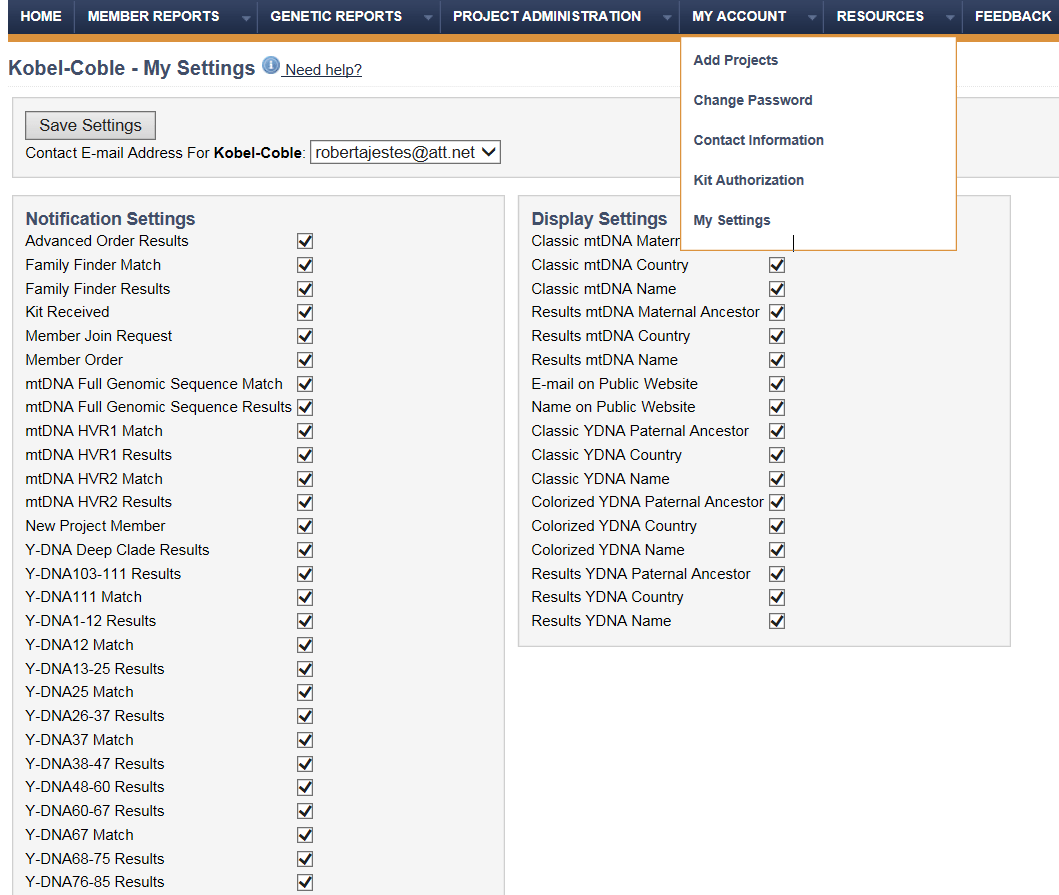
At Family Tree DNA, under your GAP account, select the project you want to modify (at top right) and then click on the “My Account” tab on the top toolbar, then “My Settings” and you will then be presented with a long list of notification settings on the left.

Now, just unclick the ones you don’t want to receive.  It’s that easy.

IMPORTANT – When finished – click on “Save Settings” at the top left of the page – or it won’t!

GAP Notification Selection

______________________________________________________________

Disclosure

I receive a small contribution when you click on some of the links to vendors in my articles. This does NOT increase the price you pay but helps me to keep the lights on and this informational blog free for everyone. Please click on the links in the articles or to the vendors below if you are purchasing products or DNA testing.

Thank you so much.

DNA Purchases and Free Transfers

Genealogy Services

Genealogy Research

Cultural Footprints

I was recently corresponding with a descendant of Valentine Collins, one of the Melungeon families of mixed race found in and nearby Hawkins County, Tennessee in the 1800s.

Here’s what he had to say.

When I first started looking into my Collins’ family history, I realized very early this was going to be a real adventure. What I did was set up a system to look at different aspects of their lives/history. I call it ‘cultural footprints’. I have those foot prints broken down as:

  • Religion
  • The Table (food)
  • Music
  • Language

Most of the data I’ve mined are based on these four Cultural Footprints. But I would have to say Genetic Genealogy provided the biggest breakthroughs, the best tool by far.

Well, obviously I liked his commentary about genetic genealogy, which gives us the ability to connect and to prove, or disprove, connections.  But as I looked at his list, I thought about my own ancestors.  Those of you who follow my blog regularly know that I love to learn about the history during the time that my ancestors were living – what happened to and near them and how it affected them.  But his commentary made me wonder what I’ve been missing.

As I think back, one of the biggest and most useful clues to one of my ancestral lines was an accidental comment made by my mother about her grandmother. She mentioned, in passing, “that little white hat that she always wore.”  I almost didn’t say anything, but then I thought, “little white hat, that’s odd.”  So I asked and my mother said something like, “you know, those religious hats.”  I asked if she meant Amish or Mennonite, given the context of where they lived and she said, “yes, a hat like that.”  Then, when questioned further, it turns out that the family didn’t drive, even though cars were certainly utilized by then.  My mother never thought about it.  Turns out that the family was actually Brethren, also one of the pietist faiths similar to Amish and Mennonite, but that hint sent me in the right direction.

How could my mother have been unaware of something that important, well, important to me anyway?  Easy.  It was, ahem, not discussed in the family.  You see, it was somewhat of a scandal.

My mother’s father had married outside the Brethren religion, so was rather ostracized from the family for his choice to marry a Lutheran. Then the family became, horror of horrors, Methodist.  So, I would add clothing to my friend’s list of cultural footprints as well.  Sometimes, like in my case, dress will lead you to religion.  In the photo below, my mother’s grandmother is the female in the middle back row.  If you look carefully, you can see that both she and her mother are wearing a prayer cap.

John David Miller Photo

I know the religion of many of my ancestors. Whatever their religious choice, it was extremely important to many.  I have 1709ers, Acadians, Brethren, Mennonites, Huguenots, fire and brimstone Baptists, Methodists and Presbyterians in my family line.  I always try to find their church and the church records if possible.  Some are quite interesting, like Joseph Bolton who was twice censured from the Baptist church in Hancock County, Tennessee.  Many of my ancestors made their life choices based on their faith.  In particular, the Huguenots, 1709ers, Brethren and Mennonites suffered greatly for their beliefs.  Conversely, some of my ancestors appear to never have set foot in a church.  I refer to them as the “free thinkers.”

Well, in one case, my ancestor was a bootlegger in the mountains of Kentucky. What the hey…every family has to have some color, and he was definitely colorful….and free thinking.

Most of us are a mixture of people, cultures and places. All of them are in us.  Their lives, culture, choices and  yes, their DNA, make us who we are.  If you have any doubt, just look at your autosomal ethnicity predictions.

Language of course is important, but more personally, local dialects that our ancestors may have spoken. In the US, every part of the country has their own way of speaking.

Here’s a YouTube video of a Louisiana Cajun accent. Many Acadians settled in that region after being forcibly removed from Nova Scotia in 1755.

Acadian-Cajun language, music and early homes in Louisiana

Here’s a wonderful video of Appalachian English. In my family, this is known as “hillbilly” and that is not considered a bad thing to be:)  In fact, we truthfully, all love Jeff Foxworthy, well, because he’s one of us.  I’m just sure if we could get him to DNA test, that we’d be related!

There are regional and cultural differences too.

Here’s a video about Lumbee English. The Lumbee are a Native American tribe found in North Carolina near the border with South Carolina.

Going further east in North Carolina, the Outer Banks has a very distinctive dialect.

What did your ancestor’s speech sound like?   What would it have sounded like in that time and place?

That, of course, leads to music. Sometimes music is the combination of speech and religion, with musical instruments added.  Sometimes it has nothing to do with religion, but moves us spiritually just the same.  Music is the voice of the soul.

Here’s Amazing Grace on the bagpipes. If you can get through this dry-eyed, well, then you’re not Scottish…just saying.  This connects me to my Scottish ancestors.  It was played at both my mother’s and my brother’s funerals.  Needless to say, I can’t get through it dry eyed!

Amazing Grace isn’t limited to bagpipes or musical instruments. The old “hardshell” Baptists didn’t utilize musical instruments, and still don’t, in their churches.  Listen to their beautiful voices, and the beautiful landscape of Kentucky.  This is the land, voices and religion of some of my people.

A hauntingly and sadly beautiful Negro Spiritual. Kleenex box warning.  This, too, is the music of my family.

Yeha – Noha – a Native American song by Sacred Spirit. One of my favorite music pieces.

Bluegrass gospel – Swing Low Sweet Chariot. Bet you can’t keep your foot from tapping!!!

Appalachian fiddle music. Speaks directly to my heart.  And my hands.  I just have to clap my hands.

Acadian music. This would be very familiar to my Acadian ancestors.

At this link, you can hear samples of Acadian folk songs by scrolling down and clicking on the track listing.

Moving a little closer in time. This is the official state song of Tennessee – one of my all-time favorites.  I can’t tell you how many times I’ve danced to this.  This just says “home” to me and I can feel my roots.

What kind of music did your ancestors enjoy? Did they play any musical instruments?  Can you find the music of the time and place in which they lived?  YouTube has a wide variety and the videos are an added benefit, bringing the reality of the life of our distant ancestors a little closer.

Now that you know what fed their souls, let’s look at what fed their bodies.  Along with regional speech and musical differences, the diet of our ancestors was unique and often quite different from ours of today.

On the Cumberland Gap Yahoo group, we often exchange and discuss regional recipes, especially around the holidays. Same on the Acadian rootsweb group.  Although this year we’ve been talking about deep fried turkeys.  Maybe in another couple hundred years that will be considered representative of our time.  Hopefully it’s not McDonalds!

The Smithsonian sponsors a website about Appalachian foods.  Let me share with you what I remember about my childhood.  We made do with what we had, whatever that was.  Some things were staples.  Like biscuits, with butter, or honey, or jam, or apple butter…whatever you had on hand that was in season.

biscuits

Chicken fried in bacon grease was for Sunday, or company, which usually came on Sunday.

fried chicken

We wasted nothing, ever, because you never knew when you might not have enough to eat. So, we ate leftovers until they were gone and we canned. Did we ever can.  Lord, we canned everything.  Mason jars in huge boiling kettles in the hottest part of summer.  Let’s just say that is not my favorite memory of growing up.  But green beans at Christmas time were just wonderful, and you couldn’t have those without canning in the August heat.

cans

Different areas have become known for certain types of cuisine. In North Carolina, they are known for their wood-fired BBQ.  In western North Carolina, they use a red, slightly sweet, tomato based BBQ sauce, but in eastern NC, they use a vinegar based BBQ sauce.  Want to start a fight?  Just say that the other one is better on the wrong side of the state:)

BBQ pit

Creole cuisine is found in the south, near the Mississippi Delta region and is from a combination of French, Spanish and African heritage.

creole

Jambalaya is a Louisiana adaptation of Spanish paella.

OLYMPUS DIGITAL CAMERA

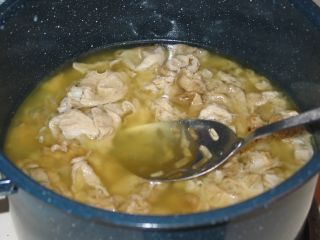
Soul food is the term for the foods emanating from slavery.  When I looked up soul food on wiki, I found the foods my family ate every day.  When I think of food that we didn’t eat, but that my African American cousins did eat, I think of chitlins.  Yes, I know I didn’t spell that correctly, but that’s how we spelled it. And the chitlins we had were flowered and fried too, not boiled.  Maybe that is a regional difference or an adaptation.

chitterlings

Another “out of Africa” food is sorghum, used to make a sweet substance similar to molasses, used on biscuits in our family. Sorghum is an African plant, often called Guinea Corn, and arrived with slaves in colonial days.

sorghum

Native American cuisine varies by where the tribe lived, and originally, they lived across all of North and South America. Originally, the Native people had the three sisters, corn, squash and beans.  Hominy is Native, as is grits, a southern staple today.  I’m drooling now…

grits

Today, however, one of the signature Native American dishes is FryBread. Fried and seriously unhealthy, the lines at powwows are longer for frybread and a derivative, Indian Tacos, than anything else.

frybread

In many places, the settlers, slaves and Native people assimilated and the food their descendants ate reflected all three cultures, like Brunswick Stew.  Even Brunswick Stew varies widely by location as do the origin stories.  Many foods seems to have evolved in areas occupied by European settlers, Native people and slaves, to reflect ingredients from all three groups.

Brunswick stew

That’s the case in my family, on my father’s side. We didn’t know any differently, or where that particular type of food originated.  However, sometimes by looking at the foods families ate, we can tell something of their origins.

In marginalized populations, and by that, in the US I mean mixed race or descendants of enslaved people, it’s often very difficult to use traditional genealogical records because they didn’t own land or leave other records. Many of them spent a lot of time trying to make themselves transparent and didn’t want to attract any attention.

Often, it’s the DNA that unlocks the doors to their heritage, and after making that discovery, we can then look the cultural footprints they left for us to follow.

I’m starving. I’m going to eat something unhealthy and listen to some wonderful music!  How about grits with butter and Indian tacos for lunch along with powwow music?  Oh yeahhhhhh…….

______________________________________________________________

Disclosure

I receive a small contribution when you click on some of the links to vendors in my articles. This does NOT increase the price you pay but helps me to keep the lights on and this informational blog free for everyone. Please click on the links in the articles or to the vendors below if you are purchasing products or DNA testing.

Thank you so much.

DNA Purchases and Free Transfers

Genealogy Services

Genealogy Research

Anzick Matching Update

In response to my article about haplogroup C3*, a regular contributor, Armando, left the following comment:

“Roberta, there was a problem with the way Felix was processing files and he had to change the Clovis Anzick file three times at Gedmatch. The last one is kit F999919 uploaded October 8, 2014. You can see his post on that at http://www.fc.id.au/2014/10/new-clovis-anzick-1-kit-in-gedmatch.html

If you do one-to-many matching on Clovis Anzick F999919 at Gedmatch there is not a single person that reports to have mtDNA M. Your extracts for Clovis Anzick are from September 24, 2014 and therefore are based on a bad file which was kit F999912. The older bad kits F999912 and F999913 have been deleted from Gedmatch. Felix mentions the updates at http://www.fc.id.au/2014/09/clovis-anzick-1-dna-match-living-people.html

This comment came in on Christmas Eve, and I replied that I would look into this after the holidays.

Given that it was Christmas Eve, I certainly wasn’t going to bother anyone over the holidays with questions, so I quickly ran a one to many compare for the current Anzick kit, F999919, and found at 5cM and below that there were 4 haplogroup M matches.

ancient match

As I did before, I sent emails to those who provided e-mail addresses asking about their matrilineal heritage.

The first thing I wanted to do, of course, was to check with Felix.  I knew that Felix had updated the kits, but my understanding was that he added SNPs from the various companies to create a single file with all the SNPs from all three testing companies, not that any file was bad, so to speak.

I asked Felix if the original files had problems or were bad, and here is his response.

“I can assure you none of the earlier/older versions uploaded to GEDmatch (kit# F999912 and F999913) of Clovis Anzick was bad.

  • F999912 – Contains only FTDNA SNPs extracted from VCF file provided by authors.
  • F999913 – Contains all SNPs used by DNA testing companies extracted from VCF file provided by authors.
  • F999919 – Contains all SNPs used by DNA testing companies processed from BAM file provided by authors.

Source files: 

I removed the earlier versions not because they are bad but only to avoid redundancy for the same sample kit, and processed BAM file (which is a 41 GB file) contains significantly more SNPs compared to VCF source. Because the latest file has more SNPs, it is possible that some missing SNPs in earlier uploads (which was assumed as matching in GEDmatch) may actually have mismatches in new file and thus, could fall below the thresholds or could break the previously matching segment.

The difference in matches between F999912 and F999919 kit for Clovis Anzick is similar to difference in matches between a 23andMe V4 kit and V3 kit for the same person.”

After thinking about this some, it occurred to me that perhaps GedMatch was treating different files from different vendors differently in their matching and sorting routines. That might account for a difference in matching. So, I asked John Olson at GedMatch.

John’s reply is as follows:

“At one time, I did use different thresholds depending on which vendor was being compared to which other vendor.  That was a holdover from when FTDNA had Affymetrix kits that were producing somewhat different results than Illumina kits.  I have since changed the one-to-many thresholds to 5cM/500 SNPs for all comparisons.  The one-to-one thresholds default to 7cm/700 SNPs.  I believe I made that change about a year ago, but it may have been longer.  At any rate, they are all the same now, and I’m pretty sure they are all the same since Felix has introduced the F9999xx kits.  Another change made within the past year is to treat A=T and C=G for all comparisons.  This was done to get rid of single SNP errors in the few cases where one vendor was reporting a different strand than another vendor.  In a few cases, I have observed that this “heals” some single-SNP breaks in otherwise continuous matching segments.

It is possible that older one-to-many comparisons may have been made under slightly different conditions than newer ones.  Older comparisons made with a 3cm/300 SNP threshold may show larger total segment match if they contained many very small matching segments.  This usually happens with endogamous populations.  Comparisons affected by the change to A=T, C=G may show a larger matching segment where 2 smaller matching segments existed previously.

Another issue to be aware of when comparing artificial kits is that there may be large gaps between the defined SNPs.  So, even if there is a gap of a million SNPs, the GEDmatch comparison algorithm will treat them as contiguous.  This works OK when everybody is using the same SNPs, but when the list of SNPs is significantly different, it may produce matches that are bogus.  This is particularly obvious when generating artificial kits that are missing large segments of data.  I have had to deal with this issue with phased kits and Lazarus kits by introducing the concept of a “hard break” that forces a break between smaller matching segments.”

I wanted to know how the three files that Felix prepared compared relative to the matches they produced.  I originally ran several comparisons with each of the first two versions, kits F999912 and F999913, and I didn’t save all of the original files, but I do have at least one file saved from each version.  Therefore, I dropped all three sets of results (F999912, F999913 and F999919) into a spreadsheet to see how matching compared between the three Anzick file versions.

Keep in mind that the first file (F999912) contained just the FTDNA SNPs, while the second (F999913) and third (F999919) files contain the SNPs from all of the testing companies.  This could potentially make the participant files appear to have missing segments when the matching routine at GedMatch sees SNPs in the Anzick file not in the participant files.  However, this shouldn’t be much different than comparing a file from two different vendors except that the Anzick file has the SNPs from all three vendors combined.

The first file from 9-23 at the default threshold had 491 matches, but I subsequently lowered the threshold so I could see as many matches as possible.

GedMatch only shows you your closest 1500 matches, although I now know that as of 12-31-2014, there were a total of 3442 Anzick matches at the 5cM threshold.

The second file from 9-29, run at 6cM had more than 1500 matches.  I ran the third kit at default settings on December 27th and it has 720 matches.

One would expect that the second and third files would have the effect of including more matches from both 23andMe and Ancestry since all of the SNPs utilized by those companies are included (if they are available in the Anzick sample.)  We also have to remember that there are new files being uploaded from all three vendor sites on a daily basis, so the total available to match is also increasing.  Of the 721 kit matches to F999919, 31 were shades of green which indicate that they have been uploaded during the last 30 days, so we could probably presume that about double that number were uploaded (and match) in two months or triple in three months, so probably about 100 new kits.  Those kits would show in the match extraction for this month but not for the first month and possibly not for the second.  However, all the kits that matched the first month at the highest threshold should still be showing in the second and third month.  Let’s see if that holds true.

I dropped all three sets of data into a spreadsheet and colorized the rows.

ancient match 1

  • Blue = F999912, first extraction, 9-23-2014
  • Yellow = F999913, second extraction, 9-29-2014
  • Pink = F999919, third extraction, 12-27-2014

Then I counted the number of blue rows, which are the first extraction, that had matches to both yellow and pink, or only yellow, the second extraction, or only pink, the third (current) extraction, or no matches at all.

You can see that the green grouping shows that all three match each other.  The match between A003479 in both the second and third extraction could be because the kit was not present when the first extraction was done.

All 3 match 1st to 2nd Only 1st  to 3rd Only No Match
Percent First Extraction Matches to Other Extractions 54% 36% 5% 5%

By percent, this is how the matching between kits worked.  About half of the kits in the first extraction continued to match kits in both subsequent extractions.  Of the remaining half, three quarters of the balance matches the second extraction only and a few match just the third extraction or no extraction at all.  For the most part, there is no evident reason upon inspection why the kits would not match the second or third extraction, so the cause has to be a result of the additional SNPs or the matching routine or both.  This is not to imply that the results are problematic, just that they are different than I would have expected.

A very low percentage of kits matched only between the first and third extracts and the same percentage had no matches in either the second or third extraction.

I took a closer look at the kits with no matches at all.  All of them had relatively low threshold total cM and largest segment size.  The smallest total cM was 7.1 and the largest was 8.2.  The smallest segment was 7.1 and the largest segment was also 8.2.  All of these entries had the total cM equal to the largest cM.  It appears that these simply slipped below the match threshold, but that doesn’t appear to be the case because in the current (pink) extract, a total of 171 entries were at or below 8.2 total cM and 8.2 largest cM and several kits had the exact same cM as the kits that didn’t show up from the first (blue) extract as a match – so obviously something truly was different in the SNPs or how the matching was done.

Is there any correlation to the kits in the original extract that didn’t match any other extract in terms of which testing company the participants utilized?

One Ancestry kit (4%), 18 23andMe kits (64%), 7 Family Tree DNA kits (25%) and 2 FN kits (7%) didn’t match anyone.  But how many kits were in the original extract from the various companies?

Original Kit Matches Second KitMatches Current Kit Matches
Ancestry Kits (A) 26 (5%) 438 (29%) 199 (28%)
FTDNA Kits (F) 94 (19%) 295 (20%) 121 (17%)
Other F+ Kits* 15 (3%) 35 (2%) 15 (2%)
23andMe Kits (M) 354 (72%) 732 (49%) 382 (53%)

*FB, FN, FE, FV

The effect of the additional SNPs in the kits seems to have been to increase the Ancestry kit matches significantly.

It was interesting to see how the same person’s kit from different vendors compared as well.  In this random example, the Family Finder kit has a higher total cM and largest segment than the 23andMe v3 kit.

ancient match 2

Here’s a kit from one person at all three vendors, but the 23andMe kit is version 4, in which 23andMe significantly reduced the number of SNPs tested by about one third, from about 900,000 to about 600,000.

ancient match 3

I wondered if there is a difference in what is reported based on the threshold selected.  Now at first glance, one would think, “well of course there is a difference,” but the difference should be on the bottom end of the list.  In other words, the top matches should be the top matches at 7cM, 6cM, 5cM, etc.  The top matches at 7cM would still be the top at 6cM, just more smaller matches appended to the end of the match list – or that is what I would expect.

Let’s see if this holds true with the current file.

I ran the “one to many” option for the current Anzick kit, F999919, at seven different levels, on the same day, one right after the other, as follows:

  • 7cM, 700 SNPs
  • 6cM, 600 SNPs
  • 5cM, 500 SNPs
  • 4cM, 400 SNPs
  • 3cM, 300 SNPs
  • 2cM, 200 SNPs
  • 1cM, 100 SNPs

The first extract produced 719 records.  The rest were all over the 1500 threshold, so we only see the first 1500.  Normally, for genealogy the 1500 threshold would certainly be adequate, but for research, the threshold is frustrating.

To make this easier let me say that the extracts from 5cM down through 1cM were exactly the same, but the extracts at 7, 6 and 5cM, respectively, were not.

Discussions with John Olson at GedMatch shed some light on why the 5cM through 1cM extracts were exactly the same.

 “For the past year or so, the database has only stored matches down to 5 cM.”

I sure wish I had known that BEFORE I did all of those extracts.

I combined and color coded all 7 extractions into a spreadsheet.

Most of the grouping look like this where blue=7cm, pink=6cM, grn=5cM, purple=4cm, teal=3cm,apricot=2cm, yellow=1cm.  Nice rainbows.

ancient match 4

All of the matches from the 7cM extraction, with the exception of a few X matches at the end, some of which have no matches on chromosomes 1-22, are included in the 6cM and 5cM extractions, but after the first several records, they are not in the same position.  In other words, they are not the top 719, in the same order, in either the 5 or 6cM extraction, but the 5cM through 1cM extractions are identical.  Of course, now we know why the 5cM through 1cM matches are exact. From here forth in the article, I won’t mention the 4cM-1cM extracts because they are the same as the 5cM extract.

For example, looking at the kit in position 712, the last non-X match in the 7cM extract – you find this same kit at row 1140 in the 6cM extract and row 1489 in the 5cM extract.

The 6cM extract appears to have some issues.  I ran this twice with the same parameters to be sure there wasn’t an error in how it was set up, and the two runs were identical.

There are about 350 individuals who show up in the 6cM extract who should  show up in the 5cM extract as well, but who don’t show in the 5cM extract.  They are under the threshold for the 7cM extract, so that is correct, but why are these 350 individuals not appearing as matches at the 5cM threshold?

ancient match 5

The kits noted above are the largest non-matching total cM and largest cM that don’t show up in the 5cM extract.  The smallest matches are 6.1 and 6.1, respectively.

Checking the 5cM extract, below, there are files with smaller total cMs and a smaller largest segment that are showing as matches.

ancient match 6

However, looking at the kits with the smallest cMs at the 5cM level, the smallest total cMs is 6.9 and it is combined with the largest segment of 6.9 as well, so that is above the 6.8 and 6.8 shown above.  The smallest individual segment is 5.1 but the total cM for that individual is 10.1.  So obviously the matching threshold at GedMatch is some combination of both the total cM and the largest segment.  This is somewhat unexpected, but doesn’t seem to be a red flag, just how this system works.

So, where are we?

I am glad to have Felix confirm that the files weren’t “bad,” only truly “new and improved,” and that the matching between the various files is pretty much as expected – and from various tests run, everything pretty much looks kosher.  The newer files with all of the SNPs utilized by the companies seem to level the playing field, allowing Ancestry kits a better chance of matching.

Aside from my intense interest due to the Native American connection, this is also how I’ve been extracting potential Native American mitochondrial haplogroups from the Anzick matches, including haplogroup M, for my research notes.  M is potentially a Native American haplogroup, but is as yet unproven.  With haplogroup M showing up in these people who are often heavily Native, and often from Mexico, Central and South America where 80% of the mitochondrial population is believed to be of Native American heritage, it seems prudent to add them to my research notes for further research and possible proof in the future.  I contact individuals and ask about their matrilineal heritage.  If they don’t have Asian or genealogically proven heritage elsewhere, and their families emerge from the areas with high Native frequencies, I include them on the research list.

In the three days between the two extracts this past week, three of the four haplogroup M individuals were pushed below the match threshold and are no longer visible at the default level.  Yes, I have confirmed hat they are still there just not visible at the 1500 match threshold.

I have contacted the individuals with e-mail addresses, asking about their matrilineal heritage.  One person said the tester’s mother’s heritage was from India, so that haplogroup M is not on the research list, of course, because it is proven to be from elsewhere – a place where haplogroup M and subgroups are quite common.

In total, there were 15 new potentially Native DNA mitochondrial DNA haplogroups listed in the 12-27 extract.  I’ll be adding those to my research notes as soon as I have the opportunity to contact these folks and ask about their known matrilineal genealogy.

I didn’t really anticipate that there would be so much change, nor so quickly, so it looks like I’m going to have to check the Anzick matches for potential Native mitochondrial haplogroups much more often.

Since it looks like there may be lots of additions over time, far more than I expected, I’ll also be going back and making better notes in my research file.  I will, for example, note the kit number and date for all of the extractions.  For this and future extractions, I’ll also be listing the number of results per haplogroup.  I think that would be valuable information as well.

I’d like to thank Armando for raising this topic.  The research into matching with a kit that has the entire spectrum of SNPs from all three of the companies has been quite interesting.  In fact, unless Felix has added all of the SNPs to the other ancient kits, this is the only kit in existence that has all of the SNPs from all of the companies included.

My thanks to Felix Immanuel (formerly Felix Chandrakumar) and John Olson for assistance with research for this article.

______________________________________________________________

Disclosure

I receive a small contribution when you click on some of the links to vendors in my articles. This does NOT increase the price you pay but helps me to keep the lights on and this informational blog free for everyone. Please click on the links in the articles or to the vendors below if you are purchasing products or DNA testing.

Thank you so much.

DNA Purchases and Free Transfers

Genealogy Services

Genealogy Research

William George Estes (1873-1971), You’ll Never Leave Harlan Alive, 52 Ancestors #53

Bloody Harlan, it’s called, and aye, for a reason it is.  Yes, indeed, Harlan County, Kentucky is and was a place where justice is decided and meted out outside of the law as often as within the law.  Families often live by the “old school” there and people believe, right or wrong that the laws don’t apply to them.  Sometimes vigilante justice is much swifter and with much less mercy that the laws of the land, and other times, justice never occurs.  One way or another, Harlan County, Kentucky is certainly an interesting location.

harlan map

And Harlan County, of course, is where my grandfather, William George Estes, known as Will, wound up living after he and my grandmother, Ollie Bolton divorced in the mid 19-teens in Indiana.

Harlan still

Harlan, a center of bootleg moonshining activity for all of the 1900s and before, is, ironically a dry county, in which one single small city, Cumberland, allows liquor sales.  I guess that means it’s a damp county, not entirely dry.  Now that’s no problem, since many stills (examples shown here) survive up on that desolate mountain.

Harlan still 2

That would be Black Mountain, the largest, tallest mountain in all of Kentucky.  I drove for 70 miles and still wasn’t at the top.  Black Mountain is the border between Kentucky and Virginia, and the further East you go into Harlan County, the further up you go as well, until you either turn around or descend across the crest into Virginia.  There are two roads in, both culminating in the city of Harlan and two roads out, both crossing the ridge into Virginia.  One of the roads in is called “Kingdom Come” which is the original 119.  That’s where Will Estes lived in his later years, I’m told, “above Cumberland” on 119.  He’s buried in the D.L. Creech cemetery near the red balloon below, probably close to where he lived.  Notice the “new” 119 is relatively straight, but the “old road” looks like a snake’s path back and forth winding across the new road like laces in a shoe.

Harlan Creech cemetery map

Words like remote don’t even begin to describe the step back in time one experiences when visiting Harlan County. Harlan is also stunningly beautiful.

harlan view

Most people in Harlan County are very nice, albeit a bit suspicious about why you are there and asking questions, unless you startle them or cross them.  The rest, well, just beware.

Today, along with moonshine, Harlan produces both marijuana and meth, and that population doesn’t want either of those crops interfered with. Now when you’re graveyard hunting….you’re not on the beaten path, so it tends to be a little more, um, precarious.

To put things in perspective, Harlan County has one fast food restaurant.  There is one gas station between Pineville and Harlan, a distance of 70 miles, and that gas station has a very large padlock on the restroom door and once inside, it smells worse than any outhouse I’ve ever visited.  It was last cleaned about 1960.  The convenience store clerk is openly wearing a gun and the “fried chicken” portion of the store closed long ago but the greasy smell still permeates everything.  Yep, you’ve arrived.  Gas station pumps don’t take credit cards.  The sign on the door says three things.

The first sign says:

  1. Prepay after dark.

That sign is marked through and written in is:

  1. Only customers that are known to cashier don’t have to prepay.

That is marked through and below that is scratched.

  1. Cashier says everyone including Jesus Christ must prepay.

I wish I had taken a picture.

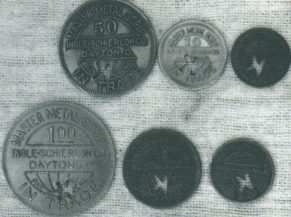
Pretty much all jobs in Harlan County, the legal ones that is, revolve around the mines.  Harlan has a love/hate relationship with the mines and mining companies.  Back in the 1930s the mines and mining companies owned the towns and people.  Workers were paid in “script”, below, money only redeemable at the company stores, where everything was overpriced.

minimg script

Poverty was rampant. Eventually, riots ensued in the 1930s with many murders on both sides of the fence, the miners and their families and the “company men”.  The nickname “Bloody Harlan” arose during this time.  Another similar strike occurred in the 1970s.  Women were actively involved in the “war” too, and an award winning documentary film was created in 1976 entitled “Harlan County, USA”.  Life has never been easy nor peaceful in Harlan County.  Life has always been tough, really tough.

The country song “You’ll Never Leave Harlan Alive” strikes the chord I felt in Harlan County.  Please listen to Darrell Scott sing this hauntingly beautiful song.  Soulful country music at its best – recording the history of our people.  Patty Loveless originally recorded this song and her video includes photos of the region that speak thousands of words.

“Spend your life thinking about how to get away”…..but few do.

“Sun comes up about 10 in the morning and goes down about 3 in the day”…..that’s because the valleys are so deep and steep.  GPS and satellite radio don’t work there because they can’t see outside the valleys to the satellites.  Cell phones?  Mine was useless.  Don’t bother trying.

My grandfather lived the second half of his life in Harlan County, died there and is buried in a grave with no marker.  So very Harlan.

No, you’ll never leave Harlan alive…

William George Estes obit

We don’t have any photos of William George Estes as a child, but one of his earliest known photos with Ollie is shown below.  Ironically, one of the things that Will did was to take photographs of people, so he’s not in many, at least not until he acquired a timer for the camera.

Ollie and William Estes

Will was probably about 40 years old in this photo.  He was born in Claiborne County on March 30, 1874 to Lazarus Estes and his wife Elizabeth Vannoy Estes.  On September 26, 1892 he married Ollie Bolton in Claiborne County.  Their first child, Samuel, was born in July the next year and would live only 6 weeks before they buried him in the family cemetery.  Not a good start for a young couple.

William George Estes and Ollie Bolton would have several children:

  • Samuel Estes born and died in 1893

Venable - Samuel Estes

  • Charles Estel Sebastian Estes (1894-1972) married Edith May Parkey

His delayed Arkansas birth certificate was issued in 1957 and signed by his father, attesting to his birth.

Estel Estes

  • Infant (1896 – before 1900) born and died in Arkansas
  • Robert Estes (1898 – before 1907), died when the house burned
  • Infant (born and died about 1900)
  • William Sterling Estes (1902/3-1963), below, married several times.

William Sterling Estes in WWI

  • Joseph “Dode” Estes (1904-1994) married Lucille Latta and had two sons. Robert Vernon Estes (1931-1951) was taken as a POW in Korea and died in captivity, his body never returned. Charles Arthur Estes (1928-1986) married and had a daughter. This photo, according to Aunt Margaret, was taken either in Quantico, VA or Balboa in San Diego when he was 13, posing as 18 to join the military.

Joseph Dode Estes in WWI

  • Margaret Estes (1906-2005) married Ed O’Rourke, had one son that died.
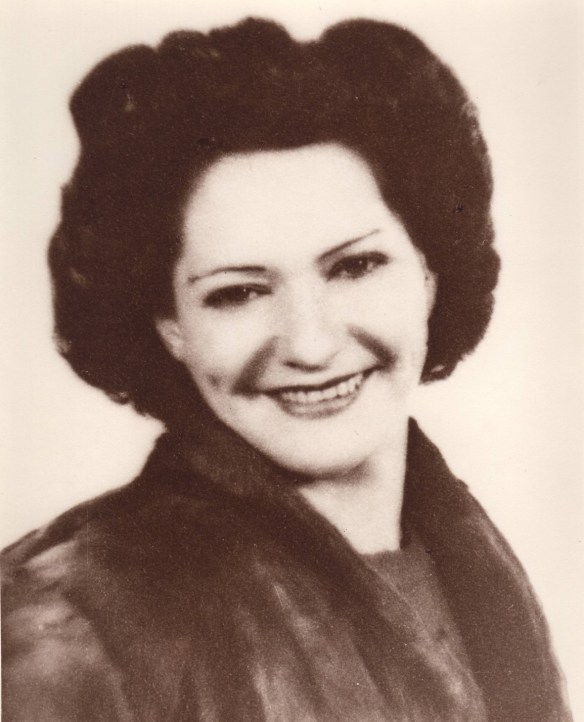
Margaret Estes

  • Minnie Estes (1908-2008), married several times but had one son with John Raymond Price.

Minnie Estes pearls

  • Twins (born and died in roughly 1913)
  • Elsia (born and died roughly 1914 or 1915)

After their first child died, William George Estes and Ollie left Claiborne County for a new beginning and moved to Springdale, Arkansas, shown below outside the post office about the time that Will and Ollie lived there.

Springdale Arkansas downtown

Fifteen months after Samuel died, their next child Charles Estel was born in Arkansas.

Two years later another baby was born, died and was buried in the Arkansas soil, alone.  In 1898, Robert was born.  Ollie ran a boarding house in Springdale.  By all reports, Will spent his days fishing and his nights drinking.

During my visit to Springdale in 2004, I noticed the bridge and creek across from the old “hotel” in what is now “old town.”  I figured while Ollie was changing beds and cleaning chamber pots and spittoons and taking care of her young children, Will was fishing off the bridge.  It must have been a tough life for Ollie.  For some reason, this area was settled by several Claiborne County families, so they did have at least some distant Clarkson/Claxton family there.

By the 1900 census, they were back in Claiborne County and Will has been out of work for 6 months.  Uncle George (Estes) told me before his death that Will and Ollie moved back to Estes Holler and lived in a little cabin just down from Lazarus’s land, along the creek.  I suspect that they might have had another child that died in 1900.  However, we do know that my father was born in (or about) 1902, followed by Joseph “Dode” in 1904, Margaret in 1906 and Minnie in 1908.  Sometime before 1907, the cabin caught on fire.  Some family said that Ollie was outside in the yard.  Others said she was at a party.  No one said anything about where William George was.  Estel tried to get little Robert out, but he crawled under the bed.  Robert died in the fire.  William George and Ollie buried Robert beside their first child in Estes Holler. Uncle George later planted a willow tree where the cabin burned, and that tree has since fallen and is gone, with nothing left to mark the place where they lived and their child died.  I am probably the last person alive who knows where that cabin was located.  Perhaps it’s a memory better left to dissipate with the winds of time.

Ollie 1907

The photo above shows my father, standing on the ground, along with Estel, the oldest child, standing.  The blonde child on the chair was probably Joseph Dode since he looks to be younger than my father and Dode was born in 1904. The baby is Margaret, born in 1906.  This photo was probably taken about 1907 and the note on the back says Cumberland Gap.  Ollie Bolton Estes does not look like a happy woman.  She would have recently lost her son, Robert.

Shortly thereafter, Ollie and Will departed again, this time for the farmlands of Indiana.

Outside of Fowler, Indiana, farms needed tenant farmers and it seemed like a land with more opportunity than the limited land that Estes Holler had to offer.  Aunt Margaret, before she passed away, and before she became too demented, told me that there were twins born and died in 1913.  She told me that Will and Ollie’s last child, Elsia, was born in 1914 in Fowler and that she later died in Cook County, Illinois. She said that Elsia was “retarded” as special needs children were called at the time.  At one point Margaret also mentioned another set of twins born in 1918, but if this is correct, they may not have been Will’s and they did not survive.  He was back in Tennessee/Kentucky by 1918.  Margaret was one of the Crazy Aunts, so you never really knew what or how much to believe.

Estes family 1914

The photo above, the only photo of the entire family, minus the deceased children, of course, was taken in Fowler, Indiana in about 1914.

It was in Fowler that Ollie and Will’s marriage deteriorated to the point of divorce.  According to several sources, Ollie’s cousin, Joice, said as Joicey, was visiting in Indiana.

Now just out of curiosity, I had to figure out just how Ollie and Joice were related.  And this just goes to show how the word “cousin” is interpreted in Appalachia.  Are you ready for this?

George Hatfield had a son Lynch who had a son Walter who married Mary Polly Hurst, whose mother was Mahala Claxton, daughter of James Lee Claxton and Sarah Cook.  George Hatfield also had a son Ralph who had a son Lynch who had a son Lynch who had daughter Joice.  So Ollie’s grandfather’s 1st cousin (or Ollie’s 1st cousin twice removed), Mary Polly Hurst, married Walter Hatfield.  Walter Hatfield’s father’s brother’s great-granddaughter was Joice Hatfield. So, in case you’re having trouble following this, I tried to chart the connection.

Hatfield Clarkson Tree

If you’re looking at this saying to yourself, “they aren’t related by blood, only by marriage,” you would be right.  Not only that, but related by marriage going back up the tree 4 generations, then down two, from both sides.  This explains, better than anything else, the concept of kinship in the south – or at least in this part of Tennessee.  Probably more important than anything was that these families still lived, for the most part, on the same land or at least in the same holler that their ancestors did, as close neighbors, so the kinship connection remained strong and encompassed everyone closely or distantly related.  So, four generations out, you were literally related to everyone in that part of the county.  By the way, that also made their business your business….just saying.  Oh, and if you didn’t like them, you just claimed they “weren’t kin” even if they lived across the road with the same last name.

Ollie came home one day to find Will “in the act” with her young teenage cousin, born in 1893, 20 years younger than Ollie.  Ollie took a horsewhip to them both and from all accounts, nearly killed Will.  The neighbors had to restrain Ollie and it reportedly took several men to get it done.  She was pregnant with either Elsia or the twins at the time, depending on whose version of the story you are listening to.  One version says the incident made Ollie go into labor early and she had the twins prematurely and they were stillborn.  If that is true, then she subsequently got pregnant with Elsia, if the dates are correct.  I have never been able to substantiate the births or deaths of either the twins or Elsia, but I have no reason to think they did not exist, especially since multiple people told me of their births.

Regardless of the exact timing and order of those unfortunate events, sometime around 1915, Ollie left Fowler for Chicago, without Will, and took Minnie and Margaret with her.  Aunt Margaret’s letters written many years later to my step-mother said that neither Ollie nor Will wanted the boys.  Estel, by then age 19 or 20 was old enough to fend for himself.  However, my father William Sterling known as “Bill” and also as “Sterl,” and Joseph known as “Dode” were only early teens, if that, and didn’t know exactly what to do.

Bill and Dode hopped a freight train for Tennessee and found their way back to Claiborne County looking for family and food.  They showed up half-starved and filthy and telling tales about what happened between their mother and father.  By the time Will showed up back in Estes Holler with young Joice in tow, Lazarus Estes, his father, was having none of that, and Will got himself chased out of Estes Holler for “doing Ollie wrong.”  To my knowledge, no one had ever been run out of Estes Holler, and we’ve got some pretty colorful characters to our credit.  Lazarus told Will if he came back, he’d kill him, or so the story goes.  Lazarus Estes and his wife Elizabeth Vannoy are shown below.

Lazarus and Eliabeth Vannoy Estes

The only place rougher than Estes Holler was Harlan County, and Will could go there and “hide out” (Will’s words) from both his Estes kin, Ollie’s kin and Joice Hatfield’s kin.  It seems that everyone except Joice was mad at Will.  And she would be shortly.

And yes, these are the Hatfield’s of Hatfield and McCoy feud fame and yes, Will fit right in in Harlan County.  In March of 1918, Joice had daughter, Virginia Estes, shown together below.

Joice Hatfield and Virginia Estes crop

This photo is from Virginia’s obituary in 2000.

Virginia Estes Brewer obit - dau of william George

We don’t know exactly when William George Estes came back to Claiborne County, but do know he registered for the draft on September 12, 1918 and he was living in Claiborne County at that time and Joisce is listed as his nearest relative.

WGEstes crop

The 1920 census shows us that Will is living with wife Joice, daughter Virginia, and with them, we find Joice’s younger cousin, Croice (also Crosha, Croshie) Brewer, along with her young son, Horace.  There is no further record of Horace.  Crocie was listed as “deaf and dumb.”  You know what’s coming next don’t you?

What is the best predictor of future behavior?  Past performance.

Yep, Will, again, finds himself involved with his wife’s younger cousin who is living with them.  You’d think that Joice would have known better, all things considered.

According to Margaret and cousins in Estes holler, Will actually wound up married to both of these women at the same time, one “over the mountain” in KY and one in TN.  Does this sound familiar?  Did his son, William Sterling Estes, follow in his bigamist footsteps?  That old apple and tree saying seems to hold true.  What a mess Will made.  Eventually he reportedly would live with neither wife.  I have no idea how he got himself untangled from two simultaneous marriages, or if he ever did, assuming the story is true in the first place.

Josephine Estes crop

Will had three children by Crocie, Josephine, above, born in 1923.  There appear to be pages missing, or at least several residences missed in the 1930 census on Black Mountain, but the 1940 census reports that Josephine was born in Arkansas, so Will and Crocie may have lived there for a time but were back in Harlan County by 1925.

In 1925, a baby girl names Helen May Estes was born in Lynch, Kentucky.  No one in the family ever talked about this child, or, for that matter, their son William James Estes. Helen May died when she was six years old.  Her death certificate says that she died of broncho-pneumonia on April 3, 1931, and that she had smallpox.  She was buried in the Gillam Cemetery, where their son would also be buried a few years later.  I found it odd that Helen wasn’t buried until almost a full month later, on April 4th.  It must have been a terrible month for the family.  Given that the address on the death certificate was listed as “Shack #74, Lynch,” the issue could have been money for a burial plot.  Crocie was also heavily pregnant for Evelyn as well, and may have been ill herself.

“Red-headed Evelyn” was born shortly after Helen’s death in 1931 in Kentucky and a son, William James, who was born in 1935 died as an infant in 1937 under questionable circumstances.  His death certificate states the following:  “Died of acute intestinal indigestion” and it’s noted that it was “from improper food. 2 years 6 months old and buried in the Gilliam Cemetery,” located just above Cumberland on the map below.  Remembering what Margaret said about having no food when they were children, and being fed alcohol, I have to wonder what happened to poor William James Estes.

William James Estes burial

There was some question for a long time whether Josephine was the child of Joice or Crocie.  However, since Josephine is buried in the cemetery where Evelyn, Will and Crocie are buried, she is most probably Crocie’s daughter.

Joice went back home to Hancock County, Tennessee. In the 1930 census, she is listed as Jaysey Hatfield, living with her parents, Lynch Hatfield and Virginia Foley Hatfield.  Daughter Virginia is also listed under the Hatfield surname, and there is no daughter Josephine.

In 1940, Virginia Estes is found married to Little Brewer in Hancock County, with Dorothy aged 2, and Gennett (Jannette,) 7 months old.  Virginia and Little Brewer moved to Anderson, Indiana and lived there most of their lives, working in the auto plants.  They had one more child, a son, Ambrose, born in 1942 who predeceased Virginia, who passed away in 2000.

Both Evelyn, who married Marco Pusice, a polish miner, and Josephine who married Andy Jackson lived their lives in Harlan County.  Both women, their husbands, Will and one of his wives, a “Mrs. Estes” who we presume is Crocie who died in 1961, are all buried in Harlan County in the D.L. Creech cemetery.  Joice died in 1965 in Anderson, Indiana where Virginia, her daughter, lived.

I’m sure that the Bolton/Hatfield/Brewer family reunions were interesting after that, especially given that Virginia married into the family of Crocie, Will’s third wife and Joice’s cousin who cheated with Will.  Of course, that’s kind of karmic in a sense, because Joice also cheated with Will, on her cousin, Ollie.  What’s that saying…what goes around, comes around.

If Will was a smart man, he steered very clear of any family of these women, especially male family members.  Maybe he just stayed out of Hancock County altogether.  He’s lucky he didn’t just “disappear” although the remoteness of Black Mountain and the roughness of Harlan County was probably very intimidating to anyone not from there – and it probably served to protect Will.

William George Estes in tie

To the best of my knowledge Will never worked inside the mines.  He reportedly made pilings for shoring up the mines.  Some said he wound up with a lot of mine land, but the deed index of Harlan County shows that Will owned no land at all, neither did he have a will.

The 1940 census and the entries surrounding those of William George Estes are quite interesting and gives us a flavor of what life was like in Harlan County.  Among other things, this census tells us that William George Estes never attended school.  Crocie has 4 years of school. Josephine at age 17 was classified as H3, probably 3rd year of high school.  Sadly, Eveline had no school at 8 years of age.  Perhaps Josephine was staying with someone in town.

1940 Harlan Ky census

Most of the families, for pages and pages in each direction were listed with a margin note that said “shack.”  William George was listed with a note that said “lease.”  However, the number is “74” which is the same location as given in the 1931 death certificate for Helen May.  William George is listed as a farmer and everyone else, with no exceptions, is listed in some way associated with the coal mines, or as a timberman.  I’m reminded of the family stories that said Will “made a lot of money” selling timbers to shore up the mines.  A “lot of money” may have been relative, when compared to hundreds of families living in shacks.  Someone who leased land might have been considered wealthy.  And given that we know that he was a moonshiner, we know in this case, what farmer really meant.

There is a column for where each family lived in 1935 and a surprisingly high number of these families lived in the “same house.  Will’s says the same thing, so this is where they were living in 1935 when their son was born and in 1931 when their daughter died.  They are missing in the 1930 census, but this is also likely where they were living then as well and possibly in 1925 when Helen was born.

Three entries before Will we find a margin note saying “Big Looney Creek” on leased land and 5 shacks before that another lease that says “Looney Creek.”

Seven shacks after Will’s leased land, we find Looney Creek listed again, and right beside that, two shacks later, “Top Black Mountain.”  So, Will didn’t live quite at the highest elevation in all of Kentucky, “in the last house at the end of ‘bad ass street'” as it was termed where I grew up, he lived about 10 houses below the summit.

This red balloon shows Looney Creek just below the top of Black Mountain where it crosses at the summit into Virginia.  The road follows the creek path from the top of the mountain through Lynch and Benham to Cumberland.

Looney Creek Harlan

Below is a satellite image of this area today.  We know that Will lived “above Cumberland” near Looney Creek and below the top of Black Mountain.

Looney Creek Harlan satellite

On the census, Gap Branch In Lynch, KY, is shown before Will’s location, several pages.  Today, there are no houses or “shacks” on 160 south of the two 160 markers at the top of the photo, below.  Lynch is the community that includes Gap Branch located between those top two 160 markers (below), between Benham and the red balloon (above).

Gap Branch and Looney Creek

To put this in further perspective, Will is buried above Cumberland on 119 near the first red arrow on the map below.  His son William James and daughter Helen May are buried “above Cumberland” between Cumberland and Benham, near the second arrow.  William lived someplace on 160 between Gap Branch (In Lynch, KY), the red arrow between the two 160 markers below Benham on this picture, which in Harlan County would be termed “above Benham” because of the elevation.  This arrow is located between the two 160 markers, between Benham and the top of Black Mountain.  The fourth, furthest right, red arrow is the last location of any housing today, at the 160 marker.  The red balloon is the google location for Looney Creek.  Looney Creek actually begins about half way between the red balloon and the top of the Mountain.  That would be where the freshest water would be found, so the safest to drink.  Black Mountain is the highest and most rugged and inaccessible location in Kentucky.  In the earlier 1900s, when coal was first discovered here, it was reported that there was only one mule path across this mountain.

Harlan satellite with arrows

Mom said that when she went to visit with my father in the 1950s, his house was extremely remote and difficult to get to.  She shuddered to think of it.  Mom met Crocie so she apparently lived with him at that time.  Mother didn’t care for how he treated Crocie, although she was never specific.  Mother never went back. Others referred to Crocie as Will’s virtual slave.

By the 1960s, Will was writing letters to my father about having Evelyn “hid out” until things settled down.  I don’t know what Evelyn was doing that time, but another letter mentions “bad checks.”  Both Evelyn and Josephine were exceptionally beautiful women and known in the vernacular of the day as “sirens.” It’s not surprising that they were somewhat wild, given their genetic heritage.  Furthermore, their Dad was a known moonshiner and bootlegger.  White lightning greasing the skids of popularity I’m sure for those girls, as did their beauty.
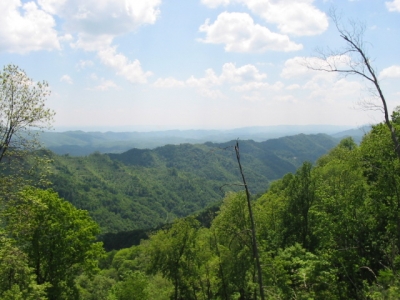
Black Mountain Harlan County

But moonshining wasn’t the whole story.  The whispered family history, and there was a LOT of whispered family history, revealed stories of Will killing a revenuer in the 1920s or 1930s.  The story goes that the revenuer had the bad judgment to try to take Will alone up on Black Mountain, shown in the photo above.  It never happened, and the revenue agent was never seen again.  Now I chalked this up to old family gossip, known in the south as “no account talk,” especially since so many of the stories about this family have proven to be unfounded or at least unsubstantiated.  However, a few years ago, through another source entirely, I heard the story of a revenue agent, who supposedly went up on Black Mountain after a moonshiner in the 1920s and was never heard from again.  It seems very odd that a revenue agent would work alone in that venue.  It almost smells like some kind of payola deal gone bad.  I have always wondered if those two stories are just coincidence – or maybe one fed the other.  Only Will knows for sure, and he’s not talking.

That’s not the end of the extraordinary stories about this family either.  It seems that something happened to Evelyn, Will’s daughter.  Two different children of Estel’s told me that Evelyn was murdered, her throat cut and she was nearly decapitated in front of her children.  One version says that she was married to a “Jake”  whom she divorced, then married “an old man,” one source says a doctor, who she took care of until she died.  Another family source says that a robber broke into their home and she was nearly beheaded in front of her children, murdered.

I found Evelyn’s death certificate and she died of a hyperglycemic coma at age 46, BUT, an autopsy was indeed performed, which is extremely odd under those circumstances.  Anemia was a contributing factor, but no injuries were listed.  If you were “anemic” because your throat had been slashed, I’d think that would be noted on the death certificate as a contributing factor.  Evelyn had one daughter, Joyce, according to her obituary and the obituary said nothing about being murdered.  I told you my family had incredible stories, and these weren’t even from the Crazy Aunts!

My visit in October 2009 to Harlan County was to locate and visit my grandfather’s grave.  With all of the genealogy work I’ve done on my older ancestors, it seemed unholy somehow that I had never made it to Harlan County to visit my grandfather.  You know, it’s not like Harlan County is on the way TO anyplace.

Will lived to be a very old man and he was only ill for a few days before his death of pneumonia.  He died November 29, 1971 in Harlan, KY, age 98.  He was buried 2 days later.  He is shown below with his sister Cornie Epperson who died in 1958.

Will Estes and Cornie Estes Epperson

I was a teenager in 1971.  I didn’t even know my grandfather was still alive, let alone that he died.  I don’t think mother knew he was alive either.  He did not attend my father’s funeral in 1963.  It was in 1973 that Virgie, my step-mother, who kept in touch with Aunt Margaret, told me that my grandfather had died. Since my father was gone, it never occurred to me that my grandfather might still have been alive.

I would have at least liked to have had the opportunity to have known him, although I’m not sure my mother would have approved, all things considered, and with good reason.  There appeared to be at least 14 grandchildren in total, although he outlived at least two of them and probably more.

My trip to locate and visit his grave was, thankfully, not reflective of the drama that heralded his life.  I had called ahead to the “rescue squad” which is associated with the Johnson Funeral home where Will’s services were held to see if they knew where the D.L. Creech Cemetery was located.  They did, and told me if I’d come up to Lynch, they’d take me and show me.  I learned a long time ago that volunteer fire and rescue are the best sources in these areas.  They know everyone and know how to get everyplace.  And they know how to stay safe.

I told them I was stopping at the courthouse on the way to Lynch, as Harlan is the county seat and you have to pass right through there on the way to Cumberland, then Lynch.  Harlan is a very small town.  One Arby’s and that’s it for fast food.

Harlan Courthouse

The courthouse and “justice center,” a building adjacent to and the size of the courthouse, was easy to find.  Outside the courthouse was a large sign that says something akin to “no firearms, knives, weapons, etc.” which is typical for a courthouse, but then there was another sign that said something like “cell phones must be turned off and by decree of Judge Jones on such and such a date, anyone observed using a cell phone in the courthouse will have the cell phone confiscated and the phone will not be returned.”  Hmmm, welcome to no nonsense Harlan County.  I turned off my cell phone.  It didn’t work anyway.  I wondered how doctors were supposed to get calls, and then I remembered that I was in Harlan County and the closest doctor was probably in Pineville, a good 35 miles away.  Question answered, there were none.  No problem.  Well, there used to be two doctors, but they were both arrested and convicted for illegal drug trafficking, per the mortician.

I went inside and through the metal detector which looked sorely out of place and appeared to be a serious intrusion from the 21st century into this 19th century courthouse.  After determining that deeds were in the next building, I left.  I had to return though as probate records for individuals without wills were located back in this initial building. Back through the metal detector, except this time, when I walked in the door, I stopped dead in my tracks, for in front of me, a man had pulled out his gun.  I drew a short breath and was trying to unroot my feet from under me while my mind was racing, along with my heart, trying to decide if I should stand still and hope he doesn’t notice me or turn tail and run like the wind.  Fortunately, he put the gun in a locker, locked the lock and took the key and then went through the metal detector.

I was quite stunned, to say the least, especially in light of their exceptionally strict policy regarding cell phone usage (as if cell phones worked there anyway.)  After the man left, I asked one of the deputies attending the metal detector about what I had just witnessed and he said that they allow people to check their guns because everyone knew you were coming out of the courthouse not “packing heat,” because it wasn’t allowed, so the street in front of the courthouse became prime pickins for murders.  So now, you can check your gun in a locker.  Yep, welcome to Bloody Harlan.

I didn’t want to bother the rescue squad unless it was absolutely necessary, so I went on up to where Google maps showed me the D.L. Creech cemetery should be.  However, at the beginning of Creech Cemetery Road, I stopped short and turned around.  There was a large hill crossing a railroad track leading to a cluster of mobile homes and there was an iron gate that could be closed across the tracks.  I couldn’t see the cemetery, so I had no idea how far up this dirt road I’d have to drive.  With the terrain and elevation of the tracks, there was one way into this place and one way out, even with a Jeep, and I was not about to get caught behind that iron gate. Off I went to the rescue squad.

They were expecting me, as I had called twice with questions in preparation for my trip.  The younger men were on a run, but an older gentleman, Derrell, the retired mortician, was there to help me.  His daughter, Stephanie had taken over the funeral home and the ambulance business and he is now officially “retired”, but he was also bored out of his mind so this was a good diversion for him and he enjoyed talking about the area and its colorful population.

I learned that Josephine wore red lipstick, literally, until the day she died, that she was considered a “siren.”  Andy Jackson, her husband, who had lived at Jackson Bottom, had “gone crazy” on them at one time and that he had only died 3 or 4 years before.  I told you, the rescue guys know everything about everyone.

I followed Derrell to the cemetery and felt much better with him along.  It was actually a very nice cemetery, well maintained, but that’s because Derrell had his crew take care of it when they had breaks in their other duties.  We walked the cemetery looking for Will’s grave, twice, with no results.  I asked if there was a cemetery map or a sextant.  Derrell said that a very cranky eccentric old woman had the map and you couldn’t get it or any information from her.   Will didn’t have a headstone.  I commented to Derrell that it’s too bad that we couldn’t locate my grandfather’s grave, because if I wanted to purchase a stone, I wouldn’t be able to do so because we wouldn’t know where to place it.

All of a sudden, Derrell remembered who to ask about the cemetery map, and maybe the women’s son-in-law had it.  He did.

Creech Cemetery plots

The map seems to be a plot of when the lots were sold, and in the case of the Jacksons, just a suggestion of how people were to be buried.  Josie Estes and Andrew Jackson are buried side by side in lots 2 and 4, not one in front of the other.  It’s unclear if anyone is buried in lot 3.  Back to the cemetery we went to locate Will’s grave. On the cemetery map above, the road into the cemetery runs along the left side and the 40 foot area is a graveled parking area.  Will’s grave should be easy to locate.

We had already located Evelyn’s stone.  She was married to Marco Pusice who predeceased her and they both share a common stone.

Pusice Stone

Apparently, Crocie was the first of the group to die in 1961 followed by Will in 1971,  Marco Pusice in 1972,  Evelyn Estes Pusice in 1977, Josephine Estes Jackson in 1979 and Andrew Jackson in 2004.  Crocie only has a fieldstone for a headstone.  Josephine, her husband Andy Jackson, Will and apparently Crocie are buried together near the front of the cemetery.  None of them have stones except for Crocie (assuming she is Mrs. Estes) and she just has a rock, as shown below.  Will is buried beside her to the left in front of the grey flat stone marker with the metal inscription on top.

Will Estes burial lots

To the left of the large Dixon stone in the photo below, you can see two metal markers, one lying flat and one upright. Those are the graves of Josephine and Andrew Jackson.

Creech cemetery view

Andy still had the funeral home metal marker, but when it’s gone, that will be all there is. Josephine has a concrete block and her funeral home marker is stuck in the top of the concrete block that has sunk into the ground.  Rather sad, actually.

Andy and Josephine Jackson burials

Derrell purchased the funeral home in the 1980s, so he didn’t know my grandfather Will, although his daughter knew Andy and remembered Josephine.

Derrell did, however, tell me some other stories of Harlan County, such as about the undertaker that embezzled all of the funeral prepayments.  He went to jail for that, because he preferred that to being dealt with by the local families.  Probably a good thing and much safer.  They do have a sense of humor in Harlan County and he would probably have been buried in one of those unmarked graves.

In addition to moonshining and womanizing, William George Estes was also a photographer.  I know that’s a really unlikely occupation for someone in the hills and hollers of Appalachia.  I suspect that it was something he rather “fell into” in some fashion.  He had a large black camera with a black cloth and a tripod and he could set the timer to take pictures.  The photographs of the family between 1907 and 1915 or so when he and Ollie divorced were taken in that manner.  He must have gotten the camera about 1907 because there are no family photos before that.

When I first visited Claiborne County, many people told me he used to go to family reunions, which used to last for several days, and took pictures of people.  Of course, he ate and drank with them.  Then, after the pictures were developed, he would go back down and visit with the family for a couple days to deliver the pictures.  I’m sure he also delivered some other products as well, and probably stayed to help drink that product.  Everyone seemed to like Will, well, except for his x-wives families, which was probably half of the county.  So the other half of the county liked him.

Will Estes and Worth Epperson

The photo above is Worth Epperson (d 1959), Will’s brother-in-law, and William George Estes.

A few years ago, I was with family members in the old Estes cemetery in Estes Holler, which one has to be let into because it’s far up the mountain on private land behind fences.  I was laying on the ground on my belly trying to get my new camera to cooperate and take a photo of a stone where the engraving, or in this case, rough hand chiseling, was worn almost smooth by rain and time.  So I fiddled and fussed and tried to get the light to shadow the grooves in the stone. I heard one of them say to the other, “she’s certainly Will’s granddaughter.”  Apparently he had to fiddle and fuss with his camera too.

William George Estes was clearly an eccentric man who walked to the beat of his own drummer.  But that was a time when taking a couple days to do something didn’t matter, especially if you didn’t have a job to get to.  And that job thing seemed to be something that never plagued Will.  He also, amazingly, didn’t drive, but being a moonshiner, he probably always had something to trade for a ride and lots of people were probably more than happy to take him.  Since he did live to a ripe old age, I’d wager a bet that he didn’t pay up until he got out of the vehicle!

It seems that Will passed moonshining on to at least one of his sons.  Sadly, he passed the proclivity for problem drinking on to all three.  My Aunt wrote in her letters that at times there wasn’t enough to eat when they were children, so they were given moonshine to drink so that their stomach’s wouldn’t hurt and they would go to sleep.  My heart just breaks for my father and his siblings.  That’s where my father’s alcoholism started – as a child, due to hunger, through no choice of his own.

Fleming Kentucky

Fleming, Kentucky, above, was a coal mining town in Letcher County.  Will’s son, Estel lived here and worked the mines when his family was young.  Estel also had a side job, delivering moonshining.  His daughter told me that they used to paint milk bottles white on the outside and he would have the kids deliver the “moonshine” camouflaged in white milk bottles.  The family was innovative – you’ve got to give them credit for that!

Will Estes with pipe

One of the Estes cousins who lives in Claiborne County, TN, tells another story about Will.  Since he didn’t drive, he would catch the bus in Harlan County, Kentucky and ride it to the closest drop off location in Claiborne County, about an hour distant and then walk on to Estes Holler to visit, after his father, Lazarus, who had banished him, died.

Will had a bullet in his pocket with his tobacco.  He filled his pipe with tobacco and started to smoke it on the bus, but unbeknownst to him, he had also gotten the bullet in the pipe.  Well, the bullet, and with it, the pipe exploded on the bus during the trip.  Scared him and the other passengers and nearly caused the driver to wreck the bus.  From then on,  he was banned from riding the bus.  I guess you might just say that’s our special family version of going out with a bang!

In 1915, Will’s parents deeded land to one of their children, Cornie Estes Epperson and her husband, Worth Epperson, and in the deed, stipulated that she and her husband were to pay the other children a specific sum of money.  This land transaction was in lieu of a will.  In William’s case, that sum was $120.  In 1957, some 42 years later, he signed the edge of that document that he had indeed received the money.  I’ve always wondered if Lazarus and Elizabeth signed this 1915 deed before or after Will returned to Estes Holler after his escapades in Indiana.  I’m guessing that it was before, given the fact that Lazarus was evidently very angry with Will when he returned, without Ollie, with Joice and after his two young sons, about ages 10 and 12, or at most 12 and 14, had arrived as hobos in desperate need.

Will Estes signature

All things considered, it’s absolutely amazing that his man lived to be 98 and a half years old, and died after a short illness of natural causes – what would once simply have been termed “old age.”

Will Estes, Wayne, Edith and Josephine

William George Estes, his grandson, Wayne Estes, Wayne’s mother Edith Mae Parkey Estes and Will’s daughter, Josephine Estes, probably in the 1960s, not long before Will’s death.  Will would have been in his 90s.

Who’s Your Daddy?

One thing that always bothered me was that my father, at right below, really didn’t look anything like his father, William George Estes.

William George and William Sterling Estes

There are no photos of Will as a young man, and my father died in his early 60s, so I’ve tried to compare photos at ages that looked to be approximately equal.  The first row, below is of Will and the second row is my father.

William George and William Sterling Estes composite

I looked and looked, and I simply could not see much resemblance.

DNA testing promised an answer to the long-standing question of whether or not I had been doing someone else’s genealogy for 30 years or so.

However, DNA testing was not to be as easy as it sounded.

We had a baseline of what the ancestral Estes Y line DNA should look like, if there were no misattributed paternal events, or adoptions.  However, my father had no sons, at least not that we could find, until we found David.  Will’s other male children did not go forth and multiply fruitfully, and those that did had children that died young.

Suffice it to say that finding a suitable DNA candidate from William’s line proved to be extremely challenging.  We tried a couple of tactics, and let’s just say that nothing worked the way it was supposed to.  In fact, no one was matching who they were supposed to be matching, nor each other.  In the case of one of William George’s descendants, the results were off just enough to be suspicious – but not enough to be definitive.  The green line below shows the ancestral Estes DNA, as finally proven by Uncle Buster.  The yellow was unknown.  The purple should match the green, and would prove William George’s line, but the purple individual was the one with just enough mutations to be inconclusive.  David, my half-brother, didn’t match anyone.

Digging up dad 1

I studied the photographs of every person in the family who descended from Lazarus.  I think my father looked more like Uncle George than anyone.

And then there was David, my father’s supposed son, who was an entirely different haplogroup and didn’t match either the primary Estes line nor the purple descendant of William George Estes.

This was making me crazy, seriously crazy.  Bang my head against the wall crazy.

I began to doubt everyone.  There was obviously a break, or maybe two, but where?

Digging up dad 2

John Y. Estes is on the left, then his son Lazarus and his son William George to the right.

My father just didn’t look like these men, and William George really didn’t look like Lazarus either.

OMG

I’m hyperventilating by now.

Looking back up the line, we had confirmed that John R. Estes did match the ancestral Estes line, but from there to current, we had no clue except that we had problems.

Finally, I realized that Uncle Buster was still living (at that time) and I went to visit him in Tennessee.  He was so deaf that you couldn’t call him and have a conversation, plus, I hadn’t seen him in years.  How do you explain all of this to a deaf man in his 90s?  Answer – in person.

When we pulled up in his driveway after driving the two mile two-track “road” to his house, he greeted us on his porch with a shotgun.  That’s how everyone whose car isn’t recognized gets greeted.  You just get out and start waving both hands in the air and shouting at Uncle Buster.  My cousin, who was along, didn’t think that was such a good idea!

Uncle Buster was gracious enough to DNA test, that day, and thankfully, he matched the Estes ancestral line as well, so we proved that Lazarus Estes, the father of William George Estes was a genetic Estes, but was William George Estes and was my father?

The fact that my brother, David, and I didn’t match each other autosomally (using old CODIS marker technology) had raised the ugly specter for me that perhaps David WAS my father’s child, and I wasn’t.  Given that I could not dig up Dad for DNA testing, although the thought was tempting, I had to know.

My brother David had become ill with hepatitis C, contracted when he received a blood transfusion when his chopper was shot down in Vietnam.  He needed a liver transplant.  David was very ill, but if he “heard” the discussions that occurred in the hospital, it was obvious that I was not a transplant candidate. I was never clear about why – the team really didn’t seem to want to talk about “incidental findings,” until I cornered one of them.  No, they admitted, we “probably” weren’t siblings.

When the initial 23andMe autosomal tests became available, David and I tested immediately.  We have previously tested at a two private labs utilizing the CODIS markers and the results were inconclusive, stating that we were “probably not half siblings, but probably related.”  Turns out, they were dead wrong.  We not only weren’t half siblings, we weren’t related at all.

At 23andMe, David and I didn’t match.  However, I didn’t know which of us, if either, was my father’s child.  Not matching David was bad enough, but not knowing the rest of the story was worse.

A few months later, I was at the Cumberland Gap reunion, telling my cousin, Deb, who also descends through Lazarus Estes via daughter Cornie Estes Epperson, a sibling to William George Estes, about my DNA woes.

Suddenly, the light bulb clicked on.  DUH!!!

If Deb tested, she would likely match me or David, assuming that the genetic break was NOT between Lazarus and William George Estes and NOT between William George Estes and my father.  In any case, the fact that she MIGHT match one of us was a gamble I was certainly willing to take, and she agreed to test.  It was a long shot, but it was the only shot I had, and I took it.

By this time, after several years of not knowing, I no longer cared which outcome developed, I just needed an answer and closure. And I thought Dave did too.

I ordered Deb’s kit, she spat, and we waited…an interminably long time it seemed.

Finally, the day arrived and the results were in my inbox.  I clicked to open, signed on, and there it was, in living color…

…the answer…

Deb matched…

…right now I was slamming my eyes shut and peeking out the slits…

…I wanted to know…

…but I didn’t want to know what I feared the answer would be…

…the truth…

…finally, the truth…

Deb matched…

Me…

DEB MATCHED ME…

Not Dave.

OH GOD!

Oh God.

I was overwhelmed with relief and at the exact same time, overwhelmed with sorrow for my brother.  I tried to tell David a couple of times and he simply did not want to hear the results, so I never pushed it.  By this time, he was gravely ill.  He was my brother and I loved him and still do, regardless.  If anything, he needed my love more than ever, although he would never have admitted to needing anything.

However, as the consummate genealogist, it really did matter to me, and not in the way most people would presume.  I wanted to know if I should stop doing my Estes side genealogy.  I didn’t want to waste any more time, if I had been wasting time, and I didn’t want to stop if the Estes line was mine genetically.  For me, that DNA test bought me out of genealogical purgatory!

About that time, Family Tree DNA also introduced the Family Finder test.  Given that Uncle Buster had already tested his Y chromosome there, his DNA was archived there, so we upgraded his test and David’s to see who matched Uncle Buster, who is actually my first cousin once removed.  Yes, I’m a born skeptic and I guess I just needed two independent proofs.  Again, the results were the same.  Buster matched me and not David.

So, with one test, either Deb’s or Buster’s, we proved the Y lines of the men involved by inference.  We know that my father matched William George’s Y chromosome and William George matched Lazarus’s – or we would not have matched autosomally at the level we were.  We also matched with other descendants of Lazarus and other Estes cousins from on up the tree as well.  Not to mention, we salvaged my grandmother’s reputation which had come under a bit of a cloud.  Sorry grandma!

As soap operas go, this one had as happy an ending as there could have been.  Soap operas NEVER have happy endings you know.  My brother never knew or admitted that he knew we weren’t biological siblings, so he was spared any emotional pain.  I loved him regardless, so it didn’t matter to me in that way.

My great regret is that I wasn’t a transplant match, but I subsequently discovered that the hospital where Dave was being treated stopped doing live donor transplants about that time, and only used cadavers, so even if I had been a match, it’s doubtful that they would have done the surgery.  Dave never received a transplant and passed away after developing liver cancer.

On the genealogy front, I was relieved to confirm that I had not wasted 30 years on someone else’s genealogy.  And, I didn’t have to dig up Dad, or William George, to do it!  Good thing, since we still don’t know precisely where William George is buried – just a general vicinity – which would be good enough for a tombstone, but not for DNA testing.

William George Estes tombstone

Nope, he never left Harlan alive.

______________________________________________________________

Disclosure

I receive a small contribution when you click on some of the links to vendors in my articles. This does NOT increase the price you pay but helps me to keep the lights on and this informational blog free for everyone. Please click on the links in the articles or to the vendors below if you are purchasing products or DNA testing.

Thank you so much.

DNA Purchases and Free Transfers

Genealogy Services

Genealogy Research

2014 in Review for DNA-eXplained

The WordPress.com prepared a 2014 annual report for DNA-eXplained.com.  I found the results quite interesting.  However, the stats don’t take into account the nearly 5000 subscribers who receive this blog via e-mail, and those who subscribe via RSS feed.

The Louvre Museum has 8.5 million visitors per year. This blog was viewed about 970,000 times in 2014. If it were an exhibit at the Louvre Museum, it would take about 42 days for that many people to see it.  Thank goodness, no standing in line here!

I also realized that I have published just shy of 450 articles.  My goal has been two per week, and given that this blog began mid 2012, so roughly 130 weeks ago, I think I’ve reached my goal, hands down.  Thank you one and all!

Attractions in 2014

These are the posts that you liked best, the ones that received the most views in 2014.

I must admit, some of these were a surprise to me, in particular, the “Warrior Gene” article.  However, I’ve known the “Proving Native Ancestry” article has been extremely popular since I wrote it, and the “4 Kinds of DNA for Genetic Genealogy” is a staple.  It’s also interesting that these articles were all written prior to 2014 – so these seems to be ones most useful over time.

It’s also interesting to see where the blog visitors came from – a total of 212 countries.  That’s pretty amazing!

2014 blog world visitors

______________________________________________________________

Disclosure

I receive a small contribution when you click on some of the links to vendors in my articles. This does NOT increase the price you pay but helps me to keep the lights on and this informational blog free for everyone. Please click on the links in the articles or to the vendors below if you are purchasing products or DNA testing.

Thank you so much.

DNA Purchases and Free Transfers

Genealogy Services

Genealogy Research

How Phasing Works and Determining IBD Versus IBS Matches

Over the past few weeks there has been quite a bit of discussion surrounding phasing and matching of autosomal DNA.  I’ve had several questions about what phasing is, why it might be important, and how phasing affects matching.  These topics go hand in hand.

Phasing

One of the terms used in genetic genealogy is phasing.  Many people don’t understand what phasing is, why it’s important, and that there are really two kinds of phasing.

The goal of phasing originally was to determine which side of our family, Mom or Dad, a piece of our DNA, and therefore a particular match, came from.  As the industry has developed, phasing has taken on a slightly different meaning.  Today, it’s often used generally to imply that phasing would improve our matches and therefore “should be done.”

These are really two kinds of phasing, used for two different purposes.  Originally phasing was used to mean parent phasing.  A second type, which I’ll call academic phasing, has wider applications.  But first, let’s talk about why we need phasing at all.

Why Do We Need Phasing?

Because there is no zipper in our DNA.  It would be very useful….very…if  our DNA came in nice straight columns, with Mom’s on one side and Dad’s on the other.  But that’s not how it works.

We carry two nucleotides in each inherited position, one from Mom and one from Dad.  I discussed this in detail in this article.

Our autosomal DNA, when read, does not and cannot separate Mom’s contribution from Dad’s (except for the X chromosome in some situations, which we are not going to discuss in this article.)

Zipper 5

In this example, Mom contributed all As and Dad contributed all Cs.

My results example

My results for these locations look like this – a mixture of Mom’s and Dad’s in no order.  In other words, they are combined and I can’t tell the difference – at least not without either Mom or Dad’s data to compare against.

Zipper 7

Ideally, if we could separate my values into Mom and Dad’s columns, like above, then we could match exactly against cousins from Mom’s side and from Dad’s side, because those cousins would also carry all As or all Cs in part or all of those locations, like in the example above.

In this case, I match both Mary and Myrtle, and Mary and Myrtle each match a respective parent.

This is the textbook case of IBD, or identical by descent.

Joe IBS chance

But then, there’s Joe.  I match Joe, because I carry both A and C at each of these locations. Joe, however, has alternating As and Cs.  The acid test of whether I match Joe by descent (IBD) or by chance (IBS) is if Joe matches my parents.

In this case, as you can see, Joe does not match my parents.  Because my matches to both Mary on my mother’s side and Myrtle on my father’s side are IBD, Joe also does NOT match Mary or Myrtle.

This is the underlying foundation of why we use triangulation and can say that if three people with a known ancestor all match each other, we can map that segment as IBD, identical by descent, from that known ancestor.

In fact, the definition of a proven ancestral “match” in genetic genealogy is when:

  • Two or more people match you on a particular segment
  • Those people also match each other on the same segment

This is true whether or not you’ve been able to identify the ancestor responsible for those shared segments.

Let’s look at how that works.

In the following example, you can see that Mary, Anne and Sue all match Mom, because they all have all As.  They also match me, because I have an A and a C in each location, so they match my A, but they do not match Joe who has alternating As and Cs.  So you can see that I am the only person in the group that Joe matches.  This is how we know that Joe is an IBS by chance match and this particular matching segment for Joe can be eliminated as a valid match to me.

Joe IBS chance plus cousins

Let’s also say that I know that Anne, Sue and Mary descend from my mother’s Miller line and that Henry, Harold and Myrtle descend from my father’s Vannoy line.  So, in this case, I have proven triangulation of myself, my parents and 3 other known individuals with the same genealogy lines.  These segments are now considered proven to those particular ancestors or ancestral lines because there is no other way for all of us to share these segments other than sharing a common ancestor.

This is also the basis upon which we can infer that our parents carried a particular piece of DNA if we don’t have their DNA to compare – because that’s the ONLY way we could have acquired that DNA segment – through that parent.

So let’s look at this exact same situation if we don’t have either parent’s data to utilize.  You can see that Mom and Dad are missing from this next example.

Joe IBS chance parents removed

If three cousins all share that same segment of DNA, it HAD to come from a common ancestor, and one or the other of our parents HAD to have carried it too.

You can see that while we don’t have the benefit of our parent’s DNA in the above example, that Joe still matches me.  Anne, Sue and Mary still all match each other, as do Henry, Harold and Myrtle.  But Joe does not match any of the known cousins.  We can therefor determine that Joe’s DNA, on this particular segment, is IBS by chance, not IBD, so not inherited from a common ancestor.  Therefore, we can discard Joe as a valid match on this segment.  This does NOT infer that Joe might not be a valid match on other segments, just not on this segment.

So, there are two ways to determine IBS by chance segments.

  1. To compare your matches on that segment against both parents.
  2. To compare your matches on that segment against proven genealogical matches from both sides of your tree.

For specifics of how to do this, also refer to the Chromosome Browser War article and for the basics, to the Ancestor Mapping article.

Now, let’s remove Joe, who doesn’t match, and see what our segment match looks like.

Me, parents, matches

All of these people match me, because I carry an A and a C, one from each parent.  With my parents DNA included, I can tell immediately where the matches occur.

I’m fortunate that I have my mother’s autosomal DNA. That means that I can do “poor man’s phasing” by comparing  my results against at least one parent.  The people who don’t match me and my mother must match me and my father or they are IBS by chance.

But even without any parents, because I know that the green people share a common Miller ancestor and the blue people share a common Vannoy ancestor, we can clearly identify that these people match, and why – and we can infer that our parents had this same DNA because there is no other way for us to obtain it.

Now let’s look at one final situation where we have Nancy who doesn’t know how her genealogy connects.  Let’s say she is an adoptee.

Me, matches, adoptee

You can see very clearly where Nancy matches me and my mother’s proven cousins.  She does not match my father’s proven cousins.

I’m sure I don’t need to tell you at this point that Nancy shares a common ancestor with our Miller line.  We may not know who, at this point, but by studying the genealogy of these people and others who also match, we may be able to narrow it down quite substantially.

So, in a nutshell, phasing against a parent, or both parents, determines quite accurately which side of our family tree a match comes from.

We can do that same thing in essence by finding cousins who all match on the same DNA segment and share a common ancestor.  This is why testing multiple cousins is so important.  Once that segment of our DNA is mapped to an ancestor or ancestral line, we know that anyone else who also matches at least two other people with that same segment also share this same genealogical line at some level.

No Parent DNA       

Phasing is fine and dandy if you have the DNA of one and preferably both of your parents, but probably more than 50% of the genealogists don’t have that luxury.

In the adoptee community, they not only don’t have their parents DNA to test, they don’t have a pedigree chart so they can’t even utilize triangulation techniques with cousins or people with a shared genealogy.  This is why they attempt to piggyback off of our already triangulated data to a particular ancestral line – again, based on the proven concept that if you match a group of 3 other people who have triangulated – you too inherited that DNA from a common ancestor with those people.

In the example above, Anne, Sue, Mary and I match on that DNA segment and know that our common ancestral line is that of Johann Michael Miller.  Since Nancy, an adoptee, matches us, she too is descended in some fashion from the Johann Michael Miller lineage (upstream or downstream – meaning possibly a wife’s line) as well.

What about all of the matches that we have that we can’t attribute to one side or the other, or those people like adoptees who don’t have any pedigree chart or parent’s data to work with?

Obviously, they can’t utilize phasing in the typical sense.  Nor can companies figure out our genealogy and apply it to our DNA results – that’s up to us – with the possible exception of a parent match.

A second type of phasing is being used to attempt to reduce the number of IBS matches by both chance and population.

Academic Phasing

In academia, in order to study populations, computer programs were written to attempt to sort through data for likenesses and differences.  The goal, for genetic genealogists is to find segments that are IBD, identical by descent and eliminate others that are either IBS by chance or IBS by population.

What academic phasing programs like Beagle attempt to do is to sort through populations and determine the most likely combinations of nucleotides found, and thereby extrapolate IBD vs IBS.

These programs have inherent problems, not the least of which is that they are not created to deal with an ever increasing data base size where hundreds (if not thousands) of new records are added daily.  Ancestry, when faced with the problem of a rapidly increasing data base of over half a million DNA testers who were accumulating matches in the thousands, tried to address this.  Ancestry’s problem is only growing, which is one of those wonderful business problems to have.  In order to attempt to reduce the number of matches and improve those matches, they created their own technology relative to phasing, which they detailed in a white paper released with their new DNA Circles feature.  The jury is still out on how well they succeeded.

Inherent to all of the academic phasing programs is the challenge that the vendor (or whomever) involved must decide where to draw the line between what they consider to be useful and not useful.  Ancestry did not tell us their criteria for determining the cutoff that they used in their proprietary phasing program.

However, we can determine some things based on the graph they did provide to each of the attendees during DNA Day.  They gave us a “before phasing” and “after phasing” picture of our own genomes as compared with our matches.  We’ve talked before about the pileup areas that Ancestry discovered based on their phasing.  Please note that I’ve used my own chart in this example, but based on the charts of others at the same meeting, each person’s was quite different – so the numbers here are provided only as examples utilizing my own information.

genome pileups

This is my genome compared to my matches before Ancestry reduced my matches after phasing.

genome pileups2

This is my genome compared to my matches after my pileup reduction surgery.

In this second chart, you can see, that for me, they have drawn the line at about 25 common matches as being a relevant cutoff point, out of just under 13,000 prior matches.  Please note that this cutoff of about 25 is my cutoff point.  Yours might be quite different – but there is no way of knowing.

This looks like locations where I had more than 25 matches, out of 13,000, were determine to be “too matchy” and therefore a pileup area.  Now, given that I descend from at least four endogamous populations, the Mennonite, Brethren, Acadians and Native Americans, I would suggest that I would expect to have more than 25 matches on some of the same segments within these populations groups – especially those closer in time and with many descendants.  At Family Tree DNA, where I have 770 matches, I have matches with more than 25 people with Acadian ancestry.  If you extrapolate only the 25/770 number at Family Tree DNA (which is low) to 13,000 matches, I would expect to have over 400 Acadian matches at Ancestry – which might explain why I lost all of my Acadian matches at Ancestry.

pileup cutoff

It appears in my first chart that the cutoff line is drawn at about the location of this arrow – if you drew a line straight across at that location from left to right.  It appears from looking at this, that I didn’t lose that many matches, but I did.  I went from 12,846 to 3,350 or a reduction of about 75%.  I’m not bemoaning the loss of the number of matches, because as they were, they weren’t terribly useful.

However, I did lose all of my known Acadian matches.  In other words, in some cases, the matches may have gotten pruned too far.  Now truthfully, at Ancestry, since we don’t have analysis tools, this really doesn’t matter much to me.

I’m only using this example because it’s the only concrete example that we have today of academic phasing applied to a commercial data base and the effects of utilizing academic phasing and applying it commercially to prune our matches.  In my case, I found it extremely interesting to see the large pileup area and I would just love to see where that maps to on my chromosome spreadsheet, and if there is anything remarkable about it.  Is it my Acadian matches, or is it truly an amalgamation of miscellaneous matches from Europe (or someplace else) with no story to tell?  I’m fine with either answer, but I can’t now and will never be able to know.

In any event, this type of phasing is used in essence to prune our trees universally by determining which matches are more legitimate and which are less so.

To date, Ancestry is the only vendor to implement this type of phasing.

Felix Immanuel discusses phased data, IBS and endogamous societies in his article, “Why phasing DNA is bad for valid and close matches.”

Phasing Summary

There are two types of phasing.  The first, which is phasing to parents and known family data is achievable by genetic genealogists.   We have been utilizing a form of “poor man’s” phasing for a long time now where we compare known matches to one or both of parents and selectively remove matches that match us but not either parent.  Of course, you need both parents to do this reliably.

The second type of phasing, academic phasing, is still more of an unknown in terms of how it truly affects the accuracy of our genealogy matches.  Ancestry has created a proprietary form of phasing optimized for large data bases and while we have seen the first generation of phased data, the jury is still out as to the success of this tool, in part, because we don’t have any tools like chromosome browsers and matrix matching tools to confirm the that the matches we have or lost were and are both genetic and genealogical matches.

Now that we understand how phasing works relative to matching, let’s talk about what an IBD and IBS match are, and why that’s important.

IBD vs IBS

When two people have a match on a autosomal DNA segment, it can either be identical by descent, IBD, or identical by state, IBS, although IBS really should be broken into multiple categories.  In some cases, IBS can become IBD, but in the situation where the IBS match is actually false, it is simply not a valid match.  Let’s talk about how to tell the difference.

Matches between any two people on a particular segment can be due to any of the following situations.

  1. A valid IBD, meaning identical by descent, match where the segment has been passed from one specific ancestor to all of the people who match. That matching segment can be labeled and utilized as such. In these cases, we know, for example, that the segment is passed to the descendants of a specific ancestor or ancestral couple.
  2. An IBS match, meaning identical by state, which is called that because we can’t yet identify the common ancestor, but there is one. So this is actually IBD but we can’t yet identify it as such by connecting it with an ancestral line. So this really isn’t IBS. With more matches, we may well be able to identify it with its contributing ancestor. As more people test and larger data bases and more sophisticated software become available, these matches will fall into place. Some people refer to any match they can’t identify as IBD as IBS.
  3. An IBS match that is population based. These are often difficult to determine, because this is a segment that is found widely or within in a specific population. It is passed from your ancestors, but this segment may be found in a large part of the population they descend from. The key to determining these pileup areas is that you may find this same segment matching different proven lineages.  I’ve found a couple of areas where I appear to have matches from my mother’s side of the family from different ancestors – so these areas are potentially IBS on a population level. That does not, however, make them completely irrelevant. In fact, this article speaks to how one genealogist noticed and worked with a group of 22 matches that appear to be IBS by population which are quite relevant to her genealogy.
  4. An IBS match that is a false match, meaning the DNA segments that we receive from our father and mother just happen to align in a way that matches another person. Generally these are relatively easy to determine because the people you match won’t match each other. You also won’t tend to match other people with the same ancestral line, so they will tend to look like lone outliers on your match spreadsheets, but not always. I refer to these as IBS by chance, to distinguish them from IBS by population.

So, actually, there are three kinds of IBD and only one kind of IBS, which is by chance.  This is because you do inherit DNA referred to as IBS because you don’t know which ancestor it is inherited from, and you do inherit IBS by population DNA from your ancestors, by descent.  The only IBS that is actually inherited by state is a false match or IBS by chance.  So, word to the wise – when someone tells you a match is IBS, ask what they mean and how they know.

Regarding IBS by chance, Felix Immanuel Chandrakumar (formerly Felix Chandrakumar) has been analyzing the probability of IBS matching. His interest was spurred because contrary to what had been expected, there are matches among living people to some of the ancient DNA results and at levels that, if interpreted today, would suggest a relationship in a genealogical timeframe.  This means that these segments must be either IBS by population, meaning passed down within a population through a specific ancestor (and parent) to the living person, or they are IBS by chance and not relevant, although many of these matches have been phased against parents.

Felix’s article, “The true IBS noise range” discusses his findings that a true noise or false IBS segment cannot occur above the threshold of 150 SNPs at the 1MB threshold.

In addition, he generated a “noise file” which would allow people to see just how often they actually would match any segments down to 1cM and 100 SNPs just by chance. It is kit F999901 and surprisingly, not one person in the GedMatch data base matches at any segment.

The challenge of course is differentiating between these types of matches and then using that information to tell us something about our ancestry, either genealogically, meaning a specific ancestor, or ethnically, meaning that a segment of our DNA descends from a particular group of ancestors, like Acadians or Native Americans or Finns.

To do this, we need to map our chromosome segments to ancestors, but there are very few people actually mapping their chromosomes to ancestors.  Why?  Because it’s tedious and it certainly is not the “quick answer” many of us would like.  Hopefully, the IBS and IBD guidelines below will help people better understand and categorize matches.

Guidelines for Determining IBS vs IBD

As mentioned previously, there are really 4 kinds of DNA segments.  I’ve developed some guidelines for how to identify each type of match and attempted to quantify them below.

Segment Type Characteristics – Definition How to Identify
IBD  – Identical by Descent Can determine a common ancestor.  Let’s say that we know that Mary, in our example, shares the ancestor Johann Michael Miller on my mother’s line.  I label this segment IBD on my spreadsheet with the name of our common ancestor. For genealogy matching of previously unknown cousins, at least three people match with a common segment and a common ancestor.  In closer family, such as parents, grandparents, sibling and known close cousins, this three match criteria is not needed.  Larger segments are much more likely to be IBD.
IBS that will be IBD The segment is really IBD, but since we don’t know which ancestor contributed the segment, yet, it sometimes gets labeled it IBS. Let’s say this is Myrtle, and she matches us and others on the same segments, but we don’t know which ancestors contributed that segment.  More genealogy work and/or more testers who know their pedigree charts will make determining the common ancestor more likely to occur. Matches parents and/or multiple (sometimes close) known family members on the same segments.  Sometimes the steps to identifying the common ancestor is to first identify a common surname or geography and pursue from that point, although multiple common surnames can occur that are not necessarily relevant.  I have some people that I am genealogically related to on two different lines, but any one segment can only be contributed by one ancestral line.
IBS by population These segments truly are IBD, but since they exist in a large population, you may see matches on these segments from multiple ancestors.  Typically these are small because they have been passed within a population for a very long time, although based on the Anzick ancient DNA matches, they are not always small.  Often, in population genetics, these would or could be called AIMS or Ancestry Informative Markers, meaning that they show up in a particular population at higher levels than elsewhere.  Are these useful to genealogy?  It depends on what you are looking for and the frequency at which they are found in any given population.  They wouldn’t be terribly useful in terms of European genealogy, if you’re primarily European, but if you have minority admixture, finding one of these IBS by population segments would be extremely informative. Indicated by areas where you find matches from multiple family lines on the same side of your family, on the same segment. These would be pileup areas. Alternatively, they can be segment areas where you notice a specific trend, like matches are primarily Acadian, or Finnish, etc.   I label these segments, but I don’t discard them.  IBS by population matches are generally, but not always, found in smaller segments, as shown by the ancient DNA matches.
IBS by chance The example I used with Joe.  False matches that match only by the luck of the draw in how the 2 strands of DNA was distributed in the two people who match. When matching against both parents, IBS by chance can be discerned when a match matches you, but does not match either of your parents on that segment.  If these segments are “larger,” 5 or 7 cM or with more than 500 or 700 SNPs, this could be due to a data read error or “no calls” in the parent’s file.  You may want to check the original data file before disregarding the segment.  If you don’t have both parents, but you do have triangulated cousins on both sides of your family on this same segment, you can still triangulate by determining if a match matches you and either set of cousins.  If not, then the match is IBS by chance.  Generally, I simply label these “IBS by chance” and leave them in the spreadsheet so I don’t confuse myself by coming across them again, but they could be discarded.  The smaller the segment, the more likely it will be IBS by chance but all smaller segments are not IBS by chance.

______________________________________________________________

Disclosure

I receive a small contribution when you click on some of the links to vendors in my articles. This does NOT increase the price you pay but helps me to keep the lights on and this informational blog free for everyone. Please click on the links in the articles or to the vendors below if you are purchasing products or DNA testing.

Thank you so much.

DNA Purchases and Free Transfers

Genealogy Services

Genealogy Research

2014 Top Genetic Genealogy Happenings – A Baker’s Dozen +1

It’s that time again, to look over the year that has just passed and take stock of what has happened in the genetic genealogy world.  I wrote a review in both 2012 and 2013 as well.  Looking back, these momentous happenings seem quite “old hat” now.  For example, both www.GedMatch.com and www.DNAGedcom.com, once new, have become indispensable tools that we take for granted.  Please keep in mind that both of these tools (as well as others in the Tools section, below) depend on contributions, although GedMatch now has a tier 1 subscription offering for $10 per month as well.

So what was the big news in 2014?

Beyond the Tipping Point

Genetic genealogy has gone over the tipping point.  Genetic genealogy is now, unquestionably, mainstream and lots of people are taking part.  From the best I can figure, there are now approaching or have surpassed three million tests or test records, although certainly some of those are duplicates.

  • 500,000+ at 23andMe
  • 700,000+ at Ancestry
  • 700,000+ at Genographic

The organizations above represent “one-test” companies.  Family Tree DNA provides various kinds of genetic genealogy tests to the community and they have over 380,000 individuals with more than 700,000 test records.

In addition to the above mentioned mainstream firms, there are other companies that provide niche testing, often in addition to Family Tree DNA Y results.

In addition, there is what I would refer to as a secondary market for testing as well which certainly attracts people who are not necessarily genetic genealogists but who happen across their corporate information and decide the test looks interesting.  There is no way of knowing how many of those tests exist.

Additionally, there is still the Sorenson data base with Y and mtDNA tests which reportedly exceeded their 100,000 goal.

Spencer Wells spoke about the “viral spread threshold” in his talk in Houston at the International Genetic Genealogy Conference in October and terms 2013 as the year of infection.  I would certainly agree.

spencer near term

Autosomal Now the New Normal

Another change in the landscape is that now, autosomal DNA has become the “normal” test.  The big attraction to autosomal testing is that anyone can play and you get lots of matches.  Earlier in the year, one of my cousins was very disappointed in her brother’s Y DNA test because he only had a few matches, and couldn’t understand why anyone would test the Y instead of autosomal where you get lots and lots of matches.  Of course, she didn’t understand the difference in the tests or the goals of the tests – but I think as more and more people enter the playground – percentagewise – fewer and fewer do understand the differences.

Case in point is that someone contacted me about DNA and genealogy.  I asked them which tests they had taken and where and their answer was “the regular one.”  With a little more probing, I discovered that they took Ancestry’s autosomal test and had no clue there were any other types of tests available, what they could tell him about his ancestors or genetic history or that there were other vendors and pools to swim in as well.

A few years ago, we not only had to explain about DNA tests, but why the Y and mtDNA is important.  Today, we’ve come full circle in a sense – because now we don’t have to explain about DNA testing for genealogy in general but we still have to explain about those “unknown” tests, the Y and mtDNA.  One person recently asked me, “oh, are those new?”

Ancient DNA

This year has seen many ancient DNA specimens analyzed and sequenced at the full genomic level.

The year began with a paper titled, “When Populations Collide” which revealed that contemporary Europeans carry between 1-4% of Neanderthal DNA most often associated with hair and skin color, or keratin.  Africans, on the other hand, carry none or very little Neanderthal DNA.

http://dna-explained.com/2014/01/30/neanderthal-genome-further-defined-in-contemporary-eurasians/

A month later, a monumental paper was published that detailed the results of sequencing a 12,500 Clovis child, subsequently named Anzick or referred to as the Anzick Clovis child, in Montana.  That child is closely related to Native American people of today.

http://dna-explained.com/2014/02/13/clovis-people-are-native-americans-and-from-asia-not-europe/

In June, another paper emerged where the authors had analyzed 8000 year old bones from the Fertile Crescent that shed light on the Neolithic area before the expansion from the Fertile Crescent into Europe.  These would be the farmers that assimilated with or replaced the hunter-gatherers already living in Europe.

http://dna-explained.com/2014/06/09/dna-analysis-of-8000-year-old-bones-allows-peek-into-the-neolithic/

Svante Paabo is the scientist who first sequenced the Neanderthal genome.  Here is a neanderthal mangreat interview and speech.  This man is so interesting.  If you have not read his book, “Neanderthal Man, In Search of Lost Genomes,” I strongly recommend it.

http://dna-explained.com/2014/07/22/finding-your-inner-neanderthal-with-evolutionary-geneticist-svante-paabo/

In the fall, yet another paper was released that contained extremely interesting information about the peopling and migration of humans across Europe and Asia.  This was just before Michael Hammer’s presentation at the Family Tree DNA conference, so I covered the paper along with Michael’s information about European ancestral populations in one article.  The take away messages from this are two-fold.  First, there was a previously undefined “ghost population” called Ancient North Eurasian (ANE) that is found in the northern portion of Asia that contributed to both Asian populations, including those that would become the Native Americans and European populations as well.  Secondarily, the people we thought were in Europe early may not have been, based on the ancient DNA remains we have to date.  Of course, that may change when more ancient DNA is fully sequenced which seems to be happening at an ever-increasing rate.

http://dna-explained.com/2014/10/21/peopling-of-europe-2014-identifying-the-ghost-population/

Lazaridis tree

Ancient DNA Available for Citizen Scientists

If I were to give a Citizen Scientist of the Year award, this year’s award would go unquestionably to Felix Chandrakumar for his work with the ancient genome files and making them accessible to the genetic genealogy world.  Felix obtained the full genome files from the scientists involved in full genome analysis of ancient remains, reduced the files to the SNPs utilized by the autosomal testing companies in the genetic genealogy community, and has made them available at GedMatch.

http://dna-explained.com/2014/09/22/utilizing-ancient-dna-at-gedmatch/

If this topic is of interest to you, I encourage you to visit his blog and read his many posts over the past several months.

https://plus.google.com/+FelixChandrakumar/posts

The availability of these ancient results set off a sea of comparisons.  Many people with Native heritage matched Anzick’s file at some level, and many who are heavily Native American, particularly from Central and South America where there is less admixture match Anzick at what would statistically be considered within a genealogical timeframe.  Clearly, this isn’t possible, but it does speak to how endogamous populations affect DNA, even across thousands of years.

http://dna-explained.com/2014/09/23/analyzing-the-native-american-clovis-anzick-ancient-results/

Because Anzick is matching so heavily with the Mexican, Central and South American populations, it gives us the opportunity to extract mitochondrial DNA haplogroups from the matches that either are or may be Native, if they have not been recorded before.

http://dna-explained.com/2014/09/23/analyzing-the-native-american-clovis-anzick-ancient-results/

Needless to say, the matches of these ancient kits with contemporary people has left many people questioning how to interpret the results.  The answer is that we don’t really know yet, but there is a lot of study as well as speculation occurring.  In the citizen science community, this is how forward progress is made…eventually.

http://dna-explained.com/2014/09/25/ancient-dna-matches-what-do-they-mean/

http://dna-explained.com/2014/09/30/ancient-dna-matching-a-cautionary-tale/

More ancient DNA samples for comparison:

http://dna-explained.com/2014/10/04/more-ancient-dna-samples-for-comparison/

A Siberian sample that also matches the Malta Child whose remains were analyzed in late 2013.

http://dna-explained.com/2014/11/12/kostenki14-a-new-ancient-siberian-dna-sample/

Felix has prepared a list of kits that he has processed, along with their GedMatch numbers and other relevant information, like gender, haplogroup(s), age and location of sample.

http://www.y-str.org/p/ancient-dna.html

Furthermore, in a collaborative effort with Family Tree DNA, Felix formed an Ancient DNA project and uploaded the ancient autosomal files.  This is the first time that consumers can match with Ancient kits within the vendor’s data bases.

https://www.familytreedna.com/public/Ancient_DNA

Recently, GedMatch added a composite Archaic DNA Match comparison tool where your kit number is compared against all of the ancient DNA kits available.  The output is a heat map showing which samples you match most closely.

gedmatch ancient heat map

Indeed, it has been a banner year for ancient DNA and making additional discoveries about DNA and our ancestors.  Thank you Felix.

Haplogroup Definition

That SNP tsunami that we discussed last year…well, it made landfall this year and it has been storming all year long…in a good way.  At least, ultimately, it will be a good thing.  If you asked the haplogroup administrators today about that, they would probably be too tired to answer – as they’ve been quite overwhelmed with results.

The Big Y testing has been fantastically successful.  This is not from a Family Tree DNA perspective, but from a genetic genealogy perspective.  Branches have been being added to and sawed off of the haplotree on a daily basis.  This forced the renaming of the haplogroups from the old traditional R1b1a2 to R-M269 in 2012.  While there was some whimpering then, it would be nothing like the outright wailing now that would be occurring as haplogroup named reached 20 or so digits.

Alice Fairhurst discussed the SNP tsunami at the DNA Conference in Houston in October and I’m sure that the pace hasn’t slowed any between now and then.  According to Alice, in early 2014, there were 4115 individual SNPs on the ISOGG Tree, and as of the conference, there were 14,238 SNPs, with the 2014 addition total at that time standing at 10,213.  That is over 1000 per month or about 35 per day, every day.

Yes, indeed, that is the definition of a tsunami.  Every one of those additions requires one of a number of volunteers, generally haplogroup project administrators to evaluate the various Big Y results, the SNPs and novel variants included, where they need to be inserted in the tree and if branches need to be rearranged.  In some cases, naming request for previously unknown SNPs also need to be submitted.  This is all done behind the scenes and it’s not trivial.

The project I’m closest to is the R1b L-21 project because my Estes males fall into that group.  We’ve tested several, and I’ll be writing an article as soon as the final test is back.

The tree has grown unbelievably in this past year just within the L21 group.  This project includes over 700 individuals who have taken the Big Y test and shared their results which has defined about 440 branches of the L21 tree.  Currently there are almost 800 kits available if you count the ones on order and the 20 or so from another vendor.

Here is the L21 tree in January of 2014

L21 Jan 2014 crop

Compare this with today’s tree, below.

L21 dec 2014

Michael Walsh, Richard Stevens, David Stedman need to be commended for their incredible work in the R-L21 project.  Other administrators are doing equivalent work in other haplogroup projects as well.  I big thank you to everyone.  We’d be lost without you!

One of the results of this onslaught of information is that there have been fewer and fewer academic papers about haplogroups in the past few years.  In essence, by the time a paper can make it through the peer review cycle and into publication, the data in the paper is often already outdated relative to the Y chromosome.  Recently a new paper was released about haplogroup C3*.  While the data is quite valid, the authors didn’t utilize the new SNP naming nomenclature.  Before writing about the topic, I had to translate into SNPese.  Fortunately, C3* has been relatively stable.

http://dna-explained.com/2014/12/23/haplogroup-c3-previously-believed-east-asian-haplogroup-is-proven-native-american/

10th Annual International Conference on Genetic Genealogy

The Family Tree DNA International Conference on Genetic Genealogy for project administrators is always wonderful, but this year was special because it was the 10th annual.  And yes, it was my 10th year attending as well.  In all these years, I had never had a photo with both Max and Bennett.  Everyone is always so busy at the conferences.  Getting any 3 people, especially those two, in the same place at the same time takes something just short of a miracle.

roberta, max and bennett

Ten years ago, it was the first genetic genealogy conference ever held, and was the only place to obtain genetic genealogy education outside of the rootsweb genealogy DNA list, which is still in existence today.  Family Tree DNA always has a nice blend of sessions.  I always particularly appreciate the scientific sessions because those topics generally aren’t covered elsewhere.

http://dna-explained.com/2014/10/11/tenth-annual-family-tree-dna-conference-opening-reception/

http://dna-explained.com/2014/10/12/tenth-annual-family-tree-dna-conference-day-2/

http://dna-explained.com/2014/10/13/tenth-annual-family-tree-dna-conference-day-3/

http://dna-explained.com/2014/10/15/tenth-annual-family-tree-dna-conference-wrapup/

Jennifer Zinck wrote great recaps of each session and the ISOGG meeting.

http://www.ancestorcentral.com/decennial-conference-on-genetic-genealogy/

http://www.ancestorcentral.com/decennial-conference-on-genetic-genealogy-isogg-meeting/

http://www.ancestorcentral.com/decennial-conference-on-genetic-genealogy-sunday/

I thank Family Tree DNA for sponsoring all 10 conferences and continuing the tradition.  It’s really an amazing feat when you consider that 15 years ago, this industry didn’t exist at all and wouldn’t exist today if not for Max and Bennett.

Education

Two educational venues offered classes for genetic genealogists and have made their presentations available either for free or very reasonably.  One of the problems with genetic genealogy is that the field is so fast moving that last year’s session, unless it’s the very basics, is probably out of date today.  That’s the good news and the bad news.

http://dna-explained.com/2014/11/12/genetic-genealogy-ireland-2014-presentations 

http://dna-explained.com/2014/09/26/educational-videos-from-international-genetic-genealogy-conference-now-available/

In addition, three books have been released in 2014.emily book

In January, Emily Aulicino released Genetic Genealogy, The Basics and Beyond.

richard hill book

In October, Richard Hill released “Guide to DNA Testing: How to Identify Ancestors, Confirm Relationships and Measure Ethnicity through DNA Testing.”

david dowell book

Most recently, David Dowell’s new book, NextGen Genealogy: The DNA Connection was released right after Thanksgiving.


Ancestor Reconstruction – Raising the Dead

This seems to be the year that genetic genealogists are beginning to reconstruct their ancestors (on paper, not in the flesh) based on the DNA that the ancestors passed on to various descendants.  Those segments are “gathered up” and reassembled in a virtual ancestor.

I utilized Kitty Cooper’s tool to do just that.

http://dna-explained.com/2014/10/03/ancestor-reconstruction/

henry bolton probablyI know it doesn’t look like much yet but this is what I’ve been able to gather of Henry Bolton, my great-great-great-grandfather.

Kitty did it herself too.

http://blog.kittycooper.com/2014/08/mapping-an-ancestral-couple-a-backwards-use-of-my-segment-mapper/

http://blog.kittycooper.com/2014/09/segment-mapper-tool-improvements-another-wold-dna-map/

Ancestry.com wrote a paper about the fact that they have figured out how to do this as well in a research environment.

http://corporate.ancestry.com/press/press-releases/2014/12/ancestrydna-reconstructs-partial-genome-of-person-living-200-years-ago/

http://www.thegeneticgenealogist.com/2014/12/16/ancestrydna-recreates-portions-genome-david-speegle-two-wives/

GedMatch has created a tool called, appropriately, Lazarus that does the same thing, gathers up the DNA of your ancestor from their descendants and reassembles it into a DNA kit.

Blaine Bettinger has been working with and writing about his experiences with Lazarus.

http://www.thegeneticgenealogist.com/2014/10/20/finally-gedmatch-announces-monetization-strategy-way-raise-dead/

http://www.thegeneticgenealogist.com/2014/12/09/recreating-grandmothers-genome-part-1/

http://www.thegeneticgenealogist.com/2014/12/14/recreating-grandmothers-genome-part-2/

Tools

Speaking of tools, we have some new tools that have been introduced this year as well.

Genome Mate is a desktop tool used to organize data collected by researching DNA comparsions and aids in identifying common ancestors.  I have not used this tool, but there are others who are quite satisfied.  It does require Microsoft Silverlight be installed on your desktop.

The Autosomal DNA Segment Analyzer is available through www.dnagedcom.com and is a tool that I have used and found very helpful.  It assists you by visually grouping your matches, by chromosome, and who you match in common with.

adsa cluster 1

Charting Companion from Progeny Software, another tool I use, allows you to colorize and print or create pdf files that includes X chromosome groupings.  This greatly facilitates seeing how the X is passed through your ancestors to you and your parents.

x fan

WikiTree is a free resource for genealogists to be able to sort through relationships involving pedigree charts.  In November, they announced Relationship Finder.

Probably the best example I can show of how WikiTree has utilized DNA is using the results of King Richard III.

wiki richard

By clicking on the DNA icon, you see the following:

wiki richard 2

And then Richard’s Y, mitochondrial and X chromosome paths.

wiki richard 3

Since Richard had no descendants, to see how descendants work, click on his mother, Cecily of York’s DNA descendants and you’re shown up to 10 generations.

wiki richard 4

While this isn’t terribly useful for Cecily of York who lived and died in the 1400s, it would be incredibly useful for finding mitochondrial descendants of my ancestor born in 1802 in Virginia.  I’d love to prove she is the daughter of a specific set of parents by comparing her DNA with that of a proven daughter of those parents!  Maybe I’ll see if I can find her parents at WikiTree.

Kitty Cooper’s blog talks about additional tools.  I have used Kitty’s Chromosome mapping tools as discussed in ancestor reconstruction.

Felix Chandrakumar has created a number of fun tools as well.  Take a look.  I have not used most of these tools, but there are several I’ll be playing with shortly.

Exits and Entrances

With very little fanfare, deCODEme discontinued their consumer testing and reminded people to download their date before year end.

http://dna-explained.com/2014/09/30/decodeme-consumer-tests-discontinued/

I find this unfortunate because at one time, deCODEme seemed like a company full of promise for genetic genealogy.  They failed to take the rope and run.

On a sad note, Lucas Martin who founded DNA Tribes unexpectedly passed away in the fall.  DNA Tribes has been a long-time player in the ethnicity field of genetic genealogy.  I have often wondered if Lucas Martin was a pseudonym, as very little information about Lucas was available, even from Lucas himself.  Neither did I find an obituary.  Regardless, it’s sad to see someone with whom the community has worked for years pass away.  The website says that they expect to resume offering services in January 2015. I would be cautious about ordering until the structure of the new company is understood.

http://www.dnatribes.com/

In the last month, a new offering has become available that may be trying to piggyback on the name and feel of DNA Tribes, but I’m very hesitant to provide a link until it can be determined if this is legitimate or bogus.  If it’s legitimate, I’ll be writing about it in the future.

However, the big news exit was Ancestry’s exit from the Y and mtDNA testing arena.  We suspected this would happen when they stopped selling kits, but we NEVER expected that they would destroy the existing data bases, especially since they maintain the Sorenson data base as part of their agreement when they obtained the Sorenson data.

http://dna-explained.com/2014/10/02/ancestry-destroys-irreplaceable-dna-database/

The community is still hopeful that Ancestry may reverse that decision.

Ancestry – The Chromosome Browser War and DNA Circles

There has been an ongoing battle between Ancestry and the more seasoned or “hard-core” genetic genealogists for some time – actually for a long time.

The current and most long-standing issue is the lack of a chromosome browser, or any similar tools, that will allow genealogists to actually compare and confirm that their DNA match is genuine.  Ancestry maintains that we don’t need it, wouldn’t know how to use it, and that they have privacy concerns.

Other than their sessions and presentations, they had remained very quiet about this and not addressed it to the community as a whole, simply saying that they were building something better, a better mousetrap.

In the fall, Ancestry invited a small group of bloggers and educators to visit with them in an all-day meeting, which came to be called DNA Day.

http://dna-explained.com/2014/10/08/dna-day-with-ancestry/

In retrospect, I think that Ancestry perceived that they were going to have a huge public relations issue on their hands when they introduced their new feature called DNA Circles and in the process, people would lose approximately 80% of their current matches.  I think they were hopeful that if they could educate, or convince us, of the utility of their new phasing techniques and resulting DNA Circles feature that it would ease the pain of people’s loss in matches.

I am grateful that they reached out to the community.  Some very useful dialogue did occur between all participants.  However, to date, nothing more has happened nor have we received any additional updates after the release of Circles.

Time will tell.

http://dna-explained.com/2014/11/18/in-anticipation-of-ancestrys-better-mousetrap/

http://dna-explained.com/2014/11/19/ancestrys-better-mousetrap-dna-circles/

DNA Circles 12-29-2014

DNA Circles, while interesting and somewhat useful, is certainly NOT a replacement for a chromosome browser, nor is it a better mousetrap.

http://dna-explained.com/2014/11/30/chromosome-browser-war/

In fact, the first thing you have to do when you find a DNA Circle that you have not verified utilizing raw data and/or chromosome browser tools from either 23andMe, Family Tree DNA or Gedmatch, is to talk your matches into transferring their DNA to Family Tree DNA or download to Gedmatch, or both.

http://dna-explained.com/2014/11/27/sarah-hickerson-c1752-lost-ancestor-found-52-ancestors-48/

I might add that the great irony of finding the Hickerson DNA Circle that led me to confirm that ancestry utilizing both Family Tree DNA and GedMatch is that today, when I checked at Ancestry, the Hickerson DNA Circle is no longer listed.  So, I guess I’ve been somehow pruned from the circle.  I wonder if that is the same as being voted off of the island.  So, word to the wise…check your circles often…they change and not always in the upwards direction.

The Seamy Side – Lies, Snake Oil Salesmen and Bullys

Unfortunately a seamy side, an underbelly that’s rather ugly has developed in and around the genetic genealogy industry.  I guess this was to be expected with the rapid acceptance and increasing popularity of DNA testing, but it’s still very unfortunate.

Some of this I expected, but I didn’t expect it to be so…well…blatant.

I don’t watch late night TV, but I’m sure there are now DNA diets and DNA dating and just about anything else that could be sold with the allure of DNA attached to the title.

I googled to see if this was true, and it is, although I’m not about to click on any of those links.

google dna dating

google dna diet

Unfortunately, within the ever-growing genetic genealogy community a rather large rift has developed over the past couple of years.  Obviously everyone can’t get along, but this goes beyond that.  When someone disagrees, a group actively “stalks” the person, trying to cost them their employment, saying hate filled and untrue things and even going so far as to create a Facebook page titled “Against<personname>.”  That page has now been removed, but the fact that a group in the community found it acceptable to create something like that, and their friends joined, is remarkable, to say the least.  That was accompanied by death threats.

Bullying behavior like this does not make others feel particularly safe in expressing their opinions either and is not conducive to free and open discussion. As one of the law enforcement officers said, relative to the events, “This is not about genealogy.  I don’t know what it is about, yet, probably money, but it’s not about genealogy.”

Another phenomenon is that DNA is now a hot topic and is obviously “selling.”  Just this week, this report was published, and it is, as best we can tell, entirely untrue.

http://worldnewsdailyreport.com/usa-archaeologists-discover-remains-of-first-british-settlers-in-north-america/

There were several tip offs, like the city (Lanford) and county (Laurens County) is not in the state where it is attributed (it’s in SC not NC), and the name of the institution is incorrect (Johns Hopkins, not John Hopkins).  Additionally, if you google the name of the magazine, you’ll see that they specialize in tabloid “faux reporting.”  It also reads a lot like the King Richard genuine press release.

http://urbanlegends.about.com/od/Fake-News/tp/A-Guide-to-Fake-News-Websites.01.htm

Earlier this year, there was a bogus institutional site created as well.

On one of the DNA forums that I frequent, people often post links to articles they find that are relevant to DNA.  There was an interesting article, which has now been removed, correlating DNA results with latitude and altitude.  I thought to myself, I’ve never heard of that…how interesting.   Here’s part of what the article said:

Researchers at Aberdeen College’s Havering Centre for Genetic Research have discovered an important connection between our DNA and where our ancestors used to live.

Tiny sequence variations in the human genome sometimes called Single Nucleotide Polymorphisms (SNPs) occur with varying frequency in our DNA.  These have been studied for decades to understand the major migrations of large human populations.  Now Aberdeen College’s Dr. Miko Laerton and a team of scientists have developed pioneering research that shows that these differences in our DNA also reveal a detailed map of where our own ancestors lived going back thousands of years.

Dr. Laerton explains:  “Certain DNA sequence variations have always been important signposts in our understanding of human evolution because their ages can be estimated.  We’ve known for years that they occur most frequently in certain regions [of DNA], and that some alleles are more common to certain geographic or ethnic groups, but we have never fully understood the underlying reasons.  What our team found is that the variations in an individual’s DNA correlate with the latitudes and altitudes where their ancestors were living at the time that those genetic variations occurred.  We’re still working towards a complete understanding, but the knowledge that sequence variations are connected to latitude and altitude is a huge breakthrough by itself because those are enough to pinpoint where our ancestors lived at critical moments in history.”

The story goes on, but at the bottom, the traditional link to the publication journal is found.

The full study by Dr. Laerton and her team was published in the September issue of the Journal of Genetic Science.

I thought to myself, that’s odd, I’ve never heard of any of these people or this journal, and then I clicked to find this.

Aberdeen College bogus site

About that time, Debbie Kennett, DNA watchdog of the UK, posted this:

April Fools Day appears to have arrived early! There is no such institution as Aberdeen College founded in 1394. The University of Aberdeen in Scotland was founded in 1495 and is divided into three colleges: http://www.abdn.ac.uk/about/colleges-schools-institutes/colleges-53.php

The picture on the masthead of the “Aberdeen College” website looks very much like a photo of Aberdeen University. This fake news item seems to be the only live page on the Aberdeen College website. If you click on any other links, including the link to the so-called “Journal of Genetic Science”, you get a message that the website is experienced “unusually high traffic”. There appears to be no such journal anyway.

We also realized that Dr. Laerton, reversed, is “not real.”

I still have no idea why someone would invest the time and effort into the fake website emulating the University of Aberdeen, but I’m absolutely positive that their motives were not beneficial to any of us.

What is the take-away of all of this?  Be aware, very aware, skeptical and vigilant.  Stick with the mainstream vendors unless you realize you’re experimenting.

King Richard

King Richard III

The much anticipated and long-awaited DNA results on the remains of King Richard III became available with a very unexpected twist.  While the science team feels that they have positively identified the remains as those of Richard, the Y DNA of Richard and another group of men supposed to have been descended from a common ancestor with Richard carry DNA that does not match.

http://dna-explained.com/2014/12/09/henry-iii-king-of-england-fox-in-the-henhouse-52-ancestors-49/

http://dna-explained.com/2014/12/05/mitochondrial-dna-mutation-rates-and-common-ancestors/

Debbie Kennett wrote a great summary article.

http://cruwys.blogspot.com/2014/12/richard-iii-and-use-of-dna-as-evidence.html

More Alike than Different

One of the life lessons that genetic genealogy has held for me is that we are more closely related that we ever knew, to more people than we ever expected, and we are far more alike than different.  A recent paper recently published by 23andMe scientists documents that people’s ethnicity reflect the historic events that took place in the part of the country where their ancestors lived, such as slavery, the Trail of Tears and immigration from various worldwide locations.

23andMe European African map

From the 23andMe blog:

The study leverages samples of unprecedented size and precise estimates of ancestry to reveal the rate of ancestry mixing among American populations, and where it has occurred geographically:

  • All three groups – African Americans, European Americans and Latinos – have ancestry from Africa, Europe and the Americas.
  • Approximately 3.5 percent of European Americans have 1 percent or more African ancestry. Many of these European Americans who describe themselves as “white” may be unaware of their African ancestry since the African ancestor may be 5-10 generations in the past.
  • European Americans with African ancestry are found at much higher frequencies in southern states than in other parts of the US.

The ancestry proportions point to the different regional impacts of slavery, immigration, migration and colonization within the United States:

  • The highest levels of African ancestry among self-reported African Americans are found in southern states, especially South Carolina and Georgia.
  • One in every 20 African Americans carries Native American ancestry.
  • More than 14 percent of African Americans from Oklahoma carry at least 2 percent Native American ancestry, likely reflecting the Trail of Tears migration following the Indian Removal Act of 1830.
  • Among self-reported Latinos in the US, those from states in the southwest, especially from states bordering Mexico, have the highest levels of Native American ancestry.

http://news.sciencemag.org/biology/2014/12/genetic-study-reveals-surprising-ancestry-many-americans?utm_campaign=email-news-weekly&utm_source=eloqua

23andMe provides a very nice summary of the graphics in the article at this link:

http://blog.23andme.com/wp-content/uploads/2014/10/Bryc_ASHG2014_textboxes.pdf

The academic article can be found here:

http://www.cell.com/ajhg/home

2015

So what does 2015 hold? I don’t know, but I can’t wait to find out. Hopefully, it holds more ancestors, whether discovered through plain old paper research, cousin DNA testing or virtually raised from the dead!

What would my wish list look like?

  • More ancient genomes sequenced, including ones from North and South America.
  • Ancestor reconstruction on a large scale.
  • The haplotree becoming fleshed out and stable.
  • Big Y sequencing combined with STR panels for enhanced genealogical research.
  • Improved ethnicity reporting.
  • Mitochondrial DNA search by ancestor for descendants who have tested.
  • More tools, always more tools….
  • More time to use the tools!

Here’s wishing you an ancestor filled 2015!

______________________________________________________________

Disclosure

I receive a small contribution when you click on some of the links to vendors in my articles. This does NOT increase the price you pay but helps me to keep the lights on and this informational blog free for everyone. Please click on the links in the articles or to the vendors below if you are purchasing products or DNA testing.

Thank you so much.

DNA Purchases and Free Transfers

Genealogy Services

Genealogy Research


Agnes Muncy (1803-after1880), A Grieved Mother, 52 Ancestors #52

Agnes Muncy was reportedly born on January 19, 1803 in Virginia, although I have not been able to confirm that date.  She was probably born in Lee County very near the border with Claiborne County,TN, probably on or near the Powell River, to Samuel Muncy and Anne “Nancy” Workman.

Agnes was married about 1819 or 1820 to Fairwix Claxton or Clarkson, probably in either Lee County, Virginia or Claiborne County, TN.  They lived in the part of Claiborne County that would become Hancock County in the mid-1840s.

Various members of the Muncy family owned land on the Lee County side of the Virginia/Tennessee border and many attended the Thompson Settlement Church in Lee County, Virginia where they would have met the residents living in the northern part of Claiborne County, Tennessee, living on the Powell River.  Church minutes begin in 1800, but the first Muncy’s joined in 1822. However, those records don’t include Agnes nor her husband.  Her parents records are found in church records beginning in 1833.  Agnes had to be living in the area in 1819 or 1820 in order to meet Fairwick.

Fairwix (Fairwick) Claxton and Agnes Muncy’s first child was born about 1820 with them having a total of 8 children that we are aware of.

  • James R., 1820-1845/50, unknown spouse, their 4 children living with Fairwick and Agnes in the 1850 census
  • Henry Avery, 1821-1864, married Nancy “Bessie” Manning, died in the Civil War
  • William “Billy,” born about 1822, died 1920, married Martha Walker, widow of Henry Claxton (son of James Lee Claxton and Sarah Cook,) married second to and Eliza J. Manning
  • Samuel, 1827-1876 married Elizabeth “Bettie” Speaks
  • Sarah “Sally,” 1829-1900 married Robert Shiflet
  • Nancy, 1831/33-before 1875 married John Wolfe
  • Rebecca, 1834-1923 married Calvin Wolfe
  • John, 1840-1863 never married, died in the Civil War

In the 1850 Hancock County, TN census, Fairwick and Agness are living with their 3 youngest children, their 4 grandchildren, the children of their deceased son James, and Agnes’s mother, Nancy Monsy, age 81, born in Virginia.  Their sons, William and Samuel live in adjacent homes, and Fairwick’s mother, Sarah Claxton, age 75, lives in the next house.  Truly a multi-generational family.

clarkson 1850 census

Amazingly enough, in the 1860 census, Nancy Muncy is still living with Fairwick and Agnes, now listed as age 99, and “feeble.”  Fairwick’s mother still lives next door as well.  This is a family with amazing longevity.

They all lived together on the land owned by Fairwick Claxton and his mother, Sarah Claxton, whose land adjoined Fairwick’s.

clarkson barnyard

The Rob Camp Church in Hancock County, TN was incorporated in 1845 from the mother church, Thompson Settlement, located across the border in Lee Co., VA, although there had been separate services in different locations for decades.

In October 185? – Agnes Clarkston was received into the congregation by letter, although it does not say what church the letter was from.  This means that she had already been baptized elsewhere and was a member in good standing.  Regardless of what church she had been attending, moving to Rob Camp made sense since it was located only a couple miles from where she and Fairwick lived – much closer than other churches that existed in that timeframe.  Her husband, Fairwick was received on February 17, 1851 by experience into the same church, which means he was baptized at that time.

According to the Rob Camp Church minutes, on the second Saturday of April, 1869, Rob Camp Church released the following people from their fellowship to form the Mount Zion Baptist Church.  On the third Saturday of May, the following list of brothers and sisters met to officially constitute the church which would be located on a parcel of land belonging to William Mannon.  Most of these people were related to each other in some fashion.

  • E.H. Clarkson (Fairwix’s nephew)
  • Mary Clarkson (Mary Martin, wife of E.H. Clarkson)
  • William Mannon
  • Elizabeth Mannon
  • Mary Muncy
  • Clarissa Hill
  • Sarah Shefley (Shiflet, daughter of Fairwick and Agnes)
  • Farwix Clarkson (husband to Agnes)
  • Agnes Clarkson (Agnes Muncy, wife to Fairwick)
  • Nancy Furry (Granddaughter of Fairwick and Agnes)
  • Elizabeth Clarkson (Elizabeth Speaks, wife to Samuel Clarkson, son of Fairwick and Agnes)
  • Margret Clarkson (granddaughter of Fairwick and Agnes through son Samuel)
  • William Bolton (son of Joseph Bolton)
  • James Bolton (son of Joseph Bolton)
  • John Grimes
  • Catherine Grimes
  • Joseph Bolton (this would be Joseph Preston Bolton Sr., the deacon whose son, Joseph “Dode” Bolton married Margret Clarkson)

One of the first things the new church did was to create a list of members and they all signed a very lengthy statement about the mission of the church.

Mt. Zion Church Covenants 1869 upon formation.

We the Baptist Church of Christ at Mount Zion, Hancock County, Tennessee being organized and constituting an independent body professing to believe and maintain the Christian faith of the general union to which we belong do covenant and agree to and with each other to live together in Christian love and fellowship endeavoring to keep the unity of the spirit in the bounds of peace and to submit ourselves to each other in church government to be ruled and guided by a gospel discipline according to the word of God and to contribute of our worldly goods when necessary to the decent support of the gospel and ordinances and to the relief of the poor and to attend our church meetings as often as providence may permit strictly adhering to the word of God and our rules of decorum, viz, our church meeting to begin and close with prayer.  A moderator and clerk to be chosen.  The clerk of our own body.  The moderator shall be at liberty to call on any other Brother to fill his place when necessary.  Every male member wishing to speak shall rise from his seat address the moderator and then speak strictly adhering to the subject matter under consideration d by ? means cast reflection on those who spoke before him.  No member of this church is permitted to address another member in any other appellation than of Brother neither is any member permitted to abruptly absent himself  in time of business without leave of the moderator.  When this church happens to be divided in sentiment on any matter of distress she shall be at liberty to call on any sister church or churches for help in testimony whereof we here unto set our names both males and females.

The Articles of Faith

  1. We believe in one only true and living God as He is revealed to us in the scripture viz: Father, Son and Holy Ghost
  2. We believe that the scripture of the old and new testament are the word of God and the only rule of all saving knowledge and obedience.
  3. We believe in the doctrine of election according to the foreknowledge of God the Father through sanctification of the spirit and belief of the truth.
  4. We believe in the doctrine of original sin.
  5. We believe in mans impotency to recover himself from the fallen state he is in by his own free will or ability.
  6. We believe that sinners are justified in the sight of God only by the imputed right of Jesus Christ.
  7. We believe that the electaccordin (sic) to the foreknowledge of God will be called connected regenerated and sanctified by the holy spirit.
  8. We believe the saints will persevere in grace and never finally fall away.
  9. We believe of a truth that God is no respecter of persons but in every nation he that fearith Him and worketh righteousness is accepted with Him.
  10. We believe in the revealed religion of Jesus Christ internally in the soul.
  11. We believe that Baptism and the Lords Supper are ordinances of Jesus Christ and that true believers are the only subjects of these ordinances and that the true mode of baptism is by immersion.
  12. We believe in the resurrection of the dead and a general judgement.
  13. We believe that the punishment of the wicked will be everlasting and that the joys of the righteous will be eternal.
  14. We believe that no minister has a right to the administration of the ordinances only such as are regularly called and comes under the impositions of hands by presbytery.

This Church shall be known by the name of Mount Zion – May 3, 1869

Constitution of Mount Zion Church Hancock County, TN of United Baptist.

  1. We do with mutual consent agree to embody ourselves together as a religious society to worship God and being a church congregation holding believers baptism by immersion our hole bodys once underwater. (sic)
  2. Final perseverance of the saints through grace and the resurrection of our bodys.
  3. Relieving the old and new testament to be the revealed will of God.
  4. Believing in a Christian Sabbath being a holy and heavenly institution.
  5. And not to forsake the assembling of ourselves together as the manner of some ??.
  6. And not expose the infirmities of our brethren to any without or within the community but in gospel order.
  7. And not neglect attending meetings.
  8. And not remove out of the bounds of the church without applying for a letter of dismission.
  9. To contribute of our worldly substance to decent support of church and ministry.
  10. Unto which with mutual consent and agreement we here unto set our hand.

Rules of Decorum

  1. Church shall be opened and closed with prayer.
  2. A moderator shall be chosen by the church.
  3. Only one member shall speak at a time who shall rise from his seat and address the moderator whit the appellation of Brother.
  4. The members thus speaking shall not be interrupted in his speech by any person except the moderator till he is done speaking.
  5. He shall strictly adhere to the subject and in no wise cast reflections on those who spoke before him so as to make remarkes on his margins? or imperfections but shall fully state he case and mater so as to convey his lite or meaning.
  6. No member shall abruptly brake off or absent himself from the church without liberty obtained.
  7. No member shall speak more than 3 times on one subject without liberty obtained from the church.
  8. No member shall have liberty of laughing or whispering in time of public worship.
  9. Members of the church shall address each other with the appellation Brother.
  10. The moderator shall not interrupt any one while speaking till he gives his views except he violates these rules of decorum.
  11. The names of the several members of this church shall be enrolled by the clerk
  12. The moderator shall be entitled to the liberty of speaking as other members provided his station be filed and he shall have no vote unless the church be equally divided.
  13. Any member knowingly and willingly shall brake any of the rules shall reproved by the church as she may think proper.
  14. This church shall be ruled a majority except in receiving and dismissing members which shall be unanimous so as not to infringe on the principles of the union.
  15. The church shall be at liberty to alter any article in these rules of decorum when two thirds of the members shall think proper.

This page is followed by an undated membership list that includes the following family names.

  • E. H. Clarkson, deacon.
  • Farwix Clarkson, deceased
  • Joseph B. Bolton
  • William Moncy, excluded
  • Solomon Mancy
  • Jane Bolton, dismissed
  • Margret (sic) Bolton, dismissed
  • Mary Clarkson
  • Nancy Furry
  • Margret Clarkson
  • Agness Clarkson
  • Elizabeth Clarkson

Another list includes:

  • Mary Clarkson, deceased
  • Margret Bolton, deceased
  • Agness Clarkson, deceased
  • Elizabeth Clarkson, dismissed

This tells us that Agnes died as a church member, so did not transfer her membership elsewhere.

According to later depositions, Agnes’s husband, Fairwick, became ill about 1867 and languished for 7 years before passing away on Wednesday morning, February 11, 1874, with Agnes at his side. It had been a brutal decade for Agnes, and it wasn’t going to get better.

After Fairwick’s death, a chancery suit was filed by his son, William, against Fairwick’s estate.  That suit managed to make its way to the Tennessee Supreme Court, which is the only reason we have those records today, including depositions.  The entire case is transcribed in the story of Fairwick’s life, but within that case, we hear Agnes’s voice in her deposition.  This is the only personal remnant of Agnes, other than the DNA that her descendants carry.

Deposition of Agnes Clarkson

July 15, 1876 – Wm Clarkson vs Samuel Clarkson et al – In the Chancery Court of Sneedville, Hancock Co., Tenn – Deposition of Agnes Clarkson, Nancy Ferry others with Nancy Snavely.

Taken by agreement on the 15th day of July at the house of Agnes Clarkson in the ?? and their attorney before H. F. Coleman a Justice of the Peace for Hancock County to be read as evidence on the trial of said case and behalf of the defendants.

The said witness Agnes Clarkson aged 74 years being duly sworn deposes as follows:

Question 1st by defendant.  What relationship are you to the parties of this said and are you the widow of Fairwic Clarkson dec’d?

Ans – I am the mother of William & Samuel Clarkson and the widow of Farwix Clarkson.

Question 2 by defendant – Were you with your late husband Fairwix Clarkson during his last sickness and up to the time of his death?

Ans – I was.

By same – What was the condition of his mind during his last sickness was he cognizant of his business and of sane and disposing mind?

Ans – He seemed like he was.  I never saw him out of his mind but one time a little and that was from the effect of medicine and that was but a few minutes.  His sister came in during the time and he knew her.

By same – Was the time you speak of being a little out of mind before or after the execution of (page 2) the deed by Fairwix Clarkson decd to defendants for the lands in controversy in this case?

Ans – It was before.

By same – Did you hear the decd Fairwix Clarkson say any thing about the disposition he had made of the lands in dispute in this case as what he intended to make of said land and at what time did you hear him talk about the matter?

Ans – I have years ago heard him talk about what disposition he intended to make of it.

By same – Please state what he said before to the disposition of said lands.

Ans – He and my self were alone and he said he wanted his business wound up that he intended to make three deeds one to Samuel Clarkson, one to Rebecca Wolf and one to Nancy Ferry (was then). I asked him what he intended to do with his other children and he said he would do by them as they had done by him they had left him in a bad condition and he had nothing for them.  I persuaded him to leave some land for them and he said I need not talk to him for he would not.

By same – Did Fairwix Clarkson decd say any thing to you about the matter after the deed was made to the lands in controversy and if so state what he said?

Ans – He did, he said he had his business as he wanted it that he had left Rebecca a little home on the other side of well hollow next Rhonda Shifletts and Samuel the old home place below the road and Nancy the west side of the well hollow this was on Sunday morning after the deeds were made.

(page 3) Cross Examination by complainant – Question – State if you can the day of the week and the day of the month that Fairwix Clarkson died.

Ans – He died on Wednesday morning the 11th day of February I think.

By the same – State whether or not Fairwick Clarkson sold them the lands mentioned in the pleadings or give it to them.

Ans – He sold the land to them.

By the same – At what time did he sell the lands to them and what did pay him for the land?

Ans – I cannot tell at what time he sold the land. They paid him in various ways there was a right smart of money paid, but I do not know who paid the money now nor do I recollect any thing else they paid him in particular.  They made him a crop every year and paid him the rent on there own crop besides.

By the same – State if any one besides your self heard the conversation that Farewick Clarkson had to you about what disposition he had made of his lands after the execution of the deeds.

Ans – Clementine Clarkson came in when he was talking to me and I think she heard the conversation.

Agnes X Clarkson – Her mark

Agnes Clarkson did not know how to sign her name, so she was also likely unable to read.  In fact, the 1880 census confirms that and also tells us that Agnes’s granddaughter, Nancy, then age 42, can’t read or write either, but Nancy’s daughter, Ann, age 15, can both read and write.  Agnes lived just one house away from her daughter-in-law Elizabeth Claxton, widow of her son Samuel.

1880 Clarkson census

Fairwick and Agnes raised their grandchildren, the children of their eldest son, James, after his death.  Their granddaughter, Nancy, probably lived on the land with them their entire life, and in their house with them from the time she was about 10 years old when her parents died.  According to the depositions, Nancy cared for Fairwix in his last years of sickness and he rewarded her with a house of her own and land.  She married James Snavely during the lawsuit after Fairwick’s death.  In 1880, we find Agnes, Nancy’s grandmother who raised her, living with James Snavely and Nancy Clarkson Furry Snavely with her daughter from her first marriage to a Furry male.  The daughter is listed as Ann J. Snaveley and the daughter of James Snaveley, which is incorrect, according to both the earlier census and the depositions.  Agnes Claxton, age 80, born in Virginia is listed as his mother-in-law when in actuality she is James Snaveley’s grandmother-in-law, according to the depositions.  This census created a huge amount of confusion for researchers for decades.  Agnes is very likely still living on her original land, just with the granddaughter.

There is no 1890 census, and by 1900 Agnes is gone.

Although Agnes Muncy Clarkson’s grave is unmarked, it is assuredly in the Clarkson/Claxton family cemetery as she lived on that land with Fairwix her entire life, and Fairwix’s grave is marked in that cemetery.  In the photo below, Agnes grave is likely beside Fairwix, whose stone is pictured with the broken corner.  There are two fieldstones beside him, one on the left and one on the right.

Fairwix stone at barn

I’d love to know more about Agnes Muncy through her mitochondrial DNA which is passed from mothers to all of their children, but only passed on by daughters

Agnes and Fairwick only had two daughters that had daughters to pass their mitochondrial DNA on down the line.

Sally (or Sarah born in 1829, died 1900) married Robert Shiflet and their female children were:

  • Elizabeth (1858-1936) who married William Lundy and had 5 daughters
  • Catherine b 1863 married Pleasant Powell, children unknown
  • Rhoda (1865-1954) married John Martin Burchfield and had 5 daughters
  • Agnes b 1869 married Tom Smith and had 3 daughters

Rebecca (183401923) married Calvin Wolfe and their female children were:

  • Nancy (1860-1924) married a Marcum
  • June or Jane E. (probably Elizabeth) b 1864
  • Agnes b 1869
  • Sasha b 1873
  • Easter C. b 1877

If you are male or female and descend from the women listed above, through all females to the current generation and have tested your mitochondrial DNA, please let me know.  If not, I have a scholarship for you for mitochondrial DNA testing.

We can learn about Agnes deep history, before surnames, thought mitochondrial DNA.  DNA gives us more chapters in the lives of our ancestors.

In Summary

We know that Agnes was a religious woman, was a founder of a church, and withstood a lot of pain in her lifetime.

We know nothing about her childhood, but we do know that births of her children were spaced in a way that suggests she lost four young children.

By 1845, she had lost her adult son, James, and his wife, and was raising his four children.  Furthermore, two of those children died, at least one, William, in service during the Civil War, and the second, John about that same time.

In addition, Agnes lost two of her own sons during that war, John and Henry, plus her son-in-law, John Wolfe. John Clarkson died of typhoid on March 23, 1863 and is buried in the Nashville National Cemetery, according to his service records. Henry Avery Claxton (Clarkson) was a blacksmith and died “of disease” on February 2, 1864 in the Brown General Hospital in Louisville, KY. He is buried at Cave Hill National Cemetrey in Louisville and was described as having dark hair, a dark complexion, and blue eyes.

Her granddaughter that she raised, Nancy Claxton Furry lost her husband about this time as well, although we don’t know the specifics.  Nancy Furry came back to live with Agnes and Fairwick with her infant daughter.

By the time Agnes’s husband, Fairwick, died in 1874, their daughter Nancy Wolfe had passed away too.

With Fairwick’s death, Agnes, then 72, would have lost 4 children as youngsters and 4 of her 8 adult children as well.  The Civil War was brutal to this family and those who did not pass away were dramatically affected.

A descendant of William Clarkson’s wife, Martha Walker, tells us the following information that he found in a chancery suite involving Edward Walker, the person who raised Martha, but likely not her father:

“One of the uncollectible debts was a loan from Edward Walker’s estate to Bill Clarkson made by Henry Walker, Edward’s original administrator, who was at this point dead for about 15 years.  A statement was made that Bill had lost all of his money during the war, was dirt poor, and didn’t stand a chance of ever repaying the debt. It doesn’t really say how or why, but it does suggest that he was a desperate man by the time that he sued over his own father’s estate.”

As I read the depositions of the various people included in the chancery suit filed by William Clarkson against his siblings, I could virtually hear the pain for Agnes Muncy Claxton.  Of the 4 children she had left in this world, 2 of the 4, Sarah Shiflet and William Claxton, were filing suit and testifying against the other two, Samuel Claxton and Rebecca Wolfe, accusing them of unduly influencing her husband, Fairwick, while attempting to gain part of his estate.  This lawsuit drug on for at least 6 years, first being tried locally, then in the Supreme Court in Memphis.  We don’t know if Agnes died before it was resolved or not.

Furthermore, Agnes’s son Samuel would die in the midst of the suit from the after-effects of his service in the Civil War as well, leaving only one child living near her and the other two at a distance and estranged.

For a woman who bore at least 8 children and probably 12, who would ever think she would wind up with only one child, Rebecca, plus her widowed daughter-in-law and grandchildren next door.  I’m sure this was not the life she imagined nor had in mind as a young bride in 1819.

I hope this woman truly can rest in peace, because she certainly deserves it and peace was not something that rested with her family in her lifetime – either by virtue of the Civil War and its aftermath nor the resulting family dynamics.

It’s bad enough, tragic, when something external, like a war, tears your family apart, but it’s living hell to watch the remainder of your family self-destruct before your eyes.  To the best of my knowledge, the Claxton family members never reconciled during their lifetimes.

______________________________________________________________

Disclosure

I receive a small contribution when you click on some of the links to vendors in my articles. This does NOT increase the price you pay but helps me to keep the lights on and this informational blog free for everyone. Please click on the links in the articles or to the vendors below if you are purchasing products or DNA testing.

Thank you so much.

DNA Purchases and Free Transfers

Genealogy Services

Genealogy Research

The Fur Family – 52 Ancestors #51

I’ve been behind all week long.  My 52 Ancestors article for this week isn’t written and it’s Sunday, the day I always post my article.  It’s not even started, and here is why….

Me and Ellie

Her name is Ellie and she is about 11 weeks old.  I never intended to have Ellie, and truth told, I’m “only” babysitting.

My daughter rescued Ellie on Wednesday evening and brought her straight to my house so we could assess the situation.  My kids grew up rescuing animals.  For years we were volunteers for the local Humane Society and a foster home for literally hundreds of animals, one or two (or a litter) at a time.  And yes, it goes without saying that a few of the most needy stayed.  We had quite the group of misfits that we loved dearly.

When my former husband had a massive stroke in the 1990s, my volunteer and foster days ended.  By then, my kids had already spent their childhood on countless rescue runs and endless days and nights of bottle feeding orphaned animals.  So, the “damage” was done and, I’m proud to say, my daughter seems to be a chip off of the old block!

Then why doesn’t said daughter have the puppy?  Great question.  Said daughter and her husband had plans to visit husband’s family, out of town, for Christmas.  Said daughter could not board this puppy who had never seen a vet in her life, and therefore had no shots, and therefore, the puppy got to come and stay with Grandma.

Suffice it to say that babysitting an 11 or 12 week old puppy who has had no structure to her life is much like babysitting an 18 month old child.  They are fully mobile and into everything, except the child wears diapers and, hopefully, doesn’t chew the furniture.  Still, as puppies go, Ellie is pretty good and smart as a whip.

Case in point – she already has Grandma and Grandpa pretty well trained.

Ellie and toys

Grandpa bought her several toys and treats and Grandma made her a puppy quilt.  She loves to lay on things and thankfully, doesn’t chew those…only furniture.

Ellie and quilt

Now, Ellie had never had a toy before so she is an EXTREMELY happy puppy and is very quickly learning what is hers and what is not.

What kind of dog is Ellie?  We don’t know.

When we adopted our animals in the past, we never knew what they were – just mutts or “looked like” a Beagle.

Today, however, you can DNA test your dog to find out what kind they are.  Ellie is supposed to be a boxer mix – and she loved, and I mean LOVED her bath, so maybe some water dog like lab too.  She also has the webbed feet.

I checked into the dog DNA testing by Wisdom, and I discovered that the reviews of doggie DNA testing are pretty much all over the map, just like the ethnicity testing of people.  In fact, surprisingly similar.  I would only have done this out of curiosity anyway, because truthfully, it doesn’t matter what Ellie is…she is a puppy who was in need and that was all that mattered.

And given how many dog chew toys she has enjoyed these past several days, I’m thinking that $79 is better spent on chew toys than on a DNA test!

Those Who Came Before

The last of our herd of misfit dogs crossed over the rainbow bridge just over a year ago now.  While I certainly miss having a dog (or two or three) on one hand, on the other, I certainly don’t miss certain aspects…like accompanying the dog outside.  It’s winter and there is snow.

And, I might add, the cats….oh, the cats….they are requesting an attorney.  They aren’t frightened, just very very VERY unhappy right now.

Ellie, on the other hand, keeps taking her toys and offering them to the cats and play bowing, inviting them in dog language to play.  The cats are having NONE of that and are insulted at the very idea.

Having Ellie here for a few days has brought back such bittersweet memories.

In many cases, we are actually closer to our fur family than to our human family.  I mean, think about it, your dog loves you unconditionally.  You are their life.

I slept with my dogs and now, the cats – at least the ones who deign to grace us with their presence.  I don’t sleep with most of my family.

But then, our fur family leaves us, all too soon.  Even if they come to us as puppies or kittens, their life expectancy is much shorter than ours.  And they leave huge, HUGE, holes in our heart.  I’ve long said that if there aren’t pets in Heaven, I simply don’t want to go.

My first official pet wasn’t even mine.  My brother had a dog named Rex.  He was a mutt of sorts, a reverse looking Dalmation that was black with white spots.  Being a toddler, I just loved Rex, and let’s just say that Rex did not share the same level of enthusiasm for me.  Rex would immobilize me by sitting on me.

Rex and Me

Then there was Timmy.

Me and Timmy crop

Timmy was a Chihuahua that my father had rescued someplace.  Timmy went just about everyplace with him.  I loved Timmy and claimed him for my own of course.  My parents were no longer married by this time, as my father was a bit of a “womanizer,” to put it mildly.

One time, I remember, in the middle of the night, the phone rang, followed by a short conversation.  Mom got me out of bed and told me to get dressed.  Now this was a GREAT adventure – on a secret mission – in the middle of the night.

Off we went.  I’m sure my mother was trying to figure out what to say to me and how.

It seems that my father had gotten himself arrested for driving under the influence.  He had fallen off the wagon, again, and gotten caught.  My Mom was not enamored with my father at this point in her life, especially after she found out about his “other family”…so why…you’re wondering…did she get up in the middle of the night?

Timmy…she went to get Timmy.  Timmy, you see, was in jail too and the jail he was about to go too would likely have been a death sentence.

So, much to my father’s chagrin, Mom bailed Timmy out and left my Dad sitting there in all of his much-deserved misery.  And rest assured, my mother was NOT a happy camper.

My first official pet, when I was about 10 or so, was Freckles.  Freckles was a fantail goldfish with freckles.  I begged and begged my mother to allow me to have a pet, but she said it was unfair to leave a pet in the house all day by themselves when she worked and I was in school.  So, a goldfish it was.  I loved Freckles and changed his water in his bowl faithfully every Saturday morning.  Freckles even let me pet him with my finger when I fed him.

When Freckles died, I had a funeral and buried Freckles in the garden. I’m sure the neighbors thought surely I had lost my mind, on my knees in the garden, digging a hole and crying.  They probably “had a word” with my mother.

My mother had a boyfriend, or a “friend” as they were called then, whose mother died in about 1968 or 1969, in the fall.  By then I was 12 or 13.  After his mother passed away, the three of us went to her house in the country to begin going through her things.  When we arrived, a small white kitten appeared out of noplace, obviously thin and in need.  It was late fall, and very cold – near Christmas.

We found something in his mother’s house to feed the famished kitten.  I knew, we all knew, that if we drove away, it was a death sentence for this creature.   I picked her up, held her frail shivering body close for warmth, and looked at mother.  There were no words of request, but in my heart, I was ready to take my first stand against my mother if I had to.  I was not leaving without that kitten.  I simply couldn’t.  My mother looked at me and Snowball, sighed, and said, “I can’t fight both of you.”  I didn’t realize until later that my mother’s real concern was money – vet bills and such.  Mother certainly didn’t want to leave Snowball either.

Snowball 1970 crop

Snowball 1970 - 2 crop

Snowball, shortened to Snowy, was a cherished part of our family for the next 18 years or so.  Well we cherished her.  She was pretty disdainful of us – unless she needed someone to escape to when taken to the vet.  Then she suddenly knew us.

She survived being an indoor-outdoor cat, a move to the farm when my Mom married (a different friend) a few years later and being integrated into a family with a dog.

I was fully an adult when Snowy passed over the rainbow bridge.  I don’t think she ever liked me as much as she did that day when she was rescued.  Cats are like that!  But she was my special friend and I surely loved her.

In 1970, I lived overseas for awhile.  When I came home, I ran into the house to see Snowball.  She ran right over to me, rubbed around my legs three times, chirped hello…and then stalked off, mad that I had been gone in the first place.  And that was as good as it ever got!

Living on the farm, there was always a dog or cat that needed help of some sort.  In addition, Dad was always bringing some other kind of creature in need to the house too.  A pig, something.  We helped them all as best we could.

After I began my own family, I rescued another dog who had been dumped.  This one had been hit, either before or after.  I opened my car door to her on the side of the road and she jumped in. She was one of the best friends one could ever have.  She was extremely close to me.  I don’t think dogs ever forget a kindness.

halloween

And tolerant, unbelievable what that dog tolerated.  The night she unexpectedly died, I was crying so hard when I called my mother that she thought either my son or my husband had died and she was trying to figure out where she needed to go – hospital, house, morgue, etc.

Thanks to my step-Dad, I began rescuing creatures in need as a part of life.  I really didn’t think anything about it.

One time, I had somehow obtained a litter of kittens without a mother that had to be bottle fed.  I worked in town which was a half hour drive each way, so I couldn’t come home to feed them mid-day.  Dad did the best he could.  One day, for some reason, I came home early to walk into the kitchen to see my father’s huge gnarly hands holding a so-fragile kitten with its tiny bottle.  It would have been so much easier for him just to dispose of the kittens, but the man had a heart of gold and would never have done that unless they were suffering.  That scene is forever burned in my mind when I think of why I love that man.

Time moved on and so did I.  College years and grad school and moving across the country.  Cats move easily, thankfully, and adapt pretty well to just about anyplace where they have food and a litter box.  They might not be happy, but then cats would never admit they were happy anyway!

After grad school, I became involved with the local Humane Society as part of their rescue group and as a foster home as well for orphaned and injured animals.

We were blessed with so many creatures that graced our lives – some for a short while as we found them their forever home and some, forever.  We surely made a difference in their lives, but they made a difference in ours too.

I’d be remiss here if I didn’t mention two incredible Siamese cats that graced our lives, each living about 20 years and spanning about 40 years between them, and both taking care of all of the other creatures in need that we drug in over the years.  The older cat even took care of an orphan goat and puppies, although she thought they were FILTHY and needed constant cat scrubbing.

Casey Jones would capture and hide the orphans when they cried, as it upset her.  And they all cried.  We had to go and find where she had hidden them.  She would be frantically washing them and trying to feed them.  We simply were deficient surrogate cat mothers.  Casey helped quilt too.  Casey, rescued from the pound because she refused to use a filthy litter box, took care of the older cat when she was too old and feeble to take care of herself.  She won my heart right there.  Casey tried to comfort me when the older cat passed within days of my sister’s death.  I still miss Casey.

Casey Jones

In the 1990s, we wound up with 4 misfit dogs, 3 Beagles and a Dalmatian who thought she was a Beagle.  Each of these dogs came from a terrible situation and all of them were not adoptable for various reasons, so they became ours.  All 4 were obedience trained to both voice and hand signals, and believe it or not, I could take all 4 of them out in the yard, at once, off leash, and they were perfectly well behaved.  I know that is particularly difficult to believe, especially with Beagles.

Missy, the Dalmatian, went deaf with age but we never knew it until we realized that she was only responding to the hand signals.

While we think of these dogs as rescue dogs, they also contributed greatly to the family in so many ways.

I was home alone with the kids one time, and a man I didn’t know knocked on the front screen door.  It was summertime, and that door wasn’t locked.  I was right inside in the kitchen.  I heard Missy growl in the living room.  She was watching him intently.  She had never growled at anyone.  Then he tried to open the door.  I say tried, because that dog was up and at the door in split second, all teeth and fangs.  Suddenly, he was trying to push the door closed to protect himself from 50 pounds of snarling dog.  Not to be defeated, Missy then tried to go through the screen.  I yelled at him….”You’d better run because I don’t know how long I can hold this dog and she’ll kill you.”  He ran like the wind and we never saw him again.  The police told us that there was a “gang” of people doing “kitchen robberies” although I shudder to think what he would have done if he was willing to walk right in with me standing there.  My door was forever locked after that.  Missy certainly earned her home.  Missy would also smile on command and loved corn on the cob.  She was also the local volunteer Fire Department mascot in parades, riding in the fire truck.

Missy

In the 1990s, I unexpectedly became single again and never expected to remarry, or even date, for that matter.  Let’s just say it would take a special person to understand that no, I cannot drive by anything and not help it, among other things.  I had known Jim for years in a professional and then a friendship setting, but I never really expected anything more.  Jim became a regular visitor and then, one day I walked in to find this.  I knew this relationship had possibilities.

Jim and dogs

Of course, I couldn’t believe he just let Bagel the Beagle lay ON the coffee table….and we had to have a chat about that.  Bagel ruled whatever part of the house you let her rule.

Which of course, brings us to Bagel the Beagle.  Some of the fur family leaves their pawprints indelibly on our hearts and Bagel was one of my very special friends.  She was a stray at the pound and her days were up, literally.  The gal who worked at the pound called me, at work, and told me that she had a pregnant Beagle and either she was to be sold to the research buyer that day, or euthanized – both a death sentence.  She begged me to take her, telling me how sweet this dog was and that if she were to take her home herself, “my ole man will beat me.”  How could I say no?

I made her a deal.  I would take the dog, but I couldn’t leave work and she would have to drop her at the vet for me and pick up the adoption money at the vet.  Then I called my vet and asked them to give her the money for the dog.  It goes without saying I knew the vet very well.  I think there is a wing of their building named after me.

By the time I got to the vet, after work, I had a pregnant beagle who my daughter named Bagel because she was so very pregnant that she looked like a Beagle in a bagel.  Her name didn’t matter, because she was only a foster dog and would get a forever home after the puppies were born and weaned.  Right????

Wrong.

Bagel the Beagle became ours.  She gave birth that night, cuddled up with my daughter in her sleeping bag on the floor.  My daughter was “camping” by the dog’s bed so she could come and get me if the dog had her puppies.  By morning, it was all over.  Bagel crawled in my daughter’s sleeping bag, had half a dozen puppies and my daughter slept through the entire thing.

By the time Bagel’s puppies were weaned and adopted, she had woven herself into our family and our hearts.  Plus, she had bitten me over a disagreement over a piece of meat she pushed a chair to the counter to steal.  That made her unplaceable.  Extremely smart, but the Humane Society could not place a dog known to have bitten.  So, Bagel became ours.  Maybe she was even smarter than I gave her credit for.  She never bit me again or even tried to.

Bagel lived for nearly 20 years.  She outlived all of the dogs who joined the family after she did.  She was irascible and stubborn to a fault and chewed whatever she could get away with chewing – including a piece of needlework I was working on.  I told her she used one of her lives that day.

Bagel was my special friend who would honk the horn in the car if I went into the convenience store and was gone for more than 2 minutes.  She would go on vacation with us and would “point” to other creatures in need.  Solely because of Bagel, we rescued orphan baby birds, a seagull and yes, a skunk.

For a long time, she was terrified of men and of rough dirt roads, telling me she had probably been an ill-used and abused hunting dog.

If you were “hers,” she would defend you to the death. She did not want unknown men to approach me or my daughter, ever.  And she “explained” that to two different men with bad judgment.

Bagel survived cancer, twice.  Bagel comforted me upon the loss of my father, husband and sister.  She was my constant companion.

She was a master of stealing the hamburger patty out of the hamburger without touching the bun at all – especially in a moving car.  I can’t tell you how many meatless sandwiches I ate.  Bagel claimed she had NO idea what happened to that hamburger.

Bagel camped and hiked with us and loved to go to the ice cream store.  One time she managed to shut herself in the pantry for the day and ate bites of almost everything – and all of some things.  We found her in a food coma when we got home that day – and she still didn’t want to come out of the pantry.  She hid under the shelf.  She spent the rest of her life trying to get shut in the pantry again.

Most of all, she loved to go to see my mother on the farm.  The farm has SO MANY good smells and nasty rotten smelly things to roll in.

After my former husband’s stroke, he was in a rehab facility for about 6 months.  With proper permissions and vet paperwork, dogs were allowed to visit family members.  Bagel went along most everyday and she went room to room, visiting every person in his wing of the building.  She was the hit of the day and everyone looked forward to her daily rounds.  One day, she disappeared from my husband’s room, and she was taking herself on her rounds.  When someone was dismissed, she would sit in their room and cry.  If someone was having a bad day, she would crawl up with them to comfort them.  One time I found her in bed with a patient.

Bagel slept with me every night for 20 years, sometimes after a bath, if we had been visiting the farm, which is more than I can say for any human, at least so far.

Bagel lived to be old, quite old, more than 20, but still left us all too soon.

Bagel

But you know, I think Bagel has a hand in this Ellie thing.  You see, Ellie reminds me a little of Bagel.  She came to us in a world of hurt, but is loving and irascible, chews everything, doesn’t listen worth a darn and makes a loving pain of herself.  Yep – I think Bagel’s pawprints are all over this.

You know, they may need us, but we need them too.  Our lives are so greatly enriched by our fur family.  The gaping holes in our heart when they leave us reflect the great depth of our love for them.

Yep, I can’t wait till Ellie gets here to visit today.  Merry Christmas!

______________________________________________________________

Disclosure

I receive a small contribution when you click on some of the links to vendors in my articles. This does NOT increase the price you pay but helps me to keep the lights on and this informational blog free for everyone. Please click on the links in the articles or to the vendors below if you are purchasing products or DNA testing.

Thank you so much.

DNA Purchases and Free Transfers

Genealogy Services

Genealogy Research

Attitude of Gratitude, Mud, Pigs and Sheep

pig

This the time of year, the holidays, that makes us all wax sentimental.  Hopefully, it causes each of us to take a few minutes to think about what we are grateful for.

Sometimes gratitude came come from odd places.  In some instances, having to deal with its polar opposite, someone who is difficult, toxic or just plain hateful makes us realize just how lucky we are in the rest of our dealings with people.  The fact that we can recognize them as such, and get out of Dodge, is a blessing as well.  And sometimes, I’m just so thankful I’m not one of them….

That’s the old saying about how one can always serve as a bad example.

My husband always says that he’s grateful for those people because they make him look so good by comparison.  Now that’s a fine example of making a silk purse out of a sow’s ear!

Of course, then there are those wonderful people, like newly discovered cousin Bill Hickerson.  I’ve been very lucky to meet so many wonderful cousins over the years and genealogy, especially genetic genealogy gives us the opportunity to meet even more.

I’ve spent some time thinking about exactly what I’m grateful for this year.

Family

When you start losing them you really start to appreciate them at a whole different level.  The more you lose, the more you appreciate the ones that are left.  Judy Russell wrote about this recently too.  It’s the holidays – so we can’t help but think about those we hold close in our hearts, whether they are on this side or the other side now.

I have no parents, aunts, uncles or siblings left, so I’ve adopted a brother, John.  Of course, this is my second brother John so now when I talk about John, or my brother John, everyone asks which brother John.  Makes for wonderfully interesting conversations!  I mean, how many people have two brothers with the same name?

It’s sometimes difficult to be the last one standing…so I guess that gets me elected as the family story-teller, the documenter.  They may be gone, but it’s up to me to make them immortal.  And, well, because they are there and I am here…I can tell any stories I want.  smiley

Chuckle.  Tee hee…

Family of Choice

These are the people not stuck with me genetically, but who hang around by choice.  Perhaps because I left the area where my family lived, and I had few and now have no living siblings, I’ve formed an adoptive family.  We function just like other families, except no bickering.  These people are extra special because they love me anyway!!!  And they think coming over and playing in the mud together is fun.

mud buddies

NewFound and ReFound Cousins

Cousins – I didn’t grow up with any.  We and they were scattered to the winds.  I’ve remet some over the years and become particularly close to several.  We’re still scattered to the winds, but e-mail and electronic communication makes it much easier to stay in touch on a much more regular basis.  Cheryl, my cousin on my Mom’s side went to Holland with me in the spring.

orange cousins crop2

Need I say more?  We had SO much fun.

Daryl, my cousin on my Dad’s side has been my travel companion for years.  She was the one trapped in the cemetery with me by the bull.  Here we are wading in the creek at Cumberland Gap that fed the land owned by the Dodsons, our common ancestral line.  It was a blistering hot day, but we had a great time together.

double trouble

A group of cousins went back to England in 2013 to visit the Speak Family homeland.  Here, we are together in the church where it all began…so to speak, pardon the pun.

Speak Family at St Mary Whalley

I love my cousins.  And no, I don’t mean I’m fond of them, I love them.  You know who you are!!!

Mary Lancashire

Mary and I in Lancashire in the churchyard where it all began for our ancestor.  The infamous Pendle Hill, a local landmark, is in the background.

I’ve had such lovely adventures with my cousins.  They have so enriched my life and I am so grateful for them….and for genealogy, or I would never have found them.

People who Share Freely

I’m incredibly grateful for people who do good work and share freely.  Ok, who do sourced, good work and share freely.

For example, there is one Acadian researcher whose tree on Rootsweb I use as the “consummate reference.”  She could refuse to share because it represents years of her hard work, and it undoubtedly does, but because she does share, it’s much more likely that there is good information being copy/pasted than bad.  She has literally saved me years of research that I probably couldn’t have done with the language barrier involved.

Furthermore, it frees the rest of us to contribute in some other way instead of retreading the ground she has already dug up.  Thank you Karen Theroit!

Another example – over the years I’ve been gifted with pictures of several ancestors that I didn’t have, nor even knew existed, among them Samuel Claxton in his Civil War uniform, Joseph “Dode” Bolton and John David Miller, shown below.  All thanks to previously unknown cousins willing to share.

john david miller familyMy way of doing the same is my 52 Ancestor series on my blog.  I’m grateful to Amy Johnson Crow for this wonderful idea which continues in 2015.

People Who DNA Test, Upload their Tree and Answer Queries

It makes life so very much easier when a family tree is attached to the DNA results.  Bless these people.

People Who Indulge Me and Agree to DNA Test

…even though they aren’t nearly as interested as I am.  Bless these people too. The cousins so often make THE difference in autosomal matching because we each carry different segments of our common ancestor – along with a few of the same segments, of course.

People who Give

….to others, unselfishly.  Some people “give” to be in the spotlight – these aren’t the people I’m talking about. I’m referring to people have been unsung, and often unthanked, volunteers for years.  I’ll list a few for whom I’m particularly grateful (in alpha order).

  • Alice Fairhurst – ISOGG Y Tree Coordinator, for 9 years as the tree has avalanched
  • Denny Brubaker who has compiled the Claiborne County Pioneer Project by indexing and entering into genealogy software over 108,000 individuals from the 1930 census and before who were documented to have lived in Claiborne County, TN
  • Paul Le Blanc – an Acadian Museum Living Legend, founder and moderator of the Acadian Rootsweb list, my cousin over 100 ways and always willing to help
  • David Powell – Estes Family Archivist and Historian – has compiled and maintains Estes family site for all descendants for nearly 15 years
  • John Olsen and Curtis Rogers, creators of www.GedMatch.com
  • Judy Russell, the Legal Genealogist, who writes an wonderful blog with a posting every single day

There are many more of these humble, selfless people in the genealogy community.  Thank you one and all.  Genealogy heroes, they serve as the best kind of example and inspiration.

Kind, Caring People with Integrity

For every jerk that we see, and unfortunately, they do stand out due to their jerkyness, there is an anonymous person who is quietly doing something caring and lovely for another being.

These are the people who stop to help the helpless; rescue a box of puppies, to save an injured duck who has been hit, to move turtles off the road or pulling someone out of a burning house or car.  It’s acts like these that are the true measure of character and integrity.

Integrity is what you do when no one else is looking and when there is no possibility that the person or thing that you’re helping can ever return any type of favor.

Here’s a picture of someone who put their car in the ditch to miss the turtle in the road….and managed to save the turtle too.

jeep in swamp

I’m extremely proud to call this person…my daughter.

Here’s a picture my daughter’s rescue this week, now named Ellie, which was, of course, not the slightest bit convenient the week before Christmas.  It may be a bit of an inconvenience for us, but it’s life-saving and life-altering for Ellie.  And there is nothing in the world like the unconditional love of a puppy!  I mean, who else can get so happy to see you they piddle all over the floor.

ellie

I’m equally as grateful for the services that my son provides to citizens daily.

firefighter

I’m especially proud of my children, of course, but I’m extremely grateful for all of the people who make the world a better place for others.

Collaborators and Peers

Genealogy and genetic genealogy has brought so many wonderful people into my life in the form of new cousins, collaborators and peers.  I can think of so many and more just keep popping into mind.

In genetic genealogy, we have to work collaboratively or we’ll get no-place fast.  It’s a  team sport.

collaboration

Where would we be without our friends and peers who we can work with and bounce things off of from time to time?  I started to make a list, but the list goes on and on and I’m afraid I’ll forget someone.  I’m just so very thankful to have such a long list.

I am particularly grateful for my DNA project co-administrators as well as other project admins.  It’s wonderful to have co-conspirators:)  The more than 8000 DNA projects wouldn’t be able to function without the volunteers administrators, and projects are incredibly valuable to genealogists.

Visionaries Among Us – Citizen Scientists

I am so very grateful to be alive at the right time and in the right place to be able to participate in the birthing of new science – genetic genealogy.  There isn’t a day that passes without learning something wonderful and new.

The entire genetic genealogy industry, and it is an industry today, was founded on  regular people, citizen scientists, noticing something and pursuing that information.

Thankfully, no one was hateful, berating or condescending to those early pioneers because they had the audacity to speak up and push the edge of the envelope, or we surely would not have seen the advances in genetic genealogy that have occurred in the past 15 years.

Bennett remarks

It 1999, the idea of testing the Y chromosome of 2 men to see if they matched was what prompted Bennett Greenspan to contact Dr. Michael Hammer at the University of Arizona.  This entire industry was founded on that relationship.  Michael wasn’t initially thrilled, but had he adopted a negative attitude about or towards Bennett, there would be no genetic genealogy industry today.  Giant oaks from tiny seedlings grow.  I am forever grateful to both of these men.  Bennett is shown above at the 2013 Conference and Michael, below at the 2014, tenth annual, International Conference on Genetic Genealogy sponsored by Family Tree DNA.

hammer 2014

Many of today’s genetic genealogists won’t have known Leo Little, but he was the genetic genealogist who noticed something was “different” about a group of STR marker results in 2002, and was ultimately responsible for the research that lead to the discovery of a SNP that separated a particular branch of the Y tree.  Today, with advent of next generation testing, we find new branches every day, but without Leo Little’s contribution of finding that first L SNP, we wouldn’t have the Y SNP sub-industry.  Fittingly, the L SNPS are named in honor of Leo and that first SNP discovered at Family Tree DNA was, appropriately, L1.

I remember the discussions about 5 years ago in the citizen scientist community about haplogroup R1b perhaps not being present in Paleolithic Europe?  Well, this year, at the Family Tree DNA conference, Michael Hammer presented evidence to that effect based on analysis of ancient remains, shown above.

Remember the days when it was stated that autosomal DNA would never be utilized in genetic genealogy?  Many won’t remember those days, because it has been the power of autosomal testing that has brought the majority of the testers to the party.  The 5th anniversary of the introduction of the first commercial autosomal DNA test was celebrated this past month.

I’m grateful for these visionary people who were brave enough to question the status quo and peer beyond the horizon.  I hope the genetic genealogy community fosters an open and supportive scientific incubator environment where people feel they can safely come forward with their observations which may in fact turn out to be important discoveries.

Ability to do for Others

This means that I’m healthy enough to do for others, so every time I make one of the care quilts, write a blog posting or do something else, I’m always grateful for that opportunity.

hemming quilt

I believe we are all enhanced and uplifted by giving.  My ways of contributing are through my care quilts, my DNA blog, by Native Heritage Project blog at www.nativeheritageproject.com and my Victory Garden blog at www.victorygardendaybyday.com, inspired by my adopted brother John.

I’m very grateful for those who support my endeavors in all kinds of ways from hemming a quilt to encouragement in a rough patch or fixing dinner.  There is very little in life that we can accomplish alone and it’s much more rewarding with companions.

Communications

ying yangYing and yang.  The ying is that it’s so much easier to have a conversation today, in many ways, which allows us access to online records and near-immediate answers – not to mention keeping up with family on Facebook and talking around the world on Skype.

The yang of course is that there is misinformation and social media brings with it its own version of unpleasantness.  Prior to the last decade or so, immediate online group access, like Facebook, wasn’t available. It’s new to our generation and will simply be normal to the next.

Social media has opened up a world of opportunities, some positive, some negative.  The positive aspects are that it’s easy to join groups of people with like interests, be they genetic genealogy or a specific ancestor or something entirely different, like quilting.

The flip side is that people aren’t always nice online and sometimes say things in a terribly negative way they might never do in person, although with some of these folks, I’m not at all sure that would make any difference.

The illusion of space between that person and their intended victim make it convenient to have a very visible online war where people tend to “show themselves in public” as my father would have put it.

When I see this happening I have to wonder if they have any idea how badly behaved they appear to others.  It’s difficult sometimes to retain a level of professional and personal decorum under those circumstances, but that brings me to my last item of gratitude…something I NEVER thought I’d say.

Mamma, prepare to roll over in your grave!

My UpBringing

My parents were not easy on me, nor was I an easy child to raise…not by a long shot.    What might be perceived as tenacity, resilience and commitment today was sheer utter unrelenting mis-focused stubbornness as a teen.  I prefer to think of it as “strong woman training wheels.”  I’m sure my mother had other names for it, and probably for me as well.

wink

However, not to be out-stubborned by me (genetic perhaps?), my mother continued, whether I wanted to hear the messages or not…to reinforce the lessons I needed to learn.  Today, as I see people behaving poorly, I hear my mother’s voice saying things like this:

“It’s not so much what you say but how you say it.”

OMG, I cannot tell you how MANY times I rolled my eyes at this one.  But, I got it.  I didn’t want to get it…but somehow it soaked in in spite of my complete and utter resistance.  She must have said this hundreds if not thousands of times – and I can still hear her voice saying it to this day.  In fact, now I want to say it to other people!

My mother had this saying written on a piece of paper and taped to the mirror that we all shared in the bathroom – for years.  I wanted to rip it down because when I most needed to read it, seeing it irritated me greatly.

Here’s another of her famous sayings.

 “If you can’t say something nice, don’t say anything at all.”

Did everyone’s mother say this?  I thought she was an idiot.

And this one.  Can you see my eyes rolling????

“You will never have to regret being a lady.”

Oh PUUUUULLLLEEZE….

A lady?  Really?  I mean, seriously???  I didn’t own a dress and lived in blue jeans.  But that really wasn’t what she meant.  I never understood that one at the time.  But I surely do now.  Bullying isn’t something new nor reserved for children and teens and neither is unbecoming behavior – and I see it regularly online and in the comments to my blog postings that don’t get approved.  You would not believe some of those.  I’ve even considered doing a humorous article utilizing those, but they are just too awful.

And here’s a last bit of wisdom from Mom, which I also didn’t comprehend at the time.

“When someone is hateful towards you, it says nothing about you and everything about them.  Same goes for you when you’re hateful.”

You know, she always had to add that little zinger clincher type of thing at the end that was equivalent to “if the shoe fits”….darn her anyway.

And then she would smugly follow up by saying something like…

“If that makes you mad, then you obviously needed to hear it.”

DAMMIT MOTHER!

My Mom was pretty “in your face” with her messages, often delivering them by pointing and shaking her index finger at you as she lectured.  My brother was so tall that he got ordered to sit down before he got his lecture so she could shake her finger directly at him instead of up in his general direction. When he got told to “sit down,” he knew he was in a heap-o-trouble.  But he unfailingly sat!  I giggled.  Then I got to sit too.

My step-Dad was more laid back and charismatic.  I was more inclined to hear what he had to say, because it was often mixed with humor and much more subtle.

He had two saying that I’ve used over and over as an adult, and that in spite of their farm flavor, hold true everyplace.  I particularly love this first one.

“Never mud wrestle with a pig. 
You can’t win. 
You get muddy.
The pig likes it.
The spectators can’t tell the difference.”

Some days I think this is my personal mantra.

And lastly, I’ll leave you with this one, except my Dad’s rendition was a little more, ahem, colorful:)

“Don’t be part of the herd.  The only thing sheep see is the south end of the other sheep going north.  If you don’t want to see a bunch of sheep butts, get out in front of the herd.”

I am so very, very thankful that my parents never raised me to be a sheep.  I’m sure they wished many times they hadn’t been quite so successful and that I hadn’t pushed the edges of the envelope quite so hard.

And yes, being a sheep would be much easier, I’m sure….but I’ll never know.  Therein lies the blessing and the curse.

So to my Mom and step-Dad, who for some ungodly reason signed on willingly, for their persistence and perseverance in the face of a defiant and ungrateful teen…..thank you.  THANK YOU.  And ……just so you know, somehow, in spite of myself, I heard you and I get it!!!

And I am really, REALLY, grateful.

______________________________________________________________

Disclosure

I receive a small contribution when you click on some of the links to vendors in my articles. This does NOT increase the price you pay but helps me to keep the lights on and this informational blog free for everyone. Please click on the links in the articles or to the vendors below if you are purchasing products or DNA testing.

Thank you so much.

DNA Purchases and Free Transfers

Genealogy Services

Genealogy Research