Genetic Genealogy Has Come of Age

sweet 16

And we didn’t even have a party…no Sweet 16 party…no turning 21 inaugural trip to the bar. It happened when we weren’t looking.  Sometime pretty recently.

In the Beginning…

When I first heard about DNA testing for genealogy, back in 1999, it didn’t even have a name.  Today it’s known as genetic genealogy, but before that, Megan Smolenyak Smolenyak, one of the early pioneers in this field, about the year 2000, termed it genetealogy.  This was shortly after DNA testing first entered the consumer market space.  That name didn’t catch on.

I had already entered the world of genetic genealogy through mitochondrial DNA testing.  This was about the time I heard about Y DNA testing and suspected it might be a scam – like those bogus pedigree charts sold back in the 1970s and 1980s.  I did some research and called Family Tree DNA.  Bennett Greenspan, the President of the company, called me back, at 9:30 at night and we talked for an hour.  As our discussion progressed and I understood more about Y DNA testing and how it really was applicable to genealogy, I told him I was interested in setting up a surname project for the Estes line, but I was concerned that I didn’t have enough knowledge of how genetic genealogy and the Family Tree DNA website worked to do it justice.  Bennett told me that with my background, I’d be fine and that he would help me if I needed it.  My, how far we’ve come.  And talk about famous last words!

No one knew about DNA testing for genealogy at that time.  And I do mean no one.  Every person I approached to test was skeptical and most of the initial testers tested because they knew and trusted me.  Sadly, many of those folks are gone now.  Thank Heavens they tested when they did, because now would be too late and several were end-of-line people.

Within a couple of years, there were 2 or 3 of us doing DNA for genealogy presentations.  Even as little at 5 or 6 years ago, one had to beg for a spot on a conference schedule for DNA testing.  Today, there are entire DNA tracks at almost every conference and even entire events focused on genetic genealogy, with many speakers to choose from.

Genetic Genealogy Grows Up

Fast forward to 2015.  John Reid at his blog, Canada’s Anglo-Celtic Connections, has been doing the Rockstar Genealogist voting now since 2012.  Is it a popularity contest of sorts?  Sure.  But, to me it’s much more important than that, and it’s not about who wins individually.  It’s about the fact that we’re all winning.

Last year, in 2014, I really, really wanted to see a genetic genealogist in the winners circle.  Until recently, few traditional well-known genealogists had incorporated genetic genealogy as a standard tool, with Megan being a notable exception.

On the other hand, there were several folks who defined themselves as primarily genetic genealogists, myself included.  It was time for genetic genealogy to become an adult – to join the rest and sit at the big table. I think we arrived.

In order to help things along a bit, I offered a donation to the War of 1812 Pension fund if any genetic genealogist was in the finals.  Indeed, genetic genealogy was quite well represented in the finalists, and not just in the genetic genealogy category either.

However, the evidence that genetic genealogy has finally matured and come of age is that it has become the norm, and not the exception.  Today, very few genealogists don’t know about genetic genealogy now – and even if they are living under a rock and haven’t yet participated, they at least know it exists.  Most genealogists have participated at some level.

When I spoke years ago and asked how many people had tested in a room full of people, a few hands would be raised. Now it’s more like 50% and in many locations, more.

But the real evidence is held in this year’s 2015 Rockstar results.  Yes, there are genetic genealogists well represented again in the winners circle – several of us.  I’m extremely grateful for the level of recognition for DNA testing – because media coverage of any form lends a level of legitimacy and encourages new people to test.  Positive exposure of any sort is wonderful, as is individual recognition.  Genetic genealogy, more than traditional genealogy, is a group, collaborative effort – so we need more testers.  The more people who test, the more walls will fall.

The Devil in the Details

But to me, the real message is buried in the details.  I was thrilled, overjoyed, to see the details.  What details, you ask?

There were a total of 2026 people who voted in John’s poll this year, and of those people, 57% of them listed themselves as genetic genealogists.

FIFTY SEVEN PERCENT!!!!!

That’s not 57% of the people who have heard about genetic genealogy – that’s 57% of the genealogists who also consider themselves genetic genealogists.  They are actively using genetic genealogy in some capacity as a tool for their genealogy.  These are genealogists incorporating genetic genealogy, not a separate group of “DNA people” running around with missionary zeal carrying DNA swab kits and asking everyone their name and where their grandparents were from!

I still remember getting stopped by the Texas State Trooper after one of the Family Tree DNA conferences in Houston and after looking at his badge, quizzing him as to where his family was from.  He decided I was either harmless or crazy and sent me on my way.  He declined to swab but I gave him my card just in case he changed his mind one day!  Imagine the story he told back at the station about the “crazy DNA lady!”  Now the crazy DNA lady is part and parcel of every genealogist – at least 57% anyway.  Hopefully that percentage will grow to 100% shortly.

Red Letter Day

Genetic genealogy is no longer separate or different or “odd.”  Not an outlier anymore, but part of the norm.  A mandatory piece of the puzzle.  In fact, as Judy Russell said, in her article, “DNA, coming on strong,” “it’s part and parcel of what every genealogist should be doing.”

Judy also tells us in her article that Thomas W. Jones, co-editor of the National Geographic Society Quarterly, stated that Y, mitochondrial and autosomal DNA testing should be part of what every genealogist does to capture their family story.  Every genealogist.  Not some and not just 57%.  Indeed, this is a red letter day!

Indeed, DNA testing is due for the Sweet 16 party.  It has survived and emerged a lovely flower, blossoming and coming entirely into its own – with the entire genealogy world realizing what kind of a unique gift every one of us has – directly from our ancestors.  And hopefully, with each individual realizing that the way to harness this energy is to test and to share those results along with the rest of our genealogy.

Every genealogist should test their Y (if a male) or find a male to represent their paternal line, test their mitochondrial DNA for their matrilineal line, and test their autosomal DNA.

Document DNA as an Integral Part of Family History

After you are done testing yourself, look around for who in your family carries Y or mtDNA that represents ancestors that your own DNA doesn’t reveal.  For example, your father’s mitochondrial DNA is not your mitochondrial DNA (because males don’t contribute mitochondrial DNA to their offspring) but his mitochondrial DNA provides the story of his mother’s matrilineal line.  Dad already gone?  Did he have siblings?  Test them, and while you’re testing their mitochondrial DNA, test their autosomal DNA as well.

What you are doing, in essence, is creating a DNA pedigree chartWikiTree provides tools that combine pedigree charts and DNA testing so that this information is available to descendants.  So, while you are providing information, you stand to harvest a lot more than you’ll ever provide.  Think about it.  You can contribute but one Y (if a male) and one mtDNA line, but you have many ancestors whose information you can gather as their direct linear descendants test.  Here’s an example of my chart with the haplogroups of my oldest ancestors noted if I have that information.  And if I don’t have it, guaranteed I’m looking for it!  All of this ancestral information except that of my red circle great-great-grandmother came from other people because I don’t carry their Y or mtDNA.

DNA Pedigree

Lastly, I would strongly encourage every genealogist to test the oldest family members autosomally, even if their Y and mtDNA lines are already tested and represented.  Not one of them, all of them.  They have each inherited different DNA from their, and your, ancestors.  Once they are gone, there is no further opportunity – a part of the history of your ancestors will depart with them and there will never be any way for you to recover what is lost.

So test.

Test everyone!

Test now!

While you can.

Build and preserve the genetic part of your family history that you can obtain no other way!

______________________________________________________________

Disclosure

I receive a small contribution when you click on some of the links to vendors in my articles. This does NOT increase the price you pay but helps me to keep the lights on and this informational blog free for everyone. Please click on the links in the articles or to the vendors below if you are purchasing products or DNA testing.

Thank you so much.

DNA Purchases and Free Transfers

Genealogy Services

Genealogy Research

Edward Mercer (c1704-1763), Hard-Drinking Quaker, 52 Ancestors #90

Trying to track Edward Mercer has been like trying to follow one hair in a braid.

While a surname like Mercer seems fairly unique, it isn’t, or wasn’t in Frederick County, Virginia in the 1700s.  Who would have guessed there would be so many in this new land of opportunity, the frontier, where the settlers lived among the Indians.

Edward Mercer was in Frederick County, Virginia by 1751, based upon his land grant.  While settlers were settling this region, all was not as peaceful at it seemed.  Remember that the settlers were encroaching on the Indian’s territory, territory the Indians did not “sell” and that by treaty, the settlers were not supposed to settle upon.  But they were, and they did, and the Indians were NOT happy.  The court notes in Shenandoah Valley Pioneers and Their Descendants (1738-1908) by T.K. Cartmell, Clerk of Court, reflect that the Indian chiefs were meeting in Winchester in 1753 to negotiate yet another treaty, and the ordinaries were not to sell them liquor.

On page 71, Cartmell tells us:

Sept. 4, 1753 – “A treaty between the Indians in in progress; It is ordered by the Court, for preventing disturbance during the Treaty with the Indians at the town of Winchester that no Ordinary keeper or other person presume to sell or give to the Indians strong liquors of any sort.”  Five great chiefs with a small following spent many weeks near the town trying to work a scheme to have the white settlers vacate their territory west of the Great Mountains.  This was refused, but a treaty was made to allow the Indians to remain in their villages on the Ohio River undisturbed, and that they should have the right to sell land on their reservation to peaceable white settlers.  This treaty was basely violated by unscrupulous adventurers and a bloody war was the result.

And so began the French and Indian War.

The settlers built their homes as stockades and for most of the 1750s, they lived in constant fear, but no one went back from whence they came.  Expeditions were sent to protect outlying settlements.

From 1754 through 1758, this area of Frederick County and what is now Berkeley County, West Virginia, then part of Frederick County, a swath from Gerardstown, West Virginia to south of Winchester, Virginia was raided successively by Indians, sometimes with the French helping the Indians.  This is exactly where Edward Mercer lived, but perhaps Edward was safe, or safer, because he lived adjacent to Jacob Van Meter, the son of long-time Indian trader John Van Meter.

Some settlers were killed outright, some were taken hostage, and some returned to the community later.  Others, especially those taken as children, joined the tribes and never returned to the white settlements.  Both the settlers and the Indians viewed the warfare as invasive depredations.  Cartmell provides details on page 74 of his history book.  Suffice it to say it was a time of high tension and daily fear for those who lived on the frontier.

In 1757, the court justices ordered the court books be taken to Fort Loudon for safekeeping.  They too feared for their scalps and the preservation of anything on the frontier.  It was not a short war.  A peace treaty, such as it was, was not signed until 1763, just before Edward Mercer’s death.

For most of the time Edward lived in Frederick County, the colonists were actively at war with the Indians and French.  The frontier was not a peaceful or safe place to live.

The Many Mercers

Wilmer L. Kerns, Ph.D. wrote about Frederick County families in his book, “Frederick Count, Virginia, Settlement and Some First Families of Back Creek Valley.”  Back Creek Valley was the area north of Winchester where the Mercers, Crumleys and the Quaker families settled in the vicinity of the Hopewell Meeting House, shown on the map below.

Hopewell Meeting Map

Tracking the Mercer Families The Mercer surname was frequently mentioned in Frederick County records during colonial days. Apparently, there were several different Mercer family roots in Northern Virginia. This brief sketch of the Mercer surname is tentative, and is merely intended to acknowledge that several branches of the family were among the early settlers in this region. Further research is needed to compile a more accurate account of this surname.

One Mercer family, some members of which did wind up in Frederick County were known as the John Francis Mercer line.  They were from Dublin, Ireland and before that, from Chester, England.  Their family is detailed in this document.  There is no known connection, nor any hint of a connection between this family and the other two Mercer families – but that does not mean a connection doesn’t exist.  Y DNA testing on Mercer males from both lines would tell us quickly enough.

The second and third Mercer families are quite confusing, beginning with the fact that there are two Edward Mercers who lived at the same time in the same county, but who may or may not be related to each other.

The younger Edward Mercer (1729-1783) settled in a part of Frederick County, Virginia that later became Berkeley County in 1772, so we can tell these men apart to some extent.

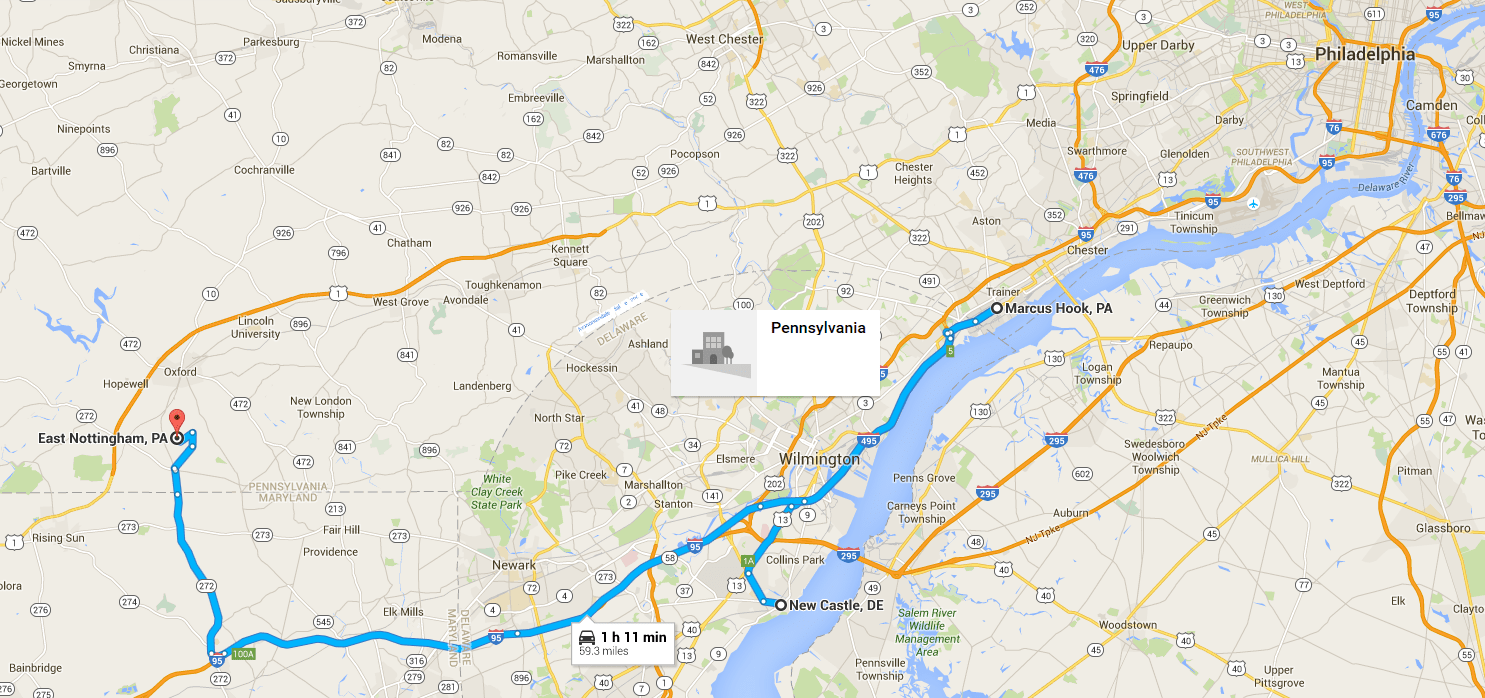
The Berkeley County family appears to have come from Ireland, based on a 1783 deposition recorded in Deed Book X, Vol 22, Page 335, Chester County, PA which records a statement by Mary Mercer, Berkeley County, VA, widow of Edward Mercer about sixty years old and a statement by Johathan Mercer, aged 50 regarding their acquaintance with a William Chapman. About two years after they left Ireland, the deponent (Mary Mercer) with others of her family, since dead, also left Ireland and came to America and found the George Chapman and William Chapman living on Delaware River near New Castle and Marcus Hook; they then lived together.

Delaware early map

Below is a current map showing Marcus Hook, New Castle and Chester County, PA.

Current Delaware map

If Mary was 60 in 1783, and was a child when immigrated, this would put her birth in 1723 and her immigration location sometime before marrying Edward (born in 1729) in New Castle and Marcus Hook.  So, this puts that Edward Mercer in the same vicinity or he would not have met and married Mary.  On the map, above, you can see that New Castle on the Delaware River is very close to Philadelphia, maybe 12 or 14 miles distant.

Philly to Winchester

My ancestor Edward Mercer (1704-1763), the elder, settled in Frederick County, Va, north on Winchester, by October 1744 when he first appears in the court minutes, serving on a jury.

A tradition says that he emigrated from Scotland in 1737 although that certainly has not been proven. Nothing is known about his early life, although after he arrived in Frederick County, by this time probably in his 40s or 50s, there are several references in court records.

Beginning in December 1754, Edward Mercer is sued by John Littler who owns land nearby.  In the same book, spanning 1754-1745, both Nicholas and Edward Mercer are sued by Jesse Pugh and both Nicholas and Edward serve on juries.  In the 1745-1748 Court Order book, we find Mercer versus Lemon and in Order Book 4, 1751-1753 we find Edward Mercer suing both James Dunn and Dugal Campbell, both dismissed by the parties.  In 1753-1754 we find Richard Mercer versus Poor and in 1754-1755, Edward Mercer vs Nathaniel Hare where Edward is awarded a judgment after Nathaniel fails to appear.  In 1755-158, we have Edward Mercer vs Hurman and in 1758-1760, Edward sues both Campbell and Lemon.  In 1760-1762, Richard Mercer sues Shibley and Simpson.  This looks like a lot, but is fairly typical for the timeframe.  Most suits were agreed upon and settled.

This branch of the Mercer family was found in Back Creek Valley during the 18th and 19th centuries. Edward Mercer died in 1763, and he named his wife Ann in his will, in addition to his children. A letter written by one Harrington in a letter to Wilmer Kerns on Oct. 27, 1993 states that Edward Mercer married Ann Croat (or Coats) in 1726, and he married second to Mary Gamble. However, we know that Edward was married to Ann when he died, based on his will, so this makes no sense.  Another rumor bites the dust.

Indian Traders

And yet another twist to this story.

In the “History of Scots/Irish,” Chapter 5, The Explorations and Early Settlers of West Virginia states that John Van Meter, a representative of an old Knickerbocker family early seated on the Hudson was an Indian trader. He made his headquarters with the Delawares and made journeys far to the south to trade with the Cherokees. In about 1725 he first told of the fertility of the Lower Shenandoah. In the section regarding the first white settlers of West Virginia in the area it goes on to say – “Among those that came about 1734 and settled along the Upper Potomac in what is now the northern part of the West Virginia counties of Berkeley and Jefferson included: Robert Harper (Harper’s Ferry), James Lemon, Richard Mercer, Edward Mercer, Jacob Van Meter.”

John Van Meter seems to have been headquartered in Kingston, Somerset County, New Jersey.   In an article relating to the last of the Southern Indians, which appeared in the Virginia Historical Magazine [Vol. III., p. 191, footnote], it states that “Mr. John Van Meter of New York gives an account of his accompanying the New York Delaware Indians in 1732 (?) on their raid against the Catawbas. They passed up the South Branch of the Potomac and he afterward settled his boys there.”

Robert Harper was born in Oxford Township near Philadelphia, Pa., in 1718. A builder and millwright, Harper was engaged by a group of Quakers in 1747 to erect a meeting house in the Shenandoah Valley near the present site of Winchester, Va.

In 1762, John Lemon obtains a land grant adjacent to both Nickolas and Edward Mercer.  From a transcription of the Virginia Northern Neck Land Grants, 1742-1775, Vol II:

John Lemon 1762 grant

In 1751, Edward Mercer obtained a land grant in Frederick County, Virginia for 275 acres adjoining Jacob Vanmeter. Does this suggest that our Edward Mercer arrived with that group of men?  And perhaps he was related to Richard Mercer?  Our Edward did name a son Richard.  The Edward Mercer of Berkeley County would only have been 12 years old in 1751, so this land grant has to be our Edward.

Richard Mercer’s wife name was Rebecca.  They sold land in 1764 on the Potomac that they had obtained from Josh Hite and Isaac and John VanMeter, the Indian trader family.

While it’s tempting to suggest that Edward Mercer in Berkeley County is the son of the older Edward Mercer (Sr.) of Frederick County, we show Edward Sr.’s son Edward Jr. in 1763 patenting land beside his father in Frederick County.

Edward Mercer Jr 1763 grant

Furthermore, Edward Mercer Jr. continued to live in Frederick County, years after the Edward in Berkeley County died.  We find in the Virginia Northern Neck Land Grants, 1775-1800, Vol. III:

Edward Mercer Jr 1788 land

Edward Mercer from Berkeley County, Virginia (now West Virginia) who died in 1783 shows the following people in the will index abstracts of West Virginia Wills and Probate records 1724-1978.

Edward Mercer 1783 death

Unfortunately, there is a lot of bleed through, but page 16 is the relevant page for Edward’s will.

Edward Mercer 1783 probate

Jonathan Mercer is clearly not Edward’s son, so perhaps he is Edward’s brother.  We know from the deposition that Jonathan was born in about 1733.

On November 13, 1752, we find that John Lemmon purchased property and the land deed was filed in Frederick County, VA. The description of the property includes 356 acres adjoining Edward Mercer, Nickolas Mercer, and Francis Lilborn.  A suit, Mercer vs Lemon, is found in the 1745-1748 court notes, but was impossible to find in the actual microfilm of the court minutes.  A Will for Nicholas Lemen is witnessed in 1761 by a Richard Mercer and his wife Mary.  This could be Edward Mercer Sr.’s son, Richard (who could have been in his 30s by this time), but who was Nickolas Mercer?

Nicholas Mercer is found in the road orders in 1746 and in 1748 he is replaced by Abraham Vanmetre, so he was clearly living in the same proximity as the VanMeter family which means he is connected to the Edward Mercer of Frederick County.  To be of age in 1746, he had to have been born in or before 1725, about the time our Edward Mercer would have been about 21 years old, IF he actually was born about 1704.

The Nicholas Mercer who was the son of Edward in Berkeley County could not have been of age in 1746 if Edward himself was only born in 1729.

Nicholas Mercer must have been connected to our Edward in some way.  In the December 1744 Frederick County Court session, we find the Jesse Pugh sued both Nicholas Mercer and Edward Mercer for trespass, in two adjacent transactions.  At that time, trespass typically didn’t mean walking on someone’s land, like today, but planting crops there.  Later, both Nicholas and Edward served on juries. Unfortunately, there is no Frederick County will for Nicholas, so we have no idea what happened to him.

Some people have drawn links between the various Mercer families that may not have existed in reality – drawing scattered references from multiple sources, including online trees, and weaving them together.

However, there are some very tantalizing clues that indeed, do need additional research.

George Washington and the Battle of Fort Necessity

We think of George Washington and his involvement in the Revolutionary War, but Washington’s involvement in the defense of Virginia began long before the Revolutionary War.  George was extremely involved in the French and Indian War as well.

The roster of men serving in the Fort Necessity Campaign of 1754 under George Washington is compiled from two rosters.

Edward Mercer appears.

Roster of Virginia Militia serving under George Washington during the Fort Necessity Campaign Officers – George Mercer, Captain (Lieut.); John Mercer, Lieutenant (Ensign); Wise Johnston, Corporal; Enlisted Men; Edward Mercer;

We know that Captain George Mercer is connected to the Irish/English John Francis Mercer family with no (known) relation to Edward.

Let’s look at what happened at Fort Necessity.  Edward Mercer was clearly there, so this is his story too.

The Battle of Fort Necessity (also called the Battle of the Great Meadows) took place on July 3, 1754, in what is now the mountaintop hamlet of Farmington in Fayette County, Pennsylvania. The engagement was one of the first battles of the French and Indian War and George Washington’s only military surrender.

Winchester to Fort Necessity

In March 1754, Governor Dinwiddie sent Washington back to the frontier with orders to “act on the [defensive], but in Case any Attempts are made to obstruct the Works or interrupt our [settlements] by any Persons whatsoever, You are to restrain all such Offenders, & in Case of resistance to make Prisoners of or kill & destroy them”. Historian Fred Anderson describes Dinwiddie’s instructions, which were issued without the knowledge or direction of the British government in London, as “an invitation to start a war”. Washington was ordered to gather as many supplies and paid volunteers as he could along the way. By the time he left for the frontier on April 2, he had gathered 1,867 men.  During the march to Pennsylvania, Washington picked up a few more men from a regiment they met at Winchester.  This would have been where Edward Mercer joined.

Washington along with about 150 Virginians built Fort Necessity on an alpine meadow west of the summit of a pass through the Allegheny Mountains on June 3rd.  Another pass nearby leads to Confluence, Pennsylvania; to the west, Nemacolin’s Trail begins its descent to Uniontown, Pennsylvania, and other parts of Fayette County along the relatively low altitudes of the Allegheny Plateau.

The fort was small, a circular stockade made of 7-foot-high (2.1 m) upright logs covered with bark and skins built around a little hut which contained ammunition and provisions such as rum and flour.  The palisade was built more to defend the supplies against Washington’s own men whom he described as “loose and idle,” than as a planned defense against a hostile enemy.

By June 9th, the rest of the Virginians had arrived.  Originally, the Delaware, Shawnee and Seneca supported the Virginians, but after a Native Council on June 18th, the Indians withdrew their support after the Battle of Jumonville Glen on May 28th in which Native leader Tanacharison killed French Joseph Jumonville personally.   Why the Native people withdrew their supposed is unclear.

Expecting to be attacked, and with word of the impending arrival of the French and Indians, Washington fell back, abandoning most of their provisions and supplies, and reached Fort Necessity by July 1st.

At Fort Necessity, the provision hut was depleted, and there was little shelter from the heavy rain that started to fall on the 2nd. With the rain, the trenches that Washington had ordered to be dug had turned into streams. Washington realized that he would have to defend against a frontal assault and also realized that it would be difficult because the woods were less than 100 yards away, within musket range, making it possible for a besieging attacker to pick off the defenders. To improve the defense, Washington ordered his men to cut trees down and to make them into makeshift breastworks.  The Virginians were clearly in trouble and they knew it.

As the British worked, the French led by Coulon, Jumonville’s half brother, approached Fort Necessity using the road the Virginians had built.  Coulon arrived at Jumonville’s Glen early on the morning of July 3. Horrified to find several scalped French bodies, he immediately ordered them to be buried.

By 11:00 am on the 3rd of July 1754, Louis Coulon de Villiers came within sight of Fort Necessity. At this time, the Virginians were digging a trench in the mud. The pickets fired their muskets and fell back to the fort, whereupon three columns of Canadian soldiers and Indians advanced downhill towards the fort. However, Coulon had miscalculated the location of the fort and had advanced with the fort at his right. As Coulon halted and then redeployed his troops, Washington began to prepare for an attack.

Coulon moved his troops into the woods, within easy musket range of the fort. Washington knew he had to dislodge the Canadians and Indians from that position, so he ordered an assault with his entire force across the open field. Seeing the assault coming, Coulon ordered his soldiers, led by Indians, to charge directly at Washington’s line. Washington ordered the men to hold their ground and fire a volley. Mackay’s regulars obeyed Washington’s command, and supported by two swivel cannons, they inflicted several casualties on the oncoming Indians. The Virginians, however, fled back to the fort, leaving Washington and the British regulars greatly outnumbered. Washington ordered a retreat back to the fort.  Washington must have been furious with the Virginia men who disobeyed his orders.

Coulon reformed his troops in the woods. The Canadians spread out around the clearing and kept up heavy fire on Fort Necessity. Washington ordered his troops to return fire, but they aimed too high, inflicting few casualties, and the swivel cannon fared no better. To add to the garrison’s troubles, heavy rain began to fall that afternoon, and Washington’s troops were unable to continue the firefight because their gunpowder was wet.

Louis Coulon de Villiers, who did not know when British reinforcements might arrive, sent an officer under a white flag to negotiate. Washington did not allow the Canadian officer into or near the fort, but sent two of his own men, including his translator Jacob Van Braam, to negotiate. As negotiations began, the Virginians, against Washington’s orders, broke into the fort’s liquor supply and got drunk. Gotta love those Virginia men.  They had their priorities.  If they were going to die, they didn’t want to leave the liquor behind!  Given what we discover about Edward Mercer later, there is little doubt that he was involved with this drunken escapade.

Coulon told Van Braam that all he wanted was the surrender of the garrison, and the Virginians could go back to Virginia. He warned, however, that if they did not surrender now, the Indians might storm the fort and scalp the entire garrison.

Van Braam brought this message to Washington, who agreed to these basic terms.

On July 4, Washington and his troops abandoned Fort Necessity. The garrison marched away with drums beating and flags flying, but the Indians and the French began to loot the garrison’s baggage on their way out, subsequently burning the fort.

Washington, who feared a bloodbath, did not try to stop the looting. The Indians continued to steal from the soldiers until July 5. Washington and his troops arrived back in eastern Virginia in mid-July. On the 17th, Washington delivered his report of the battles to Governor Dinwiddie, expecting a rebuke, but Washington instead received a vote of thanks from the House of Burgesses and Dinwiddie blamed the defeat not on Washington but on poor supply and the refusal of aid by the other colonies.

The battlefield is preserved at Fort Necessity National Battlefield, and includes a reconstruction of Fort Necessity.

Fort Necessity

“FortNecessityWithCannon” by Ikcerog – Own work. Licensed under CC BY-SA 3.0 via Commons – https://commons.wikimedia.org/wiki/File:FortNecessityWithCannon.jpg#/media/File:FortNecessityWithCannon.jpg

Voting in Frederick County

From Clark, Murtie June, Colonial Soldiers of the South, 1732-1774, Baltimore, MD: 1983: Pp. 328-332, in 1755, we know that both Richard Mercer and Edward Mercer Jr. are of age, because they both vote, as they do in 1758.  In 1761, both James and John Mercer vote for George Washington.  This puts the birth of both men before 1734, and possibly significantly before 1734.  At that time, and until 1762, according to Cartmell, voting for the House of Burgesses was reserved for men who owned land and significant assets, specifically, the gentry class.  In 1762, the voting rules were relaxed and allowed free men, of age, with only 50 acres of land or 25 acres with a house, or a lot in town with a house, to vote.

But the 1761 voting is interesting for yet another reason.  Colonel George Mercer is on the ballot for the election of Burgesses to represent Frederick County and Mercer Babb votes for him, as do both Edward Mercer Jr, Edward Sr., James, John, Moses, and Richard Mercer.  Col. George Mercer wins and represents the county in the House of Burgesses from 1761-1765.  George Mercer was born in Frederick County in 1733 to John Mercer, reportedly born in Dublin, Ireland, and Catherine Mason.  George was the brother to John Francis Mercer.

This tells us that Mercer Babb, whoever he was, was of age in 1761, so born in 1740 or earlier.  It also introduces the question – who is Mercer Babb?

To answer that question, we have to look at the Babb Family.

The Babbs

Thomas Babb was born in 1697 in Brandywine Hundred, New Castle, Delaware.  In 1730, he lived and was taxed in Bethel Township, Chester County, PA, according to the Hopewell Friend’s History.  He died on October 4, 1760 in Frederick County, Virginia. Not long after his marriage there was a movement of Quakers from Pennsylvania to Frederick County, Virginia. Thomas went with these Quakers and was one of the founding fathers of the Hopewell Monthly Meeting north of Winchester in Frederick County in 1734.

His father had a land grant of 600 acres on Apple Pie Ridge, near Babb’s Run, northwest of Winchester. Thomas settled there and was joined by his brother, Phillip. At his father’s death the two sons inherited his land.

Thomas Babb’s will was proved November 4, 1760. He left the home place to his son, Sampson, and other bequest to his other children. His wife, not being mentioned, is believed to have already died.

The first lovely old home belonging to Thomas was called “The Great Marsh Plantation“, now known as The Babb-Purcell-Janney House. It dates to 1735. Great Marsh is located on the north side of route 673 (Gold Hills Road) between route 522 and the Apple Pie Ridge Road in Frederick, Virginia.  On the map below, Babb’s Run is marked on Gold Hills Road with a small balloon just above the white box at the bottom of the map.

Great Marsh Plantation

The red balloon is James Crumley’s land, also on Apple Pie Ridge Road, about 6 miles distant from the Great Marsh Plantation.

The second home named “The Brick House” is a lovely old brick mansion and dates also to 1735. It is located west of the Apple Pie Ridge Road and south of route 672 on Babb’s Run. This is also in Frederick, Virginia.

The Brick House - Lupton Home

The Lupton family obtained the Babb land after Thomas’s death. The Lupton homestead was located just below Cedar Grove, about where the small gray balloon is located on the map below, according to a map from 1885.

Lupton home satellite

The Lupton homestead is located just south of Cedar Grove between Babb’s Run and the east side of North Mountain today, marked by the small balloon on the map above.  North Mountain is to the left of the balloon, with Cedar Grove Road on the other side of the mountain.

You can see and purchase these old maps at this link.

Referencing Jean Sargent’s Book “Babb Families of America” 3rd edition pg.113.

Philip Babb born in 1699 in Brandywine Hundred, New Castle, Delaware and died in Newark, New Castle Delaware on March 6, 1762, father of Thomas Babb who settled in Frederick County, Virginia, married Margaret Mercer.

This marriage would have had to have occurred after 1720, giving Mercer Babb plenty of time to be born between then and 1740.  This tells us that there were Mercers in this part of the world, likely related to Edward Mercer, and probably in New Castle, Delaware before 1740.

In the book, “The Babb Families of New England and Beyond, “ Jean Sargent on page 20 and 21 tells us the following about Thomas Babb:

In the Newark Monthly Meeting Records there is an entry dated 3 Oct 1713 which reads as follows: “Thomas Babb appearing at this meeting and gives ye meeting to understand yt ye death of his wife and for want of some person to whom he might leave ye care of his young children hath hitherto been ye lett of his not coming more frequent to ye meetings of business.” While there are early entries concerning Bathsheba, none of them mention the birth of her children or the date of her marriage. (7) Thomas prospered in DE and had sizeable land holdings as shown in the early land records. (4) In 1735 he received a Patent to 600 acres of land in Frederick Co., VA. By this time his three sons had moved to Chester Co., PA, just across the state line from their former home. Thomas sent the two younger sons Thomas, Jr., and Philip to occupy the 600 acres in VA and to carry out the other provisions of the Patent. (7) In his will, dated 17 Aug 1748 and proved 13 Aug 1751, Thomas bequeathed the home place in DE to his oldest son Peter, and left the VA lands to sons Thomas, Jr., and Philip. He made other bequests to his daughters Mary, Rebecca, and Lydia, as well as to three children of his deceased daughter Hulda — John, Rebecca and Lydia Gregory. (6)

In a 1758 election in Frederick Co., VA, among those voting for George Washington for the VA House of Burgesses were: Philip Babb, Thomas Babb (son of Phil.), Thos. Babb, Peter Babb, Joseph Babb, and Thos. Babb, Jr. (8)

Sources:

(1) “History of Town of Hampton, NH” by Dow; (2) Geneo. Diet, of Maine and New Hampshire by Noyes/Libby/ Davis; (3) “History of Salem, MA” by Perley; (4) DE Land Records; (5) VA Land Records; (6) New Castle Co., Probate Records; (7) Records of Robert E. Babb, Jr.; (8) Virginia Historical Magazine, 1899 p. 163.

So, once again, we circle back to Chester County, PA. about 1735-1740.

Margaret Mercer Babb was very probably Edward Mercer’s sister and named her son, Mercer Babb.

Backslidden Quaker

In Cartmell’s history book, he states that the area in Frederick County where Edward Mercer lived was known as the Quaker settlement, but several families lived there that were not Quakers.  He indicates that list includes the Mercers and Babbs who “had nothing to do with the Quakers.”  Cartmell was wrong.

Edward Mercer was a Quaker, but apparently a backslidden one.  So Edward may not have been a Quaker his whole life, and he may not have acted much like one when he was.

Edward was mentioned in the Quaker meeting records in March 1759 at the Baltimore meeting, but not in a very positive light.

Edward Mercer Hopewell

It looks like Philip Babb got to be the bearer of bad news.  Edward may well have been his brother-in-law, as this is the Philip Babb married to Margaret Mercer.

It seems like maybe Edward was systematically drinking too much.  In an economy driven by distilled liquors, as a form of money and a way to preserve corn, drinking “too much” must have meant truly drinking a lot by the standards of today.

Edward Mercer Hopewell2

Finally, Edward Mercer was removed.

Edward Mercer Hopwell 3

Was Edward Mercer being thrown out of the Quaker Church a family scandal?  Was his drinking a scandal?  What did his wife, Ann, do when this happened.  Did she and the children continue to attend the Hopewell Friend’s Meeting, or were they too embarrassed?  Or outraged?

Hopewell Meeting House

Road Orders

Edward may have been in trouble at church, but he was still quite functional as a road overseer – well – most of the time.

In 1759, the Frederick County road orders from August 7th order that a road be cleared between the plantations of William Reynolds and Thomas Babb Jr. and into Sr. John’s road in the same manner as heretofore and that the spring be left open to the said road and it is further ordered that Edward Mercer be overseer thereof and that the tithables a mile on each side of the road clear and keep the same in repair according to law.

On September 4th, the court ordered that Edward Mercer be overseer of Sr. John’s road from Winchester to the Plantation where Isaac Thomas did live and that the tithables three miles on each side of the said road keep the same in repair according to law.

By 1760, however, Edward was in a bit of trouble it seems.  On November 7th, the grand jury presents Edward Mercer for not opening the road from Capt. Pearis’s to Sir John’s Road at the Quaker Meeting by the knowledge of two of us at this present time.

On December 5th, the court notes that the summons had not been executed and refers it to the next court.

The next time we see Edward working on the roads in on May 4th, 1763, the same year he died.  Jacob Vanmetre, Morgan Morgan and Thomas Thornberry having been appointed to view the ground from the Town of Micklinbugh to the most convenient ford on Opeckon Creek made their report whereupon it is ordered that a road be opened as by them laid off and that the tithables three miles on each side thereof work under Edward Mercer who is appointed overseer of the same.

On November 2nd 1763, Thomas Babb is appointed as overseer of the road called Sir John Sinclaire’s road in room of Edward Mercer from the forks to James McGills.

Land

Edward Mercer received his first land grant in 1751 for 275 acres adjoining Jacob Van Meter as recorded in the Virginia Northern Neck Land Grants, 1742-1775, Vol. II.  Not a terribly descriptive land grant.

Edward Mercer 1751 land

Note that the entry shows that the adjacent entry was for Nicholas Mercer.

Edward Mercer 1751 grant

In 1759, Edward Mercer is shown on the rent roll for Frederick County as is Nicholas Mercer.

In 1760, Edward obtained a second grant, but this one is much more descriptive and is for 409 acres “near the head of Babbs Great Meadow and joyning Babbs Mountain”

Edward Mercer 1760 land

Fortunately, I was able to find Babb’s Mountain today, just above Cedar Grove.

Babb's Mountain

Philip Babb purchased property and the land deed was filed in Frederick County, VA. on 8 April 1760. The description of the property includes 117 acres adjoining Edward Mercer and on the side of Babbs Mountain. Source: Northern Neck Grants K, 1757-1762, p. 99.  The original survey reportedly exists.  Obtaining the original surveys of these lands would be most helpful in terms of exactly locating Edward Mercer’s land.

The Babb family has done extensive research on the land grants and has drawn the following map.

Babb land drawing

Based on the Babb map, the location of the Lupton home, and this survey from 1812, we know the location of Edward Mercer Jr.’s land, taken from the Virginia Northern Neck Land Grants, 1800-1862, Vol IV.

Lupton land 1814

Next, we find Edward Mercer Sr. leasing land to his son Moses, Bk 6 pg. 74 14 Oct. 1760: [Lease] between Edward Mercer & Ann his wife of County of Frederick [to] Moses Mercer of County aforesaid …… one tract of land lying and being under the mountain on the easternmost part of Back Creek and being part of a tract of land granted to said Edward Mercer by the Right Honorable Thomas Lord Fairfax by Patent the 18 April 1760… containing 200 acres and a half… Wit: 2 Wit. signed in German John Colson Recorded: 4 Nov. 1760 Signed by Edward Mercer & Ann Mercer

The easternmost part of Back Creek would be current Cattail Creek above Babb’s Mountain, or Babb’s Run, below Babb’s Mountain.

Richard Pearis purchased property and the land deed was filed in Frederick County, VA. on 18 May 1762. The description of the property includes 224 acres adjoining Jacob Vanmeter, and Edward Mercer. Source: Northern Neck Grants K, 1757-1762, p. 430 (Reel 294).

WEst land 1764

In 1764, the year after Edward died, his estate is still on the rent rolls, which is not unusual, especially if his wife is living there.  In addition to Edward Mercer, we find Edward Mercer Jr, Nicholas Mercer, Moses Mercer and Richard Mercer.

All of these men are sons of Edward, except Nicholas who appears consistently with Edward since 1746, before Edward actually appears in the County.  Was Nicholas Mercer Edward’s brother?

Edward’s Will

In 1762, Edward Mercer wrote his will, which was not probated in Frederick County until November 1, 1763, so he apparently lived another 14 months after making his will.  He was obviously ill, because in the will, he states that he is weak of body.

IN THE NAME OF GOD AMEN. The twentyth Day of September in the year of our Lord one thousand Seven hundred and Sixty Two, Edward Mercer of the County of Frederick in the colony of Virginia, being sick aged and weak of Body but of perfect and sound mind memory and understanding thanks be given unto God, therefore calling to mind ye mortality of my Body and knowing it is apointed for all men once to dye do make and ordain this my last Will and Testament that is to say principally and first of all I recommend my Soul into my saviour’s hands, and my body to the Earth to be buried in a Christianlike and Decent manner at the Discretion of my Executors hereafter named and as Touching what Temporal Estate it hath pleased God to Bless me with in this Life. I give devise and Dispose of the same in the following Manner and form Imprimis: it is my Will and I do order that in the first place all my just Debts by paid and satisfied.

Item I give and bequeath unto my son Richard Mercer one cow and calf and five shillings sterling. I give and Bequeath unto my Daughter Elizabeth Heath the sum of five shillings sterling.

I also give to my son Moses Mercer the sum of Five Shillings sterling.

I give and bequeath to my daughter Hannah Mercer five pounds and five shillings worth of Puter the same being now in her possession. And also one bed and furniture thereto belonging likewise I give to my said Daughter Hannah Six head of young cattle the same being now in her possession which said cattle shall be kept on the plantation until they be three years old. I also give her a side sadle and the Keeping of her mare on the plantation whilst she continues unmarried.

I give and bequeath unto my son Edward Mercer the plantation whereon I now Live containing two hundred and nine Acres and also a survey adjoining thereto containing Ninety six Acres of Land to him his Heirs and assigns forever. I also give to my said son Edward one bay mare and one bay colt plow and Tacklin thereto belonging. I also Will that if my above named son Edward Mercer should dye without issue that my youngest son Aaron Mercer shall then become sole heir of my Land and plantation whereon I now live and if both my said sons Edward and Aaron should die without issue, I will that my Daughter Hannah Mercer, become the sole owner of my above said Land and plantation, to her heirs and assigns forever.

I also will that my son Edward Mercer should pay as a Legacy to my youngest son Aaron Mercer the sum of Forty pounds and that within the space of four years after the said Aaron comes of age.

I also Will that my wife shall have the best Rooms in the new House now part built until my son Edward shall build her a compleat house on some part of the plantation at his proper cost which House shall be sixteen foot wide and Twenty foot Long. I also give to my wife Ann Mercer one third part of my parsonal Estate that may remain after the debts and Legacies mentioned are paid.

I will bequeath unto my son Aaron the two thirds of my parsonal Estate with the benefit and profit thereof Immediately after my decease which part of the said Aaron’s stock shall be maintained on the plantation until Aaron comes of age.

Lastly I constitute and ordain my well beloved wife Ann Mercer and my son Edward Mercer and Joseph Foset my sole Executors of this my Last Will and Testament revoking and declaring void all former wills and Testaments by me made and done in witness whereof I have hereunto set my hand and seal.

Signed Sealed and acknowledged by the said Edward Mercer to be his last will and testament in the presence us.

Jesse Pugh. Thos. Babb. Mercer Babb.

Edward Mercer. (LS.)

We know Edward could write, because he signed his name.

Edward Mercer will 1

Edward Mercer will 2

Edward Mercer will 3

Edward’s will was probated in Frederick County, Virginia on either November 1, 1763.

Edward Mercer probate will

Mercer Babb

Mercer Babb was clearly of age in 1762 when he witnessed Edward Mercer’s will, so was born in 1741 or before.  Generally, when someone witnesses a will, unless it’s a nuncupative will made in an emergency with death imminent, this indicates that the witness is not an heir, or they would not be witnessing the will.  Normally, those who witness wills have no direct interest in the outcome.  If Mercer Babb was born in 1741 or before, that means that either the Babbs and Mercers were together before they lived in Frederick County, they were both living in Frederick County by 1740 or there is a Mercer in the Babb family tree, because the name of Mercer Babb, especially witnessing the will of a Mercer male, is just not a coincidence.  Mercer Babb appears to be the son of Philip Babb and Margaret Mercer.  We know that Philip Babb was in Chester County by about 1735.  I do believe there is more to this story than we know and it all begins back in either Chester County, PA or before that in New Castle or Marcus Hook, Delaware.  These families appear to have come as a group from the Chester County area to Frederick County, VA.

Edward Mercer’s Estate Inventory (added 10-12-2015)

Recently, I spent an entire day in Richmond at the Library of Virginia, also known as the State Archives.  Like always, I prepared a research list.  While most of my research procured nothing, which isn’t unusual after you’re already plucked all the fruit you can readily see – I did come up with one big winner.

The estate inventory of Edward Mercer who died sometime between May 4th 1763 when he last appears in the Frederick County, Virginia court minutes in a road order, and November 1, 1763 when his estate was probated.  At that same court session, he was replaced as overseer or the road, so he apparently was still “working” up to a few months before he died, even though he prepared his will “being sick, aged and weak of body” in September of 1762.  Edward was probably just shy of 60, certainly not an old man – so his estate should reflect an active life, not a “retirement,” if there was such a thing then.

The first bingo I found in the library was a book of transcribed wills and estate inventories.  I was quite relieved because that meant I might not have to ask them to pull the microfilm and read that.  Old books on microfilm are not always legible nor is the indexing ever complete.  The only individuals indexed are the primary individual – not witnesses or wives or anyone else.  Many times the “rest of the story” is told in who surrounds individuals during their lifetime – so we need all of that additional information.

So, when I found Edward Mercer’s estate inventory listed in the transcribed book, I was ecstatic.  I read the estate inventory, and it was short and general.  It listed things like, “agricultural produce and farm animals.”  Well, I have to tell you, I’ve seen a lot of colonial wills and I have never seen one list something like that.  They list the produce and they list the animals, individually, or at least by breed.  In other words, you in far more danger of receiving far more information that you wanted than not enough, if an estate inventory was taken and filed.

It appeared that I was going to have to get the microfilm after all.

Estate inventories are a vastly overlooked source of information not available elsewhere.  The wills tell who your ancestors left his or her worldly goods to, but the estate inventory tells you what those goods were and those goods tell a huge story about your ancestor’s life.  In addition to what IS in the estate inventory, what ISN’T in the inventory tells a story too – especially in the context of the time and place in which they lived.

Many men did have a will.  Most wills were not written much in advance.  Sometimes wills were made verbally as the individual was on death’s doorstep to whomever was nearby.  These are called noncupative wills.  Sometimes, death was unexpected and there no opportunity for a will.

Most women did not have wills because most women did not own items outright, meaning outside of a marriage where the man was assumed to be the owner of the land (except for her dower rights.)  Often women retained what is known as a “life estate” where the woman holds either property or other items for the term of her life, at which point their ownership reverts to others, generally one or several children as specified in her husband’s will when he died.

If the woman dies before the man, the husband automatically owns everything so no will for the wife is necessary.  I’m talking about historical US wills, not current law.  I’m not a lawyer…I don’t play one on TV or anyplace else:)

Understanding how wills and ownership of both property and personal items worked helps in unraveling what estate inventories tell us.

When the man died, an inventory of everything was taken, even if the wife was to retain “household items.”  While that seems vastly unfair, especially since she often had to bid to buy her own cooking utensils back at a sale, it’s a huge boon for genealogists.

Sometimes individuals are mentioned in inventories – and in some cases, an item is left to a daughter in a will, but by the time she collects that item, she is married and a married name is listed.  In other cases, if something is left specifically to an individual, it is not included in the appraisal.  It doesn’t seem standardized, you say?  It’s not – and often it helps to look at other wills and estates from that county and time to observe what was customary.  Any deviation from custom must have been caused by something…and that something could be interesting to a genealogist.

Even the individuals who appraise your ancestor’s estate are important.  In Virginia, if your ancestor’s spouse was still living, one person who was from the “wife’s family” was chosen, keeping her interests in mind, the largest debtor of the person who died was selected, keeping their interests in mind, and one person completely disinterested in the outcome of the estate appraisal was selected.

With that information, you can sometimes add to your knowledge of the family, especially if you know the wife’s family is likely in the area.  How would you know that?  If your ancestor lived in that area when he married, his wife’s family would have been from that area too.  Young people often met at church or social functions – and with limited transportation – that social group wasn’t from any great distance.

People often married their neighbors or individuals from just a mile or two away.  Courting was likely done on foot, or maybe on horseback.  You can’t marry someone you can’t court!

So, let’s take a look at Edward Mercer’s will and see what is actually in the estate inventory.

The subscribers by virtue of an order of Frederick County Court being first sworn has met and appraised such of the estate of Edward Mercer, deceased, as was brought to our view by Ann Mercer and Joseph Fanset the executors – viz –

The values would be given in pounds, shillings and pence.

Edward Mercer estate 1

  • One old loom 0-15-0
  • Red Cow 0-15-0
  • 1 Cow and bell 3-0-0
  • 1 brindle cow 2-10-0
  • A brindle cow 2-0-0
  • A white cow 2-10-0
  • White back heifer 2-0-0
  • White bull 2-0-0
  • White heifer 1-15-0
  • Speckled heifer 2-0-0
  • Red yearling steer 1-0-0
  • White steer 1-7-0
  • White faced heifer 1-10-0
  • Brindle calfe 0-15-0
  • A pide yearling 1-0-0
  • A brindle yearling 1-0-0
  • Six calves 3-6-0
  • 2 pide steers 3-15-0
  • 2 heifers 2-10-0
  • One stear 2-10-0
  • A roan horse 6-0-0
  • An old mare 2-10-0
  • A mare and colt 3-10-0
  • A bay mare and colt 5-0-0
  • Old wagon and gears 9-0-0
  • A pen and gears 1-3-0

Edward Mercer estate 2

  • Eight swine 0-?-0
  • 2 sows and pigs 0-16-0
  • Harrow pens 0-10-0
  • Cart wheels 1-0-0
  • A rick of hay 3-0-0
  • 2 ricks of hay 6-10-0
  • Hay in the barn 2-0-0
  • Grain in the barn 12-0-0
  • Unbreak flax 0-5-0
  • 2 caskes and flax seed 0-9-0
  • Corn foder 0-10-0
  • Hay in the stable 0-15-0
  • A mall and wedges 0-5-0
  • 2 old axes 0-5-0
  • Indian corn 2-0-0
  • 2 old hoes 0-7-0
  • Small grind stone 0-3-0
  • An old gun 0-15-0
  • Another old gun 0-10-0
  • 2 bells and collar 0-5-0
  • Some old carpenters tools 0-14-0
  • Old iron 0-2-6
  • A pair of small hilliards 0-5-0
  • Few nails 0-2-0
  • Some more carpenters tools 0-10-0
  • An old saddle 1-5-0
  • Suit of cloathes 5-10-0
  • Side saddle 1-5-0
  • Old lumber 0-6-0
  • 8 old chairs 1-0-0
  • Old dough trough 0-3-0
  • A chaf (?) bed and cloaths 1-15-0
  • One bed and furniture 4-0-0
  • Seven old bags 0-7-0
  • Old casks and reel 0-5-0
  • Old chest 0-10-0
  • A morter 0-2-6
  • A warming pan 1-0-0
  • Old reeds and wifts (or mosts or wefts) 0-4-0

Edward Mercer estate 3

  • Some salt 0-6-6
  • Smoothing box and candlestick 0-3-0
  • Hand and gridirons 0-8-0
  • Iron poths (pots?) hangers and frying pan 1-3-0
  • Old books 0-6-0
  • Puter (pewter) 2-6-0
  • Some old tins 0-2-0
  • Sythes and hangings 0-14-0
  • Old copper 0-1-3
  • 3 old casks 0-5-6
  • 1 cask of cyder 1-4-1
  • 2 old whelbs(?) and branding iron and old tea kettle 0-11-0
  • Warping barrs and boxes 0-5-0
  • Hannah Mercers puter 5-0-0
  • Her bed and furniture 8-0-0

Jesse Pugh, Joseph Babb, Peter Babb

At court held for Frederick County the first day of May 1764.  This appraisement was returned and ordered to be recorded by the court.

The first thing this inventory tells us is that Edward Mercer was very involved in animal husbandry and likely only farmed enough to feed his animals.  He did not have plows and other typical farming implements and had many more animals than the typical farmer.

The entry for salt is interesting.  Salt was valuable because about 800 gallons of spring water had to be boiled away to yield a bushel of salt.  Today, we take salt very much for granted, but our pioneer forefathers certainly didn’t.

Edward’s family had chairs, not just a bench to sit on. And almost enough chairs for each person to sit at the same time.  He had 7 children, so the estate is one chair short for the entire family to sit together.  Perhaps one chair broke.  They are described as “old.”  However, there is no table listed.  That’s rather odd.

Edward was a good-hearted person.  He did not kill his old mare who was probably no longer useful.

Edward was likely a carpenter.  Every man on the frontier had a specialty skill, and his appears to be carpentry based on his tools.  This means that when you find homes built in that timeframe in that area, Edward may have worked on those.

Edward owned no slaves, but he clearly could have afforded slaves had he so chosen.  His lack of slaves then must have been either a personal moral judgment or a religious conviction.  However, other Quakers did own slaves including the family his daughter, Hannah, married into.

The flax and loom suggest that his wife and daughter spun and wove, although interestingly enough, a spinning wheel is not listed.  However, you can’t get from flax to weaving without spinning it into thread first.

There is cyder, but no alcohol.  There is no still.  This is highly ironic, since Edward Mercer was kicked out of the Quaker church in 1759 for…you guessed it….drinking.  In fact, “too frequently drinking strong drink to excess.”

Edward Mercer signed his will and owned books, so obviously this man could read and write.  How I’d love to know what those books were.

There is no Bible, although Edward was a Quaker up until he was kicked out of the church in 1759, ironically, for drinking, not attending meetings and not being penitent about either.

Other than Hannah’s furniture, which did include a bed, there were two other beds mentioned.  Was there a bed for the parents, then a boys bed and a girl’s bed?  There were two girls and five boys.

And speaking of Hannah, she is mentioned in the estate inventory, but it’s very likely that she was married by this time.  However, the fact that she is mentioned by her maiden name does not prove that Hannah was not married.  They may simply have referred to her as she was listed in the will. I have often wondered if she was already married when the will was written, even though Edward does not refer to Hannah by a married name.  The reason I question this is because Edward says that the “puter” (pewter) is already “in her possession.”  That would likely mean that she is not living at home, but unless she were married, where else would she be living?  Edward said the same thing about Hannah’s 6 heard of cattle as well, that they are already in her possession.  But then he goes on to say she can leave her mare on his plantation as long as she remains unmarried, so obviously she is not married at that time.  There must be something here that I’m missing.  Perhaps she was living with another family member before she married.

Edward does have two old guns, and he fought in the French and Indian War, so this makes sense.  These are likely the guns he carried with General George Washington at Fort Necessity.  What I wouldn’t give to see those guns.

And speaking of things I’d love to see…that old chest is one.  I want to open that chest and see what is inside.  I’m guessing that might be where Edward kept any spare clothes he had or anything of value – like maybe letters!!!

We also know that Edward’s wife, Ann, was living because she was one of the individuals who administered his will and “presented” his estate to the court.

We know that the family had candles.  The poorest families didn’t and worked only by the light of the sun.  Sundown meant bedtime.

In Edward’s case, either his estate was not sold at public auction, or there is no court record of the sale.  Many times, the sale is recorded, item by item, and who was present at the sale can tell you a huge amount.  In some cases, you can track valuable family heirlooms this way.

The moral of this story?  Don’t think you’ve found everything when you find your ancestors will, or even if you don’t find a will.  There is likely to be an estate appraisement with or without a will, and sometimes the information in the estate inventory tells you far more about your ancestors life and how they actually lived than the will itself.  Wills tell you who is supposed to get what, but estates tell you the story of your ancestors life through what they left behind.

If you look around your own house, you’ll realize that your sewing machine and quilting tools, for example, at my house, are far more personal and representative of what you do with your daily life than the land you own.

In terms of getting to know your ancestor, their stuff is far more important than their land.

Edward Mercer’s Children

  • Richard Mercer could have been the Richard who married a woman named Mary and lived in Berkeley County. John Mercer mentioned a brother Richard in his 1748 will that was filed in Winchester.  It’s difficult to tell when Richard first appears in the records because there is an earlier Richard that is found with Edward Mercer as well.
  • Elizabeth Mercer was born about (or after) 1724 and married by 1748 to William Heath who was born on Sept. 18, 1724. William was mentioned in the 1748 will of his brother-in-­law, John Mercer.
  • John Mercer was born circa 1727 and died in 1749, apparently unmarried. John lived in Frederick County, where his will is on file in the courthouse. His father, Edward Mercer, was named administrator for his estate.
  • Moses Mercer was of age and leasing land from his father by 1760. Moses was born in 1732 and died in 1805, in Frederick County. Appraisers of Moses’ estate were Jacob Rinker, Richard Barrett, and Thomas Babb. Moses married Dinah Morrison, who was called Dianna in his will. She was born Dec. 24, 1729, and died in April 1810. After Moses’ death in 1804, Dinah received all moveable property during her natural life, plus one-third of profits from real estate. She wrote her will on April 10, 1810 and it was probated June 7, 1810. Witnesses were Aaron and John Mercer, and John Barnard. Her close friend, Abraham Lewis was named the executor. Moses and Dianah signed their names with an X “His mark” and “Her mark,” respectively.
  • Hannah Mercer married William Crumley about 1763 and had died by 1774. Hannah was mentioned in the will of her brother John in 1748, and in the will of Elizabeth Morris in 1760. Who is Elizabeth Morris?
  • Edward Mercer was given “the plantation where I now live – 209 acres plus adjoining 96 acre survey” by his father. Edward was born about 1744. His age was proven from a deposition given in the Augusta County Circuit Court. The name of his spouse is not known.
  • Aaron Mercer, the youngest son, not of age in 1752 – served in Revolutionary War. On October 28, 1799 he obtained a Virginia Revolutionary War land grant in Ohio and moved to Ohio. Reportedly in his pension application (which is not at www.fold3.com as of 9-15-2015) he says he was born in Ireland. Aaron died on December 17, 1800 in Hamilton County, Ohio and is buried in the Old (Columbia) Baptist Graveyard. Given that there were no Revolutionary War pensions before 1818, there would have been no pension application by him, although if his wife, Elizabeth Carr, was still living, she could have applied in either 1818 as destitute or 1832/33 as a surviving veteran’s wife. She is reported to have died in 1820, so I’m quite suspicious of the claim that his Revolutionary War pension paperwork stated that he was born in Ireland.

Speculative Family

Based on all of the pieces of evidence, it looks like a speculative family might include our Edward, born about 1700, a brother Richard found with Edward early in the records, a brother Nicholas found in 1746, and a sister Margaret who married Phillip Babb sometime between 1720 and 1740.

The identity of the Edward Mercer born in 1729 who lived in Berkeley County is unclear, but given the names of Edward, Richard and Nicholas, and the locations of Chester County, PA and Delaware, these lines do seem very connected.

Edward in Berkeley County could be the son of either Edward Sr.’s brother Richard or Nicholas – although this does beg the question of what happened to either Richard or Nicholas.  Richard could also have been Edward Mercer Sr.’s eldest son, not a brother.  If that is the case, then Edward born in 1829 cannot be the son of Richard Mercer.

The tidbits we do have also support the suggestion that this family may have immigrated from Ireland before 1740.

However, this is speculative and needs additional research before any conclusions can be drawn.  I suspect the answer is either in Chester County, PA, Marcus Hook, PA or in what is now New Castle, Delaware, if the answer exists anyplace.

DNA

The DNA results having to do with this line are every bit as frustrating and elusive as the genealogy has proven to be.

I checked the Mercer DNA project and was extremely happy to discover a Y DNA project member that indicated that they descended from Edward Mercer born in 1704, the birth year typically attributed to our Edward.

Home run!

Except…

Doggone it, there’s another tester who gives his ancestor as Edward born in 1705.  That’s just too close.  Worse yet, their DNA doesn’t match.  Clearly two independent lines.

So, I checked at YSearch.  No account for Mr. 1705 and the 1704 account had no marker values entered but it did include the death year of 1763, which pretty well cinches the identity as our Edward.  I tried to contact the individual through YSearch, with no luck.  This is a low kit number, indicating an early tester so the tester’s e-mail may be stale of they may not be able to reply anymore.

Next, I wrote to the project administrators of the Mercer project and asked them if they have the oldest ancestor information for either or both testers, or if they would please facilitate contact with those men.  Nothing, nada, silence from the admins.

Doggone!

There is just nothing worse than a desperate genealogist.

Mercer Y DNA Project

(Click on image to see larger version.)

I copy pasted the relevant Mercer project entries into a spreadsheet.  They weren’t grouped on the Mercer DNA site, so I grouped them compared to the entry for kit number 94427 which I believe is our Edward Mercer (c1704-1763).  The yellow cells are mismatches to kit 94427.

There is only one other Mercer that even matches remotely, kit number 99939 just above the lower pink 94427 with the green row.

There is an entire group of blue Mercers that fall together nicely.  However, in this blue group we find kit number 84471 also pink), the other Edward Mercer born in 1705.  This entire line reportedly tracks back to guess where… Chester County, PA with Robert born in 1741 and Elizabeth Brown Mercer.

I checked Chester County tax records, and there are several Mercer men living there in this timeframe.  They may or may not have been related to each other.  And none were named Edward, Richard or Nicholas.  Pulling hair out now….

Finding this large blue group associated with Chester County, and my lonely Edward Mercer with only one distant DNA match is beginning to make me very nervous.

This makes me ask questions like:

  • Was Edward Mercer who died in 1763 “supposed” to be paternally related to the Chester County group, but wasn’t?
  • Is there a NPE (nonpaternal event or undocumented adoption) in the lines of one of Edward Mercer’s sons, but not the other one, causing one descendant to match the Chester County group, and one descendant to not match the group?
  • Is someone’s genealogy wrong?  And if so, which one?  I’d just be happy at this point to actually see the genealogy of either tester, and preferably both.
  • Why aren’t the project administrators answering inquiries about the project?  Are they gone too?

It’s small consolation, I know, but at least the two “Edward” kits are both haplogroup R-M269.  So, assuming (I hate that word, BTW) either of these men descend from my Edward Mercer, I at least know that much.  But at the 50% frequency rate in Europe of M269, that would have been a safe bet with no DNA testing at all.

Needless to say, if you are a male Mercer who descends from Edward Mercer who died in Frederick County in 1763, I have a DNA testing scholarship for you!

______________________________________________________________

Disclosure

I receive a small contribution when you click on some of the links to vendors in my articles. This does NOT increase the price you pay but helps me to keep the lights on and this informational blog free for everyone. Please click on the links in the articles or to the vendors below if you are purchasing products or DNA testing.

Thank you so much.

DNA Purchases and Free Transfers

Genealogy Services

Genealogy Research

How They Found the Real Benjamin Kyle

Benjamin Kyle 2010

The genetic genealogy community let out a simultaneous whoop for joy last week at the news that the identity of Benjamin Kyle had finally been found. At long last, the “man with no name” finally has a name – a real name – not a temporary name.

In case you’re not familiar, the man known as Benjamin Kyle was found beaten, stripped naked and left for dead behind a trash dumpster in 2004 in Richmond Hill, Georgia, outside Savannah.  He remembered nothing….nothing at all.  Not how he got there, not what happened, and not who he was.  His life became a living hell, because you not only can’t work, you can’t get any services, not even a bed in a homeless shelter, without being able to prove you are.  Surprised?  So was I.

Benjamin did remember snippets from time to time.  He remembered what he believed to be his birthday, 10 years to the day before Michael Jackson, and he remembered that he was Catholic.  He remembered landmarks in Indianapolis, Indiana as a child and some things from Colorado, but not much more.  He thought his first name might be Benjamin.

In 2008 Benjamin Kyle appeared on the Dr. Phil show, and in 2011, a documentary was produced about his plight.  Through this and other media coverage, his situation became known in the genetic genealogy community.  DNA testing commenced thanks to Family Tree DNA, and this saga culminated last week with the announcement that Benjamin’s identity has been found…along with his family…and yes…in Indiana.

Who accomplished this feat?  It wasn’t the police, as one might expect.  In fact, it is a little known group of “search angels” with www.DNAadoption.com, a nonprofit group that helps adoptees and others with unknown parentage find their roots through a combination of DNA testing and assembling the family trees of those whom they match, narrowing the search for their own family.  It’s a long tedious process, but it’s doable, and the DNAadoption volunteers developed and documented the methodology for success.

But hey, let’s listen as Diane Harman-Hoog tell this story herself in her article, Our Greatest Challenge.  After all, it’s their story, their victory – Diane along with the other search angels, and of course a victory for Benjamin Kyle too.  And for the inquiring minds who want to know exactly how the researchers accomplished this incredible feat….Diane shares the methodology!

Congratulations to all of the researchers and genetic genealogists involved in the search and discovery of the true identity of Benjamin Kyle.  I must say, in all of the footage I’ve seen of Benjamin, the video in the news article announcing the discovery of his identity is the first time I’ve ever seen him smiling and he looks genuinely happy!  It must have been an incredible day for Benjamin – like a second birth in one lifetime.  The gift of his life returned.

The folks at www.dnaadoption.com truly are angels.  Amazingly skilled, dedicated, devoted angels.  I’m positive that Benjamin Kyle would agree.  I do believe in the process of finding his original family that he has found a new family of genealogists too!

angel family

______________________________________________________________

Disclosure

I receive a small contribution when you click on some of the links to vendors in my articles. This does NOT increase the price you pay but helps me to keep the lights on and this informational blog free for everyone. Please click on the links in the articles or to the vendors below if you are purchasing products or DNA testing.

Thank you so much.

DNA Purchases and Free Transfers

Genealogy Services

Genealogy Research


DNAeXplain Archives – Basic Education Articles

Today, we’re continuing with our series of articles from our archives that have been published on this blog by group category.  The categories are:

  • Historical or Obsolete – these are items that were interesting at the time by aren’t really relevant today – except in a historical context. An example would be the announcement of the Genographic 2 project in July of 2012. You may wonder why I didn’t delete these. Looking back, these are somewhat like a genetic genealogy journal.
  • General Information – these are generally articles about DNA and genealogy. They don’t presume that you’re actually working with the results.
  • Basic Education – these articles may be basic genealogy or basic DNA fundamentals. These articles provide a foundation for working with your results. Think of it as pre-bootcamp.
  • Introductory DNA – these articles do presume you are working with your results. Bootcamp begins here.
  • Intermediate DNA – these are a little more difficult and you’ll probably need the basics and introductory understanding to be able to work at this level.
  • Advanced DNA – very few articles are advanced. In fact, I try very hard to avoid this, when possible. Mostly, these have to do with advanced autosomal techniques and research.
  • Examples – these are examples of using genealogy and DNA together seamlessly. My 52 Ancestors stories fall into this category. Think of these as story problems that include the answers!
  • Educational – educational opportunities such as classes, books and videos.
  • Entertainment – just for fun, like the Who Do You Think You Are series, some of these have no DNA content.
  • Project Administration – articles written for project administrators at Family Tree DNA. Project administrators, of course, will be interested in all of the rest.

Trying to decide where each article best fits has sometimes been challenging, but I’ve tried my best. Enjoy the Basic Education group today.

Title Date Link
Haplogroup C3*- Previously Believed East Asian Haplogroup is Proven Native American 12-23-2014 http://dna-explained.com/2014/12/23/haplogroup-c3-previously-believed-east-asian-haplogroup-is-proven-native-american/
Challenges with Irish Autosomal DNA Genealogy Research 8-18-2014 http://dna-explained.com/2014/08/18/challenges-with-irish-autosomal-dna-genealogy-research/
What Happened to my Mitochondrial DNA??? 7-14-2012 http://dna-explained.com/2012/07/14/what-happened-to-my-mitochondrial-dna/
The CRS and the RSRS 7-15-2012 http://dna-explained.com/2012/07/15/the-crs-and-the-rsrs/
Ethnicity Finders 7-21-2012 http://dna-explained.com/2012/07/21/ethnicity-finders/
What Does MCRA (MRCA) Really Mean? 8-6-2012 http://dna-explained.com/2012/08/06/what-does-mcra-really-mean/
The DNA Pedigree Chart – Mining for Ancestors 8-22-2012 http://dna-explained.com/2012/08/22/the-dna-pedigree-chart-mining-for-ancestors/
Surprise Matches – What do they Mean? 8-26-2012 http://dna-explained.com/2012/08/26/surprise-y-matches-what-do-they-mean/
4 Kinds of DNA for Genetic Genealogy 10-1-2012 http://dna-explained.com/2012/10/01/4-kinds-of-dna-for-genetic-genealogy/
Autosomal Matching – Is Great-Grandmas Brother Really Her Brother 10-9-2012 http://dna-explained.com/2012/10/09/autosomal-matching-is-great-grandmas-brother-really-her-brother/
Transferring Results from National Geographic to Family Tree DNA 1-13-2013 http://dna-explained.com/2013/01/13/transferring-results-from-national-geographic-to-family-tree-dna/
Hackers and Your Genetic Secrets 1-20-2013 http://dna-explained.com/2013/01/20/hackers-and-your-genetic-secrets/
What is a Haplogroup? 1-24-2013 http://dna-explained.com/2013/01/24/what-is-a-haplogroup/
Downloading Ancestry’s Autosomal DNA Raw Data File 3-21-2013 http://dna-explained.com/2013/03/21/downloading-ancestrys-autosomal-dna-raw-data-file/
New Y DNA Haplogroup Naming Convention 3-31-2013 http://dna-explained.com/2013/03/31/new-y-dna-haplogroup-naming-convention/
Swabbing the (Recently) Deceased 4-14-2013 http://dna-explained.com/2013/04/14/swabbing-the-recently-deceased/
No (DNA) Bullying 5-15-2013 http://dna-explained.com/2013/05/15/no-dna-bullying/
Mythbusting – Women, Fathers and DNA 6-23-2013 http://dna-explained.com/2013/06/23/mythbusting-women-fathers-and-dna/
UpFront with NGS Series on DNA Basics – Testing for Genealogy 101 8-5-2013 http://dna-explained.com/2013/08/05/upfront-with-ngs-series-on-dna-basics-testing-for-genealogy-101/
Optimizing Blog Usage 9-4-2013 http://dna-explained.com/2013/09/04/optimizing-blog-usage/
Why DNA Test? 9-15-2013 http://dna-explained.com/2013/09/15/why-dna-test/
Ethnicity Results – True or Not? 10-4-2013 http://dna-explained.com/2013/10/04/ethnicity-results-true-or-not/
DNA Testing for Genealogy 101 10-6-2013 http://dna-explained.com/2013/10/06/dna-testing-for-genealogy-101/
Obtaining Help With DNA 2-12-2014 http://dna-explained.com/2014/02/12/obtaining-help-with-dna/
23 Ways to be a PITA 3-16-2014 http://dna-explained.com/2014/03/16/23-ways-to-be-a-pita/
Surname Projects 8-7-2014 http://dna-explained.com/2014/08/07/surname-projects/
Haplogroup Projects 8-29-2014 http://dna-explained.com/2014/08/29/haplogroup-projects/
Family Tree DNA Announces Free Autosomal Transfer from 23andMe and Ancestry 10-19-2014 http://dna-explained.com/2014/10/19/family-tree-dna-announces-free-autosomal-transfer-from-23andme-and-ancestry/
Autosomal DNA 2015 – Which Test Is The Best? 2-5-2015 http://dna-explained.com/2015/02/05/autosomal-dna-2015-which-test-is-the-best/
Eleven Things I Would Do Differently 3-18-2015 http://dna-explained.com/2015/03/18/eleven-things-i-would-do-differently/
And A Dozen Things I Got Right 3-19-2015 http://dna-explained.com/2015/03/19/and-a-dozen-things-i-got-right/
A Dozen Ancestors That Aren’t – aka – Bad NADs 4-14-2015 http://dna-explained.com/2015/04/14/a-dozen-ancestors-that-arent-aka-bad-nads/
Parent-Child Non-Matching Autosomal DNA Segments 5-14-2015 http://dna-explained.com/2015/05/14/parent-child-non-matching-autosomal-dna-segments/
A Match List Does Not an Ancestor Make 5-19-2015 http://dna-explained.com/2015/05/19/a-match-list-does-not-an-ancestor-make/
Memorial Day – Grieving the Losses 5-25-2015 http://dna-explained.com/2015/05/25/memorial-day-grieving-the-losses/
Allen County Public Library OnLine Resources 6-3-2015 http://dna-explained.com/2015/06/03/allen-county-public-library-online-resources/
Ancestry Reinvents my Ancestors, Again 6-4-2015 http://dna-explained.com/2015/06/04/ancestry-reinvents-my-ancestors-again/
And Now…Ancestry Health 6-6-2015 http://dna-explained.com/2015/06/06/and-now-ancestry-health/
How Much Indian Do I Have In Me? 6-9-2015 http://dna-explained.com/2015/06/09/how-much-indian-do-i-have-in-me/
Zeroes aka Deletions – Null DNA Markers 7-7-2015 http://dna-explained.com/2015/07/07/zeroes-aka-deletions-null-dna-markers/
What is a Population Bottleneck? 7-9-2015 http://dna-explained.com/2015/07/09/what-is-a-population-bottleneck/
Autosomal Matchmaking Vendor Comparison 7-29-2015 http://dna-explained.com/2015/07/29/autosomal-matchmaking-vendor-comparison/
African DNA in the British Isles 8-4-2015 http://dna-explained.com/2015/08/04/african-dna-in-the-british-isles/
Autosomal DNA Testing 101 – What Now? 8-7-2015 http://dna-explained.com/2015/08/07/autosomal-dna-testing-101-what-now/
Autosomal DNA Testing 101 – Tips and Tricks for Contact Success 8-11-2015 http://dna-explained.com/2015/08/11/autosomal-dna-testing-101-tips-and-tricks-for-contact-success/
Ethnicity Testing and Results 8-19-2015 http://dna-explained.com/2015/08/19/ethnicity-testing-and-results/
DNA Data Organization, Tools and Who’s on First 9-8-2015 http://dna-explained.com/2015/09/08/dna-data-organization-tools-and-whos-on-first/

______________________________________________________________

Disclosure

I receive a small contribution when you click on some of the links to vendors in my articles. This does NOT increase the price you pay but helps me to keep the lights on and this informational blog free for everyone. Please click on the links in the articles or to the vendors below if you are purchasing products or DNA testing.

Thank you so much.

DNA Purchases and Free Transfers

Genealogy Services

Genealogy Research

Hannah Mercer (c1740-c1773), Died at 33, 52 Ancestors #89

Hannah Mercer was the daughter of Edward Mercer who made his will on September 25, 1762, although it wasn’t probated until December 1, 1763.  In his will, Edward left several items to daughter Hannah.

“I give and bequeath to my daughter Hannah Mercer five pounds and five shillings worth of Puter the same being now in her possession. And also one bed and furniture thereto belonging likewise I give to my said Daughter Hannah Six head of young cattle the same being now in her possession which said cattle shall be kept on the plantation until they be three years old.  I also give her a side sadle and the Keeping of her mare on the plantation whilst she continues unmarried.”

The wording is a bit odd, with the phrase “being now in her possession” seeming to hint that she does not live with her parents, and therefore might be married.  But Edward refers to her as Hannah Mercer, not by a married name.  Edward, however, removes all doubt about her marital status in the last sentence where he says “whilst she continues unmarried.”

Edward also left Hannah his plantation if his sons Edward and Aaron were to die without issue.  One of the reasons this is so unusual is that Edward Mercer (the father) had another son, Richard, and another daughter, Elizabeth.  Typically all the males would come before a daughter in an inheritance situation like this, but in this case, no.  As it turns out, it didn’t matter because Edward and Aaron did not die without issue or before their father.  Still, this must have made Hannah feel very good. It perhaps speaks of a close relationship between Hannah and her father.

It was previously thought that Hannah married William Crumley in about 1761, because their oldest son, James was born in the 1763/1764 timeframe.  If James was born in that timeframe, then it looks like Hannah married sometime after Edward wrote his will in September 1762 and before the 1763/1764 birth, so Hannah’s mare didn’t stay on her father’s plantation very long.  Hannah clearly wasn’t married in September of 1762, nor, apparently, was a wedding imminently planned.

Hannah’s Childhood Years

The wording of Edward’s will, plus when Hannah began having children would suggest Hannah’s birth about 1740-1742.  We don’t know positively where, but we do have an important clue, although it needs to be confirmed.

Hannah’s youngest brother, Aaron Mercer, fought in the Revolutionary War.  His papers where he applied for a land grant reportedly stated that he was born in Ireland, although I have been unable to verify that actual information.  http://www.fold3.com does not have Aaron’s paperwork and service records, although he very clearly served because he is mentioned as an officer in several other veterans pension applications.

In Aaron’s paperwork, he doesn’t dirctly give his birth year, but working backwards, genealogists have surmised that he was born about 1746. If this is the case, then Hannah would have been born in Ireland as well.  It’s difficult to resolve Ireland and Quaker but we do know that several Quaker families left England and went to Ireland before coming to America.  James Crumley may have been part of this group, and Edward Mercer may have as well.  If Edward Mercer were Scotch-Irish, he would have been Presbyterian and if he were Irish, he would have been Catholic.  However, Edward Mercer is living dead center in the middle of the Quaker community.

Hannah’s mother, Ann was living at the time Edward made his will.

We know that the Mercer family was living in Frederick County in 1759 when Edward Mercer was on the Frederick County, VA rent rolls.

Edward received a land grant in 1751 and another in 1760.  The 1760 grant was located at the head of Babb’s Great Meadow adjoining Babb’s Mountain.  Babb’s Mountain (red balloon) wasn’t far at all, just a little over a mile, from Apple Pie Ridge Road where James Crumley, William Crumley’s father, lived, just north of White Hall.

Babbs Mountain

Unfortunately, we don’t have any marriage information for Hannah Mercer and William Crumley.

What information we do have is that William’s wife was positively named Hannah, based on her signature on deeds, and their son was named Aaron Mercer Crumley.  The middle name Mercer continued to be passed down this line to future generations as well.

Their Home

After Hannah and William were married, they lived on the land that William Crumley bought from his father, James, in 1757.  This land was part of the large land grant obtained by James Crumley and the southern 200 acres of that grant purchased by William spanned the Virginia/West Virginia border, right under that “10 min” sign below.

James Crumley land spanning border

On the map above, William’s land extended south of the border on 51/2, but they lived on the Berkeley County, West Virginia side of the border.  We know this because William’s will was probated in Berkeley County, not in Frederick County. William’s father, James, lived at what is now 3641 Apple Pie Ridge in Frederick County.

While looking for something quite different, I stumbled across the probable location of William and Hannah’s home.

I was able to find William Crumley’s land on an 1890 map by following the ownership of the Francis Silver land, as stated below:

Francis Silver acquired the William Crumley land in two tracts. The first tract of 62 acres before 1820. He built the beautiful brick house in 1821. The 1820 land book lists no house. The 1822 lists $1,000.00 added for improvements added last year. He purchased the larger tract from Abraham Waidman in 1829 (DB lost). In 1836 Francis Silver sold the brick house with 275¾ acres to his son Zephaniah Silver who had married Martha Jane Henshaw April 17, 1834. They kept the plantation until after the Civil War and sold in 1868 for $12,000.00 to John Hershey. John Hershey sold the house with 197 acres for $5,000.00 to Andrew B. Houck and Samuel Garver. May 1, 1876 (DB 73, p. 275). Samuel Garver and A. B. Houck sold in 1880 to J. R. Brown and Robert M. Brown (DB 77, p. 119, page 259). Joseph R. Brown sold his half interest to Robert M. Brown in 1885, who sold the same year to Charles G. Boyles and James K. Boyles for $8,100.00. Charles G. Boyles sold his half interest to James K. Boyles in 1919. James K. Boyles died in 1932 leaving all his estate to be divide equally between his children (WB 27, p. 386). Daughter Maggie R. Busey died in 1951. The heirs of James K. Boyles sold to James A. Lockard in 1959 who gave a Deed of Trust to Darrell K. Koonce.

On the following 1890s map, you can see the location of J. Boyles home at what looks like the headwaters of Mill Creek, just north of the border of Berkeley County and Frederick County, on the road that today leads to Gerrardsville.  You can also see North Mountain, an important landmark, to the left.

Berkeley county 1890

On these satellite views, you can see the same road today.  The house on the map above is about half way between the dog leg in the road north of the house and the state line ot the south, between the creek and the road.

On the map view of the area, you can see the same dog leg in the road and today, there is  Mt. Pleasant Cemetery, shown in green, across from this area.  The location of this cemetery surely makes me wonder if this was William Crumley’s family cemetery and if he and Hannah are buried here.

William Crumley land map

Moving to the satellite map, you can see the farms in that location today.

William Crumley land satellite

Moving a little closer.

William Crumley land satellite 2

Moving even closer you can see that there is a working farm in this location.

William Crumley land satellite 3

Unfortunately, there is no street view of this area.  The address of this property today is 3647 Dominion Road.

William Crumley farm today

This looks like the original structure.

William Crumley farm home

Children

Hannah Mercer and William Crumley (the first) had five children:

  • James Crumley born about 1763/1764, married Mary Stonebridge by whom he had children, and then second to Elizabeth Downey. James died in Frederick County, VA after 1830.
  • Ann Crumley born about 1766 married Thomas Reese, had 9 children, and died on August 29, 1819. Ann had three daughters, Hannah, nancy, Rachel and Sarah.
  • William Crumley (the second) born about 1767, married an unknown wife and moved by 1796 to the frontier of what would become Greene County, Tennessee that year. He married for a second time in 1817 to Elizabeth Johnson in Greene County and moved about 1820 to Lee County, Virginia on the border with Claiborne and Hawkins County, Tennessee, where he died about 1839.
  • Catherine Crumley was born about 1769/1770 and married James Mooney and then John Eyre. She had daughters Catherine, Mary (Polly), and Eliza by James Mooney and daughters Hannah and Nancy by John Eyre. Catherine died on December 20, 1857 in Fayette County, Ohio.
  • Aaron Mercer Crumley was born Oct. 22, 1771 in Frederick County, VA. He married Jane Atherton on February 3, 1796. They had 10 children. It appears that Aaron first lived in Greene County, Tennessee and probably migrated with his brother, William (the second), as 8 of his children were born there and the youngest two in Ohio. Aaron died on August 18, 1835.

Hannah’s Death and William Crumley’s Remarriage

We don’t know for sure when Hannah died, but we do know that it was before William’s marriage to Sarah Dunn.  In 1774, after Sarah’s marriage to William, the Hopewell Friends disowned Sarah for marrying out of faith.  They first summoned her on August 1, 1774 to explain herself, which probably wasn’t long after her marriage.

Sarah Crumley Hopewell

They petitioned her again in September and October, but Sarah never explained herself.  The explanation was obvious.

Sarah Crumley Hopewell2

This tells us two things.  One, Hannah died sometime between Aaron’s birth in late 1771 and William’s marriage to Sarah in mid-1774, and it also tells us that William wasn’t Quaker at that time, in 1774, and so Hannah likely wasn’t Quaker either.  At one time, both William and his father, James, had been Quaker, and are mentioned as such in the Quaker minutes in 1759.

Ironically, Hannah’s father was Quaker too, and he was mentioned in those same records in March 1759, but in very much of a different light.

Edward Mercer Hopewell

Apparently Edward decided not to appear, so they discussed the issues without him being present.

Edward Mercer Hopewell2

Was Edward Mercer being thrown out of the Quaker Church a family scandal?  Was his drinking a scandal?  What did his wife, Ann, do when this happened?  Did she and the children continue to attend the Hopewell Friend’s Meeting, or were they too embarrassed?  Or was she angry and decided to attend elsewhere?  I would love to have been a fly on that wall!

Hopewell Meeting House

Were William and Hannah married as Quakers at the Hopewell Meeting House (above) sometime around 1763?  Were they converted as a couple outside the faith.  Was Hannah not a Quaker after 1759 and William defected when he married Hannah, in effect thrown out of the church at that time?  If so, why are there no records?  Maybe he just decided to stop attending.  So many questions.

If Hannah was a Quaker when she died between 1771 and 1774, then she is likely buried in the Hopewell Meeting Cemetery, shown below.  Otherwise, she would have been buried in a family cemetery, possible the one across the road from where she and William lived.  If she did die in childbirth, then the child was buried with her as well.

Hopewell Cemetery

Given that William Crumley would have had 5 children under the age of 10 when Hannah died, I’m guessing he was not single long. He would have remarried as soon as possible, and his second wife, Sarah, inherited 5 children immediately, and then added another 10 to their family.  She gets my nomination for sainthood!

How agonizing for Hannah to know she was dying and leaving her children, and there was clearly nothing she could do about it except pray that her husband would marry another woman who would love her children – or at least not be mean to them.  I can only imagine how a mother would feel leaving such young children motherless.

Hannah’s oldest 2 or 3 children may have remembered her.  My ancestor, William, born about 1767 or 1768 may have remembered her vaguely, depending on when she died. He would have been between the ages of 3 and 7.  In other words, the only mother most of Hannah’s children ever knew was Sarah.  Hannah must have loved Sarah from the other side for loving and caring for her children.  There was never any hint of conflict in the court records between the children of Hannah and Sarah, or between Hannah’s children and Sarah.

Given this situation, my best guess would be that Hannah died in 1773 having another baby.  The timing would be right given Aaron’s birth in late 1771 and William’s remarriage in 1774.

Regardless of what took Hannah’s life, it was horribly sad, because she was a woman in her prime.  If she was born about 1740, she would have been about 33 when she died.  Much too young and certainly not taken by anything “normal.”  Sadly, deaths in childbirth were much too common at that time.

DNA

The closest thing we had to proof that Hannah, William Crumley’s wife, was Hannah Mercer was the fact that their son, Aaron Mercer Crumley was named after Hannah’s brother, Aaron Mercer.

However, with the advent of DNA testing, I match multiple descendants of Edward Mercer through son Moses at Ancestry, and have other Mercer matches at Family Tree DNA.

Ancestry Mercer Match

We now have confirmation through matching and triangulation that William Crumley’s wife Hannah was indeed Hannah Mercer.

We know nothing more about Hannah, unfortunately, but since she did have daughters, if we could find a descendant who descends from Hannah through all females to the current generation (which can be male), we could obtain a sample of Hannah’s mitochondrial DNA, which would tell us about her deep ancestry.  That would be wonderful gift and is information not available any other way.

Mitochondrial DNA is passed from mothers to all of their children, but is only passed on by the daughters and is not mixed with the DNA of the father.  Because if this, we get the opportunity to “see” the DNA of the direct matrilineal line without dilution.  Through that, we can tell where in the world Hannah’s direct matrilineal ancestors came from.

If someone does descend from Hannah through all females to the current generation, please let me know as I have a DNA scholarship waiting for the first person.  If someone does test, I’ll post the results here – otherwise, we’re still waiting.

______________________________________________________________

Disclosure

I receive a small contribution when you click on some of the links to vendors in my articles. This does NOT increase the price you pay but helps me to keep the lights on and this informational blog free for everyone. Please click on the links in the articles or to the vendors below if you are purchasing products or DNA testing.

Thank you so much.

DNA Purchases and Free Transfers

Genealogy Services

Genealogy Research

RockStars Shine at Midnight

Open till midnight

When John Reid, of Anglo-Celtic Connections sent me an e-mail telling me he was posting the results of the Rockstar Genealogist voting at midnight, you know I had to stay up waiting.

Yes, he did give me a bit of a hint…but not a big hint…and I was dying to see.

Drum roll please….

My friend Judy Russell, The Legal Genealogist, is so far scooping the voting.  And if anyone deserves to do so, she does.  Not only is she a personal friend, I would take advantage of any opportunity to hear her speak, on literally any topic.  She could make growing mushrooms in the outback interesting.  By the time she was done with the topic, you’d know all about the history and legalities of growing and selling mushrooms, find them utterly fascinating, and you would want to start growing mushrooms too.

We really are extremely fortunate to have Judy, and her wonderful blog in our community.  I still have no idea how she manages to travel, speak and post daily articles.  The woman is super-human.  Truly.  I think Judy has the EveryReady Bunny genetic mutation which might explain her signature pink jacket.

Judy received the silver medal in International, silver in the USA and bronze in the Genetic Genealogy category.  A three category winner!  Triple crown!

There are lots of other noteworthy people as well.  Everyone knows Dick Eastman who I think has the longest running online newsletter in genealogy.  He’s the CNN of genealogy – if you want to know what’s going on, visit Dick’s website or better yet, sign up for his free newsletter.

And Thomas MacEntee – who doesn’t know and love his blogs, although he’s on sabbatical right now and making some major life changes.  I take this win for Thomas as a vote of confidence for him as well – and I’m sure he will too.

I love these categories, because now when I need someone in say, Ireland, or England, I’ll have a handy-dandy list of who to turn to.  And I have a few new sites to check out too.  What fun.  And I already know they are great – because you’ve all told me so by voting for them.

Congratulations to all of the candidates and the winners!

What about me you ask?  Well, ahem, yes, I’m on the list too – in the best of company – right with Judy Russell in two categories.  Judy and I are doing a dance of sorts.  I received silver in Genetic Genealogy, and shocker of all, bronze in the US.  I can’t tell you how pleased I am to see Genetic Genealogy be recognized as a full-fledged citizen along with the more traditional genealogy methodologies.

I started this blog in 2012 in an effort to help people learn, and to reduce the number of questions that arrive daily.  Well, I know, based on your votes that I’ve accomplished at least the first item.  I’m very humbled and a little embarrassed.  Thank you so very much.  It’s really very nice to know you’re making a difference.

Wait…you want to know who came in first?  Well, me too….but we’re all going to have to wait until midnight Monday when John publishes that list!!!  Beats the heck out of turning into a pumpkin.  Meet you tomorrow at Canada’s Anglo-Celtic Connection at the witching hour!

pumpkin

______________________________________________________________

Disclosure

I receive a small contribution when you click on some of the links to vendors in my articles. This does NOT increase the price you pay but helps me to keep the lights on and this informational blog free for everyone. Please click on the links in the articles or to the vendors below if you are purchasing products or DNA testing.

Thank you so much.

DNA Purchases and Free Transfers

Genealogy Services

Genealogy Research

Homo Naledi – A New Species Discovered

The Cradle of Humankind World Heritage Site near Johannesburg, South Africa has once again produced bones.  Previous finds, nearly one third of all ancient hominin fossils found, date to 3.5 million years of age.  This new find may be the bones of our ancestor, but regardless, they certainly are the bones of a new, previously unknown, species.

The announcement came this week and articles can be seen online in several locations.  The National Geographic Society is a partner in the excavation and retrieval of the bones from a very difficult cave, Rising Star, through only a very small opening following a precipitous decline.  Stated bluntly – this is a “scare the hell out of you” cave.  Not exactly convenient or inviting.

Rising Star Cave

“Dinaledi Chamber illustration” by Paul H. G. M. Dirks et al – http://elifesciences.org/content/4/e09561. Licensed under CC BY 4.0 via Commons – https://commons.wikimedia.org/wiki/File:Dinaledi_Chamber_illustration.jpg#/media/File:Dinaledi_Chamber_illustration.jpg

There was more than one skeleton present.  In this article and video from the New York Times, you can see that many bones were recovered, quite obviously from multiple individuals.  More than 1550 in total – representing at least 15 different individuals.  How did they get in this extremely remote cave with very limited access in the first place? And why?

Is this a separate species from ours, or our ancestors?  How long ago did they live, and where do they fit on the family tree?  The scientists are now referring to the ancient family tree as a braided stream – a river that divides into channels only to converge again later.

These announcements are being followed by a special on Nova/National Geographic Special titled the “Dawn of Humanity” which premieres on Sept. 16, 2015 at 9 PM ET/8 Central on PBS and is streaming online now.  This documentary details the discovery and excavation of the fossils in the cave including Homo Naledi.

In the mean time, take a look at this wonderful article, chock full of pictures of course, by National Geographic.  If you subscribe to the National Geographic magazine, guess what will be on the cover of the October issue???

This article in New Scientist has a great reconstruction of the Homo Naledi skull, and states that no attempt has yet been made to extract DNA.  I continue to remind myself that patience is a virtue.

______________________________________________________________

Disclosure

I receive a small contribution when you click on some of the links to vendors in my articles. This does NOT increase the price you pay but helps me to keep the lights on and this informational blog free for everyone. Please click on the links in the articles or to the vendors below if you are purchasing products or DNA testing.

Thank you so much.

DNA Purchases and Free Transfers

Genealogy Services

Genealogy Research

2015 Voting for Rock Star Genealogist(s) Now Open

Rock star

Voting is open for your favorite genealogists and closes this Sunday, September 12th, so vote early and often.  No, no, you can only vote once – this isn’t Chicago.  But please, do vote.  It’s a lovely way to say thank you to those who give above and beyond in our community.

Last year, in 2014, I was thrilled to see genetic genealogists among the winners.

Genetic genealogy went from a topic you had to beg to get on the agenda at any conference a decade ago to a high interest topic today with many available speakers.  That’s great because genetic genealogy more than any other genealogy activity must be collaborate.  I mean, DNA testing with no one to compare to would be, for the most part, fruitless.

So take a look at the candidates and vote for someone.  I guarantee – you’ll know some of them.

The great thing about this kind of voting is that no one is campaigning, there is no mud- slinging and no negative ads.  There are only winners because we are very fortunate to have all of the candidates in our community!

Click here to vote.

______________________________________________________________

Disclosure

I receive a small contribution when you click on some of the links to vendors in my articles. This does NOT increase the price you pay but helps me to keep the lights on and this informational blog free for everyone. Please click on the links in the articles or to the vendors below if you are purchasing products or DNA testing.

Thank you so much.

DNA Purchases and Free Transfers

Genealogy Services

Genealogy Research

DNA Data Organization, Tools and Who’s on First?

organization

Someone wrote to me with the following question/commentary about autosomal DNA and data organization on my blog. Her request is below:

“My overwhelming need is organization and I suspect others are in the same boat. I have only a rudimentary knowledge of spreadsheets which makes directions on setting them up for triangulation intimidating. What I am asking of you is that you do a blog about third party utilities which could be useful, perhaps doing a comparison of those available, i.e. ADSA, Genome Mate etc. I was also wondering if you could set up a hierarchy of which should come first and so on.”

I took this question to the ISOGG Facebook list, as I don’t use GenomeMate and was looking for input from people who do.  I also have known how to use Excel virtually “forever” so I have never looked at newbie resources for Excel either.

My Comment on FB:  I am hoping that someone has already done this, or at least compiled a list with some commentary, as I don’t use all of the tools extensively. For example, I use spreadsheets, not GenomeMate – although that implies nothing negative about GenomeMate.  Anyway, does anyone have any pointers for this gal? Does anyone know if there has been an “intro to excel for genetic genealogy” done? Thanks.

First, I’d like to thank everyone who contributed to the conversation on the ISOGG Facebook list.  I have distilled the commentary to what I perceived to be the most relevant responses, below:

Genome Mate

I would highly recommend that she skip the spreadsheet phase and go straight to Genome Mate, since she’s not really experienced with either. (Nothing against spreadsheets – I love ’em – but GM will give her more bang for the learning curve buck. Also, those using spreadsheets all do them differently, so it’s harder to draw on a community for help.) The GM user group here on FB is extremely friendly, and IIRC the quick-start guide for the new and improved GM is either now out or imminent.

GenomeMate vs GenomeMate Pro, the new version.  There was very positive commentary about the Pro version.

There is a GenomeMate Pro FB group at https://www.facebook.com/groups/816785941743656/

There is a GenomeMate User Group FB group at https://www.facebook.com/groups/1487955884768702/

Blog article about using GenomeMate

https://iowadnaproject.wordpress.com/2015/01/23/must-have-tools-for-ftdna-users-genome-mate/

Some reports of problems with GenomeMate on the Apple platform, others say it works fine, especially the new Pro version.  Commentary says that if you’re just starting on GenomeMate now, begin with the newer Pro version.

There will be a quick-start guide for Mac users of Genome Mate Pro soon. There is currently one for the PC.

Dan Stone writes a blog that has featured using Genome Mate; and Jim Sipe has written a how-to-guide for it. I’m helping to beta test Genome Mate Pro; and I love it! It organizes your matches by each position on your chromosomes; points out overlapping segments and possible triangulations; allows you to segment map your most recent common ancestors, etc. I gave up spreadsheets for Genome Mate and am thrilled–it essentially “automates” what I used to do in organizing matches across the Big 3 and Gedmatch.

Tools

http://www.isogg.org/wiki/Autosomal_DNA_tools

This is a list and most people are probably already aware of these tools, but take a look just in case.

Roberta’s comment:  I use many of the available tools, but am particularly fond of the tools at http://www.dnagedcom.com, http://www.gedmatch.com and the tools on Kitty Cooper’s blog.  These are for the most part created for all levels of genetic genealogy users.  Some of the other tools are for more advanced users.  Most all of these tools are designed to be used in addition to a spreadsheet or some form of organization – which is where this conversation has focused. None of them, with the possible exception of ADSA (Autosomal DNA Segment Analyzer available at http://www.dnagedcom.com), could replace an organizational spreadsheet or GenomeMate, although ADSA does not work with 23andMe data.

Excel

A couple of people referred to some training videos for Excel including “Twenty with Tessa, Tips and Suggestions for Spreadsheets” which is focused on using spreadsheets with one name studies and genetic genealogy, but the principles are the same.  https://www.youtube.com/watch?v=Ll_cfhOZTl0&feature=youtu.be

In addition, one person mentioned that they joined www.lynda.com and took the basic Excel class which she found very useful.

Kitty Cooper has instructions on her blog for how to make a matches spreadsheet.  The good news is that you can download your matches into a spreadsheet format from either 23andMe or Family Tree DNA, but you do need to understand something about the basics of sorting and how to stay out of spreadsheet trouble.

www.DNAadoption.com has some good courses their DNA for beginners covers using spreadsheets, not just for adoptees!

Roberta’s Summary

I heartily agree that the www.dnaadoption.com tools and classes are not just for adoptees.

DNAAdoption reportedly does not utilize GenomeMate for their purposes because GenomeMate focuses on the direct line trees, while in order to put families together for adoptees, who don’t know their direct line tree, they must use the combination of other people’s trees to determine where they fit in which line.  So GenomeMate does not work well for adoptees who are searching.

This discussion about GenomeMate Pro has almost convinced me to give it a shot.  I must admit, much of what is done manually in a spreadsheet could certainly be automated.  The issue holding me back before, aside from the fact that I already have so much done in my spreadsheet, was that the original version of GenomeMate required Silverlite be installed.  The new version does not.

Here’s a link to the GenomeMate page if you want to take a look.  I may take a test spin.  I think reading the user guide would go a long way in helping me decide if this tool might be for me.

Let me know if you install this product and how you like it.

http://genomemate.org/

______________________________________________________________

Disclosure

I receive a small contribution when you click on some of the links to vendors in my articles. This does NOT increase the price you pay but helps me to keep the lights on and this informational blog free for everyone. Please click on the links in the articles or to the vendors below if you are purchasing products or DNA testing.

Thank you so much.

DNA Purchases and Free Transfers

Genealogy Services

Genealogy Research

James Crumley (c1711–1764), Slave-Owning Quaker Moonshiner, 52 Ancestors #88

In the Beginning…

We don’t know where James Crumley was born, but he was born in or before 1711.  Some early accounts tell us that James was born in County Monaghan, Ireland and some say Yorkshire, England, but to date, there is absolutely no conclusive evidence of either. There isn’t even a preponderance of evidence.  There is only speculation and a few hints that may or may not be red herrings.

Part of me thinks the Yorkshire information might be correct due to James association with the Quaker families who immigrated from England.  Another part of me thinks the Irish origins are more likely correct, given DNA matching and other information.

In “Pioneer Ancestors”, the author suggests that James Crumley could have been among the Quaker families who first emigrated from Yorkshire County to Ulster province in Ireland in the seventeenth and eighteenth centuries and then came to America.  The migration wave from Ulster began about 1717 and a second wave occurred from 1725-1729.  This second wave of immigrants arrived just before James Crumley’s name first appeared in the Chester County, PA tax rolls, so maybe James was actually from both places.

English records indicate that during the 1650s, the Quaker movement swept across England with thousands of farmers and tradespeople becoming Quaker.  Most market towns had Quaker meetings.

In the late 1600s, Ulster, in Ireland became quite prosperous and the north of England had become economically depressed.  That along with the lack of control of a state church in Ireland encouraged migration from England to Ireland, especially from Yorkshire and Durham.

Upon arrive in America, Quaker immigrants distributed themselves according to their places of origin in Britain.  Country Quakers from Cheshire, Lancashire and Yorkshire settled mainly in Chester and Bucks Counties.

The oldest reference found asserting that James Crumley “was born in Yorkshire, England” was the 1957 volume of “Colonial and Revolutionary Lineages of America” in which no supporting documentation was presented.

Much to my chagrin, no Crumley or similar surname male from overseas has Y DNA tested and matches our Crumley DNA. However, we do have a DNA clue.  One of the autosomal DNA matches to our Crumley line in the 1800s in Ohio was born in Ireland, according to the census.  A physician, also named James Crumley, he was reported to have studied in Edinburgh, but that is in Scotland.  I’m hopeful that his descendants will find additional information about this man.

There are other hints that at least some Crumley families were from Ireland.  In the Boston Pilot in 1867 there was an ad under “missing friends” for one Thomas Crumley, a tailor by trade, a native of county Monaghan, Ireland who came to this country over 20 years ago.  Any information will be thankfully received by his brother, Joseph Crumley, Holyoke, Mass.”  Of course, we don’t know if this was “our” Crumley paternal line or not.

A letter is found in the Handley Library Archives, Winchester, Virginia dated  February 27, 1930 written by Father Thomas Crumley said that his father came to the United States from Guard Hill, a small settlement outside of Newbliss, County Monaghan, Ireland. If or how this man is connected is uncertain.

Looking in immigration and naturalization records, we don’t find our James, but we do find a number of Crumleys who did immigrate from Ireland, so Crumley is definitely a name found there.

We also know, from James’ will in 1757, that he has a brother Thomas and a sister, Joan, but he doesn’t say if they live in the US or they are still in the old country, wherever that was.  If they are in this country, in particular, Thomas Crumley who carries the same surname, where is he???  Or was he perhaps disabled and that’s why James was leaving him money?

A cursory search in the early Virginia, Maryland and Pennsylvania records, so far, has turned up nothing about Thomas.

Chester County, Pennsylvania

Chester County PA map

James is first found in the US in 1732 on a tax list in East Nottingham, Chester County, Pennsylvania with a tax amount of 1 shilling.  Only 6 other people had a tax this low, so he, in essence, was one of the 6 poorest people in the township.  The only people poorer were those with nothing at all.  By 1735, James was taxed at 2 pence, 6 shillings, which was about average, so he was moving up in the world.

We know that James was a member of the Quaker church after he moved to Frederick County, VA and East Nottingham in Chester County supported the largest Quaker Meeting House south of Philadelphia, the East Nottingham Friends Meetinghouse, shown below. The brick section was originally built in 1724.

East Nottingham Meeting House

Many of the families in this area were Quaker, seeking refuge from persecution in England.  Not escaping problems, the region of Chester County where James Crumley lived was involved in a border dispute between Maryland and Pennsylvania.

This part of Pennsylvania and Maryland represented the frontier at this time, according to Dr. Robert Warwick Day in his paper, “The Nottingham Lots and the Early Quaker Families.”

Historically, the Nottingham Lots were “ground zero” for a multi-generational land dispute between the several Lords Baltimore and William Penn, his sons and grandsons over border rights. Unlike other English colonies in America, both Maryland and Pennsylvania were originally grants or gifts to Lord Baltimore and William Penn, respectively. Each had autonomy in governing his colony without the direct control of the English government.

It is apparent from the records that Maryland had its toehold in this area before Pennsylvania. The Maryland Charter of 1632 placed that colony’s northern boundary near 40 degrees latitude, closer to Philadelphia. However, this border was never firmly established.

Fifty (50) years later, in 1682, William Penn received a grant of land from James 11 of England on the west side of the Delaware River and Delaware Bay. Penn appointed his cousin, William Markham, governor of Pennsylvania and appointed three commissioners to lay out the city of Philadelphia. Penn continued to amass great land holdings in the new colony, as he had in England.

The primary dispute was over Lord Baltimore’s claim to the northern border of Maryland and William Penn’s claim to the southern border of Pennsylvania. This land dispute continued for another fifty years after Penn’s death in 1718. It was not until the late 1760’s that the boundary was drawn through the work of two eminent English mathematicians and astronomers, Charles Mason and Jeremiah Dixon.

Pa Md Mason Dixon Line

The Nottingham Lots grew out of William Penn’s tenacity in establishing his border rights. The second Lord Baltimore, Cecil Calvert, became more preoccupied with settling his border rights with the colony of Virginia to the south. At the same time, Penn was successful in attracting Quaker families primarily from the Philadelphia area and West Jersey as a means of fortifying his title to it.

In 1701, William Penn granted a warrant for 18,000 acres for the Nottingham Lots as one tract. In 1701, all 18,000 acres lay in Chester County, PA. However, after the settlement of the Mason-Dixon Line in the late 1,760’s, only 1,300 acres of the original Nottingham Lots remained in Chester County and the other 16,700 acres became part of Cecil County, Maryland.

Penn’s original tract was divided into lots running north and south, resulting in 37 lots. Each lot averaged approximately 500 acres and each was numbered between 1 and 37. It is generally believed that prospective owners made selections by the drawing of lots – hence, the use of the term “Lots.”

The name “Nottingham” most likely came from William Penn’s home in Nottinghamshire, England. The local township became known as East Nottingham and the meetinghouse became East Nottingham. Quakers and Scots-Irish Presbyterians settled the area to the west, known as West Nottingham.

Nottingham was a frontier village for its first 30 years, while settlers cleared the land and built roads, shops, dwellings, and the Meetinghouse. The Lots were populated by “simple, frugal, and industrious people” who combined farming with one or more of the occupations of that time including milling, blacksmithing, carpentry, clock making, tanning. They raised extensive crops of wheat, corn, and vegetables. Tobacco was not grown here since the soil would not support it.

The community became highly self-sufficient by the sharing of services, such as home-building, relying very little on outside resources other than perhaps support from the Philadelphia Yearly Meeting of Friends.

The religious and cultural heart of the Nottingham Lots was clearly the East Nottingham Monthly Meeting (or Brick Meetinghouse. In either 1707 or 1709, a log cabin was built to serve as the first Nottingham Meetinghouse.

In 1724, the 2 1/2 story structure was built and in 1730, the East Nottingham Monthly Meeting (or Brick Meetinghouse) was organized as a separate Monthly Meeting. There were two separate sides, one of brick and one of stone, one side for the men and the other side for the women. It is thought to have been the largest Quaker meetinghouse south of Philadelphia, within the Philadelphia Yearly Meeting, for the next few decades.

The social traditions of the early Nottingham founders were closely aligned to their conservative religious beliefs. The Friends addressed themselves as “thee” and “thou.” They dressed very conservatively and were simple in their daily lives. Their household possessions were few, but land ownership appeared to be a high priority.

They were also very human, according to meeting records. Some Friends were “disowned” from Quaker meetings for a variety of reasons, including marrying out of unity, excessive drinking, fornication, taking an oath, assaulting another person, and others. The Quaker faith and moral conscience in this small community was apparently strong, conservative, and rigid.

The first homes in the village, called “bee hives,” were very small, stone houses built on two levels.

Bee Hive houses

As wealth amassed in the community by the 1730’s, somewhat larger, but modest, four-room houses of brick and/or stone were built. They often had a “keeping room” with a cooking fireplace and had very simple, narrow staircases to the second floor. They were occasionally built with the help of neighboring Friends. To this day, several homes built in the 1700’s, such as the Messer Brown home, have the names of the builders inscribed in the exterior brick.

The Nottingham Quakers were very traditional about their rites of burial. The graveyard partially surrounded the Meetinghouse. Initially, there were no grave markers or stones to identify the deceased. Later, there were small stones used with no markings, and then subsequently, small stones with inscriptions were added. The larger headstones were a later addition and seemed to be out of form with Quaker simplicity.

A review of genealogical records reveals that most of these first purchasers were middle-class yeomen born in England during the middle 1600’s and died in the Nottingham area in the early 1700’s. Their roots were mostly in the northern England counties of Cheshire, Durham, Lancashire, and Yorkshire, although some other English counties were represented.

Nearly all of the original Nottingham families came from within a 50-mile radius of Philadelphia before settling here. All were Quakers, and most of them transferred their certificate of membership from other Quaker meetings to the Brick Meetinghouse after its establishment. It can be surmised that William Penn or his agents knew at least some of the families in England or Pennsylvania and encouraged them to relocate to Nottingham.

Many of the families transferred their membership from the Chester Monthly Meeting to the Nottingham Meeting about 1705.

After about 1710, there were other Quakers who came to the Nottingham Lots in search of land and a new life. Most of this second wave of settlers had their early roots throughout England, Ireland, Scotland and Wales.

After 1730, some of the Nottingham descendants began to move to other regions. Cheaper land prices, better economic opportunities, plus overcrowding caused by the influx of settlers who had purchased land near Nottingham, were factors that caused some of the descendant families to migrate south and west.

Some of these families moved to Northern Virginia, the Shenandoah Valley, central and southside Virginia. They were among the first generation of pioneer families of the uplands region of the South. Hopewell Monthly Meeting near Winchester, VA, for example, had a good representation of Nottingham Friends who followed Alexander Ross to the Shenandoah Valley to settle 100,000 acres in the 1730’s.

However, for many of the Friends, who were accustomed to religious freedom in Pennsylvania, the issues of religious persecution and slavery arose in these new lands and were foreign to their beliefs. Some affluent Quakers in both Pennsylvania and the South were slave owners themselves but were often admonished by their own members.

It was from this Quaker environment that James emerged.  It’s doubtful that he was born here, as there is no record of his parents.  Did he immigrate as an adult?  Were his parents Quakers in the Philadelphia region?

Some of the Nottingham records still exist, including births, deaths and marriages.  I ordered the book, and not once is any Crumley surname mentioned.  If James was a member of this church, he was certainly silent.  There were other Quaker meetings in the general vicinity, however, and the meetings seemed to be rather closely connected.

James clearly was not part of the first wave of migration into this area.  He followed in the 1730s and remained on the Chester County tax list until 1740, after which he disappeared.

James’ Wife, Catherine

Before we move on, let’s talk about James’ wife, because while she is widely reported to be Catherine Gilkey, there really isn’t any proof.  In Paul Morton’s book, “The Crumley Family,” he reports that James married a Scottish lass named Catherine Gilkey in 1732 in Chester County.  He also reports that James arrived in Chester County in 1731 from Yorkshire, England, but he provides no documentation for either piece of information.  That’s really unfortunate, because both are really critically important to understanding James’ life.

If James had married a Presbyterian, he would have been dismissed from the Quaker Church, so either she became Quaker or he did not marry a Presbyterian – or he wasn’t yet a Quaker.

Furthermore, we first find James in association with the Gilkey name in Frederick County, not in Chester County.  The Gilkey name does not appear in the Nottingham book, but of course it would not if they were Presbyterians.  I have not researched the Chester County records to see if the Gilkey surname appears in those records, but that task needs to be added to the ‘to do’ list.

Paul Nichols reports in his document, The Crumley Family, that “very old family records from Richard Griffith, a prominent Frederick County genealogist, indicate that the Gilkeys may have been the parents of his wife Catherine, but no marriage documentation has ever been found.”

At the Handley Library and Archives in Winchester, VA, among the papers of Richard Griffin, a local genealogist from the 1930’s is the following dating from 1872:

“NOTES ON MY FAMILY”

Written by Aaron H. Griffith, 1872

“My grandfather John Griffith 2nd married Mary Faulkner daughter of Jesse Faulkner and Mary his wife. Mary Faulkner was the daughter of James Cromley and his wife Catherine. James Cromley lived on Apple Pie Ridge on land he bought from his father-in-law Davie Gilkie. This land was originally granted by the King to our kinsmen James Wright and John Litler in 1734 who sold it to John Cheadle the eminent Friend who lived in eastern Virginia. John Cheadle sold it to David Gilkie who as I have said sold it to his son-in-law James Cromley, who in turn, willed it to his son John Cromley. John Cromley sold it to his brother-in-law Jesse Faulkner who sold it in 1778 to his son-in-law John Griffith. There my father was born, and there I was born on the 11th of the 3rd Mo. 1802.”

Of all the evidence, this seems to be the most reliable, because he was born only 40 years after James Crumley died, and only a couple years after his wife Catherine died.  His parents and family would have known this family first hand.  However, some researchers offer notes of caution about Richard Griffin’s work, stating that it contains known errors.  However, Aaron’s letter is original.

Often a family tiff suffices to prove a relationship, but sometimes, they just add to the mystery.  After David Gilkey’s death, his widow, Barbara, married James Hagen.

In 1758, it seems that James Crumley had a bit of a meltdown in court and it may have had to do with Barbara Gilkey Hagen.  In the court records, the first record, before a proceeding with Barbara Hagen having to do with her bond (probably in conjunction with an estate), states that it was ordered “that the sheriff take James Crumley into custody for behaving indecently before the court.”  In a 1936 letter, J. W. Baker, another Frederick County genealogist interpreted this behavior as evidence of some kind of family row.

However, James could have been in court to testify for Barbara, or it may have been circumstantial.  I do have to wonder what would provoke a Quaker into doing something indecent before the court.  Do you think maybe he swore?

If Catherine was the daughter of David and Barbara Gilkey, why are there no children named David or Barbara, although there are also no children names James or Catherine.

Another rumor having to do with James wife, Catherine, is that she was a Bowen, the daughter of Henry Bowen.  James Crumley and Henry Bowen were neighbors in Frederick County, VA, but James’s marriage took place years before in Pennsylvania.

However, “A.C. Nash, David Williams Cassat and Lillian May Berryhill: their descendants and ancestors,” (1986) has a chapter on the Crumleys. And indicates Catherine may have been a Bowen and not a Gilkey.

Dorothy T. Hennen, “Hennen’s Choice: a compilation of the descendants of Matthew” … (1972)  Page 390 also suggests Catherine was a Bowen.

There is other circumstantial evidence that also hints at this possibility.  In Virginia, at that time, when a man died, three men were assigned to appraise his estate.  Typically, one was the dead man’s largest creditor, one was someone in the wife’s family, and one was a disinterested party.  The three individuals had to agree on the value of the man’s estate, with the exception of his real estate.

The three men who appraised James Crumley’s estate after his death in 1764 included Henry Bowen.  If Catherine was a Bowen, then this Henry was her brother.  Of course, the Bowens were neighbors, so it’s impossible to surmise whether this interaction was a result of living in the same neighborhood or being related to Catherine.

There is a Bowen family in the Nottingham Quakers book referencing the church in Cecil County Maryland, adjoining Chester County, PA, but there is no Henry or Catherine mentioned.

On to Frederick County, Virginia

James apparently followed or moved with the Nottingham Quakers when they moved to Frederick County which was at that time an unsettled frontier.

This undated Quaker map from “Hopewell Friends History” shows the Hopewell Meeting House and its proximity to other meetings as well.

Hopewell Meeting Map

The earliest Hopewell Meeting records burned in 1759 when the clerk’s house burned, but the church itself still stands and is active today.

Hopewell Meeting House

Many of the Nottingham families were establishing families of the Hopewell Friend’s Meeting House, shown above.  James Crumley was among the members.

Hopewell Meeting Sign

On June 3, 1744, James Crumley purchased land in Frederick County, 250 acres at the head of Yorkshireman’s Branch where he was described as a cordwainer, a French derived English term for a man who makes shoes from new leather.  He bought this property from Giles and Sarah Chapman who were among the 70 original Quaker families that settled in the Shenandoah Valley and organized the Hopewell Friends Meeting.

This must have been great cause for celebration.  James would have been about 35 years old, or older, and finally saved enough for his own land.  Perhaps the move to Frederick County had been for this exact opportunity – where land was more affordable – and of course – required a lot more work to make it farmable as well.

In 1748, James purchased land from David and Barbara Gilkey.

Also in 1748, James was appointed an overseer of road maintenance from the court house to Morgan Morgan’s property.  That’s a significant distance, from the center of Winchester to north of the line that is today Virginia and West Virginia on Apple Pie Ridge Road.  Morgan Morgan’s cabin is reconstructed on his land today.

In 1752, according to the Hopewell Friends History, James Crumley, one of three Quakers, was elected to the Vestry of Frederick parish.  This seems odd, because the vestry was the Anglican Church, and local researchers indicate that it was not unusual for Quakers to be members in order to perform political functions.  This is actually quite interesting, because the previous vestry has been dissolved amid charges of persecution of Quakers and failure to build a church with money provided.  By including three Quakers, they assured that the Quakers at least had a voice.  James was a church warden again in 1755 and 1756.

We find the following passage in the Virginia Hopewell Friends History:

“When the new county of Frederick was erected in 1743 Isaac Parkins became very prominent in the conduct of its affairs. He served [p.19] many years as a justice, a captain of militia, and a vestryman. He was elected to the House of Burgesses, representing Frederick County in the sessions of 1754 and 1755. He used his influence to ameliorate the sufferings of Friends caused by the laws governing those dissenting in religious opinions from the Established Church, and the court orders of Frederick County show that he repeatedly secured the release of persons “imprisoned for conscience sake,” and was active in their defence. In 1751 he presented to the Frederick County Court a petition asking that the vestry for Frederick Parish be dissolved, charging misappropriation of funds. In the following February, 1752, the General Assembly passed an act charging the vestry for Frederick Parish with oppressive and corrupt practices, and ordering its dissolution and the election of a new vestry. Along with two other Friends, James Cromley and Lewis Neill, Isaac Parkins was elected to this new vestry, and served for many years.”

On March 20, 1753, James Crumley received a grant for 39 acres from Lord Fairfax.  This land was on Back Creek and abutted Rodary? Rubits and William Dillon.

James VA land grant#3

Also in 1753 James sued one Joseph Beeler, but the suit was dismissed when the summons was not executed.  In other words, the guy may have skipped town.

On February 1, 1754, James received a large land grant for 752 acres on Mill Creek, land which now spans the border of Frederick County, Virginia and Berkeley County, West Virginia.  This land was originally surveyed for James Anderson in 1753 and was sold to James Crumley in 1754.  The final land grant was made to James.

James Crumley land spanning border

This drive from Gerrardstown in Berkeley County, West Virginia to Apple Pie Ridge in Frederick County, Virginia runs along Mill Creek and cuts right through the middle of James Crumley’s land grant.

James Crumley land survey

James 1754 grant abutted Thomas Martin, John Bozioth, Col. Morgan Morgan and Nicholas Hanoshaos or Hanshaw.  It was on Mill Creek, a branch of Obeckon.

James VA land grant#2

In February 1754, Henry Bowen Sr. gave to his son, Henry Jr, a tract of land adjoining Thomas Rees, Nicholas Henshaw and James Crumley.  In April of 1755, Henry Bowen sold James Crumley 53 of 103 acres.

On February 28, 1757, James Cromley (sic) sold to his son John the 219 acres that he purchased from David and Barbara Gilkey.

In February 1757, James Cromley (sic) sold to his son, William, 270 acres at the southern end of the Lord Fairfax tract, in what is now Berkeley County, West Virginia.  This tract was known as the James Wright and John Littler tract on the drafts of Opeckon and the upper end includes the plantation of David Gilkey as conveyed to James Crumley by David Gilkey and his wife, Barbara.  Boo 4, page 220 and 230.

Frederick County Deed Book 4, page 229, recorded on March 1, 1757:

On February 28, 1757, this indenture between James Crumley (spelled Cromley throughout) and William Crumley (spelled Cromley throughout) both of Frederick County, for 2 shillings current money of Virginia, Frederick County tract of 270 acres…Thomas Martin corner…foot of a ridge…along Martin’s line…crossing Mill Creek…part of 742 acres granted to James Crumley by deed from the proprietors office bearing the date of first of February MDCCLIV (1754).  William Crumley to pay the rent of one ear of Indian corn on Lady Day next.  Signed by James Crumley his mark and witnessed by Thomas Wood, Edmond Cullen and William Dillon

This deed is registered with the court and followed by a similar deed which seems to release William from a one year indenture.

March 1, 1757 James Crumley to William Crumley for 22 shillings…release and confirm unto the said William Crumley (in his actual possession now being by virtue of a bargain and sale to him hereof made for one year indenture bearing date the day next before the date of these presents and force of the statute for transferring uses into possessions)…tract or parcel containing 270 acres.

The description is exactly as the first document as are the witnesses and it is filed on the same day, March 1st, 1757

On June 27, 1757, James wrote his will, but he did not pass away until 1764, 7 years later.  Making a will well before you were going to need it was contrary to the typical colonial behavior – so it makes me wonder if he had a lingering illness, or if he simply had a scare in 1757 from which he recovered.  His will states that he is in good health, and he continued to transact business.

On September 14, 1758, James received 5 shillings, 4.5 pence for furnishing provisions to the colonial militia and for “the defense and protection of the colonies along the frontier” in addition to the provisions.

This record is found in Henings Statutes, Volume 7, page 214, and is for Culpeper County.  Interestingly enough, James Crumley’s record is just after a record for Henry Bowen, his neighbor in Frederick County.  One of the candidates to be James Crumley’s wife father is Henry Bowen.

This would have been the beginning of the French and Indian War.  It difficult to reconcile James militia duty with his Quaker religion.  Some Quakers were staunch pacifists and others were not.  There was significant pressure on the frontier and protection was vital.  It was likely defend yourself, and your neighborhood, or die.

Cousin Jerry Crumly in his book, “Pioneer Ancestors: Crumley, Copeland et al” states the following:

At a Court Martial convened in Frederick County, Virginia on October 13, 1760, Captain Lewis Moore returned his muster roll and ordered that John Crumley, of the company commanded by Captain Moore, be fined 40 shillings for absenting from three private and one general muster.i Again, it seems unusual for a Quaker to be a member of a military unit, but here is evidence that John was in the militia during the French and Indian War. Hopewell Friends History, 1734 to 1934, Frederick Co., VA records that “in the years 1754-1755 a determined effort was made by the colonial government to force Friends to bear arms against the French and Indians, and upon their steady refusal some of them were beaten and imprisoned.”ii Perhaps John Crumley and his father, James, both found it preferable to serve in the militia rather than to be beaten and imprisioned. John’s Court Martial would indicate that his heart really wasn’t in it.

On January 19, 1761, James Crumley received another 53 acres from Lord Fairfax which abutted James’ own land and that of Benjamin Barret and Mathias Elmore.  It says it is at the foot of N. Mountain, which I presume means North.

James VA land grant

In August, 1761, John Lindsey sold to James Crumley for 13 pounds several animals and some furniture.

The last living entry we have is from Henings’s Statutes of Virginia and it says “7/1756/1763 James Crumley to Henry Bowen for provisions, 5 pounds, 5.5 pence.”

Historic Homes

Several historic homes exist today on the land once owned by James Crumley, in particular, the 742 acre tract.

We are fortunate that the Berkeley County Historical Society published a wonderful article in Issue 8 of the Berkeley Journal titled “Houses and Historic Sites Locates on the James Crumley Land Grant.”  This journal is still available for purchase through the Historical Society.

One of the Crumley cousins who has visited the site was kind enough to send this map as well.

James Crumley land map

Apple Pie Ridge Road lies right on top of the ridge running north and south between the Crumley and original Morgan Morgan King’s patent.

James Crumley did not live on this 742 acre tract, but he later divided it and his son, William Crumley did live there.  We know that because not only did William Crumley own the land, his will is probated in Berkeley County, West Virginia, not in Frederick County, Virginia, although apparently this land spanned the division between counties and states.

In February 1757, William Crumley acquired from his father, James Crumley, 270 acres at the southern end of the Lord Fairfax tract, in what is now Berkeley County, West Virginia.

James Crumley land divided

James land grant was divided into three parts.  The left most part, which is the most southern tract, was sold to son William before James’s death.  William lived there during his lifetime, and after his wife, Sarah’s death in 1809, David Faulker, William’s executor, then living in Greene Co., Ohio, sold William’s plantation of 270 acres for $6000 to Aaron M. Crumley and Thomas Crumley (Superior Court Deed book 20, page 47).  A year later, the brothers sold the land for $4468.33 to Abraham Waidman of Berk’s County, PA (DB 27, p 241).  It sure makes me wonder why they were willing to take a significant hit of about 1/3 of the land’s value in just a year.  Frances Silver then acquired the land, some before 1820 and some after.  Silver built a large, by the standards of those days, brick house between 1820 and 1821, according to tax records, which was still standing when the journal article was written and is shown below.

James Crumley Francis Silver Houe

According to the journal, today William Crumley’s land is located on Greenspring Road near the Frederick County line on the most southern section of the James Crumley land grant.

On the rightmost portion of James land, which is the northern 200 acres, two cabins were found, including the John Springer cabin built before 1750.  Springer was living on this land when it was surveyed for James Anderson, before it was granted to James Crumley in 1754.  The Springer cabin is shown below.

James Crumley Faulkner cabin

Issue Eight of the Berkeley Journal, published in 1979 includes an article titled “Houses and Historic Sites Located on the James Crumley land Grant,” pages 79-100 and tells us that Thomas Faulkner built a log cabin there in 1775 with a wing added about 1785 that is still standing today.  After James Crumley’s death, his heirs sold this land to Thomas Faulkner who sold it to James Newland who sold part of it to James Hodgson.

This land and cabins were sold twice by 1810 when most of the Quaker families sold out, moved and transferred their church memberships to Short creek Meeting in Jefferson County, Ohio.James Crumley Hodgson cabin

Movers and Shakers

In 1758, James Crumley’s name is found in an unusual place – George Washington’s journal.  George was running for office as a Frederick County delegate to the House of Burgesses.  Although he did not live there, he did buy liquor for the voters.  Sort of gives new meaning to “buying votes.”  At that time, one had to publicly state whom you were voting for, and only white landowners over the age of 21 were allowed to vote.  Even though James was allowed two votes, he only voted for one man, Hugh West, which means he simply threw his second vote away.  Was this a matter or principle and a statement, or was it simply an oversight.  Regardless, George Washington took note of that – and I’m sure James was not on the favored guest list at Mount Vernon.

In a 1932 letter, Richard Griffith wrote that “James Crumley was a man of considerable wealth for his day and time, and his position an important one.  He was a friend of Lord Fairfax, and there is evidence to show that he was a visitor at Greenway Court and was entertained there at least twice, probably oftener.”

Greenway Court, Lord Fairfax’s estate, below, near Winchester, Virginia, was the center of government of the Northern Neck Part of Virginia.  James Crumley lived 7 or 8 miles from Greenway Court.
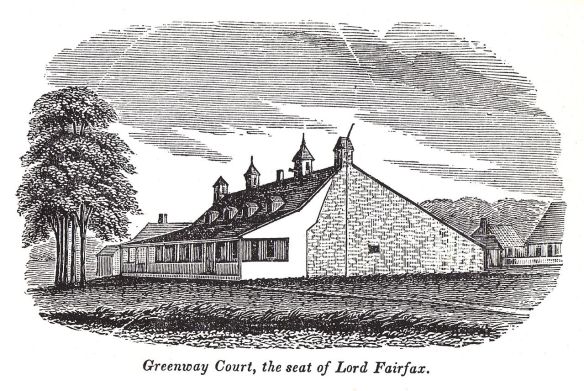
Greenway Court

Today, the original estate office remains.  If James visited Lord Fairfield, he may well have walked in this very building.

Greenway Court office

James’ Will and Estate

James wrote his will on June 27, 1757 but it wasn’t probated until August 9, 1764 where it is recorded in Frederick County Will Book 3, 1761-1770, page 68.

In the name of God, Amen.  I James Crumley of the County of Frederick and the colony of Virginia cordwainer being at present in perfect health of body and sound and perfect mind and memory praise be therefore given to Almighty God, do make, constitute and ordain this my last will and testament in manner and form following.  First and principally I recommend my soul into the hands of Almighty God who gave it, hopeing through the merits death and passion of Jesus Christ my savior to obtain remission of all my sins and to inherit everlasting life, and my body I commit to the earth whence it came to be decently buried at the discretion of my executors hereafter named and as touching the desposition of all such men such worldly estate as it hath pleased Almighty God to bestow upon me. I leave and bequeath as followeth:

First I will that all my just debts and funeral charges be fully paid and discharged.

Item, I leave until my son John Crumley 219 acres with an addition of a piece more to be divided betwixt Benjamin Barret and me to him his heirs and assigns forever.

Item, I leave unto my two sons William and Henry Crumley 644 acres of land equally to be divided betwixt them in quantity and quality to them their heirs and assigns forever.

Item, I leave unto my granddaughter Ruth Doster 100 acres of land joining the tracts of my sons William and Henry and joining upon John Boisers to her her heirs and assigns forever.

Item, I leave unto my loving wife Catherine Crumley all that present plantation where I now live during her natural life of whilst she continues under the name of Catherine Crumley and upon her decease or upon altering her said name I leave and bequeath the said plantation to my youngest son Samuel Crumley and to his heirs and assigns forever.

Item, I leave and it is my will that all the rest and remainder of my estate both real and personal be equally divided betwixt my five children, Mary, John, William Henry and Samuel upon the decease of my wife of upon altering her present name and not before.  And moreover my will is that if my wife shall see cause to alter her condition that she shall have a like equal divident of my moveable estate with my children.  As also my will is that my wife shall keep the children with her till of age or until they settle their places and my desire and will is that the quit rents yearly and other publick demands be paid out of the product of the plantation, not to diminish any part of the childrens divident in the estate thereby.

Item, I leave unto each of my 4 sons aforesaid out of moveable estate to the value 15 pounds in whatever they shall stand in need of upon their setting by themselves.

Item, I leave unto my brother Thomas Crumley 15 pounds current money and to my sister Joan 5 pounds current money.

Lastly, I leave, constitute ordain and appoint my well beloved friends Robert Cunningham and George Ross together with my well beloved wife Catherine Crumley executors of this my last will and testament hereby revoking disallowing and making void all former wills testaments legacies or executors heretofore by me made ordained or appointed ratifying and confirming this and this only to be my last will and testament in presence of these witnesses this 27th day of June in the year of our Lord 1757.

James Crumley signs and Catherine Crumley signs also with a mark of R

Witnesses:
William Dillon
M. Kean
William Frost

We don’t know where James is buried, but it’s likely at the Hopewell Friends Meeting House Cemetery.  As I look at this stone wall, I wonder if James helped construct or maintain it.

Hopewell Cemetery

James will was probated on August 9th, 1764, so he likely died during the summer of 1764.  Both William Frost and Matthew Keen swear as witnesses and prove the will.  Catherine Crumley, his widow and administratrix of the will, enters into bond with John Neavill, John McMachen and Francis Lilburne as her securities in the penalty of 1000 pounds for her “due and faithful administration of the said estate.”  This tells us that James has a significant estate, as this is a very high bond for that time period.  James had gone from being one of the 6 poorest men in the township in 1732 to a substantial estate thirty two years later in 1764.

James would have been in his 50s, not an old man by any stretch, and he likely had children still at home when he died.  Son Samuel, referenced in the will never appears in any records, so he obviously died before coming of age, and perhaps even before James himself died.  If Catherine was the same age as James, when James wrote his will in 1757, he could have had children at home as young as 2 or 3 years of age.

Frederick Co. Court, Winchester, Va.
Will Book 3, pp. 231-232
Appr. Sept. 1st, 1764

Appraisment Bill of the Estate of James Crumley Deceased to wit

Cash, silver, gold, and paper                                      26-6-3

Washing (wearing?) apparel                                       20-6-6

One negro man                                                         65-0-0

One negro woman and child                                      55-0-0

One negro girl                                                           25-0-0

Beds and furniture                                                     74-4-0

Wheat, rye, and corn                                                 28-12-0

Cows and calves, 13 heads                                       18-10-0

28 hogs and six sheep                                               9-12-0

Six head of horse kind                                               35-10-0

A waggon and gear                                                   9-15-0

Three plows, a harrow and gears, axes & edge tools   8-12-0

One still and utensils cyder mill and cask                    19-17-0

Hides tanned leather and shoe maker tools                10-10-0

Pewter and stove and kitchen iron ware                      13-15-0

Brass scales, stillyards, and money scales                  8-8-6

Home spun cloth linen and woolen                             7-2-7 1/2

Chests, cooper ware and lumber                                7-14-6

Debts due the Estate by bonds and notes                   115-17-4

One note in the Office of Isaac Wright                        4-18-0

Two saddles and 15 gallons of liquor; hives and bees  4-2-6

Total                                                                      508-13-2 1/2

Henry Bowen, William Barret and Azariah Pugh appraisers – returned and ordered recorded Nov. 7, 1764.

James estate inventory, given that he as a Quaker, is quite interesting, and unexpected.  He had 4 slaves who could have been a family, and he had 15 gallons of liquor and a still.  Given the Quaker stance on slavery – and that many Quakers bought slaves with the sole intention of freeing them – he may have been in conflict with the Quaker church over this.  I have seen commentaries that he was reprimanded by the church for this practice, but there are no records supporting this in the Hopewell records.

We know that James’ slaves were not freed, during or after his life, because in 1768, James’ son John Crumley releases his future right in James’ estate after his mother, Katherine, dies, including “all rights to the negroes.”  It makes me very sad to know that my Quaker ancestor owned slaves and didn’t free them. It bothers me that the slaves were not even humanized enough to be referred to by their names – not that it would improve their condition any.  I hope that the slaves were in fact a family and that they were allowed to remain together.  Emancipation wouldn’t occur for another 100 years, probably freeing those slaves great-great-grandchildren.

Given the amount of liquor James had, it’s unlikely that this was only for personal use.  Fifteen gallons, along with the still, is suggestive that he was distilling alcohol for sale – or he had some hellatious parties.  A Quaker slave-owning moonshiner.  Who knew???  Who would ever have guessed?

It has been suggested that perhaps James was distilling alcohol as a medicine.  It has also been postulated that perhaps distillation was an economic necessity because it was much cheaper to transport whiskey than corn or rye to distant markets.  Let’s take a look at that possibility.

According to “Ancestors on the Frontier” by Justin Replogle, a horse could carry 4 bushel of grain, but could carry the equivalent of 24 bushels after it was made into whiskey.  Checking contemporary sources, it’s stated that a bushel of corn makes about 2.75 gallon of whiskey, so James 15 gallons probably took about five and a half bushel of corn.  Most stills of that time made less than 100 gallons.

It was much cheaper to ship grain as whiskey.  In 1790, there were over 500 stills in Washington County, PA, a heavily religious Brethren and Mennonite area also bordering the Allegheny Mountains.

Clearly, given James’ alliance with the church as a vestry member as late as 1756, these apparent “flaws” in his Quakerness didn’t interfere with his church membership.  He was never dismissed.  All of this considered, I wonder if he was buried in the church cemetery after all.  Although, if his fellow Friends didn’t let it bother them during his life, I doubt they suddenly let it bother them in death.  I wonder if his slaves had to dig his grave.  Were they sad or glad?

Judging from the amount of debts due the estate, it looks like he might have been selling liquor on credit.

Shoemaker’s Tools

These shoemaker’s tools might have been those of James Crumley.  Cousin Jerry says the following:

“I have an iron shoe repair tool, pictured here, that was passed to me supposedly from back to my gggranddad, Robert 1800-1883. I’ve often wondered just how far back this thing goes. Robert, of course, was a pioneer, so he could make/repair anything. I have a spinning wheel he made for a new daughter-in-law. This may have originated with him or from his grandfather James.

Jerry shoemaker tool

It’s made of heavy iron, and the end parts are different sizes: one for repairing men’s shoes and one for women’s or children’s shoes.

Jerry shoemaker tool2

I have hand tools that belonged to my great granddad, then my granddad, then my own dad. I still use them in my shop. When I pick one up I feel like I’m shaking hands with those old men.”

Quakers and Slaves

When I think of Quaker, I think of peace loving and abolition.  I think of plain, gentle people and plain dress, but not quite as “plain” as the Amish and Mennonite.

However, the history of the Quakers and slavery is not as cut and dried as it seems, and it appears that James Crumley may have been caught up in the early Quaker and slavery conflict.

According to the website, “Quakers and Slavery,” the first slaves arrived in Philadelphia in 1684 and were sold to Quakers.  Between 1682 and 1705, one of 15 families in Philadelphia owned slaves, and many of them were Quakers.  Some Quakers were involved in the slave trade.

In 1688, the first protest was made against slavery in the Germantown Quaker monthly meeting and went without action.  However, conflict continued to build, and in 1693, a Quaker named George Keith published a papers cautioning Quakers not to buy or own slaves.

In 1712, a Quaker petitioned the Pennsylvania Assembly to outlaw slavery and was refused.

In 1713, the Chester monthly meeting called for the banning of slavery and censure of those who did not comply.

In 1731, 20% of Philadelphia Quakers owned slaves and accounted for 30% of all the slaves in the city of Philadelphia.

We don’t know if James Crumley owned slaves in Pennsylvania or not.  It’s probably unlikely since he didn’t own land, but it’s certainly possible.  The first we know positively that James owned slaves was when he died in 1764 and 4 slaves were included in his estate inventory.

What we do know is that while some Quakers were solidly opposed to slavery, many were not and owned slaves.  This did not, at this time, appear to interfere with their church membership, with the possible exception of the Chester Meeting.  Of course, this could have been the meeting that James Crumley attended when he lived in Chester County, Pennsylvania if he was a practicing Quaker there.  Given that he migrated with the Nottingham Meeting House group to Frederick County, he was certainly affiliated with the Quakers in some fashion.

Apple Pie Ridge

James home plantation in Frederick County was located on Apple Pie Ridge, said to have been named for the delicious apple pies baked by the Quakers.  It is still a land of many apple orchards.  I guess now would not be the time for me to fess up that I don’t care for apple pie.  Maybe the problem is that I haven’t had an Apple Pie Ridge apple pie.

Incredibly, the James Crumley home still remains and is today on the register of historic buildings.

James Crumley home

From the application for the Register of Historic Places:

The acreage where the Crumley-Lynn-Lodge house stands encompassed two parcels–one of 250 acres and one of 1,250 acres–granted by patent from Colonial governor William Gooch in 1735 to Giles Chapman. Chapman sold the acreage to James Crumley who is listed in the Rent Rolls of Frederick County in 1759. Crumley appears to have come to Virginia from Chester, Pennsylvania, where at least five of his children had been born.

James Crumley in his will devised to his wife, Catherine, “All that present plantation whereon I now live during her natural life or while she continues under the name of Catherine Crumley and upon her decease or upon altering her said name I bequeath the said plantation to my youngest son Samuel Crumley.” He directs that Catherine “keep the children with her until of age,” indicating that at least one or two of his children were not yet 21 years old (at least in 1757 when he wrote the will.) He expressed concern for her altering her name, which presumably would have implied her remarriage.

Virginia tax records indicate that Catherine lived for at least another 18 years as she is listed as a white female head of household in 1782 and in 1783 with two slaves, two horses, and seven head of cattle. Her name continues to appear in the records until 1787, with an additional 3 slaves.

This data, when coupled with the Crumley will of 1764, indicates that there was a dwelling on the property that likely dates from as early as 1759 when James Crumley moved his large family to Virginia from Pennsylvania. It was not unusual for families to relocate from Pennsylvania to Virginia’s Shenandoah Valley in the eighteenth century.

The property was ultimately sold in 1793 by John Crumley to Robert Bull of Berkeley County, Virginia, now West Virginia. Samuel Crumley, who had been the original devisee for the plantation parcel, appears to have died by this date, and John Crumley, probably son to James, was the grantor to Bull. The acreage is given as 150 acres in the deed, and buildings are specifically mentioned. The parcel is described as part of the patent sold to Giles Chapman and sold to James Crumley. The selling price of 293 pounds is substantial enough to reflect a dwelling on the property.

By 1885, the Crumley-Lynn-Lodge House is recorded on a map of Frederick County published by D. J. Lake, and Co. as the “Wm. Lodge Res[idence],” located on what has been known as Apple Pie Ridge as early as 1816. The dwelling house is shown as standing on the west side of the main road running north from White Hall Post Office to the West Virginia line.

James Crumley land layout

There have been virtually no changes to the essential core elements of this house since 1851, although several rear additions have been made.

James Crumley topographic map

Today, this map shows the location of the original James Crumley home at 3641 Apple Pie Ridge Road.  It was placed on the National Register of Historic places in 2006 as the Crumley-Lynn-Lodge House in Frederick County, VA.

James Crumley Apple Pie Ridge

The earliest section of James Crumley’s home was built about 1759, and was a 1 1/2-story, log section raised to a full two stories about 1850. About 1830, a two-story, Federal style brick section was added. A two-story frame section was added to the original log section in 1987–1994. The front facade features a folk Victorian-style front porch with square columns, sawn brackets and pendants, and plain handrail and balusters. Also on the property are the contributing mid-1800s brick granary, and log meat house, as well as a late-1800s century corn crib, and the stone foundation of a barn.

James Crumley home interior

The oldest portion of this building is to the left in the photo above, submitted with the Application for the Register of Historic Places.

The application for the Register of Historic Places states the following:

Historical and architectural evidence suggests that the earliest 1 ½-story log section was constructed ca. 1759 for James Crumley. The two-story brick section to the north was added in 1830 by William Lynn, who had acquired the property in the early nineteenth century. The last historic addition to the house, which included raising the original 1 ½-story log section to two full stories, was made around 1850, shortly after the property was acquired by the Lodge family. In addition to the main house, the property includes a rare example of a mid-nineteenth-century brick granary, and log meat house, as well as a late-nineteenth-century corn crib, and the stone foundation of a barn. The buildings and the setting retain much of their mid-nineteenth-century appearance and integrity.

The earliest section of the Crumley-Lynn-Lodge House is the three-bay log portion to the south. Originally 1 ½ stories in height, it was raised to two stories ca. 1850, and is clad in weatherboard siding and features a gable roof of standing-seam metal, a random-rubble stone foundation, and six-over-six-sash double-hung wooden windows. The exterior-end limestone chimney located on the south gable end was made taller to accommodate the second story using a brick stack. Also on the south end is a bulkhead entry to the basement, which is excavated about seven feet deep.

The earliest log portion of the house features a two-room plan divided by a wooden paneled partition. The room to the south has a front door leading from the porch and a rear door that originally led to the exterior, and later to a rear lean-to. The room also contains a large fireplace along the south wall with a small window to its left. The plain wooden mantelshelf with brackets is modern, but the oak lintel and at least some of the horizontal wood paneling along that wall appear original. The fireplace surround has been plastered and the hearth is brick.

Although the floors in this room have been covered with more modern pine flooring, the painted architrave door and window trim, plaster walls, exposed unpainted ceiling joists, and batten doors with early hardware and hand-wrought strap and H & L hinges are all intact. The boxed staircase in the southwest corner of this room is enclosed with wide planks and contains a small closet beneath it. This stair would have originally led to the ½-story loft which was enlarged to a full story ca. 1850. Just to the right of this staircase is a three-over-six-sash window that, along with the window to the left of the fireplace, is smaller in size than the ones on the front (east) wall and probably indicates the original size of the windows in this section of the house. A doorway with a batten door, also along this rear wall, lines up with the front door.

James Crumley home door

Also part of the earliest log section of the house is a smaller room north of the larger room (or parlor) that was originally unheated. The two rooms are separated by a wooden paneled partition of vertical yellow pine boards, some of which are tongue and grooved.

This is a wonderful document to have about James Crumley’s home.  I do have a couple of comments to make.  The historian is referencing the fact that James Crumley was on the tax list by 1759, and perhaps they are looking at a jump in value on the tax list that would indicate a home was built on this property, albeit a 2 room log cabin.  However, given that James Crumley purchased this land in 1748 from the Gilkeys, this home could have been another decade (or more) older than originally thought.

A cousin who visited provided me with the photo above of the door and the photo below as well.

James Crumley home fireplace

James and Catherine’s Children

As evidenced by James will, James and Catherine had 5 children who were living in 1757, but apparently only 4 who survived to adulthood.  Samuel is not mentioned in any records after his father’s will in 1757.

  • John Crumley was probably the eldest child. He was probably born about 1733 or 1734 in Chester County, PA.  He was of age by 1757 when James sold him land. John married Hannah Faulkner about 1761 in Frederick County, VA and moved to Newberry County, SC before 1790 where he is found in the 96 District. He died according in 1794 with a will, having 9 children.
  • William Crumley was probably the second eldest son, born around 1735 or 1736, also in Chester County, PA.  He too was of age by 1757 when James sold him land. William married Hannah Mercer about 1761 in Frederick County, VA. William lived his life on the land originally owned by James and died in 1793 in Berkeley County, West Virginia where that land was located after Virginia and West Virginia divided. He married a second time to Sarah Dunn in 1774, having a total of 15 children by his two wives.
  • Mary Crumley was also born early to the marriage, as she was already married to Thomas Doster and had daughter Ruth in 1757 when James wrote his will. It’s unclear, but Mary may have been married a second time to a Jesse Faulkner.
  • Henry Crumley married Sarah whose last name is unknown. Very little is known about Henry.  Henry signed deeds in 1766 and 1768 and in 1770 appointed William Crumley his power of attorney.  He apparently moved from the area and died about 1792.  There are no known children but that doesn’t mean they don’t exist.

James and Catherine likely had additional children…probably 5 or 6, who died as children.  Note that there are no children named James or Catherine.

DNA

Over the years, many Crumley descendants have been interested in genealogy.  With the advent of genetic genealogy, almost 15 years ago now, several Crumley males reached out and tested through the Crumley Y DNA project with the hope of confirming their common ancestry.  And indeed, they did.

As time moved on, autosomal DNA testing became available to supplement the Y DNA results.  Autosomal DNA is the DNA received from both parents which is contributed by ancestors in various amounts.  In each generation, more ancestral DNA is lost and the pieces that remain are often passed in smaller and smaller segments.  However, often, enough DNA remains intact to match to other descendants who also carry that same DNA segment from the same ancestor.

Today, there are almost 50 Crumley descendants who have joined the Crumley DNA project or tested outside of Family Tree DNA at either 23andMe or Ancestry and who have downloaded their results to GedMatch.

I utilized the tools at both Family Tree DNA and at GedMatch to see just how much of James Crumley’s DNA is found in his descendants.  More specifically, if several of James descendants match on a particular segment of DNA, that DNA is very likely descended from James.  To prove this, each segment would need to be triangulated between any 3 descendants.  This is a manual process and with almost 50 individuals involved, would take me from now to next year.  So, I did not triangulate or prove these segments.  These are match groups between 49 of James descendants today who descend through two different sons, John and William.  To eliminate picking up downstream DNA of the son’s wives, the descendants of son John are only matched to the descendants of son William.  I took that resulting match spreadsheet and utilized Kitty Cooper’s overlapping segment mapping tool to see how many of the matched pairs exist on various chromosomes.

Note that in the legend, when you see Carl V, for example, that really means that Carl matches to one of the other participants, so what you see mapped on the chromosome are not single matches, but paired matches.

If there are more than 4 match pairs on any segment, they are “behind” or overlapping each other on the chromosome and you can’t see them.  What I’m saying  is not to pay attention to the names, just the colored segments on the chromosomes.

This wonderful tool gives you a good idea of the segments where James descendants match each other above 3 cM and 300 SNPs.  As more descendants test, more matching segments will appear.

Does this mean that all of these segments come from James or Catherine?  Probably not.  Some of the smallest segments are probably identical by chance, especially segments not found in large groups or clusters.  When you have a large cluster of the same matching segment, it increases the chances significantly that these are not matches by chance and are identical by descent – in other words, they do come directly from James and Catherine..

James Crumley overlapping segments

Kitty also provides a tool where you can look at any single chromosome and how the matches stack up.  Below is James (and Catherine) Crumley’s chromosome 8.  For me,  the fact that I and so many of my Crumley kin still carry part of James and Catherine is absolutely amazing.  I look at the colorful representation of their ancestors on this chromosome map, rebuilt by their descendants and I see the beauty of Nature and the everlasting legacy of the ancestors, in this case, my very own moonshining Quaker, James Crumley.

James Crumley chromosome 8

Looking at these graphics makes me feel like a happy confetti explosion has occurred, except in reverse, and the pieces of confetti are being fit back together again, at least on paper, to recreate at least a small part of our common ancestor, James Crumley and his wife, Catherine.  While part of this DNA is James, Catherine would have contributed an equal amount of DNA to all of their children, so part of this, today, is hers as well.  As more people test and technology improves, maybe one day we’ll knows which pieces of DNA were contributed by James and which by Catherine.  Who knows, it may even be their cumulative DNA found in their descendants that one day that will lead us to their parents.

Acknowledgements:  This article is a combination of the research of several Crumley descendants, both living and dead.  I want to thank each and every one who contributed (and continues to contribute) and all of those who DNA tested as well.  What we can accomplish together is amazing!

______________________________________________________________

Disclosure

I receive a small contribution when you click on some of the links to vendors in my articles. This does NOT increase the price you pay but helps me to keep the lights on and this informational blog free for everyone. Please click on the links in the articles or to the vendors below if you are purchasing products or DNA testing.

Thank you so much.

DNA Purchases and Free Transfers

Genealogy Services

Genealogy Research