Ann Moore (c1785 – 1860/1870), The Minister’s Daughter, 52 Ancestors #63

Ann Moore, or as the family affectionately called her, Nancy or Nancy Ann Moore, is one of those ancestors we only know due to the men in her life.  Were it not for the men, her father and husband, we wouldn’t know her name or who she was at all.

Nancy was born in Halifax County, Virginia in 1785 or 1786.  She was listed in the 1850 and 1860 census of Claiborne County, TN as age 65 and 74, respectively, once by the name of Nancy, and once by the name of Ann.  We also know from these records that she was older than her husband, probably by about 2 years, but maybe a little more.

Nancy was a Methodist minister’s daughter, born to the Reverend William Moore and his wife, Lucy, whose last name is unknown.  The Moore family had settled in Halifax County in about 1770 and by the time Nancy Ann was born, was well established, as was the Moore Meeting house that stood in what is today the crossroads of Mountain Road and Oak Level Road at Oak Level.

Oak Level

The Moore land and house stood mostly on the south (right) side of the road and the Meeting House on the north (left, above), to the right of where this house stands today, in that clump of trees in the photo below.

???????????????????????????????

Beside the meeting house was a spring where the church attendees went to refresh themselves.  This is today located directly across the road from the Mt. Vernon Church which was built to replace the original Moore Meeting House.

Every Sunday and probably some evenings too, Nancy would have attended services in the Moore Meeting House from as early as she could remember.  I’m guessing that her last Sunday in Halifax County, around 1820, was also spent in this church, hearing her father preach for the last time….hearing her father’s voice for the last time.

This also tells us, by inference, that John R. Estes, the man whom she would marry, was a Methodist too, and attended her church.

How do we know that, even though his family lived miles away in South Boston?  Because there was only one Methodist Church in Halifax County at that time, and all Methodist “dissenters,” meaning those not attending the Anglican church, would have attended this church.  And the Good Reverend would never, ever have consented for his daughter to have married someone not Methodist and not a member in good standing.  John’s mother’s family, the Youngers, were also Methodist, as was his grandmother’s family, the Combs, which means that John’s parents were very likely Methodist too – forming a network of people covering at least two, if not three, generations who had intermarried.

You can’t marry someone you don’t see.  John R. Estes and Ann Moore saw each other through church and extended family.

William Moore signed for daughter Ann Moore to marry John R. Estes on November 25, 1811.  We don’t know, because there is no minister’s return still in existence, but it’s most likely that he performed the nuptials, himself, in the Moore Meeting house.

John R Estes Ann Moore marriage

By virtue of an affidavit some years later, given by John R. Estes, we also know that the family, meaning the extended family, was together that Christmas Day as well.  Howe do we know that?  Well, Lemuel Moore was there, believed to be Anne’s brother, John R. Estes was there and John’s grandmother’s Combs family line was there too.  These people were very likely all Methodist and the Reverend William Moore likely preached on Christmas Day.  Afterwards, they probably all ate together.  It would only be later that what was discussed and who said what to whom would become part and parcel of a civil suit.

We know that Ann was having children in 1812 when their first child, William, named after her father, was born.  On April 7, 1813, their first daughter, Lucy, named for Ann’s mother, joined the family.  If you’re counting, either Nancy was pregnant when they married or William or Lucy’s birth information is incorrect.  Certainly either is possible.

Based on the tax records, I believe that the young couple had set up housekeeping by John R. Estes’s family in South Boston.

Estes land South Boston

This photo is taken from the Oak Ridge Cemetery in South Boston, standing in one of the multiple (later) Estes plots but looking across the road at part of the land that was the original Estes land in South Boston, owned by Moses Estes Jr.  Moses’s son, including George, lived there and eventually, the grandchildren inherited that land.  This is the area where Nancy Ann Estes would have lived as a young bride, minus the paved road, utility poles and car of course.

John R. Estes was drafted for the War of 1812 and enlisted on September 1, 1814.  He was discharged just three months later, in Maryland.  We don’t know if he had a horse or was on foot during his service time.  One way or another, he made it back home unscathed.

We do know that Ann and John’s next son, Jechonias, was born about this time or maybe after John returned.  According to the census, Jechonias was born probably in 1814 or 1815.  I have never been able to figure out where that name came from, Jechonias, but I’m just sure there is a clue in there someplace about ancestry.  I did quite a bit of research in Halifax County surrounding the first Jechonias, which was found specifically in a couple of families, but was never able to discover any connection.

In about 1817, their daughter, Temperance was born.  Again, we don’t know who she might have been named for.

John Y. Estes was born on December 29, 1818, in Halifax County, or at least in Virginia.  Nancy, the next child would be born about 1820 and later census records indicate she was born in Virginia.  I don’t think that the family was living in Halifax County in 1820 because they are not enumerated on the census.  They could, literally, have been in transit.

About this time, Nancy Ann and John R. Estes packed their worldly belongings into a wagon and with at least 4 young children and headed west, leaving all four of their aging parents behind.  I can only imagine how difficult that parting must have been, all parties concerned knowing they would be seeing each other for the last time.

Ann’s uncles, Rice and Mackness Moore were already living in Grainger County, Tenenssee, where The Reverend Rice Moore had established the Methodist County Line church, literally on the county line between Grainger and Hawkins County.  This area was just below Claiborne County, across the Clinch River.

County Line Church,  Grainger Co., TN

We don’t know exactly where Ann and John settled at first, but we do know for sure that their daughter Lucy, married Coleman Rush in Grainger County in 1833 and they lived there for at least a few years.  The County Line Church is gone today, but stood in the above location.

However, in 1830, John Estes and Nancy were living in Claiborne County and had 8 children according to the census.  They were living among the neighbors who would shape their lives and that of their children in the decades to come.  Their neighbors within 5 houses in either direction included the Cooks (John R’s second wife), the Campbell’s (John Y’s wife), the McVeys (William’s wife), the Brays (Jechonias’s wife).  Next door lived William Cunningham, a man who would sign for John R. Estes’s character in 1871, 40+ years later.

Sometimes, my ancestors reveal themselves to me in very unique ways, but when researching Ann Moore, something happened that has never, ever happened before.  I’m just going to share this image with you of the 1830 Claiborne County, TN census from ancestry.com.  I am not cropping any of the screen shot so that you can see for yourself that this is an actual screen shot.  For the record, I did not photoshop this or do anything else to it.  This is exactly how it appeared on my screen, much to my surprise.

1830 Claiborne Census ghost picture

Those of you who look at census records regularly know, positively, there are no photos, blurry or otherwise, associated with census records.  And suffice it to say, I’ve looked at this same record several times, and this image was never there before.  In fact, I’ve never seen anything like this before.

1830 Claiborne Census ghost picture cropped

In this cropped version, John Campbell, my ancestor is at the top of the photo and John Estes, Ann Moore’s husband is at the bottom of the photo.  I’m just not going to say anything at all.

After moving to Tennessee, Ann and John had a daughter between 1820 and 1825, but she had died by the 1840 census or married very early and was never noted by P.G. Fulkerson as being one of John R. Estes and Ann Moore’s children.  I suspect she died, because she wasn’t recorded by any other family members either.  I also suspect that a second child died in this same timeframe, because George wasn’t born until 1827 and then Mary after the 1830 census, both named after John R’s parents – so there is a gap likely to represent a deceased child.

Ann’s father, William Moore, died in 1826 back in Halifax County, Virginia, but Ann may not have known that until a circuit riding minister came through the area.  Ann’s mother struggled in Halifax County and died between 1830 and 1840.  Ann’s father lost the farm to debt before he died, not long after John and Ann left Halifax County.

We don’t know much about Ann’s day to day life in Claiborne County.  John had property surveyed in 1826, but sold it immediately.  By 1850, John was a shoemaker and their only child left at home was Mary, age 19.

By 1860, John is noted as a miller, but since they owned no land, he was obviously being a miller on someone else’s land.  A few houses away, Isaac Cole is noted as a millwright, a man who would have built mills and understood the gearworks.  Perhaps these men worked together in some fashion.

The 1850 census indicates that Nancy cannot read or write, but that her husband and her daughter both can.  The 1860 census does not have a checkmark indicating that Nancy Ann can’t read and write, so we’ll never know for sure.  Since there are no documents that Nancy actually signed, we don’t know if she signed with a signature or with an X.

Nancy Ann and John spent their life in Claiborne County in or near Estes Holler on Little Sycamore Creek.  Their first child married when their youngest was just a year or so old, so Ann and John had children in their household for almost exactly 40 years.

By the 1860 census, they had a teenaged grand-daughter living with them.  It’s hard to say whether this arrangement was to help them or for them to help with a troublesome grandchild.

We know that Ann was still alive in 1860, listed as age 74, and was gone by the 1870 census by which time she would have been in her mid-80s.  Ironically, in 1871, John R. Estes completes an application for War of 1812 benefits and in it he lists his marriage to Ann Estes.  It’s appears that he was simply recording that marriage, not indicating he was at that time still married to Ann at that time.

John R. Estes 1871 pension app

Life in Claiborne County during the Civil War was miserable.  Not only were battles constantly waged for the coveted position of the Cumberland Gap which changed hands several times, but the soldiers from both sides were constantly foraging for food for both themselves and their animals.  Many of the local men were away, enlisted to fight either for the Union or the Confederacy, so taking food from women, children and the elderly was easy pickings – at least comparatively speaking.

If Nancy Ann had not already died before the Civil War began, she would have remained at home, worrying, while her son John Y. Estes fought for the Confederacy, was wounded, captured, held as a POW and in 1865 was finally released and walked home from north of the Ohio River, on a bum leg.  John R. and Nancy Ann probably tried to help feed his wife, Ruthy, and the children while he was gone.

Nancy Ann also agonized, I’m sure, over her daughter’s, Lucy and Tempy, whose husband’s were fighting for the north.  She must have been especially worried about her son William’s wife, now a widow in Kentucky, but with 4 sons and sons-in-law fighting for the Union.  And then there was always a question of whether Ann’s son, George, was really dead after he disappeared on his way back to Iowa from California with his gold rush proceeds, or if he was alive someplace.

Or maybe Ann was blessed and died before the Civil War and didn’t have to suffer through any of that.

We don’t know where Nancy Ann was buried, but given that in 1871, John was living 4 miles east of Tazewell, it’s very likely that she was buried on the land that was owned by her son, Jechonias Estes.  Today, that land includes the “upper Estes cemetery,” shown below with 5 Estes cousins in 2004 or 2005.  Actually, there were 6 cousins, but I was taking the picture.

Upper Estes Cemetery 5 cousins

This cemetery is also called the Estes Nunn Cemetery today and has more unmarked graves than marked graves.

Upper Estes Cemetery unmarked

One of the ways we could tell more about Nancy Ann Moore is through her mitochondrial DNA that she inherited from her mother.  Woman pass this DNA to both genders of their children, but only females pass it on.  So, in order to find a male or female today who carries Nancy’s mitochondrial DNA, it’s necessary to find someone who descends from her through all females to the current generation.  In the current generation, males are fine.

Nancy Ann’s daughters with their known daughters were as follows:

Lucy and Coleman Rush

  • Nancy Jane Rush born May 24, 1834
  • Margaret Amanda Rush born January 27, 1836

Nancy and Nathaniel Hooper

  • Mary Hooper born 1853
  • Malinda Hooper born 1855

Temperance and Adam Clouse

  • Ann J. Clouse born 1841
  • Mary M. Clouse born 1842
  • Jemima Clouse born 1844/1845
  • Sarah J. Clouse born about 1849
  • Louisiana Clouse born about 1856
  • Elizabeth Clouse born about 1858

Mary and William Hurst

  • Missouri Hurst born 1854
  • Marion or Mahlon Hurst born 1857
  • Malissa A. Hurst born 1860

Unfortunately, there are two Hurst couples who carry the same first names, so I can’t necessarily tell which Mary Hurst is Mary Estes Hurst.

There could easily be additional children for these women.

If you descend from any of these women, through all females, please let me know.  I have a DNA testing scholarship waiting for you!!!!

Heck, if you are related to this family at all, let me hear from you.

______________________________________________________________

Disclosure

I receive a small contribution when you click on some of the links to vendors in my articles. This does NOT increase the price you pay but helps me to keep the lights on and this informational blog free for everyone. Please click on the links in the articles or to the vendors below if you are purchasing products or DNA testing.

Thank you so much.

DNA Purchases and Free Transfers

Genealogy Services

Genealogy Research

Haplogroup A4 Unpeeled – European, Jewish, Asian and Native American

Mitochondrial DNA provides us with a unique periscope back in time to view our most distant ancestors, and the path that they took through time and place to become us, here, today.  Because mitochondrial DNA is passed from generation to generation through an all-female line, un-admixed with the DNA from the father, the mitochondrial DNA we carry today is essentially the same as that carried by our ancestors hundreds or even thousands of years ago, with the exception of an occasional mutation.

Y and mito

You can see in the pedigree chart above that the red mitochondrial DNA is passed directly down the matrilineal line.  Women contribute their mitochondrial DNA to all of their children, of both genders, but only the females pass it on.

Because this DNA is preserved in descendants, relatively unchanged, for thousands of years, we can equate haplogroups, or clans, to specific regions of the world where that particular haplogroup was born by virtue of a specific mutation.  All descendants carry that mutation from that time forward, so they are members of that new haplogroup.

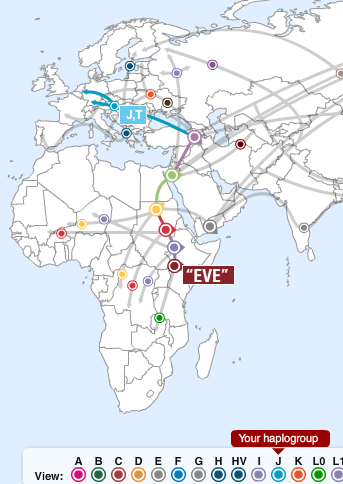
For example, here we see the migration path of haplogroup A, after being born in the Middle East, spreading across Eurasia into the Americas, courtesy of Family Tree DNA.

Hap A map crop

This pie chart indicates the frequency level at which haplogroup A is found in the Americas as compared to haplogroups B, C, D and X.

Hap A distribution

However, not all of haplogroup A arrived in the Americas.  Some subgroups are found along the path in Asia, and some made their way into Europe.  There are currently 48 sub-haplogroups of haplogroup A defined, with most of them being found in Asia.  Every new haplogroup and sub-haplogroup is defined by a new mutation that occurs in that line.  I wrote about how this works recently in the article, Haplogroups and The Three Brothers.

In the Americas, Native American mitochondrial haplogroups are identified by being subgroups of haplogroup A, B, C, D and X, as shown in the chart below.

beringia map

In the paper, Beringian Standstill and Spread of Native American Founders, by Tamm et al (2007), haplogroup A2 was the only haplogroup A subgroup identified as being Native American.

As of that time, no other sub-haplogroups of A had been found in either confirmed Native American people or burials.

In June, 2013, I realized that a subgroup of mitochondrial haplogroup A4 might, indeed, be Native American.

The haplogroup A4 project was formed as a research project with Marie Rundquist as a co-administrator and we proceeded to recruit people to join who either were haplogroup A4 or a derivative at Family Tree DNA, or had tested at Ancestry.com and appeared to be haplogroup A4 based on a specific mutation at location 16249 in the HVR1 region.  As it turns out, location 16249 is a haplogroup defining marker for haplogroup A4a1.

There weren’t many of these Ancestry people – maybe 20 in total at that time.  Ancestry has since discontinued their mitochondrial and Y DNA testing and has destroyed the data base, so it’s a good thing I checked when I did.  That resource is gone today.

Family Tree DNA has always been extremely supportive of scientific studies, whether through traditional academic channels or via citizen science, and they were kind enough to subsidize our testing efforts by offering reduced prices for mitochondrial testing to project members.  I want to thank them for their support.

Other haplogroup administrators have also been supportive.  I contacted the haplogroup A administrator and she was kind enough to send e-mails to her project members who were qualified to join the A4 project.  Supportive collaboration is critically important.

I wrote an article about the possibility that A4 might be Native, and through that article, raised money to enable people to test at Family Tree DNA or upgrade to the full sequence test.  Full sequence testing is critical to obtaining a full haplogroup designation.  Many of these people were only, at that time, defined by HVR1 or HVR1+HVR2 testing as haplogroup A.  Haplogroup A is, indeed, a Native American haplogroup, but it’s also an Asian haplogroup and we see it in Europe from time to time as well.  The only way to tell the difference between these groups is through full sequence testing.  Haplogroup A was born in Asia, about 30,000 years ago and has many subgroups.

What Do We Know About Haplogroup A4?

Haplogroup A4 has been identified as a subgroup of the parent haplogroup A and is the parent haplogroup of A2.  In essence, haplogroup A gave birth (through a mutation) to subgroup A4 who gave birth through a mutation to subgroup A2.

To date, before this research, all confirmed Native American haplogroups were subgroups of haplogroup A2.

In the Kumar et al 2011 paper, Schematic representation of mtDNA phylogenetic tree of Native American haplogroups A2 and B2 and immediate Siberian-Asian sister clades (A2a, A2b, A4a, A4b and A4c), no A4 was reported in the Americas, although A4 is clearly shown as the parent haplogroup of A2, which is found in the Americas.

On the graph below, from the paper, you can see the color coded “tabs” to the right of the haplogroup A designations that indicate where this haplogroup is found.  As you can see, A4 and subgroups is found only in Siberia and Asia, not in the Americas, which is indicated by yellow.

Hap A and B genesis

Schematic representation of mtDNA phylogenetic tree of Native American haplogroups A2 and B2 and immediate Siberian-Asian sister clades (A2a, A2b, A4a, A4b and A4c). Coalescent age calculated in thousand years (ky) as per the slow mutation rate of Mishmar et al. [58] and as per calibrated mutation rate of Soares et al. [59] are indicated in blue and red color respectively. The founder age wherever calculated are italicized. The geographical locations of the samples are identified with colors. For more details see complete phylogenetic reconstruction in additional file 2 (panels A-B) and additional file 3. Kumar et al. BMC Evolutionary Biology 2011 11:293 doi:10.1186/1471-2148-11-293

I then checked both GenBank and www.mtdnacommunity.org for haplogroup A4 submissions.  Ian Logan’s checker program makes it easy to check submissions by haplogroup.

MtDNACommunity reflected one A4 submission from Mexico and from the United States, which does not necessarily mean that the United States submission is indigenous – simply that is where the submission originated.  The balance of the submissions are from either academic papers or from Asia.

During this process, I utilized PhyloTree, Build 15, shown below, as my reference tree.  Build 16 was introduced as of February 2014.  It renames the A4 haplogroups.  In order to avoid confusion, I am utilizing the Build 15 nomenclature.  These are the haplogroup names currently in use by the vendors and utilized in academic papers.

Hap A tree

I am also utilizing the CRS version, not the RSRS version of mutations.  Again, these are the mutations referenced by academic papers and the version generally used among genealogists.

Family Tree DNA provides an easy reference chart of which mutations are haplogroup defining.  For haplogroup A4, we find the following progression.

A4 T16362C
A4a G1442A
A4a1 G9713A, T16249C
A4a1a T4928C

This means that everyone who falls in haplogroup A4 carries this specific mutation at location 16362.  The original value at that location was a T and in haplogroup A, that T has mutated to a C.  This defines haplogroup A4.  So, if you don’t have this mutation, you definitely aren’t in haplogroup A4.  Everyone in haplogroup A4 carries this mutation (unless you’ve had a back mutation, a very rare occurrence.)

This is actually a wonderful turn of events, because it means that the defining mutation for A4 is in the HVR1 region, which further means that regardless of how the haplogroup A individual is classified, I can tell with a quick glance if they are A4 or not.

In addition, subgroups are defined by other mutations as well, shown above.  For example, haplogroup A4a carries the A4 mutation of T16362C plus the additional mutation of G1442A that defines subclade A4a.

Full sequence testing showed that there was actually quite a variety of subhaplogroups in the project participants.

What Did We Find?

In the haplogroup A4 project, we now have 55 participants who fell into 11 different haplogroups when full sequence tested.

A4 project distribution crop

I have removed all haplogroup A2 individuals from further discussion, as we already know A2 is Native.  We have established a haplogroup A2 project for them, as well.

A4b

We found two haplogroup A4b individuals.  The most distant known ancestor of one is found in Tennessee, but the most distant ancestor of the other is found in England.  These two individuals have 19 HVR1 matches, of which many are to other A4b individuals.  There is no evidence of Native American ancestry in this group.

A4-A200G

This unusual haplogroup name indicates that this is a subgroup of haplogroup A4, defined by a mutation at location 200 that has changed from A to G.  The new subgroup is waiting to be named.  So eventually A4-A200G will be replaced with something like A4z, just as an example.

This individual is from Asia, so this haplogroup is not Native.

A10

One individual, upon full sequence testing, was found to carry haplogroup A10, which is not a subgroup of A4.  This is quite interesting, because the most distant ancestor is Catherine Pillard, originally believe to be one of the “Kings Daughters,” meaning French.  This article explains the situation and the question at hand.

All five of her full sequence matches are either to other descendants of Catherine Pillard, or designated as French Canadian.

One of this woman’s ten HVR2 matches shows her ancestor, Annenghton Annenghto, as born at the Ossosane Mission, Huronia, La Rochelle, Ontario, Canada and died in 1657 in Canada.  If this is correct and can be confirmed, haplogroup A10 could be Native, not French.  Her daughter, Marie Catherine Platt has a baptismal record dated March 30, 1651, was also born at the mission, and is believe to be Huron.

This article more fully explains the research and documents relevant to Catherine Pillard’s ancestry.

Based on these several articles, it seems that an assumption had originally been made that because the individual fell into haplogroup A, and haplogroup A was Asian and Native, that this individual would be Native as well.

This determination was made in 2007, based on only the HVR1 and HVR2 regions of the mitochondrial DNA, and on the fact that the DNA results fell within haplogroup A, as documented here.  The HVR1 and HVR2 regions do not include the haplogroup defining mutations for haplogroup A10, so until full sequence testing became available, this sequence could not be defined as A10.  The conclusion that haplogroup A equated to Native American was not a scientific certainty, only one of multiple possibilities, and may have been premature.

I contacted several French-Canadian scholars regarding the documents for Catherine Pillard and there is no consensus as to whether she was Native or European, based on the available documentation.  In fact, there are two very distinct and very different opinions.  There is also a possibility that there are two women whose records are confused or intermixed.

So it seems that both Catherine Pillard’s DNA and supporting documents are ambiguous at this point in time.

One of the ways we determine mitochondrial ethnicity in situations like this is “guilt by genetic association,” to quote Bennett Greenspan.  In other words, if you have exactly the same DNA and mutations as several other people, and they and their ancestors are proven to live in Scotland, or Paris, or Greece, you’re not Native American.  This works the other way too, as we’ll see in Kit 11 of the haplogroup A4 outliers group.

Looking at other resources, MtDNA Community shows two references to A10, one submitted from Family Tree DNA and one from the below referenced article.

Haplogroup A10 has one reference in Mitogenomic Diversity in Tatars from the Volga-Ural Region of Russia by Malyarchuk et al, (201 Molecular Biological Evolution) but has since been reassigned as haplogroup A8, as follows:

However, some of the singular haplotypes appear to be informative for further development of mtDNA classification. Sample 23_Tm could be assigned to A10 according to nomenclature suggested by van Oven and Kayser (2009). However, phylogenetic analysis of complete mtDNAs (fig. 1) reveals that this sample belongs to haplogroup A8, which is defined now by transition at np 64 and consists of two related groups of lineages—A8a, with control region motif 146-16242 (previously defined as A8 by Derenko et al. [2007]), and A8b, with motif 16227C-16230 (supplementary table S3, Supplementary Material online). Analysis of HVS I and II sequences in populations indicates that transition at np 64 appears to be a reliable marker of haplogroup A8 (supplementary table S3, Supplementary Material online). The only exception, the probable back mutations at nps 64 and 146, has been described in Koryak haplotype EU482363 by Volodko et al. (2008). Therefore, parallel transitions at np 64 define not only Native American clusters of haplogroup A2, that is, its node A2c’d’e’f’g’h’i’j’k’n’p (Achilli et al. 2008; van Oven and Kayser 2009), but also northern Eurasian haplogroup A8. Both A8 and subhaplogroups are spread at relatively low frequencies in populations of central and western Siberia and in the Volga-Ural region. A8a is present even in Transylvania at frequency of 1.1% among Romanians, thus indicating that the presence of such mtDNA lineages in Europe may be mostly a consequence of medieval migrations of nomadic tribes from Siberia and the Volga-Ural region to Central Europe (Malyarchuk et al. 2006; Malyarchuk, Derenko, et al. 2008).

On Phylotree build 15, A10 is defined as T5393C, C7468T, C9948A, C10094T A16227c, T16311C! and the submissions are noted as the Malyarchuk 2010b paper noting it as “A8b”and a Family Tree DNA submission.

At this point, haplogroup A10 is indeterminate and could be either Native or European.  We won’t know until we have confirmed test results combined with confirmed genealogy or location for another A10 individual.

A4

Haplogroup A4 itself is not the haplogroup I originally suspected was Native.  When this project first began, we had few A4s, and I suspected that they would become A4a1 when full sequence tested.  I expected A4a1 would be Native American.

Subsequent testing has shown that haplogroup A4 very clearly falls into major subgroups, as defined by different mutations.

A4 European

The European A4 group is comprised of three participants.  Of those three, two are matches to each other and the third is quite distant with no matches.  I suspect that we are dealing with two different European sub-haplogroups of A4.

Two project participants, one from Romania and one from Poland match each other and both match one additional individual from Hungary who is not a project member.  This group is eastern European.

The Romanian and Polish kits that match each other both carry mutations at locations 16182C, 16183C, 16189C, 150T, 204C, 3213G, 3801C and 14025C.  The third person that they match, who is not a project member, from Hungary, matches one of those kits exactly, so that gives us three kits carrying this same series of mutations.  These mutations do not match any other individuals carrying haplogroup A4.  This group appears to be Jewish, as all three of the participants are of the Jewish faith.

This leaves the third project participant from Poland who does not have any matches today, within or outside of the project.  This participant is clearly a different subclade of A4.  They match none of the defining markers of the group above. They do have unique mutations at locations not found in other A4 participants within the project.

This provides us with the following European haplogroup A4 results:

  • Eastern European –Jewish – 2 participants plus one exact full sequence match outside of project
  • Eastern European – does not match group above, has no matches today, five unique mutations including 4 in the coding region.

A4 Chinese

This A4 participant is from China.

This sequence is actually very interesting because of its relative age.  This individual has 109 matches at the HVR1 level.  This means, of course, that they are exact matches.  They match many people in varying locations such as people with Spanish surnames, participants from Michigan, Mexico and Asia which include people with extended haplogroups of A, A4 and A4-A200G haplogroup designations.

At first this appears confusing, until you realize two things.  First, the participant doesn’t continue those matches at the HVR2 level and second, this means that all of those people still carry the Haplogroup “A4 signature” HVR1 mitochondrial DNA, exactly.

This means that those matches stretch back in time thousands of years, until before the divergence of Native Americans and Asians, so at least 12,000 years, if not longer.  People who have incurred mutations in the HVR1 region don’t match, but those who have not, and today, there are only 109 in the Family Tree DNA data base, still match each other – reaching back to their common Asian ancestor many millennia ago.

This individual has developed two mutations in the HVR2 region at locations 156G and 159G.  The participant also does not carry the haplogroup A defining mutation at location 263G which means either that 263G actually defines a subgroup, or this participant has had a back mutation to the original state at this location.  This individual did not test at the full sequence level.

A4 Americas

This leaves a total of 14 haplogroup A4 individuals within the project.

In order to show a comparison, I have removed all private mutations where none of this group matches each other.  I have also removed the haplogroup defining mutations as well as 16519C and all insertions and deletions since those areas are considered to be unstable.  In other words, what I’m looking for are groups of mutations where this group matches each other and no one else.  These are very likely sub-haplogroup defining mutations.

In addition to all private mutations, deleted columns include: 16223, 16332, 16290, 16319, 16362, 16519, 73, 152, 235, 263, 309.1, 309.2, 315.1, 522, 523, 663, 750, 1438, 1736, 2706, 4248, 4769, 4824, 7028, 8794, 8860, 11719, 12705, 14766, 15326.

I then rearranged the remaining columns and color coded groups.  You can click on the chart to enlarge.

A4 mutations

Note: na means not available, indicating that the participant did not test at that level.  An x in the cell indicates that the mutation indicated in that column was present.

The purple and apricot groupings show different clusters of matches.  The light purple is the largest group, and within that group, we find both a dark purple group and an apricot group.  However, not everyone fits within the groups.

A4 – Virginia

The first thing that is immediately evident is that the first kit, Kit 1, is not a member of this purple grouping.  This person has three full sequence matches outside of the project, one whose ancestor was born in Texas.  This individual has three unique full sequence mutations.  This grouping may be Native, but lacks proof.

Additional genealogical research might establish a confirmed Native American connection. If Kit 1 is Native, this line diverged from this larger A4 group long ago, before any of these purple or apricot mutations developed.

This participant’s ancestor traces to Virginia.  Regardless of whether this haplotype is Native or not, it is most likely a sub-haplogroup of A4.

A4 – Colombia

The next least likely match is Kit 2.  This individual shares two of the common HVR2 markers, 146 and 153, but did not test at the full sequence level.  Given what I’m seeing here, I suspect that 146 might be a sub-haplogroup defining mutation for this light purple group.  In addition, 8027 and 12007 might be as well.  That includes everyone (who has tested at the relevant levels) except for Kit 1 and Kit 11.

Haplogroup A4 from Colombia is most likely Native.  Few people are in the public data bases are from Colombia.  One would expect several mutations to have occurred as groups migrated.  At the HVR1 level, this individual has 18 matches, most of which have Spanish surnames.  This participant has no HVR2 matches.

A4 – California Group

The next group is the apricot group which I’ve nicknamed the California group.  Both of these participants, Kit 3 and Kit 4, find their ancestors in either southern California or Baja California, into Mexico.  Finding these haplogroups among the Mexican, Central and South American populations is an indicator of Native heritage, as between 85% and 90% of Mexicans carry Native American matrilineal lineage.

These participants also match a third individual who is not a project member whose ancestor is also found in Baja California.  This group’s defining mutations are likely 16209C, 5054T, 7604A, 7861C and 12513G.  Fortunately, these will be relatively easy to discern due to the HVR1 mutation at 16209.

A4 – Puerto Rico Group

The dark purple group, Kits 5-9, is the Puerto Rican group even though it includes one kit from Mexico and one from Cuba.  The Mexican kit, Kit 5, in teal, is only a partial match.  Kits 6-9 match each other plus several additional people not in the project whose most distant ancestors are found in Puerto Rico as well.  This group has several defining markers including 16083T, 16256T, 214G, 2836T, 6632C and possibly 16126C, although Kit 5 carries 16126C while Kit 9 does not.

The Puerto Rico DNA project has another 18 individuals classified as haplogroup A or A4 and they all carry 16083T, 16256T and those who have taken the HVR2 test (10) carry 214G as well.  Only one carries 16126C, so that would not be a defining mutation for this major group, but could be for a subgroup of the Puerto Rico group.

Given the history of Puerto Rico, this is probably a signature of the Taino or Carib people.

In 2003, 27 Taino DNA sequences were obtained from pre-Columbian remains and reported in this paper by Laluezo-Fox et al.  This was very early in DNA processing, especially of remains, and they were found to carry only haplogroups C and D.  These remains were not from the islands, but were from the La Caleta site in the Dominican Republic.

The Taino today are considered to be culturally extinct due to disease, enslavement and harsh treatment by the Spanish, but they maintained their presence into the 20th century and were a significant factor in the population of the West Indies, including Puerto Rico.  Their descendants would be expected to be found within the population today.  The Taino were the primary tribe found on Puerto Rico and were an Arawak indigenous people who arrived from South America.  The Taino were in conflict with the Caribs from the southern Lesser Antilles.

Carib women were sometimes taken as captives by the Taino.  The Caribs originated in South American near the Orinoco River and settled on the islands around 1200AD, after the Taino were already settled in the region.

It’s therefore possible that haplogroup A4 is a Carib signature.  In 2001, Martinez-Cruzaco et al published a paper titled Mitochondrial DNA analysis reveals substantial Native American ancestry in Puerto Rico in which they found that haplogroup A was absent in the Taino by testing the Yanomama whose territory was close to the Taino.  If this is the case, then haplogroup A must have arisen and admixed from another native culture, or, conversely, the Yanomama tested were an incomplete sampling or simply not adequately representative as a proxy for the Taino.  However, if haplogroup A4 is not found in the Taino, the most likely candidate would be the Caribs, assuming that the Martinez-Cruzaco paper conclusions are accurate, or the even older Ortoiroid, Saladoid culture or Arawak tribe who are believed to have assimilated with or were actually another name for the Taino.

A4 – Mexican/Puerto Rican Mutation 16126 Group

This group, Kits 5-8, is defined by mutation 16126C.  It’s quite interesting, because it includes Kit 5 that does not match the rest of the Puerto Rican markers.  Only some Puerto Rican samples carry 16126C.  Kits 5-8 in this the A4 project do carry this mutation, but 18 of the haplogroup A kits in the Puerto Rican project which do carry the dark purple signature mutations do not carry this mutation.  This mutation may be a later mutation in some of the people who settled on Puerto Rico and some of which remained on the mainland.  The most distant ancestor of Kit 5 is from Tangancícuaro de Arista, Michoacan de Ocampo, shown below.

Tangancícuaro de Arista, Michoacan de Ocampo

Kit 5 has five full sequence matches, all of which carry Spanish surnames.

A4 Outliers

This leaves only kits 10-14.  These kits don’t match each other but do fall, at least on some markers, within the light purple group.

Kit 12 is from Costa Rica and has no matches at the HVR1 level because of a mutation at location 16086C, but has not tested at the HVR2 or full sequence levels.   They might fit into a group easily with additional testing.

Kit 13 is from Mexico and has only two HVR1 matches who have not tested at a higher level.  This kit, like Kit 5, does not carry mutation 16111T which could indicate an early split from the main group or a back mutation.

Kit 10 is from Mexico, has 17 HVR1 matches, some of which indicate that their ancestors are from Texas and Mexico.  Kit 10 has no HVR2 or full sequence matches.

Kit 11 is from Honduras and interestingly, has 158 HVR1 matches to a wide variety of people including those from Costa Rica, Mexico, South Carolina, Oklahoma, a descendant of a Crow Tribal member, North Dakota, Guatemaula, the Cree/Chippewa, a descendant of an Arikawa and one person who indicated their oldest ancestor is from Aragon, in Spain.  This means that all of these people carry the light purple group defining 16111T mutation.

Kit 14 is from Honduras and has only two matches at the HVR1 level, one which is from El Salvador.  Both of the matches have only tested to the HVR1 level.  Kit 14 does carry the 16111T mutation as well as most of the other light purple mutations, but is missing mutation 164C which is present in the entire rest of the light purple group.  This could signify a back mutation.  In addition, Kit 14 matches on marker 16189T with kit 6 from Puerto Rico and on 16311C with Kit 1 from Virginia, but with no other participants on these markers.

These people and their matches and mutations could well represent additional subgroups of haplogroup A4

A4a1

This leaves us with the A4a1 subgroup, which is where I started 18 months ago.

The haplogroup A4a1 group is very interesting, albeit not for the reasons I initially anticipated.  Again, the same columns were deleted as noted in A4, above, leaving only columns (mutations) unique to this group.  As with the other subgroups, these are likely sub-haplogroup defining mutations.

A4a1 mutations

Note:  na means not available, indicating that the participant did not test at that level

A4a1 Mexico

Kit 15, the pink individual did not take the HVR2 or full sequence test, but does not match any other participants at the HVR1 level.  This person’s maternal line is from Mexico.  Kit 15 could be Native and with additional testing could be a different subclade.

A4a1 European Group

The three yellow rows are positively confirmed from Europe.  Kits 1 and 2 do not match each other nor any other participants.

Kit 3 however, matches Kits 4-14.

Kits 3-14, all match each other at the HVR1 level.  One individual has not taken the HVR2 test and one has not taken the full sequence test, but otherwise, they also all match at the HVR2 and full sequence level.  Note that Kit 3 is also in the confirmed European group based on two sets of census documentation.

Within the group of participants comprising kits 3-14, several have oral history and some have circumstantial evidence suggesting Native ancestry, but not one has any documented proof, either in terms of their own ancestors being proven Native, their ancestor’s family members being proven Native, or the people they match being proven as Native.

Kit 3 states that their ancestor was born in England in 1838.  I verified that the 1880 census for New York City confirms that birth location of their ancestor.  The daughter’s mother’s birthplace is also noted to be England in the 1900 census.

Therefore, based on the fact that Kit 3 is proven to be English, according to the census, and this kit matches the rest of the group, Kits 4-14, at the HVR1, HVR2 and full sequence levels, it is very unlikely that this group is Native.

Kit 15, who does not match this group, but who has not tested above the HVR1 level, is the only likely exception and may be Native.  Full sequence testing would likely suggest a different or expanded subgroup of haplogroup A4a1.

Further documentation could add substantially to this information, but at this point, none has been forthcoming.

In Summary – The Layers of Haplogroup A4

Full sequence testing was absolutely essential in sorting through the various participant results.  As demonstrated, the full sequence results were not always what was expected.

When full sequence tested, one participant was determined to be Haplogroup A10, which is not a subgroup of A4.  Haplogroup A10 is indeterminate and could be Native but could also be European.  Additional A10 results will hopefully be forthcoming in the future which will resolve this question.

None of the haplogroup A4a1 participants provide any direct evidence of Native ancestry, with the possible exception of one A4a1 kit whose matrilineal ancestors are from Mexico and who has not tested at a higher level.  Three A4a1 participants have confirmed European ancestry and one of those participants matches most of the others.  A4a1, with possibly one exception, appears to be European.  The A4a1 participant whose ancestors are from Mexico does not match any of the other participants and could eventually be classified as a subhaplogroup.

Haplogroup A4 itself appears to be divided into multiple subgroups, several of which may eventually form new sub-haplogroups based on their clusters of mutations.

There is clearly a European and a Chinese A4 grouping.  The European group is broken into two subgroups, one of which is Jewish.

In the Americas, there are several A4 subgroups, including:

  • Virginia – indeterminate whether Native
  • Colombia – likely Native
  • California – likely Native
  • Puerto Rico (2 groups) – very likely Native

There are also 5 outliers who don’t match others within the group, hailing from:

  • Costa Rica – likely Native
  • Mexico (2) – likely Native
  • Honduras – matching several confirmed Native people in multiple tribes at the HVR1 level
  • Honduras – likely Native

A4 grid v2

Note: Undet, short for undetermined, means that the results could be Native or European but available evidence has not been able to differentiate between those alternatives today.

*A4 needs to be further divided into additional haplogroup subgroups.

Dedication

Obviously, a study of this complexity couldn’t be done without the many resources I’ve mentioned and probably some that I’ve forgotten.  I thank everyone who contributed and continues to contribute.  I also want to thank the people who contributed to the funding for participant testing.  We could not have done this without your contributions in combination with the discounts offered by Family Tree DNA.

However, the most important resource is the participants and their willingness to share – their DNA, their research and their family stories.  During this project, two of our participants have passed away.  I would like to take this opportunity to dedicate this research to them, and I hope they know that their DNA keeps on giving.  This is their legacy.

Acknowledgements

I would like to thank Ian Logan for his assistance with haplogroup designation, Family Tree DNA for testing support and discounts, my project co-administrator, Marie Rundquist, Bennett Greenspan, Dr. Michelle Fiedler and Dr. David Pike for paper review.

______________________________________________________________

Disclosure

I receive a small contribution when you click on some of the links to vendors in my articles. This does NOT increase the price you pay but helps me to keep the lights on and this informational blog free for everyone. Please click on the links in the articles or to the vendors below if you are purchasing products or DNA testing.

Thank you so much.

DNA Purchases and Free Transfers

Genealogy Services

Genealogy Research

Ruthy Dodson (1820-1903), Survivor, Divorced, Land Owner, 52 Ancestors #61

We thought her name was Martha.  They said her name was Martha – but it wasn’t…or if it was there is no direct evidence of that.  She never once used Martha on documents, signing deeds or in the census from 1850 through 1900.

The name Martha came to us from P. G. Fulkerson, a long-time attorney and historian in Tazewell, Tennessee who was born in 1840 and died in 1929.  He wrote about many of the early pioneer families.  His records indicated that John Y. Estes married Martha Dodson.  For all the good information he did provide, he was also wrong a non-trivial part of the time, and he might have been wrong about her name as well.

Ruthy Dodson, often called Rutha, was born in 1820, we’re not sure where, and died in 1903 in Estes Holler, in Claiborne County, Tennessee.  Martha was a family name.  One of Rutha’s daughters was named Martha as was Rutha’s aunt, Martha Campbell Jones, so Rutha’s given name could actually have been Martha, maybe Martha Ruth.

We might have Rutha’s picture too, but we’re not sure.  This photo was found in Uncle Buster’s picture box, along with the photo we think was John Y. Estes, the man once Rutha’s husband.  Uncle Buster said he thinks that he recalls being told that Rutha had red hair.

Ruthy suffered from debilitating arthritis in her later years, and the hand of the woman in the picture is disfigured, suggesting perhaps that she had arthritis.

Rutha Dodson Estes v2

Photo restorers have suggested that her clothes in this photo look more like the 1860s or 1870s, but of course that would assume that they clothes were contemporary.  I know that clothes were kept, passed down and used for generations, so even if her clothes were from the 1860s or 1870s, that doesn’t mean that’s when the photo was taken.  Ruthy looks to be maybe 50 or 60 in this photo, which would make the year 1870 or 1880.  The photo below is restored and colorized.  I owe a debt of gratitude to the restorer.  I can’t believe how much this brings Ruthy to life.

ruthy-dodson-colorized

If this picture is Ruthy, or Rutha, she is the mother of Lazarus, George Buchanan, Elizabeth and John Reagan Estes.  Her original photo, enlarged, is shown below.

Rutha cropped

Do these people look like she could be their mother?  It’s sad that this photo had nothing to identify it except what Buster thought he could remember.

Rutha Dodson Estes children

Rutha’s four children above, from top left clockwise are Elizabeth Estes Vannoy, George Buchanan Estes (hat), Lazarus Estes (bottom right) and John Reagan Estes (about 1905).  Of these, I think that both Elizabeth and Lazarus have Lazarus’s nose – which apparently continued to grow for their entire lives.  Elizabeth is age 95 in the photo and John Reagan’s nose grew as he aged too, as you can see in the photo below.

John Reagan Estes

But in the younger photo of John Reagan Estes, about 1905, when he was 34, I think he looks a lot like the woman in the photo who may be Rutha.  It’s difficult to see George Buchanan under his hat, and this is the only known photo of him.

Where was Rutha Born?

Ruthy Dodson was born on March 1, 1820, possibly in Alabama, to Lazarus Dodson and Elizabeth Campbell, although her family was definitely a Claiborne County, TN family, both before and after that time, which is what made an Alabama birth seem so unusual.

This potential Alabama birth location was a bit of a surprise.  Where did that come from?  Is it true?  These families were surprisingly mobile for people without automobiles.

Lazarus Dodson, either Sr. or Jr. sold land in Claiborne County in 1819 and both Lazarus Dodson Sr. and Jr. disappeared from the records entirely until about 1826 when Lazarus Dodson reappears, about the time Lazarus Dodson Sr. died.

Alabama became a state in 1819 and the lands ceded or taken from the Indians in the War of 1812 would become available shortly.  However, many pioneer families knew this and attempted to beat the rush.  Many of the militia from Tennessee returned to Tennessee, packed up their belonging, and returned with their families in two wheel carts to “Squat” on the Indian Lands in Georgia, Alabama and Mississippi until they could obtain title.

The Dodson family seems to have been involved with Indian trading in Alabama since at least 1797, so Lazarus may have simply been joining family there and he may well have gone with his father, Lazarus Dodson, Sr.

Or, Rutha may have been born in Claiborne County or elsewhere in Tennessee before they left or along the way.  She certainly would not have been the first child to be born in a wagon on the trail.  Rutha gives her birth location as Tennessee on every census from 1850 through 1910 – so you’d think if she were born in Alabama, at least one census would tell us that – but it doesn’t.

Another researcher indicates that Rutha’s brother, Lazarus Dobkins Dodson’s (say that 3 times fast) Civil War records support that he was born in Jackson County, Alabama as well.

Jackson County is located on the far northeastern border of Alabama, not far from Chattanooga, TN. and bordering both Franklin and Marion Counties in Tennessee and Dade County, in Georgia.  It was formed in 1819 from land acquired from the Cherokee Indians.

Jackson County, Alabama

Jackson County isn’t as distant as it sounds either – just over 200 miles from Tazewell.

Tazewell to Scottsboro

Lazarus Dodson returned to Claiborne County at some point, because he is on an 1833 Claiborne County tax list, but then he’s gone again in 1833 and 1834 because his taxes are unpaid.  In 1835, a Hawkins County court record relative to a lawsuit shows him to be out of the state entirely.  Was his family with him?

We don’t know when his wife, Elizabeth Campbell died, but it may have been before 1830.  In 1830, there are 4 young children living with Elizabeth Campbell’s  parents, John and Jane “Jenny” Campbell in Claiborne Co. TN.  The last surviving child born to Lazarus and Elizabeth Campbell Dodson was Lazarus, born in 1827, so I strongly suspect Elizabeth died between 1827 and 1830.

After the death of Elizabeth Campbell Dodson’s father, John Campbell, in 1838, an administrator was appointed for Elizabeth Campbell’s children who were in Claiborne County at that time.  This record actually threw me for a loop, because these children were listed as minor heirs of Lazorous Dodson, implying that he was dead, but he wasn’t.  He may well have been living out of the state though.

From “Claiborne Co., TN Will Book A / 1837-1846” by Claiborne Co. Historical Society:  June Term 1841 – Settlement application – Wiley Huffaker, Clerk & James A. Hamilton, Guardian.  Guardian’s report of minor heirs of Lazorous Dodson.  John C., Nancy, Ruth, and Lazorous Dodson, minor heirs of Lazorous Dodson.

Whether Rutha was born in Tennessee or Alabama, I think it’s probably safe to say she spent the earliest years of her childhood in Alabama, until she was at least 6 or 7.  She probably found the adventure of the ten day or so wagon ride back to Tennessee exciting…unless it was because her mother had died and Lazarus was going home to bring his children to his wife’s parents.  How does a single man raise 4 small children alone on the frontier, especially if one of the children is a nursing infant?

Rutha was probably very glad to see her grandmother, even though she likely had no prior memory of her.  You know, however, that Jenny Dobkins Campbell welcomed her granddaughter home with open arms.  Grandmothers are like that!

Rutha’s mother, Elizabeth may have died after their return to Claiborne County, and if that is the case, then she is probably buried in the Campbell family cemetery.  The Campbell family cemetery is on the hill above the homestead, in the photo below.  This is looking towards Estes Holler over the landscape.  The Campbell (now Liberty) Cemetery is on the top of a hill.

Liberty cemetery

In 1839, Lazarus Dodson remarried to Rebecca Freeman and in the 1840 census, Jane Campbell, Rutha’s grandmother, is living with one female between the ages of 15 and 20 and one male between the ages of 10 and 15, so it’s very likely that both Rutha and her younger brother, Lazarus, are living with their grandmother on Little Sycamore Road.

That arrangement probably suited everyone, especially since by then, Rutha might have been being courted by John Y. Estes who lived nearby.

Rutha’s two older siblings had married in 1839 and 1840.

The John Campbell homestead still stands, within walking distance of Estes Holler – and probably a shorter distance “the back way” over the hills than down the roads.

The Campbell homestead where Rutha was raised, below, is down the hill from the cemetery.  Standing in the cemetery, you can see the roof of the house.  Literally, John Campbell, after his burial, “watched over” the house.

Campbell house from cemetery

John Y. Estes probably walked Rutha out to the spring, shown here in front of the house in what looks like a ditch, to help her draw water for her grandmother.

Campbell property

He likely carried the buckets for her, showing how strong and capable he was.  Rutha was obviously smitten.

Campbell spring

Maybe John kissed Rutha under these trees by the spring that seeps out of the ground by the rocks on the right.  Do you think her grandmother was watching from behind the curtains?  Maybe Grandma sent Rutha’s little brother, 5 years younger, out to “help,” especially if the kissing got too serious or took too long.

Married Life

On January 3, 1841, Rutha married John Y. Estes and moved just down the road into Estes Holler.  I wonder if John asked Rutha to marry him at Christmas.  I wonder if he asked her grandmother “for her hand in marriage” first.  Was Rutha’s father, Lazarus anyplace close enough to attend the wedding, or was he in already in Kentucky by this time?  Lazarus Dodson is not found in the 1840 census in Claiborne County.

One thing you know for sure, Rutha’s grandmother was right with her when she married and Rutha’s siblings probably were too.  At that time in Claiborne County, the “marriage return” was shown on the page to the right of the license.  John McNeil, a Justice of the Peace in Claiborne County married John and Ruthy.  He lived in or near Estes Holler, so would have known all parties concerned.  And besides, John McNeil was married to another Elizabeth Campbell, likely a cousin, although we’re not quite sure how.

John Y Estes Rutha Dodson marriage

The old Liberty Church (shown below) stands right beside the Campbell homestead but wasn’t organized until 1856, and Pleasant View church at the mouth of Estes Holler wasn’t founded until 1909, so it’s very likely that John Y. Estes and Rutha Dodson were married in a now forgotten little church on Little Sycamore Creek near where Liberty Church was organized in 1856 called Little Ridge Church.  Little Ridge Church was located on Joseph McVey’s land, and in 1850, John Y. Estes is living beside Joseph McVey.  Joseph McVey’s sister, Jennie, married John Y. Estes’s brother, William.

Truly, in these hills and hollers, everyone was related to everyone, one way or another – and often in several ways.  That “I Am My Own Grandpa” ditty is funny, quite funny actually, until you realize it’s your family they are talking about.

liberty church

In 1842, John Y. Estes signed for Ruth’s final estate settlement money from her grandfather, John Campbell’s estate. From the court records, “John Y. Estes receipt dated 5th Sept. 1842 for $54.35.”

Wiley Huffaker, the court appointed guardian, goes on to tell us a bit more.

“Leaving yet in my hands, one hundred eleven dollars & fourty one cents which is each heirs share & which is due & owing to Lazarous Dotson, the youngest heir. The other three having received their whole share as appears from the vouchers on file. Which settlement was presented to the court at October term 1842 & by the court examined & ordered to be filed and recorded, being received by the court. Wiley Huffacker, Guardean.”

From this, we know that in total, Rutha received $111.41, the same as her brother Lazarus. In 1841, this would have purchased a small farm in Claiborne County.  Rutha would have been considered an attractive catch.

By 1850, both Rutha and her younger brother Lazarus had married and were both living a few houses from each other and close to their grandmother as well, who was by this time age 70.

Ruth’s brother John Campbell Dodson married Barthena Dobkins, his first cousin, in 1839.  In the 1850 census, they were living near the other siblings and John listed his birth location as Alabama and his age as 29, so the family was in Alabama in the 1820/1821 timeframe.

A land transaction in 1851 shows that John Estes is renting land in Estes Holler, which turns out to be the land that some 30 years later, Rutha would own. A lot would happen between 1851 and Rutha’s land ownership days.

Rutha’s husband John Y. Estes is listed as a laborer in 1850, as a shoemaker in 1860, just before the Civil War

Normally, in the 10 years between census records, if the family is living in the same location, one assumes that nothing much changed, but that wasn’t the case between 1860 and 1870, although both census records look relatively normal.  They don’t even begin to tell the story of the hellatious decade in-between.

The Civil War

From the beginning of the Civil War in 1861 until mid-1865, John Y. Estes was gone close to four years – four very long years, both for John and Rutha who was left in essence living in a battlefield close to Cumberland Gap.  The battles there never ended and neither did the search for food.

John fought for the Confederacy in bloody battles, marched across at least three states and was finally captured when he was probably attempting to come home after being dismissed from a hospital for his leg injury in 1864.

John was held as a POW until March of 1865 and then deposited north of the Ohio River with orders to stay there until the War was over.  When John arrived back home, his family had survived without him for four terrible years. His wife was 45 years old and yet she would have another child in 1867 and yet another in 1871, at age 51.  By 1880, they were divorced according to the census.

In October of 1865, shortly after his return, John deeded all of his worldly belongings to Lazarus, his teenage son.  I don’t know what happened, but I can hear a huge fight after he returned from the war between Rutha and John.  In the 1870 census, they have no land and no personal estate, but then, neither does Lazarus, their son, who lives two houses away.

On top of whatever the situation was with Rutha’s marriage to John and the devastation in Estes Holler, the war had also been fought on the land just beneath the Cumberland Gap where Rutha grew up when her family lived in Tennessee.  It’s the land that her grandfather, Lazarus Dodson, Revolutionary War veteran, owned and where he is buried, we think, or at least where his tombstone rests today, and she clearly would have had some sentimental attachment.  I wonder how she felt knowing that her family land was in the midst of the active fighting for three solid years – that the family homes and cemetery were assuredly destroyed.  Soldiers were encamped by the springs and cannon fire resonated, being fired from the Cumberland Gap, directly above the homestead.

Rutha was probably grateful that her father sold the last of the land in 1861 and had moved to Pulaksi Co., KY – a fortuitous move, and perhaps a farsighted one too.

Dodson Cottrell cemetery

This is the Cottrell Cemetery, formerly the cemetery on the land owned by Lazarus Dodson, in Claiborne County, on the Lincoln Memorial University campus today, but previously accessed off of Tipprell Road.

Cottrell Cemetery overlooking Dodson land

From the Dodson/Cottrell cemetery, overlooking the valley where Lazarus Dodson owned land.

For Rutha, her husband’s role fighting for the Confederacy wasn’t the entire story – not by a long shot.

Rutha’s sister, Nancy, married James Bray who fought for the Union, as did Rutha’s brother Lazarus.  The Bray’s were near neighbors in Estes Holler, living beside brother Lazarus Dodson in the 1850 census and one house away from sister Rutha and John Y. Estes.  Sometime between 1852 and 1860, Nancy died.

Nancy’s death must have been devastating for Rutha, especially after losing her mother, her father living elsewhere and the death of her grandfather who was raising the four Dodson children.  Did Rutha help to raise her sister’s children?  I cannot find these four children in the 1860 census.  Did they perish as well?

By 1860, all three of Rutha’s siblings were gone from Claiborne County and her beloved grandmother had passed away.

Rutha’s brother, John Campbell Dodson had moved to Pulaski County, KY and was living near his father, Lazarus Dodson.

Rutha’s brother, Lazarus was living in Trimble Co., KY in 1860 with his birth location noted at Tennessee, as it was in 1850.  However, his birth place is noted as Jackson Co., Alabama from his Civil War records.

Lazarus Dodson was a Union soldier.  He enlisted at Charlestown, Indiana on Sept. 10 1862 to serve 3 years and was described as being 6 feet tall with light complexion, blue eyes and light hair.  Because Lazarus Dobkins Dodson’s grandfather, Lazarus Dodson, was an Indian trader, there has been some question about whether or not Lazarus Dodson Sr.’s wife was Native.  Given this description of light complexion, blue eyes and light hair, it’s very unlikely that his grandmother was an Indian, unless she too was significantly admixed.

Lazarus Dobkins Dodson was discharged in August 1864 at Rock Island, Illinois, a Union Prisoner of War Camp, by reason of a surgeon’s certificate of disability on account of disease – deafness contracted in service.  Lazarus received a certificate of disability for discharge on August 2, 1864 at which time his address was Bethlehem, Clark Co., Indiana.

In 1880, Lazarus Dodson and his family were living in Fulton Co., KY at New Madrid Bend, just across the Mississippi River from New Madrid, Mo. where Lazarus and his second wife, Harriett died.

Rutha’s brother, brother-in-law and husband were all serving at the same time, fighting for opposite sides.  Rutha had to be very torn and perhaps did not pray for any specific side to win, but for the personal safety of the men in her life.

Was Rutha outcast because her husband fought for the South?  She must not have been entirely ostracized, because Lazarus Dobkins Dodson’s children later went to Claiborne County to visit their “Aunt Ruthy” according to family stories.

After the War

Life in the south, especially in the areas where fighting had occurred or that were otherwise devastated by the war, was divided permanently into two pieces – before and after.  Life changed forever.  It wasn’t so much a matter of who won, but of the effects of the conflict itself.  Everyone picked up the pieces and went on as best they could.  They had no other choice.

Beginning with the 1865 deed where John deeded all of his belongings to his son, Lazarus, we see the foreshadowing that things aren’t quite right in Estes Holler.

Starting in 1867, Rutha’s household would begin to shrink when Lazarus married Elizabeth Vannoy.  Of course, they didn’t go far, just next door.  In 1870 Elizabeth married William George Vannoy and they moved next door too.

In 1878, George Buchanan Estes married neighbor, Elizabeth King and they too would move a few doors away for the next 15 years.

In 1879, John Y. Estes signed a deed granting access across his land and by 1880, he was in living Texas, having walked the entire distance, never to return.

The 1880 census shows us that Rutha cannot read or write, and neither can her youngest daughter, but her son, 3 years younger, can both read and write.  However, this does not seem to be a gender based issue, as Rutha’s two oldest daughters, both still at home at ages 23 and 21 can read and write and her 19 year old daughter. Rutha, can read but not write.  Youngest daughter Rutha was born when her mother, Rutha, was 47 years old, so she may have had a learning impairment.

estes 1880 claiborne

Also on the 1880 census, Rutha was noted as divorced, a status that carried a great deal of stigma in that day and time.  Today, the very fact that she was noted as divorced may signal to us that she was a very brave and self-confidant woman.  Many “divorced” women never officially divorced and claimed they were widows.  Occasionally one of those “dead husbands” would show up causing quite a ruckus!

On December 6, 1881, at 61 years of age, Rutha bought land, the land she had been living on for years. The court records show that Ruth Estes and her heirs made an indenture, to W. H. Cunningham, for $150.00 for 90 acres of land – meaning Rutha had to take a loan to purchase the land.

The property was adjoining the land of Jechonias Estes, Lazarus Estes and others; beginning on a hickory stump, an old baud ? in Houstans line of Wallins Ridge. Thence north 9, west with Harkins line 94 poles to the Buzzard Rock on top of Wallins Ridge. The debt was satisfied and the deed was filed on February 9, 1883.

Buzzard Rock

Buzzard Rock, above, is a local landmark at the top of Wallin’s Ridge.  Everyone who lives there knows where it is.  Every family has a story that their grandpa is the one who named Buzzard Rock because he hunted up on the ridge and cleaned his kill there.  Of course, I didn’t tell all, or any, of those people that Buzzard Rock is mentioned in the original land grants and deeds in the early 1800s, long before their grandpa’s were a twinkle in anyone’s eye.  People love their family stories and connection to the land and there is no reason to tell them otherwise.  This way, everyone gets to share in the lore and “own a piece of the rock.”  Of course, Rutha did actually own up to Buzzard Rock, so maybe she did clean things up there.  It wouldn’t surprise me any!  She had to feed her family one way or another in the desperate days of the Civil War.

In 1884, daughter Martha, known as Nannie, married Thomas Ausban and they lived close by as well.  However, they didn’t have children, or at least none that lived.

Then, in 1888, tragedy struck.  Both Martha and her unmarried sister, Margaret Melvina, would die within two days of each other in April, on the 7th and on the 9th.

With John Y. Estes in Texas, I’m guessing that their brother, John Regan Estes, then age 17, dug their graves with the help of their grandfather, Lazarus, who carved their gravestones.  Their deaths two days apart suggest some type of disease or illness.  There were no death certificates at that time, so other than vague family stories about smallpox and no one other than Lazarus being willing to dig graves, we have no inkling of why or how they died.  We only know it was a tragedy.

Venable Estes stones

Margaret Melvina, known as “Vina,” is buried here among the Estes stones in the Venable, now known as Pleasant View, cemetery.  At one time you could read the hand carving on her stone.  Her brother, Lazarus would have carved her stone, just like he carved the stones for the rest of the family.  Martha probably rests here too, but her husband could have buried her elsewhere.  If she is here, her grave is marked with a fieldstone that was probably carved at one time, but has since succumbed to the elements.

Rutha would have been devastated.  Her life had not quite worked out the way she anticipated in terms of her marriage and the horrible events of the Civil War.  Rutha’s children were marrying and leaving home, her husband gone permanently to Texas, her health was deteriorating and now her two daughters were suddenly dead.  It must have seemed like her world was coming to an end.  That must have been the worst week of Rutha’s life.

Rutha developed crippling arthritis.  The family in Texas tells us that she was disabled for 22 years, which would date from about 1881, right after John Y. left for Texas.

I hope John Y. Estes didn’t intentionally marry a young woman with an inheritance and leave an old woman who had a disabling disease.  I tend to think not, because several of his children joined him in Texas eventually.

The family tells that Rutha lived “up above” Lazarus Estes, and eventually her condition got so bad that the men had to go and get her and carry her down on a litter because she was too “crippled up” to walk.  The clearing on the side of the mountain in the photo below is just above Lazarus’ land.

John Y Estes clearing

Rutha’s three adult daughters lived with her until Margaret died in 1888, but Nancy and Rutha both lived with their mother as long as she lived.

Rutha’s youngest son, John Reagan, however, was another matter.  He married Docia Johnson in Claiborne County in 1891, but by 1893, he had Texas fever.  He told his mother goodbye and headed, on a train, unlike his father who walked, to Texas.  A few days later, he had left Tennessee behind forever and on November 1st, John Reagan Estes stepped onto the platform at Belcherville, Texas to start a new life there, in Texas, the land of promise.

Rutha probably knew when she waved goodbye to her baby, John, on that fall day as he stepped into a wagon for someone to take him to the depot, that she would never see him again.  He was all of 22 years old.  She was 73.  I imagine she shed a lot of tears.  It seems that mothers have been doing this since the beginning of time.

Rutha must have been feeling her age, because on October 20, 1893, just before John Reagan left for Texas, Rutha deeded her 90 acres of land to daughters Nancy and Rutha for $150.  Rutha signed with her mark.

Rutha Dodson Estes deed

This barn is on Lazarus’s land, but it looks “up the mountain” in the direction of Buzzard Rock where Rutha lived.

Lazarus barn toward rutha

In the 1900 census, we find Rutha living with her daughters Nancy and Ruthy.  Ruthy gives her birth year and month as March 1825 and her status as widowed.  John Y. Estes had died in 1895 in Texas, so if they never divorced officially, Rutha was then a widow, legitimately.

Rutha, at age 75 in the census, and more likely actually age 80, is shown as a farmer and her two daughters, 38 and 32, are shown as “farm labor.”  Rutha says she had 8 children and 6 are living, but based on the spacing of her younger children, I suspect she lost 3 if not 4 children early in her marriage, as infants.  She may have been counting children that lived past infancy.  The two who died of course would have been her two adult daughters, Margaret and Martha, in 1888.

In 1903, Ruthy passed away, at age 83.  Lazarus carved her gravestone and she rests with the rest of the Estes Family in the Venable Cemetery.

Rutha Estes stone

Rutha lived a long life for that place and time and saw some amazing history.  Her life certainly did not unfold the way she would have anticipated, beginning with her young mother’s death, probably followed by her father’s absence.  Rutha was most likely living with her grandparents, John and Jenny Campbell in 1838, at about age 18, when her grandfather passed as well.

The Civil War interfered with her married life, with her husband gone for years, a Confederate soldier who was a Union POW, and her brother and brother-in-law fighting for the Union forces.  To make matters even worse, Estes Holler was embroiled in the fighting with regular skirmishes, not to mention under constant threat of hungry soldiers trying to find food for themselves and their horses.  It’s a miracle the family survived at all, and they would not had it not been for Rutha and her daughter.  Rutha’s daughter, Elizabeth, stole the family cow back from the soldiers who had taken the cow during their plundering.

The grim reaper visited far too often, showing no mercy in taking Rutha’s two daughters two days apart.  Rutha probably lost 2 or 3 children when they were young, after she was first married.  She buried at least 10 and probably more than a dozen grandchildren in Estes Holler, including three other instances when there were multiple deaths within a few days.

When Rutha died, the only family left in Tennessee to bury her would have been Lazarus and her two daughters, Ruthy and Nancy.  Everyone else was dead or gone to Texas.  Soon, only Lazarus and his family would remain.

Once again, Lazarus carved a grave stone as they laid Rutha to rest in the Venable Cemetery where her daughters waited for her and Lazarus would join her in a few years.

In the 1910 census, daughter Rutha is living with Lazarus and Elizabeth, but Nancy has gone on to Texas and is living in Comanche County, Oklahoma with her brother, George Buchanan Estes.

In 1911, Lazarus Estes sold Nancy and Rutha another acre of land – probably the acre that held their mother’s house.

Just a year later, in 1912, both Rutha and Nancy appear before a notary in Montague Co., TX to sign a deed selling their land, 90+1 acres, to J.C. Estes and Charlie Estes, their nephews, Lazarus’s sons – the third generation to own this land.

By 1920, both Lazarus and Elizabeth would be dead and Nancy and Ruthy would both be living in Texas in Montague Co., enumerated under last name Easter.

And because, just because, we thought we had the mystery of where Ruth was born resolved, daughters Nancy and Ruthy say their father was born in Virginia and their mother in Alabama. So while Ruthy never claimed her birth in Alabama on her own census records, her daughters and siblings did.

The amazing thing about Rutha is that she not only survived, she triumphed over adversity.  She survived a rough start necessitating that her grandparents raise her and her siblings.  She survived the deaths of her children and grandchildren, an obviously problematic marriage, the Civil War along with the resulting starvation conditions, and being left alone to raise several children when her husband left for Texas.  I’m guessing that might have been easier than the Civil War era.

Not only did Rutha survive, she went on to purchase land in her own name, to pay a mortgage in full and register the deed, free and clear just two years later, and she was the one to leave an inheritance to her children, in spite of her chronically painful condition.  An incredible and inspirational woman.  I wish we knew more.  I hope I carry some of her admirable qualities – even if I didn’t inherit her red hair gene and I certainly don’t want to share her arthritis gene.

Missing Mitochondrial DNA Information

We don’t know anything about Rutha’s mitochondrial DNA.  We know, of course, that she inherited it from her mother, Elizabeth Campbell, and she from her mother, Jenny Dobkins, and she from her mother, Dorcas Johnson and she from her mother Mary Polly Phillips who was supposed to be from Scotland, if all the records are right.  But, those records have gotten might flimsy and unproven by the time we’re back to Mary Polly Phillips – one might say that they fall into the bailiwick of hearsay.

I’d love to have Rutha’s mitochondrial DNA tested.  With that, we’ll be able to tell a great deal about their matrilineal ancestors and where they were likely from.  Who were they?  Scots, Irish, Celts?  Where did they come from?

Ruthy only had one daughter that survived to have children, Elizabeth who married William George Vannoy.

Elizabeth Estes and William George Vannoy had two daughters who lived to adulthood and married.

Eliza Vannoy, also known as Louisa and Liza Vannoy, born in 1871 married Joe Robert Miller.  They had one daughter who married:

  • Nell Lee Miller born in 1902 married William Homer Jackson.

Doshia Phoebe Vannoy born in 1875 who married James Matthew Hutson.  They had three daughters who married as well:

  • Opal Hutson who was born in 1900 who married Grady Murphy.
  • Lizzie “Lucille” Hutson born in 1907 who married a Luttrell.
  • Audrey Hutson born in 1917 who married Alfred Long

In addition to Ruth’s daughter’s children, Ruth’s sister also carries her mitochondrial DNA and passed it to her children as well.  Nancy Dodson is reported to have had the following daughters with James Bray:

  • Margaret Rhoda Bray born 1853, married Johnson Isaiah Davis and had daughter Flora Ann.
  • Mary born 1848
  • Carline (probably Caroline) born 1838

There could be other children whose names I don’t have.

If you descend from any of these women through all women, I have a DNA scholarship for you.  Males in the current generation are just fine – but must descend through all females.

If this is your family, contact me regardless of how you descend, because more importantly, we’re kin!  I’m guessing we might have some interesting stories to share!  Our family may be described a lot of ways, but boring is not one of them.

______________________________________________________________

Disclosure

I receive a small contribution when you click on some of the links to vendors in my articles. This does NOT increase the price you pay but helps me to keep the lights on and this informational blog free for everyone. Please click on the links in the articles or to the vendors below if you are purchasing products or DNA testing.

Thank you so much.

DNA Purchases and Free Transfers

Genealogy Services

Genealogy Research

Haplogroups and The Three Brothers

3 brothers group

Do you remember when you first started working with genealogy and you encountered your first “three brothers” story?

For those of you who don’t have one, it goes like this:

There were three brothers who came to <fill in the location.>  They had an argument about <a woman, religion, where to settle, other> and they all three went in different directions, never to see each other or speak again.

Well, of course, that might have happened and it probably did from time to time, but not nearly as often as the story would have you believe.

In my case, I had several “three brother” stories and even a “seven brother” story.  Even as a novice genealogist, I began to get suspicious when I heard the third or fourth story and they all seemed eerily similar.  Too similar.  Too convenient.

Enter the age of DNA testing.  Many of the three brothers stories seem to stem from three men with the same surname found in different or sometimes not-so-distant locations whose ancestries could not be tied nearly together, so surely someone said, “well they must have been three brothers who went different ways” and from that the “three brothers “ myth was born, to take on an entire life of its own.

But then, there are the stories that are real.  In some cases, the DNA testing does prove that those men descended from a common ancestor.  Of course, we can’t ever prove that they were brothers by their descendants DNA testing today.  We can only prove that they weren’t, if their Y DNA doesn’t match.

Recently, someone asked me a very basic DNA question, and the answer that came to mind was, “well, there were three brothers, you see…..”

The question was: “How can one haplogroup have descendants on different continents?

For example, how can a specific haplogroup include people who are Asian, European and Native American.

Let’s take a look at how that works.  It’s a lot like a pedigree chart.  In fact, it’s exactly the same.

There isn’t a haplogroup Z Y-DNA haplogroup, so let’s use that as a hypothetical example.  This example is equally applicable to mitochondrial DNA as well.

3 brothers

In our example, haplogroup Z was born a very long time ago, let’s say 30,000 or 40,000 years ago in Eurasia – we don’t know where and it doesn’t matter.

Haplogroup Z had two sons, and each one had a mutation different from the father, haplogroup Z, so the sons were named haplogroups Z1 and Z2.  One liked the hill to the west and one liked the river to the east, so they settled in opposite directions from their father.

Over time, the families and descendants of these two sons expanded until they had to move to new ground in order to have enough game to hunt.

Haplogroup Z1’s descendants had had two mutations as well.  One group, Z1a, went to Siberia and one group, Z1b went to China – or what is today China.

On the other hand, haplogroup Z2’s descendants also had two mutations that set their lines apart from each other.  One of these, Z2c went to what is now Europe and one, Z2d, went north to Scandinavia.

You can see as you look on out to the fourth generation that haplogroup Z1a, in Siberia had two sons with mutations.  Z1a1 went to Russia and Z1a2 crossed into Beringia, following game, and eventually would settle in North America.

Z1a2 then had two sons as well, both with mutations.  One of those, Z1a2a, traveled across the north and today his descendants are found primarily in eastern Canada and the US.

Now here’s the important part.  Z1a2a is known ONLY as Native American, because that mutation happened here, in the New World, and is not found in either Europe or Asia.  Z1a2b is also only Native American, found primarily in South America because that son followed the western coastline instead of traveling east cross country.

On the other hand, haplogroup Z1a2 might be found in BOTH Asia and the New World if it was born in Siberia but then migrated to the New World.  Some carriers might be found in both places, so if found in the New World, it likely indicates Native American, and yet it is also found in Siberia.  It is not found in other parts of the world though.

You can see that while the base haplogroup Z is today found worldwide, as defined by its subgroups, the subgroups themselves tend to be localized to specific regions.  You can also begin to see why determining locations of the birth of haplogroups is so difficult.  Europe is one big melting pot, and so is the UK, the US, Canada, Australia and New Zealand.

We, as the genetic genealogy community, are still trying to sort through this, which is why you see new haplogroup subgroup designations on nearly a daily basis.  The Y tree changes almost hourly (thanks to advanced tests like the Big Y at Family Tree DNA) and the mitochondrial tree has had many additions in the past months and years, with more yet to come shortly as a result of ongoing research.

In the mitochondrial DNA world, haplogroups are still named in the pedigree type fashion.  For example, I’m J1c2f.  However, in the Y tree, the names became so unwieldy, some up to about 20 characters long, that the pedigree type name has been replaced by the defining mutation (SNP) for that haplogroup.  So, R1b1a2, the most common male haplogroup in Europe, is now referred to as R-M269.  Not as easy to tell the pedigree by looking, but much more meaningful, especially as branches are added and rearranged.  The SNP name assigned to the branch will never change, no matter where the branch is moved on the tree as more discoveries are made.

If a DNA participant only tests to the most basic of levels, they are only going to receive a rather basic haplogroup designation.  Let’s say, in our example, Z or Z1 or Z2.  Clearly, additional testing would be in order to figure out whether that individual is Native American or from Scandinavia.  And yes, we have exactly this situation in many of the Native American haplogroups – because all the Native American base haplogroups for Y DNA: C and Q, and for mitochondrial DNA: A, B, C, D, X and possibly M, were founded and born in Asia, thousands of years ago.

And yes, it seems they all had three siblings…..

______________________________________________________________

Disclosure

I receive a small contribution when you click on some of the links to vendors in my articles. This does NOT increase the price you pay but helps me to keep the lights on and this informational blog free for everyone. Please click on the links in the articles or to the vendors below if you are purchasing products or DNA testing.

Thank you so much.

DNA Purchases and Free Transfers

Genealogy Services

Genealogy Research

Elizabeth Vannoy Estes (1847-1918), Cherokee?, 52 Ancestors #60

“You do know there were two of them don’t you???”

“Huh?”

“Yea, Elizabeth Estes and Elizabeth Estes, don’t get them confused.”

“Huh?”

“They were sisters, well, sisters-in-law anyway.”

“HUH?”

“Yea, they married brothers?”

“WHAT???”

“Actually there were three of them…”

“SHUT UP!”

“And Elizabeth was half-Cherokee, you know.”

And so began the conversation about Elizabeth Estes, my great-grandmother, or more specifically, Elizabeth Vannoy Estes.

But of course, the very first thing I did was to get confused, because, well…. it’s damned confusing.  Let’s start at the beginning.

My great-grandmother, Elizabeth Ann (called Betty, Bet and Bets) Vannoy, was born on June 23, 1847 to Joel Vannoy and Phebe Crumley in Hancock County, TN.  The family eventually moved “down the valley” to the little valley across from Estes Holler which is now called Vannoy Holler, in Claiborne County, TN.

vannoy holler

Joel built a house at the mouth of the holler, not too far from Little Sycamore Creek, a little over a mile from the main road.

The Estes homestead was at the far end, a couple miles from the road, up against the mountains, across “Little Ridge” that lay between the lands.

vannoy holler 2

On February 6, 1867, Elizabeth Vannoy married Lazarus Estes, the boy from Estes Holler, becoming Elizabeth Estes, just like Lazarus’s sister, Elizabeth Estes.

Now here’s where it starts to get complicated.

Lazarus’s sister, Elizabeth Ann Estes, was born July 11, 1851 in Claiborne County, in Estes Holler to John Y. Estes and Martha “Rutha” or Ruthy Dodson. Elizabeth Ann Vannoy and Elizabeth Ann Estes were friends, growing up as the closest neighbors and flirting with each other’s brothers.  In 1867, Elizabeth Vannoy married Lazarus Estes, and then, Elizabeth Estes, on Sept. 11, 1870, married Elizabeth Vannoy Estes’s brother, William George Vannoy, becoming Elizabeth Vannoy.  So now we have Elizabeth Ann Vannoy Estes and Elizabeth Ann Estes Vannoy. Yessiree….nothing confusing about that.

So yes, a brother and a sister married a brother and a sister.  The two females had the same first and middle names.  All I can say is thank heavens the men didn’t.

But wait, we’re not done yet, because George Buchanan Estes, brother of Lazarus Estes and Elizabeth Estes (Vannoy) married neighbor, Elizabeth King, who then became….Elizabeth Estes.  Two of these couples eventually left for Texas, but for about 20 years, living within feet of each other in Estes Holler, we had Elizabeth Vannoy Estes, Elizabeth Estes Vannoy and Elizabeth King Estes, all sisters-in-law.  I’m guessing if you hollered out, “Lizzie,” several people would answer.  They may also have had nicknames to differentiate them.

We have a few photos that we know positively are of Elizabeth Vannoy Estes, because she is photographed with her husband Lazarus Estes and the photos are, thankfully, labeled.

3 Elizabeth Vannoys

But then, there is this photo, below.

vannoy siblings

I was told that this is the 3 Vannoy siblings, left to right, Nancy Vannoy Venable, JH (James Hurvey) Vannoy and Elizabeth Estes.

So, is this Elizabeth Vannoy Estes (who was married to Lazarus Estes) or is this Elizabeth Estes Vannoy who would have been married to the brother of Nancy Vannoy Venable and JH Vannoy?

If it is Elizabeth Vannoy Estes, then the woman at right should look like the rest of the photos, above.

Does she?  Is it the same person?

Uncle George, her grandson, said this woman is Elizabeth Vannoy Estes, one of the Vannoy siblings.

These people look to be between 40 and 50 years old.  That would date this picture to about 1895, given that Elizabeth was 10 years older than Nancy and JH was in the middle.  By 1895, Elizabeth Estes Vannoy had been in Texas for 2 years.  I know this is slim pickins in terms of evidence, but it’s the best I can do, in addition to the fact that the photo is represented to be siblings.  This would also make sense in that Elizabeth Vannoy Estes’s son, William George Estes started taking pictures around this time with his new-fangled camera.

If Elizabeth is half-Cherokee, her siblings are too.  Do they look half-Cherokee?

This last photo was taken sometime after 1914, based on the birthdates of the children.  The man is Charlie Tomas Estes and his wife is Nannie Greer Estes.  Their children are George, born 1911, Grace born in 1912 and Jesse born in 1914.  Elizabeth died in 1918, so the photo was taken between 1914 and 1918.  Both grandmothers are in this photo, with Nannie’s mother, Elizabeth “Lizzie” Edens Greer to the far left and Elizabeth Vannoy Estes to her right, beside her son Charlie.  From the looks of Elizabeth’s mouth, droopy on one side, I wonder if she has had a stroke.

Charlie Tomas Estes with wife and both mothers

So, I have to ask myself, did Elizabeth ever smile???

The Early Years

Elizabeth Vannoy was born on June 23, 1847 to Joel Vannoy and Phebe Crumley Vannoy in Hancock County, TN.

In the 1850 Hancock County census, Elizabeth is shown as the second child born to Joel Vanoy and Pheby.  Joel was a farmer and the family lived next door to the Baptist minister.  Joel was born in Tennessee and Pheby (Crumley) was born in Virginia, with all of their children born in Tennessee.

Vannoy 1850 censusThe 1860 census shows them living in the same location, in Hancock County.  Joel owned land, shown below.

Vannoy Hancock Co land

Elizabeth would have been 15 when the Civil War began in 1861.  The war would  continue in full force in this area until 1865 when the South surrendered, partly at Cumberland Gap.  The Civil War ravaged this region for more than three full years.

The Cumberland Gap was a strategic location and several times, a pivotal point in the war.  The Gap wasn’t located far from where the Vannoy family lived, not to mention they were just a few miles south of the Virginia/Tennessee state line which was heavily patrolled.  Hancock County soldiers were split between the north and south.  Elizabeth’s brothers were too young, and her father was too old to serve.  Elizabeth’s sister, Sary Jane, married John Nunn in 1864 and he was a Confederate soldier.  One of Elizabeth’s uncles by marriage, although her aunt had died, was Sterling Nunn, and he fought for the Confederacy as well.  Isaac Gowins (Goins), another uncle, fought for the Union, although according to his service records, he deserted. There was no such thing as a unified family during this time, and emotions ran high in all quarters.

The Vannoy family tells of how they gathered their livestock, in particular chickens, and left their cabin, going up to the top of the mountain and hiding in a cave so that the soldiers would not take their livestock nor harm them.  They feared all soldiers, from both sides.  We don’t know where the cave was, exactly, but this is part of the ancestral Vannoy land in Hancock County.  One thing we do know, that cave was well hidden.  No one knows where it is today.

Vannoy Hancock wooded land

It was about this time that Joel Vannoy moved to Little Sycamore, eventually acquiring land and built this house which still stood more than 100 years later, in the 1980s and 1990s.

Joel Vannoy home

In the 1870 census, Joel Vanoy lived beside his daughter, Elizabeth who had married Lazarus Estes on February 6, 1867 in Claiborne County.

Elizabeth Vannoy Lazarus Estes marriage crop

Two houses away, daughter Sarah had married John Nunn as well.

Based on this information, we know that Joel had to have had a presence in Estes Holler so that his children would have an opportunity to “court” with the neighbors.  In these hills and hollers, you don’t marry who you don’t see.  And you only saw the neighbors and the other families who attended your church.

In the 1870 census, Elizabeth and Lazarus are both age 21 and have a two year old daughter, Phebe, named after Elizabeth’s mother and a baby just born in February of 1870, Rutha, named after Lazarus’s mother.  Neither of these girls would survive to adulthood, but in 1870, Lazarus and Elizabeth had not been visited by the grim reaper of death and had not yet had to bury a child.  That would happen soon enough, in another 2 years when twins were born and died the same day, and again in 1873, when daughter Ruthy died.

Venable cemetery

Their children are buried just down the road in the Venable Cemetery at Pleasant View Church.

Pleasant View church

Lazarus and Elizabeth did have a cemetery on their land as well, shown below, although I’m not sure how early it was established.

Lazarus Estes cemetery

Uncle George told me that Lazarus buried a school teacher there that died and it’s now marked with a stone that says “first grave” which was later installed by the family.  No one remembered the teacher’s name as the family had the stone set, long after Lazarus’ death.

Lazarus Estes first grave

The 1870 census also tells us that Lazarus and Elizabeth didn’t own land, but lived beside Joel who did, so Lazarus may have farmed part of his father-in-law’s land.  The deeds tell us a bit of a different story, but deeds often weren’t filed for some time after the land actually changed hands.

And, as it turns out, this family wasn’t exactly “normal,” which we’ll talk about later.

Lazarus can read and write, but Elizabeth cannot write, although the records vary over the years on this tidbit.  She apparently can read.  According to later deeds, sometimes she signs her name and sometimes with an X.

The 1880 census doesn’t show Lazarus and Elizabeth living beside Joel Vannoy anymore, but then again, it could be a function of how the census was taken.  They do still live close, and we know that they did for the rest of their lives.  To the best of my knowledge, neither Lazarus nor Joel ever moved.

Lazarus and Elizabeth are now age 32, both can read and write, they have 4 living children, Phebe age 12, William G., my grandfather, Thaddeus and Corna L.  Of those children, only William G. and Cornie would live to adulthood.  Phebe and Thaddeus would die a month apart in 1884.  This must have been devastating to Elizabeth.  It makes me wonder if the entire family was ill.  We do know that small pox visited Estes Holler at some point in time, causing several deaths.

What the census doesn’t tell us is that Elizabeth is pregnant when the census was taken, and Martha was born on October 25, 1880.

The land where Elizabeth and Lazarus lived was beautiful.   This photo was taken as Uncle George and I approached Lazarus and Elizabeth’s land for the first time on my first visit.

Approaching lazarus land

The house, located in this clover meadow, is gone today.  It was a relatively flat area, something of an oddity, located at the far end of Estes Holler.  It was shaded and had a fresh spring, an extremely valuable commodity, and no one lived “upstream” which reduced the likelihood of getting typhoid, a regular killer by contaminating water.

In the photo below, the spring is on the left by the fence and the house was in the clover, according to Uncle George.

Lazarus Estes land

This beautiful little spring brought forth cool water for Elizabeth and Lazarus and their family.  It was located just outside the house, and maybe 50 feet downstream, it joined the slightly larger creek that ran down the center of Estes Holler a mile or so to join Little Sycamore Creek.

Lazarus Estes spring

A similar creek ran down Vannoy Holler and joined Little Sycamore too.  In fact, a creek ran down the center of every Holler in Appalachia joining a larger creek at the foot of the holler.  The entire settlement of the Appalachian mountain range depended on these springs and creeks providing fresh water, while the mountains themselves with their forests provided cover for the wildlife and vegetation needed to sustain pioneer families.  Farming was difficult.  There was little flat land.  What there was, was covered with trees, and there were a lot of rocks.  LOTS of rocks – peeking out the ground everyplace just waiting to dull plow blades and trip the unwary.  Reminds me very much of the highlands of Scotland. It’s no wonder the Scotch-Irish were so comfortable here.

Uncle George and I stood quietly, reverently, beside this beautiful little spring, listening to the musical gurgling as it emerged from the earth and laughingly ran downward to join the larger creek.  Brook sounds are life giving sounds.  This moment was timeless and is with me still.  George somehow knew I needed to stand in silence for a long time. to drink this into my soul.  Maybe he was visiting Lazarus too – after all, George lived on this land and understood.

I knew that Elizabeth had heard the same thing I was hearing, standing in this same place, for most of the days of her life.  This spring was the umbilical cord tying me in the here-and-now to her across the years.  She had lived in Estes Holler, likely on this same exact spot, from the time she married in 1867 and was a young bride, looking forward to a glowing future with her oh-so-charming husband.  She walked these lands and drew water from this spring for the next 51 years, more than half a century, with every meal she cooked, every time she washed clothes and every time someone bathed.  She would have come to this spot several times a day to fill the water bucket, for her young family, her ailing children, for her mother-in-law perhaps, for her grandchildren and for her aging husband. Finally, her children and grandchildren probably visited this spring when they buried Elizabeth on that fall day in October of 1918.

George told me that when he was a boy, they had dug out a little basin in the spring and on a rock beside the basin, which is where they filled the water buckets for people and livestock both, laid a gourd dipper.  Everyone used that gourd dipper to get a drink of fresh water – share and share alike.  The family shared, kids and adults and probably neighbors shared too.  Butter and milk sat in crocks on those rocks too, with their bottoms in the water to stay cool in the shady spring on Lazarus’ land.  This was, in essence, Elizabeth’s refrigerator.

I could see that gourd sitting on the rock, reaching back in time through Uncle George to the days when Lazarus and Elizabeth drank from this life-giving spring.

Elizabeth probably also stood here and cried some days, because life was not always rosy and her family faced a dire situation.

The Problem We Don’t Discuss

Things had not been well in the Joel Vannoy household for some time.  This situation wasn’t something people talked about, but it assuredly existed, and probably with increasing severity for quite some time.  It was probably a constant worry to Elizabeth.

Regardless of the diagnosis he would receive today, Joel Vannoy became very delusional and nonfunctional.  The family had to take turns “sitting with” him night and day so that he didn’t hurt himself, someone else, or burn the house down.  Finally in May of 1886, the Eastern State Mental Hospital was opened in Knoxville for the insane.

On Oct. 4, 1886, Lazarus Estes was granted $26 by the court for “conveying Joel Vannoy to the hospital for the insane.”  It must have been a terribly sad day.  Or maybe it was a relief that Joel had some hope of getting help.

I doubt that the illness came upon Joel suddenly.  This is probably something that the family had been living with in some capacity for a long time.  I have to wonder, thinking about the stories of the Civil War, just 20 years prior, if that time and the constant fear and paranoia required to survive would have triggered a permanent condition for Joel.  We see “odd” signs in land documents beginning in 1872.

Like I said, no one talked about this.  When I discovered this notation in the court records and specifically asked, it turns out that some people did know about it, but they were very quick to say it was NOT from the Vannoy side of the family, but from his mother’s side.  Of course, his mother’s side says just the opposite.

Everyone seemed to be very embarrassed and uneasy, a full century later.  Mental illness tends to make people uncomfortable, in general.  Mental illness in the immediate family makes people VERY uncomfortable.

A series of very odd transactions began in 1872, running through 1893, which begin with a deed to Joel’s wife, Phebe and the adult children of Joel Vannoy, conveying land to them “where Joel Vannoy lives.”  Typically, the land would be conveyed to Joel, which tells us that Joel was already considered unable to attend to his affairs by that point in time.  Then, in 1877, Phebe and children convey land to Joel’s son George W. Vannoy.  A third deed conveys what appears to be Joel’s land to Joel.  There is no Joel Jr., so the deed had to be to Joel himself.  A fourth deed is to Lazarus and Elizabeth Vannoy Estes.

However, for the strangest deed I’ve ever seen, take a look at the last transaction, in 1893.  This is from Lazarus Estes to his wife, Elizabeth Vannoy Estes in which he “deeds” to her the money from the sale of her father’s land back in 1877.

I don’t know what happened, but it smells like the result of a huge fight to me.  And if they had a loud fight, you can bet that everyone up and down the holler could hear them.  The neighbors were probably were betting on the outcome and taking sides.  The preacher would have preached about it on Sunday.  Everyone would have known.

Date From To Acres Comment
January 15, 1872 John McNiel power of attorney for William N. McNiel Phebe Vannoy, George W. Vannoy, Lazarous Estes and wife Elizabeth and John Nunn and wife Sary Jane. 465 $1100, where Joel Vannoy now lives


March 22, 1877 Phebe Vannoy, Lazerous Estes and Elizabeth, Sarah and John Nunn George W. Vannoy and Elizabeth, his wife $300 the land where George now lives
March 22, 1877 Phebe Vannoy, George W. Vannoy, Lazarus Estes and wife Elizabeth, John Nunn and wife Sarah Joel Vannoy 200 $800 – land where Joel now lives – this must be Joel’s land because it mentions the Lazarus Estes line
April 17, 1877 Phebe Vannoy, George W. Vannoy, Sarah and John Nunn Lazarus and Elizabeth Estes 140 $436.65 – children and wife of Joel Vannoy convey this, but he has not died
Feb, 27, 1878 Lazarus and Elizabeth Estes James Bolton and William Parks 60 $150 adjoin lands of Lazarus and J. Y. Estes – then J. Y. signs permission for them to put a road across his property to get to their land
March 25, 1884 Joel and Phoebe Vannoy James H. and M.J. Vannoy, his wife $600 – to take effect after the death of both Joel and Phebe
Oct 15, 1888 Jechonias and Nancy Estes Lazarus and Elizabeth Estes $200 – this is not the same land as he sold to William Buchanan Estes
Nov. 30, 1893 Lazarus Estes Elizabeth Estes Paid $436.65 by money from sale of her father’s property – this is very odd

The Final Years

The 1890 census is missing, of course, but the 1900 census shows us three generations in a row, living in Estes Holler.

Lazarus and Elizabeth are now ages 55 and 53, respectively, have been married for 33 years, and had 10 children of which, 5 are living.  Since the 1880 census, Martha was born in the fall of 1880, followed by James C. (Columbus) and Charlie T. (Tomas) in 1883 and 1885, respectively.

On one side of their household lived Lazarus’s mother, Rutha Estes, now age 75 and next door, on the other side, Cornie had married Worth Epperson and William George Estes had married Ollie Bolton.

Lazarus claims he owns his land mortgage free and both Lazarus and Elizabeth can read and write.

Elizabeth’s parents had passed away, Joel in 1895 and her mother, Phoebe in 1900.  Joel lived to be 82 in spite of his mental illness and Phoebe outlived him by 5 years and lived to be 82 as well.

The 1910 census is the last census where we find Lazarus and Elizabeth Vannoy Estes.  Their 3 married children still live within sight of their home and Lazarus’s unmarried sister lives with them.  Lazarus’ mother Rutha has passed.  Cornie and William George are still living probably exactly where they were before, and Martha has been married to William Norris for 10 years.  They live beside William George Estes, but tragedy would strike in 1911, when Martha dies, probably in or related to childbirth.

Elizabeth has also buried 3 grandchildren in the past decade, children of William George Estes and Ollie Bolton – one who burned to death when William and Ollie’s cabin burned in Estes Holler.  That would have been a terrible, heartbreaking funeral, especially given that the family traditionally prepared the body for burial.

In the census, all three of Elizabeth’s children are shown as renting, not owning land, and one can rest assured that they are renting from Lazarus and Elizabeth.  I know where at least three of the houses were in relation to Lazarus’s house, which was gone by the time I found Estes Holler, and they were within a stone’s throw.

The cabin that burned was built beside the creek where this willow, below, had fallen in the 1980s.  Uncle George planted the willow when he was a young man where that cabin had stood.  This is a few hundred feet, at most, down the holler from Lazarus’s house.

Cabin burned

Lazarus and Elizabeth knew they were aging and they were faced with a dilemma.  Their daughter Martha was now dead.  Their son William George was, how shall we say this graciously, less than reliable, and their two sons, James “Lum” and Charlie were the youngest and just starting families.  The only solidly stable child of the bunch was Cornie who was married to Worth Epperson and had been since about 1895.

Lazarus Elizabeth 1915 deed

In 1915, Lazarus and Elizabeth deeded their land to Cornie and Worth Epperson, making provisions within the deed for William George and the children of their deceased daughter Martha.  Cornie and Worth, in essence, paid them cash over time for their shares.

There wasn’t enough land to divide and provide a living for all of the children, so the rest of the children moved elsewhere, except for James “Lum” who is buried on Lazarus’s land.  Charlie built the house down the hollow, but then he sold it to Lum who lived and died in Estes Holler.  Uncle George, Charlie’s son, eventually wound up living on Estes land in Estes Holler, in the house, now abandoned, shown below.  We all migrate back, it seems.

George Estes house

Elizabeth died on October 25, 1918, just 3 months after Lazarus, and her death certificate shows that she had no medical attention, which was not unusual at all in that time and place if you look at the rest of the death certificates.  She died of old age and heart dropsy, an old term for what was probably congestive heart failure.

Lazarus had no death certificate, but Elizabeth had two.  Go figure.  Death certificates were not reliably completed at this time, nor were they reliably filed.  It’s amazing that any remain.

Her second death certificate shows that Elizabeth’s father was Joel Vannoy, born in Jonesville, VA, which is incorrect.  He was not born in Jonesville, although he was born in Lee County.  It says that Elizabeth was buried in the Estes Cemetery on Oct 28th, Bill Estes listed as undertaker, which would mean who was in charge of her burial, not undertaker as embalming as we think of it today.  This is also incorrect.  As per this death certificate, she was buried in the Venable cemetery with the rest of the family.  Bill was my grandfather, William George who was not in favor at the time – but based on this, he does not seem to be entirely disenfranchised either.

Elizabeth’s other death certificate was has not been indexed or filmed and was badly smeared when I saw the originals probably two decades ago.

Elizabeth Estes death cert crop

Elizabeth was buried in the Pleasant View Cemetery, then called the Venable Cemetery, right beside Pleasant View Church.  She is with her children, her husband, her mother-in-law and her parents – surrounded by her family – much in death as it had been in life in Estes and Vannoy Holler.

Venable Vannoy stones

Elizabeth’s parents stones are beside the road, above.  The Estes stones are towards the back and grouped together, below.

Venable Estes stones

Uncle George and I had stones made for Lazarus and Elizabeth, who was called Betty, Bet or Betz, in the 1980s.  I wish we had had one made for Rutha too.

Elizabeth Estes stone

George placed them at the end of their graves so that the original stones can still be seen at the heads, even though Elizabeth’s appears to have no carving on the field stone.  If it did originally, it was worn away by the 1980s.

Venable Estes new stones

The Cherokee Mystery

Elizabeth left us with an even larger mystery.  You see, she was our Indian princess.  Every Appalachian family has one it seems, and she was ours – although our story didn’t say anything about a princess.

Per Margaret and Minnie, the Crazy Aunts, Elizabeth’s granddaughters, the children of William George Estes, Elizabeth Vannoy Estes was half Cherokee Indian and half Irish and her brother claimed head rights in Oklahoma.  They knew this woman personally, having lived in Estes Holler.  Her son, William George Estes also wrote about her, and his, Indian heritage in letters.  He knew his grandmother, Phebe, who hadn’t died until he was 27 years old and he grew up just a few feet away from her house. It’s so hard for me to believe this isn’t true, because Phebe herself would have had to have said she was Indian, assuming she would discuss it at all.

And yes, Elizabeth did have a reason to lie, but not what you’re thinking.  That lie would have been that she was NOT Indian, because at that time, Indian was considered to be “of color” and discrimination was rampant.  No one in their right mind would have claimed they were any portion “of color” if they had any other choice, and most certainly would never had made up a story saying that they were.  If they were “of color” they might well have claimed they weren’t, and most mixed-race people “became white” at the very first opportunity.  In the south, that was called “passing,” as in passing for white.

Uncle George Estes, Elizabeth’s grandson, was told that Elizabeth Ann was part Black Dutch and that Lazarus was part Irish.  George wasn’t sure exactly what “Black Dutch” meant, but it was part of “that bunch” up in Hancock County “where she was born” and it probably means, whispering now, “not entirely white.”  I was then advised that the topic was best left alone.

The Vannoy family did live very near to the Melungeon families and one of Joel’s sisters married into the mixed race Melungeon Goins family.  They also came from Wilkes County, at the same time and location as many of the Melungeon families as well.  Furthermore, Phebe’s father may have married a Native woman as his second wife.  That family is still not completely sorted out and may never be.

Other family members from other family lines had some version of this same story as well, although in some, it’s Elizabeth’s mother, Phebe who is half Cherokee.

Margaret and Minnie, separately, both said Elizabeth was half Cherokee and that Lazarus was ashamed of it and would not let Elizabeth claim head rights.

Head rights was a slang term used in the 1890s and early 1900s that refers to funds paid by the government to individuals through Indian tribes who were relocated to Oklahoma in the 1830s for their land, an ordeal better known as the Trail of Tears.

In order to qualify, you had to prove that you descended from someone on specific removal rolls and join the appropriate tribe via an application process.  The allure of land or money caused many to attempt to qualify who would otherwise never had admitted they were part Native.  Those applications, both those accepted and declined still exist, and neither Elizabeth, nor her brother, are in those records.

Elizabeth’s brother did move to Texas on the Oklahoma border, so maybe that added to the confusion.

If the family story was true, then Elizabeth or Phebe’s mother or father had to have been Native.  We know for sure that the Vannoy family is not Native, so it would have had to be on Phoebe’s side.  We know for sure that Phebe’s father wasn’t Native, because we know where his father came from and who his parents were, so that only leaves Phebe Crumley’s mother, whose parentage and past is murky at best – and that’s today, after years of research.  At that time, it was entirely shrouded in mystery.

That’s it, we had nailed it, Phebe’s mother was Native…or so we thought.

It turns out that indeed, Phebe’s parentage and past is murky, but that doesn’t necessarily equate to Native American.  It can mean a lot of other things too.

I spent a lot of years pouring over the various rolls and the Cherokee removal and pre-removal records, all to no avail, I might add.  I also looked for “head rights” in Oklahoma obtained by her brother, also to no avail.  I visited Talequah looking for records.  No dice.  I have gone on so many wild goose chases and road trips tracking this down that I get invited to the wild goose family reunions now as an honorary member.

Native records were notoriously sparse and difficult to access in the 1970s and 1980s.  I know beyond a doubt that my family believed, and had believed this for decades, so it was not a story of convenience.  It’s written in early letters.  In fact, they were rather ashamed of it because it caused their neighbors to “look down” on them because of their “mixed race” heritage although no one in polite company discussed it.  It was always conveyed as a secret.  We were all “dark.”   When I was a child, I remember my mother being asked to take me and leave the play area for white children and go to the one for “colored.”

My grandfather, William George Vannoy was secretly proud of his Indian heritage and referred to his ancestor as a brave squaw, intermittently discussing this topic in several letters over decades.

I looked at the census records – no one was mixed race in that line back as far as the records go.

Finally, the age of DNA testing arrived.  The mystery of Elizabeth’s Native heritage still remained. It could neither be proven or disproven, and I knew DNA testing was the way to go.  In fact, all I needed was one person, descended from Elizabeth though all females, to test her mitochondrial DNA.  That test, giving me her haplogroup, would tell me positively – given that Elizabeth would have inherited her mitochondrial DNA from her mother directly, and she from her mother, ad infinitum, on up the tree.

Finally, with the help of another cousin, we found the right person, descended through Elizabeth’s daughter, Cornie Epperson.

Given the complete agreement throughout the family about the story of Native heritage, imagine my utter shock when her haplogroup came back as haplogroup J, and not just J, but the full sequence would later reveal, J1c2c – unquestionably European as shown on the haplogroup J migration map from the Family Tree DNA results pages, below.

hap j migration

Ok, so now we’re back to where we started, with “Huh?”

But what about our Cherokee history?

Let’s face it, the evidence just doesn’t add up and the haplogroup was the icing on the proverbial cake.

  1. There is no census that shows us that Elizabeth or her mother or siblings or aunts are people of color. If they were 100% Indian, they would very likely, at some point, be noted as some category other than white, probably mulatto.
  2. There is no record of Native heritage like being on the Dawes or Guion Miller Rolls.
  3. There is no record of “head rights” in Oklahoma.
  4. There is no record of delayed tribal application that would entitle the family to both citizenship and land payments.
  5. The Trail of Tears, Indian Removal was in the late 1830s, fully 90 years, or about 3 generations before Elizabeth was born. For her ancestors to remain “fully Native” for 3 generations outside of a reservation would be almost impossible.
  6. The Cherokee were highly admixed prior to removal, so finding Cherokee after the removal who were not admixed would be very unusual – in the best of circumstances.
  7. The DNA is European, not Native.

However, there are a couple of outside possibilities so let’s discuss them

  • Adoption – The Native tribes did adopt white women into the tribe as full tribal members – generally women who were kidnapped or who had been previously enslaved. If that were the case, then the tribal member would have removed to Oklahoma with the rest of the tribe.
  • An Undiscovered Native Haplogroup – Haplogroup J might be a previously unknown Native haplogroup. For it to be considered Native, it would mean that eventually we would have to find Native burials, pre-Columbus, carrying this haplogroup, and that hasn’t happened today. In the US there is limited access to Native burials, but those issues are not as prevalent in Mexico, Central and South America and Canada. To date we have never found burials carrying mitochondrial haplogroups other than subgroups of A, B, C, D, X and possibly M. Furthermore, we do have solid matches in Europe, so this is a very, extremely, unlikely scenario.  In fact, it can be ruled out.

Aside from the very prevalent family oral history, there is just no evidence for recent Native ancestry through Elizabeth Vannoy Estes’s matrilineal line.  However, that does NOT mean that she has no Native heritage at all.  Her lines do disappear into the mists of time in pre-1800s Montgomery County, VA.

If Elizabeth Vannoy had been half Native, then her children would have been 25% and their children, her grandchildren would have been 12.5%.  We have the autosomal DNA of one of her grandchildren, and he carried no Native American admixture that is detectable by Family Tree DNA, which would cover to about the 5th or 6th generation.  We also have autosomal DNA from other descendants as well, with the same results except for me, but I have known Native heritage from other lines.

I ran Elizabeth’s grandson’s results at GedMatch too, also showing no Native results.  Ok, it wasn’t exactly none, it was about one tenth of one percent, which is most likely noise.

There is simply no actual evidence at all that Elizabeth was Native or had any Native heritage.  Of course, we also can’t prove that she didn’t, but what we can say is that if she did, it’s not on her direct matrilineal side according to her mitochondrial DNA, and it was likely not in the 4 generations prior to Elizabeth’s birth according to her descendants autosomal DNA – although there are a lot of blank spaces on her pedigree chart, and one of those, upstream, still could be Native.

Elizabeth Vannoy pedigree

So, it appears that Elizabeth Vannoy Estes is not Indian after all – at least not that we can tell.  Believe me, I fully understand why people don’t like this message when they receive it from DNA testing and often question whether the results can possibly be correct.  But alas, the truth is the truth and DNA doesn’t lie – like it or not.

I’m glad to have the truth, but between you and me, I liked the story much better!  It’s difficult when we have to lay a treasured family myth to rest.

gravestone

______________________________________________________________

Disclosure

I receive a small contribution when you click on some of the links to vendors in my articles. This does NOT increase the price you pay but helps me to keep the lights on and this informational blog free for everyone. Please click on the links in the articles or to the vendors below if you are purchasing products or DNA testing.

Thank you so much.

DNA Purchases and Free Transfers

Genealogy Services

Genealogy Research


Phoebe McMahon (c1741-after 1815), Frontier Wife, 52 Ancestors #58

Phebe is one of those ancestors that we know little about.  We have no pictures or signatures.  In fact, we’re not even positive of her surname.  Most of the information we have about Phebe comes through her husband’s Workman family, through a book, “Some Branches of the Workman Tree” by Ralph Hall Sayer, 1979.

According to Sayer, the following marriage record shows that Phoebe McMahon married Joseph Workman in Christ Lutheran Church in York County, PA. on August 4, 1761.

“Joseph Workman, son of Abraham, married ‘PHEBE M’RAY, daughter of Hugh (Juh.) Mecmeher”‘.

This suggests that Phebe was probably born around 1741, give or take a few years, although we don’t know where.  There is a christening record for one Hugh McMahon on March 26, 1699, the son of John McMahon in County Monaghan, Clones, Ireland.  But, we don’t know if this is the same Hugh, and if so, who he married and if Phebe was born in Ireland, in transit or in the colonies.

The original marriage record was in the Dutch or German Language and the transcriber suggested that the maiden name of Phebe might have been M’Meagher.  Subsequent research reveals that the church was unquestionably German.

So was her name Phebe McRay McMeher or was it McMeagher or McMahon as it has been later reported?

A study of “History of York Co., PA” by John Gibson, gave no verification of the presence of a family named McMeagher. There was a Thomas McCreary in York Co., PA as early as 1754. There is no evidence that Joseph Workman or Phoebe actually lived in York Co., and no record of baptism for children of Joseph and Phebe was found in the church records.

In fact, this begs the question of why they were married in York County at all.  Joseph Workman is known to have been in Chester Co, PA, in 1759, which is about 40 miles from Yorktown where they were married.

Joseph Workman, son of Abraham Workman, was born about 1736 in NJ.

“Pennsylvania Archives:, Series 5 Volume 1,” gives a record of a May 6, 1758 enlistment in Chester Co., PA in Captain Paul Jackson’s Company for the Pennsylvania Regiment of the following: “Joseph Workman, laborer, 5’8″ of thin visage, age 21”, and “Abraham Workman, laborer, 5’ 9″, of thin visage age 19” and both gave NJ as their birthplace.

The Pennsylvania Historical and Museum Commission has a record reflecting “Provincial Servie” of a Joseph Workman who enlisted as a private in Captain Charles Stewart’s Company April 22, 1759 at Chester, PA. For this enlistment he gave his age as 24 and his birthplace as NJ. Although there is a difference in age, it is probably the same Joseph Workman in both enlistments. These two enlistments would have given him knowledge of the unsettled territory to the west and experience in protecting himself from the Indians.

I also wonder why Joseph and Phoebe were married in a German-speaking Lutheran Church, given that McMahon is clearly Scottish, Irish or Scotch-Irish with a name beginning with Mc.  The Scots were generally Presbyterian, the Irish were Catholics and Joseph Workman was second generation Dutch.

The answer to that question may possibly be found in the Revolutionary War pension application of their oldest son, Abraham, submitted in September of 1834 in Tazewell Co., VA.  He reports that he was born on January 25, 1761, which would have been several months before his parents married.  He also reports that he was born in Washington Township, PA but he couldn’t remember the name of the county.

Abraham Workman Pension app 1834 Tazewell Co Va

Abraham Workman Pension app 1834 Tazewell Co Va2

There is a Washington Township in York County, PA although it was not incorporated until 1805.  We know that Washington County, PA was not formed until taken from Westmoreland County in 1781, so Washington Township may well have been what Washington County was called in Westmoreland County before becoming a county.  Washington County was the area where current day Pittsburg is located, no place near York County which is in the eastern part of the state.  However, Abraham Workman, Phebe’s son, entered service in Monongalia Co., VA and served at Fort Pitt which is present day Pittsburg.

Joseph Workman, Phebe’s husband, also served in Washington County, PA, so Phebe may well have seen this fort up close and personal.  In that time and place, forts were often used to shelter residents in time of danger.  She, along with her younger children, may have taken refuge here from time to time.  If nothing else, she may have brought supplies to her son and husband at the fort.

Fort Pitt

Sometimes we are left with more questions than answers. What we can glean from this is that Joseph Workman and Phoebe may have spent little if any time in the York County area after their marriage.  They were next found on the frontier in Westmoreland County, the part that became Washington County in 1781.  Where they lived in-between?  We don’t know.

A study of “Virginia Court Records in Southwestern PA 1775-1780” by Boyd Crumrine reveals that in the minute Book of VA Court held for Yohogania Co., first at Augusta Town (now Washington, PA) and afterwards on the Andrew Heath Farm near West Elizabeth from 1776 to 1780: there is a record of several trials involving those of the Workman name and others of the McMahen (also spelled as McMahan and McMahon) name. The list of these trials gave only the surnames. Several of these names which appeared in the index also appeared later in the counties of Monroe, Tazewell, Logan and Boone in VA, areas in which the Workman families also settled.

Around 1776, six Workman families settled west of Fort Cumberland, MD, in the mountains near the border with Pennsylvania and current day West Virginia.

Fort Cumberland, MD

They were Andrew, Isaac, Jacob, John, Joseph and Stephen Workman and may be presumed to be brothers. Andrew, Isaac, Jacob, John and William Workman secured military land grants in what is now Allegany Co., MD in 1788.

Allegheny, Montgomery and Washington Counties in Maryland are located adjacent and abut the Pennsylvania border.

“Pennsylvania Archives”, Series 3, Volume 26, indicates that a Joseph Workman received two land patents in 1785; 400 acres in Washington County and 300 acres in Westmoreland county, which validates Abraham’s presence there in that timeframe as well.

Joseph and Phoebe Workman apparently moved to Westmoreland/Washington County before Joseph and their son, Abraham, both served in or about 1777 and moved to Montgomery County, VA between 1785 and 1787.  Joseph and Phoebe’s son, Abraham Workman, was married in Montgomery Co., VA in 1785. Joseph Workman appears on the 1787 Montgomery Co., VA tax list and in 1788 their daughter Anne Workman married Samuel Muncy, with Joseph writing a letter of permission.

1788 Workman Muncy letter

Some records and family tradition indicate that all or some of Joseph and Phoebe Workman’s family migrated to NC about 1788 and independently returned to Virginia at varying times. They may have been led there by Joseph’s brother, John Workman, who according to census listings settled in Orange county, NC. If this is true, Phebe may have lived in NC for a short time as well, although we know where they were in 1785 and 1787, so they didn’t have a long time to be in North Carolina.

Indications are that some of the Workman family members came back into VA about 1789 to settle around Burkes-Garden in the part of Wythe county which later became Tazewell Co.

Joseph Workman, Sr., is on the 1800 Wythe Co., tax list and on the 1802 and 1803 Tazewell Co. tax lists. In 1805, he was listed as “exempt of taxes due to old age and infirmity”.

“Pheby Workman” was listed on the Tazewell tax records in 1815 which probably indicates that Joseph had died prior to that time.

She is not listed in the 1820 census in her own household, but by 1820, Phebe, if living, would have been age 80 or older.

Most of Phebe’s life is tracked by the records of her husband and children, with the exception of her marriage and the 1815 tax record.  She was born before the French and Indian War which lasted nine years, from 1754 to 1763.  She survived that and the Revolutionary War era on the frontier, having babies and worrying about the constant threat of Indian massacres.

She probably had children from 1761 until about 1785 or so, as the family was lumbering once again in a wagon moving them from Washington County, PA to Montgomery County, VA.

Whether the family moved, or the county line moved, or the family took a short side trip to North Carolina and settled in a different location upon returning, Phebe was found in Wythe County, VA in 1800 and in Tazewell County, VA in 1815.  After that, Phebe’s life fades to black, except for the DNA found in her descendants.

It Pays To Ask

In the article about Phebe’s daughter, Anne Workman, I asked for anyone who was descended from this line through all females to please contact me.  Indeed, one cousin, Jef, did, and glory be, his father is descended directly from this line though Agnes Muncy Clarkson’s daughter Sarah Shiflett and had already tested his mitochondrial DNA at Family Tree DNA, and at the full sequence level.  His mitochondrial DNA came directly from Agnes Muncy Clarkson, from her mother Anne Workman Muncy and from her mother Phebe McMahon Workman.  It’s ironic isn’t it that this DNA also came from Phebe’s mother, a woman whose name we don’t know, but we do know about her DNA.

Oh, Happy Day!!!

Jef’s father joined the Muncy DNA project so that I could take a look at the mitochondrial results.

So, what can we tell about Phebe?

Her haplogroup is H5a1 which is European.  There were no Indian princess stories in this line, but had there been, this would definitely dispell them.  Haplogroup H is the most common mitochondrial haplogroup in Europe.

Therefore, she has lots of matches.  She doesn’t have any really unusual mutations to form a personal genetic filter so many of her matches may reach back in time hundreds to thousands of years.  That’s alright though, because it will help tell us where Phebe’s ancestors lived.

Jef’s father has no exact full sequence matches.  In fact, his closest matches are two mutations different.  The “Matches Map,” below, shows the known European location of the oldest ancestor of the testers that Jef’s father matches.

Phebe McMahon match map

You can see that these balloons clump rather according to mutation distance, meaning that the yellow balloons which have two mutations difference are found primarily in Ireland in the British Isles and the green balloons which are three mutations difference are found more in England and the continent and in a more scattered and wider pattern.  This make sense since more mutations generally means further back in  time to a common ancestor – so these yellow people would have shared a common ancestor more recently than the green group – and the green group has therefore had more time to disperse.

Zooming in on the UK part of the map, we can see that there is only one yellow balloon in Scotland, one in England and four in Ireland.  None of the yellow balloons in Ireland are from the Ulster Plantation area, which is where most of the Scots transplanted into Ireland from Scotland were settled.

mcMahon match map isles

Granted, a few yellow balloons isn’t a lot to go on, but it’s better than nothing and it does provide us with some information.  Phebe was likely Irish on her matrilineal line, at least most recently, which makes sense since her father’s surname was Mecmeher or something similar.

Looking at the Haplogroup Origins tab at Family Tree DNA, which reports academic findings, we discover that at the full sequence level, where everyone listed is H5a1, the distribution is as follows.

Location Genetic Distance 2 Genetic Distance 3
England 7 30
Germany 6 8
Ireland 7 7
Scotland 6 2
UK 4 3
Finland 1 2
France 1 6
India 1
Wales 1
Russia 1
Spain 2
Netherlands 1
Norway 2
Slovenia 1
Sweden 1
Ukraine 1
Shetland Islands 1

Looking now at the H5 project at Family Tree DNA, we can see that the administrators have grouped the H5a1 participants together in a group, which means we can see where the entire group falls on a map, so long as the participants have entered a location for the most distant ancestor.

Many of these people won’t match Phebe’s descendants today, but they certainly do share an ancestor further back in time.

H5a1 map

Think of this as a distribution and settlement map of the descendants of Phebe’s common ancestor with these people, the woman who first had the mutation that defined H5a1.

What, you ask, is that mutation?

The defining mutation for haplogroup H5a1 is 15833T.  If you have this mutation, you are a member of H5a1, and if you don’t have it, then you are a member of the parent group, H5a, without the sub-branch.

How long ago did this mutation happen?

According to the supplemental information from the paper, “A ‘Copernican’ Reassessment of the Human Mitochondrial DNA Tree from its Root” by Behar et al, this mutation happened approximately 6567 years ago with a standard deviation of 1533 years.  Translated into non-scientific speak, this means that this mutation occurred sometime between 5034 and 8100 years ago, or 3,000-5,000 BC, and based on the distribution map, probably in Europe – although sometimes distribution maps can be tricky, especially if people have not tested at the geographic origin of the mutation.

Looking backwards in time by looking at haplogroup formation is like looking through a time periscope and peeking at our ancestors at the other end.  Let’s look a little further.

Haplogroup H5a, the mother haplogroup of H5a1 is about 3000 years older and only three examples are found in the haplogroup H5 project.  Of those, one appears to be brick-walled in the US, one is found in Belgium and one in Scandinavia.

In turn, haplogroup H5, the ancestral value with no additional mutations is only represented by two people in the project and one of those is found in Scandinavia as well.

This map from Eupedia shows the distribution of haplogroup H5.

H5 heat map

H5 is only estimated to be about 500 years older than H5a, so these earlier haplogroup locations suggest that Phebe’s ancestors were living in Northern Europe 8,000 to 11,000 years ago.

Sounds like the beginning of a fairy tale doesn’t it…long, long ago in a place far away, where night lasts for most of the winter…before Vikings were Vikings and when snow ruled the earth…

But even though this is the stuff of fairy tales, this tale is true – it’s our ancestors history, what little we can discern through the time travel of DNA.

So, we don’t know Phebe’s mother’s name, but thanks to her DNA, we can tell that she was likely Irish, at least most recently, and before migrating to the British Isles, her ancestors likely lived in northern Europe for thousands of years.

And that, all thanks to a simple DNA swab test on a person who descends from Phebe through all females to the current generation.

I can’t thank my cousin enough!

______________________________________________________________

Disclosure

I receive a small contribution when you click on some of the links to vendors in my articles. This does NOT increase the price you pay but helps me to keep the lights on and this informational blog free for everyone. Please click on the links in the articles or to the vendors below if you are purchasing products or DNA testing.

Thank you so much.

DNA Purchases and Free Transfers

Genealogy Services

Genealogy Research

Anne Workman (c1761- after 1860), Centenarian, 52 Ancestors #57

Anne Workman was born sometime after her parents, Joseph Workman and Phoebe McMahen were married in 1761 in York County, PA.

Based on her marriage in 1788 to Samuel Muncy, she would likely have been born before 1768.  Later census records put the date between 1761 and 1769, although the census can be notoriously incorrect.  So, it would be safe to say she was born sometime between 1761 and 1769.

We know little about her early life, except by virtue of what was happening in the world around Anne when she was growing up.

Anne spent at least part of her youth in York County, one of the most “interesting” places to have been during the Revolutionary War.  “Interesting” of course is a matter of perspective.

Anne would have been a teenager when Yorktown, in York County, became a focal point of the War, but her family had probably moved on by then.

It’s not known exactly when the family moved from York County, at the eastern end of PA, to Washington County, near Pittsburgh, on the far western end of the state.  Washington County, PA was formed in 1781, in honor of George Washington.  It is bordered on the south by present day West. Virginia, which was at that time the state of Virginia.

Anne’s father, Joseph Workman is listed in the Pennsylvania Revolutionary War Battalions and Militia Index, 1775-1783 for Washington County, PA at the Pennsylvania State Digital archives.

Joseph Workman Wash Co PA Rev War service

Anne was one of ten children born to Joseph Workman and Phoebe McMahon.  Joseph and Phoebe started their married life in York County, PA and moved to Washington County, PA about the time of the Revolutionary War.  They did not move to Montgomery County, VA until sometime in the 1780s, probably between 1781 and 1783.  The Workman men served in the Montgomery County militia after their arrival and were on the compiled rolls that included men from 1777-1790.

These were not trivial moves.

Workman migration map

Anne’s parents were probably in Montgomery County, VA by September 1785 when Abraham Workman, probably Anne’s brother, married Hannah Lirner, according to “Some VA Marriages: 1700-1799” compiled by Cecil D. McDonald, Jr.

We know that Anne Workman married Samuel Muncy in Montgomery County three years later, the marriage bond shown below.

1788 Muncy Workman bond

Anne’s father, Joseph wrote a letter authorizing the marriage on June 16, 1788.

1788 Workman Muncy letter

Based on early land grants and deeds, the Muncy family lived on Walker’s Creek in Montgomery County.  They seemed settled there, at least until the later 1790s, but the Workman family is found moving increasingly north and west.  Anne’s father, Joseph, was found by 1793 in Wythe County, after it was formed.

In 1799, Samuel Muncy  and Agnes Craven, the parents of the Samuel Muncy that Anne Workman married, moved to Lee County, Virginia.  From the information we have, Samuel Muncy and Anne Workman went along with the family.  Several of Samuel’s siblings went as well, and the family lived on the Powell River in Lee County, very near the border with Claiborne County, Tennessee for the next dozen years.  The area of Walker’s Creek in Montgomery County and the Powell River area, shown below, in Lee County are very similar.

powell river lee co

We don’t find Samuel and Anne in the records.  It appears that the children of Samuel Muncy and Agnes Craven were fairly transparent. Some appeared on the personal tax lists, which is how we know the names of the group that left in 1811 when Samuel Muncy and Agnes Craven sold their land.

At least some of their children remained behind.

Hannah Muncey, born in 1771 to Samuel Muncy and Agnes Craven married a Bayley and remained in Lee County.

Reuben Muncy, went to Kentucky but had returned to Lee County by 1820 and had moved south in to Claiborne Co., TN by 1840.

It’s uncertain whether Francis Muncy and James were sons of Samuel Muncy and Agnes Craven or sons of their son, Samuel Muncy and Anne Workman – but regardless, it is certain that they stayed in Lee County, Virginia.

Samuel Muncy and Anne Workman remained behind in Lee County as well.

For Samuel, it must have been difficult to see his siblings and possibly his parents climb into a wagon and leave, knowing full well that he would probably never see them again.

If Samuel’s parents left for Kentucky in 1811 as well, they would have been around age 70.  It’s surmised that the sale of Samuel and Agnes’s land in 1811, the disappearance of Samuel and his sons from the Lee County tax list, and the appearance of some of these individuals in Knox (now Harlan) County, KY are connected events.

Anne Workman Muncy, however, had already said all of her good byes to her family in 1799.  She had been married for eleven years and probably had several children by that time.  To load everything you have in a wagon, including your children, and leave your entire blood family behind must have been very difficult.  She was probably about 31 or 32 years of age.  I wonder if she looked back with tears or ahead with resolve, or maybe a bit of both.

Today, that trip is 180 miles and about three and a half hours.  Then, it would have taken at least a couple of weeks, enduring whatever weather Mother Nature had to offer.

map Montgomery Co to Lee Co

Francis Muncy and James Muncy may have been children of Samuel Muncy and Anne Workman.  They were born in 1788 and about 1790, respectively.  We don’t know of any more children until Agnes is born on January 19, 1803.  Sarah Muncy who married Jeremiah Owens was born sometime between 1801 and 1807, according to later census records.   Samuel who married Louisa Fitts was born probably between 1800 and 1805.

Anne Workman Muncy would have been able to bear children until she was about 45 years of age, so until about 1813 or so.  Surely they had more children.

In 1809, Francis Muncy married Lovey Randolph.  James married Nancy Owens about 1815 and by 1820, both Agnes and Sarah had married as well to Fairwick Claxton and Jeremiah Muncy, respectively.  In 1825, Samuel Muncy married Louisa Fitts.

We know that Sarah who married Jeremiah Owens was a Muncy, because the death certificate of James B. Owens, the youngest son of Sarah Muncy Owens gives his parents as Jerry Owens and Sallie Muncy. This is the only firm documentation we have of the maiden name of Sarah.

James Owens death cert

We also know that Sarah Muncy Owens and Agnes Clarkson/Claxton were sisters based upon testimony given in the chancery suit filed after Fairwick Clarkson/Claxton’s death.  In that suit, William and James Owens testify and William states that he is the nephew of Fairwick Claxton.  Agnes Clarkson/Claxton is the wife of Fairwick.  Fairwick’s sisters did not marry Owens men and we find both William and James Owens in the 1850 census with Jeremiah and Sarah Muncy Owens as their parents.

The 1800 and 1810 census don’t exist for either Lee County, VA or Claiborne County, TN.

Anne Workman Muncy bore witness to a second war as well, the War of 1812.  While none of the actual fighting took place in Lee or Claiborne County, the men from those locations enlisted, or were drafted, and served in other locations, often walking hundreds of miles to Alabama where the Tennessee forces clashed with the Creek Indians.

Francis Muncy, of course, was a common name within the Muncy family, being the name of the American progenitor for which someone in each generation was named.  There is a War of 1812 service record for a Francis Muncy in Virginia in Bradley’s Regiment, from in Wythe County.  This is not likely our Francis.

A Samuel Muncy served in Evan’s Virginia Militia, but I was unable to determine where that militia unit was formed.

The National Archives is in the process of digitizing the War of 1812 records, so we will hopefully, soon, be able to determine if the Samuel who served was Anne’s husband or son.

The 1820 Lee County census documents Francis, Reubin, James, Jeremiah, John, Joshua and one Nancy, over the age of 45 living alone.  Of course, this causes an entire raft of questions and provides absolutely no answers.  Nancy, of course, is a common nickname for Anne.  Nancy (Anne) Workman Muncy would have been about age 52, but we know that son Samuel was not married until 1825, so he would likely have been living with his family.  Also, if this is our Nancy, where was her husband, Samuel?  Unfortunately, the census is in semi-alpha order, so we can’t tell who is living near whom.  We really don’t know who this Nancy Muncy was and the only thing we know about her age is that she was over 45.  She could have been quite elderly.  Nancy is not found in 1830.

The 1830 census shows us several Muncy men in Lee County.

  • Francis age 30-40 (born 1790-1800)
  • James age 30-40 (born 1790-1800)
  • James age 30-40 (born 1790-1800)
  • Samuel age 20-30 (born 1800-1810)
  • John age 20-30 (born 1800-1810) plus a male age 60-70 and a female age 60-70
  • John age 30-40 (born 1790-1800)
  • Jeremiah age 40-50 (born 1780-1790)

Samuel Muncy and Anne Workman would have been about 62 years of age and could well have been the couple with John, age 20-30.  John could have been their son.

We catch what is probably a glimpse of Anne Workman Muncy, by the name of Nancy, in the Thompson Settlement Church notes in 1833 when a Nancy Muncy joins the church by experience.  That means she would have been baptized and not joined from another church.  She would have been about 65 years old.  In Montgomery County, Virginia, the family would have been Anglican, based on early records that indicate two churches were formed; one Presbyterian church for the Scotch-Irish and the Anglican church for the balance of the population.

An entire group of Muncy and related folks joined the church within a few months, and many on the same days.  On the first Saturday of September and the first Saturday of October in 1833, a Nancy Muncy joined the church.

1st Sept Sat 1833

  • 1833 Frances Muncy received by experience (son of either Samuel and Anne Workman Muncy or Samuel Munch and Agnes Craven)
  • 1833 Nancy Muncy by experience (probably Anne Workman Muncy)

1st Sat Oct 1833

  • 1833 Anny Muncy by exp (probably daughter of James Muncy)
  • 1833 James Muncy by exp (possible son of Samuel and Anne Workman)
  • 1833 Nancy Muncy by exp (probably Nancy Owens, wife of James)

1st Sat November 1833

  • 1833 Samuel Muncy (probably Samuel (the fourth), son of Samuel and Anne Workman Muncy)

1st Sat Jan 1834

  • Louisa Muncy (probably Lousia Fitts, wife of Samuel (the fourth))

The 1840 Lee County, census shows several Muncy families, many younger.

However, we find Samuel Muncy, age 30-40 beside Jeremiah Owens, age 30-40, 2 doors from Willoughby Muncy (son of Francis), 2 doors from Cornelius Fitts.

This is the group of people, known relatives, who signed as executor and bond for Samuel Muncy who died in 1839, probably the husband of Anne Workman Muncy.

We also find a Francis, age 50-60 and then a John age 30-40 with a male and female, ages 70-79.  We also find James, age 40-50.

In 1840, in Claiborne County, TN, across the county/state border, Fairwick Claxton has a female living in his household, age 70-80 (born 1760-1770), likely Anne Workman Muncy.

The last two pieces of information we have about Anne are pretty amazing, actually, when you think about it

In both the 1850 and the 1860 census, Nancy Munsy was living with Agnes and Fairwick Claxton in Claiborne County, TN.  They lived just a couple doors away from Sarah and Jeremiah Owens, Agnes’s sister, and James Muncy had moved close by as well.

In the 1850 census, Nancy is shown to be age 81 (born 1769) and in 1860, she is shown to be age 99 (born 1761).

1850 Hancock census Muncy

Nancy was born in a time before modern medicine.  There were no antibiotics.  There were no childhood inoculations, and there was no clean, treated water supply.  Childbirth was risky for mother and child both, and many didn’t survive.  Roughly half the children died before reaching adulthood from illnesses today that we don’t even consider particularly dangerous.

Yet, Anne survived.  She survived at least three major moves by wagon, from one side of Pennsylvania to the other, likely during the Revolutionary War.  Then, just a few years later, from Pennsylvania to the Shenandoah Valley of Virginia where the family settled and she married.

Shenandoah River

“Shenandoah River, aerial” by La Citta Vita

In another decade, she would be loading into the wagon again, moving from Montgomery County to Lee County, VA.

Anne would have said a tearful goodbye to her parents, then in their 60s, but she would not be at their gravesides in another few years when they died.  That news, she would have received by letter or by “family grapevine,” if at all.

Anne probably lost siblings and children and she did lose her husband, yet survived another 20+ years.

In all of Hancock County, in 1860, there was only one other woman even near Anne (Nancy) Workman Muncy’s age, also named Nancy, ironically.  There were a couple within a few years in Hawkins, Scott and Lee Counties, but very few.

Anne, known as Nancy Workman Muncy beat the odds.

We don’t know how much longer she lived, only that she was not in the 1870 census.  I really hope she made it to 100 and all of her extended family visited and gathered around, and that she enjoyed her very special day with lots of visits.  After all, what else does a centenarian want?  She would have had a slew of great and great-great-grandchildren by then – more than 55 that I know of, and I’ve lost track of several lines – plus the children she assuredly had that we don’t know about today.

Anne is assuredly buried in the Clarkson/Claxton cemetery.  That cemetery figured in the land that her son-in-law Fairwick left his heirs and was described as being in the center of the land, right near the main house, where Anne would have lived for the last 20+ years of her life.

I hope Anne got to sit outside on a beautiful spring day and just soak up the warm mountain sunshine, maybe watching her great-grandchildren play on the rocks and near the barn.

I sure wish I could sit and talk with her about the century of life she saw, what changed in her lifetime and how.  She was born before the Revolutionary War.  Her father served.  I wonder what she thought – should we as a country secede and try to make it on our own, or should we remain a colony of England?  She would have been a teen when that was being decided.  And, her family was moving – two long moves within just a few years.  Why did they decide to head west at that time – to the edge of the frontier?  What she excited or frightened?  How did that affect her life?

Another 15 years later, in 1799, she herself pushed the frontier further west, homesteading in a land just surveyed and with few settlers on Wallin’s Ridge in Lee County.  She left family behind in Virginia and then, in turn, was left behind when her in-laws and Samuel Muncy’s siblings packed up for Kentucky a dozen years after settling on Wallin’s Ridge.

She saw men leave and fight, some of them not returning from the War of 1812.  Her own neighbor, James Claxton, the man who would have been her daughter, Agnes’s father-in-law, was one of those who died.  It was his land that Anne Workman Muncy lived out her life and died upon.

If the Samuel Muncy who married Louisa Fitts was her son, she stood by his grave as they buried him in 1843.  If James Muncy was her son, she buried him in 1854 and depending on when she died, she may have buried Francis Muncy in 1864.  She would have stood in the cemetery, near where her own grave would be when they buried her grandson, James Claxton, and his wife sometime between 1845 and 1850.  She probably helped raise those great-grandchildren, as they lived with Agnes and Fairwix Claxton, as did she.  They would have known their great-grandmother well.

She may have stood inside the cemetery, over and over again, as her grandsons and great-grandsons were buried as a result of the Civil War.  She would have grieved with her daughter, Agnes Muncy Claxton/Clarkson, as word came again and again of their capture and deaths.

Anne Workman Muncy was still alive as the country trembled on the brink of yet a third war in her lifetime, one that would horribly divide and not unite the country.  She could have seen the Civil War which terribly devastated Hancock County and divided the families irreparably between allegiances to the Union and the Confederacy.  Let’s hope she didn’t suffer through that catastrophe.  Let’s hope by then, Anne “Nancy” Workman Muncy was resting in peace in the Clarkson cemetery, outside the back door, with the rest of her family.

claxton land

Only the two known daughters of Anne Workman Muncy would have passed her mitochondrial DNA on to future generations.  Women give their mitochondrial DNA to both genders of children, but only females pass it on.  Since it is not mixed with the DNA of the father, it gives us a periscope to peer into the past and see where her matrilineal lines originated in the world.

Sarah Muncy Owens had several daughters, according to the census, but I have had a difficult time finding them as adults.

  • Nancy born in 1820
  • Agness born in 1826
  • Louisa born in 1828, married a David Rice in Hancock County and had two children, Sarah and Mary Ann, before dying in 1860 in childbirth, according to the census mortality schedule. Daughter Sarah married Daniel Owens.
  • Mary Ann born in 1829
  • Martha born in 1837
  • Mildred born in 1842, married Clinton Clouse and had daughters Lorinda who married George Cole, Sarah, Coraline and Elnora. Lived in Harlan County, KY in 1900.

Agnes Muncy Claxton had only two daughters who married and had children:

  • Sally Claxton born 1829, died 1900, married Robert Shiflet and had daughters Elizabeth who married William Lundy, Catherine who married Pleasant Powell, Rhoda who married John Burchfield and Agnes who married Tom Smith.
  • Rebecca Claxton born in 1834, died in 1923, married Calvin Wolfe, had daughters Nancy who married a Marcum, Elizabeth who married Francis Marion Herd, Agnes, June, Sasha (Sarah) who married Charles Hobbs and Easter who married Charles Cole.

I have a DNA scholarship for anyone who descends from these daughters through all females to the current generation.  Males are fine in the current generation, because woman pass their mitochondrial DNA to both genders of children.

Claxton land from road

______________________________________________________________

Disclosure

I receive a small contribution when you click on some of the links to vendors in my articles. This does NOT increase the price you pay but helps me to keep the lights on and this informational blog free for everyone. Please click on the links in the articles or to the vendors below if you are purchasing products or DNA testing.

Thank you so much.

DNA Purchases and Free Transfers

Genealogy Services

Genealogy Research

Ann McKee (1804/1805 – 1840/1850), Methodist Convert, 52 Ancestors #55

We know that Ann McKee was born before March 24, 1805 because on that day, her father, Andrew McKee, wrote his will and named Ann as one of his daughters.   Andrew McKee did not die until 1814, so the 1810 census of Washington County, Virginia, shows us that Ann was one of 7 daughters, 5 that were under the age of 10 and 2 that were age 10-16.

Given that Ann married Charles Speak who was born in either 1804 or 1805, it’s likely that Ann was born sometime between 1800 and 1805, most probably about 1801.

On June 21, 1814, Ann’s father, Andrew’s will was probated in Washington County, indicating that he had died in the spring or early summer.  Court was held every 3 months, so we know that he died sometime after the March court session.  Ann would have been about 10 years old.  Ann’s mother, Elizabeth, was left with 13 children, from about age 24 to less than 4 years of age.

The 1820 census shows Elizabeth McKee with 1 male under 10, no females under 10, 2 females 10-16, two females 16-26 and one female over 45.

This means that Ann was in the 16-26 group because we know there were two daughters born after Andrew wrote his will in 1805 and before it was probated in 1814.  Therefore, Ann was born between 1804 and 1810 according to the census, and before March of 1805 according to her father’s will, so she was born in either 1804 or the early part of 1805.

Ann grew up on the Middle Fork of the Holston River, just across the Holston from Hutton Creek, according to her father’s land records.  Road 751 follows Hutton Creek south out of Glade Spring to where it empties into the Holston River, so Andrew McKee’s land was easy to find.

Andrew McKee Washington Co Va land

Today, this land lays several miles north of Abington, between Glade Spring and Chilhowie, on the south side of 81 on the bends of the Holston off of Friendship Road.

Andrew McKee Washington Co Va land map2

By 1828, the provisions of Andrew McKee’s will had taken effect, and this land was sold, but by then, Ann had married and been in Lee County, VA with her husband Charles Speak for 5 years and had a family of her own.

Andrew’s will stated that his sons were to pay his daughters each $200 when they came of age, which in Virginia was age 18 or marriage, whichever came first.  Ann would have received her $200 about the time of her 18th birthday which would have been in 1822 or 1823.  Perhaps her $200 functioned as a form of dower money and was partly the money Charles and Ann used to move to Lee County, Virginia.  Maybe that money was part of the money used for the Speak land, or maybe they purchased a wagon and livestock.  Today it would be worth about $4500, but then, you could buy a nice farm with that much money.  Land in the west that needed to be cleared and had no buildings, called improvements, certainly cost less than land that had already been improved and was being cultivated.

Ann’s mother, Elizabeth McKee is shown in the 1830 Washington County census, but by 1840 she has either passed away or is living with one of her children.

Update: Please note that this information has been updated. Please see this article, here, about Elizabeth McKee and her children. Ann was Presbyterian, but the William McKee below is NOT her brother.

Ann McKee’s family was assuredly Presbyterian, because her brother, William who was born in 1783 and died in 1833, possibly before his mother, is buried in the Sinking Springs cemetery, with a marker. (This has been proven to be inaccurate. This William is not Ann’s brother.)

Sinking springs McKee marker

Sinking Springs was the church founded by the Presbyterian Minister, Reverend Cummings in 1784.

By 1840, four of Ann’s siblings had passed away, brother William about 1811, Andrew in 1831, Jane and Rebecca before March of 1839. Two siblings were under 40 when they died, and one was under 50. Of course, childbirth is a constant danger to women.

Ann switched religions, probably before she went to Lee County, Va.  The dashing young man, Charles Speak, son of Nicholas, the preacher who would found Speak Methodist Episcopal Church in Lee County, Virginia may have influenced young Ann to convert.  Her family may have been very unhappy with her choice, and perhaps her leaving Washington County was a final separation from Presbyterianism and a new beginning in many ways.  Clearly, at least part of Ann’s family continued to embrace the Presbyterian religion, because her brother and his family were buried in the Presbyterian cemetery.

At that time, the Methodists were looked down upon by the Presbyterians for very emotional “exhorting.”

Nicholas Speak, Ann’s father-in-law, founded the Speak Methodist Episcopal Church in the 1820s in Lee County, Virginia, where the entire family settled, on land that Nicholas purchased in 1823.  In 1839, Nicholas deeded a piece of that land for the church to the trustees, and Charles was one of them, so we know for sure that not only did the Speak family all live together, adjacent, as indicated in the census records, but they all built that church and worshipped together too.

Ann Spent every Sunday of her adult life, and probably many other days too, in the original log cabin church that burned, replaced in the late 1800s by this beautiful little white country church, as viewed standing in the cemetery across the road.

Speak Chapel from Cemetery

Ann McKee and Charles Speak had 4 girls and 2 boys, all born in Lee County, Virginia.  The last child, that we know of, was born in 1829, but Ann did not pass away until between 1840-1850.  So either they had children we don’t know about, or several children died, or Ann may not have been well the last decade of her life.

We don’t know whether Ann or her husband Charles died first.  What we do know is that in 1840 they were both living and by 1850, they had both passed away.  Their children who were yet unmarried were living with relatives.

Ann and Charles were undoubtedly buried in the cemetery across the road from the Speak Methodist Church.  Everyone in the Speak family was buried there.  I’ve never been clear whether this is a “family” cemetery or a “church” cemetery, but it probably matters little because most of the people who attended the church were family, and if not initially, were in the next generation.

You can see the cemetery standing in the doorway of the church, looking across the road.  After Charles and Ann McKee Speak passed, Nicholas and Sarah must have looked at the cemetery and thought about them every day, along with their other children and grandchildren buried there.  Nicholas surely preached a lot of funerals there, one for each of those fieldstones.

Speak Cemetery from church

The only contemporary marker is one placed by the Speak Family Association for Nicholas and Sarah Faires Speak.  It looks for all the world like their family is gathered around them – and they are – together in eternity as they were here on earth.  You held them close when they were alive, saw them most every day, and buried them close when they passed over.  Their Methodist faith told them they would see each other again.

Speak cemetery fieldstones

Ann’s mitochondrial DNA was carried by all of her children, but only her daughters passed it on to their daughters.  Mitochondrial DNA can tell us a great deal about Ann’s ancestors in the past.  For example, their ethnicity and what part of the world her ancestors came from.

To find out about Ann’s mitochondrial DNA, we need to find someone who is descended from Ann through all females to the current generation.  In the current generation, the person can be male or female, since females give their mitochondrial DNA to both sexes of children, but only the females pass it on.

Ann McKee and Charles Speak had the following children, where bolded individuals represent Ann’s descendants who passed her mitochondrial DNA on to their children:

  • Sarah Jane Speak born about 1824, died 1888, married Andrew M. Callahan and had three daughters, one of whom died young. The surviving daughters were:
    • Mary Ann Callahan born in 1849 who married Samuel Patton Bartley, moved to Brown Co., Kansas, and who had daughters Estte Callahan (b 1879), Nannie Callahan (B 1881), Della Callahan (B 1886), Stella Callahan (B1888), Dora Callahan (b 1890) and Gladis Callahan (b 1898)
    • Elizabeth Matilda Callahan born in 1863 and married Sterling Brown Owsley.  They moved to Woodlawn, Nemaha Co., Kansas and had daughters Minnie May Owsley (b 1887) and Carrie L. Owsley (b 1892)
  • Nicholas Speak born December 13, 1825, died after 1864, married Rachel Rhoda Callahan
  • Andrew McKee Speak born about 1826, died December 19, 1900 in Grant Co., KY, married Lavina Chance
  • Rebecca Speak born about 1827, married James Painter in 1853 and lived in Claiborne County, TN, then in Kentucky. She had at least one daughter.
    • Martha G. Painter born in 1863
  • Charity Speak born about 1829, died after 1880, married Adam Harvey Johnson and lived in Claiborne County on Little Sycamore Road. They moved to Grainger county and had daughters:
    • Elizabeth Johnson (b 1867)
    • Safrona Johnson (b 1868) married Henry Cook and had daughters Alice Cook (b 1891), Margaret Cook (b1893), Abie Cook (b 1896), Evie Cook, (b 1896), Nellie Cook (b 1903), Lucy Cook (b 1905) and Nancy Cook (b 1917)
  • Elizabeth “Bettie” Speak born July 26, 1832 in Indiana, died Oct. 3, 1907 in Hancock County, TN, married Samuel Claxton and had the following daughters:
    • Margaret Clarkson/Claxton born in 1851and married Joseph “Dode” Bolton and had daughters, Ollie Bolton (b 1874), Elizabeth Bolton (b 1879), Ida Bolton (b 1886), Mary Lee Bolton (b 1888) and Cerenia Elizabeth “Lizzy” Bolton
    • Surrilda Jane Clarkson/Claxton born in 1858 and married Luke Monday having daughters Connie Elizabeth Monday (b 1876) and Hester Monday (b 1888)
    • Clementine Clarkson/Claxton 1853-1880, no record of marriage
    • Cynthia (Catherine) Clarkson/Claxton born in 1860 married William Muncy and had Jelina Muncy?, Geneva Muncy (b 1892), Bessie Muncy (b 1897) and Emma Muncy(b 1893)

______________________________________________________________

Disclosure

I receive a small contribution when you click on some of the links to vendors in my articles. This does NOT increase the price you pay but helps me to keep the lights on and this informational blog free for everyone. Please click on the links in the articles or to the vendors below if you are purchasing products or DNA testing.

Thank you so much.

DNA Purchases and Free Transfers

Genealogy Services

Genealogy Research

Naia – Oldest Native American Facial Reconstruction

Naia, named affectionately for the ancient water nymphs of Greek mythology is actually the face of the oldest Native American.  At least, the oldest one whose skull is complete and whose face we can reconstruct.  Naia was a teenager when she died between 12,000 and 13,000 years ago by falling into a cave in the Yukatan. In 2007, her remains were found in a submerged cavern, and history was about to be made, after waiting some 12,000+ years.

A scientific team would study her remains, sample her DNA and reconstruct her face.  The January 2015 issue of National Geographic magazine has an absolutely wonderful article and the online magazine version does as well.

nat geo naia

Start by reading the wonderful story, of course, but don’t miss the video about how they recovered the remains and the subsequent analysis.  There is also a photo gallery and several other links, across the top of the article – all worth seeing.

One of the unexpected findings was how different Naia looks than what we would have expected based on what Native people look like today.  She had a more African and Polynesian facial structure than later Native people, and she was much smaller.  Be sure to check out Nat Geo’s “clues to an ancient mystery.”

Naia’s mitochondrial DNA confirms that indeed, her matrilineal line originated in Asia, a common base haplogroup found in Native Americans todayhaplogroup D1.

The accompanying academic paper was published in the May 2014 issue of the Journal Science, titled “Late Pleistocene Human Skeleton and mtDNA Link Paleoamericans and Modern Native Americans” by James Chatters et al.

The article is behind a paywall, but the abstract is as follows:

Abstract:

Because of differences in craniofacial morphology and dentition between the earliest American skeletons and modern Native Americans, separate origins have been postulated for them, despite genetic evidence to the contrary. We describe a near-complete human skeleton with an intact cranium and preserved DNA found with extinct fauna in a submerged cave on Mexico’s Yucatan Peninsula. This skeleton dates to between 13,000 and 12,000 calendar years ago and has Paleoamerican craniofacial characteristics and a Beringian-derived mitochondrial DNA (mtDNA) haplogroup (D1). Thus, the differences between Paleoamericans and Native Americans probably resulted from in situ evolution rather than separate ancestry.

A second article, published in Science, also in May 2014, “Bones from a Watery “Black Hole” Confirm First American Origins” by Michael Balter discuss the fact that the earlier skeletons of Native people often don’t resemble contemporary Native people.

Also behind a paywall, the summary states:

Summary:

Most researchers agree that the earliest Americans came over from Asia via the Bering Strait between Siberia and Alaska, beginning at least 15,000 years ago. But many have long puzzled over findings that some of the earliest known skeletons—with long skulls and prominent foreheads—do not resemble today’s Native Americans, who tend to have rounder skulls and flatter faces. Some have even suggested that at least two migrations into the Americas were involved, one earlier and one later. But the discovery of a nearly 13,000-year-old teenage girl in an underwater cave in Mexico’s Yucatán Peninsula argues against that hypothesis. The girl had the skull features of older skeletons, but the genetic profile of some of today’s Native Americans—suggesting that the anatomical differences were the result of evolutionary changes after the first Americans left Asia, rather than evidence of separate ancestry.

Of course, the fact that Naia was found so early in such a southern location has spurred continuing debate about migration waves and paths, land versus water arrivals.  Those questions won’t be resolved until we have a lot more data to work with – but they do make for lively debate.  Dienekes wrote a short article about this topic when the paper was first released, and the comments make for more interesting reading than the article.

______________________________________________________________

Disclosure

I receive a small contribution when you click on some of the links to vendors in my articles. This does NOT increase the price you pay but helps me to keep the lights on and this informational blog free for everyone. Please click on the links in the articles or to the vendors below if you are purchasing products or DNA testing.

Thank you so much.

DNA Purchases and Free Transfers

Genealogy Services

Genealogy Research

Anzick Matching Update

In response to my article about haplogroup C3*, a regular contributor, Armando, left the following comment:

“Roberta, there was a problem with the way Felix was processing files and he had to change the Clovis Anzick file three times at Gedmatch. The last one is kit F999919 uploaded October 8, 2014. You can see his post on that at http://www.fc.id.au/2014/10/new-clovis-anzick-1-kit-in-gedmatch.html

If you do one-to-many matching on Clovis Anzick F999919 at Gedmatch there is not a single person that reports to have mtDNA M. Your extracts for Clovis Anzick are from September 24, 2014 and therefore are based on a bad file which was kit F999912. The older bad kits F999912 and F999913 have been deleted from Gedmatch. Felix mentions the updates at http://www.fc.id.au/2014/09/clovis-anzick-1-dna-match-living-people.html

This comment came in on Christmas Eve, and I replied that I would look into this after the holidays.

Given that it was Christmas Eve, I certainly wasn’t going to bother anyone over the holidays with questions, so I quickly ran a one to many compare for the current Anzick kit, F999919, and found at 5cM and below that there were 4 haplogroup M matches.

ancient match

As I did before, I sent emails to those who provided e-mail addresses asking about their matrilineal heritage.

The first thing I wanted to do, of course, was to check with Felix.  I knew that Felix had updated the kits, but my understanding was that he added SNPs from the various companies to create a single file with all the SNPs from all three testing companies, not that any file was bad, so to speak.

I asked Felix if the original files had problems or were bad, and here is his response.

“I can assure you none of the earlier/older versions uploaded to GEDmatch (kit# F999912 and F999913) of Clovis Anzick was bad.

  • F999912 – Contains only FTDNA SNPs extracted from VCF file provided by authors.
  • F999913 – Contains all SNPs used by DNA testing companies extracted from VCF file provided by authors.
  • F999919 – Contains all SNPs used by DNA testing companies processed from BAM file provided by authors.

Source files: 

I removed the earlier versions not because they are bad but only to avoid redundancy for the same sample kit, and processed BAM file (which is a 41 GB file) contains significantly more SNPs compared to VCF source. Because the latest file has more SNPs, it is possible that some missing SNPs in earlier uploads (which was assumed as matching in GEDmatch) may actually have mismatches in new file and thus, could fall below the thresholds or could break the previously matching segment.

The difference in matches between F999912 and F999919 kit for Clovis Anzick is similar to difference in matches between a 23andMe V4 kit and V3 kit for the same person.”

After thinking about this some, it occurred to me that perhaps GedMatch was treating different files from different vendors differently in their matching and sorting routines. That might account for a difference in matching. So, I asked John Olson at GedMatch.

John’s reply is as follows:

“At one time, I did use different thresholds depending on which vendor was being compared to which other vendor.  That was a holdover from when FTDNA had Affymetrix kits that were producing somewhat different results than Illumina kits.  I have since changed the one-to-many thresholds to 5cM/500 SNPs for all comparisons.  The one-to-one thresholds default to 7cm/700 SNPs.  I believe I made that change about a year ago, but it may have been longer.  At any rate, they are all the same now, and I’m pretty sure they are all the same since Felix has introduced the F9999xx kits.  Another change made within the past year is to treat A=T and C=G for all comparisons.  This was done to get rid of single SNP errors in the few cases where one vendor was reporting a different strand than another vendor.  In a few cases, I have observed that this “heals” some single-SNP breaks in otherwise continuous matching segments.

It is possible that older one-to-many comparisons may have been made under slightly different conditions than newer ones.  Older comparisons made with a 3cm/300 SNP threshold may show larger total segment match if they contained many very small matching segments.  This usually happens with endogamous populations.  Comparisons affected by the change to A=T, C=G may show a larger matching segment where 2 smaller matching segments existed previously.

Another issue to be aware of when comparing artificial kits is that there may be large gaps between the defined SNPs.  So, even if there is a gap of a million SNPs, the GEDmatch comparison algorithm will treat them as contiguous.  This works OK when everybody is using the same SNPs, but when the list of SNPs is significantly different, it may produce matches that are bogus.  This is particularly obvious when generating artificial kits that are missing large segments of data.  I have had to deal with this issue with phased kits and Lazarus kits by introducing the concept of a “hard break” that forces a break between smaller matching segments.”

I wanted to know how the three files that Felix prepared compared relative to the matches they produced.  I originally ran several comparisons with each of the first two versions, kits F999912 and F999913, and I didn’t save all of the original files, but I do have at least one file saved from each version.  Therefore, I dropped all three sets of results (F999912, F999913 and F999919) into a spreadsheet to see how matching compared between the three Anzick file versions.

Keep in mind that the first file (F999912) contained just the FTDNA SNPs, while the second (F999913) and third (F999919) files contain the SNPs from all of the testing companies.  This could potentially make the participant files appear to have missing segments when the matching routine at GedMatch sees SNPs in the Anzick file not in the participant files.  However, this shouldn’t be much different than comparing a file from two different vendors except that the Anzick file has the SNPs from all three vendors combined.

The first file from 9-23 at the default threshold had 491 matches, but I subsequently lowered the threshold so I could see as many matches as possible.

GedMatch only shows you your closest 1500 matches, although I now know that as of 12-31-2014, there were a total of 3442 Anzick matches at the 5cM threshold.

The second file from 9-29, run at 6cM had more than 1500 matches.  I ran the third kit at default settings on December 27th and it has 720 matches.

One would expect that the second and third files would have the effect of including more matches from both 23andMe and Ancestry since all of the SNPs utilized by those companies are included (if they are available in the Anzick sample.)  We also have to remember that there are new files being uploaded from all three vendor sites on a daily basis, so the total available to match is also increasing.  Of the 721 kit matches to F999919, 31 were shades of green which indicate that they have been uploaded during the last 30 days, so we could probably presume that about double that number were uploaded (and match) in two months or triple in three months, so probably about 100 new kits.  Those kits would show in the match extraction for this month but not for the first month and possibly not for the second.  However, all the kits that matched the first month at the highest threshold should still be showing in the second and third month.  Let’s see if that holds true.

I dropped all three sets of data into a spreadsheet and colorized the rows.

ancient match 1

  • Blue = F999912, first extraction, 9-23-2014
  • Yellow = F999913, second extraction, 9-29-2014
  • Pink = F999919, third extraction, 12-27-2014

Then I counted the number of blue rows, which are the first extraction, that had matches to both yellow and pink, or only yellow, the second extraction, or only pink, the third (current) extraction, or no matches at all.

You can see that the green grouping shows that all three match each other.  The match between A003479 in both the second and third extraction could be because the kit was not present when the first extraction was done.

All 3 match 1st to 2nd Only 1st  to 3rd Only No Match
Percent First Extraction Matches to Other Extractions 54% 36% 5% 5%

By percent, this is how the matching between kits worked.  About half of the kits in the first extraction continued to match kits in both subsequent extractions.  Of the remaining half, three quarters of the balance matches the second extraction only and a few match just the third extraction or no extraction at all.  For the most part, there is no evident reason upon inspection why the kits would not match the second or third extraction, so the cause has to be a result of the additional SNPs or the matching routine or both.  This is not to imply that the results are problematic, just that they are different than I would have expected.

A very low percentage of kits matched only between the first and third extracts and the same percentage had no matches in either the second or third extraction.

I took a closer look at the kits with no matches at all.  All of them had relatively low threshold total cM and largest segment size.  The smallest total cM was 7.1 and the largest was 8.2.  The smallest segment was 7.1 and the largest segment was also 8.2.  All of these entries had the total cM equal to the largest cM.  It appears that these simply slipped below the match threshold, but that doesn’t appear to be the case because in the current (pink) extract, a total of 171 entries were at or below 8.2 total cM and 8.2 largest cM and several kits had the exact same cM as the kits that didn’t show up from the first (blue) extract as a match – so obviously something truly was different in the SNPs or how the matching was done.

Is there any correlation to the kits in the original extract that didn’t match any other extract in terms of which testing company the participants utilized?

One Ancestry kit (4%), 18 23andMe kits (64%), 7 Family Tree DNA kits (25%) and 2 FN kits (7%) didn’t match anyone.  But how many kits were in the original extract from the various companies?

Original Kit Matches Second KitMatches Current Kit Matches
Ancestry Kits (A) 26 (5%) 438 (29%) 199 (28%)
FTDNA Kits (F) 94 (19%) 295 (20%) 121 (17%)
Other F+ Kits* 15 (3%) 35 (2%) 15 (2%)
23andMe Kits (M) 354 (72%) 732 (49%) 382 (53%)

*FB, FN, FE, FV

The effect of the additional SNPs in the kits seems to have been to increase the Ancestry kit matches significantly.

It was interesting to see how the same person’s kit from different vendors compared as well.  In this random example, the Family Finder kit has a higher total cM and largest segment than the 23andMe v3 kit.

ancient match 2

Here’s a kit from one person at all three vendors, but the 23andMe kit is version 4, in which 23andMe significantly reduced the number of SNPs tested by about one third, from about 900,000 to about 600,000.

ancient match 3

I wondered if there is a difference in what is reported based on the threshold selected.  Now at first glance, one would think, “well of course there is a difference,” but the difference should be on the bottom end of the list.  In other words, the top matches should be the top matches at 7cM, 6cM, 5cM, etc.  The top matches at 7cM would still be the top at 6cM, just more smaller matches appended to the end of the match list – or that is what I would expect.

Let’s see if this holds true with the current file.

I ran the “one to many” option for the current Anzick kit, F999919, at seven different levels, on the same day, one right after the other, as follows:

  • 7cM, 700 SNPs
  • 6cM, 600 SNPs
  • 5cM, 500 SNPs
  • 4cM, 400 SNPs
  • 3cM, 300 SNPs
  • 2cM, 200 SNPs
  • 1cM, 100 SNPs

The first extract produced 719 records.  The rest were all over the 1500 threshold, so we only see the first 1500.  Normally, for genealogy the 1500 threshold would certainly be adequate, but for research, the threshold is frustrating.

To make this easier let me say that the extracts from 5cM down through 1cM were exactly the same, but the extracts at 7, 6 and 5cM, respectively, were not.

Discussions with John Olson at GedMatch shed some light on why the 5cM through 1cM extracts were exactly the same.

 “For the past year or so, the database has only stored matches down to 5 cM.”

I sure wish I had known that BEFORE I did all of those extracts.

I combined and color coded all 7 extractions into a spreadsheet.

Most of the grouping look like this where blue=7cm, pink=6cM, grn=5cM, purple=4cm, teal=3cm,apricot=2cm, yellow=1cm.  Nice rainbows.

ancient match 4

All of the matches from the 7cM extraction, with the exception of a few X matches at the end, some of which have no matches on chromosomes 1-22, are included in the 6cM and 5cM extractions, but after the first several records, they are not in the same position.  In other words, they are not the top 719, in the same order, in either the 5 or 6cM extraction, but the 5cM through 1cM extractions are identical.  Of course, now we know why the 5cM through 1cM matches are exact. From here forth in the article, I won’t mention the 4cM-1cM extracts because they are the same as the 5cM extract.

For example, looking at the kit in position 712, the last non-X match in the 7cM extract – you find this same kit at row 1140 in the 6cM extract and row 1489 in the 5cM extract.

The 6cM extract appears to have some issues.  I ran this twice with the same parameters to be sure there wasn’t an error in how it was set up, and the two runs were identical.

There are about 350 individuals who show up in the 6cM extract who should  show up in the 5cM extract as well, but who don’t show in the 5cM extract.  They are under the threshold for the 7cM extract, so that is correct, but why are these 350 individuals not appearing as matches at the 5cM threshold?

ancient match 5

The kits noted above are the largest non-matching total cM and largest cM that don’t show up in the 5cM extract.  The smallest matches are 6.1 and 6.1, respectively.

Checking the 5cM extract, below, there are files with smaller total cMs and a smaller largest segment that are showing as matches.

ancient match 6

However, looking at the kits with the smallest cMs at the 5cM level, the smallest total cMs is 6.9 and it is combined with the largest segment of 6.9 as well, so that is above the 6.8 and 6.8 shown above.  The smallest individual segment is 5.1 but the total cM for that individual is 10.1.  So obviously the matching threshold at GedMatch is some combination of both the total cM and the largest segment.  This is somewhat unexpected, but doesn’t seem to be a red flag, just how this system works.

So, where are we?

I am glad to have Felix confirm that the files weren’t “bad,” only truly “new and improved,” and that the matching between the various files is pretty much as expected – and from various tests run, everything pretty much looks kosher.  The newer files with all of the SNPs utilized by the companies seem to level the playing field, allowing Ancestry kits a better chance of matching.

Aside from my intense interest due to the Native American connection, this is also how I’ve been extracting potential Native American mitochondrial haplogroups from the Anzick matches, including haplogroup M, for my research notes.  M is potentially a Native American haplogroup, but is as yet unproven.  With haplogroup M showing up in these people who are often heavily Native, and often from Mexico, Central and South America where 80% of the mitochondrial population is believed to be of Native American heritage, it seems prudent to add them to my research notes for further research and possible proof in the future.  I contact individuals and ask about their matrilineal heritage.  If they don’t have Asian or genealogically proven heritage elsewhere, and their families emerge from the areas with high Native frequencies, I include them on the research list.

In the three days between the two extracts this past week, three of the four haplogroup M individuals were pushed below the match threshold and are no longer visible at the default level.  Yes, I have confirmed hat they are still there just not visible at the 1500 match threshold.

I have contacted the individuals with e-mail addresses, asking about their matrilineal heritage.  One person said the tester’s mother’s heritage was from India, so that haplogroup M is not on the research list, of course, because it is proven to be from elsewhere – a place where haplogroup M and subgroups are quite common.

In total, there were 15 new potentially Native DNA mitochondrial DNA haplogroups listed in the 12-27 extract.  I’ll be adding those to my research notes as soon as I have the opportunity to contact these folks and ask about their known matrilineal genealogy.

I didn’t really anticipate that there would be so much change, nor so quickly, so it looks like I’m going to have to check the Anzick matches for potential Native mitochondrial haplogroups much more often.

Since it looks like there may be lots of additions over time, far more than I expected, I’ll also be going back and making better notes in my research file.  I will, for example, note the kit number and date for all of the extractions.  For this and future extractions, I’ll also be listing the number of results per haplogroup.  I think that would be valuable information as well.

I’d like to thank Armando for raising this topic.  The research into matching with a kit that has the entire spectrum of SNPs from all three of the companies has been quite interesting.  In fact, unless Felix has added all of the SNPs to the other ancient kits, this is the only kit in existence that has all of the SNPs from all of the companies included.

My thanks to Felix Immanuel (formerly Felix Chandrakumar) and John Olson for assistance with research for this article.

______________________________________________________________

Disclosure

I receive a small contribution when you click on some of the links to vendors in my articles. This does NOT increase the price you pay but helps me to keep the lights on and this informational blog free for everyone. Please click on the links in the articles or to the vendors below if you are purchasing products or DNA testing.

Thank you so much.

DNA Purchases and Free Transfers

Genealogy Services

Genealogy Research