Female Viking Warrior Discovered Through DNA Testing

Hervor dying after the Battle of the Goths and Huns. A painting by Peter Nicolai Arbo, a Norwegian historical painter. Hervor dressed like a man, fought, killed and pillaged under her male surname Hjörvard.

Then the high-born lady saw them play the wounding game,

she resolved on a hard course and flung off her cloak;

she took a naked sword and fought for her kinsmen’s lives,

she was handy at fighting, wherever she aimed her blows.

The Greenlandic Poem of Atli (st. 49), The poetic Edda. Oxford: Oxford University Press.

Ancient DNA

I just love ancient DNA. Not only does it provide us a way to “view” long deceased individuals who we may be related to, one way or another (Y, mtDNA or autosomal), but it gives us a peephole into history as well.

Recently, a Viking warrior long presumed to be male has been positively identified as female through DNA analysis.

The paper titled A female Viking warrior confirmed by genomics by Hedenstiera-Jonson et al provides details.

Oral history tells us of female Viking warriors, but mostly, those stories have been dismissed as mythology. But guess what – they weren’t.

A Viking warrior grave excavated in Birka, Sweden in the 1970s was originally identified as a female. That finding was initially dismissed in light of the extensive warrior burial artifacts. The skeleton was presumed to be a warrior male due to extensive funerary objects indicating a high ranking individual. Similar female warrior burials have been dismissed as well by saying that the warrior artifacts might have been heirlooms and don’t identify the burial as a warrior.

The warrior burial has now been indeed proven to be a female using DNA analysis.

From the paper’s authors:

This type of reasoning takes away the agency of the buried female. As long as the sex is male, the weaponry in the grave not only belong to the interred but also reflects his status as warrior, whereas a female sex has raised doubts, not only regarding her ascribed role but also in her association to the grave goods.

A great deal can be told about skeletal remains through their bones – and certain traits indicate males or females. In 2014, a scientist again suggested that the bones of this burial suggested the warrior had been a female, but that commentary was met with significant skepticism because of the warrior’s high rank based on the grave goods. DNA was determined to be the only way to resolve the question. Thank goodness this avenue was pursued and was productive.

From their abstract:

The objective of this study has been to confirm the sex and the affinity of an individual buried in a well-furnished warrior grave (Bj 581) in the Viking Age town of Birka, Sweden. Previously, based on the material and historical records, the male sex has been associated with the gender of the warrior and such was the case with Bj 581. An earlier osteological classification of the individual as female was considered controversial in a historical and archaeological context. A genomic confirmation of the biological sex of the individual was considered necessary to solve the issue.

From their results:

The genomic results revealed the lack of a Y-chromosome and thus a female biological sex, and the mtDNA analyses support a single-individual origin of sampled elements. The genetic affinity is close to present-day North Europeans, and within Sweden to the southern and south-central region. Nevertheless, the Sr values are not conclusive as to whether she was of local or nonlocal origin.

And their discussion:

The identification of a female Viking warrior provides a unique insight into the Viking society, social constructions, and exceptions to the norm in the Viking time-period. The results call for caution against generalizations regarding social orders in past societies.

The paper further states that over 3,000 warrior graves are known, with approximately 1,100 excavated. I have to wonder how many of those graves might be females too.

The Birka warrior was confirmed to be a female by the absence of a Y chromosome, but her mitochondrial DNA can tell us even more.

Mitochondrial DNA

Her mitochondrial DNA is haplogroup T2b.

Dr. David Pike is the administrator of the haplogroup T mtDNA project and the mtDNA T2 project at Family Tree DNA. He notified me of these results and offered the following information:

The list of mtDNA mutations in the supplement (namely those obtained from a canine tooth) are actually quite thorough (see page 15 of the supplement). They include all of the mutations that lead up to and including mtDNA haplogroup T2b. And then they go on to include two more that do not yet fit into any currently-named subgroup of T2b. These are T5774C and C16354T.

People who are curious about their own mtDNA can determine their status at position 16354 by a simple HVR1 test at FTDNA, but position 5774 requires a full mtDNA sequence test.

Within the T projects for which I’m an administrator, there are a few people with T5774C with none that have both of these two mutations. At least not yet… it would be nice to encourage more people to do full mtDNA testing.

If you have tested at a company other than Family Tree DNA that provides you with only a haplogroup, and it’s T, T2 or T2b, you might want to consider the mitochondrial test at Family Tree DNA to obtain a more definitive haplogroup and your actual mutations. Someone, someplace, may well match this Viking warrior woman.

Who is She Most Like?

The report indicates that the Birka female warrior showed autosomal genetic affinity to the following present-day populations:

  • British Island of England and Scotland,
  • North Atlantic Islands of Iceland and the Orkneys
  • Scandinavian countries of Denmark and Norway
  • Baltic counties of Lithuania and Latvia
  • Sweden from the south-central and southern region

The warrior was more like northern Europeans than southern Europeans, which shouldn’t come as a surprise.

Your Mitochondrial DNA

Mitochondrial DNA holds so many secrets and provides testers with information you can’t possible discover about your ancestors any other way. Males and females can both test. If you haven’t taken the full sequence mitochondrional DNA test, please consider doing so.

Want to know what you might discover? Please read the articles, Mitochondrial DNA – Your Mom’s Story and Jasmine’s Journey of Discovery.

You can click here to order the mtFull Sequence test or upgrade an existing test to the full sequence level.

______________________________________________________________

Disclosure

I receive a small contribution when you click on some of the links to vendors in my articles. This does NOT increase the price you pay but helps me to keep the lights on and this informational blog free for everyone. Please click on the links in the articles or to the vendors below if you are purchasing products or DNA testing.

Thank you so much.

DNA Purchases and Free Transfers

Genealogy Services

Genealogy Research

2018 Resolution – Unveiling Hidden Evidence

I spent New Year’s Eve, doing what I’ve done for years on New Year’s Eve – celebrating by researching. In fact, it was at the stroke of midnight in 2005 that I ordered kit number 50,000 from Family Tree DNA.  Yes, I’m just that geeky and yes, I had to purchase several kits in a row to get number 50,000.

That kit went on to help immensely, as I used it to test an elderly cousin of my great-grandmother’s generation who took both the Y DNA test, and then, eventually, autosomal.

This year I made a wonderful discovery to mark the new year.  But first, let’s see how I did with last year’s resolution.

Last Year’s Resolution

Last year, I made 1 resolution. Just one – to complete another year’s worth of 52 Ancestor stories.

Now, that didn’t mean I had to do 52 in total.  It meant I had to be committed to this project throughout the year.  You know, unlike cleaning out that closet…or losing weight…or exercising more. Commitments that are abandoned almost as soon as they are made.

So, how did I do?

I published 37 stories.  I shudder to think how many words or even pages that was.  I’m ashamed to say that I plucked much of the “low hanging fruit” early on, so these were tough ancestors for an entire variety of reasons.

That’s not one article each week, but at least I’m making steady progress. And I must say that I couldn’t do it without a raft of helpers – all of whom I’m exceedingly grateful to.  Friends, professionals, cousins, DNA testers, blog subscribers and commenters – an unbelievable array of very kind souls who are willing to give of their time and share their results. Thank you each and every one!

Now, I’m thrilled to tell you that Amy Johnson Crow has revitalized the 52 Ancestor’s project.  It’s free and you can sign up here.  There’s no obligation, but Amy provides suggestions and a “gathering place” of sorts. Think of her as your genealogy cheerleader or coach. It’s so much easier with friends and teammates! I miss reading other people’s stories, but I won’t have to miss that much longer!

Randy Seaver (of Genea-Musings) and I will have company once again.  He’s the only other person that I’m aware of that has continued the 52 Ancestors project – and he has put me way to shame.  I do believe he published number 286 this week.  I keep hoping that some of his ancestors and some of mine are the same so I can piggyback on Randy’s research! I need an index! Randy, are you listening?

You might wonder why I enjoy this self-imposed deadline ancestor-writing so much.

It’s really quite simple.  It’s an incredible way to organize and sort through all of your accumulated research “stuff.”  I cherish the end product – documenting my ancestors lives with dates, compassion and history.  BUT, I absolutely hate parts of the research process – and the deadline (of sorts) gets me through those knotholes.

I absolutely love the DNA, and I really, REALLY like the feeling of breaking through brick walls.  It’s like I’m vindicating my ancestors and saving them from the eternal cutting room floor. DNA is an incredible tool to do just that and there are very few ancestors that I can’t learn something from their DNA, one way or another – Y, mtDNA,  autosomal and sometimes, all three.  And yes, DNA is in every one of my articles, one way or another. I want everyone to learn how to utilize DNA in the stories of their ancestor’s lives.  In many cases the DNA of theirs that we (and our cousins) carry is the only tangible thing left of them. We are wakling historical museums of our ancestral lines!

How Did You Do?

Not to bring up an awkward subject, but if you recall, I asked you if you had any genealogy resolutions for 2017?  How did you do?

Congratulations if you succeeded or made progress.

It’s OK if you didn’t quite make it. Don’t sweat last year.  It’s over and 2018 is a brand spanking new year.

New Year Equals New Opportunities

2018 is stacking up to be a wonderful year. There are already new matches arriving daily due to the Black Friday sales and that’s only going to get better in the next month or two.  Of course, that’s something wonderful to look forward to in the dead of winter.  We’ll just call this my own personal form of hibernating. Could I really get away with not leaving my house for an entire month? Hmmm….

I want to give you three ideas for having some quick wins that will help you feel really great about your genealogy this year.

Idea 1 – Finding Hidden Mitochondrial DNA

This happened to me just last night and distracted me so badly that I actually was late to wish everyone a Happy New Year.  Yes, seriously.  One of my friends told me this is the best excuse ever!

I was working on making a combined tree for the descendants of an ancestor who have tested and I suddenly noticed that one of the female autosomal matches descended from the female of the ancestral couple through all females – which means my match carries my ancestor’s mitochondrial DNA!

Woohooooooo – it’s a wonderful day.

Better yet, my match tested at Family Tree DNA AND had already taken the mitochondrial DNA test.

Within about 60 seconds of noticing her pattern of descent, I had the haplogroup of our common ancestor. That’s the BEST New Year’s gift EVER.  I couldn’t sleep last night.

So, know what I did instead of sleeping? I bet you can guess!

Yes indeed, I started searching through my matches at Family Tree DNA for other people descended from female ancestors whose mtDNA I don’t have!

So, my first challenge to you is to do the same.

Utilizing Family Finder, enter the surname you’re searching for into the search box in the upper right hand corner of your matches page.

That search will produce individuals who have that surname included in their list of ancestral surnames or who carry that surname themselves.

Your tree feeds the ancestral surname list with all of the surnames in your tree.  I understand this will be changing in the future to reflect only your direct line ancestral surnames.

Some people include locations with their surnames – so you may recognize your line that way. Click on your match’s surname list (at far right) to show their entire list of surnames in a popup box. Some lists are very long.  I selected the example below because it’s short.

Your common surnames are bolded and float to the top.  The name you are searching for will be blue, so it’s easy to see, especially in long lists of surnames. 

About half of my matches at Family Tree DNA have trees.  Click on the pedigree icon and then search for your surname of interest in your match’s tree.

Hey, there’s our common ancestral couple – William George Estes and Ollie Bolton!!!

Idea 2 – Finding Hidden Y DNA

Now that I’ve shown you how to find hidden mitochondrial DNA, finding hidden Y DNA is easy.  Right?

You know what to do.

I this case, you’ll be looking for a male candidate who carries the surname of the line you are seeking, which is very easy to spot on the match list.

Now, word of warning.

As bizarre as this sounds, not all men who carry that surname and match autosomally are from the same genetic surname line.

As I was working with building a community tree for my matches last night, I was excited to see that one of my cousins (whose kit I manage) matches a man with the Herrell surname.

I quickly clicked on the match’s tree to see which Herrell male the match descends from, only to discover that he didn’t descend from my Herrell line.

Whoa – you’re saying – hold on, because maybe my line is misidentified.  And I’d agree with you – except in this case, I have the Y DNA signature of both lines – because at one time I thought they were one and the same. You can view the Herrell Y DNA project here.  My family line is Harrold Line 7.

Sure enough, through the Family Finder match, I checked my Harrell match’s profile and his haplogroup is NOT the same as my Herrell haplogroup (I-P37.)

I could have easily been led astray by the same surname. I really don’t need to know any more about his Y DNA at this point, because the completely different haplogroup is enough to rule out a common paternal line.

Don’t let yourself get so excited that you forget to be a skeptical genealogist😊

My second challenge to you is to hunt for hidden Y DNA.

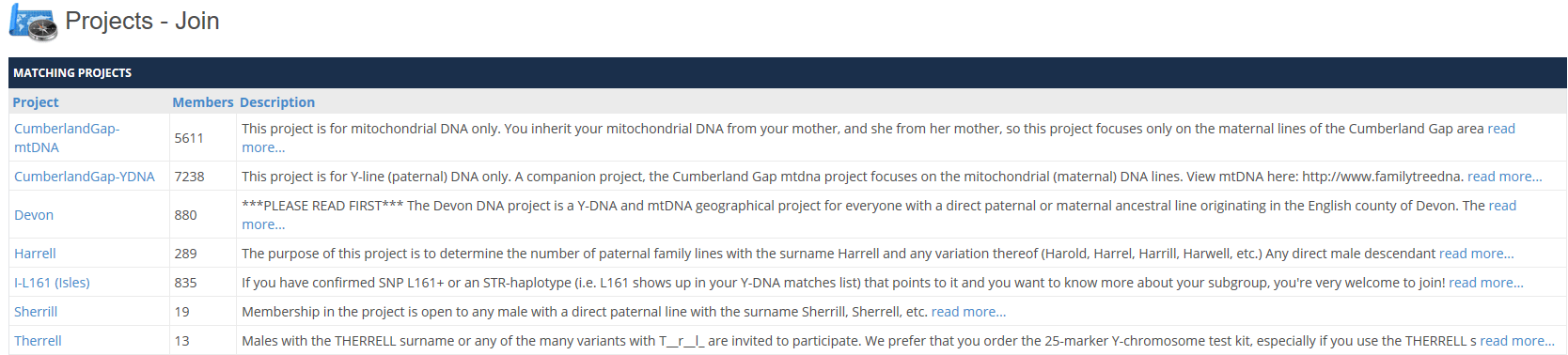
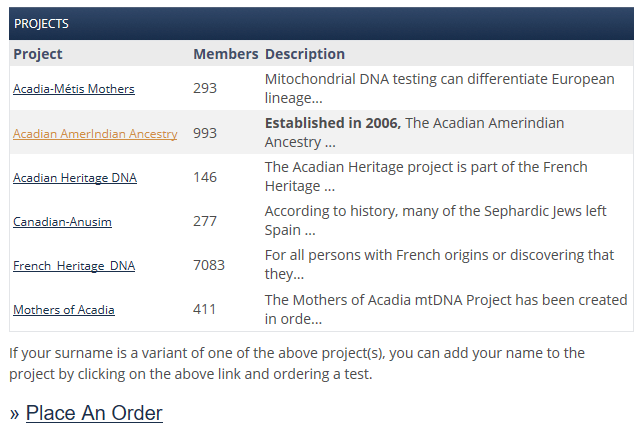
You can  increase your chances of finding your particular lineage by visiting the relevant Y DNA projects for your surname.

Click on Projects, then “Join a project,” then search for the DNA project that you’re interested in viewing and click on that link.

Within the project, look for oldest ancestors that are your ancestors, or potentially from a common location.  It’s someplace to start.

You can read more about how to construct a DNA pedigree chart in the article, “The DNA Pedigree Chart – Mining for Ancestors.”

Idea 3 – Pick A Puzzle Piece

Sometimes we get overwhelmed with the magnitude and size of the genealogy puzzle we’d like to solve. Then, we don’t solve anything.

This is exactly WHY I like the 52 Ancestor stories.  They make me focus on JUST ONE ancestor at a time.

So, for 2018, pick one genealogy puzzle you’d really like to solve. One person or one thing.  Not an entire line.

Write down your goal.

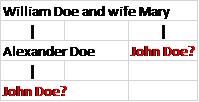
“I’d like to figure out whether John Doe was the son of William Doe or his son, Alexander Doe.”

Now admittedly, this is a tough one, because right off the bat, Y DNA isn’t going to help you unless you’re incredibly lucky and there is a mutation between Alexander Doe and his father, William.  If indeed that was the case, and you can prove it by the DNA of two of Alexander’s sons who carry the mutation, compared to the DNA of one of William’s other sons who does not, then you may be cooking with gas, presuming you can find a male Doe descended from John to test as well.

This is the type of thought process you’ll need to step through when considering all of the various options for how to prove, or disprove, a particular theory.

Make a list of the different kinds of evidence, both paper trail and genetic, that you could use to shed light on the problem. Your answer may not come from one piece of evidence alone, but a combination of several.

Evidence Available/Source Result
William’s will No, burned courthouse Verified
Alexander’s will No, burned courthouse Verified
Deeds with William as conveyor No, burned courthouse Verified
Family Bible Nope, no Bible
Deeds with Alexander as conveyor, naming John Possible, some deed books escaped fire Check through county, Family search does not list
Deeds with John as conveyor Yes, check to see if they indicate the source of John’s land John is listed in index, need to obtain original deeds from county
Y DNA of John’s line Yes, has been tested Matches DNA of William’s line as proven through William’s two brothers
Y DNA of Alexander Not tested (to the best of my knowledge), find descendant to see if they will test Search vendor DNA testing sites for male with this surname to see if they have/will Y DNA test
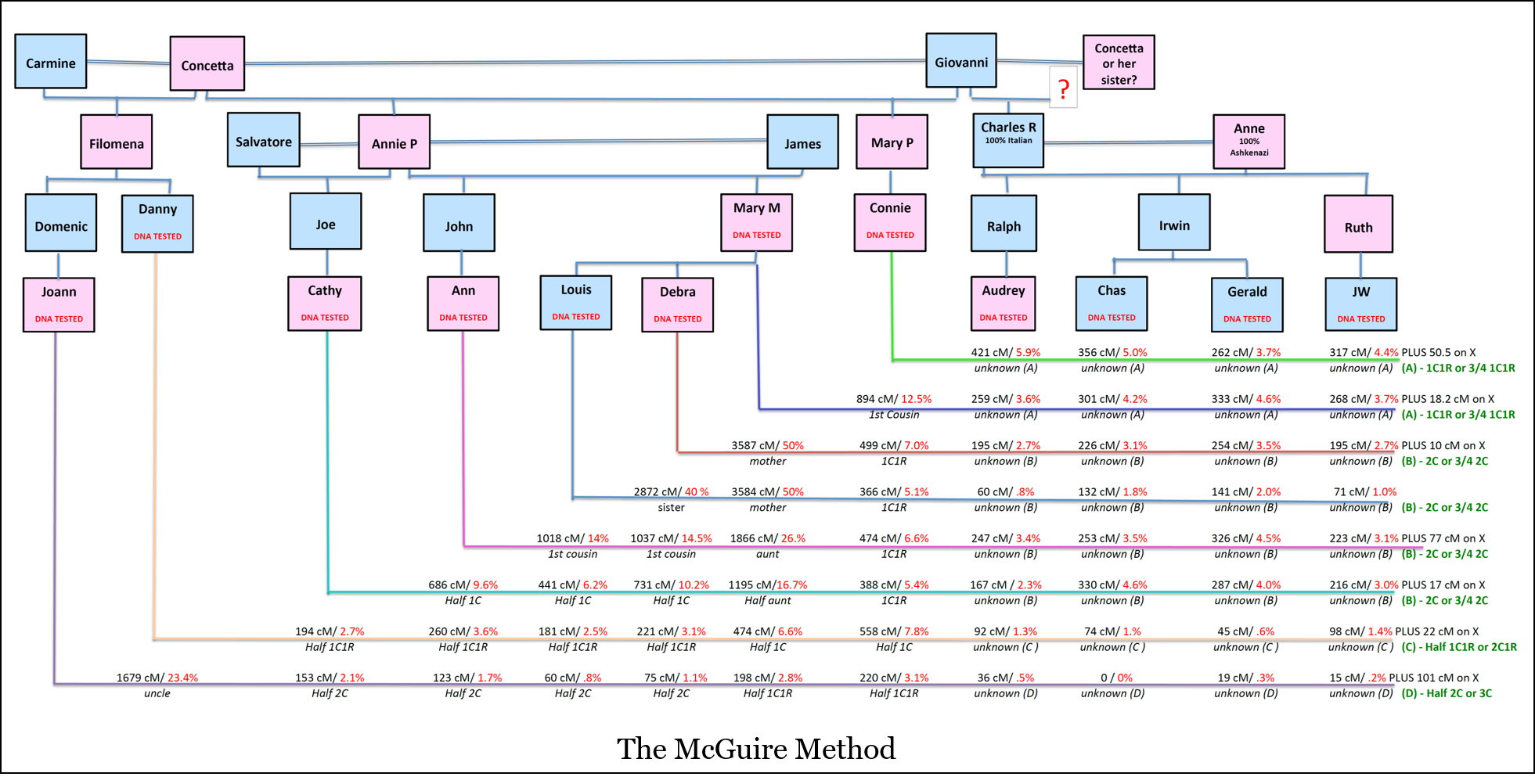
Closeness (in total cM and longest segment) of individuals autosomal matching through any of William’s descendants Mine both Ancestry and FTDNA for surname and ancestor matches This step may produce compelling or suggestive evidence, and it may not.  Make a McGuire chart of results.
Does John match any relatives of the wife of Alexander Doe? Search FTDNA and Ancestry for matches.  Triangulate to determine if match is valid and through that line. This is one of the best approaches to solve this type of problem when paper records aren’t available. Fingers crossed that Alexander and his wife and not related.

You can add pieces of evidence to your list as you think of them.

Making a list gives you something to work towards.

Your Turn!

Select one thing that you’d like to accomplish and either set about to do it, like mining for mitochondrial or Y DNA evidence, or put together a plan to gather evidence, both traditional and genetic.

In the comments, share what it is you’ll be searching for or working on.  You just never know if another subscriber may hold the answer you seek.

I can’t wait to hear what you’ll be doing this year!

Have a wonderful and productive New Year searching for those hidden ancestors!

______________________________________________________________

Disclosure

I receive a small contribution when you click on some of the links to vendors in my articles. This does NOT increase the price you pay but helps me to keep the lights on and this informational blog free for everyone. Please click on the links in the articles or to the vendors below if you are purchasing products or DNA testing.

Thank you so much.

DNA Purchases and Free Transfers

Genealogy Services

Genealogy Research

2017 – The Year of DNA

Every year for the past 17 years has been the year of DNA for me, but for many millions, 2017 has been the year of DNA. DNA testing has become a phenomenon in its own right.

It was in 2013 that Spencer Wells predicted that 2014 would be the “year of infection.” Spencer was right and in 2014 DNA joined the ranks of household words. I saw DNA in ads that year, for the first time, not related to DNA testing or health as in, “It’s in our DNA.”

In 2014, it seemed like most people had heard of DNA, even if they weren’t all testing yet. John Q. Public was becoming comfortable with DNA.

In 2017 – DNA Is Mainstream  

If you’re a genealogist, you certainly know about DNA testing, and you’re behind the times if you haven’t tested.  DNA testing is now an expected tool for genealogists, and part of a comprehensive proof statement that meets the genealogical proof standard which includes “a reasonably exhaustive search.”  If you haven’t applied DNA, you haven’t done a reasonably exhaustive search.

A paper trail is no longer sufficient alone.

When I used to speak to genealogy groups about DNA testing, back in the dark ages, in the early 2000s, and I asked how many had tested, a few would raise their hands – on a good day.

In October, when I asked that same question in Ireland, more than half the room raised their hand – and I hope the other half went right out and purchased DNA test kits!

Consequently, because the rabid genealogical market is now pretty much saturated, the DNA testing companies needed to find a way to attract new customers, and they have.

2017 – The Year of Ethnicity

I’m not positive that the methodology some of the major companies utilized to attract new consumers is ideal, but nonetheless, advertising has attracted many new people to genetic genealogy through ethnicity testing.

If you’re a seasoned genetic genealogist, I know for sure that you’re groaning now, because the questions that are asked by disappointed testers AFTER the results come back and aren’t what people expected find their way to the forums that genetic genealogists peruse daily.

I wish those testers would have searched out those forums, or read my comparative article about ethnicity tests and which one is “best” before they tested.

More ethnicity results are available from vendors and third parties alike – just about every place you look it seems.  It appears that lots of folks think ethnicity testing is a shortcut to instant genealogy. Spit, mail, wait and voila – but there is no shortcut.  Since most people don’t realize that until after they test, ethnicity testing is becoming ever more popular with more vendors emerging.

In the spring, LivingDNA began delivering ethnicity results and a few months later, MyHeritage as well.  Ethnicity is hot and companies are seizing a revenue opportunity.

Now, the good news is that perhaps some of these new ethnicity testers can be converted into genealogists.  We just have to view ethnicity testing as tempting bait, or hopefully, a gateway drug…

2017 – The Year of Explosive Growth

DNA testing has become that snowball rolling downhill that morphed into an avalanche.  More people are seeing commercials, more people are testing, and people are talking to friends and co-workers at the water cooler who decide to test. I passed a table of diners in Germany in July to overhear, in English, discussion about ethnicity-focused DNA testing.

If you haven’t heard of DTC, direct to consumer, DNA testing, you’re living under a rock or maybe in a third world country without either internet or TV.

Most of the genetic genealogy companies are fairly closed-lipped about their data base size of DNA testers, but Ancestry isn’t.  They have gone from about 2 million near the end of 2016 to 5 million in August 2017 to at least 7 million now.  They haven’t said for sure, but extrapolating from what they have said, I feel safe with 7 million as a LOW estimate and possibly as many as 10 million following the holiday sales.

Advertising obviously pays off.

MyHeritage recently announced that their data base has reached 1 million, with only about 20% of those being transfers.

Based on the industry rumble, I suspect that the other DNA testing companies have had banner years as well.

The good news is that all of these new testers means that anyone who has tested at any of the major vendors is going to get lots of matches soon. Santa, it seems, has heard about DNA testing too and test kits fit into stockings!

That’s even better news for all of us who are in multiple data bases – and even more reason to test at all of the 4 major companies who provide autosomal DNA matching for their customers: Family Tree DNA, Ancestry, MyHeritage and 23andMe.

2017 – The Year of Vendor and Industry Churn

So much happened in 2017, it’s difficult to keep up.

  • MyHeritage entered the DNA testing arena and began matching in September of 2016. Frankly, they had a mess, but they have been working in 2017 to improve the situation.  Let’s just say they still have some work to do, but at least they acknowledge that and are making progress.
  • MyHeritage has a rather extensive user base in Europe. Because of their European draw, their records collections and the ability to transfer results into their data base, they have become the 4th vendor in a field that used to be 3.
  • In March 2017, Family Tree DNA announced that they were accepting transfers of both the Ancestry V2 test, in place since May of 2016, along with the 23andMe V4 test, available since November 2013, for free. MyHeritage has since been added to that list. The Family Tree DNA announcement provided testers with another avenue for matching and advanced tools.
  • Illumina obsoleted their OmniExpress chip, forcing vendors to Illumina’s new GSA chip which also forces vendors to use imputation. I swear, imputation is a swear word. Illumina gets the lump of coal award for 2017.
  • I wrote about imputation here, but in a nutshell, the vendors are now being forced to test only about 20% of the DNA locations available on the previous Illumina chip, and impute or infer using statistics the values in the rest of the DNA locations that they previously could test.
  • Early imputation implementers include LivingDNA (ethnicity only), MyHeritage (to equalize the locations of various vendor’s different chips), DNA.Land (whose matching is far from ideal) and 23andMe, who seems, for the most part, to have done a reasonable job. Of course, the only way to tell for sure at 23andMe is to test again on the V5 chip and compare to V3 and V4 chip matches. Given that I’ve already paid 3 times to test myself at 23andMe (V2, 3 and 4), I’m not keen on paying a 4th time for the V5 version.
  • 23andMe moved to the V5 Illumina GSA chip in August which is not compatible with any earlier chip versions.
  • Needless to say, the Illumina chip change has forced vendors away from focusing on new products in order to develop imputation code in order to remain backwards compatible with their own products from an earlier chip set.
  • GedMatch introduced their sandbox area, Genesis, where people can upload files that are not compatible with the traditional vendor files.  This includes the GSA chip results (23andMe V5,) exome tests and others.  The purpose of the sandbox is so that GedMatch can figure out how to work with these files that aren’t compatible with the typical autosomal test files.  The process has been interesting and enlightening, but people either don’t understand or forget that it’s a sandbox, an experiment, for all involved – including GedMatch.  Welcome to living on the genetic frontier!

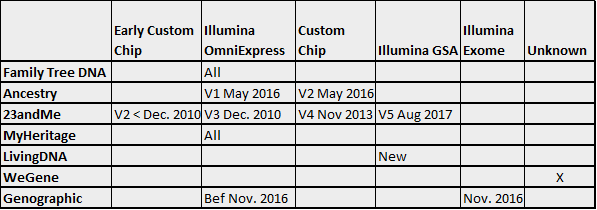
  • I assembled a chart of who loves who – meaning which vendors accept transfers from which other vendors.

  • I suspect but don’t know that Ancestry is doing some form of imputation between their V1 and V2 chips. About a month before their new chip implementation in May of 2016, Ancestry made a change in their matching routine that resulting in a significant shift in people’s matches.

Because of Ancestry’s use of the Timber algorithm to downweight some segments and strip out others altogether, it’s difficult to understand where matching issues may arise.  Furthermore, there is no way to know that there are matching issues unless you and another individual have transferred results to either Family Tree DNA or GedMatch, neither of which remove any matching segments.

  • Other developments of note include the fact that Family Tree DNA moved to mitochondrial DNA build V17 and updated their Y DNA to hg38 of the human reference genome – both huge undertakings requiring the reprocessing of customer data. Think of both of those updates as housekeeping. No one wants to do it, but it’s necessary.
  • 23andMe FINALLY finished transferring their customer base to the “New Experience,” but many of the older features we liked are now gone. However, customers can now opt in to open matching, which is a definite improvement. 23andMe, having been the first company to enter the genetic genealogy autosomal matching marketspace has really become lackluster.  They could have owned this space but chose not to focus on genealogy tools.  In my opinion, they are now relegated to fourth place out of a field of 4.
  • Ancestry has updated their Genetic Communities feature a couple of times this year. Genetic Communities is interesting and more helpful than ethnicity estimates, but neither are nearly as helpful as a chromosome browser would be.

  • I’m sure that the repeated requests, begging and community level tantrum throwing in an attempt to convince Ancestry to produce a chromosome browser is beyond beating a dead horse now. That dead horse is now skeletal, and no sign of a chromosome browser. Sigh:(
  • The good news is that anyone who wants a chromosome browser can transfer their results to Family Tree DNA or GedMatch (both for free) and utilize a chromosome browser and other tools at either or both of those locations. Family Tree DNA charges a one time $19 fee to access their advanced tools and GedMatch offers a monthly $10 subscription. Both are absolutely worth every dime. The bad news is, of course, that you have to convince your match or matches to transfer as well.
  • If you can convince your matches to transfer to (or test at) Family Tree DNA, their tools include phased Family Matching which utilizes a combination of user trees, the DNA of the tester combined with the DNA of family matches to indicate to the user which side, maternal or paternal (or both), a particular match stems from.

  • Sites to keep your eye on include Jonny Perl’s tools which include DNAPainter, as well as Goran Rundfeldt’s DNA Genealogy Experiment.  You may recall that in October Goran brought us the fantastic Triangulator tool to use with Family Tree DNA results.  A few community members expressed concern about triangulation relative to privacy, so the tool has been (I hope only temporarily) disabled as the involved parties work through the details. We need Goran’s triangulation tool! Goran has developed other world class tools as well, as you can see from his website, and I hope we see more of both Goran and Jonny in 2018.
  • In 2017, a number of new “free” sites that encourage you to upload your DNA have sprung up. My advice – remember, there really is no such thing as a free lunch.  Ask yourself why, what’s in it for them.  Review ALL OF THE documents and fine print relative to safety, privacy and what is going to be done with your DNA.  Think about what recourse you might or might not have. Why would you trust them?

My rule of thumb, if the company is outside of the US, I’m immediately slightly hesitant because they don’t fall under US laws. If they are outside of Europe or Canada, I’m even more hesitant.  If the company is associated with a country that is unfriendly to the US, I unequivocally refuse.  For example, riddle me this – what happens if a Chinese (or fill-in-the-blank country) company violates an agreement regarding your DNA and privacy?  What, exactly, are you going to do about it from wherever you live?

2017 – The Year of Marketplace Apps

Third party genetics apps are emerging and are beginning to make an impact.

GedMatch, as always, has continued to quietly add to their offerings for genetic genealogists, as had DNAGedcom.com. While these two aren’t exactly an “app”, per se, they are certainly primary players in the third party space. I use both and will be publishing an article early in 2018 about a very useful tool at DNAGedcom.

Another application that I don’t use due to the complex setup (which I’ve now tried twice and abandoned) is Genome Mate Pro which coordinates your autosomal results from multiple vendors.  Some people love this program.  I’ll try, again, in 2018 and see if I can make it all the way through the setup process.

The real news here are the new marketplace apps based on Exome testing.

Helix and their partners offer a number of apps that may be of interest for consumers.  Helix began offering a “test once, buy often” marketplace model where the consumer pays a nominal price for exome sequencing ($80), significantly under market pricing ($500), but then the consumer purchases DNA apps through the Helix store. The apps access the original DNA test to produce results. The consumer does NOT receive their downloadable raw data, only data through the apps, which is a departure from the expected norm. Then again, the consumer pays a drastically reduced price and downloadable exome results are available elsewhere for full price.

The Helix concept is that lots of apps will be developed, meaning that you, the consumer, will be interested and purchase often – allowing Helix to recoup their sequencing investment over time.

Looking at the Helix apps that are currently available, I’ve purchased all of the Insitome products released to date (Neanderthal, Regional Ancestry and Metabolism), because I have faith in Spencer Wells and truthfully, I was curious and they are reasonably priced.

Aside from the Insitome apps, I think that the personalized clothes are cute, if extremely overpriced. But what the heck, they’re fun and raise awareness of DNA testing – a good thing! After all, who am I to talk, I’ve made DNA quilts and have DNA clothing too.

Having said that, I’m extremely skeptical about some of the other apps, like “Wine Explorer.”  Seriously???

But then again, if you named an app “I Have More Money Than Brains,” it probably wouldn’t sell well.

Other apps, like Ancestry’s WeRelate (available for smartphones) is entertaining, but is also unfortunately EXTREMELY misleading.  WeRelate conflates multiple trees, generally incorrectly, to suggest to you and another person on your Facebook friends list are related, or that you are related to famous people.  Judy Russell reviews that app here in the article, “No, actually, we’re not related.” No.  Just no!

I feel strongly that companies that utilize our genetic data for anything have a moral responsibility for accuracy, and the WeRelate app clearly does NOT make the grade, and Ancestry knows that.  I really don’t believe that entertaining customers with half-truths (or less) is more important than accuracy – but then again, here I go just being an old-fashioned fuddy dud expecting ethics.

And then, there’s the snake oil.  You knew it was going to happen because there is always someone who can be convinced to purchase just about anything. Think midnight infomercials. The problem is that many consumers really don’t know how to tell snake oil from the rest in the emerging DNA field.

You can now purchase DNA testing for almost anything.  Dating, diet, exercise, your taste in wine and of course, vitamins and supplements. If you can think of an opportunity, someone will dream up a test.

How many of these are legitimate or valid?  Your guess is as good as mine, but I’m exceedingly suspicious of a great many, especially those where I can find no legitimate scientific studies to back what appear to be rather outrageous claims.

My main concern is that the entire DTC testing industry will be tarred by the brush of a few unethical opportunists.

2017 – The Year of Focus on Privacy and Security

With increased consumer exposure comes increased notoriety. People are taking notice of DNA testing and it seems that everyone has an opinion, informed or not.  There’s an old saying in marketing; “Talk about me good, talk about me bad, just talk about me.”

With all of the ads have come a commensurate amount of teeth gnashing and “the-sky-is-falling” type reporting.  Unfortunately, many politicians don’t understand this industry and open mouth only to insert foot – except that most people don’t realize what they’ve done.  I doubt that the politicians even understand that they are tasting toe-jam, because they haven’t taken the time to research and understand the industry. Sound bites and science don’t mix well.

The bad news is that next, the click-bait-focused press picks up on the stories and the next time you see anyone at lunch, they’re asking you if what they heard is true.  Or, let’s hope that they ask you instead of just accepting what they heard as gospel. Hopefully if we’ve learned anything in this past year, it’s to verify, verify, verify.

I’ve been an advocate for a very long time of increased transparency from the testing companies as to what is actually done with our DNA, and under what circumstances.  In other words, I want to know where my DNA is and what it’s being used for.  Period.

Family Tree DNA answered that question succinctly and unquestionably in December.

Bennett Greenspan: “We could probably make a lot of money by selling the DNA data that we’ve been collecting over the years, but we feel that the only person that should have your DNA information is you.  We don’t believe that it should be sold, traded or bartered.”

You can’t get more definitive than that.

DTC testing for genetic genealogy must be a self-regulating field, because the last thing we need is for the government to get involved, attempting to regulate something they don’t understand.  I truly believe government interference by the name of regulation would spell the end of genetic genealogy as we know it today.  DNA testing for genetic genealogy without sharing results is entirely pointless.

I’ve written about this topic in the past, but an update is warranted and I’ll be doing that sometime after the first of the year.  Mostly, I just need to be able to stay awake while slogging through the required reading (at some vendor sites) of page after page AFTER PAGE of legalese😊

Consumers really shouldn’t have to do that, and if they do, a short, concise summary should be presented to them BEFORE they purchase so that they can make a truly informed decision.

Stay tuned on this one.

2017 – The Year of Education

The fantastic news is that with all of the new people testing, a huge, HUGE need for education exists.  Even if 75% of the people who test don’t do anything with their results after that first peek, that still leaves a few million who are new to this field, want to engage and need some level of education.

In that vein, seminars are available through several groups and institutes, in person and online.  Almost all of the leadership in this industry is involved in some educational capacity.

In addition to agendas focused on genetic genealogy and utilizing DNA personally, almost every genealogy conference now includes a significant number of sessions on DNA methods and tools. I remember the days when we were lucky to be allowed one session on the agenda, and then generally not without begging!

When considering both DNA testing and education, one needs to think about the goal.  All customer goals are not the same, and neither are the approaches necessary to answer their questions in a relevant way.

New testers to the field fall into three primary groups today, and their educational needs are really quite different, because their goals, tools and approaches needed to reach those goals are different too.

Adoptees and genealogists employ two vastly different approaches utilizing a common tool, DNA, but for almost opposite purposes.  Adoptees wish to utilize tests and trees to come forward in time to identify either currently living or recently living people while genealogists are interested in reaching backward in time to confirm or identify long dead ancestors. Those are really very different goals.

I’ve illustrated this in the graphic above.  The tester in question uses their blue first cousin match to identify their unknown parent through the blue match’s known lineage, moving forward in time to identify the tester’s parent.  In this case, the grandparent is known to the blue match, but not to the yellow tester. Identifying the grandparent through the blue match is the needed lynchpin clue to identify the unknown parent.

The yellow tester who already knows their maternal parent utilizes their peach second cousin match to verify or maybe identify their maternal great-grandmother who is already known to the peach match, moving backwards in time. Two different goals, same DNA test.

The three types of testers are:

  • Curious ethnicity testers who may not even realize that at least some of the vendors offer matching and other tools and services.
  • Genealogists who use close relatives to prove which sides of trees matches come from, and to triangulate matching segments to specific ancestors. In other words, working from the present back in time. The peach match and line above.
  • Adoptees and parent searches where testers hope to find a parent or siblings, but failing that, close relatives whose trees overlap with each other – pointing to a descendant as a candidate for a parent. These people work forward in time and aren’t interested in triangulation or proving ancestors and really don’t care about any of those types of tools, at least not until they identify their parent.  This is the blue match above.

What these various groups of testers want and need, and therefore their priorities are different in terms of their recommendations and comments in online forums and their input to vendors. Therefore, you find Facebook groups dedicated to Adoptees, for example, but you also find adoptees in more general genetic genealogy groups where genealogists are sometimes surprised when people focused on parent searches downplay or dismiss tools such as Y DNA, mitochondrial DNA and chromosome browsers that form the bedrock foundation of what genealogists need and require.

Fortunately, there’s room for everyone in this emerging field.

The great news is that educational opportunities are abundant now. I’m listing a few of the educational opportunities for all three groups of testers, in addition to my blog of course.😊

Remember that this blog is fully searchable by keyword or phrase in the little search box in the upper right hand corner.  I see so many questions online that I’ve already answered!

Please feel free to share links of my blog postings with anyone who might benefit!

Note that these recommendations below overlap and people may well be interested in opportunities from each group – or all!!

Ethnicity

Adoptees or Parent Search

Genetic Genealogists

2018 – What’s Ahead? 

About midyear 2018, this blog will reach 1000 published articles. This is article number 939.  That’s amazing even to me!  When I created this blog in July of 2012, I wasn’t sure I’d have enough to write about.  That certainly has changed.

Beginning shortly, the tsunami of kits that were purchased during the holidays will begin producing matches, be it through DNA upgrades at Family Tree DNA, Big Y tests which were hot at year end, or new purchases through any of the vendors.  I can hardly wait, and I have my list of brick walls that need to fall.

Family Tree DNA will be providing additional STR markers extracted from the Big Y test. These won’t replace any of the 111 markers offered separately today, because the extraction through NGS testing is not as reliable as direct STR testing for those markers, but the Big Y will offer genealogists a few hundred more STRs to utilize. Yes, I said a few hundred. The exact number has not yet been finalized.

Family Tree DNA says they will also be introducing new “qualify of life improvements” along with new privacy and consent settings.  Let’s hope this means new features and tools will be released too.

MyHeritage says that they are introducing new “Discoveries” pages and a chromosome browser in January.  They have also indicated that they are working on their matching issues.  The chromosome browser is particularly good news, but matching must work accurately or the chromosome browser will show erroneous information.  Let’s hope January brings all three features.

LivingDNA indicates that they will be introducing matching in 2018.

2018 – What Can You Do?

What can you do in 2018 to improve your odds of solving genealogy questions?

  • Test relatives
  • Transfer your results to as many data bases as possible (among the ones discussed above, after reading the terms and conditions, of course)
  • If you have transferred a version of your DNA that does not produce full results, such as the Ancestry V2 or 23andMe V4 test to Family Tree DNA, consider testing on the vendor’s own chip in order to obtain all matches, not just the closest matches available from an incompatible test transfer.
  • Test Y and mitochondrial DNA at Family Tree DNA.
  • Find ways to share the stories of your ancestors.  Stories are cousin bait.  My 52 Ancestors series is living proof.  People find the stories and often have additional facts, information or even photos. Some contacts qualify for DNA testing for Y or mtDNA lines. The GREAT NEWS is that Amy Johnson Crow is resuming the #52Ancestors project for 2018, providing hints and tips each week! Who knows what you might discover by sharing?! Here’s how to start a blog if you need some assistance.  It’s easy – really!
  • Focus on the brick walls that you want to crumble and then put together both a test and analysis plan. That plan could include such things as:

o   Find out if a male representing a Y line in your tree has tested, and if not, search through autosomal results to see if a male from that paternal surname line has tested and would be amenable to an upgrade.

o   Mitochondrial DNA test people who descend through all females from various female ancestors in order to determine their origins. Y and mtDNA tests are an important part of a complete genealogy story – meaning the reasonably exhaustive search!

o   Autosomal DNA test family members from various lines with the hope that matches will match you and them both.

o   Test family members in order to confirm a particular ancestor – preferably people who descend from another child of that ancestor.

o   Making sure your own DNA is in all 4 of the major vendors’ data bases, plus GedMatch. Look at it this way, everyone who is at GedMatch or at a third party (non-testing) site had to have tested at one of the major 4 vendors – so if you are in all of the vendor’s data bases, plus GedMatch, you’re covered.

Have a wonderful New Year and let’s make 2018 the year of newly discovered ancestors and solved mysteries!

______________________________________________________________

Disclosure

I receive a small contribution when you click on some of the links to vendors in my articles. This does NOT increase the price you pay but helps me to keep the lights on and this informational blog free for everyone. Please click on the links in the articles or to the vendors below if you are purchasing products or DNA testing.

Thank you so much.

DNA Purchases and Free Transfers

Genealogy Services

Genealogy Research

Concepts – Sibling and Twin DNA Matching

Lots of people are giving their siblings DNA test kits.  That’s a great idea, especially if your parents aren’t available for testing, because siblings do inherit part of the same DNA from their parents, but not all of the same DNA. That means testing siblings is a great opportunity for more genealogical matches!

Recently, a friend asked me why his fraternal twin has matches to people he doesn’t, and vice versa.  Great question, so let’s take a look at what to expect from matches with siblings.

First, identical twins share exactly the same DNA because they are created as a result of the division of the same egg that has been fertilized by the father’s sperm. Identical twins matches should be identical.

A fraternal twin is exactly the same as a sibling. Two separate sperm fertilize two separate eggs and they gestate together, at the same time.

Second, let’s talk just a minute about Y and mitochondrial DNA, then we’ll discuss autosomal DNA.

Full Siblings Share
Mitochondrial DNA Exactly the same, unless a mutation occurred
Y DNA Males will share exactly the same, unless a mutation occurred.  Females don’t have a Y chromosome.
Autosomal DNA Approximately 50% of autosomal DNA

To obtain detailed Y and mitochondrial DNA results, you’ll need to test with Family Tree DNA. They are the only vendor offering these tests.

For autosomal matching, you can test with a number of vendors including: Family Tree DNA, Ancestry, 23andMe and MyHeritage.

You can read more about the different kinds of testing here, and a comparison of the different tests and vendors here.

50% the Same – 50% Different

Siblings share approximately 50% of the same DNA of the parents.  The other 50% is different DNA that they received from the parents that the other sibling did not receive.

In the conceptual example above, you can see that each child inherited 4 segments of the 8 total offered by their parents.  Only two of those segments were the same for both siblings, segments 3 and 4.  Of these two siblings, no one inherited parental segments 7 and 8.  Perhaps a third child would.

In other words, siblings can expect to see many of the same people in their match list and several that are different. In our example, the same people would be matching both siblings on segments 3 and 4.  People matching child 1 but not child 2 would be matching on segments 1 and 2.  People matching child 2 but not child 1 would be matching on segments 5 and 6.

The reason you’ll see the same people on your match list is because you did inherit 50% of the same DNA from your parents.

There are two reasons you’ll see different matches on your match lists.

Some of your matches on your list that don’t match your sibling will be because the two siblings inherited different pieces of DNA from their parents.  Your sibling will match people on the DNA that they received from your parents that you didn’t receive, and vice versa.

Some Matches are Identical By Chance (IBC)

Another reason for different matches is because you and your sibling will have people on both of your match lists that don’t match either parent as a result of IBC or identical by chance matching. That’s where the DNA of your match just happens to match you by virtue of zigzagging back and forth between your Mom’s and Dad’s DNA that you carry.

As you can see in this example, your pink DNA came from your Mom, and blue from your Dad, but your match carries some of both values, T and A.  This means they match you, but not because they match either of your parents.  Just an accident of circumstance. That’s what IBC is.

Telling the Difference

I wrote about matches that are identical by descent (IBD), meaning because you inherited that DNA from your parents, and identical by chance (IBC) in this article.

Unfortunately, your DNA is mixed together and without other known relatives testing, it’s impossible to discern which DNA is inherited from your mother and which from your father. This is exactly why we encourage people to have known relatives test such as parents, grandparents and cousins.  Who you match on which segments indicates where those segments descended from in your family tree.

If one or both parents are living, that’s the best way of discerning which matches are identical by descent and which are by chance.

A recent project with Philip Gammon showed by segment size the likelihood is of a match being genuine or identical by chance.  If both parents have tested, he offers the free Match-Maker-Breaker tool to do this analysis for you.

The bottom line is that when comparing your matches to those of your siblings, about 20-25% of everyone’s total matches are identical by chance, especially those at lower centiMorgan levels.

The remaining 80% or so will be divided roughly half and half, meaning half will match you and a sibling both, and half will only match you. Therefore, you will be looking at roughly 40% of your matches being in common with a particular sibling, 40% not matching your sibling but being legitimate matches and the remaining 20% that are identical by chance.

Test Parents and Family Members

Of course, because you do share roughly half of the same DNA inherited from your parents, you will have some matches to both you and a sibling that are identical by chance in exactly the same way.  Just finding someone on both of your match lists doesn’t guarantee that the match ISN’T identical by chance.

The best way to eliminate identical by chance matching, of course, is to test your parents.  Sadly, that isn’t always possible.

The next best way to determine legitimate matches is to test other family members.  At Family Tree DNA, they provide customers with the ability to link the DNA tests of family members to their proper location in your tree, and then Family Tree DNA utilizes the common DNA segments to determine common matching between you, that family member(s), and other people.

Those people who match you and a family member on the same segment are then identified as either paternal or maternal matches, based on their position in your tree.

Identifying Lineage

When thinking about who to test, half-siblings, if you have any are, a wonderful way to differentiate between maternal and paternal matches.  Because you and a half sibling share only one parent – which side of your tree those common matches come from is immediately evident!

Of my matches at Family Tree DNA, you can see that of my total 3165 matches, 713 are paternal and 545 are maternal, with 4 being related to both sides.  Don’t get too excited about those “both sides” matches, they are my descendants!

Paternal and maternal bucketing is a great start in terms of identifying which matches are genealogical – and that’s before I do any actual genealogy work.  All I did was test, create or upload a tree and connect tested family members to that tree.

Family Tree DNA is the only vendor to offer this feature.

Ethnicity

Ethnicity is a slippery fish.  I generally only consider ethnicity estimates reliable at the continental level.  There are lots of reasons that siblings will receive somewhat different ethnicity results including the internal algorithms of the various vendors.  You can read about what is involved in ethnicity testing here.

Transfers Give You More For Your Money

If you test at one of the vendors, you may be able to transfer to other vendors as well as GedMatch.  In the chart below, you can see which vendors accept transfers from other vendors. You can read more here.

Have Fun

Lots of people are now testing their DNA and I hope you and your siblings will find some great matches among the new testers. The great thing about siblings, aside from the fact that they are your siblings, is that you can leverage each other’s DNA matches.  Just one more way to share and move the genealogy ball forward.

______________________________________________________________

Disclosure

I receive a small contribution when you click on some of the links to vendors in my articles. This does NOT increase the price you pay but helps me to keep the lights on and this informational blog free for everyone. Please click on the links in the articles or to the vendors below if you are purchasing products or DNA testing.

Thank you so much.

DNA Purchases and Free Transfers

Genealogy Services

Genealogy Research

Irene Charitas Schlosser, Beware the Overlooked Umlat, 52 Ancestors #176

4-15-2018 – After this story published, we subsequently discovered that Irene is not a Schlosser. I am leaving this story because parts of this information have been on the internet for some time – and I want to be sure the entire story of why people thought Irene was a Schlosser, and how we know she isn’t, is available. For the rest of the story, including her correct surname, click here.

One of the reasons I was initially hesitant to write these 52 Ancestors articles, (that were supposed to span one year, but are now beginning year 4) is because I didn’t want to publish something in error.

Years ago, I was speculating with a cousin, who subsequently published my speculation, and today, some 25 years later, I still fight that same information that turned out to be incorrect in trees every day. Or every day that I look at that ancestor’s parents anyway. And to think, I started that problem, albeit very innocently.

I’ve learned, so I really try to be precise and when I don’t know something, I say so. When there is a hint but no conclusion can be drawn, I say so.

Today is one of those really great days when hints have paid off. Furthermore, one of those 52 ancestor articles paid off too, because someone replied with an EXTREMELY valuable piece of information about an umlat. Yes, an umlat.

As it turns out, two little dots made all the difference in the world.

Irene Charitas

For years, Irene Charitas, the wife of Johann Michael Mueller (the first), was shown in trees with her last name being Charitas. That was as a result of misunderstanding German records where Charitas was her middle name.

I wrote about Irene Charitas Mueller here, or at least as much as I knew at the time.

Cousin Richard Miller, when he visited Steinwenden back in 1996 was provided with a translation and of an original record from 1689 in which a daughter of Conrad Schlosser was confirmed and Irene Charitas (then Miller) stood up for her as the godmother. At least that’s what we thought.

The original record is shown above, second from last, and below, the typed document provided to cousin Richard.

At this point, it was clear we might have a lead on a relative of Irene Charitas, but not more. We do know this group of pietist leaning families arrived in Steinwenden, Germany from Zollikofen, Switzerland sometime in the 1680s.

The Umlat

A week or so after the Michael Mueller article was published, and a week or so before the Irene Charitas article was published, a nice person named Karen Parker posted a comment on my blog. She says that the entry said that Irene Charitas and Anna Ursula are Conrad Schlosser’s daughters, as in plural. I’ve seen assumptions made before, so I asked if she could translate the record, and she did, stating the following:

Auf Ostern means “at Easter.”

u is the abbreviation for und, meaning “and.”

Tochter with an umlaut over the o, means “daughters.” (If there’s no umlaut of the o in Tochter, then it’s singular, “daughter.”)

von means “from.”

So it’s: “1689 at Easter. Irene Charitas and Anna Ursula, Conrad Schlosser’s daughters from Steinwinden”

In case you’re interested, in the entries below the ones for Easter, “Auf Weynachten” means “at Christmas,” and “Auf Pfingsten” means “at Pentacost.”

Don’t ask me how I managed to miss the significance of this, but I did. I would like to blame it on being distracted by two birthdays that week in the family, but that’s no excuse for missing something this critical to my genealogy. Not to mention, I owe Karen a huge debt of gratitude, and yes, I’ve e-mailed her to say such.

As it turns out, I owe my friend Tom, a second huge debt of thanks, because he is the one who saw the comment and realized its relevance for me. Not to mention he dropped everything, found original documents and translated them for me. I’m telling you what, this man is on Santa’s “good list!”

When I saw Tom’s e-mail arrive with the title “Irene Charitas,” I skipped right over everything else and jumped to that e-mail in which he called my attention to Karen’s comment.

An umlat!

A pesky umlat. Two little dots!

Have two dots ever been more important?

Of course, we don’t have umlats in English, and little did I understand the significance of that umlat, especially in this case – making a plural from a singular.

Here’s my reply to Tom:

So, Irene Charitas was originally Irene Charitas Schlosser.  That helps.

One more cog in the wheel.

Now we know that Conrad was Irene Charitas’ father.  I wonder what other entries are in those records for him.  I wonder if his wife is mentioned in any of them.

I wonder if the fact that the wife isn’t mentioned in this record means his wife is dead at that time.

So many things to wonder.

So excited that one more piece of the puzzle falls into place.

Whoever would have thought an umlat would make that much difference!

Tom replied as follows:

Michael Muller is one of the godparents for the first child of Melchior Clemens and Anna Maria Schlosser, daughter of Conrad in a 1686 baptism. The child was named for him.

Conrad Schlosser’s wife is mentioned in another baptism. Her given names are Anna Ursula.

And there you have it, the surname and parents for Irene Charitas, after all of these years, all because of an overlooked umlat.

I’ve never been more grateful for an umlat! Or for Karen and Tom!

That Nagging Question

Do things ever nag at you? Is there sometimes just something that isn’t right, but you can’t put your finger on it?

There was for me with these records, when I realized that both Irene Charitas and her sister, apparently both confirmed in 1692, were not children. Irene Charitas was about 27, born about 1665, very clearly an adult, and Anna Ursula had to have been 13 or older for her mother to have given birth when she was 45 years of age or younger, although the mother’s last child appears to have been born when she was 47 years old.

Originally, I thought this record was a baptism. Tom pointed out to me that this was a confirmation, and confirmation in the Lutheran church is typically performed on young adults and is referred to as an “affirmation of baptism.” That helped put the record in context and explain why the people being confirmed, called confirmands or confirmants, were older.

Were both Irene Charitas and Anna Ursula being confirmed at the same time? It appears that way, although I initially thought that Irene as standing up for her sister, but after the retranslation, it doesn’t look that way. No witnesses are mentioned and the godparents would have stood up with the family at their earlier infant baptisms.

Next, I pondered the possibility that perhaps Irene and her sister had not been baptized as infants, but given the fact that the Lutheran church still wasn’t terribly far from its Catholic roots at this time in history, I doubt that seriously. All children were baptized.

The Catholic Irony

There’s a great irony here relative to Catholic roots. Irene Charitas Schlosser had a sister, Anna Maria who married Melchior Clemens in Steinwenden in 1685.

Anna Maria and Melchior had a child, Johann Michael Clemens, in Steinwenden who was christened on January 31, 1686. Johann Michael Mueller, Irene’s husband, was the child’s godfather, but then the unthinkable happened.

Apparently Melchior was Catholic, because their subsequent children were all baptized in the Catholic church.

Given that the godparent’s duty was to see that the child was raised and in particular, raised within the church in the event something happened to the parents, I wonder how that would have worked in this circumstance. Surely that means that Anna Maria became Catholic as well, so the family was officially divided. I have read records of other families in this region that never spoke again or even acknowledged that the “other” side of the family existed after part of the family “defected” to the dark side. By the way, the definition of “dark side” is based entirely on perception.

I want to say that all is well that ends well, but frankly, we don’t know how that ended and religion can be an extremely divisive topic, especially following shortly on the heels of the 30 Years War which ended in 1648 and ravaged the very land in Steinwenden that the Schlosser family settled on in the early 1680s.

More than 30 years later, Germany had been so depopulated during that war that much of its land still lay fallow, creating opportunity for these immigrant families, often escaping religious persecution elsewhere. Extreme hardship and displacement due to differences in religion and very strongly held views were fresh in everyone’s memory – if not still an everyday occurrence.

For a Lutheran family member to return to Catholicism might not have been well received.

However…Carl Schlosser, the brother of both Irene Charitas and Anna Maria was the godfather in 1694, in the Catholic church for the son of his sister, Anna Maria. He is noted in the Catholic church record as “the honorable young man, Carolus Schlosser, Calvinist of Steinweiler.” Honorable in this context probably means that his parents were married at his birth, but still, if the Catholics were willing to allow a “Calvinist” and Carl, “the Calvinist” was willing to stand up in a Catholic church with his sister and nephew – maybe the family relationship was just fine after all despite being members of different religious sects that had recently been at war.

I hope so. Life is hard enough without religious differences dividing families.

New DNA Possibilities

Along with newly discovered sisters come new possibilities for people who qualify to test for mitochondrial DNA – that carried by Irene Charitas and her sisters, contributed to them by their mother.

Sadly, Irene Charitas Schlosser didn’t have any female children who lived.

What this means is that if anyone descends from Irene’s sister’s female children through all females, to the current generation, where the tester can be male – the mitochondrial DNA will be that of Irene Charitas’s mother, Anna Ursula.

Anna Ursula gave her mtDNA to her children of both genders, but only females passed it on. The only one of Irene Charitas’ sisters who had female children who lived was Anna Maria Schlosser who married Melchior Clemens or Clements.  They had three daughters who would be candidates, as follows:

  • Anna Appolonia Clemens born August 26, 1691, married on May 26, 1712 to Johannes Nicolaus Heller of Reweiler in the Catholic church in Ramstein..
  • Reginam Catharinam Clemens born December 3, 1697. Unknown if she married.
  • Anna Christina Clemens born September 29, 1700 and on November 4, 1722 she married Jacobus Wuest of Obermohr in the Catholic church in Ramstein.

If you descend from these women through all females, I have a testing scholarship waiting just for you!

Not The End

That’s not quite the end of the discoveries yet, but the next chapter is literally not written. There’s a plot twist too!

We now have at least some evidence that suggests that Irene Charitas Schlosser Mueller might not have died around 1694, as previously thought, but I’m holding off on that because the evidence is actually rather unusual in addition to being somewhat contradictory and, frankly, I don’t want to miss another doggone umlat!

______________________________________________________________

Disclosure

I receive a small contribution when you click on some of the links to vendors in my articles. This does NOT increase the price you pay but helps me to keep the lights on and this informational blog free for everyone. Please click on the links in the articles or to the vendors below if you are purchasing products or DNA testing.

Thank you so much.

DNA Purchases and Free Transfers

Genealogy Services

Genealogy Research

Elinor McDowell (c1690->1730), Murtough’s Wife, Many Questions and No Answers, 52 Ancestors #173

We don’t know a lot about Murtough McDowell, and we know even less about his wife, Elinor.

In fact, the only way we know her name is through a deed where on September 26, 1730, Murtough and Elinor McDowell of Baltimore County, Maryland sold to Richard Gist 100 acres on the north side of the Patapsco River.  Murtough signed with an X and Elinor didn’t sign at all. It would be highly unusual for a literate female to be married to a male who could not write. So we will suppose here that Elinor could neither read or write.

If Elinor was Murtough’s only wife, she was probably born before 1700 since he was in Baltimore County before May of 1722.

Thirty years later, in 1752, Murtough’s son, Michael, sold his share in Murtough’s land.  At that time, Michael would have been at least 21 years of age.

Michael also had a son, Michael Jr. that was born about 1747.  We could safely say that Michael Sr. was at least 25 before Michael Jr. was born, so Michael Sr. was probably born no later than 1722.  Michael Sr. could have been born shortly after arriving in the colonies, on the ship in route, or in Ireland. Marriage records in Baltimore County don’t exist prior to 1777.

Therefore, it’s likely that Elinor who was married to Murtough in 1730 was the mother of Michael – but it’s not certain by any means.

Because Michael was living in Virginia in 1752, a state where Catholics were not tolerated, we can be fairly certain that Michael was Protestant and attended the Anglican church, as mandated by Virginia law.  This suggests that Michael’s parents were not likely to be Catholic either, and indeed, Murtough’s Y DNA match in Ireland lived in a solidly Protestant area – then as now.

Given that, it’s very likely that Elinor was Protestant as well, and if she was married to Murtough before he left Ireland, her family was probably from Kingsmoss, or nearby.  You have to be able to court to marry – and courting probably occurred with neighbors or fellow churchgoers. Who else would he see regularly?

Let’s presume, for purposes of discussion, that Michael’s birth year was 1722.  We don’t know if Michael was his mother’s first child, or her last child – or someplace in-between.  Therefore, Elinor could have been anyplace from about 21 to about 43 in 1722, so a birth range for her of 1679 to 1701.  I would be surprised if Elinor was born in 1701, because that would not have given Murtough much time to earn enough to pay passage to Maryland for both he and a wife.

Not only is there nothing to suggest that Michael and Elinor were indentured servants – they couldn’t have been, because indentured servants could not be married, nor could they patent land, a process which Murtough began in May of 1722.

Therefore, it’s most likely that they were over 30 when they arrived, allowing them time to amass enough pay for their passage and any of their children, so Elinor was probably born sometime before 1690.

Maryland in 1720

What was Maryland like in 1720? What did Elinor find awaiting her as she stepped off the ship that would have sailed nearly to the end of the murky Chesapeake Bay?  If she arrived in late summer, the Chesapeake was body of water full of stinging jellyfish? However, the bay was also an important food source.

Did the family subsist on the plentiful seafood such as oysters and crab until they could find land and plant crops for the following year’s harvest? Where did they stay their first few days and weeks?  Did they know someone who had already sailed earlier?

In 1720, according to the map above, no plantations were shown on the Patapsco River and only 4 or 5 on the north side of the inlet.  Most plantations were along the water’s edge in order to build private docks for ships to moor and load tobacco for transport back to England.  Tobacco was the mainstay of Maryland, and Marylanders welcomed the merchant ships that were always filled with cloth and other goods not available in the colonies.

Imported goods from the UK are listed below in the order of monetary value:

  • Wool
  • Silk
  • Linen and sailcloth
  • Cordage
  • Gunpowder
  • Leather wrought and for saddles
  • Brass and copper wrought
  • Iron wrought and nails
  • Leads and shot
  • Pewter

Goods from other foreign ports:

  • Linens
  • Calicoes
  • East India Goods
  • Wrought silks
  • Iron and Hemp

In a letter to “the King’s Most Excellent Majesty” dated September 8, 1721, we find the following discussion of population:

From whence it appears, that the Inhabitants of this province have increased to above double the number in 15 years, and altho’ some part of this increase may have been occasioned by the transportation of the rebels from Preston, by the purchase of slaves, as well as by the arrival of several convict persons, and of many poor families, who have transported themselves from Ireland; yet it must be allowed, that Maryland is one of the most flourishing provinces upon the Continent of America.

Elinor and Murtough were most likely part of those poor families who transported themselves from Ireland.  The colonies lured immigrants with the possibility of achieving a dream that could never be realized in Ireland – land ownership – and with that, financial independence.

Maryland was a tobacco economy, with few towns and large plantations.  Small farmers did their own backbreaking work without the aid of slaves, widely used on the larger plantations as shown in this 1670 painting from neighboring Virginia.

Raising tobacco was an unforgiving mistress to which a man or a couple was in essence enslaved night and day, year-round.  The tobacco crop was vulnerable to all sorts of pests and calamities – including weather and the economy.

Tobacco, shown above, depleted the soil of nutrients within just three years, so crop rotation had to be employed and a farmer had to have nine times as much land as was planted at any one time with tobacco.  A single worker could tend to between 4 and 6 acres, so a farmer would have to have 54 acres of tillable farmland (plus land for a house and outbuildings) to keep 6 acres planted in tobacco.  The rest was sewn in wheat or other grains to feed both humans and livestock. Of course, the goal of any “planter” was to have help, be it a son, daughter, wife, indentured servant or slave.

Women cooked, cleaned, bore and raised children, carded flax for linen and spun wool from which they wove fabrics that were then dyed and made into clothing by hand. The woman in the photo below is using a traditional Irish spinning wheel.

Cloth that was manufactured overseas and imported was beyond the reach of most farmers.

Many women also worked alongside men in the field.

Small farmers were poor by colony standards – even if they were rich by Irish standards where land was never owned by the people who farmed the land – only by rich English gentry.

In 1720, Native Americans still lived in Maryland.  In fact, it wasn’t until 1744 that the chiefs of the Six Nations relinquished by treaty all claims to land in the colony, with the assembly purchasing the last Indian land in June of 1744. Murtough and Elinor probably knew and may have lived alongside Native families. Perhaps Native women shared their knowledge of herbal medicines with Elinor.

The Robert Long House located in present day Baltimore and believed to be the oldest home, shown below, dates from 1765.

Elinor may well have seen this building as she came and went, if she lived long enough – but this home would have looked nothing like where Elinor eventually lived.  Most homes of small farmers were one room and had only a dirt floor.  Some had a fireplace indoors which provided heat as well as a cooking area.  Cooking probably occurred outside, especially in summer.  The family may have had one bed, with children sleeping on straw or pallets. If they were very poor, everyone would have slept on straw, along with insects and possibly some livestock.

Estate records exist in both Baltimore and Prince George’s County during this timeframe, yet we know nothing more of Murtough and Elinor. I thoroughly searched Baltimore County records, although an extensive search has yet to be completed in Prince George’s County where Murthough’s final land grant suggests that he lived in 1732. It would be unusual for Murtough to own three parcels of land, two at his death, yet leave no estate at all to be administered.

We know that Elinor was alive in 1730, but we don’t know any more.  We don’t know when or where she died, although it was likely at Pleasant Green, located on the North Run of Jones Falls – the land owned by Murtough and Elinor from 1722 when it was surveyed until Michael sold his share in 1752.

If this is the case, then both Elinor and Murtough are likely buried someplace on the 100 acres named Pleasant Green on the North Branch of Jones Falls, in the area shown below.

DNA

Unfortunately, because we don’t know of any female children born to Elinor, her mitochondrial DNA is not available to us today. Mitochondrial DNA is given by mothers to both genders of their children, but only females pass it on. Our only prayer would be if additional children are discovered, one of which is a female with descendants to the current generation through all females. In the current generation, of course, males would also carry their mother’s mitochondrial DNA.

However, there seems to be a genetic hint buried in the confusion.

I joined my kits at Family Tree DNA to the NIFHS Ballymena DNA project that represents Northern Ireland. The project administrator contacted me indicating that I match two people, both of whom are Irish, living in Northern Ireland, from the Ballymena area, about 17 miles from Kingsmoss.

Are these two matches simply chance?  We don’t know.

Are these matches through Murtough, Elinor or another ancestor?  We don’t know that either. It’s only a hint, not an answer.

We do know that the DNA inherited from this couple has to have originated from either Murtough or his wife.  Without identifying people from either side prior to Murtough and Elinor, we have no way to sort the McDowell DNA into “sides,” meaning Murtough’s and Elinor’s DNA.

However, the final chapter of what DNA will one day reveal is not yet written.

In Summary

We know that Elinor was either brave, reluctant or fool-hearty, or maybe some of each.  There were no guarantees, only opportunities, but opportunities fraught with danger – beginning with a 6 week or longer ocean voyage in a small ship on a very large and sometimes angry sea.  The devil you know versus the devil you don’t.

Women during that time had little say in decisions like whether to uproot the family, leave everything familiar and embark on a new life in a new land, from whence there was no return. Did Elinor have a brood of a dozen stairstep children as she boarded the ship, or was she expecting her first?

We’ll never know whether Elinor was excited about this new adventure and the future that awaited – whether she was lukewarm and set forth begrudgingly, or whether she was dragged kicking and screaming all the way to the boat.  None of that mattered after they arrived in America, because there truly was no going back. She simply made the best of her life in the colony of Maryland. Was she happy? Was she homesick for the green fields and bogs of Ireland? Did she leave aging parents behind, along with siblings?

Perchance Elinor felt better about their immigration to the colonies when she and Murtough sold their land in1730.  Perhaps making something of a profit made the journey worthwhile. Did she purchase a treat, perhaps an ell or two of calico to make herself a nice dress?

We are left with so many questions.

  • Who was Elinor?
  • Was she married to Murtough in Ireland?
  • How many children did she have in her lifetime?
  • How many did she bury?
  • How many lived to adulthood?
  • Who were they?
  • Did she lose children on the ship during their journey, wrapping them lovingly as she said prayers and buried them as sea?
  • Was the family confined to steerage for weeks on end?
  • Did she give birth on the ship? Before birth control, women spent their entire reproductive lives either pregnant or nursing.
  • Did Elinor leave small graves behind in the Presbyterian churchyard near Kingsmoss in Ireland?
  • Did she bury children and perhaps Murtough in Baltimore County at Pleasant Green?
  • Did she and Murtough pull up stakes a second time, moving on to Prince George’s county, as the 1732 land survey and grant suggests?
  • Did Elinor wave goodbye to son Michael as he set forth on the journey of the next generation to Halifax County, Virginia – just as she had bid her relatives goodbye years earlier? The goodbye to Michael was probably final, because 260 miles to Halifax County would have taken about 26 days by wagon or about two weeks by horse.
  • Did Elinor ever see her grandchild, Michael Jr.? Was he born before Michael Sr. left Maryland?
  • Did Elinor have other grandchildren?

So very many questions, and no answers.  Perhaps one day, the DNA of Elinor’s descendants along with currently unknown records will somehow answer at least a few of these questions.

______________________________________________________________

Disclosure

I receive a small contribution when you click on some of the links to vendors in my articles. This does NOT increase the price you pay but helps me to keep the lights on and this informational blog free for everyone. Please click on the links in the articles or to the vendors below if you are purchasing products or DNA testing.

Thank you so much.

DNA Purchases and Free Transfers

Genealogy Services

Genealogy Research

Native American DNA Resources

Spokane and Flathead men circa 1904

I receive lots of questions every day about testing for Native American DNA, ethnicity, heritage and people who want to find their tribe.

I’ve answered many questions in articles, and I’ve assembled those articles into this handy-dandy one-stop reference about Native American DNA testing.

Where to Start?

If you are searching for your Native American heritage or your tribe, first, read these two articles:

Father’s and Mother’s Direct Lines

Y DNA is inherited by men from their direct paternal line, and mitochondrial DNA is inherited by both genders from their mother’s direct matrilineal line. You can read a short article about how this works, here.

If you’re interested in checking a comprehensive list to see if your mitochondrial DNA haplogroup is Native American, I maintain this page of all known Native American haplogroups:

Information about Native American Y DNA, subsets of haplogroup Q and C:

How Much Native Do You Have?

Estimating how much of your Native ancestor’s DNA you carry today:

Projects – Joining Forces to Work Together

Native American DNA Projects you can join at Family Tree DNA:

Regardless of which other projects you choose to join, I recommend joining the American Indian project by clicking on the Project button on the upper left hand side of your personal page.

News and How To

Some articles are more newsy or include how-to information:

Utilizing Haplogroup Origins and Ancestral Origins at Family Tree DNA:

I’ve written about several individual Native haplogroups and research results. You can see all of articles pertaining to Native American heritage by entering the word “Native” into the search box on the upper right hand corner of my blog at www.dna-explained.com.

Ancient Native Remains

Which Tests?

Family Tree DNA is the only vendor offering comprehensive Y and mitochondrial DNA testing, meaning beyond basic haplogroup identification. However, there are several levels to select from. Several vendors offer autosomal testing, which includes ethnicity estimates.

These articles compare the various types of tests and the vendors offering the tests:

Additional Resources

My blog, Native Heritage Project is fully searchable:

For other DNA related questions, please check the Help page, here.

______________________________________________________________

Disclosure

I receive a small contribution when you click on some of the links to vendors in my articles. This does NOT increase the price you pay but helps me to keep the lights on and this informational blog free for everyone. Please click on the links in the articles or to the vendors below if you are purchasing products or DNA testing.

Thank you so much.

DNA Purchases and Free Transfers

Genealogy Services

Genealogy Research

On This Day – What Were Your Ancestors Doing? – 52 Ancestors #170

Facebook is always “helping” me recall memories with a feature called “On This Day.” I thought to myself, wouldn’t it be wonderful if we could turn back time and see what all of our ancestors were doing “on this day” in a particular year.

Then, I’d like to compare what my ancestors were doing on that day with what I’m doing on that same day, 100 years later. So, in a sense, I did.

This was an amazing exercise, because I learned something new about almost every single ancestor. Furthermore, focusing on just one day and their lives on that day, considering surrounding circumstances and events provides a very different perspective of your ancestors’ lives.

Select a special day, like your birthday, or a day you’re doing something exciting and remarkable.

First, take your picture. Nothing special, just “you” in your normal surroundings.

I took this selfie photo on my birthday, at home in my labyrinth, the day I wrote the second third of this article.

I also finished the 6th quilt sent to Houston for hurricane Harvey relief. If my descendants are reading this in yet another hundred years, they will have to search for that reference on whatever “Google” is in 2117.

Furthermore, and to add a bit of intrigue – a few hours before I published this article, which is about 15 hours before I actually leave for Dublin.  I just discovered that Hurricane Ophelia is headed for…are you ready for this…Ireland.  What, you say, a hurricane in Ireland?  Well, I assure you, I thought the same thing.  However, there is a history of devastating storms in Ireland, recently Hurricane Charley in 1986 and Hurricane Debbie in 1961. My ancestors would probably have weathered similar storms in more ancient times as well. I didn’t exactly intend to share this experience with my ancestors, but one way or another, it will be an adventure. The difference being, of course, that they didn’t have an early warning system.

Ophelia is anticipated to make landfall in Ireland on Monday, October 16th.  So, either Ireland will be a mess next week and I’ll have an unexpected adventure…or…my descendants won’t even be able to find mention of Ophelia in historical documents.  There’s just no telling what the future will bring, nor what we can find looking backwards at historical events.

It’s ironic with the proliferation of selfies and easy photos today that I have no photo, at all, of one ancestor who was alive in 1917.

The Grasshopper Theory

It’s worth stating the obvious, that on any given day, every single line of your ancestors had someone alive, because if there was a break in that line, you wouldn’t be here today, and all of the circumstances that occurred in that lifetime to connect your ancestors together wouldn’t have happened.

I think this is the genealogist’s version of the butterfly wing theory where a small change to one thing changes everything.

We’ll call this the grasshopper theory, in honor of what Facebook showed me today for “on this day.” I had a good laugh. The good news about Facebook is that the combination of easy access to cameras in phones today combined with social media, the routine and un-exceptional has become the norm. Nobody takes only “good” pictures anymore, only on special occasions. We take picture everyday, of the everyday occurrences in our lives.  As genealogists, these are the tidbits we long for about our ancestors lives, but are, of course, maddeningly elusive.

I guess the good news and the bad news is that no one in our ancestor’s time recorded anything as mundane as grasshoppers on a mum creating grasshopper descendants.

No one was taking pictures of our ancestor’s cat on quilt pieces, or their flowers, or even them. Oh, how I wish they had, because I’d love to have a direct bird’s eye view into what they loved, what their garden looked like, or even their cat or dog.
I would love to walk in my great-grandmother’s flower garden, or see the quilt she was working on.

I want to know about their everyday existence, in addition to defining moments like birth, marriage and death. I want to know about that elusive dash in-between, in as close to the first person as possible.

Will Facebook be the goldmine of genealogists a hundred or two hundred years from now?

However, since I can’t do any of those things, let’s see what I can do about doing an ancestral version of “On This Day.”

I selected 100 years ago on October 20th, about a month into the future from when I’m doing the actual researching. It just so happens that I’ll be doing something quite interesting myself on that day, speaking at Genetic Genealogy Ireland, in Dublin, not far from where some of my ancestors lived. I find that prospect quite exciting, so let’s see what my ancestors were doing on that day, October 20, 1917, 100 years ago.

Step 1 – Who Was Alive

The first step is to determine which of my ancestors were alive in 1917. There shouldn’t be too many, as it’s really not that terribly long ago.

A quick look at your pedigree chart in your genealogy software should help a lot.

My father was a couple decades older than my mother, so while my mother wasn’t born yet, my father was about 14, or 15, or maybe 16. His birth year was uncertain and somewhat pliable since he bent it to whatever he needed it to be at the moment.

His parents and all 4 of his grandparents were living on October 20, 1917. That’s a total of 7 of my ancestors on just my father’s side that were alive at one time. More than I expected.

On my mother’s side, she was just a twinkle in my grandpa’s eye. Her parents were obviously alive, and 3 of her 4 grandparents, plus one of her great-grandparents. That’s 6 on my mom’s side.

So, one by one, let’s see what we know about them and what they were doing on October 20, 1917.

Step 2 – World Events

What was going on in the world on October 20, 1917? How might these things be influencing the lives of my ancestors where they were living?

Let’s turn to newspapers.com and take a look.
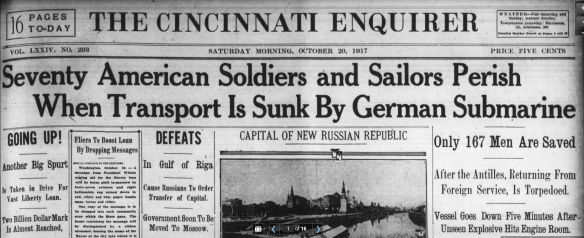
America was at War, WWI, the war to end all wars, which didn’t, of course. That Saturday morning the headlines across the nation carried bad news.

Those ancestors who were in a location where newspapers were available assuredly knew about this. Radio broadcasting didn’t begin until after the war, in 1920, so otherwise, word would have traveled slowly.

In 1917, most homes didn’t have electricity. It wasn’t until 1925 that half the homes in the US had electricity, and those would have been in metropolitan areas. My ancestors, except one, all lived rurally.

My mother remembered her home without electricity when she was a child in Northern Indiana in the 1920s, but the nearby train depot had electricity in order to transmit morse code signals.

My ancestors in Appalachia wouldn’t have electricity until the 1950s, but even then few had phones – less than 25% in general and where my ancestors lived, a LOT less than 25%.

While people in big cities might have heard news on the day it happened, or within a day or two, people who lived more remotely probably only heard the really big stories, and then not until days after they happened. That’s almost incomprehensible today.

So while the Russian Revolution took place overseas, few in the US probably heard about it, and no one in Appalachia knew or cared.

Nor did they know or care that 10 Suffragettes picketed the white house in August in order to pressure President Woodrow Wilson to enable women to vote. Attacked by mobs, while police refused to intervene, the women were jailed. My ancestors, if they knew about this at all, probably viewed those women as rabble-rousers deserving of what they got when they petitioned for political prisoner status in October and were confined to solitary. Those brave women endured both torture and terror. It would be three long years before the battle for women’s right to vote was won, an event that would affect all women, everyplace in the US, but that three of my ancestors living in 1917 wouldn’t live to see.

As reported on October 20, 1917 by Washington (DC) Post.

But my ancestor who I would have thought the LEAST likely to take a stand…did!

Step 3 – On This Day

On this day, in 2017, I’ll be speaking in Ireland about genetic genealogy which helped me locate my McDowell line.  A couple days later, I’ll also be visiting the location where people who match my ancestor on paternal DNA lived a hundred years or so after my ancestor left for America.  A tiny crossroads area northwest of Dublin.  Not too many people moved TO that area, so it’s likely my ancestor lived there too.

On this day, October 20, 1917, as best I can determine, this is what my ancestors alive at that time were doing. I’ve tried to locate a photo for each person as well, as close to that time as I can find.

My Father

Name: William Sterling Estes

Birth Date: October 1, 1901, or 1902, or 1903, take your pick. He did, and added several more years too, as they suited him.

Age: 14, 15, or 16

Occupation: Army, private – he “fudged” his age to enlist and serve his country.

Location: On August 24, 1917, my father was transferred from Fort Benjamin Harrison near Indianapolis, Indiana to Camp Custer at Battle Creek, Michigan.

Camp Custer was built in 1917, so this was a brand spanking new facility and where he would serve most of his Army career.

Love Life: My father was probably dating a young gal, Virgie Houtz, whom he would marry, decades later. Virgie lived in Dunkirk, Indiana. I suspect that after he left Fort Benjamin Harrison in central Indiana for Michigan that their romance cooled with distance. They both married others until he found her again and they married, in 1961, 43 years later.

Living Children: None yet, that I know of anyway

Deceased Children: None

Did you know this person? Yes, much later of course. He died when I was a child. this is the only photo I have of us together.

Local Events:

Neither Battle Creek nor Kalamazoo’s newspapers are online yet, but the Lansing State Journal headline for October 20th is shown below. Lansing is relatively close to Battle Creek.

Liberty Bonds are how the war was financed and subscribing to the bonds became a symbol of patriotic duty. On October 1, 1917 Second Liberty Loan offered $3.8 billion in bonds at 3% interest, redeemable after 10 years. R. E. Olds was synonymous with Oldsmobile.

Camp Custer was mentioned in the Wakefield (Michigan) News:

The Sheboygan (Wisconsin) Press carried Camp Custer Notes too.

It appears that a contest was taking place among the soldiers for who could buy the most Liberty bonds to support the war.

Oh, and two days later, on Monday and Tuesday, a dedication ceremony for Camp Custer was to take place, so you know that my Dad was getting his dress uniform spiffed up for what was certainly a dressy affair with lots of dignitaries in attendance.

What Was Affecting His Life?

Newspapers are so interesting. We discover sewer plants under construction at Camp Custer and that soldiers are not supposed to visit Jackson, because there are, gasp, saloons there. And oh, umbrellas were not used at Camp Custer, considered too un-military. A war bond contest was underway, and Camp Custer was to be dedicated in just two days – so everyone was busy putting everything in perfect order.

As a young man, much younger than his official enlisted age, at some level he had to be somewhat frightened. Not only was he only 14 or 15, he had been abandoned by his parents and was now in jeopardy of being a child sent to fight in a man’s war. The only saving grace may have been that his brother Joe enlisted too, but it’s unknown if they were stationed in the same location.

Y Line Haplogroup – R-BY490, obtained through his first cousin. This tells us that my father’s direct paternal ancestors were European and probably Celtic.

mtDNA Haplogroup – H, obtained when only the HVR1 level was offered. I hope that someone from his matrilineal line tests eventually. This tells us that his ancestor was European, but we need a further test to learn more.

My Father’s Father’s

Name: William George Estes

Birth Date: March 30, 1873

Age: 44

Occupation: Farmer, maybe bootlegger

Location: Claiborne County, Tennessee

Living Children: 5

Deceased Children: 6

Did you know this person? No, I never met him although he lived until I was in my teens.

Local Events:

The Claiborne Progress Newspaper was publishing in 1917, but those editions, if they exist, are not yet available. However, a scrapbook was found years ago having been contributed to the local library. I scanned the articles, mostly undated, and subsequently transcribed them, finding many interesting tidbits.

Electricity was not yet available in this part of the country. Travel was still by horse and something, usually a horse and wagon. Automobiles began to be mass produced in 1908. Some people did have cars. The newspaper in 1914 told us that cars traversed the Knoxville Pike, but I doubt that many in Claiborne County owned vehicles, and certainly not poor farmers.

In 1917, Tazewell had recently built a new train depot, and in doing so, several men stepped on nails, one of them subsequently passing away, probably from lockjaw or blood poisoning. Antibiotics and vaccines were still in the future.

What Was Affecting His Life?

William George, known as Will, having moved to Indiana sometime after the 1910 census as a tenant farmer had moved back to Claiborne County, Tennessee by 1917 and was establishing a life with a second wife, the cousin of his first wife with whom his first wife had caught him cheating. Yes, this is the stuff of soap operas.

In October 1917, Joice or Joicy Hatfield Estes was pregnant with her first child who would be born in March of 1918. So, in October of 1917, William George had a 24 year old wife, 20 years his junior, who was 4 months pregnant. He was probably pretty proud of himself.

His oldest son, Estel, had been married for 3 years, and William George had a 2 year, 4 month old grandson who would be older than Will’s new daughter that would be born the following March.

William George’s two other sons, William Sterling and Joseph “Dode” were enlisted in the Army to fight WWI. His eldest daughter, Margaret was 11 and living in Chicago with Ollie, his x-wife and his youngest daughter, Minnie, age 9, may have been living with a doctor in Rose Hill, Virginia, as a “servant” to care for the doctor’s ailing wife. I’m guessing that William George’s x-wife and daughters were mad as wet hens, at him, but I’m also guessing that William George didn’t much care. He had moved on.

Y Line Haplogroup – R-BY490, tells us that he connects with the other Estes men from Kent, England.

mtDNA Haplogroup – J1c2c, obtained through his sister’s grandson tells us that his mother was European, not Native American as had been rumored. The matches indicate that her ancestors were probably from the British Isles.

My Father’s Mother

Name: Ollie Bolton

Ollie, at left, with her daughter, Margaret in 1918 in Franklin Park, Illinois.  There was some discussion about whether this photo was actually Ollie or her mother, but since Margaret originally identified the photo, it makes sense that it’s Ollie.  However, I have never been entirely convinced.

The nose seems to be shaped entirely differently from other photos of Ollie.

Birth Date: May 5, 1874

Death Date: 43

Occupation: Divorced, unknown

Location: Probably Franklin Park, Illinois

Living Children: 5

Deceased Children: 6

Did you know this person? No, she died 5 months before I was born. My mother cared for her when she was pregnant for me. So, indirectly, I was at her funeral.

Local Events:

Ollie had to have been thinking about her two sons who had enlisted in the military. The war was escalating. Would either or both of them see active duty? Would they survive?

What Was Affecting Her Life?

We know so little about Ollie after she left Indiana. What we do know is gathered in snippets and pieces.

I don’t have any idea how she supported herself and the girls, or at least Margaret. Minnie says she was sent to live with a doctor and his wife in Rose Hill, Virginia to help him take care of his invalid wife. Margaret lived with her mother in Chicago.

We have a photo of Margaret and her mother labeled Franklin Park, Illinois and dated 1918. I wish I had thought to ask Margaret what kind of work her mother did, and when, exactly, they had moved to Chicago.

There are also reports of a child named Elsie or Elsia, born with downs syndrome and who subsequently passed away. I can find no record of Elsia’s birth or death, but that doesn’t mean she didn’t exist. If Elsia did exist, she would have been the last child born in Indiana before Ollie and Bill split, or, maybe Elsia arrived after the split. Regardless, based on what Aunt Margaret said, Elsia died in Chicago. Ollie would have been dealing with supporting herself and at least Margaret, if not Margaret and Elsia, in Chicago, alone, with no husband. A very tall order for a woman with very little education in that time and place.

Ollie’s family, including her oldest son and 2 year old grandchild lived in Claiborne County, Tennessee.

Did Ollie know that her brother, Samuel Bolton, had enlisted in the service too, just the month before? Was she able to see him one last time before he left for Europe? I hope so, because unless they shipped his body home for burial in 1918, she would never see him again.

mtDNA Haplogroup – Unfortunately, we only have Ollie’s base haplogroup, H. I would love to test someone who descends through all women from Ollie’s sisters or direct line of female ancestors in order to obtain additional information. Half of the women in Europe belonged to haplogroup H, so additional information would be very beneficial by providing hints as to where her ancestors were from.

My Father’s Paternal Grandfather

Name: Lazarus Estes

Birth Date: May 1848

Age: 69

Occupation: Farmer, huckster (peddler)

Location: Estes Holler, Claiborne County, Tennessee
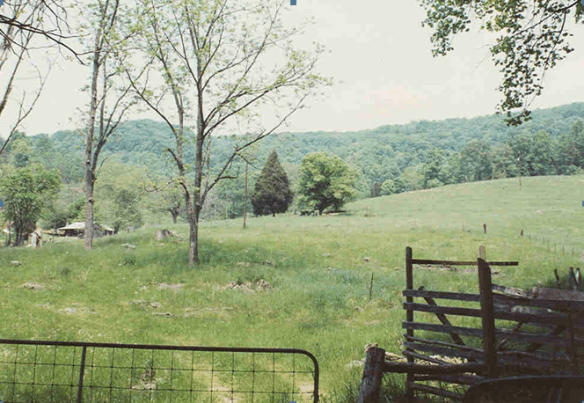
The house had been near the two small trees in the foreground.

Living Children: 4

Deceased Children: 6

Did you know this person? No, he died almost 40 years before I was born.

Local Events:

The war was preying on everyone’s minds.

What Was Affecting Their Lives?

Lazarus was aging and probably ill. I believe he carved his own headstone before his death, at least his name. It matches the other headstones that he carved for his children and grandchildren. Lazarus would pass away the following summer, just three months before his wife.

Lazarus lived at the end of Estes Holler, the patriarch, who cared for his aged mother, buried her, carved her stone and many thereafter. When his son, William George Estes’s cabin burned and their son along with it, it was Lazarus who buried the child. It was also Lazarus who took in his two grandsons, William Sterling and Joe Dode when they jumped freight trains back to Tennessee to find their grandparents when their parents were divorcing in Indiana. The family story says that neither parent wanted the boys and they arrived in Tennessee filthy and very hungry.

It was Lazarus who “ran William George out of Estes Holler for doing Ollie wrong” when he returned with his new young wife, his x-wife’s cousin, after abandoning the boys.

In 1920, William George was living in Claiborne County, but not in Estes Holler from the looks of the census. According to the family story, Lazarus told William George he would kill him if he came back, after abandoning his two sons – those boys just 10 and 12 who hopped a freight train to find their way home to their grandfather. Lazarus seemed to be a good man, always taking care of others.

In October of 1917, Lazarus was probably wondering what to do about his land when he died. His own mortality had to be weighing heavy on his mind. He would have been watching his ailing wife and knew that some of his children weren’t as stable and trustworthy as others. Sometime over the winter, Lazarus decided to deed his land to his daughter and neighbor, Cornie Epperson and her husband, but with instructions to pay the rest of his heirs cash.

Lazarus had a cow and a horse, because he reserved the right to pasture them on half an acre until his death.

On October 20th, Lazarus might have been watching the leaves change color and wondering if he would see them again. He woundn’t. Perhaps he walked to little graveyard behind his house or the one down the road behind the church to visit with the rest of his family who he would see again soon.

Y Line Haplogroup – R-BY490, obtained through his grandson not yet born at that time. The Big Y test that provided this haplogroup provided evidence that it’s unlikely that the Estes family descended from the d’Este family of Italy.

mtDNA Haplogroup – We don’t yet have Lazarus’s mtDNA haplogroup that he would have inherited from his mother’s direct matrilineal line. I have a scholarship for the first person descended from the following women through all females to the current generation, which can be male:

  • Lazarus’ mother, Rutha Dodson married John Y. Estes
  • Her mother, Elizabeth Campbell married Lazarus Dodson
  • Her mother, Jane “Jenny” Dobkins (born c 1780-1850/60) married John Campbell
  • Her mother, Dorcas Johnson (born c 1748-1831) married Jacob Dobkins (1751-1833)
  • Her mother Mary “Polly” Phillips (born c 1739) married Peter Johnson (born c 1715-1790)

 My Father’s Paternal Grandmother

Name: Elizabeth Vannoy, pictured above, with Lazarus

Birth Date: June 23, 1847

Age: 70

Occupation: Farm wife

Location: Estes Holler, Claiborne County, Tennessee

Lazarus’ and Elizabeth’s land.

Living Children: 4

Deceased Children: 6

Did you know this person? No, she died almost 40 years before I was born.

What Was Affecting Her Life?

Elizabeth and Lazarus were both aging. Both had lived through the Civil War and now the country was embroiled in yet another war. Both were assuredly worried about what would follow, if we would see war on our own soil, and how that would affect their children and grandchildren.

Elizabeth probably seldom saw her 5 grandchildren by her daughter Martha who died in 1911. Their father remarried and moved to Union County, TN.

Her son, William George Estes seemed to be the “wild child” of the bunch. He had moved to Arkansas and back. His cabin burned just a few yards from Elizabeth’s house, killing their young son in 1907. Sometime after the 1910 census, William George and family would move to Indiana, where his wife divorced him. From there, he moved back to Tennessee again, but his children from his first marriage dispersed to the winds. Two of those children were serving in WWI.

Only one of Elizabeth’s grandchildren through William George lived in Claiborne County. I hope that Estel visited Lazarus and Elizabeth and shared the joy of their baby boy, born in 1915.

Elizabeth’s daughter, Cornie lived right across the road and Elizabeth would have been close to Cornie’s 9 children. Cornie’s last child was born on June 4th, so Elizabeth would have been helping Cornie with the new baby.

Son Columbus, or “Lum,” had 4 children, but one of them died at birth in 1914 and was buried down the road by the church in the family area of the Pleasant View Cemetery. HIs daughter Mollie had just been born on August 9th.

Son Charlie and his wife had moved up to Hancock County, near the county line with Lee County. They had 4 children, with the most recent addition being added on June 8th. However, Elizabeth was probably quite worried about this baby, who wasn’t doing well. Three days after Christmas in 1917, that baby would be buried too.

A year and 5 days later, after Elizabeth buried Lazarus in July of 1918, she would join him.

mtDNA Haplogroup – J1c2c, obtained from her great-grandchild through Cornie, tells us that she was European. Her mother has been rumored to have been Cherokee Indian. Her mitochondrial DNA proves that at least her direct matrilineal line was not Native.

My Father’s Maternal Grandfather

Name: Joseph B. “Dode” Bolton

Joseph, pictured at left about 1913 or 1914 with son Dudley and granddaughter Elizabeth.

Birth Date: September 18, 1853

Age: 64

Occupation: Farmer

Location: Sedalia, Hancock County, Tennessee

Living Children: 9 or 10

Deceased Children: 2

Did you know this person? No, he died in 1920.

What Was Affecting His Life?

Joseph’s son, Samuel Bolton had just enlisted in the military to serve his county in WWI. Recruiting had been heavy in East Tennessee, appealing to the patriotism that runs deep in this part of the county. I don’t know if Dode, as he was called, tried to talk his son out of joining, but it didn’t matter, Sammy joined and by October 20th, would have been receiving training in Camp Sevier, SC. Sammy might have thought that was fun, and maybe Dode wasn’t terribly worried yet, but that time would come.

Sammy shipped out for Europe on a transport vessel in May 1918 and was killed in France on October 8, 1918.

Joseph’s son Estel Vernon Bolton, born in 1890, was serving as well. After the war, he would come home and live with his parents to help his aging parents.

Samuel and Estel were the youngest living children. The true baby, Henry, had already died.

Joseph’s daughter Ollie wasn’t doing terribly well either. She had married William George Estes, getting divorced in Indiana about 1915 and then moving to Chicago. Her two sons were in the military too. That’s 4 serving in the military for Dode to worry about.

Daughter Mary Lee who married Tip Sumpter had moved to Illinois and daughter Ida had moved to Kentucky, but that wasn’t terribly far.

Dalsey lived up the road in Jonesville, just across the border into Virginia, but son Charles had moved to Arkansas.

Joseph probably sorely missed the help from both Samuel and Estel on the farm. He had lost both of his helpers as they went to answer their patriotic calling. Only one would return.

Y Line Haplogroup – R-FGC62079, provided by Joseph’s brother’s great-great-grandson tells us that he descends from the very large haplogroup R in Europe. His deep ancestry as revealed by the Big Y test suggests that Joseph’s ancestors were from the British Isles and probably from western Europe before that.

mtDNA Haplogroup – Joseph would have received his mitochondrial DNA from his mother. Mother’s give their mtDNA to all of their children, but only women pass it on. I will provide a DNA testing scholarship for the first person who descends from the following women through all females to the current generation, which can be male.

Note: It’s the McDowell line that I’ve gone to Ireland to visit, right after my presentation in Dublin. Mary McDowell was the daughter of Michael McDowell, the son of Michael McDowell, the son of Murtough McDowell, who immigrated from Ireland and was living in Baltimore, Maryland by 1720. The Y DNA of Michael McDowell’s descendant matches that of the McDowell line from Northern Ireland, where I’ll be visiting in a few days.

My Father’s Maternal Grandmother

Name: Margaret Claxton

Surely a photo exists someplace of Margaret Claxton or Clarkson, given that she didn’t pass away until March 11, 1920. If someone has a photo of Margaret, I would surely appreciate a copy.

Birth Date: July 28, 1851

Age: 66

Occupation: Farmer’s wife

Location: Sedalia, Hancock County, Tennessee

Living Children: 9 or 10

Deceased Children: 2

Did you know this person? No, she died in 1920.

What Was Affecting Her Life?

You’d think with 9 or 10 living children that Margaret would have had a lot of grandchildren in and out of the house. Of Her children, Ollie was living in Chicago and Mary Lee was in Illinois too. Charles was in Arkansas. Elizabeth was in Ohio with her 9 children. Samuel and Estel were both unmarried and in the military.

That only left Dudley living in Hancock County, with 4 children. Dalsey lived in Lee County, Virginia, not terribly far with 6 children at that time, the newest child being born on December 16, 1916. Margaret probably enjoyed this new grandchild. I hope she got to see her grandchildren often.

Ida lived over the border in Kentucky, so Margaret probably didn’t get to see her often. Ida had no children, which may have been a heartache for both women.

Ollie’s son, Estel had married and lived in Claiborne County. He had a child that was just over 2 years old who I believe was Margaret’s first great-grandchild. Hopefully Margaret got to see this child from time to time as well.

Margaret surely worried about her two sons serving in uniform, and with good reason. Samuel may have gotten to visit while on leave the following May before shipping out for overseas, but after that, she would never seem him again on this side of death.

mtDNA Haplogroup – Margaret’s haplogroup is H, but we were unable to get a more refined answer. We need another person to test. Anyone who descends through any of Margaret’s daughters through all females to the current generation, which can be male, carries her mtDNA and is eligible to test. I have a DNA testing scholarship for anyone who descends from her daughters as described above, or from any of the women below through all females as well.

My Mother’s Father

Name: John Whitney Ferverda

Birth Date: December 26, 1882

Age: 34, 35 in December

Occupation: Retail hardware store owner and implement merchant, according to his WWI draft registration

Location: Silver Lake, Kosciusko County, Indiana, beside the train depot.

The house, above, today where my mother was raised.  It’s behind my mother, in the photo below.

The hardware store, pictured below with John Ferverda in front, was a couple blocks from the house, near the crossroads in the center of town.

Living Children: 1

Deceased Children: 0

Did you know this person? Yes, he died in 1960. I remember him eating peanuts and sitting in his chair.

Local Events:

The newspaper in Fort Wayne reported that the first hard blow of the war had been incurred. The President appointed a day or prayer.

While my ancestors in Tennessee probably knew nothing about this, the people a few miles west of Fort Wayne surely did.

John Ferverda would assuredly have known, and probably before the newspapers arrived. John had been the railroad station master and sent and received Morse Code messages. John’s brother still worked for the railroad, living across the street from both John and the depot. John and Roscoe were probably the first people in Silver Lake, or Kosciusko County, to know of breaking news. Want to be in the know? Be friends with John Ferverda.

What Was Affecting His Life?

On January 8, 1916 the newspaper in Rushville, Indiana had the following tidbit.

J. W. Ferverda, Big Four agent at Silver Lake and well known here has purchased a hardware store there in partnership with R. M. Frye. He has resigned his position with the railroad company. Mr. Ferverda married Miss Edith Lore of this city.

This is the only way that we knew when John bought the hardware store. Sadly, John would lose the store in 1922, selling out. He was too kind-hearted and granted too much credit that could never be repaid.

But in 1917, John would have been excited to build his new business.

In May, John’s youngest brother had graduated in the first commencement from Leesburg High School. Three of John’s brothers were serving in the military, very unusual for a Brethren family.

Y Line Haplogroup – John’s Y DNA haplogroup is I-Y210, European, consistent with John’s paternal lineage from the Netherlands.

mtDNA Haplogroup – We don’t have a sample of the mitochondrial DNA of John’s mother, Evaline Louise Miller. I have a DNA testing scholarship for the first person descended from any of the following women through all females to the current generation, which can be male.

  • John’s mother, Evaline Louise Miller married Hiram Ferverda
  • Her mother, Margaret Elizabeth Lentz married John David Miller
  • Her mother, Fredericka Reuhle married Jacob Lentz
  • Dorothea Katharina Wolflin born 1755 in Beutelsbach, Wuertemberg, Germany, married Johann Adam Reuhle born 1764 same location.
  • Dorothea Heuback born 1729 in Endersbach, Wuertemberg, Germany and married Johann Ludwig Wolfin born 1732 in Asperg, Wuertemberg, Germany and died in 1805 in Beutelsbach, Wuertemberg, Germany

My Mother’s Mother

Name: Edith Barbara Lore

Edith with her husband, John Ferverda, probably about 1918.

Birth Date: August 2, 1888

Age: 29

Occupation: Not working outside the home, mother

Location: Silver Lake, Kosciusko County, Indiana

Living Children: 1

Deceased Children: 0

Did you know this person? Yes, I remember her dress, apron and black ankle high shoes as she rushed to hug me when we arrived. That’s me on her lap.

Local Events:

In October 1917, Edith’s only child, a son, was just a month shy of 2 years old. Edith had visited her mother in August who had recently moved from Rushville, Indiana to Wabash. Edith’s father had died in 1909 and her mother had remarried in 1916. Edith had a new step-father who wasn’t terribly well liked, by anyone.

What Was Affecting Her Life?

Edith’s grandfather, Jacob Kirsch, had passed away in May in Aurora. Her family was in flux. Her husband’s brothers were serving in the military, and while her husband, John, wasn’t, she was still the out of favor “non-Brethren” wife who was responsible for him marrying outside the faith.

The war brought rationing. In the Fort Wayne newspaper on this day, an article reveals that “a sugar famine is now upon the country and that the moment of America’s first self-denial has arrived.”

mtDNA Haplogroup – J1c2f, confirming a European origin of Edith’s German matrilineal line.

My Mother’s Paternal Grandfather

Name: Hiram Bauke Ferverda

Hiram, pictured above with all of his children. His wife, Evaline Louise Miller beside him, and John Ferverda second from right, last row. This photo was taken during WWI at the old home place near Leesburg, Kosciusko County. In the window behind the group is the banner, partially obscured, indicating that the family had 3 sons serving.

Birth Date: September 21, 1854

Age: 63

Occupation: Banker, farmer and street inspector

Location: Leesburg, Kosciusko County, Indiana

Living Children: 11

Deceased Children: 0, which is pretty amazing

Did you know this person? No, he died 30 years before I was born.

Local Events:

Witten in 1919 in the “History of Kosciusko County:”

The family are members of the Church of the Brethren and Mr. Ferverda is a republican. He was at one time captain of the local Horse Thief Detective Association, and in now an inspector of the streets of Leesburg.

Well, ahem. The Horse Thief Detective Association was a local detective and law enforcement group of vigilantes formed about 1840. During this time in Indiana, near Wingate, horse stealing had become so rampant that folks had to completely give up the idea of farming. Arrests were nigh on nonexistant, so the men banded together to not only discover who was stealing the horses, but to apprehend them and put an end to it. They did, becoming relatively well respected, and also becoming investigators, police officers, judge, jury and executioner all in one – sometimes all in the same night or raid. Later in the early 1900s, they became heavily associated with the KKK and in the early 1920s, this group met its demise with the downfall of one of their leaders who was convicted of the murder of a woman. They primarily operated throughout Indiana, but also to some extent in surrounding states.

This is something I could have spent my entire life not knowing. So, how, I wonder did Hiram reconcile the Horse Thief Detective Association with his Brethren belief of non-violence? Let’s hope that “at one time” means that he was no longer associated with this group.

What Was Affecting His Life?

The war had to be weighing heavy on Hiram’s mind, as three of his sons were serving. All three came home.

It’s surprising that the Brethren church did not discharge Hiram given that his sons served in the military and Hiram clearly had to have taken an oath to be a public official, along with other highly un-Brethren activities.

Y Line Haplogroup – I-Y2170 – a haplogroup discovered during Big Y testing. This confirmed the Ferverda is European, and his closest matches are from Germany and Russia with Big Y matches also from Scandinavia. The Ferverda DNA and ancestors have been in that region for a very long time.

mtDNA Haplogroup – Hiram’s mother died in Holland, and her mtDNA line has not yet been tested. I have a DNA testing scholarship for the first person to step forward who descends from the following women through all females to the current generation, which can be male:

  • Hiram’s mother, Geertje Jarmens de Jong born March 22, 1829 in Baard, the Netherlands, died October 3, 1860 in Terjerksteradeel, the Netherlands, married Bauke Hendrick Ferverda (Ferwerda) on May 14, 1853 in Baarderadeel, the Netherlands.
  • Her mother, Angenietje Wijtses Houtsma born August 12, 1802 in Leeuwarderadeel, the Netherlands, died after July 17, 1866 and married on May 22, 1824 in Baarderadeel, the Netherlands to Harmen Gerrits de Jong.
  • Her mother Lolkjen Ales Noordhof married Wijzse Douwes Houstma (1783-1825 Boxum, Friesland, the Netherlands.

My Mother’s Paternal Grandmother

Name: Evaline Louise Miller

Birth Date: March 29, 1857

Age: 60

Occupation: farm wife

Location: Leesburg, Kosciusko County, Indiana

Living Children: 11

Deceased Children: 0

Did you know this person? No, but she cared for my mother when she was sick as a child.

Local Events:

The war. How could she not think of the war everyday with 3 sons serving?

What Was Affecting Her Life?

The decisions affecting Brethren families had to have been tearing at the fabric of both family and churches.

This 7 page undated letter or article, written by Eva, with page 6 missing, tells us so much about how she thought. I suspect this was written about this time because of the refences to women’s education, rights and the focus on temperance which resulted in Prohibition beginning in 1919. Temperance is the issue that made the Brethren, as a whole, decide they needed to participate in government by voting, beginning in about 1912. Prior to that, the Brethren refused to participate in any form of government unless it was required for them to fulfill the Brethren mission in the world, which included voting and holding office.

Some Things Our Women Are Doing

Women in the olden times were in the main appendages of men. They were servants in some capacity and were not supposed to need any special intellectual training.

The women of olden times were not educated in the school as they are now. But now in our time, her real worth is more properly estimated and her education is held of equal importance with man. Education is power, and when rightly used, sharpens the mind, it kindles ambition and awakens self respict (sic). The intelligence of women is rapidly increasing. Women are graduating from our colleges, with equal honors with men. This enlarged intelligence of women should vastly increase the intelligence of our homes. Ignorance in the home never will promote its welfare. Ignorance in the mother is never any benefit to her children. Ignorance never made a womans work of any better quality. Ignorance in the women of a neighborhood never promoted the better interests of the neighborhood, the church, or Aid So. (Aid society). It does promote gossip, scandal, backbiting, jealousy, folly, coarseness, low life. Ignorance is on a level with these things and is the mother of them all. But woman’s day has come and with renewed womanhood, and Christian intelligence, are forefeared to do a good work wherever their lot shall be, in the home, the church, the S.S. or Aid.

We have noted women of old history who had great influence in private and public life, Miriam, sister of Moses aiding much in the deliverance of her people. Deborah who ruled and judged Israel. Hannah noted for her trust in the Lord, being the mother of Samuel.

In the time of Christ and the apostles, there were many noted women, zealous in their devotion to the new religion. The religion which opened new encouragements and hopes to women. The religion which placed women on and equivalent to men such as Paul in Romans 16th speaks of some good women in his day. He commends Phebe our sister who is a servant of the church. Also Priscilla wife of Aquila and Tryphena wife of Tryfanosa who labored much in the church. We have the Marys of Dorcar and we might name many more noted women.

Women can do great things. Think once of the crusaders, some women of our time. That awakening of moral conviction and spiritual power such as perhaps has both been known since the early days of Christianity. They came on bended knee and tearful eyes and prayed for all the guilty offenders, that they might repent and be forgiven. They lifted the cause to the throne of God and hold it there still. They made it his cause. They joined in with his church. This took the cause of temperance up to the summit level of practical Christian life, and made it what it all along should have been a high, holy, divine cause. All this some of our good Christian women have done and through their efforts we shall soon have worldwide temperance. What other women have done we can do and our women of today are doing things.

Our Sister Aid Society is doing great work. We have about 16,000 women engaged in the various activities of the Aid Society (page 6 missing).

The Lord gives us health so we can surely give one day every two weeks for this good work and we know we shall be blessed for every good deed we do. It is the little deeds we do which count for so much for a cup of cold water given in his name we shall be blessed. (rest missing)

mtDNA Haplogroup – We don’t have her son’s mitochondrial DNA haplogroup, which means we don’t have hers either, since her son inherited his mitochondrial DNA from Evaline.  Anyone descended directly from her through all females can test, as well as anyone descended from the following women through all females to the current generation, which can be males.

  • Evaline’s mother, Margaret Elizabeth Lentz married John David Miller
  • Her mother, Fredericka Reuhle married Jacob Lentz
  • Dorothea Katharina Wolflin born 1755 in Beutelsbach, Wuertemberg, Germany, married Johann Adam Reuhle born 1764 same location.
  • Dorothea Heuback born 1729 in Endersbach, Wuertemberg, Germany and married Johann Ludwig Wolfin born 1732 in Asperg, Wuertemberg, Germany and died in 1805 in Beutelsbach, Wuertemberg, Germany

 My Mother’s Maternal Grandmother

Name: Ellenora “Nora” Kirsch

Yep, that’s Nora, with her daughters Eloise, Mildred, then Nora and Edith. Who would ever have guessed!

Birth Date: December 24, 1866

Age: 50, 51 on Christmas Eve

Occupation: Probably Housewife

Location: Wabash, Indiana

Living Children: 3

Deceased Children: 1

Did you know this person? No, but I would have liked to.

Local Events:

Huntington, Indiana wasn’t far from Wabash. The headlines everyplace included the new about the transport ship being torpedoed.

Having lived in Rushville her entire adult life, she may have also subscribed to the Rushville paper, if they had a service allowing the paper to be mailed distantly.

Nora must have worried because her family in Aurora still spoke German.

What Was Affecting Her Life?

Nora’s life had changed incredibly in the past few months and years. Her first husband died of tuberculosis in 1909, followed by her daughter of the same disease in 1912. On October 28, 1916, she married Thomas McCormick and moved from Rushville to Wabash, Indiana shortly thereafter. In Rushville, she worked for a department store, then opened her own sewing, clothing construction and alternation business. Moving to Wabash would have changed everything.

Her first wedding anniversary was just a week away. Was she preparing a celebration? Was she already having regrets and second thoughts. She stayed with McCormick for years, never officially divorcing. He eventually left and she was much happier.

My mother remembers visiting Nora in Wabash where she always had a quilt frame hung with pully’s from the ceiling, so it could be raised and lowered.

I don’t know which quilt she was working on that that time, but I can assure you that she was working on some quilt. Quilters quilt for beauty, quilters quilt for hope, quilters quilt to help and quilters quilt when they need to work through something or don’t know what else to do.

We know for sure that she quilted from the 1880s through the 1930s. Her quilts, below, are hung at left and right, and my mother’s afghan inspired by Nora’s quilts is displayed in the center.

We also know that Nora gardened, from this photo from about the same time. I wonder if her gardens inspired the Climbing Vine and the Picket Fence quilts, above.

mtDNA Haplogroup – Nora’s haplogroup, J1c2f, the same one I carry today. Known as Jasmine, tracking haplogroup J has provided insight into ancestors that we can never reach through traditional genealogy.

My Mother’s Maternal Great-Grandmother

Name: Barbara Drechsel

My great-grandmother, Nora Kirsch, at left, her sister Mildred holding her first child born in 1922, then my great-great-grandmother Barbara Drechsel Kirsch, at right. A beautiful 4 generation photo. It’s amazing how happy Barbara looks considering the amount of tragedy she had endured in the past decade or so.

Birth Date: October 8, 1848

Age: 69

Occupation: Innkeeper, Proprietor

Location: Aurora, Dearborn County, Indiana

Kirsch house to the right, the depot at left, above. This probably looks much the way it did when Barbara lived there.

The bar that was in the building in the 1980s when Mom, my daughter and I visited was the original.

Living Children: 6

Deceased Children: 0

Did you know this person? No, but she was amazing. I like to think I have her spunk and gumption.

Local Events:

Floods, always floods. Aurora, Indiana sat on the bend of the Ohio River and flooded regularly. In the winter of 1917/1918, the Ohio flooded dramatically, causing ice dams to break which flooded Aurora. According to the newspaper, the properties looked like “scrambled eggs.” In the basement of the Kirsch House, you could still see the stains from the flood waters, decades later.
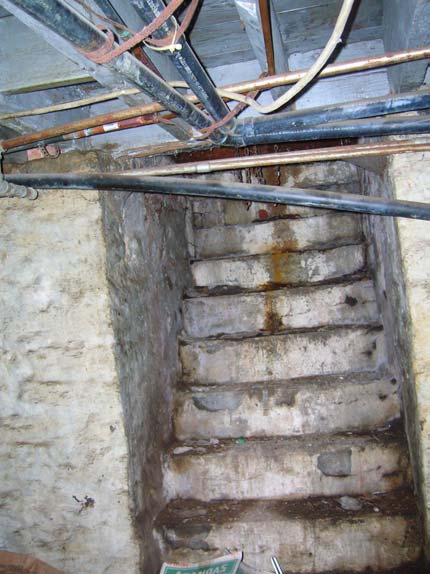
While the Kirsch House sat relatively high, on the North side of town, several blocks from the river, they were still badly flooded at least every few years. The train tracks were on even higher ground.

What Was Affecting Her Life?

I don’t know if Barbara was grief-stricken or relieved, or maybe some of each. Her husband, Jacob Kirsch, had died of cancer of the stomach on July 23rd. She had been taking care of a terminally ill husband for months, as well as running the Kirsch House, a combination hotel, pub and restaurant.

Barbara’s daughter, Carrie was ill with syphilis that would claim her life a few years later. Carrie had contracted that then-fatal disease from her wealth river-boat gambler husband who had already died a decade earlier.

Barbara’s daughter, Lou, worked with her mother after Lou’s husband had committed suicide in the garden behind the Kirsch House on Halloween night 1910. Barbara probably depended on Lou to help with the Kirsch House and with caring for Jacob when he was ill as well.

Barbara’s daughter Ida was in her 20s and hadn’t yet married. Ida also worked at the Kirsch House with her mother. After Ida and Lou both married in 1920 and 1921, Barbara would sell the Kirsch House and live with her daughter, Nora.

Nora had buried a husband and daughter in the past few years, had built her own retail and service business and then remarried in late 1916 to a man that was not liked by the family. Nora moved further away, to Wabash, Indiana. Barbara was very close to Nora’s daughters, her granddaughters, and they came to stay with Nora at the Kirsch House often.

Barbara’s sons Martin and Edward, in their late 40s, so too old to serve in the military, didn’t live close by, but she probably saw then occasionally since the Kirsch House was beside the depot and southern Indiana was well connected by rail. Her grandson, Edgard Kirsch registered for the draft and claimed an exemption for his father and mother who he claimed were dependents.

The Cincinnati newspaper carried headlines about the war. Barbara was born in Germany and the family spoke German. Certainly Barbara still had family in Germany, and may have written back and forth. She may have had aunts, uncles and first cousins still living.

We do know that the Kirsch family spoke German until this time, when they stopped and spoke only English, so that their loyalty would not be questioned. The war had to be on Barbara’s mind, both from the perspective of an American and also as a person with German relatives.

mtDNA Haplogroup – Barbara’s haplogroup descended to me through her female descendants. As more matches have accrued over the years, the amazing Scandinavian story of this haplogroup, found in Barbara’s mother in Germany about 1800 is emerging.

Your Turn

It’s your turn now to select a day, take your picture, and document what your ancestors were doing on that day?  What day will you select, and why?

______________________________________________________________

Disclosure

I receive a small contribution when you click on some of the links to vendors in my articles. This does NOT increase the price you pay but helps me to keep the lights on and this informational blog free for everyone. Please click on the links in the articles or to the vendors below if you are purchasing products or DNA testing.

Thank you so much.

DNA Purchases and Free Transfers

Genealogy Services

Genealogy Research

Susannah (maybe) Hart (c1740-before 1805), Marcus Younger’s Mystery Wife, 52 Ancestors #168

Actually, we’re not even positive Susannah is her first name. I should have titled this “Maybe Susannah Maybe Hart,” but then I didn’t want someone to actually think her first name was “Maybe.”  I can just see that showing up in a tree someplace someday:)

Susannah might be her first name, but if so, it’s a lucky accident in a legal document.

In Halifax County, even in the 1800s, forms and standard language were used for various types of repeat transactions – and it was a mistake on a form that named Susannah – years after her death. The one record that surely did exist at one time, Susannah’s marriage documentation, likely burned when the King and Queen County, VA courthouse burned in 1828, 1833 and 1864. What one fire didn’t consume, the others did.

For sake of consistency, and because that’s what she has been called….and because I have nothing else to call her, I’ll continue to refer to her as Susannah.

Susannah married Marcus Younger probably sometime in or before 1759, because their first child and only (surviving) son was born on April 11, 1760, named John. Note that the child was not named for Marcus, the father. Perhaps another son was born and named for Marcus, but didn’t survive.

We don’t know who Marcus’s father was as we believe that Marcus was illegitimate, probably born to a daughter of Alexander Younger, taking her surname. But we aren’t positive. We do know that Marcus’s descendant’s Y DNA through his only son, John, doesn’t match the Younger DNA line that the rest of the Younger males in the family associated with Marcus carry. Based on Y DNA results, we know who Marcus’s father wasn’t, and there weren’t any other known Younger candidates, so the probable conclusion is that Marcus was illegitimate and belonged to one of the daughters of Alexander Younger.

Illegitimacy at that time was a significant social barrier. If Susannah married an illegitimate man, she may have been illegitimate herself. There are a lot of “ifs, ands and buts” in there – but it’s the best we can do with what we have.

Is John Actually Marcus’s Son?

Now, if you’re sitting there scratching your head, saying to yourself, “But if John was Marcus’s only son, and his male descendant Y DNA tested, how do we know that Marcus was illegitimate, based on that DNA test? Couldn’t John have NOT been Marcus’s son, especially since we don’t have a marriage record that predates John’s birth? Couldn’t John have NOT been Marcus’s son, because Susannah, um, somehow got pregnant by someone other than her husband?”

The answer would be yes, that’s certainly possible. It wasn’t terribly uncommon for women at that time to have a child before marriage, either out of wedlock or by a first husband who died, and for the child to take the second husband’s surname.

However, before we go any further, let’s address this question here and now, so we don’t have to ponder this anymore.

Autosomal DNA provides some very compelling information.

I have eleven matches at two different vendors with people who descend from Alexander Younger, believed to be Marcus’s grandfather, through different children. Because several of the matches are at Ancestry, it’s impossible to know if we share common segments, but there are members of the Alexander Younger who match with me and in common with each other.

However, that’s at Ancestry, and even though their trees don’t show other ancestors in common with each other, we can’t really tell if common segments match unless they are also at GedMatch, or at Family Tree DNA, which they aren’t.

It’s unlikely that I would match 11 different people through Alexander Younger’s other children if Marcus wasn’t related to Alexander. And if the break was between Marcus and John, I wouldn’t be related to Marcus or the Younger family he is clearly associated with.

Other Younger descendants whose kits I manage also match descendants of Alexander Younger.

One last piece of evidence is that in Marcus’s will, he left John, as his son, his land, so Marcus certainly appeared to believe John was his son.

It’s extremely unlikely that John was not the child of Marcus, based on DNA matches. I think we can put that possibility to bed.

Susannah and Marcus

Susannah and Marcus were probably married before 1760 in King and Queen County, VA, where the Younger family lived before moving to Halifax County, VA, around 1785. They could also have been married in Essex County, as the Younger land was very close to the border and they had periodic transactions in both counties. King and Queen County is a burned county, and no Younger marriage records exist in Essex County that early.

In 1780, when they were about 40, Marcus and Susannah were living in King and Queen County, based on Marcus’s Revolutionary War Public Service Claim where he furnished 1 gallon and 2.5 quarts of brandy worth 39 pounds, one shilling and 3 pence. Alcohol was expensive even then.

This implies that the Younger family was in very close proximity to the soldiers, if not the fighting. I wonder how that affected the family. Anthony Hart is a Revolutionary War Pensioner, living in Halifax County in 1840 and stated he served from Essex County in an affidavit signed for Edmond Edmondson. A William Young (Younger?) signs for Edmondson in 1782 in Essex County when he marries. William Younger is also found in Halifax County later, living beside Moses Estes, whose family is also from the same part of King and Queen County. Moses was the father of George Estes who would one day marry Mary Younger, daughter of Marcus Younger and Susannah.

What, you say, this sounds like a circle. Indeed, it does – or a continuation of a drama crossing 3 generations and as many counties too.

But this gets messier yet, because Marcus’s only son, John Younger, eventually married Lucy Hart.

In 1782 and 1785, Marcus and family are living in Essex County and are taxed under Anthony Hart. By this time, Marcus and Susannah were in their early mid-40s.

This Hart connection becomes very important. These families are close, possibly related…in fact, we know they are related because of DNA results, but we don’t know exactly how.

In Anthony Hart’s pension application submitted in 1832, he states that he was born on October 14, 1755 in King and Queen County and lived there until 1802 when he moved to Halifax. He states that Lucy Younger and Mary Gresham can prove his service. Given the fact that Lucy married John Younger who is about Anthony Hart’s age, it’s very likely that Lucy was Anthony’s sister. Lucy, in her deposition says, “I lived with Anthony Hart when we were both children.” Mary Gresham/Grisham says exactly the same thing.

Why don’t they just spit it out? How are they related? If they were siblings, why wouldn’t they have said that?

Was Anthony’s father’s sister married to Marcus Younger? Or maybe Anthony’s oldest sister? Of course, we don’t know who Anthony’s father was, so we can’t reassemble this family any further. All we do know is that Anthony Hart as also found taxed with one Robert Hart.

There are also other Hart family members, such as John Hart who are born in Essex County about 1777, moved to Halifax and subsequently died in neighboring Charlotte County. I, as well as other Marcus descendants, not descended through John Younger who married Lucy Hart also match to John Hart’s descendants. Someplace, there’s a connection.

Back to Susannah

We know very little about Susannah’s life between the time she and Marcus moved to Halifax County in 1785 and her death probably sometime before 1805. In reality, we aren’t positive she was alive in 1785, but it would be unusual for a man not to remarry for that long, especially at age 45 with children to raise.

Susannah probably died between 1785 and 1805.

Marcus Younger wrote his will in 1805, but he did not die until 1815, a full decade later.

I, Marcus Younger of Halifax Co, do hereby make my last will and testament in the manner following; First, after the payments of my last debts, I give my daughter Susannah 50 acres of land where my house stands during my natural life. Also one negro girl (Fanny), one mare, one bed and furniture, one cow and calf to her and her heirs forever. To my grandson Younger Wyatt one mare. The rest of my estate to be equally divided between my 4 children namely John Younger, Elizabeth Clark, Mary Estes and Susannah Younger. Appoint son John executor. Signed with X. Witness John Hannah?, Armistead Bomar, Sally Hannah?. At a court held for Halifax Jan. 25, 1815 will proved. John Younger executor. Phil Carlton security.

As you can see, there is no mention of a wife in 1805. Susannah is stated to be his daughter. Furthermore, Susannah is listed on tax lists as having a life estate. While Marcus’s will appears to convey this land in fee simple, later records infer that she only had a life estate – which would be what a widow would have had – not a daughter.

However, on March 9, 1816, we find the following deed:

Halifax County VA Deed Book 25, Pg. 568, July 1815, registered Mar 1816

Susannah Younger, Younger Wyatt and wife Sally, George Estes and wife Mary, all of the County of Halifax of the one part, and John Younger, of the same, of the other part are entitled to an allotment of land as described below, as distributed by Marcus Younger, dec’d., which by the consent of all the parties are as surveyed, after mutually agreeing to make a survey to Susannah Younger, who becomes entitled to the part allowed her under the will of said Marcus Younger, dec’d. and by the consent of all the parties, the unmentioned tract was sold to the highest bidder at auction on 12 months credit and commanded the sum of 421 pounds, 60 shillings. Now this indenture further witnesseth that for the above consideration the said Susanna Younger and all of the above mentioned have granted, bargained and sold released and confirmed to the said John Younger a certain tract of land in Halifax County on the draughts of Bannister River containing 62 acres beginning at a Post Oak on John Younger’s land. Signed by all thirteen parties

Thomas Clark and wife Peggy
William Clark
John Henderson and wife Sarah
Edmond Henderson and wife Elizabeth
John Landrum and wife Polly
George Estes and wife Mary

It appears that Susanna and the rest of her siblings sell their jointly held land to her brother, John Younger, and that Susannah’s individually held land was sold independently.

The following chart shows who is mentioned in the 1805 will versus the 1816 land sale.

Marcus 1815 Will, written 1805 1816 Land Sale
Susannah Younger – daughter 50 acres where house stands, Fanny (slave), mare, bed, furniture, cow, calf, her share of rest of estate Lays off allotment, sells
Younger Wyatt – grandson (mother Sally deceased) One mare Yes – Younger and Polly Wyatt
John Younger – son Equal share Yes, purchases
Mary Estes – daughter Equal share Yes, Mary and George Estes
Elizabeth Clark – daughter Equal share No
John and Sarah Henderson No Yes
Edmund and Elizabeth Henderson No Yes
John and Polly Landrum No Yes
Thomas and Peggy Clark No Yes

If one is to assume that the reason Marcus left a mare to Younger Wyatt is because his mother, who married a Wyatt male, is deceased, then what we are left with is that Elizabeth Clark has died and her children and heirs are listed in her stead in the 1816 deed, being the 5 individuals not listed in the 1805 will but listed in 1816.

Susannah Younger never marries and dies in 1831, and she leaves a will too that frees slaves Fanny and Harry and leaves them $50 each. In addition, she leaves her clothes to Susannah Estes and Mary Wyatt and the rest of her property to Younger Wyatt, the son of her deceased sister. Mary Wyatt is probably Younger Wyatt’s wife. The names Mary and Polly were often used interchangeably during that timeframe.

Then, in 1842, a chancery suit is filed to clear up the title on Susannah’s land. This was a lawsuit that was not contested, but likely had to be filed to obtain clear title from everyone, especially since it seems that brother John “bought” the land in 1816 and died in 1817, without title ever being filled or legally passing. In the following document, however, you can see why the confusion exists about Susannah.

The chancery suite does answer one question and that’s the name of Younger Wyatt’s mother – Sally. The chancery suit answers a whole lot more too.

Younger, Marcus Chancery Suit 1842-057, Halifax Co. Va. – extracted and transcribed in June 2005 by Roberta Estes sitting mesmerized in the courthouse basement.

The worshipful county court of Halifax in chancery sitting: Humbly complaining sheweth unto your worships your orator Thomas Clark that a certain Marcus Younger died many years ago leaving a small tract of land containing about 53 (58?) acres to his wife Suckey Younger for life and at her death to be divided amongst his children. That after the death of the said Suckey Younger, the rest of the children of the said Marcus Younger (the wife of your orator being one) sold the said land to your orator, put him in possession of the same and have received from him the whole of the purchase money, but have not as yet conveyed to him the legal title.

That one little word was problematic…wife. Suckey, a nickname for Susannah, may well have been Marcus’s wife’s name as well, which may have been why it was so easy to slip that word, wife, in there. But Susannah was clearly Marcus’s daughter, at least the Susannah alive in 1805, according to his will.

The next sentence then refers to the “rest” of the children, implying that Suckey is a child as well.

Perhaps Marcus’s wife’s name as well as his daughters was Susannah. Susannah was also the name of one of Alexander Younger’s daughters. Was Susannah perhaps also the name of Marcus’s mother? It’s certainly possible. Marcus had a daughter Susannah and grandchildren named Susannah as well. Too many Susannahs!

It’s also worth noting that in 1805, none of Marcus’s children appear to be underage, so all born before 1785, which makes sense. In 1815, his grandson, Younger Wyatt had married, so he was at least 25 or so, being born by about 1790, meaning Wyatt’s mother would have been born before 1770, so this too fits.

Furthermore, we have another problem. Elizabeth Clark is mentioned in the 1805 will, but Thomas and Peggy Clark are mentioned in the 1816 sale, along with several other people not previously mentioned. I surmised that Peggy, often short for Margaret, is the grandchild of Marcus, but according to the 1842 chancery suit, that wasn’t the case at all. Peggy was Marcus’s child. So, if Peggy is his daughter, is she the same person as Elizabeth Clark? If so, that means that Elizabeth didn’t die, so the 3 Henderson and Landrum families were not her heirs. So, who were they? Elizabeth Clark is the only name missing from the 1816 sale that was present in the 1805 will document.

And of course, all of this assumes that Susannah was the only wife of Marcus and that all of his children were her children as well. I hate that word, assume.

You can clearly see why I never thought we’d ever solve this conundrum unless some previously unknown records magically surfaced out of either burned King and Queen County (I wish) or neighbor, Essex (unlikely, since they the records show they lived in King and Queen.) Or maybe that e-Bay Bible, I’m still hoping for that.

The Chancery suite continues:

The names of the said renders(?) are John Henderson and Sally his wife, John Landrum and Sally his wife, Edward Henderson and Betsy his wife, Robert Younger and Mary his wife, Samuel Younger and Mary his wife, Thomas P. Anderson, Joel Younger and Fental his wife, Vincent Carlton and Nancy his wife, Joel Anderson and Sally his wife, Thomas Younger and Betsy his wife, William Estes and Rebecca his wife, James Smith and Polly his wife, Susanna Estes, Marcus Estes, William Clark and Mary his wife, Anthony Younger and Nancy his wife, John Younger and Betsy his wife, Younger Wyatt and Polly his wife, John Estes and Nancy his wife, Thomas Estes and Sally his wife. In tender consideration of the promises and in as much as your orator is remedyless therein at last?. To this end therefore that the above named renders? Be made parties to this suit and required to answer the allegations herein contained under oath. That in consequence of the said partys being numerous and widely dispersed in the United States that the said court decree that the legal title to the said land be conveyed to your orator and that the parties to the said contract as vendors? Be required to do so and unless they shall do so within a reasonable time that the court appoint a commissioner for that purpose and grant all other recipients relief. May it please the court to grant the Commonwealths writ of subpoena.

Next document:

The joint answer of John Henderson and Sally his wife, John Landrum and Polly his wife, Edward Henderson and Betsy his wife, Robert Younger and Mary his wife, Samuel Younger and Mary his wife, Thomas P. Anderson and Betsy his wife, Joel Younger and Fental his wife, Vincent Carlton and Nancy his wife, Joel Anderson and Sally his wife, Thomas Younger and Betsy his wife, William Estes and Rebecca his wife, James Smith and Polly his wife, Susanna Estes, Marcus Estes, William Clark and Mary his wife, Anthony Younger and Nancy his wife, John Younger and Betsy his wife, Younger Wyatt and Polly his wife, John Estes and Nancy his wife. Thomas Estes and Sally his wife to a bill of complaint exhibited against them in the county court of Halifax by Thomas Clark – These respondents saving? Do say that the allegations of the complainants bill are true and having answered pray to be hence dismissed.

Next document

This cause came on this day to be heard on the bill of chancery and answered and was argued by counsel and consideration and decise? that Jonathan B. Stovall who is hereby appointed a commissioner for that purpose do by proper deeds convey the lands in the proceeding mentioned to Thomas Clark in fee simply with special warranty.

Two attached pages in file as follows:

Page 1

Marcus Younger left 83 acres for life to Sukey Younger for life and at her death to be divided among his children. (Note – after this statement, in a different handwriting, begins the list of his heirs. Does this mean that Sukey Younger was not considered to be his heir, because she was his wife?)

Elizabeth Clark, Sally Wyatt, John Younger, Mary Estes, children of Marcus

Thomas, Sally Henderson wife of John Henderson, Polly Landrum wife of John Landrum, Betsy wife of Edward Henderson, William Clark, Children of Elizabeth Clark (inferring that she is deceased)

Younger Wyatt child of Sally Wyatt

Robert, Polly wife of Samuel Younger, Anthony, Joel, Betsy wife of J. P. Anderson, Nancy wife of Vincent P. Carlton, John, Thomas, Sally wife of Joel Anderson – children of John Younger

John Estes, William, Susannah, Sally wife of T. Estes, Polly wife of James Smith and a grandchild name Mark Estes – children of Mary Estes

Elizabeth Clark’s children are entitled each to 1/5 of 1/4th
Younger Wyatt entitled to ¼th
John Younger’s children are each entitled to 1/9 of 1/4th
Mary Estes children are entitled each to 1/6 of 1/4th
Mary Estes grandchild is entitled to 1/6th of 1/4th

Next page:

Thomas Clark and Peggy his wife – Halifax
John Henderson and Sally his wife – Halifax
John Landrum and Polly his wife – Halifax
Edward Henderson Jr. and Betsy his wife – Halifax
William Clark and Mary his wife – Patrick County
Robert Younger and Mary his wife – Halifax
Samuel Younger and Mary his wife – Halifax
Anthony Younger and Nancy his wife – Franklin
Thomas P. Anderson and Betsy his wife – Halifax
Joel Younger and Fental his wife – Halifax
John Younger and Betsy his wife – Pittsylvania
Vincent Carlton and Nancy his wife – Halifax
Joel Anderson and Sally his wife – Halifax
Thomas Younger and Betsy his wife – Halifax
Younger Wyatt and Polly his wife – Rutherford County Tennessee
John Estes and Nancy his wife – Rutherford Co Tennessee (actually ditto marks and John was actually in Claiborne by this time it is believed)
William Estes and Rebecca his wife – Halifax
Susannah Estes – Halifax
Thomas Estes and Sally his wife – Montgomery County Tennessee
James Smith and Polly his wife – Halifax
Marcus Estes (son of Mark) – Halifax

(Note – Marcus Estes the son of Mary Estes died in 1815 shortly after his marriage. Mary’s daughter, Susanna Estes also had a son Marcus Estes, not to be confused with the Marcus Estes, son of Marcus Estes, deceased, above.)

Is this not THE chancery suit to die for? Not only does it give you three complete generations, and pieces of the 4th – it tells you where the descendants were living in 1842. Never mind that the county for my John Estes is actually wrong – he and Nancy lived in Claiborne County, Tennessee but for all I know they could have originally gone to Rutherford County. John Estes did marry Nancy Moore. This was the ace in the hole that confirmed my lineage beyond dispute.

I think they heard me all the way upstairs in that old brick courthouse when I found these loose documents.

Now for the bad news.

  • I still don’t know when Susannah Younger, wife of Marcus, was born, other than probably 1740 or earlier.
  • I don’t know when Susannah died, other than probably between 1785 and 1805. She probably died before 1805 when Marcus wrote his will. But if Susannah in the will is actually his wife and not his daughter, then she died in 1831, at about age 90 or 91. That’s certainly possible.
  • I still don’t know her first name, for sure, nor do I know her birth surname, although I think there’s a good chance it’s Hart based on a variety of evidence.

Autosomal DNA

DNA may have come to the rescue, at least somewhat and has graced us with a clue that Susannah, if that was her name, was perhaps a Hart.

Marcus Younger is living with Anthony Hart in 1785 in King and Queen County, according to the tax list.

Anthony Hart and Marcus Younger both moved to Halifax, albeit 17 years apart.

Those dots could have been connected by genealogists years ago, and that connection then turning into a family story of Marcus’s wife being a Hart. It is, indeed a possibility, because that family legend certainly existed. What we don’t know is whether or not it descended through the family or was introduced later by genealogists.

In November of 2013, the seemingly impossible happened and several people from the Younger family matched a descendant of Anthony Hart – and I’m not talking about only descendants of John and Lucy Hart Younger. I match too, and I descend through Marcus’s daughter Mary who married George Estes. I don’t have any known Hart DNA from any other source. I wrote about this wonderful happy dance adventure in the article, “Be Still My H(e)art.”

Since that time, additional Hart matches have continued to accrue. However, the Hart family prior to Halifax County suffers from the same record destruction that the other King and Queen County families do.

Unfortunately, since this line does have a known illegitimacy with Marcus’s paternal line, it makes it more difficult to understand what an autosomal match really means. It could mean we’re matching Marcus’s father’s family lines and just don’t know that since we don’t know who he is, although the Y DNA does not match Hart males.  Hart could be found on any other line, however.

Unfortunately, with all of the unknowns, I’m still unwilling to call Susannah a Hart. In fact, I may never be willing to step out on that limb with any degree of certainty.

We don’t know who Marcus Younger’s parents were, although we can say with almost certainty that his mother was a Younger. Of course, we don’t know who Susannah’s parents were either, and we do know the Younger and Hart families were allied before coming to Halifax County.

The connection between the families could have been because Marcus married Susannah Hart. It could have been because the Hart family married a Younger. It could be because one of Marcus’s parents had a Hart ancestor or because Marcus’s parents and the Hart family had a common ancestor. Or all of the above. We just don’t know.

If we knew something more about at least Marcus’s heritage, I’d be much more likely to make a “call” that Susannah is a Hart based on the DNA matches. Unfortunately, for now and the foreseeable future, both Susannah’s first and last name will remain in question, but by utilizing mitochondrial DNA, we might be able to determine at least some things – and maybe eventually – her ancestry.

This is where we left Susannah’s story, until just recently.

Finding Susannah’s Mitochondrial DNA

Sometimes wishes do come true. I had just about given up hope of ever finding anyone who descends from Susannah through all females to the current generation, which can be male. Women contribute their mitochondrial DNA to both genders of their children, but only females pass it on. Someone descended from Susannah through all females would carry Susannah’s mitochondrial DNA, contributed by their mother, and straight back through the direct matrilineal line.

Susannah’s children were:

  • John Younger was born April 11, 1760 and died just two years after his father, on July 17, 1817. He married Lucy Hart. Sons were Robert Younger (c 1790-1877) who married Mary Polly Moore, Anthony Younger born c 1791, moved to Tate County, Missouri and died about 1877, Joel Younger (1791-c1877), John Younger and Thomas Younger. Daughters were Elizabeth (1790-1875) who married Thomas Anderson, Nancy born (1798-1865), Sally (c1800-after 1842) who married Joel Anderson, and Mary “Polly” (died 1873) who married George Wray.
  • Mary Younger born before 1767 married George Estes and had three daughters. , Susannah had 3 daughters that carried the Estes surname, Polly who married James Smith and had daughters and Sally who married Thomas Estes and had daughters as well. Mary Younger Estes also had sons John R. Estes (1787-1887) who married Nancy Ann Moore and moved to Claiborne County, TN, Marcus Estes (c1788-c1815) who married Quintenny, surname unknown and William Y. Estes (c1785-1860/1870) who married Rebecca Miller.
  • Sally Younger married a Wyatt male and both had died by 1805. The only known child is a male, Younger Wyatt, so this line is not applicable to mitochondrial testing. Younger Wyatt was married by 1816, so Sally Younger would have been born in 1775 or earlier.
  • Elizabeth Younger married William Clark and had three daughters.   Elizabeth was dead by 1816. Daughter Sarah/Sally married John Henderson, Elizabeth/Betsy Clark married Edward Henderson and Mary Polly Clark married John Landrum. Son Thomas Clark married a Peggy and William Clark married a Mary.
  • Susannah Younger, never married, born before 1785 given that no child in Marcus’s 1805 will was underage, died in 1831.

Only two of Susannah’s daughters had female children, Mary and Elizabeth, so there weren’t many descendants who fit the bill in order to test for Susannah’s mitochondrial DNA. Thankfully, one, cousin Lynn, descended through the daughter of Susannah Estes, granddaughter of Susannah Younger, stepped forward.

Thank you, thank you, cousin Lynn.

The Younger Cemetery

If we assume that Susannah and Marcus were married when she was about 20, which was typical for the time, and she had children for the next 23 years, she would have given birth to a total of between 12 and 15 children, depending on whether she had children every 2 years, every 18 months or perhaps even closer if a child died during childbirth. Of those, we know that 5 lived to adulthood, assuming that Susannah who died in 1831 really was a daughter and not Susannah (wife of Marcus) herself.

The sad, silent, untold tale is that Susannah buried more children than she raised, by a 2 or 3 to 1 ratio, leaving most, if not all of them, behind in 1785 when she and Marcus moved to Halifax County. Children who died after that are certainly buried in the old Younger Cemetery on the land owned by Susannah and Marcus. Today, the land is forested with periwinkle carpeting the forest floor, perhaps planted by Susannah’s own hands.

This too is likely where Susannah herself, as well as Marcus, are buried, in an unmarked grave beneath a fieldstone, as well as son John, daughters Susannah and Sally, and possibly, daughters Mary and Elizabeth too. Susannah’s children and grandchildren would have known exactly which stone was hers, but as they moved away, died and were buried as well, the last few in the 1880s, that memory faded away with them and the land eventually passed out of the Younger family in the early 1900s.

By the time I was hunting for the Younger Cemetery in the early 2000s, the only way to find it was by tracking deeds backward and forward in time and from an old letter, found in the neighboring Pittsylvania County library detailing another researcher’s search for that same cemetery sometime between 1930 and 1960, when phone numbers only had 5 digits.

Fortunately, with the help of locals and a very nice property owner, I not only found the cemetery, but was taken to visit.


Susannah’s Grandchildren and Great-Grandchildren

Susannah’s great-grandson through daughter Mary Younger Estes, Ezekiel Estes is shown below in what was probably a funeral photo.  He carried Susannah’s mitochondrial DNA, contributed by his mother Susannah Estes, but since only women pass their mitochondrial DNA on to their children, his children don’t carry Susannah’s mitochondrial DNA.

Susannah’s grandson, John R. Estes, shown below, son of Mary Younger and George Estes.  He also carried her mitochondrial DNA, but didn’t pass it on.

J. E. and Mary Anne Smith, youngest son of Polly Estes (daughter of Mary Younger Estes) and James Smith.  J. E. is a great-grandson of Susannah, and he too carried her mitochondrial DNA, but he didn’t pass it on either.

I look at this picture of his eye patch, and I know there is a story just aching to be told.

Joel Younger, Susannah’s grandson through son, John Younger and Lucy Hart. Joel didn’t carry Susannah’s mitochondrial DNA, but that of Lucy Hart, his mother.

Lynn’s great-great-great-grandmother, and Susannah Younger’s great-granddaughter, Mary Mildred Estes Greenwood is pictured below. Mary’s mother was Susannah Estes, daughter of Mary Younger Estes.  Mary Mildred did carry, and pass Susannah’s mitochondrial DNA on to her offspring, who continued to pass it on down the line of women to Lynn today.

Looking back 8 generation in time. We may not know her name for sure, but we have Susannah’s DNA, through her great-granddaughter, Mary Mildred!

What can we tell?

Susannah’s Mitochondrial Story

Susannah’s haplogroup is H1a3a. That tells us that she is of European origin.

She does have full sequence matches, and 3 with no genetic distance, meaning they are exact matches. Does this mean we can find the common ancestor?

Possibly.

One match didn’t answer the e-mail, one person’s e-mail bounced and the third person is brick-walled in another state in the 1800s.

In the paper titled “A ‘Copernican’ Reassessment of the Human Mitochondrial DNA Tree from its Root,” we find that Dr. Behar has calculated the most likely age of haplogroup H1a3a to have been born about 3,859.4 years before present, with a standard deviation in years of 1621.8. This means that the range of years in which the mutation occurred that gave birth to haplogroup H1a3a was most likely sometime between 2238 years ago and 5480 years ago.

The only other mutations that cousin Lynn carries are a few that are typically not included in aging calculations because they are found in unstable regions of the mitochondria. So, we don’t have any further clues as to how long ago a common ancestor with everyone who matches Lynn exactly might be.

Clearly, Lynn’s matches’ ancestors migrated to the US, and clearly, they share a common ancestor with Lynn (and therefore with Susannah) at some point in time, but we just don’t know when. It could have been in the US, or hundreds or even thousands of years before.

However, even if their common ancestor was prior to immigration, where, exactly was that? Can we tell something more from Lynn’s matches?

In order for a match to show up on your Matches Map, the test taker must complete the Ancestor’s Location, beneath the map.

Unfortunately, none of Lynn’s exact matches did that. However, several of her matches at the genetic distance of 2 and 3 did enter locations, and are found in Sweden and the UK.

Another barometer we can look at is where in the world are other people who are included in haplogroup H1a3a from? Clearly, they shared an ancestor with Susannah at one time in history.

On the Haplogroup Origins page, at the HVR1 level, we find a significant number in Germany and Sweden with several throughout the UK as well:

These people don’t necessarily match Lynn today at the personal mutation level, but they do share a common ancestor with our Susannah at the point in time that H1a3a was created. From that location, descendants have clearly spread far and wide.

This distribution would strongly suggest that haplogroup H1a3a originated in continental Europe and subsequently, some people with that haplogroup migrated to what is now the UK. The Native American indication found in the US are likely from people who believed their ancestor was Native American, or didn’t understand the instructions clearly, or don’t realize that haplogroup H1a3a is not Native, but European.

Lynn’s exact matches are shown below:

Given that Ireland and the UK are the locations I would have expected at this point in American history, especially in King and Queen or Essex County, VA., this information is very probably accurate. When evaluating matching, full sequence always trumps HVR1 or HVR2 matches, being much more specific.

The Ancestral Origins page shows the locations where Lynn’s matches say that their most distant matrilineal ancestor originated.

Of course, Ancestral Origins depends on accurate reporting of the genealogy of Lynn’s matches.

What additional information can we glean?

Checking Lynn’s autosomal DNA matches and searching by the name of Hart, we find 150 matches. Hart is not exactly an uncommon name, and this also includes a few names of which “hart” it only a portion, like “Chart,” for example.

Unfortunately, with Marcus’s uncertain parentage, even if the matches do descend from this same Hart family, and triangulate, we can’t say for sure that the Hart lineage is through Susannah. Interestingly, Lynn and other descendants of Marcus through children other than John (who married Lucy Hart) have matches with descendants of Anthony Hart, who we already met.

Hart is the recurring theme here that won’t go away. There’s an awful lot of smoke for there not to be any fire. Of course, with the 4 parents of Marcus and Susannah all being unknown, except for a suspected Younger female as Marcus’s mother, the Hart connection could be just about anyplace, or multiple places.

Summary

It’s ironic somehow that while we don’t know Susannah’s name, for sure, and even less about her surname, we do know about her ancient history from her mitochondrial DNA which was passed to her descendants, written indelibly, but her name was not.

We know she was European and that sometime around 3800 years ago, her ancestors were probably in the Germanic region of continental Europe. After that, they probably migrated to the British Isles with a group of people who would settle those islands.

We may be able to utilize her mitochondrial DNA to further confirm her family ancestry, especially in combination with autosomal DNA. At this point, all we can do is wait for another female to test and match cousin Lynn, with the hope that they have some sort of genealogy records back to a matrilineal Hart ancestor.

While that seems a long shot, then so was finding cousin Lynn, or more accurately, cousin Lynn finding me. I’m not giving up hope! I have confidence that we will unravel this puzzle one day. Now, thanks to cousin Lynn, it’s just a matter of time and patience.

______________________________________________________________

Disclosure

I receive a small contribution when you click on some of the links to vendors in my articles. This does NOT increase the price you pay but helps me to keep the lights on and this informational blog free for everyone. Please click on the links in the articles or to the vendors below if you are purchasing products or DNA testing.

Thank you so much.

DNA Purchases and Free Transfers

Genealogy Services

Genealogy Research

Acadian AmerIndian Ancestry Project

The Acadians – settlers, pioneers in a new land allied with and intermarried into the Native population of seaboard Nova Scotia beginning in 1603. They lived in harmony, developing their farms and then, roughly 150 years or 6 generations later, in 1755, they found themselves evicted, ruthlessly and forcibly deported, losing absolutely everything. They became landless refugees, living off of the benevolence of strangers…or dying. The Acadian diaspora was born. You can view a timeline here.

Marie Rundquist, Acadian and Native descendant, genetic genealogist, researcher and founder of the original AmerIndian project visited the Acadian homeland this past summer and is graciously sharing her experience through some of her photography and narrative.

Courtesy Marie Rundquist

Marie Rundquist:

This cross, located on the beach near Grand Pre where the Acadians were herded onto ships, is a priceless icon of our Acadian ancestry and represents all of our ancestors who were forcibly removed from their lands – marched on to the awaiting boats at gunpoint – and who left their footprints on this beach. Their last footprints in the land into which their effort and blood had been poured for 150 years.  This cross is very symbolic and meaningful to all who look at it.

Courtesy Marie Rundquist

This photo was taken at Waterfront Park in the town of Wolfville which borders the Minas Basin and the historic Acadian dykelands our ancestors once farmed. The area is known for the spectacular tides that rush into the basin bordering the park, totally changing its landscape.

Courtesy Marie Rundquist

Sabots, the wooden shoes pictured above were worn by Acadian ancestors who farmed the wet, marshy dykelands and were also worn on boats.  Wolfville is within a short distance of the Grand Pre UNESCO Historic Site where my husband and I stayed while attending the 2017 Acadian Mi’kmaq Celebration of Peace and Reconciliation this past August.

If you have Acadian ancestors, these pictures probably caused you to catch your breath.  Your ancestors walked here, stood here and the blood in their veins ran thick with fear, here, as they boarded the ships that would disrupt their lives forever, destroying what they had built over a century and a half.

Focus on the Homeland

Marie has recently begun a new chapter in her life which allows her to focus more directly on the Acadian and AmerIndian homelands and communities. She has been preparing for this transition for years, and all Acadian and AmerIndian researchers will be beneficiaries.

Marie initially founded the AmerIndian out of Acadia project in 2006 to sort out the relationships between the various Acadian and Native families both in Nova Scotia, and wherever their descendants have dispersed since “Le Grand Derangement,” their forced removal in 1755. The story of the Acadians didn’t end in 1755, it began anew in different locations throughout the world, the Acadian diaspora.

Through traditional genealogy research paired with genetic genealogy, we are breathing life into those ancestors once again, honoring their memory and sacrifices, and along the way, getting to know them better and finding unexpected surprises as well.

This is an exciting time in genetic genealogy for descendants of Acadians and those with American Indian roots in eastern Canada and the northeastern portion of the US.

The Acadian homeland is located in the easternmost portion of Canada, Nova Scotia.

By Mikmaq – Own work, CC BY-SA 3.0, https://commons.wikimedia.org/w/index.php?curid=1351882

Many, if not most, Acadians were admixed with the Native population in the 150 years that the French colonists lived in harmony with the Native Mi’kmaq (also referenced as Micmac) people on the Atlantic coastline of Nova Scotia. It’s impossible to study one without studying the other. Their fates, genealogies and DNA are inextricably interwoven.

Having Acadian and Native ancestors as well, and after several years of working together on other projects, I joined Marie as a co-administrator of this project in early 2017.

Today, Marie and I have several exciting announcements to make, the first of which is the renaming of the project to more accurately reflect a new, expanded, focus.

The Acadian AmerIndian Ancestry Project

You might have noticed that the AmerIndian project was renamed a few months ago as the Acadian AmerIndian Ancestry Project to reflect our expanded goals. Specifically, our goal is to create a one-stop location in which to discover Acadian genetic roots. While the Acadia – Metis Mothers and Mothers of Acadian DNA projects have existed for several years to document proven matrilineal Acadian lines, nothing of the same nature existed for Y DNA for paternal surname lineages, or for those who want to connect with their Acadian roots through autosomal DNA.

After weighing various options, Marie and I, in conjunction with Family Tree DNA, decided that the best option was to expand the existing AmerIndian project to include Y, mitochondrial and autosomal DNA of the entire Acadian population into our existing project which already has over 1000 members.

In a word, our new project focus is FAMILY!

In Marie’s words:

Primary project goal: Through genetic genealogy research techniques combined with advanced Y DNA testing, it is our goal to add to and develop Y DNA signatures for male descendants of our legacy Acadian ancestors that may be referenced by others in verifying genealogies.

We want to assure that in our surname studies we are informed by Y DNA results primarily but take into account the mtDNA Full Mitochondrial Sequence results when considering the spouse, and Family Finder (autosomal) DNA results when researching all who may share ancestry.

Surname variants and dit names are of particular interest and factor into our development of a database of surname signatures as related to Acadian genealogies.

We encourage all who have tested and have the surname lineages listed in our project profile to join our project as their combined DNA results help us see through the genealogy brick walls and help us find answers to our genealogy questions.

We want to let new and existing members know how their results have contributed to our ability to develop and verify Acadian genealogies – and for the men in particular, the attainment of Y DNA “signatures” for surname lineages against which all may compare their own Y DNA results – and reference in genealogy research. Adoptees with matching Y DNA results for Acadian surnames (as we already have a number of these) are welcome to join and participate. Our team is expert in the areas of Y DNA testing and analysis, including the latest Big Y DNA tests only through years of practical experience with geographical and haplogroup-related DNA projects.  Both Marie and Roberta have extensive project administration experience and both are affiliate researchers with The Genographic Project.

Introducing Deadre Doucet Bourke

Marie and I realized that we needed assistance, so we are very pleased to welcome our new co-administrator, Deadre Doucet Bourke. Many Acadian researchers already know Deadre, a long-time genealogist and contributor from within the project, so adding her expertise as a project administrator is a natural progression. Deadre will be focused on communicating with people regarding their genealogy and utilizing social media.

You can read the bios of our administrators here.

Welcome Deadre!!!

The DNA Focus

The Acadian AmerIndian Ancestry Project is primarily focused on Y DNA and autosomal DNA. While we aren’t competing with the two mitochondrial DNA projects, we certainly welcome those with direct mitochondrial lineages to join this project as well. We encourage researchers to combine all of the DNA that makes us family to confirm our Acadian heritage and connect to our ancestors.

Acadian researchers struggle with the inability to find their Acadian ancestor’s Y DNA signatures gathered together in one place. Marie and I decided to fix that problem, hence, the redesign of the project.

The Acadian AmerIndian Ancestry Project welcomes everyone with Acadian heritage!

If you descend from a particular line, but aren’t male or don’t carry the surname today, you’ll be able to discover information about your ancestors from the Y DNA, mitochondrial and autosomal DNA carried by other project members. Genetic genealogy is all about collaboration and sharing and finding all types of results in one project location makes that search much easier!

Who Should Join the Acadian AmerIndian Ancestry Project?

  • If you have an ACADIAN SURNAME in your family lines, as listed in the project profile or on the surname list later in this article, and you’ve had the Y DNA, mtDNA or Family Finder test, you are qualified to join this project.
  • If you are a MALE with an ACADIAN SURNAME, please join the Acadian AmerIndian Ancestry Project by ordering (minimally) a Y Chromosome 37 marker test.
  • If you are either male or female and have Acadian MATRILINEAL ANCESTRY (your mother’s mother’s mother’s line) that leads to a Native and/or an Acadian grandmother through all females, please join the Acadian AmerIndian Ancestry Project by ordering the mtFull Sequence mitochondrial DNA test.
  • If you have Acadian or Native American ancestors from the Acadian region of Canada or diaspora regions where Acadian families settled after the 1755 deportation, and would like to discover new leads for ancestry research and close, immediate and distant cousins, please join the project by ordering a Family Finder test.
  • If you have Acadian ancestry and have already taken the Y or mitochondrial DNA test at Family Tree DNA, please click here to sign in to your account and order a Family Finder test by clicking on the “Upgrade” button on the top right of your personal page.
  • If you have already tested and have Y DNA, mtDNA, or Family Finder matches with members of the Acadian Amerindian Ancestry project and are researching your ancestry, you are welcome to join this project.
  • If you have already tested your DNA at Family Tree DNA, but are not yet a project member, please click on the Project tab at the top left of your personal page to select a project to join. If the Acadian AmerIndian Ancestors project is not showing on your list, just type “Acadian” into the search box and click on the “Acadian AmerIndian Ancestry” link to join the project.
  • If you have tested your autosomal DNA at either Ancestry or 23andMe, but not at Family Tree DNA, you can download your autosomal results into the Family Tree DNA data base and use many tools for free – including the ability to join projects. You can read more about this here.

Not sure which kinds of DNA you can test for, and the difference between the different tests, please read 4 Kinds of DNA for Genetic Genealogy.

Questions? Just ask!

Saving Money by Joining the Acadian AmerIndian Project

Please note that DNA testing discounts are available through our project site for people who have never ordered a test from Family Tree DNA previously.

First, click here to go to the Family Tree DNA webpage. Scroll down, then, type the word Acadian into the search box, as shown below. This search process works for surnames as well.

Then, when the results are returned, select the Acadian AmerIndian Ancestry Project and click that link, shown below, to see DNA testing prices available to project members, example shown below.

You’ll need to scroll down to see test prices. The screen shot below only shows a portion of what is available.

DNA testing prices through the project are less than ordering the same test without joining a project.

As A Project Member

Of course, the point of DNA testing and projects is to share.  Family Tree DNA has provided several tools to help genealogists do just that.  We would ask that project members complete the following four easy steps, unless for some reason, you can’t.  For example, adoptees may not have this information.  Just do the best you can.

First, please upload a tree of at least your direct line ancestors at Family Tree DNA.

Just sign in to your personal page and click on “My Family Tree” to get started.

DNA and family trees are extremely powerful tools together – the genetic and genealogy parts of genetic genealogy.

Second, please complete the name and location of your earliest known direct matrilineal ancestor (your mother’s mother’s mother’s line) and your direct patrilineal line (your father’s father’s father’s line) by clicking on the orange “Manage Personal Information” link below your profile photo on the left side of your personal page.

Then, click on the Genealogy Tab, and then click on Earliest Known Ancestors. Please note that you can click on any image to enlarge.

You’ll need to complete:

  • Both Earliest Known Ancestor fields on the left side of the page.
  • Both Ancestral Locations by clicking on the orange “update location” for the patrilineal AND matrilineal ancestor on the right side.

Be sure to click “Save” at the bottom of the page when you’re finished.

Third, under the Privacy and Sharing tab, please consider allowing your Y and mitochondrial DNA results to show on the public page of the project.

When Acadian descendants are searching for projects to join, or information about their ancestral lines, the public project display is often what they find and how they decide if participation or DNA testing is worth their time.

Here is what our public Y DNA project page displays and here is what our mtDNA project page displays.  There is also an option for administrators to display the participants surname, but we do not have this field enabled at this time.  Other projects that you may have joined probably do have this field enabled, and your selection affects all projects of which you are a member.

Under “My Profile,” you’ll see an option to “Share my Earliest Known Ancestor with other people in the projects I’ve joined.”  If you don’t have this option enabled, only a blank space will appear, which doesn’t help anyone determine if you share a common ancestor.

A second option on this page under “My DNA Results is “Make my mtDNA and Y DNA public” which allows your results to show on the public project page.  If you select “project only” then only project members will be able to see your results when logged in to their account. Your results will no show on the public project page unless you select the public option.

Remember to click “save.”

Fourth, if your mitochondrial line (mother’s mother’s mother’s line) is Acadian or Native, you’ll need to provide the project administrators with the ability to see the coding region of your mitochondrial DNA so that your mitochondrial DNA can be properly grouped within the project.  If your direct matrilineal line does NOT pertain to Acadian or Native ancestry, then you’re done.

If your matrilineal line is Native or Acadian, on the Privacy and Sharing page, under “Account Access,” please click on the “Only You” answer to “Who can view my mtDNA Coding Region mutations.”

You will then see a drop down list of the projects you have joined.  You can select any of the projects by clicking the box beside the project.  Only the administrators of the projects you’ve selected can see your coding region results, and you can change this at any time. In my personal account, I’ve selected all of the projects that my mtDNA is relevant to.

Your coding region results are NEVER displayed publicly and no one other than project administrators can see those results.  Family Tree DNA does not offer the option of displaying coding regions in any project.

Again, don’t forget to click “save,” or you haven’t.

Need Help?

Need help? Just ask. We’re here to help.

Project administrators can help you by completing some fields, like most distant ancestor, with your permission, but Privacy and Sharing fields can’t be changed or edited by administrators for everyone’s security.  However, we’d be glad to step you through the process, as would Family Tree DNA customer support.  You can call or contact customer support by scrolling down to the very bottom of your personal page.

Acadian Surnames

Courtesy Marie Rundquist

I compiled the following list of Acadian surnames along with dit names (surname nicknames) from the following Acadian website where you can view which ancestral families were recorded in various census documents including 1671, 1686, 1714 and a deportation list from 1755.

Brenda Dunn’s list was prepared for the Canadian National Parks Service for the Grand Pre National Historic site.

Variant spellings were retrieved from this site and may not be inclusive.

Surname Various Spellings Source
Abbadie, de Saint-Castin d’ Brenda Dunn
Allain Alain, Alin, Allain, Halain, Halin Brenda Dunn
Allard Alard, Allard, Allart, Halard, Hallard Acadian-Cajun.com
Amirault dit Tourangeau Amireau, Amireault, Mero, Miraud, Mirau, Miraux, Mireau, Mireault, Moreau Brenda Dunn
Angou dit Choisy Brenda Dunn
Apart Brenda Dunn
Arcement Brenda Dunn
Arnaud Arnaud, Arnault Brenda Dunn
Arosteguy Brenda Dunn
Arseneau Brenda Dunn
Aubin Aubain, Aubin, Obin Acadian-Cajun.com
Aubois Brenda Dunn
Aucoin Aucoin, Coin, Ocoin Brenda Dunn
Ayor Brenda Dunn
Babin Babain, Babin Brenda Dunn
Babineau dit Deslauriers Babinau, Babineau, Babineaux, Babino, Babinot Brenda Dunn
Barillot Brenda Dunn
Barnabe Acadian-Cajun.com
Barriault Bariau, Bariault, Barieau, Barillault, Barrillaut, Barillon, Barillot, Bario, Barrio Acadian-Cajun.com
Bastarache dit (Le) Basque Brenda Dunn
Bastien Baptien, Basquien, Bastien, Vasquais Brenda Dunn
Beaulieu Baulieu, Baulieux, Beaulieu, Beaulieux Acadian-Cajun.com
Beaumont Beaumon, Beaumont Acadian-Cajun.com
Belisle Belisle, Bellisle, de Bellisle Acadian-Cajun.com
Bellefontaine Bellefontaine, Bellefontenne Acadian-Cajun.com
Belleville Beliveau Brenda Dunn
Belliveau dit Bideau Beliveau Brenda Dunn
Belliveau dit Blondin Brenda Dunn
Belou Brenda Dunn
Benoit dit Labriere Benois, Benoist, Benoit Brenda Dunn
Bergereau Brenda Dunn
Bergeron d’Amboise Brenda Dunn
Bergeron dit Nantes Bargeron, Bergeon, Bergeron, Berjeron Brenda Dunn
Bernard Bernar, Bernard Brenda Dunn
Berrier dit Machefer Brenda Dunn
Bertaud dit Montaury Brenda Dunn
Bertrand Bartrand, Berterand, Bertran, Bertrand, Bertrant Brenda Dunn
Bezier dit Lariviere Brenda Dunn
Bezier dit Touin Brenda Dunn
Bideau Acadian-Cajun.com
Blanchard dit Gentilhomme Blanchar, Blanchard, Blanchart Brenda Dunn
Blondin Blondain, Blondin Acadian-Cajun.com
Blou Acadian-Cajun.com
Bodard Brenda Dunn
Boisseau dit Blondin Boissau, Boisseau, Boisseaux Brenda Dunn
Bonnevie dit Beaumont Brenda Dunn
Borel Brenda Dunn
Boucher dit Desroches Bouché, Boucher, Bouchez Brenda Dunn
Boudreau Boudrau, Boudraut, Boudreau, Boudro, Boudrot Acadian-Cajun.com
Boudrot Brenda Dunn
Bourg Bourc, Bourg, Bourgue, Bourk, Bourque Brenda Dunn
Bourgeois Bourgeois, Bourgois, Bourjois Brenda Dunn
Boutin Boudin, Boutain, Boutin, Bouttain, Bouttin Brenda Dunn
Brassaud Brenda Dunn
Brasseur dit Mathieu Brasseur, Brasseux Brenda Dunn
Breau Brenda Dunn
Breton Berton, Breton, Lebreton Acadian-Cajun.com
Brossard Brosard, Brossar, Brossard, Brossart, Broussard Brenda Dunn
Brun Brun, Lebrun Brenda Dunn
Bugaret Brenda Dunn
Bugeaud Brenda Dunn
Buisson Buisson, Busson, Dubuisson Brenda Dunn
Buote Brenda Dunn
Buteau Butau, Butaud, Buteau, Buteux, Buto, Butteau Brenda Dunn
Cadet Caddé, Cadet, Cadette Acadian-Cajun.com
Caissy dit Roger Brenda Dunn
Calve dit Laforge Brenda Dunn
Carre Caray, Caré, Caret, Carr, Carré, Carret Brenda Dunn
Cassy dit Roger Brenda Dunn
Celestin dit Bellemere Brenda Dunn
Cellier dit Normand Brenda Dunn
Champagne Champagne, Champaigne Acadian-Cajun.com
Chauvert Acadian-Cajun.com
Chauvet Chauvet, Chauvette, Chovet Brenda Dunn
Chenet dit Dubreuil Chenay, Chenet, Chenette, Chesnay Brenda Dunn
Chesnay dit Lagarene Brenda Dunn
Chiasson dit La Vallee Chiasson, Giasson Brenda Dunn
Chouteau dit Manseau Brenda Dunn
Clemenceau Brenda Dunn
Cloustre Brenda Dunn
Cochu Cochu, Cochus Acadian-Cajun.com
Cognac Cognac, Coignac Brenda Dunn
Comeau Brenda Dunn
Cormier dit Bossigaol Cormié, Cormier, Cornier Brenda Dunn
Cormier dit Thierry Brenda Dunn
Cornelier Brenda Dunn
Corporon Brenda Dunn
Cosse Acadian-Cajun.com
Cosset Cosset, Cossette Brenda Dunn
Coste Brenda Dunn
Cottard Brenda Dunn
Cousineau Brenda Dunn
Crepeau Crepau, Crepaux, Crepeau, Crepeaux, Crepos, Crespau, Crespeau, Crespel Brenda Dunn
Creysac dit Toulouse Brenda Dunn
Cyr Cir, Cire, Cyr, Cyre, Sir, Sire, Siree, Syr, Syre Brenda Dunn
Daigle Daigle. Daigles, Dehegue Acadian-Cajun.com
Daigre Brenda Dunn
Damboue Acadian-Cajun.com
D’Amours de Chauffours Brenda Dunn
D’Amours de Clignancour Brenda Dunn
D’Amours de Freneuse Brenda Dunn
D’Amours de Louviere Brenda Dunn
D’Amours de Plaine Brenda Dunn
Daniel Daniel, Daniele, Danielle, Deniel Brenda Dunn
Darois Brenda Dunn
David dit Pontif Davi, David, Davit, Davy Brenda Dunn
Debreuil Acadian-Cajun.com
Delatour Delatour, Latour Acadian-Cajun.com
Delisle Delile, Delille, Delisle, Delisles, Brenda Dunn
Denis Deni, Denis, Dennis, Denys Brenda Dunn
D’Entremont Acadian-Cajun.com
Denys de Fronsac Brenda Dunn
Depeux Acadian-Cajun.com
Derayer Brenda Dunn
Desaulniers Desaulnier, Desaulniers, Desaunié, Desaunier, Desauniers Acadian-Cajun.com
Deschamps dit Cloche Dechamp, Dechamps, Dechant, Deschamps Brenda Dunn
Desgoutins Brenda Dunn
Desmoulins Demoulin, Desmoulin, Desmoulins, Dumoulin Brenda Dunn
Desorcis Acadian-Cajun.com
Després Depre, Depres, Despre, Despres, Desprez Brenda Dunn
Devaux Acadian-Cajun.com
Deveau dit Dauphine Devau, Devaux, Deveau, Deveaux, Devot, Devots Brenda Dunn
Dingle Brenda Dunn
Doiron Doiron, Douairon, Doueron Brenda Dunn
Domine dit Saint-Sauveur Brenda Dunn
Donat Acadian-Cajun.com
Douaron Acadian-Cajun.com
Doucet dit Laverdure Doucet, Doucette Brenda Dunn
Doucet dit Lirlandois Brenda Dunn
Doucet dit Mayard Brenda Dunn
Druce Brenda Dunn
Dubois dit Dumont Debois, Desbois, Dubois, Duboy Brenda Dunn
Dufault Dufau, Dufault, Dufaut, Dufaux, Duffault, Duffaut, Duffaux, Dufo, Dufos, Duphaut Brenda Dunn
Dugas Duga, Dugas, Dugast, Dugat Brenda Dunn
Duguay Dugai, Dugaie, Dugay, Duguay, Dugué Brenda Dunn
Dumont Dumon, Dumond, Dumont Acadian-Cajun.com
Duon dit Lyonnais Brenda Dunn
Dupeux Acadian-Cajun.com
Duplessis Duplaissy, Duplassis, Duplassy, Duplecy, Duplesis, Duplessis, Duplessy, Placy Brenda Dunn
Dupuis Dupui, Dupuis, Dupuit, Dupuits, Dupuy, Dupuys Brenda Dunn
Egan Brenda Dunn
Emmanuel Acadian-Cajun.com
Esperance Lespérance, Lesperence Acadian-Cajun.com
Fardel Acadian-Cajun.com
Flan Brenda Dunn
Fontaine dit Beaulieu Delafontaine, Fonteine, Lafontaine, Lafonteine, Lafonteinne Brenda Dunn
Forest Fores, Forêt, Laforêt, Laforest Brenda Dunn
Foret Forest Acadian-Cajun.com
Forton Brenda Dunn
Fougere Brenda Dunn
Fournier Fournié, Lefournier Brenda Dunn
Froiquingont Brenda Dunn
Gadrau Brenda Dunn
Galerne Brenda Dunn
Galle Brenda Dunn
Garceau dit Boutin Garco, Garso, Garsot Brenda Dunn
Garceau dit Richard Brenda Dunn
Garceau dit Tranchemontagne Brenda Dunn
Gardet Gardai, Garday, Gardé Brenda Dunn
Gareau Garau, Garaud Brenda Dunn
Gaudet Gaudais, Gaudé, Gaudette, Godé, Godet, Godete, Godette Acadian-Cajun.com
Gauterot Brenda Dunn
Gauthier Gaultier, Gautier, Gotier Brenda Dunn
Gentil Brenda Dunn
Giboire Duverge dit Lamotte Brenda Dunn
Girouard Geroir, Gerroir, Giouard, Giroir, Girroir, Jirouard Brenda Dunn
Gise Brenda Dunn
Godin Boisjoli Brenda Dunn
Godin dit Beausejour Gaudain, Gauden, Gaudin, Godain, Goddin, Godin Brenda Dunn
Godin dit Bellefeuille Brenda Dunn
Godin dit Bellefontaine Brenda Dunn
Godin dit Catalogne Brenda Dunn
Godin dit Chatillon Brenda Dunn
Godin dit Lincour Brenda Dunn
Godin dit Preville Brenda Dunn
Godin dit Valcour Brenda Dunn
Godon Gandon, Gaudon, Godon Brenda Dunn
Gosselin Gaucelin, Gauscelin, Gausselin, Goscelin, Gosselain Brenda Dunn
Goudreau Gaudrau, Gaudrault, Gaudreau, Gaudreault, Gaudro, Godereau, Godrault, Godreault, Godro, Godrot, Goodrow Brenda Dunn
Gougeon Gougeon, Gougon, Goujon, Goujou Acadian-Cajun.com
Gourdeau Acadian-Cajun.com
Gousille Acadian-Cajun.com
Gousman Brenda Dunn
Gouzille Brenda Dunn
Grandmaison Degrandmaison Brenda Dunn
Granger Brenda Dunn
Gravois Brenda Dunn
Grosvalet Brenda Dunn
Guedry dit Labine Brenda Dunn
Guedry dit Labrador Brenda Dunn
Guedry dit Laverdure Brenda Dunn
Guedry Grivois Guidry, Guildry Brenda Dunn
Gueguen Brenda Dunn
Guenard Brenda Dunn
Guerin dit LaForge Guerrin Brenda Dunn
Guilbault Guibau, Guibaut, Guibeau, Guibo, Guilbau, Guilbaud, Guilbaux, Guilbeau, Guillebault, Guillbeau, Guilbaut Acadian-Cajun.com
Guilbeau Brenda Dunn
Guillot Brenda Dunn
Guy dit Tintamarre Degui, Deguy, Gui Brenda Dunn
Guyon Dion, Dionne, Gion, Guillon, Guion, Gyon, Yon Brenda Dunn
Hache dit Gallant Brenda Dunn
Hamel Amel, Amell, Emmel, Hamell, Hamelle, Hornel Brenda Dunn
Hamet Brenda Dunn
Hamon Brenda Dunn
Hébert dit Manuel Abaire, Abare, Abbot, Ebart, Éber, Ébert, Heber, Heberd, Hébere, Herber, Herbert, Hesbert, Hibbart, Hubert Brenda Dunn
Helys dit Nouvelle Brenda Dunn
Henry dit Robert Henri Brenda Dunn
Hensaule Brenda Dunn
Heon Brenda Dunn
Herpin Arpin, Guertin, Harpin, Hertin Acadian-Cajun.com
Heuse Brenda Dunn
Hugon Brenda Dunn
Jasmin Jassemin Acadian-Cajun.com
Jeanson Jeansonne Brenda Dunn
Joseph Brenda Dunn
Kimine Brenda Dunn
Labarre Delabarre, Labar, Labard Brenda Dunn
Labat, dit Le Marguis, de Labatte Brenda Dunn
LaBauve Brenda Dunn
Lachaume Delachaume Brenda Dunn
Lacroix Delacroix Brenda Dunn
Lafond Lafon, Lafont Acadian-Cajun.com
Lafont Acadian-Cajun.com
Lagasse Lagace, Lagacee, Lagassee, Lagassees, Lagasset Acadian-Cajun.com
Lalande dit Bonnappetit Delalande, Lalande Brenda Dunn
Laliberte Laliberte, Liberte Acadian-Cajun.com
Lambert Lamber, Lembert Brenda Dunn
Lambourt Brenda Dunn
Lamontagne Delamontagne, Montagne Acadian-Cajun.com
Landrom Brenda Dunn
Landry Landri, Landrie, Landril, Landrille, Lendry Brenda Dunn
Langlois Anglais, Anglois, Langlais, Langloi, Langlouois Brenda Dunn
Lanoue Brenda Dunn
Lapierre dit LaRoche Delapierre, Lapeer, Pierre Brenda Dunn
Latour Acadian-Cajun.com
Laurier Lauriere,Lorier Acadian-Cajun.com
LaVache Brenda Dunn
Lavallée Lavale, Lavalee, Vale, Valee, Valle, Vallee Acadian-Cajun.com
Lavergne Laverne Brenda Dunn
Lavigne Delavigne Brenda Dunn
Lebasque Acadian-Cajun.com
Lebert dit Jolycoeur Abare, Hébert, Labare, LeBear, Leber, Leberre, Libest Brenda Dunn
Leblanc dit Jasmin Blanc, Leblan, Lebland, Leblant Brenda Dunn
LeBorgne dit Belisle Brenda Dunn
Lebreton Berton, Beurton Acadian-Cajun.com
Leclerc dit Laverdure Clair, Claire, Clerc, Leclair, Leclaire, Lecler, Leclerq Brenda Dunn
Lecul Brenda Dunn
Lefebvre Febur, Febvre, Lefaivre, Lefebre, Lefebur, Lefeuvre, Lefevre Acadian-Cajun.com
Leger dit La Rozette Legere, Legey, St-Leger Brenda Dunn
Lejeune dit Briard Jeune, Lejeunne Brenda Dunn
LeJuge Brenda Dunn
Lemaistre Acadian-Cajun.com
LeMarquis dit Clermont Brenda Dunn
Lemire Lemir, Lemirre, Lemyre, Lemyrre, Mire Brenda Dunn
LeNeuf de Beaubassin Lenef, Leneuf Brenda Dunn
LeNeuf de Boisneuf Brenda Dunn
LeNeuf de LaValliere Brenda Dunn
L’Enfant Brenda Dunn
LePoupet de Saint-Aubin Brenda Dunn
LePrieur dit Dubois Brenda Dunn
LePrince Brenda Dunn
Leroy Leroi, Roi, Roy Brenda Dunn
L’Eschevin dit Billy Brenda Dunn
Lespérance Delesperance, Lesperence Acadian-Cajun.com
Lessoile Acadian-Cajun.com
LeVanier dit Langevin Brenda Dunn
LeVasseur dit Chamberlange Brenda Dunn
Leveille Leveiller, Leveillez, Leveillie, Leveillier Brenda Dunn
Levron dit Nantois Leveron Brenda Dunn
Loiseau Laiseau, Laizeau, Loisau, Loisseau, Loizeau, Loseau, Loyseau, Lozeau Brenda Dunn
Long Brenda Dunn
Longuepee Brenda Dunn
Loppinot Brenda Dunn
Lord dit Montagne Lore Brenda Dunn
Lort Acadian-Cajun.com
Lucas Luca Brenda Dunn
Lyonnais Acadian-Cajun.com
Maffier Brenda Dunn
Maillard Acadian-Cajun.com
Maillet Brenda Dunn
Maisonnat dit Baptiste Brenda Dunn
Malboeuf Malbeuf Brenda Dunn
Mangeant dit Saint Germain Brenda Dunn
Manseau Manceau, Mansau Acadian-Cajun.com
Marcadet Brenda Dunn
Marchand dit Poitiers Marchan, Marchant Brenda Dunn
Marres dit LaSonde Brenda Dunn
Martel Martelle Brenda Dunn
Martil Acadian-Cajun.com
Martin dit Barnabe Martain Brenda Dunn
Massé Macé, Macés, Masset, Massey Brenda Dunn
Massie Brenda Dunn
Mathieu Mathieux, Matthieux Brenda Dunn
Maucaire Brenda Dunn
Mazerolle dit Saint Louis Brenda Dunn
Melanson dit LaRamee
Melanson dit Laverdure Melanson, Melençon, Melenson, Menançon Brenda Dunn
Mercier dit Caudebec Lemercier, Mersier Brenda Dunn
Messaguay Brenda Dunn
Meunier Megné, Menié, Mesnier, Meusnier, Munier, Musnier Brenda Dunn
Michaud Michau, Michault, Michaut, Michaux, Micheau Acadian-Cajun.com
Michel dit LaRuine Bichel, Miché, Michelle, Micher Brenda Dunn
Migneau dit Aubin Mignau, Mignaud, Mignault, Mignaux, Migneaux, Mignot, Migneau Brenda Dunn
Mignier dit Lagasse Brenda Dunn
Mignot Mignau, Mignaud, Mignault, Mignaux, Migneaux, Mignot Brenda Dunn
Mirande Brenda Dunn
Mius d’Azit Miusse, Mousse Brenda Dunn
Mius de Entremont de Plemarais Miusse, Mousse Brenda Dunn
Monmellian dit Saint Germain Brenda Dunn
Mordant Brenda Dunn
Morin dit Boucher Maurain, Maurin, Morrin Brenda Dunn
Morpain Brenda Dunn
Moulaison dit Recontre Brenda Dunn
Mouton Brenda Dunn
Moyse dit Latreille Brenda Dunn
Muis de Entremont de Pobomcoup Miusse, Mousse Brenda Dunn
NaQuin dit L’Etoile Brenda Dunn
Nogues Brenda Dunn
Nuirat Brenda Dunn
Olivier Oliver, Olivie, Ollivier Brenda Dunn
Ondy Acadian-Cajun.com
Onel O’Neale Brenda Dunn
Orillon dit Champagne Aurillon, Aurion, Orion, Oriont Brenda Dunn
Oudy Brenda Dunn
Ozelet Brenda Dunn
Paris Deparis, Parisis, Parisse, Pary Acadian-Cajun.com
Parisien Leparisien, Parisiens, Parizien Acadian-Cajun.com
Part Brenda Dunn
Pellerin Pelerin, Pelrin Brenda Dunn
Pesseley Acadian-Cajun.com
Petitot dit Saint Sceine Brenda Dunn
Petitpas Brenda Dunn
Pichot Brenda Dunn
Picot Brenda Dunn
Pincer Brenda Dunn
Pinet Brenda Dunn
Pitre dit Marc Lepitre, Pistre, Piter, Pittre Brenda Dunn
Poirier Poerier, Poirie, Poiriers, Poirrier, Porier, Poyrie, Poyrier Brenda Dunn
Poitevin dit Cadieux Lapoitevin, Paudevin, Poidevin, Poitvin, Potdevin, Potevin, Potvin Brenda Dunn
Poitevin dit Parisien Lapoitevin, Paudevin, Poidevin, Poitvin, Potdevin, Potevin, Potvin Brenda Dunn
Poitier Brenda Dunn
Porlier Brenda Dunn
Pothier Pauthier, Pautier, Poitié, Poitier, Poitiers, Potier, Potiers, Pottier Acadian-Cajun.com
Poujet dit Lapierre Brenda Dunn
Poulet Acadian-Cajun.com
Poupard Poupar, Poupare, Poupart Brenda Dunn
Prejean dit LeBreton Pregeant, Pregent, Prejan Brenda Dunn
Pretieux Brenda Dunn
Pugnant dit Destouches Brenda Dunn
Racois dit Desrosiers Brenda Dunn
Raymond Raimon, Raimond, Raymont, Raymon, Remond, Remont Brenda Dunn
Renaud dit Provencal Rainaud, Raynaud, Raynalt, Regnault, Regneault, Renau, Renauld, Renault, Renaut, Renaux, Reneau, Reneault, Renaux, Renod Brenda Dunn
Richard dit Beaupri Richar, Richart Brenda Dunn
Richard dit Boutin Richar, Richart Brenda Dunn
Richard dit Lafont Richar, Richart Brenda Dunn
Richard dit Sancoucy Richar, Richart Brenda Dunn
Rimbeau Rimbaut Brenda Dunn
Rivet Rivais, Rive, Rivest, Rivette, Rivez Brenda Dunn
Robichaud dit Cades Robichau Brenda Dunn
Robichaud dit Niganne Robichau Brenda Dunn
Robichaud dit Prudent Robichau Brenda Dunn
Rodoham Brenda Dunn
Rodrigue dit DeFonds Rodrigues, Rodriguez Brenda Dunn
Rossette Roucet, Roucette, Rouset, Rousette Acadian-Cajun.com
Rousse dit Languedoc Leroux, Rousse, Roux Brenda Dunn
Roy dit Laliberte Leroi, Roi, Roy Brenda Dunn
Rullier Brenda Dunn
Saindon Brenda Dunn
Saint Etienne de La Tour, de Brenda Dunn
Saint Julien de La Chaussee, de Brenda Dunn
Saint Scene Acadian-Cajun.com
Samson Sanson Brenda Dunn
Saulnier Saunier Brenda Dunn
Sauvage dit Chrystophe Sauvages, Sauvagesse, Sauvaget, Savage Brenda Dunn
Sauvage dit Forgeron Sauvages, Sauvagesse, Sauvaget, Savage Brenda Dunn
Savary Brenda Dunn
Savoie Brenda Dunn
Semer Brenda Dunn
Sereau Serot, Serreau Brenda Dunn
Serreau de Saint-Aubin Brenda Dunn
Simon dit Boucher Cimon Acadian-Cajun.com
Simoneau Simonau,   Simonaud, Simoneaux, Simonneau, Simono, Acadian-Cajun.com
Soulard Soular, Soulard, Soulart, Soullard Brenda Dunn
Soulevent Brenda Dunn
Surette Brenda Dunn
Tandau Brenda Dunn
Teriot Teriau, Teriaut, Teriot, Terriau, Terriaux, Terriau, Terriaux, Terriot, Theriault, Theriaux, Therieau Brenda Dunn
Testard dit Parish Testar, Testard, Tetard, Tetart Brenda Dunn
Thebeau Brenda Dunn
Thibault Brenda Dunn
Thibeau Acadian-Cajun.com
Thibodeau Brenda Dunn
Tillard Brenda Dunn
Tourangeau Tourangeau, Tourangeaux Acadian-Cajun.com
Tourneur Brenda Dunn
Toussaint dit Lajeunesse Tousain, Toussain, Toussaint, Toussin, Touzin Brenda Dunn
Trahan Brenda Dunn
Triel dit LaPerriere Brenda Dunn
Turcot Brenda Dunn
Turpin dit LaGiroflee Brenda Dunn
Vallois Brenda Dunn
Veco Acadian-Cajun.com
Vescot Brenda Dunn
Viger Brenda Dunn
Vigneau dit Maurice Vignau, Vignault, Vignaux, Vigneau, Vigneaux Brenda Dunn
Villatte Vilatte Brenda Dunn
Vincent dit Clement Vincant, Vincent Brenda Dunn
Voyer Brenda Dunn
Yvon Acadian-Cajun.com

 Additional Resources

In addition to the resources utilized to compile the Acadian surnames listed above, we recommend the following resources for genealogical research:

  • View the Acadian family tree contributed and maintained by genealogist Karen Theriot Reader at this link.
  • The Acadian Rootsweb list hosted by Paul LeBlanc provides an invaluable resource for sharing information.  To subscribe to the list, please send an email to ACADIAN-request@rootsweb.com with the word ‘subscribe’ without the quotes in the subject and the body of the message.  If you are not already a member, you can browse the archives here or you can search the Acadian list archives for keywords like surnames by utilizing the search engine here.
  • Please visit the Family Heritage Research Community to read exciting articles about how real people like you discovered their roots by way of DNA testing.

Additional projects administered by Roberta Estes and Marie Rundquist that may be relevant to Acadian descendants include:

Thank You

We want to extend a big thank you to the incredible members of the Acadian AmerIndian Ancestry Project for recruiting new members, for their individual research, and for sharing so willingly. A project is only as strong as the members!

We hope you’ll be joining us soon!

Photography Credit

The location photos used in this article were taken this summer at the Annapolis Royal Historic Site, Annapolis Royal Historic Gardens and the Grand Pre UNESCO World Heritage Site by Marie Rundquist. Thanks to Marie for being our project ambassador, for permission to use her photography here and on the Acadian AmerIndian Ancestry Project page as well.

______________________________________________________________

Disclosure

I receive a small contribution when you click on some of the links to vendors in my articles. This does NOT increase the price you pay but helps me to keep the lights on and this informational blog free for everyone. Please click on the links in the articles or to the vendors below if you are purchasing products or DNA testing.

Thank you so much.

DNA Purchases and Free Transfers

Genealogy Services

Genealogy Research