Saying Hello in the DNA World

Hey Baby, what’s your sign?  Remember that?  I surely do.  It was the worst introductory, aka “pickup line” ever!

If someone asked me that today, after rolling my eyes of course, I’d just have to show them a double helix on my Kerchner R1b piniphone or maybe just look at them deadpan and say “R1b,” M269” or “J1c2f.” If they know what means, well, there might be hope…

Ok, so what DO you say to someone with whom you match on your DNA?  How do you appropriately say “hello?”

When you receive a match from a vendor or via tools like GedMatch, what do you say to that new match that will elicit a response that might be useful and not make you look either like an idiot or predatory in the process? In part, that has to do with what kind of DNA match it is, meaning Y, mitochondrial or autosomal, and in part, how you ask for information.

So, first, let’s talk about some basics of how to obtain good responses and secondly, let’s look at each type of match.

The Basics

I know some of these basics sounds, well, really basic, but I wouldn’t have included them if I didn’t receive a lot of e-mails from people who obviously don’t understand these basic communications “good manners.”

  1. Do use capitals and punctuation. If you don’t you’re conveying the message to the recipient that they don’t matter enough to bother constructing a complete sentence. E-mails like this are apt to be immediately deleted.
  2. Don’t put the entire question in the subject line. These get deleted too.
  3. Include the person’s name who you match. Don’t assume that the person whose e-mail is on the kit is the person who tested.  Many people manage multiple (as in many) kits.
  4. Don’t write “dear match” e-mails and copy several people at once.
  5. Title the e-mail with something relevant like “DNA Match to Robert Doe at Family Tree DNA.”  You don’t want your e-mail to wind up in their spam filter.
  6. Include the basics of the match including the match’s name on the kit (or kit number) and the company (or service like GedMatch) where the match occurred.  I always add the test type as well, and if the match is particularly close.
  7. Don’t say, “Can you tell me how we’re related?” without giving any other information. That comes across as sounding a bit “entitled” and the response it gets from the receiver generally isn’t positive.
  8. Do not tell your life story. They won’t read it and they’ll delete it.
  9. Include friendly, short, concise basic information, depending on the kind of test.
  10. I always end my communications with a question for them to answer and a short, positive comment.

Y-DNA

Y-DNA tests are between males, so if you’re a female, you might want to mention that you’re the custodian for the kit for your brother, or father, John Doe. Give basic surname and lineage information for the Doe line.

Here’s an example of a contact e-mail for Y DNA:

Dear Robert Doe,

I’m the custodian for the DNA kit at Family Tree DNA of John Doe, my father. I noticed that he matches Robert Doe, which I presume is you, on the Y DNA test at 67 markers with only one mutation.  In addition, these two men carry the same surname which suggest a common ancestor.  I’ve also checked and you two don’t seem to match on the Family Finder test, so perhaps the common ancestor between you and my father is a few generations back in time.

Here is my father’s direct Doe lineage:

y pedigree

As you can see, I’m stuck with Martin Doe in Virginia. I’m hoping that our match might be helpful in getting beyond this brick wall.

Who is your oldest Doe ancestor and where were they located?

Thank you for your time. Here’s hoping we can find our common ancestor or at least some hints!

Jane Doe

Mitochondrial DNA

Mitochondrial DNA is a little more challenging genealogically, because the surnames change with every generation. Therefore, locations become very important clues in terms of finding a common ancestor.

Here’s an example of a mitochondrial DNA contact e-mail:

Dear Susie Smith,

I’m the custodian for the DNA kit at Family Tree DNA for my mother, Barbara Jones. I noticed that mother and Susie Smith, which I presume is you, share mitochondrial DNA at the full sequence level with no mutations difference.  This means that our common relative could be in recent generations, or maybe further back in time.  Since you’ve both also taken the Family Finder test, I noticed that you also match in the 2nd to 4th cousin range, meaning you and mother could potentially share great-grandparents to great-great-great-grand-parents. That could possibly be from Barbara Brown, Ellen Green or Mary on my pedigree chart below.

Here is my mother’s matrilineal line as far back as I have information:

mtDNA pedigree

Of course, it’s possible that our common ancestor is further back in time, but I’m hopeful that some of these names or locations might look familiar or be where your matrilineal family members are from too.

Do you see anything here that looks promising in terms of a common ancestor or location?  Where is your most distant maternal ancestor from?

I look forward to hearing from you. Maybe we can solve this puzzle together.

Jane Jones

Autosomal DNA

Autosomal DNA is, of course, genealogically more complex than either Y or mitochondrial DNA in that your matches can be from any of your family lines. That also means this test is full of potential as well, but it’s more difficult to provide your matches with enough information to obtain a useful response without overwhelming them.  With three different vendors plus GedMatch, a one-size-fits-all introductory letter doesn’t work

The first thing I do is to see if I can tell how this person may match me.

For example, my mother has taken the Family Finder test at Family Tree DNA as well, so the first thing I check on any match is to see if that person matches both me and my mother. If so, then that match is through my mother’s side of the tree.

This is easy to do with the ICW (in common with) button at Family Tree DNA.  The ICW button looks like crossed arrows and is blue, below.

Joy compare

The list of matches returned will either show my mother or it won’t.

If the person doesn’t match my mother, and Joy doesn’t, I see who else they do match in addition to me.  For example, let’s see who Joy matches that I match as well.

Joy ICW

I can tell based on the ICW cousins that Joy and I both match that indeed, this match is on my father’s side and that it’s in the Vannoy line. That’s actually very helpful, because it helps me provide my match with some direction and gives us someplace to go.  This also illustrates the benefit of testing every cousin you can find!

Here’s an example of a Family Finder contact e-mail:

Dear Joy,

I notice that I have a match to Joy Smith, which I presume is you, at Family Tree DNA on the Family Finder test.  Our connection is estimated to be at the 2nd to 4th cousin level. This is exciting because it means we may be able to find our common ancestor.

Based on the fact that you match several of my cousins, including Stacy, Charlene, Christopher, Debbie and 3 Vannoy cousins, our common ancestor seems to be either in the Vannoy line, from which we all descend, or a common ancestral line to all of these cousins.

I’m attaching a copy of my father’s pedigree chart in pdf format so that it’s easily readable. Please note that his grandmother was Elizabeth Vannoy and take a look at her lineage. There is an index in the back of the document so you can easily scan to see if anyone looks familiar.

Are any of her ancestors your ancestors too?

I’m excited to see if we can make a family connection. I look forward to hearing from you,

Roberta Estes

Of course, if you’re sending a message to someone you match at either 23andMe or Ancestry.com, it would read a little bit differently because their tools are different from those provided at Family Tree DNA. For those vendors, my contact verbiage reads somewhat differently, in part, because my mother’s DNA is not at either of those vendors and I have much less flexibility in terms of tools and usage.

For example, at 23andMe the contact request is “blind” and you can’t see anything about matches until the contact and DNA sharing requests are accepted. This is changing shortly at 23andMe, but exactly how all of this will work is uncertain.  Also, not all 23andMe kits can be transferred to Family Tree DNA.

At Ancestry, they have no chromosome browser, so you can’t look at any comparative chromosome information. You can see who else you match in common though, in addition to the Circles.

The message is also different because both Ancestry and 23andMe contacts must be made through their internal message system where you cannot attach files and you are limited in terms of message size. Also, remember to sign your full real name.  Your screen name may not be the same and that’s all the recipient will see in the message they receive through the vendor.  I also include an e-mail address.

Here’s an example of a 23andMe or Ancestry contact message.

I notice that we are a DNA match. That’s great news.  I believe that we may match through the Estes line, but I’m not positive.  I have a number of Estes cousins who have tested from this line at Family Tree DNA that you might match as well.  You can upload your results to Family Tree DNA and see your matches for $39 instead of retesting, which is a real value.  You can also join the Estes project at Family Tree DNA.  Many of my cousins have uploaded their results to GedMatch too.  Have you uploaded your DNA results to http://www.GedMatch.com yet?  It’s a free service provided by genealogists for genealogists and allows people who have tested at different companies to compare their kits for matching.  I’d love to send you my pedigree chart, my GedMatch kit number, provide instructions for transferring your kit to Family Tree DNA and GedMatch, or answer questions.  You can e-mail me at xxxxxx@att.net.  I look forward to seeing if we can find our common ancestor.  Do you have any Estes ancestors in your tree?  Genealogy sure has gotten exciting since DNA has been added as a tool.

Roberta Estes

If I can make this contact more personal, I do. For example, if we share a common ancestor in a tree or a Circle at Ancestry, I always include that information.  I tend, in general to get more responses where I can tell the recipient at least something about how we do or might match, even if it’s nonspecific.

If you want to read more about autosomal DNA contacts tips for success, you can read this more extensive contact article here and one for adoptees here.

Making the contact takes very little effort. Not all contact requests work, of course, but I’ve found some real gems in those that do.

Let me know in the comments what contact techniques work well for you.

Have fun!!!

______________________________________________________________

Disclosure

I receive a small contribution when you click on some of the links to vendors in my articles. This does NOT increase the price you pay but helps me to keep the lights on and this informational blog free for everyone. Please click on the links in the articles or to the vendors below if you are purchasing products or DNA testing.

Thank you so much.

DNA Purchases and Free Transfers

Genealogy Services

Genealogy Research

The Best and Worst of 2015 – Genetic Genealogy Year in Review

2015 Best and Worst

For the past three years I’ve written a year-in-review article. You can see just how much the landscape has changed in the 2012, 2013 and 2014 versions.

This year, I’ve added a few specific “award” categories for people or firms that I feel need to be specially recognized as outstanding in one direction or the other.

In past years, some news items, announcements and innovations turned out to be very important like the Genographic Project and GedMatch, and others, well, not so much. Who among us has tested their full genome today, for example, or even their exome?  And would you do with that information if you did?

And then there are the deaths, like the Sorenson database and Ancestry’s own Y and mitochondrial data base. I still shudder to think how much we’ve lost at the corporate hands of Ancestry.

In past years, there have often been big new announcements facilitated by new technology. In many ways, the big fish have been caught in a technology sense.  Those big fish are autosomal DNA and the Big Y types of tests.  Both of these have created an avalanche of data and we, personally and as a community, are still trying to sort through what all of this means genealogically and how to best utilize the information.  Now we need tools.

This is probably illustrated most aptly by the expansion of the Y tree.

The SNP Tsunami Growing Pains Continue

2015 snp tsunami

Going from 800+ SNPs in 2012 to more than 35,000 SNPs today has introduced its own set of problems. First, there are multiple trees in existence, completely or partially maintained by different organizations for different purposes.  Needless to say, these trees are not in sync with each other.  The criteria for adding a SNP to the tree is decided by the owner or steward of that tree, and there is no agreement as to the definition of a valid SNP or how many instances of that SNP need to be in existence to be added to the tree.

This angst has been taking place for the most part outside of the public view, but it exists just the same.

For example, 23andMe still uses the old haplogroup names like R1b which have not been used in years elsewhere. Family Tree DNA is catching up with updating their tree, working with haplogroup administrators to be sure only high quality, proven SNPs are added to branches.  ISOGG maintains another tree (one branch shown above) that’s publicly available, utilizing volunteers per haplogroup and sometimes per subgroup.  Other individuals and organizations maintain other trees, or branches of trees, some very accurate and some adding a new “branch” with as little as one result.

The good news is that this will shake itself out. Personally, I’m voting for the more conservative approach for public reference trees to avoid “pollution” and a lot of shifting and changing downstream when it’s discovered that the single instance of a SNP is either invalid or in a different branch location.  However, you have to start with an experimental or speculative tree before you can prove that a SNP is where it belongs or needs to be moved, so each of the trees has its own purpose.

The full trees I utilize are the Family Tree DNA tree, available for customers, the ISOGG tree and Ray Banks’ tree which includes locations where the SNPs are found when the geographic location is localized. Within haplogroup projects, I tend to use a speculative tree assembled by the administrators, if one is available.  The haplogroup admins generally know more about their haplogroup or branch than anyone else.

The bad news is that this situation hasn’t shaken itself out yet, and due to the magnitude of the elephant at hand, I don’t think it will anytime soon. As this shuffling and shaking occurs, we learn more about where the SNPs are found today in the world, where they aren’t found, which SNPs are “family” or “clan” SNPs and the timeframes in which they were born.

In other words, this is a learning process for all involved – albeit a slow and frustrating one. However, we are making progress and the tree becomes more robust and accurate every year.

We may be having growing pains, but growing pains aren’t necessarily a bad thing and are necessary for growth.

Thank you to the hundreds of volunteers who work on these trees, and in particular, to Alice Fairhurst who has spearheaded the ISOGG tree for the past nine years. Alice retired from that volunteer position this year and is shown below after receiving two much-deserved awards for her service at the Family Tree DNA Conference in November.

2015 ftdna fairhurst 2

Best Innovative Use of Integrated Data

2015 smileDr. Maurice Gleeson receives an award this year for the best genealogical use of integrated types of data. He has utilized just about every tool he can find to wring as much information as possible out of Y DNA results.  Not only that, but he has taken great pains to share that information with us in presentations in the US and overseas, and by creating a video, noted in the article below.  Thanks so much Maurice.

Making Sense of Y Data

Estes pedigree

The advent of massive amounts of Y DNA data has been both wonderful and perplexing. We as genetic genealogists want to know as much about our family as possible, including what the combination of STR and SNP markers means to us.  In other words, we don’t want two separate “test results” but a genealogical marriage of the two.

I took a look at this from the perspective of the Estes DNA project. Of course, everyone else will view those results through the lens of their own surname or haplogroup project.

Estes Big Y DNA Results
http://dna-explained.com/2015/03/26/estes-big-y-dna-results/

At the Family Tree DNA Conference in November, James Irvine and Maurice Gleeson both presented sessions on utilizing a combination of STR and SNP data and various tools in analyzing their individual projects.

Maurice’s presentation was titled “Combining SNPs, STRs and Genealogy to build a Surname Origins Tree.”
http://www.slideshare.net/FamilyTreeDNA/building-a-mutation-history-tree

Maurice created a wonderful video that includes a lot of information about working with Y DNA results. I would consider this one of the very best Y DNA presentations I’ve ever seen, and thanks to Maurice, it’s available as a video here:
https://www.youtube.com/watch?v=rvyHY4R6DwE&feature=youtu.be

You can view more of Maurice’s work at:
http://gleesondna.blogspot.com/2015/08/genetic-distance-genetic-families.html

James Irvine’s presentation was titled “Surname Projects – Some Fresh Ideas.” http://www.slideshare.net/FamilyTreeDNA/y-dna-surname-projects-some-fresh-ideas

Another excellent presentation discussing Y DNA results was “YDNA maps Scandinavian Family Trees from Medieval Times and the Viking Age” by Peter Sjolund.
http://www.slideshare.net/FamilyTreeDNA/ydna-maps-scandinavian-family-trees-from-medieval-times-and-the-viking-age

Peter’s session at the genealogy conference in Sweden this year was packed. This photo, compliments of Katherine Borges, shows the room and the level of interest in Y-DNA and the messages it holds for genetic genealogists.

sweden 2015

This type of work is the wave of the future, although hopefully it won’t be so manually intensive. However, the process of discovery is by definition laborious.  From this early work will one day emerge reproducible methodologies, the fruits of which we will all enjoy.

Haplogroup Definitions and Discoveries Continue

A4 mutations

Often, haplogroup work flies under the radar today and gets dwarfed by some of the larger citizen science projects, but this work is fundamentally important. In 2015, we made discoveries about haplogroups A4 and C, for example.

Haplogroup A4 Unpeeled – European, Jewish, Asian and Native American
http://dna-explained.com/2015/03/05/haplogroup-a4-unpeeled-european-jewish-asian-and-native-american/

New Haplogroup C Native American Subgroups
http://dna-explained.com/2015/03/11/new-haplogroup-c-native-american-subgroups/

Native American Haplogroup C Update – Progress
http://dna-explained.com/2015/08/25/native-american-haplogroup-c-update-progress/

These aren’t the only discoveries, by any stretch of the imagination. For example, Mike Wadna, administrator for the Haplogroup R1b Project reports that there are now over 1500 SNPs on the R1b tree at Family Tree DNA – which is just about twice as many as were known in total for the entire Y tree in 2012 before the Genographic project was introduced.

The new Y DNA SNP Packs being introduced by Family Tree DNA which test more than 100 SNPs for about $100 will go a very long way in helping participants obtain haplogroup assignments further down the tree without doing the significantly more expensive Big Y test. For example, the R1b-DF49XM222 SNP Pack tests 157 SNPs for $109.  Of course, if you want to discover your own private line of SNPs, you’ll have to take the Big Y.  SNP Packs can only test what is already known and the Big Y is a test of discovery.

                       Best Blog2015 smile

Jim Bartlett, hands down, receives this award for his new and wonderful blog, Segmentology.

                             Making Sense of Autosomal DNA

segmentology

Our autosomal DNA results provide us with matches at each of the vendors and at GedMatch, but what do we DO with all those matches and how to we utilize the genetic match information? How to we translate those matches into ancestral information.  And once we’ve assigned a common ancestor to a match with an individual, how does that match affect other matches on that same segment?

2015 has been the year of sorting through the pieces and defining terms like IBS (identical by state, which covers both identical by population and identical by chance) and IBD (identical by descent). There has been a lot written this year.

Jim Bartlett, a long-time autosomal researcher has introduced his new blog, Segmentology, to discuss his journey through mapping ancestors to his DNA segments. To the best of my knowledge, Jim has mapped more of his chromosomes than any other researcher, more than 80% to specific ancestors – and all of us can leverage Jim’s lessons learned.

Segmentology.org by Jim Bartlett
http://dna-explained.com/2015/05/12/segmentology-org-by-jim-bartlett/

When you visit Jim’s site, please take a look at all of his articles. He and I and others may differ slightly in the details our approach, but the basics are the same and his examples are wonderful.

Autosomal DNA Testing – What Now?
http://dna-explained.com/2015/08/07/autosomal-dna-testing-101-what-now/

Autosomal DNA Testing 101 – Tips and Tricks for Contact Success
http://dna-explained.com/2015/08/11/autosomal-dna-testing-101-tips-and-tricks-for-contact-success/

How Phasing Works and Determining IBS vs IBD Matches
http://dna-explained.com/2015/01/02/how-phasing-works-and-determining-ibd-versus-ibs-matches/

Just One Cousin
http://dna-explained.com/2015/01/11/just-one-cousin/

Demystifying Autosomal DNA Matching
http://dna-explained.com/2015/01/17/demystifying-autosomal-dna-matching/

A Study Using Small Segment Matching
http://dna-explained.com/2015/01/21/a-study-utilizing-small-segment-matching/

Finally, A How-To Class for Working with Autosomal Results
http://dna-explained.com/2015/02/10/finally-a-how-to-class-for-working-with-autosomal-dna-results/

Parent-Child Non-Matching Autosomal DNA Segments
http://dna-explained.com/2015/05/14/parent-child-non-matching-autosomal-dna-segments/

A Match List Does Not an Ancestor Make
http://dna-explained.com/2015/05/19/a-match-list-does-not-an-ancestor-make/

4 Generation Inheritance Study
http://dna-explained.com/2015/08/23/4-generation-inheritance-study/

Phasing Yourself
http://dna-explained.com/2015/08/27/phasing-yourself/

Autosomal DNA Matching Confidence Spectrum
http://dna-explained.com/2015/09/25/autosomal-dna-matching-confidence-spectrum/

Earlier in the year, there was a lot of discussion and dissention about the definition of and use of small segments. I utilize them, carefully, generally in conjunction with larger segments.  Others don’t.  Here’s my advice.  Don’t get yourself hung up on this.  You probably won’t need or use small segments until you get done with the larger segments, meaning low-hanging fruit, or unless you are doing a very specific research project.  By the time you get to that point, you’ll understand this topic and you’ll realize that the various researchers agree about far more than they disagree, and you can make your own decision based on your individual circumstances. If you’re entirely endogamous, small segments may just make you crazy.  However, if you’re chasing a colonial American ancestor, then you may need those small segments to identify or confirm that ancestor.

It is unfortunate, however, that all of the relevant articles are not represented in the ISOGG wiki, allowing people to fully educate themselves. Hopefully this can be updated shortly with the additional articles, listed above and from Jim Bartlett’s blog, published during this past year.

Recreating the Dead

James Crumley overlapping segments

James and Catherne Crumley segments above, compliments of Kitty Cooper’s tools

As we learn more about how to use autosomal DNA, we have begun to reconstruct our ancestors from the DNA of their descendants. Not as in cloning, but as in attributing DNA found in multiple descendants that originate from a common ancestor, or ancestral couple.  The first foray into this arena was GedMatch with their Lazarus tool.

Lazarus – Putting Humpty Dumpty Back Together Again
http://dna-explained.com/2015/01/14/lazarus-putting-humpty-dumpty-back-together-again/

I have taken a bit of a different proof approach wherein I recreated an ancestor, James Crumley, born in 1712 from the matching DNA of roughly 30 of his descendants.
http://www.slideshare.net/FamilyTreeDNA/roberta-estes-crumley-y-dna

I did the same thing, on an experimental smaller scale about a year ago with my ancestor, Henry Bolton.
http://dna-explained.com/2014/11/10/henry-bolton-c1759-1846-kidnapped-revolutionary-war-veteran-52-ancestors-45/

This is the way of the future in genetic genealogy, and I’ll be writing more about the Crumley project and the reconstruction of James Crumley in 2016.

                         Lump Of Coal Award(s)2015 frown

This category is a “special category” that is exactly what you think it is. Yep, this is the award no one wants.  We have a tie for the Lump of Coal Award this year between Ancestry and 23andMe.

               Ancestry Becomes the J.R. Ewing of the Genealogy World

2015 Larry Hagman

Attribution : © Glenn Francis, http://www.PacificProDigital.com

Some of you may remember J.R. Ewing on the television show called Dallas that ran from 1978 through 1991. J.R. Ewing, a greedy and unethical oil tycoon was one of the main characters.  The series was utterly mesmerizing, and literally everyone tuned in.  We all, and I mean universally, hated J.R. Ewing for what he unfeelingly and selfishly did to his family and others.  Finally, in a cliffhanger end of the season episode, someone shot J.R. Ewing.  OMG!!!  We didn’t know who.  We didn’t know if J.R. lived or died.  Speculation was rampant.  “Who shot JR?” was the theme on t-shirts everyplace that summer.  J.R. Ewing, over time, became the man all of America loved to hate.

Ancestry has become the J.R. Ewing of the genealogy world for the same reasons.

In essence, in the genetic genealogy world, Ancestry introduced a substandard DNA product, which remains substandard years later with no chromosome browser or comparison tools that we need….and they have the unmitigated audacity to try to convince us we really don’t need those tools anyway. Kind of like trying to convince someone with a car that they don’t need tires.

Worse, yet, they’ve introduced “better” tools (New Ancestor Discoveries), as in tools that were going to be better than a chromosome browser.  New Ancestor Discoveries “gives us” ancestors that aren’t ours. Sadly, there are many genealogists being led down the wrong path with no compass available.

Ancestry’s history of corporate stewardship is abysmal and continues with the obsolescence of various products and services including the Sorenson DNA database, their own Y and mtDNA database, MyFamily and most recently, Family Tree Maker. While the Family Tree Maker announcement has been met with great gnashing of teeth and angst among their customers, there are other software programs available.  Ancestry’s choices to obsolete the DNA data bases is irrecoverable and a huge loss to the genetic genealogy community.  That information is lost forever and not available elsewhere – a priceless, irreplaceable international treasure intentionally trashed.

If Ancestry had not bought up nearly all of the competing resources, people would be cancelling their subscriptions in droves to use another company – any other company. But there really is no one else anymore.  Ancestry knows this, so they have become the J.R. Ewing of the genealogy world – uncaring about the effects of their decisions on their customers or the community as a whole.  It’s hard for me to believe they have knowingly created such wholesale animosity within their own customer base.  I think having a job as a customer service rep at Ancestry would be an extremely undesirable job right now.  Many customers are furious and Ancestry has managed to upset pretty much everyone one way or another in 2015.

AncestryDNA Has Now Thoroughly Lost Its Mind
https://digginupgraves.wordpress.com/2015/04/02/ancestrydna-has-now-thoroughly-lost-its-mind/

Kenny, Kenny, Kenny
https://digginupgraves.wordpress.com/2015/04/10/kenny-kenny-kenny/

Dear Kenny – Any Suggestions for our New Ancestor Discoveries?
https://digginupgraves.wordpress.com/2015/04/13/dear-kenny-any-suggestions-for-our-new-ancestor-discoveries/

RIP Sorenson – A Crushing Loss
http://dna-explained.com/2015/05/15/rip-sorenson-a-crushing-loss/

Of Babies and Bathwater
http://www.legalgenealogist.com/blog/2015/05/17/of-babies-and-bathwater/

Facts Matter
http://legalgenealogist.com/blog/2015/05/03/facts-matter/

Getting the Most Out of AncestryDNA
http://dna-explained.com/2015/02/02/getting-the-most-out-of-ancestrydna/

Ancestry Gave Me a New DNA Ancestor and It’s Wrong
http://dna-explained.com/2015/04/03/ancestry-gave-me-a-new-dna-ancestor-and-its-wrong/

Testing Ancestry’s Amazing New Ancestor DNA Claim
http://dna-explained.com/2015/04/07/testing-ancestrys-amazing-new-ancestor-dna-claim/

Dissecting AncestryDNA Circles and New Ancestors
http://dna-explained.com/2015/04/09/dissecting-ancestrydna-circles-and-new-ancestors/

Squaring the Circle
http://legalgenealogist.com/blog/2015/03/29/squaring-the-circle/

Still Waiting for the Holy Grail
http://legalgenealogist.com/blog/2015/04/05/still-waiting-for-the-holy-grail/

A Dozen Ancestors That Aren’t aka Bad NADs
http://dna-explained.com/2015/04/14/a-dozen-ancestors-that-arent-aka-bad-nads/

The Logic and Birth of a Bad NAD (New Ancestor Discovery)
http://dna-explained.com/2015/08/12/the-logic-and-birth-of-a-bad-nad-new-ancestor-discovery/

Circling the Shews
http://legalgenealogist.com/blog/2015/05/24/circling-the-shews/

Naughty Bad NADs Sneak Home Under Cover of Darkness
http://dna-explained.com/2015/08/24/naughty-bad-nads-sneak-home-under-cover-of-darkness/

Ancestry Shared Matches Combined with New Ancestor Discoveries
http://dna-explained.com/2015/08/28/ancestry-shared-matches-combined-with-new-ancestor-discoveries/

Ancestry Shakey Leaf Disappearing Matches: Now You See Them – Now You Don’t
http://dna-explained.com/2015/09/24/ancestry-shakey-leaf-disappearing-matches-now-you-see-them-now-you-dont/

Ancestry’s New Amount of Shared DNA – What Does It Really Mean?
http://dna-explained.com/2015/11/06/ancestrys-new-amount-of-shared-dna-what-does-it-really-mean/

The Winds of Change
http://legalgenealogist.com/blog/2015/11/08/the-winds-of-change/

Confusion – Family Tree Maker, Family Tree DNA and Ancestry.com
http://dna-explained.com/2015/12/13/confusion-family-tree-maker-family-tree-dna-and-ancestry-com/

DNA: good news, bad news
http://legalgenealogist.com/blog/2015/01/11/dna-good-news-bad-news/

Check out the Alternatives
http://legalgenealogist.com/blog/2015/12/09/check-out-the-alternatives/

GeneAwards 2015
http://www.tamurajones.net/GeneAwards2015.xhtml

23andMe Betrays Genealogists

2015 broken heart

In October, 23andMe announced that it has reached an agreement with the FDA about reporting some health information such as carrier status and traits to their clients. As a part of or perhaps as a result of that agreement, 23andMe is dramatically changing the user experience.

In some aspects, the process will be simplified for genealogists with a universal opt-in. However, other functions are being removed and the price has doubled.  New advertising says little or nothing about genealogy and is entirely medically focused.  That combined with the move of the trees offsite to MyHeritage seems to signal that 23andMe has lost any commitment they had to the genetic genealogy community, effectively abandoning the group entirely that pulled their collective bacon out of the fire. This is somehow greatly ironic in light of the fact that it was the genetic genealogy community through their testing recommendations that kept 23andMe in business for the two years, from November of 2013 through October of 2015 when the FDA had the health portion of their testing shut down.  This is a mighty fine thank you.

As a result of the changes at 23andMe relative to genealogy, the genetic genealogy community has largely withdrawn their support and recommendations to test at 23andMe in favor of Ancestry and Family Tree DNA.

Kelly Wheaton, writing on the Facebook ISOGG group along with other places has very succinctly summed up the situation:
https://www.facebook.com/groups/isogg/permalink/10153873250057922/

You can also view Kelly’s related posts from earlier in December and their comments at:
https://www.facebook.com/groups/isogg/permalink/10153830929022922/
and…
https://www.facebook.com/groups/isogg/permalink/10153828722587922/

My account at 23andMe has not yet been converted to the new format, so I cannot personally comment on the format changes yet, but I will write about the experience in 2016 after my account is converted.

Furthermore, I will also be writing a new autosomal vendor testing comparison article after their new platform is released.

I Hate 23andMe
https://digginupgraves.wordpress.com/2015/06/14/i-hate-23andme/

23andMe to Get Makeover After Agreement With FDA
http://dna-explained.com/2015/10/21/23andme-to-get-a-makeover-after-agreement-with-fda/

23andMe Metamorphosis
http://throughthetreesblog.tumblr.com/post/131724191762/the-23andme-metamorphosis

The Changes at 23andMe
http://legalgenealogist.com/blog/2015/10/25/the-changes-at-23andme/

The 23and Me Transition – The First Step
http://dna-explained.com/2015/11/05/the-23andme-transition-first-step-november-11th/

The Winds of Change
http://legalgenealogist.com/blog/2015/11/08/the-winds-of-change/

Why Autosomal Response Rate Really Does Matter
http://dna-explained.com/2015/02/24/why-autosomal-response-rate-really-does-matter/

Heads Up About the 23andMe Meltdown
http://dna-explained.com/2015/12/04/heads-up-about-the-23andme-meltdown/

Now…and not now
http://legalgenealogist.com/blog/2015/12/06/now-and-not-now/

                             Cone of Shame Award 2015 frown

Another award this year is the Cone of Shame award which is also awarded to both Ancestry and 23andMe for their methodology of obtaining “consent” to sell their customers’, meaning our, DNA and associated information.

Genetic Genealogy Data Gets Sold

2015 shame

Unfortunately, 2015 has been the year that the goals of both 23andMe and Ancestry have become clear in terms of our DNA data. While 23andMe has always been at least somewhat focused on health, Ancestry never was previously, but has now hired a health officer and teamed with Calico for medical genetics research.

Now, both Ancestry and 23andMe have made research arrangements and state in their release and privacy verbiage that all customers must electronically sign (or click through) when purchasing their DNA tests that they can sell, at minimum, your anonymized DNA data, without any further consent.  And there is no opt-out at that level.

They can also use our DNA and data internally, meaning that 23andMe’s dream of creating and patenting new drugs can come true based on your DNA that you submitted for genealogical purposes, even if they never sell it to anyone else.

In an interview in November, 23andMe CEO Anne Wojcicki said the following:

23andMe is now looking at expanding beyond the development of DNA testing and exploring the possibility of developing its own medications. In July, the company raised $79 million to partly fund that effort. Additionally, the funding will likely help the company continue with the development of its new therapeutics division. In March, 23andMe began to delve into the therapeutics market, to create a third pillar behind the company’s personal genetics tests and sales of genetic data to pharmaceutical companies.

Given that the future of genetic genealogy at these two companies seems to be tied to the sale of their customer’s genetic and other information, which, based on the above, is very clearly worth big bucks, I feel that the fact that these companies are selling and utilizing their customer’s information in this manner should be fully disclosed. Even more appropriate, the DNA information should not be sold or utilized for research without an informed consent that would traditionally be used for research subjects.

Within the past few days, I wrote an article, providing specifics and calling on both companies to do the following.

  1. To minimally create transparent, understandable verbiage that informs their customers before the end of the purchase process that their DNA will be sold or utilized for unspecified research with the intention of financial gain and that there is no opt-out. However, a preferred plan of action would be a combination of 2 and 3, below.
  2. Implement a plan where customer DNA can never be utilized for anything other than to deliver the services to the consumers that they purchased unless a separate, fully informed consent authorization is signed for each research project, without coercion, meaning that the client does not have to sign the consent to obtain any of the DNA testing or services.
  3. To immediately stop utilizing the DNA information and results from customers who have already tested until they have signed an appropriate informed consent form for each research project in which their DNA or other information will be utilized.

And Now Ancestry Health
http://dna-explained.com/2015/06/06/and-now-ancestry-health/

Opting Out
http://legalgenealogist.com/blog/2015/07/26/opting-out/

Ancestry Terms of Use Updated
http://legalgenealogist.com/blog/2015/07/07/ancestry-terms-of-use-updated/

AncestryDNA Doings
http://legalgenealogist.com/blog/2015/07/05/ancestrydna-doings/

Heads Up About the 23andMe Meltdown
http://dna-explained.com/2015/12/04/heads-up-about-the-23andme-meltdown/

23andMe and Ancestry and Selling Your DNA Information
http://dna-explained.com/2015/12/30/23andme-ancestry-and-selling-your-dna-information/

                      Citizen Science Leadership Award   2015 smile

The Citizen Science Leadership Award this year goes to Blaine Bettinger for initiating the Shared cM Project, a crowdsourced project which benefits everyone.

Citizen Scientists Continue to Push the Edges of the Envelope with the Shared cM Project

Citizen scientists, in the words of Dr. Doron Behar, “are not amateurs.” In fact, citizen scientists have been contributing mightily and pushing the edge of the genetic genealogy frontier consistently now for 15 years.  This trend continues, with new discoveries and new ways of viewing and utilizing information we already have.

For example, Blaine Bettinger’s Shared cM Project was begun in March and continues today. This important project has provided real life information as to the real matching amounts and ranges between people of different relationships, such as first cousins, for example, as compared to theoretical match amounts.  This wonderful project produced results such as this:

2015 shared cM

I don’t think Blaine initially expected this project to continue, but it has and you can read about it, see the rest of the results, and contribute your own data here. Blaine has written several other articles on this topic as well, available at the same link.

Am I Weird or What?
http://dna-explained.com/2015/03/07/am-i-weird-or-what/

Jim Owston analyzed fourth cousins and other near distant relationships in his Owston one-name study:
https://owston.wordpress.com/2015/08/10/an-analysis-of-fourth-cousins-and-other-near-distant-relatives/

I provided distant cousin information in the Crumley surname study:
http://www.slideshare.net/FamilyTreeDNA/roberta-estes-crumley-y-dna

I hope more genetic genealogists will compile and contribute this type of real world data as we move forward. If you have compiled something like this, the Surname DNA Journal is peer reviewed and always looking for quality articles for publication.

Privacy, Law Enforcement and DNA

2015 privacy

Unfortunately, in May, a situation by which Y DNA was utilized in a murder investigation was reported in a sensationalist “scare” type fashion.  This action provided cause, ammunition or an excuse for Ancestry to remove the Sorenson data base from public view.

I find this exceedingly, exceedingly unfortunate. Given Ancestry’s history with obsoleting older data bases instead of updating them, I’m suspecting this was an opportune moment for Ancestry to be able to withdraw this database, removing a support or upgrade problem from their plate and blame the problem on either law enforcement or the associated reporting.

I haven’t said much about this situation, in part because I’m not a lawyer and in part because the topic is so controversial and there is no possible benefit since the damage has already been done. Unfortunately, nothing anyone can say or has said will bring back the Sorenson (or Ancestry) data bases and arguments would be for naught.  We already beat this dead horse a year ago when Ancestry obsoleted their own data base.  On this topic, be sure to read Judy Russell’s articles and her sources as well for the “rest of the story.”

Privacy, the Police and DNA
http://legalgenealogist.com/blog/2015/02/08/privacy-the-police-and-dna/

Big Easy DNA Not So Easy
http://legalgenealogist.com/blog/2015/03/15/big-easy-dna-not-so-easy/

Of Babies and Bathwater
http://www.legalgenealogist.com/blog/2015/05/17/of-babies-and-bathwater/

Facts Matter
http://legalgenealogist.com/blog/2015/05/03/facts-matter/

Genetic genealogy standards from within the community were already in the works prior to the Idaho case, referenced above, and were subsequently published as guidelines.

Announcing Genetic Genealogy Standards
http://thegeneticgenealogist.com/2015/01/10/announcing-genetic-genealogy-standards/

The standards themselves:
http://www.thegeneticgenealogist.com/wp-content/uploads/2015/01/Genetic-Genealogy-Standards.pdf

Ancient DNA Results Continue to Amass

“Moorleiche3-Schloss-Gottorf” by Commander-pirx at de.wikipedia – Own work. Licensed under CC BY-SA 3.0 via Commons

Ancient DNA is difficult to recover and even more difficult to sequence, reassembling tiny little blocks of broken apart DNA into an ancient human genome.

However, each year we see a few more samples and we are beginning to repaint the picture of human population movement, which is different than we thought it would be.

One of the best summaries of the ancient ancestry field was Michael Hammer’s presentation at the Family Tree DNA Conference in November titled “R1B and the Peopling of Europe: an Ancient DNA Update.” His slides are available here:
http://www.slideshare.net/FamilyTreeDNA/r1b-and-the-people-of-europe-an-ancient-dna-update

One of the best ongoing sources for this information is Dienekes’ Anthropology Blog. He covered most of the new articles and there have been several.  That’s the good news and the bad news, all rolled into one. http://dienekes.blogspot.com/

I have covered several that were of particular interest to the evolution of Europeans and Native Americans.

Yamnaya, Light Skinned Brown Eyed….Ancestors?
http://dna-explained.com/2015/06/15/yamnaya-light-skinned-brown-eyed-ancestors/

Kennewick Man is Native American
http://dna-explained.com/2015/06/18/kennewick-man-is-native-american/

Botocudo – Ancient Remains from Brazil
http://dna-explained.com/2015/07/02/botocudo-ancient-remains-from-brazil/

Some Native had Oceanic Ancestors
http://dna-explained.com/2015/07/22/some-native-americans-had-oceanic-ancestors/

Homo Naledi – A New Species Discovered
http://dna-explained.com/2015/09/11/homo-naledi-a-new-species-discovered/

Massive Pre-Contact Grave in California Yields Disappointing Results
http://dna-explained.com/2015/10/20/mass-pre-contact-native-grave-in-california-yields-disappointing-results/

I know of several projects involving ancient DNA that are in process now, so 2016 promises to be a wonderful ancient DNA year!

Education

2015 education

Many, many new people discover genetic genealogy every day and education continues to be an ongoing and increasing need. It’s a wonderful sign that all major conferences now include genetic genealogy, many with a specific track.

The European conferences have done a great deal to bring genetic genealogy testing to Europeans. European testing benefits those of us whose ancestors were European before immigrating to North America.  This year, ISOGG volunteers staffed booths and gave presentations at genealogy conferences in Birmingham, England, Dublin, Ireland and in Nyköping, Sweden, shown below, photo compliments of Catherine Borges.

ISOGG volunteers

Several great new online educational opportunities arose this year, outside of conferences, for which I’m very grateful.

DNA Lectures YouTube Channel
http://dna-explained.com/2015/04/26/dna-lectures-youtube-channel/

Allen County Public Library Online Resources
http://dna-explained.com/2015/06/03/allen-county-public-library-online-resources/

DNA Data Organization Tools and Who’s on First
http://dna-explained.com/2015/09/08/dna-data-organization-tools-and-whos-on-first/

Genetic Genealogy Educational Resource List
http://dna-explained.com/2015/12/03/genetic-genealogy-educational-resource-list/

Genetic Genealogy Ireland Videos
https://www.youtube.com/channel/UCHnW2NAfPIA2KUipZ_PlUlw

DNA Lectures – Who Do You Think You Are
https://www.youtube.com/channel/UC7HQSiSkiy7ujlkgQER1FYw

Ongoing and Online Classes in how to utilize both Y and autosomal DNA
http://www.dnaadoption.com/index.php?page=online-classes

Education Award

2015 smile Family Tree DNA receives the Education Award this year along with a huge vote of gratitude for their 11 years of genetic genealogy conferences. They are the only testing or genealogy company to hold a conference of this type and they do a fantastic job.  Furthermore, they sponsor additional educational events by providing the “theater” for DNA presentations at international events such as the Who Do You Think You Are conference in England.  Thank you Family Tree DNA.

Family Tree DNA Conference

ftdna 2015

The Family Tree DNA Conference, held in November, was a hit once again. I’m not a typical genealogy conference person.  My focus is on genetic genealogy, so I want to attend a conference where I can learn something new, something leading edge about the science of genetic genealogy – and that conference is definitely the Family Tree DNA conference.

Furthermore, Family Tree DNA offers tours of their lab on the Monday following the conference for attendees, and actively solicits input on their products and features from conference attendees and project administrators.

2015 FTDNA lab

Family Tree DNA 11th International Conference – The Best Yet
http://dna-explained.com/2015/11/18/2015-family-tree-dna-11th-international-conference-the-best-yet/

All of the conference presentations that were provided by the presenters have been made available by Family Tree DNA at:
http://www.slideshare.net/FamilyTreeDNA?utm_campaign=website&utm_source=sendgrid.com&utm_medium=email

2016 Genetic Genealogy Wish List

2015 wish list

In 2014, I presented a wish list for 2015 and it didn’t do very well.  Will my 2015 list for 2016 fare any better?

  • Ancestry restores Sorenson and their own Y and mtDNA data bases in some format or contributes to an independent organization like ISOGG.
  • Ancestry provides chromosome browser.
  • Ancestry removes or revamps Timber in order to restore legitimate matches removed by Timber algorithm.
  • Fully informed consent (per research project) implemented by 23andMe and Ancestry, and any other vendor who might aspire to sell consumer DNA or related information, without coercion, and not as a prerequisite for purchasing a DNA testing product. DNA and information will not be shared or utilized internally or externally without informed consent and current DNA information will cease being used in this fashion until informed consent is granted by customers who have already tested.
  • Improved ethnicity reporting at all vendors including ancient samples and additional reference samples for Native Americans.
  • Autosomal Triangulation tools at all vendors.
  • Big Y and STR integration and analysis enhancement at Family Tree DNA.
  • Ancestor Reconstruction
  • Mitochondrial and Y DNA search tools by ancestor and ancestral line at Family Tree DNA.
  • Improved tree at Family Tree DNA – along with new search capabilities.
  • 23andMe restores lost capabilities, drops price, makes changes and adds features previously submitted as suggestions by community ambassadors.
  • More tools (This is equivalent to “bring me some surprises” on my Santa list as a kid.)

My own goals haven’t changed much over the years. I still just want to be able to confirm my genealogy, to learn as much as I can about each ancestor, and to break down brick walls and fill in gaps.

I’m very hopeful each year as more tools and methodologies emerge.  More people test, each one providing a unique opportunity to match and to understand our past, individually and collectively.  Every year genetic genealogy gets better!  I can’t wait to see what 2016 has in store.

Here’s wishing you a very Happy and Ancestrally Prosperous New Year!

2015 happy new year

______________________________________________________________

Disclosure

I receive a small contribution when you click on some of the links to vendors in my articles. This does NOT increase the price you pay but helps me to keep the lights on and this informational blog free for everyone. Please click on the links in the articles or to the vendors below if you are purchasing products or DNA testing.

Thank you so much.

DNA Purchases and Free Transfers

Genealogy Services

Genealogy Research

23andMe, Ancestry and Selling Your DNA Information

Update: May 25, 2018 – Please note that with the advent of the GDPR legislation in Europe, this article is no longer current. Please read each company’s current statements about privacy and terms of service to understand their policies.
_____
Are you aware that when you purchase a DNA kit for genealogy testing through either 23andMe or Ancestry that you are literally giving these companies carte blanche to your DNA, the rights to your DNA information, including for medical utilization meaning sales to Big Pharm, and there is absolutely no opt-out, meaning they can in essence do anything they want with your anonymized data?

Both companies also have a higher research participation level that you can choose to participate in, or opt out of, that grants them permission to sell or otherwise utilize your non-anonymized data, meaning your identity is attached to that information.

However, opting out of his higher level DOES NOT stop the company from utilizing, sharing or selling your anonymized DNA and data.  Anonymized data means your identity and what they consider identifying information has been removed.

Many people think that if you opt-out, your DNA and data is never shared or sold, but according to 23andMe and Ancestry’s own documentation, that’s not true. Opt-out is not truly opt-out.  It’s only opting out of them sharing your non-anonymized data – meaning just the higher level of participation only.  They still share your anonymized data in aggregated fashion.

Some people are fine with this. Some aren’t.  Many people don’t really understand the situation.  I didn’t initially.  I’m very uncomfortable with this situation, and here’s why.

First, let me say very clearly that I’m not opposed to WHAT either 23andMe or Ancestry is doing, I’m very concerned with HOW, meaning their methodology for obtaining consent.

I feel like a consumer should receive what they pay for and not have their DNA data co-opted, often without their knowledge, explicit permission or full situational understanding, for other purposes.

There should also be no coercion involved – meaning the customer should not be required to participate in medical research as a condition of obtaining a genealogy test.  Most people have no idea this is happening.  I certainly didn’t.

How could a consumer not know, you ask?

Because these companies don’t make their policies and intentions clear.  Their language, in multiple documents that refer back and forth to each other, is extremely confusing.

Neither company explains what they are going to (or can) do with your DNA in plain English, before the end of the purchase process, so that the customer clearly understands what they are doing (or authorizing) IN ADDITION to what they intended to do. Obtaining customer permission in this fashion is hardly “informed consent” which is a prerequisite for a subject’s participation in research.

The University of Southern California has prepared this document describing the different aspects of informed consent for research.  If you read this document, then look at the consent, privacy and terms and conditions documents of both Ancestry and 23andMe, you will notice significant differences.

While 23andMe has clearly been affiliated with the medical community for some time, Ancestry historically has not and there is absolutely no reason for an Ancestry customer to suspect that Ancestry is doing something else with their DNA. After all, Ancestry is a genealogy company, not a medical genetics company.  Aren’t they???

Let’s look at each of these two companies Individually.

23andMe

At 23andMe, when you purchase a kit, you see the following final purchase screen.

23andMe Terms of Service

On the very last review page, after the “order total” is the tiny “I accept the terms of service” checkbox, just above the large grey “submit order” box. That’s the first and only time this box appears.  By this time, the consumer has already made their purchase decision, has already entered their credit card number and is simply doing a final review and approval.

In the 23andMe Terms of Service, we find this:

Waiver of Property Rights: You understand that by providing any sample, having your Genetic Information processed, accessing your Genetic Information, or providing Self-Reported Information, you acquire no rights in any research or commercial products that may be developed by 23andMe or its collaborating partners. You specifically understand that you will not receive compensation for any research or commercial products that include or result from your Genetic Information or Self-Reported Information.

You understand that you should not expect any financial benefit from 23andMe as a result of having your Genetic Information processed; made available to you; or, as provided in our Privacy Statement and Terms of Service, shared with or included in Aggregated Genetic and Self-Reported Information shared with research partners, including commercial partners.

Clicking on the privacy policy showed me the following information in their privacy highlights document:

  1. We may share anonymized and aggregate information with third parties; anonymized and aggregate information is any information that has been stripped of your name and contact information and aggregated with information of others or anonymized so that you cannot reasonably be identified as an individual.

In their full Privacy statement, we find this:

By using our Services, you agree to all of the policies and procedures described in the foregoing documents.

Under the Withdrawing Consent paragraph:

If you withdraw your consent for research your Genetic Information and Self-Reported Information may still be used by us and shared with our third-party service providers to provide and improve our Services (as described in Section 4.a), and shared as Aggregate Information that does not identify you as an individual (as described in Section 4.d).

And in their “What Happens if you do NOT consent to 23andMe Research” section:

If you do not complete a Consent Document or any additional consent agreement with 23andMe, your information will not be used for 23andMe Research. However, your Genetic Information and Self-Reported Information may still be used by us and shared with our third-party service providers to provide and improve our Services (as described in Section 4.a), and shared as Aggregate or Anonymous Information that does not reasonably identify you as an individual (as described in Section 4.d).

If you don’t like these terms, here’s what you can do about it:

If you want to terminate your legal agreement with 23andMe, you may do so by notifying 23andMe at any time in writing, which will entail closing your accounts for all of the Services that you use.

You can read the 23andMe full privacy statement here.

You can read the 23andMe Terms of Service here.

You can read the Consent document here.

Ancestry

Ancestry recently jumped into the medical research arena, forming an alliance with Calico to provide them with DNA information – that would be Ancestry’s customer DNA information – meaning your DNA if you’re an AncestryDNA customer. You can read about this here, here and here.

When you purchase an AncestryDNA kit, you are asked the following, also at the very end of the purchase process.  If you don’t click, you receive an error message, shown below.

Ancestry Terms and Conditions crop

Here are the Ancestry Terms and Conditions.

Here is the Ancestry Privacy Statement.

From Ancestry’s Terms and Conditions, here’s what you are authorizing:

By submitting DNA to AncestryDNA, you grant AncestryDNA and the Ancestry Group Companies a perpetual, royalty-free, world-wide, transferable license to use your DNA, and any DNA you submit for any person from whom you obtained legal authorization as described in this Agreement, and to use, host, sublicense and distribute the resulting analysis to the extent and in the form or context we deem appropriate on or through any media or medium and with any technology or devices now known or hereafter developed or discovered. You hereby release AncestryDNA from any and all claims, liens, demands, actions or suits in connection with the DNA sample, the test or results thereof, including, without limitation, errors, omissions, claims for defamation, invasion of privacy, right of publicity, emotional distress or economic loss. This license continues even if you stop using the Website or the Service.

From their Privacy Statement, here’s what Ancestry says they are doing with your DNA:

vi) To perform research: AncestryDNA will internally analyze Users’ results to make discoveries in the study of genealogy, anthropology, evolution, languages, cultures, medicine, and other topics.

The is no complete opt-out at Ancestry either.

Now What?

So, how many of you read the Terms and Conditions and Privacy Statements at either 23andMe or Ancestry and understood that you were in essence giving them carte blanche with your anonymized data when you purchased your tests from them?

Is this what you intended to do?

How many of you understood that the ONLY way to obtain your genealogy information, ethnicity and matching is to grant 23andMe and Ancestry authorization to use your DNA for other purposes?

How many of you understood you could never entirely opt-out?

Where is your DNA?

Who has it?

What are they doing with it?

How much did or will Ancestry or 23andMe, or Big Pharm make from it?

Why would they want to obtain your DNA in this manner, instead of being entirely transparent and forthright and obtaining a typical informed consent?

Are they or their partners utilizing your DNA to design high end drugs and services that you as a consumer will never be able to afford?

Are they using your DNA to design gene manipulation techniques that you might personally be opposed to?

Do you care?

Personally, I was done participating in research when 23andMe patented their Designer Baby technology, and I’ve never changed my mind since.  There is a vast difference between research to cure Parkinson’s and cancer and focusing your research efforts on creating designer children.

People who do want medical information (such as from 23andMe) should be allowed to receive that, personally, for their own use – but no one’s DNA should be co-opted for something other than what they had intended when they made the purchase without a very explicit, separate, opt-in for any other usage of their DNA, including anonymized data.

Period.

People who purchase these services for genealogy information shouldn’t have to worry about their DNA being utilized for anything else if that’s not their specific and direct choice.

I shouldn’t have to opt-out of something I didn’t want and didn’t know I was signing up for in the first place – a type of usage that wouldn’t be something one would normally expect when purchasing a genealogy product. Furthermore, if I opt out, I should be able to opt out entirely.  You only discover opt-out isn’t truly opt-out by reading lots of fine print, or asking an attorney.  And yes, I still had to ask an attorney, to be certain, even after reading all the fine print.

Why did I ask a legal expert?  Because I was just sure I was wrong – that I was missing something in the confusing spaghetti verbiage.  I couldn’t believe these companies could actually do this.  I couldn’t believe I had been that naïve and gullible, or didn’t read thoroughly enough.  Well, guess what – I was naïve and gullible and the companies can and do utilize our DNA in this manner.

Besides that, “everyone knows” that companies can’t just do what they want with your DNA without an informed consent.  Right?  Anyone dealing with medicine knows that – and it’s widely believed within the genetic genealogy community.  And it’s wrong.

It seems that 23andMe and Ancestry have borrowed a page from the side of medical research where “discarded” tissues are used routinely for research without informed consent of the person from whom they originated.  This article in the New York Times details the practice, an excerpt given below:

Tissues from millions of Americans are used in research without their knowledge. These “clinical biospecimens” are leftovers from blood tests, biopsies and surgeries. If your identity is removed, scientists don’t have to ask your permission to use them. How people feel about this varies depending on everything from their relationship to their DNA to how they define life and death. Many bioethicists aren’t bothered by the research being done with those samples — without it we wouldn’t have some of our most important medical advances. What concerns them is that people don’t know they’re participating, or have a choice. This may be about to change.

Change is Needed

The 23andMe and Ancestry process of consent needs to change too.

I would feel a lot better about the 23andMe and Ancestry practices if both companies simply said, before purchase, in plain transparent normal-human-without-a-law-degree understandable language, the following type of statement:

“If you purchase this product, you cannot opt out of research and we will sell or utilize your anonymized results, including any information submitted to us (trees, surveys, etc.) for unspecified medical and pharmaceutical research of our choosing from which we and our partners intend to profit financially.”

If I am wrong and there is a way to opt out of research entirely, including anonymized aggregated data, while still retaining all of the genealogy services paid for from the vendor, I’ll be more than happy to publish that verbiage and clarification.

Today, the details are buried in layers of verbiage and the bottom-line meaning certainly is not clear. And it’s very easy to just “click through” because you have no choice if you want to order the test for your genealogy. You cannot place an order without agreeing and clicking the box.

This less-than-forthright technique of obtaining “consent” may be legal, and it’s certainly effective for the companies, guaranteeing them 100% participation, but it just isn’t morally or ethically right.

Shame on us, the consumers, for not reading the fine print, assuming everyone could understand it.

But shame on both companies for burying that verbiage and taking advantage of the genealogists’ zeal, knowing full well, under the current setup, we must authorize, without fully informed consent, their use of our DNA in order to test in their systems to obtain our genealogy information.  They know full well that people will simply click through without understanding the fine print, which is why the “I accept” box is positioned where it is in the sales process, and the companies are likely depending on that “click through” behavior.

Shame on them for being less than forthright, providing no entire opt-out, or better yet, requiring a fully informed-consent intentional opt-in.

Furthermore, these two large companies are likely only the tip of the iceberg – leading the charge as it were. I don’t know of any other DNA testing companies that are selling your DNA data today – at least not yet.  And just because I don’t know about it doesn’t mean it isn’t happening.

Other Companies

Family Tree DNA, the third of the three big autosomal DNA testing companies, has not and is not participating in selling or otherwise providing customer DNA or data for medical or third party research or utilization.  I confirmed this with the owners, this week.

Surely, if Ancestry and 23andMe continue to get away with this less than forthright technique, more companies will follow suit.  It’s clearly very profitable.

Today, DNA.Land, a new site, offers genetic genealogists “value” in exchange for the use of their DNA data.  However, DNA.Land is not charging the consumer for testing services nor obtaining consent in a surreptitious way.  They do utilize your DNA, but that is the entire purpose of this organization.  (This is not an endorsement of their organization or services – just a comment.)

GedMatch, a third party site utilized heavily by genetic genealogists states their data sharing or selling policy clearly.

It is our policy to never provide your genealogy, DNA information, or email address to 3rd parties, except as noted above.

They further state:

We may use your data in our own research, to develop or improve applications.

Using data internally for application improvement for the intended use of the test is fully legitimate, can and should be expected of every vendor.

Bottom line – before you participate in DNA testing or usage of a third party site, read the fine print fully and understand that no matter how a vendor tries, your DNA can never be fully anonymized.

Call to Action

I would call on both 23andMe and Ancestry to make what they are doing, and intend to do, with their customers DNA much more transparent. Consumers have the right to clearly know before they purchase the product if they are required to sign an authorization such as this and what it actually means to them.

Furthermore, I would call on both companies to implement a plan whereby our DNA can never be used for anything other than to deliver to us, the consumers, the product(s) and services for which we’ve paid unless we sign, separately, and without coercion, a fully informed consent opt-in waiver that explains very specifically and clearly what will occur with our DNA.

These companies clearly don’t want to do this, because it would likely reduce their participation rate dramatically – from 100% today for anonymized aggregated data, because there is no opt-out at that level, to a rate significantly lower.

I’m reminded of when my children were teenagers.  One of them took the car someplace they knew they didn’t have permission to go.  I asked them why they didn’t ask permission first, and they rolled their eyes, looked at me like I was entirely stupid and said, “Because you would have said no.  At least I got to go this way.”  Yes, car privileges were removed and they were grounded.

Currently 23andMe reports an amazing 85-90% participation rate, which has to reflect their higher non-anonymized level of participation because their participation rate in the anonymized aggregated level is 100%, because it’s mandatory.  Their “consent” techniques have come under question by others in the field as well, according to this article.  Many people who do consent believe their participation is altruistic, meaning that only nonprofit organizations like the Michael J. Fox Foundation will benefit, not realizing the full scope of how their DNA data can be utilized.  That’s what I initially thought at 23andMe.  Did I ever feel stupid, and duped, when that designer baby patent was issued.

Lastly, I would call on both companies to obtain a fully informed consent for every person in their system today who has already purchased their product, and to discontinue using any of the data in any way for anyone who does not sign that fully informed consent. This includes internal use (aside from product improvement), not just third party data sharing or sales, given that 23andMe is planning on developing their own drugs.

If you support this call to action, let both companies know. Furthermore, vote with your money and consumer voice. I will be making sure that anyone who asks about testing firms is fully aware of this issue.  You can do the same thing by linking to this article.

Call them:

23andMe – 1-800-239-5230
Ancestry – 1-800-401-3193 or 1-800-262-3787 in the US. For other locations click here

Write them:

23andMe – customercare@23andme.com
Ancestry – Memberservices@ancestrydna.com

I genuinely hope these vendors make this change, and soon.

For additional information, Judy Russell and I have both written about this topic recently:

And Now Ancestry Health
http://dna-explained.com/2015/06/06/and-now-ancestry-health/

Opting Out
http://legalgenealogist.com/blog/2015/07/26/opting-out/

Ancestry Terms of Use Updated
http://legalgenealogist.com/blog/2015/07/07/ancestry-terms-of-use-updated/

AncestryDNA Doings
http://legalgenealogist.com/blog/2015/07/05/ancestrydna-doings/

Heads Up About the 23andMe Meltdown
http://dna-explained.com/2015/12/04/heads-up-about-the-23andme-meltdown/

______________________________________________________________

Disclosure

I receive a small contribution when you click on some of the links to vendors in my articles. This does NOT increase the price you pay but helps me to keep the lights on and this informational blog free for everyone. Please click on the links in the articles or to the vendors below if you are purchasing products or DNA testing.

Thank you so much.

DNA Purchases and Free Transfers

Genealogy Services

Genealogy Research

Visiting Mom at Family Tree DNA

Mom swabbed for me, several times in fact.  She wasn’t terribly interested in DOING genealogy, but she was quite interested in the outcome of the process, and she loved to go along with me on our “larks,” as she would call them, where we would go and find our family land, or house…or something interesting…like the original bar in the Kirsch House, below.

Kirsch house 1990s

On the Kirsch House adventure, above, Mom and my daughter and I went back to Aurora, Indiana to find the location of “The Kirsch House,” the hotel and tavern owned by Mom’s great-grandfather and great-grandmother, Jacob Kirsch and Barbara Drechsel, below.

Barbara Drechsel and Jacob Kirsch

Mom didn’t know Jacob, who died the year before she was born in 1922, but Barbara didn’t pass away until 1930, so Mom knew Barbara.

Mom loved those adventures.  She just wasn’t interested in doing genealogy by herself.  I didn’t understand then, but I think genealogy made her sad.  Probably because the easiest places to visit were where she had lived, had grown up, and had personal memories of those who had passed on.  I remember visiting the graves of her mother, her grandmother and the day we found the tombstone of her great-grandmother, Barbara Drechsel Kirsch, who had died when Mom was 8.  Mom was Barbara’s namesake.

Kirsch Riverview

The Kirsch family immigrated from Germany to Aurora, so going further back in time from Aurora meant jumping the pond.  When we did get back to Germany in the records…we couldn’t visit that location in person.

It’s not that I didn’t want to take a trip to Mutterstadt, Germany to visit the Kirsch homelands, it’s that I couldn’t pry Mom away from her work long enough to take a trip like that.  Mom worked as an Avon lady, her third career, until she was 83 years old.  And she didn’t retire then because she wanted to, but because her health was failing due to dementia and other factors.

And…truthfully…she only retired then because we stole her car.  Well, we didn’t EXACTLY steal it…it’s just that after she had another of those accidents that she didn’t know how occurred…it so happened that it took months for her car to be repaired.  She forgot that she even owned a car until the insurance bill came…and was she ever hot then when she remembered about her car.  I blamed my brother who blamed the car repair place who claimed the part would be there any day now!

Do you know how difficult it is to hide a bright red sports car?  Yes, she bought a red sports car with mag wheels, dual exhaust, front and rear spoilers and a loud engine that made rumbling sounds as her last hurrah.  She had always wanted one.

Lumina

It’s pretty humorous now, but at that time my brother and I were 50 and 60 year old kids who had gotten caught with our hands in the proverbial cookie jar!  She was not a happy camper when she remembered that she had a red sports car, and she let us know about it in no uncertain terms!

I asked Mom to swab, again, in the spring of 2003.  She simply asked what this one was for and swabbed in a resigned sort of way.  I know she had to be thinking to herself, “the things we do for our children.”  Had she lived long enough, she would have been both “spittin’ and swabbin’.”  Sounds like a dance doesn’t it!

It was at that point in time that I was suspecting that perhaps one of her ancestral lines held Native ancestry – but it wouldn’t be until after her death that I was able to prove such…not by her DNA at that time, but by breaking through a brick wall and proving those lines via plain old genealogy and the DNA of direct paternal and matrilineal DNA descendants of those Acadian lines.  Oh, how I wish she could have been here to hear about that!  We would have been on our way to Nova Scotia tout suite, guaranteed.

In 2003, when Mom first tested, autosomal DNA testing had yet to be introduced, so Mom’s DNA was archived at Family Tree DNA for 25 years.  Now Family Tree DNA wasn’t started until in 2000, so they aren’t going to have to figure out what to do with archived DNA until about 2025.  Mom’s DNA has only been there for 12 years.

Mom passed away in the spring of 2006.  She was 84 years old and her health had failed.  One is never ready for the death of a parent, but one does know sometimes that it needs to happen.  Death was a release.

I took at this photo of Mom in the window of the church in Aurora, Indiana where her grandmother was baptized, as was her great-grandmother and where her great-great-grandmother attended church after arriving from Germany, probably extremely thankful that weeks-long miserable boat trip was over and everyone survived.  This reflective image is how I think of Mom.

Mom church window

Not really gone, but kind of ethereal and slightly out of reach.  But not all of Mom is physically gone.

When autosomal DNA testing became available, I ordered an upgrade for Mom in August of 2011.  Bennett Greenspan called me and told me that they had been having limited success with older samples, especially those older than 5 years.  Just because they can archive the DNA, and just because they can amplify the DNA to increase their probability of success, doesn’t mean there is enough quantity or the quality of the DNA is adequate for the kinds of tests that require a significant amount of DNA – those tests being the Family Finder and Big Y tests, although Mom obviously would never be a candidate for the Big Y (because women don’t have a Y chromosome.)  Amplifying the good DNA also amplifies any contaminant DNA as well, like from bacteria.

I told Bennett I had to try, so he agreed.  The wait seemed much longer than it was, but the day her results arrived, I cringed and clicked to open the link to find her actual results and matches, not a message saying that the test had failed.  I surely held my breath, because at that time we were at the 8 year mark since she had swabbed, and 5 years since her death, so there was no opportunity to get another DNA sample.

Mom hadn’t failed me, and neither had Bennett, luck nor technology.

A couple of years ago, I visited Family Tree DNA after the 2013 conference.  I received a lab tour in a small group, but it was pretty quick and the space was small and tight.

This fall, I visited again and was afforded a private tour.  (Thank you Bennett.)  It was much quieter and more personal.  The lab looked a lot like the tour of a couple years ago, except for some new equipment, but this time, I actually got close to the freezer.

Mom wore a ring that her parents gave her when she was 16.  She wore it every day for 68 years.  Now I wear it on a chain around my neck because I don’t want to have it sized.  The band is too thin, and although I know I can have it built back up, I wanted to wear it as she had.  The fact that the band is hair thin speaks of her lifetime and all the activities that wore the metal away, and I don’t want to change that memory.

I wore the ring to Houston, taking Mom along with me.  She goes with me on many journeys now.  We’ve been to places Mom could never have imagined and assuredly wouldn’t like.  For example, evacuating during a hurricane on Hatteras Island…but I digress.

Standing in front of the freezer, touching her ring, I told Bennett that I was visiting Mom, that she was in there and there was more of “her” in there now than any other place in the world, except maybe in me.  But then again, I only carry half of her DNA.  Bennett just kind of paused for a minute, smiled, and opened the freezer door for me.  I could see the robotic arm moving back and forth and of course, I have no idea where Mom was in this little mini-freezer-cemetery.  But she was there just the same, and I visited her.

FTDNA freezer

I stood there for a long minute peering inside, said a little private prayer and tried to hide the tears welling up in my eyes.

I know Bennett probably had no idea just how important it would be to people, like me, to be able to resurrect a little bit of Mom, and along with her, our ancestors’ history, after someone’s death.  Had it not been for his foresightedness to archive the DNA for 25 years, and his willingness to purchase a custom $600,000 (choke) freezer to do it, I would never have been able to recover Mom’s autosomal DNA, and along with it, that half of her autosomal DNA that I didn’t inherit.  Not only that, when someone matches both mother and I, it’s a sure fire way to know that match is from her side of the family.

I thank mother for swabbing and giving me the eternal gift of her DNA, the gift that truly does keep on giving, every single day.

So, when you’re wondering where to test your DNA, strongly consider the fact that Family Tree DNA archives your DNA.  You may not care, but your family just might.  Transferring your results from another company is not the same as having your DNA at Family Tree DNA.

Mom is not the only case I’ve come across.  There are many, including Bennett’s own father – and the DNA archival service is included in the cost of the test.  Of the three primary testing companies, Family Tree DNA is the only company that offers more than one test – so even if the other companies did or do archive your DNA, if there is nothing more to order, that archived DNA can’t be of benefit to you.

I wanted to take flowers when I visited Mom, but flowers aren’t allowed in the lab due to contamination concerns, so I guess Mom will just have to make do with this rose from my garden.

rose for mom

I surely do miss Mom, but at least I didn’t have to miss out on everything!  There’s no bringing Mom back, but at least we were able to salvage a bit of her.

And now that I think of it, she’s not at all alone in that freezer-cemetery.  I’m in there with her, as are some 610 of her cousins who match her autosomal DNA as well as her mitochondrial matches. I hope she’s getting to know them.  Knowing Mom, she has organized a mini-freezer-reunion and has rearranged everyone so her cousins can be in the same tray with her.  I surely hope she is getting all those connections straightened out and will find a way to share that information with me!  I’m dying (pardon the pun) to know how her matrilineal ancestors got from Scandinavia to Germany, for example.

I guess I should be telling Mom to rest in peace, but that isn’t really what I want.  I want her to help out from the other side.  She can rest in peace when I get there.  We’ll have a lot of catching up to do about these great adventures, and I can’t wait to sit down and have a cup of tea with her.

I’m betting I’ll have some “splaining” to do about her red car too.  I’m just sure that my brother, my accomplice…who, by the way, wound up with that car after Mom’s passing and is already “there,” has implicated me as the guilty party!

______________________________________________________________

Disclosure

I receive a small contribution when you click on some of the links to vendors in my articles. This does NOT increase the price you pay but helps me to keep the lights on and this informational blog free for everyone. Please click on the links in the articles or to the vendors below if you are purchasing products or DNA testing.

Thank you so much.

DNA Purchases and Free Transfers

Genealogy Services

Genealogy Research

Confusion: Family Tree Maker, Family Tree DNA and Ancestry.com

ftdna ftm

I wish very much that the names of Family Tree DNA and Family Tree Maker weren’t so similar, because it has created a lot of confusion over the years and that confusion has intensified this past week with Ancestry.com’s announcement that they are discontinuing support of their genealogy software package, Family Tree Maker.

Let’s clear up that confusion right now.

  • Family Tree Maker is a genealogy software package to track your genealogy information and it is owned by Ancestry.com.
  • Ancestry.com also offers a DNA testing product called AncestryDNA that tests your autosomal DNA and provides you with a list of DNA matches.
  • Ancestry.com’s DNA product offering, AncestryDNA, and their genealogy software program, Family Tree Maker, are in no way connected to each other. They don’t share any functionality and their only commonality is that Ancestry owns them both.
  • Family Tree DNA is a DNA testing company that does NOT provide genealogy software and DOES provide an extensive array of DNA testing products and tools, such as autosomal DNA through their Family Finder product, similar to the AncestryDNA product. Family Tree DNA also provides additional DNA testing such as Y and Mitochondrial DNA, which Ancestry.com does not offer. Family Tree DNA’s only products are DNA tests.
  • There is no connection whatsoever between Family Tree DNA and Family Tree Maker.
  • There is no connection whatsoever between Family Tree DNA and Ancestry.com.

Ancestry Retires Family Tree Maker Software

On December 5, 2015, Ancestry.com announced that it would no longer be selling their genealogy program, Family Tree Maker and will be retiring the product.  You can read their announcement here.

This has absolutely NOTHING to do with Ancestry’s DNA testing product, AncestryDNA and nothing whatsoever to do with Family Tree DNA, an entirely different company.

  1. If you are an AncestryDNA customer, you are entirely unaffected by this announcement.
  2. If you are a Family Tree DNA customer, you are entirely unaffected by this announcement.
  3. If you are a Family Tree Maker genealogy software user, you’ll be needing to find a new genealogy program in the next year or so.  Ancestry will be supporting the current Family Tree Maker software through January 1, 2017 and it will likely continue to function after that, at least until you purchase a new computer or update your operating system software – but you’ll be on your own at that point.  I would not recommend using the software beyond when Ancestry terminates support.  So, you have time – a full year.  There is no reason to panic.

Selecting New Genealogy Software

You can easily convert to a new genealogy package by exporting a GEDCOM file from Family Tree Maker into your new software package of choice.

There has been a lot of online discussion about the pros and cons of various software packages for both the PC and MAC platforms since Ancestry’s announcement.

Judy Russell covered the topic here and Shannon Christmas covered it here.

Here’s a wiki page of genealogy software programs, but I found it a bit overwhelming.  Here’s another review site by feature.

On the ISOGG Facebook group, we’ve been discussing this very topic as well.  To distill this conversation for you, I would suggest considering either Legacy or RootsMagic software if you are a PC user and either Rootsmagic or Reunion if you are a MAC user.

My understanding is that all of these programs support Y and mitochondrial DNA information in some fashion, although I’m sure exactly how varies by program.  Personally, I just record the haplogroup as a “second middle name” so I can see the haplogroup lineage on pedigree charts. So while DNA support is important, there are multiple ways to achieve this and I don’t think it’s a make-it or break-it criteria when choosing your new software.  My biggest concern is that all of my images and notes transfer, regardless of size/length.

The good news is that most of the genealogy software packages are taking advantage of Ancestry’s retirement of Family Tree Maker with sales to entice you and even step by step instructions and videos of how to convert and use their software.

So, take a deep breath.  Family Tree DNA is totally unaffected by this.  DNA results at either company are entirely unaffected by this.  And if you are a Family Tree Maker user, you have plenty of time to evaluate alternatives and make your decision.

______________________________________________________________

Disclosure

I receive a small contribution when you click on some of the links to vendors in my articles. This does NOT increase the price you pay but helps me to keep the lights on and this informational blog free for everyone. Please click on the links in the articles or to the vendors below if you are purchasing products or DNA testing.

Thank you so much.

DNA Purchases and Free Transfers

Genealogy Services

Genealogy Research

Living the Life You Only Hoped For

Thanksgiving is hard for some folks.  Life didn’t turn out exactly as they hoped or planned.

It’s easy for me to sometimes get tied up in the melancholy.  Thanksgiving when I was younger was a festive time on the farm.  The kitchen was overflowing onto tables in the living room. Aunts, uncles, siblings, lots of kids, sometimes foster children, boyfriends, girlfriends…the house was full. Mom and I were cooking and everyone brought a dish to pass.  It never occurred to me that one day those times would only be a memory.

It’s not like that now.  All of those people are gone, including my siblings.  In fact there are only a handful of people alive now who experienced those days and most of them are scattered to the winds.

So, I have to actively think of things to be thankful for at Thanksgiving.  Obviously, I’m thankful for my family, my children, their spouses, grandchildren and grandpuppies who do live close by.  And I’m really thankful that my husband likes to cook – and so are my kids!!!

Then, last night, on Facebook, I saw this inspirational saying by http://www.ibelieve.com.

thankful

That is just spot on.  I have never thought about things quite like this before.

And of course, my thoughts immediately turned to genetic genealogy.

Twenty years ago, DNA testing didn’t exist nor did we have any clue that it might.

Fifteen years ago, Bennett Greenspan and Max Blankfeld were just starting Family Tree DNA.  They are today the only one of the early testing companies still in business and the only one to offer a full complement of DNA tests for genealogy.  Am I ever thankful for them and their success.

Ten years ago, we thought we had come a long way because we could test males Y chromosomes to 25 or 37 markers and the female line mitochondrial DNA.  I don’t recall whether we were doing full sequence testing yet a decade ago.

Five years ago, autosomal DNA testing had just been introduced and we were ecstatic.  Little did we know it would open the floodgates.

And today, the genetic genealogy world is one I couldn’t even have dreamed of.  I wonder what the next 5 years holds.

Indeed, times have changed dramatically, and for all we’ve lost through the natural processes of life, we’ve gained incredibly.  Not only have we gained new relatives and immediate family through birth and marriage and birth…but we’ve gained the tools to get to know our distant relatives.

By distant, I mean both in terms of miles and ancient.  The new relatives who live distantly we now get to know through social media like Facebook.  One of the ways we find those new relatives is through genealogy and sometimes, DNA testing.  I’ve become very close to some of the people I’ve met through genealogy.

But I also mean distant as in distant or ancient ancestors, my great-great-great-great-great grandfather Estes.  My most distant Estes ancestor was Nicholas Ewstas born in 1495 in Deal, Kent, England.  Today, through the magic of DNA testing, I know what his entire Y chromosome looked like, through his descendants.  I know that many of us today probably share small portions of his autosomal DNA.  I know how to identify his descendants by matching them to his Y chromosome results.  I know where in the world he came from, before Kent.  I know how his ancestors got from Africa to Europe and then to England, at least roughly.

Furthermore, the more people who test, the more direct Y and mtDNA relatives I can find to complete my DNA pedigree chart.  The more I can learn about these distant ancestors, by meeting more of my distant relatives in this lifetime.  The more people who test, the more ancestors available for all of us to find!!!

My biggest regret is that I didn’t know about DNA testing back in the day – that I can’t go back and swab those aunts and uncles.  I wouldn’t make that mistake today.  I now carry swab kits in my purse.  And yes, those of you who know me know I’m dead serious.  I would test all of them for autosomal DNA, Y and mtDNA if those lines had not already been tested and posted publicly for other descendants to find.

Indeed, I am extremely fortunate to find myself living in a time of miracles I didn’t even know enough to hope for.  I am very thankful.

thankful 2

______________________________________________________________

Disclosure

I receive a small contribution when you click on some of the links to vendors in my articles. This does NOT increase the price you pay but helps me to keep the lights on and this informational blog free for everyone. Please click on the links in the articles or to the vendors below if you are purchasing products or DNA testing.

Thank you so much.

DNA Purchases and Free Transfers

Genealogy Services

Genealogy Research

2015 Family Tree DNA 11th International Conference – The Best Yet

ftdna 2015

Family Tree DNA held their 11th International Conference of Genetic Genealogy from November 13-15, 2015 in Houston, Texas.

2015 ftdna pano

First and foremost, I want to thank Max Blankfeld and Bennett Greenspan, founders of Family Tree DNA, for hosting and subsidizing this conference.  It’s the only conference of its type anyplace in the world and Family Tree DNA has been hosting this conference now for 11 years.

Now to the fun part – the conference itself.

The first year I attended, which was the first conference in 2004, I remember thinking and probably saying as well that I felt like I was drinking from a firehose.  It reminded me of grad school.

This was both the good news and the bad news. The good news was that I loved every minute.  The bad news is that I didn’t understand everything that was being said.  And there was one session in particular where I was sure I had wandered into the wrong conference room…but when I saw Max and Bennett, I was sure I was in the right room….but not at all sure I was in the right place.

However, we were all newbies together because the field of genetic genealogy didn’t exist until about the year 2000….so these were truly first baby steps – although they certainly didn’t seem like it at the time.

Fast forward to this year.  Thanks to technology and the leaders in this field, the edge of the envelope is still being pushed, and there are still very exciting topics on the agenda for those of us who know a bit more now.  Those topics didn’t even exist in 2004.

Looking at the 2015 agenda, there were 7 main sessions, plus the breakouts and lab updates and such.  Of those 7 main sessions, none of them, not one, could have been presented at the conference just 5 years ago.  Why?  Because the products and the tools didn’t exist then.  We have advanced a HUGE distance in just 5 years and much of this has been due to citizen scientists.

But not every conference session was at an advanced level.  Thanks to Max and Bennett, there were also breakout sessions for newbies who I’m sure, feel like they are drowning in that fire hose.

There were 206 attendees at this year’s conference, and of those, I think there were 70 first-timers.  I surely hope they come back, because it does get easier as you learn more about the topics at hand.

The conference always begins with a reception hosted by Family Tree DNA on Friday evening, the ISOGG party (where we all contribute food and beverages) on Saturday evening and whoever is left on Sunday evening tends to gather and eat the nonperishable leftovers from Saturday’s gathering.

Indeed, we have fun and visit from the time we get up in the morning until we close our eyes each evening.  We take advantage of every minute.

Dressing the Part and Sharing the Love

You can tell you’re in a group of genetic genealogists.  Just look at their clothes – Katherine Borges and Linda Magellan’s clothes in particular.  They could start a helix clothing line!

2015 ftdna helix dresses

But it doesn’t end there.

2015 ftdna helix hose

Look at the carpet too.

Not only that, I’m sure Katherine’s nail tech is sticking pins in a voodoo doll of Katherine.

2015 ftdna helix nails

Katherine’s break-out session was titled, “Nulls, the Value of Nothing” and she had named her nails 389, 425, 464, etc. for the markers that sometimes have null values.

I want to infect you with some of the rejuvenation and excitement we feel, especially those of us returning year after year.  It’s how we charge our genetic batteries.

The conference, aside from providing us with an incredible learning opportunity, provides us with the opportunity to network and to visit with each other.  There is indeed a lot of shop-talk going on…but there is also a lot of just plain visiting and laughing and fun.  It’s kind of like a cross between a class reunion, a professional academic conference and a family reunion.  And really, it’s the only place you can go and have these kinds of discussions.  I mean truly, your family does not want to hear about this over the Thanksgiving table.  But your genetic genealogy friends do!

Jennifer Zinck did us all a huge favor and took exceptional notes during the conference in the sessions she attended.  Her posts are at these two links.

http://www.ancestorcentral.com/11th-international-conference-on-genetic-genealogy/

http://www.ancestorcentral.com/11th-international-conference-on-genetic-genealogy-sunday/

Due to the internet speed in the hotel, Jennifer was not able to upload any photos.  I’m not about to recreate all of Jenn’s hard work, so what I am going to do is share some photos and what I considered to be salient and high points of the conference.

Now for the bad news, my camera battery ran out at the end.  I thought I had an extra one with me, but I didn’t, so I don’t have photos of every main session, nor of the breakouts.

Update:  Please note that the speaker’s slides are available here.

Welcome

2015 ftdna max welcome

Max and Bennett always open the conference with some comments and a welcome.  Bennett shared a story I never knew about him.  When Bennett was 13 years old, he drew his first genealogy pedigree chart after talking to his grandparents and older family members.  While that is remarkable enough, he was bright enough to draw it – IN PENCIL.  I’m still not bright enough to do that apparently.

2015 ftdna bennett welcome

If you ever wonder if the cosmos has a sense of humor, consider that Bennett has paid to test 68 Greenspan men and none of those 68 men have been a match to his line.  However, 15 years into this adventure, a Mr. Green approaches Bennett at a conference and wonders if they are related.  Bennett is tired of paying for unproductive tests and really doesn’t think there is ANY chance of Mr. Green matching him.  So, Mr. Green pays for his test and you know what’s coming don’t you….yep….Mr. Green is Bennett’s closest match….and Mr. Green has a village name in the old country.  I’m betting Bennett is going to be going on a trip soon to that village….don’t you!  Maybe Mr. Green will go along.  I’m extremely glad Bennett is finally reaping the harvest of his infinite patience.

Peter Sjolund – Y DNA Maps Scandinavian Family Trees from Medieval Times and the Viking Age

2015 ftdna peter sjolund

The first presentation was Peter Sjolund from Sweden.

2015 ftdna sjolund scandinavia

The Scandinavians have become extremely excited about genetic genealogy and have been very active in projects and testing, including Big Y tests.

The first thing that happened was that I became exceedingly envious that the Hersesson family Peter was discussing in his presentation has 18 generations of documented family.

The great question to be answered was whether or not the farmer family was genetically related to the noble family.

2015 ftdna sjolund tree

The descendants were able to find enough direct male descendants to Y DNA test, and the answer was no, they weren’t.  However, they discovered that STR markers just didn’t reach far enough back in time to provide matching and delineation or the farmer line who did match each other, so they added the Big Y test and managed to prove the oral history from 1350 to present.

In essence, Peter was building the family tree with SNP and STR data instead of records and the two sources confirm each other.

You know those stories about “there were two brothers – one went east and one went west?”  Well, it’s true in this case, and using SNPs from the Big Y, Peter was able to prove it.
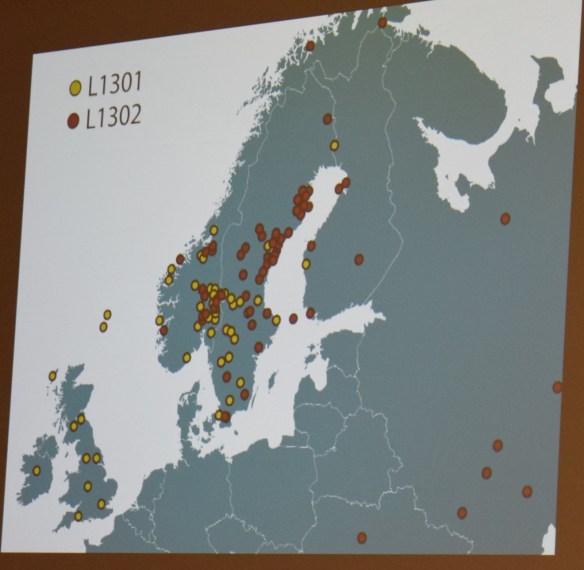
2015 ftdna sjolund snps

Peter’s next slide shows the historical events that spread these SNPs.
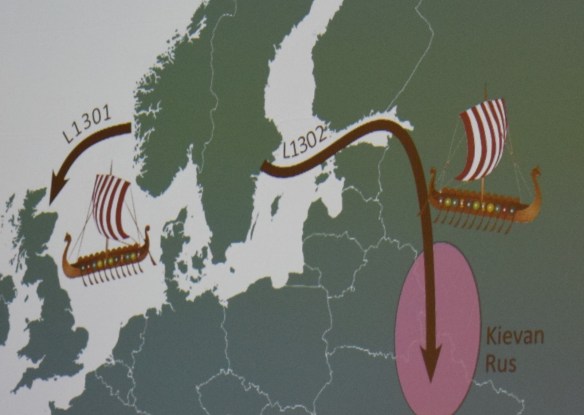
2015 ftdna sjolund map

It was so enlightening to see exactly how this worked to prove the families, but also to connect to ancient history.  Max summed it up well at the end when he said that “testing is not only a contribution to family history but also to confirming history itself.”

Razib Khan – Populations in Autosomal DNA

Razib, a doctoral candidate studying evolutionary genomics at UC Davis has been working with Family Tree DNA on updating their myOrigins product.

2015 ftdna khan

I loved Razib’s comment that all of this would have been considered science fiction 15 years ago.  He’s absolutely right.

Razib described our autosomal ethnicity as being a rich diaspora and that it has to be measured, matched and then reduced to 50 narrative threads.  He said it also gets a bit messy sometimes, because if we don’t fit into a thread exactly, or maybe our correct thread doesn’t have a deep enough reference population, we’re forced into the next best genetic thread – even though it may make no sense to us today.  That does explain some of the odd results we see from time to time.

2015 ftdna khan digest

In order to improve myOrigins, the next version, due out in mid-late first quarter of 2016 will include several new reference populations, including a second reference population for Native American people.

2015 ftdna khan populations

Not all of Razib’s presentation was about ethnicity – some was about recombination – which of course, when you think about it, affects ethnicity dramatically.

He mentioned, almost in passing that in each meiosis, a male has 25 recombinations and a female, 35.  This has the potential to affect the amount of autosomal DNA that we inherit through an all-female line of ancestors, for example, as compared to an all-male lineage.  This means, in essence, that we are likely, over time, to carry more of our male lineages, or lineages heavily male, than we are do all female lineages – because the DNA divides less.  I have to wonder if this is built into any of the calculations for relatedness by any of the vendors?

Razib mentioned that based on the results of ancient genome sequencing that the people of ancient Europe looked much different than the Europeans of today.

Razib also mentioned at least three instances where a combination of ancient DNA sequencing, population genetics and oral history have, together, proven the oral history to be accurate.  One of these instances is the Aboriginal oral stories of the tribes in Australia that recall an Australia with a very different shoreline than today’s continent.

2015 ftdna khan dreamtime

In the slide above, the light tan areas are now underwater, but the Aboriginal people still carry stories about these areas that have been “discovered” underwater.

2015 ftdna khan giants

Another “myth” is of giants in Biblical times.  Recently one of the remains excavated was nearly 7 feet tall – a person who would surely have been considered a giant among men of that time.

Razib also talked a bit about full genome sequencing and a few other speakers touched on it as well.  In essence there are four issues relative to full genome sequencing for the consumer marketplace.

  • The cost of sequencing itself.
  • The current lack of and cost of developing tools to compare full genomes.
  • The knowledge of how to utilize the comparative results in a genetic genealogy context.
  • The lack of any comparative database of other people.

Yes, I know that the other forms of DNA testing also started out with no data base, but those tests didn’t cost thousands of dollars either.  So, in a nutshell, the technology to reduce the cost of the test itself hasn’t reached the level at which the consumer marketspace would embrace that testing.  That’s probably when the work will be done on the tools, if at all.  We really don’t know that more, in this case, full genome sequencing, would be enough better to warrant additional testing and development.

Razib closed by wondering if we will be able one day to “recreate the face of our ancestor” by utilizing the combined DNA of their descendants.

2015 ftdna khan faces

I have to admit, this would be VERY cool.  It will be interesting to see what the next decade brings us in terms of technological advances.

I know one thing, if one had to do the “rebuild” by hand, the way I had to do the spreadsheet for James Crumley born in 1712, there won’t be very many faces recreated.  Hopefully, by then, we’ll have better tools.

Razib’s memorable comment:  “Treasure your exceptions.”

Dr. Michael Hammer – R1b and the Peopling of Europe: an Ancient DNA Update

2015 ftdna hammer

I could hardly wait for this presentation by Michael Hammer.

2015 ftdna hammer ancient

For the past two years, Michael has updated us on the cumulative finds of ancient DNA, and translated or speculated upon what that means or will mean.  Michael says that ancient DNA has changed the way we think of human origins and it will continue to do so in the future.  I think that’s one the most dramatic understatements I’ve ever heard.

He also mentioned that humans incur about 70 mutations throughout their genome in each generation.

Michael went on to remind us that just because we find a population, as defined by a SNP, in very high numbers in a location today, doesn’t mean that is the origin of the population.  The best example is that because R1b is found in about half of the European males today, it was long assumed that R1b was birthed in Europe – but it wasn’t.

2015 ftdna hammer reconstruct

Then Michael dropped the bomb on us – R1b is ANE and specifically is found among the Yamnaya.  We had discussed this possibility last year, because no R1b is found in the earliest hunter-gatherer ancient remains in Europe.  Subsequent research proved it.  R1b comes from the Russian Steppes as is proven in the Haaks paper published in June 2015.

Today, 10 ancient Yamnaya samples have been analyzed, and all 10 are R1b.  Hmmmm….

I wrote about the Yamnaya here.

One of the factors that has helped immensely with this problem is that in 2014, there had been about 30 ancient DNA samples sequenced and in 2014, there had been less than 80 sequenced.  Today that number is at 160 and unexpected revelations are occurring.

We’ve known there were two populations for a long time that settled in Europe, the original-hunter gatherers and the farmers, but we didn’t know about a third population until relatively recently.  Ironically, the day after the conference, word of a 4th population, from the Caucasus, broke.

2015 ftdna hammer europe

The last group anyone expected R1b to emerge from was the ANE.

2015 ftdna hammer ane

This map shows the influx of various cultures into Europe, and when.

2015 ftdna hammer migration

Which haplogroups arrived when?

2015 ftdna hammer haplogroups

Oh, you wanted SNPs?  Ok, here goes!

2015 ftdna hammer snps

One word of caution from Michael is that when reading papers, understand that they may not always be comparing apples and apples.  For example, the reason one SNP may not be present in a paper is not because it’s absent in the population or that particular sample, but because that lab for whatever reason, didn’t test for it.  So, no assuming nor drawing non-match inferences allowed.

I had discovered this recently when reading a mitochondrial paper.  They only tested for select locations and not others.  Makes me absolutely crazy.

BreakOut Sessions

Emily Aulicino talked about “Supercharging Your Project Members.”
Jim Brewster talked about “Getting Started with GAP.”
Dr. Doron Behar discussed “The Origin of Ashkenazi Levites.”

I attended Dr. Behar’s lecture.

2015 ftdna behar

Doron’s focus for many years has been on the Jewish population.

2015 ftdna behar levites

Recently, he has re-evaluated the available data and used new Big Y data in order to attempt to define the source of the Levite population.

2015 ftdna behar r1a1

I particularly like this slide, below, because it so succinctly illustrates the difference between traditional Sanger sequencing which is what is being done when you take the traditional 12, 25, 37, 67 and 111 markers tests, and the next generation sequencing like the Big Y.

2015 ftdna behar ngs

Sanger sequencing is illustrated on the bottom.  Reactions at specific locations are measured and then analyzed by humans and then recorded to reflect a specific value.

Next generation sequencing utilizes scanning.  In the top part of the slide, you can see several scans of each area.  The quadrant on the left, if I’m counting right, had 27 scans of the same area.  This is called coverage.  The scans then are recorded and they have to be aligned.  As you can see, the start and stop locations are not the same.  Then the results at a particular location are counted.  In this case, the dark squares show the same value in a particular location.  So not all of the scans show the same thing.  Of course, the value is compared to a reference chart for what is “normal” and then the variant values are recorded.  Assuming in this case that the variant values are colored dark blue, 18 recorded the same variant value but one is misaligned.

So, if you’re wondering why there is so much discussion about read coverage, alignment and valid results in Big Y tests…this is it in a nutshell.  Not to mention, as shown in the upper right quadrant, sometimes that location doesn’t read at all, so we have what are called “no-calls” to muck up the gears.  Family Tree DNA has to decide what is a “valid” result when they return results to customers.  Not everyone agrees with that threshold, so some people and groups do their own analysis.  What really is valid?  We don’t know for sure but the reason that the ISOGG tree requires Sanger sequencing before adding a new SNP location to a tree is to verify that the Big Y scans are accurate.

Doron designed a study utilizing both STR and SNP markers found in the Big Y to discover additional information about the source of the Levite population.

2015 ftdna behar study design

Based on several samples both within and outside of the known Jewish community, plus one family, the Horowitz, whose genealogy reaches far back into Jewish history, Doron was able to confirm that the Levite population did arise in the Near East.

2015 ftdna behar origins

I loved Doron’s comment, “The role of a scientist is to doubt.”

I would add that’s also the role of a genealogist and in particular, a genetic genealogist.

But Doron said something else EXTREMELY profound and I was extremely heartened to hear it.

“I was wrong.”

Yep, that’s what he said.  Let me tell you why I found this so inspiring and encouraging.

In the academic community, researchers are encouraged to research and publish their findings, along, of course, with their research data and the reasons why they reached their conclusion.

In the future, new information or technology may become available, and that original information may need to be adjusted, corrected, or it may be outright wrong.

There is NO SHAME in being wrong.  The only people who are never wrong are the people who do nothing.  Thomas Edison’s lab was filled with many “failures,” all of which were learning exercises that led to success.

In fact, the bigger shame is in not publishing and keeping your data and discoveries to yourself.  If you wait until you know “exactly,” that will never happen and you’ll never publish anything.  Even if the information turns out to be incorrect, it’s still a foundation for future research.

If another academic disagrees with a paper, they don’t publicly berate their colleague as “incompetent”, suggest they are suffering from “ascertainment bias,” state that the global “we” don’t approve of their research methods, nor do they say their research is a folly – at least not in a public forum.  If they have something to say, they are expected to do so with professional decorum and write a rebutting paper to share their own research and information as to why they disagree and how the data proves their point.

As has been proven, sometimes papers, especially early papers, are simply incorrect.

Often, as in Dr. Behar’s case, the original researcher, due to their high level of interest in the topic at hand makes additional discoveries that refutes or adjusts their earlier work.

Again, open research is encouraged.

I am hopeful that the genetic genealogy community can act within the same professional decorum standards.  Participating in character assassination of those engaging in research discourages open sharing, discourages research and assuredly discourages new people from participating.  No one wants to become a target.

In a professional setting, people disagree with ideas but remain friends.  Disagreements aren’t personal attacks.  There are no DNA police.

I am very encouraged not only by Dr. Behar’s work, but by his professional demeanor as well.  Doron said that we all hold important information relevant to these discoveries.  He’s right, and the way to free that information is to both test and continue to question,  research and publish.

Miguel Vilar – Genographic 2015: New Markers, New Geno Kit and Accessing the Data Base

2015 ftdna vilar

Dr. Miguel Vilar is the Science  Manager for National Geographic’s Genographic project as well as a molecular anthropologist.  He attended the Family Tree DNA conference in 2013 and we were very pleased to have him back this year to update us on the Genographic Project, now celebrating its 10th anniversary.  It has been an incredibly exciting decade.

Ten years ago, the Family Tree DNA Conference was at the National Geographic headquarters in Washington DC to celebrate the FTDNA/Nat Geo collaboration.

2015 ftdna 2005 nat geo

The Genographic Project has been very successful with over 670,000 public participants.

2015 ftdna vilar 10 years

In the beginning, the Genographic test was either a basic mtDNA test for females, or a 12 markers Y test for males.  The Geno 2.0 test changed dramatically, and the new Geno 2.0 Next Generation test offers even more.

However, the Geno 2.0 Next Generation test isn’t either the 2.0 test nor next generation sequencing.  So don’t get confused by the name.

2015 ftdna vilar compare

For someone who has already taken all of these tests, there is no incentive to test again, but for a new person who wants a base mtDNA haplogroup, a Y haplogroup, ethnicity, autosomal results and to transfer into Family Tree DNA for autosomal matching – the $149 price tag is certainly a good value and it’s a great starting point.  The unlock price at FTDNA will be $39, same as for Ancestry or the 23andMe V3 chip.

After transferring to Family Tree DNA, males can test the Y STR markers and they will already have over 17,000 haplogroup defining SNPs tested.  Bennett said the SNPs known about a year ago when the cutoff for the new chip was made were included.

The new Geno 2.0 NG chip is an Illumina chip, customized but compatible with the chip used by Family Tree DNA.

National Geographic wants to expand their research partnerships as well to include qualified genetic genealogists, citizen scientists and those in other academic fields.

2015 ftdna vilar data base

Nat Geo has established an application process.  If you are interested, contact Dr. Vilar at his e-mail above.

Additionally, National Geographic has 11 new grantees doing fieldwork now in Chilean Patagonia.

2015 ftdna vilar field work

An exciting aspect of this work is that 48 ancient DNA samples are being included and compared to 70 modern samples.

2015 ftdna vilar ancient

National Geographic continues to publish research papers and have published 55 to date, with 5 more being near publication which is expected yet this year.  I will publish a list shortly on this blog.

2015 ftdna vilar papers

One of the questions that has been concerning genetic genealogists is how the recent sale of part of the National Geographic assets will affect the Genographhic project.

I asked Miguel privately, and he said that the research arm stays under the nonprofit National Geographic, but that the kit and website have both fallen in the group of products that have been sold to 21st Century Fox.  Miguel said that he really didn’t have any answers at this time, but that the research continues and that the details are being worked out.

For those who don’t know, Spencer Wells stepped down as the director of the Genographic Project several months ago, but remains involved in a consulting capacity.

Michael Davila, Director of Product Marketing

Bennett introduced Michael Davila, the new Director of Product Marketing.  Michael isn’t new to Family Tree DNA.  He worked there for several years, from 2004-2011 when he left to work for a few years in the oil and gas industry, returning to FTDNA a few months ago in his new capacity.

2015 ftdna davila

Michael had one very short message.  He knows there are problems and he is committed to getting them fixed and to providing tools for customers.  The message, “Tools, tools, tools.”

Short, sweet and right to business.

I had a chance to meet with Michael outside of the conference room and I want to say that I’m very encouraged by Michael’s direct approach.  He is insightful, understands the situation at hand and knows what needs to be done.

After Michael’s brief commentary, a general Q and A session followed.  One of the questions was for Michael, and I just happened to catch this candid of Michael and Bennett!  Not sure what Michael was saying, but it looks like it gave Bennett a migraine!

2015 ftdna q and a

Actually, I think Bennett is concentrating on deciphering a question submitted by an attendee.

ISOGG Party

Saturday evening is traditionally the ISOGG party, but it’s not like a party you might generally think of.  There is a lot of tutoring and collaborating that goes on.  Friendships are made and renewed.  Just being together is great.  I mean, it’s not like we can have a discussion about SNP mutations rates at the dinner table at home.

2015 ftdna collaboration

You can see two different groups discussing aspects of genetic genealogy here.

At the party and also at Sunday’s sessions, lot of people were wearing the cool t-shirts gifted to participants by Family Tree DNA.

2015 ftdna tshirt

2015 ftdna tshirt 2

When we got back to our rooms, we discovered that even the hotel staff was in the spirit!!

2015 ftdna hotel

ISOGG Meeting

Sunday morning is traditionally the ISOGG meeting.  Not everyone attends, unfortunately, because not everyone is a member.  Everyone is welcome, and since membership is free, it’s easy to join at www.isogg.org.
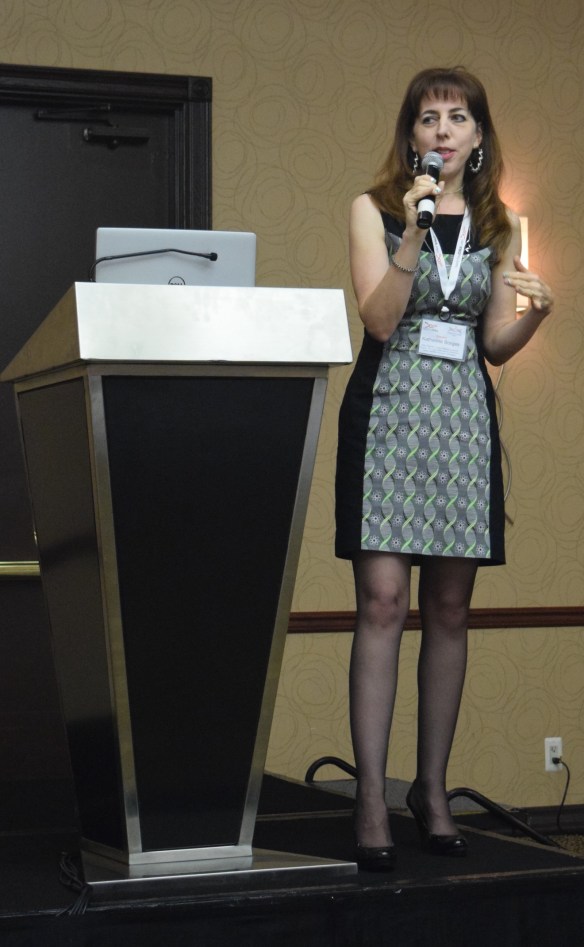
2015 ftdna borges

Katherine Borges was the original founder of ISOGG and still functions as the Director.  ISOGG is celebrating its 10th anniversary this year, after being founded after the first genetic genealogy conference in Houston in 2004.

2015 ftdna 2004

Katherine found a few photos of that first conference which was only one day and was held in a facility later destroyed by hurricane Ike, I believe.  You can see more 2004 photos here and photos from other years here.

2015 ftdna 2004 max

I don’t think Max (above) and Bennett had any idea what kind of a legacy they were creating with that first conference.  History was being made.

2015 ftdna 2004 bennett

Another function of ISOGG was the creation and maintenance of the Y SNP Tree.  The tree was begun 9 years ago and has been organized and maintained by Alice Fairhurst this entire time.

2015 ftdna tree

In 2012, the Y tree had 800+ SNPs, but beginning with the introduction of the Big Y test, the SNP tsunami began.  Today, there are over 15,000 SNPs on the tree, all entered by hand by Alice.  Fortunately, each haplogroup has a coordinator, but still the increase in SNPs and the magnitude of the task at hand has been overwhelming.

Quality has to be maintained, because the tree is regularly referenced by academics as well as by genetic genealogists.  Today, any SNP found in a Big Y type of next generation scan test must but be confirmed by Sanger sequencing.  I know this is frustrating to some, but given the uncertainty of scanned SNPs, it’s also essential to maintaining the tree’s integrity.

Alice recently retired from heading the ISOGG Tree project and was presented with an award for her nine years of service to the genetic genealogy community by Katherine Borges on behalf of ISOGG.

2015 ftdna fairhurst

In Alice’s comments, she said that “We have all driven a new industry.”  Alice played a central and pivotal part.

Alice received a richly deserved standing ovation.

2015 ftdna standing ovation

But we weren’t the only ones thanking Alice.  Max and Bennett presented Alice with a certificate of appreciation for her years of service as well.

2015 ftdna fairhurst 2

I was really pleased to see this.  Not only is Alice extremely deserving of the recognition, but volunteers are too often unthanked and under-appreciated.

Panel Discussion:  Protecting Ourselves: AHGS and Genetic Genealogy Standards

Have you ever been invited to a party, had to decline with genuine regrets, then later, been very glad that you didn’t attend.  This describes the AHGS meetings for me.  In 2013, I was invited to the first conference and couldn’t attend, but given what transpired and the difficult environment at the conferences, I’m grateful in retrospect.

Those who did attend, and those who subsequently developed the Genetic Genealogy Standards document formed a panel, moderated by Bennett Greenspan, to discuss those meetings and standards.

2015 ftdna panel

Panel members left to right, Katherine Borges, Steven Perkins, Dr. Tim Janzen, Jennifer Zinck and Debbie Parker Wayne.

In a nutshell, genetic genealogy had come to the attention of the American Human Genetics Society and not in a positive way.  They didn’t understand what we are doing, and they became somewhat polarized on the idea of “harms.”  What harms, you ask? Well, so did we.  Apparently the harms they are concerned about are things like Y DNA testing revealing non-parental events.

The good news is that after this years meeting, it appears that the word “harms” has been removed and as a proactive measure, the genetic genealogy community created its own standards and guidelines.

You can read the resulting standards created by genetic genealogists here.

Brad Larkin Presents Genetic Genealogist of the Year Award

Brad Larkin, on behalf of the Surname DNA Journal, presented the second annual Genetic Genealogist of the Year Award to Maurice Gleeson.
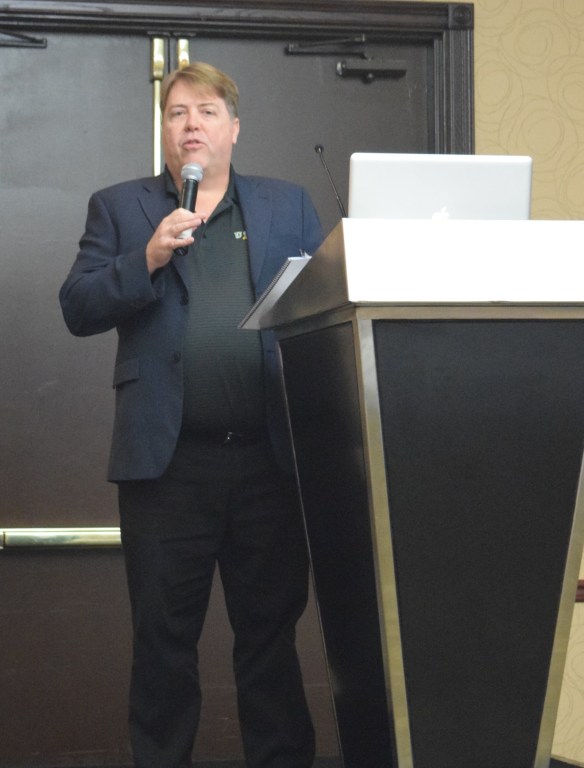
2015 ftdna larkin

The Surname DNA Journal would be a wonderful resource to publish many of these presentations – hint, hint to the presenters!!!

2015 ftdna gleeson

Maurice has organized Genetic Genealogy Ireland in Dublin since 2012, in addition to presenting widely.  He also has a very successful series of genetic genealogy videos on YouTube which I highly recommend.

2015 ftdna award

Maurice is a man of many talents – a psychiatrist and pharmaceutical physician, a professional actor and of course, a genetic genealogist.  He has another talent as well – he can make absolutely anything interesting.  If you ever hear that Maurice is giving a lecture on dust – by all means attend! It will be the highlight of your week, I guarantee.

Maurice, congratulations on your well-deserved honor and Brad, thank you for recognizing one of our colleagues.

Maurice Gleeson – Combining SNPs, STRs and Genealogy to Build a Surname Origins Tree
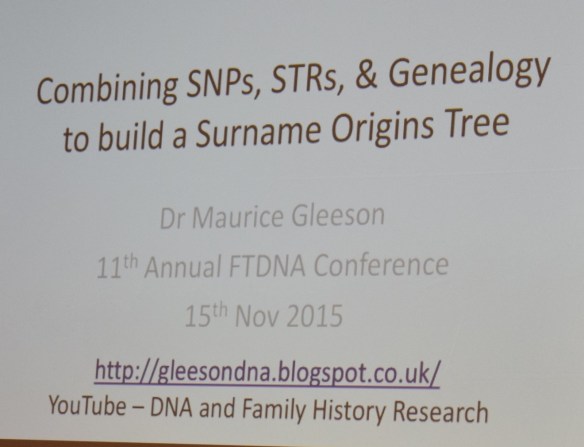
2015 ftdna gleeson open

Maurice, like many of us, wants to be able to use STRs and SNPs in combination with genealogy records to construct accurate lineage trees.  In addition, when genealogy records connecting people to their common ancestor are missing, we’d still like to be able to construct at least a hypothetical or genetically accurate tree.

2015 ftdna gleeson build tree

During this process, Maurice encountered several challenges, including.

  • Parallel mutations
  • Back mutations
  • Markers behaving unusually
  • Multi-copy markers
  • Unstable markers
  • Lack of mutation rate for some markers
  • Lack of standardized mutation rate for SNPs
  • Difficulty determining if a SNP is present or absent
  • Convergence issues
  • False negatives
  • False positives
  • Unregulated naming
  • Project members testing at different levels

Maurice did, however, provide us with the secret to success.

2015 ftdna gleeson essential technology

He began with hot cocoa and chocolate, but he said by the end of the project, he had an empty whiskey bottle and was taking anxiety medication:)

Maurice began by drawing a typical pedigree chart, based upon the project results, reflecting what he believed would be where the mutations would have occurred based on line marker mutations.

2015 ftdna gleeson mutations

Then, with the assistance of Ralph Taylor, he drew Fluxus diagrams of the likely joining patterns of each set of possible outcomes.  The outcomes included and then omitted various markers experimentally for various reasons related to the challenge list above.

2015 ftdna gleeson fluxus

Maurice shared lots of slides with us reflecting several different mutation sequence possibilities.  I have omitted them, in part because I can’t explain why Maurice did what he did.  I understood it at the time, but without the slides to take notes on, I don’t think I could reconvey it correctly.  I would suggest that you obtain his slides from this link and view those in conjunction with Jennifer Zinck’s notes from his lecture.

In the end, Maurice did reach a “most probable” fit for both STRs and SNPs, although with some caveats, some of which were caused by participants who had only tested at 37 markers.

Maurice closed with lessons learned and future opportunities.

2015 ftdna gleeson lessons

2015 ftdna gleeson lessons 2

2015 ftdna gleeson lessons 3

2015 ftdna gleeson lessons 4

Maurice, this would make a fantastic YouTube video!!  It was a wonderful lecture.

James Irvine – Surname Projects, Some Fresh Ideas

2015 ftdna irvine projects

James has been working with the Scots-Irish Irvine project for the past ten years.

2015 ftdna irvine

James Irvine and Maurice Gleeson are both trying to achieve many of the same goals, but are using somewhat different methods.

James creates his own spreadsheets for his project members which include not only STR markers, but lineage defining SNPs as well.  Furthermore, James utilizes weighting for each STR marker based on its mutation rate, something the main project spreadsheet does not take into consideration in the step-wise mutations.  However, James feels the TIP calculations, which do take mutation rate into consideration are really quite accurate, based on his reconstructed pedigrees.

2015 ftdna irvine tip

Unfortunately, it’s at this point that my camera battery died completely, so I don’t have any further photos of his presentation, but would encourage you to download his slides for yourself at this link.

James discussed the varying SNPs reported by different entities and compares the results.  The Big Y from Family Tree DNA, the results as analyzed by the appropriate project administrator(s), by a third party entity and then what he found himself.  The various analysis and what they considered to be valid SNPs varied significantly.

Which one is accurate, and why and how does this in reality affect what we can surmise of the genealogy and constructing family trees?  We just don’t know yet – but we are working with what we have.

One thing he mentioned is that the 495 STRs extracted by third parties from Family Tree DNA Big Y files are not necessarily reliable – which of course calls into question the reliability of any STR extracted from a next generation sequenced file.  This also confirms why Sanger sequencing is required for SNPs to be added to the ISOGG tree.

Break Out Sessions

Sunday’s breakout sessions once again included sessions that would hopefully appeal to a wide range of audiences.

Katherine Borges – Nulls: The Value of Nothing (Y-DNA)
Matt Dexter – Surveying Ancestry Using Autosomal DNA Results
Jim Brewster – Getting Started with GAP

I attended Matt’s session, capturing only one photo with my phone.  My apologies.

Matt discussed the foundation principles of autosomal testing and analysis, and how adoptees use this technology to find their families.

Roberta Estes – Y-DNA to Autosomal Case Study – Kicking It Up a Notch

2015 ftdna estes

(Thank you Jennifer Zinck for permission to use this photo.)

Lots of folks have sleepy Y DNA projects and wonder what else can be discovered utilizing these core projects.  I did too, so I decided to try and see what happened if I expanded the Crumley Y project to include autosomal.

We began with 4 men who were Y DNA descendants of James Crumley born in 1712.  These men descended from two of James’ sons, John and William.

We began our transition from Y to Y+Autosomal by upgrading all 4 men to the Family Finder test.  We then set about recruiting additional members including those who are not male and do not carry the Crumley surname today.

2015 ftdna estes recruiting

The response was quite surprising and we quickly had 50 members, about 30 of whom descended from those same two sons.  However, the descendants of the sons are today 7 generations distant, so 6th cousins, at the closest generation.  The furthest distant from each other were 8th cousins once removed.

This begged several questions.

2015 ftdna estes curious

While the prediction models suggested that they wouldn’t match, they did.

2015 ftdna estes james

In essence, we began to reconstruct the genome of James Crumley through his descendants by creating a spreadsheet showing how each Crumley descendant matched each other Crumley descendant.  We utilized the same tools that we use for our own autosomal comparisons, some in a slightly different way.

2015 ftdna estes tools

This shows an example of three match groups of James’s descendants where the blue son, John’s descendants, are matching to the green son, William’s descendants on portions of chromosome 1.

2015 ftdna estes match list

Because I’m a visual person, I wanted to reconstruct James and Catherine’s genome on their chromosomes, so I utilized Kitty Cooper’s tools in ways they really weren’t quite designed for.  Normally they are used to place your ancestral segment on your own chromosomes.  Here, I used them to map James descendants matching DNA onto “James” chromosomes.

2015 ftdna estes james recreate2

We actually accomplished several things and made multiple discoveries, many of which were entirely unexpected.  I showed what we had discovered in the Y only project contrasted to the Y+autosomal project.

2015 ftdna estes accomplishments

Last, I discussed how to transition a project from Y only to Y+autosomal.

2015 ftdna estes transition

My slides are available at this link, and I will be writing a series of articles from this research to be published in the upcoming weeks on my blog.

Dr. Connie Bormans, Laboratory Director, Tom Richard, Customer Support Manager and Mike Alexander, Director of Engineering

All three of these individuals have extremely critical positions at Family Tree DNA, all with very specific challenges.

Connie discussed sequencing technology and the differences between the different types of technology utilized for different tests.

Tom talked about several things he has done in less than a year at Family Tree DNA to improve customer service – and it has improved greatly.  I spoke with him offline as well, and he has lots of plans going forward.

It’s wonderful to see such capable and motivated management team members.

2015 ftdna richard

Me with Tom Richard.  I love meeting the staff and seeing them each year.  It makes communicating with someone you know the rest of the year much easier.

Mike Alexander comes from NASA and his motto is the famous Gene Kranz statement, “Failure is not an option.”  For those who don’t know, Kranz was the flight director credited with saving the Apollo 13 crew.

Little did Mike know, a few years ago, I sat in that seat in the Johnson Space Center and I have a t-shirt with that very saying.
2015 ftdna nasa

Needless to say, I am greatly encouraged by Mike’s NASA experience and believe it will serve him, and Family Tree DNA, very well.  Because, well, failure is not an option.

The Sale

I don’t know if Max and Bennett ever meant for this to happen, but it’s become a tradition that they announce a sale of some type during or at the end of the conference.  They closed this conference with the announcement that the Holiday Sale was beginning and would continue until the end of the year.  You can read about the sale and exchange coupons here.

Thank you Max and Bennett!

In Summary

This was an absolutely wonderful conference.  I so enjoyed renewing old friendships and meeting new people.  I’m very glad to see younger people and new admins interested and involved as well, because they are the next generation that will push what we’ve viewed as the frontier into the mainstream.

One day, we really will be constructing and reconstructing ancestors.  We may be able to see their faces, know the color of their eyes and perhaps some of their traits.  In another five years, we’ll be doing things we can’t even imagine today, and we’ll be pushing yet another line in the ever-expanding frontier of genetic genealogy.

Like I said when I closed my session, it takes a village.  A village of participants to test, a village of administrators organizing and analyzing results, and pushing the proverbial research envelope.  And it requires advanced tools and the supportive and incubational environment provided by Family Tree DNA.  Without any of those things, we would fail.  Thankfully, we won’t.

Maurice Gleeson perhaps said it best in his closing, “Max, Bennett, without you, there is no us.”

We truly are a partnership!

2015 ftdna me bennett

______________________________________________________________

Disclosure

I receive a small contribution when you click on some of the links to vendors in my articles. This does NOT increase the price you pay but helps me to keep the lights on and this informational blog free for everyone. Please click on the links in the articles or to the vendors below if you are purchasing products or DNA testing.

Thank you so much.

DNA Purchases and Free Transfers

Genealogy Services

Genealogy Research

Get Your Ducks in a Row – Time May Be Shorter Than You Think

ducks

Helen Rutledge is my cousin.  She and I have been sniffing around the same records in the same counties for many years now.  I only wish we had met earlier so we could have shared more of the chase.

Helen is no “spring chicken” as we say on the farm.  In fact, Helen has continued to research far into her golden years – being in her 90s now.  Want to hear the great irony? Helen has no children to leave her work to – but this does not deter her.  Helen is the aunt that every one of us wants to have in our family.

Recently Helen sent me an e-mail that both saddened me and inspired me, and with her permission, I’m sharing it with you.  I have omitted some of the more personal portions.

After 13 days in the hospital I returned to long term nursing care. I brought my computer and genealogy records from Assisted Living to my new level of care. However, now instead of researching, I am organizing my research to leave for my nephew and some research archives. I have been forewarned in the most urgent way that there may not be time to think about how I will do this when the research is done. Well, we all know research is never finished.

Keep urging perseveration of research on your blog. It is as important as the research itself. Answers are no good if I am the only one who knows the answer to the puzzle…I must share it with others whether they give me credit or not. I thank you for alerting me to that truth and God for allowing me extended days to get my records in order as a gift to other researchers. Oh, the many little tidbits I have garnered, documented, and put together for those who follow in my footsteps with our family lineage.

Organization is not just entering our data into a genealogy program. It is documenting, making copies of the documents available when possible, and recording the ORDER of our research so those who are not familiar with the records, can follow the generations and become acquainted with their ancestors.

Be honest, say information is not documented, when such is the case, and challenge your readers to find documentation. Try to inspire descendants to fill in the blanks and record those who are yet unborn. While they will miss the thrill of solving the puzzle after years of frustration, they will know the joy of learning who they are.

Thank you, Helen, for your lovely, inspirational message. Sometimes we aren’t fortunate enough to receive a warning. (Note – Helen passed away in February, 2018.)

Another e-mail this week told of another cousin’s husband who died suddenly, with no warning, and he was 30 years younger than Helen.

DNA in Perpetuity

I would add one thing though, and that is to record your user names and passwords – especially relative to DNA accounts and tests and anyplace, like GedMatch, you have uploaded your results.  Your DNA can never, and I repeat, NEVER, be replaced, while genealogy research could be with enough effort.  Don’t let your DNA results become inaccessible.

At Family Tree DNA, you can designate a beneficiary.

On your personal page, under “Your Account” on the left hand side, select “Manage Personal Information.”

ducks2

Then select Beneficiary Information and complete the form which includes your beneficiary’s name, e-mail and phone number.  If you should pass away, this is who Family Tree DNA will allow to access your account.  Other companies, to the best of my knowledge don’t include this information or provide this option, so you’ll need to be sure to leave your account access information available for your family members.

ducks3

If you have not prepared for the inevitable, please take a few minutes to do so.   You can make the DNA arrangements now, and easily.

Remember, at Ancestry, your DNA won’t be available unless your account (subscription and login) remains active, so you’ll need to take how to handle that into consideration.

You might want to download not just your raw data files, but matches as well when possible.

Public Sites

Upload your Y and mitochondrial DNA to sites like http://www.ysearch.org and http://www.mitosearch.org.  Be sure to record the most distant ancestor and enough information to positively identify them, like birth and death dates, locations and spouse’s name.  This is the only way to get your info into a public data base that is accessible without having DNA tested for a match.  You can also enter Y and mito info at http://www.wikitree.com and attach it to the proper ancestor.  This helps others in the future learn about their ancestors.  Be sure to include your full haplogroup in the notes and a link to anything you may have published about that line.

Upload your autosomal results to http://www.gedmatch.com and upload trees where possible.

Don’t put all of your eggs in one basket, because baskets aren’t forever either.  Think about how many genealogy companies have come and gone and what happened to our Y and mitochondrial DNA with both Ancestry and Sorenson (also destroyed by Ancesty).

Genealogy Research

You can take a few minutes to put together a plan for how to preserve and present the balance of your genealogy information.  Preserving and publishing my genealogy research has been on my bucket list for some time now and is the purpose of the 52 Ancestors articles I’ve been writing for the past 18 months.  I’ll write them until every ancestor is covered….or I can no longer write the articles – and I sincerely hope I have the opportunity to finish.  Not just for my own sake, but for the benefit of everyone else who follows.  I hope future researchers make huge breakthroughs and add immensely to what I know today.  My work will at least give them a firm foundation to start from and they won’t have to replow the same ground.

One of the avenues to preserve your work online is a blog.  WordPress offers free blogs and they will be available into perpetuity, whatever that really means.  I am also printing my articles and will be donating them to archival facilities like the Allen County Public Library.  And of course, I’ll have a set of binders for each of my children.

WikiTree is another public resource for your trees, your Y and mtDNA results and additional information, although that’s not the same as offering the detail in an article.

So, however you choose to do whatever you choose to do… just do it.

And do it now.

You may not have an opportunity later.

Time may be shorter than you think.

Get your ducks in a row.

______________________________________________________________

Disclosure

I receive a small contribution when you click on some of the links to vendors in my articles. This does NOT increase the price you pay but helps me to keep the lights on and this informational blog free for everyone. Please click on the links in the articles or to the vendors below if you are purchasing products or DNA testing.

Thank you so much.

DNA Purchases and Free Transfers

Genealogy Services

Genealogy Research

Autosomal DNA Matching Confidence Spectrum

Are you confused about DNA matches and what they mean…different kinds of matches…from different vendors and combined results between vendors.  Do you feel like lions and tigers and bears…oh my?  You’re not alone.

As the vendors add more tools, I’ve noticed recently that along with those tools has come a significant amount of confusion surrounding matches and what they mean.  Add to this issue confusion about the terminology being used within the industry to describe various kinds of matches.  Combined, we now have a verbiage or terminology issue and we have confusion regarding the actual matches and what they mean.  So, as people talk, what they mean, what they are trying to communicate and what they do say can be interpreted quite widely.  Is it any wonder so many people are confused?

I reached out within the community to others who I know are working with autosomal results on a daily basis and often engaged in pioneering research to see how they are categorizing these results and how they are referring to them.

I want to thank Jim Bartlett, Blaine Bettinger, Tim Janzen and David Pike (in surname alphabetical order) for their input and discussion about these topics.  I hope that this article goes a long way towards sorting through the various kinds of matches and what they can and do mean to genetic genealogists – and what they are being called.  To be clear, the article is mine and I have quoted them specifically when applicable.

But first, let’s talk about goals.

Goals

One thing that has become apparent over the past few months is that your goals may well affect how you interpret data.  For example, if you are an adoptee, you’re going to be looking first at your closest matches and your largest segments.  Distant matches and small segments are irrelevant at least until you work with the big pieces.  The theory of low hanging fruit, of course.

If your goal is to verify and generally validate your existing genealogy, you may be perfectly happy with Ancestry’s Circles.  Ancestry Circles aren’t proof, as many people think, but if you’re looking for low hanging fruit and “probably” versus “positively,” Ancestry Circles may be the answer for you.

If you didn’t stop reading after the last sentence, then I’m guessing that “probably” isn’t your style.

If your goal is to prove each ancestor and/or map their segments to your DNA, you’re not going to be at all happy with Ancestry’s lack of segment data – so your confidence and happiness level is going to be greatly different than someone who is just looking to find themselves in circles with other descendants of the same ancestor and go merrily on their way.

If you have already connected the dots on most of your ancestry for the past 4 or 5 generations, and you’re working primarily with colonial ancestors and those born before 1700, you may be profoundly interested in small segment data, while someone else decides to eliminate that same data on their spreadsheet to eliminate clutter.  One person’s clutter is another’s goldmine.

While, technically, the different types of tests and matches carry a different technical confidence level, your personal confidence ranking will be influenced by your own goals and by some secondary factors like how many other people match on a particular segment.

Let’s start by talking about the different kinds of matching.  I’ve been working with my Crumley line, so I’ll be utilizing examples from that project.

Individual Matching, Group Matching and Triangulation

There is a difference between individual matching, group matching and triangulation.  In fact, there is a whole spectrum of matching to be considered.

Individual Matching

Individual matching is when someone matches you.

confidence individual match

That’s great, but one match out of context generally isn’t worth much.  There’s that word, generally, because if there is one thing that is almost always true, it’s that there is an exception to every rule and that exception often has to do with context.  For example, if you’re looking for parents and siblings, then one match is all you need.

If this match happens to be to my first cousin, that alone confirms several things for me, assuming there is not a secondary relationship.  First, it confirms my relationship with my parent and my parent’s descent from their parents, since I couldn’t be matching my first cousin (at first cousin level) if all of the lines between me and the cousin weren’t intact.

confidence cousins

However, if the match is to someone I don’t know, and it’s not a close relative, like the 2nd to 4th cousins shown in the match above, then it’s meaningless without additional information.  Most of your matches will be more distant.  Let’s face it, you have a lot more distant cousins than close cousins.  Many ancestors, especially before about 1900, were indeed, prolific, at least by today’s standards.

So, at this point, your match list looks like this:

confidence match list

Bridget looks pretty lonely.  Let’s see what we can do about that.

Matching Additional People

The first question is “do you share a common ancestor with that individual?”  If yes, then that is a really big hint – but it’s not proof of anything – unless they are a close relative match like we discussed above.

Why isn’t a single match enough for proof?

You could be related to this person through more than one ancestral line – and that happens far more than I initially thought.  I did an analysis some time back and discovered that about 15% of the time, I can confirm a secondary genealogical line that is not related to the first line in my tree.  There were another 7% that were probable – meaning that I can’t identify a second common ancestor with certainty, but the surname and location is the same and a connection is likely.  Another 8% were from endogamous lines, like Acadians, so I’m sure there are multiple lines involved.  And of those matches (minus the Acadians), about 10% look to have 3 genealogical lines, not just two.  The message here – never assume.

When you find one match and identify one common genealogical line, you can’t assume that is how you are genetically related on the segment in question.

Ideally, at this point, you will find a third person who shares the common ancestor and their DNA matches, or triangulates, between you and your original match to prove the connection.  But, circumstances are not always ideal.

What is Triangualtion?

Triangulation on the continuum of confidence is the highest confidence level achievable, outside of close relative matching which is evident by itself without triangulation.

Triangulation is when you match two people who share a common ancestor and all three of you match each other on that same segment.  This means that segment descended to all three of you from that common ancestor.

This is what a match group would look like if Jerry matches both John and Bridget.

confidence example 1 match group

Example 1 – Match Group

The classic definition of triangulation is when three people, A, B and C all match each other on the same segment and share a known, identifiable common ancestor.  Above, we only have two.  We don’t know yet if John matches Bridget.

A matches B
A matches C
B matches C

This is what an exact triangulation group would look like between Jerry, John and Bridget.  Most triangulation matches aren’t exact, meaning the start and/or end segment might be different, but some are exact.

confidence example 2 triangulation group

Example 2 – Triangulation Group

It’s not always possible to prove all three.  Sometimes you can see that Jerry matches Bridget and Jerry matches John, but you have no access to John or Bridget’s kits to verify that they also match each other.  If you are at Family Tree DNA, you can run the ICW (in common with) tool to see if John and Bridget do match each other – but that tool does not confirm that they match on the same segment.

If the individuals involved have uploaded their kits to GedMatch, you have the ability to triangulate because you can see the kit numbers of your matches and you can then run them against each other to verify that they do indeed match each other as well.  Not everyone uploads their kits to GedMatch, so you may wind up with a hybrid combination of triangulated groups (like example 2, above) and matching groups (like example 1, above) on your own personal spreadsheet.

Matching groups (that are not triangulated) are referred to by different names within the community.  Tim Janzen refers to them as clusters of cousins, Blaine as pseudo triangulation and I have called them triangulation groups in the past if any three within the group are proven to be triangulated. Be careful when you’re discussing this, because matching groups are often misstated as triangulated groups.  You’ll want to clarify.

Creating a Match List

Sometimes triangulation options aren’t available to us.  For example, at Family Tree DNA, we can see who matches us, and we can see if they match each other utilizing the ICW tool, but we can’t see specifically where they match each other.  This is considered a match group.  This type of matching is also where a great deal of confusion is introduced because these people do match each other, but they are NOT (yet) triangulated.

What we know is that all of these people are on YOUR match list, but we don’t know that they are on each other’s match lists.  They could be matching you on different sides of your DNA or, if smaller segments, they might be IBC (identical by chance.)

You can run the ICW (in common with) tool at Family Tree DNA for every match you have.  The ICW tool is a good way to see who matches both people in question.  Hopefully, some of your matches will have uploaded trees and you can peruse for common ancestors.

The ICW tool is the little crossed arrows and it shows you who you and that person also match in common.

confidence match list ftdna

You can run the ICW tool in conjunction with the ancestral surname in question, showing only individuals who you have matches in common with who have the Crumley surname (for example) in their ancestral surname list.  This is a huge timesaver and narrows your scope of search immediately.  By clicking on the ICW tool for Ms. Bridget,  you see the list, below of those who match both the person whose account we are signed into and Ms. Bridget, below.

confidence icw ftdna

Another way to find common matches to any individual is to search by either the current surname or ancestral surnames.  The ancestral surname search checks the surnames entered by other participants and shows them in the results box.

In the example above, all of these individuals have Crumley listed in their surnames.  You can see that I’ve sorted by ancestral surname – as Crumley is in that search box.

Now, your match lists looks like this relative to the Crumley line.  Some people included trees and you can find your common ancestor on their tree, or through communications with them directly.  In other cases, no tree but the common surname appears in the surname match list.  You may want to note those results on your match list as well.

confidence match list 2

Of course, the next step is to compare these individuals in a matrix to see who matches who and the chromosome browser to see where they match you, which we’ll discuss momentarily.

Group Matching

The next type of matching is when you have a group of people who match each other, but not necessarily on the same segment of DNA.  These matching groups are very important, especially when you know there is a shared ancestor involved – but they don’t indicate that the people share the same segment, nor that all (or any) of their shared segments are from this particular ancestor.  Triangulation is the only thing that accomplishes proof positive.

This ICW matrix shows some of the Crumley participants who have tested and who matches whom.

confidence icw grid

You can display this grid by matching total cM or by known relationship (assuming the individuals have entered this information) or by predicted relationship range.  The total cMs shared is more important for me in evaluating how closely this person might be related to the other individual.

The Chromosome Browser

The chromosome browser at Family Tree DNA shows matches from the perspective of any one individual.  This means that the background display of the 22 Chromosomes (plus X) is the person all of the matches are comparing against. If you’re signed in to your account, then you are the black background chromosomes, and everyone is being compared against your DNA.  I’m only showing the first 6 chromosomes below.

confidence chromosome browser

You can see where up to 5 individuals match the person you’re comparing them to.  In this case, it looks like they may share a common segment on chromosome 2 among several descendants.  Of course, you’d need to check each of these individuals to insure that they match each other on this same segment to confirm that indeed, it did come from a common ancestor.  That’s triangulation.

When you see a grouping of matches of individuals known to descend from a common ancestor on the same chromosome, it’s very likely that you have a match group (cluster of cousins, pseudo triangulation group) and they will all match each other on that same segment if you have the opportunity to triangulate them, but it’s not absolute.

For example, below we have a reconstructed chromosome 8 of James Crumley, the common ancestor of a large group of people shown based on matches.  In other words, each colored segment represents a match between two people.  I have a lot more confidence in the matches shown with the arrows than the single or less frequent matches.

confidence chromosome 8 match group'

This pseudo triangulation is really very important, because it’s not just a match, and it’s not triangulation.  The more people you have that match you on this segment and that have the same ancestor, the more likely that this segment will triangulate.  This is also where much of the confusion is coming from, because matching groups of multiple descendants on the same segments almost always do triangulate so they have been being called triangulation groups, even when they have not all been triangulated to each other.  Very occasionally, you will find a group of several people with a common ancestor who triangulate to each other on this common segment, except one of a group doesn’t triangulate to one other, but otherwise, they all triangulate to others.

confidence triangulation issue

This situation has to be an error of some sort, because if all of these people match each other, including B, then B really must match D.  Our group discussed this, and Jim Bartlett pointed out that these problem matches are often near the vendor matching threshold (or your threshold if you’re using GedMatch) and if the threshold is lowered a bit, they continue to match.  They may also be a marginal match on the edge, so to speak or they may have a read error at a critical location in their kit.

What “in common with” matching does is to increase your confidence that these are indeed ancestral matches, a cousin cluster, but it’s not yet triangulation.

Ancestry Matches

Ancestry has added another level of matching into the mix.  The difference is, of course, that you can’t see any segment data at all, at Ancestry, so you don’t have anything other than the fact that you do match the other person and if you have a shakey leaf hint, you also share a common ancestor in your trees.

confidence ancestry matches

When three people match each other on any segment (meaning this does not infer a common segment match) and also share a common ancestor in a tree, they qualify to be a DNA Circle.  However, there is other criteria that is weighted and not every group of 3 individuals who match and share an ancestor becomes a DNA Circle.  However, many do and many Circles have significantly more than three individuals.

confidence Phoebe Crumley circle

This DNA Circle is for Phebe Crumley, one of my Crumley ancestors.  In this grouping, I match one close family group of 5 people, and one individual, Alyssa, all of whom share Phebe Crumley in their trees.  As luck would have it, the family group has also tested at Family Tree DNA and has downloaded their results to GedMatch, but as it stands here at Ancestry, with DNA Circle data only…the only thing I can do is to add them to my match list.

confidence match list 3

In case you’re wondering, the reason I only added three of the 5 family members of the Abija group to my match list is because two are children of one of the members and their Crumley DNA is represented through their parent.

While a small DNA Circle like Phebe Crumley’s can be incorrect, because the individuals can indeed be sharing the DNA of a different ancestor, a larger group gives you more confidence that the relationship to that group of people is actually through the common ancestor whose circle you are a member of.  In the example Circle shown below, I match 6 individuals out of a total of 21 individuals who are all interrelated and share Henry Bolton in their tree.

Confidence Henry Bolton circle

New Ancestor Discoveries

Ancestry introduced New Ancestor Discoveries (NADs) a few months ago.  This tool is, unfortunately, misnamed – and although this is a good concept for finding people whose DNA you share, but whose tree you don’t – it’s not mature yet.

The name causes people to misinterpret the “ancestors” given to them as genuinely theirs.  So far, I’ve had a total of 11 NADS and most have been easily proven false.

Here’s how NADs work.  Let’s say there is a DNA Circle, John Doe, of 3 people and you match two of them.  The assumption is that John Doe is also your ancestor because you share the DNA of his descendants.  This is a critically flawed assumption.  For example, in one case, my ancestors sister’s husband is shown as my “new ancestor discovery” because I share DNA with his descendants (through his wife, my ancestor’s sister.)  Like I said, not mature yet.

I have discussed this repeatedly, so let’s just suffice it to say for this discussion, that there is absolutely no confidence in NADs and they aren’t relevant.

Shared Matches

Ancestry recently added a Shared Matches function.

For each person that you match at Ancestry, that is a 4th cousin or closer and who has a high confidence match ranking, you can click on shared matches to see who you and they both match in common.

confidence ancestry shared matches

This does NOT mean you match these people through the same ancestor.  This does NOT mean you match them on the same segment.  I wrote about how I’ve used this tool, but without additional data, like segment data, you can’t do much more with this.

What I have done is to build a grid similar to the Family Tree DNA matrix where I’ve attempted to see who matches whom and if there is someone(s) within that group that I can identify as specifically descending from the same ancestor.  This is, unfortunately, extremely high maintenance for a very low return.  I might add someone to my match list if they matched a group (or circle) or people that match me, whose common ancestor I can clearly identify.

Shared Matches are the lowest item on the confidence chart – which is not to say they are useless.  They can provide hints that you can follow up on with more precise tools.

Let’s move to the highest confidence tool, triangulation groups.

Triangulation Groups

Of course, the next step, either at 23andMe, Family Tree DNA, through GedMatch, or some combination of each, is to compare the actual segments of the individuals involved.  This means, especially at Ancestry where you have no tools, that you need to develop a successful begging technique to convince your matches to download their data to GedMatch or Family Tree DNA, or both.  Most people don’t, but some will and that may be the someone you need.

You have three triangulation options:

  1. If you are working with the Family Inheritance Advanced at 23andMe, you can compare each of your matches with each other. I would still invite my matches to download to GedMatch so you can compare them with people who did not test at 23andMe.
  2. If you are working with a group of people at Family Tree DNA, you can ask them to run themselves against each other to see if they also match on the same segment that they both match you on. If you are a project administrator on a project where they are all members, you can do this cross-check matching yourself. You can also ask them to download their results to GedMatch.
  3. If your matches will download their results to GedMatch, you can run each individual against any other individual to confirm their common segment matches with you and with each other.

In reality, you will likely wind up with a mixture of matches on your match list and not everyone will upload to GedMatch.

Confirming that segments create a three way match when you share a common ancestor constitutes proof that you share that common ancestor and that particular DNA has been passed down from that ancestor to you.

confidence match list 4

I’ve built this confidence table relative to matches first found at Family Tree DNA, adding matches from Ancestry and following them to GedMatch.  Fortunately, the Abija group has tested at all 3 companies and also uploaded their results to GedMatch.  Some of my favorite cousins!

Spectrum of Confidence

Blaine Bettinger built this slide that sums up the tools and where they fall on the confidence range alone, without considerations of your goals and technical factors such as segment size.  Thanks Blaine for allowing me to share it here.

confidence level Blaine

These tools and techniques fall onto a spectrum of confidence, which I’ve tried to put into perspective, below.

confidence level highest to lowest

I really debated how to best show these.  Unfortunately, there is almost always some level of judgment involved. In some cases, like triangulation at the 3 vendors, the highest level is equivalent, but in other cases, like the medium range, it really is a spectrum from lowest to highest within that grouping.

Now, let’s take a look at our matches that we’ve added to our match list in confidence order.

confidence match list 5

As you would expect, those who triangulated with each other using some chromosome browser and share a common ancestor are the highest confidence matches – those 5 with a red Y.  These are followed by matches who match me and each other but not on the same segment (or at least we don’t know that), so they don’t triangulate, at least not yet.

I didn’t include any low confidence matches in this table, but of the lowest ones that are included, the shakey leaf matches at Ancestry that won’t answer inquiries and the matches at FTDNA who do share a common surname but didn’t download their information to be triangulated are the least confident of the group.  However, even those lower confidence matches on this chart are medium, meaning at Ancestry they are in a Circle and at FTDNA, they do match and share a common surname.  At Family Tree DNA, they may eventually fall into a triangulation group of other descendants who triangulate.

Caveats

As always, there are some gotchas.  As someone said in something I read recently, “autosomal DNA is messy.”

Endogamy

Endogamous populations are just a mess.  The problem is that literally, everyone is related to everyone, because the founder population DNA has just been passed around and around for generations with little or no new DNA being introduced.

Therefore, people who descend from endogamous populations often show to be much more closely related than they are in a genealogical timeframe.

Secondly, we have the issue pointed out by David Pike, and that is when you really don’t know where a particular segment came from, because the segment matches both the parents, or in some cases, multiple grandparents.  So, which grandparent did that actual segment that descended to the grandchild descend from?

For people who are from the same core population on both parent’s side, close matches are often your only “sure thing” and beyond that, hopefully you have your parents (at least one parent) available to match against, because that’s the only way of even beginning to sort into family groups.  This is known as phasing against your parents and while it’s a great tool for everyone to use – it’s essential to people who descend from endogamous groups. Endogamy makes genetic genealogy difficult.

In other cases, where you do have endogamy in your line, but only in one of your lines, endogamy can actually help you, because you will immediately know based on who those people match in addition to you (preferably on the same segment) which group they descend from.  I can’t tell you how many rows I have on my spreadsheet that are labeled with the word “Acadian,” “Brethren” and “Mennonite.”  I note the common ancestor we can find, but in reality, who knows which upstream ancestor in the endogamous population the DNA originated with.

Now, the bad news is that Ancestry runs a routine that removes DNA that they feel is too matchy in your results, and most of my Acadian matches disappeared when Ancestry implemented their form of population based phasing.

Identical by Population

There is sometimes a fine line between a match that’s from an ancestor one generation further back than you can go, and a match from generations ago via DNA found at a comparatively high percentage in a particular population.  You can’t tell the difference.  All you know is that you can’t assign that segment to an ancestor, and you may know it does phase against a parent, so it’s valid, meaning not IBC or identical by chance.

Yes, identical by population segment matching is a distinct problem with endogamy, but it can also be problematic with people from the same region of the world but not members of endogamous populations.  Endogamy is a term for the timeframe we’re familiar with.  We don’t know what happened before we know what happened.

From time to time, you’ll begin to see something “odd” happened where a group of segments that you already have triangulated to one ancestor will then begin to triangulate to a second ancestor.  I’m not talking about the normal two groups for every address – one from your Mom’s side and one from your Dad’s.  I’m talking, for example, when my Mom’s DNA in a particular area begins to triangulate to one ancestral group from Germany and one from France.  These clearly aren’t the same ancestors, and we know that one particular “spot” or segment range that I received from her DNA can only come from one ancestor.  But these segment matches look to be breaking that rule.

I created the example below to illustrate this phenomenon.  Notice that the top and bottom 3 all match nicely to me and to each other and share a common ancestor, although not the same common ancestor for the two groups.  However, the range significantly overlaps.  And then there is the match to Mary Ann in the middle whose common ancestor to me is unknown.

confidence IBP example

Generally, we see these on smaller segment groups, and this is indicative that you may be seeing an identical by population group.  Many people lump these IBP (identical by population) groups in with IBC, identical by chance, but they aren’t.  The difference is that the DNA in an IBP group truly is coming from your ancestors – it’s just that two distinct groups of ancestors have the same DNA because at some point, they shared a common ancestor.  This is the issue that “academic phasing” (as opposed to parental phasing) is trying to address.  This is what Ancestry calls “pileup areas” and attempts to weed out of your results.  It’s difficult to determine where the legitimate mathematical line is relative to genealogically useful matches versus ones that aren’t.  And as far as I’m concerned, knowing that my match is “European” or “Native” or “African” even if I can’t go any further is still useful.

Think about this, if every European has between 1 and 4% Neanderthal DNA from just a few Neanderthal individuals that lived more than 20,000 years ago in Europe – why wouldn’t we occasionally trip over some common DNA from long ago that found its way into two different family lines.

When I find these multiple groupings, which is actually relatively rare, I note them and just keep on matching and triangulating, although I don’t use these segments to draw any conclusions until a much larger triangulated segment match with an identified ancestor comes into play.  Confidence increases with larger segments.

This multiple grouping phenomenon is a hint of a story I don’t know – and may never know.  Just because I don’t quite know how to interpret it today doesn’t mean it isn’t valid.  In time, maybe its full story will be revealed.

ROH – Runs of Homozygosity

Autosomal DNA tests test someplace over 500,000 locations, depending on the vendor you select.  At each of those locations, you find a value of either T, A, C or G, representing a specific nucleotide.  Sometimes, you find runs of the same nucleotide, so you will find an entire group of all T, for example.  If either of your parents have all Ts in the same location, then you will match anyone with any combination of T and anything else.

confidence homozygosity example

In the example above, you can see that you inherited T from both your Mom and Dad.  Endogamy maybe?

Sally, although she will technically show as a match, doesn’t really “match” you.  It’s just a fluke that her DNA matches your DNA by hopping back and forth between her Mom’s and Dad’s DNA.  This is not a match my descent, but by chance, or IBC (identical by chance.)  There is no way for you to know this, except by also comparing your results to Sally’s parents – another example of parental phasing.  You won’t match Sally’s parents on this segment, so the segment is IBC.

Now let’s look at Joe.  Joe matches you legitimately, but you can’t tell by just looking at this whether Joe matches you on your Mom’s or Dad’s side.  Unfortunately, because no one’s DNA comes with a zipper or two sides of the street labeled Mom and Dad – the only way to determine how Joe matches you is to either phase against Joe’s parents or see who else Joe matches that you match, preferable on the same segment – in other words – create either a match or ICW group, or triangulation.

Segment Size

Everyone is in agreement about one thing.  Large segments are never IBC, identical by chance.  And I hate to use words like never, so today, interpret never to mean “not yet found.”  I’ve seen that large segment number be defined both 13cM and 15cM and “almost never” over 10cM.  There is currently discussion surrounding the X chromosome and false positives at about this threshold, but the jury is still out on this one.

Most medium segments hold true too.  Medium segment matches to multiple people with the same ancestors almost always hold true.  In fact, I don’t personally know of one that didn’t, but that isn’t to say it hasn’t happened.

By medium segments, most people say 7cM and above.  Some say 5cM and above with multiple matching individuals.

As the segment size decreases, the confidence level decreases too, but can be increased by either multiple matches on that segment from a common proven ancestor or, of course, triangulation.  Phasing against your parent also assures that the match is not IBD.  As you can see, there are tools and techniques to increase your confidence when dealing with small segments, and to eliminate IBC segments.

The issue of small segments, how and when they can be utilized is still unresolved.  Some people simply delete them.  I feel that is throwing the baby away with the bathwater and small segments that triangulate from a common ancestor and that don’t find themselves in the middle of a pileup region that is identical by population or that is known to be overly matchy (near the center of chromosome 6, for example) can be utilized.  In some cases, these segments are proven because that same small segment section is also proven against matches that are much larger in a few descendants.

Tim Janzen says that he is more inclined to look at the number of SNPs instead of the segment size, and his comfort number is 500 SNPs or above.

The flip side of this is, as David Pike mentioned, that the fewer locations you have in a row, the greater the chance that you can randomly match, or that you can have runs of heterozygosity.

No one in our discussion group felt that all small segments were useless, although the jury is still out in terms of consensus about what exactly defines a small segment and when they are legitimate and/or useful.  Everyone of us wants to work towards answers, because for those of us who are dealing with colonial ancestors and have already picked the available low hanging fruit, those tantalizing small segments may be all that is left of the ancestor we so desperately need to identify.

For example, I put together this chart detailing my matching DNA by generation. Interesting, I did a similar chart originally almost exactly three years ago and although it has seemed slow day by day, I made a lot of progress when a couple of brick walls fell, in particular, my Dutch wall thanks to Yvette Hoitink.

If you look at the green group of numbers, that is the amount of shared DNA to be expected at each level.  The number of shared cMs drops dramatically between the 5th and 6th generation from 13 cM which would be considered a reasonable matching level (according to the above discussion) at the 5th generation, and 3.32 cM at the 6th generation level, which is a small segment by anyone’s definition.

confidence segment size vs generation

The 6th generation was born roughly in 1760, and if you look to the white grouping to the right of the green group, you can see that my percentage of known ancestors is 84% in the 5th generation, 80% in the 6th generation, but drops quickly after that to 39, 22 and 3%, respectively.  So, the exact place where I need the most help is also the exact place where the expected amount of DNA drops from 13 to 3.32 cM.  This means, that if anyone ever wants to solve those genealogical puzzles in that timeframe utilizing genetic genealogy, we had better figure out how to utilize those small segments effectively – because it may well be all we have except for the occasional larger sticky segment that is passed intact from an ancestor many generations past.

From my perspective, it’s a crying shame that Ancestry gives us no segment data and it’s sad that 23andMe only gives us 5cM and above.  It’s a blessing that we can select our own threshold at GedMatch.  I’m extremely grateful that FTDNA shows us the small segment matches to 1cM and 500 SNPs if we also match on 20cM total and at least one segment over 7cM.  That’s a good compromise, because small segments are more likely to be legitimate if we have a legitimate match on a larger segment and a known ancestor.  We already discussed that the larger the matching segment, the more likely it is to be valid. I would like to see Family Tree DNA lower the matching threshold within projects.  Surname projects imply that a group of people will be expected to match, so I’d really like to be able to see those lower threshold matches.

I’m hopeful that Family Tree DNA will continue to provide small segment information to us.  People who don’t want to learn how to use or be bothered with small segments don’t have to.  Delete is perfectly legitimate option, but without the data, those of us who are interested in researching how to best utilize these segments, can’t.  And when we don’t have data to use, we all lose.  So, thank you Family Tree DNA.

Coming Full Circle

This discussion brings us full circle once again to goals.

Goals change over time.

My initial reason for testing, the first day an autosomal test could be ordered, was to see if my half-brother was my half-brother.  Obviously for that, I didn’t need matching to other people or triangulation.  The answer was either yes or no, we do match at the half-sibling level, or we don’t.

He wasn’t.  But by then, he was terminally ill, and I never told him.  It certainly explained why I wasn’t a transplant match for him.

My next goal, almost immediately, was to determine which if either my brother or I were the child of my father.  For that, we did need matching to other people, and preferably close cousins – the closer the better.  Autosomal DNA testing was new at that time, and I had to recruit cousins.  Bless those who took pity on me and tested, because I was truly desperate to know.

Suffice it to say that the wait was a roller coaster ride of emotion.

If I was not my father’s child, I had just done 30+ years of someone else’s genealogy – not a revelation I relished, at all.

I was my father’s child.  My brother wasn’t.  I was glad I never told him the first part, because I didn’t have to tell him this part either.

My goal at that point changed to more of a general interest nature as more cousins tested and we matched, verifying different lineages that has been unable to be verified by Y or mtDNA testing.

Then one day, something magical happened.

One of my Y lines, Marcus Younger, whose Y line is a result of a NPE, nonparental event, or said differently, an undocumented adoption, received amazing information.  The paternal Younger family line we believed Marcus descended from, he didn’t.  However, autosomal DNA confirmed that even though he is not the paternal child of that line, he is still autosomally related to that line, sharing a common ancestor – suggesting that he may have been born of a Younger female and given that surname, while carrying the Y DNA of his biological father, who remains unidentified.

Amazingly, the next day, a match popped up that matched me and another Younger relative.  This match descended not from the Younger line, but from Marcus Younger’s wife’s alleged surname family.  I suddenly realized that not only was autosomal DNA interesting for confirming your tree – it could also be used to break down long-standing brick walls.  That’s where I’ve been focused ever since.

That’s a very different goal from where I began, and my current goal utilizes the tools in a very different way than my earlier goals.  Confidence levels matter now, a great deal, where that first day, all I wanted was a yes or no.

Today, my goal, other than breaking down brick walls, is for genetic genealogy to become automated and much easier but without taking away our options or keeping us so “safe” that we have no tools (Ancestry).

The process that will allow us to refine genetic genealogy and group individuals and matches utilizing trees on our desktops will ultimately be the key to unraveling those distant connections.  The data is there, we just have to learn how to use it most effectively, and the key, other than software, is collaboration with many cousins.

Aside from science and technology, the other wonderful aspect of autosomal DNA testing is that is has the potential to unite and often, reunite families who didn’t even know they were families.  I’ve seen this over and over now and I still marvel at this miracle given to us by our ancestors – their DNA.

So, regardless of where you fall on the goals and matching confidence spectrum in terms of genetic genealogy, keep encouraging others to test and keep reaching out and sharing – because it takes a village to recreate an ancestor!  No one can do it alone, and the more people who test and share, the better all of our chances become to achieve whatever genetic genealogy goals we have.

______________________________________________________________

Disclosure

I receive a small contribution when you click on some of the links to vendors in my articles. This does NOT increase the price you pay but helps me to keep the lights on and this informational blog free for everyone. Please click on the links in the articles or to the vendors below if you are purchasing products or DNA testing.

Thank you so much.

DNA Purchases and Free Transfers

Genealogy Services

Genealogy Research

Ethnicity Testing and Results

I have written repeatedly about ethnicity results as part of the autosomal test offerings of the major DNA testing companies, but I still receive lots of questions about which ethnicity test is best, which is the most accurate, etc.  Take a look at “Ethnicity Percentages – Second Generation Report Card” for a detailed analysis and comparison.

First, let’s clarify which testing companies we are talking about.  They are:

Let’s make this answer unmistakable.

  1. Some of the companies are somewhat better than others relative to ethnicity – but not a lot.
  2. These tests are reasonably reliable when it comes to a continent level test – meaning African, European, Asian and sometimes, Native American.
  3. These tests are great at detecting ancestry over 25% – but if you know who your grandparents are – you already have that information.
  4. The usefulness of these tests for accurately providing ethnicity information diminishes as the percentage of that minority admixture declines.  Said another way – as your percentage of a particular ethnicity decreases, so does the testing companies’ ability to find it.
  5. Intra-continental results, meaning within Europe, for example, are speculative, at best.  Do not expect them to align with your known genealogy.  They likely won’t – and if they do at one vendor – they won’t at others.  Which one is “right”?  Who knows – maybe all of them when you consider population movement, migration and assimilation.
  6. As the vendors add to and improve their data bases, reference populations and analysis tools, your results change. I discussed how vendors determine your ethnicity percentages in the article, “Determining Ethnicity Percentages.”
  7. Sometimes unexpected results, especially continent level results, are a factor of ancient population mixing and migrations, not recent admixture – and it’s impossible to tell the difference. For example, the Celts, from the Germanic area of Europe also settled in the British Isles. Attila the Hun and his army, from Asia, invaded and settled in what is today, Germany, as well as other parts of Eastern Europe.
  8. Ethnicity tests are unreliable in consistently detecting minority admixture. Minority in this context means a small amount, generally less than 5%.  It does not refer to any specific ethnicity. Having said that, there are very few reference data base entries for Native American populations.  Most are from from Canada and South America.

In the context of ethnicity, what does unreliable mean?

Unreliable means that the results are not consistent and often not reproducible across platforms, especially in terms of minority admixture.  For example, a German/Hungarian family member shows Native American admixture at low percentages, around 3%, at some, but not all, vendors.  His European family history does not reflect Native heritage and in fact, precludes it.  However, his results likely reflect Native American from a common underlying ancestral population, the Yamnaya, between the Asian people who settled Hungary and parts of Germany and also contributed to the Native American population.

Unreliable can also mean that different vendors, measuring different parts of your DNA, can assign results to different regions.  For example, if you carry Celtic ancestry, would you be surprised to see Germanic results and think they are “wrong?”  Speaking of Celts, they didn’t just stay put in one region within Europe either.  And who were the Celts and where did they ‘come from’ before they were Celts.  All of this current and ancient admixture is carried in your DNA.  Teasing it out and the meaning it carries is the challenge.

Unreliable may also mean that the tests often do not reflect what is “known” in terms of family history.  I put the word “known” in quotes here, because oral history does not constitute “known” and it’s certainly not proof.  For the most part, documented genealogy does constitute “known” but you can never “know” about an undocumented adoption, also referred to as a “nonparental event” or NPE.  Yes, that’s when one or both parents are not who you think they are based on traditional information.  With the advent of DNA testing, NPEs can, in some instances, be discovered.

So, the end result is that you receive very interesting information about your genetic history that often does not correlate with what you expected – and you are left scratching your head.

However, in some cases, if you’re looking for something specific – like a small amount of Native American or African ancestry, you, indeed, can confirm it through your DNA – and can confirm your family history.  One thing is for sure, if you don’t test, you will never know.

Minority Admixture

Let’s take a look at how ethnicity estimates work relative to minority admixture.

In terms of minority admixture, I’m referring to admixture that is several generations back in your tree.  It’s often revealed in oral history, but unproven, and people turn to genetic genealogy to prove those stories.

In my case, I have several documented Native American lines and a few that are not documented.  All of these results are too far back in time, the 1600s and 1700s, to realistically be “found” in autosomal admixture tests consistently.  I also have a small amount of African admixture.  I know which line this comes from, but I don’t know which ancestor, exactly.  I have worked through these small percentages systematically and documented the process in the series titled, “The Autosomal Me.”  This is not an easy or quick process – and if quick and easy is the type of answer you’re seeking – then working further, beyond what the testing companies give you, with small amounts of admixture, is probably not for you.

Let’s look at what you can expect in terms of inheritance admixture.  You receive 50% of your DNA from each parent, and so forth, until eventually you receive very little DNA (or none) from your ancestors from many generations back in your tree.

Ethnicity DNA table

Let’s put this in perspective.  The first US census was taken in 1790, so your ancestors born in 1770 should be included in the 1790 census, probably as a child, and in following censuses as an adult.  You carry less than 1% of this ancestor’s DNA.

The first detailed census listing all family members was taken in 1850, so most of your ancestors that contributed more than 1% of your DNA would be found on that or subsequent detailed census forms.

These are often not the “mysterious” ancestors that we seek.  These ancestors, whose DNA we receive in amounts over 1%, are the ones we can more easily track through traditional means.

The reason the column of DNA percentages is labeled “approximate” is because, other than your parents, you don’t receive exactly half of your ancestor’s DNA.  DNA is not divided exactly in half and passed on to subsequence generations, except for what you receive from your parents.  Therefore, you can have more or less of any one ancestor’s individual DNA that would be predicted by the chart, above.  Eventually, as you continue to move further out in your tree, you may carry none of a specific ancestor’s DNA or it is in such small pieces that it is not detected by autosomal DNA testing.

The Vendors

At least two of the three major vendors have made changes of some sort this year in their calculations or underlying data bases.  Generally, they don’t tell us, and we discover the change by noticing a difference when we look at our results.

Historically, Ancestry has been the worst, with widely diverging estimates, especially within continents.  However, their current version is picking up both my Native and African.  However, with their history of inconsistency and wildly inaccurate results, it’s hard to have much confidence, even when the current results seem more reasonable and in line with other vendors.  I’ve adopted a reserved “wait and see” position with Ancestry relative to ethnicity.

Family Tree DNA’s Family Finder product is in the middle with consistent results, but they don’t report less than 1% admixture which is often where those distant ancestors’ minority ethnicity would be found, if at all.  However, Family Tree DNA does provide Y and mitochondrial mapping comparisons, and ethnicity comparisons to your matches that are not provided by other vendors.

Ethnicity DNA matches

In this view, you can see the matching ethnicity percentages for those whom you match autosomally.

23andMe is currently best in terms of minority ethnicity detection, in part, because they report amounts less than 1%, have a speculative view, which is preferred by most genetic genealogists and because they paint your ethnicity on your chromosomes, shown below.  You can see that both chromosome 1 and 2 show Native segments.

Ethnicity 23andMe chromosome

So, looking at minority admixture only – let’s take a look at today’s vendor results as compared to the same vendors in May 2014.

Ethnicity 2014-2015 compare

The Rest of the Story

Keep in mind, we’re only discussing ethnicity here – and there is a lot more to autosomal DNA testing than ethnicity – for example – matching to cousins, tools, such as a chromosome browser (or lack thereof), trees, ease of use and ability to contact your matches.  Please see “Autosomal DNA 2015 – Which Test is the Best?”  Unless ethnicity is absolutely the ONLY reason you are DNA testing, then you need to consider the rest of the story.

And speaking of the rest of the story, National Geographic has been pretty much omitted from this discussion because they have just announced a new upgrade, “Geno 2.0: Next Generation,” to their offering, which promises to be a better biogeographical tool.  I hope so – as National Geographic is in a unique position to evaluate populations with their focus on sample collection from what is left of unique and sometimes isolated populations.  We don’t have much information on the new product yet, and of course, no results because the new test won’t be released until in September, 2015.  So the jury is out on this one.  Stay tuned.

GedMatch – Not A Vendor, But a Great Toolbox

Finally, most people who are interested in ethnicity test at one (or all) of the companies, utilize the rest of the tools offered by that company, then download their results to www.gedmatch.com, a donation based site, and make use of the numerous contributed admixture tools there.

Ethnicity GedMatch

GedMatch offers lots of options and several tools that provide a wide range of focus.  For example, some tools are specifically written for European, African, Asian or even comparison against ancient DNA results.

Ethnicity ancient admixture

Conclusion

So what is the net-net of this discussion?

  1. There is a lot more to autosomal DNA testing than just ethnicity – so take everything into consideration.
  2. Ethnicity determination is still an infant and emerging field – with all vendors making relatively regular updates and changes. You cannot take minority results to the bank without additional and confirming research, often outside of genetic genealogy. However, mitochondrial or Y DNA testing, available only through Family Tree DNA, can positively confirm Native or minority ancestry in the lines available for testing. You can create a DNA Pedigree Chart to help identify or eliminate Native lines.
  3. If the ancestors you seek are more than a few generations removed, you may not carry enough of their ethnic DNA to be identified.
  4. Your “100% Cherokee” ancestor was likely already admixed – and so their descendants may carry even less Native DNA than anticipated.
  5. You cannot prove a negative using autosomal DNA (but you can with both Y and mitochondrial DNA). In other words, a negative autosomal ethnicity result alone, meaning no Native heritage, does NOT mean your ancestors were not Native. It MIGHT mean they weren’t Native. It also might mean that they were either very admixed or the Native ancestry is too far back in your tree to be found with today’s technology. Again, mitochondrial and Y DNA testing provide confirmed ancestry identification for the lines they represent. Y is the male paternal (surname) line and mitochondrial is the matrilineal line of both males and females – the mother’s, mother’s, mother’s line, on up the tree until you run out of mothers.
  6. It is very unlikely that you will be able to find your tribe, although it is occasionally possible. If a company says they can do this, take that claim with a very big grain of salt. Your internal neon warning sign should be flashing about now.
  7. If you’re considering purchasing an ethnicity test from a company other than the four I mentioned – well, just don’t.  Many use very obsolete technology and oversell what they can reliably provide.  They don’t have any better reference populations available to them than the major companies and Nat Geo, and let’s just say there are ways to “suggest” people are Native when they aren’t. Here are two examples of accidental ways people think they are Native or related – so just imagine what kind of damage could be done by a company that was intentionally providing “marginal” or misleading information to people who don’t have the experience to know that because they “match” someone who has a Native ancestor doesn’t mean they share that same Native ancestor – or any connection to that tribe. So, stay with the known companies if you’re going to engage in ethnicity testing. We may not like everything about the products offered by these companies, but we know and understand them.

My Recommendation

By all means, test.

Test with all three companies, 23andMe, Family Tree DNA and Ancestry – then download your results from either Family Tree DNA or Ancestry (who test more markers than 23andMe) to GedMatch and utilize their ethnicity tools.  When I’m looking for minority admixture, I tend to look for consistent trends – not just at results from any one vendor or source.

If you have already tested at Ancestry, or you tested at 23andMe on the V3 chip, prior to December 2013, you can download your raw data file to Family Tree DNA and pay just $39.  Family Tree DNA will process your raw data within a couple days and you will then see your myOrigins ethnicity results as interpreted by their software.  Of course, that’s in addition to having access to Family Tree DNA‘s other autosomal features, functions and tools.  The transfer price of $39 is significantly less expensive than retesting.

Just understand that what you receive from these companies in terms of ethnicity is reflective of both contemporary and ancient admixture – from all of your ancestral lines.  This field is in its infancy – your results will change from time to time as we learn – and the only part of ethnicity that is cast in concrete is probably your majority ancestry which you can likely discern by looking in the mirror.  The rest – well – it’s a mystery and an adventure.  Welcome aboard to the miraculous mysterious journey of you, as viewed through the DNA of your ancestors!

______________________________________________________________

Disclosure

I receive a small contribution when you click on some of the links to vendors in my articles. This does NOT increase the price you pay but helps me to keep the lights on and this informational blog free for everyone. Please click on the links in the articles or to the vendors below if you are purchasing products or DNA testing.

Thank you so much.

DNA Purchases and Free Transfers

Genealogy Services

Genealogy Research