2017 – The Year of DNA

Every year for the past 17 years has been the year of DNA for me, but for many millions, 2017 has been the year of DNA. DNA testing has become a phenomenon in its own right.

It was in 2013 that Spencer Wells predicted that 2014 would be the “year of infection.” Spencer was right and in 2014 DNA joined the ranks of household words. I saw DNA in ads that year, for the first time, not related to DNA testing or health as in, “It’s in our DNA.”

In 2014, it seemed like most people had heard of DNA, even if they weren’t all testing yet. John Q. Public was becoming comfortable with DNA.

In 2017 – DNA Is Mainstream  

If you’re a genealogist, you certainly know about DNA testing, and you’re behind the times if you haven’t tested.  DNA testing is now an expected tool for genealogists, and part of a comprehensive proof statement that meets the genealogical proof standard which includes “a reasonably exhaustive search.”  If you haven’t applied DNA, you haven’t done a reasonably exhaustive search.

A paper trail is no longer sufficient alone.

When I used to speak to genealogy groups about DNA testing, back in the dark ages, in the early 2000s, and I asked how many had tested, a few would raise their hands – on a good day.

In October, when I asked that same question in Ireland, more than half the room raised their hand – and I hope the other half went right out and purchased DNA test kits!

Consequently, because the rabid genealogical market is now pretty much saturated, the DNA testing companies needed to find a way to attract new customers, and they have.

2017 – The Year of Ethnicity

I’m not positive that the methodology some of the major companies utilized to attract new consumers is ideal, but nonetheless, advertising has attracted many new people to genetic genealogy through ethnicity testing.

If you’re a seasoned genetic genealogist, I know for sure that you’re groaning now, because the questions that are asked by disappointed testers AFTER the results come back and aren’t what people expected find their way to the forums that genetic genealogists peruse daily.

I wish those testers would have searched out those forums, or read my comparative article about ethnicity tests and which one is “best” before they tested.

More ethnicity results are available from vendors and third parties alike – just about every place you look it seems.  It appears that lots of folks think ethnicity testing is a shortcut to instant genealogy. Spit, mail, wait and voila – but there is no shortcut.  Since most people don’t realize that until after they test, ethnicity testing is becoming ever more popular with more vendors emerging.

In the spring, LivingDNA began delivering ethnicity results and a few months later, MyHeritage as well.  Ethnicity is hot and companies are seizing a revenue opportunity.

Now, the good news is that perhaps some of these new ethnicity testers can be converted into genealogists.  We just have to view ethnicity testing as tempting bait, or hopefully, a gateway drug…

2017 – The Year of Explosive Growth

DNA testing has become that snowball rolling downhill that morphed into an avalanche.  More people are seeing commercials, more people are testing, and people are talking to friends and co-workers at the water cooler who decide to test. I passed a table of diners in Germany in July to overhear, in English, discussion about ethnicity-focused DNA testing.

If you haven’t heard of DTC, direct to consumer, DNA testing, you’re living under a rock or maybe in a third world country without either internet or TV.

Most of the genetic genealogy companies are fairly closed-lipped about their data base size of DNA testers, but Ancestry isn’t.  They have gone from about 2 million near the end of 2016 to 5 million in August 2017 to at least 7 million now.  They haven’t said for sure, but extrapolating from what they have said, I feel safe with 7 million as a LOW estimate and possibly as many as 10 million following the holiday sales.

Advertising obviously pays off.

MyHeritage recently announced that their data base has reached 1 million, with only about 20% of those being transfers.

Based on the industry rumble, I suspect that the other DNA testing companies have had banner years as well.

The good news is that all of these new testers means that anyone who has tested at any of the major vendors is going to get lots of matches soon. Santa, it seems, has heard about DNA testing too and test kits fit into stockings!

That’s even better news for all of us who are in multiple data bases – and even more reason to test at all of the 4 major companies who provide autosomal DNA matching for their customers: Family Tree DNA, Ancestry, MyHeritage and 23andMe.

2017 – The Year of Vendor and Industry Churn

So much happened in 2017, it’s difficult to keep up.

  • MyHeritage entered the DNA testing arena and began matching in September of 2016. Frankly, they had a mess, but they have been working in 2017 to improve the situation.  Let’s just say they still have some work to do, but at least they acknowledge that and are making progress.
  • MyHeritage has a rather extensive user base in Europe. Because of their European draw, their records collections and the ability to transfer results into their data base, they have become the 4th vendor in a field that used to be 3.
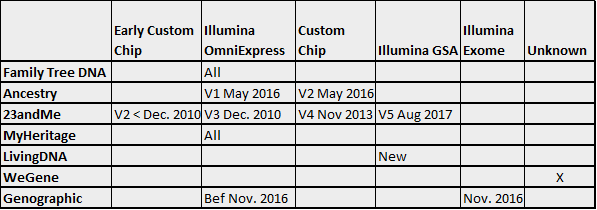
  • In March 2017, Family Tree DNA announced that they were accepting transfers of both the Ancestry V2 test, in place since May of 2016, along with the 23andMe V4 test, available since November 2013, for free. MyHeritage has since been added to that list. The Family Tree DNA announcement provided testers with another avenue for matching and advanced tools.
  • Illumina obsoleted their OmniExpress chip, forcing vendors to Illumina’s new GSA chip which also forces vendors to use imputation. I swear, imputation is a swear word. Illumina gets the lump of coal award for 2017.
  • I wrote about imputation here, but in a nutshell, the vendors are now being forced to test only about 20% of the DNA locations available on the previous Illumina chip, and impute or infer using statistics the values in the rest of the DNA locations that they previously could test.
  • Early imputation implementers include LivingDNA (ethnicity only), MyHeritage (to equalize the locations of various vendor’s different chips), DNA.Land (whose matching is far from ideal) and 23andMe, who seems, for the most part, to have done a reasonable job. Of course, the only way to tell for sure at 23andMe is to test again on the V5 chip and compare to V3 and V4 chip matches. Given that I’ve already paid 3 times to test myself at 23andMe (V2, 3 and 4), I’m not keen on paying a 4th time for the V5 version.
  • 23andMe moved to the V5 Illumina GSA chip in August which is not compatible with any earlier chip versions.
  • Needless to say, the Illumina chip change has forced vendors away from focusing on new products in order to develop imputation code in order to remain backwards compatible with their own products from an earlier chip set.
  • GedMatch introduced their sandbox area, Genesis, where people can upload files that are not compatible with the traditional vendor files.  This includes the GSA chip results (23andMe V5,) exome tests and others.  The purpose of the sandbox is so that GedMatch can figure out how to work with these files that aren’t compatible with the typical autosomal test files.  The process has been interesting and enlightening, but people either don’t understand or forget that it’s a sandbox, an experiment, for all involved – including GedMatch.  Welcome to living on the genetic frontier!

  • I assembled a chart of who loves who – meaning which vendors accept transfers from which other vendors.

  • I suspect but don’t know that Ancestry is doing some form of imputation between their V1 and V2 chips. About a month before their new chip implementation in May of 2016, Ancestry made a change in their matching routine that resulting in a significant shift in people’s matches.

Because of Ancestry’s use of the Timber algorithm to downweight some segments and strip out others altogether, it’s difficult to understand where matching issues may arise.  Furthermore, there is no way to know that there are matching issues unless you and another individual have transferred results to either Family Tree DNA or GedMatch, neither of which remove any matching segments.

  • Other developments of note include the fact that Family Tree DNA moved to mitochondrial DNA build V17 and updated their Y DNA to hg38 of the human reference genome – both huge undertakings requiring the reprocessing of customer data. Think of both of those updates as housekeeping. No one wants to do it, but it’s necessary.
  • 23andMe FINALLY finished transferring their customer base to the “New Experience,” but many of the older features we liked are now gone. However, customers can now opt in to open matching, which is a definite improvement. 23andMe, having been the first company to enter the genetic genealogy autosomal matching marketspace has really become lackluster.  They could have owned this space but chose not to focus on genealogy tools.  In my opinion, they are now relegated to fourth place out of a field of 4.
  • Ancestry has updated their Genetic Communities feature a couple of times this year. Genetic Communities is interesting and more helpful than ethnicity estimates, but neither are nearly as helpful as a chromosome browser would be.

  • I’m sure that the repeated requests, begging and community level tantrum throwing in an attempt to convince Ancestry to produce a chromosome browser is beyond beating a dead horse now. That dead horse is now skeletal, and no sign of a chromosome browser. Sigh:(
  • The good news is that anyone who wants a chromosome browser can transfer their results to Family Tree DNA or GedMatch (both for free) and utilize a chromosome browser and other tools at either or both of those locations. Family Tree DNA charges a one time $19 fee to access their advanced tools and GedMatch offers a monthly $10 subscription. Both are absolutely worth every dime. The bad news is, of course, that you have to convince your match or matches to transfer as well.
  • If you can convince your matches to transfer to (or test at) Family Tree DNA, their tools include phased Family Matching which utilizes a combination of user trees, the DNA of the tester combined with the DNA of family matches to indicate to the user which side, maternal or paternal (or both), a particular match stems from.

  • Sites to keep your eye on include Jonny Perl’s tools which include DNAPainter, as well as Goran Rundfeldt’s DNA Genealogy Experiment.  You may recall that in October Goran brought us the fantastic Triangulator tool to use with Family Tree DNA results.  A few community members expressed concern about triangulation relative to privacy, so the tool has been (I hope only temporarily) disabled as the involved parties work through the details. We need Goran’s triangulation tool! Goran has developed other world class tools as well, as you can see from his website, and I hope we see more of both Goran and Jonny in 2018.
  • In 2017, a number of new “free” sites that encourage you to upload your DNA have sprung up. My advice – remember, there really is no such thing as a free lunch.  Ask yourself why, what’s in it for them.  Review ALL OF THE documents and fine print relative to safety, privacy and what is going to be done with your DNA.  Think about what recourse you might or might not have. Why would you trust them?

My rule of thumb, if the company is outside of the US, I’m immediately slightly hesitant because they don’t fall under US laws. If they are outside of Europe or Canada, I’m even more hesitant.  If the company is associated with a country that is unfriendly to the US, I unequivocally refuse.  For example, riddle me this – what happens if a Chinese (or fill-in-the-blank country) company violates an agreement regarding your DNA and privacy?  What, exactly, are you going to do about it from wherever you live?

2017 – The Year of Marketplace Apps

Third party genetics apps are emerging and are beginning to make an impact.

GedMatch, as always, has continued to quietly add to their offerings for genetic genealogists, as had DNAGedcom.com. While these two aren’t exactly an “app”, per se, they are certainly primary players in the third party space. I use both and will be publishing an article early in 2018 about a very useful tool at DNAGedcom.

Another application that I don’t use due to the complex setup (which I’ve now tried twice and abandoned) is Genome Mate Pro which coordinates your autosomal results from multiple vendors.  Some people love this program.  I’ll try, again, in 2018 and see if I can make it all the way through the setup process.

The real news here are the new marketplace apps based on Exome testing.

Helix and their partners offer a number of apps that may be of interest for consumers.  Helix began offering a “test once, buy often” marketplace model where the consumer pays a nominal price for exome sequencing ($80), significantly under market pricing ($500), but then the consumer purchases DNA apps through the Helix store. The apps access the original DNA test to produce results. The consumer does NOT receive their downloadable raw data, only data through the apps, which is a departure from the expected norm. Then again, the consumer pays a drastically reduced price and downloadable exome results are available elsewhere for full price.

The Helix concept is that lots of apps will be developed, meaning that you, the consumer, will be interested and purchase often – allowing Helix to recoup their sequencing investment over time.

Looking at the Helix apps that are currently available, I’ve purchased all of the Insitome products released to date (Neanderthal, Regional Ancestry and Metabolism), because I have faith in Spencer Wells and truthfully, I was curious and they are reasonably priced.

Aside from the Insitome apps, I think that the personalized clothes are cute, if extremely overpriced. But what the heck, they’re fun and raise awareness of DNA testing – a good thing! After all, who am I to talk, I’ve made DNA quilts and have DNA clothing too.

Having said that, I’m extremely skeptical about some of the other apps, like “Wine Explorer.”  Seriously???

But then again, if you named an app “I Have More Money Than Brains,” it probably wouldn’t sell well.

Other apps, like Ancestry’s WeRelate (available for smartphones) is entertaining, but is also unfortunately EXTREMELY misleading.  WeRelate conflates multiple trees, generally incorrectly, to suggest to you and another person on your Facebook friends list are related, or that you are related to famous people.  Judy Russell reviews that app here in the article, “No, actually, we’re not related.” No.  Just no!

I feel strongly that companies that utilize our genetic data for anything have a moral responsibility for accuracy, and the WeRelate app clearly does NOT make the grade, and Ancestry knows that.  I really don’t believe that entertaining customers with half-truths (or less) is more important than accuracy – but then again, here I go just being an old-fashioned fuddy dud expecting ethics.

And then, there’s the snake oil.  You knew it was going to happen because there is always someone who can be convinced to purchase just about anything. Think midnight infomercials. The problem is that many consumers really don’t know how to tell snake oil from the rest in the emerging DNA field.

You can now purchase DNA testing for almost anything.  Dating, diet, exercise, your taste in wine and of course, vitamins and supplements. If you can think of an opportunity, someone will dream up a test.

How many of these are legitimate or valid?  Your guess is as good as mine, but I’m exceedingly suspicious of a great many, especially those where I can find no legitimate scientific studies to back what appear to be rather outrageous claims.

My main concern is that the entire DTC testing industry will be tarred by the brush of a few unethical opportunists.

2017 – The Year of Focus on Privacy and Security

With increased consumer exposure comes increased notoriety. People are taking notice of DNA testing and it seems that everyone has an opinion, informed or not.  There’s an old saying in marketing; “Talk about me good, talk about me bad, just talk about me.”

With all of the ads have come a commensurate amount of teeth gnashing and “the-sky-is-falling” type reporting.  Unfortunately, many politicians don’t understand this industry and open mouth only to insert foot – except that most people don’t realize what they’ve done.  I doubt that the politicians even understand that they are tasting toe-jam, because they haven’t taken the time to research and understand the industry. Sound bites and science don’t mix well.

The bad news is that next, the click-bait-focused press picks up on the stories and the next time you see anyone at lunch, they’re asking you if what they heard is true.  Or, let’s hope that they ask you instead of just accepting what they heard as gospel. Hopefully if we’ve learned anything in this past year, it’s to verify, verify, verify.

I’ve been an advocate for a very long time of increased transparency from the testing companies as to what is actually done with our DNA, and under what circumstances.  In other words, I want to know where my DNA is and what it’s being used for.  Period.

Family Tree DNA answered that question succinctly and unquestionably in December.

Bennett Greenspan: “We could probably make a lot of money by selling the DNA data that we’ve been collecting over the years, but we feel that the only person that should have your DNA information is you.  We don’t believe that it should be sold, traded or bartered.”

You can’t get more definitive than that.

DTC testing for genetic genealogy must be a self-regulating field, because the last thing we need is for the government to get involved, attempting to regulate something they don’t understand.  I truly believe government interference by the name of regulation would spell the end of genetic genealogy as we know it today.  DNA testing for genetic genealogy without sharing results is entirely pointless.

I’ve written about this topic in the past, but an update is warranted and I’ll be doing that sometime after the first of the year.  Mostly, I just need to be able to stay awake while slogging through the required reading (at some vendor sites) of page after page AFTER PAGE of legalese😊

Consumers really shouldn’t have to do that, and if they do, a short, concise summary should be presented to them BEFORE they purchase so that they can make a truly informed decision.

Stay tuned on this one.

2017 – The Year of Education

The fantastic news is that with all of the new people testing, a huge, HUGE need for education exists.  Even if 75% of the people who test don’t do anything with their results after that first peek, that still leaves a few million who are new to this field, want to engage and need some level of education.

In that vein, seminars are available through several groups and institutes, in person and online.  Almost all of the leadership in this industry is involved in some educational capacity.

In addition to agendas focused on genetic genealogy and utilizing DNA personally, almost every genealogy conference now includes a significant number of sessions on DNA methods and tools. I remember the days when we were lucky to be allowed one session on the agenda, and then generally not without begging!

When considering both DNA testing and education, one needs to think about the goal.  All customer goals are not the same, and neither are the approaches necessary to answer their questions in a relevant way.

New testers to the field fall into three primary groups today, and their educational needs are really quite different, because their goals, tools and approaches needed to reach those goals are different too.

Adoptees and genealogists employ two vastly different approaches utilizing a common tool, DNA, but for almost opposite purposes.  Adoptees wish to utilize tests and trees to come forward in time to identify either currently living or recently living people while genealogists are interested in reaching backward in time to confirm or identify long dead ancestors. Those are really very different goals.

I’ve illustrated this in the graphic above.  The tester in question uses their blue first cousin match to identify their unknown parent through the blue match’s known lineage, moving forward in time to identify the tester’s parent.  In this case, the grandparent is known to the blue match, but not to the yellow tester. Identifying the grandparent through the blue match is the needed lynchpin clue to identify the unknown parent.

The yellow tester who already knows their maternal parent utilizes their peach second cousin match to verify or maybe identify their maternal great-grandmother who is already known to the peach match, moving backwards in time. Two different goals, same DNA test.

The three types of testers are:

  • Curious ethnicity testers who may not even realize that at least some of the vendors offer matching and other tools and services.
  • Genealogists who use close relatives to prove which sides of trees matches come from, and to triangulate matching segments to specific ancestors. In other words, working from the present back in time. The peach match and line above.
  • Adoptees and parent searches where testers hope to find a parent or siblings, but failing that, close relatives whose trees overlap with each other – pointing to a descendant as a candidate for a parent. These people work forward in time and aren’t interested in triangulation or proving ancestors and really don’t care about any of those types of tools, at least not until they identify their parent.  This is the blue match above.

What these various groups of testers want and need, and therefore their priorities are different in terms of their recommendations and comments in online forums and their input to vendors. Therefore, you find Facebook groups dedicated to Adoptees, for example, but you also find adoptees in more general genetic genealogy groups where genealogists are sometimes surprised when people focused on parent searches downplay or dismiss tools such as Y DNA, mitochondrial DNA and chromosome browsers that form the bedrock foundation of what genealogists need and require.

Fortunately, there’s room for everyone in this emerging field.

The great news is that educational opportunities are abundant now. I’m listing a few of the educational opportunities for all three groups of testers, in addition to my blog of course.😊

Remember that this blog is fully searchable by keyword or phrase in the little search box in the upper right hand corner.  I see so many questions online that I’ve already answered!

Please feel free to share links of my blog postings with anyone who might benefit!

Note that these recommendations below overlap and people may well be interested in opportunities from each group – or all!!

Ethnicity

Adoptees or Parent Search

Genetic Genealogists

2018 – What’s Ahead? 

About midyear 2018, this blog will reach 1000 published articles. This is article number 939.  That’s amazing even to me!  When I created this blog in July of 2012, I wasn’t sure I’d have enough to write about.  That certainly has changed.

Beginning shortly, the tsunami of kits that were purchased during the holidays will begin producing matches, be it through DNA upgrades at Family Tree DNA, Big Y tests which were hot at year end, or new purchases through any of the vendors.  I can hardly wait, and I have my list of brick walls that need to fall.

Family Tree DNA will be providing additional STR markers extracted from the Big Y test. These won’t replace any of the 111 markers offered separately today, because the extraction through NGS testing is not as reliable as direct STR testing for those markers, but the Big Y will offer genealogists a few hundred more STRs to utilize. Yes, I said a few hundred. The exact number has not yet been finalized.

Family Tree DNA says they will also be introducing new “qualify of life improvements” along with new privacy and consent settings.  Let’s hope this means new features and tools will be released too.

MyHeritage says that they are introducing new “Discoveries” pages and a chromosome browser in January.  They have also indicated that they are working on their matching issues.  The chromosome browser is particularly good news, but matching must work accurately or the chromosome browser will show erroneous information.  Let’s hope January brings all three features.

LivingDNA indicates that they will be introducing matching in 2018.

2018 – What Can You Do?

What can you do in 2018 to improve your odds of solving genealogy questions?

  • Test relatives
  • Transfer your results to as many data bases as possible (among the ones discussed above, after reading the terms and conditions, of course)
  • If you have transferred a version of your DNA that does not produce full results, such as the Ancestry V2 or 23andMe V4 test to Family Tree DNA, consider testing on the vendor’s own chip in order to obtain all matches, not just the closest matches available from an incompatible test transfer.
  • Test Y and mitochondrial DNA at Family Tree DNA.
  • Find ways to share the stories of your ancestors.  Stories are cousin bait.  My 52 Ancestors series is living proof.  People find the stories and often have additional facts, information or even photos. Some contacts qualify for DNA testing for Y or mtDNA lines. The GREAT NEWS is that Amy Johnson Crow is resuming the #52Ancestors project for 2018, providing hints and tips each week! Who knows what you might discover by sharing?! Here’s how to start a blog if you need some assistance.  It’s easy – really!
  • Focus on the brick walls that you want to crumble and then put together both a test and analysis plan. That plan could include such things as:

o   Find out if a male representing a Y line in your tree has tested, and if not, search through autosomal results to see if a male from that paternal surname line has tested and would be amenable to an upgrade.

o   Mitochondrial DNA test people who descend through all females from various female ancestors in order to determine their origins. Y and mtDNA tests are an important part of a complete genealogy story – meaning the reasonably exhaustive search!

o   Autosomal DNA test family members from various lines with the hope that matches will match you and them both.

o   Test family members in order to confirm a particular ancestor – preferably people who descend from another child of that ancestor.

o   Making sure your own DNA is in all 4 of the major vendors’ data bases, plus GedMatch. Look at it this way, everyone who is at GedMatch or at a third party (non-testing) site had to have tested at one of the major 4 vendors – so if you are in all of the vendor’s data bases, plus GedMatch, you’re covered.

Have a wonderful New Year and let’s make 2018 the year of newly discovered ancestors and solved mysteries!

______________________________________________________________

Disclosure

I receive a small contribution when you click on some of the links to vendors in my articles. This does NOT increase the price you pay but helps me to keep the lights on and this informational blog free for everyone. Please click on the links in the articles or to the vendors below if you are purchasing products or DNA testing.

Thank you so much.

DNA Purchases and Free Transfers

Genealogy Services

Genealogy Research

Testing Strategy – Should I Test at Ancestry and Transfer to Family Tree DNA?

As most people know by now, Ancestry doesn’t accept DNA file transfers from other vendors, so many people recommend testing first at Ancestry and then transferring to Family Tree DNA.

Actually, that’s not always the best choice.

  • There is nothing inherently WRONG with that strategy, but it may not be right for you either. Transferring to Family Tree DNA from Ancestry certainly won’t hurt anything, but a transfer will only provide 20-25% of your matches if you tested at Ancestry after May of 2016 because the DNA chips used for processing are different at the two vendors.
  • If you tested at Ancestry before May of 2016, the Ancestry kit and the Family Tree DNA kits are identical, so transferring will give you the same matches at Family Tree DNA as if you had tested there. You are on the Ancestry V1 kit, so just transfer.  There is no need for a V1 kit to retest at Family Tree DNA. The transfer itself is free, as are your matches, but to unlock all features and tools costs $19. A bargain.
  • If you tested at Ancestry after May of 2016, you tested on the V2 kit. Ancestry changed the markers tested and now the Ancestry kit is only partially compatible with Family Tree DNA. As an Ancestry V2 transfer kit, you will only receive about 20-25% of the matches you would receive if you tested at Family Tree DNA.  The matches you receive will be your closest matches, but is that enough?

For some people, especially adoptees, your closest matches may be all that you are interested in.  If so, you’re golden with any Ancestry transfer.

For genealogists, you’re missing 75-80% of your matches, and your brick-wall breaker may well be in that group. Not good at all!

Let’s look at my kits for example.  I have tested directly at Family Tree DNA, and I have also transferred an Ancestry V2 kit to Family Tree DNA.

As you can see, my Family Finder kit received 3115 matches.  My Ancestry V2 transfer kit only received 26.65% of those matches.

Plus, if you attach the DNA of known family members to your tree, Family Tree DNA provides phased matching, which tells you which side of your tree a match connects to.  In the example above, that means that I know immediately which side 1236 of my matches connect to.  That’s a whopping 40% and that’s before I even look at their trees or common surnames! This is an incredible tool.

People who recommend that you test at Ancestry, today, and transfer to Family Tree DNA may not understand the unintended consequences, or they may be people who work primarily with adoptees. They may also not understand the value of phased matches for genealogists.

For people who tested at Ancestry after May of 2016, my recommendation is to take the Family Finder test directly at Family Tree DNA as well as test at Ancestry separately.

If you tested at MyHeritage, that test is fully compatible at Family Tree DNA as well, so do transfer, no retest needed!

To Order or Transfer

To order your Family Finder test, click here and then on the Family Finder test, shown below.

To transfer to Family Tree DNA for free from any company, click here and then in the upper left hand corner of the screen, click Autosomal Transfer, last option under the dropdown under the blue DNA Tests to get started.

Related Articles:

______________________________________________________________

Disclosure

I receive a small contribution when you click on some of the links to vendors in my articles. This does NOT increase the price you pay but helps me to keep the lights on and this informational blog free for everyone. Please click on the links in the articles or to the vendors below if you are purchasing products or DNA testing.

Thank you so much.

DNA Purchases and Free Transfers

Genealogy Services

Genealogy Research

Imputation Matching Comparison

In a future article, I’ll be writing about the process of uploading files to DNA.Land and the user experience, but in this article, I want to discuss only one topic, and that’s the results of imputation as it affects matching for genetic genealogy. DNA.Land is one of three companies known positively to be using imputation (DNA.Land, MyHeritage and LivingDNA), and one of two that allows transfers and does matching for genealogy

This is the second in a series of three articles about imputation.

Imputation, discussed in the article, Concepts – Imputation, is the process whereby your DNA that is tested is then “expanded” by inferring results you don’t have, meaning locations that haven’t been tested, by using information from results you do have. Vendors have no choice in this matter, as Illumina, the chip maker of the DNA chip widely utilized in the genetic genealogy marketspace has obsoleted the prior chip and moved to a new chip with only about 20% overlap in the locations previously tested. Imputation is the methodology utilized to attempt to bridge the gap between the two chips for genetic genealogy matching and ethnicity predications.

Imputation is built upon two premises:

1 – that DNA locations are inherited together

2 – that people from common populations share a significant amount of the same DNA

An example of imputation that DNA.Land provides is the following sentence.

I saw a blue ca_ on your head.

There are several letters that are more likely that others to be found in the blank and some words would be more likely to be found in this sentence than others.

A less intuitive sentence might be:

I saw a blue ca_ yesterday.

DNA.Land doesn’t perform DNA testing, but instead takes a file that you upload from a testing vendor that has around 700,000 locations and imputes another 38.3 million variants, or locations, based on what other people carry in neighboring locations. These numbers are found in the SNPedia instructions for uploading DNA.Land information to their system for usage with Promethease.

I originally wrote about Promethease here, and I’ll be publishing an updated article shortly.

In this article, I want to see how imputation affects matching between people for genetic genealogy purposes.

Genetic Genealogy Matching

In order to be able to do an apples to apples comparison, I uploaded my Family Tree DNA autosomal file to DNA.Land.

DNA.Land then processed my file, imputed additional values, then showed me my matches to other people who have also uploaded and had additional locations imputed.

DNA.Land has just over 60,000 uploads in their data base today. Of those, I match 11 at a high confidence level and one at a speculative level.

My best match, meaning my closest match, Karen, just happened to have used her GedMatch kit number for her middle name. Smart lady!

Karen’s GedMatch number provided me with the opportunity to compare our actual match information at DNA.Land, then also at GedMatch, then compare the two different match results in order to see how much of our matching was “real” from portions of our tested kits that actually match, and what portion of our DNA matches as a result of the DNA.Land imputation.

At DNA.Land, your match information is presented with the following information:

  • Relationship degree – meaning estimated relationship
  • # shared segments – although many of these are extremely small
  • Total shared cM
  • Total recent shared length in cM
  • Longest recent shared segment in cM
  • Relationship likelihood graph
  • Shared segments plotted on chromosome display
  • Shared segments in a table

Please note that you can click on any graphic to enlarge.

DNA.Land provides what they believe to be an accurate estimate of recent and anciently shared SNA segments.

The match table is a dropdown underneath the chromosome graphic at far right:

For this experiment, I copied the information from the match table and dropped it into a spreadsheet.

DNALand Match Locations

My match information is shown at DNA.Land with Karen as follows:

Matching segments are identified by DNA.Land as either recent or ancient, which I find to be over-simplified at best and misleading or inaccurate at worst. I guess it depends on how you perceive recent and ancient. I think they are trying to convey the concept that larger segments tend to me more recent, and smaller segments tend to be older, but ancient in the genetics field often refers to DNA extracted from exhumed burials from thousands of years ago.  Furthermore, smaller segments can be descended from the same ancestor as larger segments.

GedMatch Match

Since Karen so kindly provided her GedMatch kit number, I signed in to GedMatch and did a one-to-one match with this same kit.

Since all of the segments are 3 cM and over at DNA.Land, I utilized a GedMatch threshold of 3 cM and dropped the SNP count to 100, since a SNP count of 300 gave me few matches. For this comparison, I wanted to see all my matches to Karen, no matter how few SNPs are involved, in an attempt to obtain results similar to DNA.Land. I normally would not drop either of these thresholds this low. My typical minimum is 5cM and 500 SNPs, and even if I drop to 3cM, I still maintain the 500 SNP threshold.

Let’s see how the data from GedMatch and DNA.Land compares.

In my spreadsheet, below, I pasted the segment match information from DNA.Land in the first 5 columns with a red header. Note that DNA.Land does not provide the number of shared SNPs.

At right, I pasted the match information from GedMatch, with a green header. We know that GedMatch has a history of accurately comparing segments, and we can do a cross platform comparison. I originally uploaded my FTDNA file to DNA.Land and Karen uploaded an Ancestry file. Those are the two files I compared at GedMatch, because the same actual matching locations are being compared at both vendors, DNA.Land (in addition to imputed regions) and GedMatch.

I then copied the matching segments from GedMatch (3cM, 100 SNPs threshold) and placed them in the middle columns in the same row where they matched corresponding DNA.Land segments. If any portion of the two vendors segments overlapped, I copied them as a match, although two are small and partial and one is almost negligible. As you can see, there are only 10 segments with any overlap at all in the center section. Please note that I am NOT suggesting these are valid or real matches.  At this point, it’s only a math/match exercise, not an analysis.

The match comparison column (yellow header) is where I commented on the match itself. In some cases, the lack of the number of SNPs at DNA.Land was detrimental to understanding which vendor was a higher match. Therefore, when possible, I marked the higher vendor in the Match Comparison column with the color of their corresponding header.

Analysis

Frankly, I was shocked at the lack of matching between GedMatch and DNA.Land. Trying to understand the discrepancy, I decided to look at the matches between Karen, who has been very helpful, and me at other vendors.

I then looked at our matches at Ancestry, 23andMe, MyHeritage and at Family Tree DNA.

The best comparison would be at Family Tree DNA where Karen loaded her Ancestry file.  Therefore, I’m comparing apples to apples, meaning equivalent to the comparison at GedMatch and DNA.Land (before imputation).

It’s impossible to tell much without a chromosome browser at Ancestry, especially after Timber processing which reduces matching DNA.

DNA.Land categorized my match to Karen as “high certainty.” My match with Karen appears to be a valid match based on the longest segment(s) of approximately 30cM on chromosome 8.

  • Of the 4 segments that DNA.Land identifies as “recent” matches, 2 are not reflected at all in the GedMatch or Family Tree DNA matching, suggesting that these regions were imputed entirely, and incorrectly.
  • Of the 4 segments that DNA.Land identifies as “recent” matches, the 2 on chromosome 8 are actually one segment that imputation apparently divided. According to DNA.LAND, imputation can increase the number of matching segments. I don’t think it should break existing segments, meaning segments actually tested, into multiple pieces. In any event, the two vendors do agree on this match, even though DNA.Land breaks the matching segment into two pieces where GedMatch and Family Tree DNA do not. I’m presuming (I hate that word) that this is the one segment that Ancestry calls as a match as well, because it’s the longest, but Ancestry’s Timber algorithm downgrades the match portion of that segment by removing 11cM (according to DNA.Land) from 29cM to 18cM or removes 13cM (according to both GedMatch and Family Tree DNA) from 31cM to 18cM. Both GedMatch and Family Tree DNA agree and appear to be accurate at 31cM.
  • Of the total 39 matching segments of any size, utilizing the 3cM threshold and 100 SNPs, which I set artificially very low, GedMatch only found 10 matching segments with any portion of the segment in common, meaning that at least 29 were entirely erroneous matches.
  • Resetting the GedMatch match threshold to 3 cM and 300 SNPS, a more reasonable SNP threshold for 3cM, GedMatch only reports 3 matching segments, one of which is chromosome 8 (undivided) which means at this threshold, 36 of the 39 matching DNA.Land segments are entirely erroneous. Setting the threshold to a more reasonable 5cM or 7cM and 500 SNPs would result in only the one match on chromosome 8.

  • If 29 of 39 segments (at 3cM 100 SNPs) are erroneously reported, that equates to 74.36% erroneous matches due to imputation alone, with out considering identical by chance (IBC) matches.
  • If 35 of 39 segments (at 3cM 300 SNPs) are erroneously reported, that equates to 89.74% percent erroneous matches, again without considering those that might be IBC.

Predicted vs Actual

One additional piece of information that I gathered during this process is the predicted relationship.

Vendor Total cM Total Segments Longest Segment Predicted Relationship
DNA.Land 162 to 3 cM 39 to 3 cM 17.3 & 12, split 3C
GedMatch 123 to 3 cM 27 to 3 cM 31.5 5.1 gen distant
Family Tree DNA 40 to 1 cM 12 to 1 cM 32 3-5C
MyHeritage No match No match No match No match
Ancestry 18.1 1 18.1 5-8C
23andMe 26 1 26 3-6C

Karen utilized her Ancestry file and I used my Family Tree DNA file for all of the above matching except at 23andMe and Ancestry where we are both tested on the vendors’ platform. Neither 23andMe nor Ancestry accept uploads. I included the 23andMe and Ancestry comparisons as additional reference points.

The lack of a match at MyHeritage, another company that implements imputation, is quite interesting. Karen and I, even with a significantly sized segment are not shown as a match at MyHeritage.

If imputation actually breaks some matching segments apart, like the chromosome 8 segment at DNA.Land, it’s possible that the resulting smaller individual segments simply didn’t exceed the MyHeritage matching threshold. It would appear that the MyHeritage matching threshold is probably 9cM, given that my smallest segment match of all my matches at MyHeritage is 9cM. Therefore, a 31 or 32 cM segment would have to be broken into 4 roughly equally sized pieces (32/4=8) for the match to Karen not to be detected because all segment pieces are under 9cM. MyHeritage has experienced unreliable matching since their rollout in mid 2016, so their issue may or may not be imputation related.

The Common Ancestor

At Family Tree DNA, Karen does not match my mother, so I can tell positively that she is related through my father’s line. She and I triangulate on our common segment with three other individuals who descend from Abraham Estes 1647-1720 .

Utilizing the chromosome browser, we do indeed match on chromosome 8 on a long segment, which is also our only match over 5cM at Family Tree DNA.

Based on our trees as well as the trees of our three triangulated Estes matches, Karen and I are most probably either 8th cousins, or 8th cousins once removed, assuming that is our only common line. I am 8th cousins with the other three triangulated matches on chromosome 8. Karen’s line has yet to be proven.

Imputation Matching Summary

I like the way that DNA.Land presents some of their features, but as for matching accuracy, you can view the match quality in various ways:

  1. DNA.Land did find the large match on chromosome 8. Of course, in terms of matching, that’s pretty difficult to miss at roughly 30cM, although MyHeritage managed. Imputation did split the large match into two, somehow, even though Karen and I match on that same segment as one segment at other vendors comparing the same files.
  2. Of the 39 DNA.Land total matches, other than the chromosome 8 match, two other matches are partial matches, according to GedMatch. Both are under 7cM.
  3. Of DNA.Land’s total 39 matches, 35 are entirely wrong, in addition to the two that are split, including two inaccurate imputed matches at over 5cM.
  4. At DNA.Land, I’m not so concerned about discerning between “real” and “false” small segment matches, as compared to both FTDNA and GedMatch, as I am about incorrectly imputed segments and matches. Whether small matches in general are false positives or legitimate can be debated, each smaller segment match based on its own merits. Truthfully, with larger segments to deal with, I tend to ignore smaller segments anyway, at least initially. However, imputation adds another layer of uncertainty on top of actual matching, especially, it appears, with smaller matches. Imputing entire segments of incorrect DNA concerns me.
  5. Having said that, I find it very concerning that MyHeritage who also utilizes imputation missed a significant match of over 30cM. I don’t know of a match of this size that has ever been proven to be a false match (through parental phasing), and in this case, we know which ancestor this segment descends from through independent verification utilizing multiple other matches. MyHeritage should have found that match, regardless of imputation, because that match is from portions of the two files that were both tested, not imputed.

Summary

To date, I’m not impressed with imputation matching relative to genetic genealogy at either DNA.Land or MyHeritage.

In one case, that of DNA.Land, imputation shows matches for segments that are not shown as matches at either Family Tree DNA or GedMatch who are comparing the same two testers’ files, but without imputation. Since DNA.Land did find the larger segment, and many of their smaller segments are simply wrong, I would suggest that perhaps they should only show larger segments. Of course, anyone who finds DNA.Land is probably an experienced genetic genealogist and probably already has files at both GedMatch and Family Tree DNA, so hopefully savvy enough to realize there are issues with DNA.Land’s matching.

In the second imputation case, that of MyHeritage, the match with Karen is missed entirely, although that may not be a function of imputation. It’s hard to determine.  MyHeritage is also comparing the same two files uploaded by Karen and I to the other vendors who found that match, both vendors who do and don’t utilize imputation.

Regardless of imputing additional locations, MyHeritage should have found the matching segment on chromosome 8 because that region does NOT need to be imputed. Their failure to do so may be a function of their matching routine and not of imputation itself. At this point, it’s impossible to discern the cause. We only know, based on matching at other vendors, that the non-match at MyHeritage is inaccurate.

Here’s what DNA.Land has to say about the imputed VCF file, which holds all of your imputed values, when you download the file. They pull no punches about imputation.

“Noisey and probabilistic.” Yes, I’d say they are right, and problematic as well, at least for genetic genealogists.

Extrapolating this even further, I find it more than a little frightening that my imputed data at DNA.Land will be utilized for medical research.

Quoting now from Promethease, a medical reference site that allows the consumer to upload their raw data files, providing consumers with a list of SNPs having either positive or negative research in academic literature:

DNA.land will take a person’s data as produced by such companies and impute additional variants based on population frequency statistics. To put this in concrete terms, a person uploading a typical 23andMe file of ~700,000 variants to DNA.land will get back an (imputed) file of ~39 million variants, all predicted to be present in the person. Promethease reports from such imputed files typically contain about 50% more information (i.e. 50% more genotypes) than the corresponding reports from raw (non-imputed) data.

Translated, this means that your imputed data provides twice as much “genetic information” as your actual tested data. The question remains, of course, how much of this imputed data is accurate.

That will be the topic of the third imputation article. Stay tuned.

______________________________________________________________

Disclosure

I receive a small contribution when you click on some of the links to vendors in my articles. This does NOT increase the price you pay but helps me to keep the lights on and this informational blog free for everyone. Please click on the links in the articles or to the vendors below if you are purchasing products or DNA testing.

Thank you so much.

DNA Purchases and Free Transfers

Genealogy Services

Genealogy Research

Concepts – Imputation

Until recently, the word imputation wasn’t a part of the vocabulary of genetic genealogy, but earlier this year, it became a factor and will become even more important in coming months.

Illumina, the company that provides chips to companies that test autosomal DNA for genetic genealogy has obsoleted their OmniExpress chip previously in use, forcing companies to utilize their new Global Screening Array (GSA) chip when their current chip supply runs out.

Only about 20% of the DNA locations previously tested by genetic genealogy companies are tested on this new platform. Illumina has encouraged vendors to utilize the process called imputation to infer DNA results for their customers that are common in populations, but has not been directly tested in customer’s DNA, in order for vendors to achieve backwards compatibility with people previously tested on the OmniExpress chip. You can read the technical details of imputation in a document produced by Illumina here.

LivingDNA, who was developing and launching a new product during the transition time between chips was the first vendor out the gate with a GSA product. Illumina represented imputation to be “very accurate” to LivingDNA, which is consequently how they represented the results to a group of genetic genealogists on a conference call in early 2017. LivingDNA was the lucky company to have the opportunity to “work the bugs out” with Illumina – said with tongue firmly in cheek. LivingDNA provides a list of papers describing their methods here.

Another company, MyHeritage also uses imputation, for an entirely different reason. My Heritage uses imputation to “add” to the DNA results of people who upload results from different vendors. They are the first company to attempt DNA matching between people using imputation, and they initially had and continue to have matching issues. In their initial release blog in September 2016, they state that imputation matching “is accomplished with very high accuracy.” In their Q&A blog in November 2016, they state that “imputation may introduce errors so we are in the process of fine-tuning it.” They have made changes since matching was originally introduced, but they still struggle with matching accuracy, most recently discussed by Leah Larkin in her article, MyHeritage Matching.

DNA.LAND does not perform testing, but is a nonprofit in the health care industry who  utilizes imputation for health-related research – imputing approximately 38.3 million locations in addition to the 700,000 locations in customers’ uploaded files. In order to encourage people to upload their test results, DNA.LAND performs matching and ethnicity reporting. Like MyHeritage, their matching results are problematic. DNA.LAND explains about imputation and summarizes by stating that “any reported value should never be taken as-is without further careful analysis.” I will be publishing an article shortly about DNA.LAND.

23andMe, on August 9, 2017, released their V5 product utilizing the new GSA chip. They have not said how they are addressing the imputation challenge and backward compatibility. Several issues have been reported.

As you can see, the genetic genealogy landscape is changing and like it or not, imputation is a part of the new scenery.

What, Exactly, is Imputation?

Imputation is the process whereby your DNA is tested and then the results “expanded” by inferring results for additional locations, meaning locations that haven’t been tested, by using information from results you do have. In other words, the DNA is adjacent locations is predicted, or imputed, by their association with their traveling companions.  In DNA, traveling companions are often known to travel together, but not always.

Imputation is built upon two premises:

1 – that DNA locations are usually inherited together in groups in a process known as linkage disequilibrium.

2 – that people from common populations share a significant amount of the same DNA

An example that DNA.LAND provides is the following sentence.

I saw a blue ca_ on your head.

There are several letters that are more likely that others to be found in the blank and some words would be more likely to be found in this sentence than others.

A less intuitive sentence might be:

I saw a blue ca_ yesterday.

DNA.LAND also says very clearly that imputed values can be incorrect. They also state that the values inferred are the common values, not rare mutations, and imputed results are most accurate in Caucasian populations and least accurate in African populations whose DNA is the most variant of any continental group. They caution against using these results for medical diagnosis.

SNPedia (Promethease) cautions against using imputed results as well and suggests that files utilizing only tested results, without imputed results, are more accurate.

Why Imputation?

Looking at this Autosomal SNP Comparison Chart, provided by the ISOGG Wiki, you can see the difference in the number of actual common locations tested by the various vendors.

This means that companies that allow uploads from different vendors utilizing widely divergent chip results have to do something in order to successfully compare the disparate files against each other for matching. Using  23andMe as an example, even though they don’t allow uploads from other companies, they have to do something to accommodate matching between the new GSA V5 chip and their earlier V3 and V4 chips.

Imputation Example

Let’s take a look at how imputation is used to “equalize” files uploaded from various vendors that only contain marginal amounts of overlap.

I’m using MyHeritage as an example. Imputation, in this case, is utilized in an attempt to make marginally compatible files more compatible.

The files from the Ancestry V2 kit and the Family Tree DNA kit have only about 382,000 locations in common, meaning about 300,000 locations are not in common. In order to attempt to equalize these and other kits, MyHeritage attempts to use imputation to deduce the DNA that a tester would/should/might have in the missing segments, based on various statistical factors that include the tester’s population and existing DNA.

Please note that for purposes of concept illustration, I have shown all of the common locations, in blue, as contiguous. The common locations are not contiguous, but are scattered across the entire range that each vendor tests.

You can see that the number of imputed locations for matching between two people, shown in tan, is larger than the number of actual matching locations shown in blue. The amount of actual common data being compared is roughly 382,000 of 1,100,000 total locations, or 35%.

Stay tuned for an upcoming series of articles about imputation and results in various scenarios.

______________________________________________________________

Disclosure

I receive a small contribution when you click on some of the links to vendors in my articles. This does NOT increase the price you pay but helps me to keep the lights on and this informational blog free for everyone. Please click on the links in the articles or to the vendors below if you are purchasing products or DNA testing.

Thank you so much.

DNA Purchases and Free Transfers

Genealogy Services

Genealogy Research

Quick Tip – Making Your DNA Results More Clickable

There are many motivations for DNA testing. Some people want to connect with relatives to share information. Just think, your match may have photos of your family that you’ve never seen!

If contacting and connecting with your relatives is your motivation, you’ll want your user profile to be the most click-friendly and attractive possible.

How do people decide which profiles to click on and which to bypass, especially now that so many people are testing and one can’t possibly contact them all?

I’m including several click-friendly factors here, but probably the number one decision criteria is your profile photo, or lack of one.

Use a Profile Photo

You want your photo to be inviting and friendly. Lack of a photo means a missed opportunity.

Have someone take a smiling photo of you, without anything distracting or polarizing in the photo, and post to your profile. Look friendly! Your photo needs to say, “Talk to me.  I won’t bite your head off.”

People like to look at photos and are more likely to spend time on results that have photos attached. Do you pause, look at photos of your matches to see if they look like you?  I do.

Don’t like any of your current photos?  Have someone take a new one.  My husband took the one above in the yard last month with his cell phone.

Still don’t like your picture? That’s OK, post a baby photo or something cute.

Grow a Tree

Not every vendor has the ability to upload trees. 23and me does not, but Family Tree DNA, Ancestry and MyHeritage do today.

The purpose of genetic genealogy is genealogy – and trees are inherent to the success of finding those common lines – regardless of whether or not you’ve tested for autosomal DNA, Y line DNA or mitochondrial DNA. Your matches are going to want to see your ancestor in the line relevant to them.

Furthermore, once you’ve created a tree, you can upload the same tree to any of the vendors where you have tested, except for 23andMe who has no tree capacity.

At Family Tree DNA, you can upload a GEDCOM file or create a tree from scratch.

Be sure to link your relatives who have tested to your tree too, so that your results show your phased Family Finder matches indicating which side of your tree certain matches come from. You can see the red, blue and purple icons indicating whether the matches are related maternally, paternally, or both, below. I have over 1000 matches assigned to parental sides simply by connecting my DNA matches to their proper place in my tree.

(You can click to enlarge any image.)

After you upload a GEDCOM file, Family Tree DNA then extracts your tree surnames and populates the surname feature so that when you have matches, you can see common surnames in your trees.

In the example above, the common surnames in our trees are bolded, at right, and float to the top of the list so they are easily viewable.

You can enter the surnames by hand, but if you don’t have a tree, or hand entered surnames, you don’t receive the bolded surname matches.

At Ancestry, your tree is compared to all of your matches’ trees and if you have a common ancestor in the tree within the past 9 generations, Ancestry flags your result with a green leaf signifying that there is a DNA tree hint.

Clicking on “View Match” shows you your match’s tree and yours side by side.

If you don’t upload or create a tree, you won’t be able to take advantage of this feature. Once you upload or create your tree, be SURE to link your DNA to you in your tree, or it’s the same as having no tree in terms of DNA benefits.

To link your DNA test to your tree at Ancestry, click on the DNA tab, then on Settings and scroll down about half way.

Share, Share, Share

Nothing turns matches off quite as fast as discovering that your tree is not public. It’s akin to saying that I want to see yours, but I’m not showing you mine.

I’m not referring here to keeping living people private, or even the first generation or two. That’s understandable. I’m referring to trees that are entirely private as evidenced by the little lock by the green leaf below.

I used to contact my private matches and ask, nicely, which ancestor we share in common. They can see my tree, and benefit from seeing my tree by knowing who the common ancestor is, and the path to that ancestor, but I can’t. Truthfully, I’ve stopped asking. I received very few replies.

I simply bypass these locked trees after looking to see who I match in common, to see if I can surmise who the common ancestor is by virtue of comparison to our matches in common.

Yes, I know many people feel strongly about private trees, but if you’re looking for contacts, private trees have a very chilling effect out the gate.

In order to benefit from having a tree, but not giving away the store either, I only have a direct line tree at Ancestry – meaning only my ancestors.  In some cases, I do have siblings for my ancestors, but not extended family lines.

Use Real Names

People have a more positive reaction to real names rather than names like RJEcatlover or RJE33724306219.

Your real name option may be gone if someone else has the same name, especially at Ancestry, but in that case, use something approaching your real name. Mine is RobertaEstes13 at Ancestry because there were obviously 12 subscribers by that name in front of me. So far, none are DNA matches.

At other places, I tend to use a middle initial to differentiate myself.

Females need to consider using their birth name and not a married name.  Not only is this in keeping with their names in the tree, it’s more relevant to the genealogy at hand.

Always record your ancestors in your tree by their birth name, not their married name.  I Many of my matches to the male only of a couple are a result of the fact that John Doe’s wife was records as Jane Doe, not Jane Smith, her birth name.

Contact Information

Different vendors handle contacts between testers in different ways. Regardless of the vendor’s methodology, you need to make yourself accessible if you want contacts, and respond to requests.

Family Tree DNA provides e-mail addresses to matches. This is the most direct method of contact,and my preference because there are less steps that can go wrong.  It does mean that you have to keep your e-mail address current.

Ancestry, 23andMe and MyHeritage require you to utilize their internal message system for communications. This adds a layer of communication that can go awry. For instance, if the e-mail sent by the vendor hits the spam filter, or never gets sent, or bounces, you, as the originator, have no way of knowing. Of course, you still need to keep your e-mail address current with the vendor, regardless.

Both 23andMe and Ancestry retain the messages sent and received, so you can check on their system to see if you have new or unread communications.

Having said that, both systems have had recent, ongoing or intermittent glitches – lost messages when 23andMe transitioned to the New Experience and reports of DNA messages not being recorded in your Ancestry mailbox, meaning messages initiated through the green as opposed to the tan button.

Additionally, Ancestry’s e-mail notification system is well known for not reliably delivering messages, especially through the DNA message links, so check your messages often. That’s the little grey envelope icon at the top right of your Ancestry signon page.

I keep track of my contacts through any vendor separately, so if there is a hiccup, it’s not the end of my documentation.

Oh, and if you’re sending a contact request, use proper English and punctuation (not text-eze), along with providing your name and the name of the person you match. Many people manage multiple kits, not that we’re DNA addicts or anything like that!

Summary

I hope these quick tips have helped you “decorate” and refine your profile in a useful way that encourages your matches to click and make contact. Those contacts may be the first step in breaking down those pesky brick walls. You just never know who has that piece of information that you need – or the photo of great-grandma!

______________________________________________________________

Disclosure

I receive a small contribution when you click on some of the links to vendors in my articles. This does NOT increase the price you pay but helps me to keep the lights on and this informational blog free for everyone. Please click on the links in the articles or to the vendors below if you are purchasing products or DNA testing.

Thank you so much.

DNA Purchases and Free Transfers

Genealogy Services

Genealogy Research

Which Ethnicity Test is Best?

While this question is very straightforward, the answer is not.

I have tested with or uploaded my DNA file to the following vendors to obtain ethnicity results:

Guess what? None of the vendors’ results are the same. Some aren’t even close to each other, let alone to my known and proven genealogy.

In the article, Concepts – Calculating Ethnicity Percentages, I explained how to calculate your expected ethnicity percentages from your genealogy. As each vendor has introduced ethnicity results, or updated previous results, I’ve added to a cumulative chart.

It bears repeating before we look at that chart that ethnicity testing is relatively accurate on a continental level, meaning:

  • Africa
  • Europe
  • Asia
  • Native American
  • Jewish

Intra-continent or sub-continent, meaning within continents, it’s extremely difficult to tease out differences between countries, like France, Germany and Switzerland. Looking at the size of these regions, and the movement of populations, we can certainly understand why. In many ways, it’s like trying to discern the difference between Indiana and Illinois.

What Does “Best” Mean?

While the question of which test is best seems like it would be easy to answer, it isn’t.

“Best” is a subjective term, and often, people interpret best to mean that the test reflects a portion of what they think they know about their ethnicity. Without a rather robust and proven tree, some testers have little subjective data on which to base their perceptions.  In fact, many people, encouraged by advertising, take these tests with the hope that the test will in fact provide them with the answer to the question, “Who am I?” or to confirm a specific ancestor or ancestral heritage rumor.

For example, people often test to find their Native American ancestry and are disappointed when the results don’t reveal Native ancestry. This can be because:

  • There is no Native ancestor.
  • The Native ancestor thought to be 100% was already highly admixed.
  • The Native ancestor is too far back in the tester’s tree and the ancestor’s DNA “washed out” in subsequent generations.
  • The testing company failed to pick up what might be arguably a trace amount.

Genealogy Compared to All Vendors’ Results

In some cases, discrepancies arise due to how the different companies group their results and what the groupings mean, as you can see in the table below comparing all vendors’ results to my known genealogy.

In the table below, I’ve highlighted in yellow the “best” company result by region, as compared to my known genealogy shown in the column titled “Genealogy %”.

British Isles – The British Isles is fairly easy to define, because they are islands, and the results for each vendor, other than The Genographic Project, are easy to group into that category as well. Family Tree DNA comes the closest to my known genealogy in this category, so would be the “best” in this category. However, every region, shown in pink, does not have the same “best” vendor.

Scandinavian – I have no actual Scandinavian heritage in my genealogy, but I’m betting I have a number of Vikings, or that my German/Dutch is closely related to the Scandinavians. So while LivingDNA is the lowest, meaning the closest to my zero, it’s very difficult to discern the “true” amount of Scandinavian heritage admixed into the other populations. It’s also possible that Scandinavian is not reflecting (entirely) the Vikings, but Dutch and German as a result of migrations of entire peoples. My German and Dutch ancestry cumulatively adds to 39%.

Eastern European – I don’t have any known Eastern European, but some of my German might fall into that category, historically. I simply don’t know, so I’m not ranking that group.

Northwestern Europe – For the balance of Northwestern Europe, 23andMe comes the closest with 43% of my 45.24% from my known genealogy.

Mediterranean and Southern European – For the Mediterranean, Greece, Italy and Southern Europe, I have no known genealogy there, and not even anyplace close, so I’m counting as accurate all three vendors who reported zero, being Living DNA, Family Tree DNA and MyHeritage.

Unknown – The next grouping is my unknown percentage. It’s very difficult to ascribe a right or wrong to this grouping, so I’ve put vendor results here that might fall into that unknown group. In my case, I suspect that some of the unknown is actually Native on my father’s side. I haven’t assigned accuracy in this section. It’s more of a catch all, for now.

Native and Asian – The next section is Native and Asian, which can in some circumstances can be attributed to Native ancestry. In this case, I know of about 1% proven Native heritage, as the Native on my mother’s line is proven utilizing both Y and mitochondrial DNA tests on descendants. I suspect there is more Native to be revealed, both on her side and because I can’t positively attribute some of my father’s lineage that is mixed race and reported to be Native, but is as yet unproven. By proof, I mean either Y DNA, mitochondrial DNA or concrete documentation.

I have counted any vendor who found a region above zero and smaller than my unknown percentage of 3.9% as accurate, those vendors being Family Tree DNA, Ancestry, 23andMe and MyHeritage.

Southwest Asia – I have no heritage from Southwest Asia, which typically means the Indian subcontinent. National Geographic reports this region, but their categories are much broader than the other companies, as reflected by the grey bands utilized to attempt to summarize the other vendor’s data in a way that can be compared to the Genographic Project information. While I’m pleased to contribute to the National Geographic Society through the Genographic Project, the results are the least connected to my known genealogy, although their results may represent deeper migratory ancestry.

Summary

As you can see, the best vendor is almost impossible to pinpoint and every person that tests at multiple vendors will likely have a different opinion of what is “best” and the reasons why. In some ways, best depends on what you are looking for and how much genealogy work you’ve already invested to be able to reliably evaluate the different vendor results. In my case, the best vendor, judged by the highest total percentage of “most accurate” categories would be Family Tree DNA.

While DNA testing for ethnicity really doesn’t provide the level of specificity that people hope to gain, testers can generally get a good view of their ancestry at the continental level. Vendors also provide updates as the reference groups and technology improves.  This is a learning experience for all involved!

I hope that seeing the differences between the various vendors will encourage people to test at multiple vendors, or transfer their results to additional vendors to gain “a second set of eyes” about their ethnicity. Several transfers are free. You can read about which vendors accept results from other vendors, in the article, Autosomal DNA Transfers – Which Companies Accept Which Tests?

I also hope that ethnicity results encourage people to pursue their genealogy to find their ancestors. Ethnicity results are fun, but they aren’t gospel, and shouldn’t be interpreted as “the answer.” Just enjoy your results and allow them to peak your curiosity to discover who your ancestors really were through genealogy research! There are bound to be some fun surprises just waiting to be discovered.

If you are interested in why your results may vary from what you expected, please read “Ethnicity Testing – A Conundrum.”

If you’re interested in taking a DNA test, you might want to read “Which DNA Test is Best?” which discusses and compares what you need to know about each vendor and the different tests available in the genetic genealogy market today.

______________________________________________________________

Disclosure

I receive a small contribution when you click on some of the links to vendors in my articles. This does NOT increase the price you pay but helps me to keep the lights on and this informational blog free for everyone. Please click on the links in the articles or to the vendors below if you are purchasing products or DNA testing.

Thank you so much.

DNA Purchases and Free Transfers

Genealogy Services

Genealogy Research

MyHeritage Ethnicity Results

I originally wrote about MyHeritage in February 2017, reflecting matching issues and a broken promise regarding providing ethnicity estimates to people who uploaded their raw DNA file from another vendor. I’m glad to say MyHeritage changed their minds about providing ethnicity results and, today, has honored their original commitment and provided free ethnicity results to uploaders. I feel much better about the DNA aspect of MyHeritage given this decision although their challenges with matching remain.

MyHeritage has also provided updated ethnicity results to people who tested directly at MyHeritage.

In an e-mail received today from Aaron Godfrey, their Director of Marketing, he says:

I wanted to let you know that we’ve just launched MyHeritage’s new and improved Ethnicity Estimate. The new analysis, developed by the company’s science team, provides MyHeritage DNA customers with a percentage-based estimate of their ethnic origins covering 42 ethnic regions, many unique to MyHeritage.

In addition, the new Ethnicity Estimate will be provided for free to users who have already uploaded their DNA data to MyHeritage from other services, or who will upload it in the coming months. Users who upload their DNA data to MyHeritage, already enjoy free DNA Matching, and now they will benefit from the new ethnicity analysis too.

Our Ethnicity Estimate is delivered to users through a captivating “reveal” experience featuring animation and, as of this week, original music composed by MyHeritage. Each of the 42 ethnicities has a distinctive tune, based on the region’s cultural elements; all tunes seamlessly connect to each other. You can view an example here:  https://vimeo.com/218348730/51174e0b49

An excerpt from their press release is provided below:

TEL AVIV, Israel & LEHI, Utah, May 30, 2017 – MyHeritage, the leading global destination for family history and DNA testing, and the makers of the successful MyHeritage DNA product, today announced the launch of its new and improved Ethnicity Estimate. The new analysis, developed by the company’s science team, provides MyHeritage DNA customers with a percentage-based estimate of their ethnic origins covering 42 ethnic regions, many available only on MyHeritage, representing the most comprehensive report of its type available on the market. This fascinating report gives users a much better understanding of who they are and where their ancestors came from. The Ethnicity Estimate is presented in an original and engaging format, making it not only interesting but also fun to watch and share.

MyHeritage is unique among the main industry players in allowing users who have tested their DNA already with another service to upload – for free – their data to MyHeritage. Those users receive DNA Matches for free, for finding relatives based on shared DNA. Beginning this week, users who have already uploaded their DNA data to MyHeritage, or who will upload it in the coming months, will receive – for free – the new Ethnicity Estimate. This benefit is not offered by any other major DNA company.

Development of the new Ethnicity Estimate raises the number of ethnic regions covered by MyHeritage DNA from 36 to 42. It was made possible thanks to MyHeritage’s Founder Populations project — one of the largest of its kind ever conducted. For this unique project, more than 5,000 participants were handpicked by MyHeritage from its 90 million strong user base, by virtue of their family trees exemplifying consistent ancestry from the same region or ethnicity for many generations All project participants received complimentary DNA tests and allowed MyHeritage’s science team to develop breakthrough ethnicity models based on the generated data. Thanks to this analysis, MyHeritage DNA has become the only mass-market percentage-based DNA test that reveals ethnicities such as Balkan; Baltic; Eskimo & Inuit; Japanese; Kenyan; Sierra Leonean; Somali; four major Jewish groups – Ethiopian, Yemenite, Sephardic from North Africa and Mizrahi from Iran and Iraq; Indigenous Amazonian; Papuan and many others. In some cases, competing products can identify and report an aggregated region (e.g., Italian & Greek), whereas MyHeritage has better resolution and identifies Greek, Italian and Sardinian ethnicities separately.

MyHeritage’s new Ethnicity Estimate is delivered to users via a captivating “reveal” experience (view example). It features animation and, as of this week, also original music composed by MyHeritage. Each of the 42 ethnicities has a distinctive tune, based on the region’s cultural elements; all tunes seamlessly connect to each other. This makes the report fun to watch and share over social media.

Dr. Yaniv Erlich, Chief Science Officer at MyHeritage, said, “For MyHeritage’s science team, this major update of our Ethnicity Estimate is only an appetizer. There are excellent installments on the way, and users can prepare for a feast! We have detailed plans to increase accuracy, extend our Founder Populations project further, and improve the resolution for ethnicities of great interest to our users from highly diverse origins. Our goal is to use science to further the public good, and to bring the best innovations of our science team to the public.”

If you tested earlier, your results have been updated and your “reveal intro” with music added. Check it out.

If you uploaded previously, you had no ethnicity results, but now you do.

Regions Reported

From my results, the regions that MyHeritage supports, meaning the regions they report, are as follows:

The regions above correlate with the regions shown on the map at the beginning of this article.

My Ethnicity Results

I filmed my own reveal to share with you, but viewing their Vimeo clip linked above is much better quality. I particularly enjoyed the music compositions from the locations where my ethnicity is reported.

As with other vendors who offer ethnicity services, I have compared the MyHeritage ethnicity results with my known genealogy, and then as compared to other vendors.

Let’s look at my results.

The first thing I noticed is that the British Isles is broken into two components, English and then Irish/Scottish/Welsh. Of course, looking at the map, they do overlap almost entirely.

The second thing I noticed is that, according to MyHeritage, I’m indigenous Amazonian.

My reaction to that? You’ve got to be kidding.

Now, the good news is that they did detect my Native American, which, by the way, is either from my mother’s side out of Nova Scotia (Acadian), which is proven in several ancestral lines via mtDNA and Y DNA testing, or from my father’s line from near the Virginia/North Carolina border, or both.

The bad news is that they have badly mislabeled my Native finding. What this really means is that their reference population is from the Amazon. Of course, all Native people spring from a few hearty settlers that crossed Beringia from Russia into what is now Canada someplace between (roughly) 12,000 and 15,000 years ago, so it’s not surprising that I do match the people from the Amazon at some level. However, that does not mean my DNA is indigenous Amazonian, or that my ancestors were ever anyplace NEAR the Amazon or even South America.

Ethnicity vs Genealogy Comparison

In the article, Concepts – Calculating Ethnicity Percentages, I explained how to calculate your expected ethnicity percentages from your genealogy. As each vendor has introduced ethnicity results, or updated previous results, I’ve added to the cumulative chart.

Let’s see how MyHeritage stacks up against my known genealogy.

MyHeritage uses groupings slightly differently than I grouped my genealogy, so in the British Isles region, I’ve used yellow and green to show like groupings of my genealogy as compared to the MyHeritage results. As you can see, the 44.4% England attributed by MyHeritage is very close to the 43.68% found in my genealogy. The Irish/Scottish/Welsh, not quite so close.

MyHeritage Compared to Other Vendors

Adding MyHeritage to the table with the other vendors’ current results, we find the following:

Please note that you can click to enlarge.

The easiest way to compare apples to apples is to look at the pink region totals. The various vendors separate out the geographic regions differently, so it’s difficult to compare one directly to another.

Uploading or Testing at MyHeritage

You can still upload your data file if you tested with another company, for free, and obtain your matches and your ethnicity. You can add a tree up to 250 people for free, but beyond that, you must subscribe. I have had reports of people receiving phone calls from MyHeritage encouraging them to subscribe after utilizing the free tree, although I cannot confirm this personally as I subscribed when I decided to utilize their trees.

Although you can include a tree, MyHeritage does not provide tree matching for people whose DNA matches, showing common surnames or a common ancestor if one is listed.

As always with any vendor, read the Terms and Conditions, Privacy Policy and any other linked documents when considering either a purchase or uploading your DNA results from another testing company. The MyHeritage Privacy Policy is here and Terms and Conditions are here.

You can upload your autosomal DNA results for free here.

______________________________________________________________

Disclosure

I receive a small contribution when you click on some of the links to vendors in my articles. This does NOT increase the price you pay but helps me to keep the lights on and this informational blog free for everyone. Please click on the links in the articles or to the vendors below if you are purchasing products or DNA testing.

Thank you so much.

DNA Purchases and Free Transfers

Genealogy Services

Genealogy Research

Which DNA Test is Best?

If you’re reading this article, congratulations. You’re a savvy shopper and you’re doing some research before purchasing a DNA test. You’ve come to the right place.

The most common question I receive is asking which test is best to purchase. There is no one single best answer for everyone – it depends on your testing goals and your pocketbook.

Testing Goals

People who want to have their DNA tested have a goal in mind and seek results to utilize for their particular purpose. Today, in the Direct to Consumer (DTC) DNA market space, people have varied interests that fall into the general categories of genealogy and medical/health.

I’ve approached the question of “which test is best” by providing information grouped into testing goal categories.  I’ve compared the different vendors and tests from the perspective of someone who is looking to test for those purposes – and I’ve created separate sections of this article for each interest..

We will be discussing testing for:

  • Ethnicity – Who Am I? – Breakdown by Various World Regions
  • Adoption – Finding Missing Parents or Close Family
  • Genealogy – Cousin Matching and Ancestor Search/Verification
  • Medical/Health

We will be reviewing the following test types:

  • Autosomal
  • Y DNA (males only)
  • Mitochondrial DNA

I have included summary charts for each section, plus an additional chart for:

  • Additional Vendor Considerations

If you are looking to select one test, or have limited funds, or are looking to prioritize certain types of tests, you’ll want to read about each vendor, each type of test, and each testing goal category.

Each category reports information about the vendors and their products from a different perspective – and only you can decide which of these perspectives and features are most important to you.

You might want to read this short article for a quick overview of the 4 kinds of DNA used for genetic genealogy and DTC testing and how they differ.

The Big 3

Today, there are three major players in the DNA testing market, not in any particular order:

Each of these companies offers autosomal tests, but each vendor offers features that are unique. Family Tree DNA and 23andMe offer additional tests as well.

In addition to the Big 3, there are a couple of new kids on the block that I will mention where appropriate. There are also niche players for the more advanced genetic genealogist or serious researcher, and this article does not address advanced research.

In a nutshell, if you are serious genealogist, you will want to take all of the following tests to maximize your tools for solving genealogical puzzles. There is no one single test that does everything.

  • Full mitochondrial sequence that informs you about your matrilineal line (only) at Family Tree DNA. This test currently costs $199.
  • Y DNA test (for males only) that informs you about your direct paternal (surname) line (only) at Family Tree DNA. This test begins at $169 for 37 markers.
  • Family Finder, an autosomal test that provides ethnicity estimates and cousin matching at Family Tree DNA. This test currently costs $89.
  • AncestryDNA, an autosomal test at Ancestry.com that provides ethnicity estimates and cousin matching. (Do not confuse this test with Ancestry by DNA, which is not the same test and does not provide the same features.) This test currently costs $99, plus the additional cost of a subscription for full feature access. You can test without a subscription, but nonsubscribers can’t access all of the test result features provided to Ancestry subscribers.
  • 23andMe Ancestry Service test, an autosomal test that provides ethnicity estimates and cousin matching. The genealogy version of this test costs $99, the medical+genealogy version costs $199.

A Word About Third Party Tools

A number of third party tools exist, such as GedMatch and DNAGedcom.com, and while these tools are quite useful after testing, these vendors don’t provide tests. In order to use these sites, you must first take an autosomal DNA test from a testing vendor. This article focuses on selecting your DNA testing vendor based on your testing goals.

Let’s get started!

Ethnicity

Many people are drawn to DNA testing through commercials that promise to ‘tell you who you are.” While the allure is exciting, the reality is somewhat different.

Each of the major three vendors provide an ethnicity estimate based on your autosomal DNA test, and each of the three vendors will provide you with a different result.

Yep, same person, different ethnicity breakdowns.

Hopefully, the outcomes will be very similar, but that’s certainly not always the case. However, many people take one test and believe those results wholeheartedly. Please don’t. You may want to read Concepts – Calculating Ethnicity Percentages to see how varied my own ethnicity reports are at various vendors as compared to my known genealogy.

The technology for understanding “ethnicity” from a genetic perspective is still very new. Your ethnicity estimate is based on reference populations from around the world – today. People and populations move, and have moved, for hundreds, thousands and tens of thousands of years. Written history only reaches back a fraction of that time, so the estimates provided to people today are not exact.

That isn’t to criticize any individual vendor. View each vendor’s results not as gospel, but as their opinion based on their reference populations and their internal proprietary algorithm of utilizing those reference populations to produce your ethnicity results.

To read more about how ethnicity testing works, and why your results may vary between vendors or not be what you expected, click here.

I don’t want to discourage anyone from testing, only to be sure consumers understand the context of what they will be receiving. Generally speaking, these results are accurate at the continental level, and less accurate within continents, such as European regional breakdowns.

All three testing companies provide additional features or tools, in addition to your ethnicity estimates, that are relevant to ethnicity or population groups.

Let’s look at each company separately.

Ethnicity – Family Tree DNA

Family Tree DNA’s ethnicity tool is called myOrigins and provides three features or tools in addition to the actual ethnicity estimate and associated ethnicity map.

Please note that throughout this article you can click on any image to enlarge.

On the myOrigins ethnicity map page, above, your ethnicity percentages and map are shown, along with two additional features.

The Shared Origins box to the left shows the matching ethnic components of people on your DNA match list. This is particularly useful if you are trying to discover, for example, where a particular minority admixture comes from in your lineage. You can select different match types, for example, immediate relatives or X chromosome matches, which have special inheritance qualities.

Clicking on the apricot (mitochondrial DNA) and green (Y DNA) pins in the lower right corner drops the pins in the locations on your map of the most distant ancestral Y and mitochondrial DNA locations of the individuals in the group you have selected in the Shared Origins match box. You may or may not match these individuals on the Y or mtDNA lines, but families tend to migrate in groups, so match hints of any kind are important.

A third unique feature provided by Family Tree DNA is Ancient Origins, a tool released with little fanfare in November 2016.

Ancient Origins shows the ancient source of your European DNA, based on genome sequencing of ancient DNA from the locations shown on the map.

Additionally, Family Tree DNA hosts an Ancient DNA project where they have facilitated the upload of the ancient genomes so that customers today can determine if they match these ancient individuals.

Kits included in the Ancient DNA project are shown in the chart below, along with their age and burial location. Some have matches today, and some of these samples are included on the Ancient Origins map.

Individual Approx. Age Burial Location Matches Ancient Origins Map
Clovis Anzick 12,500 Montana (US) Yes No
Linearbandkeramik 7,500 Stuttgart, Germany Yes Yes
Loschbour 8,000 Luxembourg Yes Yes
Palaeo-Eskimo 4,000 Greenland No No
Altai Neanderthal 50,000 Altai No No
Denisova 30,000 Siberia No No
Hinxton-4 2,000 Cambridgeshire, UK No No
BR2 3,200 Hungary Yes Yes
Ust’-Ishim 45,000 Siberia Yes No
NE1 7,500 Hungary Yes Yes

Ethnicity – Ancestry

In addition to your ethnicity estimate, Ancestry also provides a feature called Genetic Communities.

Your ethnicity estimate provides percentages of DNA found in regions shown on the map by fully colored shapes – green in Europe in the example above. Genetic Communities show how your DNA clusters with other people in specific regions of the world – shown with dotted clusters in the US in this example.

In my case, my ethnicity at Ancestry shows my European roots, illustrated by the green highlighted areas, and my two Genetic Communities are shown by yellow and red dotted regions in the United States.

My assigned Genetic Communities indicate that my DNA clusters with other people whose ancestors lived in two regions; The Lower Midwest and Virginia as well as the Alleghenies and Northeast Indiana.

Testers can then view their DNA matches within that community, as well as a group of surnames common within that community.

The Genetic Communities provided for me are accurate, but don’t expect all of your genealogical regions to be represented in Genetic Communities. For example, my DNA is 25% German, and I don’t have any German communities today, although ancestry will be adding new Genetic Communities as new clusters are formed.

You can read more about Genetic Communities here and here.

Ethnicity – 23andMe

In addition to ethnicity percentage estimates, called Ancestry Composition, 23andMe offers the ability to compare your Ancestry Composition against that of your parent to see which portions of your ethnicity you inherited from each parent, although there are problems with this tool incorrectly assigning parental segments.

Additionally, 23andMe paints your chromosome segments with your ethnic heritage, as shown below.

You can see that my yellow Native American segments appear on chromosomes 1 and 2.

In January 2017, 23andMe introduced their Ancestry Timeline, which I find to be extremely misleading and inaccurate. On my timeline, shown below, they estimate that my most recent British and Irish ancestor was found in my tree between 1900 and 1930 while in reality my most recent British/Irish individual found in my tree was born in England in 1759.

I do not view 23andMe’s Ancestry Timeline as a benefit to the genealogist, having found that it causes people to draw very misleading conclusions, even to the point of questioning their parentage based on the results. I wrote about their Ancestry Timeline here.

Ethnicity Summary

All three vendors provide both ethnicity percentage estimates and maps. All three vendors provide additional tools and features relevant to ethnicity. Vendors also provide matching to other people which may or may not be of interest to people who test only for ethnicity. “Who you are” only begins with ethnicity estimates.

DNA test costs are similar, although the Family Tree DNA test is less at $89. All three vendors have sales from time to time.

Ethnicity Vendor Summary Chart

Ethnicity testing is an autosomal DNA test and is available for both males and females.

Family Tree DNA Ancestry 23andMe
Ethnicity Test Included with $89 Family Finder test Included with $99 Ancestry DNA test Included with $99 Ancestry Service
Percentages and Maps Yes Yes Yes
Shared Ethnicity with Matches Yes No Yes
Additional Feature Y and mtDNA mapping of ethnicity matches Genetic Communities Ethnicity phasing against parent (has issues)
Additional Feature Ancient Origins Ethnicity mapping by chromosome
Additional Feature Ancient DNA Project Ancestry Timeline


Adoption and Parental Identity

DNA testing is extremely popular among adoptees and others in search of missing parents and grandparents.

The techniques used for adoption and parental search are somewhat different than those used for more traditional genealogy, although non-adoptees may wish to continue to read this section because many of the features that are important to adoptees are important to other testers as well.

Adoptees often utilize autosomal DNA somewhat differently than traditional genealogists by using a technique called mirror trees. In essence, the adoptee utilizes the trees posted online of their closest DNA matches to search for common family lines within those trees. The common family lines will eventually lead to the individuals within those common trees that are candidates to be the parents of the searcher.

Here’s a simplified hypothetical example of my tree and a first cousin adoptee match.

The adoptee matches me at a first cousin level, meaning that we share at least one common grandparent – but which one? Looking at other people the adoptee matches, or the adoptee and I both match, we find Edith Lore (or her ancestors) in the tree of multiple matches. Since Edith Lore is my grandmother, the adoptee is predicted to be my first cousin, and Edith Lore’s ancestors appear in the trees of our common matches – that tells us that Edith Lore is also the (probable) grandmother of the adoptee.

Looking at the possibilities for how Edith Lore can fit into the tree of me and the adoptee, as first cousins, we fine the following scenario.

Testing the known child of daughter Ferverda will then provide confirmation of this relationship if the known child proves to be a half sibling to the adoptee.

Therefore, close matches, the ability to contact matches and trees are very important to adoptees. I recommend that adoptees make contact with www.dnaadoption.com. The volunteers there specialize in adoptions and adoptees, provide search angels to help people and classes to teach adoptees how to utilize the techniques unique to adoption search such as building mirror trees.

For adoptees, the first rule is to test with all 3 major vendors plus MyHeritage. Family Tree DNA allows you to test with both 23andMe and Ancestry and subsequently transfer your results to Family Tree DNA, but I would strongly suggest adoptees test on the Family Tree DNA platform instead. Your match results from transferring to Family Tree DNA from other companies, except for MyHeritage, will be fewer and less reliable because both 23andMe and Ancestry utilize different chip technology.

For most genealogists, MyHeritage is not a player, as they have only recently entered the testing arena, have a very small data base, no tools and are having matching issues. I recently wrote about MyHeritage here. However, adoptees may want to test with MyHeritage, or upload your results to MyHeritage if you tested with Family Tree DNA, because your important puzzle-solving match just might have tested there and no place else. You can read about transfer kit compatibility and who accepts which vendors’ tests here.

Adoptees can benefit from ethnicity estimates at the continental level, meaning that regional (within continent) or minority ethnicity should be taken with a very large grain of salt. However, knowing that you have 25% Jewish heritage, for example, can be a very big clue to an adoptee’s search.

Another aspect of the adoptees search that can be relevant is the number of foreign testers. For many years, neither 23andMe, nor Ancestry tested substantially (or at all) outside the US. Family Tree DNA has always tested internationally and has a very strong Jewish data base component.

Not all vendors report X chromosome matches. The X chromosome is important to genetic genealogy, because it has a unique inheritance path. Men don’t inherit an X chromosome from their fathers. Therefore, if you match someone on the X chromosome, you know the relationship, for a male, must be from their mother’s side. For a female, the relationship must be from the mother or the father’s mother’s side. You can read more about X chromosome matching here.

Neither Ancestry nor MyHeritage have chromosome browsers which allow you to view the segments of DNA on which you match other individuals, which includes the X chromosome.

Adoptee Y and Mitochondrial Testing

In addition to autosomal DNA testing, adoptees will want to test their Y DNA (males only) and mitochondrial DNA.

These tests are different from autosomal DNA which tests the DNA you receive from all of your ancestors. Y and mitochondrial DNA focus on only one specific line, respectively. Y DNA is inherited by men from their fathers and the Y chromosome is passed from father to son from time immemorial. Therefore, testing the Y chromosome provides us with the ability to match to current people as well as to use the Y chromosome as a tool to look far back in time. Adoptees tend to be most interested in matching current people, at least initially.

Working with male adoptees, I have a found that about 30% of the time a male will match strongly to a particular surname, especially at higher marker levels. That isn’t always true, but adoptees will never know if they don’t test. An adoptee’s match list is shown at 111 markers, below.

Furthermore, utilizing the Y and mitochondrial DNA test in conjunction with autosomal DNA matching at Family Tree DNA helps narrows possible relatives. The Advanced Matching feature allows you to see who you match on both the Y (or mitochondrial) DNA lines AND the autosomal test, in combination.

Mitochondrial DNA tests the matrilineal line only, as women pass their mitochondrial DNA to all of their children, but only females pass it on. Family Tree DNA provides matching and advanced combination matching/searching for mitochondrial DNA as well as Y DNA. Both genders of children carry their mother’s mitochondrial DNA. Unfortunately, mitochondrial DNA is more difficult to work with because of the surname changes in each generation, but you cannot be descended from a woman, or her direct matrilineal ancestors if you don’t substantially match her mitochondrial DNA.

Some vendors state that you receive mitochondrial DNA with your autosomal results, which is only partly accurate. At 23andMe, you receive a haplogroup but no detailed results and no matching. 23andMe does not test the entire mitochondria and therefore cannot provide either advanced haplogroup placement nor Y or mitochondrial DNA matching between testers.

For additional details on the Y and Mitochondrial DNA tests themselves and what you receive, please see the Genealogy – Y and Mitochondrial DNA section.

Adoption Summary

Adoptees should test with all 4 vendors plus Y and mitochondrial DNA testing.

  • Ancestry – due to their extensive data base size and trees
  • Family Tree DNA – due to their advanced tools, chromosome browser, Y and mitochondrial DNA tests (Ancestry and 23andMe participants can transfer autosomal raw data files and see matches for free, but advanced tools require either an unlock fee or a test on the Family Tree DNA platform)
  • 23andMe – no trees and many people don’t participate in sharing genetic information
  • MyHeritage – new kid on the block, working through what is hoped are startup issues
  • All adoptees should take the full mitochondrial sequence test.
  • Male adoptees should take the 111 marker Y DNA test, although you can start with 37 or 67 markers and upgrade later.
  • Y and mitochondrial tests are only available at Family Tree DNA.

Adoptee Vendor Feature Summary Chart

Family Tree DNA Ancestry 23andMe MyHeritage
Autosomal DNA – Males and Females
Matching Yes Yes Yes Yes – problems
Relationship Estimates* Yes – May be too close Yes – May be too distant Yes – Matches may not be sharing Yes –  problematic
International Reach Very strong Not strong but growing Not strong Small but subscriber base is European focused
Trees Yes Yes No Yes
Tree Quantity 54% have trees, 46% no tree (of my first 100 matches) 56% have trees, 44% no tree or private (of my first 100 matches) No trees ~50% don’t have trees or are private (cannot discern private tree without clicking on every tree)
Data Base Size Large Largest Large – but not all opt in to matching Very small
My # of Matches on 4-23-2017 2,421 23,750 1,809 but only 1,114 are sharing 75
Subscription Required No No for partial, Yes for full functionality including access to matches’ trees, minimal subscription for $49 by calling Ancestry No No for partial, Yes for full functionality
Other Relevant Tools New Ancestor Discoveries
Autosomal DNA Issues Many testers don’t have trees Many testers don’t have trees Matching opt-in is problematic, no trees at all Matching issues, small data base size is problematic, many testers don’t have trees
Contact Methodology E-mail address provided to matches Internal message system – known delivery issues Internal message system Internal message system
X Chromosome Matching Yes No Yes No
Y-DNA – Males Only
Y DNA STR Test Yes- 37, 67, and 111 markers No No No
Y Haplogroup Yes as part of STR test plus additional testing available No Yes, basic level but no additional testing available, outdated haplogroups No
Y Matching Yes No No No
Advanced Matching Between Y and Autosomal Yes No No No
Mitochondrial DNA- Males and Females
Test Yes, partial and full sequence No No No
Mitochondrial DNA Haplogroup Yes, included in test No Yes, basic but full haplogroup not available, haplogroup several versions behind No
Advanced Matching Between Mitochondrial and Autosomal Yes No No No

Genealogy – Cousin Matching and Ancestor Search/Verification

People who want to take a DNA test to find cousins, to learn more about their genealogy, to verify their genealogy research or to search for unknown ancestors and break down brick walls will be interested in various types of testing

Test Type Who Can Test
Y DNA – direct paternal line Males only
Mitochondrial DNA – direct matrilineal line Males and Females
Autosomal – all lines Males and Females

Let’s begin with autosomal DNA testing for genealogy which tests your DNA inherited from all ancestral lines.

Aside from ethnicity, autosomal DNA testing provides matches to other people who have tested. A combination of trees, meaning their genealogy, and their chromosome segments are used to identify (through trees) and verify (through DNA segments) common ancestor(s) and then to assign a particular DNA segment(s) to that ancestor or ancestral couple. This process, called triangulation, then allows you to assign specific segments to particular ancestors, through segment matching among multiple people. You then know that when another individual matches you and those other people on the same segment, that the DNA comes from that same lineage. Triangulation is the only autosomal methodology to confirm ancestors who are not close relatives, beyond the past 2-3 generations or so.

All three vendors provide matching, but the tools they include and their user interfaces are quite different. 

Genealogy – Autosomal –  Family Tree DNA

Family Tree DNA entered DNA testing years before any of the others, initially with Y and mitochondrial DNA testing.

Because of the diversity of their products, their website is somewhat busier, but they do a good job of providing areas on the tester’s personal landing page for each of the products and within each product, a link for each feature or function.

For example, the Family Finder test is Family Tree DNA’s autosomal test. Within that product, tools provided are:

  • Matching
  • Chromosome Browser
  • Linked Relationships
  • myOrigins
  • Ancient Origins
  • Matrix
  • Advanced Matching

Unique autosomal tools provided by Family Tree DNA are:

  • Linked Relationships that allows you to connect individuals that you match to their location in your tree, indicating the proper relationship. Phased Family Matching uses these relationships within your tree to indicate which side of your tree other matches originate from.
  • Phased Family Matching shows which side of your tree, maternal, paternal or both, someone descends from, based on phased DNA matching between you and linked relationship matches as distant as third cousins. This allows Family Tree DNA to tell you whether matches are paternal (blue icon), maternal (red icon) or both (purple icon) without a parent’s DNA. This is one of the best autosomal tools at Family Tree DNA, shown below.

  • In Common With and Not In Common With features allow you to sort your matches in common with another individual a number of ways, or matches not in common with that individual.
  • Filtered downloads provide the downloading of chromosome data for your filtered match list.
  • Stackable filters and searches – for example, you can select paternal matches and then search for a particular surname or ancestral surname within the paternal matches.
  • Common ethnicity matching through myOrigins allows you to see selected groups of individuals who match you and share common ethnicities.
  • Y and mtDNA locations of autosomal matches are provided on your ethnicity map through myOrigins.
  • Advanced matching tool includes Y, mtDNA and autosomal in various combinations. Also includes matches within projects where the tester is a member as well as by partial surname.
  • The matrix tool allows the tester to enter multiple people that they match in order to see if those individuals also match each other. The matrix tool is, in combination with the in-common-with tool and the chromosome browser is a form of pseudo triangulation, but does not indicate that the individuals match on the same segment.

  • Chromosome browser with the ability to select different segment match thresholds to display when comparing 5 or fewer individuals to your results.
  • Projects to join which provide group interaction and allow individuals to match only within the project, if desired.

To read more about how to utilize the various autosomal tools at Family Tree DNA, with examples, click here.

Genealogy – Autosomal – Ancestry

Ancestry only offers autosomal DNA testing to their customers, so their page is simple and straightforward.

Ancestry is the only testing vendor (other than MyHeritage who is not included in this section) to require a subscription for full functionality, although if you call the Ancestry support line, a minimal subscription is available for $49. You can see your matches without a subscription, but you cannot see your matches trees or utilize other functions, so you will not be able to tell how you connect to your matches. Many genealogists have Ancestry subscriptions, so this is minimally problematic for most people.

However, if you don’t realize you need a subscription initially, the required annual subscription raises the effective cost of the test quite substantially. If you let your subscription lapse, you no longer have access to all DNA features. The cost of testing with Ancestry is the cost of the test plus the cost of a subscription if you aren’t already a subscriber.

This chart, from the Ancestry support center, provides details on which features are included for free and which are only available with a subscription.

Unique tools provided by Ancestry include:

  • Shared Ancestor Hints (green leaves) which indicate a match with whom you share a common ancestor in your tree connected to your DNA, allowing you to display the path of you and your match to the common ancestor. In order to take advantage of this feature, testers must link their tree to their DNA test. Otherwise, Ancestry can’t do tree matching.  As far as I’m concerned, this is the single most useful DNA tool at Ancestry. Subscription required.

  • DNA Circles, example below, are created when several people whose DNA matches also share a common ancestor. Subscription required.

  • New Ancestor Discoveries (NADs), which are similar to Circles, but are formed when you match people descended from a common ancestor, but don’t have that ancestor in your tree. The majority of the time, these NADs are incorrect and are, when dissected and the source can be determined, found to be something like the spouse of a sibling of your ancestor. I do not view NADs as a benefit, more like a wild goose chase, but for some people these could be useful so long as the individual understands that these are NOT definitely ancestors and only hints for research. Subscription required.
  • Ancestry uses a proprietary algorithm called Timber to strip DNA from you and your matches that they consider to be “too matchy,” with the idea that those segments are identical by population, meaning likely to be found in large numbers within a population group – making them meaningless for genealogy. The problem is that Timber results in the removal of valid segments, especially in endogamous groups like Acadian families. This function is unique to Ancestry, but many genealogists (me included) don’t consider Timber a benefit.
  • Genetic Communities shows you groups of individuals with whom your DNA clusters. The trees of cluster members are then examined by Ancestry to determine connections from which Genetic Communities are formed. You can filter your DNA match results by Genetic Community.

Genealogy – Autosomal – 23and Me

Unfortunately, the 23andMe website is not straightforward or intuitive. They have spent the majority of the past two years transitioning to a “New Experience” which has resulted in additional confusion and complications when matching between people on multiple different platforms. You can take a spin through the New Experience by clicking here.
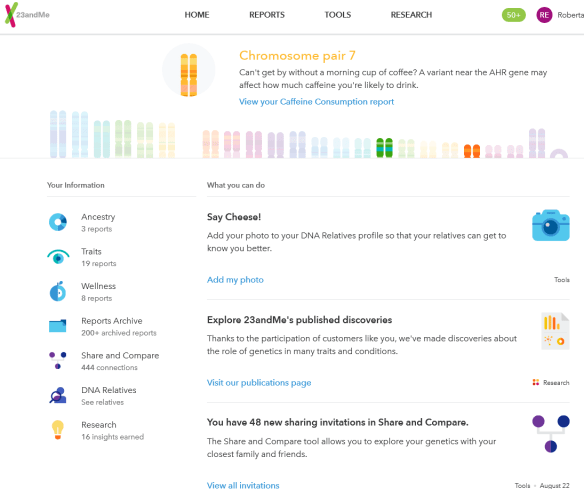
23andMe requires people to opt-in to sharing, even after they have selected to participate in Ancestry Services (genealogy) testing, have opted-in previously and chosen to view their DNA Relatives. Users on the “New Experience” can then either share chromosome data and results with each other individually, meaning on a one by one basis, or globally by a one-time opt-in to “open sharing” with matches. If a user does not opt-in to both DNA Relatives and open sharing, sharing requests must be made individually to each match, and they must opt-in to share with each individual user. This complexity and confusion results in an approximate sharing rate of between 50 and 60%. One individual who religiously works their matches by requesting sharing now has a share rate of about 80% of their matches in the data base who HAVE initially selected to participate in DNA Relatives. You can read more about the 23andMe experience at this link.

Various genetic genealogy reports and tools are scattered between the Reports and Tools tabs, and within those, buried in non-intuitive locations. If you are going to utilize 23andMe for matching and genealogy, in addition to the above link, I recommend Kitty Cooper’s blogs about the new DNA Relatives here and on triangulation here. Print the articles, and use them as a guide while navigating the 23andMe site.

Note that some screens (the Tools, DNA Relatives, then DNA tab) on the site do not display/work correctly utilizing Internet Explorer, but do with Edge or other browsers.

The one genealogy feature unique to 23andMe is:

  • Triangulation at 23andMe allows you to select a specific match to compare your DNA against. Several pieces of information will be displayed, the last of which, scrolling to the bottom, is a list of your common relatives with the person you selected.

In the example below, I’ve selected to see the matches I match in common with known family member, Stacy Den (surnames have been obscured for privacy reasons.)  Please note that the Roberta V4 Estes kit is a second test that I took for comparison purposes when the new V4 version of 23andMe was released.  Just ignore that match, because, of course I match myself as a twin.

If an individual does not match both you and your selected match, they will not appear on this list.

In the “relatives in common” section, each person is listed with a “shared DNA” column. For a person to be shown on this “in common” list, you obviously do share DNA with these individuals and they also share with your match, but the “shared DNA” column goes one step further. This column indicates whether or not you and your match both share a common DNA segment with the “in common” person.

I know this is confusing, so I’ve created this chart to illustrate what will appear in the “Shared DNA” column of the individuals showing on the list of matches, above, shared between me and Stacy Den.

Clicking on “Share to see” sends Sarah a sharing request for her to allow you to see her segment matches.

Let’s look at an example with “yes” in the Shared DNA column.

Clicking on the “Yes” in the Shared DNA column of Debbie takes us to the chromosome browser which shows both your selected match, Stacy in my case, and Debbie, the person whose “yes” you clicked.

All three people, meaning me, Stacy and Debbie share a common DNA segment, shown below on chromosome 17.

What 23andMe does NOT say is that these people. Stacy and Debbie, also match each other, in addition to matching me, which means all three of us triangulate.

Because I manage Stacy’s kit at 23andMe, I can check to see if Debbie is on Stacy’s match list, and indeed, Debbie is on Stacy’s match list and Stacy does match both Debbie and me on chromosome 17 in exactly the same location shown above, proving unquestionably that the three of us all match each other and therefore triangulate on this segment. In our case, it’s easy to identify our common relative whose DNA all 3 of us share.

Genealogy – Autosomal Summary

While all 3 vendors offer matching, their interfaces and tools vary widely.

I would suggest that Ancestry is the least sophisticated and has worked hard to make their tools easy for the novice working with genetic genealogy. Their green leaf DNA+Tree Matching is their best feature, easy to use and important for the novice and experienced genealogist alike.  Now, if they just had that chromosome browser so we could see how we match those people.

Ancestry’s Circles, while a nice feature, encourage testers to believe that their DNA or relationship is confirmed by finding themselves in a Circle, which is not the case.

Circles can be formed as the result of misinformation in numerous trees. For example, if I were to inaccurately list Smith as the surname for one of my ancestor’s wives, I would find myself in a Circle for Barbara Smith, when in fact, there is absolutely no evidence whatsoever that her surname is Smith. Yet, people think that Barbara Smith is confirmed due to a Circle having been formed and finding themselves in Barbara Smith’s Circle. Copying incorrect trees equals the formation of incorrect Circles.

It’s also possible that I’m matching people on multiple lines and my DNA match to the people in any given Circle is through another common ancestor entirely.

A serious genealogist will test minimally at Ancestry and at Family Tree DNA, who provides a chromosome browser and other tools necessary to confirm relationships and shared DNA segments.

Family Tree DNA is more sophisticated, so consequently more complex to use.  They provide matching plus numerous other tools. The website and matching is certainly friendly for the novice, but to benefit fully, some experience or additional education is beneficial, not unlike traditional genealogy research itself. This is true not just for Family Tree DNA, but GedMatch and 23andMe who all three utilize chromosome browsers.

The user will want to understand what a chromosome browser is indicating about matching DNA segments, so some level of education makes life a lot easier. Fortunately, understanding chromosome browser matching is not complex. You can read an article about Match Groups and Triangulation here. I also have an entire series of Concepts articles, Family Tree DNA offers a webinar library, their Learning Center and other educational resources are available as well.

Family Tree DNA is the only vendor to provide Phased Family Matches, meaning that by connecting known relatives who have DNA tested to your tree, Family Tree DNA can then identify additional matches as maternal, paternal or both. This, in combination with pseudo-phasing are very powerful matching tools.

23andMe is the least friendly of the three companies, with several genetic genealogy unfriendly restrictions relative to matching, opt-ins, match limits and such. They have experienced problem after problem for years relative to genetic genealogy, which has always been a second-class citizen compared to their medical research, and not a priority.

23andMe has chosen to implement a business model where their customers must opt-in to share segment information with other individuals, either one by one or by opting into open sharing. Based on my match list, roughly 60% of my actual DNA matches have opted in to sharing.

Their customer base includes fewer serious genealogists and their customers often are not interested in genealogy at all.

Having said that, 23andMe is the only one of the three that provides actual triangulated matches for users on the New Experience and who have opted into sharing.

If I were entering the genetic genealogy testing space today, I would test my autosomal DNA at Ancestry and at Family Tree DNA, but I would probably not test at 23andMe. I would test both my Y DNA (if a male) and mitochondrial at Family Tree DNA.

Thank you to Kitty Cooper for assistance with parent/child matching and triangulation at 23andMe.

Genealogy Autosomal Vendor Feature Summary Chart

Family Tree DNA Ancestry 23andMe
Matching Yes Yes Yes – each person has to opt in for open sharing or authorize sharing individually, many don’t
Estimated Relationships Yes Yes Yes
Chromosome Browser Yes No – Large Issue Yes
Chromosome Browser Threshold Adjustment Yes No Chromosome Browser No
X Chromosome Matching Yes No Yes
Trees Yes Yes – subscription required so see matches’ trees No
Ability to upload Gedcom file Yes Yes No
Ability to search trees Yes Yes No
Subscription in addition to DNA test price No No for partial, Yes for full functionality, minimal subscription for $49 by calling Ancestry No
DNA + Ancestor in Tree Matches No Yes – Leaf Hints – subscription required – Best Feature No
Phased Parental Side Matching Yes – Best Feature No No
Parent Match Indicator Yes No Yes
Sort or Group by Parent Match Yes Yes Yes
In Common With Tool Yes Yes Yes
Not In Common With Tool Yes No No
Triangulated Matches No – pseudo with ICW, browser and matrix No Yes – Best Feature
Common Surnames Yes Yes – subscription required No
Ability to Link DNA Matches on Tree Yes No No
Matrix to show match grid between multiple matches Yes No No
Match Filter Tools Yes Minimal Some
Advanced Matching Tool Yes No No
Multiple Test Matching Tool Yes No multiple tests No multiple tests
Ethnicity Matching Yes No Yes
Projects Yes No No
Maximum # of Matches Restricted No No Yes – 2000 unless you are communicating with the individuals, then they are not removed from your match list
All Customers Participate Yes Yes, unless they don’t have a subscription No – between 50-60% opt-in
Accepts Transfers from Other Testing Companies Yes No No
Free Features with Transfer Matching, ICW, Matrix, Advanced Matching No transfers No transfers
Transfer Features Requiring Unlock $ Chromosome Browser, Ethnicity, Ancient Origins, Linked Relationships, Parentally Phased Matches No Transfers No transfers
Archives DNA for Later Testing Yes, 25 years No, no additional tests available No, no additional tests available
Additional Tool DNA Circles – subscription required
Additional Tool New Ancestor Discoveries – subscription required
Y DNA Not included in autosomal test but is additional test, detailed results including matching No Haplogroup only
Mitochondrial DNA Not included in autosomal test but is additional test, detailed results including matching No Haplogroup only
Advanced Testing Available Yes No No
Website Intuitive Yes, given their many tools Yes, very simple No
Data Base Size Large Largest Large but many do not test for genealogy, only test for health
Strengths Many tools, multiple types of tests, phased matching without parent DNA + Tree matching, size of data base Triangulation
Challenges Website episodically times out No chromosome browser or advanced tools Sharing is difficult to understand and many don’t, website is far from intuitive


Genealogy – Y and Mitochondrial DNA

Two indispensable tools for genetic genealogy that are often overlooked are Y and mitochondrial DNA.

The inheritance path for Y DNA is shown by the blue squares and the inheritance path for mitochondrial DNA is shown by the red circles for the male and female siblings shown at the bottom of the chart.

Y-DNA Testing for Males

Y DNA is inherited by males only, from their father. The Y chromosome makes males male. Women instead inherit an X chromosome from their father, which makes them female. Because the Y chromosome is not admixed with the DNA of the mother, the same Y chromosome has been passed down through time immemorial.

Given that the Y chromosome follows the typical surname path, Y DNA testing is very useful for confirming surname lineage to an expected direct paternal ancestor. In other words, an Estes male today should match, with perhaps a few mutations, to other descendants of Abraham Estes who was born in 1647 in Kent, England and immigrated to the colony of Virginia.

Furthermore, that same Y chromosome can look far back in time, thousands of years, to tell us where that English group of Estes men originated, before the advent of surnames and before the migration to England from continental Europe. I wrote about the Estes Y DNA here, so you can see an example of how Y DNA testing can be used.

Y DNA testing for matching and haplogroup identification, which indicates where in the world your ancestors were living within the past few hundred to few thousand years, is only available from Family Tree DNA. Testing can be purchased for either 37, 67 or 111 markers, with the higher marker numbers providing more granularity and specificity in matching.

Family Tree DNA provides three types of Y DNA tests.

  • STR (short tandem repeat) testing is the traditional Y DNA testing for males to match to each other in a genealogically relevant timeframe. These tests can be ordered in panels of 37, 67 or 111 markers and lower levels can be upgraded to higher levels at a later date. An accurate base haplogroup prediction is made from STR markers.
  • SNP (single nucleotide polymorphism) testing is a different type of testing that tests single locations for mutations in order to confirm and further refine haplogroups. Think of a haplogroup as a type of genetic clan, meaning that haplogroups are used to track migration of humans through time and geography, and are what is utilized to determine African, European, Asian or Native heritage in the direct paternal line. SNP tests are optional and can be ordered one at a time, in groups called panels for a particular haplogroup or a comprehensive research level Y DNA test called the Big Y can be ordered after STR testing.
  • The Big Y test is a research level test that scans the entire Y chromosome to determine the most refined haplogroup possible and to report any previously unknown mutations (SNPs) that may define further branches of the Y DNA tree. This is the technique used to expand the Y haplotree.

You can read more about haplogroups here and about the difference between STR markers and SNPs here, here and here.

Customers receive the following features and tools when they purchase a Y DNA test at Family Tree DNA or the Ancestry Services test at 23andMe. The 23andMe Y DNA information is included in their Ancestry Services test. The Family Tree DNA Y DNA information requires specific tests and is not included in the Family Finder test. You can click here to read about the difference in the technology between Y DNA testing at Family Tree DNA and at 23andMe. Ancestry is not included in this comparison because they provide no Y DNA related information.

Y DNA Vendor Feature Summary Chart

Family Tree DNA 23andMe
Varying levels of STR panel marker testing Yes, in panels of 37, 67 and 111 markers No
Test panel (STR) marker results Yes Not tested
Haplogroup assignment Yes – accurate estimate with STR panels, deeper testing available Yes –base haplogroup by scan – haplogroup designations are significantly out of date, no further testing available
SNP testing to further define haplogroup Yes – can purchase individual SNPs, by SNP panels or Big Y test No
Matching to other participants Yes No
Trees available for your matches Yes No
E-mail of matches provided Yes No
Calculator tool to estimate probability of generational distance between you and a match Yes No
Earliest known ancestor information Yes No
Projects Surname, haplogroup and geographic projects No
Ability to search Y matches Yes No Y matching
Ability to search matches within projects Yes No projects
Ability to search matches by partial surname Yes No
Haplotree and customer result location on tree Yes, detailed with every branch Yes, less detailed, subset
Terminal SNP used to determine haplogroup Yes Yes, small subset available
Haplogroup Map Migration map Heat map
Ancestral Origins – summary by ancestral location of others you match, by test level Yes No
Haplogroup Origins – match ancestral location summary by haplogroup, by test level Yes No
SNP map showing worldwide locations of any selected SNP Yes No
Matches map showing mapped locations of your matches most distant ancestor in the paternal line, by test panel Yes No
Big Y – full scan of Y chromosome for known and previously unknown mutations (SNPs) Yes No
Big Y matching Yes No
Big Y matching known SNPs Yes No
Big Y matching novel variants (unknown or yet unnamed SNPs) Yes No
Filter Big Y matches Yes No
Big Y results Yes No
Advanced matching for multiple test types Yes No
DNA is archived so additional tests or upgrades can be ordered at a later date Yes, 25 years No

Mitochondrial DNA Testing for Everyone

Mitochondrial DNA is contributed to both genders of children by mothers, but only the females pass it on. Like the Y chromosome, mitochondrial DNA is not admixed with the DNA of the other parent. Therefore, anyone can test for the mitochondrial DNA of their matrilineal line, meaning their mother’s mother’s mother’s lineage.

Matching can identify family lines as well as ancient lineage.

You receive the following features and tools when you purchase a mitochondrial DNA test from Family Tree DNA or the Ancestry Services test from 23andMe. The Family Tree DNA mitochondrial DNA information requires specific tests and is not included in the Family Finder test. The 23andMe mitochondrial information is provided with the Ancestry Services test. Ancestry is omitted from this comparison because they do not provide any mitochondrial information.

Mitochondrial DNA Vendor Feature Summary Chart

Family Tree DNA 23andMe
Varying levels of testing Yes, mtPlus and Full Sequence No
Test panel marker results Yes, in two formats, CRS and RSRS No
Rare mutations, missing and extra mutations, insertions and deletions reported Yes No
Haplogroup assignment Yes, most current version, Build 17 Yes, partial and out of date version
Matching to other participants Yes No
Trees of matches available to view Yes No
E-mail address provided to matches Yes No
Earliest known ancestor information Yes No
Projects Surname, haplogroup and geographic available No
Ability to search matches Yes No
Ability to search matches within project Yes No projects
Ability to search match by partial surname Yes No
Haplotree and customer location on tree No Yes
Mutations used to determine haplogroup provided Yes No
Haplogroup Map Migration map Heat map
Ancestral Origins – summary by ancestral location of others you match, by test level Yes No
Haplogroup Origins –match ancestral location summary by haplogroup Yes No
Matches map showing mapped locations of your matches most distant ancestor in the maternal line, by test level Yes No
Advanced matching for multiple test types Yes No
DNA is archived so additional tests or upgrades can be ordered at a later date Yes, 25 years No


Overall Genealogy Summary

Serious genealogists should test with at least two of the three major vendors, being Family Tree DNA and Ancestry, with 23andMe coming in as a distant third.

No genetic genealogy testing regimen is complete without Y and mitochondrial DNA for as many ancestral lines as you can find to test. You don’t know what you don’t know, and you’ll never know if you don’t test.

Unfortunately, many people, especially new testers, don’t know Y and mitochondrial DNA testing for genetic genealogy exists, or how it can help their genealogy research, which is extremely ironic since these were the first tests available, back in 2000.

You can read about finding Y and mitochondrial information for various family lines and ancestors and how to assemble a DNA Pedigree Chart here.

You can also take a look at my 52 Ancestors series, where I write about an ancestor every week. Each article includes some aspect of DNA testing and knowledge gained by a test or tests, DNA tool, or comparison. The DNA aspect of these articles focuses on how to use DNA as a tool to discover more about your ancestors.

Testing for Medical/Health or Traits

The DTC market also includes health and medical testing, although it’s not nearly as popular as genetic genealogy.

Health/medical testing is offered by 23andMe, who also offers autosomal DNA testing for genealogy.

Some people do want to know if they have genetic predispositions to medical conditions, and some do not. Some want to know if they have certain traits that aren’t genealogically relevant, but might be interesting – such as whether they carry the Warrior gene or if they have an alcohol flush reaction.

23andMe was the first company to dip their toes into the water of Direct to Consumer medical information, although they called it “health,” not medicine, at that time. Regardless of the terminology, information regarding Parkinson’s and Alzheimer’s, for example, were provided for customers. 23andMe attempted to take the raw data and provide the consumer with something approaching a middle of the road analysis, because sometimes the actual studies provide conflicting information that might not be readily understood by consumers.

The FDA took issue with 23andMe back in November of 2013 when they ordered 23andMe to discontinue the “health” aspect of their testing after 23andMe ignored several deadlines. In October 2015, 23andMe obtained permission to provide customers with some information, such as carrier status, for 36 genetic disorders.

Since that time, 23andMe has divided their product into two separate tests, with two separate prices. The genealogy only test called Ancestry Service can be purchased separately for $99, or the combined Health + Ancestry Service for $199.

If you are interested in seeing what the Health + Ancestry test provides, you can click here to view additional information.

However, there is a much easier and less expensive solution.

If you have taken the autosomal test from 23andMe, Ancestry or Family Tree DNA, you can download your raw data file from the vendor and upload to Promethease to obtain a much more in-depth report than is provided by 23andMe, and much less expensively – just $5.

I reviewed the Promethease service here. I found the Promethease reports to be very informative and I like the fact that they provide information, both positive and negative for each SNP (DNA location) reported. Promethease avoids FDA problems by not providing any interpretation or analysis, simply the data and references extracted from SNPedia for you to review.

I would be remiss if I didn’t mention that you should be sure you really want to know before you delve into medical testing. Some mutations are simply indications that you could develop a condition that you will never develop or that is not serious. Other mutations are not so benign. Promethease provides this candid page before you upload your data.

Different files from different vendors provide different results at Promethease, because those vendors test different SNP locations in your DNA. At the Promethease webpage, you can view examples.

Traits

Traits fall someplace between genealogy and health. When you take the Health + Ancestry test at 23andMe, you do receive information about various traits, as follows:

Of course, you’ll probably already know if you have several of these traits by just taking a look in the mirror, or in the case of male back hair, by asking your wife.

At Family Tree DNA, existing customers can order tests for Factoids (by clicking on the upgrade button), noted as curiosity tests for gene variants.

Family Tree DNA provides what I feel is a great summary and explanation of what the Factoids are testing on their order page:

“Factoids” are based on studies – some of which may be controversial – and results are not intended to diagnose disease or medical conditions, and do not serve the purpose of medical advice. They are offered exclusively for curiosity purposes, i.e. to see how your result compared with what the scientific papers say. Other genetic and environmental variables may also impact these same physiological characteristics. They are merely a conversational piece, or a “cocktail party” test, as we like to call it.”

Test Price Description
Alcohol Flush Reaction $19 A condition in which the body cannot break down ingested alcohol completely. Flushing, after consuming one or two alcoholic beverages, includes a range of symptoms: nausea, headaches, light-headedness, an increased pulse, occasional extreme drowsiness, and occasional skin swelling and itchiness. These unpleasant side effects often prevent further drinking that may lead to further inebriation, but the symptoms can lead to mistaken assumption that the people affected are more easily inebriated than others.
Avoidance of Errors $29 We are often angry at ourselves because we are unable to learn from certain experiences. Numerous times we have made the wrong decision and its consequences were unfavorable. But the cause does not lie only in our thinking. A mutation in a specific gene can also be responsible, because it can cause a smaller number of dopamine receptors. They are responsible for remembering our wrong choices, which in turn enables us to make better decisions when we encounter a similar situation.
Back Pain $39 Lumbar disc disease is the drying out of the spongy interior matrix of an intervertebral disc in the spine. Many physicians and patients use the term lumbar disc disease to encompass several different causes of back pain or sciatica. A study of Asian patients with lumbar disc disease showed that a mutation in the CILP gene increases the risk of back pain.
Bitter Taste Perception $29 There are several genes that are responsible for bitter taste perception – we test 3 of them. Different variations of this gene affect ability to detect bitter compounds. About 25% of people lack ability to detect these compounds due to gene mutations. Are you like them? Maybe you don’t like broccoli, because it tastes too bitter?
Caffeine Metabolism $19 According to the results of a case-control study reported in the March 8, 2006 issue of JAMA, coffee is the most widely consumed stimulant in the world, and caffeine consumption has been associated with increased risk for non-fatal myocardial infarction. Caffeine is primarily metabolized by the cytochrome P450 1A2 in the liver, accounting for 95% of metabolism. Carriers of the gene variant *1F allele are slow caffeine metabolizers, whereas individuals homozygous for the *1A/*1A genotype are rapid caffeine metabolizers.
Earwax Type $19 Whether your earwax is wet or dry is determined by a mutation in a single gene, which scientists have discovered. Wet earwax is believed to have uses in insect trapping, self-cleaning and prevention of dryness in the external auditory canal of the ear. It also produces an odor and causes sweating, which may play a role as a pheromone.
Freckling $19 Freckles can be found on anyone no matter what the background. However, having freckles is genetic and is related to the presence of the dominant melanocortin-1 receptor MC1R gene variant.
Longevity $49 Researchers at Harvard Medical School and UC Davis have discovered a few genes that extend lifespan, suggesting that the whole family of SIR2 genes is involved in controlling lifespan. The findings were reported July 28, 2005 in the advance online edition of Science.
Male Pattern Baldness $19 Researchers at McGill University, King’s College London and GlaxoSmithKline Inc. have identified two genetic variants in Caucasians that together produce an astounding sevenfold increase of the risk of male pattern baldness. Their results were published in the October 12, 2008 issue of the Journal of Nature Genetics.
Monoamine Oxidase A (Warrior Gene) $49.50 The Warrior Gene is a variant of the gene MAO-A on the X chromosome. Recent studies have linked the Warrior Gene to increased risk-taking and aggressive behavior. Whether in sports, business, or other activities, scientists found that individuals with the Warrior Gene variant were more likely to be combative than those with the normal MAO-A gene. However, human behavior is complex and influenced by many factors, including genetics and our environment. Individuals with the Warrior Gene are not necessarily more aggressive, but according to scientific studies, are more likely to be aggressive than those without the Warrior Gene variant. This test is available for both men and women, however, there is limited research about the Warrior Gene variant amongst females. Additional details about the Warrior Gene genetic variant of MAO-A can be found in Sabol et al, 1998.
Muscle Performance $29 A team of researchers, led by scientists at Dartmouth Medical School and Dartmouth College, have identified and tested a gene that dramatically alters both muscle metabolism and performance. The researchers say that this finding could someday lead to treatment of muscle diseases, including helping the elderly who suffer from muscle deterioration and improving muscle performance in endurance athletes.
Nicotine Dependence $19 In 2008, University of Virginia Health System researchers have identified a gene associated with nicotine dependence in both Europeans and African Americans.

Many people are interested in the Warrior Gene, which I wrote about here.

At Promethease, traits are simply included with the rest of the conditions known to be associated with certain SNPs, such as baldness, for example, but I haven’t done a comparison to see which traits are included.


Additional Vendor Information to Consider

Before making your final decision about which test or tests to purchase, there are a few additional factors you may want to consider.

As mentioned before, Ancestry requires a subscription in addition to the cost of the DNA test for the DNA test to be fully functional.

One of the biggest issues, in my opinion, is that both 23andMe and Ancestry sell customer’s anonymized DNA information to unknown others. Every customer authorizes the sale of their information when they purchase or activate a kit – even though very few people actually take the time to read the Terms and Conditions, Privacy statements and Security documents, including any and all links. This means most people don’t realize they are authorizing the sale of their DNA.

At both 23andMe and Ancestry, you can ALSO opt in for additional non-anonymized research or sale of your DNA, which you can later opt out of. However, you cannot opt out of the lower level sale of your anonymized DNA without removing your results from the data base and asking for your sample to be destroyed. They do tell you this, but it’s very buried in the fine print at both companies. You can read more here.

Family Tree DNA does not sell your DNA or information.

All vendors can change their terms and conditions at any time. Consumers should always thoroughly read the terms and conditions including anything having to do with privacy for any product they purchase, but especially as it relates to DNA testing.

Family Tree DNA archives your DNA for later testing, which has proven extremely beneficial when a family member has passed away and a new test is subsequently introduced or the family wants to upgrade a current test.  Had my mother’s DNA not been archived at Family Tree DNA, I would not have Family Finder results for her today – something I thank Mother and Family Tree DNA for every single day.

Family Tree DNA also accepts transfer files from 23andMe, Ancestry and very shortly, MyHeritage – although some versions work better than others. For details on which companies accept which file versions, from which vendors, and why, please read Autosomal DNA Transfers – Which Companies Accept Which Tests?

If you tested on a compatible version of the 23andMe Test (V3 between December 2010 and November 2013) or the Ancestry V1 (before May 2016) you may want to transfer your raw data file to Family Tree DNA for free and pay only $19 for full functionality, as opposed to taking the Family Finder test. Family Tree DNA does accept later versions of files from 23andMe and Ancestry, but you will receive more matches if you test on the same chip platform that Family Tree DNA utilizes instead of doing a transfer.

Additional Vendor Considerations Summary Chart

Family Tree DNA Ancestry 23andMe
Subscription required in addition to cost of DNA test No Yes for full functionality, partial functionality is included without subscription, minimum subscription is $49 by calling Ancestry No
Customer Support Good and available Available, nice but often not knowledgeable about DNA Poor
Sells customer DNA information No Yes Yes
DNA raw data file available to download Yes Yes Yes
DNA matches file available to download including match info and chromosome match locations Yes No Yes
Customers genealogically focused Yes Yes Many No
Accepts DNA raw data transfer files from other companies Yes, most, see article for specifics No No
DNA archived for later testing Yes, 25 years No No
Beneficiary provision available Yes No No


Which Test is Best For You?

I hope you now know the answer as to which DNA test is best for you – or maybe it’s multiple tests for you and other family members too!

DNA testing holds so much promise for genealogy. I hesitate to call DNA testing a miracle tool, but it often is when there are no records. DNA testing works best in conjunction with traditional genealogical research.

There are a lot of tests and options.  The more tests you take, the more people you match. Some people test at multiple vendors or upload their DNA to third party sites like GedMatch, but most don’t. In order to make sure you reach those matches, which may be the match you desperately need, you’ll have to test at the vendor where they tested. Otherwise, they are lost to you. That means, of course, that eventually, if you’re a serious genealogist, you’ll be testing at all 3 vendors.  Don’t forget about Y and mitochondrial tests at Family Tree DNA.

Recruit family members to test and reach out to your matches.  The more you share and learn – the more is revealed about your ancestors. You are, after all, the unique individual that resulted from the combination of all of them!

Update: Vendor prices updated June 22, 2017.

______________________________________________________________

Disclosure

I receive a small contribution when you click on some of the links to vendors in my articles. This does NOT increase the price you pay but helps me to keep the lights on and this informational blog free for everyone. Please click on the links in the articles or to the vendors below if you are purchasing products or DNA testing.

Thank you so much.

DNA Purchases and Free Transfers

Genealogy Services

Genealogy Research

Autosomal DNA Transfers – Which Companies Accept Which Tests?

Somehow, I missed the announcement that Family Tree DNA now accepts uploads from MyHeritage.

Other people may have missed a few announcements too, or don’t understand the options, so I’ve created a quick and easy reference that shows which testing vendors’ files can be uploaded to which other vendors.

Why Transfer?

Just so that everyone is on the same page, if you test your autosomal DNA at one vendor, Vendor A, some other vendors allow you to download your raw data file from Vendor A and transfer your results to their company, Vendor B.  The transfer to Vendor B is either free or lower cost than testing from scratch.  One site, GedMatch, is not a testing vendor, but is a contribution/subscription comparison site.

Vendor B then processes your DNA file that you imported from Vendor A, and your results are then included in the database of Vendor B, which means that you can obtain your matches to other people in Vendor B’s data base who tested there originally and others who have also transferred.  You can also avail yourself of any other tools that Vendor B provides to their customers.  Tools vary widely between companies.  For example, Family Tree DNA, GedMatch and 23andMe provide chromosome browsers, while Ancestry does not.  All 3 major vendors (Family Tree DNA, Ancestry and 23andMe) have developed unique offerings (of varying quality) to help their customers understand the messages that their unique DNA carries.

Ok, Who Loves Whom?

The vendors in the left column are the vendors performing the autosomal DNA tests. The vendor row (plus GedMatch) across the top indicates who accepts upload transfers from whom, and which file versions. Please consider the notes below the chart.

(Chart updated September 28, 2017)

Please note that on August 9, 2017, 23and Me began processing on the Illumina GSA chip which is not compatible with earlier versions.  As of late September 2017, only GedMatch accepts their upload and only in their Genesis sandbox area, not the normal production matching area.  This is due to the small overlap area with existing chips.  You can read more about the GSA chip and its ramifications here

  • Family Tree DNA accepts uploads from both other major vendors (Ancestry and 23andMe) but the versions that are compatible with the chip used by FTDNA will have more matches at Family Tree DNA. 23andMe V3, Ancestry V1 and MyHeritage results utilize the same chip and format as FTDNA. 23andMe V4 and Ancestry V2 utilize different formats utilizing only about half of the common locations. Family Tree DNA still allows free transfers and comparisons with other testers, but since there are only about half of the same DNA locations in common with the FTDNA chip, matches will be fewer. Additional functions can be unlocked for a one time $19 fee.
  • Neither Ancestry, 23andMe nor Genographic accept transfer data from any other vendors.
  • MyHeritage does accept transfers, although that option is not easy to find. I checked with a MyHeritage representative and they provided me with the following information:  “You can upload an autosomal DNA file from your profile page on MyHeritage. To access your profile page, login to your MyHeritage account, then click on your name which is displayed towards the top right corner of the screen. Click on “My profile”. On the profile page you’ll see a DNA tab, click on the tab and you’ll see a link to upload a file.”  MyHeritage has also indicated that they will be making ethnicity results available to individuals who transfer results into their system in May, 2017.
  • LivingDNA has just released an ethnicity product and does not have DNA matching capability to other testers.  Living DNA imputes DNA locations that they don’t test, but the initial download only includes the DNA locations actually tested.
  • WeGene’s website is in Chinese and they are not a significant player, but I did include them because GedMatch accepts their files. WeGene’s website indicates that they accept 23andme uploads, but I am unable to determine which version or versions. Given that their terms and conditions and privacy and security information are not in English, I would be extremely hesitant before engaging in business. I would not be comfortable in trusting on online translation for this type of document. SNPedia reports that WeGene has data quality issues.
  • GedMatch is not a testing vendor, so has no entry in the left column, but does provide tools and accepts all versions of files from each vendor that provides files, to date, with the exception of the Genographic Project.  GedMatch is free (contribution based) for many features, but does have more advanced functions available for a $10 monthly subscription. The GedMatch Genesis platform is a sandbox area for files from vendors that cannot be put into production today due to matching and compatibility issues.
  • The Genographic Project tested their participants at the Family Tree DNA lab until November 2016, when they moved to the Helix platform, which performs an exome test using a different chip.
  • The Ancestry V2 chip began processing in May 2016.
  • The 23andMe V3 chip began processing in December 2010. The 23andMe V4 chip began processing in November 2013. Their V5 chip August 9, 2017.

Incompatible Files

Please be aware that vendors that accept different versions of other vendors files can only work with the tested locations that are in the files generated by the testing vendors unless they use a technique called imputation.

For example, Family Tree DNA tests about 700,000 locations which are on the same chip as MyHeritage, 23andMe V3 and Ancestry V1. In the later 23andMe V4 test, the earlier 23andMe V2 and the Ancestry V2 tests, only a portion of the same locations are tested.  The 23andMe V4 and Ancestry V2 chips only test about half of the file locations of the vendors who utilize the Illumina OmniExpress chip, but not the same locations as each other since both the Ancestry V2 and 23andMe V4 chips are custom. 23andMe and Ancestry both changed their chips from the OmniExpress version and replaced genealogically relevant locations with medically relevant locations, creating a custom chip.

Update:  In August 2017, 23andMe introduced their V5 chip which has only about 20% overlap with previous chips.

I know this is confusing, so I’ve created the following chart for chip and test compatibility comparison.

(Chart updated Sept. 28, 2017)

You can easily see why the FTDNA, Ancestry V1, 23andMe V3 and MyHeritage tests are compatible with each other.  They all tested utilizing the same chip.  However, each vendor then applies their own unique matching and ethnicity algorithms to customer results, so your results will vary with each vendor, even when comparing ethnicity predictions or matching the same two individuals to each other.

Apples to Apples to Imputation

It’s difficult for vendors to compare apples to apples with non-compatible files.

I wrote about imputation in the article about MyHeritage, here and also more generally, here. In a nutshell, imputation is a technique used to infer the DNA for locations a vendor doesn’t test (or doesn’t receive in a transfer file from another vendor) based on the location’s neighboring DNA and DNA that is “normally” passed together as a packet.

However, the imputed regions of DNA are not your DNA, and therefore don’t carry your mutations, if any.

I created the following diagram when writing the MyHeritage article to explain the concept of imputation when comparing multiple vendors’ files showing locations tested, overlap and imputed regions. You can click to enlarge the graphic.

Family Tree DNA has chosen not to utilize imputation for transfer files and only compares the actual DNA locations tested and uploaded in vendor files, while MyHeritage has chosen to impute locations for incompatible files. Family Tree DNA produces fewer, but accurate matches for incompatible transfer files.  MyHeritage continues to have matching issues.

MyHeritage may be using imputation for all transfer files to equalize the files to a maximum location count for all vendor files. This is speculation on my part, but is speculation based on the differences in matches from known compatible file versions to known matches at the original vendor and then at MyHeritage.

I compared matches to the same person at MyHeritage, GedMatch, Ancestry and Family Tree DNA. It appears that imputed matches do not consistently compare reliably. I’m not convinced imputation can ever work reliably for genetic genealogy, because we need our own DNA and mutations. Regardless, imputation is in its infancy today and due to the Illumina GSA chip replacing the OmniExpress chip, imputation will be widely used within the industry shortly for backwards compatibility.

To date, two vendors are utilizing imputation. LivingDNA is using imputation with the GSA chip for ethnicity, and MyHeritage for DNA matching.

Summary

Your best results are going to be to test on the platform that the vendor offers, because the vendor’s match and ethnicity algorithms are optimized for their own file formats and DNA locations tested.

That means that if you are transferring an Ancestry V1 file, a 23andMe V3 file or a MyHeritage file, for example, to Family Tree DNA, your matches at Family Tree DNA will be the same as if you tested on the FTDNA platform.  You do not need to retest at Family Tree DNA.

However, if you are transferring an Ancestry V2 file or 23andMe V4 file, you will receive some matches, someplace between one quarter and half as compared to a test run on the vendor’s own chip. For people who can’t be tested again, that’s certainly better than nothing, and cross-chip matching generally picks up the strongest matches because they tend to match in multiple locations. For people who can retest, testing at Family Tree DNA would garner more matches and better ethnicity results for those with 23andMe V2 and V4 tests as well as Ancestry V2 tests.

For absolutely best results, swim in all of the major DNA testing pools, test as many relatives as possible, and test on the vendor’s Native chip to obtain the most matches.  After all, without sharing and matching, there is no genetic genealogy!

______________________________________________________________

Disclosure

I receive a small contribution when you click on some of the links to vendors in my articles. This does NOT increase the price you pay but helps me to keep the lights on and this informational blog free for everyone. Please click on the links in the articles or to the vendors below if you are purchasing products or DNA testing.

Thank you so much.

DNA Purchases and Free Transfers

Genealogy Services

Genealogy Research

MyHeritage – Broken Promises and Matching Issues

For additional information and updates to parts of this article, written three months later, please see MyHeritage Ethnicity Results. My concerns about imputed matching, discussed in this original article, remain unchanged, but MyHeritage has honored their original ethnicity report promises for uploaders.

As of July 2019, these issues have been resolved.

Original Article below:

My Heritage, now nine months into their DNA foray, so far has proven to be a disappointment. The problems are twofold.

  • MyHeritage has matching issues, combined with absolutely no tools to be able to work with results. Their product certainly doesn’t seem to be ready for prime time.
  • Worse yet, MyHeritage has reneged on a promise made to early uploaders that Ethnicity Reports would be free. MyHeritage used the DNA of the early uploaders to build their matching data base, then changed their mind about providing the promised free ethnicity reports.

In May 2016, MyHeritage began encouraging people to upload their DNA kits from other vendors, specifically those who tested at 23andMe, Ancestry and Family Tree DNA and announced that they would provide a free matching service.

Here is what MyHeritage said about ethnicity reports in that announcement:

myheritage-may-2016

Initially, I saw no matching benefit to uploading, since I’ve already tested at all 3 vendors and there were no additional possible matches, because everyone that uploaded to MyHeritage would also be in the vendor’s data bases where they had tested, not to mention avid genetic genealogists also upload to GedMatch.

Three months later, in September 2016, when MyHeritage actually began DNA matching, they said this about ethnicity testing:

myheritage-sept-2016

An “amazing ethnicity report” for free. Ok, I’m sold. I’ll upload so I’m in line for the “amazing ethnicity report.”

Matching Utilizing Imputation

MyHeritage started DNA matching in September, 2016 and frankly, they had a mess, some of which was sorted out by November when they started selling their own DNA tests, but much of which remains today.

MyHeritage facilitates matching between vendors who test on only a small number of overlapping autosomal locations by utilizing a process called imputation. In a nutshell, imputation is the process of an “educated guess” as to what your DNA would look like at locations where you haven’t tested. So, yes, MyHeritage fills in your blanks by estimating what your DNA would look like based on population models.

Here’s what MyHeritage says about imputation.

MyHeritage has created and refined the capability to read the DNA data files that you can export from all main vendors and bring them to the same common ground, a process that is called imputation. Thanks to this capability — which is accomplished with very high accuracy —MyHeritage can, for example, successfully match the DNA of an Ancestry customer (utilizing the recent version 2 chip) with the DNA of a 23andMe customer utilizing 23andMe’s current chip, which is their version 4. We can also match either one of them to any Family Tree DNA customer, or match any customers who have used earlier versions of those chips.

Needless to say, when you’re doing matching to other people – you’re looking for mutations that have occurred in the past few generations, which is after all, what defines genetic cousins. Adding in segments of generic DNA results found in populations is not only incorrect, because it’s not your DNA, it also produces erroneous matches, because it’s not your DNA. Additionally, it can’t report real genealogical mutations in those regions that do match, because it’s not your DNA.

Let’s look at a quick example. Let’s say you and another person are both from a common population, say, Caucasian European. Your values at locations 1-100 are imputed to be all As because you’re a member of the Caucasian European population. The next person, to whom you are NOT related, is also a Caucasian European. Because imputation is being used, their values in locations 1-100 are also imputed to be all As. Voila! A match. Except, it’s not real because it’s based on imputed data.

Selling Their Own DNA Tests

In November, MyHeritage announced that they are selling their own DNA tests and that they were “now out of beta” for DNA matching. The processing lab is Family Tree DNA, so they are testing the same markers, but MyHeritage is providing the analysis and matching. This means that the results you see, as a customer, have nothing in common with the results at Family Tree DNA. The only common factor is the processing lab for the raw DNA data.

Because MyHeritage is a subscription genealogy company that is not America-centric, they have the potential to appeal to testers in Europe that don’t subscribe to Ancestry and perhaps wouldn’t consider DNA testing at all if it wasn’t tied to the company they research through.

Clearly, without the autosomal DNA files of people who uploaded from May to November 2016, MyHeritage would have had no data base to compare their own tests to. Without a matching data base, DNA testing is pointless and useless.

In essence, those of us who uploaded our data files allowed MyHeritage to use our files to build their data base, so they could profitably sell kits with something to compare results to – in exchange for that promised “amazing ethnicity report.” At that time, there was no other draw for uploaders.

We didn’t know, before November, when MyHeritage began selling their own tests, that there would ever be any possibility of matching someone who had not tested at the Big 3. So for early uploaders, the draw wasn’t matching, because that could clearly be done elsewhere, without imputation. The draw was that “amazing ethnicity report” for free.

No Free Ethnicity Reports

In November, when MyHeritage announced that they were selling their own kits, they appeared to be backpedaling on the free ethnicity report for early uploaders and said the following:

myheritage-nov-2016

Sure enough, today, even for early uploaders who were promised the ethnicity report for free, in order to receive ethnicity estimates, you must purchase a new test. And by the way, I’m a MyHeritage subscriber to the tune of $99.94 in 2016 for a Premium Plus Membership, so it’s not like they aren’t getting anything from me. Irrespective of that, a promise is a promise.

Bait and Renege

When MyHeritage needed our kits to build their data base, they were very accommodating and promised an “amazing ethnicity report” for free. When they actually produced the ethnicity report as part of their product offering, they are requiring those same people whose kits they used to build their data base to purchase a brand new test, from them, for $79.

Frankly, this is unconscionable. It’s not only unethical, their change of direction takes advantage of the good will of the genetic genealogy community. Given that MyHeritage committed to ethnicity reports for transfers, they need to live up to that promise. I guarantee you, had I known the truth, I would never have uploaded my DNA results to allow them to build their data base only to have them rescind that promise after they built that data base. I feel like I’ve been fleeced.

As a basis of comparison, Family Tree DNA, who does NOT make anything off of subscriptions, only charges $19 to unlock ethnicity results for transfers, along with all of their other tools like a chromosome browser which MyHeritage also doesn’t currently have.

Ok, so let’s try to find the silk purse in this sows ear.

So, How’s the Imputed Matching?

I uploaded my Family Tree DNA autosomal file with about 700,000 SNP locations to MyHeritage.

Today, I have a total of 34 matches at MyHeritage, compared to around 2,200 at Family Tree DNA, 1,700 at 23andMe (not all of which share), and thousands at Ancestry. And no, 34 is not a typo. I had 28 matches in December, so matches are being gained at the rate of 3 per month. The MyHeritage data base size is still clearly very small.

MyHeritage has no tree matching and no tools like a chromosome browser today, so I can’t compare actual DNA segments at MyHeritage. There are promises that these types of tools are coming, but based on their track record of promises so far, I wouldn’t hold my breath.

However, I did recognize that my second closest match at MyHeritage is also a match at Ancestry.

My match tested at Ancestry, with about 382,000 common SNPs with a Family Tree DNA test, so MyHeritage would be imputing at least 300,000 SNPs for me – the SNPs that Ancestry tests and Family Tree DNA doesn’t, almost half of the SNPs needed to match to Ancestry files. MyHeritage has to be imputing about that many for my match’s file too, so that we have an equal number of SNPs for comparison. Combined, this would mean that my match and I are comparing 382,000 actual common SNPs that we both tested, and roughly 600,000 SNPs that we did not test and were imputed.

Here’s a rough diagram of how imputation between a Family Tree DNA file and an Ancestry V2 file would work to compare all of the locations in both files to each other.

myheritage-imputation

Please note that for purposes of concept illustration, I have shown all of the common locations, in blue, as contiguous. The common locations are not contiguous, but are scattered across the entire range that each vendor tests.

You can see that the number of imputed locations for matching between two people, shown in tan, is larger than the number of actual matching locations shown in blue. The amount of actual common data being compared is roughly 382,000 of 1,100,000 total locations, or 35%.

Let’s see how the actual matches compare.

2016-myheritage-second-match

Here’s the match at MyHeritage, above, and the same match at Ancestry, below.

2016-myheritage-at-ancestry

In the chart below, you can see the same information at both companies.

myheritage-ancestry

Clearly, there’s a significant difference in these results between the same two people at Ancestry and at MyHeritage. Ancestry shows only 13% of the total shared DNA that MyHeritage shows, and only 1 segment as compared to 7.

While I think Ancestry’s Timber strips out too much DNA, there is clearly a HUGE difference in the reported results. I suspect the majority of this issue likely lies with MyHeritage’s imputated DNA data and matching routines.

Regardless of why, and the “why” could be a combination of factors, the matching is not consistent and quite “off.”

Actual match names are used at MyHertiage (unless the user chooses a different display name), and with the exception of MyHeritage’s maddening usage of female married names, it’s easy to search at Family Tree DNA for the same person in your match list. I found three, who, as luck would have it, had also uploaded to GedMatch. Additionally, I also found two at Ancestry. Unfortunately, MyHeritage does not have any download capability, so this is an entirely manual process. Since I only have 34 matches, it’s not overwhelming today.

myheritage-multiple-vendors

*We don’t know the matching thresholds at MyHeritage. My smallest cM match at MyHeritage is 12.4 cM. At the other vendors, I have matches equivalent to the actual matching threshold, so I’m guessing that the MyHeritage threshold is someplace near that 12.4. Smaller matches are more plentiful, so I would not expect that it would be under 12cM. Unfortunately, MyHeritage has not provided us with this information.  Nor do we know how MyHeritage is counting their total cM, but I suspect it’s total cM over their matching threshold.

For comparison, at Family Tree DNA, I used the chromosome browser default of 5cM and 5cM at GedMatch. This means that if we could truly equalize the matching at 5cM, the MyHeritage totals and number of matching segments might well be higher. Using a 10cM threshold, Family Tree DNA loses Match 3 altogether and GedMatch loses one of the two Match 2 segments.

**I could not find a match for Match 1 at Ancestry, even though based on their kit type uploaded to GedMatch, it’s clear that they tested at Ancestry. Ancestry users often don’t use their name, just their user ID, which may not be readily discernable as their name. It’s also possible that Match 1 is not a match to me at Ancestry.

Summary

Any new vendor is going to have birthing pains. Genetic genealogists who have been around the block a couple of times will give the vendors a lot of space to self-correct, fix bugs, etc.

In the case of MyHeritage, I think their choice to use imputation is hindering accurate matching. Social media is reporting additional matching issues that I have not covered here.

I do understand why MyHeritage chose to utilize imputation as opposed to just matching the subset of common DNA for any two matches from disparate vendors. MyHeritage wanted to be able to provide more matches than just that overlapping subset of data would provide. When matching only half of the DNA, because the vendors don’t test the same locations, you’ll likely only have half the matches. Family Tree DNA now imports both the 23andMe V4 file and the Ancestry V2 file, who test just over half the same locations at Family Tree DNA, and Family Tree DNA provides transfer customers with their closest matches. For more distant or speculative matches, you need to test on the same platform.

However, if MyHeritage provides inaccurate matches due to imputation, that’s the worst possible scenario for everyone and could prove especially detrimental to the adoptee/parent search community.

Companies bear the responsibility to do beta testing in house before releasing a product. Once MyHeritage announced they were out of beta testing, the matching results should be reliable.  The genetic genealogy community should not be debugging MyHeritage matching on Facebook.  Minimally, testers should be informed that their results and matches should still be considered beta and they are part of an experiment. This isn’t a new feature to an existing product, it’s THE product.

I hope MyHeritage rethinks their approach. In the case of matching actual DNA to determine genealogical genetic relationships, quality is far, far more important than quantity. We absolutely must have accuracy. Triangulation and identifying common ancestors based on common matching segments requires that those matching segments be OUR OWN DNA, and the matches be accurate.

I view the matching issues as technical issues that (still) need to be resolved and have been complicated by the introduction of imputation.  However, the broken promise relative to ethnicity reports falls into another category entirely – that of willful deception – a choice, not a mistake or birthing pains. While I’m relatively tolerant of what I perceive to be (hopefully) transient matching issues, I’m not at all tolerant of being lied to, especially not with the intention of exploiting my DNA.

Relative to the “amazing ethnicity reports”, breaking promises, meaning bait and switch or simply bait and renege in this case, is completely unacceptable. This lapse of moral judgement will color the community’s perception of MyHeritage. Taking unfair advantage of people is never a good idea. Under these circumstances, I would never recommend MyHeritage.

I would hope that this is not the way MyHeritage plans to do business in the genetic genealogy arena and that they will see fit to reconsider and do right by the people whose uploaded tests they used as a foundation for their DNA business with a promise of a future “amazing ethnicity report.”

I don’t know if the ethnicity report is actually amazing, because I guarantee you, I won’t be paying $79, or any price, for something that was promised for free. It’s a matter of principle.

If MyHeritage does decide to reconsider, honor their promise and provide ethnicity reports to uploaders, I’ll be glad to share its relative amazingness with you.

______________________________________________________________

Disclosure

I receive a small contribution when you click on some of the links to vendors in my articles. This does NOT increase the price you pay but helps me to keep the lights on and this informational blog free for everyone. Please click on the links in the articles or to the vendors below if you are purchasing products or DNA testing.

Thank you so much.

DNA Purchases and Free Transfers

Genealogy Services

Genealogy Research