Big Y News and Stats + Sale

I must admit – this past January when FamilyTreeDNA announced the Big Y-700, an upgrade from the Big Y-500 product, I was skeptical. I wondered how much benefit testers would really see – but I was game to purchase a couple upgrades – and I did. Then, when the results came back, I purchased more!

I’m very pleased to announce that I’m no longer skeptical. I’m a believer.

The Big Y-700 has produced amazing results – and now FamilyTreeDNA has decoupled the price of the BAM file in addition to announcing substantial sale prices for their Thanksgiving Sale.

I’m going to discuss sale pricing for products other than the Big Y in a separate article because I’d like to focus on the progress that has been made on the phylogenetic tree (and in my own family history) as a result of the Big Y-700 this year.

Big Y Pricing Structure Change

FamilyTreeDNA recently anounced some product structure changes.

The Big Y-700 price has been permanently dropped by $100 by decoupling the BAM file download from the price of the test itself. This accomplishes multiple things:

  • The majority of testers don’t want or need the BAM file, so the price of the test has been dropped by $100 permanently in order to be able to price the Big Y-700 more attractively to encourage more testers. That’s good for all of us!!!
  • For people who ordered the Big Y-700 since November 1, 2019 (when the sale prices began) who do want the BAM file, they can purchase the BAM file separately through the “Add Ons and Upgrades” page, via the “Upgrades” tab for $100 after their test results are returned. There will also be a link on the Big Y-700 results page. The total net price for those testers is exactly the same, but it represents a $100 permanent price drop for everyone else.
  • This BAM file decoupling reduces the initial cost of the Big Y-700 test itself, and everyone still has the option of purchasing the BAM file later, which will make the Big Y-700 test more affordable. Additionally, it allows the tester who wants the BAM file to divide the purchase into two pieces, which will help as well.
  • The current sale price for the Big Y-700 for the tester who has taken NO PREVIOUS Y DNA testing is now just $399, formerly $649. That’s an amazing price drop, about 40%, in the 9 months since the Big Y-700 was introduced!
  • Upgrade pricing is available too, further down in this article.
  • If you order an upgrade from any earlier Big Y to the Big Y-700, you receive an upgraded BAM file because you already paid for the BAM file when you ordered your initial Big Y test.
  • The VCF file is still available for download at no additional cost with any Big Y test.
  • There is no change in the BAM file availability for current customers. Everyone who ordered before November 1, 2019 will be able to download their BAM file as always.

The above changes are permanent, except for the sale price.

2019 has been a Banner Year

I know how successful the Big Y-700 has been for kits and projects that I manage, but how successful has it been overall, in a scientific sense?

I asked FamilyTreeDNA for some stats about the number of SNPs discovered and the number of branches added to the Y phylotree.

Drum roll please…

Branches Added This Year Total Tree Branches Variants Added to Tree This Year Total Variants Added to Tree
2018 6,259 17,958 60,468 132.634
2019 4,394 22.352 32,193 164,827

The tests completed in 2019 are only representative for 10 months, through October, and not the entire year.

Haplotree Branches

Not every SNP discovered results in a new branch being added to the haplotree, but many do. This chart shows the number of actual branches added in 2018 and 2019 to date.

Big Y 700 haplotree branches.png

These stats, provided by FamilyTreeDNA, show the totals in the bottom row, which is a cumulative branch number total, not a monthly total. At the end of October 2019, the total number of individual branches were 22,352.

Big Y 700 haplotree branches small.png

This chart, above, shows some of the smaller haplogroups.

Big Y 700 haplotree branches large.png

This chart shows the larger haplogroups, including massive haplogroup R.

Haplotree Variants

The number of variants listed below is the number of SNPs that have been discovered, named and placed on the tree. You’ll notice that these numbers are a lot larger than the number of branches, above. That’s because roughly 168,000 of these are equivalent SNPs, meaning they don’t further branch the tree – at least not yet. These 168K variants are the candidates to be new branches as more people test and the tree can be further split.

Big Y 700 variants.png

These numbers also don’t include Private Variants, meaning SNPs that have not yet been named.

If you see Private Variants listed in your Big Y results, when enough people have tested positive for the same variant, and it makes sense, the variants will be given a SNP name and placed on the tree.

Big Y 700 variants small.png

The smaller haplogroups variants again, above, followed by the larger, below.

Big Y 700 variants large.png

Upgrades from the Big Y, or Big Y-500 to Big Y-700

Based on what I see in projects, roughly one third of the Big Y and Big Y-500 tests have upgraded to the Big Y-700.

For my Estes line, I wondered how much value the Big Y-700 upgrade would convey, if any, but I’m extremely glad I upgraded several kits. As a result of the Big Y-700, we’ve further divided the sons of Abraham, born in 1747. This granularity wasn’t accomplished by STR testing and wasn’t accomplished by the Big Y or Big Y-500 testing alone – although all of these together are building blocks. I’m ECSTATIC since it’s my own ancestral line that has the new lineage defining SNP.

Big Y 700 Estes.png

Every Estes man descended from Robert born in 1555 has R-BY482.

The sons of the immigrant, Abraham, through his father, Silvester, all have BY490, but the descendants of Silvester’s brother, Robert, do not.

Moses, son of Abraham has ZS3700, but the rest of Abraham’s sons don’t.

Then, someplace in the line of kit 831469, between Moses born in 1711 and the present-day tester, we find a new SNP, BY154784.

Big Y 700 Estes block tree.png

Looking at the block tree, we see the various SNPs that are entirely Estes, except for one gentleman who does not carry the Estes surname. I wrote about the Block Tree, here.

Without Big Y testing, none of these SNPs would have been found, meaning we could never have split these lines genealogically.

Every kit I’ve reviewed carries SNPs that the Big Y-700 has been able to discern that weren’t discovered previously.

Every. Single. One.

Now, even someone who hasn’t tested Y DNA before can get the whole enchilada – meaning 700+ STRs, testing for all previously discovered SNPs, and new branch defining SNPs, like my Estes men – for $399.

If a new Estes tester takes this test, without knowing anything about his genealogy, I can tell him a great deal about where to look for his lineage in the Estes tree.

Reduced Prices

FamilyTreeDNA has made purchasing the Big Y-700 outright, or upgrading, EXTREMELY attractive.

Test Price
Big Y-700 purchase with no previous Y DNA test


$399
Y-12 upgrade to Big Y-700 $359
Y-25 upgrade to Big Y-700 $349
Y-37 upgrade to Big Y-700 $319
Y-67 upgrade to Big Y-700 $259
Y-111 upgrade to Big Y-700 $229
Big Y or Big Y-500 upgrade to Big Y-700 $189

Note that the upgrades include all of the STR markers as yet untested. For example, the 12-marker to Big Y-700 includes all of the STRs between 25 and 111, in addition to the Big Y-700 itself. The Big Y-700 includes:

  • All of the already discovered SNPs, called Named Variants, extending your haplogroup all the way to the leaf at the end of your branch
  • Personal and previously undiscovered SNPs called Private Variants
  • All of the untested STR markers inclusive through 111 markers
  • A minimum of a total of 700 STR markers, including markers above 111 that are only available through Big Y-700 testing

With the refinements in the Big Y test over the past few years, and months, the Big Y is increasingly important to genealogy – equally or more so than traditional STR testing. In part, because SNPs are not prone to back mutations, and are therefore more stable than STR markers. Taken together, STRs and SNPs are extremely informative, helping to break down ancestral brick walls for people whose genealogy may not reach far back in time – and even those who do.

If you are a male and have not Y DNA tested, there’s never been a better opportunity. If you are a female, find a male on a brick wall line and sponsor a scholarship.

Click here to order or upgrade!

______________________________________________________________

Disclosure

I receive a small contribution when you click on some of the links to vendors in my articles. This does NOT increase the price you pay but helps me to keep the lights on and this informational blog free for everyone. Please click on the links in the articles or to the vendors below if you are purchasing products or DNA testing.

Thank you so much.

DNA Purchases and Free Transfers

Genealogy Services

Genealogy Research

Family Tree DNA’s New Big Y Block Tree

Family Tree DNA just released their new very cool new Block Tree for people who have taken the Big Y DNA test. Furthermore, Family Tree DNA is working hand-in-hand with citizen scientists. At the bottom of their new tree you’ll see the credit, “Layout based on the Big Tree by Alexander R. Williamson.”

I love collaboration because it benefits everyone.

If you have taken the Big Y test, sign on to your account and follow along. If you haven’t and you’re a male, you can always upgrade and if you’re a female, you can sponsor a male with a surname of interest.

Let’s step through the new Block Tree and see what it can tell us about our ancestors and their history. There’s so much here.

After signing on to your account, look under the Big Y-500 section on your personal pge and you’ll see the new Block Tree icon. If you’ve taken this test, you receive the new Block Tree automatically.

Block Tree icon

Click on the Block Tree icon and you’ll see an introduction.

Block Tree Tutorial

block tree tutorial.png

Cool! Trees, SNPs and branches combined with countries AND myOrigins results.

By clicking on “Show Me Around” you can see the various features. Watch for is the little pink blob that expands and contracts, kind of like a heartbeat.

block tree tutorial 1.png

Full screen makes a BIG difference. Pardon the pun.

block tree tutorial 2.png

Display options controls which features you see.

block tree display options.png

You can disable some of these cool functions, but why would anyone want to do that?

Block tree tutorial 3.png

Reset, the ultimate bread crumb trail. Back to the trailhead.

Block tree tutorial 4.png

We’ll try each of these features after the tutorial.

block tree tutorial 5.png

Note that the equivalent SNPs for each branch are included too. In the future, it’s possible that branches maybe divided into two smaller branches between equivalent SNPs. At that point, they won’t be equivalent anymore, because a difference will have been found.

BLock tree tutorial 6.png

Note, at the top of the display are the parent branches of the tree above the SNP boxes shown.

BLock tree parent branches

Click to enlarge.

You can step yourself all the way back up the tree if you wish to do so. In this view, you can see R-M207, the root of haplogroup R at the upper left. Wow, look at all of those branches that are children beneath R-Z39589, the navy blue block.

If you click on R-M207, you’ll see R-M207 and then, upstream, haplogroup P-M45 which gave birth to R-M207 and brother brother branch, Q-M242.

BLock tree SNP path.png

If you get lost on this block tree trying to see major branches and how they relate, remember you can reference the main branching haplotree in pedigree format here.

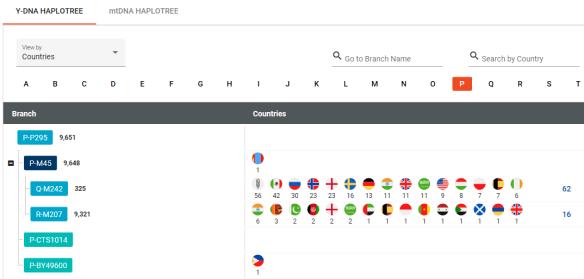
By clicking on any haplogroup, you can quickly see how they relate to others. For example, here’s P showing Q-M242 and M207 underneath on the pedigree tree.

Block tree to pedigree tree.png

I wrote about how to use this tree in the article, Family Tree DNA’s PUBLIC Y DNA Haplotree.

The block tree is private, meaning not available publicly, because it’s designed to show the names of your matches who have given permission for matching and sharing.

Ok, let’s get down to the nitty gritty.

You and Your Matches on the Block Tree

After you review the tutorial, you’ll see the block tree as it relates to you and your test results.

block tree main view.png

I’m using the test of a man as compared to a group of men whose tests I manage as examples. They have all granted sharing permission, but it’s just easier to blur identities for privacy than to explain repeatedly why I didn’t.

Your own branch is shown to the far left and is labeled as such. To the right, you’ll see all of the neighbor branches. Some will be brother branches, descended from the same parent SNP, like BY482 and R-ZP276, above. Others will be more distantly related.

block tree origins legend.png

Below your branch, a legend referring to the colors in the circle rings in the Origins section is provided.

Family Tree DNA has given us a lot of information  to unpack.

block tree your branch.png

What are we actually looking at?

Your SNP branch block is the one with a white background and a black border, in this case, R-ZS3700.

The teal box underneath includes the average number of private variants, meaning SNP mutations not yet named and located on the tree. Multiple occurrences of private variant mutations must be documented in different men in a reliable genome location before the SNP can be named and placed in its correct position on a branch of the haplotree.

If you hover over the teal box below your “terminal” or currently end-of-line SNP, you’ll see a pop-up box describing the variants. Different men will have different numbers of private variants based on any number of factors, including de novo (one off) mutations and read errors. Therefore, an average is used.

If you click on R-ZS3700, or any SNP, you’ll see just that branch in the display, without neighbor branches.

block tree individual branch.png

There are two people in this branch – you and your match. You have a total of 8 combined origins.

Distance, Years and SNPs

One of the questions all genealogists seek to answer is when. We want to know when and how closely we’re related to these men we match, either closely or distantly.

Unfortunately, that question, without genealogy, is very difficult to answer. Many researchers have spent approaching two decades now attempting to reliably answer that question. The key word here is reliably.

The general consensus is that a SNP generation is someplace, on average, between 80 and roughly 140 years. The topic is hotly debated, and many factors can play into SNP age calculations.

Family Tree DNA has approached this a little differently. They have provided a scale of number of SNPs on the left hand side. Each SNP represents one grey block.

block tree SNP generations.png

Here’s what I can tell you positively about the men in this example. SNP R-BY490 was born about 1600. The father who is confirmed through testing of multiple sons was positive for BY482 but not BY490 and was born in 1555.

There are a total of 5 SNPs plus Private Variants between the current tester whose account we are viewing and the birth of R-BY490.

Ancestor birth Tester birth Difference SNPs Years per SNP
1600 1928 328 5 65.6
1711 1928 217 4 54.25

A second example is equally as relevant. ZS3700 was born in 1711, proven through testing of multiple sons’ lines.

You can see that the average can vary quite a bit. Trying to calculate many generations back in time, with many branches having gone extinct along the way, with no proven genealogical lineages to help the process is fraught with landmines.

Countries

I love the view that incorporates countries and geography which shows in a very visual way where different branches of the genetic family line migrated to and settled. At least, where their descendants are clustered today.

block tree countries.png

In the wide view, above, we can see the history and birth of various SNPs in the blue box portion of the chart.

For example, the first split shown, beneath the large dark blue block including BY347 at the bottom occurred 33 SNP generations ago. If a SNP generation is 100 years, on average, then that’s 3300 years ago.

As new private variants are placed in different locations on the tree, this number of SNP generations may increase over time.

There are only two branches shown as descending from the navy blue SNP box; the largest medium blue block showing R-BY336 at the top and the turquoise Private Variant block with 27 variants, at far right.

block tree SNPS and clusters.png

The medium blue block box that includes SNP R-BY336 at the top and Y93760 at the bottom spans 16-33 SNP generations. Each SNP listed represents a SNP generation which is why each SNP is shown on a separate row equating to one grey bar at left.

Looking at the bottom of your display, you see the country of the location of the earliest known ancestor as listed by testers.

block tree flag icon.png

By hovering over the flag, you can identify the country, and by clicking on the flag, you see the detailed view of myOrigins of the testers for the SNP that flag is associated with – in this case, BY390.

block tree SNP plus origins detail view.png

Family Tree DNA has incorporated the highest combined regional myOrigins results for the testers into the display for the Big Y as a ring, plus the location of the testers’ Earliest Known Ancestor as completed in their personal information, found under their profile picture, under the genealogy tab.

Of course, as more people test, this information is subject to change, so check periodically.

block tree countries plus origins.png

The red boxes above indicate the pieces of information that are relevant for SNP R-BY490.

By hovering your mouse over the Origins box, you’ll see that the people in the group who are positive for BY490 have a total of 12 origins of which the highest two are British Isles and West and Central Europe. It just so happens that the earliest known proven ancestor of these men is found in England in the 1400s.

The US flag means that testers are stuck here. A feather indicates that the individuals identified their earliest known ancestor as Native American. I always take that with a grain of salt barring other evidence, such as a cluster (not based on oral history alone) or a known Native haplogroup.

Hint – Please note that if you have “0 Origins” showing, in order for your Origins to be included, you must enable “Origins Sharing” as well as “Project Sharing” for this information to appear on the branch. These options can be found under “Manage Personal Information” below your photo on your personal page, under Account Settings, then “Privacy and Sharing” and “Project Preferences” tabs, respectively.

My Matches

Your matches are shown below the blocks that represent the various SNPs. When you exceed the match threshold of 30 SNPs, you are no longer shown as a match to individuals, and their names will no longer show on the block tree – but the block tree SNP information will remain without their names.

If you want to find out the surnames, locations and ancestors of those people who have tested but aren’t shown as matches, you have a couple of options.

  • If testers have granted permission in their privacy setting to allow their information to be shown in projects, you can visit the appropriate haplogroup project to view their surname and earliest known ancestor information, if they have provided such. Fingers crossed that they did.
  • A google search with the following text string will likely be productive:

<snp ID> haplogroup family tree dna projects

For those people who you do match, by clicking on the matches option in the upper left-hand corner of the block tree page, you will see the following display:

block tree my matches.png

Your matches are shown at left. You can see in this case that all 8 of this man’s matches are shown at BY482 or below, shown in the first three SNP blocks counting from the left on the block tree. The ancestor who produced BY482 was born approximately 16 SNP generations ago. If we use 100 years as an average, that’s 1600 years ago, or about the year 400. So far, all of the men who have tested and are positive for BY482 have a known ancestor in the British Isles.

You can see your matches on the block tree by:

  • viewing this list beside the block tree
  • viewing your matches in their respective haplogroup blocks
  • by clicking on their name to view their individual profile cards

block tree match profile.png

Of course, you can always go back to your account to view the matches on the Big Y-500 matches tab.

block tree Big Y options.png

You can learn more about the Big Y-500 Block Tree here.

In Summary

For me the real power in the Block Tree isn’t just the new visual view. I love that, but I can also use the Block Tree to “see through time” a bit.

I’m clicking back (up arrow on the tree) to view the base of haplogroup Q. As you may know, subgroups of haplogroup Q are found in many locations around the world.

BLock tree hap Q.png

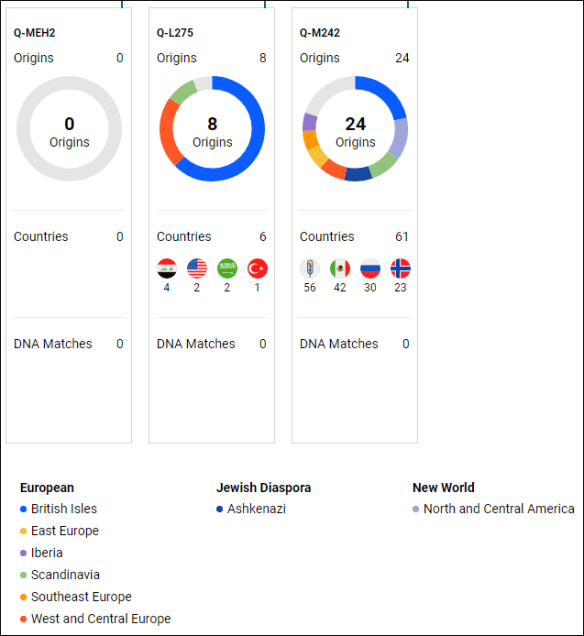
If there was ever a graphic to show, using science, that we are truly all related, this is it. Haplogroup Q is divided into 3 primary blocks.

People of primarily Ashkenazi Jewish origin scattered throughout the world. People of European origins, and people of Native American, Mexican, Russian and Norwegian origins.

Of course, when you look deeper at these three parent SNPs, you’ll see further breakdowns that represent migrations in time and geography.

That is, after all, how we learn about our ancestors before surnames and before genealogical records.

That history is written in our DNA and the DNA of the people to whom we are related, whether we know it or not.

If you are a male and haven’t taken the Big Y-500, please order or upgrade today. Who is waiting on you?

______________________________________________________________

Disclosure

I receive a small contribution when you click on some (but not all) of the links to vendors in my articles. This does NOT increase the price you pay but helps me to keep the lights on and this informational blog free for everyone. Please click on the links in the articles or to the vendors below if you are purchasing products or DNA testing.

Thank you so much.

DNA Purchases and Free Transfers

Genealogy Services

Genealogy Research