Determining Ethnicity Percentages

Recently, as a comment to one of my blog postings, someone asked how the testing companies can reach so far back in time and tell you about your ancestors.  Great question.

The tests that reliably reach the furthest back, of course, are the direct line Y-Line and mitochondrial DNA tests, but the commenter was really asking about the ethnicity predictions.  Those tests are known as BGA, or biogeographical ancestry tests, but most people just think of them or refer to them as the ethnicity tests.

Currently, Family Tree DNA, 23andMe and Ancestry.com all provide this function as a part of their autosomal product along with the Genographic 2.0 test.  In addition, third party tools available at www.gedmatch.com don’t provide testing, but allow you to expand what you can learn with their admixture tools if you upload your raw data files to their site.  I wrote about how to use these ethnicity tools in “The Autosomal Me” series.  I’ve also written about how accurate ethnicity predictions from testing companies are, or aren’t, here, here and here.

But today, I’d like to just briefly review the 3 steps in ethnicity prediction, and how those steps are accomplished.  It’s simple, really, in concept, but like everything else, the devil is in the details.devil

There are three fundamental steps.

  • Creation of the underlying population data base.
  • Individual DNA extraction.
  • Comparison to the underlying population data base.

Step 1:  Creation of the underlying population data base.

Don’t we wish this was as simple as it sounds.  It isn’t.  In fact, this step is the underpinnings of the accuracy of the ethnicity predictions.  The old GIGO (garbage in, garbage out) concept applies here.

How do researchers today obtain samples of what ancestral populations looked like, genetically?  Of course, the evident answer is through burials, but burials are not only few and far between, the DNA often does not amplify, or isn’t obtainable at all, and when it is, we really don’t have any way to know if we have a representative sample of the indigenous population (at that point in time) or a group of travelers passing through.  So, by and large, with few exceptions, ancient DNA isn’t a readily available option.

The second way to obtain this type of information is to sample current populations, preferably ones in isolated regions, not prone to in-movement, like small villages in mountain valleys, for example, that have been stable “forever.”  This is the approach the National Geographic Society takes and a good part of what the Genograpic Geno 2.0 project funding does.  Indigenous populations are in most cases our most reliable link to the past.  These resources, combined with what we know about population movement and history are very telling.  In fact, National Geographic included over 75,000 AIMs (Ancestrally Informative Markers) on the Geno 2.0 chip when it was released.

The third way to obtain this type of information is by inference.  Both Ancestry.com and 23andMe do some of this.  Ancestry released its V2 ethnicity updates this week, and as a part of that update, they included a white paper available to DNA participants.  In that paper, Ancestry discusses their process for utilizing contributed pedigree charts and states that, aside from immigrant locations, such as the United States and Canada, a common location for 4 grandparents is sufficient information to include that individuals DNA as “native” to that location.  Ancestry used 3000 samples in their new ethnicity predictions to cover 26 geographic locations.  That’s only 115 samples, on average, per location to represent all of that population.  That’s pretty slim pickins.  Their most highly represented area is Eastern Europe with 432 samples and the least represented is Mali with 16.  The regions they cover are shown below.

ancestry v2 8

Survey Monkey, a widely utilized web survey company, in their FAQ about Survey Size For Accuracy provides guidelines for obtaining a representative sample.  Take a look.  No matter which calculations you use relative to acceptable Margin of Error and Confidence Level, Ancestry’s sample size is extremely light.

23andMe states in their FAQ that their ethnicity prediction, called Ancestry Composition covers 22 reference populations and that they utilize public reference datasets in addition to their clients’ with known ancestry.

23andMe asks geographic ancestry questions of their customers in the “where are you from” survey, then incorporates the results of individuals with all 4 grandparents from a particular country.  One of the ways they utilize this data is to show you where on your chromosomes you match people whose 4 grandparents are from the same country.  In their tutorial, they do caution that just because a grandparent was born in a particular location doesn’t necessarily mean that they were originally from that location.  This is particularly true in the past few generations, since the industrial revolution.  However, it may still be a useful tool, when taken with the requisite grain of salt.

23andme 4 grandparents

The third way of creating the underlying population data base is to utilize academically published information or information otherwise available.  For example, the Human Genome Diversity Project (HGDP) information which represents 1050 individuals from 52 world populations is available for scrutiny.  Ancestry, in their paper, states that they utilized the HGDP data in addition to their own customer database as well as the Sorenson data, which they recently purchased.

Academically published articles are available as well.  Family Tree DNA utilizes 52 different populations in their reference data base.  They utilize published academic papers and the specific list is provided in their FAQ.

As you can see, there are different approaches and tools.  Depending on which of these tools are utilized, the underlying data base may look dramatically different, and the information held in the underlying data base will assuredly affect the results.

Step 2:  Your Individual DNA Extraction

This is actually the easy part – where you send your swab or spit off to the lab and have it processed.  All three of the main players utilize chip technology today.  For example, 23andMe focuses on and therefore utilizes medical SNPs, where Family Tree DNA actively avoids anything that reports medical information, and does not utilize those SNPs.

In Ancestry’s white paper, they provide an excellent graphic of how, at the molecular level, your DNA begins to provide information about the geographic location of your ancestors.  At each DNA location, or address, you have two alleles, one from each parent.  These alleles can have one of 4 values, or nucleotides, at each location, represented by the abbreviations T, A, C and G, short for Thymine, Adenine, Cytosine and Guanine.  Based on their values, and how frequently those values are found in comparison populations, we begin to fine correlations in geography, which takes us to the next step.

ancestry allele snps

Step 3:  Comparison to Underlying Population Data Base

Now that we have the two individual components in our recipe for ethnicity, a population reference set and your DNA results, we need to combine them.

After DNA extraction, your individual results are compared to the underlying data base.  Of course, the accuracy will depend on the quality, diversity, coverage and quantity of the underlying data base, and it will also depend on how many markers are being utilized or compared.

For example, Family Tree DNA utilizes about 295,000 out of 710,000 autosomal SNPs tested for ethnicity prediction.  Ancestry’s V1 product utilized about 30,000, but that has increased now to about 300,000 in the 2.0 version.

When comparing your alleles to the underlying data set one by one, patterns emerge, and it’s the patterns that are important.  To begin with, T, A, C and G are not absent entirely in any population, so looking at the results, it then becomes a statistics game.  This means that, as Ancestry’s graphic, above, shows, it becomes a matter of relativity (pardon the pun), and a matter of percentages.

For example, if the A allele above is shown is high frequencies in Eastern Europe, but in lower frequencies elsewhere, that’s good data, but may not by itself be relevant.  However if an entire segment of locations, like a street of DNA addresses, are found in high percentages in Eastern Europe, then that begins to be a pattern.  If you have several streets in the city of You that are from Eastern Europe, then that suggests strongly that some of your ancestors were from that region.

To show this in more detailed format, I’m shifting to the third party tool, GedMatch and one of their admixture tools.  I utilized this when writing the series, “The Autosomal Me” and in Part 2, “The Ancestor’s Speak,” I showed this example segment of DNA.

On the graph below, which is my chromosome painting of one a small part of one of my chromosomes on the top, and my mother’s showing the exact same segment on the bottom, the various types of ethnicity are colored, or painted.

The grid shows location, or address, 120 on the chromosome and each tick mark is another number, so 121, 122, etc.   It’s numbered so we can keep track of where we are on the chromosome.

You can readily see that both of us have a primary ethnicity of North European, shown by the teal.  This means that for this entire segment, the results are that our alleles are found in the highest frequencies in that region.

Gedmatch me mom

However, notice the South Asian, East Asian, Caucus, and North Amerindian. The important part to notice here, other than I didn’t inherit much of that segment at 123-127 from her, except for a small part of East Asian, is that these minority ethnicities tend to nest together.  Of course, this makes sense if you think about it.  Native Americans would carry Asian DNA, because that is where their ancestors lived.  By the same token, so would Germans and Polish people, given the history of invasion by the Mongols. Well, now, that’s kind of a monkey-wrench isn’t it???

This illustrates why the results may sometimes be confusing as well as how difficult it is to “identify” an ethnicity.  Furthermore, small segments such as this are often “not reported” by the testing companies because they fall under the “noise” threshold of between about 5 and 7cM, depending on the company, unless there are a lot of them and together they add up to be substantial.

In Summary

In an ideal world, we would have one resource that combines all of these tools.  Of course, these companies are “for profit,” except for National Geographic, and they are not going to be sharing their resources anytime soon.

I think it’s clear that the underlying data bases need to be expanded substantially.  The reliability of utilizing contributed pedigrees as representative of a population indigenous to an area is also questionable, especially pedigrees that only reach back two generations.

All of these tools are still in their infancy.  Both Ancestry and Family Tree DNA’s ethnicity tools are labeled as Beta.  There is useful information to be gleaned, but don’t take the results too seriously.  Look at them more as establishing a pattern.  If you want to take a deeper dive by utilizing your raw data and downloading it to GedMatch, you can certainly do so. The Autosomal Me series shows you how.

Just keep in mind that with ethnicity predictions, with all of the vendors, as is particularly evident when comparing results from multiple vendors, “your mileage may vary.”  Now you know why!

______________________________________________________________

Disclosure

I receive a small contribution when you click on some of the links to vendors in my articles. This does NOT increase the price you pay but helps me to keep the lights on and this informational blog free for everyone. Please click on the links in the articles or to the vendors below if you are purchasing products or DNA testing.

Thank you so much.

DNA Purchases and Free Transfers

Genealogy Services

Genealogy Research

Mitochondrial DNA Smartmatching – The Rest of the Story

Sometimes, a match is not a match.  I know, now I’ve gone and ruined your day…

One of the questions that everyone wants the answer to when looking at matches, regardless of what kind of DNA testing we’re talking about, is “how long ago?”  How long ago did I share a common ancestor with my match?  Seems like a pretty simple question doesn’t it?

The answer, especially with mitochondrial DNA is not terribly straightforward.  A perfect example of this fell into my lap this week, and I’m sharing it with you.

Mitochondrial DNA – A Short Primer

There are three regions that are tested in mitochondrial DNA testing for genealogy.  The HVR1 and HVR2 regions are tested at most testing companies, and at Family Tree DNA, the rest of the mitochondria, called the coding region, is tested as well with the full mitochondrial sequence test.  This is the mitochondrial equivalent of Paul Harvey’s “the rest of the story,” and of course we all know that the real story is always in “the rest of the story” or he wouldn’t be telling us about it!

Many times, the rest of the story is critically important.  In mitochondrial DNA, it’s the only way to obtain your full haplogroup designation.  If you don’t want to just be haplogroup J or A or H, you can test the coding region by taking the full sequence test and find out that you’re J1c2 or A2 or H21, and discover the story that goes with that haplogroup.  Guaranteed, it’s a lot more specific than the one that goes with simple J, A or H.  Often it’s the difference between where your ancestor was 2000 years ago and 20,000 years ago – and they probably covered a lot of territory in 18,000 years!

Let’s take a quick look at mitochondrial DNA.

To begin with, the HVR1 and HVR2 regions are called HVR for a reason – it’s short for hypervariable.  And of course, that means they vary, or mutate, a lot more rapidly, as compared to the coding region of the mitochondrial DNA.

In layman’s terms, think of a clock.  No, not a digital clock, an old-fashioned alarm clock.

alarm clock

The entire mitochondrial DNA has 16,569 locations.  The HVR1 and HVR2 regions take up the space on the clock face from 5 till until 5 after the hour.   The rest is the coding region – the mitochondrial “rest of the story.”  The coding region mutates much slower than the two HVR regions.

Just to be sure we’re on the same page, let’s talk for just a minute about how mitochondrial haplogroup assignments work.  For a detailed discussion of haplogroup assignments and how they are done, see Bill Hurst’s discussion here.

Generally a base haplogroup can be reasonably assigned by HVR1 region testing, but not always.  Sometimes they change with full sequence testing – so what you think you know may not be the end result.

My full haplogroup is J1c2f.  My base haplogroup is J.  I’m on the first branch of J, J1.  On branch J1, I’m on the third stick, c, J1c.  On the third stick J1c, I’m on the second twig, J1c2.  On the second twig, J1c2, I’m leaf f, or J1c2f.  Each of these branches of haplogroup J is determined by a specific mutation that happened long ago and was then passed to all of that person’s offspring, between them and me today.  The question is always, how long ago?

Mutation Rates – How Long Ago is Long Ago?

While we have a tip calculator at Family Tree DNA for Y-line DNA to predict how long ago 2 Y-line matches shared a most recent common ancestor, we don’t have anything similar for mitochondrial DNA, partly because of the great variation in the mutation rates for the various regions of mitochondrial DNA.  Family Tree DNA does provide guidelines for the HVR1 region, but they are so broad as to be relatively useless genealogically.  For example, at the 50th percentile, you are likely to have a common ancestor with someone whom you match exactly on the HVR1 mutations in 52 generations, or about 1300 years ago, in the year 713.  Wait, I know just who that is in my family tree!

These estimates do not take into account the HVR2 or coding regions.

I did some research jointly with another researcher not long ago attempting to determine the mutation rate for those regions, and we found estimates that ranged from 500 years to several thousand years per mutation occurrence and it wasn’t always clear in the publications whether they were referring to the entire mitochondria or just certain portions.  And then there are those pesky hot-spots that for some reason mutate a whole lot faster than other locations.  We’re not even going there.  Suffice it to say there is a wide divergence in opinion among academics, so we probably won’t be seeing any type of mito-tip calculator anytime soon.

Enter SmartMatching

Family Tree DNA does their best to make our matches useful to us and to eliminate matches that we know aren’t genealogically relevant.

For example, this week, I was working on a client’s DNA Report.  Let’s call him Joe.  Joe is haplogroup J1c2.  I am haplogroup J1c2f.  J1c2f has one additional haplogroup defining mutation, in the coding region, that J1c2 does not have.

Joe and I did not show as matches at Family Tree DNA, even though our HVR1 and HVR2 regions are exact matches.  Now, for a minute, that gave me a bit of a start.  In fact, I didn’t even realize that we were exact matches until I was working with his results at MitoSearch and recognized my own User ID.

I had to think for a minute about why we would not be considered matches at Family Tree DNA, and I was just about ready to submit a bug report, when I realized the answer was my extended haplogroup.  This, by the way, is the picture-perfect example of why you need full sequence testing.

Family Tree DNA knows that we both tested at the full sequence level.  They know that with a different haplogroup, we don’t share a common ancestor in hundreds to thousands of years, so it doesn’t matter if we match exactly on the HVR1 and HVR2 levels, we DON’T match on a haplogroup defining mutation, which, in this case, happens to be in the coding region, found only with full sequence testing.  Even if we have only one mismatch at the full sequence level, if it’s a haplogroup defining marker, we are not considered matches.  Said a different way, if our only difference was location 9055 and 9055 was NOT a haplogroup defining mutation, we would have been considered a match on all three levels – exact matches at the HVR1 and HVR2 levels and a 1 mutation difference at the full sequence level.  So how a mutation is identified, whether it’s haplogroup defining or not, is critical.

In our case, I carry a mutation at marker 9055 in the coding region that defines haplogroup J1c2f.  Joe doesn’t have this mutation, so he is not J1c2f, just J1c2.  So we don’t match.

So – How Long Ago for Me and Joe?

Dr. Behar in his “Copernican Reassessment of the Mitochondrial DNA Tree,” which has become the virtual Bible of mitochondrial DNA, estimates that the J1c2f haplogroup defining mutation at location 9055 occurred about 2000 years ago, plus or minus another 3000 years, which means my ancestor who had that mutation could have lived as long ago as 5000 years.

The mutations that define haplogroup J1c2 occurred about 9800 years ago, plus or minus another 2000.  So we know that Joe and I share a common ancestor about 7,800 – 11,800 years ago and our lines diverged sometime between then and 2,000 – 5,000 years ago.  So, in round numbers our common ancestor lived between 2,000 and 9,800 years ago.  Not much chance of identifying that person!

The ability to eliminate “near-misses” where the HVR1+HVR2 matches but the people aren’t in the same haplogroup, which is extremely common in haplogroup H, is actually a very useful feature that Family Tree DNA nicknamed SmartMatching.  With over 1000 matches at the HVR1 level, more than 200 at the HVR1+HVR2 level and another 50+ at the full sequence level, Joe certainly didn’t need to have any “misleading” matches included that could have been eliminating by a logic process.

So while Joe and I match, technically, if you only look at the HVR1 and HVR2 levels, we don’t really match, and that’s not evident at MitoSearch or at Ancestry or anyplace else that does not take into consideration both full sequence AND haplogroup defining mutations.  Family Tree DNA is the only company that does this.

It’s interesting to think about the fact that 2 people can match exactly at the HVR1+HVR2 levels, but the distance of the relationship can be vastly different.  I also match my mother on the HVR1+HVR2 levels, exactly, and our common ancestor is her.  So the distance to a common ancestor with an exact HVR1+HVR2 match can be anyplace from one generation (Mom) to thousands of years (Joe), and there is no way to tell the difference without full sequence testing and in this case, SmartMatching.

And that, my friends, is the rest of the story!

The Autosomal Me – The Holy Grail – Identifying Native Genealogy Lines

holy grail

Sangreal – the Holy Grail.  We are finally here, Part 9 and the final article in our series.  The entire purpose of The Autosomal Me series has been to use our DNA and the clues it holds to identify minority admixture, in this case, Native American, and by identifying those Native segments, and building chromosomal clusters, to identify the family lines that contributed that Native admixture.  Articles 1-8 in the series set the stage, explained the process and walked us through the preparatory steps.  In this last article, we apply all of the ingredients, fasten the lid, shake and see what we come up with.  Let’s take a minute and look at the steps that got us to this point.

Part 1 was “The Autosomal Me – Unraveling Minority Admixture” and Part 2 was “The Autosomal Me – The Ancestors Speak.”  Part 1 discussed the technique we are going to use to unravel minority ancestry, and why it works.  Part two gave an example of the power of fragmented chromosomal mapping and the beauty of the results.

Part 3, “The Autosomal Me – Who Am I?,” reviewed using our pedigree charts to gauge expected results and how autosomal results are put into population buckets.

Part 4, “The Autosomal Me – Testing Company Results,” shows what to expect from all of the major testing companies, past and present, along with Dr. Doug McDonald’s analysis.

In Part 5, “The Autosomal Me – Rooting Around in the Weeds Using Third Party Tools,” we looked at 5 different third party tools and what they can tell us about our minority admixture that is not reported by the major testing companies because the segments are too small and fragmented.

In Part 6, “The Autosomal Me – DNA Analysis – Splitting Up” we began the analysis part of the data we’ve been gathering.   We looked at how to determine whether minority admixture on specific chromosomes came from which parent.

Part 7, “The Autosomal Me – Start, Stop, Go – Identifying Native Chromosomal Segments” took a deeper dive and focused on the two chromosomes with proven Native heritage and began by comparing those chromosome segments using the 4 GedMatch admixture tools.

Part 8, “The Autosomal Me – Extracting Data Segments and Clustering,” we  extract all of the Native and Blended Asian segments in all 22 chromosomes, but only used chromosomes 1 and 2 for illustration purposes.  We then clustered the resulting data to look for trends, grouping clusters by either the Strong Native criteria or the Blended Asian criteria.

In this final segment, Part 9, we will be applying the chromosomal information we’ve gathered to our matches and determine which of our lines are the most likely to have Native Ancestry.  This, of course, has been the goal all along.  So, drum roll…..here we go.

In Part 8, we ended by entering the start and stop locations of both Strong Native and Blended Asian clusters into a table to facilitate easy data entry into the chromosome match spreadsheet downloaded from either 23andMe or Family Tree DNA.  If you downloaded it previously, you might want to download it again if you haven’t modified it, or download new matches since you last downloaded the spreadsheet and add them to the master copy.

My goal is to determine which matches and clusters indicate Native ancestry, and how to correlate those matches to lineage.  In other words, which family lines in my family were Native or carry Native heritage someplace.

The good news is that my mother’s line has proven Native heritage, so we can use her line as proof of concept.  My father’s family has so many unidentified wives, marginalized families and family secrets that the Native line could be almost any of them, or all of them!  Let’s see how that tree shakes out.

Finding Matches

So let’s look at a quick example of how this would work.  Let’s say I have a match, John, on chromosome 4 in an area where my mother has no Native admixture, but I do.  Therefore, since John does not match my mother, then the match came from my father and if we can identify other people who also match both John and I in that same region on that chromosome, they too have Native ancestry.  Let’s say that we all also share a common ancestor.  It stands to reason at that point, that the common ancestor between us indicates the Native line, because we all match on the Native segment and have the same ancestor.  Obviously, this would help immensely in identifying Native families and at least giving pointers in which direction to look.  This is a “best case’ example.  Some situations, especially where both parents contribute Native heritage to the same chromosome, won’t be this straightforward.

Based on our findings, the maximum range and minimum (least common denominator or “In Common” range is as follows for the strongest Native segments on chromosomes 1 and 2.

  Chromosome 1 Chromosome 2
Largest   Range 162,500,000   – 180,000,000 79,000,000   – 105,000,000
Smallest   Range 165,658,091   – 171,000,000 90,000,000   – 103,145,425

At GedMatch

At GedMatch, I used a comparison tool to see who matched me on chromosome 1.  Only 2 people outside of immediate family members matched, and both from Family Tree DNA.  Both matched me on the critical Native segments between about 165-180mg.  I was excited.  I went to Family Tree DNA and checked to see if these two people also matched my mother, which would confirm the Native connection, but neither did, indicating of course that these two people matched me on my father’s side.  That too is valuable information, but it didn’t help identify any common Native heritage with my mother on chromosome 1.  It did, however, eliminate them as possibilities which is valuable information as well.

DNAGedcom

I used a new tool, DNAGedcom, compliments of Rob Warthen who has created a website, DNA Tools, at www.dnagedcom.com.  This wonderful tool allows you to download all of your autosomal matches at Family Tree DNA and 23andMe along with their chromosomal segment matches.  Since my mother’s DNA has only been tested at Family Tree DNA, I’m limiting the download to those results for now, because what I need is to find the people who match both she and I on the critical segments of chromosome 1 or 2.

Working with the Download Spreadsheet

It was disappointing to discover that my mother and I had no common matches that fell into this range on chromosome 1, but chromosome 2 was another matter.  Please note that I have redacted match surnames for privacy.

step 9 table 1

The spreadsheet above shows the comparison of my matches (pink) and Mother’s (white).  The Native segment of chromosome 2 where I match Mother is shaded mustard.  I shaded the chromosome segments that fell into the “common match” range in green.  Of those matches, there is only one person who matches both Mother and I, Emma.  The next step, of course, is to contact Emma and see if we can discover our common ancestor, because whoever it is, that is the Native line.  As you might imagine, I am chomping at the bit.

There are no segments of chromosome 2 that are unquestionably isolated to my father’s line.

Kicking it up a Notch

Are you wondering about now how something that started out looking so simple got so complex?  Well, I am too, you’re not alone.  But we’ve come this far, so let’s go that final leg in this journey.  My mom always used to say there was no point in doing something at all if you weren’t going to do it right.  Sigh….OK Mom.

The easiest way to facilitate a chromosome by chromosome comparison with all of your matches and your Strong Native and Blended Asian segments is to enter all of these segment groups into the match spreadsheet.  If you’re groaning and your eyes glaze over right after you do one big ole eye roll, I understand.

But let’s take a look at how this helps us.

On the excerpt from my spreadsheet below, for a segment of chromosome 5, I have labeled the people and how they match to me.  The ones labeled “Mom” in the last column are labeled that way because these people match both Mom and I.  The ones labeled “Dad” are labeled that way because I know that person is related on my father’s side.

Using the information from the tables created in Step 8, I entered the beginning and end of all matching segment clusters into my spreadsheet.  You can see these entries on lines 7, 8, 22, 23 and 24.  You then proceed to colorize your matches based on the entry for either Mom or Dad – in other words the blue row or the purple row, line 7, 22 or 24.  In this example, actually, line 5 Rex, based on the coloration, should have been half blue and half purple, but we’ll discuss his case in a minute.

The you can then sort either by match name or by chromosome to view data in both ways.  Let’s look at an example of how this works.

Legend:

  • White Rows:  Mother’s matches.  When Mother and I both match an individual, you’ll see the same matches for me in pink.  This double match indicates that the match is to Mother’s side and not Father’s side.
  • Pink Rows:  My matches.
  • Purple “Mom” labels in last column:  The individual matches both me and Mom.  This is a genetic match.
  • Teal “Dad” labels in last column: Genealogically proven to be from my father’s side.  This is a genealogical, not a genetic label, since I don’t have Dad’s DNA and can only infer these genetically when they don’t also match Mother.
  • Dark Pink Rows labeled “Me Amerind Only” are Strong Native or Blended Asian segments from Chromosome Table that I have entered.  My segments must come from one of my parents, so I’ve either colored them purple, if the match is someone who matches Mother and I both, or teal, if they don’t match both Mom and I, so by inference they come from my father’s line.
  • Dark Purple Rows labeled “Mom Amerind Only” are Mom’s segments from the Chromosome Table.
  • Dark Teal Rows labeled “Dad Amerind Only” are inferred segments belonging to my father based on the fact that Mother and I don’t share them.

Inferred Relationships

This is a good place to talk for just a minute about inferred relationships in this context.  Inference gets somewhat tenuous or weak.  The inferred matches on my father’s side began with the Native segments in the admix tools.  Some inferences are very strong, where Mother has no Native at all in that region.  For example, Mom has European and I have Native American.  No question, this had to come from my father.  But other cases are much less straightforward.

In many cases, categorization may be the issue.  Mom has West Asian for example and I have Siberian or Beringian.  Is this a categorization issue or is this a real genetic difference, meaning that my Siberian/Beringian is actually Native and came from my father’s side?

Other cases of confusion arise from segment misreads, etc.  I’ve actually intentionally included a situation like this below, so we can discuss it.  Like all things, some amount of common sense has to enter the picture, and known relationships will also weigh heavily in the equation.  How known family members match on other chromosome segments is important too.  Do you see a pattern or is this match a one-time occurrence?  Patterns are important.

Keep in mind that these entries only reflect STRONG Asian or Native signals, not all signals.  So even if Mother doesn’t have a strong signal, it doesn’t mean that she doesn’t have ANY signal in that region.  In some cases, start and stop segments for Mom and Dad overlapped due to very long segments on some matches.  In this case, we have to rely on the fact that we do have Mother’s actual DNA and assume that if they aren’t also a match to Mother, that what we are seeing is actually Dad’s lines, although this may not in actuality always be true.  Why?  Because we are dealing with segments below the matching threshold limit at both Family Tree DNA and 23andMe, and both of my parents carry Native heritage.  We can also have crossed a transitional boundary where the DNA that is being matched switches from Mom’s side to Dad’s side.

Ugh, you say, now that’s getting messy.  Yes, it is, and it has complicated this process immensely.

The Nitty-Gritty Data Itself

step 9 table 2

Taking a look at this portion of chromosome 5, we have lots going on in this cluster.  Most segments will just be boring pink and white (meaning no Native), but this segment is very busy.  Mom and I match on a small segment from 52,000,000 to 53,000,000.  Indeed, this is a very short segment when compared to the entire chromosome, but it is strongly Native.  We both also match Rex, our known cousin.  I’ve noted him with yellow in the table. Please note that Mom’s white matches are never shaded.  I am focused on determining where my own segments originate, so coloring Mother’s too was only confusing.  Yes, I did try it.

You can see that Mother actually shares all or any part of her segment with only me and Rex.  This simplifies matters, actually.  However, also note that I carry a larger segment in this region than does Mother, so either we have a categorization issue, a misread, or my father also contributed.  So, a conundrum.  This very probably implies that my father also carried Native DNA in this region.

Let’s see what Rex’s DNA looks like on this same segment of chromosome 5, from 52-53 using Eurogenes.  In the graph below, my chromosome is the top bar, Rex’s the middle and the bottom bar shows common DNA with the black nonmatching.  Yellow is Native American, red is South Asian, putty is Siberian, lime green is Mediterranean, teal is North Europe, orange is Caucus.

Step 9 item 3

This same comparison is shown to Mother’s DNA (top row) below.

step 9 item 4

It’s interesting that while Mother doesn’t have a lot of yellow (Native), she does have it throughout the same segment where Rex’s occurs, from about 52 through 53.5.

Does this actually point to a Native ancestor in the common line between Rex, Mom and I, which is the Swiss/German Johann Michael Miller line which does include an unidentified wife stateside, or does this simply indicate a common ancient population long ago in Asia?  It’s hard to say and is deserving of more research.  I feel that it is most likely Native because of the actual yellow, Native segment. If this was an Asian/European artifact, it would be much less likely to carry the actual yellow segment.

Is Rex also genealogically related to my father?  As I’ve worked through this process with all of my chromosomes and matches, I’ve really come to question if one of my father’s dead ends is also an ancestral line of my mother’s.

The key to making sense of these results is clusters.

Clusters vs Singleton Outliers

The work we’ve already done, especially in Step 8, clusters the actual DNA matching segments.  We’ve now entered that information into the spreadsheet and colored the segments of those who match.  What’s next?

The key is to look for people with clusters.  Many matches will have one segment, of say, 10 that match, colored.  Unless this is part of a large chromosome cluster, it’s probably simply an outlier.  Part of a large chromosome cluster would be like the large Strong Native segments on chromosome 1 or 2, for example.  How do we tell if this is a valid match or just an outlier?

Sort the spreadsheet by match name.  Take a look at all of the segments.

The example we’ll use is that of my cousin, Rex.  If you recall, he matches both me and Mother, is a known first cousin twice removed to me, (genetically equal to a second cousin), and is descended from the Miller line.

In this example, I also colored Mother’s segments because I wanted to see which segments that I did not receive from her were also Native. You can see that there are many segments where we all match and several of those are Native.  These also match to other Miller descendants as well, so are strongly indicative of a Native connection someplace in our common line.

If we were only to see one Native segment, we would simply disregard this as an outlier situation.  But that’s not the case.  We see a cluster of matches on various segments, we match other cousins from the same line on these segments, and reverting back to the original comparison admixture tools verifies these matches are Native for Rex, Mom and me.

step 9 item 5

Hmmmm…..what is Dad’s blue segment color doing in there?  Remember I said that we are only dealing with strong match segments?  Well, Mom didn’t have a strong segment at that location and so we inferred that Dad did.  But we know positively that this match does come from Mother’s side.  I also mentioned that I’ve come to wonder if my Mom and Dad share a common line.  It’s the Miller line that’s in question.  One of Johann Michael Miller’s children, Lodowick, moved from Pennsylvania to Augusta County, Virginia in the 1700s and his line became Appalachian, winding up in many of the same counties as my father’s family.  I’m going to treat this as simply an anomaly for now, but it actually could be, in this case, an small indication that these lines might be related.  It also might be a weak “Mom” match, or irrelevant.  I see other “double entries” like this in other Miller cousins as well.

What is the pink row on chromosome 12?  When I grouped the Strong Native and Asian Clusters, sometimes I had a strong grouping, and Mom had some.  The way I determined Dad’s inferred share was to subtract what Mom had in those segments from mine.  In a few cases, Mom didn’t have enough segments to be considered a cluster but she had enough to prevent Dad from being considered a cluster either, so those are simply pink, me with no segment coloring for Mom or Dad.

Let’s say I carry Strong Native/Mixed Asian at the following 8 locations:

10, 12, 14, 16, 18, 20, 22, 24

This meets the criteria for 8 of 15 ethno-geographic locations (in the admix tools) within a 2.5 cM distance of each other, so this cluster would be included in the Mixed Asian for me.  It could also be a Strong Native cluster if it was found in 3 of 4 individual tools.  Regardless of how, it has been included.

Let’s now say that Mom carries Native/Mixed Asian at 10, 12 and 14, but not elsewhere in this cluster.

Mom’s 3 does not qualify her for the 8/15 and it only leaves Dad with 5 inferred segments, which disqualifies him too.  So in this case, my cluster would be listed, but not attributable directly to either parent.

What this really says is that both of my parents carry some Native/Blended Asian on this segment and we have to use other tools to extrapolate anything further.  The logic steps are the same as for Dad’s blue segment.  We’re going to treat that as an outlier.  If I really need to know, I can go back to the actual admixture tools and see whether Mom or Dad really match me strongly on which segments and how we compare to Rex as well.  In this case, it’s obvious that this is a match to my Mother’s side, so I’m leaving well enough alone.

Let’s see what the matches reveal.

Matches

Referring back to the Nitty Gritty Data spreadsheet, Mom’s match to Phyllis on row 15 confirms an Acadian line.  This is the known line of Mother’s Native ancestry.  This makes sense and they match on Native segments on several other chromosomes as well.  In fact, many of my and Mother’s matches have Acadian ancestry.

My match to row 19, Joy, is a known cousin on my father’s side with common Campbell ancestry.  This line is short however, because our common ancestor, believed to be Charles Campbell died before 1825 in Hawkins County, TN.  He was probably born before 1750, given that his sons were born about 1770 and 1772.  Joy and I descend from those 2 sons.  Charles wife and parents are unknown, as is his wife.

My match to row 20, inferred through my father’s side, is to a Sizemore, a line with genetically proven Native ancestry.  Of course, this needs more research, but it may be a large hint.  I also match with several other people who carry Sizemore ancestors.  This line appears to have originated near the NC/VA border.

I wanted to mention rows 4 and 17.  Using our rules for the spreadsheet, if I match someone and they don’t also match Mother on this segment, I have inferred them to be through my father.  These are two instances that this is probably incorrect.  I do match these people through Mother, but Mother didn’t carry a strong signal on this segment, so it automatically became inferred to Dad.  Remember, I’m only recording the Strong Native or the Blended Asian segments, not all segments.  However, I left the inferred teal so that you can see what kinds of judgment calls you’ll have to make.  This also illustrates that while Mom’s genetic matches are solid, Dad’s inferred matches are less so and sometimes require interpretation.  The proper thing to do in this instance would be to refer back to the original admixture tools themselves for clarification.

Let’s see what that shows.

step 9 item 6

Using HarrappaWorld, the most pronounced segment is at about 52.  Teal is American.  You can see that Mother has only a very small trace between 53 and 54, almost negligible.  Mother’s admixture at location 52 is two segments of purple, brown and cinnamon which translate to Southwest Asian (lt purple), Mediterranean (dk purple), Caucasian (brown) and Balock (cinnamon), from Pakistan.

Checking Dodecad shows pretty much the same thing, except Mother’s background there is South Asian, which could be the same thing as Caucus and Pakistan, just different categorizations.

In this case, it looks like the admixture is not a categorization issue, but likely did come from my father.  Each segment will really be a case by case call, with only the strongest segments across all tools being the most reliable.

It’s times like this that we have to remember that we have two halves of each chromosome and they carry vastly different information from each of our parents.  Determining which is which is not always easy.  If in doubt, disregard that segment.

Raw Numbers

So, what, really did I figure out after all of this?

First, let’s look at some numbers.

I was working with a total of 292 people who had at least one chromosomal segment that matched me with a Strong Native or Blended Asian segment.  Of those, 59 also matched Mom’s DNA.  Of those, 18 had segments that matched only Mom.  This means that some of them had segments that also matched my father.  Keep in mind, again, that we are only using “strong matches” which involves inferring Dad’s segments and that referring back to the original tools can always clarify the situation.  There seems to be some specific areas that are hotspots for Native ancestry where it appears that both of my parents passed Native ancestry to me.

Many of my and my mother’s 59 matches have Acadian ancestry which is not surprising as the Acadians intermarried heavily with the Native population as well as within their own ethnic group.

Several also have Miller Ancestry.  My Miller ancestor is Johann Michael Miller (1692-1771) who immigrated in the colonial period and settled on the Pennsylvania frontier.  His son, Philip Jacob Miller’s (1726-1799) wife was a woman named Magdalena whose last name has been rumored for years to be Rochette, but no trace of a Rochette family has ever been found in the county where they lived, region or Brethren church history…and it’s not for lack of looking.  Several matches point to Native Ancestry in this line.  This also begs the question of whether this is really Native or whether it is really the Asian heritage of the German people.  Further analysis, referring back to the admixture tools, suggests that this is actually Native. It’s also interesting that absolutely none of Mother’s other German or Dutch lines show this type of ancestry.

There is no suggestion of Native ancestry in any of her other lines.  Mother’s results are relatively clean.  Dad’s are anything but.

Dad’s Messy Matches

My father’s side of the family, however, is another story.

I have 233 matches that don’t also match my mother.  There can be some technical issues related to no-calls and such, but by and large, those would not represent many.  So we need to accept that most of my matches are from my Father’s side originating in colonial America.  This line is much “messier” than my mother’s, genealogically speaking.

Of those 233 matches, only 25 can be definitely assigned to my father.  By definitely assigned, I mean the people are my cousins or there is an absolutely solid genealogical match, not a distant match.  Why am I not counting distant matches in this total?  We all know by virtue of the AncestryDNA saga that just because we match family lines and DNA does NOT mean that the DNA match is the genealogical line we think it is.  If you would like to read all about this, please refer to the details in CeCe Moore’s blog where she discussed this phenomenon.  The relevant discussion begins just after the third photo in this article where she shows that 3 of 10 matches at Ancestry where they “identify” the common DNA ancestor are incorrect.  Of course, they never SAY that the common ancestor is the DNA match, but it’s surely inferred by the DNA match and the “leaf” connecting these 2 people to a common ancestor.  It’s only evident to someone who has tested at least one parent and is savvy enough to realize that the individual whose ancestor on Mom’s side that they have highlighted, isn’t a match to Mom too.  Oops.  Mega-oops!!!

However, because we are dealing in our project, on Dad’s side, with inferences, we’re treading on some of the same ground.  Also, because we are dealing with only “strong clustered” segments, not all Native or Asian segments and because it appears that my parents both have Native ancestry.  To make matters worse, they may both have Algonquian, Iroquoian or both.

I have also discovered during this process that several of my matches are actually related to both of my parents.  I told you this got complex.

Of the people who don’t match Mother, 32 of them have chromosomal matches only to my father, so those would be considered reliable matches, as would the closest ones of the 25 that can be identified genealogically as matching Dad.  Many of these 25 are cousins I specifically asked to test, and those people’s results have been indispensable in this process.

In fact, it’s through my close circle of cousins that we have been able to eliminate several lines as having Native ancestry, because it doesn’t’ show as strong and they don’t have it either.

Many of these lines group together when looking at a specific chromosome.  There is line after line and cousin after cousin with highlighted data.

Dad’s Native Ancestors

So what has this told me?  This information strongly suggests that the following lines on my father’s side carry Native heritage.  Note the word “carry.”  All we can say at this point is that it’s in the soup – and we can utilize current matches at our testing company and at GedMatch, genealogy research and future matches to further narrow the branches of the tree.  Many of these families are intermarried and I have tried to group them by marriage group.  Obviously, eventually, their descendants all intermarried because they are all my ancestors on my father’s side.  But multiple matches to other people who carry the Native markers but aren’t related to my other lines are what define these as lines carrying Native heritage someplace.

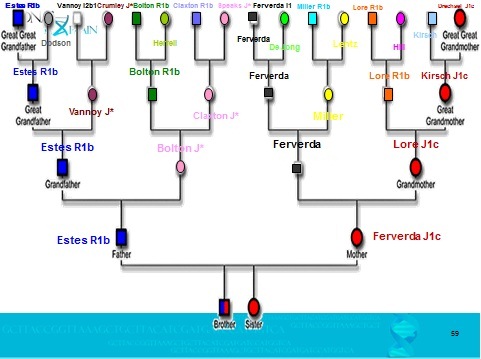
  • Campbell – Hawkins County, Tn around 1800, missing wife and parents, married into the Dodson family
  • Dodson – Hawkins County, Tn, Virginia – written record of Lazarus Dodson camping with the Cherokee – missing wife, married into the Campbell and Estes family
  • Claxton/Clarkson – Russell Co., Va, Claiborne and Hancock Co., Tn – In NC associated with the known Native Hatcher family.  Possibly a son-in-law.  Missing family entirely.
  • Cook – Russell Co., Va. – daughter married Claxton/Clarkson – missing wives
  • Harrold, Harrell, Herrell – Hancock Co., Tn., Wilkes Co., NC – missing wives
  • McDowell – Hancock Co. Tn, Wilkes Co., NC, Augusta Co., Va – married into the Harrell family, missing wife
  • McNeil, McNiel – Wilkes Co., NC – missing wives, married into the Vannoy family
  • Vannoy – Wilkes County – some wives unaccounted for pre-1800
  • Crumley – Greene County, Tn., Lee Co., Va. – oral history of Native wife, married into the Vannoy family
  • Brown – Greene County, Tn, Montgomery Co., Va – married into the Crumley family, missing wives

While this looks like a long list, the list of families that don’t have any Native ancestry represented is much longer and effectively serves to eliminate all of those lines.  While I don’t have “THE” answer, I certainly know where to focus my research.  Maybe there isn’t the one answer.  Maybe there are multiple answers, in multiple lines.

The Take Away

Is this complex?  Yes!  Is it a lot of work?  You bet it is!  Is everything cast in concrete?  Never!  You can see that by the differences we’ve found in data interpretation, not to mention issues like no-calls (areas that for some reason in the test don’t read) and cross overs where your inheritance switches from your mom’s side to your dad’s side.  Is there any other way to do this?  No, not if your minority admixture is down in that weedy area around 1%.

Is it worth it?  You’ll have to decide.  It guess it depends on how desperately you want to know.

Part of the reason this is difficult is because we are missing tools in critical locations.  It’s an intensively laborious manual process.  In essence, using various tools, one has to figure out the locations of the Native and Asian chromosome segments and then use that information to infer Native matches by a double match (genetic match at DNA company plus match with Strong Native/Blended Asian segment) with the right parent.  It becomes even more complex if neither parent is available for testing, but it is doable although I would think the reliability could drop dramatically.

Tidbits and Trivia

I’ve picked up a number of little interesting tidbits during this process.  These may or may not be helpful to you.  Just kind of file them away until needed:)

  • Matches at testing companies come and go….and sometimes just go.  At Family Tree DNA, I have some matches that must be trembling on the threshold that come and go periodically.  Now you see them, now you don’t.  I lost matches moving from the Affy chip to the Illumina chip and lost additional matches between Build 36 and 37.  Some reappeared, some haven’t.
  • The start and stop boundaries changed for some matches between build 36 and build 37.  I did not go back and readjust, as most of these, in the larger scheme of things, were minor.  Just understand that you are looking for  patterns here that indicate Native heritage, not exact measurements.  This process is a tool, and unfortunately, not a magic wand:)
  • The centromere locations change between builds.  If you have matches near or crossing the middle of the chromosome, called the centromere, there may be breaks in that region.  I enter the centromere start and stop locations in my spreadsheet so that if I notice something odd going on in that region, the centromere addresses are right there to alert me that I’m dealing with that “odd” region.  You can find the centromere addresses in the FAQ at Family Tree DNA for their current build.
  • At 23andMe, when you reach the magic 1000 matches threshold, you start losing matches and the matching criteria is elevated so that you can stay under 1000 matches.  For people with colonial American or Jewish heritage, in other words those with high numbers of matches, this is a problem.
  • Watch for matches that are related to both sides of your family.  If your family lived in colonial America, you’re going to have a lot of matches and many are probably related to each other in ways you aren’t aware of.
  • If your parents are related to each other, this process might simply be too complex and intertwined to provide enough granular data to be useful.
  • Endogamous groups are impossible to sort through as to where, meaning which ancestor, the DNA came from.  This is because the original group founders’ DNA is just getting passed around and around, with little or no new DNA being introduced.  The effect of this on downstream generations relative to genetic genealogy is that matches appear to be more closely related than they are because of the amount of matching DNA they carry.  For my Brethren and my Acadian groups of people, I just list them by the group name, since, as the saying goes, “if you’re related to one Acadian, you’re related to all Acadians.”
  • If you’re going to follow this procedure, save one spreadsheet copy with the Strong Native only and then a second one with both the Strong Native and Blended Asian.  I’m undecided truthfully whether the Mixed Asian adds enough resolution for the extra work it generates.
  • When in question, refer back to the original tools.  The answer will always be found there.
  • Unfortunately, tools change.  You may want to take screen shots.  During this process, FTDNA went from build 36 to 37, match thresholds changed, 23andMe introduced a new user interface (which I find much less intuitive) and GedMatch has made significant changes.  The net-net of this is when you decide to undertake this project, commit to it and do it, start to finish.  Doing this little by little makes you vulnerable to changes that may make your data incompatible midstream – and you may not even realize it.
  • This entire process is intensively manual.  My spreadsheet is over 5500 rows long.  I won’t be doing it again…although I will update my spreadsheet with new matches from time to time.  The hard work is already done.
  • This same technique applies to any minority ancestry, not just Native, although that’s what I’ve been hunting for and one of the most common inquiries I receive.
  • I am hopeful that in the not too distant future many of these steps and processes will be automated by the group of bright developers that contribute to GedMatch or via other tools like DNAGedcom. HINT – HINT!!!

I would like to follow this same process to identify the source of my African heritage, but I’m thinking I’ll wait for the tools to become automated.  The great irony is that it’s very likely in the same lines as my Native ancestors.

If You Want to Test

What does it take to do this for yourself using the tools we have today, as discussed?

If your parents are living, the best gift you can give yourself is to test them, now, while you still can.  My mother has been gone for several years, but her DNA archived at Family Tree DNA was still viable.  This is not always the case.  I was fortunate.  Her DNA is one of the best gifts she gave me.  Not just by inheritance, but by having hers tested.  I thank her every single day, for both!  I could not have written this article without her DNA results.  The gift that keeps on giving.

If you don’t have a parent to test, you can test several other family members who will provide some information, but clearly won’t carry the same amounts of common DNA with you as your parents.  These would include your aunts and uncles, your parents’ siblings and what I’ve referred to as your close cousin circle.  Attempt to test at least someone from each line.  Yes, it gets expensive, but as one of my cousins said, as she took her third or 4th DNA test.  “It’s only money.  This is about family.”

You can also test your own siblings as well to obtain more information that you can use to match up to your family lines. Remember, you only receive half of your parents DNA, and your siblings will received some DNA from your parents that you didn’t.

I don’t have any other siblings to test, but I have tested cousins from several lines which have proven invaluable when trying to discern the sources of certain segments. For example, one of these Native segments fell on a common segment with my cousin Joy.  Therefore, I know it’s from the Campbell line, and because I have the Campbell paternal Y-DNA which is European, I know immediately the Native admixture would have had to be from a wife.

Much of this puzzle is deductive, but we now have the tools, albeit manual, to do this type of work that was previously impossible.  I am somewhat disappointed that I can’t pinpoint the exact family lines, yet, but hopefully as more people test and more matches provide genealogical information, this will improve.

If you want to play in this arena, you need to test at either Family Tree DNA, 23andMe, or both.  Right now, the most cost effective way to achieve this is to purchase a $99 kit from 23andMe, test there, then download your results from 23andMe and upload them to Family Tree DNA for $99.  That way, you are fishing in both pools.  Be aware that less than half of the people who test at either company download results to GedMatch, so your primary match locations are with the testing companies.  GedMatch is auxiliary, but critical for this analysis.  And the newest tool, DNAGedcom is a Godsend.

Also note that transferring your result to Family Tree DNA is NOT the same thing as actually testing there.  Why does this matter?  If you want a future test at Family Tree DNA, who is the premiere genetic genealogy testing company, offering the most variety and “deepest” commercial tests, they archive your DNA for 25 years, but if you transfer results, they don’t have your DNA to archive, so no future products can be ordered.  All I can say is thank Heavens Mom’s DNA was there.

Ancestry.com doesn’t provide any tools such as the chromosome browser or even the basic information of matching segments.  All you get is a little leaf that says you’re related, but the questions of which segment or how are not answerable today at Ancestry and as CeCe’s experience proved, its unreliable.  It’s  possible that you share the same surnames and ancestor, but your genetic connection is not through that family line.  Without tools, there is no way to tell.  Ancestry released raw data files a few weeks ago and very recently, GedMatch has implemented the ability to upload them so that Ancestry participants can now utilize the additional tools at GedMatch.

Although this has been an extraordinarily long and detailed process, I can’t tell you how happy I am to have developed this new technique to add to my toolbox.  My Native and African ancestors have been most elusive.  There are no records, they didn’t write and probably didn’t even speak English, certainly not initially.  The only clues to their existence, prior to DNA, were scant references and family lore.  The only prayer of actually identifying them is though these small segments of our DNA – yep – down in the weeds.  Are there false starts perhaps, and challenges and maybe a few snakes down there?  Yes, for sure, but so is the DNA of your ancestors.

Happy gardening and rooting around in the weeds.  Just think of it as searching for the very best buried treasure!  It’s down there, just waiting to be found.  Keep digging!

I hope you’ve enjoyed this series and that it leads you to your own personal genealogical treasure trove!

treasure chest

______________________________________________________________

Disclosure

I receive a small contribution when you click on some of the links to vendors in my articles. This does NOT increase the price you pay but helps me to keep the lights on and this informational blog free for everyone. Please click on the links in the articles or to the vendors below if you are purchasing products or DNA testing.

Thank you so much.

DNA Purchases and Free Transfers

Genealogy Services

Genealogy Research

Ancestry Needs Another Push – Chromosome Browser

ancestry push

It seems that the genetic genealogy community is constantly doing battle with Ancestry in regards to Ancestry’s mediocre and at times, outright faulty autosomal DNA product, AncestryDNA.  AncestryDNA, similar to Family Finder at Family Tree DNA and the 23andMe test, matches you against others who have taken the test for “relatedness” across all of your ancestral lines.  I wrote a primer about autosomal testing in an earlier article, another comparing the various company offerings and a third comparing the actual results.

While we were excited this week that Ancestry has finally lived up to their promise to provide our raw data files for download, albeit many months later,  they have made a decision apparently to NOT provide a chromosome browser, their logic being, according to genetic genealogists who spoke to Kenny Freestone, Ancestry’s product development manager this week at Rootstech, that their primary focus is to keep things simple for the newer users.  Just so you know, if you’re an Ancestry user, not only have they just called you “stupid” but they also insinuated that you are unable to learn and to be anything other than stupid.  Are you insulted?  I surely am.

Ok, let’s forget, for the moment, about the fact that Ancestry just insulted us and let’s look at why having a chromosome browser is important.

This is very simple.

Just because you have a paper genealogy match with someone, especially a distant DNA match, does NOT mean that is how you’re related to them. 

Ancestry does a good job of linking up people who match by connecting people in their trees.  But that doesn’t mean that connection is how they are genetically related.  Plus, we all know about the, ahem, “quality” of Ancestry trees.

ancestry push 1

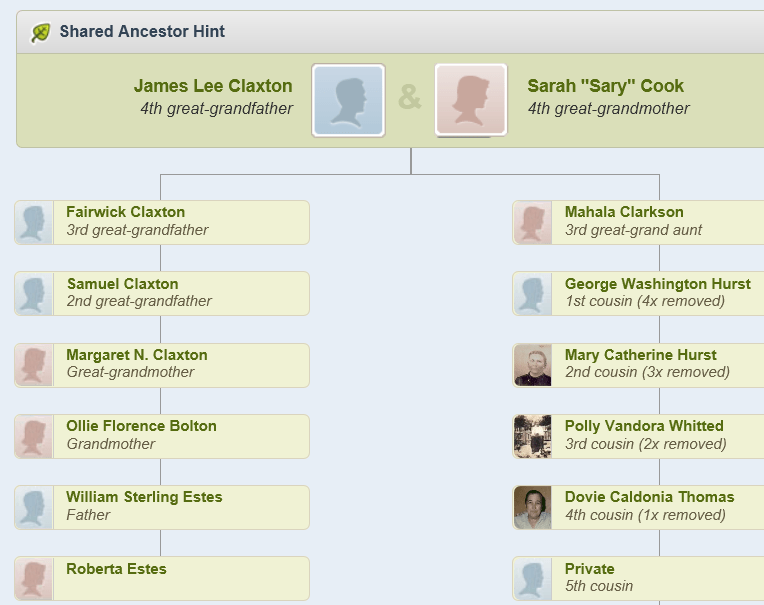
Here’s an example.  This is a match to someone through my ancestor, James Claxton and his wife Sarah Cook.  However, what if I’m also related to this person through the Estes family too?  Or an unknown line?  Just because the paper connection is to James Claxton doesn’t mean the genetic connection is to him as well.  This person has over 11,000 people in his tree.  If we are from the same geography, it’s likely that we match on multiple lines.  What if we match on paper on two or three lines?  How do we know how we are genetically related – through which line or lines?

At Ancestry, you don’t – you can’t – because they want to “keep things simple.”   Let me translate – they would rather leave you with a vague “feel good” notion about who you are related to, even if it’s not true, than give you the tools to discover the truth.

We need a chromosome browser to let us see how and if the DNA we share with these people is really from the Clarkson/Claxton family or the Cook family, or if maybe it’s from another line that isn’t shown on the pedigree chart being displayed by Ancestry.

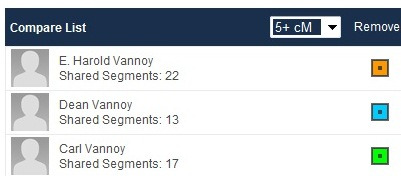
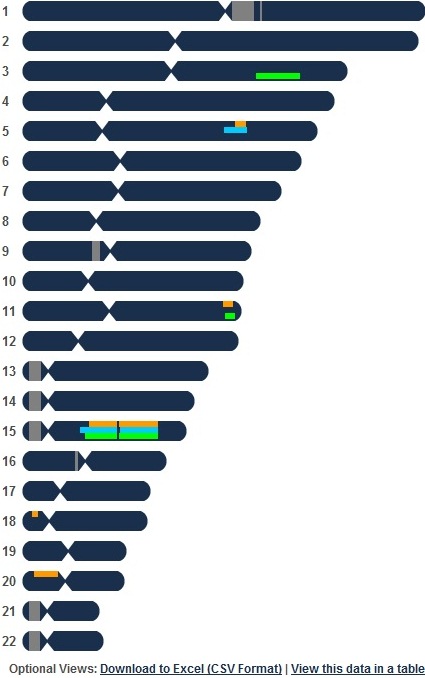
Let’s move to Family Tree DNA to see what a chromosome browser does for you.  At Family Tree DNA, three of my Vannoy cousins have tested.  By using the chromosome browser to look at their DNA compared to mine, we can identify some segments as “Vannoy” segments – meaning they unquestionably come from that line.  We do that by using triangulation. It’s easy.  Using 3 or more relatives from a particular line, if three or more match on a particular segment, you know that segment is from that family line.

ancestry push 2

I’ve selected three cousins to compare to my results, above, and their results will be displayed using these colors.  Below, you can see that on chromosome 15, all 4 of us match on a significant sized matching segment.  That means that this segment is definitely “Vannoy.”  How does this benefit us?

ancestry push 3

Well, it benefits us in two ways.  Let’s say an adoptee, or someone who has hit a brick wall also matches us on this segment.  It tells us that they are also “Vannoy” or perhaps ancestors of Vannoys.  Ancestors of Vannoys?

ancestry push 4

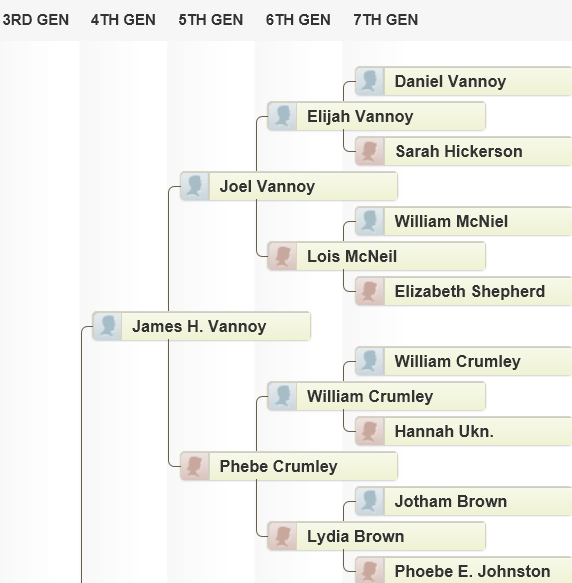
Yes, Vannoy is of course made up of their ancestral names and lineages too, so in time, let’s say that a Hickerson matches this segment too.  Then we’ll know that this segment comes from Daniel Vannoy’s wife, Sarah Hickerson’s line.  Do you have any wives surnames in your lines that need to be identified?  This is one way to do it, but you can’t without a chromosome browser.  And you could be the one who is brickwalled with the answer just waiting…..if there was a chromosome browser.  Do you see why this is so important, especially given the number of people who have tested at Ancestry?

Pretty simple stuff, right?  Well, Ancestry doesn’t think so.  They think you’re not capable of understanding this.  Funny, both Family Tree DNA and 23andMe provide this capability and people use it and depend upon it daily.  If you don’t want to use it, you certainly don’t have to, but to deprive all of us of an absolutely critical component of genetic genealogy is unconscionable. It’s simply not acceptable.

What can we do about this?  CeCe Moore, Tim Janzen and Dave Dowell were at Rootstech this week where they spoke with Kenny Freestone, among others.  He’s says he does personally read the information submitted through the “Feedback” button.  That is apparently how Ancestry gauges what needs to be done and prioritizes items.  Of course, if most of their novice clients don’t know what they are missing, they won’t be able to ask for what they don’t know about.  They are living under the illusion that they ARE genetically connected to everyone whose tree shows, and through the common paper line, and that’s it.  They don’t know that Ancestry is intentionally leaving them in their “feel good” cocoon and intentionally withholding “the rest of the story” and with it, their ability to discover even more.

But we know better and we were all “new users” at one time.  Use the feedback button.

ancestry push 5

It’s at the top right of your DNA pages at Ancestry.  Send Kenny the message…..”Kenny, we need a chromosome browser.”

Pssst….pass it on.  Everyone needs to provide this feedback.  This is how we got the raw data released and it’s the only way we’ll ever convince Ancestry to implement a chromosome browser.  Facebook this posting, Tweet it, post it on groups and forums.  Get the word out.  Send Feedback!!!

ancestry push

Judy Russell, the Legal Genealogist blogged about this today as well.

______________________________________________________________

Disclosure

I receive a small contribution when you click on some of the links to vendors in my articles. This does NOT increase the price you pay but helps me to keep the lights on and this informational blog free for everyone. Please click on the links in the articles or to the vendors below if you are purchasing products or DNA testing.

Thank you so much.

DNA Purchases and Free Transfers

Genealogy Services

Genealogy Research

Downloading Ancestry’s Autosomal DNA Raw Data File

Well, the big day has finally arrived.  Ancestry has at last allowed us to download our raw data files.  To download yours, sign on to your Ancestry account and fly over the DNA tab.  You’ll see the selection, “Your DNA Home Page,”  Click on that.

ancestry download

Then click on “Manage Test Settings” to the right of the orange “View Results” box.  You’ll see the following screen.

ancestry download 1Click on “Get Started” in the right hand box under “Download your raw DNA data.”  You will then be prompted to enter your password to receive an e-mail to allow the download.

ancestry download 2

The e-mail will arrive, and you will need to click the link in the e-mail, shown below, to activate the download.

ancestry download 3

Clicking on the e-mail link “Confirm Data Download” takes you to the next step on Ancestry’s website, below.

ancestry download 4

Clicking on the green “Download DNA Raw Data” link shows the following:

ancestry download 5

Shortly, your browser will do whatever it does to ask you if you want to save or display the file.

ancestry download 6

I use Internet Explorer and download files are automatically saved in the “download” folder.  I renamed it and moved it to someplace where I can find it, hopefully.  The good news is that if I “lose” it on my computer, it’s easy to repeat this process.

Now, what can you do with this file today?  Not a lot.  You can compare raw data segments with others who might download their files too, but life will be a lot easier when tools like GedMatch can accept these files and do something with them.  There were also rumors last fall that Family Tree DNA would support uploads as well when Ancestry released these files, the same as they do with 23andMe raw data files.  Let’s hope so.

However, today will be the first day these organizations see the raw data too, so expect a bit of lag time before anyone can process or incorporate this information.  Of course, it goes without saying that we have to address issues pertaining to file layout and compatibility.

I’m hopeful that since Ancestry has the raw data files for everyone who has tested there, that they will do what the other two major players have done and create a chromosome browser where you can see who matches you on which segments and download that comparative information as well.  It’s not just the raw data we need, it’s the integrated tools to use it.  Hopefully we’re at the crawl before you walk stage and we’ll be walking soon!

______________________________________________________________

Disclosure

I receive a small contribution when you click on some of the links to vendors in my articles. This does NOT increase the price you pay but helps me to keep the lights on and this informational blog free for everyone. Please click on the links in the articles or to the vendors below if you are purchasing products or DNA testing.

Thank you so much.

DNA Purchases and Free Transfers

Genealogy Services

Genealogy Research

The Autosomal Me – Testing Company Results

This is Part 4 of a multi-part series, The Autosomal Me.

Part 1 was “The Autosomal Me – Unraveling Minority Admixture” and Part 2 was “The Autosomal Me – The Ancestors Speak.”  Part 1 discussed the technique we are going to use to unravel minority ancestry, and why it works.  Part 2 gave an example of the power of fragmented chromosomal mapping and the raw beauty of the results.  Part 3, “The Autosomal Me – Who Am I?,” discussed how to use our pedigree charts to gauge expected results and how autosomal results are grouped into population buckets.  We also named this technique, Minority Admixture Mapping, or MAP for short.

In this segment, Part 4, let’s take a look at what the testing company autosomal results look like.  The results are presented in timeline order, with the oldest results first and the latest, and presumably most accurate results, last.

23andMe Version 1

23andMe was the first company to offer this type of testing affordably.  They initially only offered 3 population groups, and one inferred that Asian was actually Native American.  Of course, that wasn’t a valid assumption for everyone, but it was the best that could be done under the circumstances.  This was my ethnicity results display at 23andMe until December 2012 went their updated version was released.

Autosomal test 1

DeCode Genetics

DeCode Genetics initially offered autosomal tests for ancestry.  Unfortunately, under the pressure of financial issues, they stepped away from the genetic genealogy marketspace and have since been sold.

Their test showed the following ethnic breakdown, picking up both my Native and African heritage:

autosomal test 2

I particularly like these results because the X chromosome is included, and seeing Native on the X chromosome, which has a unique inheritance path is a very important piece of data.

Family Tree DNA Version 1

Family Tree DNA’s first version of their Family Finder product produced results stating that I am 100% European, split between western and northern, shown below (minus the map.)

autosomal test 3

Dr. Doug McDonald

Doug McDonald, a retired physical chemistry professor, compiles contributed raw data and compares the raw data locations with both reference populations and the contributor results.  This is not a commercial endeavor but a private research project which has been ongoing for years.  His analysis of my raw data results from 23andMe and Family Tree DNA showed that they are primarily European.  His first analysis was without Middle Eastern populations and the results showed European except for a total of about 3% East Asian, Oceana and American.   However, in a second run including the Pakistan and Middle Eastern populations, the results now showed 88% European, about 1% Oceanic and American and the balance Middle Eastern and Pakistani.

A small amount of Middle Eastern heritage is not unexpected since I do have confirmed Turkish ancestors.

Dr. McDonald indicated that this was slightly more, 1-2%, than most Europeans, and that I was generally planted firmly in the middle of the “English” area in his data.  His results showed no African.

Standard deviation (statistical noise) is about 1%.  He can achieve these low deviation numbers by using such a large number of markers (536,904 to be exact)[1] for his comparison.  I am grateful to Dr. McDonald for his contribution, not only to me, but to this field.

The graph below shows that my primary ancestry falls in the English/French region.

autosomal test 4

The second graph maps these results on my chromosomes. The American, bright green, is found on chromosomes 1 and 2, and the X chromosome shows South Asian.

autosomal test 5

Doug indicates that the Native American is found at about the .5% level.  Interestingly, on my mother’s graphs and charts (below), the Native segments are nearly identical, but my first grey South Asian segment on my X is Mideast on her chart.

autosomal test 6

It’s also interesting to note that my Native American on chromosome 2 is larger than my mother’s which may well reflect Native heritage on my father’s side.  Ironically, the oral history of Native ancestry was on my father’s side, not my mothers.

Doug’s analysis has been updated several times over the years and these results are the most current.  The vendors have made upgrades too.  In 2012, both 23andMe and Family Tree DNA underwent upgrades to their ethnicity software and the Genographic Project version 2.0 test was released.

23andMe 2012 Updated Version

The new 23andMe software offers different confidence levels.

The standard estimate, or confidence level, shows that I have about .5% Native American.  This is consistent with Dr. McDonald’s findings.

autosomal test 7

A second view is available which paints the chromosomes.  A split view is also available if one of your parents has been tested at 23andMe as well.  That is not an option for me.

autosomal test 8

The conservative estimate, below, shows less Native at .2%.

autosomal test 9

The speculative level below shows the Native back to .5% but adjusts the European regions significantly.

autosomal test 10

Although 23andMe does not provide participants with the start and stop locations, through alternative means, meaning a very smart friend, Rebekah Canada, who is a Java programmer, start and stop locations can be discerned.

CeCe Moore documented Rebekah’s technique for those who will be following along with their own results through this process.

In a future segment of this series, we’ll look at alternative ways to discern Native segments.  Thanks to Rebekah’s technique, I can tell you that 23andMe shows my Native segments as follows:

Chromosome 1 – 165,658,091 to 175,711,116

Chromosome 2 – 86,316,174 to103,145,426

23andMe also provides a Neanderthal percentage.  What fun!!!

autosomal test 11

Family Tree DNA Updated 2012 Version

My mother was deceased before chip based autosomal testing was available, but I ordered the Family Finder test for her as soon as it was available.  Thankfully her DNA was stored at Family Tree DNA and was still viable.

autosomal test 12

Mother’s original results are shown above and her most recent results are shown below.  Her results shifted within Europe and her margin of error doubled.

autosomal test 13

My current results from Family Tree DNA’s updated software are shown below.

 autosomal test 14

National Geographic Genographic 2.0

I was very surprised to see my National Geographic results.  They were very unexpected, in particular the high percentages of Mediterranean and Southwest Asian, totaling 54%.

autosomal test 15

It made more sense when I read the information.  It’s true, reading is fundamental.

autosomal test 16

These results are, in essence, more anthropological in nature.

autosomal test 17

autosomal test 18

Of course, one of the fun parts of the Genographic results are the Neanderthal and Denisovan percentages.

autosomal test 19

These are somewhat different than the 23andMe results, although if you add the Neanderthal and Denisovan values together, the resultant 2.2% is very close to 23andMe’s 2.5%.

Ancestry.com

In 2012, Ancestry introduced an autosomal DNA test as well.  What it provides is very limited, with limited tools, but it does provide percentages of ethnicity in addition to matches.  Recently, Ancestry announced that the percentages may change over time.  They have been severely beaten within the genetic genealogy community for quality issues with this product, including percentages of ethnicity that are highly erroneous.  Their stated time reference is 500 years ago.

Recently this new page was added before you can see your detailed results.

autosomal test 20

Ancestry shows my heritage as only British and Scandinavian.

autosomal test 21

Ironically, Ancestry has mapped the birth locations of my ancestors in Europe on the map above, based on my family tree submitted.  Interesting that Germany doesn’t show in Ancestry’s ethnicity list but many of my family lines originated in Germany and Holland, and none in Scandinavia.

Testing Provider Summary

Where do we stand now?

A summary of the various test results is shown below compared to my pedigree analysis.

Test Results Chart

autosomal test 22

I have included Dr. McDonald’s analysis here, not because he’s a testing provider in the sense of the testing companies, but because his offering was available in this timeframe, and because he worked with Family Tree DNA to develop their Population Finder code.

You can see that the results are relatively consistent between testing companies.  There is certainly no question about majority ancestry, but the minority admixture which hovers someplace near 1%, give or take 5% in either direction, is much less consistent and not always reported.  If I were to have tested with only one company and taken the results as gospel, I could certainly have been left believing that I had no Native or African admixture.  For many people, it’s this small amount of minority admixture that they are seeking.  So in answer to the question of which testing company is “best,” the answer is, if you’re looking for trace amounts of anything, the compendium of all the testing companies (minus Ancestry) would provide the best set of results.  We will be using the match information as well in the next sections, so certainly nothing has been “wasted” testing with multiple companies, again, except Ancestry.  I am hopeful that Ancestry will in the future release our raw data (which they have promised to do) in a useable format, fix their misleading ethnicity results and add chromosome painting tools so that we can fully utilize our data.

In Part 5 of the series, we’ll take a look at third party tools and how they can continue to refine and add to our knowledge of our admixture.


1.  Genealogy-DNA Rootsweb posting by Doug McDonald on 7-26-09 and personal correspondence.

2.  71.5% western European, 28.4% Northeastern European

3.  Inferred that Asian is actually Native in an American with no history of Asian ancestry.

4.  No category, inferred.

5.  78.6% Northern European, 1.8% Southern European, 18.7% Nonspecific European

6.  54.6% Northern European, .3% Southern European, 43% Nonspecific European

7.  91.7% Northern European, 3% Southern European, 3.3% Nonspecific European

8.  75.18% West Europe (French and Orcadian), 24.82 Europe (Romanian, Russian, Tuscan and Finnish).  Note that my mother’s results are almost identical except the Finnish is missing from hers.

9.  43% North Europe and 36% Mediterranean

10.  80% British, 12% Scandinavian

______________________________________________________________

Disclosure

I receive a small contribution when you click on some of the links to vendors in my articles. This does NOT increase the price you pay but helps me to keep the lights on and this informational blog free for everyone. Please click on the links in the articles or to the vendors below if you are purchasing products or DNA testing.

Thank you so much.

DNA Purchases and Free Transfers

Genealogy Services

Genealogy Research

Autosomal Testing Comparison

Currently, there are four different entities, 3 corporations and a nonprofit, that test autosomal DNA using the newest technology, the Illumina chip.  There are different features and functions of each one.

I am describing them below in broad terms, and including links to articles where I and others have discussed their autosomal products.

23andMe – The first company to enter the chip based world of genetic processing by introducing a health traits and genealogy product that provided genealogists with cousin matches and percentages of ethnicity.  They provide raw data files that can be downloaded and then uploaded to Family Tree DNA and GedMatch.  In December 2012, after a significant capital investment, they dropped the price of their autosomal product to $99 with a goal to reach one million customers as a result.  They currently have about 180,000.

http://dna-explained.com/2012/12/07/new-worldview-at-23andme/

Family Tree DNA – Clearly the leader in genetic genealogy testing, they offer the Family Finder test using the same chip based platform as 23andMe.  Customers of 23andMe can upload their raw data file to Family Tree DNA for $89, effectively allowing them to fish in both pools for cousin matches and to obtain the ethnicity predictions from both companies.  Family Tree DNA provides raw data files and numerous tools to assist the genealogist, including integrated searching of autosomal, Yline and mitochondrial matches.  The Family Tree DNA Family Finder product is currently $199.  Family Tree DNA customers are generally interested in genealogy, while 23andMe clients are often only interested in the health traits aspect of their test.

http://dna-explained.com/2012/10/14/what-to-order-geno-2-0-vs-family-tree-dna-products/

Ancestry – Ancestry introduced their AncestryDNA test in early 2012 by initially giving away tests, then selling tests for the reduced price of $99 to build their autosomal data base.  Today, the tests range from $129 to $199 depending on whether or not you have an Ancestry.com subscription.  Continued, complete access hinges upon maintaining a subscription at some level.  Their test reports cousin matches and percentages of ethnicity.  If your matches have attached their genealogy, and it’s not marked private, you can see if you share common ancestors by viewing their tree.  Ancestry’s ethnicity predictions have significant issues, they provide no autosomal tools, such as a chromosome browser for cousin matching and they do not provide your raw data to download, although they have said they will provide that sometime in 2013.

http://dna-explained.com/2012/10/24/ancestrys-mythical-admixture-percentages/

http://dna-explained.com/2012/09/10/ancestry-autosomal-results-are-back/

http://www.isogg.org/wiki/AncestryDNA

National Geographic Genographic 2.0 – The latest autosomal test to be released is focused somewhat differently that the other tests.  This test looks more at deep ancestry using the discoveries made within the Genographic project over the past 6 years.  This test provides the deepest clade testing for the Y chromosome available from any test at any company.  It also provides ethnicity percentages based on many newly discovered SNPs not in use elsewhere.  The price is $199.

http://dna-explained.com/2012/07/25/national-geographic-geno-2-0-announcement-the-human-story/

http://dna-explained.com/2012/07/26/geno-2-0-qa-with-bennett-greenspan/

http://dna-explained.com/2012/07/30/geno-2-0-answers-from-spencer-wells/

http://dna-explained.com/2012/12/11/geno-2-0-results-first-peek/

http://dna-explained.com/2012/12/12/geno-2-0-results-kicking-the-tires/

In addition, Debbie Kennett has added a wiki page about comparing autosomal testing companies in the ISOGG Wiki at:

http://www.isogg.org/wiki/Autosomal_DNA_testing_comparison_chart

Thanks Debbie for your efforts to help everyone!

______________________________________________________________

Disclosure

I receive a small contribution when you click on some of the links to vendors in my articles. This does NOT increase the price you pay but helps me to keep the lights on and this informational blog free for everyone. Please click on the links in the articles or to the vendors below if you are purchasing products or DNA testing.

Thank you so much.

DNA Purchases and Free Transfers

Genealogy Services

Genealogy Research

2012 Top 10 Genetic Genealogy Happenings

2012 has been a very busy year for genetic genealogists.  There have been lots of discoveries and announcements that affect everyone, now and in the future.  The watchwords for 2012 would be “churn” and “explosive growth.”  Let’s take a look at the 10 most important events, why they are important and what they mean for the future of genetic genealogy.

These items are in what I think are relatively good order, ranked by their importance, although I had a very difficult time deciding between number 1 and 2.

1. The New Root – Haplogroup A00

At the Family Tree DNA conference in November, Michael Hammer, Bonnie Schrack and Thomas Krahn announced that they had made a monumental discovery in the age of modern man known as Y-line Adam.  The discovery of Haplogroup A00 pushes the “birth” of mankind back from about 140,000 years ago to an amazing 338,000 years ago.  Utterly amazing.  The DNA came from an American family from South Carolina.  This discovery highlights the importance of citizen science.  Bonnie is a haplogroup administrator who recognized the potential importance of one of her participants’ DNA.  Thomas Krahn of course is with Family Tree DNA and ran the WTY test, and Michael Hammer is at the University of Arizona.  So you have the perfect blend here of participant, citizen scientist, commercial lab and academia.  What was never thought possible a decade or so ago is not only working, it’s working well and changing the face of both science and humanity.

http://dna-explained.com/2012/11/16/the-new-root-haplogroup-a00/

http://www.haplogroup-a.com./

2. Geno 2.0

Geno 2.0 is the Nickname for the National Geographic Society’s Genographic Project version 2.0.  That mouthful is why it has a nickname.

This amazing project has leveraged the results of the past 7 years of research from the original Genographic project into a new groundbreaking product.  Geno 2.0, utilizing the GenoChip, a sequencing chip created specifically for Nat Geo, offers the most complete Y tree in the world today, expanding the SNP tree from just over 800 SNPs to over 12,000.  They are in essence redrawing the Y chromosome tree as I write this.  In addition, the person who purchases Geno 2.0 will receive a mitochondrial DNA haplogroup assignment.  Over 3300 new mitochondrial mutations were discovered. A brand new anthropological “percentages of ethnicity” report is featured based on over 75,000 Ancestry Informative Markers, many only recently discovered by the Genographic project.  Additionally, participants will receive their percentage of both Neanderthal and Denisovan ancestry based on 30,000 SNPs identified that signal interbreeding between the hominids.  A new website will also facilitate social networking and uploading information to Family Tree DNA.

The wonderful news is that there is a massive amount of new information here that will change the landscape of genetic genealogy.  The difficulty is that we are struggling a bit under the load of that massive amount of information that is just beginning to descend upon us.  It’s a great problem to have!

http://dna-explained.com/2012/07/25/national-geographic-geno-2-0-announcement-the-human-story/

http://dna-explained.com/2012/07/26/geno-2-0-qa-with-bennett-greenspan/

http://dna-explained.com/2012/07/30/geno-2-0-answers-from-spencer-wells/

http://dna-explained.com/2012/07/31/geno-2-0-wty-mtdna-full-sequence-participants-and-more/

http://dna-explained.com/2012/10/14/what-to-order-geno-2-0-vs-family-tree-dna-products/

http://dna-explained.com/2012/10/16/geno-2-0-the-kit-arrives/

http://dna-explained.com/2012/12/11/geno-2-0-results-first-peek/

http://dna-explained.com/2012/12/12/geno-2-0-results-kicking-the-tires/

3. Reconstructed Sapiens Reference Sequence (RSRS)

In July, Family Tree DNA implemented the RSRS that in effect reconstructs the genetic profile of Mitochondrial Eve and bases the comparison of our DNA today against the RSRS sequence as opposed to the Cambridge Reference Sequence (rCRS) created in 1981 that is or was the current standard.  The RSRS is a result of the watershed paper published in April 2012 by Dr. Doron Behar and 8 other authors titled “A “Copernican” Reassessment of the Human Mitochondrial DNA Tree from its Root.”  A complementary research website, www.mtdnacommunity.org, accompanies the paper.

http://dna-explained.com/2012/07/14/what-happened-to-my-mitochondrial-dna/

http://dna-explained.com/2012/07/15/the-crs-and-the-rsrs/

http://dna-explained.com/2012/07/16/the-mtdna-community/

http://dna-explained.com/2012/12/02/little-a-big-a-mitochondrial-dna/

4. Full Genome and Exome Sequence Offered Commercially by Gene by Gene

It was announced at the November DNA conference that Gene by Gene, the parent company of Family Tree DNA, through their division titled DNA DTC is offering full genomic sequencing for the amazing price of $5495 for the full genome and $695 for the exome.  This is a first in the consumer marketspace.  Today, this doesn’t have a lot of application for genetic genealogy, but as the price continues to drop, and utilities are built to process the full genomic data, certainly a market and applications will emerge.  This is an important step forward in the industry with a product that still cost 3 million dollars in 2007.

http://dna-explained.com/2012/11/30/gene-by-gene-announces-landmark-dna-dtc-full-genome-sequence/

5. Neanderthal and Denisovan DNA

It’s official – they did it.  Yep, they interbred and well, they are not them anymore, they are us.  Given that everyone in Asia and Europe carries a part of them, but not people from Africa, it would appear that two populations admixed rather thoroughly in Eurasia and/or the populations were small.  The amount of Neanderthal and Denisovan DNA will continue at approximately the proportions seen today in Europe (2% Neanderthal) and Asia unless a significant amount of admixture from a population (Africa) that does not carry this admixture is introduced.  So if you’re European, you carry both Neanderthal and Denisovan DNA.  They are your ancestors.  The good news is that you can find how much of each through  the Geno 2.0 test.  23andMe results give you the percentage of Neanderthal, but not Denisovan.

http://dna-explained.com/2012/08/31/denisovan-dna-tells-a-story/

http://dna-explained.com/2012/12/12/geno-2-0-results-kicking-the-tires/

6. Ancestral Genome Reconstruction Begins,  Led by Falling Autosomal Prices and the Ability to Fish in Multiple Ponds

2012 has been the year of autosomal testing price reductions and a great deal of churn in this marketspace.  Companies are playing leap-frog with one another.  However, sometimes things are not all that they seem.

Initially, 23andMe opted for an initial payment plus monthly subscription model, which they abandoned for a one time payment price of $299 in early 2012.  Family Tree DNA was slightly less, at $289.

Ancestry led the price war by giving away kits, then selling them for $99, then $129 plus a subscription as an entrance into this market.  However, looking at the Ancestry consent form hints at possible reasons why they were selling below the cost of the tests.  You are in essence giving them permission to sell your DNA and associated information.  In addition, to gain full access to your results and matches, you must maintain some level of subscription to Ancestry.com, increasing the total effective price.

Next came Family Tree DNA’s sale where they dropped their autosomal price to $199, but they were shortly upstaged by 23andMe whose price has now dropped to $99 permanently, apparently, a result of a 50 million dollar investment in order to reach 1 million customers.  They currently have about 180,000.  23andMe has always been in the medical/health business, so their clients have always understood what they were consenting to and for.

Not to be outdone, Family Tree DNA introduced the ability earlier in 2012 to upload your data files from 23andMe to FamilyTree DNA for $89, far less than a second test, which allows you to fish in a second pond where genealogists live for matches.  The challenge at 23andMe is that most of their clients test for the health traits and either don’t answer inquiries or match requests, or know little about their genealogy if they do.  At Family Tree DNA, matches don’t have to answer and allow a match, testers are automatically matched with all participants who take the Family Finder test (or upload their 23andMe results) and testers are provided with their matches’ e-mail address.

Of course, Geno 2.0 was also introduced in the midst of this, in July, for $199 with the additional lollipop of new SNPS, lots of them, that others simply don’t have access to yet.

The good news is that consumers have benefitted from this leapfrogging, I think.  Let’s hope that the subsidized tests at Ancestry and 23andMe don’t serve long term to water down the demand to the point where unsubsidized companies (who don’t selling participants genetic results to others) have problems remaining viable.

Personally, I’ve tested at all of these companies.  I’ll be evaluating the results shortly in detail on my blog at www.dna-explained.com.

The tools provided by most testing companies, plus GedMatch, and multiple ponds to fish in are allowing the serious genetic genealogist to “reconstruct” their genome, attributing segments to specific ancestors.  Conversely, we will also be able to “reconstruct” specific ancestral family lines as well by identifying autosomal segments in multiple descendants.  This new vision of autosomal genetic genealogy will allow much more accurate ancestral line matching, and ancestor identification in the not-so-distant future.

http://www.yourgeneticgenealogist.com/2012/01/family-tree-dna-now-accepting-23andme.html

http://www.yourgeneticgenealogist.com/2012/05/23andme-eliminates-subscription-model.html

http://www.yourgeneticgenealogist.com/2012/10/clarification-of-what-is-available-to.html

http://www.yourgeneticgenealogist.com/2012/12/23andme-receives-50-million-and-drops.html

http://www.thegeneticgenealogist.com/2012/12/26/23andme-and-labcorp-sued-for-patent-infringement/

7. Ethnicity Tests Mature – Minus 1

The good news is that the various ethnicity tests (known as BGA or biogeographical ancestry tests) that provide participants with their percentages of various world populations are improving.  The bad news is that there is currently one bad apple in the card with very misleading percentages – and that is Ancestry.com.

23andMe introduced a new version of their ethnicity product in December, expanding from only 3 geographic categories to several.  The Geno 2.0 test results are just beginning to be returned which include ethnicity predictions and references to several base populations.

Family Tree DNA finally has some competition in this arena where for years they have been the only serious player, although opinions differ widely about which of these three organizations results are the most accurate.  All four are Illumina chip based, using hundreds of thousands of locations, as compared with the previous CODIS type tests which used between 15 and 300 markers and are now outdated.  All companies use different reference populations which, of course, provide somewhat different results to participants.  All companies, except Ancestry, have documented and shared their reference population information.

Outside of these companies, Doug McDonald offers a private analysis and Gedmatch offers a series of BGA comparisons written by third parties.

While this industry continues to grow and mature, I’m thinking about just averaging the autosomal ethnic results and calling it good:)

http://dna-explained.com/2012/07/21/ethnicity-finders/

http://dna-explained.com/2012/10/24/ancestrys-mythical-admixture-percentages/

http://dna-explained.com/2012/12/07/new-worldview-at-23andme/

http://dna-explained.com/2012/09/09/doug-mcdonald-on-biogeograpical-analysis/

http://dna-explained.com/2012/12/11/geno-2-0-results-first-peek/

http://www.yourgeneticgenealogist.com/2012_12_01_archive.html

8. Finding Your Roots PBS Series with Henry Louis Gates

PBS sponsored a wonderful series in the spring of 2012 hosted by Henry Louis “Skip” Gates, the chair of African American Studies at Harvard.  This series followed a lesser known 2010 series.  The 2012 inspirational series reached tens of thousands of people and increased awareness of genetic genealogy as well as sparked an interest in genealogy itself, especially for mixed race and African American people.  I was disappointed that the series did not pursue the Native American results unexpectedly obtained for one participant.  It seemed like a missed opportunity.  Series like this bring DNA testing for genealogy into the mainstream, making it less “strange” and frightening and more desirable for the average person.  These stories were both inspirational and heartwarming.  I hope we can look forward to similar programs in the future.

http://en.wikipedia.org/wiki/Finding_Your_Roots

CeCe Moore covered this series in March and April on her blog.

http://www.yourgeneticgenealogist.com/2012/03/finding-your-roots-with-henry-louis.html

http://www.yourgeneticgenealogist.com/2012/04/finding-your-roots-with-henry-louis.html

http://www.yourgeneticgenealogist.com/2012/04/finding-your-roots-with-henry-louis_09.html

http://www.yourgeneticgenealogist.com/2012/04/finding-your-roots-with-henry-louis_16.html

http://www.yourgeneticgenealogist.com/2012/04/finding-your-roots-with-henry-louis_23.html

http://www.yourgeneticgenealogist.com/2012/04/finding-your-roots-with-henry-louis_30.html

9. Ancestry, GeneTree and Sorenson

GeneTree, a for profit company and Sorenson, a non-profit company were both purchased by Ancestry.com.  This was about the same time as Ancestry introduced their autosomal AncestryDNA product.  Speculation was that the autosomal results at Sorenson might be the foundation for the new autosomal test comparisons, although there has been no subsequent evidence of this.

Ancestry initially gave away several thousand kits in order to build their data base, then sold thousands more for $99 before raising the price to what appears to be a normalized price of $129 plus an annual ancestry subscription.

While GeneTree was never a major player in the DNA testing marketspace, Sorenson Molecular Genealogical Foundation played an important role for many years as a nonprofit research institute.  There was significant distress in the genetic genealogy community related to the DNA contributed to Sorenson for research being absorbed by Ancestry as a “for profit” company.  Ancestry is maintaining the www.smgf.org website, but no additional results will be added.  Sorenson has been entirely shuttered.  Many of the Sorenson/GeneTree employees appear to have moved over to Ancestry.

The initial AncestryDNA autosomal product offering is poor, lacks tools and the ethnicity portion has significant issues. It’s strength is that many people who test are already Ancestry subscribers and have attached their trees.  So you can’t see how you connect genetically to your matches (lack of tools), but you can see the trees, if they are attached and not marked as private, of those with whom you match.  Ancestry provides “hints” relative to matching individuals or surnames.

Eventually, if Ancestry improves its products, provides tools and releases the raw data to consumers, this may be a good thing.  It’s an important event in 2012 because of the massive size of Ancestry, but the product is mediocre at best.  Ancestry seems unwilling to acknowledge issues unless their feet are held to the fire publicly as illustrated with a “lab error” erroneous match for an adoptee caught by the consuming public and ignored by Ancestry until CeCe Moore exposed them in her blog.  Whether Ancestry ultimately helps or hurts the genetic genealogy industry is a story yet to be told.  There is very little positive press in the genetic genealogy community surrounding the Ancestry product, but with their captive audience, they are clearly going to be a player.

http://www.yourgeneticgenealogist.com/2012/05/ancestrycom-buys-genetree-and-launches.html

http://dna-explained.com/2012/07/12/did-you-test-at-genetree/

http://dna-explained.com/2012/08/30/is-history-repeating-itself-at-ancestry/

http://dna-explained.com/2012/07/18/the-trouble-with-ancestry-com-matches/

http://dna-explained.com/2012/08/14/y-dna-family-tree-dna-vs-ancestry/

http://dna-explained.com/2012/08/16/ancestrys-consent-form-for-ancestrydna-autosomal-test/

http://dna-explained.com/2012/09/10/ancestry-autosomal-results-are-back/

http://dna-explained.com/2012/10/15/ancestrys-dna-survey/

http://dna-explained.com/2012/10/23/ancestry-to-release-array-data-in-2013/

http://dna-explained.com/2012/10/24/ancestrys-mythical-admixture-percentages/

http://www.thegeneticgenealogist.com/2012/06/19/problems-with-ancestrydnas-genetic-ethnicity-prediction/

http://www.yourgeneticgenealogist.com/2012/08/ancestrydna-confusing-relationship.html

http://www.yourgeneticgenealogist.com/2012/08/follow-up-on-ancestrydna-and-adoptees.html

http://www.yourgeneticgenealogist.com/2012/09/23andme-says-no-match-for-adoptees.html

10. GedMatch

GedMatch, www.gedmatch.com, created by John Olson and Curtis Rogers, isn’t new in 2012, but it’s maturing into a tool that is becoming the defacto workhorse of the serious autosomal community.  People who test at either 23andMe or Family Tree DNA download their raw results and other match information and then use a variety of tools at GedMatch to look at results in different ways and using different thresholds. GedMatch is currently working to accept the newly arriving Geno 2.0 data files.  Ancestry does not at this time allow their customers access to their raw data files, so there is nothing to upload. The bad news is that not everyone downloads/uploads their information.  Only the most savvy users, and the download/upload is not always a smooth process, often necessitating several attempts, a magic wand and some fairy dust for luck.

GedMatch is a volunteer effort funded by donations on the GedMatch site.  The magnitude of this project came to light when they needed new servers this year because the amount of traffic disabled their internet service provider.  It may be a volunteer effort, but it has mainstream requirements.  Therefore, while occasionally frustrating, it’s easy to understand why it’s light on documentation and one has to poke around a bit to figure things out.  I would actually prefer that they make it a subscription site, clean up the bugs, add the documentation and take it to the next level.  It would also be very nice if they could arrange something with the major players in terms of a seamless data transfer for clients.  All told, it’s an amazing contribution as a volunteer site.  Hats off to Curtis and John for their ongoing contribution to genetic genealogists!!!

www.gedmatch.com

http://www.legalgenealogist.com/blog/2012/08/12/gedmatch-a-dna-geeks-dream-site/

______________________________________________________________

Disclosure

I receive a small contribution when you click on some of the links to vendors in my articles. This does NOT increase the price you pay but helps me to keep the lights on and this informational blog free for everyone. Please click on the links in the articles or to the vendors below if you are purchasing products or DNA testing.

Thank you so much.

DNA Purchases and Free Transfers

Genealogy Services

Genealogy Research

Unattaching Ancestry’s Self-Attaching Trees

I had really come to really dread the e-mails from people who say they are going to invite me to view their family tree at Ancestry.com.  It’s not because I don’t want to see the tree, I do.  It’s because Ancestry does me the huge favor of “attaching” that tree to my account like a very large parasitic blood-sucking leach.  They’ve assumed that every tree I look at is “family,” and that my attachment to that tree is “forever.”  And better yet, every time someone does something, anything, to that tree, I receive a message that says “New content has been entered to your family tree.”  Well, Ancestry, it’s not MY family tree and I NEVER asked you to do me any favors by attaching some random tree I’m looking at to me.  In fact, I specifically don’t want you to do that, but like normal, I don’t get to vote.  This is called “too much help” and anyone who has ever loved a 2-year-old knows all about “too much help.”

So, the random tree is firmly attached to me.  Now the question is how to remove the parasite.

First of all, I need to determine if I really do want the tree attached, meaning it is a tree I might want to reference, or if I simply want to detach it.  For DNA project administrators, most of the time, you simply want to detach them from your own personal records.

However, if you want to retain the connection to the tree, you can simply disable the notifications.  Those constant notifications are the part that will make you crazy, and the more trees you have attached, the crazier the notifications will make you.  Disabling notifications is relatively straightforward.  You need to go to your name in the top right of your screen and in the drop-down menu select “My Alerts”.

ancestry trees 4 v2

You can then change the delivery notification for each tree you have access to. The options are off, daily and weekly.  Yes, it’s a pain to have to do this to disable something you never wanted in the first place, but it’s only once (per tree) and it removes the bombardment of unwanted e-mails.

ancestry trees 5

Discovering how to remove the trees is more tricky.  However, once you’ve figured out how to do this, it’s relatively easy.

Fly your cursor over the Family Trees tab.

Ancestry trees 1

Some have a “More” option.  If so, click on it.  Mine didn’t.  If not, then click on the olive Family Trees Tab itself, not the drop down options.  You’ll then see “My Trees” and “Trees shared with me.”  Click on Trees Shared with me.  There is it, the blessed “remove from list” button.  Click and they are gone.

Ancestry trees 3

This is a frustrating dilemma because genealogists do want to share their information but it shouldn’t become a burden to either party.  It’s too bad Ancestry doesn’t give you the option to “save the link” or simply, by default, just look.

Debbie Kennett suggests that if people want to make their tree available online to their matches she finds MyHeritage is a much better alternative than Ancestry. You can upload a tree for up to 250 people free of charge. The big advantage of MyHeritage is that anyone can see your tree without needing to have an Ancestry subscription or
an invite.

Thanks to Ann Turner, Debbie Kennett and Jim Owston for their assistance with figuring out how to get rid of these self-attaching trees.  Once you know how to do this, it’s not difficult, but figuring out the procedure was anything but straightforward.

______________________________________________________________

Disclosure

I receive a small contribution when you click on some of the links to vendors in my articles. This does NOT increase the price you pay but helps me to keep the lights on and this informational blog free for everyone. Please click on the links in the articles or to the vendors below if you are purchasing products or DNA testing.

Thank you so much.

DNA Purchases and Free Transfers

Genealogy Services

Genealogy Research

Proving Native American Ancestry Using DNA

Every day, I receive e-mails very similar to this one.

“My family has always said that we were part Native American.  I want to prove this so that I can receive help with money for college.”

The reasons vary, and not everyone wants to prove their heritage in order to qualify for some type of assistance.  Some want to find their tribe and join to reclaim their lost heritage.  Some want to honor their persecuted and hidden ancestors, undoing some of the wickedness of the past, and some simply seek the truth.  Regardless of why, they are all searching for information lost to them.

I’d like to talk about three topics in proving Native Ancestry.  First, I’d like to do some myth-busting.  Second, I’d like to talk a little about conventional research and third, I’d like to discuss what DNA can, and can’t, do for you.

As you read this blog, please click on the links.  I’m not going to repeat something I’ve already covered elsewhere.

Myth-Busting

Myth 1 – Free College

There is no free college for Native Americans.  There are sometimes scholarships and grants available, mostly by the individual tribes themselves, for their official members.

Myth 2 – Joining a Tribe

Many people think that if they can only figure out which tribe their ancestor descends from, they can join.  This is untrue.  Each tribe is a sovereign nation, and they get to determine their criteria for membership.  Most tribes require a specific percentage of Native “blood,” called blood quantum, in addition to being able to document which tribal member you descend from.  Some tribes require as much as 25% Native heritage, and most require at least 1/16th Native heritage, which is one great-great grandparent.  If you don’t know who in your family was a tribal member it’s unlikely that you would be able to meet the blood quantum requirement.

Myth 3 – DNA Testing Will Reveal my Tribe

Generally, DNA testing does not provide us with the information needed to determine a tribe, although it can clearly tell, using y-line or mitochondrial DNA testing, whether your direct paternal or maternal line was or was not Native.  Sometimes you will be able to infer a tribe based on your matches and their documented history, but the definition of tribes, their names and locations have changed over time.  We are working on improving this ability, but the science simply isn’t there yet and the number of Native people who have tested remains small.

Simply put, most federally recognized tribes aren’t interested in more tribal members.  More members mean a smaller piece of the pie for existing members.  The pot of resources, whatever resources you’re discussing, is only so large and it must be shared by all tribal members.

What is a Tribe?

Tribes in the US fall into two categories.  When most people think about tribes they are talking about federally recognized tribes.  Those are tribes that have some continuity with the past, such as they have always been a tribe, or they still retain tribal lands, etc., and the federal government recognizes them as such.  These are the tribes that qualify for government programs and many own casinos.  As you might imagine, with the influx of casino money, the desire to join a tribe has increased significantly.

The second category is non-federally recognized tribes.  Some are state recognized and others, not at all.  State recognition does not in any way guarantee federal or state funding and there are no universal standards for state recognition.  In other words, your mileage may vary, widely.  Non-federally recognized tribes are often run as non-profit entities.  In many cases, these tribes will help people research and document their genealogy and may be more open to tribal membership for those connecting with their Native heritage.

Be aware that some “tribes” that fall into the non-federally recognized category may be less than ethical.  Some tend to come and go.  In one case, to apply to join, one had to provide information such as social security numbers and a complete family pedigree including your children. In some cases, membership is very expensive, hundreds of dollars, but is available to almost anyone for the right price.  When evaluating tribes that are not federally recognized, if something sounds fishy, it probably is.  Caution is the watchword.

In general, the federally recognized tribes do not feel kindly towards the non-federally recognized tribes and view them as “fake,” interlopers trying to get part of that pie.  Of course, the non-federally recognized tribes feel differently; that they are reclaiming their heritage denied them.  Native American politics is nothing new and is fraught with landmines.

No federally recognized tribes, to the best of my knowledge, have considered DNA testing as a criteria for membership.  No federally recognized tribe has endorsed or participated in DNA testing that I’m aware of.  This does not mean that individuals have not privately tested.

Traditional Genealogy Research

Given the criteria for membership in federally recognized tribes, traditional genealogy is the only way to obtain the type of information required.  If your family history includes a tribal name, and east of the Mississippi, that most often is Cherokee, contact the various Cherokee tribes to inquire about membership criteria.  If the membership criteria is 25% blood quantum, and you must live on the reservation, you’re toast…..no need to continue that line of research if your goal is to join the tribe.

If your goal is simply to find your Native ancestor, that’s another matter entirely.  Begin by using the traditional research tools.

First, look at where your ancestor or that family line was located.  Did they migrate from elsewhere?  How were they listed in the census?  Was someone listed as other than white, indicating mixed race?  Check the records where they lived, tax records and others to see if there is any indication of non-European heritage.  Remember that your non-white ancestor would have retained their “darker” countenance for at least 2 generations after being admixed.  Many Native people were admixed very early.

So first, check the normal genealogy records and look for hints and traces of non-European ancestry.

Second, turn to Native resources that might reflect the Native people in the areas where your family is or was found.  The Access Genealogy site is absolutely wonderful and has an amazingly complete set of records including searchable tribal rolls.  In addition, I add information almost daily to the Native Heritage Project at www.nativeheritageproject.com, which is searchable.  There are many more resources including several collections at Ancestry.com.

Hopefully, these records will help narrow your focus in your family tree to a particular person or two, not just a general branch.  Family rumors like “Grandma was a Cherokee Princess” are particularly unuseful.  What they more likely mean is that there was indeed some Native ancestry someplace in her line.  Cherokee has become a generic word like Kleenex.  It may also have meant that Indian heritage was claimed to cover much less desirable African heritage.  Institutionalized discrimination existed against any people of color in pre-1967 America, but Indians generally retained some rights that people of African ancestry did not.  Laws varied by state and time.  Take a look at my blog about Anti-Miscegenation Laws and when they were overturned.

Now, let’s look at DNA testing to see what it can do for you.

DNA Testing to Prove Native Ancestry

There are three types of DNA testing that you can do to prove Native Ancestry.  Two are very focused on specific family lines, and one is much more general.

  • Mitochondrial for your direct maternal line.
  • Y-line for your direct paternal line – if you are a male. Sorry ladies.
  • Autosomal to test your ethnic mix and one direct marker test for Native ancestors.

On a pedigree chart, these genealogical lines look like this:

adopted pedigree

You can see the path that the blue Y chromosome takes down the paternal line to the brother and the path the red mitochondrial DNA takes down the maternal line to both the brother and the sister.  Autosomal tests the DNA of all of the 16 ancestral lines shown here, but in a different sort of way.

Let’s look at each type of testing separately.

Y-Line DNA – For Paternal Line Testing for Males

The Y-line testing tests the Y chromosome which is passed intact from father to son with no DNA from the mother. This is the blue square on the pedigree chart. In this way, it remains the same in each generation, allowing us to compare it to others with a similar surname to see if we are from the same “Smith” family, for example, or to others with different surnames, in the case of adoption or Native heritage.  Native American genetics isn’t terribly different than adoptees in this situation, because different English surnames were adopted by various family members, into the late 1800s and sometimes into the early 1900s, depending on the location.

Y-line DNA can tell you whether or not you descend from a common male genealogically when compared to another testing participant.  Small mutations do take place and accumulate over time, and we depend on those so that we don’t all “look alike” genetically.  It can also tell you by identifying your deep ancestral clan, called a haplogroup, whether or not you descend from early Native Americans who were here before contact with Europeans.  For that matter, it can also tell you if you descend from those of African, European or Asian ancestry.

Scientists know today that there are only two primary haplogroups indicating deep ancestry that are found among Native American males who were here prior to contact with Indo-Europeans, and those haplogroups are C and Q3.  It is not accurate to say that all C and Q3 individuals exist only in the American Native population, but the American Native population is part of the larger group worldwide that comprises C and Q3.  We find some haplogroup C and Q3 in Europe but none in African populations, although we do learn more every single day in this infant science.

This sometimes becomes confusing, because the single most common male haplogroup among current Cherokee tribal members who have tested is R1b.  How can this be, you ask?  Clearly, one of three possibilities exists:

  1. The Cherokee (or those tribes who were assimilated into the Cherokee) adopted a European male into the tribe or a European male fathered a child that was subsequently raised as Cherokee.
  2. The R1b ancestor was not adopted into the tribe, maintained their European/American identity but married a Cherokee individual woman and their descendants are recognized as Cherokee today.
  3. There is some level of R1b admixture in the Native population that preceded contact with Europeans that we have not yet identified.

Because of the unique haplogroups for Native Americans who preceded European contact, Y-line is the only way to positively confirm that a specific line is or is not of Native American descent.  This obviously applies to all of the individuals in the pedigree chart who directly descend from the oldest known ancestor in this paternal line.

Y-line testing does not indicate anything about the contributions of the other ancestors in this family tree.  In other words, you could be 3/4th Native, with only the direct paternal line being European, and this test would tell you nothing at all about those other three Native lines.

When ordering DNA tests at Family Tree DNA, which is where I recommend that you test, everyone is encouraged to join projects.  There are several types of projects, but to begin with, you should join your surname project.  Not only does this group you with others whom you are likely to match, but this also assures that you receive the project based discounts.  I blogged about how to find and join relevant projects.

You can test at 12, 25, 37, 67 or 111 marker “locations” on the Y chromosome. I generally recommend 37 or 67 to begin which gives you enough to work with but isn’t terribly expensive.  At Family Tree DNA, you can always upgrade later, but it’s less expensive in total to test more initially.

Family Tree DNA provides significant tools for Y-line DNA as well as Mitochondrial DNA. At Family Tree DNA, for all their tests, you are provided with the e-mail addresses of your matches. At Ancestry and 23andMe, you contact matches through their internal message system. My experience has been that direct e-mails have a better response rate.

The person looking for Native Heritage will be most interested in their haplogroup designation.  If your haplogroup is either Q or C, you’ll want to join your haplogroup project, minimally, as well as other relevant Native American projects, and work with the administrators for further testing.  Remember, neither haplogroup Q nor C are always Native, so deeper testing may be in order.  You may also match others with confirmed Native heritage, including a tribe.

If the haplogroup is not Native, then you’ll have to take a look at possible reasons why.

One can never interpret non-Native haplogroup results of any one line to answer the much broader questions of, “do I have Native heritage”, “how much” and “where?”  What you can do at that point is to continue to test other lines in order to discover the identity of your Native American ancestor.

Obviously, the Y-line test is only for males. Ladies, I feel your pain. However, these next tests are for both sexes.

Mitochondrial DNA – For Direct Maternal Line Testing for Both Sexes

Mitochondrial DNA is inherited by all children from their mother only, with no admixture from the father. Women obtain their mitochondrial DNA from their mother, who got it from their mother, on up the line into infinity. This is the red circle on the right hand side of the pedigree chart. Like Y-line DNA, mitochondrial DNA is passed intact from one generation to the next, except for an occasional mutation that allows us to identify family members and family lines.

Unfortunately, it does not follow any surname. In fact the surname changes with every generation when women marry. This makes it more challenging to work with genealogically, but certainly not impossible. Because of the surname changes in every generation, there are no “surname” projects for mitochondrial DNA, per se, but there are other types of projects.  For example, the Mothers of Acadia project is using mitochondrial DNA to reconstruct the Acadian families including those of Native American heritage.

There are three levels of testing you can take for mitochondrial DNA at Family Tree DNA, which is where I recommend that you test. The mtDNA, the mtDNAPlus and the Full Sequence. The mtDNA test is a starter test that will provide you with a base haplogroup, but will leave people searching for Native ancestry needing a more complete test for full haplogroup identification confirming Native ancestry. I strongly recommend the full sequence test, but if the budget just won’t allow that, then the mtDNAPlus will do until you can afford to upgrade. Family Tree DNA is the only major lab that tests the full sequence region, plus, they have the largest matching data base in the industry.

To put this in perspective for you, the mtDNA and the mtDNAPlus tests both test about 10% of your mitochondrial DNA and the full sequence test tests all of your 16,569 mitochondrial locations. You can then compare them with other people who have taken any of those 3 tests.  Pricing for the mtDNAPlus is currently $139 and the full sequence is $199.

MtDNA testing is not as popular as Y-line testing because it’s more difficult to use genealogically as last names change every generation.  When you look at your matches, you have no idea whatsoever if you might be related to these people in a genealogically relevant time frame by looking at their last names.  Those who have invested the effort to collaboratively work on their mtDNA matches, assuming a full sequence match and a shared geographical history as well, have been pleasantly surprised by what they’ve found.

A haplogroup assigning deep ancestry is provided through mitochondrial testing, so like the Y-line, depending on the haplogroup assigned, you will know if your ancestors were here before European contact.  Maternal haplogroups that indicate Native heritage include A, B, C, D and X.  Like Y-line DNA testing, none of these haplogroups are exclusive to Native Americans, so a full sequence level test will be required to confirm a Native American subgroup.

After you receive your results, you can enter the mtDNA and mtDNAPlus portions into public data bases. There are no public data bases for the full sequence segment because there may be medical implications in some of those mutations, so they are not displayed publicly although they are compared privately within the Family Tree DNA data base. You will want to enter your data and check for matches at www.mitosearch.org (upload directly from your matches page at Family Tree DNA), www.smgf.org and www.ancestry.com, although beware of Ancestry’s accuracy issues.

Update: As of 2019, mitosearch and SMGF no longer exist and Ancestry no longer sells Y and mitochondrial DNA tests, having destroyed their database.

Testing the Y-line and mitochondrial DNA individually gives us a great deal of very specific information about 2 lines in your pedigree chart.  The best method of identifying Native American ancestors is indeed to test as many lines on your DNA pedigree chart using this methodology as possible.  Let’s take a minute to look at how to create a DNA pedigree chart.

DNA Pedigree Chart

If your Y-line and mitochondrial DNA have proven not to be Native, that doesn’t mean that the rest of your lines aren’t.

Let’s take a look at how to create a DNA pedigree chart so that you can focus your Y-line and mitochondrial DNA testing for other lines.

The purpose of a DNA pedigree chart is to provide guidance in terms of inheritance and also to provide a way of documenting your progress.  My chart is shown below, as an example.

DNA Pedigree

You can see the Y-line of my father and the mitochondrial line of my mother, on both ends of the pedigree chart.  At the top of each line, I have recorded the haplogroup information for each family.  Color coding each line helps in tracking descendants who would carry the DNA of the ancestor of that line.  For example, my mother’s father’s mother’s line is the yellow Miller line.  I need to find a daughter of my grandfather’s sisters, or their children, or their daughter’s children, to test for that mitochondrial DNA line.  Which reminds me, I need to call my cousin.  Family reunions, picnics and holidays are great for this type of thing.  Sadly, so are funerals.

I blogged about how to put together your own DNA pedigree chart. If you’re Native and adopted, then refer to the adoptee blog instead, or in addition.

But sometimes, we can’t find the right people in order to test, so we move to autosomal testing to help us fill in the blanks.

Autosomal Testing – For Both Sexes – The Rest of the Story 

Autosomal DNA testing tests all of your 23 pairs of chromosomes that you inherit from both of your parents. You get half of each chromosome from each parent. You can see this pattern on the pedigree chart, represented by all of the 16 genealogical lines. Therefore, as you move up that tree, you should have inherited about 25% of your DNA from each grandparent, about 12.5% of your DNA from each great-grandparent, as have all of their other great-grandchildren.

Therefore beginning with your parents, you carry the following approximate amount of DNA from each of these ancestors. I say approximate, because while you do receive exactly 50% of your DNA from each parent, there is no guarantee that their parents DNA was admixed in your parents such that you receive exactly 25% from each grandparent, but it’s close.  You can see the percentages in the chart below.

Generation Relationship % of Their DNA You Carry

1

Parents

50

2

Grandparents

25

3

Great-grandparents

12.5

4

GG-grandparents

6.25

5

GGG-grandparents

3.125

6

GGGG-grandparents

1.56

7

GGGGG-Grandparents

0.78

Given this chart, if the Native percentage is back beyond 6 generations and drops below the 1% threshold, it’s extremely difficult to discern today.

Autosomal testing will pick up relationships reliably back to about the 6th or 7th generations, and sporadically beyond that.

Autosomal testing provides you minimally with two things.  First, with a list of “cousin matches” by percentage and estimated relationship.  Second, percentages of ethnicity.  It’s this second part that’s most important for the person seeking to prove Native American heritage.

Percentages of Ethnicity

As the field of genetic genealogy has moved forward, research has begun to indicate that certain autosomal markers are found in higher or lower frequencies in different ethnic populations.

For example, if someone has the Duffy Null allele, or genetic marker, we know they positively have African admixture.  We don’t know how much African admixture, or from which line, or when that individual with African admixture entered their family tree, but we know for sure they existed.

Attempting to determine the population frequency of varying markers and what that means relative to other populations is the key to this analysis.  Few markers are simply present or absent in populations, but are found in varying frequencies.  Some populations are widely studied in the research literature, and others are virtually untouched.  Thousands have only been recently discovered as part of the National Geographic, Genographic project.

The process of compiling this information in a meaningful manner so that it can be analyzed is a formidable task, as the information is often found in nearly inaccessible academic and forensic research publications.  It’s difficult to determine sometimes if the DNA analysis of 29 individuals in a small village in northern Italy is, for example, representative of that village as a whole, of northern Italy, or more broadly for all of Italy.  Is it representative of Italy today or Italy historically?  These and other similar questions have to be answered fully before the data from autosomal testing can be useful and reliable.

Let’s take a look at all 3 of the contemporary autosomal tests and what they have to offer.

Note: as of 2019, MyHeritage is also a major player in the autosomal DNA testing space.

Family Tree DNA

Family Tree DNA sells the Family Finder test. Right now it is priced at $79 or bundled with attractive pricing with either the Y-line or mitochondrial DNA tests. I often like to use this tool in conjunction with the Y-line and mitochondrial DNA tests to see, if you match someone closely, whether you are actually related to them in a recent timeframe or if it is further back. Family Tree DNA is the only one of the autosomal testing companies that has the ability to do this type of advanced comparison.  Compared to 23andMe and Geno 2.0, they are the only ones to offer traditional Y-line and mitochondrial DNA testing which provides individual marker results and matches.

In addition to a list of autosomal matches, you will receive your breakdown of ethnicity, by percent.  The results below are for the same man with Native ancestry whose Geno 2.0 results are shown in the Geno 2.0 – First Peek blog.

native pop finder

You can read more about the Family Tree DNA autosomal product on their FAQ.

23andMe

Another company that sells autosomal testing is http://www.23andme.com. In addition to a list of cousins, you also receive admixture percentages, and their specialty, health traits.  You also receive a paternal and maternal haplogroup, but with no markers for personal comparison.  These Y-line and mitochondrial results are not as accurate at the Geno 2.0 nor the Family Tree DNA Y-line and mitochondrial DNA full sequence tests.

Be aware that while people who test at Family Tree DNA are interested in genealogy, the typical person at 23andMe tested for the health portion, not the genealogy portion, and may not answer contact requests or may know very little about their family history.

Right now, their test is $99, and you can download your results and upload them to Family Tree DNA for an additional $89, making the total price similar to the Family Tree DNA test. However, you need to be somewhat technically savvy to complete the download/upload process.

23andMe recently released a new version of their software which added quite a bit of resolution after years of being woefully behind.  Native American wasn’t even a category previously.

Ancestry

Ancestry.com recently introduced an autosomal test.  You receive matches and ethnicity percentages.  However, their ethnicity percentages have significant issues and I would not recommend them at this time.  Their cousin matches come with no analysis tools.  So for now, just skip Ancestry and concentrate on the other resources.

One Last Autosomal Test

One marker value in particular, known as D9S919 is present in about 30% of the Native people.  The value of 9 at this marker is not known to be present in any other ethnic group, so this mutation occurred after the Native people migrated across Beringia into the Americas, but long enough ago to be present in many descendants.  You can test this marker individually at Family Tree DNA, which is the only lab that offers this test.  If you have the value of 9 at this marker, it confirms Native heritage, but if you don’t carry 9, it does NOT disprove Native heritage.  After all, many Native people don’t carry it.

To order this test, for existing Family Tree DNA clients, click on the “Order Upgrade” orange button on the right hand side of your personal page, then on “Advanced Test”, then enter “autosomal” in the drop down box, then you will see the list below. D9S919 is the last one and it costs $15.  There may be a $10 one time transfer fee as well if your DNA sample is not in the Houston lab.

native d9s919 order

Swimming in Many Pools

As you can see there are lots of tools available to you that can be used individually or in conjunction with each other.  Like anything else, the more work and effort you are willing to devote to the search, the more likely you are to be successful.

Most people test their Y-line and mitochondrial DNA, not just for Native ancestry, but to learn more about the lines they can test for themselves without reaching out to other family members.

Use your DNA pedigree chart to plan who to ask in your extended family to test for which lines.

Plan to test with multiple autosomal testing companies.  Autosomal testing in particular is still in its infancy. I like to use the results of multiple companies, especially when you are dealing with small amounts of admixture.  They use different markers, combinations, analysis tools and reference populations, so you can expect slightly different results.  One company may pick up slight minority admixture while another may not.  This has happened repeatedly with both my Native and African minority admixture.

GedMatch

After you obtain your results from either Family Tree DNA or 23andMe, you’ll want to download your raw data results and then upload the file to www.gedmatch.com. This is a privately run “donation” site, not associated with any of the testing companies, meaning there is no subscription or fee to use the tools, but they do appreciate and are funded by donations.

After uploading your results you can utilize several admixture tools to compare and contrast your results.

Getting Help

If you’re struggling with working through your family possibilities for who to test, I do offer a DNA Test Plan service.

If you would like a Personalized DNA Report for Y-line or mitochondrial results, those are available as well.

If you have what amounts to a quick question that I can answer in less than an hour, including prep, I offer the Quick Consult service.

For more extensive consulting, contact me.  You can see my services here.

In Summary

Finding our Native ancestors is a way to pay homage to their lives and to the culture that was stripped from their descendants, ironically, by using their own DNA that has been gifted from them to us.  Native people, after contact with Europeans were marginalized, and that’s the best that can be said.  Many were killed, either intentionally or by European diseases, or enslaved.  The results are that Native people left few if any individual records and those that might be available often can’t be identified or linked to them personally.  For those who cannot unearth their Native ancestry using conventional genealogical means, genetic testing is the last hope left.  Fortunately, the tools and our knowledge improve every day.  We’re making great strides with what we can do, enlarging what was a pinhole into a keyhole, allowing us to peer into the past.  So, click your heels, order your tests and let’s see where your DNA takes you.

______________________________________________________________

Disclosure

I receive a small contribution when you click on some of the links to vendors in my articles. This does NOT increase the price you pay but helps me to keep the lights on and this informational blog free for everyone. Please click on the links in the articles or to the vendors below if you are purchasing products or DNA testing.

Thank you so much.

DNA Purchases and Free Transfers

Genealogy Services

Genealogy Research