Johann Dietrich Koob (c 1670 -1734), Courageous Mayor of Fussgoenheim – 52 Ancestors #293

We don’t know exactly when Johann Theobald Koob was born, but we think it was about 1670, most likely in or near Fussgoenheim, Germany. This means he probably married sometime between 1695 and 1700.

My friend Christoph purchased a book about the history of Fussgoenheim. In this book, we discover that Johann Dietrich Koob was Mayor of Fussgoenheim in 1730.

Koob Mayor 1480.jpg

Interestingly, another Koob family member, Hand Nikel Kob (Johann Nicolaus Koob) was the mayor in 1701. This man was surely related to Johann Dietrich, although the relationship is uncertain.

Even more interesting, perhaps, is that in 1528 Lorenz Kob was mayor. Koob is often spelled Kob and Coob. In 1480 Debalt Kalbe was mayor. Is Kalbe another form of Koob? I’m guessing yes, but there’s no way to know.

What we can discern from these records is that the Koob family was living in this village for at least 200 years by the time that Johann Dieterich arrived on the scene, if not longer. This is stroke of unbelievable luck, because this area was entirely depopulated and abandoned during the Thirty Years’ War from about 1618 to 1648, with few of the original residents returning to their former homes – assuming they survived. The fact that we can place the surname, which I’m presuming means the same family, in Fussgoenheim before that war is an amazing stroke of fortune.

In 1700, the entire village consisted of 150-200 residents, or 30-40 houses, so the village had never been large – just group of German farmhouses clustered together. If we extrapolate that the population doubled in each generation, then the population in 1650, after the war, would have been maybe 7-10 families.  After families returned, it still wasn’t smooth sailing because there were two more invasions by French soldiers in 1674 and beginning in 1688 that took a heavy toll.

Two hundred years equates to about 8 generations. This means that these early Koob men living in Fussgoenheim in the 1500s were Catholics, given that the Reformation occurred in 1534. The Protestant Lutheran church in Fussgoenheim existed by 1600 and was probably the original Catholic church building. The current church was rebuilt in the late 1720s or early 1730s, sometime before 1733.

Fussgoenheim church records don’t exist before 1726. Aside from this list of mayors, the little we do know about Johann Dietrich Koob’s life comes from the records having to do with his children.

Four Children

We know that Johann Dieterich Koob (or Kob), Dieter as he was called, had at least 4 children, all born before the church records begin. He probably had more. We have to surmise their birth order and approximate ages based on their marriages.

  • Johann Theobald Koob was married on February 21, 1730 to Maria Catharina Kirsch.
  • Maria Catharina Koob married Johann Matthaus Sahler (or Saller) in Fussgoenheim on April 21, 1733.
  • Johann Simon Koob married next. The actual translation is important.

Marriage: the 22nd of November 1735 were married the unmarried Simon Kob, legitimate son of the late Dieterich Kob, former mayor with the young lady, Margaretha Renner, legitimate daughter of the honorable Martin Renner, local citizen.  Married after the wedding homily: Gen 2 18.

This marriage records tells us that Johann Dieterich Koob has died, but he was apparently still living in 1733 when Maria Catharina married.

Three years before, the Fussgoenheim church records state that:

January 14, 1731, a son of Johann Georg Spanier and his wife, child named Johann Simon, was baptized and the godparents were the son of Mr. Dietrick Koob, local mayor and Anna Margaretha, Johann Martin Renner’s daughter from here.

This record doesn’t indicate “late.”

  • George Heinrich Koob, the fourth child, was married in 1736.

Marriage: the 17th of January 1736 were married in the local church, he honorable young bachelor, Georg Henrich Kob, legitimate son of the late Dieter Kob(in), mayor of the exalted free county Hallberg with Anna Margaretha Kirsch(in), legitimate daughter of the late Wilhelm Kirsch, former member of the court.  The wedding homily was 1 Timothy…….?

Anna Margareta Kirsch was the sister of Maria Catharina Kirsch who married George Henrich’s brother in 1730.

It’s from these records that we discern that “Dieter” was a mayor, and roughly when he died. It’s sad that he was only able to be present for his older two childrens’ marriages.

I’m glad to see that Dieter had three sons because that means there’s a possibility that a Koob male exists today – descended directly from Johann Dietrich and carrying the Koob surname and associated Y chromosome. Y DNA is passed from father to son. By testing the Y chromosome, we can look even further back in time to determine where the Koob line may have come from – before Fussgoenheim. If you’re a Koob male from this line, I have a Y DNA testing scholarship for you. Just leave a comment or give me a shout.

Gone too Soon

Dieter’s burial record is recorded in the Fussgoenheim church books.

Koob Johann Dieter death

Burial: 21 November 1734 midday between noon and 1 p.m. died Herr Johann Dieterich Kob former mayor here and was buried on the 23rd of the same (month). Funeral Text: 2 Cos. V ? 1…

This record reveals that he died on November 21st and was buried on November 23rd. His time of death is noted as after noon. That day was a Sunday. Unfortunately, the record doesn’t give his age, but the burial record of his wife, a few months later, gives hers.

Burial: the 20th of April 1735 in the afternoon between 3 and 4 p.m. died, the widow of the mayor, Anna Catharina Kob(in), aged 60 years.  Funeral Tex …..

Anna Catharina was only 60, so born about 1675. She may have been a little younger than Johann Dietrich Koob, but probably not a lot. He apparently died when he was about 60-65 as well.

Funeral Sermon Invokes Courage

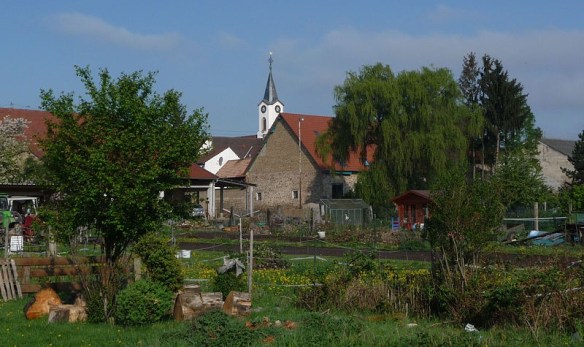
Fussgoenheim distance.jpg

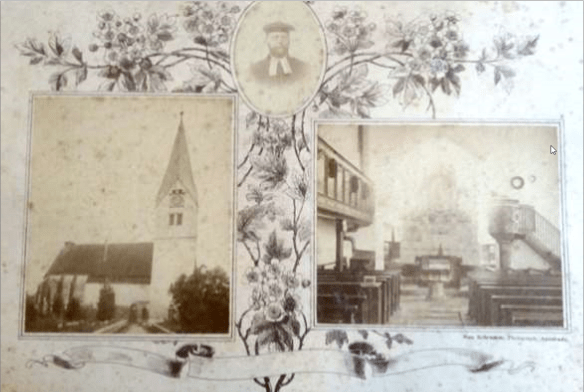
I love it when the reverend records the funeral text. This allows me to read what was said, and with a bit of imagination, to close my eyes and see what might have transpired that cool fall day in the Lutheran church that smelled of fresh-hewn wood, sporting a new white steeple, nestled in the little village of Fussgoenheim, beneath the mountains, in Germany.

2 Corinthians 5:1,6-10

We have an everlasting home in heaven.

2 Corinthians 5:1,6-10

A Reading from the Second Letter of Paul to the Corinthians.

We know that if our earthly dwelling, a tent, should be destroyed, we have a building from God, a Dwelling not made with hands, eternal in heaven. So we are always courageous, although we know that while we are at home in the body we are away from the Lord, for we walk by faith, not by sight. Yet we are courageous, and we would rather leave the body and go home to the Lord. Therefore, we aspire to please him, whether we are at home or away. For we must all appear before the judgment seat of Christ, so that each one may receive recompense, according to what he did in the body, whether good or evil.

This passage speaks of courage.

Courage

Dieter was mayor of Fussgoenheim in 1730. We don’t know when he became Mayor. Most of the information we find about occupations are from various church records where that information is sometimes, and sometimes not, included, almost as an afterthought.

We know that in 1701, he wasn’t Mayor, but Hans Nikel Koob was. Johann Dieter Koob was a young man in 1701, most likely just married.

Born about 1670, his childhood would have been filled with memories of invading French troops and devastation. He probably lived through the destruction of their home, possibly more than once.

While the Thirty Years’ War ended before he was born, there was more devastation in store for the families who lived in this area.

In 1674, this area was again ravaged by Louis VIV’s armies.

In 1688, the French King sent nearly 50,000 men with instructions “that the Palatinate should be made a desert.” His commander gave the half million residents 3 days notice that they must leave their homes, causing thousands to die of cold and hunger. Many who survived became beggars on the streets of other European cities. Again France devastated the area.

During the War of the Grand Alliance from 1689-1697, the French troops under Louis XIV, ravaged the Palatinate, again.

In 1707, another French army did the same. By now, every castle on the Rhine had been destroyed. The French occupied the Palatinate for a year, sending anything of value back to the coffers of King Louis XIV.

This would have either broken Dieter, or strengthened him with incredible resolve – and yes – courage. His trials were not yet over. In fact, one might say, they were just beginning.

In 1728, Jakob Tilman von Hallberg initially obtained half of the village through noble inheritance becoming the feudal lord. Then, on September 14, 1728, he acquired the entire village.

In 1729, Hallberg began a resurvey of the land, ostensibly in order to understand the relationship of the residents to each other, and how taxes were to be charged. Some land was privately owned, but most was not. However, the “resurvey” whittled the privately owned land via inheritance down to approximately one third of the originally sized farms by redividing property and building new roads. This left some fields disconnected from their owner’s property, and Hallberg then considered them abandoned and confiscated them for himself.

The history of the village of Fussgoenheim tells us that according to the land survey, the district of Fußgönheim comprised at that time 2,869 3/4 acres of land, 95 % of which were in the possession of clergymen or of certain masters or were communal property. Only 146 3/4 acres were owned by private persons. According to the renovation protocol, Hallberg had 386 acres of land as his own property. This would be the so-called “abandoned property” confiscated by him.

The village population was probably about the same as it had been in 1700, so about 30-40 homes total.

Private owners averaged about 15 acres each, but the resurvey shrank their farms to 4.67 acres, on average.

I don’t know how the villagers and Dieter felt about Hallberg in 1728, but surely in 1729 when it was noticed that he was “cheating” by having shortened the measure of the rod he was using to resurvey the properties, concern followed by unrest would have built gradually among men’s conversations at the local tavern or after church, then burst open like a seed pod in summer.

The situation grew increasingly difficult.

Another dispute arose over the community’s sheep pasture, the lease of which had brought the community an annual income of 100 gulden. Hallberg claimed the pasture for himself in a letter of feudal title dated July 30, 1728. The residents, on the other hand, referred to their “old rights.” The dispute ended in 1733 with a compromise: Hallberg got the sheep pasture under the condition that not too many sheep graze on it.

Another accusation against Hallberg was that he had transferred the tithe income of middle-class farms. In Fußgönheim there were three bourgeois courts which had a share of the tithe income.

Hallberg withdrew this income on the grounds that the owners refused to contribute to the costs of building the Lutheran Church.

The lucrative “Weinschank,” i.e. the right to run a wine tavern, was auctioned by Hallberg for 120 gulden annually; before that it was free.

Hallberg also introduced a new levy of 15 Malcer oats to be paid annually to his magistrate.

In the face of massive resistance from the community, Hallberg had the village siezed for two months by a corporal and six men. When the inhabitants refused to pay 71 guldens every 114 days for their accommodation, he had 7 cattle, 1 cow, clothes, guns, and household goods taken away without further ado and auctioned them off in Worms.

Later documentation accuses the next Mayor, Johann Michael Kirsch of instigating riots and civil unrest. In 1743, the village jurors refused to sign the resurvey and Dieter’s son, Johann Theobald Koob, among them, was expelled from the village from 1744 to 1753.

It took courage to stand up against the lord. It was a battle that peasants, even comparatively wealthy farmers, as compared to serfs, probably couldn’t win.

Given that Dieter would have been about 60 in 1730, and died 4 years later, I can’t help but wonder if the stress of the David vs Goliath war with Hallberg contributed to an untimely death. I also wonder about worse.

Courage, indeed. These times tested his mettle at a level we can’t even imagine today. Confiscation of land was no idle threat, with the memory of 4 separate events that resulted in horrific devastation to the residents from 1618 through 1798 fresh in everyone’s minds. There was no question that the threat of losing everything was all too real. Yet, these brave German men persisted in the face of unwinnable odds.

Dieter died in the midst of this battle, but his son, Johann Theobald continued the fight. Against all odds, the Koob family was allowed to return to Fussgoenheim, triumphant, in 1753, although we don’t know what happened to Dieter’s original land. His battle had not been in vain. I’d wager his son, Theobald, visited his grave to have a celebatory glass of wine.

The Future

Life would change dramatically for Dieter’s descendants after at least a few decades of relative peace. In 1792, the feudal government disintegrated and a new form of government emerged with the French once again in charge until 1816 when this part of Germany was freed from the French. At that time, Andreas Koob, Dieter’s great-grandson, became the first mayor of Fussgoenheim in 18 years and German would once again become the official language.

Koob mayor 2.jpg

More Koob men would follow in Dieter’s footsteps as Mayor of Fussgoenheim. He apparently started a tradition.

Not the End

While Johann Dietrich Koob is the earliest Koob ancestor that I can currently document in Fussgoenheim, he was neither the end, nor the beginning.

We know positively that generations preceded him in Fussgoenheim. Based on the baptismal record for his son’s child, it’s unlikely that Johann Nicholas Koob, an earlier mayor, was Dieter’s father, but we can’t rule that out at this point entirely. However, it’s possible that Mayor Koob was raising Dieter if something had happened to his parents amidst the preceding warfare.

It’s likely that Lorenz Kob, Mayor in 1528 was our ancestor too. He was assuredly a relative, even if not a direct ancestor.

It’s probable that Debalt Kalbe was really Koob in 1480 as well.

The Koob legacy in Fussgoenheim and this part of Germany reaches back hundreds of years in time.

It also reaches forward in time. Three Koob men, all his descendants, would follow in Dieter’s footsteps as Mayor, one immediately after the French occupation, shepherding the citizens through that difficult time into a new era.

  • Andreas Koob was the first mayor after the French occupation ended in 1816.
  • Johann Dieterich Koob was Mayor from 1830 to 1834, Dieter’s namesake great-grandson.
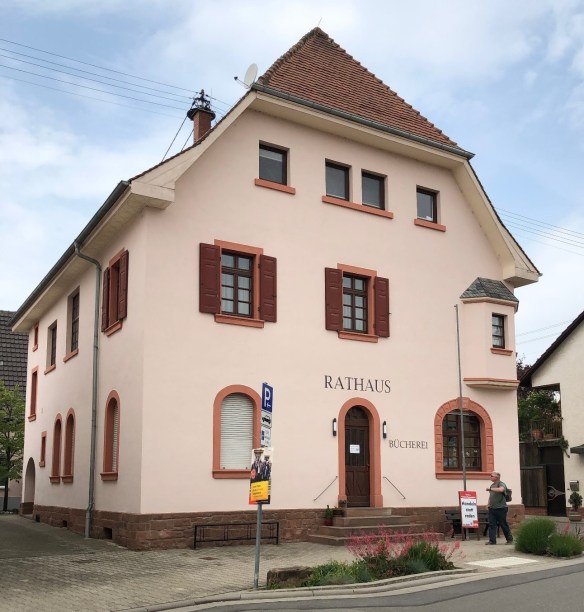
  • Jakob Koob III, Mayor 1900-1909, built the current town hall, the Rathaus in German, that still stands on the main corner of Fussgoenheim.

Koob Rathaus.jpg

We are fortunate to have a photo of Jakob, the Mayor who took office in 1909.

Koob, Jakob mayor 1909

We have no way of knowing, of course, what Johann Dieter Koob looked like, but with the generations of intermarriage and gene-sharing within the small community, it wouldn’t be a huge stretch to look at Jakob Koob III, the Mayor in 1909, and surmise that he at least resembled his Koob ancestors somewhat.

Jacob Koob IIII was Dieter’s 4 times great-grandson and married Anna Margaretha Koob.

Do we see the shadow of Johann Dietrich Koob when looking at Jacob III or Anna Margaretha?

_____________________________________________________________

Disclosure

I receive a small contribution when you click on some of the links to vendors in my articles. This does NOT increase the price you pay but helps me to keep the lights on and this informational blog free for everyone. Please click on the links in the articles or to the vendors below if you are purchasing products or DNA testing.

Thank you so much.

DNA Purchases and Free Transfers

Genealogy Products and Services

Genealogy Research

Maria Catharina Kirsch (born 1707-1711, died after 1772), Drama and Displacement – 52 Ancestors #292

Maria Catharina Kirsch was born about 1710 to Johann Wilhelm Kirsch and Anna Maria Borstler (or Boerstler). We don’t have her actual birth record, because Fussgoenheim records prior to 1726 are missing. We are assuming she was born in Fussgoenheim because that’s where the Kirsch family was from, but that might not have been the case.

Her parents were married on February 22, 1695, in Bad Dürkheim.

Walter Schnebel, a now-deceased local historian, notes that her parents were both godparents in Oggersheim in 1710. I can’t tell you how much I wish I had access to Walter’s original records and work.

Kirsch atlas Fussgoenheim

Oggersheim was about 5 miles away from Fussgoenheim. Social and family connections were maintained throughout this part of Germany. It appears that the left bank of the Rhine was a vibrant, interconnected microcosm of its own.

Even without records, we can reconstruct some of Maria Catharina’s family based on baptismal records where the names of the godparents’ parents are provided.

We also have christening records of some of Maria Catharina’s siblings.

The first record that provides information about Maria Catharina is her sister’s confirmation in Fussgoenheim in 1727, followed by Maria Catharina’s other siblings in 1729 and 1731. Confirmations in the Lutheran church occurred generally sometime between the child’s age of 11 and 13.

Maria Catharina’s confirmation is missing. The Fussgoenheim church records begin in 1726. Therefore, we can infer, based on that information, plus her marriage date, that Maria Catharina was born about 1711, or perhaps slightly earlier.

Maria Catharina Kirsch married Johann Theobald Koob, spelled Coob in her marriage record, on February 21, 1730, in Fussgoenheim.

Koob Kirsch 1730 marriage

Translations courtesy of my friends Tom and Christoph.

Taufen__Trauungen__Bestattungen__Sonstiges_1726-1798_Bild74, Fussgönheim Evangelical Church Records, Archion.de

Marriage: Year 1730

On the 21st of February 1730: Joh. Theobald Coob from here with Maria Catharina Kirsch(in) were married.

This record would be suggestive of Maria Catharina’s birth about 1710, or maybe a year or two earlier. She had a child in 1750, so she probably wasn’t born before 1707. Let’s bracket her birth between 1707 and 1711.

While this record doesn’t provide us with the names of Maria Catharina’s parents, later records about her siblings do.

Her sister, Anna Margaretha was married to George Heinrich Koob in 1736, the brother of Maria Catharina’s husband, Johann Theobald Koob. So Koob brothers married Kirsch sisters. No wonder I’m constantly confused when sorting out these village families.

At Maria Catharina’s sister’s wedding, the minister noted that the sermon was from 1 Timothy. If ministers then were like ministers today, they probably had favorite or appropriate scriptures and sermons for every type of event.

It’s not unlikely that Maria Catharina’s wedding sermon was also from first Timothy, so let’s see what it says.

From the book, “Sermons on Special Occasions such as Weddings, Funerals and Dedications” by Carl Wilhelm Walther, a Lutheran pastor, translated from original German publications between 1876 and 1892, we find:

Kirsch 1 TimothyKirsch 1 Timothy 2

Based on that sermon, it’s amazing that they had children at all, but thankfully, they did.

Children

We’ve managed to find records for 8 of Maria Catharina’s children. There must surely have been more. Records are incomplete for Fussgoenheim during this time.

Maria Catharina’s first child, Susanna Elisabetha Koob, arrived and was baptized on June 17, 1731 in Fussgoenheim.

Koob, Susanna Elisabetha

Johann Andreas Kirsch was the godfather of Susanna Elisabetha. Additionally, the widow of the late Mayor Koob, Anna Elisabetha, for whom the child was named, served as godmother.

Because an elderly widow clearly would not have been expected to raise this child if something happened to her parents, that honor would have fallen to Johann Andreas Kirsch. He was Maria Catharina’s first cousin, born to Johann Jacob Kirsch. Maria Catharina’s father was Johann Wilhelm Kirsch. Their common grandparents were Johann Georg (Jerg) Kirsch and Margaretha Koch, founders of the Kirsch family in Fussgoenheim.

Susanna Elisabetha Koob married Elias Nicolaus Kirsch about 1762. The couple lived in Fussgoenheim. She died sometime after 1776 and before 1798. Fussgoenheim experienced a record gap between those years.

In 1733, Maria Catharina Kirsch’s son Emanual Koob was born and baptized on May 26th. This time, Johann Michael Kirsch and his wife, Anna Margaretha were godparents.

Kirsch Emanual Koob

Taufen__Trauungen__Bestattungen__Sonstiges_1726-1798_Bild18, Archion.de

Given that there were three Johann Michael Kirschs, all 3 with wives of the same name, we can’t be sure who the godparents were. Since it doesn’t say “judge,” “elder,” or “mayor,” we might presume this is Johann Michael Kirsch, the baker, and his wife, but that’s just a guess.

In 1763, Emanual stood as godfather when his older sister’s son, also named Emanual, was baptized.

In 1761, Emanual married Margaretha Elisabetha Renner in Schauernheim, eventually having 2 boys and a girl. His death is recorded in the Dannstadt church records on June 1, 1805.

Three years later, on April 20, 1736, a new daughter, Maria Catharina Koob was baptized. Her grandmother, Maria Kirsch(in), widow, was the godmother.

Kirsch Maria Catharina Koob

Taufen__Trauungen__Bestattungen__Sonstiges_1726-1798_Bild24 Archion.de

While grandmother could mean on either side, Maria Catharina’s mother was named Anna Maria, and would have been called Maria, while Johann Theobald Koob’s mother was named Anna Catharina.

Kirsch Koob pedigree

Maria Catharina’s father had already passed away by this time.

About 1764, Maria Catharina Koob married Andreas Kirsch, son of Johann Georg Kirsch and Anna Margaretha Hartmann.

Another son, named for his father, Johann Theobald Koob, arrived on August 24th, 1738, and was baptized 5 days later.

Kirsch Johann Theobald Koob

On Feburary 11, 1766, he married Catharina Barbara Wassa in Schauernheim. They had 6 children, the last one in March of 1775. Two were known to have survived to marry. Johann Theobald died before 1778 by which time his widow had remarried.

Maria Catharina Kirsch’s family was growing, and so far, every child seems to have lived.

Unfortunately, their run of good luck came to an abrupt end in 1740 when a newborn daughter died.

Kirsch daughter Koob

Perhaps this child’s birth was difficult. Perhaps the cord wrapped around the baby’s neck. Maybe the baby was born prematurely. One thing is for sure, Maria Catharina called for her mother who was present at the birth of this baby, and a few hours later, at the baby’s death as well.

I’m sure mother and daughter wrapped their arms around each other to ease their pain, probably cradling the baby between them as she passed. I’ve been that mother.

I wish the reverend would have recorded the baby’s name. The family assuredly remembered her as something other than “the baby that died in 1740.”

Should I give her an honorary name today?

I don’t know if it’s proper or not, and I won’t record it as such, but I’m posthumously naming her Barbara, in honor of my mother.

That child was not anonymous.

Catholicism was replaced with the Protestant faith in this part of Germany two hundred years before, after the Reformation in 1534. A protestant church existed here as early as 1600 and likely before. Still, in 1740, the concept that a baby needed to be baptized immediately, especially if they were weak and might pass away was something that remained of or had been incorporated from the Catholic faith and tenets.

Soon, Maria Catharina was pregnant again and son, Johann Dieter Koob, probably short for Johann Dieterich or Diederich arrived almost exactly a year later on September 30, 1741.

Kirsch, Johann Dieter Koob

Taufen__Trauungen__Bestattungen__Sonstiges_1726-1798_Bild32, Archion.de

While his older brothers seemed to remain in the Dannstadt area, Johann Dieter lived in Fusgoenheim, passing away on December 19, 1816. He married a cousin who shared all four of his grandparents, Maria Katharina Koob, daughter of Georg Heinrich Koob and Anna Margaretha Kirsch.

On June 21, 1742, Johann Theobald Koob and Maria Catharina stand as godparents for the child, Johann Theobald Kirsch, son of Johann Michael Kirsch, the Mayor, and his wife, Maria Magdalena Michet. Johann Michael Kirsch, also my ancestor along with his first wife, was a first cousin to Maria Catharina Kirsch.

Silence

But then, silence for Maria Catharina Kirsch. Well, at least until 1746.

This would normally cause me to believe that the church records were missing during this time, at least for this family.

It’s true that Maria Catharina was missing IN the records, but that’s because the family was missing from the village, along with most of the other Fussgoenheim families as well.

We are now entering a time of high drama!

Expelled!!!

Trouble had been brewing on the home front.

In 1743, numerous families were evicted from Fussgoenheim as punishment for standing up for their rights against an evil and unscrupulous “lord,” Jakob Tilman von Hallberg. He attempted, almost successfully, to strip the residents of their land. Johann Theobald Koob, along with several others, was jailed for 14 days, then evicted, along with his family.

They must have hated that man. He did his best to destroy them.

Many Kirsch family members were among those cast out, as was Maria Catharina, although in her case, it was because her husband refused to sign Hallberg’s fraudulent land survey, not because she was a Kirsch.

Still, her father, then deceased, and brother would have been hereditary landowners, presumably from Maria Catharina’s grandfather, Jerg Kirsch who died before 1695. The last mention we find of Maria Catharina’s mother is in that 1740 record when unnamed daughter died.

Fortunately, not for Maria Catharina, but for me as a genealogist, there are a few sparse clues about Maria’s Catharina’s family from records generated during and after the 1743 kerfuffle and eviction.

The Map

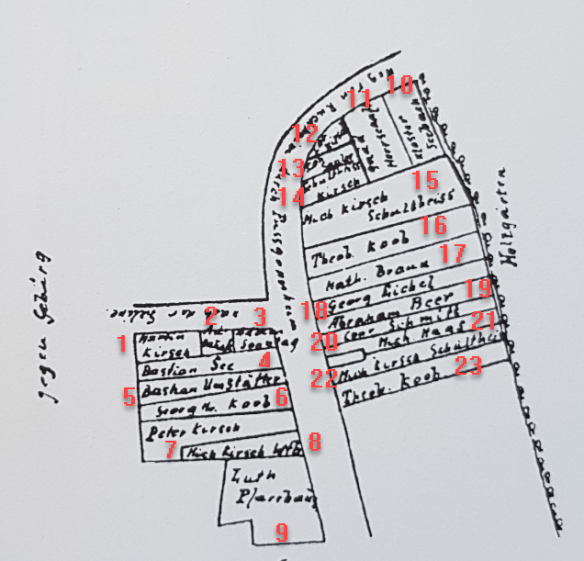
Kirsch 1743 Fussgoenheim under village

A 1743 map shows the various Kirsch and Koob properties. Maria Catharina Kirsch and Johann Theobald Koob owned two different properties.

A property belonging to the widow of Johann Michael Kirsch is shown, so we know that if a widow was still living, she would have been shown on the map, indicating interest in the property owned by her deceased husband.

Kirsch 1743 Fussgoenheim over village

A property is shown with the name Wilhelm Kirsch, just south of the church at the top of the map, above, but Maria Catharina’s father was noted by Walter as deceased before 1723. Therefore, if Maria Catharina’s mother was still living, she surely would likely have been shown as a widow – although there are some properties that are owned by someone with a Kirsch surname that we can’t read.

The Wilhelm Kirsch residence by the protestant church could have been Maria Catharina’s father’s property, but there are two other Johann Wilhelm Kirschs that were grandsons of Jerg Kirsch. It’s possible that Maria Catharina Kirsch did have a brother Johann Wilhelm that we aren’t aware of, given that we only know of three siblings for Maria Catharina. However, Walter Schnebel had access to the 1753 property accounting that resulted from the 1743 evictions, and he did not ascribe a brother by that name to Maria Catharina.

We don’t know exactly which house Maria Catharina grew up in, but she certainly didn’t move far when she married – just down the street.

Homeless

What happened to Maria Catharina when she and her small children were so ruthlessly evicted from their home; their possessions – even their clothes – confiscated?

She must have been terrified while her husband, Johann Theobald Koob, was jailed, along with several other cousins and neighbors. What would happen? What would become of them? Had Johann Theobald perhaps already sent his family to stay with relatives, just in case something beyond just bad happened?

We have no way of knowing if Hallberg had previously threatened eviction. If so, was it perceived as a hollow threat? Or, did he spring that on them as a way of negotiating their release from jail? That would be an evil choice to have to make. I wish we knew more.

There was no “due process” as we perceive it today in the US. Monarchs and nobility ruled at that time. Period. It’s actually amazing that these citizens had the gumption to stand up to Hallberg, at all – and they paid dearly.

In 1743, Maria Catharina had 5 living children, the oldest being 12, the youngest about 2. She was very probably pregnant for another child who was likely born in late 1743 or perhaps early 1744 – possibly while her husband was jailed. That would have been perceived as a lever by Hallberg, but knowing Germans, it would likely only have angered Johann Theobald Koob, and made his resolve even stronger.

So not only was her husband jailed, and the family evicted, but she was heavily pregnant and giving birth someplace in the midst of all that upheaval. There’s no church record, so apparently, she did not give birth in Fussgoenheim or the record is missing.

We also don’t know when Maria Catharina’s mother died, but it was likely sometime between 1740 when her child died and 1743 when the map was drawn. It was assuredly before 1753 when the accounting took place, because Maria Catharina’s mother was not mentioned.

It must have seemed to Maria Catharina, only in her early 30s, that the world was ending, and indeed, it was, as she knew it.

As farmers in a German village, their entire livelihood was dependent on access to their land – that tiny strip shown behind their homes.

Kirsch Koob field

You can still see that field today, pointed to by the red arrows. Their field likely stopped at the green arrow, which is the local stream. But it’s possible that they also farmed some land on the other side of the creek as well.

That barn today with the black roof located sideways to the other buildings spans the entire width of both 11 Hauptstrasse and 13 Hauptstrasse, so it’s likely two property widths wide as is the field behind that is entirely brown.

The Hallberg survey reduced landowners from about 15 acres each to an average of 4.67 acres each, a huge reduction.

Without land, they would become serfs, indentured servants, nearly slaves, in another village that would offer them shelter in exchange for their servitude. No one wanted poor people to tax the municipality, so everyone had to be able to offer something useful.

Hallberg knew this and was gambling that they would not be willing to take that risk.

He was wrong. If Germans are anything, they are tenacious. Not only didn’t they simply capitulate, they waged war, for decades.

Being evicted in Germany during this time wasn’t just a matter of moving next door and setting up shop.  This was a severe threat, and then an action, with incredible consequences.

And clearly, they couldn’t, and certainly didn’t want to go anyplace where Hallberg was in charge.

They couldn’t stay. Where did they go and what did they do?

Weissenheim am Sand

We find no records of Maria Catharina and family until a baptism pops up in Weisenheim am Sand for Johann Matheus Koob.

Koob, Johann Matheus.png

January 16, 1746, a son, Johann Matheus, parents Johann Theobald Koob and wife, Maria Catharina. Godparents Johann Matheus Sahler and wife, Maria Cath.

The Koobs had a history of intermarriage with the Sahler family.

Johann Matheus Koob would eventually become a leaseholder of the Munchhof estate that his father hadn’t yet purchased when he was born. Johann Matheus married there to Katharina Margaretha Becker in about 1775, having three children. Matheus died on January 3, 1816, probably at Munchhof – the burial record in the Dannstadt church books.

Johann Theobald Koob was related to Johann Dieter Koob, the customs collector in Weissenheim am Sand. Johann Dieter and his wife Maria Kunigunda were the godparents of their son, Johann Dieter Koob, the baby baptized in Fussgoenheim in October 1741.

We don’t know for sure, but Johann Theobald Koob and Johann Dieter Koob, the customs collector were probably first cousins.

In any case, they were clearly close, because Johann Dieter and his wife served as godparents for Johann Theobald and Maria Catharina’s baby in Fussgoenheim.

We have to speculate a bit at this point, but since we find Johann Theobald Koob noted as living in Weissenheim am Sand in 1746 when Johann Matheus was baptized and in 1748 when he purchased a leasehold share of Münchhof – we have to imagine that Maria Catharina and family sought and received shelter with their cousins in Weissenheim am Sand.

We find Maria Catharina Kirsch and Johann Theobald Koob in the records again in 1748, when Johann Theobald purchased a portion of the farm estate of Münchhof, south of Dannstadt.

Maria Catharina probably had a child in 1743, 1745 and possibly 1748. When children lived, births occurred every 2 years, and when a baby died, the next birth was generally about 12 months later. Based on this, we might surmise that perhaps the 1745 baby passed away – or at least one child, if not more, during this timeframe.

Sometime in 1748, the family moved to the large farm, Münchhof, owned by the University of Heidelberg, having purchased the right hereditarily to lease one-quarter of the farm in perpetuity. In fact, Koob descendants still live on part of that farm today.

I don’t know exactly how Johann Theobald Koob earned a living in Fussgoenheim. Without further information, we’ll have to presume he was a farmer. We know positively that beginning in 1748, the family was farming at Münchhof.

We catch up with Maria Catharina in the baptism records of Dannstadt on the 5th of December, 1750 when she had her last child Johannes Koob. He went on to marry Maria Katharina Kloos. They lived in Fussoenheim where he died on January 28, 1833.

No further baptisms tell us that Maria Catharina was probably 42 or 43 by this time.

Maria Catharina’s life seems to be divided into 5-year segments.  Married for a dozen years, then evicted in 1743, apparently to Weissenheim am Sand before moving to Münchhof in 1748.

Munchhof

I wondered how Maria Catharina and Johann Theobald even heard about a portion of the Munchhof even being for sale. Weisenheim am Sand is more than 12 miles distant. However, there’s a potential hint in the Dannstadt church records. Maria Catharina’s mother was Anna Maria Borstler, daughter of Johann Adam Borstler. The Schauernheim church records tell us that one Hans Michael Borstler died in 1724 and is noted as being the Munchhofpachter, or Munchhof leaseholder. His eldest son, Johannes born in 1684 married Maria Margaretha Koob in 1724 in Dannstadt. A Borstler is also recorded in Fussgoenheim in 1717, so there seems to be some continuity between these families and locations.

Return to Fussgoenheim?

Finally, in 1753, Johann Theobald Koob and Maria Catharina Kirsch and family were allowed to return to Fussgoenheim.

I don’t know how that decision would have been made. Was the home in Fussgoenheim nicer or life easier there than at Münchhof? It was clearly less remote.

Or, did they return as a matter of principle, given that they had fought Hallberg since his 1729 fictitious survey? That hard-won victory took 24 years, nearly a quarter of a century.

How could they NOT go back after all that? It’s also possible that if they didn’t return, they would forfeit some of their rights.

Regardless of why, they probably did return to Fussgoenheim where we find records for some of Maria Catharina’s children. Johann Theobald, her husband is mentioned as a citizen of Fussgoenheim in 1766.

What Happened to Maria Catharina’s Children?

Maria Catharina’s children seem to have been scattered between the places that she had lived. Fortunately, they were close enough that she was probably able to see them, at least from time to time.

Maria Catharina’s oldest child, my ancestor Susanna Elisabetha Koob married her double first Kirsch/Koob cousin, Elias Nikolaus Kirsch in 1763 and lived her life in Fussgoenheim. We don’t know when she died other than it was after 1776 when Fussgoenheim records no longer exist, and before the records began to be kept again in 1798.

It appears that the eldest son, Emanual Koob, remained at Münchhof, because he married in Schauernheim in 1760 to Margaretha Elisabetha Renner, had 3 children, 2 sons and a daughter, and died in Dannstadt on June 1, 1805.

Daughter Maria Catharina Koob married Andreas Kirsch in 1764 and lived her life in Fussgoenheim, dying there on December 10, 1807. They had 8 children, Johann Dieter in 1764, Catharina Margaretha in 1765 who married Jacob Holzwarch, Maria Catharina, Anna Barbara who married both Christoph See and Friedrich See, Maria Catharina, Susanna Margaretha, Maria Catharina and Andreas. Only 2 of those children are known to have lived.

Johann Theobald Koob also married in Schauernheim in 1766 to Katharina Barbara Wassa and died before 1778, leaving her a young widow with children.

Johann Dieter Koob married Maria Katharina Koob in about 1773 and died in Fussgoenheim on December 8, 1816.

Johann Matheus Koob, listed as a leaseholder at the Munchhof, married about 1775 and, according to the Dannstadt church books, died on January 3, 1816, probably on the Munchhof estate.

Maria Catharina’s youngest child, Johannes Koob married Maria Katharina Kloos about 1762 and died in Fussgoenheim on January 28, 1833.

Two of these children, daughters Susanna Elisabetha Koob and Maria Catharina Koob would have passed the mitochondrial DNA of Maria Catharina Kirsch to their offspring. Only females pass it on. If someone today descends from one of these daughters through all females to the current generation, which can be male, I have a mitochondrial DNA testing scholarship for you. Maria Catharina Kirsch’s mitochondrial DNA will allow us to peer back in time before surnames in Fussgoenheim, hopefully pointing us to earlier generations as well.

The Final Goodbye

We don’t know when Maria Catharina said her final goodbye.

The last sighting of Maria Catharina is on September 30, 1772 when her daughter Susanna Elisabeth Koob and husband Elias Nicolaus Kirsch had a daughter. Maria Catharina and Johann Theobald Koob, the court member, were godparents. The baby was baptised at home, the same day, in the house due to weakness and subsequently died.

The Fussgoenheim records are absent beginning in 1776 and don’t resume until 1798, so Maria Catharina died sometime after 1775, assuming the records are complete until that time. Six granddaughters were named for her, but we know that she stood by their graves and buried at least three of her namesake granddaughters.

At least she would have been able to enjoy several of her 25 known grandchildren, playing in the street and fields of Fussgoenheim and Munchhof.

Kirsch Fussgoenheim church

It’s likely that both Maria Catharina Kirsch and Johann Theobald Koob are buried in the churchyard in Fussgoenheim, across the fields they so ardently defended for a quarter century – finally reclaiming their home and small farm from the greedy hands of the Hallberg dynasty.

Kirsch Fussgoenheim farm

Maria Catharina would be pleased to know that their efforts were not in vain. The Fussgoenheim property remained in the hands of the Koob family for the next 200 years or so, on the main street, just across the street and down the block from the church.

Kirsch Fussgoenheim post card

Hallberg castle, built about 1740, as seen across the fields in top two photos. Lutheran Church bottom left and store on corner, bottom right.

In fact, so did Munchhof which still remains in the Koob family today. In the 1966 photo below, the Koob home on the Munchhof estate is the house located at the furthest right with the VW beetle parked in front.

Koob Munchhof 1965

It was this home that Johann Theobald Koob had purchased in 1748, along with tenant rights to the land, and where Maria Catharina raised her children, at least for several years. It’s this land that was passed down to their children and descendants to present day – 272 years later.

In 1801, the Munchhof property was damaged during the French occupation, but we don’t know to what extent or how the Koob home fared.

Koob Munchhof before 1942 bombing.jpg

Drawing courtesy the Koob family and Ralph Shuey.

The Koob home on the Munchhof took a direct hit by a bomb in 1942, but was subsequently rebuilt on the same foundation. This drawing depicts the original home as it looked before the bombing. Assuming this was the original building on this land in 1748, this home provided sheltering arms folding around this family – a secure respite to Maria Cathariana Kirsch, her husband and children after two decades of terror, angst and uncertainty.

_____________________________________________________________

Disclosure

I receive a small contribution when you click on some of the links to vendors in my articles. This does NOT increase the price you pay but helps me to keep the lights on and this informational blog free for everyone. Please click on the links in the articles or to the vendors below if you are purchasing products or DNA testing.

Thank you so much.

DNA Purchases and Free Transfers

Genealogy Products and Services

Genealogy Research

Johann Theobald Koob (born circa 1705 – died after 1766), Münchmeister – 52 Ancestors #291

Johann Theobald Koob was born about 1705, probably in Fussgoenheim, Germany, to Johann Dietrich Koob and Anna Catharina, surname unknown.

The first record of Johann Theobald Koob is when he served as godfather for the Renner family in Fussgoenheim.

Baptism:

21 November 1728

Child: Anna Maria

Parents: Johann Jacob Renner and Helena, his lawfully wed wife

Godparents: Johann Theobald Kob, unmarried from Fussgonheim and Anna Maria Sachs(in).

This wasn’t the only interaction with the Renner family, and mark my words, they were related somehow.

Married in Fussgoenheim

In February of 1730, Johann Theobald Koob married Maria Catharina Kirsch.

Koob Kirsch 1730 marriage

Pfalz: Zentralarchiv der Evang. Kirche > Speyer > Fußgönheim > Taufen, Trauungen, Bestattungen, Sonstiges 1726-1798, Bild 74, www.archion.de

Marriage: 21 Feb 1730

Joh. Theobald Coob from here with Maria Catharina Kirch(in) were married.

Koob is spelled variously as Koob, Coob and Kob in the early church records.

Johann Theobald’s parents both attended his wedding in the quaint Lutheran church on the cobblestone street, probably sitting alongside his siblings. We know his parents were still living, because we find his father’s burial record in those same church records in November 1734 and his mother’s just a few months later, in April of 1735.

That must have been a very tough year.

Children Bless the Couple

Johann Theobald Koob and Maria Catharina Kirsch welcomed their first-born child, a daughter, Susanna Elisabetha, on June 17, 1731. How joyful they must have been when baptizing their beautiful baby girl. Three of the four grandparents celebrated with them that June Sunday, exactly 289 years ago today, as I write this article. This is an incredibly important day for me, because Susanna Elisabetha is my 4th great-grandmother.

Happy 289th birthday Susanna Elisabetha!!! Part of you is still here!

Koob, Susanna Elisabetha

Taufen__Trauungen__Bestattungen__Sonstiges_1726-1798_Bild14(1), Fussgönheim Evangelical Church Records, Archion.de

Baptism: 17 June 1731

Parents: Joh. Theobald KOOB and his wife, Maria Catharina, a daughter was baptized and named:

Susanna Elisabeth

Godparents: Johann Andreas Kirsch & Anna Elisabeth, widow of the late mayor  Koob.

We can glean so much information from the godparents. These people weren’t selected randomly, and it wasn’t just an honorary position. On the contrary, it was well-thought-out.

The godparents were expected to raise this child, attending to their education, both traditional and secular, in the event that something happened to the parents. An equivalent today would be selecting your children’s adoptive parents and designating them at the birth of your children. Godparents promised to perform these duties before the village, in front of both families, the reverend, the congregation, and more importantly, before God.

If you think about it, it’s a wonderful tradition that assures that every child in a family is cared for if the parents die without placing the entire burden of several children on one family member. In a small village, the children would only live a few houses apart and could still see each other and interact regularly.

Based on Fussgoenheim history, Anna Elisabetha, the widow godmother, is probably the widow of Johann Nicolaus Koob, the former mayor. She’s clearly related to the family, but exactly how is unknown. We do know that Johann Nicolaus Koob has a son, Johann Dietrich Koob, the same name as Johann Theobald’s father, but he married Maria Kinigunda Sahler in 1728. Therefore, if Anna Elisabeth is Johann Nicolaus Koob’s widow, she is not Johann Theobald’s grandmother.

The widow Anna Elisabeth may be his aunt or great-aunt or related another way, or both. Her name may also have been Susanna Elisabetha. In a future record, the child Susanna Elisabetha baptized that day is called Anna Elisabetha – probably after her godmother.

Two years later, Johann Theobald Koob’s first son, Emanuel Koob, joined the family.

Taufen__Trauungen__Bestattungen__Sonstiges_1726-1798_Bild18, Fussgönheim Evangelical Church Records, Archion.de

Baptism: 26 May 1733

Parents: Joh. Theobald Koob and his wife, Maria Katharina, a son was baptized and named: Emanuel

Godparents: Joh. Michael Kirsch and his wife, Anna Margaretha.

In 1763, Emanual stood as godfather when his older sister’s son, also named Emanual, was baptized.

By 1771, Emanual was godfather for his younger brother Johann Theobald Koob and his wife, Catharina Barbara when they baptized a son named Emanual. In this record, Emanual is noted as being from Münchhof near Danstatt, which proves to be an important clue.

In 1736, daughter, Maria Catharina, named for her grandmother, joined the family.

Taufen__Trauungen__Bestattungen__Sonstiges_1726-1798_Bild24, Fussgönheim Evangelical Church Records, Archion.de

Baptism: 20 April 1736

Parents: Johann Theobald Kob & wife Maria Cath.

A daughter was baptized and named: Maria Catharina

Godparent: the grandmother, Maria Kirsch(in), widow

Born: 16 April 1736

Baptized: 20 April 1736

Entry No. 29

In 1738, a son with the same name as his father was born. Interestingly enough, the godparents were from Frankenthal, about 7 and a half miles away, and the child is not named after the godparents, which is typical.

Koob Fussgoenheim Frankenthal

It looks like perhaps their son, Johann Theobald is too young to actually be a godparent, so they stood with him? Perhaps Johann Theobald Koob was the younger Johann Theobald Welker’s godfather. This would suggest some type of family relationship.

Taufen__Trauungen__Bestattungen__Sonstiges_1726-1798_Bild27, Fussgönheim Evangelical Church Records, Archion.de

Baptism: Entry No. 66

Parents: Johann Theobald Kob, the juror and his wife, Maria Catharina a son named: Johann Theob(ald) was baptized

Godparents: the honorable Georg Henrich Welcker, butcher and innkeeper in Frankthal and his wife, Maria Ernstina with son Johann Theobald, formerly confirmed at S. ……..?

Born: 24 August 1738 at 8 a.m.

Baptized: 29 August 1738

In this record, Johann Theobald was referred to as a juror. I asked my two friends, Tom and Christoph, what being a juror meant at that time in Fussgoenheim. Their answer was that while neither are experts on that specific topic, their understanding is that jurors would be respected men within the community who would perhaps adjudicate non-criminal disputes and disagreements.

Two years later, things didn’t go well in 1740.

Taufen__Trauungen__Bestattungen__Sonstiges_1726-1798_Bild30, Fussgönheim Evangelical Church Records, Archion.de

Baptism: Entry 108

Parents: Johann Theobald Kob, juror and wife, Maria Catharina, a daughter on the 14th of October 1740 was born and because of weakness so she was baptized immediately in the home.  Godparents were the mother’s side, the grandmother Maria. But the child is deceased in a few hours.

Sadly, this baby wasn’t named, or if she was, the reverend didn’t record her name. It seems so sad to think of a tiny, nameless, anonymous grave.

The next child, Johann Dieter, arrived almost exactly a year later. Of course, Johann Dietrich Koob is Johann Theobald’s father’s name.

Taufen__Trauungen__Bestattungen__Sonstiges_1726-1798_Bild32, Fussgönheim Evangelical Church Records, Archion.de

Baptism: Entry 111

Parents: Theobald Kob and his wife, Maria Catharina, a son Johann Dieter

Godparents: Johann Dieter Kob, customs collector in Weiss……?and wife Maria Kunigunda

Born 30 Sept 1741          Baptized:8 October 1741

Weissenheim am Sand is a village about 7 miles directly north of Fussgoenheim and Weissenheim am Berg is about the same distance west of Weissenheim am Sand.

This too proves to be a hint that will help tie things together, later.

In 1767, Johann Dieter Koob, unmarried, stood as godfather for his brother, Johann Theobald Koob’s child, named Johann Diederich, of course. This confirms that Dieter and Diederich are synonymous. Dieter is likely a nickname.

Johann Theobald Koob and Maria Catharina Kirsch’s last child, Johannes, arrived just before Christmas in 1750, but not before a massive upheaval that’s not revealed in the church records.

It was by tracking this family through and after that upheaval that I found another child, born in 1746 elsewhere…and baptized in exile.

Let’s just say it was an incredibly long time between 1741 and 1750.

Upheaval

There are several years missing in the births of children, with a noticeable gap between 1741 and 1750. That’s because Johann Theobald’s life was turned upside-down in 1743.

Politics in Germany was ever-present and seemingly, always dangerous. In 1729, Jakob Tilman von Hallberg, a member of the House of Hallberg who had acquired half of Fussgoenheim in 1728, followed shortly thereafter by the second half, undertook a village survey in which the roads were redrawn and the area redivided. The result was that the villagers lost two-thirds of their hereditary land, with Hallberg personally absorbing the rest that was left “abandoned” by the resurvey.

Johann Theobald Koob was one of several jurors or village elders, noted as judges in a German to English translation, who refused to sign the survey book. As punishment, Hallberg had them expelled from Fussgoenheim after first being jailed for two weeks. The Kirsch family went to Ellerstadt as serfs.

It’s unclear where Johann Theobald Koob and Maria Katharina Kirsch went, at least for several years.

We do find a baptism for another son in Weissenheim am Sand.

Baptism: Johann Matheus, parents Johann Theobald Koob and Maria Catharina. Koob on January 16, 1746. Godparents Johann Matheus Sahler and Maria Cath.

However, based on a baptism for Johann Theobald Koob’s son in 1750, it would appear that Johann Theobald Koob was in Münchhof by that time where he had some sort of hereditary ownership.

It’s likely that Johann Theobald Koob had children in 1742, 1744 and 1748 as well, but we simply don’t have those records.

The 1750 baptism record reveals such important information.

Baptism: No. 188

Born 5 December 1750

Baptized 8th of same (month) in Münchhof +

Child: Johannes

Parents: Johann Theobald Kob, hereditary owner in Münchhof and his wife.

Godparents: Johannes Lammert, innkeeper in the Lamb’s Inn in Mutterstadt and wife, Maria Margaretha Weisin.

Koob Johannes 1750

This record, from archion.de is part of the Dannstadt churchbook, not Fussgoenheim.

It’s interesting that in 1750 Johann Thoebald Koob is living in Münchhof.

Oh, what a tangled web is genealogy.

Mutterstadt

The Lammert/Lemmert family in Mutterstadt is known to me.

Koob Mutterstadt Fussgoenheim Dannstadt

Three generations later, Johann Theobald Koob’s great-grandson, Philip Jacob Kirsch would be born in Fussgoenheim in 1806. He would marry Katharina Barbara Lemmert in 1829 in Mutterstadt. This couple, my ancestors, would immigrate to Ripley County, Indiana about 20 years later, the founding members of the Kirsch line there.

Koob Jacob Kirsch pedigree

By the time Philip Jacob Kirsch married Katharina Barbara Lemmert, these families had apparently known each other for generations.

But what about Münchhof?

Münchhof

Johann Theobald Koob may have been spitefully evicted from Fussgoenheim in 1743, but he was apparently not poor. He didn’t entirely disappear. We do find him in Weissenheim am Sand in 1746 and mentioned again as being from there in 1748 when he resurfaces in Münchhof.

According to the journal, Pennsylvania Folklife” (1966), Volume 16, page 41, available here, we discover that in 1748, Daniel Jouis, as lessee, sells one quarter of the property, Münchhof, to Theobald Koob of Weisenheim am Sand.

Koob Munchhof article

While this article by Dr. Krebs is focused on the Jouis family, it handily answers several questions about Theobald Koob.

We now know where he went in 1743 after he was evicted from Fussgoenheim. He had family in Weissenheim am Sand, as evidenced from the 1741 baptism of his child, so he went there.

Koob Weissenheim am Sand atlas

Five years later, when it may have seemed improbable that he would ever be allowed to return to Fussgoenheim, he purchased a quarter lessee ownership of Münchhof and moved to this large farm, owned by the University of Heidelberg, with his family.

Koob Weissenheim am Sand map

Word that this quarter of the Münchhof estate was available for purchase, as a lessee, must have traveled by word of mouth. Johann Theobald Koob’s relative was the tax collector in Weissenheim am Sand, so he would probably have been aware of these types of opportunities. We also find early Koob families in Schauernheim and Dannstadt, just north of Münchhof.

Münchhof wasn’t exactly next door to Weissenheim am Sand, but it was fairly close to Fussgoenheim and family members seem to have been scattered throughout this part of the Palatinate – fertile lowlands east of the Rhine.

Koob Munchhof atlas

Münchhof is close to Fussgoenheim, about three and a half miles away. It would have been easy for them to see their family members in Fussgoenheim while remaining a persistent thorn in the side of Hallberg.

Koob Munchhof close

A gazetteer documenting all German locations from 1871-1918 shows Munchhof.

We can use this map to find the location of Munchhof today, matching up landmarks and roads that have retained their original shape.

Koob Munchhof atlas to google

Based on the google map legend the area below looks to be about 4 or 5 acres, roughly.

Koob Munchhof 5 acres

One quarter square mile is 1320X1320 feet and holds 160 acres, so the original Munchhof would have encompassed roughly this land, the house marked by Dells Tierwelt.

Koob Munchhof today aerial

Dr. Krebs who wrote that 1966 article even went so far as to drive out to Münchhof and take these photos for his article. I’m thrilled!

Koob Munchhof 1965

The amazing thing about these estates is that they changed very little over time and Münchhof probably looked almost exactly like it did in 1748 – 212 years earlier – minus the cars and modern farm equipment of course. There is documentation of some destruction in 1807, but whatever damage incurred was clearly repaired.

Münchhof still exists today as a location that breeds dogs.

Koob Munchhof aerial close

Fortunately, the current owners cared enough to document the history of Munchoff, here.

I used the Deepl translator to translate, below.

Our Münchhof

In 1987 we bought the “Münchhof”, which has been part of the Dannstadt community since 1797.

Koob Munchhof 1985

I’m so very grateful that they included this photo from 1985 which shows a different perspective than the 1965 photo.

The following transcript was taken from “Heimatblätter für Ludwigshafen am Rhein und Umgebung, Jg.7, 1918, No. 4

The Münchhof at Dannstadt.

The Münchhof is located about 5 minutes away from the parish village Dannstadt at the Speyerer Straße. Already the name indicates that we are dealing with a monastery estate. In the Middle Ages, half of Dannstadt was spiritual property.

In 804 the Münchhof comprised 128 acres of land, which belonged to the Kindergut.

Note that 128 acres of land was about the entire size of the village of Fussgoenheim in 1743.

The farm, which was founded at an unknown time, probably came into existence in 987 through a donation by Count Otto of Rhine-Franconia to the Benedictine and later Dominican monastery Lambrecht in the Haardtwald, which he had founded at that time. In the beginning “one” farmer – later there were several – owned the Münchhof from Lambrecht Monastery as part of his inheritance; he held the title ” Münchmeister.”

I absolutely cannot help but chuckle. This means that Johann Theobald Koob was a Munchmeister, or at least one quarter Munchmeister. Of course, in German, meister means master, so the farmer who was leasing this property was indeed the master of the hof, or farm.

In 1331, Ludwig the Bavarian pledged the Speyergau bailiwick to the sons of his brother Rudolf, the Palatine Counts Rudolf 2nd and Ruprecht 1st, for 1000 pounds heller.

When the influence of the Reformation became noticeable, Elector Friedrich 2 obtained permission from the Pope to confiscate and abolish the Lambrecht Monastery and 11 others and to transfer their income to the Heidelberg College in 1551. Thus the Münchhof fell to the University of Heidelberg.

In 1563, a settlement was reached between the university and Elector Friedrich 3, who granted St. Lambrecht and the Münchhof free of encumbrances. A large part of the other monasteries that had been confiscated were ceded by the university to the Elector, but in this way she had cleverly evaded the sovereign’s easements on the estates. The Münchhof had now become a free court. From this time on it was under the administration of the Heidelberg university conductor and the electoral administration there. However, this special position was a source of incessant friction between the courtiers and the aforementioned village court.

The Peace of Luneville in 1801 made the left bank of the Rhine French. Napoleon used the opportunity to smash the property. In 1807 the Münchhof in Mainz was auctioned off as a so-called national property.

Understanding the size of Münchhof helps put this purchase into perspective. Even if Johann Theobald Koob only purchased access to one quarter of the 128 acres, assuming it was still the same size, that means he farmed 32 acres and lived on the property, which was probably functionally the same as a small village. Compare and contrast this to the small farms in Fussgoenheim that were originally about 15 acres each, but reduced to an average of 4.67 after Hallberg’s resurvey.

Based on records from Fussgoenheim, we know that Johann Theobald Koob was still a citizen in Fussgoenheim in 1766. It’s possible that he was living at Münchhof, but I’d think those records would have mentioned that.

I couldn’t help but wonder what happened to Münchhof.

It appears that Johann Theobald’s oldest son, Emanual, inherited his father’s lease rights to Münchhof. In 1771, when he stands as godparent for his sibling’s child, he is noted as being from Munchoff. The torch has apparently passed. This record may be the closest thing we have to a death record for Johann Theobald.

It’s possible that Johann Theobald Koob actually died at Münchhof, not in Fussgoenheim. We don’t know if he loved being at Münchhof, or if it was simply a safehaven when he needed one – retaining it later as an investment. Did he stay there, or was he relieved to move back to Fussgoenheim in 1753.

Münchhof apparently became a hereditary legacy in the Koob family, because an agricultural journal published in 1876, 128 years after Johann Theobald Koob purchased that quarter, mentions a “Jakob Koob, economist on the Münchhof”:

Using 30 years per generation, that’s between 4 and 5 generations later. Johann Theobald Koob was likely the great-great or three times great-grandfather of that Jakob Koob of 1876. I wonder if he had any idea what had happened to his ancestor, Johann Theobald Koob, in 1743, why and how Münchhof came to be in the Koob family.

Contacting a local historian reveals that members of the Koob family still live on part of it’s land, not associated with the dog breeding business.

Return to Fussgoenheim

In 1753, von Hallberg was forced to allow the evicted Fussgoenheim families to return to their hereditary properties in the village. Based on this 1743 map, we know exactly which properties Johann Theobald Koob owned.

Kirsch 1743 Fussgoenheim under village

Given that this maps showed land owned hereditarily in the north half of the village, we can see that Johann Theobald Koob owned two properties, probably inherited from his father.

This property still existed in the 1940s, and the Kirsch and Koob families still lived adjacent.

Fussgoenheim Kirsch Koehler homes

The Kirsch property is noted with the X, and the Koob with the O. This photo was sent by descendants living in these houses during WWII to relatives in Indiana.

Fussgoenheim street

The properties are marked in this photo as well, which I’d wager is a victory celebration of some sort on the main street of Fussgoenheim, almost 200 years after Johann Theobald Koob had his own sweet victory of return.

Today, you can see this part of Fussgoenheim on Google maps, which correlates to the 1743 map and the 1940s photos.

Koob property today

The upper Koob property is shown, below in a photo taken by my friend, Noel, when she took a detour on her vacation to find my ancestors. I’m incredibly grateful!

Fussgoenheim intersection Ruchheimer Hauptstrasse

I believe, based on the 1743 map and today’s intersection of Hauptstrausse and Ruchheimer streets, that the property on the aerial above, designated by the upper red arrow, to the left of the yellow house, with the brown large door and solar panels is one of Johann Theobald Koob’s properties. It’s probably the same house that still stands.

Whose House Was It?

The Kirsch/Koob photo from the 1940s is of the property designated with the lower arrow, which I wrote about, here.

Marliese’s letters were somewhat confusing. She wrote them as a teen, almost 90 years after these families had immigrated. Her letters are clear about which property was the Kirsch property, because she grew up in that house.

Her references to the house with the O marked over it were believed to have referred to this as the Koehler home at that time. There was confusion within her family, plus the challenges of German to English translation, and the Kirsch, Koehler and Koob families were eventually heavily intermarried. Marliese used a lot of pronouns such as “they” and it was often unclear as to who, exactly, “they” was referring to.

This is going to be hard to follow, so here’s a diagram.

Koob Kirsch Koehler pedigree

click to enlarge

On this chart, people in red are my ancestors. You can see Johann Theobald Koob at right, with a black box around his name. The people in green are the couple who Marliese believed lived in the house next door before they immigrated – except for one daughter. Marliese and I share the same founding Kirsch, Koob and Koehler ancestors.

Knowing what I know today, after significant research, I am confident that this home was never the Koehler home, and was always the Koob home, in part, because the first record I find of the Koehler family is in Seckenheim, and never in Fussgoenheim. Johann Peter Theobald Koehler lived (1696) and died (1767) in Seckenheim during the same time period that Johann Theobald Koob was living in Fussgoenheim and at Munchhof.

My Koehler line intermarried with the Koob line in Ellerstadt. Margaretha Elisabetha Koehler was born in 1772 in Ellerstadt, married Andreas Kirsch there and moved to Fussgoenheim as his wife. Her father was probably born in Seckenheim, as his parents were born and died there.

If indeed, the Koehler family did eventually own the Koob property, it was after Johann Martin Koehler, Margaretha Elisabetha’s brother, born in 1796 in Ellerstadt married Anna Margaretha Kirsch, the daughter of Andreas Kirsch, in 1821 in Fussgoenheim.

This couple, who are not my ancestors, are shown in the green block. Martin Koehler, according to Marliese, was reported to have had a beautiful singing voice and played in the village orchestra, as well as sang in the choir.

His three surviving sons immigrated to Indiana, and his one surviving daughter married Karl Ritthaler and remained in Fussgoenheim. There are virtually no Koehler church records in Fussgoenheim, including no burial record for Johann Martin Koehler himself. As you can see, he did not marry a Koob directly, but a granddaughter of Susanna Elisabetha Koob, so it’s highly unlikely that he wound up with the Koob property next door to the Kirsch home.

Regardless of the ownership of the Koob property in the later 1800s and into the 1900s, it was clearly owned by Johann Theobald Koob in the 1700s. The Koob and Kirsch families intermarried for generations. They were all related to each other several ways.

Despite the confusion about the identification of the Koob property in the 1940s photos, Marliese’s ancestor, Anna Elisabetha Koehler, born in 1781 in Ellerstadt, married Johann Mathias Koob in 1801 and moved to Fussgoenheim. This is shown at right, in the chart, above. Their daughter married Johannes Kirsch, so even in Marliese’s own family line, no Koehler actually lived next door, but the Koob family clearly did. The Koehlers entered the picture as spouses.

I wonder how long this property actually remained in the Koob family, and what happened to it.

Johann Theobald Koob’s Property Today

Unfortunately, as you can see in this satellite closeup, the Koob home is gone today. replaced by the garden area in front of the building with the checkerboard roof. The original Kirsch property includes the while house at left, the driveway area and the small white building adjacent to the beginning of wall.

Fussgoenheim Kirsch Koehler

Many original structures do remain, so I have to wonder what happened to Johann Theobald Koob’s home.

Here’s a current street view, with the Kirsch home at left.

Fussgoenheim Kirsch on Hauptstrasse

The wall stands where the Koob home once stood at 11 Hauptstrausse. The double brown gates, below, appear to provide access to where the Koob’s neighbor’s home once stood, and was not the Koob property, at least, not that we know of.

Fussgoenheim Kirsch Koehler

A building, which may or may not be original, stands behind the wall (and the tree) at 11 Hauptstrasse.

Fussgoenheim Koob 11

The addresses are marked on the fence. The original Kirsch home, to the left, is 9 Hauptstrausse.

Fussgoenheim Koehler building

Today, a small garden replaces the original Koob home at 11 Hauptstrausse. in the photo above, we are looking directly at Theobald Koob’s property. Below, over the fence at the building shown above.

Fussgoenheim Koob garden 2

This Koob property is noted as 11 Haupstrausse on Google maps, as is the small portion of the building still standing to the left of the wall and to the right of the large brown door. It’s hard to align with original properties, especially since German homes are built sharing walls.

However, in the 1940s photos, the Koob home looks to be clearly separate from the Kirsch property, which included his small addition to the right of the brown door.

Fussgoenheim Koob wall 3

11 Haupstrasse, where the garden is today, was clearly the Koob property, which includes the building behind, to the left of the van in the photo below. The property to the right looks to have been 13 Hauptstrasse and appears to be used as a driveway currently.

Fussgoenheim Koob garden 3

The portion below looks to be the property designated as 13. In 1743, that was not privately owned, because it was not mapped.  I wonder if this was some of the property that Hallberg attempted to confiscate, and if so, who the rightful owners were.

Fussgoenheim Koob garden 4

The contemporary photos are all courtesy of my friend, Noel.

When Did Johann Theobald Koob Die?

We don’t know exactly when Johann Theobald Koob passed away, but we do know that on February 11, 1766, when his namesake son, Johann Theobald Koob married Catharina Barbara Wessa(in), daughter of Johann Jacob Wessa, citizen and member of the court in Schauernheim, the groom was named as the son of Johann Theobald Koob, citizen in Fussgoenheim. Had he been deceased at this time, the records would have stated that.

This tells us that Johann Theobald Koob lived through being evicted from his property in Fussgoenheim in 1743, and returned in or after 1753, living long enough to see at least three of his children marry. He welcomed at least two grandchildren, and most likely more.

Johann Theobald probably passed away sometime between 1766 and the 1771 record where his son Emanuel is noted as being from Münchhof, but the records are incomplete and we simply don’t know. The Fussgoenheim records end in 1778. He may have still been alive at that time and died between then and 1798 when the French records began during the French occupation of the Pfalz. If so, he lived long enough to see his homeland invaded and may have been displaced, yet again. If so, there was always Munchhof, a safehaven for the old Munchmeister.

DNA

Unfortunately, it appears that no Koob male has yet taken a Y DNA test. From this test, we could determine where the Koob line came from initally, before Fussgoenheim.

If you are a Koob male descending from this line through all males, please contact me. I have a Y DNA testing scholarship waiting just for you!

_____________________________________________________________

Disclosure

I receive a small contribution when you click on some of the links to vendors in my articles. This does NOT increase the price you pay but helps me to keep the lights on and this informational blog free for everyone. Please click on the links in the articles or to the vendors below if you are purchasing products or DNA testing.

Thank you so much.

DNA Purchases and Free Transfers

Genealogy Products and Services

Genealogy Research

Susanna Elisabetha Koob (1731 – after 1776), Refugee – 52 Ancestors #290

Susanna Elizabetha Koob was born to Johann Theobald Koob and Maria Catharina Kirsch in Fussgoenheim, Germany on June 17, 1731.

Koob, Susanna Elisabetha

Taufen__Trauungen__Bestattungen__Sonstiges_1726-1798_Bild14(1) Fussgönheim Evangelical Church Records from Archion.de

Susanna Elizabetha’s baptism, found by Christoph and translated by Tom tells us quite a bit.

Baptism: 17 June 1731

Parents: Joh. Theobald Koob and his wife, Maria Catharina, a daughter was baptized and named: Susanna Elisabeth

Godparents: Johann Andreas Kirsch & Anna Elisabeth, widow of the late mayor (village elder), Koob.

Worth noting here is that while Anna Elisabeth is referred to as the widow of the late mayor, she is NOT referred to as the grandmother of the child, which essentially eliminates Anna Elisabeth and her husband as being grandparents of the baby being baptized.

Kirsch and Koob Family Vine

The Kirsch and Koob families are heavily intermarried. It’s not a family tree, it’s a vine. This becomes evident in the earliest records and certainly extends back before those records began being kept in 1726. In 1720, there were 30 or 40 families in the village of Fussgoenheim with a total population of between 150 and 200. In 1743, the Kirsch and Koob homes are shown adjacent on a map.

Susanna Elisabetha’s mother is Maria Catharina Kirsch whose uncle was Johann Andreas Kirsch, the baby’s godfather.

We don’t know for sure who Anna Elisabetha, the widow of Mayor Koob was, but there was a Johann Nicholas (Hans Nikel) Koob who was Mayor in 1701 whose son was married in 1728, putting making him a candidate to be the deceased Mayor Koob.

Children

The next record we have for Susanna Elisabetha Koon is her implied marriage since her first child was born in 1663, sometime after she had married Elias Nicolaus Kirsch.

Susanna Elisabetha could have married anytime beginning in 1751. Many records from this time frame are missing, including their marriage record, so Susanna Elisabetha probably birthed several children who are unaccounted for.

My cousin, Tom, found the baptism records for four children of Elias Kirsch and Susanna Elisabeth Koob, born in 1763, 1766, 1772, and 1774.

Taufen_Trauungen_Bestattungen_Sonstiges_1726-1798_Bild38
1763 Elias Kirsch and wife, Anna Elisabetha
A son was born, baptized and named: Emanuel
The Godparents: the mother’s brother, Emanuel Koob and wife, Maria Elisabetha
Born: 23rd of April 1763       Baptized: the 26th of the same       Entry No. 50

Taufen_Trauungen_Bestattungen_Sonstiges_1726-1798_Bild40
1766 Elias Korsch and wife, Susanna Elisabetha
A son was baptized and named: Georg Henrich
Godparents: Georg Henrich Koob, the juror and wife, Anna Margaretha
Born: 12th of March 1766                Baptized: the 16th of the same       Entry 73

Taufen_Trauungen_Bestattungen_Sonstiges_1726-1798_Bild48
1772 Elias Kirsch and wife, Anna Elisabetha
A daughter was baptized and named: Maria Catharina
Godparents: Johann Theobald Koob, the juror and wife, Maria Catharina
Born: the 30th of September 1772             Baptized: the 30th of the same

Maria Catharina is the only known female child. If Susanna Elisabetha’s mitochondrial DNA exists today, it would be through all females from the current generation, which can be male, through all females directly back to Susanna Elisabetha. If anyone fits this description, please reach out, because I have is a mitochondrial DNA testing scholarship for you. Susanna Elisabetha’s mitochondrial DNA will reveal even more about her heritage.

Taufen_Trauungen_Bestattungen_Sonstiges_1726-1798_Bild49
1774 Elias Kirsch and wife, Anna Elisabetha
A son baptized and named: Andreas
Godparents: Andreas Kirsch and wife, Maria Catharina
Born: the 6th of February 1774       Baptized: the same

It’s difficult to believe that a German couple in the 1700s only had 4 children. It’s much more likely that they had several earlier children and the records are simply incomplete.

Susanna was born in 1731. If Emanuel, born in 1763 was her first child, that probably means that Susanna was 32 when she married. Not unheard of, but not common either. Most German women married about a decade earlier.

Given Susanna’s age, their last child would have been born around the time that Andreas was born, in 1774, which makes sense.

Based on the records we do have, it seems that minimally, we are missing the birth of children in late 1764, 1768 and 1770.

Their child, Andreas Kirsch, my ancestor, was named after an earlier Andreas Kirsch who appears to be Andreas Kirsch born in 1729 who married Maria Catharina Koob, both of whom were related to Elias Kirsch and Anna (or Susanna) Elisabetha Koob.

Doubly Related

Their son, Andreas Kirsch, was related to his ancestors, Johann Georg Kirsch, known as Jerg, and his wife Margaretha Koch through both his mother and his father’s lines.

He’s also related to the Koob line on both sides as well. Like I said, a vine.

Koob Andreas pedigree

The red stars are located between Johann Georg Kirsch and Margaretha Koch, and the gold ones on Koob ancestors who must be related in such a small village, although I don’t know exactly how.

It’s no wonder I’m having one heck of a time unraveling these families.

Susanna Elisabetha’s Death

Koob, Fussgoenheim farm

It would appear from the records we do have that Susanna Elisabetha’s life was mundane. She was born, got married, had 4 children, and at some point, died. How exciting could life be in this little farming village anyway?

The answer is – plenty exciting.

About the time that Susanna Elisabetha was born, a political transformation was occurring that would reverberate through the next several decades in Fussgoenheim.

The von Hallberg family acquired first one half of the village in 1728, and then the other half. Beginning in 1729, as lord of the land, Jakob Tilman von Hallberg resurveyed the town, reducing the land owned by the townspeople by two thirds – resulting in a revolt.

In 1743, several families were shown on a map that I believe is Hallberg’s resurvey map. The then-current mayor, Johann Michael Kirsch, the father of Elias Nicolaus Kirsch, Susanna Elisabetha Koob’s eventual husband, Susanna’s father, Johann Theobald Koob, and other town officials refused to sign the land document. They were subsequently jailed for several weeks and then the families were expelled in 1744. Kirsch family members went to nearly Ellerstadt.

In 1750, the court ordered that they be allowed to return, but von Hallberg ignored that order which was reissued in 1753.

In 1743, Johann Theobald Koob, Susanna Elisabetha’s father, is shown as the neighbor of Johann Michael Kirsch. I’d say she married the neighbor boy, but in a small village, they were all neighbors and knew each other well. They were probably all related to each other in multiple ways.

Kirsch 1743 Fussgoenheim under village

Click to enlarge

Either Theobald Koob owned two pieces of land, which is certainly possible, or there were two living Johann Theobald Koobs at that time.

The history of Fussgoenheim tells us that Theobald Koob was one of the residents who refused to sign the land register. The Kirsch family members were expelled to Ellerstadt, living as serfs there for the next decade, at least. We don’t know where Johann Theobald Koob and family found shelter.

Susanna Elisabetha would have been 14 years old in 1743 when her father was jailed for standing up for both his rights and the principle of his beliefs. In 1744, the entire family was evicted, likely without much more than the clothes on their backs. Von Hallberg confiscated possessions, including clothes, and sold them for taxes, and whatever other sins he could concoct as justification for his actions.

Koob Ellerstadt Fussgoenheim

Ellerstadt was a short walk, a mile and a half or about half an hour through the countryside, but still, it must have been terribly difficult for those families to watch other people living in their rightful homes in Fussgoenheim, while the Kirsch family lived essentially as indentured servants in Ellerstadt, within sight of their former homes.

Was Johann Theobald Koob and family living in Ellerstadt too?

Koob Fussgoenheim Ellerstadt atlas

This 1871 map is closer to what the area looked like in 1743 than contemporary era maps.

It’s possible that Susanna Elisabetha Koob and Elias Nicolaus Kirsch were married in Ellerstadt, not in Fussgoenheim. They had to be in the same location to court. The eviction order was lifted in 1753, and we know that some members of both families did in fact return to Fussgoenheim, but not everyone. After 10 years living elsewhere, some people had married and otherwise established new lives. For some, there was no going back.

Koob Ellerstadt

At least a few of these old homes in Ellerstadt today stood then. Susanna Elisabetha Koob may well have strolled down this street with Elias Nicolaus Kirsch before 1753 when the families were allowed back in Fussgoenheim.

Google maps shows a photo of the Protestant church in Ellerstadt, here, but it’s impossible to know if this is the original church, or one constructed or heavily renovated later.

If they married here, it’s likely that the first several children of Susanna Elisabetha Koob and Elias Nicolaus Kirsch were baptized in Ellerstadt here as well.

Many years at first glance appear to be are missing in Susanna Elisabetha’s life, from 1743/1744 to 1763.

By 1763, they were living in Fussgoenheim when son, Emanual, was born, probably living in one of their old family homes that has been restored by the order of the court.

We know that Elias and Susanna were living in Fussgoenheim in 1774 when their last child was baptized, but the records after that are very incomplete. In particular, Fussgoenheim church records are missing from 1776 to 1816 – entirely.

Kirsch French Elias

The next piece of information, at all, is the death of Elias Nicolaus Kirsch in 1804, in a record recorded in French.

Kirsch French Elias death

Invasion!

French?

Why French, and is this really our Elias?

Yes, indeed it is.

Elias’s death is recorded in the civil office of Ruchheim, just two miles down the road from Fussgoenheim, and the actual entry says he lived in Fussgoenheim and is signed by his son, Andreas.

How do we explain French?

Yet another war broke out in 1789, slowly spreading across Europe.

The left bank of the Rhine was invaded by France, beginning in 1793, and was eventually ceded to France. The French Occupation lasted more than 20 years, toppling the Holy Roman Empire with its feudalism and rule by “lords,” like the Hallberg family. This would have pleased Susanna Elisabeth’s long-deceased father a great deal. After all, that’s what he fought and sacrificed so much for.

The warfare displaced many families and caused a great deal of uproar and anxiety – but ultimately, it was like ripping the bandaid off of a festering wound. The result was eventual democracy where citizens actually owned land that could not be taken away by the mandate of nobility and military service was not mandatory at the whim of a royal family.

If Susanna Elisabetha was still living, she would have been 62 in 1793.

What Happened?

We don’t know exactly what happened in Fussgoenheim and the surrounding area during this war, but a preamble to the Mutterstadt church records mentions that the residents had to flee across the Rhine “again” and were absent for about 5 years. Unfortunately, I don’t recall the years this entry was referring to, although the minister said that even baptism by a Catholic priest, if one could be found, was better than nothing. Some people stayed behind.

Koob Mutterstadt Fussgoenheim

Mutterstadt isn’t far, only about 4 miles, so I’d wager whatever was happening in Mutterstadt was also happening in Fussgoenheim.

Elias’s death record in 1804 does not mention his wife, nor his marital status, but that’s not terribly unusual for a male.

There are no later death records that look to be hers, but many records are absent, although these French records appear to overlap slightly with when the German Fusssgoenheim church records begin again in 1816.

Based on what we know, it appears that Susanna Elisabetha passed on sometime between the end of the Fussgoenheim records in 1776 and the beginning of the French death records for this region in 1798.

Anything But Mundane

Based on what was transpiring around her, Susanna Elisabetha’s life was anything, anything, but mundane. She and her family was sucked into that vortex.

We know Susanna Elisabetha was at least displaced once in 1743, returning to Fussgoenheim sometime between 1753 and 1763.

Did she live long enough to see her children to adulthood?

If she lived long enough, she was likely displaced for a second time about 1793 at about 62 years of age.

Susanna Elisabetha could have died, a refugee, someplace across the Rhine. Or, she could be buried in the Fussgoenheim churchyard.

I don’t know which to wish for, because if she is buried in Fussgoenheim before the war, she maynot have lived to attend hr children’s weddings or know her grandchildren. The only child we know anything about is Andreas, her youngest child, who began having children about 1795. For all we know, Susanna Elisabetha’s other children may not have survived – and I fear that’s the case, because there are no records. That of course would mean that only one of her children survived. At least if she’s buried in the churchyard in Fussgoenheim, she’s buried among her children and family.

On the other hand, if Susanna Elisabetha died across the Rhine, she was living once again as a displaced refugee, vulnerable and dependent upon the charity of others. Possibly buried in a pauper’s grave, entirely lost to time.

Koob Mutterstadt cross

Cousin Christine Cain’s photo from a cemetery in or near Mutterstadt

It’s no wonder following decades of upheaval that shortly after the French occupation ended, immigration to the US would begin in earnest. At least two of Susanna Elisabetha’s grandchildren would heed that call, founding the Kirsch line in Indiana along the Ohio River.

Rest in Peace, Susanna Elisabetha, wherever you are.

_____________________________________________________________

Disclosure

I receive a small contribution when you click on some of the links to vendors in my articles. This does NOT increase the price you pay but helps me to keep the lights on and this informational blog free for everyone. Please click on the links in the articles or to the vendors below if you are purchasing products or DNA testing.

Thank you so much.

DNA Purchases and Free Transfers

Genealogy Products and Services

Genealogy Research

The Day Dad Shot Himself

dad8

Hot mid-summer days in Indiana were so stifling that you felt like you were trying to breathe water through a hot, saturated, oppressively heavy blanket. The air was so thick you could cut it with a knife.

Before you even woke up in the morning, you were sweating. Your PJs were already sticking to your skin.

The sun rose, shining on dew-kissed leaves, and before you could even see the rays over the horizon, we were already hustling, trying to get as many of the day’s chores done before the thermometer rose even higher.

The windows were all open, held up by a piece of an old broom handle, but that didn’t matter. It was so hot that even the wind was too overtaxed to put forth the effort to stir.

Our house didn’t have air conditioning. No one did back then. Some stores did, and businesses, but not homes. That was decades away, far in the future.

Mom tried to get a head start on her Avon route on those blistering summer days, delivering quite early to other farm wives who were also up before the roosters, and long before breakfast.

Mom would pack her demonstrator bag with samples the night before. When it was this hot, Mom had to carry the entire heavy bag into each house, because leaving it in the car, even with all of the windows down would melt the lipsticks and ruin the cosmetics in about 2 minutes flat.

Plastic tubes and bottles would melt and warp. Sometimes it was so hot she would put the customer’s orders in a cooler alongside paper milk cartons filled with water and frozen into ice blocks so their purchases wouldn’t overheat and be ruined before she delivered them. She only had one old metal cooler though, so she could only take as many orders as would fit there, or in cardboard boxes, if the contents weren’t in jeopardy from heat.

The Avon order arrived by UPS every other week. Mom would unpack the order and sort the contents of the boxes on the Formica kitchen table. She put each customer’s order in a white Avon paper bag with their name and the amount they owed written on the front, plus an Avon book of course, in case they wanted to order something for the next time.

Those bags with customer orders would be placed into cardboard boxes sorted by the delivery order.

The hotter it was, the more often Mom had to return home, at least until cars had options for air conditioning and she would part with the $$ for that luxury. When Dad bought a car with AC, she never said a word about the cost.

Even after she had AC in the car, she didn’t want to let the car run while she was in someone’s house. No, not because of the danger of theft, but because it wasted gas. Literally, every penny mattered on the farm where a hailstorm could wipe out an entire year’s crop, and income, in the blink of an eye. I remember some of those years all too well.

Automobile theft was non-existent in Hoosier farm country. Heck, everyone knew everyone’s car or truck. No one needed security cameras back then. We had nosey neighbors who knew when everyone came and went. Speaking as a former teenager, trust me on this one😊

That neighborhood security force of church ladies came in handy more than once over the years and saved more than one life too. Farm country was inherently safe, at least in this way.

On this particularly scorching summer day, Dad started working before dawn in the barn. The animals were all hot too, so he made sure to give them all extra fresh, cool, water, pumped straight out of the ground. He ran water for the hogs to be able to wallow in the mud. Sometimes he would take the hose and run it over their bodies so they would feel better.

He was a very soft-hearted farmer.

By the time he finished his morning chores, Dad was done just in time to help Mom load her car with her Avon deliveries.

This particular day, Mom knew it was going to be beastly, so she planned to return home mid-morning for a second box of deliveries. That would give her the opportunity to touch up her makeup, which would surely be running by then, use the bathroom and maybe make a phone call or two to see if people were home before going back out again.

Mom wanted to be finished on the road before lunch. She still needed to cook something for her and Dad to eat – although, on hot Avon days like that, we often had a quick meal like BLTs while sitting in front of the box fan in the kitchen. Of course, iced sweet tea and for the adults, ice coffee was the preferred beverage.

Mom would insist it really wasn’t THAT hot, while the rest of us had rivulets of sweat running down our backs.

But on this miserable day, even Mom wasn’t pooh-poohing the heat – and it was still quite early.

The Basement

Farm 1955

The only cool place on that farm was the basement. The basement was called a Hoosier or Michigan basement. Our basement, maybe 15 by 20 feet, or perhaps slightly larger – wasn’t under the entire house. I suspect the original house had been built in the mid-1800s. It was Amish and square. No plumbing, kitchen, central heat, or wiring, of course.

The basement was only beneath the later addition, to the right of the original square house, above, which was built later, but still significantly pre-1950. The basement was old enough that there was no wall on one side – just dirt that receded into a spider-infested shallow crawl space under the rest of the house. There wasn’t enough tea in China to get me to crawl under there. Three sides had very old concrete blocks with two small ground-level windows that didn’t open. At some point, Dad had concrete poured over the dirt floor, facilitating a drain that emptied into a pipe that drained into the little creek down by the barn. I suspect he finished and leveled the concrete himself, because it wasn’t.

We had purchased a used pool table at an auction and played pool down there. It took about 6 men to get it down those stairs and it was never, ever coming out again, I assure you.

Later, Dad somehow rigged up a shower by running a pipe across the ceiling from the outside well by the windmill. It was the only shower in the house, and from that day on, Mom and eventually grandkids were the only ones who took baths instead of showers. In fact, Mom didn’t go down into the basement unless she had to.

That shower had one temperature – cold. Eventually, we got tepid warm too. That was a red-letter day!

Soap sat in a wire soap dish on a wooden crate along with a shampoo bottle. You carried your washcloth and towel up and down the stairs with you. There were no sides to the shower. You just stood in the corner of the basement in all of your birthday-suit glory and washed quickly.

Dad Gary Spot

My brother lived under threat of immediate and certain death if he DARED to come down to the basement or go anyplace near those windows when I was showering.

Of course, to a brother, that was simply an invitation to cause trouble. He would stand outside the window and sometimes kick it with his foot, calling my name. I would swear, “Damn it, Gary, go away.” Then, of course, I would get in trouble for swearing, which he thought was hilarious. Rinse and repeat.

On the far side of the dark, damp, but cool, basement room was Dad’s “shop.” Not to be confused with his shop in the barn.

Dad’s basement shop, even though the basement had no heat, was warmer than the unheated shop in the barn which was typically used to repair farm machinery. Repair might well mean forging a part or beating some misbehaving piece of mechanical gear into submission. Dad was good at almost everything.

Dad's buttons

The shop in the basement, over the years, came to be favored for things like working with wood and leather, making bone and wooden buttons for his rendezvous clothes and re-enactments where he was a mountain man – and working with vintage guns.

By vintage, I mean black powder muzzleloaders. Those all came and went through the side door to the basement.

Truth be told, I’m not sure Dad even owned one himself. Our guns on the farm were “put up,” meaning locked up in the house, taken very seriously, and never gotten out unless there was a need. If you saw Dad walking out of the house with a gun, something was wrong and you needed to ask how you could help.

Most often, it meant some poor animal needed to be put out of its misery. If there was any saving it, Dad would bring it in to me and Mom. Otherwise, we were instructed to stay in the house and he did whatever needed to be done.

Mom and I listened for the report, both of us winced and looked at each other – grateful that whatever it was, was over.

Dad loved to work in his shop.

People would bring him broken things at rendezvous encampments and asked him if he could fix them. He would often tell them he didn’t know, but he’d give it a try, which often meant recreating an obsolete part. He’d return the item to them at the next rendezvous. Over time, his reputation working with firearms grew and he always had something he was fixing. I think he enjoyed the challenge – and he was very good at figuring out how to repair things that seemed irrecoverably broken.

That Hot Morning

Mom pulled out of the driveway and headed north.

I pulled out of the driveway and headed south, the pavement so hot that the heat shimmered in the distance, creating optical illusions. I worked in town, some 20 or 25 miles away. Before I was past the first crossroads, my legs were already sticking to the seat.

I’m not sure where Gary was, but I think he may have been living in town at that time. He wasn’t at home.

Retrospectively, Dad probably relished the quiet of the household when Mom and I were gone, with the windows wide open and hearing the distant rustling of the animals making farm sounds.

Make no mistake, he loved us, but we weren’t exactly quiet. We were always busy, talking, doing something, cooking, canning, and complaining about the heat. Well, that was me.

After we left, Dad went down to the shop that he affectionately called his office, probably because it couldn’t have been further removed from anything resembling an office – although he had commandeered an old desk as a work surface. To this day, I have NO IDEA how that man could see anything down there in that sacrosanct dungeon that served as his man-cave. There was one light bulb hanging from the ceiling, and it was not in “his” corner of the basement, furthest from the windows.

After Mom left, Dad went downstairs to work on fixing a black powder muzzleloader that needed a part.

The thing about an Avon route is that while it might take all day, you were never terribly far from home. Mom knew all of her customers of course, but if she decided it would be better to return home to go to the bathroom, she probably wasn’t more than a few miles away, at most.

Mom had completed her first few deliveries. She was always torn between wanting to hurry so that she would get done before the worst of the heat, and not wanting to leave before someone had a chance to take a look at the sale brochure. Her best shot at getting a new order was right there in the living room or at the kitchen table when making a delivery.

As Mom left someone’s home, a very strange feeling came over her.

She couldn’t shake it.

She felt like she needed to go home.

Not like when she needed to go to the bathroom, this was different.

She tried to ignore it. It wasn’t rational, she told herself.

As she turned in the direction away from the house, heading on to her next destination, the feeling became more urgent.

Then it became overwhelming.

Mom turned around in the middle of the road and made tracks for home.

She heard the disembodied words, “hurry, hurry.”

Dad’s truck was parked at the barn, like always, so he was there.

A sense of foreboding had overcome her on the short drive home that seemed to take forever.

Mom parked in the driveway and scampered inside, somehow knowing something was wrong.

Had something happened at the barn?

Did the tractor flip over?

Where was Dad?

As she tripped across the threshold of the back door, dashed through the mudroom and into the kitchen, she saw it and stopped dead in her tracks.

Blood.

A trail of blood.

Everyplace.

She didn’t know which end of the trail was the beginning and which was the end.

What had happened?

Where was Dad?

There was blood, splatters, and misshapen partial footprints – like someone had been sliding in the blood, all blurred together.

Her head spun.

The bright red trail reached from the kitchen side door leading down the steps to the basement, across the kitchen in front of the refrigerator, and disappeared into the bathroom.

Worse yet.

There was total silence.

Nothing.

Not even the dog.

Where was the dog?

Something was horribly, horribly wrong.

Mom ran into the bathroom and stopped again.

Dead still.

Dad was laying on the floor, white as a sheet.

The dog was protectively curled around him, not moving.

Terror struck like a knife stabbed into her heart.

She rushed to him, falling on her knees in the puddle of blood.

Thank God, he was still breathing.

Mom looked for the source of the blood and quickly realized he had been trying to apply a tourniquet when he lost consciousness.

His leg was hemorrhaging, but he had been able to apply at least some pressure, and the dog was actually laying on that leg, over the wound.

Bless that dog!

Mom grabbed something. His belt, I think, but I can’t remember for sure, and secured it around his leg. She had no idea why he was unconscious. Was it loss of blood, pain, or another injury someplace?

She turned him over and saw nothing more. It never occurred to her that maybe, just maybe, someone had shot him and might be in the house and they both might be in danger.

Those were the days long before cell phones. Mom ran to the desk in the kitchen where their only phone was located. There was no 911 back then either, but there was always a sticker under the handset on the rotary phone that displayed the phone number for the ambulance, “just in case.” That was that day.

Her hands were shaking.

It rang busy.

She tried the neighbor, hoping for help.

No answer.

Ran back to check on Dad – still breathing.

She decided to take matters into her own hands.

Dad Mom Dobie Spot

My 100-pounds-soaking-wet mother couldn’t lift Dad. She pulled him through the kitchen, out the mudroom, plopped him down the two steps, dragged him along the sidewalk, and somehow stuffed him into the passengers’ side door of the car.

Then, she drove like a bat out of hell the 20 miles to the hospital.

That was the first of two times she did exactly the same thing, both times saving Dad’s life.

That was, however, the only time Dad shot himself.

The Hospital

Arriving at the hospital, Mom called me at work. I knew something was very wrong. No one ever called anyone at work back then. She minced no words.

“Dad’s shot, come to the hospital.”

My heart stopped.

Just stopped dead.

I had no idea if he was alive or dead.

Who shot him?

Where was Mom?

Which hospital. I guessed the one closest to the farm.

I simply had no idea about anything…at all.

But I will tell you that my life stopped in that moment, time morphed, and I have absolutely no recollection whatsoever of the actual drive to the hospital.

Pulling into the hospital property, I spotted Mom’s car abandoned in the driveway under the canopy, with the doors open and no sign of Mom or Dad. But blood. There was blood.

That’s all I could see.

Blood.

The security guards were looking quizzically at the car, clearly wondering what to do. I pulled up behind her car, leaped out of my car and ran into the emergency entrance.

Someone pointed me towards the curtained rooms in the back where I saw Mom emerging, looking like she was in shock, and covered in blood – even on her glasses and in her hair.

I could feel the anxiety squeezing my chest. I could smell the blood now.

“Where’s Dad?”

“They just took him up to surgery.”

“Oh my God, he’s alive?”

“Yes.”

Of course he was alive if they were taking him to surgery, but you don’t think clearly at a time like that.

Only then did it occur to me to ask Mom if she was hurt. All things considered, I presumed she wasn’t.

Mom and I both had a sobbing meltdown, right there, hugging and holding each other, which of course got me bloody too.

A volunteer took pity on us and shepherded us to a room that looked suspiciously like a chapel where we could cry in private. Plus, Mom was a mess and I’m sure they didn’t want us in the waiting room.

I gave the security guard our keys so he could move our cars out of the drive where they were blocking everything.

I asked Mom what happened.

I had no idea that she might not actually know.

Mom was in shock and could only cry.

What Happened?

After Mom left that morning, Dad had decided to work on a black powder muzzleloader.

Generally, he took a gun outside and made sure it wasn’t loaded.

But this gun was broken. Apparently, it was jammed somehow.

When Dad started to work on the gun in the basement, it discharged the bullet which then hit the concrete block wall. Ricocheting off the wall, the bullet hit Dad in the leg, badly damaging an artery and more.

Dad knew he was “hurt bad” as he put it, and decided to go upstairs to the bathroom to try to stop the bleeding.

Why he didn’t apply a tourniquet in the basement, and why he walked directly past the phone on the way to the bathroom, even touching the desk where the phone sat, instead of calling for help, I’ll never know. He was aware that his artery was involved.

He likely was shocky immediately. Who knows how much blood he had already lost by the time he had walked to the doorway, climbed the stairs, and made his way to the bathroom.

In the chapel, Mom suddenly realized that she didn’t know if she had shut the house door (she hadn’t) and was worried about the dog.

I told her I’d go home, take care of whatever needed to be done, get her some clean clothes, and come back to the hospital.

When I arrived, the dog was guarding the open door. The house looked like a massacre had occurred. Even a small amount of blood looks like a huge quantity, especially when on a flat surface like a floor.

I wasn’t prepared for what I saw.

Neither, apparently, was the sheriff, who we knew, and who pulled in right behind me.

Apparently one of those see-everything neighbors I mentioned noticed Mom driving with an intensity that belied an Avon delivery and after thinking about it, decided to drive up to the house to see if everything was alright.

The neighbor found the back door open, blood on the sidewalk, and the dog refusing to let anyone enter. They went home and called the sheriff.

The sheriff took one look at me, with blood residue on my clothes from Mom, but not realizing where it came from, and immediately put me in the squad car.

I got to sit in the squad car for some time while the sheriff radioed back to headquarters. It seems the deputies were already at the hospital – standard procedure in a shooting. The neighbor showed up again and told the sheriff what he saw.

As soon as the sheriff confirmed that things were as I said, he took a few pictures, just in case, confiscated the gun, and then he and the neighbor helped me clean things up a bit. He told me I was too upset to drive and took me back to the hospital. Mom’s clean clothes got a police escort.

This time the sheriff parked in the hospital driveway and we entered together, heading off to find Mom. I’m sure our family was the talk of the hospital for weeks, if not months or years.

I know this incident became legendary in the neighborhood.

The Legend

Dad was fine, eventually. Not just fine, but he had a wonderful story, a wonderful yarn to spin to entertain his buddies.

When he got home, his first priority was to find the bullet.

Yes, find the bullet.

How would one ever locate that bullet that was bouncing around the basement?

Well, somehow Dad found it and made what was left into a memento which he wore from that day forward – especially to rendezvous.

Dad bullet shirt

He wore his bullet with his favorite shirt. After Dad passed away, Mom wore this as well to feel close to him.

Dad bullet

When asked about why he was wearing this “thing” he had created, and what it was, the door was opened wide, providing him with the perfect opportunity to tell the story about when he shot himself. That story might, just might, have evolved a wee bit over time into somewhat of a tall tale.

Kids would gather, wide-eyed, and ask to see his scar from where the bullet went flying around the pitch-black room like a heat-seeking missile propelled by pitchfork fire.

His buddies wanted to know how that happened with the gun and all about when the sheriff arrested his wife and daughter.

Mom’s friends wanted to know how the heck she had managed to haul his carcass to the car. Dad didn’t really want to acknowledge that part. In his defense, he was unconscious and had plausible deniability.

They also wanted to know how Mom got the blood out of the linoleum and the seat of the car. She didn’t – she got a new kitchen floor with nary a whimper from Dad, and seat covers worked wonders.

In fact, sometimes the bloodstain on the seat would become part of Dad’s tall tale performance. He’d take those kids right over to see it, prefacing the great reveal with, “Are you ready? Are you sure?” before yanking the car door open to their amazement and horror. Ok, he might have enhanced the seat a bit, for effect.

The sheriff had a version of his own that he referred to as the Muzzleloader Massacre where the dog was the hero and saved Dad’s life. Sometimes, the sheriff would stop by the rendezvous and he and dad would tell dueling tall tales where they would both good-naturedly call each other liars. Those were something to hear. No matter how many times you had already heard them, they were funny. It seems there was always some new detail added by one or the other, or both.

Occasionally, I’d get to tell my own version, kind of as a tie-breaker, where I’d explain how Mom carried Dad to the car, kind of like a reverse wedding, carrying him outside over the threshold and then qualified for the Indy 500 on the way to the hospital. Then how she managed to get a new kitchen and new car out of the deal.

I think everyone always liked the dog-hero version of the story best.

Me and Dad

Wedding me with Dad

Dad, who was actually my step-father, and I had a wonderful one-of-a-kind relationship. We adored each other, as you can see by the look on our faces, above, at my wedding, just before he walked me down the aisle, after telling me it was alright to bolt out the back door if I wanted to change my mind.

Dad Mom wedding me Karen

I marvel at how fortunate Mom, along with me, were to have stumbled into his life. Or maybe he stumbled into ours.

Dad Mom wedding

It was my lucky day when they married.

Forever the prankster, you never expected that of Dad. He was always the quiet one, a man of very few words, and infinite love. However, he was always on the lookout for an opportunity to cause some mischief. My step-brother came by it honestly.

I’m positive, on the other hand, that I sorely tried that man’s patience, especially as a teen. He actually married my Mom when I was a teenager, in spite of me. Of course, I inherited that pesky brother in the deal, so I guess that was a two-way street.

Dad and I became incredibly close, bonded by our common losses and the joy of finding each other. I lost my father and he lost his daughter. One time, he walked past me sitting at the table, thunked me on the head with his thumb and forefinger, and said, “You know, when I married your mom, I got my daughter back,” and just kept on walking. Like I said, a man of very, very few words.

Not one time did any cross words ever pass between us. Not once. We loved each other, infinitely.

Only death would separate us, but not on that particular hot day in Indiana.

Back at the Hospital

Seldom did I get the best of Dad, but this time, I did.

I’m still secretly pleased by this.

Back at the hospital, when Dad returned from surgery and recovery, and we had cleaned up and changed clothes, they told us we could go to his room to wait.

As they wheeled the gurney in and got him settled, Mom was terribly relieved just to see him and started babbling – a release for hours of pent-up nerves.

Dad was all hooked up to IVs, a little groggy, but talking.

Mom asked him what happened.

He told her simply, “I shot myself.”

She asked, incredulously, “On purpose?”

“Hell no, Jean,” he replied, quite irritated at the question, probably because he was a much better shot than that.

I’m sure he thought he was about to receive a lecture, and he might just have been right.

I wasn’t sure he saw me, so I bent over the bedrail, looked down, smiled at Dad, and touched him. His irritation melted away immediately when he saw me, frown lines smoothing into the tenderest smile. I remember it so well, even today, all these years later.

He reached out to hold my hand. I could tell, in spite of his toughness that he was frightened and badly shaken. He knew how close he had come. So did I.

Had it not been for Mom, the dog, and perhaps the hand of God…

I took his rough, calloused, farm-hardened hand in both of mine, ever so gently and lovingly, and said…

“So, Barney, tell us what happened.”

Gotcha Dad.

Dad Barney

I love you and miss you incredibly. I am so privileged to have had you in my life along with these wonderful memories – and your bullet – one of my cherished possessions.

Happy Father’s Day, Dad.

Dad bullet me


Anna Margaretha Kirsch (c1700 – 1738), the Mayor’s Wife – 52 Ancestors #289

Kirsch isn’t Anna Margaretha’s surname, at least not that we know of – it’s her husband’s surname. Unfortunately, none, not a single solitary one of the existing church records provides Anna Margaretha’s birth surname, including her death record.

A Shadow

Something happened in the small village of Fussgoenheim, Germany, about 1725 or so. We only glimpse shadows of this event, whatever, it was, and only because the local “Lord,” vol Hallberg alleged a few years later that the Fussgoenheimers refused to pay to build the Lutheran church.

I say “alleged,” because Hallberg wasn’t exactly known for his honesty and integrity. He seemed willing to say or do anything to extract more money and taxes from the villagers, so I take pretty much anything he says with a very large grain of salt.

Local history says that Fussgoenheim has been Lutheran since before 1728, which might suggest that 1728 is some sort of transition or line in the sand – maybe some reason to recall that year specifically.

We know from other records and old cemetery stones that the first known Protestant pastor was in Fussgoenheim and buried there in the early 1600s, so Protestantism reaches back a long time in Fussgoenheim – long before our Anna Margaretha was born.

Something happened about that time to cause the church to need to be rebuilt. Something also happened to all of the church records prior to 1726. I’m just guessing, of course, but I can’t help but wonder if the church burned, the fire consuming all of the records along with the identity of Anna Margaretha’s surname and parents.

Anna Margaretha’s husband, Johann Michael Kirsch, the Mayor, was born about 1700. We don’t have his birth or death date, but we do know he was referred to as Sr., so older than his cousin, Johann Michael Kirsch, the Baker, born about 1706. His wife was named Anna Margaretha too. Another Johann Michael Kirsch, the Eldest, referred to as a Judge, who died in 1743 was married to Anna Margaretha Spanier.

It seems that Anna Margaretha was a very, very popular name in the small village of Fussgoenheim. That probably started decades or even hundreds of years before, with one Anna Margaretha, then more after children were named after her. In the 5 years surrounding 1738, there were Anna Margarethas in Fussgoenheim with the surnames of: Rusch, Hauck, Keiss, Kirsch (3), Seeg, Metthert, Wohfferts, Gross, Schuler, Bross, Poross, Borstler, Eigel (2), Koob/Kob, Ritthaler, Giff, Klinger, Linckenstein, Seng, and multiples with no surnames. (Ancestry is notoriously bad at translating and transcribing names, so some of these may be misspelled and others may be missing.)

Three Johann Michael Kirschs, all with wives named Anna Margaretha. No, nothing confusing about that. I wrote about our Johann Michael Kirsch, the Mayor, here.

Fussgoenheim

Fussgoenheim Lutheran church baptismal records begin in 1726, but other records suggest that at least one child, Johann Jacob Kirsch, was born about 1725, which would suggest a marriage for Anna Margaretha in about 1724, assuming Johann Jacob was her first child. German girls typically didn’t marry until they were at least 20 and sometimes significantly older.

Kirsch Fussgoenheim house church

The village was small, with the church being just a short walk from the Kirsch home on Haupstrasse, in the upper red square. The original Kirsch home still stands, today, and remained in the Kirsch family for generations – at least three centuries, into the mid/late 1900s. This photo of the Kirsch family, standing outside the Kirsch home, was taken in the early 1940s or perhaps slightly earlier.

Fussgoenheim Kirsch home

Anna Margaretha’s Life

We don’t know who Anna Margaretha’s parents were, or anything about her childhood, but we do learn about Anna Margaretha’s life after marriage through various church and historical records.

1724/1725 – If Anna Barbara’s birth, recorded in church records in 1726, occurred the normal 18-24 months after the prior child’s birth, that would put Johann Jacob Kirsch’s birth someplace between September 1724 and March 1725.

We know that son, Johann Jacob, survived, because he was confirmed in 1739, married Anna Catharina Elisabetha Klamm on February 12, 1750, in Ellerstadt, and died there in 1760.

Of course, Johann Jacob may not have been Anna Margaretha and Johann Michael Kirsch’s first child, especially if earlier children had died, a fate all too common in Germany of that day and age.

1726 – We know that Anna Margaretha had daughter Anna Barbara Kirsch on September 24, 1726.

Kirsch Anna Barbara 1726

Fussgönheim, Bavaria Evangelical Church records. Taufen_Trauungen_Bestattungen_Sonstiges_1726-1798_Bild9(1) from Archion.de

24 November 1726

Parents: Johann Michael KIRSCH and his wife, Anna Margaretha, a daughter was baptized and named: Anna Barbara.  Godparents: Johann Jacob Spanier and his wife, Anna Barbara.

Anna Barbara married Abraham Zeitler on February 16, 1774, in Dannstadt and died there on December 26, 1796.

It’s interesting that the Spanier family served as godparents. There is no direct ancestral line to the Spanier line, at least not that we know of, BUT, they are heavily married into the Kirsch family.

The Eldest Johann Michael Kirsch, the Judge, who died in 1743 was married to Anna Margaretha Spanier and was the brother of Johann Adam Kirsch, the father of Johann Michael Kirsch, the Mayor. Anna Margaretha Spanier was his aunt by marriage.

Furthermore, the brother of Mayor Johann Michael Kirsch, Peter Kirsch, married Maria Barbara Spanier.

Could our Anna Margaretha be a Spanier too? It’s certainly possible, but it’s also equally as possible that those families were simply close because they had been intermarried for at least two generations and were probably neighbors.

1728 – Anna Margaretha’s next child was born on August 17, 1728.

Kirsch Maria Barbara 1728

Taufen_Trauungen_Bestattungen_Sonstiges_1726-1798_Bild11 from Archion.de

17 August 1728

Johann Michael KIRSCH, the parent above and Anna Margaretha, his wife, a daughter was baptized named: Maria Barbara. Godparents: Maria, the late Wilhelm Kirsch’s widow from here.

Wilhelm Kirsch was the uncle of Mayor Johann Michael Kirsch. Wilhelm’s widow was Anna Maria Borstler, the Mayor’s aunt by marriage.

We find no further records about Anna Margaretha’s daughter, Maria Barbara. Most death records from this timeframe are missing, and it’s likely that she died.

It was about this time that the tides began to turn in Fussgoenheim, although that may not have been evident immediately. Jakob Tillman von Hallberg, a member of the House of Hallberg, inherited half of the village of Fussgoenheim.

1729 – The following year, Hallberg undertook a resurvey of the village, supposedly in order to understand the land, relationships of people, and taxes due. Emphasis on “taxes due.”

In 1730, the situation became worse when Hallberg obtained the other half of the village as well and set about to essentially bankrupt the villagers – his apparent goal to reduce them all to serfs over whom he could rule with impunity.

Hallberg stated that he, “tolerated in his village no stranger to serfdom.”

That set the stage for decades of conflict with the Kirsch family.

Kirsch family members owned land, apparently as third-generation land-owners – which pitted them against the Hallbergs. These families became mortal, life-long enemies. And I’m guessing into eternity as well.

In the Kirsch household, I’m sure many red-hot words were spoken, if not in front of the children, then at least between adults as they tried to figure out how they would cope.

Some things, however, didn’t change. Children continued to be born.

I do wonder if Anna Margaretha lost a child in 1730 for whom the records are missing since we have a three-year gap between children.

1731 – Maria Veronica Kirsch was born on July 24, 1731. Her godmother was Anna Veronica with no birth surname given, the widow of the late mayor Heldmayer.

1733 – We don’t know for sure when Johann Michael Kirsch became Mayor, but in January 1733, Johann Michael Kirsch, the Baker, had a child with his wife and the Godmother was the daughter of “Herr Schultheiss Koob,” translated as Mayor Koob, from here. Apparently, Johann Michael was not yet mayor, given that the Koob and Kirsch families were neighbors in the under-Village. Each half of the village had a mayor, but the Koob and Kirsch families would have lived under the jurisdiction of the same mayor.

In Fussgoenheim, the situation and relationship with von Hallberg was deteriorating badly, and rapidly. He pressured townspeople relentlessly, adding tax after tax, and they rebelled.

Suits were filed, and every time the villagers won an inch, von Hallberg took another mile, going so far as shortening the survey rod when resurveying the village, causing 2/3rds of the village to become “vacant,” which he, of course, claimed for himself.

The villagers were furious and revolted.

It was about this time that he raised taxes again, claiming among other things that the villagers refused to pay for the building of the Lutheran church. That’s our clue that something had happened to the original church.

Amidst this uproar, on May 6, 1733, our Anna Margaretha was again baptizing a baby, probably in that “new” church which still stands today, nearly 300 years later.

Kirsch Elias Nicolaus 1733

Taufen_Trauungen_Bestattungen_Sonstiges_1726-1798_Bild18 from Archion.de

6 May1733 Johann Michael KIRSCH and his wife, Anna Margaretha, a son was baptized and named: Elias Nicolaus. Godparents: Elias Nicolaus Specht and his wife from Durckheim.

Elias Nicolaus Kirsch, my ancestor, married Susanna Elizabeth Koob sometime before April 1763 when their first child was born. He died on February 4, 1804, down the road in Ruchheim, probably having evacuated over the Rhine during the war.

1735 – Like clockwork, two years later, in 1735, Anna Catharina Kirsch, a new daughter, joined the family.

Kirsch Anna Catharina 1735

Taufen_Trauungen_Bestattungen_Sonstiges_1726-1798_Bild24

Johann Michael Kirsch & wife, Anna Margaretha

A daughter was born, baptized and was named: Anna Catharina

Godparents: the honorable Johannes Schneer?, town councilman from Lam(b)sheim and wife, Anna Catharina.

Born the 17th of July 1735 between 8-9 a.m. and baptized the 20th.

We know that Anna Catharina survived childhood. On March 4, 1853, she stood up as the godmother for Johann Nicolaus Moeser in Ellerstadt, identified as the daughter of the Johann Michael Kirsch, the Mayor. We have no further information about Anna Catharina.

1738 – On February 6, 1738, Anna Margaretha, another daughter, joined the family as well and was baptized 4 days later.

Kirsch Anna Margaretha 1738 birth

Taufen_Trauungen_Bestattungen_Sonstiges_1726-1798_Bild26 from Archion.de

1738 Johann Michael Kirsch, Sr. and wife, Anna Margaretha

A daughter named Anna Margaretha

Godparents: Johann Georg Eigel, the member of the court and his wife, Anna Margaretha nee Ritthaler.

Born: 6 Feb 1738            Baptized:10 Feb 1738

Margaretha’s Family in 1738

After Anna Margaretha’s birth in 1738, Anna Margaretha, the mother, would have had several children at home.

Her eldest, Johann Jacob would have been 14 or maybe even 15, a strapping young man who had probably been helping with produce and harvests for years.

Kirsch home aerial

The family lived in the house boxed in red and worked the fields immediately behind their home. All German villages were laid out in this manner, which the houses clustered together for safety. The first road parallels a stream that probably served the residents and their livestock as well.

Anna Barbara would have been 11.

Maria Barbara and Maria Veronica had probably passed away, but maybe not. If not, they would have been 9 and 7.

Elias Nicolaus was a spunky 4, almost 5. He probably shared the fact that he was “almost 5” with anyone who would listen.

Anna Catharina was assuredly an exasperating two and a half year old. The “terrible twos” weren’t invented in our generation, that’s for sure.

And then, of course, the new baby arrived in February of 1738. Everyone loves new babies.

They would have celebrated holidays by walking together to the church. Michael would have attended meetings, trying to deal with Hallberg shrinking his fields by two-thirds – and how to fight not “city hall” but a royal family.

The daily rhythm of life, preparing and cooking food, making and cleaning clothing, the never-ending needs of children, and spending time with her husband and family would have defined Anna Margaretha’s days. A woman with between 5 and 7 children has little time for much of anything else.

I hope Anna Margaretha found some time to walk alone in the fields, perhaps in the misty early mornings before anyone else was awake. Perhaps along the bank of the creek, listening to the rooster crow, and perhaps enjoying some dew-kissed wildflowers.

Kirsch roses

Then, Tragedy

But something went terribly wrong this time, before the end of the year.

Tom translates a bare-bones burial record:

December 10, 1738 – Anna Margaretha Kirsch, wife of the Mayor Kirsch

Such a brief entry with so little information provided. Perhaps the reverend was overwhelmed.

Anna Margaretha wasn’t the only one.

There were several Kirsch deaths. One in the middle of November, then another on December 6th, then 4 days later, our Anna Margaretha succumbed, followed by another Kirsch death in January.

The church records reflect a total of 44 deaths in 1738, with almost half, 20 of them occurring in November or December, and I know the indexed list on Ancestry is incomplete because two of our Kirsch deaths are omitted. Using that as a yardstick, there could have been twice as many death – a devastating blow to a small village.

In 1739, there were 42 deaths, and 16 were in January and February, mostly January. Clearly, something fatal swept through the village, taking Anna Margaretha.

Most years saw less than 20 deaths. In 1720, the entire population of the village was 150-200 people. Assuming the same population in 1738, 22% to 29% of the population died, in each year. If there were even more deaths, then a higher proportion of the population succumbed.

In 1738, there were only 35 baptisms. Some years saw negative population growth.

Kirsch Fussgoenheim churchyard

Anna Margaretha was buried here, in the churchyard, outside the Lutheran church. New graves were dug weekly, and sometimes daily. I’d bet they had an ossuary someplace, or the original churchyard was larger because this small churchyard could not have accommodated that number of deaths without reusing graves.

The entire village probably attended Anna Margaretha’s funeral service, at least anyone who wasn’t ill with whatever was killing villagers. It’s likely that Anna Margaretha was a local girl with many relatives to mourn her passing.

Anna Margaretha was only about 38 years old. Her parents could well have been sitting in those pews, along with her siblings, nieces, and nephews. It’s not impossible that a grandparent or two was still living.

Someplace in this timeline, Anna Margaretha either buried her parents, or they buried her.

Anna Margaretha’s death record tells us that she was the mayor’s wife, so the church would have been packed from that alone. She was probably, literally, related to every villager.

The baptism records of her children indicate that the couple had close relations with people from surrounding towns as well. Those people, at least some of them, may have been relatives. Some godparents might have been selected because they were politically expedient – but still – a good German couple was NOT going to entrust someone untrustworthy to raise their children. They believed that the very souls of those children hinged on that selection – so they would have chosen well.

Parents didn’t expect to die, but with the high mortality rate before modern medicine, it was certainly a good possibility that at least one parent would bury the other and at least a moderate possibility that both parents would perish while the children were still young.

After the minister preached her funeral, Johann Michael Kirsch, now a widower, probably carried the baby and led the rest of the children, holding hands, youngest to oldest, as they walked through the doorway into the churchyard. Johann Jacob, Anna Margaretha’s oldest child, then a young teen of maybe 14 or 15 was probably trying not to cry publicly.

With heads bowed, final prayers would have been said, the coffin lowered, and Anna Margaretha was laid to rest.

What Happened?

What happened to Anna Margaretha?

We will never know for sure. Some death records provide a great deal of information, but not this one. No cause of death, no surname, no notation about the verses at the funeral. Nothing.

It could have been dysentery, typhoid, or perhaps the flu. Childbirth was unlikely just 10 months after giving birth to her namesake daughter, Anna Margaretha. She could have been very early in a pregnancy with their next child who would never be born. Perhaps a miscarriage.

However, there is one other possibility.

The scourge that came to be known as the Great Plague of 1738 – an outbreak of the Bubonic Plague that first arrived in Europe in early 1738 and claimed tens of thousands of lives through 1740. No exact number of deaths is available, but the 1740 Hungarian Diet said that the Great Plague had claimed 36,000 lives there. The Palatine in Germany was not among the hardest-hit regions, but that doesn’t mean they weren’t affected at all.

Under whatever guise the grim reaper arrived, death brought a great deal of grief to this little village.

The Mayor is a Widower

Probably just shy of 40 and a widower, Johann Michael Kirsch had at least 5 children and possibly 7 if the two girls we know nothing more about were still living. They ranged in age from a teenage boy to a 10-month-old baby girl who would have still been nursing. Or was, before her mother died.

The battle with the Hallbergs was still escalating. Michael was Mayor now, according to Anna Margaretha’s burial record, and not only responsible for his own family, but also for the other villagers as well. His village was under siege and Johann Michael had children who needed a mother.

Plus, he still needed to earn a living.

Single For a Few Months

Johann Michael Kirsch wasn’t a widower for long. He married Maria Magdalena Michet, the widow of the mayor of Alsheim on June 23, 1739, 7 months after Anna Magaretha passed, likely a marriage of convenience for both of them.

We don’t know how many children Maria Magdalena had, but given that she was born in 1700, it’s likely that she had 7 or 8 children too, assuming they all lived.

Johann Michael Kirsch’s family would have swollen substantially, but his children would now have a step-mother and her children had a step-father.

However, tragedy wasn’t done with the Kirsch family, and struck again.

Another Tragedy

Three months after his marriage to Maria Magdalena Michet, baby Anna Margaretha died, on September 23, 1739, just 19 months and a few days after her birth.

She was laid to rest in a grave beside her mother just 9 months after our Anna Margaretha had passed.

What a terribly difficult day this must have been for Johann Michael – to have lost both Anna Margarethas. I can only imagine how grief-stricken her children were. By this time, the older children had not only buried their mother and baby sister, but likely two more sisters as well, not to mention at least two grandparents. Plus other relatives in the village as they were plucked off, one by one.

I am left to wonder if my ancestor, Elias Nicolaus, who would have been 5 years and 6 months old when his mother, Anna Margaretha, died, had any recollection of her. I hope his last memories were not of her suffering. He would have been raised by Maria Magdalena Michet who didn’t pass away until 1784, back in Alsheim, where she likely had roots and returned sometime after Johann Michael Kirsch’s death occurred after 1757.

Maria Magdalena and Johann Michael had two children of their own, one in March of 1741 and one in June of 1742. Sadly, it appears that both of these children probably died as well.

The Fussgoenheim church records are remarkably incomplete during this time.

Mitochondrial DNA

The only one of Anna Margaretha’s daughters that we know survived to marriage is Anna Barbara Kirsch who was born on September 24, 1726, and married on February 16, 1774, to Abraham Zeitler in Dannstadt at the age of 47 – too old to have children.

Unless another one of Anna Margaretha’s daughters did survive to have children and has descendants through all females to the current generation, which can be male, Anna Margaretha’s mitochondrial DNA is extinct.

Unless we discover the identity of Anna Margaretha’s parents, and she had sisters who were more fortunate and had surviving female children, the information held in her mitochondrial DNA is forever lost.

_____________________________________________________________

Disclosure

I receive a small contribution when you click on some of the links to vendors in my articles. This does NOT increase the price you pay but helps me to keep the lights on and this informational blog free for everyone. Please click on the links in the articles or to the vendors below if you are purchasing products or DNA testing.

Thank you so much.

DNA Purchases and Free Transfers

Genealogy Products and Services

Genealogy Research

The Saga of the Three Johann Michael Kirschs – 52 Ancestors #288

Which Johann Michael Kirsch, wife Anna Margaretha, was the father of Elias Nicolaus Kirsch born in the beautiful little village of Fussgoenheim, Germany on May 6, 1733?

That’s the million-dollar question!

When I began this journey, we didn’t know that there were three different Johann Michael Kirschs that were candidates to be the father of Elias Nicolaus, nor that all three men were married to women named Anna Margaretha with no surname.

I mean, this was a tiny village, estimated to be 150-200 people total in 1720, or 30-40 families – not a city – so what are the chances that we would encounter this level of same-name confusion?

Most genealogical puzzles become easier as one obtains additional information. Not this one. Every new piece of information simply complicated the original question.

I wanted to pull my hair out. Even Tom, my trusty friend, was ready to throw in the towel from time to time. But thankfully, that’s not Tom, and he didn’t, viewing Johann Michael Kirsch as a challenge instead. Neither Tom nor Christoph bailed on me, and it’s a good thing because this would NEVER have been solved without the combined information and resources of both of them and several other people over the decades.

This is arguably the most difficult genealogical puzzle I’ve ever faced.

Just this week, Tom found the almost impossibly elusive nail that sealed the deal. I’ll share the answer after we work through the process, because our path of discovery may be beneficial to you as well. Additionally, I don’t want to waste any of the information we gathered that pertains to other Kirsch family members. Anyone who hits the Johann Michael Kirsch wall will need this.

Building Blocks  

First, I need to express my gratitude.

Over the years:

  • Tom and Christoph searched out, found, and translated innumerable documents – and I mean probably hundreds. Several years ago, Tom told me that solving this one would require reading and translating every Kirsch record in Fussgoenheim, and it would take a lifetime. I would never have asked him to do that, but alas, he wasn’t going to let Johann Michael Kirsch get the best of him. As it turns out, not only did it require reading every Kirsch record in Fussgoenheim but in other locations as well, PLUS records of other families besides Kirsch.
  • My cousin Marliese in the 1940s sent wonderful letters and photos of the ancestral Kirsch home in Fussgoenheim to her Kirsch relatives in Aurora, Indiana, descendants of my ancestors who immigrated in the 1850s. Marliese’s daughter corresponded with me years later. I’ve written several articles about my Kirsch ancestors and finding their paths, here. Those paths were quite the forked road in many cases.
  • Another 2 cousins, Irene and Joyce, long deceased, wrote letters in the 1970s and 1980s mentioning a German man, Walter Schnebel, who had provided some Kirsch information that has turned out to be quite accurate. That was long before the days of the internet, email, or sourcing genealogy, and as they aged, their letters stopped, leaving unanswered questions hanging. Not to mention, I had no idea how to find Walter.
  • My blog follower, and now friend, Noél, took a detour on her vacation and actually found the original Kirsch home in Fussgoenheim, based on location work I did from the photos Marliese sent and Google maps. You can read that article here. The day I received those photos is one I’ll never forget. This was AMAZING!!! I am so grateful!
  • Walter Schnebel researched and compiled information for decades about Fussgoenheim families and planned to publish a book, but unfortunately, he died in October 2018. Walter grew up next door to the Kirsch home in Fussgoenheim, and of course, was related as well.
  • Blog follower William lives nearby in Germany and reached out to Walter’s family, obtaining a spreadsheet of Walter’s Kirsch family research and very kindly shared with me.

Walter’s research notes were invaluable, but his sources were not always listed. I’m sure those would have been in his book.

Walter had assigned my Elias Nicolaus Kirsch to one of the three Johann Michael Kirsch’s but never provided information as to why. As it turned out, Walter was right, and one simple note as to why he assigned Elias to that specific Johann Michael would have saved me (and Tom and Christoph) years of frustration trying to retrace Walter’s steps. By the way, those steps ultimately led to a different village altogether to locate that elusive proof. I’m not even sure that Walter found those same records. Having said that, trying to retrace Walter’s steps has provided me with the opportunity to get to know Fussgoenheim and her families much better.

During this process, I composed theories about the various relationships, and what information suggested which Johann Michael Kirsch was the father of my Elias Nicolaus. Tom and Christoph would review my theories and poke holes in them – often finding new records to add to our pile of evidence. We make an amazing team!!!

Proof, however, was maddeningly elusive – that is – until just recently.

The Earliest Records

Unfortunately, Fussgoenheim church records are limited and incomplete. I think Tom said they are the worst record set he has ever dealt with, and that’s saying something coming from a retired German genealogist.

  • Baptisms: 1726-1798 and 1816-1839
  • Marriages: 1727-1768 and 1816-1839
  • Deaths: 1733-1775 and 1816-1839

While death records reportedly began in 1733, truth be told, they are nonexistent for many of those years entirely, especially early years, and spotty during other times. In other words, the absence of a record doesn’t imply the absence of the person.

I’ve wondered why some of these records are so sparse, and I did find a hint or two. In one record I discovered, it was mentioned that the residents were, or weren’t, paying for building a Lutheran church in the early 1730s. Given that they already had a church, why would they need to build another one? There were never two.

Kirsch Fussgoenheim 1734 field camp

The answer may lay on this map titled “The Conquest of the Left Rhine Territories by France” that shows a military field camp near, at or in Fussgoenheim in August 1734, during the War of Polish Succession. Battle lines were drawn directly through the neighboring village of Mutterstadt.

There some script in the front of the 1733 church book that might explain this situation. I have vague memories of Elke, my translator back in the 1980s, discovering some text about the residents escaping over the Rhine for some time, and eventually, returning, but I can’t recall if it was the Mutterstadt or Fussgoenheim church books. This warfare might well explain both a lack of complete records during that timeframe, the absence of earlier records, and the need to rebuild a church.

The church itself dates from before 1728. Fussgoenheim’s history indicates that the village had been entirely Protestant since 1728. Christoph found information that states there are three remaining stones in the churchyard.

Christoph found information about two of the three old gravestones: There is one from 1605 for a son of Elias Roschel and one from 1606 for the wife of Elias Roschel. Elias Roschel is thought to have been the first Lutheran pastor in Fussgoenheim. Of course, this dates the existance of the Lutheran church to at least this time, albeit in an earlier building.

I would love to have interior photos of this quaint little church where my ancestors were baptized.

Early Generations of Kirschs

The earliest record of the Kirsch family in Fussgoenheim is that of Jerg Kirsch who married in Dürkheim in 1650 and is noted in other records as the co-lessee of the Josten estate in Fussgoenheim.

Jerg Kirsch, a nickname for Johann Georg, is the progenitor of the Kirsch family in Fussgoenheim.

Since church records don’t begin until long after Jerg’s children were born, the records of his children had to be assembled from later and scarce sources, such as births, marriages, deaths, and baptisms that identified people by their parents.

Jerg’s children were, in brief:

  • Johann Jacob Kirsch born about 1655 and died before 1723, married Maria Catharina, surname unknown
  • Daniel Kirsch born about 1660, died before 1723
  • Johannes Kirsch born about 1665 and died in 1738, in Ellerstadt, never married
  • Andreas born in 1666 and died in 1734, lived in Ellerstadt and Oggersheim, married Anna Barbara, surname unknown
  • Johann Michael Kirsch, the Judge, and referred to as “the eldest” when he died, born in 1668 and died in 1743, married Anna Margaretha Spanier – he had a son Johann Michael
    • Johann Michael Kirsch, the Baker, born about 1705 and died after 1753, married first to Anna Margaretha, surname unknown, married second to Anna Margaretha Wohlfahrt in 1739
  • Johann Wilhelm Kirsch born about 1760, died before 1723, lived in Oggersheim
  • Johann Adam Kirsch born in 1677 and died before 1740, first married the daughter of Adam Greulich and married second to Anna Maria Koob – he also had a son Johann Michael
    • Johann Michael Kirsch, the Mayor, born about 1700, died between 1757 and October 1759, married first to Anna Margaretha, between surname unknown, who died in 1738, second to Maria Magdalena Michet in 1739

Here we see the three candidate Johann Michael Kirschs living in Fussgoenheim in 1733 when Elias Nicolaus was born.

I feel compelled to point out that we didn’t know any of this when we embarked on this journey, and none of it, not one iota, was easy to reassemble.

1743 and 1744

1743 and 1744 were watershed years in Fussgoenheim for our Kirsch family, as well as for the rest of the residents.

Fussgoenheim was a small village comprised of the upper village and lower village. Upper and lower refer to elevation, not north and south, and they are reversed from what you would expect, with under being the north side. The church was the dividing line, and the village was controlled historically by two different lords.

Christoph purchased a book about the history of Fussgoenhiem, written in German, and summarizes the following:

One of the strange stories about Fussgoenheim is that the town has been divided into two parts for centuries – ruled and owned by different lords. It has two parts, >Oberdorf< (upper village) and >Unterdorf< (lower village). The Lutheran church in the town center represented the border between the two parts. In 1728, the family von Hallberg acquired the upper village, later on around 1730, also the lower village.

Kirsch 1743 Fussgoenheim over village

The upper village, above, was actually to the south of the lower village, below. The Lutheran church is the dividing line, and just below the church is the residence of William Kirsch, the only Kirsch to live on this side of town. It looks like there are a total of 10 households. On the right side of the road, the Hallberg castle was built about 1740, but wasn’t shown on this map.

Kirsch 1743 Fussgoenheim under village

The lower village is north of the upper village. You can see the Lutheran church parsonage on this map, just north of the church. On the same side of the road, we see 8 properties, and across the road, in the bend, we see 14 properties.

Kirsch Fussgoenheim Kirsch property

Those 14 properties include 6 that can be attributed to Kirsch men, as follows:

  • Michael Kirsch, Schultheiss, which means mayor – three properties on the right-hand side
  • Martin Kirsch, red arrow upper left
  • Peter Kirsch, red arrow center left
  • Michael Kirsch’s widow, who we know is Anna Margaretha Spanier. Her son is Peter Kirsch.

The green arrows are:

  • Center left – may be another Kirsch male, beside Martin, but I can’t read clearly – could be Andreas
  • Upper right on bend – clearly a Kirsch surname, but can’t read the first name

Johann Michael Kirsch, the eldest, not the elder, died in 1743, suggesting that there were, in fact, more than 2 Johann Michael Kirschs living in Fussgoenheim at that time.

We know from other records that in 1743, there was a Johann Michael Kirsch the Mayor and Johann Michael Kirsch the Baker, who were cousins, but we don’t know where the Baker lives. He could live in one of the properties of his clearly better-off cousin, the Mayor.

Kirsch Fussgoenheim under village numbered

Kirsch Fussgoenheim over village numbered

I numbered the residences, hoping to be able to read the names and correlate with other records.

The surnames on the 1743 maps are difficult to read, but looking at Ancestry for the indexed Fussgoenheim church records for 1740-1743, I find the following 63 surnames which I attempted to match with names/locations on the map. Bolded names are found on a partial list of individuals who refused to sign the land register – a story of bravery we’ll get to in a minute.

Surnames 1743 Map Location 1743 Map Location 1743 Map Location 1743 Map Location 1743 Map Location 1743 Map Location
Ach
Andre
Bechmann/Beckman
Beer 19 – Abraham Beet
Benick
Bern
Borstler
Braun 16 – Math Braun
Brinck
Busch
Ebert
Eichecker
Eigel 18 – Georg Eichel
Freymanns
Gifft/Gitt/Giff/Geff
Haas 21 – Michael Haas
Hahn/Hohn
Hartmann
Hauck 2- Hauk? 31 – Wilh Hauck 33 – And? Hauck
Henick
Herberich/Hernerich
Hunds
Hundsrucker
Kirsch 1 – Martin Kirsch 7 – Peter Kirsch 8 – widow of Michael Kirsch 12 – ? Kirsch 14, 15, 22 – Michael Kirsch Mayor 24 – William Kirsch
Klingler
Kob/Koob 6 – George Koob 16, 23 – Theob Koob
Krauss
Krausshaar
Lang
Lanzer
Loien
Low
Marti
Metthert
Meyer
Molstert
Nenonistin
Ritthaler
Rob
Rudolphi
Ruger
Rusch
Sahler 13 – Sahler?
Schaffer
Schimbeno/Schimbeneau
Schimbers
Schlaag
Schmuter
Schrnun
Schuler
Schulzer
Schumacher
Schweitzer/Schweizer
Sonntag/Stuntag 3 – Seantag
Spanger
Sterh
Stroh
Strop
Stros
Tab
Uger
Uller/Uler
Wiedemann
Wier
Map Names/Locations Not in Church Records
4 – Bastian See
5 – Bastian Umslatter?
9 – Lutheran church & parsonage
10 – Seebach
11 – Herrschmat?
20 – ? Schmitt
25 – Saalee?
26 – ?
27 – ?
28 – Seel
29 – ?
30 – Bingemann
32 – Elspermann

A few surnames are found only once or twice in the records, some may be misspelled duplicates, but many surnames are found repeatedly. This makes me wonder where all of these people lived since their homes are not on the map.

I think I have the answer, but I’m not positive. Based on the history I can glean, I think the 1743 map has to do with private land ownership and the Hallberg family acquiring the two halves of the village in 1728 and 1730. If this is the case, then serfs, or people without land that was privately owned would not be shown on the map.

However, a brochure from Fussgoenheim written in the 1980s tells us that Hallberg’s resurvey redivided the area and built new roads. In doing so, some fields were now disconnected from their previous owners and were considered abandoned. As you can see from maps, farmer’s fields extended behind their homes. Those resurveyed disconnected fields were considered abandoned and Hallberg confiscated them for his own.

Conversely, there seem to be several surnames on the maps, but not in the Lutheran church records, at least not for those years. This is somewhat confusing, unless those people were older and there were no births are deaths during this timeframe. There’s also another possibility.

There is a mention of a Jewish community in Fussgoenheim as early as 1684, associated with the Jewish community in Ruchheim, or, maybe some of those surnames were associated with the Hallberg castle and dynasty, which was Catholic. Either would explain why we don’t find those surnames in the Lutheran Church records.

Looking at the existing church records and residences, both, it’s quite evident that the Kirsch family was the most prevalent in the village. Ironic since they had only lived in the village since about 1650, so about 90 years by that time. Still, that’s roughly 3 generations, but with large families, the progenitor could and did have a lot of descendants.

Even today, the village has grown, but the original property lines haven’t changed a lot from that 1743 map.

Kirsch Fussgoenheim today lots

It’s interesting that you can see the same layout of the properties and lands that correlate to earlier maps.

Kirsch Fussgoenheim Kirsch Koob church

You can see the Protestant church at the green arrow, the Kirsch home at the red arrow, and the Koob home with the gold arrow, exactly as Marliese described in the 1940s with the information provided by her grandmother Marie Kirsch who was born in 1871. These locations also match the 1743 map with the Kirsch and Koob families living in the exact same locations.

Fussgoenheim Kirsch Koehler homes

The house to the left of the “X,” above, is the Kirsch property, and the house directly under the “O” is the Koob home.

The following map shows the entire historical village of Fussgoenheim, with arrows pointing to the Kirsch home, the church, and the Hallberg castle, at lower right.

Kirsch Fussgoenheim Kirsch church castle

Of course, I’m left wondering if the 1743 map is the redrawn Hallberg map that caused such an uproar? I suspect so, meaning that the original map would have shown more private ownership. Is that why Michael Kirsch, the Baker, is absent, perchance? The citizens disagreed with the Hallberg map vehemently.

I’m very grateful for the 1743 map, regardless, because, in 1744, things changed dramatically.

1744

All Hell broke loose in 1744.

One Johann Michael Kirsch was dead. The remaining two Johann Michael Kirschs both, BOTH, were expelled from Fussgoenheim in 1744.

As Tom said to me a few years back, “Your guy got kicked out. I wonder what he did.”

Yea, me too!

Christoph provides some history:

After the von Hallberg family acquired the balance of the village in 1730, they seem to have been quite reckless in pressing out money and goods from the town people. Ruthless to the extent that the people opposed them. It should also be noted that all town people were Lutheran, while the ruling family von Halberg was Catholic – a great divide in those days.

Shortly after Baron von Halberg took over the rule, he decided in 1729 to have a new town plan recorded and to divide up the lots differently than before. Doing so, he seems to have cheated here and there and taken land for himself. At least this is what the town people accused him of, and the town`s court members refused to sign the new plan. Von Hallberg`s reaction was to expel these court members along with their families (in total: 15 families with 70 persons) from Fussgoenheim. The expelled settled in nearby Ellerstadt and appealed to the Imperial Chamber Court (>Reichskammergericht<) who ruled in 1750 that von Hallberg had to take back the expelled families and return them their land. The judgment was repeated by the Imperial Chamber Court in 1753. Hence seemingly von Hallberg just ignored the court ruling at first.

Note that the 1743 map only shows a total of 32 properties, so roughly half of those families were expelled. The under-village, to the north that includes the Kirsch and Koob interrelated families includes only 22 parcels of land owned by 19 different people. Mayor Kirsch owns (at least) three and Theop. Koob owns two.

Christoph continues:

In 1752 even the emperor of the Holy Roman Empire accused the town people of not paying their taxes to von Hallberg. The emperor urged von Hallberg to bring to justice the Mayor Kirsch and other town people. In this case, a high court decided against the town people and threatened them with the military, in case they would continue to not pay their taxes.

In the following years, the town people seemingly paid their taxes and just tried, again and again, to appeal to the court.

In September 1744, Jakob Hallberg died, which may have given the Fussgoenheimers some sliver of hope, soon to be dashed. His son inherited Fussgoenheim and the Hallberg dynasty lasted until the conquest of the Palatinate by the French in the 1890s.

An automatically translated portion of the Fussgoenheim town history (with minor edits for clarify) goes on to say:

One of the accusations leveled against Hallberg was that he had confiscated inherited property and community property. At that time, in the course of a property renovation, ownerless properties fell to the onlord – this was the so-called right to the “bona vacamia”.

In 1729 Hallberg had a property renovation carried out in Fußgönheim which is understandable insofar as he, as the new lord of the village, needed to get an overview of the ownership and legal relationships in the village and the resulting obligations for charges and services.

According to the land survey, the district of Fußgönheim comprised at that time 2,869 3/4 acres of land, 95 % of which were in the possession of clergymen or of certain masters or were communal property. Only 146 3/4 acres were owned by private persons. According to the renovation protocol, Hallberg has 386 acres of land in its own property. This could be the so-called “abandoned property” confiscated by him.

Wow, it looks like he confiscated 2.64 times the amount he left in private ownership. No wonder the residents were angry – especially those residents who had owned those 386 acres. This averages 4.59 acres per privately owned parcel as judged by Hallberg, and suggests that the original parcels averaged 16.65 acres. That’s quite a difference, especially if you’re trying to earn a living from the land.

Furthermore, if you look at the Under village, and the Upper village, you’ll notice quickly that the Under village is where the majority of the Lutheran church records match village surnames, and those parcels appear visually much smaller than the parcels allocated to the upper village across from the Hallberg castle, where many of the surnames are not found in the church records and are likely Catholic. It would appear that Hallberg also favored his friends and fellow Catholics.

Hallberg is also said to have confiscated hereditary property if the families have no inheritance or had not used their annual ground rent. Hallberg obviously interpreted the right of the “bona vacanria” very strictly, for his own benefit and to the detriment of the villagers. A 1750 expert opinion of the KurpHilz council of Schnerr confirmed Hallberg in principle that he had the right to confiscate ownerless property, “but whether in such a large excess as he had…a legal investigation would have to clarify.”

Hallberg was widely disliked by the Fussgoenheimers, with good reason. The translation continues:

During the field survey, Hallberg had redirected field paths and redivided the winnings. He had land given to him for the abandoned goods he had confiscated in the best profits.

By reducing the size of the rods, he had achieved that when surveying the individual acres of “leftovers” which were left over, which he is also said to have illegally taken.

No wonder the citizens were furious.

The village’s court officers therefore refused to sign the land book which had been created by Hallberg. Hallberg reacted to this by expelling the court officers and their families – a total of 15 families with 70 persons – from the village.

It’s interesting to note that the average family size was 4.67 persons, two of whom would have been the parents. Evidence of high childhood mortality is recorded within the church books.

Another tidbit about Fussgoenheim tells us that Schimbeneau, Herberich, Schuster, Theobald Koob, and Schultheiß (Mayor) Kirsch are the individuals who refused to sign the 1729 land register, resulting in their 1744 expulsion.

The persons concerned, who had in the meantime settled in Ellerstadt and accepted serfdom there, filed a complaint against this action. In 1750 the Reich Chamber Court in Wetzlar sentenced Hallberg to take back the expelled persons and return their property to them. The order was repeated in 1753, which suggests that Hallberg had defied the judgment. He stated that he tolerated in his village no stranger to serfdom.

Serfdom was a form of semi-slavery in which a person was tied to the land is a form of indentured servitude from which peasants could not escape. Serfs traditionally could not even marry without the approval of their Lord (not church Lord, feudal Lord) and had minimal control of their own lives. It would appear that Hallberg’s goal was to reduce everyone in his village to that status whom he could then entirely control.

Note that this 1753 order is probably the reason for the “1753 accounting” notes that we see in Walter Schnebel’s information. Unfortunately, I don’t have that actual document.

Another dispute arose over the community’s sheep pasture, the lease of which had brought the community an annual income of 100 gulden. Hallberg claimed the pasture for himself in a letter of feudal title dated 30 July 1728. The residents, on the other hand, referred to their “old rights.” The dispute ended in 1733 with a compromise: Hallberg got the sheep pasture under the condition that not too many sheep graze on it.

Another accusation against Hallberg was that he had transferred the tithe income of middle-class farms. In Fußgönheim there were three bourgeois courts which had a share of the tithe income.

Hallberg withdrew this income on the grounds that the owners refused to contribute to the costs of building the Lutheran Church.

The lucrative “Weinschank,” i.e. the right to run a wine tavern, was auctioned by Hallberg for 120 gulden annually; before that it was free.

“Wine tavern,” I love it! I know that my family was involved. I surely would like to know who ran the wine tavern. Too bad that’s not noted on the map.

We know from other sources that the present-day Lutheran church was either built or renovated about the time the new church books began in 1726. I can’t help but wonder if the original church burned, along with the records.

Hallberg also introduced a new levy of 15 Malcer oats to be paid annually to his magistrate.

In the face of massive resistance from the community, Hallberg had the village sized(?) for two months by a corporal and six men. When the inhabitants refused to pay 71 guldens every 114 days for their accommodation, he had 7 cattle, 1 cow, clothes, guns, and household goods taken away without further ado and auctioned them off in Worms.

The community then turned to the Oberlehengericht in 1745. The court ordered Hallberg to return the confiscated objects under threat of a 500 gulden fine. In addition, he had to give an account before the fiefdom court about his actions.

Equally bitter resistance was met by von Hallberg’s increase of the treasury with an annual levy on real property. According to this, each landowner had to pay a guilder for 10 acres of land.

Hallberg countered the resistance of the inhabitants by leaving the village for 10 days with 57 grenadiers.

Grenadiers were a type of large, strong elite soldier. Think “Navy Seal” or “Green Beret” today. Hallberg was clearly trying to intimidate the villagers. This was an extremely high soldier to villager ratio.

During that time, 28 horses and cows were confiscated in the village, which Hallberg then sold at an auction. The Fußgönheim court was put under arrest for 14 days and then expelled from the village.

Woo boy.

Another lucrative source of income was created by Hallberg with the introduction of a tababvaage system, where all tobacco sold in the village had to be weighed against a weighing fee. This provided him with benefits in addition to the usual tobacco tithes of 70-80 gulden per man per year.

In 1752, the emperor even reprimanded the villagers because they refused to pay the levies imposed on them. He called on Mayor Kirsch and other local leaders because of fanned resistance and riots to be held accountable. In 1757, the highest court of the Reich, the Reichshofrar, ruled against the Fußgönheimers: It obliged them to pay frontage money, unpaid money and the fees for the tobacco scales and threatened military intervention by the troops of the Upper Rhine District in the event of any violation.

Hallberg wrote that he was quite happy that proceedings had been instituted against Mayor Kirsch, and that no leniency should be shown towards him.

There is clearly a life-long animosity between these two families. Michael Kirsch must have hated everything Hallberg, but he would not cave.

A similar statement by the Hallberg official of Bissing: “The farmers have so far been whitewashed unruly heads and stiff flails, so it does not do them any harm now if you make them feel the effect of a permitted revenge. The previous executions will have dazed their overconfidence in something, but now they have to crawl to Creutz.”

The old language and translation didn’t work perfectly, but I think the word revenge portrays the sentiment. Hallberg wanted to punish Johann Michael Kirsch as an example meant to keep other unruly villagers in line who dared to think they should retain their own land or expect justice.

In time, however, the people of Fußgönheim came to terms with the Hallberg dominion.

In other words, Hallberg wore them down. Their resistance, along with hope, seemed to wane, especially after the death of Mayor Kirsch. Who wanted to sign up to be the target of the Hallberg empire? Everyone saw what happened to him and his family.

A list from the year 1785 shows that all once-disputed duties and taxes had been paid. The people of Fußgönheim no longer offered open resistance, but tried to enforce their rights through the courts: in 1770 they asked the imperial chancellery whether their files had been mislaid, since nothing had happened in respect of their claims for 24 years now (since 1746), – a trial of such a length was not possible in the complicated proceedings before the Reichshofrar. But that was nothing out of the ordinary.

Obviously, the court was never going to address the grievances of the villagers after 24 years of intentional silence. That’s in essence a generation, and many of the originally “wronged” people had since died. I’m sure that’s what Hallberg was counting on – and eventually – everyone just accepted and forgot and he achieved exactly what he wanted – their lands, in perpetuity.

He had subdued the Fussgoenheim village families, but they must have hated him.

The original landowners were all-in though, willing to risk it all, to sacrifice for justice by participating in civil disobedience and “riots,” whatever that means in this context. These families were irreversibly committed – even being kicked out of Fussgoenheim, in exile, as peasants, serfs in Ellerstadt, which seems to have lasted for about a decade. Still, they didn’t capitulate.

Even in 1753, after returning to Fussgoenheim, which was a victory in and of itself, it appears that they were never able to fully regain what was rightfully theirs – meaning the land before the 1729 Hallberg reorganization of the village.

It may be difficult to fight city hall, but it appears impossible to win against the House of Hallberg, a hereditary Lordship. The Hallbergs simply had too much power.

Return to Fussgoenheim

We know that the two Johann Michael Kirschs, plus Johann Jacob Kirsch, adult married son of the Mayor are three of the families who were evicted to Ellerstadt. We don’t know who all of the other families were, but I’m wagering they were some of, or a majority of, the families who were listed as owning land on that 1743 map. There were only 17 landowners who also appeared in the church records, in total. This might suggest that some of the other landowners were not Protestant – implying Catholic which means that Hallberg would likely have treated them differently. There were a total of 32 parcels of owned land, and 29 landowners, with many of the families in the upper village having no church records. The upper village was the portion on the south side of the village, south of the Lutheran church, directly across from the Hallberg castle that included a small Catholic church.

Both Johann Michael Kirschs returned to Fussgoenheim about 1753 when an accounting took place that involved several grandchildren of the original Jerg Kirsch. Johann Jacob Kirsch, the Mayor’s son who had been evicted, had children baptized in Ellerstadt as late as 1759. It appears that some of the Kirsch family members settled into Ellerstadt and never returned.

However, Johann Michael Kirsch, the Mayor, was forcibly removed from his position after returning to Fussgoenheim. Hallberg dismissed Johann Michael Kirsch as mayor in 1757 by decree of cassation from the highest court of appeals.

Clearly, Johann Michael Kirsch hadn’t gone and didn’t go willingly, probably kicking and screaming every inch of the way – beginning about 1729/1730 when Hallberg acquired the entire village and began his resurvey. Johann Michael would have been about 29 or 30 then, about 43 or 44 when he was evicted, about 53 when he returned, and about 57 when he was stripped of his title and responsibilities as Mayor – serving as a thorn in Hallberg’s side the entire time.

Johann Michael Kirsch, the Mayor was dead by October 1759. This final chapter of his life must have been incredibly stressful. I wonder if it hastened his demise. In fact, I can’t help but wonder how he died.

This never-ending battle defined Johann Michael Kirsch’s life.

Johann Michael spent literally half of his life, most of his entire adult life, in a life-and-death struggle with the Hallberg dynasty, first father, then son, trying to thwart their attempts to take the Kirsch family lands, and in his capacity as Mayor, that of other Fussgoenheim residents as well.

The classic good versus evil battle. Except this time, good didn’t entirely win. But then again, neither did evil.

The Goal

My goal is to figure out which Johann Michael Kirsch is the father of Elias Nicolaus Kirsch born in 1733.

All three Johann Michael Kirschs have wives named Anna Margaretha in 1733. How frustrating is this!

  • Three men with exactly the same name.
  • All 3 related to each other.
  • All three with wives named Anna Margaretha with no known surname.
  • In the same small village.

That should be illegal!

Elias Nicolaus’s baptism record doesn’t provide a surname for his mother, nor an occupation for his father, but we do have some scattered threads of evidence.

We have a family grouped spreadsheet from Walter Schnebel, with some sources, and a translation spreadsheet of Fussgoenheim church records assembled by Tom. We have historical records provided by Christoph.

Let’s take a look at how we sorted through this mess.

Sifting Through the Evidence

One Johann Michael Kirsch, designated as “the eldest,” died in 1743 at the age of 83, so born in 1661. It’s possible that he had a child in 1733, at the age of 73, but not as likely as the two other younger Michaels.

Kirsch 1743 Michael Kirsch burial

Tom’s translation:

“On 12 January 1743 in the morning between 3 and 4 o’clock died in the Lord, Johann Michael Kirsch, the Eldest [!], after 15 weeks of sickbed, and was buried on the 13th of the same month. First Sunday after Epiphany. Age: 82 [years].”

As Tom mentioned, the Eldest suggests at least two younger men by the same name, the Elder and the Younger.

Name Birth Death Job Parents Spouse
(Johann) Michael d. Ä. 1668 12.01.1743 Ackerer † Gerichtsmann – judge Jerg u. Margaretha Koch Anna Margaretha Spanier (als Witwe in Rechnungslegung 1753 erwähnt) –
Anna Margaretha Spanier (mentioned as a widow in accounting 1753)

Walter Schnebel’s spreadsheet states that Anna Margaretha Spanier was mentioned in 1753 as the widow in the accounting. Given that the other two Johann Michael Kirschs are living, she has to be the widow of Johann Michael Kirsch, the Judge, who died in 1743.

Michael Kirsch Sr.

There are two births recorded with the designation of Michael “Sr.”, one in February of 1738 to Michael Sr. and Anna Margaretha, daughter, Anna Margaretha, godparents Johann Georg Eigel, the court member and wife Margaretha nee Ritthaler.

Father Wife Child Godparents
1738-02-10 Kirsch Johann Michael Sr Anna Margaretha Anna Margaretha Eigel Johann Georg the court member and wife Margaretha nee Ritthaler

The second birth attributed to Michael Sr. occurred March 23, 1741, daughter Maria Catharina, godparents Johann Jacob Kirsch, citizen here and wife Maria Catharina NN (no name). Note that Johann Jacob Kirsch appears to be Johann Michael Kirsch, the Mayor’s sibling. This also fits given that several of these births had important government people as godparents.

Father Wife Child Godparents
1741-03-23 Kirsch Johann Michael Sr Anna Margaretha Maria Catharina Kirsch, Johann Jacob citizen here and wife Maria Catharina NN

 This second birth attributed to Michael Sr. occurred after the 1743 death, so this birth is clearly NOT the Judge.

Elias Nicolaus Kirsch – Known Ancestor

Johann Michael Kirsch with no wife’s surname had son Elias Nicolaus Kirsch in May of 1733. This is my ancestor. Godparents were Elias Nicolaus Specht from Dürkheim, and wife. I can find nothing on Ancestry or FamilySearch about the identity of Elias Nicolaus Specht, or his wife.

Father Wife Child Godparents
1733-05-06 Kirsch, Johann Michael Anna Margaretha Elias Nicolaus Specht Elias Nicolaus from Durckheim and wife

Given this birth date, the next child would have been born to this couple about 18-24 months later, and the previous child, if it lived, about 18-24 months prior.

Two Michael’s

Births to the two Johann Michael Kirschs who would have been having children during this timeframe are shown in the following table. Michael who died in 1743 is excluded because I am, perhaps wrongly, assuming that he was no longer having children at 65 years of age (in 1726 when baptism records begin) and then older. His known children were born between 1700 and 1717.

I created a chart compiling information about each birth, assigning relationships where possible.

Legend:

  • White rows – I don’t have any idea which Michael, the Mayor or the Baker, to assign this birth to. There may be conflicting snippets of information.
  • Peach rows – either known to be the Baker, or probably the Baker due to the witnesses. Some are from Walter’s spreadsheet whom he attributed to Michael the Baker, but I don’t know why.
  • Green – definitely not my Michael
  • Grey – the Mayor or probably the Mayor. One thing that makes sense is that the Baker would have stayed closer to home, baking daily, while the Mayor was cultivating influential friendships in other villages. This shows in the godparent selections.
  • Yellow – mine or important evidence about mine

Kirsch Michael baptisms 1Kirsch Michael baptisms 2Kirsch, Michael baptisms 3

Note 1: The Mayor’s second wife. They married in 1739, after Elias was born, so unfortunately this has nothing to do with Elias’s mother.

Note 2: Walter Schnebel shows the following for Johann Michael Kirsch, the Mayor:

Name Birth Death Job Parents Spouse Notes
Johann Michael sen. um 1700 vor 1759 1750 Schultheiß, Erbbeständer (heiress) in Fgh. u. Ellerstadt Johann Adam u. Anna Maria Koob 1. Anna Margaretha N.N. (†17.12.38); 2. Maria Magdalena Michet (*26.10.00 Als †6.1.84 Als, verw. Saar, T.v. Johann Michael u. Eva Ramsauer) ~ 23.6.39 in Rechnungslegung 1753 erfasst; v. Halberg 1757 durch Kassasionsdekret als Schultheiß abgesetzt; um 1744 mit seinem Vetter Michael (Bäcker) ausgewiesen, hatte 1753, 2 Söhne u. 4 Töchter in Ellerstadt, Deepl Translation: recorded in 1753; v. Halberg dismissed as mayor in 1757 by decree of cassation; around 1744 shown with his cousin Michael (baker), had 2 sons and 4 daughters in Ellerstadt in 1753

I can’t decipher all of Walter’s German notes under spouse, except to understand that Anna Margaretha died in December of 1738 and Johann Michael Kirsch, the Mayor, remarried. Additionally, his cousin was Michael (born circa 1705), the Baker, which suggests common grandparents, or further back depending on how the word cousin was used, was also expelled to Ellerstadt in 1744.

Walter shows Johann Michael Kirsch, the Mayor’s siblings as:

  • Johann Wilhelm Kirsch, born 1706, married Maria Catharina Spanier in November 1727. Note that in 1730, Johann Michael Kirsch and his wife Anna Margaretha were witnesses for his child named Johann Michael.
  • Johann Jacob Kirsch, born about 1710, married Maria Catharina. Note: Maria Catharina N.N., Wtw.v.Joh.Nicolaus Schumacher,Schneidermstr.aus Fgh.) ~ 9.2.40 Also note: Tz. 1730
  • Maria Catharina Kirsch, born about 1715, died Sept 1778 Als, married Johannes Neumann (aus Gronau) ~ 5.5.1739 Fgh
  • Johann Peter Kirsch, born 1716, died before 1760, married 1. Maria Barbara Spanier (†6.7.37) ~ 8.5.1736; 2.Maria Magd.Gutermann ~ 18.2.38 Gönn; Anna Elisabetha Löw ~ 19.1.1740. There is a note that he is in Rechnungslegunt (accounting) in 1753. In 1737, Johann Jacob Kirsch, living in Dürkheim, witnessed the baptism of a child for Johann Peter.

Here are Walter’s notes for Johann Michael Kirsch, the Baker:

Name Birth Death Job Parents Spouse Notes
Johann Michael um 1705 Bäcker Johann Michael u. Anna Margaretha Spanier 1. Anna Margaretha N.N.; 2. Anna Margaretha Wohlfahrt ~ 1.12.1739 mit seinem Vetter, Schultheiß Joh. Michael 1744 nach Ell ausgewiesen, hatte dort 1753 1 Sohn u.      1 Tochter; in Rechnungslegung 1753 – with his cousin, Schultheiß Joh. Michael was expelled to Ell in 1744, and had 1 son there in 1753. 1 daughter; in Accounting 1753 – Deepl translation: with his cousin, Sheriff Joh. Michael expelled to Ell in 1744, had 1 son and 1 daughter there in 1753; in accounting 1753 – with his cousin, Sheriff Joh. Michael was expelled to Ell in 1744, and had 1 son there in 1753. 1 daughter; in accounting 1753

Walter shows the siblings of Johann Michael Kirsch, the Baker, as:

  • Johann Daniel Kirsch, born circa 1700, died 1737, married Anna Margaretha Storck (2. Ehe Valentin Schweitzer ~22.12.39).
  • Johann Jacob Kirsch, born December 1693 in Fussgoenheim, died 1762 Dürkheim, married Susanna Magdalena Müller (*1710 DÜW, T.v. Johann Georg) ~ 2.5.30 Dürkheim.
  • Johann George Kirsch, born circa 1704, Schmiedemstr., Gerichtsmann (court man translation), married Anna Maria Margaretha Hartmann ~ 27.01.1728. Also in (accounting) in 1753, Note that in 1732, Johann Michael and his wife, Anna Margaretha were witnesses for this man’s child named Johann Michael.
  • Johann Nichlaus “Nickel” Kirsch, born circa 1710, married Anna Maria Scheuer (aus Großniedesheim) ~ before 1731 ?, Note: in accounting in 1753; Tz. 1766 bei Enkelin See: Note that in February 1742 Michael Kirsch and Anna Maria were godparents for a child born. This suggests that this is the Baker, not the Mayor.
  • Anna Catharine Kirsch, born 1717, confirmed 1730, but nothing more found.

Who’s Connected to Dürkheim?

We find connections in the godparents’ records to Dürkheim, in particular, the godparents of Elias Nicolaus. Is the connection to Dürkheim through the wives of one or the other Johann Michael Kirschs?

Who is the wife of Elias Nicolaus Specht? Would that provide a clue? Or his mother, perhaps?

Who were the wives of the Johann Michael Kirschs? Don’t I wish I knew.

Michael, the Baker, was the son of Johann Michael Kirsch who died in 1743 and Anna Margaretha Spanier.

Michael, the Mayor, was the son of Johann Adam Kirsch and Anna Maria Koob.

What are the Dürkheim connections?

  • Both Johann Michael Kirsch (died 1743) and Johann Adam Kirsch were the son of Jerg Kirsch and Margaretha Koch, apparently from Dürkheim. Here is Walter’s note about her: Margaretha Koch (*um 1630, T.v. Stephan u. N.N.) married 09.09.1650 in Dürkheim
Kirsch Jerg Michael Adam

click to enlarge

  • Johann Michael, the Baker’s brother, Johann Jacob died in Dürkheim by 1762.
  • Johann Jacob Kirsch, the brother of Johann Michael, the Mayor, lived in Dürkheim in 1737.
  • Child of Johann Wilhelm Kirsch and Anna Maria in 1739 – godparents of child Johann Adam Hoffmann, butcher and wife Anna Maria of Dürkheim. Johann Wilhelm is the of Johann Adam Kirsch and Anna Maria Koob, brother of the Mayor.

The Dürkheim connection appears to stem from Margaretha Koch originally. Furthermore, this is where Jerg Kirsch and Margaretha was married, so the Kirsch line could also be from Dürkheim.  So, the Dürkheim connection is not through one of the wives of one of the Johann Michael Kirschs, providing us with no further clues. This was a red herring.

Kirsch Children and Siblings

My next tactic.

I am hopeful that by making a chart looking at naming patterns that we can discern a useful pattern and maybe a few hints. Elias Nicolaus is not as common as other names, like Johannes.

I’ve assigned people with question marks to columns based on what I think, or Walter thinks.

Keep in mind that the same child’s name could be a result of the name of the godparents, not because of an intentional naming after someone. Wouldn’t it be nice if Elias Nicolaus’s children all lined up with the children of one of the Johann Michael Kirschs? Let’s see.

  • ? means uncertainly assigned

Kirsch child chart

Unfortunately, we don’t have all the records for the children of Elias Nicolaus, and the ones we do have are inconclusive in terms of naming patterns.

The naming patterns don’t provide us with any additional hints either. Rats!

Who Were Elias Nicolaus Kirsch’s Parents?

Based on the above data, here’s what we know.

  • The first name of all 3 wives of the Michael Kirschs in 1733 was Anna Margaretha.
  • The widow, Anna Margaretha, of Michael Kirsch who died in 1743 (born 1661), was mentioned in the 1753 accounting. He is unlikely to be the father of Elias Nicholas born in 1733. If she is his only wife, she would have been about age 45 in 1717, so certainly not having another child in 1733.
  • Both younger Michael Kirsch’s, who were cousins, remarried, both after 1733 when Elias Nicholas was born. Their second wives are irrelevant to this equation, although both are widely assigned as his mother by some genealogists, especially in public trees.
  • The surname of Anna Margaretha, the first wife of Johann Michael Kirsch, the Mayor, remains unknown, but he remarried to Maria Magdalena Michet on June 23, 1739. At least she had a different first name.

Kirsch Michael marriage Maria Magdalena Michet

Tom’s translation:

Marriage: the 23rd of June 1739, the Ehrengracht? Herr Johann Michael Kirsch from here mayor of the area governed by von Hallberg with the widow of the late Jean Saaren, former Palatinate tax collector from Grunau?, Maria Magdalena, in the local parish church.

  • The surname name of Anna Margaretha married to Michael Kirsch, the Baker, remains unknown. She died in 1738, and he remarried to Anna Margaretha Wohlfahrt in 1739 (see below).

Kirsch Michael marriage Anna Margaretha Wohlfart

  • Elias’s mother cannot be Anna Margaretha Wohlfahrt who married Johann Michael, the Baker, in 1739, after his first wife, Anna Margaretha surname unknown, died in 1738. Elias’s mother also cannot be Maria Margaretha Michet who married Johann Michael, the Mayor, in 1739 after his wife died in 1738 as well. Those two Michael’s must have felt like they were living parallel lives in many cases.
  • There is no conclusive naming pattern.
  • The godparents suggest that Elias Nicolaus might be the child of the Mayor, especially since the child born to the “other Johann Michael Kirsch” four months earlier has as a godparent the son of the brother of Michael, the Baker.

Nothing definitive yet.

Where else can I look?

Is there more to be learned in the 1753 accounting that Walter mentions? This one’s tough, because not only do I not have this document, I have absolutely no idea where to find it. I’ll use Walter’s notes since he states who is mentioned and clearly had access.

1753 Accounting

I suspect this accounting has to do with the Hallbergs and Fussgoenheim land inherited from Jerg, based on who is and is not mentioned.

Which Kirschs were in the 1753 accounting, and how are they related?

Name in Accounting Kirsch Parents/Husband Walter’s Comments My Comments
Anna Margaretha Spanier – alive in 1753 Widow of Johann Michael who died in 1743 Anna Margaretha Spanier (als Witwe in Rechnungslegung 1753 erwähnt) –
Anna Margaretha Spanier (mentioned as a widow in accounting 1753)
Johann Michael who died was the son of Jerg Kirsch and Margaretha Koch
Johann Michael Kirsch who died in 1743 Jerg Kirsch and Margaretha Koch Wife Anna Margaretha Spanier in 1753 is mentioned as Johann Martin Kirsch’s widow in accounting
Johann Martin Kirsch (died before 1723) Son of Johann Jacob Kirsch, son of Jerg Kirsch and Margaretha Koch Wife Anna Elisabetha Börstler (als Witwe in Rechnungslegung 1753) ~ um 1727: translation: Anna Elisabetha Börstler (as widow in accounting 1753) ~ about 1727


Johann Jacob is the son of Jerg
Johann Michael Kirsch Sr. (died 1757-1759) (Mayor) Johann Adam Kirsch died 1740 & Maria Koob. Johann Adam is the son of Jerg Kirsch and Margaretha Koch in Rechnungslegung 1753 erfasst; v. Halberg 1757 durch Kassasionsdekret als Schultheiß abgesetzt; um 1744 mit seinem Vetter Michael (Bäcker) ausgewiesen, hatte 1753, 2 Söhne u. 4 Töchter in Ellerstadt, Deepl Translation: recorded in 1753; v. Halberg dismissed as mayor in 1757 by decree of cassation; around 1744 shown with his cousin Michael (baker), had 2 sons and 4 daughters in Ellerstadt in 1753


There are obviously some records in Ellerstadt in 1753
Johann Peter Kirsch who died in 1760 Johann Adam Kirsch and Anna Maria Koob, Johann Adam Kirsch is the son of Jerg Kirsch and Margaretha Koch In 1753 accounting
Johann Georg Kirsch Johann Michael Kirsch died 1743 & Anna Margaretha Spanier In 1753 accounting
Johann Michael Kirsch, (the Baker) Johann Michael Kirsch died 1743 and Anna Margaretha Spanier In 1753 accounting
Johann Nicholas Kirsch Johann Michael Kirsch died 1743 and Anna Margaetha Spanier In 1753 accounting
Johann Adam Kirsch born 1731 died 1777 Either Johann Nicholas (son of Johann Daniel) or Johann Jacob (son of Johann Michael died 1743, or Johann Adam) In 1753 accounting

I’d like to see where these people fit in a common pedigree chart, and I do a lot better with a visual.

Kirsch Fussgoenheim 1743 1753 pedigree

click to enlarge

I’ve color-coded people found on the 1743 map, in the 1753 accounting, individuals who are known to be dead, and those believed to be alive.

Kirsch pedigree legend

Elias Nicolaus Kirsch was not mentioned by name, so one would have to assume that is because his father is still alive. That pretty much puts the nail in the coffin, permanently, of Michael who died in 1743 being Elias’s father. But it does nothing to differentiate between the other two men, the Mayor and the Baker.

End of My Rope

I was officially at the end of my rope. I had learned a lot, but I still didn’t have a definitive answer. Furthermore, I didn’t know where to search.

I was not entirely convinced that Elias Nicolaus was the son of Michael Kirsch the Mayor, but Walter who had access to local, original records has him assigned as such. Furthermore, IF indeed the Johann Nicholas Kirsch baptized in January 1733 was the son of Michael Kirsch, the Baker, then my Elias Nicolaus, born four months later, HAS to be the son of Michael Kirsch, the Mayor, and Anna Margaretha.

I hate those “if” words, because so far, every piece of evidence has an associated “if.”

I organized and typed up the information we have and sent it off to Tom and Christoph for review. My head was spinning. So much data and so little hard and fast information.

Tom and Christoph both began looking at baptism records in Ellerstadt, and at records in Dürkheim which came up dry.

From Chris:

– I found a baptism of an Elias Hohl on 25 March 1751 in Ellerstadt, where the young Elias Kirsch, son of Michael Kirsch, was the godfather. Unfortunately, no further clue about which Michael his father was.

This is indeed my Elias, but no further identification.

– On 17 January 1753 in Ellerstadt, one of the Michael Kirschs was a godfather for a Michael Kirsch, son of Jacob Kirsch.

– On 4 Feb 1753 a baptism of Johann Jacob, son of Conrad Schumacher. Godfather was the stepfather Johann Jacob Kirsch from Fussgoenheim. (A Johann Jacob Kirsch, stepson of mayor Kirsch, is again godfather on 21 August 1754 in Ellerstadt. Is he the same Johann Jacob?)

Stepson and stepfather may not mean the same thing it means in today. Regardless, no further information about Elias.

– 4 March 1753 in Ellerstadt: baptism of Johann Nicolaus Moeser. Godmother was Catharina, daughter of mayor Kirsch.

Great information, but no cigar.

BINGO!

After running out of Kirsch records, Tom checked more records in Ellerstadt, where we knew they had lived, and some family members remained. As Christoph did, Tom searched for children baptized with the first name Elias or Nicolaus, given that children were named after the name of their godparent.

And there it was, tucked away in the godparent notes – a field almost never indexed, but where the nugget of gold we desperately needed was waiting:

Kirsch 1759 baptism Elias father identified

Baptism: No. 11

Parents: Christoph Gutteberger, citizen here & wife, Anna Margaretha

A son, born and baptized and named Elias

Godparents: the unmarried Elias Kirsch, the legitimate son of the former praiseworthy mayor, Michael Kirsch; and the unmarried Maria Catharina Koob(in).

Born the 16th of October 1759

Baptized the 19th of the same

Tom, always understated simply said:

Important as it designated the father of our Elias Kirsch, the praiseworthy mayor, Johann Michael Kirsch and is the only Elias born in the correct time period.

Not only that, but this record is a twofer because we know that “former” typically indicates that Johann Michael Kirsch, Elias’s father, is deceased. The word praiseworthy makes me feel good, because that one word, not found in any other baptisms that I’ve ever seen, speaks volumes about how Johann Michael Kirsch, the Mayor, was perceived by the townspeople. Clearly, he was revered, at least by the good reverend who penned this record, probably for his lifelong battle and personal sacrifice, stepping forward and absorbing the brunt of Hallberg’s wrath for almost three decades.

Praiseworthy.

That alone is an honoring and fitting legacy for our Johann Michael Kirsch, the Mayor, who spent his life on this earth fighting the righteous battle against a powerful, wealthy foe. Kind of a David versus Goliath situation.

Praiseworthy, indeed.

Life Summary of Johann Michael Kirsch, the Mayor

Now that we know that Johann Michael Kirsch, the Mayor, is the father of Elias Nicolaus, let’s do a quick summary to order the facts of his life:

  • Born about 1700 to Johann Adam Kirsch and Anna Maria Koob in Fussgoenheim.
  • Married probably in 1724 or 1725 to Anna Margaretha whose surname has remained stubbornly unknown.
  • Son, Johann Jacob, born about 1725, confirmed in 1739, died in 1760, married Anna Catharina Elisabetha Klamm.
  • Daughter, Anna Barbara, born in 1726, married Abraham Zeitler, died in 1805 in Dannstadt.
  • 1726 – New Lutheran church records begin. This could be when the current church was built, or it could have been as late as 1733/34 when Hallberg complained that the residents weren’t paying for the church construction.
  • Daughter, Maria Barbara, born in 1727, nothing more.
  • 1728 – Hallberg inherited half of Fussgoenheim and claimed common sheep pasture.
  • 1729 – Hallberg began a resurvey of Fussgoenheim to divide land differently, cheating townspeople by shortening survey rod and claiming lands were abandoned that were not.
  • 1730 – Hallberg obtained the other half of Fussgoenheim.
  • Daughter, Maria Veronica, born in 1731.
  • 1733 – Sheep pasture suit ends in compromise, with Hallberg obtaining pasture, but residents allowed to use it so long as not many sheep grazed.
  • Son, Elias Nicolaus, born in 1733, died in 1804, married Susanna Elisabetha Koob, my ancestor.
  • In 1733 and 1734, the War of Polish Succession was fought from 1733-1735, with portions fought in the Palatinate. In 1734, a camp for soldiers existed not far from Fussgoenheim.
  • 1734 – Johann Michael’s mother, Anna Maria Koob died.
  • Daughter, Anna Catharina, born in 1735, witnessed baptism in Ellerstadt in 1753, single.
  • Daughter, Anna Margaretha, born in February 1738, died in September 1739.
  • Death of Anna Margaretha, his wife, on December 10, 1738.
  • We don’t know when Michael first became Mayor, but his wife’s death in 1738 identifies her as the wife of Johann Michael Kirsch, the Mayor. It appears that he remained mayor until 1757, throughout his exile, and into his return. That must have gauled Hallberg immensely. At least, I hope so:)
  • 1739 – Married Maria Magdalena Michet, widow of the Palatinate tax collector Jean Saar, from Grunau on June 23, 1739. It’s likely that Maria Magdalena had children from her first marriage, so Johann Michael probably became a step-father to a number of children. Based on the fact that their last child was born in 1742, Maria Magdalena was probably about the same age as Johann Michael Kirsch, so she had likely welcomed 7 or 8 babies into the world.
  • 1740 – Johann Michael’s father, Johann Adam Kirsch died something before 1740.
  • Daughter, Maria Catharina, born 1741, probably died shortly thereafter.
  • Son, Johann Theobald, born 1742.
  • 1743 – Johann Michael refused to sign the Hallberg survey. He is listed as mayor, owning three properties and possibly more if I could read the entire list of names.
  • 1743/1744 – Grendardiers stationed in Fussgoenheim, residents property confiscated.
  • 1744 – Jailed for 14 days, then expelled to Ellerstadt.
  • 1745 – Residents filed suit to obtain the return of confiscated items, which they won, but Hallberg raised taxes in retribution.
  • 1746 – Additional suits filed, but the court did absolutely nothing with them. Twenty-four years later, long after Johann Michael’s death, the residents were still inquiriting about the suite.
  • 1750 – Court rules that Hallberg had to allow expelled families to return and return their land to them, but he ignored the edict.
  • 1752 – Holy Roman Emperor accused townspeople of not paying taxes and encouraged Hallberg to bring justice to Mayor Kirsch and the other townspeople. Hallberg threatened them with the military.
  • 1753 – Court repeated decision and Johann Michael Kirsch, the Mayor, returned from Ellerstadt.
  • 1753 – Accounting in Fussgoenheim includes Johann Michael Kirsch, the Mayor.
  • 1757 – Removed as Mayor by order of the highest court at the request of Hallberg. The order included forcing villagers to pay all unpaid taxes, frontage money fees for tobacco scales, and threatened military intervention if they violated any part of the order. Hallberg wrote that he was very pleased, and no leniency should be shown to Mayor Kirsch.
  • In October 1759, Johann Michael’s son, Elias, served as a godparent in Ellerstadt, where the records refer to him as the son of the “former praiseworthy mayor, Johann Michael Kirsch,” indicating that Johann Michael Kirsch had gone on to receive his just rewards.

This – THIS – is what leadership looks like.

Rest in Peace, Johann Michael Kirsch, you certainly deserve at least that.

_____________________________________________________________

Disclosure

I receive a small contribution when you click on some of the links to vendors in my articles. This does NOT increase the price you pay but helps me to keep the lights on and this informational blog free for everyone. Please click on the links in the articles or to the vendors below if you are purchasing products or DNA testing.

Thank you so much.

DNA Purchases and Free Transfers

Genealogy Products and Services

Genealogy Research

Catharina Baur (1608-1688), Survived the Destruction of Heiningen – 52 Ancestors #287

Catharina Baur was born August 21, 1608 in Heiningen to Leonhardt Baur & Margareta Jauss.

Catharina Baur birth

Baptism: the 21st of August 1608, child: Catharina. Father Lientin? Baur, Ulrich’s son. Mother Margaretha. Godparents Petter Wolff and Anna, wife of Jacob Ganss.

This record also tells us the name of Catharina’s grandfather, Ulrich Baur.

Catharina would have been 10 years old when the Thirty Years’ War brought waves of devastation that consumed much of Europe over the next 30 years.

Still, war didn’t stop love, although it might have inconvenienced it a bit. One might suggest that perhaps warfare delayed marriages, but it might actually have had just the opposite effect, encouraging people to marry more quickly than they might have otherwise. The sense that time might be short, and there was none to waste might have prompted relationships to be solidified in days or weeks instead of a courtship taking months.

When Catharina was 29 years old, she became the second wife of Johannes Haag, also known by the names of both Hanss and Koss. The Haag surname was often written as Haga in the early records, perhaps a phonetic spelling.

Catharina was not Koss’s first wife. He had married Margaretha, whose surname is unknown, in 1628. They baptized a child in 1631, but no further records exist for either Margaretha or their child. Burial records for that timeframe are missing.

We know that Margaretha died sometime before 1637 when Hanss Haga married for the second time on August 27, 1637, in Heiningen to Catharina Baur.

Johannes Haag marriage 1637

Marriage: the 27th of August 1637 Hanss Haga called Kos a widower here and Catharina, surviving legitimate daughter of Leonhardt Baur, of blessed memory, from here.

“Of blessed memory,” tells us that Leonhardt was probably deceased.

The Thirty Years’ War

Not only did Catharina marry in the midst of a war, by the time she married, she had already survived the destruction of the village of Heiningen in 1734 by Imperial Catholic soldiers marauding the countryside after the Battle of Nordlingen. The Lutheran Michaelskirche church history in Heiningen tells us about the death, devastation, and trauma to the people, and that many were killed through unspeakable atrocities.

I wonder if Catharina’s father died in 1734.

None of Catharina’s 8 siblings survived to adulthood. Due to the lack of death records and no mention of her mother in Catharina’s marriage record, we don’t know if her mother attended her wedding or was a few feet away, outside in the churchyard.

We do know that none of Catharina’s mother’s siblings appear to have survived either. Life was tough in Germany in the 1500s, and one was significantly less likely to survive to adulthood than to perish.

During the 30 years that the war lasted, Heiningen’s population dropped from 1000 in 1618 to just 200 in 1648. Catharina, Koss, and one child were three of those surviving residents.

By that time, Catharina had buried 4 children in the churchyard, clearly along with hundreds of close and distant family members.

Michaelskirche

Katharina would have baptized all of her babies in the beautiful Michaelskirche, located in the center of Heiningen, inside the village’s fortified wall surrounding the church. Then Lutheran, Michaelskirche was built in the 1200s and was Catholic before the Reformation in 1534.

Catharina Baur Michelskirche aisle

Of course, the church would have looked somewhat different at that time, but probably not substantially. The entrance, through the north tower would have been to the left rear, and the sacristy to the right, near the cross.

It would have been here that Catharina sat and squirmed as a child, wept tears of grief during funerals and tears of joy at weddings, especially those of her children. It was here that she prayed for the weak and ill to survive, and for the souls of those who did not.

It was probably here that Catharina sheltered in 1634 when the troops destroyed the village, the “house of God,” literally protecting her, allowing her to survive.

And it was here that Catharina would have married widower, Koss Haga in 1637, in the midst of a war. Perhaps he had sheltered her or her family in 1634.

Baptisms

Catharina Baur baptismal font

The 16th-century gothic baptismal font, minus the copper bowl added recently, held the water as each of Catharina’s 7 children were baptized, their godparents standing with the parents, promising to raise them in the ways of the Protestant church and the Lord.

How hopeful Catharina must have been for her newborn babies on baptismal days.

Godparents were crucial at that time because all-too-many children were orphaned by warfare, infections, childbirth, typhoid, dysentery, and other afflictions and diseases. Godparents stepped in to raise parentless children.

Catharina herself was baptized in this very font and, eventually, would have stood by this baptismal bowl as a godmother herself. She may well have stood up with her two grandchildren, baptized in 1671 and 1686, named Catharina in her honor.

Funerals

All things considered, it’s absolutely amazing that Catharina lived to be almost 80 years old and died of an “old person’s” affliction, a stroke.

Catharina Baur Haag died on July 16, 1688 in Heiningen.

Catharina Baur burial

Burial: 16 July 1688

Catharina, Hanss Haag(en) Koss, surviving widow died from a stroke; her age 80 years, less two months.

Reaching 80 years of age was probably remarkable. Similar to what the minister scribed, her neighbors, who were likely all family members of some description, probably referred to her as “almost 80,” quite a landmark, especially given everything she had seen, endured, and survived.

Catharina’s funeral would have been attended by the entire village of course, among them her 3 surviving children and 12 grandchildren. Another 4 grandchildren would be born and baptized in that same baptismal font after Catharina’s death.

Catharina Baur church yard

Catharina would be joining 4 children and 13 grandchildren in the churchyard, meaning that she had buried her husband and more than half of her children and grandchildren.

Catharina must have been an incredibly strong person. Peasant life in Germany was not for the faint of heart.

Children

Catharina had a total of 7 children, all in Heiningen, 3 of whom lived to adulthood. At least she was able to enjoy her grandchildren during her decade of widowhood.

  1. Elisabetha Haag, born June 29, 1640; married August 1, 1665 in Heiningen to Johannes Alt, born 1640 in Regensburg, Bavaria.
  2. Anna Haag, born August 13,1641; no family found.
  3. Barbara Haag, born July 5,1643; no family found.
  4. Johannes Haag, born February 19, 1645; no family found.
  5. Leonhard Haag, born June 27, 1647; no family found.
  6. Michael Haag, born January 4, 1649; married 28 July 1671 to Margareta Bechtold; died 9 April 1727 in Heiningen. My direct ancestral couple.
  7. Johannes Haag, born May 20, 1653; married Margareta Hässler on May 18, 1680; died February 24, 1703 in Heiningen.

Unfortunately, none of Catharina’s daughters lived to adulthood, married, and had surviving daughters themselves, so Catharina’s mitochondrial DNA does not descend to living people today – at least not through Catharina directly. Typically, we would look to Catharina’s sisters or her mother’s sisters to see if they had female offspring who have descendants through all females to the current generation. That won’t work in Catharina’s case, because none of Catharina’s sisters survived either, and her mother’s parents are unknown.

Catharina’s mitochondrial DNA line has daughtered out, meaning it’s extinct to us today. Perhaps it lives on in unknown family members.

Acknowledgements

A special thank you to my friends Tom and Christoph for their never-ending assistance, research and patience, and to the Michaelskirche in Heiningen for the beautiful church photos and history.

_____________________________________________________________

Disclosure

I receive a small contribution when you click on some of the links to vendors in my articles. This does NOT increase the price you pay but helps me to keep the lights on, and this informational blog free for everyone. Please click on the links in the articles or to the vendors below if you are purchasing products or DNA testing.

Thank you so much.

DNA Purchases and Free Transfers

Genealogy Products and Services

Genealogy Research

Johannes “Koss” Haag (1604-1678), Survived the Thirty Years’ War – 52 Ancestors #286

Johannes, known as Hanss, Haag was born November 9, 1604 in Heiningen, Göppingen, Württemberg to Johannes Haag and Margareta Reich.

Johannes Haag 1604 birth

Baptism: the 9th of November: child: Johannes. Father Hanss Haga and mother Margaretha. Godparents: Mark Rapp, ? and Dorothea, wife of Vid? Hamss?

Haag is written as Haga in all of the old records, and Johannes of course is Hanss.

Hanss Haga married for the first time on November 21, 1628 in Heiningen to Margareta, widow of Hanss Ganssen.

Johannes Haag marriage 1628

Marriage: Hanss Haga, the smith’s son called Koss and Anna (x) Margaretha!, Hanss Ganssen widow

Note that the minister corrected his entry from Anna to Margaretha. How does the minister make a mistake on the bride’s name?

Margaretha’s identify remains a mystery. The Ortsippenbucher for Heiningen does not reveal a Hanss Ganss married to a Margaretha from the necessary time frame. Fortunately, she is not my direct ancestress.

It’s from this record that we learn that Hanss’ nickname was Koss and that he was the “smith’s son.” His name is also given again as Hanss Haga, not Haag, which makes me wonder if Haga was an early word or surname that over time became Haag.

Hanss Haga amd Margaretha had one child, also by the name of Margaretha. This child was born on June 10, 1631 in Heiningen.  No further information is available about this child or Margaretha, her mother.

There are no death records in the church register of Heiningen for 1631-1637, so we have no way of knowing when Margaretha and the child died. Given that there was no second child born in 1633, one might speculate that Margaretha died before then, but maybe not. It’s possible that Koss was absent, because a war was raging.

The Thirty Year’s War

Koss, as he was called, was 14 years old in 1618 when the Thirty Years’ War began in Germany, ultimately devastating Heiningen.

Koss witnessed the entire three decades of carnage, 11,000 days. How terribly that must have affected him. From 14 through age 44.

In 1618, when the war began, Heiningen had 1000 inhabitants; in 1648 there were only 200. According to the Michaelskirche history, generously provided by the reverend, the town did not recover from the war until around 1800, 150 years later. While Heiningen was not often the center of the action, the war advanced in waves, washing over the country. Württemberg was particularly affected.

Then, in 1634, Heiningen was destroyed and looted by the “Kaiserliche,” soldiers of the Imperial Army that were either German or under the control of the Catholic German Kaiser. Those soldiers marauded through the country after the Battle of Nördlingen fought on September 5 and 6.

In that battle, the Roman Catholic Imperial Army of the Hapsburg Dynasty, aided by 15,000 Spanish soldiers crushed the combined Protestant armies of Germany and Sweden.

Johannes Haag Nordlingen

After the Battle of Nordlingen, Imperial soldiers ransacked the countryside.

We don’t know if Koss served as a soldier, but he likely did. I don’t know how any able-bodied man would avoid service with battles consuming the countryside all around.

The war killed soldiers and civilians directly, caused famines, destroyed livelihoods, disrupted commerce, postponed marriages and childbirth, and forced large numbers of people to relocate. The overall reduction of population in the German states was typically 25% to 40%, but Württemberg was disproportionally affected and lost three-quarters of its population during the war.

Johannes Haag Wurttemberg

By Ssch – Own work, CC BY-SA 3.0, https://commons.wikimedia.org/w/index.php?curid=350991

On the map above, Heiningen is located near Goppingen and Nordlingen is located just over the border in the green area of Bayern.

Much of the destruction of civilian lives and property was caused by the cruelty and greed of mercenary soldiers. Villages, like Heiningen, were especially easy prey to the marauding armies. Many did not survive. The Swedish armies alone may have destroyed up to 2,000 castles, 18,000 villages, and 1,500 towns in Germany, one-third of all German towns.

In Heiningen, those who could not find safety were in dire straits. Contemporary witnesses stated that their children and grandchildren were traumatized. Three-fourths of the population died.

Johannes Haag crucifix

The Michaelskirche church history tells us that the face of the crucified man on the Gothic altar crucifix from early 16th century, the time of the Thirty Years’ War, reflects the furies of war: torture, plunder, desolation of the fields, hunger, plague, typhus and dysentery.

The residents of the village were devastated. Certainly, no family was untouched by death, but the village does not appear to have been abandoned at any point. While there are no burial records conserved today, we do find one or more baptisms and marriages each month beginning in September 1634 through the first half of 1635. Clearly, children conceived before the war were going to be born, regardless, but baptisms could have been performed at a later date, as could marriages.

There were people living in the village during that entire time, although I’d wager there were an inordinate number of burials. Koss, being one of the survivors, then age 30, was probably digging graves as rapidly as he could – possibly for his own wife and child. That is, when he wasn’t defending the village.

Given what we know about the village of Heiningen, I do wonder if the villagers took shelter inside the walls surrounding the church. The church walls were thick as well, providing a second barrier, and the church itself may have served as protection and fortification to protect the village.

The terror that took place in the fall of 1634 endures in the history of the village to this day. That seemed to be the darkest of times. Those who escaped death were grief-stricken, traumatized and impoverished.

Although Margaretha and her child died sometime after June 10, 1631, Koss survived and remarried.

Remarriage

We know that Margaretha died sometime before 1637 when Hanss, aka Koss, married for the second time on August, 27th to Catharina Baür in Heiningen, still before the end of the Thirty Years’ War.

Johannes Haag marriage 1637

Marriage: the 27th of August 1637 Hanss Haga called Kos a widower here and Catharina, surviving legitimate daughter of Leonhardt Baür, of blessed memory, from here.

“Of blessed memory” tells us that Catharina’s father, Leonhardt, is probably deceased.

How I wish they had stated Koss’s occupation. Maybe at that point, there were no more “occupations,” per se, the only occupation being survival. If only we knew more.

Hanss Haag, aka Koss, died February 3, 1678 in Heiningen.

Johannes Haag death 1678

Burial: Hanss Haga called Koss, 73 years, 3 months old with a sermon.

I wish the church record had included what Biblical references were used in that sermon. I wonder if his funeral service mentioned his first wife or deceased children, or the war that he survived. What was this man’s legacy?

Johannes Haag Heiningen early church photos

The Michelskirche on the day of Koss’s funeral probably looked much as it does in these photos taken before a 1904 renovation.

At the time Koss’s funeral sermon was preached, the miserable War had been over for 20 years. Those atrocious memories surely hadn’t faded, especially given that of Koss’s 6 children born during that War, only one survived to adulthood.

The family likely sat on those wooden benches, the minister standing in the pulpit with the staircase overlooking the coffin, center front, preaching Koss’s funeral sermon to his widow, Catharina, three surviving children and 6 surviving grandchildren. None, not one of Kos’s 17 siblings appears to have survived to have children, or if they did, they are not reflected in any Heiningen records. How did Koss managed to survive?

Of course, after the funeral, Koss’s casket was carried out the side door of the church, through the sacristy, and was buried outside in the churchyard, someplace between the church itself and the defensive wall.

Was the churchyard full? Later records mention that at one time, the ground became so elevated outside due to all of the “digging” that parishoners actually had to walk down steps into the church from the churchyard.

Johannes Haag Michaelskirche layout

At least 800 people died between 1618 and 1648 and had to be buried. Historical records elsewhere in Germany indicate that bodies were buried minimally 2-3 years before being removed to the ossuary.

Did bodies buried in 1734 have to be exhumed and taken to the now-sealed ossuary beneath the sacristy on the south side of the church to make room for Koss, or had those bones already been disinterred? Was the ossuary still in use at that time, or had it already been sealed? Were families buried in family grave plots, and if so, was Koss buried where his parents or first wife, Margaretha, had lain?

Children

The births recorded in the early records all reflect the surnames as Haga, not Haag. In the Heiningen heritage book, the surname is recorded as Haag, which tellus us that today, the surname is Haag.

Hanns, Koss, had a total of 8 children, one with his first wife, and 7 with Catharina Baür. Of those children, we have no further information about 3 females and two males, which suggests they perished young.

Koss had two surviving sons who were born, married and died in Heiningen:

  1. Michael Haag, born January 4, 1649, just 8 months after the end of the Thirty Years’ War; married July 28, 1671 to Margareta Bechtold; died April 9, 1727. Michael, my ancestor, had three sons, at least one of whom had sons who lived to marry and have children.
  2. Johannes Haag, born May 20, 1653; married Margareta Hässler on May 18, 1680; died February 24, 1703. Johannes had 4 sons who survived, married and had sons who may descendants who are Haag males today.

Any male born to Michael or Johannes who descends through all Haag males to men today carries the Y DNA of Hanss, or Koss, Haag or Haga.

By testing the Y DNA of those male Haag descendants, we can determine where the Haag family originated, before they settled in Heiningen.

I have a DNA testing scholarship for Y DNA for any Haag male descending from this line. Please let me hear from you.

Conclusion

We know so very little about Koss’s life.

He was unquestionably Protestant as was the entire village of Heiningen. The Reformation had occurred only 70 years before Kos’ birth, so the remnants of Catholicism and the troubled times surrounding that tumultuous religious transition still haunted Europe. The Thirty Years’ War was, again, a Catholic/Protestant conflict that literally depopulated large swaths of Protestant Germany.

Koss almost assuredly served in some capacity at some time in the military. Military service was probably synonymous with self-defense in that time and place and may have been required. In the midst of a devastating war, there was probably no avoiding military service, especially as a young man, even if he had wanted to – and I’m guessing he would have taken pride in serving and protecting his family, village and fighting for his religion.

Koss was 24 years old when he married the first time. For all we know, he may have already served for years as a soldier, which might be why no occupation was listed.

Koss buried one wife and at least 5 children, along with a few grandchildren. He didn’t have many grandchildren, because not many of his children survived.

The fact that Koss managed to live through the entire Thirty Years’ War, through incessant religious turmoil, through the destruction of Heiningen by Catholic soldiers in 1734, and until the age of 73 years and 3 months is nothing short of miraculous. He probably never expected to survive that long, given the destruction and devastation swirling around him most of his life. Most people died much younger.

I shudder to think about the atrocities that Kos assuredly witnessed, and how those memories probably haunted him.

As I reflect upon Koss’s life and times, I reach the conclusion that I’m very, very fortunate to be here today.

Acknowledgements

A special thank you to my friends Tom and Christoph for their never-ending assistance, research and patience, and to the Michelskirche in Heiningen for the beautiful church photos and history.

_____________________________________________________________

Disclosure

I receive a small contribution when you click on some of the links to vendors in my articles. This does NOT increase the price you pay but helps me to keep the lights on and this informational blog free for everyone. Please click on the links in the articles or to the vendors below if you are purchasing products or DNA testing.

Thank you so much.

DNA Purchases and Free Transfers

Genealogy Products and Services

Genealogy Research

Y DNA: Step-by-Step Big Y Analysis

Many males take the Big Y-700 test offered by FamilyTreeDNA, so named because testers receive the most granular haplogroup SNP results in addition to 700+ included STR marker results. If you’re not familiar with those terms, you might enjoy the article, STRs vs SNPs, Multiple DNA Personalities.

The Big Y test gives testers the best of both, along with contributing to the building of the Y phylotree. You can read about the additions to the Y tree via the Big Y, plus how it helped my own Estes project, here.

Some men order this test of their own volition, some at the request of a family member, and some in response to project administrators who are studying a specific topic – like a particular surname.

The Big Y-700 test is the most complete Y DNA test offered, testing millions of locations on the Y chromosome to reveal mutations, some unique and never before discovered, many of which are useful to genealogists. The Big Y-700 includes the traditional Y DNA STR marker testing along with SNP results that define haplogroups. Translated, both types of test results are compared to other men for genealogy, which is the primary goal of DNA testing.

Being a female, I often recruit males in my family surname lines and sponsor testing. My McNiel line, historic haplogroup R-M222, has been particularly frustrating both genealogically as well as genetically after hitting a brick wall in the 1700s. My McNeill cousin agreed to take a Big Y test, and this analysis walks through the process of understanding what those results are revealing.

After my McNeill cousin’s Big Y results came back from the lab, I spent a significant amount of time turning over every leaf to extract as much information as possible, both from the Big Y-700 DNA test itself and as part of a broader set of intertwined genetic information and genealogical evidence.

I invite you along on this journey as I explain the questions we hoped to answer and then evaluate Big Y DNA results along with other information to shed light on those quandaries.

I will warn you, this article is long because it’s a step-by-step instruction manual for you to follow when interpreting your own Big Y results. I’d suggest you simply read this article the first time to get a feel for the landscape, before working through the process with your own results. There’s so much available that most people leave laying on the table because they don’t understand how to extract the full potential of these test results.

If you’d like to read more about the Big Y-700 test, the FamilyTreeDNA white paper is here, and I wrote about the Big Y-700 when it was introduced, here.

You can read an overview of Y DNA, here, and Y DNA: The Dictionary of DNA, here.

Ok, get yourself a cuppa joe, settle in, and let’s go!

George and Thomas McNiel – Who Were They?

George and Thomas McNiel appear together in Spotsylvania County, Virginia records. Y DNA results, in combination with early records, suggest that these two men were brothers.

I wrote about discovering that Thomas McNeil’s descendant had taken a Y DNA test and matched George’s descendants, here, and about my ancestor George McNiel, here.

McNiel family history in Wilkes County, NC, recorded in a letter written in 1898 by George McNiel’s grandson tells us that George McNiel, born about 1720, came from Scotland with his two brothers, John and Thomas. Elsewhere, it was reported that the McNiel brothers sailed from Glasgow, Scotland and that George had been educated at the University of Edinburgh for the Presbyterian ministry but had a change of religious conviction during the voyage. As a result, a theological tiff developed that split the brothers.

George, eventually, if not immediately, became a Baptist preacher. His origins remain uncertain.

The brothers reportedly arrived about 1750 in Maryland, although I have no confirmation. By 1754, Thomas McNeil appeared in the Spotsylvania County, VA records with a male being apprenticed to him as a tailor. In 1757, in Spotsylvania County, the first record of George McNeil showed James Pey being apprenticed to learn the occupation of tailor.

If George and Thomas were indeed tailors, that’s not generally a country occupation and would imply that they both apprenticed as such when they were growing up, wherever that was.

Thomas McNeil is recorded in one Spotsylvania deed as being from King and Queen County, VA. If this is the case, and George and Thomas McNiel lived in King and Queen, at least for a time, this would explain the lack of early records, as King and Queen is a thrice-burned county. If there was a third brother, John, I find no record of him.

My now-deceased cousin, George McNiel, initially tested for the McNiel Y DNA and also functioned for decades as the family historian. George, along with his wife, inventoried the many cemeteries of Wilkes County, NC.

George believed through oral history that the family descended from the McNiel’s of Barra.

McNiel Big Y Kisumul

George had this lovely framed print of Kisimul Castle, seat of the McNiel Clan on the Isle of Barra, proudly displayed on his wall.

That myth was dispelled with the initial DNA testing when our line did not match the Barra line, as can be seen in the MacNeil DNA project, much to George’s disappointment. As George himself said, the McNiel history is both mysterious and contradictory. Amen to that, George!

McNiel Big Y Niall 9 Hostages

However, in place of that history, we were instead awarded the Niall of the 9 Hostages badge, created many years ago based on a 12 marker STR result profile. Additionally, the McNiel DNA was assigned to haplogroup R-M222. Of course, today’s that’s a far upstream haplogroup, but 15+ years ago, we had only a fraction of the testing or knowledge that we do today.

The name McNeil, McNiel, or however you spell it, resembles Niall, so on the surface, this made at least some sense. George was encouraged by the new information, even though he still grieved the loss of Kisimul Castle.

Of course, this also caused us to wonder about the story stating our line had originated in Scotland because Niall of the 9 Hostages lived in Ireland.

Niall of the 9 Hostages

Niall of the 9 Hostages was reportedly a High King of Ireland sometime between the 6th and 10th centuries. However, actual historical records place him living someplace in the mid-late 300s to early 400s, with his death reported in different sources as occurring before 382 and alternatively about 411. The Annals of the Four Masters dates his reign to 379-405, and Foras Feasa ar Eirinn says from 368-395. Activities of his sons are reported between 379 and 405.

In other words, Niall lived in Ireland about 1500-1600 years ago, give or take.

Migration

Generally, migration was primarily from Scotland to Ireland, not the reverse, at least as far as we know in recorded history. Many Scottish families settled in the Ulster Plantation beginning in 1606 in what is now Northern Ireland. The Scots-Irish immigration to the states had begun by 1718. Many Protestant Scottish families immigrated from Ireland carrying the traditional “Mc” names and Presbyterian religion, clearly indicating their Scottish heritage. The Irish were traditionally Catholic. George could have been one of these immigrants.

We have unresolved conflicts between the following pieces of McNeil history:

  • Descended from McNeil’s of Barra – disproved through original Y DNA testing.
  • Immigrated from Glasgow, Scotland, and schooled in the Presbyterian religion in Edinburgh.
  • Descended from the Ui Neill dynasty, an Irish royal family dominating the northern half of Ireland from the 6th to 10th centuries.

Of course, it’s possible that our McNiel/McNeil line could have been descended from the Ui Neill dynasty AND also lived in Scotland before immigrating.

It’s also possible that they immigrated from Ireland, not Scotland.

And finally, it’s possible that the McNeil surname and M222 descent are not related and those two things are independent and happenstance.

A New Y DNA Tester

Since cousin George is, sadly, deceased, we needed a new male Y DNA tester to represent our McNiel line. Fortunately, one such cousin graciously agreed to take the Big Y-700 test so that we might, hopefully, answer numerous questions:

  • Does the McNiel line have a unique haplogroup, and if so, what does it tell us?
  • Does our McNiel line descend from Ireland or Scotland?
  • Where are our closest geographic clusters?
  • What can we tell by tracing our haplogroup back in time?
  • Do any other men match the McNiel haplogroup, and what do we know about their history?
  • Does the Y DNA align with any specific clans, clan history, or prehistory contributing to clans?

With DNA, you don’t know what you don’t know until you test.

Welcome – New Haplogroup

I was excited to see my McNeill cousin’s results arrive. He had graciously allowed me access, so I eagerly took a look.

He had been assigned to haplogroup R-BY18350.

McNiel Big Y branch

Initially, I saw that indeed, six men matched my McNeill cousin, assigned to the same haplogroup. Those surnames were:

  • Scott
  • McCollum
  • Glass
  • McMichael
  • Murphy
  • Campbell

Notice that I said, “were.” That’s right, because shortly after the results were returned, based on markers called private variants, Family Tree DNA assigned a new haplogroup to my McNeill cousin.

Drum roll please!!!

Haplogroup R-BY18332

McNiel Big Y BY18332

Additionally, my cousin’s Big Y test resulted in several branches being split, shown on the Block Tree below.

McNIel Big Y block tree

How cool is this!

This Block Tree graphic shows, visually, that our McNiel line is closest to McCollum and Campbell testers, and is a brother clade to those branches showing to the left and right of our new R-BY18332. It’s worth noting that BY25938 is an equivalent SNP to BY18332, at least today. In the future, perhaps another tester will test, allowing those two branches to be further subdivided.

Furthermore, after the new branches were added, Cousin McNeill has no more Private Variants, which are unnamed SNPs. There were all utilized in naming additional tree branches!

I wrote about the Big Y Block Tree here.

Niall (Or Whoever) Was Prolific

The first thing that became immediately obvious was how successful our progenitor was.

McNiel Big Y M222 project

click to enlarge

In the MacNeil DNA project, 38 men with various surname spellings descend from M222. There are more in the database who haven’t joined the MacNeil project.

Whoever originally carried SNP R-M222, someplace between 2400 and 5900 years ago, according to the block tree, either had many sons who had sons, or his descendants did. One thing is for sure, his line certainly is in no jeopardy of dying out today.

The Haplogroup R-M222 DNA Project, which studies this particular haplogroup, reads like a who’s who of Irish surnames.

Big Y Match Results

Big Y matches must have no more than 30 SNP differences total, including private variants and named SNPs combined. Named SNPs function as haplogroup names. In other words, Cousin McNeill’s terminal SNP, meaning the SNP furthest down on the tree, R-BY18332, is also his haplogroup name.

Private variants are mutations that have occurred in the line being tested, but not yet in other lines. Occurrences of private variants in multiple testers allow the Private Variant to be named and placed on the haplotree.

Of course, Family Tree DNA offers two types of Y DNA testing, STR testing which is the traditional 12, 25, 37, 67 and 111 marker testing panels, and the Big Y-700 test which provides testers with:

  • All 111 STR markers used for matching and comparison
  • Another 589+ STR markers only available through the Big Y test increasing the total STR markers tested from 111 to minimally 700
  • A scan of the Y chromosome, looking for new and known SNPs and STR mutations

Of course, these tests keep on giving, both with matching and in the case of the Big Y – continued haplogroup discovery and refinement in the future as more testers test. The Big Y is an investment as a test that keeps on giving, not just a one-time purchase.

I wrote about the Big Y-700 when it was introduced here and a bit later here.

Let’s see what the results tell us. We’ll start by taking a look at the matches, the first place that most testers begin.

Mcniel Big Y STR menu

Regular Y DNA STR matching shows the results for the STR results through 111 markers. The Big Y section, below, provides results for the Big Y SNPs, Big Y matches and additional STR results above 111 markers.

McNiel Big Y menu

Let’s take a look.

STR and SNP Testing

Of Cousin McNeil’s matches, 2 Big Y testers and several STR testers carry some variant of the Neal, Neel, McNiel, McNeil, O’Neil, etc. surnames by many spellings.

While STR matching is focused primarily on a genealogical timeframe, meaning current to roughly 500-800 years in the past, SNP testing reaches much further back in time.

  • STR matching reaches approximately 500-800 years.
  • Big Y matching reaches approximately 1500 years.
  • SNPs and haplogroups reach back infinitely, and can be tracked historically beyond the genealogical timeframe, shedding light on our ancestors’ migration paths, helping to answer the age-old question of “where did we come from.”

These STR and Big Y time estimates are based on a maximum number of mutations for testers to be considered matches paired with known genealogy.

Big Y results consider two men a match if they have 30 or fewer total SNP differences. Using NGS (next generation sequencing) scan technology, the targeted regions of the Y chromosome are scanned multiple times, although not all regions are equally useful.

Individually tested SNPs are still occasionally available in some cases, but individual SNP testing has generally been eclipsed by the greatly more efficient enriched technology utilized with Big Y testing.

Think of SNP testing as walking up to a specific location and taking a look, while NGS scan technology is a drone flying over the entire region 30-50 times looking multiple times to be sure they see the more distant target accurately.

Multiple scans acquiring the same read in the same location, shown below in the Big Y browser tool by the pink mutations at the red arrow, confirm that NGS sequencing is quite reliable.

McNiel Big Y browser

These two types of tests, STR panels 12-111 and the SNP-based Big Y, are meant to be utilized in combination with each other.

STR markers tend to mutate faster and are less reliable, experiencing frustrating back mutations. SNPs very rarely experience this level of instability. Some regions of the Y chromosome are messier or more complicated than others, causing problems with interpreting reads reliably.

For purposes of clarity, the string of pink A reads above is “not messy,” and “A” is very clearly a mutation because all ~39 scanned reads report the same value of “A,” and according to the legend, all of those scans are high quality. Multiple combined reads of A and G, for example, in the same location, would be tough to call accurately and would be considered unreliable.

You can see examples of a few scattered pink misreads, above.

The two different kinds of tests produce results for overlapping timeframes – with STR mutations generally sifting through closer relationships and SNPs reaching back further in time.

Many more men have taken the Y DNA STR tests over the last 20 years. The Big Y tests have only been available for the past handful of years.

STR testing produces the following matches for my McNiel cousin:

STR Level STR Matches STR Matches Who Took the Big Y % STR Who Took Big Y STR Matches Who Also Match on the Big Y
12 5988 796 13 52
25 6660 725 11 57
37 878 94 11 12
67 1225 252 21 23
111 4 2 50 1

Typically, one would expect that all STR matches that took the Big Y would match on the Big Y, since STR results suggest relationships closer in time, but that’s not the case.

  • Many STR testers who have taken the Big Y seem to be just slightly too distant to be considered a Big Y match using SNPs, which flies in the face of conventional wisdom.
  • However, this could easily be a function of the fact that STRs mutate both backward and forwards and may have simply “happened” to have mutated to a common value – which suggests a closer relationship than actually exists.
  • It could also be that the SNP matching threshold needs to be raised since the enhanced and enriched Big Y-700 technology now finds more mutations than the older Big Y-500. I would like to see SNP matching expanded to 40 from 30 because it seems that clan connections may be being missed. Thirty may have been a great threshold before the more sensitive Big Y-700 test revealed more mutations, which means that people hit that 30 threshold before they did with previous tests.
  • Between the combination of STRs and SNPs mutating at the same time, some Big Y matches are pushed just out of range.

In a nutshell, the correlation I expected to find in terms of matching between STR and Big Y testing is not what I found. Let’s take a look at what we discovered.

It’s worth noting that the analysis is easier if you are working together with at least your closest matches or have access via projects to at least some of their results. You can see common STR values to 111 in projects, such as surname projects. Project administrators can view more if project members have allowed access.

Unexpected Discoveries and Gotchas

While I did expect STR matches to also match on the Big Y, I don’t expect the Big Y matches to necessarily match on the STR tests. After all, the Big Y is testing for more deep-rooted history.

Only one of the McNiel Big Y matches also matches at all levels of STR testing. That’s not surprising since Big Y matching reaches further back in time than STR testing, and indeed, not all STR testers have taken a Big Y test.

Of my McNeill cousin’s closest Big Y matches, we find the following relative to STR matching.

Surname Ancestral Location Big Y Variant/SNP Difference STR Match Level
Scott 1565 in Buccleuch, Selkirkshire, Scotland 20 12, 25, 37, 67
McCollum Not listed 21 67 only
Glass 1618 in Banbridge, County Down, Ireland 23 12, 25, 67
McMichael 1720 County Antrim, Ireland 28 67 only
Murphy Not listed 29 12, 25, 37, 67
Campbell Scotland 30 12, 25, 37, 67, 111

It’s ironic that the man who matches on all STR levels has the most variants, 30 – so many that with 1 more, he would not have been considered a Big Y match at all.

Only the Campbell man matches on all STR panels. Unfortunately, this Campbell male does not match the Clan Campbell line, so that momentary clan connection theory is immediately put to rest.

Block Tree Matches – What They Do, and Don’t, Mean

Note that a Carnes male, the other person who matches my McNeill cousin at 111 STR markers and has taken a Big Y test does not match at the Big Y level. His haplogroup BY69003 is located several branches up the tree, with our common ancestor, R-S588, having lived about 2000 years ago. Interestingly, we do match other R-S588 men.

This is an example where the total number of SNP mutations is greater than 30 for these 2 men (McNeill and Carnes), but not for my McNeill cousin compared with other men on the same S588 branch.

McNiel Big Y BY69003

By searching for Carnes on the block tree, I can view my cousin’s match to Mr. Carnes, even though they don’t match on the Big Y. STR matches who have taken the Big Y test, even if they don’t match at the Big Y level, are shown on the Block Tree on their branch.

By clicking on the haplogroup name, R-BY69003, above, I can then see three categories of information about the matches at that haplogroup level, below.

McNiel Big Y STR differences

click to enlarge

By selecting “Matches,” I can see results under the column, “Big Y.” This does NOT mean that the tester matches either Mr. Carnes or Mr. Riker on the Big Y, but is telling me that there are 14 differences out of 615 STR markers above 111 markers for Mr. Carnes, and 8 of 389 for Mr. Riker.

In other words, this Big Y column is providing STR information, not indicating a Big Y match. You can’t tell one way or another if someone shown on the Block Tree is shown there because they are a Big Y match or because they are an STR match that shares the same haplogroup.

As a cautionary note, your STR matches that have taken the Big Y ARE shown on the block tree, which is a good thing. Just don’t assume that means they are Big Y matches.

The 30 SNP threshold precludes some matches.

My research indicates that the people who match on STRs and carry the same haplogroup, but don’t match at the Big Y level, are every bit as relevant as those who do match on the Big Y.

McNIel Big Y block tree menu

If you’re not vigilant when viewing the block tree, you’ll make the assumption that you match all of the people showing on the Block Tree on the Big Y test since Block Tree appears under the Big Y tools. You have to check Big Y matches specifically to see if you match people shown on the Block Tree. You don’t necessarily match all of them on the Big Y test, and vice versa, of course.

You match Block Tree inhabitants either:

  • On the Big Y, but not the STR panels
  • On the Big Y AND at least one level of STRs between 12 and 111, inclusive
  • On STRs to someone who has taken the Big Y test, but whom you do not match on the Big Y test

Big Y-500 or Big Y-700?

McNiel Big Y STR differences

click to enlarge

Looking at the number of STR markers on the matches page of the Block Tree for BY69003, above, or on the STR Matches page is the only way to determine whether or not your match took the Big Y-700 or the Big Y-500 test.

If you add 111 to the Big Y SNP number of 615 for Mr. Carnes, the total equals 726, which is more than 700, so you know he took the Big Y-700.

If you add 111 to 389 for Mr. Riker, you get 500, which is less than 700, so you know that he took the Big Y-500 and not the Big Y-700.

There are still a very small number of men in the database who did not upgrade to 111 when they ordered their original Big Y test, but generally, this calculation methodology will work. Today, all Big Y tests are upgraded to 111 markers if they have not already tested at that level.

Why does Big Y-500 vs Big Y-700 matter? The enriched chemistry behind the testing technology improved significantly with the Big Y-700 test, enhancing Y-DNA results. I was an avowed skeptic until I saw the results myself after upgrading men in the Estes DNA project. In other words, if Big Y-500 testers upgrade, they will probably have more SNPs in common.

You may want to contact your closest Big Y-500 matches and ask if they will consider upgrading to the Big Y-700 test. For example, if we had close McNiel or similar surname matches, I would do exactly that.

Matching Both the Big Y and STRs – No Single Source

There is no single place or option to view whether or not you match someone BOTH on the Big Y AND STR markers. You can see both match categories individually, of course, but not together.

You can determine if your STR matches took the Big Y, below, and their haplogroup, which is quite useful, but you can’t tell if you match them at the Big Y level on this page.

McNiel Big Y STR match Big Y

click to enlarge

Selecting “Display Only Matches With Big Y” means displaying matches to men who took the Big Y test, not necessarily men you match on the Big Y. Mr. Conley, in the example above, does not match my McNeill cousin on the Big Y but does match him at 12 and 25 STR markers.

I hope FTDNA will add three display options:

  • Select only men that match on the Big Y in the STR panel
  • Add an option for Big Y on the advanced matches page
  • Indicate men who also match on STRs on the Big Y match page

It was cumbersome and frustrating to have to view all of the matches multiple times to compile various pieces of information in a separate spreadsheet.

No Big Y Match Download

There is also no option to download your Big Y matches. With a few matches, this doesn’t matter, but with 119 matches, or more, it does. As more people test, everyone will have more matches. That’s what we all want!

What you can do, however, is to download your STR matches from your match page at levels 12-111 individually, then combine them into one spreadsheet. (It would be nice to be able to download them all at once.)

McNiel Big Y csv

You can then add your Big Y matches manually to the STR spreadsheet, or you can simply create a separate Big Y spreadsheet. That’s what I chose to do after downloading my cousin’s 14,737 rows of STR matches. I told you that R-M222 was prolific! I wasn’t kidding.

This high number of STR matches also perfectly illustrates why the Big Y SNP results were so critical in establishing the backbone relationship structure. Using the two tools together is indispensable.

An additional benefit to downloading STR results is that you can sort the STR spreadsheet columns in surname order. This facilitates easily spotting all spelling variations of McNiel, including words like Niel, Neal and such that might be relevant but that you might not notice otherwise.

Creating a Big Y Spreadsheet

My McNiel cousin has 119 Big Y-700 matches.

I built a spreadsheet with the following columns facilitating sorting in a number of ways, with definitions as follows:

McNiel Big Y spreadsheet

click to enlarge

  • First Name
  • Last Name – You will want to search matches on your personal page at Family Tree DNA by this surname later, so be sure if there is a hyphenated name to enter it completely.
  • Haplogroup – You’ll want to sort by this field.
  • Convergent – A field you’ll complete when doing your analysis. Convergence is the common haplogroup in the tree shared by you and your match. In the case of the green matches above, which are color-coded on my spreadsheet to indicate the closest matches with my McNiel cousin, the convergent haplogroup is BY18350.
  • Common Tree Gen – This column is the generations on the Block Tree shown to this common haplogroup. In the example above, it’s between 9 and 14 SNP generations. I’ll show you where to gather this information.
  • Geographic Location – Can be garnered from 4 sources. No color in that cell indicates that this information came from the Earliest Known Ancestor (EKA) field in the STR matches. Blue indicates that I opened the tree and pulled the location information from that source. Orange means that someone else by the same surname whom the tester also Y DNA matches shows this location. I am very cautious when assigning orange, and it’s risky because it may not be accurate. A fourth source is to use Ancestry, MyHeritage, or another genealogical resource to identify a location if an individual provides genealogical information but no location in the EKA field. Utilizing genealogy databases is only possible if enough information is provided to make a unique identification. John Smith 1700-1750 won’t do it, but Seamus McDougal (1750-1810) married to Nelly Anderson might just work.
  • STR Match – Tells me if the Big Y match also matches on STR markers, and if so, which ones. Only the first 111 markers are used for matching. No STR match generally means the match is further back in time, but there are no hard and fast rules.
  • Big Y Match – My original goal was to combine this information with the STR match spreadsheet. If you don’t wish to combine the two, then you don’t need this column.
  • Tree – An easy way for me to keep track of which matches do and do not have a tree. Please upload or create a tree.

You can also add a spreadsheet column for comments or contact information.

McNiel Big Y profile

You will also want to click your match’s name to display their profile card, paying particular attention to the “About Me” information where people sometimes enter genealogical information. Also, scan the Ancestral Surnames where the match may enter a location for a specific surname.

Private Variants

I added additional spreadsheet columns, not shown above, for Private Variant analysis. That level of analysis is beyond what most people are interested in doing, so I’m only briefly discussing this aspect. You may want to read along, so you at least understand what you are looking at.

Clicking on Private Variants in your Big Y Results shows your variants, or mutations, that are unnamed as SNPs. When they are named, they become SNPs and are placed on the haplotree.

The reference or “normal” state for the DNA allele at that location is shown as the “Reference,” and “Genotype” is the result of the tester. Reference results are not shown for each tester, because the majority are the same. Only mutations are shown.

McNiel Big Y private variants

There are 5 Private Variants, total, for my cousin. I’ve obscured the actual variant numbers and instead typed in 111111 and 222222 for the first two as examples.

McNiel Big Y nonmatching variants

In our example, there are 6 Big Y matches, with matches one and five having the non-matching variants shown above.

Non-matching variants mean that the match, Mr. Scott, in example 1, does NOT match the tester (my cousin) on those variants.

  • If the tester (you) has no mutation, you won’t have a Private Variant shown on your Private Variant page.
  • If the tester does have a Private Variant shown, and that variant shows ON their matches list of non-matching variants, it means the match does NOT match the tester, and either has the normal reference value or a different mutation. Explained another way, if you have a mutation, and that variant is listed on your match list of Non-Matching Variants, your match does NOT match you and does NOT have the same mutation.
  • If the match does NOT have the Private Variant on their list, that means the match DOES match the tester, and they both have the same mutation, making this Private Variant a candidate to be named as a new SNP.
  • If you don’t have a Private Variant listed, but it shows in the Non-Matching Variants of your match, that means you have the reference or normal value, and they have a mutation.

In example #1, above, the tester has a mutation at variant 111111, and 111111 is shown as a Non-Matching Variant to Mr. Scott, so Mr. Scott does NOT match the tester. Mr. Scott also does NOT match the tester at locations 222222 and 444444.

In example #5, 111111 is NOT shown on the Non-Matching Variant list, so Mr. Treacy DOES match the tester.

I have a terrible time wrapping my head around the double negatives, so it’s critical that I make charts.

On the chart below, I’ve listed the tester’s private variants in an individual column each, so 111111, 222222, etc.

For each match, I’ve copy and pasted their Non-Matching Variants in a column to the right of the tester’s variants, in the lavender region. In this example, I’ve typed the example variants into separate columns for each tester so you can see the difference. Remember, a non-matching variant means they do NOT match the tester’s mutation.

McNiel private variants spreadsheet

On my normal spreadsheet where the non-matching variants don’t have individuals columns, I then search for the first variant, 111111. If the variant does appear in the list, it means that match #1 does NOT have the mutation, so I DON’T put an X in the box for match #1 under 111111.

In the example above, the only match that does NOT have 111111 on their list of Non-Matching Variants is #5, so an X IS placed in that corresponding cell. I’ve highlighted that column in yellow to indicate this is a candidate for a new SNP.

You can see that no one else has the variant, 222222, so it truly is totally private. It’s not highlighted in yellow because it’s not a candidate to be a new SNP.

Everyone shares mutation 333333, so it’s a great candidate to become a new SNP, as is 555555.

Match #6 shares the mutation at 444444, but no one else does.

This is a manual illustration of an automated process that occurs at Family Tree DNA. After Big Y matches are returned, automated software creates private variant lists of potential new haplogroups that are then reviewed internally where SNPs are evaluated, named, and placed on the tree if appropriate.

If you follow this process and discover matches, you probably don’t need to do anything, as the automated review process will likely catch up within a few days to weeks.

Big Y Matches

In the case of the McNiel line, it was exciting to discover several private variants, mutations that were not yet named SNPs, found in several matches that were candidates to be named as SNPs and placed on the Y haplotree.

Sure enough, a few days later, my McNeill cousin had a new haplogroup assignment.

Most people have at least one Private Variant, locations in which they do NOT match another tester. When several people have these same mutations, and they are high-quality reads, the Private Variant qualifies to be added to the haplotree as a SNP, a task performed at FamilyTreeDNA by Michael Sager.

If you ever have the opportunity to hear Michael speak, please do so. You can watch Michael’s presentation at Genetic Genealogy Ireland (GGI) titled “The Tree of Mankind,” on YouTube, here, compliments of Maurice Gleeson who coordinates GGI. Maurice has also written about the Gleeson Y DNA project analysis, here.

As a result of Cousin McNeill’s test, six new SNPs have been added to the Y haplotree, the tree of mankind. You can see our new haplogroup for our branch, BY18332, with an equivalent SNP, BY25938, along with three sibling branches to the left and right on the tree.

McNiel Big Y block tree 4 branch

Big Y testing not only answers genealogical questions, it advances science by building out the tree of mankind too.

The surname of the men who share the same haplogroup, R-BY18332, meaning the named SNP furthest down the tree, are McCollum and Campbell. Not what I expected. I expected to find a McNeil who does match on at least some STR markers. This is exactly why the Big Y is so critical to define the tree structure, then use STR matches to flesh it out.

Taking the Big Y-700 test provided granularity between 6 matches, shown above, who were all initially assigned to the same branch of the tree, BY18350, but were subsequently divided into 4 separate branches. My McNiel cousin is no longer equally as distant from all 6 men. We now know that our McNiel line is genetically closer on the Y chromosome to Campbell and McCollum and further distant from Murphy, Scott, McMichael, and Glass.

Not All SNP Matches are STR Matches

Not all SNP matches are also STR matches. Some relationships are too far back in time. However, in this case, while each person on the BY18350 branches matches at some STR level, only the Campbell individual matches at all STR levels.

Remember that variants (mutations) are accumulating down both respective branches of the tree at the same time, meaning one per roughly every 100 years (if 100 is the average number we want to use) for both testers. A total of 30 variants or mutations difference, an average of 15 on each branch of the tree (McNiel and their match) would suggest a common ancestor about 1500 years ago, so each Big Y match should have a common ancestor 1500 years ago or closer. At least on average, in theory.

The Big Y test match threshold is 30 variants, so if there were any more mismatches with the Campbell male, they would not have been a Big Y match, even though they have the exact same haplogroup.

Having the same haplogroup means that their terminal SNP is identical, the SNP furthest down the tree today, at least until someone matches one of them on their Private Variants (if any remain unnamed) and a new terminal SNP is assigned to one or both of them.

Mutations, and when they happen, are truly a roll of the dice. This is why viewing all of your Big Y Block Tree matches is critical, even if they don’t show on your Big Y match list. One more variant and Campbell would have not been shown as a match, yet he is actually quite close, on the same branch, and matches on all STR panels as well.

SNPs Establish the Backbone Structure

I always view the block tree first to provide a branching tree structure, then incorporate STR matches into the equation. Both can equally as important to genealogy, but haplogroup assignment is the most accurate tool, regardless of whether the two individuals match on the Big Y test, especially if the haplogroups are relatively close.

Let’s work with the Block Tree.

The Block Tree

McNIel Big Y block tree menu

Clicking on the link to the Block Tree in the Big Y results immediately displays the tester’s branch on the tree, below.

click to enlarge

On the left side are SNP generation markers. Keep in mind that approximate SNP generations are marked every 5 generations. The most recent generations are based on the number of private variants that have not yet been assigned as branches on the tree. It’s possible that when they are assigned that they will be placed upstream someplace, meaning that placement will reduce the number of early branches and perhaps increase the number of older branches.

The common haplogroup of all of the branches shown here with the upper red arrow is R-BY3344, about 15 SNP generations ago. If you’re using 100 years per SNP generation, that’s about 1500 years. If you’re using 80 years, then 1200 years ago. Some people use even fewer years for calculations.

If some of the private variants in the closer branches disappear, then the common ancestral branch may shift to closer in time.

This tree will always be approximate because some branches can never be detected. They have disappeared entirely over time when no males exist to reproduce.

Conversely, subclades have been born since a common ancestor clade whose descendants haven’t yet tested. As more people test, more clades will be discovered.

Therefore, most recent common ancestor (MRCA) haplogroup ages can only be estimated, based on who has tested and what we know today. The tree branches also vary depending on whether testers have taken the Big Y-500 or the more sensitive Big Y-700, which detects more variants. The Y haplotree is a combination of both.

Big Y-500 results will not be as granular and potentially do not position test-takers as far down the tree as Big Y-700 results would if they upgraded. You’ll need to factor that into your analysis if you’re drawing genealogical conclusions based on these results, especially close results.

You’ll note that the direct path of descent is shown above with arrows from BY3344 through the first blue box with 5 equivalent SNPS, to the next white box, our branch, with two equivalent SNPs. Our McNeil ancestor, the McCollum tester, and the Campell tester have no unresolved private variants between them, which suggests they are probably closer in time than 10 generations back. You can see that the SNP generations are pushed “up” by the neighbor variants.

Because of the fact that private variants don’t occur on a clock cycle and occur in individual lines at an unsteady rate, we must use averages.

That means that when we look further “up” the tree, clicking generation by generation on the up arrow above BY3344, the SNP generations on the left side “adjust” based on what is beneath, and unseen at that level.

The Block Tree Adjusts

Note, in the example above, BY3344 is at SNP generation 15.

Next, I clicked one generation upstream, to R-S668.

McNiel Big Y block tree S668

click to enlarge

You can see that S668 is about 21 SNP generations upstream, and now BY3344 is listed as 20 generations, not 15. You can see our branch, BY3344, but you can no longer see subclades or our matches below that branch in this view.

You can, however, see two matches that descend through S668, brother branches to BY3344, red arrows at far right.

Clicking on the up arrow one more time shows us haplogroup S673, below, and the child branches. The three child branches on which the tester has matches are shown with red arrows.

McNiel Big Y S673

click to enlarge

You’ll immediately notice that now S668 is shown at 19 SNP generations, not 20, and S673 is shown at 20. This SNP generation difference between views is a function of dealing with aggregated and averaged private variants on combined lines and causes the SNP generations to shift. This is also why I always say “about.”

As you continue to click up the tree, the shifting SNP generations continue, reminding us that we can’t truly see back in time. We can only achieve approximations, but those approximations improve as more people test, and more SNPs are named and placed in their proper places on the phylotree.

I love the Block Tree, although I wish I could see further side-to-side, allowing me to view all of the matches on one expanded tree so I can easily see their relationships to the tester, and each other.

Countries and Origins

In addition to displaying shared averaged autosomal origins of testers on a particular branch, if they have taken the Family Finder test and opted-in to sharing origins (ethnicity) results, you can also view the countries indicated by testers on that branch along with downstream branches of the tree.

McNiel Big Y countries

click to enlarge

For example, the Countries tab for S673 is shown above. I can see matches on this branch with no downstream haplogroup currently assigned, as well as cumulative results from downstream branches.

Still, I need to be able to view this information in a more linear format.

The Block Tree and spreadsheet information beautifully augment the haplotree, so let’s take a look.

The Haplotree

On your Y DNA results page, click on the “Haplotree and SNPs” link.

McNIel Big Y haplotree menu

click to enlarge

The Y haplotree will be displayed in pedigree style, quite familiar to genealogists. The SNP legend will be shown at the top of the display. In some cases, “presumed positive” results occur where coverage is lacking, back mutations or read errors are encountered. Presumed positive is based on positive SNPs further down the tree. In other words, that yellow SNP below must read positive or downstream ones wouldn’t.

McNIel Big Y pedigree descent

click to enlarge

The tester’s branch is shown with the grey bar. To the right of the haplogroup-defining SNP are listed the branch and equivalent SNP names. At far right, we see the total equivalent SNPs along with three dots that display the Country Report. I wish the haplotree also showed my matches, or at least my matching surnames, allowing me to click through. It doesn’t, so I have to return to the Big Y page or STR Matches page, or both.

I’ve starred each branch through which my McNiell cousin descends. Sibling branches are shown in grey. As you’ll recall from the Block Tree, we do have matches on those sibling branches, shown side by side with our branch.

The small numbers to the right of the haplogroup names indicate the number of downstream branches. BY18350 has three, all displayed. But looking upstream a bit, we see that DF97 has 135 downstream branches. We also have matches on several of those branches. To show those branches, simply click on the haplogroup.

The challenge for me, with 119 McNeill matches, is that I want to see a combination of the block tree, my spreadsheet information, and the haplotree. The block tree shows the names, my spreadsheet tells me on which branches to look for those matches. Many aren’t easily visible on the block tree because they are downstream on sibling branches.

Here’s where you can find and view different pieces of information.

Data and Sources STR Matches Page Big Y Matches Page Block Tree Haplogroups & SNPs Page
STR matches Yes No, but would like to see who matches at which STR levels If they have taken Big Y test, but doesn’t mean they match on Big Y matching No
SNP matches *1 Shows if STR match has common haplogroup, but not if tester matches on Big Y No, but would like to see who matches at which STR level Big Y matches and STR matches that aren’t Big Y matches are both shown No, but need this feature – see combined haplotree/ block tree
Other Haplogroup Branch Residents Yes, both estimated and tested No, use block tree or click through to profile card, would like to see haplogroup listed for Big Y matches Yes, both Big Y and STR tested, not estimated. Cannot tell if person is Big Y match or STR match, or both. No individuals, but would like that as part of countries report, see combined haplotree/block tree
Fully Expanded Phylotree No No Would like ability to see all branches with whom any Big Y or STR match resides at one time, even if it requires scrolling Yes, but no match information. Matches report could be added like on Block Tree.
Averaged Ethnicities if Have FF Test No No Yes, by haplogroup branch No
Countries Matches map STR only No, need Big Y matches map Yes Yes
Earliest Known Ancestor Yes No, but can click through to profile card No No
Customer Trees Yes No, need this link No No
Profile Card Yes, click through Yes, click through Yes, click through No match info on this page
Downloadable data By STR panel only, would like complete download with 1 click, also if Big Y or FF match Not available at all No No
Path to common haplogroup No No, but would like to see matches haplogroup and convergent haplogroup displayed No, would like the path to convergent haplogroup displayed as an option No, see combined match-block -haplotree in next section

*1 – the best way to see the haplogroup of a Big Y match is to click on their name to view their profile card since haplogroup is not displayed on the Big Y match page. If you happen to also match on STRs, their haplogroup is shown there as well. You can also search for their name using the block tree search function to view their haplogroup.

Necessity being the mother of invention, I created a combined match/block tree/haplotree.

And I really, REALLY hope Family Tree DNA implements something like this because, trust me, this was NOT fun! However, now that it’s done, it is extremely useful. With fewer matches, it should be a breeze.

Here are the steps to create the combined reference tree.

Combo Match/Block/Haplotree

I used Snagit to grab screenshots of the various portions of the haplotree and typed the surnames of the matches in the location of our common convergent haplogroup, taken from the spreadsheet. I also added the SNP generations in red for that haplogroup, at far left, to get some idea of when that common ancestor occurred.

McNIel Big Y combo tree

click to enlarge

This is, in essence, the end-goal of this exercise. There are a few steps to gather data.

Following the path of two matches (the tester and a specific match) you can find their common haplogroup. If your match is shown on the block tree in the same view with your branch, it’s easy to see your common convergent parent haplogroup. If you can’t see the common haplogroup, it’s takes a few extra steps by clicking up the block tree, as illustrated in an earlier section.

We need the ability to click on a match and have a tree display showing both paths to the common haplogroup.

McNiel Big Y convergent

I simulated this functionality in a spreadsheet with my McNiel cousin, a Riley match, and an Ocain match whose terminal SNP is the convergent SNP (M222) between Riley and McNiel. Of course, I’d also like to be able to click to see everyone on one chart on their appropriate branches.

Combining this information onto the haplotree, in the first image, below, M222, 4 men match my McNeill cousin – 2 who show M222 as their terminal SNP, and 2 downstream of M222 on a divergent branch that isn’t our direct branch. In other words, M222 is the convergence point for all 4 men plus my McNeill cousin.

McNiel Big Y M222 haplotree

click to enlarge

In the graphic below, you can see that M222 has a very large number of equivalent SNPs, which will likely become downstream haplogroups at some point in the future. However, today, these equivalent SNPs push M222 from 25 generations to 59. We’ll discuss how this meshes with known history in a minute.

McNiel Big Y M222 block tree

click to enlarge

Two men, Ocain and Ransom, who have both taken the Big Y, whose terminal SNP is M222, match my McNiel cousin. If their common ancestor was actually 59 generations in the past, it’s very, very unlikely that they would match at all given the 30 mutation threshold.

On my reconstructed Match/Block/Haplotree, I included the estimated SNP generations as well. We are starting with the most distant haplogroups and working our way forward in time with the graphics, below.

Make no mistake, there are thousands more men who descend from M222 that have tested, but all of those men except 4 have more than 30 mutations total, so they are not shown as Big Y matches, and they are not shown individually on the Block Tree because they neither match on the Big Y or STR tests. However, there is a way to view information for non-matching men who test positive for M222.

McNiel Big Y M222 countries

click to enlarge

Looking at the Block Tree for M222, many STR match men took a SNP test only to confirm M222, so they would be shown positive for the M222 SNP on STR results and, therefore, in the detailed view of M222 on the Block tree.

Haplogroup information about men who took the M222 test and whom the tester doesn’t match at all are shown here as well in the country and branch totals for R-M222. Their names aren’t displayed because they don’t match the tester on either type of Y DNA test.

Back to constructing my combined tree, I’ve left S658 in both images, above and below, as an overlap placeholder, as we move further down, or towards current, on the haplotree.

McNiel Big Y combo tree center

click to enlarge

Note that BY18350, above, is also an overlap connecting below.

You’ll recall that as a result of the Big Y test, BY18350 was split and now has three child branches plus one person whose terminal SNP is BY18350. All of the men shown below were on one branch until Big Y results revealed that BY18350 needed to be split, with multiple new haplogroups added to the tree.

McNiel Big Y combo tree current

click to enlarge

Using this combination of tools, it’s straightforward for me to see now that our McNiel line is closest to the Campbell tester from Scotland according to the Big Y test + STRs.

Equal according to the Big Y test, but slightly more distant, according to STR matching, is McCollum. The next closest would be sibling branches. Then in the parent group of the other three, BY18350, we find Glass from Scotland.

In BY18350 and subgroups, we find several Scotland locations and one Northern Ireland, which was likely from Scotland initially, given the surname and Ulster Plantation era.

The next upstream parent haplogroup is BY3344, which looks to be weighted towards ancestors from Scotland, shown on the country card, below.

McNiel Big Y BY3344

click to enlarge

This suggests that the origins of the McNiel line was, perhaps, in Scotland, but it doesn’t tell us whether or not George and presumably, Thomas, immigrated from Ireland or Scotland.

This combined tree, with SNPs, surnames from Big Y matches, along with Country information, allows me to see who is really more closely related and who is further away.

What I didn’t do, and probably should, is to add in all of the STR matches who have taken the Big Y test, shown on their convergent branch – but that’s just beyond the scope of time I’m willing to invest, at least for now, given that hundreds of STR matches have taken the Big Y test, and the work of building the combined tree is all manual today.

For those reading this article without access to the Y phylogenetic tree, there’s a public version of the Y and mitochondrial phylotrees available, here.

What About Those McNiels?

No other known McNiel descendants from either Thomas or George have taken the Big Y test, so I didn’t expect any to match, but I am interested in other men by similar surnames. Does ANY other McNiel have a Big Y match?

As it turns out, there are two, plus one STR match who took a Big Y test, but is not a Big Y match.

However, as you can see on the combined match/block/haplotree, above, the closest other Big Y-matching McNeil male is found at about 19 SNP generations, or roughly 1900 years ago. Even if you remove some of the variants in the lower generations that are based on an average number of individual variants, you’re still about 1200 years in the past. It’s extremely doubtful that any surname would survive in both lines from the year 800 or so.

That McNeil tester’s ancestor was born in 1747 in Tranent, Scotland.

The second Big Y-matching person is an O’Neil, a few branches further up in the tree.

The convergent SNP of the two branches, meaning O’Neil and McNeill are at approximately the 21 generation level. The O’Neil man’s Neill ancestor is found in 1843 in Cookestown, County Tyrone, Ireland.

McNiel Big Y convergent McNeil lines

I created a spreadsheet showing convergent lines:

  • The McNeill man with haplogroup A4697 (ancestor Tranent, Scotland) is clearly closest genetically.
  • O’Neill BY91591, who is brother clades with Neel and Neal, all Irish, is another Big Y match.
  • The McNeill man with haplogroup FT91182 is an STR match, but not a Big Y match.

The convergent haplogroup of all of these men is DF105 at about the 22 SNP generation marker.

STRs

Let’s turn back to STR tests, with results that produce matches closer in time.

Searching my STR download spreadsheet for similar surnames, I discovered several surname matches, mining the Earliest Known Ancestor information, profiles and trees produced data as follows:

Ancestor STR Match Level Location
George Charles Neil 12, 25, match on Big Y A4697 1747-1814 Tranent, Scotland
Hugh McNeil 25 (tested at 67) Born 1800 Country Antrim, Northern Ireland
Duncan McNeill 12 (tested at 111) Married 1789, Argyllshire, Scotland
William McNeill 12, 25 (tested at 37) Blackbraes, Stirlingshire, Scotland
William McNiel 25 (tested at 67) Born 1832 Scotland
Patrick McNiel 25 (tested at 111) Trien East, County Roscommon, Ireland
Daniel McNeill 25 (tested at 67) Born 1764 Londonderry, Northern Ireland
McNeil 12 (tested at 67) 1800 Ireland
McNeill (2 matches) 25 (tested Big Y-  SNP FT91182) 1810, Antrim, Northern Ireland
Neal 25 – (tested Big Y, SNP BY146184) Antrim, Northern Ireland
Neel (2 matches) 67 (tested at 111, and Big Y) 1750 Ireland, Northern Ireland

Our best clue that includes a Big Y and STR match is a descendant of George Charles Neil born in Tranent, Scotland, in 1747.

Perhaps our second-best clue comes in the form of a 111 marker match to a descendant of one Thomas McNeil who appears in records as early as 1753 and died in 1761 In Rombout Precinct, Dutchess County, NY where his son John was born. This line and another match at a lower level both reportedly track back to early New Hampshire in the 1600s.

The MacNeil DNA Project tells us the following:

Participant 106370 descends from Isaiah McNeil b. 14 May 1786 Schaghticoke, Rensselaer Co. NY and d. 28 Aug 1855 Poughkeepsie, Dutchess Co., NY, who married Alida VanSchoonhoven.

Isaiah’s parents were John McNeal, baptized 21 Jun 1761 Rombout, Dutchess Co., NY, d. 15 Feb 1820 Stillwater, Saratoga Co., NY and Helena Van De Bogart.

John’s parents were Thomas McNeal, b.c. 1725, d. 14 Aug 1761 NY and Rachel Haff.

Thomas’s parents were John McNeal Jr., b. around 1700, d. 1762 Wallkill, Orange Co., NY (now Ulster Co. formed 1683) and Martha Borland.

John’s parents were John McNeal Sr. and ? From. It appears that John Sr. and his family were this participant’s first generation of Americans.

Searching this line on Ancestry, I discovered additional information that, if accurate, may be relevant. This lineage, if correct, and it may not be, possibly reaching back to Edinburgh, Scotland. While the information gathered from Ancestry trees is certainly not compelling in and of itself, it provides a place to begin research.

Unfortunately, based on matches shown on the MacNeil DNA Project public page, STR marker mutations for kits 30279, B78471 and 417040 when compared to others don’t aid in clustering or indicating which men might be related to this group more closely than others using line-marker mutations.

Matches Map

Let’s take a look at what the STR Matches Map tells us.

McNiel Big Y matches map menu

This 67 marker Matches Map shows the locations of the earliest known ancestors of STR matches who have entered location information.

McNiel Big Y matches mapMcNiel Big Y matches map legend

My McNeill cousin’s closest matches are scattered with no clear cluster pattern.

Unfortunately, there is no corresponding map for Big Y matches.

SNP Map

The SNP map provided under the Y DNA results allows testers to view the locations where specific haplogroups are found.

McNiel Big Y SNP map

The SNP map marks an area where at least two or more people have claimed their most distant known ancestor to be. The cluster size is the maximum amount of miles between people that is allowed in order for a marker indicating a cluster at a location to appear. So for example, the sample size is at least 2 people who have tested, and listed their most distant known ancestor, the cluster is the radius those two people can be found in. So, if you have 10 red dots, that means in 1000 miles there are 10 clusters of at least two people for that particular SNP. Note that these locations do NOT include people who have tested positive for downstream locations, although it does include people who have taken individual SNP tests.

Working my way from the McNiel haplogroup backward in time on the SNP map, neither BY18332 nor BY18350 have enough people who’ve tested, or they didn’t provide a location.

Moving to the next haplogroup up the tree, two clusters are formed for BY3344, shown below.

McNIel Big Y BY3344 map

S668, below.

McNiel Big Y S668 map

It’s interesting that one cluster includes Glasgow.

S673, below.

McNiel Big Y S673 map

DF85, below:

McNiel Big Y DF85 map

DF105 below:

McNiel BIg Y DF105 map

M222, below:

McNiel Big Y M222 map

For R-M222, I’ve cropped the locations beyond Ireland and Scotland. Clearly, RM222 is the most prevalent in Ireland, followed by Scotland. Wherever M222 originated, it has saturated Ireland and spread widely in Scotland as well.

R-M222

R-M222, the SNP initially thought to indicate Niall of the 9 Hostages, occurred roughly 25-59 SNP generations in the past. If this age is even remotely accurate, averaging by 80 years per generation often utilized for Big Y results, produces an age of 2000 – 4720 years. I find it extremely difficult to believe any semblance of a surname survived that long. Even if you reduce the time in the past to the historical narrative, roughly the year 400, 1600 years, I still have a difficult time believing the McNiel surname is a result of being a descendant of Niall of the 9 Hostages directly, although oral history does have staying power, especially in a clan setting where clan membership confers an advantage.

Surname or not, clearly, our line along with the others whom we match on the Big Y do descend from a prolific common ancestor. It’s very unlikely that the mutation occurred in Niall’s generation, and much more likely that other men carried M222 and shared a common ancestor with Niall at some point in the distant past.

McNiel Conclusion – Is There One?

If I had two McNiel wishes, they would be:

  • Finding records someplace in Virginia that connect George and presumably brothers Thomas and John to their parents.
  • A McNiel male from wherever our McNiel line originated becoming inspired to Y DNA test. Finding a male from the homeland might point the way to records in which I could potentially find baptismal records for George about 1720 and Thomas about 1724, along with possibly John, if he existed.

I remain hopeful for a McNiel from Edinburgh, or perhaps Glasgow.

I feel reasonably confident that our line originated genetically in Scotland. That likely precludes Niall of the 9 Hostages as a direct ancestor, but perhaps not. Certainly, one of his descendants could have crossed the channel to Scotland. Or, perhaps, our common ancestor is further back in time. Based on the maps, it’s clear that M222 saturates Ireland and is found widely in Scotland as well.

A great deal depends on the actual age of M222 and where it originated. Certainly, Niall had ancestors too, and the Ui Neill dynasty reaches further back, genetically, than their recorded history in Ireland. Given the density of M222 and spread, it’s very likely that M222 did, in fact, originate in Ireland or, alternatively, very early in Scotland and proliferated in Ireland.

If the Ui Neill dynasty was represented in the persona of the High King, Niall of the 9 Hostages, 1600 years ago, his M222 ancestors were clearly inhabiting Ireland earlier.

We may not be descended from Niall personally, but we are assuredly related to him, sharing a common ancestor sometime back in the prehistory of Ireland and Scotland. That man would sire most of the Irish men today and clearly, many Scots as well.

Our ancestors, whoever they were, were indeed in Ireland millennia ago. R-M222, our ancestor, was the ancestor of the Ui Neill dynasty and of our own Reverend George McNiel.

Our ancestors may have been at Knowth and New Grange, and yes, perhaps even at Tara.

Tara Niall mound in sun

Someplace in the mists of history, one man made a different choice, perhaps paddling across the channel, never to return, resulting in M222 descendants being found in Scotland. His descendants include our McNeil ancestors, who still slumber someplace, awaiting discovery.

_____________________________________________________________

Disclosure

I receive a small contribution when you click on some of the links to vendors in my articles. This does NOT increase the price you pay but helps me to keep the lights on and this informational blog free for everyone. Please click on the links in the articles or to the vendors below if you are purchasing products or DNA testing.

Thank you so much.

DNA Purchases and Free Transfers

Genealogy Products and Services

Genealogy Research