About Roberta Estes

Scientist, author, genetic genealogist. Documenting Native Heritage through contemporaneous records and DNA.

Which Ethnicity Test is Best?

While this question is very straightforward, the answer is not.

I have tested with or uploaded my DNA file to the following vendors to obtain ethnicity results:

Guess what? None of the vendors’ results are the same. Some aren’t even close to each other, let alone to my known and proven genealogy.

In the article, Concepts – Calculating Ethnicity Percentages, I explained how to calculate your expected ethnicity percentages from your genealogy. As each vendor has introduced ethnicity results, or updated previous results, I’ve added to a cumulative chart.

It bears repeating before we look at that chart that ethnicity testing is relatively accurate on a continental level, meaning:

  • Africa
  • Europe
  • Asia
  • Native American
  • Jewish

Intra-continent or sub-continent, meaning within continents, it’s extremely difficult to tease out differences between countries, like France, Germany and Switzerland. Looking at the size of these regions, and the movement of populations, we can certainly understand why. In many ways, it’s like trying to discern the difference between Indiana and Illinois.

What Does “Best” Mean?

While the question of which test is best seems like it would be easy to answer, it isn’t.

“Best” is a subjective term, and often, people interpret best to mean that the test reflects a portion of what they think they know about their ethnicity. Without a rather robust and proven tree, some testers have little subjective data on which to base their perceptions.  In fact, many people, encouraged by advertising, take these tests with the hope that the test will in fact provide them with the answer to the question, “Who am I?” or to confirm a specific ancestor or ancestral heritage rumor.

For example, people often test to find their Native American ancestry and are disappointed when the results don’t reveal Native ancestry. This can be because:

  • There is no Native ancestor.
  • The Native ancestor thought to be 100% was already highly admixed.
  • The Native ancestor is too far back in the tester’s tree and the ancestor’s DNA “washed out” in subsequent generations.
  • The testing company failed to pick up what might be arguably a trace amount.

Genealogy Compared to All Vendors’ Results

In some cases, discrepancies arise due to how the different companies group their results and what the groupings mean, as you can see in the table below comparing all vendors’ results to my known genealogy.

In the table below, I’ve highlighted in yellow the “best” company result by region, as compared to my known genealogy shown in the column titled “Genealogy %”.

British Isles – The British Isles is fairly easy to define, because they are islands, and the results for each vendor, other than The Genographic Project, are easy to group into that category as well. Family Tree DNA comes the closest to my known genealogy in this category, so would be the “best” in this category. However, every region, shown in pink, does not have the same “best” vendor.

Scandinavian – I have no actual Scandinavian heritage in my genealogy, but I’m betting I have a number of Vikings, or that my German/Dutch is closely related to the Scandinavians. So while LivingDNA is the lowest, meaning the closest to my zero, it’s very difficult to discern the “true” amount of Scandinavian heritage admixed into the other populations. It’s also possible that Scandinavian is not reflecting (entirely) the Vikings, but Dutch and German as a result of migrations of entire peoples. My German and Dutch ancestry cumulatively adds to 39%.

Eastern European – I don’t have any known Eastern European, but some of my German might fall into that category, historically. I simply don’t know, so I’m not ranking that group.

Northwestern Europe – For the balance of Northwestern Europe, 23andMe comes the closest with 43% of my 45.24% from my known genealogy.

Mediterranean and Southern European – For the Mediterranean, Greece, Italy and Southern Europe, I have no known genealogy there, and not even anyplace close, so I’m counting as accurate all three vendors who reported zero, being Living DNA, Family Tree DNA and MyHeritage.

Unknown – The next grouping is my unknown percentage. It’s very difficult to ascribe a right or wrong to this grouping, so I’ve put vendor results here that might fall into that unknown group. In my case, I suspect that some of the unknown is actually Native on my father’s side. I haven’t assigned accuracy in this section. It’s more of a catch all, for now.

Native and Asian – The next section is Native and Asian, which can in some circumstances can be attributed to Native ancestry. In this case, I know of about 1% proven Native heritage, as the Native on my mother’s line is proven utilizing both Y and mitochondrial DNA tests on descendants. I suspect there is more Native to be revealed, both on her side and because I can’t positively attribute some of my father’s lineage that is mixed race and reported to be Native, but is as yet unproven. By proof, I mean either Y DNA, mitochondrial DNA or concrete documentation.

I have counted any vendor who found a region above zero and smaller than my unknown percentage of 3.9% as accurate, those vendors being Family Tree DNA, Ancestry, 23andMe and MyHeritage.

Southwest Asia – I have no heritage from Southwest Asia, which typically means the Indian subcontinent. National Geographic reports this region, but their categories are much broader than the other companies, as reflected by the grey bands utilized to attempt to summarize the other vendor’s data in a way that can be compared to the Genographic Project information. While I’m pleased to contribute to the National Geographic Society through the Genographic Project, the results are the least connected to my known genealogy, although their results may represent deeper migratory ancestry.

Summary

As you can see, the best vendor is almost impossible to pinpoint and every person that tests at multiple vendors will likely have a different opinion of what is “best” and the reasons why. In some ways, best depends on what you are looking for and how much genealogy work you’ve already invested to be able to reliably evaluate the different vendor results. In my case, the best vendor, judged by the highest total percentage of “most accurate” categories would be Family Tree DNA.

While DNA testing for ethnicity really doesn’t provide the level of specificity that people hope to gain, testers can generally get a good view of their ancestry at the continental level. Vendors also provide updates as the reference groups and technology improves.  This is a learning experience for all involved!

I hope that seeing the differences between the various vendors will encourage people to test at multiple vendors, or transfer their results to additional vendors to gain “a second set of eyes” about their ethnicity. Several transfers are free. You can read about which vendors accept results from other vendors, in the article, Autosomal DNA Transfers – Which Companies Accept Which Tests?

I also hope that ethnicity results encourage people to pursue their genealogy to find their ancestors. Ethnicity results are fun, but they aren’t gospel, and shouldn’t be interpreted as “the answer.” Just enjoy your results and allow them to peak your curiosity to discover who your ancestors really were through genealogy research! There are bound to be some fun surprises just waiting to be discovered.

If you are interested in why your results may vary from what you expected, please read “Ethnicity Testing – A Conundrum.”

If you’re interested in taking a DNA test, you might want to read “Which DNA Test is Best?” which discusses and compares what you need to know about each vendor and the different tests available in the genetic genealogy market today.

______________________________________________________________

Disclosure

I receive a small contribution when you click on some of the links to vendors in my articles. This does NOT increase the price you pay but helps me to keep the lights on and this informational blog free for everyone. Please click on the links in the articles or to the vendors below if you are purchasing products or DNA testing.

Thank you so much.

DNA Purchases and Free Transfers

Genealogy Services

Genealogy Research

The Last Father’s Day

The heat was oppressive. The air wasn’t moving, hanging like a hot wet blanket, engulfing you, making it difficult to breathe.

In the days before air conditioning, you woke up hot and sweaty, and that was before the sun was even on the horizon. You tended the livestock early, weeded the garden out behind the chicken house and picked whatever produce was ready by 7 AM or so, because the heat and humidity only got worse as the day progressed.

Home sweet home. The farm in Indiana.

In fact, it was so hot on the farm in summer that children were allowed to run around in their birthday suits except for their underwear, and play in the sprinkler or a tub outside, filled from the hose or the well pump. Sometimes the adults indulged in the hose too, putting their thumbs over the end to cause “spray,” or stuck their feet in a bucket of cool water. It was just that hot. 

This particular Sunday, June 20, 1993, just happened to be Father’s Day.

My life in 1993 was very different than it is today. Every June, I spent a week at Rockome Gardens, an Amish “park” in the countryside of heartland Illinois, at a Cross Stitch Festival, teaching and learning and enjoying the camaraderie of my friends.

A group of us met at Rockome from across the country every summer, like the swallows returning to San Juan Capistrano. Mind you, Arcola, the closest town, a few miles distant was so small that there was only a railroad crossing, a bowling alley and one small Mom and Pop motel. Of course, there were grain silos and an elevator along the railroad tracks, because after all, this is farm country.

By Daniel Schwen – Own work, CC BY-SA 4.0, https://commons.wikimedia.org/w/index.php?curid=3448414

The area around Rockome Gardens was much like the area in Indiana where I grew up, corn, soybeans and farm after farm, so I was quite comfortable driving between the fields and avoiding Amish buggies sharing the road. Everyone waved at each other. Life was simple. I loved it there – it felt and smelled so comfortable.

The needlework show ended on Sunday afternoon, but I packed up early and hit the road so that I could drive to central Indiana in time to see my step-father, the man I knew as Dad.

I knew he wasn’t expecting me, because he knew that I was busy at the show, but I wanted to be sure to get there in time to celebrate Father’s Day.

Dad was 72 years old and had been having health issues off and on for a couple of years. A lifelong smoker, he had been in and out of the hospital with COPD. He would give up cigarettes, certainly while he was in the hospital, and for awhile afterwards, but he always started again. He thought that we didn’t know, because he only smoked when he was at the barn. I know he always thought he’d have “just one” but that one always led to another, which led to another, which eventually led to another ambulance ride to the hospital. Up until this time, the EMTs and doctors had always managed to revive him, patch him back together and home he would come with new resolve among our fervent pleas to spare his own life.

I was so grateful that Dad was still with us, seemed to be doing as well as possible, and was excited to surprise him. I had arranged with my husband to celebrate Father’s Day with him the following weekend by planting two maple trees at our house, so hubby didn’t expect me home until very late on Sunday.

The only place that afforded air conditioned comfort was a car, store or a restaurant. No place else in farm country had air conditioning, including the farmhouse that was always “home” to me, even years after moving away.

As I drove cross country, enjoying the cool of my Mom-van, back road to back road, watching the shimmering heat waves rise up from the pavement, I relished the thought of how surprised Dad would be. I had a small gift of some sort all tucked away, even though I had already send a card and gift certificate to Red Lobster.

Dad’s favorite thing to do at Red Lobster was to order something, add a side of crab legs, which he dearly loved, and then see how many meals he could get out of that one meal via leftovers. Red Lobster was a luxury he never allowed himself unless he had a gift certificate – which is why I gave him one at every possible opportunity.

As people age, they are infinitely more difficult to buy for. First, they have most everything they need. What they want has far more to do with people they love, time and visits that any “thing.” I knew that, which is why I was going home, even though it meant arriving at my own home late that night and getting little sleep before work on Monday morning.

The look on his face would be worth it!

I knew Mom and Dad were going to Red Lobster to eat after church on Father’s Day, so I timed my arrival for after they returned home. That worked perfectly.

As I drove, the baking sun gave way to storm clouds gathering on the western horizon. Heat induced summer storms were mixed blessings, as they brought much needed rain for the crops and sometimes a brief respite from the heat, but they also brought tornadoes and this was tornado alley. We learned what to watch for, and when to run to the basement and dive for safety. Tornadoes were a fact of life and I’ve lived through several.

I watched the western sky as a wall cloud approached, rolling towards me, hoping the downpour that was sure to come would be swift and fleeting, because driving in blinding rain is difficult. Many summer storms were violent, but passed quickly, leaving the vegetation refreshed and beautifully green.

I drove in front of the wall cloud for quite some time, at about the same speed apparently, but when I turned north, it overtook me and I found myself in a hail-filled downpour. In the open country, there is no place to “go” and the best you can hope for is to find someplace to pull off the road so someone won’t hit you. No one can see.

Normally, I find summer storms refreshing. I woke up to so many storms, both during the night and to gentle early morning rains when I was a kid that rainfall feels soothing to me, and so do storms, unless they are particularly violent.

But this day, the storm and the greyness didn’t lift.

I arrived “home” in the mid-late afternoon and walked in, just like I had done for decades. I knew where the key to the back door was hidden, but I never had to use it. The door was never locked. I don’t even know if the key worked, truthfully. The lock probably would have been considered antique and there was only one key in existence for everyone to share. Generally, someone was home, and if they weren’t the dog wasn’t going to let anyone but family in anyway. The front door, not once in my entire recollection, was ever used. This was farm country and that’s how farm country worked!

Dad’s two favorite places, other than the barn, were at the kitchen table and in his recliner. Beyond any doubt, he could always be found in one of those three places. This day, he was seated in his chair in the kitchen wearing his ever-present overalls. He looked up to see who was walking in his back door, and I could see the surprise on his face turn to pure joy as he recognized me.

He had no other visitors.

I walked up to him and hugged him and declared, “Happy Father’s Day, Dad.” He beamed, thunked me on the head with his thumb and tousled my hair. All was right with the world. He may have been a quiet, soft-spoken prairie farmer that time passed by, but he was the most important person in the world to me that day.

He was infinitely strong in his silence, a granite pillar, a mighty example of kindness and good. He stood steadfastly for what he believed, even when it wasn’t convenient or popular. He believed in his family, equality and what was right.  In fact, he believed in me when no one else did.  It was Dad who told me, another hot summer day, years earlier, “You can be whatever you set your mind to – and don’t ever let anyone tell you otherwise.” He didn’t have to say any more. He had said it all and changed my life with one sentence.

Thanks Dad.

He asked what I was doing there and I told him I had come to see him on Father’s Day. He immediately began to worry about me driving home late at night.

Yep, that was Dad.

I told him I came to visit and the drive didn’t matter. I could tell, in spite of his protests, he was secretly pleased.

I’m not sure where Mom was. She was there, I’m sure, but these 24 years later, what I remember of that afternoon was sitting at the old kitchen table and visiting with him. I don’t remember what we talked about, except the storm (of course) because farmers always talk about rain, and about what he ate at lunch at Red Lobster. I think I brought him a mug or something like that as well, and he complained that I shouldn’t be spending my money on him.

That was always Dad.

That was the same man who would patch anything and everything together with duct tape until it simply could not be fixed again, and then begrudgingly purchase a used replacement, but gave me his last $20 when I left with my young children to move away – to pursue that career he encouraged me to follow. He desperately fought tears that day and asked if I was sure I didn’t need more money. I tried to refuse his $20, but he wouldn’t let me. I later found a $100 bill tucked in my purse, which he adamantly disavowed any knowledge of when I tried to pay him back.

That was Dad.

Dad’s sense of humor never failed him. Sitting at the table that day, I recalled that one year I gave him a hairbrush with no bristles for Father’s Day, because he was bald. He pretended to use that hairbrush for years, which would always cause peals of laughter.

Dad, smiling at me as I tried to get one of my kids ready for Halloween. He was wearing a wig, so I wouldn’t “recognize” him – and to let me know he wasn’t bald anymore!

Yea, that was Dad.

We laughed in the heat that day, sitting at the kitchen table with the whir of a very ineffective fan in the background, as we recalled many funny stories, some of which both of us didn’t agree were funny. But we laughed at all of them anyway!

That was Dad. Never malicious or hurtful with his humor, but always a practical joker.

At some point, Mom came in to fix dinner, called supper on the farm. Dinner was at lunch and the word lunch didn’t exist in that world. I told her I couldn’t stay to eat. I had many hours ahead of me, on those same back roads in the rain.

Dad walked me to the car and uncharacteristically told me how much he really appreciated me finding a way to stop. He told me he loved me.

That was not Dad. He was a man of very few words, and never “those” words. Never.

I looked at him a long time, in silence, and he looked at me too. Straight in the eyes. Tears welled up. I knew how much he loved me.

I had always known.

I know he knew how much I loved him too. I tried to tell him with my actions always. As Dad would say, “actions speak louder than words.” I’ve lived by his simple “farmer’s wisdom” my entire life. It never fails me.

I tried to speak. I couldn’t. My voice cracked as I told him I loved him and I simply couldn’t say goodbye. The tears streamed down my face, mixed with sweat, in spite of my attempts to stop them. I felt his rough thumb, calloused by decades in the fields, as he tried to gently wipe my tears away.

Dad was of course sweating, not crying.

I finally got into the car. Dad stepped back a couple steps, between the house and the old building that passed for a garage, and began waving to me, very slowly. He just stood there waving. He never did that.

I knew I had to leave, but for some reason, I was transfixed in that moment in time. Time simply stopped.

Finally, I backed out of the driveway and pointed the car north. As I passed the little white church at the crossroads, on the land he donated, I braked to look in the mirror, and I saw him, still standing there watching me disappear, still waving.

I saw the storm clouds gathering again, and I knew I had to hurry or they would overtake me. I wanted Dad to go inside, out of the storm. He had already weathered too many. I desperately wanted him to be safe, and to be there went I went back the next time, waiting for me at the kitchen table.

I drove away, down that lonely grey road as the storm began. I had no idea I was crossing a divide.

The day after we planted those maple trees, my life changed forever.

That was the last Father’s Day.

It was also the last Father’s Day my husband would be with me.

And the last time I ever visited Rockome.

A year later, I would be on the other side of that terrible divide, and all I could do was to look back in life’s rear-view mirror, longing to see Dad waving. Wanting desperately to turn around and go back. Aching inconsolably for what was forever lost.

I’m so incredibly glad that I found a way to make it home on that sticky hot Sunday for what would be the last Father’s Day.

Happy Father’s Day, Dad, and thank you.

Eloise Lore, my grandmother’s sister, Barbara Jean Ferverda (at right) and Ralph Dean Long holding Spot. Garage, burning barrels and outhouse in the background.

______________________________________________________________

Disclosure

I receive a small contribution when you click on some of the links to vendors in my articles. This does NOT increase the price you pay but helps me to keep the lights on and this informational blog free for everyone. Please click on the links in the articles or to the vendors below if you are purchasing products or DNA testing.

Thank you so much.

DNA Purchases and Free Transfers

Genealogy Services

Genealogy Research

LivingDNA Replaces Download Terms

Great news, and fast on the part of LivingDNA.

Yesterday, I wrote about indemnity language required when downloading your raw data file from LivingDNA.

LivingDNA said last night that the verbiage did not really reflect their intentions.

Today, they have modified their terms going forward and retroactively, according to David Nicholson, Managing Director of LivingDNA, and have simplified the content.

Below is the new download verbiage, as provided by David.

I am greatly relieved. The indemnification language is gone and is replaced by you agreeing to, in essence, be responsible for yourself and release LivingDNA from anything bad that happens resulting from your download. (Caveat – I am not a lawyer. This is only my personal opinion.)

As always, please read all language and be sure you understand the verbiage and ramifications to your own situation, with LivingDNA and all vendors. Seek legal advice if you have questions or concerns with any legal document.

Thanks, LivingDNA, for listening to the community and addressing our concerns so quickly.

______________________________________________________________

Disclosure

I receive a small contribution when you click on some of the links to vendors in my articles. This does NOT increase the price you pay but helps me to keep the lights on and this informational blog free for everyone. Please click on the links in the articles or to the vendors below if you are purchasing products or DNA testing.

Thank you so much.

DNA Purchases and Free Transfers

Genealogy Services

Genealogy Research

Beware – LivingDNA Requires Customer to Indemnify Company to Download Raw Data

Update:  Please note that LivingDNA has replaced the Indemnity language referred to below.  You can read the update here.

Say what?

Yep, you read that right.

I discovered that LivingDNA now provides a raw data download for their customers, with a huge, and I mean HUGE, caveat – indemnification of the company (LivingDNA) if they are sued as a result of your download of your DNA data.

Yes, seriously! This is not April 1st.

While this may sound like a trivial complication, it’s not, given that one of the reasons genealogists purchase ethnicity tests is to download the data and transfer the results to other companies or services for additional ethnicity results or matches to other testers, a feature not provided by LivingDNA.

Let’s walk through the download steps and take a look.

At LivingDNA, your raw data is now available on the left hand side of your page. Click on “Download Raw Data” to view.

You will then see the following screen, captured in two graphics, below. Please note that you can click to enlarge any graphic.

Do NOT do anything else until you READ and understand the entire contents of the Download Raw Data page.

LivingDNA provides what I would consider typical verbiage and also some appropriate cautions about how you may or may not match people you expect to match, and you may match people you don’t expect to match. In other words, they are gracefully trying to say you may encounter a misattributed parentage, either in your line or the line of someone you expect to match. Given that LivingDNA doesn’t provide matching services, this is especially important for their customers to understand.

But then comes the (thankfully) bolded bombshell. Bolding is theirs, not mine, although I would also add the color red.

By choosing to download your data you agree to indemnify (which broadly means to reimburse) Living DNA and its related companies and their directors and employees for any losses, damages or costs they incur as a result of any claims being made against them which relate to you downloading your data and the use by you of your data, or as a result of you having shared your data with any third party.

Holy cow.

Not only are you indemnifying LivingDNA,  you’re also indemnifying their directors and employees and related companies.  Furthermore, “claims” could mean that someone doesn’t even need to file a lawsuit.  As I said, I’m not an attorney, but I’m a savvy enough consumer to know this isn’t good for me.

You must click the “consent” box in order to proceed.

The consent says very clearly that by downloading, you agree to provide indemnity to LivingDNA. Bolding and red, both mine, below.

I have read the information provided about gaining access to my genetic data, and in particular I understand that my use of my data is my responsibility and that by downloading my data, I am providing an indemnity to Living DNA.

Merriam-Webster says this about indemnify:

I’m not a lawyer, but let me explain one thing further about indemnification. It includes the costs of defense – meaning the lawyers, and the lawyers travel, etc. Lawyer fees alone can run into tens of thousands of dollars, and more. Currently intellectual property attorneys bill at the rate of $450 per hour, or did last year, and defense preparations take hundreds of hours. If this makes you shake in your shoes, it should!

So let me say this in plain English. If you upload your LivingDNA file to any third party site and you match someone who is angry that your match revealed (or helped to reveal) that their father is not their father (for example), but is instead your father, or uncle, or cousin, etc., and they decide to sue LivingDNA for running your test – you have to pay for LivingDNA to defend themselves against the lawsuit – no matter how frivolous and no matter the outcome. I would think this would also extend to someone utilizing numerous matches to discover a link to unknown parentage if someone is unhappy about the outcome. In essence, if anyone sues LivingDNA or make a claim over anything having to do with your test, you have agreed to pay for LivingDNA to defend themselves, affiliated companies, employees and directors, even if the suing party loses. And if the suing party wins, you get to pay for that too.

The bottom line is that you have to agree that you are responsible for whatever after downloading your DNA. “Whatever” means anything that you can think of, and probably several things you can’t. The example above is by no means a comprehensive list of what could go wrong and cause you a massive legal headache. If anything goes wrong after you download your DNA, you’re responsible.

Period.

Consider yourself warned.

There is absolutely no upside or benefit in this verbiage to you. None. Nada.

So what am I going to do with my LivingDNA results? Not one single solitary thing. The ante is just too large. Thankfully, I’ve already tested with the other vendors so I don’t need to upload my results from LivingDNA anyplace.

That’s exactly what I recommend you do too – nothing. Don’t even download. Personally, I would simply test elsewhere, all things considered.

You cannot control how your matches utilize the fact that you match and what they do with that information. It will be interesting to see if LivingDNA will require their customers to indemnify them against the results of matches at their own company if they add the matching feature as they have stated they plan to do.

Given that I’m not an attorney, if you are considering downloading your LivingDNA data and uploading elsewhere, I strongly, STRONGLY, recommend that you contact an attorney and obtain a professional opinion.

Today, as I write this, I know that Family Tree DNA and GedMatch don’t accept LivingDNA files as a standard upload because the chip LivingDNA uses is different than any other vendor.

Even if everyone accepted LivingDNA files, in my opinion, given the LivingDNA indemnity language, if you want to upload your results to any site, you would be far safer to test a second time with one of the three major vendors and avoid the potential indemnity headache.

Click here to read my LivingDNA Product Review that was written a month ago, before the data download become available.

You can see which vendors accept whose transfer files in the article, Autosomal DNA Transfers – Which Companies Accept Which Tests?

Within the next few days, I’ll be publishing an article titled, “Which Ethnicity Test is Best?,” so stay tuned.

______________________________________________________________

Disclosure

I receive a small contribution when you click on some of the links to vendors in my articles. This does NOT increase the price you pay but helps me to keep the lights on and this informational blog free for everyone. Please click on the links in the articles or to the vendors below if you are purchasing products or DNA testing.

Thank you so much.

DNA Purchases and Free Transfers

Genealogy Services

Genealogy Research

23andMe’s “Your DNA Family” Feature

A few days ago, I received a message from 23andMe that a new feature, “Your DNA Family” was ready to view. I decided to take a look. You’ll find this feature under the Reports, then Ancestry Reports tab.

The first part of the screen shows how many matchs of different types that I have. This report includes only people who have opted in to share through DNA Relatives.

I have tested on both the V3 chip and the V4 chip. I’m utilizing the V3 results for this article, but it is interesting to note that I have 1436 V4 chip results, as compared to 1440 V3 results, above. The number of matches is almost exactly the same. However, the numbers in the various categories below between the two tests (V3 vs V4) are sometimes significantly different, so these are clearly not (all) the same people who have agreed to share on both platforms.  You can read more about the V3 and V4 comparison here.

On the page above, the “learn more” link explains about degrees of cousinhood.

Scrolling down, the next section shows you a map of the location of your DNA Relatives.

The part I find the most interesting is that the places where I have the most relatives do not include the state where I was born or where my parents were born.  My mother’s family was from the Netherlands and Germany before immigrating to Indiana in the US, except for one grandfather who was Acadian. In the Midwest, Indiana is darker than the rest on the map, but I only have 25 relatives there. My father was born in Tennessee with only 15 matches. Of course, the fact that my matches live in those locations today does not mean our common ancestor is one of my Hoosier or Tennessee ancestors, but it’s a good place to start looking.

Conversely, I have 110 relatives that live in California and 65 in Texas. Texas was a destination location for the people of Appalachia, so that makes some sense. My great-grandfather died in Texas in 1895, having walked from Tennessee, twice.

From the looks of things, California was a destination location for everyone! I have more matches in California than any another state, by almost double. I have to wonder if the fact that 23andMe is a California company has something to do with how many Californians have tested.

“Click here” shows you the top 10 locations in a table.

It’s interesting to note that my proven 39% German and Dutch combined is no place to be seen. The Dutch and most of the Germans were immigrants in the mid-1800s – so there is no question about the accuracy of these immigrants. 23andMe did not test outside the US for a very long time, and when they did, the shipping cost almost as much as the test itself which discouraged international testers.

Scrolling down again, we see the Ancestry Composition breakdown of my DNA Relatives.

For a minute I was all excited, hoping that I could then click on one of the ancestral regions and see which of my matches include that region, but that’s not the case. Believe me, I tried clicking everyplace☹

Of course, just because someone that I match also has some amount of Native American or other common ancestry, that doesn’t mean that’s how we match, but it might well be a clue.

Scrolling down again, we see how our DNA Relatives compare to the rest of the 23andMe data base in a few categories.

For me, this falls into a time-waster category and causes me to ask myself, “why do I care?” I suspect this is included in the hope that people will find it interesting and will therefore answer these rather innocuous questions posed by 23andMe, along with more that are health related.

Summary

There certainly isn’t anything wrong with this information. It’s not misleading in any way like the last feature to be released, their Ancestry Timeline.

The DNA Family information is at best lukewarm and leaves me more than a tad disappointed.

I think at least two aspects have potential, but today, it’s like 23andMe showed us the teaser to the movie with no way to see the movie itself.

I would like to see which of my DNA Relatives fall into the following two categories:

  • Location – state and country
  • Ancestry Composition category

In other words, I want to know which of my matches are from Indiana, and which have Native American ancestry, for example. I’d like to know if there is an intersection between those or any two groups too.

I could find absolutely no way to utilize the Ancestry Composition categories, but I thought I had figured out how to detect at least some of the location matches.

Going to my the DNA Relatives page, I entered the word “Indiana” into the “Search keywords” and pressed enter, which returned 36 DNA Relatives. Granted, that’s not 25, as shown on the map, but it does return information based on something and that something might be useful.  I wish we knew where 23andMe is retrieving this data from so we know how to interpret what it means.

Next, I tried the keyword “Germany.” The search returned 76 results, but Germany was not among the locations where my DNA Relatives were shown to live – so the answer is that whatever is being shown utilizing the search keywords, it’s not the tester’s location so does not connect to the map location results.

The DNA Family Report earns a shrug and a “Meh.” Now, if testers could view which of their DNA Relatives matched them in those categories, I’d have to upgrade the shrug and meh to something a little more exciting. I sometimes look at where and how the vendors invest their development dollars and wonder what the heck they were thinking.

For genealogy, this new feature simply isn’t useful.

______________________________________________________________

Disclosure

I receive a small contribution when you click on some of the links to vendors in my articles. This does NOT increase the price you pay but helps me to keep the lights on and this informational blog free for everyone. Please click on the links in the articles or to the vendors below if you are purchasing products or DNA testing.

Thank you so much.

DNA Purchases and Free Transfers

Genealogy Services

Genealogy Research

Dorothy Durham (1663 – after 1725), No Shrinking Violet, 52 Ancestors #164

Dorothy, born in 1663, was the wife of Thomas Durham by sometime in 1685, because their daughter, Mary, was born on June 5, 1686 in what was then Rappahannock County, Virginia, now referred to as Old Rappahannock. We don’t know if Mary was Dorothy’s first child, but Mary was the first of Dorothy’s children recorded in the North Farnham Parish church records which are known to be incomplete.

We also know that Dorothy had two more children that lived, Thomas Durham born on June 17, 1690 and John Durham on November 23, 1698. By that time, Richmond County had been formed and Rappahannock County was dissolved.

Dorothy appears to be somewhat younger than Thomas Durham, her husband, who was probably born sometime before 1649 based on the fact that he was exempted from paying levies by the court in September of 1699 “by reason of his great age.” Dorothy was all of 36 years old at that time. It wasn’t uncommon for second wives to be significantly younger than their husbands and it looks like Thomas was probably at least 25+ years older than Dorothy, if not more.

Thomas died before June 1, 1715 when his will was probated, leaving Dorothy with children still at home. Dorothy did what colonial wives did, she remarried quickly, in February 1715, before Thomas Durham’s will was probated. Probate of a will generally happened no later than 90 days after the person died although in this case, Thomas had obviously died sometime prior to February when Dorothy remarried. Someone had to manage the plantation, plant the crops, maintain tobacco which necessitated a lot of manual labor and TLC at just the right time, and harvest the tobacco when ripe. Dorothy married Jeremiah Greenham, a well-respected gentleman who had been involved with the family and neighborhood for years.

Jeremiah Greenham died in 1753 and we know that his wife at the time was named Mary. Dorothy was last recorded in a document in 1725 and died sometime between then and 1753, a span of 28 years. Dorothy died between the ages of 62 and 90.

It’s possible that Dorothy had passed away by January 13, 1726 when Jeremiah Greenham sold his Stafford County land to brothers Thomas Dodson and Greenham Dodson. No wife signed a release of dower, so we can’t tell if the lack of a signature was because Jeremiah was unmarried at the time, or it was an oversight. I think this at least suggests that Dorothy might have been deceased by this date.

However, Dorothy was alive a year earlier on February 9, 1725 when Ann Chinn Fox Chichester, Dorothy’s niece who had no children wrote a will wherein she left “my suit of silk crape clothes and a suit of muslin head clothes, with apron, rufels and —“ to her Aunt Dorothy Greenham. Ann’s will was probated on December 10, 1729 but we can’t tell if Aunt Dorothy was alive to collect her suit of silk crepe.

Clothes were expensive in colonial Virginia, and silk crepe, by whatever spelling, would have been a very nice gift that Aunt Dorothy surely would have appreciated.

We don’t know when Dorothy died, but we do know that Jeremiah retained a close relationship with John Durham, Dorothy’s grandson through her son Thomas Durham. Jeremiah Greenham left John Durham his “Great Bible.” Sadly, Jeremiah had no children of his own.

Dorothy Durham had two known sisters, Alice who married first to John Chinn and second to John Stretchly and Thomazin who married first to Abraham Marshall and second to William Goodridge. Dorothy could have had more siblings, but those are the only two mentioned in 1701 and 1725 wills.

The oft-repeated story about Dorothy’s parents is that she is the daughter of William and Jane Smoot, but working with the records, I can tell you that I’m nearly positive that Dorothy is not William Smoot’s daughter, although she is clearly somehow related to William Smoot. I even have some idea about who Dorothy’s parents might have been, but there is no smoking gun yet today. Maybe in due time, utilizing advanced DNA methodologies. Or maybe someone’s “great Bible” will turn up on e-Bay or records from another location will be found. There is always hope!

Colonial Northern Neck Virginia

What was life like in the Northern Neck of Virginia when Dorothy would have lived there?

This area was still suffering from Indian warfare in 1676 when Bacon’s Rebellion gained a foothold. Servants and slaves took the opportunity to escape. Plantations were burned, as was Jamestown, depicted in the engraving below.

Armed men gathered, eager to fight and emotions ran high. In 1677, the Northern Neck settlers dared not venture from their plantations for fear of their lives. If Dorothy’s family lived in tidewater Virginia then, it would have been a frightening place. Dorothy would have been about 13 at that time.

Militia units were formed and frontier patrols were maintained in this region until about 1700 to protect the families from Indian attack from hostile northern Indians. These patrols were reinstituted in 1704 across the Rappahannock River in Essex County. Plantations were distant from each other, and although the area was sparsely settled, it was still in many ways a frontier.

Bacon’s Rebellion resulted in the courts removing the ability for men without land to have a vote. It would be more than 200 years before non-landowners recovered that right. Dorothy’s husband, Thomas Durham, wouldn’t have been able to vote until 1700, when William Smoot deeded land to Dorothy, if indeed Dorothy’s land would have been considered Thomas Durham’s land for purposes of voting. Furthermore, to sit on a jury, one had to be a landowner, so the lack of land was a handicap and detriment to Civil liberties we all take for granted today. Serving at court and voting was reserved for the more successful male residents, in essence creating a defacto class system. While Thomas and Dorothy don’t appear to be poor, based on Thomas’s estate inventory and the fact that they eventually owned land, they certainly had to work their way up the social and economic ladder.

There is no record of Thomas Durham ever purchasing or patenting land although in 1723, Thomas Durham’s son, Thomas Jr. sells land that looks for all the world like it might have originally belonged to his father. If indeed this was Thomas Durham Sr.’s land, the deed was never filed at the courthouse, just passed down by hand.

Deed Book Page 240 Dec 4-10, 1723 – From Thomas Durham of Richmond County to Thomas Dodson Sr. of same 5000 pounds tobacco parcel of 100 acres formerly belonging to Abraham Marshall bearing date of Nov. 25th 1692 situate in Richmond Co and bounded by Charles Dodson, being part of the pat formerly granted to William Thatcher by the main branch of Toteskey. Signed Thomas and Mary Durham. Wit John Hill, William Walker, Jeremiah Greenham. Recorded May 6, 1724 and Mary Durham appeared in court to relinquished dower.

Abraham Marshall is Dorothy Durham’s sister’s husband. By 1723, Thomas Durham Sr. had died and Dorothy was married to Jeremiah Greenham.

Thomas Durham Sr.’s will is confusing. He directly addressed the 50 acres of land deeded to him in 1707 by Mary Gilbert, but he also makes indirect reference to additional land in this statement:

“If said Thomas Durham doth refuse and will not release the said 50 acres of land nor pay the tobacco aforesaid, I do will and bequeath the said plantation whereon I now dwell with all my lands unto my son John Durham and his heirs.”

Was the land Thomas and Dorothy dwelt on the Abraham Marshall land of 100 acres or the 62 acres deeded by William Smoot?  By all rights, Thomas should not have been willing the Smoot land, because Dorothy owned that land severally.  However, I was never able to discover what happened to Dorothy’s 62 acres. Dorothy did not have a will.

Unruly Virginia!

Dorothy and Thomas Durham began their married life at what was economically, probably the worst time possible. Beginning in the early 1680s, too much tobacco caused a glut in the market and tobacco prices plummeted. Planters called for the Virginia government to limit planting and restore prosperity, and when that didn’t happen, plant cutting riots erupted. If the governor wouldn’t help them, then they would take matters into their own hands, literally.

In May of 1682, rioting spread up and down the Rappahannock River and the Northern Neck peninsula, resulting in militias from other counties being called in to keep the peace. This was about the time that Dorothy and Thomas would have been courting and marrying.

One burgess blamed the time of year and cider brewing for the riots, according to the History of Essex County, Virginia, by James Slaughter, stating that, “All plantations flowing with cider, drunk so unripe by our licentious inhabitants that they allow no time for its fermentation but in their brains.”

According to Slaughter, half the tobacco crop was destroyed in Rappahannock County that summer and tensions ran high. Thankfully, tobacco prices rose in 1683 but the specter of “renewed rebellion hung over an unruly Virginia until the end of the century.”

Unruly Virginians, indeed – but the specter of those angry frontiersmen brings a smile to my lips. Yep, those would be my ancestors.

In 1684, a French visitor to Rappahannock County did us the favor of recording his travels and attendance at a wedding celebration, thus:

“The Virginians eat almost no bread, seldom drink during meals, but they did nothing afterwards for the rest of the day and all night but drink, smoke, sing and dance. They had no wine. They drank beer, cider and punch, a mixture of beer, three jugs of brandy, three pounds of sugar and some nutmeg and cinnamon. Mix these well together and when the sugar has melted they drink it and while making away with the first, they prepare another bowl of it.”

Anyone want to try that recipe?

The Frenchman then reported that the next morning he “did not see one who could stand straight.” Guests spent the night at parties in colonial Virginia because travel was difficult. Probably also because people were highly intoxicated. Ladies slept on beds and men on the floor.

The French visitor also mentioned that one “could not enter a house without being served venison. It is very good in pies, boiled and baked.” This tells us that hunting was an important part of the culture of colonial Virginia, and domestic livestock had not yet taken the place of wild game on the tables of the planters and their families.

At least twice, the Rappahannock court sponsored county-wide parties. In 1683, the county declared a public feast to celebrate the birth of a son to King Charles II and in 1689, the birth of a Price of Wales in England.

More than 100 gallons of “rum or other strong liquors with sugar proportionable” so that the party could “be done with all the expressions of joy this county is capable of” were ordered by the court and consumed – mostly on the north side of the Rappahannock River, now Richmond County, where court was in session at the time. I bet that was one very interesting court session!

(Sir Walter) Raleigh’s First Pipe in England, an illustration in Fredrick William Fairholt’s Tobacco, its history and associations

Tobacco smoking was also quite in vogue, according to our traveling Frenchman:

“Large quantities of it are used in this country, besides what they sell. Everyone smokes while working and idling. I sometimes went to hear the sermon. Their churches are in the woods and when everyone has arrived the minister and all the others smoke before going in. The preaching over, they do the same thing before parting. They have seats for that purpose. It was here I saw that everyone smokes, men, women, girls and boys from the age of seven years.”

I must say, I knew that adult men smoked tobacco as a social pastime, and to some extent, it doesn’t surprise me that some women smoked. However, I was taken aback to think about my 7-year- old ancestors, both boys and girls, smoking. It would be another 300 years before we understood how harmful that habit is, and how difficult to break once established. At that time, it was not only popular, tobacco smoking conveyed that one was of the upper class. Tobacco was also believed to have medicinal and curative properties.

Education, if it happened at all, was a private matter. Public schools did not exist in this part of Virginia until after the Civil War, and most people could not read or write. In fact, according to Slaughter, Governor Berkley (1642-1677) said, “I thank God that there are no free schools nor printing, and I hope we shall not have these hundred years; for learning has brought disobedience and heresy and sects into the world, and printing has divulged them, and libels against the best government. God keep us from both.”

Wealthy planters sent their sons to England to be properly educated, but the Durham family certainly did not fall into that category. Dorothy in her 1704 deposition where, among other things, she gave her age as “about 41 years,” signed with a “P” for her mark. Thomas Durham signed his will with a mark as well.

The Deed

In 1700, something quite unusual happened.

William Smoot Sr. deeded land to Dorothy Durham in her own right, meaning the land was in her name only. Her husband could not sell it or otherwise control that land. This is an extremely unusual circumstance and begs the question of why. Unfortunately, any clue we might have is entirely mute.

Richmond County VA Deed Book, August 2, 1700 – Deed of gift. William Smoot Sr. of N. Farnham Parish Richmond Co. for consideration received and for the great love that I have and beare unto Dorothy Durham wife of Thomas Durham of same county and her children do give unto her and her children a 62 acre parcel of land bounded by Thomas Durham, branch of Morattico Creek, land of the same William Smoot Sr., land of Rowland Lawson, line of Mr. Grimes and line of Clare. If in case the said Dorothy Durham die that then the land shall come to Thomas Durham eldest son of the said Dorothy and in case that he die without issue that then the land shall come to John Durham second son of the said Dorothy and in case that he die without issue that the land shall come to Mary Durham eldest dau of the said Dorothy Durham and in case she shall happen to die without issue that then the land shall come to the fourth, fifth, sixth and c children of the same Dorothy, but in case of want of issue that the land shall descend to Ann Fox wife of William Fox of Lancaster Co., gent. Wit John Simmons, Thomas Mackey, ack Aug 7, 1700 Book 3 page 57

Aug 2, 1700 – Power of attorney Jane Smoot wife of William Smoot Sr. having appointed Edward Jones my attorney to ack the above gift to Dorothy Durham and her children. Wit Thomas Mackey, Edmond Overton. Book 3 page 58

Court Order Book Page 56, August 7, 1700 – Ordered that the deed for land ack in this court by William Smoot Sr unto Dorothy Durham, wife of Thomas Durham, be recorded.

It’s also obvious that somehow, William Smoot is related to Dorothy. Not only does he convey this land for “the great love that I beare unto Dorothy…and her children,” but he also reverts the land ownership to Anne Fox, who just happens to be Dorothy’s niece through sister Alice, if Dorothy dies without heirs.

The Deposition

James Gilbert died in 1704, having made a will in January 1701/02 leaving his entire estate to John Mills Jr., instead of his wife and family. James suffered from “fits,” as seizures were called at the time, and based on the 1704 depositions of various neighbors and (possibly) family members, he verbally revoked his will, but didn’t seem to believe that he needed to do so in writing, officially.

Therefore, as you might imagine, there was quite a hullaballoo after his death regarding his will and estate.

Dorothy Durham gave a deposition about the matter in 1704, which is how we discover her age. From the Richmond County, VA Miscellaneous Record Book, we find the following:

Page 27 – Deposition. Dorothy Durham aged about 41 years says that sometime before James Gilbert’s death, being in company of said Gilbert and William Smoote, amongst other discourse, she heard said Gilbert say to said Smoote that he did not know that there was any Resurrection or not, and that had made a will to John Mills, but that it signified nothing, and that your deponent did, several times, hear the said Gilbert say that John Mills was a rogue and that he nor any of his should ever be the better for what he had. Signed Nov. 2, 1704 – Dorothy (P her mark) Dureham

Furthermore, in 1707, after James Gilbert’s estate is (presumably) settled, Mary Gilbert, James Gilbert’s widow sells 50 acres of land to Dorothy and Thomas Durham, with William Smoot quit-claiming the deed.

How are Dorothy, her sister Alice, William Smoot and Mary Gilbert related? We don’t know exactly, but we’ll discuss the various options and data in a separate article about Dorothy’s parents.

Dorothy Was No Shrinking Violet

Women don’t appear much in county records, except for an occasional release of dower rights when their husbands sold land. Even then, most women appointed a male as her power of attorney in order to release her dower right so she did not have to attend court in person.

Dorothy was unique in a couple of ways. She not only owned land in her own right, she also personally appeared in court in a rather controversial case. I can just imagine Dorothy waltzing before the burgesses, in spite of the gasps of the assembled men because of her audacity, showing up in court like that…and taking care of business

The drama that unfolds in 1708 casts Dorothy in quite a different light than any other colonial women I have ever encountered in the records.

The drama didn’t begin as anything unusual. Ann Kelly’s indenture to Thomas Durham begins like normal in 1699 when she was determined to be 14 years old. The court determined Ann’s age so that the length of her indenture could be determined and so that she could be taxed appropriately. In 1704, Ann gave her age to be 20, which would have put her birth in 1684. If she were 14 in 1699, then she would have been born in 1685.

Court Order Book Page 406, June 7, 1699 – Ann Kelly servant to Thomas Durham being presented to this court to have inspection into her age is adjudged 14 years old and ordered to serve her master or his assigns according to act.

However, by 1708, nine years later, Anne was 23 and circumstances had changed.

Court Order Book Page 372, July 7, 1708 – Anne Kelly, servant to Thomas Durham, being brought before the court by her master for committing the sin of fornication and having a bastard child and said Anne refusing to confess who was the father of the child, the court have ordered she be committed to the county goale there to remaine until such time as she shall confess who is the true father of her child and it is also ordered that she serve her master or his assignes after her time by indenture custome or otherwise shall be fully expired according to law in compensation for the trouble of his house during the time of her childbirth.

Imagine how intimidating this must have been for Ann. Not only did all those men, dressed in their finery and powdered wigs “know what she had done,” they were pressuring her for the name of the child’s father. Ann, a servant with nothing of her own, probably dressed in hand-me-down clothes, if not rags, didn’t even have the right to direct her own body.  Ann faced them down and stood firm, probably shaking with fear, even when sentenced to goale (jail.)

Having none of this, Dorothy steps in.

Court Order Book Page 372, July 7, 1708 – This day Dorothy Durham for on the behalf of her husband Thomas Durham confessed judgement to the church wardens of Northfarnham parish to the use of the parish for 500 pounds tobacco the same being the fine of Anne Kelly for committing the sin of fornication and having a bastard child which is ordered to be paid with costs.

I can’t even begin to explain how unusual this was. Not only did Dorothy appear at court, of her own volition, she clearly defied her husband to do so. Not only that, but Dorothy apparently controlled some financial aspects of the household, because there seemed to be no doubt in anyone’s mind that Dorothy was capable and authorized to pay the 500 pounds of tobacco – even though Dorothy did say she was acting “on behalf of her husband.” In every other similar case, some male community member steps forward and posts bail, or not, but no female ever steps forward like Dorothy did.

I’m convinced that posting bail, in most cases, wasn’t so much to help the poor woman who had the child as it was to retain the services of the woman and not be inconvenienced by her absence. In Dorothy’s case, we’ll never know what motivated her to attend court alone, step up in place of her husband AND pay the fine for Anne Kelly. But she did!

Furthermore, in most cases, the female willingly named the child’s father. In this case, we do discover the name of the father the following March, and I wonder if Dorothy knew all along.

Court Order Book Page 4, March 2, 1708/9 – Anne Kelly came into court and made oath that Thomas Durham Jr. is the true father of 2 bastard children borne of her body in the time of her service with his father, Thomas Durham the elder. Upon motion of the Queen’s attorney ordered that Thomas Durham Jr. be summoned to next court to enter into bond with security for the indemnification of the parish and what charge may acrew to the parish for or by reason of the children aforesaid.

In March of 1708/09, Anne Kelly was dragged before the court a second time. This time, however, she named the father of the children – Thomas Durham Jr., the son of Dorothy and Thomas Durham Sr. While Thomas was summoned to post bond to the churchwardens so they would not incur future costs on behalf of the children, Thomas Jr. was not fined for fornication nor did he have to pay Anne Kelly’s fine for fornication and having a bastard child. Men were never fined, prosecuted for the sin of fornication, nor treated with or sentenced to “goale.” I guess those women somehow managed to get pregnant all by themselves!

This time, it wasn’t Dorothy who paid Anne Kelly’s fees, nor Thomas Durham Sr. or Jr., who should have by all rights paid her fines – but Thomas Dodson who was married to Mary Durham, Dorothy’s daughter.

No place in any of this does Thomas Durham Jr. step up – not once.

I’m proud of Dorothy and her chutzpah in defiance of the social norms of the day and for her courage to do what was right, in spite of whatever the personal consequences.

I can just hear the conversation:

Dorothy: “Thomas Durham, if you won’t pay the fine for Anne Kelly, I’ll just go to court and do it myself.”

Thomas: <Chuckling> “Thou will, will thou?”

Dorothy: “Indeed, I will.”

Thomas: “I think not.” <Frowning, not chuckling anymore.>

Dorothy: “The Hell I won’t. You watch.”

Thomas: “Bet me? I forbid it.” <Menacing>

Dorothy: “Bloody Hell. Hold my beer!”

Thomas: <Calling after Dorothy’s back as she whooshes out the door, climbing on their only horse and not bothering to ride side-saddle, as becoming to a respectable gentlewoman.> “Dorothy, it’s not nice to swear.”

Thomas: <Drinks Dorothy’s beer.>

Dorothy, you go girl!!!

Dorothy’s Children

Dorothy had three children that lived and very likely many more that didn’t.

All three of Dorothy’s children’s births are recorded in the North Farnham Parish Register.

  • Daughter Mary Durham was born June 5, 1686 and married Thomas Dodson, the neighbor lad, on August 1, 1701. She would only have been 15 years old. Their first child, and Dorothy’s first grandchild, was George Dodson, born on October 31, 1702. With mother and baby both safe, the Durham and Dodson households were both celebrating!
  • Son John Durham was born on November 23, 1698. John was somewhat of a challenging child. He may have been troubled by the death of his father in 1715, because in 1716, John and his brother, Thomas sued his mother, Dorothy, who had remarried to Jeremiah Greenham. Custody of John was awarded by the court to his brother, Thomas, and John’s share of the estate was distributed. What the heck does a teenage boy need with a bedstead? Regardless, John went to live with his brother Thomas, taking with him all of the items his father left him in the will. It could be argued that perhaps brother Thomas coveted some of those items along with brother John’s labor and hence, encouraged the suit against their mother. John never married and was dead by 1722.
  • Son Thomas Durham was born on June 17, 1690 and died on December 3, 1734. He would have been 44 years old. He married Mary Smoot, daughter of William Smoot and wife Jane sometime around 1710, when his “bastard children” by Ann Kelly would only have been a couple years old and when Ann would still have been indentured to his father, probably serving her additional time for fornication with Thomas. Talk about awkward!

1734 was a terrible year for Mary Smoot Durham, Thomas Durham Jr.’s wife. She gave birth to her youngest child, Millicent on August 4th, buried daughter Wilmoth, 4 years old on October 2nd and her husband, Thomas Durham (Jr.), died on December 3rd, leaving Mary with a 4-month-old baby and 8 other children, although it appears that daughter Margaret was already married by this time and some of the other children may have died.

The Silent Spaces

Understanding that women are typically married and fertile for about 24 years, and presuming all children live to the age of weaning, approximately 12 children are born to each woman before the days of birth control. If some children die at birth or before they are weaned, then more than a dozen children can be born.

We know that Dorothy was born in 1663, so we can presume she would have begun having children about the time she married, with the first child arriving probably about 1684. Therefore, we have many spaces in which she probably had children that died and were buried at the Farnham Parish church in the old location, lost today, with only a general location known.

In the cemetery in the now-lost churchyard, we would find several of Dorothy’s children born in about the following years:

  • 1684
  • 1688
  • 1692
  • 1694
  • 1696
  • 1700
  • 1702
  • 1704
  • 1706
  • 1708 possibly

That’s an awful lot of babies to have died. Nine, maybe ten. Some may have lived long enough to smile, to play, even to talk and run in the warmth of the sunshine. Then they died, taking a piece of their mother’s heart with them. Every single one.

Every child was buried in a tiny grave, probably with a small wooden cross. Each one had a name.  Dorothy probably held each one as they died, cleaned their tiny body and dressed them in the best way she could afford.

One baby girl was probably named Dorothy, her own namesake. Other baby girls would likely have been named Alice and Thomasin, after Dorothy’s sisters. Two more would have been named after her parents and two more after Thomas Durham’s parents as well.

Dorothy probably visited the graveyard to tend the graves of her children, then to visit Thomas, for the duration of her life. She is probably buried beside them. Knowing in her heart she would be reunited with them one day is probably the only thing to relieve her grief, even a little, and only for a short time.

Those children’s birthdays and death days are never forgotten, even if they are unspoken.

Dorothy’s DNA

Dorothy only had one daughter, Mary, that lived. Mitochondrial DNA is passed from mothers to both genders of their children, but only females pass it on. Dorothy’s mitochondrial DNA would have been passed through daughter Mary to her daughters, and so forth on to the current generation, where male children carry it as well.

Mary Durham Dodson had the following daughters:

  • Alice Dodson married William Creel about 1729. It’s unknown what happened to Alice Creel after her father, Thomas Dodson’s death in 1739.
  • Mary Dodson was born in 1715 and married an Oldham by the time her father wrote his will in 1739. Nothing more is known of this line.

It Dorothy’s mitochondrial DNA was passed on, it was through Mary, through one of these daughters.

Dorothy’s and her two sisters both carried their mother’s mitochondrial DNA.  Dorothy’s sister’s mitochondrial DNA was the same as hers, so we can look at descendants of Dorothy’s sisters who descend through all females to view Dorothy’s mitochondrial DNA.

Sister Thomasin who married Abraham Marshall had only one known daughter, Mary, who married Alexander Campbell in 1708. I have not traced this family thoroughly, but what I have found shows only two male Campbell children. If this is the case, then Thomasin’s mitochondrial DNA is no more. Perhaps Mary Marshall did have additional children by Alexander Campbell and daughters would be discovered if the line was thoroughly researched.

Dorothy’s sister Alice who married John Chinn had two daughters. Anne Chinn had no children, but Catherine Chinn married William Heale and had several, including daughters:

  • Ellen Heale married David Ball
  • Anne Heale
  • Catherine Heale married John Canaday
  • Sarah Heale married Lindsay Opie
  • Elizabeth Heale married William Davenport and had 2 daughters, Judith Davenport born April 4, 1747 and Elizabeth Davenport born Dec. 27, 1749, both in Richmond County, Virginia. Nothing more is known about Judith or Elizabeth. Hopefully there are descendants through all females living today.

The females who could have passed Dorothy or her sister’s mitochondrial DNA to currently living descendants are shown in the chart below.  You can click to enlarge.

If anyone (male or female) descends from these females through all females from Dorothy or her sisters to the current generation, I have a DNA testing scholarship for you through Family Tree DNA. You carry the mitochondrial DNA of Dorothy Durham and her mother, whoever she was. Perhaps you carry the answer to the secret of her mother’s identity too!

I’d love to hear from you.

______________________________________________________________

Disclosure

I receive a small contribution when you click on some of the links to vendors in my articles. This does NOT increase the price you pay but helps me to keep the lights on and this informational blog free for everyone. Please click on the links in the articles or to the vendors below if you are purchasing products or DNA testing.

Thank you so much.

DNA Purchases and Free Transfers

Genealogy Services

Genealogy Research

Hugs in the Churchyard – Thanks to Y DNA

Isn’t this just a wonderful picture? Even though the picture is of two very excited female cousins, it’s all because of Y DNA. Don’t tell anyone, but I think we might have jumped up and down a few times too (wink), with very good reason!

This exuberant photo is my cousin, Mary and me, in the cemetery of the church in Downham, Lancashire, England where our ancestor, Thomas Speake was baptized in 1634. How we got here is truly a genetic journey, and we couldn’t have done it without our Speak male cousins who were all too willing to help by Y DNA testing!

Mary and I share ancestor, Nicholas Speaks, who was born in 1782 in Charles County, Maryland and migrated as a child with his father to Washington County, Virginia where he married Sarah Faires. The young couple homesteaded in Lee County, Virginia, establishing the first Methodist Church in the area about 1822.

When Cousin Mary and I began our genealogy journey, along with a few other cousins, years ago, we didn’t have any information prior to Lee County. Where did Nicholas come from and who were his parents?

Over the years, our line was traced back to Maryland in the 1600s to immigrant Thomas Speak. However, we were truly stuck in Maryland, with absolutely no idea where Thomas originated in the UK. It was like looking for a needle in a haystack.

Several Speak men Y DNA tested when DNA testing became available, and then the wait began. A few years later, they matched a man who lived in New Zealand. The Speak cousin from New Zealand knew a lot more about his ancestors in England than we did since they migrated to New Zealand in the 1800s, not the 1600s like our Thomas Speak.

Our newly discovered cousin from down-under pointed us to the little town of Gisburn, where his Speak ancestor was born and baptized. Our Thomas’s baptismal record wasn’t in Gisburn, but working in a circle in surrounding communities turned up Thomas’s baptismal record in 1634 in the tiny village of Downham, just 4 miles distant.

The baptismal record further told us that Thomas was from an even smaller village, if that’s even possible.  Twiston is more of a farming hamlet (shown below), a mile or so away from Downham down a tiny road so twisty that anything larger than a passenger vehicle can’t navigate the road.  Let’s just say I have personal knowledge of this issue:)

Two years later, after our amazing DNA discovery, followed by confirming record discoveries, about 20 descendants of the Speak family of Gisburn and Downham, including our New Zealand cousin, arranged a tour back to our homeland. We met in London, having rented a bus and driver, and off we went to Lancashire on a journey back in time.

This amazing adventure truly was the trip of a lifetime, a dream come true, with cousins near and dear to my heart, finding and honoring our common ancestral homeland.

All, thanks to Y DNA. Y DNA isn’t always a sprint, although sometimes you have an important immediate match. Y DNA is sometimes more of a wait and be patient proposition, as the DNA results are constantly fishing for you – but it’s so, so, worth the wait.

I hope that you too get to hug your cousin in the cemetery where your ancestors are buried on a journey someplace you could never have imagined. But you’ll never get to hug in that cemetery if you don’t start the journey by testing. I couldn’t test myself, being a female, but I surely could test my cousins – and I have – lots of them!

All of genetic genealogy is a collaborative journey and you never know which new tester will make that fateful difference!

With Father’s Day on the horizon, there’s no better time to test your male lines that haven’t yet tested. You truly never know what wonderful adventure or new cousin is waiting. Give the gift of discovery. Click here to order at Family Tree DNA.

______________________________________________________________

Disclosure

I receive a small contribution when you click on some of the links to vendors in my articles. This does NOT increase the price you pay but helps me to keep the lights on and this informational blog free for everyone. Please click on the links in the articles or to the vendors below if you are purchasing products or DNA testing.

Thank you so much.

DNA Purchases and Free Transfers

Genealogy Services

Genealogy Research

Working with Y DNA – Your Dad’s Story

Have you ever wondered why you would want to test your Y DNA? What would a Y DNA test tell you about which ancestors? What would it mean to you and how would it help your genealogy?

If you’re like most genealogists, you want to know every single tidbit you can discover about your ancestors – and Y DNA not only tells males about people they match that are currently living and share ancestors with them at some point in time, but it also reaches back beyond the range of what genealogy in the traditional sense can tell us – past the time when surnames were adopted, peering into the misty veil of the past!

If you aren’t a male, you can’t directly test your Y DNA, because you don’t have a Y chromosome, but that’s OK, because your father or brother or another family member who does carry the same Y chromosome (and surname) as your father may well be willing to test.

What Is Y DNA?

Y DNA a special type of DNA that tells the direct story of your father’s surname line heritage – all the way back as far as we can go – beyond genealogy– to the man from whom we are all descended that we call “Y line Adam.” In the pedigree chart below, Y DNA is represented by the people with blue squares – generally the surname line.

Y DNA is never mixed with the mother’s DNA, so the Y DNA of the blue line of ancestors above remains unbroken and intact and the Y DNA is passed from father to only their male children. The Y chromosome is what makes males male, so females never inherit a Y chromosome. Of course, that means females can’t take Y DNA tests, so they have to ask a family member to test who carries the Y chromosome of the line they are interested in.

Because the surname doesn’t typically change for males between generations, this test is particularly powerful in identifying specific lineages of the male’s surname.  For men looking to identify their paternal line, Y DNA testing is extremely powerful!

Y DNA testing is a great way to determine which ancestral line of a given surname a male descends from.

Want to see how this works?  Family Tree DNA provides 13 great tools for every Y DNA customer. Let’s take a look!

Haplogroup

Everyone who tests their Y DNA at Family Tree DNA receives a haplogroup assignment. Think of a haplogroup as your genetic clan. Haplogroups have a history and a pedigree chart, just like people do. Haplogroups and their branches can identify certain groups of people, such as people of African descent, European, Asian, Jewish and Native American.

While the Y DNA is passed intact with no admixture from the mother, occasionally mutations do happen, and it’s those historical mutations that form clans and branches of clans as generation after generation is born and continues to migrate to new areas.

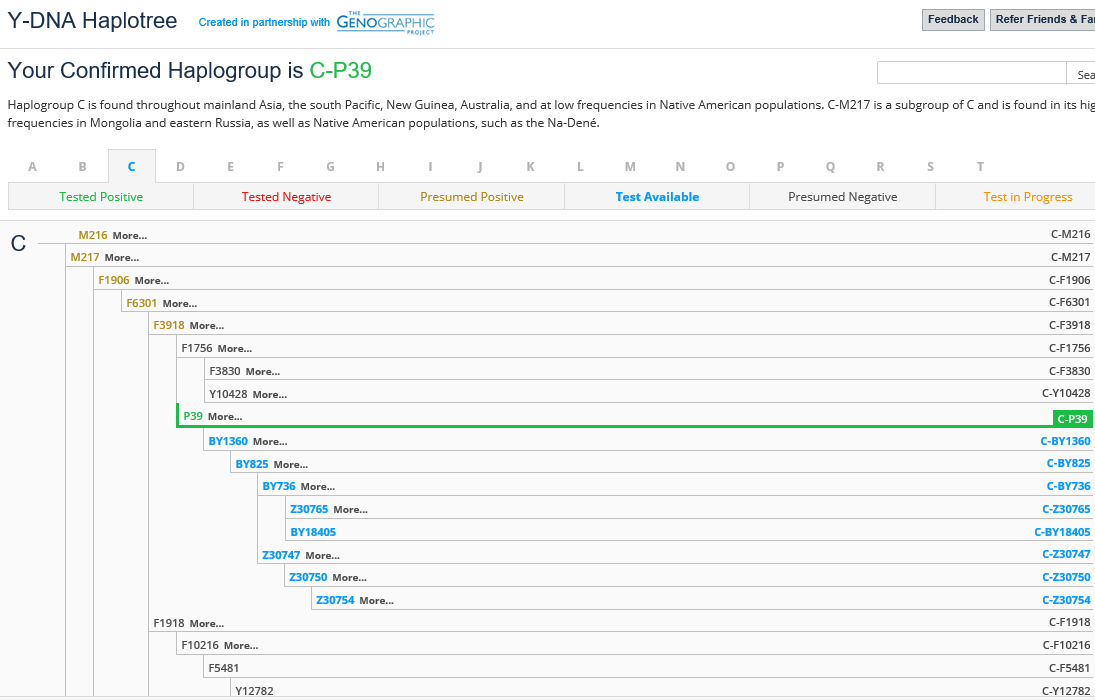
If you take any Y DNA test at Family Tree DNA, you will receive a haplogroup prediction. In the following example, the gentleman received haplogroup C-P39 as his haplgroup prediction.

Haplogroup predictions from Family Tree DNA are very accurate. They are basic in nature, but detailed enough to identify the continent where your ancestors are found as well as sometimes identifying groups like Jewish or Native American. To receive a more refined haplogroup, additional tests are available (individual SNPs, SNP panels and the Big Y), which confirm the original haplogroup assignment and give you the opportunity to find the smallest branch of the haplotree upon which you reside as a leaf.

Let’s look at an example.

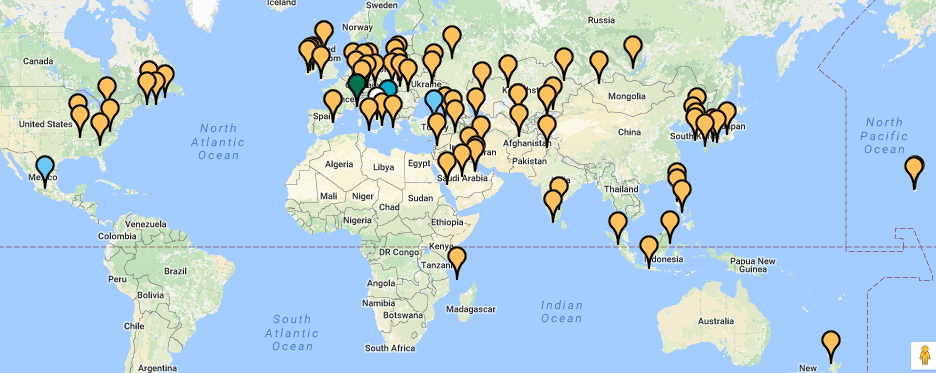
Y haplogroup C arose in Asia and subgroups are found today in parts of Asia, Europe and among Native American men.

Recently, by utilizing the Big Y test, an advanced specialized test that scans the majority of the Y chromosome for mutations, the haplogroup C tree was extended by several branches at Family Tree DNA.

With regular STR marker testing, which is the Y DNA test you purchase from Family Tree DNA,  this particular haplogroup C male had his base haplogroup of C identified along with the additional branch of C-P39. With additional advanced testing of some type, such as individual SNP testing, panels of SNPs available for some haplogroups, or the Big Y test – testers can learn more about their haplogroups – and with the Big Y, virtually everything there is to know about their Y chromosome.

However, until testers receive their regular STR results for their markers, advanced tests aren’t available to order, because testers don’t yet know into which haplogroup, or clan, they will be placed.

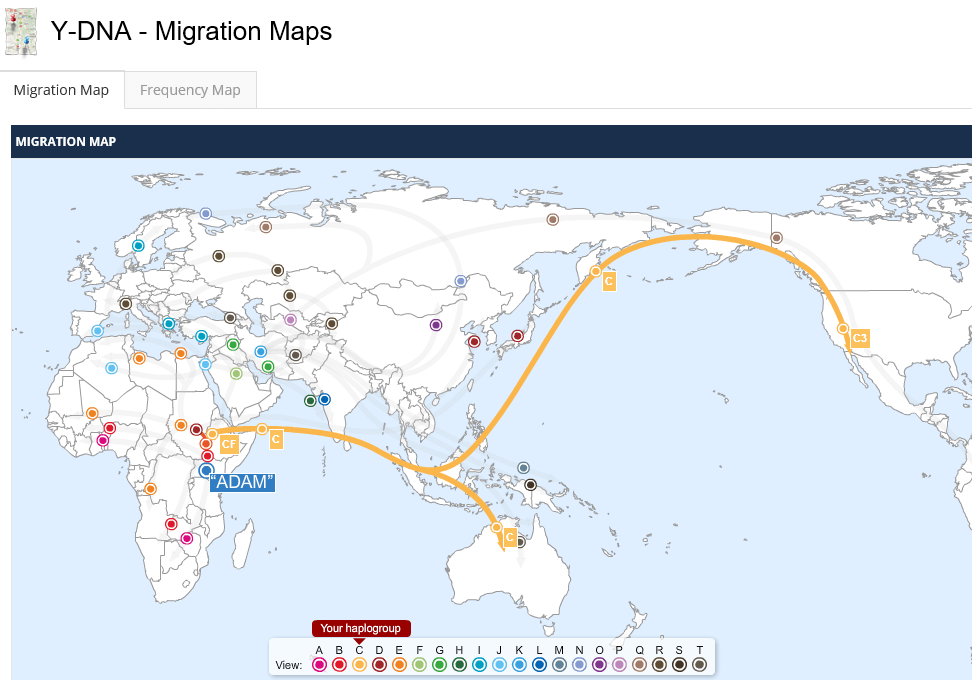
The haplogroup C Y-DNA project at Family Tree DNA provides a map of the most distant known ancestors of Haplogroup C members, including all branches, shown below.

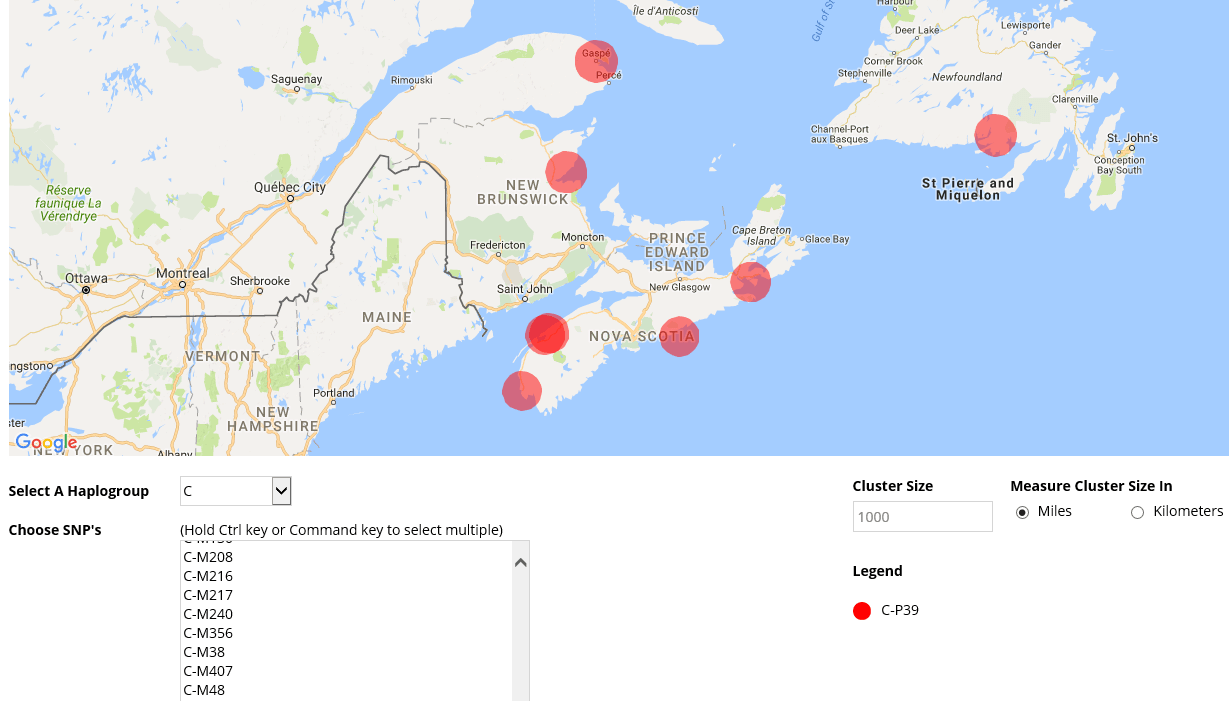
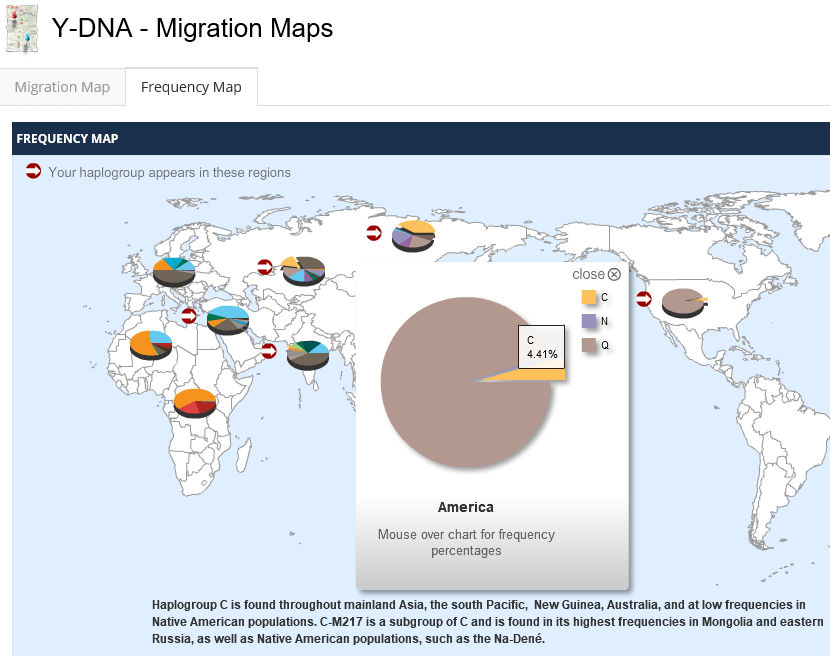
Hapologroup C-P39, a Native American subgroup, is found in a much more restricted geography in the Haplogroup C-P39 project, below.

Tools at Family Tree DNA

At Family Tree DNA, your Y haplogroup is shown in the upper right hand corner on your personal page dashboard.

In the Y DNA section, additional tools are shown. Let’s look at each tool and what it can tell you about your direct paternal line.

You can always navigate to the Dashboard or any other option by clicking on the myFTDNA button on the upper left hand corner and then the Y DNA dropdown.

Matches

The first place most people look is at their Matches page. In the case of our example, he has twenty three 111 marker matches ranging from one person with a genetic distance of 1, meaning one mutation difference, to several with 6 mutations difference. The fewer mutations, in general, the most likely the closer in time your most recent common ancestor with your match.

You can see by just looking at the matches below why entering the name of your earliest known ancestor (under Manage Personal Information, Account Settings, Genealogy) is so important!!! That’s the first thing people see and the best indication of a common ancestor. I always include a name, birth/death date and location.

In this case, it’s very clear the common ancestor of most, if not all, of these men is Germain Doucet born in 1641 in Port Royal, Nova Scotia. And before you ask, yes, it’s rather unusual to have an entire list of men descended from one man, but it’s clearly not unheard of.

As you can see, many of these matches (names obscured for privacy) have trees attached to their results and several have also taken the autosomal Family Finder test.

The different Y-DNA haplogroups listed to the right are a function of the “Terminal SNP,” meaning the SNP that tested positive furthest out towards the tip of the branch of the tree. Four matches have had additional SNP testing which shows their terminal SNP to be either Z30754 or M217.

This gentleman can then view his 67, 37, 25 and 12 marker matches by clicking on that dropdown.

He can also e-mail any of his matches by clicking on the envelope icon or view their trees by clicking on the pedigree icon.

Results

Next, let’s look at the Y-STR results for 67 markers. This page should really probably say “raw results,” because as many people say, “it’s just a page of numbers.”

This page shows your values and mutations at specific markers – in other words, what makes you both different from other people and the same as people you match, which means you share a common ancestor at some point in time in the not too distant past.

The beauty of these numbers, is, of course, in what they tell us in context of matching other people. You can’t have matches without these numbers. You also can’t have maps or anything else without the raw mutation information.

HaploTree and SNP Page

STR markers show mutations in recent timeframes, generally within the past 500-800 years, but SNPs take you back into antiquity – just like your family pedigree chart – working from closest to further back in time .

Your Haplotree and SNP page shows you the tree for your haplogroup – in this case C – designated by SNP M216, shown at the very top, along with all branches of the tree. The branches and leaves are color coded based on whether you have tested for that particular SNP, and if so, whether you were positive, meaning you carry the mutation, or negative, meaning you don’t.

SNP Map

The SNP map shows you cluster locations worldwide where any selected SNP is found.

Matches Maps

One of my favorite tools is the Matches Map because it shows the most distant ancestor for all of your matches that have provided that information.

Hint: you MUST enter the geographic information through the link at the bottom of this map (below) for YOUR ancestor to be displayed on THIS map and also on the maps of your matches.

You can also display your match list by clicking on the link beneath the map. You can click on the pins on the map to display the accompanying information.

Note the legend, as your exact matches are shown in red, 1 step mutations in orange, 2 steps in yellow, and so forth. Be sure to look for clusters, and note that if there are multiple people listed in the same location, their pins will stack on top of each other.

For example, in this case, the orange pin shown has two people’s ancestors in that location, including this tester, and a relevant cluster is clearly shown in Nova Scotia.

Migration and Frequency Maps

Are you wondering how your ancestor and his ancestors arrived where you first find them?

The haplogroup Migration Maps shows you the path from Africa to wherever they are found – in this case, the Americas.

The Frequency Map then shows you how much of the New World population is branches of haplogroup C.

Haplogroup Origins

The Haplogroup Origins tool shows the distribution of the haplogroup, by region, by match type and count.  Please note that you can click on any graphic to enlarge.

For example, this person has one 111 marker C-Z30765 match in Canada.

Ancestral Origins

The Ancestral Origins page shows matches by country along with any comments. These matches don’t have any comments, but comments might be Ashkenazi or MDKO (most distant known origin) when US is given.

Advanced Matching Combines Tools

Another of my favorite tools is the Advanced Matching tool, available under the Tools and Apps tab.

Advanced Matches is a wonderful tool that allows you to combine test types. For example, let’s say that you want to know if any of the people you match on the Y DNA test are also showing up as a match on the Family Finder test. You could further limit match results by project as well.

Be sure to click on “show only people I match in all selected tests” or you’ll receive the combined list of all matches, not just the people who match on BOTH tests, which is what you want.

In this example, I’ve selected 12 markers and Family Finder, because I know I’m going to find a few matches for illustration.

Of course, for adoptees, finding someone with whom you match closely on the Family Finder test AND match exactly (or nearly) on the Y DNA test would be very suggestive of a patrilineal common ancestor in a recent timeframe.

Projects

We started our discussion about Y DNA haplogroups by referencing two different haplogroup C projects. Family Tree DNA has over 9000 projects for you to select from.  The good news is that you really don’t have to limit your selections, because you can join an unlimited number of projects.

Thankfully, you don’t have to browse through all the available projects.

  • Haplogroup projects are categorized by Y or mtDNA and then by subgroup where appropriate.
  • Surname projects exist as well and are searchable for your genealogy lines.
  • Geographical projects cover everything else, from geographies such as the Denmark project to the American Indian project.

Some projects focus on Y DNA, some on mtDNA and some include both.  Additionally, some projects welcome people with autosomal results that pertain to that family surname or region.  Every project is run by one or more volunteer administrators that define the focus of the project.

To help people select relevant projects, project administrators can enter surnames that pertain to their project so that Family Tree DNA can match your surname to the project list to provide you with a menu of candidate projects to join.

Of course, you’ll need to read the project description for each project to see if the project actually pertains to you. You can see what is available for other surnames by utilizing the “Search by Surname” function, at the bottom of the menu.

You can also scroll down and browse in a number of ways in addition to surname.

All testers should join their haplogroup project so that everyone can benefit from collaboration.

You can join and manage your projects from your home page by clicking on the Projects tab on the upper left, shown below.

Y DNA Summary

I hope this overview has provided you with some good reasons to test your Y DNA or to better understand your results if you’ve already tested.

If you are a male and are interested in testing a line that is not your surname line, or if you are a female and you can’t test, you can find a male who descends from the ancestral line in question through all males and recruit that gentleman to test.  You can also check existing surname projects to see if someone from your line has already tested.

Y DNA holds the secrets of your patrilineal line. You never know what you don’t know unless you test. You don’t know what kind of surprises are waiting for you – and let’s face it, our ancestors are always full of surprises!

Y DNA Order Options

Family Tree DNA is the only company that offers this type of testing.  Ordering options include 37, 67 and 111 marker tests. You can also order 12 and 25 marker tests within projects. I suggest testing at the highest level the budget will allow, but no less than 37 markers. Most people have matches. Some people have a lot of matches and need the 111 marker test to more fully refine their matches to just the ones that may be genealogically relevant.

You can always upgrade later to a higher marker level later, but the combined original test plus upgrade cost more separately than just purchasing the larger test out the gate. It’s really a personal decision based on your goals and your budget.

Discounts

If you have never tested at Family Tree DNA, you can obtain a discount any day of the week by joining through your surname project. Just click here and then enter your surname into the Project Search box, shown upper right below.  I’ve typed Estes for purposes of illustration.

You will be shown a list of projects (at left above) where the various project administrators have indicated that someone with your surname might be interest in their project. Read the project descriptions, then click on the resulting project that best suits your situation – generally your surname – Estes above for example. You will automatically be joined to the project you select when you order a product, shown below. After you order, you can join multiple projects.

Next, click on the test level you wish to order.

By virtue of comparison, the project pricing for 37, 67 and 111 markers, above, saves you $20 off the regular price if you don’t order through a project.

If you already have a kit number at Family Tree DNA and have ordered other products, you can sign in, upgrade and order your Y DNA test by clicking here.

Happy ancestor hunting!

______________________________________________________________

Disclosure

I receive a small contribution when you click on some of the links to vendors in my articles. This does NOT increase the price you pay but helps me to keep the lights on and this informational blog free for everyone. Please click on the links in the articles or to the vendors below if you are purchasing products or DNA testing.

Thank you so much.

DNA Purchases and Free Transfers

Genealogy Services

Genealogy Research

The Parents of Charles Dodson, Jamestown Unraveled, 52 Ancestors #163

First, let me say right out and straight up that we have absolutely NO EVIDENCE whatsoever for who the parents of Charles Dodson ARE. But we do have evidence that strongly suggests who they aren’t!

Having said that, let’s look at the various rumors that persist and let’s see if we can address them.

The most common rumor, and by the way, I fell for it hook, line and sinker too, initially, because I was making the assumption that earlier researchers certainly would have had evidence or they would not have made fantastic claims, is that Charles Dodson is the grandson of John Dod’s of Jamestown through son Jesse Dodson who married Judith Hager.

Furthermore, Ann Dodson, Charles’ wife is rumored to have been his first cousin through Benjamin Dodson, brother to Jesse Dodson.

If anyone ever had evidence, it has disappeared today along with the documentation of whatever it was.

If you have or come across evidence, please, by all means contact me, because I’m still searching and I would actually LOVE to find some evidence that is documented.

What I will share with you is what I and other researchers have been able to assemble from records.

The Reverend Silas Lucas

The go-to resource for the Dodson family is the Dodson Family of North Farnham Parish, Richmond County, Virginia, an exceptional two volume set by the Reverend Silas Lucas published in 1988. He had written an earlier book in 1958 that preceded this more comprehensive set. Reverend Lucas spent 30 years sifting through primary records in every county in Virginia and many other states as well. Dodson researchers owe him a huge debt of gratitude.

On page vi of the introduction, here is what Rev. Lucas has to say:

A word of warning about trying to claim kinship with people with whom we cannot prove a relationship, i.e. “Are we kin to the John Dodson, d (sic, but he meant circa) 1607” of Jamestown, Virginia or Benjamin Dodson c 1652 of Essex County, Virginia? Some people would like to say that these men are the direct ancestors of Charles Dodson who died in 1701(sic). They state that a John Dodson came with Captain John Smith in 1607 and the John Dodson had sons Jesse and William Dodson. It is further stated that the aforementioned Jesse Dodson was the father of Charles Dodson, born about 1649 and died about 1701, in Richmond County, Virginia. Some of these people further state that our Charles Dodson of Richmond county, Virginia married one Anne Dodson, daughter of Benjamin Dodson of Essex County, Virginia. Regardless of how much one would like to claim descendancy from these aforementioned Dodsons, it must be stated unequivocably that no legal records exist to prove this hypothetical descendancy of Charles Dodson. Others have said that Gervais Dodson of Northumberland County, VA c 1650 was the progenitor of our family, but this also has not been proved.

To show how ridiculous this type of false claiming of kinship is, when I first heard of the above claims, I telephoned a lady in Texas who had been making these claims to Dodson descendants who had written her for possible help. I asked her where she got this proof, and she told me that several people who had joined one or more patriotic organizations had used these claims in their affidavits of descendancy, and she told me that it had to be true if one of these patriotic organizations had accepted the person for membership. I tried to point out that some of these organizations were of very recent beginnings and many had no hard-and-fast membership requirements, as to the DAR, Colonial Dames of America, as far as authenticating each detail of descent. Needless to say, I was unable to convince her of the questionable validity of these organizations and her desire to be associated or claim kinship with persons of the Jamestown era was too overwhelming for her to accept the basic premise of genealogical research concerning documenting proof of family descendancy by legal records.

Of course, for any genealogist reviewing this information, the first issue is that Essex County, Virginia didn’t exist in 1652. Neither did Richmond County.

The history of the counties that ultimately became both Richmond and Essex in 1692 when Old Rappahannock was dissolved, is as follows.

Dods and Dodson

From the book Domesday People: Domesday Book by K.S. B. Keats-Rohan, we find that a man named Aluuin Dodesone lived in Hertfordshire in 1086.

The book The Quest for a Lost Race by Paul B. Du Chaillu who proposed the theory that the English were descended from Scandinavians rather than the Teutons – Normans rather than Germans provides the following:

Dodson – The son of Dode, Alwinus Dodesone, occurs in Domesday as a tenant-in-chief. It is an open question whether it is Scandinavian or Anglo-Saxon. Even Lower is doubtful. There is a large connection of this name in Maryland and Kentucky. One branch is connected with the Botelers of Virginia. A good English stock.

The following publication from the Oxford University Press also provides information.

Is this the same as what would become Dodson, and if so, is it our Dodson line? We know positively that there was more than one, according to Y DNA. We have no way of knowing if this line would become our Dodsons.

Ancestry provides us with the following information about the source of the Dodson surname.

Jamestown

For the past two or three years, I’ve been focused on the Virginia and Maryland ancestors. I had the opportunity to visit Jamestown in 2015. When there and in the Virginia archives in Richmond, I checked for Dod, Dods, Dotson and Dodson in early records of both Jamestown and also of the area that became surrounding counties.

I really wanted to find proof, or even a probable trail that indicated my ancestor actually was John Dods who had been at Jamestown.

The following digitized book includes transcriptions of the original early documents.

The original lists of persons of quality; emigrants; religious exiles; political rebels; serving men sold for a term of years; apprentices; children stolen; maidens pressed; and others who went from Great Britain to the American Plantations, 1600-1700 : with their ages and the names of the ships in which they embarked, and other interesting particulars; from mss. preserved in the State Paper Department of Her Majesty’s Public Record Office, England

Jamestown Biographies

When I found the Jamestown Biographies project, and discovered that John Dods, wife Jane, was listed among the available biographies, I quickly purchased one. Thankfully, it was only $5.

It documents that John Dods was in Jamestown and that oral history says that Jane was an Iroquois, daughter of chief Eagle Plume. Oral history? Seriously? And I paid for this? Their source, personal correspondence with Dodson researchers. My heart sank.

A second page repeats the lore that Jane was reported by the family to be the daughter of Chief Eagle Plume, an Iroquois.

There is some good news in this report and that is the additional research. If we, meaning the Charles Dodson Y DNA descendants, ever get a Y DNA match to someone overseas, these very early references may become invaluable because one of them could potentially be our ancestor – whether through John Dods or not.

Jamestown lists two wills, both in the Prerogative Court of Canterbury.  The first dated February 6, 1560 is the will of John Dodd, gentleman of Little Illford, Essex, and the second dated May 7, 1652 is for John Dodd, gentleman of Enfield, Middlesex.

If John Dodd’s on the lists is actually John Dodson, then the Dodd wills, above, are irrelevant.

Dispelling Rumors

Some genealogists contend that John Dodds wife was Jane Dier who came over after the first settlers and that John Dodds then lived and died in Richmond Co., Virginia.

The second part of that contention is impossible, since Jamestown was settled in 1607 and Richmond County was formed in 1692, which would have made John Dodds about 100 years old when Richmond County was formed. Oh, those pesky details.

John Dods did survive the Indian massacre at Jamestown which occurred on March 22, 1622.

According to the Persons of Quality book by Hotten:

The List of Living and Dead on February 16, 1623 shows John Dod’s and Mrs. Dod’s living at “ye neck of land.”

In 1624, at Neck of Land Corporation of Charles Cittie, John Dod’s is listed on the muster as being 36 years old and arriving on the Susan Constant in April 1607. His wife, Jane is listed as age 40 and there is no arrival ship beside her name, which is probably much of what fuels the speculation that she is Native.

In 1626, John Dodd’s is listed with 50 acres at Charles Cittie and with 150 acres at Tappahanna against James Cittie.

There is absolutely no evidence or records to suggest that John had children. The various lists do include “infants,” meaning underage children, and there are no other Dod individuals listed by any surname spelling, and nothing even close.

Other families on this same list had children listed, such as John Price, wife Ann, and Mary, a child aged 3 months. Very few families have children. Many woman arrived between 1620 and 1623.

Most women are younger than Jane. She along with one other woman is 40, and one woman is 50. Not all women have ages. Most are listed with the names of the ships they arrived in. The other woman, aged 40, does not.

There is no evidence that John and Jane, or John and anyone had any children who survived. There are no records of Jesse and/or William, their supposed sons, whatsoever. If other couples with children have their children listed, John and Ann would too. The oldest child born on American soil was age 8, and there was only one. Two children aged 7 were born in Virginia. It appears that there were very few females in the early colony and that children did not survive the 1722 attack. According to Jamestown historians, only three of the original settlers were still living and found on 1723 list of the living – and none with known children.

Given the information we do have, combined with the fact that Jane was age 40 in 1624, it’s reasonable to surmise that John Dodds and Jane never had children that lived. If they did, it would have had to have been in very short order, given Jane’s age.

Given that children are listed among the dead, and there is no Dod, Dods or Dodson listed by any spelling, it’s reasonable to presume that they did not have a child or children that died. Given that there are no other individuals listed with the Dodds surname, it’s reasonable to conclude that there were no other Dodds or Dodson individuals in the colony in 1624.

Under the list of Thomas Dunthorne’s muster, we find “Thomas an Indian Boaye” under the subtitle, “servants.” This suggests that if Ann had been an Indian, a notation beside her name might have said “Indian.”

Following further rumors, the marriage between John Dodson’s son, Jesse Dodson and Judith Hagar is supposed to have occurred on May 7, 1645 in Jamestown. The problem with this information is that there appear to be no records whatsoever of Jamestown marriages that have survived. Furthermore, there is no record of Judith Hagar arriving in Jamestown, either. Nor is there any record of Jesse Dodson. This rumor has struck out altogether.

Another rumor is that Jesse Dodson died in 1680 in Old Rappahannock County, Virginia, but you guessed it already, there is no record of any Jesse Dodson ever living in Rappahannock County or dying in Rappahannock County in 1680 or anytime, for that matter. Furthermore, Charles Dodson had no sons named Jesse.

Where is Charles Cittie?

John Dods owned land in Charles Cittie and James Cittie.  Charles Cittie is now Charles City County.

James Cittie is now James City County, adjoining Williamsburg and including Jamestown, which is, indeed, on a neck of land.

James City County abuts Charles City County.

On the map below, you can see both Jamestown and Charles City, along with the Northern Neck of Virginia, at the top of the map, north of the Rappahannock River, near 360, where Charles Dodson lived.

Jamestown and Charles City are 23 miles distant. John Dod’s land could have been anyplace along this route. His 2 parcels of land could actually have been very close if they were located near the border of Charles Cittie and James Cittie. Given that John Dodd was one of the original settlers, few of whom survived until 1623, my presumption would have been that he would have been allowed land in the original Jamestown settlement, if he wanted land there.

Where Did These Rumors Come From?

In determining whether there is any truth to a rumor, it often helps to determine the source. For example, if this line of descent had been reported in every one of Charles Dodson’s children’s lines, recorded repeatedly before the days of easy access to other people’s work, I would be more likely to consider the possibility that the story actually descended from the original settlers and wasn’t somehow later manufactured or surmised.

I discovered that I’m not the first person who asked that question. Glenn Gohr back in the 1980s and 1990s posted a significant amount of research on his Rootsweb page involving the various Dodson records.

Glenn first found the Dodson information involving Jamestown in a 1908 document:

Ege, Thompson P. Dodson Genealogy, 1600-1907. Philadelphia, PA: Deemer & Jaisohn, 1908.

Page 4 of the above book does have a good clue:

“Colonial Annals of Virginia mention ‘Dodson’s Plantation’ in 1632.”

Some say this is a reference to the plantation of a John Dodson, who they list as the grandfather of Charles Dodson (c1649-c1704) of Rappannock County and North Farnham Parish in Richmond Co., VA. I do not see enough evidence at this time to establish Charles Dodson’s progenitors.

Pages 363-364 lists origins of early Virginia branches of Dodsons. It says:

“The annals of Virginia record the name of a ‘Dodson Plantation’ in 1632. And the traditional story in a large and widely scattered line of descendants is that their ancestor settled along the James River and was one of the early Jamestown Colony.”

This document goes on to give partial more recent lineages for the Tennessee Dodsons, not going back as far as Charles of Richmond County and his sons. The more I read, the less reliable this source seemed to be.

Glenn continues with the following:

No documentation is given for any of the above. Much more is given on descendants in each of these lines. They do not show Charles Dodson of N. Farnham Parish in the lineage, but some of these names, especially the ones in Estanalle Valley of TN are listed in Rev. S. E. Lucas’s 2-vol. book (but) the lineage in the Ege book does not line up with the lineage in the Lucas book. The connection to Jamestown is interesting, and these lineages may provide some clues for researchers, but they cannot be taken as fact.

The above book also covers Dodsons in Maryland and Dodsons in Pennsylvania, and some unplaced Dodsons. There is also mention of 3 early Dodson settlers (2 brothers and a sister–John Dodson, b. March 1655; Mary Dodson, b. 11 Nov. 1664 md. Richard Boyes; Thomas Dodson, b. 19 Oct. 1669; md. Katharine Savill) who settled in New Jersey and were Quakers and children of a Daniel Dodson, b. ca. 1635 of Knaresborough, Yorkshire, England. These appear to be the ancestors of Dodsons in Pennsylvania, New Jersey, and Maryland.

The information about the New Jersey, Pennsylvania and Maryland Dodsons is useful relative to Y DNA testing in the Dodson DNA Project which shows that the Talbot Co., Maryland, New Jersey and Pennsylvania Dodson’s don’t match either the Charles Dodson line, or each other.

Glen then notes another book which repeats the Jamestown story

Ancestors of Robert Dodson and His Descendants, written by Mrs. C. T. Dodson; Illustrated by Miss Oneida Uzzell. Privately published, [1964?]. She included this information:

“The year 1619 brought three important events to Virginia and the colonists. Virginia was permitted to enjoy a measure of self government; a ship load, eighty, of prospective wives arrived from England (probably Jesse (2) Dodson and William (2) Dodson married two of these women). The colonist could secure a wife, with her permission, and by paying her transportation, in the amount of one hundred and twenty pounds of tobacco–about $500 dollars worth; and the first Negro slaves landed in Virginia.”

Glen then provides the information from an application for the Daughters of Colonists that seems to be part of the source for the rumors.

SOURCES FROM MRS. C. T. DODSON’S BOOK

Here follows information on records to get into Daughters of the Colonists by Lillian E. Dodson.

  1. 72-73 (This is quoted word for word from the book, including mispellings or question marked items–gg):

Copied 9 February, 1966 by Edith Wolf Standhardt from handwritten copy lent by O. H. Schwanderman.

From Records to get into Daughters of Colonists by Lillian Elanine Dodson [I think this should be Daughters of the American Colonists– gg]

Name of Ancestor – John Dodson of James River or Jamestown. Served in the Council and General Court of Jamestown, 1622 – 1629.

The undersigned have investigated and approve the applicant and her application

Signature of St. Louis Chapter Officers:

Chapter Regent: Maude Bryan Jenneinzo (?) (Jennings?

E.S.)

Chapter Registrar: Gertrude L. Wingert

Chapter Sec: Clara Sizer Nevling

Date: Nov. 21, 1949

Signature of Missouri State Officers:

State Regent: Mrs. Edwin Lamont Barber

State Registrar: Nell Downing Norton

State Sec: Acenath M. Booth

Date: Nov. 21, 1949

Fee received by National Society: Mabel S. Stoyer, Nat. Treas. Dec. 15, 1949

Signature of National Officers:

Natl. President: Margaret F. Powers

Natl. Registrar: Lillian M. Sanford

Natl. Sec.: Mabel Puffer Martin

Date of Acceptance: Jan. 31, 1950

Endorsed:

Mrs. Clyde Nevling, 4259 Maffit Ave., St. Louis

Mrs. Joseph Jannuzzo, 8016 Seminole Place, Clyton 5, Mo.

Miss Lillian Elanine Dodson, born 4 Feb. 1901, Wayne Co., KY. herein apply for membership in Society by right of descent from John Dodson, a member of the Jamestown Settlement in Virginia, who is mentioned in Va. Mag. Vol. 23, p. 11 in St. Louis Public Library Ref. Room., of Jamestown, Virginia, born in England, died in Virginia, served in Council and General Court of Jamestown 1622-29.

I was born in Steubenville (Wayne Co.) Ky. I am the daughter of John Cornelius Dodson of Steubenville, Ky., born 22 Feb. 1869, died 31 Jan. 1931 – married 22 Feb. 1900 to Nancy Kelly, born 19 Dec. 1869 d. 18 Dec. 1939.

John Cornelius Dodson, son of John Dodson born 23 Nov. 1831, died 11 Aug. 1885, married Sara Phillips, born 23 Nov. 1828

John Dodson is the son of Jesse Dodson born 26 Dec. 1802, died 3 Jan. 1864, married 14 July 1824 Elizabeth Small, born 12 Oct. 1805, d. 12 June 1876.

Jesse Dodson is the son of Thomas Dodson, died prior to 1836. married Jemima Randall.

Thomas Dodson is son of George Dodson of Richmond Co., Va., born 31 Oct. 1737, died 1825 Pittsylvania Co., Va., married twice, Margaret and Elizabeth.

George Dodson is the son of George Dodson, married 30 April 1726 in Richmond Co., Va. to Margaret Dagord.

George Dodson is son of Thomas Dodson born 15 May 1681, died 21 Nov. 1740.

Thomas Dodson is son of Charles Dodson of Richmond Co., Va. born 1649, died 1704.

Charles Dodson is son of Jesse Dodson, Richmond Co., Va. married to Ann.

Jesse Dodson is the son of John Dodson of Jamestown Settlement born in England.

Records to be found: Genealogy traced in “Dodson Genealogy 1600 – 1907” page 364, St. Louis Mo. Library. Will on record in Pittsylvania Co., Courthouse, Va. proved 19 Dec. 1825. Named in father’s will proved 2 Mar. 1740 in Richmond Co., Va.

Named in father’s will (Charles) in Richmond Co., Va. Courthouse, 1704. Abstracts of Richmond Co., Va. Also “Dodson Genealogy”, Ege. Lineage in “Dodson Genealogy 1600-1907” by Rev.. T. P. Ege, Local Library. Mentioned in “Dodson Genealogy”, also Virginia Mag. of History.

Children of Ancestor

Jesse Dodson)

   ) sons of John Dodson

William Dodson)

Authorities proving services of Ancestor: Virginia Mag. of History, Vol. 23, p. 11; his name given in minutes of the Council and General Court, 1622, 1629, and the fact stated that he was a passenger on ship Ann, that he came to Jamestown in the original settlement. He was called to report in the Council on conditions of the ship and provisions for the voyage. He is reported to have been a hunter of some note, a good citizen, and the father of at least two children, sons William and Jesse, listed above in Dodson Genealogy.

Copied by Oliver H. Schwanderman of Fort Recovery, Ohio, Route 3, 4 Feb. 1964. She is a cousin to me by Dodson lineage from Rutha Mary Dodson Schwanderman, 1870 – 1959, Wayne Co., Ky. Champaign Co., Ill.

Ancestors of Robert Dodson and His Descendants. Written by Mrs. C. T. Dodson; Illustrated by Miss Oneida Uzzell. Privately published, {1964?] (Note: This book is 115 p. and is located in the Dallas Public Library, Dallas, TX, call # R929.2 D647d), pp. 73-74:

Article in Virginia Magazine of History and Biography, Vol.23 (1915), pp. 11-12, as quoted in:

*Note: I am quoting this directly from the Virginia Magazine of History and Biography article–there is more than what is quoted, here, but this is the part that refers to John Dodson.–gg

Minutes of the Council and General Court

[ink folio 105]

Mr. Thomas Edwardes beinge Demanded wt he could sayd concerninge the Accomodatinge of passengers yt cam in the shipp called the Ann said that he wold never Desire to be better vsed Yt is ordered Yt mr Daniell Lacye shall haue four acres of grounde in the Islande adioyne on the grounde of mr Kingsmells, wch is the rather granted for that mr Kingsmell Doth Desire the same Moris Thomsone and John Dodson sworne and Exand sayeth that for ye they were a fortnight or three weeks abourde befor they had any breckfast Drinke allowed them, And after they had Complayned, they had to smale Cans of beere for breckfast to 5 men wch Contynued soe for some six weeks or two moneths And they had a quarter can of beere to a meale for 5 men wch Contynued for the space of sixteen weeks, And after that for the space of Six weeks a three weeks they had three smale cans of beere to A messe. And a pounde and a halfe And that they had three pownd of bred a Daye to A messe for the space of some sixteene weeks. And after till theyr cominge in thre bisketts a meale to A mess. And for A sixteen weeks they had thrree flesh Dyes A week, And after that for about a moneth fortnight they had too flesh Dyes a week and after yt 2 flesh meales a week till theire Cominge in foorther they say that ther beere was well condicioned except a butt or two (ink folio 106) And fovrther they say have harde some of the passengers Complayne but wt cause they had they know nott….

Glenn closes by stating the following:

Mrs. Dodson does try to list and include sources about the information she has listed, but there is NOTHING besides “family tradition” which definitely links the John with the 2 sons, William and Jesse. Also nothing besides tradition to link Jesse with Charles Dodson of N. Farnham Parish, Richmond Co., VA.

Still it is fascinating reading, hoping that it all could be true and proven true. I, personally don’t see enough proof for the links.

At least now we know where this came from, thanks to Glenn’s detective work.

The Reverend Elias Dodson, writing about 1859, penned a manuscript titled “Genealogy of the Dodson Familes of Pittsylvania and Halifax Counties in the State of Virginia.” Reverend Lucas had a copy of that document and used it extensively when writing his book. However, Reverend Elias Dodson says nothing at all about Jamestown or John Dods. This is the earliest known family document or history of the Dodson family – and it stands mute.

If Elias had heard about Jamestown, and that Charles was descended from John Dod or his son, Jesse, Elias surely would have included that information.

However, there are records of some additional Dodsons that we should review.

Thomas Dodson of Northumberland County

There is a Thomas Dodson found in Northumberland County in 1658.  Because Charles Dodson names his second eldest son Thomas, and because the eventual Richmond County is taken from part of the original Northumberland, these records deserve close scrutiny.

Thomas Dodson patents land on Dividing Creek in 1658 in Northumberland County, but the patent expires and nothing more is known of Thomas’s land until 1694 after he has lost the land and died. Unfortunately there are no records in this part of Virginia that speak to his death, so he may have died elsewhere.

The book Cavaliers and Pioneers volume 1 by Dennis Ray Hudgins, page 383, documents that Thomas Dodson was granted 1200 acres on Nov. 29, 1658 in Northumberland Co., VA for the transportation of 24 persons. His name appeared on the list, which suggests that he is one of the 24. The fact that he transported (or paid for the transportation of) 24 people suggests that Thomas Dodson is wealthy.

Researcher Michelle Ule found the following:

Patent Thomas Dodson grantee 29 Nov 1658 Northumberland County 1200 acres on the high lands above the head of the Dividing Creeks. Source: Land Office Patents No 4 1655-1664 pg 340 reel 4) Dividing Creeks is south of the Great Wicomico and the river flows into the southern Chesapeake Bay.

1200 acres would be the exact amount, at 50 acres each, for transporting 24 individuals.

Grant Walter Jenkin grantee 30 Nov 1694 Northumberland County 500 acres escheat land part of a tract of land of 1200 acres granted to Thomas Dodson 29 Nov 1658. Southermost &c of sd 1200 acres, adjoining to the lands of Colo. Lee and John Cousins. Source: Northern Neck Grants No 2 1694-1700 pg 88-91 (reel 288)

Grant John Lewis grantee 26 Mar 1695 Northumberland County 150 acres escheat land beginning on the land of Charles Lee, Walter Jenkins, Peter Hammon, and Thomas Haydon. Thomas Dodson, died seized of 1200 acres patent dated Nov. 29, 1658. Source: Northern Neck Grants No. 2, 1694-1700, p. 146-147 (Reel 288).

Grant Grantee Hammon, Peter grantee, Date 26 March 1695.  Note  Location: Northumberland County.  Note  Description: 150 acres escheat land, Thomas Dodson died seized of 1200 acres of land, patent dated Nov. 29, 1658, the 150 acres abutting southerly on the land of Walter Jenkins westerly on the land of Thomas Williams. Source: Northern Neck Grants No. 2, 1694-1700, p. 144-146 (Reel 288)

Source: Land Office Patents No. 6, 1666-1679 (pt.1 & 2)

http://www.lva.lib.va.us/

Another researcher reports the following information pertaining to Thomas of Northumberland.

1663 March Northumberland County land record sale of land by Wilbur and Sarah Mauder to Thomas Dodson – the land upon which he lives.

1664 Northumberland County Power of attorney from Jane Wiley to Symon Dodson.

The above record is the only record that involves Symon Dodson.

One Thomas Dodson apparently lived in Northumberland County between 1658 and 1663, but he was not living there in 1652 when the loyalty oath was taken.  He may have had a relative named Symon.  We don’t find anything about either man after 1664, in Northumberland or any of the spinoff counties.  We do know that by 1694, Thomas had died, apparently still owning his land, and the land reverted, probably due to lack of tax payments or because he never paid the fees or had the land surveyed.  If Thomas had an estate that included underage heirs, such as Charles Dodson, a guardian would have been appointed to protect the assets of the heirs and the land would not have been allowed to escheat back to the colony.  No such records exist, so it’s extremely unlikely that Charles is the son of Thomas.

Charles, born in 1649, would have been age 14 in 1663 when Thomas last appears in the records, obtaining land from Wilbur and Sarah Mauder.

Thomas Dodson died sometime between 1663 and 1694.  Charles never owns or sells land in Northumberland County, nor do we find any record of Thomas’s land from the Mauder’s being sold.

Englishmen non-resident in England had their wills probated through the Canterbury Court. One Thomas Dodson’s will is probated in Canterbury in 1672, but his wife’s name is Sarah, as well as his daughter, and he lived in Great Warley, Essex.  Other Thomas Dodson’s are found in Yorkshire, Kent and one buried in London in 1668.

There is no Charles born in 1649 in any of these locations, and no Charles born to a Thomas in any records that are indexed yet today – although future researchers should check these records again.  There is a Charles born in 1645 to Northamptonshire to John and Joanne Dodson and in 1655 in Shropshire to Edward and Frances Dodson – neither of which look promising, given naming conventions.

Charles first appears in Old Rappahannock County in 1679 in a lease type arrangement with Peter Elmore.  Charles does not purchase his own land until 1686, so he clearly didn’t have funds until that time. Nor did Charles patent land, so apparently someone else took credit for his 50 acre headright.

Other Dodsons

Gervais Dodson appears before Charles Dodson in the records of Northumberland County, VA in 1658, but he appears to have died without issue. Furthermore, there is no Gervais in any of Charles children nor their offspring.

There is a John Dodson line in early Maryland which, via DNA testing, we know does not match our Charles Dodson.

Another researcher reports several other Dodsons:

1622 – 31 July Robert Dodson Jr. came to Virginia at the expense of Robert Dodson Sr aboard the ship James.

I was not able to find any evidence of this Robert Dodson Jr. He is not among the list of living taken in 1623.

1623 – 30 April Robert Dodson Jr. said that he had firsthand knowledge of the plantations east of Jamestown.

I have not been able to confirm this informaton, and he does not appear on the 1624 muster list.

1643 – Thomas Dodson by Richard Richards, Charles River Virginia. Source:  Greer, George Cabell. Early Virginia Immigrants, 1623-1666. Richmond VA: W.C. Hill Printing Co., 1912. Reprinted by Genealogical Publishing Co., Baltimore, 1978. Repr. 1982. Page: 96.

Charles’s wife Ann, Daughter of Benjamin?

A secondary Dodson rumor is that Charles married his first cousin, Ann, daughter of Benjamin Dodson, son of John Dodson, of Jamestown.

If you’ll notice, the original rumor has changed. Originally, John Dodson and Jane had two sons, Jesse and William. However, when Ann’s story got added, she became the first cousin of Charles through Benjamin, the brother of Jesse. Therefore, John Dods (Dodson) of Jamestown would have had three sons, Jesse, William and Benjamin. The rumors aren’t adding up, especially considering that John and his 40 year old wife had no children in 1624.

And then there’s the pesky issue of the fact that we have an immigration record for Benjamin in 1635.

1635 – Benj Dodson Place: Virginia Source:  Greer, George Cabell. Early Virginia Immigrants, 1623-1666. Richmond VA: W.C. Hill Printing Co., 1912. Reprinted by Genealogical Publishing Co., Baltimore, 1978. Repr. 1982. Page: 96.

1635 – 22 June: Captain William Pierce, Esq received 2000 acres for the transportation of 40 persons including Benjamin Dodson.  Virginia Magazine of History and Biography.

Another researcher takes this a step further, providing the following:

Charles Dodson, born about 1649, d 1705 Richmond, Co., Va. m Ann Dodson (dau. of Benjamin Dodson, who gave his daughter a legacy of land on the James River in Essex Co., Va., May 1652.  This joined John Hill, Sr.’s land.  (This Benjamin probably came from England.)  Ann m before 1680 to Charles Dodson (2nd) John Hill, Jr., after Charles’ (3) death.

One thing I can confirm is that indeed, Ann did marry John Hill after Charles died. I can’t confirm that it was John Hill Jr.

I can state unequivocally that there was no Dodson in Northumberland County in 1652 when the loyalty oath was signed, so Benjamin must have been elsewhere at that time.

Capt. Hill does patent land, according to the Virginia County Records Quarterly Magazine March 1911, Vol. IX #1:

Capt John Hill land grand 1669 Rappahannock Co for 650 acres, also in 1670 for 1200

However, Essex County wasn’t formed until 1692, so it’s impossible for Benjamin Dodson to leave anyone a legacy in Essex County in May of 1652. In 1652, this area would have been part of Northumberland or Lancaster.

I review the Essex County records, which includes the original Old Rappahannock records prior to 1692, and there is absolutely no mention of Benjamin Dodson in any type of record, including land, court, church or will/probate.

There is absolutely no record to substantiate the claim that Ann was the daughter of Benjamin Dodson, or that there were any transactions between John Hill and Benjamin Dodson, or that John Hill even owned land in what would become Essex County.

Charles Dodson’s wife was clearly Ann.  Later, in online trees, she rumored to be the daughter of Peter Elmore, which I wrote about here.

Dodd is Not Necessarily Dodson

The Dodd family is also found in Richmond County, VA. It has never been suggested that the Dodd and Dodson families are one and the same, nor am I suggesting that now, but while we Dodson researchers have been incredibly focused on the Dodson surname, we need to be cognizant that the Dodd surname in Richmond County is equally as likely, if not moreso, to be descended from John Dodd at Jamestown – if anyone is.

I did find evidence of John Dod(d) who was married to a Jane in the Richmond county records, according to records beginning in 1696/97 in both deed and court records. This record at the Early Colonial Settlers of Southern Maryland and Virginia’s Northern Neck Counties site reveals more information about this John Dodd, including that he is the son of Richard Dodd who was born in 1634 in England and died in 1678 in Charles County, Maryland. So, clearly, this is not the Jamestown Dod family, nor is he related to our Dodsons.

Summary

Not only do we have absolutely not one shred of evidence that John Dod, Dodd or Dodson of Jamestown is an ancestor of Charles Dodson, we have evidence that he isn’t.

Probably the most compelling evidence is that John and his wife are listed in the 1624 muster without children, where other people are listed with children. Given that Jane is 40 at that time, it would be very unusual for her to bear 3 additional children, Jesse, William and Benjamin, and for all 3 to live.

There is also no information about what happened to John Dod or Dodson, or what happened to his land.

There is no evidence whatsoever that a William, Jesse or Benjamin Dodson lived in Virginia before the record of Benjamin’s arrival in 1635. Neither Jesse nor William are ever reported in any record.

It is possible that some Dodson was living in Virginia by 1632 when Dodson’s plantation was reportedly referenced, although I have not been able to confirm that record.

However, given the fact that Charles Dodson can write suggests strongly that he was not raised in early Virginia. If Charles could write, then he would have been the son of a gentleman. He would likely have been sent back to England to be schooled, and when he returned, it would not have been as a penniless man who contracted to work and improve another man’s land 1679 for a period of 19 years. The son of a gentleman would simply have purchased land. Charles did not – at least not for another 6 years, in 1685. Nor did Charles ever claim a 50 acre land grant for transporting himself, so either he was transported by someone who claimed his headright, or he arrived as an indentured servant.

The best we can piece together is that Charles was probably born in England. I’m hopeful that eventually, a parish record will emerge that shows a Charles born in about 1649, a year revealed by Charles’ own testimony in 1699 stating that he was about 50 years old.

Until then, all we can say is that the parents of Charles Dodson were almost certainly NOT Jesse Dodson and Judith Hagar who supposedly married in 1645 in Jamestown. Unless new information is forth coming with actual documentation of some sort, this couple must be relegated to the annals of myth – along with Charles Dodson being the son of John Dods of Jamestown.

I’m hopeful that one day either a parish register of Charles’ birth will emerge or a Y DNA match to an English Dodson whose lineage is located in a small village and has been since records began. Either one would go a very long way in terms of helping us bridge the gap between Charles and his parents by providing us with a search location in England.  Those records may be waiting in a small village church in England for Dodson researchers to find them – along with Charles’ ancestors in the church cemetery!

______________________________________________________________

Disclosure

I receive a small contribution when you click on some of the links to vendors in my articles. This does NOT increase the price you pay but helps me to keep the lights on and this informational blog free for everyone. Please click on the links in the articles or to the vendors below if you are purchasing products or DNA testing.

Thank you so much.

DNA Purchases and Free Transfers

Genealogy Services

Genealogy Research

MyHeritage Ethnicity Results

I originally wrote about MyHeritage in February 2017, reflecting matching issues and a broken promise regarding providing ethnicity estimates to people who uploaded their raw DNA file from another vendor. I’m glad to say MyHeritage changed their minds about providing ethnicity results and, today, has honored their original commitment and provided free ethnicity results to uploaders. I feel much better about the DNA aspect of MyHeritage given this decision although their challenges with matching remain.

MyHeritage has also provided updated ethnicity results to people who tested directly at MyHeritage.

In an e-mail received today from Aaron Godfrey, their Director of Marketing, he says:

I wanted to let you know that we’ve just launched MyHeritage’s new and improved Ethnicity Estimate. The new analysis, developed by the company’s science team, provides MyHeritage DNA customers with a percentage-based estimate of their ethnic origins covering 42 ethnic regions, many unique to MyHeritage.

In addition, the new Ethnicity Estimate will be provided for free to users who have already uploaded their DNA data to MyHeritage from other services, or who will upload it in the coming months. Users who upload their DNA data to MyHeritage, already enjoy free DNA Matching, and now they will benefit from the new ethnicity analysis too.

Our Ethnicity Estimate is delivered to users through a captivating “reveal” experience featuring animation and, as of this week, original music composed by MyHeritage. Each of the 42 ethnicities has a distinctive tune, based on the region’s cultural elements; all tunes seamlessly connect to each other. You can view an example here:  https://vimeo.com/218348730/51174e0b49

An excerpt from their press release is provided below:

TEL AVIV, Israel & LEHI, Utah, May 30, 2017 – MyHeritage, the leading global destination for family history and DNA testing, and the makers of the successful MyHeritage DNA product, today announced the launch of its new and improved Ethnicity Estimate. The new analysis, developed by the company’s science team, provides MyHeritage DNA customers with a percentage-based estimate of their ethnic origins covering 42 ethnic regions, many available only on MyHeritage, representing the most comprehensive report of its type available on the market. This fascinating report gives users a much better understanding of who they are and where their ancestors came from. The Ethnicity Estimate is presented in an original and engaging format, making it not only interesting but also fun to watch and share.

MyHeritage is unique among the main industry players in allowing users who have tested their DNA already with another service to upload – for free – their data to MyHeritage. Those users receive DNA Matches for free, for finding relatives based on shared DNA. Beginning this week, users who have already uploaded their DNA data to MyHeritage, or who will upload it in the coming months, will receive – for free – the new Ethnicity Estimate. This benefit is not offered by any other major DNA company.

Development of the new Ethnicity Estimate raises the number of ethnic regions covered by MyHeritage DNA from 36 to 42. It was made possible thanks to MyHeritage’s Founder Populations project — one of the largest of its kind ever conducted. For this unique project, more than 5,000 participants were handpicked by MyHeritage from its 90 million strong user base, by virtue of their family trees exemplifying consistent ancestry from the same region or ethnicity for many generations All project participants received complimentary DNA tests and allowed MyHeritage’s science team to develop breakthrough ethnicity models based on the generated data. Thanks to this analysis, MyHeritage DNA has become the only mass-market percentage-based DNA test that reveals ethnicities such as Balkan; Baltic; Eskimo & Inuit; Japanese; Kenyan; Sierra Leonean; Somali; four major Jewish groups – Ethiopian, Yemenite, Sephardic from North Africa and Mizrahi from Iran and Iraq; Indigenous Amazonian; Papuan and many others. In some cases, competing products can identify and report an aggregated region (e.g., Italian & Greek), whereas MyHeritage has better resolution and identifies Greek, Italian and Sardinian ethnicities separately.

MyHeritage’s new Ethnicity Estimate is delivered to users via a captivating “reveal” experience (view example). It features animation and, as of this week, also original music composed by MyHeritage. Each of the 42 ethnicities has a distinctive tune, based on the region’s cultural elements; all tunes seamlessly connect to each other. This makes the report fun to watch and share over social media.

Dr. Yaniv Erlich, Chief Science Officer at MyHeritage, said, “For MyHeritage’s science team, this major update of our Ethnicity Estimate is only an appetizer. There are excellent installments on the way, and users can prepare for a feast! We have detailed plans to increase accuracy, extend our Founder Populations project further, and improve the resolution for ethnicities of great interest to our users from highly diverse origins. Our goal is to use science to further the public good, and to bring the best innovations of our science team to the public.”

If you tested earlier, your results have been updated and your “reveal intro” with music added. Check it out.

If you uploaded previously, you had no ethnicity results, but now you do.

Regions Reported

From my results, the regions that MyHeritage supports, meaning the regions they report, are as follows:

The regions above correlate with the regions shown on the map at the beginning of this article.

My Ethnicity Results

I filmed my own reveal to share with you, but viewing their Vimeo clip linked above is much better quality. I particularly enjoyed the music compositions from the locations where my ethnicity is reported.

As with other vendors who offer ethnicity services, I have compared the MyHeritage ethnicity results with my known genealogy, and then as compared to other vendors.

Let’s look at my results.

The first thing I noticed is that the British Isles is broken into two components, English and then Irish/Scottish/Welsh. Of course, looking at the map, they do overlap almost entirely.

The second thing I noticed is that, according to MyHeritage, I’m indigenous Amazonian.

My reaction to that? You’ve got to be kidding.

Now, the good news is that they did detect my Native American, which, by the way, is either from my mother’s side out of Nova Scotia (Acadian), which is proven in several ancestral lines via mtDNA and Y DNA testing, or from my father’s line from near the Virginia/North Carolina border, or both.

The bad news is that they have badly mislabeled my Native finding. What this really means is that their reference population is from the Amazon. Of course, all Native people spring from a few hearty settlers that crossed Beringia from Russia into what is now Canada someplace between (roughly) 12,000 and 15,000 years ago, so it’s not surprising that I do match the people from the Amazon at some level. However, that does not mean my DNA is indigenous Amazonian, or that my ancestors were ever anyplace NEAR the Amazon or even South America.

Ethnicity vs Genealogy Comparison

In the article, Concepts – Calculating Ethnicity Percentages, I explained how to calculate your expected ethnicity percentages from your genealogy. As each vendor has introduced ethnicity results, or updated previous results, I’ve added to the cumulative chart.

Let’s see how MyHeritage stacks up against my known genealogy.

MyHeritage uses groupings slightly differently than I grouped my genealogy, so in the British Isles region, I’ve used yellow and green to show like groupings of my genealogy as compared to the MyHeritage results. As you can see, the 44.4% England attributed by MyHeritage is very close to the 43.68% found in my genealogy. The Irish/Scottish/Welsh, not quite so close.

MyHeritage Compared to Other Vendors

Adding MyHeritage to the table with the other vendors’ current results, we find the following:

Please note that you can click to enlarge.

The easiest way to compare apples to apples is to look at the pink region totals. The various vendors separate out the geographic regions differently, so it’s difficult to compare one directly to another.

Uploading or Testing at MyHeritage

You can still upload your data file if you tested with another company, for free, and obtain your matches and your ethnicity. You can add a tree up to 250 people for free, but beyond that, you must subscribe. I have had reports of people receiving phone calls from MyHeritage encouraging them to subscribe after utilizing the free tree, although I cannot confirm this personally as I subscribed when I decided to utilize their trees.

Although you can include a tree, MyHeritage does not provide tree matching for people whose DNA matches, showing common surnames or a common ancestor if one is listed.

As always with any vendor, read the Terms and Conditions, Privacy Policy and any other linked documents when considering either a purchase or uploading your DNA results from another testing company. The MyHeritage Privacy Policy is here and Terms and Conditions are here.

You can upload your autosomal DNA results for free here.

______________________________________________________________

Disclosure

I receive a small contribution when you click on some of the links to vendors in my articles. This does NOT increase the price you pay but helps me to keep the lights on and this informational blog free for everyone. Please click on the links in the articles or to the vendors below if you are purchasing products or DNA testing.

Thank you so much.

DNA Purchases and Free Transfers

Genealogy Services

Genealogy Research