About Roberta Estes

Scientist, author, genetic genealogist. Documenting Native Heritage through contemporaneous records and DNA.

Mother and Barbara Bush – 52 Ancestors #192

Barbara Bush (1925-2018)

Barbara Bush’s passing this past week at age 92 brought back such bittersweet memories for me. Barbara was an amazing lady in her own right as a President’s wife and another President’s mother, but she was also a warm and approachable human, separate from those historic roles – strong and resilient but with no condescending air about her. She was genuine, someone you just couldn’t help but respect and like.

Barbara was the consummate lady and this world is a poorer place without her. As I wrote this article, Houston, and this nation buried Barbara, but I am remembering a happier time.

I’m sure Barbara’s family grieved at her funeral, but what a legacy she left with such an incredible life to celebrate. I have but one personal memory of Barbara, but my mother, also named Barbara, had more.

Barbara Jean Ferverda (1922-2006)

Louisville, Kentucky

I think the year was 1988. I have pictures buried someplace that would reveal the exact year, but those kinds of details have blurred into a comfortable memory with only important details that stand out.

I was attending the opening of a fiber art exhibit at the beautifully restored historic Brown Hotel in Louisville, Kentucky, where the headquarters of the Embroiderers’ Guild of America (EGA) was located.

One of my fiber art pieces had won an award of distinction, and I was to be presented with that and two additional awards at the banquet accompanying the opening of the exhibit.

While you may not be impressed today, hearing about my artistic achievement 30 years ago, in the EGA world, any ONE of those three awards was quite coveted, and three at the same time was unheard of. Not only that, but I was especially proud, because let’s just say that I was working in a very untraditional way in a very conservative environment, for which I had been soundly criticized. Simply having my work in that exhibit represented vindication and acceptance, along with the dawning of embroidery as a valid contemporary fiber art form.

No one in my immediate family, other than my mother, noticed with any more than a yawn, even when my pieces graced the covers of magazines. Translated, I didn’t have anyone to go with me to the black-tie gala awards dinner – so I asked the one person on earth who was even more impressed than I was.

My mother, of course. Who else!

The Art Gallery Exhibit

Mother and I had been planning for weeks. What would we wear? How many outfits do we each need? What color? Do we need to change clothes between the afternoon and evening events? What kind of makeup? Hair – what about hair?

I think I purchased at least three outfits and took all three along so that I could change my mind if need be, or, God forbid, I spilled something. OK, spilled two somethings. I should be safe with three outfits, right?

No, I wasn’t the least bit nervous – whatever gave you that idea?

Of course, in my professional life, I had managed to obtain two graduate degrees, work in a think tank, then for a highly respected computer company in research, then start a business – none of which made me even half as nervous as this exhibit, reception and dinner. I don’t exactly know why, but perhaps because I was way outside of my comfort zone, having exactly zero training in art.

My mother wasn’t nearly as impressed with my various degrees and the many years of hard work as she was about my EGA awards. I laugh today remembering the dichotomy.

I can’t help but wonder if there is a “artist” gene someplace, because my great-grandmother exhibited her quilt in the 1933 Chicago World’s Fair, representing the State of Indiana.

My mother won her own fair share of awards and ribbons over the years as well, so the women in our family were no strangers to some level of textile-related success.

Mom and I arrived at the elegant Brown Hotel early, with several hours to change clothes, apply makeup and then repeat the process over and over until mother determined we were appropriately coiffed and could make our appearance.

I remember laughing and thinking that she was enjoying this way more than I was – and I was so very glad I could offer her this opportunity. It truly was a once-in-a-lifetime experience in more than one way.

Dignitaries

We had been told that there were several dignitaries invited, including the Governor of Kentucky, several other politicians and benefactors of the EGA which was a nonprofit organization. I lived in another state, Mom was from Indiana and politicians didn’t impress me in the first place. I didn’t even know the names of any politicians from Kentucky, so I was rather disinterested, figuring they were somewhat of a necessary evil. Kentucky’s horses interested me a lot more than politicians. Had they managed to arrange for Secretariat to attend, THAT would have impressed me.

I was glad dignitaries were attending though, and wanted to make a good impression, because I wanted the EGA to be well funded. I cared a great deal about continuing the educational and other outreach services – not to mention that lovely building that housed the EGA offices and gallery for the exhibit.

I wasn’t surprised to find that there were several areas roped off at the hotel.

That wasn’t uncommon during this type of event, but the level of restrictive security did seem a bit over the top.

We were told where to be at what time, with ID. Mother began fussing all over again because her small purse wasn’t large enough for her billfold with her ID. I suggested that she simply tuck her ID in her bra. Mother, the consummate lady, was utterly mortified.

At the appointed time and place, we waited in line and were checked off of a list of pre-approved attendees, with our pre-approved one permitted guest, and ushered into the gallery. We seemed to be restricted to a relatively small area and there was an awful lot of “protocol” in terms of where we could and could not go and what we could and could not do.

BOTHER!

I noticed a small display case very prominently positioned with two dolls and several certificates. Curious, given that traditional dolls were not generally part of an embroidery or fiber art exhibit, I wanted to take a closer look. Obviously they were remarkable for some reason! This case was not positioned inside the exhibit, but in a location near the entrance behind the security barrier.

The dolls, which were clearly handmade, including their clothes, were similar in style to Raggety Ann and Andy dolls, and according to the display, had been donated by Barbara Bush. I remember thinking that I never knew that Barbara Bush did handwork and how kind it was to donate her handmade dolls to the EGA. I wondered if she was a member.

I wish I had taken a picture, but cell phones hadn’t even been invented yet and I certainly wasn’t sporting a camera in my tiny “formal” purse that mother insisted that I carry with nothing but my ID, lipstick and the ever-Mother-required Kleenex and dime to make a phone call in an emergency tucked inside. Besides that, cameras were prohibited inside the exhibit.

Visitors were not to be admitted until a specific time, and the line was forming outside the building. I was amazed and somewhat baffled at the number of people who were obviously waiting to attend this event.

A few minutes later, after we were all positioned at our stations beside our respective artworks, a few people who obviously weren’t embroiderers arrived and were being given a VIP tour of the exhibit by EGA officials. Mostly men with an entourage, they seemed cordial and mildly interested. A few paused by various pieces and one or two asked polite questions of the artists. Little did I know at the time, but my then-unknown half-brother was very probably among them – a fact that I desperately wish I had known at the time. I have no recollection of Lee, if he attended the event. Given his philanthropic work and involvement in Louisville social circles at the time, and the political nature of the opening event, I would be surprised if he wasn’t in attendance.

The gallery area was fairly large, resembling a museum with different rooms.

Following the VIP tour, other people began to flow into the gallery. I got the distinct impression that there were VIPs remaining in some areas, because visitors seemed to be clustered in groups around people in the middle of rooms, not around art pieces hung on the walls and the respective artists. The thought popped into my mind that maybe those lines of people weren’t there to see our art, but to meet the VIPs. We really couldn’t see well enough to tell. I was near the back and the artists in that room were hoping that attendees would eventually find their way to where the winning pieces were hung at the rear of the exhibit. Same trick as putting milk at the rear of the grocery – you have to walk through everything else to get there.

We were all more than happy to chat with anyone who showed even mild interest in our work. Believe me, no one wanted to be “that person” who no one talked to, so we nervously awaited interested patrons, concerned that there would be none – that we would stand there feeling miserable and looking painfully uncomfortable for the entire reception.

As people gradually began to filter into our area, the room soon became crowded and much to our collective relief, there were lots of people. Many seemed to be genuinely interested – or maybe that’s just how we wanted to perceive them.

Mother’s Disappearance

Rather than time dragging by as it had earlier, it flew by until I realized that I had not seen my mother in quite some time.

Eventually, I began to get worried. Mom wasn’t elderly, but she also wasn’t a spring chicken and it wasn’t like her to be entirely AWOL for so long. The last time I saw her, she was having a lively discussion and obviously enjoying herself.

Where the heck was she?

I excused myself from the crush of people and made my way through the gallery.

No Mom.

I stepped outside the exhibit area, looking in the restrooms and up and down that hallway.

No Mom.

I wondered if she had gone back to the hotel room, which I would have found even more worrisome, since she was so looking forward to the open house. Something would have to have been very wrong – and she likely wouldn’t have told me because she would not have wanted to interfere with my enjoyment of the moment at hand.

I couldn’t check, because Mom had the one and only hotel room key in her purse. I was just getting ready to go to the front desk of the hotel and ask them to let me into the room, when I noticed a large room across the hallway and slightly down the hall from the exhibit. That room, furnished as a parlor, was roped off and looked entirely vacant, but I decided to check it out anyway.

I couldn’t help but think of the board game, Clue, that mother and I used to play on the kitchen table in the old farmhouse at home. I was extremely irritated with myself for thinking that the butler did it with the candlestick in the parlor. Who even had parlors anymore?

The Parlor

There were men in suits standing near the doorway, looking entirely disinterested, so I began to unhook the rope barrier to go inside the parlor to check to see if for some strange reason, mother was there.

Suddenly, the men descended on me. They respectfully but firmly told me that I couldn’t go in that room. I explained that I was rather frantically hunting for my mother. They asked me what my mother looked like. I described her and what she was wearing, when one of them took ahold of my arm, and stepped with me firmly in tow slightly inside the forbidden parlor room entrance so that I could see the other side of the room.

That action alone was rather disconcerting, because it was evident who was in charge of the moment and it wasn’t me. Who were these men anyway? And why was he touching me? I suddenly wished maybe I hadn’t been quite so anxious to step into that room, but it was too late now.

On the far side of the room, at a small table with a couple Victorian style chairs sat two women, leaning back, and relaxed. They were far enough away that I couldn’t hear their voices, but I saw a teapot and presumed that they were chatting over tea.

I recognized what I could see of mother’s clothes immediately, smiled at the man, heaved a huge sigh of relief and said, “Yes, that’s her, thank you,” and began to walk towards Mom. The man did not release my arm, where he had a death grip, and said, “You can’t go over there.” I asked why not, more than a little indignant and borderline disorderly, when he simply said, “Because she’s with Barbara Bush.”

Because She’s With Barbara Bush

What?

With Barbara Bush?

THAT Barbara Bush?

Incredulous and shocked, that’s exactly what came out of my mouth.

The men started laughing and assured me yes indeed, THAT Barbara Bush.

Utterly astonished and somewhat unbelieving, I stammered, “What is my mother doing with Barbara Bush?” to which they replied, “Apparently having tea,” and shrugged.

And then added, “But you still can’t go over there.”

I took a closer look, and I could only see Barbara’s head at a back angle, but given her hair and well-known profile, along with what I quickly figured out was the secret service security detail, I had no doubt that indeed, my mother was sitting with Barbara Bush who was at the time, I believe, the Vice-President’s wife.

At this point, it was all I could do to not burst out laughing uncontrollably, between the pent-up nervous energy and excitement of the exhibit itself, the worry about my missing mother and the irony of the two Barbaras having slipped off to have a quiet cup of tea in the corner of the parlor. They may have escaped me, but they clearly didn’t escape the secret service although the agents were staying respectfully distant.

I looked at the men who were clearly somewhat amused, probably at the entire scenario, and said that I supposed mother couldn’t be any safer. I asked if they would be sure that mother returned back into the gallery, when finished with tea, and not naughtily escape anyplace else without telling me first. I knew that if she tried to escape again, Mr. Iron Fingers could shepherd her right where he wanted her to go.

When mother (finally) returned, she was no longer nervous and didn’t seem to think anything about the fact that she had just had a very long pot of tea with Barbara Bush. She just smiled and said absolutely NOTHING as I looked at her quizzically!

Later, I asked her what she and Barbara discussed, and Mom said that they talked about crocheting, dolls, grandchildren and their beloved dogs. I asked why she didn’t bring Barbara to meet me and she said that Barbara didn’t want to distract from the artists during the reception and would meet the rest of the artists later.

Mother said they never discussed politics or anything else in that vein. In other words, they truly were just two nice older ladies, about the same age, having a cup of tea, discussing the things near and dear to their hearts and escaping for a moment from busy crowds and prodding eyes.

Christmas Cards

Women of that generation kept address books and Christmas card lists. If you received a card from a person, they stayed on your list. If not, there was a strikethrough, sometimes with a note about having moved, divorced, died, or whatever.

Every year mother received a card from Barbara Bush, and every year she sent one, although I didn’t realize that at that time. Sometimes they would exchange other correspondence as well. For some reason, even after I found out, it never struck me as unusual – Mom had so many friends.

Nearly two decades later, when mother died, I went through her address book notifying people. I paused seeing Barbara’s name, with no strikethrough, and thought that I really didn’t need to call Barbara Bush who probably didn’t remember mother anyway. Then I recalled the Christmas cards with the personal notes that were taped to the wood trim on the farmhouse doorway each year with the other cards – just like any other friend. So I decided to treat Barbara just like any other of mother’s friends. I called and left a message that mother had passed away, never expecting Barbara to even receive the message. It was my way of closure for Mom and a final courtesy she would have wanted me to perform.

This week, after Barbara Bush’s death, I spoke with a person who lives in Houston, Barbara’s home. He said that Barbara had a Christmas card list that was more 10,000 names long. I don’t doubt it for one minute, and while I would initially assume from that staggering number that most of her correspondence was through a secretary, looking back, I’m not so sure.

The Funeral

A few days after Mom passed away, at the funeral home, I walked in, as ready as I would ever be for mother’s funeral visitation – which is to say I was dreading the event with an intensity one can never understand until they have stood in those shoes. I’m sure Barbara Bush’s family experienced that exact same thing this week.

I saw several floral displays surrounding the casket and throughout the room, and for lack of anything else to do, I walked around and looked at the names on the cards. Anything to avoid looking IN the casket. Anything but that.

On a white spray that the funeral director had put on an easel due to its size, I saw a card, with a note to the family – from Barbara Bush. I thought about how kind it was of Barbara, but I also knew it was probably from Barbara’s secretary. Surely Barbara didn’t remember mother.

A few days later, the family received a hand-written condolence card, sent to Mom’s address where she had moved only 18 months or so earlier. Based on the fact that Barbara Bush had Mom’s current address and based on the contents of the message in the card, it was clear that either Barbara had written the card herself, or dictated the message, because it was a lovely, thoughtful message that left no question that those two women were friends who had exchanged correspondence in the past.

I was grateful and Barbara’s note made me smile, through my tears of course, as I remember the two Barbaras, one a Hoosier Avon-lady farmer’s wife on a great adventure and one a Texan Vice-President’s wife, escaping the confines of the crowd to have tea in the corner of the parlor. Watching them that day, they didn’t seem very different at all.

Both beautiful Barbara’s have now escaped their mortal bodies and the cares of earth, leaving behind one-of-a-kind inspirational legacies and families who are eternally grateful to have had been blessed with their presence. I’m just sure that in a parlor someplace, they are catching up – chatting about the dogs with whom they’ve now been reunited and the grandkids they love, over a nice pot of tea.

Godspeed!

______________________________________________________________

Disclosure

I receive a small contribution when you click on some of the links to vendors in my articles. This does NOT increase the price you pay but helps me to keep the lights on and this informational blog free for everyone. Please click on the links in the articles or to the vendors below if you are purchasing products or DNA testing.

Thank you so much.

DNA Purchases and Free Transfers

Genealogy Services

Genealogy Research

Family Tree DNA’s Y-500 is Free for Big Y Customers

Did you notice something new on your Y DNA results page at Family Tree DNA this week? If not quite yet, you will soon if you have taken the Big Y test. There’s a surprise waiting for you. You can sign in here to take a look.

The first thing you might notice is that the Big Y has been renamed to the Big Y500. However, the results I want you to take a look at aren’t under the Big Y500 tab, but on your regular Y DNA Y-STR Results tab. Click to take a look

In the past, 5 panels of Y DNA STR markers have been available:

  • Panel 1 – 1-12 markers
  • Panel 2 – 13-25 markers
  • Panel 3 – 26-37 markers
  • Panel 4 – 38-67 markers
  • Panel 5 – 68-111 markers

Now, a 6th panel has been added:

  • Panel 6 – 112-550 markers

However, there is a difference between the first 5 panels and the 6th panel.

Why is it Called the Y500?

If there is a total of 550 markers reported, why is this product called the Y500?

That’s a great question with an even greater answer.

Family Tree DNA actually tests for a total of 550 markers. Values for markers between 112 and 550 are provided FOR FREE when you take a Big Y test.

Family Tree DNA guarantees that you will receive at least a total of 500 markers, or they will rerun your Big Y test at no cost to you to obtain enough additional markers to reach 500. (The 500 number assumes that you have all 111 STR markers. If you have not tested all of the STR panels, the number will be lower by the number of STR values you haven’t tested. This means that if you took the Y67, but not the Y111, your 500 guarantee number would be 500-44, where 44 is the number of markers in the Y111 panel that you have not yet ordered.)

The best part?

The markers above 111 are ENTIRELY FREE with a Big Y test – for both existing customers who have already taken that test, and all future customers too. Yes, you read that right. If you took the Big Y previously, you are receiving the markers in panel 6, 112-550 absolutely free.

How does it get better than free?

The Big Y Uses a Different Technology

There is a difference between the first 111 markers and the markers from 112-550, meaning that they are read using different technologies

The results for the first 111 STR markers are produced using a technology that targets these specific areas and is very accurate.

The results for the 112-550 markers is produced using next generation sequencing (NGS) on a different testing platform than the Y-111 results. NGS, utilized for the Big Y, scans the Y chromosome rather than targeting specific locations. This scanning process is repeated several times, with values at specific locations recorded.

Scanning

Using NGS technology, your DNA is scanned multiple times, with the number of scans, such as 25 or 30, referred to as the coverage level. The goal is for multiple/most/all scans to find the same value at the same location consistently. Because of the nature of scanning technology, this sometimes doesn’t happen, for various reasons, including “no-calls” which is when for some reason, the scans simply can’t get a reliable read at that location in your DNA. No calls are typical and occur at low levels in everyone’s scan.

Here’s an example from a Big Y scan viewing the actual results using the Big Y chromosome browser.

The blue bars are forward reads and the green bars are reverse reads. Dark blue and dark green bars indicate high quality scans. Medium blue and green are medium quality scans and faintly colored bars indicate poor quality. If you take a look at where the little black arrow at the top is pointing, you can see that a T is the expected value at that location.

When the expected value as determined in the human reference genome is found at that location, nothing is recorded in that column. However, when a different result is discovered, like A in this case, it’s noted and highlighted with pink. We can see that there are 5 As on forward and reverse strands of high quality, then a low quality read, 6 more high quality reads, followed by two reads that show the expected value (nothing recorded) and then three more high quality A reads.

The goal is to determine what actual value resides at that location, and when that value is determined, it’s referred to as a “call.”

For a “call” to be made, meaning the determination of the actual value in that position, the person or software making the call must take several quality factors into consideration.

In this case, the number of high quality reads indicating the derived (mutation) value of “A” allows this location to be definitively called as “A.” Because several other men previously tested have A at this location, a SNP name has already been assigned to this mutation – in this case, A126 in haplogroup R.

However, if you look to the right and left of the arrow to the next two browser locations that contain mutations, you can see in both cases that there are less than half of the column locations that are marked as pink with derived values (mutations), meaning those not expected when compared to the reference model.

These types of locations which are neither clearly ancestral (reference model) nor derived values are when value judgements come into play in terms of deciding which value, the ancestral or derived, is actually present in the DNA of the person being tested.

Some people will call a SNP with only one mutation reported out of 20 or 30 scans. Some people will call a SNP with 2 scans; some with 5, and so forth. Generally, Family Tree DNA uses a minimum threshold of 5 high quality scans to call a mutation value.

Now, let’s talk about how STR values, meaning results displayed in those locations between 112-550, are found in your Big Y NGS data file. You can read about the difference between SNPs and STRs in the article, STRs vs SNPs, Multiple DNA Personalities.

STRs

Short tandem repeats, known as STR values, are the numbers reported in your STR panels. These are stutters of DNA, kind of like the copy machine got stuck in that one area for a few copies.

For example, in haplogroup R, for this person, the value of 13, meaning 13 repeats of a particular sequence, is found at marker DYS393.

Repeated sequences are in essence inserted in-between SNPs in some DNA regions, and the number of repeats reported in STR marker panels is the number of stutters, or repeats, of a particular repeated sequence.

That sounds simpler than it is, because how to count a sequence isn’t always the same. Let’s look at an example showing 20 consecutive DNA positions.

The actual values are shown in the value row. However, these values can be counted in a number of different ways. I’ve also added a “stray read” at location 13 which causes confusion.

At location 13, we show a value of G which does not fit into the repeat pattern. How do we interpret that, and what do we do with it?

The repeat pattern itself is a matter of where you start counting, and how you count.

I’ve color coded the repeats with blue and yellow. Incomplete repeats are red. The stray G in location 13 is green, because it breaks the repeat sequence.

In example 1, we start counting with T in position 1, and there are clearly 3 repeated groups of TACG before we hit our stray G in position 13, which stops the repeat pattern. However, after the stray G, there is one more full repeat sequence of TACG. Do we ignore the G and count the 4th TACG as part of the group, or do we count only the first 3 complete TACG sequences? The total number of repeats could be counted as either 3 or 4, depending on how we interpret the stray G in location 13.

In example 2, we start counting with the GTAC, because I was simulating a reverse read where we start at the end and work backwards. In this case, we clearly have 2 reads, then our stray G which occurs in the middle of a read. Do we ignore that stray G and call the rest of the blue GTAC surrounding the G as a repeat? That blue repeat group is followed by another yellow group. Do we count it at all, or do we simply stop with the marker count of 2 because the G is in the way and breaks the sequence? This repeat sequence could be counted as either 2, 3 or 4, depending on what you do with the G and the following sequence group, both.

Examples 3 and 4 follow the same concept and have the same questions.

All STR sequences face the issue of where to start reading. Where you begin reading can affect the number of repeat counts you wind up with, even without our stray G in position 13.

STR markers obtained from NGS sequencing face this same challenge, but it’s complicated by the issue of no-reads and the call variance that we saw in the chromosome browser where the same location is sometimes called differently on different scans, meaning we really can’t tell which is the actual value. What do we do with those?

All of this is complicated by the fact that some regions of the Y chromosome simply do not produce valid or reliable information. Different (groups of) people define this unreliable region as starting and ending in different locations. Therefore different people analyzing the same information often arrive at different answers to the same question or use marker locations that others don’t.

I suspect all of this may fall into the category of trivia you never wanted to know, but now you’ll understand why you may find different (sometimes strongly held) opinions of what is “right” when two geeky types are arguing strongly about a particular STR value as your eyes glaze over…

Here’s the bottom line – if you’re using results called by the same vendor, you don’t have to worry about whether you and someone else are being accurately compared. You and everyone else at that vendor will have your results reported using the same technology and calling methodology.

Family Tree DNA has always taken a more conservative approach, because they only want to report to customers what they know to be accurate.

You will not see low confidence values on your reports, nor calls from an unreliable region. Genealogists cannot reach reliable genealogical conclusions using unreliable data.

The Big Y 500

Because of the nature of scanned STR results, Family Tree DNA can’t guarantee that you will have a reliable read at every location. In fact, few people will have values at every location. The technology for the Y-111 markers provides a very high level of accuracy and Family Tree DNA will provide results for every 1-111 location unless you actually have a deletion, meaning no DNA in that location. However, the values of markers 112-550 are taken from the Big Y NGS scan.

Therefore, some Big Y customers will have a few markers above 111 that show a “-“ instead of results, such as FTY945 and FTY1025, shown below. A value of “0” found in markers 1-111 means that there is actually no DNA in that location, and it’s not a read error. No DNA at a specific location is heritable, meaning it can serve as a line-marker mutation, while a “no call” means that the scan couldn’t read that genetic address. No calls cannot be compared to others and should be ignored.

Before someone starts to complain about having markers with “no reads,” remember that Family Tree DNA is providing up to 439 additional markers available FOR FREE to customers who have taken (or will take) the Big Y test.

That’s right, there is no charge for these new markers. You are guaranteed 389 additional markers, but you may actually receive as many as 439, depending on how well your DNA reads. The kits I’ve checked have only been missing a couple of marker values, so these kits received 437 additional markers, far above the guaranteed 389.

Right now, matching is not included for the 112-550 markers. Matching above 111 markers may be challenging because while Family Tree DNA does guarantee that you’ll have at least 389 new marker values, those won’t be the same markers above 111 for everyone. In a worst-case scenario, you could mismatch with someone on as many as 100 markers above 111 panel, simply because both you and the person you are matching against are both missing 50 different markers each, for a total of 100 markers mismatching.

Additionally, not everyone has tested all 111 STR markers, and you will receive your 112-550 values if you have taken the Big Y test regardless of whether or not you’ve tested all 111 STR markers.

Matching

Matching on the first 111 markers is reliable because you will have an accurate value, even if the value is 0. Having no DNA at a specific location is a valid result and can be compared to other testers.

With different markers between 112 and 550 missing for different men, matching becomes very tricky. Specifically, how do we interpret mismatches? How many mismatches to we allow to still be considered a reasonable match?

Matching is an entirely different prospect when integrating the markers between 112 and 550 into the equation with a potential of up to 100 mismatching locations in that range simply from no-reads.

I had presumed that Family Tree DNA would offer matching on these additional markers. Presume is a dangerous word, I know. Matching is not offered right now, and given the complexities, I don’t know if matching as we know it will be the future or not, how reliable it would be, or how Family Tree DNA would compensate for the missing STR information that differs with each person’s test.

Furthermore, I’m not quite sure what they would do with two men who haven’t both tested to the same STR level, meaning panels 1-5, but have taken the Big Y so have values for 112-550.

Big Y Purchases

Here’s the status of Big Y tests, today:

  • New Big Y purchase if you have done no Y DNA testing at all – you will now be able to purchase a Big Y without having to previously purchase any STR markers. The 111 STR markers are now bundled into the Big Y purchase, which makes the Big Y appear more expensive than before when the STR markers had to be purchased separately before you could order a Big Y test. The Big Y plus all 111 STR markers is now $649 during the DNA Day Sale, regularly $799.
  • Already tested through 111 STRs – the Big Y is only $349 on sale right now, and $449 regularly, both significantly discounted from just a few months ago.
  • Existing customers who have taken some level of Y STR test but not the Big Y – will have to upgrade their STR test to the 111 level when ordering the Big Y. Those tests are discounted appropriately, shown in the table below.
  • Existing customers who have not tested their STR markers to 111, but have already taken the Big Y – will receive marker values from 112-550. However, they will only receive the Y STR markers below 112 for panels they have paid for. This means that if you have only tested to 37 markers, you will have results for locations 1-37, not for 38-111, but will have results for locations that read from 112-550. This would be the perfect time to upgrade so that you have a complete marker set.

Right now, Family Tree DNA is having their DNA Day Sale and it’s a great time to purchase a Big Y or to upgrade your STR markers if you don’t have the full 111. The sale pricing shown is valid through April 28th. You can click here to order.

______________________________________________________________

Disclosure

I receive a small contribution when you click on some of the links to vendors in my articles. This does NOT increase the price you pay but helps me to keep the lights on and this informational blog free for everyone. Please click on the links in the articles or to the vendors below if you are purchasing products or DNA testing.

Thank you so much.

DNA Purchases and Free Transfers

Genealogy Services

Genealogy Research


Common Sense and GDPR

Recently, I wrote an article titled, GDPR – It’s a Train and It’s a Comin’ wherein I discussed exactly what GDPR is, and why companies have to comply or risk massive fines. If you’re thinking of the recent Facebook fiasco right about now, that’s exactly where this type of legislation is focused, and why.

That said, this European legislation affects genetic genealogy in ways that weren’t anticipated and in ways that may require changes on the part of our providers and ourselves. Every company has to comply, meaning all of the companies that provide services if they have any EU or UK clients, so GDPR affects anyone in this industry – vendor, project administrator and/or customer. Needless to say, it affects you too, one way or another.

One of the most difficult aspects of GDPR is that the true effect is unknown. There is no case law yet to unravel the confusion. And yes, there is confusion. Lots of confusion.

There will be life after GDPR, and there will be genetic genealogy too – although it may look a bit different in some ways.

Many vendors have been preparing for some time now, so we have knowingly or unknowingly already seen many changes that were either required or perhaps bumped up the priority list by GDPR legislation.

First and foremost, the companies MUST comply to protect themselves, or we, as their customers who have invested not just in our own tests, but often tests for many family members will suffer greatly. If the companies go out of business – and yes, the GDPR fines are potentially severe enough at 20 million euros to bankrupt companies – we could all be impacted in a devastating fashion.

No matter what pain-in-the-patoot changes the vendors feel required to make, it’s far more preferable to adapt and retain access to our investment and genetic genealogy tools. The alternative isn’t pretty and the vendors aren’t making the changes because they woke up one morning and decided to make our lives (and theirs) difficult – they are making the necessary changes to protect themselves and our investment in their products along with our DNA results.

The four guiding principles of GDPR in combination are:

  • Transparency
  • Simplicity
  • Privacy
  • Consent

I am very grateful to the testing companies for stepping up and taking care of business, even though the “solution” sometimes makes life more inconvenient for me personally. That’s life right now and we just have to suck it up and get used to the changes.

Therefore, those of us who work in various ways with DNA and genetic genealogy, especially the DNA of others, need to be aware of GDPR requirements. I’ve seen a lot of misinformation fueled by fear circulating, so I’d like to discuss what is required, along with what we do and don’t know.

I’m going to say this now and again at the end of this article, so please, please take special note.

In other words, your mileage may vary. Not to mention, it’s certainly possible that I’ve misinterpreted something. You will see a lot of “weasel words” like “seems to be” and “I think,” because in many cases, we really don’t know.

Yes, change is uncomfortable, but I will get through this and so will you. No need to hit the panic button and the sky is not falling although there is some rumbling.

How Do You Work With DNA?

You may work with DNA in a variety of ways:

  • Your own results in any or all of the commercial data bases, or a public database like GedMatch
  • Results of family members or friends whose accounts you manage in any of the commercial data bases or at GedMatch
  • Results of Family Tree DNA project members as a project administrator at Family Tree DNA
  • Results of Family Tree DNA project members on a private or third-party website
  • As a search angel helping others as a volunteer
  • As a paid researcher or professional in this field in some capacity

Different Situations

GDPR speaks to a variety of situations, so let’s take a look at some of the provisions and how they might affect you and others.

Dead People

Deceased individuals are explicitly exempted from GDPR.

Volunteers

Volunteers and unpaid individuals are explicitly NOT exempted from GDPR regulations simply because they are volunteers or unpaid. GDPR applies to volunteers and unpaid individuals in the same way as those who are compensated unless other exemptions apply.

Attempting to Uniquely Identify a Person

If you are working with your own DNA results, and only your own results, GDPR probably affects you less than others – unless you are trying to uniquely identify a living person.

GDPR contains the following verbiage:

“Processing of personal data revealing racial or ethnic origin, political opinions, religious or philosophical beliefs, or trade union membership, and the processing of genetic data, biometric data for the purpose of uniquely identifying a natural person, data concerning health or data concerning a natural person’s sex life or sexual orientation shall be prohibited.”

To me, the most relevant part of this paragraph is, “for the purpose of uniquely identifying a natural person,” because I feel this relates to people searching for unknown biological parents.

Although GDPR does not apply to deceased people, you don’t know if your parent is deceased until you identify them. If the parent has submitted their own DNA for testing, this wouldn’t seem to be an issue, because the parent(s) intentionally, consensually, tested, entering their DNA into a genetic genealogy data base with the intention of matching and being seen by matches. In other words, you don’t have to “do” anything other than test to identify your parent – because that match is already waiting for you.

However, if an individual tests and then subsequently uses DNA results and other tools and techniques with the intention of uniquely identifying the parent, that seems to be “processing” that is prohibited.

I will not be attempting to track down and personally identify any person who could be living today, meaning certainly no one born within the last 100 years. That doesn’t mean I don’t think people searching for birth family shouldn’t test – I think the process of searching after testing could be problematic under GDPR.

Processors vs Controllers

In the GDPR documentation, controllers are very clearly companies doing the DNA tests and making decisions. Processors, however, are people or companies that perform additional functions as determined by the controllers. The definition and relationship of people who do genetic genealogy work is unclear. Certainly no one working on the GDPR legislation considered genetic genealogy whose intention IS to SHARE information.

If one is working with an individual’s DNA in a professional capacity, the argument that the professional is “processing the information” and making decisions about that processing would seem to be pretty convincing, especially if they were uploading information, or working with matches to identify someone.

You be your own judge, but processors are bound in most cases by the same rules as controllers – and controllers are required to be sure that processors know what is expected of them if they are in any way involved in the transfer of information from the controller to the processor. Another category, “third parties” is largely undefined, as are their responsibilities.

To be safe, I’m presuming worst case here, meaning that all regulations apply, because I don’t want to be caught in an uncomfortable or even ugly situation.

GDPR Does Not Apply To

  • GDPR does not apply to “a natural person in the course of a purely personal or household activity and thus with no connection to a commercial activity.”
  • Clearly, the verbiage here suggests that individuals working with family data might not be subject to GDPR, but the verbiage about not uniquely identifying individuals would seem to pertain regardless.
  • Yes, these two provisions might well be in conflict with each other. I have absolutely no idea which would be determined to be accurate nor under what circumstances. Nor do I know how people administering larger projects, such as regional or haplogroup projects would be viewed since their interest is beyond the “household” but is not connected to a commercial activity.

Location

  • While GDPR applies to European residents, you may not be aware that someone is a European resident. I’m going to assume that everyone is a European resident and that way there is no possible mistake.
  • GDPR does not appear to apply to European citizens living outside of the EU/UK.

Anonymization

  • I would suggest that people not represent to others that they can be anonymous in data bases if or when they test. People are being identified daily based on autosomal tests by comparing the trees and genealogy information of who they match, especially related to parent search cases. That “anonymous” cow left the barn long ago.

Permission

Permission, also termed consent in GDPR, was always important, but is now even more so.

  • Do not do anything with anyone’s information, meaning DNA information or other information they have provided without their express WRITTEN permission. I’m viewing e-mail as written permission, but that might not be strong enough, especially not for anyone doing research on behalf of others.
  • People can only give consent for their own information, or the information for someone they have legal authority to given consent for (child, etc.) or someone whose permission they have obtained.
  • You must inform someone whose information you have access to or that they have provided that they have the right to ask for their data to be corrected or removed and of the relevant address where to complain, and how, if they are not happy with a controller or processor.
  • Do not expose anyone’s information, including their GedMatch or Family Tree DNA kit number, on a presentation slide, on Facebook or anyplace else without the person’s explicit permission.

Data

  • GDPR says that one can’t continue to hold data longer than necessary to finish the processing for which the person has agreed.
  • My personal assumption would be that this means that I would delete client reports when they are complete. However, I have in the past kept reports handy, because many clients have asked for a copy, even years later, after losing the original. This also begs the question, relative to DNA and genealogy projects, when is “done?”
  • My interpretation would be that one would need permission to maintain the data or information in any format after you have “finished.” However, as we all know, genealogy is never finished, and our genealogical “best practices” are focused on retaining information, not disposing of it.
  • GDPR isn’t about just genetic data. If other information is gathered, such as through a blog or newsletter, be sure that your usages are GDPR compliant, as are any tools that people utilize for your applications such as blogging platforms, website providers, etc.

Rules

  • Controllers and processors must store contact information separately from “results.” I’m presuming this means in a separate spreadsheet for project administrators and people working with other people’s (genetic) information.
  • Controllers and processors may be required to track when they are “processing” and what they are doing. Fortunately, for Group Project Administrators, Family Tree DNA provides a logging function which will help immensely.
  • If a controller/processor receives a request to provide an individual with all of the information the controller/processor holds on the individual, the processor must comply in a reasonable time – mentioned in the GDPR documentation as within 30 days.
  • Project administrators may want to post a privacy policy on their project website at FTDNA and/or elsewhere, especially if any project information is posted outside of the FTDNA project structure. Your project members will need to know that your project is separate from Family Tree DNA, and that they need to contact you directly for modification/removal of both posted data and anything they have personally sent you.
  • Never release the names or e-mails of project members, or any other individual, without their express consent for every request. I tell the requesting person if they will compose an e-mail, I will simply forward it to the project member they are asking about. That removes the entire issue and leaves it in the hands of the project member.
  • If a personal data breach occurs that results in either loss of or exposure of records, the controller or processor must report the breach within 72 hours to the supervisory authority. However, reporting is not required if the breach is “unlikely to result in risk to the rights and freedoms of natural persons.”

Right to Erasure aka Right to be Forgotten

  • If an individual asks you to delete any information they have previously provided to you, it should be done within 30 days. There is some leeway, but minimally the person can expect timely communication from you.
  • I would think this would be particularly important for project administrators, especially if the project website is maintained outside of the Family Tree DNA structure where the administrator has created a separate website.
  • If a project member changes their privacy setting from a public to a project-only setting, that change is reflected in the project display automatically at Family Tree DNA. If an administrator maintains a separate website, they will need to devise a way to routinely coordinate the privacy settings of project members to reflect new changes. I’m very glad that I don’t maintain any projects outside of the Family Tree DNA structure. It’s still possible to miss some text you’ve put on a separate results page perhaps, but the former project member’s results will automatically be deleted from the project and social media feed, both, by Family Tree DNA.
  • If a person has provided you with any information, and they request you to remove or correct it, do so quickly and thoroughly, within the 30 day window. This applies to both paper and computer files.
  • In GDPR, there is no provision, consideration or discussion of situations where websites become abandoned over time. In my opinion, GDPR never considered a hobby type of environment where someone posting informational content might not have a registered domain name that would disappear if not paid for. Furthermore, information that has been posted to the web in reality cannot be entirely removed given tools like WayBackMachine. Nothing that has been published is ever really “deleted” from the internet or is entirely “forgotten,” regardless of GDPR.
  • Be sure when obsoleting your computer to reformat or destroy your disk drive in a manner in which the data cannot be recovered by the next owner.

Guiding Principles

  • I am not going to be providing any information to anyone about living people as a result of genetic or genealogy research beyond matches provided by a testing company. People can view their own matches for themselves, so that’s not information I need to provide.
  • I am not going to recommend uploading to GedMatch or other “open” platform, should one exist, without a commensurate statement that the data base is open, and anyone whom the person matches and sees their kit number can also see whom they match, along with their ethnicity, etc. I’m personally fine with that scenario, but blanket recommendations to upload to GedMatch don’t take into consideration the informed consent necessary for people unfamiliar with the platform, especially relative to “sensitive information” that can identify someone’s racial makeup or religion.
  • Do not change anyone’s anything unless you have explicit consent. This means not restricting what others can see or do and not making decisions for them unless you have been specifically designated/authorized to do so. Family Tree DNA has a methodology for a tester to explicitly grant a project administrator full access in order for that individual to grant an administrator more than read/view access. Ancestry also has provisions to allow others to manage a kit or share additional information.
  • Do not share anyone else’s GedMatch kit number, especially not in any public forum.
  • Do not add living people to your tree(s) and allow them to be seen publicly without their express consent.
  • Never expose a minor’s information.
  • I would suggest that it is unethical to attempt to “recreate” an autosomal kit representing the DNA of a living person who has declined to DNA test by utilizing the DNA of their other family members, in particular, their children. This does not apply to recreating the DNA profile of deceased family members – only living people who have exercised their right to refuse DNA testing.
  • Do not order, transfer, upgrade or otherwise “process” the DNA of anyone without their permission unless it is your DNA, you are their legal guardian or they have granted you permission to do so.

In essence, kindergarten rules apply – do unto others, treat others respectfully and how you would want to be treated.

There’s a lot we don’t know about how GDPR will be interpreted in the long run. I don’t believe GDPR is targeting people like project administrators, unless they are incredibly negligent or intentionally violate the privacy of others. I suspect that, for the most part, being careful with other people’s information, respectful and perhaps more aware than in the past will keep us all safe.

And yes, I know…all it would really take is that one vindictive bad apple that might make your life miserable – especially given that we really don’t know how genetic genealogists will be viewed under GDPR.

I know the changes within projects at Family Tree DNA have upset some group project administrators, and while I don’t like change any better than the next person, I’m actually grateful that Family Tree DNA has implemented modifications that will prevent me (and others) from making errors in judgement or simply getting too busy to delete someone’s information.

I don’t host any projects outside of the Family Tree DNA framework, and if I did, I would revert at this point to Family Tree DNA hosted projects since they have invested the effort into modifications for GDPR compliance. I think that so long as I stay within their framework, and follow the rules, I should be fine.

If you have personal concerns, I would suggest that you read the GDPR documentation for yourself, view the ISOGGG slide presentation listed below, or contact your own lawyer, because as I said before:

Additional Resources

______________________________________________________________

Disclosure

I receive a small contribution when you click on some of the links to vendors in my articles. This does NOT increase the price you pay but helps me to keep the lights on and this informational blog free for everyone. Please click on the links in the articles or to the vendors below if you are purchasing products or DNA testing.

Thank you so much.

DNA Purchases and Free Transfers

Genealogy Services

Genealogy Research

Backpedaling: Irene Charitas is a Heitz, not a Schlosser – 52 Ancestors #191

You have no idea how much it pains me to write a – dare I say the ugly word – retraction.  Ugh☹

However, when I’ve reached an incorrect conclusion, no matter what the reason, I feel morally obligated to set the record straight. In addition to this article, I’m also posting links to this article in the previous Irene Charitas articles, along with the articles about Conrad Schlosser and his wife, Anna Ursula. Those articles can be found here, here, here and here.

Why am I doing that instead of removing the articles?  Simple enough. That erroneous information about Schlosser existed “in the wild” before I came along. My articles haven’t been out long, but they made that situation at least somewhat worse, AND, if I don’t leave the original articles, when new researchers come across the same information themselves, they’ll fall into the very same tar pits that I fell into.

So, I guess you could say I’m leaving them in place as a skull and crossbones warning, or more charitably (to me), to use as a learning experience. Yes, I’m really irritated with myself.

Remember what your Mom used to say: “Well, at least “they” can serve as a bad example!”

Well, this time, “they” is me.

You know, if you can’t laugh at yourself, after you get done crying over the spilt milk, then you’ve missed a great deal of life’s available humor!

And so it goes…

The Bad Example

In a nutshell, here’s what happened:

Tom and I determined months ago that Irene Charitas is a very rare name. Not only is Irene rare individually, but so is Charitas. Combine Irene and Charitas into one name together and its chicken’s teeth rare.

Need proof?

Using the Family Search “Search Records” function from 1550-1800, we find exactly one listed.

There are Anna Charitas, Maria Charitas, Joanna Charitas and plain Charitas, but no other Irene Charitas, at least not that have been indexed to date.

Based on that information, and knowing the Johann Michael Mueller and his wife, Irene Charitas <some surname> began having children in Steinwenden, Germany in 1685, it made sense when we discovered the confirmation records of Conrad Schlosser’s two daughters, Irene Charitas and Anna Ursula in the same small town that we would put 2 and 2 together and come up with 4. We concluded that Irene Charitas Schlosser is the wife of Johann Michael Mueller.

Except we were wrong. And by the way, I’m taking full credit for the wrongness. I would be entirely lost without Tom then and now the dynamic duo of Tom and Chris together.

Three Heads are Better than One or Two

Sometimes two heads are better than one and three are better yet.

Remember my German friend Chris?  He is newer to research about this family than either Tom or me who have been working with these records for years.

Chris and Tom make a great pair. Tom has years of experience with German records and script, and Chris is a Native German speaker and sniffs out the most wonderful rabbits in obtuse rabbit holes.

That’s an amazing attribute, because recently Chris e-mailed and asked how we had determined that Irene Charitas was a Schlosser.

I pointed Chris to the article about Irene Charitas wherein I was ecstatic to identify her as the daughter of Conrad Schlosser through a 1689 christening records for Conrad Schlosser’s two daughters, Irene Charitas and Anna Ursula.

Bingo, we had it! We had found Johann Michael Muller’s wife who was named Irene Charitas.

Except we hadn’t.

What Went Wrong?

One thing bugged me, but sometimes old records are “weird” for a variety of reasons.

The thing that bothered me was that Irene Charitas, wife of Johann Michael Muller, was married and having children by 1685. This 1689 Schlosser confirmation record, 4 years later, doesn’t’ say anything about Muller.

In fact, Irene Charitas’ age is the reason we originally thought that Irene was simply standing up with her sister, Anna Ursula Schlosser, not being confirmed herself. An adult confirmation would be highly unusual. However, given that records are often incomplete, and that many of the settlers were Swiss and could have been on the road or otherwise displaced when Irene should have been confirmed – this adult confirmation didn’t seem so unusual after all. We took it at face value.

Given the rarity of the combined names of Irene with Charitas, the chances of finding another Irene Charitas in the same small village was miniscule. I mean, the chances of lightning striking twice or winning the lottery are much better.

I should have bought a lottery ticket!

As it turns out, based on further information from Chris about the typical German confirmation at about age 13 or 14, Irene Charitas Schlosser who actually WAS being confirmed would have been born about 1676, far too young to have been married and having a child by 1685. We now know that Conrad Schlosser was living in close proximity by 1660, so there is no possibility that Irene’s confirmation was delayed because they were in transit at the time. However, we didn’t yet know that at the time.

Therefore, the only reasonable conclusion available with the additional information is that Irene Charitas Schlosser was not married in the 1689 confirmation record and was far too young.

Meaning that the Irene Charitas married to Johann Michael Muller by sometime in 1684 when she conceived a child had to be someone else!

Oh, Come On!!!

I can hear you saying out loud to yourself, “Right, Roberta, you’re going to try to convince me that there were two Irene Charitas’ in a population of 6 households and 25 people?”

No, I’m not actually.

I’m going to tell you that there were 3.

Yes, seriously.

How on earth can that be?

Let me explain.

Enter Samuel Hoffman

A few years earlier, Samuel Hoffman, probably the first minister of the church in Steinwenden, had a wife named Irene Charitas Buether.

According to a Geneanet site by R. K. Morgenthaler, Samuel Hofmann, husband of Irene Charitas born Beuther, was a priest in Weilersbach, close to Steinwenden, from 1657 onwards. We also know that Samuel Hofmann and Irene Charitas Beuther married in 1657 in Weilersbach, since this is stated in the 1684 burial record of Irene Charitas Buether Hofmann.

In addition, we have the 1684 Steinwenden tax list that includes Samuel Hofmann residing in Steinwenden as well. In conclusion, we may assume that Samuel Hofmann was a minister in Steinwenden in at least 1683-1684, and perhaps earlier. He may thus have been the first minister in Steinwenden after the war.

Furthermore, Irene Charitas Beuther was important in her own right.

Irene Charitas Hoffmann born Beuther had a father who was not just anybody. Her father Dr. theol. Michael Philipp Beuther was superintendent of Palatinate-Zweibrücken, that is, he was responsible for the church of the entire district. In this function, he was an important person in the so-called “second Zweibrücken reformation,” which was the change from Lutheran to Calvinist belief.

Irene Charitas Beuther Hoffman died in of July 1684, as recorded in the church book.  Given her husband’s position in the church, she probably stood up as a godparent for a lot of babies that were baptized.  As it turns out, it appears that at least two of those children were named for her.

Irene Charitas Schlosser and Irene Heitz, also called Irene Charitas in later records were probably both named for Irene Charitas Beuther – making a total of at least 3.

Yea, I know.  What are the chances? Now multiple Irene Charitas’ make sense.

The New Record

Chris, through his meticulously detailed research, threw a grenade into my nice neat story.

Chris happened across this Muller-Familien site in German by Dr. Hermann Muller, and followed a reference to the unindexed church records in nearby Miesau which began in 1681, 4 years before the Steinwenden church records began.

This is the website that drew Chris to the Muller-Heitz marriage.  A hearty thank you to Dr. Hermann Muller for the records and Chris for finding this important item.

Two things stand out as important about these records.

First, apparently Miesau is the church where people living in Steinwenden before 1684 attended, because that’s where Chris found the records for Bernhardt/Gerhardt Schlosser, believed to be either the father or brother of Conrad Schlosser.

Secondly, the Miseau records are not yet indexed, which is why we don’t find them at Family Search or elsewhere, nor have they been transcribed and translated. You have to read through the book page by page.

I use the term “read” quietly loosely here, because ”reading” German script is much more of a pattern matching exercize than reading in the context that we read today, and exponentially more difficult.

However, Chris found the following record for Johann Michael Mueller of Steinwenden marrying an Irene in 1684.

Michael Muller, widower, son of Heinsmann Muller, resident in “Schwartz Matt in the Bern area” (Switzerland), married 17 April 1684 in Steinwenden to Irene Liesabetha Heitz, daughter of Conrad Heitz.”

This is the record that rocked the Irene Charitas Schlosser boat – badly.  You might say that Schlosser boat hit an iceberg, capsized and sunk like the Titanic.

Thrilled or Mortified?

I was utterly shocked, and I didn’t know whether to be thrilled or mortified.

I was in disbelief for a few days, as was Tom, and it took Tom a bit of “proving” to convince himself, and therefore me, that indeed there is enough evidence that Irene Liesabetha Heitz is indeed the same person who married Johann Michael Muller and was later referred to as Irene Charitas.

Was it possible that there were two Johann Michael Mullers in the small village?

Ok, two different Irenes married to two different Michael Mullers from Switzerland in a village with a population of 6 families and 25 people?

Sorry, but I’m just not believing that.

Nope, nada, not going to happen.

But what additional evidence do we have?

Alliances

Remember the FAN club.  Friends and neighbors.  People didn’t live in a vacuum.

Another thing about Irene Charitas and Johann Michael Muller is that the Schlosser family does not appear with them in any records in the church. This is highly unusual, especially with so few families to choose from.

Looking through the records, we find the following additional pieces of evidence.

Tax Records

It sure seems to me, looking at the church records, like there were more people in Steinwenden than the 6 families consisting of 25 people recorded on the tax records.

I voiced my frustration and the seeming inconsistencies, and Chris found answers to that too.

It seems that in order to entice people to immigrate from Switzerland and settle in depopulated Germany after the 30 Years War, the Germans, consummately realistic, promised the Swiss land and made them tax exempt.

From Chris:

Roberta, you wondered why the families Müller, Stutzmann and so on of Swiss origin are not listed in the tax lists of 1684. I think it does not necessarily mean they had not been there yet and it is not the only possible explanation that Michael Müller stayed in with somebody else in Steinwenden. My assumption is that the Swiss immigrants were exempted from the tax during their first years in Germany.

I own the book “Schweizer im Odenwald” from 2017 and therein lies the source of my assumption:

The Odenwald region is located in the South of Hesse in Germany. Since my ancestors come mainly from Hesse including the Odenwald and I have some Swiss immigrants among them as well, I was interested in the topic. Of course, I know that Hesse is not the region we are searching for here. But nonetheless, the book contains some interesting general chapters on Swiss immigration to Germany after the 30 Years War, including about the Palatinate region next to the Odenwald.

On page 25 of the book, there is the following translated note:
“Elector Karl Ludwig of Palatinate (1617-1689), the son of “Winterkönig” Friedrich V., who had returned to Heidelberg, after the 30 Years War invited with a call people from the protestant countries spared by the war, to come to his devastated land. These people were assured land and tax exemption.”

Therefore, the only people listed on the early tax lists were non-Swiss immigrants. That is EXTREMELY useful information to know. We would not expect to find the Swiss settlers on the tax lists, but we would expect them to be found in the church records.

Therefore, if you extracted and translated all of the 1684 and 1685 records and compared them with the tax lists, I’d wager the list of families and surnames would be at least double what shows on the tax lists.

This explains an awful lot.

Conrad Heitz was missing from the 1684/1685 tax list, so this suggests that he was indeed Swiss.

But What About Irene?

The emergence of this new information held in a never-before-found record is exciting and unexpected, but it’s also very frustrating because it adds to the list of confusing items about Irene, the wife of Johann Michael Muller.

For example, her actual name is elusive too. What?

Given what I just told you, I know you’re left wondering if I’ve evaluated too much DNA and I’ve gone off my rocker entirely.

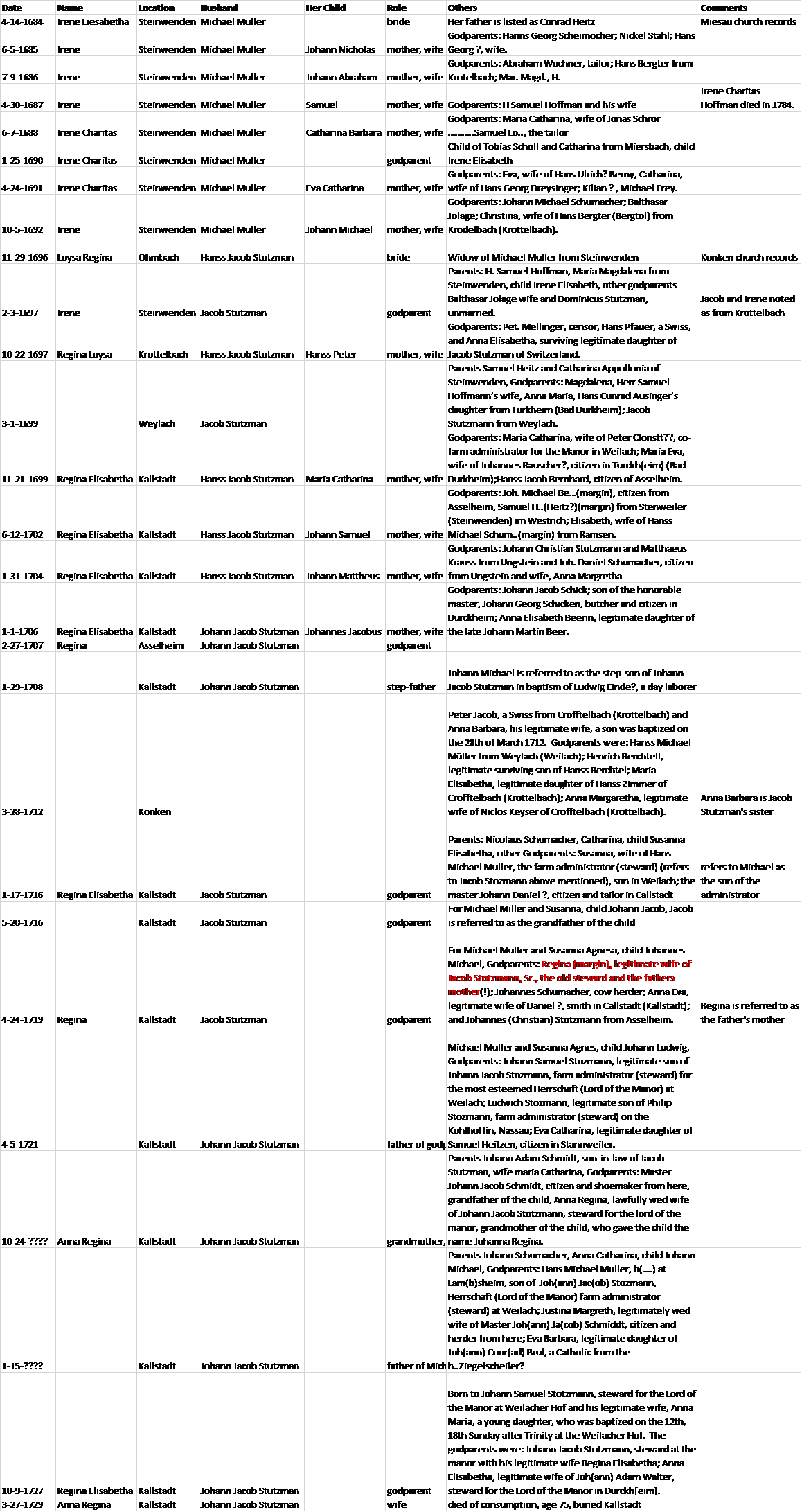
Turns out, I haven’t. The following records detail all of the occurrences of Irene in the Steinwenden area records beginning with Irene’s marriage and then the baptisms of Irene’s children. If Irene occurred in other records as a godmother, we’d have to translate all of the records for everyone to find those records. Turns out, Tom did just that. The following compilation is what was found:

Marriage record:

  • Michael MÜLLER, widower, son of Heinsmann MÜLLER, resident in “Schwartz Matt in the Bern area” (Switzerland), married 17 April 1684 in Steinwenden to Irene Liesabetha Heitz, daughter of Conrad Heitz.”

Followed by the baptisms of their children:

  • June 5, 1685 – Johann Nicholas, parents: “Michael Müller, Irene from Steinwenden”, Godparents: Hanns Georg Scheimocher; Nickel Stahl; Hans Georg ?, wife.
  • July 9, 1686 – Johann Abraham, parents: “Michael Müller, Irene from Steinwenden”, Godparents: Abraham Wochner, tailor; Hans Bergter from Krotelbach; Mar. Magd., H.
  • April 30, 1687 – Samuel Müller, parents: “Michael Müller, Irene from Steinwenden”, H Samuel Hoffman and his wife. (Irene Charitas Hoffman died in 1684.)
  • June 7, 1688 – Catharina Barbara, parents: “Michael Müller, Irene Charitas from Steinwenden”, Godparents: Maria Catharina, wife of Jonas Schror ………..Samuel Lo.., the tailor
  • April 24, 1691 – Eva Catharina, parents: “Michael Müller, Irene Charitas from Steinwenden”, Godparents: Eva, wife of Hans Ulrich? Berny, Catharina, wife of Hans Georg Dreysinger; Kilian ?, Michael Frey.
  • October 5, 1692 – Johann Michael, parents: “Michael Müller, Irene from Steinwenden”, Godparents: Johann Michael Schumacher; Balthasar Jolage; Christina, wife of Hans Bergter (Bergtol) from Krodelbach (Krottelbach).

The next record is not Irene’s child, but Irene was a godparent.

  • On January 25, 1690, the child Irene Elisabeth born to Tobias Scholl & Catharina from Miersbach was baptized in Steinwenden. Godparents: Irene Charitas, wife of Michael Muller; ? from Miersbach

At this point, the records become somewhat “odd” again, but extremely important.

There is no death record for Irene any time after the birth of Johann Michael in 1692.  There are also no missing sections or pages of death records from the church books. Tom checked specifically. We don’t need any more surprises.  One retraction is bad enough.

Johann Michael Muller died in January of 1695.

  • Evangelisch-Reformierte Kirche Steinwenden, Bavaria Church records: 31 January 1695: From Steinwenden buried Michael Muller, born in Switzerland, his age 40 years.

In November of 1696, a year and 10 months later, Hanss Jacob Stutzman married Johann Michael Muller’s widow.

  • In Konken, the couple being from Krotelbach, Hanss Jacob Stützman, surviving son of Jacob Stützman from Switzerland with Loysa Regina, surviving widow of Michael Müller from Stenweil (Steinwenden)…. Married on the 29th of November 1696 in Ohmbach.

Michael Muller’s widow of course would be Irene Charitas. Right?

You’d think so. So where did Loysa Regina come from?

Therefore, one must conclude that Irene had died and Michael had remarried sometime between October 1692 and January 1695 to Loysa Regina, at which point, Michael died.

Makes sense.

Except, where is Irene’s death and where is Michael’s second marriage to Regina?

Ok, somehow two pieces of vital information didn’t get recorded – and they both had to do with the same family.

Getting stranger and stranger.

The next records that involve Jacob Stutzman’s wife, the former widow of Michael Muller, are as follows:

  • February 3,1697, Irene Elisabeth baptized, Parents: H. Samuel Hoffmann, Maria Magdalena from Steinwenden, Godparents: Irene, Jacob Stutzman’s wife from Krodelbach (Krottelbach); Elisabetha, Balthasar Jolage wife and Dominicus Stutzman, unmarried.

Three months after they are married, Jacob Stutzman’s wife is called Irene, not Regina Loysa, AND she is for the third time paired with Samuel Hoffman in some way.

Note that this couple has moved by this time to Krottelbach, so a different minister is recording events. Is Regina Loysa Muller Stutzman really Irene Elizabetha Heitz?

Let’s look at the evidence.

  • October 22, 1697, Hanss Peter baptized, Parents Hanss Jacob Stutzman & Regina Loysa, his lawfully wed wife from Crottelbach. Godparents were: Pet. Mellinger, censor, Hans Pfauer, a Swiss, and Anna Elisabetha, surviving legitimate daughter of Jacob Stutzman of Switzerland.

Again, she is called Regina Loysa, the reverse of Loysa Regina earlier. The next records are found in 1699, in Kallstadt.

  • Page 136 Kallstadt Evangelische Kirche, Bavaria: Tuesday, the 21st of November, Hanss Jacob Sturtzmann, farm administrator (steward) for the most gracious Herrschaft (Lord of the Manor) in Weilach and his legitimately wed wife, Regina Elisabetha, a young daughter came into the world and on the following 25th Sunday after Trinity, the 26th of November (1699) received Holy Baptism. The Godparents were Maria Catharina, wife of Peter Clonstt??, co-farm administrator for the Manor in Weilach; Maria Eva, wife of Johannes Rauscher?, citizen in Turckh(eim) (Bad Dürkheim);Hanss Jacob Bernhard, citizen of Asselheim. The child received the name: Maria Catharina.
  • Baptism: page 146 Kallstadt Evangelische Kirche, Bavaria: Monday, the 12th of June (1702), Hanss Jacob Stotzmann, farm administrator (steward) at Weilach and Regina Elisabetha, his lawfully wed wife, was born to them a young son who was baptized on the 1st Sunday post Trinity, the 18th of June (1702). The godparents were: Joh. Michael Be…(margin), citizen from Asselheim, Samuel H..(Heitz?)(margin) from Stenweiler (Steinwenden) im Westrich; Elisabeth, wife of Hanss Michael Schum..(margin) from Ramsen. The Christian name of Johann Samuel was given.
  • Baptism: page 150 Kallstadt Evangelische Kirche, Bavaria: Thursday evening, the 31st of January 1704, Hanss Jacob Stotzmannen, farm administrator (steward) for the most gracious Herrschaft (Lord of the Manor) and his lawfully wed wife, Regina Elisabetha, a young son was born and was baptized on Sunday Estomihi (Quinquagesima Sunday), the 3rd of February 1704 at Weilach. Godparents were: Johann Christian Stotzmann and Matthaeus Krauss from Ungstein and Joh. Daniel Schumacher, citizen from Ungstein and wife, Anna Margretha. The Christian name given was Johann Matthaeus.
  • Baptism: page 156 of the Kallstadt Evangelische Kirche, Bavaria: Friday, the 1st of January in the year 1706 of the new year, Johann Jacob Stotzmannen, farm administrator (steward) of the most gracious Herrschaft (Lord of the Manor) at Weylach and his lawfully wed wife, Regina Elisabetha, a young son was born which on Tuesday, the 5th of January 1706 was baptized. The godparents were: Johann Jacob Schick; son of the honorable master, Johann Georg Schicken, butcher and citizen in Durckheim; Anna Elisabeth Beerin, legitimate daughter of the late Johann Martin Beer.  The Christian name given was Johannes Jacobus.
  • Anna Regina Stutzmann. Christened, 27 Feb 1706/7, in Asselheim, Grunstadt. Godparents of Anna: Anna Catharina, wife of Johann Nicolaus Trommer; Regina, wife of Johann Jacob Stutzmann, “Hofmann at Weylach”; Zacharias Stein, inhabitant in Albsheim, “married since 1702 to Margaretha Jacobea Bernhardt,”
  • Baptism: page 189; Kallstadt Evangelische Kirche, Bavaria: Friday morning the 17th of January 1716, Nicolaus Schumacher, cow herder at the Weilach Farm and from his lawfully wed wife, Catharina, a young daughter was born which on the 2nd Sunday after Epiphany, the 19th of January was baptized at Weilach. The godparents were: Regina Elisabetha, legitimate wife of the farm administrator (steward) of the most esteemed Herrschaft (Lord of the Manor), Jacob Stozmann; Susanna, wife of Hans Michael Muller, the farm administrator (steward) (refers to Jacob Stozmann above mentioned), son in Weilach; the master Johann Daniel ?, citizen and tailor in Callstadt (Kallstadt). The Christian name of Susanna Elisabetha was given.
  • Baptism: page 190; 26 May 1716; Kallstadt Evangelische Kirche, Bavaria: On Wednesday, the 20th of May 1716 was born a young son to Johann Michael M(uller), the co-steward at Weilach and his legitimate wife, Susanna. The son was baptized on Exaudi Sunday (24th May) at Weilach. Godparents: Johann Ja(cob) Stotzmann, steward for the gracious Lord of the Manor at Weilach, the child’s grandfather; Nicolaus Leist from Wachenheim an der Hardt; Catharina, legitimate wife of Andreas Neuer.burger? from Callstadt (Kallstadt). The child was named: Johann Jacob.

This may be important, because in this record, Jacob Stutzman is referred to as the grandfather of the child.  Clearly, that’s his social position, but technically, there is absolutely no question that he is not the biological grandfather, he is the step-grandfather.

  • Baptism: page 198 of the Kallstadt Evangelische Kirche, Bavaria: Monday, the 24th of April 1719, Michal Muller, farm administrator (steward) for the most gracious Herrschaft (Lord of the Manor) in Weilach and his lawfully wed wife, Susanna Agnesa, a son was born and baptized on the 27th of April. The Godparents were: Regina (margin), legitimate wife of Jacob Stotzmann, Sr., the old steward and the fathers mother(!); Johannes Schumacher, cow herder; Anna Eva, legitimate wife of Daniel ?, smith in Callstadt (Kallstadt); and Johannes (Christian) Stotzmann from Asselheim. The child was given the Christian name of Johannes Michael.

In this record, Regina is referred to as the father’s mother, meaning the father is Michael Muller (the second).  If Irene Charitas had actually died between 1692 and 1695 and for some reason, Jacob Stutzman and his wife took the child in 1696 to raise, this would make some level of sense. However, if Jacob married Michael’s mother, then this would maker perfect since.  Michael Muller’s mother is actually his biological mother and his step-father, Jacob Stutzman, who raised him from the age of about 4 is the only father he ever knew.

  • Baptism: page 204 of the Kallstadt Evangelische Kirche, Bavaria: Saturday, the 5th of April 1721, Johann Michal Muller, farm administrator (steward) for the most esteemed Herrschaft (Lord of the Manor) in Weilach and his lawfully wed wife, Susanna Agnesa, a young son was born and on the following Thursday, the 10th of April 1721 was baptized. Godparents: Johann Samuel Stozmann, legitimate son of Johann Jacob Stozmann, farm administrator (steward) for the most esteemed Herrschaft (Lord of the Manor) at Weilach; Ludwich Stozmann, legitimate son of Philip Stozmann, farm administrator (steward) on the Kohlhoffin, Nassau; Eva Catharina, legitimate daughter of Samuel Heitzen, citizen in Stannweiler.  The child was given the name: Johann Ludwig.

Heitzen is another form of Heitz. Chris mentions that the adding of en on the end of a name is very common, and this record connects the Heitz family with the Muller family once again.

  • Baptism: page 206; Kallstadt Evangelische Kirche, Bavaria:Thursday evening, the 15th of January 1722, J(ohann) Schumacher, cow herder for the Herrschaft (Lord of the Manor) estate in W(eilach) and from his legitimately married wife, Anna Catharina, a young son was born and which on the 20th of January at Weilach was baptized. The godparents were: Hans Michael Muller, b(….) at Lam(b)sheim, son of Joh(ann) Jac(ob) Stozmann, Herrschaft (Lord of the Manor) farm administrator (steward) at Weilach; Justina Margreth, legitimately wed wife of Master Joh(ann) Ja(cob) Schmiddt, citizen and shoemaker from here; Eva Barbara, legitimate daughter of Joh(ann) Conr(ad) Brül, laborer, and the local ziegelscheder? here, a Catholic. The child was given the name: Johann Mich(ael).

Again, Jacob Stutzman is referred to as the father of Johann Michael Muller who has now moved to Lambsheim.

Anna Regina’s Death

  • Laetare Sunday, the 27th of March 1729 died in Weilach as a result of consumption, Anna Regina, lawfully wed wife of Johann Jacob Stotzmann, farm administrator (steward) of the esteemed Herrschaft (Lord of the Manor). Aged 75 years and was buried at Callstadt (Kallstadt) with the ringing of (church bells); hymns and a funeral sermon.

I just love these details, “with the ringing of church bells.” I can almost hear them, chiming so that all in the village could hear their somber musical message. Of course, most of those people would have been in the church attending Irene/Regina’s funeral anyway, because everyone knew everyone and was probably related in one way or another, either by blood, marriage or by heart.

Those bells – filled with sadness for her passing, but also celebrating her life.  Her heart filled with sorrow as she buried her first 5 children, then with trepidation as she delivered Johann Michael Muller (the second.) Would he live, or would he lay as the sixth grave in that cemetery row? Baby Michael lived, but death would follow just a few months later, snatching not the baby, but Irene’s husband instead.

Her one surviving child, my ancestor, Johann Michael Muller (the second) must have been her only source of joy during that horrifically dark time.  After Irene, or Regina, or whatever her name really was, remarried to Jacob Stutzman, it would appear from what few hints we have that her life might have become somewhat easier as the wife of the farm administrator. And of course, her she bore children that lived long enough to hear those church bells themselves, adding grandchildren as sources of joy for the woman born as Irene and buried as Anna Regina.

This does cause me to wonder, though, how she felt when Johann Michael Muller (the second) and his wife left in 1727 for America.  Did she encourage him to go, knowing full well that would be the last time that she ever set eyes on him – her eldest’s and only surviving child of her first 6 pregnancies and her first marriage? Or was she devastated.  Torn perhaps, between the two?

In July 1730, Jacob remarried to a Louysa and lived for several more years.

What was Irene/Regina’s Name?

In these records, in order, we have Irene’s name or identification shown as:

The only time that Irene Liesabetha was used was in the Miesau church records.  In Steinwenden it was always Irene or Irene Charitas. However, I’m often inclined to give more weight to the earliest records, especially if the parents are present as well as others who knew the person. Due to illiteracy, however, it’s impossible to know if what the priest or minister heard was what was meant to be conveyed. If the person was married in the same church where they were baptized, the person recording the marriage could check with earlier records.  However, the Miesau records, today, don’t extend back that far, nor do we know where Irene Liesabetha was born or baptized.

We do know that there is a consistent link to Heitz and Hoffman family members through all records, across her life.

I notice that her name changed from Irene or Irene Charitas to Loysa Regina, Regina Elisabetha or simply Regina when the family moved to Krottelbach.  However, there was one Irene record after she married Stutzman, and it was in the Steinwenden church records, not the Krottelbach/Konken church records. So, it would certainly appear that Irene and Regina are the same person, given that they are married at the same time to Johann Jacob Stutzman.

This name change is what threw me, and every other researcher in this line before Chris and Tom.  It’s unlikely that a name would “change” entirely, but in this case, the evidence is very convincing when combined in total that indeed, Irene Liesabetha is Irene Charitas is Regina Loysa, Loysa Regina, Regina Elisabetha and finally, Anna Regina.

Was Charitas only a “pet name” used about the time that the Elder Irene Charitas Hofmann born Beuther passed away? Was Irene Charitas Schlosser named after Irene Charitas Hofmann born Beuther as well?

If you thought you were confused before, you’re probably even more so now. I was, until we looked at every single record and weighed evidence including when the names changes, with moves, when and where she stood up as a godmother – and the fact that she was still called Irene in her home church of Steinwende as Jacob Stutzman’s wife after “Regina,” identified as Michael Muller’s widow had married Jacob Stutzman.  And then, of course, she is identified in the margin, no less, as the mother of Johann Michael Muller the second, “the father’s mother” many years later when Michael’s child was baptized.

Of course, Jacob Stutzman is also referred to Johann Michael Muller’s father, and he wasn’t. Jacob was Michael’s step-father, but the only father he had ever known.

So many twists and turns in this labyrinth.

I’ve given up entirely identifying Michael’s mother’s “actual” name, but I’m satisfied that I’ve determined that this woman of many names is actually the same person.

Will the Real Irene Charitas or Regina Loysa or Whomever, Please Stand Up?

How can the same woman’s name vacillate back and forth so much?

And just when I had come to the conclusion (which I’ve changed my mind about umpteen times now) that Irene, the mother of Johann Michael Mueller (the second) had clearly died between 1692 and 1696 – Jacob Stutzman’s wife is referred to as the MOTHER of Johann Michael Muller in 1719.

His MOTHER.

The one thing we do know beyond any doubt is who Michael’s mother actually is – and she’s Irene as recorded his 1692 birth record.

So, if the woman in 1719 was Michael’s mother, then she had to have been Irene and none other.

So, why is Irene’s name changing, in some cases, entirely?

My only possible explanation for this might be that Irene’s name was actually heavily concatenated. Something like Irene Charitas Elisabetha Regina Loysa with Anna thrown in there someplace too. Yes, that’s bizarre, but no more bizarre than any other explanation.

Furthermore, if she had several sponsors at her baptism, including Samuel Hoffman’s wife, Irene Charitas, and other important patrons, the family may simply have included all names. In that case, the subsequent minister selected the name or names that he wanted to use.

One other possibility is that “Irena,” if said that way, and “Regina” sounded somewhat similar.

Chris suggests that there was some kind of mis-hearing involved here.

“Peasants were often illiterate at that time and more so, women. I would assume Irene Liesabetha was, too. So the minister at her new parish in Konken asked her for her name, which she could not write. Hence, the minister could only refer to what he heard from her. The sound of “Irene” and “Regina” is not too far from each other – especially if you have not ever heard the name “Irene” many times before. Along similar lines “Liesabetha” à “Loysa” could be explained. Yes, it is a vague hypothesis. But I think one that could be added here.”

Having looked at the order of these records, I think the most probable explanation for her name change is that it occurred when she changed churches. I now believe that Irene is really Regina and that she did live as first Michael Muller’s and then Jacob Stutzman’s wife until her death in 1729.

One last sanity check is related to her age in her death record – 75.  This would give us an approximate birth year of 1654 if she had already had her birthday in March when she died.  If not, then she would have been born in 1653.

That means she would have been age 52 when she gave birth to Johann Jacob Stutzman (the second) in 1706.  Not impossible, but also not terribly likely.  Ages were often fluid in death records, unless a very specific age is recorded, like 75 years, 11 months and 2 days. That tells us that the family actually knew a birth date.

Irene Lisabetha married in 1684 to Michael Muller. He was born about 1655, so it’s conceivable that she was about the same age, although 30 would have been older than normal for a female to marry at that time. If she were 20 instead of 30 when she married, that would put her last child born at age 42 instead of 52, and would fit much more reasonably.

Regardless of which year she was actually born, her birth was right after the end of the 30 years war when much of Europe, and in particular Germany, was ravaged and abandoned. Her parents would have lived through at last part of this horrible event. I have to wonder at the circumstances surrounding Irene/Regina’s early life. Was her family burned out of their home? Where did they live? Did they have to move multiple times? Were they essentially vagabonds, subsisting? And where?

Did she have siblings? The only hint we find to answer that question is her continued interaction with Samuel Heitz who was married to Catharina Appollonia and lived in Steinwenden. Records show at least one child, Eva Catharina born in 1721 to this couple.  If Irene had additional siblings, which she surely did, the records stand stubbornly mute.

Questions that we will never likely have answers to.

Mitochondrial DNA

Now that we know that Regina is Michael Muller’s mother, not his step-mother as originally thought, her mitochondrial DNA becomes important in Michael Muller’s genealogy.  She contributed her mitochondrial DNA to her son, but since mitochondrial DNA is only passed on by females, Michael would not have passed this to his children.  Therefore, to find Irene or Regina’s mitochondrial DNA, we have to find someone living today that descends through all females from one of her daughters.

We know that all of her children by Michael Muller (the first) died, but she did have one daughter by Jacob Stutzman; Anna Catharina born in 1699 and who married Johann Adam Schmidt in Konken in 1721.

We know that Maria Catharina Stutzman and Johann Adam Schmidt had a daughter, Johanna Regina, probably not long after their marriage, although the year is obscured in the Kallstadt church book. My “educated guess” would be in 1722 or so. Our Regina was her godmother.

I find no additional records for this family, but if Maria Catharina lived, it’s certainly likely that she had more children, and hopefully, more daughters.

If you descend from Maria Catharina Stutzman Schmidt through all females, I have a mitochondrial DNA testing scholarship for you. Just leave a comment on the blog or drop me an e-mail. Your mitochondrial DNA could provide us with even more insight into the ancestors of Regina that we can obtain in no other way!

Final Thoughts

We finally (I think) have proper parents for Irene Charitas, or at least her father – Conrad Heitz. Her mother is entirely unknown.

I’m so eternally grateful to Chris for finding that record and raising these difficult questions, even if they did cost me and Tom several nights sleep. Working with those two is literally a dream team!

And while this article has been anything BUT fun to write, keep in mind that it was the fact that the record for Bernhardt Schlosser was first found on the tax list, then in the church in Miesau. Had it not been for the combination of events, meaning the tax list with the Schlosser record, the Miller family site and that pointer to Miesau, Chris might never have hunted for, and found, the marriage records for Irene Heitz and Johann Michael Muller. Indeed, this has been a trail of very convoluted bread crumbs! And the birds ate a few along the way.

So, in essence, further digging in the incorrect records (in the same geography) for the wrong family led us to the right family. Genealogical synchronicity, a meaningful or meant to be coincidence? Sometimes, I think the ancestors “help us” as much as they can from the other side. Other times, I think they have a wicked sense of humor and torture us!

I don’t have any regrets about publishing either, even though I was wrong. (Small caveat – there had been A LOT of original work done AND the name had changed, so I didn’t publish rumors.) If I hadn’t published, Chris would never have asked those difficult questions and we would not have found the puzzle pieces we didn’t even know were missing.

Besides that, if you wait until absolutely every rock has been turned, you’ll suffer from analysis paralysis and do nothing. Of course, I’m not advocating the copy/paste type of genealogy – but I am advocating for reasonable research, documentation of the research path, sources and stating why you came to the conclusions you did. That way, there are breadcrumbs for someone in the future, or God forbid, if you have to backtrack on your own work.

Yes, I’m trying to make lemonade out of lemons – but sometimes, other than serving as a learning experience, that’s all there is left to do!

Enjoy some lemonade…on me😊

______________________________________________________________

Disclosure

I receive a small contribution when you click on some of the links to vendors in my articles. This does NOT increase the price you pay but helps me to keep the lights on and this informational blog free for everyone. Please click on the links in the articles or to the vendors below if you are purchasing products or DNA testing.

Thank you so much.

DNA Purchases and Free Transfers

Genealogy Services

Genealogy Research

National Siblings Day – Love Them While You Can

Wow – talk about mixed emotions today.

Did you know there was a National Siblings Day?  Well, neither did I.

I woke up this morning to make that discovery which left me with an entire range of emotions.

Fittingly, I received and a special “wave” from my brother Dave whose DNA results confirming his relationship to his biological family were posted at Family Tree DNA overnight.

Yea, he’s the brother that turned out not to be my biological brother – but I don’t know how I could have loved him more. “Blood” made and makes no difference at all. You can read about my journey with Dave and finding his family here, here and here.

Family of heart is every bit as important as family of biology. 

Yes, love them while you can.

Intensely.

Every. Single. Day.

Because we never know when it will be our last opportunity.

To hug them.

To tell them.

To look them in the eye.

To laugh, carefree.

They can be gone in an instant.

The blink of an eye.

I know very personally and I bet you do too. 

Tragic, shocking, numbing loss.

After they move to the other side of the veil, they would want you to remember them joyfully.

Lovingly.

That’s why it’s so very important to love them fully while you can.

Hug them.

At every opportunity.

Someday, it will be those memories that sustain you.

Or them.

In case you’re having a weepy moment, here’s an article to brighten your day and remind you of just what siblingship means! Enjoy the laugh!

PS – Test the autosomal DNA of all of your siblings, now:) DNA results are an everlasting legacy that continues to contribute long after you, or them, can no longer give in quite that same way.

______________________________________________________________

Disclosure

I receive a small contribution when you click on some of the links to vendors in my articles. This does NOT increase the price you pay but helps me to keep the lights on and this informational blog free for everyone. Please click on the links in the articles or to the vendors below if you are purchasing products or DNA testing.

Thank you so much.

DNA Purchases and Free Transfers

Genealogy Services

Genealogy Research

DNAPainter – Mining Vendor Matches to Paint Your Chromosomes

This isn’t quite the same as when my mother used to talk about painting the town, but in genetic genealogy terms, it’s better.

This is the second of 4 articles that will describe how to use DNA Painter.

Today, I’d like to talk about how I utilize the various vendor testing tools combined with DNAPainter to “mine my DNA,” or better put, to mine my ancestor’s DNA which is now mine, pun intended.

To review instructions for how to set up and use the DNA Painter tool, please read DNA Painter – Chromosome Sudoku for Genetic Genealogy Addicts and then come back here to proceed.

I’m going to discuss each vendor’s tools and how I’ve used them, sometimes in combination.

57% Painted

Please note that you can click on any image to enlarge

Is this not a beautiful thing to behold? That’s my ancestors, in loving color, looking back at me, on MY chromosomes.

I’m completely thrilled that I have managed to paint 57% of my chromosomes. I’m a visual person, and while I’ve worked with spreadsheets now for years, I’ve officially abandoned them. Ok, mostly.

Yes, you heard me right – I’ve abandoned the spreadsheets in favor of DNA Painter, at least for segments where I can positively identify an ancestral couple. In other words, those segments that can be reliably mapped.

That 57% is made up of 445 segments in total, split between my maternal and paternal sides. That’s without counting my mother’s DNA. While I do utilize matching to my mother in order to be sure that a match is really a valid match, I didn’t paint her DNA. Obviously, I’m going to match her 100%, and DNA painter already breaks chromosomes into my pink maternal and blue paternal sides.

Key Elements

  1. The single best thing you can do in order to paint your chromosomes is to have known family members and cousins test. You can then paint their DNA that matches yours, attributing it to their identified family line.
  2. The second best thing you can do is to work with your matches using their trees to identify your common ancestor.

Now, you’re ready to begin painting.

I’m going to step through the process I used at each vendor to identify paintable segments.

I did not paint segments that I could not identify to an ancestral line, except for my endogamous Acadian line which I labeled simply as Acadian to mark those segments that I can identify as Acadian, but I can’t identify a specific ancestor, or ancestors. When I can identify the Acadian ancestor, I paint that segment using the ancestors’ names.

Family Tree DNA

At Family Tree DNA, I begin with my closest matches that are not immediate family – meaning not my parents, children or grandchildren. I’m looking for aunts, uncles, cousins, etc. I don’t paint siblings, but often half siblings are extremely useful because they can help you identify which paternal side other matches are related to.

In the first DNA Painter article, I explained how to utilize the Family Tree DNA chromosome browser to select an individual whose matching DNA can be displayed so that you can copy and paste that segment into the painting feature of DNA Painter.

On your results page, your “bucketed individuals” who have been assigned as maternal (pink icon above) or paternal (blue icon not shown) can be a huge clue when used in conjunction with the in-common-with (ICW) tool and the matrix.

You can also search by ancestral surname and then evaluate each match through common surnames, trees and other resources. If you’re not familiar with how to use the tools at Family Tree DNA, here’s a quick run-through.

Select the individual whose DNA you wish to paint, view in the chromosome browser, then copy and paste from the grid below to the DNAPainter tool.

I painted the matching DNA of all the people whose common ancestor with me I could positively identify before moving on to the next vendor.

Who Have I Painted?

As you begin to paint segments from multiple vendors, you may wonder if you’re finding duplicates. It’s easy to tell. At DNA Painter, click on “All segment data,” below the legend in the bottom right corner.

This displays the entire list of matches whose DNA you have painted, in spreadsheet format. You can sort by match name or simply do a browser search. (CTRL+F)

You can also download this data into a cvs (Excel compatible) file at the top left of this page.

Avoiding Duplicates

As you view and paint your matches at the various vendors, you may discover that you have already found a match with that person at another vendor, either because they tested there or uploaded their autosomal file. When possible, avoid duplicate painting. It won’t help anything and will just clutter your chromosomes. You may not always be able to identify a match as a duplicate, especially if the tester utilizes a pseudonym at various locations. Don’t’ worry though, because you can always easily delete it later and a duplicate person/segment certainly won’t hurt anything.

Ok, now to our next vendor! Let’s find more segments to paint.

MyHeritage

At MyHeritage, click on DNA matches.

At the right of the search box, fly over the little pink key (or funnel) looking thing and you’ll see the option for “Has Smart Matches.” That’s what you’re looking for.

Click on the key icon.

Smart Matches mean that your DNA matches and you have a common ancestor in your trees. Click on the purple button to review this DNA match.

For each match, scroll all the way down to the bottom where your matching chromosome segments will be colored.

At the right, above the chromosome browser, click on “advanced options” which will allow you to select “download shared DNA info.” You need to download to your system so that you can copy and paste the matching segment information to DNA Painter.

MyHeritage has a few more columns than necessary, and DNA Painter can’t utilize them. Delete the columns for Name, Match Name, RSID beginning and end, and also eliminate SNPs due to an overestimation issue. In many cases, the SNPs at MyHeritage are twice or more than the number of SNPs when comparing the same segment at other vendors.

Now that your segment is cleaned up, copy the entire group shown above, minus the yellow columns which you’ve deleted, and paste into the DNA Painter spreadsheet.

MyHeritage has recently added a triangulation feature, shown at the far right, below, indicating that these two people individually triangulate with me and Alberta. The icon at far right of “5th cousin” indicates triangulation.

By clicking on the triangulation icon, you then see how that person triangulates with both your match and you – in this case, me, Alberta, and Chandler.

You may choose to paint triangulated segments, BUT, the size of the triangulated segment is often going to be smaller than the amount of DNA than you match individually to either one or both people.

In the example above, you can see that you match the pink person on a significantly longer segment than you match the tan person. The amount of DNA where you match both the pink and tan person is smaller yet, because the area where you match the tan person extends beyond where you match the pink person and vice versa. If you were going to paint ONLY the triangulated segments, you would paint only the portion that is both pink and tan, “boxed” above.

I don’t recommend painting ONLY triangulated segments, because you’ll be depriving yourself of the ability for each person to match others on the portions of the segments on which they match you, but not the other person in question.

In this example, utilizing DNA Painter, you’ll see that people in fact match you AND the pink person on several segments. The segment shown in pink, at MyHeritage, above, is shown on chromosome 5 in DNA Painter as the long mustard colored segment. Look at how many people match you on that segment. This is why we don’t paint only the triangulated portions of the chromosome. That long mustard segment match will triangulate with many people on smaller portions of that mustard segment, as evidenced by the yellow, grey, blue, cinnamon, purple and red segment matches..

DNA Painter helps you triangulate, so there is no reason to restrict your painting to triangulated segments.

Triangulation is a great tool, but don’t mix triangulated segments with matching segments in the same profile, at least not until you get the hang of the tool and using the multiple vendor’s results.

23andMe

Unfortunately, 23andMe doesn’t have tools like tree matching (MyHeritage) or maternal/paternal phasing (Family Tree DNA,) but they do allow testers to enter common surnames.

Looking at closer matches, meaning first, second or third cousins, if they list even a few surnames, you may well be able to identify the common genealogical line, especially in conjunction with ancestral locations and the other people you match in common.

Sometimes you can glean enough information to identify your common ancestor. In this case, even if I didn’t know Cheryl, the surname would have identified the ancestor. If that didn’t do it, the “in common” list below would!

Once you’ve identified the common ancestor and decide you’re ready to paint, click on the Tools tab at the top of your page and select DNA Relatives.

On the DNA Relatives tab, click on the relative whose DNA you wish to paint. I’m selecting my cousin, Cheryl.

Click on the blue DNA Comparison, in the upper right hand corner.

On the comparison screen, you will select yourself as one person and Cheryl as the other.

At the top you’ll see the two individuals and their overlapping segments painted onto chromosomes. Scroll down and you’ll see the segment detail, below.

Highlight the rows (they’ll turn blue, like above) and right click to copy the segment information.

The next step is to drop the results into a spreadsheet, just long enough to delete the first and last columns, shown in red below, then copy the remaining rows and paste into the DNA Painter tool.

Mining Ancestry Data at GedMatch

GedMatch is somewhat of a special case, because GedMatch doesn’t do DNA testing, but provides an open sharing platform by facilitating uploads of raw autosomal files from multiple other vendors. Therefore, anyone with results at GedMatch tested elsewhere. If you tested at all of the other vendors, it’s probable that you find people at GedMatch as a match that match you at other vendors too.

Because 23andMe does not support the uploading of Gedcom files, if your match has uploaded a Gedcom file to GedMatch, or connected to Geni or WikiTree, then you may be able to identify your common ancestor at GedMatch that you were not able to identify at 23andMe.

Conversely, if you match at Ancestry, you won’t be able to paint from Ancestry, because Ancestry does not provide segment information. We will talk about Ancestry as a special case next, but for now, let’s focus on how to utilize GedMatch.

At GedMatch, you’ll work in steps after setting your account up and uploading your raw data file from either:

If you tested elsewhere, or after August of 2017 at 23andMe, you will have to upload to a special section called GedMatch Genesis. GedMatch Genesis provides a sandbox area for files other than the ones listed above that are generally incompatible with those files and with each other. Genesis files often have few SNP locations in common and not enough to match reliably.

I do not recommend DNA painting utilizing segments from GedMatch Genesis.

GedMatch is currently merging their regular GedMatch service with the Genesis service, so I’m not entirely clear how you will tell the difference between the kits known to match reliably, mentioned above, and others after the merge.

Currently, kits with T prefix (Family Tree DNA), A (Ancestry) and M (23andMe) show version levels in the type field when you match in regular GedMatch. MyHeritage kits are processed by the Family Tree DNA lab. G kits used a generic upload, so you can’t tell where they originated.

Kits uploaded in the Genesis sandbox seem to be assigned double alpha letter kit prefixes at random. Genesis includes a “Testing Company” field which does not include a version number. Today, just stay with the regular GedMatch one-to many and one-to-one matching for DNA Painter.

First, you’ll want to perform a one-to-many match.

This page shows your closest 2000 results. In my case, truncating my matches at 12.7cM. This means if I want to see my results below 12.7 cM, I must subscribe to the Tier 1 Utilities in order to be able to display over 2000 matches.

We’ll discuss how to utilize Tier 1 matching in the Ancestry portion, next, but for now, we’ll just be working with the regular one-to-many matches report.

Of course, trusty cousin Cheryl has results here as well.

In order to compare Cheryl’s results to my own, I need to do two separate things:

  • Click on the A link under the Autosomal Details column (above) and/or
  • Click on the X link under the X DNA column

These two results, both of which are paintable, do not display together so must be selected separately.

By clicking on the A or X, GedMatch will display a one-to-one comparison. I leave this page (below) at the default values and simply click submit.

Your next screen will be a match grid.

Once again, select and copy the results, then paste into DNA Painter. If you also have an X match with this individual, return to the one-to-many match page and then click on the X link to repeat the same process for the X chromosome.

Ancestry Through GedMatch

As far as I’m concerned, the best thing about Ancestry matches is DNA shared ancestor hints (SAH) – meaning those green leaves visible near the green “view match” button which indicate that you share both DNA and a common ancestor(s) in your trees.

Followed immediately by the worst thing which is that Ancestry provides no segment data. However, pairing Ancestry with GedMatch can provide you with some segment information, although you do have to dig. That digging was certainly worthwhile for me, as I found several readily identifiable matches.

When I find a green leaf shared ancestor hint at Ancestry, I record as much information about that match as I can in a spreadsheet. The reason is twofold.

  • Ancestry hints tend to come and go, rather inexplicable, and I want to have that information someplace besides at Ancestry
  • I want to be able to view how many matches I have through specific ancestors which I can do in a spreadsheet by sorting.
  • I want to be able to mine GedMatch for segment information for people at Ancestry who have uploaded to GedMatch.

Note the RJE V2 results, a 6th cousin who I match at 6.6 cM, as we’ll be using that at GedMatch.

I maintain several columns in my Ancestry Match spreadsheet, as shown above. I track people who might be good Y or mitochondrial DNA candidates, as well as GedMatch numbers or other useful information.

I don’t utilize segments smaller than 7 cM for DNA Painter, BUT, Ancestry almost always under-reports the matching segment size due to their internal process which removes some segments that do match. Therefore, I search for all Ancestry matches in GedMatch and paint them if they are 7cM or over at GedMatch. You will match at Ancestry down to 6 cM. Since 7cM is the default GedMatch threshold, that works out well. I don’t find them if they are under 7cM at GedMatch, and I don’t care.

In my case to obtain segments smaller than 12.7 cM, because that is the cutoff where the free one-to-many GedMatch tool reaches the 2000 match threshold (for me,) I need to utilize the Tier 1 subscription utilities which are well worth every dollar.

The one-to-many match looks quite different for the Tier 1 tool.

You’ll need to play with this a bit to determine how high you need to set the limit to see all of your 7cM matches. In my case, I had to set it to 20,000.

I utilize two monitors, so I display my Ancestry spreadsheet on the first monitor and the GedMatch one-to-many match table on the second monitor.

Then, utilizing the browser’s search function, I search for any identifiable portion of the information for the Ancestry match at GedMatch.

In the first example, the user’s name is RJE V2. I search at GedMatch for “RJE” using “ctrl+F” which is the browser’s find function.

You can see that the search found a total of 3 different “RJE” entries. Looking at the first 2, you can see that one is labeled V4 and one is labeled V2. Typically, I would look at this and decide that the RJE V2 is the right match based on the user name at Ancestry.

However, look closer.

The RJE V2 at GedMatch has a much higher amount of shared DNA at 3587.1 cM total than the RJE V2 at Ancestry with a total of 6.6 cM. Clearly, this is not the same person, even though the user name is the same.

For all we know, a different person may have used the same user name, which is clearly an alias, noted by the “*”. Or the same person may have multiple kits at GedMatch.

However, in this case, the RJE V2 is not the same match.

However, let’s say that it is the same person and we’ve been able to reasonably identify the match. In order to compare one-to-one, click on the highlighted blue “largest segment” in the autosomal category, shown below.

If you want to compare the X one-to-one, click on the blue largest segment in that column.

From this point, the matching will look the same as the one-to-one GedMatch matching shown in the previous section – so copy and paste as normal.

While this certainly isn’t the most effective way of working with Ancestry matches, it’s really the only hope we have, unless your match has also uploaded to either Family Tree DNA or MyHeritage.

However, in my experience, I generally stand a better chance of identifying Ancestry matches at GedMatch because their user name or the user name of the person managing their account can be found much more readily. People sometimes tend to utilize the same abbreviations, names or nicknames in multiple locations.

Summary

While each vendor has unique strengths and weaknesses today, and GedMatch provides a platform used by some but not all, the best way to effectively paint your chromosomes is to utilize all of the tools available, and sometimes together. I strongly suggest that you test at or upload to each vendor, because you will find matches at each vendor that aren’t elsewhere.

How many segments can you paint on your chromosomes, and what will those segments tell you?

In the next article, I’ll be walking through my chromosome painting gallery to take a look at the hidden messages there! I hope you’ll come along so you can find some hidden messages of your own.

Enjoy!

______________________________________________________________

Disclosure

I receive a small contribution when you click on some of the links to vendors in my articles. This does NOT increase the price you pay but helps me to keep the lights on and this informational blog free for everyone. Please click on the links in the articles or to the vendors below if you are purchasing products or DNA testing.

Thank you so much.

DNA Purchases and Free Transfers

Genealogy Services

Genealogy Research

Baptized in Nicholas Speak’s Church – 52 Ancestors #190

It was a beautiful fall day in the mountains of Lee County, Virginia that October 10th in 2009. Basket sized fall Mums were in bloom, it was still warm and the leaves hadn’t yet begun to turn paintbrush hues that would soon cover the mountainsides.

Descendants of Nicholas Speak, founding minister of the Speak Methodist Church almost 190 years earlier gathered in Middlesboro, Kentucky, a few miles away, for a family reunion.

The highlight would be returning to worship together in the small nearly-abandoned country church NIcholas founded about 1822, as it always was when the reunion was held near the the home of our family. The humble white church sits nestled in the hollow across Speaks Branch Road from the cemetery where our Nicholas is buried with his wife, Sarah Faires, along with many of their children and grandchildren.

The Speak Cemetery isn’t much to speak of, graves marked mostly with field stones of humble settlers who probably had all they could do to clear enough land for a “burying ground.” Tombstones weren’t for poor frontier folk in the wilderness.

Field stones stand eternal sentry over beloved family members; parents, husbands, wives, children, babies – all departed too soon. They would be sorely grieved – for the rest of the lives of the people who now lay in adjacent graves. Joined together forever in the now-anonymous field of stones.

Back then, everyone knew where each person was buried. They had all dug the graves, gathered round as the final sermon was preached, first by Nicholas, and then one day – for Nicholas. Tears streaming down their faces as they sang the song that was sung for every occasion – Amazing Grace – then lowering the casket into the ground and closing the grave. Each person symbolically dropping one handful of dirt onto the coffin, full well knowing that hollow thud meant forever gone.

No one would ever forget that day. No marker with a name was needed.

Want to visit with Nicholas? Just walk across the road after church and sit a spell.

The Speak cousins, more than 100 years after Nicholas’s death in 1852 and Sarah’s in 1865, bought a memorial stone for Nicholas and Sarah, although by this time no one knew where in the cemetery they were actually buried. Their blood and that of generations of family members was scattered everyplace here.

Nicholas and Sarah’s cabin remained across the road until in the 1970s, when it was disassembled, before it fell completely down, and combined with another log cabin into a lovely log home near Middlesboro.

Nicholas and family would have walked a short distance to the church every Sunday morning for Nicholas to preach to his ever-expanding congregation of family, friends and neighbors, some of whom came quite some distance from the northern part of then-Claiborne, now-Hancock County, Tennessee.

How do we know this? Nicholas deeded the land where the church was built to church trustees, some of whom were neighbors in Claiborne County to the family of the young man, Samuel Claxton, who would marry Nicholas’s granddaughter in 1832. You can’t marry who you don’t see. In fact, Nicholas probably married the couple right in this very church, about 78 years before the picture below was taken around 1910. This building is believed to be the third church building which doubled as a school, but the first two were in the same location.

Our church service was held on Saturday during the reunion, because the volunteer minister, Tracy McPherson, worked full-time in the coal mines during the week as well as volunteered to preach in two other small churches. Speaks Chapel only had a preacher every third Sunday. With a whopping attendance of 6 people, the pews in this quaint country church were mostly empty.

They wouldn’t be today!

We filled the pews and breathed joy-filled life back into that church so cherished by our family!

The cousins who so graciously organized the reunion assembled a keepsake program.

How many remember the fans from before churches had air conditioning?  When I was a kid, they were wedged in the back of every pew, along with the hymnals. Most of us didn’t need the hymnals, but everyone needed fans!

All southern church services MUST have a program, so ours did too. Not only that, our lovely cousin, Dolores, prepared a history. Others assembled a worship service song book too. Most of us knew the words by heart anyway.

Led by Bill Hall, we began with Church in the Wildwood and ended with Amazing Grace, all sung without musical accompaniment. Our melded voices, echoing off the mountains in the distance, drifting up the hollers, were music enough. I hope Nicholas could hear the choir of his descendants, come home one last time.

Indeed, we raised our voices and made a joyful noise, well…at least noise.

How fitting this hymn, given where Nicholas decided to settle.

My wonderful cousin, Lola-Margaret Hall, twice descended from Nicholas and his wife, Sarah Faires Speaks paid us a visit in the persona of Sarah. “Sarah” mesmerized us that day with the story of her life; married to Nicholas, settling in the wilderness, carving out a home and founding the church. Her voice, transporting us all back to the early 1800s as she rocked, reminisced and read from the Bible, sitting near the pulpit where Nicholas would have preached his version of Salvation. We rode along in the wagon with “Sarah” as she and Nicholas left Washington County, crossing mountains, headed into an uncertain future and untamed frontier in Lee County, transcending time into the misty past, sharing experiences.

Although most of us were “returning home,” not all of Nicholas’s descendants left for greener pastures. Jewell Davis, now deceased, and her family lived next door and cared for the church and cemetery for many decades – including preparing a lunch for the reunion that day.

Dolores Hamm, on behalf of the family presented Jewel with a plaque and a Bible of course, what else? Jewel now rests with Nicholas.

Preacher Tracy, Bible in hand, delivered a special message.

Then, it seems that Preacher Tracy had a few questions for me.

Anyone know what the pitcher and bowl are for?

For those who aren’t aware, Methodists don’t practice full immersion baptisms. We fondly call them “sprinklings.” Or maybe that’s the Baptists that call Methodist baptisms sprinklings.

Regardless, somehow as a child I think I managed to escape being baptized, but I’m not entirely sure. For some reason, I always thought I was baptized as a child in the Methodist church my mother and grandmother attended. If so, I have no memory of the baptism, just fond memories of belting out “Jesus Loves Me” at the top of my pre-school lungs.

I always presumed that I had been baptized as an infant or young child, because I wasn’t baptized when I was older in a subsequent Methodist church we attended, and by the time we moved again and I attended a Baptist church, I think there was an assumption that I had previously been baptized because I was allowed to take communion.

Then, one day, many years later, someone asked me when I had been baptized? It occurred to me that I really didn’t know. It wasn’t written in mother’s Bible, or in either of the Bibles that I had received from the church, and by that time, there was no one left to ask.

Regardless of the circumstances, I felt that there was no better time or place on this earth, literally, than in the very church where Nicholas would have baptized so many, and in the embrace of my loving family. I had more relatives gathered that day with me in this small country church that I’ve had any time or place since.

Thank you to one of my wonderful cousins for this photo collage of an incredibly emotional event, for all kinds of reasons, to Preacher McPherson, and to Nicholas. Little did Nicholas know his legacy would reach 6 generations and almost 200 years into the future, and still counting.

What better way to honor Nicholas than to be baptized in his church and to share the story with you this Easter Sunday.

I have yet in my lifetime to get through Amazing Grace dry-eyed. Literally, it is the universal hymn played for every emotional event of my lifetime, including the funerals of my mother, step-father and siblings.

______________________________________________________________

Disclosure

I receive a small contribution when you click on some of the links to vendors in my articles. This does NOT increase the price you pay but helps me to keep the lights on and this informational blog free for everyone. Please click on the links in the articles or to the vendors below if you are purchasing products or DNA testing.

Thank you so much.

DNA Purchases and Free Transfers

Genealogy Services

Genealogy Research

DNA Painter – Chromosome Sudoku for Genetic Genealogy Addicts

Not long ago, Jonny Perl introduced the free online tool, DNA Painter, designed to paint your chromosomes. I didn’t get around to trying this right away, but had I realized just how much fun I would have, I would have started sooner.

Fittingly, Jonny, pictured above, won the RootsTech Innovation award this year for DNA Painter – and I must say, it’s quite well-deserved.

Congratulations Jonny!

  • This is the first of four articles about DNA Painter. In this article, we’ll talk about how to use the tool, and how to get started.
  • The second article talks about mining your matches at the various vendors for paintable segments with instructions for how to do that accurately with each vendor.
  • In the third article, we’ll walk through an analysis of my painted segments, so you can too – and know how to spot revelations.
  • The fourth article explains how I solved a long-standing mystery that was driving me crazy. If you have a relatively close mystery person in your DNA match list that you can’t figure out quite where they fit, this article is written just for you!

I’ll tell you right now, I haven’t had this much fun in a long time!

Want to hear the best part? You don’t have to triangulate. DNA painting is “self-triangulating.” Yes, really!

Let’s get started!

Introducing DNA Painter

To begin to use DNA Painter, you’ll need to set up a free account at www.dnapainter.com.

Read the instructions and create your profile.

Jonny provides an overview.  Don’t get so excited that you skip this, or you won’t know how to paint correctly. You don’t need to be Picasso, but taking a few minutes up front will save you mistakes and frustration later.

Blaine Bettinger recorded a YouTube video discussing how to use DNA Painter to paint your chromosomes to identify and attribute particular segments to specific ancestors. It includes a mini-lesson on chromosome matching.

I strongly suggest you take time to watch Blaine’s video from the beginning. For some reason, this link drops into the video near the end, but just slide the red bar back to the beginning.

Get Started

Here’s my blank, naked chromosomes. Notice for every chromosome, you see a blue paternal “half” and a pink maternal “half.” That’s because everyone gets half of their autosomal DNA from their father, and the other half from their mother.

Looking at my own chromosome painting today, below, it’s incredibly exciting for me to see 57% of my DNA painted, attributed to 77 couples and one endogamous group, Acadians. This took me a month or so working off and on.

At the end of the day, this is often how I rewarded myself! The only problem it that it has been difficult to go to bed.

Comparatively, I’ve been working on my DNA match spreadsheet, attributing segments to ancestors now for 5 or 6 years, and I’ve never been able to see this information visually like this before. This view of my ancestrally painted chromosomes is so rewarding!

Who To Map

DNA Painter is not the kind of tool where you upload your results, it’s a tool where you selectively paint specific segments of matches – meaning segments on which you match particular people with known common ancestors.

How do you know who is a good candidate to map?

I began with painting my closest matches with whom I could identify the common ancestor.

Not only will painting your largest matches be rewarding as you harvest low-hanging-fruit, it will help you determine if you actually have identified the correct DNA for later matches being attributed to a specific genealogical line. In other words, mapping these larger known segments will help you identify false positives when you have no other yardstick.

Your First Painting

I’m opening a new profile in DNA Painter to demonstrate the steps in painting along with hints that I’ve learned along the way.

I’m going to utilize my cousin, Cheryl, whom I match closely at Family Tree DNA. If you don’t know how to use the Family Tree DNA autosomal tools, click here.

Cheryl is my first cousin once removed, so we share a significant amount of DNA.

I’ve selected Cheryl on my match list, checked her match box, and then clicked on the Chromosome Browser in order to view our segment matching information.

You can see on the chromosome browser that I share quite a bit of DNA with Cheryl.

At the top of the chromosome browser, click on “View this data in a table.”

Highlight and copy all of the segments for Cheryl. I only use 7cM segments or higher at DNA Painter, so you don’t have to copy the data in the rows below your last match at that level. DNA Painter takes care of stripping out all the extraneous stuff.

Paint a New Match

At DNA Painter, after you have your profile set up, click on “Paint a New Match.”

Simply paste the segment data into the box in the window that pops up. DNA Painter takes care of removing the header information as well as segments that are too small.

You can click on “overlay these segments” to “test” a fit, but I haven’t really found a good use for that, because I’m only painting segments I’m confident about and I know which side, maternal or paternal, the match is on based on the known relative.

Click on “save match now” in the bottom right corner.

In the Save Match popup, shown above, I utilize the fields as follows.

I enter the name of my DNA match, followed by their relationship to me, followed by the source of the match. In this case, “Cheryl <lastname>, 1C1R, FTDNA”

In the “Segment/Match Notes” I list how the match descends from the common ancestral couple, a GedMatch ID if known, and anything else pertinent including other potential ancestral lines in common. This means that I list every generation beginning with the common ancestral couple and ending with the tester.

Hiram Ferverda and Eva Miller, Roscoe, Cheryl, GedMatch Txxxxxx

You’ll wind up eventually rethinking some of your segment assignments to particular ancestors and you’ll want as much information here about this match as possible.

Moving to the next field, in the “Ancestors Name,” I utilize the couples name, because at this point, you can’t tell which of the two people actually contributed the DNA segment, or if part is from one ancestor of the couple and part is from the other. If the male ancestor is a Sr. or Jr., or is otherwise difficult to tell apart from your other ancestors, I suggest entering a birth year by his name. This is your selection list for later painting segments from the same ancestor, so you want to be sure you can tell the generations apart.

Next, you’ll select the maternal or paternal side of your family. Change the color if you don’t like the one pre-selected to assign to segments descending from that couple. Originally, I was going to have pinks or light colors for maternal, and blues or darker for paternal, but I quickly discovered that scheme didn’t work well, and I had more ancestors than I could ever have imagined whose DNA I am be able to map and paint.

Therefore, pick contrasting colors. You can use each color on each half, meaning maternal and paternal, since the segments will be painted on different halves of the chromosome.

In the “Notes for This Group,” I add more information for the couple such as birth and death dates and location if I know or am likely to forget.

Click “save.”

Here you go!  Isn’t this fun!!!! Cheryl’s segments that match mine are painted onto my chromosomes!

At the right, your ancestor key appears with each ancestor to whom you’ve assigned a color key.

So far, I only have one!

Want to paint another group of segments?

Let’s paint Cheryl’s brother.

Following the same sequence, I paint Donald’s DNA, but this time, I select “Or link these segments to an ancestor I’ve added before.”

I select Hiram Ferverda, Eva Miller and save. The segments that I have in common with Cheryl and/or Don will now be displayed on each chromosome.

Looking at chromosome 1, you can see that I match Cheryl and Don on the same segment at the beginning of the chromosome, but received two different segments of DNA on a different portion of chromosome 1, further to the right.

As one last example, I added the DNA from two known cousins, Rex and Maxine, who descend a couple generations further back in time through more distant ancestors in the same line – one maternal and one paternal.

Click on the chromosome number to expand to see all of the painted segments

You can see, looking at chromosome 3 that Cheryl and Don match me on a significant amount of the same large pink segment plus a smaller pink segment at the end

Rex (yellow) and Maxine (blue) both match me on different parts of the chromosome. It looks like there is a small amount of overlap between Rex and Maxine which is certainly feasible, because Jacob Lentz, the ancestor that Maxine descends from is ancestral to the couple that Rex descends from.

By utilizing known matches, and mapping, we can see segments that move us back in time, telling us from which ancestor that portion of the segment descends.

For example, if the blue segment was directly aligned with one of the pink segments, then we would know that the blue portion of the pink segment descended from Jacob Lentz and Fredericka Reuhl.

This is the most awesome, extremely addictive game of ancestor Sukoku ever.

Wanna play???

Here’s how to prepare for my next article where we’ll utilize the various vendor matches to begin painting.

Download and Upload Your Autosomal Files

You’ll want to have your DNA at the most vendor locations possible so you can find all your matches that can be attributed to known relatives and ancestors. You never know who is going to test at which vendor, and the only way to find out is to have your DNA there too.

For each vendor, I’ve provided a mini-tutorial on how to maximize your testing and transfers both monetarily and for maximum matching effect, or you can read an article here that explains more.

There’s also a cheat sheet for transfer strategies at the end of this article.

A technique called imputation is mentioned below, so you may want to read about imputation here. MyHeritage’s initial offering utilizing imputation was problem plagued but has since improved significantly.

Ancestry

To Ancestry – There’s no way to transfer files TO Ancestry, so you’ll need to test there to be in their database. You will also need at least a minimum subscription ($49) to utilize all of the Ancestry DNA features. You can see a with and without subscription feature comparison chart here.

From Ancestry – There is also no chromosome browser at Ancestry. In order to use DNA Painter, chromosome segment information is required, so if you test at Ancestry and want to paint your segments, you’ll need to download your DNA file to either or all of:

  • Family Tree DNA – partially compatible with the current Ancestry test chip format – uses imputation to infer additional genetic regions
  • MyHeritage – partially compatible, but uses imputation to infer additional genetic regions
  • GedMatch

Family Tree DNA

To Family Tree DNA – You can upload the following vendor files TO Family Tree DNA.  Matching is free, but to use the advanced tools, including ethnicity and the chromosome browser, you’ll need to pay the $19 unlock fee. That’s still significantly less than retesting, especially for files that are 100% compatible.

  • Ancestry – V1 files generated from before May 2016 are entirely compatible, V2 files from after May 2016 are partially compatible, providing between 20-25% of your matches, meaning your closest matches
  • 23andMe – V3 file from Dec 2010-Nov 2013 and V4 file from November 2013-August 2017 are compatible, the V5 platform file beginning in August 2017 is not compatible
  • MyHeritage – fully compatible

From Family Tree DNA – You can upload your Family Finder results to:

MyHeritage

To MyHeritage – You can upload the following files to MyHeritage:

  • Family Tree DNA – fully compatible
  • Ancestry – partially compatible but uses imputation to infer additional genetic regions
  • 23andMe – partially compatible but uses imputation to infer additional genetic regions

From MyHeritage – If you test at MyHeritage, you can upload your files to:

23andMe

To 23andMe – You cannot transfer TO 23andMe, so you’ll need to test there if you want to be in their database.

From 23andMe – If you tested at 23andMe, you can upload your files to the following vendors:

  • Family Tree DNA – V3 file from Dec 2010-Nov 2013 and V4 file from November 2013-August 2017 are compatible, the V5 chip beginning in August 2017 is not compatible
  • MyHeritage – 23andMe – partially compatible but uses imputation to infer additional genetic regions
  • GedMatch – V3 file from Dec 2010-Nov 2013 and V4 file from November 2013-August 2017 are compatible, the V5 chip beginning in August 2017 is only compatible in the Genesis sandbox area. V5 matching is not reliable. Files from other vendors are recommended for GedMatch unless you are matching against another V5 result.

GedMatch

GedMatch is a third-party site that accepts all of these vendors’ autosomal files, with a caveat that the 23andMe V5 kit matches very poorly and requires special handling. I don’t recommend using that kit at GedMatch unless you are matching against other 23andMe V5 kits.

I upload multiple kits to GedMatch and mark all but one for research only. This allows me to use my Ancestry kit to match with other Ancestry users for more accurate matches, my Family Tree DNA kit to other Family Tree DNA kits, and so forth. Not marking multiple kits for research means that you’ll appear more than once on other people’s match lists, and only your first 2000 matches are free. Marking all kits except one as research is a courtesy to others.

Recommended Testing Strategy for New Testers

  1. Test at Ancestry and download to GedMatch.
  2. Test at Family Tree DNA and upload to MyHeritage and GedMatch.
  3. Test at 23andMe and upload to GedMatch Genesis.
  4. At GedMatch, mark all except one kit as “research,” then utilize your kits from the same vendor for one-to-one comparisons.

Recommended Transfer Strategy

Of course, where you have, and haven’t already tested will impact your transfer strategy decision. I’ve prepared the following cheat sheet to be used in combination with the information discussed above.

*Unless you can transfer a 23andMe V3/V4 or an Ancestry V1 kit to Family Tree DNA, it’s better to test at Family Tree DNA. Ancestry V2 tests are only 20-25% compatible.

A transfer from Family Tree DNA to MyHeritage is best because those vendors are on the same platform and the tools at MyHeritage are free.

In my next article, we’ll discuss how to mine your matches at the various vendors to obtain accurate segments for chromosome painting – including a strategy for how to utilize Ancestry and Gedmatch together to identify at least some Ancestry segment matches.

So, for now, get ready by transferring your matches into whichever data bases they aren’t already in. The only data base where I couldn’t identify matches that I didn’t have elsewhere was at 23andMe. The rest were all there just waiting to be harvested!

_____________________________________________________________________

Disclosure

I receive a small contribution when you click on some of the links to vendors in my articles. This does NOT increase the price you pay but helps me to keep the lights on and this informational blog free for everyone. Please click on the links in the articles or to the vendors below if you are purchasing products or DNA testing.

Thank you so much.

DNA Purchases and Free Transfers

Genealogy Services

Genealogy Research

Mom’s Joyous Springtime “Mistake” – 52 Ancestors #189

This is that week.

There’s one day every fall where I feel like I’ll never be warm again. I know that the earth is becoming dormant, gradually descending into what feels like eternal darkness, and I hate it. For months, when there is some semblance of light, it’s either snow or grey. Because I can’t hibernate, I just have to suck it up and dress like the Michelin man until the equivalent day arrives in the spring.

The spring equivalent day generally arrives sometime around the vernal equinox, generally around March 20th, when I actually FEEL hope in my soul. The days are getting longer, there’s light and blue replaces grey in the sky. The sun feels warm again instead of mocking me by peeking out for about 30 seconds per day, and part of the snow has melted. My cousins down south are already posting pictures of tulips on Facebook.

If I look hard in the garden, in polka dot areas where the snow had already melted, I can find something resembling spouts from a plant peeking up.

A robin is staring down at me from a tree branch, and the Sandhill Cranes with their squeaky-gate-hinge cries are complaining loudly because they can’t get to the grasses through the snow in the field behind the house.

Groggy raccoons, skunks and possums are waking up, VERY HUNGRY and staggering around like drunken sailors on their first shore leave. Squirrels are excitedly scampering across the porch, tails held high, retrieving last fall’s nuts.

Hope is in the air.

My body aches less and I cherish any tiny spot of color.

Yesterday, tiny red succulents, above, just an eighth of an inch across poked their heads out, and today, my daughter messaged me early crocus photos from bulbs newly planted last fall. At least there are a few that didn’t serve as chipmunk food. I’m hopeful that my bulbs will emerge shortly.

I am desperate for color and flowers like the most addicted junkie.

Yesterday’s Springs

It’s also this time of year that I harken back to my childhood and recall those long-ago springs of yesteryear. Life just seemed so much simpler and happier then.

Some of my fondest memories are of pink Easter dresses and white patent leather shoes with lacy anklets. I had to wear white gloves to church, but I didn’t care because Easter Sunday, new dresses and wearing gloves made me feel special. Sometimes, I had an Easter hat too, and a new spring coat, if it was a good year. Springtime rituals connected to the re-emergence of Mother Earth.

It was so liberating to shed those old depressing winter clothes and skip along the sidewalk once again, relishing spring green, cherry blossoms and warm breezes.

To me, spring is the most joyful time of year – when my soul sings out loud because nature is exhilaratingly beautiful and fresh. Everything comes alive in a chaotic rush of optimism. Even dandelions are welcome, because they are alive, bright and yellow. Yes, I’m just that desperate, waiting like a kid at Christmas for the first dandelion of the season.

For some reason, this time of year, I always think about spring traditions when I was a child. Perhaps spring elicits these feelings because we didn’t visit much in the winter. Roads were slick and treacherous, and the time between Christmas and warm seemed interminable and difficult.

As winter began to yield its icy grasp, I vividly remember Sunday rides to purchase maple syrup and visit my grandparents. At grandmother’s house, birds began chirping as I listened through freshly opened windows at the drip drip of melting snow splashing around the house, before houses had eavestroughs and downspouts. 

My grandparents’ house had a magical quality, and I always looked forward to some special activity with my grandmother.

Sometimes we baked cinnamon sugar pie dough in the bottom of a pie pan.

Sometimes she “let” me dust her dining room shelves. It’s amazing what you can convince a child to do if you tell them it’s a special honor. I’ve tried that tactic with my husband and kids, and it never worked!

Today, the salt shakers that I used to dust on her shelf are in my display case, chosen by my grief-stricken 4-year-old self as a memento when she suddenly died in the depths of winter-hell.

Sometimes we walked around the yard and looked for the first daffodil and the Easter Bunny. I always knew right where to look for the daffodils, but that Easter Bunny always managed to elude me! However, I did often find a basket he somehow left behind, hidden beneath the Spirea bush, along with some telltale colored eggs! I never did understand how a male rabbit could lay colored eggs, but I digress…

The best times were when my grandmother and Mom and I retrieved the old box of pictures from the attic. Sure, we had sorted through them many times before, but it was always just so much fun.

I asked questions, often the same questions I had asked before. I loved hearing the tales that made the pictures come alive. Mom or my grandmother would tell me the same story over again, sometimes each interleaving sentences with the other – often injecting some new twist or wrinkle. Of course, it was up to me to catch the change and ask a million or so questions.

One particular picture was always sure to cause peals of laughter. We all anticipated it and looked forward to it peeking out from under the pile.

Mom, with a wink, always made up a new story to go with the picture.

I couldn’t wait to find that photo under the others, but it would have been cheating to rifle through, so I tried to wait patiently until it appeared.

Early Photography

When my Mom was young, cameras had film rolls that you loaded onto a spindle. After you took a picture, you had to advance the film using a lever or knob, or you would take a second picture right over the first one. That’s called a double exposure, and it wasn’t a good thing. First, you’d ruin both photos, and you wouldn’t know until you paid to have them processed and printed, often weeks or months later.

By comparison, digital photos today are wonderful.

Mother danced – tap and ballet with some gymnastics thrown in. I think today that’s called expressive dance, and she was always practicing. Everyplace, all the time.

Even in the yard. She and a friend named Mary Lu lived in the same small town and danced together. Both eventually turned professional, as in the American Ballet Company, not exotic, in case you were wondering.

In the spring, they too felt released because they could free themselves by practicing outside.

My grandmother alleged as how spring freed her too. Incessant dance practice wasn’t exactly quiet. My grandfather spent a lot of time in the barn with the chickens.

In 1933, the family acquired their first (used) camera, in trade for chickens from someone who had nothing else to pay with. My grandfather took almost anything in trade during the Depression. In fact, if you couldn’t pay, he would give you what you needed anyway, which is why his hardware store went bankrupt.

A few years later, my mother was allowed to very occasionally use the camera. After all, film and processing was an expensive luxury, and the Great Depression was still in full swing. In fact, it never ended in their minds. Everything was always an unnecessary expense. That terrible dozen years of hardship and fear left an indelible mark on both generations.

Just the same, Mother and Mary Lu commenced taking pictures, but the number of photos they were allowed was strictly rationed.

Pictures had to be planned very carefully! There were no autofocus tools like today and any small movement caused a blurry picture.

Some weren’t entirely in focus.

While Mom had to practice the traditional tap and ballet routines, her joy came from “custom” rather “outrageous” dance routines that combined the two, plus moves and steps of her own not choreographed by either dance style. 

Mother said she and Mary Lu danced in the yard and on the sidewalks of the tiny crossroads village of Silver Lake, as well as on the porch – desperate to be released from the winter confines of a house. The Spirea is blooming in this picture, so I know it’s spring.

Much sought after dancers for their unique performances, they often practiced dual or difficult routines in the grass, because falling outside was softer than on hardwood floors. No one had carpet then and gymnastic pads simply didn’t exist.

The first photos went pretty well.

Until they forgot entirely about winding the film.

I’m not sure exactly why we thought this picture was so funny. Perhaps it was the way that Mom whispered about her doing handstands on her own “behind,” much to my amazement. Like we girls were sharing something super-secret.

Today, this photo belongs to me, and I still can’t look at it without laughing, along with bittersweet memories.

I can hear Mom’s voice in a far-away room. I can see the three of us at the table and hear the rustling of photos in that old cardboard box. I can eavesdrop on the various stories about what this picture was, and how it happened.

Maybe it was Mary Lu who had to walk on her hands, standing on Mom’s behind. Maybe it was when they performed for the circus. Maybe the story didn’t matter, just the fact that we were having so much fun together – three generations at the old wooden table with the rickety chairs, now in my attic.

Maybe it was because I lost my cherished grandmother soon after, and suddenly, there were no more days at the table, sitting in her lap.

I can hear, distantly, over the span of half a century, my grandmother admonishing mother with a smile, “Now Barbara Jean…” when mother made up a particularly good story. Then we laughed, all over again!

I think, in truth, my Mom and grandmother were just amazed at how well this silly mistake turned out. Lemonade out of a lemon. 

When I saw this picture, I always imagined my Mom daydreaming in the springtime about dancing on the big stage – which she went on to do, professionally.

Somehow seeing my beautiful mother’s dreamy young face gave me permission as well, along with the courage to risk making mistakes. I had no idea then how courageous mother actually was.

Afterwards, I would always run outside and dance in the yard. Spinning, doing pirouettes, falling down. I was terrible, but it didn’t matter, because I was doing it with all of my heart and inspiration, unafraid and entirely unphased by potential failure. Failure was only in not dancing.

I still approach life that way today.

We got so much mileage out of that “mistake.”

Whoever would have thought that it would transcend 5 generations.

I’ll be sharing this picture and story with my granddaughters this weekend. Hope and inspiration in this season of renewal seem appropriate attributes to infuse into future generations. One could even argue that perhaps this is the most important legacy my mother could have left – all through a “mistake.”

Clearly, it was no mistake. I’d rather call it divine inspiration or unrecognized potential. Mistakes are often only a matter of perception.

What is your favorite joyful family photo that makes you laugh or inspires you, and why?

______________________________________________________________

Disclosure

I receive a small contribution when you click on some of the links to vendors in my articles. This does NOT increase the price you pay but helps me to keep the lights on and this informational blog free for everyone. Please click on the links in the articles or to the vendors below if you are purchasing products or DNA testing.

Thank you so much.

DNA Purchases and Free Transfers

Genealogy Services

Genealogy Research

Facebook and Psychographic Warfare – You ARE the Product

And I thought the Equifax security breach last year was bad.

The situation exposed this past week with Facebook is not a breach, it’s intentional, has lasted for years and it’s called “psychographic research.” If you are a Facebook user, and what genealogist isn’t today, it has already affected, read targeted, you. Facebook intentionally collected and allowed the collection of various types of information from their user’s profiles that enabled “others” to construct an extremely accurate psychological personality profile for each Facebook user. Those profiles allowed bad actors to tailor content intended to manipulate each individual Facebook user for their own nefarious purposes.

Facebook exploited the trust of every single one of their 1.8 billion users. Yes, that’s billion, with a B. Of those, 214 million are located in the US.

Most genealogists use Facebook routinely to maintain links to family, share photos and participate in various groups that support our genealogy addiction. Unfortunately, while Facebook users receive camaraderie and social media makes our world smaller – we have been being used as unwitting pawns in a heinous psychological experiment.

I’ve always said there is no such thing as “free,” and I know full well that Facebook supports the “free” platform with advertising revenue from advertisers hoping to reach people who like cats, for example, are in my age group or perhaps my geography. I never knew that they were stealthily gathering my information and selling it to unethical companies and organizations whose intention was to manipulate me psychologically and more specifically, attempting to manipulate my vote.

The full intention of these manipulators is to do whatever is necessary to mold your mind, including distribution of incorrect information, remaining blind to infiltration by “bots” and allowing Facebook users to be targeted with the intention of sewing divisiveness. As a result, we have the most polarized, hate-filled and divided country I’ve known in my lifetime.

This wasn’t an accidental security breach, nor even a security breach due to negligence. This was a planned act, sanctioned and even abetted by Facebook. They are complicit.

Without allowing this article to dip into the toxic brew of politics, suffice it to say that the intention of various “bad actors” was full well to sway our election and undermine our democratic system by whatever methods worked, regardless of ethics or morality, and Facebook was a full-on willing partner. User information was sold not just to the highest bidder, but every bidder, who just happen to be the devil(s) incarnate. Not one of the people who did this had “your” best interest at heart, which in and of itself is enough to tell me whatever they want is a bad idea.

What Happened?

If you’re unaware, please educate yourself on what has happened and fully understand that this DOES affect you. Even if you personally have never played a seemingly innocent Facebook game, like Farmville, or clicked on one of those “personality profiles,” “what is your movie star name” links or answered those “tell me 10 things about yourself” postings, one of your Facebook friends surely has…and your data has been collected and used both against you and the underpinnings of our very democracy. While I’m an American, there is evidence that these same shady characters were also involved with manipulating the highly volatile Brexit vote in the UK along with elections elsewhere in the world.

Even more unfortunate, many of the people on Facebook, especially those focused on genealogy, are of or near retirement age. 26% are age 55-64 and 21% are over 65. These people tend to be the most trusting, the least technologically savvy and the most likely to click on those fun links or answer those “20 questions” challenges posted by friends – never suspecting that they are exposing themselves to targeted psychological manipulation by people who are willing to pay to have their poison information planted in your newsfeed.

That total of 47% means that the private data of over 100 million US people of AARP age has been gathered. In 2017, the entire population of the US was 325 million, including children, so roughly 30% of the entire US population has been targeted and unknowingly manipulated by God-knows-who-all.

Think about this for a minute. Look at the things you’ve “Liked” on Facebook over the past few days. For me, it’s been cats, quilts, wildlife, photos, genetic genealogy, DNA articles and my friends and cousins’ feeds. To many Facebook users, a “like” is the online equivalent of waving at your neighbor when you see them drive by.

Nothing revealing in what I “liked”, you might say, but that’s not true. You can tell that I’m both empathetic and science focused. You can tell by looking at the race of my friends along with articles that I “like” that I’m certainly not prejudiced. Combine those things together, along with whatever else Facebook has collected by reading my posts and private messages, and you can easily tell what kinds of propaganda to plant in my news feed to upset me.

Think not?

Post just one article about animal abuse in my feed, and I’m on the phone calling someone to emphatically demand change. For example, the dog last week who died on a United Airlines flight. I’m certainly not flying United if I have any choice whatsoever.

Racism, discrimination, domestic violence or child abuse…same reaction. Now, do you still think you’re not predictable by the trail of psychological breadcrumbs you’re leaving behind?

Ever forward one of those, “If you love Jesus, you’ll forward this” pictures because you certainly didn’t want anyone to think you didn’t love Jesus, or felt obligated or guilty if you didn’t forward?  Well, you were psychologically manipulated and you just told the exploiters about your religious beliefs so you can be targeted and so can everyone of your downstream friends and family members.

Up until now, the viruses we worried about were viruses implanted on your computer.  What Facebook did was to pave the way for these exploiters to plant viruses in your brain without your knowledge.

Even worse, Facebook recently made changes in their algorithm to limit the things you see in your feed, and the ONLY way for you to increase the things you like to see is to “like” even more, or tag the page or account to “show first,” providing Facebook with even more information about you to sell to whomever.

I feel somewhat responsible at this point, because I wrote an article just 10 days ago telling you exactly how to do just that – never suspecting the clandestine information collection that was occurring, or why. So yes, I’ve been exploited too. And I’m furious.

If you thought “Big Brother” was the government all along, you’re wrong. It’s Facebook who will apparently sell to anyone including the devil himself.

Is Psychographic Profiling Accurate?

If you’re doubting the accuracy of psychographic profiling, as I was, take into account the compiled research information about Facebook “likes” by a grad student at Cambridge University. The inspiration for this whole debacle was inspired by this research which indicated that by gathering:

  • only 68 Facebook “likes,” your skin color could be predicted with 95% accuracy
  • 68 likes – your sexual orientation predicted with 85% accuracy
  • 70 likes – they would “know you” better than your friends
  • 150 likes – know you better than your parents
  • 300 likes – know you better than your partner

Massive surveillance designed to capitalize on your emotional and psychological vulnerabilities in the hands of those who do not have your best interest at heart.

Take this one step further and imagine that if it’s obvious that you are strongly opposed to sex trafficking of children, someone who wanted to deter you from voting for a particular candidate might make up a story about that candidate engaged in a sex ring trafficking children. Would you dislike that candidate? If you were on the fence, would it knock you right off? If your answer is yes, then psychographic profiling and manipulation worked. Does it matter whether the information is true? No, not as long as it works. A vote now is worth being caught in a lie later – or at least that’s the theory.

And we were worried about what our DNA might divulge. Absolutely nothing, comparatively speaking.

Educate Yourself

I’m listing a few articles here that describe, in horrifying detail, the inside workings of the stealth Facebook operations by shady operators and the companies, like Cambridge Analytica. They utilized harvested user data by collaborating with Facebook to control what users see and targeting users through their emotionally vulnerabilities. In other words, you were fed information specifically aimed at making you feel one way or another.

Former Facebook operations manager, Sandy Parakilas, yesterday, in a Newsweek article stated that most of Facebook’s users likely had their information acquired by companies exploiting the same terms and conditions that allowed Cambridge Analytica’s data gathering through an app called “thisisyourdigitallife.” While only 270,000 people had played that game on Facebook,” the data of over 50 million was collected from the friends (and friends of friends) of those 270,000 people through exposures exploited by that app with Facebook’s full knowledge and consent – in just 3 months time.

This is both terrifying and nauseating.

The NYT podcast is especially enlightening and explains the timeline and methodology of how a bright young man devised a methodology to harvest Facebook data with the explicit intention of influencing voting behavior to reshape American politics. Realizing his discoveries had become a monster out of control, he resigned in 2014. Now he has become the whistleblower that blew the lid off of this scandal of unprecedented scope and scale, a magnitude undreamed of…at least by most of us. This is the most detailed of all of the resources I’ve found and explains the path from what seemed a relatively innocent and interesting discovery initially to a weaponized massively deployed fear-based political exploitation tool just three years later.

Protect Yourself

Ok, now that you know what’s happening, what can you do?

Many people are leaving Facebook and deleting their accounts. The #DeleteFacebook movement is growing.

Be aware that this doesn’t mean that what you’ve already done is gone. Your postings and comments on people’s pages and in other groups will still exist. It’s just your own account that is removed. At least you can’t be manipulated by what is fed to you anymore, but you also won’t be able to connect with family members. For many, and especially older people, Facebook is where friends are and connections make people feel a lot less isolated, especially when mobility or distance is an issue.

Furthermore, the cow has already left the barn, and “they” already have a psychological profile of you, meaning whoever has gathered or purchased your data. Believing “they” will delete that information and never use it is foolhardy.

Yes, you can leave Facebook. That’s clearly the easiest and most direct approach and I’ll show you how to do that in the next section.

If you don’t want to leave Facebook, there are precautionary steps you can take.

First, stop interacting, meaning “liking” things. Yea, I know. Double edged sword.

Second, don’t take any quizzes or post any personal information, at all. Ever. There’s a reason why people with high level security clearances aren’t allowed to have Facebook accounts.

Third, do not, EVER click on those “clickbait” things that give you something interesting for free. I don’t care how great you’ll look airbrushed and all glamoured up on the cover of a fashion magazine, and yes, my friend did look fantastic, BUT – DON’T DO IT! It’s an entryway for the rats. Same with “what would you look like as a woman?” or man, or bald, etc.

Ask yourself when you see something like this – why would someone want to give you something for “free?” Free is often a clandestine trap for the unsuspecting. The more interesting it looks, the more suspicious you should be.

Just. Don’t. Click.

Fourth, take steps through Facebook settings to protect yourself from application platform sharing. Of course, this does nothing to affect what Facebook itself is collecting in order to target you with focused ads. Ever wonder why something you googled outside of Facebook now appears in your Facebook ad feed almost immediately? It’s not coincidence. It’s your digital trail of breadcrumbs.

Here are some great articles about Facebook security and privacy, and how to shore yours up.

I strongly recommend the following FaceCrooks article that not only tells you what to do to protect yourself, but why.

Fifth – do not sign in to applications through Facebook, which provides your Facebook user data to that application, potentially exposing your friends’ data too. These articles explain how to get rid of those pesky apps, including an article by Facebook itself.

Strengthening or Deleting Your Account

I’m going to check my own privacy settings, so come along and then use this same technique to check your own.

Go to Settings by clicking on the down arrow on the top right of your blue bar. You’ll see a dropdown list that includes “Settings.”

Click on Settings.

If you are going to leave Facebook, you can download a copy of your data through the “Download a copy of your Facebook data” link, at the bottom of the list.

By clicking on “Manage Account,” you can delete your account.  Note that delete means permanently.

Don’t want to delete your account and leave Facebook?  Then let’s improve your privacy.

On the left hand side, click on “Privacy” which shows your various selections.  Lock this down to only your friends and allow “only me” to see your friends list.

Next, on the left hand sidebar, click on “Apps.” At the top, you’ll see which applications have access to your Facebook account. I didn’t think there would be any other than WeRelate, the Ancestry app, but I was wrong.

It appears that I have indeed logged into a few sites through Facebook.

Most of these I at least recognize, except one. Who the devil is Hub One and why are they in my account?

Clicking on the pencil icon by the app shows you your options, below.

Looking at what the apps have access to is enlightening. Apps have access to both my profile photo and other public profile information, plus my e-mail address.

Neither the link titled “Choose the Info This App Can Use” nor “Learn How Apps Can Use Your Info” tell me what this app is doing or even “who” this app is.  Both just link to an article. Not useful.

The “Remove Info Collected by the App” simply tells me to contact the developer by clicking the X in the bottom right corner after opening the app. Three strikes, Facebook.

I still don’t know who Hub One is, nor what they are doing, nor any way to find out what data they’ve collected. I couldn’t contact them if I wanted to, because I don’t know who they are.

I resorted to Google and discovered that a company called Hub One says they are a document management company, but Googling a little further, look what I found.

Interesting, a company that says they are an “integrator of mobile and tracking solutions for 4500 enterprises” shows up on my Facebook account and I have no idea why.

Of course, this might not be the same company. The logos don’t look the same, and I have absolutely no way to know. Facebook certainly isn’t telling.

Furthermore, how does one figure out HOW to contact the company that has weaseled their way into my Facebook account. Clearly Facebook knows, because they approved this app for their platform, but they aren’t divulging AND they are putting the onus back on you to figure out who they’ve allowed to weasel in.

Hub One, whoever you are, you’re gone!

I certainly don’t want Bing collecting data about me from Facebook either, which probably explains about those ads mysteriously appearing on Facebook right after I googled “witch costumes” for my granddaughter. To delete, I click on the little X by their app, then continue in the box in the corner.

I use Skype, but why would it want access to my Facebook account? Same question for Norton Safe Web.

Next, click on the square box labeled “Apps, Websites and Plugins.”

You can disable all of the applications. I would suggest doing so by clicking on the bottom right on “disable platform.” That means no application can interact with Facebook by effectively shutting the door entirely. If you’re a blogger, and your blogging platform interacts with your Facebook account to post, you might not want to do this.

Next, click on the square box “Apps Others Use.”

By now, it should be pretty obvious that you’re really only as safe as your most exposed friend – same concept as a chain is only as strong as its weakest link.

I suspect I’ve disabled some of these options in the past, but look at what’s exposed now. This is the data that can be (and probably has been) scraped from my account through the accounts of my friends who use those apps that allow me to be targeted.

Not anymore, they are all gone now. Don’t forget to “Save.” For some reason, I had to repeat this process two or three times to get it to “take,” so check your selections afterwards. I’ll be generous and call it a glitch or a bug and not cynically suggest that maybe Facebook is trying to retain my “open door” settings.

Dear Facebook

Bottom line.

There is no excuse. Period.

You knew and intentionally betrayed every single one of the people who trusted you by luring your subscribers into a false sense of security. You never told us that WE, our minds, are the commodity that you are selling. You never disclosed the truth. Your behavior is utterly reprehensible, especially given that your small act of contrition in your Facebook posting today only occurred after you were called onto the carpet, very publicly, years into this deceptive behavior.

Kind of reminds me of the unfaithful spouse who has been sleeping with half the town for several years. Finally caught, they’re very sorry, of course. Much like the betrayed spouse, I have lots of questions.

  • I want to know what has been harvested from me.
  • I want the history of what apps, if any, I interacted with, ever, that gathered or might have gathered my information. Don’t make me hunt for it like you made me hunt for the Russian bot information. Put it right there in my feed where I can’t miss it, you know, like you put the other articles you planted for me to read.
  • I want to know who exposed my data.
  • I want to know the identity of the apps on my account. You owe that much to your users, instead of making the victims attempt to figure out who that app is and how to contact them.
  • I want a list of which apps you’ve determined to be acceptable for any Facebook user, who they are and what they are really doing. I want full transparency. Now.
  • I want you to stop manipulating me either through ads or targeted psychological profiling as a result of surveillance designed to determine what to “serve” me in my newsfeed. Stop making me the unwilling victim in your information meat-market.
  • I want to know what you’re doing for your users to right this wrong?

Just like I used to tell my kids, remorse after getting caught isn’t remorse about your behavior, it’s only remorse that you got caught.

Kindergarten rules:

  • Just because you can doesn’t mean you should!
  • Integrity is what you do when no one else is looking.

I guess Facebook and their compatriots in this psychographic war have removed any question about integrity. Now all that’s left is the cleanup, or divorce, your choice.

As for genealogists, make your decision about Facebook. If you stay, spruce up your privacy, protect yourself and one way or another, continue with your valuable genealogical research.

Please feel free to share the link to this article with anyone; friends and family, groups, and especially any Facebook page!

______________________________________________________________

Disclosure

I receive a small contribution when you click on some of the links to vendors in my articles. This does NOT increase the price you pay but helps me to keep the lights on and this informational blog free for everyone. Please click on the links in the articles or to the vendors below if you are purchasing products or DNA testing.

Thank you so much.

DNA Purchases and Free Transfers

Genealogy Services

Genealogy Research