About Roberta Estes

Scientist, author, genetic genealogist. Documenting Native Heritage through contemporaneous records and DNA.

Michael McDowell Jr. (c1747 – c1840), Revolutionary War Veteran, Spy, Miller and Apparently, Rabble Rouser, 52 Ancestors #258

I’m struck by how much Michael McDowell’s life reads like a book with distinct chapters. One closes and as the wagon pulls away from the old homestead and another opens.

Michael did that at least twice in his adult life.

I first found Michael McDowell in present day Hancock County, Tennessee and worked my way backward in time, which was anything but easy.

For starters, Hancock County records burned, twice. At the time Michael lived, it was Claiborne County, whose records are incomplete. The place where he lived also bordered Lee County, Virginia and the border between Virginia and Tennessee was disputed for the entirety of Michael’s lifetime. And not to mention various census years that I need that are missing.

For decades, I’ve felt like the great genealogy gods have a perverse and somewhat perverted sense of humor. “Oh, you’ve overcome that road block, well, try this one! Hahahahah.”

In reassembling Michael’s life and that of his parents and children, I’ve had to connect many dots. Some snapped right in, like puzzle pieces nestling together like Russian tea dolls, but a few…not so much. The further back in time we go, the more scarce and difficult the pieces. It’s doesn’t help any that his father’s name was Michael McDowell too, as was his son.

Our Michael McDowell Jr. was born about 1747, possibly in Lunenburg or Albemarle County. His father’s trail goes cold in 1755 in Bedford County where Michael Jr. entered the Revolutionary War in 1777.

The name of Michael’s mother is unknown. She could have been from anyplace between Maryland and Lunenburg County, Virginia. If she was the same age as Michael’s father, she would have been born about 1720, or about 27 when MIchael Jr. was born. It’s likely that someplace, Michael Jr. has siblings.

Revolutionary War Pension Application

One of our most valuable pieces of information about Michael McDowell is his application for a Revolutionary War pension found in Claiborne County, Tennessee. Two versions exist, one somewhat more detailed than the other.

Michael McDowell, Page 31 section 28, Michael McDowell S 1690 Virginia Service:

This day personally appeared before Samuel Powell, Judge of the Circuit Court of Law and this equity in Claiborne Co., TN. Michael McDowell, age 85, in order to obtain benefit of an act of Congress, passed June 7, 1832. He made this application 1832. States he entered the service in Bedford Co., VA 1777 or 1778. He was drafted to perform 3 months tour of duty and he belonged to Company of Capt. Arthur which was attached to the regiment of Col. James Calloway. He then marched to the lead mines in the western part of Virginia and built a fort, and also under Capt. Wm. Leftridge at the same Fort. And after his term expired, returned home to his residence in Bedford Co., VA, and again volunteered under Capt. Arther, and marched against the Indians, and again after returning home joined with some neighbors and friends with the citizens of the country calling themselves spies, to protect women and children from the skelping knife of the savage. He went to see his Capt. Arther who now lives in Kentucky and he is so parallized and so polsed? so that he can not speak, so as to be understood.

John Hunt a citizen of Claiborne County, Tennessee, certify that I am well acquainted with Michael McDowell, and it is reputed and believed in the neighbourhood where he lives that he was a Revolutionary War Soldier.

Affidavit of James Gilbert, one of the clergyman of the Baptist Church, state I am well acquainted with Michael McDowell.

John Hunt, High Sheriff of said county, makes the same statement.

This affidavit gives us a lot of information about Michael, including that he and his friends called themselves spies.

His age is given, which puts his birth about 1747.

We know that in 1777, Michael was 30 years old and living in Bedford County, Virginia. He was married by that time, with his son Edward born in 1773 and his son Michael (the third) being born before 1774.

Information from “TN Pension Roll of 1835” copied by William Navey:

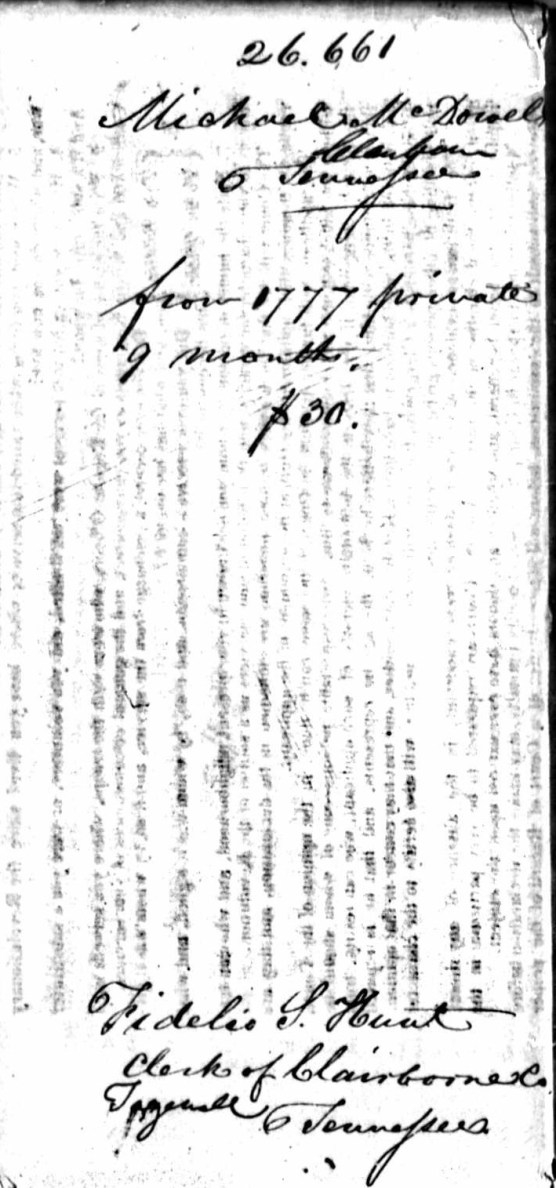
Michael McDowell – Claiborne Co., TN – Private VA Line, $30 annual allowance – $90 amount received, Sept. 20, 1833 pension started – age 87 in 1835

State of Tennessee, Claiborne County This day personally appeared before Samuel Powell, Judge of the Circuit Court of law and equity in the state of Tennessee the same being a Court of Record, Michael McDowell age 85 years who being first duly sworn according to law doth on his oath make the following declaration in order to obtain the benefit of an Act of Congress passed June 7, 1832. States that he entered the services of the United States under the following named officers and served as herein states that he resided in the County of Bedford in the State of Virginia and some time in the year of 1777 or in the year of 1778 he was drafted to perform a three month tour of duty in the services his county and that he belonged to company commanded by Capt. Arthur which said company was attached to the regiment commanded by Col. James Calaway then marched to the lead mines in the western part of Virginia and we then built a fort and we were there stationed until my time of service has expired and then it was that Col. Calaway called upon us to volunteer our services in the cause of our country for the time of three months which this applicant did do in good faith and he states most positively that he did serve his country under the command of Capt. William Selfridge at the same fort and after his time of service had again expired this applicant returned home to his residence in the State of Virginia in Bedford County and some time after this applicant returned home he again volunteered himself under Capt. Arthur and he then marched against the Indians who were committing many defamations on the inhabitants of Virginia and the applicant states that he served in the campaign as long as his services was required by the commanding officer, but the precise time he does not recollect and then being discharged from service he returned to his residence in the County of Bedford. And this applicant begs leave further to represent to the department that some time after he had returned home from the last above mentioned campaign that he united himself with some of his neighbors and friends together with a vow to protect the women and children from the scalping knife of the savage and often performing a great deal of hard labour in the service of our country and after the spring of the year had set in and the savages had left the frontier we again returned home the applicant states that he believes taking the whole of his service together that he served in the cause of his country for the term of nine months although it may be more or it may be less. Said applicant also states that he has no documentary evidence of his services nor does he know of any living testimony by whom he can prove his services. He a few days ago went to see his Capt. (to wit) Capt. Arthur who now lives in the State of Kentucky and that he found that the said Arthur is paralyzed and so palsied that he cannot speak so as to be understood which now fully appears no reference to a document, herewith presented and signed by one of the Justices of the Peace in said state. Hereby relinquish his every claim to a pension or annuity except the present and declares that his name is not on the pensions roll of any agency of any state whatsoever. Sworn to in open court Dec. 1832

If this was sworn in December 1832, chances are very likely that Michael had already had his birthday for the year. His year of birth subtracts to 1748 in this document.

In a publication listing Tennessee veterans of the Revolutionary War, Michael is listed as having been born in 1745. The source of this information is not given.

I obtained Michael McDowell’s Revolutionary War Pension file from the National Archives.

Michael McDowell Rev War1.jpg

The actual pension act was found in Michael’s pension papework.

Michael McDowell Rev War 2.jpg

Michael McDowell Rev War 3.jpg

I originally though that Michael signed this document himself, but after looking more closely, he didn’t.

Michael McDowell Rev War 4.jpg

The “X, his mark” is present. Of course, we don’t know from this document alone whether Michael was simply too elderly and too feeble to write, or if he never could. Other documents will tell that story.

Michael McDowell Rev War 5.jpg

Michael McDowell Rev War 6.jpg

MIchael McDowell Rev War 7.jpg

Michael McDowell Rev War 8.jpg

$90 was a lot of money in 1832 – enough to purchase a farm or at least land to clear for a farm.

Michael McDowell Rev War 9.jpg

Michael McDowell Rev War 10.jpg

From these documents, we can put together roughly the following timeline:

When What Where
1777 or 1778 3 month tour Lead mines with Arthur and Callaway
Additional 3 months at lead mines Callaway requested, served under Leftridge
Home after the second three month tour Bedford County
Some time later Volunteered again to march against Indians With Arthur
Returned home Bedford County
Some time later Spied on Indians – returned home after spring when Indians departed

Michael states that he served 90 days in total, more or less. Given the dates above, his time spying on the Indians would have had to have been in either late 1777 or late 1778. If he was drafted in 1777, most of that year would have been consumed with the 6 months contiguous duty at the lead mines.

Michael McDowell Rev War 11.png

This final document is interesting in that it lists Michael as an invalid. It’s possible, at 85 years of age, that his invalid status is simply a result of his age, meaning he can no longer farm, and had nothing to do with his service or an injury. He did not apply in 1818 at which time destitute soldiers could apply.

These documents reveal more too. Michael left Bedford County and marched to the western part of Virginia. At this time, Tennessee and Kentucky didn’t exist, so Virginia just trailed off into nothing – with no western border as shown in the Fry and Jefferson map from 1775, below.

Michael McDowell 1775 Fry map.jpg

Revolutionary War Service

In the book, Virginia militia in the Revolutionary War: McAllister’s data we find several references to lead mines as well as the officer’s surnames noted in Michael McDowell’s pension application.

This book reveals: Capt. Benjamin Arthur R. Sept. 29, 1781 from Bedford County. James Callaway Co. Lt, S, Dec. 8, 1778. We then find Lt. Col. William Leftwich, S. Feb. 28, 1780. I’m not quite sure what that means, but it does confirm that they served.

Bedford County: 1776. Capt. Wm. Leftridge against Tories and Indians at Lead Mines, 47, 157.

This suggests that there might have been an encounter.

1780 – Capt. Robt. Adams’ Company guarding Lead Mines, 153.

Greenbrier County 1780: Capt. Thomas Wright raises a Company to go against the Indians at Detroit. But it was marched to Lead Mines on Holston, and then to Logan’s Station in Kentucky.

Jarvis Fields, in his pension application tells us that he served from Bedford County as well and he was called to duty in 1779 by Col. Calloway for guard duty at New London, in Bedford County, “the British prisoners taken at the Cowpens being confined there and at Lynchburg.”

Henry Cartmill who served from Botetourt tells us this about the possible location of the lead mines:

At another time he ranged the mountains between Fincastle and Sweet Springs in search of Indians. Himself and many others assembled at the lead mines in Wythe to meet Col. Fergerson who was said to be advancing from the Carolinas with a large force of Tories. After going as far as Stone House in Botetourt, they were stopped by Col. Skillern, commanding the Botetourt militia, until more men could be collected. News reaching them that the Tories were dispersed, they returned home.

Colonel Ferguson was killed at the Battle of King’s Mountain in October 1780.

William King states that he was enlisted in Bedford County in 1778 and for two months, he guarded the lead mines in Wythe County. Other men refer to the lead mines in Wythe County, as well.

William Murphy is very detailed in his pension application:

About Aug. 1, 1776, from Bedford under Capt. William Leftridge, Lt. Calloway, Ensign Joseph Bond. Guarded Chiswold lead mines till relieved by other troops. In April, 1777, was substitute three months for Lewis Dusee (?), who was drafted from Thomas Jones’ Company in Henry. Served under Capt. Peter Herston, Lt. William Ferguson, Ensign Edward Tatum in Col. Christie’s regiment. Marched 200 miles to Long Island in the Holston to stand guard during a treaty with the Cherokees.

Volunteered in April 1780, to serve three months against the Cherokees. Went as sergeant under Capt. Jno. Clark and Lt. John Bond, Gen. John Sevier being in general command. Marched to the headwaters of the Tennessee and killed a number of Indians, with the loss of Capt. Davis and Lt. Bond killed, and Jasper Terry wounded.

In February 1782, volunteered three months under Capt. John Clark, and Lt. John Murphy, of Washington County, N. C. (now Tenn.), Col. J. Brown commanding the regiment, and marched across Nolachucky and French Broad in pursuit of the Indians who had attacked Sherrill’s Station on the frontier, losing one of their number in the attack. We overtook a band, supposed to number 60 to 100, and killed, as was said, thirteen of them. In August 1782, drafted against the Indians again and hired George Doggett as substitute, but Gen. Sevier insisted that I go. Served under him in company of Capt. Thomas Wood and Lt. Vathan Breed, all the officers being of Greene Co. (Tenn.) We destroyed several Cherokee towns, killed a number of Indians, and took some prisoners. John Watts, a half-breed gave up a white woman named Jennie Ivey, who was taken from Roane’s Creek a year before.

The reference to Chiswold’s lead mines gives is a critical clue.

Michael McDowell lead mines.jpg

This waymark exists today at the intersection of interstate 77 and Route 52, but the actual mines were about 10 miles further south in the Austinville Community on a bluff on the south bank of New River. Known variously as the mines on Cripple Creek, the Austinville mines, or the Wytheville mines, they were discovered in 1756 by Colonel John Chiswell.

The original Fort Chiswell was built during the French and Indian War where the current village of Fort Chiswell stands, but was paved over when the intersection of I77 and I81 was constructed in the 1970s.

Given that Michael McDowell said that they built a fort, it’s probable that they built a fort at the actual mines to protect the lead, an extremely valuable commodity to both the militiamen and the Tories who were attempting to capture the mines.

The website, Diggings, below, shows the mine with the green balloon and the deposits in red. The information on the site states that production at the Austinville East Lead Zinc Mines began in 1753 and concluded in 1981.

Michael McDowell Austinville.png

This would be where Michael McDowell camped and built the fort.

MIchael McDowell mine.png

Today, the two routes from Bedford County to the lead mines, both through gaps in the mountains, would be either 110 miles or 125 miles.

Michael McDowell mine map.png

A Google satellite view of the vicinity shows extensive mining efforts at Chiswell Hole.

Michael McDowell Chiswell Hole.png

If the location of the original lead mines is accurately positioned by the green locator of the Diggings map, the original mine location would be where the white roofed building, below, is located today.

Michael McDowell mine location.png

Unfortunately, none of these roads are “drivable” today utilizing Google street view. Maybe in a few years.

Indians, Spies and Scalpings

In both application versions, Michael mentions being an Indian spy, banding together to protect people and that the Indians subsequently left the frontier. What can we discover about when and where this might have occurred?

Michael says he “marched against the Indians, and again after returning home joined with some neighbors and friends with the citizens of the country calling themselves spies, to protect women and children from the skelping knife of the savage.” He also mentions that he and his fellow spy citizens returned home in the spring, meaning they tracked Indians in the cold of winter.

We know that this was after Michael marched to the lead mines, which was probably about April 1777, based on the information unearthed about the mines and other men who served there, and after Michael served with Col. Leftridge and then marched with Captain Arthur against the Indians. After all that is when he “joined with some neighbors and friends.”

In Michael was at the lead mines in April of 1777, then he went home in about October of 1777.

We know that this was probably related to the peace treaty signed with the Cherokee Indians in July 1777 ceding the Watauga lands or in July of 1781 when they ceded more land, both events taking place at the Long Island of the Holston. Another treaty during this time was the Treaty of Fort Pitt signed in November of 1778 with the Delaware. It’s difficult to know which event might have resulted in the Indians leaving the frontier as he mentioned, an event that allowed him to finally return home for the last time – although it’s most likely prior to 1781.

Two articles shed light on this time period and events that clearly impacted Michael McDowell.

The first is found in The Virginia Magazine of History and Biography, Vol. 23, No. 2 (Apr., 1915), pp. 113-123, article by David I. Bushnell, Jr.

In the first of a series of articles titled, “The Virginia Frontier in History – 1778”, David Bushnell tells us that in 1774, Cornstalk, Chief of the Shawnee entered into a peaceful agreement with Lord Dunmore and subsequently became friendly with the English.

However, in November 1777, at Fort Randolph which was located at Point Pleasant (now West Virginia,) Cornstalk along with his son were brutally murdered. Ironically, Cornstalk had come to warn the settlers and his killing was in revenge for the murder of a settler by an Indian.

During the winter months that followed, the settlers realized what grave danger they had brought upon themselves by killing Chief Cornstalk and prepared for the now-expected attack by the Indians. In January 1778, Col. William Preston sent a letter from Montgomery County, Virginia, begging then-governor Patrick Henry of Virginia for assistance, expecting the Shawnee to descend upon the settlers at any time.

A widespread attack was expected, “upon all Frontier Inhabitants from Pittsburg to the lower Settlements of Clinch and the Kentucky.”

Col. Preston writes:

“I acknowledge, Sir, that this detestable murder was committed by backwoods men who ought to have behaved in a manner very different; and I am sorry to inform your Excellency that upwards of 100 persons in the County alone have yet refused to take the Oath of Allegiance to the State, many of whom are disarmed and the remainder soon will, who cannot claim, nor are they entitled to Protection while they continue Obstinate.”

“The inhabitants in this and the neighboring counties, especially those most exposed to danger are in the greatest consternation. Several thousand good subjects ought not to suffer for the indiscretion and obstinacy of a few. Being generally in low circumstances, they are not able to remove and support their families in the interior parts of the state, and by continuing at their homes, without the assistance of government, or the immediate interposition of Providence, they and their helpless families must fall a sacrifice to savage fury and revenge.”

“Should this (assistance) be omitted or delayed, I am fully convinced from long experience that this county or a great part of it will be depopulated before May next and the enemy, like blood-hounds, will pursue until they overtake their prey, even to the south side of the Blue Ridge, as they did not many years ago.”

Preston goes on to ask for provisions, stating that the lack of salt prevented people from laying up the quantity of pork that they would have otherwise done. He says they will be out of provisions in two months. Normally pigs butchered in the fall would last until at least the following summer when crops could be harvested.

Preston also asks for Indian corn to be purchased and says there is none in his or neighboring counties. Furthermore, “the want of lead is a most discouraging circumstance. They offer any price but they cannot purchase it.”

Guns don’t work without bullets and lack of lead for their muskets made the settlers little more than sitting ducks.

According to the response recorded in the “Journal for Council for 1778” in the Virginia State Archives, Greenbrier County also submitted a request and on February 19th, the Council agreed to the following:

  • One pound of lead for each militia man
  • To direct trusty scouts to range towards the enemy’s country
  • To advise proper stockades for receiving the helpless inhabitants, wherever the savages have in in their power to penetrate
  • To direct the County Lieutenants of Botetourt and Montgomery to consult together on the expediency of establishing a post near the mouth of Elk River for keeping up the correspondence between GreenBrier and Fort Randolph
  • To do so in the matter they judge best to reinforce the garrison at Fort Randolph with 50 men from the militia of Botetourt
  • That earnest and close pursuit of the foremost scalping parties be made in order to discourage others
  • To apprehend and deliver up the people concerned in that murder

On March 27, 1778 they recommended ordering 50 men from Rockbridge County, Virginia to Fort Randolph and 50 men each from Botetourt and Greenbrier County to “post at” Kelley and authorized 1000 pounds for “commissary.”

The order to “direct trusty scouts to range towards the enemy” stems from the following document passed by the General Assembly on May 5, 1777 as found in Henning (Vol IX, p294-295):

“The lieutenant or next commanding officer of the several counties on the western frontier, with the like permission, shall appoint any number of proper persons, not exceeding 10, in any one county to act as scouts for discovering the approach of the Indians…who on such discovery shall immediately give notice thereof to such militia officer.”

The scouts were instructed not to fire on the Indians, except in self-defense, but only to report locations to the militia officers. Their job was to find the Indians and spy upon them. Their instructions were to not lose time, to stay constantly “on foot” and after they “have fully ranged the part of the country which it was supposed would take 2 or 3 weeks,” they should report back. They were to take their own provisions, but they would be paid for them. I wonder if that ever happened.

However, now we know where the term that Michael used, “spies,” originated in this context.

Interestingly enough, on the back of a paper were listed locations, probably made by a scout, showing the locations visited. The author believes the numbers represent the number of miles:

  • From Culbersons bottom to the big Crab Orchard – 60 (Crab Orchard is in Kentucky)
  • From there to Maiden Spring – 15
  • From thence to Elk Garden – 17
  • To the Glade Hollow – 13

Underneath that is a total line and then 105.

  • To Cowins fort – 10
  • Moores fort – 5
  • BlackMores – 2
  • To Mockinson Gap – 18
  • To ye Great Eatons (?) – 8
  • To Capt Donelsons line – 8

Another total line and 174.

Fort Blackmore was located in what is now Scott County, VA, as is Moccasin Gap.

According to Familypedia.wikia, this 1774 copy of the Smith map with red circles indicates the locations of forts as shown on Daniel Smith’s original map, now in the Draper collection, item 4NN62. The red line became the Kentucky Trace.

1774 Smith map.png

This area includes part of the present Virginia counties of Tazewell, Russell and Scott from the Clinch River to the Holston.

Col. Preston apparently became more fearful and requested additional protection in May of 1778, the following being noted:

“The Board being informed of Col. Preston’s expored situation on the frontier and that is was apprehended (should be obliged to remove) most of the back inhabitants would quit their settlements, they do advise the governor to empower Col. Preston to keep a sergeant and 12 men stationed at his house as Draper’s Meadow to enable him to continue at his habitation and to encourage others to do so.”

In a second article in The Virginia Magazine of History and Biography Vol. 23, No. 4 (Oct., 1915), pp. 337-351 by David I. Bushnell, Jr. we find additional information.

A report detailed the importance of maintaining 4 forts, one of which is Fort Henry in Ohio County and one at Fort Randolph, which is on the Ohio at the mouth of the Kanawha river, the scene of the treacherous murder of Chief Cornstalk in November 1777. That act was the touchstone of the rebellion that caused the Indians to attack the settlers on the frontier. Fort Randolph was stated to be “200 miles distant from the settlements” and 150 men were requested for that location.

Michael McDowell Fort Randolph.png

Indeed, Fort Randolph is about 266 miles from Bedford County, VA.

Michael McDowell Bedford to Fort Randolph.png

Also requested for the various forts was 1500 gallons of whiskey. That’s a LOT of whiskey!

The two documents presented…enable us to picture the frontier posts as they were during the summer of 1778. Small groups of militia, at widely separated spots in the vast primeval forests. Nearby were the clearings and log cabins of the settlers. Supplies were scarce and consequently difficult to obtain and of a high price: a condition which resulted in more than one expedition being either postponed or abandoned. Scouts were ever on the alert for the approach of the warriors from beyond the Ohio; the accepted boundary between the white settlements and the Indian Country later to become the Territory Northwest of the Ohio.

That same year a census of the tribes was prepared by William Wilson at the request of the War Office as reported in the Virginia Historical Magazine:

1778 tribal census.png

1778 tribal census 2.png

The tribes were widely separated and the number of hostile warriors was given as 330, certainly a very conservative figure; but nevertheless, they were sufficiently numerous to spread terror over many hundreds of miles of the frontier.

In the endeavor to gain peace for the Virginia frontier, and the friendship of the Indians beyond the Ohio, Congress planned a treaty to be held at Fort Pitt, July 23, 1778, to be attended by commissioners of the government and representative of the different tribes. This was destined to be the first treaty between the United States and an Indian Nation, and was signed September 17th.

Michael’s Revolutionary War papers take us back to Bedford County, Virginia where he lived after being dismissed the final time from his Revolutionary War service – and presumably once the region became relatively safe again after November of 1778.

What we don’t know is which spring Michael was referring to, 1778, which is unlikely, given the above information, or perhaps the spring of 1779.

Bedford County, Virginia

Michael McDowell Bedford County

Bedford County is mountainous and rough. I visited Bedford County, years ago, and Bedford isn’t much different from surrounding counties. In essence, Bedford is part of the Appalachian range which extends for thousands of miles as an expansive sea of craggy rocks interspersed with tiny patches of green that farmers have been trying to cultivate since before the Revolutionary War. It’s also breathtakingly beautiful with incredible vistas.

Bedford County hosts a section of the Blue Ridge Parkway, a beautiful WWII era road that runs along the summits of the mountains offering stunning vistas, in particular the Peaks of Otter in Bedford County, shown below – visible for a hundred miles in any direction on a good day.

Michael McDowell Peaks of Otter.jpg

This might have been particularly relevant for Michael McDowell’s father, Michael Sr., who we know lived in Halifax County, Virginia in 1752. This means that if Michael Jr. was born in 1747, he might have been born in present day Halifax County which was Lunenburg County at that time. Interestingly, you can see the Peaks of Otter from Halifax County, below, at a location called “Top of the World.”

Perhaps Michael saw these mountains and felt irresistibly drawn towards them – an area that was then the risky, unsettled frontier.

Peaks of Otter

The photo above was taken from Halifax County, looking 50 miles distant to the Peaks. Did Michael live here, or see this on his way back and forth to the tobacco warehouses in Danville, in Pittsylvania County? As a young boy, did he dream of adventure there? One day that dream would come true.

Michael McDowell Peaks of Otter valley.png

Looking across the roof of the Peaks of Otter Lodge today, from the Blue Ridge Parkway.

Many of the men who settled in Bedford County were Scots-Irish, and before that, they were Scottish families, so trying to farm fields filled with rocks was nothing new to them. Perhaps it even reminded them somewhat of home, or the homeland of their fathers and grandfathers anyway.

After finding Michael McDowell’s Revolutionary War record, of course I began digging in Bedford County for more information.

Ironically, some of the information I found in Bedford County in June of 2005 referred me back to Claiborne County, Tennessee.

At the Bedford Co. Historical Society, I found a McDowell family file and it held a contact from California from 1989 and 1990 who descends from our Michael McDowell

The researcher mentioned that in Mary Hansard’s book, Old Time Tazewell, Michael’s son Nathan S. McDowell is mentioned as being of Irish descent, which the researcher interpreted to mean that Michael was born in Ireland. As it turns out, Michael Jr. wasn’t, but his grandfather, Murtough McDowell, was.

Blackwater River

On September 24, 1783, Michael purchased 75 acres on the North side of Blackwater River in Bedford County from James Stevens. and on March 22, 1784 the purchase was confirmed in court. Witnesses to the sale were Richard Richards, Skinner Devaul(?) and Ambrose Rains.

Michael McDowell Blackwater River Bedford.jpg

It’s important to note that this does not say Michael McDowell Sr. or Jr., which it surely would have stated if there were two Michael McDowell’s living in the same county at the same time.

On the 1782 Bedford County tax list, we find only one Michael McDowell, listed with 1 free male above 21 years, no slaves, 4 horses, 11 cattle with 1 white tithable, himself.

Unfortunately, the tax list is semi-alpha, which means it’s not in household order, so we can’t look at the list to identify his neighbors. There are no other McDowell residents listed.

In 1783, we find Michael with 1 poll tax, 1 male over 21, 2 horses and 4 cows. Most people had both more horses and more cows that Michael.

By 1784, Michael is gone from the tax list but he doesn’t sell that land until 1793 as a resident of Wilkes County, NC.

It appears that the area of Bedford County where Blackwater River was located became Franklin County.

The Blackwater River runs for about 20 miles as the crow flies, west of the area called Callaway, to the left of the pin below, and the county line at far right where it opens into what is now Smith Mountain Lake, formed by the Roanoke River.

Michael McDowell Callaway.png

Given that Michael served under Colonel James Calloway, which means that Michael probably served with his local muster group, my strong suspicion is that Michael lived near James Calloway. Given that Callaway is located on Blackwater River, Michael probably lived in this region too.

Indeed, this is probably where he grew up because his father apparently applied for a land grant in 1754 on the Black Water River – although beyond the initial application we never find any additional informatoin about Michael Sr.’s 400 acres. He could well have forfeited the grant for any number of reasons.

The north and south branches of Blackwater are born near Calloway and flow eastward to the Roanoke.

Michael McDowell Blackwater River 2.png

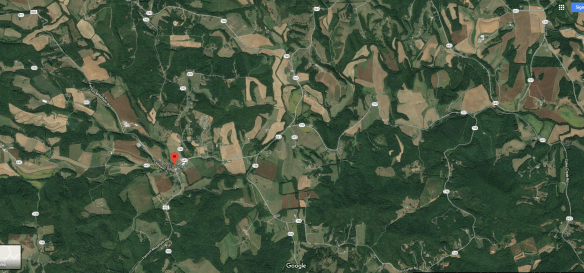
Today, this area is a mosaic of farmland, but at that time, it was probably still forested, and men like Michael would fell trees to make room for fields.
Michael McDowell Blackwater satellite.png

Someplace, Michael’s land was probably here in this crazy-quilt mosaic of farmland and forest.

Michael McDowell Blackwater River Callaway Road

Today, Callaway Road where it crosses the Blackwater River. This would have been a ford when Michael lived here.

The Arthur family lived nearby too, with several deeds showing land near Goose Creek, in Bedford County, 4 or 5 miles east of the Roanoke River where Blackwater River empties.

This was Michael’s stomping ground growing up. It’s probably where he married his wife.

We know that Michael McDowell Sr. was on the Bedford County tax list in 1755, and given that our Michael was born in 1747 or 1748, the 1755 Michael had to have been Michael Sr., not Junior.

Or stated another way, it couldn’t have been Michael Jr. and there is a small possibility that the 1755 Michael was not Michael Jr’s father. Given that he was the only McDowell living in Bedford County by the same name, there’s a good chance that the 1755 Michael is indeed Michael Sr., the father of Michael Jr.

I checked all Bedford County deeds 1761-1771, wills 1759-1810 and court orders 1754-1761 – no Michael McDowells. He certainly kept a low profile.

There are also records in Bedford County for one Ephriam McDowell, no known relationship and these two male lines carry completely different Y DNA.

Michael McDowell bought land in Bedford County in 1783, but in 1784 he is not listed on the Bedford County tax list and a Michael McDowell is listed with 1 white poll in adjacent Botetourt County. Is this the same man? If so, was he trying out different locations? Why did he leave just after purchasing land?

If this isn’t the same Michael McDowell, what happened to that second Michael McDowell in Botetourt County? Where did he come from and where did he go? The only other McDowell in Botetourt in 1784 was George. However, there was a Michael in Botetourt, earlier, in 1774 who was found to be delinquent on his taxes.

If this was our Michael in Botetourt, he clearly didn’t stay and it was a very short chapter in a very long book. Our Michael is also not the Michael McDowell who served out of Pennsylvania in 1776-1777 in the Revolutionary War.

Where is our Michael?

Pat Bezet and Mary Kay McDowell

A few years after visiting Bedford County, I found Pat Bezet on an old Rootsweb board along with Mary Kay McDowell, the wife of Les who Kay believed to be a Michael McDowell Jr. descendant through Michael’s son, Luke. These women had done a massive amount of research on Michael and family, and I would spend the next several years following in their footsteps, trying to add additional tidbits. They were both very generous about sharing their work. However, it was interesting that even though we were all plowing the same fields, so to speak, that we all found things that had either been overlooked by the other parties or found different records altogether. Six eyes are obviously better than any two. By reviewing available records again, I’ve recently found things that all three of us missed previously.

Mary Kay McDowell systematically sifted through nearly all of the published Virginia sources available in the 1970s, 80s and 90s.

The results of our research and trips are intermingled in this article, with many thanks to both ladies.

Albemarle County, Virginia

It’s likely that Michael McDowell Jr. was born in 1747 or 1748 in Lunenburg County, Virginia or possibly in Albemarle County. Michael’s father, Michael Sr. was found in both locations.

Keep in mind that Halifax County where we positively identify Michael McDowell Sr. in 1752 was Lunenburg before that.

We find a similar name in Albemarle County, VA in the 1745 road records, dated June 27th in which Andrew Wallace was appointed surveyor of the highway from D.S. to Mitchams River and both Merlock (also transcribed as Mirlock) McDowell and Micha McDowell were ordered, along with other men to clear the road. Albemarle county as was formed from Goochland in 1744, although deed, court and will records did not begin in Albemarle until 1748. Albemarle road records are lost beginning in 1748. Research into Albemarle records from 1748-1753 produced nothing, nor did research into Goochland deed and will records from 1731-1749.

The name Merlock sounds very close to Murtough, Michael’s father’s name, raising the question of whether Michael was Merlock’s brother. It’s also worth noting that in Maryland, Murtough’s name was also spelled Murto, with the surname as Mackdowell and Mackdaniel. Names were spelled as the person hearing them understood them and spelling wasn’t standardized at the time.

If Michael was in Albemarle County, he was familiar with the Three Notch’d Road which is the road the crew where he was assigned was instructed to clear and open in 1745. Men were assigned to crews along the road where they lived.

The Virginia Department of Transportation document titled, “The Route of the Three Notch’d Road: A Preliminary Report” written in 1976 shows the “1740 House,” an old tavern near the site of the D.S. Tree, near present day Ivy Virginia. Today the building, also known as the “D. S. Tavern” is on the National Register of Historic Places.

The original 3 Notched Road was begun about 1742 and the route was marked the entire length between Richmond, VA and the Appalachian Mountains in Augusta County, VA – including running directly through Albemarle County and is currrently US 250. US 250 was rerouted in some places, but is basicaly the same road in Albemarle County.

If indeed this is our Michael’s father in the 1745 road record, this 1740 House which stood and functioned as an ordinary at the time was probably intimately familiar to him, both inside and out.

Michael McDowell Three Notched Road.png

The D. S. Tree is reported to be in the final segment of a the “Three Notched Road” between Secretary’s Ford on the Rivanna River, (near the old woolen mill adjacent to I-64 on the east side of Charlottesville) to the D. S. Tree in Michael Wood’s road, the road east from Wood’s Gap to Ivy.

MIchael McDowell 1740 tavern.png

Today, this private home is at the intersection of Dick Woods Road and 250.

Early deeds refer to Stockton’s branch of Mitchum River, and also Stockton’s ford.
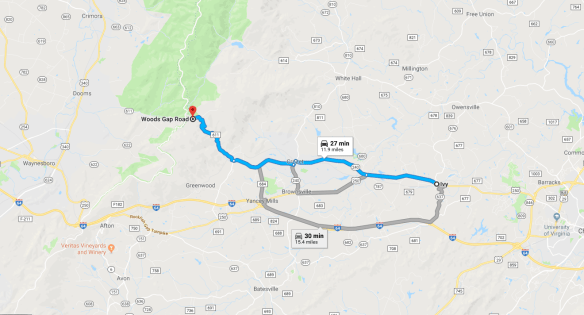
Michael McDowell Woods Gap.png

An aerial view shows the mountainous area between Ivy and the top of the mountain range.

Michael McDowell Woods Gap aerial.png

According to Edgar Wood’s History of Albemarle county, Virginia, the D. S. Tree had the initials of David Stockdon, an early patentee of land nearby, carved into it. That tree no longer exists.

Here’s a section of what was called the “Three Notch’d Road” also known as the Mountain or Mountain Ridge Road, now US 250, which today intersects with the Ridge Parkway.

Below, Mountain Ridge Road, another name for the Three Notch’d Road.

Michael McDowell Mountain Ridge Road.png

Today, on the Blue Ridge Parkway at Jarman Gap.
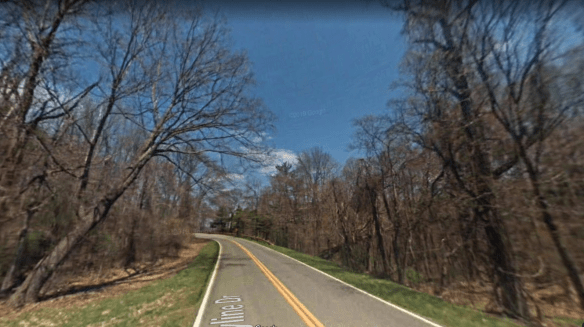
MIchael McDowell Jarman Gap

The Appalachian Trail runs alongside Skyline Drive, which is the Blue Ridge Parkway.  I’ve hiked much of this area. You can see Wood’s Gap Road in this aerial.

Michael McDowell Appalachian Trail.png

Below, the road descending to Lickinghole Creek.

Michael-McDowell-Lickinghole-Creek.png

Here’s the view on Three Notched Road crossing Lickinghole Creek today.

Michael McDowell Lickinghole

Three notched road ascending the Blue Ridge below.

Michael McDowell Three Notch ascending Blue Ridge.png

Jarman(s) Gap Road today just before it begins ascending the mountains. Wood’s Gap is now Jarman or Jarmans Gap.

Michael McDowell Jarman Gap Road.png

Google Street View does not drive on roads with no center line. The trip from Jarman’s Gap Road alongside Lickinghole Creek, above, to Jarman Gap which is one of two gaps crossing the mountain range is maybe 5 twisty-turny miles on road 611 – complete with switchbacks.

Michael McDowell road ascending mountain.png

And of course, a 3 notched tree. The original D.S. tree stood east from Wood’s (now Jarman’s) Gap to Ivy, probably on the same property where the 1740 D.S. Tavern stood.

Michael McDowell three Notched tree.png

Ivy to Jarman Gap. Today you must use the Park Entrance, but not so then when they took the more direct route up the side of the mountain, marked with red arrows.

Michael McDowell Ivy to Jarman Gap.png

Michael Sr. worked here, opening the roads still in use today, but looking very different. The area where he was assigned was from the D.S. Tree to Mitchums River, which is Mechums River today – a distance of about 3 miles.

Michael McDowell Ivy to Mechums River

That means he would have lived someplace along this route probably on a spring branch of a creek where fresh water was available. This is likely where Michael McDowell Jr. was born.

I’m not convinced that the blue 250 portion is the original road, but Google didn’t drive down 738 which looks like it might have been the original road.

However, there is a portion where 738 and 250 join, and that was likely the original portion, as is the portion where Dick Wood’s Road and 250 intersect.

Michael McDowell Ivy to Michums River aerial

In fact, when I enlarged the photo, I could clearly see 3 Notch’d Trace, the portion that exists today, and the portion which no longer exists. You can see Mechums River at left and where it is crossed by 250. At right, with the arrows is the old section of 3 Notch’d Road.

MIchael McDowell 3 Notched Trace

Michael McDowell Sr. labored to maintain the road so that horses and wagons could ford Mechums River, below, today where 250 crosses. This could have been Stockton’s ford referenced in the various early Albemarle deeds.

Michael McDowell Ivy Road at Meachums River

At the intersection of Ivy Road and 3 Notch’d Trace, a remaining segment of the original road, we can see the Appalachian Mountains in the distance.

MIchael McDowell Ivy Road at 3 Notchd Trace.png

Those mountains would beckon to Michael Sr., whispering, “Come,” and he did, but first he took a detour.

Lunenburg County, Virginia

Lunenburg County, where we find Michael next, was formed in 1745 from Brunswick County. The 1748 tax map for Lunenburg is the first tax list available, so we don’t have any way of knowing whether or not Michael Jr., born about 1747 was born in Lunenburg or perhaps Albemarle. It’s also possible, although unlikely that the Michael in Albemarle wasn’t Michael Jr.’s father, and that he was still in Maryland before arriving in Halifax County.

Pat included the Lunenburg County 1748 tax list where Michal McDanel was shown with 1 tithe in the district taken in June by Mathew Talbot from Bleu Store to Little Roanoke. The Roanoke is now called the Staunton which forms the northern and much of the eastern border of Halifax County.

Michael McDowell Lunenburg 1746 tax map

Sunlight on the Southside by Landon Bell provides the Lunenburg tax lists, where extant. We find the McDowell family mentioned in the intro portion as being from Lunenburg Co., VA before they went to NC.

In 1749, we find Michael McDowell in William Caldwell’s district, which bordered Halifax on the north on the Staunton River. In 1752 Halifax was formed from Lunenburg, where Michael McDowell. had 1 white tithe, meaning white male over 16, and no negroes.

In 1749, the Lunenburg road orders included a Michael McDaniel, who may have actually been Michael McDowell.

In 1750 we find Michael McDowell in Nicholas Hale’s district with one tithe and neighbors that included Jacob and John Pybon.

In 1751, Michael is missing from the list and in 1752, Halifax County was formed from Lunenburg. We already know that Michael McDowell Sr. is in Halifax in 1752 where he signed a power of attorney to sell his father’s land in Maryland.

The Lunenburg Order books 1746-1755 reflect the following:

June 1753, Michael McDuel vs Jacob Pyborn – Pyborn not inhabitant of county – suit abates.

Trouble with the neighbors, it seems.

May Court 1754, John Thompson vs Michael McDuel – defendant not inhabitant of county – suit abates.

This tells us that Michael McDowell Sr. left between June of 1753 and May of 1754, and it might give us some idea of why. Trouble was brewing perhaps.

Given that Michael lived in Halifax in 1752 and is found in neighboring Lunenburg in 1753 – it appears that he might have moved often, perhaps back and forth across the county border, or maybe he lived near the Staunton River.

Michael Jr. would have been 5 or 6 years old in 1752 or 1753, so likely remembers moving frequently and probably remembered Halifax County.

Bedford County was created in 1753 from Lunenburg County, but as it turns out, Michael didn’t live initially in what would become Bedford County. He was in Halifax, at least for a short time before moving on to Bedford.

Halifax and Bedford 

Halifax County was formed from Lunenburg in 1752, and that’s where we find Michael McDowell in that same year, selling his father’s land in Maryland. Thank goodness for this link, because without it, we would never have been able to connect Murtough McDowell in Baltimore County, Maryland with Michael McDowell in Virginia.

Details are provided in the article about Michael McDowell Sr., but suffice it to say that Michael Jr. would have been about 5 years old when his father was selling his grandfather’s land. Michael Jr. probably never got to meet his grandparents. Maybe he heard stories about his grandparents’ lives back in Ireland. His father may have been born there. Michael Sr. was born around 1720 and his father was in Maryland by 1722.

An important aspect of the documentation of Michael Jr.’s life is that Michael McDowell Sr.’s signature was never recorded as being signed with an X. Michael Jr., on the other hand, never signed his name without using the X.

In 1754, we find a mysterious entry in Marion Dodson Chiarito’s book, “Entry Record Book 1737-1770” which covers land in the present counties of Halifax, Pittsylvania, henry, Franklin and Patrick, she says the following:

This book contains land entries in the western portion of the original Brunswick County, namely Halifax, Pittsylvania, Henry, Franklin and Patrick. The area concerned was south of the Roanoke-Staunton River, west of Tewahomony Creek, now Aaron’s Creek which divides Mecklenburg and Halifax cuonties, and extending to the Blue Ridge Mountains. These counties were formed from Lumemburg which was separated from Brunswick in 1746.

Marion continues:

It must be pointed out that an entry for land was but a statement of intention. Ownership of land resulted from satisfying the requirements for settlement the land and improving it. For this reason, many entries were voided.

On page 161 of Marion’s book, on page 203 of the original entry taker book residing in current day Pittsylvania County, we find an entry for a man who might be Michael McDowell:

Michael McDuell 400 on a Branch of Black Water River beginning at a white oak with 4 chops in it in the fork of said branch then up both forks and down the branch.

If this was Michael McDowell Sr., I’ve failed to find a deed of sale at any time, and he is next found in Bedford County, formed in 1754, which indeed did have a Blackwater Creek that extended from today’s man-made Smith Mountain Lake southwest to beyond Callaway, where Michael McDowell Jr. appears to have lived.

By 1755, Michael Sr. was found on the Bedford county tax list indicating that Michael Jr. lived in Bedford County from about the time he was 8 years old.

The next piece of Michael Jr.’s life is his Revolutionary War pension application where he states that he served from Bedford County in 1777 or 1778 and returned there to his home when discharged. Michael McDowell Jr. would have been 30 years old in 1777 and based on the ages of his oldest children, had been married about 5 years by then.  If still living, his father, Michael Sr., would have been at least 57 years old.

We have no idea when Michael Sr. passed away, but Michael Jr. bought land in Bedford County in 1783 with no indication that there were two Michael McDowell’s living there in either 1782 or 1783, nor were there any other McDowell taxpayers.

Was Michael alone? There aren’t any other McDowell males, but his mother could well have been living. He could have had sisters who married and lived nearby. His wife, Isabel, surely had family in Bedford County.

Those details will probably never be revealed, but if Michael had no family there, that might have been part of what encouraged him to move again – although it’s quite strange that he left just a few months after purchasing property – and without selling it.

There are missing pieces of his story.

On to Wilkes County, North Carolina

What? Another move?

Wilkes County, NC?  This man did not let any moss grow under his feet. Just saying.

So far, we have Michael McDowell Sr. in Baltimore County as a son of Murtough. Probably in Albemarle in 1745, in Lunenburg County between 1748-1750, selling land in Baltimore in 1752 from Halifax County and then on the Bedford County tax list in 1755.

MIchael McDowell Sr life.png

This is the migration journey of Michael McDowell Sr.

Michael Jr. was born someplace (probably in Virginia) in 1747 and served in the Revolutionary War in 1777 and 1778 from Bedford County. It wasn’t until 1783 that there is a record of Michael purchasing land, then leaving by the next year without selling his land. He was possibly living in Botetourt County, adjacent to Bedford – at least some Michael McDowell was found on the tax list there.

Michael McDowell Bedford Botetourt.jpg

Sometime after that, Michael Jr. moved to Wilkes County, North Carolina, although we do have a 2 or 3-year gap in Michael’s life. Where was he?

Michael McDowell Ivy to Halls Mills.png

Michael would add the area near Halls Mills on Sparta Road in Wilkes County, today, to his lifelong journey.

On February 4, 1786 there is a Wilkes County deed from John Hall Sr. to Michael McDowell for 161 acres including “the plantation where Michael McDowell now lives. Witnessed by William Abshire, James Gambill and Andrew Vannoy.”

This tells us that Michael was already living in Wilkes County.

The connection with the Vannoy family would continue for generations – into Tennessee  where their descendants 5 generations later, my grandparents, would marry.

Another 1786 reference to Michael McDowell was found in a November 24th deed between Owen and Robert Hall for “156 acres on Andrew Vannoy’s line, Mickel McDowell’s corner and the line between Hall and Mikel McDowell.”  Jacob McGrady witnessed this deed. Given that Michael was Andrew’s neighbor, that also explains why Andrew witnessed his purchase.

Michael McDowell first appears in Wilkes Co in 1786 on the tax lists (he is absent earlier) with 1 poll and 160 acres and in 1787 with 162 acres and 1 poll. Therefore, we know that 1786 is probably when Michael moved to Wilkes County.

The 1787 “census” of North Carolina shows us that Michael had in his household:

  • 1 white male age 21-60
  • 2 white males under 21 or above 60
  • 1 white female
  • no blacks

Michael Jr.’s sons, Edward, born in 1773 and Michael (the third) born before 1774 account for these two “under 21” males. Michael III and Edward first appeared in court records witnessing a deed in 1799.

James McDowell, not a confirmed child of Michael, was born about 1779 based on his age when he signed as a witness to a deed in 1801.

Michael Jr.’s son John was born in 1782 or 1783 based on a deposition as well as his gravestone, so we know for sure he was under 21 in 1787. He’s missing from this record.

This discrepancy for a long time caused me to question whether all of Michael’s sons were in fact his sons. DNA has partly answered that question, but not entirely.

Early Court Records

In 1787, in Volume 2 of the Wilkes County Court Minutes (January 25, 1785 – November. 1, 1788) Michael is mentioned on July 25th in the State vs Michael McDowell – indictment for trespass.

Trespass at that time often meant something different than the current meaning, although since the state is bringing charges and not a neighbor in a civil suit, perhaps not. In some cases, trespass means that one man charged another with farming part of his land, encroaching over the property line. In this case, since the state brought the charges, it sounds more like the trespass infraction we are more familiar with today.

Michael is found not guilty by a jury.

On the very next page in the minute book, and the very next day at court, Michael is listed on a jury.

Also on the same day; Michael McDowell versus George Lewis on appeal. A jury is sworn and this case is found for Michael, with his damanges assessed to 3 pounds, 7 pence and costs.

However, on he is again charged with trespass and the same jury is ordered to hear Michael’s case as is hearing the case of Owen Hall and John Hall Senior and wife, “case for words,” which is found for the plaintiff.

The State then moved Michael’s case to the civil docket and finds him guilty of trespass, as charged.  Apparently, Michael’s case has something to do with the Hall family dispute. Recall that the Halls were his neighbors. This also makes me wonder if Michael’s wife, Isbael, was a Hall. If so, and if she was the mother of Michael Jr., that means that the Hall family would have been in Bedford County in 1773 when Michael’s first son, Edward, was born. There are Hall families in Bedford in this timeframe, but of course, that doesn’t mean that they are the same Hall families, or connected in any way.

A year later, in July of 1788, Michael is again listed on a jury and on the tax list in both 1788 and 1789 with 160 acres and 1 poll, meaning only one male over the age of 16. Being listed as a juror indicates that he was a citizen in good standing, but that would change in 1790.

Michael’s record up until now contains multiple services as a juror, and also an involved trespass charge.

However, sometime much more serious happened in 1790.

Criminal Charges

Criminal Action Papers Wilkes County, NC – July Court session – 1790:

State vs Michael McDowell, William Abshers and Owan Hall, labourers, who on July 20, 1790 did beat, wound and ill treat Betty Wooten.

Three men – beating a woman. That’s unconscionable by any standard of measure. Once again, this involves the Hall family.

The Abshire family lived on the south side of Mulberry Creek.

In 1787, Michael would have been 40 and 43 in 1790. No hothead kid, that’s for sure. This charge is much more serious than trespass.

Ok, who was Betty Wooten?

Betty Wooten

In the 1790 census, the only Wooten in Wilkes County was one Elizabeth, probably called Betty for short, who had no adult men in her household, 1 male under 16, and 5 females. According to the July 29, 1788 administration bond, she was the widow of Lewis Wooten. If her children were all born at 2 year intervals before her husband’s death, and she was his age and married at age 20, Betty would have been about 35 in 1790 when she was beaten.

Betty Wooten lived near the Sebastians, three houses from Jacob McGrady, who lived three houses from Owen Hall, who lived beside Michael McDowell who lived two houses from Andrew Vannoy.

Owen Hall was Michael McDowell’s neighbor and in the 1790 census, he was married with 2 males over 16, 3 under 16 and 4 females. If he had children every 2 years and married at age 25, he would have been about 40 years old.

William Absher was born about 1769 and died in 1842 in Wilkes County, so he would have been 21. The 1790 census reflects that he is married with a child, living beside Frank Vannoy, Andrew Vannoy’s brother.

Honestly, what possessed those men? There is certainly far more to the story. How I would have loved to have been a mouse in that house. All of those houses. What happened in that lawsuit? This had to be perceived as very serious for the state to bring a criminal action. And what exactly does “ill treat” mean? Is it code for something else?

Michael McDowell didn’t serve on a jury for the next 3 years.

Michael Jr.’s son, Michael III

Michael McDowell Jr. had a son, Michael, who we’ll call Michael III (the third). It’s possible that Michael III was the person in trouble in 1790, but not terribly likely – he would probably have been under 20. In 1789, Michael Sr. only pays for 1 poll tax, meaning that his sons were not yet 16. That suggests that Michael III was not born before 1783 although it’s possible that Michael was born as early as 1778. Michael III doesn’t otherwise appear in the records until 1799, signing a document as a witness for his father which would suggest he’s 21 at this time, or born 1778 or earlier. Still, in 1790, Michael III would have been 12 if he were born in 1778, so he’s not likely the preson who beat Betty.

Note here that the Michael who signed the deed signed with an X, but Michael the witness, presumably Michael III, signed his name.

This is an important generational differentiation, because Michael Sr. in Virginia apparently could write, Michael Jr. could not, but Michael III could.

The 1790s in Wilkes County

In the 1790 census, we find Michael McDowell living in Wilkes County among and near people who would also move to Claiborne County, Tennessee just a few years later, specifically the Baker, Herrell and Vannoy families.

Michael McDowell 1790 census Wilkes.png

In 1790, Michael had the following members in his family:

  • Males under 16: 4 (John 1782/3, Michael c1778, Edward 1774 and possibly James c1780)
  • Males over 16: 1 – Michael himself
  • Females: 2, one of which would be his wife and the second would be daughter, Mary born c1787

This tells us that Michael had 3 additional children between 1787 and 1790, 2 sons and a daughter or the 1787 tax list was incomplete – the more likely scenario.

If Michael was born in 1747/1748, he would probably have married at about 25, so roughly 1770-1775. He would have been having children from about 1771 or 1772 to roughly 1793 or perhaps somewhat later, depending on the age of his wife of course.

Therefore, the 1790 census should show all of his children, with the exception of any child born after 1790. It’s very unlikely that any of his children had already left home.

In 1790, Michael had 5 children, assuming that one of the females was his wife.

In 1790, Michael is shown on the tax list with 156.5 acres and 1 poll. Why does he have 156.5 acres this year and from 160-162 acres previously?

In 1791, the Wilkes County tax records are not complete and he is not shown through 1794, so they may be only partial as well.

On July 31, 1792, page 35, the court notes record an order for Michael McDowell to “have leave to rebuild and continue the mill formerly the property of said McDowell.”  Now indeed, this is a curious order. Did the mill wash away? Did it burn by some chance? What happened that he needed to rebuild the mill? So tantalizing and frustrating at the same time! This is the only indication we have of Michael’s occupation other than the lawsuit of 1790 lists the three man as laborers.

Maybe the 1790 Michael was Michael’s son, but I would have expected the suit to say that if it were. The fact that no Sr. or Jr. designation exists suggests that the younger Michael was not of age, so no designation was yet needed.

This court entry also tells us of a major catastrophe in Michael’s life. Given his run-ins with the law, I have to wonder if there wasn’t some form of “neighborhood justice” going on here. Of course, that could also be my overactive imagination, but beating a woman is a pretty severe offense and would garner long-standing animosity from her family.

Mix that with a little alcohol and that’s the perfect recipe for retribution.

From a 1793 deed, we discover Michael’s wife’s name when Michael sold his land in Bedford County. Did Michael sell his property in 1793 to pay the bills while the mill was being rebuilt, to pay for the rebuilding of the mill or to help replace income he would have lost while the mill was out of order? There was no insurance in those days.

It was Pat Bezet that discovered Michael’s wife’s name, Isbell.

I found a sale of property or deed for Michael and Isbell McDowell. Isbell is listed as his wife in Wilkes Co., N.C. The property they are selling is in Franklin County, VA. The timeframe for the sale was 1793. If you look at the forming of the counties, Franklin was formed from Bedford and Henry County in 1785.

On February 16, 1793, Michael McDowell and his wife, Isbell, from Wilkes County, NC sold their 75 acres of land on Blackwater River, which was at that time located in Franklin County, VA after it had been divided from Bedford.

Michael McDowell Blackwater 1793 sale.jpg

Michael and Isbell both signed three times, all three times via a mark. Witnesses included John Abshire, Robert Hall, Jacob McGrady, Edward Abshire and another John Abshire who appears to be different from the first one, differentiated by his ability to sign his name. Jacob McGrady was the local minister.

There’s clearly a connection of some sort with the Abshire family, given that the 1790 record of the assault on Betty Wooten included Owen Hall along with William Abshear as defendants.

This deed confirms that the Michael McDowell from Bedford County is one and the same as the Michael McDowell in Wilkes County. What we don’t know is the reason this land wasn’t sold before Michael moved to Wilkes County. Obviously Michael didn’t need money from the Virginia land to purchase his land in Wilkes.

For some time, I thought that maybe the Michael McDowell in Bedford County was Michael McDowell Sr. If that was the case, then Michael Jr. would only have sold this land after Michael Sr. died. The problem is that the purchase deed in 1783 doesn’t say anything about Michael Sr. or Jr., indicating that there weren’t 2 men in the county by the same name. The 1782 and 1783 tax lists only show one Michael McDowell and we know our Michael was married and having children before this time, having served in the Revolutionary War in 1777 and 1778. He was a married adult and certainly wasn’t living with his father.

While we can’t prove definitively, I suspect that Michael Sr. died in Bedford/Franklin County, VA years before, sometime after 1755 and before 1782, and we can safely say that the land on Blackwater River always belonged to Michael Jr. If Michael Jr. had sold this land as part of an estate, he would have had to share with heirs, and he clearly sold this entire tract himself.

Unfortunately, Michael Sr. simply disappeared after 1755 in Bedford County, apprently never owning land before or after he sold his father’s Maryland land in 1752 out of Halifax County.

In November 1793 in Wilkes County, once again Michael served on a Jury, as he did in May of 1794 and 1795.

In 1793 and 1794, an attorney, Joseph McDowell is recorded in Wilkes County, but he dies in 1802 with no connection to Michael.

In 1795 and 1796, Michael McDowell in Capt. McGrady’s district is shown with 1 poll tax and 160 acres on the tax list adjacent John Abshire and near the preacher Jacob McGrady. Other neighbors include the Vannoys, members of the Shepherd family and others who would intermarry and move to Claiborne County, Tennessee at the same time as Michael McDowell.

At some point, Claiborne County, the next frontier, probably became the topic of local chatter – at the mill, at church, wherever people gathered.

In November of 1796, Michael served again as a jury member.

The 1797 tax list shows Michel with 1 poll and no acres. What happened to his land?

There is no tax list for 1798.

In 1799, Michael McDowell sold land to the preacher, Jacob McGrady. The deed is in very poor shape, but you can make out the words “Mulberry Creek” and Robert Hall’s line. I could not find the acreage listed, so we don’t know if this is all of Michael’s land, or just part.

Michael McDowell 1799 deed to McGrady (2).jpg

The deed is signed by Michael using his mark and then witnessed by a Michael McDowel who can sign, an Edward McDowel who cannot sign and a Robert Hall who cannot.

My guess would be that the reason that Michael had no property tax in 1797 and 1798 is that he had rented the land to Jacob McGrady, who eventually bought the land, but was paying the taxes on the land as part of their rent or lease agreement.

We are left with the question of how, without land, Michael made a living? In 1797, Michael would have been 50 years old.

The same year as his land sale, in 1799, Michael McDowell, in Capt. Gradie’s district (6) is shown with 200 acres and 1 poll. Where did this land come from? Michael’s original land purchase was 161 acres.

On May 3, 1799, the State versus Michael McDowell for tresspass, again. The jury found Michael not guilty, as charged, and order that George Lewis pay the costs. He also served on a jury the same day in lieu of another juror. I’m wondering if it’s because Michael is present in the courtroom and can serve when another juror didn’t show up.

The same day, Michael also files Michael McDowell vs George Lewis: Appeal. The jury is sworn and finds for Michael, his damages 3 pounds 7 pence and costs.

In August of 1799, Michael again serves as a juror.

The 1800 tax list for district 6 is missing but we do have the census that provides us with at least some information.

1800-1810

The 1800 census holds some surprises. For example, it looks like Michael has daughters we don’t know about.

Michael McDowell 1800 census Wilkes.png

1800 Wilkes County NC census, Morgan District – Michael McDowell

  • 1 male over 45 (Michael 53)
  • 2 males 0-10 (Nathan, Luke, William?)
  • 1 female over 45 (wife)
  • 1 female 10-16 (Mary)
  • 2 females 0-10 (unknown daughters)

Based on the 1800 census, Michael’s older sons have already left the nest, but where are they? Perhaps they are workers on someone else’s farm, or they are living someplace with in-laws if they have newly married.

Dec. 12, 1801 – a Wilkes County deed conveyance between Humphrey Cockerham and Abel Sparks on the east fork of Swan Creek is witnessed by a James McDowell, possibly son of Michael McDowell. Who was James McDowell? We don’t see this name again, nor is there “room” on Michael McDowell’s 1787 tax list for another male who would have been of age in 1801, but there is on the 1790 census. James could have been just passing through.

On May 8, 1802, Milley Carter, administrator of the estate of Henry Carter who on May 3, 1799 had a land entry for 40 acres, sued Michael McDowell and David Hickerson. Found for the plaintiff regarding “a piece of land supposed to be the property of Michael McDowel joining Benjamin Sebastian’s land.” Ordered by the court for the sheriff to sell the land. For some reason, Jeffery Johnson, Constable, was mentioned.

On August 4, 1804, suit was filed by Elisha Reynolds versus Allen Robinett and Michael McDowell for debt. Jury finds no payments nor setoffs and awards fir the plaintiff with damages. Of course, we don’t know if this is Michael or his son. Michael does serve on a jury the same day, so I suspect this is the elder Michael.

I get the distinct impression that we may be missing some land transactions.

In Book F-1, a November 12, 1805 deed for that same 156 acres conveyed in 1786 refers to the line of Andrew Vannoy and Michael McDowell again.

A hint about the area where Michael McDowell lived in Wilkes Comes from his neighbor’s land grant. John Herrold’s son, William Herrold/Herrell, would marry Michael’s daughter Mary in 1809.

Land grant entry number 1246 and grant number 2421 for 200 acres for John Herrold states that the land is on the Chinquepon Branch of the Hay Meadow Creek on the waters of Mulberry beginning near the head of the said branch and that it is against Michael McDowell’s line. The survey was entered November 16, 1801 and was actually recorded in Feb 1802. Chainers were John Roads and Michael McDowall.

There is a drawing of the survey but it simply looks like a square and there are no watercourses noted. The name is spelled variously Herrild, Herrald, Herrold. John paid “4 pounds” for this survey in 1804. I find it interesting that they are still using the old English money measures and not dollars.

Finding Michael’s Land

During a visit in 2004, 200 years later, now-deceased cousin George McNiel helped me located John Harrold’s land on Harrold Mountain.

Harrold mountain

Having found John’s land, of course, we’ve also in essence found Michael’s land, or at least the neighborhood, because their land abutted.

Michael McDowell Waddell Drive.png

Harrold Mountain is where Waddell Drive is located today, with the Harrold cemetery on the land originally owned by John Harrold.

harrold-mountain-across-from-zion.jpg

John Harrold’s land abutted Michael McDowell’s, and his son married Michael’s daughter.

Haymeadow Creek, mentioned in John Harrold’s grant, is to the far left, with Harrold Mountain Road crossing it. John’s land was probably larger than the area shown.

Michael McDowell Harrold land.png

The Zion Baptist Church is a very old “primitive Baptist church” where many Harrold family members are buried. It’s likely the church where Michael attended as well, and where Jacob McGrady preached. The remnants of the original log cabin church were located in the woods behind the current church, years ago, according to old-timers in the neighborhood.

Zion Baptist Church

We know beyond a doubt that Michael’s land was on a watercourse, probably Mulberry Creek. His neighbors the Sebastians, as well as John Harrold had land on Mulberry Creek. Andrew Vannoy owned land adjacent Michael, and he lived north of Mulberry Creek.

The court records tell us that Michael had a mill. On the map below, John Herrald’s land and Haymeadow Creek is to the right. Sebastian Road in in yellow. Mulberry Creek is at left with the red arrows. Note the Mulberry Primitive Baptist Church.

Michael McDowell Mulberry and Haywater.png

The Mulberry Primitive Baptist Church is shown with the red arrow, below, so this area is likely Michael McDowell’s, with John Herrald’s land to the right, probably out of view. Michael’s land was probably larger than this view.

Michael McDowell Mulberry Primitive.png

The Mulberry Church wasn’t formed until 1848, but it serves as a good landmark for Mulberry Creek.

Sparta Road runs through a valley that is pretty heavily treed on the right side, so it’s difficult to find a view of the area where Michael would have lived. This would have been the road Michael traveled to access his land, of course, not paved and likely only wide enough for a wagon.

Michael McDowell Mulberry Creek.png

Here we can see Mulberry Creek running alongside the road.

Michael McDowell mountains.png

The Mulberry Primitive Baptist Church would be hidden behind the clump of trees at left, with the mountains in the distance, in the center, probably belonging to Michael.

It would have been difficult to eek a living out of this land. No wonder Michael had a mill someplace on Mulberry Creek. Halls Mills could be the location. On the map below, we can see the locations where the various families lived. Halls Mills is on Mulberry between John Herrald’s land, Vannoy Road and McGrady where Jacob McGrady lived, so it’s a good candidate and we know Michael lived adjacent the Hall family.

Michael McDowell neighbor lands.png

Vannoy Road actually arched further to the north shown by the red arrows.

This is really rough terrain. I was warned NOT to drive Vannoy Road around the mountain between Buckwheat Road and Sparta Road, near McGrady, even in a Jeep.

Michael McDowell Vannoy Road.png

It’s a dirt 2 track with no room for 2 cars and no place to turn around. I was told by the locals that it’s in essence a game of chicken and someone gets to back up. They even avoid this road.

The 1805 tax list shows Mich. McDowell with 1 poll and 233 acres in Capt. Rouseau’s district adjacent a John Findley and beside James Patten *Store. The asterisk is unexplained on the list. Based on later information, this entry appears to be Michael McDowell III.

The same year, another Michael McDowell with 200 acres and no poll is shown in Captain Kilby’s district, listed beside Jacob McGrady and Andrew Vannoy. Edward Dancy is next door, then we find John McDowell with 1 poll and no acres. This second Michael McDowell in Capt. Kilby’s district would be the elder man, Michael Jr., now age 58 and probably with either an old age or an invalid exemption which is why he had no poll tax. There has to be some benefit to all of those aches and pains of old age.

John McDowell is Michael’s son. We know this because on November 5, 1800 in the court notes, we find that Michael McDowell Junior is appointed constable, with William Abshare and Michael McDowell Senior for his securities.

Given that we know there were two Michael McDowells in Wilkes County, an older and a younger, and given that both signed a deed in different capacities in 1799, the Michael involved in these transactions might be either man. However additional information shows us that an 1813 transaction could not have been the elder Michael McDowell Jr., because he was in Claiborne County, TN by that time. Anything involving Michael McDowell from 1810 or later in Wilkes County was not Michael McDowell Jr., because he was gone by then.

Michael McDowell III appears to have lived only in Wilkesboro, not on the mountain where he was raised.

1810 and Beyond in Wilkes County

The Wilkes Co. census in 1810 shows the younger Michael McDowell on page 848 and Jacob McGrady (the preacher who married William Herrell and Mary McDowell in 1809) on 868. In other words, Michael McDowell III does not live near where his father lived.

No older Michael McDowell is present. In 1800 Jacob McGrady is on page 55, Michael is on page 54 and John Herrell Sr. and Jr. are on page 46. They are the only Herrell’s in Wilkes Co. It is spelled Harral. William Herrell/Harrold/Herrald who married Mary McDowell is also missing.

In 1810, Michael McDowell (III) is listed in Wilkesboro itself, not the area on Harrold Mountain where Michael Jr. lived. Michael III is age “to 45” with 4 young children and owning 10 slaves. This is not Michael Jr., but his son who would have been age 30-35, estimating that he had been married 9 or 10 years to have 4 children.

Where is our Michael McDowell? There is no other census listing in the entire US for a Michael McDowell. Keep in mind that the Tennessee and Virginia 1810 census schedules were destroyed.

In the book “The Land of Wilkes” by Johnson Hayes, written in 1962, Hayes mentions in Chapter 10, page 91, under “County officers from the beginning to 1960, among others, Michael McDowell in 1810. This surely must be Michael III, because Michael Jr. has probably already departed for Claiborne County and Michael III has established himself in Wilkesboro.

March 27, 1810 Deed Book G-H – Robert Keeton to Michael McDowell, negro woman named Betty and her child named Sandy

August 27, 1811 – Between James N. Fenely and Michal McDowell…negro man named Charles, age 35. Witness John Finley. Signed James N. Fonely, page 211

These slave transactions hurt my heart. I wonder if a difference in conviction caused Michael McDowell Jr. to leave Wilkes County, apparently with the rest of his sons, daughter and son-in-law, while Michael McDowell III remained behind, purchasing slaves. Their lives clearly followed divergent paths.

Dec. 15, 1811 – Deed Book G-H, NC Grant 1817 John Herrald 200 acres Chinquepin Branch of Haymeadow Creek, the waters of Mulberry, Michael McDowell’s line

December 14, 1811 – NC Grant 2847 William Sebastian, 200 acres waters of Mulberry Creek the south side of Wheatley’s Mountain, near the head of Miny Branch…McDowel’s line

This land would have been surveyed prior to this time, so the references to McDowell’s line would have been historical in nature.

Wheatley family deeds indicate that they owned land near the Reddies River, between the river and the top of the range to the north.
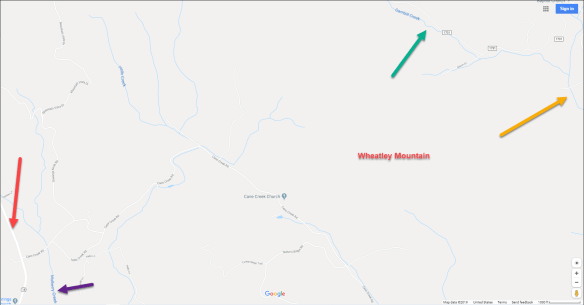
Michael McDowell Wheatley Mountain.png

On this map, we see Sparta road with the red arrow, Mulberry Creek with the purple arrow, Gambill Creek with green and the Reddies River with tan. Sebastian Road is just to the south as is Harrold Mountain.

Based on the various deeds and descriptions, Wheatley Mountain appears to be this piece of heavily forested land.

Michael McDowell Wilkes neighborhood.png

This aerial map of the entire neighborhood takes into consideration everything we know from the various deeds. Vannoy Road is in yellow at left. Michael’s neighbor was Andrew Vannoy.

Vannoy Road intersects with Sparta Road near McGrady and Jacob McGrady bought Michael’s land when he sold.

The Wheatley family owned land between Roaring River and the top of the mountain.  The mustard arrows at right track the West Fork of the Roaring River, with Gambill Creek shown in Green. The Gambills were Michael’s neighbors.

Harrold Mountain, towards the bottom, owned by John Harrold, adjoined Michael’s land on the waters of Mulberry Creek. Mulberry Creek, purple, tracks Sparta Road, red, all the way through the valley.

The grey arrow points to Sebastian Road near Harrold Mountain.

In 1810, we begin to see activity by the younger Michael McDowell, the next generation.

Feb 12, 1812 – Between Michael McDowell and Joseph Baker..$400…negro boy named Seaser, age 9. Witness James Waugh and R. Carson. Signed Michael McDowell, page 377

In both 1810 and 1813 a Michael McDowell purchases more land in Wilkes, including a one-acre lot in the town of Wilkesboro in 1813 (which was established in 1799). We don’t have records of the disposition of this land, but we know it can’t be Michael McDowell Jr., because he is in Lee County, Virginia in 1810.

Moving On to the Next Frontier

Yes, Michael McDowell Jr. moved once again, this time to the next outpost in the westward migration journey – Claiborne County, Tennessee on the Virginia border with Lee County.

MIchael McDowell Ivy to Slanting Misery map.png

Michael’s no spring chicken, and he’s starting over at age 63 in a place that can only be termed inhospitable.

Another chapter closes, and a new one opens. What lies ahead?

A place aptly named Slanting Misery.

______________________________________________________________

Disclosure

I receive a small contribution when you click on some of the links to vendors in my articles. This does NOT increase the price you pay but helps me to keep the lights on and this informational blog free for everyone. Please click on the links in the articles or to the vendors below if you are purchasing products or DNA testing.

Thank you so much.

DNA Purchases and Free Transfers

Genealogy Services

Genealogy Research

DNAPainter: Ancestral Trees

Ancestral Tree.png

DNAPainter has introduced a new feature, Ancestral Trees.

Ancestral tree fan.png

You can create a tree by hand or upload a GEDCOM file from your own software or one of the online vendors who support a tree export to a GEDCOM file, such as Ancestry or MyHeritage.

GEDCOM Import

As a longtime genealogist, I wanted to upload my GEDCOM file, because there’s absolutely no reason to recreate the wheel, or the fan, pardon the pun.

I’ve been building my file for decades, so it’s rather large, with over 35,000 people. Not all are ancestors of course.

If the upload process was going to choke on a large file, mine is a good candidate. DNAPainter indicates that files of 50,000 people or less shouldn’t be a problem. My file upload worked fine and took all of a couple minutes.

It’s worth noting that your GEDCOM file itself is not uploaded and retained. Only your direct line ancestors are extracted and uploaded to your DNAPainter account. You can read about options here.

Pedigree

A pedigree version of my direct ancestral tree appeared as soon as the upload completed.

Ancestral tree pedigree.png

By hovering over any person, you can perform a several functions.

You can delete the person, edit their information, add parents or mark them as a genetic ancestor by clicking on that box.

Ancestral tree options.png

What, exactly, is a genetic ancestor?

Genetic Ancestors

Genetic ancestors are people in your tree that are confirmed, genetically, to be your ancestors. For example, if you match a full first cousin on your mother’s side, that confirms your maternal grandparents as your grandparents.

Two pieces of independent data confirm that – your paper trail plus the fact that the first cousin matches you in the first cousin range.

Confirming ancestral segments, and therefore ancestors, is what DNAPainter does. DNAPainter creates a visualization of your chromosomes with the DNA segments you inherited from your ancestors painted on the appropriate maternal or paternal chromosomes.

Here’s an example.

Ancestral tree chromosome 22.png

All of the grey matches on my chromosome 22, above, descend from cousins who share ancestors Lazarus Estes and Elizabeth Vannoy with me. In addition, there are other matches painted as well who descend from other ancestors, such as their son, in addition to my painted ethnicity segments.

In the blue, grey and red match trio, we can see that the exact segment was passed from Elijah Vannoy and Lois McNiel to their son Joel Vannoy who married Phoebe Crumley whose daughter Elizabeth Vannoy married Lazarus Estes. We can track that segment back three generations with just this one example, plus the two generations between me and my great-grandparents, Lazarus Estes and Elizabeth Vannoy – for a total of 5 ancestral generations. Pretty cool, huh!

Use the Legend

When you paint chromosomes, you define ancestors to a color as you paint segments attributed to them.

You can view the legend of the ancestors you’ve painted – either all of them or divided into maternal or paternal.

Ancestral tree legend.png

Utilize this legend to mark the appropriate people on your Ancestral Tree as genetic ancestors.

Couple or Person?

You’ll need to make a decision.

Are you going to mark both people of a couple as your genetic ancestors when someone else that you match descends from this same couple, or are you only going to mark your descendant child of that couple?

Using the same example as the grey/blue/red trio on my painted chromosomes, I can see the pedigree descent, below.

Ancestral tree ancestors.png

If my initial match was to a cousin who descended through Lazarus Estes and Elizabeth Vannoy, I wouldn’t know which of those two ancestors actually passed the matching segment to my grandfather, William George Estes, then to my father and me.

Ancestral tree path.png

I know for sure I inherited the segment though William George Estes, but I don’t know if he received it from his father, Lazarus Estes, his mother Elizabeth Vannoy, or parts from both of his parents.

However, given that we are talking about only one segment at a time, it’s likely that the segment actually came from either Lazarus or Elizabeth, not a combination of both. But it’s not certain.

If I match someone on multiple segments, each segment has its own independent history. Multiple segments could have and probably did originate with different ancestors on up the tree.

Do I mark only William George Estes as the confirmed ancestor, or do I mark both Lazarus Estes and Elizabeth Vannoy as the confirmed couple?

Eventually, after I match more people, as shown in the chromosome painting, I’ll have evidence that this segment descends through Elizabeth Vannoy and her father Joel Vannoy.

Ancestral tree line of descent.png

Now I know that the segment descends from Elijah Vannoy and Lois McNiel, but until someone from either the McNiel line or the Vannoy line upstream match me on that same segment, or part of the segment, I won’t know whether that segment descends from Elijah or Lois or maybe a partial contribution from each.

Until then, I need to decide how I’m going to handle the designation of Genetic Ancestor – the couple or their child who is my ancestor. As long as you are consistent in your methodoloy and you understand your strategy, I don’t think there is any specific right or wrong answer.

Displaying Genetic Ancestors

After designating a person in your tree as a genetic ancestor, you’ll be able to select “Show genetic ancestors” from the DNA filters.

Ancestral tree filters.png

Your pedigree chart will show the black DNA icon for every ancestor that you’ve identified as a genetic ancestor.

Ancestral tree genetic ancestors.png

Next, you can view your Genetic fan chart.

Your Genetic Fan Chart

Ancestral tree fan option.png

By switching from tree to fan, you’ll be able to view your genetic tree in fan format.

Ancestral tree fan genetic ancestors.png

The darkened ancestral “squares” show the people you’ve indicated as genetic ancestors. The lighter colors are people in my tree, but not yet genetically confirmed.

My particularly problematic quadrant is the dark red one that also happens to include my mitochondrial DNA. Why is this line so lacking as compared to the others?

Ancestral tree descent.png

By flying my cursor over the ancestor on the tree that I want to see, DNAPainter tells me that the end of line ancestor in the outer band is Elisabeth Schlicht, born in 1698. I know immediately what the problem is, and why I only have a few generations confirmed.

Barbara Mehlheimer was the immigrant in the 1850s. None of the rest of her family came to America. Few if any of the family in Germany have tested. If they have, I don’t know it because either I don’t match them or they don’t have a tree.

That entire red quadrant beyond the 4th generation is partially identified in the German church records, but not (yet) genetically confirmed.

X and Mitochondrial DNA Paths

Another feature that you can select is to see the X and mitochondrial DNA paths.

Ancestral tree X path.png

The X inheritance path is shown above, and mitochondrial DNA below.

Ancestral tree mtDNA path.png

I discussed X matching here.

X DNA and mitochondrial DNA is NOT the same thing, although they both have a unique inheritance path. I wrote about X matching and mitochondrial DNA and their differences, here.

DNAPainter only shows that inheritance path. The genetic ancestor designation does NOT MEAN that the genetic ancestors on the X path are confirmed by the X chromosome, only that those ancestors are somehow confirmed – by you.

The mitochondrial path does NOT necessarily mean that that line is mitochondrially DNA confirmed – just that the line is autosomally confirmed, or not – depending on whether you checked genetic ancestor.

I, personally, am only using the genetic ancestor designation as autosomal, meaning chromosomes 1-22 AND the X chromosome. When I indicate that Edith Barbara Lore, who is my mitochondrial ancestor, is a genetic ancestor, I’m referring to autosomal confirmation, not mitochondrial.

I’d actually love to see separate Y and mitochondrial DNA confirmations – although I’m afraid it might be confusing to people. On the other hand, it might be a great teaching opportunity about Y and mito.

Another useful feature of DNAPainter is tree completeness.

Tree Completeness

At the upper right, you’ll see the option for tree completeness.

Ancestral tree completeness.png

By clicking, a new box opens with a list of ancestors that appear more than once in your tree – known as pedigree collapse.

Ancestral tree pedigree collapse.png

This was quite interesting. Fifteen are Acadians and 19 are Germans from multiple lines. the commonality is that all of these people hail from villages or geographically isolated regions where there isn’t a lot of population being added during the timeframe in question.

Not one repeat ancestor hails from colonial America, although I’d bet they exist in areas where these families lived in close proximity. Many records have been destroyed and I have lots of brick walls in those lines.

Ancestral tree identified ancestors.png

Scrolling on down the page, we see a report by generation of how many ancestors are identified per generation. I have identified all of my 4th great-grandparents, but only about 3/4th of the next generation. After that, the percentage drops roughly in half every generation.

Of the 4th great-grandparents, who lived 6 generations ago, (counting my parents as generation 1,) born in the mid-1700s, three women don’t have surnames and one is known only by her mitochondrial DNA results. I’m hopeful that one day, those results will lead me to her identity.

The Future

Jonny Perl has indicated that he’s working to integrate the genetic ancestor designation with the chromosome painting function, including colors. That will require more decision-making on the part of the user though, because sometimes the source of the segment isn’t clear, especially when families lived close and there are multiple possible paths of descend from multiple ancestors. And of course, there’s always the possibility of an unexpected parent or adoption thrown into the mix.

What does the user do when they have 10 cousins who match on a segment but conflicting information as to the ancestral source? When that occurs in my tree, I evaluate the evidence of each match on that segment and make an individual decision. Automating this process might be challenging, especially considering the situations of partial segment matches and endogamy.

While I wait, I’ll just revel in the nice dark colors on my ancestry fan tree and see what I can do to darken a few more of those areas by painting more matches.

Have you uploaded your tree and claimed your genetic ancestors? How are you doing?

______________________________________________________________

Disclosure

I receive a small contribution when you click on some of the links to vendors in my articles. This does NOT increase the price you pay but helps me to keep the lights on and this informational blog free for everyone. Please click on the links in the articles or to the vendors below if you are purchasing products or DNA testing.

Thank you so much.

DNA Purchases and Free Transfers

Genealogy Services

Genealogy Research

Lineage Societies: Requirements and DNA

I’ve been hesitant to rock this boat, hoping this ship would right itself, but I’ve decided that this vessel needs to be swayed a bit with the hope of providing encouragement and perhaps positive motivation for change.

Based on my ancestors, I qualify to join multiple lineage societies, including both the DAR and the Mayflower Society.

I checked the qualifications for both, and did not apply to the DAR, but did inquire about membership to the Mayflower Association for several reasons:

  • 2020 is the 400th anniversary of Plymouth Colony, meaning there should be lots going on next year.
  • I descend from Pilgrims; William Brewster, Patience Brewster, William’s wife Mary Brewster, Stephen Hopkins and Gyles Hopkins.
  • I felt that my expertise might be beneficial to the organization, in multiple ways, especially given the upcoming opportunities to recruit new members in 2020.

The first thing I ran into was a brick wall, not an ancestral brick wall, but an organizational one.

Birth Certificates

Lineage societies require your birth certificate.

Birth certificates are the most personal document you will ever have. Birth certificates are utilized for passports and are the premier document, meaning the most highly prized, for identity theft. Once compromised, you can never obtain a different birth certificate. It’s not like a credit card that you can cancel and have reissued.

Furthermore, you don’t actually need a birth certificate if you have tested the appropriate parent – and I have.

In fact, here’s my predicted relationship to my deceased mother at Family Tree DNA.

Lineage me mother.png

My mother is deceased, so her identity can no longer be compromized. I don’t have any problem providing her birth and death certificates in addition to an obituary that states that I’m her daughter – plus the genetic evidence of course. In fact, I could join the Mayflower DNA Project, and as administrators, they could see that relationship for themselves.

Furthermore, birth certificates are sometimes wrong – very wrong.

When Birth Certificates are Wrong

Birth certificates are wrong or misleading in the following circumstances:

  • People who are adopted and don’t know it
  • People who are adopted and know who their relevant biological parent is but have no access to a birth certificate showing their biological parents
  • People whose parent is not who they believe it is

In some circumstances, the child’s birth certificate isn’t incorrect, but the lineage may be incorrect when people’s ancestors beyond their parents are not the recorded individuals. Yes, I’m referring to the dreaded NPE, non-paternal event or not parent expected. You can read more about that here.

Aside from the issues above, there’s the issue of security when storing the birth certificate and privacy associated with the parents named on the birth certificate, especially if they are living.

Security and Privacy

Let’s take the issue of privacy first. Let’s say, for example, that an applicant’s parents weren’t married. The relevant parent is the applicant’s mother, not the father, so the identity of the father (or lack thereof) is irrelevant for lineage society membership.

The father’s privacy is compromised, along with the fact that the society now knows that the applicant’s parents weren’t married at the time the applicant was born. That’s entirely irrelevant to the application, and an invasion of the privacy of all 3 people involved.

Requiring applicants to submit a birth certificate, especially when genetic forms of identification are now readily available, forces the applicant to disclose information not relevant to joining a lineage society.

Frankly, anything beyond confirming an applicant’s connection to the relevant parent is none of anyone’s business.

Second, the applicant has absolutely no idea who is going to have access to their birth certificate in the future, once submitted, where it will be stored and security precautions taken, if any.

When inquiring about birth certificates at the Mayflower Society, I was told then are kept in locked cabinets but would probably be scanned soon.

While I’m sure this was supposed to make me feel better, it struck terror into my heart.

Often, organizations are slow to adopt technology as a whole, and when they do, they often aren’t aware of and don’t utilize safety and security precautions. Organizations owe it to their membership to stay current with security requirements and maintain up-do-date security measures. So, while I was already concerned enough about who has access to the filing cabinet key, I’m terrified about savvy hackers taking blatant advantage of an ill-secured or unsecured computer.

The sad part is that today, this is really a moot point because with DNA, many times we don’t need birth certificates for proof – and the only reason to continue doing what has always been done is ignorance, inertia and resistance to change.

Adoptees

Because birth certificates without genetic evidence are considered as the only accepted proof of a relationship to the applicant’s parents, this means that many adoptees have joined believing they are a linear descendant of the ancestor in question. Legally, they are.

Each organization needs to consider whether they want to honor linear paper descent as membership criteria or whether they are looking for linear biological descent. Or perhaps both.

Today, some adoptees who discover their biological parents would be eligible if they had not been adopted – but they are not eligible for membership because they don’t have a birth certificate with the biological parent’s name as their parent.

This creates an awkward situation, at best.

People who should be able to join, can’t, because of the birth certificate issue. And some people who are not biological descendants can join with no problem.

Is this the intention?

This is not small consideration. According to the University of Oregon, 5 million living people in the US are adopted, with 2-4% of all families having adopted, and 2.5% of children under the age of 18 being adoptees.

Y DNA

The DAR requires direct linear descent from a Revolutionary War Veteran. Like with the Mayflower Society, I won’t provide my birth certificate, so I’m not eligible to join.

The DAR has for many years accepted Y DNA at 37 markers as a portion of proof. According to this document, one close relative of the application must match the Y DNA of a descendant of an already “proven” patriot exactly at 37 markers.

This protocol is flawed in multiple ways.

Let’s say we have 2 men who descend from a common patrilineal ancestor, but we’re not sure which ancestor.

Today the Y DNA of these men matches at some level. STR mutations do not occur on a schedule and the reality of when/how often mutations occur varies widely. It’s certainly possible, and even likely, that in the roughly 9 generations, using a 25-year generation, since that patriot was born, that a marker mutation occurred. That would disqualify the applicant from using DNA evidence.

Conversely, if I’m a male Estes applicant and I want to apply to the DAR based on my descent from George Estes, my Y DNA may match the descendants of George at some level whether or not I’m descended from George or George’s brother, father or uncle. Y DNA really can only disprove a direct paternal relationship, not prove it.

In other words, there’s no or little analysis involved, simply a rule that doesn’t make sense.

Lineage chart

Click to enlarge

Let’s take a look at this example.

George Estes is the patriot, born in 1761. George had 3 brothers, Josiah, Bartlett and Winston.

George’s father, Moses II, had two brothers, John and William, who also had sons.

I’ve shown only one son’s line for both John and William, and I’ve named each man’s descendants the same name as his – for clarity.

John R. Estes, descendant of George was our original tester, and therefore, every other person who applies and submits Y DNA MUST match John R. Estes exactly at 37 markers.

George’s other descendant, George, comes along, but he does not match John R. exactly, having had one mutation someplace in the line between the patriot and George the tester’s birth. Therefore, George the tester’s Y DNA cannot be used – even though he is a descendant of George the patriot.

Based on my experience, it’s more likely that they won’t match at 37 markers, after 8 or 9 generations, than they will. That’s certainly the case in the Estes surname project.

In reality, in colonial families, everyone named their sons after their father, grandfather and often, brothers – so the names in all of these generations are likely to be the same, meaning John, William, George and Moses would likely be sprinkled in each generation of every line – causing confusion when attempting to genealogically connect back to the right Estes ancestor.

We see in our example chart, that by chance, William actually does match John R. exactly at 37 markers, even though George doesn’t. Therefore, if William was trying to use DNA to prove descent from George, even though that’s inaccurate, the Y DNA evidence would be allowed. So would Winston, descendant of George’s brother.

The only three that were accurate, based on the full 37 match rule is John, who does not descend from George, Josiah who was adopted and Bartlett who does descend from the same Estes line, but has too many mutations at that level to be considered a match to John R. Estes at all.

In other words, the only real descendant of the patriot is excluded, where 2 men not descended from the patriot would be included if they thought they descended from George.

Furthermore, one can be descended from George through a daughter and still qualify for DAR membership. If I believed, due to the Estes surname and other evidence, like a mention of a grandchild by name in George’s estate, that I descended from George’s son, but I actually descend through George’s daughter who was not married and gave her child the Estes surname – I would still technically qualify to join but the non-matching Y DNA would disqualify me today.

Another issue is if the original tester had been adopted or descended from a non-Estes male, every future tester would be compared to the wrong Y DNA and while the incorrect Y DNA would continue to be the reference sample for the patriot – even after it could be proven that was inaccurate due to multiple matching tests from multiple sons of George.

Rules without thoughtful analysis simply don’t work well. We know a whole lot more today than when these rules were put in place.

Parental Autosomal DNA is Definitive

Parental autosomal DNA is definitive unless you are dealing with an identical twin.

In addition to the actual match itself, you can see that parents and children match on the entire length of every chromosome.

Lineage parent child chromosome browser.png

Here’s my Mom’s chromosome browser match with me. There is no question that we are parent and child. Furthermore, looking at DNAPainter’s shared cM project tool, we can see that there is no other relationship that has the same match level as a parent/child relationship. My match with my mother is 3384 cM.

Lineage DNAPainter.png

Could someone go to a great deal of trouble to change a siblings name to their name or change their child’s name to their parent’s name to “fake” the identities of the people involved? Yes, they could if they had proper access to all accounts.

However, I can do exactly the same thing with a paper birth certificate, even with a seal.

My DNA test matching my mother, in conjunction with my mother’s birth and death certificates, in addition to her obituary identifying me as a child is about the most definitive evidence you could ever produce – far, far, more reliable than a birth certificate which would state that my mother is my mother even if I’m adopted.

This scenario works for adoptees as well in multiple scenarios, such as full siblings who clearly share both parents. In this case, if the non-adopted sibling is a lineage society member, then based on a DNA match at the full sibling level, the adopted individual should qualify for membership too. This isn’t the only example, just the first one that came to mind.

Thoughtful analysis and understanding of DNA is required.

Distant DNA is Not Black and White

While a parent-child autosomal relationship is evident, other autosomal relationships require analysis by someone experienced with that type of evaluation.

Furthermore, Y DNA can be deceptive as well, because the extent of what Y DNA can tell you is that two men descend from a common ancestor, not which common ancestor, nor how long ago, with very few exceptions. The exception would be when the actual Revolutionary War veteran experienced a SNP mutation that his sons have, but his brothers don’t.

However, no lineage societies that I know of utilize Y DNA SNP or even autosomal DNA evidence – even at the most basic level of parent/child.

With increasingly advanced testing, analysis versus line-in-the-sand rules needs to be implemented.

If lineage societies are going to utilize DNA testing, they need to stay current with technology and utilize best practices of genetic evidence.

Lineage Society Suggestions

Lineage societies need to re-evaluate their goals with applicants’ privacy and security in mind, in addition to how they can utilize genetic and other evidence to replace the existing birth certificate requirement – both in terms of traditional applicants like myself, as well as adoptees.

I have the following suggestions to be implemented as steps in a comprehensive solution:

  • Decide as a matter of policy whether applicants are allowed to join based on their paper trail descendancy, or their biological descendancy, or both. Paper trail only, meaning no additional evidence would be considered, would allow membership by children adopted into descendant families, but not children adopted out of descendant families. If genetic descendants are accepted, this allows children adopted out of descendant families to join once the relationship is discovered. If both types of membership are embraced, that avoids the issue of how to handle people who have already joined and subsequently discover they or their ancestors are/were adopted.
  • Determine the course of action when a line discovers that their Y DNA does not match that of the ancestor in question, especially given that the person could still potentially be a linear descendant through a female who gave the child her (the patriot’s) surname.
  • Obsolete the requirement for birth certificates at all when possible. If a DNA test proving a relationship can be substituted in lieu of a birth certificate, accept that as the preferred form of evidence.
  • Obsolete the requirement to physically submit any applicant’s birth certificate. Two individuals viewing a certificate with the relevant parent’s information exposed, and the non-relevant parent obscured, should suffice when no other avenue can be utilized. This eliminates the storage and privacy issues and requirements.
  • Implement a system that records the fact that current members and applicants have submitted a paper birth certificate that includes the parent of interest, then shred the existing birth certificates for anyone living. Without proof of death, this is presumed to be anyone under 100 years of age.
  • Allow additional proofs like parents’ obituaries instead of children’s birth certificates. This can easily be verified using publicly available sources such as Newspapers.com., etc.
  • Utilize Y DNA primarily to eliminate a line, and only when the descendants don’t match at 111 markers or are a completely different base haplogroup, such as haplogroup C versus R. Evaluate Y DNA matches along with other evidence, specifically looking for a mutation trail, if appropriate.
  • Remove the out-of-date requirement for future descendants to be required to match the Y DNA of an already “paper proven” ancestor. Paper can easily be wrong.
  • Revamp the DNA policies and procedures to incorporate qualified analysis. Provide guidelines instead of rules.
  • Retain a competent genetic genealogist to analyze applications that include DNA evidence, understanding that a CG, certified genealogist, certificate has no bearing on or evidence of the competence of that individual in DNA analysis. There is no genetic genealogy certification and many people who consult in the autosomal space are not experienced in the Y and mitochondrial DNA arenas.

The Alternate Future

Many older genealogical organizations are struggling for life. For the Mayflower Society, 2020 is a banner year. I hope they take advantage of the opportunity by not hobbling themselves with out-of-date requirements that are unnecessarily risky to applicants.

Younger people won’t join otherwise. Out of date and unreasonably burdensome membership requirements will cause membership to shrink over time until the organization shrivels and dies, going the way of the dinosaurs.

I would like to join multiple lineage organizations, but that won’t happen until the organizations update their policies to utilize widely and inexpensively available technology, along with associated best practices.

If you’d like to see these suggested changes implemented, and especially if you would be willing to help, make your voices heard to lineage societies, especially if you are already a member.

These organizations play an important role in the preservation of the records and information of our ancestors. I hope they choose to adapt.

_____________________________________________________________

Disclosure

I receive a small contribution when you click on some of the links to vendors in my articles. This does NOT increase the price you pay but helps me to keep the lights on and this informational blog free for everyone. Please click on the links in the articles or to the vendors below if you are purchasing products or DNA testing.

Thank you so much.

DNA Purchases and Free Transfers

Genealogy Services

Genealogy Research

Conferences: Different Flavors – How They Work & What to Expect as an Attendee or Speaker

As you’ve noticed, I’m sure, I sometimes speak at conferences.

Roberta speaking at conference.jpg

Not all conferences are the same – nor are they created equal for either the speakers or attendees. That’s by design, based on the type of conference and who is sponsoring the event.

How well a conference resonates with you depends on your personal goals and the goals of the sponsoring party.

Let’s look at the different factors that makes conferences unique – and interesting.

After we understand the different kinds of conferences, then we’ll talk about conferences from the speaker’s, and aspiring speaker’s, perspectives.

Last, we’ll review aspects you’ll want to consider when considering conferences as either an attendee or speaker.

Conferences Types and Sponsors

Conferences in general, not just genealogy, are sponsored by four types of organizations – each with different goals. We will look at each type in terms of organizations, sponsorship, speakers, expectations and fees!

Type 1 – Academic and Professional Conferences

Long before I spoke at genealogy conferences, I spoke at academic and professional conferences about technology and science related topics. These conferences generally focus on a specific theme. Example themes would be GIS (geographic information systems), medicine or a specific area of technology.

At academic and professional conferences, the speakers are paid by organizations that they work for, such as universities or companies associated with the subject. In other words, they are speaking as an employee, meaning they are paid by their employer and speaking is part of their job. Speakers at these conferences aren’t typically free-lancers, self-employed people or consultants.

In my opinion, this conference model is the origin of the myth that genealogical speakers only need to be offered a small honorarium, often in the ballpark of $100, instead of being “paid.” The conference committees were and are used to speakers who are paid by their employers and feel that simply being asked to speak is an honor in and of itself within your profession.

It’s a fine model for a group of speakers who are speaking as part of their paid employment, but not for people who aren’t.

In the genealogical world, people employed by vendors who speak fall into this category, but professional and non-professional genealogists who don’t work for a company that pays their salary are exceptions. People not employed by organizations are literally trading a significant number of hours of paid work for preparing their presentation, traveling and speaking – not to mention paying their own costs.

The conferences who subscribe to this model feel that the exposure to the public will build the speaker’s business, and while that’s true if the speaker has something to sell, like a book, it’s not true if the speaker already has a full calendar and the only thing they “sell” is services. In this second scenario, it actually costs the speaker to speak because they forego revenue.

Some speakers are retired from professions that offer pensions, so they aren’t trying to earn a living as a professional – but that’s far from true for everyone.

In terms of expectations, at a professional or academic conference, you can generally expect to hear a wide range of speakers including individuals who work for organizations other than vendors, academics, and of course vendors’ employees.

These professional conferences are generally run by professional or academic associations that are often nonprofit and charge a membership fee, in addition to a conference admission fee.

Their goal is usually not to make a profit but to cover the actual conference expenses. Some conference functions, such as lunches and a dinner, if offered, are usually extra.

Generally, the attendees’ and speakers’ conference fees, travel and expenses are covered by their employer, because the attendee needs to keep current in their field. Conferences of this type are considered part of continuing education and professional development.

Costs of Holding a Conference

For all conferences, venues and associated services, meaning food and beverages, prices are exceedingly expensive. For example, a conference center fee for water pitchers in a conference room is $55 per room for 5 gallons, plus an additional $35 for 3 additional gallons. Coffee costs over $100 per carafe. Of course, these costs include the people in the background delivering and coordinating.

The deposit alone for a conference expecting a maximum of 250 people was $28,000 last year. And that was just to reserve the facility. You get the idea.

Attendees often receive a “goody bag” with items contributed by the conference itself or vendors who would like for you to visit their booths and/or consider purchasing their products.

2019 familytreedna booth

Generally, associated vendors have paid booths or table space which generates some revenue for the conference itself. Sometimes booth space is purchased by location, with the largest, best and most expensive “premier” locations just inside the entrance to the Expo Hall.

At RootsTech, below, during setup before the conference opened, FamilySearch, the conference sponsor is in the center, just inside the door, flanked by MyHeritage to their left, and Ancestry, not shown, to the right.

Rootstech day 1 setup

The conference keynote speech is generally given by someone well known who is of interest to anyone in that particular field and is expected to be both informative and entertaining. Some keynote speakers, such as entertainers, are very pricey, in the 10s of thousands of dollars.

Type 2 – Vendor Sponsored Conferences

Vendors sponsor conferences to educate their customers and create goodwill in their user community.

These types of conferences highlight the vendor’s products and innovative ways to utilize those products.

You can expect to see several sessions about the vendor’s tools, products and services, including new announcements. You won’t see anything about competitors’ products.

Generally, there is an admission fee, but these conferences tend to be highly subsidized by the vendors and include events like receptions and often some included meals.

MyHeritage 2019 Gilad keynote.png

Photo of Gilad Japhet, opening MyHeritage LIVE 2019 in Amsterdam, courtesy MyHeritage.

A good example of this is the recent #MyHeritageLIVE conference in Amsterdam. Gilad Japhet, the founder and MyHeritage CEO is giving he opening keynote, above, at their second international conference.

At MyHeritage LIVE, the $149 conference fee didn’t begin to cover what the attendees received. For example, an included canal tour, a nice sweatshirt and stuff bag, a journal, a reception with drinks included, 2 lunches, several breaks with snacks and drinks and an amazing party with live entertainment including a “Beatles” band and Dutch folk dancers.

MyHeritage LIVE me with Marianne Melcherts.png

No, those people aren’t Dutch folk dancers, that’s me celebrating our shared Dutch heritage with Marianne Melcherts!

All of that’s in addition to the actual conference sessions with the best speakers in the industry, which is the actual purpose of the conference. You can see a quick one minute video, here, and free session recordings including the keynote, here. I covered the conference here and here.

Next MyHeritage LIVE conference – Israel sometime probably in the fall of 2020.

The annual Family Tree DNA International Conference for project administrators falls into the vendor sponsored category too and costs about the same.

2015 ftdna panel

Panelists, left to right, Katherine Borges, Steven Perkins, Dr. Tim Janzen, Jennifer Zinck and Debbie Parker-Wayne.

Above, Bennett Greenspan, Family Tree DNA CEO hosting a 2015 panel discussion and below, Bennett speaking about the Y DNA pedigree.

Rootstech day 3 Bennett Y pedigree

The next Family Tree DNA conference is scheduled for November of 2020 – next year. Their conference is focused on educating project administrators who are hightly interested genetic genealogists that function as volunteer supporters for their tens of thousands of cumulative project members.

Family Tree DNA has over 10,000 projects focused on a wide variety of areas, all of which are free to participants. I’ve always perceived their educational conference for (and restricted to) administrators as a form of an educational “thank you” for the many hours donated by administrators.

2015 ftdna 2004 bennett

The Family Tree DNA conference, the first in the genetic genealogy industry was initially held in 2004, back when NOBODY was talking about genetics at genealogy conferences. Katherine Borges of ISOGG provided this slide of Bennett welcoming project administrators at that first conference. We’ve come a very long way in the past 15 years as an industry.

Vendor-sponsored conferences often don’t have vendor booths or tables, and if they do, they are organizations that support or utilize the vendor’s products and tools. Sometimes the vendors themselves have support tables, roundtable discussions and such.

How individual vendors industrywide handle speaker compensation at their conferences for people outside of their organization varies widely. Speakers are generally personally invited to speak and there is no open call for papers at these types of conferences.

Vendor conferences are usually extremely affordable and represent a great value for the attendees because they are subsidized.

Type 3 – Organization Sponsored Conferences

Most genealogy conferences fall into this category.

2019 Rootstech sign

Some conferences are general in nature, such RootsTech (sponsored by FamilySearch affiliated with the LDS church) and NGS (National Genealogical Society.)

You can read about the history of RootsTech here. I covered RootsTech 2019 here and here and will be speaking at RootsTech 2020.

The current RootsTech information for February 2020 with earlybird pricing can be found here and for NGS in May 2020 here. RootsTech is always in Salt Lake City, and NGS 2020 is as well.

Other conferences focus on a specific theme, such as the DAR (Daughters of the American Revolution) conference.

In the genetic genealogy world, the i4gg (Institute for Genetic Genealogy) conference was launched a few years ago to focus specifically on genetic genealogy, which means they included sessions all the way from basic to advanced.

Today, almost every conference includes several DNA sessions and most include a DNA track.

Most general conferences focus on a wide range of topics. RootsTech, the largest conference with 30,000 to 40,000 attendees over several days (no they’re not all there at once) is a good example. You can find everything from how to use German church records to advanced DNA – and pretty much everything in between.

These conferences highly encourage vendor participation and have an exhibition hall.  Vendor tables and vendor sponsored sessions help to offset the cost of the venue and of speaker compensation.

Rootstech day 3 Charting Companion

Organization sponsored conferences generally tend to handle speaker compensation based on the old academic model. However, this isn’t always true and varies widely.

The reason that organizations tend to lean towards the academic conference model is a matter of dollars and cents – it costs less than paying a large number of speakers in addition to their transportation and lodging which keeps the conference costs lower, which in turn presumably encourages more attendees.

Part of their thinking is that the speakers, because they are interested in the topic at hand will be attending the conference anyway, so the organizers feel they are in essence only paying speakers for an hour of their time in a location where they would already be.

For the record, I disagree and feel that speakers, if they are not paid by their employer should be fairly compensated for their time and effort.

For attendees, due to the wide subject matter draw and size of these conferences, they are great for networking and meeting other people you may only know virtually.

You’ll also find all of the major vendors and many sponsor talks by well-known speakers and/or employees in their booths as well.

2019 ftdna booth presentation

Here’s me in the Family Tree DNA booth at RootsTech and Ran Snir speaking about DNA in the MyHeritage booth.

2019 MyHeritage booth

Nonprofit organizations that don’t have anything to sell, such as WikiTree, also have a presence and offer learning opportunities. Their booths are staffed entirely by volunteers, so stop by and say hello and learn what’s possible.

rootstech-day-4-wiki.jpg

In terms of expectations, these conferences are often large, which is both the good news and the bad news.

Sometimes the conference organizations themselves will sponsor free learning areas.

Rootstech day 2 discovery zone

There was even a DNA Basics area at RootsTech in 2019, staffed by volunteers. I’d volunteer for a shift there.

2019 DNAbasics

Another favorite conference is the entirely free Dublin, Ireland conference, Genetic Genealogy Ireland headed up by volunteer,  Dr. Maurice Gleeson and with the lecture rooms sponsored by Family Tree DNA. This lovely conference takes place in a conference center as part of the larger “Back to Our Past” conference with an admission to the entire conference center of about $10 per day.

Genetic Genealogy Ireland 2019 schedule.png

A wide range of speakers volunteer in order to support this amazing organization with something to offer everyone with Irish ancestors. GGI attempts to live stream and makes their sessions available on their own YouTube channel, here.

In 2019, the GGI conference takes place on October 18th and 19th in Dublin and I strongly encourage anyone in Ireland or Northern Ireland to attend. It’s well worth your time. You can see the speaker bios here on their blog and or follow them on Facebook, here.

Two new conferences in 2019, both in England, include RootsTech London taking place October 24-26 and THE Genealogy Show in Birmingham. Yes, there’s still time to sign up and attend RootsTech London.

THE Genealogy Show in June was a smashing success, according to attendees. While the initial conference was relatively small, about 4000 people, it was extremely well received. I heard glowing reviews and people really enjoyed the intimate atmosphere that included lots of wonderful sessions with well-known speakers from around the world.

THE Genealogy Show 2020 will be held on June 26-27 and you can take a look at the keynote speakers here.

Yes, you just might know someone who’s speaking:) I can’t wait!

Type 4 – Virtual Conferences

Entire virtual conferences as well as live streaming and recording sessions at regular conferences as they occur are becoming increasingly popular.

In fact, now there’s a Virtual Genealogy Association who has a full 3 day conference coming up in November – as in next month. Registration closes on October 18th and since there’s no travel involved, it’s an exceptional value at $59 for members and $79 for non-members.

Virtual Genealogical Association 2019.png

Choices of types of virtual learning for attendees not physically attending conferences vary, including:

  • Live webinars where viewers can interact with the speakers in some capacity. These tend to be purchased in advance, restricted in number and one must register.
  • Live streamed sessions where large numbers of people can watch as the sessions occur, or later. #MyHeritageLIVE did this in Oslo in 2018, recently in Amsterdam and the sessions were entirely free. RootsTech does live streaming and recording in some capacity for selected sessions. A few RootsTech sessions are live and free, some are available only for paid attendees and last year, a virtual pass was available. Some sessions aren’t recorded or livestreamed at all. NGS also records some sessions and provides them to members and conference attendees. Family Tree DNA doesn’t record but provides presenters’ Powerpoint presentations available online afterwards – if the presenter agrees.
  • Webinars where speakers create and record sessions for organizations in advance who then provide the sessions to members either by subscription, such as DNA-Central and Legacy Family Tree Webinars, or as individual purchases. Legacy Family Tree Webinars offers many for free.
  • Recorded sessions available to purchase. This model varies, but several conferences record sessions and make them available later in some way to be viewed. Often conference attendees are provided access either free or for a minimal cost so they can “attend” sessions that conflicted with other sessions during the actual conference. Non-attendees can pay for the entire set. As a speaker, it’s easier to participate in this type of venue because you’re not traveling. On the other hand, for speakers, it takes some adapting to be able to present looking at a screen when you’re used to looking at a crowd where you can see reactions.

Speakers are often compensated better for these types of sessions than at the large conferences. Again, your mileage may vary.

Ummm, YouTube

When you attend sessions of speakers who have been selected to speak at conferences, virtually or in person, generally, they are competent, capable and engaging.

Some vendors and organizations make their videos available on YouTube and that’s great. Some of these same speakers do the same – and that’s wonderful too.

However, other not-so-competent people produce a wide variety of “informational videos” which range from wonderful to highly inaccurate. The consuming public has no way to differentiate between an informed specialist and a crackpot, or anything in-between. Including less than upstanding companies.

Same caution for Facebook and social media. There’s no way to discern the difference between 20 bad, incomplete or incorrect answers and the one that is perhaps unpopular, but accurate😊

Consumer beware.

Speaker Compensation, Considerations and Expectations

Lots of people aspire to become speakers at conferences and would like to know how this works but are just too polite to ask. So I’m just going to tell you.

  • Public Speaking

First, you need to be comfortable in front of people. Audience sizes range from a few at local events, to hundreds at state and regional events, to thousands at national conferences.

2019 ballroom b

Here’s a photo of a portion of one of the medium sized rooms at RootsTech. Hint – they look even larger from the front – where the speaker is standing – and the room is often dark so the speaker can’t see the entire audience. In other words, it’s a kind of endless, dark sea.

People will be coming and going, so speakers need to be well-prepared, confident, not easily distracted, able to handle technical glitches and not subject to stage fright. Also, bring your magic wand.

  • Compensation

At various conferences, there’s a wide range of speaker compensation and packages offered, from nothing to significant. Let’s face it, there’s a huge difference between Donny Osmond and performers who would be of interested to many and comfortable on a huge stage, and an unknown speaker.

Rootstech main stage.jpg

If you’re interested in speaking, watch for the various conferences’ “call for papers” or “call for sessions.” That’s code for submitting your ideas and applying to speak at their conference. When submitting proposals for sessions, focus on the theme of the conference, don’t duplicate what other speakers are offering and look for a unique topic or angle.

If you’re not used to public speaking, you can hone your skills, and presentations, at local events.

Some conferences, large and small, where it’s perceived that the speaker will be attending anyway offer honorariums in the range of $100 per session and sometimes one night paid hotel per session presented at the conference. Generally, but not always the speaker’s conference entrance fee is waived too. If you are actually going to attend the conference anyway, and want to contribute, this is a good way. It’s also a great way to break into the speaking circuit and get your name out there.

If you’re an experienced speaker, these conferences aren’t terribly attractive unless you actually are planning to attend or have something to sell, such as books or subscriptions to your website. In other words, speaking can be great for sales – but it’s an opportunity, not a guarantee.

For better-known high-visibility speakers who are not necessarily going to be attending a conference unless invited to speak, compensation is individually negotiated and generally includes full travel, lodging and expenses in addition to a speaking fee.

Nationally known speakers often, but not always, fall into this category.

For example, to the best of my knowledge, other than the keynotes, RootsTech pays all speakers the same which is an honorarium, one night’s hotel for each session, plus a ticket to the conference is included. There are some other perks too, such as a speaker prep room with drinks and snacks (chips, etc.) where speakers can find relative peace and quiet for a few minutes.

“Famous people” such as the RootsTech keynote speakers are in another compensation category altogether and I’m not privy to that information. Most people at the level have agents who negotiate on their behalf.

Some organizations pay residual royalties for your sessions if people purchase them during or after the conference.

The bottom line about compensation is that your mileage will vary, widely, and it’s up to each person to decide what is and is not acceptible.

Dear Myrt recently wrote about why organizations need to pay speakers well, and included lots of really great suggestions for organizations, especially nonprofits, that need assistance with fundraising.

  • Copyright

Copyright is another matter that speakers need to consider. You may or may not retain full copyright to your material. Read the speaker contract carefully. I declined an opportunity through a university where the contract specified that they, the university, retained copyright of my prepared material. I had spoken there previously and the contact was different at that time. The new contract also specified that I was responsible for my own hotel, which meant that in essence, I was speaking for free AND driving a (long) day each way, plus preparation for the privilege. Needless to say, that didn’t happen, and the university was insulted that I wasn’t simply honored enough with the invitation to accept.

Also consider that if your session is provided to the public for free that other venues might not be anxious to hire you for that same session. Once content is freely available, other people aren’t likely to want to pay for the same session and you’ll need to come up with something new for future conferences and speaking engagements.

  • Photography in Sessions

As a speaker, you may or may not be required to include specific slides forbidding picture taking during sessions. This is a result of conferences attempting to be respectful of copyrighted material and making attendees aware of same.

If you are not required to add this slide, you need to think about what you will and will not allow in your sessions, and how to handle the situation if you have a rule breaker in the audience. Some conferences monitor rooms for this occurring and will deal with it so that speakers don’t have to.

As a rule of thumb, vendors LOVE it when you take pictures, because sharing on social media equates to free advertising, but private speakers don’t. I always ask if there is any question.

I generally don’t mind occasional photos, BUT, not of every slide. I have had the situation occur where someone literally copied all of my slides’ content and recreated it as their own. Some people feel speakers are inflexible and unreasonable about photography, but after incidents like this, I’m sure you’ll understand why speakers who invest years becoming educated and maintaining that level of education and days preparing (often for minimal compensation) don’t want their work infringed upon and abused. Most people wouldn’t even think of doing that, but unfortunately, we have to prepare for that possibility.

  • Photography of You

You’ll also need to decide if you’re going to allow people to take photos of you in social or classroom situations and post to social media so long as it’s handled tastefully. In other words, no hating on me by using my photo that I allowed in good faith. Most people at conferences understand that photos may very well be posted on social media and are fine with that.

2019 blogger photo

This picture, taken by Daniel Horowitz of a group of bloggers at the Family History Library, that he gave me permission to use in my blog article, shows me giving out my very first DNAeXplain ribbon that I had made specifically for RootsTech 2019. What great memories with my blogger friends – one of whom 7 months later recognized me passing by walking on the street in Amsterdam. Small world!

  • Evaluations & Feedback

As a speaker, you can expect to be evaluated. Not all evaluations are wonderful. There is almost always a “grouchy” person, so if you’re super sensitive – public speaking might not be for you. (Hint – humor is not universal. Do not joke about your bigamist ancestor in Salt Lake City, even if he wasn’t Mormon😊. Trust me on this.)

You may or may not be provided with the feedback. There are sometimes very good suggestions. Other times, not so much. I’m sometimes left wondering why an attendee downgrades a speaker, complaining that the session wasn’t advanced enough when it was described as introductory, or vice versa. Many things, such as audio quality in a room, are beyond the speakers’ control, but the speaker’s ratings will suffer because of it.

One conference pays an honorarium-size bonus to speakers who rank over a certain score – as if to infer that the speakers would do less than their best without that small financial incentive. I don’t think for one minute that’s true.

What Do Conferences Expect of Speakers?

Most of the time, other than a few specifics, there isn’t a universal list of speaker expectations. However, I’m sharing based on my own experiences. Your experience may vary and other speakers may have other items to add.

  • Speakers are expected to create a Powerpoint presentation, sometimes in a specific format, screen size, fonts or using a specific template.
  • Speakers are expected to have practiced the presentation and both fill and limit themselves to the time allotted. This takes practice and fine-tuning the presentation. Rule of thumb is 1 slide every 2 minutes.
  • Speak slowly and clearly. People tend to speed up and sometimes mumble when they get nervous.
  • More graphics, fewer words, high contrast, large font. I never use below 24 and generally larger.
  • Speakers are expected to have a remote “clicker” and may or may not be expected to use their own laptop for the actual presentation. Speakers may also be required NOT to use their own laptop, so should at least be marginally comfortable with other technologies, such as both MACs and PCs.
  • Your room size with multiple screens may preclude you from using a laser pointer, so don’t depend on that feature.
  • As a speaker, you will need to have a backup (thumb drive) and a backup of the backup, preferably someplace online and accessible remotely just in case. Yes, I’ve needed both.
  • You will probably be expected to show up for a brief practice session that includes a technical dry-run to be sure your laptop is compatible with everything. In cases where you aren’t using your own laptop, then you’ll need to practice with the system in use.
  • You will be expected to provide adapters (dongles) and conversion devices. For example, different kinds of video in and out cables.
  • If you want to utilize the internet, this will require special planning and arrangements, and I highly discourage this practice. Utilize screenshots. Wi-Fi is unreliable and Murphy, guaranteed, will visit you. Voice of experience here.
  • You’ll be expected to utilize some type of screen capture software that is of a higher quality than “print screen” when creating your slides. I use Snagit. It’s not free but works wonderfully and has both mark-up and blur features.
  • You will be expected to be sure that your images are copyright-free and if you use other people’s or company’s images, you have permission to do so. This isn’t just a courtesy, as some media companies specifically target infringers for compensation in the thousands of dollars if you’ve used their images without permission or payment.
  • You will be expected to obscure/blur names and identifying information of any examples you use unless you have obtained permission from that person. I generally obscure anyway because I don’t want anyone thinking I’m remiss even when I have permission. It’s just easier.
  • You may be expected to provide your own projector (NGS) which is an archaic practice at best. Projectors are not inexpensive and are deal-breakers for many speakers. Projectors are available to rent from hotels but rentals are often as expensive as simply purchasing a projector. In my opinion, all conferences should rent or own enough projectors to accommodate all rooms utilized simultaneously for speaking, plus at least one spare – because Murphy.
  • You may be expected to provide a syllabus several weeks or months in advance, in a very specific format or template. (This is my least favorite part of speaking.)
  • You will be expected to provide promotional information in advance, generally including a summary, a brief bio, a larger bio and at least one professional quality photo.
  • You may be encouraged to or conversely forbidden from mentioning your own items for sale, such as books. You may be discouraged or forbidden from mentioning your website even if nothing is for sale. Know the expectations in advance.
  • You may be encouraged by the conference to include links or relevant references to articles you’ve written on your free website, then be criticized in the speaker rating for doing so. Or vice versa.
  • Creating a session for a conference, including research, Powerpoint and graphics, and the syllabus will take approximate a week of your time for each one-hour session and that’s assuming you already know your topic well. If you can utilize the same presentation again, the up-front “cost” may be an investment for you. However, keynotes and high-visibility speakers as well as speakers for national conferences are expected to have fresh, up-to-date content customized (at least minimally) for each organization.
  • Speakers are expected to be available for questions – if not during the session, then sometime during the conference.
  • Speakers are expected to mingle with other conference attendees at least part of the time. Exceptions to this would be “famous people,” such as RootsTech keynotes that aren’t connected to genealogy. If you’re not Donny Osmond, you’ll be expected to make yourself available. Of course, most of us would be mingling regardless. What better way to meet new friends and cousins? I can’t tell you how many people I’ve discovered I’m related to at conferences in general conversation.
  • Dress and act professionally. For example, do not show up in a t-shirt and flip-flops unless it’s part of a “costume” that goes with the topic of your presentation.

Jedi me.jpg

Yes, I confess, the rumor is true, I once appeared as a “Jedi,” complete with surprise lightsaber at the appropriate moment. But I had a great reason!

Jedi presentation.jpg

That session, completely custom, was so much fun! But was I ever nervous. It was a bit of a departure from the norm.

Courtesies

I only speak at a limited number of conferences per year, so I do provide an announcement on my blog that I’m speaking for an organization. Not everyone has this ability, but it’s something I feel I can provide as a service to both the organization and my readers because I limit my speaking engagements to 4 or 5 per year and no more.

Speakers should never be expected to stay in private homes, marginal areas, or in hotels that are less than “Holiday Inn” level accommodations. If there is a conference hotel, the speakers should expect to stay in that hotel.

Check with the organization to make sure you know who is supposed to make your reservations (you or them), and when, and obtain a confirmation number. Nothing worse than showing up to a booked hotel, insisting you have a reservation that someone else supposedly made.

Considerations

Here are several things to think about, both when selecting a conference as an attendee or a speaker.

  • Networking

For me, the best part of conferences is networking. I love meeting people, many of whom I only know online.

People, like you, who follow my blog.

People who don’t.

People I “know” on Facebook.

People who are distant cousins.

Serendipity!

In 2019, in Salt Lake City, I accidentally met Myrt and wound up on her show while researching at the Family History Library, before 2019 RootsTech. Beside Myrt on the right is Luana Darby who is the conference chair of NGS 2020. All I can say is bless Luana’s heart, because I chaired one national conference and it’s something I’ll never do again.

2019 me with Myrt

I can’t tell you how many times I’m chatting with someone and we discover that indeed, we are related or we have a DNA match that needs to be explained. That happened right after the Myrt session, at lunch, with Cheryl. Serendipity!

Conferences and speaking are very rewarding experiences – even if you’re not a speaker or don’t attend a lot of sessions at the conference.

The key to having an enjoyable experience is to understand your goals and evaluate the conference in light of those goals.

For example, I don’t feel I need to attend sessions all the time. I select a few that are of particular interest to me and schedule those in my phone. I like having the option of recorded sessions later for viewing at home.

What I really enjoy is to visit with people, check out vendors’ booths, see demos and learn from other conference attendees. That I can’t do at home.

  • Venue

For both speakers and attendees, location can be very important. I only speak at 4 or a maximum of 5 conferences per year. My goal is educational outreach, so I want to reach as many people as possible. For me, this generally means larger conferences and often keynotes.

I confess, I decide which conferences I’m going to attend based on the following criteria, in no specific order – in fact, the order may change based on the attractiveness of the offer. This criteria is probably equally as important to attendees.

  • Schedule

I have not yet cloned myself to be in two places at once and I will not back one event up to another. Been there, done that, won’t do it again. Jet lag is miserable.

  • Lead Time

I book about a year in advance, sometimes more. Many speakers do. As an attendee or a speaker, if you want to attend a specific conference, register early and book at the conference hotel before the reduced rate conference room block is sold out.

  • Location, Location, Location

If a conference is occurring someplace I want to visit, I’m much more likely to be interested. For example, I just spent the week after the MyHeritage conference traveling in the Netherlands with my friend, Yvette Hoitink, Dutch genealogist extraordinaire.

I have three separate ancestral lines that lived in the Netherlands and I love to walk where my ancestors were born, lived, married, worked and died. I also love to meet my cousins and I met 8 Ferverda (Ferwerda) cousins. Pure bliss!

I’m not including a shameless list of places my ancestors lived that I’d like to visit😊

There are more locations than I could ever visit in my lifetime, as well as a few bucket list locations that I’d like to visit where my ancestors inconsiderately didn’t live.

As a genealogist, I’m sure you have a “genealogy location bucket list” too.

  • Topic

Some topics interest me much more than others. I love teaching about all aspects of DNA, but one of my favorites is how to utilize genetic genealogy to identify Native American ancestors.

This fall, in addition to a Native American session, I’m keynoting about the Lost Colony of Roanoke in North Carolina for the North Carolina Genealogical Society right after a documentary about the Lost Colony is released. (More about that documentary in a future article.)

I’m also attending and keynoting at an Archaeogenetics and Genetic Genealogy conference at the University of Umea, Sweden in November. Ancient DNA is fascinating to me, and I really wanted to attend this conference, so I welcomed the invitation to keynote. And no, I have no ancestors from there, at least not that I can individually identify, although clearly my mitochondrial DNA line originated in Scandinavia before being found in Germany in the 1500s.

Find topics that you love in places you want to visit.

  • Exposure

Given my personal goals of reaching a large number of people relative to utilizing DNA for genealogy, organizations that have large audiences and/or that include livestreaming, webinars and other outreach activities are generally more attractive to me – while the opposite may be true for other speakers who don’t want their sessions to be widely shared.

  • Compensation

I’m human and I want to be paid fairly for my time. I can stay home and enjoy a full consulting schedule without speaking, or I could do genealogy or quilt – my other loves.

Unfortunately, hours and minutes are like money and we can only spend them once and then they are forever gone. For most in-demand speakers, speaking is something we enjoy, not something we do to get wealthy. I have yet to break even for the hours I would have otherwise worked – which is another reason why I limit my conference speaking to 4 or 5 per year, max, at places I want to go or conferences I want to attend.

I think of this as ying and yang.

  • Convenience

I actually don’t like to fly, at all. I do it anyway, sometimes. However, two transfers to get from where I live to the conference venue probably isn’t going to be attractive to me unless I really, REALLY want to go there. Three is a deal-breaker.

You may feel exactly the opposite. Fortunately, there’s a lot to choose from today.

Most of All – Have Fun!!!

I hope this article helps you understand the lay of the land relative to conferences both as an attendee and as a speaker.

  • If you’re looking for a specific topic, consider joining or following an organization that specializes in that topic.
  • If you’re looking for a general conference, consider some of the larger regional or national conferences.
  • If you’re looking for something that doesn’t require traveling long distances, monitor local, state or regional groups along with virtual conferences.
  • If you’re looking for something entirely online, consider the Virtual Genealogy Association, Legacy Family Tree Webinars or the recorded sessions from other conferences such as Genetic Genealogy Ireland on YouTube.
  • If you’re looking for a low-cost conference but still with high quality speakers, consider the subsidized vendor conferences or the virtual conferences.
  • To familiarize yourself with these groups and conferences ahead of time, join the organizations, follow the them on Facebook, subscribe to their blogs or bookmark their webpages.
  • If you’d like to attend the Family Tree DNA conference, which tends to focus on science along with Y DNA and mitochondrial DNA in addition to autosomal, volunteer as an administrator for a project of interest to you, or start a project if one doesn’t exist. Does your surname appear on the search page, here or half way down the main page, here.

We have more quality opportunities for genealogy and genetic genealogy education today than ever before.

______________________________________________________________

Disclosure

I receive a small contribution when you click on some of the links to vendors in my articles. This does NOT increase the price you pay but helps me to keep the lights on and this informational blog free for everyone. Please click on the links in the articles or to the vendors below if you are purchasing products or DNA testing.

Thank you so much.

DNA Purchases and Free Transfers

Genealogy Services

Genealogy Research

Charles Campbell (c1750-c1825): Unique Y DNA Chips Away at Parental Brick Wall – 52 Ancestors #256

I’ve been struggling for years, decades actually, to identify the father of Charles Campbell of Hawkins County, Tennessee. We’re finally making progress by combining family oral history with traditional records research, Y DNA, and the process of elimination – thanks to a combination of people.

I think you’ll find the twists and turns in this journey interesting. It sure has been enlightening!

Thank Goodness for my Campbell Cousin!

Recently, my Campbell cousin agreed to take a Y DNA test.

He descends from my John Campbell through son William Newton Campbell whose line migrated to Texas. William died in 1908 in Davidson, Oklahoma.

Charles Campbell testers.png

Sadly, both earlier testers from the Charles Campbell line have passed away, so their Y DNA tests can’t be upgraded. My Campbell cousin represented by kit 905207 has been the critical link in what I think might just be a chink in the long-standing brick wall of Charles Campbell.

And if it isn’t THE chink, it’s still chipping away at that wall.

Who Were Charles Campbell’s Parents?

Charles Campbell was in Hawkins County in 1788, in what would become Tennessee in 1796. He may have been in Sullivan County as early as 1783.

The people who settled in this part of eastern Tennessee, and specifically in the neighborhood along Dodson Creek where Charles Campbell owned land and lived most of his life arrived in what is known as the Rockingham migration.

In fact, this 1784 tax list from Rockingham County, VA shows several people who were Charles Campbell’s direct neighbors in Hawkins County, including Michael Roark whose property abutted Charles’. In addition, the Grigsbee (Grigsby) family is found nearby as well as the Kite family whose property is just down the road beside the Louderbacks.

Charles Campbell 1784 Rockingham.png

However, looking on the 1782 tax list for Rockingham County doesn’t show Charles Campbell who was having children as early as 1770, so was assuredly an adult on personal property tax lists, someplace, by 1782, assuming he wasn’t in a wagon on his way to the next frontier.

Note that Lexington, Virginia, now in Rockbridge County, but then in Augusta County, is on the same migration path down the Shenandoah Valley – the only reasonable path from Rockingham County to the area on Dodson Creek just south of Rogersville, Tennessee.

Charles Campbell Rockingham to Rogersville.png

It’s 72 miles from Rockingham to Lexington. You have to go through Rockbridge County, on the main road at that time, to get to east Tennessee from Rockingham County.

We know, from deeds, that Gilbert Campbell lived on the main road, a location at the ferry where travelers would stop to rest, and talk, and discuss the new frontier where land was available for the asking.

This is most likely the path that Charles Campbell traveled in the 1780s. But where did he come from, and who were his parents? Is there any way to make that discovery?

Y DNA Matching

Our Campbell tester matches both of the earlier two descendants of Charles Campbell, as expected, but there’s another person that this group matches as well.

At 111 markers, my cousin matches a descendant of Gilbert Campbell who wrote his will in 1750 and died in 1751 in Rockbridge County, VA.

Charles Campbell match.png

Looking at the Campbell DNA Project, the Campbell men are part of the HUGE group 30, compromised of many, many Campbell descendants. However, look at who kit 81436, a descendant of Charles through son George, matches most closely.

Charles Campbell Gilbert match

Click to enlarge

Yep, Gilbert again.

The Campbell Article

All I can say is that I’m extremely grateful for the Campbell DNA Project at Family Tree DNA, because without this project, and project administrator Kevin Campbell, this brick wall wouldn’t even be threatened.

Kevin along with James A. Campbell wrote an article that was published in the Journal of the Clan Campbell Society (North America) Vol. 43, No. 2, Spring 2016.

To set the stage, two groups of Campbell families settled in Augusta County, VA in the late 1730s as land became available in the Borden tract. Both groups had as their progenitor a man named Duncan Campbell, born in Scotland. No confusion there, right?

One Duncan moved to Ulster County, Ireland and died. His descendants immigrated into Pennsylvania in 1726, then on into Augusta County about 1738, according to the article’s endnotes.

This is the group, shown along the South River where the green arrows point, that our Campbell line matches most closely.

The Tinkling Spring Church, the first formed in the area is shown as well. For many years, the minister baptized children in homes because either a church building didn’t yet exist or was too distant. He baptized Gilbert’s son, Charles, in 1741.

Charles Campbell north and south.png

The second Campbell group, shown in red, settled along the North River in present-day Rockingham County, about 15 miles north of Staunton, then Orange County where we find a description of a deed in 1745. This family’s oral history relates that their ancestor, also Duncan Campbell, never left Scotland before immigrating to the colonies.

The red line is unquestionably not our line.

Gilbert Campbell’s land was located in present day Lexington, further south yet.

In the article, Kevin describes how he determined that the Campbell families of Southwest Virginia, specifically Augusta County, are actually two separate Duncan Campbell lines of Campbell men. This doesn’t mean they are unrelated historically, but it does mean their common ancestor is many generations in the past.

Thankfully, the 2 lines have developed enough mutations over time that patterns exist in both lines that set them apart from each other.

Let me review the relevant portions of the article that are pertinent both geographically and historically, as well as genetically.

This excerpt is indeed exactly how I feel about my Charles Campbell.

“Just looking at land transactions involving Charles Campbell from 1740-1770 in Augusta County and lands just south of Augusta County was disheartening. How many Charles were there? How did they relate? One needed a genealogical chart just to map Charles Campbell.

Who was, or were, Charles Campbell of Augusta County?”

The researcher who said that was Catherine Bushman who reported that there were two Charles Campbells in Augusta County in the 1740s on to past mid-century. One Charles Campbell was found on the North River who held land with Hugh Campbell at Mount Crawford. A second Charles was found on the South Shenandoah River who had multiple, sizeable land holdings. These men lived 20 miles apart.

But neither of these men can be our Charles, because our Charles died about 1825, so he would not have been alive and owning land by 1740.

But still, we have two adult males named Charles who might be the parents or relatives of my Charles. Unfortunately, neither of them appear to live in the green group.

The DNA of the North and South Augusta Campbells

Kevin compared the DNA of several males who are proven to descend from the North and South Augusta County Campbell lines.

On all 10 differentiating markers that form the signatures of the North and South groups, our Charles Campbell men match the South Campbell group, meaning that our Charles Campbell group is more closely related to Duncan Campbell whose descendants lived along the South River – the descendants of “White David” Campbell and his brother Patrick Campbell.

“White David” and Patrick were the sons of John Campbell and Grissel “Grace” Hay, who was reportedly the son of Duncan Campbell and Mary McCoy.

To the best of our knowledge, neither of these families had a Gilbert. Who was Gilbert?

Gilbert Campbell

The descendants of Gilbert Campbell have another defining group of markers that are only found among this group.

Charles Campbell Gilbert markers.png

While all of the testers have tested at marker CDY, only three have tested at markers DYS710 and DYS510. The other two yellow men are deceased, of course, but it’s very likely they would match kit 905207 given their proven line of descent.

The only close Campbell line matches who carry these markers are our three men and the descendant of Gilbert plus an unidentified William born in 1750 in Virginia and died in Alabama. The closest is Gilbert and he’s in the right place at the right time.

So, where did Gilbert Campbell live and what do we know about him?

I reached out to Kevin Campbell again, and he provided what he could. There isn’t much known, but combining what he provided with what I found elsewhere, there is at least something.

Gilbert lived in the right place at the right time, in what is now Lexington, Virginia, located in Rockbridge County.

Gilbert Has a Son, Charles

Perhaps the single most exciting piece of evidence discovered about Gilbert Campbell, in combination with his location, is that he had a son named Charles.

In the book Tinkling Spring, Headwater of Freedom, A Study of the Church and her People 1732-1952 by Howard McKnight Wilson, published in 1954, we discover the following:

Page 73 – The location of this road is shown at strategic points on the original map of Maryland and Virginia made by Colonel Joshua Fry…and Colonel Peter Jefferson…in the year 1751. Leaving Philadelphia, the road went through the present location at Lancaster, PA turned southwest and crossed the Potomac at Williamsferry (now Williamsport, Maryland) and continues south by the present site of Winchester, VA. It kept to the east in the Shenandoah Valley, then down Mill Creek and across North River of the James at Gilbert Campbell’s Ford, and on toward Roanoke, turning southward just west of Tinker’s Creek on the outskirts of the present city of Roanoke.

Page 74 – Orange County, VA court order dated May 23, 1745, the Augusta County people were authorized to make the first improvements upon this road, where it fell within the bounds of the new county. Report of the commissioners is as follows: …Inhabitants between the mountains above Thompson’s Ford and Tinkling Spring do clear the same and the said road continue from Tinkling Spring to Beverley Manor line and that Patrick Campbell, John Buchanan and William Henderson be overseers and that all the inhabitants above Tinkling Spring and Beverley Manor line do clear the same and that the said road continue from Beverley Manor line to Gilbert Campbell’s Ford on the north branch of the James River and…that the road continue from Gilbert Campbell’s Ford to a ford a the Cherry Tree Bottom on the James River…and that a distinct order be given to every gang to clear the same and that it be cleared as it is already blazed and laid off with two notches and a cross…dated April 8, 1745.

Page 471 – Record of Baptisms by Reverend John Craig. Charles Campbell, son of Gilbert Campbell, October 15, 1741, at the house of Gilbert Campbell on the North Branch of the James River.

Woohoooo – look at that!!!

What other records exist for Gilbert and his wife?

In the Scotch-Irish Settlement in Virginia by Lyman Chalkey, Volume 1, page 27, we discover what was surely the high drama soap-opera of the day. Everyone who could possibly attend court would have, and those who couldn’t surely waited anxiously for the sound of hoofbeats upon the road – the first person to return so they could hear what had happened.

Charles Campbell Gilbert 1747.pngCharles Campbell Gilbert 1747 2.png

Of course this begs the question of the identify of Mary Ann Campbell, and was she related to Prudence in some fashion? Unfortunately, Mary Ann is still anonymous, but we do have information on the immediate family members of Gilbert, and she’s not a daughter.

Gilbert Campbell’s Family

The family group sheet provided for Gilbert Campbell by the Clan Campbell Society provides the name of the wife and children of Gilbert. Gilbert’s wife was named Prudence and is reported with a surname spelled both Osran and Puran (Chalkey pages 19 and 22), in Augusta County Court records and elsewhere as Osmun and Ozran. Prudence died before March 16, 1768. The society lists their marriage as having occurred in Pennsylvania, but the source is not mentioned, with information as follows:

Gilbert died before February of 1750 (old date, 1751 new date.)

  • Son James born about 1734 in Ireland, married Elizabeth.
  • Daughter Elizabeth born about 1736 in Ireland, married a Woods.
  • Daughter Prudence born about 1738 in Ireland, married a Hays.
  • Daughter Sarah born about 1740 in Virginia.
  • Son George born October 21, 1740 and died on February 7, 1814, both in Augusta County. Married in 1765 to Agness McClure 1746-1797.
  • Daughter Lettis born in 1743 in Albemarle County married John Woods. (Note that if George was born in Augusta County in 1740, it’s unlikely that Lettis was born in Albemarle.)
  • Charles Campbell born in 1741.

If their date for the birth of Gilbert’s son, James, is accurate, he cannot be the father of our Charles who was born before 1750, based on the dates of the births of his sons. How the society estimated the date of James’ birth is unknown.

Land

In 1742, Gilbert purchased 389 acres of land in the Borden Tract (Forks of the James River, now in Rockbridge County,) from Benjamin Borden for 11 pounds, 13 shillings, and 4 pence. The Crossing of the North Fork of the James (now Murray) River was known as Campbell’s Ferry. Roughly a decade after building his home, Gilbert died. According to Chalkey, persons owning land adjacent to Gilbert’s were John Moore (Chalkley, v3, p263), John Allison (ibid, p. 267-8), Robert Moore (ibit, p. 272) and Joseph Walker (after Gilbert’s death) (ibid, p. 340).

This is interesting because Jane Allison married Robert Campbell, the son of John Campbell and Grissel Hay, in Rockbridge County. Robert wound up in northern Hawkins County, Tennessee and his son James was long believed to be the father of brothers George and John Campbell. I chased this James, and his children for years, and there’s not even a shred of a hint of evidence that he was the father of George and John.

However, there could have been some morsel of truth in that they could have been related.

Gilbert’s Will

The abstract of Gilbert Campbell’s will is found in Lyman Chalkley’s Chronicles of the Scotch-Irish Settlement in Virginia, Vol. 3, p.19., Baltimore: Genealogical Publishing Co., 1989.

The original is found in Augusta Co. Court, Will Book No. 1, p. 294. The abstract reads as follows, along with additional information:

Page 294: 29th August, 1750. Gilbert Campbell’s will, of Forks of James River, plantationer

  • Wife, Prudence Campbell, alias Osran
  • Son, George (infant)
  • Son Charles (infant)
  • Daughter, Elizabeth Woods, alias Campbell
  • Son, James
  • Daughter, Prudence Hays
  • Daughter, Sarah Campbell
  • Daughter, Lattice Campbell

Executors, James Trimble, Thomas Stuart and Andrew Hays.

Teste: James Thompson, Robert Allison, Alex. McMullen.

Proved, 26 February, 1750 (current 1751), by Thompson and Allison, and probate granted to Andrew Hays.”

Page 308. — 27th February, 1750-51. Andrew Hays’ bond as executor of Gilbert Campbell, with sureties Charles Hays, James Walker.” (Chalkley, v. 3, p. 20).

Page 372. — 23 May 1751. Gilbert Campbell’s appraisement, by Alex. McMullan, Robert Allison, James Thompson, Andrew Hays. (Chalkley, v. 3, p. 22).

Page 373. — 23rd May 1751. Appraisment of goods left by Gilbert Campbell to his wife, Prudence Campbell, alias Puran. (Chalkley, p. 22)

Will Book No. 2. Page 243. — 17th May 1758. George Campbell’s bond (with Robert McElheny, Robt. Moore) as guardian to Lettice Campbell, orphan of Gilbert Campbell.” (Chalkley, v. 3, page 48.)

Chalkley’s Abstracts, Vol 3, p. 102: Will Book No. 4 includes the following statement: “Page 82. . . 16 March 1768. Prudence Campbell’s proven account. . . “

It’s worth noting that James is not mentioned as an infant, meaning he was born before in 1729 or earlier, so the society’s estimate of 1734 is off by several years, unless they have used age 16 as the definition of “not an infant.”

It’s interesting that no guardians were appointed for George or Charles, or those documents haven’t been preserved/discovered/reported.

While Chalkey provides the extract of Gilbert’s will, in an old Rootsweb list posting, Gilbert’s full will is provided by Tim Campbell.

1750 Page 294: 29th August, 1750. Gilbert Campbell’s will, of Forks of James River, plantationer–Wife, Prudence Osran Campbell, alias Osran; son, George Campbell (infant); son, Charles Campbell (infant); daughter, Elizabeth Campbell Woods, alias Campbell; son, James Campbell; daughter, Prudence Campbell Hays; daughter, Sarah Campbell; daughter, Lattice Campbell. Executors, James Trimble, Thomas Stuart and Andrew Hays. Teste: James Thompson, Robert Allison, Alex. McMuIlen. Proved, 26th February, 1751, by Thompson and Allison, and probate granted to Andrew Hays. Augusta County Will Book 1

A copy of this document in is Tim Campbells’ files. Gilbert Campbell left his plantation to wife Prudence until son George came of age, at which time she was to have half, then when son Charles came of age, she was to have just the house and adjacent field, i.e., the 2 boys were to receive parts of the plantation as they came of age. George was to receive the half “next to the river” and Charles was to receive the other half. Children Elizabeth, James and Prudence were to receive one crown apiece. Charles and George were to pay the other 2 siblings, Sarah and Lattice, 2 pounds each and 20 pounds was to be set aside for their well being out of the plantation.

Land Location

Rockbridge County VA Deed book A page 7, April 7, 1778 – Joseph Walker sells to William Graham 291 acres (then in Botetourt, now Rockbridge County), bounded on north by James River, corner Gilbert Campbell’s and John Moore’s.

The part of Rockbridge where Lexington is located appears to have fall into Botetourt County for about a year.

Using Borden’s land grant map located here, along with an index located here, I have been able to locate Gilbert’s land in what is now Lexington, Virginia adjacent a James Campbell who was possibly/probably Gilbert’s brother. One of James’ tracts adjoined Gilberts and another was close by.

Charles Campbell Rockbridge map.png

On the detailed plat maps, here, that can’t be reproduced, tracts 198 and 184 are adjacent, while 172 is a bit more distant on the bend of the river. By searching for the names of Gilbert’s neighbors listed in deeds, you can see that the Moore, Allison and Campbell families all lived adjacent one-another.

Charles Campbell Gilbert google map.png

Looking at Google maps, it’s easy to overlay the approximation of Gilbert’s land, along with that of James. The James who obtained the 434 acres of land in 1756 could have been Gilbert’s son by either age estimation, but he could also have been a brother, other relative, or unrelated. The James obtaining the 175 acres of land adjacent Gilbert’s land in 1768 could have been brother or son, but is likely related.

Charles Campbell Lexington.png

A Campbell researcher descended from Gilbert’s son George tells us the following:

In my visit to the Rockbridge Co Historical Society last year I learned that the town of Lexington is on Gilbert’s plantation of 389 acres. Washington and Lee Univ. sits on top of the hill where Gilbert’s home was located. Gilbert’s ferry was where the waterfall is crossing the now Maury River (renamed from North River.) Has anyone found the marriage for Gilbert and Prudence??? I found in a book at their public library that Gilbert was quite active in the Presbyterian Church. Does anyone know where in Rockbridge he is buried?

Here’s a closer view of that area.

Charles Campbell Gilbert closeup.png

A very, very interesting aspect of this land is that the trail may not go cold with the death of Gilbert. When Gilbert died in 1751, his will dictated that his land descend to his two sons, George and Charles when they came of age.

Additional Charles Campbell Information.

Charles, the son of Gilbert would have come of age in 1762.

Our Charles had sons John and George in about 1770 and 1772, but it’s not known how many other children he might have had, or his wife’s name.

Aside from the names of his sons, the location of his land and neighbors in Hawkins County, the only other firm piece of information that we have about Charles Campbell is that he died sometime before May 31, 1825 when a survey for neighbor Michael Roark mentions the heirs of Charles Campbell. A court record entry says that a deed of sale was to be recorded by Charles’ heirs, but it was never recorded in the deed book, and his heirs names are never given in any Hawkins County record. Nor did he have a will. So frustrating.

In Rockbridge County, formed in 1777 from parts of Augusta and Botetourt County, we find the following records:

  • 1764 John Campbell committed for abusing Henry Filbrick and disrupting the court. Charles Campbell committed for abusing the court.
  • 1764 Charles Campbell qualified as ensign.
  • Vol. 1 March 19, 1765 – John Moore to Charles Campbell, 230 acres in Borden’s track, corner John Houston’s land, Wit William Mann, Archibald Reaugh, Samuel Downey, Delivered to C. Campbell’s executors March 23, 1827.

Note the date in 1827 when this was actually delivered to Charles’ executors.

When I saw this note indicating that Charles Campbell had died by 1827, I became very excited. Is this the same Charles Campbell who had died in Tennessee? Did he still own land, absentee, in Rockbridge County?

John Moore’s land abutted Gilbert Campbell’s. There could be two different John Moores, but this is likely Charles the son of Gilbert.

1765 Page 46.-14th August, 1765. George Campbell, Agness Campbell, his wife, and Prudence Campbell (widow of Gilbert Campbell), his mother, to Andrew McClure, £130,194 acres in Forks of James and in the fork of Wood’s Creek and North Branch of James; corner Joseph Walker. Teste: Jno. McCampbell, Charles Campbell. Delivered: grantee, September 1770. Deed book 12

This 194 acres is probably George’s part of his father’s estate. Note that Charles signs and a John McCampbell does as well, or McCampbell is actually Campbell. Andrew and William McCampbell had grants north of James Campbell who lives on the bend of the river, west of Gilbert.

Of Gilbert’s 389 acre plantation, this leaves 195 acres remaining, plus Prudence Campbell’s house and field.

1766 – Charles Campbell (Borden’s land) appointed appraiser.

Page 137 – May 20, 1766 – Charles Campbell (Borden’s land) appointed Constable.

Page 138 – Charles Campbell – certificate for hemp.

Vol 2 Page 403 – 1767 Charles Campbell listed on Borden land, also noted as a constable.

In 1768, James Campbell also obtained a certificate for hemp. He is also appointed constable.

We know that Gilbert’s son Charles’ brother was James.

Vol 3 Page 484 – May 24, 1769 John Sproul and Margaret to Alexander Wilson, 250 acres in Borden’s tract, corner Andrew Steel and William Alexander, corner Robert Telford, Robert Lowry. Wit Charles Campbell, Thomas Alexander, Robert Wardlaw

April 27, 1769 Thomas Vance and Jenat to John Campbell. 148 acres on the North Branch of James, corner Mr. Thomas Vance, Wit James Cowan, John Alison, Charles Campbell, John Shields Jr.

Given the mention of John Alison and Charles Campbell, this appears to be near Gilbert’s land. The Allisons lived adjacent Gilbert and also directly across the river. There’s a John Campbell involved. He’s not the son of Gilbert – could be be the son of James?

Page 485 – June 15, 1769 Charles Campbell and Margret to Joseph Walker, 199 acres on Woods Creek in Fork of James River, corner Arthur McClure, Joseph Walker’s line, Robert Moore’s line, Wit James Hall, Joseph Walker, Delivered Joseph Walker June 1783

This has to be Charles, the son of Gilbert. The acreage equals exactly that of his share of Gilbert’s land and the neighbors are the same. Joseph Walker was a neighbor of Gilbert Campbell. This is also the timeframe when a Charles Campbell shows up purchasing land in East Tennessee. Did he sell out to move on? The land was sold in 1769, but never “delivered” until 1783.

Between 1768 and 1771, a chancery suite was in process involving Charles Campbell (trustee) for work to be done at the New Providence Meeting House that involved Wardlaw, Houston, Moore, Walker – all familiar names. This church was founded in 1746 on land purchased by the Kennedy family. John Brown, married to Mary Moore, the “Captive of Abbs Valley,” was the pastor for 42 years, resigning in 1794. This church was about 15 miles north of Lexington.

There is a 1773 suit where John is a son of Charles Campbell, so this Charles cannot be ours because his son John was not born until between 1772 and 1775.

Page 196 – Feb. 17, 1778 – Justice in the new Rockbridge County, Charles Campbell. This is likely Gilbert’s son.

1791 – Rockbridge County, VA Deed Book B, p. 340. 11 October 1791, 270 acres from    Robert Harvey and Martha his wife, heirs-at-law to Benjamin Borden dec’d of Botetourt County, VA to Charles Campbell between said Campbell’s plantation and John McCray’s land, Robert Wardlaw’s line. Signed: Robt. Harvey, Martha Harvey, Teste: William Buchanan, William Wardlaw, Wm. Wardlaw, Alexr. Sproul, Jas. Campbell, Delivered Anniel Rodgers per order of Saml. L. Campbell, one of the exors of sd. Chas. Campbell dec’d 26 March 1827.

This deed has a very similar date as the John Moore to Charles Campbell deed in 1765 that was delivered to Charles’ heirs in 1827. This deed goes further though and references Campbell’s plantation. It doesn’t say anything about Charles heirs being in Tennessee, and if this is our Charles, we know for sure that John and George were living in Claiborne County by then, and Charles Campbell was deceased by sometime in 1825 in Hawkins County. Of course, this land could have been owned absentee for all those years by Charles of Hawkins County.

The following deposition was found in the Rockingham County Circuit Court book, page 122:

Mary Greenlee deposes, 10th November, 1806, she and her husband settled in Borden’s Grant in 1737. Her son John was born 4th October, 1738. She, her husband, her father (Emphraim McDowell, then very aged), and her brother, John McDowell, were on their way to Beverley Manor; camped on Linvel’s Creek (the spring before her brother James had raised a crop on South River in Beverley Manor, above Turk’s, near Wood Gap); there Benj. Borden came to their camp and they conducted him to his grant which he had never seen, for which Borden proposed giving 1,000 acres. They went on to the house of John Lewis, near Staunton, who was a relative of Ephraim McDowell. Relates the Milhollin story. They were the first party of white settlers in Borden’s Grant. In two years there were more than 100 settlers. Borden resided with a Mrs. Hunter, whose daughter afterwards married one Guin, to whom he gave the land whereon they lived. Her brother John was killed about Christmas before her son Samuel (first of the name) was born (he was born April, 174xxx). Benj. Borden, Jr., came into the grant in bad plight and seemed to be not much respected by John McDowell’s wife, whom Benj. afterwards married. Jno. Hart had removed to Beverley Manor some time before deponent moved to Borden’s. Joseph Borden had lived with his brother Benj.; went to school, had the smallpox about time of Benj’s. death. When he was about 18 or 19 he left the grant, very much disliked, and dissatisfied with the treatment of his brother’s wife. Beaty was the first surveyor she knew in Borden’s grant. Borden had been in Williamsburg, and there in a frolic Gov. Gooch’s son-in-law, Needler, has given him his interest in the grant. Borden’s executor, Hardin, offered to her brother James all the unsold land for a bottle of wine to anyone who would pay the quit rents, but James refused it because he feared it would run him into jail. This was shortly after Margaret Borden married Jno. Bowyer. John Moore settled in the grant at an early day, where Charles CAMPBELL now lives. Andrew Moore settled where his grandson William now lives. These were also early settlers, viz: Wm. McCandless, Wm. Sawyers, Rob. Campbell, Saml. Wood, John Mathews, Richd. Woods, John Hays and his son Charles Hays, Saml. Walker, John McCraskey. Alexr. Miller was the first blacksmith in the settlement. One Thomas Taylor married Elizabeth Paxton. Taylor was killed by the falling of a tree shortly after the marriage. Miller removed and his land has been in possession of Telford. Deponent’s daughter Mary was born May, 1745. McMullen was also an early settler; he was a school teacher and had a daughter married. John Hays’s was the first mill in the grant. Quit rents were not exacted for 2 years at the instance of Anderson, a preacher.

Wow, talk about a goldmine of historical information!

Given that in 1806 Charles Campbell seems to be still living near where his father lived, by John Moore, this seems to preclude Gilbert from being the father of our Charles Campbell.

However, our Charles could be the son of the early James Campbell, if James was the brother of Gilbert. It’s also possible that our Charles is a grandson of Gilbert through his son, James, who was apparently of age by 1750 when Gilbert wrote his will.

Rockbridge County Tax Lists

Rockbridge County Tax lists are available in some format from 1778 to 1810, so let’s see if we can find a pattern there.

Tax List Name Additional Info Comment
1778 Charles Campbell 2 tithes
Charles Campbell (possible second entry, according to a different source)
George Campbell 2
1782 A (alpha list) Charles Campbell Esq 1 tithe, 2 slaves, Fanny, Dennis, 9 horses, 30 cattle Alexander, John, Henry, Joseph Sr and Jr. Campbell also Crockets
George Campbell 1 tithe 7 horses 12 cattle
George Campbell 1 tithe 6 horses 17 cattle
1783 George 1-0-0-6-14 Tithes, slaves>16, slaves <16, horses cattle,
George 1-0-0-7-9 Joseph, Joseph, John, Alex with note Dougal, Duncan, Henry Campbell
Charles 1-1-1-7-28 Slaves Jenny, Dinnis
1784 George 1-0-0-6-14 Joseph, Hugh, David,
George 1-0-0-6-11
Charles 1-1-1-9-29 Slaves Fanny, Dennis. Other Campbells incl Alexander, Duncan, Henry
1785 George 0-0-0-5-10 John, Joseph, (both no tithes), Joseph, Hugh, Andrew, Duncan, Alex, David, Robert Campbell
George 1-0-0-3-4
Charles 1-1-1-9-28
1786 Charles 1-1-1-11-26 Slaves Fanny and Dennis, other Campbells include Joseph, John (no tithe), Andrew, Henry, Samuel,
1787A George 0-0-0-3-6 Duncan, Henry, Samuel, Robert (no tithes), Alex no white tithes
Charles 1-2-0-11-30
1787B George 0-0-0-3-18 David, John, Joseph, Joseph, Andrew, Hugh
1788 A George 1-0-0-2 Robert, Duncan, Alex, Henry, Samuel,
Charles Campbell, Esq 2-2-0-10
1788B George 0-0-0-4 Andrew, John, Joseph, David, Hugh
1789A George 1-0-0-2 David, Duncan, Alex, Henry, Samuel
Charles 2-2-0-11
1789B George 0-0-0-3 Hugh, John Jr., Andrew, Robert
1790A George 1-0-0-2 Samuel, Henry, Henry Jr, Duncan, Alex, David,
Capt. Charles Campbell 2-2-0-10
George 1-0-0-2
1790B George 1-0-0-4 Alex, Hugh, John, John, Robert
1791A George 1-0-0-2 David, David, Duncan, Henry, Samuel, Alex
George 1-0-0-2
Capt. Charles 3-2-0-10
1791B George 1-0-0-5 John, John, John

I skipped ahead to 1800 and Charles is still on the tax list. He’s easy to recognize because he seems to be wealthier and has more livestock, not to mention slaves.

Given his presence in Rockbridge County, clearly Gilbert isn’t the father of our Charles. But the name Charles clearly runs in Gilbert’s line too.

What About James Campbell?

It’s worth noting that there is no James Campbell on these early tax lists, at all, so the James who owned land in 1756 and 1768 either died or moved on. Could this James be the father of our Charles?

Depending on his age, it’s certainly possible.

The son of Gilbert named James is probably accounted for by an 1804 deed from James Campbell who lives in Kentucky in the suit John McCleland of Rockbridge County vs James Campbell involving the Hays family.

On the muster list of the year 1742 – on Capt. McDowell’s list – Gilbert Camble and James Camble are listed together, so this James was clearly of age then, meaning he could have been the father of Charles Campbell who would have been born in 1750 or earlier.

I need to work on James, in particular land sales, to see if I can figure out what happened to him.

The James Story

The oral history of James Campbell being the father of John and George Campbell took root years ago with an earlier researcher.

Several years ago, Mary Price sent me information titled “Campbell – Dobkins Connections” which she compiled in the 1960s and 1970s before her mother’s death. Unfortunately, Mary was elderly at the time and only sent me the first few pages, although she meant to send the rest and thought she had. I’m hopeful maybe she sent the entire document to another researcher who will be kind enough to share.

Unfortunately, some of the books in Claiborne County (TN) Clerk’s office that Mary accessed were missing by the time I began researching a generation later, and I fear that much of what she found may have gone with her to the grave.

Mary descended from the same John Campbell that I do. All 3 of John’s sons, Jacob, George Washington and William Newton went to Texas.

  • Jacob Campbell was born in 1801 in Claiborne County, TN, had 5 sons and died in Collin County, Texas in 1879/1880.
  • George Washington Campbell was born in 1813 in Claiborne County, died sometime after 1880 and had at one son, John C., born in 1845. In 1860, he’s in Collin County, TX, along with Mary Price’s relatives, in 1870 in Denton County and in 1880, in Cooke County.
  • William Newton Campbell was born in 1817 in Claiborne County and died in 1908 in Davidson, Tillman County, Oklahoma. In 1870, 1880 and 1900, he lived in Denton County, Texas, He had 5 sons, all born in Tennessee and all died in or near either Tilman County, Oklahoma or Ringgold in Montague County, Texas.

Our Documented Campbell Line, According to Mary

Mary Price starts with John Campbell:

John Campbell was probably born in Shenandoah Co., Va. in the 1770s. In the 1950s a descendant of John Campbell interviewed some of his uncles in Texas who were in their eighties as to the name of John’s father. They all said his name was James Campbell as they were told by their grandparents.

That means the uncles would have been born in the 1870s and were probably second-generation Texans.

There is a James on the 1783 tax list for Shenandoah Co., Va. It is not known if he ever moved to Tennessee. Perhaps he did, to Jefferson Co., Tn., however, we have no proof. We researchers have found that there were new numerous Campbell families – all using the same first names – in almost every county searched.

We have been unable to find a will or an estate settlement for this James Campbell.

Claiborne Co., Tn. was formed in 1801 from parts of Grainger and Hawkins Co. We find our John Campbell serving on the jury in 1803. In 1802 our John purchased land in Claiborne Co., Tn. from Alexander Outlaw. Outlaw lived in Jefferson Co., Tn. and was married to a Campbell lady. This Alexander Outlaw also had dealings with our Jacob Dobkins in Jefferson Co., and also with our Dodsons in Jefferson Co., Tn.

Mary’s family was from Tom, Oklahoma, east of that area, but her grandfather, Lazarus Dobkins Dodson, according to Mary, settled in Texas in the 1880s or 1890s near the Campbell relatives. He married in Denton County in 1899 and died in Cass County in 1964.

Charles Campbell Texas.png

Given the proximity, I’d wager that the Campbell men Mary mentions were the ones in Collin County. Given the people involved, they were at least 3, if not 4 generations removed from John Campbell, and of course, they had never lived in Claiborne County. Their grandparents or great-grandparents moved to Texas.

George and John Campbell’s father appears strongly to be Charles Campbell, not a James. There is no James that fits. But Charles, who lives in the neighbor county, on Dodson Creek, down the road from the Dobkins family, sells land to his sons, John and George, who jointly dispose of that land just before arriving in Claiborne County. In Claiborne, they are both married to Dobkins sisters and live very close to Jacob Dobkins, their father-in-law. Furthermore, I match 45 Dobkins descendants who descend through other children of Jacob Dobkins.

It’s not surprising, several generations removed, that Mary’s relatives remembered the name of John’s father incorrectly, but John’s grandfather may indeed have been James.

It’s worth nothing that the name Gilbert never appears in the children of John or George.

John Campbell has children:

  • Jacob (his wife’s father’s name)
  • Elizabeth (his wife’s sister’s name)
  • Elmira
  • Jane
  • Martha
  • Rutha
  • George Washington (George is his brother’s name)
  • William Newton

George Campbell has children:

  • Dorcas (his wife’s mother’s name)
  • Peggy
  • Jenny (his wife’s sister’s name)
  • Charles (his father’s name)
  • James
  • John (his brother’s name)
  • Elizabeth (his wife’s name)

Back to Mary’s Story

The Campbell family, from which our John Campbell descended were originally from Inverary, Argylishire, connected with the famous Campbell clans of the Highlands of Scotland, and emigrated to Ireland near the close of the reign of Queen Elizabeth in about the year 1600. The Northern portion of Ireland received, in that period, large accessions of Scotch Protestants, who proved to be valuable and useful citizens. Here the Campbells continued to live for several generations until at length, the emigrant and progenitor of our Campbell Clan to America, old John Campbell arrived in 1726 in Donegal, Lancaster, Pennsylvania with 10 or 12 children.

Some of his children had already married and had children of their own. It did not take long for them to start making records. Old John Campbell’s son, Patrick who was born in about 1690 was serving as a constable by 1729.

About 1730, old John Campbell along with 3 of his sons, Patrick among them, removed from Pennsylvania to what was then a part of Orange Co., which later became Augusta Co., in the rich Shenandoah Valley of Va.

This Patrick Campbell became the ancestor of the famous General William Campbell and William brother-in-law and first cousin, Arthur Campbell. These two men were prominent men in Southwest Virginia and Northeast Tennessee during the time of our Campbell’s there.

Arthur Campbell (1743-1811) lived just over the Claiborne County, TN border in Middlesboro, KY, with his son James transacting business in Claiborne County. I chased this line for years and it’s not ours.

Our line of Campbell (John) was no doubt close kin to them, but so many John Campbells, that I cannot tie him in or document him for sure.  But I do not have any doubt that this is the clan we descend from.

The Campbell family that eventually migrated to Claiborne County Tennessee is first documented with Dugal Campbell in 1490 in Inverary, Argylershire, Scotland and is the Campbell clan. His son Duncan b 1529 had son Patrick b 1550 who had Hugh b 1580 who had Andrew b 1615 who had son Duncan b 1645 who married Mary McCoy in 1672. Duncan and Mary immigrated to America with their children and grandchildren.

Their oldest son, John was born in Drumboden, near Londonderry, Ireland and married Grissel Hay, but died on the boat to America in 1725. However, they already had children, Robert b 1718 in County Down Ireland, died Dec. 24, 1810 in Carters Valley, Hawkins Valley, Tn, Archibald, Colin, William and Catharine. Some researchers show additional children.

Robert Campbell married Letitia Crockett b 1720/30 d abt 1758 in Prince Edward Co, Va. They had James Campbell b 1745/49 died before May 31 1792 in Carters Valley, Hawkins Co, Tn., Alexander b 1747, Elizabeth b 1751, Catharine b 1753, Anna b 1755, Jane b 1757, Martha b 1757, and Robert b 1761.

James and Letitia Allison, a niece of his father’s second wife Jane Allison, had John Campbell b 1772/75 d Sep 22, 1838, Elizabeth and George b 1770. James was killed by the fall of the limb of a tree while at work stocking a plow at his home in Carter’s Valley, 19 miles from Rogersville, Tn. The widow married William Pallett, settling in Warren Co.

Mary states the informatoin about John Campbell who died in 1838, meaning our John, being the son of James Campbell and Letitia Allison as fact, but it was then and is still unproven. She had found a James Campbell and assigned John to him.

I chased the Robert Campbell family too, relentlessly, for more than a decade – researching on site, finding Robert’s land and several cemeteries but not any sons of the James who died there in Carter Valley in 1792. There’s NO evidence that he’s the father of John. Nothing in the court records for orphans at his death. Nothing at all.

Robert Campbell Carter Valley.jpg

The land in Carter Valley is beautiful, and I was sad that I couldn’t find any evidence since Mary had seemed so sure. It was a beautiful wild goose chase:)

Robert Campbell Carter Valley Cemetery.jpg

It is interesting to note though that Robert Campbell settled for some time in Rockbridge County, married an Allison, and is found on tax lists before moving on to Hawkins County. He probably knew Gilbert and may have been related.

However, there is absolutely no connection found between Robert’s son, James, or his widow and her second husband, to Claiborne County or any John or George Campbell. Believe me, I tried.

Given the name of Allison, and the affiliation of Gilbert Campbell with Allisons and Crockets in Rockbridge County, I’m not entirely convinced the Prince Edward County Campbell’s were terribly far removed from the Rockbridge County Campbells. They may have know they were related and may have been relatively closely related, aunt/uncle, first cousins, even undocumented siblings perhaps.

The name of James Campbell may still be important in our search, because Gilbert Campbell’s brother appears to be James, or at least a James is associated with Gilbert in some way, aside from being his son. A William Campbell lives close by too.

Y DNA would not be able to differentiate between brothers and autosomal DNA is too many generations removed. If we knew the names of James Campbell’s wife, meaning the James who was the probable brother of Gilbert, we might be able to use autosomal DNA to determine a connection with her family.

However, without additional actual documentary evidence, such as information about James, his wife or even a definitive surname for Prudence, we’re mired in the mud.

According to Governor David Campbell

The grandson of “White David” Campbell, to differentiate him from his cousin “Black David” due to his fair coloring, not as a racist designation, became governor of Virginia and thankfully recorded a great deal, in his own handwriting, which has been preserved today at Duke University.

Ken Norfleet, perhaps the preeminent Campbell researcher, quotes David as follows after providing an introduction:

THE ANCESTORS OF JOHN CAMPBELL

I have no documentary evidence which substantiates the existance of any of the early generations of Campbells prior to John Campbell (d. 1741), husband of Grace Hay. Hence, mention of these early Campbells should be carefully qualified. The early generations of Campbells shown in this genealogical report are those cited by Governor David Campbell in a note I found among his papers (see below).

NOTE OF GOVERNOR DAVID CAMPBELL OF VA

Governor David Campbell (1779-1859) of VA was a meticulous researcher and it is mainly due to his work that the story of John Campbell and Grace Hay (parents of White David) and their descendants has survived. Governor Campbell’s papers and other documents are part of the Campbell Papers Collection (about 8,000 documents) located at Duke University, Durham NC. A microfilm copy of the Campbell Papers is located at the Tennessee State Library and Archives in Nashville. In 1996, while reviewing this microfilm copy, I found the following note, in Governor David Campbell’s handwriting, on microfilm reel number 1 (my comments are in brackets):

“Genealogy – The Campbell Family

“The farthest back the Campbell family can be traced is to Duncan Campbell of Inverary, Scotland, the place where the old Duke of Argyle and most of the Scotch [sic] Campbells lived. It was in the latter part of Queen Elizabeth’s reign that Duncan Campbell moved from Inverary to Ireland. Not long afterwards, in the reign of James First, when he had come to the throne, forfeitures were declared at Ulster in 1612, and Duncan Campbell bought a lease of the forfeited land from one of the English officers. One of his sons, Patrick, bought out the lease and estate in remainder, whereby he acquired the [land in] fee simple. How many other sons Duncan may have had is not known.

“Patrick had a son Hugh, and he a son Andrew. The generations from Andrew to our great-grandfather John [husband of Grace Hay] are not stated. It should be to Duncan, father of John Campbell, [who] emigrated to America with his family in the year 1726 and settled in the Sweet Ara river where Lancaster now stands in Pennsylvania. He [meaning John Campbell, husband of Grace Hay] had six sons, Patrick, John, William, James, Robert and David. Three – to wit – John, William and James were never married. John died in in England having gone there with Lord Boyne and became [his] steward.”

LETTER OF GOVERNOR DAVID CAMPBELL TO LYMAN DRAPER

Governor David Campbell (1779-1859), in a letter to Lyman Draper, dated 12 Dec 1840, had this to say concerning the origin of his branch (White David’s) of the Campbell Clan in America (my comments are in brackets):

” … The Campbell family from which I am descended were originally from Inverary in the Highlands of Scotland – came to Ireland in the latter part of the reign of Queen Elizabeth & thence to America. John Campbell [husband of Grace Hay] my great grandfather and the great grandfather of Gen’l William Campbell of the Revolution came from Ireland with a family of ten or twelve children, leaving behind him only one son, and settled near Lancaster in Pennsylvania in the year 1726. His eldest son Patrick was the grandfather of Gen’l William Campbell. His youngest son David [White David] was the father of Col Arthur Campbell and my grandfather. So that Gen’l Campbell and myself were second cousins. The family remained in Pennsylvania but a few years and then removed to the frontiers of Virginia, in that part which afterwards formed the county of Augusta. Here they lived many years. John Campbell (my father) the eldest son of David and Col Arthur Campbell the second son were born, raised and educated in this county. Gen’l William Campbell was also born, raised and educated here. …” [see Draper Manuscripts, Kings Mountain Papers, 10DD6, pages 1 and 2.]

From my own research, I can place these Campbells in Beverley Manor by 1738 – in that year Patrick Campbell acquired 1546 acres of land in the Manor. John Campbell (husband of Grace Hay) died in about 1741 as his estate was appraised/inventoried in that year. In summary, based on my own research among the records of Orange and Augusta Counties VA, Governor David Campbell’s story of the origins of his family in America appear to be entirely reasonable.

E-MAIL MESSAGE OF DIARMID CAMPBELL RE ANCESTORS OF JOHN CAMPBELL

Date:01 January 1998

” …although a number of people have attempted research in Ireland absolutely no further information has appeared about the ancestry of Duncan Campbell who married Mary McCoy.

“Pilcher states quite clearly at one point in her book that her information on those earlier (likely fictitious generations going back to Inverary) were taken by her from an elderly relation who thought she remembered that information. Pilcher had not intended to publish her book and it might have been better had she not, since the misinformation has misled so many and God knows how many family histories have now been published giving her bogus material as their source. Her later material appears to be more sound, although since she often gives no sources or references (as to where material was found), it means that anyone of the descents of those whom she outlines has to re-do the research.

“I have also thought that there might be some connection between the Drumaboden and the 18th century Virginia Campbells. But none has as yet appeared. Two professional research efforts in Ireland have so far been conducted, one just completed and the other in the ’80s.These were conducted by getting a group of descendants to put up some funds each and were coordinated through the Genealogists of the Clan Campbell Society of the time. While both were helpful in clarifying where no information could be found (so making easier any future research efforts), neither produced any clarification on the ancestry of either family going back from Ireland to Scotland.

“If you want the results of the second research effort you could write to the Society Genealogist, Dr.Ruby G. Campbell PhD, 3310 Fairway Drive, Baton Rouge LA 70809 USA, and ask her to let you know what to send her for the photocopying and mailing costs. But the information is not, I seem to remember, directly concerned with Drumaboden. …

” … There are in fact three sets of Northern Irish Campbells who may or may not be connected: Drumaboden, Duncan and his cousin Dugald Campbell, and the 18th century Virginia Campbells descended from one John Campbell who came over to Pennsylvania at a fairly advanced age in the 1720s or 30s.”

What Does This Mean, Exactly?

You may be wondering right about now what all of this means, to me. You might be wondering why I just didn’t stop when I discovered that Gilbert’s son, Charles never left Rockbridge County.

Clearly, my Charles in Hawkins County can’t be Gilbert’s son – so why didn’t I just throw in the towel and call it a day?

Negative evidence isn’t all bad, even though it’s disappointing when we were hoping for something more.

Let me just say that I’m really grateful that I did the extra research NOW, not in Rockbridge County in 3 weeks, because that’s where I was headed.

To be quite clear, it’s still possible that my Campbell line descends from James, Gilbert’s probable brother or possibly Gilbert’s son, James – although that’s much less likely, given his age. I need to find deed records for the earlire James selling his land to determine what happened to him, and if he can potentially be the father of my Charles.

However, even if we don’t know the identity of Charles Campbell’s father, YET, we know one heck of a lot more now than we did before this exercise, such as:

1 – We know that we don’t match the North River Campbells, and I can disregard those lines.

2 – We know that we DO match the following South River line in some way:

  • Duncan Campbell and Mary Ramsey
  • John Campbell (the immigrant) and unknown wife
  • John Campbell (1645) and Mary McCoy
  • John Campbell (1674) and Grace/Grizel Hay, immigrated to Pennsylvania in 1726. They had 6 sons. John died in England and James in Ireland, leaving Robert and William who never married, along with Patrick and “White David.”

3 – We know that we match Gilbert’s Y DNA more closely than any other lineage,  represented by descendants of the South River group in Augusta County through John and Grace’s sons David and Patrick Campbell.

4 – We have discovered a unique Y DNA “signature” in our line that will assuredly help us unravel future matches – and may lead to another match that is even more revealing.

5 – We have identified a James Campbell to follow. Given the close geographic proximity of James to Gilbert, as well as the “rumor” of James in our line, in addition to the fact that George named a son James – the James who owned land adjacent to and near Gilbert may in fact still be a good candidate. In fact, right now, he’s our best candidate!

I’d love to discover more about that James Campbell and locate a Y DNA descendant to test.

Seeking James Campbell

Do you descend from a James Campbell found in Orange, Augusta or Rockbridge County, Virginia in the 1740s through 1770s? Did he own land on the James River sometimes after 1756 and before 1782?

We know by 1782 that James wasn’t living in Rockbridge County, because he’s absent from the tax lists.

Do you know the name of the wife of the James Campbell who was associated with Gilbert Campbell?

Do you descend from Gilbert Campbell and his wife, Prudence?

If you descend from the Augusta, Rockingham or Rockbridge County Campbells or from the Lancaster County, PA lineage, have you DNA tested?

I’d love to hear from you.

______________________________________________________________

Disclosure

I receive a small contribution when you click on some of the links to vendors in my articles. This does NOT increase the price you pay but helps me to keep the lights on and this informational blog free for everyone. Please click on the links in the articles or to the vendors below if you are purchasing products or DNA testing.

Thank you so much.

DNA Purchases and Free Transfers

Genealogy Services

Genealogy Research

23andMe Automatically Creates Tree Using New Technology – Relationship Triangulation

23andMe has introduced a new tree feature that automatically creates a “tree” for you based on your predicted relationships to others and their predicted relationships to each other. 23andMe hasn’t coined a term for this, but I’m calling it Relationship Triangulation.

Let’s look at traditional forms of triangulation and how Relationship Triangulation is different.

Triangulation

Segment Triangulation – In traditional triangulation for genetic genealogists, we match the same (reasonably sized) segments between a minimum of 3 not-closely-related people to assign that segment to a common ancestor. Of course, in this scenario, you need to know who your ancestors are – at least some of them.

Once enough people test and match on that segment, hopefully at least a few will be able to identify a common ancestor or minimally, an ancestral line. You can read about this type of triangulation here and a more detailed article here.

Tree Triangulation – Genealogists use what I refer to as “tree triangulation” when segment data isn’t available, like at Ancestry, or when they are seeking to determine parentage.

Adoptees use this method of triangulation where they look at the trees of their closest matches, hoping to discover a common ancestor in their close matches’ trees – because that points the way to a descendant of those ancestors who is their biological parent.

I’ve described this technique in the article, Identifying Unknown Parents and Individuals Using DNA Matching.

Relationship Triangulation

What 23andMe is doing with relationship triangulation is different yet.

They are using the same techniques used by genetic genealogists manually to try to place their matches in their trees. In essence, we perform the following steps:

  1. Look at the predicted relationship provided by the testing company in order to get an estimation of where that person might fit in our tree – in other words, how far back in the tree the common ancestor will be found. First cousins share grandparents, second cousins share great-grandparents, etc. Additionally, I utilize the relationship table at DNAPainter to view alternative relationships based on total shared DNA.
  2. Look at who we and our match matches in common. For example, if the match also matches my first cousin on my father’s side, there’s a high probability that’s where the person fits on my tree. If they also match with my second and third cousin on my father’s side, especially if they match on the same segment (traditional segment triangulation) then I not only know which “side” they match on, I can push the match back several generations to the common ancestor or ancestral couple I share with the third cousin.
  3. If I also have detailed haplogroup information about the ancestors in my family tree, and my match also has haplogroup information, I can use that to rule out or include lines as potential placements. 23andMe provides haplogroup estimates at a high level, not at a detailed level, but they can still serve to rule out various lineage placements on the tree when compared with other people. For example, if a person’s mitochondrial haplogroup is J1c, they can’t be the child of a female ancestor whose haplogroup is H1a. This is exactly why I have constructed a DNA Pedigree Chart.

What is 23andMe Doing?

I don’t have any inside information about exactly how 23andMe is constructing this tree, but they published the following. The difference, of course, is that they have automated the process and they don’t have customers’ trees to work with.

This information is found on your account at 23andMe under the 3 dots at the upper right-hand side of the tree itself, which I’ll show you how to access in a moment.

23andMe tree options.png

23andMe tree about.png

23andMe tree predicting.png

23andMe will probably provide additional information and make adjustments as this feature comes out of beta – including the ability to modify relationships which are inaccurate – and several are.

Beta is Required

In order to utilize the new tree feature, you must enable Beta for your account, which you can find under your name in the Setting area.

23andMe FamilySearch settings

If you need help, I wrote detailed instructions for enabling Beta in this article.

Accessing Your Tree

You can access the new tree feature in 2 ways.

23andMe DNA Relatives 2.png

At the top, under Ancestry, select DNA Relatives

23andme DNA Relatives selection.png

Scroll to the very bottom.

23andMe Family Tree beta.png

To see your tree, click on the Family Tree link.

The second way to access your tree is under DNA Relatives. When you click on any specific person, if they are in your tree, you’ll see the following:

23andMe tree cousin.png

The “View your Family Tree” button takes you to your family tree.

Your Squiggly Relationship Triangulation Tree

Please click to enlarge this tree in the image below. The font for names is small, but at 23andMe, you can zoom in on various sections.

23andMe tree

Click to enlarge

When you first see your tree, it looks a bit odd and takes a some getting used to because it looks different than the trees genealogists are used to working with.

Here’s what the blue box contents say:

23andMe tree blue.png

23andMe tree blue 2.png

23andMe tree blue 3.png

I tried to see if there was a way to add people in my tree. When you click, the node enlarges, but there isn’t anything to be done yet.

23andMe tree closeup.png

How Is 23andMe Creating Relationship Trees?

23andMe is constructing my family tree based on how I’m related to people, and how they are related to each other as well. I wouldn’t be surprised if they are also using their basic haplogroup information.

Let’s look at how this works.

My two children have tested. I did not tell 23andMe that they are my children, but because both of their mitochondrial haplogroups are the same, and I’m related to both of them in a parent/child relationship, and they are related to each other as siblings, I have to be their mother. That’s the only combination of relationships that works for the three of us.

If one of them was my parent, they would not be related to each other as siblings.

One could be my parent, and one my child, but then, again, they would not be related to each other as siblings.

Furthermore, my son would carry my mitochondrial haplogroup, but I would not carry my father’s mitochondrial haplogroup, so my relationship to him cannot be that he is my father. It would be very unlikely for a father’s mitochondrial haplogroup to match a child by happenstance although that’s not impossible, especially with only partial haplogroups with no full sequence testing. If you’re interested in the difference, you can read more about that here.

Lastly, my children would be related to a subset of the people I’m related to, but (in general) sharing less DNA, so a generation removed. If one of them was my parent, I would be related to a subset of the people they are related to.

23andMe is also looking at who shares DNA with other relatives.

23andMe tree relatives.png

In this DNA Relatives chart comparing me with cousin Laura, you can see that she and I share a common segment of DNA with my twin and with “J”, meaning we have segment triangulation, although my V4 kit doesn’t count for triangulation because it’s a duplicate. Additionally, Laura and I both match Trista, but Laura, Trista and I don’t share a common DNA segment between the three of us.

Laura, “J,” Trista and my V4 test are all shown in my tree. We’ll analyze those matches momentarily.

My Two Results

You’ll notice that I have two tests at 23andMe. I took a V3 test and another V4 test when it was introduced to see if my results were the same. 23andMe accurately calculated this as a “twin” relationship.

In general, the results are close, but not exactly the same. Interestingly, my V3 tree has 2 more cousins than my V4 tree. Of course, the need to “fit people in” on the tree means the layout looks different between the two trees, so I’m only going to work with one set of results in order to reduce confusion.

It’s confusing to look at both trees side by side, because these trees are auto-generated to “best fit” the branches with the available screen space – so the branches are not in the same place on both trees. As more cousins are added to your tree, the layout will change.

Paths

For each person in your created tree, you can click on the person you match and the path from them to you highlights.

I have to laugh, because there is a quilt pattern named “Drunkard’s Path,” and it’s much straighter than this path from my second cousin, Patricia, to me.

23andMe tree path.png

Of course, today there are no names on these “?” ancestor nodes but I know who they are.

Let’s take a look to see if these placements are accurate.

Identifying Nodes on the Tree

Based on where my matches are placed, I determined the identity of the “connecting couple” nodes on my tree and utilized Snagit to mark up the 23andMe tree, below.

You can see that I’ve labeled my mother and father, based on what I know about the various people that I match. For example, I know where my Ferverda cousins reside on my tree, so those cousins must be on my mother’s side.

Conversely, my Vannoy cousins must be on my father’s side.

In my case, my mother is on the left and my father on the right, which is backwards to the normal genealogist pedigree way of thinking. However, without any tree information at all, 23andMe is flying completely blind.

23andMe tree markup

Click to enlarge

I analyzed each of my 18 matches that 23andMe placed on my tree, of my 1553 total matches at 23andMe.

Accurate Placements

The gold stars indicate accurate placements. There are a total of 7 gold stars, BUT, of those 7, one is my own second kit which clearly is my “identical twin.” Two are my children whose accounts I manage. Of the balance, there are:

  • one 1C1R
  • one second cousin
  • two third cousins

There are a total of 4 accurate placements that are not immediate family members whose kits I manage.

Why might a placement not be accurate? 23andMe says the following:

23andMe unexpected.png

This is exactly why I utilize the DNAPainter segment tool to evaluate different possibilities for the matching total centiMorgans.

Unknown Placements

Green boxes on my tree are people who are unknown, but based on their common matches with known cousins, they are in the right general area of my tree. I wish I could tell more.

With 23andMe’s historic lack of tree support, and few people having added surnames or recently, ancestors through Family Search, it’s impossible to determine how these matches descend from common ancestors. The best I can do based on common matches and shared DNA is to determine and assign “sides” and sometimes roughly how many generations back to the common ancestor.

Hopefully, once people can actually identify ancestors on their trees, this may well improve. I’m concerned that so many years have passed with no tree support that many people aren’t signing in anymore, will never notice the tree feature and won’t add anything. I hope I’m wrong.

There are only 4 people in my tree whose relationship to me is unknown. Perhaps I should send them a message. I do know approximately where they belong on the tree, so I could at least ask some leading questions with surnames I think they might recognize.

Uncertain Placement

The gold box is an uncertain placement. Based on common matches, this person descends from Ollie Bolton’s parents’ line, not from Joel Vannoy and Phebe Crumley. However, Diane also matches Patricia M who descends from my mother’s line, so she could be doubly related to me. Those lines are not even from the same state, so this person is a bit of an anomaly.

This causes me to wonder how 23andMe will handle situations where a match does descend from both sides of a person’s tree.

I should send her a message too.

Inaccurate Placements

The red boxes indicate placements that are known to be incorrect, and why they are incorrect. When the placement needs to be moved to another connecting node couple, I’ve drawn a red arrow.

I’ve numbered the red boxes so we can discuss each one.

In box #1, Cheryl is identified correctly as to her relationship with me, as is “J,” but their relationship to each other is inaccurate. They are half siblings, not first cousins.

In boxes #2 and #3, these people are shown descending from my grandparents, when in reality, they descend from my great-grandparents. Of course, this makes their relationship to me inaccurate too.

In box #4, my half-grand-niece, meaning my half-sister’s granddaughter is shown as descending through another child of my grandparents, when in fact, she descends from my father and his first wife. My father needs another spouse in the chart and the relationship needs to be calculated accordingly.

In box #5, both individuals are actually one more generation further down the tree than they are shown, so the relationship needs to be recalculated.

Summary

How did 23andMe do with their automated Relationship Triangulation tree construction?

23andMe summary.png

  • One third, 33%, are inaccurate..
  • The close family matches, 17%, are accurate, but really don’t count – those were freebies.
  • There are exactly as many unknown as accurate, 22%.
  • 6% are uncertain, meaning I can’t tell if this person is accurately placed or not, because the matches are confusing.
  • Of my total 1553 matches, 1.16% were placed in a tree. I wonder if 23andMe has drawn an arbitrary line at 3rd cousins, at least for now.

Given that this tree was entirely constructed by 23andMe without any genealogical foreknowledge, based only upon genetic relationships to me along with genetic relationships of my matches to each other – this isn’t bad at all. It’s certainly a start.

Adoptees must think they’ve died and gone to the happy hereafter, because all other vendors’ tree support requires you to actually HAVE a tree of some description. Of course, adoptees and people seeking an unknown parent don’t have trees for their unknown parents.

23andMe creates a tree from scratch for you based only on genetic relationships – Relationship Triangulation.

While only one third of these matches are accurately placed today, all were at least on the correct side of the tree, with one confusing possible exception. Genealogists already know that things like pedigree collapse and endogamy will complicate efforts like this.

My mother’s side was accurately identified to appropriate great-grandparents, but my father’s side wasn’t as clean, especially where “half” relationships are involved.

It would be interesting to combine the Leeds Method or Genetic Affairs clustering with the 23andMe technology and see what those results look like.

23andMe would be in a much better position had they never obsoleted tree support years ago. They have never been a “genealogy” company, with their focus always having been on medical genetics. Genealogists, with their incessant need to know were the perfect people to attract to test. 23andMe has always given us “just enough,” but never trees or the heavy duty tools we need.

Perhaps the tide has turned and this is their way of reintroducing a hybrid genetic+genealogy tree.

The Future

In the short-term future, 23andMe is going to add the ability to define and modify relationships on this tree, which will help them refine and improve their machine learning tools. This will also help with their medical research initiatives because clearly, the companies they partner with want to know specifically, not generally, about the heritability of medical traits.

Trees encourage genealogists to provide 23andMe with family information for their medical research, while trees clearly benefit genealogists too.

In the longer term, for genealogists, let’s hope that the marriage of genetics, machine learning, trees and technology produces helpful tools.

This Relationship Triangulation tree is interesting and fascinating, if not yet terribly useful. This technology holds a lot of promise and every innovation begins with a imperfect tenuous first step.

Who knows what the future will bring, either at 23andMe or perhaps as other vendors integrate this same type of technology.

You can’t play if you don’t test and 23andMe does not accept uploads.

If you would like to take the 23andMe genealogy only test, click here or if you want the 23andMe genealogy + health test, click here.

If you have already tested, check your account for your new tree and tell me what you think!

____________________________________________________________

Disclosure

I receive a small contribution when you click on some of the links to vendors in my articles. This does NOT increase the price you pay but helps me to keep the lights on and this informational blog free for everyone. Please click on the links in the articles or to the vendors below if you are purchasing products or DNA testing.

Thank you so much.

DNA Purchases and Free Transfers

Genealogy Services

Genealogy Research

Superpower: Your Aunts’ and Uncles’ DNA is Your DNA Too – Maximize Those Matches!

Recently a reader, Ian, dropped me a note suggesting that perhaps not everyone understands the 2-fer value of close family members who DNA test.

That’s “two for the price of one.”

Even just one family member like an aunt or uncle, or a great-aunt or great-uncle is a goldmine.

Here’s why.

sibling matching.png

In the chart above, you, in green, obtained 50% of your DNA from each parent. Each of your parents gave you have of thier autosomal DNA.

Your parent shares approximately 50% of their DNA with their full sibling who is your aunt (or uncle,) shown in yellow.

Full siblings each receive half of their parents’ DNA, just not the same exact half. That’s why you need to test your own siblings if your parents aren’t BOTH available for testing.

You share about 25% of your DNA with any aunt or uncle, shown in yellow. Your 25% shared DNA came from your grandparents.

The Important Part

But here’s the really important part:

  • ALL of the DNA that your aunt or uncle carries is your ancestors’ DNA too – even though you only match your aunt/uncle on 25% of their DNA.
  • ALL OF THEIR DNA IS AS RELEVANT TO YOU AS YOUR OWN!
  • The other 75% of the DNA that they have, and you don’t, was inherited from your grandparents. There’s no place else for your full aunt or uncle to receive DNA.

You can utilize the DNA of a full aunt or uncle JUST LIKE YOU UTILIZE YOUR OWN MATCHES.

The 2-Fer

Here’s the 2-fer.

  1. Anyone you match in common with your aunt or uncle is identified to those grandparents or their ancestors. That’s about 25%.
  2. Anyone that your aunt or uncle matches in common with another family member that you don’t match but where you can identify the common ancestor provides you with information you can’t discover from your own DNA.

Their Matches are “Your Matches” Too – ALL OF THEM

Yes, all of them – even the people you don’t match yourself – because ALL of your aunts or uncles ancestors are your ancestors too.

Think about it this way, if you and your aunt both have 4000 matches (as an example) and you share 25% of those – you’ll be able to assign 1000 people to that parent’s side of your tree through common matches with your aunt.

However, your aunt will have another 3000 matches that you don’t share with her. All 3000 of those matches are equally as relevant to you as your own matches.

This is true even if your parent has tested, because your aunt or uncle inherited DNA from your grandparents that your parent didn’t inherit.

So instead of identifying just 1000 of your matches in common, you get the bonus of an additional 3000 of your aunt’s matches that you don’t have, so 4000 total matches of your own plus all 4000 of hers – 3000 of which are different from yours! That’s a total of 7000 unique matches for you to work with, not just your own 4000!

Your Matches 4000
Aunt’s Matches 4000
Common Matches -1000
Total Unique Matches 7000

Moving Back Another Generation

If you’re lucky enough to have a great-aunt or great-uncle, shown in peach, the same situation applies.

You’ll share about 12.5% of your DNA with them, so you’ll only share about 500 of your 4000 matches, BUT, all 4000 of their matches are in essence your matches too because your great-aunt or great-uncle carries only the DNA of your great-grandparents, giving you 7500 unique matches to work with, using our example numbers.

Every aunt or uncle (or great-aunt or great-uncle) will provide you with some matches that other family members don’t have.

Whatever analysis techniques you use for your own DNA – do exactly the same for them – and test them at or transfer their DNA file to every vendor (with their permission of course) – while you can. Here’s an article about DNA testing and transfer strategies to help you understand available options.

Genetic Gold

Their DNA is every bit as valuable as your own – and probably more so because it represents part of your grandparents and/or great-grandparents DNA that your own parents and/or grandparents didn’t inherit. Without aunts and uncles, that DNA may be lost to you forever.

If your parents or grandparents have multiple living siblings  – test all of them. If they have half-siblings, test them too, although only part of half siblings’ matches will be relevant to you, so you can’t treat them exactly the same as full sibling matches.

While you’re testing, be sure to test their Y and mitochondrial DNA lines at Family Tree DNA, the only company to offer this type of testing, if their Y and mitochondrial DNA is different than your own. If you don’t understand about the different kinds of DNA that can be tested, why you’d want to and inheritance paths, here’s a short article that explains.

You can always test yourself, but once other people have passed away, valuable, irreplaceable genetic information goes with them.

Any DNA information that you can recover from earlier generations is genetic gold.

Who do you have to test?

______________________________________________________________

Disclosure

I receive a small contribution when you click on some of the links to vendors in my articles. This does NOT increase the price you pay but helps me to keep the lights on and this informational blog free for everyone. Please click on the links in the articles or to the vendors below if you are purchasing products or DNA testing.

Thank you so much.

DNA Purchases and Free Transfers

Genealogy Services

Genealogy Research

Family Tree DNA Dashboard Gets a New Skin

I signed into an account at FamilyTreeDNA and a surprise was waiting for me. FamilyTreeDNA molted and the dashboard on everyone’s personal page has a new look and feel.

New dashboard

Click to enlarge

The various tests along with results are at the right, and other information including updates, projects and badges are on the left.

New dashboard 2

Click to enlarge

Additional features, tests, tools and family trees are at the bottom.

New dashboard 3

Click to enlarge

Unfortunately, the tree is now at the very bottom – out of sight which means it will be more out of mind than it already is. We need more people to participate in trees, not fewer☹

But there are lots of improvements. Let’s step through each new feature and take a look.

Tutorial

At the very top of the page, under the gear setting at far right, you’ll see several options.

New dashboard tutorial.png

The first option is “View Tutorial” and that’s where I suggest that you start. The quick tutorial shows you how to rearrange your dashboard and how to add Quick Links – two new features.

Rearranging the Furniture

New dashboard rearrange.png

By clicking on “Rearrange Dashboard” you can move the test blocks around.

New dashboard move

Click to enlarge

When you click on “Rearrange,” the boxes appear with dotted lines around them and all you have to do is click on one and pull it where you want, then click to place and release it.

When finished, click on “Exit Rearrange.” This is easy and you can’t hurt anything, so experiment.

Previous Version

Don’t like the new dashboard at all, click on “View Previous Version,” but please don’t do that yet, because I think you’re going to like what comes next.

New dashboard previous.png

Quick Links

New dashboard quick links.png

At upper left, you can add up to 5 Quick Links, one at a time. These would be the functions you access the most.

New dashboard add quick links.png

Let’s see, what do I do most? That’s easy, Family Finder matches, then linking people in my family tree, then Y DNA and mitochondrial DNA matches, then the Big Y Block Tree.

New dashboard quick links 5

Click to enlarge

Now all I have to do is click on one of these links.

Format Changes

Now, all tools are shown full size on the product tabs. Previously, Advanced Matching, the Matrix and the Data Download were located in small print beneath the feature tabs. They’ve been moved up with the rest where they are much more visible and easy to notice.

New dashboard format

Click to enlarge

The Learning Center is shown as well.

Upgrades

Another feature I like is that it’s easy to see at a glance what level of each test you’ve taken. In the upper right corner of each product where there are different levels, the tests you’ve taken are darkened. In the example above, the tester has taken all of the Y DNA tests. If he had not, the Big Y, for example, would be light gray, as illustrated below, and all he would have to do to order an upgrade is to click on the gray Big Y box.

Unfortunately, there’s nothing that says “Upgrade” and I’m concerned that clicked on the greyed out box is not intuitive.

One thing you can’t tell is whether or not you’ve taken the original Big Y, the Big Y-500 or the Big Y-700. Perhaps this change will be made soon, because people are upgrading from the Big Y and the Big Y-500 to the Big Y-700. There’s so much more to learn and the Big Y-700 results have branched many trees.

New dashboard upgrade.png

Tests you haven’t taken aren’t obvious unless you actually click on the shopping cart icon. While you can see tests that offer upgrades, such as the Y DNA, if the person hasn’t taken the Family Finder, it’s not obvious anyplace that this test is available for purchase.

I don’ t know about you, but I really WANT people to upgrade to Family Finder if they’ve taken Y DNA or mitochondrial DNA tests, or to Y DNA or mitochondrial DNA if they’ve taken the Family Finder test. I hope Family Tree DNA adds a visible upgrade button that lists available tests for each tester.

Partner Applications

If you click on Partner Applications, you’ll see Geni. Some people mistakenly think that if you connect with Geni, that somehow feeds your tree at Family Tree DNA. To be very clear, IT DOES NOT. You can connect to Geni, but you still need to either build a tree or upload a Gedcom file to Family Tree DNA.

New dashboard partner apps.png

Public Haplotrees

At the bottom of everyone’s pages, you’ll find Public Haplotrees.

New dashboard public haplotrees.png

Clicking on this link takes you to the wonderful Y DNA and mitochondrial DNA haplotrees, complete with country flags and reports.

New dashboard Y haplotree.png

I wrote about how to use the public Y tree here and the public mitochondrial tree here.

MyFamilyTree

You can access your own tree either at the top of the page, or now at the bottom.

New dashboard myTree.png

New dashboard myTree 2

Click to enlarge

I would like to see the tree icon moved to the top where everyone sees it, since trees are integral and important to all three kinds of DNA tests. Everyone needs trees.

Badges

The haplogroup designations, along with any other badges, are much more visible now, shown on the left-hand side of the page.

New dashboard badges.png

Furthermore, the badge says whether or not the testing has been sufficient to confirm the haplogroup, or if it is predicted.

Projects

Just above badges, we find myProjects. I love that the projects are now displayed in such a prominent place. I hope that people will think to join projects, or look to see what’s available now that it’s in the middle of the page and not just as a link in the top banner.

New dashboard projects.png

Clicking on the project name takes you to the public display.

You can also still access projects from the top as well.

New dashboard projects 2.png

Updates

Another aspect of the new interface that I like is myUpdates.

Found at the top left, just below Quick Links, this new communications box provides the latest information from Family Tree DNA to you.

For my account, I see the following:

New dashboard myUpdates.png

New surveys with this update are the Family Ancestry survey, the Y DNA survey and the mtDNA survey. Of course, I don’t have a Y DNA survey because as a female, I don’t have a Y chromsome.

I want to review the surveys in depth, so I’ll be writing an article very shortly – but in the mean time, you need to know that these answers ARE FINAL, meaning that once you submit them, you can never change them. Please be vigilant and accurate, because these surveys are important so that the resulting science is reliable for all customers.

Security and Privacy

On the previous version of the personal page, your personal information, genealogical questions, privacy and security were located just beneath your profile photo.

New dashboard old.png

Not so now. In fact, they are completely obscured in the down arrow under your name at far right, NOT in the gear showing beneath your name.

New dashboard gear.png

Intuitively, I looked under the gear, above, but that’s not the place. It’s another gear. The Account Settings gear that you see drop down by clicking on your name, shown below, is NOT the same gear as you’re seeing above.

New dashboard account settings.png

Yes, I know this is confusing at first, but it’s not when you realize that there are two separate gears and if one doesn’t show the option you’re looking for, just click on the other one.

Click on the “Account Settings” gear by first clicking on your name to access the following information:

  • Account Information: contact information, beneficiary, password
  • Genealogy: surnames, earliest known ancestors
  • Privacy and Sharing: profile, matching preferences, origins, family trees
  • Project Preferences: sharing and authorizations by project
  • Notification Preferences: e-mail notifications by test and for projects

I hope that things like the surnames and earliest known ancestors will be moved to a much more visible location with prompts for people to complete. It was hard enough before to encourage people to complete this information and now the option to access these tabs is entirely invisible.

The earliest known ancestor and surnames are critical to the matches maps, to the EKA (earliest known ancestor) fields in both the Y and mitochondrial DNA displays and to the surname matching for Family Finder matches. Having testers complete this information means a much more meaningful and productive experience for all testers.

These three functions, in particular, are too important to have “out of sight, out of mind.”

Project Administrators

If you are a project administrator or have written instructions for your family or groups of people about to how to manage pages, change account settings, or join projects – you need to review and update your documents.

Group Project Search

A new group project search function has been added at the bottom of the main Family Tree DNA page, if you are not signed in.

New dashboard group projects.png

You can access the page, here.

New dashboard search page.png

I’m not sure that a potential customer will understand that they are supposed to enter a surname to find a project – or the benefits of doing so. I hope this can be changed to add instructions to enter a surname or topic, and add wording to more closely reflect the search function on the main page.

However, most people will still access the surname search in the center of the main Family Tree DNA page where it does say “search surname.”

New dashboard surname search.png

I would also like to see an “ancestor search” added so that people can see if someone with their ancestors has already tested. This would encourage testing.

Summary

In summary, I like these features of the new dashboard:

  • I like the fact that the icons and features are all the same size in the space for that product – like advanced matching , the matrix and the learning center.
  • I like that the dashboard can be rearranged.
  • I like that the projects are showing clearly at left.
  • I like the new myUpdates section.
  • I like the Quick Links.
  • I like the larger, more noticeable badges that tell testers whether their haplogroup is predicted or confirmed. It might be nice to have a popup explaining how testers can confirm a predicted haplogroup and the associated benefits.
  • I like the fact that testers can see at a glance the level of their testing for each product, which also means they can quickly see if an upgrade is available.
  • I like the fact that this version is much more friendly towards handheld devices such as iPads and phones.

Improvements I recommend are:

  • Add the Account Settings back to the main page.
  • Move the trees from the bottom to the top to encourage user participation.
  • Add back the familiar blue upgrade button. People aren’t going to look in the shopping cart for a menu.
  • Add a feature at the top that shows clearly for the 3 main products, Y DNA, mitochondrial DNA and Family Finder if one of those 3 has not been ordered and is available for the tester to order.
  • Separate Big Y into Big YBig Y-500 and Big Y-700 buttons, providing Big Y and Big Y-500 testers with an upgrade avenue.
  • Add a popup at the top to encourage people to build a tree or upload a Gedcom file.
  • Add a popup at the top to encourage people to test other family members and to link testers in their tree so that they can enjoy phased matches assigned via matches to maternal and paternal family members.
  • Add a popup at the top to coach people to complete the various functions that enhance the user experience including:
    • Earliest Known Ancestor
    • Surnames
    • Matches Map information
    • Sharing
    • Joining projects

The new features are certainly welcome and a great start.

I hope these improvements are added quickly, because I fear that we lose opportunities every day when people don’t understand or don’t add information initially, then never sign in again.

We need to help testers and family members understand not only THAT they need to provide this information, or that they can upgrade their tests, but WHY that’s important and beneficial.

_______________________________________________________

Disclosure

I receive a small contribution when you click on some of the links to vendors in my articles. This does NOT increase the price you pay but helps me to keep the lights on and this informational blog free for everyone. Please click on the links in the articles or to the vendors below if you are purchasing products or DNA testing.

Thank you so much.

DNA Purchases and Free Transfers

Genealogy Services

Genealogy Research

Hot on the Trail of Elizabeth (c1720 – 1758/1782) Ulrich’s Parents, Thanks to Mitochondrial DNA – 52 Ancestors #255

I’m so close to discovering the identify of Elizabeth Ulrich’s family that I can taste it – but I’m not quite there. Maybe you’re the person who has the critical piece information that solves this puzzle.

I’m looking for several things – and any single one would help:

  • Information about the Heinrich Angle (Henry Angle or Engle) family of Pennsylvania and Maryland in the 1700s. There’s more information about this mystery man later in this article.
  • Information about Mary Elizabeth Angle born about 1740, the wife of Johann Jacob Brumbaugh who was reportedly the daughter of Henry Angle of Washington County, MD.
  • Any descendant of Hans and Christina Berchtol born in Krottelbach Germany and died in either Konken or Steinwenden. The descent needs to be through all females to the current generation which can be male. Their two daughters, other than Susanna Agnes Berchtol who married Johann Michael Mueller, were Ursula born about 1696 and Barbara (Barbel) born about 1693. It’s not known if these sisters survived and there is nothing to suggest they immigrated from Germany. I know this is a long shot, but it’s the best bet to obtain the mitochondrial DNA of Susanna Agnes Berchtol given that she has no proven daughters. I’ve always wondered if Elizabeth Ulrich was actually a Berchtol and the only way to prove or disprove this is through mitochondrial DNA.

berchtol-miller-mtdna

  • There is a suggestion that Susanna Agnes Berchtol and Michael Miller had a daughter, Barbara Miller who married John Garber and died in Shenandoah County, Virginia about 1808. Autosomal DNA suggests this as well, but unfortunately these Brethren families are so heavily intermarried, with several missing wives, that concusions can’t be made based on autosomal matches, at least not yet. I would like to find anyone descended from Barbara through all females as well. If that person’s mitochondrial DNA matches that of Elizabeth Ulrich, that’s a huge piece of evidence. If this is you, please contact me – I have a DNA testing scholarship for you!
  • Direct matrilineal descendants of any of the families mentioned in the History of the Church of the Brethren in the Southern District Pennsylvania that would have founded the York County congregation about 1738 and before 1745 including “Leatherman, Martin, Ulrich (Stephen Sr.), Greib/Gripe/Cripe, Becker, Stutzman, Dierdorff and Bigler.” Two additional Mennonite families in that same vicinity who married into the Miller line were Berchto/Bechtol/Bechtel and Garver/Garber. Direct matrilineal descendants mean through all females to the current generation, which can be males.

We Have Elizabeth Ulrich’s Mitochondrial DNA (YAY!!!)

Recently, a cousin, Craig, found my original article about Elizabeth Ulrich, born about 1720, either in Pennsylvania or Germany. She died after 1758, possibly before 1766 but definately before 1782 when Stephen Ulrich remarried. It’s important to remember that these people didn’t speak English, so Elizabeth would have had to have spoken German to communicate with her husband.

The great news is that Craig is her direct matrilineal descendant through all females, meaning he carries her mitochondrial DNA which is haplogroup U2e1. That’s the key to finding her family!

Craig descends from Elizabeth’s daughter, Hannah Ulrich who married a Puterbaugh and I’m incredibly grateful that he contacted me!

Craig’s Matches

Elizabeth Ulrich’s DNA matches a person whose ancestor is Elizabeth Rench born in 1787, who married Abraham Deeter and died in 1858.

Elizabeth Ulrich mtDNA match.png

Elizabeth Rench was the daughter of Catherine Brumbaugh and Peter Rench born in 1762 in Hagerstown, MD and died in 1818 in Miami County, Ohio.

Johann Jacob Brumbaugh’s wife was reportedly Mary Elizabeth Angle, daughter of Henry Angle of Washington County, MD and who died in 1806 in Bedford County, PA.

Henry Angle’s wife is said to be possibly Elizabeth Diehl.

A second mitochondrial DNA match also descends through Elizabeth Rench although Catherine’s surname is shown in this tree, below, as Clary. This person’s earliest known ancestor is listed as Mary Elizabeth Angle though, so Clary appears to be in error – a phenomenon not uncommon in trees.

Elizabeth Ulrich mtDNA match tree

Click to enlarge

Note the line above Peter Rench – Susanna Ulrich, daughter of Daniel, son of Stephen Ulrich and Elizabeth. These Brethren families were definitely intermarried a couple of generations later.

If you’re thinking to yourself, these are Brethren names and the exact Brethren migration path, from Frederick County, Maryland, through Bedford County, PA and on to Miami County, Ohio – you’re exactly right.

And of course, Elizabeth Ulrich and her family were Brethren and followed that exact same path too.

Where is Elizabeth Ulrich?

Elizabeth married Stephen Ulrich (Jr.) in roughly 1742, the same year he bought land in York County, PA. Based on this marriage date, it stands to reason that Elizabeth’s parents also lived in York County, or nearby, at this time. They were almost assuredly either Brethren or Mennonite.

By 1751, Elizabeth and Stephen Ulrich had moved to Frederick Co., MD, along with a number of other Brethren families, including Michael Miller. Hagerstown, the same place that Catherine Brumbaugh and Peter Rench lived was located in Frederick County at that time.

Washington County, MD whose seat is Hagerstown was formed in 1776 from Frederick County.

Now, we have the same group of Brethren families in the same county in Maryland at the same time.

Mary Elizabeth Angle

FindAGrave shows the following information for Mary Elizabeth Angle Brumbaugh.

Mary Elizabeth Angle Brumbaugh FindAGrave.png

Of course, we all know to interpret sites like FindAGrave as hints and not confirmation of anything without additional sources. It’s a great hint though!

Brumbaugh History

We find the following informatoin in the North American Family Histories.

Brumbaugh history.png

Brumbaugh history 2.png

I would love to see the 1780 deed mentioned above. It’s not available in the deed books for Frederick County on Family Search unless you’re in a Family History Center.

Getting out my Brethren Encyclopedia, on page 219, we find:

Brumbach Family (Brumbaugh)

Most Brethren members of the family descend from these immigrants. Johann Jacob Brumbach, (arrived Philadelphia, Aug 31, 1750 on the ship Nancy) : Johannes Henrich Brumbach (Philadelphia Sept 30 1754 on the Neptune or the later’s two recorded immigrant sons, Conrad and Johannes (Philadelphia, October 7 1765 on the ship Countess of Sussex). Jacob Brumbach settled in Frederick Co., MD, married Mary Elizbeth Angle, daughter of immigrant Henry Angle, and joined the Brethren. Other principle settlements were in Washington Co., MA, Franklin, Bedford and Huntington Co PA. From these points the family spread westward into Ohio and were among the first settlers in Elkhart and Kosciusko Co, Indiana.

There is a Georg Engel who arrives in Philadelphia in 1737, but of course without significant additional information, there is no way of knowing if he is connected.

Is This a Red Herring?

There is no way of knowing without more information if this is “something” or a red herring. The geography and Brethren connection make me suspect it’s “something,” but we need a lot more than my suspicions combined with circumstantial evidence, no matter how strong. Even with mitochondrial DNA evidence.

We do know that Elizabeth Ulrich, wife of Stephen, was born about 1720, but we don’t know if that occurred in the US or abroad. We know that she was probably married to Stephen in York County, PA about 1742 or so because that’s where her husband’s father, also Stephen Ulrich (Sr.), had purchased land.

Without looking for an Engle, Angle or Diehl, we can’t connect the dots in that region. In the book, History of the Church of the Brethren of the Eastern District of Pennsylvania, on page 382, we see that there are two Engle men in that area in 1800, so they may have been there earlier too, although the earliest records are incomplete. There is no Diehl mentioned that early, but Mennonite families are not recorded in this book and they did live nearby the Brethren – and intermarried.

It’s also worth noting that present day York County, across the river from Lancaster County, PA is only about 100 miles from Philadelphia, a primary port for immigrant arrivals, along with Baltimore, about 50 miles distant.

Additional Sources

Apparently in the Palmer Papers, Heinerich Engel’s wife was reported as a Diehl.

Heinrich Angle wife.png

Also, in the Brethren Digest V9 Issue 63 where Mary Elizabeth Angle was discussed, according to the note about the wife of Henry Angle. I have sent the person who posted the note a message.

I e-mailed the Fendrick Library who holds the Palmer papers and they have kindly offered to copy the relevant page for me.

I contacted the Brethren Heritage Center where a volunteer asked who published the Brethren Digest. Good question. I’ve been unable to determine the answer, so the name of the publication may possibly be misquoted. If anyone recognizes this or has more information, including the article itself, please contact me.

Henry Angle’s Will

In this document, which is a poor copy I found posted on Ancestry, Heinerich Angle’s 1810 will confirms that he was Brethren, but his daughter appears to be “Mary Brewer,” not Mary Brumbaugh, although this is clearly a transcription of the original. This does call Mary’s identity into question along with Henry as the father of Mary Elizabeth Brumbaugh.

Heinrich Angle 1810 will.png

Furthermore, if Mary was born in 1740, her father would have been born between before 1720, so a will dated in 1810 means that Henry would have been very old – in his 90s. Not impossible, but unlikely. Is this perhaps the wrong Henry Angle?

I tend to think so, because if Mary Elizabeth Angle Brumbaugh died in 1806, as shown on her tombstone, then her father would not have mentioned her in a will written in 1810, not to mention by the name Mary Brewer.

The 1790 census isn’t much help, as it shows Henry Angle of Washington County, MD with 3 males over 16, 2 males under 16 and 5 females. This suggests that he’s not an elderly man, but it’s not conclusive. One of the other males over 16 could be an adult son and one of the women could be the son’s wife, so we can’t really get an idea of Henry Angle’s age.

If Mary Elizabeth Angle born 1740 who married Johann Jacob Brumbaugh is the daughter of Henry Angle who died after 1810, then Elizabeth born circa 1725 who married Stephen Ulrich couldn’t have been Mary Elizabeth Angle’s sister. For that to happen, Henry and his wife would have been born in 1700 or before in order to have a daughter born circa 1720/1725 which puts him at 110 years old in 1810. While I’m open to a man dying in his 90s, I’m not buying that he lived to 110.

Therefore, Elizabeth could have been this Henry Angle’s wife’s sister or aunt, but not his daughter – IF Mary Elizabeth Angle Brumbaugh’s father is the same Henry Angle that died in 1810. I don’t think that he is, given that he called his daughter Mary Brewer and Mary Elizabeth Angle Brumbaugh died in 1806. I suspect this Henry Angle may be the son of the earlier Henry Angle, and therefore the brother of Mary Elizabeth Angle who married Jacob Brumbaugh.

Until proven otherwise, I’ll assume the 1810 will is NOT for the man whose daughter is Mary Elizabeth Angle that married Johann Jacob Brumbaugh. Dang all these “same names” anyway!

Therefore, Elizabeth Ulrich could potentially be the daughter of Henry (Heinrich) Angle and his wife, just not the one who died in or after 1810.

If Mary Elizabeth Angle was Heinrich Angle’s daughter, it’s also unlikely that he had a second daughter named Elizabeth, but without primary documentation of some sort, there’s no way to know Elizabeth’s complete name, or if Mary Elizabeth’s is actually accurate.

Some of my DNA matches on Ancestry show Henry (Heinrich) Angle in their trees, but show a death of March 14, 1780 – however, all without documentation. is wife, Elizabeth Diehl is shown born in 1714 and dying in 1767, also without documentatoin or sources. If this information is accurate, clearly Elizabeth Diehl cannot be the mother of Elizabeth Ulrich who was born in the 1720s and married Stephen Ulrich in about 1742.

Therefore, if Elizabeth Ulrich is related to Elizabeth Diehl, and those dates are remotely accurate, she would have to be her sister, not her daughter. Of course, the dates may not be accurate.

Mary Elizabeth Angle Who Married Johann Jacob Brumbaugh

The Palmer Papers reportedly state that Heinerich Angle’s (also spelled Engle) wife was a Diehl.

If she was a Diehl, and if her sister or daughter was Elizabeth who was to married Stephen Ulrich (Ullery) in about 1742 in York County, PA, then Elizabeth’s Diehl father would have had to have been in that area too. Lots of “ifs.”

Henry Angle pedigree.png

Could this work? Yes.

Does it work? I don’t know.

We need more information.

At the suggestion of a Diehl researcher, I checked the book, “Diehl Families of America,” by E.H. Diehl printed in 1915, with no luck.

Possibilities

What are the possibilities?

  • This is a red herring and the exact full sequence DNA match to another Brethren family in the same time and place is happenstance. I know that’s unlikely, but it’s certainly possible, as much as I’d like to believe that it’s not.
  • Elizabeth, Stephen Ulrich’s wife and Henry Angle’s wife are related, but back in Germany.
  • Heinrich Angle’s wife was a Diehl and finding her parents and family will provide us with the information we need to connect the dots to Elizabeth who married Stephen Ulrich. Wouldn’t that be a dream come true!
  • Heinrich Angle’s wife was not a Diehl after all.
  • Obtaining the mitochondrial DNA of the other Brethren and Mennonite families mentioned at the beginning of this article will rule them in or out. Tests might provide a mitochondrial DNA match with families known to be in the same church, and pietist German immigrant group in York County. Or, conversely, a non-match would rule out those same families. Sometimes negative evidence is quite valuable to rule out possibilities.

Options

  • Perhaps Craig, the mitochondrial descendant of Elizabeth Ulrich has another mitochondrial DNA match that leads someplace – anyplace. I’ve checked the full sequence and lower level matches and no other match leads anyplace useful. They are reflective of German heritage in general but all encounter brick walls in other locations. Rats!
  • Autosomal DNA links to a Diehl family. This is certainly a possibility. Craig has not taken the Family Finder test, but I and many others have. Everyone descended from Elizabeth married to Stephen Ulrich can check their results for any Diehl descendants – especially from Heinrich (Henry) Diehl from Maryland. However, given the level of Brethren intermarriage, finding a Diehl may result from later intermarriage. I have about 75 Diehl matches between Family Tree DNA, MyHeritage and Ancestry, and they are mostly interrelated in my Brethren line in some fashion, many in multiple ways.
  • Wait for more mitochondrial matches. Waiting is not my strong suit, but sometimes we don’t have a choice and one never knows what each new day will bring. After all, it brought Craig!
  • Dig through the relevant records in Frederick and Washington County, Maryland along with York County, PA.
  • Locate the missing records mentioned earlier in this article.
  • Find someone who has actually researched this specific Angle/Diehl family. Is this person you?

Do you have any information on a Diehl line in the Brethren/Mennonite part of Pennsylvania, including Philadelphia, from the early mid-1700s? How about from Baltimore or Frederick or Washington County, Maryland, the area associated with Heinrich Angle?

Please let me know if you do.

Eventually, we will solve this puzzle! We’re adding evidence piece by piece. I so wish Elizabeth could just tell us the answer.

______________________________________________________________

Disclosure

I receive a small contribution when you click on some of the links to vendors in my articles. This does NOT increase the price you pay but helps me to keep the lights on and this informational blog free for everyone. Please click on the links in the articles or to the vendors below if you are purchasing products or DNA testing.

Thank you so much.

DNA Purchases and Free Transfers

Genealogy Services

Genealogy Research

Crossovers: Frequency and Inheritance Statistics – Male Versus Female Matters

Recently, a reader asked if I had any crossover statistics.

They were asking about the number of crossovers, meaning divisions on each chromosome, of the parent’s DNA when a child is created. In other words, how many segments of your maternal and paternal grandparent’s DNA do you inherit from your mother and father – and are those numbers somehow different?

Why would someone ask that question, and how is it relevant for genealogists?

What is a Crossover and Why is it Important?

We know that every child receives half of their autosomal DNA from their father, and half from their mother. Conversely that means that each parent can only give their child half of their own DNA that they received from their parents. Therefore, each parent has to combine some of the DNA from their father’s chromosome and their mother’s chromosome into a new chromosome that they contribute to their child.

Crossovers are breakpoints that are created when the DNA of the person’s parents is divided into pieces before being recombined into a new chromosome and passed on to the person’s child.

I’m going to use the following real-life scenario to illustrate.

Crossover pedigree.png

The colors of the people above are reflected on the chromosome below where the DNA of the blue daughter, and her red and green parents are compared to the DNA of the tester. The tester is shown as the gray background chromosomes in the chromosome browser. The backgroud person is whose results we are looking at.

My granddaughter has tested her DNA, as have her parents and 3 of her 4 grandparents along with 2 great-grandparents, shown as red and green in the diagram above.

Here’s an example utilizing the FamilyTreeDNA chromosome browser.

Crossover example chr 1.png

On my granddaughter’s chromosome 1, on the chromosome brower above, we see two perfect examples of crossovers.

There’s no need to compare her DNA against that of her parent, the son in the chart above, because we already know she matches the full length of every chromosome with both of her parents.

However, when comparing my granddaughter’s DNA against the grandmother (blue) and her grandmother’s parents, the great-grandmother shown in red and great-grandfather shown in green, we can see that the granddaughter received her blue segments from the grandmother.

The grandmother had to receive that entire blue segment from either her mother, in red, or her father, in green. So, every blue segment must have an exactly matching red segment, green segment or combination of both.

The first red box at left shows that the blue segment was inherited partially from the grandmother’s red mother and green father. We know that because the tester matches the red great-grandmother on part of that blue segment and the green great-grandfather on a different part of the entire blue segment that the tester inherited from her blue grandmother.

The middle colored region, not boxed, shows the entire blue segment was inherited from the red great-grandmother and the blue grandmother passed that intact through her son to her granddaughter.

The third larger red boxed area encompassing the entire tested region to the right of the centromere was inherited by the granddaughter from her grandmother (blue segment) but it was originally from the blue grandmother’s red mother and green father.

The Crossover

The areas on this chromosome where the blue is divided between the red and green, meaning where the red and green butt up against each other is called a crossover. It’s literally where the DNA of the blue daughter crosses over between DNA contributed by her red mother and green father.

Crossover segments.png

In other words, the crossover where the DNA divided between the blue grandmother’s parents when the grandmother’s son was created is shown by the dark arrows above. The son gave his daughter that exact same segment from his mother and it’s only by comparing the tester’s DNA against her great-grandparents that we can see the crossover.

Crossover 4 generations.png

What we’re really seeing is that the segments inherited by the grandmother from her parents two different chromosomes were combined into one segment that the grandmother gave to her son. The son inherited the green piece and the red piece on his maternal chromosome, which he gave intact to his daughter, which is why the daughter matches her grandmother on that entire blue segment and matches her great-grandparents on the red and green pieces of their individual DNA.

Inferred Matching Segments

Crossover untested grandfather.png

The entirely uncolored regions are where the tester does not match her blue grandmother and where she would match her grandfather, who has not tested, instead of her blue grandmother.

The testers father only received his DNA from his mother and father, and if his daughter does not match his mother, then she must match his untested father on that segment.

Looking at the Big Inheritance Picture

The tester’s full autosomal match between the blue grandmother, red great-grandmother and green great-grandfather is shown below.

Crossover autosomes.png

In light of the discussion that follows, it’s worth noting that chromosomes 4 and 20 (orange arrows) were passed intact from the blue grandmother to the tester through two meiosis (inheritance) events. We know this because the tester matches the green great-grandfather’s DNA entirely on these two chromosomes that he passed to his blue daughter, her son and then the tester.

Let’s track this for chromosomes 4 and 20:

  • Meiosis 1 –The tester matches her blue grandmother, so we know that there was no crossover on that segment between the father and the tester.
  • Meiosis 2 – The tester matches her green great-grandfather along the entire chromosome, proving that it was passed intact from the grandmother to the tester’s father, her son.
  • What we don’t know is whether there were any crossovers between the green great-grandfather when he passed his parent or parents DNA to the blue grandmother, his daughter. In order to determine that, we would need at least one of the green great-grandfather’s parents, which we don’t have. We don’t know if the green great-grandfather passed on his maternal or paternal copy of his chromosome, or parts of each to the blue great-grandmother, his daughter.

Meiosis Events and the Tree

So let’s look at these meiosis or inheritance events in a different way, beginning at the bottom with the pink tester and counting backwards, or up the tree.

Crossover meiosis events.png

By inference, we know that chromosomes 11, 16 and 22 (purple arrows) were also passed intact, but not from the blue grandmother. The tester’s father passed his father’s chromosome intact to his daughter. That’s the untested grandfather again. We know this because the tester does not match her blue grandmother at all on either of these three chromosomes, so the tester must match her untested grandfather instead, because those are the only two sources of DNA for the tester’s father.

A Blip, or Not?

If you’ve noticed that chromosome 14 looks unusual, in that the tester matches her grandmother’s blue segment, but not either of her great-grandparents, which is impossible, give yourself extra points for your good eye.

In this case, the green great-grandfather’s kit was a transfer kit in which that portion of chromosome 14 was not included or did not read accurately. Given that the red great-grandmother’s kit DID read in that region and does not match the tester, we know that chromosome 14 would actually have a matching green segment exactly the size of the blue segment.

However, in another situation where we didn’t know of an issue with the transfer kit, it is also possible that the granddaughter matched a small segment of the blue grandmother’s DNA where they were identical by chance. In that case, chromosome 14 would actually have been passed to the tester intact from her father’s father, who is untested.

Every Segment has a Story

Looking at this matching pattern and our ability to determine the source of the DNA back several generations, originating from great-grandparents, I hope you’re beginning to get a sense of why understanding crossovers better is important to genealogists.

Every single segment has a story and that story is comprised of crossovers where the DNA of our ancestors is combined in their offspring. Today, we see the evidence of these historical genetic meiosis or division/recombination events in the start and end points of matches to our genetic cousins. Every start and end point represents a crossover sometime in the past.

What else can we tell about these events and how often they occur?

Of the 22 autosomes, not counting the X chromosome which has a unique inheritance pattern, 17 chromosomes experienced at least one crossover.

What does this mean to me as a genealogist and how can I interpret this type of information?

Philip Gammon

You may remember our statistician friend Philip Gammon. Philip and I have collaborated before authoring the following articles where Philip did the heavy lifting.

I discussed crossovers in the article Concepts – DNA Recombination and Crossovers, also in collaboration with Philip, and showed several examples in a Four Generation Inheritance Study.

If you haven’t read those articles, now might be a good time to do so, as they set the stage for understanding the rest of this article.

The frequency of chromosome segment divisions and their resulting crossovers are key to understanding how recombination occurs, which is key to understanding how far back in time a common ancestor between you and a match can expect to be found.

In other words, everything we think we know about relationships, especially more distant relationships, is predicated on the rate that crossovers occur.

The Concepts article references the Chowdhury paper and revealed that females average about 42 crossovers per child and males average about 27 but these quantities refer to the total number of crossovers on all 22 autosomes and reveal nothing about the distribution of the number of crossovers at the individual chromosome level.

Philip Gammon has been taking a closer look at this particular issue and has done some very interesting crossover simulations by chromosome, which are different sizes, as he reports beginning here.

Crossover Statistics by Philip Gammon

For chromosomes there is surprisingly little information available regarding the variation in the number of crossovers experienced during meiosis, the process of cell division that results in the production of ova and sperm cells. In the scientific literature I have been able to find only one reference that provides a table showing a frequency distribution for the number of crossovers by chromosome.

The paper Broad-Scale Recombination Patterns Underlying Proper Disjunction in Humans by Fledel-Alon et al in 2009 contains this information tucked away at the back of the “Supplementary methods, figures, and tables” section. It was likely not produced with genetic genealogists in mind but could be of great interest to some. The columns X0 to X8 refer to the number of crossovers on each chromosome that were measured in parental transmissions. Separate tables are shown for male and female transmissions because the rates between the two sexes differ significantly. Note that it’s the gender of the parent that matters, not the child. The sample size is quite small, containing only 288 occurrences for each gender.

A few years ago I stumbled across a paper titled Escape from crossover interference increases with maternal age by Campbell et al 2015. This study investigated the properties of crossover placement utilising family groups contained within the database of the direct-to-consumer genetic testing company 23andMe. In total more than 645,000 well-supported crossover events were able to be identified. Although this study didn’t directly report the observed frequency distribution of crossovers per chromosome, it did produce a table of parameters that accurately described the distribution of inter-crossover distances for each chromosome.

By introducing these parameters into a model that I had developed to implement the equations described by Housworth and Stahl in their 2003 paper Crossover Interference in Humans I was able to derive tables depicting the frequency of crossovers. The following results were produced for each chromosome by running 100,000 simulations in my crossover model:

Crossover transmissions from female to child.png

Transmissions from female parent to child, above.

Crossover transmissions male to child.png

Transmissions from male parent to child.

To be sure that we understand what these tables are revealing let’s look at the first row of the female table. The most frequent outcome for chromosome #1 is that there will be three crossovers and this occurs 27% of the time. There were instances when up to 10 crossovers were observed in a single meiosis but these were extremely rare. Cells that are blank recorded no observations in the 100,000 simulations. On average there are 3.36 crossovers observed on chromosome #1 in female to child transmissions i.e. the female chromosome #1 is 3.36 Morgans (336 centimorgans) in genetic length.

Blaine Bettinger has since examined crossover statistics using crowdsourced data in The Recombination Project: Analyzing Recombination Frequencies Using Crowdsourced Data, but only for females. His sample size was 250 maternal transmissions and Table 2 in the report presents the results in the same format as the tables above. There is a remarkable degree of conformity between Blaine’s measurements and the output from my simulation model and also to the earlier Fledel-Alon et al study.

The diagrams below are a typical representation of the chromosomes inherited by a child.

Crossovers inherited from mother.jpg

The red and orange (above) are the set of chromosomes inherited from the mother and the aqua and green (below) from the father. The locations where the colours change identify the crossover points.

It’s worth noting that all chromosomes have a chance of being passed from parent to child without recombination. These probabilities are found in the column for zero crossovers.

In the picture above the mother has passed on two red chromosomes (#14 and #20) without recombination from one of the maternal grandparents. No yellow chromosomes were passed intact.

Similarly, below, the father has passed on a total of five chromosomes that have no crossover points. Blue chromosomes #15, #18 and #21 were passed on intact from one paternal grandparent and green chromosomes #4 and #20 from the other.

Crossovers inherited from father.jpg

It’s quite a rare event for one of the larger chromosomes to be passed on without recombination (only a 1.4% probability for chromosome #1 in female transmissions) but occurs far more frequently in the smaller chromosomes. In fact, the male chromosome #21 is passed on intact more often (50.6% of the time) than containing DNA from both of the father’s parents.

However, there is nothing especially significant about chromosome #21.

The same could be said for any region of similar genetic length on any of the autosomes i.e. the first 52 cM of chromosome #1 or the middle 52 cM of chromosome #10 etc. From my simulations I have observed that on average 2.8 autosomes are passed down from a mother to child without a crossover and an average of 5.1 autosomes from a father to child.

In total (from both parents), 94% of offspring will inherit between 4 and 12 chromosomes containing DNA exclusively from a single grandparent. In the 100,000 simulations the child always inherited at least one chromosome without recombination.

Back to Roberta

If you have 3 generations who have tested, you can view the crossovers in the grandchild as compared to either one or two grandparents.

If the child doesn’t match one grandparent, even if their other grandparent through that parent hasn’t tested, you can certainly infer that any DNA where the grandchild doesn’t match the available grandparent comes from the non-tested “other” grandparent on that side.

Let’s Look at Real-Life Examples

Using the example of my 2 granddaughters, both of their parents and 3 of their 4 grandparents have tested, so I was able to measure the crossovers that my granddaughters experienced from all 4 of their grandparents.

Maternal Crossovers Granddaughter 1 Granddaughter 2 Average
Chromosome 1 6 2 3.36
Chromosome 2 4 2 3.17
Chromosome 3 3 2 2.71
Chromosome 4 2 2 2.59
Chromosome 5 2 1 2.49
Chromosome 6 4 2 2.36
Chromosome 7 3 1 2.23
Chromosome 8 2 2 2.11
Chromosome 9 3 1 1.95
Chromosome 10 4 2 2.08
Chromosome 11 3 0 1.93
Chromosome 12 3 3 2.00
Chromosome 13 1 1 1.52
Chromosome 14 3 1 1.38
Chromosome 15 4 1 1.44
Chromosome 16 2 2 1.58
Chromosome 17 2 2 1.53
Chromosome 18 2 0 1.40
Chromosome 19 2 1 1.18
Chromosome 20 0 1 1.19
Chromosome 21 0 1 0.74
Chromosome 22 1 0 0.78
Total 56 30 41.71

Looking at these results, it’s easy to see just how different inheritance between two full siblings can be. Granddaughter 1 has 56 crossovers through her mother, significantly more than the average of 41.71. Granddaughter 2 has 30, significantly less than average.

The average of the 2 girls is 43, very close to the total average of 41.71.

Note that one child received 2 chromosomes intact from her mother, and the other received 3.

Paternal Crossovers Granddaughter 1 Granddaughter 2 Average
Chromosome 1 2 2 1.98
Chromosome 2 3 2 1.85
Chromosome 3 2 2 1.64
Chromosome 4 0 1 1.46
Chromosome 5 1 2 1.46
Chromosome 6 2 1 1.41
Chromosome 7 1 2 1.36
Chromosome 8 1 1 1.23
Chromosome 9 1 3 1.26
Chromosome 10 3 2 1.30
Chromosome 11 0 1 1.20
Chromosome 12 1 1 1.32
Chromosome 13 2 1 1.02
Chromosome 14 1 0 0.97
Chromosome 15 1 2 1.01
Chromosome 16 0 1 1.02
Chromosome 17 0 0 1.06
Chromosome 18 1 1 0.98
Chromosome 19 1 1 1.00
Chromosome 20 0 0 0.99
Chromosome 21 0 0 0.52
Chromosome 22 0 0 0.63
Total 23 26 26.65

Granddaughter 2 had slightly more paternal crossovers than did granddaughter 1.

One child received 7 chromosomes intact from her father, and the other received 5.

Chromosome Granddaughter 1 Maternal Granddaughter 1 Paternal
Chromosome 1 6 2
Chromosome 2 4 3
Chromosome 3 3 2
Chromosome 4 2 0
Chromosome 5 2 1
Chromosome 6 4 2
Chromosome 7 3 1
Chromosome 8 2 1
Chromosome 9 3 1
Chromosome 10 4 3
Chromosome 11 3 0
Chromosome 12 3 1
Chromosome 13 1 2
Chromosome 14 3 1
Chromosome 15 4 1
Chromosome 16 2 0
Chromosome 17 2 0
Chromosome 18 2 1
Chromosome 19 2 1
Chromosome 20 0 0
Chromosome 21 0 0
Chromosome 22 1 0
Total 56 23

Comparing each child’s maternal and paternal crossovers side by side, we can see that Granddaughter 1 has more than double the number of maternal as compared to paternal crossovers, while Granddaughter 2 only had slightly more.

Chromosome Granddaughter 2 Maternal Granddaughter 2 Paternal
Chromosome 1 2 2
Chromosome 2 2 2
Chromosome 3 2 2
Chromosome 4 2 1
Chromosome 5 1 2
Chromosome 6 2 1
Chromosome 7 1 2
Chromosome 8 2 1
Chromosome 9 1 3
Chromosome 10 2 2
Chromosome 11 0 1
Chromosome 12 3 1
Chromosome 13 1 1
Chromosome 14 1 0
Chromosome 15 1 2
Chromosome 16 2 1
Chromosome 17 2 0
Chromosome 18 0 1
Chromosome 19 1 1
Chromosome 20 1 0
Chromosome 21 1 0
Chromosome 22 0 0
Total 30 26

Granddaughter 2 has closer to the same number of maternal and paternal of crossovers, but about 8% more maternal.

Comparing Maternal and Paternal Crossover Rates

Given that males clearly have a much, much lower crossover rate, according to the Philip’s chart as well as the evidence in just these two individual cases, over time, we would expect to see the DNA segments significantly LESS broken up in male to male transmissions, especially an entire line of male to male transmissions, as compared to female to female linear transmissions. This means we can expect to see larger intact shared segments in a male to male transmission line as compared to a female to female transmission line.

  G1 Mat G2 Mat Mat Avg G1 Pat G2 Pat Pat Avg
Gen 1 56 30 41.71 23 26 26.65
Gen 2 112 60 83.42 46 52 53.30
Gen 3 168 90 125.13 69 78 79.95
Gen 4 224 120 166.84 92 104 106.60

Using the Transmission rates for Granddaughter 1, Granddaughter 2, and the average calculated by Philip, it’s easy to see the cumulative expected average number of crossovers vary dramatically in every generation.

By the 4th generation, the maternal crossovers seen in someone entirely maternally descended at the rate of Grandchild 1 would equal 224 crossovers meaning that the descendant’s DNA would be divided that many times, while the same number of paternal linear divisions at 4 generations would only equal 92.

Yet today, we would never look at 2 people’s DNA, one with 224 crossovers compared to one with 92 crossovers and even consider the possibility that they are both only three generations descended from an ancestor, counting the parents as generation 1.

What Does This Mean?

The number of males and females in a specific line clearly has a direct influence on the number of crossovers experienced, and what we can expect to see as a result in terms of average segment size of inherited segments in a specific number of generations.

Using Granddaughter 1’s maternal crossover rate as an example, in 4 generations, chromosome 1 would have incurred a total of 24 crossovers, so the DNA would be divided into in 25 pieces. At the paternal rate, only 8 crossovers so the DNA would be in 9 pieces.

Chromosome 1 is a total of 267 centimorgans in length, so dividing 267 cM by 25 would mean the average segment would only be 10.68 cM for the maternal transmission, while the average segment divided by 9 would be 29.67 cM in length for the paternal transmission.

Given that the longest matching segment is a portion of the estimated relationship calculation, the difference between a 10.68 cM maternal linear segment match and a 29.67 paternal linear cM segment match is significant.

While I used the highest and lowest maternal and paternal rates of the granddaughters, the average would be 19 and 29, respectively – still a significant difference.

Maternal and Paternal Crossover Average Segment Size

Each person has an autosomal total of 3374 cM on chromosomes 1-22, excluding the X chromosome, that is being compared to other testers. Applying these calculations to all 22 autosomes using the maternal and paternal averages for 4 generations, dividing into the 3374 total we find the following average segment centiMorgan matches:

Crossovers average segment size.png

Keep in mind, of course, that the chart above represents 3 generations in a row of either maternal or paternal crossovers, but even one generation is significant.

The average size segment of a grandparent’s DNA that a child receives from their mother is 80.89 cM where the average segment of a grandparent’s DNA inherited from their father is 1.57 times larger at 126.6 cM.

Keep the maternal versus paternal inheritance path in mind as you evaluate matches to cousins with identified common ancestors, especially if the path is entirely or mostly maternal or paternal.

For unknown matches, just keep in mind that the average that vendors calculate and use to predict relationships, because they can’t and don’t have “inside knowledge” about the inheritance path, may or may not be either accurate or average. They do the best they can do with the information they have at hand.

Back to Philip again who provides us with additional information.

Maternal Versus Paternal Descent

Along a predominantly maternal path the DNA is likely to be inherited in more numerous smaller segments while along a predominantly paternal path it will likely be in fewer but larger segments. So matches who descend paternally from a common ancestor and carry the surname are not likely to carry more DNA from that common male ancestor than someone who descends from a mixed or directly maternal line. In fact, someone descending from an ancestor down an all-male path is more likely to inherit no DNA at all from that ancestor than someone descending down an all-female path. This is because the fewer segments there are the higher the risk is that a person won’t pass on any of them. Of course, there’s also a greater chance that all of the segments could be passed on. Fewer segments leads to more variation in the amount of DNA inherited but not a higher average amount of DNA inherited.

Gammon 3X great-grandparents.png

The chart above shows the spread in the amount of DNA inherited from a 3xgreat-grandparent, down all-maternal, all-paternal and down all possible paths. The average in each case is 3.125% i.e. 1 part in 32 but as expected the all-paternal path shows much more variation. Compared to the all-maternal path, on the all-paternal you are more likely to inherit either less than 2.0% or more than 5.0%. In 50,000 simulations there were 14 instances where a 3xgreat-grandchild did not inherit any DNA down the all-paternal path. There were no cases of zero DNA inherited down the all-maternal path.

One way to think about this is to consider a single chromosome. If at least one crossovers occurs in the meiosis some DNA from each grandparent will be passed down to the grandchild but when it is passed on without recombination, as occurs more frequently in paternal than maternal meiosis, all of the DNA from one grandparent is passed on but none at all from the other. When this happens, there is no bias toward either the grandfather’s or the grandmother’s chromosome being passed on. It’s just as likely that the segment coming down the all-paternal path will be lost entirely as it is that it will be passed on in full.

______________________________________________________________

Disclosure

I receive a small contribution when you click on some of the links to vendors in my articles. This does NOT increase the price you pay but helps me to keep the lights on and this informational blog free for everyone. Please click on the links in the articles or to the vendors below if you are purchasing products or DNA testing.

Thank you so much.

DNA Purchases and Free Transfers

Genealogy Services

Genealogy Research