About Roberta Estes

Scientist, author, genetic genealogist. Documenting Native Heritage through contemporaneous records and DNA.

Big Y Matching

A few days ago, Family Tree DNA announced and implemented Big Y Matching between participants who have taken the Big Y test.

This is certainly welcome news.  Let’s take a look at Big Y matching, what it means and how to utilize the features.

First, there are really two different groups of people who will benefit from the Big Y tests.

People trying to sort through lines of a common and related surname – like the McDonald or Campbell families, for example – and haplogroup researchers and project administrators.

My own family, for example, is badly brick walled with Charles Campbell first found in Hawkins County, TN in the 1780s.  We know, via STR testing that indeed, he matches the Campbell Clan from Scotland, but we have no idea who is father might have been.  STR testing hasn’t been definitive enough on Charles’ two known sons’ descendants, so I’m very hopeful that someday enough Campbell men will test that we’ll be able between STR and SNP mutations to at least narrow the possible family lines.  If I’m incredibly lucky, maybe there will be a family line SNP (Novel Variant) and it won’t just narrow the line, it will give me a long-awaited answer by genetically announcing which line was his.  Could I be that lucky???  That’s like winning the genetic genealogy lottery!

For today, the Big Y test at $695 is expensive to run on an entire project of people, not to mention that many of the original participants in projects, the long-time hard-core genealogists, have since passed away.  We are now into our 15th years of genetic genealogy.

For those studying haplogroups, the Big Y is a huge sandbox and those researchers have lost no time whatsoever comparing various individuals’ SNPS, both known and novel, and creating haplogroup trees of those SNPs.  This is done by hand today, or maybe more accurately stated, by Excel.  This is “not fun” to put it mildly.  We owe these folks a huge debt of gratitude.  Their results are curated and posted, provisionally, on the ISOGG Tree.

There is an in-between group as well, and those are people who are working to establish relationships between people of different surnames.  In my case, Native American ancestors whose descendants have different surnames today, but who do share a common ancestor in some timeframe.  That timeframe of course could be anyplace from a couple hundred to several thousand years, since their entry into the Americas across Beringia someplace in the neighborhood of 12-15 thousand years ago.

The Big Y matching is extremely helpful to projects.

Let’s take a look.

Big Y Matches

Big Y landing

On your personal page, under “Other Results,” you’ll see the Big Y results.  Click on Results” and you’ll see the following page.

big y results

The Known SNPs and Novel Variants tabs have been there since release, but the Matching tab, top left, is new.

By clicking on the Matching tab, you will then see the men you match based on your terminal SNP as determined in the Big Y Known SNPs data base.  You will be matched to men who carry up to and including 4 mutations difference in known SNPs, and unlimited novel variant differences.  If you have a zero in the “Known SNP Difference” column, that means you have no differences at all in known SNPs.

big y matches cropped2

The individual being used for an example here has paternal ancestry from Hungary.  His terminal SNP is reported as R-CTS11962.  Therefore, all of the people he matches should also carry this same SNP as their terminal SNP.

This is actually quite interesting, because of his 10 exact matches, 9 of them have surnames or genealogy that suggests eastern European/Slavic ancestry.  The 10th, however, which happens to be his closest match, carries an English surname and reports their ancestor to be from Yorkshire, England.  His one mutation differences carry the same pattern, with one being from England and two of the other three from eastern Europe.

Our participant has 155 total Novel Variants, 135 high quality and 20 medium quality.  Only high quality are listed in the comparison.  Medium quality are not.

Ancestral Location Known SNP Difference Shared Novel Variants Non Matching Known SNPs
Yorkshire, England 0 134 None
Prussia 0 127 None
Ukraine 0 121 None
Poland 0 121 None
Belarus 0 119 None
Poland 0 116 None
Poland 0 116 None
Russian e-mail 0 113 None
Bulgaria 0 113 None
Slovakia 0 111 None
English surname 1 126 PF6085
Undetermined, poss German 1 121 F1816
Poland 1 118 F552
Poland 1 116 CTS10137
Prussia 2 122 CTS11840 PF4522
Poland 2 112 L1029 PR6932
Russia 3 116 CTS3184 L1029 PF3643
Poland 3 106 CTS11962 L1029 L260
Ukraine 3 105 CTS11962 L1029 L260
Poland 3 104 CTS11962 L1029 L260
Poland 3 100 CTS11962 L1029 L260
Poland 3 99 CTS11962 L1029 L260
Eastern European surname 3 98 CTS11962 L1029 L260
Poland/Germany 3 97 CTS11962 L1029 L260
Austria/Galacia 3 93 CTS11962 L1029 L260
Poland 4 97 CTS11562 CTS11962 L1029 L260

It’s also very interesting to note that his non-matching known SNPs tend to cluster.  Non-matching known SNPs can go in either direction – meaning that they could be absent in our participant and present in the rest, or vice versa.

l1029 search

It’s easy to tell.  In the Big Y Results, under Known SNPs, there is a search feature.  This means that it’s easy to search for SNPs and to determine their status.  For example, above, our participant does carry SNP L1029 (he’s derived or positive (+) for the mutation in question).  This means that our participant has developed L1029, and, it just so happens, also CTS11962 and L260, the three clustered SNPs, since these men shared a common ancestor.

It’s difficult not to speculate a little.  If the TMCRA Big Y SNP estimates are correct, this suggests that these 3 clustered SNPS occurred someplace between 4350 and about 5000 years ago, based on the range (93-106) of the number of high quality novel variant differences.  We’ll talk more about this in a minute.

f552 search

For SNP F552, our participant is negative, meaning that that other person has developed this SNP since their shared ancestor.  In fact, he’s negative for all of the other Known SNP differences.

Novel Variants

The Novel Variants are quite interesting.  Novel Variants are mutations that if found in enough people who are not related within a family group will someday become SNPs on the tree.  Think of them as ripening SNPs.

By clicking on the “Show All” dropdown box you can see the list of the participants novel variants and how many of his matches share that Novel Variant.

novel variant list

In this example, all 26 of our participant’s novel variants share 13142597.  I’m thinking that this Novel Variant will someday become classified as a SNP and not as a Novel Variant anymore.  When that happens, and no, we don’t know how often Family Tree DNA will be reviewing the Novel Variants for SNP candidates, it will no longer be in the Novel Variant list.  The Novel Variants are meant to be family, novel or lineage SNPs, not population based SNPS that apply to a wide variety of people.  Finding these, of course, and adding them to the human haplotree is the entire purpose of full sequence Y chromosomal testing.  Just look at tall of this new information about this man’s ancestors and the DNA that they passed on to this gentleman.

By scrolling down to the bottom of that list, we find that our participant has 8 different Novel Variants where he matches only one individual.  By clicking on the Novel Variant number, you can see who he matches.  Of those 8, 7 of them match to the man who carries the English surname and one matches to a gentleman from Prussia.

This information is extremely interesting, but it gets even more interesting when compared against STR matches.  Our participant has a fairly unusual haplotype above 12 markers.  He has three 67 marker matches, two 37 marker matches and thirty-three 25 marker matches.  None of the men he matches on the SNP test match him on any of those tests.  I did not check his 12 marker matches, because I felt that anyone who would invest the money in the Big Y would certainly have tested above 12 markers plus our participants has several hundred 12 marker matches.

The numbers being bantered around by people working with SNP information suggest that one Big Y mutation equals about 150 years.  If this is true, then his closest match, the English gentleman from Yorkshire, England would share an ancestor about 2850 years ago.  That is clearly beyond the reach of STR markers in terms of generational predictions, so maybe STR matches are not expected in this situation, IF, the 150 year per novel variant estimate is close to accurate.

Another interesting piece of information that can be deduced from this information is how many SNPs were actually found.

At the bottom of our participants page, under Known SNPs, it says “Showing 24 of…571 entries (filtered from 36,274 total entries.)”  We know that the entire data base of SNPs that Family Tree is utilizing, which includes but is not limited to the 12,000+ Geno 2.0 SNPs, is 36,274.  In other words, 36,274 are the number of SNPs available to be found and counted as a SNP because they have already been defined as such.  Any other SNPs discovered are counted as Novel Variants.

Not all available SNPs are found and read in this type of next generation test.  The number of “Matching SNPs” with each individual gives us an idea of how many SNPs actually were found and read at either a medium and high confidence level.  Low confidence SNPs and no-calls are eliminated from reporting.

Our participants best match matches him on 25,397 SNPs.  This leaves a total of 10,877 SNPs that were not called.

The Future

SNP Matching is a wonderful feature and a first in this industry.  A hearty thank you to Family Tree DNA!

However, like all passionate people, we are already looking ahead to see what can be and should be done.

Here are some suggestions and questions I have about how the future will unwrap relative to Big Y SNP testing and matching.

  1. Within surname projects, matching should be relatively easy, unless hundreds of people test. I would be happy to have that problem. Today, administrators are creating spreadsheets of matches and novel SNPs and attempting to “reverse engineer” trees. In family groups, those trees would be of Novel SNPs, and in haplogroup projects, those trees would be of both Known SNPs and Novel Variants and where the Novel SNPS slip in-between the known SNPs to create new branches and sub-branches of the haplotree. We, as a community, need some tools to assist in this endeavor, for both the surname project admin and the haplogroup project admin as well.
  2. As new SNPs are discovered in the future, one will not be retested on this platform. As new SNPs are added to the tree, this could affect the matching by terminal SNP. Family Tree DNA needs to be prepared to deal with this eventuality.
  3. As a community, we desperately need a better tool to determine our actual “terminal SNP” as opposed to the Geno 2.0 terminal SNP. Yes, I know the ISOGG tree is provisional, but the contributed tools initially provided by volunteers to search the ISOGG tree utilizing the known SNPs reported in Big Y no longer work. We desperately need something similar while Family Tree DNA is revamping its own tree. I would hope that Family Tree DNA could add something like a secondary “search ISOGG tree” function as a customer courtesy, even if it needs some disclaimer verbiage as to the provisional nature of the tree.
  4. With the number of SNPs being searched for and reported, no calls begin to become an issue, especially if the no-call happens to be on the terminal SNP. We need to be able to determine whether a non-match with someone is actually a non-match or could be as a result of a no-call, and without resorting to searching raw data files. Today, participants can order a SNP test of a SNP position that has been reported as a no-call, but one needs to first figure that out that it is a no-call by looking at the BAM and BED files, something that is beyond the capability of most genetic genealogists. Furthermore, in the case of a “suspicious” no-call, where, for example, individuals in the same surname project with the same surname and other matching SNPS and STRs, some type of “smart-matching” needs to be put into place to alert the participant and project admin of this situation so that they can decide up on a proper course of action. In other words, no-calls need to be reported and accounted for in some fashion, as they are important data points for the genetic genealogist.

I am extremely grateful to Family Tree DNA for their efforts and for Big Y matching.  After all, matching is the backbone of genetic genealogy.  This list is not a complaint list, in any sense.  Family Tree DNA has a very long history of being responsive to their client base and I fully expect they will do the same with the next step in the Big Y journey.

The story of our DNA is not yet told.  Where our STR matches are found and where our SNP matches are found tells the story of the migration of our ancestors.  Today, SNPs and STRs promise to overlap, and already have in some cases.  If I could, I would order a Big Y test for every individual that I sponsor and for every person in each of my projects. I feel that these tests, combined, will help immensely to complete the puzzle to which we have disparate pieces today.  I look forward to the day when the time to the most recent common ancestor can be calculated by utilizing the Y STR markers, the known SNPs and the Novel Variants.  In a very large sense, the future has arrived today.  Now, we just have to test and figure out how all of the puzzle pieces fit together.

If you haven’t yet ordered a Big Y, you can order here.  The more people who test, the larger the comparison data base, and the sooner we will all have the answers we seek.

______________________________________________________________

Disclosure

I receive a small contribution when you click on some of the links to vendors in my articles. This does NOT increase the price you pay but helps me to keep the lights on and this informational blog free for everyone. Please click on the links in the articles or to the vendors below if you are purchasing products or DNA testing.

Thank you so much.

DNA Purchases and Free Transfers

Genealogy Services

Genealogy Research

Haplogroups, SNPs and Family Group Confusion

The transition at Family Tree DNA from the old haplogroup naming convention to the new SNP-only naming convention has generated a great deal of confusion.  It’s like surgery – had to be done – but it has been painful.

I’ve received several questions, many that are similar, so I’d like to attempt to resolve some of the confusing points here.

First, just a little background.

Ancient History

Remember, in 2008, when Michael Hammer et al rewrote the Y tree?  If you do, then count yourself as an old-timer.  Names such as R1b1c became R1b1a2.  E3a became E1b1a and E3b became E1b1b1.  We thought we were all going to die.  But we didn’t – and now, if I hadn’t just told you, you wouldn’t even be able to remember the previous name of R1b1a2.

Why did this happen?  Because when you have a step-wise tree where each step is given a number and letter, like this, you have no room for expansion.

R

R1

R1a

R1a1

Each of these haplogroup names is assigned a SNP, and when a new SNP is discovered between R and R1, for example, the name R1 gets assigned to the new SNP and everyone downstream gets renamed and/or a new SNP assigned.  If you think this is confusing, it is and was – terribly so.  In fact, as testimony to this, the last version of the FTDNA tree, the ISOGG tree and the tree used by 23andMe are entirely out of sync with each other.

With the shift from about 800 SNPs to 12,000 SNPs with the Geno2.0 chip, it was definitely time to redo and rethink how haplogroup names are assigned.  What seemed initially like a great idea turned out not to be when the magnitude of the number of SNPs that actually exist was realized.  In reality, they needed to be obsoleted, but the familiar cadence of the letter number path will forever be gone – with the exception of the fact that the SNP is prefaced with the haplogroup name.  We will no longer have our signposts, sadly, but our signposts were becoming overwhelmingly long.  Here’s one example I copied from the ISOGG tree.  R1b1a2a1a1c2b2a1a1b2a1a – seriously – I can’t remember that.

So, today, and forever more, R1b1a2 will be R-M269.  It will not be shifted or “become” anything else.  Moving a SNP to a new location becomes painless, because it will not affect anything upstream or downstream.

However, as you get use to this new beast, you’re going to want to refer to “what something was” before.  You’ll find that articles, papers and who knows what else will refer to the haplogroup name – and you’ll need a conversion reference.

Here’s a link to that reference.  I don’t know about you, but I copied this and created a .pdf file in case this reference disappears – not that that ever happens in the electronic world.

Why the Confusion?

Within projects, men with the same surname now have different haplogroups assigned, and the SNP names look entirely different.  Before, if most of the surname group was R1b1a2, and one person had SNP tested at a deeper level and showed R1b1a2a1a1b4, it was easy to tell by looking that R1b1a2a1a1b4 fell underneath R1b1a2, and was a subclade.  Today, with the new tree, everyone that was R1b1a2 is now shown as R-M269 and the lone R1b1a2a1a1b4 person is shown as R-L21.  You can’t tell by looking if R-L21 is a subclade of R-M269 or the other way around.  And another few SNP tests at different levels into the mix, and you have one confused administrator.

One thing hasn’t changed.  Notice the haplogroup I-M253 individual in the purple group below.  There is a note that their parentage is uncertain.  Given the completely different haplogroup – this individual does not fit into any groups of Estes males biologically.  So completely different haplogroups are still exclusive, meaning you can tell at a glance that these folks do not share a common ancestor, even though their genealogy says that they should.

estes project cropped

Ok, got that now?  Good, because it gets more confusing.

Family Tree DNA did not do a one to one conversion, meaning they did not create a conversion table where R1b1a2=R-M269.  They did an entirely new prediction routine.  This makes sense, because they don’t hard code the haplogroup – it’s fluid and based on either a hard and fast SNP test or a prediction routine. This also allows for easy future improvements, and they utilize 37 markers for haplogroup predictions now instead of just 12, in most cases.

Unfortunately, or fortunately, the prediction routine produces different results for people within the same family group, based on STR marker results and how many STRs are tested.

What this means is that different people in the same family line will have different haplogroup predictions, as you can see in the groups above of individuals all descended from one male, Abraham Estes.

This isn’t wrong, as in incorrect, but it is confusing, especially when you’re used to seeing everyone who has not been SNP tested have a matching haplogroup within families.

Enter the Terminal SNP

The terminal SNP is your SNP that is furthest down the tree based on the SNPs that you have tested.  That second part is really important – based on the SNPs that you have tested.

When you’re looking at your matches, you can see their terminal SNP in the column below to the right, but what you can’t tell is if they have tested for any downstream SNPs and were found negative.

Estes match cropped

For example, if you are tested positive for R-M269 (formerly R1b1a2) and someone else that you match is R-L21, which is downstream of R-M269 – this does not exclude them as valid matches, UNLESS the first R-M269+ gentleman has actually tested for R-L21 and is negative.  You, of course, have no way of knowing this without asking the other participant.

Also, testing “negative” is a bit subjective, because there are known no-calls in the Geno 2.0 results – so if the Geno 2.0 result did not include the terminal haplogroup you expected, and the outcome is truly important to you, meaning family defining – have that defining SNP, if it’s absent in the Geno 2.0 raw data results, tested individually through regular Sanger sequencing – meaning purchase it separately through Family Tree DNA.  A non-positive result in the Geno 2.0 results is typically interpreted to mean negative, but that is not always the case.  In most situations, if everything else matches, meaning surname, STRs and other SNPs, it’s not necessary to test the SNP separately – but it is available if you need to know, positively.

Secondly, the terminal SNP on the new Family Tree DNA haplotree and in your results, if you have taken the Big Y, the Walk Through the Y or purchased individuals SNPs, may be different.  Why, and how would you know?

The why is because Family Tree DNA has synced to the Geno 2.0 tree at this point, and there have been many new SNPs discovered since the Geno 2.0 tree was developed in 2012.  The ISOGG tree is more current, but keep in mind that it is a provisional tree.  However, you still need to have a way to determine your terminal SNP beyond the Geno 2.0 criteria if you have had advanced testing.

There were originally some tools created by individuals to help with this dilemma, but both tools appear to no longer work.  Kitty Cooper blogged about this, and was apparently recently successful, but I was not.  I downloaded the updated version of the Big Y Chromosome extension that I wrote about and was using the Morley tree but that no longer functions either.  Let’s just say that the word frustrated doesn’t even begin to apply….

My suggestion is to work closely with your haplogroup and surname project administrator(s).  Many of the administrators have put together provisional charts and the haplogroup project pages are grouped by SNP groupings with suggestions for additional relevant testing.

The U106 project is a great example of proactive administrators.  Individual participants are clearly categorized and the categories suggest an appropriate “next step.”  Looking at their home page, the administrators make themselves readily available to project members for consulting about how to proceed.

u106 project

Yes, all of this change is a bit fuzzy right now, but give it a bit of time and the fog will clear.  It did in 2008 and we all survived.

Tree Updates

Family Tree DNA has committed to at least one more tree update this year, and let’s hope that it includes all of the SNPs in the reference data base they are using for the Big Y.

I’ll be talking about Big Y comparisons in a future article.

______________________________________________________________

Disclosure

I receive a small contribution when you click on some of the links to vendors in my articles. This does NOT increase the price you pay but helps me to keep the lights on and this informational blog free for everyone. Please click on the links in the articles or to the vendors below if you are purchasing products or DNA testing.

Thank you so much.

DNA Purchases and Free Transfers

Genealogy Services

Genealogy Research

1348 – It Was a Very Bad Year – 52 Ancestors #25

It was the worst of times, it was the worst of times…it was the season of darkness…it was the winter of despair.  (Apologies to Charles Dickens.)

In my family history, 1348 was probably the worst year, ever, and I do mean EVER – and if you have European ancestry – it was, undoubtedly, for your family too.  Why?

The Plague.

The Black Plague.

The Black Death.

The Great Plague.

The Great Pestilence.

The Great Mortality.

Bubonic Plague.

And it was probably, worse, far worse, than you know, or can even imagine.

It was one of the most devastating pandemics in human history – or at least the part of human history that we know about.  Between 1348 and 1350, estimates are between 30% and 60% of all Europeans died.  DNA from victims tells us that the source of the plague was indeed the Yersinia Pestis bacterium, originating in Asia and spread by rat fleas on ships.  The epidemic began on the island of Sicily, spread from south to north, eventually encompassing all of Europe.

And it didn’t just happen once, it happened over and over again, beginning in the mid-1300s.  It appeared again and again throughout the 1300-1700s, especially in major cities, but not as widespread and all-encompassing as the initial 1348 outbreak.  By the year 1400, it’s estimated that the plague had reduced the world population from about 450 million to about 300-350 million.

According to historians, the plague was reported someplace in Europe every year between 1346 and 1671. Repeated outbreaks in some areas took high percentages of the population several times.  London, for example, lost half of its population initially, then again in 1471, 10-15% of the population died, and in 1479-80 another 20%.  In 1563, 1593, 1603, 1625, 1636 and 1664, London lost 20% of its population with each subsequent outbreak.

plague 1665

This drawing depicts the Great Plague of London in 1665, which killed up to 100,000 people.

plague London burials

Anyone who could afford to left London for six months or so during the worst of the plague. All cats and dogs were destroyed as a preventive measure. This allowed rats to flourish and spread the disease which was carried by their fleas. The painting shows a scene of horror. After sunset carts were driven through the streets to collect the dead. They were taken to the nearest graveyard to be buried in plague pits, as shown above. Fires burned to make smoke. Pipes of tobacco were smoked, posies of herbs worn and faces covered with masks. This was thought to be protection against contagion. London was overwhelmed with fear, terror and grief.

This scene was repeated throughout Europe.  Norway lost 60% of its population between 1348-1350.  Paris was stricken about every 3 years, repeatedly.  There were 22 outbreaks in Venice between 1361 and 1528, and again in 1576 when one third of the population, about 50,000, people died.  What do you do with 1000 dead bodies every day?

So, how bad was it, personally?  Wiki gives us this information about symptoms.

Contemporary accounts of the plague are often varied or imprecise. The most commonly noted symptom was the appearance of buboes (or gavocciolos) in the groin, the neck and armpits, which oozed pus and bled when opened.

Boccaccio’s description is graphic, and I’m sparing you the photos:

“In men and women alike it first betrayed itself by the emergence of certain tumours in the groin or armpits, some of which grew as large as a common apple, others as an egg…From the two said parts of the body this deadly gavocciolo soon began to propagate and spread itself in all directions indifferently; after which the form of the malady began to change, black spots or livid making their appearance in many cases on the arm or the thigh or elsewhere, now few and large, now minute and numerous. As the gavocciolo had been and still was an infallible token of approaching death, such also were these spots on whomsoever they showed themselves. ”

Ziegler comments that the only medical detail that is questionable is the infallibility of approaching death, as if the bubo discharges, recovery is possible.

This was followed by acute fever and vomiting of blood. Most victims died two to seven days after initial infection. David Herlihy identifies another potential sign of the plague: freckle-like spots and rashes which could be caused by flea-bites.

Some accounts, like that of Louis Heyligen, a musician in Avignon who died of the plague in 1348, noted a distinct form of the disease which infected the lungs and led to respiratory problems and which is identified with pneumonic plague.

“It is said that the plague takes three forms. In the first people suffer an infection of the lungs, which leads to breathing difficulties. Whoever has this corruption or contamination to any extent cannot escape but will die within two days. Another form…in which boils erupt under the armpits,…a third form in which people of both sexes are attacked in the groin.”

What did this mean to our ancestors who survived?  To begin with, people were dying so fast that they could not be afforded a proper burial.  Below, the citizens of Tournai burying plague victims.

plague tournai

Most telling, perhaps are the testimonials of the people who survived, and wrote about what they endured – the unwilling chroniclers, as it were.

“They died by the hundreds, both day and night, and all were thrown in … ditches and covered with earth. And as soon as those ditches were filled, more were dug. And I, Agnolo di Tura … buried my five children with my own hands … And so many died that all believed it was the end of the world.”

—The Plague in Siena: An Italian Chronicle

He didn’t say that he buried 5 of his children, but that he buried “my five children.”  As a parent, I can’t imagine a worse day in my worst imaginings of Hell.

“How many valiant men, how many fair ladies, breakfast with their kinfolk and the same night supped with their ancestors in the next world! The condition of the people was pitiable to behold. They sickened by the thousands daily, and died unattended and without help. Many died in the open street, others dying in their houses, made it known by the stench of their rotting bodies. Consecrated churchyards did not suffice for the burial of the vast multitude of bodies, which were heaped by the hundreds in vast trenches, like goods in a ships hold and covered with a little earth.”

—Giovanni Boccaccio

In fact, it may have been even worse than we know, and killed even higher percentages of people, especially in some locations.  Geoffrey reveals that 90% of the English population may have died.

“The seventh year after it began, it came to England and first began in the towns and ports joining on the seacoasts, in Dorsetshire, where, as in other counties, it made the country quite void of inhabitants so that there were almost none left alive.

 … But at length it came to Gloucester, yea even to Oxford and to London, and finally it spread over all England and so wasted the people that scarce the tenth person of any sort was left alive.”

—Geoffrey the Baker, Chronicon Angliae

Because of the massive number of deaths, mass graves were utilized, like this one in Martigues, France.

plague mass burial

Now the good news is that archaeology digs at the sites of the mass graves, allow scientists to unquestionably identify the DNA of the culprit bacteria in different locations, across Europe, including France, Holland and England, and compare them.  It appears from the genetic evidence that the plague may have come in waves, at least two different times, but the plague of the 1300s and 1400s is almost identical to that which hit Madagascar in 2013.  So, the plague is not dead, just lurking, in the fleas of rats.

I wondered, how many of my ancestors died?  We know that every one of my ancestors lived at least long enough to procreate, and at least one of their children lived long enough to procreate too.  When you think about it, given all of the death – repeatedly – it’s nothing short of a miracle that we’re here at all.  We are the offspring of the lucky ones.

How does that translate into what happened to my family members?  I may not know who they were, their names, but assuredly, they lived then, were alive, functioning members of medieval society.  How many were there?  Assuming a 25 year generation, here’s how many ancestors we had living in the year 1350.

Generational Years Ancestors
1950 2
1925 4
1900 8
1875 16
1850 32
1825 64
1800 128
1775 256
1750 512
1725 1,024
1700 2,048
1675 4,096
1650 8,192
1625 16,384
1600 32,768
1575 65,536
1550 131,072
1525 262,144
1500 524,288
1475 1,048,576
1450 2,097,152
1425 4,194,304
1400 8,388,608
1375 16,777,216
1350 33,554,432

If you allow for pedigree collapse, let’s say that half of these people were actually the same person, meaning that I’m descended from that person twice.  That reduces the number of ancestors alive at that time to only about 16.5 million.  Ok, now let’s say one third of them died, which is about 5 million.  If half died, that’s about 8 million.  Even if we collapse the pedigree by another 50%, which would be equivalent to a 30 year generation, 2.5 to 4 million ancestors, all dying at about the same time is a cataclysmic event in any family tree.  And if you’re European and alive today, your tree suffered this same agonizing event, or series of events.  The great irony is, that as horrific as this had to have been – I’ve never heard of a story, any oral history, in any family, that details or even suggests that this happened – and it was only about 650 years, or 23-25 generations, ago.

It’s a huge, huge loss, however you count it.  The agony for those who remained to grieve their losses must have been immense, and intense.  The very social fabric of families, communities and governments was torn from asunder the population.  Blame was laid in many places, with many people, for many reasons, but never attributed to rats.  And the people just kept dying.

plague aftermath

This painting, from 1562, titled “The Triumph of Death,” by Pieter Bruegel reflects the social upheaval and terror that follow the plague that devastated Europe.  The aftermath of the plague created a series of religious, social, and economic upheavals, which had profound effects on the course of European history. It took 150 years for Europe’s population to recover.  No family was left untouched, and I’m sure many were simply wiped from the face of the earth.

Which brings up a question – how did my ancestors manage to survive?  Was there some sort of advantage conferred upon some that others didn’t have? And if so, why?

Indeed, there may have been a protector.  It’s called CCR5-delta32, where delta means deletion, and its found on chromosome 3.  The receptor looks like this:

CCR5 receptor

This particular deletion of a gene sequence has a specific impact on T cells and blocks the entry of disease agents.  This deletion is found in between 4 and 20% of Europeans, but not in Africans or Asians.  We know that it historically has protected people from smallpox, and it protects people from AIDS today.  Initially it was thought that it also played a role in protecting people from the plague, but a second paper suggests otherwise.  The jury is still out.

It would be interesting to determine the percentage of people who died from the plague that carried the deletion.  If the percentage of plague victims with the double deletion is equal to the European percentage that carry CCR5-delta32 today, then it’s unlikely that the deletion conferred any protection, assuming the European percentage of CCR5-delta32 would have been approximately the same at that time as it is today.

If you want to know if you have the CCR5-delta32 deletion, there are two ways to find out.

If you tested at 23andMe before the FDA shut down their health reporting in late November, 2013,  you can view your own results under the “Resistance to HIV/AIDS” trait by clicking on this link.

You can also browse your raw data, as shown below.  In this case, if you have two copies of the deletion, you’re “fully protected,” whatever “fully protected” turns out to mean.  One copy means you’re partially protected, which may mean that you can become infected but the infection does not progress to full blown AIDs, or it progresses more slowly.  No deletion means that you have no protection.  The individual in the example below has one copy of the deletion, the other is normal.

23andMe CCR5

If you ordered your 23andMe test after November 2013 and don’t have health results, you’re not entirely out of luck.  You can order the test individually at Family Tree DNA, if you are already a customer, by clicking on “Order an Upgrade,” then “Order an Advanced Test,” then follow the instructions below.  The test costs $39.

FTDNA CCR5

The CCR5 mutation is autosomal, which means, of course, that you receive a copy from each parent.

In my case, I don’t carry the deletion, so neither of my parents carried two copies of the deletion or I would have inherited the deletion.

Of my children, one does have one copy of the deletion, and the other has no copies.

So, obviously, the plague did not kill everyone who didn’t carry two copies of the mutation, or today’s European descendants would only carry the mutated (deleted) version of the gene in question.

Still, for our ancestors, and our individual European families, regardless of how, why or protection conferred, 1348 was a really, really bad year from every possible perspective.  It was indeed, the season of darkness, the winter of despair.

While I can’t tell you their names, I know they died, horrible deaths, buried in mass graves – and all I can do today is to remember them namelessly – my thousands of ancestors who died in 1348.

______________________________________________________________

Disclosure

I receive a small contribution when you click on some of the links to vendors in my articles. This does NOT increase the price you pay but helps me to keep the lights on and this informational blog free for everyone. Please click on the links in the articles or to the vendors below if you are purchasing products or DNA testing.

Thank you so much.

DNA Purchases and Free Transfers

Genealogy Services

Genealogy Research

10 Things to Do With Your DNAPrint, renamed AncestrybyDNA, Test

birdcage

Please note, AncestrybyDNA is NOT the same as the AncestryDNA test sold by Ancestry.com.  Both CeCe Moore and David Dowell have written about this in their respective blogs.

Back in 2002 (no, that is not a typo,) a new product called DNAPrint was introduced by a company then called DNAPrint Genomics.  It provided you, in percentages, your percentages of 4 ethnic groups: Indo-European, East-Asian, Native American and African.  Family Tree DNA remarketed this test for just over a year but ceased when they realized there were issues.

It was the first of its kind of test ever to be offered commercially, and version 2.0 utilized a whopping 71 ancestrally informative markers, according to the user’s guide delivered with the product.  The next version of the test, 2.5, titled AncestrybyDNA included 175 markers, and a third version, which I don’t believe was ever released, was to include just over 300 markers.

In 2002, this was a baby step in a brand new world.  We, as a community, were thrilled to be able to obtain this type of information.  And of course, we believed it was accurate, or relatively so.  However, the questions and ensuing debate started almost immediately and became very heated.

The company’s representatives indicated that East-Asian and Native American could be combined for those without a “Chinese grandpa” and that would have given me a whopping 25% Native American.  Even then, before pedigree analysis, I thought this was a little high.  My East Asian was shown as 15%, Native American at 10% and Indo-European at 75%.  For reference, my real Native results are probably in the 1-3% range.  Keep in mind that we were all babes in the woods, kind of stumbling around, learning, in 2002 and 2003.

Interestingly enough, I found the answer recently, quite by accident, to one of the burning questions about Native American ancestry that was asked repeatedly of Tony Frudakis during that timeframe, then a corporate officer of DNAPrint, and left unanswered.  In Carolyn Abraham’s book, The Juggler’s Children, which is a wonderful read, on page 55, the answer to the forever-hanging question was answered:

“When I finally reached Frudakis, that’s how he explained the confusion over our Native ancestry result – semantics.  The Florida company had pegged its markers as being Native American to appeal to the American market, he told me.  But it was accurate to consider them Central Asian markers, he said, that had been carried to different regions by those who migrated from that part of the globe long ago – into the Americas, into East Asia, South Asia and even southern Europe – finding their way into today’s Greeks, Italians and Turks.  ‘We may do ourselves a favour and change the name of this ancestry [component] in the test,’ he said, since apparently I wasn’t the only one baffled by it.”

So, now we know, straight from the horses mouth, via Carolyn.

Of course, since that time, many advances have occurred in this field.  Today, Family Tree DNA, 23andMe, Ancestry.com and the Genographic Project utilize chip based technology and utilize over half a million markers to achieve ethnicity predictions.  If DNAPrint, renamed AncestybyDNA was the first baby step, today we are teenagers – trying to refine our identity.  Today’s tests, although not totally accurate, are, by far, more accurate than this first baby step.  Give us another dozen years in this industry, and they’ll be spot on!

For 2003, when I ordered mine, DNAPrint was an adventure – it was exciting – it was a first step – and we learned a lot.  Unfortunately, DNAPrint under the name AncestrybyDNA is still being sold today, currently owned by the DNA Diagnostics Center.  If you are even thinking about ordering this product, take a look first at the Yelp reviews and the Better Business Bureau complaints.

I don’t regret spending the money in 2003.  Spending money on this outdated test today would be another story entirely – a total waste.  The results are entirely irrelevant today in light of the newer and more refined technology.  Unfortunately, seldom a week goes by that I don’t receive an e-mail from someone who bought this test and are quite confused and unhappy.  The test has been marketed and remarketed by a number of companies over the years.

So, here are some suggestions about what might be appropriate to do with your DNAPrint or AncestybyDNA results if you don’t want to just throw them away:

  1. Line the bottom of the birdcage.
  2. Use to light the BBQ grill or camp fire.
  3. Use under boots in the hallway in the winter.
  4. Shred, then use as confetti.
  5. Cut into strips and use as bookmarks.
  6. Use as scratch paper.
  7. Use in the garden between rows to minimize weeds.
  8. Make into a paper airplane.
  9. Roll, along with other excess paper, into logs for the fireplace.
  10. Frame, and display along with your other antiques.

Yes, it’s really that old and outdated!

______________________________________________________________

Disclosure

I receive a small contribution when you click on some of the links to vendors in my articles. This does NOT increase the price you pay but helps me to keep the lights on and this informational blog free for everyone. Please click on the links in the articles or to the vendors below if you are purchasing products or DNA testing.

Thank you so much.

DNA Purchases and Free Transfers

Genealogy Services

Genealogy Research

Paris and a Trip Down the Seine

I lived in Europe in 1970 for a few months. During that time, I visited Paris for an extended stay, and as a student, loved it. I was so looking forward to going back an visiting, with an adult perspective, and maybe seeing some of my old haunts along the Seine River.

Since then, I have also discovered that one of my ancestors was born in Paris as well – Jacques “dit Beaumont” de Bonnevie. You’ll meet him in a future article. I was connected to Paris ancestrally and couldn’t wait to revisit with that in mind. I had been looking forward to this port since we first booked the trip.

lehavre

The day finally arrived and began before sunrise in the quaint Port of LeHavre, above, the closest port location to Paris for big ships like the Carnival Legend.

paris modern art

Hmmm, not really sure what this is.  A warning to invaders maybe?

Some areas were extremely foggy, creating some very interesting early-morning effects. Perhaps something like this is what my ancestors saw in the French countryside. Difficult to photograph from a moving bus though.

misty french countryside

The ride to Paris was a long one, several hours, so I decided I was going to enjoy the beautiful French countryside.  Except, it wasn’t remarkable.  It looked much like the Midwest in the US – just kind of nondescript.  We didn’t pass through any villages because we were of course on the major road that bypassed villages.  Eventually, I fell asleep, looking forward to arriving in Paris.  And in fact, when I woke up, we were greeted with a view of the iconic Eiffel Tower.  How’s that for a wake-up call!

eiffel tower

Our first stop was not at the Eiffel Tower, per se, but at a location where you could get a photo of the tower. The tower is so large that you can’t take a photo of the tower at the tower. Unfortunately, we only had 15 minutes and no opportunity to visit the tower itself. Disappointing.

From there we went on a driving tour of Paris.

paris street

Having visited Paris for some time in 1970, many of the places looked familiar, but a lot has been updated as well.

One thing unique to Paris is the marquis type of structures on the streets. Movies, plays and sometimes just local or neighborhood events or signs are posted here.  In 1970 – lost dog, need a guitar player on Friday night for a pickup band and beer on sale from 4-7 in the local beer gardens.  On a good day, in 1970, the band and the beers on sale were in the same place and some handsome young man was flirting….but I digress.  Ah, I loved Paris in 1970.  For that matter, I loved all of Europe in 1970, but that’s a story for another time.  And, in case you’re wondering, I was STUDYING there.  Yes, studying.  That’s my story and I’m sticking to it!

marquis

Here’s a more contemporary marquis.

marquis 2

Photos were difficult due to the glass and glare in the bus windows.  The good news is that we did have sun, not rain, but the down side is that it created glare.

arc de troimphe

The Arc de Triomphe celebrates French victories and honors those who fought and died for France in the French Revolutionary and the Napoleonic Wars, with the names of all French victories and generals inscribed on its inner and outer surfaces. Beneath its vault lies the Tomb of the Unknown Soldier from World War I.

french fountain

The Fountain of River Commerce in La Place de la Concorde, a plaza rich with French history, and the Obelisk of Luxor in the distance.

the louvre

The Louvre, with its contemporary pyramid, which wasn’t built yet in 1970. I understand that the entry line for the palace is hours long. It is a fantastic art museum and I would highly recommend a visit if at all possible.

Unfortunately, we didn’t get to stop at any of these locations.

paris traffic

And the traffic, did I mention the traffic??

The Eiffel Tower is ever-present in Paris. The city’s tallest structure, you can orient yourself if you can find this structure on the skyline. We did that a lot in 1970. Paris’s streets are not laid out in a grid, and it’s easy to get lost.

For example, here is a satellite view of the streets radiating from the Arc de Triomphe.

arc de triomphe streets

Erected in 1889 as the entrance arch to the 1889 World’s Fair, the Eiffel Tower was initially criticized by some of France’s leading artists and intellectuals for its design, but has become both a global cultural icon of France and one of the most recognizable structures in the world.

We were told the story of one Parisian man who disliked the tower, felt that it was not warm and charming but cold and ugly. He went and had coffee underneath the tower every day. When asked why he did that, since he hated the tower, he replied that when sitting under it, you can’t see it, but everyplace else in Paris, it’s on the horizon someplace.

eiffel tower 2

One of the things I didn’t get to do as a student in 1970 was to take one of the Seine River boat rides.  It was just out of my financial reach at that time.  But this tour included a river cruise and lunch.  You can see one of the cruise boats plying the waters of the Seine below.  This photo is just so quintessentially Paris – the river which is the heartbeat of Paris, bridges and church spires in the distance.

river cruise 1

We boarded the boat and we were fortunate enough to actually get a seat for the lunch where we had access to a window.  Unfortunately, this boat wasn’t one that you could go upstairs where there was no glass between you and the sights. I couldn’t escape glare on the glass.

When I was in Paris before, I loved Notre Dame – just loved it.  May of the students hung out on the rather bohemian left bank, La Rive Gauche, with its artists, cafes and booksellers, just across from Notre Dame.  The cathedral was open all the time and welcoming of visitors, Catholic and non-Catholic alike.  I suspect it still is, but seeing it again was like seeing an old friend.  I so longed to walk over the bridge to the cathedral and visit again.  But time ashore wasn’t included in the day’s itinerary.

river cruise 2

Above, Notre Dame from the river just below the cathedral. It’s quite in imposing structure and considering that it was built beginning in 1163, amazing indeed.

One thing of note is that the French were extremely, exceedingly rude. We had been warned about this, but I hadn’t experienced it in 1970 and I figured it was probably exaggerated. It wasn’t exaggerated and it was very pronounced.  I was very surprised. This is not something we have experienced on our side trips before and I suspect Carnival strives to avoid anything like that.  But on the boat, the waiters couldn’t be described as anything else.

So basically, we ignored them and had fun anyway.  We were fortunate enough to have a lunch partner couple who were also camera bugs and he took a good photo of Jim and I.  Jim enjoyed the wine.  I didn’t so he sacrificed and drank mine for me!

???????????????????????????????

Paris is a city known for her bridges.  It’s a city bisected by the Seine river so bridges every few blocks are a must.

river cruise 4 cropped

Each bridge is unique and beautiful, and a good photo catches a nesting effect of 3 or 4 on down the river.

river cruise 5 cropped

Art is everyplace, even beneath contemporary bridges. Paris is an incredibly interesting eclectic mixture of old and new with exciting morsels hidden in the most unlikely places – all yours for being observant.

river cruise 6

river cruise 7

river cruise 8

river cruise 9

This bridge is quite interesting. Look at the railings.

river cruise 10

Some of the bridges in Paris have mesh type railings and they have become iconic locations for lovers to visit and then add a padlock as a type of “forever” symbol of their love. You can see the couples above. The lock is often inscribed with their initials and the key thrown away, symbolizing unbreakable love. The river bottom is probably lined with lock keys.

river cruise 11

Here’s a closeup of the Pont des Arts bridge, above, compliments of Wiki.

river cruise 12

Unfortunately, the combined weight of these locks on a structure that wasn’t intended to support it has caused the collapse of part of the structure in some places.

The Seine in Paris has a very social element. There are walkways and stairs all along, and they are regularly used. In 1970, we sat, drank coffee and tea, talked and read by the river.  We strolled and chatted, visiting merchant shops and stalls.  Sometimes we walked alone and people-watched.  Paris is and was extremely cosmopolitan. It looks like people are doing much the same things today.

river cruise 13

You just never know who you’re going to see riding by…maybe an ancestor…

river cruise 14

The perspective from the river is certainly different than anyplace on land. This is much more authentic to what our ancestors would have seen – minus the cars and hubbub that the walls block.

river cruise 15

As we return down the Seine, we see Notre Dame in the distance again.

river cruise 16

In the center of Paris is an island, Île de la Cité, the heart and origin of Paris. You can see the islands on the right and the location of the Eiffel Tower, at left, as well.

river cruise 17

A this point, the river splits and flows on either side of the island. Of course, Notre Dame is on the left.

river cruise 18

I have no idea about the orange building…but it was very interesting and creative, and you can’t miss it.  No question about directions either – “go to the orange building and turn left.”

river cruise 19

Coming full circle now.

river cruise 20

river cruise 21

Back to the Eiffel tower.

river cruise 22

France is culturally different than any of the other countries in Europe.  It feels different.  The people are different. One aspect that stands out, other than their obvious dislike of tourists, are their laws about DNA testing.

Any paternity testing without a court order is banned, due to the official desire to “preserve the peace” within French families, with the French government citing psychologists who state that fatherhood is determined by society rather than biology. French men apparently don’t agree and often circumvent these laws by sending samples of DNA to foreign laboratories, but risk prosecution if caught. The maximum penalty for carrying out secret paternity testing is a whopping one year in prison and a €15,000 fine.

This argument for preserving the peace is in direct conflict with why people undertake paternity testing elsewhere. And not to be undone by the law, there has been a boom in DNA testing on kits from France in adjacent countries.

Of course, DNA testing for genealogy (as does medical testing) certainly has the potential to indicate, quickly and easily, if a father and son are not related, both utilizing the Y tests and the autosomal tests – even if that’s not the intended purpose. Therefore today, in genetic genealogy, we rely on those who have moved away from France or are the descendants of a group like the Acadians to represent French families. For people having French heritage, this is a very frustrating situation.

So if your matches map at Family Tree DNA has a big blank spot with no or few balloons in France – don’t presume that there’s a message about your ancestors. The message could well be a modern one having to do with French laws and not ancestral migrations.

ftdna france map

______________________________________________________________

Disclosure

I receive a small contribution when you click on some of the links to vendors in my articles. This does NOT increase the price you pay but helps me to keep the lights on and this informational blog free for everyone. Please click on the links in the articles or to the vendors below if you are purchasing products or DNA testing.

Thank you so much.

DNA Purchases and Free Transfers

Genealogy Services

Genealogy Research

Stop and Smell the Flowers

flowers 1

Some days DNA is just such fun.  My cousin, Marja, Facebooked me and suggested that I check and see if I carried the Neanderthal SNP for heightened smell.  Now, being a DNA junkie, of course, I had to do just that.

It turns out that our DNA location Rs6591536, if coded with G, increases our odor sensitivity – a characteristic shared by our Neanderthal cousins.

I would certainly think that heightened smell would enhance chances of survival.  Although, in contemporary society, I’m not sure heightened smell is that much of a blessing.  Floral is fine, some others odors aren’t and heightened sensitivity to smell knows no boundaries.  To me, some smells are simply overwhelming – like a candle or potpourri shop, or someone who took a bath in perfume, for example.  On the other hand, there is just nothing that compares to lavender.

To find out, I checked my raw data files.  In fact, I checked both mine and my mother’s raw data files.  Let’s take a look.

Flowers dna

This shows that Mom carried nucleotides AA and I carry AG.  G provides me with the enhanced odor sensitivity.  Clearly, Mom didn’t have a G to give me, so this tells me that I received this trait from my father, not my mother.  So something I share with my Dad.

Hmmm, now that I think of it, the flowers on my desk have passed their prime….I can tell by the way they smell!

Marja is preparing a presentation related to Neanderthal DNA.  I love this type of exploratory science.  I hope that she will present her findings in November at the Genetic Genealogy Conference in Houston.  It’s fun getting to know yourself, your parents, and your Neanderthal cousins.

Curious about how much and which specific DNA locations you might carry from our Neanderthal ancestors?  You’re in luck, courtesy of Marja and SNPedia….here’s a list.

flowers 2

______________________________________________________________

Disclosure

I receive a small contribution when you click on some of the links to vendors in my articles. This does NOT increase the price you pay but helps me to keep the lights on and this informational blog free for everyone. Please click on the links in the articles or to the vendors below if you are purchasing products or DNA testing.

Thank you so much.

DNA Purchases and Free Transfers

Genealogy Services

Genealogy Research

Elisabetha Mehlheimer (c1800-c1851) and Her Scandinavian Mito-Cousins, 52 Ancestors #24

We know very little about Elisabetha Mehlheimer.  Were it not for her daughter’s children’s christening records, we wouldn’t know anything at all.

What do we know?  Elisabetha was born probably about 1800, judging from the fact that she had her daughter, Barbara (possibly Maria Barbara), on December 12, 1823. Elisabetha could have been born as early as 1780 or as late as 1810.

We know that Elisabetha lived in Goppsmannbuhl in 1823, because that is where Barbara was born.

We know Elisabetha was dead by 1851.

In the christening record of her daughters second child, born in 1851, Elisabetha is listed as “the former day laborer in Goppsmannsbuhl,” which indicates she is deceased.

We know she was a day laborer.  What was a day laborer?

From FamilySearch, we learn the following:

The social hierarchy of a village was determined by the size of farmland and personal property. People with little or no property found themselves at the bottom on the social ranking. These were the sons and daughters of farmers who were not entitled to inherit the farm. The number of people in such predicament grew steadily after the Thirty Years War (1618-1648). They had to work as day laborers or seasonal workers and had to be very creative to make ends meet.

Priests during that timeframe wrote of the deplorable conditions in which day laborers lived.  Often, they slept on hay in the corner or loft of a peasant’s home.  They have few or no belongings, and lived at only a subsistence level.  If they did live in a separate “house,” it was often a poorly made shack on the periphery of the village.  Their children left home as quickly as possible to work for themselves or to marry.

There was an entire underclass of day laborers, a significant social notch below peasants who tended to live on and work the same homestead generation after generation.  Sometimes day laborers were younger children who stood to inherit nothing. Day laborers often moved from place to place, so can be especially difficult to track genealogically.

Wonderful, just wonderful – Germanic cultural gypsies.

Perhaps Barbara Mehlheimer’s status as a servant was a step up from her mother’s status as a day-laborer.  No wonder opportunities in America looked so wonderful.

We know Elisabetha was never married.

In that 1851 christening record, Elisabetha’s surname is listed as Mehlheimerin which indicates she never married and she gave her daughter her maiden name.  In German naming practices, the “in” is appended to show a maiden name.  Since her daughter’s surname was also Mehlheimer, we know that Elisabetha was not married, at least not when she gave birth to Barbara.

Elisabetha’s daughter, Barbara, was an unmarried servant, so it’s not an unlikely stretch that Elisabetha was in the same social structural class.

The only other clue we have to any possible family connection is that the witnesses to the christenings of Barbara’s two children born in Germany were  Barbara Krauss of Windeschenlaiback (today probably Windischeschenbach) and Margaretha Kunnath of Berneck.

Barbara Mehlheimer also was not married at the time she gave birth, so it’s likely that these women were related to her and not to the child’s father.  They may have been her sisters, aunts or first cousins.  Barbara ultimately immigrated to the US, with both children and did marry the father, George Drechsel (Americanized to Drexler.)

The State Archives in Amberg, Germany, found in a record for the administration of the upper Palatinate that Barbara Mehlheimer of Goppmansbuhl am Berg received permission to emigrate with her two illegitimate children, as well as Georg Drechsler from Speichersdorf, on April 18, 1852.

If Barbara’s mother, Elisabetha, had died, Barbara would have had no reason to remain in Germany when opportunity in the US beckoned.

George Drechsel and Barbara Melhheimer were married shortly after their arrival in the US, on the same say George Drechsel applied for US citizenship.  They must have been very happy.

According to the Reverend who found these christening records for me in the church in Wirbenz, Germany, Barbara and George probably had to immigrate to be allowed to marry.  He commented on how brave this young couple must have been.  In Germany, a young man had to prove he could support his family before he was allowed to marry.  Immigrating to America at that time was the social equivalent of eloping.  George would have had to work long and hard enough to save enough for both his and her passage, and those of their two children.  This was likely their only opportunity, and they seized it, marrying at their first opportunity.  Marriage is a right we take for granted today, but one they risked their lives and fortunes to obtain.

This could also explain why Elisabetha never married.  Her child’s father couldn’t prove he could support a family.

There were no further records pertaining to Elisabetha in the church in Wirbenz where Barbara’s children’s records were found.  The church in Wirbenz is the church closest to Goppsmannbuhl.
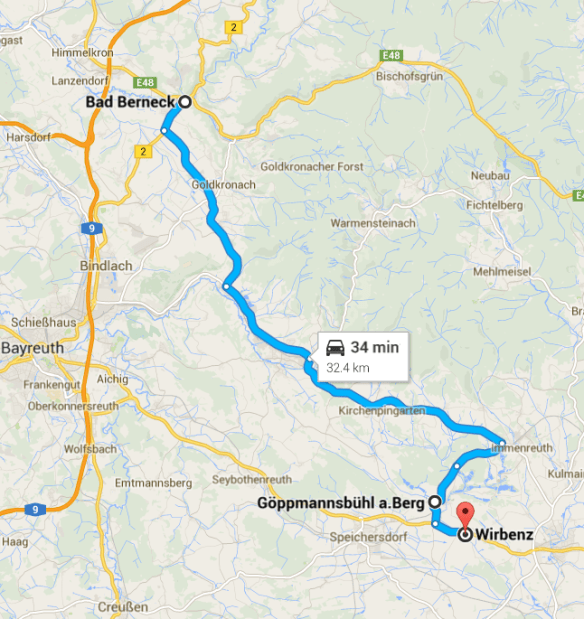
berneck map

I was unable to find any record of either Barbara Krauss or Margaretha Kunnath, but I was able to find both locations mentioned.  They seem to be about equidistant in either opposite directions from Goppmansbuhl.

wind map

You can also see Speichersdorf, located just beneath the Goppmansbuhl label.

Here is the little village of Goppmansbuhl, today, via satellite and thanks to Google Maps.

Goppsmanbuhl map

In the image below, Goppmansbuhl is at the top, and the little village of Wirbenz, about a mile away, is at the lower right.  To put things in perspective, the village of Wirbenz is only about 1000 feet from side to side.

Goppsmanbuhl and wirbenz

Here is the church in Wirbenz where Barbara’s children were baptized.

Did Elisabetha’s view of the church look something like this?

These are slim pickings for an ancestor – very slim pickings.  Perhaps as more records are digitized and transcribed, more information will emerge.  We’re dead ended right now, as the church records in Wirbenz don’t provide us with any direction further back in time.

Mitochondrial DNA

The only other thing we know about Elizabetha Mehlheimer is her mitochondrial DNA.  Fittingly, it’s just as elusive.

I carry Elisabetha’s mitochondrial DNA, through my mother, and through all females between Elisabetha and me.  My children also carry her mitochondrial DNA, but my son’s children carry his wife’s mtDNA and my daughter’s children would continue the line of Elisabetha.

We know that our full haplogroup is J1c2f.  We know that haplogroup J, Jasmine, was born in the Middle East some 30,000 to 50,000 years ago.  Jasmine’s descendants traveled from the Middle East about the age of the spread of agriculture – and over time, that 4 distinct subgroups, J1, J1c, J1c2 and finally, J1c2f emerged.  Dr. Doroh Behar in his paper “A ‘Copernican’ Reassessment of the Human Mitochondrial DNA Tree from its Root,” places the age of J1c2f at about 1900 years plus or minus 3000 years.  In reality, that means that anything between relatively recently and about 5000 years ago.

This map shows the grouping in the haplogroup J project of J1c (and subgroup) participants.  You can see that there are a few in the Middle East, but very few, so most of J1c and her descendants look to be in Europe today.

J1c cluster

My own full sequence matches tell a bit of a different story.

mitomatches

My two exact matches aren’t in Germany, they are in Norway.  My matches that are one mutation different are found in Sweden, the Czech Republic and Russia.  My two mutation match is found in Sweden.

This is confusing.  What happened?  What is going on?

In total, I have 9 full sequence matches, although not all of them provided the geographical location of their most distant matrilineal ancestor. One individual does not have e-mail, so I can’t exactly ask them.

Of these matches, 3 are exact, 4 have one mutation difference and 2 have two mutations difference.  I’m very curious to know which mutations we don’t share.  I have to wonder if there is a mappable pattern to the mutations that would infer sublines.  I wrote to my mito-cousins and asked if they would share their mutation information.  Two responded, the rest did not.  Frustrating.  This means that I can’t work from the mutation mapping angle.

Time to find a different approach.

Let’s Go Fishing!

There has to be some type of historic connection between Germany and Norway, or the Scandinavian region.  Normally, when dealing with Y DNA, we think of warfare.  We look at the history of wars and invasions, because soldiers did leave their DNA sprinkled around the countryside where they visited – if they didn’t outright settle there.  But mtDNA is different.  Women aren’t soldiers and one can’t just leave mtDNA scattered in quite the same way that Y DNA gets left behind.  Mitochondrial DNA is passed from the women to all of her children, and is only passed on by the female children.  So, generally, where you find the children, you also find the mother – they don’t deposit their DNA and then go back home.

So, let’s poke around and utilize Google and Wiki, our friends.  In other words, let’s go fishing and see what we catch.

Bayern aka Bavaria

Bayern, also known as Bavaria, comprises the entire southeast portion of Germany.  It borders The Czech Republic, Austria and Switzerland along with 4 other German states.  Bavaria is divided into 7 regions.  Bavaria is one of the oldest continuously existing states in Europe; it was established as a stem duchy in the year 907.

The Bavarians as a people emerged in a region north of the Alps, originally inhabited by the Celts, which had been part of the Roman provinces of Raetia and Noricum.

early roman empire

The Bavarians spoke Old High German but, unlike other Germanic groups, probably did not migrate from elsewhere. Rather, they seem to have coalesced out of other groups left behind by Roman withdrawal late in the 5th century. These peoples may have included the Celtic Boii, some remaining Romans, Marcomanni, Allemanni, Quadi, Thuringians, Goths, Scirians, Rugians, Heruli. The name “Bavarian” (“Baiuvarii”) means “Men of Baia” which may indicate Bohemia, the homeland of the Celtic Boii and later of the Marcomanni. They first appear in written sources circa 520. Saint Boniface completed the people’s conversion to Christianity in the early-8th century. Bavaria was, for the most part, unaffected by the Protestant Reformation that happened centuries later.

Wirbenz, Goppmansbuhl and surrounding areas are located in Upper Franconia whose capital is Bayreuth.  Upper Franconia was annexed to Bavaria in 1815 and borders the Czech Republic and the German states of Saxony and Thuringia.  With more than 200 independent breweries which brew approximately 1000 different types of beer, Upper Franconia has the world’s highest brewery-density per capita. A special Franconian beer route (Fränkische Brauereistraße) leads along popular breweries.

Bavarians tend to place a great value on food and drink. In addition to their renowned dishes, Bavarians also consume many items of food and drink which are unusual elsewhere in Germany; for example Weißwurst (“white sausage”) or in some instances a variety of entrails.  Oh yum…

At folk festivals and in many beer gardens, beer is traditionally served by the litre in a Maß, a glass beer mug that holds exactly one litre.

mass mug

Bavarians are particularly proud of the traditional Reinheitsgebot, or purity law, initially established by the Duke of Bavaria for the City of Munich in 1487 and the duchy in 1516. According to this law, only three ingredients were allowed in beer: water, barley, and hops.  Bavarians are also known as some of the world’s most beer-loving people with an average annual consumption of 170 litres per person, although figures have been declining in recent years.

Ok, so now we know that Bavarians aren’t migrants, but the original people of the region and they not only love beer, they are very good brewmeisters.

Bayern is part of Upper Franconia, so…

Who were the Franconians?

Franconia is named after the Franks, a Germanic tribe who conquered most of Western Europe by the middle of the 8th century. Though one might assume that Franconia was the homeland of the Franks (indeed in German, Franken is used for both modern day Franconians and the historic Franks), this is not the case. Until the 6th century AD, the region of today’s Franconia was probably dominated by Alamanni and Thuringians. After the Frankish triumphs over both tribes around 507 and 529–534, most parts were occupied by the Franks.

Ok, so Franconians could be Alamanni, Thuringians or Franks.

The Frankish Empire (at its greatest extent around the year 800) included most of modern Franconia, which was situated at its easternmost borders. The vast majority of ethnic Franks, divided between Salians and Ripuarians, were confined respectively to the Low Countries, the northeastern tip of modern France and the Rhine river banks all the way down to near the Main and Hesse areas. However, there was a Frankish elite which was dispersed all across the empire, and it is from this elite that Franconia derives its name.

Hmmm, I wonder where else they might have been dispersed to…

Around the 9th century Frankish identity gradually changed from an ethnic identity to a national identity. The original ethnic Franks ceased to be called by others and themselves Franks, whereas certain groups of people who were not Franks but were mostly ruled by Frankish nobility now began to use it as a term to describe their respective land and people. At the beginning of the 10th century a Duchy of Franconia (German Herzogtum Franken) was established within East Francia, which comprised modern Hesse, Palatinate, parts of Baden-Württemberg and most of today’s Franconia. These areas had been dominated and settled by the Burgundians and the Alemanni before being removed and resettled much further south around Switzerland. The vacuum left may have been resettled then by some Frankish nobles with some more or less numerous retainers from their original core area.

A vacuum?  I wonder who actually did settle there.  This is an opportunity and possibility for how Elisabetha’s mtDNA got to Germany.

While Old Bavaria is overwhelmingly Roman Catholic, Franconia is a mixed area. Lower Franconia and the western half of Upper Franconia (Bamberg, Lichtenfels, Kronach) is predominantly Catholic, while most of Middle and the eastern half of Upper Franconia (Bayreuth, Hof, Kulmbach) are predominantly Protestant (Evangelical Church in Germany).

Elisabetha’s records were found in a Protestant church.

Now we know more about this region of Germany, and there does seem to be some opportunity for resettlement here around the year 1000, and we also see that some Franks were settled elsewhere, in particular, the elite.  But still, that doesn’t connect us to Scandinavia.

Let’s look at this from the perspective of historical Scandinavia, in particular, the locations where my mtDNA matches are found.

Loten, Norway

There has been traffic from east to west through Løten, throughout all recorded periods of history and archeological evidence supports earlier trade along this route.

Loten map

When King Christian IV of Denmark prohibited the importation of German beer in the early 17th Century, distillation began in Norway. In 1624, distilled alcohol was prohibited at weddings, and by 1638 King Christian forbade the clergy the right to distill in their own homes. The corn-growing districts of Løten, Vang (the former municipality in Hedmark), and Romedal all became famous for their distilleries.

Within Løten lies the “border” between cultivated farmland and the winderness.  It begins with the wheat fields of the lower eastern Norway, continues around and south of lake Mjøsa, and borders the taiga, the boreal coniferous forests that stretches from eastern Norway until Siberia. The moorland Hedmarksvidda lies in the north.

So, Loten was a trade route, and Norway imported beer until in the 1600s.  This timeframe would have been during the 30 Years War in Germany.  Now that beer connection is quite interesting, because it tells us that trade between the two locations was indeed healthy and prosperous, at least until 1624.  And we already know that Bayern was the heart of beer production in Germany.

Let’s look at Christian IV, King of Denmark.

Christian IV – King of Denmark

Christian IV was King of Denmark-Norway from 1588 until his death in 1648.

He was quite interested in the Thirty Years’ War in Germany where his objectives were twofold: first, to obtain control of the great German rivers— the Elbe and the Weser— as a means of securing his dominion of the northern seas; and secondly, to acquire the secularized German Archdiocese of Bremen and Prince-Bishopric of Verden as appanages for his younger sons. He skillfully took advantage of the alarm of the German Protestants after the Battle of White Mountain in 1620, to secure coadjutorship of the See of Bremen for his son Frederick (September 1621). A similar arrangement was reached in November at Verden. Hamburg was also induced to acknowledge the Danish overlordship of Holstein by the compact of Steinburg in July 1621.

Interesting, but this all took place in the northern part of Germany, so probably not relevant to Bavaria which is located in the southwest quadrant of Germany.

Sweden

Sweden, however, was another matter.  In 1631, Sweden invaded Bavaria.  Over the following months, they decimated Germany, destroying up to 2000 castles, 18,000 villages and 1,500 towns.  That’s equivalent to one third of all German settlements.  While this was a horrific development, it doesn’t explain how Scandinavian mtDNA might have arrived in Germany.  There is no record that the soldiers brought any women with them.  It did however, prove extremely disruptive to the region and may have opened the door for new settlers in some locations. 

Let’s take a look at the next location where a full sequence match is located.

Inderoy, Norway

The municipality is primarily an agricultural community, but also has some industry.

The municipality is named Inderøy which comes from the Old Norse form of the name: Eynni iðri, meaning is “the inner island”, probably referring to the peninsula which sticks out into the fjord.

inderoy map

During the Middle Ages Inderøy was called Eynni iðri, meaning the inner island, which is still the meaning of the word Inderøy. Saurshaug (now Sakshaug) was an important political centre until the 20th century. In the Middle Ages it was the centre of the county

During the late Middle Ages and until the breakup of the union between Sweden and Norway Inderøy was the seat of the Governor, Judge, and Tax Collector of Nordre Trondhjems amt, thus it was the county capital of what now is known as Nord-Trøndelag. The Trondhjems, shown below in red, is an area that abuts Sweden and divides Norway in half, north to south.  It was important prior to and in the Viking age, but was almost entirely depopulated during the 1300s.  The Sami people and others repopulated this region over the next two centuries.  All of my Scandinavian matches, except one, are in proximity to this region.

norway map

Just as this article was ready to go to press, I received another full sequence match and it is also found in this region, in Nesna, just above the red area, in the fjords, on an island.  This is just beneath the Arctic Circle.

nesna map

We know that haplogroup J1c2f is not Sami, so this is not the source of our ancestors.

Let’s take a look at the areas in Sweden where my matches are found.

Strand, Strom, Sweden (Stronsund)

Strand is a very small village in Sweden whose claim to fame is that it has the largest population of black bears.

Laxsjo, where my second Swedish match’s ancestors are located is too small to even be called a village.  Both are located in Jämtland, which was originally an autonomous peasant republic, its own nation with its own law, currency and parliament. However, Jämtland lacked a public administration and is thus best regarded as an anarchy, in its true meaning.
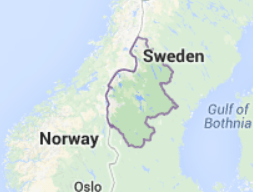
jamtland map

Jämtland was conquered by Norway in 1178 and stayed Norwegian for over 450 years until it was ceded to Sweden in 1645. The province has since been Swedish for roughly 350 years, though the population did not gain Swedish citizenship until 1699.

Historically, socially and politically Jämtland has been a special territory between Norway and Sweden. This in itself is symbolized in the province’s coat of arms where Jämtland, the silver moose, is threatened from the east and from the west. During the unrest period in Jämtland’s history (1563–1677) it shifted alignment between the two states no less than 13 times.  These historical and cultural bonds to Trøndelag and Härjedalen have expressed themselves in the name Øst-Trøndelag, in addition to the fact that the Jamts historically never considered themselves to be Swedish Norrlanders.

Jämtland’s name derives from its inhabitants, the Jamts. The name can be traced back to Europe’s northernmost runestone, the Frösö Runestone from the 11th century. The root of Jamt (Old West Norse: jamti), and thus Jämtland, derives from the Proto-Germanic word stem emat- meaning persistent, efficient, enduring and hardworking.

Aha, so the work Jamtland has a Germanic origin.

A Jamtish Neolithic culture emerged during late Roman Iron Age (about the year 400) in Storsjöbygden, although the hunter-gatherers had come in contact with this lifestyle long before they settled down themselves. Since the hunts were rich and successful in Jämtland, it took a long time before a change occurred.

During the Viking age, the settlement in the province grew. This confirms the sagas written by Snorri Sturluson, where he narrates about the Vikings who fled from Harald Fairhair and Norway in about the year 900 and took residence in Jämtland, just like many Norwegians at the same time fled and colonized Iceland.

This makes me wonder if some of them fled into Germany as well.

Religiously the Jamts had abandoned the indigenous Germanic tribal religion in favour of the Norse faith.  Aha, so apparently the Jamts themselves were descendants of Germanic tribes.

As the population continued to grow, the Jamts established an Thing (assembly), just like other Germanic tribes. Jamtamót, the assembly of Jamtland, came into existence shortly after the world’s oldest parliament, the Icelandic Althing, which was instituted in 930 CE.

Norse religion is a subset of Germanic paganism, which was practiced in the lands inhabited by the Germanic tribes across most of Northern and Central Europe.

Knowledge of Norse religion is mostly drawn from the results of archaeological field work, etymology and early written materials.

The literary sources that reference Norse paganism were written after the religion had declined and Christianity had taken hold, so it wasn’t painted in a positive way. The vast majority of this came from 13th century Iceland, where Christianity had taken longest to gain hold because of its remote location.

Many other ideographic and iconographic motifs which may portray the religious beliefs of the Pre-Viking and Viking Norse are depicted on runestones, which were usually erected as markers or memorial stones. These memorial stones usually were not placed in proximity to a body, and many times there is an epitaph written in runes to memorialize a deceased relative. This practice continued well into the process of Christianization.  Most, but not all of the runestones are found in Sweden.  Many runestones tell of the demise of an individual in England, probably on raids.

runestone

Like most pre-modern peoples, Norse society was divided into several classes and the early Norse practiced slavery in earnest.

Slavery – I wonder if a female slave could have been brought from Germany at some point.

One of the first things Tacitus mentions in his work Germania is that the Germanic people treasure their animals above all else. Tacitus also concludes that the Germanic people found cultivation repulsive. Instead, he states, the Germanic people devote themselves to food and sleep and besides that they prefer to remain idle. All of this, to certain extents, applied to Jämtland. When the people of Jämtland settled down they relied mostly on pastoralism. Their animals were the source of wealth and they were therefore loved by their owners.

It looks like the original people of this region were Germanic.  However, my closest matches aren’t in Germany, where Elisabetha was found, but in Scandinavia.

Did the Vikings later raid and perhaps settle in the Bayern region of Germany?

The Vikings

The Vikings seem to be everyplace in Europe – and they were – so long as there were rivers.  This part of Germany seems to have escaped most of the Viking’s wrath – so it’s unlikely that the mtDNA in Germany is a result of a Viking excursion.

viking excursion map

Conversely, it’s certainly possible that a Viking took a shine to one of his prisoners and took a nice German girl as a slave or wife – and back to Scandinavia with him.

scandinavian settlements

It appears the Vikings are an un likely migration source relative to Bavaria/Bayern/Franconia.

So, if the Scandinavians were Germanic people, who were the Germanic peoples?

Germanic Peoples

The Germanic peoples (also called Teutonic, Suebian or Gothic in older literature) are an Indo-European ethno-linguistic group of Northern European origin, identified by their use of the Germanic languages which diversified out of Proto-Germanic starting during the Pre-Roman Iron Age.

The term “Germanic” originated in classical times, when groups of tribes were referred to using this term by Roman authors. For them, the term was not necessarily based upon language, but rather referred to tribal groups and alliances who were considered less civilized, and more physically hardened, than the Celtic Gauls living in the region of modern France. Tribes referred to as Germanic in that period lived generally to the north and east of the Gauls.

In modern times the term occasionally has been used to refer to ethnic groups who speak a Germanic language and claim ancestral and cultural connections to ancient Germanic people.  Within this context, modern Germanic peoples include the Norwegians, Swedes, Danes, Icelanders, Germans, Austrians, English, Dutch, Afrikaners, Flemish, Frisians and others.

This confirms that Scandinavians are considered Germanic.

Prior to the Middle Ages, Germanic peoples followed what is now referred to as Germanic paganism: “a system of interlocking and closely interrelated religious worldviews and practices rather than as one indivisible religion” and as such consisted of “individual worshippers, family traditions and regional cults within a broadly consistent framework.  It was polytheistic in nature, with some underlying similarities to other Indo-Germanic traditions.

Many of the deities found in Germanic paganism appeared under similar names across the Germanic peoples, most notably the god known to the Germans as Wodan or Wotan, to the Anglo-Saxons as Woden, and to the Norse as Óðinn, as well as the god Thor – known to the Germans as Donar, to the Anglo-Saxons as Þunor and to the Norse as Þórr.

While the Germanic peoples were slowly converted to Christianity by varying means, many elements of the pre-Christian culture and indigenous beliefs remained firmly in place after the conversion process, particularly in the more rural and distant regions.

In Scandinavia, Germanic paganism continued to dominate until the 11th century in the form of Norse paganism, when it was gradually replaced by Christianity.

Gamla Uppsala, the center of Norse worship in Sweden, with three “royal” mounds representing the three Gods, Thor, Odin and Feyr, is shown below.

uppsala

Below, the same mounds are shown about 1700.

uppsala 1700

Towards the end of the 3rd millennium BC, Proto-Indo-European speaking Battle-Axe peoples migrated to Norway bringing domesticated horses, agriculture, cattle and wheel technology to the region.

During the Viking age, Harald Fairhair unified the Norse petty kingdoms after being victorious at the The Battle of Hafrsfjord in the 880s. Two centuries of Viking expansion tapered off following the decline of Norse paganism with the adoption of Christianity in the 11th century. During The Black Death, approximately 60% of the population died and in 1397 Norway entered a union with Denmark.

This may be our answer, but was there back immigration into Germany?  Exact matches should indicate a common ancestor in a time frame closer than 5000 years ago, according to the haplogroup age estimates of Dr. Behar.

Norway and The Netherlands

During the 17th and 18th centuries, many Norwegians emigrated to the Netherlands, particularly Amsterdam.  The Netherlands was the second most popular destination for Norwegian emigrants after Denmark.

Loosely estimated, some 10% of the population may have emigrated, in a period when the entire Norwegian population consisted of some 800,000 people.

The Norwegians left with the Dutch trade ships that when in Norway traded for timber, hides, herring and stockfish (dried codfish). Young women took employment as maids in Amsterdam.

Barbara Melhleimer was a servant in the mid-1800s where her children were baptized.

Young men took employment as sailors. Large parts of the Dutch merchant fleet and navy came to consist of Norwegians and Danes. They took Dutch names, so no trace of Norwegian names can be found in the Dutch population of today.

The emigration to the Netherlands was so devastating to the homelands that the Danish-Norwegian king issued penalties of death for emigration, but repeatedly had to issue amnesties for those willing to return, announced by posters in the streets of Amsterdam. Increasingly, Dutchmen who search their genealogical roots turn to Norway. Many Norwegians who emigrated to the Netherlands, and often were employed in the Dutch merchant fleet, emigrated further to the many Dutch colonies such as New Amsterdam (New York).

Genetics

According to the paper, “Different Genetic Components in the Norwegian population revealed by the analysis of mtDNA and Y Chromosome Polymorphisms” by Passarino (2002), both mtDNA and Y chromosome polymorphisms showed a noticeable genetic affinity between the Norwegian population and other ethnic groups in Northern and Central Europe, particularly with the Germans. This is due to a history of at least a thousand years of large-scale migration both in and out of Norway.  Norwegian and Swedish Y and mtDNA is closer to Germans than any other European region.  The authors expressed the following opinion relative to haplogroup J.

Haplogroup J, possibly brought to Europe by Neolithic farmers coming from the Near East is found at a frequency of 10% in our sample. It has also been reported elsewhere at 7% in Norway. Given its frequency in Northern and Central Europe, it is likely it has been brought by the Germanic migrations to Norway. As previously noted, the distribution of this haplogroup throughout Northern Europe indicates that during the spread of agriculture women moved throughout Europe, crossing group and cultural barriers more so than men. In addition, any asymmetric cultural factors that reduce the effective population size of men relative to women would influence the geographic patterns of mtDNA lineages relative to Y haplotypes.

Positive selection is also a possible influence. The presence of mtDNA haplogroup J in our sample, and elsewhere in Northern Europe shows that its frequency in Norway is even higher than in those areas from where it probably arrived. It would be intriguing, although very speculative, to hypothesise that the climate of Northern Europe may have played a selective pressure where the uncoupling of oxidative phosphorylation and the consequent higher production of heat in J individuals may have led to an advantage, as previously suggested for the European groups during the glaciations.

Glory be, hot flashes might have been good for something after all!

In Summary

I compared the raw results in the Passarino paper with my own results.  Of the mutations included in that paper, which did not include any coding region mutations, I carry only two, 16069 and 16126.  These were reported in every haplogroup J result, where the other 9 mutations were only found in a maximum of two participants each.

It looks very likely, barring new evidence, such as church records that say that Elisabetha Mehlheimer, or her mother, were from Scandinavia and immigrated in the 1600s or 1700s, that we’re going to have to assume the common ancestor of Elisabetha Mehlheimer and my matches lived in Germanic Europe.  Given the match below, she may have even lived in Russia, between the Black and Caspian Seas, and her descendants may have migrated to the region now known as Germany, with a subgroup moving further north into Scandinavia.

russia mtdna match

If this is the case, that means that there have been no mutations in this ancestral line since that migration occurred, at least in the case of the two exact matches in Norway, as long as 5000 years ago.

While this does indeed sound unlikely, I have seen this phenomenon in client’s DNA before.

A second possibility is that someone from Norway returned during the migration of the 1600s and 1700s, adopted a Germany surname, and we are none the wiser today.  Given that my only exact matches are in Scandinavia, this seems the most likely scenario.

We may never know for sure.  In fact, we’re not likely to know.  However, on the KISS scale, where the simplest, easiest, least complex answer is likely to be the right one, the population migration to Norway scenario comes out on top with the remigration in the 1600-1700s second.  Both of those events had many opportunities for people to move, and we know for certain that many did.  Other scenarios, such as the beer trade, are certainly still a possibility, but on a much smaller scale.  Of course, that doesn’t mean they didn’t happen.  We can only deal here with history as we know it, possibilities and probabilities.

Elisabetha Mehlheimer’s ancestry and her Scandinavian mitochondrial matches may forever remain shrouded in mystery.  However, I at least understand the possibilities.  It’s no wonder that those fjords in Norway brought me such joy.

OLYMPUS DIGITAL CAMERA

Part of me seems to be there.

Hmmm…I think I’ll go and have one of those nice German beers and ponder the situation.

______________________________________________________________

Disclosure

I receive a small contribution when you click on some of the links to vendors in my articles. This does NOT increase the price you pay but helps me to keep the lights on and this informational blog free for everyone. Please click on the links in the articles or to the vendors below if you are purchasing products or DNA testing.

Thank you so much.

DNA Purchases and Free Transfers

Genealogy Services

Genealogy Research

Ancestry Kit Mixup

Every genealogists worst nightmare.  A DNA kit swap.  You unknowingly receive the results from someone else, and that equally in-the-dark unknown person receives yours.  And you’ll never know unless you recognize the signs and take action to see if it’s your bad luck or overactive imagination, or the answer really is a kit swap or lab error of some sort.

I’ve just spent three months unraveling this exact situation that occurred at Ancestry.com.  The person to whom this happened would like to share her story with you.  We are hoping that if something similar ever happens to you, that you’ll be able to recognize the signs and know what steps to take to figure out if this indeed has occurred.

Let me also say that a kit swap or similar lab error is really quite rare, and in most other instances when people believe their kits have been swapped, they haven’t been, although this certainly is not the first time this has happened.  CeCe Moore reported on another Ancestry.com case in 2012.

We’ll call the lady Jane. Jane’s father agreed to have his Y DNA tested some years ago at Ancestry.com.  Jane submitted his DNA for him and noticed that he had no matches to his rather common surname.  She didn’t really think anything of it at the time, other than being disappointed.  His haplogroup was estimated by Ancestry to be R1b.

As time went on, she ordered Ancestry.com’s autosomal test too for her father.  Ancestry sent another sampling kit, and her father is receiving matches to people who, at least according to their trees, share common ancestors with her father.

Last year, Jane decided to transfer her father’s Y DNA to Family Tree DNA. The markers from Ancestry.com were transferred, and Jane still didn’t have any surname matches at Family Tree DNA.

Jane then ordered the Geno2.0 test for her father.  The results were returned with haplogroup I, terminal SNP I-L22, which were at odds with Ancestry’s haplogroup R1b estimate.

About the same time, Jane upgraded her father’s STR markers as well, and the haplogroup project administrator noticed that while Jane’s father’s lower panels, meaning the ones tested at Ancestry matched haplogroup R1b, his upper panels didn’t match R1b subgroups at all.

Obviously something was wrong, very wrong, someplace.  But what, and where?  Jane contacted me and asked if I would help unravel this puzzle.

I checked Jane’s father’s page at Family Tree DNA, and when she transferred his Geno 2.0 results to his FTDNA page, apparently the transfer confused the software at FTDNA because his results reported both I-L22 and R-M269 as positive, which is impossible since I-L22 is in haplogroup I, only, and R-M269 is only found in haplogroup R.

ancestry kit swap ftdna snps

Unfortunately, this only added to the confusion.

At this point, I downloaded the raw data file from the Geno 2.0 test and verified that indeed, M269 was absent and L22 was present.

ancestry kit swap raw data

Family Tree DNA, thankfully, stepped up to the plate and ran a SNP test on Jane’s father’s second vial.  That SNP test also came back as positive for haplogroup I, matching the Geno 2.0 results.

Just to be absolutely positive, Family Tree DNA sent Jane’s father a third vial and tested the same markers that Jane had transferred from Ancestry.  You can see for yourself – the results are very different.  The results are unquestionable.  Either there was a kit swap or a lab error of some sort at Ancestry where the wrong markers were posted for Jane’s father’s results.  He has been tested three times, from separate vials, at Family Tree DNA with all of the results providing evidence that the Ancestry results were in error.

Marker Ancestry FTDNA
DYS438 12 10
DYS391 10 11
DYS392 13 11
DYS426 12 11
DYS439 13 11
DYS445 12 11
GGAAT1B07 10 11
DYS444 11 12
DYS446 13 13
DYS462 11 13
Y-GATA-A10 13 13
DYS437 15 16
DYS441 14 16
DYS458 17 16
DYS463 24 21
DYS635 23 21
DYS452 30 31

In an overabundance of caution, Family Tree DNA is going to rerun the entire test, all markers and the backbone SNP, from yet another (fourth) new vial being sent to Jane’s father.  Thank heavens Jane’s father is still available for testing and not entirely discouraged.

Jane is ecstatic, because now, she is actually receiving surname matches and in her father’s words, “we just wanted to know who we are.”  And just in time for Father’s Day!

Signs and Signals

How might you know if a kit swap has happened to you?  As we know, Ancestry has discontinued their Y and mitochondrial DNA testing and will be destroying the data base, so this won’t be an issue at Ancestry with new Y DNA kits, but it could be an issue for results already delivered, like Jane’s, and for autosomal tests.  This is one reason why retesting might not be a bad idea, even though the $19 or $58 Y DNA Ancestry to FTDNA transfer price is quite attractive.  Here are some of the signs that might tip you that there is a problem:

  1. If Y DNA, you don’t receive any surname matches, even to those you believe that you are in related to. This is one of those sticky-wickets, because if you don’t match your first cousin, for example, the most likely situation is that you have an undocumented adoption in one of the lines. My suggestion in this situation is to submit an entirely new test under a new kit number. If your first and second kits match each other, then the answer is the undocumented adoption.
  2. If autosomal DNA, and you have no matches to anyone you believe you should match, especially close relatives, submit your DNA to one of the other three testing companies – Family Tree DNA, 23andMe or Ancestry.com. The approach gives you the benefit of fishing in multiple ponds along with verifying that your results match each other. When you receive the results from both companies, download the raw data files from both to www.gedmatch.com and then match them to each other. They should match almost exactly, although there will be some small differences in terms of areas tested and possibly no-calls – but they should match very closely.

Let’s hope this never happens to anyone else.  The sad thing is that whoever, at Ancestry, received Jane’s father’s Y DNA results likely has no idea they are incorrect.

Thank you Family Tree DNA for going above and beyond to resolve this very distressing situation for Jane and her father.

______________________________________________________________

Disclosure

I receive a small contribution when you click on some of the links to vendors in my articles. This does NOT increase the price you pay but helps me to keep the lights on and this informational blog free for everyone. Please click on the links in the articles or to the vendors below if you are purchasing products or DNA testing.

Thank you so much.

DNA Purchases and Free Transfers

Genealogy Services

Genealogy Research

Family Tree DNA Surpasses the Million Test Mark

Family-Tree-DNA logo

Family Tree DNA, the genetic genealogy arm of Gene by Gene, announced today in a press release that it has processed over 1,000,000 DNA test kits results for genealogy and anthropology purposes.

This historic amount includes Family Tree DNA’s tests as well the processing of public participation samples for National Geographic’s Genographic Projects genetic testing partner.

The million-test milestone was reached this week during the company’s Father’s Day sale, which includes the Family Finder test currently discounted to the price of $79 and the Big Y at $595.  So if you purchased one of these tests this week, you could have been that historic millionth person!

The press release goes on to say:

Family Tree DNA offers the widest range of DNA testing services in the field of genetic genealogy.  The company prides itself on its commitment to the practice of solid, ethical science. Family Tree DNA has the largest database in the world for matching purposes, which means increased chances of finding long lost relatives. In that regard, Family Tree DNA is an important resource for the three million people in the United States who either were adopted or descend from adoptees.

Founded in 2000, Gene By Gene, Ltd. is a CAP-accredited and CLIA-registered genetic testing company that serves consumers, researchers, and physicians. Gene by Gene offers a wide range of regulated clinical diagnostic tests, as well as research use only (RUO) tests. The Family Tree DNA division of Gene by Gene is a pioneer and leader in DNA testing for genealogy and ancestry. The company operates the largest genetic genealogy database in the world and has provided more than 5 million discrete genetic tests.

It seems like only yesterday that I ordered kit 6656, but it was December of 2002, nearly a dozen years ago.  On New Year’s Eve of 2005, right at midnight, I ordered kit 50,000.  The genetic genealogy community was very excited at that milestone as well.  Eight and a half years later, one million.  It took Family Tree DNA 3 years, from 2002 to 2005, to sell 43,000 kits, or about 14,500 kits per year.  Between 2005 and today, they have sold another 950,000 kits, or just over 100,000 per year, on average.

The 5 million number also suggests that the average client has purchased 5 different tests or upgrades, per kit.  In my case, that’s true because I began purchasing when only the HVR region of mtDNA was available, so I’ve upgraded several times and purchased every test or upgrade Family Tree DNA has ever offered.  All in the unquenchable thirst to learn more about my ancestors.

Congratulations Family Tree DNA on this historic and important milestone.  May your second million happen quickly and include a lot of my relatives:)

______________________________________________________________

Disclosure

I receive a small contribution when you click on some of the links to vendors in my articles. This does NOT increase the price you pay but helps me to keep the lights on and this informational blog free for everyone. Please click on the links in the articles or to the vendors below if you are purchasing products or DNA testing.

Thank you so much.

DNA Purchases and Free Transfers

Genealogy Services

Genealogy Research

Stavanger, Norway, Land of Misty Fjords

We’re nearing the end of our DNA trip, only a couple more stops to make.  Today, we find ourselves in Stavanger Norway, enjoying her misty fjords.

Today is our only day in Norway, and we were determined to have fun regardless of the rain.  The harbor is right in the town and is a beautiful mixture of old and new.  Very clean, and Norway is a very wealthy country.  Prices in the one open shop (it’s Sunday) attest to that.  I know this is a first, and rather unbelievable, especially to my husband, but I bought nothing.

stavanger port

stavanger port 2

One of the first things that struck me is how different the houses and city looks as compared to the rest of Europe.  The houses are almost entirely white, are not connected, and are kind of scattered about in a quaint mixture of haphazard and planned.

stavanger city

It was raining of course.  Rain seemed to be the theme of the DNA trip.

When selecting “side trips,” in advance, you, of course, have no idea if it’s going to be raining on a given day.  We had selected a boat trip into the fjords.  I know, I know, another boat trip for someone who gets motion sick.  However, they have drugs for that, AND, this is the opportunity of a lifetime and I wasn’t about to miss it.

Having said that, upon arrival, I had some serious doubts about the choice, but we discovered that they get rain here about 150 days a year, so it seems authentic and fitting.

Norway is confusing to me.  I don’t know whether this is an ancient homeland to me or not.

scandinavian mtdna

Looking at my mitochondrial DNA matches, you can see that my closest full sequence matches are indeed in Norway.  One, in fact, is located right on a fjord.

mtdna fjord

Given that my closest matches are Scandinavian, in Norway and Sweden, does this mean that my maternal line is ancestral TO that location, meaning my line came FROM there, or does it mean that the Scandinavian matches are descended from a common ancestor with my ancestor, Elisabetha Mehlheimer who lived in Goppsmannbuhl, Germany?  In other words, did the Scandinavian matches come FROM Germany, originally?  I don’t know the answer to this, hence, my confusion.  But rest assured, I’m working on this.

So, for today, I’m going to make the assumption that indeed, my line does descend from this beautiful country – and I’m making the journey into the fjords as if they hold my family history.  I don’t know whether my ancestors saw these fjords or not, of if it’s only my cousins, descendants of a common ancestor who saw and see these – but one thing is for sure – my family, maybe distant, but family all the same, is here today.

OLYMPUS DIGITAL CAMERA

This land speaks of contrasts and conflicts.  People versus the elements – both the land, the rocky mountainous land, and the sea.  It also speaks not of conquest, but of compromise – finding the soft spots and making a life there – not in conflict with nature – but in harmony.  There seems to be a place for everyone in this tiny village nestled snugly on the edge of the sea, but always in the shadow of the mountain.

stavanger fjord 2

Sheltered, or trapped here?  I guess that would be a matter of perspective relative to the time in history.  And whether or not you had a boat.

stavanger fjord 3

All along the fjord are summer homes nestled wherever they can find any flat or semi-flat place to put them.

stavanger fjord 4

In addition, they have boat garages which are often stone combined with some bright paint, and partly underwater because the fjords, of course, are tidal.

stavanger fjord 5

stavanger fjord 6

The red one, above, is actually on an island.  In the photo below, you can barely see it, but it’s there.

stavanger fjord 7

This is assuredly the land of rocks and islands, some inhabited, some not.

OLYMPUS DIGITAL CAMERA

stavanger fjord 9

All stunning in their misty beauty.

stavanger fjord 10

Can you see the boat garage nestled in the photo below?

stavanger fjord 11

Some islands have no trees, some just one lone tree, growing either in peril or triumphantly, one or the other.

stavanger fjord 12

I particularly like the photo below, even if it is a bit tilted – so was the boat.  (I had to wedge myself between things and in corners to be “steady” enough take photos.)  You can clearly see the layers of bedrock as it has been pushed up from the sea over millennia.  The forces of earth at work.

stavanger fjord 13

As we moved on down or up the Lysefjord, named for the Norse word for light, further from the sea, we began to see much taller walls and waterfalls  Now had it not been raining, these falls probably wouldn’t have been carrying water – so the rain was a gift in this way.

stavanger fjord 14

stavanger fjord 15

Each set of falls was different.

stavanger fjord 16

stavanger fjord 17

stavanger fjord 18

It was difficult to get photos of these.  First of all, I was on the very top of the boat where it was extremely wet.  My lens kept getting water spots and I was running out of dry spots on my clothes to wipe the lens.  Finally the woman beside me and I came up with an innovative compromise.  We couldn’t reach the dry backs of our own t-shirts, so we traded off and used each other’s.  In addition, the boat was rocking of course, and there were a few other diehards up there too.  Plus, we were actually too close to get much of a composite photo.  These falls are a couple thousand feet and in many ways, remind me of the tropics, well, except for how cold it is.

stavanger fjord 19

stavanger fjord 20

This is what I call the definition of opportunity, and perhaps optimism as well.

stavanger fjord 21

At one location, the crew hand jumped onto land and put some food into a feeding trough for the mountain goats  Here’s a photo of the goats beside the falls.

stavanger fjord 22

One entire massive wall was a series of bridal veils falls, the tops entirely hidden in the mists, gives the entire scene an unreal, ghostly, ethereal quality.

OLYMPUS DIGITAL CAMERA

OLYMPUS DIGITAL CAMERA

The tops of the mountains seems lost in the clouds.  By afternoon, the sun may peek through in some places.

stavanger fjord 25

stavanger fjord 26

The boat was extremely close to the wall as we neared the end of the fjord where we approached the granddaddy of fjord waterfalls.

OLYMPUS DIGITAL CAMERA

stavanger fjord 28

This was no small falls – the closer we got – the more we realized just how massive this falls was.  And the noise was almost deafening.  It reminded me of the awe I felt at Niagara Falls when I was 12 years old.

stavanger fjord 29

But wait until we get even closer.

stavanger fjord 30

And closer…

stavanger fjord 31

At this point, the boat passed so close that we got a fjord shower.

stavanger fjord 32

Most of the sane people had gone downstairs between the driving rain and the temperature, but there were a few diehards upstairs, me and 2 or 3 other women.  Jim and the other man, below went below.  You can see the waterfalls in the photo, at right.

OLYMPUS DIGITAL CAMERA

We shot pictures until we couldn’t and as the water hit us, we all screamed Woo-Hoo together.  Jim said they could hear us downstairs even above the roar of the water.  It was definitely a “living life to the fullest,” “once in a lifetime” moment.  What an unforgettable opportunity.  Laughing and freezing with my sisters of heart.  Makes me wonder, are they connected there too?  Do these ancestral places speak to our spirits in ways we don’t understand?

OLYMPUS DIGITAL CAMERA

My husband stuck his head out from below deck and got this great shot leaving the falls.  My camera was too wet and my hands were too slippery and numb.  But I was exceptionally happy and joyful!  I hated to see the falls disappear into the distance. What an unexpected gift!

stavanger fjord 35

We sailed back to Stavanger and stopped on the way to have hot coffee, waffles, “cream,” which is like a very thick whipped cream and jam.  It’s a Norwegian thing.  If you’d like to give it a try, here’s a great recipe.  They taste just as good as they look, too.

Back to the ship and to dry clothes.  I had on a raincoat and hat, but they can only do so much and I was soaked to the skin.  I was grateful for warm, dry clothes, but certainly wouldn’t have traded the experience!

No towel guy picture today, because we didn’t buy one thing today and towel guy doesn’t want wet clothes:)

What an adventure today – but I’m STILL hoping for sunshine and dry weather for our last port – the gateway to Paris, in two days.

______________________________________________________________

Disclosure

I receive a small contribution when you click on some of the links to vendors in my articles. This does NOT increase the price you pay but helps me to keep the lights on and this informational blog free for everyone. Please click on the links in the articles or to the vendors below if you are purchasing products or DNA testing.

Thank you so much.

DNA Purchases and Free Transfers

Genealogy Services

Genealogy Research