About Roberta Estes

Scientist, author, genetic genealogist. Documenting Native Heritage through contemporaneous records and DNA.

Beware The Sale of Your DNA – Just Because You Can Upload Doesn’t Mean You Should

You know something is coming of age when you begin to see knockoffs, opportunists – or ads on late night TV. As soon as someone figures out they can make money from something, rest assured, they will.

In the past few weeks, we’re beginning to see additional “opportunities” for places to upload your DNA files. Each of them has something to “give” you in return.  You can view this as genuine, or you can view this as bait – or maybe some of each.

So far, each of them also seems to have an agenda that is NOT serving us or our DNA – but serving only or primarily them. I’m not saying this is good or bad – that depends on your perspective – but I am saying that we need to be quite aware of a variety of factors before we participate or upload our autosomal DNA results.

Some sites are more straightforward than others.

I have already covered the fact that both 23andMe and Ancestry sell your DNA to whomever for whatever they see fit.

Truthfully, I always knew that 23andMe was focused on health, but I mistakenly presumed it was on the study of diseases like Parkinson’s. My mother was diagnosed with Parkinson’s, so I had a personal stake in that game.  When their very first patent was for “designer babies,” I felt shell-shocked, stupid, naïve, duped and taken advantage of. I had willingly opted-in and contributed my information with the idea that I was contributing to Parkinson’s research, while in reality, my DNA may have been used in the designer baby patent research.  I have no way of knowing and I had no idea that’s the type of research they were doing.

Parkinson’s yes, designer babies no.  It’s a personal decision, but once your DNA is being utilized or sold, it can be used for anything and you have no control whatsoever.  While I was perfectly willing to participate in surveys and have my DNA utilized for a cure for diseases, in particular Parkinson’s, I was not and am not willing for my DNA to be utilized for things like designer babies so the wealthy can select blue eyed, blonde haired children carrying the genes most likely to allow them to become athletes or cheerleaders.

And once the DNA cat is out of the bag, so to speak, there is no putting it back in. In some cases, you can opt out of identified data, but you can’t opt out of what has already been used, and in many cases, you can’t opt out of having your anonymized data sold.

So, let me give you an example of just how much protection anonymizing your data will give you.

Anonymized Data

Let’s say that someone in one of those unknown firms wants to know who I am. All they have to do is drop my results into GedMatch and my name is right there, along with my e-mail.

Have a fake name at Gedmatch? Well, think for a minute of the adoption search groups and how they identify people, sometimes very quickly and easily by their matches.  Everyday.

Not to mention, my children (and my parents, were they living) are very clearly identifiable utilizing my DNA. So while my DNA is mine, and legally belongs to me, it’s not entirely ONLY mine.

The promise of anonymized data by stripping out your identifying information has become somewhat of a hollow promise today. In a recent example, a cholesterol study volunteer recognized “herself” in a published paper, but was not notified of the results. In an earlier paper, several Y DNA volunteers were identified as well. Ironically, Dr. Erlich, now having formed DNA.Land and soliciting DNA uploads was involved with this unmasking.

Knowing what I know today, I would NEVER have tested at 23andMe and I would have to think very long and hard about Ancestry. The hook that Ancestry has, of course, is all of those DNA plus matching trees.  Is having my anonymized DNA sold worth that?  I don’t really know.  For me, it’s too late for an Ancestry decision, because I’ve already tested there and you cannot opt out of having your anonymized data sold.

I already had an Ancestry subscription, but some testers don’t realize they have to have at least a minimum level subscription to receive all of the benefits of testing at Ancestry. That could certainly be a rude awakening – and unexpected when they purchased the test.  The $49 DNA base subscription is not available on Ancestry’s website either – you have to know about it and call support to purchase that level.  I’m sure most people simply purchase the normal subscription or do without.

One thing is for sure, our DNA is worth a lot of money to both research and Big Pharm, and apparently worth a lot of effort as well, given how many people are attempting to capture our DNA for sale.

In the past few weeks, there have been several new sites that have come online relative to autosomal DNA uploading and testing.

But before we talk about those, I’d like to take a moment for education.

The Sanger Survey

Sanger survey

I’d like to suggest that you take a few minutes to view the videos associated with the Sanger Institute DNA survey here. I think the videos do a good job of explaining at least some of the issues facing people about the usage of their DNA.  Of course, you have to take their survey to see the videos at each step – but it’s good food for thought and they do allow you to make comments.

So, please, take a few minutes for this survey before proceeding.

Genes and US

One of the first “sidebar” companies to appear in September 2014 was at the site   http://www.genesand.us/ which is now nonfunctional.

I took screen shots at that time, since I was going to write an article about what seemed quite interesting.

Genesandus

It was a free service that offered to “find the best genes that you can give to your child.” You had to test at 23andMe, then upload both you and your partner’s raw DNA files and they would provide you with results.

I did just that, and the screen shot below shows the partial results. There were several pages.

Genesandus1

At the end of this section was a question asking if I wanted to “speak to a doctor about any of these benefits.” I didn’t, but I did want to know if gene selection was actual possible and being implemented.  I found the site’s contact information.  I sent this e-mail, which was never answered.

genesandus2

So let me ask you…where is my and my husband’s DNA today? I uploaded it.  Who has it?  Was this just a ploy to obtain our DNA files?  And for what purpose?  Who were these people anyway?  They are gone without a trace today.

DNA.Land

More recently, in the fall of 2015, DNA.Land came upon the scene.

As of today, 22,000+ people have uploaded their autosomal DNA files.

dna.land

What does DNA.Land offer the genealogist?

A different organization’s view of your ethnicity as well as relative matching to others who upload.

The quality and reliability of these enticements offered by companies in exchange for our DNA files may vary widely. For example, when DNA.Land launched, their matching routine didn’t find immediate family members.  No product should ever be launched in an alpha state, which calls into question the quality of the rest of their products and research.  That matching problem has reportedly been fixed.

The second enticement they offer is an ethnicity tool.

I can’t show you my example, because I have not uploaded my DNA to DNA.Land.   However, a genetic genealogy colleague conducted an interesting experiment.

TL Dixon uploaded four DNA files in late April 2016. He tested twice at 23andMe, both tests being the v3 version, and twice at Ancestry, in 2012 and 2014, and uploaded all 4 files to DNA.Land to see what the results would be, comparatively.

TL 23andMe test 1

23andMe v3 test 1

TL 23andme test 2

23andMe v3 test 2

TL Ancestry test 1 2014

Ancestry test from 2014

TL Ancestry test 2 2012

Ancestry test from 2012

We all know that ethnicity testing as a whole is not terribly reliable, but is the most reliable on the continent level, meaning Africa vs Europe vs Asia vs Native American. Given that these raw data files are from the same testing companies, on the same chip platform, for the same person, the Ancestry 2012 and 2014 ethnicity results from DNA.Land are quite different from each other relative to African vs Eurasian DNA, and also from the 23andMe results – even at the continent level.  Said another way, both 23andme results and the Ancestry 2014 results are very similar, with the Ancestry 2012 test, shown last, being the outlier.

Thanks to TL Dixon for both his multiple testing and sharing his results. According to TL’s known family history, the two 23andMe and the Ancestry 2014 kits are closest to accurate.  Just as an aside, TL, surprised by the differing results, utilized David Pike’s utilities to compare the two Ancestry files to see if one had a problem, and they were both very similar, so the difference does not appear to be in the Ancestry kits themselves – so the difference has to be at DNA.Land.

So, what I’m saying is that DNA.Land’s enticement of a different company’s view of ethnicity, even after several months, and even at the continent level, still needs work. This along with the original matching issue calls into question the quality of some of the enticements that are being used to attract DNA donors.  We should consider this not only at this site, but at others that provide enticement or “free” services or goodies as well.  Uploaders beware!

While the non-profit status of DNA.Land along with their verbiage leads people to believe that their work is entirely charitable, it is not, as reflected in this sentence from their consent information.

I understand that the research in this study may lead to new products, research tools, or inventions that have financial value. By accepting the terms of this consent, I understand that I will not be able to share in the profits from future commercialization of products developed from this study.

At least they are transparent about this, assuming you actually read all of the information provided on the site – which you should do with every site.

My Heritage Adds DNA Matching

This past week, My Heritage, a company headquartered in Israel, announced that it has added autosomal DNA matching. Some people think this is great, and others not so much.

MyHeritage

My Heritage, like Ancestry, is a subscription site. I happen to already be a member, so I was initially pretty excited about this, especially when I saw this in their blog.

Your DNA data will be kept private and secure on MyHeritage.

Our service will then match you to other people who share DNA with you: your relatives through a common ancestor. You will be able to review your matches’ family trees (excluding living people), and filter your matches by common surnames or geographies to focus on more relevant matches.

And also:

Who has access to the DNA data?

Only you do. Nobody else can see it, and nobody can even know that it was uploaded. Only the uploader can see the data, and you can delete it at any time. Users who are matched with your DNA will not have access to your DNA or your email address, but will be able to get in touch with you via MyHeritage.

I was thinking this might be a great opportunity, perhaps similar to the Ancestry trees, although they don’t say anything about tree matching.

However, their Terms of Service are not available to view unless you pretend to start an upload of your DNA (thanks for this tip Ann Turner) and then the “Terms of Service” and “Consent Agreement” links become available to view. They should be available for everyone BEFORE you start your upload.

On the MyHeritage main site, you’ll see DNA matching at the top. I’m a member, so, if you’re not a member, your “main site” may look different.

MyHeritage1

Click on “learn more” on the DNA Matching tab.

MyHeritage2

Step two shows you two boxes saying you have read the DNA Terms of Use and Consent Agreement. Don’t just click through these – read them.  Not just at this vendor, at all vendors.

In the required DNA Terms of Use we find this in the 5th paragraph:

By submitting DNA Results to the Website, you grant MyHeritage a perpetual, royalty-free, world-wide, transferable license to use your DNA Results, and any DNA Results you submit for any person from whom you obtained legal authorization as described in this Agreement, and to use, host, sublicense and distribute the resulting analysis to the extent and in the form or context we deem appropriate on or through any media or medium and with any technology or devices now known or hereafter developed or discovered.

And this in item 7:

c. We may transfer, lease, rent, sell, share and/or or otherwise distribute de-identified information to third parties for any purpose, including without limitation, internal business purposes. Whenever we transfer, lease, rent, sell, share and/or or otherwise distribute your information to third parties, this information will be aggregated and personal identifiers (such as names, birth dates, etc.) will be removed.

In the optional Informed Consent agreement, we find this:

The Project collects, preserves and analyzes genealogical lineage, historical records, surveys, genetic information, and other records (collectively, “Research Information“) provided by users in order to conduct research studies to better understand, among other things, human evolution and migration, population genetics, regional health issues, ethnographic diversity and boundaries, genealogy and the history of the human species. Researchers hope that the Project will be an invaluable tool for a wide range of scholars and researchers interested in genealogy, anthropology, evolution, languages, cultures, medicine, and other topics and that the Project may benefit future generations. Discoveries made as a result of the Project may be used in the study of genealogy, anthropology, population genetics, population health issues, cultures, trends (for example, to identify health risks or spread of certain diseases), and other related topics. If we or a third party wants to conduct a study (1) on topics unrelated to the Project, or (2) using Research Information beyond what is described in this Informed Consent, we will re-contact you to seek your specific approval. In addition, we may contact you to ask you to complete a questionnaire or to ask you if you are willing to be interviewed about the Project or other matters.

  1. What are the costs and will I receive compensation? MyHeritage will not charge participants any fees in order to be part of the Project. There will be no financial compensation paid to Project participants. The data you share with us for the Project may benefit researchers and others in the future. If any commercial product is developed as a result of the Project or its outcomes, there will be no financial benefit to you.

You can’t see the terms of use or consent agreement unless you are in the process of uploading your DNA and in addition, it appears that your DNA data is automatically available in anonymized fashion to third parties. The terms of service and informed consent data above does not seem to correlate with the marketing information which states that “nobody else” can see your data.

The other thing that’s NOT obvious, is that you don’t HAVE to click the box on the Consent Agreement, but you do HAVE to click the box on the DNA Terms of Use.

If you are not alright with the entirety of the DNA Terms of Use, which is required, do not upload your DNA file to My Heritage.  If you are not alright with the Consent Agreement, don’t click the box.  Judy Russel wrote an detailed article about the terms here.

Uploading your DNA to MyHeritage is free today, but may be a pay service later. It is unclear whether a subscription is required today, or will be in the future.  However, at one time one could upload a family tree of up to 250 people to MyHeritage for free through 23andMe.  Larger files were accepted, but were only free for a certain time period and now the person whose tree was larger than 250 people and who did not subscribe is locked out of their account.  They can’t delete their larger-than-250 person tree unless they purchase a subscription.  It’s unclear what the future holds for DNA uploads, trees and subscriptions as well.

I have not uploaded my DNA to MyHeritage either, based on 7c. It would appear that even if you don’t give consent for additional “research information” to be collected and provided, they can still sell your anonymized DNA.

WeGene

WeGene

Very recently, a new company, WeGene at http://www.wegene.com has begun DNA testing focused on the Chinese marketplace.

Their website it in Chinese, but Google translates it, at least nominally, as does Chrome.

WeGene1

WeGene2

It does not appear that WeGene does matching between their customers, or if they do, I’ve missed it in the translations.

You can, however, upload at least 23andMe files to WeGene. I can’t tell about Family Tree DNA and Ancestry files.  Unless you have direct and fairly recent Chinese ancestry, I don’t know what the benefit would be.

Their privacy and security, such as it is, is at this link, although obviously autotranslated. Some people seem to have found other verbiage as well.  Navigating their site, written in Chinese, is very difficult and the accuracy of the autotranslation is questionable, at best.

Their autosomal DNA file is obviously available for download, because GedMatch now accepts these files.

I am certainly not uploading my DNA to WeGene, for numerous reasons.

Vendor Summary

This vendor summary was more difficult to put together than I thought it would be – in part because I am not a new user at either Ancestry or 23andMe and obviously can’t see what a new user would see on any of my accounts. Furthermore, Ancestry in particular has several documents that refer back and forth to each other, and let’s just say they are written more for the legal mind than the typical consumer.

vendor summary

* – Both 23andMe and Ancestry appear to utilize all clients DNA for anonymized distribution, but not for identified distribution without an individual opt-in.

*1 – According to the 23andMe Privacy Policy, although you can opt in to the higher level of research testing where your identity is not removed, you cannot opt out of the anonymized level of DNA sharing/sale. Please review current 23andMe documentation before making a decision.

*2 – Can Opt in or Opt out.

*3 – Can opt out of non-anonymized sales, but not anonymized sales. Please verify utilizing the current Ancestry documents before making a decision.

*4 – DNA.land indicates that you can withdraw consent, but does not say anything about deleting your DNA file.

*5 – DNA.Land states in their consent agreement that they will not provide identified DNA information without first contacting you.

*6 – At 23andMe, deleting DNA from data base closes account.

*7 – Automatically opted in for anonymized sales/sharing, but must opt in for identified DNA sharing.

*8 – 23andMe has been and continues to experience significant difficulties and at this point are not considered a viable genetic genealogy option by many, or stated another way, they would be the last choice of the main three testing companies.

*9 – All legal action must be brought in Tel Aviv, Israel, individually, and not as a class action suit, according to item 9 in the DNA Terms of Use document.

*10 – Website in Chinese, information through an automated English translator, so the information provided here is necessarily incomplete and may not be entirely accurate.

Please note that any or all of these factors are subject to change over time and the vendors’ documents should be consulting and read thoroughly at the time any decision is being made.

Please note that at some vendors there are many different documents that cross-reference each other. They are confusing and should all be read before any decision is made.

And of course, some vendors’ websites aren’t even in English.

Points to Consider

While these companies are the ones that have come to the forefront in the past few months, there will assuredly be more as this industry develops. Here are a list of things for you to think about and points to consider that may help you make your decision about whether you want to either test or upload your autosomal DNA with any particular company.  After all, your autosomal DNA file does contain that obviously much-sought-after medical information.

First, always read every document on a vendor site that says anything like “Terms of Use,” “Security and Privacy” or “Terms of Service” or “Informed Consent.” Many times the fine print is spread throughout several documents that reference each other.  If their policy does not say specifically, do NOT assume.

Also be aware that the verbiage of most companies says they can change their rules of engagement at any time without notification.

Here are the questions you may want to consider as you read these documents.

  • Does the company or organization sell or share your data?
  • Is the data that is sold or shared anonymized or nonanonymized, understanding that really no one is truly anonymous anymore?
  • Who do they sell your data to?
  • For what purpose?
  • Do you have the opportunity to authorize your DNA’s involvement per study?
  • If you do not live in the same country as the company with whom you are doing business, what recourse do you have to enforce any agreement?
  • How do you feel about your DNA being in the hands of either organizations or companies you don’t know for purposes you don’t know?
  • Are you asked up front if you want to participate?
  • Can you opt out of your DNA being shared or sold entirely from the beginning?
  • Can you opt out of your DNA being shared or sold entirely at any time if you have initially opted in?
  • Do you receive the opportunity to opt in, or are you automatically opted in?
  • If you are automatically opted in, do you get the opportunity, right then, to opt out, or only if you happen to discover the situation? And if you can opt out immediately, are you only able to opt out of non-anonymized data or can you opt out entirely?
  • Is the company up front and transparent about what they are doing with your DNA or do you have to dig to unearth the truth?
  • If you already tested, and gave up rights, were you aware that you did so, and do you understand if or how you can rescind that inadvertent authorization?
  • Do you have to dig for the terms of service and are they as represented in the marketing literature?
  • Do you feel like you are giving truly informed consent and understand what can and will happened to your DNA, and what your options are if you change your mind, and how to exercise those options? Are you comfortable with those options and the approach of the company towards DNA sale as a whole? Were they forthright?
  • For companies like MyHeritage and Ancestry, are their other unknown “gotchas” like a subscription being required in addition to testing or uploading to obtain the full benefits of the test or upload?
  • What happens to your DNA if the company no longer exists or goes out of business? For two examples, look at the Sorenson and Ancestry Y and mtDNA DNA results. This is certainly not what any consumer or tester expected. Not to mention, I’m left wondering where my DNA submitted to genesandus is today.
  • Who owns the company?  What are their names?  Where can you find them?  What is the address of the company?  What does google have to say about the owners or management?  Linked-In?  Facebook?  If there is absolutely no history, that’s probably as damning as a bad history.  No one can exist today in a professional capacity and have no history.  Just saying.
  • Is the company acting in any way that would cause you not to trust them, their motives or agenda?  As my mother used to say, the best predictor of future behavior is past behavior.

Near and Dear to My Heart

I have family members who work in the medical field in various capacities. I also have family members who have or have had genetically heritable conditions and like everyone else, I would love to see those diseases cured.  My reticence to donate my DNA to whomever for whatever is not a result of being heartless.  It’s a function of wanting to be in control of who profits with/from my DNA and that of my family.

Let me share a personal story with you.

My brother died of cancer in 2012. He went for chemo treatments every two weeks, and before he could have his chemo treatment, he had to have bloodwork to assure that his system was able to handle the next dose of chemo.

If his white cell count was below a certain threshold, a shot of a drug called Neulasta was available to him to stimulate his body to increase the white blood cells. The shots were $8000 a piece.  And no, that is not a typo.  $8000!  His insurance did not cover the shots, because as far as they were concerned, he could just wait until his white cell numbers increased of their own accord and have the chemo then.  Of course, delaying the chemo decreased his chances of survival.

Over the course of his chemo, he had to have three of these $8000 shots. Fortunately, he did have the money to pay, although he did have to reschedule his appointment because he was required to bring a cashier’s check with the full payment in advance before the clinic would administer the shot.  After that, he simply carried an $8000 cashier’s check to each appointment, just in case.

I do not for one minute believe that those shots COST $8000 to manufacture, but I do believe that the pharmaceutical industry could, would and does CHARGE $8000 to desperate patients in order to continue the chemo that is their only hope of life. For those whose insurance pays, it’s entirely irrelevant. For those whose insurance does not pay, it’s a matter of life and death.  And yes, I’m equally as angry with the insurance company, but they aren’t the ones asking for me to do donate my DNA.

So, as for my DNA, no Big Pharm company will ever get their hands on it if there is ANYTHING I can do about it – although it’s probably too late now since I have tested with both 23andMe and Ancestry, who do not allow you to opt out entirely. I wish I had known before I tested.  At least I would have been giving informed consent, which was not the case.

Consequently, I want to know who is doing what with my DNA, so that I have the option of participating or not – and I want to know up front – and I don’t want it hidden in fine print with the company hoping I’ll just “click through” and never read the documentation. I don’t want it to be intentionally or unintentionally confusing, and I want unquestionable full disclosure – ahead of time.  Is that too much to ask?

My brother had the money for the shots, and he died anyway, but can you imagine being the family of someone who did not have $24,000?

And if you think for one minute that Big Pharm won’t do that, consider Turing Pharmaceuticals CEO Martin Shkreli, dubbed “the most hated man in America” in September 2015 for gouging patients dependent on a drug used for HIV and cancer treatment by raising the price from $13.50 per pill to $750 for the same pill, a 5,556% increase – because he could.

Medical research to cure disease I’m supportive of in terms of DNA donation, but not designer babies and not Big Pharm – and today there seems to be no way to separate the bad from the good or to determine who our DNA is being sold to for what purpose. Worse yet, some medical research is funded by Big Pharm, so it’s hard to determine which medical research is independent and which is not.

The companies selling our DNA and Big Pharm are the only people who stand to benefit financially from that arrangement – and they stand to benefit substantially from our contributions by encouraging us to “help science.” We’ll never know if a study our donated DNA was used for produced a new drug – and if it’s one we can’t afford, you can bet the pharmaceutical industry and manufacturers care not one whit that we were one of the people who donated our DNA so they could develop the drug we can’t afford.  If any industry should not be soliciting free DNA donations for research, Big Pharm is that industry with their jaw-dropping profits.

So, How Much is Our DNA Worth Anyway?

I don’t know, directly, but we can get some idea from the deal that 23andMe struck with pharmaceutical company Genentech, the US unit of Swiss drug company, Roche, in January 2015, as reported by Forbes.

Quoting now, directly from the Forbes article:

According to sources close to the deal, 23andMe is receiving an upfront payment from Genentech of $10 million, with further milestones of as much as $50 million. The deal is the first of ten 23andMe says it has signed with large pharmaceutical and biotech companies.

Such deals, which make use of the database created by customers who have bought 23andMe’s DNA test kits and donated their genetic and health data for research, could be a far more significant opportunity than 23andMe’s primary business of selling the DNA kits to consumers. Since it was founded in 2006, 23andMe has collected data from 800,000 customers and it sells its tests for $99 each. That means this single deal with one large drug company could generate almost as much revenue as doubling 23andMe’s customer base.

The article further says that the drug company was particularly interested in the 12,000 Parkinson’s patients and 1,300 of their parents and siblings who had provided family information. Ten million divided by 13,300 means Genentech were willing to pay $750 for each person’s DNA, out the door.  So the tester paid $99 or upwards, depending on when they tested – $1000 before September 2008 when the test dropped to $399, to 23andMe and then 23andMe made another $750 per kit from the tester’s donated DNA results.

And that’s before the additional $50 million and the other deals 23andMe and the other DNA-sellers have struck with Big Pharm. So yes indeed, our DNA is worth a lot.

It’s no wonder so many people are trying to trying to find a way to entice us to donate our results so they can sell them. In fact, it’s a wonder, and a testament to their integrity, that there is ANY company with access to our DNA results that isn’t selling them.  In fact, there are only two companies, plus the Genographic Project.

Who Doesn’t Share or Sell Your Autosomal DNA?

Of the major companies, organizations and sites, the only three, as best I can tell, that do not share or sell your autosomal DNA (or reserve the right to do so) and specifically state that they do not are National Geographic’s Genographic Project , Family Tree DNA and GedMatch.

Of those three, Family Tree DNA, a subsidiary of Gene by Gene is the only testing company and says the following:

Gene by Gene collects, processes, stores and shares your Personal Information in a responsible, transparent and secure environment that fosters our customers’ trust and confidence. To that end, Gene by Gene respects your privacy and will not sell or rent your Personal Information without your consent.

National Geographic utilizes Family Tree DNA for testing, and the worst thing I could find in their privacy policy is that they will share:

  • with other selected third parties so that they may send you promotional materials about goods and services that they offer. You have the opportunity to opt out of our sharing information about you as described below in the section entitled “Your Choices”;
  • in accordance with your consent.

Nothing problematic here.

Your Genographic DNA file is only uploadable to Family Tree DNA and Nat Geo does not accept uploaded data from other vendors.

GedMatch, which allows users to upload their raw data files from the major testing companies for comparison says the following:

It is our policy to never provide your genealogy, DNA information, or email address to 3rd parties, except as noted above.

Please refer to the entire documents from these organizations for details.

Serious genealogists have probably already uploaded to GedMatch and tested at or uploaded to Family Tree DNA as well, so people are unlikely to find new matches at new sites that aren’t already in one of these two places.

To Be Clear

I just want to make sure there is no confusion about which type of companies we’ve been referencing, and who is excluded, and why. The only companies or organizations this article applies to are those who have access to your raw data autosomal DNA file.  Those would be either the companies who test your autosomal DNA (National Geographic, Family Tree DNA, Ancestry and 23andMe in the US and WeGenes in China), or if you download your raw data file from those companies and upload it to another company, organization or location, as discussed in this article.  The companies and organizations discussed may not be the only firms or organizations to which you can upload your autosomal DNA file today, and assuredly, there will be more in the future.

The line in the sand is that autosomal DNA file. Not your Y DNA, not your mitochondrial DNA, not your match list – just that raw data file – that’s what contains your DNA information that the medical and pharmaceutical industry seeks and is willing to pay handsomely to obtain.

There are other companies and organizations that offer helpful tools for autosomal DNA analysis and tree integration, but you do NOT upload your raw data file to those sites. Those sites would include sites like www.dnagedcom.com and www.wikitree.com. I want to be sure no one confuses sites that do NOT upload or solicit the upload of your raw autosomal DNA files with those that do.  I have not discussed these sites that do not upload your autosomal DNA files because they are not relevant to this discussion.

This article does not pertain to sites that do not utilize or have access to your autosomal raw data file – only those that do.

Summary

As the number of DNA testing consumers rises, the number of potential targets for DNA sales into the medical/pharmaceutical field rises equally, as does the number of targets for scammers.

Along with that, I increasingly feel like my ancestors and the data available through my DNA about my ancestors, specifically ethnicity since everyone seems to be looking for a better answer, is being used as bait to obtain my DNA for companies with a hidden, or less than obvious, agenda – that being to obtain my DNA for subsequent sale.

I greatly appreciate the Genographic Project, Family Tree DNA and GedMatch, the organizations who either test or accept autosomal file uploads do not sell my DNA, and I hope that they are not forced into that position economically in order to survive. It’s quite obvious that there is significant money to be made from the sale of massive amounts of DNA to the medical and pharmaceutical communities.  They alone have resisted that temptation and stayed true to the cause of the study of indigenous cultures and population genetics in the case of Nat Geo, and genetic genealogy, and only genetic genealogy in the case of Family Tree DNA and GedMatch.

In other words, just because you can doesn’t mean you should.

Frankly, I believe selling our data is fundamentally wrong unless that information is abundantly clear, as in truly informed consent as defined by the Office for Human Research Protections, in advance of purchasing (or uploading) the test, and not simply a required “click through box” that says you read something. I would be much more likely to participate in anything that was straightforward rather than something that was hidden or not straightforward, like perhaps the company or organization was hoping we wouldn’t notice, or we would automatically click the box without reading further, thinking we have no other option.

The notice needs to say something on the order of, “I understand that my DNA is going to be sold, may be used for profit making ventures, and I cannot opt out if I order this DNA test,” if that is the case. That is truly informed consent – not a check box that says “I have read the Consent Document.”

Yes, the companies that sell DNA testing and our DNA results would probably receive far fewer orders, but those who would order would be truly informed and giving informed consent. Today, in the large majority of cases, I don’t believe that’s happening.

We need to be aware as consumers and make informed decisions. I’m not telling you whether you should or should not utilize these various companies and sites, or whether you should or should not participate in contributing your DNA to research, or at which level, if at all. That is a personal decision we all have to make.

But I will tell you that I think you need to educate yourself and be aware of these trends and issues in the industry so you can make a truly informed decision each and every time you consider sharing your DNA. And you should know that in some cases, your DNA is being sold and there is absolutely nothing you can do about if it you utilize the services of that company.

Above all, read all of the fine print.

Let me say that again, channeling my best Judy Russell voice.

ALWAYS, READ ALL OF THE FINE PRINT!!!

ALWAYS.
READ.
ALL.
OF.
THE.
FINE.
PRINT.

Unfortunately, things are not always as they seem on the surface.

If you see a click-through box, a red neon danger light should now start flashing in your brain and refuse to allow you to click on that box until you’ve done what? Read all the fine print.

There really is no such thing as a free lunch – so be judiciously suspicious.

I will leave you with the same thought relative to testing companies and upload opportunities that I said about companies selling our data. Just because you can doesn’t mean you should.

I think early in this game we all got excited and presumed the best about the motives of companies and organizations, like I did with both 23andMe and genesandus, but now we know better – and that there may be more to the story than initially meets the eye.

And besides that, we all know that presume is the first cousin to assume…and well, we all know where this is going.  And by the way, that’s exactly how I feel about genesandus who disappeared with my and my husband’s DNA.  I wasn’t nearly suspicious or judicious enough then…but I am now.

______________________________________________________________

Disclosure

I receive a small contribution when you click on some of the links to vendors in my articles. This does NOT increase the price you pay but helps me to keep the lights on and this informational blog free for everyone. Please click on the links in the articles or to the vendors below if you are purchasing products or DNA testing.

Thank you so much.

DNA Purchases and Free Transfers

Genealogy Services

Genealogy Research

Family Finder Matching Thresholds Changing at Family Tree DNA

By Endlisnis – Street limbo 3, CC BY 2.0, https://commons.wikimedia.org/w/index.php?curid=45772088

A long-requested change is taking place shortly at Family Tree DNA – although we don’t have a firm date as of yet.  Final testing before release is still underway.

I received a notification from Family Tree DNA, as follows:

You asked for it and we listened!

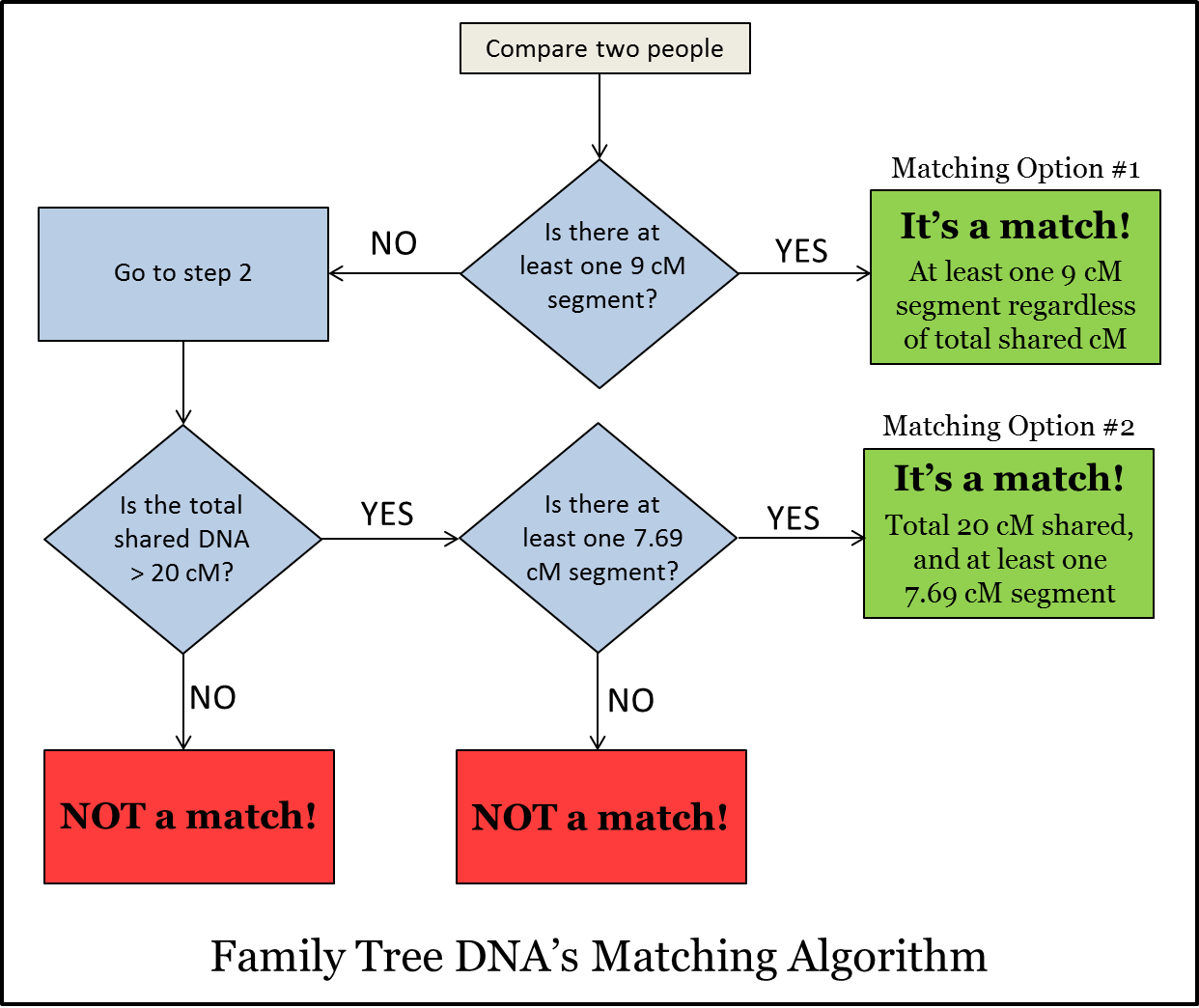
Currently, the current matching thresholds – the minimum amount of shared DNA required for two people to show as a match are:

  • Minimum longest block of at least 7.69 cM for 99% of testers, 5.5 cM for the other one percent
  • Minimum 20 total shared centiMorgans

Some people believed those thresholds to be too restrictive, and through the years requested changes that would loosen those restrictions.

In the near future, as soon as the quality assurance process is complete, the following changes will be implemented to the matching program.

  • No minimum shared centiMorgans, but if the cM total is less than 20, at least one segment must be 9 cM or longer.
  • If the longest block of shared DNA is greater than 9 cM, the match will show regardless of total shared cM or the number of matching segments.

The entire existing database is being rerun using the new matching criteria, and all new matches calculated with the new thresholds.

Most people will see only minor changes in their matches, mostly in the speculative range. They may lose some matches but gain others.

This is truly exciting news, especially for people with African American heritage whose connections to matches may be several generations back in time and may not have met the previous 20cM total threshold criteria. In fact, these new thresholds may benefit many of us with deep colonial roots, but I’m hoping that people who have had few matches until now will be pleasantly surprised.

As soon as this change is released, I’ll be checking to see if I’ve gained or lost matches, and will report back as either additional information or results are forthcoming!

______________________________________________________________

Disclosure

I receive a small contribution when you click on some of the links to vendors in my articles. This does NOT increase the price you pay but helps me to keep the lights on and this informational blog free for everyone. Please click on the links in the articles or to the vendors below if you are purchasing products or DNA testing.

Thank you so much.

DNA Purchases and Free Transfers

Genealogy Services

Genealogy Research

Back in the Saddle Again – OK, Sidesaddle, Riding Very Slowly

sidesaddle me

Well, I’m pleased to let my readers know that I’m back in the saddle again. Ok, maybe not fully in the saddle.  Maybe I’m riding side saddle and very slowly right now, and gingerly.  According to some in the family, I shouldn’t even be on the horse…but I am.  Or, in my case, perched on a rock.

My husband was gracious enough to make me a temporary office on the main floor of the house – probably because he got sick of me whining about getting texting hand injuries from trying to function entirely on my iphone as I lay flat on my back on ice packs. Let’s just say it has been a very long 5 weeks and my family has been just wonderful – beyond all expectations.

And this walk outside – it was glorious. Being cooped up inside (5 weeks today, not that I’m counting) is so difficult when I know those weeds are growing and needing to be pulled up by the roots!  The beautiful phlox is in bloom, the cherry trees are just finishing, in the background…nothing as beautiful as springtime!  And the sunshine – it just felt SOOOoooo good.

In all seriousness, back injuries are no joke and excruciatingly painful, especially if you cannot take narcotic drugs.

However, ice, heat, rest and time help a great deal (In addition to my wonderful family) and my neurosurgeon has told me that I just need more of the same. I’m improving every day and have informed my husband that the surgeon said that I cannot do yard work nor housework, and I have a witness.  In fact, I’m likely to never be able to do those things again, ever.  Miss Mary, my quilt sister, accompanied me to the appointment and she swears that’s exactly what the doctor said!  She’s got my back, pardon the pun.

Right Miss Mary???

The funniest thing about the doctor visit was when the doctor said, “Well, you can’t change your genetics” and Miss Mary piped right up and said, “Well, if anyone can, she can.” He looked very quizzical of course and we all had a good laugh after discussing how different medicine, including genetics will be in another generation or even another decade.

This of course made me think about the past and wonder what happened when my poor ancestors encountered this type of situation.

The history of spinal cord injury reaches far back into history, with some insight and a lot of myth and mystery – not to mention misery and experimentation.

Spinal surgery had begun in England in the early 1800s, and yes, without anesthetic. It’s no wonder so many patients died.  They wanted to.

The first successful laminectomy which removed a disc which was compressing a nerve which resulted in paralysis from a fall from a horse was performed in Kentucky in 1829 by a doctor who had studied in Philadelphia.

That’s probably because while there was no anesthetic, Kentucky had plenty of moonshine.

In the 1800s, and before, back pain that was not a direct injury was thought to be a form of rheumatism. In fact, according to the book, “Occupation and Disease: How Social Factors Affect the Conception of work-Related Disorders” by Allard Dembe, it wasn’t until about WWI when the US passed the major worker’s compensation laws that back pain was considered to be a result of trauma, meaning an injury, not rheumatism, which was considered to be an illness.

There was also considered to be difference between a debilitating spinal injury, from something specific, like falling from a horse, or a building, and an injury from something like working in the field, or the garden. The latter was rheumatism.  In fact, I still remember the old people talking about their “rheumatism flaring up” and rubbing their backs when I was younger.  I didn’t understand then, but now it makes perfect sense.

The term rheumatism in the current sense has been in use since the late 17th century, as it was believed that chronic joint pain was caused by excessive flow of rheum or bodily fluids into a joint.

The term rheumatism is somewhat older, adopted in the early 17th century  from Late Latin rheumatismus, ultimately from Greek ῥευματίζομαι “to suffer from a flux”, i.e. any discharge of blood or bodily fluid.

Before the 17th century, joint pain thought to be caused by viscous humours seeping into the joints was named gout, a word adopted in Middle English from Old French gote “a drop; the gout, rheumatism.”

Now, the good news, if there was any for those 17th and 18th century sufferers, is that opioid medications were readily available “over the counter” at that time, so hopefully, while our ancestors were in pain, they truly didn’t suffer terribly.

I know for a fact that my bootlegging ancestors had their own brand of pain-killer, and I doubt that some of them did enough manual labor to hurt their backs in the first place.

Still, I’m very glad to be living today, because if I do need surgery again one day, I want anesthetic, and I’m very grateful for modern medicine, especially after reading that article titled, “A Brief History of Therapy for Traumatic Spinal Cord Injury” by Jason Lifshutz and Austin, Colohan, M.D.s. In many cases, it looked to me like the treatment was worse than the injury.  If I were you, I’d just skip that article and take my word for it, or better yet, maybe just go and get yourself some of that moonshine and you won’t care anymore about what’s in that article, and you won’t remember that your back was hurting either!

Thanks to one and all for your kind words of support, prayers, flowers, e-mails, cards, chocolate (that’s a medicine, didn’t you know) and the cookies too – not to mention lunch visits, smoothie runs, fabric cupcakes (no calories and cat approved), rides to the doctor and two turtles. Don’t ask about the turtles.  That’s a story for another day – and yes, that too involves Miss Mary!!!

fabric cupcake

______________________________________________________________

Disclosure

I receive a small contribution when you click on some of the links to vendors in my articles. This does NOT increase the price you pay but helps me to keep the lights on and this informational blog free for everyone. Please click on the links in the articles or to the vendors below if you are purchasing products or DNA testing.

Thank you so much.

DNA Purchases and Free Transfers

Genealogy Services

Genealogy Research

Creating a Phased Parental Kit at GedMatch

In the article, Concepts – Parental Phasing, I explained why it’s so important to have at least one, if not both of your parents DNA tested in addition to your own DNA. Having at least one parent tested allows you to determine, at least for the matches that match both of you, which side the genetic ancestral connection is from, assuming the match is only from one side.

At GedMatch, you can utilize the kit of you and one parent to subtract out the DNA of your known parent. The results are the other half of your DNA, that of your missing parent.  Now, this technology isn’t perfect.  Let’s say for example that you have your mother, as I do, but not your father.  At one location, you and your mother both have an A and a T.  There is no way to know whether you inherited the A or the T from your mother, and which one you inherited from your father, so these situations are unresolvable.

So are areas where they are no-calls or bad reads.

In other studies that I’ve been involved with, we can obtain a significant amount of your half of the other parents’ DNA, around 40% of their entire DNA sequence. So that’s certainly better than nothing, given that you only have 50% of their DNA to begin with.

A New Series – Managing Autosomal DNA Matches

I’m going to step through how to create a second phased parent at GedMatch, because you’re going to need to do this for one of the upcoming Concepts Series – Managing Autosomal DNA Matches articles. Yes indeed, I’m introducing a new series soon – and this article is to help you prepare!

Test Your Parents and Close Family Members Now!

So here’s a big hint for the new series. If you have a parent who has not yet tested, now is the time to order that test.  You can test at Family Tree DNA or at Ancestry and then transfer your results to Family Tree DNA and GedMatch.  However, if you order from Ancestry, make sure to read this article first to understand fully the rights you are conveying to Ancestry.  Also, Ancestry is changing to a new chip, and we’re not sure how compatible their new autosomal file will be with either Family Tree DNA or GedMatch, and we won’t know until after those vendors have had some time to evaluate the new chip file results, so perhaps Family Tree DNA would be the safer bet right now for new tests, because you will need to transfer your parents results to both Family Tree DNA and GedMatch.  Yes, you will need your known relatives results in both locations, because relatives help identify match and triangulation groups.

So, order that kit today so you’ll have results and can fully participate in the new series’ exercises.  We’ll we walking through matching, phasing and triangulation vendor by vendor one step at a time to create your own matching DNA Master file.

No Parents to Test?  You’re NOT Out of Luck!

If you don’t have either parent, you’re not entirely out of luck.  You won’t be able to participant in parental phasing, BUT, you will be able to participate in other types of phasing and matching.  In order to do this, you’ll need to test as many of your relatives as possible, beginning with testing as many half or full siblings as possible.

Test any grandparents, aunts, uncles, great-aunts, great-uncles and any and all cousins that you can find and arm-twist (in the nicest way of course) too, because their matches will help you – and that goes for whether you have one, both or neither parent tested.

The only people in your family you don’t need to test are people both of whose parents have tested, or the relevant parent (to you) has tested.

For example, if your first cousin has tested, you don’t need her child too, because that child inherited half of your first cousin’s DNA, and you already have that in your first cousin’s test. However, your first cousin’s sibling is an entirely different matter, and you’ll want to test as many cousins (and their siblings) as you can find.

Creating a Parent at GedMatch

To create a phased parent, you’ll need your kit and the kit of one of your parents. If you have both parents tested, you don’t need to do this.

Sign into your GedMatch account and select the Phasing option, 6th from the top.

phased parent 1

Enter the kit number of the child, which is you, and the kit number of the parent whose DNA you do have.

phased parent 2

Click on generate.

When the utility is finished, you will receive the following message.

phased parent 3

GedMatch has created a phased maternal and paternal kit with the leading letters PM (for 23andMe kits), PT (for Family Tree DNA kits) and PA (for Ancestry kits) and the trailing letters P1 and M1. P1=Paternal and M1=Maternal.

The kit number of the child is imbedded inbetween PM and P1, so for example in PT524738P1.

These phased kits, because they are only “half kits,” can be utilized to determine which of your matches are from which side of your family.

I wrote about how to do that in the article titled, Phasing Yourself.

But let’s be very clear here, a phased kit is never as good as the real McCoy, so by all means, get that parent tested if at all possible.

Have fun and get your ducks in a row for the new series!

ducks

______________________________________________________________

Disclosure

I receive a small contribution when you click on some of the links to vendors in my articles. This does NOT increase the price you pay but helps me to keep the lights on and this informational blog free for everyone. Please click on the links in the articles or to the vendors below if you are purchasing products or DNA testing.

Thank you so much.

DNA Purchases and Free Transfers

Genealogy Services

Genealogy Research
Ancestry Modifies Their Autosomal DNA Chip

ancestry logo

For today’s consumer, this isn’t really much of a story, although it may be someday.

Ancestry published an article in their blog this week announcing that they have begun testing on a new AncestryDNA chip.

Currently, Ancestry uses the standard Illumina chip also used by Family Tree DNA which also functions as the base chip for the 23andMe product as well. 23andMe has a chip customized for medical testing, and Ancestry is now following suit as well with their new chip, soon to go into production.

The Illumina chip today holds roughly 700,000 locations, or SNPs that can be reported. Ancestry’s download today provides customers with roughly 682,000 locations, as compared to 23andMe’s 577,000 and Family Tree DNA’s roughly 690,000.

However, Ancestry is trading in some 300,000 of those SNPs currently on the standard chip and replacing them with new SNPs optimized for medical and ethnicity testing in addition to replacing some “low performing” locations with alternate locations. They couldn’t provide a breakdown in terms of percentages of how many are for medical, ethnicity or other SNPs.

What Does This Change Mean For You?

Today, nothing at all, according to Ancestry.

I asked if Ancestry had tested their clients who have tested on the new chip against the same client’s results from the current, soon to be, old chip – and Ancestry said they showed exactly the same matches.

So, the chip is backwards compatible in that the new chip will still provide matches to the old chip.

The difference may come in the future when more people have tested on the new chip. Only time will tell if those people will receive more and better matching with other people that have tested on the new chip.

Ancestry indicated that if they feel their clients need to update their test at some point in the future, then they will put together a plan – but until then, if then, there’s nothing to worry about.

Should You Retest?

Obviously the bloggers group wondered about this. If you retest today, you’ll have to handle both tests separately in your account.  There is currently no way to merge tests, so you’ll have an old one and a new one.  There is no “best of both worlds.”  There is no way to preserve stars or notes or anything you may have done to one account and transfer to a different account.  About the only thing you could do is, in time, to compare to see if you continue to have the same matches on both chips as more people test on the new chip.

Why The Change?

Ancestry was very clear that the changes today are really for future development and will have no effect on current accounts or matching. They are evaluating their future position in the medical arena.  With last June’s announcement of Ancestry Health, they have very clearly been sticking their toes in that water.  They hired Dr. Cathy Petti last July as well, an MD functioning a Chief Health Officer.

I’m not sure if this means Ancestry will one day offer health services to clients, similar to 23andMe, or whether it means that the firms they are currently or want to sell the DNA data to want more health related information, or perhaps both.  We will just have to wait and see.  Clearly they wouldn’t even be discussing this publicly and laying groundwork if they weren’t planning to do something!

Will You Still Be Able to Download?

Yes, your autosomal data file will be downloadable, just like it is today.

Will You Still Be Able to Upload to Family Tree DNA and GedMatch?

That of course will depend on those vendors making the necessarily format changes. This would be similar to the different vendors’ files being compared to each other today.  Comparing one vendor to another isn’t quite as good as comparing each vendor to its own files, but the matches are still good and it’s still a darned site better than nothing.

Both Family Tree DNA and GedMatch will need to see the new file formats first and have some time to work with them. We don’t know if quality of matching will be an issue given that nearly half of the SNPs are being replaced – but until we hear otherwise from either company, I’d presume that they will make every effort to accommodate the new file structure.

When Is The Change Being Made?

The new chips are arriving next week, but Ancestry will be running on dual platforms for a little while yet during the changeover. There really won’t be any external way to tell if your test was performed on a new (v2) or old (v1) chip – so if you want the new chip – wait just awhile to order to be sure the new chip is in full production first.

Summary

Ancestry’s change, to clients today, is superficial.  Your matching will still function. You don’t need to retest, unless you are simply curious. If you do want to retest, wait a few weeks to be sure the new test is completely in production – and remember, you’ll be managing two kits separately, so everyone will be asking you about you and your twin that they match.  I’m sure there will be a number of curious people who will test on both platforms.

These chip changes are for future development – and we’ll just have to wait for the future to see what those new developments might be.

______________________________________________________________

Disclosure

I receive a small contribution when you click on some of the links to vendors in my articles. This does NOT increase the price you pay but helps me to keep the lights on and this informational blog free for everyone. Please click on the links in the articles or to the vendors below if you are purchasing products or DNA testing.

Thank you so much.

DNA Purchases and Free Transfers

Genealogy Services

Genealogy Research

The Rest of the Miller-Stutzman Story

If you watched the Katey Sagal episode of Who Do You Think You Are that aired on TLC on April 14th, you’ll recall that Katey made a couple of discoveries leading to the unveiling of her Amish heritage.  First, her ancestor in Iowa was buried in a “Dunkard” Cemetery.  Dunkard was the colloquial name for the religious denomination known as the Brethren.

I have Brethren ancestors too, an entire quarter tree full of them – my mother’s father, John Whitney Ferverda was Brethren. His mother Evaline Miller married Hiram B. Ferverda, a converted Mennonite.

The Brethren, Amish and Mennonite churches were all German based, lived in German communities, and were notorious for swapping members back and forth. All three were pietist religions, eschewing any type of violence or warfare, even for protection of yourself or your family.  In other words, those three sects were in many ways far more alike than different.

In other words, finding someone who was a Dunkard in one generation and their parents as Mennonite in the earlier generation was not a surprise. According to Amish historian, J. M. Byler, intermarriage between Amish and Brethren or Mennonite was acceptable until 1809 when it was forbidden.

So, I knew I was going to enjoy this episode.

But then, the episode got much, MUCH more interesting.

Miller Stutzman 1

Here are two screen grabs from the episode, thanks to TLC and Shedd Media. Katey’s line, going back in time, was found in Somerset, PA, then in Berk’s County, PA. an area highly known for their Amish population.

Miller Stutzman 2

Even more interesting, Peter Miller married Mary Stutzman.

That just about doubled my heart rate right there, because my Miller line, also German, also Brethren, was very closely associated with a Brethren Stutzman line.

My Miller Line

My immigrant Johann Michael Miller Jr., born in 1692, immigrated from Germany in 1727 with his sort-of step-brother Johann Jacob Stutzman, known as Jacob Stutzman.

What is a sort-of step-brother?

Johann Michael Miller’s mother died, and his father, also Johann Michael Miller, married a second time to Anna Loysa Regina. Johann Michael Miller Sr. then died, and Anna then married to Hans Jacob Stutzman in 1695.  Johann Michael Miller Jr. was only three years old at this time, so Anna was probably the only mother he had ever known.

Anna and her husband Hans Jacob Stutzman then had a son by the name of Johann Jacob Stutzman on January 1, 1706. So, technically, these two boys were not biologically related, but given that they immigrated together and were found together throughout their lives, it’s very likely that Anna Loysa Regina Miller Stutzman simply continued to raise Johann Michael Miller Jr., her step-son, after his father’s death and the boys were raised as brothers, even though they were 14 years apart.

Johann Michael Miller Jr. married Suzanna Berchtol in Germany, and in 1727, immigrated with his family, which included at least son Philip Jacob Miller, to the colonies – along with his sort-of step-brother Johann Jacob Stutzman

Johann Michael Miller and Suzanna Berchtol had a son the year after their marriage, Hans (probably Johann) Peter Mueller, baptized January 19, 1715 in Konken, Germany. We don’t know much about Peter except that on at least one occasion, Philip Jacob Miller’s brother, John, who died in Washington County, MD in 1794 was referred to as Johann Peter Miller in one document, but only one document of many.

Was that John the same Hans Peter that was born in 1715? It seems rather unlikely since he was never otherwise called Peter, but it’s possible.

So, we have a (possible) lost brother, Johann Peter Miller who was associated with the Stutzman family.  Now, in Berks County, we find a Peter Miller married to a Stutzman wife.

What are the chances of this being all circumstantial?

Slim to none, right? Stutzman is not a common name, even though Miller is.  And the two families being found together again, and intermarried is certainly suggestive of some continuity.  Right?

Clearly, the Peter Miller on Katey’s chart born in 1756 is not the SAME Peter Miller born in 1715 in Germany, but he could clearly be a descendent, either a son or possibly a grandson.

The program did not follow Peter Miller any further, but instead switched to the Stutzman line because it led to the Hochstetler line which was the focus of the rest of the program.

Mary Stutzman was the daughter of Christian Stutzman, born about 1732, and Barbara Hochstetler. Christian Stutzman could have been the son of Jacob Stutzman or perhaps even a younger half-sibling or uncle.

Had I by any chance found my missing Peter Miller, or at least his descendant, associated with the Stutzman family? It would make perfect sense.

With two family connections in Pennsylvania, plus the pacifist religion – and a very unusual name like Stutzman – how could this NOT be the same family group?

Well, hold tight, because we’re going to find out!

I was so very excited!

Let’s Start Digging

Since Stutzman isn’t my direct line, I do have some references, but not a lot, so I began on the internet where I discovered that Christian, at least by some, is attributed to be the brother of Johann Jacob Stutzman, the “step-brother” of Johann Michael Miller Jr..

If Anna was 20 in 1695 when she married Jacob Stutzman, as her second marriage, she would have been 57 in 1732 when Christian Stutzman was born. Well, there’s the first big red flag.

The next problem is that Peter Miller is attributed to John Miller and Magdalena Lehman, and that John Miller would have been the age to be a sibling to my Johann Michael Miller Jr.  This John Miller, known as “Indian John” was also wounded in the same raid where Katey Sagal’s Hochstetler family was taken captive.

Miller Stutzman 3

The next problem is that Indian John is attributed to Christian Daniel Miller, born in Bern Switzerland. Hmm….if this is accurate, this is clearly not my Miller family – although my Miller’s did come from near Bern – so they could be the same family, just a generation or two further back in time.  But regardless, not my lost Hans Peter Miller’s son.

Well, crumb.

Miller Stutzman 4

I’m always skeptical of trees, anyplace, so I wanted more proof than this.

I decided to take a look at the Miller DNA project at Family Tree DNA and see if there was any enlightenment there.  At the top of the project page, my Johann Michael Miller line is shown. At the bottom of the page, the John Miller who married Magdalena Lehman is shown. You can click to enlarge.

Miller Stutzman 5 cropMiller Stutzman 5-2 crop

While they do share the same halogroup, they are definately not matches to each other, as you can see below, so they are definitely NOT the same Miller line.

Miller Stutzman 5 crop STRsMiller Stutzman 5-2 crop STR

Double crumb.

Ok, well, maybe the Stutzman line is the same. While it’s not my direct line, it’s still an interesting part of my Johann Michael Miller’s life, so let’s take a look at what we find.

Stutzman

Stutzman was more difficult.

Ancestry trees showed a plethora of information, with some trees showing Jacob and Christian as full brothers, but we’ve already shown that’s nigh on impossible due to the age of Anna.

They could, however, be paternal half brothers or otherwise related.

The Stutzman project at Family Tree DNA seems to be abandoned and shows no project results. Harumph.  (If there is someone who would like to adopt the Stutzman DNA project at Family Tree DNA, which is quite small (4 members), it needs an administrator.)

So I turned to YSearch, with the hope that some of the Stutzman clan had uploaded results there.

Miller Stutzman 6

Indeed they had. Three entries – and two of those entries appear to be the lines we’re seeking.  I checked the compare box to view their results.

Miller Stutzman 7

First of all, none of the three match to each other, so these lines are definitely different. I checked my own Stutzman resource books, and the Jacob Stutzman line that Anna Regina married into is reported to be from Erlenbach, Switzerland.  In this case, that would be equivalent to the first entry, user ID V85YJ.

Miller Stutzman 8

Sure enough, they had uploaded a Gedcom file and I verified that indeed, this is the Jacob line that was the sort-of step-brother to Johann Michael Miller.

Miller Stutzman 9

The other entry, VZJYF is the is the Christian Stutzman line from Berks County, PA, whose daughter married Peter Miller.

Miller Stutzman 10

By running the Genetic Distance report, I verify that at 12 markers, which is all the further kit V85YJ tested, they have a genetic distance of 6, which very clearly indicates they are NOT a match.

Well, triple crumb.

Now, you could also say we need another sample from each of these two Stutzman lines, through a different son to assure that no undocumented adoptions have occurred – and you would be right of course.

However, without that additional information, it looks like these are different lines, just like the Miller line was.

Summary

I’m sure that it was assumptions just like this, before DNA testing was available, that caused people to jump to incorrect conclusions.

After all, what ARE the chances that both a Miller and a Stutzman would be found in a close family situation, not terribly distant, in a minority Pietist German religion in colonial America, and not be related? I don’t know the mathematical odds, but I can tell you that DNA confirms that whatever those odds are, they don’t matter.  Of course, this is also why definitive proof of a relationship between the two families could never be found – it wasn’t there to BE found.  The only facts we have are the DNA tests.

The DNA facts confirm that neither the Peter Miller nor the Christian Stutzman family from Berks and Somerset County, PA are the same family as the Johann Michael Miller and Jacob Stutzman family from York and Cumberland County, PA and then Frederick/Washiongton County, Maryland.

Three strikes and I’m out, but I am actually very glad to put this decades long question for both of these family groups to rest once and for all.  Bravo DNA testers, projects at Family Tree DNA and YSearch – all three critical to answering this question.

______________________________________________________________

Disclosure

I receive a small contribution when you click on some of the links to vendors in my articles. This does NOT increase the price you pay but helps me to keep the lights on and this informational blog free for everyone. Please click on the links in the articles or to the vendors below if you are purchasing products or DNA testing.

Thank you so much.

DNA Purchases and Free Transfers

Genealogy Services

Genealogy Research

Preserving Family Information Forever?

mom and me matching dresses

Given that today is Mother’s Day, and those who have mothers still with us are hopefully visiting and feeling very grateful for their presence in our lives – I want to take this opportunity to talk about preserving as much about our mothers’ lives as possible for future generations.

Those whose mothers have already passed over know the huge hole their passing creates, in so many ways – unfathomable until they’ve crossed that bridge.

Not only do our mothers take their own memories with them, but the memories of their parents, who we may or may not have known, and the memories of their grandparents, who we probably didn’t know. Their grandmother may have told our mother stories about her parents and grandparents and what happened in their lifetimes – and all of that is lost too.

If you’re counting, that’s a link to 5 generations back in time we’re losing when we lose a parent. In my case, that 5th generation reached back to a woman born in 1823 in Germany.

I asked my Mom questions before she passed away, but not enough. I wish I had asked sooner.  Older people do forget.  I wish I had asked my grandmother’s sister more questions too. I wish, I wish….

There isn’t anything I can do about that now, except document and research based on their recollections – which really has been very productive.

The Memory Book or Journal

In the last few years before my mother passed, I asked her to complete a memory book and when she should no longer write legibly, she dictated the answers and I transcribed in her own words – although I love the answers in her own handwriting.

There are several flavors of memory books available, for Mom, Dad and grandparents.

Here are links to two, but if you look at the “frequently bought together,” books, you’ll see the others too.

And if you are the mother, father or grandparent, do your descendants a favor and just order one for yourself!

What’s Next?

But the next question is how to preserve this information forever.

And by forever, I do mean after I’m gone, and after my children, who are not currently interested in genealogy are gone – hopefully into the indefinite future.

We used to think that Rootsweb was forever, but given that Ancestry purchased Rootsweb and has a history of suddenly obsoleting products and services, we certainly can’t depend on that anymore.

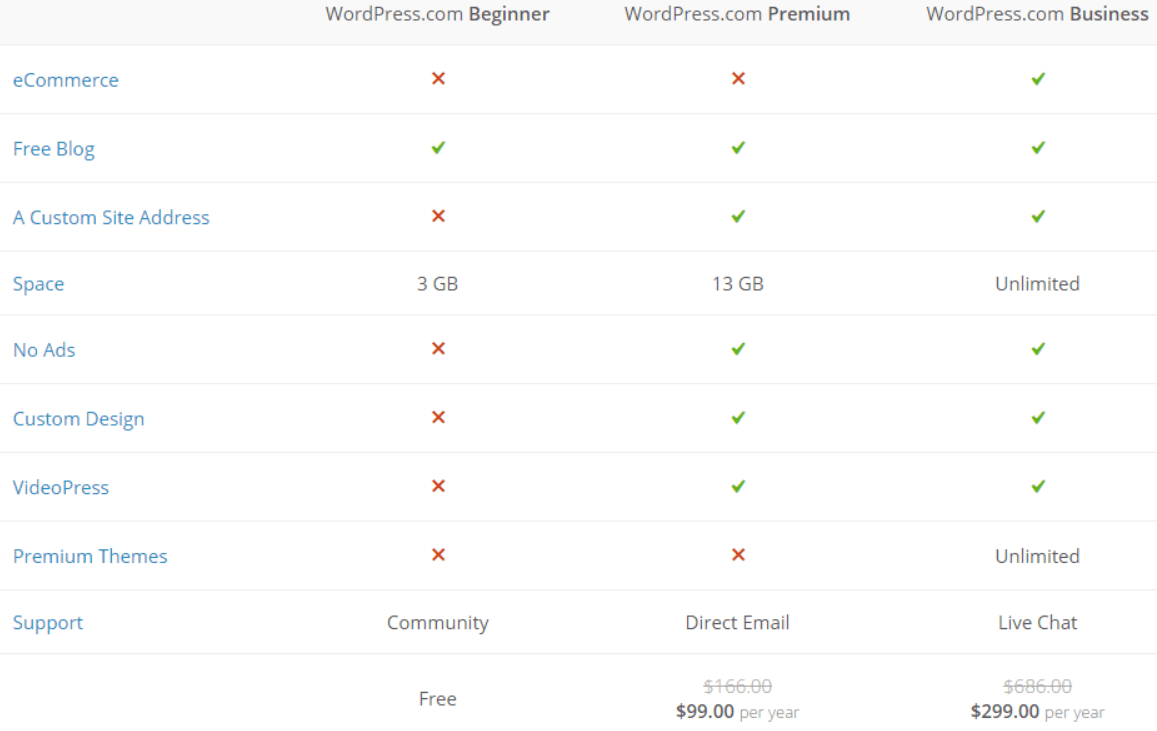
WordPress, which is the platform I used for my blog, has a free option.  Of course, there really is no such thing as a free lunch, so there will be ads on the site from time to time.  And it’s free “forever,” as long as forever is in this technoworld.  How long is that?  I don’t know.  Weebly has the same type of arrangement.  Of course, some functions and options aren’t free, like a domain name, and if you exceed a certain space limit, fees apply.  You can’t pay fees if you’re dead.

Any entrepreneur want to start a “legacy” business, pay now, die later, your information stays forever?  I think it would be a wonderful idea!!!

I have several articles on my blog that I’d really like to be archived “forever,” in particular, my 52 Week of Ancestors articles, which has now grown to over 120 (from the originally anticipated 52) and will continue to grow until I’m, well, done.  Now I don’t know what “done” actually means in a genealogists world, so I can’t tell you when that might be.

I would also like to preserve family stories, the kind I hope you’re collecting from Mom this Mother’s Day.

Let’s Have Fun!

Be sure to have fun. Tell Mom you love her.  You really never know when it might be your last opportunity.  Laugh.  Let the conversation flow, and ask Mom questions that will result in interesting conversations.  You never know what you might find out!  And she’ll be very pleased that you are interested in her and her family!

Here are some ideas of questions you might ask Mom, just for fun:

  • Tell me about your first bicycle ride.
  • What were your chores as a child?
  • Who was your first boyfriend?
  • What was your favorite candy bar as a kid?
  • What food did you hate as a child? Do you still hate it?
  • Tell me about your first day at school?
  • Did anyone ever play a trick or prank on you?
  • Did you play a trick or prank on someone else?
  • Did you know your grandparents? What are your fondest memories of them?
  • Tell me about a family vacation.
  • Did your family have picnics?  Who came?
  • Did your parents have any special family traditions surrounding the holidays, like Christmas, Easter, Hanukah or other times of the year?
  • What television programs did you watch as a child?
  • Did your parents or grandparents have a hobby?
  • What games did you play for fun?
  • What is the biggest change you’ve seen in your lifetime?

Avoid topics that might make Mom sad, like funerals and pets. I made the mistake of asking about Mom’s pets as a child and let’s just say I immediately wished that I hadn’t.

Do yourself a favor. Don’t think you’ll remember the answers, because, regardless of your best intentions, you won’t.  Write them down, or better yet, record them and later transcribe the recording.

Don’t you wish you had this kind of information about your great-great-grandparents? I do. This is your opportunity to provide that gift to future generations.

Now, it’s up to you to preserve these stories. If you don’t do it, no one else is going to.

Archival and Preservation

First, commit the stories to paper. You can then utilize those documents to publish the stories online, on a free “forever” site like Weebly or WordPress.  Of course, you’ll need to take into consideration any privacy issues, living people and such.  I mean, announcing uncle Joe is gay online when he hasn’t announced that publicly himself, and without his permission, is maybe not such a good idea.

In my case, by family, I’ve also combined several stories into a “book” and donated an electronic copy to the Allen County Public Library, who printed the book and added it to their collection.

The Allen County Public Library is one of the largest genealogy libraries in the US and has partnered with both FamilySearch and the Internet Archive.  They also have taken a leadership role in preserving oral history and have other suggestions at this link.

Not all libraries are interested in genealogy.  Gasp – I know – hard to believe.  Libraries that are local to your family would be most interested, although I’ve donated family books and visited the library later to find that they have “no record” of the book being donated – and it surely was not on the shelf.  While you might want to donate to local libraries, I wouldn’t depend on them for posterity.

Donating your book to the Family History Library has specific guidelines, including “if they have space.”  If your family history and stories fit this criteria, the Mormon Family History Library has as good a chance at “forever” as anyplace.  They want genealogical information, and your stories should include a pedigree chart, minimally, so that future generations have some idea of who is recanting about whom.

There’s nothing worse than an old photo of someone that you know you’re related to, with no names on the back – so you have no idea who it is. The same goes for your family stories and recollections as well.

And as for those old pictures, add those to the stories as well. People love pictures and stories.

Leave it up to one of my wonderful subscribers (thanks Karen) to identify another source for archiving books.  The Internet Archive accepts donations of one or more books at a time, digitized (hopefully) or hardcopy, and this nonprofit whose goal is to “create universal access to all knowledge” makes the books available to everyone, by key word search and by title search, forever.

Personally, I would utilize all of these options to assure the widest coverage possible.

Honoring Mothers Who Have Passed Over

Enjoy your Mother’s Day, hopefully with Mom, but if she has passed over, maybe you can memorialize her today by recording something special about her life. Here are some suggestions:

  • Her favorite or most memorable food.  Do you remember her preparing or family meals eating that dish together?
  • Her favorite scent.  Do you think of her when you get a whiff?
  • Her favorite flower.  Did you plant or tend the garden with her?
  • Something silly that she did.  Do  you have a photo to go along with this?
  • Something embarrassing that she did – maybe embarrassing to you, not her:)
  • Her favorite recipe, and your memories of her making that recipe.  I know whatever that was came immediately to mind and maybe you can even smell it now.  My Mom’s was fudge!
  • Your favorite memory of her.
  • A typical day in her life.
  • A memory of your mother with her parents.
  • Her hobby.  What did she love to do, and why.  Do you have anything she made?
  • What gave her life meaning?  What was her motivation?
  • Her most memorable moment.
  • What is her legacy?

Preserve Mom’s DNA

If your Mom is still with us, and for that matter, your Dad too, please, PLEASE test their DNA. Family Tree DNA archives the DNA for 25 years, and presuming it has not degraded during that time, you can order upgrades for new tests not yet available (and maybe not even dreamed of) today.  I ordered my mother’s Family Finder test several years after she was gone and I thank that woman every day of my life for that gift that she gave me.

For your mother, you can order the Family Finder autosomal test and the mitochondrial DNA full sequence which directly tests her mother’s mother’s maternal line. If you’re ordering for Mom, the tests are on sale for a significant savings until midnight (Central Time) on Mother’s Day night.

Your father can order both of those plus the Y DNA test. I recommend at least the 37 marker panel, and 67 if you’re feeling particularly generous.  It would make a great Father’s Day present, and you can order now while the Family Finder and mitochondrial are on sale.

If your Mom has passed over, you can still test her mitochondrial DNA, which she gave to all of her children, by testing your own mitochondrial DNA.

You can learn a lot about the legacy of your matrilineal ancestors, meaning your mother’s matrilineal line, with the mitochondrial test – things so far back in time that no oral history could possibly remember.

My mother’s mitochondrial DNA line dies in my generation, as none of my children will be passing it along, so don’t let the information in your mother’s mtDNA be lost to posterity.

You can click here to order a DNA test, on sale.

Happy Mother’s Day!!!

______________________________________________________________

Disclosure

I receive a small contribution when you click on some of the links to vendors in my articles. This does NOT increase the price you pay but helps me to keep the lights on and this informational blog free for everyone. Please click on the links in the articles or to the vendors below if you are purchasing products or DNA testing.

Thank you so much.

DNA Purchases and Free Transfers

Genealogy Services

Genealogy Research

Ancestry Update – A More In Depth Look – Losses and Gains

Ancestry told us that the average client would lose approximately one circle, would have matches shift from closer to further in relationship distance, would lose some matches and gain others. The net effect should be, for most people, that they would have a net gain of matches in total.  We know, of course that those are averages from testing their client base – and averages are just that – taking in both ends of the spectrum.

The actual results have been quite interesting, and they have been all over the map.

Some people gained total matches, some lost as many as half. The person I felt the worst for though, was the person who said they only had one match, and lost that one.

On April 20th, I used the www.dnagedcom.com tool to download all of my ancestry matches.

Today, I utilized that same tool to download my new matches.

This chart shows the difference in my totals between April 23rd and today, May 4th.

ancestry loss gain

Just looking at totals, I gained 1,592 matches, but in reality, that’s not the whole story, because I lost 1412 matches and gained 3004.

In terms of circles, in net, I lost 4, but I actually lost 6 and gained two.

But all of those darned Bad NADs that I wish would go away are still ever-present.

I checked my first couple pages of matches and three individuals have shifted from a 3rd to 4th cousin to a 4th to 6th cousin.  In two cases, that was accurate, but in the third case, it was not, they are actually a 2nd cousin once removed. Generally, I ignore these estimates anyway unless they are 3rd cousin or closer.

In terms of leaf matches, which indicate both a DNA and an ancestor match, I lost 16 but gained 43 for a net change of 17%. My closest new match was in the 5th to 8th cousin range, which I expected.

All 16 of my leaf matches that I lost were also in the 5th to 8th cousin range. Unfortunately, one field not provided by Ancestry’s deleted match download is the shared cMs.  Fortunately, if I want that information, it is available in the dnagedcom.com files.

I’m pleased with my new leaf matches, but very unhappy about losing those 16. Our DNA matched and a common ancestor had been identified.  I surely wish Ancestry had found a way to preserve leaf matches for people in this update/upgrade process.

I think the most disappointing part of this entire experience has been the number of private trees belonging to the new people I have a leaf match with, meaning we share DNA and a common ancestor in our tree. Because their tree is private, I can’t see our common ancestor – but because my tree is public, they can see the common ancestor.  I send messages to all private matches, asking the name of our common ancestor, and very few answer.  Rather unfair I think and does nothing to encourage public trees.

The Net-Net

I have never been a fan of Timber and I’m not convinced this change is for the better in terms of matches and losses. In terms of the actual science behind the scenes, I’m glad that Ancestry is now comparing actual SNP values and not just blocks.  I think all vendors should take steps to improve their science.

Having said that, no matter how improved the science, when you take matches away from people, especially matches with proven common ancestors, people feel a loss, some a grievous loss. One woman who lost half of her leaf matches says she feels like she has been beheaded.

I wish Ancestry would have handled this change in a way that didn’t cause people to incur losses. For example, leaving the current matches and only using the new matching routine on the new matches.

They could also have automatically created a file with all of your lost matches, which would have eliminated the rush to star and note your matches that you wanted to be able to preserve in some fashion.

Had the losses not occurred, I know that people would be universally ecstatic to have new matches. In other words, this could have been a very positive experience.  I hope Ancestry will take this opportunity to revisit how they handle updates.  This is the second experience that Ancestry’s customers have had with incurring match loses – and while Ancestry may consider this a “good thing” and an improvement, it’s clear that clients with losses do not.  It’s very difficult to be happy or positive about losses, even if you do receive new matches in the bargain.

I don’t believe that the matches removed were “wrong.” In some cases, those same people have downloaded to Family Tree DNA or GedMatch, shown larger segments (because of Timber) and triangulated with other people from the same ancestral line.  They are however, now below Ancestry’s new thresholds either due to a threshold shift or an algorithm difference.

Ancestry also has to do something to deal with the fact that some people have an unmanageable number of matches. As their data base grows, so will this challenge.  We need good matches that match to trees – that’s the holy grail at Ancestry.  Anything Ancestry can do to encourage people to add trees and make them public would be a huge public service.

Every vendor has to set a threshold of some type and they all do their best to eliminate matches that may be marginal or identical by chance. With any vendor, you’re going to miss some valid matches.  The difference is, I think, that other vendors haven’t taken existing matches away from clients, especially not existing matches with an identified common ancestor.

I’m ecstatic with my 43 new leaf matches. I’m not pleased to lose 25% of my Circles and I’m not pleased to lose my 16 existing leaf matches.  In my case, I didn’t incur a large loss or gain, although I lost far more Circles than I expected, but some people weren’t so fortunate.  I feel that the pieces I lost, meaning Circles and leaf matches, are more important than that pieces I gained in terms gaining total matches.  Those leaf matches are like gold and the matches without common ancestors in trees, no trees or private trees are not useful and truthfully, I don’t care how many of those I have unless they are 3rd cousin or closer.

So, really, I’m not dramatically happy or unhappy with the outcome, although the gain doesn’t make up for what was lost that was valuable.

I am very disappointed in the way this event was handled. This really could have been a universally positive experience.  Taking things away from people that they value so closely is just bad juju.  I have a mental picture of someone trying to take a favorite toy from a child, promising them something better.  It will never happen without a lot of screaming and crying – because they love and cherish their toy.  For the most part people don’t care about the “better science” or the new toy, but they do care a lot about their matches that they’ve been working on and with.

My suggestions for Ancestry for a more positive experience would be:

  • Don’t take leaf matches away from people
  • Make updates a positive experience without loss
  • If loss must occur, make it as painless as possible, perhaps by only taking distant matches without notes, leaf matches and without removing Circles
  • If loss must occur, make a file for the clients without them having to star or note the matches they want to keep
  • Create a more equitable balance so that people who don’t have public trees can’t see the common ancestors either. It’s unfair that they can and the people who share their trees cannot.  If they make their tree public, then both people can see the common ancestor.  Maybe an option to “show tree to DNA matches only” but not make the tree universally public would be a good middle ground.

The good news is that most people do have some new matches and even though some of our old matches are no longer shown as matches, we do have that information. Perhaps the matches who disappeared will download to Family Tree DNA and/or GedMatch and we can continue our genetic research from there.

I’m going to focus on the good news and the positive, so I’m off to check my 43 new leaf matches and see if I can find any new clues. Surely there has to be a gold nugget hidden in there someplace!!

______________________________________________________________

Disclosure

I receive a small contribution when you click on some of the links to vendors in my articles. This does NOT increase the price you pay but helps me to keep the lights on and this informational blog free for everyone. Please click on the links in the articles or to the vendors below if you are purchasing products or DNA testing.

Thank you so much.

DNA Purchases and Free Transfers

Genealogy Services

Genealogy Research

Ancestry Update!!!

Ancestry Update

The long-anticipated Ancestry matching update occurred sometime late this morning.

Ancestry provides links in their announcement blurb, shown above, for “learn more.”  Be sure to click on that link, but perhaps more important is the “tell us what you think link.”  Don’t miss that opportunity to ask for a chromosome browser.  Take some time to evaluate their update, and do tell them what you think.

I’ll be downloading my matches later for a more precise analysis, but here’s what has happened at first glance.

At First Glance

Previously, I had 226 leaf hints.  Leaf hints are people whose DNA you match and who have a common ancestor in their tree with you.  Now I have 254, a gain of 28 new matches.  As far as I’m concerned, these matches are the most useful part of the Ancestry product. So I’m very pleased.  In addition, some of the old matches may be gone and some new ones may take their place.  So I may actually have more new matches than 28.

My closest “new match” as a result of the rerun is in the 4th to 6th cousin range.  Please note that your matches that are new because of this change are NOT noted with a blue dot as normal “new matches.”  So I hope you starred or noted your old matches, because that is the only way you can tell who is a new match as a result of the rerun.

Previously I had 436 4th cousins or closer.  Now I have 487.  I expected this to drop as their algorithm became more restrictive, but it didn’t.  I’ll be anxious to see who remained at a 4th cousin and who got shifted or added, and if their estimates are more or less accurate.

Lastly, I previously had 191 pages of matches, at 50 matches a page, for about 9550 total matches. Today, I have 221 pages of matches, at 50 matches a page, for about 11,050 total matches.

Working With Ancestry Matches

Truthfully, the only Ancestry matches I really work with are three kinds of matches:

  • leaf matches because we share DNA and a common ancestor is our tree
  • close matches because I can often figure out our link, even with a small amount of information
  • shared matches – because when you know who else you and your match share DNA with, you can sometimes figure out the connection through that information

Leaf matches and close matches are on your main match page of course, but the shared matches are on the page after you click on “View Match” with an individual.  Ancestry only shows shared matches for high confidence matches, so you won’t have them for everyone.

shared matches update

I find this to be the most productive strategy for working with Ancestry matches for me, given that they don’t have a chromosome browser.  I always hope my matches will download to GedMatch, of course, or to Family Tree DNA, or better yet, both.

In Summary

Personally, I’m excited to have more leaf matches.  I’m disappointed about losing 4 circles.  We knew it would be a mixed bag.  In this case, I think I’m more excited than disappointed because I recorded the circles, but I don’t know who resides in the new leaf matches and I can’t wait to find out.  That’s all new information!!!  And 28 new leaf matches in one day is a bonanza!

Please share your experience in the comments!

______________________________________________________________

Disclosure

I receive a small contribution when you click on some of the links to vendors in my articles. This does NOT increase the price you pay but helps me to keep the lights on and this informational blog free for everyone. Please click on the links in the articles or to the vendors below if you are purchasing products or DNA testing.

Thank you so much.

DNA Purchases and Free Transfers

Genealogy Services

Genealogy Research

Just One More Summer Sunday….

I wasn’t able to work on my 52 Ancestors story this week, so instead, I’m sharing something different with you.

I started writing “Sunday Stories” years ago. This is my way of sharing history with my family and descendants, the kind of history I wish I knew about my ancestors.  The daily, “what was my life like” kind of history.

I’ve been rather lax lately. My family doesn’t know it, but the 52 Ancestors articles ARE their Sunday stories for right now.  Still, from time to time, I write a separate Sunday story when something strikes my fancy.  This week, I’m sharing my Sunday Story with you in the hopes it will inspire you to do the same.

Years ago, a man named Mickey used to write Sunday Stories about his life in Italy before he immigrated. He faithfully took the hand-written letter to a copy machine every Monday and mailed a copy to each of his children.  Many didn’t even bother to open the envelopes – too busy – just threw them in a drawer.  Some even lost them.  But when Mickey died, all of a sudden those letters became precious, to the point that the kids had to make a list to see who had which letters and if any, God forbid, were entirely missing.

Mickey would have smiled. I don’t know if he had a father’s intuition and knew that’s exactly what would happen – but he told me he knew they weren’t being read when he sent them.  That made my heart sad for him, because I knew how neglected and unappreciated he must have felt.

I saw what happened in Mickey’s family after his death.  It was actually kind of humorous in a sad way – all the frantic scrambling.  I know they all wished they had paid more attention to Mickey when they had the opportunity.

I decided that Sunday stories were a wonderful idea – and it really doesn’t matter that they aren’t read today, even though I hope they are, because I’m writing them for posterity too.  Someday they’ll be read, maybe….and if not…it wasn’t for lack of trying on my part.

Please join me today for “Just One More Summer Sunday” and a peek into life on the farm in the Midwest with my Mom and step-Dad, who I have forever called my Dad.

Just One More Summer Sunday

Summer Sunday

What I wouldn’t give for just one more summer Sunday.

Not that Sunday’s were particularly special on the farm, it’s just that we were all home on Sunday. Even if we had moved to town, everyone came home on Sunday afternoon.  We talked and joked, sometimes played games like gin rummy, aggravation, dominoes and Yahtzee, and did whatever needed to be done.  And we ate, of course.  Life on the farm revolved around eating.

No one ever talked about coming home on Sundays, or planned it particularly, it’s just what we did. It evolved.  Everyone looked forward to Sunday family time to catch up with what everyone else in the family was doing.  It was Facebook face to face.

Sunday afternoons in the summer in Indiana were hot and sticky and uncomfortable. Fans were involved.  Sometimes a completely ineffective electrical fan for the entire house, and always, personal fans being waved back and forth made up of anything that moved air.  Magazines, cardboard, whatever.

So we sweat together. Sweat bonds people, ya know.

We also cleaned green beans together and shucked corn together, sitting on the metal glider under the old maple tree out back, with the corn silk sticking to our hands and arms because we were “moist,” as my mother used to say. Women didn’t sweat, for Heaven’s sake.

We took the kids along and picked out the best watermelon or musk melon from the melon patch that we had planted one Sunday afternoon in the springtime and brought it to the house. If it was particularly large, the child rode in the red wagon to the garden and the child got to pull the wagon back to the house with the melon in tow.  Often, we cut the melon outside to keep the mess out of the kitchen – plus – it was cooler out there in the shade.

We always had a “slop bucket” where any food waste, like melon seeds and rinds, got deposited with a splat. After dinner, we got to go out and feed the hogs who had been looking forward to the slop bucket “treat” since we began the food preparation process.  Hogs are a lot smarter than people give them credit for.  They knew.

Dad had an old red barbeque grill with the paint peeling off from years of cumulative heat. He put charcoal in the bottom and lit it using lighter fluid with enough time left before “dinner time,” which was lunch on the farm, or “supper time” which was late afternoon, about 5, for the charcoal to ignite, burn bright, then burn down to grey ash with the heat inside.  Dad somehow magically knew when the coals were “about right.”  Then he put the burgers on the grill.  It was a long, involved process and you could easily die of hunger waiting!  It didn’t make any sense to me that the coals were better for cooking than the fire, but I’ve learned a lot since then about cooking heat and the fires of life as well.

Before Dad had the red barbeque grill that we got him for one Father’s Day, he had an old barrel cut in half with some kind of grill or wire thing that he had rigged up that sat across the top. Sometimes food fell through the rigged mesh into the charcoal, and you just picked it back up with the tongs and put it back on the grill, after brushing it off of course.  If it was too bad, it went in the slop bucket.  Nothing was ever wasted.

Much of our life on the farm was “rigged up,” but we never viewed it that way. Today I look back at all of those things Dad made personally and cherish them along with the time he took to make them.  Then, they were just life, the way it was and what we did.  Nothing special.

Mom and I made the hamburger patties inside and put them on plates and took them outside to Dad to grill.  Yes, we used the same plates to bring the grilled burgers back inside, and no one died or even got sick.  We made potato or macaroni salad and cut up whatever vegetables were ripe in the garden.  By August, we had fresh corn to shuck and together, at the table, after one of the children said Grace, we ate buttered corn on the cob, grilled hamburgers and fresh warm tomatoes from the garden.  Life couldn’t have been better.  To us, then, it was just normal.  Nothing unusual or special.

We chatted about what happened during the week, plans for the next week, school, teachers and oh yes, about the crops, what was ripening next, or was wilting in the heat…and rain, always rain, or lack thereof. It was a farm, after all.

The women discussed who was dating whom, who was potty trained, who was sick,  what was on sale this week in town, and church doings of course.

Everyone talked about funerals, births, who bought a new car, or far more exciting, a new tractor, and who was going broke – and in farm country, someone was always going broke.

Oh, and pass me another burger and some of that “mater” too please…

There is absolutely nothing like a plump bright red tomato, fresh picked from the vine, warmed by the sun and sliced, its flavor exploding with the juicy hamburger and a slice of sweet onion too.

Sometimes we had buns, sometimes not – depended on how much we could get at the grocery that week for our $20 bill. Sometimes the choice came down to chocolate or Oreos or buns….and let’s just say that we often ate without buns.

And speaking of chocolate, the best was yet to come. Dad planned ahead and sometimes, on particularly hot Sundays, he would make homemade ice cream for dessert.  He churned it by hand, the churn sitting on the back step.  Actually, we all took turns since it was no small task and your arms got tired really quickly. He always helped the kids and absorbed way more than his share of the work without anyone noticing and without saying one word.

Because making ice cream was a slow process requiring patience, dessert usually happened about mid-afternoon.

We always made banana ice cream. It was Dad’s favorite, so somehow it became the entire family favorite. No one even suggested any other flavor – ever.  That would have been heresy…and besides that…no one even thought of it.

I remember company one time asked about chocolate ice cream and we all just stared at them like they were speaking a foreign tongue we couldn’t comprehend. They said they didn’t like banana ice cream.  Mom told them they would like this banana ice cream, because it was “special,” and that was that.  I don’t know if they liked it or not, but nary another word was spoken about other flavors!

It seemed like it took FOREVER for that ice cream to set up. And the more you had to crank, the hotter you became, and the more you wanted some of that ice cold ice cream.  Sort of seems self-defeating doesn’t it – but ironically – no one ever tried to get out of their turn at the crank.  Everyone thought it was fun – a novelty – at least for a little bit – until your arm got tired.  Then Dad would come over and “spell you for a bit,” because that’s just the kind of man he was.  In reality, we were all “spelling” Dad for a bit, giving him a little break, but we though we were really doing something special!

After what seemed like an eternity, the ice cream would be declared “done,” Dad would crack open the churn and we would finally get to eat the ice cream, whether it was done, meaning set up, or not. Sometimes it was nice and hard.  Sometimes it was more like soft serve and I distinctly remember once when it was almost runny, more like pudding, and Dad suggested we put the lid back on and crank some more.  He got soundly outvoted and we ate the ice cream just the way it was…with one important addition of course…chocolate topping.

But not just any chocolate topping. Nosireeeee…special hot fudge topping.

You know those buns we sacrificed? Well, instead we bought chocolate fudge topping and then we “doctored it up” by heating it and adding both bittersweet dark chocolate and fresh percolated hot coffee until the fudge topping was thick and rich, but not too sweet.  I know, that doesn’t seem to make sense, but it was TO. DIE. FOR.

I wish I had taken some pictures of those days, but back then, picture developing was an expensive luxury and photos were saved for “special occasions,” like when my grandmother’s last living sister, great-aunt Eloise, visited.

Note that by this time, the walkway to the outhouse, visible behind the garage, was semi-paved and Mom and Dad were wearing “good” summer clothes – translated to mean not threadbare and no holes or large stains – at least not that my mother spotted or my Dad would have been sent to change:)

Summer Sunday 2

Even though film and developing was expensive, we did of course take photos at Christmas, birthdays and when we had “special” company, but Sunday afternoon on the hottest day of the summer, sweating, eating burgers and cranking ice cream on the farm was nothing special, so not one picture.

Nothing special at all.

Oh, what I would give for just one more summer Sunday afternoon at home with Mom and Dad on the farm….

Summer Sunday 3

______________________________________________________________

Disclosure

I receive a small contribution when you click on some of the links to vendors in my articles. This does NOT increase the price you pay but helps me to keep the lights on and this informational blog free for everyone. Please click on the links in the articles or to the vendors below if you are purchasing products or DNA testing.

Thank you so much.

DNA Purchases and Free Transfers

Genealogy Services

Genealogy Research