Update and Webinar – FamilyTreeDNA & MyHeritage Tree Integration

A few days ago, I published an article titled FamilyTreeDNA Tree Integration with MyHeritage – Step by Step Instructions, and now there is a companion webinar available, here, courtesy of Legacy Family Tree Webinars.

In addition to topics covered in the earlier article, in the webinar, also titled FamilyTreeDNA Tree Integration with MyHeritage, I’ve added additional problem-solving information, clarified several items, created a decision-aid chart, and updated information.

This tree transition, only a week old, has been amazingly smooth. Nothing is perfect out the gate, and this integration is no different. For most people, this process runs quickly and seamlessly.

Updates and Clarifications

A few people may have noticed a glitch or two during the first few days. The balance of the known bugs are expected to be resolved by early next week.

  • If your transfer got “stuck” and never completed, or completed with an empty tree, try again early next week.
  • At FamilyTreeDNA, Family Matching took a day or two to kick in again, but the backlog has cleared and it’s working as expected after matches are linked on your tree at MyHeritage.

Additional items that are being resolved or have been clarified:

  • All trees transferred to MyHeritage will receive the 90-day gift of being able to expand the tree beyond 250 people without restriction or cost. This includes trees transferred to existing MyHeritage accounts that do not currently have a subscription. Those accounts are currently incorrectly restricting users to 250 people. MyHeritage will have this fixed in the next few days and the fix will be applied retroactively to anyone who transferred a tree to an existing MyHeritage account that does not have a subscription.
  • You can no longer start a new tree on the FamilyTreeDNA platform. New trees will be started on the MyHeritage platform. This also means that if you delete your tree at FamilyTreeDNA, you cannot upload a new one to FamilyTreeDNA before transferring to MyHeritage.
  • MyHeritage will return tree information periodically to FamilyTreeDNA for research purposes for trees originating at FamilyTreeDNA:
  • MyHeritage will NOT return tree information to FamilyTreeDNA from the trees of anyone linking their FamilyTreeDNA account to an existing MyHeritage tree. There is no consent or opt-in option.
    • While an initial consent box was not displayed on the transfer page, there was a consent option in the tree preferences section at MyHeritage. This was a bug, and MyHeritage will have it removed shortly.
    • Anyone who linked their FamilyTreeDNA account to their existing MyHeritage tree with the understanding that their tree data would be provided to FamilyTreeDNA should disconnect their account at FamilyTreeDNA from MyHeritage and relink it to their transferred FamilyTreeDNA tree. Instructions are in both the blog article and the webinar.

Decision Aid

The included and downloadable webinar syllabus includes a Decision Aid in chart and list format to help you sort through your various tree options and which would be best for you, including combinations of features such as:

  • Tree size
  • Subscription
  • 90-day tree expansion gift
  • Retention of linked matches
  • Data returned to FamilyTreeDNA

Enjoy the webinar, here, and your new tree functionality, no matter which option you choose, at MyHeritage

PS – Upload Your DNA Too

Transferring your tree has absolutely nothing to do with uploading your DNA, but this might be a good time to upload your DNA file to MyHeritage if you haven’t done so already.

Having your DNA results at both companies assures that you receive the most matches possible. Both uploading and matching are free.

I’ve written step-by-step upload-download instructions for major companies, here, and specifically both FamilyTreeDNA and MyHeritage, below:

_____________________________________________________________

Follow DNAexplain on Facebook, here.

Share the Love!

You’re always welcome to forward articles or links to friends and share on social media.

If you haven’t already subscribed (it’s free,) you can receive an e-mail whenever I publish by clicking the “follow” button on the main blog page, here.

You Can Help Keep This Blog Free

I receive a small contribution when you click on some of the links to vendors in my articles. This does NOT increase your price but helps me keep the lights on and this informational blog free for everyone. Please click on the links in the articles or to the vendors below if you are purchasing products or DNA testing.

Thank you so much.

DNA Purchases and Free Uploads

Genealogy Products and Services

My Books

Genealogy Books

Genealogy Research

Y-DNA Highways of History: Fleshing Out Your Ancestors Using Discover Case Studies – Webinar Free for 7 Days!!

I’m so very pleased to announce with Legacy Family Tree Webinars, that we are offering a special midsummer surprise webinar – and it’s FREE through August 1st, here.

Thank you, Legacy Family Tree Webinars, for making this webinar free!

We are using FamilyTreeDNA’s free Discover tool to reveal our ancestors’ past and their path through history.

This webinar features fun ”how-to” case studies. Who doesn’t love a good story – especially ones that you can put to use in your own genealogy right away?

We begin with an overview.

  • What are reasonable testing goals for Y-DNA?
  • Why do we want to take Y-DNA tests anyway?
  • What can we discover when we test, and when we encourage our cousins to test?
  • Where and how do we find those cousins?

If you ladies are thinking, I WISH I had a Y chromosome to test, cheer up, because one of the topics I cover is how to find relevant family members, even distant members, who can test for your male ancestral lines.

History Revealed

Genealogists always want every piece of available information. Y-DNA testing does just that and reaches beyond the barrier of surnames. In fact, it reaches beyond the possibility of genealogical research with only one test.

There’s so much to learn.

Who were my ancestors, and where did they come from? How are they related to other people, including ancient burials and notable people who lived more recently?

I’m sharing several case studies from my own genealogy. Come join me on my journey.

  • I discovered that my ancestor is related to a burial along the old Roman Road in France. He lived there before the Romans arrived. What does that mean to me today, and how can I find out?
  • I’ll also share with you how I solved an adoption case within a generation with JUST Y-DNA, and then how I used autosomal DNA matches to augment and refine that information.
  • In another case, we learned something VERY interesting and quite unexpected, revealing either a secret or information that was never passed to contemporary family researchers. Y-DNA testing is the only way this would EVER have been revealed.
  • Another ancestor appears to have been a retired Roman soldier in England. How did I figure this out? I’ll show you.
  • My Jewish friend famously said “My ancestors are in my soul. I can’t get them out of my mind.” Can you relate? The Big Y-700 test proved that his ancestors settled in Spain and exactly when they migrated to Eastern Europe using a very unconventional approach that you can utilize too.
  • Another tester discovered that he and a famous lineage match. You’ll probably recognize this historical person and you might even be related yourself. Their ancestors are found in the baptismal records of the same church in England, but their common ancestor reaches back to the people buried beneath the Saxon tombstones outside.

How did we discover all of this???

Big Y-700 testing at FamilyTreeDNA, combined with the Discover tool, sprinkled from time to time with some old-fashioned genealogy.

Once you engage in Y-DNA testing, you’ll have fascinating success stories of your own to share too.

Collect the Full Set

There’s so much to be learned about our ancestors.

I “collect” Y-DNA haplogroups from testers in each of my ancestral lines to reveal their history that has been obscured by time – and to assure my recent genealogy is accurate.

Every one of these haplogroups on my family tree, such as R-ZS3700, looks like just letters and numbers, but they aren’t. They are the keys that easily unlock that ancestor’s paternal family story, previously hidden behind history’s misty curtains. Now, they’ve been revealed! You can do exactly the same thing!

All you need to do is enter your Y-DNA haplogroup into Discover or just click through directly from your results page at FamilyTreeDNA.

Which ancestors are waiting for you?

Please enjoy this webinar. Don’t forget it’s only free for a week, so check it out now.

There’s More

Take a look at the other webinars I’ve recorded for Legacy Family Tree Webinars. (Hint – there are more coming very soon!!)

You can always access this and any of more than 2200 webinars in the library by subscribing to Legacy Family Tree Webinars, here.

_____________________________________________________________

Follow DNAexplain on Facebook, here.

Share the Love!

You’re always welcome to forward articles or links to friends and share on social media.

If you haven’t already subscribed (it’s free,) you can receive an e-mail whenever I publish by clicking the “follow” button on the main blog page, here.

You Can Help Keep This Blog Free

I receive a small contribution when you click on some of the links to vendors in my articles. This does NOT increase your price but helps me keep the lights on and this informational blog free for everyone. Please click on the links in the articles or to the vendors below if you are purchasing products or DNA testing.

Thank you so much.

DNA Purchases and Free Uploads

Genealogy Products and Services

My Books

Genealogy Books

Genealogy Research

FamilyTreeDNA Tree Integration with MyHeritage – Step by Step Instructions

Great news! FamilyTreeDNA has partnered with MyHeritage for tree integration. The purpose is to obsolete the FamilyTreeDNA tree and integrate it as a tree that resides on MyHeritage for FamilyTreeDNA customers.

MyHeritage’s tree-building software is much more robust and functional than the FamilyTreeDNA trees, which makes sense because MyHeritage is a “tree” company. No one maintains their primary tree at FamilyTreeDNA, and FamilyTreeDNA never intended their tree to be a “research tree.” The tree at FamilyTreeDNA has always served three primary purposes:

  • So you can view your matches trees and vice versa.
  • So that you can link your known relatives to enable Family Matching (bucketing), an awesome feature that deposits your matches in either maternal or paternal buckets based on triangulated segments.
  • To provide resources for internal feature development, such as information for MyOrigins.

How Does This Integration Affect Me?

Let me explain what this new integration means in bulleted format. Then, we will review the specifics, and I’ll walk you through each step.

  • You can/should/need to transfer your tree from FamilyTreeDNA to MyHeritage.
  • You can no longer start a new tree on the FamilyTreeDNA platform. New trees will be started on the MyHeritage platform. This also means that if you delete your tree at FamilyTreeDNA, you cannot upload a new one to FamilyTreeDNA before transferring to MyHeritage.
  • As of September 9, 2024, all trees at FamilyTreeDNA will become read-only, meaning that your matches can see your tree, and you can see theirs if they have not migrated to MyHeritage, but you can no longer modify or add to the tree at FamilyTreeDNA.
  • After you transfer your tree, or link to a tree at MyHeritage, your matches at FamilyTreeDNA will simply see your tree on the MyHeritage platform when they click on your tree icon.
  • Trees that have not migrated to MyHeritage are being left in place in read-only format so that the “legacy” trees of people who may have passed away or don’t transfer their trees will not be lost to their matches.
  • If you don’t transfer your tree to MyHeritage by September 9th, you’ll still be able to transfer it later (for free) – you just won’t be able to modify it at FamilyTreeDNA as their tree-building function is being retired.
  • After you have completed transferring your tree to MyHeritage, your tree is no longer available at FamilyTreeDNA. After the transfer, your tree is on the MyHeritage platform.
  • ONLY your tree is transferred/uploaded to MyHeritage, NOT your DNA or DNA matches.
  • Hopefully, you’ve already linked your Y-DNA, mitochondrial DNA, and autosomal matches to their place on your tree at FamilyTreeDNA. If so, those matches will be automatically relinked for you at MyHeritage.
  • After you transfer your tree, you can link new matches at FamilyTreeDNA to your tree residing on the MyHeritage platform. Linking is actually MUCH easier now.
  • If you ALREADY have a tree at MyHeritage, you can select to link your FamilyTreeDNA test kit to “yourself” on that tree. Momentarily, I will discuss why you might want to transfer your FTDNA tree anyway.
  • If you DO NOT have a tree at MyHeritage already, you can transfer your tree for free, no matter how large, from FamilyTreeDNA. You will be able to add to that tree for free for 90 days. After that, if you want to add to a tree with more than 250 people in the tree, you will need a MyHeritage data/records subscription.
  • You will immediately receive MyHeritage‘s tree benefits for the people in the tree that you transfer from FamilyTreeDNA.
  • You can also start a tree at MyHeritage. New trees with 250 or fewer people do not require a subscription to MyHeritage.
  • This tree integration between FamilyTreeDNA and MyHeritage does NOT in any way intermix your DNA results or matches at FamilyTreeDNA with DNA results or matches at MyHeritage.
  • The ONLY “joining” is that FamilyTreeDNA now uses MyHeritage trees instead of their own tree. In other words, your FamilyTreeDNA tree is HOSTED by MyHeritage, or you can use an existing MyHeritage tree.

Beginning the Transfer Process

Now, when you sign on to your FamilyTreeDNA account, you’ll see the following popup.

You will also see this blue banner at the top of your signin page at FamilyTreeDNA.

Click on “Learn More” to continue.

You may notice the “Get started now” button in several locations in the educational verbiage.

MyHeritage offers a lot of features and conveniences for building and maintaining trees that FamilyTreeDNA did not, such as:

  • A tree Consistency Checker
  • Smart Matches to people in other trees with the same ancestors
  • Record Matches from their 20 billion historical records that include newspapers and out-of-print books
  • Various tree views, such as a fan chart and timeline
  • Maps
  • Wonderful photo tools to repair and enhance your family photos
  • The ability to add marriage and other life events with dates
  • The ability to have the same ancestor in your tree multiple times in various lines, including double cousins
  • Non-case-sensitive searches
  • Relationship of each person in the tree to the home individual

At the bottom of the information page, you can view frequently asked questions.

Transferring Your Tree is Easy.

After clicking “Get started now” from any of the places it appears, you’ll see information about connecting with MyHeritage during the tree transfer process.

This page grants FamilyTreeDNA permission to share this specific information with MyHeritage.

There are actually two steps.

  1. Connecting your FamilyTreeDNA account to MyHeritage, which occurs by signing on to or creating a new account at MyHeritage through your FamilyTreeDNA account.
  2. Transferring your tree from FamilyTreeDNA to MyHeritage.

MyHeritage User

If you are an existing MyHeritage user and already have an account, you’ll be prompted to sign in to MyHeritage at this point.

You will then be sent a verification code to be sure it’s actually you trying to sign in.

After completing this step, if you are already a MyHeritage user, you’ll see your tree choice options.

New MyHeritage User

If you are NOT yet a MyHeritage user, you’ll be prompted to set up a free account and then you’ll continue with the account link and tree transfer.

Tree Selection

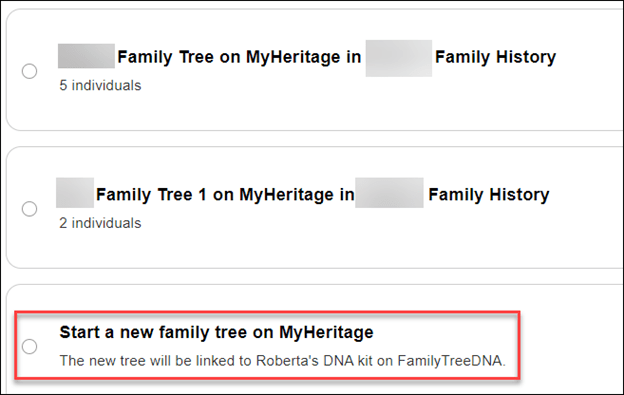
After signing in, you’ll see a menu of trees that you can link your FamilyTreeDNA account to.

Please DO NOT make a selection yet. Read through the rest of these instructions first.

As soon as I signed into my MyHeritage account after linking my FamilyTreeDNA account to MyHeritage, I saw a list of possible trees that I can link my account to. The top tree is the tree that I’m in the process of transferring from FamilyTreeDNA.

Below that tree, if I have other trees at MyHeritage or I’ve been given access to other trees at MyHeritage, I can link to “me” in those trees instead of using a transferred tree from FamilyTreeDNA. I would suggest only linking to a tree that you own and control, not one you’ve been invited to view.

Linking Means Two Different Things

Not to be confusing, but we are talking about linking in two contexts:

  1. Linking your FamilyTreeDNA account to a tree at MyHeritage.
  2. Linking matches to their profile card in your tree at FamilyTreeDNA to enable Family Matching (bucketing). You’ll perform the same match-linking process in your new tree at MyHeritage.

To ensure linked matches at FamilyTreeDNA link correctly at MyHeritage, count and record the names of your linked matches at FamilyTreeDNA.

Click on the “Tree” tab at the top of your personal page at FamilyTreeDNA. At left, select “Link Matches” which displays matches that you’ve already linked and matches available to link. at least not without undoing and reversing everything.

It’s essential to do two things at this point because after you select and link to a tree at MyHeritage, you will no longer be able to view your old tree at FamilyTreeDNA, at least not without undoing and reversing the entire process.

  • Count and make a list of your linked matches so that you know who is linked and can verify those people automatically relinked correctly after your tree moved to MyHeritage.
  • Assure that the names of the people who are linked are SPELLED EXACTLY THE SAME in the tree you’re going to link to at MyHeritage, including any prefixes such as “Mr.”, shown above. This is one of the reasons I suggest transferring your tree from FamilyTreeDNA and using that tree at MyHeritage, even if you already have a tree at MyHeritage.

Linking Your FamilyTreeDNA Account to a Tree at MyHeritage

If your FamilyTreeDNA tree consists of more than 8 or 10 people, your tree will be listed at the top and you will be given the option to transfer. If you have a small tree, it will not transfer and the tree will not be shown as an option.

The tree shown at the top of the list is the tree that you will transfer from FamilyTreeDNA to MyHeritage.

Checking this box selects the tree to transfer to MyHeritage which begins after scrolling to the bottom and pressing “Continue.”

If your tree is very small, or you don’t have a tree and want to begin one at MyHeritage, scroll to the very bottom of the trees available on your MyHeritage account if you have access to more than one tree. You’ll see the option to start a new tree at MyHeritage.

Consent is Critical

In either of the two scenarios above, transferring a tree or starting a new tree, you’ll see a consent notification below the tree options.

I’m not sure you can see this clearly in this screen shot, so I’ll transcribe it below.

I consent for MyHeritage to share my updated family tree information With FamilyTreeDNA from time to time, and I understand and consent that, upon sharing, such information will be subject to the FamilyTreeDNA privacy policy and terms of service, independently of MyHeritage.

It’s critically important for you to CONSENT to this transfer of information back to FamilyTreeDNA. This allows FamilyTreeDNA to use your tree data to improve their products and services for you – the same way they’ve always utilized customer information. For example, where your ancestors are from is critically important to improving MyOrigins and other geographically related tools.

If you transfer a tree, the consent box is already checked, but if you start a new tree after arriving through the FamilyTreeDNA platform, the consent is there, but it’s unchecked – so you have to check it.

I very strongly encourage you to transfer an existing tree or start a new one if you don’t have one, because that’s the ONLY WAY your tree information can benefit your results at FamilyTreeDNA.

Now for the bad news – if you link your FamilyTreeDNA account to an existing tree at MyHeritage, there is no option to consent for MyHeritage to send your tree information back to FamilyTreeDNA.

I really hope this policy is revised. It isn’t fair that FamilyTreeDNA can’t receive information from the trees of its customers, nor is it fair to their customers. Hopefully, this is just an oversight and will be remedied shortly.

If You Link to an Existing Tree at MyHeritage

If you link to an already existing tree at MyHeritage, you do NOT see a option to consent for your information to be provided periodically to FamilyTreeDNA.

There’s literally nothing below the trees where the consent verbiage is found with other options.

In my case, I’m an active user at MyHeritage, always growing my tree, so I was going to link my FTDNA account to myself in my tree at MyHeritage.

That is, until I discovered that MyHeritage DOES NOT PROVIDE THE CONSENT OPTION.

So, instead, I’ve transferred my existing tree to MyHeritage. This option has no disadvantages.

You can transfer any size tree to MyHeritage from FamilyTreeDNA, no matter how large. After initiating a transfer, you will receive a message that MyHeritage will email you when the transfer is complete.

My tree was finished transferring by the time I got something to drink and came back to my desk.

If you’re already a MyHeritage customer, you can have any number of trees of any size and there’s no additional cost to add to or modify trees if you’re a subscriber.

If you’re not a subscriber, you can still transfer a tree of any size from FamilyTreeDNA, but after 90 days, you will need a MyHeritage subscription if you want to add to that tree if it has more than 250 people.

For FamilyTreeDNA purposes, I’ll use the tree that I transferred from FamilyTreeDNA and keep my FamilyTreeDNA test linked to “me” in that tree and my cousins linked to “them” in that tree.

The best aspect of transferring your current tree from FamilyTreeDNA is that your linked relatives all stay linked automatically!

Of course, I’ll continue to use my MyHeritage tree for genealogy research and for my MyHeritage DNA kits.

I love my MyHeritage subscription. Transferring my FamilyTreeDNA tree and using my MyHeritage tree for genealogy research gets me the best of both worlds.

Your FamilyTreeDNA Tree at MyHeritage

After my tree transferred to MyHeritage, I clicked on the “View Tree” link in the email to verify that the tree had transferred accurately.

Indeed, all 634 people were transferred – but the tree was assigned a strange name. I need to change that.

If you want to change the tree name on MyHeritage, and trust me, I do – just navigate to “Family Tree,” then “Manage family trees,” then select that tree, then click on “Edit tree settings at far right.

Change the name to whatever you want. It’s crucial to rename it immediately if you are going to transfer multiple trees so you don’t forget which is which. Pay attention to the rest of the settings below the tree name to be sure you don’t accidentally select something you don’t want, then save the new name.

Modifying Tree Privacy, Functions and Sharing

You can change your mind about sharing with FamilyTreeDNA in either direction – meaning either enabling or disabling sharing – by clicking on “My Privacy” in the dropdown by your name at MyHeritage.

Then click on “Content.”

This is probably a good time to make sure you have enabled everything you want.

Next, you’ll see a list of every tree that you own on your MyHeritage site.

In this example, three trees are shown. The first tree is my regular MyHeritage Estes Family Tree. This is NOT a transferred FamilyTreeDNA tree, and no account from FamilyTreeDNA is linked to it.

There’s somewhat of a glitch going on here that I want to make you aware of.

As you can see, the option to “Allow sharing of my updated family tree information with FamilyTreeDNA” is available to check. In fact, I checked it. But it’s not valid and is misleading because it causes people to believe they can link to an existing tree at MyHeritage and share data back with FamilyTreeDNA, which is not the case.

If you click on the little “i” for information, you’ll see the above text that clearly says this setting “is only relevant for family trees that originated from FamilyTreeDNA and that you chose to transfer to MyHeritage to have the family tree linked to your FamilyTreeDNA account.”

Unfortunately, this option appearing here is causing people to simply link their FamilyTreeDNA account to their MyHeritage tree, believing that they will be sharing back with FamilyTreeDNA.

I really encourage MyHeritage to allow this data exchange because I think it would encourage people to maintain one tree at MyHeritage. This approach would benefit everyone and is not confusing.

On the second tree, which is also NOT a transferred tree, there is no option for sharing. This is not consistent with the first tree and causes confusion.

The third tree is my transferred tree. It does have the sharing option selected. This is a valid selection for this tree.

This is also a good time to review the features for each tree and make sure you have enabled or disabled the ones you want.

Back at FamilyTreeDNA

You can verify that you transferred your tree by checking your FamilyTreeDNA account. If you click on your tree, you’ll see a notification that you moved your tree.

Ok, now that the tree is moved, how do I know who’s linked?

How Do I Know Who’s Linked?

I can’t tell by looking at my FamilyTreeDNA tree on MyHeritage who is linked and who isn’t.

However, it’s easier than EVER at FamilyTreeDNA.

Just open your match list.

Prior to transferring my tree to MyHeritage, I had linked 15 people to their profile card on my tree at FamilyTreeDNA. Those 15 people triangulated with enough other matches to allow FamilyTreeDNA to bucket a total of 3601 paternal matches and 1602 maternal matches.

Before I transferred my tree, I made a list of all the people who were linked.

Now, you can see under each match whether they are linked on your tree at MyHeritage and, if so, the relationship you’ve chosen for them.

My parents are both linked.

However, my Ancestry V4 test that I’ve uploaded as my twin for illustration purposes for my blog is not linked, so let’s link it.

Just click on “Link on Family Tree” where you’ll be prompted to sign in to MyHeritage. I have a secure password keeper, so for me, signing in happens immediately when I click on the link.

Look what happened next, automatically.

My matches name at FamilyTreeDNA populated the search bar, and since my tree at MyHeritage is the same tree I transferred from FamilyTreeDNA, the names automatically match. Easy peasy.

If you’re using a different tree, meaning one you did NOT transfer from FamilyTreeDNA to MyHeritage, you’ll need to enter either the accurate spelling of the person’s name you want to link to or a name generic enough that MyHeritage can find a group to offer you.

For example, Estes returned 23 results and I can browse through them to select the tester at FamilyTreeDNA. Alternatively, I can add the tester’s name to the MyHeritage tree I’m using as my FamilyTreeDNA tree.

Troubleshooting Section

If You Stop After Linking Your Account but Before Selecting the Tree

I got distracted by something during this process – after I had linked my FamilyTreeDNA account and signed into MyHeritage, but BEFORE I had linked my tree.

I received this email.

Don’t be confused by this email.

  • If you don’t link to a tree at MyHeritage, you will still receive matches at FamilyTreeDNA.
  • Nothing you do or don’t do in terms of transferring or linking to a tree at MyHeritage affects your ability to receive DNA matches at FamilyTreeDNA.
  • If you don’t transfer your tree or link to one at MyHeritage, you won’t be able to link new matches at FamilyTreeDNA to their profile in your tree, and you won’t receive new bucketed Family Matches.

Clicking on “Link Family Tree” in the email returns me to where I left off at MyHeritage. I then linked my FamilyTreeDNA account to the tree that I transferred from FamilyTreeDNA.

Account Settings

After signing on to FamilyTreeDNA, you may close the popup to transfer your tree and then not be able to figure out how to transfer your tree.

Another place where you can initiate transferring your tree is through Account Settings on your FamilyTreeDNA page, which is found under the gear by your name in the upper right-hand corner of your personal page.

More importantly, though, if you somehow make a mistake or get confused, this is where you go in your FamilyTreeDNA account to:

  • Link to a home person in your tree
  • Unlink your account from MyHeritage and start over
  • Once your tree is transferred, you cannot automatically “untransfer” your tree, although you can sever the link via a disconnect, delete that tree at MyHeritage or update your privacy settings
  • Disconnecting from MyHeritage restores your tree at FamilyTreeDNA

I clicked on “Link to Home Person.”

The four closest people are shown in the tree I had selected. If none of these are the person you seek as your home person in a tree, type the name of the person you want to link in the search box. If you’re linking a relative’s kit that you maintain for them, you’ll probably need to type their name if you’re linking them to an existing tree.

Or, if you selected the wrong tree, you can disconnect from your MyHeritage account altogether, start over, and select a different tree.

Unfortunately, you’re not going to recognize that name of the tree (unless you changed it), so you’ll have to click to view the tree if you don’t remember which one you selected.

By clicking on the results you wish, you can either view the tree or select that person to link to as the primary person in your tree.

Summary & More Resources

I know this has been a lot for one article. I’ve been testing for several days and have tried to help you better understand so that you don’t say later, “I sure wish I had known that…”

I’m incredibly grateful that FamilyTreeDNA and MyHeritage have made this process seamless, even maintaining our linked relationships with our matches.

To summarize what you need to do:

I recommend using your FamilyTreeDNA tree at MyHeritage for FamilyTreeDNA purposes because:

  • The names are all spelled correctly, and your linked matches won’t be broken
  • Consent for MyHeritage to allow FamilyTreeDNA to periodically receive updated information from your transferred FamilyTreeDNA tree

Additional Resources

  1. FamilyTreeDNA wrote an article about the new features, here.
  2. FamilyTreeDNA provides a FAQ here, including information for Group Projects and Group Administrators.
  3. MyHeritage wrote an article, here.

Now, transfer your tree and go enjoy the new tree features at MyHeritage!

_________________________________________________________

Share the Love!

You’re always welcome to forward articles or links to friends and share on social media.

If you haven’t already subscribed (it’s free,) you can receive an e-mail whenever I publish by clicking the “follow” button on the main blog page, here.

You Can Help Keep This Blog Free

I receive a small contribution when you click on some of the links to vendors in my articles. This does NOT increase your price but helps me keep the lights on and this informational blog free for everyone. Please click on the links in the articles or to the vendors below if you are purchasing products or DNA testing.

Thank you so much.

DNA Purchases and Free Uploads

Genealogy Products and Services

My Books

Genealogy Books

Genealogy Research

La Chaussée – French Birthplace of Acadia – 52 Ancestors #427

Many of the families that settled Acadia in the New World in what is now Nova Scotia originated in the Poitou region of France before deciding to embark on a life-altering journey to the New World beginning in the early/mid 1600s and continuing through the first half of the 1700s. The history of the Poitou revolves around the wealthy Charles de Menou d’Aulnay (1604-1650), and his family, specifically his cousin Isaac de Razilly. Both were members of the French nobility

De Razilly became governor of Acadia in 1632 and began the settlement of French families in earnest at La Hève, now LaHave, but died unexpectedly in 1635.

D’Aulnay became governor of Acadia following Razilly and served from 1635 to 1650, when he, too, died. D’Aulnay moved the settlement and center of government from La Hève to Port Royal, now Annapolis Royal, in 1635-1636.

During a recent trip to France, I was privileged to visit the location of many of my Acadian ancestors with Claude Beaudreau through his travel company specializing in Acadian tourism travel, Les Voyages DiasporAcadie.

In fact, here’s a photo of our group of cousins.

In case you’re wondering, no, I’m not being paid for this (or any) article, ever, and Claude doesn’t even know I’m doing this. I would take this trip again in a heartbeat. It was that good and I would know more today.

Aulnay

On the way to La Chaussée, we stopped for a photo op at Chateau d’Aulnay, just outside Aulnay.

You can’t get near the Chateau d’Aulnay today. Our bus stopped alongside the road and we took photos through the gate. D’Aulnay was wealthy, but the Acadian pioneers were mostly peasant farmers, with a few craftsmen and trusted others hand-picked for their skilled contribution to the new colony.

The towns of Martaizé, La Chaussée, and the area surrounding Aulnay are known to be the original homelands of many of the Acadian pioneers who lived on d’Aulnay’s land holdings.

You can see that Aulnay is dead center in between, and those two villages are less than four miles apart.

The Cassini map of 1733 shows the La Chaussée de Renouee church and residences to the left of the church.

La Chaussée translates to “the roadway” and La Chaussée de Renouee translates roughly to “the knotweed causeway.”

Of course, back then, every little crossroads village had its own church for the residents who all walked to services. Adjacent the church was, of course, always a cemetery where everyone’s ancestors were buried.

The Road Home

If you’re not Acadian, you’re going to fall in love with La Chaussée today and wish you were. Regardless, there’s a lot of historical information that is relevant to more than Acadian history.

If you are Acadian, get tea or maybe a glass of wine, and Kleenexes, because I’m taking you back in time.

The bus rocked gently back and forth, but if you dozed off, you could easily have been napping in the back of a coach or wagon, lulled by the steady rhythm of the horses.

As we drove along the quaint backroads of France, we felt like we were literally on the road home.

Excitement mounted as we neared La Chaussée, then saw the sign beside the field.

Around another curve or two, the buildings began to appear.

In these storied villages, filled with history, the roads nearly touch the sides of the buildings that were built here long before the roads existed.

These stones hold the secrets of the past, our past.

The old often blends gracefully with the new. The 20th century shoring up the 19th that shored up the 18th, and so forth.

The gardens, courtyards, and farms hold a medieval charm never found stateside.

You know when you’re approaching the center of a village because the houses get progressively older. Except they are not characterized as old, but are wise witnesses to the past and stunningly beautiful – visually transporting us back to the time when our ancestors probably lived in these very houses.

There are few houses in any small village. Everyone knew and was related to everyone else.

You can hear the lady next door calling out to see if you have any salt, or calling someone to get the midwife because her baby is going to arrive shortly.

Or maybe, sending someone to fetch the priest.

Homes are clustered closely and often share walls. Sometimes, new homes or newer structures are built adjoining ancient ones, melding centuries.

Often homes too deteriorated to restore and maintain become the next generation of barns.

The old blends with the modern. Children who gaze out the windows are very probably related to Acadian children who gazed out the same windows centuries ago. They would be related to today’s Acadian descendants in hundreds of ways, their common ancestors reaching back countless generations to the time when Julius Caesar mentioned the inhabitants of this region, calling them the “Piktones.”

The Gallic Piktone tribe became the French who inhabited the Poitou region, some of whom became the Acadian settlers who pioneered settlement in Nova Scotia, then were scattered to the winds in 1755.

We have returned home, much like the swallows that return to the Mission at San Juan Capistrano

Acadian history and culture reach deep into this soil.

The oldest structures are always found at the crossroads, which means sometimes they haven’t survived, and buildings that are still old, just not as ancient, take their place today.

Of course, in the center of the village, which is always the original settlement, we inevitably find the church – the heartbeat of the village. The lives of the villagers revolve around religious rituals and their faith – from birth until death do us part.

La Chaussée

Welcome to La Chaussée, birthplace of Acadia!

In the travel tour book provided during our adventure, Claude notes that half of the La Chaussée parish entries between 1626 and 1650 can be linked to about 20 of the 53 Acadian family names found in the 1671 Acadian census.

The 1671 Acadian census in Nova Scotia included the following French surnames by many various spellings. Bolded names represent males found in this census. Some of the original settlers had clearly died by that time. In other cases, women may have married in France, or their father and brothers, if any, had already died in Acadia. One or the other of those circumstances is why females had their birth surname listed, but had no paternal male line in Acadia in 1671. Those surnames are not bolded.

  • Aucoin
  • Babin
  • Bagard
  • Bajolet
  • Bayon
  • Beliveau (Bellieveau)
  • (de) Bellisle
  • Belou (Blue) (Bleu)
  • Bertrand
  • Blanchard
  • Boudreau (Boudrot)
  • Bourg
  • Bourgeois
  • Breau (Brode)
  • Brot
  • Brun
  • Caissy (Kuessy) (Scottish surname)
  • Chebrat
  • Claude
  • Colleson
  • Comeau
  • Cormier
  • Corporon (La Tour)
  • Cyr (Sire)
  • Daigle (Daigre)
  • D’Entremont
  • Doucet
  • Dugas (Dugast)
  • Dupeaux (Depuis) (Dupont)
  • (de) Foret (Forest)
  • Gaudet
  • Gauthier
  • Gauterot (Gautrot)
  • Gillebault (Guillebault)
  • Girouard
  • Gougeon
  • Granger (Grange)
  • Guerin
  • Guilbaut
  • Guyon
  • Hebert
  • Helie
  • Joffriau
  • LaBatte
  • Lalloue
  • Lambelot
  • Lambert
  • Landry
  • Lanoue
  • LaTour
  • LeBlanc
  • Lefevbre
  • LeFranc
  • LeJeune
  • Martin
  • Melancon (Melanson) (Huguenot, perhaps English)
  • Mercier
  • Mius (Muis) (also d’Entremont)
  • Morin
  • Nicollas
  • Ouestnorouest
  • Pellerin (Pelerin)
  • Pelletret (Peltret)
  • Peselet (Pesseley)
  • Petitpas
  • Pitre
  • Poirier
  • Poulet
  • Rau
  • Richard
  • Rimbault
  • Robicheau (Robichaud)
  • Sallee
  • Savoie
  • Terriau
  • Thibodeau (Thibeaudeau)
  • Trahan
  • Vigneau
  • Vincent

Some of the Acadian lineages are found in La Chaussée, including Brun, Belliveau, Breau, Chabrat, and Chaumoret, and several others are likely from there or nearby.

Jean Chabrat is my ancestor, born to Antoine Chabrat and Francoise Chaumoret and baptized on February 5, 1627, in La Chaussée. She was probably born either that day or the day before. It would have been a short walk to the church for the father or other family member.

Today, we will find their origins in this small crossroads village in the French countryside.

Click to enlarge image

La Chaussée really is a tiny crossroads. We’re going on a walk together, so here’s the aerial view with a few labels to help you orient yourself.

La Chaussée was and is a tiny, dense village. You can see the church and the buildings just to the left, with a small walkway in between. Those would be the buildings drawn on that 1733 map.

We were all VERY excited to arrive. Everyone spilled out of the bus and began taking photos.

For many Acadians, this is ground zero.

In La Chaussée , the Maison de l’Acadie and the church mark the crossroads where our cousins awaited our arrival.

The welcoming committee was waiting for our bus to arrive. This small Acadian museum, staffed by volunteers, is attached to and shares a wall with the church.

Seeing this for the first time, knowing my ancestors literally walked here brought tears to my eyes. I was overwhelmed by a sense of awe.

Awash in a sense of place.

Our cousins greeted us by waving Acadian flags in welcome.

Across the street, a street sign made it official and announced where we were.

I couldn’t help myself, I had to take a closeup of the snails on the white cover at bottom left below the street sign. Even the snails are beautiful here!

Rue des Acadiens translates to “Street of the Acadians.”

This wall is ancient and likely stood, protecting the home of an Acadian family or someone related to one. At that time, they weren’t Acadians yet, but they soon would be.

The narrow walkway between the church and another ancient building, today’s village hall, at left.

The pathway and archway are important. We will pass beneath it, as our ancestors did.

I felt that this was a portal into the past, and it actually was. Wait until you see what I found.

But first, we turned and entered the church through the doorway that you can see, at right, before the steps.

Walking into Notre Dame de La Chaussée where my ancestors celebrated and grieved all of their life’s events was simply breathtaking – as in steal your breath away and transport one through time.

Local lore says that the Acadian families prayed here before leaving on their long journey, from which there was no return.

Those who stayed behind would have known that they would never see their family members who left – so this was a mammoth decision. The family story that they prayed for guidance would have brought comfort to those remaining in La Chaussée  – understanding that their family members were doing God’s work, or at least had asked His blessing.

Returning home, almost 400 years later, was equally as emotional. I hope somehow they knew.

You can read more about the church, here, and here, in French. I have translated relevant portions using ChatGPT.

Razilly and d’Aulnay were the Seigneurs of La Chaussée, which means that they owned the land and charged rent to the peasants who farmed here.

From the brochure:

Why not let yourself be surprised by the first contact with this church, then sit on one of the old benches in its nave and let yourself be penetrated by its simple and captivating atmosphere? Why not think for a moment of all those inhabitants of La Chaussée who prayed here? Why not evoke all those that Charles Menou d’Aulnay, governor of Acadia, recruited to populate New France and who were led across the Atlantic by the lord of the town, Mr. Le Godelier, in the 17th century?

Prior to reading this brochure, I didn’t realize that the “lord of the town,” which I’m presuming would be something equivalent to the mayor, actually led a group of people to Acadia that had been actively recruited.

Welcome to the church of our ancestors.

A basin, probably for Holy water, by the entrance.

Our cousins and guides did their best to make it inviting and decorated accordingly, or maybe I should say, Acadianly. Here, the flags of both Acadia and Acadiana.

From the brochure, you can see many of these items in the photo above and below.

    • The statues of Saint Thérèse of the Child Jesus and Saint Radegonde, on either side of the altar, and of Saint Anthony of Padua, between the choir and the chapel, are more indicative of popular devotions.
    • The stained glass window, featuring Saint Paul and Saint Genevieve, was offered by Julie Goudon de La Lande.
    • In a beautiful Gothic niche, to the right of the altar, a statue of Saint Roch evokes the formidable plague epidemics that decimated populations from the 14th to the 17th century.
    • Roch, born in the 14th century into a wealthy family in Montpellier, became a hermit and spent a large part of his life on pilgrimage. Legend has it that when he was afflicted with the plague, he took refuge in a forest where a dog belonging to a nobleman came to feed him. Along with Saint Sebastian, he is invoked during epidemics. He is often depicted as a pilgrim (with a hat, staff, and panetière…), showing his leg with a sore caused by a bubo, and accompanied by a dog holding a loaf of bread in its mouth.
    • To the left of the altar, you should notice a beautiful Pietà from the 15th century, unfortunately mutilated.

This child, whom you have joyfully engendered to the song of angels, now you receive him from the cross in your sorrowful arms. Have compassion on Christ and his mother, faithful soul, if you want to rejoice eternally with them in heaven. Jesus, son of God, take pity on me, by virtue of the prayers of your joyful mother, save me through the cross, lead me to true light, with you, I will rejoice in heaven.

Thomas de Kempen – “a Kempis” – (1379-1471)

I wonder how badly impacted this region was by the plague that swept through Europe from the 1300s to the 1600s, again and again.

The plague arrived in France with a vengeance in 1347, spreading rapidly and being interpreted as God’s wrath. Roughly half of the population died in a five-year period, with estimates ranging from 40% to 60%. We know for sure that half of the people living in Paris and 60% of the population of Florence died.

It took another 150 years for the population to recover to pre-pandemic levels, which would have been about a century before the Acadians began to immigrate.

Plague outbreaks ebbed and flowed across the next several centuries, with the last French epidemic raging in 1720, after most of the Acadians were already settled far away in Acadia. They were facing a scourge of a different kind.

The cemetery outside this church would have been filled with plague victims, somehow singled out by God to suffer and die for their evil deeds, while others were chosen to live.

According to the University of Iowa, as with more recent epidemics, home remedies, mostly hopeful, sprang up, along with advice, including:

  • Plague is a scourge from God for your evil deeds – by scourging yourself with a whip like a flagellant, then God has no reason for scourging you with plague.
  • Apply a mixture of tree resin, roots of white lilies, and human excrements.
  • Bathing should not be avoided, and be done with vinegar and rosewater—alternatively in your own urine.
  • Drink the pus of lanced buboes.
  • Quarantine people for 40 days (quarantine comes from Latin for 40) – first done in Venice in 1348.
  • Place a live hen close to the swellings to draw out the pestilence then drink a glass of your own urine twice a day.
  • Grind up an emerald and drink it in wine.
  • Ingest snakeskin, a bone from the heart of a stag, Armenian clay, precious metals, aloe, myrrh, and saffron.
  • Roast the shells of newly laid eggs, and grind them to a powder – add Marigold flowers and treacle – drink in warm beer every morning and night.

If the plague didn’t kill you outright, some of these cures just might.

Look at those ancient stones in front of the table with the cross, worn concave by hundreds of years of worshipers’ feet. My ancestors would have trod on those very stones.

Be still my heart.

I noticed some broken statuary, tucked respectfully into a corner, likely for protection.

It was probably whole when they worshipped here.

ChatGPT translated part of the French document about the church, which says:

To conclude, we take the opportunity to highlight two sculpted elements:

    • The statue of the Virgin of Pity (or Pieta) unfortunately amputated of the heads of Jesus and his mother (during the revolution?) dated from the 15th century. It was once painted in polychrome. Its execution quality is remarkable.
    • The lower fragment of the statue of Saint George or Saint Michael fighting the dragon (of which a clawed paw is visible at the back) also dated from the 15th century. The leggings and armored shoes of the fighting saint are perfectly visible.

As a little anecdote, one of these statues was found in a cache made in a wall of the church during work undertaken in the neighboring house.

Given that this does not look like a statue of Mary and Jesus, I’m presuming it’s Saint George or Saint Michael.

Regardless, given that it dates from the 1400s, and the French Revolution didn’t occur until 1789, this statue was very likely intact and installed someplace in the church here when Acadian ancestors lived.

This little area is the transition between the older and newer parts of the church. There’s a buttress rising above.

Rear steps in the original part of the church, but not the original doors, according to the church history. Piscinas for Holy Water, perhaps, on each side?

I don’t know what the worn-away areas are in the back walls of the little alcoves, but they remind me of generations of fingers that wore areas like this in the limestone in some of the Hospitalier buildings on the Camino de Santiago – worn away over centuries by those seeking blessings or communing with the Lord.

My ancestors climbed these steps.

I walked in their footsteps.

Me, at far right, taking it all in – or trying to.

I’m actually inside the church of generations of my ancestors. Where they began and ended their lives. Where they came to baptize, bury, and marry.

Jeanne Chebrat’s parents, who stood in this very church and baptized their daughter, were 11 generations removed from me, assuming that this Jeanne Chebrat is my Jeanne Chebrat. But there were untold and unnamed generations before her.

I don’t know when the “new” portion of the church was built, but the history says that the building was extensively remodeled in the early 1500s with the addition of the south chapel which is open to the choir. That means that this church, structurally pretty much as is, was here when Jeanne was baptized in 1627. The stained glass windows apparently came later.

Given that the church was originally built in the 1200s, it’s probable that another dozen generations of my ancestors worshipped here – and are buried outside.

As I sat in the front pew, I closed my eyes slightly, staring at the stained glass and transported myself back in time to hear the Priest as he would have baptized and buried so many generations of my ancestors.

I heard the droning of his voice, in unintelligible Latin, then the melodic singing of the church members.

These murals – I couldn’t believe my eyes.

I raised my gaze in awe as I saw what they saw. Trying with my vision to reach across the centuries.

What did they think?

They couldn’t read the Latin in the Bible, but they surely understood the drawn images on the murals.

Did they interpret them as encouraging or threatening? At least one, Saint Lucia, a martyr, is depicted being brutally killed.

I walked along the walls of the church to see what was in the little alcoves or niche, as the church’s document calls this.

Murals surround the statue. In the bottom of the alcove is a square hole and on either side are round ones.

The documentation states that this mural was degraded by what it refers to as a “large niche housing a liturgical sink.”

In old Catholic churches, holes in the bottom of alcoves are piscinas that allow the Priests to pour sacramental wine or Holy water used in and left over from masses into the wall of the church to return to the earth so that it could not be harvested for nefarious purposes, such as witchcraft.

These incredible murals were discovered a few years ago, but the church does not have the funds to restore them.

Dating from the 1200s, these murals were, until recently, hidden beneath plaster.

Here’s what the La Chausse document says about the murals, translated to English using ChatGPT:

While the entirety of the church walls seems to retain painted panels covered with several layers of plaster, only those of the oldest nave are currently considered worthy of being revealed. The others, more recent and more fragile, keep their mysteries and certainly their beauty. These narrative scenes on the walls of the western nave are authenticated from the late 13th century.

The south panel is truncated by the piercing of a large niche and the modification of the former opening. However, the north panel is almost complete.

The conservation states of the decorations are uneven, making the work of updating and restoration perilous. The oldest decor, depicting martyrs, occupies almost the entire surface of the two south and north walls of the first bay. These decors have been prioritized for conservation and presentation. To the north, it is partially covered by a very altered Saint Christopher, of which only the upper part of the body remains (estimated from the 16th century).

Unfortunately, the lower part was chipped away during the redoing of the plasters from the ground up to about 1.45m in height during the late 18th century. This Saint Christopher has been preserved as is as a punctual testimony but also because it was not wise to risk finding nothing underneath. The three adjacent registers occupy the entire wall (covered in the center by the 16th-century Saint Christopher). Only the left panel reveals a name: Saint Cecilia (Sancta Cecilia), while the right panel is too altered to allow any reading.

The south wall presents three well-visible panels, unfortunately degraded in the middle by the piercing of a large niche housing a liturgical sink, and also degraded along its entire length up to 1.40m from the ground. The three identified saints are martyrs: Saint Catherine (Sancta Catharina), Saint Anastasia (Sancta Anasta sia: the saint’s head is interspersed in the middle of the name), and Saint Lucy (Sancta Lucia). Executioners performing their grim task can also be identified.

I’d love to know more about the messages in these stunning old murals from centuries ago.

What stories were they trying to tell? Were they just religious interpretations from the Bible, or were there historical aspects from this region interwoven, too?

Who painted the murals?

Do other churches from this timeframe have murals?

How rare are these?

What were our ancestors told about them?

Notice the old iron candle holder, at far right, that would have lit the inside of the church in the darkness.

Look how thick these walls are.

This old window may have been original. The oldest windows in small churches often didn’t have colored glass, which was expensive.

My ancestors would have sat in these small pews, or similar ones, with their neighbors who were all family members, I’m sure, perhaps daydreaming as they looked out the windows. The sermon would have been in Latin, not French, so they had lots of time to think.

Is it going to rain?

I wonder if I should plant seed yet?

Is the cute boy two pews behind me noticing my new dress and bonnet?

Should I visit my sweetheart’s father and ask for her hand in marriage?

What if he says no? What do I do then?

Am I pregnant again?

I forgot to go to confession.

Should I go to the new world?

The extent of the oldest part of the church, the west nave, is seen here. These very old murals are only found in the oldest portion of the church, although apparently, some are still covered in the newer part.

The fact that experts don’t feel that they can uncover and save the newer murals makes me sad.

This is what my ancestors would have seen, looking towards the older end of the church from beneath the buttress, the dividing line between the newer and older.

Who sat where? Was there a hierarchy? Did the moms with babies sit near the doors? Did sinfulness or money matter, or was seating first come, first choose?

Notice the unevenness of the stones on the floor.

This is the only detailed photo I managed to take of the side chapel by the door in the new portion of the church. “New” is a matter of perspective, because even this new part built in the 1500s is older than America.

From the brochure:

The altar of the side chapel is the altar of the Virgin, as indicated by its monogram formed by the intertwined letters M and A (Ave Maria) and the statue of the Virgin with the Child.

This looks like a Crusader’s cross to me. That’s entirely possible, given that the Crusades occurred in the 1100s and 1200s.

Claude near the altar.

I wonder if the white statues in those alcoves above the two wooden doors were there when our ancestors worshipped here. I would presume that they were.

Unfortunately, I didn’t take closeups of the items on the altar as there was a lot going on up there. I felt a bit intimidated and didn’t want to get in the way. Of course, now I wish I had a photo of at least that Pieta – but I didn’t realize there WAS a Pieta until after I was back home.

Given that French is not my native language, I also misunderstood and thought that the newer part of the church was built after the Acadians left. It was not, but it was remodeled long after they departed.

Look at those ancient steps along the side wall of the new portion of the church and the blue remnants of a mural.

The Madonna and child.

Every mother and her child.

We listened to and sang a French Acadian song that had great meaning and brought tears to those who grew up Acadian or in the Acadian diaspora. Anne-Christine, one of our guides, is playing the music from her phone.

Jim took a photo of the group of cousins as they sang.

This church is actually quite small. Just a little country church. These always speak to me, more so than larger churches. I experienced a deep feeling of belonging.

We all felt that we had returned home.

Notice the darkened arched doorway, at right.

I’m going to explore. (I can’t even begin to tell you how many times this phrase has gotten me into trouble over the years.)

This is inside the arched doorway to the right in the new part of the church. I’m not sure what the small stone archway near the floor was.

It kind of looks like an old oven, but an oven would not be in a church and not on the floor.

The bell tower with a modern ladder reaching to the top.

Looking upward. Imagine the people who would have originally climbed all these levels to ring the bell on some type of wooden ladder.

Say your prayers first.

Having said that, I’m sure that every little boy aspired to climb the bell tower ladder and ring the bell. Maybe it was a rite of passage.

Plaque honoring the Brun and Braud line.

These people are not my ancestors, at least not that I know of, but with Acadians, you never know for sure about some of the unknown wives. Even if they weren’t directly my ancestors, since our families all lived within walking distance of this crossroads for time immemorial, you know they were all somehow related and probably many times over.

There’s an Acadian saying that is absolutely true, “If you’re related to one Acadian, you’re related to all Acadians.”

I am standing beside the first pew, looking back into the old portion of the church through the newer portion. By the 1600s, when Jeanne Chebrat was baptized here, the parishioners would probably not have realized that there was an older and a new portion of the church. The older portion had already been in place for several generations, and the oral history probably didn’t descend to them. For those people, all that really mattered was that this was their church and played a crucial role in their everyday lives. It was just “the church” that had always been there.

Given the large number of children born to each family, there were an equal number of baptisms and eventual deaths. Almost universally, those who didn’t die married. Many people would have visited the church multiple times each week, not just on Sunday.

The church bell summoned people and often announced a death. The local communications medium long before the phone.

I can see the spirits of my ancestors here.

This part of the church, to the rear beyond the arch, with the murals, is the oldest portion of the church from the 12th century. The church was built here only after people were settled in the region and, of course, after Christianity took root.

I wish I could put my feelings into words. Some combination of awe, gratitude, and a knowing in my soul.

I slipped quietly outside.

Something, or someone, was calling me.

“Daughter…follow me…”

“I’m coming!”

Exploring

Outside the church door, I turned right and stepped through the old archway, heading towards the rear of the church.

To the right is the original, oldest portion of the church, more than 800 years old.

Clearly, at one time, there was either another entrance or another chapel.

I turned and glanced in the other direction, to my left, and suddenly…I drew a sharp breath.

I knew exactly what I was seeing.

Glory be!!!

The old well.

Moreso than even the church, the communal well was the lifeblood of a small village.

No one, not man or beast, can survive without clean water.

This well would have provided life-giving water to my ancestors and their ancestors too.

I felt my mother standing beside me.

We stood there for a long time, just drinking everything in.

I didn’t want to move, because I didn’t want the feeling of Mom beside me to dissipate, but eventually, I had to.

I invited Mom to come with me on a walk.

The Walk

I decided to take a walk in this ancient ancestral crossroads and see what else awaited.

The spirits weren’t finished showing me around.

A beautiful cross marked the entrance to a walled communal park-like garden area by the church. This is the area marked on the old map with houses. I entered.

I was alone. No one else was here.

This, too, was ancient, and as I stood here, I couldn’t help but wonder if this was the old cemetery. However, it’s probably more likely, given the ancient houses, that this was the communal yard in front of all of the homes.

The entire area was walled.

The archway at far left in the photo leads to the well. This would have been the original village and assuredly where the original villagers lived before expanding across the street from the church..

The back of these buildings shares the arched walkway with the wall of the church.

Whatever this was, it’s quite old and was here originally.

Original peasant homes were small and often shared with animals, or animals were housed in the other “half” of the building.

The walkway with the wood box area above probably at one time led directly to the church door. Today, this building is the village hall.

The back wall of this building is the side of the arched walkway.

The well is in this open archway that passed through to where I was standing earlier.

These beautiful, sacred old stones were placed in the surrounding wall by the inhabitants of La Chaussée. Building communal walls was probably a community effort.

The community bulletin board provides information to residents. I have no idea what it says.

However, the QR code takes you to this village link: https://lachaussee86.com/

That QR code seems like something from the far future here.

This grapevine may be as old as the building!

I desperately want to know what this is, but I have no idea. I also wanted one of those rocks but didn’t touch them. If there had been someone to ask if I could have one, I would have.

They’ve reinforced the original construction. You can see the foundation boulders, stones, and beams.

Windows, but no glass or shutters, so I’m not sure what this is.

This must have been the churchyard or a cross placed to bless and protect the villagers.

I can’t help but think of my mother.

I stood here for a very long time.

How my ancestors must have prayed for Divine guidance.

I turned around and crossed the courtyard one last time, thinking how many times my ancestors had done that exact same thing.

Through the Archway

I stepped through the covered archway that sheltered the well, into the area behind the church.

To my left was what remained of the churchyard, which was, at first glance, nondescript.

To the right was the beautiful old entrance to the church.

The flight of stone steps led down from these double doors to the double piscinas on both sides.

From the outside, it looks like this facade might have been added.

The report on the condition of the church contains information about this, the west nave entrance, and the required restorations to prevent further decay.

It was during the summer of 2016 that the municipal council considered undertaking works in the Church of Notre Dame de La Chaussée due to significant humidity rising from the ground, attributed to the building’s low-lying structure. This humidity is accompanied by severe contamination from microorganisms, such as green algae, at the lower parts of the walls and the floor of the west nave. This issue is also exacerbated by the absence of gutters on the entrance porch and by infiltrations on the building’s buttresses. Due to its listing as a historical monument, the designation of a heritage architect was necessary and mandatory. The various funding searches, administrative procedures, and various authorizations finally allowed the work to begin at the end of 2018. Major external drainage, roofing, and masonry work were planned, accompanied by essential archaeological research. Some remnants of objects and bones have been collected and are currently being dated in a specialized laboratory. Simultaneously, research for possible painted decors has been undertaken by specialists (Atelier Moulinier from Vendôme).

I’m dying to know about those bones! Whose bones are they, and how did they get there? Where, exactly, were they found?

You can see the church, along with the archway joining the church to the buildings alongside. These would have been the original village buildings, clustered together for protection. Of course, the well served them all.

Much of the area behind the church has been paved.

This now stone-filled archway may well have been the original entrance or perhaps a long-gone chapel.

The Crusades ended about the time the original church was built, but the Hundred Years War broke out not long after. It seems that France has never been peaceful, and the peasants had a LOT to pray about.

I turned around to walk behind the church.

The Churchyard

I stepped into the small grassy area between the church and the home behind the church.

The church has graciously placed benches, I’m assuming for both rest and reflection.

I walked into the grassy area, trying to determine if this had once been the cemetery. Was there any hint left, at all?

I turned around to see the church through beautiful blooming trees.

The blossoms framed the steeple beautifully.

Descendants of the people who lived here hundreds of years ago probably mingle outside on Sunday mornings now – much like our ancestors did in the past.

As I continued to walk around the church, I noticed the petals from the flowering trees had collected along the path.

Pink snowflakes mixed with the beautiful dandelions and other wildflowers that nourish the bees, descendants of the bees that nourished our ancestors with their honey a long time ago.

I couldn’t help but think of the analogy about the Acadians, blown on wild winds across the world, yet, finding our way back again.

This area, too, may have been the cemetery. One thing is for certain: it was one place or the other and adjacent to the church. I suspect, here, behind the church rather than in the other area due to the proximity to the well, the courtyard arrangement, and the villagers’ homes.

April is beautiful in France and touches the soul.

I noticed, from this view, the old iron support in the rear of the wall near the archway walk. That form of wall support is ancient, too.

The well is located in that archway.

The tiny cross on the original portion of the roof is visible here.

Sometimes it’s the little things. I suspect this was original and they all viewed this same cross – since the 1200s.

I turned around and noticed an iris blooming – one that looked exactly like Mom’s.

Yes, Mom was definitely here with me. I would have said a prayer for her soul, except her soul didn’t need a prayer.

Instead, I simply gave thanks for being here, for her strength in the face of unbelievable adversity, most of which has never been revealed.

Did she inherit that fortitude from these hearty people, survivors of the plagues, brave enough to forge on ahead to an unknown world?

God bless you, Mom.

Thank you for this sign.

Even as fully grown adults, sometimes we need the presence of our mother.

I smiled and walked around to the far side of the church.

You can see the window well that is probably 3 feet deep that one looks up into when inside the church. Those daydreaming windows.

This church was built into the slope of a hillside.

The bell tower is in the newer part of the church.

I was incredibly glad that I was able to take this sacred walk alone in the churchyard, especially finding the well.

The Walk

Next, I decided to walk down the small road.

The roads here are so small that they are paved, but there are no center lines. Pretty much everyone is courteous in the countryside, and no one needs lines.

Ancient walls whisper their secrets, amid the doors offering entrance into their mysteries. Houses were attached to the walls and often barns as well.

Was this perhaps where my ancestors lived?

Hundreds of years ago, someone had to be the first to build this beautiful “new” farmhouse when there was no more room in the little village enclosure beside the church.

The bowed roof tiles speak to the age of this building, as does the wrought iron support at left. Normally, these wrought iron devices, called tirants, from the verb tirer, to pull, were sunk into the beams of ancient walls to keep the stones from pulling apart near the beams, offering additional support. They usually correspond to upper beams, sometimes to floor levels in multi-floor buildings. Tirants can reach back into the Middle Ages and were still used in the 1500s.

Sometimes, in prosperous cities, the iron was shaped into a year, so a house built in 1592 would have four irons, each shaped into that number, and any extra irons would have been shaped into something decorative.

However, in the countryside, I saw no years, just lots of practical reinforcing tirants.

The newer concrete block structure almost looks obscene beside the building so full of character and heritage.

Peasant homes didn’t have glass panes, so they simply used shutters. Closed them at night and opened them in the morning. Many places still do, although most do have windows inside the shutters now. Last year, I saw a few in southern France that didn’t.

I’m so incredibly glad the current owners have preserved these old buildings with their centuries of history instead of simply tearing them down.

The maintenance must be unreal.

Sometimes one side looks to be from a different century than the other side.

My Dad used to maintain structures like this. He almost never tore anything down, even when he should have.

I love the old holes where the original beams, probably now long rotten, would have been. Even the newer portion on the road-facing side is probably hundreds of years old. The corner has clearly been reinforced.

When our ancestors lived there, this road would have been a simple cart path.

Peering around the corner into the barnyard. Beautiful blending of the old and new. I love the single old stone wall in the more distant building with the red tractor.

Another historic building saved.

Seeing this part of my ancestors’ lives makes me feel infinitely closer to them and what their lives were like.

Whoever you are that has preserved all this – thank you! My heart is bursting with gratitude.

All these buildings were one or two houses from the corner, if you count the church. When I said this was a crossroads village, I meant it literally. There is only one house/farm behind the church until you’re in the “country” with no more buildings for a long way. I’m headed back now – the church is on the right, just before the crossroads.

We’ve come full circle as the Rue des Acadiens sign is located on the wall at left at the corner by the white fence.

Across the road, on the opposite corner, we find a crucifix statue.

The Museum

The museum, attached to the church, is open and very welcoming.

I rejoined my cousins who were touring the museum.

The Acadian Museum shows life as the Acadians knew it.

The sign outside states their mission of retracing Acadian history, including everyday objects. The church “recalls the long prayers said when laborers and craftsmen set off from the towns of Aulnay, Martaise, La Chaussée, and St. Clair.

A bit of history.

It’s safe to say that d’Aulnay and Razilly changed the course of life for millions of people alive today.

Various headdresses worn by Acadian women.

Reproduction of Acadian food cooking in a fireplace.

An Acadian couple in front of their hearth.

An Acadian woman in traditional dress. She made all of the clothes for her family.

An Acadian man. Note the wooden shoes to prevent sinking in the marshlands. The marshlands of the Poitou prepared the Acadians for the marshlands of Acadia. That’s likely at least a part of why they were recruited.

A candleholder, clearly authentic and used.

La Have, the original seat of Acadia from 1632-1636.

Artifacts excavated from the site of the fort in La Have.

A piece of wood from the aboiteau, a type of dyke and sluice system used by the Acadians, from the homestead of Jacques Bourgeois in Beaubassin. He is also one of my ancestors.

We were only here a few hours, but what a world of difference it made.

Maison de l’Acadia translates to “House of Acadians,” but it’s really the home of the Acadians. Home is someplace you can always go back to.

The hospitality of the museum volunteers, most of whom we’re related to somehow, created a wonderful, educational day and truly made us feel at home.

While they were excited when we arrived, you can see their exuberance when we left. We all felt like we had made fast friends with our distant cousins. Much hugging ensued as we boarded the bus.

We couldn’t say thank you enough times.

There were more than a few misty eyes as we bid farewell, adieu, to our cousins at La Maison de l’Acadie.

It’s time to say goodbye, au revior, at least for now, to this tiny crossroads so vastly rich in personal and Acadian history.

_____________________________________________________________

Follow DNAexplain on Facebook, here.

Share the Love!

You’re always welcome to forward articles or links to friends and share on social media.

If you haven’t already subscribed (it’s free,) you can receive an e-mail whenever I publish by clicking the “follow” button on the main blog page, here.

You Can Help Keep This Blog Free

I receive a small contribution when you click on some of the links to vendors in my articles. This does NOT increase your price but helps me keep the lights on and this informational blog free for everyone. Please click on the links in the articles or to the vendors below if you are purchasing products or DNA testing.

Thank you so much.

DNA Purchases and Free Uploads

Genealogy Products and Services

My Books

Genealogy Books

Genealogy Research

The Big Y-700 Test Marries Science to Genealogy

Recently, one of my long-time friends and project co-administrators asked me a simple question.

  • What do the FamilyTreeDNA Big Y-700 test and the Time Tree tell us when we have genealogy trees provided by testers?
  • What does the Discover Time Tree tell us that’s different, and how do we reconcile the Time Tree and genealogy?

Those are great questions.

Sometimes, I get so buried in the details of genetic genealogy that I neglect the obvious, so I’m writing this article for my co-admin and anyone else with the same questions.

Time Tree Versus Genealogy Question

Of course, as a genealogist, my first answer would be that we always need to be cautious about user-provided trees. Even when the genealogy is accurate, that’s no guarantee there wasn’t a biological disruption that caused the genetic line not to be the same as the surname line.

Almost every lineage has examples of people whose genealogy was “off” or misattributed paternity occurred someplace upstream, meaning that someone carries the surname but does not descend from that biological lineage.

However, relative to DNA projects, the Big Y-700 tests provide one very important feature that STR testing does not and cannot do.

The Big Y-700 test creates a genetic tree, in conjunction with other testers, which provides scientifically calculated dates when branches of the genetic tree were formed.

The genetic tree should align, at least closely, with testers’ genealogical trees.

In other words, if their genealogy is accurate, testers “should” fit in (or at least near) the appropriate places on the branches of the genetic tree.

Furthermore, for people trying to sort out their actual branch in the tree, the Big Y-700 test is MUCH MORE reliable than the earlier STR (short tandem repeat) tests that are prone to random and back mutations. At one time, STR tests were all that was available, but now,  SNPs have been added to our arsenal. SNPs (single nucleotide polymorphisms) are extremely stable and reliable mutations.

I’m getting ready to record a new Y-DNA webinar, and I’m giving you a sneak peek of a couple of my slides here. I’ll publish an announcement when the webinar is available.

STRs Versus SNPs

Historic Y-DNA testing tested only a limited number of STR locations. That test reported the number of repeats at a specific genetic location on the Y chromosome. Today, the 37, 67, and 111 marker STR tests are still available to purchase.

What are the major differences between the two types of tests, and why would someone purchase one over the other?

If you purchase one of the STR tests, you purchase testing at a specific number of locations, such as 37, 67, and 111. The Big Y-700 test includes at least 700 STR locations, but the specificity of the Big Y-700 SNP testing replaces most of the STR test results in terms of lineage definition.

SNP mutations, when discovered in more than one man in a particular haplogroup lineage, are then named as haplogroups. That mutation is then found in each directly descended male in that line.

STR – 37, 67, 111 Big Y-700 (STRs & SNPs)
Tests A limited number of repeat STR markers – Big Y guarantees 700+ NGS scan targets ~ 25 million locations
Focus Comparatively short genealogy timeframe All-inclusive – recent genealogy plus older to ancient
Includes Can upgrade to Big Y-700 Includes STR tests, separate matching, Globetrekker, Discover, and more
Tree Genealogy, customer provided Genetic Tree – Group Time Tree coordinates with genealogy if provided
Tools STR tools STR tools plus SNP tools & robust Discover
Haplogroup Estimated based on STR values Confirmed to the most granular level possible – evergreen
Useful When Exclusion testing, less costly, entry-level Discover provides lineage, ancient DNA, TMRCA, and more
Matching STRs only STR plus Big Y – both can be useful
Trees Customer provided genealogy Time Tree, Group Time Tree, Block Tree, Classic Tree + 1 more soon

Put simply, the STR tests are now entry-level. Once you see what the Big Y-700 provides, you’ll absolutely want to upgrade to that test. Most of the time, if I know I’m testing someone from the correct line, I just purchase the Big Y-700 out the gate. If I’m not sure I’m testing the correct lineage, I’ll purchase the STR test first to make sure they match the correct lineage before upgrading to the Big Y-700.

Discover

The Discover tool was introduced to provide additional information to Big Y testers and others seeking haplogroup information. STR results can only predict a relatively high-level haplogroup, usually a few thousand years ago, while the Big Y-700 provides testers with an extremely granular haplogroup – usually decades to a few hundred years ago. Often, living men that span 2 or 3 descendant generations (grandfather, father, sons) discover that they have their own haplogroup branch on the tree of mankind!

However, if no one else from your line has tested in hundreds of years, Discover can only work with available information.

Let’s take a quick look at the Estes Group Time Tree.

Estes Project Group Time Trees

Group projects have Group Time Trees. You can view the Estes surname project, here. You can find a project for any surname by either googling “<surname> DNA Project” or scrolling to the VERY bottom of the FamilyTreeDNA main page.

If you’re signed into FamilyTreeDNA, you can also find projects in the top banner.

Once you’re on the project page, you’ll see an option for DNA Results (assuming the administrators have not made the project entirely private.)

Click on the DNA Results link and select Y-DNA.

Next, you’ll see “Group Time Tree.”

Group Time Tree Display

What appears next depends on how the project administrators have grouped the project participants.

I’ve grouped the Estes project by genealogical line, with the exception of a couple of people who carry the Estes surname but have experienced an adoption or other unknown parental event in their Estes lineage.

In some cases, there are simply two same-name lineages that were never from the same biological line. Unfortunately, occasionally they settle in the same place, making the genealogy difficult. Even worse, until Y-DNA testing came along, there was often no way to know they were two different families.

This situation is actually where the Big Y-700 test shines.


The Group Time Tree shows the genetic tree scientifically constructed from the SNP results of the Big Y-test results of the testers, at left. At right you’ll see the surnames of the testers along with their Earliest Known Ancestor (EKA) if they have entered that information.

Initially, you don’t even realize you’re actually looking at two types of information merged together. This display allows testers to see the genetic branching tree structure, at left, which is reflective of their actual genealogy, at right.

You can see that the birth year of Sylvester Estes, entered by a tester with haplogroup R-BY482, is 1622. Please note, there’s a typo. Sylvester was born in 1522, NOT 1622. This is a perfect example of what I meant by tree information sometimes being inaccurate and it’s very important when trying to correlate the genetic tree and the user-provided genealogy.

We discovered that R-BY482 (red profile above, at left) is an Estes “signature” haplogroup for the Estes line originating in Deal, England, with three other haplogroups that formed in descendant generations. We know this because every descendant from this line has this mutation.

R-BY490 was formed between Sylvester’s son Robert Estes, born about 1555, and his son, born about 1600, also named Sylvester. We know this because all of the descendants of Sylvester (born circa 1600) carry this mutation, but Robert’s son, Robert, born in 1603, does not.

The genealogy portion of the Group Time Tree, above, doesn’t reveal that information because testers either don’t know their genealogy that far back or perhaps listed an earlier known ancestor, such as Nicholas, born in 1495.

Click to enlarge

I created a spreadsheet tracking the Big Y-700 testers of the descendants of Nicholas Estes, along with their descendant haplogroups.

We know that Robert, born in 1555, carries R-BY490 because both of his sons, Abraham and Richard, inherited that mutation, seen with green arrows.

However, this calls into question the associated genealogy because if Robert, born in 1603, descended from Robert, born in 1555, he too would have the mutation R-BY490 since Robert’s other two sons do. Note that the user-provided birth year typo of 1622 which should be 1522 is a century off – enough to be within the genetic band haplogroup birth band – but impossible for the genealogy table.

There is one other possibility: kit 166011, the descendant of Robert born in 1603, could have taken the earlier Big Y-500 test and never upgraded to the more powerful Big Y-700. That’s too much detail for this article, but the discrepancy between the genetic tree and the genealogy tree alerts us that additional research is warranted. The genealogy submitted for tester 166011 confirms that, indeed, 1622 is a typo.

There are no other descendants of known sons of Nicholas or Sylvester born in 1522 to test, but perhaps another will surface one day.

You can see that the more testers in any particular line, the more granularity we can achieve.

The Genetic Tree

How close is the genetic tree to the genealogical tree that has been confirmed?

We know that Sylvester was born in 1522, and his father Nicholas in about 1496. The scientifically calculated creation date of R-BY482 is 1493, just 3 years before the birth of Nicholas. Based on this, there’s a good chance that this mutation occurred between Nicholas’s unknown father and him, or perhaps between Nicholas and Sylvester.

You can view the scientific details of any haplogroup in Discover.

Discover’s BY-482 scientific details page shows its creation date range.

Marriage

You can see that the scientifically created tree and the genealogy information are both important.

In fact, the combination of both allowed us to identify the correct branch of a Wilbur man who matches Estes men but doesn’t know where he fits in the tree.

His haplogroup placed him definitively on the more recent R-BY154784 branch, and his autosomal results then confirmed his specific path of descent because he matches descendants of three generations of Estes men’s wives, showing that his branch descends from Joseph Estes and his wife Ritty Lee, through son Chism, on down to our tester. In this case, autosomal DNA results provided a boost-assist to the genealogy, which helped identify the generation that the Y-DNA haplogroup R-BY154784 actually formed.

This also informs us that Joseph Estes, born in 1780, carried haplogroup R-BY154784 because both of his sons have it. If Joseph hadn’t had that mutation, then both of his sons couldn’t have inherited it.

Therefore, the mutation that formed haplogroup R-BY154784 had to occur between Moses, born in 1711, and John, born in 1732. We know that because Moses’s other son’s descendants do not have that haplogroup.

The more descendants of any ancestor that test, the more specific and accurate the descendant haplogroup formation dates will be.

The marriage of genetic trees and genealogy is powerful indeed.

More Information

For those seeking more information, 70 pages of my new book, The Complete Guide to FamilyTreeDNA – Y-DNA, Mitochondrial, Autosomal and X-DNA is devoted to Y-DNA results.

_____________________________________________________________

Follow DNAexplain on Facebook, here.

Share the Love!

You’re always welcome to forward articles or links to friends and share on social media.

If you haven’t already subscribed (it’s free,) you can receive an e-mail whenever I publish by clicking the “follow” button on the main blog page, here.

You Can Help Keep This Blog Free

I receive a small contribution when you click on some of the links to vendors in my articles. This does NOT increase your price but helps me keep the lights on and this informational blog free for everyone. Please click on the links in the articles or to the vendors below if you are purchasing products or DNA testing.

Thank you so much.

DNA Purchases and Free Uploads

Genealogy Products and Services

My Books

Genealogy Books

Genealogy Research