Recovering the Past – WayBackMachine

Nothing is forever, especially not on the internet.

Have you ever utilized a site, only to discover that precious information was gone the next time you wanted to reference the site?  And I don’t mean that piece of data was missing, but the entire site was AWOL.

We think in today’s digital world that increasingly more and more information is becoming available, and while that’s true, some also disappears.  People die, sites and providers become obsolete.  Whatever the reason, you may have some recourse finding that missing site.

The site WayBackMachine, provided by Internet Archives “crawls” sites and archives their contents, or at least part of their contents, periodically. They have saved over 308 billion, yes billion, web pages since 1996 – 21 years.

And by the way, Internet Archives is contribution funded, so if you use the site and find it valuable, please contribute what you can.

Find the Name and URL of the Site You Seek

The first piece of information you need is the actual website address of the site you are seeking. You can obtain that in a number of ways:

  • Check your saved links
  • Look in any document where you may have saved or embedded a link
  • Check old Genforum or Rootsweb lists that might pertain
  • Google for the site name or any other information that might produce a result

Note that each page of a site has it’s own URL so you may need a page URL, not just the main site’s URL.  The main site’s URL will contain the cover or landing page which may or may not lead to the page you actually want.

Let’s say all I can find are Iinks where I can’t actually see the website address.  What then? Let’s step through this process.

Finding the Address of an Embedded LInk

Next, go to WayBackMachine at this link:  https://web.archive.org/

I provided the actual link above to illustrate the difference between an embedded link, under the word WayBackMachine, and a link that is spelled out with its actual url.  Sometimes you can “mouse over” or “fly over” the embedded link with your cursor to display the real address.  Sometimes not.

To find the actual address of the embedded link, behind the word WayBackMachine, above, click or double click on the link. You may have to control+click. The link will then take you to the address or url.  If the site is there, you’re in luck.  If not, you will receive an error message, but you will then be able to see in the url line the address to which the embedded link tried to resolved.  That’s the address you want, which is the same as the link that is spelled out. Copy that link, because you’ll need it for finding an archived copy in WayBackMachine.

Using WayBackMachine

By now, you should be at WayBackMachine.  Let’s use my own blog address as our guinea pig.  Let’s pretend that for some reason, my blog was suddenly gone.  Yes, in a pique of outrage or a horrible mistake, I could delete all 900+ articles in the blink of an eye by deleting the site itself.  Of course, I’m not planning for that to happen. But life doesn’t always go according to plan.

However, and this is a really big however, should I die unexpectedly, you know, like from that blood clot when chocolate and my ancestors tried to kill me earlier this year, and no one paid the annual fee to WordPress, my blog seriously would be gone. So would anyone else’s in the same situation.  WordPress is free “forever” for unpaid sites, but paid sites are another matter.  And who knows what forever means in reality.

At WayBackMachine, enter the url of the site you want to find.  I’m calling this the target site – the one you are searching for.

If you enter a partial url, WayBackMachine finds candidates from as much as you entered.

If you have used this tool before, the format has changed and isn’t terribly intuitive, or wasn’t to me. Let’s step through the results.

What You See

For www.dna-explained.com, you can see that they began crawling, which is a technical term for scanning, my blog in mid 2012.  That’s exactly when I started this blog.

The have scanned the blog often ever since, which makes since, given that I publish at least twice weekly.

On the top row, you are positioned in the current year whose calendar is displayed below the year band. To view other years, side back and forth on the year bar. The yellow year is the calendar you are viewing, below the year band.

On the calendar portion, you will see blue or green dots.

Now, you’re going to laugh, but I could not for the life of me figure out how to actually display the website I was searching for.  In all fairness, the site I was hunting was older and the little colored dots were not visible on my screen, meaning I would have had to scroll down to see them.  This is where you need another set of eyes.  I want to say a very big thank you to my long time friend (and DNA project co-administrator) Janet Crain for figuring out what to do next.

On the calendar, click on the blue and green dots to view actual archives pages from the site you are seeking. If you’re saying “duh,” I know, so was I.  It’s intuitive AFTER you know how it works and you actually see the dots.  In my defense, Janet said it took her awhile to figure this out too. Maybe she was just being nice😊

Once WayBackMachine brings up the target site for you to view, you can then click on links on that original site, and those links will (sometimes) go to other pages on the site that WayBackMachine has also saved.

Not all target site links are saved, and links that involve applications (like searching for a surname) don’t work, because the application isn’t saved, just the viewing page.  Sometimes search features are just ways to view additional pages, and if that is the case, you may be able to find what you are seeking by poking around. For example, if the search is only making it easier to find your ancestor on a page that is fully displayed on the site, that page may well still be available, even if the search function no longer works. However, if the search only shows you a piece of data from a data base behind the scenes, the search will no longer work.

Having said that, WayBackMachine has been my salvation more than once.

By this time, you’ll either have what you were seeking, or many more questions.  For answers to those questions, refer to the WayBackMachine FAQ.

How Does This Affect Genetic Genealogy?

You may be asking yourself how this affects genetic genealogy and why I’m writing about it.

The genetic part of genetic genealogy is only half the equation.  Genetic plus genealogy.  Genealogy is the other half.

If you’ve been doing genealogy more than a few minutes, you’ll surely have needed to retrace your steps to find something you just know you found previously.  And if you’re like me, you’ll be very VERY regretful that you didn’t record more of some resource when you had the chance.  And of course, you’ll discover that too late.

With the recent outage of the Rootsweb archives, trees and homepages, we’re reminded once again how much we depend on resources that we think are permanent, but that really aren’t. Let’s hope that eventually, most of the Rootsweb functionality will be restored.  If not, it wouldn’t be the first time that a free resource we utilize has been discontinued for any variety of reasons.

As it turns out, Judy Russell and I were composing similar articles at the same time, and she specifically addresses finding Rootsweb archived pages utilizing the WayBackMachine, here.

Thank goodness for WayBackMachine.

At least it gives you a prayer.

______________________________________________________________

Disclosure

I receive a small contribution when you click on some of the links to vendors in my articles. This does NOT increase the price you pay but helps me to keep the lights on and this informational blog free for everyone. Please click on the links in the articles or to the vendors below if you are purchasing products or DNA testing.

Thank you so much.

DNA Purchases and Free Transfers

Genealogy Services

Genealogy Research

Lincoln School Days – 52 Ancestors #178

One of my schoolmates posted this picture of my grade school.  I had been searching for a photo for years and was so glad to see this one.

The memories came flooding back. Memories I had forgotten entirely. As I recalled those days, some fondly, and some not, I realized how much they connect me to the person I am today.  Links forged one by one into a chain.

This photo was taken about 10 years before I started school, but Lincoln School didn’t look much different a decade later. I remember that it was an old building at the time, built in 1893 for a whopping $15,000. To a 5 year old, it looked huge and castle-like, holding secrets I couldn’t wait to learn!

It’s long gone now, of course, replaced by something much more modern – probably with carpet and air conditioning – neither of which were in the building I attended. It was barely heated!

It’s hard to believe I spent 6 years in this building.  It seems long ago and far away.

I learned a lot in that old school.  Much of it not “book-learnin’.” Many things shape us in ways we’re not aware of at the time.

Grade school went from first through sixth grade, when students transferred to a Junior High School for 2 years, or in my case two different schools for one year each, before transferring to High School for the final 4 years.

Lincoln School was arranged with 4 classrooms on each floor with a center area that served as a central entry to all 4 classrooms. Each floor had one drinking fountain with four spigots that were turned on with a hand valve underneath.  There was no fire escape.  We never considered that a fire might trap us on the second floor, with only one stairway.

What was in the attic and tower?  I never thought to ask or even realized there was an attic or tower.  Of course, one good ghost story would have fixed that.

Restrooms were in the basement to which we descended on wooden steps worn thin in the center and curved over time by thousands of childrens’ footsteps.

The basement also held a room large enough to accommodate two classrooms simultaneously that was used to view movies. Movies were a treat and we all loved movie day! Not every family had a television, believe it or not.  We didn’t until I was in second grade and then we only received all of 3 channels, on a good day, by adjusting the rabbit ears.

Those movies arrived in black reel canisters and sometimes much to our disappointment, the film would break, creating a loud flapping slapping sound. The lights would come on, the teacher would attempt to rethread the movie, and we would hope she was successful and that we hadn’t missed too much!

Ahhh, those were the days.

The Lay of the Land

Looking at the photo, above, my first and second grade classroom was the same room, located the back left lower quadrant with two windows showing in the photo.  The two taller center windows on the left side were coat hallways, one per classroom.

My third grade classroom was on the second floor, immediately above the first and second grade room.

My fourth grade classroom was the top left front quadrant, with the turret.

I wonder why only one corner of the building had a turret.

My fifth grade classroom was the right top front quadrant.

My sixth grade classroom was the right rear quadrant on the top floor, out of view from this angle.

The playground was in the rear of the building.  The school took up about 2/3rds of a block, with the playground taking up the balance of that block.

We didn’t have a public kindergarten.  Most kids started school in first grade.  It’s a wonder any of us can function today, without pre-pre-school, pre-school, pre-kindergarten and then kindergarten.  Somehow we managed.

Oh, and another thing.  We walked to school – and home for lunch as well.

Yes, at 5 or 6 years old.

By ourselves.

No one kidnapped us and we didn’t get lost either. Times have certainly changed.

We crossed a street too.  Or in my case, two streets. One of those streets was “paved” with bricks.

For really busy intersections, as defined by “busy” of those days, which is pretty much deserted today, we had safety patrols.  Patrols were either 5th or 6th graders and they helped the younger kids cross safely. Being a patrol was an honor. No adults were involved. The intersection right beside the school had patrols on all 4 corners.

At school, we shared drinking fountains and played kick-ball outside at recess every day except for the coldest days of the year when we played inside instead.

I think, but I’m not positive, that this was the dress I wore on the first day of school.  I was proud as punch to be walking all by myself.  I didn’t turn 6 until a month or so after school started. I almost had to wait another year to start school.

I was oblivious to the fact that my mother watched me, from a distance, of course, the entire way to school.  I’m guessing she cried as well, but I was way too excited and too busy to notice – focused on the future that day, and the school in front of me, beckoning with it’s come-hither promise of secrets soon to be revealed.

First Grade

Mrs. Malone was my first grade teacher.

I was so excited to finally be old enough to attend school.  Not to mention that I got one of the “big desks.”  You can see that the desks ranged in height for the students. I was always tall for my age.

I’m the third row back, at the end of the row just to the left of Mrs. Malone’s left arm.  I remember how much I loved all of the various exercises.  Spelling, compound words, telling time. They were all my favorites!  I carry that same type of love and enthusiasm for genetics today.

In the back of the room, the red perpetual calendar on the file cabinet was so much fun because we replaced the month name and arranged the days in the proper sequence each month.  And those kites.  Each student made one and we decorated the room before the photo was taken. Creativity flowed!  It was springtime.

I loved to read the Dick and Jane books.  I exasperated my teacher by reading the books right away, then had nothing to read with the rest of the class. By the time I was out of first grade, I had read all of the second grade books and the school was debating what to do with me. “Skipping a grade” in that school system at the time was unheard of. It was discussed as an option, but given that I was already the youngest child in my class, it was also pretty quickly dismissed.

Out of sheer boredom, I began writing my own stories. I still do. You’re reading one:)

In first grade, I learned just how much I loved to read and the world opened up before me. I read voraciously. National Geographic magazines in the classroom showed me how large and interesting the world waiting for me was.  Now, I’m a National Geographic Genographic Project affiliate researcher, and the world is larger than I ever imagined, expanded exponentially by our own history written in DNA.

My favorite game was “duck, duck, goose.”

This photo is so painful.  I remember those bobby pin curls so…painfully.  And Mom cut my bangs too. I HATED that. Ugh.

I wouldn’t smile with my mouth open, because I had teeth missing! Now I wish I had.

Second Grade

In Lincoln School, we had a phenomenon called a split class.  That happened when there weren’t enough students for two full classes of a grade, and too many for one.  One poor teacher, who I’m sure lost some kind of straw-drawing event, got to teach half of a class of one grade and half of another.

The good news is that the students in split classes were generally the more advanced students in each grade, so there was less need for direct teacher contact. It was generally a smaller total student count too.

My second grade class was a split class between first and second, and I was VERY PROUD to be in a split room. Mrs. Malone was my teacher again.

This was the year I learned how good it felt to excel. I got to help the teacher a lot as well, which I loved.

This was also the year that a dog bit me outside the school before class, although I never understood why.  I was frightened and told the principal who just happened to be standing near the steps.  He took off running and followed the dog home so I wouldn’t have to take rabies shots.  Bless that man.  I had no idea what a favor he had done me until my own child had to take rabies shots a generation later.

Mom still cut my bangs. I still hated it.

Third Grade

Third grade wasn’t a good year for me.

The week school started, or the week before, my father was killed in a car accident. No one knew what to say, so no one said anything at all, including my teacher. Everyone simply acted like nothing had happened, but my world was turned upside down with grief.

I didn’t much care for my teacher, Mrs. Copley, not pictured here, and she didn’t much care for me either.

Mrs. Copley asked each child what they wanted to be when they grew up.  Boys wanted to be soldiers, policemen, firemen and such.  Girls wanted to be secretaries, nurses or teachers.  Except me.  I don’t remember what I said I actually wanted to be, except that it wasn’t a typical “girls” career choice.  Mrs. Copley told me I had to pick something else.  I refused by remaining stoically silent.  I couldn’t think of anything on the “allowed” list that I wanted to be.

My other memory of that year, which is not fond whatsoever, is that another student was running in the hallway that ran beside each room.  We hung our coats in those hallways, on hooks and entered the classroom from the rear.

Running was forbidden.  The other student was running in front of me, and I knew she was going to get into trouble, so I dropped back a bit.  I didn’t want the teacher to think I was with her.

She ran into the room, and quickly took her seat in the rear.  Mrs. Copley looked up to see me enter the room.  I hadn’t been running, but the teacher of course thought that I had.  She took me into the hallway, called the neighbor teacher to watch and paddled me with a board. The entire school knew. Mrs. Copley knew full well I was not a student who disobeyed or lied, so why she chose to do what she did is beyond me.

I swear, she wanted to break my spirit.

I was horrified and humiliated.  I felt dirty and soiled, even though I hadn’t been bad.  And worse yet, many of the students in the rear of the room knew I had been wrongly accused and then disciplined, yet not one spoke up on my behalf. I saw them lower their eyes, pretending they had seen nothing.

It was in November of that year that Mrs. Copley and the rest of the teachers were suddenly called to meet with the principal. It was unusual for them all to be called at once into the center “court” between the classrooms, leaving no teacher to watch the students in the rooms directly. We could see the teachers and we knew something was going on, based on their body language.  The principal was touching them, putting his arm around some, which was something we had never seen before.  Some were holding each other.

Mrs. Copley returned and told us rather matter-of-factly that President Kennedy had been shot and killed in Dallas.  Not one of us had any idea where Dallas was located. I remember staring out the window, into the sky.  More death.  In the last three years, both of my mother’s parents had died and my father 3 months earlier too.

We had lots of questions and she had no answers. She seemed cold, but I suspect she was trying to be strong. Children take their queues from adults.  We knew our world had changed, but we were clueless as to how.  Many were frightened.  We heard crying throughout the school, and some parents came to get their children.

Third grade was also the year that I fell on the playground, chipped my front tooth and drove a piece of asphalt into the palm of my hand.  That asphalt finally worked its way out about 10 years ago.

I was very glad for third grade to end. I surely didn’t look very happy in my picture.

This was the year that I learned life wasn’t fair.  Thank goodness for 4th grade, or I’m afraid this year would have begun a downward spiral.

Mom still cut my bangs, but at least it looks like I talked her out of those awful bobby pin curls.

Fourth Grade

Fourth grade with Mrs. Wartenbee was much better and a very exciting year for several reasons.

First, we got to play the flutophone, also called a recorder and tonette elsewhere.  That was a rite of passage. The school provided the instruments, so everyone received their own flutophone and got to play. We were so excited and so awful, to begin with, that we must have surely woke the dead.

Second, we had music class, which I dearly loved.  Unfortunately, from third grade, the previous year, we could hear music class next door, but we had to wait until we were older. That had been torture.

This was the year I learned how music touches and lifts the soul.

Better yet was the spelling bee that occurred every May in Mrs. Wartenbee’s class.  EVERYONE knew about the spelling bee and couldn’t wait to participate. We practiced for months. The whole school was abuzz about this every year so we had been looking forward to “our turn” for three entire years which seemed like an eternity.

The winners formed the royal court and there was a special afternoon procession.  I was pleased for the winners, who were my friends, but I was utterly MORTIFIED by the word that laid me low.

I’ll, I (eye), apostrophe, l (ell), l (ell).  Right?

No? So, I got to try again.

Because I knew I was right, I said the same thing a second time.

That was a mistake, because I was out at that point.

I forgot to say the word, “capital” before the I (eye) in I’ll.

Just the same, I was in the spelling court, sitting on the step at right in front.  I got to wear my “Sunday” pink Easter dress, my new shoes, and my white gloves.  The spelling court was a very big dress-up deal!

Ironically, today, as adults, several of us in Mrs. Wartenbee’s class remember which exactly which word tripped us up. And I’d wager we’ve never misspelled it again.

And yes, bobby pin curls AGAIN.  My bangs were so short because Mom couldn’t cut a straight line. She kept lamenting that they weren’t even, and kept trying again.

Mom, PULEEZE…

Fifth grade

Fifth grade was a split class again, between fourth and fifth.  Mrs. Holtz was an awesome teacher whom everyone loved. She complemented every student about something regularly, finding the best in everyone.

Mrs. Holtz was either widowed or divorced. No one knew for sure.  She was very mysterious, and we lapped that up.

She had lived and taught in Hawaii, and regaled us with stories of her life and students there.

She spoke about different cultures and the story I remember most vividly is one where she explained that one of her students had a “pet louse” that came out of his hair and ran around on his face.  We were all utterly horrified, but she used that example to teach us about how people in different cultures perceive and believe things differently.  My head itched anyway.

Fifth grade was the year I began wearing glasses. I loved them because I thought they made me look smart. Mrs. Holtz told me that!  And like cat-woman too. Pretty cool for being 10.

I got to borrow my Mom’s special necklace for my school picture.

Sadly, I wanted to play in the school band, but we couldn’t afford an instrument. Such a letdown after the wonderful flutophone experience the year before.  Thankfully, today rentals are available for students and schools provide some instruments as well.

This was the year that I realized how much money, or the lack thereof, shapes opportunity. Somewhere in the back of my kid-brain, I knew that I wasn’t going to let that happen to me once I had an opportunity to prevent it. Mrs. Holtz made it very clear that education was the vaccination against poverty.

And Mom was getting progressively worse bang-trimming.

Sixth grade

Sixth grade was also a split class between fifth and sixth grade.

Our teacher, Mrs. Moss was wonderful and so inspirational.  This might have been her first year out of college.  She seemed more like us, closer in age.  The girls talked to her about their problems.

This was the year that the school system changed to “new math” and no one, not even the teachers understood new math. Everyone, including the teachers hated it. I recall vividly, in sheer and utter exasperation, asking Mrs. Moss if I would ever in real life need to use base 8.  She pondered a bit, and finally said no, she didn’t think so. I then proclaimed that I was done with base 8 and shut the book with an air of finality.

Of course, years later, when I was studying computer science, I needed to learn base 8 and programmed using base 8 as well as hexadecimal.  Karma, I’m sure.

Sixth grade was the year of standardized testing and I remember when our results came back, Mrs. Moss took each of us aside individually and explained what they meant.

No matter what the results revealed, she was very positive, highlighting each student’s strengths with upbeat suggestions about what might help as well. Everyone looked forward to their turn receiving their test scores and no one came away disappointed or upset. That alone is an amazing accomplishment for a teacher.

Mrs. Moss told me that my capabilities were exceptional and that I could be anything I wanted. I learned right then and there what percentile meant and how ranking worked, although I must admit, I was shocked at where I placed.  I took her at her word, however, and emboldened once again, pronounced that I wanted to be an astronomer. (Take that, Mrs. Copley.)

Mrs. Moss looked rather stunned, swallowed a couple times and told me that I wrote very well too.  She said that I should be a scientist that writes and said she wanted a copy of my first book. She told me she expected great things of me, although looking back now, she probably told every child that, because that’s the kind of person she was.

Self-expectation is a self-fulfilling prophecy.

This was the year that I realized my potential was boundless and life was an open book, literally. A ripe fruit waiting to be harvested.

I wonder if Mrs. Moss would be interested in a DNA report or would like to subscribe to my blog.  Not exactly what she had in mind at the time, but authoring has changed dramatically, as has science.

My “first book” was actually a computer science paper, years ago, presented at a conference and included in book format in the conference proceedings.  The next books were technical manuals.  The first book that was what she probably had in mind was about Y2K in municipal government.  I’m not thinking she was interested in that either.  The common thread was and is making complex subjects easy to understand. She nailed that one!

I don’t even want to discuss these bangs.  Or those horrid spit curls.

It’s OK to laugh!

Junior High

The fall of 1967 would see all of the former 6th graders from Lincoln School walk another few blocks to Pettit Park. We still walked past Lincoln School, mind you, but we were much too old and mature to even notice. Lincoln School was so last year!

One big change was that we ate lunch neither at home nor at school.  Pettit Park, like Lincoln School, had no cafeteria, but it was too far to walk home and back in the allotted time, so a few of us who lived most distantly ate at a small diner/soda fountain type restaurant near the school.

I learned about budgeting my lunch money for the week and that I could buy a large pickle for less than a sandwich and get just as full.  I learned about priorities, like shakes instead of hamburgers, for example.

Pettit Park isn’t a lot different today, although it’s an elementary school and not a Junior High anymore. The red quonset hut type structure was the gym and the entire facility was a much more contemporary building than Lincoln had been.

It seemed quite large and sophisticated at the time.

The big change, aside from the school itself, was that we would rotate classrooms every hour.  We had lockers and home rooms, but no more class pictures.

My home room teacher was a man, Mr. Michner, and on one of the first days of school, he dropped a “hall pass.”  Both of us grabbed to retrieve the slip of paper before it hit the ground, and wound up clasping hands, missing the hall pass entirely.  Both of us were horribly embarrassed, and the entire classroom, including Mr. Michner, laughed until we were in tears.  At 12 years old, EVERYTHING is embarrassing. I wanted to DIE or at least shrink out of sight.

We had gym class, and horrid gym outfits with miserably embarrassing communal showers, but no more outside recess. Lincoln School never had a gym, so that was new, but not something I enjoyed except for volleyball and square-dancing.  Although I hated to square-dance with the boys in those horrid gym outfits.

We were becoming young adults.  My mother finally allowed me to wear nylons that year.

This was the year I learned to sew and I began making my own clothes which I dearly loved. Eventually, I made quilts from my clothing scraps. I continue sewing today, but mostly quilts with fabric purchased for that purpose.

And yes, just in case you wondered, I finally got old enough to refuse to allow mother to cut my bangs.

My mom gave me the special ballerina neckace, which I cherished for many years until it was stolen a decade later.

Eighth Grade

In 8th grade, we changed schools again and walked another mile or so to Lafayette Park. Lafayette Park had a cafeteria and lunch cost either 30 or 35 cents, I can’t remember which.  Students weren’t allowed to leave at lunchtime, which seemed odd since the year before, we ate out unsupervised.

I learned that rules often have nothing to do with logic.

The school was flat and nondescript, but the social environment wasn’t.  Now three schools had been merged into one, and there were more friends, sports, clubs,  opportunities and tween-age drama.

I entered the world of boyfriends, much to my mother’s chagrin.

We had these awkward social events called “sock-hops”, dances in the gym, where groups of girls would cluster together chattering like magpies and boys would egg each other on to approach the girl-cluster and ask one to dance.

Then, both people got to embarrass themselves in front of everyone else on the dance floor. God forbid a slow dance would start.  What to do?  What to do?

Or, horror of horrors, she might just decline the dance invitation – in front of everyone.  He would be humiliated and ruined for life.

Sometimes, kids would “go steady” too. The boy would give the girl a masculine ring of some sort and she would wrap it with angora floss because it was too big to wear otherwise. That ring was an unbelievable status symbol and source of pride. We even carried toothbrushes in our purses, not to brush our teeth, but to brush the floss on the ring. Oh and the floss had to be color coordinated with our outfit of the day too. There were rules you know!

Sometimes she gave him one of her rings too, and he wore it on his little finger or on a chain.  Breakups rivaled the worse soap operas in the media today and hormones were raging. Much sobbing occurred and everything seemed like a matter of life and death. Then it all started over tomorrow.

There is not enough tea in china to convince me I want to be an 8th grader again!

At the end of 8th grade, a true transformation took place.  Not only were we now officially teenagers, we also would transition to the high school for 9th grade.  There, we were “freshmen” not “9th graders” and we would no longer walk past Lincoln School on the way to and from school each day. Once again, we would be free at lunch, which became yet another social event.

Lincoln School was part of the childhood we were racing away from at breakneck speed, eager to be 16 and drive and then grown up – the land of being able to do exactly what you wanted to do, when you wanted to do it. Or so we thought. Little did we realize that freedom came with a pricetag.

Lincoln School was all but forgotten, and wouldn’t be remembered again until many years later, when her students, scattered to the winds, would once again begin to gather on Facebook.

A special thank you to John McClain, my Lincoln School classmate for providing me with the class photos. None of mine survived.

______________________________________________________________

Disclosure

I receive a small contribution when you click on some of the links to vendors in my articles. This does NOT increase the price you pay but helps me to keep the lights on and this informational blog free for everyone. Please click on the links in the articles or to the vendors below if you are purchasing products or DNA testing.

Thank you so much.

DNA Purchases and Free Transfers

Genealogy Services

Genealogy Research

Female Viking Warrior Discovered Through DNA Testing

Hervor dying after the Battle of the Goths and Huns. A painting by Peter Nicolai Arbo, a Norwegian historical painter. Hervor dressed like a man, fought, killed and pillaged under her male surname Hjörvard.

Then the high-born lady saw them play the wounding game,

she resolved on a hard course and flung off her cloak;

she took a naked sword and fought for her kinsmen’s lives,

she was handy at fighting, wherever she aimed her blows.

The Greenlandic Poem of Atli (st. 49), The poetic Edda. Oxford: Oxford University Press.

Ancient DNA

I just love ancient DNA. Not only does it provide us a way to “view” long deceased individuals who we may be related to, one way or another (Y, mtDNA or autosomal), but it gives us a peephole into history as well.

Recently, a Viking warrior long presumed to be male has been positively identified as female through DNA analysis.

The paper titled A female Viking warrior confirmed by genomics by Hedenstiera-Jonson et al provides details.

Oral history tells us of female Viking warriors, but mostly, those stories have been dismissed as mythology. But guess what – they weren’t.

A Viking warrior grave excavated in Birka, Sweden in the 1970s was originally identified as a female. That finding was initially dismissed in light of the extensive warrior burial artifacts. The skeleton was presumed to be a warrior male due to extensive funerary objects indicating a high ranking individual. Similar female warrior burials have been dismissed as well by saying that the warrior artifacts might have been heirlooms and don’t identify the burial as a warrior.

The warrior burial has now been indeed proven to be a female using DNA analysis.

From the paper’s authors:

This type of reasoning takes away the agency of the buried female. As long as the sex is male, the weaponry in the grave not only belong to the interred but also reflects his status as warrior, whereas a female sex has raised doubts, not only regarding her ascribed role but also in her association to the grave goods.

A great deal can be told about skeletal remains through their bones – and certain traits indicate males or females. In 2014, a scientist again suggested that the bones of this burial suggested the warrior had been a female, but that commentary was met with significant skepticism because of the warrior’s high rank based on the grave goods. DNA was determined to be the only way to resolve the question. Thank goodness this avenue was pursued and was productive.

From their abstract:

The objective of this study has been to confirm the sex and the affinity of an individual buried in a well-furnished warrior grave (Bj 581) in the Viking Age town of Birka, Sweden. Previously, based on the material and historical records, the male sex has been associated with the gender of the warrior and such was the case with Bj 581. An earlier osteological classification of the individual as female was considered controversial in a historical and archaeological context. A genomic confirmation of the biological sex of the individual was considered necessary to solve the issue.

From their results:

The genomic results revealed the lack of a Y-chromosome and thus a female biological sex, and the mtDNA analyses support a single-individual origin of sampled elements. The genetic affinity is close to present-day North Europeans, and within Sweden to the southern and south-central region. Nevertheless, the Sr values are not conclusive as to whether she was of local or nonlocal origin.

And their discussion:

The identification of a female Viking warrior provides a unique insight into the Viking society, social constructions, and exceptions to the norm in the Viking time-period. The results call for caution against generalizations regarding social orders in past societies.

The paper further states that over 3,000 warrior graves are known, with approximately 1,100 excavated. I have to wonder how many of those graves might be females too.

The Birka warrior was confirmed to be a female by the absence of a Y chromosome, but her mitochondrial DNA can tell us even more.

Mitochondrial DNA

Her mitochondrial DNA is haplogroup T2b.

Dr. David Pike is the administrator of the haplogroup T mtDNA project and the mtDNA T2 project at Family Tree DNA. He notified me of these results and offered the following information:

The list of mtDNA mutations in the supplement (namely those obtained from a canine tooth) are actually quite thorough (see page 15 of the supplement). They include all of the mutations that lead up to and including mtDNA haplogroup T2b. And then they go on to include two more that do not yet fit into any currently-named subgroup of T2b. These are T5774C and C16354T.

People who are curious about their own mtDNA can determine their status at position 16354 by a simple HVR1 test at FTDNA, but position 5774 requires a full mtDNA sequence test.

Within the T projects for which I’m an administrator, there are a few people with T5774C with none that have both of these two mutations. At least not yet… it would be nice to encourage more people to do full mtDNA testing.

If you have tested at a company other than Family Tree DNA that provides you with only a haplogroup, and it’s T, T2 or T2b, you might want to consider the mitochondrial test at Family Tree DNA to obtain a more definitive haplogroup and your actual mutations. Someone, someplace, may well match this Viking warrior woman.

Who is She Most Like?

The report indicates that the Birka female warrior showed autosomal genetic affinity to the following present-day populations:

  • British Island of England and Scotland,
  • North Atlantic Islands of Iceland and the Orkneys
  • Scandinavian countries of Denmark and Norway
  • Baltic counties of Lithuania and Latvia
  • Sweden from the south-central and southern region

The warrior was more like northern Europeans than southern Europeans, which shouldn’t come as a surprise.

Your Mitochondrial DNA

Mitochondrial DNA holds so many secrets and provides testers with information you can’t possible discover about your ancestors any other way. Males and females can both test. If you haven’t taken the full sequence mitochondrional DNA test, please consider doing so.

Want to know what you might discover? Please read the articles, Mitochondrial DNA – Your Mom’s Story and Jasmine’s Journey of Discovery.

You can click here to order the mtFull Sequence test or upgrade an existing test to the full sequence level.

______________________________________________________________

Disclosure

I receive a small contribution when you click on some of the links to vendors in my articles. This does NOT increase the price you pay but helps me to keep the lights on and this informational blog free for everyone. Please click on the links in the articles or to the vendors below if you are purchasing products or DNA testing.

Thank you so much.

DNA Purchases and Free Transfers

Genealogy Services

Genealogy Research

The Journey of Man – Redux 15 Years On By Spencer Wells

I can’t believe that is has been 15 years since Spencer Wells wrote The Journey of Man – but it has.

For those who aren’t familiar, this groundbreaking book and documentary were the first of their kind, serving as incredible inspiration as well as a boon for DNA testing.

If you haven’t seen the documentary, and even if you have, I’d strongly recommend watching on YouTube, here.  The YouTube version is half an hour longer than the National Geographic documentary because about one third of the original PBS version, now available on YouTube, got left on the cutting room floor when the Nat Geo documentary was produced.

I watched the original documentary several years ago and I enjoyed watching this version every bit as much.

For an upcoming Insitome podcast later in January, Spencer, along with Razib Khan, is going to revisit The Journey of Man.  So very much has been learned in the past 15 years, even though it does seem only like the blink of an eye.

Questions for Spencer?

After watching the original Journey of Man: A Genetic Odyssey video, do you have questions for Spencer?

If so, you’re in luck, because Spencer is asking for your input.

From Spencer:

For this Journey of Man Redux episode, we’d love to get your thoughts on what we should include – questions left unanswered in the film/book, peoples or places we should look at in greater detail, or simply your favorite scenes.

Spencer will be following along!

This is an extremely rare opportunity to have your questions addressed by the founder of the Genographic Project.  I guarantee you, I have a list of questions!

A New Neanderthal

The Insitome podcasts are available at the iTunes store, here. Depending on your computer, you may only need to click on the blue “Podcast website” link on the bottom left.

If that doesn’t work, you’ll need to install iTunes on your system.  Click on “View in iTunes,” following the prompts to install iTunes on your PC.  Then, after iTunes is installed, click on the “Podcast website” link.

As luck would have it, today, Spencer is introducing the podcast, “Neander-Me, Part 1” focused on “what it means to be 2% Neanderthal that includes an interview with John Hawks via Skype from the Rising Star excavation in South Africa last fall.”

Part 2 of this series is scheduled to follow next week.

______________________________________________________________

Disclosure

I receive a small contribution when you click on some of the links to vendors in my articles. This does NOT increase the price you pay but helps me to keep the lights on and this informational blog free for everyone. Please click on the links in the articles or to the vendors below if you are purchasing products or DNA testing.

Thank you so much.

DNA Purchases and Free Transfers

Genealogy Services

Genealogy Research

Thank YOU for Making DNAeXplained the #1 Genealogy Blog

Yesterday morning, I received an unexpected gift.

Let me tell you one of my guilty pleasure secrets.

I read Randy Seaver’s Genea-Musings on my phone laying in bed every morning.  It’s my way of getting my day started off on the right foot.

When I received the e-mail saying that yesterday’s article included “Selected Genealogy Website Traffic Rankings” as of December 29th from Alexa.com, an international website traffic monitoring site, I was excited to see who was on the list and what Randy had to say.

I always look forward to discovering new resources and what they might produce for my genealogy. I was hoping to find a new gem hidden here. I did, but not exactly what I was expecting!

Randy divided his results into two categories, companies including websites and then blogs. Blogs offer a different type of content than websites.

I wasn’t the least bit surprised to see the top 5 in the company/website category.

I was, however, shocked to see the #1 genealogy blog.

That’s not just GENETIC genealogy blogs, but ALL genealogy blogs.

If you would have told me back in July 2012 when I first started DNAeXplained that New Years just 5 years and a few months later would be celebrated by not only ANY genetic genealogy blog being #1, but DNAeXplained being that #1 blog, well, I would have wondered what you were smoking.

Of course, being curious, I checked to see where DNAeXplained ranks with the websites.

It fell just after Steve Morse’s stevemorse.org and just before…are you sitting down…Rootsweb.com.  I have to tell you, I feel terrible that Rootsweb isn’t getting more hits. Rootsweb is a wonderful genealogical resource, often neglected today in favor of social media.

That puts DNAeXplained at about number 58, which isn’t bad at all considering that I’m not selling any products nor have any database lookup functions like Steve Morse’s free searches.

To say I’m thrilled is an understatement.

Genetic Genealogy Leads the Pack

The not-so-subtle message here is that genetic genealogy is no longer the undervalued step-child of genealogy.  My blog and other resources that help people understand and utilize the messages carried from our ancestors and found in our DNA today are clearly some of the most popular genealogy sites on the internet.

First and foremost, a huge, and I do mean HUGE thank you to all of my readers who visit DNAeXplained, subscribe (the “follow” box in upper right hand corner of the main page) and search for answers to your questions.

Needless to say, this blog wouldn’t be #1 without all of YOU. I’m extremely humbled by your confidence and support. It’s sometimes awfully quiet sitting alone at my keyboard, but these numbers make your presence felt in the most wonderful way. Thank you.

I try to find innovative ways to make this blog super-useful.

In addition to the 52 Ancestors series, I’ve also begun both a Concepts and Glossary series in an effort to make finding answers easier and more understandable.  Take a look and remember, I’m always open to suggestions.  In fact, many articles originate with your questions and comments.

If you’re not already aware, this blog is fully keyword searchable in the upper right hand corner search box.  I see so many questions on social media that I’ve already answered in an article.

Speaking of questions, I want to be sure that you know that it’s perfectly fine to share the link to any blog article I’ve written on Facebook or anyplace else.  Please DO post links to articles!  Copying and pasting the actual content is another matter and violates copyright, but posting the link is quick and easy. You can even post to your own pages by using the Facebook and Twitter links at the bottom of each article.

If you’re interested in copyright law, dos and don’ts, please read Judy Russell’s articles on this topic.  You’ll notice that Judy’s blog, The Legal Genealogist, also placed in the top 5. Judy’s blog is pure enjoyment and every Sunday is DNA day. Congratulations Judy!

Another genetic genealogy blog in the top 5 is Blaine Bettinger’s The Genetic Genealogist that celebrated it’s 10 year anniversary in 2017.  Congratulations on both fronts, Blaine.

Speaking of other bloggers, I want to congratulate each and every one, including Randy himself.  Lots of effort is invested in blog articles that are shared freely with all.

Please take this opportunity to read Randy’s article (subscribe to Genea-Musings if you haven’t already) and find a couple sites or blogs on his list that you’re not already familiar with. Get a mug of something hot (here in the VERY FRIGID USA), put your feet up by a nice warm fire and enjoy!

______________________________________________________________

Disclosure

I receive a small contribution when you click on some of the links to vendors in my articles. This does NOT increase the price you pay but helps me to keep the lights on and this informational blog free for everyone. Please click on the links in the articles or to the vendors below if you are purchasing products or DNA testing.

Thank you so much.

DNA Purchases and Free Transfers

Genealogy Services

Genealogy Research

2018 Resolution – Unveiling Hidden Evidence

I spent New Year’s Eve, doing what I’ve done for years on New Year’s Eve – celebrating by researching. In fact, it was at the stroke of midnight in 2005 that I ordered kit number 50,000 from Family Tree DNA.  Yes, I’m just that geeky and yes, I had to purchase several kits in a row to get number 50,000.

That kit went on to help immensely, as I used it to test an elderly cousin of my great-grandmother’s generation who took both the Y DNA test, and then, eventually, autosomal.

This year I made a wonderful discovery to mark the new year.  But first, let’s see how I did with last year’s resolution.

Last Year’s Resolution

Last year, I made 1 resolution. Just one – to complete another year’s worth of 52 Ancestor stories.

Now, that didn’t mean I had to do 52 in total.  It meant I had to be committed to this project throughout the year.  You know, unlike cleaning out that closet…or losing weight…or exercising more. Commitments that are abandoned almost as soon as they are made.

So, how did I do?

I published 37 stories.  I shudder to think how many words or even pages that was.  I’m ashamed to say that I plucked much of the “low hanging fruit” early on, so these were tough ancestors for an entire variety of reasons.

That’s not one article each week, but at least I’m making steady progress. And I must say that I couldn’t do it without a raft of helpers – all of whom I’m exceedingly grateful to.  Friends, professionals, cousins, DNA testers, blog subscribers and commenters – an unbelievable array of very kind souls who are willing to give of their time and share their results. Thank you each and every one!

Now, I’m thrilled to tell you that Amy Johnson Crow has revitalized the 52 Ancestor’s project.  It’s free and you can sign up here.  There’s no obligation, but Amy provides suggestions and a “gathering place” of sorts. Think of her as your genealogy cheerleader or coach. It’s so much easier with friends and teammates! I miss reading other people’s stories, but I won’t have to miss that much longer!

Randy Seaver (of Genea-Musings) and I will have company once again.  He’s the only other person that I’m aware of that has continued the 52 Ancestors project – and he has put me way to shame.  I do believe he published number 286 this week.  I keep hoping that some of his ancestors and some of mine are the same so I can piggyback on Randy’s research! I need an index! Randy, are you listening?

You might wonder why I enjoy this self-imposed deadline ancestor-writing so much.

It’s really quite simple.  It’s an incredible way to organize and sort through all of your accumulated research “stuff.”  I cherish the end product – documenting my ancestors lives with dates, compassion and history.  BUT, I absolutely hate parts of the research process – and the deadline (of sorts) gets me through those knotholes.

I absolutely love the DNA, and I really, REALLY like the feeling of breaking through brick walls.  It’s like I’m vindicating my ancestors and saving them from the eternal cutting room floor. DNA is an incredible tool to do just that and there are very few ancestors that I can’t learn something from their DNA, one way or another – Y, mtDNA,  autosomal and sometimes, all three.  And yes, DNA is in every one of my articles, one way or another. I want everyone to learn how to utilize DNA in the stories of their ancestor’s lives.  In many cases the DNA of theirs that we (and our cousins) carry is the only tangible thing left of them. We are wakling historical museums of our ancestral lines!

How Did You Do?

Not to bring up an awkward subject, but if you recall, I asked you if you had any genealogy resolutions for 2017?  How did you do?

Congratulations if you succeeded or made progress.

It’s OK if you didn’t quite make it. Don’t sweat last year.  It’s over and 2018 is a brand spanking new year.

New Year Equals New Opportunities

2018 is stacking up to be a wonderful year. There are already new matches arriving daily due to the Black Friday sales and that’s only going to get better in the next month or two.  Of course, that’s something wonderful to look forward to in the dead of winter.  We’ll just call this my own personal form of hibernating. Could I really get away with not leaving my house for an entire month? Hmmm….

I want to give you three ideas for having some quick wins that will help you feel really great about your genealogy this year.

Idea 1 – Finding Hidden Mitochondrial DNA

This happened to me just last night and distracted me so badly that I actually was late to wish everyone a Happy New Year.  Yes, seriously.  One of my friends told me this is the best excuse ever!

I was working on making a combined tree for the descendants of an ancestor who have tested and I suddenly noticed that one of the female autosomal matches descended from the female of the ancestral couple through all females – which means my match carries my ancestor’s mitochondrial DNA!

Woohooooooo – it’s a wonderful day.

Better yet, my match tested at Family Tree DNA AND had already taken the mitochondrial DNA test.

Within about 60 seconds of noticing her pattern of descent, I had the haplogroup of our common ancestor. That’s the BEST New Year’s gift EVER.  I couldn’t sleep last night.

So, know what I did instead of sleeping? I bet you can guess!

Yes indeed, I started searching through my matches at Family Tree DNA for other people descended from female ancestors whose mtDNA I don’t have!

So, my first challenge to you is to do the same.

Utilizing Family Finder, enter the surname you’re searching for into the search box in the upper right hand corner of your matches page.

That search will produce individuals who have that surname included in their list of ancestral surnames or who carry that surname themselves.

Your tree feeds the ancestral surname list with all of the surnames in your tree.  I understand this will be changing in the future to reflect only your direct line ancestral surnames.

Some people include locations with their surnames – so you may recognize your line that way. Click on your match’s surname list (at far right) to show their entire list of surnames in a popup box. Some lists are very long.  I selected the example below because it’s short.

Your common surnames are bolded and float to the top.  The name you are searching for will be blue, so it’s easy to see, especially in long lists of surnames. 

About half of my matches at Family Tree DNA have trees.  Click on the pedigree icon and then search for your surname of interest in your match’s tree.

Hey, there’s our common ancestral couple – William George Estes and Ollie Bolton!!!

Idea 2 – Finding Hidden Y DNA

Now that I’ve shown you how to find hidden mitochondrial DNA, finding hidden Y DNA is easy.  Right?

You know what to do.

I this case, you’ll be looking for a male candidate who carries the surname of the line you are seeking, which is very easy to spot on the match list.

Now, word of warning.

As bizarre as this sounds, not all men who carry that surname and match autosomally are from the same genetic surname line.

As I was working with building a community tree for my matches last night, I was excited to see that one of my cousins (whose kit I manage) matches a man with the Herrell surname.

I quickly clicked on the match’s tree to see which Herrell male the match descends from, only to discover that he didn’t descend from my Herrell line.

Whoa – you’re saying – hold on, because maybe my line is misidentified.  And I’d agree with you – except in this case, I have the Y DNA signature of both lines – because at one time I thought they were one and the same. You can view the Herrell Y DNA project here.  My family line is Harrold Line 7.

Sure enough, through the Family Finder match, I checked my Harrell match’s profile and his haplogroup is NOT the same as my Herrell haplogroup (I-P37.)

I could have easily been led astray by the same surname. I really don’t need to know any more about his Y DNA at this point, because the completely different haplogroup is enough to rule out a common paternal line.

Don’t let yourself get so excited that you forget to be a skeptical genealogist😊

My second challenge to you is to hunt for hidden Y DNA.

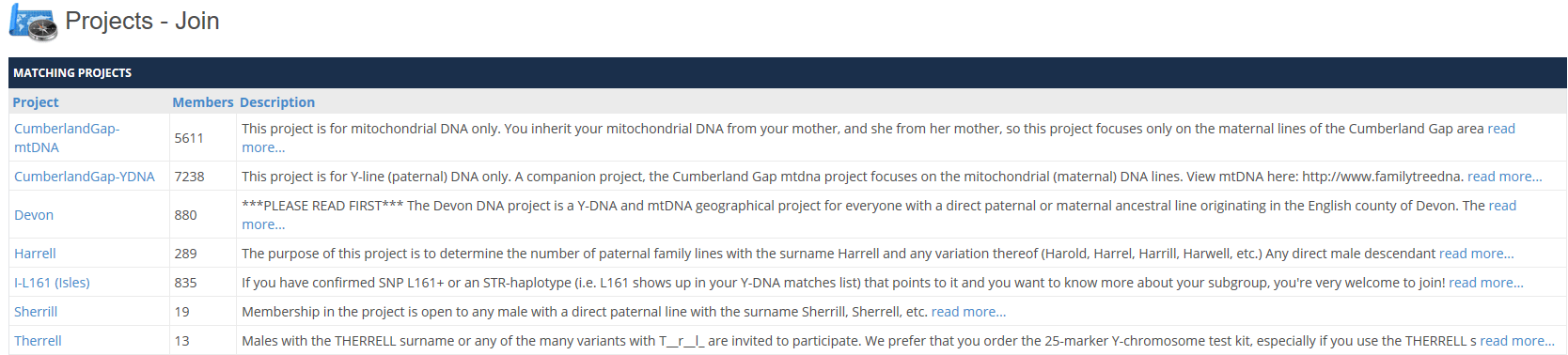
You can  increase your chances of finding your particular lineage by visiting the relevant Y DNA projects for your surname.

Click on Projects, then “Join a project,” then search for the DNA project that you’re interested in viewing and click on that link.

Within the project, look for oldest ancestors that are your ancestors, or potentially from a common location.  It’s someplace to start.

You can read more about how to construct a DNA pedigree chart in the article, “The DNA Pedigree Chart – Mining for Ancestors.”

Idea 3 – Pick A Puzzle Piece

Sometimes we get overwhelmed with the magnitude and size of the genealogy puzzle we’d like to solve. Then, we don’t solve anything.

This is exactly WHY I like the 52 Ancestor stories.  They make me focus on JUST ONE ancestor at a time.

So, for 2018, pick one genealogy puzzle you’d really like to solve. One person or one thing.  Not an entire line.

Write down your goal.

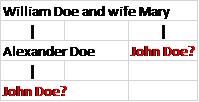
“I’d like to figure out whether John Doe was the son of William Doe or his son, Alexander Doe.”

Now admittedly, this is a tough one, because right off the bat, Y DNA isn’t going to help you unless you’re incredibly lucky and there is a mutation between Alexander Doe and his father, William.  If indeed that was the case, and you can prove it by the DNA of two of Alexander’s sons who carry the mutation, compared to the DNA of one of William’s other sons who does not, then you may be cooking with gas, presuming you can find a male Doe descended from John to test as well.

This is the type of thought process you’ll need to step through when considering all of the various options for how to prove, or disprove, a particular theory.

Make a list of the different kinds of evidence, both paper trail and genetic, that you could use to shed light on the problem. Your answer may not come from one piece of evidence alone, but a combination of several.

Evidence Available/Source Result
William’s will No, burned courthouse Verified
Alexander’s will No, burned courthouse Verified
Deeds with William as conveyor No, burned courthouse Verified
Family Bible Nope, no Bible
Deeds with Alexander as conveyor, naming John Possible, some deed books escaped fire Check through county, Family search does not list
Deeds with John as conveyor Yes, check to see if they indicate the source of John’s land John is listed in index, need to obtain original deeds from county
Y DNA of John’s line Yes, has been tested Matches DNA of William’s line as proven through William’s two brothers
Y DNA of Alexander Not tested (to the best of my knowledge), find descendant to see if they will test Search vendor DNA testing sites for male with this surname to see if they have/will Y DNA test
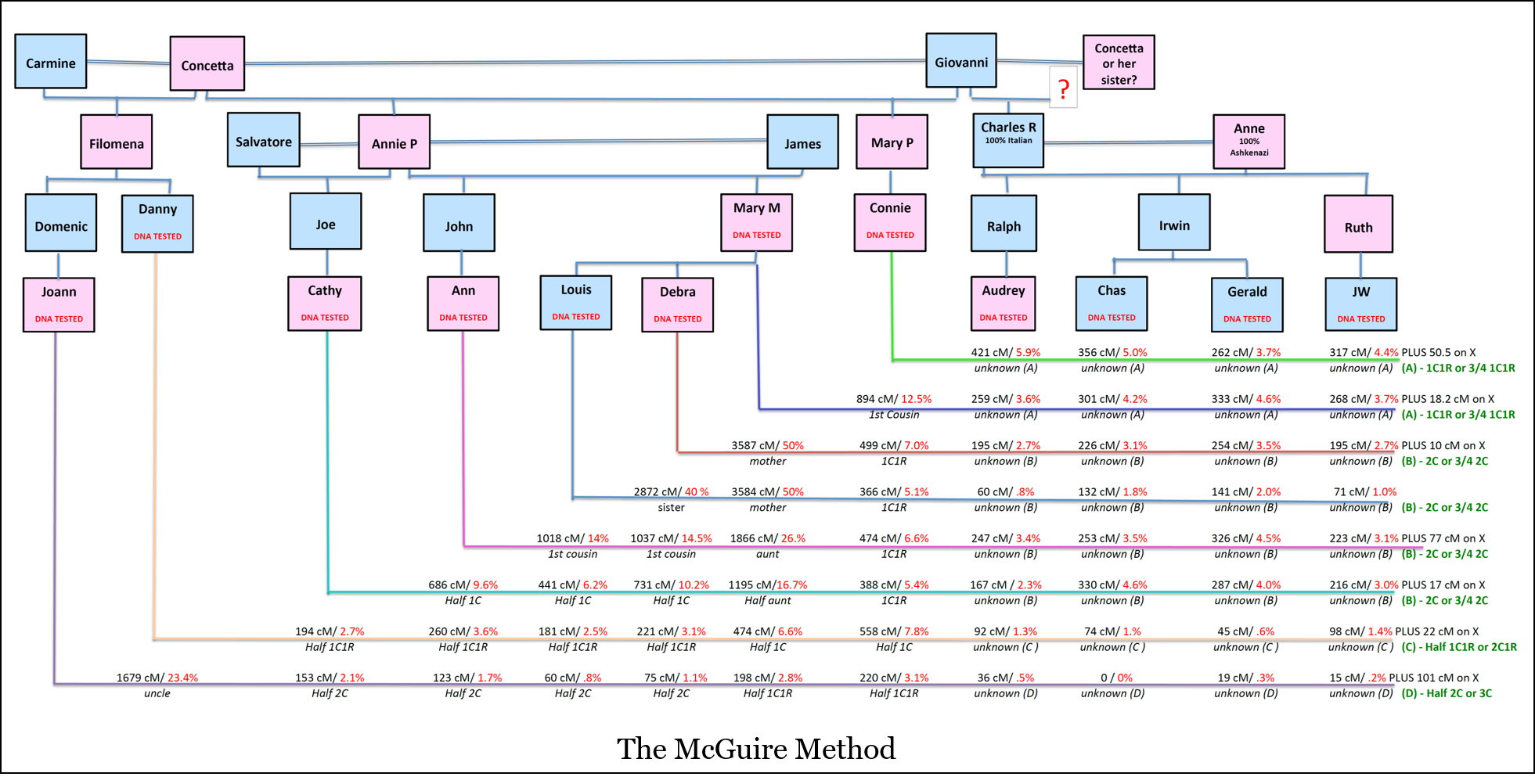
Closeness (in total cM and longest segment) of individuals autosomal matching through any of William’s descendants Mine both Ancestry and FTDNA for surname and ancestor matches This step may produce compelling or suggestive evidence, and it may not.  Make a McGuire chart of results.
Does John match any relatives of the wife of Alexander Doe? Search FTDNA and Ancestry for matches.  Triangulate to determine if match is valid and through that line. This is one of the best approaches to solve this type of problem when paper records aren’t available. Fingers crossed that Alexander and his wife and not related.

You can add pieces of evidence to your list as you think of them.

Making a list gives you something to work towards.

Your Turn!

Select one thing that you’d like to accomplish and either set about to do it, like mining for mitochondrial or Y DNA evidence, or put together a plan to gather evidence, both traditional and genetic.

In the comments, share what it is you’ll be searching for or working on.  You just never know if another subscriber may hold the answer you seek.

I can’t wait to hear what you’ll be doing this year!

Have a wonderful and productive New Year searching for those hidden ancestors!

______________________________________________________________

Disclosure

I receive a small contribution when you click on some of the links to vendors in my articles. This does NOT increase the price you pay but helps me to keep the lights on and this informational blog free for everyone. Please click on the links in the articles or to the vendors below if you are purchasing products or DNA testing.

Thank you so much.

DNA Purchases and Free Transfers

Genealogy Services

Genealogy Research