The Legacy of Humor Lives On – aka – Having a Baby in the Back of Bob’s Van

legacy tree Five years ago, when I was on an archaeology dig on the Outer Banks of North Carolina, I received a phone call that a friend, Dianne, had suddenly died.  She was too young to die, and hadn’t been sick, so to say it was a shock was an understatement. I had known Diane for more than 30 years.

When I first moved to Michigan, I met Dianne and Bob, her husband.  We were all volunteers with the local Humane Society. Then one day, the conversation turned to genealogy.  One thing led to another, and to the Family History Center, where Bob and Dianne were volunteers for over 30 years.

Did you notice that word?  Were?  Yes, Bob followed Dianne’s example and a couple of weeks ago, at the church, keeled over and died.  The only consolation in all of this is that they are together now, and their last rescue cat died of old age just two weeks before Bob.  Neither of them suffered.

It’s really difficult when these doors close for us, especially when they slam so unexpectedly.  Thirty five years is a generation.  We knew each other’s children when they were pre-schoolers, grade-schoolers – and then terrible teens – and then somehow blossomed into decent human beings.

But this isn’t about Bob and Dianne’s untimely deaths – it’s about their lives, the fun we had and the memories we made.  I’m going to reminisce and share a bit with you – because, well, there are just some great stories.  And you see, Bob never did get even with me…..

Yes, it was a dastardly thing I did to him….but I wasn’t alone…I had help.  And yes, I probably should be ashamed of myself, but well….I’m not.

Bob and Dianne were both known for their sense of humor, and Bob for his never-ending practical jokes.  Everyone loved both of them, and they were always together in whatever they did.  Not to say there wasn’t an occasional eye-roll, but they were truly a well-matched, loving couple.

Halloween 2Bob and Dianne loved Halloween parties. Ok, Dianne loved Halloween parties and Bob knew what was good for him.

They decorated their house and property and planned for weeks every year.  They sent you an invitation, and if you didn’t answer, Dianne would call you and remind you and hound you until you agreed to attend, solely out of self-defense.

In 1993, my life hit a major milestone, a quite unwelcome roadblock when my former husband had a massive stroke.  To say my life changed in an instant is an understatement.  I’ll spare you the details, but suffice it to say that I didn’t see Bob and Dianne very much for quite some time.  I didn’t have time for genealogy or anything else.  Dianne, good friend that she was, continued to keep in touch.

Then, one year, she called me again and pestered me to come to the Halloween party.  I had lots of excuses, but none of them cut the mustard with Dianne.  I didn’t want to hurt her feelings, so I decided it was the perfect opportunity for some mischief.

Dianne, and everyone else, knew the circumstances in my personal life – so I told Dianne that I couldn’t come because I was pregnant, and embarrassed about the situation.  Dianne bent over backwards to assure me that no one was going to be judgmental or anything else terrible and I really needed to come – regardless.  I finally agreed after much arm-twisting.

Do you know how difficult it is to get a pillow to stay put without a belt around your waist?  And I didn’t have any stretchy pants, so I went to Goodwill to find maternity clothes. It was a pretty cheap Halloween costume.  And I must admit, the very best one ever.

When I arrived at the party, I let Dianne’s best friend, Cathy, in on the secret, and we decided that I needed to go into labor, in the bathroom. Dianne became very worried and “talked me into” letting Bob take me to the hospital after my water broke.

Cathy and I and a nurse who was also at the party got into the back of Bob’s van and headed for the hospital several miles away over very rough dirt roads – except – well – we didn’t make it.  The nurse told Bob to pull over, that she couldn’t deliver a baby on the bouncy dirt road, in the dark and she needed the overhead light on.

We could see Bob white-knuckling the steering wheel as the gals “delivered” the baby amongst much screaming and carrying-on.  We deserved an Academy Award for that performance:)  The baby was one of Dianne’s life-like baby dolls from her collection that we had kidnapped from the house.  Cathy told Bob he had to help and hold the baby, so she shoved this blanket with the baby doll in Bob’s lap.  After a minute or so, she told him to check it’s breathing – when he looked in the blanket and discovered that it wasn’t breathing, and he had been….well…..had. baby boy

Bob whipped around and looked at the three of us – which he had very graciously avoided doing while we were “delivering” the baby – and let’s just say he had a couple choice words for us as we all three bursted out laughing – the laughter we had been stifling all along.  His indignant anger lasted about 10 seconds, and you could just see the light bulb of opportunity click on.

He asked, “Does Dianne know?” “No,” we answered, shaking our heads in unison, and off we went, to prank Dianne.  Bob was in his prime – in his glory.  The prankee became the prankor.

Our prank on Bob became legendary, because Bob was always the prankster, never the other way around.  In fact, people were talking about it at his funeral, even though that baby would be about 20 years old now – had it been real. Someone I didn’t know walked up to me at the luncheon after Bob’s memorial service and said, “I know who you are and what you did.”  I started laughing, and hoped they would elaborate so I didn’t have to guess!  It seems, in retrospect, Bob liked that prank almost as much as we did and told the story regularly.  “Did I ever tell you about the time they delivered a baby in the back of my van???”

A few years later, I was standing in WalMart and Bob walked up to me, out of noplace, and said, “I still owe you and you never know when I’m going to get even,” and just walked off.  Left me chuckling, all over again.

One day, my phone rang, and someone told me that they had picked up my business card and had some DNA questions for me.  Now, this is kind of odd because my card doesn’t have my phone number on it and I do not give out my phone number because I don’t like to talk on the phone.  But I wasn’t going to be rude. Finally, they got to the point (which is part of why I dislike phone calls) and asked me if one of their cats was peeing on the floor if they could collect the urine and have the DNA sampled to see which of their cats was peeing.

There was finally silence on the other end of the phone then, and all I could think of to say was, “Did Bob give you my phone number?”  The sudden outburst of laughter on the other end of the line was all the answer I needed.

That wasn’t the first or only time we were involved in some kind of ruckus.

One night in the Family History Center, I found a name in something I was reading that caused me to laugh.  Libraries now may not be quiet zones, but they were then, and I finally had to get up and go outside to laugh.  A laugh is kind of like a sneeze and if you try to stifle it, it just gets worse and makes you snort.  And who wants to snort.

Dianne came out into the hallway to see if I was OK and more importantly, to find out what was so funny.  I told her the name and she started laughing too.  Then she started telling me some funny names she had found.  Before long, we had a list and other people at the FHC were adding to it too. We would all send our findings to Dianne and we all enjoyed taking an occasional look at the list – and having a good laugh.  Some probably weren’t church-appropriate – which – of course made them all the funnier.

When Dianne passed away, and I found another name, I suddenly realized that there was no one to send it to.  No one to share with.  No one to laugh about it with.  It’s the little things that get to you.

Bob sent me Dianne’s list, but it wasn’t the same as Dianne and I doing it together.  And so, it languished, until today.  And today, I decided that I really needed to pass it on and share the humor with you.  So, I went and found Dianne’s list and I have since added a DNA component, of course.  Would you expect any less from me?

Unusual Names

  • Baby Lone Lane (WI Draft)
  • Andrew Baldy
  • Bang
  • Barefoot
  • Bery Dredful (1869 Cherokee West Census)
  • Bituminous Coleman
  • Blizzard
  • Boner
  • Boo
  • Brat
  • Butlicker – 1880 census
  • Buttugger
  • But Isaac (WWI draft registration)
  • Chicken, Young
  • Churchyard, Oliver – Pastor
  • Comfort Castle – found in 1830 Columbia County, NY.
  • Constant Chase – found in 1830 Boston, Suffolk Co, MA.
  • Colliflower, John
  • Cotton Tufts – found in 1830 Weymouth, Norfolk Co, MA.
  • Crapster
  • Crow, John married Olive Bird
  • Cucumber Pickell
  • DeCay
  • Devils Ramrod (Seneca, War of 1812)
  • Dickensheets
  • Dodge Fatty (Seneca, War of 1812)
  • Douthit Bible
  • Easter
  • Easter, Darkass (I think this was the original entry that I found that was so funny)
  • Elizabeth Martin Bird Crow Robin Buzzard (married several times)
  • Fanny Rumble
  • Fanny Slappy
  • Farry Jacobs (male, on his draft registration)
  • Fight Thompson
  • Firestarter
  • Fix
  • Flowerdew
  • Forest Hunt
  • Frost Snow – found in 1920 Reed Island, Pulaski Co, VA.
  • Fudge
  • Bethia Furbush
  • Gassaway Sellman
  • Getting Down (1869 Cherokee West Census)
  • Gloomy Jones
  • Gotcha
  • Green Peter Dam & Resevoir
  • Green Fields
  • Guts Diver (1869 Cherokee Census)
  • Hardon
  • Hazzard & Hore Law Firm
  • Hoig, Harry (WWI draft registration)
  • Fannie Hickey
  • Fanny Heiney who married her Heiney cousin making her Fanny Heiney Heiney
  • Fanny Pack
  • Fanny Packer
  • Finder Binder – female shot in the arm in Randolph Co., AL
  • Hank Squared
  • Hardin Short
  • Harry Badass – 1885 Nebraska census
  • Harry Dick and then Harry Dick Jr.
  • Henry Henry
  • Hohos
  • Honor Hill married Mr. Mountain and became Honor Mountain
  • Hott
  • House marries Davenport
  • Huckleberry Birdchopper
  • Hugh Askew
  • Hugh Pugh
  • Icy Frost
  • Icy Louise P. Green
  • Ima Hogg (wife of the governor of Texas)
  • John Deady, funeral director, Philadelphia
  • John, Saucy
  • John Will Hunt
  • Joy Noel
  • Joy Rider – found in 1930 Bennington, Morrow County, OH.
  • Jinks Mistaker (Onandoga, War of 1812 roster)
  • Justin Quiring
  • Kitchen Faucett
  • Kittle, Big
  • Knipple
  • Larry A. Holle
  • Laughter
  • Lawrence Horney m. Elizabeth Burns
  • Leafy Plant (female)
  • Leak Locklear
  • Lemon and Orange, twins of Lemon Pitcher, Great Melton, Norfolk, England 1736
  • Long, Peter
  • Lovie McAtee marries Willoughby Loveless
  • Lovely Hooker
  • Mabee
  • Mabe Sampson
  • Malehorn
  • Mercedes Mouser
  • Milder Currey
  • More Badass (1920 census NY)
  • Mr. Cobb weds Miss Corn – El Paso, TX
  • Mrs. Graves lived on Cemetery Road
  • Mumper (given name)
  • Mycock
  • Nathaniel Bacon marries Hannah Mayo
  • Nicewanger
  • Noble Crapper – found in 1790 Worcester Co, MD.
  • Oldfather
  • Olive Green
  • Orange Field – found in 1930 Miller County, GA.
  • Otta B. Weaver
  • Outerbridge Horsey Jr.
  • Owen Owen Owens
  • Oyster
  • Page Turner – found in 1880 Putnam County, GA.
  • Pecker
  • Peter Putterhead
  • Phlegm
  • Cucumber Pickell – 1860 Michigan census
  • Pink Woods
  • Pleasant Cox
  • Poole, Gene
  • Potter Plant
  • Preserved Fish
  • Purchase
  • Purple Winter
  • Rex A. Lot  (Driving Instructor)
  • Rhoda Jones married Joe Buffalo becoming Rhoda Buffalo
  • Roach, Pet
  • Robin Redwing
  • Rock Fields
  • Roten Locklear
  • Runaway Swimmer
  • Rusty Bell, a redhead
  • Sandy Beach
  • Sandy Box
  • Savior
  • Shewasa Griffin (think about this one)
  • Silence Belcher
  • Smoker Hunter
  • Snowball
  • Snow, Frost and
  • Snow, Ice and
  • Snow, Deep
  • Snow White (a man)
  • Soggy Hill (WWI service registration)
  • Soggy Youngbird (WWI service registration)
  • Songs
  • Songster
  • Stair Walker
  • Strange Backhouse
  • Suchadoll
  • Susie Tinkle
  • Swallow, Birdie
  • Sweatt, Fanny May
  • The Geezinslaws
  • Thankful Mills married Oliver Lord, making her Thankful Lord
  • Tiny Little – found in 1930 Chatooga County, GA.
  • Tobacco, Chaw (Seneca, War of 1812 roster)
  • Trick
  • Truebody
  • Turley Curd
  • Turnipseed
  • Ulickham, Henry
  • Useless Love
  • Violet Tulip
  • Wealthy Case
  • Wilden Wooley
  • Will Billy
  • Worst
  • Yankee
  • Yawn
  • Young Booger
  • Young Fry

Weddings

  • Annus-Biter Wedding
  • Bair-Teets Wedding
  • Bate-Bass Wedding
  • Beaver-Aiken Wedding
  • Beaver-Benders Wedding
  • Beaver-Weaver Wedding
  • Bird-Bath WEdding
  • Blue-Berry Wedding
  • Bone-Husband Wedding
  • Breast-Mash Wedding
  • Broker-Knuckle Wedding
  • Bushy-Johnson Wedding
  • Butt-Driver Wedding
  • Butts-Fudger Wedding
  • Catlip-Legg Wedding
  • Cockman-Dickman Wedding
  • Coke-Head Wedding
  • Crap-Beer Wedding
  • Creamer-Utter Wedding
  • Daylong-Johnson Wedding
  • DeLong-Boner Wedding
  • DeMoney-Hyder Wedding
  • Devine-Ho Wedding
  • Dick-Tulek Wedding
  • Dooher-Christopher Wedding
  • Drilling-Cousin Wedding
  • Duer-Early Wedding
  • Eaton-Titlow Wedding
  • Eubanks-Mounts Wedding
  • Ferguson-Crotchfelt Wedding
  • Fillerup-Standing Wedding
  • Fine-Bousum Wedding
  • Fite-Staab Wedding
  • Flem-Greene Wedding
  • Flynt-Stone Wedding
  • Fuller-Beers Wedding
  • Funk-Kee Wedding
  • Fur-Burns Wedding
  • Fox-Goose WEdding
  • Gentle-Bange Wedding
  • Gin-Bourbon Wedding
  • Godown-Gross Wedding
  • Good-Lauck Wedding
  • Goosie-Gander Wedding
  • Gory-Butcher Wedding
  • Granny-Mount Wedding
  • Gross- Pantti Wedding
  • Gross-Tingley Wedding
  • Hang-Wright Wedding
  • Hay-Sailors Wedding
  • Hog-Paradise Wedding
  • Holder-Moore Wedding
  • Hole-Drilling Wedding
  • House-Recker Wedding
  • Houser-Annas Wedding
  • Hunt-Peck Wedding
  • Johnson-Feast Wedding
  • Johnson-Hummer Wedding
  • Johnson-Wacker Wedding
  • King-Bishop Wedding
  • Knapp-Sack Wedding
  • Knott-Bow Wedding
  • Kroetch-Crater Wedding
  • Large-Tinkey Wedding
  • Long-Ouch Wedding
  • Looney-Ward Wedding
  • Lotsa-Peter Wedding
  • Lusting-Johnson Wedding
  • McMaster-Bates Wedding
  • Manley-Pickle Wedding
  • Makin-Peeples Wedding
  • Maus-Knapp Wedding
  • Moore-Bacon Wedding
  • Moose-Greaser Wedding
  • Muff-Masterman Wedding
  • Must-Reamer Wedding
  • Nutter-Boner Wedding
  • Partee-Moore Wedding
  • Peters-Sohre Wedding
  • Piccirilli-Pecorelli Wedding
  • Pickle-Ryder Wedding
  • Puls-Johnson Wedding
  • Outhouse-Burns Wedding
  • Poon-Fisher Wedding
  • Ramsbottom-Moore Wedding
  • Rather-Grim Wedding
  • Reamer-Oiler Wedding
  • Ruff-Goings Wedding
  • Sawyer-Cherry Wedding
  • Sawyer-Hiney Wedding
  • Schmitt-Head Wedding
  • Seaman-Sample Wedding
  • Sell-Schmel Wedding
  • Sharpe-Payne Wedding
  • Sheepshanks-Ramsbottom Wedding
  • Small-Husband Wedding
  • Small-Knob Wedding
  • Smelley-Farkas Wedding
  • Speedy-Zieper Wedding
  • Staples-Bottom Wedding
  • Steel-Iron Wedding
  • Steele-Kage Wedding
  • Strange-Slappy Wedding
  • Stranglen-Johnson Wedding
  • Stoker-Dailey Wedding
  • Swift-Kalonick Wedding
  • Tinker-Butts Wedding
  • Toole-Burns Wedding
  • Tune-Narup Wedding
  • Van Halen-Prince Wedding
  • Wannamaker-Popp Wedding
  • Wang-Crumpler Wedding
  • Wang-Holder Wedding
  • Weiner-Frost Wedding
  • Whyde-Hole Wedding
  • Widener-Moore Wedding
  • Wooden-Coffin Wedding
  • Wrinkle-Johnson Wedding

DNA (Ancestry search)

  • Dna Day (new holiday)
  • Dna For (what?)
  • Dna Marvel
  • Dna Waters
  • Dna Gropper (trying to get DNA from your date:)
  • Dna Ray (kind of like the death ray, but different)
  • Dna Wisdom
  • Dna Miner (swab harder….)
  • Dna May (answer your questions)
  • Dna Bone
  • Dna Regester
  • Dna Center
  • Dna Dume (new game)
  • Dna King
  • Dna Brothers
  • Dna Call
  • Dna Rush (what you get when your relative agrees to test)
  • Dna Edge (what people whose relatives will test have over those whose relatives won’t test)
  • Dna Scatt (another way to obtain DNA for the very desperate)
  • Dna Seaman (not touching this one – no way, no how)
  • Dna Valentine (oh, now there’s an idea…..)
  • Dna Conn
  • Dna Heller (what we do with DNA conns)
  • No Goo Dna
  • Dna Ball (new geeky toy)

Yes, I know these DNA entries are probably misspelled or mis-transcribed, but they are fun anyway and that’s what Dianne’s list was about in the first place.  Having fun.

It’s sad, truly sad, for both Dianne and Bob to have left this earth too soon, with so many more years to offer – but their legacy is a wonderful one.  They made a lifetime of difference to each and every one of the many animals they rescued over the years.

Their 30 years of service to genealogists is unparalleled and their entire three decades was delivered with a smile and laughter.  They brightened everyone’s day.  That is their legacy.  I hope Dianne’s list has made you smile a bit too and brightened your day.  Feel free to share.

Oh, and as for Bob getting even with me…my phone has been ringing half a ring with no caller ID two or three times a day, for days now.  I do believe Bob is testing his wings.  I shudder to think…. wisteria

______________________________________________________________

Disclosure

I receive a small contribution when you click on some of the links to vendors in my articles. This does NOT increase the price you pay but helps me to keep the lights on and this informational blog free for everyone. Please click on the links in the articles or to the vendors below if you are purchasing products or DNA testing.

Thank you so much.

DNA Purchases and Free Transfers

Genealogy Services

Genealogy Research

John Y. Estes (1818-1895), Civil War Soldier, Walked to Texas, Twice, 52 Ancestors #64

John Y Estes

John Y. Estes, whose photo we believe is shown above, started out years ago with a question, one that is probably answered now, but every time we think we answer one question about him, another dozen take its place.

Let’s start from the beginning.  When I first saw John’s name, I immediately noticed the Y.  Two things occurred to me…first, that’s someone’s last name and second, that’s shouldn’t be too difficult to find.  Y is not like S that would include something like Smith and takes up 10% of the alphabet.  Famous last words, or first thoughts, because assuredly, that second thought was NOT true.

Now don’t laugh, but one time I was at one of those fortune telling places.  The fortune teller asked me if I had any more questions.  I said yes, and asked her about John Y. Estes’s middle name.  She said something like Yarborough or maybe Yancy.  She wasn’t right about anything else either.

Nope, never let it be said that genealogists are a desperate group!

John Y. Estes was born on December 29, 1818, in Halifax County, Virginia to John R. Estes and his wife, Nancy Ann Moore.  Hmmmm, that middle initial R. might be someone’s last name….never mind….

We know that John R. Estes and his wife, Nancy Ann Moore, along with five if not six children made the long wagon journey from Halifax County, Virginia to Claiborne County, TN. sometime between 1818 and 1826 when John R. Estes had a land survey in Claiborne County.  The 1820 census doesn’t exist for Claiborne County and John appears to be gone from Halifax by then, so we’re out of luck knowing where John R. was in 1820.

In the 1830 census, John R. Estes was living in Claiborne County in the vicinity of Estes Holler, shown below.

Estes Holler 2

How do I know that?  Because these families have all become very familiar to me over my 30+ years of research.  John is living beside William Cunningham, who, in 1871 signed as a character witness for John R. Estes.  And six houses away we find John Campbell, the grandfather of Ruthy Dodson who likely raised her after her mother, Elizabeth Campbell died.  Rutha Dodson was the future wife of John Y. Estes.  And next door to John Campbell lived Mercurious Cook whose son’s widow John R. Estes would marry in another 40 years – but that is a story for a different day.

In the early 1830s, John R. Estes took his family to live in Grainger County for a short time.  Nancy Ann Moore’s two uncles, Rice and Mackness Moore lived there, Rice being a Methodist minister.  John R. Estes’s daughter, Lucy, married in Grainger County in 1833.  By 1835, John was back in Claiborne County when Temperance married Adam Clouse, so they didn’t stay long in Grainger County.

For the most part, John Y. Estes grew up in or near Estes Holler, below, from the cemetery, which, of course, is why it’s called Estes Holler today.

estes holler 5

By 1840, John Y. was probably courting the lovely Ruthy Dodson, likely at her grandfather’s house.  John Campbell had died in 1838, but his widow Jenny Dobkins Campbell didn’t die until between 1850 and 1860, so she would have still been living on the old home place, on Little Sycamore Road, below, when young John Y. Estes came to call.

Campbell house

We don’t find John R. Estes in the 1840 census, but by 1841, John R. Estes had to be living someplace in the vicinity because both his sons Jechonias and John Y. Estes married local gals.

On March 1, 1841, John Y. Estes married Ruthy Dodson, just a couple months after his 23rd birthday.

John Y Estes Rutha Dodson marriage

Ruthy Dodson’s mother, Elizabeth Campbell died before Elizabeth’s father, John Campbell, did in 1838.  After John’s death, a guardian was appointed for Elizabeth’s children to function on behalf of their financial interests in his estate.

In the 1830 census, the John Campbell household has small children, so it’s very likely that the grandparents, John and Jenny Dobkins Campbell were raising Elizabeth Campbell’s children she had with her husband, Lazarus Dodson.

On September 5th, 1842, John Y. Estes signed a receipt for receiving part of Ruthy’s inheritance.  This seems to have been paid yearly, at least until the children reached the age of majority.

“John Y. Estes rect. dated 5th Sept. 1842, $54.35. Ditto rents for the year 1841, $1.50. Ditto order for what ballence may be in my hands as guardean, amt. $56.61.”

By 1850, we find John Y. Estes living in Estes Holler along with the rest of the Estes clan.  John is listed as a laborer, age 30, Ruthy as age 25 and Lazarus as age 2.

Given that John and Ruthy were married in 1841 and their oldest child in 1850 is only 2, this suggests that John and Ruthy had already buried several children.  If they had one child per year and the child died at or shortly after birth, they could have buried as many as six children in this time.  The Upper Estes cemetery, as well as the Venable Cemetery at the end of the road have many, many unmarked graves.  The Upper Estes Cemetery was within view of the John Y. Estes home place.

Upper Estes Cemetery

Furthermore, we know that John Y. Estes was living on this land, even though we find very few records of John Y. Estes in official county documents.

This land was originally granted to William Devenport and would eventually, in part, become the property of Rutha Estes, John Y.’s wife – but that wouldn’t happen for another 30 years.

William Devenport, April 17, 1850 – James McNeil trustee to William S. McVey, Districts 6 and 8, 475 acres, Buzzard’s Rock Knob – corner of grant to James M. Patterson, from Devenport’s spring, grant to Drewry Gibson, 50 acres #14072, line of Drewry Gibson, crossing Gibson’s branch, S with John Dobkins grant owned at present by Leander and Greenberry Cloud near N.S. McNeil’s line crossing Gibson’s branch on top of Middle Ridge, Planks fence of old Wier place, John Mason’s corner and line, Cunningham’s line, Devenport-Lanham’s corner, Weatherman’s spring, middle ridge – all of above contained in grant 16628 from the St. of Tennessee to William Devenport.

Second tract – 130 acres of land on the S. Side of Wallen’ ridge, corner of D. Gibson’s 50 acres tract #14072, Houston’s line, NW of Devenport’s line, Harkins corner, large rock on top of knob called Buzzard’s Rock, Harkins corner, Abel Lanham’s corner, Henderson’s line, 100 acre tract of WH Jennings, Bise’s corner, top of Wallen Ridge at Bise’s stake corner of Hardy tract, Henderson’s corner, the above contained in grant 27438 St. of Tn. to Devenport.

Also a 25 acre tract known as the Weatherman place.

1851 – William Devenport tax sale to William McVey – bid July 7, 1851 at courthouse, land in the 8th district, but due to a change in the lines now in the 6th district living near the lines of the 6th and 8th, sold for the taxes of 1845 and 1846, $16.77, 200 acres.

Tract 1 – S side Wallen Ridge near Little Sycamore adjacent lands of William Houston, Mordica Cunningham on the South, Samuel Harkins on the North, on NE Cunningham, William Houston’s, the land commonly known as the Weatherman place where William Devenport and John Estes now live.  Census records show that this is John Y. Estes, not John R. Estes that lives beside William Devenport.

So, in 1851, William Devenport is losing his land and apparently, neither he nor John Estes can do anything about it.  John is not bidding on the land.  William S. McVey purchased this land and in 1852, William McVey also purchased a very large tract of land granted to William Estes, John’s brother, which John Y. Estes witnessed.

By 1876, this same land is being conveyed by Henry Sharp to W.H. Cunningham.  How do we know this is the same land that is where John Y. Estes lived?  Metes and bounds are included, it states that is was William Devenport’s and it says that is where David A. King lived when he died.  The Reverend David A. King, a Methodist minister fought for the Union in the Civil War, died in 1873 and is buried in the Upper Estes Cemetery.  His daughter, Elizabeth married the son of John Y. Estes, George Buchanan Estes, in 1878.  I wonder if the old Reverend rolled over in his grave to have his daughter marry the son of a Confederate.  Yes, the secret is out, John Y. Estes was a Confederate.

David King

1876, Mar 30 – Henry Sharp of Campbell Co., TN to W.H. Cunningham of Claiborne for $400, 2 tracts of land in Claiborne on the waters of Little Sycamore Creek on the South side of Wallen’s Ridge adj the land of William Houston, decd and constitute the farm on which David A. King lived at the time of his death, one part is an entry made by William Devenport and bounded as follows: Beginning at a hickory stump on a red bank in Houston’s line thence north 9 deg west with Hentins? Line 94 poles to the Buzzard Rock on the top of Wallen’s Ridge thence with the top of Wallen’s ridge 240 poles to a chestnut oak and when redused to a strait line is south 60 deg west 234 poles then south 75? Deg east on Houston’s line 34 poles to a stake in the other line of Houston’s then with the same north 70 deg east 93.75 poles to a double chestnut and gum on a spur at Houston’s corner thence with lines of Houston’s land south 390 deg east 43 poles to a maple at the branch then east 62 poles to a hickory stump then with lines of Houston’s land south 30 east 43 poles to a maple at a branch then east 62 poles to a hickory stump then north 62 poles to a large white oak corner then east 9 poles to the beginning containing 90 acres more or less.

This land would eventually be owned by Rutha Estes, the wife of John Y. Estes.

The second parcel bounded by…Houston’s line, Devenport’s grant line, 25 acres.  Witness JW Bois, WW Greer.

This was a very, very indirect “round the mountain” way to track John Y. Estes, but it worked.  However, we’re getting ahead of ourselves, so let’s go back before the Civil War.

On March 8, 1856, in the court records, we show that John Y. Estes had an account in the estate of Thomas Baker – in other words, he owed Thomas money.

In the 1860 census, John and Rutha have four more children, although with a gap of 4 years between Lazarus and Elizabeth, it looks like they lost at least one more child.

John Y Estes 1860

Interestingly, John Y. Estes is a shoemaker.  John is shown as owning no land, but he does have a personal estate of $173, which isn’t exactly trivial.

I think in 1860 that John Y. Estes is not living in Estes Holler.  He is living beside carpenters, stage drivers, a wagon maker, a wagoner and a carriage maker who was quite wealthy.  That sounds suspiciously like he was living in town which would have been Tazewell.

The Civil War

Shortly after 1860, life would change dramatically for the Estes family.  Tensions were escalating towards the Civil War, and in 1861, they erupted when initially 4, then 7, then 11 states seceded from the Union, forming the Confederacy.  Tennessee did secede, but not initially.  Claiborne County was badly torn between the North and South, the blue and grey – and families were torn apart as different brothers and sons joined opposite sides.  Loyalties were divided and family members fought against one another.

In 1862, at the height of the Civil War, Confederate troops occupied Tazewell as part of the greater struggle for the strategic Cumberland Gap. When the Confederates evacuated the town in November of that year, a fire followed, destroying much of Tazewell.  In essence, anyone who could leave, did, because Tazewell was a target of continuous raids for food and supplies.

We know by 1870, positively, from the census, that the John Y. Estes family is back in Estes Holler.  We also know from family stories about the Civil War that they spent the majority of the War in Estes Holler.

But what we didn’t know was something far, far more important.

Aunt Margaret told me that while the war was over, it was really never resolved in Claiborne County.  The Crazy Aunts used to tell stories of the men in Claiborne County wearing their Civil War uniforms once again, on Memorial Day, and head for town to “refight” the war, as long as there were any veterans left to do so.  I suspect that most of the fighting was verbal and in the form of relived memories, but assuredly, not all, especially if region’s notorious moonshine was involved….and you know it was!

The aunts, Margaret and Minnie, lived in Estes Holler as a child, and while I knew none of my direct Estes ancestors had served in the Civil War, obviously some people from that area had.  Just a couple years ago, I decided to look for Estes men in Claiborne County, TN to see if any of them had fought in the Civil War at www.fold3.com.  Was I ever in for the surprise of my life.

My great-great-grandfather, John Y. Estes served in the Civil War – but for which side?

John Y Estes reference slip

Look what that says.  Confederate.

John’s service records are confusing, to say the least.  There are documents in his file from both sides, it seems.  How can that be?  Let’s start with the basics.

The Civil War began in earnest in April, 1861 when confederate forces bombarded the Union controlled Fort Sumter, SC in Charleston Harbor.

Many people who lived in Claiborne County fought for the North and joined the Union troops, but not all.  The Civil War was a source of dissention within and between families in Claiborne County.  Few people there held slaves, so slavery was not a driving force.  By searching for his unit, I confirmed that John Y. Estes had joined the Confederate Army, but I was stunned.  All of my other family members in my various lines fought for the Union – including the families from that area.

The history of Carter’s Tennessee Cavalry Regiment F, formed in Claiborne County shows that it was formed on August 10, 1862 by Captain R. Frank Fulkerson who lived near John Y. Estes in the 1860 census.  There is no existing muster roll, although I recreated one as best I could from the various men’s service records in his unit.  Reading John’s record, along with the other men’s records in his unit, (along with regimental and other histories,)  is also how I reconstructed where that unit was, when, and what they were doing.

We don’t know when John enlisted, although it was likely when the unit was formed, nor do we know if he ever applied for a pension.  John would have been 44 years old in 1862, so no spring chicken.  His daughter, Nancy Jane has been born in November of 1861.  He had a wife and 6 children at home ranging in age from Lazarus born in 1848, so 13, to newborn.  His wife probably wanted to kill him for enlisting and save the Union Forces the trouble.

What we do know is that on March 20, 1865, in Louisville, KY, John Y. Estes signed the following allegiance document.  I later discovered that he had been captured and this was one way men obtained their freedom. This document tells us that he had dark skin, dark hair and dark eyes and was 5 feet 7 inches tall, just slightly taller than me. Information I didn’t have before.  If you look closely at John’s picture at the beginning of this article, he may have been mixed-race.

John Y. Estes allegiance

And look, we also have his signature.

So, how did John Y. Estes get to Louisville, KY in 1865 from Claiborne County?  To answer that question, I tracked the activities of his unit.  That was much easier said than done.

Here’s what we know about the activities of Carter’s Tennessee Cavalry Regiment.

Prior to the organization of the regiment, the battalion had been operating in the neighborhood of Cumberland Gap and Big Creek Gaps, at present day LaFollette, TN, about 33 miles distant from each other, along the line of the railroad.

When the regiment was organized it was assigned to Brigadier General John Pegram’s Cavalry Brigade in Lieutenant General E. Kirby Smith’s Department. This brigade was composed of Howard’s Alabama Regiment, 2nd (Ashby’s), 4th (Starnes’), I. E. Carter’s Tennessee Cavalry Regiment, and Marshall’s Battery.

Prior to the Battle of Murfreesboro, on December 29, 1862, Carter’s Regiment joined Brigadier General Joseph Wheeler’s Brigade, and participated in his raid around the Federal Army from Jefferson Springs to LaVergue, to Nolensville, to Murfreesboro, TN. The unit was engaged on December 31 along the Murfreesboro Pike.

Following this battle, the regiment returned to Pegram’s Brigade, in the Department of East Tennessee under Brigadier General D. S. Donelson.

With Pegram’s Brigade, the regiment took part in operations in Lincoln, Boyle and Garrard Counties of Kentucky, and was engaged March 30, 1863 at the junction of the Stanford and Crab Orchard Roads where it was under the command of Colonel Scott, of the 1st Louisiana Regiment. General Pegram’s comment on this operation is interesting: “For Colonel Scott’s operations, I refer you to the accompanying report. Touching this curious document I have only to say that I cannot but admire the ingenuity with which Colonel Scott has attempted to account for disobedience of orders and dilatoriness of action which it is my sincere belief lost us the fight.” Colonel Carter reported five officers and 32 men as casualties in this operation.

It was not a good day to be a Confederate soldier.  John saw his comrades die. It probably wasn’t the first time, and it certainly wouldn’t be the last.

On April 25, 1863, Colonel J. I. Morrison was reported in command of the brigade, now listed as composed of 1st Georgia, 1st and 2nd Tennessee Regiments, 12th and 16th Cavalry Battalions, and Huwald’s Battery. The brigade was at Albany, Kentucky on May 1; at Travisville, Fentress County, Kentucky on May 2.

On July 23, the Chief of Staff, at Knoxville, ordered Colonel Scott, then commanding the brigade, to send 300 horses of 1st (Carter’s) Regiment to Loudon, Tennessee.

On July 31, Pegram’s Brigade, consisting of 1st and 6th Georgia Regiments, 7th North Carolina Battalion, 1st Tennessee Regiment, Rucker’s Legion, and Huwald’s Battery was reported at Ebenezer.

From December of 1862 to August of 1863, John Y. Estes’s unit covered over 1000 miles and marched from East Tennessee, near the Cumberland Gap to central Tennessee to Kentucky, back to central Tennessee and then back to the Cumberland Gap.

John Y Estes civil war map

On August 15, Carter’s Regiment was reported as operating near Clinton and participated in the fighting around Cumberland Gap.  This fighting occurred on the land previously owned by John Y. Estes’s wife’s father, Lazarus Dodson.  The photo below is on Tipprell Road, on Lazarus’s land, looking North towards Cumberland Gap.

dodson land tipprell road

This is where Lazarus Dodson’s father, Lazarus Dodson’s Revolutionary War marker stands today, in the Cottrell Cemetery, below, now on land owned by Lincoln Memorial University.  This photo is standing in the cemetery, looking North towards the mountains and Cumberland Gap.

Cottrell cem looking north

This map shows LMU complex, the location of the cemetery with the upper red arrow and the location of the Dodson homestead with the lower arrow.  You can see the now abandoned road that used to connect the homestead with the cemetery.

Dodson homestead Cottrell Cem

The map below shows the larger area.  It’s probably a mile between the Dodson homestead and the LMU campus across the back way and maybe two and a half miles to Cumberland Gap, up Tipprell Road from the Dodson home.

Cumberland Gap Dodson homestead

This Civil War map shows where the troops camped, at Camp Cottrell, at Butcher Springs.  Lazarus Dodson had sold this land in 1861 to David Cottrell whose residence is marked on the map.  That was the old Lazarus Dodson homestead.  The main road, now called Tipprell Road, was called Gap Creek Road at the time.  It connects the valley, passes Butcher Springs and continues up to Cumberland Gap along the creek and now the railroad as well.  The road heading to the right above the Cottrell homestead used to go up to the cemetery, but is no longer a road today.

camp cottrell civil war map

This photo shows that area today.  It’s flat, so perfect for camping.  Butcher Springs is to the right in this photo, below, just out of sight.

DSCF9016

This is me standing in the Cottrell Cemetery.

Me in Cottrell Cemetery

Butcher springs would be behind me in the valley to the right.  On the Civil War map, Patterson’s Smith shop would be the cluster of buildings where you can see the church, to the left in the picture, in the distance, across the road.

Cumberland Gap was captured by the Federal troops on September 9, 1863, but the Confederate regiment had escaped up the valley before the surrender, and on September 11, Colonel Carter was reported in command of the brigade near Lee Courthouse.  Lee Courthouse is present day Jonesville, VA, about 35 miles from Cumberland Gap.  I’ve added Estes Holler here for context.

John Y Estes Cumberland Gap Lee Courthouse

On September 18, Carter’s Regiment was driven from the ford above Kingsport, TN after a severe fight.  This fight was only 7 days later and Kingsport was another 45 miles distant over rough, mountainous terrain.

John Y Estes Jonesville Kingsport

Somewhere about this time, the regiment was assigned to Brigadier General John S. Williams’ Cavalry Brigade, composed of the 16th Georgia Battalion, 4th Kentucky Regiment, 10th Kentucky Battalion, May’s Kentucky Regiment, 1st Tennessee and 64th Virginia Regiments, which on October 31, 1863 was reported at Saltville, Virginia, 60 miles northeast of Kingsport, TN.

The unit received orders to proceed to Dalton, GA, but despite these orders, Carter’s Regiment was reported near Rogersville on November 1, in Williams’ Brigade, with Colonel H. L. Gutner commanding.

Rogersville was back, through Kingsport, about 90 miles “down the valley,” so to speak.

John Y Estes Rogersville Saltville

In the meantime, Captain Van Dyke’s Company “C” had returned from Mississippi, and on November 24, 1863 was at Charleston, Tennessee with Colonel John C. Carter’s 38th Tennessee Infantry Regiment. Charleston was 145 miles from Rogersville.

John Y Estes Rogersville Charleston

Colonel Carter highly commended Captain Van Dyke and his 44 men for the part they played in helping his forces to evacuate Charleston without being captured.  On April 16, 1864, the regiment was transferred to Vaughn’s Brigade, of Brigadier General J. C. Vaughn’s Division, and reported 248 men present. It remained in this brigade until the end of the war.

By May of 1864, the majority of the fighting had shifted to Virginia.  Between mid-April and May, John Y. Estes’s unit traveled almost 400 miles, from Charleston, TN to the Lynchburg, VA region.

John Y Estes Charleton Lynchburg

The Civil War was becoming a series of constant battles which were referenced as the Campaign in the Valley of Virginia which lasted from May-July of 1864 as shown on this map by Hal Jespersen.

Shenandoah Valley Campaign 1864

As part of Vaughn’s Brigade, the regiment moved into Virginia in early 1864, fought at the Battle of Piedmont, New Hope Church, and in the subsequent campaign in the Valley of Virginia under General Early.

Germanna Ford

This drawing from Harper’s Weekly shows the troops crossing at Germanna Ford during the Battle of New Hope Church, also called the Mine Run Campaign.

Mine-Run

This drawing shows the “Army of the Potomac at Mine-Run, General Warren’s Troops attacking.”

Battle of Piedmont

This is the location, today, of the Battle of Piedmont.  This battlefield looked very different when John Y. Estes stood here on June 5th, 1864.  There were men, horses and blood all over this battlefield.  After severe fighting, the Confederates lost, badly.

It was this point, nearing the end of this chapter of the war, that John Y. Estes entered the hospital on June 12th.  But, that doesn’t mean he was done…the worst, perhaps, was yet to follow.  What happened next?  There has to be more.

Hmmm, let’s check the 1890 Civil War veterans census.  Nope, nothing there.

Well, let’s look under Eastice.  His folder says that name was used as well.

John Y Estes private

Well, Glory Be, look what we’ve found.  His index packet, indeed, under Eastice.

John Y Estes absent

This regimental return of October 1864 says that he was an absent enlisted man accounted for, “Without Cane Valley of Va. Aug. 28.”  That’s odd phrasing.  Does it mean “without leave?”  But it says he is accounted for?

John Y Estes deserter

Uh-oh, this doesn’t look good.  Now he’s on the list of deserters as of March 18, 1865.  It says he was released north of the Ohio River.  That goes along with the “Oath of Allegiance” document that he signed on March the 20th.

John Y Estes POW

Wikipedia says that during the Civil War, prisoners of War were often released upon taking at “oath of allegiance.”  General Sherman was known to ship people to Louisville and those who signed were freed, north of the Ohio, and those who didn’t remained in prison.

This documents John Y’s oath of allegiance, and the faint writing says that his name also appears as John Y. Estus.  How many ways can you spell Estes?  I checked and there are no additional records under Estus – at least none that are indexed yet.

John Y Estes transfer

This document says that he was a Prisoner of War, but this kind of Prisoner of War was a Rebel Deserter.  He was apparently “caught” on March 6th, 1865, send to Chattanooga, then to Louisville apparently in late March where he was taken across the Ohio River.  I’m thinking John Y. considered this a very bad month.

John Y Estes desertion info

This page gives us a little more info.  Apparently he deserted at Staunton, Va. on June 30 of 1864, just days after his hospitalization and release.  Where was he between June 30, 1864 and March 6 of 1865?  And where was he captured?  The first document says that in October of 1864, he was accounted for which I would interpret to mean that they knew where he was and whatever the situation, was OK.  Nothing confusing about these records….

John Y Estes medical

Well here is at least part of the answer.  On June the 12, 1864 he was hospitalized and had a partial anchyloses of his knee.  On June the 19th he was sent to a convalescent camp.  The 30th of the same month, he was reported as having deserted at Staunton.

What they don’t say here is that Staunton was devastated by the Union in June of 1864 – everything was burned including shops, factories mills and miles of railroad tracks were destroyed.  If that is where he was convalescing, it’s no wonder he deserted, or simply left.

He was accounted for in October, but sometime between then and March 1865, he apparently deserted for real, or he already had in October.  I wonder if he simply went home, or attempted to go home.  Where was he when he was caught, or deserted?  If you are a Confederate deserter, and the Union forces “catch” you, do they still hold you prisoner?  Maybe the Confederates only thought he deserted and he was in fact captured?  But the Union paperwork indicates he was listed as a Rebel deserter.  So many questions.

Ankylosis or anchylosis is a stiffness of a joint due to abnormal adhesion and rigidity of the bones of the joint, which may be the result of injury or disease, sometimes resulting from malnutrition. The rigidity may be complete or partial and may be due to inflammation of the tendons or muscular structures outside the joint or of the tissues of the joint itself.  Sometimes the bones fuse together.  This disease is considered a severe functional limitation.

So here is what we know about John Y. Estes and the Civil War.  He probably joined when the regiment was formed on August 10, 1862, although he may have been participating in the unofficial unit since 1861.  The Fulkerson’s in Tazewell, his near neighbors, were instrumental in raising Confederate volunteers in Claiborne County.  John Y. Estes fought and served until he was either injured or a previous condition became so serious in 1864 that he could not function, although he participated in some of the worst fighting and most brutal battles of the war.  John is reported to have been admitted to the hospital in Charlottesville, VA on June the 12th, transferred to a convalescent camp on June 19th, and deserted at Staunton, Va. on June the  30th.  In October, 1864 records say he was accounted for, but absent.  By March 6th of 1865, he was in prison, captured as a deserter, transferred to Chattanooga, signed the allegiance oath and by the end of March, had been taken to Louisville before being deposited on the north side of the Ohio River, having agreed to stay there for the duration of the war.

He didn’t have long to wait.  General Lee surrendered at the Battle of Appomattox Court House on April 9th, 1865.  But then John probably had to walk home on that injured leg.

That leg apparently didn’t slow him down much.  John Y. Estes eventually walked to Texas, not once, but twice, according to the family, which means he walked back to Tennessee once too.  The family said one leg was shorter than the other and he walked with a cane or walking stick.  It’s about 950 miles from Estes Holler in Claiborne County, Tennessee to Montague County, Texas.  I surely want to know why he walked back from Texas to Tennessee.  After making the initial journey, on foot, taking months, what could be that important in Tennessee?  Was he hoping to convince his wife to relocate with him?  Even then, land and other legal transactions could be handled from afar, so it must have been an intensely personal reason.  Maybe he only decided to return to Texas, forever, after he had returned to Tennessee.

I have to wonder how John’s Civil War allegiance and subsequent desertion, if that is actually what it was, affected John himself and the way that the people in Claiborne County viewed him.  He went back home and lived for several years.  His neighbor in Estes Holler, David King, fought for the North.  So did his sister’s husbands and children.  I’m betting holidays were tough and there was no small talk at the table.  Maybe there were no family gatherings because of these polarized allegiances.  They would have been extremely awkward and difficult.  Maybe John was quietly ostracized.  Maybe that’s part of why he eventually left for Texas.

On October 5, 1865, just six months after being released on the north side of the Ohio River, John Y. Estes did a very unusual thing.  He deeded his property, mostly kitchen items and livestock, to his son Lazarus who was about 17 years old and lived in the family home.

Transcribed from book Y, pages 286 and 287, Claiborne County, Tennessee, by Roberta Estes.

Deed of Gift From John Eastis to Lazarus Eastis :

State of Tennessee, Claiborne County. Personally appeared before me J. I. Hollingsworth, clerk of the county court of the said county, J. R. Eastis and Sallie Bartlett, with whom I am personally aquainted, and after being duly sworn depose and say that they heard John Y. Eastis acknowledge the written deed of conveyance, for the purpose therein contained upon the day it being dated. Given under my hand at office in Taswell this 9th day of October, 1865. J. I. Hollingsworth, clerk. Know all men by these presents that I, John Eastis of the County of Claiborne, State of Tennessee in consideration of the natural love and affection which I feel for, my son, Lazarus and also for divers good cause and consideration, I the said John Eastis, hereunto moving, have given, granted and confirmed by these presents, do give, grant and confirm unto said Lazarus Eastis all and singularly, the six head of sheep, one horse, fourteen head of hogs, one cow and calf, two yearlings, the crop of corn that is on hand, and all the fodder, and all the household and kitchen furniture, to have and to hold and enjoy the same to the only proper use, benefit and behoof of the said Lazarus Eastis, his heirs and assigns, forever and I the said John Eastis for myself and my heirs, executors, and administrators all and singular the said goods unto the said Lazarus Eastis, his heirs and assigns, against myself and against all and every person, or persons, whatever shall and will warrant and forever defend by these presents in witness whereof, I have hereunto set my hand and seal this 5th day of October 1865.  John Y. Eastis.

ATTEST: John R. Eastis, Sallie Bartlett. I certify this deed of gift was filed in my office, October 9, 1865 at 12:00 and registered the 10th day of the same month. E. Goin, register for Claiborne County. [ stamped on page 58 ].

John R. Estes is the father of John Y. Estes who would have been close to 80 years old at that time.

Is this somehow in conjunction with or a result of the Civil War?  Did it take him that long to find his way back to Claiborne County?  Was he angry with his wife?  Lazarus was only a teenager and didn’t live in his own home, and wouldn’t for another 18 months.

The verbiage in this transaction, “hereunto moving” does not mean that John was literally moving, but refers to what motivated him or moved him to make this transaction.  So, in this context, love and affection for his son “moved” John to convey this property.  Of course, this begs the question, “what about your wife?”  Rutha would be the person to use all of that kitchen gear to prepare meals for the entire family.  What about Rutha?

In the 1870 census, John is shown with his wife and family, with another baby, Rutha, named after his wife, born in 1867. John and his wife, Ruthy Dodson, would have one more child, John Ragan (or Reagan or Regan) Estes, born in March of 1871.

We know that in 1879, John Y. Estes was in Claiborne County, but whether he was “back” from Texas or whether he had not yet left, we don’t know.  On June 20, 1879, John Y. Estes signs an agreement granting James Bolton and William Parks permission to make a road across his land in order to enable Bolton and Parks to have access to their own land that they had just purchased from Lazarus Estes, John Y’s son.  This is the last document that John Y. signs in Tennessee.  And actually, it’s the only deed, ever.

Deed records show no evidence of John Y. Estes ever owning land or a conveyance to or from John Y. Estes.  My suspicion is that John was buying this land “on time” and when he failed to pay, the transaction was simply null and void and the deed never filed.  It’s still odd that he would sign to grant access on land he did not officially own.  This is very likely the same land that Rutha would eventually own in her own name.  Sometimes truth is stranger than fiction.

We know that by June of 1880 when the census was taken, John Y. Estes is living in Texas and his wife Rutha, is shown in Claiborne County as divorced, although no divorce papers have been found.  Maybe divorce was less formal then.  Given the distance involved, about 900 miles, and give that John could probably not walk more than 8 or 10 miles a day, the walk to Texas likely took someplace between 95 and 120 days, or 3 to 4 months, if he walked consistently every day and didn’t hitch rides.  So John likely left Claiborne County not long after the signing of the 1879 deed.  In fact, that might have been the last bit of business he took care of before departing.

The family in Texas tells the story that John Y. was wounded in the leg as a young man, although they don’t say how, and that one leg was shorter than the other.  He walked with a stick.  It causes me to wonder if the injury was truly when he was a child or if it was a result of his time in the Civil War, or maybe some of each.  It’s a wonder they would have accepted him as a soldier if he was disabled and his military battle history certainly doesn’t suggest a disability.  Maybe they were desperate or maybe the old injury got much worse during his military service – or maybe the injury occurred during one of the Civil War battles.  John was hospitalized and I find it difficult to believe he would have been hospitalized for an old injury.

During John’s absence, Claiborne County was not immune to the effects of the war.  In fact, they were right in the middle of the war, time and time again, and without a man in the household, Rutha and the family weref even more vulnerable.

During the Civil War, soldiers from both sides came through Estes Holler and took everything they could find: food, animals, anything of value. They didn’t hurt anyone that we know about, but the people hid as best they could. Adults and children both were frightened, as renegade troops were very dangerous.  Elizabeth Estes, born in 1851, was the second oldest (living) child of John Y. Estes and Rutha Dodson.  After the soldiers took all the family had, the 4 smaller children were hungry and crying. The baby had no milk. Elizabeth was angry, not only at what they had done, but the way they had been humiliated. She was a strong and determined young woman, about age 14 or 15, and she knew the soldiers were camping up on the hillside. She snuck into the camp of the soldiers that night, past the sentries, and stole their milk cow back. She took the cow’s bell off and the cow just followed her home. I don’t know if it’s true or not, but another story adds that she went back the second night and took their one horse back too. That one horse was all the family had to plow and earn their living.

Today, not one family member knew that John Y. Estes had served in the Civil War, not even the Crazy Aunts.  Given the way his service ended, it’s probably not something he talked about.  He would have been considered a traitor by both sides.  He didn’t claim his service on the 1890 veterans census either.  It seems a shame to have served for most of the war, in many battles, and survived, only to have had something go wrong in the end that seems to be medically related.  The term “deserter” is so harsh, and while I’m sure it technically applies, I have to wonder at the circumstances.  During the Revolutionary War, men “deserted” regularly to go home and tend the fields for a bit, showing back up a month or two later.  No one seemed to think much of it then.  That’s very likely what happened to John when he supposedly deserted in June of 1864, right after his injury.  He probably just left and went home.

I’m sure there is more to this story, much more, and we’ll never know those missing pieces.  And it’s a chapter, a very important chapter in the life of John Y. Estes and who he was.  It’s very ironic that none of his descendants alive today knew about his Civil War Service.

The Walk to Texas

Initially, I had no idea John Y. Estes ever left Claiborne County.

When I first visited Claiborne County, I did what all genealogists do – I went to the library.  I had called the library and the librarians seemed friendly enough, and they told me they had these wonderful things called “vertical files.”  I didn’t know what that was, so the nice lady sighed and said, “family files.”  Now, that I understood.

The first day I arrived in town, I went straight to the library.  I looked through the books and the family histories that had been contributed.  Most of those were for the “upstanding families” whose members had been judges and public officials.  That would not be my family.  In fact, there was very little for my family.  I was sorely disappointed.  Those promising vertical files either held little or there were none for my surnames.

I had packed up and was leaving, walking past the shelves that held so much disappointment, when one of the files literally fell off the shelf and about three feet onto the floor.  I was no place close to it, so it was prepared to fall with no help from a human, but the librarians looked up at me, and then down at the file on the floor, with great disdain and disgust.  They, obviously, felt I was careless and had knocked the file onto the floor.

I had no problem picking the file up, but I wished they hadn’t been so put out with me.  The file hit sideways and all of the papers fanned across the floor.  Most of them weren’t stapled together, so I was trying to make sure that I put them back in the file in order that they had come out, without mixing things up.  I have no idea the surname on the file.  I had already checked all of mine.  But as I was gathering those papers back into the file, a familiar name crossed my vision, Vannoy, then another, and then Estes.  I stopped and actually looked at the papers in the file.

I was holding a story about John Y. Estes, written by a Vannoy who had moved to Texas.  I put my bag and purse down, and sat down – on the floor – in the aisle way – oblivious to the librarians and their stares, now glares.  I read all three pages of the story and sat in stunned disbelief.  This had to be the wrong man. It was in the wrong family file.  Otherwise, someone would have told me….wouldn’t they?

My family didn’t go to Texas.  Did they?

This story says John Y. Estes walked to Texas, not once, but twice.  This man injured his leg somehow as a child and walked with a limp, one leg being shorter than the other. He walked with a cane or a stick, and still, he walked to Texas, twice, and back to Tennessee once.  This man had tenacity.  Of course, when I was reading this, I didn’t realize he had also fought through the Civil War with this lifelong challenge. I wouldn’t know that piece of the puzzle for another 30 years. I hesitate to call it a disability, because John Y. apparently didn’t treat it as such.  In fact, it just might have saved his life in the Civil War.

Fannie Ann Estes, John’s grand-daughter, said that John Y. brought a skin cancer medicine from Tennessee and sold it in Texas.  He traveled throughout north Texas selling his remedy and established a relationship with William Boren, a merchant that sold goods on both sides of the Red River throughout the Red River Valley.  This was also the location where the Chisolm Trail crossed from Texas into Oklahoma, so comparatively speaking, it received a lot of traffic.

So John Y. Estes was either a snake-oil salesman or a genius on top of being a shoemaker, according to the census, a Civil War veteran and a former Prisoner of War.  This man was certainly full of surprises.  What a great plot for a book!

His grandchildren said that as an old man, they remember him being short and fat.  Hardly a fitting legacy.  Thankfully, one person remembered more and wrote it down.

To the onlooker, it appears that John Y. Estes basically left his family in Claiborne County, TN and absconded to Texas.  But looking at what happened next, his children apparently did not seem to hold a grudge against him for leaving their mother….in fact, John Y. Estes seemed to be more leading the way than abandoning the family.

It’s clear from Rutha’s 1880 census designation as divorced that she viewed the relationship as over.  She never intended to leave Claiborne County, nor did she.  But that didn’t stop her relatives from going to Texas – and they all settled together, including her husband.  Many are buried in the same cemetery.

William Campbell, Ruthy’s uncle, and his family were in Texas by 1870. Barney J. Jennings married Emily Estes, daughter of Jechonias Estes, and they went to Montague Co., TX, as well.

Many of John Y’s children, in fact all of them except Lazarus, eventually moved to Texas, including brave Elizabeth who married William George Vannoy.  She left with William Buchanan Estes and Elizabeth King in 1893, in a wagon train.

Children

The following children were born to John Y. and Ruthy Dodson Estes:

  • Lazarus Estes, born in May 1848 in Claiborne Co., died in July of 1918 in Claiborne Co., married Elizabeth Ann Vannoy.  Both buried in the Pleasant View Cemetery.
  • Elizabeth Ann Estes, born July 11, 1851 in Claiborne Co., died July 7, 1946 at Nocona, Montague Co., Texas.  On September 11, 1870, she married William George Vannoy, brother to Lazarus’s wife and son of Joel Vannoy and Phebe Crumley.  They settled in Belcherville, TX in 1893 and her husband was buried in the Boren Cemetery in Nocona on Sept. 12, 1895, only seven days before her father died and was buried in the same cemetery.  I wonder what killed both men.  This must have been a devastating week for Elizabeth.  She spent most of her life in Texas as a widow – more than 50 years.

Elizabeth Estes Vannoy

Elizabeth Estes Vannoy’s 95th birthday. She liked to sit on an old seat out under a tree.  Elizabeth is buried in the Nocona Cemetery, not with her husband.

Elizabeth Estes Vannoy stone

  • Margaret Melvina Estes, born July 19, 1854 in Claiborne Co., died April 7, 1888 in Claiborne Co., buried in Pleasant View Cemetery.  Never married and no children.

Estes, Margaret Melvina2

  • George Buchanan Estes, born December 17, 1855 in Claiborne Co., died July 1, 1948 at Nocona, Texas, buried at Temple, Cotton Co., Oklahoma. In 1878 he married Elizabeth King, daughter of David King, in Claiborne Co. She died in 1920 and is buried at Temple, Oklahoma.

George Buchanan Estes and Wanda Hibdon

George Buchanan Estes and granddaughter Wanda Hibdon Russell in 1945.

  • Martha Geneva J. Estes, born October 6, 1859 in Claiborne Co., died April 9, 1888, buried in Cook Cemetery on Estes Road. She married Thomas Daniel Ausban in Claiborne Co. April 17, 1884.  It’s not believed that she had any surviving children.
  • Nancy J. Estes, born November 1861 in Claiborne Co., died at Terral, Jefferson County, Oklahoma in 1951, married a Montgomery.  Buried in the Terral cemetery.  No children.

Nancy Jane Estes Montgomery

  • Rutha Estes, born January 7, 1868 in Claiborne Co., died at Terral, Jefferson Co., Oklahoma in 1957.  She married Thomas Vannoy in 1902 in Claiborne County, or at least she took the license to marry him.  They may have never actually married, as she never used the Vannoy surname, nor is she ever found living with him.  She married William H. Sweatman after 1920 in Texas or Oklahoma and is buried in the Terral Cemetery.  No children.

Ruthie Estes Sweatman

  • John Reagan Estes, born March 25, 1871 in Claiborne Co., died July 8, 1960 in Jefferson Co., Oklahoma. On April 10, 1891 he married Docia Neil Johnson, daughter of William Johnson and Jinsey Nervesta King in Claiborne Co., She was born November 7, 1872 in Claiborne Co. and died August 30, 1957 in Jefferson Co.  John and Docia are both buried at Terral, Oklahoma.

The Texas family provides this information about John Regan Estes.

John Regan Estes grew to manhood in Claiborne Co. Tennessee, he received his schooling on the old split log seats and was taught to the “tune of a hickory stick”. On April 9, 1891 he married Docia Neil Johnson in Tazewell, with Rev. Bill Cook, the old family preacher, reading the vows. John and Docia were wed on horseback. A daughter, Fannie Ann, was born to them on May 4, 1892 at Tazewell.

In 1893, John Regan Estes had the ambition to go west. On the first day of November 1893, he stepped off the train at Belcherville, Texas. He was accompanied by his brother, George Buchanan Estes and family, Clabe Bartlett, and Lewis Taylor Nunn. He worked on the Silverstein ranch until January 1894.

He saved his money and sent it back to Docia and on February 9, 1894, Docia and Fannie, aged 20 months, arrived at the train station in Belcherville. At this time, they went to Oscar, Indian Territory. He located on a farm in the Oscar area and lived there until moving to the Fleetwood community in 1901. John’s farm was located on the Red River across from Red River Crossing where the Chisholm Trail crossed into Oklahoma. He had a shop near his barn and shod horses, sharpened plows, and did other metal work for the community.

Cousin Gib’s grandmother, granddaughter of John Y. Estes through John Reagan Estes told of life in Texas when they first arrived:

Fannie wrote about the Estes family living conditions at the time that Lula was born. She said that they lived in an old log house at the end of Ketchum Bluff, this is the area where the road going south from Oscar, Oklahoma makes a turn along a high rock formation an goes to where, at a later time, there was a toll bridge built going into Texas.

Ketchum Bluff map

Courtesy Butch Bridges

Note that the old trestle of the toll bridge can still be seen on the shore of Ketchum Bluff in the aerial photo, below, about one fourth of the way from the right hand side, directly across from the sand bar.  The bend in the river at the turn is in the lower left hand corner of the photo.  The bluff, of course, lies along the river.

Ketchum Bluff aerial

Courtesy Butch Bridges

Lula was born January 29, 1899 and Fannie said that it was extremely cold and they had snow on the ground for about six weeks. The sun would come out about noon each day for a little while and then it would cloud up again and snow all night. She said that their father would cut wood all day and carry it into the house. He did not have any gloves and his hands would crack open and bleed and hurt so bad that at night he would sit by the fire and cry from the pain.

In 1901, John got the farm a little farther west of here, just east of Fleetwood, and that is where Lula grew up.

The Estes family had moved to Indian Territory in 1894 and Oklahoma did not become a state until 1907. During this time it was pretty much every man for himself and gunfights were common. John Reagan worked as a farmer, blacksmith, farrier and lawman. The family remembers him wearing a gun.

Once, a man named Joe Barnes sent word to John that he was coming to kill him. John only had a black powder shotgun and he told Barnes to stop and to not come any closer. Barnes kept coming and John blew him full of birdshot. John had a bullet hole in his stomach and would tell the grandchildren that he had two navels.

John Reagan Estes circa 1905

John Reagan Estes about 1905.

John Reagan Estes family 1905

John Reagan Estes and family in 1905.

John Reagan Estes

John Reagan Estes in 1943.

Uncle George said that John R. Estes came to visit in the 1940s in Claiborne County Tennessee and that he was extremely tall and had very long eyebrows.

John Reagan Estes stone

The Texas family members, tell another secret too, that John Y. Estes had another family in Texas, but a search of marriage records produced nothing.  However, when I visited, I realized that the location where John lived was on the Choctaw land.  Perhaps he did have a second family without benefit of a legal marriage.  Laws and customs on Indian lands on the Texas/Oklahoma border were quite different than back in “civilized, orderly” Tennessee.  Furthermore, Indian tribes were considered sovereign Nations.  We will probably never know the details unless another family member steps forward.

John Y. Estes died on September 19, 1895 and is buried in the Boren cemetery, northeast of Ringgold, Texas.

Old Time Texas

In 2005, I visited my cousin, Gib, in Texas.  Gib had come back to Claiborne County, TN the year before and had visited Estes Holler.  Now, I was visiting Texas to retrace the steps of my great-grandfather, John Y. Estes.

Gib gave me a great piece of advice before I set out on my great adventure to Texas.

We went to see the movie “Open Range” starring Kevin Costner and Robert Duvall. The setting for the movie is 1882 and they are “free grazing” a herd of cattle on the open range as they are moving toward market. They pass through a little town, cross a river, and are tending their herd.

John Y. Estes was in Montague County Texas in 1880. The Chisholm Cattle trail came right through the little town of Red River Station which was two miles south of the Red River. From the information that I have, the movie town was exactly like what Red River Station was like in 1882. I really got intrigued with the movie by imagining John Y. being in a place just like that. This was where he would have been at that time because Nocona and Belcherville were not founded until 1887 when the MKT railroad came through going from east to west. Ringgold was not founded until 1892 when the Rock Island railroad was built going south to north and crossed the MKT at the site of Ringgold.

Of course no good western movie would be worth the price of admission without a good gun battle. They had one and people were killed. The next thing that grabbed me was the burial scene. They dug graves out on top of a hill and hauled the wooden caskets out in a wagon. This setting was just like what I found at Boren cemetery.

Another thing that caught my attention was the heavy rain storm that they experienced at the little town. Red River Station was pretty much wiped out by a Tornado in the late 1880’s and all the business moved to Belcherville and Nocona.

Anyway, go see the movie and imagine John Y. being one of the residents of the little town and then visualize all of our relatives crossing the Red River on horseback as they did in the movie. The River depth shown is also accurate of Red River. Later, John Reagan Estes owned the land on the Oklahoma side and the Campbells and Vannoys owned ranches on the Texas side.

Go see where John Y. lived in 1882, let your imagination run wild and enjoy it.

 I agree 100% with Gib’s recommendation.

The Chisolm Trail

The Chisolm Trail cut through the Estes land.

Chisholm Trail

Not far from Ryan is one of the cuts in a creek bank  worn by the pounding of thousands of hoofs when the Chisholm Trail was noted for its cattle drives from Texas to Wichita, Kansas.

This map shows Ryan and Terral, OK, and the ghost location of Fleetwood.  All that is left today is a store full of bullet holes and a cemetery.

Fleetwood OK

According to Gib, that cut is still visible on the Estes property. Although highway U.S. 81 mostly follows the route of the old Chisolm Trail, at times Engineers had to diverge from the trail itself in the interest of safety, mileage and economy. The original route crosses a cow lot owned by a man who probably knows more about that trail than anyone in this area. ( Note: the worn cattle trail rut up the hill was just west of the Estes cow lot. ) The location is about three miles east of Fleetwood.

The Chisolm Trail crossed the Red River at Red River Station.  On the Oklahoma side, or Indian Territory at that time, this was at Fleetwood and a marker has been placed today.  On the map below, you can see the balloon of the marker at Fleetwood and below the Red River, Red River Station Road.

Red River Station

Turning on the satellite image, here’s that part of the Red River near Station Road where the cattle would have crossed into Oklahoma.  Apparently, this is the area where the Estes land was located.  I thought sure I’d still be able to see the Chisolm trail today, but I can’t.

Red River Chisolm Crossing

There was a large dugout in the side of the hill where the Estes family lived while their house was being built.

dugout house

You really have to want to visit the Boren Cemetery.  It’s nearly impossible to find, to begin with, and after you to locate it, getting to it through 3 or 4 farm gates is another problem entirely.  And then there’s the issue of wild hogs – and they are not friendly.  In fact, they’re pretty testy – and they aren’t looking to you to feed them, but are looking at you as food.  I fully understand why people here carry guns – plural.

The Boren Cemetery

Boren cemetery crop

The Boren cemetery isn’t far from the Chisolm Trail and not far from where the Estes land was located.  On the map below, you can see the cemetery, marked by the red balloon, and you can also see the Red River Station Road to the right and Fleetwood on the Oklahoma side of the border.

Boren Cem near Red River Station

The Boren Cemetery is located in rolling Texas hill country – and sometimes those rolls are a bit steep.

Gib says to me, “It’s over there somewhere.”

Boren cemetery approach

Ok, Texas is a mighty big place and I don’t SEE anything that looks like a cemetery.

Gib had obtained directions and he and his wife had come out once already and scouted the area.  His wife opted not to come a second time.  That should have been a clue.

Gib had called the local farmer, so he had the lock combinations to the several gates we encountered.

Eventually, we entered a field and started driving across the field, then up the hill, then Gib’s 4 wheel drive vehicle bottomed out.  We were on foot from here on.

Gib forgot to mention about the snakes to me.  Those would be rattlesnakes.  Now, I have snake-boots at home, but those boots at home weren’t helping me one bit here.  I was not to be deterred.  Gib was wearing cowboy boots and walked in front of me.

???????????????????????????????

We found the path that led up to the cemetery,

We had to crawl under the barbed wire fence, or climb over it – because there was no gate.  By now, I could feel the rivulets of sweat running down my back.  Gib, the consummate Texas cowboy, was entirely unphased.  They make ’em tough down there – I’m telling ya!

Boren cemetery cactus

And if the barbed wire doesn’t get you, the cactus will.  Yes, that’s a bone.  I don’t know is the answer to your next question.  Just don’t ask.

Boren cemetery stones

It’s kind of rough country here, with the stones scattered in no order, graves dug where there were no rocks to interfere with the shovels.  At home on the Indiana farm where I grew up, we would have called this scrub, scratch or hard-scrabble.  Here, it is normal.  But that’s why they need a lot of it to make a living.

???????????????????????????????

This stone in front is the marker for John Y. Estes.  It’s beside a Campbell and Vannoy marker, in fact, John’s son-in-law who was buried just a week before John was.  Did John stand at his son-in-law’s grave just a week before he would be buried beside him?  John’s marker is actually very unique, as gravestones go – and the only one here like it.  In fact, it’s the only one I’ve ever seen like it.

???????????????????????????????

John’s stone was cast in concrete and then the information was drawn in the wet concrete with some kind of object – freestyle.  This tickled Gib a great deal because he had spent many years of his life working in the concrete business – so this somehow seemed fitting.

???????????????????????????????

Tracking John Y. Without GPS

So now we’ve followed John Y. Estes across half of the United States.  While his son, Lazarus likely never ranged further than Knoxville, John Y. Estes not only was very widely traveled, the biggest part was on foot – at least the Tennessee to Texas to Tennessee to Texas part – and probably much of the Civil War part too.

Let’s look at where John Y. Estes was and when.  I can’t keep track.

Location Date
Halifax Co., VA 1818 – birth location
Claiborne Co., TN 1820s, 1840-1870s
Grainger Co., TN 1830s
Tazewell, Claiborne Co., TN 1860
Claiborne County, TN Aug. 10, 1862 – Confederate Unit Formed
Murfeesboro, TN Dec. 29, 1862 – Civil War battle
Murfeesboro Pike, TN Dec 31, 1862 – Civil War battle
Stanford and Crab Orchard Road, KY March 30, 1863 – Civil War battle
Albany, KY May 1, 1863 – Civil War battle
Travisville, Fentress Co., KY May 2, 1863 – Civil War battle
Ebenezer, TN July 31, 1863 – Civil War activity
Clinton, TN August 15, 1863 – Civil War activity
Cumberland Gap, TN August 15, 1863 – Sept. 1863 – Civil War activity
Lee County, VA Courthouse Sept. 18, 1863 – the North took the Gap – Civil War battle
Kingsport, TN Sept. 18, 1863 – Civil War battle
Saltville, VA Oct. 31, 1863 – Civil War battle
Rogersville, TN Nov. 1, 1863 – Civil War battle
Charleston, TN Nov. 24, 1863 – Civil War battle
Battle of New Hope Church, Orange Co., VA Nov 27 – Dec. 2, 1863
Valley of Virginia Campaigns, Shenandoah Valley, VA May-July, 1864
Battle of Piedmont, Augusta Co., VA June 5, 1864
Charlottesville, VA June 12, 1864 – hospital
Stanton, VA June 30, 1864 – deserted
Chattanooga, TN March 6, 1865 – POW
Louisville, KY March 20, 1865 – POW signed oath of allegiance – released north of the Ohio
Claiborne Co., TN 1865-1879
Nocona, TX 1880-1895

I would have loved to sit for a day and talk to this man.  What stories he had to tell.

The John Y. Part of Me

I have to tell you, this man had hootspa.  He was tenacious.  He walked to Texas, twice, using a cane or stick to walk, more than 900 miles each way, when he was 61 years of age.  And it didn’t kill him.  I can’t even begin to imagine this trip, once, let alone once there, walking back to Tennessee and then back to Texas, again.  In essence, just one of those trips took 3-4 months.  Three of them probably took more than year of his life.

The concept of that just baffles me. What could be that alluring about Texas?  And why go back to Tennessee once you had arrived in Texas?

But then again, I’m not so terribly different in some ways.  And sometimes things I do baffle others.

In the 1980s, I decided to retrace the Trail of Tears, in honor of my Native American ancestors and in protest of the atrocities that befell them.  I walked part of the trail, but that’s a lot easier said than done for various reasons – not the least of which is that the trail isn’t (or wasn’t then) marked and segments are lost or missing in many places.  In the 1980s and 1990s, I had completed the segment through Tennessee and Kentucky, into Illinois.  In 2005, I completed the section between southern Illinois and Tahlequah, Oklahoma, the home of the western Cherokee nation today, where the Cherokee settled. Altogether, this trek took me over 20 years because I had to make it in segments.  In 2005, I picked up where I had left off in Illinois and within a couple days, found myself at the location where the Native people crossed the Mississippi..

Trail of Tears State Park

I walked part of that as well, on both sides of the river, but given that I was traveling alone, I had to walk back to my car and then drive to the next segment to walk.  Take my word for it, the state of Missouri goes on forever!

Trail of Tears Crossing

I was a lot younger then that John Y. was when he walked to Texas, and he walked the entire distance, not just a few miles or a day here and there.

One of the most unforgetable stops on that journey was the Trail of Tears State Park in Missouri, just across the border from Illinois where the Cherokee spent a horrific winter, starving and freezing to death, and waiting for the ice to melt so they could cross the Mississippi.  It took eleven weeks to cover 60 miles and the Native people suffered terribly, horrifically – the local people refusing to help them with food.  Within days, there was no wildlife left to hunt.

Trail of Tears at Mississippi

This is on the Missouri side of the River, looking across the river at the land where more than 15,000 Native people camped, and waited, with no food and only light blankets in one of the worst winters recorded.  Weakened from starvation, people froze to death nightly.  The dead couldn’t even be buried, their bodies left in the snow.  There were no reports of cannibalism, but that level of desperation would not have surprised me.

The Trail of Tears as a whole, but in particular, this segment was a unfathomable act of inhumane genocide – torture, hour by hour, day by day, as you watched those you love starve and freeze, as you were doing so yourself.  One can feel their aching spirts as you stand on the land, even yet today.  Some were so devastated that they never spoke again in their lifetimes.  Their torture and grief is unfathomable and the depth of that black hole remains both tangible and palpable today.  There simply are no words.

My final destination in 2005, 125 years after John Y. Estes walked to Texas?  Texas.  Why?  To find John Y. Estes’s grave.  I never, at that time, realized the parallels.  But then, I didn’t really know the rest of the story.  Today, I find the parallels mind-boggling.

What of John Y. Estes do I have in me?  Do I carry his tenacity?  My mother would assuredly have voted in the affirmative, and she would not have meant that as a compliment!  I, on the other hand, am quite proud of that trait.

Sometimes it’s difficult to answer these kinds of questions – meaning how much of one particular ancestor’s DNA you carry.  One reason is that generational DNA is often measure in couples.  By this, I mean that if I compare myself to another individual who descends from John Y. Estes, like cousin Buster for example, the DNA that Buster and I share will not be just the DNA of John Y., but also the DNA of John Y’s wife, Rutha Dodson.

The only way to avoid this “spousal contamination,” and I mean that only in the nicest of ways, is by comparing the DNA of descendants of John Y. to someone who only descends from the Estes side, not the Dodson side.  What this really means is that the comparison has to be against someone who descended from John R. Estes, the father of John Y. Estes (or another Estes whose ancestor is upstream of John Y. Estes and who doesn’t share other family lines.)  Unfortunately, this means that it pushes the relationship back another generation, which means that less DNA will be shared between the cousins.

The cousins I have to work with are as follows, at least at Family Tree DNA.

Estes descent chart

In order for the closest descendants of John Y. Estes to be compared to a descendant of John R. Estes, I utilized the chromosome browser at Family Tree DNA.  Garmon is descended from John R. Estes, so carries none of Rutha’s DNA.  Therefore, any DNA that John Y’s descendants share with Garmon had to come from the Estes side of the house.

The chromosome browser graphic below shows the chromosome of Garmon, with the following individuals with matching DNA displayed as follows:

  • Me – Orange
  • Iona – Blue
  • David – Green
  • Buster – Magenta

On chromosome 1, Buster and Iona match Garmon, but I don’t and neither does David.  This is clearly John Y. Estes’s DNA, but I don’t carry it.

On chromosome 7 there is a small segment shared by everyone except David.

On chromosome 10, there is another small segment shared by me, David and Garmon.

Part of chromosome 13 is shared by Garmon, Iona and David.

To me, the most interesting part of this equation is that chromosome 19 holds a fairly large segment shared by everyone except Buster.

Garmon chromosome

So, let’s answer the question of how much of John Y’s DNA I carry.  I downloaded the segment chart that accompanies the chromosome browser and used that information to triangulate my matches – meaning that I noted when I matched two other cousins.  Not all matches are triangulated, proving a common Estes ancestor, but some are.  I then checked those cousin’s accounts to be sure they did, indeed, match each other on those segments – which is the criteria for triangulation.

This chart shows all of my matches to Garmon, which, precluding a second line or matches by chance, would all be John Y.’s DNA.

Garmon Roberta DNA matches

As we know, the only way to actually prove that these segments descend from John Y. is through triangulation but how can I triangulate more DNA to John Y. Estes?

The answer is the Lazarus tool at GedMatch, a tool built to reassemble or recreate our ancestors from their descendants – to reassemble their scattered DNA.

First, Lazarus allows you to enter up to 10 direct descendants and up to 100 “other relatives,” which means brothers, cousins, descendants of those people, but not someone who descends from the same spouse as John Y. Estes’s wife, Rutha Dodson.  If he had two wives and you were comparing children from both spouses against each other, then the criteria would be a bit different.

In other words, we’re only utilizing direct Estes line descendants, upstream of John Y. Estes.

I selected 4cM and 300 SNPs as my match criteria.

I have a total of 7 descendants and 4 other relatives, not all of whom have tested at Family Tree DNA.

I was pleased to note after running Lazarus at GedMatch that we had a total of 513.9 cM of John Y. Estes’s DNA reconstructed through his descendants and his other relatives.  In essence, that’s approximately 7.6% of John’s DNA that we’ve recovered.  Not bad for someone who was born 197 years ago.

The Lazarus tool matched my DNA with other Estes relatives, but NOT descendants of John Y. Estes.  I inherited the following segments directly from John Y. Estes.  Several of these segments were triangulated with 2 or more relatives.

John Y. Estes reconstruct DNA matches

Of these, only two, on chromosomes 9 and 19, are partial matches to the original list from Family Tree DNA. While, at first glance this looks unusual, it isn’t.  Both of the matches at Family Tree DNA over the threshold selected at GedMatch are included.  The lower segment matches were not “seen” at Gedmatch.  This is one reason why I utilize both tools when possible.  GedMatch allows you to utilize people’s results who tested at a different company, and Family Tree DNA allows you to easily pick up those common small segments.

If all of these segments are from John (and not from a secondary unknown shared line or identical by chance,) then I carry 156.6 cM of John Y. Estes’ DNA that I can map.  Given that John is my great-great-grandfather, I would be expected to carry about 6.25% of his DNA.  Of that amount, I’ve been able to tentatively identify about 2.3%, so if the right people were to test, I should be able to identify about another 3.95%.  So, in rough numbers, I’ve identified around one third of the DNA that I inherited from John Y. Estes utilizing 7 descendants and 4 other relatives.

So, now if I could just figure out which one of these genes is the “walk to Texas” and wanderlust gene, we’d be all set.  If I received that from any ancestor, it’s very likely to be from John Y. Estes, the only man I’ve ever know who walked to Texas, even once.

Red river aerial

Aerial view of the Red River, Texas on the right, Oklahoma on the left.

Acknowledgements:  A special thank you to cousin Gib, who supplied most of the Texas information and a lot of camaraderie over the years.

______________________________________________________________

Disclosure

I receive a small contribution when you click on some of the links to vendors in my articles. This does NOT increase the price you pay but helps me to keep the lights on and this informational blog free for everyone. Please click on the links in the articles or to the vendors below if you are purchasing products or DNA testing.

Thank you so much.

DNA Purchases and Free Transfers

Genealogy Services

Genealogy Research

Angie Harmon – Who Do You Think You Are – “Mutiny”

This week’s episode of Who Do You Think You Are features Angie Harmon, probably best known for her role in the television series, Law and Order.

angie harmon

Angie Harmon, Courtesy TLC

Angie’s adventure begins at her kitchen table in Charlotte, NC, with a package she receives from her father, Larry, that includes a photo of her great-grandparents.  Like many people, up until this time, Angie only knew the names of her grandparents and not much more.

Angie becomes deeply curious (I think the genealogy bug bit her) and she sets out on her adventure to discover her ancestry.

Unlike many of us, Angie started her adventure close to home, meeting professional genealogist, Joseph Schumway at the Genealogy Library at Charlotte Museum of History. Thanks to Joseph’s magic wand, Angie’s tree was able to magically grow to reveal her 5x great grandfather Michael Harmon.  I want one of those magic wands….just saying.

Angie discovers that Michael was the first immigrant ancestor on the Harmon side, and to her surprise, from Germany, arriving on December 23, 1772.  Of course, then Angie needs to visit a different location to continue.

Angie arrives at the Historical Society of Pennsylvania to meet with Colonial Historian Jim Horn.  Angie pours over the immigration document and finds an entry that details a transaction binding Michael Harmon as an indentured servant! Jim explains that a primary motivator for a poor young man like Michael to agree to servitude would have been the potential opportunity to eventually buy land, which was near impossible in his homeland. Looking through the details of the agreement, Angie sees that Michael was required to assist a tanner for 5 years and 7 months, which was grueling work. Angie then deduces Michael would’ve been released from servitude in 1778, right in the middle of the Revolutionary War! Angie discovers an online record that shows Michael enlisting with the 4th Pennsylvania Regiment on May 10, 1777. Jim suggests she meet with Scott Stephenson, a Revolutionary War Historian, to learn about her ancestor’s time in the war.

I actually found this part very interesting because it delved a bit into how indentured servitude in the US worked.  That is a much-overlooked method of immigration.  Many indentured servants didn’t survive, so we don’t know about them today.  Those that did simply went on with their lives after their indenture and didn’t seem to dwell on that time.  It’s a piece of oral history that hasn’t made its way to current for many lines.  It was simply a means to an end.  One way to end a servitude early was to enlist to serve in the war – although I’m not so sure that wasn’t akin to jumping from the frying pan into the fire.

Furthermore, I didn’t realize that there were additional records for indentured servitude in at least some cases.  Angie may simply have been very lucky, but I need to go and check on my own indentured servant ancestors.

At the Free Library of Philadelphia, Scott Stephenson tells Angie that Michael entered the war at an unfortunate time; the British had just captured Philadelphia, America’s capital at the time. After that, things didn’t get better for the Patriots. Scott hands Angie a paystub for her 5x great grandfather that is marked “Camp near Valley Forge, May 7, 1778.” Angie is excited to discover that her ancestor camped at Valley Forge under the command of George Washington! Scott explains that Valley Forge is the site of a winter encampment that was one of the lowest points for the Continental Army during the war. He suggests that they visit Valley Forge for themselves.

I could tell by Angie’s demeanor at this point that she didn’t know what “Valley Forge” meant historically – what those men suffered through. But she would shortly.

At Valley Forge, Angie gets a feel for what her ancestor endured as she and Scott visit the site on which Michael Harmon lived. Inside a hut that replicates where Michael would have stayed through that treacherous winter, Scott explains the brotherhood that formed during those very trying times, with little food and clothing and disease rampant, but that by Spring a remarkable renewal happened. General Washington brought the acclaimed General von Steuben to Valley Forge to develop a unified code and train the men so they would be capable of going toe to toe with the British.

I found George Washington’s commentary to the men enlightening:  “The fate of millions unborn depends on what we do here today.”  I don’t know if Washington was visionary or simply trying to inspire his cold, hungry men, but regardless it worked and it was indeed, prophetic.

It was at Valley Forge that I could tell that Angie truly felt what her ancestor was felling, as best we can across more than 200 years.  She said, “I can step in the same steps he did.”  Yes, Angie, you can.

Angie wants to know what happened to Michael after Valley Forge.  Scott sends her to the Pennsylvania State Archives in Harrisburg, PA, which houses many of the soldier’s records for the Revolutionary War.

Angie meets with Historian Major Sean Sculley, where a letter from a General that reveals Michael and his entire Pennsylvania line mutinied! – that was unexpected!  Things are getting juicy now!

Major Sculley explains that the troops were fed up with the lack of food and clothing – and they weren’t receiving promised payment, either. Not to mention, they weren’t being allowed to leave when their enlistment was up AND the new recruits were being paid more, plus an enlistment bounty.  It’s no wonder they were unhappy.  According to a letter from that timeframe, the soldiers “had suffered every kind of misery.”

Angie Harmon 2

Courtesy TLC

Angie’s curious to know how it played out, and Sean hands her another letter. Angie discovers that British spies offered to meet their demands and take Michael’s line over to their side! Angie’s dying to know if Michael changed allegiances and Sean explains that the soldiers were merely fighting for their rights and had no interest in switching sides. Eventually the U.S. army met their terms, and the soldiers were able to leave service if they chose. Reading a compiled regiment list, Angie finds that Michael’s war service ended after the mutiny.

Angie reflects upon not only his military service, but his servitude and coming to the colonies knowing he would be sold into servitude.  She says that she has always wondered where her personal resiliency came from, and now she knows.  And of course, I’m left wondering if there is a resiliency gene.  Are those traits passed from generation to generation genetically, culturally, or are they simply forged in the fire of the moment?

Angie wants to know what her ancestor did after leaving the army, so Sean passes her a tax record.  In it, Angie discovers that in 1795, Michael owned 130 acres of land at Doctors Fork in Mercer County, Kentucky!  Angie wonders how he finally became a land owner?  And of course, Sean suggests she go to Mercer County to find out.

Angie arrives at the Harrodsburg Historical Society in Mercer County, Kentucky to meet with local historian Amalie Preston. To find out about Michael’s life in Kentucky, Angie searches for his will, and of course she finds one and miraculously, the will book is laying right on the table. In it, she discovers that Michael owned multiple plantations, had married and named 7 children in his will! Wondering how he got the money for the land, Angie looks into Michael’s inventory list, which shows that Michael appears to have used the skills from his indenture to open a tanning business. Angie then finds her ancestor’s land on an old map, and Amalie tells her she made arrangements with the current owners if she would like to see it.  Angie agrees and heads out to see her ancestral land.

Angie Harmon 3

Courtesy TLC

Angie and her daughters who have joined her for this part of the journey pull up to a farmhouse where the current owner… are you ready for this…another Harmon, greets her.  Amazingly, this land is still in the Harmon family 200+ years later.  Angie’s cousin invites her to take a look around the land to see where it all started.  Angie heads up a hillside to fully survey all that Michael Harmon accomplished. One must admit, it’s a beautiful, traditional fall Kentucky farm scene.

Angie Harmon 4

Courtesy TLC

Standing on Michael’s land, Angie says, “All of that fighting, all of that suffering, all of that hardship – was for this.”  Yes, Michael got his land, although he didn’t live terribly long and died with underage children. Yet, he clearly accomplished the American dream…land…a family…freedom – a legacy he literally passed to his descendants.

Angie’s commentary about how whole this process made her feel really rang a bell with me.  I was glad to hear her say, “This gives me new light into the rest of my life and how I’m going to live it.”

My one regret with this episode was that there is an absolutely perfect opportunity for Y DNA testing.  I realize that Ancestry is sponsoring this series, and that they no longer offer Y DNA tests, but DNA testing is an important part of genealogy today.  In fact, having Michael’s Harmon Y DNA proven through two lines, Angie’s father and Angie’s cousin, could help secure Michael’s descendants membership in organizations like the DAR and SAR.  I hope that even though DNA testing isn’t part of the episode, that someone explains this opportunity to Angie and her Harmon cousin.

Who will enjoy this episode?  Anyone who is interested in the Revolutionary War, and in particular, if your ancestor was at Valley Forge, you won’t want to miss this episode. If your ancestor served in the Pennsylvania line between 1777 and 1781, this is for you.  And of course, if you have a contact with Mercer County, KY, this is a wonderful opportunity to see a lovely hilltop view of Mercer County in the fall.  It’s a great feel-good genealogy story.

Would you like a sneak peek?

Watch the full episode Sunday, March 22, 2015 at 10/9c on TLC.

______________________________________________________________

Disclosure

I receive a small contribution when you click on some of the links to vendors in my articles. This does NOT increase the price you pay but helps me to keep the lights on and this informational blog free for everyone. Please click on the links in the articles or to the vendors below if you are purchasing products or DNA testing.

Thank you so much.

DNA Purchases and Free Transfers

Genealogy Services

Genealogy Research

And A Dozen Things I Got Right

Genealogists copy trees

Yesterday, I told you about some things I’d do differently, from the beginning of my genealogy adventure or as soon as I could, if I were starting over.  But while I made some mistakes, I did get a few things right too.  Now, I’d like to tell you that this was on purpose or a result of brilliance or stellar planning, but it wasn’t.  Mostly, it was either flat out luck combined with a dash of common sense, or a result of my training in a related field.  Still, I’d like to share these things, because they are every bit as relevant now as then – and in some cases, maybe more so.

1. Talk to the older people. Now you’re going to laugh at this, but when I started working with genealogy, my father’s family lines were in the south – in Appalachia – and many people didn’t have phones.  And I mean land-line phones – you know – the kind that were black with rotary dials. Those who did were often not terribly comfortable with them. I heard one man yell at a child who answered the phone when I called one evening about 8PM, “Hang that thing up. You know we don’t answer the phone after dark.” Seriously? So, if you wanted to have a “real conversation” with these people, you went to visit. In person visits are much better, because it encourages story-telling, helps people recall that they do have a box of pictures someplace, and maybe they’ll go and find them, and allows people to really get to know each other. Of course, today, I’d be carrying DNA kits in my bag too. Oh, and mind your manners – take a small gift when visiting – flowers work well for ladies and often, some kind of food goodie for men.

2. Visit local hangouts, like the local coffee shop, the local breakfast place, and mingle with the locals. You’d be surprised what they know, and what they’ll tell you – many times things that your family won’t tell you. And they know who to ask about who owns that land “up yonder” too, and they’ll tell you about the time your grandpa got arrested for tipping the outhouse over on the mayor’s daughter, or put feathers in the stove at the school, causing quite a stink, or getting in trouble for “taking a girl over the state line.” Ahem. But they’ll make you promise never to tell who told you. By the time you leave, you’ll feel like family and have had a great local meal.

3. Visit the local churches that were in existence when your ancestor lived there, and near where they lived. In some cases, I’ve found information in church records, including minutes, that I found no place else – including the fact that my grandmother’s birth year was “adjusted” forward by one to make her conception date after her parents’ marriage. You can’t be baptized a year before you’re born.

4. Visit the local libraries, genealogy societies and court houses. Ask for family “vertical files” which are contributed information on various family lines. Copy the entire file. Courthouses are infamous for keeping older records “out of sight” someplace, so ask what else is available. See if there is someone who is familiar with the older records. Not everyone who works there is and they may inadvertently tell you that they don’t have certain records, when they do. Ask if they have archives, which are often in a separate location.

5. Find your ancestors original land. I do this by following deeds to the current (or near current) and praying, praying that there isn’t a tax sale or estate sale where the land changes hands and I can’t track it forward because an executor made the sale. Sometimes if you “lose” your ancestor’s land, you can track the neighbors land and “find” who owns your ancestor’s land later. Sometimes you can identify the land based on an old family cemetery and don’t need to do the deed work. Visit that land (with the current owner’s permission, of course.) Stand where they stood. See what they saw. This is one of my all-time favorite genealogy activities. Be careful about bulls though….just saying. Daryl, my travel-buddy cousin in the photo below, can tell you all about our great adventure being held captive by a bull.  Yes, we were trapped inside the cemetery.  I’m sure our southern cousins are still laughing about this.  Sometimes you find more than your ancestor’s land.

Clarkson bull

6. Enter information into a genealogy program, along with notes for each person, along with the source and date for the note. Be anal. Enter everything. Your mistake won’t be entering too much, but not entering enough, or forgetting to enter your source.  Then, file those records.  Organize yourself and stay consistent.  A filing cabinet (or 2 or 3) are your friends.

7. Housekeeping. Back up your data. My profession was in a technology field, so I applied the same principles to my own data as I did to my clients’. Not only do I back my system up regularly (nightly), I keep multiple copies and I also make sure there is an off-site copy periodically. I figure if I do that, I’ll never need it. Also, make sure you have current anti-virus/internet protection software as well. I use Norton’s Symantic 360 Premier Edition and I wouldn’t be without it – on my desktop and laptop too.

8. Share. There is nothing I dislike more than someone who has information about an ancestor and refuses to share it. One woman sent me half a document once – on purpose – then told me to do my own research to find the rest – except there was no clue of where to look. That’s akin to holding the ancestor hostage and it’s flat out evil. Yes, I’ve run into a few, but not many. And it has made me resolve to never be that way. They are the perfect example of serving as a bad example. Some of my best results have come through collaboration – the Henry Bolton and Nancy Mann stories are wonderful examples of collaboration with multiple DNA testers and researchers – and there’s more coming to this story – again, thanks to collaboration. We’ve discovered things together we could never have found alone. In another case, a cousin was very generous, sharing with me. A few months later, I wrote to ask him something, and he told me he had lost everything. I sent him his entire package of information he had sent me, plus some. He was ever so grateful he had shared, and so was I, for multiple reasons. His own selfless act of generosity was in turn, his own salvation. Talk about karma at its best.

9. Love the journey. I can’t tell you how much researching my ancestors has enriched my life. The trips, the people I’ve met and the bond I’ve formed with those ancestors whose lives I never knew about before, but can now appreciate. I’m making sure they are honored and remembered, hopefully, long after I’ve joined them. Get in the car (or plane) and go. There is nothing like visiting where your ancestors lived. And I swear, sometimes they help you. I can’t tell you how many times I’ve called my husband from some ancestral adventure and said, “you’re not going to believe this.”

10. Love your cousins. I come from a very small nuclear family and they are all deceased now. Yep, I’m the last one standing. So, other than my children, my various cousins are my family now, along with my quilt sisters, which is a whole other story. I’m extremely lucky to have met those cousins through genealogy and many have become fast friends, some for just about as long as I’ve done genealogy. I would never have met those wonderful people without genealogy.

11. Stay current with technology and see opportunity in change. Having said that, I still have not forgiven Microsoft for various versions of Windows upgrades. You remember, I know you do. I hear you moaning. While change is not my favorite thing, I guarantee you, and I hate change for the sake of change – I still slog through what I need to slog through to stay current. Technology is the single biggest enhancement and tool we have as genealogists. It’s the foundation for delivering digitized records and other types of information, none of which was available 20 years ago online – and much of which will eventually be available, I hope. But without keeping current with the hardware, software and operating systems, you won’t be able to access the information. Furthermore, being flexible enough to adopt and adapt to new technologies like Facebook and messaging allows us to reach another generation – you know – the generation who are cleaning out the houses that may well have boxes of pictures, Bibles and old letters we covet.

12. Do not wholesale copy other people’s work. And yes, I mean those Ancestry trees. Don’t do it.  Make your own mistakes – don’t copy others. Genealogists don’t let genealogists copy trees. I don’t care how inviting it looks. I do look at the sources and proofs other people have for individual ancestors, and if I think there is something worthwhile, I evaluate that information separately. I never, ever copy/paste an ancestor into my tree.

13.  Ok, so it’s a baker’s dozen. Take pictures, lots of pictures. Of the area, of the old churches, of the neighborhood, of local landmarks – your ancestor would have seen them all and they are part of their story. If you find cousins with old pictures, sometimes the best you can do is to take pictures of their pictures, and of them of course. I now travel (don’t laugh) with a scanner packed in a special suitcase in my car, along with my laptop. And when you get home, of course, share with all of your cousins!

Your ancestor’s story isn’t over yet.  You and your family are part of it and so is your journey to document their life and times.

This picture has become one of my all-time favorites.  It’s my cousin (yes, who I met through genealogy) Daryl (at right) and me, wading in the creek at Cumberland Gap, where our ancestors are from.  It was a miserably hot day and that cool water felt so good.  We’ve had so many fun adventures together and this shows us enjoying ourselves in the stream that runs through my ancestor’s land.  While this isn’t our common ancestor, it’s our common Dodson line.  We’ve chased these families all over the south.  It doesn’t get better than this.

lovin daryl

______________________________________________________________

Disclosure

I receive a small contribution when you click on some of the links to vendors in my articles. This does NOT increase the price you pay but helps me to keep the lights on and this informational blog free for everyone. Please click on the links in the articles or to the vendors below if you are purchasing products or DNA testing.

Thank you so much.

DNA Purchases and Free Transfers

Genealogy Services

Genealogy Research

Eleven Things I Would Do Differently

I’ve been feverishly working each week on my ancestor for the 52 Ancestor’s challenge.  Of course, this means I’m going back through everything for that ancestor, and for the county where they lived, and everything about their siblings and parents and aunts and uncles….oh my.

This process has given me ample opportunity to take a look at what I could have, would have and should have done differently over these past 37 years, had I known that one day I would be doing this.

Remember, I never started out to be a genealogist.  I just wanted to know something about my father’s family.  That was before the days of internet and there were no online classes.  I don’t even know if there WAS a Mormon Church or Family History Center where I lived at that time, and it didn’t matter, because…remember…I wasn’t doing genealogy – so I didn’t need a class in how to do something I wasn’t doing.

One day, a few years later, someone said to me….”oh, so you’re a genealogist”….and I told them, no, I wasn’t.

Famous last words.  I once said I wasn’t pregnant too…

So, now that I’ve admitted to my genealogy addiction and long-ago declared that I have absolutely no intention of recovering…what would I do differently had I known I was going to become thoroughly addicted…to make the process easier on myself and to be more productive.

1. I would write down everything and DATE it. I can’t tell you how many notes I have from early interviews with people in Claiborne County without even the name of the person I was talking to. Of course, I KNEW at that moment and I would NEVER forget….right????

2. I would note not only who I was talking to, but where, why and something about the person other than their name. I can’t tell you how many times, later, I was to discover that the person I was talking to was actually a cousin through an entirely different line and I so wished I had asked a different set of questions.

3. I would write down on every piece of research not only what I found, but what I didn’t find. In other words, not just that I found the following Estes records, but that I looked for ALL Estes records, not just ones for my first names, and that I also looked for Dodson records, but found none.  This also applies to entirely nonproductive lookups when you find absolutely nothing in a reference resource. Otherwise, you’ll probably look in that same place several times over.

4. I would transcribe my research into two documents (utilizing copy/paste), described below, and at the time I did the research or shortly thereafter, when I still had a prayer of reading my own handwriting.

5. I would create a master county research document for all research from that county, regardless of the surname. Most of your relevant counties are going to hold more than one of your ancestral surnames. After all, people got married, even if they didn’t record it or the courthouse burned and you can’t find it.

To give an example of this, all of the tax records for Moore, Dodson and Estes, including surrounding neighbors, by year, including years where none where listed, would be in the county file, where individual records pertaining to a specific family surname or ancestor would be in their own or family file – see item 6.

6. I would create a master timeline of all family items by surname. I call these files “John R. Estes Everything” files. Clearly the John R. Estes Everything file will include some things that would also be in his father’s and his children’s files. In essence, this is what I’m doing with the 52 ancestor’s articles, except I’m interweaving the stories as told by the facts.  In some cases, like in Halifax County, I have the “Estes Everything” file that is later broken into individual files when I can sort through the data.  If I have a theory, I also write it in this document.  It’s so much easier if I can see what I was thinking or trying to prove or disprove at a particular point in time.  When I think I’m wrong, I don’t delete it, I write WHY.  In some cases, I’ve later discovered I wasn’t wrong and had  deleted that info and discourse with myself, it would have been gone.  Yes, this is considered talking to yourself, just to be clear.  And yes, I answer myself too because if not me, who?  I mean, it’s not like my ancestor is going to reach down there leave me a note.

7. I would utilize a spreadsheet and record everything from the beginning.  Of course, spreadsheets didn’t yet exist on computers when I began but I’ve since made up for it.  I have now done this for most of my surnames. I transcribe the item, and then the spreadsheet is indexed by every surname. This allows me to go back and sort by surname and to discover that, for example, John Doe signed as a witness for deeds for several members of a particular family. This sometimes is extremely useful in sorting families in a county with the same names.  And sorting a spreadsheet is so much more accurate than my memory.  “I think I remember seeing…..”

Halifax spreadsheet example

In this case, the spreadsheet started for all of my Halifax County, VA records but quickly expanded to cover all entries for all of my Halifax County, VA surname families in Virginia and NC.  Abbott is NOT one of my surnames, but you can clearly see that the Abbott family is somehow connected to the Moore family.  In the example above, if I wanted to see the will of Joseph Abbott, I would sort for item 171 and the full text would be there under his entry.  This entry would not be in this spreadsheet, were there not something in Joseph Abbott’s will that involved one of my surnames.  Some of the Moore lines are mine, and some are not, as proven by DNA – but they all lived in the same county.  That should be illegal!  And they should not be allowed to name their children the same names either – but they did and now it’s left to us to unravel the puzzle.

8. I would take pictures of everything, meaning research documents, including the cover or title page. I started this using a good camera that does NOT require a flash years ago – but since then many counties and state archives don’t allow the practice. But I would do as much as I could. I can’t tell you how many times I’ve wanted to see the original document again. If in doubt about focus or quality, take 2 pictures. By the way, this is not in lieu of transcribing or extracting, but in addition.  Sorry.

9. I would NEVER, ever read any historical fiction books. Not only can I not remember the difference between the historical fiction and the actual history of the family or area, neither can other people. There is one particular surname, Brock, that appears as a spouse of Abraham Estes, the immigrant, that was introduced in a well-meaning historical fiction book in the 1980s and is now the surname of Barbara, the wife of Abraham Estes, in thousands of trees everyplace – without even a teensy tiny shred of evidence anyplace except for citing each other’s wrong trees. And there are so many of them…they surely must be right. Right? In fact, if you ask the tree-owners, they will tell you they are sure that’s her name. But not one can tell you HOW they are sure, except that there are so many trees that they can’t all be wrong. Right? Wrong! Makes me pull my hair out.

10. I would rethink sharing a hypothesis. Years ago, I found a census record in which one of my ancestors, who was widowed, was found with an elderly man by a different surname, living in her household. We’ll call that surname Hell, because that’s what this became. (It was actually Helloms.) I hypothesized to another cousin that I thought Sarah’s surname might be Helloms and that this invalid male might be her brother. Not long afterwards, I discovered that Sarah’s husband, James Clarkson/Claxton had died in the War of 1812, ordered his paperwork from the National Archives, and discovered in that paperwork that Sarah’s surname was Cook, when and where they were married and that her father’s name was Joel Cook. No question. Hands down.  Not Helloms.  However, in the mean time, the Helloms surname from Hell had attached itself to trees, as fact, and now you find Sarah Helloms, Sarah Helloms Cook and more permutations, or mutations. And while that cousin should never had published speculative information as fact, publicly in her tree, I probably should not have shared that speculation either. On the other hand, collaboration is important – so I don’t know exactly what I should have done differently – but the result has been a disaster. Ironically, when I tell people that Helloms isn’t correct, and give them the source for the original problematic information, and the correct information, they often argue with me.  Go figure!

11. DNA test everyone to the fullest extent possible at the time. I have cheap-sized myself and often, it can’t be fixed later. For example, I mitochondrial DNA tested the one living daughter of my paternal grandmother many years ago now. At the time, I only paid for the HVR1, which was probably about the price then of the full sequence today, thinking I could upgrade later. Well, guess what….NADA. We tried to upgrade a few years later and the quality wasn’t good enough, and she has since passed away. So, no full sequence and even more crushing, no autosomal upgrade. It’s killing me. Eat beans if you have to. Get the DNA when you can and test as much as possible. It’s ultimately worth it. Don’t put it off.  Otherwise you will live to regret it and you’ll wish you had eaten those beans.

12.  (Yes, I added this one later.)  I would write the full source, not just a note like “Halifax County Court Order Books.”  I would write the full book title, the book number/letter, the range of years it covered and the page number, of course.  Sometimes I did, sometimes I didn’t, probably related to how tired I was at the time.  My notes pages that went together would get permanently joined as well, immediately, so no strays floating around.

13. (Ok, I added two later.)  Label all photographs, including contemporary ones.  One day, they won’t be contemporary anymore and you’ll be trying to figure out by kids clothes, haircuts and relative sizes, living pets and the house at the time which Christmas was which.  For digital photos assemble them in one place and then back up that source onto a different medium or computer.

Reflecting back upon earlier errors and mistakes through ignorance and learning from them instead of repeating them (again) is called wisdom, and it’s one of the only benefits of getting older.  I hope you can benefit from some of my oversights.  There has to be a silver lining someplace!

______________________________________________________________

Disclosure

I receive a small contribution when you click on some of the links to vendors in my articles. This does NOT increase the price you pay but helps me to keep the lights on and this informational blog free for everyone. Please click on the links in the articles or to the vendors below if you are purchasing products or DNA testing.

Thank you so much.

DNA Purchases and Free Transfers

Genealogy Services

Genealogy Research

Ann Moore (c1785 – 1860/1870), The Minister’s Daughter, 52 Ancestors #63

Ann Moore, or as the family affectionately called her, Nancy or Nancy Ann Moore, is one of those ancestors we only know due to the men in her life.  Were it not for the men, her father and husband, we wouldn’t know her name or who she was at all.

Nancy was born in Halifax County, Virginia in 1785 or 1786.  She was listed in the 1850 and 1860 census of Claiborne County, TN as age 65 and 74, respectively, once by the name of Nancy, and once by the name of Ann.  We also know from these records that she was older than her husband, probably by about 2 years, but maybe a little more.

Nancy was a Methodist minister’s daughter, born to the Reverend William Moore and his wife, Lucy, whose last name is unknown.  The Moore family had settled in Halifax County in about 1770 and by the time Nancy Ann was born, was well established, as was the Moore Meeting house that stood in what is today the crossroads of Mountain Road and Oak Level Road at Oak Level.

Oak Level

The Moore land and house stood mostly on the south (right) side of the road and the Meeting House on the north (left, above), to the right of where this house stands today, in that clump of trees in the photo below.

???????????????????????????????

Beside the meeting house was a spring where the church attendees went to refresh themselves.  This is today located directly across the road from the Mt. Vernon Church which was built to replace the original Moore Meeting House.

Every Sunday and probably some evenings too, Nancy would have attended services in the Moore Meeting House from as early as she could remember.  I’m guessing that her last Sunday in Halifax County, around 1820, was also spent in this church, hearing her father preach for the last time….hearing her father’s voice for the last time.

This also tells us, by inference, that John R. Estes, the man whom she would marry, was a Methodist too, and attended her church.

How do we know that, even though his family lived miles away in South Boston?  Because there was only one Methodist Church in Halifax County at that time, and all Methodist “dissenters,” meaning those not attending the Anglican church, would have attended this church.  And the Good Reverend would never, ever have consented for his daughter to have married someone not Methodist and not a member in good standing.  John’s mother’s family, the Youngers, were also Methodist, as was his grandmother’s family, the Combs, which means that John’s parents were very likely Methodist too – forming a network of people covering at least two, if not three, generations who had intermarried.

You can’t marry someone you don’t see.  John R. Estes and Ann Moore saw each other through church and extended family.

William Moore signed for daughter Ann Moore to marry John R. Estes on November 25, 1811.  We don’t know, because there is no minister’s return still in existence, but it’s most likely that he performed the nuptials, himself, in the Moore Meeting house.

John R Estes Ann Moore marriage

By virtue of an affidavit some years later, given by John R. Estes, we also know that the family, meaning the extended family, was together that Christmas Day as well.  Howe do we know that?  Well, Lemuel Moore was there, believed to be Anne’s brother, John R. Estes was there and John’s grandmother’s Combs family line was there too.  These people were very likely all Methodist and the Reverend William Moore likely preached on Christmas Day.  Afterwards, they probably all ate together.  It would only be later that what was discussed and who said what to whom would become part and parcel of a civil suit.

We know that Ann was having children in 1812 when their first child, William, named after her father, was born.  On April 7, 1813, their first daughter, Lucy, named for Ann’s mother, joined the family.  If you’re counting, either Nancy was pregnant when they married or William or Lucy’s birth information is incorrect.  Certainly either is possible.

Based on the tax records, I believe that the young couple had set up housekeeping by John R. Estes’s family in South Boston.

Estes land South Boston

This photo is taken from the Oak Ridge Cemetery in South Boston, standing in one of the multiple (later) Estes plots but looking across the road at part of the land that was the original Estes land in South Boston, owned by Moses Estes Jr.  Moses’s son, including George, lived there and eventually, the grandchildren inherited that land.  This is the area where Nancy Ann Estes would have lived as a young bride, minus the paved road, utility poles and car of course.

John R. Estes was drafted for the War of 1812 and enlisted on September 1, 1814.  He was discharged just three months later, in Maryland.  We don’t know if he had a horse or was on foot during his service time.  One way or another, he made it back home unscathed.

We do know that Ann and John’s next son, Jechonias, was born about this time or maybe after John returned.  According to the census, Jechonias was born probably in 1814 or 1815.  I have never been able to figure out where that name came from, Jechonias, but I’m just sure there is a clue in there someplace about ancestry.  I did quite a bit of research in Halifax County surrounding the first Jechonias, which was found specifically in a couple of families, but was never able to discover any connection.

In about 1817, their daughter, Temperance was born.  Again, we don’t know who she might have been named for.

John Y. Estes was born on December 29, 1818, in Halifax County, or at least in Virginia.  Nancy, the next child would be born about 1820 and later census records indicate she was born in Virginia.  I don’t think that the family was living in Halifax County in 1820 because they are not enumerated on the census.  They could, literally, have been in transit.

About this time, Nancy Ann and John R. Estes packed their worldly belongings into a wagon and with at least 4 young children and headed west, leaving all four of their aging parents behind.  I can only imagine how difficult that parting must have been, all parties concerned knowing they would be seeing each other for the last time.

Ann’s uncles, Rice and Mackness Moore were already living in Grainger County, Tenenssee, where The Reverend Rice Moore had established the Methodist County Line church, literally on the county line between Grainger and Hawkins County.  This area was just below Claiborne County, across the Clinch River.

County Line Church,  Grainger Co., TN

We don’t know exactly where Ann and John settled at first, but we do know for sure that their daughter Lucy, married Coleman Rush in Grainger County in 1833 and they lived there for at least a few years.  The County Line Church is gone today, but stood in the above location.

However, in 1830, John Estes and Nancy were living in Claiborne County and had 8 children according to the census.  They were living among the neighbors who would shape their lives and that of their children in the decades to come.  Their neighbors within 5 houses in either direction included the Cooks (John R’s second wife), the Campbell’s (John Y’s wife), the McVeys (William’s wife), the Brays (Jechonias’s wife).  Next door lived William Cunningham, a man who would sign for John R. Estes’s character in 1871, 40+ years later.

Sometimes, my ancestors reveal themselves to me in very unique ways, but when researching Ann Moore, something happened that has never, ever happened before.  I’m just going to share this image with you of the 1830 Claiborne County, TN census from ancestry.com.  I am not cropping any of the screen shot so that you can see for yourself that this is an actual screen shot.  For the record, I did not photoshop this or do anything else to it.  This is exactly how it appeared on my screen, much to my surprise.

1830 Claiborne Census ghost picture

Those of you who look at census records regularly know, positively, there are no photos, blurry or otherwise, associated with census records.  And suffice it to say, I’ve looked at this same record several times, and this image was never there before.  In fact, I’ve never seen anything like this before.

1830 Claiborne Census ghost picture cropped

In this cropped version, John Campbell, my ancestor is at the top of the photo and John Estes, Ann Moore’s husband is at the bottom of the photo.  I’m just not going to say anything at all.

After moving to Tennessee, Ann and John had a daughter between 1820 and 1825, but she had died by the 1840 census or married very early and was never noted by P.G. Fulkerson as being one of John R. Estes and Ann Moore’s children.  I suspect she died, because she wasn’t recorded by any other family members either.  I also suspect that a second child died in this same timeframe, because George wasn’t born until 1827 and then Mary after the 1830 census, both named after John R’s parents – so there is a gap likely to represent a deceased child.

Ann’s father, William Moore, died in 1826 back in Halifax County, Virginia, but Ann may not have known that until a circuit riding minister came through the area.  Ann’s mother struggled in Halifax County and died between 1830 and 1840.  Ann’s father lost the farm to debt before he died, not long after John and Ann left Halifax County.

We don’t know much about Ann’s day to day life in Claiborne County.  John had property surveyed in 1826, but sold it immediately.  By 1850, John was a shoemaker and their only child left at home was Mary, age 19.

By 1860, John is noted as a miller, but since they owned no land, he was obviously being a miller on someone else’s land.  A few houses away, Isaac Cole is noted as a millwright, a man who would have built mills and understood the gearworks.  Perhaps these men worked together in some fashion.

The 1850 census indicates that Nancy cannot read or write, but that her husband and her daughter both can.  The 1860 census does not have a checkmark indicating that Nancy Ann can’t read and write, so we’ll never know for sure.  Since there are no documents that Nancy actually signed, we don’t know if she signed with a signature or with an X.

Nancy Ann and John spent their life in Claiborne County in or near Estes Holler on Little Sycamore Creek.  Their first child married when their youngest was just a year or so old, so Ann and John had children in their household for almost exactly 40 years.

By the 1860 census, they had a teenaged grand-daughter living with them.  It’s hard to say whether this arrangement was to help them or for them to help with a troublesome grandchild.

We know that Ann was still alive in 1860, listed as age 74, and was gone by the 1870 census by which time she would have been in her mid-80s.  Ironically, in 1871, John R. Estes completes an application for War of 1812 benefits and in it he lists his marriage to Ann Estes.  It’s appears that he was simply recording that marriage, not indicating he was at that time still married to Ann at that time.

John R. Estes 1871 pension app

Life in Claiborne County during the Civil War was miserable.  Not only were battles constantly waged for the coveted position of the Cumberland Gap which changed hands several times, but the soldiers from both sides were constantly foraging for food for both themselves and their animals.  Many of the local men were away, enlisted to fight either for the Union or the Confederacy, so taking food from women, children and the elderly was easy pickings – at least comparatively speaking.

If Nancy Ann had not already died before the Civil War began, she would have remained at home, worrying, while her son John Y. Estes fought for the Confederacy, was wounded, captured, held as a POW and in 1865 was finally released and walked home from north of the Ohio River, on a bum leg.  John R. and Nancy Ann probably tried to help feed his wife, Ruthy, and the children while he was gone.

Nancy Ann also agonized, I’m sure, over her daughter’s, Lucy and Tempy, whose husband’s were fighting for the north.  She must have been especially worried about her son William’s wife, now a widow in Kentucky, but with 4 sons and sons-in-law fighting for the Union.  And then there was always a question of whether Ann’s son, George, was really dead after he disappeared on his way back to Iowa from California with his gold rush proceeds, or if he was alive someplace.

Or maybe Ann was blessed and died before the Civil War and didn’t have to suffer through any of that.

We don’t know where Nancy Ann was buried, but given that in 1871, John was living 4 miles east of Tazewell, it’s very likely that she was buried on the land that was owned by her son, Jechonias Estes.  Today, that land includes the “upper Estes cemetery,” shown below with 5 Estes cousins in 2004 or 2005.  Actually, there were 6 cousins, but I was taking the picture.

Upper Estes Cemetery 5 cousins

This cemetery is also called the Estes Nunn Cemetery today and has more unmarked graves than marked graves.

Upper Estes Cemetery unmarked

One of the ways we could tell more about Nancy Ann Moore is through her mitochondrial DNA that she inherited from her mother.  Woman pass this DNA to both genders of their children, but only females pass it on.  So, in order to find a male or female today who carries Nancy’s mitochondrial DNA, it’s necessary to find someone who descends from her through all females to the current generation.  In the current generation, males are fine.

Nancy Ann’s daughters with their known daughters were as follows:

Lucy and Coleman Rush

  • Nancy Jane Rush born May 24, 1834
  • Margaret Amanda Rush born January 27, 1836

Nancy and Nathaniel Hooper

  • Mary Hooper born 1853
  • Malinda Hooper born 1855

Temperance and Adam Clouse

  • Ann J. Clouse born 1841
  • Mary M. Clouse born 1842
  • Jemima Clouse born 1844/1845
  • Sarah J. Clouse born about 1849
  • Louisiana Clouse born about 1856
  • Elizabeth Clouse born about 1858

Mary and William Hurst

  • Missouri Hurst born 1854
  • Marion or Mahlon Hurst born 1857
  • Malissa A. Hurst born 1860

Unfortunately, there are two Hurst couples who carry the same first names, so I can’t necessarily tell which Mary Hurst is Mary Estes Hurst.

There could easily be additional children for these women.

If you descend from any of these women, through all females, please let me know.  I have a DNA testing scholarship waiting for you!!!!

Heck, if you are related to this family at all, let me hear from you.

______________________________________________________________

Disclosure

I receive a small contribution when you click on some of the links to vendors in my articles. This does NOT increase the price you pay but helps me to keep the lights on and this informational blog free for everyone. Please click on the links in the articles or to the vendors below if you are purchasing products or DNA testing.

Thank you so much.

DNA Purchases and Free Transfers

Genealogy Services

Genealogy Research

Josh Groban – Who Do You Think You Are – “A Desperate Need”

josh germany

Courtesy TLC

Josh’s new World Premier Video says it all – “I can’t regret what I did for love.”

Before you watch Josh’s TLC episode, I really encourage you to watch the trailer for Josh’s new album, Stages, in the lower right hand corner of this link.  You’ll see why.

Oh Josh, you couldn’t have known about your ancestor,  JZ, when you filmed this new song ….could you?  Did you?

It’s only fitting that Josh, one of the world’s most inspirational musicians with a voice powerful enough to touch the souls of the dead…it’s only fitting that his ancestors would be so….so….so….committed.  Devoted…and fittingly, a musician, among other amazing things.

I have to make a confession, right here and now.  This episode of Who Do You Think You Are is my favorite – ever – hands down – bar none.  And that includes any other similar programs too.

And now I have another confession to make – I’ve seen the episode already – yes – in full.

It’s a press courtesy provided by TLC to those in the media.  The good news is that I receive some pre-release info and I can share it with you.

So, when I tell you this is a wonderful can’t-miss-it-episode, take my word for it – it really is.  If you can’t see it, record it.

Josh starts in LA, where he was born, of course, but it doesn’t take long for him to find his ancestor in Pennsylvania.  You know how that works with these shows – Josh’s pedigree chart magically grows by 3 or 4 generations like a vine on steroids.  However, Josh’s Pennsylvania ancestor in question was a she, and she had young children with her when she immigrated, alone.  Where was her husband?  What happened?

The answer is – should I tell you????

Maybe not.

But, let’s say this….Josh traveled back to Germany, tracking his ancestor to the village of Bietigheim, sat in the pews of the very church where his ancestor preached.  Yes, preached.  Stood at that very lectern….oh my, the history.

josh church

Courtesy TLC

I can see Josh’s ancestor, singing, passionately singing in that church….and I can see Josh, singing the historical songs from his new album, Stages…the song from Lez Miz.  Sharing that same passion, more than 330 years and several generations removed – but still so unquestionably connected.

Then Josh climbed the rickety wooden stairs to the top of the church tower where that same ancestor, also an astronomer, saw and measured the passing of Haley’s Comet on the cold night of November 23, 1682.

josh stairs 2

Courtesy TLC

Josh’s ancestor trod these same steps on that fateful night – as he climbed to his destiny.

josh stairs

Courtesy TLC

That night changed his life – and the fate of Josh’s family.  It was that comet, that darned comet, that would unravel his mind…..

Josh visited the University where his ancestor studied, not for 4 years, but for 8 – because at that time in Germany, theology was the foundation for higher skills and studies, like math and astronomy…and music.  But God, and the church, were the foundation for everything in life.

Math and astronomy were believed at that time to be a better way of understanding God.  And music, we know it feeds the soul and was heavily incorporated into churches at that time.

But Josh’s ancestor didn’t understand God in the same way everyone else did, certainly not like the Lutheran church of the time did.  He became a rather free thinker.  And Josh’s ancestor interpreted the comet and other events to predict a rather grim future…that of cataclysmic doom.

You see, he was, what what we would call today, a “seer,” and he wrote under a pen name as such.

But then, his activities came to the attention of the church hierarchy……

If you like religious history or just a good mystery, if you had ancestors from Germany in the 17th century, if they became pietists, if you are interested in astronomy, if you love old churches – and especially, if you are a Josh Groban fan…this is a must see.

You can see and feel this ancestor in Josh today.

I think my favorite scene in this entire episode was the one where Josh was holding the actual music book his ancestor taught from.  I don’t know if Josh wanted to cry, but I surely did.

josh music book

Courtesy TLC

This made Josh very happy, gave him cold chills.

“I’m so excited to know that he was passionate about music….that he was a music teacher at the time when there were no music teachers.”

josh smile

Courtesy TLC

Josh, you definitely found your ancestor.  I wonder if there is a music gene.  You have clearly both excelled and bring the same depth of passion to everything you do.

What did Josh have to say about all of this?

Upon embarking on his journey: “I’m excited, a little scared, but excited.”

“My imagination is going wild.”  Mine was too at that point, Josh.  Whoever would have guessed???

“A desperate need.”  Things were getting dicey!

“It is a little strange, isn’t it.”

Uh, yes, to put it mildly…..that part gave me cold chills.  Wait until you see what happened in 1693, the year of the prophecy of doom.

I wonder if Josh’s ancestor ever regretted his decisions.  You’ll have to let me know what you think.  Would you like a sneak peak?  Here you go.

One thing is for sure, if JZ can see Josh today, he can see that same love of music, passion and strength of character – and he could never regret the steps that he took that led to Josh.

Don’t forget, TLC, Sunday, March 15th, at 10, 9 central.

josh playing

Courtesy TLC

______________________________________________________________

Disclosure

I receive a small contribution when you click on some of the links to vendors in my articles. This does NOT increase the price you pay but helps me to keep the lights on and this informational blog free for everyone. Please click on the links in the articles or to the vendors below if you are purchasing products or DNA testing.

Thank you so much.

DNA Purchases and Free Transfers

Genealogy Services

Genealogy Research


New Haplogroup C Native American Subgroups

Haplogroup C is one of two haplogroups, the other being Q, which are found as part of the Native American paternal population in the Americas.  Both C and Q were founded in Asia and subgroups of both are found today in Asia, Europe and the New World.  The subgroups found in the Americas are generally unique to that location.  I wrote about some of the early results of haplogroup Q being divided into subgroups through Big Y testing here.

In the Americas, haplogroup Q is much more prevalent in the Native population.  Haplogroup C is rarely found and originally, mostly in Canada.

Hap C Americas

This chart, compliments of Family Tree DNA, shows the frequency distribution in the Americas between haplogroups Q and C.

However, in the Zegura et al article in 2004, haplogroup C was found in very small percentages elsewhere.

The authors found the following P39 men among the samples:

Northern Athabaskan:

  • Tanana of Alaska, 5 of 12

Southern Athabaskan:

  • Apache, 14 of 96
  • Navajo, 1 of 78

Algonquian (Plains):

  • Cheyenne, 7 of 44

Siouan–Catawban (Plains):

  • Sioux, 5 of 44

I was speaking with Spencer Wells (from the Genographic Project) about this at one point and he said to keep in mind that the Athabaskan migration to the Southwest was only about 600 years ago. That is why our one Southwestern C-P39 looks like he is related to all the other families about 600 years ago.

There are competing theories about whether the Athabaskan came down across the plains or along the western mountains/coast. I found a few recent studies that say both are likely true.  We don’t know if the C-P39 found on the Plains is residual from the migration event or from another source.

In the American Indian DNA Project and other relevant DNA projects, we find haplogroup C in New Mexico, Virginia, Illinois, Canada, New Brunswick, Ontario and Nova Scotia.

In 2012, Marie Rundquist, founder of the Amerindian Ancestry Out of Acadia DNA Project as well as co-founder the C-P39 DNA project wrote a paper titled “C3b Y Chromosome DNA Test Results Point to Native American Deep Ancestry, Relatedness, among United States and Canadian Study Participants.

At this that time, haplogroup C-P39 (formerly C3b) was the only identified Native American subgroup of haplogroup C.  Since that time, additional people have tested and the Big Y has been introduced.  Just recently, another subgroup of haplogroup C, C-M217, was proven to be Native and can be seen as the first line in the haplotree chart shown below.

The past 18 months or so with the advent of full genome sequencing of the Y chromosome with the Big Y test from Family Tree DNA and other similar tests have provided significant information about new haplotree branches in all haplogroups.

Ray Banks, one of the administrators of the Y DNA haplogroup C project and a haplogroup coordinator for the ISOGG tree has been focused on sorting the newly found SNPs and novel variants discovered during Big Y testing into their proper location on the Y haplogroup tree.

I asked Ray to write a summary of his findings relative to the Native American aspect of haplogroup C.  He kindly complied, as follows:

By way of a simplified explanation, a 2012 study by Dulik et al. reported that southern Altains (south central Russia) were the closest living relatives of Amerindian Haplogroup Q men they could identify.

Male haplogroup Q is the dominant finding within Amerindian populations of the Americas.

But male haplogroup C-P39 is also found in smaller percentages among Amerindians of North America.  A second type, of a different, poorly defined C, has been identified among rainforest Indians of northwestern South America.

The 2004 study by Zegura et al. reported that C-P39 was present in some quantities among some Plains and Southwest Indians of the United State, as well among Tananas of Alaska.  No one has done a comprehensive inventory of Amerindian Y-DNA haplogroups.  A high percentage of the Amerindian samples at Family Tree DNA that are P39, in contrast, report ancestry in central or eastern Canada.

It does not seem that anyone has yet definitively addressed whether C-P39 men have a different relationship pattern in relation to Asian groups than seen in haplogroup Q.  Another question is whether they might have been involved in a more recent migration from Asia than Q men who seem to have quickly migrated to all areas of South America as well.

Four men in the Haplogroup C Projects have made their Big Y results available for analysis.  All are from Canada, living in areas varying from central to maritime Canada.

These results show that the four men can be divided into two main groups.  The mutations Z30750 and Z30764 have been tentatively assigned to represent these subgroups.  The number of unique mutations for each man suggests these two subgroups each diverged from the overall P39 group about 3,500 years ago.  This is based on the 150 years per mutation figure that is being widely used.  There is no consensus for what number of years per mutation should be used.  Likewise, the total number of shared SNPs within P39, suggests 14,100 years as the divergence time from any other identified Y-DNA subgroup.  The Composite Y-DNA Tree by Ray Banks contains about 3,700 Y subgroups for comparison.

Ray Banks C Tree 3

The nearest subgroup to P39 has been identified as the F1756 subgroup, last line in the chart above.  These both share as a common earlier subgroup, F4015.   This parallel F1756 subgroup has been identified in Geno 2.0 testing as well as Big Y as containing mostly men from Kazakhstan, Kyrgyzstan and Afghanistan.  Some apparently have a tradition of a migration from Siberia.

There is available a Big Y test from among this group, and more recently complete Y sequencing in the sample file GS27578 at the Estonian Genome Centre.

Each of these men potentially could have shared one or more of the P39 equivalents creating a new subgroup older than P39.  But this is not the case.  The Big Y results are not complete genome sequencing, and they perhaps miss 30% of useful SNPs, mostly due to inconclusive reads.

The man in the Estonian collection is of particular interest because he is described as an Altaian of Kaysyn in Siberia, Russia.  He is not from the same town as samples in the earlier Dulik study, and thus no direct comparisons can be made.

The Big Y F1756 sample is geographically atypical because the man is Polish but still shares the unusual DYS448=null feature seen in all the available F1756 men in the C Project.  The project P39 men have either 20 or 21 repeats at this marker, instead of a null value.

In conclusion, the age of the P39 group and the failure of others so far to share its many equivalent mutations suggest together that the C-P39 men could have been part of the earliest migration to the Americas.  Like the Q men, the nearest relatives to C-P39 men have central Asian or Siberian origins.

Despite some identification of P39 branching.  Much work needs to be done to understand the branching due to the lack of availability of samples.

So, what’s the bottom line?

  1. C-P39 is being divided into subgroups as more Big Y and similar test results become available. If additional individuals who carry C-P39 were to take the Big Y test, especially from the more unusual locations, we might well find additional new, undiscovered, haplogroups or subgroups.  Eventually, we may be able to associate subgroups with tribes or at least languages or regions.
  2. If you are a Y DNA haplogroup C individual, and in particular C-P39, and have taken the Big Y test, PLEASE join the haplogroup C and C-P39 projects. Without a basis for comparison, much of the benefit of these tests in terms of understanding haplogroup structure is lost entirely.

As always, the power of DNA testing is in sharing and comparing.

Thank you Ray Banks, Marie Rundquist and DNA testers who have contributed by testing and sharing.

______________________________________________________________

Disclosure

I receive a small contribution when you click on some of the links to vendors in my articles. This does NOT increase the price you pay but helps me to keep the lights on and this informational blog free for everyone. Please click on the links in the articles or to the vendors below if you are purchasing products or DNA testing.

Thank you so much.

DNA Purchases and Free Transfers

Genealogy Services

Genealogy Research

John R. Estes (1787-1885), War of 1812 Veteran, 52 Ancestors #62

John R. Estes has been one of my favorite ancestors since I discovered him, not terribly long after I began to do genealogy, which was itself, a happy accident on a blizzardy winter’s day back in 1978.  It has been a very long and twisty path, with more than a few boulders, dead ends and false starts, to another blizzardy day, as I write this some 37 years later.

John R. Estes would become my obsession and eventually, I would come to know him very well, or at least as well as someone born in the 20th century can know a man born in the late spring or early summer of 1787.

John was a legend and even if he did remain in the shadows most of his life, he still left quite a legacy – scattered about like scraps from a quilt – which I would gather over almost four decades like colorful Easter eggs placed lovingly in a basket as each one was found.

It’s impossible not to be fascinated by this man who lived to just under 100 years of age and survived two wars – serving in the War of 1812 as a solder and living in the battlefield of the Civil War in Claiborne County, Tennessee, near Cumberland Gap.  The second, ironically, far more dangerous than the first.

Much of the information about John R. Estes has dribbled in, bit by bit, over the years. Other segments have had to be pieced together by process of elimination.  The quilt of his life wasn’t easy to reconstruct – and there are still a few missing pieces.

Based on working with all of the old records, and their dates, I’ve been able to narrow his birth date to sometime between March 13th and June 12th, 1787.  But it took all of the records and 37 years to be able to do that.  Genealogy is not for the easily discouraged or faint of heart!

It was just last year that we think we finally found a picture of John R. Estes – maybe.  One of the Estes cousins visited the family of an elderly Estes family member who had passed on, and based on who owned this picture both currently and previously, and its relative age compared to other photos we can identify, we believe this to be John R. Estes.

The original tintype is very dark.  John died in 1885, so for this to be John, it would have to have been taken prior to that time, and the man in this tintype does not look to be incredibly elderly, so perhaps taken in the 1860s or so?

John R. Estes tintype

A family member restored and enhanced the photo, digitally, and this is what was forthcoming.

John R. Estes restored

Much like his picture, John R. Estes lived in the shadows for his entire life.  Cousin Garmon summed it up when he said John “flew under the radar.”  Why?

For example, we know that John had 3 land grants, which he immediately sold, along with at least two inheritances.  Yet, he seemed to have very little in terms of worldly goods.  Not owning land and is the antithesis of the American dream, especially for pioneers pushing the frontier.  If you didn’t own land, you couldn’t vote, you couldn’t sit on a jury and you were a second class citizen.  And John R. Estes clearly had that opportunity and traded it for immediate cash…three different times over a 30 year period.  Why?

Why is a question I would ask over and over again.  So much didn’t and still doesn’t make sense.

There is much we don’t know about John R. Estes, beginning with his middle name.  That is one piece of information that has always eluded me, although we do have a hint.  His grandson, John Reagan (or Regan or Ragan) Estes is supposed to have been named for him.  If that is true, then Reagan is likely one of John’s ancestral surnames.

We know the names, positively, of three of John’s grandparents and probably the 4th as well.  But of his great-grandparents, 4 are entirely unknown, one has no surname and one is speculative.  You’ll notice in my pedigree chart below that John R. is numbered (14) – that’s because I had to number the Johns in this family to sort out who was whom.  The Estes family, like most families, tended to reuse names generation after generation, and that combined with a trend towards slow westward migration mixed the stew, so to speak.  Figuring out who belonged to whom was quite a challenge.

John R. Estes pedigree

I just know that John R. is someplace having a good chuckle because I’ve never been able to figure all of this out, at least not to my satisfaction – especially that issue of his middle name.  It will give us something to discuss one day when I get to meet him in person.  I have a list of questions for all of my ancestors for when that day comes.

I first discovered John R. Estes in Claiborne County, Tennessee, the progenitor of the Estes family of Estes Holler off of Little Sycamore.  Today, that’s Little Sycamore Road, but when John R. Estes first settled there, the road would have been nothing more than a wagon path along Little Sycamore Creek.

In the satellite view below, which covers about about 2.5 miles from the left to the middle arrow, Estes Holler is to the far left with the arrow pointing to the land owned by John R. Estes’s sons.  The middle arrow is the Campbell homestead.  We know John R. Estes lived in close proximity, as his son, John Y. Estes married Rutha Dodson, being raised in that home by her Campbell grandparents.  Based on what little information we have, John likely lived most of his adult life between these two arrows – and Little Sycamore is the road that runs along the Creek in that Valley.  You can see it just below the middle arrow.

Little Sycamore

At the end of John’s life, he had moved to Yellow Springs after he married the Cook widow, which is the third arrow at the right.  After moving to Claiborne County, he spent most of his life on Little Sycamore, the little white road in the valley where the Campbell homestead stood, beside Liberty Church today.

I first started searching for my family heritage information in 1978 and I discovered John R. not long after.  But it would be at least another 20 years until I discovered the name of his father, and where John R. Estes was from.  It was a long journey, and it took me many trips and miles on a labyrinth rollercoaster adventure.  All the time, with every journey, getting to know John a little better, his life, his children, where he lived – and where he didn’t.

Let’s share the journey and let’s start where I found John

Tazewell, Tennessee

Tazewell, that’s the name of the town nearest to where John R. Estes lived in Claiborne County.  I initially thought he lived in that town. Little did I know.  I would discover how remote Estes Holler was when I would first visit, but until that time, I didn’t know there WAS an Estes Holler and I really had no concept of the beautiful mountain ruggedness of Appalachia just south of the Cumberland Gap.  I grew up in Indiana, which was, in essence, flat.

The photo below is of the Powell River, Wallen’s Ridge on the right, just below Cumberland Gap, photographed from the Pinnacle.

This is the land of my people, my ancestors.  Their bones rest here.  Their lives were lived here in these remote and stunning mountains.

Cumberland Gap from pinnacle

Not all of me was Hoosier, because when I first visited Claiborne County, I knew in my heart that I had indeed, come home.  Those mountains spoke to a part of my soul that I never knew existed.  That part of me was dormant until I drank in the view and the essence of this amazing land.  My heart lives in Appalachia.

Back in the 1970s and 1980s, in-between motherhood duties, a career and graduate school, I wrote letters to people who lived in Claiborne County.  They sent me snippets and stories once they came to trust me and accept me as one of their own kin.  Claiborne County and that entire region is very clannish, or was at that time.  They might feud like hell between themselves, ala the Hatfields and McCoys, but let a stranger enter the picture and they were solidly one front, at least for the minute.  Eventually, they would forgive me for being a Yankee, knowing I had no choice in the matter of where I was born.

I used to wait excitedly for the mailman to arrive.  If I wasn’t home, the first thing I checked upon arrival was the mail, because some precious genealogy or family document might be in the days booty.  Letters were treasures.  Otherwise it was just junk mail or bills.

One day, a letter arrived from one of the “Old Widows,” as they called themselves, with a juicy, wonderful tidbit – a newspaper clipping.  She had been able to find information about a man named John R. Estes.

Up to this point, I had been scavenging all of the old court records, reading them page by page, and the deeds and any other early records I could find hoping to find a connection between my John Y. Estes and any earlier Estes male.  There were several Estes men who came and went through the county, found in the early records, often as road hands.  There just had to be a connection, and I was determined to find it.

In Claiborne County, P.G. Fulkerson, a local lawyer, born in 1840 and who died in 1929, had kept a ledger where he wrote information when he talked to the old families.  After his death, someone had written a series of articles from information out of his ledger which were published in the Tazewell Observer, the local newspaper, every Wednesday beginning in 1979 and extending into 1981.  The locals referred to “The Fulkerson Papers” as “The Genealogy Bible.”  After all, he knew most of the early settlers or their children, he interviewed people and he, thankfully, wrote down the results!

Given that the Claiborne County courthouse burned in 1838, destroying many, but not all, records, some of the information provided by Fulkerson would otherwise have been lost to posterity.  Some of the information Fulkerson gleaned, of course, would never have been in those records in the first place.

On January 2, 1980, the column was about the Estes family, as follows:

John R. Estes came prior to 1800 from Fairfax County, VA to Little Sycamore Creek.  He married Nancy Moore before coming.  His children were:  Jechonias who married Nancy Bray, William married Jemima McVey removed to Loudon Co., Tempy married Adam Cloud, removed to Ky, Mary married William Hurst, Nancy married William Rudledge, removed to Iowa, John Y married Martha Dotson, removed to Ky, George married a Willis removed to Iowa, Lucy married a Rush.  John R. Estes died at the age of 104.

This was it, the proverbial jackpot – the gold vein – the mother lode. Not only did I now know the identity of the father of John Y. Estes, I also knew the name of John R. Estes’s wife and where he came from.  Bingo, BIG BINGO.

I took this to the proverbial genealogy bank and began my search in Fairfax County, Virginia.  That was a long search, a veeeeerrrrryyyyy long, and extremely unfruitful search that took years between ordering and reading rolls and rolls of microfilm.  Why was it so unfruitful, producing absolutely nothing?  Because P.G. Fulkerson was wrong.

Now, with the benefit of hindsight, we know that John R. Estes did not come to Tennessee prior to 1800, but in roughly 1818 or between 1818 and 1820.  He did not come from Fairfax County, but Halifax County, Virginia.  William married Jane or Jennie McVey not Jemima and he died in Kentucky, not Loudon County.  Tempy married Adam Clouse, not Cloud.  John Y. married Rutha Dodson, not Martha Dotson, and her father removed to Kentucky, not her or John Y. Estes who removed to Texas.  George married Ollie Pittman, not a Willis. And John R. Estes did not live to be 104, but he only missed it by five or six few years.

Let’s just say that over the years, as I painfully discovered how many errors were in the P.G. Fulkerson papers, he rather fell off of his pedestal of perfection.  At least he did have the names of all of John R. Estes’s children – which is more than any other source ever provided and gave me a base to work with.  And he was right about one thing – John Y. Estes was the son of John R. Estes.

However, I think P. G. Fulkerson did us one other favor.  In the early 1900s, before 1910, the local newspaper, the Claiborne Progress ran a series of articles called “Our Early History” and I think those articles were written by Fulkerson.  In one article, the author tells a funny story about John.

John R. Estes came here before the county was organized from Virginia. He had a son John who lived to be an old man.  John said his wife had a lot of ducks that bothered him.  One Sunday she went to visit a neighbor and left him to keep house.  The ducks came up to the porch to be fed.  He said he then remembered that his wife had a lot of dried beans and he went to feeding them.  After a while they went to the spring branch to get a drink and then as usual with a duck they were ready for more and they again got all they could eat.  Soon he could see their crops were swelling and the ducks were getting restless.  After a while he heard one of their crops pop and then for a quarter of an hour he had a big fourth of July fireworks and afterwards a big paddle duck funeral.

Again, when he arrived isn’t accurate, but the story gives us one of the only glimpses into John the person and his personality.  I can only imagine how unhappy his wife was with him when she returned home.  Clearly, it became a community story that amused many for a long time.

In another article, Fulkerson tells us the following about John:

In discussing the tariff I compared Robert Patterson the manufacturer with his brother Jas. Patterson the farmer, and showed what each had accumulated. Uncle John Estes was present and I frequently called on him to verify my statements.  When the speaking was over Uncle John took me about 100 yards from the crowd and said, “Now I stood by you like a man didn’t I.  Well, I didn’t mind it this time, but I thought I ought to tell you that if you want any more blamed lies proved you must get someone else.”

I don’t know here if Fulkerson is the one with the sense of humor, or John Estes, or both!

I spent a lot of time reconstructing the family of John R. Estes based on early census and remaining marriage records, and was able to verify most of Fulkerson’s information.  There was another male Estes in Claiborne County at this same time, Elisha, a distant cousin to John R. Estes, but thankfully not in Estes Holler and with children having entirely different names except for Nancy and John, but Elisha’s son John was John J.F. not John Y.

I found, quite by accident, a land survey for John R. Estes in 1826.

John R. Estes survey

This was quite an unexpected find, because it was not indexed to John R. Estes.  He sold it immediately, signing off on the actual survey, and it was indexed to the next owner.

The actual survey metes and bounds on subsequent pages is against the “Old Indian Boundary,” a statement that alone sparked years of speculative discussion within the family.

Note John’s signature is the bottom right of the survey page relinquishing his rights and this land to John Harris “for value received.”

John had lived in Claiborne County 6 or 8 years by this time.  Shortly thereafter, John and Ann would have their last child.  Their children were:

  • William Estes born about 1812, married Jennie McVey and removed to Kentucky where he died in 1864. Two of his sons and two of his son-in-laws served in the Union Army.
  • Lucy Estes born April 7, 1813, married Coleman Rush in 1833 and removed to Waubaunsee County, Kansas where she died in 1878.  Coleman fought for the Union.
  • Jechonias Estes born in 1814 in Halifax County, Virginia, married Nancy Bray in 1841, the same week and perhaps the same day as his brother John married Rutha Dodson. Jechonias died in 1888 and is likely buried in the upper Estes cemetery in Estes Holler in Claiborne County, TN, on his land.
  • John Y. Estes born Dec. 29, 1818, married Rutha Dodson in 1841, had several children before he and Rutha divorced by 1880. He walked to Texas (twice) where he died in Nocona, Montague County, in 1895.
  • Temperance “Tempy” Estes born in 1817/1818 who married Adam Clouse about 1835. In 1880 they were living in Madison County, KY.  Adam fought for the Union in the Civil War.
  • Nancy Estes born about 1820 married William Rutledge and then Nathaniel Hooper before 1850. Widowed before 1870, she died between 1880-1900 in Claiborne County.
  • George William Estes born about 1827, married Ollie Pittman in 1847 and removed with her family to Iowa in 1852 where he departed to the California gold fields, never to return, and presumed died.
  • Mary Estes born 1830/1831, married William Hurst in 1851.
  • A female child shown in the 1830 census as born between 1820-1825 but who did not live to the 1840 census or married young. In any event, we don’t know her name.  She may have been the first Estes buried in Claiborne County or vicinity.

Next Stop – Halifax County, Virginia

It would be at least another decade before a letter from my cousin, Garmon, would arrive with a new piece of information.  A composite list of Virginia marriages had been published, and Garmon noted that John Estes had married Ann Moore in Halifax County, Virginia on November 25, 1811.

Halifax County, not Fairfax County.  Just two little letters difference – and a world apart.

Garmon had dug around a little more and felt sure that this was “it,” just as I had been sure about Fairfax County a decade earlier, thanks to P.G. Fulkerson.  Nonetheless, we had to search.

This time, I just got in the car and drove to Halifax County.  Garmon wasn’t getting any younger and I had wasted so many years on Fairfax and other wild goose chases.  I own more Virginia County history books than you can shake a stick at.  In an absolute moment of insanity, I had promised Garmon, years before, that I would find the answer – and I meant to honor that commitment – even though I kicked myself from here to Virginia for making it in the first place.

Halifax County, VA was quite different from Claiborne County, TN.  While Claiborne is unquestionably mountainous, Halifax is more rolling foothills.  There is a lot more flat land and the hills are much gentler, slower to rise and fall.

William Moore land Halifax

This photo is the land that was owned by Nancy Ann Moore’s father, William Moore, looking off in the distance.  If you travel an hour west of Halifax County, you are into the Smokey mountains, but Halifax was still the land of colonial gentleman farmers and their rolling plantations manned by slaves, tenant farmers (meaning generally poor whites) and indentured servants.

In the days when my ancestors lived in Halifax County, anyone wanting “day work,” white or black, would gather on the courthouse lawn in the morning, and anyone needing day workers or laborers would show up and hire folks.  My ancestors were surely there, some in the capacity of laborers and some likely as farmers hiring workers….and it was this courthouse that I would be visiting.  The same steps to the same building my ancestors had climbed for generations – to get married, pay taxes, file deeds and attend court – the social event of their time.

Halifax courthourse

The first thing I did upon arrival in Halifax County, as you might imagine, was to confirm that marriage record.  Indeed, it was there and contained both the signature of John Estes and William Moore, Ann’s father.  However, it was mis-indexed as Ann Moon.

John R Estes Ann Moore marriage

Given the propensity for this family to send me off on wild goose chases, I would have felt a LOT better if this document had said John R. Estes, not John Estes, but it didn’t and it was the closest thing we had to a document at the right time in the right place.

We knew that John R. Estes had migrated to Claiborne County sometime around 1820, or slightly before, based on the birth locations of his various children.  We didn’t have many years to look for him in Halifax County.  There were many, MANY other Estes men, and I spent my week in Halifax extracting dozens of records from the court records, deeds, marriages and anything else I could find to extract while I was there.

The old court records are kept in the dusty, moldy courthouse basement.  It’s actually a blessing to get to work there, because you are not in the hustle and bustle of the realtors and title people needing to look through the more current records.  Nice as those people are, novices are clearly in the way upstairs.  Besides that, the basement could have been a movie set directly from the 1700s with the stone and brick walls, not modern, except for one hanging light over the one table, so you have a much more realistic setting for looking in those old books with the handwritten notes.  It’s easy to lose yourself in those records and be transported back in time, reading the rhythmic handwriting of the court clerk in the 1700s.

Occasionally one of the ladies that works there will come downstairs to check and see if you need anything, or have died since you were last checked on.  I told one of the women that I was a bit overwhelmed with the sheer number of shelves of old record books and I wasn’t sure I was looking in the right places.  She asked me the family name and I told her Estes.  She looked at me again, doing a bit of a double take, and said to me, “Honey, your people aren’t in that book (plaintiffs), they are in this book (defendants.)”  Then she went and got another book and brought it to me and said, “And in here too.”  The court minutes.  I didn’t realize the significance of what she was telling me at the time, because I was just starting out with my Halifax research, but suffice it to say that she was right – my families role in lawsuits had not changed much over the generations.

I love my colorful family.  Those court records were just full of good stuff….like Rebecca Estes, a white woman, who was prosecuted for living with a black man, and then prosecuted for living in sin, unmarried….but according to Virginia law at that time, a white person was prohibited from marrying a black person…so what was she to do?  Next she was prosecuted for having a “mulatto bastard.”  Yep, my family for sure and the court clerk some 200 years later STILL knew it!  Rebecca had a lot of spunk, because she ran a business and sued people for debt and other infractions.  I liked and respected Rebecca a lot.  I also felt terribly sorry for what she had to endure – and I always wondered what happened to her, because she simply disappears from the records.  Perhaps she moved on…perhaps not.

Another Estes female, Susannah Y. Estes, had 5 children and NEVER married.  According to depositions about her estate after her death, she “had always conducted business as if she had been a man.”  Susannah and Rebecca, it turns out, were John R. Estes’s family.  Susannah was his sister and Rebecca was either his niece or cousin.  My family was nonconformant and unconventional.  I knew I had found the right family – and indeed – I had.  I come by it honest.  You might say it’s in my genes!

I didn’t find much that trip to tie things together, but I found a lot of fodder, scraps and puzzle pieces.  I found enough that I knew I would have to make a second trip after I went home and put the pieces of the puzzle I was gathering together.

The War of 1812

By the time I got back home, with my piles and piles of paper, another document of interest had surfaced out of Claiborne County.  It seems that back in the 1930s, the WPA (Works Progress Administration) had indexed some records in Claiborne County.

In those records were depositions for Claiborne County men who filed for military benefits for either the Revolutionary War or the War of 1812.

In the records titled, “Abstract of Pensions of the Revolution, War of 1812 and All Wars Prior to 1883 of Claiborne County, Tennessee”  compiled by Annie Walker Burns Page 78 – Section 69, we find:

John R. Estes or John R. Estis:  War of 1812, So. 2273, S.C.2147 Bounty Land Warrants 29686,40-50 and 52720-120-55

He served as a Private in Capt. Grief Barksdale’s Company Virginia Militia, enlisted 9-1-1814, discharged 12-6-1814, residence of Soldier 1851, 1871 Claiborne Co. Tenn, at Tazewell, marriage of soldier and widow 11-25-1811 Halifax Co., VA., maiden name of widow was Ann Moore, death of soldier was 5-30-1885 Yellow Springs, Tenn.

There is a huge amount of information in this document, and from John’s own mouth.  First, it confirms for us that indeed we do have the correct John Estes and Ann Moore.  Thanks Heavens!  Second, it tells us that John served, and where, that he received land, and when he died.

As it turns out, according to his service records from the National Archives, John R. Estes applied for three different benefits, at different times, spanning 20 years – all three necessitating an application then which was a goldmine now.  It’s interesting, because when I ordered his pension file then, and comparing it to the file on www.fold3.com now, there are some different documents in either set that aren’t in the other.

John R. Estes War 1812 index card

John completed an application on Sept. 28, 1850 and signed the document on February 3, 1851 swearing to his service in order to apply for a service-based land grant based on a Congressional Act of September 1850.  It seems it did not take long for word to travel.  He wrote the application the same month as the congressional act.

John R. Estes bounty app 1850

John R. Estes bounty app 1850 2

In this document, John R. Estes states that he was 63 years of age, which I presume was in September 1850 when he completed the form.  That would put his year of birth about 1787, assuming he had already had his birthday by September.  This was one of the documents used to reconstruct his birth month and year.

Forty acres was granted in Milan, Missouri in January 1854 which John R. Estes sold to George Estes of Claiborne County, TN and which was registered on April 22, 1857 in Missouri.

John R. Estes 40 acres

John R. Estes 40 acres registered

The land office however, included a very interesting letter that says in part:

Military land warrant # 29686 issued to John R. Estes under the Act of Sept. 28, 1850 located by Joshua R. Barbee at…..on Sept. 18, 1852 and returned to the land office for the reason that there was some name erased and another (Mr. Barbee) inserted.  Affiant says that the name erased was George W. Estes that he (affiant) erased the name of George W. Estes by the knowledge, consent and direction of said George W. Estes.  That said Estes went to California some time in the year 1853 and that he is supposed to have died at any rate his whereabouts is unknown to his relatives in the section of the country.  Sworn and subscribed before me this 2nd of March 1857.

John R. Estes 40 acres erasure letter

Attached to the certificate is the sale document where John R. Estes sold his land on April 23, 1852, after which time his son George left Claiborne County with the intention of settling on that land in Missouri.  You can see the “erasure” in the second line below where Joshua Barbee’s name has been overwritten over something else.

John R. Estes 40 acres signoff

Following this document is an affidavit in which Joshua Barbee says that George W. Estes directed him to remove his (George’s) name and insert his own.  He also tells us that George went to California in 1853 and his family doesn’t know his whereabouts.

John R. Estes Barbee affidavit

This land was registered in 1857 for Barbee, so apparently something convinced the land office of the legitimacy of Barbee’s claim.

We know for a fact that George W. Estes and family set out from Claiborne County for Missouri where George planned to claim his father’s War of 1812 Bounty Land.  However, something along the way changed his mind and it appears that George Estes never made it to Missouri. There are three different accounts of this story, and although they differ in details, they all agree in substance, as told by the family.

In the spring of 1852, three families living in Claiborne County, Tennessee, traveled west by covered wagon seeking a new home. They reached a spot on the line between Missouri and Iowa and there they settled. The place at that time was known as Pleasant Plains and eventually became known as Pleasanton, Iowa.

The families were those of Patrick Willis, George Estes and James Pittman, father of George Estes’s wife, Ollie Pittman. But Patrick Willis and George Estes didn’t stay long in Iowa as they had heard of the discovery of gold in California. They left their families in Iowa and went to make their fortunes.

In the course of a couple of years, Patrick Willis returned with a small fortune. George Estes was doing so well he decided to stay and add to his fortune, apparently having several productive gold claims. In the summer of 1854 George Estes wrote to his wife that he was returning, and that was the last that she ever heard from him. He sold his claims and left with a man from Kentucky.  When he didn’t return, the man was contacted. He said that Estes had become ill and that he was taken to a hospital in St. Louis. Inquiries were made but the hospitals had no record of him, and no trace of him was ever found.  It’s believed that he was murdered for his money, probably by the man from Kentucky.

Another version of this story says that George was robbed and killed on the way to California.  Is it possible that he was carrying the money from his father’s land that he had sold?  Or maybe his father’s land grant was the seed money for those gold claims.

On March 19, 1855, John R. Estes applied for additional land due to him based on the Act of Congress on March 3, 1855.  Again, word traveled fast – this time 16 days.  In this application, he says that he sold the original 40 acres to George Estes.

John R. Estes 1855 bounty

When the warrant wasn’t forthcoming, an inquiry was sent on behalf of John.  I suspect that John could not write, or not well enough to compose a letter.

We don’t know if his application went missing or the office was just overwhelmed with lots of applications for land, but on August 4, 1856 John R. Estes was awarded an additional 120 acres of land in Plattsburg, MO.

John R. Estes 120 acres

When we sometimes wonder why pioneers moved from the states east of the Mississippi to Missouri, these land grants were probably a big part of what spurred the exodus.  Most of the veterans were too old to homestead, and many of them had already done it once.  But their sons were looking for land, cheaper land, and enough land that they weren’t hemmed in by their brothers and sisters.  Plus, that pioneer spirit was burning.

John R. Estes sold this second land grant to John W. Wilson from Mifflin, PA on March 17, 1856.  There must have been some kind of exchange or system for buyers and sellers to come to arrangements, because assuredly John R. Estes was not in PA and it’s unlikely that John Wilson was in Claiborne County, TN.

On March 13, 1871, John R. Estes applied for a pension.  If John thought the land grant process was cumbersome, he hadn’t seen anything yet.

John completed an application form – yes – they had printed forms back then, and signed as the applicant – although his handwriting is a lot shakier at 83 than it was at 63.

This document tells us a great deal, like that he was drafted and did not volunteer.  He served from September 1814 to December 1814 when he was discharged at Ellicott’s Mills in Maryland. He served in VA., and Maryland was under Col. Greenhill and Gen. Joel Leftridge and had resided in Claiborne since March 1814 (which we know is incorrect) and currently lives 4 miles east of Tazewell.  This document also says that he is married and his wife’s name is Ann Moore and gives their marriage date along with his age as 83, if he remembered correctly.

John R. Estes 1871 pension app

This information is confusing, because the 1870 census tells us something different.

In the 1850 census, John Estus, age 61 is shown as a shoemaker with his wife Nancy, age 65 and youngest daughter Mary, age 19.  It does not appear that John lives in Estes Holler at this point, based on the neighbors, but does live in the general vicinity.

John R. Estes 1850 census

Martha Cook is a 35 year old widow, her youngest child being age 2.  John and Martha live no place close to each other.

Based on the neighbors, by the 1860 census, John has moved down into the Estes Holler area, probably slightly east, near John Campbell and the Cook land.  Note that there is a Cook cemetery in Estes Holler, so these families certainly lived adjacent.  In the 1860 census, both John R. Estes and Nancy Ann were living.  He is shown as a miller with no real estate but $65 worth of personal property.  So, how does a miller mill with no mill?  Just wondering.  Obviously he works for someone else, but I don’t see a miller nearby.

John R. Estes 1860 census

In 1860, Temperance’s daughter, Mary Clouse is living with John R. and Ann Estes, although it could be for her to help them as they are in their 70s.

John is living beside Thomas Campbell and a group of Cooks.  One house away we find the widow Martha Cook, significantly his junior, raising her family.

Of course, between 1860 and 1870, the Civil War ripped through Claiborne County like one forest fire after another, pretty much devastating everything in its wake.  John R. Estes was more than 75 years of age.  We don’t’ know when John’s wife, Nancy or Anne (she went by both names), died, but it was sometime in that decade.  We have no idea what happened to them during the Civil War.  There are no family stories that have been handed down.

What we do know is that John R.’s son, John Y. Estes fought for the Confederacy and was held as a Prisoner of War.  This must have worried John R. Estes terribly, presuming that somehow they had received word.  Otherwise, he was just gone…and for too long.

By this time, John’s son George had perished, or more accurately, “disappeared.”  John’s son, William, died in Kentucky in 1864, but we don’t know the circumstances.  It may have been related to the war.  William’s sons and sons-in-law both fought for the Union.  John’s daughters had all married and moved on, except for Nancy and perhaps Mary.  Lucy and Tempy’s husbands were fighting for the Union.  John’s daughter-in-law, Ruthy lived close by and managed to feed her children while John Y. fought for the Confederacy.  And of course, on top of everything else, Nancy died.

Martha Cook 1860 census

By 1870, John R. was married to Martha, age 67 (born 1803), the widow Cook, shown with daughters Rachel and Nancy, ages 25 and 21, above in 1860.  I believe these to be the Cook daughters, which is how we identified who John R. Estes married.  Note that Martha’s daughter Nancy is noted as “idiotic” on both census schedules.

John R Estes 1870 census

John R. Estes applied for a pension from the War of 1812 in 1871, stating that he was married to Ann Moore.  Did he forget who he was married to?  Was there confusion about who he was married to at the time of the war versus who he was married to when he applied for the pension?  Was he not married to Martha Cook?  If that was the case, then where was Nancy?  She is not listed living with anyone else in the 1870 census.

John R. Estes could have married Martha Cook in Hancock County, as the Hancock County records burned, but why would they have married in Hancock County, given that they were both Claiborne County residents?

John R. Estes stated that he lived 4 miles East of Tazewell.  We know that John’s children owned land at the end of Estes Holler behind Pleasant View Church, and this works out to be about 4 miles, so I’m sure this is the vicinity where John R. Estes lived too.  Jechonias is shown on the tax lists with land in 1851 in this area and John Y. Estes lived in Estes Holler in 1851, according to a lawsuit.  Jechonias bought the adjacent land in 1874.  The census shows that John R. lived in this area as well.

Estes upper cemetery

This land would be owned by several generations of Estes families.  The photo above is taken from the oldest Estes cemetery, near the top of the ridge, looking down the mountain across Estes lands.  I don’t know that John R. Estes ever actually lived on this land, but he assuredly lived close, because the name of the neighbors are all familiar and eventually, many would become relatives by marrying his children and grandchildren.  He is likely buried here.  Jechonias was the only Estes to own land at the time that Ann and John died.

Ironically, we know, at least as of 1871, how John R. claimed to have sided in the Civil War.  Men were required to have someone sign an affidavit that they were loyal during the Civil War to apply for a War of 1812 pension.  John had William Cunningham who fought for the Union, sign as testimony for his allegiance.  Whether he was always a Union man or this was revisionist history in order to obtain his pension, we’ll never know, but given that a Union veteran signed for him, it’s more likely to be true.  William Cunningham continues to be connected with the Estes family, eventually loaning Rutha money to purchase the Estes lands after John Y. Estes left for Texas.

John R. Estes Cunningham signature

This wasn’t the end of the paper work however.  There are at least 7 different bureaucratic documents and filings in John’s pension file relative to people testifying that neither John R. Estes nor his witnesses were Confederates and internal memos from one department to another requesting verification of John’s service record….and on the right forms please.  The postmaster at Tazewell testified that William Cunningham served for the Union in the Civil War.

If John R. Estes really was a Union man during the Civil War, this may have put him at odds with his son, John Y. Estes, who fought for the Confederacy, but John R. Estes did sign as a witness for John Y. when he signed all of his worldly goods over to his teenage son in 1865 a few months after returning from the Civil War.  Furthermore, John Y. names his last son, born in 1871, after his father, so it doesn’t appear they were at odds with each other.

I think if your son was held as a POW, and lived to tell the tale, after being injured, you wouldn’t care which side he fought for – only that he was back home again.  But he wasn’t home permanently.  In 1879, at about age 61, John Y. Estes left Claiborne County, walked to Texas and established a new life there.  Some say that was his second trip to Texas on foot, that he walked the first time, returned to Tennessee and then went back.  John R. Estes, at age 92 or 93, said goodbye to his son for the last time.  I wonder how John R. felt.  Was he sad to see John Y. go, upset that he was leaving his family or glad for his new opportunity?  Maybe some of each.

In 1880, John R. Estes, age 93, is shown as a pensioner and living still with Martha, age 66, and her daughter Rachel O. Cook age 35, noted as step-daughter.   Martha’s youngest daughter, Nancy, is gone and has probably died.

John R. Estes 1880 census

John R. Estis died May 30, 1885, at Yellow Springs, TN, in Claiborne County.

John R. Estes death

The postmaster of Yellow Springs signed an affidavit as to his date of death.  John had outlived at least 4 of his 9 children.
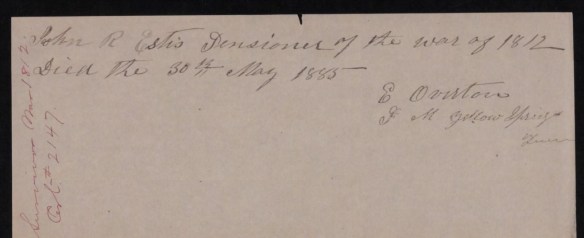
John R. Estes death 2

Yellow Springs is an area towards Hancock County from Estes Holler and it’s clearly more than 4 miles from Tazewell, so John moved once again between 1871 and 1885 when he passed away.

Now that we know when John R. died, and about his years in Claiborne County, let’s look back and see what we can discover about John’s life in Halifax County before moving to Claiborne.

We have discovered a lot about John R., but we still don’t know who his parents were.

Halifax County, Virginia

After my return from trips to Halifax County and Claiborne County, I ordered every microfilm available for either county and read them, page by page, at the Family History Center.

I made spreadsheets of what I found, because Halifax County was not only a popular place for Estes men to settle, but it was a popular “stopping off point” it seems, on the way west.  A few years there and then they were gone.

Complicating things further, there were several men named John.

The Tax Man Cometh

One of the most valuable tools turned out to be the two types of tax records.

One type of tax was taxes paid on land owned and the second type was paid on personal property.  That way, they could tax everyone on something and some people on both.  Personal property tax included tax on males over the age of 16 and items like cows and horses.  Some years they taxed people on far more, like clocks and curtains.  The sheriff took the list for each district and was responsible for collecting the taxes due.

Once you knew who the neighbors were in each location you could tell which John was which, for example, based on where they lived, which district, and their neighbors.

Now all the Estes men in Halifax County did not behave and stay put – they wandered around a bit – especially the young land-free ones.  I suspect they rented land or were laborers for others.  The men who owned land, of course, could be reliably found on both lists year after year in the same location, with their sons showing up as neighbors as they came of age and married.

John R. Estes never owned land.  Plus there were about a dozen John Estes’s.  Many were easy to eliminate, because they appeared on the tax list too early to be John R. Estes, or they were clearly associated with a specific family group, or had a middle name that didn’t begin with R.

Through this associative process, I eliminated all but 3 or 4 Johns.

Even more confounding was that the Estes families in Halifax County lived in the eastern half of the county, in and near South Boston and in the far northeast corner of the county.  On the other hand, the Moore family, William Moore, Nancy Moore’s father lived on the far western side of the county, almost to the Pittsylvania County line.

South Boston to Mount Vernon

This situation was very unusual and didn’t make sense, at least not at first.  Remember, you don’t marry who you don’t see, and in that time and place, you normally saw your neighbors, your family and the people who attended your church.  How did John R. Estes come to meet Nancy Ann Moore?

Hint – Ann’s father, William Moore, was a minister for a “dissenting religion,” according to the court records – those radical Methodists.  He married many members of John R. Estes’s mother’s family, according to marriage returns.  Of course, we didn’t figure this out until after we figured out who John’s mother was!

The 1810 tax list shows a John Estes where a John Estes never resided before, in the western part of the county, whose taxes were taken the same day as James Moore, who was exempt due to age.  James Moore was Ann Moore’s grandfather.  Perhaps John R. Estes was farming James Moore’s land for him or helping on his farm.  John was taxed for 1 white male and 1 horse.

But wait.  To add confusion, a second John Estes was also taxed in that district, and he was taxed the same day as William Moore, Nancy’s father, for 1 white male and 1 horse.  These tax lists were taken a month apart – so it’s possible but unlikely that the John Estes record was a duplicate.

From painstakingly recreating all of the Estes families over the previous decade, I know that there are four John’s of about the same age.  One is John, son of Abraham, one is John son of Bartlett who died in 1804, a third is John, son of Bartlett (son of Moses) and Rachel pounds and fourth, John, son of someone else.  But I wasn’t sure which John was ours and telling them apart was sometimes a challenge.

John, son of Abraham is easier to discern, generally, because he does not tend to live in the Estes cluster that includes Bartlett and other descendants of Moses Estes Jr, in South Boston.  His father, Abraham, lived in the northeast corner of the county.  Bartlett who died in 1804’s son was younger, born in 1793 or 1794, so he isn’t listed early.  He also lived in the north part of the county.  Bartlett and George Estes were brothers, sons of Moses Jr. and lived adjacent, on their father’s land, in what is now South Boston.

The 1811 tax list shows us one very, very important clue.  This is probably the most subtle clue I’ve ever received.  Do you see it?

Date Name White Slaves Horses Comments
Mar 4 Moses (2) 1 0 6
Mar 4 Josiah 1 0 0 Son of Moses
Apr 9 William 1 0 1 Son of Bartlett (son of Moses)
Apr 9 Marcus 1 0 1 Son of George
Apr 9 George 1 0 1 Son of Moses
Apr 9 John 1 0 0 Son of Abe or Bartlett?
Apr 10 John (SG) 1 0 0 Son of George
Mar 19 Bartlett (north) 1 0 0 Son of Moses
Mar 25 Bartlett (north) 2 1 6 Son of Bartlett, son of Moses?

SG – that’s it – that’s the clue.  In the vernacular of how Halifax County tax lists read, that means “son of George.”  Glory be.  That is our answer.  Our John R. Estes is the son of George.

The next year, 1812, cements that relationship.

We show John SD or SB.  SD makes no sense, because there is no D Estes male, but SB would be son of Bartlett.  Bartlett is George’s brother and they live adjacent in South Boston.  We show George with his other son Marcus.  The John with Marcus would be John (SG) because the other John is SD or SB, leaving John on the 27th unaccounted for and likely son of Abraham from the North.  John, son of Bartlett who died in 1804 is still too young to be shown on the tax lists individually.

Date Name White Slaves Horses Comments
Apr 4 Moses (2) 1 0 5
Apr 18 Josiah 1 0 2 Son of Moses
Apr 29 John (SD or perhaps SB) Son of Bartlett
Apr 27 John Son of Abe
May 5 George 1 0 2 Son of Moses
May 12 Marcus 1 0 0 Son of George
May 12 John (SG) 1 0 0 Son of George

In 1815, John is once again listed as (SG) and in 1816 and 1817, he is listed as John R. Estes instead of John (SG), but living in this same cluster.  Hallejuah!!!!!

These tax lists are one way that we know when John R. Estes actually left Halifax County.

Serving in the War of 1812

John R. Estes served in the War of 1812 while living in Halifax County, VA.  He was drafted for the period of three months.  What did he do while he was away in the War, serving in Grief Barksdale’s company?

According to the 1812 Virginia Historical site:

Capt Grief Barksdale’s Company of Riflemen from Charlotte County, VA during the period Sept. 1, 1814 until Dec. 1, 1814. His company was attached to LT Col William C. Greenhill’s 4th Regiment of Virginia Militia and sent to Camp Fairfield on the James River near Richmond. This regiment was made part of Brig General Joel Leftwich’s 2d Brigade and on October 12th it departed from nearby Fort Mimms and arrived at Camp Snowden, MD on Oct. 27, 1814., then it proceeded to Camp Crossroads near Elliot Mill’s, a few miles from Baltimore arriving there on November 9, 1814. They arrived too late to have any contact with the British and were discharged in late November 1814. Source: Butler’s ” A Guide to VA Militia Units in the War of 1812″, 2d edition dated 2011, pages 24,57,& 240.

On page 240, the author indicates that Lt Col William C. Greenhill’s 4th Regiment was a part of the 2nd Brigade commanded by Brig. General Joel Leftwich which was created on September 5, 1814 at Camp Fairfield located near the James River leading into Richmond. On October 5th it was ordered to march with General Breckenridge’s brigade to Washington, DC. On October 12th it left Camp Mims near Richmond and arrived at Camp Snowden, MD on October 27th. The brigade arrived at Ellicott Mills near Baltimore on November 9th and was discharged at the end of November. The Battle of Baltimore had taken place on September 13th and after their defeat the British had left the area. Colonel Greenhill’s regiment consisted of seven company sized units from the counties of Pittsylvania, Halifax and Charlotte.

The conditions, however, were punishing.  Rains that fall were unrelenting.  At one time, three fourths of the men were ill.

In a letter of September 18, Brig. Gen. Thomas Marsh Forman, commander of the First Brigade, Maryland Militia, wrote of “a most tremendous Northwester which is punishing our poor soldiers, most of whom are in very thin clothing.”

Thus, John R. Estes was not involved in any encounter with the enemy.  John R. was lucky.  He was in the right place at the right time and avoided warfare, even though he was probably waterlogged.  In years to follow, because he did serve, he would obtain two land grants and a pension for his service of $8 a month.  That pension probably made a big difference in his quality of life.

John’s son, Jechonias, was probably born while he was gone.

Courthouse Basement Finds

Another find in the basement of the Halifax County courthouse was the chancery records – and I don’t mean the index or minutes – I mean the actual case packets – tied neatly in bundles with little ribbons.  Chancery court is a court that focuses on solutions for civil actions as opposed to criminal prosecutions for breaking the law.  Today, divorces are held in chancery court since a solution as to the division of property, assets and debts needs to be found.

These old chancery records have been indexed and scanned and will soon be available at the State of Virginia archives site – so no need to sort through boxes in the basement anymore.  It’s a good thing too, because those case bundles which included all kinds of information had a habit of walking away – not to mention many were in bad shape.  Being 200 years old will do that to you!

A long and complex case in which Thomas Yates and his wife, Phoebe Combs Yates sues Joseph Farguson about the ownership of a slave styled “Halifax Co., Va. Chancery 1812-019, Yates vs Farguson and Combs” includes depositions by John R. Estes and also his father George Estes whose mother was Luremia Combs.

John Eastes says that some time since Dec. 25, 1811 he saw Joseph Farguson carry the negro boy Jess to Thomas Yates and told him he did not consider they had any right to him, but if they would pay him what they were owing him on account of said negro, he would give him up and they refused to do it.

Given under the hand and seal Nov. 27, 1812. Sarah Farguson signed with a mark, Thomas Douglas signed, Lemuel Moore with a mark, Joseph Denman with a mark, John R. Estes signed.

Agreeable to a court order dated June 15, 1813 we met at the dwelling house of Jacob Farguson decd and proceeded to take the depositions of Sarah Farguson, Thomas Douglas and John R. Estes.  All three of these depositions are the same as given earlier except there were two questions posed to John R. Estes:

Q: By the plaintiff who were they that refused to take the negro boy Jesse and pay up the money?

A: I saw Mrs. Phebe Yates and Mrs. Combs

Q: By the same did you not understand that Thomas Yates about that time was gone to Linchburg?

A: Some time before that I did

Q: How long was it before you carried the notice for to take deposition at Chalmers Store?

A: I don’t know.

This day John R. Estes came before me and made oath that he delivered a true copy of the within to Thomas Yates on the 19th (of July) given under my hand this July 23rd 1814. Charles Harris. There is a note in John R. Estes hand (in light pencil unfortunately) that says On the 19th of July 1814, I John R. Estes delivered a true copy of the within to Thomas Yates.

Another note dated Nov 27, 1814 that John R. Estes came before Joseph Sanford, a JP, and made oath that he delivered a true copy of the within notice in Thomas Yates house to Mrs. Combs and William Yates.

Yet another note dated July 19, 1814 that John R. Estes of lawful age personally appeared before William Bailey and made oath that he delivered on the 24th, 25th or 26th of November 1812 a copy of the within notice in the dwelling house of Thomas Yates with Mrs. Combs and Yates wife.

Deducing John R.’s Father

In summary, there were only 4 possible fathers for John R. Estes; Bartlett who died in 1804 and lived in the north, Abraham whose son John who married in 1808 and moved to Charlotte County, Bartlett who married Rachel Pounds or George who married Mary Younger.  There were no other men who don’t already have sons John attributed to them and accounted for, who lived in Halifax when John R. was born about 1787 and who remain in Halifax County until he reaches 21 in about 1809, so we have no other reasonable candidates.

Bartlett and Rachel had a son the same year or within a year of when John R was born, also named John.  However, one John is designated as SG, and one as SB or SD, so we now know that George did in fact have more children than just Susannah Y., including a John of exactly the right age.

Furthermore, John, son of Bartlett appears to still be living in Halifax in 1837 during Moses’ estate settlement, eliminating him as a possibility for our John.

Abraham’s son John lived in the north and goes back and forth between Halifax and Charlotte Counties.

I have never been able to find the John, son of Bartlett who died 1804.  However, he is too young regardless, having been born in 1793/1794.  Based on a subsequent lawsuit after Bartlett’s widow’s death in 1824, I believe that this John died, which would eliminate him from being our John.

George Estes who married Mary Younger and had a son John (designated as SG), was previously unknown, and is the most likely candidate for the father of our John R.  John R. named one of his sons George and one of his daughters Mary.  John R. also named one of his sons John Y.  George’s daughter Susannah was named Susannah Y. and his son was named William Y.  John R’s daughter Lucy had a daughter whose middle name was Younger.  Neither Bartlett’s name nor those of any of his children appear in John R’s family.  George Estes’s wife was Mary Younger.

Therefore, I concluded that John R. Estes’s parents were George Estes, son of Moses Estes Jr., and Mary Younger, daughter of Marcus Younger.

The final confirmation of John R’s parents came from a most unexpected set of records.

Mary Younger Estes’s parents were Susannah and Marcus Younger.  Marcus died in 1816, but in 1842, a chancery suit was filed having to do with the distribution of his estate after an unmarried daughter’s death.

I extracted data from the “Younger, Marcus Chancery Suit 1842-057, Halifax Co. Va.” and in the documents from that suit, I found the payments made to the various heirs of Marcus Younger.  In the case of John Estes, he was listed as an heir because his mother was deceased.  John was listed as married to Nancy and as living in Tennessee.

It is noted that Mary Younger Estes’s children will receive one sixth of her one quarter share of the 83 acres to be sold following the death of Mary’s unmarried sister.

The children of Mary Estes were listed as: John Estes, William, Susannah, Sally wife of T. Estes, Polly wife of James Smith and a grandchild name Mark Estes.  So, not only do we have John’s name, we have the entire list of his siblings.

This was followed by another document listing the locations of the heirs, including:

Younger Wyatt and Polly his wife – Rutherford County Tennessee

John Estes and Nancy his wife – “ditto marks” under Rutherford County.  John was actually in Claiborne at this time and there was no John Estes in the 1840 census in Rutherford County.  John’s wife was Nancy (Ann) Moore.  None of the other John’s married Nancys or Anns.

This was an EXTREMELY long way around the block to discover the identity of the parents of John R. Estes – and it’s nothing short of a miracle that I did actually find the information scattered in extremely obtuse locations – like a genealogy version of a scavenger hunt.  There were many times I just wanted to give up and asked myself if it was really, REALLY that important.

The night I made the discovery of “SG” on the tax list, I knew in that instant who John’s father was.  I was in the Family History Center and they were closing for the evening.  I was excited, very excited – decades of searching Happy Dance excited.  The librarian virtually patted me on the head and told me to go home.

I was far too excited to just do that.  I lived half an hour away so by the time I got home, it was getting late.

I decided to call Garmon, regardless of how late it was.  After all, he had been searching for the answer for 45 years, which made my 20 or so look puny.

Garmon answered the phone groggily, “hhh….hello.”

“Wake up.”

“Who is this?”

“Your cousin, Bobbi.”

“Bobbi?”

“Yes Bobbi.  I know who John R. Estes’s parents were.”

Very alert now….”You DO???”

“Yes, do you want to know?”

“Do I want to know?  I’d stand in the corner on my head and clap my hands to know.”

“George – it was George Estes…and Mary Younger.”

“Well, I’ll be.”

As I looked out my kitchen window at the peaceful moon that night rising over the trees and happily visited with Garmon, my long time research buddy and cousin, telling him the story of “SG,” I had no idea of the landmines that would lurk in the future, threatening to derail our discovery.

The DNA Landmine

When I first visited Halifax County, DNA testing for genealogy didn’t yet exist.

When I first visited Halifax County, Virginia, after the advent of DNA testing, autosomal testing didn’t yet exist and we were happily testing for 12 and then 25 Y DNA markers.

In the Estes DNA project, we had several descendants of the immigrant, Abraham Estes who had tested, but so far, no one proven from his son, Moses’s line.

Garmon, of course, was the very first Estes to test, but we didn’t know which line we descended from.  We were just pleased that we matched up to Abraham’s Y DNA genetic profile.

Abraham, the immigrant had a son, Moses, who settled in Halifax County, VA, who had a son Moses Jr., who remained in Halifax County and had several sons as well.  Moses Jr.’s son, George served in the Revolutionary War and we would eventually discover that he was the father of John R. Estes, my ancestor.  George also had three other sons.  These several generations of men made up the pool of many of the Estes families in the southern part of Halifax County.

I was fortunate to be able to meet one elderly Estes gentleman, we’ll call Beau, and spent several hours on multiple days listening to his stories about his life and ancestors, including “Granpappy George” who died at either 105 or 116, depending on which version of the story you liked and which day he was telling it.

His cousin, a female, Pat, was also very involved in genealogy and she joined us as well.  We drank iced tea and sat in the shade under trees so old they probably had stories about our ancestors themselves, had they been able to talk.  Glorious summer days in the south.

I had discovered the location of the old family land and Pat knew the story of why and where the graves had been moved.  There was no resting in peace in this family.

Beau and Pat’s line of the family descends from George, the Revolutionary War soldier, through his daughter Susannah Y. Estes who reportedly married her cousin, also an Estes, some say Tom Estes, which is why her surname remained Estes.  She lived among the rest of the Estes clan on Estes land owned originally by Moses Jr., father of George.  Susannah’s son, Ezekiel, from whom Beau descends, is shown below in what I believe is a death photo, taken in 1885.

Ezekiel Estes

Ezekiel bears a striking resemblance to his uncle, John R. Estes.

This Estes line descends to Beau and Beau was quite eager to take a DNA test to represent our George Estes line.  As a responsible genetic genealogist, I of course had a DNA kit handy, and Beau happily swabbed as I timed the event.  I brought his kit home and mailed it to Family Tree DNA.

A few weeks later, I received a message that Beau’s DNA results were available, but as a project administrator, I didn’t receive the notification that the other kits in the project had matches.  I remember thinking, “that’s odd.”

I signed in to see Beau’s results, and what awaited me was every genealogists nightmare.  The George Estes line, represented by Beau, did not match the ancestral Abraham Estes line.  And yes, to answer the next question, we had tests from several descendant lines from Abraham, so we know positively what his DNA looked like – and it looked nothing at all like Beau’s.

no match

I was sick, just sick.  It took me a day or two to process this information.  Truthfully, I was in shock and it threw a terrible monkey wrench into genealogy?

Should I stop researching my Estes genealogy since we were obviously not Esteses in the original sense of the word?  Was Moses Sr. not Abraham’s son?  Was Moses Jr. not Moses Sr.’s son?  Was George not Moses Jr’s son?  Who didn’t begat whom?  And under what circumstances?  How come Garmon matches the Abraham ancestral line, but Beau didn’t?  Was I in the wrong damned county barking up the wrong tree…..AGAIN????

And then that little voice started talking to me……was Susannah Y. Estes ever really married to her Estes cousin?

I had to know.

If Susannah was not married to an Estes cousin when she had son Ezekiel, from whom Beau descends, then the DNA wouldn’t be Estes, but the surname would be, given that the child took her surname.

But the family was sure, absolutely positive.  I called Pat and talked to her about this without saying too much, and she was very indignant that Susannah absolutely had been married to her cousin and that George, Susannah’s father, “would not have put up with any other kind of behavior.”

I could tell that another trip to Halifax County was in the offing.  I needed more records and I needed to concentrate on Susannah, someone I hadn’t necessarily neglected, but who I certainly wasn’t focused on.

On my return trip, the first place I went was the courthouse, to find Susannah’s marriage record.  Some of the Halifax records are either very thin or missing altogether.  For example, there were virtually no marriage records during the Revolutionary War.  Now you know people were still getting married, but since they didn’t know who was going to win the war, they weren’t paying any money to have anything registered – or the records have disappeared, all but 2 or 3 of them.  It’s this type of information you can’t glean from just finding your own ancestor’s records, because you have no idea if they are the only person in the marriage records for the year or just one of several thousand.  Context can make a big difference in how you interpret a missing record.

Susannah was born about 1800 and her first child, the son in question, Ezekiel, was born about 1814.  That is awfully, awfully young and there was no marriage record.  In fact, this is so young it smacks of a nonconsensual relationship of some sort.

Susannah’s next children were born in 1818, 1825, 1828 and 1835.  Three were females and one additional male, Marcus, who died between 1850 and 1860. In Susannah’s estate after her death in 1870, she said and her heirs say she had no idea where Marcus’s wife and children are or were and that she did not hear from them after they left the area years before.  She didn’t know if she had grandchildren through Marcus or not, but she had provided for them if she did.  How sad for Susannah.  She had no idea she had outlived her son by 10-20 years.

However, since there was no marriage record for Susannah, I was dead in the water at this point, with no proof of anything and DNA that didn’t match what it was supposed to match.  I felt like a fish flopping out of water, gasping, with no help in sight.

One of the things I learned a long time ago about genealogy is that the more work you do, the better the chance of opportune accidents happening. In other words, sometimes fate takes pity on you – or maybe it’s just your turn.

When I extract records for a particular surname, I extract all of the records of the relevant timeframe and often beyond.  I worry about putting them together later….and yes…I’m fully aware that I waste a lot of time doing work that turns out to be irrelevant.  But sometimes, it’s not entirely irrelevant and there may be tidbits that are extremely important….later.

Like the marriage records of Susannah’s children, for example.

Her eldest son, Ezekiel Estes married Martha Barley on December 10, 1854.

The clerk’s office had the actual minister’s return and it was chocked full of information, including that both Ezekiel and Martha were illegitimate, and both of their fathers’ were unknown, or at least not named, and that they married at the home of the bride’s mother.

Ezekiel Estes marriage

Oh.  Illegitimate…no father’s name.  Nonmatching DNA.  Hmmmmm….

Let’s look at Susannah’s other children who married in Halifax County.  Another child’s entry says that the father is unknown and a third simply has a line drawn through the father’s name space.  Another child married out of the county, but I had what I needed.

Finally, after Susannah’s death when Ezekiel was trying to settle her estate, depositions were taken regarding the division of her estate and in particular, the validity of some debts.

In this testimony, from various people, it is verified that Susannah never married and that she conducted all of her own business – in other words, there was never a male partner in her life.

Through the sources we would normally use to verify a marriage, we come up empty handed – but lack of evidence does not constitute proof that she never married.  Absence of evidence is not necessarily evidence of absence.   Susannah could have married in an adjacent county.  However, the fact that her children’s marriage licenses all reflect an unknown father and an illegitimate legal status sheds light on Susannah’s marital status, as do the depositions after her death.  And Susannah’s surname never changed.  She was born an Estes and died an Estes too.

So, Pat was wrong, but not entirely wrong – because if you look back at the chancery suit distributing the assets of Mary Younger Estes, John R.’s sister, Sally, did marry a T. Estes.  So the family had taken the information that one of George’s daughter’s married an Estes cousin and attached that information, opportunistically, to Susannah.  It made sense, and given that both of the women’s names began with S, it would have been easy to genuinely confuse the daughters, especially a generation or two later.

George indeed did tolerate Susannah having illegitimate children, 5 of them apparently, and he supported her through the process, eventually signing his Revolutionary War bounty lands over to her as well as his assets in Halifax County.  I’m sure he knew all too well that she needed the help.  After the death of George’s wife, between 1830 and 1842, Susannah likely took care of George until he died in 1859.  In fact, it was her son, Ezekiel that reported George’s death.  So George stood by Susannah and Susannah took care of George.

So, back to the DNA.  Based on Ezekiel’s marriage license, we know that his mother, Susannah was not married at the time of his birth.  We also know, from the DNA itself that she did not get pregnant by an Estes male.

The DNA of George’s line has since been confirmed by other Estes male descendants.

When I did eventually explain this to Beau, he wasn’t very happy, but I explained to him that his line can be proud to establish a new Estes DNA line and what a strong woman Susannah had been.  However, when I explained that he is still related to Granpappy George, through Susannah, just like he always was, and he carries Granpappy’s George’s surname, he was much MUCH happier.  He didn’t really care about the DNA, but he surely cared a lot about being related to Granpappy George.

Out of all of this, I have to look at Susannah through a different lens.  Yes, I do wonder why.  Why did she get pregnant so young and why did she never marry?  Why did she continue to have illegitimate children?  But I also have grown to have an admiration for Susannah, knowing how difficult it would have been in that time and place to hold your head upright in spite of everyone and the hateful and derogatory things that were assuredly said about you behind your back and in front of your face.  She must have been quite a spunky lady.  She raised her children, took loans, bought property and pretty much acted like any man of that day.  She was assuredly a woman born before her time.

But as for that pesky DNA issue – this type of situation is exactly why it’s so very important to test more than one male line from each ancestor.  You just never know if one line really represents that ancestor otherwise – unless they match a descendant of someone further upstream or a descendant of another son.

This also illustrates why it’s important to verify information provided.  I’m sure at some point that a conversation about Susannah went like this:

“Why did Susannah still have the Estes surname after having 5 children?”  and the answer went something like this:

“She must have been married to her Estes cousin.  Grandpappy George’s daughter married her Estes cousin, you know.”

That not entirely untrue answer probably took on a life of its own and became Susannah’s family truth.

I’m glad this wasn’t the first Estes DNA participant test or we could have been led badly astray.  I’m also glad that we were able to find additional descendants of George to test for DNA validation.

Over the years, I’ve become quite the skeptic about the “full truth” of both family stories and single DNA tests for any line and now I need proof of everything!  I’m not saying I think people intentionally tell untruths, I think it’s generally more like that childhood game of telephone where you whisper a phrase like, “Beau has brown shoes,” in your neighbor’s ear and 15 whispers later to 15 other people, the end result is something like, “Bows are brown mushrooms.”

I’m sorry I wasted the time in Fairfax County, but even the frustration in Halifax County caused by the Beau’s unexpected DNA results wasn’t a waste.  Indeed, it caused me to dig deeper, and even though I was searching for information about Susannah at that point, and not John R. Estes, I found more and more about the entire family that provided perspective and understanding of their life and times – including that all-important chancery suit naming Mary Younger Estes’s heirs.

It was just a jig in the road and not a dead end after all, but it certainly seemed like a disaster at the time.

???????????????????????????????

______________________________________________________________

Disclosure

I receive a small contribution when you click on some of the links to vendors in my articles. This does NOT increase the price you pay but helps me to keep the lights on and this informational blog free for everyone. Please click on the links in the articles or to the vendors below if you are purchasing products or DNA testing.

Thank you so much.

DNA Purchases and Free Transfers

Genealogy Services

Genealogy Research

Haplogroup A4 Unpeeled – European, Jewish, Asian and Native American

Mitochondrial DNA provides us with a unique periscope back in time to view our most distant ancestors, and the path that they took through time and place to become us, here, today.  Because mitochondrial DNA is passed from generation to generation through an all-female line, un-admixed with the DNA from the father, the mitochondrial DNA we carry today is essentially the same as that carried by our ancestors hundreds or even thousands of years ago, with the exception of an occasional mutation.

Y and mito

You can see in the pedigree chart above that the red mitochondrial DNA is passed directly down the matrilineal line.  Women contribute their mitochondrial DNA to all of their children, of both genders, but only the females pass it on.

Because this DNA is preserved in descendants, relatively unchanged, for thousands of years, we can equate haplogroups, or clans, to specific regions of the world where that particular haplogroup was born by virtue of a specific mutation.  All descendants carry that mutation from that time forward, so they are members of that new haplogroup.

For example, here we see the migration path of haplogroup A, after being born in the Middle East, spreading across Eurasia into the Americas, courtesy of Family Tree DNA.

Hap A map crop

This pie chart indicates the frequency level at which haplogroup A is found in the Americas as compared to haplogroups B, C, D and X.

Hap A distribution

However, not all of haplogroup A arrived in the Americas.  Some subgroups are found along the path in Asia, and some made their way into Europe.  There are currently 48 sub-haplogroups of haplogroup A defined, with most of them being found in Asia.  Every new haplogroup and sub-haplogroup is defined by a new mutation that occurs in that line.  I wrote about how this works recently in the article, Haplogroups and The Three Brothers.

In the Americas, Native American mitochondrial haplogroups are identified by being subgroups of haplogroup A, B, C, D and X, as shown in the chart below.

beringia map

In the paper, Beringian Standstill and Spread of Native American Founders, by Tamm et al (2007), haplogroup A2 was the only haplogroup A subgroup identified as being Native American.

As of that time, no other sub-haplogroups of A had been found in either confirmed Native American people or burials.

In June, 2013, I realized that a subgroup of mitochondrial haplogroup A4 might, indeed, be Native American.

The haplogroup A4 project was formed as a research project with Marie Rundquist as a co-administrator and we proceeded to recruit people to join who either were haplogroup A4 or a derivative at Family Tree DNA, or had tested at Ancestry.com and appeared to be haplogroup A4 based on a specific mutation at location 16249 in the HVR1 region.  As it turns out, location 16249 is a haplogroup defining marker for haplogroup A4a1.

There weren’t many of these Ancestry people – maybe 20 in total at that time.  Ancestry has since discontinued their mitochondrial and Y DNA testing and has destroyed the data base, so it’s a good thing I checked when I did.  That resource is gone today.

Family Tree DNA has always been extremely supportive of scientific studies, whether through traditional academic channels or via citizen science, and they were kind enough to subsidize our testing efforts by offering reduced prices for mitochondrial testing to project members.  I want to thank them for their support.

Other haplogroup administrators have also been supportive.  I contacted the haplogroup A administrator and she was kind enough to send e-mails to her project members who were qualified to join the A4 project.  Supportive collaboration is critically important.

I wrote an article about the possibility that A4 might be Native, and through that article, raised money to enable people to test at Family Tree DNA or upgrade to the full sequence test.  Full sequence testing is critical to obtaining a full haplogroup designation.  Many of these people were only, at that time, defined by HVR1 or HVR1+HVR2 testing as haplogroup A.  Haplogroup A is, indeed, a Native American haplogroup, but it’s also an Asian haplogroup and we see it in Europe from time to time as well.  The only way to tell the difference between these groups is through full sequence testing.  Haplogroup A was born in Asia, about 30,000 years ago and has many subgroups.

What Do We Know About Haplogroup A4?

Haplogroup A4 has been identified as a subgroup of the parent haplogroup A and is the parent haplogroup of A2.  In essence, haplogroup A gave birth (through a mutation) to subgroup A4 who gave birth through a mutation to subgroup A2.

To date, before this research, all confirmed Native American haplogroups were subgroups of haplogroup A2.

In the Kumar et al 2011 paper, Schematic representation of mtDNA phylogenetic tree of Native American haplogroups A2 and B2 and immediate Siberian-Asian sister clades (A2a, A2b, A4a, A4b and A4c), no A4 was reported in the Americas, although A4 is clearly shown as the parent haplogroup of A2, which is found in the Americas.

On the graph below, from the paper, you can see the color coded “tabs” to the right of the haplogroup A designations that indicate where this haplogroup is found.  As you can see, A4 and subgroups is found only in Siberia and Asia, not in the Americas, which is indicated by yellow.

Hap A and B genesis

Schematic representation of mtDNA phylogenetic tree of Native American haplogroups A2 and B2 and immediate Siberian-Asian sister clades (A2a, A2b, A4a, A4b and A4c). Coalescent age calculated in thousand years (ky) as per the slow mutation rate of Mishmar et al. [58] and as per calibrated mutation rate of Soares et al. [59] are indicated in blue and red color respectively. The founder age wherever calculated are italicized. The geographical locations of the samples are identified with colors. For more details see complete phylogenetic reconstruction in additional file 2 (panels A-B) and additional file 3. Kumar et al. BMC Evolutionary Biology 2011 11:293 doi:10.1186/1471-2148-11-293

I then checked both GenBank and www.mtdnacommunity.org for haplogroup A4 submissions.  Ian Logan’s checker program makes it easy to check submissions by haplogroup.

MtDNACommunity reflected one A4 submission from Mexico and from the United States, which does not necessarily mean that the United States submission is indigenous – simply that is where the submission originated.  The balance of the submissions are from either academic papers or from Asia.

During this process, I utilized PhyloTree, Build 15, shown below, as my reference tree.  Build 16 was introduced as of February 2014.  It renames the A4 haplogroups.  In order to avoid confusion, I am utilizing the Build 15 nomenclature.  These are the haplogroup names currently in use by the vendors and utilized in academic papers.

Hap A tree

I am also utilizing the CRS version, not the RSRS version of mutations.  Again, these are the mutations referenced by academic papers and the version generally used among genealogists.

Family Tree DNA provides an easy reference chart of which mutations are haplogroup defining.  For haplogroup A4, we find the following progression.

A4 T16362C
A4a G1442A
A4a1 G9713A, T16249C
A4a1a T4928C

This means that everyone who falls in haplogroup A4 carries this specific mutation at location 16362.  The original value at that location was a T and in haplogroup A, that T has mutated to a C.  This defines haplogroup A4.  So, if you don’t have this mutation, you definitely aren’t in haplogroup A4.  Everyone in haplogroup A4 carries this mutation (unless you’ve had a back mutation, a very rare occurrence.)

This is actually a wonderful turn of events, because it means that the defining mutation for A4 is in the HVR1 region, which further means that regardless of how the haplogroup A individual is classified, I can tell with a quick glance if they are A4 or not.

In addition, subgroups are defined by other mutations as well, shown above.  For example, haplogroup A4a carries the A4 mutation of T16362C plus the additional mutation of G1442A that defines subclade A4a.

Full sequence testing showed that there was actually quite a variety of subhaplogroups in the project participants.

What Did We Find?

In the haplogroup A4 project, we now have 55 participants who fell into 11 different haplogroups when full sequence tested.

A4 project distribution crop

I have removed all haplogroup A2 individuals from further discussion, as we already know A2 is Native.  We have established a haplogroup A2 project for them, as well.

A4b

We found two haplogroup A4b individuals.  The most distant known ancestor of one is found in Tennessee, but the most distant ancestor of the other is found in England.  These two individuals have 19 HVR1 matches, of which many are to other A4b individuals.  There is no evidence of Native American ancestry in this group.

A4-A200G

This unusual haplogroup name indicates that this is a subgroup of haplogroup A4, defined by a mutation at location 200 that has changed from A to G.  The new subgroup is waiting to be named.  So eventually A4-A200G will be replaced with something like A4z, just as an example.

This individual is from Asia, so this haplogroup is not Native.

A10

One individual, upon full sequence testing, was found to carry haplogroup A10, which is not a subgroup of A4.  This is quite interesting, because the most distant ancestor is Catherine Pillard, originally believe to be one of the “Kings Daughters,” meaning French.  This article explains the situation and the question at hand.

All five of her full sequence matches are either to other descendants of Catherine Pillard, or designated as French Canadian.

One of this woman’s ten HVR2 matches shows her ancestor, Annenghton Annenghto, as born at the Ossosane Mission, Huronia, La Rochelle, Ontario, Canada and died in 1657 in Canada.  If this is correct and can be confirmed, haplogroup A10 could be Native, not French.  Her daughter, Marie Catherine Platt has a baptismal record dated March 30, 1651, was also born at the mission, and is believe to be Huron.

This article more fully explains the research and documents relevant to Catherine Pillard’s ancestry.

Based on these several articles, it seems that an assumption had originally been made that because the individual fell into haplogroup A, and haplogroup A was Asian and Native, that this individual would be Native as well.

This determination was made in 2007, based on only the HVR1 and HVR2 regions of the mitochondrial DNA, and on the fact that the DNA results fell within haplogroup A, as documented here.  The HVR1 and HVR2 regions do not include the haplogroup defining mutations for haplogroup A10, so until full sequence testing became available, this sequence could not be defined as A10.  The conclusion that haplogroup A equated to Native American was not a scientific certainty, only one of multiple possibilities, and may have been premature.

I contacted several French-Canadian scholars regarding the documents for Catherine Pillard and there is no consensus as to whether she was Native or European, based on the available documentation.  In fact, there are two very distinct and very different opinions.  There is also a possibility that there are two women whose records are confused or intermixed.

So it seems that both Catherine Pillard’s DNA and supporting documents are ambiguous at this point in time.

One of the ways we determine mitochondrial ethnicity in situations like this is “guilt by genetic association,” to quote Bennett Greenspan.  In other words, if you have exactly the same DNA and mutations as several other people, and they and their ancestors are proven to live in Scotland, or Paris, or Greece, you’re not Native American.  This works the other way too, as we’ll see in Kit 11 of the haplogroup A4 outliers group.

Looking at other resources, MtDNA Community shows two references to A10, one submitted from Family Tree DNA and one from the below referenced article.

Haplogroup A10 has one reference in Mitogenomic Diversity in Tatars from the Volga-Ural Region of Russia by Malyarchuk et al, (201 Molecular Biological Evolution) but has since been reassigned as haplogroup A8, as follows:

However, some of the singular haplotypes appear to be informative for further development of mtDNA classification. Sample 23_Tm could be assigned to A10 according to nomenclature suggested by van Oven and Kayser (2009). However, phylogenetic analysis of complete mtDNAs (fig. 1) reveals that this sample belongs to haplogroup A8, which is defined now by transition at np 64 and consists of two related groups of lineages—A8a, with control region motif 146-16242 (previously defined as A8 by Derenko et al. [2007]), and A8b, with motif 16227C-16230 (supplementary table S3, Supplementary Material online). Analysis of HVS I and II sequences in populations indicates that transition at np 64 appears to be a reliable marker of haplogroup A8 (supplementary table S3, Supplementary Material online). The only exception, the probable back mutations at nps 64 and 146, has been described in Koryak haplotype EU482363 by Volodko et al. (2008). Therefore, parallel transitions at np 64 define not only Native American clusters of haplogroup A2, that is, its node A2c’d’e’f’g’h’i’j’k’n’p (Achilli et al. 2008; van Oven and Kayser 2009), but also northern Eurasian haplogroup A8. Both A8 and subhaplogroups are spread at relatively low frequencies in populations of central and western Siberia and in the Volga-Ural region. A8a is present even in Transylvania at frequency of 1.1% among Romanians, thus indicating that the presence of such mtDNA lineages in Europe may be mostly a consequence of medieval migrations of nomadic tribes from Siberia and the Volga-Ural region to Central Europe (Malyarchuk et al. 2006; Malyarchuk, Derenko, et al. 2008).

On Phylotree build 15, A10 is defined as T5393C, C7468T, C9948A, C10094T A16227c, T16311C! and the submissions are noted as the Malyarchuk 2010b paper noting it as “A8b”and a Family Tree DNA submission.

At this point, haplogroup A10 is indeterminate and could be either Native or European.  We won’t know until we have confirmed test results combined with confirmed genealogy or location for another A10 individual.

A4

Haplogroup A4 itself is not the haplogroup I originally suspected was Native.  When this project first began, we had few A4s, and I suspected that they would become A4a1 when full sequence tested.  I expected A4a1 would be Native American.

Subsequent testing has shown that haplogroup A4 very clearly falls into major subgroups, as defined by different mutations.

A4 European

The European A4 group is comprised of three participants.  Of those three, two are matches to each other and the third is quite distant with no matches.  I suspect that we are dealing with two different European sub-haplogroups of A4.

Two project participants, one from Romania and one from Poland match each other and both match one additional individual from Hungary who is not a project member.  This group is eastern European.

The Romanian and Polish kits that match each other both carry mutations at locations 16182C, 16183C, 16189C, 150T, 204C, 3213G, 3801C and 14025C.  The third person that they match, who is not a project member, from Hungary, matches one of those kits exactly, so that gives us three kits carrying this same series of mutations.  These mutations do not match any other individuals carrying haplogroup A4.  This group appears to be Jewish, as all three of the participants are of the Jewish faith.

This leaves the third project participant from Poland who does not have any matches today, within or outside of the project.  This participant is clearly a different subclade of A4.  They match none of the defining markers of the group above. They do have unique mutations at locations not found in other A4 participants within the project.

This provides us with the following European haplogroup A4 results:

  • Eastern European –Jewish – 2 participants plus one exact full sequence match outside of project
  • Eastern European – does not match group above, has no matches today, five unique mutations including 4 in the coding region.

A4 Chinese

This A4 participant is from China.

This sequence is actually very interesting because of its relative age.  This individual has 109 matches at the HVR1 level.  This means, of course, that they are exact matches.  They match many people in varying locations such as people with Spanish surnames, participants from Michigan, Mexico and Asia which include people with extended haplogroups of A, A4 and A4-A200G haplogroup designations.

At first this appears confusing, until you realize two things.  First, the participant doesn’t continue those matches at the HVR2 level and second, this means that all of those people still carry the Haplogroup “A4 signature” HVR1 mitochondrial DNA, exactly.

This means that those matches stretch back in time thousands of years, until before the divergence of Native Americans and Asians, so at least 12,000 years, if not longer.  People who have incurred mutations in the HVR1 region don’t match, but those who have not, and today, there are only 109 in the Family Tree DNA data base, still match each other – reaching back to their common Asian ancestor many millennia ago.

This individual has developed two mutations in the HVR2 region at locations 156G and 159G.  The participant also does not carry the haplogroup A defining mutation at location 263G which means either that 263G actually defines a subgroup, or this participant has had a back mutation to the original state at this location.  This individual did not test at the full sequence level.

A4 Americas

This leaves a total of 14 haplogroup A4 individuals within the project.

In order to show a comparison, I have removed all private mutations where none of this group matches each other.  I have also removed the haplogroup defining mutations as well as 16519C and all insertions and deletions since those areas are considered to be unstable.  In other words, what I’m looking for are groups of mutations where this group matches each other and no one else.  These are very likely sub-haplogroup defining mutations.

In addition to all private mutations, deleted columns include: 16223, 16332, 16290, 16319, 16362, 16519, 73, 152, 235, 263, 309.1, 309.2, 315.1, 522, 523, 663, 750, 1438, 1736, 2706, 4248, 4769, 4824, 7028, 8794, 8860, 11719, 12705, 14766, 15326.

I then rearranged the remaining columns and color coded groups.  You can click on the chart to enlarge.

A4 mutations

Note: na means not available, indicating that the participant did not test at that level.  An x in the cell indicates that the mutation indicated in that column was present.

The purple and apricot groupings show different clusters of matches.  The light purple is the largest group, and within that group, we find both a dark purple group and an apricot group.  However, not everyone fits within the groups.

A4 – Virginia

The first thing that is immediately evident is that the first kit, Kit 1, is not a member of this purple grouping.  This person has three full sequence matches outside of the project, one whose ancestor was born in Texas.  This individual has three unique full sequence mutations.  This grouping may be Native, but lacks proof.

Additional genealogical research might establish a confirmed Native American connection. If Kit 1 is Native, this line diverged from this larger A4 group long ago, before any of these purple or apricot mutations developed.

This participant’s ancestor traces to Virginia.  Regardless of whether this haplotype is Native or not, it is most likely a sub-haplogroup of A4.

A4 – Colombia

The next least likely match is Kit 2.  This individual shares two of the common HVR2 markers, 146 and 153, but did not test at the full sequence level.  Given what I’m seeing here, I suspect that 146 might be a sub-haplogroup defining mutation for this light purple group.  In addition, 8027 and 12007 might be as well.  That includes everyone (who has tested at the relevant levels) except for Kit 1 and Kit 11.

Haplogroup A4 from Colombia is most likely Native.  Few people are in the public data bases are from Colombia.  One would expect several mutations to have occurred as groups migrated.  At the HVR1 level, this individual has 18 matches, most of which have Spanish surnames.  This participant has no HVR2 matches.

A4 – California Group

The next group is the apricot group which I’ve nicknamed the California group.  Both of these participants, Kit 3 and Kit 4, find their ancestors in either southern California or Baja California, into Mexico.  Finding these haplogroups among the Mexican, Central and South American populations is an indicator of Native heritage, as between 85% and 90% of Mexicans carry Native American matrilineal lineage.

These participants also match a third individual who is not a project member whose ancestor is also found in Baja California.  This group’s defining mutations are likely 16209C, 5054T, 7604A, 7861C and 12513G.  Fortunately, these will be relatively easy to discern due to the HVR1 mutation at 16209.

A4 – Puerto Rico Group

The dark purple group, Kits 5-9, is the Puerto Rican group even though it includes one kit from Mexico and one from Cuba.  The Mexican kit, Kit 5, in teal, is only a partial match.  Kits 6-9 match each other plus several additional people not in the project whose most distant ancestors are found in Puerto Rico as well.  This group has several defining markers including 16083T, 16256T, 214G, 2836T, 6632C and possibly 16126C, although Kit 5 carries 16126C while Kit 9 does not.

The Puerto Rico DNA project has another 18 individuals classified as haplogroup A or A4 and they all carry 16083T, 16256T and those who have taken the HVR2 test (10) carry 214G as well.  Only one carries 16126C, so that would not be a defining mutation for this major group, but could be for a subgroup of the Puerto Rico group.

Given the history of Puerto Rico, this is probably a signature of the Taino or Carib people.

In 2003, 27 Taino DNA sequences were obtained from pre-Columbian remains and reported in this paper by Laluezo-Fox et al.  This was very early in DNA processing, especially of remains, and they were found to carry only haplogroups C and D.  These remains were not from the islands, but were from the La Caleta site in the Dominican Republic.

The Taino today are considered to be culturally extinct due to disease, enslavement and harsh treatment by the Spanish, but they maintained their presence into the 20th century and were a significant factor in the population of the West Indies, including Puerto Rico.  Their descendants would be expected to be found within the population today.  The Taino were the primary tribe found on Puerto Rico and were an Arawak indigenous people who arrived from South America.  The Taino were in conflict with the Caribs from the southern Lesser Antilles.

Carib women were sometimes taken as captives by the Taino.  The Caribs originated in South American near the Orinoco River and settled on the islands around 1200AD, after the Taino were already settled in the region.

It’s therefore possible that haplogroup A4 is a Carib signature.  In 2001, Martinez-Cruzaco et al published a paper titled Mitochondrial DNA analysis reveals substantial Native American ancestry in Puerto Rico in which they found that haplogroup A was absent in the Taino by testing the Yanomama whose territory was close to the Taino.  If this is the case, then haplogroup A must have arisen and admixed from another native culture, or, conversely, the Yanomama tested were an incomplete sampling or simply not adequately representative as a proxy for the Taino.  However, if haplogroup A4 is not found in the Taino, the most likely candidate would be the Caribs, assuming that the Martinez-Cruzaco paper conclusions are accurate, or the even older Ortoiroid, Saladoid culture or Arawak tribe who are believed to have assimilated with or were actually another name for the Taino.

A4 – Mexican/Puerto Rican Mutation 16126 Group

This group, Kits 5-8, is defined by mutation 16126C.  It’s quite interesting, because it includes Kit 5 that does not match the rest of the Puerto Rican markers.  Only some Puerto Rican samples carry 16126C.  Kits 5-8 in this the A4 project do carry this mutation, but 18 of the haplogroup A kits in the Puerto Rican project which do carry the dark purple signature mutations do not carry this mutation.  This mutation may be a later mutation in some of the people who settled on Puerto Rico and some of which remained on the mainland.  The most distant ancestor of Kit 5 is from Tangancícuaro de Arista, Michoacan de Ocampo, shown below.

Tangancícuaro de Arista, Michoacan de Ocampo

Kit 5 has five full sequence matches, all of which carry Spanish surnames.

A4 Outliers

This leaves only kits 10-14.  These kits don’t match each other but do fall, at least on some markers, within the light purple group.

Kit 12 is from Costa Rica and has no matches at the HVR1 level because of a mutation at location 16086C, but has not tested at the HVR2 or full sequence levels.   They might fit into a group easily with additional testing.

Kit 13 is from Mexico and has only two HVR1 matches who have not tested at a higher level.  This kit, like Kit 5, does not carry mutation 16111T which could indicate an early split from the main group or a back mutation.

Kit 10 is from Mexico, has 17 HVR1 matches, some of which indicate that their ancestors are from Texas and Mexico.  Kit 10 has no HVR2 or full sequence matches.

Kit 11 is from Honduras and interestingly, has 158 HVR1 matches to a wide variety of people including those from Costa Rica, Mexico, South Carolina, Oklahoma, a descendant of a Crow Tribal member, North Dakota, Guatemaula, the Cree/Chippewa, a descendant of an Arikawa and one person who indicated their oldest ancestor is from Aragon, in Spain.  This means that all of these people carry the light purple group defining 16111T mutation.

Kit 14 is from Honduras and has only two matches at the HVR1 level, one which is from El Salvador.  Both of the matches have only tested to the HVR1 level.  Kit 14 does carry the 16111T mutation as well as most of the other light purple mutations, but is missing mutation 164C which is present in the entire rest of the light purple group.  This could signify a back mutation.  In addition, Kit 14 matches on marker 16189T with kit 6 from Puerto Rico and on 16311C with Kit 1 from Virginia, but with no other participants on these markers.

These people and their matches and mutations could well represent additional subgroups of haplogroup A4

A4a1

This leaves us with the A4a1 subgroup, which is where I started 18 months ago.

The haplogroup A4a1 group is very interesting, albeit not for the reasons I initially anticipated.  Again, the same columns were deleted as noted in A4, above, leaving only columns (mutations) unique to this group.  As with the other subgroups, these are likely sub-haplogroup defining mutations.

A4a1 mutations

Note:  na means not available, indicating that the participant did not test at that level

A4a1 Mexico

Kit 15, the pink individual did not take the HVR2 or full sequence test, but does not match any other participants at the HVR1 level.  This person’s maternal line is from Mexico.  Kit 15 could be Native and with additional testing could be a different subclade.

A4a1 European Group

The three yellow rows are positively confirmed from Europe.  Kits 1 and 2 do not match each other nor any other participants.

Kit 3 however, matches Kits 4-14.

Kits 3-14, all match each other at the HVR1 level.  One individual has not taken the HVR2 test and one has not taken the full sequence test, but otherwise, they also all match at the HVR2 and full sequence level.  Note that Kit 3 is also in the confirmed European group based on two sets of census documentation.

Within the group of participants comprising kits 3-14, several have oral history and some have circumstantial evidence suggesting Native ancestry, but not one has any documented proof, either in terms of their own ancestors being proven Native, their ancestor’s family members being proven Native, or the people they match being proven as Native.

Kit 3 states that their ancestor was born in England in 1838.  I verified that the 1880 census for New York City confirms that birth location of their ancestor.  The daughter’s mother’s birthplace is also noted to be England in the 1900 census.

Therefore, based on the fact that Kit 3 is proven to be English, according to the census, and this kit matches the rest of the group, Kits 4-14, at the HVR1, HVR2 and full sequence levels, it is very unlikely that this group is Native.

Kit 15, who does not match this group, but who has not tested above the HVR1 level, is the only likely exception and may be Native.  Full sequence testing would likely suggest a different or expanded subgroup of haplogroup A4a1.

Further documentation could add substantially to this information, but at this point, none has been forthcoming.

In Summary – The Layers of Haplogroup A4

Full sequence testing was absolutely essential in sorting through the various participant results.  As demonstrated, the full sequence results were not always what was expected.

When full sequence tested, one participant was determined to be Haplogroup A10, which is not a subgroup of A4.  Haplogroup A10 is indeterminate and could be Native but could also be European.  Additional A10 results will hopefully be forthcoming in the future which will resolve this question.

None of the haplogroup A4a1 participants provide any direct evidence of Native ancestry, with the possible exception of one A4a1 kit whose matrilineal ancestors are from Mexico and who has not tested at a higher level.  Three A4a1 participants have confirmed European ancestry and one of those participants matches most of the others.  A4a1, with possibly one exception, appears to be European.  The A4a1 participant whose ancestors are from Mexico does not match any of the other participants and could eventually be classified as a subhaplogroup.

Haplogroup A4 itself appears to be divided into multiple subgroups, several of which may eventually form new sub-haplogroups based on their clusters of mutations.

There is clearly a European and a Chinese A4 grouping.  The European group is broken into two subgroups, one of which is Jewish.

In the Americas, there are several A4 subgroups, including:

  • Virginia – indeterminate whether Native
  • Colombia – likely Native
  • California – likely Native
  • Puerto Rico (2 groups) – very likely Native

There are also 5 outliers who don’t match others within the group, hailing from:

  • Costa Rica – likely Native
  • Mexico (2) – likely Native
  • Honduras – matching several confirmed Native people in multiple tribes at the HVR1 level
  • Honduras – likely Native

A4 grid v2

Note: Undet, short for undetermined, means that the results could be Native or European but available evidence has not been able to differentiate between those alternatives today.

*A4 needs to be further divided into additional haplogroup subgroups.

Dedication

Obviously, a study of this complexity couldn’t be done without the many resources I’ve mentioned and probably some that I’ve forgotten.  I thank everyone who contributed and continues to contribute.  I also want to thank the people who contributed to the funding for participant testing.  We could not have done this without your contributions in combination with the discounts offered by Family Tree DNA.

However, the most important resource is the participants and their willingness to share – their DNA, their research and their family stories.  During this project, two of our participants have passed away.  I would like to take this opportunity to dedicate this research to them, and I hope they know that their DNA keeps on giving.  This is their legacy.

Acknowledgements

I would like to thank Ian Logan for his assistance with haplogroup designation, Family Tree DNA for testing support and discounts, my project co-administrator, Marie Rundquist, Bennett Greenspan, Dr. Michelle Fiedler and Dr. David Pike for paper review.

______________________________________________________________

Disclosure

I receive a small contribution when you click on some of the links to vendors in my articles. This does NOT increase the price you pay but helps me to keep the lights on and this informational blog free for everyone. Please click on the links in the articles or to the vendors below if you are purchasing products or DNA testing.

Thank you so much.

DNA Purchases and Free Transfers

Genealogy Services

Genealogy Research