Dissecting AncestryDNA Circles and New Ancestors

First of all, let me say that I like AncestryDNA Circles.  Yes there are problems and still things to work out, but all said, I think they have the potential to be beneficial – so long as they are interpreted correctly.

Much of the grumbling about Circles comes from the fact that Ancestry promised the community a “better mousetrap,” and instead, released DNA Circles.  DNA Circles is just fine for what it is, but it’s a far cry from a better mousetrap – meaning it’s not a replacement for, nor better than, a chromosome browser.  It’s like being promised a “better car” and getting a bicycle while the “gifter” is trying to convince you it’s a Mercedes bicycle and you should love it, plus you don’t need a car anyway – you only think you do.

The biggest problem with DNA Circles is that people perceive Circles to be proof, when they aren’t – partly because of how the DNA is paired with no matching segment proof (chromosome browser) available – and partly because of inaccurate trees.  That said, twice now I’ve found a really good hint through Circles, even if one did subsequently disappear.  For that very reason, I check every single day.

But hear that word – HINT.

What is a DNA Circle and How Does It Work?

Just to be sure we’re all on the same page, let’s take a quick look at what a DNA Circle is.

Circle Henry Bolton

Circles are created around a specific ancestor.  To be included in a DNA Circle, you must match at least one other person’s DNA who shows that same ancestor in their tree, plus there must be at least another person who matches your DNA or that of the person’s DNA you match, and also has the same ancestor in their tree.  So, a minimum of three people.

Now, we don’t know if these people match on the same segment, or if they also share other ancestors that might cause DNA matching, but the more people who match each other (and you) in the Circle, the better chance there is that there is a connection through that ancestor.

Let’s take a quick look at segment matching and how it’s done from Ancestry’s document titled, “Do all members of a DNA Circle have the same matching segment?”  This paper along with others is available on your DNA results page by clicking on the question marks on the right hand side beside your DNA Circles header.  So, no DNA Circles, no help information about DNA Circles.

circle papers

In the segment matching example, below, you can see that the DNA of these three people shown do share DNA segments, but they are not triangulated.  A matches with B and C on different segments, and B matches with C and A – but again, not on the same segments.  A triangulated match that proves a connection through a common ancestor requires 3 individuals to share the same DNA segment.

If these three segments below were triangulated, you would see the same segment colored in blue (for example) on the chromosomes of all 3 individuals, not just two of the three.

circle segment matching

So, what’s wrong with matching?  Not a thing.  Not one single thing.  But a match to someone is not proof of this specific common ancestor.  You could match these two people on different common ancestors, because none of the DNA is shared by all 3 individuals and matches on the same segment.

The bottom line to this is that if Ancestry were showing you only matches that were triangulated to this ancestor, you might not have any at all.  Using Circles rather than triangulation gives you many more matches and many more individuals in your Circle – and Circles where you wouldn’t have Circles otherwise – and it’s much less accurate.  It’s a group of cumulative hints that together are really compelling – but they are not proof.  Proof does not exist in the Ancestry system with the current set of tools.

Proof is triangulation of at least three people who share the same ancestor that also share exactly the same DNA on the same segment.

This however, does not mean Circles are bad – it means they need to be used with full understanding and care.

Now, this does not HAVE to be the case, because every Circle could have an option to “see only triangulated matches.”  That would be the best of both worlds.

Henry Bolton is one of my most robust Circles, so let’s look at that.  You can see that I match the DNA of 5 individuals in the Circle who also show Henry Bolton in their tree.  These are not triangulated matches, because we don’t know if any of us match on the same segments (at least not through Ancestry’s system) – but we do know THAT we match and THAT we share common paper genealogy with the same ancestor.

circle henry bolton matches2

You can see the greyed out individuals and the greyed out connection network.  These greyed out people don’t match my DNA, but they do match the DNA of at least one person that I match, and also share Henry Bolton as a common ancestor, so they too are in the Henry Bolton DNA Circle.

By clicking on one of the other Circles, you can see who they match.  So, for example, by clicking on my first match clockwise, below, you can see that they match 2 of the people that I do, plus four people that I don’t.  These matching networks, while not proof that this is how you are genetically connected to these people, do serve as great research connections.  Hopefully, at least some of them will be willing to download to GedMatch or transfer to Family Tree DNA, or both, where you can utilize a chromosome browser.

circle henry match matches2

Regarding reliability, I’m much more likely to place confidence in a robust Circle like the Henry Bolton Circle with multiple DNA matches between me and other members than the Diedamia Lyon Circle shown below.  Diedamia is one of the “ancestors” identified and assigned to me as my “new ancestor” that isn’t.

circle diedamia lyon

Keep in mind that the Diedemia new ancestor match is WITHOUT the common tree match required to create a Circle – so just utilizing the DNA.  So what this “new ancestor” Circle is telling you is that I match both of these individuals and THEY have a common ancestor between them, so I have been assigned to that same common ancestor – which is incorrect.  Diedamia Lyon is not my ancestor.  We have no idea if I share any common segments between these two matches, which would at least increase the chances that I share a common ancestor with both of these people, because Ancestry does not do segment matching, and they don’t give us any tools to do it either.

Circles are not predictable and often come like the tooth fairy, at night, so every morning I check to see if I have a new DNA Circle, a new “New Ancestor” or any new shakey leaf DNA matches.

How Did I Get My DNA Circles and Matches?

I decided I wanted to see if I can make sense of how Ancestry’s Circles and New Ancestors are actually assigned or created, based on my matches.

As you know, I did the little experiment where I recreated myself as a newbie, so I can compare my results with my regular robust tree and a mini-tree with only me and my parents.  Through that experiment, we discovered that of my 16 DNA Circles, 2 got “assigned” as new ancestors when using a bare bones tree.  In addition, the son of that ancestor was also assigned, correctly as an ancestor, even though he didn’t have a prior Circle.  Of course, there are still the two incorrect ancestors assigned in both circumstances, the robust and the mini tree scenarios.

Let’s see if we can figure out some logic behind how this actually works.

I have been keeping a spreadsheet of my shakey leaf AncestryDNA matches with whom I share an identifiable ancestor on paper.  Why?  Because both matches and Circles tend to come and go.

I’ve assembled the chart below based on my DNA matches with shakey leaves, meaning we have both a DNA match and a tree match.  The column titled “Number of DNA+Tree Matches” is the number of DNA matches to someone who also shares that ancestor in a tree.  Of course, the DNA match could be from another line entirely, but this is based on what Ancestry has provided.

“Gen from Me” means the number of generations removed from me, according to Ancestry’s calculations shown with the match.

“Circle Member Robust Tree” means that I either do or do not have a Circle for that ancestor using the robust tree.

“Assigned as New Ancestor” indicates whether this ancestor was assigned as a “New Ancestor” using only the mini-tree.

Please note that some shakey leaf matches were lost when phasing was introduced.

Let’s see how this works.

For example, in the first row, Henry Bolton and Nancy Mann had 8 DNA matches total, but lost 3 with phasing.  Currently, only 5 are shown as matches.  Henry is also shown twice as a match to just him and not Nancy Mann.  This makes sense, as he was married twice and I can clearly match Henry through a child of his first marriage.  Henry and Nancy are 5 generations removed from me and both Henry and Nancy are shown as Circles with my robust tree.  Both Henry and Nancy are also shown as “New Ancestors” in the mini-tree “recreate myself as a newbie” version.  My only other accurate “New Ancestor” is Henry’s son, Joseph Preston Bolton, who is not a Circle.

I sorted this first table by “Number of DNA+Tree Matches.”  Let’s see how that looks.  To begin with, my second highest match is George Dodson and Margaret Dagord with 7 matches, but they don’t form either a Circle or get assigned as a new ancestor.  However, I have lots of Circles with fewer matches.  Go figure.

Ancestor(s) Number of DNA+Tree Matches Gen from Me Circle Member (Robust Tree) Assigned as New Ancestor (Mini Tree) Comment
Henry Bolton, Nancy Mann 8 5 Yes, both Yes, both 3 matches gone with phasing, also shown by himself, 2 marriages
George Dodson, Margaret Dagord 7 8 No No Margaret also listed separately with 1 match
Johann Michael Miller, Suzanne Berchtol 7 8 No No
Jotham Brown 7 7 No No 3 matches gone with phasing
Joel Vannoy, Phoebe Crumley 6 4 Yes, both No
Abraham Estes and Barbara 5 9 No No
George McNiel, Sarah Coates 5 7 No No
John R. Estes, Ann Moore 4 6 Yes, both No 1 match gone with phasing
Elizabeth Shepherd 4 6 No No Wife of William McNiel, not shown
John Francis Vannoy, Susannah Anderson 4 7 No No 2 matches gone with phasing
Philip Jacob Miller, Magdalena 4 7 No No
Robert Shepherd, Sarah Rash 4 7 No No
John Campbell, Jenny Dobkins 3 6 Yes, both No
Joseph Preston Bolton 3 4 No, but his parents have Circle, Henry Bolton, Nancy Mann Yes Two wives, my wife Margaret Herrell has 1 match, but she is not listed
Daniel Miller, Elizabeth Ulrich 3 6 No No
Stephen Ulrich 3 7 No No Married to Elizabeth Greib, Cripe, shown separately
Thomas Dodson, Dorothy Durham 3 8 No No
Andrew McKee 3 7 Circle disappeared No Had Circle, then gone
Fairwick Claxton, Agnes Muncy 2 5 Yes, both No
Jacob Lentz, Fredericka Moselman 2 5 Yes, both No
Nicholas Speak, Sarah Faires 2 6 Yes, both No 1 match gone with phasing
Henry Bolton 2 5 Yes Yes He was twice married
Charles Dugas,  Francoise Bourgeois 2 9 No No
Cornelius Anderson,  Annetje Opdyke 2 8 No No
Francois Broussard, Catherine Richard 2 9 No No
Gershom Hall 2 7 No No Son of below
James Lee Claxton, Sarah Cook 2 6 No No Gone with phasing
Joseph Rash, Mary Warren 2 9 No No
Joseph Workman, Phoebe McMahon 2 7 No No
Thomas Dodson 2 9 No No
Francois Lafaille 2 2 Matches both gone with phasing
John Hill, Catherine Mitchell 1 6 Yes, John Hill only No
Charles Speak, Ann McKee 1 5 No No
Edward Mercer 1 7 No No
Elisha Eldredge, Dorcas Mulford 1 8 No No
Elizabeth Greib (also Cripe) 1 7 No No Wife of Stephen Ulrich, shown separately
Elizabeth Mary Angelica Daye 1 8 No No
Francois Dugas 1 8 No No
George Shepherd, Elizabeth Mary Angelique Daye 1 8 No No
Gershom Hall, Dorcas Richardson 1 8 No No Father of above
Gideon Faires, Sarah McSpadden 1 6 No No
Honore Lore, Marie Lafaille 1 5 No No
Jacob Dobkins 1 7 No No
Jacque Bonnevie, Francoise Mius 1 8 No No
James Hall, Mehitable 1 7 No No
Jan Derik Woertman, Anna Marie Andries 1 9 No No
Johann Nicholas Schaeffer, Mary Catherine Suder 1 8 No No
Lazarus Estes, Elizabeth Vannoy 1 3 No No
Margaret Dagord 1 8 No No Wife of George Dodson, also listed with him
Michael de Foret, Marie Hebert 1 9 No No
Moses Estes Sr. 1 8 No No Wife Elizabeth, LNU
Pierre Doucet, Henriette Pelletret 1 9 No No
Rachel Levina Hill 1 4 No No Wife of Antoine Hill
Raleigh Dodson, Elizabeth 1 7 No No
Suzanna Berchtol 1 8 No No
William Herrell, Mary McDowell 1 5 No No
Charles Hickerson, Mary Lytle 1 7 Circle disappeared for both No Had Circle, then gone
Francis Vannoy, Catherine Anderson 1 8 Match gone with phasing
John Vannoy 1 Match gone with phasing
Lois McNiel 1 6 Match gone with phasing

This comparison of matches to the Circles created is actually very surprising, because Circle creation seems to have very little correlation to number of DNA matches.  Circles require 2 people to match each other’s DNA, plus a third person that matches at least one of the other two – minimally.  There are very obviously behind the scenes criteria too, or I would have at least 36 Circles based on my matches to 3 or more people and 26 additional Circles if you could matches to only 2 people.  That’s a total of 62 Circles, not 16.

Of the 7 ancestral couples with 5 or more matches, which give us the potential for 14 individual Circles, only two couples, or 4 Circles exist.

The chart below is sorted by “Circle Member (Robust Tree),” so only the ancestors who are in Circles are shown.  The number of DNA matches range from 1 to 8.

Ancestor Number of DNA+Tree Matches Gen from Me Circle Member (Robust Tree) Assigned as New Ancestor (Mini Tree) Comment
Henry Bolton, Nancy Mann 8 5 Yes, both Yes, both 3 matches gone with phasing, also shown by himself, 2 marriages
Joel Vannoy, Phoebe Crumley 6 4 Yes, both No
John R. Estes, Ann Moore 4 6 Yes, both No 1 match gone with phasing
John Campbell, Jenny Dobkins 3 6 Yes, both No
Joseph Preston Bolton 3 4 No, his parents have Circle, Henry Bolton, Nancy Mann Yes Two wives, my wife Margaret Herrell has 1 match, but she is not listed
Andrew McKee 3 7 Circle disappeared No Had Circle, then gone
Fairwick Claxton, Agnes Muncy 2 5 Yes, both No
Jacob Lentz, Fredericka Moselman 2 5 Yes, both No
Nicholas Speak, Sarah Faires 2 6 Yes, both No 1 match gone with phasing
Henry Bolton 2 5 Yes Yes He was twice married
John Hill, Catherine Mitchell 1 6 Yes, John Hill only No
Charles Hickerson, Mary Lytle 1 7 Circle disappeared for both No Had Circles, then gone

Next, let’s take a look at the ancestors who have Circles created for them.

Surprisingly, I do have a DNA Circle based on only 1 DNA match.  The entire Circle is made up of three people.

circle john hill

I’m confused as to why this ancestor, John Hill, with one DNA match and one additional person in the Circle would have a Circle, but an ancestor like George Dodson and Margaret Dagord with 7 and 8 matches, respectively, wouldn’t.  Both of the two Circle matches also show the same wife as I do for John Hill, Catherine Mitchell, but there is no Circle for her.  Why not?

There is a line in the sand at which point Ancestry no longer creates Circles because they feel they are too far back in time to be reliable, but George Dodson/Margaret Dagord are at 8 generations, as are Henry Bolton/Nancy Mann who both have Circles, so that can’t be the problem.

Now, let’s look at who, from the matches and Circles was assigned as a “New Ancestor” when switching out my robust tree for the mini-tree.

Other than the two incorrect ancestors assigned, there were only three ancestors assigned from the more than 60 possibilities from ancestors who have 2 or more matches.  Henry Bolton and Nancy Mann both have a large number of matches, so I can clearly see why they were assigned as an ancestor.

What I’m unclearly about is how their son, Joseph Preston Bolton, was assigned as an ancestor.  He is not assigned as a Circle, or maybe that’s intentional because he’s downstream of Henry Bolton.  In any case, this a correct ancestor assignment.  I do have to wonder how Joseph Preston Bolton was assigned as a “New Ancestor” with only 3 matches and other ancestors with far more weren’t.

I thought perhaps it was because Joseph isn’t really that far upstream from me, at 4 generations, but then Joel Vannoy and Phoebe Crumley are also at 4 generations and have 6 matches and a Circle, but weren’t assigned as a “New Ancestor” using the mini-tree.  I can find no consistent theme here.

The following chart is sorted by “Assigned as New Ancestor (Mini Tree).”

Ancestor Number of DNA+Tree Matches Gen from Me Circle Member (Robust Tree) Assigned as New Ancestor (Mini Tree) Comment
Henry Bolton, Nancy Mann 8 5 Yes, both Yes, both 3 matches gone with phasing, also shown by himself, 2 marriages
Joseph Preston Bolton 3 4 No, his parents have Circle, Henry Bolton, Nancy Mann Yes Two wives, my wife Margaret Herrell has 1 match, but she is not listed
Henry Bolton 2 5 Yes Yes He was twice married
George Dodson, Margaret Dagord 7 8 No No Margaret also listed separately
Johann Michael Miller, Suzanne Berchtol 7 8 No No
Jotham Brown 7 7 No No 3 matches gone with phasing
Joel Vannoy, Phoebe Crumley 6 4 Yes, both No
Abraham Estes and Barbara 5 9 No No
George McNiel, Sarah Coates 5 7 No No
John R. Estes, Ann Moore 4 6 Yes, both No 1 match gone with phasing
Elizabeth Shepherd 4 6 No No Wife of William McNiel, not shown
John Francis Vannoy, Susannah Anderson 4 7 No No 2 matches gone with phasing
Philip Jacob Miller, Magdalena 4 7 No No
Robert Shepherd, Sarah Rash 4 7 No No
John Campbell, Jenny Dobkins 3 6 Yes, both No
Daniel Miller, Elizabeth Ulrich 3 6 No No
Stephen Ulrich 3 7 No No Married to Elizabeth Greib, Cripe, shown separately
Thomas Dodson, Dorothy Durham 3 8 No No
Andrew McKee 3 7 Circle disappeared No Had Circle, then gone
Fairwick Claxton, Agnes Muncy 2 5 Yes, both No
Jacob Lentz, Fredericka Moselman 2 5 Yes, both No
Nicholas Speak, Sarah Faires 2 6 Yes, both No 1 match gone with phasing
Charles Dugas,  Francoise Bourgeois 2 9 No No
Cornelius Anderson,  Annetje Opdyke 2 8 No No
Francois Broussard, Catherine Richard 2 9 No No
Gershom Hall 2 7 No No Son of below
James Lee Claxton, Sarah Cook 2 6 No No Gone with phasing
Joseph Rash, Mary Warren 2 9 No No
Joseph Workman, Phoebe McMahon 2 7 No No
Thomas Dodson 2 9 No No
John Hill, Catherine Mitchell 1 6 Yes, John Hill only No
Charles Speak, Ann McKee 1 5 No No
Edward Mercer 1 7 No No
Elisha Eldredge, Dorcas Mulford 1 8 No No
Elizabeth Greib (also Cripe) 1 7 No No Wife of Stephen Ulrich, shown separately
Elizabeth Mary Angelica Daye 1 8 No No
Francois Dugas 1 8 No No
George Shepherd, Elizabeth Mary Angelique Daye 1 8 No No
Gershom Hall, Dorcas Richardson 1 8 No No Father of above
Gideon Faires, Sarah McSpadden 1 6 No No
Honore Lore, Marie Lafaille 1 5 No No
Jacob Dobkins 1 7 No No
Jacque Bonnevie, Francoise Mius 1 8 No No
James Hall, Mehitable 1 7 No No
Jan Derik Woertman, Anna Marie Andries 1 9 No No
Johann Nicholas Schaeffer, Mary Catherine Suder 1 8 No No
Lazarus Estes, Elizabeth Vannoy 1 3 No No
Margaret Dagord 1 8 No No Wife of George Dodson, also listed with him
Michael de Foret, Marie Hebert 1 9 No No
Moses Estes Sr. 1 8 No No Wife Elizabeth, LNU
Pierre Doucet, Henriette Pelletret 1 9 No No
Rachel Levina Hill 1 4 No No Wife of Antoine Hill
Raleigh Dodson, Elizabeth 1 7 No No
Suzanna Berchtol 1 8 No No
William Herrell, Mary McDowell 1 5 No No
Charles Hickerson, Mary Lytle 1 7 Circle disappeared for both No Had Circle, then gone
Francois Lafaille 2 2 Matches both gone with phasing
Francis Vannoy, Catherine Anderson 1 8 Match gone with phasing
John Vannoy 1 Match gone with phasing
Lois McNiel 1 6 Match gone with phasing

If you’re looking for answers to this mystery, you won’t find them here.  I don’t know.  All things considered, here is my collective wisdom on this subject.

  1. Enjoy your DNA Circles. Communicate with your matches. Ask them to download to Family Tree DNA and/or GedMatch where you have tools to work with. Watch for secondary lines through which you might match. I have found several where the DNA match is not to the ancestor in the Circle, but to a different, common line entirely. Of course, we still share the ancestor whose Circle we are in, assuming the trees are correct – it’s just that the DNA match is not from that ancestor.
  2. Understand that DNA Circles do not prove descent from that ancestor. The more people you match, the more strongly it implies a connection, but keep in mind that the DNA connection and the tree may not be connected either. Circles provide a “wider net” but also increases the potential for inaccuracy.
  3. Enjoy your “New Ancestors” but be extremely skeptical. Some of them will be ancestors. Some may be related but not ancestors. Some not only won’t be ancestors, you may not be able to figure out if or how they are related, no matter how large and robust your tree.
  4. Use all of this as a shakey leaf hint – which we all knows means that there’s something to check out – not gospel being dispensed.
  5. Make a spreadsheet to keep track of shakey leaf DNA matches, Circles and other people in the circle whose DNA you don’t match.  Just because your Circle or match is present today doesn’t mean it will be tomorrow.
  6. New Ancestors and Circles are both beta software. There is a feedback button at the top of every DNA Circle, at the far right. Please submit courteous suggestions and comments.  Oh yes, and don’t forget to mention that we need a chromosome browser:)

circle feedback

______________________________________________________________

Disclosure

I receive a small contribution when you click on some of the links to vendors in my articles. This does NOT increase the price you pay but helps me to keep the lights on and this informational blog free for everyone. Please click on the links in the articles or to the vendors below if you are purchasing products or DNA testing.

Thank you so much.

DNA Purchases and Free Transfers

Genealogy Services

Genealogy Research

Testing Ancestry’s Amazing “New Ancestor” DNA Claim

ancestry new ancestor intro

On April 2, 2015, Ancestry rolled out its new ”New Ancestor Discoveries” feature.  The graphic above is now what greets me when I sign into Ancestry.com.

I wrote about my incorrect “new ancestor,” both of them actually, the day after the rollout. Contrary to what some people thought, this was not an April Fool joke – neither their release nor my article.

The software rollout was accompanied by a press release, in which Dr. Ken Chahine is quoted, among others, about Ancestry’s “New Ancestor” feature which claims to identify new ancestors for you by utilizing only your DNA, and not matching trees.  Their already implemented DNA Circles feature uses a combination of DNA matching and common ancestors found in trees between those matches – but this new feature uses only DNA.

“It is effectively a shortcut through time – you take the test today and we tell you who your ancestors were, for example, in the 1700s. You don’t need to research records or build a family tree – AncestryDNA now transports you to the past,” said Dr. Ken Chahine, SVP and GM of AncestryDNA.

Needless to say, if this is true, it holds unparalleled promised for genetic genealogists.  After all, that’s what we all want – that elusive brick wall ancestor delivered to us – and our DNA has the potential to do just that.  In fact, for those of us brick walled in colonial America, especially in counties with no records, our DNA is the only hope we have of ever solving that mystery.

However, I find the claim that “you don’t need to research records or build a family tree” quite astounding – bordering on the incredulous.  An amazing claim for a genealogy company to make.  In fact, I reread that several times in disbelief, actually, and it has been bothering me ever since.  Ken Chahine is by no means an unintelligent man.  He’s a lawyer and a Ph.D. in biochemistry, among other things – so fully aware of the weight of his words.  I sincerely doubt, however, that he is a genealogist.

The video in this Ancestry blog by Kenny Freestone provides additional information and says that about three fourths of the “new ancestors” given to people are actually ancestors and the other one fourth are people who lived at the “same time and place as your ancestors so could be helpful as clues to point you in the right direction.”  That’s a bit of a different statement than the claim in both the e-mail and on my Ancestry DNA home page, shown below, that “we found you new ancestors.”

new ancestors hype

new ancestor e-mail 2

Ignoring Ancestry’s obvious hype, and the fact that both of my new ancestors aren’t, maybe things aren’t as bad as they appear at first glance.  I’m trying to be generous here.  Maybe if you don’t have a large, developed tree, this new feature is more helpful. Maybe it’s a fluke that I received two new ancestors and they were both unquestionably wrong.

Clearly, I realize that I’m one of the outliers – I have decades worth of experience in genealogy research and 15 years in genetic genealogy spent confirming paper genealogy.  So, I have an advantage that newcomers don’t have in that I know my ancestry back several generations and it has been proven with traditional genealogy records and confirmed with genetics through the 6th generation in most cases, and further back in some.

I’m also Ancestry’s worst nightmare – I’ve already spent my money for the test.  I know what DNA can do, what’s not being done and, along with others in my boat, am constantly clamoring for more – usually a chromosome browser, but in this case, just accurate representation.  I’m also far from alone.

Ancestry, on the other hand, fully knows that the rabid genealogists have already spent their $99 for their DNA test, so there is no incremental revenue to be had from us, aside from our subscriptions which we’re going to renew anyway.  Ancestry is focused on making DNA (and genealogy) easy and on recruiting new people.  That’s certainly not a bad thing – until it crosses the line between fact and wishful thinking.

Because of the investment in time, money and DNA that I’ve made personally over the years, I was able to very quickly discount the two “new ancestors” that Ancestry “found” for me.  Yep, Ancestry’s worst nightmare.

Throwing Down the Gauntlet

But Ken Chahine’s claim really made me wonder.  What if I was a new person?  That’s clearly who Ancestry is targeting – someone who has never worked with a tree.  Ancestry wants them to test as the doorway, the entry, to genealogy.  How effective would this test be for them?  Is there a way, short of testing a second time, to find out?

Indeed, there is.  So let’s see if Ancestry really can do what Ken Chahine said.  Let’s try to prove Ken right.

We’re going to do something called regression testing.  In the technology world, this is where you already know the answer, but you set the system up to see if it can find the correct answer through the software only.  Think of new calculator software and testing to make sure when you add 2 and 2 you don’t get anything other than 4.  We’re going to use what we know about my matches, trees and DNA Circles through my normal tree and then we’re going to start over from scratch with a bare-bones tree and see what Ancestry finds.

My Proven Tree

First, let’s look at where we stand today, with my regular tree at Ancestry.  I’ve been a well-behaved genealogist and have done everything I can to help myself find connections.  I’ve entered my ancestor information and attached relevant hints, discarding others.  I have entered my full direct line tree at Ancestry, so all of my ancestors are available, with appropriate source information attached.  My tree is public.  I’m not holding out.  You notice there are no shakey leaves on my tree – that’s because I follow up on every single one of them.

ancestry claim full tree

Based on that information, here is what my DNA landscape at Ancestry looks like, utilizing my full tree, today.  I am a member of 16 DNA circles,  have 135 shared ancestor hints .

ancestry claim matches

And, oh yes, those two “new ancestors” gifted to me by Ancestry who aren’t my ancestors.

ancestry claim wrong ancestors

Of my 16 DNA Circles, several are relatively robust with 14, 15, 17 and 18 members.  These would be the best candidates for “New Ancestors” because there are so many matches.  Those four are Henry Bolton and wife Nancy Mann along with Nicholas Speaks and wife Sarah Faires.  You can see the number of members in the Circle at the bottom of each Circle below.

ancestry claim circlesancestry claim circles 2

Recreating Myself as a Newbie

In order to become a newbie again, I created a new mini-tree showing only my parents.  That’s where many people start.  I made my robust tree “private” and my new tree “public,” which means that Ancestry will not use the private tree for DNA comparisons, and will instead use the public tree.  Then I linked my DNA to my new mini-tree (under the settings gear under the DNA tab.)

ancestry claim mini tree

Given that with the robust tree, I have 16 DNA Circles and my two “new ancestors” who are not my ancestors at all, I should receive at least a subset of those circles and probably those erroneous “new ancestors” with the new mini-tree.

Ancestry told us previously that they refresh their database every 4 hours or so.  Sure enough, in just a few minutes, my circles and shakey leaf hints had all disappeared, which they should because those ancestors don’t exist in the new mini-tree.  However, my two “new ancestors” who are not my ancestors at all both remained.

So, I waited, because I’m sure that some of the Circles I was a member of with my robust tree will be shown now as “New Ancestors” with my mini-tree.

Be aware that Ancestry does have some hiccups in this beta version of the software.  It took overnight for the “switch” to the new tree to be completely effective, and in the meantime, it seemed to have been reading from both the new and old trees.  I know this because, at one point, it gave me back my 16 circles, which, of course is impossible because my mini-tree doesn’t include any ancestors other than my parents.  So, if you’re going to try this experiment, give it at least 24 hours to completely switch.

By the next day this had sorted itself out and I showed the following “New Ancestors.”

ancestry claim new ancestors

In addition to the same two “New Ancestors” who aren’t, Ancestry also gave me three correct ancestors, based on DNA alone, two of which, Henry Bolton and Nancy Mann, were DNA Circles previously, and the other new ancestor is their son.

I wonder where the other 14 Circle ancestors are and why they weren’t discovered?  Perhaps I didn’t match enough DNA or enough people, but that’s odd, because in many of the circles I DNA match far more people, as many as 7, than the two matches used to “give me” Diedamia Lyon and John Curnutte, incorrectly, as ancestors.

For a newbie who has no way to differentiate – meaning they don’t know who their ancestors are – this would be very exciting – and partially accurate.  However, there is no way to tell the difference between the accurate and inaccurate.  In fact, as a newbie, you have no way of knowing that some ARE or even might be inaccurate.  After all, Ancestry told you they are ancestors.  Why would you disbelieve them?  If someone finds that one of these ancestors is correct, they are likely to assume they are all correct, and probably vice versa.

I can’t tell you how ecstatic I was to receive two new ancestors, hoping they were brick wall ancestors, and then how horribly disappointed I was to discover that they weren’t.

Remember, for me to receive two new ancestors would mean a 30+ year brick wall would be falling that I have never been able to budge any other way.  Had these matches not been represented as “new ancestors,” I would have had an entirely different set of expectations.  Not only are they not ancestors, I can’t figure out how they are connected at all.  The best I can figure is that I match the two individuals who make up the New Ancestor “circle” on two different, unrelated, unidentified lines.  But let’s skip that for now and look at the three accurate ancestors as if I were a newbie.

Working With Results

Looking at my newbie results, Joseph Preston Bolton would be the easiest ancestor to find, as he shares a common surname with my grandmother and is her grandfather.  If I were an adoptee, of course, I wouldn’t know that, but if I know my grandmother’s surname, I would pick up on that commonality right away, as well as the locations shown in the story displayed for each new ancestor by clicking on the little leaf provided in the upper right hand corner.  Joseph’s is partially shown below.

ancestry claim joseph bolton

While the stories provided by Ancestry are all at least partially incorrect, because they are created from compiled trees – there are useful hints therein – if you know that’s how to interpret this information.  A warning, discussion or disclaimer about accuracy in the verbiage would be a nice touch – before the newbies make all of those novice mistakes and create even more incorrect trees by just accepting everything at face value.  We were all newbies once and did this – only to have to unravel it later.

The Good

The best part of this new feature is actually the new compiled “Facts” tab.

ancestry facts tab

It is a great tool to have the combined possible sources, possible facts and possible family members in one place.  I do really like this.  And Ancestry did the right thing and labeled them “possible.”  In this case, for Joseph Preston Bolton, these are from 188 combined family trees and I know beyond a doubt some of the information is wrong (like Joseph’s second wife’s Martin children from her first marriage are listed as Joseph’s children), but when I was sorting through Joseph initially, I would have loved to have had this repository of “possible facts” available in one place to sort through.

So, yes, I do think this tool could be very useful.  And I do think one day we will be able to tell people who their ancestors are, reliably, utilizing DNA alone.  But that day is not today.  So let’s say something more accurate, like “Your DNA suggests these people may be your ancestors or may be otherwise related to you.”

The Bad

My problem with this new feature isn’t what it does or doesn’t do, or even how well – it’s how it has been portrayed and the extremely inflated marketing hype that came along with it.

I applaud what Ancestry is trying to do.  I have a huge issue with how they are portraying DNA results – both directly and by inference.

It’s fine to give us “hints,” although what we really need is a chromosome browser.  But don’t give us a “hint” under the guise of something it isn’t – a new ancestor.  Call it what it is.  Don’t misset expectations.  This leads either to people who believe the hype and are wrong, seeding incorrect genealogies and trees, or people who discover they’ve been misled and then become disenchanted with both genealogy and genetic genealogy.

And Ken is right about not needing to build a family tree in order to take the test – even though that’s not exactly what he said.  However, receiving disarticulated ancestors, both correct and incorrect, means you absolutely must build a tree in order to figure out which ones actually ARE ancestors.  And then you’re disappointed to discover that some of your ancestors, aren’t, because they were represented as your “new ancestors.”  Of course, by the time you figure this out, you’ve already paid your DNA test money and you’re, hopefully, excited and motivated to find more.  I’m sure that’s the entire point, but saying that, “You don’t need to research records or build a family tree,” is a tad misleading.  Receiving 2 or 3 ancestors is not at all the same thing as knowing how you connect to them – and the only way to make that discovery is through research and by creating a tree.

So, in a way it’s better if you’re a newbie, because you’re more likely to receive a “new ancestor,” but it’s also worse because you have no tools or experience to judge whether your new ancestor actually is your ancestor – or how to connect to them.

Unfortunately, the newer or more naïve the tester, the more apt they are to accept Ancestry’s pronouncement of “new ancestor” at face value.  After all, Ancestry is a big genealogy company who deals with ancestors all of the time, and they are supposed to know what they are doing.  One would also presume they would not represent someone as an ancestor who isn’t, or who might not be, especially since Ancestry very clearly knows that some of these “new ancestors” aren’t.  I’m OK with them not being ancestors – just represent them appropriately.  “These MAY be your ancestors or you MAY be related to these people in another way,” might be a better way to present these results.

The Ugly

Playing fast and loose with the wording and over-representing what the product can do is going to give the entire industry a reputation for DNA being unreliable and testing companies as being smarmy.  Here’s an extract from a comment yesterday, “…the dna industry generally is not reliable.  So, while it may be fun to play with, none of this can be taken or should be taken seriously.”

Ouch, ouch, ouch.  While we know that’s not over-archingly true, it’s certainly the kind of commentary that Ancestry is inviting with its over-reaching and inaccurate marketing hype.  And that hurts all of us.

The Bottom Line

So I wouldn’t exactly say Ken is redeemed, but he wasn’t entirely wrong either – because by remaking myself as a newbie, I did receive three accurate ancestors along with the same two inaccurate ones.

By using my newbie results, Ken Chahine is 3/5th redeemed because 3 of my 5 new ancestors are in fact, ancestors, although we have no idea where my missing 14 ancestors who are circles with my robust tree have gone.  I have as many as 7 DNA matches to some of those circle ancestors who are absent, but only 2 DNA matches to the descendants of John Curnutte and Diedemia Lyons who are my incorrectly assigned “New Ancestors.”  So maybe Ken is really only 3/19th redeemed, depending on how you count.  Or, if you’re looking at my original results, my two “new ancestors” are still 100% wrong – so Ken is only partially redeemed if I’m a newbie with no prior info and no way to know my results are wrong.  So, I’m probably a very happy newbie camper (Wow – I got 5 new ancestors!) and a very unhappy experienced camper (I got 2 new ancestors and they are both wrong!)  Perception – it’s an amazing thing.

Regardless of how you count, If I were Ken, I’d still be going incognito to genealogy conferences where those experienced campers hang out wearing a wig and sunglasses for awhile.  Being 3/5th right about something as serious to genealogists as giving them incorrect ancestors is no saving grace, because it is still 2/5th wrong, especially when we know that given the tools we need, those of us who are so inclined could quickly eliminate the confusion.  It doesn’t have to be like this.

As a community we are beyond frustrated and exasperated, and exaggerated marketing claims are overshadowing the positive aspects of this new feature and making an already difficult situation worse.

What difficult situation, you ask?  The fact that people who don’t understand about genetic genealogy already claim that Circle membership “proves” ancestral descent (it doesn’t) and Ancestry consistently has refused to provide us with the chromosome browser tools we need to prove or disprove an ancestral connection.  Instead, we been given new ancestors who aren’t.  This is not a better mousetrap.  The only recourse we have is to beg our matches at Ancestry to download their results to either or both Family Tree DNA and www.gedmatch.com where we have tools.  That or blindly believe.

My Opinion

I hate hype, in particular untrue or misleading hype.  Out the gate, that colors my perspective of everything else and calls into question the credibility of the entity making the statements.

Setting that aside, I like the forward movement with technology and appreciate what Ancestry is trying to do.

This is indeed, the Holy Grail they are reaching for – being able to identify our ancestors based solely upon our DNA.  I said reaching for, because it’s certainly not here yet.  However, it’s not beyond reach either.  And I certainly want to encourage innovation – because, selfishly, I want to know who those elusive brick-wall ancestors are. I want new ancestors – real ones.

I am grateful for the information.  Ok, I would be grateful for the information were it accurate, or at least portrayed accurately – and it’s the portrayal that is really my issue here.

In my “real me” self, using the robust tree, I’m very irritated about receiving two incorrect ancestors, represented as my “new ancestors,” with no caveats, and no tools.  I am too wizened and seasoned to be a “trust me” kind of person.  I am not a blind believer.  I know better.  That combination of misrepresented and incorrect data is inexcusable because Ancestry knows better.  Not only that, they have the opportunity to provide the types of comparisons and tools that do represent proof, but have chosen not to.

In my “newbie” self that I recreated, I would have been excited to receive 5 new ancestors – and had no idea of what to do next – including no idea that two of them were entirely bogus.

The “real me” wants the novices to be successful – to come to love genealogy as many of us have over the decades.  To have the wonderful experiences we have had.  But to do that, they can’t be disenchanted by discovering that their ancestors gifted upon them aren’t true – after they’ve built that incorrect tree that is being copied.

The technology could be improved.  No doubt about that.  But first steps first and you have to crawl before you can walk.  I actually want to compliment the behind the scenes people for the work they have done.  Unfortunately, that effort is being overshadowed by the “in your face” marketing BS.

However, it takes no development effort to modify the way this test and results are portrayed to the consuming public.  And right now, that is what is needed most.

So, I’m happy that Ancestry is making this technology effort.  I’ll be excited when the methodology is perfected, a few years down the pike.  I’m glad to see Ancestry pushing the edge of the frontier.

I’m extremely unhappy with the combination of Ancestry’s overzealous marketing of this often incorrect new feature with the lack of the tools Ancestry clearly knows we need.

The most frustrating aspect is that the lack of tools holds our ancestors hostage just beyond our reach.  They could do so much.  Did Ancestry really think we would be appeased by Circles and “New Ancestors” that aren’t?

The Back Fence

You can see what others in the genetic genealogy community have to say about “New Ancestors,” below, and you can read the comments on my original article  and Ancestry’s blog postings as well.  Like I said, I’m far from alone.

Dr. David Dowell – Does Ancestry Think We are NOT OK?

Elizabeth Ballard – Ancestry DNA Has Now Thoroughly Lost Its Mind

Kathleen Carrow Ingram – New Ancestors You Tell Me?  No proof?  Is this an April fool trick?

Annette Kapple – New AncestryDNA Circles: You Need A Big Tree

Judy Russell – Still Waiting for the Holy Grail

John D. Reid – “New Ancestor Discoveries” through AncestryDNA and beyond

______________________________________________________________

Disclosure

I receive a small contribution when you click on some of the links to vendors in my articles. This does NOT increase the price you pay but helps me to keep the lights on and this informational blog free for everyone. Please click on the links in the articles or to the vendors below if you are purchasing products or DNA testing.

Thank you so much.

DNA Purchases and Free Transfers

Genealogy Services

Genealogy Research

George Estes (1763-1859), 3 Times Revolutionary War Veteran, 52 Ancestors #66

George Estes was born in Amelia County, Virginia to Moses Estes and Luremia Combs on February 3, 1763.  He tells us his birth date and his father’s name, among several other very interesting things, in his application for a Revolutionary War pension.

In 1832, Congress passed an act making men who served in the Revolution eligible for a pension.  Thank goodness they did, because it caused records to be created documenting the service and lives of these men that would otherwise never have existed.

George applied for his pension on September 14, 1833.  In his owns words, he tells us about his 3 tours of duty.  Yes, three separate tours of duty.

George Estes pension

George Estes pension 2

George Estes pension 3

“I entered the service in January 1781 as a substitute for my father Moses Estes and marched from Halifax County where I then lived under Captain Wall through the counties of Charlotte, Lunenburg, Dinwiddie and Petersburg to Cabin Point on the James River.”

I would think the word “marched” implies on foot.  And there is a lot of marching going on.

Cabin point

“At that place I was transferred to Capt. Long’s company of infantry and marched with him to Suffolk on the Nansemond River where I was stationed for some time under Colonel Dick and Gen. Michlenburg.  From there we marched to Portsmouth and many other places and arrived at Barrett’s Neck where I was discharged by Capt. Lewis in the month of April 1781 having served 3 months on this tour.  My discharge is lost and cannot be found but the service record is proved by Elias Palmer who was a soldier with me during the whole time.

In the month of May 1781 I was drafted to serve my own tour and marched from Halifax County in Capt. Clark’s company through Richmond to New Kent Courthouse where we joined General Mechlenburg’s Company.  I was then attached to Capt. Read’s company of cavalry and continued with him marching in various directions until our time of service for 3 months expired.  I was discharged by General Waine in the County of Charles City in the month of August 1781.  My discharge is lost and cannot be found and I do not know any person living who was in that service with me.

In the fall of 1781 I moved a family of people to the state of Tennessee staid in that country upwards of a year and in the month of October 1782 I entered the service of the United States as a volunteer and marched from the county of Washington in state of North Carolina in Capt. Cox’s company of mounted horsemen under Col. Campbell and Col. Shelby into the Cherokee Nation of Indians.  We marched in various directions in the said nation until we arrived at the shoemake town.  At that place we received information that a treaty had been reached with the indians and we were discharged.  The whole time of service on this term was 2 months and 20 days.  I was discharged by Capt. Cox about the end of December and came to Virginia where I have lived in the county of Halifax ever since.  My discharge is lost and cannot be found and no person [is] in this country that was in that service with me.

I was born in the county of Amelia on the third day of February 1763.  My age was recorded in a family bible that was in my father’s possession but I don’t know what became of it.  I lived in the county of Halifax when I entered the service in the said county when the war ended and have lived in the county ever since.  Christopher White, Thomas Conner and Peter F. Kent and many others can testify as to my character for veracity and their belief of my service as a soldier of the Revolution.  There is no clergyman living in my neighborhood.”

George (X) Estes

      (his mark)

Sept. 14, 1833

So George served three times in total, twice by obligation, when his father and his numbers came due, and once as a volunteer.  He served in place of his father.  War is difficult enough for a young man.

When George filed for his pension, he was 70 years old.  While he signed with an X in 1833, in earlier documents, he signed his name, so he was capable of writing.

George Estes signature 1

George’s signature is shown on a petition dated Dec. 10, 1785, above, for an assessment for religious teachers.  Note that his name appears very near that of William Younger who lived adjacent his father Moses Estes.  George would marry Mary Younger a year later, although a connection between the two Younger families has never been proven.

George Estes signature 2

This petition dated November 17, 1795 shows Moses and his son George Estes both of whom are opposed to the sale of the church glebe lands, in addition to the signature of their neighbor William Younger.  Note that George actually spells his own name in two different ways, Estes and Eastis.  And we wonder why we are confused today.

Documenting George’s first two tour service records in Virginia was difficult, but finding the third one was next to impossible.  Then, quite by accident, when looking for my Dodson family records, I stumbled across the documentation for George’s third tour, where he is listed as George Eastis, in the North Carolina archives, of all places.

From the Book “Tennessee Soldiers in the Revolution” by Penelope Johnson Allen, now digitized at Ancestry.com.

George Estes rev war accounts

Look at this, George is right across the page, directly from Lazarus Dodson, the man I was looking for.  Talk about serendipity.

George Estes Army account

My cousin, Debbie, wrote to the NC archives and was sent the following document that tells us that George Estes was paid in a specie certificate, a type of credit voucher, on June 12, 1783.  His name appears on the 10th line in the third column.  Ironically, Lazarus Dodson, whose name appears two entries below George’s is the father of Lazarus Dodson, whose daughter, Rutha or Ruthy, would marry George’s grandson John Y. Estes in Claiborne County, Tennessee in January 1841, 58 years after their grandfathers  served together in the Revolutionary War.  I wonder if they ever figured that out.

George Estes specie certificates

I called the North Carolina archives and asked if the original pay rosters and additional information were available.  They said they were, but they did not do “lookup work.”  A week later, I was standing at the research desk in the archives in Raleigh, with these papers in hand, and an amazed librarian kind of stuttered and stammered around when I introduced myself and told her where I came from (Michigan) and why I was there.  I think they are far more used to people “going away” when told the archives doesn’t do “lookup work” than showing up 1000 miles and a week later.  Sadly, that trip was for naught, because while they did have additional records for some soldiers, there was nothing more for George.  Don’t even ask how upset I was.

Why, I was then forced to do research on some of my NC lines since I was there in the archives with nothing else to do.  I mean…you can’t waste a trip like that!

George’s certificate was issued by the auditors, Bledsoe and Williams, and by referencing the attached documents, you can determine the location where the soldiers served. In this case, exactly as described by George Estes, he served in the Morgan District which included the Washington and Sullivan County areas which eventually became Tennessee.

George Estes army districts

By putting these three pieces of information together, George’s pay list, which includes the auditor, the auditor and their districts – we can confirm where George was when he served his third service term.

George Estes district auditors

In 1833, from Jasper Co., GA, Clarissa C. Boyd declares that her brother, George Easters, a resident of Halifax Co., VA in 1781, served 6 months in the Virginia militia. On January 15, 1784. George Estes, infantry, Continental Line, was issued a certificate for the balance of his pay.

George was placed on Virginia pension roll at $31.38 per annum, certificate 16886 issued on Oct. 12, 1833.

On April 5, 1855 in Halifax Co., George (X) Estes of said county, age 92, applies for bounty land.  He obtains the land and signs the bounty certificate over to his daughter Susannah immediately.

What do we know about what happened to George during his Revolutionary War service?

In his first term of service, serving in place of his father, Moses, George spent time at Cabin Point on the James River about which we discover the following:

By late summer 1780 with South Carolina under their control, the British were ready to push into Virginia and Maryland and deal Washington a final blow. In Virginia, Governor Thomas Jefferson had placed General Steuben in charge of the state’s defense. By January 1, 1781, the British were in Chesapeake Bay and Jefferson was calling up county militiamen to repel the impending attack. Benedict Arnold, now in charge of the British fleet, sailed up the James River and burned Richmond then moved back downriver to settle in at Portsmouth on the Chesapeake Bay.  The Halifax County Militia and was sent to Cabin Point on the James River to watch for Arnold’s next anticipated raid up the river. The militia had little to do but sit and wait and worry about the news coming in daily of Cornwallis’ raids in the Carolinas and his impending threat to Virginia.

It seems that all was not well at home in Halifax County during this time.  Boyd’s Ferry is the present city of South Boston and the Boyd’s Ferry crossing was very close to the Estes homestead, which was located just above the crossing on the main road.

In a letter to Governor Jefferson dated February 15th, 1781, camped at Boyd’s Ferry on the Dan River, Greene called for reinforcement of militia:

“We have crossed the Dan, and I am apprehensive they will cross it above us…If they should they will oblige us to cross the Stanton branch of the Roanoke…It is by no means certain, that Lord Cornwallis will not push through Virginia.”

Jefferson dispatched letters on February 17 and 18 to a long list of county Lieutenants and Baron von Steuben asking for militia to join General Greene who had “crossed the Dan at Boyd’s Ferry and was retreating before the enemy.” News of the alarming activities of Greene and Cornwallis aligned along either side of the Dan near Boyd’s Ferry must have reached the Halifax County Militiamen shortly after February 18. While they sat on the James River waiting for Arnold to make a move, Cornwallis and his army was camped at the doorstep of their homes in Halifax County.

The record is dated February 23, 1781 Cabin Point, Virginia and states:

“A list of the mens names belonging to Major Jones Battalion of Militia who have deserted. Distinguishing those who carried off their arms from those who did not. Also those who deserted from their post.”

The list of names does not include George Estes.  He had a decision to make, and he chose to remain at his post, although one could scarcely have blamed him had he returned home to protect and defend his home place and family.  Perhaps the knowledge that his father and siblings were there relieved his mind somewhat.

Now let’s turn to George’s third tour of duty from what would become eastern Tennessee, but was at that time western North Carolina..

In 1782, the Cherokee, who had sided with the British continued to raid.  John Sevier banded together a group of men in western North Carolina, now eastern Tennessee, and with Colonels Campbell and Shelby marched on the Cherokee towns.  Shoemake town, as it was called by whites, was located in upper Georgia and had previously been burned in May of 1781.  The Indians allied with the British because the British assured them that they would stop the encroachment of the Europeans into their traditional territory.  The Indians did not fare well in the Revolutionary War, nor afterwards.  This “march on the Cherokee” appears to have been one last final grandstand that gave the Cherokee the final nudge to end their part in the war.
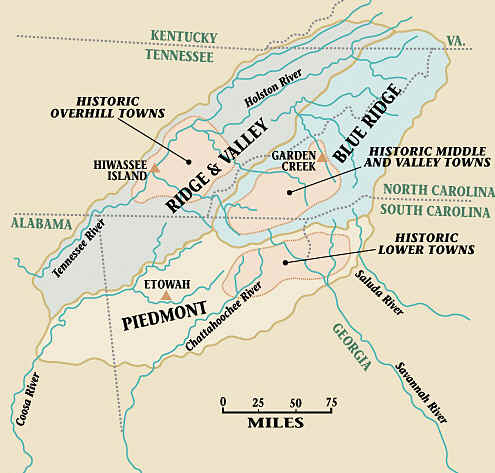
Overhill towns map

Rather miraculously, George does not seem to have engaged in any actual battles during his 3 tours of duty.  By this late date in the war, most of the actual fighting was in North and South Carolina.

Back Home in Halifax County

George Estes street sign

After returning to Halifax County, George Estes spent most of his life on his father’s original land.  His father Moses died in 1813, but the estate was contested and not settled until 1837, long after many of Moses’s children had died as well.

That land is located in the city of South Boston at the intersection of Estes and Main Street.  The following photo is standing in the Oak Ridge cemetery, originally part of the Estes land, looking down Estes Street.  Note the blue water tower.  It’s a landmark we’ll reference later.

George Estes land

The Estes farm used to be beyond the blue tank on the left and the houses on the right. Today Estes Street is gated, not because it’s an upscale gated community, but because that land is now the landfill.  This was heartbreaking to me, until I learned that the graves had been moved.  It still makes me sad.

Below is what’s left of the Estes land taken from behind the area (yes, I was in the landfill but I cropped that portion from the photo.)  We are looking at the original Estes woods.

George Estes landfill

In the above photo, for perspective, notice the blue water tower in the upper right corner. In the photo below, you can see the ‘other end” of the now gated “Estes Street” emerging that originates near the blue water tower that can also be seen in the left upper corner of the photo.

George Estes landfill 2

The Estes family in Halifax County, Virginia tells the story of when the family moved the graves from the old Estes land shown above to the Estes plot in the Oak Ridge cemetery. This apparently happened in the early 1900s and the only graves not moved were those of two unrelated people, one being an unrelated child whose parents had no place to bury the child and the second, an “in-law” of a descendant whose family did not want them moved.

It turns out that when Moses Estes’ children fought so bitterly over his land, they also apparently established separate cemeteries. One cemetery was the “original” Estes cemetery where Ezekiel, Susannah,  Ezekiel’s mother who is George’s daughter, George and probably old Moses himself are buried. The other cemetery was located behind the houses, apparently, down Estes street. I believe that the Oak Ridge Estes plot is the original Estes cemetery, but I cannot definitively prove this through records still in existence today, although an early cemetery history states that this is the case. Oral history says that when they moved Moses’s grave, only a collar bone and a casket hinge were left. Whether this is accurate or a tall tale, we’ll never know, but indeed, whatever remains of the elder Estes clan is buried in the Oak Ridge cemetery directly across the street from the old Estes homestead and at the end of Estes Street. The rest, well, it’s under the landfill or dispersed.

Today Main Street is paved. When they removed the cobblestones to pave Main Street, they used them to construct the beautiful stone wall around the cemetery. George Estes served on many “road crews” as documented in court records and it is entirely possible that he laid these very cobblestones, shaped from the stones found on the Estes land. George was probably glad to get rid of them as they would have made plowing difficult.

The bright white monuments in the cemetery are the Estes family stones, made of marble apparently, after they were cleaned by family members about 2006. Ezekiel who died in 1885 has a stone that proclaims him “an honorable man,” but none of the earlier family members have stones. Ezekiel’s mother Susannah died in 1870 and his grandfather George died in July of 1859, an amazing 96 years of age.

Oak Ridge cem entrance

The Halifax County Estes family has a clearly remembered oral history of “Granpappy George who lived to be 108 (or 106 or 115).” Sometimes stories grow with time, and that one certainly did, but he was quite elderly when he passed and obviously legendary.

George lived far from a sedentary lifestyle. He was obviously not afraid of adventure or danger, serving three separate terms in the Revolutionary War, one as a substitute for his father and one as a volunteer. George returned home and married Mary Younger on December 19, 1786 the same day that his brother Bartlett Estes married Rachel Pounds. I wonder if they were married in a double ceremony.

estes younger marriage

Younger marcus signature

When I first started researching this couple, everyone in the family said that George Estes and Mary Younger could not have been the father of John R. Estes because they only had one child, Susannah. As a novice, I figured those researchers had a lot more information and years of experience, but as one by one, I worked through and eliminated many of the alternative parents, the options became fewer and fewer and I began to wonder how “they” knew that George only had one child. I certainly hadn’t found anything that said he had only one child. And having found only one child doesn’t mean there was only one child. In fact, I’ve become very suspicious of any record before the days of modern birth control that suggests that someone had only one or two children, unless the wife or husband died.

As it turns out, Susannah was the only child that was easily evident. And “they” didn’t know how “they” knew – trying to find the source of that information was like trying to find the elusive fountain of youth. And that was before the days of quick-click trees on Ancestry. If the researchers had looked at the few census records we do have, they would have seen a discrepancy that screamed for an explanation – multiple children living with George and Mary.

George and Mary positively had 7 children who survived to adulthood and probably at least two who didn’t, based on a combination of records, including the 1820 and 1830 census.

It seems that several of George’s children regularly pushed the envelope of the day and would have brushes with the law or, perhaps better stated, the court system and “polite society.” It’s thanks to those records that we can add color to our family portrait. I love lawsuits – well – historical lawsuits anyway. I extracted probably 75-100 years worth of court, deed and tax records from Halifax County and reassembled them, like a big puzzle, into family groups.

Of particular interest was the information from the “Younger, Marcus Chancery Suit 1842-057, Halifax Co. Va.” In the documents from that suit, I found the payments made to the various heirs of Marcus Younger, who had died in 1816. In the case of Mary Younger Estes, her heirs are listed in 1842 because she is deceased. This suit was filed almost 30 years after Marcus’s death.  Normally would never think to look that far out – but chancery suits are often quite different. It’s not at all unusual for chancery suits to reach back 2 generations, to a grandparent’s will, especially if unmarried children are involved, as was the case with Marcus’s will. When the unmarried child dies, Mary’s sister in this case, sometimes the assets revert to the other children or their heirs.

In the suit papers, it is noted that Mary Younger Estes’s children will receive one sixth of her one quarter share of the 83 acres to be sold following the death of Mary’s unmarried sister.

The children of Mary Younger Estes were listed as: John, William, Susannah, Sally wife of T. Estes, Polly wife of James Smith and a grandchild name Mark Estes. This means that Mary had 6 children either living or who had died but who have heirs. In this case, one child has died leaving one heir, Mark.

Of course, I found this list AFTER I had reassembled what I believed to be the family of Mary Younger and George Estes. You know it didn’t match up perfectly, or I wouldn’t even be mentioning it.

I had all of those children listed, but in addition, I had a Bartlett and Rebecca.

There is no son Bartlett listed in the 1842 document, but there is instead a grandchild named Mark Estes. This implies that Mark’s parent is of the Estes surname, the parent is dead and Mark is the only living child. We know through various records that daughter Susannah has a son, Mark, but this cannot be that Mark because Susannah is very clearly included as living. We also know that George’s son, Marcus, died in 1815 leaving a widow and no children. The Bartlett I have attributed as the son of Mary and George had 7 children, and none known to be Mark, although one male name is unknown.

There are several Bartletts living in this vicinity and I could have the various Bartlett’s confused. However, if daughter Rebecca died and left a son Mark, this would fit perfectly. But, if it is the same Rebecca, she is prosecuted in 1844 for living with a black man, which precludes her from being dead in 1842, so Rebecca is not the child of George Estes, but more likely George’s niece.

This family makes me pull my hair out.

Thankfully, it seems that several of George’s children have lived a bit of a colorful life, meaning they have records that remain about them having had brushes with the law or, perhaps better stated, the court system and running afoul of “polite society.” Here is what is known about the children of George Estes and Mary Younger.

  • John R. Estes whose photo we believe is shown below was probably the oldest child and was born sometime between March and June of 1787. He married Ann Moore in 1811 and was on the way to Claiborne Co., TN by 1820 where he died in 1885, like his father, nearly reaching 100 years of age. Obviously, there is a longevity gene in the Estes family. John R.’s great grandson, William George Estes lived to be 98 years of age and William George’s two daughter both lived to be just shy of 100.  There’s hope that I’ll live long enough to finish my genealogy research:)

John R. Estes restored

  • Marcus Estes was born about 1788 as well and is shown on tax lists in Halifax County from 1811-1814 when he dies, leaving a widow with the beautiful name of Quintinney. In 1815, his estate is assigned to the sheriff to administer. There is also a War of 1812 record for Marcus, but there may be no further service records since no one applied for either bounty land or a pension based on his service. He served in the same unit as his brother, John R. Estes and I have to wonder if he died during that time.
  • William Y. Estes was also born sometime in this timeframe. The census says 1785 or 1786, but the census is also often notoriously wrong. In 1815, William married Rebecca Miller and drank to the point where his wife’s father commented on his behavior in his will in a very unflattering manner, forbidding William to ever have any control over Rebecca’s inheritance. William died in Halifax County between 1860 and 1870.
  • Susannah Y. Estes was born about 1800 and never married. She had 5 illegitimate children between 1814 and 1835, 2 males and three females. She lived on the old home place and cared for her elderly father, George, until his death in 1859.
  • Polly Estes, born between 1801 and 1808 married in 1824 to James Smith. She died in Halifax County after 1880, having had 4 children. We know very little about Polly, because, she was apparently one of the few well-behaved Estes’s. You know that old saying about “well behaved women seldom make history.”  I relish my ill-behaved ancestors and their family members because that is often the only way we learn about their lives and put meat on their bones.  Below, George’s signature along with James Smith when Polly marries.

George Estes Polly marriage bond

This photo is of George’s grandchild, J. E. and wife Mary Anne Smith, the youngest child of Polly Estes Smith.
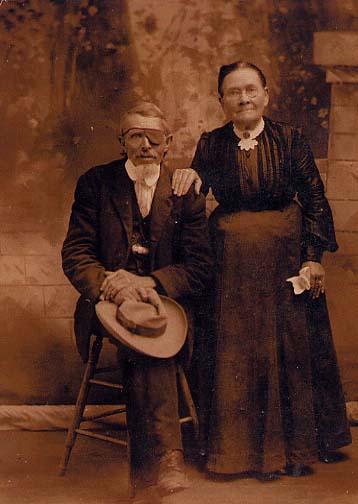
JE and Mary Ann Smith

I’m dying to know about that eye patch.

  • Sally Estes was born sometime around 1800 and married her first cousin, Thomas Estes, son of Bartlett Estes and Rachel Pounds. Marrying cousins was a common practice of the time. They removed to Tennessee shortly after their marriage.  George and Thomas both sign the marriage bond, below.

George Estes Sally marriage bond

I initially thought Rebecca Estes was George’s child because of her proximity in the census where in 1830, a Rebecca Estridge with 3 daughters is living near George Estes and Susan Estes, all living in separate households. In 1835, a Rebecca Estes is in the court notes with Robert Rickman for support of her child, and in 1844, Rebecca is “indicted for felony, report of grand jury – a white woman living together in open adultery with a negro man, James Bird, free man of color, as presented by Jacob W. Farguson and William Ingram.” I cannot find Rebecca nor James Bird after this time. If this is the same Rebecca in 1844 as in 1830 and 1835, then she cannot be the child of George Estes because in 1842, Rebecca would have been dead.

It’s very unlikely that either Bartlett or Rebecca are George’s children and we are simply missing one child who had son Mark. It is certainly possible that this Marcus was born posthumously to George’s son Marcus. Given that Marcus’s estate went entirely to debt, there would have been nothing left to leave to a child, so no guardian would have been appointed.  We’ll likely never know, but this is the most likely explanation.  There is no Mark or Marcus Estes in the 1840 or 1850 census.

Life in Halifax County with Daughter Susannah

We don’t have a lot of information about life as George knew it, but thanks to Susannah, we do have a couple of glimpses into what their life was like.

Susannah Estes never married, lived on the old homeplace and wound up with all of George’s assets which caused problems with his other children. By the time George Estes died in 1859, there was nothing left, so he had no will. He had already deeded his land to Susannah, plus anything left from his pension or his Revolutionary War service.

On February 12, 1833, George Estes grants to Susan Y. Eastes, “my daughter, all my right, title, claim and interest which I have for military services rendered during the War of the Revolution.”

Much to my shock, in early 1837, Susannah brings suit against her father forcing him to answer to the court why he, as executor, has not distributed his father, Moses’s estate.

On March 25, 1837, George Estes deeds to Susannah Y. Estes “for $100 land on both sides of road from Halifax to S. Boston on Dan River adjoining Adam Toot, John Ransom, John Jinnett, tract of land that my father Moses died seized of.” This occurs immediately after George’s father’s estate was settled.

If you look at a map of South Boston plotting the locations we know, this is a huge tract of land.

Estes land South Boston map

We know the land went as far north at present day Waddell Woods (top arrow) because Waddell spring is mentioned in deeds.  The Oak Ridge Cemetery is the green area pointed out by the second arrow from the top.  The blue water tower is across the street, to the right of that arrow.  The main road is 129 and is pointed to by the third arrow from the top, running from the Dan River (at the bottom) through the Estes land and on North.  Today, this land includes most of South Boston, then Boyd’s Ferry.

We get a glimpse of their possessions, when, in 1842, Susannah, who now owns her parents land, takes a mortgage which is void if it is paid. Apparently, the mortgage is paid, because nothing more is ever mentioned in any of the deed or court books.

“Tract of land where we now live, one three-horse wagon and gear, 1 bay mare, 1 grey horse, hogs and sheep, all of our present crop of corn and fodder, tobacco, 4 feather beds and furniture, household and kitchen furniture, plantation tools for debt of $50.16.”

In addition to the land George inherited from Moses, George continues to assist Susannah.

On April 15, 1857, George Estes deeds to Susan Y. Estes the bounty lands he is entitled to “by late acts of Congress and a part of proceeds being in the hands of Easley Holt and Co. In consideration of natural love and affection and value received…all right and interest to any balance that is remaining at my death after paying my debts with him.”

When she died on August 23, 1870, Susannah was not a poor woman and left a nontrivial estate, including land. Her personal property inventory probably included many items inherited from her father and mother:

Appraisement of property of Susan Estes:

  • cow
  • yearling
  • loom
  • potatoes
  • walnut chest
  • barrels
  • flax wheel
  • 3 pots
  • 2 skillets
  • oven
  • brass kettle
  • tea kettle
  • 4 jars
  • 4 jugs
  • 2 water buckets
  • 3 axes
  • lot tin
  • 2 pitchers and bottles
  • 1 jar vinegar
  • lot tableware
  • hoes
  • wedges
  • pot rack
  • candlesticks
  • 1 press
  • 1 desk
  • 1 looking glass
  • 7 chairs
  • 1 bed
  • bolster
  • pillar
  • 1 blanket
  • 1 counterpin and sheet
  • 1 quilt
  • 1 barrell cider
  • small chest
  • basket
  • 2 bee hives

I can’t help but wonder what the quilt looked like and who made it.  Was it from a time when she and her mother and sisters perhaps gathered around a quilting frame?

After Susan’s death, a lawsuit followed regarding a debt incurred before her death and the validity of the debt based on her mental state.  She was deemed competent.  Aside from the depositions, which were in themselves very enlightening as to Susannah’s life, and death, the list of items she purchased at the store, on account, I found very interesting as well:

The following are items appearing on the store account of “Miss Susan Estes”:

  • Coffee
  • Sugar
  • Bucket
  • Linen shirt
  • 2 linen collars
  • 5 yards calico (total 1.06)
  • 3 yard gingham
  • 1 bottle ? oil
  • 20 yards oznaburg
  • 75 yard pant goods
  • Weeding hoe
  • Shelves for buster
  • Coffee pot
  • Tin bucket
  • Sugar
  • Rice
  • Candles
  • Molasses
  • Coffee
  • Bacon
  • Molasses
  • Coffee
  • Nails
  • Shoes
  • 1 oz indigo
  • 1 # soda
  • Coffee
  • Sole leather
  • 2 oz indigo
  • Pale cotton
  • Sugar
  • Copperons?
  • Rubber tuck combs
  • 2 yd cambric
  • Flex thread
  • 6 8×10 window glass
  • Bacon
  • Seed oats
  • Bags
  • Frt and drayage
  • Paid on acct with bacon from house
  • Goods box
  • Plow point
  • Coffee
  • Fine iron
  • Goods box
  • Molasses
  • Hat for Buster
  • Pants for Buster
  • Coat for Buster
  • Vest for Buster
  • Bacon sides
  • Pole exe
  • Pale Box
  • Stamped envelope (.04)
  • Bacon sides
  • 2 doz henning??
  • Paid with Reg. 162 old casting

Obviously, Buster is a nickname for someone, but who?  Whoever, he was, he had a vest, hat, coat, pants and shelves.

In addition, Ezekiel Estes submitted a bill to the estate for $21.18 for shingling the house and Susannah’s doctor bill was $51.  She died a slow death of a heart ailment.

Mary Mildred Estes

Above, George Estes’s granddaughter, Susannah’s daughter, Mary Mildred Estes born April 3, 1828 and died Jan. 20, 1917 in Lynchburg, VA., married William Greenwood and second, Jesse Jacobs..

Susannah’s son, Ezekiel Estes, below, born in 1814 and died in 1885 in Halifax County, married Martha Barley.

Ezekiel Estes

A few years after I published this original article, Jerry, one of Ezekiel’s descendants contacted me and provided this amazing watch case that was owned by Ezekiel.

Ezekiel Estes watch case 2.jpg

Ezekiel Estes watch case

This beautiful pocket-watch case is made of Iroquoian beadwork, causing me to wonder how he obtained it, and if there is more significance than a simple watch case. Regardless, it’s beautiful and a huge thank you to Jerry for sharing so that everyone can enjoy this treasure.

The Court

George Estes himself had a few encounters with the legal system. People at that time seemed to be quite litigious, and George was involved with no fewer than 14 nonfamily cases, generally as a defendant, and went to court even more often as a witness.

Court days, which initially happened quarterly, then monthly, were quite the social event in the 1700s and 1800s in Virginia. Anyone who was anyone attended, and much business was transacted outside the courthouse and in the taverns. It was also one of the best ways to hear the news as well as see the news being made. The original reality TV!

I recall that when my daughter and I first went to Halifax County, we visited the clerk’s office asking asked about the various record books and such. My daughter had the book of court notes out, and was looking in the plaintiff’s index. We told the lady that we were looking for Estes and she said “Oh, well then, your people are in this book”, and retrieved the defendants ledger. Things haven’t changed much over the years apparently. The Estes family is legendary, or at least infamous!

George’s first court appearance was in 1786 when he was prosecuted for “profane swearing.” In one case, George and his father Moses were involved as witnesses in a lawsuit where someone signed a document they later regretted after partaking of the fruit brandy at the Estes home. The Estes family was well known for its fine orchards. The fruit brandies were kept cool in a special compartment under the foundation of the house.

In 1802, George put a mortgage on his household items which included 2 feather beds and furniture for 9 pounds, 2 shillings and 2 pence. You can tell that of their household goods, the coveted items were the feather beds.

In 1837, George gave a deposition in the chancery case of Light vs Yuonger wherein the descendants of Thomas Younger battled, for years, over the estate of Thomas Younger after his daughter Rachel Younger died. Thomas was likely the great-uncle of George’s wife, Mary Younger. While the outcome of the case actually doesn’t involve our family directly, we do find a deposition given by George in 1837 over the value of a slave named Peter who in 1812 had been disabled with elephantitis. George, age 74 at that time, signed his deposition.

George Estes 1837 deposition in Light vs Younger.jpg

Moses’s Land

Most of the court cases, not included in the 15 non-family cases mentioned above, involved years and years of appearances having to do with Moses estate settlement which was finally settled in 1837, 24 years after Moses’s death. George, the eldest son, was 74 years old when his father’s estate was settled and he immediately deeded his portion of the land to Susannah.

This family battled over land and inheritance for generations, beginning in 1813 with Moses’ death, followed by George’s children and then Susannah’s and continuing into the present generations whose parents were still involved with that land until the county took the land by eminent domain. At least one person refused to sell the land and instead has a ‘long-term lease”, although what they think they’ll do with a stinky landfill is beyond me. I suspect it was a matter of principle.

When I visited Halifax County, two elderly living cousins, Doug and Shirley, both now deceased, remembered the land from their childhood. Shirley told me that the original home burned in about 1933, complete with all of the family photos, Bibles, etc. She remembers that someone on the school bus told her that her grandparents’ house burned the night before.

Shirley explained that the original home had 8 rooms with 2 fireplaces. Photos of “all the family” hung there – but of course burned in the fire which is why none exist today, according to Shirley. The home had a cellar – which is reflected in a chancery suit where it’s mentioned that Moses Estes stored his fruit brandy in the cellar. Apparently, one night, someone drank too much and signed something they regretted at Moses’s house.  Although Moses wasn’t the signer, Shirley mentioned that the Estes men liked their alcohol a bit too much and alcoholism ran in the family.

Shirley said there were blackberries, raspberries, huge mulberry trees “three foot through,” grapes and 5 cherry trees. I suspect there were apple and peach trees too back when Moses planted his orchard.

Shirley said that there were three springs, making this property quite desirable for homesteading. The Walker spring is about half a mile away, the Waddell spring, and a small spring by the house which had a spring-house built over it to cool things like milk. They grew gourds, and there were always “dipping gourds” by the springs so anyone could get a cool drink of water.

The Estes family used to haul ice, cut from the river, hoping it would last until at least partway through the summer. One time Ezekiel Estes, Moses’s great-grandson through granddaughter Susannah was hauling ice for one Mr. Willingham using steers instead of oxen. When asked if he couldn’t make those steers go faster, Zeke said “no, cause I need them tomorrow.”

The man who bulldozed the property after the city purchased it told me there were 3 houses “back there,” all “farm type” homes. Apparently the first home built was a log cabin, probably about 1782 when the family first arrived from Amelia County, and it was later used for the young couples after they were first married.

The home that burned was described as a large 2 story home with upper and lower porches all around. Porches are important in the south.

There has been a great deal of speculation about why George provided only for his daughter Susannah. It could be because she was not married and he felt protective towards her, wanting to provide for her and his grandchildren after his passing. She was very young, 13 or 14 when she became pregnant, and it would be easy to see how he could have been especially protective of her and her children whom he had lived with for their entire lives. In essence, George raised her children as his own, especially Ezekiel who was the eldest. Ezekiel was born right about the time that George and Mary stopped having children, so Ezekiel probably just fit perfectly into the stair-steps of children.

It could also be that George gave his worldly good to Susannah because she took care of George in his old age – although that wouldn’t explain the 1830s deeds. George’s wife Mary probably died sometime between 1820 and 1830, and certainly before George started deeding to Susannah in 1833, because Mary signed no release  of dower rights.

Others have suggested that perhaps Susannah might have been an opportunist and perhaps manipulative or devious. Some have questioned the propriety of the situation. Susannah had only two male children. Her oldest, Ezekiel, has descendants who have DNA tested and they match a Moore family that lived in the area, although not the same Moore family that Susannah’s brother, John R. Estes married into.

I think it suffices to say that George, Susannah and Ezekiel were extremely close and given the social stigma attached to illegitimate birth in that era, let alone 5 illegitimate children, the family was probably increasingly subject to harsh scrutiny, discrimination, criticism and were socially marginalized. One hint may be held in George’s 1833 Revolutionary War pension application where he states there is no clergy in his neighborhood, but the oldest church in the county is but a few blocks down the street from his home, within walking distance. One can certainly understand why and how George could and would feel a great deal of affection for his grandchildren in particular, as he apparently lived with them as they grew up. There are several records that involve both George and Ezekiel who probably looked up to his grandfather as a role model.

In fact, it was Ezekiel Estes who reported the death of George Estes and said that he was 100 years and 4 months old, born in Amelia County. I hope, for George’s sake, that the family had a bang up 100 year old birthday celebration where everyone came to visit and eat that fine southern food, even if we know today they were a few years early. Or maybe George really was 100 years old in 1859 and simply misstated his birth year in 1833. Regardless, I hope they had a wonderful celebration and he had many guests who sat and visited and imbibed some of that fine Estes brandy! I wish I could hear the stories of his hundred years of life.  What a gift that would be.

Estes Cem white stones

George is reportedly buried here in the Estes section of the Oak Ridge Cemetery immediately to the right just inside the entrance.  The Estes family markers are all bright white here after being cleaned by now deceased cousin Nancy Osborne.  We don’t know exactly where Susannah, George with his wife Mary Younger and Moses with his wife Luremia Combs are buried, but rest assured that they are here among their descendants and family members.

It’s believed that George and Mary are buried in the unmarked area, below.

Estes cem vacant stop

In the following photograph, the picture is taken from behind the stones, before they were cleaned and restored, with the original Estes land showing across the street.  The Estes homestead was behind these houses which stand on part of Moses’ land that was sold off by descendants.  The original homestead is now the landfill, although some forest was preserved as a barrier between these homes and the landfill the last time I in visited in 2006 or so.  The cobblestones showing in the wall below are the original road cobblestones that George probably helped to lay.

Estes cem and wall

I would like to have a Revolutionary War marker placed for George Estes in the cemetery so that he will be honored and his grave will be marked for future generations.

George certainly lived an amazing life.  He was born in Amelia County during the French and Indian war, as his father and uncles serving in that conflict.  About 1770, the Moses Estes family migrated in mass, it seems, to Halifax County where his father and grandfather, both named Moses, established homes, albeit a few miles apart.

About the time George came of age, he volunteered to take his father’s place in the Revolutionary War.  After returning home, just a month later, his own “slot” came up, so he then served for himself.

Many Estes men were pushing the new frontier.  In fact, George moved an Estes family to Hawkins County, TN, probably offering to help in order to see a bit of the world.  He stayed for almost a year, and it was from there in October of 1782 that he enlisted as a volunteer to serve his third stint in the military in the Revolutionary War.  George obviously saw a lot and probably talked about that part of the country to his children when telling tales about his great adventure.  He’s one of the very few men I’ve ever heard of going BACK home from the frontier, and staying there.  His son, John R. Estes would eventually settle in Claiborne County, TN himself, some 30+ years later, near where his father was in what would become Eastern Tennessee.

We don’t know much about George’s religious leanings.  When he was young and first married, church attendance was required in the Anglican church.  That’s also about the time he was prosecuted for “profane swearing.”

We know that his wife, Mary Younger’s family was probably Methodist, a dissenting religion, but one that was “legal” by the 1780s.  Given that his son, John R. Estes married the minister’s daughter, in all likelihood, this family was Methodist.  Whether George was enthusiastically Methodist too, “went along” begrudgingly and slept through services in the back row or simply stayed at home, we’ll never know.  We do know, per a deposition, that George Estes was with the Reverend William Moore’s family on Christmas Day, 1811.  George’s son, John R. Estes was married to Reverend William Moore’s daughter, Ann Moore.

At least two of George’s children ran badly afoul of either the law of the social norms of the time.  Son William drank to excess and daughter Susannah had five children out of wedlock, as a pattern occurrence.  This would have made it difficult for the rest of George’s children to “marry well” because something like that paints the entire family with the same brush.

Today, it’s inconceivable to us, but at that time, people who were born “out-of-wedlock” really could only marry others of their same social status.  Interracial marriages were outlawed and the choices people had, both legally and in reality were much more limited than today.  Remember, I told you that the county clerk still knew that the Estes’s would be found in the “defendants” book???  Maybe this is part of why so many descendants left for lands where there was less judgment waiting and one could start anew, without stigma already attached from the behavior of others.

George’s wife Mary would pass away sometime between about 1820 and 1830.  George would have been between 60 and 70 years old at that time, and would live almost another 30-40 years.

After Mary’s death, it appears that Susannah took care of George.  Given that by this time, Susannah had 5 illegitimate children she had to provide for, George’s pension probably took care of Susannah as well.  I wonder how military pensions were figured at that time.  I would have thought they would all have been relatively equal for the same rank (private), and if unequal, perhaps George received something for each of his three stints in the military.  By way of contrast, his son, John R. Estes who served in the War of 1812 was collecting a pension at the same time received $8 a month as compared to George’s $31 year, which breaks down to $2.58 per month.  In the end, Susannah wound up with all of George’s assets although, clearly, his pension stopped when he died.

By the time George died, his son Marcus had passed away, possibly in the War of 1812, and there are a couple of children I lose in the records, but as far as we know, most of George’s children outlived him. Some had moved west but George still had Polly, Susannah and William Y. nearby, although William Y. seemed unable to even help himself, due to his drinking, based on numerous court records.

The good news is that because of where Moses’s land was located, and the ability to locate the Oak Ridge Cemetery today, then track through the landfill deeds and family records, we were able to find the original Estes land.

Furthermore, we know that graves were moved from the Estes cemetery, now under the landfill, to the Estes plot in the Oak Ridge Cemetery, which may have been the original Estes cemetery in the first place.

All I know is that when cousin Nancy started talking about having moved the graves and finding the collar bone of Moses Estes, I just couldn’t stop myself from thinking about DNA.  I know fully well that today, even with enough money, that the retrieval of ancient DNA for consumer purposes really isn’t a viable option.  But I also know that in another decade, with the advances in technology and the associated drop in prices, combined with what has been able to be accomplished with sequencing ancient genomes – that eventually – that collarbone would have been useful.

I know, bad genealogist, bad genealogist.  Bad, bad, bad.  I can’t help it.  It’s that nonconformant Estes side coming out!  It’s in my genes.  I can’t help it.  In fact, I know where there’s a bone we can dig up to prove it….

______________________________________________________________

Disclosure

I receive a small contribution when you click on some of the links to vendors in my articles. This does NOT increase the price you pay but helps me to keep the lights on and this informational blog free for everyone. Please click on the links in the articles or to the vendors below if you are purchasing products or DNA testing.

Thank you so much.

DNA Purchases and Free Transfers

Genealogy Services

Genealogy Research

Tony Goldwyn – Who Do You Think You Are – “She Was A Radical, The Fire Flew”

Actor, director and producer Tony Goldwyn, probably best known for his drama, Scandal, has a remarkable Hollywood pedigree. What few people may know is that on his mother’s side, he hails from a celebrated stage and screen family – his grandfather was Sidney Howard, best known for writing the screenplay for Gone With the Wind. Tony acknowledges that he knows nothing about the Howard side and anything he can learn about Howard’s ancestry would be a boon.

Compliments of TLC

Compliments of TLC

With the help of a genealogist, and an instantly appearing pedigree chart, Tony pushes past his two times great grandfather Lawrence Coe and finds his three times great grandparents Nathaniel and Mary Coe living in Albany, New York in the mid 1800’s, where Nathaniel was a politician in the state assembly.

One tool Tony made a lot of use of, that I don’t and perhaps should think of more often, is www.newspapers.com.

At the NY State Library in Albany, Tony learns that his 3 times great grandfather Nathaniel Coe proposed ‘anti-Seduction’ legislation which concerned issues surrounding pre-or extra-marital sex and prostitution.

I found this to be very interesting if initially a bit confusing.  As the historian explained, typically, when a female was “seduced,” willingly or unwillingly, she was marked as “damaged goods” and especially if she bore a child out of wedlock, not marriageable material.  In essence, the woman bore the brunt of the scandal and the male skipped off scot free.  The inferred link to prostitution was that there were few professions where a woman could support herself and a child, and by then, probably children as in plural – so the woman had few options.  So while this legislation initially sounded like it was penalizing women, it wasn’t, it was actually holding the males involved responsible for at least their part of the “immoral” behavior.  In fact, there was an entire “anti-sedition” crusade.  Who knew?

Curious about why his ancestor focused on this social issue specifically, Tony decides to head to Nathaniel’s hometown of Nunda, NY to see if the explanation for his 3x GGF’s concerns about “seduction” lie there.

In Nunda, Tony finds out that Nathaniel hosted a meeting of the Female Moral Reform Society at his home in 1837. A social historian explains that this undoubtedly indicates Nathaniel’s wife Mary’s membership in the organization. A newspaper article reveals that Mary was “a radical” activist in her community, suggesting that the two shared a passion for this cause and formed a productive, well-suited partnership.

Tony also learns that Mary and Nathaniel were revivalist Baptists, joining much of the country at that time in an Evangelical resurgence.  Baptists in particular were concerned with moral reform and the purification of society.

Wondering why a late-middle aged couple would leave New York for the frontier, Tony is surprised to learn that in 1852, Nathaniel became a U.S. Postal Agent across the country in Oregon via Presidential appointment.

Tony heads to Oregon, where he finds that as a U.S. Postal Agent, Nathaniel was responsible for laying out the infrastructure of the developing Postal Service as the U.S. expanded westward. Nathaniel, Tony learns, was on the cutting edge of modernization as a frontier agent – with all the prestige that implies.

Compliments of TLC

Compliments of TLC

You know when the archivist comes out with your boxes on a cart, that you’ve made a haul.  Sure enough, the Nathaniel Coe Collection holds original letters and documents, including a scrapbook from the Coe estate.  I am SOOO envious.

Through original letters written by Mary Coe, Tony discovers that not only did Mary make an arduous journey around the nation via ship, crossing as the Isthmus of Panama, to join her husband in Oregon, but that after arriving, his three times great grandparents had to flee their home as the Indian Wars broke out around them.

Tony is startled to learn that his ancestor may not have been as progressive as he thought. Reading a letter written by Nathaniel, Tony sees that Nathaniel believed the Indians were hell-bent on exterminating all white settlers, and that any resistance by the Indians to American “progress” and expansion westward justified removing them or exterminating them.  This unfortunate European attitude and policy was referred to as Manifest Destiny and was thinly disguised as a religious belief that God had ordained the Europeans to possess the Native lands.  Fortunately, Tony visits with a historian that presents both sides of the picture in a chapter of expansion that is none too pretty.

Finally, Tony finds an article detailing Mary & Nathaniel Coe’s importance in the region – they helped establish the still thriving city of Hood River in Oregon, after Mary had the name changed from Dog River.

At the Oregon State Archives, Tony discovers that Nathaniel left all of his property to his wife. He learns just how rare that would have been, legally, for a man with grown male heirs, and Tony considers the unique relationship that his three times great grandparents must have enjoyed.

Tony discovers that the graves of Nathaniel and Mary still exist at the aptly named Mountain View Cemetery in Hood River, and makes the pilgrimage to pay his respects to Hood River’s founding couple at their gravesite.

Compliments TLC

Compliments of TLC

Nathaniel and Mary Coe lived an impressive and very long life.  Mary, the radical, didn’t die until she was in her 90s after having crossed the country, the long way, and establishing homes in two different locations, one being an unsettled frontier.

Reflecting upon his experience Tony says that as he looks back over the landscape of his ancestors, he “can begin to see it in the genes,” meaning their strength, determination and character.  He can also see their descendants, his closer ancestors, following the same pattern of husbands and wives as equal and indispensable partners.

Who will like this episode?  Anyone with a New York background or an interest in Democrat vs Whig politics – the westward movement or the social history of that timeframe.  After the move west, the Yakima war and Native people.  Anyone with any history in the Cascade Valley, the Dalles or Hood River, Oregon or with an interest in the Westward expansion.

My ancestors never ventured that far west, so I found the information about the settlement of the west in the 1850s extremely interesting.

Here’s a sneak peek.

Tony’s segment airs Sunday, April 5 at 10/9c on TLC.

______________________________________________________________

Disclosure

I receive a small contribution when you click on some of the links to vendors in my articles. This does NOT increase the price you pay but helps me to keep the lights on and this informational blog free for everyone. Please click on the links in the articles or to the vendors below if you are purchasing products or DNA testing.

Thank you so much.

DNA Purchases and Free Transfers

Genealogy Services

Genealogy Research

Ancestry Gave Me A New DNA Ancestor – And It’s Wrong

About six weeks ago, Ancestry had a meeting with a few bloggers and educators in the genetic genealogy community and brought us up to speed on a new feature that was upcoming.  Ancestry showed us their plans to expand the DNA Circles feature, although to be very clear, to the best of my knowledge, none of us were involved in any type of beta testing with Ancestry.

Today, Ancestry assigns you to DNA Circles based on a combination of your DNA results and your tree, based on common ancestors shown in trees of matching individuals.  I wrote about Circles and how they are calculated in the article, “Ancestry’s Better Mousetrap – DNA Circles.”

As an enhancement to DNA Circles, today Ancestry rolled out their new feature which is called “New Ancestor Discoveries” where Ancestry assigns ancestors to you based on DNA matching alone, without matching ancestors in your trees.

And, in my case, they are wrong.  Unquestionably wrong.  What I hate the most about this situation is if you’re not a genetic genealogist, and you haven’t done your homework, you’ll be thrilled with your new wrong ancestors, “proven,” of course, by DNA.

new ancestor discoveries

We received a quick glimpse of the pre-beta product – and truthfully – if this was accurately done and appropriately portrayed as a DNA match with people who shared common DNA and maybe a common ancestor – I could be excited.  In fact, I was excited.

I do believe this type of matching can be done accurately – but Ancestry has missed the mark – not just with me but from other early reports in the community as well – with lots of people.  Portraying this match as a “new ancestor” is wrong and it’s terribly misleading.

Here’s what Ancestry has to say about the New Ancestors matching.

new ancestors

new ancestor circles

Ok, what does Ancestry have to say about Diedamia Lyon, my New Ancestor who is not my ancestor?

New ancestor Diedamia Lyon

Clicking on the green “Learn About” button shows me the “facts” that ancestry has gleaned from their trees about Diedamia Lyon.

new ancestor Diedamia story

What this tells you that isn’t immediately evident is that Diedamia Lyon was married to John Curnutte, my second “New Ancestor.”  There is a “Facts” tab that shows you the sources that Ancestry used to create Diedamia’s story.  They have used compiled data from 215 trees.  I cant’ speak for Diedamia, but I know several of my Circle Ancestor’s stories are wrong – based on the compiled trees – substantially wrong in fact.  Because the trees are wrong.

new ancestor Diedamia sources

So, in essence, Ancestry is saying that I descend from both Diedamia Lyon and John Curnutte, an ancestral couple.  This would be invaluable, if it were accurate.  Ok, how did Ancestry connect those dots to arrive at that conclusion?

Clicking on the “See Your Connection” button under the Circle icon shows you the members of the Diedamia Lyon Circle.

New ancestor Diedamia circle

I have DNA matches with Don and Michael who are members of the Diedamia Lyon circle.  Clicking on Don, I can see that he has DNA matches to Michael and three other individuals who I don’t have DNA matches with in the Diedama Lyon circle.  However, all of those individuals also share a pedigree chart and Diedamia Lyon is their shared ancestor.

New ancestor Diedamia circle 2

I can click on any of these people and see who they match in the circle, or I can see a list.

What I can’t see is how Ancestry drew those DNA conclusions.  There are no tools, no chromosome browser, and obviously, “trust me” isn’t working.

I want to share with you how I know, beyond any doubt, that Diedamia Lyon and John Curnutte are NOT my ancestors.  I am a long-time meticulous researcher.  I would invite you to search for any of my ancestors’ names on this blog.  I have been writing about one ancestor per week now for more than a year in the 52 Ancestors series and, if I have written about them, you can see the types of information we have on each one.  I know which of my ancestors are proven and which are questionable.  So, let’s see why Diedamia and John cannot be my ancestors.

First, we can eliminate my mother’s line.  My mother’s ancestors are from Holland, Germany, Canada/Acadia and one line from Vermont/Connecticut.  They are all accounted for and I know where they were, shown below.

new ancestor mother tree

The 6th generation shown above is the generation into which Diedamia Lyon and John Curnutte, both born about 1800, would fall.  Mother’s generation 6 ancestors, at the far right, were all born between 1766 and 1805, many in Europe.  You’ll note there are no blank spaces for missing ancestors and the geography is not southern – meaning no place near Wilkes County, NC where Diedamia was born in 1804.  So, my mother’s side is immediately eliminated.

My father’s side, however, does have several lines that come through Wilkes County, NC and many other southern lines. So the connection would be through my father’s side of the family.

new ancestor father tree

Again the 6th generation would be where Diedamia Lyon and John Curnutte would have to fit if they are my ancestors, and there are no blank spaces here either.  All of these ancestors were born between 1759 and 1804.

Of the above generation 6 ancestors, the following have a Wilkes County connection:

  • Elijah Vannoy born in Wilkes County about 1784
  • Lois McNiel born in Wilkes County about 1786
  • William Herrell born about 1789 in NC, possibly Wilkes County where he married in 1809
  • Mary McDowell born 1785 NC, possibly Wilkes County where she married in 1809

New ancestor Herrell tree

Looking at the pedigree chart of William Herrell and Mary McDowell, you can see that indeed there are some unknown wives.  John Herrell was born in about 1760, possibly in Frederick Co., VA and Michael McDowell in 1747 in Bedford Co., VA.  While the connection may be through these lines, it’s clearly not from any two people born in 1800 and is at least in the 7th generation – IF the connection is through these lines.  At this point, this is the most likely connection because it’s in the right location and there are two unknown wives.  If I had triangulation tools, I could probably tell you immediately.

Now let’s look at the pedigree chart of Elijah Vannoy and Lois McNiel, also from Wilkes County.

New ancestor Vannoy tree

As you can see, this pedigree is even more complete than the Herrell/McDowell pedigree.  Not only is there no room for a couple born circa 1800, there are no unknown parents for another 3 generations prior, not until the 9th generation.  The only individual here through the 8th generation not proven via both paper and genetics, meaning triangulation, is Sarah Coates.

So, not only are Diedamia Lyon and John Curnutte NOT my ancestors, it’s very unclear how they are related to me, IF they are related to me.  It’s obvious that the only way we are related is that someplace upstream, I do share a common ancestor with both Don and Mike who share the Lyon/Curnutte tree with each other and several others as well, but that does NOT mean that I descend from Diedamia and John, nor that I share a common ancestor with them.

Now, if I share the SAME DNA segment with Don and Mike that could be triangulated to the Curnutte/Lyon descendants, then that would mean we do all share a common ancestor someplace along the line.  But wait – Ancestry doesn’t use triangulation – nor do they give us the tools to do so.  So we have NO idea if we actually share the same DNA segments or not.

So, let’s take a look at the trees of both Don and Mike to see if we share any common surnames that might be linked.

Fortunately, Ancestry does provide an easy way to do this.  By clicking on your matches name to the right of the circle, and looking at their tree, Ancestry shows you the common surnames.

new ancestor match surnames

By clicking on the shared surname, you can see the people in both trees, theirs and yours, with that surname, side by side.

new ancestor surname list

All three of us have a dead end Moore line.  That is our only other surname in common, and Moore is very common.

So, it’s possible, given that we have no way to tell which segments are matching whom, that I match both Don and Mike through an entirely different ancestor, or ancestors, known or unknown. It’s also possible that someone upstream of Diedamia and John is a child of one of my unknown lines, and while Diedamia and John are not my ancestors, I do carry some of the same DNA as their descendants because we all share a common, unknown, ancestor.  But I have no way of knowing.

What I can do is to contact my two matches and see if they will download their DNA to GedMatch where I can get at the truth via triangulation.  It’s a shame we have to do that.

So, what is the net-net of this new tool?

  1. Ancestry missed, big time, especially by labeling the match as a “New Ancestor.”
  2. Ancestry can salvage the situation at least somewhat by renaming the “New Ancestor” something like “Common DNA Match.” This would alert people that there is some common ancestry someplace, but not mislead people into thinking that Ancestry really HAS discovered a new ancestor or ancestral couple. In some cases the named couple MAY be ancestors – but that’s certainly not always the case. And I don’t like the label “Potential Ancestor” either because I think it implies a much closer relationship than may be present. I remember how completely thrilled I was to see my “New Ancestors” names and without having enough experience to piece the puzzle together, both genealogically and genetically, I would never have known enough to be as disappointed as I am. I feel terribly sorry for the many people who will take this erroneous information as gospel – and the rest of us who will have to live with the incorrect fallout – forever. This amounts to a new way to create an incorrect ancestor and Heaven forbid, attach them to your tree.
  3. This would all be a moot point with a chromosome browser, but then again, Ancestry already knows that.

And I was so hopeful….

Fortunately, the New Ancestors feature is still in beta and changes can be made – and I hope they are.  I know Ancestry has already incorporated at least one the suggestions made as a result of the meeting a few weeks ago.

As I looked back over the new features and the information I received from Ancestry, I am especially concerned about the verbiage accompanying this information.

Here’s what greets me on my DNA page.

new ancestors hype

Here’s the e-mail I received.

new ancestor e-mail 2

The problem is – it’s just not true.  These matches may be valuable in some cases.  But they are not as represented.  This match is not my ancestor.

So yes, I do want Ancestry to “Show Me.”  Show me the chromosomes.  Show me how Diedamia Lyon and John Curnutte are my ancestors.  Show me how you put 2 and 2 together and came up with this.  Show me.

______________________________________________________________

Disclosure

I receive a small contribution when you click on some of the links to vendors in my articles. This does NOT increase the price you pay but helps me to keep the lights on and this informational blog free for everyone. Please click on the links in the articles or to the vendors below if you are purchasing products or DNA testing.

Thank you so much.

DNA Purchases and Free Transfers

Genealogy Services

Genealogy Research

Help System at Family Tree DNA Updated Today

family tree dna logoGroup Administrators received this e-mail on April 1st. Presuming it’s not an April Fools Joke (it’s not), the new system is being implemented today, April 2, 2015 and it looks like it should help a lot with timely responses.

Family Tree DNA writes:

After reviewing several options to speed up e-mail response times and improve overall Customer Support efficiency, we are are putting a new system in place as of 10 am Central Time tomorrow, 2 April, 2015.

You’ll want to pay close attention because this is radically different from what you’re used to doing, but it’s for a good reason.

Until now, many of the emails would come to the general email boxes info@ familytreedna.com or helpdesk@familytreedna.com, uncategorized, adding the extra step of having to sort and triage emails, which takes a lot of time since they can vary from something as simple as changing a SNP order to more detailed analysis. Long emails with no kit number and an uninformative subject line complicate the process and require time to determine what the real question is.

With the new system, the above email addresses will be deactivated. Incoming emails will receive an automated, but politely worded reply directing the customer – or you – to the re-vamped Contact Us form. This form will require a kit number, unless you’re a new customer, and will require the submitter to choose a subject category.

All questions will be directed through a “Contact Us” form so that they are already categorized and can be routed to the appropriate customer service representatives.

ftdna support page

Again, please note: info@familytreedna.com and helpdesk@familytreedna.com will no longer be monitored. Emails sent to either of those addresses will get an auto-response directing the sender to the “Contact Us” form here: https://www.familytreedna.com/contact.aspx#contactForm

For future reference, a link to the Contact Us form is conveniently located at the bottom of the www.familytreedna.com home page under the “About” column.

ftdna support page 2

There will still be a “Group Projects” category, and for administrators, the email address groups@familytreedna.com will still be active, so if you’re writing with questions or situations regarding your project, or if you’re writing on behalf of project members, please use either of those options. The groups@familytreedna.com address is a priority category and is monitored regularly.

Please reserve messages to groups@ftdna.com for those that are time-sensitive, urgent, or simply cannot be answered by a CSR. Over the past few months so many routine – though still important – emails have been going to that email address that your Group Project Manager/Liaison cannot answer them all and still perform other duties such as advocating for you with management on important issues regarding group administration.

Important information for you to know and to share with your group members:

  • It’s important to choose the category closest to the topic of your email.
  • Kit numbers are mandatory.There will be an “I don’t have a kit number yet” box to click for new customers. Existing customers can recover their kit number from the “Lost Your Password” link on the login page.
  • Submitting multiple tickets from the same email address about the same issue before having received a reply groups those issues together and puts them at the bottom of the queue. (That will not be the case with groups@familytreedna.com, since admins write about different projects and discrete issues from the same email address. Still, please keep in mind our service hours and use your best judgement when submitting a second email about the same issue.)
  • Contact form submissions do not generate a confirmation email at this time. Your submission will be acknowledged on the page and you’ll be given a request ID number.

Thank you for your support and understanding as we work to bring you and your project members better service.

______________________________________________________________

Disclosure

I receive a small contribution when you click on some of the links to vendors in my articles. This does NOT increase the price you pay but helps me to keep the lights on and this informational blog free for everyone. Please click on the links in the articles or to the vendors below if you are purchasing products or DNA testing.

Thank you so much.

DNA Purchases and Free Transfers

Genealogy Services

Genealogy Research

Finding Your American Indian Tribe Using DNA

If I had a dollar for every time I get asked a flavor of this question, I’d be on a cruise someplace warm instead of writing this in the still-blustery cold winter weather of the northlands!

So, I’m going to write the recipe of how to do this.  The process is basically the same whether you’re utilizing Y DNA or mitochondrial DNA, but the details differ just a bit.

So, to answer the first question.  Can you find your Indian tribe utilizing DNA?  Yes, it can sometimes be done – but not for everyone, not all the time and not even for most people.  And it takes work on your part.  Furthermore, you may wind up disproving the Indian heritage in a particular line, not proving it.  If you’re still in, keep reading.

I want you to think of this as a scavenger hunt.  No one is going to give you the prize.  You have to hunt and search for it, but I’m going to give you the treasure map.

Treasure mapI’m going to tell you, up front, I’m cheating and using an example case that I know works.  Most people aren’t this lucky.  Just so you know.  I don’t want to misset your expectations.  But you’ll never know if you don’t do the footwork to find out, so you’ve got nothing to lose and knowledge to gain, one way or another.  If you aren’t interested in the truth, regardless of what it is, then just stop reading here.

DNA testing isn’t the be-all and end-all.  I know, you’re shocked to hear me say this.  But, it’s not.  In fact, it’s generally just a beginning.  Your DNA test is not a surefire answer to much of anything.  It’s more like a door opening or closing.  If you’re looking for tribal membership or benefits of any kind, it’s extremely unlikely that DNA testing is going to help you.  All tribes have different rules, including blood quantum and often other insurmountable rules to join, so you’ll need to contact the tribe in question. Furthermore, you’ll need to utilize other types of records in addition to any DNA test results.

You’re going to have some homework from time to time in this article, and to understand the next portion, it’s really critical that you read the link to an article that explains about the 4 kinds of DNA that can be utilized in DNA testing for genealogy and how they work for Native testing.  It’s essential that you understand the difference between Y DNA, mitochondrial and autosomal DNA testing, who can take each kind of test, and why.

Proving Native American Ancestry Using DNA

For this article, I’m utilizing a mitochondrial DNA example, mostly because everyone has mitochondrial DNA and secondly, because it’s often more difficult to use genealogically, because the surnames change.  Plus, I have a great case study to use.  For those who think mito DNA is useless, well all I can say is keep reading.

Y and mito

You’ll know from the article you just read that mitochondrial DNA is contributed to you, intact, from your direct line maternal ancestors, ONLY.  In other words, from your mother’s mother’s mother’s mother and on up that line.

In the above chart, you can see that this test only provides information about that one red line, and nothing at all about any of your other 15 great-great grandparents, or anyone else on that pedigree chart other than the red circles.  But oh what a story it can tell about the ancestors of those people in the red circles.

If this example was using Y DNA, then the process would be the same, but only for males – the blue squares.  If you’re a male, the Y DNA is passed unrecombined from your direct paternal, or surname, ancestor, only and does not tell you anything at all about any of your other ancestors except the line represented by the little blue squares.  Females don’t have a Y chromosome, which is what makes males male, so this doesn’t apply to females.

First, you’ll need to test your DNA at Family Tree DNA.  This is the only testing company that offers either the Y (blue line) marker panel tests (37, 67 or 111), or the (red line) mitochondrial DNA full sequence tests.

For Y DNA testing, order minimally the 37 marker test, but more is always better, so 67 or 111 is best.  For mitochondrial DNA, order the full sequence.  You’ll need your full mitochondrial haplogroup designation and this is the only way to obtain it.

I’m also going to be talking about how to incorporate your autosomal results into your search.  If you remember from the article, autosomal results give you a list of cousins that you are related to, and they can be from any and all of your ancestral lines.  In addition, you will receive your ethnicity result estimate expressed as a percentage.  It’s important to know that you are 25% Native, for example.  So, you also need to order the Family Finder test while you’re ordering.

You can click here to order your tests.

After you order, you’ll receive a kit number and password and you’ll have your own user page to display your results.

Fast forward a month or so now…and you have your results back.

A GEDCOM File

I hope you’ve been using that time to document as much about your ancestors as you can in a software program of some sort.  If so, upload your GEDCOM file to your personal page.  The program at Family Tree DNA utilizes your ancestral surnames to assist you in identifying matches to people in Family Finder.

It’s easy to upload, just click on the Family Tree icon in the middle of your personal page.

Family Tree icon

Don’t have a Gedcom file?  You can build your tree online. Just click on the myFamilyTree to start.

Having a file online is an important tool for you and others for ancestor matching.

Your Personal Page

Take a little bit of time to familiarize yourself with how your personal page works.  For example, all of your options we’re going to be discussing are found under the “My DNA” link at the top left hand side of the page.

My dna tab

If you want to join projects, click on “My Projects,” to the right of “My DNA” on the top left bar, then click on “join.”  If you want to familiarize yourself with your security or other options, click on the orange “Manage Personal Information” on the left side of the page to the right of your image.

Personal info

Preparing Your Account

You need to be sure your account is prepared to give you the best return on your research efforts and investment.  You are going to be utilizing three tabs, Ancestral Origins, Haplogroup Origins and various projects, and you need to be sure your results are displayed accurately.  You need to do two things.

The first thing you need to do is to update your most distant ancestor information on your Matches Map page.  You’ll find this page under either the mtDNA or the Y DNA tabs and if you’ve tested for both, you need to update both.

matches map

Here’s my page, for example. At the bottom, click on “Update Ancestor’s Location” and follow the prompts to the end.  When you are finished, your page should like mine – except of course, your balloon will be where your last know matrilineal ancestor lived – and that means for mitochondrial DNA, your mother’s mother’s mother’s line, on up the tree until you run out of mothers.  I can’t tell you how many men’s names I see in this field…and I know immediately someone is confused.  Remember, men can’t contribute mtDNA.

For men, if this is for your paternal Y line, this is your paternal surname line – because the Y DNA is passed in the same way that surnames are typically passed in the US – father to son.

It’s important to have your balloon in the correct location, because you’re going to see where your matches ancestors are found in relationship to your ancestor.  Your most distant ancestor’s location is represented by the white balloon.  However, you will only see your matches balloons that have entered the geographic information for their most distant ancestor. Now do you see why entering this information is important?  The more balloons, the more informative for everyone.

The second thing is that you need to make sure that the information about the location of your most distant ancestor is accurate.  Most Distant Ancestor information is NOT taken from the matches map page, but from the Most Distant Ancestors tab in your orange “Manage Personal Information” link on your main page.  Then click on to the Genealogy tab and then Most Distant Ancestors, shown below.

genealogy tab

If your ancestral brick wall in in the US, you can select 2 options, “United States” and “United States (Native American).”  Please Note – Please do not, let me repeat, DO NOT, enter the Native American option unless you have documented proof that your ancestor in this specific line is positively Native American.  Why?  Because people who match you will ASSUME you have proof and will then deduce they are Native because you are.

This is particularly problematic when someone sees they are a member of a haplogroup that includes a Native subgroup.  Haplogroup X1, which is not Native, is a prime example.  Haplogroup X2 is Native, but people in X1 see that X is Native, don’t look further or don’t understand that ALL of X is not Native – so they list their ancestry as United States (Native American) based on an erroneous assumption.  Then when other people see they match people who are X1 who are Native, they assume they are Native as well.  It’s like those horrible copied and copied again incorrect Ancestry trees.

distant ancestor US optionsIt’s important to update both the location and your most distant ancestors name. This is the information that will show in the various projects that you might join in both the “Ancestor Name” and the “Country” field.  As an example, the Estes Y project page is shown below.  You can see for yourself how useless those blank fields are under “Paternal Ancestor Name” and “Unknown Origin” under Country when no one has entered their information.

estes project tab

While you are working on these housekeeping tasks, this would be a good time to enter your ancestral surnames as well.  You can find this, also under the Genealogy Tab, under Surnames.  Surnames are used to show you other people who have taken the Family Finder test and who share the same surname, so this is really quite important.  These are surnames from both sides of your tree, from all of your direct ancestors.

surnames tab

Working With Results

Working with mitochondrial DNA genetic results is much easier than Y DNA.  To begin with, the full sequence test reads all of your mitochondrial DNA, and your haplogroup is fully determined by this test.  So once you receive those results, that’s all you need to purchase.

When working with Y DNA, there are the normal STR panels of 12, 25, 37, 67 and 111 markers which is where everyone interested in genealogy begins.  Then there are individual SNP tests you can take to confirm a specific haplogroup, panels of SNPs you can purchase and the Big Y test that reads the entire relevant portion of the Y chromosome.  You receive a haplogroup estimate that tends to be quite accurate with STR panel tests, but to confirm your actual haplogroup, or delve deeper, which is often necessary, you’ll need to work with project administrators to figure out which of the additional tests to purchase.  Your haplogroup estimate will reflect your main haplogroup of Q or C, if you are Native on that line, but to refine Q or C enough to confirm whether it is Native, European or Asian will require additional SNP testing  unless you can tell based on close or exact STR panel matches to others who are proven Native or who have taken those SNP tests.. 

Y Native DNA

In the Y DNA lines, both haplogroups Q and C have specific SNP mutations that confirm Native heritage.  SNPs are the special mutations that define haplogroups and their branches.   With the new in-depth SNP testing available with the introduction of the Big Y test in 2013, new discoveries abound, but suffice it to say that by joining the appropriate haplogroup project, and the American Indian project, which I co-administer, you can work with the project administrators to determine whether your version of Q or C is Native or not.

Haplogroups Q and C are not evenly distributed.  For example, we often see haplogroup C in the Algonquian people of Eastern Canada and seldom in South America, where we see Q throughout the Americas.  This wiki page does a relatively good job of breaking this down by tribe.  Please note that haplogroup R1 has NEVER been proven to be Native – meaning that it has never been found in a pre-contact burial – and is not considered Native, although speculation abounds.

This page discusses haplogroup Q and this page, haplogroup C.

Haplogroup C in the Native population is defined by SNP C-P39 and now C-M217 as well.

Haplogroup Q is not as straightforward.  It was believed for some time that SNP Q-M3 defined the Native American population, but advanced testing has shown that is not entirely correct.  Not all Native Q men carry M3.  Some do not.  Therefore, Native people include those with SNPs M3, M346, L54, Z780 and one ancient burial with MEH2.  Recently, a newly defined SNP, Y4273 has been identified in haplogroup Q as possibly defining a group of Algonquian speakers.  Little by little, we are beginning to more clearly define the Native American genetic landscape although there is a very long way to go.

With or without the SNP tests, you can still tell a great deal based on who you match.

For Y DNA and mitochondrial DNA (not autosomal), at the highest levels of testing, if you are matching only or primarily Jewish individuals, you’re not Native.  If you’re matching people in Scandinavia, or Asia, or Russia, nope, not Native.  If you’re matching individuals with known (proven) Native heritage in Oklahoma or New Mexico, then yep….you’re probably Native

We’ll look at tools to do this in just a few minutes.                              

Mitochondrial Native DNA

There are several Native founder mitochondrial DNA lineages meaning those that are believed to have developed during the time about 15,000 years ago (plus or minus) that the Native people spent living on Beringia, after leaving continental Asia and before dispersing in the Americas.

Those haplogroups (along with the Native Y haplogroups) are shown in this graphic from a paper by Tamm, et al, 2007, titled “Beringian Standstill and the Spread of Native American Founders.”

beringia map

The founder mitochondrial haplogroups and latecomers, based on this paper, are:

  • A2
  • B2
  • C1b
  • C1c
  • C1d
  • C4c
  • C1
  • D2
  • D2a
  • D4h3
  • X2a

Subsequent subgroups have been found, and another haplogroup, M, may also be Native.  I compiled a comprehensive list of all suspects.  This list is meant as a research tool, which is why it gives links to where you can find additional information and the source of each reference.  In some cases, you’ll discover that the haplogroup is found in both Asia and the Americas.  Oh boy, fun fun….just like the Y.

Be aware that because of the desire to “be Native” that some individuals have “identified” European haplogroups as Native.  I’ll be writing about this soon, but for now, suffice it to say that if you “self-identify” yourself as Native (like my family did) and then you turn up with a European haplogroup – that does NOT make that European haplogroup Native.  So, when the next person in that haplogroup tests, and you tell them they match “Native” people with European haplogroups – it’s misleading to say the least.

When working to identify your Native heritage, some of your best tools will be the offerings of Family Tree DNA on your personal page.  The same tools exist for both Y DNA and mitochondrial DNA results, so let’s take a look.

Your Results

If your ancestor was Native on your direct matrilineal line, then her haplogroup will fall within one of 5 or 6 haplogroups.  The confirmed Native American mitochondrial haplogroups fall into major haplogroups A, B, C, D and X, with haplogroup M a possibility, but extremely rare and as yet, unconfirmed.  Known Y DNA haplogroups are C and Q with O as an additional possibility.

Now, just because you find yourself with one of these haplogroups doesn’t mean automatically that it’s Native, or that your ancestors in this line were Native.  If your haplogroup isn’t one of these, then you aren’t Native on this line.  For example, we find male haplogroup C around the world, including in Europe.

Here is the list of known and possible Native mitochondrial DNA haplogroups and subgroups.

If your results don’t fall into these haplogroups, then your matrilineal ancestor was not Native on this particular line.  If your ancestor does fall into these base groups, then you need to look at the subgroup to confirm that they are indeed Native and not in one of the non-Native sister clades.  Does this happen often?  Yes, it does, and there are a whole lot of people who see Q or C for the Y DNA and immediately assume they are Native, as they do when they see A, B, C, D or X for mitochondrial.  Just remember about assume.

Scenario 1: 

Oh No! My Haplogroup is NOT Native???

Let’s say your mitochondrial ancestor is not in haplogroup A, B, C, D, X or M.

About now, many people choke, because they are just sure that their matrilineal ancestor was Native, for a variety of reasons, so let’s talk about that.

  1. Family history says so. Mine did too. It was wrong. Or more precisely, wrong about which line.  Test other contributing lineages to the ancestor who was identified as Native.
  2. The Native ancestor is on the maternal line, but not in the direct matrilineal line. There’s a difference. Remember, mitochondrial DNA only tests the direct matrilineal line. What this means is that, for example, if your grandmother’s father was Native, your grandmother is still Native, or half Native, but not through her mother’s side so IT WON’T SHOW ON A MITOCHONDRIAL DNA TEST. In times past, stories like “grandma was Indian” was what was passed down. Not, grandmother’s father’s father’s mother was Waccamaw. Any Indian heritage got conveyed in the message about that ancestor, without giving the source, which leads to a lot of incorrect assumptions – and a lot of DNA tests that don’t produce the expected results. This is exactly what happened in my family line.
  3. Your ancestor is “Native” but her genetic ancestor was not – meaning she may have been adopted into the tribe, or kidnapped or was for some other reason a tribal member, but not originally genetically Native on the direct matrilineal line.  Mary Jemison is the perfect example.
  4. My ancestor’s picture looks Native. Great! That could have come from any of her other ancestors on her pedigree chart. Let’s see what other eividence we can find.

At this point, you’re disappointed, but you are not dead in the water and there are ways to move forward to search for your Native heritage on other lines.  What I would suggest are the following three action items.

1. Look at your family pedigree chart and see who else can be tested to determine a haplogroup for other lineages. For example, let’s say, your grandmother’s father. He would not have passed on any of his mother’s mitochondrial DNA, but his sisters would have passed their mother’s mitochondrial DNA to their children, and their daughters would pass it on as well. So dig your pedigree chart out. and see who is alive today that can test to represent other contributing ancestral lines.

2. Take a look at your Family Finder ethnicity chart under myOrigins and see how much Native DNA you have.

FF no Native

If your ethnicity chart looks like this one, with no New World showing, it means that if you have Native heritage, it’s probably more than 5 or 6 generations back in time and the current technology can’t measurably read those small amounts.  However, this is only measuring admixed or recombined DNA, meaning the DNA you received from both your mother and father.  Recombination in essence halves the DNA of each of your ancestors in each generation, so it’s not long until it’s so small that it’s unmeasurable today.

You can also download your raw autosomal data file to http://www.gedmatch.com and utilize their admixture tools to look for small amounts of Native heritage.  However, beware that small amounts of Native admixture can also be found in people with Asian ancestors, like Slavic Europeans.

The person whose results are shown above does have proven Native Ancestry, both via paper documentation and mitochondrial DNA results – but her Native ancestor is back in French Canada in the 1600s.  Too much admixture has occurred between then and now for the Native to be found on the autosomal test, but mtDNA is forever.

If your Y or mtDNA haplogroup is Native, there is no division in each generation, so nothing washes out. If Y or mtDNA is Native, it stays fully Native forever, even if the rest of your autosomal Native DNA has washed out with succeeding generations.  That is the blessing of both Y and mtDNA testing!

FF native

If your myOrigins ethnicity chart looks like this one, which shows a significant amount of New World and other areas that typically, in conjunction with New World, are interpreted as additional Native contribution, such as the Asian groups, and your Y and/or mtDNA is not Native, then you’re looking at the wrong ancestor in your tree.  Your mtDNA or Y DNA test has just eliminated this specific line – but none of the lines that “married in.”

You can do a couple of things – find more people to test for Y and mtDNA in other lines.  In this case, 18% Native is significant.  In this person’s case, she could eliminate her father’s line, because he was known not to be Native.  Her mother was Hispanic – a prime candidate for Native ancestry.  The next thing for this person to do is to test her mother’s brother’s Y DNA to determine her mother’s father’s Y haplogroup.  He could be the source of the Native heritage in her family.

3. The third thing to do is to utilize Family Finder matching to see who you match that also carries Native heritage. In the chart below, you can see which of your Family Finder matches also carry a percentage of Native ancestry. This only shows their Native match percent if you have Native. In other words, it doesn’t’ show a category for your matches that you don’t also have.

ff native matches

Please note – just because you match someone who also carries Native American heritage does NOT mean that your Native line is how you match.

For example, in one person’s case, their Native heritage is on their mother’s side.  They also match their father’s cousin, who also carries Native heritage but he got his Native heritage from his mother’s line.  So they both carry Native heritage, but their matching DNA and ancestry are on their non-Native lines.

Lots of people send me e-mails that say things like this, “I match many people with Cherokee heritage.”  But what they don’t realize is that unless you share common proven ancestors, that doesn’t matter.  It’s circumstantial.  Think about it this way.

When measuring back 6 generations, which is generally (but not always) the last generation at which autosomal can reliably find matches between people, you have 64 ancestors.  So does the other person.  You match on at least one of those ancestors (or ancestral lines), and maybe more.  If one of your ancestors and one of your match’s ancestors are both Native, then the chances of you randomly matching that ancestor is 1 in 64.  So you’re actually much more likely to share a different ancestor.  Occasionally, you will actually match the same Native ancestor.  Just don’t assume, because you know what assume does – and you’ll be wrong 63 out of 64 times.

Sharing Native ancestry with one or several of your matches is a possible clue, but nothing more.

Scenario 2:

Yippee!!  My Haplogroup IS Native!!!

Ok, take a few minutes to do the happy dance – because when you’re done – we still have work to do!!!

happy dance frog

Many people actually find out about their Native American heritage by a surprise Native American haplogroup result.  But now, it’s time to figure out if your haplogroup really IS Native.

As I mentioned before, many of the major haplogroups have some members who are from Europe, Asia and the America.  Fortunately, the New World lines have been separated from the Old World lines long enough to develop specific and separate mutations, that enable us to tell the difference – most of the time.  If you’re interested, I recently wrote a paper about the various European, Jewish, Asian and Native American groups within subgroups of haplogroup A4.  If you’re curious about how haplogroups can have subgroups on different continents, then read this article about Haplogroups and The Three Brothers.  This is also an article that is helpful when trying to understand what your matches do, and don’t, mean.

So, before going any further, check your haplogroup subgroup and make sure your results really do fall into the Native subgroups.  If they don’t, then go back to the “Not Native” section.  If you aren’t sure, which typically means you’re a male with an estimated haplogroup of C or Q, then keep reading because we have some tools available that may help clarify the situation.

Utilizing Personal Page Y and Mito Tools to Find Your Tribe

Much of Y DNA and mitochondrial DNA genetic genealogy matching is “guilt by genetic association,” to quote Bennett Greenspan.  In other words we can tell a great deal about your heritage by who you match – and who you don’t match.

Let’s say you are haplogroup B2a2 – that’s a really nice Native American haplogroup, a subgroup of B2a, a known Beringian founder.  B2a2 developed in the Americas and has never been found outside of the Native population in the Americas.  In other words, there is no controversy or drama surrounding this haplogroup.

It just so happens that our “finding your tribe” example is a haplogroup B2a2 individual, Cindy, so let’s take a look at how we work through this process.

Taking a look at Cindy’s Matches Map tab, which shows the location of Cindy’s matches most distant ancestor on their matrilineal line (hopefully that’s what they entered.)  Only one of Cindy’s full sequence matches has entered their ancestor’s geographic information.  However, it’s not far from Cindy’s ancestor which is shown by the white balloon.

Cindy full seq match

Please note that Cindy, who is haplogroup B2a2, has NO European matching individuals.  In fact, no matches outside of North and South America.  Being Native, we would not expect her to have matches elsewhere, but since the match location field is self-entered and depends on the understanding of the person entering the information, sometimes information provided seems confusing.  Occasionally information found here has to be taken with a grain of salt, or confirmed with the individual who entered the information.

For example, I have one instance of someone with all Native matches having one Spanish match.  When asked about this, the person entering the information said, “Oh, our family was Spanish.”  And of course, if you see a male name entered in the most distant ancestor field for mtDNA, or a female for Y DNA, you know there is a problem.

While the full sequence test is by far the best, don’t neglect to look at the HVR1 and HVR2 results, because not everyone tests at higher levels and there may be hints waiting there for you.  There certainly was for Cindy.

Cindy HVR1 match

Look at Cindy’s cluster of HVR1 matches.  Let’s look at the New Mexico group more closely.

Cindy HVR1 NM matches

Look how tightly these are clustered.  One is so close to Cindy’s ancestor that the red balloon almost obscures her white balloon.  By clicking on the red balloons, that person’s information pops up.

You will also want to utilize the Haplogroup and Ancestral Origins tabs.  The Haplogroup Origins provides you with academic and research data with some participant data included.  The Ancestral Origins tab provides you with the locations where your matches say their most distant ancestor is from.

Cindy’s Haplogroup Origins page looks like this.

Cindy haplogroup origins

Keep  in mind that your closest matches are generally the most precise – for mitochondrial DNA meaning the group at the bottom titled “HVR1, HVR2 and Coding Region Matches.”  In Cindy’s case, above, at both the HVR1 and HVR2 levels, she also matches individuals in haplogroup B4’5, but at the highest level, she will only match her own haplogroup.

Next Cindy’s Ancestral Origins tab shows us the locations where her matches indicate their most distant ancestor is found.

Cindy ancestral origins

These people, at least some of them, identified themselves as Native American and their DNA along with genealogy research confirmed their accuracy.

Now, it’s time to look at your matches.

Cindy fs matches

If you’re lucky, now that you know positively that your results are Native (because you carry an exclusive Native haplogroup), and so do your matches, one of them will not only list their most distant ancestor, they will also put a nice little heartwarming note like (Apache) or (Navajo) or (Pueblo).  Now that one word would just make your day.

Another word of caution.  Even though that would make your day, that’s not always YOUR answer.  Why not?  Because Native people intermarried with other tribes, sometimes willingly, and sometimes not by choice.  Willingly or not, their DNA went along with them and sometimes you will find someone among the Apache that is really a Plains Indian, for example.  So you can get excited, but don’t get too excited until you find a few matches who know positively what tribe their ancestor was from.

Proof

So let’s talk about what positive means.  When someone tells me they are a member of the Cherokee Tribe for example, I ask which Cherokee tribe, because there are many that are not the federally recognized tribes and accept a wide variety of people based on their family stories and little more except an enrollment fee.  I’m not saying that’s bad, I’m saying you don’t want to base the identity of your ancestor’s tribe, unwittingly, on a situation like that.

If the answer is the official Cherokee Nation in Oklahoma, for example, whose enrollment criteria I understand, then I ask them based on which ancestral line.  It could well be that they are a tribal member based on one relative and their mitochondrial DNA goes to an entirely different tribe.  In fact, I had this exact situation recently.  Their mitochondrial DNA was Seminole and they were a member of a different tribe based on a different lineage.

If the match is not a tribal member or descended from a tribal member, then I try, tactfully, to ask what proof they have that they are descended from that particular tribe.  It’s important to ask this in a nonconfrontional way, but you do need to know because if their claim to Native heritage is based on a family story, that’s entirely different than if it is based on the fact that their direct mitochondrial ancestor was listed on one of the government rolls on which tribal citizenship was predicated.

So, in essence, by your matches proving their mitochondrial lineage as Native and affiliated with a particular tribe, they are, in part, proving yours, or at least giving you a really big hint, because at some point you do share a common matrilineal ancestor.

You may find that two of your matches track their lineage to different tribes.  At that point, fall back to languages.  Are the tribes from the same language group?  If so, then your ancestor may be further back in time.  If not, then most likely someone married, was kidnapped, adopted or sold into slavery from one tribe to the other.  Take a look at the history and geography of the two tribes involved

Advanced Matching

It’s difficult to tell with any reasonable accuracy how long ago you share a common ancestor with someone that you match on either Y or mtDNA.  Family Tree DNA does provide guidelines, but those are based on statistical probabilities, and while they are certainly better than nothing, one size does not fit all and doesn’t tend to fit anyone very well.  I don’t mean this to be a criticism of Family Tree DNA – it’s just the nature of the beast.

For Y DNA, you can utilize the TIP tool, shown as the orange icon on your match bar, and the learning center provides information about mitochondrial time estimates to a common ancestor.  Let me say that I find the 5 generation estimate at the 50th percentile for a full sequence match extremely optimistic.  This version is a bit older but more detailed.

mtdna mrca chart

However, you can utilize another tool to see if you match anyone autosomally that you also match on your mitochondrial or Y DNA.  Before you do this, take a look at your closest matches and make note of whether they took the Family Finder test.  That will be listed by their name on the match table, by the FF, at right, below.

mtdna matches plus ff

If they didn’t take the Family Finder test, then you obviously won’t match them on that test.

On your mtDNA or Y DNA options panel, select Advanced Matching.

advanced matching

You’ll see the following screen.  Select both Family Finder and ONE Of the mtDNA selections  Why just one?  Because you’re going to select “show only people I match on selected tests” which means all the tests that you select.  Not everyone takes all the tests or matches on all three levels, so search one level of mtDNA plus Family Finder, at a time.  This means if you have matches on all 3 mitochondrial levels, you’ll run this query 3 times.  If you’re working with Y DNA, then you’ll do the same thing, selecting the 12-111 panels one at a time in combination with Family Finder.

The results show you who matches you on BOTH the Family Finder and the mtDNA test, one level at a time.  Here are the results for Cindy comparing her B2a2 HVR1 region mitochondrial DNA (where she had the most matches) and Family Finder.

advanced matches results

Remember those clusters of people that we saw near Cindy’s oldest ancestor on the map?  It’s Cindy’s lucky day.  She is extremely lucky to match three of her HVR1 matches on Family Finder.  And yes, that red balloon overlapping her own balloon is one of the matches here as well.  Cindy just won the Native American “find my tribe” lottery!!!!  Before testing, Cindy had no idea and now she has 3 new autosomal cousins AND she know that her ancestor was Native and has a very good idea of which tribe.  Several of the people Cindy matches knew their ancestor’s tribal affiliation.

So, now we know that not only does Cindy share a direct matrilineal ancestor with these people, but that ancestor is likely to be within 5 or 6 generations, which is the typical reach for the Family Finder matching, with one caveat…and that’s endogamous populations.  And yes, Native American people are an endogamous group.  They didn’t have anyone else to marry except for other Native people for thousands of years.  In recent times, and especially east of the Mississippi, significant admixture has occurred, but not so much in New Mexico at least not across the board.  The message here is that with endogamous populations, autosomal relationships can look closer than they really are because there is so much common DNA within the population as a whole.  That said, Cindy did find a common ancestor with some of her matches – and because they matched on their mitochondrial DNA, they knew exactly where in their trees to look.

Identifying your Tribe

Being able to utilize DNA to find your tribe is much like a puzzle.  It’s a little bit science, meaning the DNA testing itself, a dose of elbow grease, meaning the genealogy and research work, and a dash of luck mixed with some magic to match someone (or ones) who actually know their tribal affiliation.  And if you’re really REALLY lucky, you’ll find your common ancestor while you’re at it!  Cindy did!

In essence, all of these pieces of information are evidence in your story.  In the end, you have to evaluate all of the cumulative pieces of evidence as to quality, accuracy and relevance.  These pieces of evidence are also breadcrumbs and clues for you to follow – to find your own personal answer.  After all, your story and that of your ancestors isn’t exactly like anyone else’s.  Yes, it’s work, but it’s possible and it happens.

In case you think Cindy’s case is a one time occurrence, it’s not.  Lenny Trujillo did the same thing and wrote about his experience.  Here’s hoping you’re the next person to make the same kind of breakthrough.

______________________________________________________________

Disclosure

I receive a small contribution when you click on some of the links to vendors in my articles. This does NOT increase the price you pay but helps me to keep the lights on and this informational blog free for everyone. Please click on the links in the articles or to the vendors below if you are purchasing products or DNA testing.

Thank you so much.

DNA Purchases and Free Transfers

Genealogy Services

Genealogy Research

Mary Younger (c 1766-1820/1830), A Really Rough Decade, 52 Ancestors #65

Mary Younger was born about 1766, give or take a few years, to Marcus Younger and his wife, probably Susanne, whose last name is believed to be Hart, but is not confirmed.  Mary was probably born in Essex or King and Queen County, VA where Marcus lived before arriving in Halifax County, VA, where he is listed on the tax list for the first time in 1785.

It wasn’t long before Mary Younger married George Estes, in 1786.  There has been some suspicion for years that there is an earlier connection between these two families in King and Queen and Essex Counties, because they were near neighbors there.  At the least, they would have known each other.  They also could have been related, because we have unknown ancestors in both family lines and a seeming familiarity with each other upon arrival in Halifax County.  Or, a really big coincidence.

In Halifax County, George Estes lived next door to a William Younger who owned the land adjacent George’s father, Moses’s, land.  Did Marcus come to visit William Younger and maybe stay with that family long enough for his daughter, Mary Younger, to meet George Estes?  Perhaps.  We’ll likely never know.  We do know that the land that Marcus purchased is not close to the Estes land, roughly ten miles distant.

Estes Younger map

William Younger had no male children, so there is no Y DNA to test to see if that line connects with the Marcus or Thomas Younger line.

The first time we actually find Mary Younger in a record is when she married George Estes on December 19, 1786, six days before Christmas.  She married George on the same day his brother, Bartlett Estes married Rachel Pounds, so that Christmas at the Estes household was one full of celebration and the richness and hope of new love.  Maybe they received gifts to help them set up housekeeping.

estes younger marriage

Younger marcus signature

Like couples of that timeframe, the first baby arrived the next year and then every couple years thereafter, like clockwork.

Given that Mary’s father, Marcus Younger didn’t buy land until 1788, it’s very likely that Mary and George spent their first few years of married life on Moses Estes’s land in what is now South Boston, across from the Oak Ridge Cemetery, shown below.

Estes land blue tank crop

In the google image above, Estes Street is the street to the left that runs beside the water plant and today, down to the landfill, behind those trees.

Below, the Estes land from the east at the recycling center today.

Estes land recycle

Below, overlooking the Estes land from the back side.

Estes land rear landfill

There is no 1790, 1800 or 1810 census for Halifax County, so we can’t tell anything about Mary and George’s children until the 1820 census.  By this time, Mary and George have been married 34 years and several of their children would have been born, grown up and left the nest, with families of their own.  Mary probably stopped having children about 1810 or so, when she would have been about 44 years old.  We’ve had to piece their family together from other documents.  Mary Younger and George Estes had the following children:

  • John R. Estes born in 1787 who married Ann Moore in 1812 and removed to Claiborne County, TN. about 1820.
  • Marcus Estes born about 1788, died 1815, married Quintenny, surname unknown, and may have had one child, Marcus.
  • William Y. Estes born 1785/1786 and died 1860/1870, married Rebecca Miller in 1815.
  • Susannah Y. Estes born in 1800, died in 1870, never married but had 5 children.
  • Polly Estes born 1801/1808, died after 1880, married James Smith.
  • Sally Estes married Thomas Estes, her first cousin, about 1819.

There may have been other children, but based on the 1842 estate settlement of Mary Younger’s sister, Susannah, to Mary’s heirs, these are the children who survive or had died but had heirs.

In 1805, Mary’s father, Marcus must have become quite ill, because he wrote his will.  That’s not something people did in that place and time in advance, which is why so many people actually died without wills.

However, Marcus Younger recovered from whatever ailed him and did not die until ten years later, in 1815.  Marcus’s wife, whose name we think was Susannah, was not mentioned in his 1805 will, which tells us that she had already died.  So, in 1815, when Marcus died, that would have been the last of Mary’s parents.  She would have been just about age 50.

Given that Mary Younger married George Estes in 1786, and Marcus Younger didn’t purchase his land on the Banister River until 1788, we don’t know if Mary actually ever lived on this land before she married.  Marcus could have been renting it before he purchased the land.

However, in the 1790s, we find George Estes along with John Younger, Mary’s brother, who owned land adjacent Marcus, assigned as road hands together among the Younger family group – so at one time it appears that George and Mary lived on Marcus’s lands, or nearby.

Given that George Estes is not individually taxed as late at 1810, and Marcus Younger is taxed with two white males, it’s certainly likely that George and Mary lived on the Younger land for several years.  This means that their children born from about 1788 through about 1815 were likely born on the Younger land on the Banister River, and not in South Boston.

We know that there were several houses on Marcus’s land.  One house would have stood by the original well, near Yellow Bank Creek.  All that is left today, are some daffodils, a stone that was either the cornerstone or the step, and the well, both shown below.

Younger step

younger well

Another house on the property still stands today, or did a few years ago.

younger house

Mary’s life was probably pretty rough about that time.  In 1813, Mary’s father-in-law, Moses Estes, died and it’s very likely that the care of Luremia, her mother-in-law fell to Mary and George which may ultimately have been part of the reason they moved back to South Boston – that plus they would be inheriting part of George’s father’s land there.  In 1814, Mary’s 14 year old daughter had a baby without being married, and in 1815, Mary’s father died. Mary probably wondered what would strike next.  Sadly, it would be her son, Marcus’s, death as well.

Mary’s mother and father would be buried in the Younger Cemetery, on Marcus Younger’s land.  All of the graves are in a wooded area on private land that Marcus owned at the time, and all marked only by fieldstones.  If you didn’t know where this cemetery was, you would never, ever, find it.  It took 3 tries and I nearly didn’t – and I never would have found it had it not been for the generosity of the current landowner.

younger cem

Mary may also have some children buried in this cemetery as well, including son Marcus who died in 1814 or 1815 who may be buried near his grandfather, for whom he was named.  This land may well have been very close to Mary’s heart.  In fact, it may have been Mary who lovingly planted the flowers that bloom in the spring here, in the heart of the forest wilderness, today.  The periwinkle, below, wasn’t in bloom a the time, but it covered the entire cemetery – obviously planted intentionally by someone.

younger cem 4

By the 1820 census, the Mary Younger/George Estes household is back in South Boston and is shown with 1 male over 45 and one male under 10, which would be Mary’s grandson, Ezekiel through daughter Susannah.  There is one female under 10, 2 females 16-26 and 2 over the age of 45.  One of those older women would be Mary.  The female under 10 would be Sarah, Susannah’s second child born in 1818.  Susannah herself would be one of the females age 16-26 (although she was age 30) and the second would likely be her sister, Polly.

The other woman over the age of 45 is likely George’s mother, Luremia.  If so, that would mean 4 generations under one roof.  Depending on how well people got along, that could be a very good thing…or not.  I’m guessing that the events of 1813, 1814 and 1815 were extremely stressful for this family, and for Mary, in particular.

After Mary’s father’s death, the family moved from her father’s land to South Boston, among the Estes family.  Things didn’t calm down much either, because Susannah continued to remain unmarried and have children – a second child born in 1818.  Mary’s son, John R. Estes and Marcus would marry and then in 1814, march off to serve in the War of 1812.  John R. Estes came back.  Marcus died either during that time, or shortly thereafter, as his estate was probated in 1815.

By 1820, Mary was saying goodbye to John R. Estes, forever, as he and Ann Moore packed a wagon with what belongings they could and set out with their young family for the frontier.  I wonder if Mary’s grandchildren waved to her from the back of the wagon until they were out sight.  Did they know they would never see their grandmother again?Mary surely knew.

John R. and Ann’s house on the Estes land would have been vacant, at least for awhile, a silent reminder of the family Mary would never see again.  Perhaps it was their house that Susannah moved into before the 1830 census.

John R. wasn’t the only child who left.  Sally who married Thomas Estes moved to Tennessee as well about the same time.  Another wagon to wave goodbye to…and cry.

And then there is the mystery child – the one we know was dead by 1842 and left a son named Mark.  Given that there is only one heir mentioned, one child, Mark, it’s likely that the Estes parent died young and Mary would have buried that child as well.  Mary’s son, Marcus’s estate mentions nothing about a child, but the 1842 documents suggest that perhaps Marcus, the grandson, was the son of Marcus Estes who died in 1814/1815 after all.  I wonder if Mary raised grandson Mark after her child died.

By 1830, George Estes is shown as living alone, and Susannah is shown living in her own household, so it’s very likely that Mary and Luremia have both died.  I wonder if George is enjoying the silence or if he is lonely.  Maybe it depends on when you ask him.

There is a bit of confusion about when Mary Younger Estes actually died.  Mary’s sister, Susannah Younger had a will dated 1831; Halifax Co., Va. pg. 25–Will Bk. 15, pg. 422, which, among other things, states that she leaves her clothes to her sister, Mary Estes.  Another version says to Susannah Estes, which would be Mary’s daughter.  If Mary was dead by 1831, these clothes would not have helped her and might explain the second version, mentioning Susannah. Of course, we don’t actually know when this will was physically written, but it suggests that Mary died closer to 1830 than 1820 and perhaps not until after 1831 – although she is not accounted for in the 1830 census.  Mary is assuredly dead by 1833 when George deeds land to daughter Susannah without Mary’s signature to release her dower rights.

We don’t know if Mary Younger Estes is buried in the Younger Cemetery on her father’s land, then owned by her brother John’s heirs, or if she is buried in the Estes Cemetery in South Boston.  If she is buried in the Estes Cemetery, she could have been originally buried in what is believed to be the Estes family cemetery,  now Oak Ridge Cemetery which was originally part of the Estes land, shown below.

Estes Oak Ridge cleaned stones

Or, depending on who was feuding with whom at the time, Mary could have been buried in the “new” Estes cemetery in what is now under the landfill.  If Mary was buried there, the graves were moved to the Estes plot in the Oak Ridge Cemetery.  So, you could say she might have a migrating grave.

I know that there were some terribly stressful times in Mary’s life, and that once they began, never ended.  Her daughter Susannah had to be a constant, lifelong concern for Mary.  How would Susannah ever support those children?  It became evident that Susannah was going to continue having children and wasn’t going to marry.  There is more to this story that we’ll never know.  Many women had their first child out of wedlock and went on to marry and have a family.  Why didn’t Susannah?

I hope that the difficult times did not overshadow the good times for Mary.  And surely, there were good times.  Mary did have 5 grandchildren through Susannah, 11 through William Y., at least 4 through Polly, plus the mystery grandchild Mark who may have lived in close proximity.  That’s 21 grandchildren that she got to love and interact with, at least the ones born before her passing.  She lived with some of these grandkids for many years so you know she had a special bond with them.

Mary’s other 17 or 18 grandchildren lived in Tennessee, but she did get to be with John R’s oldest children for the first few years of their lives.  The older children likely carried warm and loving memories of their grandmother, Mary, in their hearts forever.  There is just no one like a grandmother to make you feel loved and special.

Thankfully, Mary had some daughters who had some daughters.  If we can find someone who descends from Mary Younger Estes through all daughters today, we will be able to test them for Mary’s mitochondrial DNA.  From that, we may be able to tell where in the world, in a general sense, her mother’s family originated.

Women contribute their mitochondrial DNA to both genders of their children, but only females pass it on.  So, we’re looking for someone, male or female, who descends from Mary through all females to the current generation.

Mary’s daughters and their daughters who had daughters were:

1. Susannah Y. Estes born about 1800 who had two daughters who had daughters:

  • Sarah Estes born in 1818 who married John Mountcastle and had at least 4 daughters, Sally, Martha, Harriett and Sallie Mountcastle

Sarah Estes Mountcastle

Sarah Estes Mountcastle, at left, with daughter Sarah.

  • Mary Mildred Estes born in 1828 who married William Greenwood and had daughters Nannie Elizabeth and Mary Jane Greenwood.  After William Greenwood died, she remarried to Jessie Jacobs and had daughter Susan E. Jacobs.  Nannie married John Thomas Murray, Mary married James Nathaniel Murray and Susan married Samuel Carroll Miller.  All 3 daughters had daughters.

Mary Mildred Ested Greenwood

Back of photo: Mother Mary Mildred Estes Greenwood after she remarried to a Jacobs with daughters Mary Jane Greenwood Murray and Nannie Elizabeth Greenwood Murray.

2. Polly Estes born between 1801-1808 who married James Smith in 1824 and had 2 daughters:

  • Elizabeth Y. Smith born 1824
  • Sarah Smith born about 1839

3. Sally Estes married Thomas Estes and moved to Giles and Montgomery County, TN, having 4 daughters:

  • Rachel W. Estes born about 1825
  • Eliza A. Estes born about 1830
  • Julia A. Estes born about 1842
  • Sarah W. Estes born about 1847

If you descend from this family, please get in touch.  We’re kin.  If you descend from all women, maybe we can unravel a bit more of Mary’s life.

The lives of these pioneer women were difficult, which probably meant they appreciated their brief respites of beauty more profoundly than we do today.  You can always tell where a homestead stood, and the cemetery, by the spring wildflowers growing nearby.  This daffodil was growing in the Younger cemetery in Halifax County, and I like to think it symbolizes my family buried there – never entirely gone – not as long as we remember them.  For all we know, Mary may have planted this herself on her parents’ or her child’s grave.

Younger daffodil

______________________________________________________________

Disclosure

I receive a small contribution when you click on some of the links to vendors in my articles. This does NOT increase the price you pay but helps me to keep the lights on and this informational blog free for everyone. Please click on the links in the articles or to the vendors below if you are purchasing products or DNA testing.

Thank you so much.

DNA Purchases and Free Transfers

Genealogy Services

Genealogy Research

Sean Hayes – Who Do You Think You Are – “Endless Chain of Chaos”

Sean Hayes

Sean Hayes, probably best known for his role in the sitcom, Will and Grace, finds more than he bargained for when he set out to search for his roots.  Growing up without his father, Sean searches for the cause of his estranged father’s troubled past and uncovers a shocking trail of tragedy with tendrils that reach back generations.

I had to laugh, because in the realm of “famous last words,” Sean introduces himself as “Sean Hayes and I’m not named for anyone I know of.”

Well Sean, you should have included your middle name, Patrick, because it’s going to become important!  And by the way, um….yes you are named for someone.

No one really writes letters anymore, but Sean’s brother does, and in the letter is a photo of Sean’s grandparents. Sean didn’t even know their names, and now he has their picture.

Sean Hayes 1

What Sean does know, is that for some reason his father and his father’s 3 siblings wound up in an orphanage after their mother broke her hips. He had also heard that his grandfather, literally, “died in the gutter.” Was that true?

To find out more, Sean heads to Chicago to begin his journey, where his father and grandparents were from and where he was born.

Unfortunately, alcohol and alcoholism play a huge part in many family histories. It did in mine and it does in Sean’s as well. And unfortunately, all too often alcohol abuse and self-medication is generational until someone steps up to break the cycle of abuse.

Sean discovers that his grandfather, William, was once successful, but met an early demise on skid row – a death that was most likely the result of alcoholism. Sean finds that at the time of his grandfather’s death, his grandmother was an invalid, which Sean concludes led to his father and his siblings being placed in the orphanage.

Inside of a ten year span, Sean’s grandfather, William, had gone from being the wealthiest man in his neighborhood to destitute, without food, anorexic and living in a flop house. This pains Sean, visibly, but while making this discovery, Sean also discovers the name of his great-grandfather, Patrick.

Digging past his grandparents, Sean discovers that his great grandfather Patrick Hayes immigrated to Chicago from Ireland in 1901. Patrick appears to have been a responsible, ambitious man – someone who’s broken the chaotic family pattern.

Sean is really very visibly excited and moved to find Patrick, his namesake’s naturalization records, along with his signature. I just love it when people get this excited about their ancestors. It bring them to life again.

Sean Hayes 2

So, it’s off to Dublin for Sean where an unwelcome surprise is waiting. Sean finds his great grandfather, Patrick, actually had lengthy court records for various crimes and did hard labor in jail.

I hope Sean didn’t think too badly of Patrick, because the charges were for assault which certainly could have resulted from a variety of circumstances. In fact, Patrick was with his brother, and sister, when the assault occurred. And are you ready for this – they assaulted their father.

Surely, there is far more to this story.

Both Patrick and William were sentenced to hard labor, which was literally just that, and Patrick immigrated immediately upon release. He did, indeed, set forth to find a better life. A very brave man. Sadly, it appears that he had been raised with alcohol playing a large role in the life of his father, although things aren’t always as they seem.

Sean Hayes 3

Further research reveals that much of the Hayes clan – including Sean’s great, great grandfather, Patrick Hayes Senior – constantly ran afoul of the law, and even faced each other in court over family brawls. These assaults fell more into the realm of family spats – throwing stones at each other. Seriously….hard labor for that. That seems a little harsh.

But what’s priceless is Sean’s face when he sees these records. And I’m sure that “Holy Moley” was not what he said on the first take:)  I must admit, this part of the segment just kept on getting better and better.

Next we discover that Patrick’s father, Patrick Sr., who prosecuted his own children, spent much of his life in trouble as well. It seems that before he married, he was a bit of a wild child, had 10 years of good behavior and after his wife’s death, when his children were still quite young, was constantly in trouble in the village where he lived for drunk and disorderly conduct, along with other offenses as well.

While this isn’t a legacy that Sean wants to pass on, and he’s glad he has broken the cycle personally, it certainly helps to understand why this may have happened – that Patrick Sr. was probably medicating his grief – albeit in a very unhealthy way. Patrick Jr. saw it and lived with the results, and his son William, continued the unhealthy behavior as did Sean’s own father.

Sean comes away with a sense of forgiveness for the circumstances beyond the control of his ancestors as well as a sense of gratitude for what they contributed to him – traits that he has used in a positive way. Sean is able to find their commonality in spite of their differences.

Sean Hayes 4

My husband said he felt badly that this episode didn’t have a happy ending, but I think it does have a happy ending. Watch on Sunday and let me know what you think.

Want a sneak peek? Click here.

Sunday, March 29, 2015 at 10/9c on TLC

______________________________________________________________

Disclosure

I receive a small contribution when you click on some of the links to vendors in my articles. This does NOT increase the price you pay but helps me to keep the lights on and this informational blog free for everyone. Please click on the links in the articles or to the vendors below if you are purchasing products or DNA testing.

Thank you so much.

DNA Purchases and Free Transfers

Genealogy Services

Genealogy Research

Estes Big Y DNA Results

In late 2013, a new Y DNA product called the Big Y was introduced by Family Tree DNA.  The goal of this new test was to read virtually all of the Y chromosome that was useful for genealogical purposes.

I decided to wait and see how useful this tool actually was, and how to effectively use the information before delving into a family study, in part, because the individuals tests are quite expensive. We began our Estes Big Y family study in 2014 and I have now completed a report for family members.  With their permission, I’m sharing this information with the hope that other groups will see the potential in combining STR and full sequence SNP testing for family groups.

The temptation, of course, especially in the case of the Estes lineage is to see if we could reach back further in time to see if we can connect with, confirm or dispel the persistent myth that the Estes line is descended from the d’Este family line of Italy.  Of course, if there was a direct line male from that family that existed, or was willing to test, that would answer the question in a heartbeat but that’s not the case.

The belief that the Estes family was descended from the d’Este’s is an old one and not just limited to the American Estes family or the Estes family itself.

Long-time Estes researcher and archivist, David Powell, gathered several instances where various families in England used the d’Este name, at least one of which was suggested by King James himself.

King James I of England and Scotland (reigned from 1603 to 1625) was convinced that a gentleman in his service by the name of East was in fact a descendent of the d’Este family and suggested he change his name to Este. One did not gainsay a suggestion from the king in those days!

Even earlier, the English printer Thomas East (1540-1608) used the names East, Est, Este and Easte and hinted at a connection with the d’Este family, although his motivations were much more obvious – he made his fame publishing Italian music in England and suggesting a connection to the d’Este’s would certainly not have adversely affected his sales! Thomas’ son, Michael (1580-1680), who was a composer in his own right, also used the names East, Est, Este and Easte.

Somewhat more recent was the case of Sir Augustus d’Este (1794-1848), who despite the surname, was pure English. Augustus was son of the Duke of Sussex and the daughter of the Earl of Dunmore. The marriage of his parents was without the King’s consent and he (George III) subsequently annulled the marriage, thus making Augustus illegitimate *after* his birth.  After the annulment, Augustus and his sister were given the name d’Este by their father, a name that was “anciently belonging to the House of Brunswick”. There were several other instances where English aristocrats named Este or East changed their name to d’Este, including one family in the 1800’s that changed their name from East and claimed the non-existent title “Baron d’Este.”

The Big Y test holds out the promise, or at least the possibility, of being able to connect the outside limits of the standard genealogy Y DNA STR tests and bridge the hundreds to a couple thousand year gap between STR testing and haplogroup definitions.

In our case, we needed to know where our ancestors were and what they were doing, genetically, between about 500BC and 1495AD when we both find them (coming forward in time) and lose them (going backward in time) in Deal, Kent, England.

Had they been in Kent forever, without a surname or with a surname, but not reflected in the available records, or had they truly been royalty on the continent and recently immigrated?

In the article, Nycholas Ewstas (c1495-1533) English Progenitor, I found and compiled the various list of Estes/d’Este ancestral stories.  The most reasonable seems to be found in David Powell’s article, “Origins of the Estes/Eastes Family Name,” as follows:

“…Francesco of Este, who was the son of Marquis Leonello [1407-1450], left Ferrara [1471] to go and live in Burgundy, by the will of Duke Ercole [Francesco’s uncle, who succeeded Leonello] .. and, in order that he should go at once, he gave him horses and clothes and 500 ducats more; and this was done because His Excellency had some suspicions of him .. ‘Francesco .. went to Burgundy and afterward to England’. These were the words written on the back of the picture of Francesco found in a collection of paintings near Ferrara.”

Many of the details are similar to earlier stories. But why would Francesco flee Italy? In 1471 Francesco’s brother, Ericolo, led a revolt in an attempt to overthrow Duke Ercole. The attempt was unsuccessful and in typical royal tradition, Ericolo lost his head and Francesco exiled, if only because he was Ericolo’s brother. Did Francesco really travel to England? The only evidence for this is the writing in the back of the painting, the existence of which is unconfirmed. Essentially the same story is told by Charles Estes in his book:

“.. Francesco Esteuse (born c.1440), the illegitimate son of Leonnello d’Este. Francesco was living in Burgundy. In the time of Duke Borso he came to Ferrara, and at Borso’s death was declared rebellious by Ercole because of efforts made by his brother, Ericolo, to seize power. Francesco returned to Burgundy and was heard of no more from that time (1471). As the time coincided with that when Edward conquered [sic] England with the aid of Burgundy, it was possible that Francesco followed Edward and after Edward’s victory made England his home.”

I checked with the Metropolitan Museum of Art who indicated no such notation on the painting and provided additional information showing that it’s likely that Francesco died in Burgundy.

If Francesco was the progenitor of the Estes family of Kent, who were mariners, the family in one generation, in essence, in one fell swoop, went from royalty to peasantry in Kent.  Nicholas was born in 1495 and two other Estes men, Richard and Thomas, found nearby, born about the same time.  Extremely unlikely, but not impossible.

The d’Este family of Italy was said by Edward Gibbon in his “Decline and Fall of the Roman Empire” to originate from the Roman Attii family, which migrated from Rome to Este to defend Italy against Goths. However there is no evidence to support this hypothesis.

The names of the early members of the family indicate that a Frankish origin is much more likely. The first known member of the house was Margrave Adalbert of Mainz, known only as father of Oberto I, Count palatine of Italy, who died around 975. Oberto’s grandson Albert Azzo II, Margrave of Milan (996–1097) built a castle at Este, near Padua, below, and named himself after it.

Este Castle

The city of Mainz is the capital of the state of Rhineland-Palatinate in Germany. It was the capital of the Electorate of Mainz at the time of the Holy Roman Empire which began in 962. In antiquity Mainz was a Roman fort city which commanded the west bank of the Rhine and formed part of the northernmost frontier of the Roman Empire; it was founded as a military post by the Romans in the late 1st century BC and became the provincial capital of Germania Superior.

Mainz Germany

The city is located on the river Rhine at its confluence with the Main opposite Wiesbaden, in the western part of the Frankfurt Rhine-Main.  The painting above shows Mainz looking toward the Rhine, across the old part of the city, in 1890.

There is absolutely no question that the Romans occupied Mainz as the remnants of architectural structures such as Roman City gates from the 4th century and Roman aqueducts (below) permeate the landscape yet today.

Mainz Roman aquaducts

The town of Frankfurt was adjacent Mainz and the name of Frankfurt on Main is derived from the Franconofurd of the Germanic tribe of the Franks plus Furt, meaning ford,  where the river was shallow enough to be crossed by wading. The Alemanni and Franks lived there and by 794 Charlemagne presided over an imperial assembly and church synod, at which Franconofurd (-furt -vurd) was first mentioned.

The Franks and the Alemanni were both Germanic tribes.  The Alemanni were found in what is today German Swabis and Baden, French Alsace, German-speaking Switzerland and Austrian Voralberg.  Their name means “all men” as they were a Germanic confederation tribe.  One historian, Walafrid Strabo, a monk of the Abbey of St Gall wrote in the 9th century that only foreigners called the Alemanni by that name, that they called themselves the Suebi.

This map shows the approximate location of the original Frankish tribes in the third century.

Frankish Tribes 3rd Century

“Carte des peuples francs (IIIe siècle)” by Odejea – Own work, d’après : Patrick Peron, Laurence Charlotte Feiffer, Les Francs (tome 1 – A la conquête de la Gaule), Armand Collon Editeur, Paris, 1987, isbn 2-200-37070-6. Licensed under CC BY-SA 3.0 via Wikimedia Commons

The Franks, who eventually conquered the Alemanni, were found predominately in northeastern Europe in what is now Belgium and the Netherlands along the lower and middle Rhine, extending into what is now France.

Another source claims that the Italian d’Este family roots were found as the Marquis of Sicily, affiliated with Lombardy, which was ruled by the Lombards. If this is true, the Lombards were also descendants of the Suebi, having originated in Scandinavia, and the Franks defeated the Lombards as well, so either way, the DNA would appear in the same locale.

Lombard Migration

“Lombard Migration” by Castagna – Own elaboration from Image: Europe satellite orthographic.jpg. Licensed under Public Domain via Wikimedia Commons –

Relative to the Estes family of Kent, if they do descend from the d’Este family of Italy, based on this information, their Y DNA should look like and correlate with that of either Italians or Germanic tribes such as the Franks and the Suebi.

Aside from answering this origins question that has burned for years, what other types of information might we learn from Big Y testing?

  • Does the Estes family have any mutations that are unique? In other words, specific SNP mutations have evolved in the Estes family and would, in combination with other SNPs and STRs, identify us uniquely. Someday, in hundreds of years, as we have many descendants, these individual SNPs found only in our family line will define our own haplogroup.
  • What other families are the closest to the Estes family?
  • When and where did we “split” with those other families? Does their family history help define or identify ours?
  • Can SNP mutations in combination with STR mutations help identify specific lineages within the Estes family? This is particularly important for people who don’t know which ancestral line they descend from.

These same questions would be relevant for any family interested in doing a Big Y DNA study.

The Estes family is fortunate that we have several people who are interested in the deep history of the family, and were willing to pay for the Big Y test, along with the full 111 marker Y STR tests to facilitate our research and understanding.

The Estes family is first found in Kent, England in 1495 with Nicholas whose name was spelled variably, as were all names at that time.  Estes is spelled in many ways such as Ewstas, Eustace, Estes, Eastes, Estice and more.  I am using Estes for consistency.

I have created a pedigree chart of sorts to show the descent of the Estes Big Y testers.

Estes pedigree

Robert Estes and Anne Woodward had two sons, Silvester and Robert, who have descendants Big Y testing today.

Silvester had two sons, Richard and Abraham who have descendants who have Y DNA tested, but only Abraham’s descendants have taken the Big Y test.  Robert had son Matthew whose descendant also took the Big Y test.  Note that Abraham and Matthew are shown in green which indicates that they immigrated to America.  Richard, in blue, between Abraham and Matthew did not immigrate and his descendants did not take the Big Y test.

Of Abraham’s sons, we have Y DNA tested descendants from 7 sons, but only descendants of 5 sons are participating in the Big Y project.  We are uncertain of the direct lineage of kit 199378 as noted by the ? with Elisha’s name in his ancestry.  We know positively from his DNA results that he is biologically an Estes, but he could be descended from a different son.

We are also very fortunate that we have been able through several volunteers and professional genealogists to document the Estes line reliably both back in time into Kent and forward in time to current through several lines.

The Estes DNA project is somewhat unique in the fact that we have 10, 11 and 12 generations to work with in each line.  Our closest participants are 7th cousins and our furthest, 10th cousins once removed.  We have a total of 65 separate DNA transmission events that have occurred, counting each birth in each line as one transmission event, introducing the possibility of either STR mutations or new SNPS in each new generation.

STR mutations show up in the traditional 12, 25, 37, 67 and 111 marker panels.  SNP mutations  show up in the Big Y report as either SNPs or Novel Variants which is a newly discovered SNP that has not yet been assigned an official SNP name, assuming is isn’t just a family occurrence.

Let’s look at the STR markers first.

All of our participants except one extended to 111 markers and that individual tested at 67.  Of the 111 markers, 97 marker locations have identical marker values in all participants, so have no mutations in any line since our common ancestor lived.  Of course, this means that our common ancestor carried this same value at this DNA location.

I created a virtual Estes ancestor, in green, below, by utilizing the most common values of the descendants and compared everyone against that ancestor.  Of course, this is a bit skewed because we have several descendants of Silvester’s line through Abraham and only one descendant of Robert through Matthew.

Estes ancestral Y

The reconstructed or triangulated ancestral value is shown in green, at the top, and the results that don’t match that value are highlighted.  I can’t show all 111 markers here, but enough that you get the idea.  You can see all of the Estes STR test results on the Estes DNA project page.

Comparing against the recreated ancestor, Matthew’s descendant, kit 166011, only has 7 mutations difference from our recreated Estes Y ancestor.  At 111 markers, this averages out to about one STR mutation every 1.5-2 generations.

The chart below shows Matthew’s descendant kit, 166011, compared to all of Abraham’s descendants.  Matthew’s descendant, of course, is the kit furthest genealogically from Abraham’s descendants.

The number in the intersecting cells shows the number of mutations at both 67 and 111 markers compared to kit 166011.

Kit Numbers 9993 13805 244708 366707 199378
166011 at 67 6 6 6 6 5
166011 at 111 10 10 11 11 No test

When compared to each other, and not the ancestral values, kits 244708 and 366707 are not shown as matches to kit 166011 at 111 markers at Family Tree DNA, but are at 67 markers.  When possible, I match participants to a recreated ancestor (on my spreadsheet) as opposed to matching to each other within a surname project, because it gives us a common starting point, providing a more realistic picture of how the DNA mutated to be what it is today in each line.

The Kent Estes Y DNA falls within haplogroup R-L21.  From Eupedia, here’s a map of where haplogroup R-L21 is found.

R-L21

L21 is known for being Celtic, not Germanic, meaning not the same as Franks and Suebi.  Scholars are not unified in their interpretation of the maximum influence of the Celts.  Some show no influence at all in Italy, some show a slight eastern coastal influence and this genetic maps shows a Sicilian influence.

However, because nothing in genealogy can every be straightforward, and people are always migrating from place to place, there is one known exception.

According to Barry Cunliffe’s book, “The Celts, a Very Short Introduction”, in 391 BC Celts “who had their homes beyond the Alps streamed through the passes in great strength and seized the territory that lay between the Appennine mountains and the Alps” according to Diodorus Siculus. The Po Valley and the rest of northern Italy (known to the Romans as Cisalpine Gaul) was inhabited by Celtic-speakers.  While Este is somewhat north of this region, Este history indicates that there were fights with the Celts and then assimilation to some extent, so all is not entirely black and white.

The descendants of these invading Celts, having inhabited Italy for approximately 2500 years would be expected, today, to have some defining mutations that would differentiate them from their more northern European kinsmen and they would form a cluster or subgroup, perhaps a sub-haplogroup.

However, if the d’Este family was from the Mainz region of Germany, then Celtic influence in the Po Valley is irrelevant to their Y DNA.  Unfortunately, because this history is cast in warm jello, at best, we need to consider all possibilities.

The various haplogroup project administrators are working very hard to analyze all of the Big Y results within their haplogroup projects and to make sense of them.  By making sense of them, I mean in regards to the haplogroup and haplotree as a whole, not as individuals.  The point of individual testing is to provide information that citizen scientists can utilize to flesh out the haplotree, which in turn fleshes out the history of our ancestors.  So it’s a symbiotic relationship.

The Y DNA haplotree has gone from about 800 branches to 12,000 branches with the announcement of the Genographic 2.0 test in July of 2012 to over 35,000 SNPs that the Big Y is compared against.  And that doesn’t count the thousands of new SNPs discovered and yet unnamed and unplaced on the tree.

This scientific onslaught has been termed the “SNP tsumani” and it truly is.  It’s one of those wonderful, terrible, events – simply because there is so much good information it overwhelms us.  Fortunately, the force of the tsunami is somewhat mitigated by the fact that the haplotree is broken into haplogroups and subgroups and many volunteer administrators are working feverishly to assemble the results in a reasonable manner, determining what is a leaf, a twig and a branch of the tree.

Mike Walsh is one of the administrators who maintains the L21 project and tree and has been extremely helpful in this process, providing both guidance and analysis.  The project administrators have access to the results of all of the project participants, something individuals don’t have, so the project administrator’s assistance and perspective is invaluable.  We’d be lost without them

Mike has created an extended tree of the R-L21 haplogroup

R-L21 tree crop

The Estes men are here, in the DF49 group indicated by the red arrow.

The Estes men have tested positive for SNPs which include:

  • L21
  • DF13
  • DF49

Downstream, meaning closer in time to us, the haplogroup DF49 project administrator, Peter M. Op den Velde Boots, has created a tree rooted from the DF49 mutation.

I’m pleased to say that we are on that tree as well, towards the right hand side.  The ZP SNPs on this tree are placeholder names created by the administrator so he could create a tree until an official name is issued for Z SNP locations.

DF49 tree crop2

The interesting thing is that Mike Walsh had predicted that both the Estes and a few other surnames would fall into a common subgroup based on our unusual values at three different STR markers:

  • 460<=10
  • 413=23,24
  • 534>=17

Surnames that fell into Mike’s cluster based on Y STR marker values include:

  • Gallagher (Ireland)
  • Churchville (Ireland)
  • Killeen/Killian (Ireland)
  • Hall (England)
  • Mahon (Ireland)
  • Estes (England)

We’re seeing a lot of Irish names, and Ireland was settled by Celtic people.

Initially, the Estes men matched each other fairly closely, but had many differences from any other individuals who had tested.  I have bolded the Matthew descendant kit that is the furthest from the other men who descend from Abraham.

SNP Differences With Other Estes Men

John 244708 Edward 13805 Garmon 9993 Emory III366707 Howard 166011 Dennis 199378
John 244708 x 1 (Z2001) 0 2 (Z2001, F1314) 1 (Z2001) 2 (Z2001, PF682)
Edward 13805 1 (Z2001) x 0 1 (F1314) 0 0
Garmon 9993 0 0 x 1 (F1314) 0 0
Emory III 366707 2 (Z2001, F1314) 1 (F1314) 1 (F1314) x 1 (F1314) 1 (F1314)
Howard 166011 1 (Z2001) 0 0 1 (F1314) x 0
Dennis 199378 2 (Z2001, PF682) 0 0 1 (F1314) 0 x

SNPs are haplogroup subgroup defining mutations.  SNPs with a number assigned, as shown above, prefixed by a capital letter, means that the SNP has been registered and the originating letter indicates the lab in which it was found.  SNPs discovered in Big Y testing are prefixed by BY for example.

Not all SNPs with numbers assigned have been placed on the haplogroup tree, nor will they all be placed on the tree.  Some may be determined to be private or personal SNPs or not widespread enough to be of general interest.  One certainly doesn’t want the tree to become so subdivided that family members with the same surname and known ancestor wind up in different haplogroups, appearing to not be related.  Or maybe we have to redefine how we think of a haplogroup.

Case in point, these men with known, proven common Estes ancestors have differences on three SNPs, shown in the columns, below.

Estes Men Unique SNP Mutations

Z2001 F1314 PF682
John 244708 Yes No Yes
Garmon 9993 ? No ?
Edward 13805 No No ?
Emory III 366707 No Yes ?
Dennis 199378 No No No
Howard 166011 No No ?

What does this mean?

This means that John has developed two SNP mutations that none of the other Estes men have, unless some of the men with no-callls at that location, indicated by a ?, have that mutation.  The common ancestor of all of the Estes participants except Howard is Abraham Estes, so SNP Z2001 and PF682 have occurred in John’s line someplace since Abraham.

PF682 is quite interesting in that two Estes men, both descendants of Abraham did have results for this location, one with an ancestral value (Dennis) and one with a derived, or mutated, value (John.)  What is so interesting is that the four other men had ambiguous or unclear results at this location. In this case, I would simply disregard this SNP entirely since the results of reading this location seem to be unreliable.

Emory III, also a descendant of Abraham has developed a mutation at location F1314.

In these cases, these SNPs would fall into the category of line marker mutations that are found in that family’s line, but not in the other Estes lines.  These are similar to STR line marker mutations as well.

The next type of SNP mutation reported in the Big Y results are called Novel Variants.  Novel Variants are SNPs that haven’t yet been named, because they have just recently been discovered in the past few months in the testing process.  The Big Y test compares everyone against a data base of 36,288 known SNPs.  The balance of mutations found, called novel variants, are discoveries in the testing process.

Shared Novel Variants Between Estes Men

John 244708 Edward 13805 Garmon 9993 Emory III 366707 Howard 166011 Dennis 199378
John 244708 x 88 84 89 89 84
Edward 13805 88 x 84 88 89 85
Garmon 9993 84 84 x 83 84 81
Emory III 366707 89 88 83 x 89 87
Howard 166011 89 89 84 89 x 86
Dennis 199378 84 85 81 87 86 x

In essence, the Estes family has 30 differences from the DF49 base.  Translated, that means that in essence, our Estes family line broke away from the DF49 parent haplogroup about twice as long ago as the infamous M222 subclade named after Niall of the Nine Hostages.  So, our ancestor was the ancestor of Niall of the Nine Hostages too, some 4000 years or so ago.

Finally, a Gallagher male tested, and the Gallagher and Estes families share a block of DNA that no one else shares that is comprised of 18 different individual mutations.  As these things go, this is a huge number.

The numbers below are “addresses” on the Y chromosome because SNP names have not yet been assigned.  The first letter listed is the ancestral value and the second is the mutated value found in the Estes/Gallagher combined group.

  • 07457863-C-T
  • 07618400-G-A
  • 07738519-G-A
  • 07956143-A-G
  • 08432298-A-G
  • 14005952-AATAAATAA-A
  • 14029772-C-T
  • 15436998-C-T
  • 15549360-A-C
  • 16286264-C-T
  • 17833232-TT-T
  • 18417378-G-A
  • 18638729-A-G
  • 19402586-G-A
  • 22115259-T-C
  • 22445270-G-A
  • 22445271-A-G
  • 23560522-G-A

This DNA will very likely define a new subclade of haplogroup R and has been submitted to obtain SNP names for these mutation locations for the Estes/Gallagher subclade.  Unfortunately, they will not call it the Estes/Gallagher subclade, but we can for now:)

The Estes line still shares another dozen SNPs between themselves that are not yet shared by any other surname.  At this point, those are considered family SNPs, but if others test and those SNPs are found outside the Estes family, they too will receive SNP names and become a new subclade.

So how long ago did all of this happen?  When did we split, genetically, from the people who would become the Gallaghers?

The estimates for the number of average years per SNP creation vary, but range from 110 to 170.  Utilizing this range, when comparing how long ago the Gallagher and the Estes family shared a common ancestor, we find that our common ancestor lived between 1320 and 2040 years ago.  What we don’t know is whether that ancestor lived on continental Europe or in the British Isles.  Certainly, this was before the adoption of surnames.

Another interesting aspect of this testing is that the Estes and Gallagher families don’t match above 12 markers, but they do match at 12 markers with one mutation difference.  If the Estes and Gallagher participants weren’t in the same haplogroup project, they wouldn’t even see this match since they do have 1 difference at 12 markers and only exact 12 marker matches are shown outside of projects.  This shows that sometimes very basic STR testing can reach far back in time if (multiple) mutations haven’t occurred in those first 12 markers.

I was interested to check the TIP calculator to see how closely in terms of generations the calculator expected the common ancestor to be at the 50th percentile, meaning the point at which the common ancestors is equally as likely to be earlier as later.  The calculator indicated that 17 generations was at the 50th percentile, so about 425 to 510 years ago, allowing 25-30 years per generation.  At 24 generations, or 600-720 years, which is as far as the calculator reaches, the likelihood of a common ancestor was still only at 68% and the TIP calculator would reach the 100th percentile at about the 34th generation, or 850-1020 years – if it reached that far.

It’s interesting to compare the results of the two tools.  Both agree that the common ancestor is far back in time, and extrapolating now, very likely before the advent or surnames.  The SNP estimate of 1320-2040 does not overlap with the STR estimate of 850-1020 – although in all fairness, a 12 marker TIP estimate is expecting a lot in terms of this kind of extrapolation.

After the Gallagher and Estes lines split, probably between 1300 and 2000 years ago, or between 700AD and the time of Christ, did the Estes men then find their way to Italy by the year 900 when the d’Este family is unquestionably found in Italy, and back again to Europe before we find Nicholas in Kent in 1495AD?  It’s possible, but quite unlikely.  We also have found absolutely no DNA, either utilizing STR markers or SNPs that suggest any connection with any line in or near Italy.

The Estes line is and was unquestionably L21, a haplogroup closely allied with the Celts for the past 4,000 to 5,000 years, with no indication of an Italian branch.  Unless very unexpected new data arises, I think the Estes family can put the d’Este family story away, at least as far as cold storage – unless new data arises in the form of a proven male Y-line d’Este descendant testing or matching Italian L21 DNA participants.

As it turns out, the DNA was simply the final blow to the d’Este story.  As I worked with English and European historical records, and in particular records of wealthy nobles and lesser nobles, I came to realize that children were an asset of the families to be married off for political and social favor.  This sounds terrible by today’s cultural standards, but by the standards of the times in which our ancestors were living, politically advantageously arranged marriages were the best way to provide for your children’s well-being as well as your own.  What this means to us is that no royal d’Este family member would ever have fallen into the working, peasant class.  Even if they weren’t loved or even liked, they were still valuable and would simply have been married off far away.  Our Estes family was a group of hard-working mariners in Deal, certainly not nobility.  And now we know, they were Celts in Europe before they were Deal mariners.

Our more realistic claim to royalty, albeit very distant, lies in the fact that our ancestors were also the ancestors of the Irish King, Niall of the Nine Hostages, King of Tara who died about the year 405 and was the progenitor of the Ui Neill family that dominated Ireland from the 6th to the 10th centuries.  Niall of the Nine Hostages and his descendants were very prolific, with about 3 million people being descendants.  This means that the Estes family is distant cousins to just about everyone.  It indeed, is a very small world, made smaller by the connections we can now make via DNA.

celtic tree

______________________________________________________________

Disclosure

I receive a small contribution when you click on some of the links to vendors in my articles. This does NOT increase the price you pay but helps me to keep the lights on and this informational blog free for everyone. Please click on the links in the articles or to the vendors below if you are purchasing products or DNA testing.

Thank you so much.

DNA Purchases and Free Transfers

Genealogy Services

Genealogy Research