Genetic Genealogy Ireland 2014 Presentations

Ireland banner

The coordinators of Genetic Genealogy Ireland 2014 have made the various presentations available for free on YouTube.  The lectures were sponsored by Family Tree DNA and organized by ISOGG volunteers.

Here is a description of the lectures.

Thanks much to both the Genetic Genealogy Ireland sponsors, coordinators and presenters. There are more than 30 presentations available and something for everyone.  Take a look.

______________________________________________________________

Disclosure

I receive a small contribution when you click on some of the links to vendors in my articles. This does NOT increase the price you pay but helps me to keep the lights on and this informational blog free for everyone. Please click on the links in the articles or to the vendors below if you are purchasing products or DNA testing.

Thank you so much.

DNA Purchases and Free Transfers

Genealogy Services

Genealogy Research

Henry Bolton (c1759-1846), Kidnapped, Revolutionary War Veteran, 52 Ancestors #45

Henry Bolton is a bit of a conundrum. On one hand, we know a lot about him, especially after he settled in Botetourt County, Virginia.  We know something about him when he immigrated, and we know nothing, or almost nothing, about his life before that except for misty shreds of oral history.

My line of the Bolton family descends through Henry’s second wife, Nancy Mann, through son Joseph Preston Bolton, through his son Joseph “Dode” Bolton, through his daughter Ollie Bolton who married my grandfather, William George Estes. The Joseph Preston Bolton family, along with three of Joseph’s siblings, moved from Giles County, VA to Hancock County, TN in the mid-1840s and Henry’s descendants are found in both Hancock and Claiborne County, Tennessee.  Of course, there are also many scattered to the winds today.

The Bolton family in Claiborne and Hancock County formed a family association in about 1900 and through at least the 1990s, had regular, annual meetings. In that area, these often took place over Memorial Day weekend, known as “Decoration Day” and were spent, in part, tending to family cemeteries.  Often, you have several events to attend on that same weekend and many people intentionally ‘came home’ at that time.  Finding a hotel anyplace in that vicinity was impossible during that timeframe.

The fact that there was a family association of some sort was extremely beneficial, because it allowed the family to preserve pictures and stories of the earlier generations.

Given that Joseph Preston Bolton only died in 1887, and his son, Dode, in 1920, you’d think that both of those men would have known about the early life of Henry Bolton, and passed those stories to their children. There is a story, as told in the Bolton Family History published in 1985 by the Bolton Family Association, but it is frustratingly sketchy.

Henry Bolton Sr. was born in 1755 and died November 24, 1846. There are several stories, somewhat different, as to how the two brothers, Henry and (Condery) Conrad came to America.

Reports from the family members, Mrs. Holt, late of Arizona and Mrs. Bunker of Iowa, say that Henry Sr. and his brother Conrad came from London, England around 1770-1774. Someone was showing the boys the scenes at the harbor when suddenly the vessel started to move out to sea.  The boys felt that they were tricked into being on the boat.

When they landed in America, the boys were taken to a farm near Hagerstown, Maryland and were bound out to a Mr. Moore for a number of years to pay for their passage to America. Their duties consisted of caring for Mr. Moore’s horses.

One day while Henry was thus employed, a stranger came to look at Mr. Moore’s horses with the idea of obtaining horses for the Continental Army, which was encamped near Hagerstown. The gentleman told Henry that if he would join the Army, he would no longer be bound to Mr. Moore.  The next day Henry went to the place where the soldiers were camped and joined the Army.  He saw the gentleman with whom he had talked the day before and to his surprise, learned he was General George Washington.  He served under him until the end of the war.  This is documented in the Pennsylvania State Archives, Philadelphia County Militia 6th Services, Vol 1, page 799.

Henry took part in the battle of Brandywine and during this battle he was wounded in the hip and as a result of this wound, he walked with a limp. After the battle, he was laid across a cannon and taken from the battlefield.  The battle of Brandywine was fought near Chad’s Ford, Pennsylvania, September 11, 1777.

Henry never received a pension because his papers were lost in a fire during the War of 1812, some say the Hagerstown fire, some say when the British buried the White House.  “He was with the Fourth Battalion of Philadelphia Co., Pa, Eight Company, under Captain Isaiah Davis.  8th Class under William Coats  – Henry Boulton.”

According to the books written about the Bolton families of England, Boldon, Bolton, Boulton, and Bolten were all common variations of the name which was Anglo-Saxon in the first place.

We still hear a great deal of Anglo-Saxon English in the Appalachian Mountains of Tennessee, Georgia and Kentucky. “Have you eaten?” is the way we ask the question in mainstream American English.  “Have you et?” is the way it would be said in most of England, even in sophisticated households.  This is our true Anglo Saxon we sometimes sound like those of the British rather than those of the mainstream English.

Since the formative years of English language, irregular verbs have given its users more trouble than any other part of our speech. Mountain speech has preserved some of these different forms.  We don’t’ hear them as much as we did a few years ago.  We still hear expressions as : halp or holped for helped; clumb for climbed; seen or seed for saw; fotch for fetched; was borned for born; wropped for wrapped and on and on.  The use of more than one negative to make a strong statement has always been common in the Germanic language and English is much more Germanic than it is anything else.  Chauser, six centuries ago used double negatives, we have found some of the older Boltons closer to Chaucer in some respects than to the “Latin Learning” halls of learning.  So whether it was English or German, brothers often spelled the name differently in the old days when spelling was not formalized anyway.

In Passengers to America, 1977, by Michael Tepper, page 366, we find the statement that Henry Bolton, age 15 and his brother Condery, age 16, immigrated from the Port of London, England to Maryland between March 13 and 20, 1775 on the vessel Culbert. Both were listed as laborers and being indented servants for 7 years.

After the close of the Revolutionary War, Henry Bolton Sr. married Catherine Chapman, August 17, 1786. They had six children: Elizabeth, Catherine, Mary “Polly”, Jacob, Peter and Sarah.  Catherine Chapman Bolton died, August 17, 1798.

The files in the state library in Harrisburgh, PA reveals the following: There is an indexed in the published Pennsylvanian Archives a marriage of Henry Bolton of Swedes Church (Gloria Dei), Philadelphia, the church may have the complete record.

Here in Pennsylvania, their first child, Elizabeth Bolton was born on November 6, 1787. She married Absolem C. Dempsey on October 26, 1809.  This is listed on page 677 in the original Henry Bolton Bible.

In the 1790 census of Washington County, MD, both Henry and his brother Conrad are listed as heads of families. Henry is listed with one free male over 16 and one free while male under 6 and two free white females and one other free person. Page 117

At the time of the 1810 census of Botetourt County, VA, Henry Bolton is listed as head of a family with 3 males under 10, 1 male age 10-16, 1 male age 16-20, 1 male 45 and up, 3 females age 0-10, 1 female age 10-16, one age 26-45. Page 52.

Henry’s first wife Catherine Chapman Bolton died on August 17, 1789 and he married Nancy Mann on April 5, 1799. This is recorded on page 403 of the Annals of Southwest Virginia by Lewis P. Summers.  Marriage bond was signed by James Mann.

We don’t know the exact date, but sometime after the first census in 1790, Henry Sr. moved to Botetourt County, VA. He and Nancy Mann Bolton lived several years at Pearisburg, Giles Co., VA.  Giles County was formed in 1806 from Montgomery, Monroe, Tazewell, Gray, Mercer and Wythe Counties.

Henry’s Bible still had a small valentine “tucked” between the pages in 1972. Nelle Patterson Serry, daughter of Elyan Bolton Patterson, owner of the Bible told the story that it was from his sweetheart.  It had something written on it in the German language.

In personal appearance, Henry Bolton Sr., was a large, tall man, but a very gentle man.

In addition to his children, he “raised” Sarah Bolton, the daughter of his brother Conrad. The parents of Sarah both died rather young.

In the 1790 federal census, Washington County, MD on page 118, Conrad Bolton was listed as head of a household with 1 free white female. Then in the 1810 census of Botetourt County, page 52, Conrad is listed, one male 45 and up, one free female 0-10, one free female 26-45.  The census of 1830 doesn’t show Conrad.

In the census of 1810 and 1820 reveal that Henry and Conrad are listed as heads of family living in Botetourt Co., Va. In 1830, 1840 and 1850 lists Henry as living in Giles County.

In the back of this book, pages 148 and 149, we find pictures of the Henry Bolton Bible. These pages were subsequently used for DAR membership.

Henry Bolton Bible

Henry Bolton Bible2

The entries are transcribed as well on pages 150 and 151 and given in the table later in this article.

As it turns out, this cannot be the original Henry Bolton Bible, although the family in Claiborne County refers to it as such. Also as unfortunately, the DAR has it included in Henry’s file as “the Henry Bolton Bible,” even though it can’t be the original.  How do we know?

First and foremost, the Bible’s publication date of 1811 is many years after some of the entries, so it’s obvious that this was a later Bible and the entries from an earlier Bible were probably copied into this one.

I ordered Henry’s DAR application, years ago, and it is quite a mess. It appears that someone reused an application for a different ancestor.  There is nothing on the application that we don’t have from another source.

The Bolton book discusses two Bibles and refers to this one as “the original Henry Bolton Bible”, then says the following:

The one called ‘The Polly Bolton Bible’ was taken to the San Juan Islands by James Francis Bolton and George Bolton, sons of Peter and Polly. James F. copied the genealogical pages out of the old Bible before taking it to the San Juan Islands for his sister Adaline Capman Bolton (Ensign.)  Later his niece Marguerite Francis Wright, daughter of Mary Bolton Wright, copied Adalin’s records.  She then copied it again for Jane Virginia Berringhausen Sarnoff.  Marguerite has this copy notarized.  Jane Virginila Sarnoff has the notarized copy at this time.

I obtained a copy of a book, years ago, written about the Peter Bolton family who undertook the long wagon trip to Cedar County, Iowa in 1855. This was so long ago the copy is on slippery copy paper.  Peter Bolton married Mary Fall or Falls in January 13 or 16, 1822 in Fincastle, Botetourt Co., VA.  The license was dated December 26, 1821.  They moved to Giles County about 1830 and then on October 1, 1855 they sold their land on Big Stony Creek near Pearisburg in Giles County, and moved to Cedar County, Iowa, joining William Henry Bolton, Peter’s younger brother who had settled there in 1836.

In this book, they too discuss two Bolton Bibles. One of the two Bolton Bibles they discuss is called the “Polly Bolton Bible,” Polly being the wife of Peter Bolton, the second son of Henry Bolton.  However, their second Bible is actually a copy of this Bible that was made and then taken to the San Juan islands.  The author states that the Polly Bolton Bible was the one taken to the San Juan Islands, and the Peter Bolton Bible is the copy that remained in Iowa, and that was the copy subsequently notarized.  The author has that notarized copy.  There is yet a third Bible in Iowa that was copied from one or the other as well.  She has compared the two Iowa Bibles and the Polly Bolton Bible includes information about Henry Bolton’s other children, while the other does not.  The Peter Bolton Bible includes more information about Peter’s children and descendants.

Copies of the Bible pages are included, but I am not reproducing them here. The Bible was printed in Philadelphia by Jesper Harding who printed Bibles from 1829-1859, so we know from this date and from the history of the Bible that this one is newer than the Claiborne County one.  The handwriting is the same in all of the older entries as well.

So this brings us to a total of four Bolton Bibles, the 1811 Bible being the oldest.

The author then states that she received a letter in 1974 from Elyan Bolton about the “original” Henry Bolton Bible, which is the Bible referred to in the Claiborne County Bolton Family book. She speculates that perhaps the Bible they have is the Bible of Catherine Chapman, Henry’s first wife.  Unfortunately, that isn’t a possibility for either Bible with publication dates of 1811 and 1829-1859.  Catherine died in 1798, before these Bibles were printed.

What follows is the text of the notarized copy of the Iowa Bolton Bible.

This is a copy of Frances Wright’s copy taken from the Bible of Mary Bolton (Polly) who was born May 6, 1796 and died in 1875. The copy was made by Jams Francis Bolton, son of Mary and Peter Bolton for his sister Adeline Bolton Ensign, before he took the Bible to Lopas Island.

Mary was the wife of Peter Bolton. They were married in Pearsburg (sic) in Giles County, Virginia and came to Tipton Co., Iowa in 1854.

Frances Wright, daughter of Mary Frances Bolton Wright made this copy from that of my great Aunt Adeline Ensign.

Henry and William Bolton started from England to America with their parents in 1751 – or there about. They suffered shipwreck and Henry and William alone survived.  They both enlisted in the US Army.  William was never again heard of by Henry.  The name has originally been Bolder but was changed accidentally and thru shyness to correct officers during army enlistment.

Henry settled in Virginia and founded the family. He was married twice.

Henry Bolton born Nov. 24, 1741 – England

Died in 1846 – ages 105 years

Married Catherine Chapman who died in 1798

Married Nancy ? in 1799, died 1842

Obviously, some of this is incorrect or incomplete, based on records that we do have, but that doesn’t mean it’s entirely incorrect.

I am listing Henry’s children and other individuals from the Bibles in the table below. One column is from from the Claiborne County Bolton Bible, a second from the Iowa Bible and a third with any additional information.

  Henry Bolton Children with Catherine Chapman Claiborne County Bible Birth Iowa Bible Birth Additional Information
1 Elizabeth Born Nov. 6, 1787, married Oct 26 to Absolum Dempsey Nov. 6, 1787 Married in 1809, died in 1874
2 Catherine June 17, 1789 Married Daniel Wrightsman March 7, 1815, died after July 1862 Washington Co., TN
3 Mary March 15, 1791- d 1809 Died Nov 25, 1809
4 Jacob April 27 1793 Married Virginia Inksell March 20, 1816, died Nov. 25, 1859, Georgia
5 Peter Sept. 28, 1796 – d 1888 Married Mary “Polly” Falls Dec. 20, 1820, died Mar. 7, 1858, Cedar Falls, Iowa
6 Sara Sally, died April 15, 1798 Sept. 15, 1797 – d Sept 10, 1798 Alternate birth is 1795
7 Children with Nancy Mann
8 Henry Jan. 11, 1800 Married Sept. 7, 1826 Elizabeth Obenchain, died before April 20, 1875
9 Margaret June 1802 Married Jacob Keister Feb. 23, 1824
10 George Dec. 24, 1804 Married Margaret Duncan Jan. 29, 1828
11 Sara 1806
12 William Nov. 10, 1807 Also known as William Henry, died 1863/1864 Cedar Co., Iowa
13 Patrick Oct. 21, 1809
14 Patsy Oct. 21, 1809 Martha Patsy, married George Pearis French Nov. 26, 1828, died after 1880
15 Nancy Oct. 21, 1809 Oct. 30, 1811 Married Thompson Harvey Peters March 18, 1830, died 1855
16 Christine Sept. 9, 1812 Married July 24, 1833 to Oliver Cline Peters, died after 1880
17 Christinery Month illegible, 6th, 1813 Same as above
18 Joseph July 28, 1816 July 18, 1814 Born July 28, 1816, married Mary Tankersley March 26, 1838, died Dec., 28, 1887 Claiborne Co., TN.
19 John B. 1814 July 30, 1816 Born July 30, 1814, married Sarah F. Tankersley June 29, 1835, died 1864 Cedar Co., Iowa, buried in Inland Cemetery.
20 Absolom August 1, 1818 Aug. 1, 1818 Absolem Dempsey Bolton, married Jan. 23, 1843 to Elizabeth Ann Henderson, died June 2, 1892 Crowley Co., KS
21 Daniel Last day of May, 1920 May 31, 1820 Married Elizabeth Jane Fulenwider, died 1887
22 Elyan April 6, 1822 April 1, 1822 Married Isaac Russell Patterson May 30, 1854 Giles Co., VA, died Aug. 9, 1903 Claiborne Co., TN
23 James July 9, 1824 James Madison, married Elsie Virginia Thorne Aug. 12, 1851, died May 26, 1904
24 David January 9, 1826 Jan. 9, 1828 Married Rebecca Henderson July 26, 1847, died Sept. 22, 1859, Hancock Co., TN
25 Other
26 Rebecca Henderson March 10, 1820 married on Aug 3 or 8, 1847 Wife of David Bolton
27 Rebecca Bolton Died November 18, 1856 Wife of David Bolton, children raised by David’s sister, Elyan
28 Truly Ann Dailey March 28, 1836
29 Olive Peters Johnson June 1887
30 Nancy Bolton Died October 16, 1841 This is Nancy Mann
31 Henry Bolton Died November 24, 1846 Henry himself.
32 Sara E. Jane October 15, 1864
33 Nancy C. Bolton February 13, 1850
34 Sarrah A. N. Bolton August 25, 1851
35 Martha V. Susan Bolton May 15, 1853
36 William Abslem Patterson January 19, 1866
37 Sally Bolton Died April 15, 1798 This is Sara, last child with Catherine Chapman
38 Cathy Bolton Died August 17, 17?? This is Catherine Chapman who died on this date in 1798.

It’s clear that neither of these Bibles is actually Henry Bolton’s original Bible, because neither has a full list of his children by either wife. Furthermore, it’s equally as unlikely that these Bibles belonged originally to his wives.  It’s unlikely that either wife was literate, and the list of children is incomplete for both wives.  Furthermore, both Bibles were printed after the wives respective marriages to Henry, and in the case of Catherine Chapman, both were printed after her death.

The records from the Claiborne County Bible were extracted by Hazel Venable Barnard and she stated that she couldn’t read much of the writing, so we know that there were entries not transcribed. Hazel’s transcription, along with a copy of the Bible pages, as shown here, were hand written and then notarized by Mary Trent on November 23, 1981 with the note that this can be used by any of the generations listed in this book, meaning the Bolton Family book, to join the D.A.R.

At the end of the book about the Peter Bolton family, the author included a pedigree chart of the Bolton family of Bolton and Blackburn in Lancashire as a possible progenitor family of Henry Bolton. That chart, found in a book titled, “Bolton Family” by Robert Bolton, John A. Gray, printer, 1862, does not continue through Henry Bolton’s generation, but she found several Henry’s and Williams in the chart.  Of course, William and Henry are both painfully common names in England, both having been names of Kings.  A Y DNA test with any Bolton male from that Bolton and Blackburn family would tell us immediately.

Another book, titled “Bolton and Culver (Colver) Family Tree” published in 1964 by Dorothy Bolton Bunker adds a few details. She says that Henry served as a deacon for 50 years in the Baptist Church.  In his youth he had been connected with the Methodist Church as he had a card showing his attendance at a Wesley School in England.

I contacted the school in England several years ago and they had no records of a Henry Bolton. Of course, that doesn’t disprove anything, it simply means we can’t confirm this information.  For all we know, the card Henry carried might have been equivalent to a Sunday School attendance card today.

And of course, no family story would be complete without the Crazy Aunts. They told me years ago, and I’ve also seen this story elsewhere too, that the Boltons were “proud Germans.”  I don’t know where they got that, unless it is a remnant story brought about by those German Bibles, but there is ample evidence today that the Bolton family was English, at least at the time that Henry and Conrad migrated, intentionally or unintentionally.

Henry from the Beginning

Now that you’ve heard the various stories about Henry, what do we actually know about him?

Absolutely nothing until he immigrates.

Henry Bolton Immigration

The first record we have of Henry Bolton is his immigration along with his brother Conrad, also called Condery. They left the port of London in March of 1775.  Henry was age 15 and Conrad was 16, both were laborers.  This puts Henry’s birth in 1760.  They sailed on the ship, the Culvert, and landed in Maryland.

Both boys are listed as “of London.” I notice there are many who would be indentured servants for 4-7 years as it states, but there are only 4 young boys of the ages 15 and 16, and 3 of those are from London, so they could have been kidnapped on the docks of London as some of the family stories state.  The story below includes the kidnapping, but with a bit of a different twist.

From the book “Biographical History of Pottawattamie County, Iowa.”

George Bolton was born in the Territory of Wisconsin (now Iowa), December 9, 1840. His father, William Bolton, was one of the seven men who first settled in Cedar County, in 1836. His grandfather, Henry Bolton, when a lad in his teens, was kidnapped and brought to America from his native country, Germany. He made his escape and a short time afterward enlisted in the cause of the colonies and fought in the Revolutionary war under General Washington.

From the book, London, The Biography by Peter Ackroyd:

London has always been a city of immigrants. it was once known as the “city of nations” and in the mid-18th century Addison remarked that “when I consider this great city, in its several quarters or divisions, I look upon it as an aggregate of various nations, distinguished from each other by their respective customs, manners and interests.

Fresh generations with their songs and customs arrived at least as early as the time of the Roman settlements, when London was opened up as a European marketplace. The working inhabitants of the city might have come from Gaul, from Greece, from Germany, from Italy, from North Africa, a polyglot community all speaking a variety of rough or demotic Latin.  By the 7th century, when London rose again as an important port and market, the native and immigrant populations were thoroughly intermingled.  There was also a more general change.  It was no longer possible to distinguish Britons from Saxons and after the northern invasions of the 9th century, the Danes entered the city’s racial mixture.  By the 10th century the city was populated by Cymric Brythons and Balgae, by the remnants of the Gaulish legions, by East Saxons and Mercians, by Danes, Norwegians and Swedes, by “Londoners”.  A text known as IV Aethelred mentions that those who “passed through” London in the period before the Norman settlement were “men from Flanders, Pontheiu, Normandy and the Ile de France” as well as “men of the emperor: Germans.”

 London map 1300

London about 1300 shows St. Katherine’s Hospital, where the docks were located, to the right of the tower at the furthest eastward development.

Ackroyd continues:

The immigrant roles of 1440-41 provide an absorbing study in ethnicity and cultural contrast. Some 90% were classified as Doche, this was the generic term including Flemish, Dane and German, but more than half in fact came from Holland.  In the city wards the Italians comprised “a commercial and financial aristocracy” although there were differences within the group.  There were Frenchman, a number of Jews, and the “Greek, Italian and Spanish physicians”, but the underclass of that period seems to have been Icelanders who were commonly employed as servants.

When it comes to European melting pots, London is an extreme case, but Ackroyd’s brief survey of its immigrant history provides some idea of how difficult it will be to figure out the precise origins of many European paternal ancestors, not just Londoners. People have moved around for a long time.  Our genes allow us to look through a keyhole into the distant past and in time may allow us to chronicle the journey from today back in time to the long-forgotten.

Cousin Dillis represents our male Bolton line and has graciously agreed to have his DNA tested, several times now. The good news and the bad news is that the Bolton men have a very unique DNA signature above 25 markers.  At 67 markers, Dillis only matches Boltons plus an Elliott and a Sheldon, both families hailing from England.

At 12 markers, Dillis has many matches on the Matches Map, which signify matches to an earlier common ancestor since many of these matches don’t hold at higher markers. This is particularly useful in showing the migration and settlement path of Henry’s ancestors.  Note that while England is the most prevalent, the Germanic region is the most prevalent on the continent, suggesting a connection with that region in the distant past.

bolton matches map

When I visited London in 2013, we visited the dock area at St. Katherine’s, which was, at the time Henry and Conrad would have been hanging about the docks, the poorest section of the city. St. Katherine’s is located beside the Tower of London on the Thames River, shown below, in a 1746 map.  This would have been just a few years before Henry and Conrad were here, willingly or unwillingly.

1746 London Map

Here’s a picture today of the Thames River and the Tower Bridge, very close to this location.

London Bridge

Kidnapping of young boys was not uncommon. A ship’s captain did not want to sail partly empty, so if he was short a few bodies, he would kidnap some strapping lads and hold them captive just long enough to depart.  After they were underway to America, their fate was sealed and upon arrival, they were sold into indentured servitude, auctioned upon arrival, with the auction fees paying the captain for their passage.

If it’s true that the boys were kidnapped, then it’s likely that Henry and Conrad were abducted from this dock area as it was the main dock for London and we know from the manifest this is where the ship sailed from.

I can just see two teen-age boys messing around, getting themselves into trouble and making a nuisance of themselves – just before they were nabbed. And I can hear their mother warning them against doing just that….can’t you?  In fact, maybe they were enticed onto the boat with the promise of a treat, food or payment for some odd job.  Maybe this is the same place that they lived and unwillingly departed for America. The tenements, the poor area, were adjacent the docks and everyone left the stench of the overcrowded quarters in the day.

One of the family stories related is that Henry and Conrad’s mother had died, and the step-mother “arranged” for them to depart. The other tidbit of that story is that they lived “on London Bridge.”  Today there are no houses on London Bridge itself, but at that time, or just prior, there were – so this could be true.

London Bridge pano

This 1632 painting, “View of London Bridge,” by Claude de Jongh, shows the detail of London Bridge including the houses and shops built on the bridge itself. This is not information that someone in the US would know, especially several generations later and after the original London Bridge was demolished in 1831.

By the 1600s there were some 200 buildings on the bridge. Some stood up to seven stories high, some overhung the river by seven feet, and some overhung the road, to form a dark tunnel through which all traffic must pass, including (from 1577) the palatial Nonsuch House, a model shown below.

nonsuch house

The roadway was just 12 feet (4 m) wide, divided into two lanes, so that in each direction, carts, wagons, coaches and pedestrians shared a passageway six feet wide. When the bridge was congested, crossing it could take up to an hour. Those who could afford the fare might prefer to cross by ferry but the bridge structure had several undesirable effects on river-traffic. The narrow arches and wide pier bases restricted the river’s tidal ebb and flow, so that in hard winters, the water upstream of the bridge became more susceptible to freezing and impassable by boat. The flow was further obstructed in the 1700s by waterwheels installed under the two north arches to drive water pumps, and under the two south arches to power grain mills; the difference in water levels on the two side of the bridge could be as much as six feet, producing ferocious rapids between the piers. Only the brave or foolhardy attempted to “shoot the bridge”—steer a boat between the starlings when in flood—and some were drowned in the attempt. The bridge was “for wise men to pass over, and for fools to pass under.”

The southern gatehouse became the scene of one of London’s most notorious sights: a display of the severed heads of traitors, impaled on pikes and dipped in tar and boiled to preserve them against the elements. The head of William Wallace was the first to appear on the gate, in 1305, starting a tradition that was to continue for another 355 years. Other famous heads on pikes included those of Jack Cade in 1450, Thomas More in 1535, Bishop John Fisher in the same year, and Thomas Cromwell in 1540. In 1598 a German visitor to London Paul Hentzner counted over 30 heads on the bridge. Heads were still reported on the bridge at late as 1772.  So, this is something that young Henry and Conrad would have witnessed, perhaps with great awe and fascination.  Or perhaps, with fear.

London Bridge 1616

In this 1616 drawing, you can see Old London Bridge with the spiked heads of executed criminals in the foreground above the Southwark Gatehouse in the lower right hand corner.

Another drawing from a 1682 map, below.

London Bridge 1682

By 1722 congestion was becoming so serious that the Lord Mayor decreed that “all carts, coaches and other carriages coming out of Southwark into this City do keep all along the west side of the said bridge: and all carts and coaches going out of the City do keep along the east side of the said bridge.”

In 1758–62, all houses and shops on the bridge were demolished through Act of Parliament. The two center arches were replaced by a single wider span to improve navigation on the river. If the Bolton family did have a house or shop on London Bridge, they would have lost it about this time, which is about when Henry and Conrad were born.

Whether or not Henry and Conrad left London willingly, or unwillingly, this area and adjacent St. Katherine’s dock would have been where they departed.

London map 1806

In this London map of 1806, you can still see the Tower and the docks, to the right of the tower, are marked in a teal blue box.

If you’d like to fly through a 3D animation of London before the 1666 fire, click here.  It’s well worth the time.

After arriving in American, both Henry and Conrad were indentured servants for 7 years. This would mean, under normal circumstances, that Henry and Conrad both would have been serving their time as indentured servants to pay for their passage until that same time in 1783.  Most crossings took about 60 days, so May or June of 1783.

Indentured servants were not allowed to marry until they finished their indenture.

We know they were indentured to someone, and several different accounts tell us that it was a Mr. Moore, one family history adding, near Hagerstown, Maryland.

One fact that argues against Henry Bolton being a poor child who was kidnapped is that he knew how to write, and judging from the letter he wrote asking for the clerk to issue his daughter a marriage license, he was far more literate than just having the ability to sign his name. It’s unlikely that a poor child would have learned how to sign their name, let alone write a letter.  Having said that, it’s possible that he learned during his indentured servitude, but rather unlikely.

Yet another story adds a bit more dimension. This one is from the Iowa Bolton family.

He enlisted through the direct influence of George Washington, who came to the barn where he was caring for the horses of a man by the name of Moore who he was bound out to. Washington wore a long coat and asked Henry if he would like to draw his own pay. (He) said, “I understand you are a bound boy and I see you take good care of the horses.” His answer was, ” I would like to, but Mr. Moore is very good to me.” Washington said, “You come to my tent in the morning at nine o’clock and we’ll will arrange it.” Henry said, “Who are you?” He said, “George Washington. The boys will tell you where my headquarters are.” So in the morning Henry went and was taken to headquarters where the guard asked Washington if he had an appointment with a young man at nine o’clock. He said yes. Washington advised him to enlist and go back and take care of his horses till further orders. He was assigned to the artillery. He was at the surrender of Lord Cornwallis at York. After the war he returned and worked for Mr. Moore. The story says that he was married while working for Mr. Moore then moved to … (end of transcription).  Reference: A typed page stating: “BOLTON HISTORY. This was copied from information Grandma Lewis had copied from the Bolton history book that Uncle Will (?) Bolton had.” Unknown where this book is available today (March 16, 1997).

We do have documentation that Henry was in the Revolutionary War, although I’ve never found anything on Fold3 or any other location, aside from the record from the Pennsylvania Archives, below, where he is listed as having served.

Ref. Penn. Archives, sixth Series, Vol. 1, page 799:

Military Record: Fourth battalion of Philadelphia Co., PA, Eights company, under Isaiah Davis, eighth, class under Lt. William  Coats – “Henry Bolton”

Oral history tells us that Henry was at the Battle of Brandywine. Oral history of his Revolutionary War service descended through several different lines that separated when his children left Virginia and had no subsequent opportunity to infect each other with Henry Bolton stories.

Battle of Brandywine

The Battle of Brandywine, also known as the Battle of Brandywine Creek, was fought between the American army of General George Washington and the British army of General Sir William Howe on September 11, 1777. The British defeated the Americans and forced them to withdraw toward the American capital of Philadelphia. The engagement occurred near Chadds Ford, Pennsylvania during Howe’s campaign to take Philadelphia, which he ultimately did and held until June of 1778.

Here is a picture of the field where the Battle took place, looking toward the American position. If Henry truly was shot at the Battle of Brandywine, this was where it occurred and where he was rolled off of the field on a cannon, if that part is true.

Battle of Brandywine battlefield

Here’s the battlefield from another angle.

Battle of Brandywine battlefield2

With a little imagination, I can see the men from both sides.  It looks so serene today, but it wasn’t on September 11, 1777.

The painting below, Nation Makers by Howard Pyle depicts a scene from the battle and hangs in the Brandywine River Museum.

Battle of Brandywine by Pyle

In 1779, Henry is listed on the tax rolls of Providence Twp., Philadelphia Co., PA, taxed in the amount of 5.0, which would have been pounds and no shillings. Henry was clearly not in the military if he was farming at this time.  He also would not have been indentured.  This was only 4 years after his arrival and he would only have been 19 or 20 years old, unless there was a second Henry Bolton in that area.

If indeed, Henry was also at the surrender of Cornwallis at Yorktown, as claimed, that would have happened on October 19, 1781.

It would be unusual for him to be in the military in 1777, farming in 1779, in the military in 1781, on a tax list in 1783 and then finishing his indenture in 1787 when he was married.

This timeline doesn’t quite make sense from several angles.

This painting below depicts the surrender at Yorktown.

Yorktown surrender

Henry would have been 21 at this time.  Was he truly there?  Did he care for the horses?

One account says that Henry finished his time with Mr. Moore after he finished in the war. Another account says that George Washington told Henry that he was no longer bound.

We find Henry in 1783 in Limerick, Township, Philadelphia Co., PA on a tax list with no land, no horses, 1 cattle and no negroes. Were he indentured, he would not have been listed individually.

It’s recorded in the Bolton book that Henry married Catherine Chapman on August 17, 1787 in Olde Swedes Church, Philadelphia, PA. However, in the Old Swedes church records, compiled from the original records, I did not find a confirmation of this marriage. Note that there is no index and I read for several years in each direction.

Old Swedes Church

One story claims that Henry’s marriage took place during his indenture, and that he went back and finished his time with Mr. Moore. If Mr. Moore was living near Hagerstown, Maryland, it would be very unlikely for Henry to be marrying in Philadelphia.  Not to mention, no father would want his daughter marrying an indentured servant, a man of no means to support said daughter.  I expect, by the time that Henry was married that he had finished his indenture and had a trade or some ability to support a family.

In the 1790 census, we find both Henry and Conrad in Washington Co., Maryland, along with an unknown John Bolton:

  • Conrad Bolton – – 1 (this is free white females)
  • John Bolton 1 1 1 – – (free white males over 16, under 16 and females)
  • Henry 1 1 2 1 – (free white males over 16, under 16, females and other free persons)

So, by 1790, Henry appears to be married and he is living in the county where Hagerstown is the county seat.

Based on the reported birth locations of Henry’s children, he would have moved from Maryland to Botetourt County, VA between 1791 and 1793.

He is not on the Botetourt County 1793 tax lists, but in 1794, we find Henry in Hugh Allen’s District: Henry Boltan, 2 tithables, 2 horses. We then find him for the next many years on various tax lists.  Conrad does not appear until the 1820 census.

Tithables mean the number of people being taxed. Exact specifications vary depending on the time and place, but white males over either 16 or 21 and people of color of either gender, of any age beyond childhood, generally age 12 or 16, and over, were taxed.  One would assume it would be a man and his sons and any slaves.  In families of color, the wives were taxed too.

  • 1795: Henry Bolton, 1 tithable, 2 horses.
  • 1796, Robert Harris District: Henry Bolton, 1 tithable, 3 horses.
  • 1798: Henry Bolton, 1 tithable.

Catherine Chapman Bolton died in Botetourt County on August 17, 1798. 1798 was a particularly difficult year for Henry, because his infant daughter, Sarah, also died within just a couple of months of Catherine’s death.  Two accounts tell us she died in April, and one on September 10th.  Regardless of when, it’s apparent that Henry had a lot of loss, along with 5 children to care for between the ages of 2 and 11.  I wish we knew where Catherine and Sarah were buried.

In 1799, Henry Bolton is on the Botetourt County, VA personal tax list, but Conrad is either not in Botetourt County or is one of Henry Bolton’s tithables.

  • 1799: John Holloway District: Henry Bolton, 5 tithables.

On April 5th 1799, Henry Bolton married Nancy Mann, 8 months after Catherine’s death.  In January 1800, Nancy had the first of 14 children she would have with Henry.

Henry Bolton signs his marriage bond to Nancy Mann, below, along with James Mann’s mark. It’s uncertain how James Mann and Nancy Mann are related, but traditionally, a father would sign for his daughter, if he were living.  If not, perhaps a brother or uncle.

Henry Bolton Nancy Mann marriage

Beginning in 1803, and then for many years, we find Henry on the Botetourt County tax lists.

  • 1803: George Rowland District: Henry Bolton 1 tithable, 3 horses
  • 1804: George Rowland District: Henry Bolten, 1 tithable,. 4 horses.
  • 1805: George Rowlands: Henry Bolton 1 tithable and 5 horses.
  • 1807; George Rowland District: Henry Bolton 1 tithable 3 horses.
  • 1810: Joseph Hannah’s District: Henry Bolton 2 tithables 3 horses.
  • 1811: Joseph Hannah’s District: Henry Bolton 2 tithables 3 horses
  • 1814: Joseph Hannah’s District: Jacob Bolton, 1 tithable – Jacob is Henry’s oldest son born in 1793.  He would have been 21 this year.  He is also likely Henry’s second tithable in 1810 and 1811.

Henry’s son, Henry, was born in 1800, so this second Henry on the 1814 list cannot be Henry’s son. Henry may have been recorded twice.  Sometimes, on other tax lists, men are recorded twice if they own land in two places.  However, we have no evidence that Henry owned any land at all.

  • 1814: James McClanahan’s District: Henry Bolton 2 tithables, 5 horses, also Henry Bolton 3 tithables, 6 horses, 7 cattle
  • 1816: James McClanahan’s District: Henry Bolton 2 tithables 5 horses
  • 1817: James McClananah’s District: Henry Bolton, 2 tithables, 5 horses and Jacob Bolton, 1 tithable, 1 horse

In 1817 and1818, in Joseph Hannah’s District, a Robert Bolton (1818) and Robert Bolton, Jr. (1817) are introduced, with one tithable. Interestingly enough, DNA testing shows that these two Bolton lines, meaning Henry Bolton and Robert Bolton, do not share a common ancestor.

  • 1819: James McClanahan’s District:  Henry Bolton, 2 tithables, 7 horses, Peter Bolton, 1 tithable, Jacob Bolton, 1 tithable, 2 horses.  Peter Bolton was Henry’s second son, born in 1796.
  • In 1820, in James Trevor’s district, we find Henry Boulton with 2 tithables and 7 horses, Josiah Boulton with 1 tithable and 1 horse, Robert Boulton with 1 tithable and 1 horse and Edward Boulton with 1 tithable. Clearly Josiah and Edward were not sons of Henry, unless Josiah is actually Jacob.

In the 1820 census, Henry Bolton is in Botetourt County with 13 people, his son Jacob with 5 people and Conrad with 3 people. Where had Conrad been all of this time?

  • 1821a: James Trevor’s District:  Henry Boulton, 5 horses, Henry Boulton Jr., 1 horse and Jacob Boulton, 1 horse.
  • In 1822, on James Trevor’s list, Henry appears with 5 horses and his son, Henry Jr., appears with 1 horse.
  • In 1822, on Matthew Wilson’s list, Jacob Bolton is shown with 1 horse.

In 1828, Henry’s daughter married George P. French, and Henry pens and signs the following letter to the county clerk.
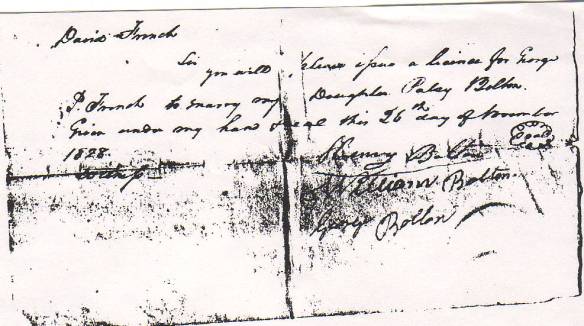
Henry Bolton French marriage auth

The above note reads:

David French

Sir,

You will please issue a license for George P. French to marry my daughter Patsy Bolton. Given under my hand and seal this 26th day of November 1828.

Signed Henry Bolton
William Bolton
George Bolton

We are quite fortunate to have a picture of Martha Patsy Bolton French.

Martha Patsy Bolton French

I look at her and wonder if she looks like Henry or Nancy, or both.

The other picture we have is of Henry’s oldest daughter by Catherine Chapman, Elizabeth, who married the Reverend Absalom Dempsey.

Elizabeth Bolton Dempsey

Elizabeth’s portrait, painted about 1840 is located at the Mill Creek Baptist Church in Fincastle, Botetourt County, Virginia.  The church did not send the painting of Elizabeth’s husband, Absalom Dempsey, but it does hang in the church.

Mill Creek Baptist Church

Family stories report that Henry Bolton was a member of Mill Creek Church for 50 years, one story says a deacon, and if that is the case, it would have included the time when his son-in-law, Absalom Dempsey was minister there, and earlier. It’s evident that Henry thought a lot of Absalom, because Henry and Nancy named one of their sons after Absalom.  It may well be that Nancy Mann Bolton and daughter Sarah are both buried here beside the Mill Creek Church.  Abraham Dempsey and his wife rest here.  His stone is below.  Her grave is unmarked.  She died in 1874, two years after Absalom and is very likely buried beside Absalom.

Dempsey headstone

I would love to know what Henry Bolton looked like. We have two photographs of Henry’s sons, Peter Bolton (son of Catherine Chapman) and wife Mary Falls, and Daniel Bolton (son of Nancy Mann) and Elizabeth Fulwider that I have been prohibited from sharing by the individual who sent me the photos.  Additionally, we have photos of Elizabeth Bolton Dempsey, daughter of Catherine Chapman, and Martha Patsy Bolton French, daughter of Nancy Mann, both shown above.

I can tell you that Daniel, in one of the photographs I can’t share, looks incredibly like Abraham Lincoln. Had I not known it wasn’t, it would be a very easy mistake to make.  I can also tell you that I don’t see a lot of resemblance between the siblings.  Of course, one is a painting, one is a very poor tintype and two are fairly early photographs.  The photo of Martha Patsy French is by far the best.

The photo below, at left, is Joseph “Dode” Bolton, Henry’s grandson with wife Nancy Mann through son Joseph Preston Bolton.

Joseph B Bolton2

There is one more old photo, William Henry Bolton, grandson of Henry Bolton, the immigrant, and wife Nancy Mann, through son Henry Bolton and Elizabeth Obenchain.

In the 1830 census, Henry Bolton Sr. is living in Giles County with 11 children in his household, while his son, Henry Bolton Jr. is living in Botetourt County.

In the 1840 census, Henry Bolton Sr. is living in Giles County with 1 male under 10, 2 males 15-20, 1 male 20-30 and 1 male 80-90. Nancy seems to be missing although she reportedly did not die until 1841.  In 1846, Henry died as well. They reportedly lived near Pearisburg, in Giles County.

A cousin reports that a comment by a neighbor was recorded regarding Henry’s death: “One lady told me as though it happened yesterday. ‘It was a pity. He was getting better from the fever and feeling hungry he got up from his bed and went to the kitchen and ate beef stew that was on the stove and that finished him.'” I feel sorry for whoever made that stew.  Nancy Mann had died earlier, but Henry was obviously living with someone.

At one point in my research, I became quite excited because I thought sure we had found the Henry Bolton Cemetery. Turns out, we had, but not the original Henry, one of his descendants, his grandson Henry through son Jacob Bolton and Virginia Inksell.  Grandson Henry (1823-1890) married Mary Catherine Shue (1821-1915) and they build Rose Hill.

The book, Related Families of Botetourt County Virginia states that many of the early Bolton families are buried at Rose Hill on land that passed from the Boltons to the Firebaugh family and although this is not Henry’s original land, it probably was in the same general vicinity. According to local historian, Alice Firebaugh, the old Rose Hill farm is located on Route 630, Blackburg Road. This is where the “Bolton Cemetery” is located that caused me such great initial excitement.

A piece of that history lies on the ridge of Rose Hill Farm. The Firebaughs call it Cemetery Hill because that is where the Bolton Cemetery is located.

Bolton cemetery

The cemetery is in a state of disrepair.

Bolton cemetery2

Given the information we have, we know that the original Henry Bolton family was enumerated in two tax districts, McClanahan’s and Hannah’s.

The book also tells us that the McClannahan’s live on Catawba Creek. That the area is near Eagle Rock, and that the Hannah’s are on Craig’s Creek and that the Hannah family is buried in the Godwin Cemetery.  The Godwin Cemetery, according to FindAGrave, is dead center in the middle of the town of Fincastle and the Firebaugh family Cemetery is found on Virginia 735 .

These land marks give us some barometers to use to find the general area of Henry Bolton’s land in Botetourt County before he moved to Giles County before 1830.

Bolton Botetourt landmarks

803 Shawnee Trail is an address in the Shawnee Woods subdivision where the Bolton cemetery was cleaned up so that it didn’t get bulldozed when the subdivision was being built.

Catawba Creek runs out of Fincastle, shown on the map above, and extending the map distance, we can see Eagle Rock to the north, on the map below.

Catawba and Eagle Creek

Zooming in on that area, we find that Craig Creek dumps into the James River as does Catawba Creek.

Craig Creek James River

There is a Bolton Cemetery at Rose Hill, but it’s later members of the Bolton family that are buried in that location.

Mill Creek Church was 5 miles due east of the center of Fincastle.

Mill Creek Church

Henry Bolton’s land was probably in this vicinity, between roads 360 and 735.

Here’s a view of the area from near Fincastle. Looks beautiful, but quite imposing.

Fincastle view

The Bolton family moved a nontrivial distance from the Fincastle area to the Pembroke area of Giles County. After locating the Bolton land in Giles County, I marked the location as well as the Mill Creek Baptist Church outside of Fincastle.  Today, it’s an hour and a half on mountain roads.  In those days, it would have been probably a 2 or 3 day journey, if not more.  The average wagon speed was 20 miles a day, and that wasn’t through mountains.  Clearly, they didn’t go back and forth to church at Mill Creek from Giles County, so Henry’s membership at Mill Creek would have terminated about 1830 when he is first found on the census in Giles County.

Fincastle to Stoney Creek

Henry died at Big Stony Creek, Pembroke, Giles County, Virginia. It’s unclearly whether this was on son Peter’s land on Big Stoney Creek, on Henry’s own land although no deed was found, or on another relatives land.  One thing is for sure, a man in his 80s or 90s had to have some help in that place and time.  Henry could not have been farming at the time he died.  If born in 1760, he would have been 86 when he passed.

A cousin sent me an aerial partial view of the Bolton lands in Giles County where Henry and Nancy reportedly lived shortly before they died in the 1840’s.  She said that in 1975, there were still old rock foundations visible, and a dug out cellar.  A distance from the old foundations by traversing an old overgrown road was the Bolton cemetery, with all but two graves unmarked.  Most of the graves were sunken between 1-2 ft, indicating the use of disintegrating wooden caskets.  There was a remnant of a high, wide stone fence just beyond the graveyard.

Stoney Creek land

I didn’t receive any further information from the cousin, but I did search the Giles County maps along Big Stoney Creek where the Bolton family lived, according to the Giles County deeds when Peter sold his land in 1855.

Indeed, I found the land matching this screen shot above on road 627, also called Darnell Mountain Road which intersects with Big Stoney Creek Road.

Here’s the entrance to State Road 627 from 635, Big Stoney Creek Road.

Stoney Creek road

As you can see, it’s heavily forested.

Stoney Creek road2

Backing away a bit, you can see where road 627 turns off of Big Stoney Creek Road.

Stoney Creek Pearisburg

As you can see, this area is near Pearisburg, Pembroke and the Virginia/West Virginia border.

Stoney Creek Pearisburg2

Behind the Bolton property was nothing but mountains. Cascade Falls is shown on the map.

Giles county waterfall

Henry Bolton Estate Inventory

We may not know exactly where Nancy Mann and Henry Bolton died and are buried, although I strongly suspect it’s on the land where he lived in Giles County, but we do know something about what he owned at the end of his life.

Recently, with the help of a professional genealogist, Henry’s estate was located in Giles County. However, the film was too poor to read, so a second professional genealogist was retained to physically go to the Virginia State Archives and access the originals.  We were lucky, very lucky.  I could read most of the items and transcribed them, as follows:

Giles County, February 22, 1847 – Inventory and appraisement of the personal estate of Henry Bolton. Will Book B, pages 446 and 447

Note – Do means ditto

Items Amount in Dollars
Cupboard $5, one desk $4, One bureau $9 18
One wooden clock $8, one sugar box 12.5 cents 8.12
One family Bible $.75, two German Bibles, two hymn books rethence? confession of faith one hymn book vesper (or verger) Baptist $.75 1.50
One split bottom chair $3, one iron chur? 3.37 ½
1 falling leaf table $1, one high ? bedstead and other furniture $8, one ? posted Do (ditto, probably meaning bedstead) and its furniture $7 16.00
One Do $3.50, one Do $5, three candlesticks 18.75 7.50
One set of spools 50, one looking glass and slate 25 cents .75
One hand sun? auger chain and square 75 cents and one flat iron and sheep shears 75 cents and one pair saddle bags 25 cents 2.00
One hone for rasures 25 cents and bed pot 10 cents one set of shoe tools 25 cents three bed screws one resure (razor) and strap 12 ½ cents .72 ½
One pair of and irons and fire shovel 75 cents, one coffee mill candle moles and one stay? 37 ½ cents 1.12 ½
One spinning wheel and big wheel and reel 150, two churns and one half bushel ? and old irons 75 cents 2.25
One hand axe and three falling axes 1.50 and old box and old irons 50 cents 2.00
One falling leaf table and two pairs 1.50 one loom and its contents 1.50 3.00
Two pairs of hams and chains and two collars and two bridles , one pair hams and chains $5 and one pair brick lands and head stall? Bridle 75 cents 5.75
One pair stillyards and cutting knife steel draw knife sythe anvil 2.00
Relag gen saddle old bridle 25 cents four tubs and one box 87 ½ cents one large kettle and hooks 1.50 2.62 ½
One biscuit baker and lid one oven and pot and hook 2.75
One tea kettle and two pot racks 1.25 one half a crite of corn supposed to be two hundred bushels at 37.5 cents per bushel when measured 72.5 bushels 28.42 ½
One lot of pickled pork 6.82 at 4 cents per pound 27.28
One fat stand and lard 1.25, one bedstead and cord and grine stone 125 one sythe and cradle 100 3.50
One double tree two devises 50 two pair streature and log chains 2.62 ½ one patton felon 150 4.52 ½
Eleven head of sheep at 75 cents a head 8.25
One ball face horse for $35, one bay mare for $20, 55.00
Nine ? hogs $10 one dun cow 1 calf 8 18.00
One year old steer $3, one year old heifer $3 6
Half of two stacks of oats $2, one lot of flax %, one horse bucket one tube? Old shade? Two hoes two iron wedges and bull tongue and ring 1.60
Two shovel plows 1.50 one doe tray and maul rive? 25 cents 1.75
One cockle sieve and kittle hammer and old tick 75 cents .93 ¾
Hackle bull tongue and auger two little stacks of rye 38 cents and one lot of stack fodder 6 6.35

Signed by Hugh Johnston, Edward Eaton and David Eaton

Next, we have the bill of sale for the property of Henry Bolton, as follows:

Purchaser What How much $
James Stafford Two clevises? and double tree and single tree $1, one smoothing iron 50 cents 1.10
William Simpson? One patton ? 3.12 1/4
Washington Gordon One cupboard 3.63 ditto one collar and bridles 1.52 ½ 5.25
Henry Sadler One stack of flox 1.05
Andrew Gott One rasure strop and rasure 12 ½, do to four chairs 1.05 ¼ 1.18 ¾
John Morrison One ball faced horse 39.75
Absolum Bolton One pair big streachers $1, do to one pair one horse 31 ¼, do to one log chain 1.87 ½, do to one iron wedge 3 ½, two hoes 75 cents, one meal tub 12 1.2, one sieve wood bread tray 25 cents, one pot rack 90 cents, one pot rack 90 cents, one keg 50 cents, one pair of sheep shears 15 cents one arm chair 1.30, one bedstead and its furniture 5.25, one cutting bon? steel 20 cents, 11 head of sheep 11.55, two tacks 62 ½, one bay mare 15 43.26 1/2
James Johnson One bon .12 1/2
Edward Eaton One meal tub 15 cents, one falling leaf table 82 cents, one pair brick bands $1, one grine stone 88 cents white show 2.75, eight stock hogs 1.50 per head for $12 17.90
Richard Eaton One spade and ring 25 cents, one old saddle and old bridle 1.20 1.46
Samuel Thompson One pair candle moles and coffee mill 8 cents, one falling ? $1 1.08
John E. Stafford One bull tongue and bucket .25
John C. Farley One set and irons 75 cents, one box and old irons 1.00, one pair saddle bags 25 cents, one falling leaf table $1, one lot stock fodder $3 6.00
Subtotal here 118.78 1/4
Joseph Eaton Two chairs? $1, one half ? and old irons 1.12 ½, one square and auger and chisel 75 cents 2.87 ½
Reuben Hughes One sythe stake .12 ½
William Oliver Two candlesticks 17 ½ 17
Peter Meadows Two pailes 27 ½
Elean Bolton One wood clock $1, one bureau $1, one bedstead and its furniture $1, one do $1 4.00
David Eaton One oven and hooks 75, one tub 55 1.30
Olive C. Peters One iron wedge 37 ½, one big kittle and hooks 2.25, one spinning wheel 1.50, one chamber pot 15 cents, one candlestick 14, one bucket and auger 37 ½ one pair of gears 162 ½, bolt? of ayes? 2 8.92 1/2
William Morrison One shovel plow 1.12, one fret? 1.42, one felling ax 55 cents, one collar and bridle $2, one tin kittle 50 cents 3.66 ¼
David Bolton One tub and ? 50 cents, one sythe and cradle 1.37, one lot shoe tools 1.12 ½, one wheat sieve and hammer 50 cents, face ax 60 cents, one family Bible 50 cents, two German Bibles 5 cents, one lot of books 25 cents, half oat stack $4, one slate 16 ¼, one old hone 25 cents 9.00
Russle Johnson Biscuit baker and lit 1.06 ¼, set of spools 37 ½, one desk 1.50 3.93 ¾
James Eaton One pair of gearo? 2.12 ½
Subtotal here 46.50
Hugh Johnson One shovel plow 75 cents, six chairs 2.62 ½, one bedstead and end 50 cents 3.87 ½
Edward Johnston Sugar box 12 ½ cents, one big wheel 75, one hand ax 80 cents, one hand saw 37 1/2 , one cow and calf $11, two years old steer 3.14, one year old heifer 3.79 17.18
William B. Mason One lot of pickled pork 29.19
Peter Fizer One lot corn 25.37
Amount 77.62

Signed, Edward Johnson, admin of Henry Bolton decd, filed Feb 22, 1827, bill of sale

Note – Elean Bolton is Henry’s daughter who married Russell Patterson in 1854 and moved to Hancock County, TN. She and her husband wound up raising the children of David Bolton who also moved to Hancock County where he and his wife both died.

You can tell a lot about how a man lived by what was left when he died.  Henry farmed, had an assortment of livestock, and shaved.  He had a clock, which was a luxury, as was a desk.  Henry had 3 candlesticks and molds to make 2 candles at a time.  He owned shoemakers tools which he likely used himself, as there is no record of Henry ever having slaves.  He had a set of spools, a spinning wheel and a loom, which appeared to be loaded, meaning a project had been left half finished, probably by Nancy, before she died.

Henry drank coffee, because he had a coffee mill.  Like all pioneer homesteads, cooking was done in the fireplace and a potrack held the pots as they cooked, plus utensils sometimes.  A typical colonial fireplace in Jamestown is shown below.  This probably looked a lot like Henry Bolton’s home where the fireplace was also the only source of heat.  There is no stove as mentioned in the statement about Henry’s death – that he ate stew from the stove.  Perhaps he did not die at home.

colonial fireplace Jamestown

Henry had two horses, a saddle and saddlebags to carry whatever needed to be carried back and forth. Of note, he did not have any oxen which would have been used to plow, nor a farm wagon.  He may have previously sold those.

Henry had quite a bit of furniture in addition to the desk.  He had a cupboard and a total of 9 chairs, one of which was an “arm chair,” probably “his” chair.  There were two tables including one noted as a fall leaf table.  He had three bedsteads and a bureau. His house was probably quite full.

Further confirming Henry’s ability to read was a group of books.  I’d love to know the titles, as that would tell us even more about Henry Bolton.  I can just see Henry sitting by the fireplace, in his arm chair, reading a book on the table by the light of the fire and a candle as Nancy wove on the loom or spun on the wheel.

And now, we also have an answer about the Henry Bolton Bible, or Bibles. Did you catch that?

David Bolton bought the “family Bible” for 50 cents and two German Bibles for 5 cents. The “family Bible” was most likely Henry Bolton’s Bible dated 1811.  Why was Henry’s Bible dated so late?  Perhaps this was not the first Bible.  Cabin fires were very common in frontier America and if the cabin burned, so did everything inside the cabin.

So, where did David Bolton live? You guessed it…Hancock County, TN.  He died in 1859 and his wife preceded him in death.  Elyan, his sister, who married Isaac Patterson raised his children.  This entire group, including Joseph Preston Bolton lived very near each other in Hancock County – which explains how the “original Henry Bolton” Bible came to be in the possession of Elyan Bolton Patterson’s descendants.  Perhaps the Germany rumors were fueled by those 2 German Bibles.  So, there were indeed 3 Bibles owned by Henry Bolton, but the 2 German Bibles seem to have disappeared over time.  Where did they come from in the first place, whose were they and why did Henry Bolton have them?  We believe that Catherine Chapman was English and that Nancy Mann was Irish, but were they? I just hate it when new information causes me to second guess and question what I thought I knew!

In total now, we have 6 Bibles associated with this family.

  • The “original” Henry Bolton Bible that was sold at Henry’s estate sale, noted as the family Bible, to son David. This Bible, dated 1811, came to Hancock County and was subsequently owned by Hazel Venable Barnard whose mother was Susan Bolton, daughter of Milton Bolton, son of Joseph Preston Bolton and Mary Tankersley. Joseph was the son of Henry Bolton and Nancy Mann.
  • Two German Bibles, current whereabouts unknown, also sold to David Bolton at Henry’s estate sale.
  • The Polly Bolton Bible printed sometime between 1829-1859. Polly (Mary) Falls was the wife of Peter Bolton, son of Henry Bolton and Catherine Chapman. Peter is probably who Henry lived with in Giles County. Peter sold his land on Big Stoney Creek in 1855 and moved to Iowa.
  • Two additional Bibles, information copied from the Polly Bolton Bible, one of which went to Lopas Island in Washington State, and one stayed in Iowa.

It was 34 years after Henry Bolton’s death in 1846, in the 1880 census, that we obtain the final confirming piece of the puzzle indicating that Henry was born in England and that his wife, Nancy Mann, was born in Virginia.

The 1880 census was the first US census to list the location of the birth of parents. Joseph Preston Bolton in Claiborne County, TN listed his parents’ birth location as England for his father and Virginia for his mother

1880 Joseph Bolton census

Hints of Henry in England

Periodically I revisit searches that I have undertaken previously to see if anything new turns up. After all, records are being added to the major data bases everyday.

Searching for Conrad and Condery provided one record, but the dates are a bit off and the name doesn’t match exactly.  But look where the christening took place…at St. Katherine’s by the Tower in London…right where the boat docks are located.

Conrath Bolten

Searching for Henry, also at FamilySearch, unfortunately, doesn’t give us anything compelling, nor a birth to the same parents or location as Conrath, above. However, Conrath’s father’s name was indeed, Henry and both Henry and Conrad named daughters Sarah.  It’s enough to make you wonder, but not enough to do anything else.

Henry Bolton England

Henry’s DNA

Utilizing the autosomal DNA of the descendants of Henry Bolton and Nancy Mann, we see the confirmed Henry Bolton/Nancy Mann segments below.

Henry's painted DNAI have not been able to “prove” all of the possible segments through triangulation, but if all of the segments are indeed Bolton segments, then Henry’s chromosome map would look like the map below. Clearly, we need a lot more descendants to test to create more color on Henry’s chromosome map, but still, it’s pretty amazing that we can recreate this much of Henry’s chromosome map from these few descendants.

Henry's possible painted DNA

I don’t know how many descendants Henry has, but figuring that he had 20 children total and of those, 2 died fairly young. Of the remaining 18 children, most had 7 or 8 children.  I don’t have complete information for some.

Using a 30 year generation, Henry could have a huge number of descendants.

Year Multiplier Descendants
1760 Henry born
1790 Henry has 18 children
1820 8 144 grandchildren
1850 8 1152 great-grandchildren
1880 8 9216
1910 8 73,728
1940 2 (birth control had become prevalent) 147,456
1970 2 294,912
2000 2 589,824

If this is anyplace close to accurate, Henry Bolton could have well over half a million descendants today. If you add Sarah, Conrad’s daughter into the mix, you could well have another 4000 descendants in the US of the unknown parents of Henry and Conrad Bolton.

If you are a descendant of Henry or Conrad Bolton, please consider taking the Family Finder test at Family Tree DNA and joining the Bolton DNA project.  We’d love to have you!

Acknowledgements

I’d like to thank cousin Hazel Venable Barnard, now deceased, for being such a wonderful steward of that Bolton Bible record, cousin Dillis for Y DNA testing and for lots of research over the past 30 years, so much that I no longer remember what was mine and what was his, cousin Pam for the Google screenshot of the Giles County property and Henry Bolton cause of death information, and Anita Firebaugh for the Firebaugh, Bolton cemetery and Rose Hill information. In addition, a descendant of the Robert Bolton who is not related contributed the Bolton land tax information, extracted by Yvonne Mashburn-Schmidt, a professional genealogist specializing in southern records at www.GeorgiaGenealogist.com. I’d also like to send a special thank you to Yvonne for finding both the Henry Bolton estate inventory and the genealogist in Virginia to retrieve the originals.  Plus, she helped me decipher some of the difficult handwriting, especially pertaining to those all-important family Bibles.

Genealogy is not a hobby that one can undertake alone, or at least, it’s much more productive and enriching when people share their findings. Without the collective contributions and collaboration of all of these people, our knowledge of Henry would be scant indeed.  I hope this is a fitting tribute to our immigrant ancestor, Revolutionary War Veteran, Henry Bolton, on Veteran’s Day.

______________________________________________________________

Disclosure

I receive a small contribution when you click on some of the links to vendors in my articles. This does NOT increase the price you pay but helps me to keep the lights on and this informational blog free for everyone. Please click on the links in the articles or to the vendors below if you are purchasing products or DNA testing.

Thank you so much.

DNA Purchases and Free Transfers

Genealogy Services

Genealogy Research

WikiTree Makes Finding Relationships with DNA Matches Easier

Today, I received the following press release from WikiTree.  WikiTree is a free resource for genealogists seeking to collaborate with other genealogists.  More importantly, in the past couple of years, WikiTree has begun actively incorporating features for genetic genealogists.

6 November 2014: Today WikiTree.com is announcing two important features for genealogists who have taken DNA tests. These features make WikiTree’s Relationship Finder a uniquely powerful tool for genealogists who have taken 23andMe, AncestryDNA, and FTDNA Family Finder tests.

“One of the biggest challenges facing genetic genealogists,” according to Dr. Blaine Bettinger, author of the long-running blog The GeneticGenealogist, “is finding the elusive common ancestor. Finding genetic matches is easy, but finding the common ancestor from whom we inherited a segment DNA is very hard. WikiTree’s new Relationship Finder is a great tool for identifying the ancestors that two or more people share in common.”

All Common Ancestors

Genealogical relationship finders are generally designed to find the first common ancestor between two people. Genetic genealogists need to know about all the common ancestors they share with a match. Everyone’s family tree intertwines in multiple ways. The first shared ancestor may not be the reason for a shared segment of autosomal DNA.

WikiTree’s Relationship Finder now enables you to easily browse all your common ancestors.

WikiTree common ancestors

Filtering for Multiple Matches

When a genealogist shares a segment of autosomal DNA with two or more other people who also match each other on that segment, it’s a big clue in discovering which ancestor it came from.

WikiTree’s Relationship Finder now enables you to filter the common ancestors shared by two people to only display common ancestors who are also shared by a third, fourth, or fifth person.

The Universal Family Tree

These Relationship Finder features are possible because WikiTree members are collaborating on a single tree for the entire human family.

“The genetic genealogy community absolutely must have a universal family tree,” says leading genetic genealogist Dr. Tim Janzen. “With smaller unlinked trees it’s frequently impossible to see all of the true genealogical connections with the people who share autosomal DNA with us. We are finally getting to the point where this vision is becoming a reality at WikiTree.”

About WikiTree

WikiTree: The Free Family Tree has been growing since 2008. Community members privately collaborate with close family members on modern family history and publicly collaborate with other genealogists on deep ancestry. Since all the private and public profiles are connected on the same system this process is helping to grow a single, worldwide family tree that will eventually connect us all and thereby make it free and easy for anyone to discover their roots. See http://www.WikiTree.com.

______________________________________________________________

Disclosure

I receive a small contribution when you click on some of the links to vendors in my articles. This does NOT increase the price you pay but helps me to keep the lights on and this informational blog free for everyone. Please click on the links in the articles or to the vendors below if you are purchasing products or DNA testing.

Thank you so much.

DNA Purchases and Free Transfers

Genealogy Services

Genealogy Research

William Harrell/Herrell (c1790-1859), White Wife, Black Wife, 52 Ancestors #44

William Harrell or Herrell or maybe Harrold or Herrald or some other spelling derivative was born about 1790, judging from census records, someplace in North Carolina.

The early tax and census records of Wilkes Co, NC reveal that the Herrell (Harral, Herold, Herrold, Harrold, Herrald, etc.), McNiel, Vannoy, Sheppard, and McDowell families lived just houses apart. Those families also migrated about the same time to the area that was originally Claiborne County, TN, that would eventually become northern Hancock County, near the Lee County, Virginia line and lived in close proximity as neighbors there too, along the Powell River.  Today, a Harrell cemetery remains.

But let’s start our story in Wilkes County, North Carolina, where William Herrell began his life, or at least where we first find him.

Wilkes County, NC

In the 1790 census, there is no Harrell or similar name in Wilkes County, but in the 1800 census, we find both John Harral Sr. and John Harral Jr.

John Sr:

  • 1 male 45 and over so born before 1755
  • 1 female over 45 so born before 1755
  • 1 male under 10 so born 1791-1800
  • 1 male 10-15 so born 1785-1790 (This is probably William who was born about 1790)
  • 1 male 25-44 so born 1756-1774 (this mark is very light and may have been a mistake or erasure) possibly James who has land in Wilkes in 1805
  • 2 females 16-25 so born 1775-1784

John Jr:

  • 1 male 16-25 so born 1775-1784
  • 1 female 16-25 so born 1775-1784
  • 1 female under 10 so born 1790-1800, likely close to 1800 since there are no other siblings

Therefore we would expect to find John Sr. someplace in 1790 with at least 4 if not 5 or 6 children. Obviously, William cannot be the son of John Jr., so he would be the son of John Sr.

We know that William was born in 1790 in NC. Therefore we would expect to find John someplace in NC in 1790.  Checking all of the Johns of similar names, we find only 1, in Bertie Co., that has the number of children (or more, not less) that we would expect John to have in 1790 based on the 1800 census in Wilkes County.

What we expect in 1790 based on the 1800 census:

  • 1 or possibly 2 males over 16
  • 2 or possibly 3 males under 16
  • at least 3 females

We find John in Bertie with in 1790:

  • 1 male over 16
  • 2 males under 16 (so one child was yet to be born either in 1790 or shortly thereafter, making Mary probably about 40 in 1790 or born in 1750 or so)
  • 5 females

Y DNA testing on a proven descendant of John of Bertie County could confirm or squish this possible connection.

Harrold Mountain

John Harrell (also spelled Harrold there, Herrell, etc.) died in Wilkes Co. NC in about 1825. His wife, Mary died about 1826. The 1800 census shows 5 children. His 4 identified children were born beginning in 1783, so he had to be born before 1760 or even earlier.

I visited Wilkes County in 2004 and my cousin, George McNiel, a local historian and avid genealogy researcher, was gracious enough to take me on a tour of all of my family lands. There is a mountain named Harrold Mountain today.

Harrold mountain crop

There is also a very old “primitive Baptist” church on Harrold Mountain and guess what the names are on probably 80% of the graves – yep – you guessed it – Harrold and Harrald.

harrold mountain church

My cousin George, quite a history buff, said this was the last one of the old local churches to flatten the top of the graves for mowing.  Apparently this particular denomination believed in rounding the tops of the graves – and keeping them mounded up. I don’t know why. They also had an outside eating area because they don’t believe in having food inside the church. These are still common practices of this particular denomination apparently, but many of the churches have modernized.

harrald cemetery wilkes county

harrald cemetery 2 wilkes county

The photo below is standing at the church looking across the road and at the beautiful view.

harrold country wilkes co crop

William Harrell married Mary McDowell, daughter of Michael McDowell. They were married by the Baptist Preacher, Jacob McGrady. Mary’s father was a Revolutionary War veteran. About 1810, William Harrell, his wife Mary McDowell Harrell, her father, Michael McDowell and her brother John McDowell would all move to the Powell River area of Claiborne County Tennessee, now in Hancock, near Lee Co. Va.

Just a few years later, William Harrell fought in the War of 1812 and it is through his pension papers that we gleaned a lot of priceless information about him and his family.

The 1800 census of Wilkes Co shows Michael McDowell, Jacob McGrady (the minister who married William Herrell and Mary McDowell), and both John Herrell Jr. and Sr. (spelled Harrall) on adjoining pages. Based on this evidence, pending further investigation, it is presumed that Michael McDowell is Mary and John’s father and John Herrell Sr. is likely the father of William Herrell.

The following photos were taken on Harrold Mountain on a beautiful spring day. It probably looks about the same today as it did when John Harrold lived there.  My husband was taking the photos and he liked the frolicking goats.

harrald mountain sheep

Claiborne County, Tennessee

About 1810, according to John McDowell’s deposition, Mary McDowell Harrell’s brother, this group of families moved to Claiborne County, Tennessee. In 1845, this part of Claiborne County became Hancock County. John signed an affidavit when Mary applied for a pension based on William’s service records that recounted their marriage in 1809 and subsequent move to Tennessee.

The Herrell family lived along the Powell Mountain on the Lee County, Virginia, Claiborne County, Tennessee border. The house, abandoned when I visited in the 1980s, may be the original Harrell homestead.  Mary Parkey, a now deceased local historian, said it was “Herrell” but she wasn’t positive about the specific line.  She too descended from the families in this area.

Herrell house Hancock Co

In 1812, William Harrell bought land in Claiborne County.

1812 – John Claypole to William Harrell – 1812 Claiborne County Deed book D p182 for $200

Claiborne County Court – May term 1813 – Oct. 10, 1812 John Claypool and Eliza his wife of Claiborne and William Harrold of Lee Co Va. for the sum of $200 a tract of land lying in Claiborne on the North side of Powell River including a stripe of land on the opposite side of said river included in a tract of land conveyed to William Bails by James Allen bounded as follows: Beginning on the back line in a deep hollow at two hickories and at a dogwood, thence to a white oak marked AB (with the right side of the A the same as the back of the B) thence to the south line of said tract containing 100 acres more or less it being part of a tract of 440 acres conveyed to said William Bails by James Allen as above said conveyance bearing the date Jan. 20, 1809.  Witnesses William Briance, Michael McDowel (his mark), William Hardy.  Registered Dec. 3, 1813.

According to Mary Parkey, these ruins are also on Herrell land.

Herrell foundation hancock co

War of 1812

William Herrell served in the War of 1812 and later filed for a pension. He also filed for bounty land in 1850 and received 80 acres (blwt22194) and in 1855 applied for and received another 80 acres (blwt7267).

He reportedly served 14 days in the War with the Creek Indians. However, I subsequently found that he served beginning January 17, 1814, and was discharged  May 13, 1814, being in Solomon Dobkins company.

Much of what we know about William and his family comes from his pension application papers, and those of Mary following his death in 1859.

The various spellings of his name on the following papers from William’s service records held in the National Archives are not typos.

William Harold is written on the top of the page, serving in Bunch’s Regiment 1814, East Tn. Militia, War of 1812.  He is a private, card number 38519847 and underneath it also says 9893 (under the 9847 part).  At the bottom of that page it says Allison’s Regiment E. Tn. Militia.

herrell war of 1812 muster

The next page says William Harrold or Herrald (the or Herrald is actually written above the name Harrold), ensign Benj. Austin’s, then private Col. S. Bunch’s regiment if the Tn. Militia. It says there is one page in the file of misc information.

Inside it says Wiliam Harrold, private, Capt. Solomon Dobkins Company, Col., Samuel Bunch’s regiment, war of 1812. Company payroll for Jan. 17 to May 14,1814 roll dated Mar. 21, 1814. Commencement of services Jan. 17, 1814.

Expiration of services Mar. 21, 1814. Term of service 4 months 5 days.  Pay per months $8 no cents.  Amount of pay $33.29.  Number days added for travelling allowance of pay – 8.

Next page says William Harold, Company muster roll for Jan. 17 to May 13, 1814. Roll dated Washington, Tn. May 13, 1814.  When joined – Jan 17, 1814. When discharged – May 13, 1814.  Mileage to residence – 120.  Present or absent – present. And then a note below that says “see Allison’s regiment E. Tn. militia.”

In 1815, William signed this power of attorney, apparently to collect his pay from his service in the War of 1812. It looks like he signed his surname Harrol, Harrold or Harrald.

The transcription is as follows:

State of Tennessee – Claiborne County: Know all men that I William Herrald a private in Ensign Benjamin Austin’s Company of East Tennessee drafted militia for divers and good causes and considerations me there unto moving have made ordained nominated and appointed and by these presents to make or ordain nominate and appoint Hugh Graham of said county my true and lawful attorney for me and in my name and for my use and benefit to ask demanded and release? of paymaster of the United States all such sums of money or other ?? that is owing to me from the United States for a four months tour of duty under the command of the said Ensign Benjamin Austin and in my name to grant and give receipts to the paymaster of the United States for the same as tho I were personally present at the drawing therefor any other lawful act that I could do touching the same were I personally present.

In witness where I have hereunto set my hand and seal this 8th day of September 1815.  In the presence of George Yoakum.

Signed Wm Harrold

William Herrell 1815 poa

This is the only known copy of William’s signature.

The last page has been taped and states that William Aklen? acting justice certifies that William Herrald (clearly Herrald here) personally appeared and sealed this document which is a power of attorney. Further down it looks like it was folded and on an outside place, says, “Power of Attorney” William Herrald but the e is under the tape and is could be an a, but it looks like an e.

On the bottom of this page, after another fold, and upside down, in another handwriting, it says simply, Wm Heral, ensign Austin’s company.

So in this one document we have his name spelled Harold, Harrold, Herrald, and Heral. It’s no wonder I can’t figure it out today!!!

In William Herrell’s deposition taken on March 5, 1855, William states that he is 65 years old and enlisted as a private in Captain Solomon Dobins (probably Dobkins) company of Tennessee Militia in the regiment commanded by Samuel Bunch in the “War with the Creek Indians,” and served 14 days. Given that William knows how old he is, and given that the deposition is in March, he has either had his birthday already for 1855 which means he was born in 1790, or he has yet to have his birthday which means he’ll turn 66 and was born in 1789.  He signed with a signature in 1815, but in 1855, he signed with an X.

On July 5, 1871, William’s widow, Mary states she is 86 years old and that she lived on Powell’s River in Hancock County. She further states that William was discharged at Fort Strother in May of 1814 and that William “helped to build Fort Williams in the fork of the Coosey and Talley-Poosey Rivers”.  Mary signed with a mark.

She says that she was married under the name of McDowell in 1809 at Wilkesboro NC by Jacob McGrady and that William died on October 8, 1859 on Powell’s River.

John McDowell filed an affidavit in 1872 stating that he is 90 years old (so born in 1782) and was acquainted with both William and Mary before their marriage. He states that he was at their wedding.  Further testimony in 1872 by the postmaster of Mulberry Gap, John Woodward, attests to the honesty of Alexander Herrell and James E. Speer as witnesses to Mary Herrell’s loyalty.  Alexander is believed to be Mary’s son due to this affidavit and land transactions, but the relationship of James Speer, if any, is unknown.

Fort Williams and the War of 1812

Fort Williams, the fort that William Herrell helped to build, was located at the mouth of Cedar Creek and the Coosa River, shown below, in what is now Talladega County, Alabama.

Fort Williams War of 1812

Below, Cedar Creek, from the bridge over Cedar Creek, looking towards the confluence with the Coosa. This was the location of Fort Williams.

Fort Williams War of 1812 Cedar Creek

In March 1814, General Andrew Jackson mobilized the Tennessee Militia, made up of Volunteers from the East and West Tennessee Militias and the Thirty-Ninth U.S. Infantry for a full-scale campaign against the Creek Indians, known as Red Sticks. General Jackson’s army totaled about 3,000 men.

A large segment of Jackson’s army left Fort Strother on March 14, 1814 and marched 52 miles through the forest in 3 days to a point on the Coosa River in Mississippi territory, where a garrison was established and given the name Fort Williams (in honor of Colonel John Williams).

Preparations were made to march about fifty miles in a southeasterly direction to the Creek stronghold called Tohopeka (known to the whites as Horseshoe Bend).

The Battle of Horseshoe Bend was fought March 27, 1814 between the American army under General Andrew Jackson, numbering about 3,000, with about 200 Cherokee Indian allies, against an unknown number of Creek Indians. The location was on the Tallapoosa River in Alabama. The place was also called Tohopeka.

The Red Stick’s had built a barricade on the river, which eventually trapped them once Jackson’s soldiers surrounded them. Over 800 Creeks died as a result of the Battle.

Jackson’s force defeated the Creeks. The Creeks lost about 550 within the bend, which had been fortified, and more in the river. Jackson lost 50 killed and 150 wounded.  General Jackson’s dead and wounded were taken back to Ft. Williams.  The cemetery at Fort Williams became the final resting place of more than a hundred Tennessee militia and others. These others include Cherokee allies who fought with Jackson at the Battle of Horseshoe Bend, but who were buried apart from Tennessee militia.

The original site of Fort Williams is now under Lay Lake in Coosa County, Alabama.

Fort Williams sign

Obviously, Solomon Dobkins company was part of the men who built the fort and fought in the Battle of Horseshoe Bend. The question is, where was William Herrell during that battle?

From the Tennessee state archives, we find the following about Solomon Dobkins’ Company:

The officers and company were mustered into service January 10, 1814. The men are entitled to allowance of pay for 2 days and to the mileage shown above. (nothing shown above in transcription) Remarks: Attached to this company 4-27-1814, from Capt. Dobkins Company.

Bunch’s Regiment (1814) E. Tenn Militia. Peter Markham Sergeant, Capt John Hou’s (sic) Company, Col. Samuel Bunch’s Regiment, E. Tn Militia War of 1812.  Appears on company pay roll for Jan. 8 to July 21, 1814, roll dated July 29, 1814, commencement of service or of this settlement 4-27-1814. Expiration of service or of this settlement 7-29-1814. Term of service charged 3 months, 2 days. Pay per month $11.00, amount to pay $33.70. No days added for travelling. Allowance of Pay: 8  Remarks, joined 27 April 1814 from Capt Dobkins Company.

The 2nd Regiment of East Tennessee Militia was mustered from January 1814 to May 1814.

Andrew Jackson’s official report of the Battle of Horseshoe Bend (27 March 1814) mentions that “a few companies” of Colonel Bunch were part of the right line of the American forces at this engagement. More than likely, some of those companies included Captains Francis Berry, Nicholas Gibbs (who was killed at the battle), Jones Griffin, and John McNair. In addition, muster rolls show some casualties from this battle in the companies led by Captains Moses Davis, Joseph Duncan, and John Houk.

Other men from this regiment remained at Fort Williams prior to Horseshoe Bend to guard the post — provision returns indicate that there were 283 men from Bunch’s regiment at the fort at the time of the battle.

Since William Herrell was in Samuel Bunch’s regiment, he may well have been guarding the fort instead of fighting at Horseshoe Bend. I wonder if he was grateful to be relatively safe, or upset to miss the action.  He would have been all of 24 or 25 years of age.

Samuel Bunch’s regiment was in General George Doherty’s Brigade and many of the men stayed after the enlistment expiration of May 1814 to guard the posts at Fort Strother and Fort Williams until June/July. The line of march went through Camp Ross, a supply fort near present-day Chattanooga which was known as Ross’ Landing until 1838, Fort Armstrong located on Cherokee land, and Fort Jackson, a former Creek trading center in Alabama on the Coosa River.  Camp Ross location, shown below, today.

camp ross

Fort Strother, where William was discharged, is located at the red balloon, below, at the intersection of Ohatchee Creek and the Coosa River.

Ohatchee creek and Coosa

Here’s the Ohatchee and the Coosa today.

Ohatchee and Coosa boat ramp

The Tennessee State Archives provides this map of the Creek Campaign of the War of 1812, as it was called.

creek campaign map

It’s 282 miles from the Rob Camp Church near where William Herrell lived to Fort Strother, by road, today. If the men marched, on foot, 10 miles a day it would have taken them a month to get home.  They were allowed 8 days travel, which would mean they would have been expected to cover about 35 miles a day.  That would have presumed they had horses.  I also noticed that the mileage estimate was only 120, which may have been from Knoxville to some other location, but it surely wasn’t the entire distance.  One hundred twenty miles divided by 8 days equals 15 miles per day, which is much more reasonable, especially if on foot.

Sneedville to Fort Strother

Today, it’s about 60 miles, an hour’s drive, between Fort Williams at the Coosa and Cedar Creek, and Fort Strother at Ohatchee Creek and the Coosa. Then it would have meant expending considerable effort in very overgrown countryside.  A forced march of 52 miles took 3 days.

Fort Williams to Fort Strother

After William returned home from the War, life resumed and went back to normal. But what did normal look like in the early 1800s in Claiborne County, TN?

Day to Day Life in Claiborne County

The Claiborne County court notes tell us more about what was happening in the day to day life of William Herrell after his service in the War of 1812.

William Herrell was a juror several times between 1813 and 1819. To be a juror in this timeframe, one had to be a white landowner.  In this same timeframe, William also witnessed a deed of Levi Fortner to John McDowell, his brother-in-law.  William McDowell, probably another brother-in-law, was also a witness.

1819 – John and Lewis Campbell, 2 boys 10 and 7, children of Susannah Campbell bound to William Herrin? till age 21.

Aug. 16, 1820 – Road hands Thomas McCraty’s company south of Wallen Ridge includes William Harrell, John McDowell, Joseph Baker, William Baker, William Medlock, William McDowell and Robert G.? Parks. Residents had to maintains roads of a certain width.  This means fellings trees, clearing brush and moving animal waste off of the road.  In wet areas, plank roads were laid to keep the wagon wheels from sinking in the mud.

1835 – William Harrell to Ruben Dean Claiborne County Deed book M p 63 for $20

April 23 1835 – William Herrell of Claiborne and Ruben Deans of Claiborne for $20 a tract of land in Claiborne bounded as follows: Beginning on a stake in said Herrell’s line on the N bank of Powell River, then running up with the meanderings of the said river 35 poles connering? on the bank of said river on a sassafras and cucumber, then running northward up the hill to a post oak, then from the nest oak a straight  line crossing the hollow to a stake on said Herrell’s line thence running ? along said line to two hickorys connecting? said Herrells and Dean’s corner, thence running down the hill with said Herrell area? to Dean’s line to the beginning, containing 10 acres more or less.  Signed in the presence of Theoderick Moon, John Shak (Spak?), Andrew Deans.

William Herrell is shown on the 1836 tax list and on 1839 list with 180 acres worth $700, 150 school acres valued at $300, 1 slave valued at $500 and 1 poll. This record is important because it’s the first record of William owning a slave.  The slave was worth more than half of his land.

November 1836, the estate of James Walker has a note on William Harrell due Dec. 10, 1835 for $2.54.

William Herrell purchased something at the estate sale of Henly Fugate in 1838.

1838, Dec. – William Harrell, purchaser at the sale of Philip Bundren, bought a hammer and chain.

There was also a second Herrell family in Claiborne County. Fortunately, they were from the far southern part of the county.  Based on the neighbors, I have been able to isolate the northern William in the records.  At one time, a second William arrived from Wythe County, VA and joined the other “southern” Herrell group.  According to DNA tests, these two lines are not related.

Children

The known children of William and Mary McDowell Harrell are:

  • Margaret, their oldest child, born about 1810, married Anson Cook Martin before 1830. Anson died about 1845 and about 1850, Margaret married Joseph Preston Bolton.

The daughters below were all unmarried and living at home in 1850 census.

  • Mildred born in 1816 married Hiram Edins
  • Nancy born 1820, never married
  • Mary born 1822 married William Edens
  • Malinda born 1829

There is some amount of confusion about the son or sons of William and Mary McDowell Herrell.

  • Abel (name smudged) born in 1824 (age 26) married Nancy, age 20, surname possibly Fury or Ferre, pronounced Fury or Furry, about 1847. In the 1850 census, they had one daughter, Margaret M., aged 2. The problem is that Abel’s name is probably actually Alexander. Abel may have been a nickname or it may have been written incorrectly/illegibly that first time.  There is no additional evidence of Abel.

In 1860, Alexander’s siblings deeded land to him.

In the 1860 census, Alex Herald, age 40 is married to Nancy, age 26. Children are Margaret, age 10, William age 8, Alexander age 5, Mary age 3 and Daniel age 1.

In the 1870 census, Alexander Herald is shown age 50 with William, age 16, Alexander 14, Mary 10, Daniel 9, Jehil? 7 and Henley 1. No wife is shown.

In the 1880 census, Elliczander (sic – I love this spelling) Harrell (indexed as Harsell), age 60, is shown with wife Nancy J. age 50 along with children William R. age 24, Daniel J. 18, Joseph H. 16, Henley 10 and Clinton 7.

Henley Herrell’s death certificate in 1924 lists his mother as Jocie Ferry, born in Hancock County, TN.

Based on the lack of Abel’s signature on the 1860 deed, and no mention of his heirs, it appears that Abel was actually Alexander.

Alexander’s descendants still own and farm some of the original Harrell land. They provided this photo of Alexander’s house, still on their land, and said that William and Mary’s house was an older house nearby.

Alexander Herrell House.

Dec. 10, 1892 – We Henley Herrell and Clinton Herrell have this day bargained and sold and do hereby transfer and convey unto James M. Martin his heirs and assigns forever all of our undivided interest in the to a certain parcel of land in the 14th civil district of Hancock Co adjoining the lands of J.E. Speer and others and bounded as follows…Beginning in the hollow on the North side of Wallen’s Ridge, thence with the hollow southwardly to a hickory on top of said ridge, thence westwardly with the top of said ridge to the top of the Middle Spur, thence northwardly with said spur to a Sycamore sprout in the hollow on the lower end of said spur corner between JM Martin and JE Speer, thence southwardly up the hollow to the beginning.  Signed.  No witnesses.

Henley and Clinton were the heirs of Alexander Herrell who died in 1891.

In 1892, the Martins are still neighbors of the Herrell family.

William Herrell’s Second Wife

When I say William had a second wife, I don’t mean he was married and his first wife died and he remarried. I mean that, indeed, he had two wives at the same time.  And no, he was not Mormon.  I can’t say what his motivation was, exactly.  I’d like to ascribe some positive motivation to William’s situation, but I think I’ll just have to let the circumstances speak for themselves.

All things considered, the wives probably had little choice in the matter.  You’ve already met Mary McDowell, but you haven’t met Harriett, William McDowell’s slave. Yes, Harriett was the second wife.  And no, they were not legally married.  Slaves could not marry and whites and blacks could not intermarry during that timeframe, so their marriage was not legal in the traditional sense.  Legal or not, they had a child, Cannon Herrell.

Many years ago, an elderly descendant from the “other Herrell line” in southern Claiborne County on the Clinch River, before we knew the two Herrell lines weren’t related, confided this information, and it appears to be about our William. Remember, back then, the two Herrell families didn’t know they weren’t related.

One of the Harrells bought a young female slave and built a house for her on the far edge of his property. His routine was to live with her until they had a fight, then he would go live with his wife until they had a fight …then start all over again. He had a house full of kids each place. In 1976 there were still both black and white Harrells in the area. William Guy Harrell, Jr., an attorney in Tazewell, had one of the other Harrells come in to his office for some legal work. When the matter was completed, the client asked, “What do I owe you?” Bill gave him a figure, but added, “I always give family members a 25% discount.” His client seemed embarrassed and said, “We don’t talk about that.” Hill told him, “I don’t mind being kin to you. Everything I’ve ever heard about you people is that you are law abiding, self-supporting people. I hope you don’t mind being kin to me.”

Whether or not this Harrell and my ancestor Drewry Harrell were related depends on who you ask. I really hope he is a distant relative because he was such an honorable man. In his will he left his property equally divided between his two families.

I have a hunch that this slave/wife was called Aunt Sukey. In that section of the country, older, respected blacks were called Aunt and Uncle. One time when Grandma and my great-grandmother were talking, they mentioned “Aunt Sukey” and did that thing adults do that all but screams to any child present, “You are not supposed to hear this!”

We’ve all seen it, and probably done it. The speaker throws a quick glance at the child and lowers her voice just a tad while leaning a bit closer to the listener. The voice is not lowered so much that the child can’t hear, and the leaning forward 3 inches is no deterrent either. The child remembers and 40 or 50 years later they understand.

I KNOW they were talking about the family… that is all they EVER talked about. All day long, every day.

By the way, the “nice little old lady” who told me this story also told me that if I ever repeated it, that she would have one of those voodoo priestesses (her words) in New Orleans stick pins in a voodoo doll of me. However, I think her death voids the threat, along with the other documentation found.  Never mess with little old ladies.  You never know what will happen to you.  Just saying.

Slanting Misery

John McDowell is mentioned in the early settlers of Lee County along with a Michael McDowell who is a Revolutionary War veteran, born in 1745 and serving from Bedford Co Va.

The 1800 census of Wilkes Co shows Michael McDowell, Jacob McGrady (the minister who married William Herrell and Mary McDowell), and both John Herrell Jr. and Sr. (spelled Harral) on adjoining pages. Based on this evidence, pending further investigation, it is presumed that Michael McDowell is Mary and John’s father and John Herrell Sr. is likely the father of William Herrell.

John McDowell states in his affidavit that he left Wilkes about 1810 and that Mary Mcdowell and William Herrell were married about a year before that. We have every reason to believe that William Herrell and Mary relocated about that same time to the Lee County or Mulberry Gap area along with the rest of the Wilkes County group.  They probably came in a wagon train together.

I first visited the Claiborne County and Hancock County areas of Tennessee in the early 1990s, the last of that series of trips being in the spring of 93. Subsequent family member health issues caused my next trip to be delayed until June of 2005.

During the June 2005 trip, I visited the land owned by Michael McDowell, William Harrell and James Clarkson. These families, along with the Boltons who lived nearby, would be forever intertwined.  Just down Mulberry Gap and over the mountain we find the McNeils and Vannoy ancestors.  They loved this place.

bolton8

The following is a panoramic view of the land standing on “Slanting Misery” turning in a circle. Most of this land is across the Powell River, as it makes a peninsula here of the land we are standing on.  The only way to get to Slanting Misery is to ford the River.  Here’s the view upon arriving, and in the middle of the river.

Powell river pano 1

The panorama begins here, looking at the Herrell lands then panning to the Clarkson lands at the end.

Slanting misery pano 1

Slanting Misery pano 2

slanting misery pano 3

The last photo, below, is the hill that we climbed up to get the panoramic photos.  This is proof positive of why the land was called Slanting Misery – and I can personally vouch for its name!  It was over 100 degrees that day, and wading the river on the way back felt very, very good.  Fording the Powell River is the only way to this land unless you go all of the way around through Virginia.

slanting misery hill

Fording Powell River.  Sometimes the water is low enough that a 4 wheel drive vehicle can drive across.  Of course, if you judge incorrectly…getting a tow out of the river is a real challenge.  Don’t even ask how I know…

fording Powell River

In 1825, William Herrel had 50 acres surveyed on the Powell River. This may very well be the 50 acres referred to later as the widow Harrell land.

William Herrell survey

John McDowel, William’s brother-in-law, and John McCloud were the sworn chainers.

Another survey for neighbor Joseph Parkey shows this entire segment of Powell River complete with landowners names.

parkey survey 2 crop

On May 9, 1829, William Herrell served as a chain carrier for the survey of William McDowell, likely his wife’s brother, whose land abutted William Herrell’s on the Powell River.

william herrell 2 survey

William’s Death

William lived to be an old man by the standards of the day. His wife gave his death date in her pension application as October 8th or 9th, 1859 which means he was about 70 when he died, elderly for that time and place.  She said he died on the Powell River, near Mulberry Gap.  He died just a few years before Hancock County would be split and ravaged by the Civil War.  Given that he not only owned a slave, but the child of that slave was purportedly his son, I can’t help but wonder how the war affected his family.

I also have to wonder how it felt to own your son, like property.  Perhaps William never freed Cannon because Cannon was not of age.  Perhaps that was, in part, William’s way of protecting Cannon from a fate even worse.  Or perhaps people in that time and place didn’t think about those things like we do today – maybe William never thought about it at all, but I bet Cannon did.

There are no Herrell or Edins/Edens of any spelling shown in the 1890 veterans census for Hancock County, so apparently none of William’s sons or sons-in-laws served directly on either side in the Civil War, although everything and everyone in Hancock County was gravely affected.  Their neighbors served – some fighting for the Union and some for the Confederacy.

I wonder how Cannon felt, during that way, being both a slave and the son of the white slave-owner.  Surely, he must have known, or at least he surely knew of the rumor.  I have to wonder…why didn’t he leave when he was freed?  Maybe it was the mutual commitment between Cannon and Mary that kept him there.  He would have been the youngest child she raised, so perhaps always her baby.  Family oral history stated that they were very close – that she raised him with her own children, as her own, and he took care of her until she died.

Family oral history also says that William left land to Cannon as well as his children by Mary, but legally, I don’t think that was possible in 1859 unless he freed Cannon in his will. However, if he freed Cannon prior to his death, then Cannon would not have been listed as property in 1860.  However, it’s certainly possible that Mary took care of Cannon when she died.  Cannon apparently did well for himself, better than many others, as he had double the financial assets in 1870 of Mary and her daughter combined, just a handful of years after the Civil War officially freed him.  Cannon chose to stay with Mary and lived the rest of his life directly beside the rest of the Harrell family in Hancock County, his half-siblings, on William Herrell’s land.  A descendant of Alexander Herrell who still owns some of the original Herrell land today says that Cannon’s descendants’ lands are smack dab in the middle of the William Herrell land – adjacent his own.  Clearly, they were all family.

We don’t know where William Herrell is buried, but I was told that he rests in an unmarked grave with the rest of the Herrell family in the Herrell Cemetery on River Road.

herrell cemetery 2

Herrell cemetery

Was Cannon William’s son?

By now, you’re probably dying to know about that 2 wives scandal.

The church was a central focal point of the lives of most of the early settlers in this part of Tennessee, but never, not once, did I ever find any early church records for William Herrall or Mary McDowell Harrell or even the McDowells. They lived in relatively close proximity to the Thompson Settlement Church and then the Rob Camp Church spun off from the mother church, officially in 1845, yet they never attended.

The first name to appear in church notes is daughter Margaret Herrell Martin two months after her husband joined the church, in October 1833.

I have always wondered why, and I may have stumbled across part of the answer. I can’t speak about the time between 1810 when they moved to the area and 1836, but in 1836, William McDowell had a slave.  In the 1830 census, he did not.

Slave ownership in this part of Tennessee is rather unusual, because the ground is so rocky and poor that large farms were impossible and family plots were more the norm. Nonetheless, William had a female slave that we now know was named Harriett.  Indeed, Harriett was William’s black wife.  There is no record that she attended church either, and black people, including slave and free, were members.

When I wrote about Mary McDowell, I discussed this and the circumstances surrounding the situation as best we know them today. Harriett died in the 1840s, and her son, Cannon was the property of the Harrell family.  William died in 1859, and then Cannon became the property of his heirs.

Cannon was obviously freed during the Civil War, but he didn’t leave. In fact, Mary had raised Cannon as her own child after Harriett died, right along with her children.  Whatever Mary thought of William and Harriett’s intimacy, she clearly knew that Cannon had nothing to do with it.  Furthermore, Harriett clearly had no choice in the matter, and Mary had little choice to do anything other than cope the best way she could.  Feeding your children generally trumps a righteously deserved but financially unwise divorce.

One thing is for sure, the church would certainly have censured William, not for having a slave, because a couple of other church members had slaves….but for his illicit behavior impregnating a woman other than his wife as well as adultery. The church notes are full of those kinds of censures.  And if you had no intention of changing, then why bother with church at all.

In the 1840 census, William’s female slave was between the ages of 10-24 and was accompanied by a young male slave under the age of 10.

The 1850 census shows William Herrell with one mulatto male slave, age 12.

In 1860, William had died but Mary was shown along with 5 others as the owners of a 23 year old male mulatto slave.

In 1870, the first census to include former slaves, Cannon Herrell, age 35, a mulatto, is living with Mary Herrell and her spinster daughter. The family oral history that Mary raised Cannon as her own and that Cannon took care of Mary in her old age seems to be borne out by the 1870 census.

1870 Herrell census

There is something else very unusual about this census. Cannon had personal property of value, $800 worth of personal property.  That was a lot of money then, especially after the Civil War, and more assets than Mary and Nancy put together.  $800 would purchase about 250 acres of land.  Was some of that money an estate from his father?  We’ll never know, because the Hancock County courthouse records burned.

According to different sources, such as Cannon’s death record and the census, he was born sometime between 1830, before Harriett was owned by William Herrell, and 1838, clearly after William came into possession of Harriett.

Cannon died in 1916 at age 86 showing his mother’s name as Harriett Harrell and his father as “not given.” Maybe Cannon really didn’t know.  Or maybe, just like the man said to the attorney, people then just simply “didn’t talk about it.”  Sixty year later, that little old lady still wasn’t ‘talking about it” except in hushed tones and voodoo doll threats to keep “it” quiet.  I never was sure what the “it” was, exactly, that we weren’t talking about.  It could have been illegitimacy.  It could have been the master/slave relationship.  It could have been the black/white racial issue.  Maybe all of the above?  Well, no matter, we’ve broken the taboo and we are talking about it today!

Still, the question remains, however, whether Cannon was or was not the biological son of William Harrell.

A few years ago, I was contacted by a descendant of Cannon who was interesting in sorting through the facts and trying to determine if Cannon was William’s son. We began working together on the documents and such, and formed a close relationship during the process that endures today.  We documented out results, and the three of us returned home to the Cumberland Gap area to present our findings at a Cumberland Gap Reunion.

Decoding our family

Here are various photos of our family members.  We were looking for family resemblance.

Decoding family 2

We did find a male Herrell descendant of Cannon, but he was reluctant to test, so my two cousins, Denise and Carlos, decided to take the autosomal test. They both descend from Cannon’s son, William Emmett Herrell, so they certainly should match.  My line connects is back to William through daughter Margaret Herrell who married Joseph Bolton.

percentages of William

There is about a 30% chance that I would match either Denise or Carlos. Of course, this also means that there is a 70% chance that we wouldn’t match.  A match proves the connection.  No match wouldn’t prove anything except frustrating.

So, the big day finally arrived and our results were back.

Drum roll please…….

….

No match.

That’s right. Denise and Carlos match each other, but I don’t match either of them.  Talk about frustrating. And crushing….

There were several reasons why this might have occurred.

  • Mismatch may be due to genetic distance
  • William might have not have been Cannon’s father and people at the time knew that
  • William might have thought he was Cannon’s father, but he wasn’t
  • William may have been Cannon’s father with “undocumented adoption” downstream, between William and William Emmett.

I will tell you, this was disturbing news to us. We had formed a relationship with each other and this is not what we wanted to hear.

We were disappointed that we didn’t match, but we decided right then and there that the lives of our people were cast together, they lived together, they died together and they are buried together – and we are cousins regardless. We are proud of the fortitude of our ancestors and proud of our cousins and we decided to forge on with our project of discovery.  I am so glad that we did.

We really needed a Y-line test on Cannon’s Herrell’s direct male descendant.

I’m always telling people to look back at existing records with “new eyes.” I was so frustrated that I, thankfully, heeded my own advice. I wish I could tell you that I did this for the right reason, but I didn’t. I did it to see if I could track down a different Y DNA candidate who might be more willing to test.

Regardless of why I looked again, I was certainly glad that I did, because what I found in the 1880 census explained everything.  Do you see it?

1880 Cannon Herrell census

Emit and Clinton Harrel are shown as the step-sons of Cannon Harrel.  Talk about an aha moment!!!  No wonder Denise and Carlos didn’t match me.  They carried the Herrell last name, but they were Cannon’s step-children, not his biological children.

1900 Cannon Herrell census

Moving to the 1900 census, we find two additional sons born after 1880.

Thanks to cousin Kay, we found a new DNA candidate that descended through one of Cannon’s sons born after 1880, and he agreed to take Y DNA test.

Again, we mailed off a kit, and again, we waited, not very patiently.

Finally, the results were back.

Drum roll again…..

….

VOILA

A MATCH!!!

We were ecstatic, to put it mildly!

Kay’s brother matches exactly to two descendants of John Harrell, father of William Harrell of Wilkes County on the Y line of DNA. So, in one fell swoop, we confirmed Cannon’s father as William Harrell and William’s parent as John Harrell in Wilkes County.  John was the only Harrell male (by whatever spelling) in Wilkes County of the possible age to have had a son born in 1790.  William was the only Herrell male in Hancock County in the 1830s, so he had to be Cannon’s father.

In the article about Mary McDowell Harrell/Herrell, I inserted a poll where readers voted about whether you thought Cannon was the son of William, or not. Ninety percent of the voters believed that Cannon was the son of William, and you were right.  Eight percent were undecided and two percent thought that Cannon was not the son of William.

Just for fun, here’s a family gallery by generation as far back and Kay and I can go. Kay and I are one generation offset.  Margaret Herrell, William’s oldest child, was between 26 and 28 years older than her half-sibling, Cannon Herrell, William’s youngest, so there is another generation in my line.

Photo me

Roberta

Kay Herrell my father

Kay and Roberta’s father, William Sterling Estes.

 Warren Harrell Ollie Bolton

 Kay’s father, Warren Herrell and Roberta’s grandmother, Ollie Bolton.

george herrell joseph bolton

Kay’s grandfather, George Cannon Herrell and my great-grandfather, Joseph “Dode” Bolton, first cousins.

George Cannon Herrell’s father was Cannon Herrell and Joseph “Dode” Bolton’s mother was Margaret Herrell. Cannon and Margaret were half siblings through their father, William Herrell.  Sadly, we don’t have photos of either of them, but we both carry some of their DNA.

Most of all, I’m thrilled beyond measure that we have been able to positively piece our family back together.  Without DNA, that simply would never have been possible.

______________________________________________________________

Disclosure

I receive a small contribution when you click on some of the links to vendors in my articles. This does NOT increase the price you pay but helps me to keep the lights on and this informational blog free for everyone. Please click on the links in the articles or to the vendors below if you are purchasing products or DNA testing.

Thank you so much.

DNA Purchases and Free Transfers

Genealogy Services

Genealogy Research

Margaret Herrell (c1810-1892), Twice Widowed Church Founder, 52 Ancestors #43

Margaret Herrell, also spelled Harrell, was born about 1810 to Mary McDowell and William Herrell/Harrell, probably on the Powell River in Lee County, Virginia very near the border of Tennessee and Virginia.

In 1812, we know that William Herrell was living in Lee County Virginia based on the deed where he purchased land in Claiborne County, Tennessee, on Powell River very close to the land where his wife’s father, Michael McDowell lived, known as Slanting Misery. In fact, Michael witnessed the deed.

This photo shows the Herrell land, standing in the Herrell cemetery.

herrell land

By 1814, Margaret’s father, William Herrell, was marching off to war, but Margaret was probably too young to remember much, if anything, about that.

Margaret Herrell married Anson Cook Martin about 1828, based on the birth year of her eldest child, in 1829, if his birth year is correct.

We know that in 1830, Anson Martin was living in Lee County, Virginia along with a John Martin. Anson was listed as age 20-30 as was his wife.  No children are listed, which casts doubt on the birth of their first child in 1829.

The first actual record of Margaret that we have, by name, is on December 1, 1833 when she was noted as “received by experience,” typically meaning baptized, in the Thompson Settlement Church, just over the border in Lee County, Virginia, on the Powell River. Her husband Anson Cook Martin had been received by experience just two months previously on October 1, 1833, along with his brother James Monroe Martin.  This would have been when Margaret was pregnant with William and John, if they were in fact twins as the 1850 census indicates.

When this part of the country was forming, churches were important social institutions, although it’s hard to think of a church with no building or permanent location as an institution. The church, in addition to religion, provided an important bond among residents and was often the only organized social outlet for women.

Thompson Settlement Church was established in 1800, just 4 years after Tennessee became a state. It was referred to as the River Church as it was established on and along the Powell River near where the river crossed between Virginia and Tennessee between Lee County Virginia and then Claiborne County, Tennessee, now Hancock County.

herrell property

The Herrell Property is shown above with the red arrow.

For the first quarter century, until 1824, the Thompson Settlement Church met in various locations, including Rob Camp, shown above on the bottom left, in Claiborne County which would eventually spin off its own church. Meetings were being held in Rob Camp as early as 1801, according to Thompson Settlement Church minutes.  Rob Camp was more than 15 miles from the mother church, but other churches were even further.  Gap Creek was at Cumberland Gap, more than 35 miles distant, and Big Springs was south of Tazewell in Claiborne County at current Springdale, 35 miles in the other direction.  Blackwater Church formed and was not far from Sneedville, 2 mountain ranges over and near the border with Lee County as well.  In 1820, Mulberry Gap Missionary Church formed.

Mulberry Gap from the Mulberry Gap School

The photos above and below, taken by Phillip Walker, show the terrain of these hills. Above, Mulberry Gap from Mulberry Gap school, and below, Mulberry Gap Church nestled in the valley.

Mulberry Gap Baptist Church from Mulberry Gap School (road leads to gap)

Initially, Thompson Settlement Church borrowed preacher Jesse Dodson from Big Springs Baptist Church. The first Thompson Settlement Church building,  erected in 1822, measured 24X26 feet.  This would have been about the size of a cabin.  Before that, they met in peoples’ homes or outside.  The minutes are full of references to places like “Earl’s Cabins” where the church was to meet on the second Saturday of each month.  Oh yes, and church services were not always held on Sunday.  It’s not recorded in the minutes, but revivals were legendary and very popular and families would come long distances and camp in their wagons for several days as visiting preachers would inspire them.

The current Thompson Settlement Church is the 5th building, but in the same general proximity.  You can also see the location of Rob Camp on the map below, and the road between the two.

Rob Camp Map

The Thompson Settlement church minutes are also full of “trials” where members were reported for offenses such as adultery (Nancy Fletcher), lying (Eleanor Fletcher), swearing (Henry Fortner), absconding this country without paying his debts (John Owens), disobeying the church (Elisha Steward), drinking spirituous liquors to excess (Robert Clark), not being lawfully married (Hanna Denham), unchristian behavior, using unbecoming language and requesting to be excluded (James Muncy), drinking to excess (Brother Carnes), not requesting a letter of dismissal (Lewis and Susannah Tasket) and worse yet, withdrawing herself from the church and joining the Methodist Society (Elizabeth Wells.) Knowing the history of the area, this was likely the Speak Methodist Church founded in 1820 just up the road a few miles in Lee County, Virginia.  Brother Smith Sutton even turned himself in for drinking too much and getting angry.  I wonder if his wife had anything to do with his decision to turn himself in!

On the 1838 membership list, Margaret and Anson Martin were both noted as dismissed, meaning they were members in 1838 and dismissed some time later. Anson joined Rob Camp Church in 1844, much closer to where they lived and a spinoff the of the Thompson Settlement Church.  Anson died not long after, because the last child that Margaret had was Alexander born in 1844.  Anson was only about 35 years old and left Margaret to raise nine children as a widow.  She lived alone for the next six years or so, until she married Joseph Bolton after his wife died, leaving him with seven children.  Their combined household of sixteen children, plus two more that they would have together, probably made for one noisy household in a relatively small space.  Log cabins were all small, no matter how large your family.

The females on the list of Margaret’s children, below, have their names bolded, signifying that they passed the mitochondrial DNA of Margaret Herrell to their children. Today, anyone who descends from Margaret Herrell Martin Bolton through all females carries her mitochondrial DNA as well.  In the current generation, this can be a male, because women give their mitochondrial DNA to all of their children, but only females pass it on.  I have a DNA testing scholarship for anyone who fits this description.

With Anson Cook Martin, Margaret had the following children:

  • John Martin born 1829 or 1833 died April 1, 1918 Harrogate, Claiborne Co., TN married Hannah Eldridge. His death certificate says he’s age 89, but his birth year has been overstruck with a magic marker, incorrectly, as 1839. Note that in the 1850 census, he is noted as a 17 year old twin with William.
  • Eveline Martin born March 11, 1830, died Feb. 1, 1905 Whitley Co., KY, married to Alexander Calvin Busic who died in 1862 the Civil War.
  • William Martin born 1833 died 1867-1869, married Rachel Markham. Note that William and John are shown as 17 year old twins in the 1850 census. Mary Parkey indicated that it’s believed that William is buried in the Martin Cemetery in the Hopewell Community off of Cedar Fork Road. Both he and his wife’s graves are unmarked.Martin Cemetery MapThis may be where William Martin is buried, but it looks to be too far west for the original Martin cemetery, given that the Herrell, Bolton and McDowell families were living on the Powell River to in the upper right hand corner on Slanting Misery between River Road and Wolfenberger Hollow Road.Slanting miseryThe Martin Cemetery is located off of Martin Cemetery Road.Martin Cemetery location
  • Surrelda (Selerenda) Jane Martin born 1834/1836, died 1890 Hancock Co., TN, buried in Liberty Cemetery, Claiborne County, married Pleasant Smith.

We have a photo of Surelda Jane and Pleasant Smith. I wonder if he was tall or she was short, or both.  I wonder if she looked like her mother, Margaret.  This is probably as close as we’ll ever get to seeing Margaret.

Surelda Harrell Pleasant Smith

Here is the photo restored, courtesy of Dillis Bolton.

surelda harrell pleasant smith restored

  • James Monroe “Roe” Martin born December 29, 1836 in Virginia, died November 15, 1914 in Middlesboro, KY, married Sarah Elizabeth “Betty” Bolton, daughter of Joseph P. Bolton and his first wife, Mary Polly Tankersley. In other words, he married his step-sister. Note, he is not shown with the family in the 1850 census.
  • Manerva Martin born in 1838
  • Mary Marlene Martin born March 10, 1839, died Feb. 17, 1893 Hancock Co., TN, married March 11, 1860 to Edward Hilton Claxton. She is buried in the Clarkson Cemetery near Mt. Zion Church where E. H. was the church moderator at Mt. Zion for many years. The Claxton’s owned the land just downstream of Slanting Misery.
  • Malinda “Linda” Martin born July 31, 1842 died June 30, 1903 Whitley Co., KY, buried Riley Cemetery, Whitley Co., married James Parks.
  • Alexander Martin born 1844, died after 1860

In the 1840 census, Anson Martin is living in Claiborne County, Tennessee and Anson and Margaret are shown with 6 children, 1 male under 5, 2 males 5-10, 2 females under 5 and 1 female 5-10. Anson is shown as age 30-40 but Margaret is shown as age 20-30.  Based on all of the evidence for her birth year, I would think it is most likely 1810.  It looks like they are short one daughter and the boys birth years don’t line up, but all of the boys are accounted for.

Margaret and Anson live one house away from her father, William Harrell and William lives 2 houses away from John McDowell, his wife’s brother.

In 1845, this part of Claiborne County, Tennessee would become Hancock County.  It was about this time that Anson died.

In the 1850 census, Margaret Martin is shown in a close-knit family group. In order, we find the following households:

  • Pleasant Tankersley, brother to Polly Tankersley
  • Joseph Bolton and his wife Polly Tankersley – Joseph would be Margaret Herrell Martin’s second husband – very shortly, in fact.
  • 3 houses
  • John Bolton, brother to Joseph Bolton
  • Jacob Wolfenbarger (confederate in the Civil War)
  • John Martin with his apparent mother, Elizabeth Martin in the household
  • Margaret (Herrell) Martin, age 38, born in Virginia, widow of Anson Cook Martin. She is shown with her children, the last one born in 1844, about the time that Anson died. It’s worth noting that she had 17 year old twins, William and John. Twins that lived were rather rare. The first 3, and the 6th child, were born in Virginia. Given where the family lived, they probably passed back and forth over the border quite easily. Margaret shows that she herself was born in Virginia in 1812.

Margaret Martin 1850 census

  • Margaret was living next to her parents, William and Mary McDowell Harrell.
  • Abel Harrell, her brother, was living next to her parents.
  • Mary Busic
  • John McDowell, Margaret’s uncle.

In December 1852, Margaret Bolton was received by experience in the Rob Camp Church along with Syrena McDowell, possibly her brother’s daughter.

rob camp

Rob Camp Baptist Church had officially spun off from the Thompson Settlement Church in the mid-1840s. By 1856, Joseph Bolton was embroiled in church politics after having been accused by Robert Tankersley, a black man, of saying he had stolen bacon and bread.  Apparently unhappy, Joseph asked to have himself excluded from the church in April 1856.  Apparently, Margaret continued to attend, because in 1866, Joseph was once again received by recantation and baptized into fellowship.  By 1868, he was a deacon and in 1859, he and Margaret were founding members of the Mt. Zion Baptist Church, very close to the Clarkson cemetery, today. Eventually, Joseph was excluded from this church as well, and Margaret was dismissed, which means dismissed in good standing by letter, allowing a member to join another church, also in good standing.

Margaret’s father, William Herrell died in October of 1859. Although the courthouse records have burned, twice, some records do remain.  This 1860 deed may well have been in private hands all this time, because it was given to me by a descendant of Alexander Herrell who still owns and farms part of this land.

The deed itself is in metes and bounds and is dated November 17, 1860, just about the right time for William’s estate to be being settled.

In the deed, “William Edens and Mary, his wife, Hiram Edens and Mildred, his wife, Nancy Herril, Joseph Bolton and Margret his wife and her heirs, have this day bargained and sold and do hereby transfer and convey to Alexander Herril and his heirs forever for $100 in hand paid a tract of land in Hancock County, district 14, containing 32 acres bounded as follows, beginning on the south bank of the Powels River…line of William Edens…”

The deed is witnessed by A. Montgomery and M.B. Overton and signed by all of the people listed as conveying the land to Alexander. I do wonder why Margaret’s brother Abel Herrell didn’t sign.

The 1860 census quality is very poor, but Margaret looks to be age 50, which would put her birth in 1810.

Margaret has two of her Martin children living at home. Joseph has 4 of his children from his first marriage as well, and Margaret and Joseph have two children of their own.

  • Mary Ann Matilda Bolton born September 5, 1851, died July 2, 1909, married Martin Cunningham.
  • Joseph B. Bolton, born September 18, 1853, died February 23, 1920, buried in the Plank Cemetery, Claiborne Co., TN and married Margaret Clarkson/Claxton.

Of course, this begs the question of when Mary Ann Matilda Bolton was actually born, and when Mary Polly Tankersley died.

The 1850 census shows Joseph Bolton still married to Mary Polly Tankersley, but Mary’s birthdate is shown to be September of 1851, so if both records are accurate, Mary died sometime after June 1850 and Margaret and Joseph were married before year end, giving the 9 months gestation necessary. However, there is a fly in the ointment.  The census form is dated December 10th.  Now, it’s possible that it was taken in December but “as of” June and it’s possible that Mary was born in 1852 instead of 1851.  There are also other possibilities.

I tried to verify that Mary Ann Matilda is the same person who married Martin Cunningham in Claiborne County in 1877. Looking at the 1880 census, Martin and Matilda Cunningham have a son who is 2 years old and named Joseph, so I’m thinking this is the right person.  She shows her age as 24 so born in 1856.  Her husband is 4 years younger.

In the 1900 census, Matilda Cunningham’s son Joseph was followed by daughter Margaret two years later. However, Matilda’s age is listed as 40 and her birth year given as 1860, which we know is incorrect from the earlier census.

The Civil War left no family unscathed. Sometime after 1860 and before 1870, Alexander, Margaret’s youngest child by Anson Martin died.  Did he die in the Civil War?  Perhaps, but we have no proof.  He was the right age and in the right place, that’s for sure.  Hancock County was raided by bands of both Union and Confederate forces, plus, battles were fought nearby at and around Cumberland Gap.  Food was scarce and families were frightened, both for those who left to fight, and for those who stayed behind.

Margaret’s daughter, Evaline, lost her husband, Calvin Busic in the war to malarial fever, according to the 1890 veterans census, leaving her with three children to raise.

In 1869, Margaret and Joseph Bolton were founding members of Mt. Zion Church. Margaret’s name is listed in the member’s list alongside Matilda Bolton and Evaline Busic, her daughters.

OLYMPUS DIGITAL CAMERA

The 1870 census shows Margaret Bolton, age 60, born in Virginia. Neither Joseph nor Margaret can read nor write.

In 1874, on the same day her father, Joseph Bolton, was censured by the Mt. Zion Church, Matilda Bolton made application for a letter of dismissal from the church.

On July 1, 1878, the following deed was executed.

Whereas we Pleasant Smith, Serelda Smith his wife, John Martin and Hanah Martin his wife have a fee simple interest in remainder to take and be united with the processions after the death of Marget (sic) Bolton who has a life interest in the same in tract of land in the state of Tennessee Hancock County Number 14 district containing by estimation 50 acres be the same more or less bounded by the lands of John McDaniels, Elexander Herrells and others. For the consideration of $100 to be paid in hand we have bargained and old and hereby convey to J. M. Martin the fee simply interest in remainder…this first day of July 1878.  Witnessed William Cook, D.M. Bolton and signed by John (x) Martin, his mark, Hannah Martin, her mark, Pleasant Smith and Serelda T. Smith.

This was not filed until December 10th, 1892, suggesting that Margaret Herrell Bolton had died by that time.

On July 12, 1878 a deed was signed between Joseph Bolton and Margaret Bolton his wife, Hiram Edins and Mildred Edins his wife, William Edins and Mary Edins his wife, Nancy Herrell and Alexander Herrell and Jane Herrell his wife to William J. Edins, all of Hancock Co., TN for “a certain tract of land for $200 to them in hand paid and receipt is hereby acknowledged lying in district no. 14 on the North side of Powells River known as a part of the widow Herrell dower containing by estimation 20 acres and bounded as follows…beginning on the N bank of Powells river on Hiram Edins corner, thence up the river as it meanders the distance unknown to an ash on the bank of Powells river, then leaving the river northwardly the distance unknown to a large hickory on the top of the river bluff, thence northwardly the distance unknown to a poplar and elm in a field, thence northwardly to Wolfenbarger’s line, then went to Hiram Edins.”  Witnesses JM Martain and JD Wolfenbarger.  Margaret Bolton her mark, William Edins, Mary Edins her mark, Hiram Edins, Mildred Edins her mark, Alexander Herrell, Jane Herrell her mark, Nancy Herrell her mark.

These are Margaret Herrell Martin Bolton’s siblings conveying the land of her mother, “widow Herrell.”

In the 1880 census, Joseph and Margaret have moved to Claiborne County and they are living beside Milton Bolton. This is in the Little Sycamore area not far from the Plank Cemetery where Joseph is buried.  Margaret is age 72, so born in 1808 and can read but cannot write.  He can do neither.

Margaret was born in Tennessee but both of her parents were born in NC. Joseph was born in VA, as was his mother, but his father was born in England.

In the Hancock Co. 1880 tax list from the E. Tennessee Roots vol VI, number 4, Margret Bolton is listed with 55 acres, $350 value, 105 to county, 35 to state, 35 to school, 87.5 for special 262.5 total taxes, no poll. This is very odd because her husband, Joseph Bolton Sr. did not die until 1887.

Joseph Bolton Jr. lives beside her with no land, 1 poll, but then under him it says 100 to school and 30 special and 130 total, paid to Edds.

In June 1881, Joseph and Margaret Bolton along with D.M. Bolton and Silveny, his wife purchase land together from Daniel Jones and on November 25th of the same year, they deed the land on Little Sycamore in Claiborne County along with Daniel Marson Bolton and his wife, Silvania to H. H. Friar.

April 4, 1885 – From Alexander Herrell, Nancy Herrell of Hancock Co. and Margaret Bolton of Claiborne Co. to William Mannon of Hancock, parcel of land for $175, 65 acres it being a part of a 50 acre grant granted to Thomas Lawson Sr. assigned to John Grimes of number 485 dated March 13, 1827 also a part of a larger grant granted by the State of TN to William Mills of number 56 dates the 9th of January 1852 lying in the 14th district of Hancock and on the N side of Powels river bounded…JW Yeary’s corner but now William Mannon’s corner, conditional line between James W. Yeary and William Mills, conditional line between JW Years and Green B. Lawson, also between JW Yeary and William Herrell… conditional line between SP Lamarr? And Greene B. Lawson…conditional line between Greene B. Lawson and William Mills.  All 3 sign with a mark and Emanuel Stafford and Andrew Mannon witness.

This is likely part of the original William Herrell land and possibly the widow Herrell’s dower land.

Joseph Bolton, Margaret’s second husband, died on December 28, 1887 in Claiborne County and was buried in the Plank Cemetery.  They had been married or 37 years.

In 1889, a lawsuit was filed by James Speers against defendants that are the children of Margaret Herrell Martin Bolton, by both of her husbands.

James E. Speers in a March 1889 lawsuit vs J.M. Martin, William J. Martin, Joseph Bolton and Margaret in Hancock Co. Cannon Herral, Alexander Herrell and John McDowell were witnesses paid by Speer. W.J. Martin was also a witness. (Note the elder Joseph Bolton died in 1887 so this must be the younger Joseph B. Bolton and Margaret Clarkson.)

This may imply that Margaret Herrell Bolton has passed away by March 1889 or simply that she has passed her interest to her children.

Margaret Bolton probably rests with her husband, Joseph Bolton, in the Plank Cemetery, in Claiborne County very near the land they sold to the Frairs in 1881.

plank cem1

However, we’re not sure. Joseph’s grave is marked but Margaret’s isn’t.  It’s possible that after Joseph’s death she moved back to the 4 Mile Creek and Powell River area of Hancock County, possibly to live with one of her children.  There is a list of members in the 1885 Rob Camp Church minutes and Margret (sic) Bolton appears on that list along with many Herrells, McDowells and Clarksons.  Of course, Joseph Bolton Jr. also had a wife named Margaret, so they are difficult and often impossible to tell apart.

Did Margaret go back “home?” It’s certainly possible.  The Mt. Zion Church minutes indicated that on June 3rd, 1888 Margret Bolton, Farwick Shiflet and a

Adeline Shiflet along with Jane Montgomery were received into the congregation. The younger Margaret Bolton, wife of Joseph B. Bolton,  was already a member of this church, and as late as 1887, Joseph B. Bolton was still attending because that is when he was last censured for drinking and swearing.  Two men by the same name, father and son, should not be allowed to have wives with the same first name as well.

If Margaret Herrell Bolton did move back home, then she may not be buried in the Plank Cemetery, but may be buried in the Herrell Cemetery in Hancock County, located on River Road not far from the Martin Creek Church, in one of the unmarked graves shown below, or even possibly where Anson Martin is buried. Of course, Anson may be buried in this cemetery as well.

Herrell cemetery

The Herrell Cemetery is located on River Road, shown on the map below.

herrell cemetery location

Many of the graves are unmarked.

herrell cemetery 2

Margaret was the first generation to be born and to die in the same general area of Hancock County. She lived her life in these beautiful and rugged mountains, buried two husbands and at least 4 children.  She was a founding member at Mt. Zion Church and may have been a founder of Rob Camp Church as well.  She found herself a widow in her 30s and raised her children, as a widow, for more than 5 years before remarrying.  Likely, she farmed, just like her husband would have done.  It was farm or starve.  Margaret could neither read nor write, but she owned land.  When she remarried, she married a man who was a widower and who had 7 children of his own, increasing her household size to 16 before having 2 more children with Joseph Preston Bolton, her second husband.

Their only son, Joseph “Dode” Bolton was my great-grandfather. His daughter, Ollie was my grandmother.  She died five months before I was born, so I never knew her.  Her son was my father.  I mention this, because Margaret, through her descendants gave me a very special gift.

Because Margaret had two husbands, we have the potential to tell which DNA came from her, and only her. Normally, with a couple, we can only say that the DNA came from one of the two people.  However, by comparing the DNA of people who descend from Margaret through her two husbands, we can isolate Margaret’s DNA.  Wherever the descendants of the children from the first husband match the descendants of the children from the second husband, the only common denominator has to be Margaret.

I was quite excited at first, because there are two other people who descend from Margaret’s marriage with Anson Martin who have tested, and whom I match. But then, I took a good look at their pedigree charts, and I also share a Clarkson line with them. The Clarksons also lived right along the Powell River.  So, we can’t tell if we are matching on the Herrell line, or the Clarkson line.  I was quite disappointed, until I realized that one of our matches was on the X chromosome, and it has special inheritance properties.  You can see the match to the person in orange on the X chromosome at the bottom of this chromosome chart.  The places where the blue and orange match up are the locations where the tree of us share DNA – but that’s the DNA that might be Herrell or Clarkson.

possible herrell chromosome match

The X chromosome is inherited from only part of your ancestors.  Specifically, men only inherit an X from their mother, because they inherit the Y from their father that makes them a male.

My X inheritance path from my grandmother Ollie Bolton is shown on the fan chart, below. You can see that wherever there is a blue male, he only inherits from his pink mother and that creates entire vacant areas of the pedigree chart.  This limits who I can inherit my X chromosome from – dramatically – and would be even more restrictive if I were a male.

olliex

The question now was whether or not the orange person also has Margaret Herrell Martin in her X chromosome inheritance path, and NOT any of our other common lineages.  Her tree, beginning with her grandparents, is shown below.

margaret herrell match pedigree

After verifying that I have none of these other lines in my tree nor that my ancestral lines fed any of these lines, I concentrated on the relevant lineage of her tree..

margaret herrell match pedigree crop

My match didn’t have her tree entirely filled out, but I can complete it easily. The X inheritance path to Margaret Herrll is shown by the red arrows.  The green arrows also show individuals from whom she inherited her X chromosome, but they turn out to be irrelevant because they don’t lead to a common ancestor utilizing only the X inheritance path.  Said another way, I do share several common ancestors with this woman, including Joseph Bolton, but they are irrelevant when evaluating X chromosome matches unless the X path results in common ancestors.  Of course, many lines are eliminated from the X inheritance path.

In her case, Surelda Jane Martin is the daughter of Margaret Herrell Martin and Anson Cook Martin. My matches inheritance path to Margaret is through her father, who inherited his entire X from his mother Nursie Bolton, who inherited her X from her mother and father Alvis Bolton and Helen Smith.  Helen Smith received her X from her father Pleasant Smith and mother, Serelda Martin, whose mother was Margaret Herrell.

Margaret Herrell match pathOur other common ancestral lines are through the Bolton and Clarkson families. If you look at my fan chart, you’ll note that my Clarkson line ends at Samuel Clarkson/Claxton because he didn’t inherit his X from his father and my Bolton line ends with Joseph Bolton because he didn’t inherit his X from his father, Joseph Bolton – so those are entirely irrelevant to the X chromosome.

In my matches tree, Alvis Bolton inherited his X from his mother Nursissa Parks, who inherited her X from her parents, Jacob Parks and Polly Claxton/Clarkson. However, Polly Claxton inherited her X from James Lee Claxton/Clarkson and Sarah Cook, neither of whom are in my X inheritance path.  They are two generations upstream of Samuel Claxton, so that line has already been eliminated, as was the Bolton line.

Therefore, the only ancestor I share in common with my match that falls in both of our X inheritance paths is….drum roll….Margaret Herrell Martin Bolton.

Therefore, that beautiful orange segment on the X chromosome is a gift to me, and my match, directly from Margaret herself.

Margaret Herrell X

Isn’t it beautiful, seeing an actual artifact from Margaret Herrell?

Margaret Herrell match table

Switching to table view, we can see all of the segments that I share with my orange match. However, we can’t tell if the matches on chromosome 2-13 are from the Herrell, Bolton or Clarkson lines.  However, due to the special inheritance path of the X chromosome, we can identify the X segment specifically as having come from Margaret Herrell, by process of elimination.

Margaret was obviously an incredibly strong, resourceful and resilient woman. I like to think that in addition to some of her DNA, I inherited some of those qualities as well.

______________________________________________________________

Disclosure

I receive a small contribution when you click on some of the links to vendors in my articles. This does NOT increase the price you pay but helps me to keep the lights on and this informational blog free for everyone. Please click on the links in the articles or to the vendors below if you are purchasing products or DNA testing.

Thank you so much.

DNA Purchases and Free Transfers

Genealogy Services

Genealogy Research

Hide and Seek at 23andMe, DNA Relatives Consent, Opt-In, Opt-Out and Close Relatives

To say that the matching policies at 23andMe are confusing is an understatement. Of course, that would imply that we could figure out what those policies are, this week, exactly.  What I have been able to discern is that there is widespread confusion about the entire topic.  This is my attempt to figure out which end is up, and who can see whom, under what circumstances.  I feel like this is a high-tech game of Hide and Seek, a game customers should not have to be playing.

hide and seek

On October 17, 2014, I received this e-mail for one of the 23andMe accounts that I manage. I did not receive it for any of the other accounts that I manage at 23andMe.

When I clicked on the “can’t miss it” red block in the e-mail, it did absolutely nothing. However, by clicking on the “view as a web page” link, clicking on the “Confirm your DNA Relatives participation” took me to the 23andMe signon screen.

I signed in, but was not taken to the account in question. When I switched to that account, this is what I saw – in essence, a second warning.

hide and seek2

I was not allowed to proceed further until I clicked on yes or no.

Of course, this begs the question of why my other accounts weren’t asked the same question. With the exception of one, they are sharing in DNA Relatives too.

It also made me wonder about the sharing with Close Relatives option.

I decided to check the DNA Relatives Option information in the Privacy/Consent settings, but there was nothing further.  You can visit your consent options by clicking on the down arrow by your name, shown on the upper right hand corner of the screen shot below, and selecting “account settings.”

hide and seek3

So, what the heck happened to the close relatives option?

It seems that 23andMe discontinued the “close relatives” opt-in or opt-out, according to their June blog article, below.

hide and seek4hide and seek5

At this point, if you had not ‘opted out’ then it was assumed that you had in effect ‘opted in’ and all of your matches including your close relatives would be shown.

But then the VOX article was published in September and the proverbial stuff hit the fan.

The day of the expected default opt-in change, based on the June announcement (above), 23and Me posted a retraction of the June article, on their community forum, below.

Dear Community,

We made a change from what we promised and I want to apologize. We promised that the roughly 350,000 customers that had not consented to see Close Relatives in our DNA Relatives feature would be automatically opted in at the end of a 30 day notification period. I understand that that was extremely exciting for many of you to have so much data potentially come your way. It was unfortunately a mistake that we promised that.

I do not think it was ever the right call to promise that we would automatically opt-in those customers. Core to our philosophy is customer choice and empowerment through data. The Close Relatives features can potentially give a customer life changing information, like the existence of an unknown sibling or the knowledge that a relative is not biologically related to them. Customers need to make their own deliberate and informed decision if they want this information. It is 23andMe’s responsibility to make sure our customers have a choice and that they understand the potential implications.

The timing of the change is unfortunate and I apologize the announcement came late on a Friday night at the end of the 30 day period. The article in Vox made me and others look into the language in the consent form and that is when I learned about the proposed changes coming to the DNA Relatives community. As 23andMe has moved from being a start up to a bigger and more mature company, I am not involved in every decision. This is a decision that should have come to my attention but it did not. We will learn from that. 23andMe is hiring a Chief Privacy Officer and that too will help us avoid these types of mistakes in the future. We are also already planning to evolve the consent process to make it simpler and more clear for customers.

Going forward, we will continue to prompt the customers that have not made a choice about Close Relatives to make a choice. We understand how important that is to you. We will do a mix of emails to these customers and pop-up prompts at login to get customers to make a choice.

I apologize again for the disappointment and for not having clearly communicated the reason for reversing course. 23andMe continues to grow and pioneer the way we think about consumers exploring their DNA. While we continue to innovate we may also err along the way. We can only promise that we will always listen to and do right by you, our customer, and will never fear having to redirect our course when it is the right thing to do.

Sincerely, Anne Wojcicki

So, now it appears that unless someone has specifically ‘opted in’ to DNA Relatives as a whole, they are automatically ‘opted out,’ a 180 degree reversal.  Of course, if you were one of those 350,000 customers who received a notification about opting out, and did nothing, so that you could be opted in at the end of the 30 days referenced above, you would be thoroughly confused because you THINK you’re now opted in.

23andMe has a habit of posting information on their Forum which members must actively check, instead of sending e-mails to their customers or posting this kind of information on their blog that is sent by subscription. One of the forum followers was kind enough to point out this recent posting detailing changes that have occurred in October and the 23andMe policy moving forward.

hide and seek6hide and seek7It’s signed, Chistine on behalf of the 23andMe Product Team

I can find nothing on the current customer pages providing any information about these decisions or the match status of DNA Relatives/Close Relatives.

Furthermore, 23andMe is now asking some, but not everyone, who are opted in for DNA Relatives if they are sure. My account that was asked tested in 2010, so was not caught in the 2014 selection option confusion.

I feel that this methodology discourages many people from participation. It infers that there is something frightening that you ‘ought to be’ concerned about – especially if you are asked about the same topic several times.

In summary, here is, I think, what we know, as of October 16, 2014.

  • Everyone will have to make a specific choice to opt-in to DNA Relatives, one way or another, after testing.  If you don’t specifically opt-in, you are opted out.  Consent to test apparently doesn’t count as consent for DNA Relatives.
  • Clients prior to June 5, 2014 who were opted in to DNA Relatives but out of Close Relatives will be prompted to select an opt-in with close relatives included, or an opt-out entirely.
  • Clients prior to June 5, 2014, who did opt-in to participate in DNA Relatives, but did not have any selection to make about “Close Relatives” will be required to confirm that they want to continue in DNA Relatives before they can proceed to see their matches. This is apparently the e-mail that I received for one of my kits. It’s still a mystery why I never received it for the others who tested even earlier and clearly before the “Close Relatives” option existed.
  • Clients between June 5, 2014 and October 16, 2014 who were automatically opted in to DNA Relatives with close relatives included will also be prompted to confirm their participation in DNA Relatives and until they do confirm that option, they will not be visible nor able to view close relatives.
  • New customers will be prompted to opt-in or opt-out of DNA Relatives and opt-in will no longer be the default.
  • Participation in DNA Relatives will now include close relatives and that will not be a separate option.

I’m very glad to see that everyone who opts in to DNA Relatives includes close relatives. To do it any other way is not only confusing, it’s more than a little disingenuous, especially given that someone may not realize why their close matches aren’t showing.  I had more than one client have a panic attack when their family member wasn’t showing as a match, especially when they were expecting to see a parent or sibling.  In my opinion, having to enable the “close relatives” option caused huge problems and wholly unwarranted stress.  If it’s truly gone, never to return, I’m very glad and applaud 23andMe for that decision.

The bad news is that many of the 350,000 people referred to in the September community forum posting are still anonymous, and they many not even realize it. Many probably presumed, quite logically, that because they were taking a DNA test that included matches, that they would receive matches without having to do anything further.  Furthermore, they received the 30 day notification that they would be opted in if they did nothing, so they expected to be opted in.  But they aren’t.

Currently, at 23andMe, you have to jump through more hoops to obtain your genealogy results than you did (when they were providing health information) to obtain your health results.  I hope that the message provided to people who are making the “Opt In – Opt Out” decision can be worded a little more encouragingly and present both sides of the risk/reward coin.  I would hate for their entire response to be fear based due to the tone of the selection message and the fact that they have to answer this question repeatedly – like the dreaded Alzheimer’s health question – back when 23andMe was providing health results.

Here, let me give you an example vignette:

Hi, 23andMe, I’d like to test for genealogy matches.

Great, send me $99 and you’re on the way.

Spit…mail….waiting…waiting…

Good news, your results are back.  Do you want to opt into DNA Relatives?  You know you could find out information about your family that is upsetting to you?  It could change your family relations?

Really?  Hmmm…I think I want to see.  That’s why I tested.

Another e-mail:  Are you sure, really positive that you want to remain in DNA Relatives?  You know, you could find out really upsetting information.  You can see other close relatives and they can see you.

Geeze, I don’t know….maybe not…I’ll wait till I sign on next time to deal with this.

Signing on next time….

Do you want to opt-in to DNA Relatives?  You know, you could find out some really disturbing and upsetting things about your family?  It could change your relationship with your family members.

After repeating this warning several times, it begins to appear like 23andMe is discouraging your participation, not informing you of risks and rewards.  There is no upside mentioned, only repeated negatively framed warnings.  Given that genealogy/ancestry is the only reason for the consumer to purchase this product right now, this approach seems a bit counter-intuitive and overkill.  In the least, the warning should be given up front, during the purchase process, and then not constantly repeated.

However, given that 23andMe is still gathering your health information and utilizing it in their medical research, even if you opt-out or don’t opt-in to DNA Relatives, assuming you haven’t opted out of medical research as well, warning you up front would discourage a sale and would prevent them from collecting your genetic data.  In essence, 23andMe doesn’t care one bit whether you opt-in or opt-out of DNA Relatives, but they care a whole lot about your money and your participation in medical research.

The constant changes and hoopla are confusing people and frightening some. Others are becoming too discouraged by a lack of positive genealogical results to continue.

23andMe was first in the game with consumer autosomal testing, but their ever-changing policies have become and remain confusing. They have done nothing to clarify publicly, leaving everyone uncertain and a little reluctant.

23andMe entered the genealogy marketspace, but they seem to be focused on protecting people from genealogy matches. This seems almost like a conflict of interest, or may be better stated, a Kobayashi Maru, or no-win situation. It seems that the health testing aspect is causing 23andMe to adopt such restrictive procedures that it’s making the genealogy aspect of their product increasingly restrictive and difficult.  I’m sure this is reflective of their primary goal, which is medicine, and the fact that genealogists just happened to be interested in genetics as a tool was, for them, a happy accident that provided a source for test subjects.  Genealogy is not something 23andMe is primarily interested in.  I’m sure they aren’t making things difficult intentionally, but the net effect is far from encouraging.

I’m finding that their protections are barriers and the required steps are confusing for customers and self-defeating for genealogy, and they are, unfortunately, cumulative hurdles:

  • Having to specifically opt-in to DNA Relatives, even after consenting to test when purchasing the product which includes matching
  • Having to request to communicate with other participants
  • Having to request to “share DNA”
  • Having to confirm that yes, you really did want to ‘opt in’ to DNA Relatives
  • About a 10% communication request response rate
  • Most of the 10% of the people who do respond know little, if anything, about their genealogy, nor are they terribly interested
  • Having to utilize the 23andMe corporate message system instead of communicate with your matches via e-mail
  • Match limit at 1000 people unless you are communicating with more than that number. After 1000, matches fall off your list.
  • Their terrible trees. Yes, I realize they have recently partnered with My Heritage, but as Judy Russell says, we’ll see.
  • The misleading (health and ancestry) notation in a sharing request which frightens people as to why you want their health information, causing people to decline to share
  • Constant change about who you are/aren’t seeing as matches and why
  • Confusing and conflicting opt-in, opt-out information delivered on four different platforms; e-mail, on your personal page, their blog and their community forum.  In essence, this means that almost everyone except the most dedicated 23andMe follower misses at least part of the information.

23andMe is approaching the point where the pain level of participation is at the threshold of no longer being worthwhile except for extraordinary cases like adoptions where the participant is desperate for any possible crumb.

I thought more about this situation, and I believe that the underlying problem is a fundamental disconnect in the focus of the two groups.  23andMe’s corporate focus is and always has been health related research, compilation and manipulation of genomic “big data.”   Taking a look at their recent American Association of Human Genetics papers is a good yardstick of their corporate focus.  Not one paper mentions the genealogical aspect of their business, and even the paper that does indirectly help genealogists by reducing false positive identical-by-descent segments is presented from a medical perspective.  In essence, the genealogy community is a source for DNA for 23andMe.  They aren’t focused on genealogy or interested in serving this community.  That’s neither good nor bad…it’s just the way it is.

The genealogy community, on the other hand, is frustrated by the increasingly long list of confusing hurdles at 23andMe that people who test for genealogy must navigate before they can reap any of the potential benefits of matching for genealogical purposes.  Each successive hurdle reduces the number of people who complete the course and those who make it to the end are either the died in the wool genealogists who have tested elsewhere anyway or people with little or no knowledge of their genealogy.  Worst case, people who test at 23andMe for genealogy will leave with a bad taste in their mouth and never test again because, frankly, it’s neither easy nor fun.

We don’t know exactly how many people haven’t opted-in for DNA Relatives, but we can surmise some based on their publicly released information.  In the September retraction, 23andMe said that there were 350,000 who had not opted in, or out.  We don’t know how many have actively opted out.  In their ASHG abstract, they mention that 550,000 have consented for research.  That tells us that less than half of their clients are opted in for DNA Relatives, or about 200,000 (assuming no one opted out), or perhaps less now with the recent “are you sure” messages like I received.  Given that only 10% of the people who DO actively opt-in for DNA Relatives respond to inquiries, that’s a whole lot of people not clearing the hurdles for one reason or another.  Of their entire data base of 550,000, only about 20,000 people clear the hurdles and engage, or about 3.5%. That means that there are 530,000, or more if you include the unknown number of opt-outs, who don’t clear the hurdles.

I hope 23andMe gets their cumulative act together relative to genealogy customers. You’d think with genealogy customers being their only source of corporate revenue right now (except for government grants and venture capital), that they would be bending over backwards to make the genealogy related products and processes straightforward, accessible and easy to use.  Now would be a great time for some positive changes!

______________________________________________________________

Disclosure

I receive a small contribution when you click on some of the links to vendors in my articles. This does NOT increase the price you pay but helps me to keep the lights on and this informational blog free for everyone. Please click on the links in the articles or to the vendors below if you are purchasing products or DNA testing.

Thank you so much.

DNA Purchases and Free Transfers

Genealogy Services

Genealogy Research

Peopling of Europe 2014 – Identifying the Ghost Population

Beginning with the full sequencing of the Neanderthal genome, first published in May 2010 by the Max Planck Institute with Svante Paabo at the helm, and followed shortly thereafter with a Denisovan specimen, we began to unravel our ancient history.

neanderthal reconstructed

Neanderthal man, reconstructed at the National Museum of Nature and Science in Tokyo

The photo below shows a step in the process of extracting DNA from ancient bones at Max Planck.

planck extraction

Our Y and mitochondrial DNA haplogroups take us back thousands of years in time, but at some point, where and how people were settling and intermixing becomes fuzzy. Ancient DNA can put the people of that time and place in context.  We have discovered that current populations do not necessarily represent the ancient populations of a particular locale.

Recent information discovered from ancient burials tells us that the people of Europe descend from a 3 pronged model. Until recently, it was believed that Europeans descended from Paleolithic hunter-gatherers and Neolithic farmers, a two-pronged model.

Previously, it was believed that Europe was peopled by the ancient hunter-gatherers, the Paleolithic, who originally settled in Europe beginning about 45,000 years ago. At this time, the Neanderthal were already settled in Europe but weren’t considered to be anatomically modern humans, and it was believed, incorrectly, that the two groups did not interbreed.  These hunter-gatherers were the people who settled in Europe before the last major ice age, the Younger Dryas, taking refuge in the southern portions of Europe and Eurasia, and repeopling the continent after the ice receded, about 12,000 years ago.  By that time, the Neanderthals were gone, or as we now know, at least partially assimilated.

This graphic shows Europe during the last ice age.

ice age euripe

The second settlement wave, the agriculturalist farmers from the Near East either overran or integrated with the hunter-gatherers in the Neolithic period, depending on which theory you subscribe to, about 8000-10,000 years ago.

2012 – Ancient Northern European (ANE) Hints

Beginning in 2012, we began to see hints of a third lineage that contributed to the peopling of Europe as well, from the north. Buried in the 2012 paper, Estimating admixture proportions and dates with ADMIXTOOLS by Patterson et al, was a very interesting tidbit.  This new technique showed a third population, referred to by many as a “ghost population”, because no one knew who they were, that contributed to the European population.

patterson ane

The new population was termed Ancient North Eurasian, or ANE.

Dienekes covered this paper in his blog, but without additional information, in the community in general, there wasn’t much more than a yawn.

2013 – Mal’ta Child Stirs Excitement

The first real hint of meat on the bones of ANE came in the form of ancient DNA analysis of a 24,000 year old Siberian boy that has come to be named Mal’ta (Malta) Child. In the original paper, by Raghaven et al, Upper Palaeolithic Siberian genome reveals dual ancestry of Native Americans, he was referred to as MA-1.  I wrote about this in my article titled Native American Gene Flow – Europe?, Asia and the Americas.   Dienekes wrote about this paper as well.

This revelation caused quite a stir, because it was reported that the Ancestor of Native Americans in Asia was 30% Western Eurasian.  Unfortunately, in some cases, this was immediately interpreted to mean that Native Americans had come directly from Europe which is not what this paper said, nor inferred.  It was also inferred that the haplogroups of this child, R* (Y) and U (mtDNA) were Native American, which is also incorrect.  To date, there is no evidence for migration to the New World from Europe in ancient times, but that doesn’t mean we aren’t still looking for that evidence in early burials.

What this paper did show was that Europeans and Native Americans shared a common ancestor, and that the Siberian population had contributed to the European population as well as the Native American population.  In other words, descendants settled in both directions, east and west.

The most fascinating aspect of this paper was the match distribution map, below, showing which populations Malta child matched most closely.

malta child map

As you can see, MA-1, Malta Child, matches the Native American population most closely, followed by the northern European and Greenland populations. The further south in Europe and Asia, the more distant the matches and the darker the blue.

2013 – Michael Hammer and Haplogroup R

Last fall at the Family Tree DNA conference, Dr. Michael Hammer, from the Hammer Lab at the University of Arizona discussed new findings relative to ancient burials, specifically in relation to haplogroup R, or more specifically, the absence of haplogroup R in those early burials.

hammer 2013

hammer 2013-1

hammer 2013-2

hammer 2013-3

Based on the various theories and questions, ancient burials were enlightening.

hammer 2013-4

hammer 2013-5

In 2013, there were a total of 32 burials from the Neolithic period, after farmers arrived from the Near East, and haplogroup R did not appear. Instead, haplogroups G, I and E were found.

hammer 2013-7

What this tells us is that haplogroup R, as well as other haplogroup, weren’t present in Europe at this time. Having said this, these burials were in only 4 locations and, although unlikely, R could be found in other locations.

hammer 2-13-8

hammer 2013-9

hammer 2013-10

hammer 2013-11

Last year, Dr. Hammer concluded that haplogroup R was not found in the Paleolithic and likely arrived with the Neolithic farmers. That shook the community, as it had been widely believed that haplogroup R was one of the founding European haplogroups.

hammer 2013-12

While this provided tantalizing information, we still needed additional evidence. No paper has yet been published that addresses these findings.  The mass full sequencing of the Y chromosome over this past year with the introduction of the Big Y will provide extremely valuable information about the Y chromosome and eventually, the migration path into and across Europe.

2014 – Europe’s Three Ancient Tribes

In September 2014, another paper was published by Lazaridis et al that more fully defined this new ANE branch of the European human family tree.  An article in BBC News titled Europeans drawn from three ancient ‘tribes’ describes it well for the non-scientist.  Of particular interest in this article is the artistic rendering of the ancient individual, based on their genetic markers.  You’ll note that they had dark skin, dark hair and blue eyes, a rather unexpected finding.

In discussing the paper, David Reich from Harvard, one of the co-authors, said, “Prior to this paper, the models we had for European ancestry were two-way mixtures. We show that there are three groups. This also explains the recently discovered genetic connection between Europeans and Native Americans.  The same Ancient North Eurasian group contributed to both of them.”

The paper, Ancient human genomes suggest three ancestral populations for present-day Europeans, appeared as a letter in Nature and is behind a paywall, but the supplemental information is free.

The article summary states the following:

We sequenced the genomes of a ~7,000-year-old farmer from Germany and eight ~8,000-year-old hunter-gatherers from Luxembourg and Sweden. We analysed these and other ancient genomes1, 2, 3, 4 with 2,345 contemporary humans to show that most present-day Europeans derive from at least three highly differentiated populations: west European hunter-gatherers, who contributed ancestry to all Europeans but not to Near Easterners; ancient north Eurasians related to Upper Palaeolithic Siberians3, who contributed to both Europeans and Near Easterners; and early European farmers, who were mainly of Near Eastern origin but also harboured west European hunter-gatherer related ancestry. We model these populations’ deep relationships and show that early European farmers had ~44% ancestry from a ‘basal Eurasian’ population that split before the diversification of other non-African lineages.

This paper utilized ancient DNA from several sites and composed the following genetic contribution diagram that models the relationship of European to non-European populations.

Lazaridis tree

Present day samples are colored purple, ancient in red and reconstructed ancestral populations in green. Solid lines represent descent without admixture and dashed lines represent admixture.  WHG=western European hunter-gatherer, EEF=early European farmer and ANE=ancient north Eurasian

2014 – Michael Hammer on Europe’s Ancestral Population

For anyone interested in ancient DNA, 2014 has been a banner years. At the Family Tree DNA conference in Houston, Texas, Dr. Michael Hammer brought the audience up to date on Europe’s ancestral population, including the newly sequenced ancient burials and the information they are providing.

hammer 2014

hammer 2014-1

Dr. Hammer said that ancient DNA is the key to understanding the historical processes that led up to the modern. He stressed that we need to be careful inferring that the current DNA pattern is reflective of the past because so many layers of culture have occurred between then and now.

hammer 2014-2

Until recently, it was assumed that the genes of the Neolithic farmers replaced those of the Paleolithic hunter-gatherers. Ancient DNA is suggesting that this is not true, at least not on a wholesale level.

hammer 2014-3

The theory, of course, is that we should be able to see them today if they still exist. The migration and settlement pattern in the slide below was from the theory set forth in the 1990s.

hammer 2014-4

In 2013, Dr. Hammer discussed the theory that haplogroup R1b spread into Europe with the farmers from the Near East in the Neolithic. This year, he expanded upon that topic that based on the new findings from ancient burials.

hammer 2014-5

Last year, Dr. Hammer discussed 32 burials from 4 sites. Today, we have information from 15 ancient DNA sites and many of those remains have been full genome sequenced.

hammer 2014-6

Information from papers and recent research suggests that Europeans also have genes from a third source lineage, nicknamed the “ghost population of North Eurasia.”

hammer 2014-7

Scientists are finding a signal of northeast Asian related admixture in northern Europeans, first suggested in 2012.  This was confirmed with the sequencing of Malta child and then in a second sequencing of Afontova Gora2 in south central Siberia.

hammer 2014-8

We have complete genomes from nine ancient Europeans – Mesolithic hunter gatherers and Neothilic farmers. Hammer refers to the Mesolithic here, which is a time period between the Paleolithic (hunter gatherers with stone tools) and the Neolithic (farmers).

hammer 2014-9

In the PCA charts, shown above, you can see that Europeans and people from the Near East cluster separately, except for a bridge formed by a few Mediterranean and Jewish populations. On the slide below, the hunter-gatherers (WHG) and early farmers (EEF) have been overlayed onto the contemporary populations along with the MA-1 (Malta Child) and AG2 (Afontova Gora2) representing the ANE.

hammer 2014-10

When sequenced, separate groups formed including western hunter gathers and early european farmers include Otzi, the iceman.  A third group is the north south clinal variation with ANE contributing to northern European ancestry.  The groups are represented by the circles, above.

hammer 2014-11

hammer 2014-12

Dr. Hammer said that the team who wrote the “Ancient Human Genomes” paper just recently published used an F3 test, results shown above, which shows whether populations are an admixture of a reference population based on their entire genome. He mentioned that this technique goes well beyond PCA.

hammer 2014-13

Mapped onto populations today, most European populations are a combination of the three early groups. However, the ANE is not found in the ancient Paleolithic or Neolithic burials.  It doesn’t arrive until later.

hammer 2014-14

This tells us that there was a migration event 45,000 years ago from the Levant, followed about 7000 years ago by farmers from the Near East, and that ANE entered the population some time after that. All Europeans today carry some amount of ANE, but ancient burials do not.

These burials also show that southern Europe has more Neolithic farmer genes and northern Europe has more Paleolithic/Mesolithic hunter-gatherer genes.

hammer 2014-15

Pigmentation for light skin came with farmers – blue eyes existed in hunter gatherers even though their skin was dark.

hammer 2014-16

Dr. Hammer created these pie charts of the Y and mitochondrial haplogroups found in the ancient burials as compared to contemporary European haplogroups.

hammer 2014-17

The pie chart on the left shows the haplogroups of the Mesolithic burials, all haplogroup I2 and subclades. Note that in the current German population today, no I2a1b and no I1 was found.  The chart on the right shows current Germans where haplogroup I is a minority.

hammer 2014-18

Therefore, we can conclude that haplogroup I is a good candidate to be identified as a Paleolithic/Mesolithic haplogroup.

This information shows that the past is very different from today.

hammer 2014-19

In 2014 we have many more burials that have been sequenced than last year, as shown on the map above.

Green represents Neolithic farmers, red are Mesolithic hunter-gatherers, brown at bottom right represents more recent samples from the Metallic age.

hammer 2014-20

There are a total of 48 Neolithic burials where haplogroup G dominates. In the Mesolithic, there are a total of six haplogroup I.

This suggests that haplogroup I is a good candidate to be the father of the Paleolithic/Mesolithic and haplogroup G, the founding father of the Neolithic.

In addition to haplogroup G in the Neolithic, one sample of both E1b1b1 (M35) and C were also found in Spain.  E1b1b1 isn’t surprising given it’s north African genesis, but C was quite interesting.

The Metal ages, which according to wiki begin about 3300BC in Europe, is where haplogroup R, along with I1, first appear.

diffusion of metallurgy

Please note that the diffusion of melallurgy map above is not part of Dr. Hammer’s presentation. I have added it for clarification.

hammer 2014-21

Nothing is constant in Europe. The Y DNA was very upheaved, as indicated on the graphic above.  Mitochondrial DNA shifted from pre-Neolithic to Neolithic which isn’t terribly different from the present day.

Dr. Hammer did not say this, but looking at the Y versus the mtDNA haplogroups, I wonder if this suggests that indeed there was more of a replacement of the males in the population, but that the females were more widely assimilated. This would certainly make sense, especially if the invaders were warriors and didn’t have females with them.  They would have taken partners from the invaded population.

Haplogroup G represents the spread of farming into Europe.

hammer 2014-22

The most surprising revelation is that haplogroup R1b appears to have emerged after the Neolithic agriculture transition. Given that just three years ago we thought that haplogroup R1b was one of the original European settlers thousands of years ago, based on the prevalence of haplogroup R in Europe today, at about 50%, this is a surprising turn of events.  Last year’s revelation that R was maybe only 7000-8000 years old in Europe was a bit of a whammy, but the age of R in Europe in essence just got halved again and the source of R1b changed from the Near East to the Asian steppes.

Obviously, something conferred an advantage to these R1b men. Given that they arrived in the early Metalic age, was it weapons and chariots that enabled the R1b men who arrived to quickly become more than half of the population?

hammer 2014-23

The Bronze Age saw the first use of metal to create weapons. Warrior identity became a standard part of daily life.  Celts ranged over Europe and were the most dominant iron age warriors.  Indo-European languages and chariots arrived from Asia about this time.

hammer 2014-24

hammer 2014-25

hammer 2014-26

The map above shows the Hallstadt and LaTene Celtic cultures in Europe, about 600BC. This was not a slide presented by Dr. Hammer.

hammer 2014-27

Haplogroup R1b was not found in an ancient European context prior to a Bell Beaker period burial in Germany 4.8-4.0 kya (thousand years ago, i.e. 4,800-4,000 years ago).  R1b arrives about 4.6 kya and is also found in a Corded Ware culture burial in Germany.  A late introduction of these lineages which now predominate in Europe corresponds to the autosomal signal of the entry of Asian and Eastern European steppe invaders into western Europe.

hammer 2014-28

Local expansion occurred in Europe of R1b subgroups U106, L21 and U152.

hammer 2014-29

hammer 2014-30

A current haplogroup R distribution map that reflects the findings of this past year is shown above.

Haplogroup I is interesting for another reason. It looks like haplogroup I2a1b (M423) may have been replaced by I1 which expanded after the Mesolithic.

hammer 2014-31

On the slide above, the Loschbour sample from Luxembourg was mapped onto a current haplogroup I SNP map where his closest match is a current day Russian.

One of the benefits of ancient DNA genome processing is that we will be able to map current trees into maps of old SNPs and be able to tell who we match most closely.

Autosomal DNA can also be mapped to see how much of our DNA is from which ancient population.

hammer 2014-32

Dr. Hammer mapped the percentages of European Mesolithic/Paleolithic hunter-gatherers in blue, Neolithic Farmers from the Near East in magenta and Asian Steppe Invaders representing ANE in yellow, over current populations. Note the ancient DNA samples at the top of the list.  None of the burials except for Malta Child carry any yellow, indicating that the ANE entered the European population with the steppe invaders; the same group that brought us haplogroup R and possibly I1.

Dr. Hammer says that ANE was introduced to and assimilated into the European population by one or more incursions. We don’t know today if ANE in Europeans is a result of a single blast event or multiple events.  He would like to do some model simulations and see if it is related to timing and arrival of swords and chariots.

We know too that there are more recent incursions, because we’re still missing major haplogroups like J.

The further east you go, meaning the closer to the steppes and Volga region, the less well this fits the known models. In other words, we still don’t have the whole story.

At the end of the presentation, Michael was asked if the whole genomes sequenced are also obtaining Y STR data, which would allow us to compare our results on an individual versus a haplogroup level. He said he didn’t know, but he would check.

Family Tree DNA was asked if they could show a personal ancient DNA map in myOrigins, perhaps as an alternate view. Bennett took a vote and that seemed pretty popular, which he interpreted as a yes, we’d like to see that.

In Summary

The advent of and subsequent drop in the price of whole genome sequencing combined with the ability to extract ancient DNA and piece it back together have provided us with wonderful opportunities.  I think this is jut the proverbial tip of the iceberg, and I can’t wait to learn more.

If you are interested in other articles I’ve written about ancient DNA, check out these links:

______________________________________________________________

Disclosure

I receive a small contribution when you click on some of the links to vendors in my articles. This does NOT increase the price you pay but helps me to keep the lights on and this informational blog free for everyone. Please click on the links in the articles or to the vendors below if you are purchasing products or DNA testing.

Thank you so much.

DNA Purchases and Free Transfers

Genealogy Services

Genealogy Research

Family Tree DNA Announces *Free Autosomal Transfer from 23andMe and Ancestry

dna ballOne of the major announcements this past week at the Family Tree DNA administrator’s conference was that Family Tree DNA will now be accepting, and encouraging, free data transfers from both 23andMe (V3 chip only) and Ancestry.com.

*For free, you will be able to see your top 20 matches, but if you want to contact those matches or unlock the rest of the Family Finder functionality and tools at Family Tree DNA, you’ll need to pay $39 or recruit 4 additional people to upload their files, whether they pay to join or not.  Compared to retesting at $99 or the previous transfer price of $69, this is a great value.

Yesterday, I received this notification from Family Tree DNA that was sent to all project administrators.

As Senior Director of Product Michael Gugel shared at the recent conference, for the first time ever, people that have taken an AncestryDNA™ or 23andMe© (V3) test can transfer into the FTDNA databases for free by visiting https://www.familytreedna.com/AutosomalTransfer? and following the instructions to upload their raw data file.

Within an hour or two, we provide a preview of what’s waiting if they transfer by showing the top 20 matches along with an estimate of the total number of matches in the FTDNA database.

Full functionality can be unlocked by either paying $39 or recruiting four other people to upload, thus unlocking the rest of the matches.

Here are some important points to know:

  • We only accept the 23andMe V3 chip that was used on tests sold between November 2010 and approximately November 2013. There are a couple of ways to find out what chip was used for your test other than simply the timeframe. One is size; v3 chip files are about 7.83 MB where V2 and V4 chips are smaller. If you’re tech savvy, you can unzip the file and check chromosomes: Chromosome 1 for v3 starts at 82154 (rs4477212) where v4 starts at 734462 (rs12564807)and v2 starts with position 742429 (rs3094315).
  • We do not have any plans to accept V2 or V4 chips. if you try to upload the wrong chip version, the system will tell you that the file doesn’t have sufficient data. Since neither chip contains enough of the SNPs included in Family Finder, we would have to impute too much data. Basically we’d have to make assumptions about the missing SNPs that we’re just not willing to make at this point.

Blaine Bettinger at The Genetic Genealogist wrote detailed instructions about how to do the transfer and what to expect, so take a look.

At the $39 price, or recruit 4 and it’s entirely free, this transfer becomes the best autosomal vendor value available today. I know that people are already taking advantage of this offer, because I’m seeing new people join my projects and their item purchased indicates “free transfer.”

Spending the $39 (or recruiting 4 additional participants) allows you to unlock and access the following Family Finder features:

  • Full data base matching
  • Ability to contact matches directly via e-mail
  • Ability to join projects that accept autosomal participants
  • Ability to see matches by and within projects
  • Searching for matches by surname
  • Searching for matches by ancestral surname
  • Ability to view your matches family trees
  • Ability to upload your GEDCOM file or create your family tree to facilitate surname matching
  • Utilizing the “In Common With” tool to see who you and your matches both match
  • Utilizing the Matrix to see if your matches also match each other, suggesting a common ancestor
  • Seeing results on the Chromosome browser
  • myOrigins ethnicity information

The more kits in the data base, the more matches, so don’t wait.  You can’t lose by doing the free transfer and seeing what matches might be waiting for you.

Anzick (12,707-12,556), Ancient One, 52 Ancestors #42

anzick burial location

His name is Anzick, named for the family land, above, where his remains were found, and he is 12,500 years old, or more precisely, born between 12,707 and 12,556 years before the present.  Unfortunately, my genealogy software is not prepared for a birth year with that many digits.  That’s because, until just recently, we had no way to know that we were related to anyone of that age….but now….everything has changed ….thanks to DNA.

Actually, Anzick himself is not my direct ancestor.  We know that definitively, because Anzick was a child when he died, in present day Montana.

anzick on us map

Anzick was loved and cherished, because he was smeared with red ochre before he was buried in a cave, where he would be found more than 12,000 years later, in 1968, just beneath a layer of approximately 100 Clovis stone tools, shown below.  I’m sure his parents then, just as parents today, stood and cried as the laid their son to rest….never suspecting just how important their son would be some 12,500 years later.

anzick clovis tools

From 1968 until 2013, the Anzick family looked after Anzick’s bones, and in 2013, Anzick’s DNA was analyzed.

DNA analysis of Anzick provided us with his mitochondrial haplogroup,  D4h3a, a known Native American grouping, and his Y haplogroup was Q-L54, another known Native American haplogroup.  Haplogroup Q-L54 itself is estimated to be about 16,900 years old, so this finding is certainly within the expected range.  I’m not related to Anzick through Y or mitochondrial DNA.

Utilizing the admixture tools at GedMatch, we can see that Anzick shows most closely with Native American and Arctic with a bit of east Siberian.  This all makes sense.

Anzick MDLP K23b

Full genome sequencing was performed on Anzick, and from that data, it was discovered that Anzick was related to Native Americans, closely related to Mexican, Central and South Americans, and not closely related to Europeans or Africans.  This was an important discovery, because it in essence disproves the Solutrean hypothesis that Clovis predecessors emigrated from Southwest Europe during the last glacial maximum, about 20,000 years ago.

anzick matches

The distribution of these matches was a bit surprising, in that I would have expected the closest matches to be from North America, in particular, near to where Anzick was found, but his closest matches are south of the US border.  Although, in all fairness, few people in Native tribes in the US have DNA tested and many are admixed.

This match distribution tells us a lot about population migration and distribution of the Native people after they left Asia, crossed Beringia on the land bridge, now submerged, into present day Alaska.

This map of Beriginia, from the 2008 paper by Tamm et all, shows the migration of Native people into (and back from) the new world.

beringia map

Anzick’s ancestors crossed Beringia during this time, and over the next several thousand years, found their way to Montana.  Some of Anzick’s relatives found their way to Mexico, Central and South America.  The two groups may have split when Anzick’s family group headed east instead of south, possibly following the edges of glaciers, while the south-moving group followed the coastline.

Recently, from Anzick’s full genome data, another citizen scientist extracted the DNA locations that the testing companies use for autosomal DNA results, created an Anzick file, and uploaded the file to the public autosomal matching site, GedMatch.  This allowed everyone to see if they matched Anzick.  We expected no, or few, matches, because after all, Anzick was more than 12,000 years old and all of his DNA would have washed out long ago due to the 50% replacement in every generation….right?  Wrong!!!

What a surprise to discover fairly large segments of DNA matching Anzick in living people, and we’ve spent the past couple of weeks analyzing and discussing just how this has happened and why.  In spite of some technical glitches in terms of just how much individual people carry of the same DNA Anzick carried, one thing is for sure, the GedMatch matches confirm, in spades, the findings of the scientists who wrote the recent paper that describes the Anzick burial and excavation, the subsequent DNA processing and results.

For people who carry known Native heritage, matches, especially relatively large matches to Anzick, confirm not only their Native heritage, but his too.

For people who suspect Native heritage, but can’t yet prove it, an Anzick match provides what amounts to a clue – and it may be a very important clue.

In my case, I have proven Native heritage through the Micmac who intermarried with the Acadians in the 1600s in Nova Scotia.  Given that Anzick’s people were clearly on a west to east movement, from Beringia to wherever they eventually wound up, one might wonder if the Micmac were descended from or otherwise related to Anzick’s people.  Clearly, based on the genetic affinity map, the answer is yes, but not as closely related to Anzick as Mexican, Central and South Americans.

After several attempts utilizing various files, thresholds and factors that produced varying levels of matching to Anzick, one thing is clear – there is a match on several chromosomes.  Someplace, sometime in the past, Anzick and I shared a common ancestor – and it was likely on this continent, or Beringia, since the current school of thought is that all Native people entered the New World through this avenue.  The school of thought is not united in an opinion about whether there was a single migration event, or multiple migrations to the new word.  Regardless, the people came from the same base population in far northeast Asia and intermingled after arriving here if they were in the same location with other immigrants.

In other words, there probably wasn’t much DNA to pass around.  In addition, it’s unlikely that the founding population was a large group – probably just a few people – so in very short order their DNA would be all the same, being passed around and around until they met a new population, which wouldn’t happen until the Europeans arrived on the east side of the continent in the 1400s.  The tribes least admixed today are found south of the US border, not in the US.  So it makes sense that today the least admixed people would match Anzick the most closely – because they carry the most common DNA, which is still the same DNA that was being passed around and around back then.

Many of us with Native ancestors do carry bits and pieces of the same DNA as Anzick.  Anzick can’t be our ancestor, but he is certainly our cousin, about 500 generations ago, using a 25 year generation, so roughly our 500th cousin.  I had to laugh at someone this week, an adoptee who said, “Great, I can’t find my parents but now I have a 12,500 year old cousin.”  Yep, you do!  The ironies of life, and of genealogy, never fail to amaze me.

Utilizing the most conservative matching routine possible, on a phased kit, meaning one that combines the DNA shared by my mother and myself, and only that DNA, we show the following segment matches with Anzick.

Chr Start Location End Location Centimorgans (cM) SNPs
2 218855489 220351363 2.4 253
4 1957991 3571907 2.5 209
17 53111755 56643678 3.4 293
19 46226843 48568731 2.2 250
21 35367409 36761280 3.7 215

Being less conservative produces many more matches, some of which are questionable as to whether they are simply convergence, so I haven’t utilized the less restrictive match thresholds.

Of those matches above, the one on chromosomes 17 matches to a known Micmac segment from my Acadian lines and the match on chromosome 2 also matches an Acadian line, but I share so many common ancestors with this person that I can’t tell which family line the DNA comes from.

There are also Anzick autosomal matches on my father’s side.  My Native ancestry on his side reaches back to colonial America, in either Virginia or North Carolina, or both, and is unproven as to the precise ancestor and/or tribe, so I can’t correlate the Anzick DNA with proven Native DNA on that side.  Neither can I associate it with a particular family, as most of the Anzick matches aren’t to areas on my chromosome that I’ve mapped positively to a specific ancestor.

Running a special utility at GedMatch that compared Anzick’s X chromosome to mine, I find that we share a startlingly large X segment.  Sometimes, the X chromosome is passed for generations intact.

Interestingly enough, the segment 100,479,869-103,154,989 matches a segment from my mother exactly, but the large 6cM segment does not match my mother, so I’ve inherited that piece of my X from my father’s line.

Chr Start Location End Location Centimorgans (cM) SNPs
X 100479869 103154989 1.4 114
X 109322285 113215103 6.0 123

This tells me immediately that this segment comes from one of the pink or blue lines on the fan chart below that my father inherited from his mother, Ollie Bolton, since men don’t inherit an X chromosome from their father.  Utilizing the X pedigree chart reduces the possible lines of inheritance quite a bit, and is very suggestive of some of those unknown wives.

olliex

It’s rather amazing, if you think about it, that anyone today matches Anzick, or that we can map any of our ancestral DNA that both we and Anzick carry to a specific ancestor.

Indeed, we do live in exciting times.

Honoring Anzick

On a rainy Saturday in June, 2014, on a sagebrush hillside in Montana, in Native parlance, our “grandfather,” Anzick was reburied, bringing his journey full circle.  Sarah Anzick, a molecular biologist, the daughter of the family that owns the land where the bones were found, and who did part of the genetic discovery work on Anzick, returns the box with his bones for reburial.

anzick bones

More than 50 people, including scientists, members of the Anzick family and representatives of six Native American tribes, gathered for the nearly two-hour reburial ceremony. Tribe members said prayers, sang songs, played drums and rang bells to honor the ancient child. The bones were placed in the grave and sprinkled with red ocher, just like when his parents buried him some 12,500 years before.

Participants at the reburial ceremony filled in the grave with handfuls, then shovelfuls of dirt and covered it with stones. A stick tied with feathers marks Anzick’s final resting place.

Sarah Anzick tells us that, “At that point, it stopped raining. The clouds opened up and the sun came out. It was an amazing day.”

I wish I could have been there.  I would have, had I known.  After all, he is part of me, and I of him.

anzick grave'

Welcome to the family, Anzick, and thank you, thank you oh so much, for your priceless, unparalleled gift!!!

tobacco

If you want to read about the Anzick matching journey of DNA discovery, here are the articles I’ve written in the past two weeks.  It has been quite a roller coaster ride, but I’m honored and privileged to be doing this research.  And it’s all thanks to an ancient child named Anzick.

______________________________________________________________

Disclosure

I receive a small contribution when you click on some of the links to vendors in my articles. This does NOT increase the price you pay but helps me to keep the lights on and this informational blog free for everyone. Please click on the links in the articles or to the vendors below if you are purchasing products or DNA testing.

Thank you so much.

DNA Purchases and Free Transfers

Genealogy Services

Genealogy Research

Guide to DNA Testing by Richard Hill

guide to dna testing

Richard Hill, author of “Finding Family; My Search for Roots and the Secrets in my DNA,” just released his second book, “Guide to DNA Testing; How to Identify Ancestors, Confirm Relationships and Measure Ethnicity through DNA Testing” in Kindle format for just 99 cents through Amazon.

While Richard’s first book was the story of his personal search for his biological parents, this second book is an introductory primer for those who are just getting their feet wet in genetic genealogy, or thinking about getting their feet wet.  It’s relatively short, just 23 pages, so it’s not overwhelming.

guide to dna testing toc

Guide to DNA Testing isn’t a “how to” book in terms of utilizing DNA results, but a basic introduction to the field of genetic genealogy, the major players, meaning Family Tree DNA, 23andMe and Ancestry.com, who sells what and how those tests work at a basic level.

Richard approaches the topic in terms of developing a testing strategy to obtain the answers for whatever it is that you are seeking through DNA testing.

My favorite part of the book is a table at the end that provides commentary in columns about the 3 test types, autosomal, Y and mitochondrial, and what each provides:

  • What is checked
  • Principal uses
  • Strengths
  • Limitations
  • Recommended tests

Useful, accurate, unbiased, Guide to DNA Testing and would be perfect for a new person seeking general information.  For the rest of us, it gives us a great “go to” resource for new people instead of trying to explain from scratch.  Great job Richard!!!

______________________________________________________________

Disclosure

I receive a small contribution when you click on some of the links to vendors in my articles. This does NOT increase the price you pay but helps me to keep the lights on and this informational blog free for everyone. Please click on the links in the articles or to the vendors below if you are purchasing products or DNA testing.

Thank you so much.

DNA Purchases and Free Transfers

Genealogy Services

Genealogy Research