Naia – Oldest Native American Facial Reconstruction

Naia, named affectionately for the ancient water nymphs of Greek mythology is actually the face of the oldest Native American.  At least, the oldest one whose skull is complete and whose face we can reconstruct.  Naia was a teenager when she died between 12,000 and 13,000 years ago by falling into a cave in the Yukatan. In 2007, her remains were found in a submerged cavern, and history was about to be made, after waiting some 12,000+ years.

A scientific team would study her remains, sample her DNA and reconstruct her face.  The January 2015 issue of National Geographic magazine has an absolutely wonderful article and the online magazine version does as well.

nat geo naia

Start by reading the wonderful story, of course, but don’t miss the video about how they recovered the remains and the subsequent analysis.  There is also a photo gallery and several other links, across the top of the article – all worth seeing.

One of the unexpected findings was how different Naia looks than what we would have expected based on what Native people look like today.  She had a more African and Polynesian facial structure than later Native people, and she was much smaller.  Be sure to check out Nat Geo’s “clues to an ancient mystery.”

Naia’s mitochondrial DNA confirms that indeed, her matrilineal line originated in Asia, a common base haplogroup found in Native Americans todayhaplogroup D1.

The accompanying academic paper was published in the May 2014 issue of the Journal Science, titled “Late Pleistocene Human Skeleton and mtDNA Link Paleoamericans and Modern Native Americans” by James Chatters et al.

The article is behind a paywall, but the abstract is as follows:

Abstract:

Because of differences in craniofacial morphology and dentition between the earliest American skeletons and modern Native Americans, separate origins have been postulated for them, despite genetic evidence to the contrary. We describe a near-complete human skeleton with an intact cranium and preserved DNA found with extinct fauna in a submerged cave on Mexico’s Yucatan Peninsula. This skeleton dates to between 13,000 and 12,000 calendar years ago and has Paleoamerican craniofacial characteristics and a Beringian-derived mitochondrial DNA (mtDNA) haplogroup (D1). Thus, the differences between Paleoamericans and Native Americans probably resulted from in situ evolution rather than separate ancestry.

A second article, published in Science, also in May 2014, “Bones from a Watery “Black Hole” Confirm First American Origins” by Michael Balter discuss the fact that the earlier skeletons of Native people often don’t resemble contemporary Native people.

Also behind a paywall, the summary states:

Summary:

Most researchers agree that the earliest Americans came over from Asia via the Bering Strait between Siberia and Alaska, beginning at least 15,000 years ago. But many have long puzzled over findings that some of the earliest known skeletons—with long skulls and prominent foreheads—do not resemble today’s Native Americans, who tend to have rounder skulls and flatter faces. Some have even suggested that at least two migrations into the Americas were involved, one earlier and one later. But the discovery of a nearly 13,000-year-old teenage girl in an underwater cave in Mexico’s Yucatán Peninsula argues against that hypothesis. The girl had the skull features of older skeletons, but the genetic profile of some of today’s Native Americans—suggesting that the anatomical differences were the result of evolutionary changes after the first Americans left Asia, rather than evidence of separate ancestry.

Of course, the fact that Naia was found so early in such a southern location has spurred continuing debate about migration waves and paths, land versus water arrivals.  Those questions won’t be resolved until we have a lot more data to work with – but they do make for lively debate.  Dienekes wrote a short article about this topic when the paper was first released, and the comments make for more interesting reading than the article.

______________________________________________________________

Disclosure

I receive a small contribution when you click on some of the links to vendors in my articles. This does NOT increase the price you pay but helps me to keep the lights on and this informational blog free for everyone. Please click on the links in the articles or to the vendors below if you are purchasing products or DNA testing.

Thank you so much.

DNA Purchases and Free Transfers

Genealogy Services

Genealogy Research

Cultural Footprints

I was recently corresponding with a descendant of Valentine Collins, one of the Melungeon families of mixed race found in and nearby Hawkins County, Tennessee in the 1800s.

Here’s what he had to say.

When I first started looking into my Collins’ family history, I realized very early this was going to be a real adventure. What I did was set up a system to look at different aspects of their lives/history. I call it ‘cultural footprints’. I have those foot prints broken down as:

  • Religion
  • The Table (food)
  • Music
  • Language

Most of the data I’ve mined are based on these four Cultural Footprints. But I would have to say Genetic Genealogy provided the biggest breakthroughs, the best tool by far.

Well, obviously I liked his commentary about genetic genealogy, which gives us the ability to connect and to prove, or disprove, connections.  But as I looked at his list, I thought about my own ancestors.  Those of you who follow my blog regularly know that I love to learn about the history during the time that my ancestors were living – what happened to and near them and how it affected them.  But his commentary made me wonder what I’ve been missing.

As I think back, one of the biggest and most useful clues to one of my ancestral lines was an accidental comment made by my mother about her grandmother. She mentioned, in passing, “that little white hat that she always wore.”  I almost didn’t say anything, but then I thought, “little white hat, that’s odd.”  So I asked and my mother said something like, “you know, those religious hats.”  I asked if she meant Amish or Mennonite, given the context of where they lived and she said, “yes, a hat like that.”  Then, when questioned further, it turns out that the family didn’t drive, even though cars were certainly utilized by then.  My mother never thought about it.  Turns out that the family was actually Brethren, also one of the pietist faiths similar to Amish and Mennonite, but that hint sent me in the right direction.

How could my mother have been unaware of something that important, well, important to me anyway?  Easy.  It was, ahem, not discussed in the family.  You see, it was somewhat of a scandal.

My mother’s father had married outside the Brethren religion, so was rather ostracized from the family for his choice to marry a Lutheran. Then the family became, horror of horrors, Methodist.  So, I would add clothing to my friend’s list of cultural footprints as well.  Sometimes, like in my case, dress will lead you to religion.  In the photo below, my mother’s grandmother is the female in the middle back row.  If you look carefully, you can see that both she and her mother are wearing a prayer cap.

John David Miller Photo

I know the religion of many of my ancestors. Whatever their religious choice, it was extremely important to many.  I have 1709ers, Acadians, Brethren, Mennonites, Huguenots, fire and brimstone Baptists, Methodists and Presbyterians in my family line.  I always try to find their church and the church records if possible.  Some are quite interesting, like Joseph Bolton who was twice censured from the Baptist church in Hancock County, Tennessee.  Many of my ancestors made their life choices based on their faith.  In particular, the Huguenots, 1709ers, Brethren and Mennonites suffered greatly for their beliefs.  Conversely, some of my ancestors appear to never have set foot in a church.  I refer to them as the “free thinkers.”

Well, in one case, my ancestor was a bootlegger in the mountains of Kentucky. What the hey…every family has to have some color, and he was definitely colorful….and free thinking.

Most of us are a mixture of people, cultures and places. All of them are in us.  Their lives, culture, choices and  yes, their DNA, make us who we are.  If you have any doubt, just look at your autosomal ethnicity predictions.

Language of course is important, but more personally, local dialects that our ancestors may have spoken. In the US, every part of the country has their own way of speaking.

Here’s a YouTube video of a Louisiana Cajun accent. Many Acadians settled in that region after being forcibly removed from Nova Scotia in 1755.

Acadian-Cajun language, music and early homes in Louisiana

Here’s a wonderful video of Appalachian English. In my family, this is known as “hillbilly” and that is not considered a bad thing to be:)  In fact, we truthfully, all love Jeff Foxworthy, well, because he’s one of us.  I’m just sure if we could get him to DNA test, that we’d be related!

There are regional and cultural differences too.

Here’s a video about Lumbee English. The Lumbee are a Native American tribe found in North Carolina near the border with South Carolina.

Going further east in North Carolina, the Outer Banks has a very distinctive dialect.

What did your ancestor’s speech sound like?   What would it have sounded like in that time and place?

That, of course, leads to music. Sometimes music is the combination of speech and religion, with musical instruments added.  Sometimes it has nothing to do with religion, but moves us spiritually just the same.  Music is the voice of the soul.

Here’s Amazing Grace on the bagpipes. If you can get through this dry-eyed, well, then you’re not Scottish…just saying.  This connects me to my Scottish ancestors.  It was played at both my mother’s and my brother’s funerals.  Needless to say, I can’t get through it dry eyed!

Amazing Grace isn’t limited to bagpipes or musical instruments. The old “hardshell” Baptists didn’t utilize musical instruments, and still don’t, in their churches.  Listen to their beautiful voices, and the beautiful landscape of Kentucky.  This is the land, voices and religion of some of my people.

A hauntingly and sadly beautiful Negro Spiritual. Kleenex box warning.  This, too, is the music of my family.

Yeha – Noha – a Native American song by Sacred Spirit. One of my favorite music pieces.

Bluegrass gospel – Swing Low Sweet Chariot. Bet you can’t keep your foot from tapping!!!

Appalachian fiddle music. Speaks directly to my heart.  And my hands.  I just have to clap my hands.

Acadian music. This would be very familiar to my Acadian ancestors.

At this link, you can hear samples of Acadian folk songs by scrolling down and clicking on the track listing.

Moving a little closer in time. This is the official state song of Tennessee – one of my all-time favorites.  I can’t tell you how many times I’ve danced to this.  This just says “home” to me and I can feel my roots.

What kind of music did your ancestors enjoy? Did they play any musical instruments?  Can you find the music of the time and place in which they lived?  YouTube has a wide variety and the videos are an added benefit, bringing the reality of the life of our distant ancestors a little closer.

Now that you know what fed their souls, let’s look at what fed their bodies.  Along with regional speech and musical differences, the diet of our ancestors was unique and often quite different from ours of today.

On the Cumberland Gap Yahoo group, we often exchange and discuss regional recipes, especially around the holidays. Same on the Acadian rootsweb group.  Although this year we’ve been talking about deep fried turkeys.  Maybe in another couple hundred years that will be considered representative of our time.  Hopefully it’s not McDonalds!

The Smithsonian sponsors a website about Appalachian foods.  Let me share with you what I remember about my childhood.  We made do with what we had, whatever that was.  Some things were staples.  Like biscuits, with butter, or honey, or jam, or apple butter…whatever you had on hand that was in season.

biscuits

Chicken fried in bacon grease was for Sunday, or company, which usually came on Sunday.

fried chicken

We wasted nothing, ever, because you never knew when you might not have enough to eat. So, we ate leftovers until they were gone and we canned. Did we ever can.  Lord, we canned everything.  Mason jars in huge boiling kettles in the hottest part of summer.  Let’s just say that is not my favorite memory of growing up.  But green beans at Christmas time were just wonderful, and you couldn’t have those without canning in the August heat.

cans

Different areas have become known for certain types of cuisine. In North Carolina, they are known for their wood-fired BBQ.  In western North Carolina, they use a red, slightly sweet, tomato based BBQ sauce, but in eastern NC, they use a vinegar based BBQ sauce.  Want to start a fight?  Just say that the other one is better on the wrong side of the state:)

BBQ pit

Creole cuisine is found in the south, near the Mississippi Delta region and is from a combination of French, Spanish and African heritage.

creole

Jambalaya is a Louisiana adaptation of Spanish paella.

OLYMPUS DIGITAL CAMERA

Soul food is the term for the foods emanating from slavery.  When I looked up soul food on wiki, I found the foods my family ate every day.  When I think of food that we didn’t eat, but that my African American cousins did eat, I think of chitlins.  Yes, I know I didn’t spell that correctly, but that’s how we spelled it. And the chitlins we had were flowered and fried too, not boiled.  Maybe that is a regional difference or an adaptation.

chitterlings

Another “out of Africa” food is sorghum, used to make a sweet substance similar to molasses, used on biscuits in our family. Sorghum is an African plant, often called Guinea Corn, and arrived with slaves in colonial days.

sorghum

Native American cuisine varies by where the tribe lived, and originally, they lived across all of North and South America. Originally, the Native people had the three sisters, corn, squash and beans.  Hominy is Native, as is grits, a southern staple today.  I’m drooling now…

grits

Today, however, one of the signature Native American dishes is FryBread. Fried and seriously unhealthy, the lines at powwows are longer for frybread and a derivative, Indian Tacos, than anything else.

frybread

In many places, the settlers, slaves and Native people assimilated and the food their descendants ate reflected all three cultures, like Brunswick Stew.  Even Brunswick Stew varies widely by location as do the origin stories.  Many foods seems to have evolved in areas occupied by European settlers, Native people and slaves, to reflect ingredients from all three groups.

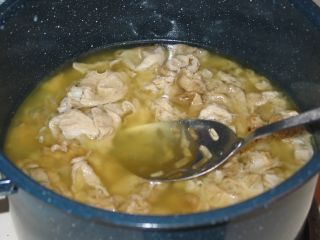
Brunswick stew

That’s the case in my family, on my father’s side. We didn’t know any differently, or where that particular type of food originated.  However, sometimes by looking at the foods families ate, we can tell something of their origins.

In marginalized populations, and by that, in the US I mean mixed race or descendants of enslaved people, it’s often very difficult to use traditional genealogical records because they didn’t own land or leave other records. Many of them spent a lot of time trying to make themselves transparent and didn’t want to attract any attention.

Often, it’s the DNA that unlocks the doors to their heritage, and after making that discovery, we can then look the cultural footprints they left for us to follow.

I’m starving. I’m going to eat something unhealthy and listen to some wonderful music!  How about grits with butter and Indian tacos for lunch along with powwow music?  Oh yeahhhhhh…….

______________________________________________________________

Disclosure

I receive a small contribution when you click on some of the links to vendors in my articles. This does NOT increase the price you pay but helps me to keep the lights on and this informational blog free for everyone. Please click on the links in the articles or to the vendors below if you are purchasing products or DNA testing.

Thank you so much.

DNA Purchases and Free Transfers

Genealogy Services

Genealogy Research

Anzick Matching Update

In response to my article about haplogroup C3*, a regular contributor, Armando, left the following comment:

“Roberta, there was a problem with the way Felix was processing files and he had to change the Clovis Anzick file three times at Gedmatch. The last one is kit F999919 uploaded October 8, 2014. You can see his post on that at http://www.fc.id.au/2014/10/new-clovis-anzick-1-kit-in-gedmatch.html

If you do one-to-many matching on Clovis Anzick F999919 at Gedmatch there is not a single person that reports to have mtDNA M. Your extracts for Clovis Anzick are from September 24, 2014 and therefore are based on a bad file which was kit F999912. The older bad kits F999912 and F999913 have been deleted from Gedmatch. Felix mentions the updates at http://www.fc.id.au/2014/09/clovis-anzick-1-dna-match-living-people.html

This comment came in on Christmas Eve, and I replied that I would look into this after the holidays.

Given that it was Christmas Eve, I certainly wasn’t going to bother anyone over the holidays with questions, so I quickly ran a one to many compare for the current Anzick kit, F999919, and found at 5cM and below that there were 4 haplogroup M matches.

ancient match

As I did before, I sent emails to those who provided e-mail addresses asking about their matrilineal heritage.

The first thing I wanted to do, of course, was to check with Felix.  I knew that Felix had updated the kits, but my understanding was that he added SNPs from the various companies to create a single file with all the SNPs from all three testing companies, not that any file was bad, so to speak.

I asked Felix if the original files had problems or were bad, and here is his response.

“I can assure you none of the earlier/older versions uploaded to GEDmatch (kit# F999912 and F999913) of Clovis Anzick was bad.

  • F999912 – Contains only FTDNA SNPs extracted from VCF file provided by authors.
  • F999913 – Contains all SNPs used by DNA testing companies extracted from VCF file provided by authors.
  • F999919 – Contains all SNPs used by DNA testing companies processed from BAM file provided by authors.

Source files: 

I removed the earlier versions not because they are bad but only to avoid redundancy for the same sample kit, and processed BAM file (which is a 41 GB file) contains significantly more SNPs compared to VCF source. Because the latest file has more SNPs, it is possible that some missing SNPs in earlier uploads (which was assumed as matching in GEDmatch) may actually have mismatches in new file and thus, could fall below the thresholds or could break the previously matching segment.

The difference in matches between F999912 and F999919 kit for Clovis Anzick is similar to difference in matches between a 23andMe V4 kit and V3 kit for the same person.”

After thinking about this some, it occurred to me that perhaps GedMatch was treating different files from different vendors differently in their matching and sorting routines. That might account for a difference in matching. So, I asked John Olson at GedMatch.

John’s reply is as follows:

“At one time, I did use different thresholds depending on which vendor was being compared to which other vendor.  That was a holdover from when FTDNA had Affymetrix kits that were producing somewhat different results than Illumina kits.  I have since changed the one-to-many thresholds to 5cM/500 SNPs for all comparisons.  The one-to-one thresholds default to 7cm/700 SNPs.  I believe I made that change about a year ago, but it may have been longer.  At any rate, they are all the same now, and I’m pretty sure they are all the same since Felix has introduced the F9999xx kits.  Another change made within the past year is to treat A=T and C=G for all comparisons.  This was done to get rid of single SNP errors in the few cases where one vendor was reporting a different strand than another vendor.  In a few cases, I have observed that this “heals” some single-SNP breaks in otherwise continuous matching segments.

It is possible that older one-to-many comparisons may have been made under slightly different conditions than newer ones.  Older comparisons made with a 3cm/300 SNP threshold may show larger total segment match if they contained many very small matching segments.  This usually happens with endogamous populations.  Comparisons affected by the change to A=T, C=G may show a larger matching segment where 2 smaller matching segments existed previously.

Another issue to be aware of when comparing artificial kits is that there may be large gaps between the defined SNPs.  So, even if there is a gap of a million SNPs, the GEDmatch comparison algorithm will treat them as contiguous.  This works OK when everybody is using the same SNPs, but when the list of SNPs is significantly different, it may produce matches that are bogus.  This is particularly obvious when generating artificial kits that are missing large segments of data.  I have had to deal with this issue with phased kits and Lazarus kits by introducing the concept of a “hard break” that forces a break between smaller matching segments.”

I wanted to know how the three files that Felix prepared compared relative to the matches they produced.  I originally ran several comparisons with each of the first two versions, kits F999912 and F999913, and I didn’t save all of the original files, but I do have at least one file saved from each version.  Therefore, I dropped all three sets of results (F999912, F999913 and F999919) into a spreadsheet to see how matching compared between the three Anzick file versions.

Keep in mind that the first file (F999912) contained just the FTDNA SNPs, while the second (F999913) and third (F999919) files contain the SNPs from all of the testing companies.  This could potentially make the participant files appear to have missing segments when the matching routine at GedMatch sees SNPs in the Anzick file not in the participant files.  However, this shouldn’t be much different than comparing a file from two different vendors except that the Anzick file has the SNPs from all three vendors combined.

The first file from 9-23 at the default threshold had 491 matches, but I subsequently lowered the threshold so I could see as many matches as possible.

GedMatch only shows you your closest 1500 matches, although I now know that as of 12-31-2014, there were a total of 3442 Anzick matches at the 5cM threshold.

The second file from 9-29, run at 6cM had more than 1500 matches.  I ran the third kit at default settings on December 27th and it has 720 matches.

One would expect that the second and third files would have the effect of including more matches from both 23andMe and Ancestry since all of the SNPs utilized by those companies are included (if they are available in the Anzick sample.)  We also have to remember that there are new files being uploaded from all three vendor sites on a daily basis, so the total available to match is also increasing.  Of the 721 kit matches to F999919, 31 were shades of green which indicate that they have been uploaded during the last 30 days, so we could probably presume that about double that number were uploaded (and match) in two months or triple in three months, so probably about 100 new kits.  Those kits would show in the match extraction for this month but not for the first month and possibly not for the second.  However, all the kits that matched the first month at the highest threshold should still be showing in the second and third month.  Let’s see if that holds true.

I dropped all three sets of data into a spreadsheet and colorized the rows.

ancient match 1

  • Blue = F999912, first extraction, 9-23-2014
  • Yellow = F999913, second extraction, 9-29-2014
  • Pink = F999919, third extraction, 12-27-2014

Then I counted the number of blue rows, which are the first extraction, that had matches to both yellow and pink, or only yellow, the second extraction, or only pink, the third (current) extraction, or no matches at all.

You can see that the green grouping shows that all three match each other.  The match between A003479 in both the second and third extraction could be because the kit was not present when the first extraction was done.

All 3 match 1st to 2nd Only 1st  to 3rd Only No Match
Percent First Extraction Matches to Other Extractions 54% 36% 5% 5%

By percent, this is how the matching between kits worked.  About half of the kits in the first extraction continued to match kits in both subsequent extractions.  Of the remaining half, three quarters of the balance matches the second extraction only and a few match just the third extraction or no extraction at all.  For the most part, there is no evident reason upon inspection why the kits would not match the second or third extraction, so the cause has to be a result of the additional SNPs or the matching routine or both.  This is not to imply that the results are problematic, just that they are different than I would have expected.

A very low percentage of kits matched only between the first and third extracts and the same percentage had no matches in either the second or third extraction.

I took a closer look at the kits with no matches at all.  All of them had relatively low threshold total cM and largest segment size.  The smallest total cM was 7.1 and the largest was 8.2.  The smallest segment was 7.1 and the largest segment was also 8.2.  All of these entries had the total cM equal to the largest cM.  It appears that these simply slipped below the match threshold, but that doesn’t appear to be the case because in the current (pink) extract, a total of 171 entries were at or below 8.2 total cM and 8.2 largest cM and several kits had the exact same cM as the kits that didn’t show up from the first (blue) extract as a match – so obviously something truly was different in the SNPs or how the matching was done.

Is there any correlation to the kits in the original extract that didn’t match any other extract in terms of which testing company the participants utilized?

One Ancestry kit (4%), 18 23andMe kits (64%), 7 Family Tree DNA kits (25%) and 2 FN kits (7%) didn’t match anyone.  But how many kits were in the original extract from the various companies?

Original Kit Matches Second KitMatches Current Kit Matches
Ancestry Kits (A) 26 (5%) 438 (29%) 199 (28%)
FTDNA Kits (F) 94 (19%) 295 (20%) 121 (17%)
Other F+ Kits* 15 (3%) 35 (2%) 15 (2%)
23andMe Kits (M) 354 (72%) 732 (49%) 382 (53%)

*FB, FN, FE, FV

The effect of the additional SNPs in the kits seems to have been to increase the Ancestry kit matches significantly.

It was interesting to see how the same person’s kit from different vendors compared as well.  In this random example, the Family Finder kit has a higher total cM and largest segment than the 23andMe v3 kit.

ancient match 2

Here’s a kit from one person at all three vendors, but the 23andMe kit is version 4, in which 23andMe significantly reduced the number of SNPs tested by about one third, from about 900,000 to about 600,000.

ancient match 3

I wondered if there is a difference in what is reported based on the threshold selected.  Now at first glance, one would think, “well of course there is a difference,” but the difference should be on the bottom end of the list.  In other words, the top matches should be the top matches at 7cM, 6cM, 5cM, etc.  The top matches at 7cM would still be the top at 6cM, just more smaller matches appended to the end of the match list – or that is what I would expect.

Let’s see if this holds true with the current file.

I ran the “one to many” option for the current Anzick kit, F999919, at seven different levels, on the same day, one right after the other, as follows:

  • 7cM, 700 SNPs
  • 6cM, 600 SNPs
  • 5cM, 500 SNPs
  • 4cM, 400 SNPs
  • 3cM, 300 SNPs
  • 2cM, 200 SNPs
  • 1cM, 100 SNPs

The first extract produced 719 records.  The rest were all over the 1500 threshold, so we only see the first 1500.  Normally, for genealogy the 1500 threshold would certainly be adequate, but for research, the threshold is frustrating.

To make this easier let me say that the extracts from 5cM down through 1cM were exactly the same, but the extracts at 7, 6 and 5cM, respectively, were not.

Discussions with John Olson at GedMatch shed some light on why the 5cM through 1cM extracts were exactly the same.

 “For the past year or so, the database has only stored matches down to 5 cM.”

I sure wish I had known that BEFORE I did all of those extracts.

I combined and color coded all 7 extractions into a spreadsheet.

Most of the grouping look like this where blue=7cm, pink=6cM, grn=5cM, purple=4cm, teal=3cm,apricot=2cm, yellow=1cm.  Nice rainbows.

ancient match 4

All of the matches from the 7cM extraction, with the exception of a few X matches at the end, some of which have no matches on chromosomes 1-22, are included in the 6cM and 5cM extractions, but after the first several records, they are not in the same position.  In other words, they are not the top 719, in the same order, in either the 5 or 6cM extraction, but the 5cM through 1cM extractions are identical.  Of course, now we know why the 5cM through 1cM matches are exact. From here forth in the article, I won’t mention the 4cM-1cM extracts because they are the same as the 5cM extract.

For example, looking at the kit in position 712, the last non-X match in the 7cM extract – you find this same kit at row 1140 in the 6cM extract and row 1489 in the 5cM extract.

The 6cM extract appears to have some issues.  I ran this twice with the same parameters to be sure there wasn’t an error in how it was set up, and the two runs were identical.

There are about 350 individuals who show up in the 6cM extract who should  show up in the 5cM extract as well, but who don’t show in the 5cM extract.  They are under the threshold for the 7cM extract, so that is correct, but why are these 350 individuals not appearing as matches at the 5cM threshold?

ancient match 5

The kits noted above are the largest non-matching total cM and largest cM that don’t show up in the 5cM extract.  The smallest matches are 6.1 and 6.1, respectively.

Checking the 5cM extract, below, there are files with smaller total cMs and a smaller largest segment that are showing as matches.

ancient match 6

However, looking at the kits with the smallest cMs at the 5cM level, the smallest total cMs is 6.9 and it is combined with the largest segment of 6.9 as well, so that is above the 6.8 and 6.8 shown above.  The smallest individual segment is 5.1 but the total cM for that individual is 10.1.  So obviously the matching threshold at GedMatch is some combination of both the total cM and the largest segment.  This is somewhat unexpected, but doesn’t seem to be a red flag, just how this system works.

So, where are we?

I am glad to have Felix confirm that the files weren’t “bad,” only truly “new and improved,” and that the matching between the various files is pretty much as expected – and from various tests run, everything pretty much looks kosher.  The newer files with all of the SNPs utilized by the companies seem to level the playing field, allowing Ancestry kits a better chance of matching.

Aside from my intense interest due to the Native American connection, this is also how I’ve been extracting potential Native American mitochondrial haplogroups from the Anzick matches, including haplogroup M, for my research notes.  M is potentially a Native American haplogroup, but is as yet unproven.  With haplogroup M showing up in these people who are often heavily Native, and often from Mexico, Central and South America where 80% of the mitochondrial population is believed to be of Native American heritage, it seems prudent to add them to my research notes for further research and possible proof in the future.  I contact individuals and ask about their matrilineal heritage.  If they don’t have Asian or genealogically proven heritage elsewhere, and their families emerge from the areas with high Native frequencies, I include them on the research list.

In the three days between the two extracts this past week, three of the four haplogroup M individuals were pushed below the match threshold and are no longer visible at the default level.  Yes, I have confirmed hat they are still there just not visible at the 1500 match threshold.

I have contacted the individuals with e-mail addresses, asking about their matrilineal heritage.  One person said the tester’s mother’s heritage was from India, so that haplogroup M is not on the research list, of course, because it is proven to be from elsewhere – a place where haplogroup M and subgroups are quite common.

In total, there were 15 new potentially Native DNA mitochondrial DNA haplogroups listed in the 12-27 extract.  I’ll be adding those to my research notes as soon as I have the opportunity to contact these folks and ask about their known matrilineal genealogy.

I didn’t really anticipate that there would be so much change, nor so quickly, so it looks like I’m going to have to check the Anzick matches for potential Native mitochondrial haplogroups much more often.

Since it looks like there may be lots of additions over time, far more than I expected, I’ll also be going back and making better notes in my research file.  I will, for example, note the kit number and date for all of the extractions.  For this and future extractions, I’ll also be listing the number of results per haplogroup.  I think that would be valuable information as well.

I’d like to thank Armando for raising this topic.  The research into matching with a kit that has the entire spectrum of SNPs from all three of the companies has been quite interesting.  In fact, unless Felix has added all of the SNPs to the other ancient kits, this is the only kit in existence that has all of the SNPs from all of the companies included.

My thanks to Felix Immanuel (formerly Felix Chandrakumar) and John Olson for assistance with research for this article.

______________________________________________________________

Disclosure

I receive a small contribution when you click on some of the links to vendors in my articles. This does NOT increase the price you pay but helps me to keep the lights on and this informational blog free for everyone. Please click on the links in the articles or to the vendors below if you are purchasing products or DNA testing.

Thank you so much.

DNA Purchases and Free Transfers

Genealogy Services

Genealogy Research

Attitude of Gratitude, Mud, Pigs and Sheep

pig

This the time of year, the holidays, that makes us all wax sentimental.  Hopefully, it causes each of us to take a few minutes to think about what we are grateful for.

Sometimes gratitude came come from odd places.  In some instances, having to deal with its polar opposite, someone who is difficult, toxic or just plain hateful makes us realize just how lucky we are in the rest of our dealings with people.  The fact that we can recognize them as such, and get out of Dodge, is a blessing as well.  And sometimes, I’m just so thankful I’m not one of them….

That’s the old saying about how one can always serve as a bad example.

My husband always says that he’s grateful for those people because they make him look so good by comparison.  Now that’s a fine example of making a silk purse out of a sow’s ear!

Of course, then there are those wonderful people, like newly discovered cousin Bill Hickerson.  I’ve been very lucky to meet so many wonderful cousins over the years and genealogy, especially genetic genealogy gives us the opportunity to meet even more.

I’ve spent some time thinking about exactly what I’m grateful for this year.

Family

When you start losing them you really start to appreciate them at a whole different level.  The more you lose, the more you appreciate the ones that are left.  Judy Russell wrote about this recently too.  It’s the holidays – so we can’t help but think about those we hold close in our hearts, whether they are on this side or the other side now.

I have no parents, aunts, uncles or siblings left, so I’ve adopted a brother, John.  Of course, this is my second brother John so now when I talk about John, or my brother John, everyone asks which brother John.  Makes for wonderfully interesting conversations!  I mean, how many people have two brothers with the same name?

It’s sometimes difficult to be the last one standing…so I guess that gets me elected as the family story-teller, the documenter.  They may be gone, but it’s up to me to make them immortal.  And, well, because they are there and I am here…I can tell any stories I want.  smiley

Chuckle.  Tee hee…

Family of Choice

These are the people not stuck with me genetically, but who hang around by choice.  Perhaps because I left the area where my family lived, and I had few and now have no living siblings, I’ve formed an adoptive family.  We function just like other families, except no bickering.  These people are extra special because they love me anyway!!!  And they think coming over and playing in the mud together is fun.

mud buddies

NewFound and ReFound Cousins

Cousins – I didn’t grow up with any.  We and they were scattered to the winds.  I’ve remet some over the years and become particularly close to several.  We’re still scattered to the winds, but e-mail and electronic communication makes it much easier to stay in touch on a much more regular basis.  Cheryl, my cousin on my Mom’s side went to Holland with me in the spring.

orange cousins crop2

Need I say more?  We had SO much fun.

Daryl, my cousin on my Dad’s side has been my travel companion for years.  She was the one trapped in the cemetery with me by the bull.  Here we are wading in the creek at Cumberland Gap that fed the land owned by the Dodsons, our common ancestral line.  It was a blistering hot day, but we had a great time together.

double trouble

A group of cousins went back to England in 2013 to visit the Speak Family homeland.  Here, we are together in the church where it all began…so to speak, pardon the pun.

Speak Family at St Mary Whalley

I love my cousins.  And no, I don’t mean I’m fond of them, I love them.  You know who you are!!!

Mary Lancashire

Mary and I in Lancashire in the churchyard where it all began for our ancestor.  The infamous Pendle Hill, a local landmark, is in the background.

I’ve had such lovely adventures with my cousins.  They have so enriched my life and I am so grateful for them….and for genealogy, or I would never have found them.

People who Share Freely

I’m incredibly grateful for people who do good work and share freely.  Ok, who do sourced, good work and share freely.

For example, there is one Acadian researcher whose tree on Rootsweb I use as the “consummate reference.”  She could refuse to share because it represents years of her hard work, and it undoubtedly does, but because she does share, it’s much more likely that there is good information being copy/pasted than bad.  She has literally saved me years of research that I probably couldn’t have done with the language barrier involved.

Furthermore, it frees the rest of us to contribute in some other way instead of retreading the ground she has already dug up.  Thank you Karen Theroit!

Another example – over the years I’ve been gifted with pictures of several ancestors that I didn’t have, nor even knew existed, among them Samuel Claxton in his Civil War uniform, Joseph “Dode” Bolton and John David Miller, shown below.  All thanks to previously unknown cousins willing to share.

john david miller familyMy way of doing the same is my 52 Ancestor series on my blog.  I’m grateful to Amy Johnson Crow for this wonderful idea which continues in 2015.

People Who DNA Test, Upload their Tree and Answer Queries

It makes life so very much easier when a family tree is attached to the DNA results.  Bless these people.

People Who Indulge Me and Agree to DNA Test

…even though they aren’t nearly as interested as I am.  Bless these people too. The cousins so often make THE difference in autosomal matching because we each carry different segments of our common ancestor – along with a few of the same segments, of course.

People who Give

….to others, unselfishly.  Some people “give” to be in the spotlight – these aren’t the people I’m talking about. I’m referring to people have been unsung, and often unthanked, volunteers for years.  I’ll list a few for whom I’m particularly grateful (in alpha order).

  • Alice Fairhurst – ISOGG Y Tree Coordinator, for 9 years as the tree has avalanched
  • Denny Brubaker who has compiled the Claiborne County Pioneer Project by indexing and entering into genealogy software over 108,000 individuals from the 1930 census and before who were documented to have lived in Claiborne County, TN
  • Paul Le Blanc – an Acadian Museum Living Legend, founder and moderator of the Acadian Rootsweb list, my cousin over 100 ways and always willing to help
  • David Powell – Estes Family Archivist and Historian – has compiled and maintains Estes family site for all descendants for nearly 15 years
  • John Olsen and Curtis Rogers, creators of www.GedMatch.com
  • Judy Russell, the Legal Genealogist, who writes an wonderful blog with a posting every single day

There are many more of these humble, selfless people in the genealogy community.  Thank you one and all.  Genealogy heroes, they serve as the best kind of example and inspiration.

Kind, Caring People with Integrity

For every jerk that we see, and unfortunately, they do stand out due to their jerkyness, there is an anonymous person who is quietly doing something caring and lovely for another being.

These are the people who stop to help the helpless; rescue a box of puppies, to save an injured duck who has been hit, to move turtles off the road or pulling someone out of a burning house or car.  It’s acts like these that are the true measure of character and integrity.

Integrity is what you do when no one else is looking and when there is no possibility that the person or thing that you’re helping can ever return any type of favor.

Here’s a picture of someone who put their car in the ditch to miss the turtle in the road….and managed to save the turtle too.

jeep in swamp

I’m extremely proud to call this person…my daughter.

Here’s a picture my daughter’s rescue this week, now named Ellie, which was, of course, not the slightest bit convenient the week before Christmas.  It may be a bit of an inconvenience for us, but it’s life-saving and life-altering for Ellie.  And there is nothing in the world like the unconditional love of a puppy!  I mean, who else can get so happy to see you they piddle all over the floor.

ellie

I’m equally as grateful for the services that my son provides to citizens daily.

firefighter

I’m especially proud of my children, of course, but I’m extremely grateful for all of the people who make the world a better place for others.

Collaborators and Peers

Genealogy and genetic genealogy has brought so many wonderful people into my life in the form of new cousins, collaborators and peers.  I can think of so many and more just keep popping into mind.

In genetic genealogy, we have to work collaboratively or we’ll get no-place fast.  It’s a  team sport.

collaboration

Where would we be without our friends and peers who we can work with and bounce things off of from time to time?  I started to make a list, but the list goes on and on and I’m afraid I’ll forget someone.  I’m just so very thankful to have such a long list.

I am particularly grateful for my DNA project co-administrators as well as other project admins.  It’s wonderful to have co-conspirators:)  The more than 8000 DNA projects wouldn’t be able to function without the volunteers administrators, and projects are incredibly valuable to genealogists.

Visionaries Among Us – Citizen Scientists

I am so very grateful to be alive at the right time and in the right place to be able to participate in the birthing of new science – genetic genealogy.  There isn’t a day that passes without learning something wonderful and new.

The entire genetic genealogy industry, and it is an industry today, was founded on  regular people, citizen scientists, noticing something and pursuing that information.

Thankfully, no one was hateful, berating or condescending to those early pioneers because they had the audacity to speak up and push the edge of the envelope, or we surely would not have seen the advances in genetic genealogy that have occurred in the past 15 years.

Bennett remarks

It 1999, the idea of testing the Y chromosome of 2 men to see if they matched was what prompted Bennett Greenspan to contact Dr. Michael Hammer at the University of Arizona.  This entire industry was founded on that relationship.  Michael wasn’t initially thrilled, but had he adopted a negative attitude about or towards Bennett, there would be no genetic genealogy industry today.  Giant oaks from tiny seedlings grow.  I am forever grateful to both of these men.  Bennett is shown above at the 2013 Conference and Michael, below at the 2014, tenth annual, International Conference on Genetic Genealogy sponsored by Family Tree DNA.

hammer 2014

Many of today’s genetic genealogists won’t have known Leo Little, but he was the genetic genealogist who noticed something was “different” about a group of STR marker results in 2002, and was ultimately responsible for the research that lead to the discovery of a SNP that separated a particular branch of the Y tree.  Today, with advent of next generation testing, we find new branches every day, but without Leo Little’s contribution of finding that first L SNP, we wouldn’t have the Y SNP sub-industry.  Fittingly, the L SNPS are named in honor of Leo and that first SNP discovered at Family Tree DNA was, appropriately, L1.

I remember the discussions about 5 years ago in the citizen scientist community about haplogroup R1b perhaps not being present in Paleolithic Europe?  Well, this year, at the Family Tree DNA conference, Michael Hammer presented evidence to that effect based on analysis of ancient remains, shown above.

Remember the days when it was stated that autosomal DNA would never be utilized in genetic genealogy?  Many won’t remember those days, because it has been the power of autosomal testing that has brought the majority of the testers to the party.  The 5th anniversary of the introduction of the first commercial autosomal DNA test was celebrated this past month.

I’m grateful for these visionary people who were brave enough to question the status quo and peer beyond the horizon.  I hope the genetic genealogy community fosters an open and supportive scientific incubator environment where people feel they can safely come forward with their observations which may in fact turn out to be important discoveries.

Ability to do for Others

This means that I’m healthy enough to do for others, so every time I make one of the care quilts, write a blog posting or do something else, I’m always grateful for that opportunity.

hemming quilt

I believe we are all enhanced and uplifted by giving.  My ways of contributing are through my care quilts, my DNA blog, by Native Heritage Project blog at www.nativeheritageproject.com and my Victory Garden blog at www.victorygardendaybyday.com, inspired by my adopted brother John.

I’m very grateful for those who support my endeavors in all kinds of ways from hemming a quilt to encouragement in a rough patch or fixing dinner.  There is very little in life that we can accomplish alone and it’s much more rewarding with companions.

Communications

ying yangYing and yang.  The ying is that it’s so much easier to have a conversation today, in many ways, which allows us access to online records and near-immediate answers – not to mention keeping up with family on Facebook and talking around the world on Skype.

The yang of course is that there is misinformation and social media brings with it its own version of unpleasantness.  Prior to the last decade or so, immediate online group access, like Facebook, wasn’t available. It’s new to our generation and will simply be normal to the next.

Social media has opened up a world of opportunities, some positive, some negative.  The positive aspects are that it’s easy to join groups of people with like interests, be they genetic genealogy or a specific ancestor or something entirely different, like quilting.

The flip side is that people aren’t always nice online and sometimes say things in a terribly negative way they might never do in person, although with some of these folks, I’m not at all sure that would make any difference.

The illusion of space between that person and their intended victim make it convenient to have a very visible online war where people tend to “show themselves in public” as my father would have put it.

When I see this happening I have to wonder if they have any idea how badly behaved they appear to others.  It’s difficult sometimes to retain a level of professional and personal decorum under those circumstances, but that brings me to my last item of gratitude…something I NEVER thought I’d say.

Mamma, prepare to roll over in your grave!

My UpBringing

My parents were not easy on me, nor was I an easy child to raise…not by a long shot.    What might be perceived as tenacity, resilience and commitment today was sheer utter unrelenting mis-focused stubbornness as a teen.  I prefer to think of it as “strong woman training wheels.”  I’m sure my mother had other names for it, and probably for me as well.

wink

However, not to be out-stubborned by me (genetic perhaps?), my mother continued, whether I wanted to hear the messages or not…to reinforce the lessons I needed to learn.  Today, as I see people behaving poorly, I hear my mother’s voice saying things like this:

“It’s not so much what you say but how you say it.”

OMG, I cannot tell you how MANY times I rolled my eyes at this one.  But, I got it.  I didn’t want to get it…but somehow it soaked in in spite of my complete and utter resistance.  She must have said this hundreds if not thousands of times – and I can still hear her voice saying it to this day.  In fact, now I want to say it to other people!

My mother had this saying written on a piece of paper and taped to the mirror that we all shared in the bathroom – for years.  I wanted to rip it down because when I most needed to read it, seeing it irritated me greatly.

Here’s another of her famous sayings.

 “If you can’t say something nice, don’t say anything at all.”

Did everyone’s mother say this?  I thought she was an idiot.

And this one.  Can you see my eyes rolling????

“You will never have to regret being a lady.”

Oh PUUUUULLLLEEZE….

A lady?  Really?  I mean, seriously???  I didn’t own a dress and lived in blue jeans.  But that really wasn’t what she meant.  I never understood that one at the time.  But I surely do now.  Bullying isn’t something new nor reserved for children and teens and neither is unbecoming behavior – and I see it regularly online and in the comments to my blog postings that don’t get approved.  You would not believe some of those.  I’ve even considered doing a humorous article utilizing those, but they are just too awful.

And here’s a last bit of wisdom from Mom, which I also didn’t comprehend at the time.

“When someone is hateful towards you, it says nothing about you and everything about them.  Same goes for you when you’re hateful.”

You know, she always had to add that little zinger clincher type of thing at the end that was equivalent to “if the shoe fits”….darn her anyway.

And then she would smugly follow up by saying something like…

“If that makes you mad, then you obviously needed to hear it.”

DAMMIT MOTHER!

My Mom was pretty “in your face” with her messages, often delivering them by pointing and shaking her index finger at you as she lectured.  My brother was so tall that he got ordered to sit down before he got his lecture so she could shake her finger directly at him instead of up in his general direction. When he got told to “sit down,” he knew he was in a heap-o-trouble.  But he unfailingly sat!  I giggled.  Then I got to sit too.

My step-Dad was more laid back and charismatic.  I was more inclined to hear what he had to say, because it was often mixed with humor and much more subtle.

He had two saying that I’ve used over and over as an adult, and that in spite of their farm flavor, hold true everyplace.  I particularly love this first one.

“Never mud wrestle with a pig. 
You can’t win. 
You get muddy.
The pig likes it.
The spectators can’t tell the difference.”

Some days I think this is my personal mantra.

And lastly, I’ll leave you with this one, except my Dad’s rendition was a little more, ahem, colorful:)

“Don’t be part of the herd.  The only thing sheep see is the south end of the other sheep going north.  If you don’t want to see a bunch of sheep butts, get out in front of the herd.”

I am so very, very thankful that my parents never raised me to be a sheep.  I’m sure they wished many times they hadn’t been quite so successful and that I hadn’t pushed the edges of the envelope quite so hard.

And yes, being a sheep would be much easier, I’m sure….but I’ll never know.  Therein lies the blessing and the curse.

So to my Mom and step-Dad, who for some ungodly reason signed on willingly, for their persistence and perseverance in the face of a defiant and ungrateful teen…..thank you.  THANK YOU.  And ……just so you know, somehow, in spite of myself, I heard you and I get it!!!

And I am really, REALLY, grateful.

______________________________________________________________

Disclosure

I receive a small contribution when you click on some of the links to vendors in my articles. This does NOT increase the price you pay but helps me to keep the lights on and this informational blog free for everyone. Please click on the links in the articles or to the vendors below if you are purchasing products or DNA testing.

Thank you so much.

DNA Purchases and Free Transfers

Genealogy Services

Genealogy Research

52 Ancestors in 52 Weeks – Round Two

bait

Last year, Amy Johnson Crow started the 52 Ancestors in 52 Weeks Challenge.  I was very pleased to hear that she is continuing the challenge, with an optional weekly theme (for inspiration, if you need it,) in 2015.

I decided to give it a try for 2014, and I’m surely glad that I did.  I know, I know…like I really needed something else to do…with a weekly (self-imposed) deadline no less.

And I’m actually astounded to say that I actually haven’t missed any.  And for the record, getting stories 37 and 38 reversed does not count as missing a week:)

I actually enjoyed this exercise a lot.

Why?

One of the things I’ve been desperately needing to do is to gather together and organize what I have on each ancestor.  I’m a 35 years (plus) genealogist.  That means I have every kind of record possible…from old letters and scrapbooks from the early 1900s to hand written family groups sheets that I painstakingly completed when I began in the 1970s to digital records received yesterday…and everything in between.  I have file drawers and boxes and files on two computers and a laptop.  I’ve moved several times and never fully unpacked.  You get the drift.

For every ancestor I’ve written about, I pulled out the files, got out the folders filed away, reviewed the records for the county involved, went through files on the computer and old e–mails that are filed by genealogy surname.  I’m amazed what I found.  Not only did I have things I didn’t realize I had, or had forgotten that I had (how is that possible?) but almost none of my holdings were organized by ancestor or family in timeline order.  Add to that the history of what was happening historically or just in that ancestor’s county during their lifetime, and you go from having the chalky outline of an ancestor with their name and a date or two to a real profile – a story about their life with meat on the bones.

Of course, because this is a DNA blog, I’ve tried to write every article with at least some useful reference to DNA and how DNA relates to that individual, without repeating myself.  That was the real challenge, but it forced me to really evaluate different aspects of DNA.  This made me focus on the DNA of that individual, whatever piece of it I had found, and what story it really had to tell. In several cases, I’ve made some amazing discoveries based on DNA evidence, some of which was probably there all along but I didn’t notice.  Some, of course, needed work, but that’s fine.  Work, I can do.

Plus, let me tell you a secret.

fish hookThose articles…..they are bait.  Yep, bait.  Ancestor bait.  Cousin bait.  And they work.

Lastly, I truly, firmly believe in sharing our knowledge.  I think it’s the best way to avoid those horribly wrong copy/paste trees that breed like rabbits overnight when you’re not looking.  If you write about it, and blog, it’s searchable via internet search…and findable without any subscription….and it’s a story all in one place…not pieces and parts attached to a tree without context or connecting threads.

Elizabeth Shown Mills, if you’re reading this…stop here!

While I know I’ve been naughty and not used exactly correct citations in proper format, you will notice that every one of my articles does provide the source, even if it’s simply my notes from 20 or 25 years ago that said the document was found in XYZ County Deed book H, page 432 or perhaps a conversation with Uncle George, or whatever.  I wish I had started out doing everything perfectly, but I didn’t.  If I was lucky, I wrote something down – because, generally, I just knew I’d remember.  I was a lot younger then and a bit naïve.  In fact, back then, I don’t think “perfect” and genealogical standards had even been defined.  If they had, it was news to me.  Besides that, I didn’t start out to do “genealogy,” I just wanted to find out something about my father’s side of the family.  I remember when someone said, “oh, you’re a genealogist” and I thought to myself, “I am?”

While a very big part of me wanted to wait until I had gone back and perfected my records, truthfully, I know that is never going to happen.  Nada.  Wish it were, but it isn’t.  In part, because I simply can’t go back and recreate what has happened over 35 years.  If I have to choose between researching new ground or retreading old ground…I’m going to choose the new…every time.  I have no idea how long I’m going to live, but assuredly not long enough to ever “finish” my genealogy – and I want to get as much done as possible.

So, I made the decision to do the best I can with what I have, make it accurate, and interesting, and sometimes, just state what needs yet to be done.  I can’t do it all…and it’s more important to share what I have than to share nothing because I was waiting for that elusive day, someday, to make it perfect.  Someday is not a day on the calendar….and many times, someday never arrives.

Future researchers can, and I hope, will, improve on what I have.  As new records become available, maybe they’ll add comments or I’ll update the articles.

I also discovered that I have a lot more than I realized…and I’m not nearly done with my ancestors at 52.  I have all of my ancestors identified to the 5th generation with the exception of one…and I’m closing in fast on her.  That’s 62 right there, without counting any of the lines I have much further back in time.

So, count me in for Amy’s 2015 Challenge – except I’ll have to label mine 52 Ancestors #53 or some such confusing thing.

If you started last year, I hope you’ll continue as well.

If not, it’s a brand new year.  Here’s the link to Amy’s 2015 article with the optional themes by week – to inspire you if you want to use them…but you don’t have to.

Here’s how it works….you write a story and post it on your blog, including the words “52 Ancestors” in the title.  Subscribe to Amy’s blog.  Every Thursday, more or less, Amy posts a “summary article” and you simply, in the comments, post the surname, article title and link to your blog article.  Here’s this week’s week 50 recap.

I encourage you to go back and scan the comments section of all of Amy’s 52 Ancestor’s blogs, because you may find articles about your ancestors.  I did – two of them – and I was very surprised.  More than I ever expected and wonderful articles too.  Maybe one week when I’m really running out of time, I’ll just link to those articles for my entry.  Yes, I know that’s cheating.

In case you didn’t know, you can get a free blog at WordPress.  I love my WordPress blogs.  Support, when I’ve needed them (seldom), has been wonderful and painless.

In fact, just in case you didn’t know it, I have more interests other than DNA and genealogy.  I know, heresy, pure heresy…

Here are my other public blogs:

Things That Are Pink and Shouldn’t Be (this was my try-my-wings blog)
Native Heritage Project
Victory Garden Day by Day (inspirational)

It’s easy to blog.  Just try it.  And write about your ancestors!!!

Just do it!

______________________________________________________________

Disclosure

I receive a small contribution when you click on some of the links to vendors in my articles. This does NOT increase the price you pay but helps me to keep the lights on and this informational blog free for everyone. Please click on the links in the articles or to the vendors below if you are purchasing products or DNA testing.

Thank you so much.

DNA Purchases and Free Transfers

Genealogy Services

Genealogy Research

Baby Boy Hacht – Born July 1944 – Dead, or Kidnapped and Alive Today??

A baby boy who was never named was born in July 1944, in Detroit, Michigan.  The family believes that he was kidnapped and another dead baby substituted for Baby Boy Hacht.  While at first this sounds improbable, if not incredulous, it isn’t.

That child, if still living, would be 70 today.  So, if you or a male family member was born in the summer of 1944, in or near Detroit, please consider this possibility as you read this article.  It’s also possible that if the child was part of a black market baby ring, the birth location could have been falsified, so any birth in late July 1944 should be considered.

What Happened?

John James Hacht & Jean Marie Mlasko were married on November 18, 1942 in  Michigan.
hacht wedding

In 1943, Jean became pregnant, and in the heat of the summer in 1944, on July 29th, their first child, a boy was born at Grace Hospital, a Catholic hospital, in Detroit.

This date is very important, as is the fact that the hospital was Catholic as this story unfolds.

I met Patti Hacht, the sister of Baby Boy Hacht, in 2009.  We worked on this mystery for some time, but have hit a dead end.  Patti’s living brother tested at Family Tree DNA for the Y DNA and Patti has tested at Family Tree DNA, 23andMe and at Ancestry for autosomal DNA.

I’ve asked Patti to tell this story in her own words.

On 29 July 1944 a first child was born to my parents – a son who never received a name other than Baby Boy Hacht (BBH.) BBH was born at Grace Hospital in Detroit, Michigan. My mom fed him for several days and then one day “medical personnel” came in and told her that her baby had died.

BBH had not been ill, and my dad’s sister worked at Grace Hospital. These three family members never believed BBH died. They always believed he was “switched” with another baby, one that really had died.  My mother did not see the baby after death, but my father did, and he never believed the dead child was his child.

When I first heard of BBH, I was in my mid-late 40’s. I was driving in the car with my mother one day as we were driving by White Chapel Cemetery, about a year before she died, and she casually said, “That’s where our first baby is buried,” then added, “but we never believed our baby died.”  I almost drove off the freeway!

First baby?

Died????

Didn’t die??

Wha…..???

It took me 3 years to find BBH at White Chapel.  As it turns out, he was not buried there.  He was cremated there, but his cremains were sent back to the funeral director.

Having been a family researcher for over 30 years, I went to the Detroit Vital Records Department to get a Death Certificate for BBH. As I walked away from the counter, reading this new document, I saw that BBH was listed as “stillborn.”

Stillborn???

That was impossible.

You can’t feed a stillborn baby for “several days.”

BBH Death

So I went back to the counter, hoping to find out what was going on with this “wrong” Death Certificate. The clerk suggested we look for a Birth Record.

Ten minutes later, we had that record, and it too stated that BBH was “stillborn.”  I later discovered that a stillborn baby never received a birth certificate at that time, only a death certificate.  In 2003, Michigan began issuing Certificates of Stillbirth in addition to death certificates.

BBH birth

On closer inspection, it was clear that the Certificate of Death had been heavily altered. Someone had taken what appeared to be a thin Scripto pen (which had not even been invented yet in 1944) and “wrote over” what had originally been written on the document. The written over date was “29”, the year was “44” and the time was “9:57 a.m.”

Additionally, except for the signatures, all of the other information for BBH was typed, except for the birth date and death information…almost like the death certificate was being pre-prepared.

BBH modification

I noticed another odd detail – BBH had been cremated. This was unheard of in this timeframe and was expressly prohibited by the Catholic church.  Grace was a Catholic hospital.  My parents were actively Catholic.  All of their children attended Catholic school.  White Chapel Cemetery, where the cremation occurred told me that they would have only cremated “maybe one person” a year in 1944, and never a newborn baby.

However, his certificate clearly states that BBH was cremated.

For several years I tried to find the funeral home, J. P. Miller on Van Dyke in Detroit. Apparently my parents never picked up BBH’s cremains, apparently because they believed he had been buried, and I wondered if I might find viable DNA in them.

After about four years, I talked with someone at the funeral home. It had been sold a couple times, and the man I spoke with was retiring the very day I had called. He said that any cremains that might have remained in the building would have been destroyed as the building had been abandoned for several years and the roof had collapsed, so the inside of the building was exposed to the elements for many years.

I wondered why my Catholic family would have cremated their child and why they never picked up the cremains or had them buried.  It makes sense only in the context that my parents never believed the dead child was their son and they sent the child’s remains who were substituted for their own child’s to be handled in the least expensive way possible.  They likely had no idea that the child’s cremains weren’t buried and were returned to the funeral home.  They never visited the grave because they never believed their child died.  Unfortunately, by the time all of the details unfolded, my parents had passed away and couldn’t be asked.

This was also a very difficult time for the family for other reasons as well.  My father’s mother was terminal with cancer and would die a couple of months later.  This young couple had their hands full.

For several years the family pondered over those “write overs” in BBH’s Certificate of Death. In April of 2006 we hired Speckin Forensic Laboratory in Okemos, Michigan to conduct a forensic exam on BBH’s original Death Certificate – we wanted to know what had been “written over.” Getting to the exam had been a lengthy process. I was appointed BBH’s Personal Representative in Probate Court, and we had to obtain a court order for the State of Michigan to allow the forensic exam.

The forensic exam showed three chemical erasures – someone used some sort of chemical to first try to “erase” what had originally been written. Then they just wrote right over those chemical erasures. The original writings were: Day, 31 July. (This had been overwritten to read “29” July); Time, 10:00 a.m. (This had been overwritten to read “9:57 a.m.) So the date was changed from 31 July to 29 July and the time was changed from 10 a.m. to 9:57 a.m.  The exam also clearly showed that the “overwritten” information was written with a different ink that the original writing.

Death Day Death Time
Original Entry July 31 10 AM
Overwritten Entry July 29 9:57 AM

It was the opinion of the examiner (who was a retired Michigan State Police Officer) that the Certificate of Death was probably altered to “match” BBH’s Certificate of Birth. There probably was a baby that died and for whatever reason, and this baby probably died on 31 July. Then BBH was “substituted” for this deceased baby, and records were created that would make BBH’s Certificate of Birth and Certificate of Death “match.”  If his birth and death date and time didn’t match, by three minutes, then he wasn’t “stillborn.”

speckin 1

speckin 2

The Detroit Legal News at that time published all the births in Wayne County. The males and females each had their own column, and the name and address of the mother was listed, along with the date of her child’s birth. I have compiled a list of about 200 male births in all of Wayne County from 27 July through 31 July. I believe one of these mothers took BBH home from the hospital and raised him as her own. She may have never known BBH was not her biological child.

I have been trying for years to narrow this list of 200+ names to ONLY babies born at Grace Hospital. All attempts to accomplish this have proved unsuccessful.  Hospital records reportedly “burned” several years ago.

St. Patrick’s Catholic Church on Parson’s Street in Detroit would have been the Church that handled emergency baptisms for babies born at Grace Hospital – babies that became ill and needed to be baptized immediately. The baby baptized would have been one of those babies on my list of 200+ names from the Detroit Legal News. St. Patrick’s records do not have a baptism for BBH or any of the other names on my list. I do not know if you had to be Catholic to deliver a baby at Grace Hospital. Perhaps the baby that really died was not born to Catholic parents, so there would not be a record of a Catholic baptism?  A stillborn baby is not baptized either.

We don’t know WHY Baby Boy Hacht was substituted for a deceased baby. Were the dead baby’s parents from an elite Detroit area family? A member of the Mob? Was it someone that hospital personnel was afraid to inform that their baby had died?  Were hospital personnel negligent with someone else’s baby and decided to switch the dead baby for BBH, thinking these were young parents and they could just have another baby the next year? Did BBH become part of a black market baby ring?  Why was the death certificate backdated to say that BBH was stillborn instead of having died 2 days later?

Or was there perhaps a widow whose husband had just been killed in WWII who  delivered a stillborn baby and doctors determined to “fix” the situation for a new widow? This last idea was nixed – as in 1944, the thinking was more “stiff upper lip” and people did not necessarily treat the bereaved gently.  The thinking of the day was to “get on with your life”, and giving a recent widow someone else’s baby didn’t mesh with that way of thinking.

Possibilities

If something wasn’t being covered up, then why were the dates and time changed, and why was a child who had lived for 2 days listed as stillborn?

Let’s take a look at scenarios of different possibilities.

  • One Time Baby Swap – The baby of another patient died or was stillborn on the 31st and BBH was swapped for that child. If this is the case, then the swap was unplanned and the mother was likely from the area. BBH’s paperwork was altered to reflect that he was the stillborn child, on the 29th, not on the 31st as originally recorded on his death certificate.
  • BBH Died of Natural Causes – If BBH simply died, the hospital would have completed a death certificate and not gone to the trouble to falsify his death certificate, claiming a still birth to match his birth certificate time and date.
  • BBH Died of an Accident by Hospital Staff – Let’s say someone on the hospital staff accidentally dropped the baby and the baby died. This might get sticky and making the death a stillbirth, which was much more common, would avoid any questions.
  • BBH Died of an Accident by His Parents – Let’s say one of his parents accidentally dropped the baby at the hospital and he died. In this case, the hospital would certainly not have been complicit in a coverup and would not have falsified the death certificate, nor claimed that the child was stillborn. There would have been a death certificate that reflected the actual death date and cause, and not a stillbirth.
  • BBH Was Part of a Larger Baby Market Ring – In this case, the couple who raised BBH as their own would not have necessarily been from the Detroit area. Young and naïve parents would have been the best targets as they would be less likely to ask questions and/or make waves. This would also have required the involvement of at least one doctor (to sign death certificates) and more likely several medical personnel including nurses. However, this would have been much more effective if the child was simply spirited away at birth and the parents told the child was dead, not after the parents having handled the child for “several days.” Given that BBH’s paternal aunt worked at that hospital, if there was something of this nature, you would think that over the years she would have at least heard rumblings, especially given that the family, including her, believed that BBH had been swapped for a dead child.

Either the One Time Baby Swap or the Accidental Death by Hospital Staff make the most sense.  If the BBH was swapped, as his parents and family believed, then he may be alive today.

It’s very possible that the parents who raised BBH had no idea what happened, and therefore, neither does BBH himself.

Babies Born in Detroit

I asked Patti to provide the various documents involved, as well as the names of the other families who were listed as having given birth in the Detroit area in the surrounding days.

It’s most likely that the baby that died passed away on July 31st and that BBH’s death certificate was amended on July 31st, as the original writing stated, to reflect that he was stillborn on July 29th instead.  Although, I certainly have to wonder if the doctor who signed as the attending physician didn’t think that the parents would have noticed at the discrepancy – especially since the child had been attended by his parents for part of the 29th, the 30th and the 31st until he “died.”  At that time, however, one simply did not question someone like a doctor.

Perhaps the amendment was actually done after the doctor signed the original death certificate, but that is unlikely, because a cause of death would have been completed by the doctor and there is no other cause of death listed other than stillborn, which was unquestionably not true.

In any event, this first list is the list of surnames of families whose children were born in Wayne County on July 31st.  The 31st is the most likely day for the baby who was stillborn to have been born since that is the original death certificate date on BBH’s death certificate.  There is no way to determine which of these babies were born at Grace Hospital.

Also, please keep in mind that this list is very likely incomplete – births of illegitimate children and children who died weren’t listed.  Others, such as famous or notorious people, may not have been listed either.  The hospital was very clearly in control of which births were submitted for publication, and which were not – and if there was something “funny” about the birth of BBH or the other child – or the parents were famous or infamous, that birth may not have been listed.  It’s also possible that the parents who wound up with BBH were not from Detroit.

  • Akin
  • Bailey
  • Bennett
  • Boytim
  • Brow
  • Bruce
  • Cappo
  • Craver
  • Davis
  • Dellamore
  • Dinneweth
  • Downes
  • DuBois
  • Elmasian
  • Faron
  • Fletcher
  • Flood
  • Gampel
  • Grandmaison
  • Harter
  • Hicks
  • Hill
  • Jones
  • Karas
  • Kekaha
  • Koblicz
  • Kraemer
  • Liss.
  • Mitchell
  • Nadolny
  • Pospeshil
  • Quiroz
  • Ready
  • Rotenberg
  • Rutzel
  • Shoemaker
  • Shoemaker
  • Smith
  • Stallings
  • Swartz
  • Thompson
  • William
  • Zimostrad

This second list includes the surnames of all of the babies born in Wayne County between July 27 and July 31, 1944 with the municipality as listed in the birth announcements in the newspaper.

7/30 Acker Detroit
7/30 Ackerman East Detroit
7/31 Akin Detroit
7/29 Anderson Detroit
7/29 Ash Detroit
7/31 Bailey Dearborn
7/27 Bartlett
7/28 Bawiee Detroit
7/27 Bazell Detroit
7/27 Beninati Detroit
7/31 Bennett Detroit
7/29 Bills Detroit
7/30 Blankenship Detroit
7/28 Bobo Detroit
7/27 Bombalski Detroit
7/30 Bond Detroit
7/28 Boorgois Gr. Pte Woods
7/28 Bourgeois Detroit
7/28 Bowman Detroit
7/29 Bowser Detroit
7/29 Boyce Detroit
7/29 Boyd Detroit
7/31 Boytim Centerline
7/29 Brantley Detroit
7/30 Brenner Detroit
7/27 Briggs Detroit
7/31 Brow Hazel Park
7/28 Brown Detroit
7/27 Brownlee Detroit
7/31 Bruce Detroit
7/30 Burchby Detroit
7/27 Burges Detroit
7/28 Burley Highland Park
7/30 Canfield Detroit
7/31 Cappo Dearborn
7/29 Carswell Detroit
7/27 Chobot Dearborn
7/28 Ciavone Detroit
7/27 Clifton Detroit
7/27 Coba Dearborn
7/29 Common Detroit
7/28 Cook Redford
7/27 Cooper Detroit
7/31 Craver Detroit
7/28 Crichton Detroit
7/29 Cromwell Grosse Pointe
7/27 Cummins Detroit
7/27 Davidson Detroit
7/28 Davio Detroit
7/31 Davis Detroit
7/31 Dellamore Detroit
7/28 Dennis Detroit
7/27 Deraedt Detroit
7/29 Dilda Detroit
7/31 Dinneweth Detroit
7/28 Donati Detroit
7/31 Downes Detroit
7/31 DuBois Detroit
7/27 Dunn Detroit
7/27 Earl Detroit
7/28 Ehrisman Detroit
7/28 Eldridge Ferndale
7/31 Elmasian Detroit
7/29 Engel Detroit
7/28 Ettinger Detroit
7/29 Fane Detroit
7/31 Faron Detroit
7/28 Fenstermacher Detroit
7/31 Fletcher Detroit
7/31 Flood Inkster
7/27 Fontana Detroit
7/29 Fung Yee Detroit
7/31 Gampel Detroit
7/29 Garrett Detroit
7/30 George Detroit
7/28 Glasnier Detroit
7/28 Gondos Detroit
7/31 Grandmaison Detroit
7/29 Greggie Birmingham
7/28 Griem Detroit
7/27 Gualdoni Detroit
7/30 Gunderson Detroit
7/29 Gurski Detroit
7/30 Hagerstrom Detroit
7/28 Harris Detroit
7/31 Harter Detroit
7/27 Haugh Detroit
7/27 Heiner Detroit
7/31 Hicks Detroit
7/28 Higgens Detroit
7/31 Hill North Carolina
7/30 Hillier Redford
7/27 Husak Detroit
7/28 Hussett Detroit
7/30 Ilby Plymouth
7/29 Jackson Detroit
7/30 Jackson Inkster
7/30 Jerimias Royal Oak
7/31 Jones Detroit
7/27 Jorden Detroit
7/30 Jozsa Detroit
7/28 July Van Dyke (??)
7/27 Kaczmarczyk Detroit
7/29 Kampa Detroit
7/31 Karas Detroit
7/30 Kaump Detroit
7/31 Kekaha Hazel Park
7/27 Kibler Detroit
7/27 Kilgore Highland Park
7/27 Kipp Royal Oak
7/31 Koblicz Detroit
7/27 Koerber Detroit
7/28 Kolongowski Detroit
7/31 Kraemer Detroit
7/27 Kuczenski Detroit
7/30 Kujawski Detroit
7/28 LaRose Detroit
7/28 Larsen Detroit
7/28 Leland Detroit
7/29 Lennert Detroit
7/29 Lightle Wyandotte
7/30 Lisiecki Hamtramak
7/31 Liss. Dearborn
7/30 Lovince Hamtramak
7/29 Lubs Allen Park
7/30 Lucey Grosse Pt. Park
7/27 Lupo Detroit
7/28 Malczyk Detroit
7/28 Maloney Detroit
7/29 Martin Detroit
7/30 Martin Detroit
7/30 Matley Detroit
7/30 Mattei Detroit
7/29 Mc Flgunn Detroit
7/28 Mc Millan Detroit
7/30 Meisner Detroit
7/27 Mitchell Detroit
7/28 Mitchell Grosse Pointe
7/29 Mitchell Ferndale
7/31 Mitchell Detroit
7/29 Moore Farmington
7/30 Moore Farmington
7/30 Morehead Inkster
7/27 Moses Detroit
7/31 Nadolny Allen Park
7/27 Neilson Detroit
7/30 Neu. Detroit
7/29 Noder Detroit
7/28 Nowakowski Detroit
7/27 Or Detroit
7/28 Pacult Detroit
7/29 Palmer Berkley
7/29 Parker Inkster
7/30 Parr Detroit
7/29 Peguese Detroit
7/29 Perri Dearborn
7/31 Pospeshil Detroit
7/30 Powell Detroit
7/27 Prange Detroit
7/31 Quiroz Detroit
7/27 Rabidue Detroit
7/30 Randolph Detroit
7/27 Ranin Detroit
7/31 Ready Detroit
7/29 Reiss Detroit
7/28 Rey Mt. Clemens
7/30 Rhodes Detroit
7/28 Richardson Detroit
7/27 Roberts Detroit
7/31 Rotenberg Detroit
7/28 Roush Detroit
7/31 Rutzel Detroit
7/30 Ryback Detroit
7/29 Rychlicki Detroit
7/29 Scafero Detroit
7/29 Schart Detroit
7/27 Schneider Detroit
7/30 Scott Detroit
7/28 Serling Detroit
7/29 Sevener Grosse Pt. Park
7/29 Shackney Detroit
7/27 Shipley Ferndale
7/31 Shoemaker Farmington
7/31 Shoemaker Detroit
7/28 Sievert Dearborn
7/29 Simm Detroit
7/27 Slavko Detroit
7/28 Smith Detroit
7/29 Smith Detroit
7/31 Smith Detroit
7/30 Springer Detroit
7/31 Stallings Detroit
7/27 Stanton Detroit
7/29 Stefanic Detroit
7/28 Steiner Detroit
7/29 Stepulla Hamtramak
7/27 Stoven Detroit
7/31 Swartz Detroit
7/28 Tekel Melvindale
7/27 Terhaar Detroit
7/31 Thompson Detroit
7/28 Towe Detroit
7/29 Tromburrini Detroit
7/28 Trouttchaud Dearborn
7/27 Turner Detroit
7/27 Vitagliano Detroit
7/27 Voss Detroit
7/27 Watkins Detroit
7/29 Watson Hazel Park
7/30 Wenban Detroit
7/29 Westland Detroit
7/27 Wheeler Detroit
7/29 Whitman Detroit
7/31 William Detroit
7/28 Williams Detroit
7/30 Williams Detroit
7/29 Winfrey Detroit
7/29 Winters Detroit
7/28 Wolfbauer East Detroit
7/29 Wright Pleasant Ridge
7/30 Wyka Detroit
7/27 Yeszin Detroit
7/28 Yokubison Detroit
7/27 Zielinski Detroit
7/31 Zimostrad Wayne
7/30 Zink Birmingham
7/27 Zoulets Royal Oak

For additional information, contact Patti Hacht at duncaha@gmail.com.  Patti does have additional information about each family from the birth announcements.

What Might Baby Boy Hacht Have Looked Like?

This first photo is of two of BBH’s siblings, as children.

Patti & Jimmy Hacht

This second photo is of the 4 Hacht siblings as adults.

Colleen, Mark (back) Jimmy & Patti Hacht

Contact

If you think you might be Baby Boy Hacht, or might know of someone who would be a candidate – please contact Patti Hacht at duncaha@gmail.com.  Patti does have additional information about these families, such as the mother’s first name and the addresses.

If you would like to DNA test first to see if you match Patti’s brother’s Y DNA or Patti’s family by autosomal DNA, please test at Family Tree DNA.

The Y chromosome is passed from father to son intact and is what makes males male.  BBH carries his father’s Y chromosome and BBH’s sons would carry his.

Autosomal DNA is contributed to a child from both parents.  The child receives half of the DNA of both of his parents.  You can read more about how DNA is used for genetic genealogy here.

The Y DNA of Baby Boy Hacht or a his male child or male grandchild through a son will match that of Patti’s brother.  The autosomal DNA of Baby Boy Hacht or his children or grandchildren of any gender will match with Patti and her family.

If you would like to DNA test, we recommend the 37 marker Y DNA test at Family Tree DNA for males and the Family Finder autosomal test for either gender

Here’s the link if you’re interested.

______________________________________________________________

Disclosure

I receive a small contribution when you click on some of the links to vendors in my articles. This does NOT increase the price you pay but helps me to keep the lights on and this informational blog free for everyone. Please click on the links in the articles or to the vendors below if you are purchasing products or DNA testing.

Thank you so much.

DNA Purchases and Free Transfers

Genealogy Services

Genealogy Research

Updated Native American Mitochondrial DNA Haplogroups

dna helixI’ve updated the list of Native American Mitochondrial DNA Haplogroups and their sources.

This most recent update comes from both GenBank the Anzick extrapolations, with links provided when possible.

If you know of other credibly sourced Native haplogroup information, please let me know.

______________________________________________________________

Disclosure

I receive a small contribution when you click on some of the links to vendors in my articles. This does NOT increase the price you pay but helps me to keep the lights on and this informational blog free for everyone. Please click on the links in the articles or to the vendors below if you are purchasing products or DNA testing.

Thank you so much.

DNA Purchases and Free Transfers

Genealogy Services

Genealogy Research

In Anticipation of Ancestry’s Better Mousetrap

Knowing that Ancestry’s leaner, meaner, better mousetrap is forthcoming shortly, I decided to take a final look at the old mousetrap at Ancestry and collect some information so that I can reliably compare said old mousetrap with the new and improved version.

On November 17, 2014, I had 262 pages of matches, at 50 matches per page, for approximately 13,100 matches. Clearly, I’m never going to contact all of those, or even most of those.

My matches break down as follows:

  • 1 second cousin who doesn’t reply to messages. Their tree is visible, but I don’t see a common ancestor.
  • 10 third cousins, of whom 2 are known cousins prior to DNA testing. Three others have no family tree. Other than my known cousins, I can only find one genealogy connection, thanks to a shakey leaf.
  • 243 fourth cousins
  • 12,846 distant cousins, few of which have any connecting genealogy information to me

Let’s take a look at how this breaks down.

mousetrap1

mousetrap2

My third cousin match (that I didn’t previously know) has a shakey leaf that shows the following common ancestors. You might notice that even though we are predicted as third cousins with a range of 3rd to 4th and a confidence rating of 98%, we are actually 5th cousins.  That’s the nature of random DNA recombination in each generation.

mousetrap3

That cousin and I match through Daniel Miller and Elizabeth Ulrich.

Actually, that’s not true – but it’s so easy to say and infer. In truth, we don’t know HOW we match, but we do have a DNA match and we do have a shared genealogy paper-trail ancestor in Daniel Miller and Elizabeth Ulrich.  So, we MAY have a genetic match through these ancestors – or it might be through another line – known or unknown.  But there is no way to tell for sure – at least not today at Ancestry.

Case in point…just very recently, when dealing with this exact same Miller line, I discovered that I did match one of my cousins at Family Tree DNA on the Miller line, but that we also have a second unknown genetic link on the X chromosome that could not have come from that Miller couple.

The problem with the matches at Ancestry is that they are suggestive and not in any way conclusive. Why?  Because there is no chromosome browser or other tool to show that these people match on the same chromosomes.  That would be step 1.  A tool to see that those two people match another descendant on the same segment would be step two in truly identifying and confirming a common genetic ancestor.  But neither of these steps exist at Ancestry today.  Many people either don’t know or don’t understand that, or flat out don’t care – because they are meeting paper trail cousins.

If meeting paper trail cousins is your goal – then you can do a bang up job of that at Ancestry!  In fact, I could meet 13,100 new cousins today. Just don’t assume that because you match them on DNA and on paper that the paper trail IS the genetic trail, because it might well not be.  Never assume.

When looking at my Miller match’s tree, I notice that they have not only the incorrect, or at least unsubstantiated Rochette surname for Daniel’s mother, but they have also added another surname…out of thin air apparently – Maugens. Groan.  Another incorrect tree – and this single ancestor is incorrect in two distinct ways.

mousetrap4

I checked to see what sources they noted, and they gave the “Family Data Collection of Individual Records” as a source for every record. I’m sorry, but someone else’s hearsay isn’t a record source.  However, I’ll leave source records to the experts and move on with genetic genealogy.  However, word to the wise…. with Ancestry’s new and better mousetrap, accurate trees become exponentially more important.

Yes, I have seen a beta version mousetrap preview.

Today, I have 243 fourth cousins, 10 of which have shakey leaf hints, meaning that we do show a common paper-trail ancestor:

  1. Spklegirl- Francois LaFaille (also show Brown as a shared surname)
  2. Dbreeding63 – Fairwix Claxton and Agnes Muncy
  3. H.C. – Jacob Lentz and Frederica Moselman
  4. Alyssa- Lazarus Estes and Elizabeth Vannoy – no response to messages (last logged in May 12, 2014 – not a good sign)
  5. Nanbowjack – private tree
  6. L.W. – private tree
  7. P.B. – private tree
  8. 1_cmarse – private tree
  9. MDgenealogy20 – private tree
  10. Susanharmon – private tree

Six of my 10 fourth cousin shakey leaf people have private trees, more than half.

Of the entire group of 254 matches of 2nd – 4th cousins, 44 have private trees.

Of those 254, another 52 don’t have trees uploaded. This is like cutting your nose off to spite your face.  It’s easy to create an abbreviated tree, if nothing else, if you don’t want to upload your full tree from your genealogy software.  That gives Ancestry’s software something to work with – a way to look for pedigree matches.  No tree, no shakey leaf hints.  Include at least 7 generations, if you have them.

So, of those 254 matches, I know that I’ll positively lose 96 due to private trees and no trees. Truthfully, I’m absolutely fine with that.  Those matches are of absolutely no use to me.  My efforts to communicate with Ancestry matches have been relatively unsuccessful, to the point that I’ve wondered if there is a glitch with my mail and their system – until a cousin sent me a test message to see if it was working.  So, I’m glad to be rid of unproductive no tree matches that simply clutter up the works.  I don’t want to see private tree teasers that I want and can’t have.

It will be interesting to see how many of my shakey leaves, if any, I’ll lose. Maybe I’ll acquire some new ones!!!  I can always hope.

Shakey Leaves

mousetrap5

Speaking of shakey leaves, by utilizing the shakey leaf hint filter ability, I can see only my shakey leaf hint matches, eliminating the rest. This is what I normally do, right after I see if I have any new close matches.

In my distant cousin matches, I have 36 additional shakey leaves, as follows, arranged by ancestor matches:

Ctkatherine – Fairwick Claxton and Agnes Muncy

Rodneybranch1 – James Lee Claxton and Sarah “Sary” Cook

Petwin73 – John Hill and Catherine Mitchell

Greatpyr616 – Henry Bolton and Nancy Mann
Marsha Bolton – Henry Bolton and Nancy Mann
Ctlynch01 – Henry Bolton and Nancy Mann
C.L.M. – Henry Bolton and Nancy Mann
Tjfhorn1 – Henry Bolton and Nancy Mann

Dblrich – Honore Lore and Marie Lafaille

Rkoelpin – Francois Lafaille

William Lowe94 – Joseph Preston Bolton (share 8 surnames plus Combs – Herrell family is the same)

E.J.H. – John Francis Vannoy and Susannah Anderson
Rheainhatton – Francis Vannoy and Catherine Anderson
Viero111777 – John Francis Vannoy and Susannah Anderson
Maggiejames113 – John Francis Vannoy and Susannah Anderson

J.M. – John Vanoy

RWECIII – Jotham Brown
Raymond Brown – Jotham Brown
Tgbils917 – Jotham Brown
Skyrider3277 – Jotham Brown
Browndavid239 – Jotham Brown

R.G. – John R. Estes and Nancy Ann Moore
Chuck2810 – John R. Estes and Nancy Ann Moore (multiple ancestral line in this tree)

Lodikid – Andrew McKee

C.A.W. – Daniel Miller and Elizabeth Ulrich

Ostate4454 – John Campbell and Jane “Jenny” Dobkins (wrong parents for John)

A.F.B. – Nicholas Speaks and Sarah Faires

Razzanozoo1 – Lois McNiel

M.S. – private tree
Christine414 – private tree
DDicksson – private tree
FruitofVine – private tree
Lisa36ang – private tree
J.M.F. – private tree
1_perry22 – private tree
Jcarolynbh – private tree

DNA Testing Goals

I realized this week when I received an e-mail from someone requesting assistance that goals and expectations surrounding DNA testing vary widely in the genetic genealogy community. This person said, “I thought when I took a DNA test that all of my brick walls would just melt away.”

Clearly, that’s not the case.

I think with the increasing popularity of DNA testing that a wider range of people take the tests, and often without really understanding DNA testing, the various kinds of tests, or what DNA results can or might do for them.

DNA testing is a toolkit, and which tool, under what circumstances, is best for the job varies based on your goals. It’s like picking the right sized socket wrench.

wrench

Let me be very specific about my personal goals.

I want to learn everything I can about my ancestors. I am not interested in inferring a genetic match when said match can be proven.

1. I want to know the haplogroup of every single ancestor in my tree – both male and female. Why? Because Y and mitochondrial DNA testing is the only direct line information I can obtain on those ancestors, and it stretches back far beyond any prayer of written records or surnames. It tells me their ethnicity and often, where they came from – sometimes in general terms and sometimes in much more specific terms.

2. I want to map my ancestor’s DNA on my chromosomes. In other words, I want to know that my DNA on chromosome 1, section 1-10,000 came from the Ferverda line on my mother’s side and from John Y. Estes and Rutha Dodson on my father’s side. This opens the door to do things like Ancestor Reconstruction as well as to identify where those other 12,846 people without shakey leaves fall on my tree, based on WHERE they match me.

While I am interested in meeting my cousins, especially cousins who are actively researching our common ancestral line, I’m not interested in meeting endless cousins who are just copy/pasting data from tree to tree. Rhetorically speaking, what the heck would I do with 13,000 new cousins.  I can barely remember the names of the ones I have!

For me, the end goal is not meeting cousins, specifically, although I do enjoy many of the cousins I meet through genealogy. Some of my very closest friends are my genealogy cousins.  But this isn’t a genealogy singles bar and I’m not interested in doing DNA speed dating, so to speak.

3. My goal is to discover every shred I can about my ancestors and to break down brick walls utilizing DNA.  See number 2, above.

To match my cousins whom I already know is great confirmation that I’m really a family member, but it does little more except provide the foundation for chromosome mapping utilizing chromosome browser tools. I need tools to find those missing wives lines, and to add to the tree – maybe to discover who someone’s parents actually were.  Those are the kinds of genetic genealogy dreams I have.  That’s my idea of a better mousetrap.

Ancestry’s New Mousetrap

During our meeting in October and follow-up conference call, Ancestry indicated that their new processing methods would result in many fewer matches, but much higher quality matches, based on their new phasing routines and new features. I welcome both of those improvements.

I wrote about the Ancestry visit here.  Judy Russell wrote about it here, and Blaine Bettinger wrote about it as well.  Anna Swayne, who leads the effort in genetic genealogy education at Ancestry wrote about the upcoming DNA release and referenced information provided by Ken Chahine, the AncestryDNA general manager.  So, now that you know what to expect, it will be interesting to see the real McCoy…er…I mean the new and better mousetrap.

The close and shakey leaf matches I’ve discussed above are the only ones I really care much about – because they are the only ones that are actually useful to me under the current circumstances. I would love to find a way to make the balance of my 12,846 matches useful.  That would be an exceptional mousetrap.

It will be interesting to see how many of these shakey leaf matches I lose, what, as a consumer and Ancestry subscriber I will gain, and how the new mousetrap will help genealogists break down brick walls.

In the end, that’s really the measure of usefulness of any genetic genealogy mousetrap.

______________________________________________________________

Disclosure

I receive a small contribution when you click on some of the links to vendors in my articles. This does NOT increase the price you pay but helps me to keep the lights on and this informational blog free for everyone. Please click on the links in the articles or to the vendors below if you are purchasing products or DNA testing.

Thank you so much.

DNA Purchases and Free Transfers

Genealogy Services

Genealogy Research

Kostenki14 – A New Ancient Siberian DNA Sample

k14 skeleton

This week, published in Science, we find another ancient DNA full genome sequence from Siberia in an article titled “Genomic structure in Europeans dating back at least 36,200 years” by Seguin-Orlando et al.. This sample, partially shown above, is quite old and closely related to the Mal’ta child, also found in Siberia from about 24,000 years ago. Interestingly enough, K14 carries more Neanderthal DNA than current Europeans. This skeleton was actually excavated in 1954, but was only recently genetically analyzed.

k14 mapFrom the paper, this map above shows the locations of recently analyzed ancient DNA samples.  Note that even though K14 and Mal’ta child are similar, they are not located in close geographic proximity.

k14 population clusterAlso from the paper, this chart of population clusters is quite interesting, because we can see which of these ancient samples share some heritage with today’s indigenous American populations, shown in grey. UPGH=Upper Paleolithic Hunter-Gatherer, MHG=Mesolithic Hunter Gatherer, which is later in time that Paleolithic, and NEOL=Neolithic indicating the farming population that arrived in Europe approximately 7,000-10,000 years ago from the Middle East

You can see that the Neolithic samples show no trace of ancestry with today’s Native people, but both pre-Neolithic Hunter-Gatherer cultures show some amount of shared ancestry with Native people. However, to date, MA1, the Malta child is the most closely related and carries the most DNA in common with today’s Native people.

Felix Chandrakumar is currently preparing the K14 genome for addition to the ancient DNA kits at GedMatch.  It will be interesting to see if this sample also matches currently living individuals.

Also from the K14 paper, you can see on the map below where K14 matches current worldwide and European populations, where the warmer colors, i.e. red, indicated a closer match.

K14 population matches

Of interest to genealogists and population geneticists, K14’s mitochondrial haplogroup is U2 and his Y haplogroup is C-M130, the same as LaBrana, a late Mesolithic hunter-gatherer found in northern Spain. Haplogroup C is, of course, one of the base haplogroups for the Native people of the Americas.

The K14 paper further fleshes out the new peopling of Europe diagram discussed in my Peopling of Europe article.

This map, from the Lazardis “Ancient human genomes suggest three ancestral populations for present-day Europeans” paper published in September 2014, shows the newly defined map including Ancient North Eurasian in this diagram.

Lazaridis tree

K14 adds to this diagram in the following manner, although the paths are flipped right to left.

K14 tree

Blue represent current populations, red are ancient remains and green are ancestral populations.

Dienekes wrote about this find as well, here.

Paper Abstract:

The origin of contemporary Europeans remains contentious. We obtain a genome sequence from Kostenki 14 in European Russia dating to 38,700 to 36,200 years ago, one of the oldest fossils of Anatomically Modern Humans from Europe. We find that K14 shares a close ancestry with the 24,000-year-old Mal’ta boy from central Siberia, European Mesolithic hunter-gatherers, some contemporary western Siberians, and many Europeans, but not eastern Asians. Additionally, the Kostenki 14 genome shows evidence of shared ancestry with a population basal to all Eurasians that also relates to later European Neolithic farmers. We find that Kostenki 14 contains more Neandertal DNA that is contained in longer tracts than present Europeans. Our findings reveal the timing of divergence of western Eurasians and East Asians to be more than 36,200 years ago and that European genomic structure today dates back to the Upper Paleolithic and derives from a meta-population that at times stretched from Europe to central Asia.

You can read the full paper at the two links below.

http://www.sciencemag.org/content/early/2014/11/05/science.aaa0114

http://www2.zoo.cam.ac.uk/manica/ms/2014_Seguin_Orlando_et_al_Science.pdf

It’s been a great year for ancient DNA analysis and learning about our ancestral human populations.

However, I have one observation I just have to make about this particular find.

What amazing teeth. Obviously, this culture did not consume sugar!

______________________________________________________________

Disclosure

I receive a small contribution when you click on some of the links to vendors in my articles. This does NOT increase the price you pay but helps me to keep the lights on and this informational blog free for everyone. Please click on the links in the articles or to the vendors below if you are purchasing products or DNA testing.

Thank you so much.

DNA Purchases and Free Transfers

Genealogy Services

Genealogy Research

WikiTree Makes Finding Relationships with DNA Matches Easier

Today, I received the following press release from WikiTree.  WikiTree is a free resource for genealogists seeking to collaborate with other genealogists.  More importantly, in the past couple of years, WikiTree has begun actively incorporating features for genetic genealogists.

6 November 2014: Today WikiTree.com is announcing two important features for genealogists who have taken DNA tests. These features make WikiTree’s Relationship Finder a uniquely powerful tool for genealogists who have taken 23andMe, AncestryDNA, and FTDNA Family Finder tests.

“One of the biggest challenges facing genetic genealogists,” according to Dr. Blaine Bettinger, author of the long-running blog The GeneticGenealogist, “is finding the elusive common ancestor. Finding genetic matches is easy, but finding the common ancestor from whom we inherited a segment DNA is very hard. WikiTree’s new Relationship Finder is a great tool for identifying the ancestors that two or more people share in common.”

All Common Ancestors

Genealogical relationship finders are generally designed to find the first common ancestor between two people. Genetic genealogists need to know about all the common ancestors they share with a match. Everyone’s family tree intertwines in multiple ways. The first shared ancestor may not be the reason for a shared segment of autosomal DNA.

WikiTree’s Relationship Finder now enables you to easily browse all your common ancestors.

WikiTree common ancestors

Filtering for Multiple Matches

When a genealogist shares a segment of autosomal DNA with two or more other people who also match each other on that segment, it’s a big clue in discovering which ancestor it came from.

WikiTree’s Relationship Finder now enables you to filter the common ancestors shared by two people to only display common ancestors who are also shared by a third, fourth, or fifth person.

The Universal Family Tree

These Relationship Finder features are possible because WikiTree members are collaborating on a single tree for the entire human family.

“The genetic genealogy community absolutely must have a universal family tree,” says leading genetic genealogist Dr. Tim Janzen. “With smaller unlinked trees it’s frequently impossible to see all of the true genealogical connections with the people who share autosomal DNA with us. We are finally getting to the point where this vision is becoming a reality at WikiTree.”

About WikiTree

WikiTree: The Free Family Tree has been growing since 2008. Community members privately collaborate with close family members on modern family history and publicly collaborate with other genealogists on deep ancestry. Since all the private and public profiles are connected on the same system this process is helping to grow a single, worldwide family tree that will eventually connect us all and thereby make it free and easy for anyone to discover their roots. See http://www.WikiTree.com.

______________________________________________________________

Disclosure

I receive a small contribution when you click on some of the links to vendors in my articles. This does NOT increase the price you pay but helps me to keep the lights on and this informational blog free for everyone. Please click on the links in the articles or to the vendors below if you are purchasing products or DNA testing.

Thank you so much.

DNA Purchases and Free Transfers

Genealogy Services

Genealogy Research