The DNAeXplain 500 – Articles That Is

500

Time flies when you’re having fun.  Also, apparently when you are blogging.

I started blogging because I manage a number of DNA projects at Family Tree DNA and rather than trying to constantly send group mails to project participants, which generally resulted in my e-mail address being blacklisted as a spammer, it was much, MUCH simpler to simply write “it,” whatever “it” happened to be, once, in a blog, available to my project members and the rest of the genetic genealogy community as well.

Another reason is because I constantly receive the same set of questions, and having a blog article to refer to with the answer is much easier than writing that same answer repeatedly.  Plus, you can do the same thing when you receive these same questions.

I started the www.dna-explained.com blog on July 11, 2012 with the hope that I’d be able to write two articles a week.  Then I officially decided that maybe one article per week would be a more realistic goal.  For those of you who don’t write, that might sound easy.  For those of you who do write – you’re wondering if I am out of my mind.

The answer, by the way, is “yes,” and I’m proud of it:)  Runs in my family.  Probably genetic.  Is there a stubborn gene?

The surest way of getting one of my family members to do something is even to suggest that they can’t, or that it’s impossible.  Fait accompli!

Had I hit my goal, by now I’d have either just over 150 articles at one per week, or just over 300 at two per week.

I have….drum roll please…..519.

Ok, so I might have gotten a little carried away.

That’s the good news….all that info for you.  Now, the bad news is that because there are so many articles, it’s hard for a new person to real all 519 – or even to figure out which ones they should read.

Hmmm…need to do something about this.

There are a couple of answers to this dilemma – ways to effectively and efficiently find just what you’re looking for

Category Searching

category search

Every one of my articles is categorized by search terms.  If you’re interested in mitochondrial DNA, for example, you simply enter the term “mitochondrial” in the search box in the upper right hand corner and the blog will return to you any article I’ve tagged with “mitochondrial DNA,” beginning with the most recent.

category search2

You can see all the categories I’ve used if you scroll all the way down on the right side of the main blog page, but trust me when I say I tag these articles so they can be found in just about any way someone would be interested.

Key Word Searching

Let’s say you remember that you saw an article about using Big Y DNA results in the Estes family history project.  You could search by Big Y, but let’s say you search instead by “Estes.”  Estes is not a DNA search category, but the search engine will still find articles with Estes in the title, then articles with Estes in the text.

key word search

You can see that this article was also categorized under Big Y, SNP and STR, so it would have shown up if you had searched for any of those terms as well.

Search Tags

Because there is more than one way to organize data, WordPress also provides bloggers with something called Tags.  In my case, I use Tags for broader categories of information.  For example, my “52 Weeks of Ancestors” is one tag, as is the “autosomalme” series and the “2013 DNA Trip.”  These aren’t exactly genetic genealogy terms, but they make sense for information groupings in the context of this blog.

Using This Blog As An Educational Tool

In honor of 500+ articles and nearly three years, I’ve introduced some new tags so that articles can be retrieved in a different way.  My goal is to group articles in categories so that they are in essence a group of educational classes.

I’ve grouped articles into the following categories.

  • Historical or Obsolete – these are items that were interesting at the time by aren’t really relevant today – except in a historical context. An example would be the announcement of the Genographic 2 project in July of 2012. You may wonder why I didn’t delete these. Looking back, these are somewhat like a genetic genealogy journal.
  • General Information – these are generally articles about DNA and genealogy. They don’t presume that you’re actually working with the results.
  • Basic Education – this may be basic genealogy or basic DNA fundamentals. These articles provide a foundation for working with your results. Think of it as pre-bootcamp.
  • Introductory DNA – these articles do presume you are working with your results. Bootcamp begins here.
  • Intermediate DNA – these are a little more difficult and you’ll probably need the basics and introductory understanding to be able to work at this level.
  • Advanced DNA – very few articles are advanced. In fact, I try very hard to avoid this, when possible. Mostly, these have to do with advanced autosomal techniques and research.
  • Examples – these are examples of using genealogy and DNA together seamlessly. My 52 Ancestors stories fall into this category. Think of these as story problems that include the answers!
  • Educational – educational opportunities such as classes, books and videos.
  • Entertainment – just for fun, like the Who Do You Think You Are series, some of these have no DNA content.
  • Project Administration – articles written for project administrators at Family Tree DNA. Project administrators, of course, will be interested in all of the rest.

I have gone back and tagged every single article with it’s appropriate tag, and going forward, I’ll tag them as I write them so you can find them in their relevant grouping.  No, that process wasn’t fun, but when I started this blog, I truly had no idea that anything like groupings would ever be necessary.  Let’s just say this blog, as well as genetic genealogy, has taken on an evolutionary life of its own.

In the next several days, I’ll be publishing lists of the articles that fall into the various categories.

So, now, when someone asks for an educational resource, you have another tool to use and another reference.

Cant’s wait?  There are two ways to access posts using these tags today.

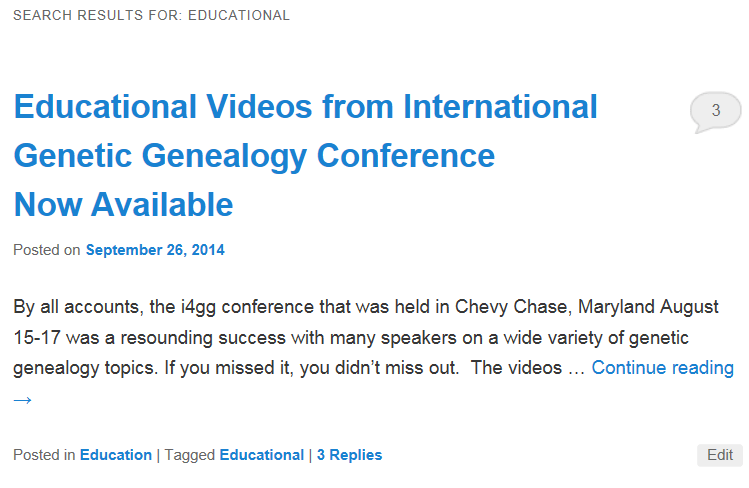
To find the posts in any tag group, just enter the name of that tag group into the search engine – for example “Educational.”  What will be returned are articles using the tag “educational,” plus anything else the search engine thinks falls into that category too.

educationalTo see just the articles in the Educational tag group click on the little blue “Educational” link at the bottom of the article preview.  You can see it above, where it says “Tagged.”

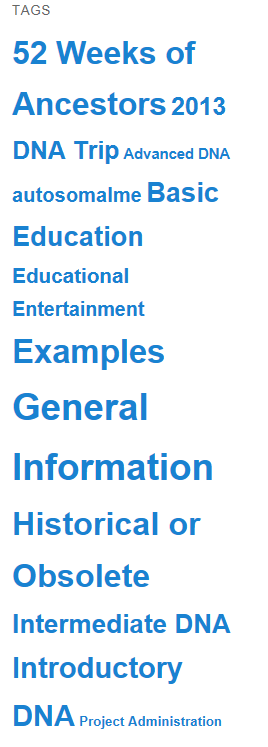
You can also see all of the tag groups by scrolling down the right sidebar on the main blog page, past the categories, to the “tag cloud”.  I’m not cracked up about this format, but it’s what this blog theme offers.  The most used tags are the largest.  Just click on the one you want to see.  It’s that easy. tag cloud

______________________________________________________________

Disclosure

I receive a small contribution when you click on some of the links to vendors in my articles. This does NOT increase the price you pay but helps me to keep the lights on and this informational blog free for everyone. Please click on the links in the articles or to the vendors below if you are purchasing products or DNA testing.

Thank you so much.

DNA Purchases and Free Transfers

Genealogy Services

Genealogy Research

Segmentology.org by Jim Bartlett

segmentology

Today, I want to talk about another blogger – a new blogger – Jim Bartlett.  I’m very glad to see Jim enter the blogging space.  Welcome Aboard!!!!

You might be surprised to see one blogger recommending another.  Don’t be.  There are few people in any field who agree 100% of the time, but Jim is the ultimate, respectful professional and shares graciously and willingly with others, and has for years.

I want to take this opportunity to welcome Jim, and to tell you something about him and why you might want to follow what he has to say.  He may be a novice blogger, but he certainly is not a novice genetic genealogist.

It’s interesting to learn about your fellow genetic genealogists.  None of us began in this field, because most of us began our careers long before this field existed.  For the most part, we were or are professionals in another scientific or technical field.  Jim is no exception and he, like others, brought the best of his professional experience to genetic genealogy.

Jim is an engineer by education (Bachelor and Masters degrees), and spent 50 years in various aspects of construction, including a Design Engineer for the Smithsonian Institution; Program Manager for the $2 billion TRIDENT Base in GA; Program Manager for US NATO Construction, etc.  Jim has a knack for puzzles and spatial design. Jim says, “As soon as I learned about autosomal DNA, I caught on pretty quickly. I view the mapping of my chromosomes to my ancestors as the ultimate puzzle.”  Isn’t that the truth!

Jim has been active in genealogy since 1974 (visiting courthouses, scrolling microfilms, lunches at DAR Library, etc.  In 2002 he began the BARTLETT-DNA Project, which has grown to over 300 participants and has identified 23 separate lines.  Jim cut his genetic genealogy teeth on the Y chromosome.

Since 2010 Jim has been involved with the newest DNA tool, autosomal DNA, which provides matches with cousins from any/all of your ancestors. He has tested at all 3 companies, Family Tree DNA, 23andMe and Ancestry, and also uses GEDmatch.

The simple version of Jim’s advice is: communicate; share; find common ancestors!

The more complex version involves spreadsheets, segment analysis, and triangulation and that’s what his new blog will address.

In any up-and-coming field, new experts appear on a daily basis.  If you follow any of the social media or genetic genealogy lists, you’ll probably notice from time to time that a new “expert” whom you’ve never heard of before appears and states “facts” or opinions as facts.

There are but a handful of individuals whom I truly consider to be experts in this field.  Some are very specialized in one area and some are both wide and deep.  One characteristic in common with them all is that they have years, as in many, MANY years of experience in both genetic genealogy AND genealogy.  None of them are newcomers by any definition.

Jim is one of these seasoned experts with a very unique claim to fame.  Jim has mapped more of his autosomal DNA than anyone else that I know of.  And I mean bar none.  He is #1!  Jim is one of the most dedicated researchers I have ever met.  He is the example that the rest of us aspire to.  That’s because Jim is both retired and committed – working on his genetic genealogy every day!

I asked Jim how much of his autosomal DNA he has been able to attribute to a particular ancestor or ancestral group.

“I now have over 4,000 different Matches in my spreadsheet. I’ve mapped over 88 percent of my 45 chromosomes (based on base pairs). I’ve determined Common Ancestors for about 70 percent of my DNA (based on base pairs). Most of my 340 triangulation groups are heel-and-toe on the chromosomes with only a few gaps over 10cM left (mostly from my maternal grandmother’s immigrant ancestor from Scotland and Germany in the 1850s.)

This has been a fantastic journey. I’m now working with the matches in my triangulation groups to dig deeper into finding our Common Ancestors.”

Fortunately for the rest of us, Jim has decided to share his experiences, advice and puzzle solving expertise with the genetic genealogy community and recently created his new blog, http://segmentology.org/.  You can follow his blog by clicking on the little grey follow button on the right hand side of his main blog page.

So far, Jim has published four articles:

What is a Segment?
Benefits of Triangulation
Does Triangulation Always Work?
How to Triangulate?

If you subscribe today, you won’t miss any of what Jim has to say.

______________________________________________________________

Disclosure

I receive a small contribution when you click on some of the links to vendors in my articles. This does NOT increase the price you pay but helps me to keep the lights on and this informational blog free for everyone. Please click on the links in the articles or to the vendors below if you are purchasing products or DNA testing.

Thank you so much.

DNA Purchases and Free Transfers

Genealogy Services

Genealogy Research

Milestone 5000

double helix band

In our personal lives, we have milestones.  Some milestones we work towards and others happen, whether we do anything or not – like birthdays.

Some birthdays are considered milestone birthdays – like – when I was a kid – 16 – because it brought with it the freedom of driving.

On the night of April 19, 2015, sometime in the darkest hours of overnight (at least here in the US,) the www.DNA-explained.com blog reached a blogging milestone of sorts – 5000 subscribers.  And those are just the folks I know about.  Blogging management software tells us how many subscribers via e-mail, Facebook and Twitter we have, but it doesn’t tell us how many people are following us by RSS feeds.  I know there are quite a few, because one of the very first requests I received when I began the www.DNA-explained.com blog in July of 2012 was to set up the RSS feed subscription ability.

We also can’t tell how many times our article has been shared, reposted, tweeted and retweeted.

Bloggers using the WordPress platform have software that tells us how many page hits we receive, per day or per article, broken down in various ways.  Many people who subscribe via e-mail read the articles in their e-mail, so they don’t actually visit the page itself.  A normal day sees www.DNA-explained.com get about 10,000 page hits, so that’s in addition to e-mail subscribers.  A really popular or controversial article sends that off the charts.

The great irony is that when I started the blog, I wondered if even 100 people would be interested.  My real reason for creating the blog was so that I would have a public location to write about topics that I felt needed answers.  Additionally, I manage several projects at Family Tree DNA, and I wanted a way to provide information to project members about items such as sales and new features without having to send group e-mails to each project.  Why?  The Cumberland Gap projects have about 10,000 members between the Y and mtDNA groups, and sending that many messages with your e-mail address listed as the sender is a really good way to get your e-mail address blacklisted as a spammer. Blogging solves that problem, because I write it once and anyone who is interested can subscribe – and anyone who isn’t interested, isn’t bothered.

I started by taking the most common questions I received and writing the answer – one time – in the format of an article so that I can forever refer people to that article for the answer.  So you might say I started blogging in self-defense:)

From the beginning, I set up topic categories so that searching would be more effective.  (The blog is fully searchable.)  Categories are anything that might be a key word, like DNA types (Y, mitochondrial, autosomal), company names, or topics one might be searching for, like Native American, haplogroups or admixture.

What do you think the most viewed categories might be?

  • Autosomal
  • Family Tree DNA
  • Y DNA
  • 23andMe
  • Mitochondrial DNA
  • Admixture
  • Haplogroups
  • Native American

What are the most popular articles, over the entire timespan of the life of the blog?

Proving Native American Ancestry

Ethnicity Results – True or Not?

What is a Haplogroup?

Of course, these articles are older as well, so they have had more time to accumulate views.

I can tell you unequivocally that the article I refer people to the most to answer the question, “What kind of DNA test should I take?” is:

4 Kinds of DNA for Genetic Genealogy

I try to vary the types of articles from general interest to education to technical.  Previously, I wrote and published research articles in JOGG, but now I can publish just as effectively on my own blog, and write for a non-academic audience.

One of the really surprising things, to me, has been the popularity of my 52 Ancestors series.  I almost didn’t do this series.  I really didn’t think people would be terribly excited about reading about MY ancestors, even if they would also be ancestors to a few other people.  I was wrong.  People love stories.

I have written this series in my own voice – documenting the good, the bad and the ugly, warts and all – including the mistakes I’ve made, and I think I’ve made them all at least once.  Hopefully it will help someone else avoid those pitfalls.  I can’t begin to tell you how grateful I am for the many helpful suggestions I’ve received as a result of these articles.  Genealogists are overwhelmingly fantastic, sharing, people.

Every article in the series also ties to DNA, in some fashion.  How I’ve used it, how it could be used if I could find a proper test candidate, or why it can’t be used.  Case studies make great examples.  Twice now, I’ve had people reply and have found a suitable DNA candidate to represent an ancestral line.  So yes, these articles also serve as “cousin bait.”

I want to thank all 5000 of you e-mail subscribers plus the unknown number of RSS subscribers and everyone who reads this blog forwarded, reposted, retweeted or reblogged.  I hope you all enjoy reading the articles as much as I enjoy writing them.

Please feel free to share these articles with others so that we can continue to educate people about genetic genealogy.  There are still far more people out there that haven’t tested, than have.  Together, we can illustrate how genetic genealogy is a game changer – and hopefully whittle that number of genealogists who haven’t tested to zero.

Overly optimistic?  Possibly.  But hey, you have to have goals or you can’t achieve milestones!

______________________________________________________________

Disclosure

I receive a small contribution when you click on some of the links to vendors in my articles. This does NOT increase the price you pay but helps me to keep the lights on and this informational blog free for everyone. Please click on the links in the articles or to the vendors below if you are purchasing products or DNA testing.

Thank you so much.

DNA Purchases and Free Transfers

Genealogy Services

Genealogy Research

Dissecting AncestryDNA Circles and New Ancestors

First of all, let me say that I like AncestryDNA Circles.  Yes there are problems and still things to work out, but all said, I think they have the potential to be beneficial – so long as they are interpreted correctly.

Much of the grumbling about Circles comes from the fact that Ancestry promised the community a “better mousetrap,” and instead, released DNA Circles.  DNA Circles is just fine for what it is, but it’s a far cry from a better mousetrap – meaning it’s not a replacement for, nor better than, a chromosome browser.  It’s like being promised a “better car” and getting a bicycle while the “gifter” is trying to convince you it’s a Mercedes bicycle and you should love it, plus you don’t need a car anyway – you only think you do.

The biggest problem with DNA Circles is that people perceive Circles to be proof, when they aren’t – partly because of how the DNA is paired with no matching segment proof (chromosome browser) available – and partly because of inaccurate trees.  That said, twice now I’ve found a really good hint through Circles, even if one did subsequently disappear.  For that very reason, I check every single day.

But hear that word – HINT.

What is a DNA Circle and How Does It Work?

Just to be sure we’re all on the same page, let’s take a quick look at what a DNA Circle is.

Circle Henry Bolton

Circles are created around a specific ancestor.  To be included in a DNA Circle, you must match at least one other person’s DNA who shows that same ancestor in their tree, plus there must be at least another person who matches your DNA or that of the person’s DNA you match, and also has the same ancestor in their tree.  So, a minimum of three people.

Now, we don’t know if these people match on the same segment, or if they also share other ancestors that might cause DNA matching, but the more people who match each other (and you) in the Circle, the better chance there is that there is a connection through that ancestor.

Let’s take a quick look at segment matching and how it’s done from Ancestry’s document titled, “Do all members of a DNA Circle have the same matching segment?”  This paper along with others is available on your DNA results page by clicking on the question marks on the right hand side beside your DNA Circles header.  So, no DNA Circles, no help information about DNA Circles.

circle papers

In the segment matching example, below, you can see that the DNA of these three people shown do share DNA segments, but they are not triangulated.  A matches with B and C on different segments, and B matches with C and A – but again, not on the same segments.  A triangulated match that proves a connection through a common ancestor requires 3 individuals to share the same DNA segment.

If these three segments below were triangulated, you would see the same segment colored in blue (for example) on the chromosomes of all 3 individuals, not just two of the three.

circle segment matching

So, what’s wrong with matching?  Not a thing.  Not one single thing.  But a match to someone is not proof of this specific common ancestor.  You could match these two people on different common ancestors, because none of the DNA is shared by all 3 individuals and matches on the same segment.

The bottom line to this is that if Ancestry were showing you only matches that were triangulated to this ancestor, you might not have any at all.  Using Circles rather than triangulation gives you many more matches and many more individuals in your Circle – and Circles where you wouldn’t have Circles otherwise – and it’s much less accurate.  It’s a group of cumulative hints that together are really compelling – but they are not proof.  Proof does not exist in the Ancestry system with the current set of tools.

Proof is triangulation of at least three people who share the same ancestor that also share exactly the same DNA on the same segment.

This however, does not mean Circles are bad – it means they need to be used with full understanding and care.

Now, this does not HAVE to be the case, because every Circle could have an option to “see only triangulated matches.”  That would be the best of both worlds.

Henry Bolton is one of my most robust Circles, so let’s look at that.  You can see that I match the DNA of 5 individuals in the Circle who also show Henry Bolton in their tree.  These are not triangulated matches, because we don’t know if any of us match on the same segments (at least not through Ancestry’s system) – but we do know THAT we match and THAT we share common paper genealogy with the same ancestor.

circle henry bolton matches2

You can see the greyed out individuals and the greyed out connection network.  These greyed out people don’t match my DNA, but they do match the DNA of at least one person that I match, and also share Henry Bolton as a common ancestor, so they too are in the Henry Bolton DNA Circle.

By clicking on one of the other Circles, you can see who they match.  So, for example, by clicking on my first match clockwise, below, you can see that they match 2 of the people that I do, plus four people that I don’t.  These matching networks, while not proof that this is how you are genetically connected to these people, do serve as great research connections.  Hopefully, at least some of them will be willing to download to GedMatch or transfer to Family Tree DNA, or both, where you can utilize a chromosome browser.

circle henry match matches2

Regarding reliability, I’m much more likely to place confidence in a robust Circle like the Henry Bolton Circle with multiple DNA matches between me and other members than the Diedamia Lyon Circle shown below.  Diedamia is one of the “ancestors” identified and assigned to me as my “new ancestor” that isn’t.

circle diedamia lyon

Keep in mind that the Diedemia new ancestor match is WITHOUT the common tree match required to create a Circle – so just utilizing the DNA.  So what this “new ancestor” Circle is telling you is that I match both of these individuals and THEY have a common ancestor between them, so I have been assigned to that same common ancestor – which is incorrect.  Diedamia Lyon is not my ancestor.  We have no idea if I share any common segments between these two matches, which would at least increase the chances that I share a common ancestor with both of these people, because Ancestry does not do segment matching, and they don’t give us any tools to do it either.

Circles are not predictable and often come like the tooth fairy, at night, so every morning I check to see if I have a new DNA Circle, a new “New Ancestor” or any new shakey leaf DNA matches.

How Did I Get My DNA Circles and Matches?

I decided I wanted to see if I can make sense of how Ancestry’s Circles and New Ancestors are actually assigned or created, based on my matches.

As you know, I did the little experiment where I recreated myself as a newbie, so I can compare my results with my regular robust tree and a mini-tree with only me and my parents.  Through that experiment, we discovered that of my 16 DNA Circles, 2 got “assigned” as new ancestors when using a bare bones tree.  In addition, the son of that ancestor was also assigned, correctly as an ancestor, even though he didn’t have a prior Circle.  Of course, there are still the two incorrect ancestors assigned in both circumstances, the robust and the mini tree scenarios.

Let’s see if we can figure out some logic behind how this actually works.

I have been keeping a spreadsheet of my shakey leaf AncestryDNA matches with whom I share an identifiable ancestor on paper.  Why?  Because both matches and Circles tend to come and go.

I’ve assembled the chart below based on my DNA matches with shakey leaves, meaning we have both a DNA match and a tree match.  The column titled “Number of DNA+Tree Matches” is the number of DNA matches to someone who also shares that ancestor in a tree.  Of course, the DNA match could be from another line entirely, but this is based on what Ancestry has provided.

“Gen from Me” means the number of generations removed from me, according to Ancestry’s calculations shown with the match.

“Circle Member Robust Tree” means that I either do or do not have a Circle for that ancestor using the robust tree.

“Assigned as New Ancestor” indicates whether this ancestor was assigned as a “New Ancestor” using only the mini-tree.

Please note that some shakey leaf matches were lost when phasing was introduced.

Let’s see how this works.

For example, in the first row, Henry Bolton and Nancy Mann had 8 DNA matches total, but lost 3 with phasing.  Currently, only 5 are shown as matches.  Henry is also shown twice as a match to just him and not Nancy Mann.  This makes sense, as he was married twice and I can clearly match Henry through a child of his first marriage.  Henry and Nancy are 5 generations removed from me and both Henry and Nancy are shown as Circles with my robust tree.  Both Henry and Nancy are also shown as “New Ancestors” in the mini-tree “recreate myself as a newbie” version.  My only other accurate “New Ancestor” is Henry’s son, Joseph Preston Bolton, who is not a Circle.

I sorted this first table by “Number of DNA+Tree Matches.”  Let’s see how that looks.  To begin with, my second highest match is George Dodson and Margaret Dagord with 7 matches, but they don’t form either a Circle or get assigned as a new ancestor.  However, I have lots of Circles with fewer matches.  Go figure.

Ancestor(s) Number of DNA+Tree Matches Gen from Me Circle Member (Robust Tree) Assigned as New Ancestor (Mini Tree) Comment
Henry Bolton, Nancy Mann 8 5 Yes, both Yes, both 3 matches gone with phasing, also shown by himself, 2 marriages
George Dodson, Margaret Dagord 7 8 No No Margaret also listed separately with 1 match
Johann Michael Miller, Suzanne Berchtol 7 8 No No
Jotham Brown 7 7 No No 3 matches gone with phasing
Joel Vannoy, Phoebe Crumley 6 4 Yes, both No
Abraham Estes and Barbara 5 9 No No
George McNiel, Sarah Coates 5 7 No No
John R. Estes, Ann Moore 4 6 Yes, both No 1 match gone with phasing
Elizabeth Shepherd 4 6 No No Wife of William McNiel, not shown
John Francis Vannoy, Susannah Anderson 4 7 No No 2 matches gone with phasing
Philip Jacob Miller, Magdalena 4 7 No No
Robert Shepherd, Sarah Rash 4 7 No No
John Campbell, Jenny Dobkins 3 6 Yes, both No
Joseph Preston Bolton 3 4 No, but his parents have Circle, Henry Bolton, Nancy Mann Yes Two wives, my wife Margaret Herrell has 1 match, but she is not listed
Daniel Miller, Elizabeth Ulrich 3 6 No No
Stephen Ulrich 3 7 No No Married to Elizabeth Greib, Cripe, shown separately
Thomas Dodson, Dorothy Durham 3 8 No No
Andrew McKee 3 7 Circle disappeared No Had Circle, then gone
Fairwick Claxton, Agnes Muncy 2 5 Yes, both No
Jacob Lentz, Fredericka Moselman 2 5 Yes, both No
Nicholas Speak, Sarah Faires 2 6 Yes, both No 1 match gone with phasing
Henry Bolton 2 5 Yes Yes He was twice married
Charles Dugas,  Francoise Bourgeois 2 9 No No
Cornelius Anderson,  Annetje Opdyke 2 8 No No
Francois Broussard, Catherine Richard 2 9 No No
Gershom Hall 2 7 No No Son of below
James Lee Claxton, Sarah Cook 2 6 No No Gone with phasing
Joseph Rash, Mary Warren 2 9 No No
Joseph Workman, Phoebe McMahon 2 7 No No
Thomas Dodson 2 9 No No
Francois Lafaille 2 2 Matches both gone with phasing
John Hill, Catherine Mitchell 1 6 Yes, John Hill only No
Charles Speak, Ann McKee 1 5 No No
Edward Mercer 1 7 No No
Elisha Eldredge, Dorcas Mulford 1 8 No No
Elizabeth Greib (also Cripe) 1 7 No No Wife of Stephen Ulrich, shown separately
Elizabeth Mary Angelica Daye 1 8 No No
Francois Dugas 1 8 No No
George Shepherd, Elizabeth Mary Angelique Daye 1 8 No No
Gershom Hall, Dorcas Richardson 1 8 No No Father of above
Gideon Faires, Sarah McSpadden 1 6 No No
Honore Lore, Marie Lafaille 1 5 No No
Jacob Dobkins 1 7 No No
Jacque Bonnevie, Francoise Mius 1 8 No No
James Hall, Mehitable 1 7 No No
Jan Derik Woertman, Anna Marie Andries 1 9 No No
Johann Nicholas Schaeffer, Mary Catherine Suder 1 8 No No
Lazarus Estes, Elizabeth Vannoy 1 3 No No
Margaret Dagord 1 8 No No Wife of George Dodson, also listed with him
Michael de Foret, Marie Hebert 1 9 No No
Moses Estes Sr. 1 8 No No Wife Elizabeth, LNU
Pierre Doucet, Henriette Pelletret 1 9 No No
Rachel Levina Hill 1 4 No No Wife of Antoine Hill
Raleigh Dodson, Elizabeth 1 7 No No
Suzanna Berchtol 1 8 No No
William Herrell, Mary McDowell 1 5 No No
Charles Hickerson, Mary Lytle 1 7 Circle disappeared for both No Had Circle, then gone
Francis Vannoy, Catherine Anderson 1 8 Match gone with phasing
John Vannoy 1 Match gone with phasing
Lois McNiel 1 6 Match gone with phasing

This comparison of matches to the Circles created is actually very surprising, because Circle creation seems to have very little correlation to number of DNA matches.  Circles require 2 people to match each other’s DNA, plus a third person that matches at least one of the other two – minimally.  There are very obviously behind the scenes criteria too, or I would have at least 36 Circles based on my matches to 3 or more people and 26 additional Circles if you could matches to only 2 people.  That’s a total of 62 Circles, not 16.

Of the 7 ancestral couples with 5 or more matches, which give us the potential for 14 individual Circles, only two couples, or 4 Circles exist.

The chart below is sorted by “Circle Member (Robust Tree),” so only the ancestors who are in Circles are shown.  The number of DNA matches range from 1 to 8.

Ancestor Number of DNA+Tree Matches Gen from Me Circle Member (Robust Tree) Assigned as New Ancestor (Mini Tree) Comment
Henry Bolton, Nancy Mann 8 5 Yes, both Yes, both 3 matches gone with phasing, also shown by himself, 2 marriages
Joel Vannoy, Phoebe Crumley 6 4 Yes, both No
John R. Estes, Ann Moore 4 6 Yes, both No 1 match gone with phasing
John Campbell, Jenny Dobkins 3 6 Yes, both No
Joseph Preston Bolton 3 4 No, his parents have Circle, Henry Bolton, Nancy Mann Yes Two wives, my wife Margaret Herrell has 1 match, but she is not listed
Andrew McKee 3 7 Circle disappeared No Had Circle, then gone
Fairwick Claxton, Agnes Muncy 2 5 Yes, both No
Jacob Lentz, Fredericka Moselman 2 5 Yes, both No
Nicholas Speak, Sarah Faires 2 6 Yes, both No 1 match gone with phasing
Henry Bolton 2 5 Yes Yes He was twice married
John Hill, Catherine Mitchell 1 6 Yes, John Hill only No
Charles Hickerson, Mary Lytle 1 7 Circle disappeared for both No Had Circles, then gone

Next, let’s take a look at the ancestors who have Circles created for them.

Surprisingly, I do have a DNA Circle based on only 1 DNA match.  The entire Circle is made up of three people.

circle john hill

I’m confused as to why this ancestor, John Hill, with one DNA match and one additional person in the Circle would have a Circle, but an ancestor like George Dodson and Margaret Dagord with 7 and 8 matches, respectively, wouldn’t.  Both of the two Circle matches also show the same wife as I do for John Hill, Catherine Mitchell, but there is no Circle for her.  Why not?

There is a line in the sand at which point Ancestry no longer creates Circles because they feel they are too far back in time to be reliable, but George Dodson/Margaret Dagord are at 8 generations, as are Henry Bolton/Nancy Mann who both have Circles, so that can’t be the problem.

Now, let’s look at who, from the matches and Circles was assigned as a “New Ancestor” when switching out my robust tree for the mini-tree.

Other than the two incorrect ancestors assigned, there were only three ancestors assigned from the more than 60 possibilities from ancestors who have 2 or more matches.  Henry Bolton and Nancy Mann both have a large number of matches, so I can clearly see why they were assigned as an ancestor.

What I’m unclearly about is how their son, Joseph Preston Bolton, was assigned as an ancestor.  He is not assigned as a Circle, or maybe that’s intentional because he’s downstream of Henry Bolton.  In any case, this a correct ancestor assignment.  I do have to wonder how Joseph Preston Bolton was assigned as a “New Ancestor” with only 3 matches and other ancestors with far more weren’t.

I thought perhaps it was because Joseph isn’t really that far upstream from me, at 4 generations, but then Joel Vannoy and Phoebe Crumley are also at 4 generations and have 6 matches and a Circle, but weren’t assigned as a “New Ancestor” using the mini-tree.  I can find no consistent theme here.

The following chart is sorted by “Assigned as New Ancestor (Mini Tree).”

Ancestor Number of DNA+Tree Matches Gen from Me Circle Member (Robust Tree) Assigned as New Ancestor (Mini Tree) Comment
Henry Bolton, Nancy Mann 8 5 Yes, both Yes, both 3 matches gone with phasing, also shown by himself, 2 marriages
Joseph Preston Bolton 3 4 No, his parents have Circle, Henry Bolton, Nancy Mann Yes Two wives, my wife Margaret Herrell has 1 match, but she is not listed
Henry Bolton 2 5 Yes Yes He was twice married
George Dodson, Margaret Dagord 7 8 No No Margaret also listed separately
Johann Michael Miller, Suzanne Berchtol 7 8 No No
Jotham Brown 7 7 No No 3 matches gone with phasing
Joel Vannoy, Phoebe Crumley 6 4 Yes, both No
Abraham Estes and Barbara 5 9 No No
George McNiel, Sarah Coates 5 7 No No
John R. Estes, Ann Moore 4 6 Yes, both No 1 match gone with phasing
Elizabeth Shepherd 4 6 No No Wife of William McNiel, not shown
John Francis Vannoy, Susannah Anderson 4 7 No No 2 matches gone with phasing
Philip Jacob Miller, Magdalena 4 7 No No
Robert Shepherd, Sarah Rash 4 7 No No
John Campbell, Jenny Dobkins 3 6 Yes, both No
Daniel Miller, Elizabeth Ulrich 3 6 No No
Stephen Ulrich 3 7 No No Married to Elizabeth Greib, Cripe, shown separately
Thomas Dodson, Dorothy Durham 3 8 No No
Andrew McKee 3 7 Circle disappeared No Had Circle, then gone
Fairwick Claxton, Agnes Muncy 2 5 Yes, both No
Jacob Lentz, Fredericka Moselman 2 5 Yes, both No
Nicholas Speak, Sarah Faires 2 6 Yes, both No 1 match gone with phasing
Charles Dugas,  Francoise Bourgeois 2 9 No No
Cornelius Anderson,  Annetje Opdyke 2 8 No No
Francois Broussard, Catherine Richard 2 9 No No
Gershom Hall 2 7 No No Son of below
James Lee Claxton, Sarah Cook 2 6 No No Gone with phasing
Joseph Rash, Mary Warren 2 9 No No
Joseph Workman, Phoebe McMahon 2 7 No No
Thomas Dodson 2 9 No No
John Hill, Catherine Mitchell 1 6 Yes, John Hill only No
Charles Speak, Ann McKee 1 5 No No
Edward Mercer 1 7 No No
Elisha Eldredge, Dorcas Mulford 1 8 No No
Elizabeth Greib (also Cripe) 1 7 No No Wife of Stephen Ulrich, shown separately
Elizabeth Mary Angelica Daye 1 8 No No
Francois Dugas 1 8 No No
George Shepherd, Elizabeth Mary Angelique Daye 1 8 No No
Gershom Hall, Dorcas Richardson 1 8 No No Father of above
Gideon Faires, Sarah McSpadden 1 6 No No
Honore Lore, Marie Lafaille 1 5 No No
Jacob Dobkins 1 7 No No
Jacque Bonnevie, Francoise Mius 1 8 No No
James Hall, Mehitable 1 7 No No
Jan Derik Woertman, Anna Marie Andries 1 9 No No
Johann Nicholas Schaeffer, Mary Catherine Suder 1 8 No No
Lazarus Estes, Elizabeth Vannoy 1 3 No No
Margaret Dagord 1 8 No No Wife of George Dodson, also listed with him
Michael de Foret, Marie Hebert 1 9 No No
Moses Estes Sr. 1 8 No No Wife Elizabeth, LNU
Pierre Doucet, Henriette Pelletret 1 9 No No
Rachel Levina Hill 1 4 No No Wife of Antoine Hill
Raleigh Dodson, Elizabeth 1 7 No No
Suzanna Berchtol 1 8 No No
William Herrell, Mary McDowell 1 5 No No
Charles Hickerson, Mary Lytle 1 7 Circle disappeared for both No Had Circle, then gone
Francois Lafaille 2 2 Matches both gone with phasing
Francis Vannoy, Catherine Anderson 1 8 Match gone with phasing
John Vannoy 1 Match gone with phasing
Lois McNiel 1 6 Match gone with phasing

If you’re looking for answers to this mystery, you won’t find them here.  I don’t know.  All things considered, here is my collective wisdom on this subject.

  1. Enjoy your DNA Circles. Communicate with your matches. Ask them to download to Family Tree DNA and/or GedMatch where you have tools to work with. Watch for secondary lines through which you might match. I have found several where the DNA match is not to the ancestor in the Circle, but to a different, common line entirely. Of course, we still share the ancestor whose Circle we are in, assuming the trees are correct – it’s just that the DNA match is not from that ancestor.
  2. Understand that DNA Circles do not prove descent from that ancestor. The more people you match, the more strongly it implies a connection, but keep in mind that the DNA connection and the tree may not be connected either. Circles provide a “wider net” but also increases the potential for inaccuracy.
  3. Enjoy your “New Ancestors” but be extremely skeptical. Some of them will be ancestors. Some may be related but not ancestors. Some not only won’t be ancestors, you may not be able to figure out if or how they are related, no matter how large and robust your tree.
  4. Use all of this as a shakey leaf hint – which we all knows means that there’s something to check out – not gospel being dispensed.
  5. Make a spreadsheet to keep track of shakey leaf DNA matches, Circles and other people in the circle whose DNA you don’t match.  Just because your Circle or match is present today doesn’t mean it will be tomorrow.
  6. New Ancestors and Circles are both beta software. There is a feedback button at the top of every DNA Circle, at the far right. Please submit courteous suggestions and comments.  Oh yes, and don’t forget to mention that we need a chromosome browser:)

circle feedback

______________________________________________________________

Disclosure

I receive a small contribution when you click on some of the links to vendors in my articles. This does NOT increase the price you pay but helps me to keep the lights on and this informational blog free for everyone. Please click on the links in the articles or to the vendors below if you are purchasing products or DNA testing.

Thank you so much.

DNA Purchases and Free Transfers

Genealogy Services

Genealogy Research

Testing Ancestry’s Amazing “New Ancestor” DNA Claim

ancestry new ancestor intro

On April 2, 2015, Ancestry rolled out its new ”New Ancestor Discoveries” feature.  The graphic above is now what greets me when I sign into Ancestry.com.

I wrote about my incorrect “new ancestor,” both of them actually, the day after the rollout. Contrary to what some people thought, this was not an April Fool joke – neither their release nor my article.

The software rollout was accompanied by a press release, in which Dr. Ken Chahine is quoted, among others, about Ancestry’s “New Ancestor” feature which claims to identify new ancestors for you by utilizing only your DNA, and not matching trees.  Their already implemented DNA Circles feature uses a combination of DNA matching and common ancestors found in trees between those matches – but this new feature uses only DNA.

“It is effectively a shortcut through time – you take the test today and we tell you who your ancestors were, for example, in the 1700s. You don’t need to research records or build a family tree – AncestryDNA now transports you to the past,” said Dr. Ken Chahine, SVP and GM of AncestryDNA.

Needless to say, if this is true, it holds unparalleled promised for genetic genealogists.  After all, that’s what we all want – that elusive brick wall ancestor delivered to us – and our DNA has the potential to do just that.  In fact, for those of us brick walled in colonial America, especially in counties with no records, our DNA is the only hope we have of ever solving that mystery.

However, I find the claim that “you don’t need to research records or build a family tree” quite astounding – bordering on the incredulous.  An amazing claim for a genealogy company to make.  In fact, I reread that several times in disbelief, actually, and it has been bothering me ever since.  Ken Chahine is by no means an unintelligent man.  He’s a lawyer and a Ph.D. in biochemistry, among other things – so fully aware of the weight of his words.  I sincerely doubt, however, that he is a genealogist.

The video in this Ancestry blog by Kenny Freestone provides additional information and says that about three fourths of the “new ancestors” given to people are actually ancestors and the other one fourth are people who lived at the “same time and place as your ancestors so could be helpful as clues to point you in the right direction.”  That’s a bit of a different statement than the claim in both the e-mail and on my Ancestry DNA home page, shown below, that “we found you new ancestors.”

new ancestors hype

new ancestor e-mail 2

Ignoring Ancestry’s obvious hype, and the fact that both of my new ancestors aren’t, maybe things aren’t as bad as they appear at first glance.  I’m trying to be generous here.  Maybe if you don’t have a large, developed tree, this new feature is more helpful. Maybe it’s a fluke that I received two new ancestors and they were both unquestionably wrong.

Clearly, I realize that I’m one of the outliers – I have decades worth of experience in genealogy research and 15 years in genetic genealogy spent confirming paper genealogy.  So, I have an advantage that newcomers don’t have in that I know my ancestry back several generations and it has been proven with traditional genealogy records and confirmed with genetics through the 6th generation in most cases, and further back in some.

I’m also Ancestry’s worst nightmare – I’ve already spent my money for the test.  I know what DNA can do, what’s not being done and, along with others in my boat, am constantly clamoring for more – usually a chromosome browser, but in this case, just accurate representation.  I’m also far from alone.

Ancestry, on the other hand, fully knows that the rabid genealogists have already spent their $99 for their DNA test, so there is no incremental revenue to be had from us, aside from our subscriptions which we’re going to renew anyway.  Ancestry is focused on making DNA (and genealogy) easy and on recruiting new people.  That’s certainly not a bad thing – until it crosses the line between fact and wishful thinking.

Because of the investment in time, money and DNA that I’ve made personally over the years, I was able to very quickly discount the two “new ancestors” that Ancestry “found” for me.  Yep, Ancestry’s worst nightmare.

Throwing Down the Gauntlet

But Ken Chahine’s claim really made me wonder.  What if I was a new person?  That’s clearly who Ancestry is targeting – someone who has never worked with a tree.  Ancestry wants them to test as the doorway, the entry, to genealogy.  How effective would this test be for them?  Is there a way, short of testing a second time, to find out?

Indeed, there is.  So let’s see if Ancestry really can do what Ken Chahine said.  Let’s try to prove Ken right.

We’re going to do something called regression testing.  In the technology world, this is where you already know the answer, but you set the system up to see if it can find the correct answer through the software only.  Think of new calculator software and testing to make sure when you add 2 and 2 you don’t get anything other than 4.  We’re going to use what we know about my matches, trees and DNA Circles through my normal tree and then we’re going to start over from scratch with a bare-bones tree and see what Ancestry finds.

My Proven Tree

First, let’s look at where we stand today, with my regular tree at Ancestry.  I’ve been a well-behaved genealogist and have done everything I can to help myself find connections.  I’ve entered my ancestor information and attached relevant hints, discarding others.  I have entered my full direct line tree at Ancestry, so all of my ancestors are available, with appropriate source information attached.  My tree is public.  I’m not holding out.  You notice there are no shakey leaves on my tree – that’s because I follow up on every single one of them.

ancestry claim full tree

Based on that information, here is what my DNA landscape at Ancestry looks like, utilizing my full tree, today.  I am a member of 16 DNA circles,  have 135 shared ancestor hints .

ancestry claim matches

And, oh yes, those two “new ancestors” gifted to me by Ancestry who aren’t my ancestors.

ancestry claim wrong ancestors

Of my 16 DNA Circles, several are relatively robust with 14, 15, 17 and 18 members.  These would be the best candidates for “New Ancestors” because there are so many matches.  Those four are Henry Bolton and wife Nancy Mann along with Nicholas Speaks and wife Sarah Faires.  You can see the number of members in the Circle at the bottom of each Circle below.

ancestry claim circlesancestry claim circles 2

Recreating Myself as a Newbie

In order to become a newbie again, I created a new mini-tree showing only my parents.  That’s where many people start.  I made my robust tree “private” and my new tree “public,” which means that Ancestry will not use the private tree for DNA comparisons, and will instead use the public tree.  Then I linked my DNA to my new mini-tree (under the settings gear under the DNA tab.)

ancestry claim mini tree

Given that with the robust tree, I have 16 DNA Circles and my two “new ancestors” who are not my ancestors at all, I should receive at least a subset of those circles and probably those erroneous “new ancestors” with the new mini-tree.

Ancestry told us previously that they refresh their database every 4 hours or so.  Sure enough, in just a few minutes, my circles and shakey leaf hints had all disappeared, which they should because those ancestors don’t exist in the new mini-tree.  However, my two “new ancestors” who are not my ancestors at all both remained.

So, I waited, because I’m sure that some of the Circles I was a member of with my robust tree will be shown now as “New Ancestors” with my mini-tree.

Be aware that Ancestry does have some hiccups in this beta version of the software.  It took overnight for the “switch” to the new tree to be completely effective, and in the meantime, it seemed to have been reading from both the new and old trees.  I know this because, at one point, it gave me back my 16 circles, which, of course is impossible because my mini-tree doesn’t include any ancestors other than my parents.  So, if you’re going to try this experiment, give it at least 24 hours to completely switch.

By the next day this had sorted itself out and I showed the following “New Ancestors.”

ancestry claim new ancestors

In addition to the same two “New Ancestors” who aren’t, Ancestry also gave me three correct ancestors, based on DNA alone, two of which, Henry Bolton and Nancy Mann, were DNA Circles previously, and the other new ancestor is their son.

I wonder where the other 14 Circle ancestors are and why they weren’t discovered?  Perhaps I didn’t match enough DNA or enough people, but that’s odd, because in many of the circles I DNA match far more people, as many as 7, than the two matches used to “give me” Diedamia Lyon and John Curnutte, incorrectly, as ancestors.

For a newbie who has no way to differentiate – meaning they don’t know who their ancestors are – this would be very exciting – and partially accurate.  However, there is no way to tell the difference between the accurate and inaccurate.  In fact, as a newbie, you have no way of knowing that some ARE or even might be inaccurate.  After all, Ancestry told you they are ancestors.  Why would you disbelieve them?  If someone finds that one of these ancestors is correct, they are likely to assume they are all correct, and probably vice versa.

I can’t tell you how ecstatic I was to receive two new ancestors, hoping they were brick wall ancestors, and then how horribly disappointed I was to discover that they weren’t.

Remember, for me to receive two new ancestors would mean a 30+ year brick wall would be falling that I have never been able to budge any other way.  Had these matches not been represented as “new ancestors,” I would have had an entirely different set of expectations.  Not only are they not ancestors, I can’t figure out how they are connected at all.  The best I can figure is that I match the two individuals who make up the New Ancestor “circle” on two different, unrelated, unidentified lines.  But let’s skip that for now and look at the three accurate ancestors as if I were a newbie.

Working With Results

Looking at my newbie results, Joseph Preston Bolton would be the easiest ancestor to find, as he shares a common surname with my grandmother and is her grandfather.  If I were an adoptee, of course, I wouldn’t know that, but if I know my grandmother’s surname, I would pick up on that commonality right away, as well as the locations shown in the story displayed for each new ancestor by clicking on the little leaf provided in the upper right hand corner.  Joseph’s is partially shown below.

ancestry claim joseph bolton

While the stories provided by Ancestry are all at least partially incorrect, because they are created from compiled trees – there are useful hints therein – if you know that’s how to interpret this information.  A warning, discussion or disclaimer about accuracy in the verbiage would be a nice touch – before the newbies make all of those novice mistakes and create even more incorrect trees by just accepting everything at face value.  We were all newbies once and did this – only to have to unravel it later.

The Good

The best part of this new feature is actually the new compiled “Facts” tab.

ancestry facts tab

It is a great tool to have the combined possible sources, possible facts and possible family members in one place.  I do really like this.  And Ancestry did the right thing and labeled them “possible.”  In this case, for Joseph Preston Bolton, these are from 188 combined family trees and I know beyond a doubt some of the information is wrong (like Joseph’s second wife’s Martin children from her first marriage are listed as Joseph’s children), but when I was sorting through Joseph initially, I would have loved to have had this repository of “possible facts” available in one place to sort through.

So, yes, I do think this tool could be very useful.  And I do think one day we will be able to tell people who their ancestors are, reliably, utilizing DNA alone.  But that day is not today.  So let’s say something more accurate, like “Your DNA suggests these people may be your ancestors or may be otherwise related to you.”

The Bad

My problem with this new feature isn’t what it does or doesn’t do, or even how well – it’s how it has been portrayed and the extremely inflated marketing hype that came along with it.

I applaud what Ancestry is trying to do.  I have a huge issue with how they are portraying DNA results – both directly and by inference.

It’s fine to give us “hints,” although what we really need is a chromosome browser.  But don’t give us a “hint” under the guise of something it isn’t – a new ancestor.  Call it what it is.  Don’t misset expectations.  This leads either to people who believe the hype and are wrong, seeding incorrect genealogies and trees, or people who discover they’ve been misled and then become disenchanted with both genealogy and genetic genealogy.

And Ken is right about not needing to build a family tree in order to take the test – even though that’s not exactly what he said.  However, receiving disarticulated ancestors, both correct and incorrect, means you absolutely must build a tree in order to figure out which ones actually ARE ancestors.  And then you’re disappointed to discover that some of your ancestors, aren’t, because they were represented as your “new ancestors.”  Of course, by the time you figure this out, you’ve already paid your DNA test money and you’re, hopefully, excited and motivated to find more.  I’m sure that’s the entire point, but saying that, “You don’t need to research records or build a family tree,” is a tad misleading.  Receiving 2 or 3 ancestors is not at all the same thing as knowing how you connect to them – and the only way to make that discovery is through research and by creating a tree.

So, in a way it’s better if you’re a newbie, because you’re more likely to receive a “new ancestor,” but it’s also worse because you have no tools or experience to judge whether your new ancestor actually is your ancestor – or how to connect to them.

Unfortunately, the newer or more naïve the tester, the more apt they are to accept Ancestry’s pronouncement of “new ancestor” at face value.  After all, Ancestry is a big genealogy company who deals with ancestors all of the time, and they are supposed to know what they are doing.  One would also presume they would not represent someone as an ancestor who isn’t, or who might not be, especially since Ancestry very clearly knows that some of these “new ancestors” aren’t.  I’m OK with them not being ancestors – just represent them appropriately.  “These MAY be your ancestors or you MAY be related to these people in another way,” might be a better way to present these results.

The Ugly

Playing fast and loose with the wording and over-representing what the product can do is going to give the entire industry a reputation for DNA being unreliable and testing companies as being smarmy.  Here’s an extract from a comment yesterday, “…the dna industry generally is not reliable.  So, while it may be fun to play with, none of this can be taken or should be taken seriously.”

Ouch, ouch, ouch.  While we know that’s not over-archingly true, it’s certainly the kind of commentary that Ancestry is inviting with its over-reaching and inaccurate marketing hype.  And that hurts all of us.

The Bottom Line

So I wouldn’t exactly say Ken is redeemed, but he wasn’t entirely wrong either – because by remaking myself as a newbie, I did receive three accurate ancestors along with the same two inaccurate ones.

By using my newbie results, Ken Chahine is 3/5th redeemed because 3 of my 5 new ancestors are in fact, ancestors, although we have no idea where my missing 14 ancestors who are circles with my robust tree have gone.  I have as many as 7 DNA matches to some of those circle ancestors who are absent, but only 2 DNA matches to the descendants of John Curnutte and Diedemia Lyons who are my incorrectly assigned “New Ancestors.”  So maybe Ken is really only 3/19th redeemed, depending on how you count.  Or, if you’re looking at my original results, my two “new ancestors” are still 100% wrong – so Ken is only partially redeemed if I’m a newbie with no prior info and no way to know my results are wrong.  So, I’m probably a very happy newbie camper (Wow – I got 5 new ancestors!) and a very unhappy experienced camper (I got 2 new ancestors and they are both wrong!)  Perception – it’s an amazing thing.

Regardless of how you count, If I were Ken, I’d still be going incognito to genealogy conferences where those experienced campers hang out wearing a wig and sunglasses for awhile.  Being 3/5th right about something as serious to genealogists as giving them incorrect ancestors is no saving grace, because it is still 2/5th wrong, especially when we know that given the tools we need, those of us who are so inclined could quickly eliminate the confusion.  It doesn’t have to be like this.

As a community we are beyond frustrated and exasperated, and exaggerated marketing claims are overshadowing the positive aspects of this new feature and making an already difficult situation worse.

What difficult situation, you ask?  The fact that people who don’t understand about genetic genealogy already claim that Circle membership “proves” ancestral descent (it doesn’t) and Ancestry consistently has refused to provide us with the chromosome browser tools we need to prove or disprove an ancestral connection.  Instead, we been given new ancestors who aren’t.  This is not a better mousetrap.  The only recourse we have is to beg our matches at Ancestry to download their results to either or both Family Tree DNA and www.gedmatch.com where we have tools.  That or blindly believe.

My Opinion

I hate hype, in particular untrue or misleading hype.  Out the gate, that colors my perspective of everything else and calls into question the credibility of the entity making the statements.

Setting that aside, I like the forward movement with technology and appreciate what Ancestry is trying to do.

This is indeed, the Holy Grail they are reaching for – being able to identify our ancestors based solely upon our DNA.  I said reaching for, because it’s certainly not here yet.  However, it’s not beyond reach either.  And I certainly want to encourage innovation – because, selfishly, I want to know who those elusive brick-wall ancestors are. I want new ancestors – real ones.

I am grateful for the information.  Ok, I would be grateful for the information were it accurate, or at least portrayed accurately – and it’s the portrayal that is really my issue here.

In my “real me” self, using the robust tree, I’m very irritated about receiving two incorrect ancestors, represented as my “new ancestors,” with no caveats, and no tools.  I am too wizened and seasoned to be a “trust me” kind of person.  I am not a blind believer.  I know better.  That combination of misrepresented and incorrect data is inexcusable because Ancestry knows better.  Not only that, they have the opportunity to provide the types of comparisons and tools that do represent proof, but have chosen not to.

In my “newbie” self that I recreated, I would have been excited to receive 5 new ancestors – and had no idea of what to do next – including no idea that two of them were entirely bogus.

The “real me” wants the novices to be successful – to come to love genealogy as many of us have over the decades.  To have the wonderful experiences we have had.  But to do that, they can’t be disenchanted by discovering that their ancestors gifted upon them aren’t true – after they’ve built that incorrect tree that is being copied.

The technology could be improved.  No doubt about that.  But first steps first and you have to crawl before you can walk.  I actually want to compliment the behind the scenes people for the work they have done.  Unfortunately, that effort is being overshadowed by the “in your face” marketing BS.

However, it takes no development effort to modify the way this test and results are portrayed to the consuming public.  And right now, that is what is needed most.

So, I’m happy that Ancestry is making this technology effort.  I’ll be excited when the methodology is perfected, a few years down the pike.  I’m glad to see Ancestry pushing the edge of the frontier.

I’m extremely unhappy with the combination of Ancestry’s overzealous marketing of this often incorrect new feature with the lack of the tools Ancestry clearly knows we need.

The most frustrating aspect is that the lack of tools holds our ancestors hostage just beyond our reach.  They could do so much.  Did Ancestry really think we would be appeased by Circles and “New Ancestors” that aren’t?

The Back Fence

You can see what others in the genetic genealogy community have to say about “New Ancestors,” below, and you can read the comments on my original article  and Ancestry’s blog postings as well.  Like I said, I’m far from alone.

Dr. David Dowell – Does Ancestry Think We are NOT OK?

Elizabeth Ballard – Ancestry DNA Has Now Thoroughly Lost Its Mind

Kathleen Carrow Ingram – New Ancestors You Tell Me?  No proof?  Is this an April fool trick?

Annette Kapple – New AncestryDNA Circles: You Need A Big Tree

Judy Russell – Still Waiting for the Holy Grail

John D. Reid – “New Ancestor Discoveries” through AncestryDNA and beyond

______________________________________________________________

Disclosure

I receive a small contribution when you click on some of the links to vendors in my articles. This does NOT increase the price you pay but helps me to keep the lights on and this informational blog free for everyone. Please click on the links in the articles or to the vendors below if you are purchasing products or DNA testing.

Thank you so much.

DNA Purchases and Free Transfers

Genealogy Services

Genealogy Research

Ancestry Gave Me A New DNA Ancestor – And It’s Wrong

About six weeks ago, Ancestry had a meeting with a few bloggers and educators in the genetic genealogy community and brought us up to speed on a new feature that was upcoming.  Ancestry showed us their plans to expand the DNA Circles feature, although to be very clear, to the best of my knowledge, none of us were involved in any type of beta testing with Ancestry.

Today, Ancestry assigns you to DNA Circles based on a combination of your DNA results and your tree, based on common ancestors shown in trees of matching individuals.  I wrote about Circles and how they are calculated in the article, “Ancestry’s Better Mousetrap – DNA Circles.”

As an enhancement to DNA Circles, today Ancestry rolled out their new feature which is called “New Ancestor Discoveries” where Ancestry assigns ancestors to you based on DNA matching alone, without matching ancestors in your trees.

And, in my case, they are wrong.  Unquestionably wrong.  What I hate the most about this situation is if you’re not a genetic genealogist, and you haven’t done your homework, you’ll be thrilled with your new wrong ancestors, “proven,” of course, by DNA.

new ancestor discoveries

We received a quick glimpse of the pre-beta product – and truthfully – if this was accurately done and appropriately portrayed as a DNA match with people who shared common DNA and maybe a common ancestor – I could be excited.  In fact, I was excited.

I do believe this type of matching can be done accurately – but Ancestry has missed the mark – not just with me but from other early reports in the community as well – with lots of people.  Portraying this match as a “new ancestor” is wrong and it’s terribly misleading.

Here’s what Ancestry has to say about the New Ancestors matching.

new ancestors

new ancestor circles

Ok, what does Ancestry have to say about Diedamia Lyon, my New Ancestor who is not my ancestor?

New ancestor Diedamia Lyon

Clicking on the green “Learn About” button shows me the “facts” that ancestry has gleaned from their trees about Diedamia Lyon.

new ancestor Diedamia story

What this tells you that isn’t immediately evident is that Diedamia Lyon was married to John Curnutte, my second “New Ancestor.”  There is a “Facts” tab that shows you the sources that Ancestry used to create Diedamia’s story.  They have used compiled data from 215 trees.  I cant’ speak for Diedamia, but I know several of my Circle Ancestor’s stories are wrong – based on the compiled trees – substantially wrong in fact.  Because the trees are wrong.

new ancestor Diedamia sources

So, in essence, Ancestry is saying that I descend from both Diedamia Lyon and John Curnutte, an ancestral couple.  This would be invaluable, if it were accurate.  Ok, how did Ancestry connect those dots to arrive at that conclusion?

Clicking on the “See Your Connection” button under the Circle icon shows you the members of the Diedamia Lyon Circle.

New ancestor Diedamia circle

I have DNA matches with Don and Michael who are members of the Diedamia Lyon circle.  Clicking on Don, I can see that he has DNA matches to Michael and three other individuals who I don’t have DNA matches with in the Diedama Lyon circle.  However, all of those individuals also share a pedigree chart and Diedamia Lyon is their shared ancestor.

New ancestor Diedamia circle 2

I can click on any of these people and see who they match in the circle, or I can see a list.

What I can’t see is how Ancestry drew those DNA conclusions.  There are no tools, no chromosome browser, and obviously, “trust me” isn’t working.

I want to share with you how I know, beyond any doubt, that Diedamia Lyon and John Curnutte are NOT my ancestors.  I am a long-time meticulous researcher.  I would invite you to search for any of my ancestors’ names on this blog.  I have been writing about one ancestor per week now for more than a year in the 52 Ancestors series and, if I have written about them, you can see the types of information we have on each one.  I know which of my ancestors are proven and which are questionable.  So, let’s see why Diedamia and John cannot be my ancestors.

First, we can eliminate my mother’s line.  My mother’s ancestors are from Holland, Germany, Canada/Acadia and one line from Vermont/Connecticut.  They are all accounted for and I know where they were, shown below.

new ancestor mother tree

The 6th generation shown above is the generation into which Diedamia Lyon and John Curnutte, both born about 1800, would fall.  Mother’s generation 6 ancestors, at the far right, were all born between 1766 and 1805, many in Europe.  You’ll note there are no blank spaces for missing ancestors and the geography is not southern – meaning no place near Wilkes County, NC where Diedamia was born in 1804.  So, my mother’s side is immediately eliminated.

My father’s side, however, does have several lines that come through Wilkes County, NC and many other southern lines. So the connection would be through my father’s side of the family.

new ancestor father tree

Again the 6th generation would be where Diedamia Lyon and John Curnutte would have to fit if they are my ancestors, and there are no blank spaces here either.  All of these ancestors were born between 1759 and 1804.

Of the above generation 6 ancestors, the following have a Wilkes County connection:

  • Elijah Vannoy born in Wilkes County about 1784
  • Lois McNiel born in Wilkes County about 1786
  • William Herrell born about 1789 in NC, possibly Wilkes County where he married in 1809
  • Mary McDowell born 1785 NC, possibly Wilkes County where she married in 1809

New ancestor Herrell tree

Looking at the pedigree chart of William Herrell and Mary McDowell, you can see that indeed there are some unknown wives.  John Herrell was born in about 1760, possibly in Frederick Co., VA and Michael McDowell in 1747 in Bedford Co., VA.  While the connection may be through these lines, it’s clearly not from any two people born in 1800 and is at least in the 7th generation – IF the connection is through these lines.  At this point, this is the most likely connection because it’s in the right location and there are two unknown wives.  If I had triangulation tools, I could probably tell you immediately.

Now let’s look at the pedigree chart of Elijah Vannoy and Lois McNiel, also from Wilkes County.

New ancestor Vannoy tree

As you can see, this pedigree is even more complete than the Herrell/McDowell pedigree.  Not only is there no room for a couple born circa 1800, there are no unknown parents for another 3 generations prior, not until the 9th generation.  The only individual here through the 8th generation not proven via both paper and genetics, meaning triangulation, is Sarah Coates.

So, not only are Diedamia Lyon and John Curnutte NOT my ancestors, it’s very unclear how they are related to me, IF they are related to me.  It’s obvious that the only way we are related is that someplace upstream, I do share a common ancestor with both Don and Mike who share the Lyon/Curnutte tree with each other and several others as well, but that does NOT mean that I descend from Diedamia and John, nor that I share a common ancestor with them.

Now, if I share the SAME DNA segment with Don and Mike that could be triangulated to the Curnutte/Lyon descendants, then that would mean we do all share a common ancestor someplace along the line.  But wait – Ancestry doesn’t use triangulation – nor do they give us the tools to do so.  So we have NO idea if we actually share the same DNA segments or not.

So, let’s take a look at the trees of both Don and Mike to see if we share any common surnames that might be linked.

Fortunately, Ancestry does provide an easy way to do this.  By clicking on your matches name to the right of the circle, and looking at their tree, Ancestry shows you the common surnames.

new ancestor match surnames

By clicking on the shared surname, you can see the people in both trees, theirs and yours, with that surname, side by side.

new ancestor surname list

All three of us have a dead end Moore line.  That is our only other surname in common, and Moore is very common.

So, it’s possible, given that we have no way to tell which segments are matching whom, that I match both Don and Mike through an entirely different ancestor, or ancestors, known or unknown. It’s also possible that someone upstream of Diedamia and John is a child of one of my unknown lines, and while Diedamia and John are not my ancestors, I do carry some of the same DNA as their descendants because we all share a common, unknown, ancestor.  But I have no way of knowing.

What I can do is to contact my two matches and see if they will download their DNA to GedMatch where I can get at the truth via triangulation.  It’s a shame we have to do that.

So, what is the net-net of this new tool?

  1. Ancestry missed, big time, especially by labeling the match as a “New Ancestor.”
  2. Ancestry can salvage the situation at least somewhat by renaming the “New Ancestor” something like “Common DNA Match.” This would alert people that there is some common ancestry someplace, but not mislead people into thinking that Ancestry really HAS discovered a new ancestor or ancestral couple. In some cases the named couple MAY be ancestors – but that’s certainly not always the case. And I don’t like the label “Potential Ancestor” either because I think it implies a much closer relationship than may be present. I remember how completely thrilled I was to see my “New Ancestors” names and without having enough experience to piece the puzzle together, both genealogically and genetically, I would never have known enough to be as disappointed as I am. I feel terribly sorry for the many people who will take this erroneous information as gospel – and the rest of us who will have to live with the incorrect fallout – forever. This amounts to a new way to create an incorrect ancestor and Heaven forbid, attach them to your tree.
  3. This would all be a moot point with a chromosome browser, but then again, Ancestry already knows that.

And I was so hopeful….

Fortunately, the New Ancestors feature is still in beta and changes can be made – and I hope they are.  I know Ancestry has already incorporated at least one the suggestions made as a result of the meeting a few weeks ago.

As I looked back over the new features and the information I received from Ancestry, I am especially concerned about the verbiage accompanying this information.

Here’s what greets me on my DNA page.

new ancestors hype

Here’s the e-mail I received.

new ancestor e-mail 2

The problem is – it’s just not true.  These matches may be valuable in some cases.  But they are not as represented.  This match is not my ancestor.

So yes, I do want Ancestry to “Show Me.”  Show me the chromosomes.  Show me how Diedamia Lyon and John Curnutte are my ancestors.  Show me how you put 2 and 2 together and came up with this.  Show me.

______________________________________________________________

Disclosure

I receive a small contribution when you click on some of the links to vendors in my articles. This does NOT increase the price you pay but helps me to keep the lights on and this informational blog free for everyone. Please click on the links in the articles or to the vendors below if you are purchasing products or DNA testing.

Thank you so much.

DNA Purchases and Free Transfers

Genealogy Services

Genealogy Research

The Legacy of Humor Lives On – aka – Having a Baby in the Back of Bob’s Van

legacy tree Five years ago, when I was on an archaeology dig on the Outer Banks of North Carolina, I received a phone call that a friend, Dianne, had suddenly died.  She was too young to die, and hadn’t been sick, so to say it was a shock was an understatement. I had known Diane for more than 30 years.

When I first moved to Michigan, I met Dianne and Bob, her husband.  We were all volunteers with the local Humane Society. Then one day, the conversation turned to genealogy.  One thing led to another, and to the Family History Center, where Bob and Dianne were volunteers for over 30 years.

Did you notice that word?  Were?  Yes, Bob followed Dianne’s example and a couple of weeks ago, at the church, keeled over and died.  The only consolation in all of this is that they are together now, and their last rescue cat died of old age just two weeks before Bob.  Neither of them suffered.

It’s really difficult when these doors close for us, especially when they slam so unexpectedly.  Thirty five years is a generation.  We knew each other’s children when they were pre-schoolers, grade-schoolers – and then terrible teens – and then somehow blossomed into decent human beings.

But this isn’t about Bob and Dianne’s untimely deaths – it’s about their lives, the fun we had and the memories we made.  I’m going to reminisce and share a bit with you – because, well, there are just some great stories.  And you see, Bob never did get even with me…..

Yes, it was a dastardly thing I did to him….but I wasn’t alone…I had help.  And yes, I probably should be ashamed of myself, but well….I’m not.

Bob and Dianne were both known for their sense of humor, and Bob for his never-ending practical jokes.  Everyone loved both of them, and they were always together in whatever they did.  Not to say there wasn’t an occasional eye-roll, but they were truly a well-matched, loving couple.

Halloween 2Bob and Dianne loved Halloween parties. Ok, Dianne loved Halloween parties and Bob knew what was good for him.

They decorated their house and property and planned for weeks every year.  They sent you an invitation, and if you didn’t answer, Dianne would call you and remind you and hound you until you agreed to attend, solely out of self-defense.

In 1993, my life hit a major milestone, a quite unwelcome roadblock when my former husband had a massive stroke.  To say my life changed in an instant is an understatement.  I’ll spare you the details, but suffice it to say that I didn’t see Bob and Dianne very much for quite some time.  I didn’t have time for genealogy or anything else.  Dianne, good friend that she was, continued to keep in touch.

Then, one year, she called me again and pestered me to come to the Halloween party.  I had lots of excuses, but none of them cut the mustard with Dianne.  I didn’t want to hurt her feelings, so I decided it was the perfect opportunity for some mischief.

Dianne, and everyone else, knew the circumstances in my personal life – so I told Dianne that I couldn’t come because I was pregnant, and embarrassed about the situation.  Dianne bent over backwards to assure me that no one was going to be judgmental or anything else terrible and I really needed to come – regardless.  I finally agreed after much arm-twisting.

Do you know how difficult it is to get a pillow to stay put without a belt around your waist?  And I didn’t have any stretchy pants, so I went to Goodwill to find maternity clothes. It was a pretty cheap Halloween costume.  And I must admit, the very best one ever.

When I arrived at the party, I let Dianne’s best friend, Cathy, in on the secret, and we decided that I needed to go into labor, in the bathroom. Dianne became very worried and “talked me into” letting Bob take me to the hospital after my water broke.

Cathy and I and a nurse who was also at the party got into the back of Bob’s van and headed for the hospital several miles away over very rough dirt roads – except – well – we didn’t make it.  The nurse told Bob to pull over, that she couldn’t deliver a baby on the bouncy dirt road, in the dark and she needed the overhead light on.

We could see Bob white-knuckling the steering wheel as the gals “delivered” the baby amongst much screaming and carrying-on.  We deserved an Academy Award for that performance:)  The baby was one of Dianne’s life-like baby dolls from her collection that we had kidnapped from the house.  Cathy told Bob he had to help and hold the baby, so she shoved this blanket with the baby doll in Bob’s lap.  After a minute or so, she told him to check it’s breathing – when he looked in the blanket and discovered that it wasn’t breathing, and he had been….well…..had. baby boy

Bob whipped around and looked at the three of us – which he had very graciously avoided doing while we were “delivering” the baby – and let’s just say he had a couple choice words for us as we all three bursted out laughing – the laughter we had been stifling all along.  His indignant anger lasted about 10 seconds, and you could just see the light bulb of opportunity click on.

He asked, “Does Dianne know?” “No,” we answered, shaking our heads in unison, and off we went, to prank Dianne.  Bob was in his prime – in his glory.  The prankee became the prankor.

Our prank on Bob became legendary, because Bob was always the prankster, never the other way around.  In fact, people were talking about it at his funeral, even though that baby would be about 20 years old now – had it been real. Someone I didn’t know walked up to me at the luncheon after Bob’s memorial service and said, “I know who you are and what you did.”  I started laughing, and hoped they would elaborate so I didn’t have to guess!  It seems, in retrospect, Bob liked that prank almost as much as we did and told the story regularly.  “Did I ever tell you about the time they delivered a baby in the back of my van???”

A few years later, I was standing in WalMart and Bob walked up to me, out of noplace, and said, “I still owe you and you never know when I’m going to get even,” and just walked off.  Left me chuckling, all over again.

One day, my phone rang, and someone told me that they had picked up my business card and had some DNA questions for me.  Now, this is kind of odd because my card doesn’t have my phone number on it and I do not give out my phone number because I don’t like to talk on the phone.  But I wasn’t going to be rude. Finally, they got to the point (which is part of why I dislike phone calls) and asked me if one of their cats was peeing on the floor if they could collect the urine and have the DNA sampled to see which of their cats was peeing.

There was finally silence on the other end of the phone then, and all I could think of to say was, “Did Bob give you my phone number?”  The sudden outburst of laughter on the other end of the line was all the answer I needed.

That wasn’t the first or only time we were involved in some kind of ruckus.

One night in the Family History Center, I found a name in something I was reading that caused me to laugh.  Libraries now may not be quiet zones, but they were then, and I finally had to get up and go outside to laugh.  A laugh is kind of like a sneeze and if you try to stifle it, it just gets worse and makes you snort.  And who wants to snort.

Dianne came out into the hallway to see if I was OK and more importantly, to find out what was so funny.  I told her the name and she started laughing too.  Then she started telling me some funny names she had found.  Before long, we had a list and other people at the FHC were adding to it too. We would all send our findings to Dianne and we all enjoyed taking an occasional look at the list – and having a good laugh.  Some probably weren’t church-appropriate – which – of course made them all the funnier.

When Dianne passed away, and I found another name, I suddenly realized that there was no one to send it to.  No one to share with.  No one to laugh about it with.  It’s the little things that get to you.

Bob sent me Dianne’s list, but it wasn’t the same as Dianne and I doing it together.  And so, it languished, until today.  And today, I decided that I really needed to pass it on and share the humor with you.  So, I went and found Dianne’s list and I have since added a DNA component, of course.  Would you expect any less from me?

Unusual Names

  • Baby Lone Lane (WI Draft)
  • Andrew Baldy
  • Bang
  • Barefoot
  • Bery Dredful (1869 Cherokee West Census)
  • Bituminous Coleman
  • Blizzard
  • Boner
  • Boo
  • Brat
  • Butlicker – 1880 census
  • Buttugger
  • But Isaac (WWI draft registration)
  • Chicken, Young
  • Churchyard, Oliver – Pastor
  • Comfort Castle – found in 1830 Columbia County, NY.
  • Constant Chase – found in 1830 Boston, Suffolk Co, MA.
  • Colliflower, John
  • Cotton Tufts – found in 1830 Weymouth, Norfolk Co, MA.
  • Crapster
  • Crow, John married Olive Bird
  • Cucumber Pickell
  • DeCay
  • Devils Ramrod (Seneca, War of 1812)
  • Dickensheets
  • Dodge Fatty (Seneca, War of 1812)
  • Douthit Bible
  • Easter
  • Easter, Darkass (I think this was the original entry that I found that was so funny)
  • Elizabeth Martin Bird Crow Robin Buzzard (married several times)
  • Fanny Rumble
  • Fanny Slappy
  • Farry Jacobs (male, on his draft registration)
  • Fight Thompson
  • Firestarter
  • Fix
  • Flowerdew
  • Forest Hunt
  • Frost Snow – found in 1920 Reed Island, Pulaski Co, VA.
  • Fudge
  • Bethia Furbush
  • Gassaway Sellman
  • Getting Down (1869 Cherokee West Census)
  • Gloomy Jones
  • Gotcha
  • Green Peter Dam & Resevoir
  • Green Fields
  • Guts Diver (1869 Cherokee Census)
  • Hardon
  • Hazzard & Hore Law Firm
  • Hoig, Harry (WWI draft registration)
  • Fannie Hickey
  • Fanny Heiney who married her Heiney cousin making her Fanny Heiney Heiney
  • Fanny Pack
  • Fanny Packer
  • Finder Binder – female shot in the arm in Randolph Co., AL
  • Hank Squared
  • Hardin Short
  • Harry Badass – 1885 Nebraska census
  • Harry Dick and then Harry Dick Jr.
  • Henry Henry
  • Hohos
  • Honor Hill married Mr. Mountain and became Honor Mountain
  • Hott
  • House marries Davenport
  • Huckleberry Birdchopper
  • Hugh Askew
  • Hugh Pugh
  • Icy Frost
  • Icy Louise P. Green
  • Ima Hogg (wife of the governor of Texas)
  • John Deady, funeral director, Philadelphia
  • John, Saucy
  • John Will Hunt
  • Joy Noel
  • Joy Rider – found in 1930 Bennington, Morrow County, OH.
  • Jinks Mistaker (Onandoga, War of 1812 roster)
  • Justin Quiring
  • Kitchen Faucett
  • Kittle, Big
  • Knipple
  • Larry A. Holle
  • Laughter
  • Lawrence Horney m. Elizabeth Burns
  • Leafy Plant (female)
  • Leak Locklear
  • Lemon and Orange, twins of Lemon Pitcher, Great Melton, Norfolk, England 1736
  • Long, Peter
  • Lovie McAtee marries Willoughby Loveless
  • Lovely Hooker
  • Mabee
  • Mabe Sampson
  • Malehorn
  • Mercedes Mouser
  • Milder Currey
  • More Badass (1920 census NY)
  • Mr. Cobb weds Miss Corn – El Paso, TX
  • Mrs. Graves lived on Cemetery Road
  • Mumper (given name)
  • Mycock
  • Nathaniel Bacon marries Hannah Mayo
  • Nicewanger
  • Noble Crapper – found in 1790 Worcester Co, MD.
  • Oldfather
  • Olive Green
  • Orange Field – found in 1930 Miller County, GA.
  • Otta B. Weaver
  • Outerbridge Horsey Jr.
  • Owen Owen Owens
  • Oyster
  • Page Turner – found in 1880 Putnam County, GA.
  • Pecker
  • Peter Putterhead
  • Phlegm
  • Cucumber Pickell – 1860 Michigan census
  • Pink Woods
  • Pleasant Cox
  • Poole, Gene
  • Potter Plant
  • Preserved Fish
  • Purchase
  • Purple Winter
  • Rex A. Lot  (Driving Instructor)
  • Rhoda Jones married Joe Buffalo becoming Rhoda Buffalo
  • Roach, Pet
  • Robin Redwing
  • Rock Fields
  • Roten Locklear
  • Runaway Swimmer
  • Rusty Bell, a redhead
  • Sandy Beach
  • Sandy Box
  • Savior
  • Shewasa Griffin (think about this one)
  • Silence Belcher
  • Smoker Hunter
  • Snowball
  • Snow, Frost and
  • Snow, Ice and
  • Snow, Deep
  • Snow White (a man)
  • Soggy Hill (WWI service registration)
  • Soggy Youngbird (WWI service registration)
  • Songs
  • Songster
  • Stair Walker
  • Strange Backhouse
  • Suchadoll
  • Susie Tinkle
  • Swallow, Birdie
  • Sweatt, Fanny May
  • The Geezinslaws
  • Thankful Mills married Oliver Lord, making her Thankful Lord
  • Tiny Little – found in 1930 Chatooga County, GA.
  • Tobacco, Chaw (Seneca, War of 1812 roster)
  • Trick
  • Truebody
  • Turley Curd
  • Turnipseed
  • Ulickham, Henry
  • Useless Love
  • Violet Tulip
  • Wealthy Case
  • Wilden Wooley
  • Will Billy
  • Worst
  • Yankee
  • Yawn
  • Young Booger
  • Young Fry

Weddings

  • Annus-Biter Wedding
  • Bair-Teets Wedding
  • Bate-Bass Wedding
  • Beaver-Aiken Wedding
  • Beaver-Benders Wedding
  • Beaver-Weaver Wedding
  • Bird-Bath WEdding
  • Blue-Berry Wedding
  • Bone-Husband Wedding
  • Breast-Mash Wedding
  • Broker-Knuckle Wedding
  • Bushy-Johnson Wedding
  • Butt-Driver Wedding
  • Butts-Fudger Wedding
  • Catlip-Legg Wedding
  • Cockman-Dickman Wedding
  • Coke-Head Wedding
  • Crap-Beer Wedding
  • Creamer-Utter Wedding
  • Daylong-Johnson Wedding
  • DeLong-Boner Wedding
  • DeMoney-Hyder Wedding
  • Devine-Ho Wedding
  • Dick-Tulek Wedding
  • Dooher-Christopher Wedding
  • Drilling-Cousin Wedding
  • Duer-Early Wedding
  • Eaton-Titlow Wedding
  • Eubanks-Mounts Wedding
  • Ferguson-Crotchfelt Wedding
  • Fillerup-Standing Wedding
  • Fine-Bousum Wedding
  • Fite-Staab Wedding
  • Flem-Greene Wedding
  • Flynt-Stone Wedding
  • Fuller-Beers Wedding
  • Funk-Kee Wedding
  • Fur-Burns Wedding
  • Fox-Goose WEdding
  • Gentle-Bange Wedding
  • Gin-Bourbon Wedding
  • Godown-Gross Wedding
  • Good-Lauck Wedding
  • Goosie-Gander Wedding
  • Gory-Butcher Wedding
  • Granny-Mount Wedding
  • Gross- Pantti Wedding
  • Gross-Tingley Wedding
  • Hang-Wright Wedding
  • Hay-Sailors Wedding
  • Hog-Paradise Wedding
  • Holder-Moore Wedding
  • Hole-Drilling Wedding
  • House-Recker Wedding
  • Houser-Annas Wedding
  • Hunt-Peck Wedding
  • Johnson-Feast Wedding
  • Johnson-Hummer Wedding
  • Johnson-Wacker Wedding
  • King-Bishop Wedding
  • Knapp-Sack Wedding
  • Knott-Bow Wedding
  • Kroetch-Crater Wedding
  • Large-Tinkey Wedding
  • Long-Ouch Wedding
  • Looney-Ward Wedding
  • Lotsa-Peter Wedding
  • Lusting-Johnson Wedding
  • McMaster-Bates Wedding
  • Manley-Pickle Wedding
  • Makin-Peeples Wedding
  • Maus-Knapp Wedding
  • Moore-Bacon Wedding
  • Moose-Greaser Wedding
  • Muff-Masterman Wedding
  • Must-Reamer Wedding
  • Nutter-Boner Wedding
  • Partee-Moore Wedding
  • Peters-Sohre Wedding
  • Piccirilli-Pecorelli Wedding
  • Pickle-Ryder Wedding
  • Puls-Johnson Wedding
  • Outhouse-Burns Wedding
  • Poon-Fisher Wedding
  • Ramsbottom-Moore Wedding
  • Rather-Grim Wedding
  • Reamer-Oiler Wedding
  • Ruff-Goings Wedding
  • Sawyer-Cherry Wedding
  • Sawyer-Hiney Wedding
  • Schmitt-Head Wedding
  • Seaman-Sample Wedding
  • Sell-Schmel Wedding
  • Sharpe-Payne Wedding
  • Sheepshanks-Ramsbottom Wedding
  • Small-Husband Wedding
  • Small-Knob Wedding
  • Smelley-Farkas Wedding
  • Speedy-Zieper Wedding
  • Staples-Bottom Wedding
  • Steel-Iron Wedding
  • Steele-Kage Wedding
  • Strange-Slappy Wedding
  • Stranglen-Johnson Wedding
  • Stoker-Dailey Wedding
  • Swift-Kalonick Wedding
  • Tinker-Butts Wedding
  • Toole-Burns Wedding
  • Tune-Narup Wedding
  • Van Halen-Prince Wedding
  • Wannamaker-Popp Wedding
  • Wang-Crumpler Wedding
  • Wang-Holder Wedding
  • Weiner-Frost Wedding
  • Whyde-Hole Wedding
  • Widener-Moore Wedding
  • Wooden-Coffin Wedding
  • Wrinkle-Johnson Wedding

DNA (Ancestry search)

  • Dna Day (new holiday)
  • Dna For (what?)
  • Dna Marvel
  • Dna Waters
  • Dna Gropper (trying to get DNA from your date:)
  • Dna Ray (kind of like the death ray, but different)
  • Dna Wisdom
  • Dna Miner (swab harder….)
  • Dna May (answer your questions)
  • Dna Bone
  • Dna Regester
  • Dna Center
  • Dna Dume (new game)
  • Dna King
  • Dna Brothers
  • Dna Call
  • Dna Rush (what you get when your relative agrees to test)
  • Dna Edge (what people whose relatives will test have over those whose relatives won’t test)
  • Dna Scatt (another way to obtain DNA for the very desperate)
  • Dna Seaman (not touching this one – no way, no how)
  • Dna Valentine (oh, now there’s an idea…..)
  • Dna Conn
  • Dna Heller (what we do with DNA conns)
  • No Goo Dna
  • Dna Ball (new geeky toy)

Yes, I know these DNA entries are probably misspelled or mis-transcribed, but they are fun anyway and that’s what Dianne’s list was about in the first place.  Having fun.

It’s sad, truly sad, for both Dianne and Bob to have left this earth too soon, with so many more years to offer – but their legacy is a wonderful one.  They made a lifetime of difference to each and every one of the many animals they rescued over the years.

Their 30 years of service to genealogists is unparalleled and their entire three decades was delivered with a smile and laughter.  They brightened everyone’s day.  That is their legacy.  I hope Dianne’s list has made you smile a bit too and brightened your day.  Feel free to share.

Oh, and as for Bob getting even with me…my phone has been ringing half a ring with no caller ID two or three times a day, for days now.  I do believe Bob is testing his wings.  I shudder to think…. wisteria

______________________________________________________________

Disclosure

I receive a small contribution when you click on some of the links to vendors in my articles. This does NOT increase the price you pay but helps me to keep the lights on and this informational blog free for everyone. Please click on the links in the articles or to the vendors below if you are purchasing products or DNA testing.

Thank you so much.

DNA Purchases and Free Transfers

Genealogy Services

Genealogy Research

New Haplogroup C Native American Subgroups

Haplogroup C is one of two haplogroups, the other being Q, which are found as part of the Native American paternal population in the Americas.  Both C and Q were founded in Asia and subgroups of both are found today in Asia, Europe and the New World.  The subgroups found in the Americas are generally unique to that location.  I wrote about some of the early results of haplogroup Q being divided into subgroups through Big Y testing here.

In the Americas, haplogroup Q is much more prevalent in the Native population.  Haplogroup C is rarely found and originally, mostly in Canada.

Hap C Americas

This chart, compliments of Family Tree DNA, shows the frequency distribution in the Americas between haplogroups Q and C.

However, in the Zegura et al article in 2004, haplogroup C was found in very small percentages elsewhere.

The authors found the following P39 men among the samples:

Northern Athabaskan:

  • Tanana of Alaska, 5 of 12

Southern Athabaskan:

  • Apache, 14 of 96
  • Navajo, 1 of 78

Algonquian (Plains):

  • Cheyenne, 7 of 44

Siouan–Catawban (Plains):

  • Sioux, 5 of 44

I was speaking with Spencer Wells (from the Genographic Project) about this at one point and he said to keep in mind that the Athabaskan migration to the Southwest was only about 600 years ago. That is why our one Southwestern C-P39 looks like he is related to all the other families about 600 years ago.

There are competing theories about whether the Athabaskan came down across the plains or along the western mountains/coast. I found a few recent studies that say both are likely true.  We don’t know if the C-P39 found on the Plains is residual from the migration event or from another source.

In the American Indian DNA Project and other relevant DNA projects, we find haplogroup C in New Mexico, Virginia, Illinois, Canada, New Brunswick, Ontario and Nova Scotia.

In 2012, Marie Rundquist, founder of the Amerindian Ancestry Out of Acadia DNA Project as well as co-founder the C-P39 DNA project wrote a paper titled “C3b Y Chromosome DNA Test Results Point to Native American Deep Ancestry, Relatedness, among United States and Canadian Study Participants.

At this that time, haplogroup C-P39 (formerly C3b) was the only identified Native American subgroup of haplogroup C.  Since that time, additional people have tested and the Big Y has been introduced.  Just recently, another subgroup of haplogroup C, C-M217, was proven to be Native and can be seen as the first line in the haplotree chart shown below.

The past 18 months or so with the advent of full genome sequencing of the Y chromosome with the Big Y test from Family Tree DNA and other similar tests have provided significant information about new haplotree branches in all haplogroups.

Ray Banks, one of the administrators of the Y DNA haplogroup C project and a haplogroup coordinator for the ISOGG tree has been focused on sorting the newly found SNPs and novel variants discovered during Big Y testing into their proper location on the Y haplogroup tree.

I asked Ray to write a summary of his findings relative to the Native American aspect of haplogroup C.  He kindly complied, as follows:

By way of a simplified explanation, a 2012 study by Dulik et al. reported that southern Altains (south central Russia) were the closest living relatives of Amerindian Haplogroup Q men they could identify.

Male haplogroup Q is the dominant finding within Amerindian populations of the Americas.

But male haplogroup C-P39 is also found in smaller percentages among Amerindians of North America.  A second type, of a different, poorly defined C, has been identified among rainforest Indians of northwestern South America.

The 2004 study by Zegura et al. reported that C-P39 was present in some quantities among some Plains and Southwest Indians of the United State, as well among Tananas of Alaska.  No one has done a comprehensive inventory of Amerindian Y-DNA haplogroups.  A high percentage of the Amerindian samples at Family Tree DNA that are P39, in contrast, report ancestry in central or eastern Canada.

It does not seem that anyone has yet definitively addressed whether C-P39 men have a different relationship pattern in relation to Asian groups than seen in haplogroup Q.  Another question is whether they might have been involved in a more recent migration from Asia than Q men who seem to have quickly migrated to all areas of South America as well.

Four men in the Haplogroup C Projects have made their Big Y results available for analysis.  All are from Canada, living in areas varying from central to maritime Canada.

These results show that the four men can be divided into two main groups.  The mutations Z30750 and Z30764 have been tentatively assigned to represent these subgroups.  The number of unique mutations for each man suggests these two subgroups each diverged from the overall P39 group about 3,500 years ago.  This is based on the 150 years per mutation figure that is being widely used.  There is no consensus for what number of years per mutation should be used.  Likewise, the total number of shared SNPs within P39, suggests 14,100 years as the divergence time from any other identified Y-DNA subgroup.  The Composite Y-DNA Tree by Ray Banks contains about 3,700 Y subgroups for comparison.

Ray Banks C Tree 3

The nearest subgroup to P39 has been identified as the F1756 subgroup, last line in the chart above.  These both share as a common earlier subgroup, F4015.   This parallel F1756 subgroup has been identified in Geno 2.0 testing as well as Big Y as containing mostly men from Kazakhstan, Kyrgyzstan and Afghanistan.  Some apparently have a tradition of a migration from Siberia.

There is available a Big Y test from among this group, and more recently complete Y sequencing in the sample file GS27578 at the Estonian Genome Centre.

Each of these men potentially could have shared one or more of the P39 equivalents creating a new subgroup older than P39.  But this is not the case.  The Big Y results are not complete genome sequencing, and they perhaps miss 30% of useful SNPs, mostly due to inconclusive reads.

The man in the Estonian collection is of particular interest because he is described as an Altaian of Kaysyn in Siberia, Russia.  He is not from the same town as samples in the earlier Dulik study, and thus no direct comparisons can be made.

The Big Y F1756 sample is geographically atypical because the man is Polish but still shares the unusual DYS448=null feature seen in all the available F1756 men in the C Project.  The project P39 men have either 20 or 21 repeats at this marker, instead of a null value.

In conclusion, the age of the P39 group and the failure of others so far to share its many equivalent mutations suggest together that the C-P39 men could have been part of the earliest migration to the Americas.  Like the Q men, the nearest relatives to C-P39 men have central Asian or Siberian origins.

Despite some identification of P39 branching.  Much work needs to be done to understand the branching due to the lack of availability of samples.

So, what’s the bottom line?

  1. C-P39 is being divided into subgroups as more Big Y and similar test results become available. If additional individuals who carry C-P39 were to take the Big Y test, especially from the more unusual locations, we might well find additional new, undiscovered, haplogroups or subgroups.  Eventually, we may be able to associate subgroups with tribes or at least languages or regions.
  2. If you are a Y DNA haplogroup C individual, and in particular C-P39, and have taken the Big Y test, PLEASE join the haplogroup C and C-P39 projects. Without a basis for comparison, much of the benefit of these tests in terms of understanding haplogroup structure is lost entirely.

As always, the power of DNA testing is in sharing and comparing.

Thank you Ray Banks, Marie Rundquist and DNA testers who have contributed by testing and sharing.

______________________________________________________________

Disclosure

I receive a small contribution when you click on some of the links to vendors in my articles. This does NOT increase the price you pay but helps me to keep the lights on and this informational blog free for everyone. Please click on the links in the articles or to the vendors below if you are purchasing products or DNA testing.

Thank you so much.

DNA Purchases and Free Transfers

Genealogy Services

Genealogy Research

Haplogroup A4 Unpeeled – European, Jewish, Asian and Native American

Mitochondrial DNA provides us with a unique periscope back in time to view our most distant ancestors, and the path that they took through time and place to become us, here, today.  Because mitochondrial DNA is passed from generation to generation through an all-female line, un-admixed with the DNA from the father, the mitochondrial DNA we carry today is essentially the same as that carried by our ancestors hundreds or even thousands of years ago, with the exception of an occasional mutation.

Y and mito

You can see in the pedigree chart above that the red mitochondrial DNA is passed directly down the matrilineal line.  Women contribute their mitochondrial DNA to all of their children, of both genders, but only the females pass it on.

Because this DNA is preserved in descendants, relatively unchanged, for thousands of years, we can equate haplogroups, or clans, to specific regions of the world where that particular haplogroup was born by virtue of a specific mutation.  All descendants carry that mutation from that time forward, so they are members of that new haplogroup.

For example, here we see the migration path of haplogroup A, after being born in the Middle East, spreading across Eurasia into the Americas, courtesy of Family Tree DNA.

Hap A map crop

This pie chart indicates the frequency level at which haplogroup A is found in the Americas as compared to haplogroups B, C, D and X.

Hap A distribution

However, not all of haplogroup A arrived in the Americas.  Some subgroups are found along the path in Asia, and some made their way into Europe.  There are currently 48 sub-haplogroups of haplogroup A defined, with most of them being found in Asia.  Every new haplogroup and sub-haplogroup is defined by a new mutation that occurs in that line.  I wrote about how this works recently in the article, Haplogroups and The Three Brothers.

In the Americas, Native American mitochondrial haplogroups are identified by being subgroups of haplogroup A, B, C, D and X, as shown in the chart below.

beringia map

In the paper, Beringian Standstill and Spread of Native American Founders, by Tamm et al (2007), haplogroup A2 was the only haplogroup A subgroup identified as being Native American.

As of that time, no other sub-haplogroups of A had been found in either confirmed Native American people or burials.

In June, 2013, I realized that a subgroup of mitochondrial haplogroup A4 might, indeed, be Native American.

The haplogroup A4 project was formed as a research project with Marie Rundquist as a co-administrator and we proceeded to recruit people to join who either were haplogroup A4 or a derivative at Family Tree DNA, or had tested at Ancestry.com and appeared to be haplogroup A4 based on a specific mutation at location 16249 in the HVR1 region.  As it turns out, location 16249 is a haplogroup defining marker for haplogroup A4a1.

There weren’t many of these Ancestry people – maybe 20 in total at that time.  Ancestry has since discontinued their mitochondrial and Y DNA testing and has destroyed the data base, so it’s a good thing I checked when I did.  That resource is gone today.

Family Tree DNA has always been extremely supportive of scientific studies, whether through traditional academic channels or via citizen science, and they were kind enough to subsidize our testing efforts by offering reduced prices for mitochondrial testing to project members.  I want to thank them for their support.

Other haplogroup administrators have also been supportive.  I contacted the haplogroup A administrator and she was kind enough to send e-mails to her project members who were qualified to join the A4 project.  Supportive collaboration is critically important.

I wrote an article about the possibility that A4 might be Native, and through that article, raised money to enable people to test at Family Tree DNA or upgrade to the full sequence test.  Full sequence testing is critical to obtaining a full haplogroup designation.  Many of these people were only, at that time, defined by HVR1 or HVR1+HVR2 testing as haplogroup A.  Haplogroup A is, indeed, a Native American haplogroup, but it’s also an Asian haplogroup and we see it in Europe from time to time as well.  The only way to tell the difference between these groups is through full sequence testing.  Haplogroup A was born in Asia, about 30,000 years ago and has many subgroups.

What Do We Know About Haplogroup A4?

Haplogroup A4 has been identified as a subgroup of the parent haplogroup A and is the parent haplogroup of A2.  In essence, haplogroup A gave birth (through a mutation) to subgroup A4 who gave birth through a mutation to subgroup A2.

To date, before this research, all confirmed Native American haplogroups were subgroups of haplogroup A2.

In the Kumar et al 2011 paper, Schematic representation of mtDNA phylogenetic tree of Native American haplogroups A2 and B2 and immediate Siberian-Asian sister clades (A2a, A2b, A4a, A4b and A4c), no A4 was reported in the Americas, although A4 is clearly shown as the parent haplogroup of A2, which is found in the Americas.

On the graph below, from the paper, you can see the color coded “tabs” to the right of the haplogroup A designations that indicate where this haplogroup is found.  As you can see, A4 and subgroups is found only in Siberia and Asia, not in the Americas, which is indicated by yellow.

Hap A and B genesis

Schematic representation of mtDNA phylogenetic tree of Native American haplogroups A2 and B2 and immediate Siberian-Asian sister clades (A2a, A2b, A4a, A4b and A4c). Coalescent age calculated in thousand years (ky) as per the slow mutation rate of Mishmar et al. [58] and as per calibrated mutation rate of Soares et al. [59] are indicated in blue and red color respectively. The founder age wherever calculated are italicized. The geographical locations of the samples are identified with colors. For more details see complete phylogenetic reconstruction in additional file 2 (panels A-B) and additional file 3. Kumar et al. BMC Evolutionary Biology 2011 11:293 doi:10.1186/1471-2148-11-293

I then checked both GenBank and www.mtdnacommunity.org for haplogroup A4 submissions.  Ian Logan’s checker program makes it easy to check submissions by haplogroup.

MtDNACommunity reflected one A4 submission from Mexico and from the United States, which does not necessarily mean that the United States submission is indigenous – simply that is where the submission originated.  The balance of the submissions are from either academic papers or from Asia.

During this process, I utilized PhyloTree, Build 15, shown below, as my reference tree.  Build 16 was introduced as of February 2014.  It renames the A4 haplogroups.  In order to avoid confusion, I am utilizing the Build 15 nomenclature.  These are the haplogroup names currently in use by the vendors and utilized in academic papers.

Hap A tree

I am also utilizing the CRS version, not the RSRS version of mutations.  Again, these are the mutations referenced by academic papers and the version generally used among genealogists.

Family Tree DNA provides an easy reference chart of which mutations are haplogroup defining.  For haplogroup A4, we find the following progression.

A4 T16362C
A4a G1442A
A4a1 G9713A, T16249C
A4a1a T4928C

This means that everyone who falls in haplogroup A4 carries this specific mutation at location 16362.  The original value at that location was a T and in haplogroup A, that T has mutated to a C.  This defines haplogroup A4.  So, if you don’t have this mutation, you definitely aren’t in haplogroup A4.  Everyone in haplogroup A4 carries this mutation (unless you’ve had a back mutation, a very rare occurrence.)

This is actually a wonderful turn of events, because it means that the defining mutation for A4 is in the HVR1 region, which further means that regardless of how the haplogroup A individual is classified, I can tell with a quick glance if they are A4 or not.

In addition, subgroups are defined by other mutations as well, shown above.  For example, haplogroup A4a carries the A4 mutation of T16362C plus the additional mutation of G1442A that defines subclade A4a.

Full sequence testing showed that there was actually quite a variety of subhaplogroups in the project participants.

What Did We Find?

In the haplogroup A4 project, we now have 55 participants who fell into 11 different haplogroups when full sequence tested.

A4 project distribution crop

I have removed all haplogroup A2 individuals from further discussion, as we already know A2 is Native.  We have established a haplogroup A2 project for them, as well.

A4b

We found two haplogroup A4b individuals.  The most distant known ancestor of one is found in Tennessee, but the most distant ancestor of the other is found in England.  These two individuals have 19 HVR1 matches, of which many are to other A4b individuals.  There is no evidence of Native American ancestry in this group.

A4-A200G

This unusual haplogroup name indicates that this is a subgroup of haplogroup A4, defined by a mutation at location 200 that has changed from A to G.  The new subgroup is waiting to be named.  So eventually A4-A200G will be replaced with something like A4z, just as an example.

This individual is from Asia, so this haplogroup is not Native.

A10

One individual, upon full sequence testing, was found to carry haplogroup A10, which is not a subgroup of A4.  This is quite interesting, because the most distant ancestor is Catherine Pillard, originally believe to be one of the “Kings Daughters,” meaning French.  This article explains the situation and the question at hand.

All five of her full sequence matches are either to other descendants of Catherine Pillard, or designated as French Canadian.

One of this woman’s ten HVR2 matches shows her ancestor, Annenghton Annenghto, as born at the Ossosane Mission, Huronia, La Rochelle, Ontario, Canada and died in 1657 in Canada.  If this is correct and can be confirmed, haplogroup A10 could be Native, not French.  Her daughter, Marie Catherine Platt has a baptismal record dated March 30, 1651, was also born at the mission, and is believe to be Huron.

This article more fully explains the research and documents relevant to Catherine Pillard’s ancestry.

Based on these several articles, it seems that an assumption had originally been made that because the individual fell into haplogroup A, and haplogroup A was Asian and Native, that this individual would be Native as well.

This determination was made in 2007, based on only the HVR1 and HVR2 regions of the mitochondrial DNA, and on the fact that the DNA results fell within haplogroup A, as documented here.  The HVR1 and HVR2 regions do not include the haplogroup defining mutations for haplogroup A10, so until full sequence testing became available, this sequence could not be defined as A10.  The conclusion that haplogroup A equated to Native American was not a scientific certainty, only one of multiple possibilities, and may have been premature.

I contacted several French-Canadian scholars regarding the documents for Catherine Pillard and there is no consensus as to whether she was Native or European, based on the available documentation.  In fact, there are two very distinct and very different opinions.  There is also a possibility that there are two women whose records are confused or intermixed.

So it seems that both Catherine Pillard’s DNA and supporting documents are ambiguous at this point in time.

One of the ways we determine mitochondrial ethnicity in situations like this is “guilt by genetic association,” to quote Bennett Greenspan.  In other words, if you have exactly the same DNA and mutations as several other people, and they and their ancestors are proven to live in Scotland, or Paris, or Greece, you’re not Native American.  This works the other way too, as we’ll see in Kit 11 of the haplogroup A4 outliers group.

Looking at other resources, MtDNA Community shows two references to A10, one submitted from Family Tree DNA and one from the below referenced article.

Haplogroup A10 has one reference in Mitogenomic Diversity in Tatars from the Volga-Ural Region of Russia by Malyarchuk et al, (201 Molecular Biological Evolution) but has since been reassigned as haplogroup A8, as follows:

However, some of the singular haplotypes appear to be informative for further development of mtDNA classification. Sample 23_Tm could be assigned to A10 according to nomenclature suggested by van Oven and Kayser (2009). However, phylogenetic analysis of complete mtDNAs (fig. 1) reveals that this sample belongs to haplogroup A8, which is defined now by transition at np 64 and consists of two related groups of lineages—A8a, with control region motif 146-16242 (previously defined as A8 by Derenko et al. [2007]), and A8b, with motif 16227C-16230 (supplementary table S3, Supplementary Material online). Analysis of HVS I and II sequences in populations indicates that transition at np 64 appears to be a reliable marker of haplogroup A8 (supplementary table S3, Supplementary Material online). The only exception, the probable back mutations at nps 64 and 146, has been described in Koryak haplotype EU482363 by Volodko et al. (2008). Therefore, parallel transitions at np 64 define not only Native American clusters of haplogroup A2, that is, its node A2c’d’e’f’g’h’i’j’k’n’p (Achilli et al. 2008; van Oven and Kayser 2009), but also northern Eurasian haplogroup A8. Both A8 and subhaplogroups are spread at relatively low frequencies in populations of central and western Siberia and in the Volga-Ural region. A8a is present even in Transylvania at frequency of 1.1% among Romanians, thus indicating that the presence of such mtDNA lineages in Europe may be mostly a consequence of medieval migrations of nomadic tribes from Siberia and the Volga-Ural region to Central Europe (Malyarchuk et al. 2006; Malyarchuk, Derenko, et al. 2008).

On Phylotree build 15, A10 is defined as T5393C, C7468T, C9948A, C10094T A16227c, T16311C! and the submissions are noted as the Malyarchuk 2010b paper noting it as “A8b”and a Family Tree DNA submission.

At this point, haplogroup A10 is indeterminate and could be either Native or European.  We won’t know until we have confirmed test results combined with confirmed genealogy or location for another A10 individual.

A4

Haplogroup A4 itself is not the haplogroup I originally suspected was Native.  When this project first began, we had few A4s, and I suspected that they would become A4a1 when full sequence tested.  I expected A4a1 would be Native American.

Subsequent testing has shown that haplogroup A4 very clearly falls into major subgroups, as defined by different mutations.

A4 European

The European A4 group is comprised of three participants.  Of those three, two are matches to each other and the third is quite distant with no matches.  I suspect that we are dealing with two different European sub-haplogroups of A4.

Two project participants, one from Romania and one from Poland match each other and both match one additional individual from Hungary who is not a project member.  This group is eastern European.

The Romanian and Polish kits that match each other both carry mutations at locations 16182C, 16183C, 16189C, 150T, 204C, 3213G, 3801C and 14025C.  The third person that they match, who is not a project member, from Hungary, matches one of those kits exactly, so that gives us three kits carrying this same series of mutations.  These mutations do not match any other individuals carrying haplogroup A4.  This group appears to be Jewish, as all three of the participants are of the Jewish faith.

This leaves the third project participant from Poland who does not have any matches today, within or outside of the project.  This participant is clearly a different subclade of A4.  They match none of the defining markers of the group above. They do have unique mutations at locations not found in other A4 participants within the project.

This provides us with the following European haplogroup A4 results:

  • Eastern European –Jewish – 2 participants plus one exact full sequence match outside of project
  • Eastern European – does not match group above, has no matches today, five unique mutations including 4 in the coding region.

A4 Chinese

This A4 participant is from China.

This sequence is actually very interesting because of its relative age.  This individual has 109 matches at the HVR1 level.  This means, of course, that they are exact matches.  They match many people in varying locations such as people with Spanish surnames, participants from Michigan, Mexico and Asia which include people with extended haplogroups of A, A4 and A4-A200G haplogroup designations.

At first this appears confusing, until you realize two things.  First, the participant doesn’t continue those matches at the HVR2 level and second, this means that all of those people still carry the Haplogroup “A4 signature” HVR1 mitochondrial DNA, exactly.

This means that those matches stretch back in time thousands of years, until before the divergence of Native Americans and Asians, so at least 12,000 years, if not longer.  People who have incurred mutations in the HVR1 region don’t match, but those who have not, and today, there are only 109 in the Family Tree DNA data base, still match each other – reaching back to their common Asian ancestor many millennia ago.

This individual has developed two mutations in the HVR2 region at locations 156G and 159G.  The participant also does not carry the haplogroup A defining mutation at location 263G which means either that 263G actually defines a subgroup, or this participant has had a back mutation to the original state at this location.  This individual did not test at the full sequence level.

A4 Americas

This leaves a total of 14 haplogroup A4 individuals within the project.

In order to show a comparison, I have removed all private mutations where none of this group matches each other.  I have also removed the haplogroup defining mutations as well as 16519C and all insertions and deletions since those areas are considered to be unstable.  In other words, what I’m looking for are groups of mutations where this group matches each other and no one else.  These are very likely sub-haplogroup defining mutations.

In addition to all private mutations, deleted columns include: 16223, 16332, 16290, 16319, 16362, 16519, 73, 152, 235, 263, 309.1, 309.2, 315.1, 522, 523, 663, 750, 1438, 1736, 2706, 4248, 4769, 4824, 7028, 8794, 8860, 11719, 12705, 14766, 15326.

I then rearranged the remaining columns and color coded groups.  You can click on the chart to enlarge.

A4 mutations

Note: na means not available, indicating that the participant did not test at that level.  An x in the cell indicates that the mutation indicated in that column was present.

The purple and apricot groupings show different clusters of matches.  The light purple is the largest group, and within that group, we find both a dark purple group and an apricot group.  However, not everyone fits within the groups.

A4 – Virginia

The first thing that is immediately evident is that the first kit, Kit 1, is not a member of this purple grouping.  This person has three full sequence matches outside of the project, one whose ancestor was born in Texas.  This individual has three unique full sequence mutations.  This grouping may be Native, but lacks proof.

Additional genealogical research might establish a confirmed Native American connection. If Kit 1 is Native, this line diverged from this larger A4 group long ago, before any of these purple or apricot mutations developed.

This participant’s ancestor traces to Virginia.  Regardless of whether this haplotype is Native or not, it is most likely a sub-haplogroup of A4.

A4 – Colombia

The next least likely match is Kit 2.  This individual shares two of the common HVR2 markers, 146 and 153, but did not test at the full sequence level.  Given what I’m seeing here, I suspect that 146 might be a sub-haplogroup defining mutation for this light purple group.  In addition, 8027 and 12007 might be as well.  That includes everyone (who has tested at the relevant levels) except for Kit 1 and Kit 11.

Haplogroup A4 from Colombia is most likely Native.  Few people are in the public data bases are from Colombia.  One would expect several mutations to have occurred as groups migrated.  At the HVR1 level, this individual has 18 matches, most of which have Spanish surnames.  This participant has no HVR2 matches.

A4 – California Group

The next group is the apricot group which I’ve nicknamed the California group.  Both of these participants, Kit 3 and Kit 4, find their ancestors in either southern California or Baja California, into Mexico.  Finding these haplogroups among the Mexican, Central and South American populations is an indicator of Native heritage, as between 85% and 90% of Mexicans carry Native American matrilineal lineage.

These participants also match a third individual who is not a project member whose ancestor is also found in Baja California.  This group’s defining mutations are likely 16209C, 5054T, 7604A, 7861C and 12513G.  Fortunately, these will be relatively easy to discern due to the HVR1 mutation at 16209.

A4 – Puerto Rico Group

The dark purple group, Kits 5-9, is the Puerto Rican group even though it includes one kit from Mexico and one from Cuba.  The Mexican kit, Kit 5, in teal, is only a partial match.  Kits 6-9 match each other plus several additional people not in the project whose most distant ancestors are found in Puerto Rico as well.  This group has several defining markers including 16083T, 16256T, 214G, 2836T, 6632C and possibly 16126C, although Kit 5 carries 16126C while Kit 9 does not.

The Puerto Rico DNA project has another 18 individuals classified as haplogroup A or A4 and they all carry 16083T, 16256T and those who have taken the HVR2 test (10) carry 214G as well.  Only one carries 16126C, so that would not be a defining mutation for this major group, but could be for a subgroup of the Puerto Rico group.

Given the history of Puerto Rico, this is probably a signature of the Taino or Carib people.

In 2003, 27 Taino DNA sequences were obtained from pre-Columbian remains and reported in this paper by Laluezo-Fox et al.  This was very early in DNA processing, especially of remains, and they were found to carry only haplogroups C and D.  These remains were not from the islands, but were from the La Caleta site in the Dominican Republic.

The Taino today are considered to be culturally extinct due to disease, enslavement and harsh treatment by the Spanish, but they maintained their presence into the 20th century and were a significant factor in the population of the West Indies, including Puerto Rico.  Their descendants would be expected to be found within the population today.  The Taino were the primary tribe found on Puerto Rico and were an Arawak indigenous people who arrived from South America.  The Taino were in conflict with the Caribs from the southern Lesser Antilles.

Carib women were sometimes taken as captives by the Taino.  The Caribs originated in South American near the Orinoco River and settled on the islands around 1200AD, after the Taino were already settled in the region.

It’s therefore possible that haplogroup A4 is a Carib signature.  In 2001, Martinez-Cruzaco et al published a paper titled Mitochondrial DNA analysis reveals substantial Native American ancestry in Puerto Rico in which they found that haplogroup A was absent in the Taino by testing the Yanomama whose territory was close to the Taino.  If this is the case, then haplogroup A must have arisen and admixed from another native culture, or, conversely, the Yanomama tested were an incomplete sampling or simply not adequately representative as a proxy for the Taino.  However, if haplogroup A4 is not found in the Taino, the most likely candidate would be the Caribs, assuming that the Martinez-Cruzaco paper conclusions are accurate, or the even older Ortoiroid, Saladoid culture or Arawak tribe who are believed to have assimilated with or were actually another name for the Taino.

A4 – Mexican/Puerto Rican Mutation 16126 Group

This group, Kits 5-8, is defined by mutation 16126C.  It’s quite interesting, because it includes Kit 5 that does not match the rest of the Puerto Rican markers.  Only some Puerto Rican samples carry 16126C.  Kits 5-8 in this the A4 project do carry this mutation, but 18 of the haplogroup A kits in the Puerto Rican project which do carry the dark purple signature mutations do not carry this mutation.  This mutation may be a later mutation in some of the people who settled on Puerto Rico and some of which remained on the mainland.  The most distant ancestor of Kit 5 is from Tangancícuaro de Arista, Michoacan de Ocampo, shown below.

Tangancícuaro de Arista, Michoacan de Ocampo

Kit 5 has five full sequence matches, all of which carry Spanish surnames.

A4 Outliers

This leaves only kits 10-14.  These kits don’t match each other but do fall, at least on some markers, within the light purple group.

Kit 12 is from Costa Rica and has no matches at the HVR1 level because of a mutation at location 16086C, but has not tested at the HVR2 or full sequence levels.   They might fit into a group easily with additional testing.

Kit 13 is from Mexico and has only two HVR1 matches who have not tested at a higher level.  This kit, like Kit 5, does not carry mutation 16111T which could indicate an early split from the main group or a back mutation.

Kit 10 is from Mexico, has 17 HVR1 matches, some of which indicate that their ancestors are from Texas and Mexico.  Kit 10 has no HVR2 or full sequence matches.

Kit 11 is from Honduras and interestingly, has 158 HVR1 matches to a wide variety of people including those from Costa Rica, Mexico, South Carolina, Oklahoma, a descendant of a Crow Tribal member, North Dakota, Guatemaula, the Cree/Chippewa, a descendant of an Arikawa and one person who indicated their oldest ancestor is from Aragon, in Spain.  This means that all of these people carry the light purple group defining 16111T mutation.

Kit 14 is from Honduras and has only two matches at the HVR1 level, one which is from El Salvador.  Both of the matches have only tested to the HVR1 level.  Kit 14 does carry the 16111T mutation as well as most of the other light purple mutations, but is missing mutation 164C which is present in the entire rest of the light purple group.  This could signify a back mutation.  In addition, Kit 14 matches on marker 16189T with kit 6 from Puerto Rico and on 16311C with Kit 1 from Virginia, but with no other participants on these markers.

These people and their matches and mutations could well represent additional subgroups of haplogroup A4

A4a1

This leaves us with the A4a1 subgroup, which is where I started 18 months ago.

The haplogroup A4a1 group is very interesting, albeit not for the reasons I initially anticipated.  Again, the same columns were deleted as noted in A4, above, leaving only columns (mutations) unique to this group.  As with the other subgroups, these are likely sub-haplogroup defining mutations.

A4a1 mutations

Note:  na means not available, indicating that the participant did not test at that level

A4a1 Mexico

Kit 15, the pink individual did not take the HVR2 or full sequence test, but does not match any other participants at the HVR1 level.  This person’s maternal line is from Mexico.  Kit 15 could be Native and with additional testing could be a different subclade.

A4a1 European Group

The three yellow rows are positively confirmed from Europe.  Kits 1 and 2 do not match each other nor any other participants.

Kit 3 however, matches Kits 4-14.

Kits 3-14, all match each other at the HVR1 level.  One individual has not taken the HVR2 test and one has not taken the full sequence test, but otherwise, they also all match at the HVR2 and full sequence level.  Note that Kit 3 is also in the confirmed European group based on two sets of census documentation.

Within the group of participants comprising kits 3-14, several have oral history and some have circumstantial evidence suggesting Native ancestry, but not one has any documented proof, either in terms of their own ancestors being proven Native, their ancestor’s family members being proven Native, or the people they match being proven as Native.

Kit 3 states that their ancestor was born in England in 1838.  I verified that the 1880 census for New York City confirms that birth location of their ancestor.  The daughter’s mother’s birthplace is also noted to be England in the 1900 census.

Therefore, based on the fact that Kit 3 is proven to be English, according to the census, and this kit matches the rest of the group, Kits 4-14, at the HVR1, HVR2 and full sequence levels, it is very unlikely that this group is Native.

Kit 15, who does not match this group, but who has not tested above the HVR1 level, is the only likely exception and may be Native.  Full sequence testing would likely suggest a different or expanded subgroup of haplogroup A4a1.

Further documentation could add substantially to this information, but at this point, none has been forthcoming.

In Summary – The Layers of Haplogroup A4

Full sequence testing was absolutely essential in sorting through the various participant results.  As demonstrated, the full sequence results were not always what was expected.

When full sequence tested, one participant was determined to be Haplogroup A10, which is not a subgroup of A4.  Haplogroup A10 is indeterminate and could be Native but could also be European.  Additional A10 results will hopefully be forthcoming in the future which will resolve this question.

None of the haplogroup A4a1 participants provide any direct evidence of Native ancestry, with the possible exception of one A4a1 kit whose matrilineal ancestors are from Mexico and who has not tested at a higher level.  Three A4a1 participants have confirmed European ancestry and one of those participants matches most of the others.  A4a1, with possibly one exception, appears to be European.  The A4a1 participant whose ancestors are from Mexico does not match any of the other participants and could eventually be classified as a subhaplogroup.

Haplogroup A4 itself appears to be divided into multiple subgroups, several of which may eventually form new sub-haplogroups based on their clusters of mutations.

There is clearly a European and a Chinese A4 grouping.  The European group is broken into two subgroups, one of which is Jewish.

In the Americas, there are several A4 subgroups, including:

  • Virginia – indeterminate whether Native
  • Colombia – likely Native
  • California – likely Native
  • Puerto Rico (2 groups) – very likely Native

There are also 5 outliers who don’t match others within the group, hailing from:

  • Costa Rica – likely Native
  • Mexico (2) – likely Native
  • Honduras – matching several confirmed Native people in multiple tribes at the HVR1 level
  • Honduras – likely Native

A4 grid v2

Note: Undet, short for undetermined, means that the results could be Native or European but available evidence has not been able to differentiate between those alternatives today.

*A4 needs to be further divided into additional haplogroup subgroups.

Dedication

Obviously, a study of this complexity couldn’t be done without the many resources I’ve mentioned and probably some that I’ve forgotten.  I thank everyone who contributed and continues to contribute.  I also want to thank the people who contributed to the funding for participant testing.  We could not have done this without your contributions in combination with the discounts offered by Family Tree DNA.

However, the most important resource is the participants and their willingness to share – their DNA, their research and their family stories.  During this project, two of our participants have passed away.  I would like to take this opportunity to dedicate this research to them, and I hope they know that their DNA keeps on giving.  This is their legacy.

Acknowledgements

I would like to thank Ian Logan for his assistance with haplogroup designation, Family Tree DNA for testing support and discounts, my project co-administrator, Marie Rundquist, Bennett Greenspan, Dr. Michelle Fiedler and Dr. David Pike for paper review.

______________________________________________________________

Disclosure

I receive a small contribution when you click on some of the links to vendors in my articles. This does NOT increase the price you pay but helps me to keep the lights on and this informational blog free for everyone. Please click on the links in the articles or to the vendors below if you are purchasing products or DNA testing.

Thank you so much.

DNA Purchases and Free Transfers

Genealogy Services

Genealogy Research

Cilantro – Love It or Hate It

This falls into the “just for fun” category.

I received this e-mail from 23andMe a few weeks ago.

cilantro

I found this interesting, so I clicked on the “see my report” link.

cilantro2

I don’t like cilantro, but it doesn’t taste like soap to me, just bitter.

cilantro3

This genetic connection was reported in two papers written by 23andMe and is found on two different genetic locations, one described above, and one, below.

cilantro4

On this same page, my family and cousins were listed by group of who carries which version of the gene. I found that interesting, so I decided to ask and see how reality stacked up to genetic prediction.

I texted my kids to see if they liked Cilantro, and the fact that they were excited, thinking I had found a new recipe to try, gave me the answer.  They both do.  I don’t.  Let’s see how this stacks up to those two marker values and their cumulative predictions.

Rs2741762 Rs3930459 Actually Likes or Dislikes
Son Typical odds like/dislike Higher odds of disliking Likes
Daughter Typical odds like/dislike Typical odds like/dislike Likes
Me Lower odds of disliking Higher odds of disliking Dislikes

Looking at this information, my son should probably dislike Cilantro, my daughter would have normal odds of liking or disliking it, and if I averaged, I’d fall in the middle too, but that’s not how it worked out in real life.

______________________________________________________________

Disclosure

I receive a small contribution when you click on some of the links to vendors in my articles. This does NOT increase the price you pay but helps me to keep the lights on and this informational blog free for everyone. Please click on the links in the articles or to the vendors below if you are purchasing products or DNA testing.

Thank you so much.

DNA Purchases and Free Transfers

Genealogy Services

Genealogy Research