Thomas Speak (c1634-1681) – The Catholic Immigrant – 52 Ancestors #11

Thomas Speak(e) is 10 generations upstream from me, or my 8 times great-grandfather.  He is also the original immigrant in the Speak family, the one who braved the icy waters of the Atlantic to reach out for a better land, and apparently, religious tolerance, if not opportunity, in colonial Maryland.

My connection to Thomas works like this.

  • Thomas Speak born circa 1630 in Lancashire, England and died August 6, 1681 St. Mary’s County, Maryland, married Elizabeth Bowling before November 3, 1663 when she was subpoenaed to court to testify.
  • Bowling Speak born 1665 St. Mary’s Co., MD died between July 23, 1755 and September 13, 1755 when his will was probated in St. Charles Co., MD, married Mary Benson
  • Thomas Speak born 1698 St. Mary’s Co., MD, died between August 2, 1755 and September 13, 1755 when his will was probated, the same day as his father’s, in St. Charles Co., MD, married Jane, last name uncertain
  • Charles Beckworth (or Beckwith) Speak born 1741 in St. Charles Co., MD, died 1793/94 Iredell Co., NC, married Anne, last name unknown
  • Nicholas Speak born 1782 in Charles Co., MD, died 1852 in Lee Co. VA, married Sarah Faires 1804 in Washington Co., VA
  • Charles Speak born 1804 Washington Co., VA, died 1840-1850 Lee Co., VA, married Ann McKee in 1823 in Washington Co., VA
  • Elizabeth “Bettie” Speak born 1832 Indiana or Virginia, died 1907 Hancock Co., TN, married Samuel Claxton/Clarkson
  • Margaret Claxton born 1851 Hancock Co., TN, died 1920 Hancock Co., TN, married Joseph Bolton
  • Ollie Bolton born 1874 Hoop Creek, Hancock County, TN, died 1955 Chicago, Illinois, married William George Estes

Ollie Bolton and William George Estes were my grandparents.

Thomas was the first Speak ancestor to set foot on American soil.  That was while we were still a British colony.  I was lucky enough to visit St. Mary’s County, Maryland in 2011 where the original Speak family settled and lived for several generations.  The annual Speak(e)(s) Family convention was held in St. Mary’s County, and through the generous research of several family members, original Speakes land was identified and much of our early history was pieced together.  I wrote an article about the visit for the SFA newsletter, which I’ve adapted for this article.

St Ignatius

This research was only possible due to the collaboration of several people.  The early Maryland research was completed by John Morris and published in the SFA Newsletters at various times, the land records, research and maps of Bowling Speak(e)(s) land by Jerry Draney, the history of St. Ignatius church from their website, and most of the photography by me during my visit in October of 2011 with the Speaks Family Association.  The photo above is from the St. Ignatius church website at http://www.chapelpoint.org/history.asp.

Our first ancestor to come to the land that would one day become America, Thomas Speak was already in Maryland and had married Elizabeth Bowling before 1664.  The first record in Maryland that can be directly attributed to our Thomas referred to as Thomas of St. Mary’s, not to be confused with Colonel Thomas Speak who started out in Maryland and wound up, a wealthy man, in Virginia, was his land grant of 50 acres in 1670 “for service”.

John Morris in his 1998 article about the life and times of both Thomas Speak states that there is ample evidence of Thomas of St. Mary’s in Maryland before 1661.  In January of 1661 a summons was issued to the sheriff in Charles County Maryland for a Thomas Speake to testify on behalf of the government about a crime.  Col. Thomas Speake had been dead for 18 months and his son Thomas, who died without issue, was not yet 21, so the Thomas being summoned had to be, by process of elimination, our Thomas of St. Mary’s.  On November 3, 1663, Elizabeth Bowling Speak was also mentioned in a court record, having been subpoenaed to testify.

In 1662/63 Thomas Speake filed a lawsuit against Arthur Turner in Charles County to collect debt and he described himself as a tailor and signed with his mark “TS”.  Our Thomas did not know how to write.  John Morris, a lawyer by trade, states that this record shows that Thomas Speake was not indentured at the time this was filed, because if he had been, the claim would have belonged to his master.  However, we know he had been indentured, because he received 50 acres in 1670 for his “service.”  If his indenture was the traditional 5 or 7 years, this pushes his arrival date back to between 1655 and 1657.  John suggests that he was probably a young man, between the ages of 15 and 20 when he arrived, pushing his birth back to about 1630 or so.

The oldest son of Thomas Speake and Elizabeth Bowling was their son John (whom we call John the innkeeper) who testified at a later date that he had been born “about 1665” in St. Mary’s County.  Charles County was originally part of St. Mary’s County and is adjacent today.

In 1668, Thomas filed with the court requesting that his cattle be recorded as marked in the following manner: “Cropt of both eares, overkeel’d of both eares and a nick underneath both eares.”

In 1670, Thomas received his land grant after having served his time as an indentured servant to pay for his passage to Maryland.  Indentured servants were not allowed to marry.  Typically, but not always, indentures were for 7 years.  If this is the case, and he married Elizabeth Bowling in 1663, he would have been indentured by 1656 or perhaps, if only indentured for 5 years, as late as 1658.  If he married earlier, then he would have been indentured earlier as well.  He would have entered the country at the time of his indenture.  He would probably have been between 18 and 30, so probably born between 1626 and 1638.

Although things would have changed between 1634 and 1655 or so when Thomas arrived, this drawing of St. Mary’s City in 1634 from the Maryland State archives map collection gives us some idea of what Thomas might have seen upon arrival.  Note the Piscataway Indian village located just outside the fort on the left.  As we now know, the Speak family had some sort of relationship with the Indian tribe as they lived on the land owned by Bowling and subsequently, his son Thomas (of Zachia) and his son, Charles Beckworth Speak.  Today, archaeological excavations continue at the site of the Indian village on historical Speak family land.

St Marys city 1634

Thomas is believed to have been born about 1634.  He died in 1681 with a will that tells us a great deal about him, in particular that Thomas of St. Mary’s was a Catholic.

Thoms Speaks will1

Thomas Speaks will

… I give unto my Loving Son John Speake all my Lands after the Decease of my Loving wife Eliz. but in Case she my said wife shall marry then she two Enjoy only her third according to law my will is also that my Loving brother in Law James Bowling [Bouring, Bowing] hath the Disposall of my children to be brought up in the Roman Catholick faith And … that my body may be decent lead. At the discretion of my loving brother James Bowling [Bouring, Bowing] my above said Exec.. And I do hereby revoke disannul and make void all former wills and Testaments by me heretofore made in witness whereof fire the said Thomas Speake to this my last Will and Testaments have set to my hand and seal this 6th of May 1681.

My meaning is to give…… Speake my loving Son all my lands to him and his heirs for Ever and to my personall Estate to be Equally Divided my wife first having… third… Rest amongst mind Children.

Not only was Thomas a Catholic, but he was a practicing Catholic and his religion was obviously very important to him.

This will also tells us that Thomas’s land, although never located, was probably in Port Tobacco, because that is where we find John Speake, known as John the Innkeeper, living, later.  Bowling Speake, however, not being the eldest son, was on his own in terms of finding and acquiring land after he reached adulthood.

St. Ignatius Catholic Church of St. Thomas Manor at Chapel Point, Maryland

In England, Catholics were forbidden to practice their faith. They couldn’t hold office, and many unbearable restrictions were put upon them. In the late 1620’s, the Calvert family provided a plan for the colonization of Maryland; a new colony in the new world with freedom of religion possible for all. In November of 1633, the expedition set sail for America in two ships, the Ark and the Dove, with Fr. White among the colonists along with two other Jesuits, Fr. John Altham and Brother Thomas Gervase. The two ships arrived at St. Clement’s Island in March 1634. Fr. White celebrated the first Mass in Maryland and set about establishing the Church in this new land.

Catholic settlers began to move westward along the Potomac River. Fr. White established a claim for St. Thomas Manor lands and took up his residence. A chapel had been erected at the point of land now known as Chapel Point. Fr. White labored among the Indians, broke the language barrier, and wrote a catechism in their language.

St Ignatius window cropped

The window above the entrance (and shown above) of the Church commemorates the baptism of the Indian King and Queen of the Piscataways. Fr. White also blessed their marriage, and baptized their child.

St Ignatius cornerstone

St. Ignatius Church at Chapel Point was founded in 1641 by Father Andrew White, a prominent English Jesuit, who was born in London in 1579 and who was one of the first Jesuits to arrive in Maryland.

Father John G. Shea, S.J., an authority on U.S. Catholic history, tells of a remarkable miracle wrought through the large relic of the True Cross (shown below) which Father White carried in a specially designed receptacle hung around his neck.

Fr. White was called to attend an Indian who had been impaled by the limb of a tree. The branch had gone through the upper part of his body and he was in great agony and near death. Fr. White was able to impart the necessary articles of faith, which the Indian accepted, and then baptized him and administered the last Sacraments. Leaving instructions that, upon death, the body was to be kept for burial with the Church’s ritual, he blessed the Indian with the relic of the True Cross, and departed.

The next day, Fr. White returned to bury the Indian and was astonished to find the Indian recovered and out fishing. Two small marks were all that was left of the wounds. The same relic of the True Cross which Fr. White brought to America remains at the Church.

St Ignatius relic

The present Church was built in 1798 by Fr. Charles Sewall, S.J., and is dedicated to God and to St. Ignatius Loyola.

St Ignatius interior

St Ignatius interior 2

The bricks of the Church, house, and chapel are laid in an attractive Flemish Bond, with a header in between each of the two stretches which was a style most popular in colonial days.

St Ignatius front

On December 27, 1866, a disastrous fire occurred, destroying the interior of the Church, chapel, and Manor.  Irreplaceable losses at this time were the Church records and other historic documents.  The baptism book begun in 1862 was saved. The walls stood firmly and the interiors were restored in 1867-68. Some Church furnishings saved during the fire include the Church doors, a carved wooden crucifix, and the tabernacle. Former slaves are said to have carried the tabernacle from the burning Church. The old wooden tabernacle is of mahogany from Santo Domingo and the sewing within it was done by the Carmelites before 1830.

The photo below is the church and behind the church, the priest’s quarters in 1933, from a photo hanging in the priest’s home today.

St Ignatius 1933

Below, the church today across the cemetery.

St Ignatius cemetery

Aside from the historical and religious significance of this church, it is also provides one of the most beautiful vistas of the Port Tobacco River to be found.  From in front of the church looking across the cemetery, you look down over the river.  A simply stunning and inspiring vista on a warm and windy fall day in October of 2011.

Port Tobacco River

St Ignatius cemetery 2

St Ignatius cemetery and me

Back to Thomas

Given that Thomas Speak had to have been here before 1660, and the first and only Catholic church at that time was St. Ignatius, that had to be the church that Thomas attended.  His children were Catholic was well, Bowling, his son, at one time being fined as such, and they were surely baptized there.  Thomas is most likely buried on his farm, which has not been located, but there is also a possibility that he is buried in the churchyard at St. Ignatius.  Whether he was buried here or not, he most assuredly attended here and stood on this land and of a more personal nature, touched and saw the “relic of the true cross” and took communion from this very chalice, complete with its bumps, bruises and dings from its life being carried in a saddle bag by the priests in their travels.  Thomas may have been one of the settlers who hosted Mass in his home.

St Ignatius chalice

The “relic of the true cross” was brought from England by Fr. Andrew White, S.J. in 1634. He wore it around his neck in a silver and glass case, which was specially made for the relic.

St Ignatius relic label

This piece of wood was brought back from the Holy Land during the crusades and is supposed to be a piece of the cross upon which Jesus was crucified.  Miracles are associated with people praying and touching the vial that today holds the cross.  The relic can be “proven” to the silver makers mark of 1633 in London.

St Ignatius chalice bell

The silver “saddle chalice”, which can be taken apart and disguised as a bell, was used by the early Jesuit missionaries as they traveled the mission circuit.

St Ignatius chalice 2

Sometimes Mass was said at the manor houses, not just at church.  In fact the houses had everything they needed, except a priest and the chalice.  This chalice was the one carried by the priest when he visited manor houses and from which he gave communion in the church as well.

Thomas’s Eldest Son, John

Thomas’s eldest son, John was an innkeeper at Port Tobacco.  The inn was located beside and slightly behind Chimney House.  John’s Inn was a neighbor to this home which still stands today.  John would have visited Chimney House as well as been in the court house regularly.  The court house stands adjacent to Chimney House today, but at that time, these buildings would have been part of a much larger “square” which historical records tell us included several inns, merchants, the court house of course, and homes of course of the “movers and shakers” of the day, who wanted to live close to the port and the court.  Port Tobacco was designated as the county seat as early as 1686 and by then, John was already living there.  A courthouse was built in 1730, telling us that prior to that, court was held in private residences, or perhaps, inns.  The courthouse today is at least the third courthouse following replacements and fires.  Chimney House, however, is original, and our ancestors surely gazed upon this house and trod its floors as we did today.  Note the “Pent closets”, windows in the chimney, a feature exclusive to southern Maryland homes in this time period.  The purpose is unclear.

Chimney House

Thomas’s Second Son, Bowling

Thomas’s second son, Bowling, owned land in two locations, 6 or 7 miles apart, in Charles County, Maryland.

You can see on the map below that these various locations were not far distant from each other.  Because of the topography, there is no such thing as “as the crow flies”.  Today’s major roads, 5 and 6, were both Indian trails.  The Indians had identified the paths of least resistance, and fewest swamps, etc., and the English followed suit.

A = St. Peter’s Church adjacent Bowling Speak’s land called “The Mistake”  and “Speaks Enlargement.”

B = Bowling’s land at Boarman’s Manor which included “Speaks Meadow.”  This land is located 6.7 miles from point A.

C = Port Tobacco which is where John Speak, brother of Bowling, was an Innkeeper and lived near the courthouse.  This land is 12.1 miles from point B.

D = St. Ignatious Church, the first Catholic Church where Thomas, the father of both Bowling and John would have been a member.  This land is 3.6 miles from point C.

St Mary Co Map

One group of tracts was in Boarman’s Manor at Bryantown and the second was adjacent Zachia Manor.  Part of Bowling’s Zachia(h) Manor land is now occupied by St. Peter’s Church.  In that timeframe, everyone named their land.  Bowling’s land where the church is located was called “The Mistake,” a name which lends itself to sure and certain speculation.

Bowling’s 220 acre Boarman’s Manor tract of land purchased in 1718 from Mary Gardiner is shown in the drawing below as parcels A (orange), B (green) and C (yellow).

The deed of sale from Mary Gardiner to Bowling Speak described it as “being part of a greater tract of land commonly called or known by ye name of Bormans Reserve beginning at a bounded poplar of Williams Hardys Land.” Boarmans Reserve was later incorporated into Boarmans Manor, a tract that occupied approximately 4,000 acres.

The 1797 patent of Cedar Grove, 537 acres, by Alexander McPherson is also shown on the drawing and includes a part of Bowling Speaks land identified below as parcel A and the uncolored parcels to the left and right.

Speaks parcels B, C and D (blue) are not included in Cedar Grove.

Cousin Jerry Draney found and mapped this land in anticipation of our 2011 visit.  Today this land is located near Hunter Hill Place off of Bryantown Road.

Updated Bowling land plots

Speaks Meadow (17 acres), shown on the above drawing identified as parcel D (blue) was patented by Bowling Speak in 1739. It was described as adjoining to the upper end of Boarmans Manor beginning at a bounded white oak standing in the northwest line of said Manor.

Jerry plotted this on a topo map, above, but here’s the same land using Bing, today.  You can see the triangle shaped land characteristics and Leonardtown Road.

Bryantown Bowling cropped

Here, these tracts are overlayed on the map.

In 1754 Bowling sold 60 acres, tract C, to Philip Edelen, who passed it to his son Richard Edelen. This parcel has not been found in the land records subsequent to this sale.

The tracts in the drawing above colored orange, green and blue, were willed to Edward Speak by Bowling Speak in 1755. The will states “my dwelling plantation and a small tract of land called the Meadow.” Edward Speaks sold all the land and by 1779 it was all owned by the Edelen family.

It’s believed that Bowling’s earliest land, that purchase in 1709 from the Mudd family was in fact a few miles up the road, located on what would become Boarman’s Manor, near Bryantown.

In an attempt to better understand these locations and their proximity to each other, and to sort out confusion between the different tracts, I found the current location of St. Peter’s church and the location on Hunter Hill Place where we visited Bowling’s Bryantown lands.  The church is the red arrow a the top and the Bryantown location is at the bottom.

St Peters and Bryantown

The map below shows the location of Bowling’s land, The Mistake, at St. Peter’s Church at the top, the location where the family group visited shown by the large arrow at the bottom and the triangle shape that encloses all of Bowling’s Boarman’s Manor land with small red arrows near the bottom.

Boarman map

During the 2011 visit to Maryland, the family group visited the Boarman’s Manor lands owned by Bowling.

Mistake satellite cropped

Hunter Hill place, shown above, is a private road and the location of the large red arrow at the bottom of the maps shown above. It’s believed that Bowling’s Boarman Manor land is located here.  Below are photographs of the area, left to right, forming a panorama.

Speaks Meadow 1

Speaks Meadow 2

Speaks Meadow 3

Below, the Speak(e)(s) family group in front of Bowling’s land.

Speak Family Bowling land cropped

Bowling was born about 1674 and would have reached adulthood about 1695.  We know that in 1752, Bowling is still an active Catholic based on the following entry:

Archives of MD 50, p57-58
Assembly Proceedings, June 3-23, 1752  The Lower House.
L.H.J. Liber No.47; June 17 (p237-238)

The Lord Proprietary against Bowlen Speak} The said Bowlen Speak being bound by Recognizance for his Appearance here this Court, to answer of and concerning a Pre-sentment by the Grand Jurors, for the Body of the Province of Maryland, against him found; for that he, on or about the first Day of March last, did, in a public Manner, drink the Pretenders Health, and good Success in his Proceedings; and being demanded whether he is guilty of the Premisses in the Presentment aforesaid mentioned, or not guilty, says he is guilty thereof, and submits to the Court’s Judgment thereon.

The Pretender is of course, James, son of King James and his Catholic wife.  England feared the return of Catholicism.

In 1718, Bowling Speak acquired land called “The Mistake” where the current St. Peter’s Church is located.  He also had land called “Speak’s Enlargement” which abutted “The Mistake.”

Upon Bowling’s death in 1755, he left his “Mistake” and “Speake’s Enlargement” lands to his children.  In his will, he gives the location of this land which Jerry Draney traced through deeds to the current owners, the Catholic Church.   Bowling’s son, Thomas (known as Thomas of Zachiah), born about 1698, lived on this land.  Later the same year, within a month of his father’s death, Thomas died as well, leaving his land to his children, but specifically to Charles Beckworth Speake and his brother, Nicholas Speaks.  Charles Beckworth Speake was born in 1741 and his brother Nicholas, who shared the land with him, in 1734.  To date, a sale of this land has never been found.

The plat in the drawing below created by Jerry Draney shows Bowling Speake’s Mistake land as it was divided after his death. Bowling Speak sold the tract labeled B (250 acres) to John Lancaster in 1744 and tract C (100 acres) to James Montgomery in 1754. The remaining acres were willed to his children as follows:

  1. To Thomas Speaks described as 121 acres of land being part of a tract of land called Mistake beginning at the first bound tree and running thence to Jordan Branch and up the said Branch to a swale next of his dwelling place and thence to the beginning to make out 121 acres tracts F and G in drawing below. Note: The first bound tree is located in the south east corner of the Mistake.
  2. To his son William Speake “202 acres with his dwelling place located on Mistake ( tracts D and E below). (Note: Although the will states 202 acres when all the acreages are summed the total is 672 which is 100 acres more than the resurveyed Mistake.)

Thomas Speak, Bowling’s son, also died in 1755 and willed his land to his children as well.  Speaks Enlargement has not been found in Maryland land records so it is assumed that it was never recorded.

  1. To sons Thomas Bowling and John Speake “120 acres of land to begin at the second course or a line of a tract of land called Mistake and to run with the course of the land as they are laid out for me in the said tract of land called Mistake at the end of the course next to Jordan’s Swamp.
  2. To my loving wife Jane Speake my dwelling plantation whereon I now live during her natural life together with all that tract or parcel of land called Speake’s Enlargement.
  3. To my two sons Charles Beckworth Speake and Nicholas Speake all the remaining part of that tract of land called Speake’s Enlargement and my remaining part of that tract called Mistake containing both together 90 acres after the decease of my wife Jane Speake to be equally divided between them by a line drawn from Jordan’s Swamp to the opposite line.”

According to research by Joyce Candland there is no record that Charles Beckworth or Nicholas ever sold any land in Charles County. In 1779 William Speak sold 6.75 acres (tract E) to John Smith. The deed mentions the inclusion of dwellings, orchards and improvements indicating that William Speak must have lived on this land.

William also sold tract D to Elizabeth Askin.

Bowling heirs tract

Jerry plotted the Bowling land, “The Mistake”, on a map adjacent the land owned by the Catholic church.

Mistake plot

On the map you can see the current church and within the yellow boundary, the old cemetery.  The land outlined in Green that intersects the land in yellow is land that Bowling lost in a resurvey.  Today it is the “point” in the photo below.  You can also see the high power lines that transect the land today.

In the photos below, you can see the “point” in green which overlays the yellow.

Jordan's Run

Jordan’s Run is right beyond the trees below, which are the trees at left, above.

Jordans run 2

There is beauty hidden everyplace.  Here is Bowling’s spider:)

Bowling's spider

St. Peter’s Church

In 1673, Governor Charles Calvert moved his residence to “his Lordship’s Manor of Sachay (Zacchia)” for greater security and brought with him a Franciscan priest who established a mission, Lower Zacchia, which was the beginning of St. Peter’s neighboring parish, St. Mary’s or Bryantown.  A short time later, the Franciscans built a second mission in Upper Zacchia, which is now known as Waldorf, but was then nothing more than a cabin, with the loft used to house passing missionaries.  When the friar arrived, a bell was rung long and loud so that the Catholics for miles around could be notified of his presence.  He would stay but a short time, hearing confessions, saying Mass and otherwise helping the parishioners any way he could.  Marriages were performed, babies baptized and other sacraments administered according to the needs of the day.

For the most part, until 1700, the mission church in Upper Zacchia was served by the Jesuits from St. Thomas Manor in Port Tobacco (St. Ignatius).  In 1700, the log cabin was replaced by a church, probably a looking like an ordinary small frame house without a steeple to avoid  the penalties places on Roman Catholic churches at that time.  This church was located in the old cemetery about a mile east of the present church.

The location of this cemetery is right across the road from the church on Bowling (then Thomas of Zekiah’s) land. It’s not unlikely that the old cemetery contains a few, or perhaps more, burials of our families.  More specifically, it’s very likely that Thomas, son of Bowling, is buried there along with his wife.  Bowling may be buried here as well, especially given that both Bowling and his son Thomas died very near the same time.  Both of their estates were probated at the same term of court in September 1755.  There are many unmarked graves in this old cemetery and the records have been destroyed.

Bowling old cemetery

Bowling old cemetery 2

By the early 1800s a large portion of The Mistake was owned by Thomas C. Reeves. In 1767 Hezekiah Reeves, father of Thomas Reeves, purchased the 250 acre tract Bowling sold to John Lancaster and in 1801 (Tract B above). Hezekiah Reeves executed a gift deed giving to Thomas Reeves “that tract or parcel of land where he now dwells.” (Tract B above) The drawing below was obtained from St. Peters Catholic Church and shows the plat of a portion of the land willed to by Thomas C. Reeves to St. Peters in 1825. Notice that the plat shows 37 acres identified as The Mistake where the St. Peters Church is now located.

Mistake and St Peters

The drawing below shows an overlay of the Bowling Speaks property on a current image from Google Earth. The names are the land owners as of the early 1800’s.

Bowling land today

Zekiah Manor

I was confused as to why Bowling Speak would have had to, or chosen to, have his land resurveyed, especially given that he lost acreage in the deal.  However, looking at this map, and who owned the neighboring land (Lord Baltimore), it now makes sense.  A picture IS worth 1000 words.

Zekiah Manor outlined in red as it existed in 1789, with the boot of Bowling Speake’s land that he lost in the resurvey shown over lapping.

Zechiah tract 1789

Thomas of Zachiah, in 1749, also apparently leased additional land.

An article entitled “The Speake Famiy of Maryland” written by Harold Speake refers to a book entitled Poverty in the Land of Plenty by Dr. Gregory Stiverson. On p. 13 of Harold’s article, he states that “Thomas {Speake} leased Lot 68 from the Lord Proprietory in 1749.”

The entire survey of Zachiah Manor is shown, below.

zachiah 1789 survey

Zachia Manor abutted the Speak property, and we find that lot 68 is on the northern boundary, shown occupied in 1789 by a man named Baggett.

Baggett 1789

In an article about the Alvin family, we discover some interesting information about the lands of Zachia Manor, which would certainly extend to the Speak lands as well, abutting the Zachia Manor lands.

“The lease was relatively cheap—Zachia Manor had the poorest soil of any of Lord Baltimore’s manors. And Lord Baltimore’s leases were on better terms than private landlords could afford to offer.”

Therefore tenants in Zachia Manor tended to be relatively poor.

This article also tells us that Lord Baltimore allowed leases for extended periods. One for a Mr. Key, as follows:

We know that Mr. Key did negotiate a lease on a certain Lott No. 34 of Zachiah Manor in Charles County from the proprietor, Lord Baltimore, and that the lease began on Christmas Day, 1750. The annual rent was set at ₤1 and 10 shillings per year, and the term was to extend over the life of his youngest son, Francis Key, who was Clerk of Cecil County. Lord Baltimore allowed leases on his manor lands to be set for a term extending over the lifetime of up to three persons designated by the lessee, or over a set number of years.

After the Revolutionary War, the land would have been sold as Lord Proproprietors were no longer needed. This survey was for the sale of the tracts that Lord Baltimore had been leasing previously.

Back to Bowling and Thomas

Bowling was assuredly a Catholic, and one could safely presume his children were as well.  All of them probably baptized in St. Ignatius Church in Port Tobacco.  It’s unlikely that all of the children born to Thomas, Bowling or Thomas (of Zekiah) survived.  Those children were probably buried, after being baptized, if possible, either in the family cemetery, now lost, or in the St. Ignatius churchyard, whose early records are also lost.  After 1700, they could have been buried in the old church cemetery on Bowlings and then Thomas’s land.

Charles Beckworth Speake lived with his father, Thomas, on Zekiah Manor from his birth in about 1741, inheriting land in 1755 at his father’s death, until he moved to Rowan/Iredell County, NC.  He was on the Rowan County tax lists by 1787 and had died by 1793, leaving young orphans.  Apparently his wife had died too, as the children were made wards of a Richard Speak.  Nicholas, the son of Charles Beckworth Speake, reported being born in Maryland in 1782, so apparently Charles Beckwith Speak(e)(s) moved to NC between 1782 and 1787.

Charles Beckworth was probably born Catholic in Maryland, but may have switched to the “church of opportunity” after leaving Maryland.  Charles’ son, Nicholas, as we know was a Methodist minister, never wavering from his path, establishing Speaks Methodist Church in Lee County, Virginia in the 1820s, near 1830.

Back in Maryland, we can rest assured that indeed, the two churches, St. Ignatius and St. Peters served the needs of at least the first 3 if not 4 or 5 generations of our Speak(e)(s) ancestors in Charles County, Maryland.

Me with chalice and relic cropped

In the photo above, I am holding both the “relic of the true cross” and the chalice.  Both of these items were assuredly near and dear to the hearts of Thomas, the immigrant, and his wife, Elizabeth Bowling who, along with her brother James, were assuredly Catholic.  Their sons would also have taken communion from this chalice, Bowling and John.  Bowling was a practicing Catholic, so we can presume his wife Mary Benson was as well.  Their sons would also have been baptized Catholic, which included Thomas of Zekiah who died in 1755.  Thomas’s wife, Jane was probably Catholic as well, but it’s about this time that we can no longer tell for sure.  It’s likely that Thomas remained Catholic and that his son Charles Beckworth Speak was as well.  Charles moved to North Carolina and died while his children were yet young, in 1793 or 1794.  By 1820, Charles’ son, Nicholas was a devout Methodist.  If Charles was still a practicing Catholic, then Nicholas would have been initially baptized Catholic, probably in St. Peter’s Church, when he was born in Maryland in 1782.

I am a 10th generation descendant of Thomas, the immigrant, and Elizabeth Bowling Speak.  I’m sure that Thomas and Elizabeth never dreamed that 355 years later, their great-great-great-great-great-great-great-great-granddaughter (yes, that’s 8 greats) would come back to Maryland, from someplace that at that time had no name (Michigan) and had not yet even been “discovered,” in one days time, in an incredible metal carriage with no horse, on roads with hard surfaces, at unbelievable speeds, to stand where he worshiped, to hold the chalice he drank from and the relic he prayed with.  Perhaps he prayed for the life of my ancestor or his other children.  Perhaps he prayed not to be forgotten, and perhaps, just perhaps, his prayers were answered.

Indeed, he hasn’t been.  Not only did a group of his descendants come back to visit him, and homelands where he lived, his DNA lives on as well

DNA and the Speak Lines

Several Speaks men have tested who descend, or thought they descended from Thomas Speak.

Speaks chart

You might notice on the chart above, that not all of the “sons” are yellow, the color of John, Bowling and Thomas.  In fact, Capt. Francis and William are blue and red, and John E. is both green and yellow striped.  This means that the descendants who tested in these lines do not match.  Whether that is actually because Francis, for example, really was not the son of Richard, or whether an undocumented adoption has occurred some place in the line or the genealogy is incorrect has yet to be determined.  In order to further define those lines, we need additional men from those lines to test.

Speaks chart 2

John, on the other hand was schizophrenically colored with yellow and green stripes because his two sons lines DNA did not match.  However, we know that the Thomas line is yellow because people from various sons lines all matches the yellow DNA results.

The Charles Beckworth to Nicholas Speaks line is the yellow line to the far right, above.

Based on this information and the combined DNA results of his descendants, we know that Thomas the immigrant was “yellow” because that DNA is found identically in both of his sons lines and from this, we have been able to reconstruct Thomas’s marker values.  It’s really kind of amazing, to be able to reconstruct part of the DNA sequence of a man who died 333 years ago, and all without a shovel!

Speaks triangulation cropped

The chart above shows that these four individuals all descend from Thomas, 2 through son Bowling, and 2 through son John.  All 4 of these men match exactly on all of the markers shown.  Therefore, we know that Thomas, the immigrant carried these exact same marker values.  This process is called triangulation, and it’s how we “reconstruct” the DNA of an ancestor by utilizing the DNA of his descendants, preferably through multiple sons.

It would be the Y DNA of Thomas’s descendants that would match the Lancashire DNA and would, in 2013, guide us home, back across the sea, tracing Thomas’s footsteps, in reverse.  What would he think?

http://dna-explained.com/2012/10/18/the-speak-family-3-continents-and-a-dash-of-luck/

http://dna-explained.com/2014/02/17/coventry-and-the-ribble-valley/

http://dna-explained.com/2014/02/28/following-the-ribble-river-to-gisburn-lancashire/

http://dna-explained.com/2014/03/12/downham-and-whalley-lancashire-next-stop-on-the-dna-journey/

The story isn’t finished.  Check back for articles in the 52 Ancestors series and the 2013 DNA Trip series as well.

______________________________________________________________

Disclosure

I receive a small contribution when you click on some of the links to vendors in my articles. This does NOT increase the price you pay but helps me to keep the lights on and this informational blog free for everyone. Please click on the links in the articles or to the vendors below if you are purchasing products or DNA testing.

Thank you so much.

DNA Purchases and Free Transfers

Genealogy Services

Genealogy Research

Downham and Whalley, Lancashire – Next Stop on the DNA Journey

We began the day in quaint and beautiful Downham, the next stop on our DNA journey.  In case you hadn’t yet figured it out, the church is always the center of villages, and historically, of village life as well.

Downham road

This is where we think it’s quite likely our Thomas Speake was baptized in 1634 in St. Leonard’s church.

St Leonards Downham

We know that some Thomas was baptized and married here, we just don’t know for sure if it’s our Thomas, but Thomas was not a common name in the Speak family, and there are no other recorded candidates.  Lord Clitheroe showed us the transcribed church record of Thomas’s baptism, along with the “T” that indicated Twiston, and his father’s name, Joannis Speak.  Joannis would show up on the hearth tax for this area in 1766 as John.  Thomas and Johannis were from Twiston, a mile or so down the road, probably the name of a farm of that time.  Twiston Mill still exists today.

St Leonards Baptism

Regardless of whether this particular Thomas is ours, DNA testing has proven that these Speaks family are all descended from a common ancestor, so all related.  Downham is only about 4 miles distant from Gisburn, to provide perspective, and it is literally simply a crossroads.

Lord Clitheroe

After we arrived, the vicar was present to greet us.  Also in attendance to greet us were Lord and Lady Clitheroe.  While he is Lord Clitheroe, his last name was Ashton and he is part of the Ashton family who owned all of the land in Dunham and nearby including Twiston.  Therefore, the Speaks who lived in Twiston had to have worked for the Ashton family.  Lord Clitheroe is at right in the photo above, the vicar at left.

He also told us that he thinks the church was rededicated at some time since all of the Ashton churches are named St. Leonard’s, so it might have been named something else prior.  He brought with him a drawing of the church from 1790, before it was “remodeled.”  The church, below, is what Thomas would have known.

St Leonards 1790

Lord Clitheroe said he believes that the original church was built in about 1138 when the town of Downham was founded by the Lacy family who were the overlords at that time.  The Battle of Clitheroe occurred in 1138 when the “Scots and Picts came down” and slaughtered many English.  Downham was an important crossroads at that time and the Lacy family would have established churches after that battle to keep God on their side and build villages and such to improve life for those who remained.  The result was civilization similar to what we know today.

Lord Clitheroe is a historian and he says he felt that if Thomas’s family was Catholic, he could probably have hidden away easier in Twiston than Downham.  Both are very small areas.  He also said that Twiston had Quakers as well who had a vision on Pendle Hill in 1652.  The Quakers were also a group of dissenters, and I recall that we have a record from that time where a John Speak viewed a Quaker meeting, and testified as to such, so the Speak family had to be from that area.

Lord Clitheroe believes that the Lacy family also built Sawley Abbey, now in ruins, at the same time for the same reasons.  More Holy was always better.

St Leonards door

One of the best views of Pendle Hill from anyplace is from this churchyard.  It’s said that in the 1930s or so the Queen visited the Ashton family and when in the church, said it was the finest view from any church in England.  It was a very gracious thing to say, because most churches, or at least those with any money at all, have stained glass in all of their windows and you can’t see out.

Pendle Hill from St Leonards

Just stunning vistas with gardens of some sort every place you look.  I just couldn’t soak up enough beauty.  I wonder if gardens and flowers were as plentiful when our Thomas Speak left for America, and I wonder if he missed England.

Gardens and Pendle Hill

This church visit was most enjoyable, well, except for the bird poop incident which we’re not discussing.  I will also say that these local women were the nicest, most welcoming group we’ve met anyplace to date, including attempting to help with the bird poop incident in a church with no bathroom facilities.  They just made us feel incredibly welcome and not like we were a bother.

Crissie, the daughter of the retired gardener of Lord Clitheroe, also a Speak descendant, came to visit and took us across the street to see her parents gardens, below.  She showed us Rose Cottage where she was born and was most gracious and lovely.

Crissie in Downham

Here is a fine example of “cottages.”  Nearly every cottage has some kind of beautiful garden in front.

Cottages Downham

I just love these houses, their stonework, the ivy growing up the rock walls and of course, the flowers.

Flowers Downham

Pendle Hill, again.  If I had something red growing up the front of my house, I’d be a little concerned.

Pendle Hill Downham

One of the wonderful things about this village is that tourists never come here, so it’s authentic in every way – up to and including the fact that the door on that house is standing wide open.

We had lunch in Ashton Arms, the local pub, owned of course by Lord Clitheroe, as is most everything else in the village.  Every November, the farmers meet him in the pub to pay the year’s rent on their farms.  He then buys lunch and several pints of course and a fine time is had by all for the day.

Ashton Arms

After lunch, we went on to Whalley (which is pronounced like Wally with a slight wh sound), the location of the oldest church and the oldest Speaks records as well.  Of course, they may have the oldest Speaks records because they have the oldest records of any of the local churches, complete from 1538.  It think it’s evident that the early and later Speaks family lived throughout the Ribble Valley.

I just love the walls here, and their mysterious doors.  I’m not sure what this door leads to, and the sheep wasn’t telling.

Downham sheep

This door is in the wall at St. Leonard’s Church.

St Leonards church wall

This heart had been placed on a grave, but the type of craftmanship is distinctive to this region.  I saw several things “woven” in this manor, but only in this area, so it much be something that is relatively local.

St Leonards woven heart

Downham is literally a block long in each direction and is at the intersection of two roads.

On one side you find the church.  Across the street are the cottages pictured above.  On the other corner, also across from the church is the Ashton Arms Pub, and on the fourth corner, you find the remains of the stocks, directly across from the church.  So whatever business you needed to have done, you could do it all right there in the center of town.

Downham stocks

Crissie, our lovely Speaks cousin who joined us from Downham, was born in the Rose Cottage.

Crissie at Rose Cottage

Chrissie explained about life in Downham.  She told us that she got dressed there in the cottage, the day she was married, and everyone walked across the road to the church, including her in her gown.  There is no place to park at the church and there are no bathroom facilities, so you’re not going to be there long.  Afterwards, everyone went to the Ashton Arms, across the street, of course, where else?

After saying goodbye to Chrissie, we departed Downham and ventured on to Whalley.

St Mary at Whalley

St. Mary and All Saints Church at Whalley, shown above, was first Saxon, then Norman, then rebuilt for the third time about 1200.  The church sits on what was a Roman encampment and evidence of a fragment of an altar with a carving of Mars has been incorporated into the existing church.  The church is referred to in the Domesday Book in1086 as “The church of Saint Mary at Wallei.”

The Church of England required parishes to keep records from 1538 forward.  Local records were to be kept, and copies periodically sent to the Bishop.  Those two sets of records don’t always match, where they both still exist, but it does give us two opportunities to find a record for our ancestors.

The oldest Speak church record found in this area was in 1540 for the baptism of Agneta, at St. Mary’s in Whalley, daughter of Henrici Speake.  The next year, his wife, Johana, was buried.

Speaks genealogists have reconstructed the Whalley families, to the best of their ability.  We find that Henry Speak in 1538 was a tenant of lands in Billington and it was his wife and daughter that were born and died.  It appears that he remarried, because there is also a John and Henry of the correct age to be his children.  These families come forward in time and of particular interest to the Speaks family is the marriage of Johannis Speake who married an Elizabethae Bieseley in 1622.   It has been proposed that this is the same couple who then had son Thomas baptized in Downham in 1634, who is a candidate to be the Thomas Speak who immigrated to America.  Furthermore, it would connect the Whalley and Downham families.  Those connections have not been made today, and may never be, even if they are accurate.  So few records exist.

In this church too, we were met by a volunteer who did an exceptional job giving us a lovely tour.  Somehow it was appropriate to take a group photo in a church and this one is both beautiful and connected to our family.  Plus, we thought of it here:)

It’s amazing when you think of it.  All of these people, from several US states, 3 countries and 3 continents descended from a family who attended this church more than 400 years ago, and probably 800 years ago.  It was our DNA that brought us all together, allowed us to find each other and connect back here.  It was our DNA that was our umbilical bond, guiding us home.

Speak Family at St Mary Whalley

This church held something we haven’t seen before.  The wealthier families could purchase enclosed pews and have a special “box” built.  An early version of box seats. The man giving the tour told us that initially, most people stood for the service.

St Mary Whalley boxes

The earlier church looked a bit different in the painting below.  Perhaps this is more the church that Thomas Speak and his ancestors would have known.

St Mary Whalley older cropped

The choir screens on both sides of the church are indeed, stunning.  They were hand carved about 1430 and rescued from Whalley Abbey when it was destroyed in the 1600s.  Part of the choir screens, behind the rows of bench seats, on the left and right above, are the misericords, which are hand carved pull down seats.  Three have inscriptions, one in French, one in Latin and one in English.  It’s sometimes difficult to remember that French was the official language of England before English, meaning after the Norman invasion of 1066 and until about 1400 when it became the language of the cultured elite.  It seems odd to think of our English ancestors speaking French, but they did.

In the early churches, people with money were buried in the actual floors of the churches.  The more money, the closer to the alter.  So yes, people did walk on your grave, every Sunday, in fact.

St Mary Whalley floor burials

Three ancient sandstone Saxon crosses remain in the churchyard, dating from the 10th and 11th centuries.  Such crosses were often set up as preaching places where no church existed and they may predate the first church in this location.

St Mary Whalley Saxon cross

While the Catholics tried their best to eradicate Pagan practices, often by building their churches on the very grounds where Pagan worship had occurred, not everything Pagan was destroyed.  In fact, from time to time, something slipped into the Catholic church. In this case, one of the misericords, the beautiful hand carved fold down wooden seats for the monks to perch on during long services had a Green Man carved into the front.

St Mary Whalley green man

The Whalley Abbey, destroyed by the King during the Reformation, lies in ruins behind the church.

Whalley Abbey

This drawing was made of the Abbey after it was already in ruins, in the 1700s, but not as ruined as today.

Today the ruined Abbey is located beside a Catholic retreat center and it is stunningly beautiful even in ruins.

Whalley Abbey ruins

Drinking and sewer water from the Abbey came from the River Mersey upstream and was funneled downstream.

Here’s the original spring, now fenced, dating back perhaps to Pagan times when springs were worshipped and believed to be gifts from the Goddess.  Holy wells were often sacred springs in Pagan worship, later Christianized.

Whalley Abbey spring

I love this very ancient road sign.

ancient road sign

After visiting the abbey or what is left of it, we drove by or through Sabden which ironically also had a ‘witches tower’ on the top of the highest hill.  Ok, maybe it wasn’t a witches tower, just a tower built by a man in the 1890s that wanted a good view of the Ribble Valley, so local lore says, but it sure looks like one and it’s in the right place.  The Pendle Witches were from Sabden and this is also where George Fox, founder of the Quaker faith had his vision.  There is a lot of paganism woven into the early Catholic churches and ancient landscape here.  Today, we saw ‘green men’ in carvings in the church at Whalley.  So a tower at the top of the hill doesn’t surprise me one bit.  Oh, and yes, there are Speak people buried in Sabden too.

tower on hill

To reach this area, we had to cross the mountain, Pendle Hill, once again, so we were treated to unbelievable vistas and sheep on the road, crossing very slowly.

Crossing Pendle Hill

We then drove through an area called Blackho which was the area where the last Speaks to be buried in Gisburn lived.  He had no children and his line died out with him.

We knew we were close to “home” when we saw Pendle Hill from a distance, always welcoming.

Pendle Hill near Blackho

Back at Stirk House, I took the nature walk around the grounds while some of the cousins went to visit Twiston itself in a cab.  We couldn’t get there earlier down the small windey roads with the bus.

Twiston, below, looks much like the rest of the area.  Pendle Hill is always ever present.

Twiston

Twiston 2

Twiston 3

Today, Twiston itself doesn’t really exist.  It was obviously the name of a farm that has gone by the wayside.  However Twiston Mill is still on the map and according to local history, has been in existence as a water-powered corn mill since the 14th century when it was owned by the Cistercian monks from Whalley Abbey.  After the dissolution of the monasteries in 1534, it became a King’s Mill and then later was owned by the Listers of Gisburn and then the Assetons of Downham in the 1900s.

Twiston Mill

Today, this is all that’s left of the mill area.  From 1792-1880, a bustling cotton mill thrived here, although it burned in 1882 and you’d never know that from visiting the area today.

You can view a lovely video of the Downham area including St. Leonard’s Church here.

How I managed to forget about the side trip to Twiston is beyond me, but I did.  So while my cousins called a cab, visited Twiston and took these pictures to share, I was walking nonchalantly through the woods, becoming personally acquainted with the land of my ancestors.

Stirk house hike

I didn’t see many wild creatures, except for a rabbit, but I did find one of my cousins, a black sheep.  There are few of them, most sheep are white, and it’s kind of hard to see them because they don’t stand out like the white ones against the green grass.  He’s hiding in the photo below in front of a bush, but you’ll never see him.

Ribble sheep

Speaking of cousins, remember, in the Gisburn article, I asked you if you thought that our three Speak cousins from this area were paternally related, or not.  49 of you voted.  61%, or 30 people through they would all match, and 39%, or 19 people thought 2 of 3 would match.  No one thought none of the would match.

Would you like to know?

All 3 men do match on the Y chromosome, exactly, at 12 markers.  You may be surprised that we have only utilized 12 markers, but in this case, we are dealing with haplogroup I1.  In total, these Speak men only have 66 matches, and of those, 13 are to other Speak(e)(s) males.  So for us, 12 markers is an inexpensive “yes” or “no” answer to the question of whether someone matches the Speak line or not.  Of course, now I’m looking at upgrading the results in order to see who our line matches most closely.

So far, all the Speak men who have tested from this area do indeed share a common male ancestor.  Now, of course, the question that remains, is who.

We may never have the answer to that question, but earlier records that show this surname in this area do exist.  In 1305, Robert Speke was named as a landowner in Billington, which is inside the Whalley parish.  This is the earliest known Speak or similar surname record.

In the Act Book of the Ecclesiastical Court of Whalley a Father John Speyke was chaplain of the chapel of Pendle in 1529 and Johannis Speyke was chaplain of Goodshaw Booth in 1530.  In 1531, John Speyke was one of four clergy in attendance for the Bishop’s visitation.  It’s obvious that this family was very active in this region in the Catholic church, and these early dates are before the forced English Protestant Reformation in the 1540s.  Given their level of personal investment in the Catholic church, it’s not surprising that they refused the Protestant faith and became instead, recusants.

We’re off tomorrow for Chorley and Charnock Richard where the Bowling family lived.  Elizabeth Bowling, also Catholic, married our Thomas Speake and they were the early immigrants to Maryland about 1660 or so.

I will be sad to say goodbye to the Stirk House, once owned by Harry Speak.  We’ve gotten pretty attached.

Stirk house farewell

______________________________________________________________

Disclosure

I receive a small contribution when you click on some of the links to vendors in my articles. This does NOT increase the price you pay but helps me to keep the lights on and this informational blog free for everyone. Please click on the links in the articles or to the vendors below if you are purchasing products or DNA testing.

Thank you so much.

DNA Purchases and Free Transfers

Genealogy Services

Genealogy Research

Edith Barbara Lore Ferverda (1888-1960) and the Road to Hell – 52 Ancestors #10

Edith was my grandmother, my mother’s mother.

I knew her as a buxom, heavy-set woman who always wore dresses, usually dark, that buttoned up the front, an apron, and black lace-up shoes.  With her grey hair, she was the consummate loving grandmother, and I remember her running to greet us when we arrived, every time we arrived, and giving me a big hug.  I’m glad I have that repeated memory, as she passed away when I was four of a sudden heart attack.  This picture of me on her lap is exactly as I remember her.

Edith and Me cropped

As I look at her birth date, it’s just so hard for me to comprehend that someone I knew in my lifetime was born in the 1880s.  My personal knowledge by talking to that person stretched from today back 126 years in time.  That’s the width, or length, if you will, of her personal testimony.  Until my mother passed away, in 2006, her length of personal testimony stretched back to 1866 with her mother’s mother, Nora Kirsch Lore and 1857 with her father’s mother, Eva Miller Ferverda.  That’s 149 years that personal recollection in the family covered at one time.  Both of those women, of course, would have had personal memories of their grandparents that reached back into the 1700s that they could have conveyed.  Of course, that’s assuming Mother had the presence of mind and interest to ask the right questions – which – of course – she didn’t!

Isn’t that so often the bane of genealogists – learning too late that we should have asked those important questions when we could have.

The photo below, cropped from a larger family meal photo, serves as a 3 generation photo of me, Mom and her mother.

Me Mom Edity

You could also call this a mitochondrial DNA picture, because we all carry the mtDNA of Edith’s mother, Nora, passed to Edith, then through Edith to mother and then on to me, and now to my children as well.

The Early Years

Edith’s parents,  Ellnore “Nora” Kirsch and Curtis Benjamin Lore were married at the Kirsch House, the Inn where the family lived, in Aurora, Dearborn County, Indiana on January 18, 1888.  Nora made her wedding dress and descended the spiral staircase in the parlor.  This photo was taken on her wedding day.

Nora Kirsch wedding

Church baptismal records indicated that their first child, my mother’s mother, was born August 2, 1888.  In case anyone is counting, that’s not 9 months.  That means the baby was “2 months premature,” and of course, the baby wasn’t premature, Nora was pregnant when they married.

The family took great pains to hide this fact, going so far as to enter the year as 1889 in various places.  Edith’s said that her birth year had been recorded incorrectly as 1888 for insurance purposes, which was probably something she had been told.

This seemed like a great deal of trouble to hide a pregnancy, especially since others in the same family had suffered from the same “prematurity” issue.  But in reality, it wasn’t the pregnancy that was being hidden, but what they “did,” you know, that three letter s-word, to cause the pregnancy.  Harumph….for shame….

However, today, we view these types of things from our cultural perspective and their perspective in 1888 was quite different.  This was well into the Victorian Era which lasted from about 1850 to about 1900.  Victorian morality could be described as any set of values that espouse sexual restraint, low tolerance of crime and a strict social code of conduct.  Obviously that “sexual restraint” part had been an issue.  Hmmm….

My mother recalled that they had a terrible time finding Edith’s birth certificate at all, because Edith thought she was born in Rushville, Indiana but she wasn’t it turns out, but in Indianapolis, Indiana.  This was during a time period when the family would do just about anything to disguise a pregnancy before marriage, including sending the young woman away, which may be why the baby was born in Indianapolis and neither in Aurora where Nora was raised or Rushville where they subsequently lived.

Curtis Lore Wedding

Nora, Edith’s mother, had married a wildcatter oil driller from Pennsylvania, Curtis Benjamin Lore [Lord], known as “C.B.”  Roguishly handsome, I do believe he got to look down the business end of a shotgun held by Nora’s father, Jacob Kirsch, who was none too shy about using said gun.  Jacob fought in the Civil War, led a lynch mob who meted out justice to an itinerant bricklayer who killed a man, and I’m sure he had no great love for this “older man” who got his daughter pregnant.  Had Jacob known that Curtis Benjamin Lore had a wife and family back in Pa., Curtis Benjamin Lore would have died in March 1888 of a shotgun blast instead of 24 years later in 1912 of TB.

Also, back then, when a woman married, she often dropped her middle name and inserted her maiden name in its place, so Nora Kirsch would have become Nora K. Lore and Edith Barbara Lore would have become Edith L. Ferverda when she married John Ferverda.  For whatever reason, that seemed to be tradition, at least in that part of Indiana, kind of a rite of passage into marriage, but it could and would certainly serve to confuse an unsuspecting genealogist a few decades later, well, maybe a hundred years later.  I think our ancestors have a sense of humor and enjoy doing things like this to us!

Edith as a child cropped

I have always loved this photo of Edith as a young child, wearing a gold bead necklace still in the family today.

Edith grew up in Rushville, Indiana where she would meet the agent who worked for the railroad, John Whitney Ferverda.  They married on November 17, 1908.

Rushville Republican Newspaper, Nov. 18, 1908 – Miss. Edith Barbara Lore and Mr. John Whitney Ferveda were quietly married at the Presbyterian church parsonage in North Harrison Street last night by Rev. J. L. Cowling.

Rushville Republican Newspaper, Nov. 21, 1908 – Greenville News: Miss Edith Lore of Rushville and John W. Ferverda were married Tuesday afternoon. Miss Edith was one of the famous Watson “Beauty Bunch” composed of the 9 young women stenographers employed in Mr. Watson’s office during the campaign. She is a daughter of Curt B. Lore who drilled the first gas well in this city.

The photo of Edith, above was made into a postcard which was a popular way to say hello to someone when she was young.  This was probably about the time she married John Ferverda.  She did send at least one post card to him.

Edith umbrella postcard

The back of the postcard, below.

Edith postcard back

Their courtship must have lasted some time, because this postcard was a year and 10 days before their marriage.  They were at least flirting by November 1907.

A Woman with Aspirations

Edith young woman

Edith was not a “normal girl” for her time.  In fact, she never was “normal” when compared to her contemporaries of that time.

Cincinnati 1910

She went to business school in downtown Cincinnati, shown above in 1910, by commuting daily on the train from the Kirsch House where her grandparents lived, in Aurora, Indiana.  Edith had aspirations, first, for herself and then for her family.  She was a frustrated adult, because given the time in which she lived, and then the Great Depression, things didn’t quite work out the way she had in mind.

The Watson Beauty Bunch

The Rushville Republican Newspaper provides us with wonderful coverage of the Watson Beauty Bunch, a group of stenographers that assembled then used as “advertising,” for lack of a better term my a political candidate.  I’ll just let the newspaper articles tell the story. The best part is Edith’s picture.

watson-beauty-bunch

Click to enlarge.

watson-beauty-2

watson-beauty-3

And one more article.

watson-beauty-4

The Watson Beauty Bunch would have been considered very sexist today, in essence exploiting women, and not for their benefit. I don’t know how Edith felt about this, then or later – although she often told stories about this time to her family. I do know that my mother mentioned it, and not in a negative context, simply as something interesting and an involvement with politics. Edith and the other “Beauty Bunch” women experienced some amount of notoriety and their involvement was exciting and unique for that time.

Mother said that James Watson, a career lawyer and politician, wanted Edith to accompany him to Washington DC, but she declined – a decision she always regretted. Watson, a Republican, was defeated in his 1908 bid for Indiana governor after resigning his seat in the House of Representatives to run, but continued to be very influential in politics, eventually returning to Washington in the Senate.

It’s sad that in 1908 women couldn’t yet vote and the extent of their contributions were as stenographers.

Another perspective would be that while Watson certainly couldn’t help how women were socially perceived and the institutionalized discrimination that existed at that time, he was giving credit where credit was due, allowing those typically marginalized to the shadows to experience some limelight.

A stenographer was “one who transcribes,” according to Wikipedia, “such as a secretary who takes dictation,” often in shorthand.

Edith’s stint in business school wasn’t really about business at all, but focused more on secretarial skills that were supportive to those in business. Few job or career opportunities were available to women at that time, and stenography was one that was. Despite the sexist nature of the job, it was this skill set that saw the family through the Great Depression.

The Great Depression

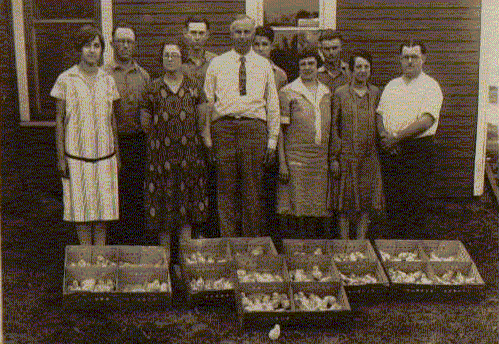
In fact, during the Depression, it would be Edith that supported the family.  Her husband John lost his hardware business sometime between 1920 and 1930, a devastating personal blow.  In the 1920s and 1930s, Edith worked at the chicken hatchery as the bookkeeper.  She is third from right, front row, below.

Chicken Hatchery

In 1951, she went to work as a stenographer for the Welfare Department until her death in 1960.

Lore women on motorcycle

The women in my family have TRIED to behave themselves, for generations, but overall, we haven’t been terribly successful.  In a moment of wild abandon, my grandmother, Edith, on the rear of this motorcycle, her mother, Nora in front of her and her two sisters, Eloise and Mildred in front leading the pack.  Yes, they did ride motorcycles, but not all 4 on one!  No, their husband’s did not approve. No, they did not stop, well, at least not because of that.  And even after they stopped, they had a little relapse from time to time.  Yes, my grandmother was a biker chick, a Harley Mama.  Way, way ahead of her time.

Edith Lore and John Ferverda moved back to his home town of Silver Lake, Indiana, away from the hustle and bustle and excitement of the big city and politics, where they spent the rest of their lives.  I think in many ways this was really difficult for Edith.

In the Family Memory book I gave to Mom to record her memories, here’s what she had to say about her mother, Edith:

“Mother went to business school in Cincinnati.  She commuted from Aurora at the Kirsch House to Cincy by train.  After that, she worked for a man who became a state senator from Rushville.  This was in the early 1900s before she and John [Ferverda] were married.  He wanted her to come to Washington DC and be his secretary but she turned it down because she had met John and did not want to leave Rushville.  She wanted to stay and marry my father and when he misbehaved, she reminded him that she could have gone to Washington instead.  This was before women could even vote which happened in about 1918 when women become franchised.  There were 8 or 9 young women who were the “Barnard Beauty Bunch” who worked his campaign. He selected her from that group but she turned him down.”

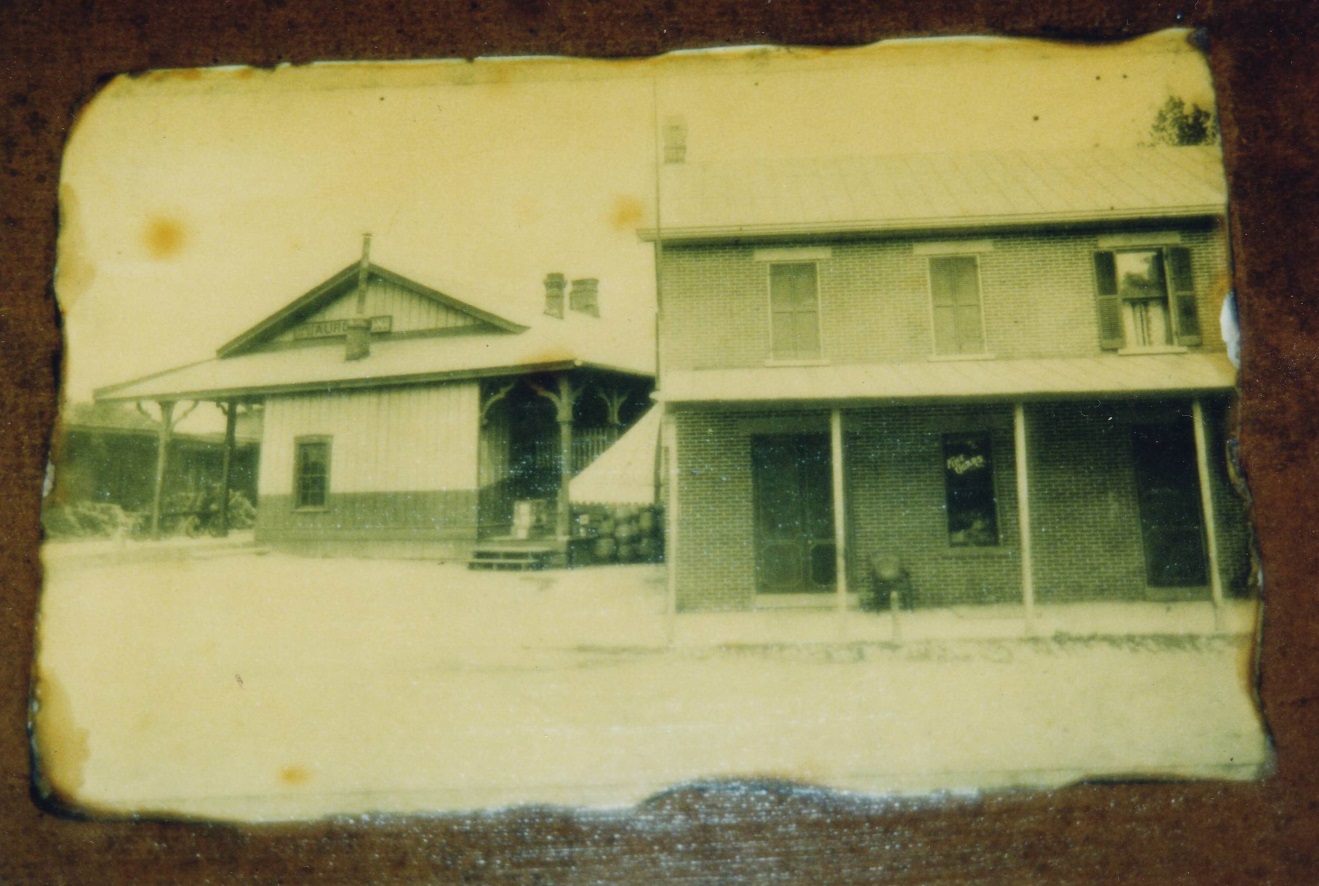
Kirsch House postcard

The Kirsch House, shown above at right, was located right beside the train depot, at left, so commuting to Cincinnati was easy.

Mom couldn’t remember the name of the man who ran for Congress.  Google, being my friend, I discovered that William O. Barnard was elected from that district in 1908.  This also makes sense in terms of the first name to go with the “Beauty Bunch”.  While we think of this as highly sexist today, it was apparently effective then and thought of as normal.  He was not reelected in 1910 and returned to practice law and become a judge in the area.  This would have had to have been the politician and it also makes sense in that John and Edith married on Nov. 17, 1908, just days after the election.

Mom’s Most Precious Memory of Edith

Here’s what Mom said in answer to the question, “What is your most precious memory of your mother?”

“There are so many. For many years she drove me 40 miles nightly after work to Fort Wayne two or three times a week to attend dancing school from which I at one point emerged as a professional tap dancer for approximately 5 years.  I first danced in Warsaw for a couple of years, then in Wabash, then in Fort Wayne.  That particular career ended when I fell and broke a bone in my foot.  She would go to work early and take her lunch so she could get her 8 hours in just in time to make the bank deposit and get me to class.  When I got home and she didn’t get home till 5 it was getting dark.  Lore, my brother, was delivering his papers and I was alone.  A couple of times Mom found me sitting under the street light at the corner because I didn’t want to be alone in the house.  After that she left work at 4.

In a small town there really wasn’t a sitter because there were so many neighbors watching to be sure that you weren’t doing something that your mother needed to be told about so she could get it stopped.  Busy bodies did serve a purpose. Once it rained and neighbor boy Frank and I were playing in gutters.  I heard the phone ring and I knew I’d better get inside and answer it or I’d be in trouble.  “Barbara Jean – you get in the house and you stay out of the street – NOW.”  We’d been having a “splashing good time”.”

My mother had Rheumatic Fever as a child which left her with a heart murmur, among other issues.  The doctor at the time recommended dancing as a way to strengthen her heart, so dance she did.  And she danced very well too, even with her “late start.”  But Mom’s story is one for another time.

As Mom got older, a teen, she taught dancing and her mother played the piano for that as well as for the local Methodist church. In the piano room in the house in Silver Lake, a hardwood floor was installed for Mom’s dancing and teaching.

Edith managed to break both of her wrists roller skating, which, ironically, she would not let my mother do because she was afraid she would hurt herself and not be able to dance.  Mom was 14 or 15 when Edith broke her wrists, so Edith would have been just under 50. Edith wanted to try and skate, but she fell and lit on her behind, catching herself with her hands, shattering both wrists.  The Doctor said they were not repairable because she had crushed the bones.  She practiced the piano to loosen them and worked out the pain because she was NOT going to give up playing for Mom’s dancing and recitals.  That woman had tenacity!

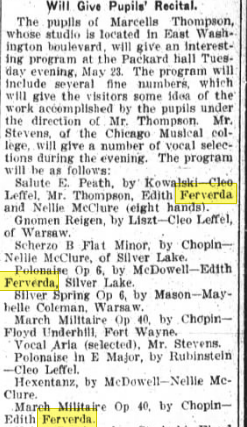
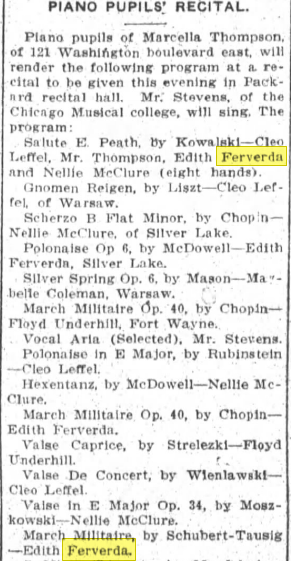
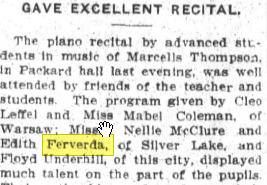
Newspaper articles from the local paper give us some additional glimpses of information about her life after she and John Ferverda moved back to Silver Lake.

May 22, 1911

Newspaper 1911 cropped

Edith used to accompany various students both for dance and voice.  She had married John in 1908 and their first child did not arrive until 1915.  This would have been after she married but before the responsibilities of children.

May 23, 1911

Newspaper 1911 2

May 24, 1911

Newspaper 1911 3

They were apparently pleased as she played for the students a second year as well.

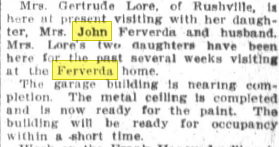
July 30, 1912

Newspaper 1912

Mrs. Gertrude (her name was Nora, not Gertrude) Lore of Rushville is here at present visiting with her daughter, Mrs. John Ferverda and husband.  Mrs. Lore’s two daughters (Mildred, 13, and Eloise, 9) have been here for the past several weeks visiting at the Ferverda home.  (I don’t think the following paragraph is relevant to the Ferverda family, but with all those females maybe my grandfather was taking up residence in the garage.)

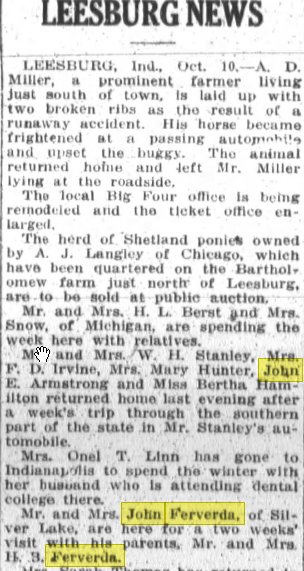
October 11, 1912

Newspaper 1912 2

Mr. and Mrs. John Ferverda of Silver Lake are here for a two weeks visit with his parents, Mr. and Mrs. H.B. Ferverda.

April 25, 1914

Newspaper 1914

Mrs. Ferverda and Miss McClure entertained a crowd of young people at the McClure home Wednesday night.

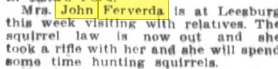
July 10, 1915

Newspaper 1915

Mrs. John Ferverda is at Leesburg this week visiting with relatives.  The squirrel law is now out and she took a rifle with her and she will spend some time hunting squirrels.

What?  My grandmother shooting squirrels.  Her first child, Harold Lore Ferverda was born in November 24, 1915.  So she was shooting a rifle in July of that year?  Amazing.

Nov. 27, 1915

Newspaper 1915 2

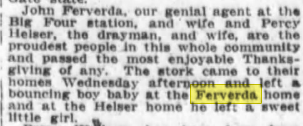
John Ferverda, our genial agent at the Big Four station and wife and Percy Helser the drayman, and wife, are the proudest people in the whole community and passed the most enjoyable Thanksgiving of any.  The stork came to their homes Wednesday afternoon and left a bouncing boy baby at the Ferverda home and at the Helser home he left a sweet little girl.

There was a doctor in Silver Lake.  Everyone knew him of course.  But Edith’s two babies were not delivered by the doctor, but by a midwife.  Edith truly was a woman of the Victorian Era.  The doctor was not allowed to see her unrobed, and I don’t believe my grandfather, or any other man, ever did either.  This was typical for the time.  Hard to believe her granddaughters were bra burners and wore those immodest things called bikinis!!!

Jan. 22, 1916

Newspaper 1916

J. W. Ferverda has returned home from a trip to Rushville where he was for a couple of days visiting with his wife and son.

From the sounds of this, perhaps Edith took her new baby and went home to be with her mother for a few weeks.

October 14, 1916

Newspaper 1916-2

Mrs. John Ferverda and son have returned home from Aurora where they had been for a week visiting with relatives and many friends.

August 11, 1917

Newspaper 1917

Mrs. John Ferverda and son are down to Wabash this week visiting with relatives and friends.

Nora’s mother eventually moved from Rushville to Wabash, Indiana.  From the looks of this article, I’d say it was in 1917.  Wabash was much closer to Silver Lake than Rushville and it was probably a welcome move for both women.

Family Life

I tried every Sunday to write something about Mom’s life.  Her health was deteriorating by then, so I felt the need to record as much as possible while I still could.

Mom described her life and surroundings after she was born in1922.  In doing so, of course, she also described her parents’ lives during that time.

“Search and discovery led to many new items that made life easier and better for many, many people.  Medicine and surgical procedures were progressing.  Surgery was softer and easier to handle.  Penicillin was in the 30s.  Inside bathrooms became the norm instead of the exception.  We purchased the house where I grew up when I was about 3 [1925].  For several years we had an outside privy but then when I was about 8 [1930] a room was taken inside the house and water and drainage installed so we had an inside bathroom with a toilet, sink and bathtub.  As a child, I took a bath in the foot tub.  Adults washed all over from a washbasin and they were clean and smelled alright.”

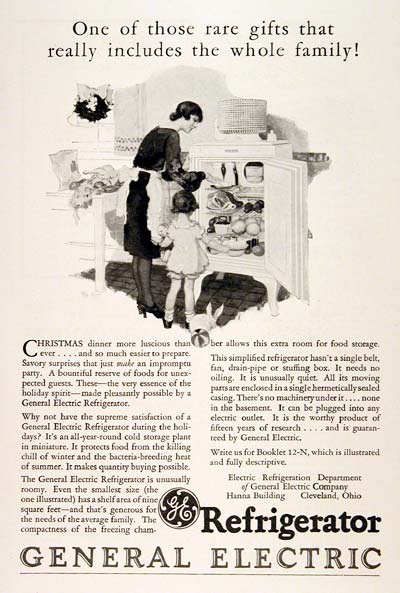
“The electric refrigerator from GE had a big ball on top.”

GE Refrigerator

‘Before that we had an ice box in the basement and an ice truck came by twice a week to put ice in the ice box.  The ice was cut from Silver Lake in the winter.’

Silver Lake ice house

“Mother made her sewing room a bathroom.  I sat on her lap while she pedalled the machine and I guided the fabric, or vice versa.  It was a Wheeler and Wilson machine which was at that time a very good machine but the wheel ran backwards.  I could not pedal and work the wheel and guide the fabric all at once. I could stretch to reach the pedal which we had to pump back and forth.  I was about 10 then.  That is the only sewing machine she ever had.”

Wheeler and Wilson sewing machine

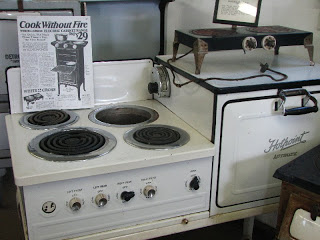
“We had electricity in the new house when we moved into it in 1925.  We had an electric stove and oven.  That was a luxury.  Four burners and the oven to the right side on the same level as the burners.”

1925 electric stove

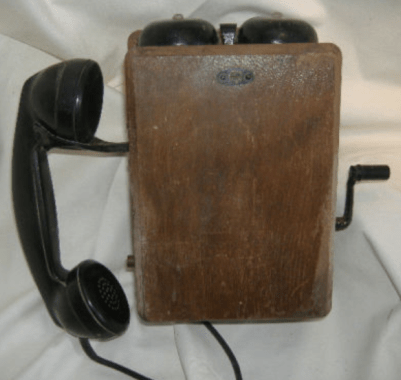
“We had a phone in both houses.  You would pick up the phone and ring the phone for the operator by cranking.  She would answer and say “number please.”  You would tell her the number you wanted to connect to.”

crank phone cropped

“You could call long distance too but most people avoided it because it was expensive.  Today it is still expensive, but we call long distance more freely and more people have phones too.”

On another page of the family book, the topic is “my mother’s kitchen”.  It asks questions about the most wonderful thing about your mother’s kitchen, how she let you help and about Mother’s best recipe.

Here’s what Mom had to say:

“Mother had a really good fudge recipe.  She was at work and I was home by myself. I got the recipe out and made fudge, beat it until thick enough to put into pan, so I sampled it, and sampled it some more. By the time Mother came home, there were 2 pieces left which I gave to her and was so proud of myself that I had made fudge.  Never occurred to me I shouldn’t have eaten the whole batch.”

For those of you who are adventurous souls, I scanned the recipe out of Mom’s recipe box and it’s below.  White syrup is Karo Syrup.  The chocolate referred to below is unsweetened.

Mom's fudge recipe cropped

My daughter made that same “from scratch” fudge recipe for my Mom as a gift for Christmas more than once.

I have a special memory of that kitchen too.  My grandmother had bluebird pie tins with holes in the bottom.

Bluebird pie pan cropped

My grandmother and grandfather had an apple orchard and a raspberry patch, so pies were always a staple.  She made her own pie crusts of course, because at that time, frozen foods weren’t available at the grocery store.  When she had a little extra dough left over she would spread it thinly in the bottom of the pie pan, butter it and sprinkle it with sugar and cinnamon and bake it special for me.  I love those pie crust pies better than any other!

The next page in the family book asks about lessons learned from Mother, and here’s what Mom had to say:

“The road to Hell is paved with good intentions.”

I can’t tell you how many times Mother said this to me.  Somehow seems appropriate, considering the fudge situation anyway:)

The Road to Hell

That was true of our DNA too….that good intentions, road to hell thing.  We’ve learned a lot in the past decade plus.

As I mentioned before, Nora, Edith, Mom and I all carry the same mitochondrial DNA, passed from mothers to all of their children, not admixed with any DNA from the father.  But only females pass it on.  So it’s a special grandmother-mother-daughter-granddaughter kind of bond.  It also means that to test to discover the mitochondrial DNA of an ancestor, you have to find someone descended from that ancestor to the current generation through all females.  But in the current generation, males can test too, because they inherit their mother’s mitochondrial DNA, but just don’t pass it on.

When DNA testing first began, in about the year 2000, we didn’t have full mitochondrial DNA sequencing available like we do today.  We know, for example, that our full haplogroup is J1c2f because every single location of our 16,569 mitochondrial DNA locations has been read.  There is no more to read, no mitochondrial DNA upgrades to be had…so we’re done.  Now the only way our haplogroup will “grow” is if new subclades within our subgroup of J1c2f are found and we fit into them, and then we might be classified as J1c2f1, for example.

For a long time, because we initially tested so early, all I knew was that my haplogrop was J, then J1, then J1c…you get the drift.  So we tried to make connections with people, and their ancestry, who matched us only on the HVR1 and then on the HVR1+HVR2 when we could test for both regions.  We found a match with a woman, Clara, whose ancestors were from a village not far from where Nora Kirsch’s great-grandmother was from in Germany.  Clara’s ancestors were Jewish and had vacated that area in Germany to journey into the Russian mountains into an enclave where they felt they would be safe several hundred years before Nora’s great-grandmother lived there in 1800.

While Clara and I could not connect genealogically, we felt that the coincidence of a 50 mile close connection, even if a few hundred years apart, was too much to be purely happenstance.  So, I thought, at that time, that it was very possible that our ancestors had at one time, been Jewish.

I was wrong.  We didn’t have enough information at that time but we didn’t realize it.

As additional testing became available, both Clara and I took the full sequence test and discovered that we are in different extended haplogroups.  This means that our common ancestors weren’t just 50 miles apart and a few hundred years, but 50 miles and a few thousand years, before the time of Christ and before the advent of the Jewish religion – back in the Near East.  Yes, they had both wound up in Germany, but their paths there were very different.  Clara’s ancestor as a Jewish woman and mine probably with the neolithic expansion of agriculture, thousands of years earlier.

Today, Clara and I don’t even show as matches.  This is because of smart-matching.  Family Tree DNA knows that if your full extended haplogroup doesn’t match, you really aren’t matches, so you are no longer shown at the HVR1 and HVR2 region as matches either.

How could we have been so wrong?  Partial data – it’s a dangerous thing.

First, initially we had few matches.  Second, some were Jewish.  He’s an excerpt of my haplogroup origins page.  Looks Jewish to me.  Right?

Hap J Jewish table

Right up until I tell you that these are ONLY HVR1 matches, ONLY 6 of 86 entries, so 7% of the HVR1 entries, and that none of my HVR1+HVR2 matches nor any of my full sequence matches are Jewish.  So were these HVR1 matches to test further, to the HVR2 or full sequence level, it’s very unlikely that any of them would continue as matches.  Now you’re not so excited anymore are you?  Well, this is the discovery sequence that happened over the years to our Jewish theory as well.

Fortunately in our case, we didn’t have a horse in the race, meaning we didn’t “want to be” Jewish or “not want to be” Jewish.  We were ambivalent about it.  We did however, want to know the truth, whatever it was – Jewish or not.  Our DNA gave us that, once full sequence testing was available.

Some people, on the other hand, become very unhappy, even disbelieving, when their pet theory has a scientific blowout.  Let’s just say this isn’t the first time that I’ve been thrown out of what I thought was my family tree.  The bad news is that more often than not, I’ve been the one sawing on the branch!  Ah yes, that road to hell thing…maybe it’s genetic:)

Ferverda stone

______________________________________________________________

Disclosure

I receive a small contribution when you click on some of the links to vendors in my articles. This does NOT increase the price you pay but helps me to keep the lights on and this informational blog free for everyone. Please click on the links in the articles or to the vendors below if you are purchasing products or DNA testing.

Thank you so much.

DNA Purchases and Free Transfers

Genealogy Services

Genealogy Research

Daughters of Princess Mary Kittamaquund

Daughters book cover

Recently Shawn and Lois Potter utilized the Minority Admixture Mapping technique I developed, utilized and described in the series “The Autosomal Me” to establish that the mother of John Red Bank Payne was Native American.  Shawn and Lois were so encouraged after that positive experience that they set forth to document another Native ancestor.

They produced this report as a beautiful and fully sourced booklet which they have very graciously given permission to reproduce in part here.

Daughters of Princess Mary Kittamaquund

Every student of American history has heard about Pocahontas—the young Indian princess who struggled to establish peace between the Powhatan Indians and Virginia colonists, married Englishman John Rolfe, and left descendants through her son Thomas Rolfe.  But, few have heard about Mary Kittamaquund—another young Indian princess who likewise promoted peace between the Piscataway Indians and Maryland colonists, married Englishman Giles Brent, and, as revealed by archival research combined with DNA analysis, left descendants through her daughters.  Both women lived heroic yet brief lives; and both should be remembered for their devotion to their people in an age of momentous danger and change.  The following sketch introduces Princess Mary Kittamaquund and her daughters.
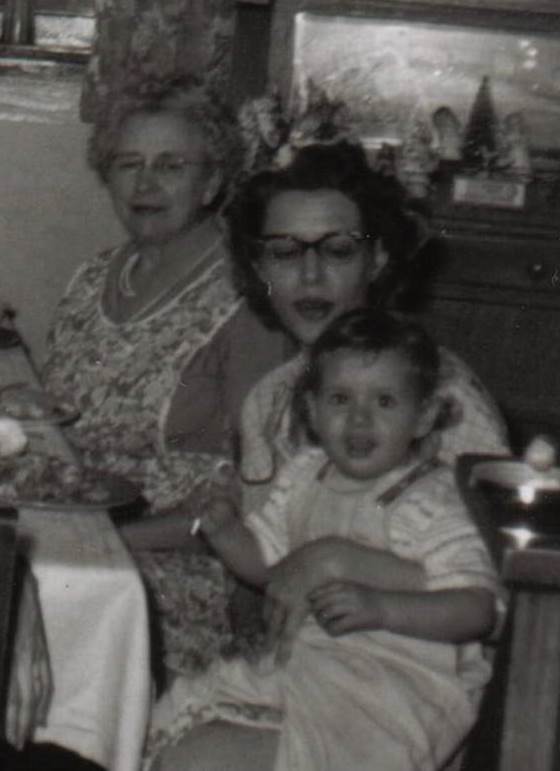
Mary Kittamaquund, daughter of the Tayac (Paramount Chief) of the Piscataway Indians, was born in Maryland probably about 1631.[i]  Her father ruled over as many as 7,000 people between the Potomac and Patuxent Rivers.[ii]  Following about six months of dialogue and study with Jesuit Missionary Father Andrew White, Mary’s father converted to Christianity and was baptized on July 5, 1640.[iii]  Soon after February 15, 1640/1, Mary too was baptized, and her father sent her to the English settlement called St Mary’s City, near the mouth of the Potomac River, to be educated by Governor Leonard Calvert and his sister-in-law, Margaret Brent.[iv]

Mary married Giles Brent, brother of Margaret Brent, before January 9, 1644/5.[v]  A band of Parliamentarians led by Richard Ingle and William Claiborne attacked St Mary’s City on February 14, 1644/5, and carried Giles Brent, Father Andrew White, and others in chains to England.  Upon his arrival in London, Giles brought suit against his captors and returned to Maryland before June 19, 1647.[vi]  Mary and Giles moved to present day Aquia, Stafford County, Virginia, after November 8, 1648, and before August 20, 1651.[vii]  Mary died probably after April 18, 1654, and before September 4, 1655.[viii]  Giles Brent died in Middlesex County, Virginia, on September 2, 1679.[ix]

Scholars disagree about the number of children born to Mary Kittamaquund and Giles Brent.  Some list only three children named in the 1663 and 1671 wills of sister and brother Margaret and Giles Brent.[x]  Margaret appointed her brother Giles “and his children Giles Brent, Mary Brent, and Richard Brent” executors of her estate.[xi]  Giles left bequests to his son Giles Brent and daughter Mary Fitzherbert.[xii]  Other historians, such as Dr. Lois Green Carr, Maryland Historian at the Maryland State Archives, on the basis of information gleaned from provincial court records, probate records, and quitrent rolls, identify six children of Mary and Giles, including Katherine Brent (who married Richard Marsham), Giles Brent (who married his cousin Mary Brent), Mary Brent (who married John Fitzherbert), Richard Brent (who died after December 26, 1663), Henry Brent (who died young), and Margaret Brent (who also died young).[xiii]

Some researchers further believe daughter Mary Brent divorced John Fitzherbert before April 26, 1672, and married second Charles Beaven.  This belief is supported by (1) a reference to the divorce of Mary and John in a letter of this date from Charles Calvert to his father, (2) a statement regarding “my brother iñ Richard Marsham” in the June 20, 1698 will of Charles Beaven, (3) the appointment of “my well beloved Richard Marsham” by Mary Beaven to be executor of her 1712 will, and (4) other circumstances demonstrating kinship ties between these families.[xiv]  Still others refuse to accept this relationship without further evidence, lamenting the loss of contemporary records which has “confused researchers for a hundred years.”[xv]

Recent DNA analysis, however, reveals six descendants of Katherine and Richard Marsham and three descendants of Mary and Charles Beaven, representing six separate lineages, inherited at least sixteen matching segments of Native American DNA on chromosomes 2, 3, 4, 5, 6, 7, 8, 13, 15, 16, 20, and 22.  Figure 1 shows the relationships between these descendants; and Figures 2-17 illustrate the sixteen matching Native American chromosomal segments (see Figures 18-33 for additional images of these segments produced by four independent admixture tools; and also see http://dna-explained.com/2013/06/02/the-autosomal-me-summary-and-pdf-file/ for information about Minority Admixture Mapping).  These matching chromosomal segments point to a common Native American ancestor, who, because other possibilities can be eliminated, must have been the mother of Katherine and Mary.[xvi]  Considering this DNA evidence in light of contemporary records, it now seems certain Mary Kittamaquund and Giles Brent were the parents of Katherine, wife of Richard Marsham, and Mary, wife first of John Fitzherbert and second of Charles Beaven.

Genealogical Summary

Katherine Brent was born probably in Aquia, Stafford County, Virginia, say about 1650.  She may have served an unknown period of indentured service to Thomas Brooke, perhaps following the death of her mother, before she married Richard Marsham perhaps before December 26, 1663, and certainly before March 11, 1664/5.[xvii]  Richard immigrated to Maryland in 1658, where he served three-years of indentured service to John Horne for his transatlantic voyage.[xviii]  Katherine died in Calvert County, Maryland, before October 26, 1670.[xix]  Richard married second Anne Calvert, widow first of Baker Brooke Sr., and second of Henry Brent, after April 30, 1695, and before February, 1696.[xx]  Richard died in Prince George’s County, Maryland, between April 14 and 22, 1713.[xxi]  Katherine and Richard were the parents of the following children:

1. Sarah Marsham was born in Calvert County, Maryland, say about 1667, married first Basil Waring say about 1685, married second William Barton after December 29, 1688, married third James Haddock after April 19, 1703, and died in Charles County, Maryland, after January 8, 1733.[xxii]

2.  Katherine Marsham was born in Calvert County, Maryland, say about 1669, married first her future step-brother Baker Brooke Jr. say about 1689, married second Samuel Queen after May 27, 1698, and died in St Mary’s County after March 18, 1712, and before April 14, 1713.[xxiii]

Mary Brent was born probably in Aquia, Stafford County, Virginia, say about 1654.[xxiv]  She married first John Fitzherbert before 1671.[xxv]  Mary and John divorced before April 26, 1672.[xxvi]  Mary married second Charles Beaven say about 1674.  Charles died in Prince George’s County, Maryland, between June 20, 1698, and June 21, 1699.[xxvii]  Mary died in Prince George’s County between April 28, 1712, and June 13, 1713.[xxviii]  Mary and Charles were the parents of the following children:

1. Richard Beaven was born in Calvert County, Maryland, say about 1676, married Jane Blanford before June 11, 1703, and died in Prince Georges County, Maryland, before August 9, 1744.[xxix]

2.  Sarah Beaven was born in Calvert County, Maryland, say about 1678, married Thomas Blanford on June 20, 1698, and died in Prince Georges County, Maryland, after August 7, 1749.[xxx]

3.  Margaret Beaven was born in Calvert County, Maryland, say about 1680, and died in Prince George’s County, Maryland, between April 28, 1712, and June 13, 1713.

4. Elizabeth Beaven was born in Calvert County, Maryland, say about 1682, married John Boone about 1708, and died in Prince Georges County, Maryland, before October 30, 1725.

5. Katherine Beaven was born in Calvert County, Maryland, say about 1684, married Henry Culver about 1711, and died in Prince Georges County, Maryland, before December 20, 1762.[xxxi]

6. Charles Beaven was born in Calvert County, Maryland, say about 1686, married Mary Finch about 1712, and died in Prince Georges County, Maryland, on December 16, 1761.[xxxii]

Daughters pedigree

Following this lineage information, Shawn and Lois included a chromosome by chromosome analysis of the various individuals who tested.  I am including only one example, below.

Daughters DNA

Following the many pages of genetic comparison information, Shawn and Lois included quite a bit for their readers about the Piscataway History and Culture.  After all, DNA without genealogy and history is impersonal science.  Included were early drawings and paintings of Native people and villages, an account of the people by Father Andrew White in 1635 as well as anonymous documents from 1639 and 1640.  Their food, language and vocabulary were discussed as well with historical events being presented in timeline format.

Piscataway Timeline

1550           Piscataway Tayac governed c. 7,000 people between Potomac and Patuxent Rivers

1608           John Smith explored the Potomac River; Piscataway welcomed him with kindness

1622           Powhatan Indians attacked at least 31 Virginia settlements along the James River

1623           Virginia colonists attacked Moyaone, killing many and burning houses and corn

1634           Piscataway Tayac Wannas permitted Leonard Calvert to establish St Mary’s City

1640           Piscataway Tayac Kittamaquund was baptized by Jesuit Father Andrew White

1644           Wahocasso succeeded as Tayac, who was succeeded by Uttapoingassenem in 1658, who was succeeded by Wannasapapin in 1662, who was succeeded by Nattowasso (son of Wahocasso—breaking the tradition of matrilineal succession) in 1663

1666           Facing increasing encroachments by European settlers, the Piscataway petitioned the Maryland council, saying: “We can flee no further.  Let us know where to live, and how to be secured for the future from the hogs and cattle.”

1695           Maryland Governor Francis Nicholson “advised the council to find a way of depriving Indians beyond Mattawoman Creek of their lands, in order to ‘occasion a greater quantity of Tobacco to be made.'”

1697           Piscataway Tayac Ochotomaquath and about 400 others fled to northern Virginia; then they allied with the Iroquois in 1701 and moved to Pennsylvania.

1699           Maryland colonists estimated Piscataway military strength at 80-90 warriors

Although many Piscataway left Maryland by the end of the 17th century in the face of encroaching European settlements, others remained on their homeland, intermarrying with Europeans and Africans, while preserving their cultural traditions.  In 1996, an advisory committee appointed by the Maryland Historical Trust voted unanimously to recommend state recognition of the Piscataway Indian Nation, citing genealogical, linguistic, cultural, and political continuity between the earliest Piscataway people and their modern descendants.  On January 9, 2012, Maryland Governor Martin O’Malley issued two executive orders, granting official state recognition to the Piscataway Indian Nation (about 100 members), and the Piscataway Conoy Tribe—consisting of the Piscataway Conoy Confederacy and Subtribes (about 3,500 members), and the Cedarville Band of Piscataway (about 500 members).

St Mary's City 1634 Indian Village

This drawing of St Mary’s City in 1634 by Cary Carson from the Maryland State Archives Map Collection shows the Native people living outside the city fortifications.

This 262 page book is a wonderful combination of genealogy, genetics and history, and does exactly what genetic genealogy is supposed to do.  It enables us to document and better understand our ancestors, and in this case, to prove they were indeed, Native American.  Shawn and Lois would welcome inquiries about the book or the family lines included and you can contact them at shpxlcp@comcast.net.


               [i] Most scholars estimate her year of birth as 1634, because an unidentified Catholic missionary made the following statement about her.  “On the 15th of February we came to Pascatoe, not without the great gratulation and joy of the inhabitants, who indeed seem well inclined to receive the christian faith.  So that not long after, the king brought his daughter, seven years old, (whom he loves with great affection,) to be educated among the English at St. Mary’s; and when she shall well understand the christian mysteries, to be washed in the sacred font of baptism.”  See “Extracts from Different Letters of Missionaries, from the Year 1635, to the Year 1638,” in E.A. Dalrymple, ed., Relatio Itineris in Marylandiam.  Declaratio Coloniae Domini Baronis de Baltimoro. Excerpta ex Diversis Litteris Missionariorum ab Anno 1635, ad Annum 1638, Narrative of a Voyage to Maryland, by Father Andrew White, S.J.  An Account of the Colony of the Lord Baron Baltimore.  Extracts from Different Letters of Missionaries, from the Year 1635 to the Year 1677 (Baltimore: Maryland Historical Society, 1874), 76.  But, the circumstances of Mary’s life suggest she was born a few years earlier.  So, we suspect the author of this letter underestimated her age.

               [ii] Father Andrew White, “Annual Letter of the English Province of the Society of Jesus, 1639,” in Clayton Colman Hall, ed., Narratives of Early Maryland, 1633-1684 (New York: Barnes & Noble, Inc., 1910), 126.

               [iii] Ibid.

               [iv] Ibid., 131.

               [v] John Lewger to Governor Leonard Calvert, January 9, 1644/5, in Proceedings of the Council of Maryland, 1636-1667, Vol 3, pp. 162-163 (original pages 186-187), Archives of Maryland Online.  “To the horle Governor.  Sir  I doe signify unto you that Mr Giles Brent hath delivered unto me 2. petitions nerewth sent unto you; and I desire you by vertue of the Law in that behalfe, that you wilbe pleased to give him a competent security for his indemnification in the possession of the lands at Kent, mentioned in one of the said petitions, & for iustification of his title in them, according to the said petition, dated 7. January instant: & likewise to satisfy unto him 5700l tob & cask, demanded in the other petition for damage of non pformance of a covenant to his wife Mary touching certaine cattell; or els to shew cause why you refuse to doe either; and to appoint some time when the Counsell shall attend you for it, betweene this & Monday next.  So humbly take leave to rest  Yor servant  S. Johns. 9th Jan: 1644 John Lewger.”  See also Margaret Brent, “Account of the Estate of Governor Leonard Calvert,” June 6, 1648, in Judicial and Testamentary Business of the Provincial Court, 1637-1650, Vol. 4, pp. 388-389 (original pages 159-160).  “By payd to Mrs. Mary Brent Kittamagund 0748.”

               [vi] For information about the arrest and transport of Giles Brent to London during Richard Ingle’s Rebellion, see “Richard Ingle in Maryland” in Maryland Historical Magazine, Vol. 1(1906), 125-140.  For the terminus ad quem (limit to which—latest possible date) Giles Brent returned to Maryland, see Maryland State Archives, Judicial and Testamentary Business of the Provincial Court, 1637-1650, Vol. 4:312-313.  “June 19th This day came Margaret Brent Gent, & desyred the testimony of the prnt Gouernor Mr Tho: Greene concerning the last will & Testamt of the late Gouernor Leonard Calvert Esqr And the sd Gouernor did authorize Giles Brent Esqr one of his Lops Counsell to administer an oath unto him the sd Gouernr concerning the foresd busines.  The sd Gouernor Tho: Greene Esqr answered uppon oath concerning the last will & Testamt of Leo: Calvert Esqr aforesd That the sd Leo: Calvert, lying uppon his death bed, some 6 howres before his death, being in prfect memory, directing his speech to Mrs Margarett Brent sayd in pnce of him the sd Mr Greene & some others I make you my sole Exequutrix, Take all, & pay all.  After wch words hee the sd Leon: Calvert desyred every one to depart the roome & was some space in priuate conference wth Mrs Marg: Brent aforesd Afterwards the Mr Greene comeing into the roome againe, he heard the sd Mr L: Calvert appoint certaine Legacies in manner following.  Viz I doe giue my warring cloaths to James Linsay, & Richard William my servants, specifying his coath suite to Rich. Willan & his black suite to James Linsey. & his waring Linnen to be diuided betweene them.  Aliso I giue a mare Colt to my God sonne Leon: Greene.  Allso hee did desyre tht his exequutrix should giue the first mare Colt tht should fall this yeare, (& if non fall in this yeare, then the first tht shall hereafter fall) unto Mrs Temperance Pippett of Virginea.  And further he deposeth not.  Recognit Teste mc Willm Bretton Clk.”

               [vii] The terminus a quo (limit from which—earliest possible date) for the relocation of Giles Brent from Maryland to Virginia is the date Giles Brent appeared in court at St. Mary’s on November 8, 1648, requesting compensation for destruction of his property on the Isle of Kent by anti-Papists.  See Archives of Maryland, November 8, 1648, Liber A, Folio 205.  The terminus ad quem (limit to which—latest possible date) Giles Brent removed from Maryland to Virginia is the date Giles Brent patented Marlborough in Potomac Neck, Virginia, on August 20, 1651.  See entry from Mercer Land Book cited by W.B. Chilton, ed., “The Brent Family,” The Virginia Magazine of History and Biography, Vol. 16, No. 1 (Jul., 1908), 96-97.

               [viii] Virginia Magazine XVI, 211.  On April 17, 1654, Giles conveyed his personal estate in Virginia and Maryland to his sister Mary, in trust to educate his children and allow maintenance to his wife Mary.  See also Lurene Rose Bivin in “Brent-Marsham-Beaven-Blandford Article: A Closer Look,” Maryland Genealogical Society Bulletin, Vol. 37, No. 3, 328-334.  “In the grant to John Harrison (dated 4 September 1655), he refers to his “sister” as Mrs. Frances Harrison (Nugent, p. 319).”  Giles may have been engaged to marry his second wife, Frances Whitgreaves, widow of Jeremiah Harrison, on this date, because John Harrison made a provision for Giles.

               [ix] W.B. Chilton, ed., “The Brent Family,” The Virginia Magazine of History and Biography, Vol. 16, No. 2 (Oct., 1908), 212.  “‘Register of Christ Church, Middlesex County, Virginia.  Collo Giles Brent of Potomac departed this life 2d of September 1679 and was buried in the Great Church Yard ye next day following.'”

               [x] For example, see Douglas Richardson, Magna Carta Ancestry: A Study in Colonial and Medieval Families (Baltimore: Genealogical Publishing Co., Inc., 2005), 129.  “They had two sons, [Col.] Giles and Richard, and one daughter, Mary (wife of [Capt.] John Fitzherbert).”  See also, Robert W. Barnes, British Roots of Maryland Families (Baltimore: Genealogical Publishing Co., Inc., 1999), 73-74.

               [xi] W.B. Chilton, Vol. 16, No. 1 (Jul., 1908), 98-99.  “The Will of Margaret Brent.  In the name of God Amen.  I Margaret Brent of Peace in the County of Westmoreland in Virginia considering the casualtys of human life do therefore make this my last Will and Testament as followeth my soul I do bequeath to the mercies of my Savior Jesus Christ and my worldly estate to be disposed of by my Executors as followeth to my nephew George Brent I give all my rights to take up land in Maryland except those already assigned to my cousin James Clifton to my niece Clifton I give a cow and to my neece Elizabeth Brent I give a heifer; to Ann Vandan I give a cow calf; to my neece Mary Brent daughter of my Brother Giles Brent I give all my silver spoons which are six; to my nephew Richard Brent son of my brother Giles Brent I give my patent of lands at the Falls of Rappahanock River also my lease of Kent Fort Mannor in Maryland saving yet power to his Father my brother Giles Brent that if he shall like to do so he may sell said lease and satisfye to his son other where as he shall think fitt in lands good or money and in case of my said nephew Richard Brents death under age and without heirs of his body lawfully begotten his legacy thereto to go to his brother Giles Brent or his sister Mary Brent or to the heirs of my brother Giles Brent or otherwise as my said brother shall dispose it by his Deed or last Will to my brother Giles Brent and to his heirs forever I give all my lands goods and chattles and all my estate real and personal and all that is or may be due to me in England Virginia Maryland or elsewhere still excepting the before disposed of in this my last will and Testament and I do appoint him my said Brother Giles Brent and his children Giles Brent Mary Brent and Richard Brent or such of them as are living at the time of my death the Executors of this my last Will and Testament.  In witness whereof I have hereunto set my hand and seal this 26th day of December, Anno Domini, 1663.”

               [xii] W.B. Chilton, Vol. 16, No. 1 (Jul., 1908), 98.  “The Will of Giles Brent.  In the Name of God Amen.  I Giles Brent of the Retirement in Stafford County in Virginia Esquire contemplating the uncertainty of my time of death do ordain this my last Will and Testament in manner and form following my body to the earth and my Soul I bequeath to the mercy of my Savior Christ all my worldly estate I appoint to my Exectors to be disposed of as followeth to my daughter Mary Fitzherbert I give five ewes and a ram to my son and heir Giles Brent and to the heirs of his body lawfully begotten I give for ever all my lands rights unto lands and reversions of lands any ways due to me in either England Virginia or Maryland and for want of such heirs then unto mine own right heirs and for want of such then to the right heirs of my Honored Father Richard Brent, Esquire, deceased Antiently Lord of the mannors of Admington and Lark Stoke in the County of Gloucestershire in England after my debts paid I give all my goods moveable or immoveable whatsoever to be disposed of as followeth three thousand pounds of good tobacco with cask to be given by them my Executors unto pious use where and to whom they shall see fitt for which doing and how and to whom given I Will that to none else but God they shall be accountable.  I also Will that to Mr. Edward Sanders they give four ewes and a ram and to John Howard four ewes and a ram.  Executors of this my last Will and Testament I appoint my son Giles Brent and my Brother Richard Brent and my Brother William Brent both in England and as Attorneys in their Executorship untill my said Brothers shall otherwise order and I do appoint Mr. Edward Sanders and John Howard above mentioned both of Stafford County to be and to act and it is my Will that after my debts and my Legacies paid my said Executors stand possessed of all my goods and personal estate to the sole use of my son Giles Brent then to be delivered into his sole dispose when it shall please God that he hath arrived to the age of one and twenty years.  In witness unto this my within written last Will and Testament I have hereunto set my hand and seal this last day of August, Anno Domini, 1671.”

               [xiii] Image SC4040-0166-1, Dr. Lois Green Carr’s Biographical Files of 17th and 18th Century Marylanders, Maryland State Archives, http://msa.maryland.gov/megafile/msa/speccol/sc4000/sc4040/000001/000166/html/sc4040-0166-1.html.  Note: Dr. Carr lists the children in the following order: Mary, Giles, Richard, Katherine, Henry, Margaret.

               [xiv] See excerpt from Charles Calvert to Cecilius Calvert, April 26, 1672, in William Hand Browne, ed., Proceedings of the Council of Mayland: 1671-1682 (Baltimore: Maryland Historical Society, 1896), xiv.  “Major Fitzherbert’s brother who maryed the Indian Brent, has civilly parted with her, and (as I suppose) will never care to bed with her more; soe that your Lordship needs not to feare any ill consequence from that match, butt what has already happened to the poore man, who unadvisedly threw himself away upon her in hopes of a great portion which now is come to little.”  See also Will of Charles Beaven, signed June 20, 1698, proved June 21, 1699, Prerogative Court (Wills) Vol. 2, pp. 182-183, Liber 6, Folios 285-286.  See also Will of Mary Beaven, signed April 18, 1712, proved June 13, 1713, Prerogative Court (Wills) Vol. 3, p. 240, Liber 13, Folio 513.  See also Maryland Land Patents, BB#37:374.  On March 15, 1696/7, Richard Marsham transferred 600 acre grant called The Hickory Thickett to Charles Beaven by assignment.

               [xv] Lurene Rose Bivin in “Brent-Marsham-Beaven-Blandford Article: A Closer Look,” Maryland Genealogical Society Bulletin, Vol. 37, No. 3, 328-334.

               [xvi] Four potential scenarios explain this matching DNA considered together with Charles Beaven’s reference to Richard Marsham as “my brother iñ Richard Marsham.”  The first scenario is Richard Marsham and Charles Beaven were brothers.  This scenario almost certainly is not true because Richard Marsham and Charles Beaven had different last names and the written reference by Charles Beaven to Richard Marsham as “my brother iñ” appears to have been a standard contraction of “my brother-in-law.”  The second scenario is Richard Marsham and Mary, wife of Charles Beaven, were brother and sister.  This scenario almost certainly is not true because Mary referred to Richard Marsham as “my well beloved Richard Marsham.”  If Richard Marsham and Mary had been brother and sister, Mary surely would have referred to Richard as her brother.  The third scenario is Charles Beaven and Katherine, wife of Richard Marsham, were brother and sister.  This scenario almost certainly is not true because their descendants inherited matching segments of Native American DNA.  Charles Beaven immigrated from England to Maryland in 1666 (Skordas, Liber 9, folio 455), so he surely did not inherit Native American DNA from his parents.  The fourth and most compelling scenario is Katherine, wife of Richard Marsham, and Mary, wife of Charles Beaven, were sisters, and they also were daughters of a parent with Native American ancestry.  This scenario is consistent with other indications that Katherine and Mary were daughters of Mary Kittamaquund and Giles Brent.

               [xvii] Maryland Colonial Land Records, Liber 7, Folio 582, 583, Maryland State Archives.  “March xith 1664.  Came David Bowens and demands land for these rights following John Barnes, Clement Barnes, Margaret Whitthe, Martha Garbett, Catherine Marsham by Assign and Francis Street by Assign as follows–Know all to whom these presents may concern, that I Katherine Marsham doe assigne all my Right and Title of a Right due to mee the said Katherine for fifty acres of land unto David Bowing as witness my hand this Eleventh of March One Thousand six hundred sixty foure.  Katherine Marsham (her K mark).  Witness Richard Marsham, Robert Turner.  Know all men by these presents to whom this may concern that I Francis Streete doe assigne all my Right and Title of a right due to mee the said Francis Streete for fifty acres of Land unto David Bowing as witness my hand this Eleventh of March One Thousand six hundred sixty four.  Francis Streete.  Witness Richard Marsham, Robert Turner.”  See also Maryland Colonial Land Records, Liber 12, Folio 512, Maryland State Archives.  “May 11th 1670.  Came Richard Marsham of Calvert County and proved right to fifty acres of land it being due to him for the time of service of Katherine his wife performed to Major Thomas Brooke, Warrant then issued in the name of the said Richard Marsham for fifty acres of land it being due to him for the causio oraem above.  Certified the 11th of August next.”  Note: Even though these two documents indicate Katherine was due a total of 100 acres, the first 50 acres for an unstated cause and the second 50 acres for service to Thomas Brooke, neither record says Katherine was transported to Maryland, and both records may result from fraudulent claims.  If these records reflect legitimate claims, they do not say or prove Katherine was transported to Maryland, since some claims were granted for people who were born in Maryland.  For example, a patent for 1,644 acres was granted to Mary Brent on November 17, 1652, for the transportation of 33 persons, including “Mrs. Mary Brent, wife to Capt. Brent.”  See Nugent, pp. 266-267.  This Mrs. Mary Brent was Mary Kittamaquund, wife of Giles Brent, who certainly was born in Maryland.  Furthermore, according to Abbott Emerson Smith (“The Indentured Servant and Land Speculation in Seventeenth Century Maryland,” in The American Historical Review, Vol. 40, p. 467), “A great many of the warrants which were granted were for rights proved by the wife of a freedman.  It is not unlikely that some persons managed to get freedom dues in land, although they had never been in indentured service.”  Finally, if Katherine did serve a term of indenture, her service may have resulted from the death of her mother at a time when she was old enough to begin providing for her own maintenance.  It was not unusual during this era for children of deceased well-to-do colonists to serve a term of indenture.

               [xviii] See Maryland Colonial Land Records, Liber 4, Folio 4, Maryland State Archives.  “May the 7th 1659.  John Home demands Land for the transportation of himself and his Servants, Richard Marsham & John Edmondson, in 1658.”  See also Maryland Colonial Land Records, Liber 5, Folio 295, Maryland State Archives.  “Know all men that I Richard Marsham do give and make over to Thomas Pagett my right as is due to me as being a Servant, and now being free in Roberto McJohn Hearen as witness my hand the 16th of September 1661.  Richard Marsham.  Wit: Robert Coberthwail, Michael Coreuly.”

               [xix] See Maryland Colonial Land Records, Liber 12, Folio 512, Maryland State Archives, as cited above.  “May 11th 1670.  Came Richard Marsham of Calvert County and proved right to fifty acres of land it being due to him for the time of service of Katherine his wife performed to Major Thomas Brooke, Warrant then issued in the name of the said Richard Marsham for fifty acres of land it being due to him for the causio oraem above.  Certified the 11th of August next.”  See also Maryland Colonial Land Records, October 26, 1670, Liber 14, Folio 228.  “Patent for 50 acres in St. Mary’s County, originally Calvert County, to Richard Marsham, tract called St. Katherine’s.”  Note: This patent establishes the terminus ad quem (limit to which—latest possible date) for Katherine’s death, because Richard would be unlikely to name this property Saint Katherine’s unless Katherine had died.

               [xx] The terminus a quo (limit from which—earliest possible date) for Richard’s marriage to Anne Calvert is established by the date of a Prerogative Court record concerning the estate of Henry Brent naming Anne Brent executrix.  See Prerogative Court Records, April 30, 1695, Liber 13A, folio 291, Maryland State Archives.  The terminus ad quem (limit to which—latest possible date) for Richard’s marriage to Anne Calvert is the date they were named as husband and wife on a probate record.  See Provincial Court Judgments, February Court 1696, Liber P. L. #3, Folios 556-557, Maryland State Archives.  Richard Marsham with Ann Marsham, administrator of Henry Brent, against Thomas Collier.

               [xxi] Will of Richard Marsham, signed April 14, 1713, probated April 22, 1713, Maryland Prerogative Court (Wills), Liber xiii, Folio 514-520, Maryland State Archives.

               [xxii] The approximate year of Sarah’s marriage to Basil Waring is estimated from the year of Basil’s death preceded by four years to account for the births of two children.  See Will of Basil Waring, signed December 8, 1688, probated December 29, 1688, Maryland Calendar of Wills, Vol. 2, p. 50, and Liber 6, Folio 66.  Basil named his wife Sarah and sons Marsham and Basil.  The terminus a quo (limit from which—earliest possible date) for Sarah’s marriage to William Barton is determined by the probate date of the will of her first husband Basil Waring.  See Will of Basil Waring, signed December 8, 1688, probated December 29, 1688, Maryland Calendar of Wills, Vol. 2, p. 50, and Liber 6, Folio 66.  The terminus a quo (limit from which—earliest possible date) for Sarah’s death is determined by her deed to Robert Mackhorn.  See Deed from Sarah Haddock to Robert Mackhorn, signed January 8, 1733, recorded March 18, 1733/4, Charles County Land Rcords: 1733-1743, Book O #2, page 28.  “Sarah Haddock, widow, of Prince George’s County, formerly wife of William Barton, late of Charles County, Gent., deceased, to Robert Mackhorn of Charles County, planter.  William Barton by his will, divised to his son-in-law, Basil Waring, 300 acres, being part of this tract of land called Hadlow, lying in Charles County, and the rest of Hadlow to his wife, being now the aforementioned Sarah Haddock.  Now this deed witnesses that sd. Sarah Haddock, for 4500 lbs tobacco, has sold to said Robert the rest of Hadlow, lying in Charles County, bounded by Thos. Gerard, the division line made by sd. Sarah Haddock and Basil Waring.  Signed Sarah Haddock.  Wit. Jas. Haddock Waring, Henry Keen.”

               [xxiii] The approximate year of Katherine’s marriage to Baker Brook is estimated from the year of Baker’s death preceded by eight years to account for the births of four children.  See Will of Baker Book, signed February 5, 1698, probated May 27, 1698, Maryland Calendar of Wills, Vol. 2, p. 142, and Liber 6, Folio 83.  Baker named his wife Katherine and four children Baker, Leonard, Richard, and Ann.  The terminus ad quem (limit to which—latest possible date) for Katherine’s marriage to Samuel Queen is determined by the probate date of the will of her first husband Baker Brooke.  See Will of Baker Book, signed February 5, 1698, probated May 27, 1698, Maryland Calendar of Wills, Vol. 2, p. 142, Liber 6, Folio 83.  The terminus a quo (limit from which—earliest possible date) for Katherine’s death is determined by the date her husband’s will was probated.  See Will of Samuel Queen, signed January 10, 1711, probated March 18, 1712, Maryland Prerogative Court (Wills), Vol. 3, p. 222, Liber 13, Folio 389, Maryland State Archives.  The terminus ad quem (limit to which—latest possible date) for Katherine’s death is determined by the date of the will of her father, Richard Marsham, which provides for her children but does not mention her.  See Will of Richard Marsham, signed April 14, 1713, probated April 22, 1713, Maryland Prerogative Court (Wills), Liber 13, Folios 514-520, Maryland State Archives.

               [xxiv] On April 5, 1673, Giles Brent Jr., son of Col. Giles Brent and Mary Kittamaquund, deeded 500 acres, which he had inherited from his father, to his uncle George Brent of Woodstock, Stafford County, Virginia, stating he had reached the age of 21—a condition set in his father’s will for his ability to take possession of the land.  This suggests Giles Brent Jr. was born about 1652.  See W.B. Chilton, Vol. 16, No. 1 (Jul., 1908), 99-100.

               [xxv] Will of Giles Brent, signed August 31, 1671, in W.B. Chilton, Vol. 16, No. 1 (Jul., 1908), 98.

               [xxvi] See excerpt from Charles Calvert to Cecilius Calvert, April 26, 1672, in William Hand Browne, ed., Proceedings of the Council of Mayland: 1671-1682 (Baltimore: Maryland Historical Society, 1896), xiv.  “Major Fitzherbert’s brother who maryed the Indian Brent, has civilly parted with her, and (as I suppose) will never care to bed with her more; soe that your Lordship needs not to feare any ill consequence from that match, butt what has already happened to the poore man, who unadvisedly threw himself away upon her in hopes of a great portion which now is come to little.”

               [xxvii] Will of Charles Beaven, signed January 20, 1698/9, proven June 2, 1699, Prince Georges County Wills, Liber 6, folios 285-286,  Maryland State Archives.

               [xxviii] Will of Mary Beavan, signed April 28, 1712, proven June 13, 1713, Prince Georges County Wills, Liber 13, folio 513, Maryland State Archives.

               [xxix] Will of Richard Bevan Sr., signed February 27, 1738/9, proven May 21, 1739, Maryland Calendar of Wills, Vol. 8, p. 789, Liber 22, folio 58, Maryland State Archives.  For the terminus ad quem (limit to which—latest possible date) of Richard’s marriage to Jane Blandford, see Administration of the Will of William Bayly, June 11, 1703, Liber 24, folio 16a, Prince Georges County, MD.  “Executrix, Mrs. Jane Beven, wife of Richard Beven.”

               [xxx] Will of Thomas Blandford, signed June 17, 1749, proven August 7, 1749, Maryland Calendar of Wills, Maryland State Archives.  Thomas named his wife Sarah executrix.

               [xxxi] Will of Catherine Culver, signed October 6, 1762, proven December 20, 1762, Maryland Calendar of Wills, Vol. 31, pp. 890-891, Maryland State Archives.

               [xxxii] Charles Beaven signed a deposition in 1728, claiming to be 42 years of age.

______________________________________________________________

Disclosure

I receive a small contribution when you click on some of the links to vendors in my articles. This does NOT increase the price you pay but helps me to keep the lights on and this informational blog free for everyone. Please click on the links in the articles or to the vendors below if you are purchasing products or DNA testing.

Thank you so much.

DNA Purchases and Free Transfers

Genealogy Services

Genealogy Research

Ollie Bolton Estes Robbins (1874-1955) and the Wrath of a Woman Scorned – 52 Ancestors #9

Ollie Bolton 1950s

Ollie Bolton was born on May 5, 1874 in a neighborhood called Hoop Creek in Hancock County, Tennessee near the Claiborne/Hancock County line in 1874 to Joseph B. “Dode” Bolton and Margaret N. Claxton/Clarkson.  We don’t know the middle names of either of her parents.

Hoop Creek Map cropped

Ollie was my grandmother, my father’s mother, but I never knew her.  She died in April, 1955, before my birth.

She is the least known of my grandparents.  My Estes family told me stories of her first husband, my grandfather, William George Estes, who she married in Claiborne County, Tennessee on September 26, 1892, but there was no one to tell me stories about Ollie.

We don’t even know Ollie’s middle name for sure.  In some places it’s recorded as Florence, but on my father’s Social Security application, he gives it as Ollie Elsie Bolton.

Ollie applied for a social security number on July 31, 1939.  She is living at 117 S. Hamilton in Chicago.  She is not employed and is age 65 at her last birthday.  She gives her birthdate as May 5, 1874 and her parents as Joseph Bolton and Margreat Clarkson.  No, that is not a typo.

Life Was Hard

Ollie’s life was hard.  She lost her first baby at six weeks of age, the year after she was married, a month and 6 days before her first wedding anniversary.  Her second child followed in 1894.  Not long thereafter, Ollie and William George Estes moved to Springdale in Washington County, Arkansas where Ollie ran a boarding house and tended to her children, with little help from William George.

They moved back to Claiborne County and were living there in 1900, but William George was out of work more than he wasn’t, and he drank.

The 1907 photo of Ollie doesn’t portray her as a happy woman.  Of course, photos can be poor or deceiving, but as of the time this photo was taken, 3 of the 7 children she had born were dead, and one had died tragically.

Estes family 1907

This photo was labeled “1907 Cumberland Gap.”

According to the 1910 census, three of Ollie’s children had died.  We know who two of them are, Samuel who died at 6 weeks of age, and Robert who died when their cabin burned, but there appears to be a third child who died as well – probably born in the spot between 1894 and 1898 – and probably buried in Arkansas.  It’s sad, that child is lost to us and we only knew of their existence from the census records.

Margaret says the family Bible was destroyed in the fire.  It would have told us more.

The death of the child in the cabin fire must have been torturous for Ollie.  The family in Estes Holler says that Ollie had left the children to go to a party.  They don’t say where William George was.  Odd that her absence is mentioned, somewhat scornfully, but his was simply accepted without mention.

It looks like Robert died before 1907.  He was born in 1898 and the photo of the children in 1907 is without Robert.  We know he died after they returned to Claiborne County, which was before the 1900 census.  Cousin George showed me where the cabin that burned had stood, and the willow he planted in honor of the child who died.

I have often wondered if I was named after this child.  It was my father that selected my name of Roberta.

Moving to Indiana

Shortly after the 1910 census, the family moved to Fowler, Indiana and were tenant farmers.

Estes Fowler Indiana

There appear to be some happy times there.  Well, Ollie looks happy even if William George doesn’t. Ollie and William George are on the left and Howard Friar, with wife Mary “Ropp” Bolton. These two couples stood up for each other when they married. Aunt Ropp was Ollie’s half first cousin, a granddaughter of Joseph Preston Bolton and Mary Tankersley.

Estes 1913 Fowler cropped

This family photo is labeled “1913, Fowler, Indiana,” although Aunt Margaret said the photo was taken in Boswell, Indiana on Easter Sunday.

The adults, other than Ollie and George to the right in the back row, are Ollie’s cousins, Clara and Mont Bolton, far left, and possibly family friend Ted Barnes third from left in the read. Beside Ollie is Elizabeth Bolton, sister of Mont and wife of George Smith. One of their sons, Joseph was missing in this photo, reportedly at scouts. My father, William Sterling Estes is the youngest male in the front row on the left beside his brother, their oldest son, Estle.  Beside Estle at the right of the front row are cousins Lee and George Smith.

The Crazy Aunts, adversaries for life, Margaret, brunette on the left and Minnie, blonde on the right, are standing in the second row.

Estes family 1914

This is the only existing photo of the entire family.  Margaret said that it was taken by setting a timer on William George’s camera.  This photo was also taken about 1913 or 1914.

Shortly thereafter, the family scuttlebutt is that Ollie’s young cousin came to visit.  By young, the young lady was born about the time that Ollie and William George were married.  Ollie came home and discovered her cousin and William George in “the act.”  Ollie grabbed either a bullwhip or a horsewhip, stories vary, but it really doesn’t matter, and proceeded to use it on him/them.  The only thing that saved them was that there were others nearby.  The Crazy Aunts tell us that it took “5 grown men” to restrain her.  Never underestimate the wrath of a woman scorned.

Sadly, the parents didn’t just separate, but the family was divided in half. Margaret said, ” we had no home,” and that “neither Mama nor Daddy would take the boys.”

All the Children

Ollie Bolton and William George Estes had the following children, for sure, in Claiborne County, Tennessee, unless noted otherwise.

  • Samuel T. Estes born July 8, 1893, died August 20, 1893
  • Charles Estel Sebastian Estes born November 1, 1894, died August 26, 1972
  • Unknown child per the 1910 census, probably born and died in Arkansas
  • Robert Estes born June 1898, Arkansas, died before 1907, Claiborne County, TN
  • William Sterling Estes born October 1, 1901, 1902 or 1903, died August 27, 1963, Jay County, Indiana
  • Joseph “Dode” Harry Estes born September 13, 1904 died December 9, 1994, Wayne Co., IL
  • Margaret LeJean Estes born November 16, 1906, died August 6, 2005, California
  • Minnie May Estes born October 1, 1908, died February 3, 2008, Steinhatchee, Florida

Moving on to Chicago

There are other family stories surrounding this time as well.  One story says that Ollie was pregnant with twins, that she lost after the scandalous “cheating husband” event.  Another story says that another child, Elsie, was born and eventually died, and that Elsie was “retarded.”  From what was said, Elsie likely had Downs Syndrome.  One Crazy Aunt said Elsie died in Chicago, but there is no death record to support this, or any photos, nor any other indication that this child existed.  Another rumor said there was also a second set of twins that died.  By 1914, Ollie was 40 years old.  She could well have had a Downs Syndrome baby.  However, neither Benton County, Indiana, nor Cook County, Illinois records show the birth or death of any Elsia Estes or infant twins.

Ollie and Margaret 1918

The photos above and below were labeled by Aunt Margaret as “Ollie Bolton Estes and Margaret 1918 Franklin Park, Illinois.”  I have always questioned whether this was Ollie or Ollie’s mother.  Another cousin has this same photo labeled differently which might imply that the women is Ollie’s mother, Margaret Claxton/Clarkson.  The identifier “grandmother” is a matter of perspective.  However, Crazy Aunt or not, Margaret was there in the photo and she should have known if it was her mother or grandmother.

Ollie and Margaret 1918 2

I have a note in my file that Ollie moved to Chicago in 1919, and Margaret sent a photo of Minnie in Chicago in 1922, if she is correct about where it was taken.  I cannot find Ollie in the census in 1920.

In the 1930 census, Ollie had remarried and she and John Robbins lived on Flournoy St. in Chicago.  They had been married for 6 years which tells us that they married in 1924.  She was 55 and he was 47.   He was a clerk with the railroad.  Minnie said she married John Robbins in Chicago, but Chicago marriage records don’t include their marriage.

Ollie was noted in her sister’s obituary in 1935 as Ollie Robbins.  However, in 1953, she is called Ollie Estes in her sister, Ida’s obituary.

In 1939, Ollie applied for a Social Security card in Chicago.

Estes, Ollie SS

We know she could write, based on this document, and we have her signature.

In the 1940 census, John and Ollie Robbins are living at 117 Hamilton.  He is 56 and she is 66.  They indicate they lived in the same location in 1935.  Ollie says that she completed the 8th grade.  The 1940 census included several employment questions.  It looks like neither of them were working and neither are seeking work. Ollie indicates she is unable to work.  They rent for $12 a month, which is about half of what other rents seem to be.  There were a few at $10 but mostly they ranged from about $16-$25 with $25 being very common.

By the time my mother met Ollie, about 1950, Ollie was already ill.  Mother didn’t know if John Robbins had died or they were divorced, but he was not in the picture.  Ollie lived with my mother and father during her last illness during my mother’s pregnancy.

Ollie’s death certificate lists her death date as April 9, 1955 and her address as 639 N. Kedzie in Chicago.  Ollie Bolton Robbins, widowed, born May 5, 1872, age 82, was a housewife at home, born in Tennessee and lists her parents as Joseph Bolton and Margaret Claxton.  She was never in the armed forces and the informant was William S. Estes,  listed at the same address, and he signed as her son.  Note that her birth year is off by two years on her death certificate.  I’ve seen this situation many, many times.

Ollie is buried in the Elmwood Cemetery in Chicago.  John Robbins is not buried there.  I visited several years ago and let me say that this grave was not easy to find and the Chicago traffic was abysmal.  I’d rather climb over fences and brave brambles any day.

Cemetery records show that my father bought the lot and the stone, although one of the Crazy Aunts claims that she did, along with two extra plots, asserting that “someone” had then sold the extra plots and pocketed the money.  That’s not what the cemetery records showed, however.  It’s beyond me why anyone would purchase extra plots there.  There was no one else to bury.  But then again, that’s why we call them the Crazy Aunts!  They did make life very interesting with their various wild goose chases!  Every now and then, one produced a goose, or at least a few feathers.

Ollie’s X Chromosome

My father carried all of Ollie’s X chromosome.  Men only inherit an X from their mother, because they inherit the Y chromosome, which makes them male, from their father.  Therefore, I too carry Ollie’s X chromosome, intact, because my father only had one X chromosome to give me.  Therefore, one of my 2 X chromosome is actually Ollie Bolton’s X and theoretically half of what I gave to my children is Ollie’s.  In reality, my children could have inherited anyplace between all and nothing of Ollie’s X, but I definitely carry it intact.

Ollie X fan cropped

My father’s autosomal DNA has never been tested, as he died in 1963, but by phasing my mother’s DNA against mine, I can, in this case, determine my father’s X chromosome and therefore, Ollie’s too.

Phasing is a process where, by process of elimination, when you don’t have both parents DNA, you can determine which DNA belongs to which parent.  For every DNA location, every person carries two nucleotides, either T, A, C or G.  So let’s say that I carry a T and a C for one particular address.  If my Mom carries two Cs, or a C and an A, then we can say for sure that the T came from Dad.  This method isn’t foolproof, because if Mom carried both a T and a C, we have no way of knowing which she gave me and which came from Dad, but it’s better than nothing.

X phased

Therefore, when dealing with X matches, if an X match doesn’t also match my mother, then I know it came from my father, and therefore, also from Ollie.  It’s interesting, the innovative ways we are discovering to identify, “obtain” and utilize the DNA of those long gone.

Ollie stone

______________________________________________________________

Disclosure

I receive a small contribution when you click on some of the links to vendors in my articles. This does NOT increase the price you pay but helps me to keep the lights on and this informational blog free for everyone. Please click on the links in the articles or to the vendors below if you are purchasing products or DNA testing.

Thank you so much.

DNA Purchases and Free Transfers

Genealogy Services

Genealogy Research

Elizabeth Ann Speaks (1832-1907) and the Path from Tennessee to Gisburn, England – 52 Ancestors #8

Elizabeth “Bettie” Ann Speaks was born in 1832 in Indiana or Virginia, per the census, although her parents were from Lee County, Virginia.  She died in 1907 in Hancock County, Tennessee.  I never spoke with anyone who actually knew her, but I spoke with people who knew of her.

My grandparents would have known her for between 20 and 30 years, but I didn’t know them.

She married Samuel Claxton, also spelled variantly Clarkson and Clarkston, according to Samuel’s Civil War records,  on August 22, 1850, at the home of Tandy Welch.  Her grandfather, the Reverend Nicholas Speak performed the ceremony.  In the 1850 census, which was taken on December 13th, they are living beside the rest of the Claxton clan in Hancock County, Tennessee, where she would live the rest of her life.  There is no baby yet, but my great-grandmother Margaret Claxton was on the way, being born on July 25, 1851.

We don’t really know much about Elizabeth, who, according to family, was called Bettie.  Family records show her middle name as Ann, but the Civil War pension application consistently shows her middle initial as L.  She apparently did know how to sign her name, as she signed the application for a Civil War pension in 1878.

Elizabeth signaure

The first record, other than the census, is a note in the Rob Camp Church records where Elizabeth Clarkson is “received by experience” on Monday, August 25th, 1858, meaning that she did not transfer from another church, but was “saved” and probably baptized.

In 1860, she was listed with the occupation of “scowering” and had 5 children.  Her birth state is listed in 1860 as Indiana, but is listed as Virginia in other census records.

Her husband, Samuel would cross into Kentucky to join the Union troops in May of 1863 and served during the Civil War in the Tennessee Cavalry Company F, contracting tuberculosis which would kill him nearly a decade later.  He was discharged in May 1865, ill, from the hospital.

This photo of Elizabeth was taken sometime during or after the Civil War and before her husband passed away in 1876, so between 1863 or so and 1875.  That’s Samuel in the photo with her, wearing his uniform.

I must admit, the first thing I noticed about her was her “distinctive nose” as one of my cousins phrased it, and I am every so grateful that I did not inherit that from her.  Genetics was my friend.

Samuel Claxton Elizabeth Speaks

On the second Saturday of April 1869 Rob Camp Baptist Church released the following members from their fellowship:

E..H. Clarkson
Mary Clarkson
William Mannon
Elizabeth Mannon
Mary Muncy
Clarissa Hill
Sarah Shefley
Farwix Clarkson
Agnes Clarkson
Nancy Furry
Elizabeth Clarkson
Margaret Clarkson
William Bolton
James Bolton
John Grimes
Catherine Grimes
Joseph Bolton

These members were released for the purpose of constituting Mount Zion Baptist Church.  On the third Saturday of May 1869 these brothers and sisters met, along with representatives from Cave Springs, Big Spring Union and Chadwell Station to officially constitute a church.  That church, albeit three buildings later, still stands in the same location on land donated by William Mannon, noted above.

Elizabeth Speaks Clarkson is among the members listed, as are her in-laws, Fairwick and Agnes Muncy Clarkson.  Her daughter, Margaret Clarkson, also listed would marry Joseph Bolton, Jr., in 1873.  We don’t know if Joseph Bolton listed above is Jr. or Sr., but I suspect Sr. since Jr. would have only been 16 at that time.  Margaret was 2 years older than Joseph Bolton Jr.

Interestingly, Elizabeth’s husband, Samuel’s name is absent.  However, that is explained by a note in the church records dated Sept. 2, Saturday, 1868 wherein the following is found:

“Excluded Samuel Clarkson for getting drunk and not being willing to make any acknowledgements whatever.”  The same day, “Elected brother Joseph Bolton to the office of Deacon.”

The churches of that time were rather strict, serving as a combination of religious institution, the only social outlet in the area and moral prosecutor.  The church rules as set forth in their covenants included the following gems:

  1. Every male member wishing to speak shall rise from his seat and address the moderator and then speak strictly adhering to the subject matter under consideration.
  2. No member may speak more than 3 times on one subject without liberty obtained from the church.
  3. No member shall have liberty of laughing or whispering in times of public worship.
  4. No member of this church is permitted to address another member in any other appellation other than brother.
  5. No member is permitted to abruptly absent himself in time of business without leave of the moderator
  6. Members shall not neglect attending meetings and shall not remove out of the bounds of the church without applying for a letter of dismissal.

Judging from the disciplinary actions taken against members in the church notes, you also could not play marbles, swear, get drunk, talk badly about or have a dispute with another church member, attend another church, and certainly not one of a different faith, dance, tell a falsehood or commit adultery.  One man had charges brought for “betting and shooting,” although I don’t know if that was one thing or two.  Some of the disciplinary actions read like a soap opera and ran for months in the notes.  The church committed impartial people to help resolve issues between church members, but often, the resolution was that both people either left the church or were dismissed.   Church business was high drama and the soap opera of the day.  Notes often read like court proceedings where offenders were “found guilty” and disciplined.  Fortunately for members, the worse they could do was throw you out of the church.  If you acknowledged your sins, confessed publicly, and promised to try to do better and live a better life, you could be “reinstated to full fellowship.”

In the 1870 census, Elizabeth Speaks and Samuel Claxton have 8 children and are living beside his parents, Fairwick and Agnes Muncy Claxton.

In 1876, Samuel dies officially of pneumonia, but probably of tuberculosis contracted during his Civil War service.

On Oct. 18, 1878, Elizabeth applied for a widow’s pension for her husband’s Civil War service.  In1880, she is noted as a widow with 1 child.

In the 1880 census, Elizabeth is a widow and has 100 acres of land worth $250.

On March 13, 1881, Calvin Wolfe and Rebecca, his wife, deeded to Elizabeth Clarkson land on the North side of the Powell River adjacent Henry Yeary’s gate and Roda Shiplet’s line, Nancy Snavely’ line and the main road.  The acreage isn’t given.  Rebecca Claxton Wolfe was the sister of Elizabeth’s deceased husband, Samuel Claxton.

A few months later, Elizabeth then sells what appears to be the same tract of land of 27.25 acres “laying on the north side of the road leading from Tazewell to Jonesville” to several members of the Overton family, who do not appear to be related.  Elizabeth signs the deed, so she can write her name.

On Sept. 4, 1894, Elizabeth Clarkson petitions the Mount Zion Church for a letter of dismissal.  This typically means the person is moving or wants to join another church and the letter states they have been a member in good standing.

The only other photo we have of Elizabeth is one taken about 1896 with her family.  She is in the dark dress, center, front middle.

Elizabeth Speaks 1896

In the 1900 census, she tells us that she gave birth to 12 children and 9 were living.

  • Margaret N. 1851-1920 married Joseph Bolton
  • Cyrena “Rena” M. 1852-1887
  • Surrilda Jane 1858-1920 married William (Luke?) Monday
  • Clementine 1853-after 1877
  • Sarah Ann 1857-1860/1870
  • Cynthia “Catherine” 1860-1901 married William Muncy
  • John 1861-1899/1900
  • Matilda 1867-1944 never married
  • Henry Clint 1869-1937 married Amanda Jane Estep
  • Mary W. 1872 – after1900 married Martin Parks
  • Jerushia Claxton 1874-1925 married Thomas Monroe Robinson
  • Elizabeth 1876-1877/1878

The family lived along the Powell River in Hancock County, Tennessee where the Clarkson Cemetery, now known as the Cavin Cemetery, is located at the intersection of River Road and Owen Ridge Road.  Elizabeth’s stone is shown below.

Elizabeth Clarkson Stone

You can see this cemetery from River Road.

Clarkson cemetery

This is the guard bull, assuring that overly curious genealogists do not escape from the cemetery, at least not until he says so.

Clarkson bull

Elizabeth’s parents, Charles Speak (1804-1840/50) and Ann McKee (1801/1805-1840/1850) had married in 1823 in Washington County, Virginia, and made their home in Lee County, where Charles’ father, Nicholas Speak was the founding minister of Speaks Methodist Church in about 1820.  Charles mother was Sarah Faires (1786-1862).

The Speakes line in Lee County wasn’t difficult to trace but tracking back from there was more challenging.  We would discover that records became more fragmentary as we moved back in time, and that the ancestors tended to move geographically.  Figuring out where they moved from and to was often nigh on impossible.  It’s not like they left a forwarding address and you have to know where to look to find the records to connect the dots, if those records exist at all.

Over the period of almost 25 years, we managed to track the Speaks line backwards in time – Nicholas Speak (1782-1852) to his father, Charles Beckwith Speake (1741-1793/4) who married Anne (1744-1789), surname unknown.  Charles was the son of Thomas Speake (1698-1755) and Jane (b 1714) and his father was Bowling Speake (1674-1755) who married Mary Benson.  Bowling’s father was Thomas Speake, the immigrant, born about 1633/34 and who died August 6, 1681.  He married Elizabeth Bowling who was born about 1648 and died sometime after her husband and before 1692.

Without the Speak(e)(s) Family Association (SFA) and years of contributed research by others, I would never have been able to find these connections.  My situation wasn’t dissimilar to that of many others.  There were holes in the various genealogy proofs.  We needed to be sure that our Speaks lines really were all one and the same.
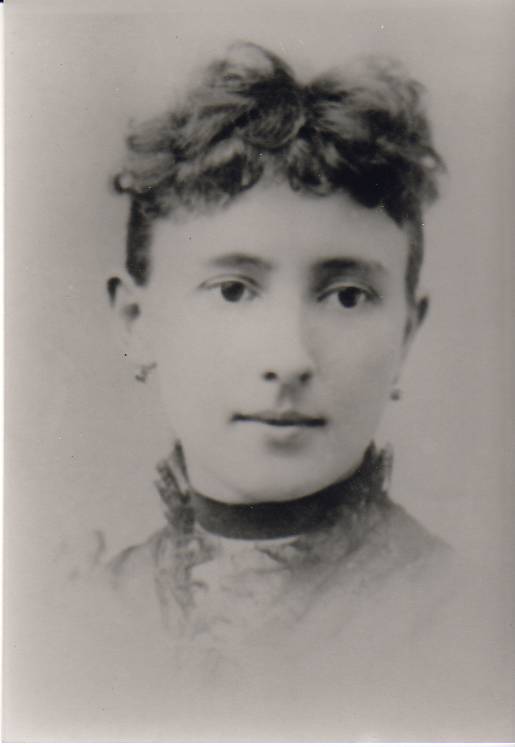
The Holy Grail.  “That after which one seeks.”  Of course, everyone approaches DNA testing with their own personal set of goals, their own Holy Grail, but the most universal is to find out where they are from.  Especially people in the Americas, New Zealand and Australia – we are countries of immigrants – mostly from Europe, some from Africa.

Many times during and after the crossing to the new land, the connection to the old country was lost – certainly the challenges of a the new world, a new life, in essence starting new or again – took up every minute of every day.  The old world, while certainly a memory, was not something they talked about daily.  By the time a generation or two had passed, information dimmed, and if we are lucky, we might have an oral history of the country they came from.  Another generation or two and there is nothing left.

If your ancestor immigrated in 1650, there have been approximately 14 generations since the person who immigrated.  That’s a lot of people to pass on an oral tradition – and most of the time it didn’t happen.  Some people are fortunate.  For example, if your surname is something like Campbell, well, you pretty much know you’re Scotch-Irish or Scottish and there isn’t much doubt about where you came from.  But other people aren’t so lucky.  Furthermore, even if you do know which country your ancestor came from, that’s not quite the same as knowing the village where they lived, or the castle if you are landed gentry or royalty.

I approached the SFA about what was then a new technology, DNA testing, and the Speakes DNA project was begun in 2004.  We have since identified several different genetic Speakes lines.  Originally it was a Y DNA project, but today we work with autosomal DNA as well and encourage everyone who descends from a Speak(e)(s)(es)  and has taken the Family Finder Autosomal test at Family Tree DNA to join the project.

Initially, we wanted to learn more about our Thomas Speakes of Maryland.  We knew he was Catholic, was in Maryland by 1660 or so, and married Elizabeth Bowling shortly thereafter, before November 1663 when she was subpoenaed by the Speake surname.  But we didn’t know where he was from, where he married Elizabeth, when he was born, or much else.

Earlier research had shown that Lancashire, in England, was “a nursery of recusants.”  In other words, a hotbed of Catholics who refused to give up their Catholic faith, accept and become members of the Anglican Church.  The biggest difference between the two is that the Pope is the head of the Catholic church and the King is the head of the Anglican church.  To many Catholics, that was a rather important detail.  Most people simply complied, but in Lancashire, many didn’t, including the landed gentry.  They protected their Catholic peasants who worked their lands.

There was also a baptismal record for a Thomas Speake in 1634, about the right time, but then there was also a later death record for Thomas’s wife and daughter.  Of course, we have no way of knowing if this was the same Thomas.  There are many missing records during this time, as you might imagine.  Not only did the English Civil War take place, but also Catholics had their children baptized in secret by priests.  They were only baptized in the Anglican Church when there was no other choice.  Same situation for marriages and deaths as well. When Cromwell was on the throne, there was an 11-year period where many of the records are missing entirely in Lancashire.  Suffice it to say, the records were not only incomplete, the ones that did exist were frustratingly inconclusive.  We, as a family association, had come to believe we might never know any more about our Thomas Speake that we already did.  The association allocated some funds for testing and several Speak(e)(s) men at the convention that year swabbed.  I just happened to have several test kits available.  Imagine that coincidence:)

Between 2004 and 2010, several Speak(e)(s) males tested and we confirmed the DNA of Thomas of Maryland as well as that of both of his sons, John and Bowling.

Speaks chart

You might notice on the chart above, that not all of the “sons” are yellow, the color of John, Bowling and Thomas.  In fact, Capt. Francis and William are blue and red, and John E. is both green and yellow striped.  This means that the descendants who tested in these lines do not match.  Whether that is actually because Francis, for example, really was not the son of Richard, or whether an undocumented adoption has occurred some place in the line or the genealogy is incorrect has yet to be determined.  In order to further define those lines, we need additional men from those lines to test.

Speaks chart 2

John, on the other hand was schizophrenically colored with yellow and green stripes because his two sons lines DNA did not match.  However, we know that the Thomas line is yellow because people from various sons lines all matches the yellow DNA results.

The Charles Beckwith to Nicholas Speaks line is the yellow line to the far right, above.

At this point, we had established the baseline DNA results for Thomas the Immigrant’s line, but we still had no idea where the family originated in England.

But then came Doug Speak from New Zealand.  Ironically, Doug was recruited by one John David Speake, a gentleman who lives in Cambridge, England and whose DNA is shown not to match the DNA of the Thomas Speak of Maryland line.  This was profoundly disappointing to us because we had felt a kinship with John for many years during our joint Speake research.  John David had much better access to English records than we did or do, and we owe him a huge debt of gratitude.

New Zealand is newer country than the US.  Doug’s ancestors had only immigrated to new Zealand in the 1800s, and he knew where they were from in England.  While this was interesting initially, it became vitally important when we learned that his DNA matches the Thomas Speake family line.

This, in genetic genealogy terms, is the Holy Grail.  Now if you discover your match is from London or a large city, that’s not the Holy Grail.  Before the industrial revolution, places like London were merchant cities, not to mention the center of government.  People migrated to cities.

However, if you discover that your surname match came from a small village in an out-of-the-way place – that indeed, is the equivalent of the genetic genealogy Holy Grail.

Gisburn Map

If you look at a map, you can see that Gisburn is about 2 blocks long, has a church, one pub, a deli and one restaurant.  Well, of course, it has a few houses too, but it’s truly a small crossroads village.

Gisburn street

In this church, St. Mary’s, Doug’s ancestors’ were baptized.

St Mary's Gisburn

The Y DNA tells us that we share an ancestor with Doug, but it just doesn’t tell us who, or when.  But no one immigrated TO Gisburn, unless it was from the village up the road, so we know this too is our ancestral land.

The Thomas Speak that immigrated in 1660 may have been baptized in Downham, another village church about 4 miles distant from Gisburn, so this makes sense.  Churches were established where people could easily attend – and attendance meant walking.

In 2011, I announced at the Speakes Family Association convention that we had unlocked the secret of the area where our Speake family was from, I showed a slide of St. Mary’s Church, with their many Speake family records of baptisms, marriages and burials – and said as a throw away comment that I wanted to stand there.  Little could I ever have imagined that indeed, two years later, I would be standing in that very churchyard.

It’s a long way from Hancock County, Tennessee, on the Powell River to Gisburn, Lancashire, England – 6 generations and more than 4000 miles.  Wouldn’t Elizabeth Speaks Claxton be amazed!

So what are we waiting for?  Let’s go see what we found!!!

Join me soon for the article, “Following the Ribble River to Gisburn.”

______________________________________________________________

Disclosure

I receive a small contribution when you click on some of the links to vendors in my articles. This does NOT increase the price you pay but helps me to keep the lights on and this informational blog free for everyone. Please click on the links in the articles or to the vendors below if you are purchasing products or DNA testing.

Thank you so much.

DNA Purchases and Free Transfers

Genealogy Services

Genealogy Research

John Curtis Bucher (1942-2012) and the Valentine – 52 Ancestors #7

Our cousin, Cheryl, who grew up across the street from my grandparents’ house where my brother, John, spent a great deal of time mentioned one day in passing that John was known to be a “stinker” as a child.  I’m sure she was not exaggerating.  From all the stories I’ve heard, my brother, John was indeed a handful, and not much ever changed.

When going through Mother’s things after she departed this Earth, I found something, in John’s own hand, from when he was maybe 7 that proved, beyond a shadow of a doubt, that he indeed fully earned his reputation.

John made Mom a Valentine.  As all mothers are, I’m sure she was thrilled to receive something from her child.  And then she opened it. John ValentineThe front is your typical children’s exchange Valentine – and I’m just as sure as I’m sitting here that my grandmother told him to write something to his mother on the back and tell her what he’d been up to…..so he did.

John Valentine back

I got muddy five times.

I got in a fight Wednesday.

I got called down Tuesday.

I got in the coal bin Sunday and was I dirty.

John Valentine back 2

I got a great big clok.

Yours truly,

John Curtus Bucher (Yes, he misspelled his own name.)

Indeed, I’m thinking that every day in John’s life was a new adventure just waiting to happen.  This was probably an ordinary week in John’s life.

Not a lot changed in the following 60 years or so, except the magnitude of the trouble John got into.  In 2011, the story of his weekly adventures started out something like this…..Sunday, I cut my leg with a chain saw…Monday, I got the tractor stuck in the mud…Tuesday, I went back to the woods and a tree fell on me……

My brother, John, passed away in October of 2012, ornery as ever, staunchly refusing to DNA test as he had for the past decade….asserting that he would rather “not know,” even in death.  Actually, what he meant was that wanted to keep me from knowing, just on general principles…just because he could.  Personally, I think he did that…or in this case…didn’t…just to irritate me…and he fully succeeded.

However, whether I agree or not with his motives or choices, I staunchly defend his right to them.  So, for the record, it was NOT me who stole his toothbrush from his hospital room.

Nope, wasn’t me.

I know what you’re thinking.

Was not.

You see, I knew that toothbrush wouldn’t help at all.

I don’t know who used it, took it, or whose it was, but it wasn’t his.

John wore dentures!

______________________________________________________________

Disclosure

I receive a small contribution when you click on some of the links to vendors in my articles. This does NOT increase the price you pay but helps me to keep the lights on and this informational blog free for everyone. Please click on the links in the articles or to the vendors below if you are purchasing products or DNA testing.

Thank you so much.

DNA Purchases and Free Transfers

Genealogy Services

Genealogy Research

John Whitney Ferverda (1882-1962) and the Body in the Garage – 52 Ancestors #6

John Ferverda

My grandfather’s name was John Whitney Ferverda.  I’ve always wondered about that middle name, with no idea where it came from.  It does not appear to be a family name.

He was born on December 26, 1882 in Plain Township, Kosciusco County, Indiana, on a farm to Hiram B. (probably Bauke) Ferverda and Evaline Louise Miller Ferverda.  He died on June 9th 1962.  I was 7 and I remember him, albeit somewhat vaguely.  His wife. Edith Barbara Lore Ferverda who he had married in Rushville, Indiana in 1908 had just died 18 months before, so it had been a rough couple years in the family.  With John Ferverda’s death, the homeplace had to be sold, the furniture divided, and all of those things that signal the end of an era and what we’ve come to know as closure needed to be done.

John and Edith had two children, my mother, Barbara, and one son, Harold Lore Ferverda, known by the family as Lore.

I think I’ll let Mom introduce you to her father, in her own words.  I gave my Mother a book called “Grandmother’s Memories” to complete for her grandchildren and great-grandchildren.  She did, at first in her own hand, and then later, as her handwriting became more difficult to read, she would tell me the answers and I would write them for her.  The book asked questions or gave topic suggestions.

My Father’s name was John Whitley Ferverda.  He was born in 1882 and died in 1962.  He had blue eyes.

My Father’s most precious memory:

When I was so sick with rheumatic fever, every morning he carried me downstairs to the davenport and every evening upstairs to bed.  He always had time to read to me.  I was too sick to read for myself.  I was 7 or 8 and he read everything to me I could get my hands on.  He worked at the Ford Agency in Silver Lake selling cars and trucks.  When I went to school, we walked and went the next half block further to the Ford Agency and asked Dad for a nickel.  When he gave it to me, I promptly went to the drug store and bought a Hershey bar, which Dad knew I’d do.

My Father’s best story about growing up:

He was one of 11 children.  From their farm they walked over to Tippecanoe Lake to swim which was about a mile.  He took enough schooling to be a teacher, but never secured a position with the school. Instead he started with the railroad and was sent to Rushville where he met Mother.

John Ferverda against car

Here’s a bit more info from the “History of Kosciusko County, Indiana” 1919:

John Ferverda is a merchant of successful experience and has been identified with the hardware trade at Silver Lake for a number of years, being one of the live and enterprising business men and citizens of that locality.

He was born in Plain Township of this county Dec. 26, 1882, a son of Hiram B. and Eveline Miller Ferverda, both of whom now reside at Leesburg.  John Ferverda grew up on his father’s farm in Plain Township and was liberally educated.  He attended both the common and high schools of Oswego, being a graduate of both, and also was a student in the Tri-State Normal at Angola.  For his scholarship he was granted a license to teach, but never used it in that profession.  His life was spent largely at home until the age of 22.  Having mastered the art of telegraphy, he entered the service of the Big Four Railway as an operator, and was assigned at different stations along that system and remained in that service about 10 years.  In 1916, Mr. Ferverda left the railroad to take up business and is now a member of the F. and F. Hardware Company of Silver Lake.

John is shown in front of his hardware store, below.

Ferverda and hardware store cropped

In 1907 he married Miss Edith B. Lore, a native of Rush Co., Indiana and a high school graduate.  They have one son, Harold L., born November 24, 1915.  Mr. and Mrs. Ferverda are members of the Lutheran Church and he is affiliated with the Denning Lodge No 88, Ancient Free and Accepted Masons, at North Manchester, and of the Knights of Pythias Lodge.  In politics, he is a republican.

Was he ever a Republican.  I remember Mom talking about her father quizzing potential suitors.  The first question he would ask them is whether or not they were Republican.  Mom said she knew better than to bring home a Democrat!!!  For years Mom had a small ivory elephant watch charm about an inch long that was his that I suspect was meant as the symbol of the Republican Party.

At some point, before his marriage, probably while in college, John was in some sort of a play.  He is the front row, bottom left corner.

ferverda and play

John studied to be a teacher, but for some reason, after graduating, never pursued that avenue.  Instead, he joined the railroad as a telegraph operator and station master.  He was assigned to Rushville, Indiana.  We don’t know exactly when he went to Rushville, but in an article in the Rushville paper, dated January 25, 1907, John was a pallbearer for Miss Maude Foust who died of typhoid.  We also know he sang tenor in a quartet at the Presbyterian Church in Rushville, based on a November 1908 news report .

While in Rushville, John met and married Edith Barbara Lore, daughter of Curtis Benjamin, known as CB, Lore and Ellenore “Nora” Kirsch Lore. She too attended the Presbyterian Church.

Ferverda - Lore marriage license

Ferverda-Lore marriage license

Rushville Republican Newspaper, Jan. 3, 1910 – John Ferveda who was recently transferred to cashier at the local office has been given the agency at Silver Lake in the northern part of the state and will leave here in the next few weeks.

John and Edith moved back to Silver Lake where John served as the station master and where they spent the rest of their lives.

While their immediate family was small, John had many siblings in the area.  He was one of 11 children born to Hiram and Eva Ferverda.  One of his siblings, Roscoe, lived across the street from him in Silver Lake, Indiana.

ferverda family original photo

Ferverda family description cropped

John Ferverda’s parents were Brethren, although it appears that not all of the family continued in that faith which prohibited military service, among other things.  John broke with the Brethren faith by marrying Edith who was a Lutheran, and Roscoe broke with the Brethren faith by serving in WWI.  In fact, four of John and Eva’s sons, in total, served in the military, Ira in the Spanish American War and then Donald, Roscoe and George. Those three sons are standing together in the middle row, with George, on the right, in uniform.

John and Roscoe were close their entire lives, even though there was 9 years between them, Roscoe having been born in 1893.  In fact, when Roscoe returned from military service, he too worked at the station with his brother for the railroad until the depot in Silver Lake closed in 1958 due to declining business.

silver lake depot

John and Edith bought a house in Silver Lake that was located right by the railroad tracks, which were across the field to the right of their house in the photo below.  I loved the large screened-in front porch on this house.  The screens were painted yearly to keep them from rusting, and rocking chairs resided on the porch in warm weather.

One time, Lore was painting the screens and my mother was bothering him in her sisterly way.  He decided to paint her cat’s nose, which infuriated my mother, so he then painted mother’s nose black too….except he “missed” and got her entire face with the side of the large brush he was using.  Mother was scheduled to perform in a dance recital later that day on the courthouse square in Wabash.  I’m sure you can imagine the drama and hullaballoo that results from that little incident.  Paint then was not water soluable and required turpentine and scrubbing to remove.  This was always one of mother’s favorite stories about her brother.

silver lake house

Roscoe bought the house right across the street.  Roscoe and John were thick as thieves.

Roscoe's house

Old newspapers can be a lot of fun.  In the local paper I found some tidbits that give us hints about John’s life.

July 31, 1910

Ferverda news 1910 cropped

Donald Ferverda is visiting with his brother John Ferverda and wife at Silver Lake.

Don was one of the three Ferverda sons who served in the military in WWI.  After returning, he was a cashier at the bank in Leesburg and died relatively young of cancer.

February 5, 1911

Ferverda news 1911

Mr. and Mrs. John Ferverda of Silver Lake visited with Hiram Ferverda and family over Sunday.

Visiting your parents hardly seems like a newsworthy event.  It wasn’t far from Leesburg to Silver Lake – about 18 miles.  However, it’s a lovely tidbit.

July 30, 1912

Ferverda news 1912

Mrs. Gertrude (her name was Nora, not Gertrude) Lore of Rushville is here at present visiting with her daughter, Mrs. John Ferverda and husband.  Mrs. Lore’s two daughters (Mildred, 13, and Eloise, 9) have been here for the past several weeks visiting at the Ferverda home.  The garage building is nearing completion.  The metal ceiling is completed and is now ready for the paint.  The building will be ready for occupancy within a short time.

I originally didn’t think the second paragraph was relevant to the Ferverda family, but with all those females visiting “for an extended period”, maybe my grandfather was taking up residence in the garage:)

October 11, 1912

Ferverda news 1912 - 2

Mr. and Mrs. John Ferverda of Silver Lake are here for a two weeks visit with his parents, Mr. and Mrs. H.B. Ferverda.

October 19, 1912

Ferverda news 1912 - 3

H. L. Anderson of Westport who had been here as a relief agent for Mr. Ferverda during his absence went to Leesburg yesterday where he will be for 15 days while the Leesburg agent takes a trip.

Agent here refers to railway agent.

December 22, 1912

Ferverda news 1912-4

Paul Ferverda of Leesburg is here visiting with his brother, John Ferverda and wife.

John had brothers Ira, Irvin, Ray, George and Donald who lived outside of Silver Lake, but no Paul.  Roscoe lived in Silver Lake across the street from John.

April 19, 1913

Ferverda news 1913

We understand that Ray Ferree who recently was bumped off of the Big Four at North Manchester by one who was older in the service will apply for the station here and if he applies it will almost be sure that the company will award him the position.  The family will then move here and occupy the Mrs. Metzger property near the depot and Mr. Ferverda, the agent, who resides there at present will go to Markleville.

The family never went to Markleville.

February 16, 1914

Ferverda news 1914

H.P. Rager, John Ferverda and Dale Homman were down to North Manchester last evening taking the first steps in the degree work of the Masonic order.

November 13, 1915

Ferverda news 1915

Ray Feree is here this week as relief agent for John Ferverda at the Big Four.  Mr. Ferverda is taking a vacation and will also have his eye operated on upon during his vacation.  He went to Cincinnati the first of the week for that purpose.

This is a week before John Ferverda’s son, Lore was born, on November 24th.  I wonder what kind of eye surgery he had performed, and for what condition.

November 27, 1915

Ferverda news 1915-2

John Ferverda, our genial agent at the Big Four station and wife and Percy Helser the drayman, and wife, are the proudest people in the whole community and passed the most enjoyable Thanksgiving of any.  The stork came to their homes Wednesday afternoon and left a bouncing boy baby at the Ferverda home and at the Helser home he left a sweet little girl.

Rushville Republican Newspaper, Jan. 8, 1916 – J. W. Ferverda, Big Four agent at Silver Lake and well known here has purchased a hardware store there in partnership with R. M. Frye.  He has resigned his position with the railroad company.

January 22, 1916

Ferverda news 1916

J. W. Ferverda has returned home from a trip to Rushville where he was for a couple of days visiting with his wife and son.

September 10, 1916 – Silver Lake News

Ferverda news 1916 - 2

John Ferverda is going about bandaged up on account of a broken rib received a few days ago when he was assisting in unloading some machinery.

In 1918, every man had to register for the draft.  WWI was upon us.  John Whitney Ferverda registered, said that his occupation was in retail hardware and as an implement merchant.  He was described as short, of medium build with light hair and gray eyes.  I never knew he had grey eyes.

John Ferverda WWI draft

February 28, 1918

Ferverda news 1918

Friends and relatives here had just learned of the marriage last month of Roscoe Ferverda, son of Mr. and Mrs. H. B. Ferverda of Leesburg and Miss Effie Ringo of North Vernon, Indiana.  Mr. Ferverda who was a telegrapher at North Vernon enlisted in the signal corps and just before being called for examination was taken sick with measles.  He came home for two weeks and immediately upon his return to North Vernon was examined and sent to the training camp at Vancouver, Washington.  The wedding took place while at North Vernon for the examination.  The bride is expected here tomorrow for a visit with his parents.

So it seems that not only did Roscoe join the military, he married a non-Brethren wife as well, without telling his parents.  Those Ferverda boys, renegades all of them….

In the 1930 census, we know that Roscoe is an agent for the Big 4 Railroad, almost the last person enumerated in the village of Silver Lake, in Lake Township, in Kosciusko County, Indiana.  John Ferverda was the first household enumerated, living directly across the street from Roscoe.  In 1930, John was a salesman at the Ford garage.  With the decrease of rail shipping, jobs with the railroad evaporated.

Below, both the new and old garages in Silver Lake.

Silver lake garages

At some point, and I believe it was before or during the Depression, John Ferverda owned a hardware store in downtown Silver Lake.  The problem was that people couldn’t pay their bills.  Eventually, that business would close, and John would raise chickens in the chicken house behind the house and sell eggs.  There may have been a Depression, but everyone still had to eat.  Eggs and chicken were relatively cheap protein and both eggs and hatchlings were shipped as far as New York.  John loved his chickens, and this one was his favorite and according to the back of the picture, his best producer.

John Ferverda and chicken

Mother remembers cleaning chickens as a child during the Depression, and not fondly, I might add.

Sometime, about this same time, when Lore was a late teen, it seems that he “borrowed” the family car without permission, and managed to get it stuck in the snow.  I don’t know how he managed to get ahold of his father, but he did.  If he thinks he was in trouble with his Dad, he hadn’t seen anything yet because his mother, Edith, relied on that car to get her to the job that supported the family during the Depression.

Ferverda 1937 storm

So off John and Lore set to get Lore unstuck.  I’m not sure who went with them, but I’m guessing it was Roscoe.  The photo above is labeled 1937 in Mom’s photo album.  There is another photo also of a sleigh with a horse pulling it that looks to be about the same time.

Ferverda fam 1937 cropped

Mom kept a photo album, thankfully, and this was labeled as 1937.  Left to right John Ferverda with Buster, Edith Lore Ferverda (John’s wife), Eva Miller Ferverda (John’s mother), Chloe Ferverda Robinson (John’s sister), Charlotte Robinson, Raleigh Robinson (Chloe’s daughter and husband.)

Ferverda fam 1937-2

Two houses down the street was the Methodist Church where the Ferverdas were members.  I have vivid memories of this church when I was little, sitting on the small child sized chairs and belting out Jesus Loves Me at the top of my lungs in Sunday School, which was through the side door on the left and downstairs.  I can still hear it….

“Jesus loves me, this I know,
For the Bible tells me so….”

silver lake methodist church

On the 1940 census, Roscoe and John are shown with 4 residences between them.  Roscoe is still an agent for the railroad and now John is an “owner and overseer” on a chicken and fruit farm.

I had entirely forgotten about the apple orchard and the raspberries.  The entire “back yard” was apple trees and behind the orchard, the property terminated in a huge mass of brambles which they called raspberries.  All I know is that I avoided that area because no matter what I did, they always stuck me, one way or another.  I can’t imagine how they picked those berries, but obviously they did.

My grandparents had a back porch with a hand pump where they washed and processed the apples.  That same pump pumped the water for the kitchen and bathroom, both of which were adjacent to the pump room.  This WAS considered running water at that time.

In 1941, John Whitney Ferverda registered for the WWII draft, even though he was 59 years of age.  His signature is beautiful.

John Whitney Ferverda draft

Silver Lake, where they lived was a small town, but it was not incorporated, so they were part of Lake Township, although Silver Lake made up the most populous part of that township.  From 1943-1950, John Ferverda was township Trustee.

Silver lake 1945 chemistry class

In 1945, the newspaper reported that , “Trustee John Ferverda provided a fully equipped chemistry lab and the course in chemistry was added in the high school.”  John’s son, Lore Ferverda, had graduated from Silver Lake High School in the class of 1933 and went on to become a chemist, eventually holding several patents.

John Ferverda alseep

I do believe this was before recliners had been invented.  I remember my grandmother starching those chair arm and back covers.   My grandfather did this every afternoon.  I think I inherited the propensity from him!  Must be genetic.

Speaking of genetics, we have been fortunate that one of Roscoe’s sons volunteered to take the Y-line DNA test as well at the autosomal test.  Roscoe’s daughter, Cheryl, has taken the autosomal test as well.  In fact, these folks were some of the first testers at 23andMe and are now participating in projects at Family Tree DNA.  There is a Ferverda DNA project, but needless to say, with a name like that, it’s not very large.

Cheryl, and I are in the final stages of planning a trip back to the Ferverda homeland in 2014.  We can hardly wait and I’ll be sharing that with you too, but for now, back to John Ferverda.

John and Edith Ferverda 1959

John and Edith Ferverda with their first great-grandchild, Bruce, born on the 4th of July, 1959.  The family referred to him as “the firecracker with a short fuse.”  I believe this photo was taken at Christmas, 1959.  Edith passed away, a few days later, in January of 1960.

John and Edith 1959 standing

I don’t know where this photo was taken, but it wasn’t their house.  This is a great photo and is exactly how I remember Edith Lore and John Whitney Ferverda.

By the late 1950s or early 1960s, John had tuberculosis.  They believed it had been dormant for decades.  Edith’s father and sister both died of TB in 1909 and 1912, respectively.  He went to the tuberculosis sanitarium where he was treated for several months.  After returning home, he became ill again in 1962, except this time it was inoperable liver and pancreatic cancer.   He passed away on June 9, 1962.

John Ferverda obit

Mom and lore at grave

This photo is of Edith and John’s two children at their gravesite.  Stopping at the cemetery became a regular occurrence anytime we were in that vicinity, or could be without a huge detour.

Since neither of their children lived in Silver Lake, after John passed away, they put the house with the chicken houses and apple trees and raspberry bushes up for sale.  I remember Mom talking about how difficult it was to go through their things.  I also remember finding money hidden in the most unusual places.  I suspect that was a relic of the Depression years when life was extremely difficult.  One time, I picked up a powder box and a false bottom fell out, along with some cash hidden there.  I wonder how much was inadvertently given away, secreted away like that.

Mom and Uncle Lore sold the property, and the new owners turned it into a funeral home.  My mother was utterly mortified.  They enclosed the front screened in porch with plywood painted white, turned the dining and music rooms into viewing parlors (the large window grouping on both sides of the house) and processed the remains in the kitchen and on that back porch.  I would hope they installed a better water system.  The garage, seen behind the house is where the hearse was kept and the bodies loaded, unloaded and well, um, stored.

silver lake house as funeral home

My mother, for years, when someone died in Silver Lake just prayed that the funeral was at the “other” funeral home.  She was utterly mortified that her family home had become a funeral home, and she said she simply could not go inside.  Finally though, someone died, and she had to find a way.

silver lake house as funeral home front

silver lake house as funeral home 2

That someone was Roscoe.  He died, as luck would have it, 36 years ago this week, on the morning of the epic blizzard in Indiana, January 25, 1978.  And when I say epic, I mean epic.  We have photos of family members on drifts level with the roof.

1978 blizzard

These are just the kinds of things the Ferverda family did, especially these two brothers!  Both John and Roscoe would have found that immensely humorous.  Everyone else, not so much.

The roads were closed, for days.  Finally State Road 14 was opened, one way, through snow tunnels.

1978 blizzard snow tunnel

Roscoe’s funeral was held, such as it was, and then, because the snow was too deep and the ground too frozen for too far down…Roscoe got to spend the next several weeks in his brother, John’s, garage.

Gone, But Not Entirely

John and Roscoe may be gone, but their DNA isn’t.  Roscoe’s son provided his DNA, quite graciously, as part of a DNA presentation at the Allen County Public Library a few years ago for Y chromosome testing.  Because of his generosity, we know that the Ferverda men fall into haplogroup I1, and their DNA is quite unusual.  At 25 markers, only 2 matches, and one of those is a Scherp from Germany.

We’ve tested several downstream SNPs as well, to see if we can refine his haplogroup further, but so far, he has tested negative for all of the SNPs tested.

He is a member of the haplogroup I project, where the administrators have grouped him in the I1 generic group.  Each project is grouped differently, according to the project goals and the administrators, but in this case, his grouping tells us that he does not match the other groups, such as “AS” for Anglo Saxon or “N” for Nordic, or Balkan or Iberian, for example.

ferverda dna map

For as unusual as his markers are in the second testing panel, at 25 markers, providing only 2 matches, his 12 marker matches are extremely common in haplogroup I, providing him with 1028 matches.  His 12 marker matches are shown on the map below.

Ferverda 12 markers

Clearly these 12 marker matches don’t hold at 25 markers, and most of these people did test at 25 markers. This is the best example I can think of as to why testing at higher levels is so important.

Edith and John Ferverda stone

______________________________________________________________

Disclosure

I receive a small contribution when you click on some of the links to vendors in my articles. This does NOT increase the price you pay but helps me to keep the lights on and this informational blog free for everyone. Please click on the links in the articles or to the vendors below if you are purchasing products or DNA testing.

Thank you so much.

DNA Purchases and Free Transfers

Genealogy Services

Genealogy Research

William Sterling Estes – The Missing Years – 52 Ancestors #5

William Sterling Estes was my father.  He was commonly called Bill, and sometimes Sterl, by family members.  He was probably born in either 1902 or 1903, or maybe 1901, records vary, and he died, positively, in 1963.  That’s one of the few positive things we know about him.  His life was anything but ordinary, and he was missing for many years.  And that’s just the beginning…

My father was a study in polar opposites.  He was extremely intelligent, helping his step-son with physics in graduate school, yet did incredibly stupid things that landed him in a heap o’ trouble – and I’m not talking just about that Ilo incident where he married under a fictitious name and then went AWOL.  There were more.  Many more….

Moonshine and Rough Beginnings

My father’s issues began when he was young.  This isn’t meant as overtly critical, but my father’s early years were anything but stable.  He was born near the turn of the century in Claiborne County, Tennessee.  That area, deep in Appalachia was both stunningly beautiful and equally as poverty stricken.

cumberland gap panoramic

Land there, what was farmable, was already taken and the “next generation” had to find something else to do.  But there was nothing else there, so many moved on west.  In the case of my grandparents, they tried several avenues, one of which was moonshining.

Moonshining wasn’t anything unusual in the hills, nor among the original settlers. In fact making your own liquor had been a staple on every farm for hundreds of years in the US, until the law made it illegal over taxation.  It was never a moral issue until Prohibition.  Moonshining or bootlegging has been illegal for awhile, actually a long while, in one form or another, but in Appalachia, mostly everyone ignored that.  Moonshining increased during Prohibition and has been a staple of that region ever since.  My family shares stories of painting milk jugs white and having the kids deliver moonshine in milk jugs in the coal camps from their red wagon.  The family survived and ate together, or didn’t.  Everyone was expected to contribute.  There wasn’t any other choice.

The Estes family in Halifax County, Virginia, some 4 generations earlier had been known for their fine brandies distilled from their orchards.  The difference was, I’m guessing, is that they paid taxes, or they greased the right palm.

In any case, my grandfather, William George Estes was a moonshiner, a photographer and a farmer, among other things.  A veritable Appalachian Renaissance man.  He married my grandmother, Ollie Bolton, in September of 1892.  In July of 1893, their first child, was born, and a year later, in August of 1893, that son, Samuel would pass away and was buried in the family cemetery in Estes Holler behind his grandfather, Lazarus Estes’, house.

Estes cem

Three months later, a second child was born, Estel, who lived.  Two years later, another child whose name we don’t even know for sure, and in another 2 years, Robert, who would burn to death.

Life was rough.  The 1900 census gives us a glimpse. William George Estes states that he was out of work for 9 months the previous year.

Sometime between 1900 and 1910, the family moved to Springdale. Arkansas where Ollie took care of the children and ran a boarding house and William George fished off the bridge down the street from the boarding house, and drank.  By this time, they had several children, and it seemed there were always more on the way.  In the 1910 census, Ollie has borne 8 children and only 5 were living.

Ollie 1907

This picture of Ollie and the children was taken in 1907.  The child, Robert, the blond boy on the chair, would perish when their cabin burned, sometime before the 1910 census.  Cousin George Estes, in the 1980s, showed me where that cabin stood and told me he planted a willow tree there in honor of the child.  Estel, the oldest child, standing in the rear in this photo, age 13 in 1907, had been left in charge and tried to save Robert, who hid under the bed, to no avail.  Estle did manage to get my father, standing in front, and Margaret, held by Ollie, out safely.  That memory alone could scar a person for life.  Robert too is probably buried in the family cemetery just a few feet away, but there is no marker.

By 1913, the family had moved to Fowler, Indiana and become tenant farmers.  Ollie and William George’s marriage was coming unraveled too.  It seems that Ollie’s young female cousin was visiting from Tennessee, and Ollie came home and caught William George and her cousin “in the act.”  She grabbed either a bull whip or a horse whip and proceeded to use it on them, specifically on him, with the full intention of killing him.  The family stories are that it took 5 adult men to restrain her long enough for him to escape.  The family story, from the Crazy Aunts, of course, also says she was pregnant with twins which she subsequently had prematurely and died. If so, the Benton County, Indiana death records contain no record of this birth/death.  They could have been too small, or not born alive.

Divorce followed, but according to Aunt Margaret’s letters which she wrote to my step-mother after my father’s death, Ollie went to Chicago, taking the two girls with her, and William George headed back for Tennessee, but no one wanted the two middle boys, my father and Joseph.  Estel by this time, about 20, was old enough to make his own way. My father was about 12 and Joseph, about 10.

Joseph and my father hopped a train in Indiana and found their way back to Tennessee, and when they arrived at their grandparents house in Estes Holler, extremely hungry, dirty and threadbare, having walked a great distance, and with stories to tell…there was hell to pay.  When William George Estes, their father, arrived sometime later, he was literally run out of Estes Holler by his father, Lazarus Estes, under threat of death, for what he had done both to Ollie and to those boys.  William George crossed over the mountains and settled in Harlan County, Kentucky, known as bloody Harlan, where he very successfully moonshined for decades up in the roughest section of Black Mountain, the roughest area in Kentucky, near the coal camps. My Mom visited once with my father and refused to ever return.

Unfortunately, all of William George’s boys learned to drink, and none of them learned to drink in moderation.  I was told that when there was no food to eat, the children were given liquor to drink, to make them feel better, or maybe, to make them go to sleep.  I found that hard to believe…until I found the death certificate of a child from William George’s third marriage, William James, who died at the age of 2 years and 6 months, in 1935, and the coroner indicated that the child had died from “improper feeding.”  I was sick the day I read that, physically ill, because I knew all the things I had heard about my father’s young life and were too horrible to believe, were probably true.

The reason I mention this at all is because while my father certainly had a huge number of issues, perhaps not all of them were entirely his fault.  He was probably an alcoholic while yet still a child.  Alcohol both ruled and ruined his life, and certainly affected the lives of all the people around him, including, and maybe especially those who loved him.  Alcohol certainly affected the lives of his brothers the same way, and his sisters, well, they became the Crazy Aunts.

William Sterling Estes Joins the Military

My father joined the military in 1917 during WWI, “adjusting” his birthdate to be 1898 instead of 1901, 1902 or 1903. So did his even younger brother Joseph, nicknamed “Dode,” after his grandfather, Joseph “Dode” Bolton.  The military was most likely a better option for my father than any of the alternatives.

Bill and Virgie

Sometime about this time, my father met a young gal in Dunkirk, Indiana, named Virgie.  My father was extremely handsome, and he certainly understood how to win a young girl’s heart.  Look at this picture.  He brought Virgie a kitten (see his shoulder) and two baby ducks.

Bill ducks

These photos were sent to me after her death in 1989 by her daughter, along with the flag from my father’s coffin.

Bill kitten

Now the kitten is on her lap.  I wonder who took the photos.

Bill gone

This photo is just heart-wrenching to me.  I suspect this is when he married Ilo or maybe my sister’s mother, or at least during that timeframe.

Why did Virgie still have these photos, some 70 year later?  Because, she did eventually marry my father, in 1961, some 44 years after these pictures were taken.  She was his last wife.  They both claimed they were soulmates, and indeed, perhaps they were.  She was the only woman I ever met that had something good to say about my father.  In fact, she never said one bad thing about him.  She was a truly lovely lady.

As a child, I had no concept of my father’s constant woman problems, the betrayal of trust, his problem drinking, or the fact that he had “another family.”  I didn’t know I had a brother, Dave, who was only 5 months older than I was.  My mother, who was terribly embarrassed about the situation, managed to hide that from me, as did the “other woman,” from her child too.

My Father’s Daughter

I never knew my father as an adult.  I knew him as a child and I loved him, wholly and completely, in my childish way.  My father would come and visit and I would absolutely adore him, much to my mother’s chagrin.  It must have been tough from her perspective.  She did all the work and he got all the glory for simply showing up.  I remember once when he bought me a rocking chair, which I still have to this day, at Krogers.  I was maybe 4 or 5 and it was for my birthday or maybe Christmas.  Mother was so angry with him, because that is what she was going to get me and he “scooped” her.

I remember another time too when she was furious with him.  I understood that she was angry, very angry, and that it wasn’t directed at me, but I didn’t know why.  The phone rang, very late at night.  She got me up and we went for a drive. I was excited as this was a great adventure in my pajamas.  When we got “there,” my Dad was there, which made me very happy.  I got to sit on his lap for a few minutes, but then we had to leave, taking his little dog, Timmy, with us, who I thought was my dog.  Turns out, Dave thought Timmy was his dog too, and we both had photos of us with Timmy.  Here I am in that coveted rocking chair holding Timmy.

Me and Timmy

Years later, I asked Mom about this very foggy recollection.  Turns out, “there” was the jail in the next county. Why?  Because he has been arrested for drunk driving.  That’s what we called it then, no politically correct terms like “impaired operation of a motor vehicle.”  I asked Mom why she went at all and she said, in a semi-growl, “for the dog.”  Yep, she would have done that and she would have been furious with him both for having to go and retrieve the dog that wasn’t even hers, and for doing what he did….again.

His Death

My father’s death in 1963 in an automobile accident, like every other event in his life, was filled with contradictions.  My step-mother told me he was on the way to the preacher’s house to pick him up to go fishing, stone cold sober.  Her daughter told me that my father had been seen at the park earlier in the day, intoxicated.  Regardless, he reportedly had an angina attack while driving, missed the brake, stomping instead on the gas, and hit a telephone pole head on.

As an adult, after talking to my mother and his part-time employer at the time, which happened to be the funeral home, I wonder if he committed suicide.  On Friday, he backed the hearse into the garage, which in that small town doubled as an ambulance (isn’t that creepy – imaging waking up in the hearse and not knowing if you are dead or alive), and telling the funeral director that he would need it over the weekend.  And indeed, he did.  My father rode in it as an ambulance to the hospital on Sunday and a few days later rode in it as a hearse to the cemetery.

As I got older, everything I knew about my father seemed to be contradicted by something or someone else.  I wanted to love the man, but in some ways, he didn’t seem to be very nice – rather unlovable.  I finally came to the conclusion that while my adult woman self would not like him very much at all,  it was just fine for my young child self to continue to love him.  My mother once said to me in a fit of unbridled honesty that the best thing my father probably ever did for me was to die when I was young before I painfully discovered his betrayals personally. She managed to shield me from most of his drinking.

If I couldn’t know him personally, I wanted to know of him, to understand him.  I was insatiably curious about him.  He seemed so mysterious.  After all, I carried part of him in me.  What was that part and what made my Dad tick, aside from alcohol?  Sadly, I came to discover that alcohol and the actions he took under its influence truly did rule his life.

The Timeline

I started creating a timeline trying to make sense of my father’s life.  There were so many disjoint pieces. I wrote for his military records, but most of them were destroyed in a fire in the St. Louis records center in 1973.  The military helped reassemble as much as possible from other sources.

1917 – In a letter from the VA it says that he served in the Army from Aug. 24, 1917 until honorably discharged on May 19, 1919.  His last rank was private.  He was born Oct. 1, 1898 and died on Aug. 27 1963.  He enlisted May 14, 1917 at Fort Benjamin Harrison, Indiana, 18 years 24 days of age, born in Tazewell, Tennessee. Subsequent service – enlisted May 20, 1919.

I have a copy of this discharge, Sergeant first class, honorably discharged on May 19, 1919 at Camp Custer, Michigan.  His second discharge was honorable as well, even given his time spent in the Disciplinary Barracks at Fort Leavenworth, which really surprised me.

1919, May 20 – My father reenlisted in the Army at Camp Custer.

November 1919 – AWOL from the Army.

December 1919 – Married Ilo Bailey in Battle Creek, Michigan, under the name of Don Carlos.  Aunt Margaret remembered her name as Laila LaFountaine and said that “she hooked him to the plow and drove him like a horse.”

February 1920 – Son Lee born, eventually to be called Lee Devine, in Battle Creek to Ilo.

April 1920 – Arrested for being AWOL – sent to Fort Leavenworth Disciplinary Barracks in Kansas.

May 1920 – My sister, Edna born, also in Battle Creek, Michigan, to Martha Dodderer.

November 28, 1921 – Honorably discharged from the military at Fort Leavenworth.

December 12, 1921 – Married Edna’s mother in Battle Creek, Michigan.

1924 – Martha Estes (Edna’s mother) was paying an attorney for her divorce.  His name was Joseph Hooper and he lived in Battle Creek.  The divorce appears to have been final Feb. 26, 1924. Edna stated in a 1960 letter than before 1950, no one had heard from him in 29 years.  We don’t know where William Sterling Estes was in 1924.

1927 – William Sterling Estes enlisted in the military January 8, 1927 at Fort Sheridan in Chicago.  He was AWOL on May 23, 1927.

1924-1930 – William Sterling Estesmarried” again during this time, probably in southwestern Michigan, possibly Benton Harbor, having a daughter named Violet, about whom very little is known.  Violet married a Golliday or Galliday.  Violet later married a Blevins and joined a religious commune in the Ozark Mountains in or near Licking, Missouri.  Given this and some additional information provided by my sister Edna, who knew Violet, I decided not to pursue this relationship.  Violet was still living in the 1980s, to the best of my knowledge.

The Crazy Aunts told me that Violet’s mother may have been underage, because there was a statutory rape allegation, charge or conviction in western Michigan, possibly in the Benton Harbor area, having to do with the age of the pregnant female.  Michigan prison records held in the State Archives don’t reveal any William Estes having been a prisoner during this timeframe.

Apparently, the Crazy Aunts weren’t the only ones who were suspicious, because Ellen, the “other woman” to whom my father was married in the 1950s wrote a letter to the warden at Jackson State Prison in Michigan inquiring about whether or not my father could have been a prisoner there under an alias.

A letter from the warden of Jackson State Prison to Ellen on Feb. 21, 1957 states that inmate number #24884, Paul LeMarr, alias William Estes, sentenced March 2, 1929 to 10-15 years for statutory rape, was discharged on March 20, 1942.  He was sentenced in Benton Harbor, Michigan and he was age 29 in 1929.  The warden believed that from photos submitted by Ellen that Paul LaMarr could have been William Sterling Estes.
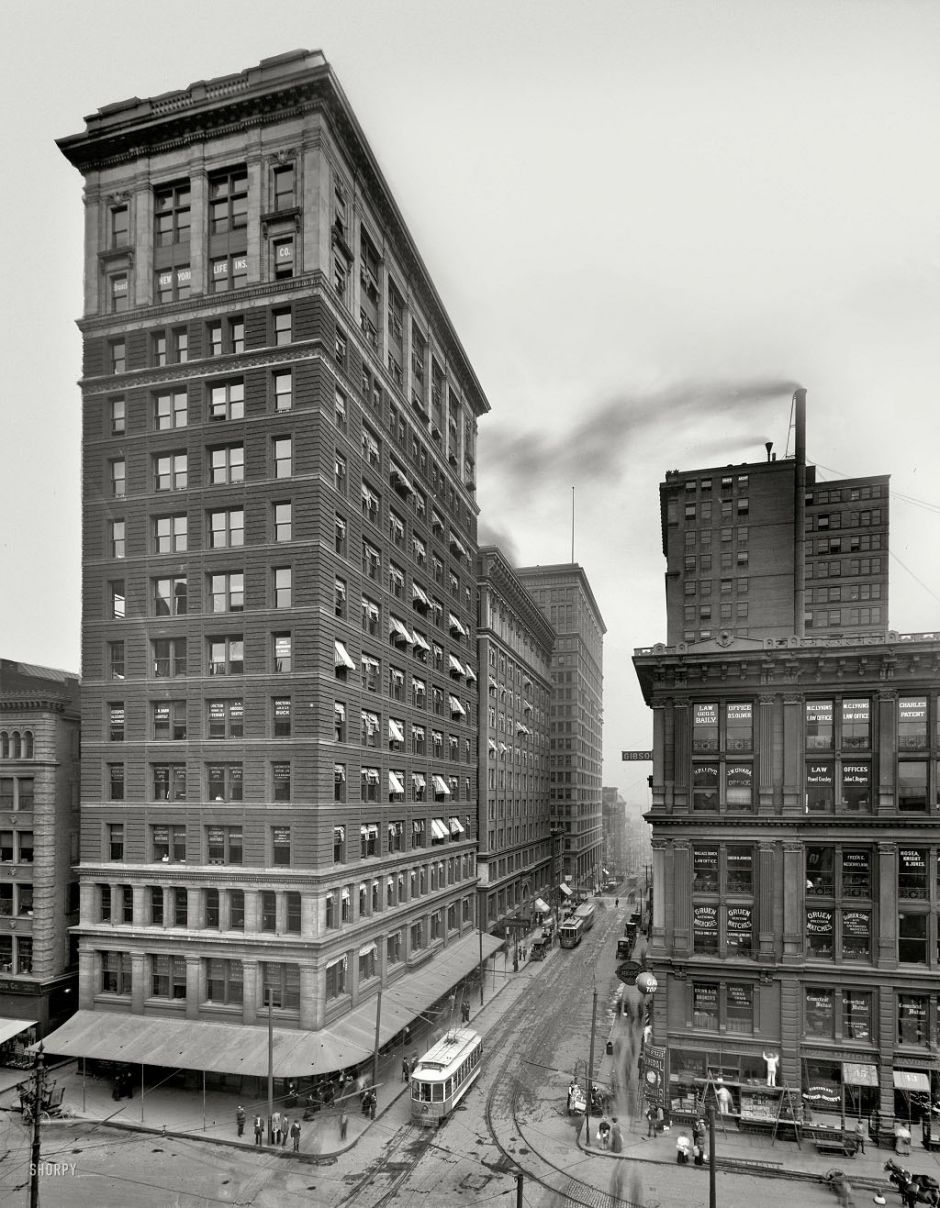
1937 – William Sterling Estes filed for his social security card in Chicago, Illinois.  He is working at Printers Finishing Company and gives his birth date as Oct. 1, 1902, which I believe to be correct.  The signature is my father’s.

Estes, William SS 1937

This proves that my father is not Paul LeMarr, because Paul LeMarr was not released from prison until 1942.  Was Paul LeMarr using William Estes as an alias?  Finally, something in Dad’s favor!  But where did that statutory rape rumor come from?  Was it Violet’s mother and did the charge “go away” because he married her?

So if he wasn’t in prison in Michigan, where was he from 1927 to 1937?

The Crazy Aunts said he was in prison or jail in Michigan at one time, and that one of them visited him there.  But then again, they are the Crazy Aunts and he could have been in “jail” for a few days for who knows what.

There is a rumor about him being in prison in Illinois (Joliet) based on a statement he made to my mother about where he had made someone’s acquaintance.  On the way to Florida in the early 1950s, he stopped at the Georgia prison and visited with the prison guards, the very men who had been his guards.  He made friends with everyone everyplace he went and the man did not know a stranger.  I suspect he could have sold ice cubes to Eskimos.

It’s hard to believe that after being married 3 or 4 times in less than 10 years that he became a monk for the next decade.  Maybe he wasn’t as good at getting divorced as he was at getting married.   He had to be someplace doing something.  And I’m betting that there may be children out there someplace lurking that were conceived between the 1920s when Edna, Lee and Violet were born, and the 1950s when Dave and I were born.  I doubt that he discovered how to prevent pregnancy in the late 1920s and suddenly forgot in the 1950s.

The next hint we have about William Sterling Estes is about 1938.

In March 2006, I visited with the daughter of Estel Estes.  My cousin said that my father came to stay with their family in Fleming, Kentucky in 1938 or 1939.  She was a little girl at the time.  They went for walks together and they found a baby duck without a mother, which they rescued and raised.  She said that the duck was old when it finally died.  My father stayed with their family for a month or 6 weeks.  She said that there was talk that he had gotten out of prison.  There was diphtheria wherever he had been.

1938, Oct. 31 – Discharged from Service – “Other than honorable.”  This is maddeningly brief.  Is this the discharge that matches up with the enlistment from 1927?  This makes no sense.  This also doesn’t tell us where he is, just that this action occurred.

The Unbelievable Story – 2 for 1

Now, let me tell you an unbelievable story.  This is one of two, actually, that kind of fit together like two insane puzzle pieces, and you’ll see why I was convinced that my Crazy Aunts were indeed, crazy.  As time went on, it wasn’t just the Crazy Aunts though that told this story, but my step-mother and others who lived in Claiborne County at the time this was happening.

The Doctor

I remember, when I was a child, there was an old doctor who had his Norman Rockwellish office in the front part of his home down the street from where we lived in Indiana.  I went there one time when I was older, maybe a teen, for something, when the old gentleman said that he remembered my father and that my father was a doctor too. I told him that I was sure he had the wrong man, and he repeated his name and told me, no, that he was not mistaken, that he remembered me, and that my father was indeed a doctor.  He dug around in a drawer, pulled out my father’s file, and showed me where it said he was a doctor.

Being raised in a time when one did not contradict your elders, at least not ones that weren’t your mother, I didn’t say anything, but I was sure this man was wrong.  However, I never forgot the story.  It always nagged at me, the feeling that something wasn’t quite right or that there was something that I didn’t know.

I went to visit my step-mother from the time I was a child.  I first went to visit my Dad and Virgie, my step-Mom, when I was young, before Dad passed away.  I loved to visit.  Virgie’s elderly mother lived there too, Grandma, whom I dearly loved.  Grandma would tell me how smart my Dad was.  I found this kind of odd.  He worked on furnaces and had his own furnace shop at that time in Dunkirk, Indiana.  She said not to let that fool me, that he had once been a great man.  Oh, the rantings of an old woman.  I loved her just the same.  We contented ourselves looking at ViewMaster reels and its predecessor, the stereoscope.  My favorite was Niagara Falls.  Grandma would tell me all about the images while I looked and they came to life.  I loved spending time with Grandma.

Niagara stereograph

After my father and Grandma were both gone, I visited Virgie from time to time until her death.  They were always such pleasant visits.  She told me wonderful stories about the loving man she knew as her husband.  Yes, I mean my father.

Before his death, he hid love letters and notes around the house for her to find later.  I’m sure he knew his time was limited.  My mother told me that based on his health, she thought he might have had cancer.  I’m more suspicious of cirrhosis of the liver, but regardless, he was not a healthy man.  One time, Virgie shared with me a note she had just found stuck behind a picture frame.  It was so sweet and personal and it was nice to know him in this lovely way.  She also kept all of his letters he wrote to her when he was in the service.  Her daughter sent those to me after Virgie’s death.  Even though I felt like I was intruding into a personal vignette, I did read them.  They were both sorrowful and beautiful, especially from my perspective, looking backwards in time and knowing what happened.

Virgie told me that my father understood physics and helped her son when he was studying for his PhD.  I questioned this, and she said that she didn’t know how he had come upon that knowledge, but that he had worked at Oak Ridge, Tennessee, and that at some time, in some way, he was a doctor.  Truthfully, I found all of this quite unbelievable.  I knew that Virgie was not one of the Crazy Aunts, and that she would never tell me something she didn’t believe. She told me that he had done those things before he “went into the hospital.”  What she didn’t add was that the hospital stay was the VA hospital to “dry out.”

Apparently, he “dried out” several times, but never was able to stay dry, although he desperately wanted to.  It’s too bad that Alcoholics Anonymous did not exist then. He might have stood a fighting chance.  I discounted all of this, figuring that most of it was fanciful stories he had made up – but that didn’t explain how he could ever help a college student studying for an advanced degree that included physics.

When I started my genealogy search, I contacted people in Claiborne County, Tennessee.  All I started with was the name of a town, from my mother, Tazewell.  I called the telephone operator and told her to connect me to any Estes family there – and she did.  I eventually made my way from person to person to the family historian and my relatives.  They told me stories about my father and grandparents.  They knew them.  Of course, all of those old people are gone now.

I went to visit and met many of these lovely people who opened their hearts, shared their photos albums and family stories with me.  They told me that my father was a doctor and he treated people locally, for years.  In fact, people would find out when he was coming home and line up to see him.  He was a favorite.  And he performed surgery.  Surgery?  More than one person told me this.  They also told me that he practiced at the VA hospital in Knoxville, Tennessee until a patient bit him and he hit the patient.

They told me that at one time, he worked at Oak Ridge, and that he worked on ‘the bomb,” and that he was never “right” after that.  His drinking increased.  At that time, he was living in Claiborne County and these people knew him.  He was their neighbor.  These were family members who had known him their entire life.  They were not all making this up – but where was the kernel of truth in these seemingly conflicting, albeit very interesting, stories?

How could he have been a doctor, as in medical doctor, and also a physicist?  Furthermore, he had no more than a high school education to the best of my knowledge, if that, except that we really don’t know what he did or where he was for that 10 year period.  Was he in the military that entire time doing something “special’ that we don’t know about?  Those records for that time are entirely missing.

He could have learned about medicine while serving in a hospital someplace, but I don’t think you can learn physics that way.  Physics is extremely difficult under the very best of circumstances.

The requirement for a doctor to practice, legitimately, in Tennessee at that time are foggy, but in general, by 1930, nearly all medical schools required a liberal arts degree for admission and provided a 3- to 4-year graded curriculum in medicine and surgery. Many states also required candidates who wanted to get their medical license to complete a 1-year internship in a hospital setting in addition to holding a degree from a recognized medical school.  That presumes that one is doing things legally and by the book.  Of course, in Appalachia, healers had been treating their families and those of their neighbors for decades, and local neighborhood healers were probably trusted much more closely that “outsiders.”  Joseph, my father’s brother, was also a practitioner, a family herbal healer.  Death certificates during that time in Claiborne County are rife with comments like “refused to go to the hospital because did not want to split up the family” and many included reports of people refusing to see a doctor.

My brother, Dave, told me that he thought William Sterling was arrested for performing illegal abortions in or near Chicago in the 1950s or 1960s.

There is obviously some truth in here someplace, because there were too many witnesses….but where…and what was that truth?  Back to the timeline.

Many Wives – Too Many

1944 – I reached out to the Tennessee State Archives who provided me with information that William Sterling Estes began working for the Eastern State Mental Hospital on Dec. 29, 1944 and that he was dismissed March 12, 1945.  He was an attendant.  His legal voting residence was Claiborne Co., Tn. but he lived in Harlan Ky., while he worked at the State Hospital.  He was married, no wife’s name given, but he had relatives in state service – Dortha Estes also at Eastern State.

They could provide me no information about Oak Ridge or the VA Hospital.

1940s – Per Aunt Margaret’s (his sister) letter to Virgie, William Sterling was married to a woman in Oak Ridge, Tn., although she knew of no children by her.  Margaret also states that he got in trouble in the 1940s by “taking a girl over the state line,” perhaps to Kentucky, and spent some time in jail, but Ethel was apparently faithfully waiting for him.  Who was Ethel?

Late 1940s – The next we know of William Sterling was in the (possibly) late1940s when he was married to a woman named Ethel and living with his aunt, Cornie Epperson in Claiborne County, working at Oak Ridge Tennessee, possibly in a hospital there.  We know of no children from this marriage.  Cornie’s daughter says he was a doctor in the VA hospital.  Aunt Dorothy says he operated on her foot.  While this was reported as late 1940s, it sounds to me like it may have occurred before 1945.

1945 – March 15 – William Sterling Estes, now about age 42 or 43, married a 17 year old young female in Walker County, Georgia.  Note that this is only 3 days after his dismissal from Eastern State Mental Hospital in Knoxville, Tennessee, assuming that he was actually present in Knoxville at the time he was dismissed.  He could have been dismissed for not showing up at work. Regardless, the Georgia courtship seems very abbreviated.

I am not including the name of the gal he married in Walker County, because I believe she is still living.  He gives his age as 34, born Oct. 1, 1911 and residence as Chicago.  Shortly after this marriage, her father filed papers against him for bigamy, giving his other wife’s name as Dorothy Kilpatrick.  I surely wonder how her father made that discovery.  Did Dorothy show up?  Maybe right after the wedding, shouting, “I object!”

1945 – 1948 – In the Superior Court of Walker Co. Georgia on June 15, 1945, three months to the day after his marriage, William Sterling Estes was convicted of bigamy and sentenced to 5 years in prison.  According to prison records, he was discharged Dec. 13, 1948.  His wife on arrival at the prison was listed as Dorothy Estes, also listed as Dorothy Kilpatrick in court papers, Trailer Camp, NW 5th St., Richmond, Indiana.  He was in the Georgia State Prison at Reidsville, Georgia.  The specific court records no longer exist, nor do the prison records.

A few years ago, I spoke to the Georgia wife.  She did not have any children by William Sterling and said the marriage was annulled.  She did marry and have one child, about 5 years later.  I verified this child’s age and he was not born at a time when he could have been my father’s child.

So what happened to Dorothy?  And Ethel? And the young gal he “took over the state line.”  Or was that story really the bigamous marriage in Georgia?

Back to Chicago

1949 – Apparently, after William Sterling was released from prison in Georgia, he returned to Chicago where his mother lived.  He lost no time marrying again, this time to an Ellen in Cook. Co., Illinois on Feb. 19, 1949.  This must be some kind of record.  An entire courtship and marriage in less than 2 months.  Quick courtships seemed to be his style.  Apparently Dorothy divorced him while he was in prison?  But then again….um….maybe not.

1950 – William Sterling Estes finds my sister, Edna, in Michigan after a hiatus of almost 30 years.  Edna’s mother has passed away and Edna was none too pleased with her prodigal father.

1952 – His delayed birth certificate issued in Tennessee gives his address as 2210 Broadway, Fort Wayne, Indiana.

The “Other Woman’

1955 – Both my brother David and I were born within 5 months of each other, to different wives.  No, my father was not Mormon.

Mother told me years later that he filed for divorce from Ellen in 1955, in Florida, but somehow the waiting period got “messed up,” as in one day short.  Therefore the divorce didn’t happen, but apparently he thought it had.  My reaction to this?  “Likely story.”

I checked the Florida divorce index and there is nothing for a William, William Sterling or any Estes male involving a woman named Ellen.  That’s assuming that he used his correct name to get divorced.  I did verify the name on his marriage license to Ellen to be sure it was correct.

1956, April 3 – Mom wrote my sister, Edna a letter that includes information about my father.  She says “Bill is working very hard right now and when spring comes his business starts to be pretty heavy.  He wasn’t too well this winter but we hope he will be better when the weather gets nice.  He was out working through in spite of the way he felt.”

The photo below, I believe, is the only photo of me with my father, taken in 1956.  I have no idea who the other child in the photo, beside my father, is.  Makes me wonder…

Me and Dad

1956 – November 3.  My father is a passenger in a head on car accident that nearly kills him.  He flies through the windshield.  This is before the days of seatbelts or safety tempered glass.  I still vividly remember the scar on his forehead and the skin graft they did from his leg to his face and head.  This car accident was his undoing in more than one way though.  You see, it’s how he got caught with 2 wives, in the worst possible soap opera scenario.

Busted

Mom actually heard the sirens that day.  She remembers saying something like “I hope that’s not Bill.”  But it was.  Sometime later, the police came and took us to the hospital.  My father was not expected to live.  He had lost a great deal of blood and was badly injured.

At the hospital, employees had dug through his billfold and other personal information to figure out who to contact.  He was not conscious.

Mother and I were sitting by his bedside.  I remember none of this of course.

A few hours later, another woman, also with a baby walks into the room, looking for her husband.  Mother motioned to the next bed, but the woman came back and said no, that the man in this bed, my father, was her husband.

Both women stared at each other, and their babies, incredulously, as the awful truth slowly sunk in, and then they began to talk, as he lay comatose.  He’s a very lucky man indeed, that they simply did not finish him off.  I think they wanted him to regain consciousness so they could beat him senseless.  Needless to say, they were both furious.

Yes, they were both his wives.  Ellen lived in Chicago (or Fort Wayne) at that time.  My father traveled selling and arranging installations of industrial furnaces and he literally had a wife at both ends of the track, so to speak.   Can you imagine the stories the doctors and nurses had to tell when they went home that day.  “You are not going to believe this…..”  My mother couldn’t believe it either, and neither could Ellen.

There is another family story that has something to do with my father,  my (Brethren) grandfather and a baseball bat…but I never did get that entire story.  I got the general drift though and I’m guessing it might have happened about this time.

Dad Holland car

Above, my father outside one of the Holland Furnace company offices, from my mother’s photos.  Below, my father outside the Holland Furnace company facility from Ellen’s photos.

Dad Holland window cropped

My mother wasn’t as forgiving as Ellen who stayed married to him…at least for awhile.

1960, Oct. 3 – A letter from the Cook Co., Illinois Adult Probation Dept. to my sister saying that William Estes is under the supervision of that office and his whereabouts are no longer known to them.  Unless they are able to locate him, a warrant will be issued for his arrest for probation violation.  William D. Meyering is the person who wrote the letter and he is the chief probation officer.

Edna wrote a letter to the Cook Co. Adult Probation Department, replying to their letter of inquiry.  She said she had not had contact with him for 4 years and had not seen him in 6.  She says in 1956 he was with my mother and working for Holland Furnace Co.  She said she did not believe he would come to her house because she did not know him well, had only seen him about 10 times in her life, and all in the past 10 years.  Before then it had been 29 years since anyone had heard from him.  Doing the math, this means that she corresponded with him from 1950-1956 to some degree, and before that it had been 1921, the year she was born.  She asked why he was on probation, but did not receive a reply.

Mother said that about this time, Bill was working in Wisconsin, near Chicago.  He showed up in Indiana with a small station wagon that was brand new, an electric skillet, a toaster, clothes and toys.  The police arrested him for something to do with fraud.  The title for the car he traded was not clear, or something to that effect.  She said he served several months in the Chicago jail, which ironically would be the same Cook Co. jail where I installed inmate tracking software some 20 years later.

David thought he might have been sent to jail for performing illegal abortions in Wisconsin.

1960 – There is a dated photo of Bill sitting in the living room at Ellen’s house in Fort Wayne.  David remembers him living with them in Fort Wayne.  The city directory confirms that as well.

1960-1962 – This is the timeframe when Mom and I went to pick Timmy up from the jail.  My mother did not bail him out, much to his dismay, but took Timmy and left.  Mom said that when he got out of jail, the time we went to get Timmy, that he came by the house, and then went to Virgie’s in Dunkirk, and was unhappy that no one had come to see him.

Mom said that he spent time in jail in Terre Haute, Indiana, at some time, for repeated drunk driving offences.  I am unclear about when that might have been, but I got the idea it was when she knew him and perhaps after she was no longer romantically involved with him.

Married for the Last Time

1961, April 24 – William Sterling Estes married Virgie, his childhood sweetheart, in Rome, Georgia under the name William S. Este’ (no final s).  I would think that given what happened to him previously in Georgia when he was married to two women, he would have avoided Georgia entirely and would have been as nervous as a long-tailed cat in a room full of rockers just being in the state.  Can you believe he did this again, and in Georgia no less?  He was not divorced from Ellen.

According to mother, she is the one who told Virgie that he was not legally divorced from Ellen so Virgie and my father had to go to Florida and “take care of it.”

Virgie’s daughter says he worked in a heating place in Fort Wayne for about a year before they married.  He was likely living with Ellen during this time, unbeknownst to Virgie.  This man could never pull this off today in the age of cell phones, texting, e-mail and FaceBook.

Despite his “misrepresentation” of things, Virgie loved him dearly.  Apparently, among other things, he told Virgie that my mother was his sister.  My Mom was hopping mad about that one.  Virgie wrote to me after his death “that no matter what people say, there is a lot that goes into human behavior and your father is not ALL bad.”

1961 – There is an envelope from Jopling, Darby and Duncan, Attorneys at Law, People’s Hardware Building, Lake City, (Columbia County) Florida dated October 17, 1961 addressed to William S. Estes at 501 Hickory St., Dunkirk, Indiana.  This may have to do with the divorce from Ellen that somehow went awry.  Someone said that the lawyers filed it a day late.

Dad and Virgie

This is the last known picture of William Sterling Estes, with Virgie, obviously at Christmas time, in the early 1960s.  I would guess this is Christmas 1961 or 1962.

1963, Aug. 27 – William Sterling Estes died.   From funeral home information, it says in WWI he was hit ?? in a??.  Looks like he was hit in the arm with something.  It also says that he had a ruptured right col??.  Right side of page is cut off.

His obituary says he is a member of the Ralph Burgess post 227 of the American Legion “here”, the Williamson-Smiley Post 401 of Redkey, and the DAV post in Portland.

After my step-mother died, her daughter sent me items related to my father.  In fact, one day, I went to the mailbox to discover the flag from my father’s coffin stuffed in the back of the mailbox in one of those heavy Tyvek mailing envelopes.  Thankfully, the envelope held.

Among other things she sent me, unfortunately, attempting to reuse the same envelope some 30 years later, was a condolence card from the White House, to Virgie, “signed” by President Kennedy and postmarked Sept. 10, 1963, just a few weeks before Kennedy’s own untimely death.

White House Envelope

Estes condolence from Kennedy

My Favorite Memories

Although I don’t have a lot of memories of my father, I do have some and a few that stand out.

There are a couple things that have struck me over the years.  Most all of the photos I have ever seen of him show him in either a suit or a dress shirt.  There is maybe one or two in a t-shirt and jacket.  He did not talk, act or look like a “jailbird,” in any way.  He always looked and acted professional and sophisticated, from my perspective and that of many others as well.  He either was as he appeared, or he was a supreme con artist – or maybe both.

Dad against wall

Dad in suit 2

He loved to fish.  Dave and I both share memories of fishing with him.  Here he is with his can of worms and his ever-present coffee cup.  Wherever he was in his lifetime, he found a place to fish. He was drawn to it like a moth to a flame.

Dad fishing

And speaking of coffee, Dad started me drinking coffee.  Actually, today they would be called lattes because they consisted mostly of milk and sugar with a little coffee added in.  I loved them then and still do.

My Dad also rescued critters, animals in need.  Dogs, cats, ducks and even a raccoon.  The mother raccoon got killed.  He scooped the baby up and rescued it off of the road.  It traveled with him for a long time, but I don’t know what ever happened to said raccoon.  I believe Timmy was a rescue of some kind too.

You’re going to laugh when I tell you this, but he loved kids.  I’m not sure he loved the responsibility that went along with them, but he did love them, and I don’t just mean creating them.  Dave and I both have very good memories with him.

I remember going to the VFW post with Virgie and my Dad and he used to let me pull the arm of the slot machine.  I thought watching the spinning dials was great fun, and if I ever won anything, I got to keep it.  I was a very rich 5 or 6 year old with a jarfull of pennies!  My mother was appalled, both about the slots and the coffee drinking!

I remember one Easter when I was maybe 2 or 3 that Mom and Dad hid a little red wagon behind the couch.  I was ecstatic, and I found a purple easter egg too.  I’ve always loved purple and that egg was so richly colored.

And I remember when Dad brought me a small handmade stuffed doll we named Sleepy because her eyes were simply stitches and she appeared to be asleep all of the time.  She was maybe 6 inches long, and we made a bed for her out of a tomato crate that held 3 tomatoes and we made her a blanket for her bed that fit her perfectly.  I had Sleepy until I was an adult when she disintegrated.

I remember when Dad took me to my first Indian Powwow.  I was about 5.  Powwows were illegal then, and mother was utterly furious that he had taken me to something illegal.  I, on the other hand, loved it.  They had braided my hair.  I had danced.  For the first time, I felt like I belonged someplace.  They gave me a beautiful beaded belt and braid ties.  He bought me a fringed leather jacket.  But he did more than that, far more than he knew or anyone could have guessed. He introduced me to my people, to my heritage, to a people and heritage I take great pride in.  He introduced me to my future, that day, at the illegal powwow, and planted a seed that blossoms today.  Thank you Dad.

And then, there is my final memory, and it’s not directly of Dad.  Virgie told me that as he lay dieing in the hospital, that gave her a message for me.  First, he asked her to be sure I graduated…although I’m not sure from what, although I expect he meant college.  Then he told her to tell me that I’m smart and I can do absolutely anything I want to do.  His words would be echoed, almost word for word, a decade later from my step-father, almost like an arrow shot through time.

Neither of those men, I’m sure, had any idea of the power or the inspiration of those words, or the comfort they would bring me.  My faith in difficult times, in the face of a fearful future was rooted, in part, in the knowledge that I knew they both had total confidence in me, even if I didn’t, that they loved me to the depth of their souls, and neither of them would ever steer me wrong.

Just because our family members can’t overcome their personal demons doesn’t mean they don’t love us.

The DNA

You might suspect that with all of this chronic uncertainly swirling around in my father’s life that I had some doubt that any or all of his children were actually his, including me.  I desperately, and I do mean desperately, wanted his DNA.  Initially, I was seeking his Yline, but then I realized he had Ollie’s mtDNA and now of course, I’d love to have his autosomal.

I discovered hairs under his hatband and I attempted to have DNA extracted from them, as well as from an envelope mailed in the 1960s from my grandfather to my father.  No luck with any of those, and we tried three times.  You can read all about that in the article, “Digging Up Dad, Exhumation and Forensic Testing Alternatives.”  And for the record, no, I didn’t.  I do, however, still have a couple of hairs and someday when the technology has improved, I’d still love to have his DNA.  Maybe by then, I can do a full genome sequence.

Fortunately, I was able to go back upstream a couple of generations and find one male Estes descended from Lazarus Estes, my father’s grandfather, left to test.  This gave me the Yline, and it did match the known Estes line, which of course, disproved my brother Dave’s descent from my father.  The grown up me thinks that it’s somehow fitting that the ultimate scammer, in terms of women and drama, got scammed himself.

I upgraded that same cousin’s DNA to autosomal when that test became available, and thankfully, I match him.  I heaved a huge sigh of relief that day, let me tell you.

Fortunately, several cousins were willing to test, along with my sister’s granddaughter, so we’ve proven the rest of the relationships, at least those available to us.  And because my mother tested before she passed over, I in essence have half of my father’s autosomal DNA by subtracting my mother’s half from mine.  Not the same, granted, but certainly not bad for a guy who has been dead now for more than half a century.

What’s Next?

I think it’s possible that people are still living who were involved with or knew William Sterling Estes.  For example, there may be someone out there who knows something about Ethel, last name unknown, but probably Estes at one time, or Dorothy Kilpatrick Estes – the two women he was involved with in the 1940s and probably married to in Tennessee…or maybe Indiana.

I suspect that there may be more wives in the 1930s.  I suspect even more strongly that there may be more children.  It find it hard to believe that he [supposedly] fathered 3 children in the 1920s, 2 in the 1950s and none inbetween.  For all I know, he may have had several more families.  He’d certainly get married in the blink of an eye.  His haunt seemed to be from Michigan to Florida, but my mother met him on a train from Philadelphia to Chicago.

I nearly had a coronary writing this article when I found on Ancestry that someone had attached a wife and several children to him in Harlan County, KY in the 1920s and 1930s.  I don’t think it’s him, mostly because if it was, the Crazy Aunts and the rest of the family would have known about a wife, Addie, and a half dozen kids in that vicinity.  And truthfully, I can’t imagine him being with one woman for more than a decade.  It didn’t seem to be his style.  Plus I know he was in Chicago in 1937, but still…he was a slippery guy.  I’ve sent the woman who owns the tree a note asking how she knows that Addie was married to William Sterling Estes….just in case.  She hasn’t answered, and I don’t expect she will.  I figure she just attached Addie to the closest William Estes and my grandfather, William George Estes, was living nearby and had a son, William Sterling, of about the right age.

If you can fill in any blanks, please let me know.  I hope we can complete the missing chapters to his story, one way or another, or at least add some puzzle pieces.  I’ve love to figure out where he was for a decade.

And yes, I’m still waiting for that DNA match that one day, I just know is going to happen!

Dad stone

______________________________________________________________

Disclosure

I receive a small contribution when you click on some of the links to vendors in my articles. This does NOT increase the price you pay but helps me to keep the lights on and this informational blog free for everyone. Please click on the links in the articles or to the vendors below if you are purchasing products or DNA testing.

Thank you so much.

DNA Purchases and Free Transfers

Genealogy Services

Genealogy Research

Evaline Louise Miller Ferverda (1857-1939) – 52 Ancestors #4

It was early spring in 2002, March the 2nd to be exact.  There was still snow on the ground in places where there had been drifts, but the first spring flowers were shyly peeking their heads out into the warm sunshine as the last of the snow melted.  Mom and I were sitting at her kitchen table, chatting about much of nothing, in the way that mothers and daughters do once they’ve survived the miserable teenage years and become fast friends as adults.

We had been discussing family history, one of the interests we had in common.  Ironically, I gave her a family history book to be completed about 10 years earlier.  She kept it for a few months, then gave it back to me.  Empty.  I quizzically looked at her and asked why it was empty.  She said that she thought I should do the book.  I told her I didn’t know anything about the family history, which is why I gave the book to her.  She smugly looked at me and said, “Well, I guess we’ll have to do it together then won’t we.”  Touché, Mom!  We had great adventures for the next decade doing just that!

In passing, that sunfilled spring morning, mother mentioned that her grandmother, Evaline Miller, known as Eva, always wore her “white hat.”  White hat?  What white hat?  And why?  Mom didn’t know.  She said she never thought to ask, it was just always a part of her grandmother and she never thought anything of it.  Little did she know it was the hint that would launch a search and lead to the discovery of an entire branch of the family.

Mother mentioned that Eva and her family were from the New Paris area in Northern Prayer capIndiana, not far from where we were sitting that day.  Not being terribly familiar with the various German immigrant groups at that time, I presumed this meant Eva was Amish or Mennonite, the two most prevalent in the region.  The women of both religions practice “plain dressing” and wore prayer caps.  Having grown up in this area, I was familiar with the practice and the people, but had always viewed them as “other,” separate from me.  Them, those nice quiet people who never got into trouble.  Definitely not connected to me, or so I thought.

Since Eva married a Dutch (as in fresh from the Netherlands Dutch) man, Hiram Ferverda, I figured she was Mennonite, because the Amish would not have allowed her to marry outside the church.  I was wrong.  The Miller family would prove to be German Baptist, commonly called Dunkards, now known as Brethren, with a long history of religious perseverance, and so, apparently, were the Ferverdas, at least in the US.

After immigrating from the Netherlands in the late 1860s, the Ferverdas joined the Brethren Church.  Apparently Hiram Ferverda’s father had been Lutheran in Holland, but his first and second wives, both Dutch, has been Mennonite.  So, as you might guess, the family adopted a pietist faith.  Anyone who thinks the wife doesn’t run the family hasn’t been married very long:)  The beliefs of the Brethren and Mennonite are not drastically different.

Grandma Evaline Miller Ferverda

The picture above is Eva Miller Ferverda, sitting on the porch of her home in Leesburg, Indiana.  I had always wondered at the significant of the three stars in the window behind her, if any.  I discovered that the window star banner was adopted in 1917 displayed during WWI to indicate family members fighting in that War.  Three of Eva’s sons were serving.

On the document below found in the probate records of Eva’s father, her signature is recorded, along with those of her two full siblings and her mother, Margaret, who could not write and signed with an “X” as her mark.

Eva's signature

Evaline Louise Miller, known as Eva (rhymes with Bev – the Ev sounds like the ev in Bev), was born on March 29, 1857 to John David Miller and his second wife, Margaret Elizabeth Lentz.  Margaret had also been previously married, to Valentine Whitehead III.  These families were all Brethren in Elkhart County, Indiana and in Montgomery County, Ohio, where they lived before settling in Elkhart County in the 1830s when land first became available.  They had migrated as part of a Brethren group who settled on what was then the frontier.

Unfortunately, we don’t have a sample of the Eva’s mitochondrial DNA, so I’ll be listing her siblings and bolding female relatives whose descendants could potentially provide a sample of DNA inherited maternally from Eva or her matrilineal ancestors.  There is a fully paid scholarship for the first person who qualifies.

John David Miller and his first wife, Mary Baker, had 11 children, as follows:

  • Matilda “Tillie” Miller b 1845 married John Dubbs.
  • Sarah Jane Miller married David Blough
  • Aaron B. Miller b 1843 married Sarah E. Myers
  • Hester Miller b 1833 married Jonas Shively
  • Maryann Miller b 1841 married Michael W. Treesh
  • Martha Miller b 1847
  • George Washington Miller b 1851/52 married Lydia Miller
  • David B. Miller b 1838 married Susan Smith
  • Samuel Miller died before 1893
  • John N. Miller died before 1893
  • Catherine Miller died before 1893

None of the above people carry the mitochondrial DNA of Eva Miller.  They are her half-siblings through her father.  Mary Baker Miller died March 12, 1855 and John David Miller remarried to Margaret Elizabeth Lentz Whitehead a year later on March 30, 1856.  Both had children to raise.

Margaret had at least 5 children with Valentine Whitehead III, as follows:

  • Emanuel Whitehead b 1849 married Elizabeth Ulery
  • Mary Jane Whitehead b 1851 married John D. Ulery
  • Jacob Franklin Whitehead b 1846 married Eva Bowser
  • Lucinda Whitehead b 1842 married Joseph B. Haney
  • Samuel Whitehead b 1844 married Henrietta, last name unknown

Of the above half-siblings, only the descendants of the women carry their mother’s mitochondrial DNA.  Therefore, only descendants through females carry Eva’s mitochondrial DNA.  That would be both Mary Jane and Lucinda Whitehead.  In the current generation males can test, because females give their mitochondrial DNA to all of their offspring, but only females pass it on.

John David Miller and Margaret Elizabeth Lentz had 3 more children of their own.

  • Evaline Louise Miller b 1857 married Hiram Ferverda
  • Ira J. Miller b 1859 married Rebecca Rodibaugh
  • Perry Miller b 1862

Since there are no females, none of the above brothers’ descendants carry the mitochondrial DNA of Eva and her mother.

Eva’s mother, Margaret Elizabeth Lentz Whitehead Miller (1822-1903) also had siblings.  Margaret was born in 1822 in Pennsylvania to Jacob Lentz (1783-1870) and Frederica Moselman (also Musselman) (1788-1863), both born in Germany and both died in Montgomery County, Ohio.

Their children were:

  • Jacob Franklin Lentz b 1822 married Sophia Schweitzer
  • George W. Lentz b 1806 married Catherine M. Blessing
  • Johann Adam Lentz b 1819 married Margaret Whitehead and Elizabeth Neff
  • Benjamin Lentz b 1826 married Sarah Overlease and Catherine Halderman
  • Fredericka “Fanny” Lentz b 1809 married Daniel Brusman
  • Mary Lentz b 1829 married Henry Overlease

Of the above siblings, only Fredericka’s and Mary’s descendants would carry their mother’s (and Eva’s) mitochondrial DNA, assuming they descend from her through all females to the current generation, where males too can test.

Miller Ferverda marriage

Eva married Hiram Ferverda on March 10, 1876 in Goshen, Elkhart County, Indiana.  They started their family of eleven children and a few years later,  moved to neighboring Kosciusco county and bought a farm.  Another decade later, in 1893, they moved to nearby Leesburg where they lived for the rest of their lives.

Eva Miller and Hiram Ferverda’s children were:

  • John Whitney (or Whitley) Ferverda b 1882 married Edith Barbara Lore (mother’s parents)
  • Ira Ferverda b 1877 married Ada Frederickson
  • Edith Ferverda b 1879 married Tom Dye (had daughter)
  • Irwin G. Ferverda married Jessie Hartman
  • Elizabeth Gertrude Ferverda b 1884 married Louis Hartman (had daughters)
  • Chloe E. Ferverda b 1886 married Rolland Robinson (had daughter)
  • Ray Ferverda b 1891 married Grace Driver
  • Roscoe Ferverda b 1893 married Effie Ringo and Ruby Mae Teeter
  • George M. Ferverda b 1895 married Lois Glant and Elizabeth Haas
  • Donald M. Ferverda b 1899 married Agnes Ruple
  • Margaret Ferverda b 1902 married Chester Glant (had daughters)

The women whose names are bolded carry the same mitochondrial DNA as Eva Miller, and all 4 had daughters whose children could well be alive today.

Mother said that her Grandmother, Eva Ferverda, always came to stay with her when she was sick.  My mother had Rheumatic Fever as a child (which I thought was Romantic Fever when I was a child) and was sick a lot, so she spent a lot of time with her grandmother.  Sadly, Mom said that when she was about 15, she was sick when her grandmother passed away and could not attend her funeral.

This tidbit of information about when Eva died led me to the Allen County Public Library where I found the census and cemetery records, and then to the Goshen/New Paris area to find the cemetery where Eva’s parents were buried on a cold rainy October day in 2002.

I found the Rodibaugh cemetery, and the graves of Eva’s parents, John D. Miller and Margaret Lentz Whitehead Miller, but had to wonder with the overwhelming number of Miller families in the area how I would ever figure out who was who and how they were connected.

???????????????????????????????

Over the next year, I did some online genealogy and searched available records, pretty much to no avail.  It seemed that no one else was researching the Elkhart Miller families.  Mostly, the families still lived there and knew each other, so no one needed to research – they just asked someone.

John David Miller Photo

The photo above is from a small family history book published by the Ferverda family.  This is the only known picture of Margaret Lentz Whitehead Miller and John David Miller, both seated, with five of their children.  Grandma Ferverda is Eva Miller Ferverda.

In October 2003, I returned to Goshen to the local library.  In the Indiana room, I found obituaries and references to this family in various books.  Finally, I pieced enough information together to determine that John David Miller’s father, David Miller, came to Elkhart County in the early 1830s, along with his brother John Miller.  Their initial winter was spent living in a lean-to type of shelter with a flap for a door, among the Native families, who directed them where to select good land the next spring.

The house below is where Eva Miller was born, according to deed records.  It’s rather unusual in that it’s turned sideways to the present-day road.

John David Miller home

The Ferverda family had a reunion about 1978.  At that time, the older family members who had visited the Ferverda homeland in Holland had printed a small book about their discoveries.  In that book, some photos were included, thankfully.

Ferverda homeplace cropped

The photo above is labeled “The Old Home Place” in the Ferverda book, so this would either be the farmhouse in Kosciusco County or after they moved to Leesburg.  I suspect it’s the Leesburg farm because it’s where they lived the longest, almost 50 years, and last.  In Leesburg, they owned a farm a couple miles outside of town and also a house in town where Hiram Ferverda was a banker.

Eva maintained her strong religious convictions throughout her life.  On the occasion of her husband’s 56th birthday, in the year 1900, Eva wrote him a note which was found in his Bible sometime after his death in 1925.  In her handwriting, it says,

“Search the scriptures for in them you shall find eternal life.”

Followed by:

Remember me when this you see,
While traveling o’er life’s troubled sea,
If death our lives should separate,
I pray we’ll meet at the Golden Gate.

Your wife, Eva.

Eva card to Hiram

Indeed, death did separate them, but it would be Hiram that was taken first, in 1925, followed by Eva in 1939, at age 82.

From the Silver Lake Record newspaper Dec. 21, 1939, page 1 column 1.:

Mother Dies Wednesday

Mrs. Louise Evelyn Ferverda, long time resident of the Leesburg community, died Wednesday night at the home of a daughter, Mrs. Robinson, at Leesburg.  She had been critically ill for several weeks from heart trouble and hardening of the arteries.  The family had been pioneer residents of that locality, she and Mr. Ferverda buying a farm near Leesburg in 1893 and rearing a family of 11 children.  Four girls and 5 sons survive, including Roscoe and John of Silver Lake.  Funeral services will be held Saturday afternoon at Salem Church, near Leesburg.

New Salem Brethren Church

On January 6th, 1940, the Brethren publication, The Gospel Messenger, included the following:

Eva Miller Ferverda was born March 29, 1857 in Elkhart County, Indiana and passed away at the home of her daughter, Mrs. Rollo Robinson of Leesburg, Indiana. She was married to Hiram Ferverda. The early part of their married life was spent in Elkhart County. Forty-sever years ago they moved on a farm near Leesburg, Indiana. Brother Ferverda passed away in 1916. Since that time, Sister Ferverda made her home with her children. Brother and Sister Ferverda were charter members of the New Salem church. She was a faithful attendant at all church services whenever she could get there. She is greatly missed by all, especially the senior Bible class and Aid Society. She will be remembered by the Women’s Work organizations of Northern Indiana because of her ability to give readings. She was the faithful mother of seven sons and four daughters. Two sons preceded her in death. She leaves five sons, four daughters, 27 grandchildren and 24 great-grandchildren. Funeral services were held in the New Salem church by Brethren Manly Deeter and J. J. Kreider. Burial was in the cemetery near by. Written by Dora A. Stout, Milford, Indiana.

New Salem Brethren Church, above, was founded by 1906, or at least the cemetery was, as there is a wrought iron marker above the gate with that date.  Rex Miller, grandson of Eva’s brother, says that when he was a child, he went to the Miller/Ferverda reunions every year on the farm of Don Ferverda who lived about 1/2 mile south of the church near the old home farm.

This photo of Hiram Ferverda and Eva Miller Ferverda was taken on the farm at Leesburg.  John Whitley (or Whitney) Ferverda, mother’s father, is in the back row, second from right. Based on the ages of Hiram and Eva and the military service banner in the window, I would estimate that this picture was taken about 1917-18.

Ferverda family

After their deaths, Hiram and Eva were both buried in the Salem churchyard just up the road from their farm, at the church they had attended since moving to Leesburg.

Hiram and Eva Ferverda stone

Mom says that she did not remember her grandfather, or only vaguely, as he died when she was 2 years old.  She did remember her grandmother, Eva, vividly and very fondly.  Eva came to stay with whomever was sick in the family.  Because of Mom’s rheumatic fever, her grandmother, whom she called Mawmaw, came to stay with them often.  Eva did not drive so someone had to go and get her and take her where she wanted to go next.  She took care of all of her sick grandkids, so she was always busy all winter.

Mom said she was too sick to go to Eva’s funeral and she resented her parents greatly for making her stay at home.

It’s unusual for a woman in this timeframe to speak at all, much less historically, in their own voice, with strong opinions.  Most Brethren women were quiet and obedient.  Fortunately, for us, Eva wrote a letter or article, of which we have several pages.  The final page and a half are missing.  However, from her letter, we hear her own voice and understand some of her opinions, which were nigh on radical for a Brethren woman of the time which she wrote them, especially considering her strong faith.

Keep in mind that this open letter about opportunity and college education for women, penned sometime before 1939, is written by the first generation of women in our family who could read and write.  Her mother, Margaret Elizabeth Lentz Miller, signed her name with an X.  So these statements and views are indeed very powerful and foresightful.  It’s also a foreshadowing of many successful women to come in this genealogical line, her descendants, most of whom also pushed the limits of the time in which they lived.

Eva’s faith and patience must have been gravely tried, because, of her children, not everyone apparently embraced the pietist faith in quite the same way she did.  One of the primary beliefs of the pietists is that violence in any form is wrong.  This belief, in time of war, qualified one as a Conscientious Objector.  These families had followed, believed and been persecuted for these beliefs for generations.  In other words, these beliefs and this religion was a strongly held family value, one for which they were willing to, and did sometimes, sacrifice their lives.

John, my grandfather married outside the faith to a Lutheran and their family became Methodist.  Eva’s son, Ira, fought in the Spanish American War, for 3 years.  Brethren typically do not “take up arms.”  Donald, Roscoe and George Ferverda all served in WWI.  The 3 star banner in Eva’s window indicates 3 family members serving in the War.  Both Irvin and Elizabeth followed the Brethren faith, and other children probably did as well.

The article written by Eva Miller Ferverda is shown below.  I’ve transcribed it to make it easier to read.  There is no date, nor do we know why she wrote it nor the intended recipient.  For whatever reason, I’m glad she did, because this and the card to her husband are all we have of her voice.

Some Things Our Women Are Doing

Women in the olden times were in the main appendages of men.  They [were] mere servants in some capacity and were not supposed to need any special intellectual training.

The women of olden time were not educated in the school as they now are, but now in our times, her real worth is more properly estimated, and her education is held of equal importance with man.  Education is power, and when rightly used sharpens the mind, it kindles ambition, awakens self respect.  The intelligence of woman is rapidly increasing.

Women are graduating from our colleges, with equal honors with men.  This enlarged intelligence of women should vastly increase the intelligence of our homes.  Ignorance in the home never will promote its welfare.  Ignorance in the mother is never any benefit to her children.  Ignorance never made a womans work of any better quality.  Ignorance in the women of a neighborhood never promotes the better interests of the neighborhood, the church or Aid So[ciety].  It does promote gossip, scandal, backbiting, jealousy, folly, coarsemess, lone life.  Ignorance is on the level with these things and is the mother of them all.  But womans day has come and with renewed womanhood and Christian intelligence, are prepared to do a good work wherever their lot shall be, in the home, the church, the S.S [Sisters Society] of Aid.

We have noted women of old history who had great influence in private and public life.  Miriam Sister of Brother Moses aiding much in the deliverance of her people.  Deborah who ruled and judged Israel.  Hannah noted for her trust in the Lord, being the mother of Samuel.  In the time of Christ and the apostles there were many noted women, zealous in their devotion to the new religion, the religion which opened new encouragements and hopes to women, the religion of Jesus Christ which placed women on an equality with men.  Paul in Rom 16th speaks of some good women in his day.  He commends Phebe our sister who is a servant of the church.  Also Priscilla, sister Aqualia and Tryphena, sister Tryfanosa who labored much in the church.  We have the Marys and Dorcas and we might name many more noted women.

Women can do great things.  Think once of the crusaders some women of our time.  That awakening of moral conviction and spiritual power such as perhaps has not been known since the early days of Christianity.  They came on bended knee and tearful eyes and prayed for all the guilty offenders, that they might repent and be forgiven.  They lifted the cause to the throne of God and hold it there still.  They made it his cause.  They joined in with his church.  This took the cause of temperance up to the summit level of practical Christian life, and made it what it all along should have been, a high, holy, divine cause.  All this some of our good Christian women have done and through their efforts we shall soon have worldwide temperance.  What other women have done we can do and our women of today are doing things.  Our Sister Aid Society is doing a great work.  We have about 16,000 women engaged in the various activities of the Aid Society.

Page 6 missing.

…attend our Aid Society.  The Lord gives us health.  When we are well we can surely give one day every two weeks for this good work and we know we shall be blessed for every good deed we do.  It is the little deeds we do which count for so much for a cup of cold water, given in his name we shall be blessed….

Indeed Eva, women can do great things.  You were a wise and prophetic woman.  But it is in “the little deeds we do” that most of us will be remembered, what kind of a person were and how we made those around us feel.  Eva is remembered as a lovely lady, a kind and loving Grandmother who came to stay and cared for her grandchildren when they were ill.

Eva Miller letter 1

Eva Miller letter 2

Eva Miller letter 3

Eva Miller letter 4

Eva Miller letter 5 cropped

Page 6 missing.

Eva Miller letter 7 cropped

______________________________________________________________

Disclosure

I receive a small contribution when you click on some of the links to vendors in my articles. This does NOT increase the price you pay but helps me to keep the lights on and this informational blog free for everyone. Please click on the links in the articles or to the vendors below if you are purchasing products or DNA testing.

Thank you so much.

DNA Purchases and Free Transfers

Genealogy Services

Genealogy Research