John Campbell (c1772-1838) of Little Sycamore Creek – 52 Ancestors #20

John Campbell’s early life is shrouded in the mists of time.  We can’t positively identify him until he’s an adult, living in Claiborne County, Tennessee, beginning in 1802.  By that time, he would have been roughly 30 years old, married, and probably had 2 or 3 children by his wife, Jane “Jenny” Dobkins, daughter of Jacob Dobkins and Dorcas Johnson.

The closest thing to proof we have that Jane was a Dobkins is Claiborne County lawyer and historian, P.G. Fulkerson (born in 1840) who interviewed old-timers and documented the early families.  He stated that Jacob’s daughter, Jane, married John Campbell and his other daughter Elizabeth married George Campbell. Jacob Dobkins died in 1833, and the Claiborne County courthouse burned in 1838, so if Jacob had a will or estate settlement that named his children, it’s lost to flames.

We believe that John Campbell was born in Virginia based on census information from his children in 1880.

John’s children were:

  • Jacob Campbell born about 1810, died 1879/1880, Collin Co., TX, married Temperance Rice
  • Elizabeth born about 1802, dead before 1842, married Lazarus Dodson
  • Elmira born about 1804 married John Pearson
  • Jane born about 1807, married a Freeman, then a Cloud
  • Martha born 1807/1808, died after 1850, married Elisha Jones, moved to Coles County, Illinois before 1839
  • Rutha born about 1813, died after 1870, married Preston Holt
  • George Washington Campbell born about 1813, died after 1870, probably in Denton County, Texas, married Nancy Eastridge, then Mary unknown
  • William Newton Campbell born 1817, died 1908 Tillman Co. OK, married Sydnia Holt, shown in the photo below

???????????????????????????????

I spent years, decades actually, chasing the wrong parents for John Campbell.  I’ve chased so many parents for this man that I’ve just about ruled everyone out and the ones I haven’t ruled out HAVE to be his parents by process of elimination.  If only it were that easy.  Campbells are like rabbits – they have huge families, are found everyplace and they all have the same first names.  John – how could you be any more generic?  And the man we presume is his brother is named George.  Not much better.  Why not Hezekiah and Azariah???

Several years ago a cousin sent me part of her Campbell research, 4 pages of a 23 page document.  In the portion she sent, she states that back in the 1950s, some Campbell relatives were interviewed who were quite elderly, and they reported that John’s father had been James, as told by their grandparents.  That information morphed into the James Campbell from the northern part of Hawkins County who was also descended from the Crockett line.  This did make some sense, as John’s grandson’s middle name was Crockett, although his first name was David.  The problem is that when you track that James in Hawkins County, TN and his widow and children, there is no John and absolutely no hint of a connection with the John Campbell in Claiborne County, Tennessee, nor the George he is so closely associated with.  Not only that, but James Campbell lived in Carter’s Valley, no place near Jacob Dobkins whose daughters John and George Campbell both married.

In Hawkins County, there are two very distinctive groups of Campbell men.  The group that lived about 20 miles north of Rogersville in Carter’s Valley, who believed they were actually settling in Virginia originally, and Charles Campbell who lived just south of Rogersville across the Holston River on Dodson Creek.  The North group is who James Campbell descended from the Crockett family is associated with.  Charles Campbell, living on Dodson Creek, had 2 sons, John and George, and Jacob Dobkins, whose daughters John and George married, lived just up the road at Bulls Gap, about 9 miles or so.  Charles Campbell lived at the ford of the Holston River, so I’d wager that everyone who crossed the river stopped by to visit, probably including Jacob Dobkins and his daughters.

Charles Campbell was living on Dodson’s Creek in 1788 and possibly as early as 1783.  In 1793, he deeded land jointly to John and George Campbell, from Hawkins Co., for 45#, 150 acres on the south side of the Holston River on the west fork of Dodson Creek.  Charles signed the deed and John Payne was the witness.  The description was metes and bounds except for a stake at the mountain.

On Feb. 26, 1802, book 3-54, George and John Campbell of Hawkins Co. sell to Daniel Seyster the 149 acres on the fork of Dodson Creek where “John Campbell now lives” for 225#.  Both men signed and the witnesses are William Paine, Michael Roark and Charles Campbell. It was proved in the May session of the court in 1802 by Michael Roark, which implies that the Campbell men were gone by that time.

John Campbell is no longer found in Hawkins County.  On May 1, 1802, John first appears in Claiborne County when he purchases land from Alexander Outlaw.  This deed is in the loose papers in the front of deed book A.

Alexander Outlaw of Jefferson Co. TN to John Campbell of Claiborne, copied from Book A page 32 – May 1, 1802 – for $400 in hand and paid by John Campbell, tract of land on the North fork of Sycamore Creek adjoining a survey of 640 acres of James Cooper and Nathaniel Henderson beginning on a grassy hill on the North side of said Creek…300 acres.  Alexander signs.  Witness Jacob Dobbins and James A. Perreman.  Registered July 7 1802.

In the same court session, John Campbell is assigned with other men to “view and lay out a road from Fort Butler to Mulberry Gap and report to next court.”

In 1809, John purchases slaves on the same day, from the same person who sells slaves to Jacob Dobkins.  Note that this same male slave, or another by the same name, is sold within the family in 1839 after John Campbell’s death.

March 29, 1809 – Jesse Cheek of Grainger County to John Campbell, negro boy Charles for $300, signed and witnessed by Solomon and Reuben Dobkins. (note this same day Jesse Cheek and his daughter sold slaves to Jacob Dobkins as well).

1809 – Elizabeth Cheek of Grainger does sell and deliver a negro girl named Jamima aged six years unto John Campbell of Claiborne and by virtue and effect of these presents to bind myself and my heirs to warrant and defend said negro from all persons and claims…Elizabeth signs…March 24, 1809 witness Jesse Cheek Senior and Jr.

Followed directly by…

I, Jesse Cheek, hath bargained and sold unto Jacob Dobkins 4 negroes names Aneker or Anekey, Mitilty, Jiary, Amelyer for the consideration of $130 in hand paid.  March 29, 1809 Jesse signs, registered July 30, 1809.  John Campbell and Solomon Dobkins witness.

In 1811, John Campbell purchases more land.

Jan. 21, 1811 Abner Chapman of Warren Co., Georgia to John Campbell of Claiborne $100 the land where said John Campbell now lives at the head of the north fork of Sycamore Creek (metes and bounds)…original corner of Chapman grant for 400 acres….stake in Campbell’s line…Campbell’s corner…crossing line in Chapman grant…containing 300 acres more or less.  Signed.  Wit Walter Evans and Abel Lanham.  Registered May 18, 1811

For the next many years, John Campbell along with George Campbell and often Jacob Dobkins are assigned as jurors and to work on and lay out roads.  This is normal activity for the timeframe.  Courts, which were held quarterly, were quite the social event of the season – and everyone attended.  If they weren’t a juror, they certainly wanted to watch the proceedings.  It’s said that one time there was so much imbibing that court had to be adjourned because the justices fell off the bench.

It appears in 1812 that John managed to upset someone, although there were two John Campbells, the other being the son of Arthur Campbell of Middlesboro, KY, who lived just beyond the Cumberland Gap.  This Martin Beaty did sue numerous people in the Arthur Campbell family, so maybe our John didn’t get himself sued.

March 25, 1812 – pages 18 and 19 – Martin Beaty vs John Campbell, defendant appears in court by Jacob Peck and Charles F. Keith his attys for slander, appealed for unit of error – moved to next court.  (Note – Beatty lives where Kentucky Rd. crosses Gap Creek, very near Middlesboro, KY where Arthur Campbell lived.)

In 1817, John Campbell was security for Solomon Dobkins, who was a constable.

In 1823, John Campbell buys and sells some land.

1823, June 4 – William Willoughby of Sullivan Co and John Campbell of Claiborne $600 paid in hand tract of land beginning on Brumfield Ridley’s corner chestnut then down the Valley south…stake in the side of Powell’s mountain…200 acres…being the tract where John Condry and others now live.  William Signs.  Witness Hugh Graham and R. Rose.

1823 – John Campbell to Jacob Campbell for $300 land on both sides of main road from the spring fork of Sycamore Creek to Little Mulberry Creek being one half of a two hundred acre tract of land granted by the St of NC to Matthew Willoughby of number 79 dated Feb. 13, 1791 and said half begins at a chestnut tree at the beginning of said grant running with the grant line…crossing said road…stake in the side of Powell’s mountain in the grant line…containing 100 acres to Jacob Campbell.  John Campbell signs.  Witness Walter Evans (he is the clerk).  Registered Jan 15 1824.  Proved in open court May 1823.

John Campbell dies in 1838.  There remains some confusion about exactly where John died.  He had some connection to Coles County, Illinois, possibly only because his daughter lived there and the documents in question may only be referring to her residence in Coles County.  Some indication is that John died there, but in the subsequent deeds, it suggests that he died in Claiborne County.  Regardless, we know that he was dead on or before Sept 22, 1838 when William Hicks built John’s coffin and submitted a receipt for payment for $5.

In 1840, a William Hicks was living 2 doors away from a William and George Campbell, so I’m betting that John Campbell was buried in Claiborne County. William Hicks also purchased items at the estate sale of John Campbell in 1838.  If John was buried in Claiborne County, in September, I’m thinking that no one would want to transport a body from Illinois to Claiborne County for burial, by wagon, at about 20 miles a day.  Google maps says that it’s about 445 miles so that would equate to about 3 weeks.  By that time, I’m thinking they would be burying him along the road someplace or giving him a water burial in the Ohio River.

If John died in Claiborne County, which seems very likely, he could be buried in the old Jacob Dobkins Cemetery which seems to be the family cemetery, shown below, and has many early unmarked graves, including that of Jacob Dobkins and his wife.  There was not a cemetery on John Campbell’s land, unless there was an early cemetery where Liberty Church and cemetery stand today, which is certainly possible.

Dobkins cemetery

On the 1839 tax list, John is listed thus in the Rob Camp District in the far northeast part of the county:

  • John Campbell, decd – 443 acres worth $1300, 25 school acres worth $10, 2 slaves worth $900

Will Book A – page 71 – inventory of the estate of John Campbell, decd and of sales (3 pages) William Fugate and Jacob Campbell admin.

In the cousin’s research that she sent, she indicated that Henley Fugate was the uncle of John Campbell, and was married to Elizabeth Campbell, sister of John, although that would make Henley John’s brother-in-law, not his uncle.  Henley and Elizabeth’s son, William, according to the cousin, was administrator of John’s estate, along with Jacob Campbell, John’s son, and that somehow William Fugate and Jacob Campbell cheated the heirs out of their money.  There are 4 different court entries accounting for the funds, which don’t look in any way unusual, but there is always a back story to be found, it seems, especially having to do with estate settlements.  The Fugates do seem very connected to the Campbell family, so there may well be a family relationship there. The cousin also indicated that the families had lived adjacent in Virginia but since I can’t seem to find a location in Virginia, I have been unable to confirm that tidbit of data.

John Campbell’s sale was huge, as these things go, and as compared to other estates of the time.

  • Cash on hand after paying note – $649
  • Note from Johoel and William Fugate  – $15
  • Notes from others – $385.22

Apparently John was in the business of lending money as he was owed notes from several people.

John’s estate sale was Feb. 25, 1839.  We don’t know what the weather was like that day.  In Claiborne County, it could have been anything from snowing, slick and miserable to sunny and warm.  The administrators of John’s estate likely wanted to get things sold and felt early spring was a good time because farmers were likely to purchase things they needed for the upcoming planting season.

Sadly, the widow, Jane Campbell, had to purchase her own things at the estate sale, because all property was deemed to be that of the husband.  Therefore, Jane Campbell, widow, purchased the following items for a total of $87.63 and a half cents:

  • 1 saw
  • 1 little wheel
  • 1 set spools
  • 1 cupboard furniture
  • 1 reel bed and bedding
  • 1 chaff bed and feather bed
  • 1 lot of gums (guns?)
  • Sheet of cotton
  • 1 trunk
  • 1 clock and case
  • 1 lot of hay
  • 1 bucket
  • 1 set fire irons and shovel
  • 1 tin trunk
  • 1 set chairs
  • 1 lot barrels
  • Tub and lard
  • 1 ewe and lamb
  • 1 mare
  • 1 lot of casting
  • 1 cow

She obviously purchased her spinning wheel.  I have to wonder at the lack of a listing for the family Bible.

Others at the same purchased:

  • 1 tub
  • 1 chipping ax
  • 1 lot tubs
  • 690 lbs bacon
  • 1 broad ax
  • 1 big wheel
  • 1 trunk
  • Raxor and box
  • Table
  • Ax
  • 2 pr gears
  • 1 yoke oxen
  • 2 baskets
  • Hoe
  • Curry comb and chair
  • Piece of steel
  • Ax
  • Harrow
  • 1 bull
  • 1 grindstone shovel, plows and bridle
  • Remnant of corn
  • 1 box shoemakers tools
  • Side leather
  • 2 lots tools
  • Fire irons
  • 1 coult
  • 1 cow
  • Cow
  • Horse
  • 1 lot sheep
  • 4 yearlings
  • 1 scythe blade
  • Cross cut saw
  • Candle stand
  • 1 saddle
  • 2 pitch forks
  • Double tree
  • Wheet sive
  • Wagon
  • Skillet and lid
  • Lot plunder
  • Lot corn basket and pickett book
  • Yoke of oxen
  • Lot of tools
  • Coult
  • 1 horse
  • 1 lock chain
  • Cow and calf
  • 1200# ?
  • 1 plain
  • 1 mare
  • 1 bridle
  • 2 hoes
  • Coulter and iron
  • Remnant of oats
  • Cutting knife and hammer
  • 202 lb bacon
  • 1 lot castings
  • Saddle
  • Lot of hogs
  • Set of chains
  • Big plow
  • 13 bushels and 3 peck wheat
  • Plow
  • 50 bushels corn
  • Big plow
  • Mill peck
  • Plow
  • Sack of cotton
  • Large plow and matchk
  • Hoe and stretchers
  • 1 bridle
  • Grindstone
  • 1 shovel, plows
  • 1 chair
  • Lot tools
  • 1 beef hide
  • 1 bee gum
  • Hoe and rake
  • Bridle and lot of corn
  • Big sugar
  • Bureau
  • 1 pair chains
  • 1 little when
  • 1 side leather and castings
  • 1 press
  • 1 bee gums
  • Blacksmith tools
  • Piece of iron
  • 2 leather aprons
  • Lot of castings and coffee mill
  • 1 pair steelyards
  • 1 cack bank
  • 1 scythe and cradle and houe
  • 1 cupboard
  • 100 dozen binds of oats
  • 1 mattock
  • 1 bedstead
  • 3 scythes
  • 1 cutting knife and scythe
  • Plow

The total of the estate sale was $958.58

Was John a shoemaker or a blacksmith?  Was his slave trained to one of these professions?

What else does this tell us about John’s life?  He was obviously a farmer, but everyone was.  He had several horses; 2 mares, 2 colts, 3 horses and 4 yearlings.  He had a “lot of hogs,” which of course means a group that was sold together, and he also had almost 1000 pounds of bacon.  Fall was slaughtering time, so there were quite a few hogs that had been killed and processed, probably in a smoke house.  There was one ewe and lamb and obviously Jane felt fondly towards them.  There was also a “lot of sheep.”  There were 3 cows and a bull and there were 2 yoke of oxen.  Oxen were matched and trained to work together, so they were often sold together as well.

They also had bee gums, which were gum trees that bees lived in.  So in essence, he was an early beekeeper.  This means, of course, that they also had honey, which might be connected to the item called “big sugar.”

They had 3 beds, 3 trunks, 2 cupboards, a bureau and a clock, which was a luxury. John was not a poor farmer.  In fact, few people in Claiborne County had slaves, so John having 2 was rather unusual.  Those who did have slaves had 1 or 2 and a very few people had 10 or more.  In the 1830 census, John had 2 slaves and his father-in-law, Jacob Dobkins, had 4.  Finding this heritage of slavery within the family saddens my heart, although I realize that it was socially acceptable, even desirable, at the time.  Well, desirable by everyone except the slave.  Slaves on small farms were often well treated and had good lives, and I hope that is how these people were treated.

John’s children and their spouses also attended his estate sale except for his daughter, Martha, who lived in Illinois.  It’ must have been a sad day to see your parents things being divided like so much excess and being sold away from your mother.  Jane did, of course, retain her dower right to one third of his estate, but that didn’t stop the estate sale.

In July of 1839, the court record shows each of the children of John Campbell and what they received during their lifetimes.

July 22, 1839 – Estate of John Campbell, amounts received during this lifetime:

  • Jacob Campbell $210
  • George Campbell (blank)
  • Lazarus Dodson 192.95
  • Preston and Ruth Holt 170.00
  • Jane Freeman 43.50
  • Jefferson and Elmire? (Eliza?) Pearson 124.50
  • William Campbell 214.00
  • Martha Jones 65.75 of Illinois

Page 206 – settlement estate of John Campbell by William Fugate and Jacob Campbell before Wiley Huffaker, clerk of court – paid William Hicks for coffin- Sept 22, 1838 – $5.00  Paid Jane Campbell for her dower June 25, 1839

By 1839, John’s heirs are selling his land to their sibling, along with a slave described as a boy in this document, so not the same person purchased in 1809.

July 29, 1839 – Elisha Jones and Martha Jones his wife, formerly Martha Campbell and daughter of John Campbell, now decd of Coale Co., Illinois, to William and George Campbell of Claiborne Co., for $187.50 assign all right and interest of 1/8th share in consequence of Martha being a daughter and heir of the said John Cambell in tract of land containing 345 acres adjacent the lands of William McVay and Marcurioius Cook it being the tract of land where on the John Campbell formerly lived and whereon the said John Campbell died seized and possessed of subject to the dower of the widow and all right and title after the death of the widow.  Elisha signs and Martha with an X.  Witness William Niel and Jacob Campbell.

This is the entry that caused the confusion about where John died.  We know that Martha Campbell lived in Illinois, and given the other information we do have, I believe this is mean to convey that Martha Jones is of “Coale Co., Illinois” and not John Campbell.  The words “formerly lived” is always used after death.  John was clearly still very invested in Claiborne County, judging from his significant estate.

The East Tennessean Newspaper on Saturday, March 7th, 1840 ran the following legal notice:

On the 13th day of Match next at the late residence of John Campbell, dec’d, upon Little Sycamore Creek in Claiborne County – offer at public sale to the highest bidder, three slaves, Charles, 51 or 52, Jenny, 38 years and Berry, 25 years.  William Fugate and Jacob Campbell administrators of John Campbell, decd.  February 8, 1840.

On March 30, 1840, John Campbell’s negroes were sold.

In April 1841, the court notes reflect that John’s estate was now worth $2897.64 and two thirds cents.

In July 1841, Wiley Huffaker was the guardian to the children of Elizabeth Campbell Dodson, deceased, and Lazarus Dodson.

Feb 1843 – Settlement of the estate of John Campbell by William Fugate and Jacob Campbell admin.  Amount given to each heir of John Campbell as received by them in the lifetime of said deceased.

  • Jacob Campbell $210.00
  • George Campbell 103.65
  • Lasarous (Lazarus) Dotson 192.75
  • Preston Holt 170.16 and a half cents
  • Jane Freeman 43.50
  • Elmire Pearson 124.50
  • William Campbell 214.00
  • Martha Jones 65.75

This is a great list, as it shows that John Campbell loaned or gave his children part of their inheritance early.

Jacob Campbell, George Campbell, Jane Freeman, Jefferson Pearson, Preston Holt and Jane Campbell sell to William Campbell for $33.03 and 1/3 cents negro boy Charles which John Campbell died seized and possessed and Jefferson Pearson and Preston Holt having interest in said negro by their marriage with daughters of said John Campbell.  Signed except Jane who makes mark of a plus sign.  Witness Gray Garrett and Hugh Dobkins and registered Jan. 13, 1840.

In October 1843, a final settlement was made with the children of Elizabeth Campbell Dodson which lists her children, by name.

On Jan. 24, 1852, William Campbell sells to Daniel Jones of the same for $1300 the land where Daniel Jones now lives including the residence of John Campbell decd lying on Little Sycamore Creek including part of 2 grants, one to Alexander Outlaw and the other to Abner Chapman, beginning….southwest corner of Outlaw grant…closing line of Chapman grant…conditional corner between William Campbell and Daniel Jones…Outlaw grant.  Signed.  Registered March 10, 1852.  Witness Tennessee Cook and William Fugate.

This last deed clearly identifies which John Campbell we are talking about.  I brought these deeds forward in time, hoping to find a landmark of some sort that I could locate today. I was very lucky.  Skipping several transactions, I found this:

1903 – Jane Ann Jones et all to G.R. Sulfridge – deed of trust – all the old Daniel Jones home farm and tract deeded to Ann Jane Jones except that previously deeded to H. Friar and others, beginning at Sycamore Creek at Nancy Coles, Nancy Cooks line, across ridge to John Cunningham’s line, Buis corner, top of ridge, George Runions, Friar’s line, public road in Little Sycamore Valley, except the grave yard plot of 3/4 acre deeded to Liberty Church, 140 acres.

liberty cemetery sign

The Liberty Church!  I knew exactly where that was located.  Here’s a photo of some of the old settlers and the Old Liberty Church taken about 1902.  The church itself was founded in 1856 and the building in this photo was built in 1883, so this church did not exist when John Campbell was alive, but the fact that the cemetery was deeded to the church helped us locate John’s land.

liberty church

The Liberty church sits down on Little Sycamore road, but the cemetery sits up on a ridge beside the church and directly behind John Campbell’s house.

From this vantage point, you look down over the valley.  It’s quite beautiful!  John Campbell might be buried here.

Liberty cemetery

This photo, below, is John’s house from in the cemetery.
Campbell house from cemetery

It’s very likely that when John died, William Hicks made his casket, someone preached his funeral, and John was carried up the hill, probably in his wagon by his own team of oxen, and he was buried right here, forever standing silent sentry, looking over his land from what is called Little Ridge.

Here’s the house from the road.  My cousin, Daryl and I went to visit.  Once we discovered the landmark of Liberty Church, we couldn’t NOT visit.

Campbell house

The cemetery stands above the house on top of the ridge.

This was a prime piece of real estate, because it had a natural spring which still flows today.  The head of the spring is under the rocks and you can see that it has hollowed out a bed downstream.

Campbell spring

You can see the stream here, located in front of the house, where it’s not far to carry fresh water to the house.

Campbell spring 2

Campbell property

The current owners were very gracious allowing us to photograph the property and answering many questions.

campbell house 2

You can easily see the original house in the center.  The owners told us the center part is made of logs.

Campbell foundation

We asked about this odd part of the foundation and discovered that there is a hidden “room” under the house.  The owners told us that they had been told that it was for travelers from long ago so that they could stay someplace without disturbing the household if they arrived at night.  I wondered about the Civil War because this area was rife with marauding soldiers from both side and many families have stories about hiding from the soldiers.

Campbell step

The door into the original cabin and the original steps.  Most of the steps in this region are stones like this.  I have the stone from one of my ancestor’s cabins that is now my back step.  I’m not sure how I’d have gotten this one in my Jeep, but had it been offered, Daryl and I would have found a way, rest assured!

George and John Campbell, Brothers or Not?

One enduring mystery is the relationship of George Campbell and John Campbell.  If you believe Fulkerson, and there isn’t any reason not to, they married Dobkins sisters, but what he did not say was that they were brothers, although based on the joint deed from Charles Campbell, the timing and the enduring relationship between the Campbell men, it’s certainly a logical conclusion.  But is it accurate?

One fine day, when Daryl and I were researching on one of our many library trips, we stumbled on one right juicy lawsuit in which the divorce of one of John Campbell’s daughters is discussed.  It seems that one fall during “hog killing,” while married, she was “discovered” in a compromising position in the barn with her Campbell cousin, George’s son, who was named and identified as her cousin.  Woohooo…..our lucky day.  Until we realized that John’s daughter and George’s son would have been cousins through their mother’s as well.  If John and George were brothers then their children would have been double first cousins.  Thankfully, she apparently didn’t get pregnant from the encounter, just divorced.  I bet that was the talk of the neighborhood for a very long time.

These families didn’t live far apart.  It was closer over the mountains, and they had wagon trails and roads across the ridges that don’t exist today.

On the map below, the red arrow at left shows the approximate location of the land of George Campbell on Russell Creek.  The top arrow shows Jacob Dobkins land and the bottom arrow shows the circle drive today around the cemetery above John Campbell’s home.  These properties were about 3 miles from each other, John’s being “across the ridge” from the others.

Campbell map

I turned to DNA hoping that perhaps I could discover something more about the relationship between John and George Campbell.  Maybe, if I was lucky they would have a family mutation that linked them.  Maybe, today, they would match exactly to a family line out of Virginia.  When the descendants of both George and John were first Y DNA tested, several years ago, we certainly weren’t that lucky.

John’s descendant who tested is Jim Campbell and George’s descendant is Paul Campbell.

I would expect both Jim and Paul to match closely.  They do match, but not closely.

Both men are 5 generations from their oldest known ancestor, meaning John and George, so they would be 6 generations from a common ancestor if George and John are brothers.

At 67 markers they have 4 mutations difference.  This would be expected, at the 50th percentile, at about 8 generations, using the TIP tool at Family Tree DNA.  Of course, I’ve discussed this tool, its drawbacks and the fallacy of averages, but sometimes it’s the only tool you have and it’s certainly better than nothing.

At 37 markers Jim and Paul have 2 mutations, at 25 markers, they aren’t shown as a match, so that means 2 mutations (deduced because that is what they have at 37).  They are not showing as a match at 12 markers either, so more than 1 mutation difference in the first panel.

Moving to the Campbell DNA project, I can see the DNA results for the group that the administrator, Kevin Campbell has grouped both Jim and Paul into.  Fortunately, it is the same group, R1b-group 30.

Comparing their results with others in the group, we see that Jim (yellow 80569) has several mutations, and Paul (blue 81430) seems to match the modal value perfectly, so in essence has had no mutations since the common ancestor of this group.
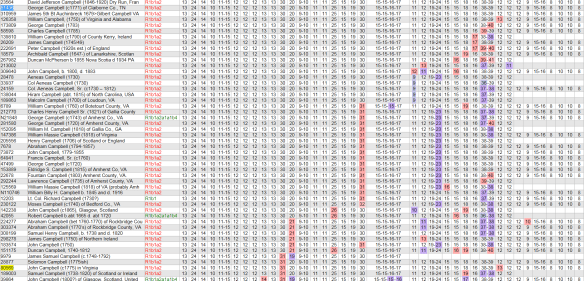
Campbell group 30

Paul is the closest match to kit 23564 whose oldest ancestor is:

David J. Campbell, a son of Mark Washington Campbell and Mary Ann Campbell, was born on 26 August 1846 in Franklin County, PA.  It is speculated that he was born in Dry Run.  Also, according to speculation, his father, Mark W. Campbell, was born 15 December 1815 in the same county.  David married Marie Edna Gribble in 1870 and had six children. The family migrated to Clinton County, IA, McLean County, IL, Kearney County, NE, and Payette County, ID.

Jim’s closest match has 3 mutations, which isn’t terribly close, kit 28877 whose oldest ancestor is:

Solomon Campbell born Sept 1805, married Margaret Laurie, John N’s son James N Campbell Born Feb 2 1835.  Other children of John N are Martha, William, Margaret, Thomas L., James N., Solomon J., Jane.  It states on the 1841 Scottish census (Crofthead, Neilston, Renfrewshire) that John N and family were born in Ireland except for Jane who was born in Neilston.  Family also listed in Scotland 1851 census. Came to America in June of 1853, settled in Mason NH, John N. died 1878 Townsend Mass.

There is clearly no commonality in terms of either ancestors or location comparing the two closest matches.  Furthermore, Jim’s closest match is in Massachusetts when we know that John Campbell did arrive from Virginia, born in the 1770s, and was very likely part of the Scots/Irish migration from Pennsylvania through Virginia – simply given the historical patterns and logistics.

Let’s move to the individual markers and see what we can tell.

Campbell headingCampbell 389

I looked at the markers, and I think that DYS389(2) is having spontaneous mutations.  I say this because IF and assuming that truly, kit 81430 has not mutated, then all of the mutations in the 80569 kit happened after Charles Campbell who was born about 1750 or maybe slightly earlier.  It’s obvious from looking at oldest ancestors of the matches who have a value of 31 at DYS389(2) that  they could not all be descended from someone who lived since Charles Campbell.

Both Paul and Jim have taken the Family Finder autosomal test.  Let’s see what that says about their relationship.  I searched Jim’s account for matches having a surname of Campbell.  Sure enough, there were 5 results, but none of them were Paul.  These men should be 5th cousins if Charles Campbell is the father of both John and George.  That is a long way back and we would expect, on average for 5th cousins to carry only about 3cM of common DNA and less than 1%.  The FTDNA threshold is 7cM.

Jim’s sister has also taken the Family Finder test.  On the chance that she inherited differently, I checked to see if she perhaps matches Paul.  She does not.

We know that at Family Tree DNA matching threshold is set to approximately 7cM and that matches have to meet other criteria as well to be considered a match, like minimum SNPs and a minimum total cM as well.  Therefore, people with small amounts of matching DNA are not shown as matches at Family Tree DNA, but may share DNA that is important to find.  At GedMatch, you can set the matching thresholds yourself.

Let’s take a look at GedMatch to see if the John Campbell descendants match the George Campbell descendants.  Below, Jim and Paul’s autosomal DNA is compared for matches.

Campbell, paul vs jim

Sure enough, Jim and Paul match each other on four segments, one just above 3cM, just as predicted, and three more just over 1cM each.  Without a proven family connection, we would ignore segments of this size, but in a known family situation, these are important matching segments.

Let’s see if Jim’s sister matches Paul.

Campbell, paul vs jim sister

Yes, Jim’s sister and Jim both match Paul and in the same location on chromosome 7.

Do I match Paul?

Campbell, paul vs me

I do match Paul significantly.  On two chromosomes, the segments are 12 and 13 cm.  On chromosome 12, I match Paul on the same location at Jim’s sister.  On chromosome 13, I match on the same location as Jim matches Paul.

The GedMatch estimate is interesting in that it is 4.2 generations.  We know positively that we are a minimum of 7 generations distant, assuming that Charles is the father of both George and John.  Paul and I do not share any other ancestors.

Do I match Joy, the other George descendant?

Yes, I do, below.  Again, a minimum of 7 generations between us.

Campbell, me vs joy

Does Jim match Joy? No.

Does Joy match Jim’s sister? No.

Does Paul match Joy?  Both are descended from George.  Yes, on 10 different chromosomes.  These should be more closely matched than any John/George descendant matches, but they are further than 2.7 generations.

Campbell, paul vs joy

Do I match Jim, who is also descended from John Campbell?  Yes.

Campbell, me vs jim

Do I match Jim’s sister? Yes, on far more segments that I match Jim.

Campbell, me vs jim sister

The segments on chromosome 5 are identical between me, Jim and his sister.  Clearly, that came from John Campbell.  Our common ancestor, John Campbell is 5 generations from Jim and his sister, and 6 from me.

I created the following table of the results.  We have two descendants from George who match each other most closely.  Conversely, the descendants of John match each other more closely than the descendants of John match the descendants of George.  However, given the generational distance, the descendant of John and George do fall into the expected tolerance in the case of Paul matching Jim, John and me.

Jim (John) Jim’s sister Paul (George) Me (John) Joy (George)
Jim na siblings 1,3,7,13 5, 7, 11, 15 No
Jim’s sister siblings na 7, 10, 12, 13 2, 3, 5, 10, 11, 12, 13 No
Paul 1,3,7,13 7, 10, 12, 13 na 4, 9, 10, 12, 13 1, 2, 3, 5, 6, 7, 9, 12, 15, 16
Me 5, 7, 11, 15 2, 3, 5, 10, 11, 12, 13 4, 9, 10, 12, 13 na 16, 17
Joy No No 1, 2, 3, 5, 6, 7, 9, 12, 15, 16 16, 17 na

What else can we do now to further identify the parents of John and George Campbell, presuming that they are indeed brothers as the results above suggest?

At this point, there are three avenues open for study.

  1. Upgrade both Jim and Paul to 111 markers and hope for line marker mutations.
  2. Upgrade both Jim and Paul to the Big Y hoping for identical mutations, and if not, ones that will connect to another Campbell line. This option is very expensive at this time, and according to the Campbell surname administrator there are either few or no project members who have ordered the Big Y.
  3. Utilize Family Finder to search both Jim and Paul’s matches for consistent matches and hope for a clear genealogy clue as to where to begin the search for the common family of John and George.
  4. Add a dash of luck!

One thing is certain, whether John and George share a father or not, and whether that father is Charles Campbell who died before 1825 in Hawkins County, TN, or not, they do at some point not terribly distant past, share a common Campbell ancestor.  I surely wish there were any other proven children of Charles Campbell to test against.

As a matter of curiosity, I did check to see if any of the five of us Campbell descendants have matches to people with Fugate as an ancestral surname – and we all do.  However, many of these people also have Campbell ancestry and/or are from the Claiborne County region where we all have roots, so it would require more research to draw any inferences or conclusions on the Fugate question.

The Campbell lineage has been exceedingly frustrating. Why, oh why, didn’t they register that deed in 1825 in Hawkins County listing the heirs of Charles Campbell???

______________________________________________________________

Disclosure

I receive a small contribution when you click on some of the links to vendors in my articles. This does NOT increase the price you pay but helps me to keep the lights on and this informational blog free for everyone. Please click on the links in the articles or to the vendors below if you are purchasing products or DNA testing.

Thank you so much.

DNA Purchases and Free Transfers

Genealogy Services

Genealogy Research

Inverary Castle and the Clan Campbell

Scotland sunrise

Please notice that this is a sunrise photo.  Why was I up this early?  Because I fell asleep again right after dinner.  Sunrise is not something I normally experience, but I was certainly glad I was awake for this one.  This is the sunrise over Scotland, the Highlands in the distance.  This is the home of my ancestors, the Campbell and Younger families, and all of the Mc names in my tree.  McDowell, McKee, McMahon, McNeil and McSpaden.

We woke up this morning to rain.  Shortly after that, we were treated to something else.  Bagpipes.  I opened the door to the cabin on the cruise ship and looked outside.  Standing alone, in the rain, on the dock, was a single bagpipe player.  The mournful sound of the bagpipes took me back in time, to another time and place, in the remote Highlands, where another bagpipe player played in the rain.  That sound, like no other, stirred my soul.

Scotland bagpiper

Welcome home.  That’s the same thing my cousin, the Duke of Argyl who is the Campbell heir and carries the Campbell surname, said to me today.  And that is how it felt here in the Scottish Highlands, the lands my ancestors left some nearly 300 years ago.  Their blood in me rejoiced.  I now understand why Mary Herrell said she wanted to be put up on the mountain ledge when she died and her soul taken back to Ireland.  There is a part of you that never leaves your homeland.

Scotland highlands

The Highlands are magnificent in their stark beauty.

Scotland highlands 2

I remember one time Daryl, my cousin, and I were driving through some remote area of Claiborne County, Tennessee trying to figure out where George Campbell lived (below) and she said to me that the terrain reminded her of the highlands of Scotland.

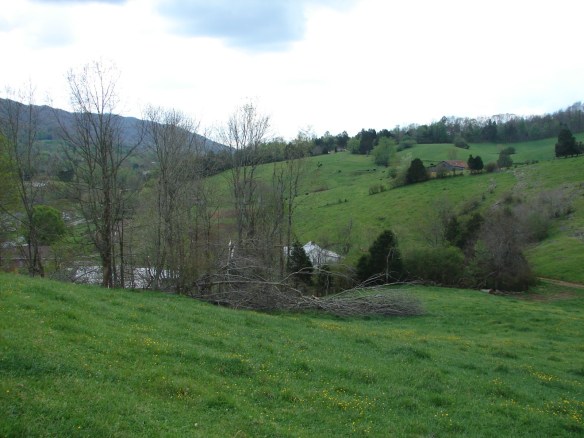
Geo Campbell Land 008 crpped

Now I understand why the Scotch-Irish were so attracted to the Appalachian mountain highlands, the frontiers and why they were not afraid of battles.  Life here was a battle, even when no one was attacking.

Driving up into the Highlands, we stopped at the summit of the gap that is called “Rest and Be Thankful.”  It’s named appropriately, believe me, as shown below.  I suspect it was probably the horses and draft animals that were most thankful for the rest at the top.

OLYMPUS DIGITAL CAMERA

At Rest and Be Thankful, travelers have long welcomed the chance to draw their breath and enjoy the view as they cross the summit at 860 feet on the road that leads from Loch Long to Loch Awe via Glen Croe.

In the beginning, of course there wasn’t a road at all.  There was just a track, a path, made by generations of travelers, and beaten out by herds of black cattle being taken by drovers from Argyll to the Trysts and cattle markets of the Lowlands.  The making of the road, in any sense that we would now recognize it, had to wait until the 18th century. Some work was done in the 1730s on the roads in Argyll by the local government agencies, the Commissioners of Supply.  However, the real impetus for the road building came after the 1715 and 1719 Jacobite Uprisings.  General George Wade was sent to the Highlands to examine the military situation.  His report made a number of recommendations, including the construction of forts at various points and the development of a network of roads to link them.

In 1743 it was decided to construct 44 miles of military road from Dumbarton to Inveraray, via Loch Lomond-side, Tarbet, Arrochar, Glen Croe and thus down to Loch Fyne.  Major Caulfield, Wade’s Inspector of roads and successor as mastermind of the Highland roads network, was ordered to survey the route.  Work started that summer, although the progress was interrupted by the outbreak of the 1745 Jacobite Uprising.

Argyll and Inveraray, its capital was strongly Hanoverian, pro-government, firmly under the control of the Duke of Argyll, a Campbell of course, one of the leading figures in the government of Scotland.  So what military purpose was to be served by this road?  It was hardly likely that a detachment from the garrison at Dumbarton would be marched to Loch Fyne to put down an insurrection in the peaceful glens of Argyll.

Two possible reasons exist for the high priority given to this road.  The first may have been to allow the pro-government forces that could be raised in Argyll – and indeed a regiment of the Argyll Militia fought in the Culloden campaign – to move swiftly from Loch Fyne to wherever they might be needed. The other reason was perhaps less straight forward, but perhaps more plausible – to provide a conveniently smooth road to and from the Lowlands for the Duke of Argyll.  The connection between the road and the Duke was emphasised by Caulfield – when the road was nearly finished, money was running out and there was a danger that a bridge at Inveraray could not be completed,  Caulfield wrote “this will hurt a great man for the bridge is at his door,” as indeed it was, being barely a mile from Inveraray Castle, the Duke’s seat.

After Culloden, work recommenced, and by 1748 troops from the 24th Regiment – later the South Wales Borderers – had made the road over the summit of Glen Croe and erected a stone seat with the legend “Rest And Be Thankful,” shown below.  Completion of the road to Inveraray was achieved by 1749.

Rest and be thankful

On the way to Inverary Castle today, we visited Loch Lomond, the largest inland lake.  The village of Luss sits on the edge of the lake and is quite beautiful.

OLYMPUS DIGITAL CAMERA

This village looks a bit like a storybook.

Inverary is on Loch Fyne, on the other side of “Rest and Be Thankful.”

Lochs are the same things as fjords but are called lochs here.  They are tidal, in some cases, very tidal.  The scenery is incomparable, although I fully understand why my ancestors left.  Land was not available and with the religious and political changes and upheaval, it was leave or perish.  This lands lush, stark beauty must have lived in their souls for the rest of their lives, and their descendants as well as a distant memory. Loch Lomond below.

Loch Lomond

The Castle of Inverary itself was built in the early 1700s, probably just before my ancestors left for America.  They would have known this castle, most likely, but would have thought of it as the “new castle.”  Earlier castles are in ruins and located elsewhere, but this castle was built of the remains of a fort built in the 1400s, so our ancestors probably knew that fort quite well.  This castle is very beautiful however, and it sooths my soul to be someplace my ancestors walked and lived for centuries, maybe millennia.  Just down the loch a ways is Campbeltown too.  Three guesses how it received its name.

Inverary castle

The entrance to the castle spans what is today, a dry mote.

Inverary entrance

Inverary estate

Castle armory room below.  My ancestors likely used these arms.

Inverary armour room

As luck would have it, the Duke himself was in the gift shop signing books.  He’s my cousin, many times removed, and he was most gracious – inviting me back anytime.   Although I’m sure though he didn’t mean to stay in the family area of the castle:)  That’s the two of us in the photo below.  It was so much fun to meet him.  He is very much a gentleman and he personally cut fabric for me – yes – I bought Campbell tartan plaid wool.  I have no idea what I’ll do with it, but certainly something interesting.

For anyone who is interested in the history of the castle, the Duke and Duchess have had the castle interior professionally photographed and have written a book about the history of the Castle and the Campbell Clan.  I highly recommend this book.  You can purchase it online along with other Clan Campbell items.

Me and the Duke

Loch Fyne, below, at Inverary Castle, which is located just on the other side of the bridge.

Loch Fine

This area is tidal….the water comes and goes throughout the day revealing mud flats from time to time.  This is of course the bridge being referenced as at the end of the “Rest and Be Thankful” road which leads to Inverary Castle.

Loch Fine bridge

We ate in a lovely Pub at Loch Fyne where the placemats were slate tiles.

slate placemat

The roofs here are slate too.  When you have this much moisture, you don’t build anything out of wood.

slate roofs

I also understand the woolen industry now too.  Everything here needed to be wool.  Wool was warm, even when wet, which is everyday, all day long, and everyone needed wool breaches.

In one of our stops, we did find a lovely woolen mill where the local wool is made into charming and useful items, all wool, of course.

I so wanted a pair of those warm woolen kilt socks!!!  I had been cold for days.  I bought a pair of heavy knitted woolen socks for myself and my daughter and in the middle of January, she sent me an e-mail with this photo and the title “Best Socks Ever.”  Yep, those Scots knew what they were doing.  I would love to have a few more pairs of these!  Sounds like a good reason to return:)

wool socks

We made our way back through quaint villages to the boat.  We took a ferry across the Frith of Clyde, the estuary of the River Clyde as it enters the sea.  The bus would be driven on to the ferry and the entire bus transported across the frith.  I decided that I needed a Dramamine when I discovered that was the plan.  The bus is bad enough and the boat is bad enough, but a bus on a boat. Dramamine is terrible to chew!!

Bagpipes, now more than one lonely wet person, bade us farewell.  A lovely sendoff and so fitting.

Scotland bagpipers

Our towel guy tonight, Nessie of course, wears a Campbell tartan scarf in front of a Celtic cross ornament and a book about the Clan Campbell.

Nessie towel guy

Clan Campbell

In traditional genealogies of the Clan Campbell, its origins are placed amongst the ancient Britons of Strathclyde.  However the earliest Campbell in written records is Gillespie who is recorded in 1263.  Early grants to Gillespie and his relations were almost all in east-central Scotland.  However the family’s connection with Argyll came some generations before when a Campbell married the heiress of the O’Duines and she brought with her the Lordship of Loch Awe.  Because of this the early clan name was Clan O’Duine and this was later supplanted by the style Clan Diarmid.  This name came from a fancied connection to Diarmid the Boar, a great hero from early Celtic mythology.

The original seat of the Clan Campbell was either Innis Chonnell Castle on Loch Awe or Caisteal na Nigheann Ruaidh on Loch Avich. The clan’s power soon spread throughout Argyll.  However, at first the Campbells were under the domination of the Lords of Lorne, chiefs of Clan MacDougall.  The MacDougalls killed the Campbell chief Cailean Mór (Colin Campbell) in 1296.  All of the subsequent chiefs of Clan Campbell have taken MaCailein Mor as their Gaelic patronymic.

Between 1200 and 1500 the Campbells emerged as one of the most powerful families in Scotland, dominant in Argyll and capable of wielding a wider influence and authority from Edinburgh to the Hebrides and western Highlands.

The Clan Campbell DNA Project at Family Tree DNA has 613 members, including a couple different family members of my Campbell line.  The Duke of Argyl, a Campbell himself, of course, provided a Campbell timeline on the Inverary Castle website.

You know those “two brothers” stories?  Everyone has them.  Well, there really were two brothers, John and George Campbell born in the 1770s and found in Claiborne County, TN in the early 1800s.  We believe their father was Charles Campbell of Hawkins County, Tennessee, but unfortunately, the deed signed by his children to sell his property after his death was never filed in the clerk’s office, so we don’t’ know who signed.  Subsequent deeds only refer to the unfiled deed and the “Campbell heirs.”  Heartbreaking.  Enough to make you want to pull your hair out!

We know from a deed signed during Charles’ lifetime that he did have sons John and George, and we know that the man whose daughters the two Campbell sons married lived not far in Hawkins County from Charles Campbell who died in early 1825.  John and George Campbell married Jane and Elizabeth Dobkins, respectively, about 1800 or just before, daughters of Jacob Dobkins and Dorcas Johnson.

According to the Campbell DNA project and other associated documents, trees and webpages provided by Kevin Campbell, the project administrator, it appears that my line does indeed descend from the Campbell Clan of Argyl.  We are grouped in group 30, which includes the Campbell family of Argyl.

Clan Campbell DNA cropped2

I may never know exactly how I’m related to the Duke of Argyl, but thanks to DNA, my very generous Campbell cousins who tested, and the Campbell DNA project, I know for sure that I am.  And thanks to the generosity of the family of the Duke of Argyl sharing Inverary Castle with the rest of us, I can visit my homelands.  It makes a difference when you know for sure that you are visiting your family ancestral land.  Standing literally where your ancestors stood 500 years ago, and further, back into “time out of mind.”

Colin Campbell

Colin Campbell of Glenorchy who died in 1480.

Archibald Campbell

Archibald Campbell, 1st Marquess of Argyll, who led the Campbell forces in 1645 at the Battle of Inverlochy.

Campbell black watch

The Black Watch, or Campbell Tartan.

If you’d like to hear “The Campbell’s Are Coming” on pipes and drums, click here.  In the historical tidbit category, this was played by the Union as the Iron Brigade marched down the Emmitsburg Road on their way to McPherson’s Ridge at Gettysburg.

“The Campbell’s Are Coming” is the pipe hymn of the Clan Campbell, composed in 1715 by a local piper, inspired by a wedding.  The Gaelic name of the tune is “Baile Ionaraora” or “the town of Inverary.”  For more info and to hear the bagpipe version, click here.

Clan Campbell current coat of arms

Coat of Arms of the current head of the Clan Campbell, the 13th Duke of Argyll.

______________________________________________________________

Disclosure

I receive a small contribution when you click on some of the links to vendors in my articles. This does NOT increase the price you pay but helps me to keep the lights on and this informational blog free for everyone. Please click on the links in the articles or to the vendors below if you are purchasing products or DNA testing.

Thank you so much.

DNA Purchases and Free Transfers

Genealogy Services

Genealogy Research

Charles Campbell (c1750 – c1825) and the Great Warrior Path – 52 Ancestors #19

When I discovered that I was going to be visiting Scotland in the fall of 2013, I couldn’t bypass the opportunity to visit the seat of the Clan Campbell.

Campbell isn’t my maiden name, but it was the maiden name of my ancestor, Elizabeth Campbell born about 1802 who married in about 1820, probably in Claiborne County, TN, to Lazarus Dodson, born about 1795.  Elizabeth’s father was John Campbell, born 1772-1775 in Virginia and her mother was Jane “Jenny” Dobkins.  John’s brother is believed to be George Campbell, born around 1770-1771.  We are fairly certain that their father was one Charles Campbell who died before May 31, 1825 in Hawkins County, Tennessee when a survey for his neighbor mentions the heirs of Charles Campbell.

Charles Campbell was in Hawkins County by about 1788.  A Charles Campbell was mentioned in Sullivan County, the predecessor of Hawkins, as early as 1783, but we don’t know if it’s the same man.  The history of Charles Campbell’s Hawkins County land begins in 1783 when it was originally granted to Edmond Holt.

1783, Oct 25, 440 (pg 64 Tn Land Entries John Armstrong’s office) – Edmond Holt enters 300 ac on the South side of Holston river near the west end of Bays Mountain, includes a large spring near the mountain and runs about, includes Holt’s improvement at an Indian old War Ford, warrant issued June 7, 1784, grant to Mark Mitchell.

Hawkins view of Campbell land

This photo shows the area of Dodson’s creek from across the Holston River atop a high hill.  Dodson’s Creek, today, is located beside the TVA power plant.  In this photo, Dodson’s Creek would be just slightly to the right of the power plant in the distance.  You can’t see the Holston River in this photo, but it is just in front of the power plant.  This is a good representation of the rolling mountains of this region.  I stayed in this house for nearly a week while doing research in Hawkins County before realizing that the land I was looking at, daily, out the back door, off of the porch swing, was the land of both my Campbell and Dodson ancestors.  Talk about a jolting moment.

The Old War Ford is the crossing of the Holston River at the mouth of Dodson Creek where the Indians used to camp and cross, on the Great Warrior Path.

Indian war path

My cousin helped me locate the Great Warrior Path crossing and I took the  photos below during a visit to locate the Dodson and Campbell lands.

1790, May 26 – Mark Mitchell to Charles Campbell 100# Virginia money, Dodson’s Ck, Beginning at a synns on the nw side Bays mountain thence on Stokely Donelson’s, north 60 then west 218 poles to a small black and post oak on a flat Hill then south 30 west 219 to two white oaks in a flat, then s 60 east 218 poles to a stake then north 30 east 219 poles along Bays Mountain to the beginning containing 300 acres. Signed, wit John (I) Owen mark, William Wallen, George Campbell mark (kind of funny P), R. Mitchell (it appears that this transaction actually took place in 1788, but wasn’t registered until later.) south side of the Holston on the west fork of Dodson Creek.

Today, the road that originally led to the ford of the Holston River dead ends into a road and the part of the road that was the “ford” is gone.  A field exists in its place, and a historical marker, and that’s it.  Not even any memories as the ford was no longer needed when bridges were built, and by now, there have already been several generations of bridges.

old war ford

Here’s the field.  The trees grow along the river and help to control erosion from flooding today.  Walking up to the area, you can see the actual ford area, although there is nothing to give away the fact that this used to be a ford of the river.  The locals say there is bedrock here.

old war ford 2

This area is flood plain, so one would not live here.  The old cemetery where we believe Raleigh Dodson is buried is across the current road and up the hill.  The land where we think Charles Campbell lived is just up Dodson Creek from this area as well, but on somewhat higher ground.

Possible Campbell land

I believe this is or is very near the current day location of the Charles Campbell land.  Dodson Creek runs adjacent the road, and you have to cross the creek to get to the farmable land from the road.  You can see the makeshift bridge above.

Beautiful pool at the bend in Dodson Creek where it leaves the road.

Dodson Creek is beautiful and lush.

Dodson Creek 2

1793/1794 – Charles Campbell to George and John Campbell, all of Hawkins County, for 45#, 150 acres on the south side of the Holston, west fork of Dodson Ck beginning at 2 white oaks then (metes and bounds), signed, John Payne witness.

1802, Feb 26 – George Campbell and John Campbell of Hawkins County to Daniel Leyster (Leepter?, Seyster, Septer) of same, 225# tract on west fork of Dodson’s Creek being same place where said John Campbell now lives, 149 acres, then (metes and bounds) description. Both sign,  Witness, Charles Campbell, Michael Roark and William Paine.  Proven in May session 1802 by oath of Michael Roark (inferring that the sellers are gone from the area).

Is the difference between 149 and 150 acres a cemetery, a church or a school?

Dodson Creek is where Charles Campbell lived.  This is the Dodson family who John Campbell’s daughter, Elizabeth, would marry into a generation later in Claiborne County.  Dodson Creek was also just a few miles from Jacob Dobkins’ home, whose daughter’s George and John Campbell would marry.  Jacob Dobkins, George and John Campbell and their Dobkins wives would be in Claiborne County, Tennessee by 1802.

We believe Charles Campbell came from the Augusta or Rockingham County area of Virginia, but we don’t know for sure.  Unfortunately the deed where his heirs conveyed his land is recorded in the court record, but never in the deed book, so we have no idea who his heirs were.  The will of his neighbor, Michael Roark, who was born in Bucks County, PA and then lived in Rockingham Co., VA stated that he bought the land of Charles Campbell from his heirs joining the tract “I live on.”  Charles’ other neighbor was a Grigsby, and so was Michael Roark’s wife. It’s not unlikely that Charles Campbell was related to one or both of these men.

Michael Roark’s will dates August 25, 1834 and proven on February 4, 1839 says, among other things, that he leaves to grandson James Rork, son of John, tract of land that I now live on after wife and I die, son John 4 shares of tract of land that I bought of the heirs of Charles Campbell joining the tract I live on and containing about 150 acres. Unfortunately, the deed between the Campbell heirs and Michael Roark was never registered.

In a deed from Michael Roark to Neil and Simpson with John Scruggs as their trustee, registered July 17, 1835, where Michael Roark had in essence mortgaged his land in November of 1830 and by 1835 was unable to pay his debt.  The verbiage says in part that Michael not only conveys his land, which is described, but he adds “and also the interest I have in the shares of the 4 legatees of Charles Campbell, decd, to a tract of land lying on Dodson’s Creek.”  He does not say that his wife is a daughter of Charles Campbell, but it’s certainly possible.  He described one of the two tracts of Roark land he is conveying as having been conveyed to him by James Roark in 1811.

This 1835 entry tells us that Charles Campbell’s land apparently had not yet been sold and that there were at least 4 legatees.

Roark, Michael cabin

Years ago, in a book in the library in Hawkins County, I stumbled across this photo of a picture of the cabin of Michael Roark.  You know that Charles Campbell’s cabin didn’t look much different.  A quite elderly descendant of Michael, Libby Roark Schmalzreid, claimed that her grandfather built his house on this land, and is buried on a hill just above the home he built.  She was in her 90s more than half a decade ago, and never said who her grandfather was.  She did say on Rootsweb that the location is on Dodson Creek not far from Strahl.  Given that Michael Roark and Charles Campbell were neighbors, if we find Michael’s cabin, we can also find Charles land.  I mean his actual land, not just a general area.  On the map below, Dodson Creek is shown by the arrows, and Strahl is marked as well.  It’s about 2000 feet from Strahl to the red arrow below noting Dodson Creek.  Dodson Creek and its branches wanders all over this neighborhood.  So, if anyone knows who Libby’s grandfather was, where he built his house or where he is buried, please give me a shout.

Strahl

Perhaps the key to finding Charles Campbell back in Virginia is to find both Michael Roark and the Grigsby family as well.

On the 1783 Shenandoah Co., VA, tax list, we find both Charles Campbell and Jacob Dobkins in Alexander Hite’s district. Jacob Dobkins is the father of Jane “Jenny” Dobkins who would eventually marry John Campbell and her sister,  Elizabeth Dobkins who would marry George Campbell, believed to be the brother of John Campbell.

Of course, there were also 2 Charles Campbells in Rockingham County, VA in 1782 and 1 in Fayette and one in Lincoln, both in 1787.

Several years ago, we DNA tested both a male Campbell descendant of both John and George and confirmed that indeed, these line match each other as well as the Campbell clan line from Scotland and that the descendants of the lines of both men also match autosomally as cousins, further confirming that John and George were most likely brothers.  This was good news, because even though we don’t know the exact names of Charles ancestors, thanks to DNA, we still know the history of those ancestors before they immigrated, probably in the early 1700 with the first waves of the Scotch-Irish.

So, for me, the opportunity to visit the clan seat, and meet the current Duke of Argyll, the 26th chief of the Clan Campbell and the 12the Duke of Argyll, Torquhil Campbell, personally, was literally the chance of a lifetime.

The Duke, Torquhil Campbell, is much different from other aristocracy.  He lives at Inveraray Castle, the clan seat, but parts of the castle are open to the public.  In addition, the castle is his actual full time residence and he actively manages the estate, including signing books about Inveraray in the gift shop in the castle.

OLYMPUS DIGITAL CAMERA

You can’t miss him if he’s there, as he has on an apron that says “Duke.”  He’s a lot younger than I expected as well, born in 1968, but extremely gracious and welcoming.  There must be tens of thousands of Campbell descendants and many probably make their way back to Inverary like the butterflies return to Mexico every winter.

While I was visiting Inveraray, I purchased two books about the clan Campbell and a third, written by the Duke himself, about Inveraray. The Campbell clan origins are shrouded in myth and mists, as you might imagine, but let me share them with you anyway.

Campbell coat of arms

The first origin story, from a book called “Campbell, The Origins of the Clan Campbell and Their Place in History” by John Mackay, says :

“The first Campbells were a Scots family who crossed from Ireland to the land of the Picts.  The Clan Campbell originated from the name O’Duibhne, one of whose chiefs in ancient times was known as Diarmid and the name Campbell was first used in the 1050s in the reign of Malcolm Canmore after a sporran-bearer or purse-bearer to the king previously called Paul O’Duihne was dubbed with his new surname.

Historians after such obscure and legendary times, have agreed that the can name comes from the Gaelic ‘cam’ meaning crooked and ‘beul’ meaning the mouth, when it was the fashion to be surnamed from some unusual physical feature, in this case by the characteristic curved or crooked mouth of the family of what is certainly one of the oldest clan named in the Highlands.

It was the Marquis who insisted that he was descended from a Scots family in Ireland who had crossed to what was then mostly the land of Picts to establish the first Scots colony in the district of Dalriada – a comparatively small part of what we know today as Argyll at the heart of what would in time become the kingdom of Scotland.  It is marked by the fort of Dunadd, of the A816, a few miles north of Lochgilphead, set in the inlet called Loch Gilp off from Loch Fyne.”

Loch Fyne is where the current castle of Inveraray, clan seat, is located and where I visited.

The second source is a booklet called “Campbell, Your Clan Heritage,” by Alan McNie, which is condensed from a larger book, Highland Clans of Scotland by George –Eyre-Todd published in 1923.

It says:

“Behind Torrisdale in Kintyre rises a mountain named Ben an Tuire, the “Hill of the Boar.”  It takes its name from a famous event in Celtic legend.  There, according to tradition, Diarmid O’Duibhne slew the fierce boar which had ravaged the district.  Diarmid was of the time of the Ossianic heroes.

Diarmid is said to have been the ancestor of th race of O’Duibhne who owned the shores of Loch Awe, which were the original Oire Gaidheal, or Argyhll, the “Land of the Gael,”

The race is said to have ended in the reign of Alexander III in an heiress, Eva, daughter of Paul O’Duibhne, otherwise Paul of the Sporran so named because as the kings treasurer, he was supposed to carry the money-bag.  Eva married a certain Archibald of Gillespie Campbell, to whom she carried the possession of her house.  This tradition is supported by a charter of David II in 1368 which secured to Archibald Campbell of that date certain lands of Loch Awe ‘as freely as there were enjoyed by his ancestor, Duncan O’Diubhne.’

Who the original Archibald Campbell was remains a matter of dispute.  By some he is said to have been a Norman knight by the name of De Campo Bello.  The name Campo Bello, however, is not Norman but Italian.  It is out of all reason to suppose that an Italian ever made his way into the Highlands at such a time to secure a footing as a Highland Chief.”

This book then goes on to recite the “crooked mouth” story as well.

A third origin story is recorded in the book written by the current Duke, himself, “Inveraray Castle, Ancestral Home of the Dukes of Argyll.”  In this book, the Duke says:

“The Campbells, thought to be of British stock, from the Kingdom of Strathclyde, probably arrived in Argyll as part of a royal expedition in circa 1220.  They settled on Lochaweside where they were placed in charge of the king’s land in the area.

The Chief of Clan Campbell takes his Gaelic title of ‘MacCailein Mor’ from Colin Mor Campbell – ‘Colin the Great’ – who was killed in a quarrel with the MacDougalls of Lorne in 1296.

His son was Sir Neil Campbell, boon companion and brother-in-law to King Robert the Bruce, whose son, Sir Colin was rewarded in 1315 by the grant of the lands of Lochawe and Ardscotnish of which he now became Lord.

From Bruce’s time at least, their headquarters had been at the great castle of Innischonnell, on Loch Awe.   Around the mid 1400s, Sir Duncan Campbell of Lochawe, great-grandson of Sir Colon, moved his headquarters to Inveraray, controlling most of the landward communications of Argyll.”

From the Campbell DNA Project website, we find this pedigree chart of the Clan Campbell, beginning with the present Duke at the bottom.

Campbell pedigree

Let’s see if Y chromosome DNA results can tell us about the Campbell Clan history.

Originally, the DNA testing told us that the Campbell men were R1b1.  The predicted haplogroup was R1b1a2, now known as R-M269, but some of the Campbell men who have tested further are haplogroup R1b1a2a1b4, or R-L21.

Looking at my cousin’s matches map at 37 markers, below, the Campbell men cluster heavily around the Loch Lomond/Greenock region which is very close to the traditional Campbell seat of Inverary.

Campbell cluster

At 12 markers, the cluster near Greenock, slightly northwest of Glasgow, is quite pronounced.  Most of these matches are Campbell surnames.

Campbell Greenock cluster

Another item of interest is that several men in this cluster have tested for SNP L1335.  This is the SNP that Jim Wilson announced is an indicator of Pictish heritage, although it is widely thought that this was a marketing move with little solid data behind it.  Otherwise, Jim Wilson, a geneticist, would surely be publishing academically, not via press announcements from a company that has previously damaged their own credibility, several times.

Regardless, our Campbell group tested positive for this SNP.  I contacted Kevin Campbell, the Campbell DNA project administrator, who is equally as cautious about the Pictish label, but we both agree that this marker indicates ancient, “indigenous Scots,” and yes, they could be Picts.  Time will tell!

In the next few days, I’ll be writing about my visit to Inverary.  I hope you’ll join me!

______________________________________________________________

Disclosure

I receive a small contribution when you click on some of the links to vendors in my articles. This does NOT increase the price you pay but helps me to keep the lights on and this informational blog free for everyone. Please click on the links in the articles or to the vendors below if you are purchasing products or DNA testing.

Thank you so much.

DNA Purchases and Free Transfers

Genealogy Services

Genealogy Research

Joseph Rice 1700-1766, A Dissenter – 52 Ancestors #18

Joseph Rice was born about 1700, possibly earlier, probably in Hanover County, Virginia, and died in 1766 in Prince Edward County, Virginia. He married Rachel, whose last name is unknown, probably about 1725-1730.  Rachel died after Joseph but before 1792.

For a long time, Joseph was believed to be the son of Matthew Rice, who lived adjacent to his property in Prince Edward County, Virginia, but this has now been disproven. Matthew is Joseph’s brother. Joseph’s parents are believed to be Thomas Rice, born about 1660 in the British Isles, and who reportedly died about 1716 reportedly on a ship returning to collect his inheritance. Thomas’s wife was Marcy who was possibly a Hewes. Thomas was first found in the New Kent County records of St. Peter’s Parish baptizing his children:

  • James the sone of Thom: Rice & Marce his wife baptized ye 4 day of April 1686.
  • Thom: son to Thomas Rice bapt. ye 24th: day of June 1688.
  • Edward Son to Thomas Rice bapt: ye 17 of April 1690.
  • John Son of Tho Rice & Marcey his wife bapt the 18 Septemr 1698.
  • Mary Dautr of Tho Rice baptiz the 19 September 1700.
  • Alice daut of Tho Rice baptz the 19 September 1700.
  • Marcy dautr of Tho Rice baptized the 5 July 1702.

Thomas’s other children’s baptism records are absent.

I have always wondered about the records in the Vestry book in New Kent and then what would become Hanover Co in Va. Thomas Rice and his wife Marcy are recorded having children in this book, but then some children are apparently missing. Why? I copied part of the transcribed book, including the intro pages, and here is what I found.

“The back part (pages 1-143) contains a record, apparently very incomplete, of births, marriages, baptisms and deaths in the parish between 1685 and 1730 or 31 when a new book was begun.”

The transcriber also goes on to say:

“Of this number some 20 or more leaves have been torn out, apparently at random, generally speaking only 1 leaf at a time is missing, but occasionally two consecutive and in one case three. Furthermore of the ones that remain, or rather that have been counted as remaining, many have been torn or otherwise mutilated to the point where there is less than half and in some cases less than fourth of the sheet left.”

In 1802, this parish was split into two.

Thomas’s immigration is proven by a 1700 land patent to George Alves of New Kent Co. for importing people into the colony which includes the name of Thomas Rice. Marcy’s name is not mentioned which may mean he married her after his arrival before 1686, the date of his first child’s baptism.

We know Thomas owned land, but we don’t know how he acquired it. He died sometime between 1711 and 1716 when his wife was called Widdow Rice, possibly on a boat returning to the old country for his inheritance.

Unfortunately, records are very sparse because the majority of the records of Hanover County were burned during the Civil War, however the parish records of St. Paul’s Parish of Hanover and St. Peter’s Parish of New Kent are extant. Hanover County was formed from New Kent County in 1721.

Joseph is not proven to be the child of Thomas, but circumstantial evidence and family oral history is compelling.

We find Joseph consistently with Matthew Rice, known son of Thomas, owning land beside him in Prince Edward County, Virginia the two men being constantly intertwined throughout their lives.

Joseph Rice is first mentioned in a merchants account book in 1743 in Hanover County, Virginia.

Matthew Rice is first found mentioned in a deed executed in 1741 in Amelia Co., VA, which then encompassed present-day Prince Edward County. He purchased 800 acres and was identified as “of St. Martin’s Parish” of Hanover Co. Matthew accumulated considerable land in Sandy River area close to the land of Joseph Rice, who first obtained land in a 1746, a 400 acre land grant on Sandy River (near Great Saylor Creek) in Amelia (later Prince Edward) County. Later probate records indicate these two men were contemporaries in age. They likely were brothers since their children were near in age and were similarly named.

Joseph surveyed and worked on roads, served on jurys and voted for representatives in the House of Burgesses.

I visited Prince Edward County in 2007 and while I wasn’t able to pinpoint Joseph’s exact land, it was likely near here on Rolling Road, which appeared in his deeds.

Rolling Road

In 1759, Joseph was granted permission to build a “meeting house” on his property, indicating he was a fervent member of a dissenting religion (not Anglican), probably a Methodist given that his 2 grandsons, William and Rice Moore became early Methodist ministers in Halifax Co., Va. and Grainger Co., Tn., respectively, in the 1770’s.

Matthew Rice in Prince Edward County lived adjacent Joseph Rice and James Moore. Matthew is the son of Thomas Rice and Marcy. Joseph is not Matthew’s son. The proof lies in these deeds.

All 3 of these deeds are executed on May 18, 1765:

  • Matthew Rice of Prince Edward County to John Rice of Prince Edward County for the love which I have for my son John Rice of Prince Edward County, 165 acres on the branches of Sandy River in Prince Edward bounded by Matthew Rice Sr., Matthew Harris, Deep Bottom branch, north fork of the Great Branch of Sandy River, Thomas Smith, signed Matthew Rice wit Matthew Rice Jr., Thomas Turpin, recorded May 20, 1765
  • Matthew Rice of Prince Edward County to Nathan Rice of Prince Edward County for the love and affection I have for my son Nathan Rice a certain tract of land about 165 acres on the branches of Sandy River in Prince Edward bounded by Matthew Rice Jr., Daniel Lewallings plantation cornering on the branch, the Great Branch of Sandy River, Thomas Turpin, Matthew Rice Sr., Thomas Smith. signed.  wit Matthew Rice Jr., Thomas Turpin, recorded May 20 1765
  • Matthew Rice of Prince Edward County to William Rice of Prince Edward County for the love and affection I have for my son William Rice of Prince Edward County a certain tract of land about 175 acres on the branches of Sandy River in Prince Edward bounded by Elizabeth Barns, the road, Joseph Rice Sr., William Womack’s new corner line, Matthew Rice Sr., the branch that runs between David Rice and Joseph Rice Jr, it being half of a tract of land that Matthew Rice Sr. bought of Samuel Goode. signed. wit Matthew Rice Jr, George Rabourn recorded May 20 1765.

Note that I don’t show a land purchase from Samuel Goode to Matthew in either Amelia or Prince Edward County, but the Good(e) surname is everpresent with the Rice family, and I have to wonder if Rachel, wife of Joseph Rice was a Goode.

William, Nathan and John Rice were children of Matthew Rice and Ann McGeehee. Doing the math backwards, this means that all 3 of these people were of course born 21 years or more before this time, so before 1745. I show a birth year of 1738 for Nathan and 1742 for William. I don’t show a date for John.

Matthew Rice Sr. was born about 1696. Therefore he would have married and began having children between about 1716/1725.

Anyway, Matthew deeds his land to three of his sons. In the last deed, he references both Joseph Rice Sr. and Joseph Rice Jr., which threw me for a loop for a minute until I realized that our Joseph Rice (Sr)’s son Joseph would have been coming of age about this time, born before 1744 because he was of age when his father Joseph Sr. died in 1766, so he would be referenced as Jr. by this time in 1765.

We know old Thomas Rice and Marcy were in Hanover County having children because the Parish register shows the baptisms from 1686-1700. Two known children, Matthew and William were omitted, but thought to be born in 1792 (William) and 1796 (Matthew). Perhaps they were reversed. There are children every 2 years for all of the other slots, so if not then, they Matthew would have had to be born before 1692 (possible) or after (1700) very unlikely given the ages of the children.

Until I found a chancery suite, it was believed that Joseph was the son of Matthew, but this chancery suit, filed after Matthew died in 1775, proves otherwise. Ann McGeehee was Matthew’s second wife and their children were all under 21 when he died in 1775. Ann had 8 children by Matthew, and I believe that Benjamin Rice was the oldest of her children and came of age sometimes about 1776 because he is not listed as an infant in 1776.

We know that Benjamin went west in 1787 or 1788 from the suit. So let’s say Benjamin was born about 1755, so the other kids Matthew, Charles, Nathan, James, William and John were born to the first wife. Let’s say it took Matthew 2 years to remarry. So he would have married his first wife about 18 years before 1755, so 1737. I show Matthew Jr. in my data base as being born about 1735, so all of that makes sense.

However, the chancery suit gives all the names of his children, says that Matthew Jr. is the eldest child, and says nothing about a Joseph. So Joseph must be a brother to Matthew Sr. and not his son, which means that Joseph was the child directly of Thomas Rice and Marcy, or of some other Rice male in that neighborhood at that time. However, there are no other Rice’s recorded in the parish registers in that time and place.

Joseph Rice’s will was written in 1765 and probated on June 16, 1766, naming his wife Rachel, his children, several still underage, and his son-in-law James Moore. What we know about Joseph’s family is limited and is based on his will and other evidence. His children are listed the order they are set forth in his will along with their inheritance.

      • Son-in-law James Moore 100 acres of the land “whereon I live”.
      • John Rice, underage when his father wrote his will, born after 1744, inherited land adjoining James Moore.
      • William Rice, underage, 100 acres of the “east part of tract whereon I live”.
      • Charles Rice, underage, “remainder of land where I live after death of wife”.
      • David Rice, born before 1744, 133 acres of land where “he now lives”.
      • Joseph Rice, born before 1744, 133 acres” where he now lives”. Joseph also married a Rachel and had 4 children, John, Salley, Massey and Martha Patsy.
      • Mary Rice, feather bed, furniture, cow and calf. Given that Mary was James Moore’s wife, it’s unclear why Joseph named her separately and with her maiden name, unless James first wife died and he later remarried to Mary. We do know that James’ wife’s name in Halifax County was Mary. These people are my ancestors.
      • Not mentioned in Joseph’s will, but proven as his son by earlier deeds of gift, is his son Icay Rice. Icay settled very early in current Bourbon Co., Ky. where he obtained a preemption grant in 1779 just before his massacre on June 20, 1780 at Martin’s Station by Indians. His wife and 4 children were taken prisoner and taken to Detroit where his wife, possibly named Maiden, subsequently remarried.

There is also an unexplained William Rice who died in 1760 in Prince Edward County and Joseph Rice is an appraiser for him. We know this William is not Joseph’s son William, who is alive in 1765 when Joseph makes his will, nor Matthew’s son William who is alive in 1765 when Matthew deeds land to him. Who was this William? Joseph was most likely related to William in some manner.

By 1770, James Moore and his wife, Mary Rice Moore had moved to Halifax County, VA and their children were:

  • James Moore born circa 1785 married Lucy Akin
  • Rev. William Moore born 1750/1751 married Lucy unknown
  • Rev. Rice Moore married Elizabeth Madison and moved to Grainger County, Tennessee
  • Mackness Moore born before 1766 married Sarah Thompson and moved to Grainger County, Tennessee
  • Sally Moore born about 1767 married Martin Stubblefield and moved to Grainger County, Tennessee
  • Mary Moore bore before 1769 married Richard Thompson
  • Lydia (probably) Moore born about 1746 married Edward Henderson and lived beside James Moore
  • Thomas (possibly) Moore, died leaving an orphan

This inventory of Joseph Rice’s estate gives us our only insight into his daily life and tells us a great deal about the man. He was not poor, by any means, but he did not own slaves, which would be in keeping with the Methodist faith. He was probably a soldier, a member of the mustered county militia. Most men were. He could have served in the French and Indian war. Let’s take a peek at what he left behind when he departed this Earth:

  • 31 cattle
  • mare, 5 horses
  • 12 sheep
  • 10 geese
  • 16 hoggs
  • Cart, wheels, old rake
  • 12 bells
  • 4 jugs, butter pott
  • some camphire and tickler (tuhler) bottles and a funnell
  • 4 pair cards
  • 3 drawing knives
  • parcel carpenter tools
  • parcel shoemaker tools
  • two old swords, pistol barrel
  • 3 reaphooks, meal sifters
  • old baskets, wool, flax
  • bed (2), bedstead, furniture, bag of feathers
  • barrell with salt
  • 3 old chests and a box
  • Corn, cotton, tand leather
  • money scales
  • ladle, fleshfork
  • parcel of old books
  • some bottles and old punchboles
  • rifle, smooth bore gun belt, shot bagg
  • 2 smoothing irons, 2 candlesticks
  • 2 iron wedges, parcel of old hoes and axes
  • parcel of pewter dished
  • parcel of cyder casks
  • parcel of salt
  • 4 old saddles and horse harnesses
  • 3 bee hives
  • whip and cross cut saw
  • 6 iron potts, a grinstone, pan
  • loom and slay
  • washing tub, water pails
  • wollen wheal
  • 2 tables, parcel of chairs
  • shears, iron skillet, pickler bottle, bridle bitt
  • 3 beds, furniture
  • 3 cattle hides, knives, forks
  • parcel of wax and tallon
  • spectacles, razor, hone
  • paper, some bottles, old file
  • pair bullet moles
  • 3/4 of a hoggshead crop tobacco

Inventory returned to court March 16 1767

Was Joseph a carpenter or a shoemaker, or was he a jack of all trades out of necessity? Did he use those swords? If so, when and where? Where is the rest of the pistol? Are bullet moles actually molds? Did he make his own ammunition to put in his shot bag? Is there a story to be told?

There were books. Could he read? We know he can at least sign his name because the deeds he executed in his lifetime are signed, not marked with an X. What were the books? There are spectacles. I can see this man wearing his spectacles beside the fireplace, sitting at one of his 2 tables, reading his books by the light of his two candles.

I turned to the Rice DNA project to see if I could better define Matthew Rice, or his line. This DNA project is not housed at Family Tree DNA and it does not provide oldest ancestor information on their website. Unable to make heads or tails of this site, I wrote to the administrator and asked about descendants of Matthew Rice. The administrator replied:

“I have not updated my records in sometime, but at least #4086 who is a descendant of Jesse Rice born circa 1778 of Shelby and Muhlenburg, KY who believes they are descendants of Matthew Rice of Prince Edward County, VA is in Group 4. #4086 has no exact matches, so I am unsure if there are other descendants of Matthew or not.”

The information about group 4 shows the following.

Rice Group 4 cropped

The website goes on to say:

“Although nine of the donors have tentatively been traced back to Rices of Virginia, and eight others to Rices of Kentucky or the Carolinas (and probably to Virginia ultimately), the identification of the progenitor remains uncertain. Indeed, some other testees who do not match seem to be contending for the same progenitor (Thomas Rice of Gloucester Co, Va., c1650 – c1716). It will be necessary to test more descendants to firm up this group.”

But this part, this is really painful.

“Besides the results presented here, some of the participants have tested for certain additional loci with much lower mutation rates. These loci are used in studies of population genetics to define categories known as haplogroups. Since haplogroups are distributed broadly on continental scales and date back to prehistoric times, these categories are not useful for genealogy, and we have avoided displaying them here. Indeed, they would be a hindrance, since they have a notable tendency to distract viewers and participants alike from genealogical pursuits.”

I really want to know the Rice haplogroup. I track all of my haplogroups on my DNA pedigree chart. Furthermore, I want to know a detailed haplogroup. There is so much deep ancestry to be gleaned here and historical context that is unavailable without the haplogroup information.

I wrote to the administrator again, and was very pleasantly surprised to discover that they also maintain the Family Tree DNA Rice project site, grouped in the same way. Now, if they just showed the oldest ancestor too, that would be really useful!!!

The good news is that many of these Rice descendants have their haplogroup extended, including kit 4086, believed to be descended from Matthew. They are haplogroup R1b1a2a1a1b, otherwise known as P312. This SNP in effect divides haplogroup R in half, sometime around 4000 years ago in Europe, distributing from the west of the Rhine basin.

Many people test additional SNPs downstream of P312, but the project doesn’t have the SNP table turned on, so I can’t see if anyone in this group has tested with Geno 2.0 and what extended haplogroup they might be. However, with the new haplotree, promised shortly by Family Tree DNA, hopefully this problem will be resolved because the most downstream named haplogroup will show for everyone.

However, sometimes there is more than one way to discover information.

I decided to check the Haplogroup P312 project to see if any of the Rice’s in this group had joined that project. They do have oldest ancestors enabled, and SNPs as well.

I discovered that kits 4897 and 4131 are found in the DF27 group where the administrator wants participants to also test for Z196.

Both of these men list their oldest ancestor as Thomas Rice, Gloucester Co., VA born circa 1655 and died in the early 1700s. One says 1711, one says 1716. Both show his country or origin as Wales. I wonder if that is something that is documented or they have just assumed due the Rice surname being commonly Welsh. For the first time, recently I’ve seen Thomas’s birth listed as having occurred in 1650 in Shirenewton, Monmouthshire, Wales, but I’ve been unable to find any source for that information, so at this point, I have treated it as simply a hint. I’m not even sure how to go about verifying someone’s birth in 1650 in Wales.

I turned to my British friend, Brian, for help with these records and he every so kindly checked the book, “The British Registers of servants Sent to Foreign Plantations, 1654-1686” by Peter Wilson Coldham to see if Thomas Rice was listed. Indeed, he was.

“Thomas Rice of Shire Newton, Glam, To Clement Blake, mariner, 4 years Barbados.”

This entry was dated August 15, 1656. Next, of course, we need to know if indeed, in Wales, near Shire Newton, there was a Rice whose estate was probated sometime between 1711 and 1716. If the story about Thomas’s death is true, then there would be an estate for him to collect. Of course, if his family was well enough off to leave an estate, why was Thomas Rice bound in the first place instead of his family simply paying his transportation?

Moving back to Thomas’s DNA – checking the SNP tab in the DF27 project, it shows is that kit number 4131, a descendant of Thomas Rice, indeed has had additional testing done, which eliminates several common downstream haplogroups.

4131 Thomas Rice, Gloucester Co,VA,ca1650-ca1716 (WLS?] R1b1a2a1a1b R-P312 P312+, L2-, L20-, L21-, L4-, M126-, M153-, M160-, M65-, SRY2627-, U152-

Even better yet, kit 4897 has taken the Geno 2.0 test and has had many downstream SNPS tested. Indeed, this is my lucky day. This result extends to all of the Rice men who descend from a common ancestor. We can see below that indeed, DF27 is positive.

4897 Thomas Rice, b. 1650 and d. 1711 R1b1a2a1a1b R-P312 CTS10168+, CTS10362+, CTS10834+, CTS109+, CTS11358+, CTS11468+, CTS11575+, CTS11726+, CTS11985+, CTS12478+, CTS125+, CTS12632+, CTS1996+, CTS2134+, CTS2664+, CTS3063+, CTS3135+, CTS3331+, CTS3358+, CTS3431+, CTS3536+, CTS3575+, CTS3654+, CTS3662+, CTS3868+, CTS3996+, CTS4244+, CTS4364+, CTS4368+, CTS4437+, CTS4443+, CTS4740+, CTS5318+, CTS5457+, CTS5532+, CTS5577+, CTS5884+, CTS6135+, CTS623+, CTS6383+, CTS6800+, CTS6907+, CTS7400+, CTS7659+, CTS7922+, CTS7933+, CTS8243+, CTS8591+, CTS8665+, CTS8728+, CTS8980+, CTS9828+, DF27+, F1046+, F115+, F1209+, F1302+, F1320+, F1329+, F1704+, F1714+, F1753+, F1767+, F1794+, F180+, F2048+, F2075+, F211+, F212+, F2142+, F2155+, F2302+, F2402+, F2587+, F2688+, F2710+, F2837+, F29+, F295+, F2985+, F2993+, F3111+, F313+, F3136+, F33+, F332+, F3335+, F344+, F3556+, F356+, F359+, F3692+, F378+, F4+, F47+, F506+, F556+, F63+, F640+, F647+, F652+, F671+, F719+, F82+, F83+, F93+, L11+, L132+, L15+, L150+, L151+, L16+, L23+, L265+, L278+, L350+, L388+, L389+, L407+, L468+, L470+, L471+, L478+, L482+, L483+, L498+, L500+, L502+, L506+, L51+, L52+, L566+, L585+, L721+, L747+, L752+, L754+, L761+, L768+, L773+, L774+, L779+, L781+, L82+, M139+, M168+, M207+, M235+, M294+, M343+, M415+, M42+, M45+, M526+, M89+, M94+, P128+, P131+, P132+, P135+, P136+, P138+, P14+, P141+, P145+, P146+, P148+, P151+, P158+, P159+, P160+, P166+, P187+, P207+, P225+, P226+, P228+, P229+, P230+, P232+, P233+, P235+, P236+, P237+, P238+, P240+, P242+, P243+, P244+, P245+, P280+, P281+, P282+, P283+, P284+, P285+, P286+, P295+, P297+, P310+, P312+, PAGES00083+, PF1016+, PF1029+, PF1031+, PF1040+, PF1046+

Unfortunately, SNP Z196 is not one that is tested in the Nat Geo test, so we’re stuck until the new tree is released, unless, unless….these men have tested SNP Z196 and have joined the DF27 project. Would I be that lucky? Let’s see.

WooHoo, it is my lucky day. Both men have joined the DF27 project, both have apparently tested SNP Z196 because they are both clustered in the group titled “Aa. DF27+Z196- (R1b-DF27*).” Translated, that means they do have the DF27 haplogroup mutation, they don’t have the Z196 haplogroup mutation and the DF27* means that they have tested all downstream SNPs available and they don’t have any, so they are confirmed DF27 and not DF27 with untested downstream SNPs. So even though I can’t see these results directly, the grouping told me everything I need to know!!! Thank you DF27 project admins!!!

So, I’m excited to see where the men with this mutation set are found. Do they cluster someplace in Europe? Will we be able to tell anything from where they are found, as a group? Keep in mind, this map is generated from the “most distant ancestor” field and location, and if you don’t enter that geographic information on the Matches Map, it won’t show up here. What this means is that there are probably a lot more people who could be plotted here but haven’t entered their ancestor’s location information. Let’s see what we have.

DF27 map

This is very interesting. Aside from the British Isles, which is after all, a destination location for the rest of Europe, these group participants are widely scattered. Not something I expected. They are literally found from Spain to Scandinavia and east to west. Let’s take a closer look at the British Isles.

DF27 closeup

There is no Irish or Scottish cluster. Most of these participants ancestors are from England. Interestingly, there is no Wales cluster either. In fact, there is only one person in Wales, a Davies from Monmouthshire, which, ironically, is where Thomas Rice is supposed to be from in one set of records. Of course, verifying those records and proving it’s the same Thomas Rice are horses of a different color. What this does tell me though is that the two Rice men have listed their oldest ancestor on the Most Distant Ancestor tab, they have not entered the geographic information on the Matches Maps tab. It’s very easy to miss.

We’ve learned a lot through our little DNA sleuthing journey to find the results of our Rice line’s DNA. We’re now back some 4000 years or so in Europe and now we’re looking to figure out what type of historic migration event would populate England but not Ireland or Scotland with the DF27+Z196- men. It surely wasn’t Vikings and we know that Scotland and Ireland were settled by the Celtic people, so it wasn’t them. Who was it? Where did these people come from before England?

Saxon map

This Saxon England map above is similar to the distribution of the DF27* group in England, but we know that the Saxons were clustered in Germany before they arrived in England, and doesn’t fit the continental European distribution of this haplogroup very well.

Roman map

This map shows Roman Britain and contains the distribution of DF27 quite well, including the portion in Scotland along Antoine’s Wall which is the northern walled border of Roman Britain.

Antonine wall map

Roman soldiers were recruited and conscripted from all over Europe. At one time Rome controlled most of Europe. The extent of the Roman Empire at its height in 117 AD is shown on the map below.

Roman Empire 117AD

Which one of these scenarios might best fit the cluster of matches that includes our Thomas Rice?  In time, we may discover that answer.

Sometimes looking to the history of the area where an ancestral family is first found is helpful.  If, indeed, our Thomas is from Shirenewton, the history of Shirenewton tells us this:

“Before the Norman invasion of Wales, the Shirenewton area formed part of the forest of Wentwood (Welsh: Coed Gwent). At the time of the Domesday Book, it was part of the lands at Caldicot which were held by Durand, the Sheriff of Gloucester. Durand and his successor as sheriff, his nephew Walter FitzRoger also known as Walter de Gloucester, had part of the forest cleared around the year 1100, and established a small settlement which was known as “Sheriff’s Newton (or New Town)” or, in Latin, Nova Villa. The manor then became known as Caldecot-cum-Newton, and in some documents the village was called Newton Netherwent. “Netherwent” is the English name given to the Welsh cantref of Gwent-is-coed (Gwent beneath the wood, i.e. Wentwood), with “-went” deriving from the Roman town of Venta which became Caerwent. The name “Sheriff’s Newton” became contracted over the years into Shirenewton.


But back to our Rices after they adopted their surname which was after 1086 and probably before 1300, or so. Was our Rice line really from Wales? Do Thomas Rice born about 1650 and found in Gloucester County, Virginia and Thomas Rice born about 1660 in the British Isles and found in New Kent/Hanover County, Virginia share a common grandfather or great-grandfather perhaps? And was that ancestor found in Wales? Do records exist for this timeframe that could confirm or refute the claim that Thomas from New Kent/Hanover indeed was sailing back to claim an inheritance sometime between 1711 and 1716? The answers to all of these questions, some resting in history, some in genealogy and some in the genetics of the future wait for us to answer them.


The amazing thing is that we were able to make this discovery about the Matthew Rice line through his common paternal Rice cousins. I don’t have a male Rice descendant to test. This was done entirely “second hand” or as we could have called it at home, via “shirttail cousins.” In this case, shirttail cousins equate to Y DNA cousins, and that’s exactly what was needed. Now, let’s hope that the genealogy is correct for kit number 4086. While that is a serious consideration, I do know the genealogy of some of the Matthew lines and they did indeed wind up in Muhlenburg, KY where this participant’s ancestors are found, so I’m not terribly concerned about the line being connected to the wrong ancestor.


So, just for the record, anyone who thinks that project fields like haplogroup, oldest ancestor and location aren’t important to be displayed in any project are mistaken and deprive genealogists of information that could be useful.


Furthermore, project features like maps and SNPs, provided free by Family Tree DNA, can very simply be enabled and provide a wealth of knowledge to researchers, especially those who don’t have a male line to test.

______________________________________________________________

Disclosure

I receive a small contribution when you click on some of the links to vendors in my articles. This does NOT increase the price you pay but helps me to keep the lights on and this informational blog free for everyone. Please click on the links in the articles or to the vendors below if you are purchasing products or DNA testing.

Thank you so much.

DNA Purchases and Free Transfers

Genealogy Services

Genealogy Research

Mary McDowell, the White Wife, 52 Ancestors #17

William Herrell was born in 1790 in North Carolina. In 1809, in Wilkesboro, he married Mary McDowell, born in 1785, the daughter of Michael McDowell who was born in 1747, probably in Bedford County, Virginia, and who died in 1834 in Claiborne Co, Tn. in the portion that became Hancock County later. Most of what we know about Michael is from his Revolutionary War pension application made in 1832. Michael is probably the son of an earlier Michael, who is probably the son of Murtough McDowell who died in 1752 in Baltimore, Maryland, but that is a story for another time.

The 1800 census of Wilkes Co., NC shows Michael McDowell, Jacob McGrady (the minister who married William Herrell and Mary McDowell), and both John Herrell Jr. and Sr. (spelled Harral) on adjoining pages. Based on this evidence, pending further investigation, it is presumed that Michael McDowell is Mary and John’s father and John Herrell Sr. is likely the father of William Herrell.

John McDowell states in his affidavit that he left Wilkes County about 1810 and that Mary and William were married about a year before that. We have every reason to believe that Mary McDowell and William Herrell relocated about that same time to the Mulberry Gap area of then Claiborne, and now Hancock County, Tennessee.

The early tax and census records of Wilkes Co, NC reveal that the Herrell (Harral, Herold, Herrald), McNiel, Vannoy, Sheppard, and McDowell families lived just houses apart. Those families also migrated about the same time to the area that was originally Claiborne County, Tennessee and would eventually become northern Hancock County, near the Lee County, Virginia line and lived in close proximity as neighbors there too. Today, both a Harrell cemetery and the cemetery on Michael McDowell’s land remain. The McDowell cemetery is shown below, under the tree.

McDowell cemetery

It’s unknown where Mary is buried, but probably in the Herrell Cemetery on River Road, shown below, in one of the many unmarked graves.

Herrell cemetery

The first record in the Tennessee-Virginia area we have shows Mary and William Herrell actually living in Lee County, probably just across the border, in 1812 when they purchased land.

May term 1813 – Oct. 10, 1812 John Claypool and Eliza his wife of Claiborne and William Harrold of Lee Co Va. for the sum of $200 a tract of land lying in Claiborne on the N side of Powell River including a stripe of land on the opposite side of said river included in a tract of land conveyed to William Bails by James Allen bounded as follows: Beginning on the back line in a deep hollow at two hickories and at a dogwood, thence to a white oak marked AB (with the right side of the A the same as the back of the B) thence to the south line of said tract containing 100 acres more or less it being part of a tract of 440 acres conveyed to said William Bails by James Allen as above said conveyance bearing the date Jan. 20 1809. Witnesses William Briance, Michael McDowel (his mark), William Hardy. Registered Dec. 3, 1813.

Slanting misery survery drawing

Their land was aptly named, Slanting Misery. Having climbed this land hunting for the cemetery, I can vouch for the appropriateness of the name. Below is a panoramic view of Slanting Misery.

Slanting misery panorama

William Harrell served in the War of 1812. Much of what we know about him and his family comes from his pension application papers, and those of Mary following his death in 1859. William served beginning January 14, 1814, and was discharged May 13, 1814, being in Solomon Dobkins company.

In terms of Mary’s life, she married in Wilkes County in 1809, moved to a new state and environment in 1812 and bought land with her husband. Three months later, her husband marched off to war, leaving her with at least one infant, if not 2 or 3 children by that time, and having to get the crops in the ground in the spring in spite of his absence. She could also have been pregnant at the time, given that women of that era were either pregnant or nursing for their entire married, reproductive lives.

In his deposition taken on March 5, 1855, William states that he is 65 years old and enlisted as a private in Captain Solomon Dobkins company of Tennessee Militia in the regiment commanded by Samuel Bunch in the “War with the Creek Indians,” and served 14 days. According to his military records, he served for 4 months, not 14 days. He could not have traveled to the area in Alabama where he served and back in 14 days.

On July 5, 1871, William’s widow, Mary states she is 86 years old and that she lived on Powell’s River in Hancock County. She further states that William was discharged at Fort Strother in May of 1814 and that William “helped to build Fort Williams in the fork of the Coosey and Talley-Poosey Rivers”.

She says that she was married under the name of McDowell in 1809 at Wilkesboro NC by Jacob McGrady and that William died on October 8, 1859 on Powell’s River.

John McDowell filed an affidavit in 1872 stating that he is 90 years old (so born in 1782) and was acquainted with both William Herrell and Mary McDowell before their marriage. He states that he was at their wedding. Further testimony in 1872 by the postmaster of Mulberry Gap, John Woodward, attests to the honesty of Alexander Herrell and James E. Speer as witnesses to Mary McDowell Herrell’s loyalty. Alexander is believed to be her son and James possibly her son-in-law. There are Spears buried in the McDowell cemetery.

John McDowell is mentioned in the early settlers of Lee County along with a Michael McDowell who is a Revolutionary War veteran, born in 1745 and serving from Bedford Co Va.

The known children of William and Mary McDowell Harrell are:

  • Mildred born 1816 married Hiram Edins
  • Nancy born 1820, never married
  • Mary born 1822 married William Edens
  • Malinda born 1829

All of the above daughters are unmarried and living at home in 1850 census.

  • Abel Herrell, born 1824 married Nancy ? probably about 1847, since in 1850 the census shows that they had Margaret M age 2.
  • Another possible son was Alexander Herrell born 1826 who married Lydia ? and in 1850 had Sirery E age 3 and James J age 2.
  • Daughter Margaret was born about 1812, married Anson Cook Martin who died about 1845, and in 1850 was shown with the following Martin children:
    • Evaline b 1830 married Alexander Calvin Busic
    • William b 1833 married Rachel Markham
    • John b 1833 married Hannah Eldridge
    • Selerenda b 1834 married Pleasant Smith
    • Manerva b 1838
    • Mary b 1839 married Edward Hilton Claxton
    • Malinda b 1842 married James Parks
    • Alexandria b 1844

All of the bolded individuals, if they had daughters who had daughters to the current generation, could provide the mitochondrial DNA of Mary McDowell. There is a scholarship for anyone who fits that bill. In the current generation, the candidate can be either male or female, because women give their mitochondrial DNA to both genders of children, but only females pass it on.

Margaret then married Joseph Preston Bolton about 1850 and had:

o   Mary Ann Matilda Bolton born about 1851 married Martin Mordicai Cuningham

o   Joseph B. Bolton born on September 18, 1853 and married Margaret Claxton (Clarkston, Clarkson) in 1870 in Hancock County, eventually moving to the little Sycamore Community of Claiborne County. Both Joseph and wife Margaret are buried in the Plank Cemetery. Their daughter Ollie Bolton, born in 1874, died in 1955 in Chicago Ill, married in 1893 to William George. Ollie Bolton was my grandmother.

Mary McDowell Harrell died sometime between 1872 and the 1880 census.

Unfortunately, we don’t have anything in her own voice except for her application for widow’s benefits. The application itself is actually a form.

From all outward appearances, Mary’s life seemed to be pretty routine for the time in which she lived. Unfortunately, we don’t even have a full accounting of all of her children. Many things have been pieced together.

But there was one thing that always seemed unusual to me. Mary, in fact, none of the Herrell’s were ever involved in any of the church records. This was a relatively small, tight-knit, community and there was only one, then two, churches. We have the minutes from both of them, and all of the other neighbors were members. Where was the Harrell family? Their eldest daughter Margaret Herrell joined after she married Joseph Bolton. But no place were her parents in evidence. Why? That is extremely unusual in this time and place.

Well, as it turns out, there was a skeleton in the closet. There was indeed another entire story, a drama, in fact, going on, perhaps not so quietly, behind the scenes.

skeleton

It started to unravel back in 1983 – the secrecy I mean, when I received a letter from cousin Louise, who, in essence threatened my life if I ever told anyone while she was still alive. She was in her 80s then, so I think I’m safe now. However, if I turn up dead….hunt for Louise!

It seems that William Herrell had another wife, a black wife. Not only that, according to the family story, but he built the black wife a house on the other side of his property, that would be Slanting Misery, and he went back and forth between the two. As you might imagine, this was THE talk of the family, apparently, for generations, and cousin Louise remembered when she was small, which was the early 1900s, her family would still whisper about the young female slave William Herrell bought, and who would then become his defacto wife. It’s no wonder that not one Herrell set foot in church.

Ever the skeptic, I wanted to see if there were any records to support that claim. After all, there was another unrelated Harrell family living about 20 miles away in Claiborne County. Maybe they had the wrong William Herrell. It’s certainly possible. I mean, it’s not like he had an unusual name like Ebenezer.

On the 1830 census, William Herrell had no slaves.

On the 1836 tax list, William had one slave.

On the 1840 census, William had 1 female slave age 10-24, so born before 1830 and one young male slave child under the age of 10.

The 1850 census shows William with 1 mulatto male slave, age 12.

The 1860 slave census shows Mary Herrell and 5 others owning a 33 year old male mulatto slave. These 5 would have been William’s heirs.

The 1870 census shows Cannon Herrell, age 35, mulatto, living with Mary Herrell and her spinster daughter, Nancy.

1870 Herrell census

Cousin Louse did not know Cannon’s name, but other family members did. Cannon was believed to have been William’s son by Harriet, the slave. Whether she was really a slave, unable to leave, or not is questionable. Some say yes some said no. But one thing is clear – legally, Cannon was the property of William Harrell, and then his heirs of law, as evidenced by the 1860 slave census. That just hurts my heart.

Oral history tells us that Mary raised Cannon as her own child after his mother, Harriett, died. That she took him in with her children and raised them all one and the same. The same oral history tells us that Cannon cared for her in her old age.

Indeed, this seems to be confirmed by the 1870 census. He was 35 years old, clearly not a slave anymore, certainly marriageable, especially with assets, but still, he stayed and took care of Mary. In 1880, Mary was gone, Nancy was living in the house alone, and Cannon had married and was living in a house beside 2 of the white Herrell boys.

Cannon died in 1916 and his death certificate gives his mother’s name as Harriett Herrell and his father was “not given.” Cannon was born about 1838.

In 1838, William and Mary McDowell Herrell had been married for 29 years. Mary was born in 1785, age 53, too old to be having children in 1838. Her youngest child was 9 years old. Harriett, on the other hand, was born between 1816 and 1830, based on the census, and assuming she was at least age 13 when she had Cannon, she would have been born between 1816 and 1825. So in 1838, Harriett was someplace between 13 and 22, at least 30 years younger than Mary, and possibly more.

William was slightly younger than Mary, according to his deposition, born in 1790, but still, certainly old enough to have been Harriett’s father, and to know better. It’s difficult for me to believe that the relationship between William and Harriett was entirely consensual, especially given the bonds of slavery. How could she have said no, if she wanted to? Had be freed Harriet, and she stayed by choice, I would feel better about this. Hancock County was formed in 1845 and it’s records burned, so it’s possible that there are records we’ve missed. I find it unlikely that he freed Harriett, because Cannon, her son, is shown enslaved in 1860, legally, if not functionally.

The family story says William would live with one wife until she got mad and threw him out, then he’s go live with the other one until the scenario repeated itself. Maybe the women had a common bond in their dislike of the situation. I have to wonder how Harriett felt about this situation. Was her life better because she bore William’s child? Is that the best she could hope for? Sadly, she never lived to see emancipation. She died between 1840 and 1850, someplace between the ages of 15 and 34, depending on her actual birth year and when she died. In 1865, she would have been between 40 and 49, had she lived that long. Maybe she and Mary would have lived together with their children after William’s death.

I can only imagine the heartbreak that Mary must have felt, her marriage vows having been betrayed by William, and then the persistent presence of the “other woman,” Harriett, and then her child. The “other woman” was only a child herself and certainly did not have a say in much of anything, if anything at all. The other woman was also the age of Mary’s children, and Mary had to know that a slave didn’t get to vote in the matter. Worse yet, it’s likely that Harriett actually lived with William and Mary, at least initially, so this betrayal probably took place in her own home. This situation was clearly William’s responsibility and that was likely clear to everyone, which explains why none of the family attended church. Mary was also probably embarrassed, but there were very few options for her and none for Harriett.

This also wasn’t the deep south were these kinds of master/slave activities went on regularly and unnoticed by virtue of the massive number of slaves on hand and the “everyone does it” type of justification. Slaves were rare in Hancock County, very rare. There was no call for slaves as the ground was relatively nonproductive and could barely produce enough for one family. No slave labor was needed. This begs the question of why William bought a young female slave in the first place. I’d suggest maybe that it was to provide household assistance to his wife, but I’d also suggest that perhaps his wife would have chosen not to have that much help. I also have to wonder why Harriett didn’t have more children. Perhaps she died having a second or third child. Oral history says “children” not child. If they lived as a family in one house, that also explains why Mary took Cannon as her own. Cannon may never have known any mother except Mary, depending on his age when Harriett died. Regardless, Mary had to have a big heart to do that, to take Cannon, love and raise him as her own, given the circumstances. He obviously repaid her in kind. Family love sees no colors, even in the post-slave south. This also explains why my family for the next two generations lived in the “mixed race” area of Hoop Creek.

Oral history goes on to say that when William died, he left his land to all of his children, including his children by Harriett. I only found evidence of one of Harriett’s children that reached adulthood. In 1870, Cannon does have assets, but at the time William died, he would not have legally been able to leave anything to Cannon because Cannon was still enslaved. It’s certainly possible that Mary left Cannon something, but we’ll never know because those records were burned during the Civil War.

And now, the question that I know you’re all dying to ask. Was Cannon really the son of William Herrell?

A few years ago, I was contacted by descendants of Cannon Herrell. It was interesting to compare the family stories. It was evident that there was certainly a common thread in both families stories.

We undertook various DNA tests to determine just that. Was Cannon William’s son? Were we related?

Between the three of us, we spent quite a bit of time locating the right people to test, and convincing them of why we needed the test. Here’s a picture of the three of us when we started our journey of discovery.

Herrell reveal

And then, the time came. We elected to meet at the Cumberland Gap Homecoming that was sponsored by our Cumberland Gap DNA group, and we would reveal the results. Of course, we also used the opportunity to teach about how to utilize the various kinds of DNA.

On the first day, we did a teaser, a background story. We created a composite of all of the ancestor photos that we could find of both sides that would potentially be related if William was Cannon’s father.

Herrell collage

So, what do you think?

Is William Harrell the father of Cannon Harrell?

______________________________________________________________

Disclosure

I receive a small contribution when you click on some of the links to vendors in my articles. This does NOT increase the price you pay but helps me to keep the lights on and this informational blog free for everyone. Please click on the links in the articles or to the vendors below if you are purchasing products or DNA testing.

Thank you so much.

DNA Purchases and Free Transfers

Genealogy Services

Genealogy Research

Anne Woodward Estes, the Mariner’s Widow, 52 Ancestors #16

Anne or Ann Woodward married Robert Estes, a mariner, in St. Nicholas Church in Sholden on December 2, 1591, a Monday. Given when she married and her age when she last bore children, she would have been born around 1573 or so.

We don’t know a lot about Anne, we don’t know who here parents were and we know nothing of her early life, before she married. We do know that the Woodward family would have been members of the St. Nicholas of Sholden church at that time, and that if her marriage record exists, surely other church records exist as well. Her parents and perhaps her birth are surely recorded here.

St Nicholas Sholden

St. Nicholas was constructed in the 1200s and portions of the original church remain. It is located on the original Sandwich/Deal road which passed right through what is now the graveyard with the doorway being on the north side of the church, now enclosed. The present road was constructed in 1795, so after Anne was long buried in Ringwould.

This church was heavily damaged during WWII, in April 1941, but in the nave, some of the original components still remain, believed to date from 1070-1120. The church was not reopened until 1947 when repairs were complete. The bell tower and north isle were added in 13th and 14th centuries when the church was only a few hundred years old.

Here is the Shoulden church in 1918 before it was damaged in WWII, but it is surely more beautiful today.

St Nicholas Sholden 1918

St Nicholas Sholden door

The bride would have come in from the rear of the church, through these doors, and would have walked down this aisle, unless she entered from the now converted original porch, shown below. This porch would be a remnant of the time when the road passed through the churchyard on this side of the church. Today, this is the “back” but at one time, it was the front.

St Nicholas Sholden original porch

She would have proceeded to the nave, where she and Robert would have been married, hopefully on a bright sunny day like the day was when we visited in September 2013.

The first child born to Robert and Anne Woodward Estes was born and baptized in Shoulden, but in 1595, they moved down the road a few miles to Ringwould where they would become members of St. Nicholas church there, and where they would live the rest of their lives. There are no Woodward records in that church, so Sholden was definitely the home church of the Woodward family.

The baptismal font in which Anne’s first child was baptized still exists today. The basin and stem are 14th and 15th century, respectively.

St Nicholas Sholden bapistry crop

1. Matthew Eastes, baptized 11 June 1592 at Sholden, Kent, died as an infant.

2. Sylvester Eastes, baptized 26 September 1596 at Ringwould, Kent;

3. Alice Eastes, baptized 26 March 1597 at Ringwould, married Thomas Beane, 28 October 1628 at Ringwould. They had children Christopher (1628); Richard (1632) of St. Mary the Virgin, Dover, Kent; Mary (1636) of Great Mongeham, Kent; Sarah (1638) of Westminster, London; Judith (1642); and, Thomas (1643) of All Hallows Staining, London. The bolded entries reflect possibilities for mitochondrial DNA testing of descendants.

4. Matthew Eastes, mariner, born 1601, Ringwould, Kent, died 1621, buried 4 June 1621, St Leonard’s, Deal, Kent, he married Margaret Johnson, 23 November 1620, Deal, Kent. Margaret died and was buried 15 October 1622, St Leonard’s, Deal, Kent. Children: Martha (1621) of Deal, Kent, and William (1621-1687) of Ringwould, Kent.

5. Robert Eastes, Jr. was baptized 29 May 1603, Ringwould, Kent, he married Dorothy Wilson, 31 January 1634, Ringwould, Kent. Children: Robert (1635), Thomas (1636), Sylvester (1638), Sarah (1640), infant (1643) of Ringwould, Kent, Matthew (1645-1723) and Richard (1647-1737), both born at Dover, Kent and died in America. This is the “Northern Estes” line that settled in New Hampshire and Massachusetts.

6. Thomas Eastes, baptized 2 June 1605 at Ringwould, Kent, died in 1671, at Ringwould, Kent, he married Joan Wilson, 21 November 1636, at Ringwould, Kent.

7. Susan Eastes, baptized 30 October 1608 at Ringwould, Kent.

8. John Eastes, baptized 3 March 1610 at Ringwould, Kent, he spent the latter years of his life in poverty, living on parish assistance. John died in 1684, at Ripple, Kent.

9. (Male) Eastes, born in 1616 at Ringwould, Kent, died at birth.

ISt Nicholas Sholden interior

The church is beautiful, inside and out.

St Nicholas Sholden cemetery

Since we don’t know who Anne’s parents were, but we do know that this was her home church, I surely have to wonder if they are buried in this very hallowed ground. They must surely be here. Perhaps her grandparents too, and siblings. Even after Anne and Robert Estes moved, Anne was surely back in this church regularly throughout her lifetime.

The church records at St. Nicholas of Ringwould tell us about her children’s baptisms, beginning in 1596. She had additional children in 1598, 1605, 1608 and in 1610 according to church records, and then 1616 happened. It was a terrible year for the Estes family, and for Anne in particular. She and Robert had been married for 25 years. They had several children at home ages, 6 through 20. Anne was pregnant again, expecting her last child, given that she was about 43 years of age. But then tragedy struck. On November 4th, Robert Eustace, householder, was buried. And then 3 days before Christmas, a baby girl was born, and died, before she could be baptized.

Anne was left with 5 children and no husband. Fortunately, her eldest 2 children were males. That’s probably all that saved her. Five years later, her son, Matthew, a mariner, age 20, would die as well, followed by his wife a year later. Who raised their baby? Did Anne take that child to raise as well?

Nov. 4, 1616 – Robert Eustace, householder buried

Dec. 22, 1616 – daughter of Robert Eustace, not baptized, buried

St Nicholas Ringwould entrance

In 1625, Anne’s children began to marry in this church.

Her son Sylvester Estes was the first, marrying Ellen Martin. That must have been a joyful day, and the next year would welcome Ellen’s first child into the world, baptized there as well, from the same baptismal font in which Anne’s own children had been baptized.

St Nicholas Ringwould bapistry

More grandchildren arrived and in 1628, her daughter was married as well.

And then there is this solemn entry for Anne’s own death in 1630.

May 18, 1630 – Anne Esties, widdowe, buried

Anne must have been ill, because she made a will on April 4, 1630. It was probated June 9, 1630. Estes researcher Don Bowler found it years ago, but when it was requested from the UK National Archives, they reported that it doesn’t exist. Perhaps Estes was spelled in some odd way.

Anne, Robert and their daughter born in 1616 are all buried in the churchyard at St. Nicholas of Ringwould. Their son Matthew who died in 1621 may be buried here too, assuming he didn’t drown. That could have been Robert’s fate as well. Both men were mariners.

St Nicholas Ringwould cemetery

Perhaps they are buried someplace near this centuries old yew that stands silent sentry over generations of Estes descendants of Robert, the mariner, who died in 1616 and Anne, his wife who died in 1630. This yew would have seen their burials.

St Nicholas Ringwould yew

There is a Woodward DNA project, but there doesn’t seem to be anyone who has tested that can track their lines back to Kent. I’ll gladly offer a scholarship to any Woodward male from this Kent line. I would also be very interested in obtaining the transcribed church records from Sholden in Deal in order to determine the parents of Anne Woodard.

I would also love to offer a scholarship for mitochondrial DNA testing for anyone who descends from Anne through all females to the current generation. If we can determine her parents and siblings, she may also have sisters who may have eligible descendants today. Alice had 2 daughter, but nothing is known of Susan aside from her baptism record. Alice is the only female to survive long enough to marry and reproduce. Alice had 3 daughter, Mary, Sarah and Judith burn in 1636, 1638 and 1642. We know nothing about what happened to these daughters. Maybe they are lurking in your tree???

If you descend from the Kent Woodward family or have access to the Sholden church records, please contact me!!

______________________________________________________________

Disclosure

I receive a small contribution when you click on some of the links to vendors in my articles. This does NOT increase the price you pay but helps me to keep the lights on and this informational blog free for everyone. Please click on the links in the articles or to the vendors below if you are purchasing products or DNA testing.

Thank you so much.

DNA Purchases and Free Transfers

Genealogy Services

Genealogy Research


Ellin Martin (c 1600 – 1649) a Bride in Ringwould, Kent – 52 Ancestors #15

Ellin Martin was born around 1600, possibly in Great Hardres (Hadres,) and was married to Sylvester Eastye November 24, 1625 in the church in Ringwould, Kent. He died before 1667 when his daughter was married. Ellen died in 1649 with a will that tells us at that time she was living in Waldershare. Documentation by other researchers states that both documents, her marriage and her will, respectively, state that she was “of Great Hardres,” but I have not seen evidence of this in either document. I find it difficult to believe this very specific piece of information was not located someplace, though because it is too specific, and a bit distant, to have been grabbed out of thin air.

The location called Great Hardres in the record indicating where Ellen Martin was born is now called Upper and Lower Hardres, noted as twin villages. We did not get to visit either as they are about 20 miles distant and much closer to Canterbury. If Ellen indeed was born here, they it’s likely that this church is ripe with her relatives and ancestors.

I’m not terribly clear what record indicated that Ellen was in fact born in Great Hardres. It’s reported to be her marriage record from 1625 in Ringwould, but transcribed records provided by the church do not include or indicate this information. What this means is that it’s quite likely that relevant information to these records may not all have been transcribed and it would probably be worth our while to have these records retranscribed, including Martin records from Ringwould. This information could also be in the Bishop’s returns, the records that were supposedly duplicates sent periodically by the church to the Bishop.

I am still somewhat baffled about how she would have met Robert Estes who lived some 20+ miles distant. That’s a long way to walk and that was the transportation available at the time. It’s more plausible that her family moved to Ringwould, in which case, there might well be additional records that contain valuable information. There are some Martin records in Ringwould’s church records, but not many.

The church below is St. Peter and St. Paul at Upper Hardres Court. Parts of this church date from the 1200s. A newer church was built 3 miles away in the twin village of Lower Hardres in the 1800s, but this would have been the church in which Ellen Martin was baptized in about 1600. I would surely love to see these church records.

Upper Hardres church

Sylvester married on 24 November 1625, at Ringwould, Kent, Ellin Martin. Ellin was born about 1600 and died in 1649 at Ringwould, Kent, two years after the birth of her last child, our ancestor, Abraham. Ellin’s will states she was born at Waldershire, but at her marriage she reportedly gave her origin as Great Hadres, and her name perhaps as “Hellen Martine.” I don’t see any birth location reflected in the original records below.

Ellen Martin marriage

Here is the entire page that includes their marriage. You can see that this was a small church, with only 2 marriages that year, 14 christenings and about as many burials.

Ellen Martin marriage page

St Nicholas at Ringwould

The church at Ringwould was certainly beautiful and served as a respite for me that fine fall day in Kent as well. It seems that Jim and I had a bit of excitement with the rental car, and just suffice it to say that I desperately needed a break, even though we had only driven about 6 miles, on the wrong side of the road of course, from where we rented our car in Dover. But that hair-raising story will have to wait.

The village of Ringwould was first recorded more than 200 years before the Domesday survey, in an Anglo-Saxon Charter dated 861 AD under the name of Roedligwealda (the forest of Hredel’s people). The site of a Roman period farm has been identified close to the present Ripple windmill; which is in the parish, although metal detector finds and other relics which have been found, suggest that the area was populated well before the Roman invasion. The oldest coin ever found in England was discovered by a metal detectorist working close to Ringwould. It seems probable that the village was established sometime during the Anglo-Saxon period, probably in the 6th century AD, and certainly well before the Norman Conquest of 1066.

The village of Ringwould has about 350 residents and is about the size today that it was when our ancestors lived nearby or in the village itself. The church connects both front and back street and is, in essence, the center of the village. It was also the center of village life. Musters were help here for defense and below the church in the field, target practice was held with arrows hewn from the cedar trees in the churchyard.

St Nicholas Ringwould path

The walkway to the church through the center of the village remains today. It used to be a cart path, and it had to be at least 30 inches wide in order to accommodate the width of 2 pall bearers and a casket.

However, on that special day, on Monday, November 24, 1625 there are no caskets approaching the church, but instead, a wedding party. After walking past the old forge, the building on the right, the gate to the church yard would be up ahead. Inside the gate would be the gravestones of all of those relatives who had gone ahead, and perhaps a few siblings who never made it beyond childhood. This was not an anonymous place. There is no room for grief today, although the bride may have paused for a moment to quietly pay her respects if her parents were in the churchyard waiting silently for her, or perhaps her grandparents, as they motioned her inside with feathered, wispy fingers.

St Nicholas Ringwould entrance

When Sylvester and Ellen got married, the bride entered from the doorway of the church and the first part of the service was actually conducted in the doorway. I’m thinking that in Catholic times, it would have been a blessing or cleansing of some sort. Ellen would have walked up the walk to the church, in the center of Ringwould, and into this door the day she married Sylvester.

St Nicholas Ringwould door

Many of the events of their lives together would transpire here as well, including, just 10 months later, the baptism of their first child.

Sylvester and Ellin Martin Estes had the following children. Note that descendants of females with bolded names would be potentially be mitochondrial DNA candidates.

1. Robert Eastes, baptized 10 September 1626, Ringwould, Kent, died 1692 and buried 23 June 1692, Waldershire, Kent, married Elizabeth, who died in 1676 at Waldershire, Kent, and was buried 8 August 1676. Married second Margaret Coachman, 26 June 1688, Hadres, Kent. Children: Robert (1652), Elizabeth (1653), Susan (1655), Silvester (1657-1692) of Waldershare, Kent;

2. Anne Eastes, baptized 25 November 1627 at Ringwould, Kent, died young;

3. Silvester Eastes, (a female) baptized 31 May 1629 at Ringwould, Kent, married a Nash.

4. Susan Eastes, baptized 30 March 1631 at Ringwould, Kent.

5. Thomas Eastes, baptized 20 January 1633, Ringwould, Kent, died 15 April 1682, Pelham, Kent, married Sarah and had children: John (1665) of Waldershare, Kent, and later of Acrise, Kent.

6. Richard Eastes, baptized 5 October 1634, at Ringwould, Kent.

7. Mary Eastes, baptized 2 October 1636 at Ringwould, Kent.

8. Anne Eastes, born 1637 at Ringwould, Kent. [There is some doubt as to whether this child belongs to this family.]

9. Nicholas Eastes, yeoman, baptized 9 December 1638 at Nonington, Kent, married Jane Birch, died 1665, Sutton, Kent. Children: John (?-1715) of Sutton.

10. Elizabeth Eastes, born 1639/40 at Nonington, Kent.

11. Ellen Eastes, baptized 11 December 1642, Nonington, Kent, died 1729 and buried 26 December 1729 at St Leonard’s, Kent. Married Moses Eastes, 23 December 1667, at Deal, Kent. Moses was baptized 12 November 1643 at St Leonard’s, Kent and died at Deal, 19 March 1707/8 & buried 23 March, at St Leonard’s, Kent. Children: Richard (1667/8-1668), Constant (1669-1708), Aaron (1671) & Samuel (1674/5), of St Leonard’s, Kent. Ellen was the second wife of Moses Eastes, her second cousin once removed.

12. John Eastes, baptized 29 December 1644 at Nonington, Kent.

13. Abraham Eastes, born 1647, probably at Nonington, Kent, married Anne Burton (widow), 29 December 1672, at Worth, Kent. Abraham them immigrated to America and married Barbara, long rumoured to be Barbara Brock, without one shred of evidence. Abraham died November 21, 1720 in King and Queen County, Virginia.

Sylvester and Ellen’s children born between 1626 and 1636 were baptized in Ringwould, but the ones born between 1638 and 1644 were baptized in Nonington. There is no baptismal record for Anne born in 1637 or for our Abraham born in 1647, but based on his brother’s 1644 baptismal record in Nonington, it’s presumed Abraham was born there was well. St. Mary’s church in Nonington is shown below, although we were unable to visit.

St Marys Nonington cropped

St Marys Nonington interior

Nonington is about half way between Ellen Martin’s potiential birth location in Great Hardres (Hadres) and the Ringwould area where the rest of the Estes family was located, although there are no further Estes records and no Martin records in the church records there.

Suffice it to say that indeed, St. Nicholas church in Ringwould is steeped and bathed in the history of the Estes family as well as that of their wives.  Many Estes children, my ancestors, were baptized in this very baptismal font.

St Nicholas Ringwould bapistry

Most of Ellen’s children were baptized here.

Ellen and Sylvester regularly attended church in Ringwould. Sylvester was sometimes a church warden there according to Deal Parish records.

Sylvester died sometime after Abraham’s birth in 1647 and before his wife, Ellen, died, with a will in 1649. The last family record at Ringwould is 1644.

Ellen died in 1649 at Waldershire, just down the road from Ringwould, before she was 50 years of age. Many of her children were young. Abraham, the youngest, was only 2 years old. It must have pained her greatly to know that she was going to leave them, and in doing so, leave them as orphans.

In Ellen’s will, shown below, she tells us who her children are and makes the best provisions she can to care for them. It’s the one peek at her life that we have, directly from her….albeit probably through an attorney or equivalent of the time. One thing is for sure, the woman did have some financial means. This family was not poverty stricken.

Ellen Martin Estes will

In the name of God, Amen, the fifth day of April 1649, I, Elin Estes [sic] of the parish of Waldershire [sic] in the County of Kent widow, being sick in body but in perfect memory thanks be given to God, do make and ordain this my last Will and Testament in manner and form following,

First, I bequeath my soul to Almighty God hoping by the mercy and merits of Jesus Christ to enjoy Everlasting life and my body to the Earth to be buried at the discretion of my Executor hereafter named.

First, I give to my son, Thomas Estes, twenty pounds of current money of England to be paid to him as followeth, that is to say, ten pounds at his age of twenty and one years of age and ten pounds when my youngest child shall come to the age of twenty and one years.

Item, I give to my son, Richard Estes, the sum of five pounds when he shall attain to the age of twenty and one years.

Item, I give to my son, Nicholas Estes, fifteen pounds to be paid to him when he shall attain the age of twenty and one years.

Item, I give to my son, John Estes, twelve pounds to be paid to him when he shall attain the age of one and twenty years.

Item, I give to my son, Abraham Estes, the sum of twelve pounds to be paid to him when he shall attain to the age of one and twenty years.

Item, I give to my daughter, Anne Estes, twelve pounds to be paid to her at her age of four and twenty years or day of marriage which shall first happen.

Item, I give to my daughter, Silvester Nash, five pounds when my youngest child cometh to the age of twenty and one years.

Item, I give to my daughter, Susan Estes, the sum of twelve pounds to be paid to her when she shall attain to the age of one and twenty years or day of marriage which shall first happen.

Item, I give to my daughter, MaryEstes, ten pounds to be paid to her when she shall attain to the age of one and twenty years or day of marriage which shall first happen.

Item, I give to my daughter, Elizabeth Estes, ten pounds to be paid to her [next few words crossed through but said: “when she shall attain”] at her age of one and twenty years or day of marriage which shall first happen.

Item, I give to Ellin Estes, my daughter, ten pounds to be paid to her when she shall attain to the age of one and twenty years or day of marriage which shall first happen.

And I do nominate and appoint Robert Estes, my son, whole and sole Executor of this my last Will and Testament and I give to my said son, Robert Estes, all my goods, chattels and household stuff paying my debts and legacies and funeral expenses.

In witness that this is my last Will, I do hereby publish and declare this to be my last Will and Testament in the presence of those whose names are hereunder written:

Thomas Jenkin, John Peers

Ellin Estes, her mark

Her will was proved at London before Sir Nathaniel Brent, Knight, doctor of laws and Master or keeper of the Prerogative Court the sixth day of December in the year of our Lord God one thousand six hundred fifty one by the oath of Robert Estes, the son of the deceased and Executor therein named to whom administration of all and singular the goods, chattels and debts of the said deceased which any manner of ways sworn the same will was granted and committed, he being first legally sworn by virtue of a commission in that behalf issued forth well and truly to administer the same.

I have always wondered why Ellin’s will was probated in London.

At time time of Ellen’s death, she would probably have been attending the church at Waldershare, All Saints Church, which is no longer in service. Like many others in the area, it has a rebuilt Victorian Nave. Jim and I were not able to visit, but it is found on Sandwich Road, Waldershare, near Dover.

The proportions of the building are dramatically affected by the two red-brick chapels on either side of the chancel, both of which were built after Ellen’s death, so the church she knew would have been the original one without the additions.

This is likely where Anne is buried, unless her family took her down the road to Ringwould to be buried with her husband, assuming he was buried at Ringwould. It would be interesting to check the Waldershare church burial records to see if she is listed. For that matter, Sylvester could be buried there as well as Abraham’s christening record.

All Saints Waldershare

All Saints Waldershare interior

Ellen’s eldest son, Robert, born in 1626, would found the Waldershare Estes line. Interestingly, Robert in 1670 and again in 1680 donated money towards the redemption of English captives “out of ye Turkish slavery.

While we have managed to piece together some of Ellen’s short life, we are still left with the question of who her parents were. It feel like it’s most likely that they were all members of the same church and lived in the same area. A young couple has to live in relative proximity to court.

The church in Ringwould was gracious enough to provide their transcribed church records in a binder. I photographed the entire grouping and later extracted the relevant surnames.

Ringwould Church Records

Ringwould church records begin in 1569 and include christenings, burials and beginning in 1572, marriages. I did not copy any beyond 1746. These records were transcribed from the originals and provided at the church in Ringwould, where I photographed the pages and have extracted various surnames from their transcription.

Based on the records shown below, the Martin family in Ringwould, living the before Ellen’s marriage to Sylvester, appear to descend from the progenitor, William, who married first Margaret Clark in 1576 and then Elizabeth Hart in 1584. Both wives died, Elizabeth passing in 1597. The only name resembling Ellen is Emlin born in 1580, which would make this person too old to be having children as late as 1647. Based on these records, there are obviously some records missing, such as Thomas’s wedding and the birth of Nicholas who married in 1621.

From the looks of things, Ellen, if born in roughly 1600 could have been a child of a third marriage of William whose wife died in 1697, although he is referred to as “an aged man” at his death in 1614. If he was just age 25 when he first married in 1576, he would have been 63 in 1614. That was certainly aged for that time. However, even “aged men” could and did father children. Ellen could also have been the daughter of Thomas who would have been age 23 in 1600. If that is the case, then William Martin and Margaret Clarke would have been her grandparents. Of course, it’s also possible that her parents had already passed away and she was sent here to live with Martin relatives. It’s worth noting here that her first male child was named Robert for Sylvester’s father but their second male child is named Thomas. There is no William.

Martin

March 5, 1575 – Roger Howell and Beatrix Martyn, married

Nov. 19, 1576 – William Martin and Margaret Clarke, married

April 16, 1677 – Thomas Martyn, son of William christened

Nov. 1, 1579 – Nicholas Martyn, son of William christened

Nov. 8, 1579 – Nicholas Martin, son of William buried

Jan. 22, 1580 – Emlin, daughter of William christened

April 23, 1584 – John Martyn, son of William christened
May 24, 1584 – Margaret Martyn, wife of William buried
June 24, 1584 – William Martyn and Elizabeth Harte married
July 25, 1584 – John, son of William buried

April 21, 1597 – Elizabeth Martyn, wife of William buried

Jan. 10, 1607 – Margaret Martin, daughter of Thomas christened

April 13, 1614 – William Martin, an aged man, buried

April 28, 1614 – Margaret Martin, daughter of Thomas buried

May 29, 1621 – Nicolas Martin and Elizabeth Whitten married

July 23, 1622 – Margaret Martin, daughter of Nicolas christened

Nov. 24, 1625 – Silvester Esties and Ellen Martin married

Was Ellen the daughter of Thomas or William Martin?

Note – In Ellen supposedly was born in Great Hardres, although that location is probably at least 20 miles distant and it begs the question of why the family came to Ringwould, and when. However, familiarity and family ties in that area may also explain why the Estes family moved back in that direction some 10 miles to Nonington during the English Civil War. However, one of her sons did marry someone from Hardres, so it’s certainly possible. This marriage makes me wonder if there were relatives in that area.

July 29, 1627 – Thomas Martin, son of Nicholas christened
Aug. 6, 1627 – Thomas Martin, son of Nicholas buried

July 27, 1628 – Jane Martin, daughter of Nicholas christened

Jan. 9, 1630 – Thomas Martin, son of Nicholas christened

Sept. 15, 1633 – Ellenor Martin, daughter of Nicholas christened

April 12, 1635 – Nicholas Martin, son of Thomas and Elizabeth

Jan 21, 1637 – John Martin, son of Nicholas and Elizabeth

September 13, 1640 – Elizabeth Martin, daughter of Nicholas and Elizabeth christened

April 4, 1643 – Mary Martin, daughter of Nicholas christened

Nov. 14, 1644 – Wilman Martin, wife of Thomas, buried

Dec. 29, 1647 – John Martin, son of Nicholas buried

March 24, 1664 –William Martin buried

April 16, 1688 – Daniel Martin and Margaret Bradly married

Feb. 28, 1699 – Nicholas Martin, buried

April 16, 1716 – Mary Martin buried

Ellen Martin’s DNA

In order to obtain Ellen’s mitochondrial DNA, which is passed from mothers to all of their children, but only passed on by their mother, we would need to find a female child of Ellen who also had female children, to the present generation. In the present generation, the descendant can be a male, so long as they descend from Ellen through all females.

To begin this process, we only have information that two of the daughters lived to adulthood, although we can’t assume that the rest didn’t.

Of the children we know of who did live to adulthood, Ellen married Moses Eastes and had one daughter, Constant, born in 1699, christened at St. Leonard’s Church in Deal, and who subsequently died in 1708.

The other daughter who may have married is Silvester who reportedly married a Nash.

Unfortunately, we have no information about any other daughters, and the presumption is that they died young. Of course, presumptions are related to assumptions.

The only other possibility of obtaining Ellen Martin’s mitochondrial DNA is to figure out who her parents were, and then figuring out if she had any sisters who had daughters to the current generation.

I turned to both Rootsweb and Ancestry to see if perhaps my records were incomplete for this family. Unfortunately, the few female lines there are daughtered out quickly, and as for the rest of the daughters….maybe they didn’t die young. Maybe someone knows something about this family. They don’t seem to have been researched, so perhaps either there is a goldmine waiting to be harvested, or the lines have died out, which is why no one has documented this lineage.

I have a scholarship for either Ellen’s mitochondrial DNA or the Martin Yline from this group of individuals. In the Martin surname project, there seem to be three Martins from Kent, but I can’t tell who is who, assuming that any one of the three could be mine. Bottom line, I would love to have someone from this family line test.

If this is your Martin line, please give me a shout. If nothing else, we can compare records and autosomal DNA!!!

______________________________________________________________

Disclosure

I receive a small contribution when you click on some of the links to vendors in my articles. This does NOT increase the price you pay but helps me to keep the lights on and this informational blog free for everyone. Please click on the links in the articles or to the vendors below if you are purchasing products or DNA testing.

Thank you so much.

DNA Purchases and Free Transfers

Genealogy Services

Genealogy Research

Hugh Bowling (1591-1651) – DNA Rare as Hen’s Teeth – 52 Ancestors #14

Thomas Speake, the immigrant that founded the Maryland line of the Speak(e)(s) family America, was born about 1634, had immigrated by 1660 and was married to Elizabeth Bowling by November of 1663. They lived in St. Mary’s County, Maryland. They had only two known children, John, known as John the Innkeeper, born in 1665, and Bowling Speak born in 1674. We know about their children, because Thomas died August 6, 1681 and he appointed James Bowling, his brother-in-law, guardian of his minor children, naming them.

The Speak family who descends from Thomas Speak who married Elizabeth Bowling carries as many genes from the Bowling family as from the Speak line. We just don’t think of it that way because the Speak surname has been passed down, and of course, the Bowling name, except as a first name, Bowling Speak, and then a middle name, Thomas Bowling Speake, did not get passed to future generations.

The Bowling Y-line DNA would be that of Elizabeth’s father who is believed to be Hugh Bowling, christened August 6, 1591 in Chorley, Lancashire, and died Sept. 7, 1651, buried in Standish, married to Ellen Finch in 1616.

Before our trip to England, we located some Bowling males, and thanks to Shirley Platt, Jerry Bowling agreed to have his Y DNA tested for a special kind of mutation called a SNP (single nucleotide polymorphism) that tells us about his haplogroup or his deep ancestral clan.

About 50% of the men of Europe descend from one group of settlers, but in our case, we’ve twice been lucky now, because our Speak line comes from the Dinaric area of the Alps and our Bowling line is even more unique.  The Bowling males from Chorley, in Lancashire, carry haplogroup T1.  What is T1, you ask?  Rare, that’s what it is!!!  We’re talking hens-teeth rare here.

And not only is it rare overall, it’s extremely rare in England.

Jerry has a total of 15 low resolution DNA matches, and of those, 3 are other Bowlings, 6 are to other English surnames, of which 3 are Dutton, and the balance are to men from either Portugal or Spain.  All of the English surname men match Jerry exactly, and all of the Spanish/Portuguese matches carry one mutation difference.  This indicates that the Bowlings are more closely related to the English men than the Spanish/Portuguese men.  For example, the Stockton family is from just up the road, in Cheshire.

As we move to higher resolution markers, meaning matches closer in time, the other surnames all fall away and the Bowling men only match other Bowling men.  They should be more closely related to Bowling men than men who match genetically but carry different surnames, unless an “adoption” of some sort, name change or illegitimate birth has occurred in the line.

This match with Iberian men doesn’t necessarily mean that the ancestors of the Bowlings were Iberian. It could mean that the Bowling men and the Iberian men both share a common ancestor from elsewhere, with both groups having migrated from that central location.  Or, it could mean that the Bowling ancestors were Iberian.  Perhaps we can find clues in the history of the population migration pattern of haplogroup T1.  Let’s see what we can find.

At Family Tree DNA, there are haplogroup as well as surname projects.  People who share a common haplogroup join the haplogroup project that matches their haplogroup designation in order for the population spread and migration pattern of the haplogroup to be studied.  Generally, the haplogroup project administrators know more about their haplogroups than almost anyone else.  Often they have a personal interest, carrying that haplogroup themselves.  They are also often out in front of the scientists who define subgroups.  Science is slow-moving by its very nature, and in genetic genealogy, sometimes scientists move so slowly that the science is obsolete by the time it’s actually announced.  In other words, the field sometimes moves faster than the scientists can keep up.

In this case, Family Tree DNA, who waits for academic consensus before assigning new haplogroups, shows the SNP marker M70 as defining haplogroup T1, but the administrators, based on both STR markers and SNPs, have grouped Jerry with a small subgroup of people who are from ….are you ready for this….Egypt, Saudi Arabia (2), Bangladesh, Spain, Yemen (2), Bulgaria and the United Arab Emirates.  Of this entire grouping, Jerry Bowling is the only individual from the British Isles or even from Europe except for Spain and Bulgaria.  This group is labeled at the Alpha-1-Y group.  Keep in mind, however, that not all testers join haplogroup projects and it’s obvious from this information that Jerry’s English matches have not joined.

Bowling T1 map

So, in timeline order, the Bowlings are the most closely related to other Bowlings males, then the English non-Bowling men they match, then the Iberian men they match, then the Alpha-1-Y haplogroup T group.  On the map above, showing the Bowling matches, the location in Turkey is believed to be the birthplace of haplogroup T.

What do we know about haplogroup T, the parent of subgroup T1?

Haplogroup T is very rare in Europe, with less than 1% of European men carrying haplogroup T.  It is much more common in the Middle East, portions of South Asia and portions of Northern and Eastern Africa.

In addition, the distribution of haplogroup T is very spotty, with some areas virtually devoid of this haplogroup, while in other locations we find rich pockets.  The map below shows the distribution of haplogroup T.

T1 Frequency Distribution

On the map above, haplogroup T is found most often in Northern and Eastern Africa, in the Middle East and South Asia and in spotty locations in Southern Europe.  It’s believed that haplogroup T originated in the Taurus Mountains in Eastern Turkey about 25,000 or 30,000 years ago, with subgroup T1 being born in the Middle East between 10,000 and 25,000 years ago.

A Relief of the Taurus Mountains is shown below.  Cyprus is the island just to the south of the mountain range.

Taurus Mountains

Middle Eastern Map cropped

So how, then, did our haplogroup T ancestors get to Europe?  And not just Europe, but the western periphery of Europe?

There are four scenarios that have historical evidence and fit what we know of the migration path of haplogroup T.  Any or all of these could have come into play, or perhaps another scenario we don’t know about today.

Scenario 1 – The Phoenicians

The Neolithic period, as the introduction of agriculture was known, began about 12,000 years ago in the Levant and had arrived in Europe by about 7,000 years ago. It took another 3000 years to spread across Europe from Southeast to Northwest, moving at the rate of .6 -1.3 km per year, or between a third and 4/5ths of a mile, or between 400 and 1400 yards, just enough for the next generation to move next door to find available, unoccupied farmland.

The path to Europe was originally thought to be through the Caucus region, present day Turkey, Georgia and countries East of the Black Sea, but alternate routes are a probability and for our haplogroup T1 ancestors, a certainty.  Another route was likely a coastal Mediterranean route or a slightly different route that bypassed the northern Caucus area for the easier coastal route, crossing into Turkey at Istanbul and then taking the overland route in Europe. These routes would also explain the frequency of haplogroup T found in the Balkan area, into Italy, the Iberian peninsula and throughout the Mediterranean in addition to northern Europe.

The coastal route associated with Phoenician trading is a strong possibility.  Phoenician traders, whether they settled or regularly visited, would have deposited their Y-line DNA for centuries in various trading and settlement areas, as shown in the following map from the paper “Identifying Genetic Traces of Historical Expansions: Phoenician Footprints in the Mediterranean”.

Phoenician Map

As you can see, illustrated on the map below from the National Geographic Genographic project, the population migration route for haplogroup T parallels these settlements.

Settlement Map cropped

The Phoenicians were dominant traders 2000-3000 years ago. The following map shows both Phoenician (yellow) and Greek (red) trade routes in 500 BC.  The route is extremely suggestive of correlation when compared with the frequency charts compiled from research papers.  Many of the locations with the highest frequencies in the Mediterranean today were trade destinations of the Phoenicians or Greeks.

Phoenician Trade Routes

Scenario 2 – The Jews

Haplogroup T is found in very low levels throughout Europe, but they tend to be clustered and are often significantly higher in areas where Jewish families are known to have settled.  Below, we see a haplogroup breakdown within the Ashkenazi Jews.  This, of course, implies that even if haplogroup T was already resident within Europe, additional families were part of the Jewish diaspora.  Clearly not all European men who are haplogroup T were of the Jewish faith, but many are.  Haplogroup T dates much further back in time than the Jewish faith, so many people will be distantly related to those of the Jewish faith, but not Jewish themselves.

Ashkenazi Jewish Breakdown cropped


The Rapalye/Rapparlie Family

We have actual evidence of a haplogroup T1 family found in Germany, France and the Netherlands and having a history of being a Sephardic Jewish from Spain who left with the edict of Nantes in 1492 evicting all Jews.  I am intimately familiar with this family because my family in Mutterstadt, Germany is the Rapparlien family, referred to in the Bible, originally from the coast of France at Calais.

Rapparlie coat of arms

The Rapparlie family crest, shown above, is taken from the Rapparlie family Bible in Mutterstadt.   The information on the family crest translates as follows:

“Rapparlie. An ancestral Spanish family which came in the 16th century to the Netherlands. From where (our ancestor) Josef Georg, who lived in Leuven, came to Frankfurt (the one of the river Main). He obtained citizen rights there in 1820.”

The translator adds information telling us that the Rapparlie family is likely to have fled from Spain to the Netherlands because of the Decree of Alhambra of 1492, an edict expelling all of the Jews from Spain.

Decree of Alhambra

Estimates are that between 165,000 and 800,000 people were evicted with about 28,000 displaced individuals migrating to what is today France, Holland, Germany and England.  These displaced Jews became the Shepardic Jews, and were forced to convert to Catholicism before the expulsion, becoming therefore known as Conversos.  Their conversions were often insincere, only a method to survive persecution, and therefore they would have been ripe pickings for the rebellion against Catholicism accompanying the Protestant reformation some years later.

The Rapparlie (and variant spellings) family in Valenciennes were known to be silk weavers, and historical records are full of references to Jewish silk weavers in Spain and other Middle Eastern and Northern African locations in the Middle Ages and prior to their eviction from Spain in 1492.

Ashkenazi and Sephardic Jews

The Ashkenazi Jews were known to have been in Europe as early as the Middle Ages in the 4th century.  It is unknown if this early group survived intact, but Jews are again prevalent in the records by the 10th century.  Most of the Jews were clustered in cities, trade centers, as their high rates of literacy and knowledge of trades made them successful and desirable, if sometimes looked down upon because the Christian church forbade Christians from participating in usury (money lending in exchange for interest), which the Jews embraced heartily.

Conversely, the Jews maintained their separate living quarters, communities and family units, practiced endogamy (married only within their Jewish community) and they too looked down up on their neighbors.  Unfortunately, this mutual distrust and antipathy was the seed of eventual anti-Semitic discrimination and ultimately, attempted genocide.

The Sephardic Jews were expelled from Spain in 1492 and again in 1497, and many settled in Europe, but the two Jewish groups tended to maintain separate communities as their beliefs, practices and languages had come to differ in the centuries they had both been separated from their motherland.

Following the Roman takeover of Judea, the Jews were exiled from Jerusalem in 70AD.  They continued to be residents of Palestine for several hundred years, but groups began to look for opportunities elsewhere and they began to be found in other locations in Mesopotamia and dispersed within the Mediterranean region.  The largest concentrations were in the Levant, Egypt, Asia Minor, Greece and Italy, including Rome itself.  Smaller communities are recorded in Gaul (France), Spain and North Africa.  Christianity became the official religion of Rome and Constantinople (current day Istanbul) in 380 and Jews were increasingly marginalized.

Europe 500 AD

The Germanic invasions of the Western Roman Empire in the 5th century by tribes such as the Visigoths, Franks, Lombards and Vandals caused massive economic and social instability within western Europe, contributing to its decline.  In the late Roman Empire, Jews are known to have lived in Cologne and Trier as well as in what is now France.  However, it is unclear whether there is any continuity between those Roman communities and the distinct Ashkenazi Jewish culture that began to emerge about 500 years later.

After 800 AD, Charlemagne’s unification of former Frankish lands with northern Italy and Rome brought a brief period of stability and unity in western Europe which created new opportunities for Jewish merchants to settle once again north of the Alps.  Many Jewish merchants embraced occupations in finance and commerce.  From that time to the present, the Ashkenazi are well documented in Europe.

Jewish people

Unfortunately, their lives in Europe were not always stable, and with the onset of the Crusades, they were evicted from England in 1290, France in 1392 and parts of Germany in the 1400s, pushing them eastward into Poland, Lithuania and Russia.  By the 1400s, the Ashkenazi Jewish Communities in Poland were the largest Jewish communities of the Diaspora.  This area which eventually fell under the domination of Russia.  Austria and Prussia (Germany) would remain the center of Ashkenazi Jewry until the Holocaust.  A painting on the previous page of Ashkenazi Jews praying on Yom Kippur was painted in 1878 by Maurycy Gottlieb in his hometown of Drohobych.

During the Holocaust, of the 8.8 million Jews living in Europe at the beginning of World Jews in LondonWar II, about 6 million, more than two-thirds, were systematically murdered because of their Jewish faith or heritage.  More than 91% of the Polish Jews died, 82% in
the Ukraine and between 50 and 90% in other European nations (Germany, France, Hungary and the Baltic states).  Sephardic communities suffered similar depletions in a few countries including Greece, the Netherlands and the former Yugoslavia.  At this time, many Jews began to immigrate, to the United States, Canada, Israel, Australia and Argentina where they and their descendants are found today.  At right, refugee Jews are portrayed arriving in London, poor and destitute, but alive.

Scenario 3 – Phoenician, Jewish or Maybe Moors?

First, let me say we simply don’t have the definitive answer to this question, but let’s use what records we do have to try to narrow the possibilities.

The Bowling family first has records from 1520 in Chorley, in Lancashire, England.  This Bowling family was, indeed, Catholic, as was the rest of England in 1520.  The Protestant Reformation had not yet happened and wouldn’t until in the 1530s, specifically, 1534 when Henry VIII declared himself the head of the church in England and broke ties with Rome.

After that, the Bowling family, along with the Speak family, the Finch family and others would staunchly refuse to become Protestants.

It’s hard for me to believe that the Bowling family was Jewish in 1492, when only 28 years later, or one generation, we find them in England, and not coastal England, but in the middle of Lancashire.  Even harder for me to believe is that they would become Catholic, the religion that persecuted them so terribly and forced the Jews to leave Spain in such desperate straits.  If they were going to become Catholic, they would simply have converted and stayed in Spain.  It would have been a lot easier that way.

They could have been Phoenician.  They could also have been Moorish, as the Moors from the Middle East and North Africa invaded the Iberian Peninsula in 711 and called the territory Al-Andalus, an area which at different times comprised Gibraltar, most of Spain and Portugal, and parts of France. There was also a Moorish presence in what is now southern Italy, primarily in Sicily which also has a significant amount of haplogroup T, although none that matches the Bowling line.

Moors in Iberia

This 13th century painting depicts Moors in Iberia.

Medieval Spain and Portugal were the scene of almost constant warfare between Muslims and Christians. Al-Andalus sent periodic raiding expeditions to loot the Iberian Christian kingdoms, bringing back booty and slaves. In a raid against Lisbon, Portugal in 1189, for example, the Almohad caliph Yaqub al-Mansur took 3,000 female and child captives. In a subsequent attack upon Silves, Portugal in 1191, the governor of Córdoba took 3,000 Christian slaves.

Similarly, Christians sold Muslim slaves captured in war. The Knights of Malta attacked pirates and Muslim shipping, and their base became a center for slave trading, selling captured North Africans and Turks. Malta remained a slave market until well into the late 18th century. One thousand slaves were required to man the galleys (ships) of the Order.

The religious difference of the Moorish Muslims led to a centuries-long conflict with the Christian kingdoms of Europe called the Reconquista. The Fall of Granada in 1492 saw the end of the Muslim rule in Iberia.

Perhaps the history of Lancashire itself can help us understand how our ancestors might have settled in that region.

History of Lancashire

In the Domesday Book, written in 1086 after William the Conqueror conquered England in 1066, some of the lands now within Lancashire had been treated as part of Yorkshire. The area in between the Mersey and Ribble Rivers (referred to in the Domesday Book as “Inter Ripam et Mersam”) formed part of the returns for Cheshire.  Although some have taken this to mean that, at this time, south Lancashire was part of Cheshire, it is not clear that this was the case, and more recent research indicates that the boundary between Cheshire and what was to become Lancashire remained the river Mersey. Once Lancashire’s initial boundaries were established in 1182, it bordered Cumberland, Westmorland, Yorkshire, and Cheshire.

Lancashire takes its name from the city of Lancaster, which itself is means ‘Roman fort on the River Lune’, combining the name of the river with the Old English cæster, which referred to a Roman fort or camp. The county was established some time after the Norman conquest when William the Conqueror gave the land between the Ribble and the Mersey, together with Amounderness, to Roger de Poitou. In the early 1090s Lonsdale, Cartmel and Furness were added to Roger’s estates to facilitate the defense of the area south of Morecambe Bay from Scottish raiding parties, which travelled round the Cumberland coast and across the bay at low water, rather than through the mountainous regions of the Lake District.

Scenario Four – Roman Soldiers, Slaves or Conscripts

From this information, we know two things.  First, there was a Roman fort in this area, and second there were Scottish raiding parties.  This DNA is not Scottish, so we can discount that but what it does tell us is that the fort was very probably heavily fortified and the soldiers patrolled throughout the region to protect it from the Scots.

We also know, from our visit to Chester, that a Roman fort was also located there.  A little additional research yields even more interesting information, revealing a Roman fort right in the Ribble Valley at a location called Ribchester, shown below, which is located on the Ribble River half way between Gisburn, the home of the Speake family and Charnock Richard, the home of the Bowling family, about 10 miles from each.

Ribchester roman fort Lancashire

Furthermore, this fort is much older than the Domesday Book.  The first fort at Ribchester was built in timber in AD 72/73 by the Roman Twentieth Legion. The fort was renovated in the late 1st century AD and was rebuilt in stone in the early 2nd century. During the life of the fort, a village grew up around it becoming Ribchester. A fort remained at Ribchester until the 4th century AD and its remains can still be seen around the present village.

Romans also settled Sarmatians at Ribchester. In those days Ribchester was known as Bremetennacum and is known chiefly as the retirement home of the Sarmatians. Checking the distribution map, there is a high concentration of haplogroup T along the southwest Caspian Sea and a less dense concentration in western Iran and Iraq. Areas either long Iranian for millenia or well within the sphere of Iranian influence.

The map below shows the following locations:

  1. The Lowbarrow Bridge location of the Roman fort recorded in the Domesday Book
  2. Gisburn – home region of the Speak family
  3. Ribchester, location of the Roman fort in the Ribble Valley
  4. Charnock Richard, home region of the Bowling Family
  5. Chester, location of a third Roman fort

Lancashire map

In other areas in England, in particular, along the line of Hadrian’s Wall between England and Scotland, where we find several Roman forts and fortifications, we also find Mediterranean and North African DNA, quite a bit of it, and concentrated in pockets surrounding the forts.  We know that not all Roman soldiers were Roman citizens, some were slaves and some were conscripted.  Many slaves volunteered for military duty.  And the Romans, of course, as soldiers will do, sometimes left their DNA behind, if they didn’t marry outright with the local females.

So Who Are We???

I really don’t think the Bowling family has a Jewish history.  In part because they have no Jewish matches at all, nor matches in highly Jewish areas.  Also, the known history of the family does not mesh with what would have happened historically at that time.  England was not a Jewish haven, especially not the countryside.  London might be another story, but Lancashire, in the Ribble Valley?  I don’t think so as there is absolutely no evidence to support this.

The Bowling ancestors could have been Phoenician and found their way to the Iberian peninsula in that manner, but if they were, I would think we would see a path of matches throughout the Mediterranean, particularly on Greece, the southern end of Italy and on Sicily, and we don’t.  We see Middle Eastern matches, Iberian matches and then English matches with only a couple of exceptions.

The Bowling men could be Moors, except the Moors didn’t invade the Iberian peninsula until about 300 years after the Roman occupation of England ended, meaning the Romans were no longer sending troops to England so the dates with Moors are problematic.

The scenario that fits best is that the Bowling ancestors were likely slaves or conscripted soldiers of the Roman legion that conquered England beginning in AD43.  The Roman occupation continued until about the year 500 when the Saxons invaded.  This means that Romans lived in Britain, among the British for about 400 years which equates to about 16 generations, plenty of time to assimilate with the local population.

The Roman empire from the year 43AD to 409 is shown below.

Roman Empire

In time, slaves and captives became part of the Roman army, willingly or not, conscripts or otherwise, that invaded and subsequently ruled England for the next 400 years.  Slavery was part of Roman life and captive soldiers and their family were traditionally sold into slavery.  Note, on the map above, that the entire Mediterranean basin fell under the Roman rule, including several Middle Eastern locations where Bowling haplogroup matches are found.

This relief below, from Smyrna, present day Izmir, Turkey, shows a roman soldier leading 2 Turkish slaves away in chains.

Turkish slaves

Regardless of whether the Bowlings paternally are Moors, Phoenicians, Roman soldiers, Roman slaves or Jews, we share a common heritage between all of these groups – back in the Middle East before these groups were separately defined as such.  Our origins are firmly tied there, for tens of thousands of years, in the land of sand and forbidding mountains, the Holy Land and the religious well from which Christianity, the Muslim faith and the Jewish religion all sprang.  The Taurus Mountains and the Middle East.  This is the land of our Bowling forefathers, before Lancashire…this is our homeland.

sand dunes

Taurus mountains sunset

Taurus Mountains lake

Mountains and sand - middle east

______________________________________________________________

Disclosure

I receive a small contribution when you click on some of the links to vendors in my articles. This does NOT increase the price you pay but helps me to keep the lights on and this informational blog free for everyone. Please click on the links in the articles or to the vendors below if you are purchasing products or DNA testing.

Thank you so much.

DNA Purchases and Free Transfers

Genealogy Services

Genealogy Research

Elizabeth Bowling and the Catholic Martyr – 52 Ancestors #13

It’s just 13 generations between me and a Catholic martyr.

My ancestor, Elizabeth Bowling, was married to immigrant Thomas Speak(e), sometime before November of 1663, probably in St. Mary’s County, Maryland. In the fall of 2013, the Speak Family Association undertook a trip back to the homeland of both Speak and Bowling families, both from Lancashire, England, about 30 miles distant from each other. In preparation for the trip, I compiled information about the Bowling family from various sources. Aside from the DNA portion, little of this is my original research. I am grateful to all of the original contributors for their diligence and hard work, much of it done in the churches in England.

According to cousin Harold Speake, now deceased, Thomas Speak(e), who may have been an indentured servant, arrived from England sometime before 1662. We know that in 1662, he was arrested for debt, so he had been here long enough to acquire that debt.

We know that Maryland was organized as a haven for Catholics, persecuted in England, and the Speake family was indeed Catholic. They were in England, their family records being found in the original Catholic, now Protestant, church in Gisburn, and they were in the colonies as well. Bowling Speake, born in 1674, the son of Thomas Speake and Elizabeth Bowling was prosecuted and proudly pled guilty in June of 1752 for publicly drinking to the health of the “Pretender,” the Catholic and deposed King James. In other words, Bowling was Catholic and proudly and publicly so, regardless of the consequences.

The Bowling family was also Catholic in England as well as in Maryland. They lived near and in the village of Chorley and the area of Charnock Richard, some 30 miles from Gisburn, in Lancashire. The Bowling family members found themselves on the list of recusants, in other words, devout, religious warriors or stubborn, unrepentant Catholics, depending on your perspective.

On the map below, A is Chorley and B is Gisburn, both in Lancashire.

Chorley Gisburn map

No record of the marriage of Elizabeth Bowling and Thomas Speake has been found in the UK churches, so it’s presumed that they married after both families settled in St. Mary’s County, Maryland. They probably both lived at or near Boarman’s Manor, given that Elizabeth’s brother James is recorded as living there. There was only one Catholic church in that area at that time, and both families likely attended. We were told during our visit in 2011 that the early church services were held in people’s homes. If your religion was enough to lose your land and your life for, holding and attending services was something that would have been a very important part of everyday life. And of course, they would have sought other Catholics to marry.

In his article, “The Bowlings of Boarman’s Manor,” Jeffrey Wills, Bowling family historian, tells us that the records of early Maryland give evidence of the Bowling family starting with James Bowling (1636-1693) who arrived in the province sometime before 1658.  The Bowlings became associated with other Catholics who eventually settled on Boarman’s Manor in what is now Charles County, Maryland. James had no children from his two marriages, but his will makes clear that there were descendants from his siblings, John (died 1684), Thomas (died 1700) and Elizabeth who married Thomas Speake.

Jeffrey states that the family in Maryland was Catholic and possibly shoemakers by trade. Court records exist that establish relationships with a couple of people, neither of whom have been identified, but the most important clue to the Bowling origin comes from a 1734 deposition, where it is stated that John Bowling, brother to James, “came from Lancashire and left a brother there by the name of Roger Bowling” (Charles Co. Court Rec. R2, 528).  Now we have the names of three brothers: John, James and Roger Bowling.

The Bowlings In Lancashire

In Lancashire, practically the only family of the Bowling name is one centered in Charnock Richard in the parish of Standish.  T. C. Porteus, in his 1927 history of the parish, describes the township of Charnock Richard as “a nursery of recusants,” meaning a hotbed of Catholic nonconformity to the new Elizabethan church.  Among the recusants listed there in 1628 are a John Bowling and wife.  The township of Chorley is adjacent and there is a village of Chesham is about 15 miles southeast, shown on the Lancashire map below, both names that the Bowling family of Maryland used for their land holdings.

Charnock Richard old map

One problem with the Bowling family, and most English families of this timeframe, is that they reused every first name in every generation. That means if your father’s name was John, then one son would be named John, and one grandchild in every child’s family would be named John. If the original John had 10 living children, that means he had 1 son John and 10 grandsons John and in the next generation, using the same math, there would be 100 Johns in just the original John’s line. And every family had someone named John. If you were lucky, your ancestor was named something like Balthasar, not John. But in both the Speake and Bowling families, there were lots of Johns, James and Williams, etc.

Originally, the Bowling family that James and Elizabeth belonged to were identified as the children of Roger Bowling of Charnock Richard, a shoemaker who wrote a will 17 Sept. 1673, proved on 10 Nov. 1673.  He refers to his children: John Bowling, Thomas Bowling, James Bowling, Ann Bowling, Jenet Bowling, eldest daughter Elizabeth (wife of John Catliffe). He also mentioned a grandson Roger Bowling, son of John.

However, the information about Elizabeth Bowling being married to John Catliffe, given that “our” Elizabeth married Thomas Speake, had to be reconciled. Some have suggested that John Speake, the innkeeper, might have been Thomas Speake’s child by a first, unknown, wife, with Elizabeth perhaps marrying Thomas as a widow in 1773, having Bowling in 1774. There is no evidence to support this speculation.

The Bowlings in England are not easy to unravel.

The baptisms of about fifty Bowlings are attested from the 1550 to 1650, and Roger is a name found in several generations, so locating the specific line is not straightforward. The fact that there is no baptismal record for the children mentioned in Roger’s will of 1673 suggests that there could be many more Bowlings than attested in the Anglican church records. Of course, Catholics attempted to prevent their children from being baptized in the Anglican church – and apparently often succeeded, much to the chagrin of genealogists today.

Jeffrey suggested that Elizabeth Bowling Speak’s line was as follows:

  • Elizabeth, daughter of
  • Roger “the shoemaker” Bowling, born 1619 who married Elizabeth, son of
  • Hugh Bowling, born 1591 who married Ellen Finch, son of
  • Raffe Bollling

Shirley Bowling Platt along with Jean Purdy, in England, have put together a summary of information as well. Shirley was kind enough to send me her detailed work, for which I am exceedingly grateful, and I have extracted from it below.

Jean and Shirley found additional information that proves that our Elizabeth Bowling was not the Elizabeth Bowling who married John Catliffe, so our Elizabeth was not Roger the shoemaker’s daughter.

Jean says, “Burt saw Roger’s original will which is now too fragile to see. He thought her husband’s name was Ratcliffe. I have never found any Catliffes, but Radcliffes or Ratcliffes abound. The family originated in Radcliffe Towers, the ruins of which are about 200 yards from where I live. The chapel there was used by Catholics throughout the penal years. Steuart Bowling drew my attention to a marriage in 1672 on IGI of a John Radcliffe to Elizabeth? at Saddleworth Yorkshire. The place is misleading as it is actually on the Lancashire side of the Pennines, just above Oldham and is now part of the Greater Manchester connurbation. I have been to the church and Elizabeth Bowling of Charnock Richard married John Radcliffe (son of Alexander) at Saddleworth church in 1671. Sadly she is also buried there in 1676 and John married again in 1680.”

Therefore, we confirm that our Elizabeth is not the daughter of Roger Bowling.

Shirley and Jean attribute our Elizabeth Bowling to Hugh Bowling and Ellen Fynch/Finch, so eliminating Roger the shoemaker and attributing Elizabeth to Hugh directly and not as a grandchild. A daughter Elizabeth was born to Hugh and Ellen in Charnock Richard in June of 1635 and died in March of 1637/38. A second daughter Elizabeth was born to this couple on 25 Oct 1641, also in Charnock Richard, Lancashire. She was christened on 25 Oct 1641 in Standish. This is believed to be our Elizabeth who died before 1692 in St. Mary’s County, MD.

The rest of the children’s names proven through James Bowling’s will are found in this family as well, at least the ones we know, so this certainly seems to be the right family.

Shirley and Jean’s proposed ancestry for Elizabeth, listing oldest generation first, was as follows:

  • Robert Bowling born 1520 in Chorley married Agnes, last name unknown, who died on April 26, 1566 in Chorley
  • Hugh Bowling born 1540 and died July 17, 1598, married Constance Bibbie on 12 May 1560 in St. Wilfred’s, Standish, Lancashire. Constance was born about 1540 and was buried on 18 Dec 1601 in St. Wilfrid’s Church, Standish. This is the oldest Bowling burial record.

Perhaps she is buried here in the area where some stones have been cleared.

Wilfrid's cemetery

Or maybe here, near the church entrance, nourishing the newly planted trees.

Wilfrid's cemetery 2

Her funeral would have been preached in this stunningly beautiful church. This nave has heard many Bowling funerals over the centuries.

Wilfrid's nave

This exquisite carved cross has overseen many joyful and sorrowful events in the Bowling family – many baptisms, weddings and funerals. All of life’s events took place under the vigilance of this cross – first as Catholic and then as Anglican.

Wilfrid's cross

Most of the Bowlings, including Constance and her husband, Hugh, up until the early 1700s, were on Papists lists and/or fined for recusancy. Hugh Bowling and Constance Bibby were convicted of recusancy, which probably led to them losing their lands in 1591.

A record from Steuart Bowling (apparently translated from Latin):

Hugh Bowling of Charnock Richard, husbandman (small farmer); Constance Bowling of Charnock Richard, Roger Bowling of Charnock Richard, and Elizabeth of Charnock Richard, Cecily Bowling of Preston and John Pilkington of Coppull, husbandman, land in Coppull.” Choppull is adjacent to both Chorley and Charnock Richard.

  • Raffe Bowling born 1563 in Chorley, Lancashire. He was christened on 4 Dec 1563 in Standish, Lancashire, probably in this same baptismal font, and died in 1600.

Wilfrid baptismal

Raffe (Ralph) Bowling was in Leeds, Yorkshire as late as April 16, 1590 (christening record of his son, Rauffe)–but was in Chorley as early as 6 Aug 1591 (christening of his son Hughe). Raffe married Margaret Marston in 1588 in St. Peter’s, Leeds, Yorkshire. There is a question if Margaret Marston was the second wife of Raffe…since some of children were born before this marriage in 1588.

Jean Purdy states that there is no proof whatsoever that our Hugh’s father Ralph (Raafe) was the one marrying in Leeds. She searched all the records of people given leave to reside in Charnock Richard. This was necessary under the Poor Laws—-there was a John Bowling in the late 1600s—but no Ralph or Rafe.

  • Hugh was born in 1591 in Charnock Richard, Lancashire. He was christened on 6 Aug 1591 in Chorley, most likely in the old bapistry, shown below, now retired, in St. Laurence in Chorley.

Chorley baptismal

Hugh died on 7 Sep. 1651 in Charnock Richard and was buried on 7 Sep 1651 in Parish Church, Standish, Lancashire. Perhaps his coffin was carried in through this gate in the church wall.

Wilfrid's gate

Both Hugh and his wife Ellen’s funerals were most likely preached in this church, before their coffin was carried outside to be buried in the church yard.

Wilfrid's windows

Hugh’s grave is now unmarked someplace in the cemetery below.

Wilfrid's cemetery 3

The cemetery surrounds the church, some areas having been cleared of stones for maintenance. Some graves reused. The oldest stones, of course, would have been located closest to the church and now are, sadly, long gone.

Wilfrid's cemetery 4

The cemetery extends right up to the church walls, shown below.

Wilfrid's cemetery 5

Wilfrid's wall

Burial space was and remains an issue for all of these old churches. In some cases, extra land was annexed for the “burying ground,” but that wasn’t always possible. They had to make do with what they had and they did, using every possible inch and then reusing older graves whose families were no longer there or whose markers were not legible. Of course, there are also burials inside the church, in the floor and in crypts. Those burial locations were reserved for the wealthy or the notorious. Our family fell in neither category.

Wilfrid from street

The death bed testament of Hugh Bowling gives his residence as “Bowleings Farm.” Later land records suggest this was at Four Lane Ends—where the lane in Charnock Richard crosses the road to Preston and Lancaster.  There was another farm “Bowlings in the Fields,” which Jean believes belonged to the other branch of the family (that of Roger the Shoemaker).  It was later acquired by Henry the Blacksmith’s Great Grandson, another Hugh Bowling, in the late 1700s. Jean was unable to pinpoint where that was—but the name suggests it was out of the village.  Charnock Richard is about half way between Standish and Chorley.

Charnock Richard map

Hugh married Ellen Fynch, daughter of Roger Fynch and Isabella or Elizabeth Brears on 9 Apr 1616 in St. Laurence Church, Chorley, Lancashire, probably entering through the front door shown below.

Chorley church

The Fynch Family

Ellyn Fynch was born in Jan 1597/1598 in Charnock Richard. She died on 13 Jun 1659 in Charnock Richard and was buried on 13 Jun 1659 in Standish Parish Churchyard, Lancashire, below.

Wilfrid's cemetery 6

It is believed that Roger Fynch (born 1573) is the son of John Finch (born circa 1548-84). He is believed to be the martyr, John Finch (Fynch), yeoman farmer of Eccleston, who was arrested at Christmas 1581, tried in Lancaster on April 18, 1584 on the charge of harboring Catholic Priests and subsequently found guilty and executed.

St. Mary’s the Virgin Church in Eccleston, below, dates to the 1300s, so it is likely the home church of John Fynch. The name of Eccleston itself came from the Celtic word “eglēs” meaning a church, and the Old English word “tūn” meaning a farmstead or settlement – i.e. a settlement by a Romano-British church. It’s quite ancient, having been mentioned in the Doomsday Book in 1086.

St Mary Eccleston

John Fynch’s devotion to the Catholic religion in the face of adversity is very likely representative of the devotion felt by the entire Catholic conclave in Lancashire.

John Fynch was a yeoman of Eccleston, Lancashire, from a Catholic family, but brought up an Anglican. When he was twenty years old he went to London where he spent nearly a year with some cousins at Inner Temple. While there he was struck by the contrast between Protestantism and Catholicism in practice, and determined to lead a Catholic life.

Failing to find advancement in London he returned to Lancashire where he was reconciled to the Catholic Church. He then married and settled down, his house becoming a center of missionary work, he himself harboring priests and aiding them in every way, besides acting as catechist. He drew on himself the hostility of the authorities, and at Christmas, 1581, he was entrapped into bringing a priest, George Ostliffe, to a place where both were apprehended. It was given out that Finch, having betrayed the priest and other Catholics, had taken refuge with the Earl of Derby, but in fact, he was kept in the earl’s house as a prisoner. For three years he was held prisoner in various locations and prisons, alternatively tortured and bribed to obtain information on other Catholics.

He was eventually removed to the Fleet Prison, Manchester, and afterwards to the House of Correction. When he refused to go to the Protestant church he was dragged there by the feet. Following that, he was returned to Lancashire where on April 19, 1584, he was tried with three priests, convicted and executed with Priest James Bell, on April 20, 1584 at Lancaster for secreting a Catholic priest for Christmas services and denying that the Queen was head of the Church.

St Mary John Finch Window cropped

John Fynch was Beatified in 1929 as one of the Lancashire Martyrs. Beatification in the Catholic Church is to be one of the blessed and thus worthy of public religious veneration in a particular region or religious congregation. The Catholic Church canonizes or beatifies only those whose lives have been marked by the exercise of heroic virtue, and only after this has been proved by common repute for sanctity and by conclusive arguments.

One of the church windows in St. Mary’s Catholic Church in Chorley honors John Fynch of Eccleston who is pictured with a haystack, because they say, on the church website, that he was of “farming stock.” They also mention that John Finch’s relatives still live in the Mawdesley area.  The map below shows that these locations are in relatively close proximity, 3 or 4 miles, to each other and also to Charnock Richard.

Eccleston Mawdesley map

It seems that Bowling Speake came by his proud, defiant recussancy honestly. John Fynch, his great-great-great-great-grandfather, would have been proud of him, some 171 years after John’s own act of defiance and 168 years after his barbaric death, being drawn and quartered. I’m sure that Bowling knew that his great-great grandfather was a Catholic martyr. That isn’t a story that is lost in a Catholic family. I’m sure it was both a source of great pride and great sorrow.

I have to wonder where John Finch/Fynch was buried, if the family was allowed to gather what remains of him they could find and if they were allowed to bury anything. He surely would not have been buried in the churchyard which was Anglican at that time. So where was he buried, and the priest also killed with him?

In the book, “The Antiquities of Canterbury In two Parts” by Nicolas Battely it states that John Finch, William Selling and Thomas Goldston were “buried in the Martyrdom.” This is in the History of Christ-Church in Canterbury section, page 35. Elsewhere in the book, it says “John Finch – of this prior’s acts or what he did living, I have seen no monument, but that of him dead, you may find in the Martyrdom, where he lies interred under this broken Epitaph, which is in the Appendix Numb LV.” Other places in the book refer to the Martyrdom as an actual location and in one place it is called “The Altar of the Martyrdom of St. Thomas” in the cathedral.

To say I was excited by this was an understatement. It was about 3 AM – I was hyperventilating. Was it even possible that I had stumbled upon the final resting place of our John Finch? And if so, why didn’t they tell us this when we visited St. Mary’s church in Chorley? They had other information about the family- why not this? Something seemed wrong.

I found the book online, scanned by Google, but as luck would have it, the ONE page I needed, page 62 in the final appendix, had been missed during the scanning. I had to give up and go to bed, but not before sending a message to a cousin asking him to see if he could find the elusive page 62.

I had even found a picture of the altar near where John Finch is buried in Canterbury. The next day, cousin Jerry found page 62, I typed the Latin of John Finch’s epitaph into a Latin translator, and here’s the English equivalent, more or less:

“Here lies John Fynch of Winchelsey once prior to this ecclefise who takes on 9 January eificia conftrueta closing many other goods whose soul.”

I wondered where Winchelsey was, and set about to find out. I discovered that it is no place close to Lancashire, on the Southeast coast of England, and the John Fynch from Winchelsey was a politician that lived in the 1600s. Crumb. Crumb. Crumb. Not our John at all. Our John Fynch/Finch is still MIA. I hate wild goose chases and I felt terrible about involving my cousin in this one – getting everyone’s hopes up. But I’m very glad we persevered for page 62!

Elizabeth Bowling in America

Jean Purdy feels that Elizabeth Bowling accompanied her brothers, James, Thomas and John from England to Maryland, departing for America with her brothers Thomas and John after their mother died in 1659. James Bowling was already in Maryland by that time.

What we do know is that Elizabeth Bowling Speake was subpoenaed to court on November 3, 1663 to testify. She had son John Speak, the Innkeeper, whose birth was determined from 2 depositions given by John as an adult to have occurred in 1665. This implies her marriage about 1663, and possibly somewhat earlier, to Thomas Speake. She had son Bowling in 1674 according to numerous depositions given by Bowling throughout his lifetime. It’s rather unusual that they didn’t have any more children. Perhaps they had children that did not live to adulthood.

Thomas died in August of 1681, still a relatively young man of 48, his will leaving everything to his eldest son, John. He appoints his brother-in-law, James Bowling, his executor and wills “that my Loving brother in Law James Bowling hath the Disposall of my children to be brought up in the Roman Catholick faith.” Elizabeth was apparently gone too, less than age 50, by the time her brother James made his will in 1692. James was childless and left his estate to his siblings and the children of his siblings, including John and Bowling Speake.

It must have been difficult on John and Bowling Speak to lose their father in 1681, their mother sometime in the next decade, before 1692, and their uncle in 1692 who was or probably had been raising them. John would have been about 27 in 1692 and Bowling about 18. That’s a lot of loss and a rough beginning for 2 young men.

Beginning with John Finch, the Martyr, to me, we find the following:

  • John Finch of Eccleston, the Martyr was born 1748, died April 20, 1584
  • Roger Fynch born 1573-1642, Eccleston married Isabella or Elizabeth Brears (1569-1631) in Charnock circa 1595.
  • Hugh Bowling was born in 1591 in Charnock Richard, Lancashire. He was christened on 6 Aug 1591 in Chorley. Hugh died on 7 Sep 1651 in Charnock Richard and was buried on 7 Sep 1651 in Parish Church, Standish, Lancashire. Hugh married Ellen Fynch, daughter of Roger Fynch and Isabella or Elizabeth Brears on 9 Apr 1616 in St. Laurence Church, Chorley, Lancashire.
  • Thomas Speake (c 1634-1681) married Elizabeth Bowling (1642 – before 1692)
  • Bowling Speake (1674-1755) married Mary Benson
  • Thomas Speake (1698-1755) married Jane, last name unknown
  • Charles Beckworth (or Beckwith) Speake (1741-1794) married Anne, last name unknown (1744-1789)
  • Nicholas Speak (1782-1852) married Sarah Faires (1786-1852)
  • Charles Speak (1804-1840/1850) married Ann McKee (1801/1805-1840/1850)
  • Elizabeth Speak (1832-1903) married Samuel Claxton (Clarkson) (1827-1876)
  • Margaret Claxton (1851-1920) married Joseph Bolton (1853-1920)
  • Ollie Florence Bolton (1874-1955) married and divorced William George Estes (1873-1971)
  • William Sterling Estes (my Dad) (1903-1963)

So there you go, just 13 generations between me and a Catholic martyr. Well, possibly, assuming all of that is correct.

What can we do, if anything, to solidify this connection? Can DNA help?

Can DNA Help?

How would we go about determining if there is a Finch connection in our Speak line? Actually, it’s in the Bowling line that feeds into the Speak line with the marriage of Elizabeth Bowling to Thomas Speake in Maryland in the 1660s. What this means is that if there is a Finch connection, every descendant of both the Bowling family in American through the Maryland group, and the Speaks family in America though Thomas and Elizabeth are descendants of the Finch family.

The first thing to do is to be sure that every Speak(e)(s) descendant who has taken an autosomal test is in the Speak project so that I, as the administrator, can see if they match any individuals with the ancestral or current surname of Finch.

Currently, we have 18 individuals in the Speak project who meet the criteria and have already taken the autosomal DNA test. When I began this comparison a few weeks ago, we had 12 Speak individuals, but I checked the matches of all 12 individuals and found another dozen or so autosomal matches to people with Speak lineage. I invited those people to join the Speak DNA project, even though they are not descended from the direct paternal line. In order to keep this straight, I have an autosomal grouping category in both the Y and mtDNA portions of the project since I’m actually using it for autosomal matching as well.

Next, I searched for Finch and Fynch matches for each of the project participants. It’s surprising how many I found. Among 12 participants, there were 42 Finch matches. Of those, four ancestral groups were repeated more than once. Looking at these groups, it’s possible that they could share a common ancestor between them. That is encouraging.

I checked the Finch DNA project to see if I can tell anything about the Finch groups I found with repeated autosomal matches to Speak descendants.

  • John Finch born 1625 England – his son Guy Finch b Aug 18 1655 in Berkeley Gloucestershire, England d 1688 Calvert Co., MD, married Rebecca, daughter Mary Finch married Charles Beaven.
  • Also in Calvert Co., MD, Elizabeth Finch born 1687 Woodbridge, Calvert Co., MD died in 1729 Charles Co MD married William Elder.
  • Margaret Finch b c 1590 in Stanley, Gloucestershire, England married John Flood and died in Charles City, VA (also shown as Surry Co., VA)
  • Stamford CT Finch group
  • One lone person who says “Finch- Lancashire,” but doesn’t answer the e-mails

The Calvert County, MD group could well be Catholic as well.

The Finch DNA project and site tells us that the CT group is from Yorkshire. Unfortunately, the Calvert County group seems to be unrepresented in Y DNA testing. There are also no families from Charles City, VA or Surry Co., VA.

Even more encouraging is that one individual listed their Finch ancestor as being from Lancashire. Unfortunately, I e-mailed them and they have not yet replied.

Shortly, I’ll check the list of Speak participants for Bowling matches as well to see who we match in that line that I could invite to join the project to see if the Bowlings are descended from the Finch family utilizing the same methodology.

From this point forward, we need to do the Finch genealogy work on one hand, relative to the matches, and on the other, we need to work on triangulation to see if we can attribute a DNA match to two people who share the same common ancestral line. That would confirm, along with a match to us, that we do share that common ancestor with them.

However, our common Finch ancestor is many, many generations removed. Little of John Finch’s DNA may be remnant in his descendants – but that doesn’t mean we shouldn’t try to find it. You can’t fail if you don’t try, but you also can’t succeed!

This job will take a little bit of genealogy sleuthing, some genetic analysis, a dash of synchronicity and a huge dose of good luck.

Wish me luck!! I’ll get back with you on this one. I’m busy hunting for my magic DNA wand right now. A little bit of magic dust wouldn’t hurt either!

______________________________________________________________

Disclosure

I receive a small contribution when you click on some of the links to vendors in my articles. This does NOT increase the price you pay but helps me to keep the lights on and this informational blog free for everyone. Please click on the links in the articles or to the vendors below if you are purchasing products or DNA testing.

Thank you so much.

DNA Purchases and Free Transfers

Genealogy Services

Genealogy Research


Bowling Speake (1674-1755) Drinks to the Pretender – 52 Ancestors #12

Bowling Speake was born in 1674 in St. Mary’s County, Maryland and died there, in the same location, which by then was Charles County, Maryland, after he signed a deed on July 23, 1755 and before his will was probated on Sept. 13, 1755.

Thomas Speake, his father, had arrived in the colonies about 1660 and subsequently married Elizabeth Bowling.  They were having children by 1665 when their son John, known as John the Innkeeper, was born.  A record of their marriage does not exist.

Their only other known child was Bowling Speake, although it would have been very unusual to have only two children.  John and Bowling are the only ones named in the will of Thomas or that we can find in either earlier or subsequent records.

We know positively that Elizabeth Bowling and Thomas Speake were Catholic because Thomas states in his will “that my Loving brother in Law James Bowling hath the Disposall of my children to be brought up in the Roman Catholick faith.”

According to Harold Speake, early Speake historian, now deceased, John Speak left the Catholic Church when he married Winifred Wheeler, an Anglican (the date of the wedding was apparently August 11, 1685).  Bowling Speak remained a Catholic and retained the family homestead.

In March of 1722, Bowling gives a deposition about the bounds of a tract of land called Mudd’s Rest that he purchased about 13 years prior from the daughter of Thomas Mudd.  This would put his land purchase in about 1709.

In 1718, we discover that Bowling was a shoemaker.

Charles Co. Land Records Liber D2 p. 203
6 Aug 1718 mentions Bowling Speake, shoemaker.

In September of 1718, Bowling Speak acquired land called “The Mistake,” 200 acres, for 5000 pounds of tobacco, in an area known as Zekiah Manor which is today the land on which the current St. Peter’s Church is located.  I have always wondered how “The Mistake” got it’s name.  There has to be a good story in there someplace!

Land known as “Speak’s Enlargement” abutted “The Mistake,” according to a 1754 deed in which he deeded both to his son Thomas in which the land was identified as “where Thomas Speake’s dwelling place now is.”

In August of 1718, Bowling also purchased part of a tract called “Boarman’s Reserve” for 9000 pounds tobacco and later, in 1739, patented land called “Speake Meadow” which abutted Boarman’s Reserve.

These two tracts of land were located about 7 miles apart in Charles County, Maryland.

Bowling lived on his land at Boarman Manor, according to his will which says he leaves Edward “my dwelling plantation and a small tract of land called the Meadow.”  Before Bowling’s death, he had sold part of the Boarman’s Manor land.

Upon  Bowling’s death in 1755, he left the balance of his “Mistake” and “Speake’s Enlargement” lands to his children.  In his will, he gives the location of this land which Speak cousin, Jerry Draney, traced through deeds to the current owners, the Catholic Church.   Bowling’s son, Thomas (known as Thomas of Zachiah or Zekiah), born about 1698, lived on this land.

On July 23, 1755, Bowling Speake deeded land to his son Thomas Speake.  Bowling’s will was then probated on September 13, 1755.  On August 2, 1755, Thomas Speake, Bowling’s son, wrote and dated his will.  His will was also probated September 13, 1755, the same day as his father.  I can’t help but wonder if his father’s death in some way contributed to his own death.  Or perhaps Thomas’s death was more than Bowling could stand.

Bowling’s poor wife, Mary – to lose her husband and her son within days of each other must have been almost too much to bear.  We know she was alive at Bowling’s death according to his will, unless she had died between October 20, 1750, when he wrote his will and his death nearly 5 years later.  It was unusual during that timeframe for men to make wills significantly prior to their death.  He may have had an earlier scare and recovered.  Wills at that time were often much more of an “on my deathbed” kind of event.  Mary signed a release of dower in 1744 but when land was sold but in 1754 and 1755, no dower release was signed.  We don’t know when she died.

Thomas’s children lost both a father and grandfather as well.  The entire family was in double mourning.

Thomas of Zachiah left his land, today the land of St. Peter’s church, to his children, specifically to sons Charles Beckworth (or Beckwith) Speake and Nicholas Speake.  Thomas’s will and his father Bowling’s will were probated at the same court session on September 13, 1755.  That must have been a very sad day.

St Peter's Jordan Run

St Peters tour

Charles Beckworth (or Beckwith) Speake was born in 1741 to Thomas of Zachiah and wife Jane.  His brother Nicholas, who shared the land with him, was born in 1734.  To date, a sale of this land has never been found, but it surely was sold, because Charles Beckworth Speak would strike out for North Carolina by 1788, taking with him his young son Nicholas Speak, born in 1782, who would in the 1820s found the Speaks Methodist Church in Lee County, Virginia.  Nicholas’s great-grandfather, Bowling, probably turned over in his grave!  His grandson had become a Protestant!

You can read more about this land and see it today in the article “Thomas Speak (c1634-1681) – The Catholic Immigrant.”

In a 1739 record, we discover that Bowling Speak married Mary Benson, via this archival record dealing with land in 1739 and that her father’s name was Hugh Benson.

Archives of MD v40 Assembly Proceedings, May 1–June 12, 1739
(LHJ Lib. No. 45)

Your Commitee find on Inspecting the papers of the Petitioners and Land Called Crackburns Purchase Containing Two Hundred acres was Granted on the 24th Day of October Ann. Domr. 1659 unto Richard Crackburn assignee of Walter Peak and Peter Mills assignee of Paul Simpson in ffee.  Your Committee furhter find that the said Richard Crackburn by his deed bearing Date the 17th Day of November 1681, Did bargain and sell the said Tract of Land to Richard Gardiner of St. Marys County in ffee.

Your Committee also find that Richard Gardiner and Mary his wife of St. Marys County afd. Did Convey to Hugh Benson of the same County Planter one Hundred acres part of the said Tract in ffee.

Your Committee Likewise find that Mary the Daughter and Heiress at Law of Hugh Benson Intermarried with Bowling Speak of Charles County and that the said Bowling Speak and the said Mary his wife by their Deed bearing Date the 31st day of March 1739 did Convey the said Parcell of Land unto the Petitioners in ffee….

Bowling’s Act of Defiance

This next 1752 record involving Bowling is just a wonderful peek into his life.

Archives of MD 50, p57-58
Assembly Proceedings, June 3-23, 1752  The Lower House.
L.H.J. Liber No.47; June 17 (p237-238)

The Lord Proprietary against Bowlen Speak} The said Bowlen Speak being bound by Recognizance for his Appearance here this Court, to answer of and concerning a Presentment by the Grand Jurors, for the Body of the Province of Maryland, against him found; for that he, on or about the first Day of March last, did, in a public Manner, drink the Pretenders Health, and good Success in his Proceedings; and being demanded whether he is guilty of the Premisses in the Presentment aforesaid mentioned, or not guilty, says he is guilty thereof, and submits to the Court’s Judgment thereon.

Therefore it is considered by the Justices here, that the said Bowlen Speak, for the Offence aforesaid, be fined to his Lordship the Lord Proprietary in the Sum of Ten Pounds Current Money; and he is ordered to give Security for the Payment of the Fine aforesaid: But for the Want thereof, he is committed to the Custody of the Sheriff of Charles County, there to remain until, &c. who being present here in Court, took Charge of him accordingly.

And it is further ordered, that he give Security in the Sum of Fifty Pounds Current Money, himself, with one Security, in the like Sum, or two Securities in the Sum of Twenty-five Pounds like Money each, for his the said Bowlen Speak’s keeping the Peace, and being of good Behaviour, until next Court; and do for the payment of the several Officers Fees arising due by Occasion of the Premisses aforesaid.

Thereupon the said Bowlen Speak, being present here in Court, acknowleges himself to owe and stand justly indebted to his Lordship, the Right Honourable the Lord Proprietary, in the Sum of Fifty Pounds Current Money, together with William Bryant of Charles County, Planter, as his Security, being likewise present here in Court, acknowleges himself also to owe and stand justly indebted unto his Lordship, the Right Honourable the Lord Proprietary, in the like Sum of Fifty Pounds like Money: And they severally acknowlege, that the several above Sums shall be levied on their respective Bodies, Goods, Chattels, Lands and Tenements, to and for the Use of his said Lordship, his Heirs, and Successors; in case he the said Bowlen Speak, shall not keep the Peace, and be of good Behaviour, until the next Provincial Court, and shall not pay the several Officers Fees arising due by Occasion of the Premisses aforesaid.

A true Copy from the Records of the Provincial Court, Liber E I, No. 10.
Folios 231 and 232.
Per R. Burdus, Clerk.
In Testimony whereof the Seal of the said Provincial Court is hereunto affixed, this 15th Day of June, Anno Domini 1752. L.S.

What was Bowling doing, and why?  The Pretender here probably refers to “Bonnie Prince Charlie” given the date of 1751 when Bowling uttered these traitorous words for which he stated he was guilty and was remanded to jail because he did not have the fine of 10 pounds.  Ironically, his security recognizance to be released, after paying the 10 pounds, to assure his good behavior “until the next court” was 5 times that much – 50 pounds.  Apparently the judges felt that Bowling’s good behavior was anything but a sure bet!

However, Bowling’s friend, William Bryant, paid the security, of course, assuming I’m sure that Bowling would behave and his security money would be returned.  The lesson here is never open your mouth unless you can afford the consequences or you’ll wind up in jail!!!

Bowling was not a young man when this happened.  He was 78 years of age.  His children were in their 50s, probably rolling their eyes and scurrying about trying to scrape together the money to bail Bowling out of jail.  It makes me wonder if he was suffering perhaps from dementia that made him forget what was politically correct.  Or maybe, at age 78, he simply didn’t care anymore.  He was going to say what he wanted, the consequences be damned.  I love his spirited heart and am so glad he left us this unquestionable view of his beliefs.

The Jacobites

All of this dissention hearkens back to the Protestant vs Catholic battles and politics in England, Scotland and Ireland, and was at the heart of the Jacobite movement.  Remember that the US was a colony of Great Britain, so indeed, this mattered to the people who lived here.  It involved who officially ruled them.  The phrase “Pretender” alluded to one who believes he is rightfully entitled to the English throne, but who is currently not King. In this case, the men who would have been King has England been a Catholic country at that time.

Jacobitism was the political movement in Great Britain and Ireland to restore the Roman Catholic Stuart King James II of England and his heirs to the thrones of England, Scotland and Ireland. The movement took its name from Jacobus, the Latinised form of James, and refers to a long series of Jacobite risings between 1688 and 1746.  After James II was deposed in 1688 and replaced by his Protestant daughter Mary II, ruling jointly with her Protestant husband and first cousin (James’s nephew) William III, the Stuarts lived in exile, occasionally attempting to regain the throne. The strongholds of Jacobitism were the Scottish Highlands, Ireland and Northern England. Significant support also existed in Wales and South-West England.

The Jacobites believed that parliamentary interference with monarchical succession was illegal. Catholics also hoped the Stuarts would end recussancy. In Scotland, the Jacobite cause became entangled in the last throes of the warrior clan system.

The emblem of the Jacobites is the White Cockade. White Rose Day is celebrated on 10 June, the anniversary of the birth of the Old Pretender in 1688.

Yorkshire rose

Yorkshire Rose, heraldic symbol of the House of York

White Rose of York

White Rose of York from a manuscript of Edward IV in the late 1400s

After the execution of Charles I in 1649, his son Charles II became Pretender until his restoration 11 years later.

After the overthrow of the Catholic James II and VII in the Glorious Revolution in 1688, many refused to accept the legality of the new regime of William and Mary, James’s Protestant daughter and son-in-law, and continued to recognize James as King. James made a significant effort in 1690 to recover Ireland, but was defeated by William at the Battle of the Boyne. After James’s death, his supporters recognized his son, James Francis Edward Stuart, the Roman Catholic son of the deposed King James VII and II.

James was barred from the succession to the throne by the Act of Settlement 1701. Notwithstanding the Act of Union 1707, he claimed the separate thrones of Scotland, as James VIII, and of England and Ireland, as James III, until his death in 1766. In Jacobite terms, Acts of Parliament (of England or Scotland) after 1688, (including the Acts of Union) did not receive the required Royal Assent of the legitimate Jacobite monarch and, therefore, were without legal effect. James was responsible for a number of conspiracies and rebellions, particularly in the Highlands of Scotland. The most notable was The Fifteen, which took place in 1715-16.

Charles Edward Stuart, James’ elder son, the would-be Charles III, known as Bonnie Prince Charlie, led in his father’s name the last major Jacobite rebellion, the Forty-Five, in 1745-46. He died in 1788, without legitimate issue.

In essence, what Bowling said, publicly, in 1752, probably, if I had to guess, after having a bit too much to drink, was that he supported the overthrow of the government under which he was living.  Not a wise thing to say in public.  However, for Bowling’s descendants, it makes him a colorful man and allows us a peek at his true character.  We know he remained a strong Catholic.  This also tells us that his wife would have been Catholic as well, and his children baptized in that faith.

Bowling’s Will

Bowling Speake, born in 1674, according to several depositions during his lifetime, in St. Mary’s County, Maryland, died in August or early September 1755 in Charles County, Maryland, just three years after publicly drinking to the Pretender. His will was probated on September 13, 1755.

In the name of God Amen I Bowling Speake of Charles County in the province of Maryland being in perfect health and memory thanks be to God do make & ordain this my will & testament in manner & form following Viz.

Imprimis I give and bequeath to my son Thomas Speake his heirs & assigns forever 121 acres of land being part of a tract of land. ..Mistake beginning at the first bound tree and running thence to Jordan Branch & up the Branch to a small (sic) next of his Dwelling place and thence to the beginning to make acres –

Item I give and bequeath to my son William Speake two hundred and two acres with Dwelling place being part of a tract of land called mistake to him & his heirs forever and bequeath to my well beloved wife my Dwelling plantation and the use of all my persc Estate during her natural life and after her decease I give and bequeath to my grandson Speake the son of Thomas Speake my Dwelling Plantation and also a small tract of land c(alled) the meadow also his first choice of the negroes and the first choice of my beds and fuz

Item I give and bequeath to my granddaughter Ann Higdon the second choice of my beds an furniture my great chest one Dish & three plates one iron pot & Cattle and Sheep that a make to her without interuption –

Item I give & bequeath to my Daughter Mary Baggott th 112 of my cattle and sheep one feather bed and furniture and one chest

Item I give & to my son William one negro –

Lastly I do hereby nominate constitute and appoint my beloved wife Mary Speake and my aforesaid grandson Edward Speake the son of Thomas Speake full sole Executors of this my last will and textament

In Witness whereof I have hereunto se hand and affixed my seal this this(sic) Twentieth day of October in the year of our Lc Signed sealed published & delivered in the presence of us

Will McPherson Junr Wm Comes                                    Bowling Speake     seal
Ma–maduke Semmes

Annexed to the foregoing will was the foll(owin)g probate to wit

Maryland for 13th September 1755 Marmaduke Semmes William McPherson Junior and William Coomes the three subscribing witnesses to the foregoing will being duly & solemn sworn on the hole Evangels deposeth and saith that they saw the Testator Bowking Speake & seal the within will and heard him publish & declare the same to be his last will and and that at the time of his so doing was to the best of their apprehensions of sound & mind & memory and that they severally subscribed as witnesses to the said will in the presence of the Testator & at his request which was taken in the presence of Edwd Speake heiz who did not object to the same.

Perhaps Edward was Bowling’s executor because his son Thomas was already ill.

Children of Bowling Speake and Mary Benson were:

  • Thomas Speake, born 1698 in St Mary’s County, Maryland; died between August 2nd and September 13, 1755, in Charles County, Maryland; married Jane, last name unknown
  • William Speake, born about 1699.
  • Mary Speake, born about 1700; married ? Higdon and a Baggott?

However, it seems there was more than religion that separated John Speake from his brother, Bowling.  As it turns out, there might be DNA as well.

Lancashire DNA Speaks

In 2013, on our Speaks family trip to Lancashire, we were very fortunate to meet several of our Speak(e) cousins in various locations.  Several joined us for dinner one evening at the Stirk House, a country manor house once owned and restored by Harry Speak himself.

Our trip was precipitated upon DNA findings. Our cousin, Doug, from New Zealand tested and matched our American line descended from Thomas Speak(e) born about 1634 and who immigrated to America around 1660.  The blessing was that Doug knew exactly where his Speak ancestors were from – Gisburn, Lancashire, England.

During and shortly after our visit, three of our British cousins, Gary, Stan and David took the Y DNA test to see if they matched each other as well as Doug.  The prevailing sentiment was that indeed, the Speak families were not related to each other.

David, based on his genealogy, we know is a cousin of our New Zealand cousin, Doug, who matches the American line.  In fact, it’s  Doug’s fault that we were all there, in Gisburn – because our New Zealand cousin knew who his oldest ancestor was – John Speak – the man whose children were baptized in the 1700s in St. Mary’s of Gisburn.

Gary indicated that he was told that his line is not related to ours.  By this time, in the 1900s, the different Speaks families were on the other side of Pendle Hill, not terribly close to each other and in different communities.  The known ancestral villages of the three different Speaks lines are shown on the map below.  Pendle Hill is the high area in the middle.  The two most distant points, Gisburn and Bolton are about 25 miles as the crow flies, or about 30 miles driving, and Bolton is a more recent location.

Lancashire men map cropped

So indeed, we are all quite interested in the outcome of the Y DNA testing.

And the answer is……drum roll…..all 4 men, Doug, David, Stan and Gary do share a common paternal ancestor.  So yes, we are all related. Of course, figuring out exactly how we are related, and how far back, is another matter altogether.

I’ve reconstructed their pedigree charts as best I can.  The men graciously provided me with their genealogy information.

Lancashire men SS

What I’ve tried to do with these results is to group them according to ancestor.  In other words, in the group above, 201632 and 312514 both share a common lineage via the John born in 1822 in Burnley and who married Mary.

Lancashire men ss 2

This second chart is a bit more complex.  We know that Gary’s ancestor Thomas was the brother of Harry who owned the Stirk House.  Gary is still working on his ancestry, but in the mean time, I found a lovely family tree on Ancestry.com provided by the granddaughter of Harry Speak.  It’s fully sourced, so I felt good about using it.  So even though we don’t have a DNA sample from Harry of the Stirk House, we do have his genealogy which I aligned side by side with Gary’s, as the genealogy should be identical from brothers Thomas and Harry on back in time.

As you can see, the oldest ancestors here are Henry who was born in Twiston and baptized in Downham in 1650 and John born in 1700, location unknown, but who died in Hey, Houlridge and who married Mary.

The common ancestor between these two groups is further back in time.  We really don’t know how much further back, but we do know it was after the adoption of surnames.  The first mention of a Speak or similar surname male in this region is found in 1305 when Robert Speke was named as a landowner in Billington, which is inside the Whalley parish.  This is the earliest known Speak or similar surname record.  Given this information, we can safely say that the common Speak ancestor lived sometime between the 1300s and about 1650, a span of about 14 generations.

Let’s take a look at the DNA results found in the Speakes DNA project.

Lancashire dna headerLancashire DNA body

In the first section, after the kit number, you can see the names of the participants oldest ancestors, followed by DNA values at specific markers found on the Y chromosome which they inherited from their fathers unmixed with any DNA from their mother.  Therefore, their Y chromosome also matches that of their father, and grandfather, on back in time on the paternal side – except for an occasional mutation.  We count on those mutations to identify families and within families, to identify specific lines of descent.

Lancashire line markers

This is actually quite interesting, because all of the British men, plus Doug from New Zealand, have a value of 17 at location DYS19.  Two of the American participants have this value as well.  This tells me one thing and then begs a second question.

The piece of information this provides me for sure is that the value of our original ancestor in this location was 17. We know this because all of the British samples and the New Zealand sample have this value.  This tells me that the mutation happened either in Thomas, the American immigrant’s generation, or thereafter.

The fact that two American samples also have this value isn’t unusual, as one would expect for Thomas to have carried this value as well.  However, here’s the fly in the ointment.  The two American men who carry this value are from two different sons of Thomas the immigrant.  However, none of the rest of the American men have this value.  This means one of a few things – options below.

  1. The genealogy of one of the two American men who carry this value is incorrect and they both descend from the same son of Thomas who carried the original mutation.  This means that Thomas’s other son had a mutation to a value of 16.
  2. Both of Thomas’s sons had a value of 17, and both of their lines fairly quickly had a mutation to a value of  16.  This is unlikely but not unheard of.
  3. Of course, the problem is that both of the two known descendants of Thomas Speak, the immigrant, have additional descendants that have tested and who don’t carry a value of 17.

How can we find out what happened here?  We can’t.  We can continue to research and if we find something significant in the research that suggests a different genealogy for one participant, that might shed light on the topic.  But assuming this is a genetic mutation and not a genealogical problem, the only way we could ever sort through this to test people who descend from every generation of men along the way to see when and where this mutation took place. It’s interesting, but it’s not THAT interesting nor will it answer the question of which Lancashire line the American line is closer to genetically.

What I was hoping to find was a marker that differed between the Lancashire men.  For example, if the green group of Lancashire men had a value of 12 at the first marker, 393, and the red group of men had a value of 13 at 393, we would immediately surmise that we most likely were more closely related to the group that sported a value of 13, since all of the Americans carry that value. Unfortunately, there is no marker yet tested in the British men that shows this level of differentiation.

However, we also haven’t tested everyone to 111 markers.  The 111 marker upgrade was created for exactly this type of situation.  Indeed, the answer may well be waiting for us, waiting to be uncovered or discovered in the 111 marker test.

______________________________________________________________

Disclosure

I receive a small contribution when you click on some of the links to vendors in my articles. This does NOT increase the price you pay but helps me to keep the lights on and this informational blog free for everyone. Please click on the links in the articles or to the vendors below if you are purchasing products or DNA testing.

Thank you so much.

DNA Purchases and Free Transfers

Genealogy Services

Genealogy Research