Finding Ilo’s Son, Lee Devine – 52 Ancestors #3

Twister

Well, this certainly wasn’t at all what I intended to write about for week #3 of 52 Ancestors, but we’ll let synchronicity have a run here and go with the flow.

This amazing mystery has turned from a search for the nameless son of a young lady named Ilo, with no last name, to a search for Ilo E. Bailey, born sometime between 1901 and 1904 in Ohio, who lived in Battle Creek, Michigan by 1920, daughter of John Bailey and Maude Wable.  Then it went one step further and became the search for Leo Thomas Devine, and then Lee Joseph Devine.  Yes, that’s the name of Ilo’s infant son and then what he was called as an adult.

You’re invited…come along…but word of warning…this is a theme park thriller stand-in-line-for-an-hour ride as it unfolds.  Except you don’t have to stand in line and you have a front row seat!  And, at the end, you get to vote….but I’m not going to reveal the question because it would spoil the story.  And what a story it is!  Pull up a chair…

My week #1 ancestor of Amy Johnson Crow’s 52 Ancestors in 52 Weeks challenge was Searching for Ilo’s Son.  Wow – what a mind-boggler this has turned out to be.  Remember the game Twister?  This is a lot the same.  I feel like I’ve been living on an emotional roller coaster for the past two weeks.

A short summary is that my father, William Sterling Estes had a child in 1920 with a woman in the Battle Creek/Kalamazoo area of Michigan, near Camp Custer, where he was stationed.  I had been unable to find either the woman, Ilo, or the male child, but a letter she left, included in the week #1 article, provided several clues.

Many people left comments and several of the commenters hit pay dirt.  I could not have put this puzzle together without all of you.  So let me say a very, VERY, big thank you to readers Carole, Laurie, Phyllis, Donna, Jerry, William and librarian in Louisville, Mark Taflinger.  I hope I didn’t miss anyone.

This exercise just goes to show why you should always obtain the actual record, no matter what the abstract or index says, and why you absolutely must think way, far, outside the box – and check even the unlikely.

This is the third time that viewing an actual record provided critically vital information.  You’d think I would have learned.

I had previously found the marriage record between an Ilo Baily and a Don Caroles in Battle Creek and discarded it because my father’s name was William Estes and an Ilo marriage to a Don Caroles seemed irrelevant.  It was the only Ilo record in that time and place and I felt that Caroles marriage eliminated that Ilo.  As it turns out, that marriage was far from irrelevant.

William Sterling Estes was the son of Ollie Bolton and William George Estes of Claiborne County, Tennessee.  Around 1910, the family came north to live in Indiana and in the late 19-teens, Ollie and William George divorced, with Ollie Bolton Estes moving to Chicago and William George Estes moving to Harlan County, Ky.  My Dad joined the Army.

Ollie Bolton’s mother was Margaret Claxton.  Why is this the least bit relevant, you ask?  Good question, because I certainly never thought it would be to Ilo Baily and Don Caroles.  But, it looks like Don Caroles just might not be who he said he was.

bailey-caroles marriage 1

This is the actual marriage index entry on two pages.  I don’t know why it’s marked through, but it is and 2 others are on the same page are as well.

Bailey-Caroles marriage 2

Ilo Bailey lists her parents as James I. Bailey and Ollie Bolton, but Ollie Bolton was the mother of William Sterling Estes.

Don Caroles says he was born in New Mexico and his parents are George Caroles and Mary Claxton.  Claxton?  Ollie Bolton’s mother’s surname??

Perhaps even more important is the note under their marriage record that says “In War Service Against Germany from Clayborn Co., Tenn.”  Clayborn is a misspelling of Claiborne which is where the Estes family hailed from.

Checking the 1910 census, there is no Don Caroles nor any Caroles born in New Mexico.  Maybe more importantly, there were no Caroles in Claiborne County, Tn., either.  My Estes and Bolton families were from Claiborne County, and I have many reference books.  There were no Caroles.  To be absolutely positive, I checked the Claiborne Pioneer Project too, and nada.  There was Carroll, but no Don.

By now I’m extremely suspicious, so I checked further.  The 1920 census showed Ilo and Don Caroles.  The census date was Jan. 13, 1920, just a month after their marriage, and there is no baby yet, but they are living with Maud E. Bailey.  Maud looks for all the world to be Ilo’s mother.  And notice that Ilo’s age has been reduced by 2 years in the month since she got married.  Hmmm…usually marriage ages people!  Don Caroles’ occupation was “fireman” and then “locomotive” which is what William Sterling Estes did in WWI at Camp Custer.

Bailey 1920 census

Ilo is living in the same house with Maud Bailey, probably her mother.

William Sterling Estes is not listed in Michigan in the 1920 census, but we know positively that he was stationed at Camp Custer at that time.  However, he was also AWOL, from November 1919, before he married Ilo, through April 1920, so maybe this is her family’s attempt to hide him.

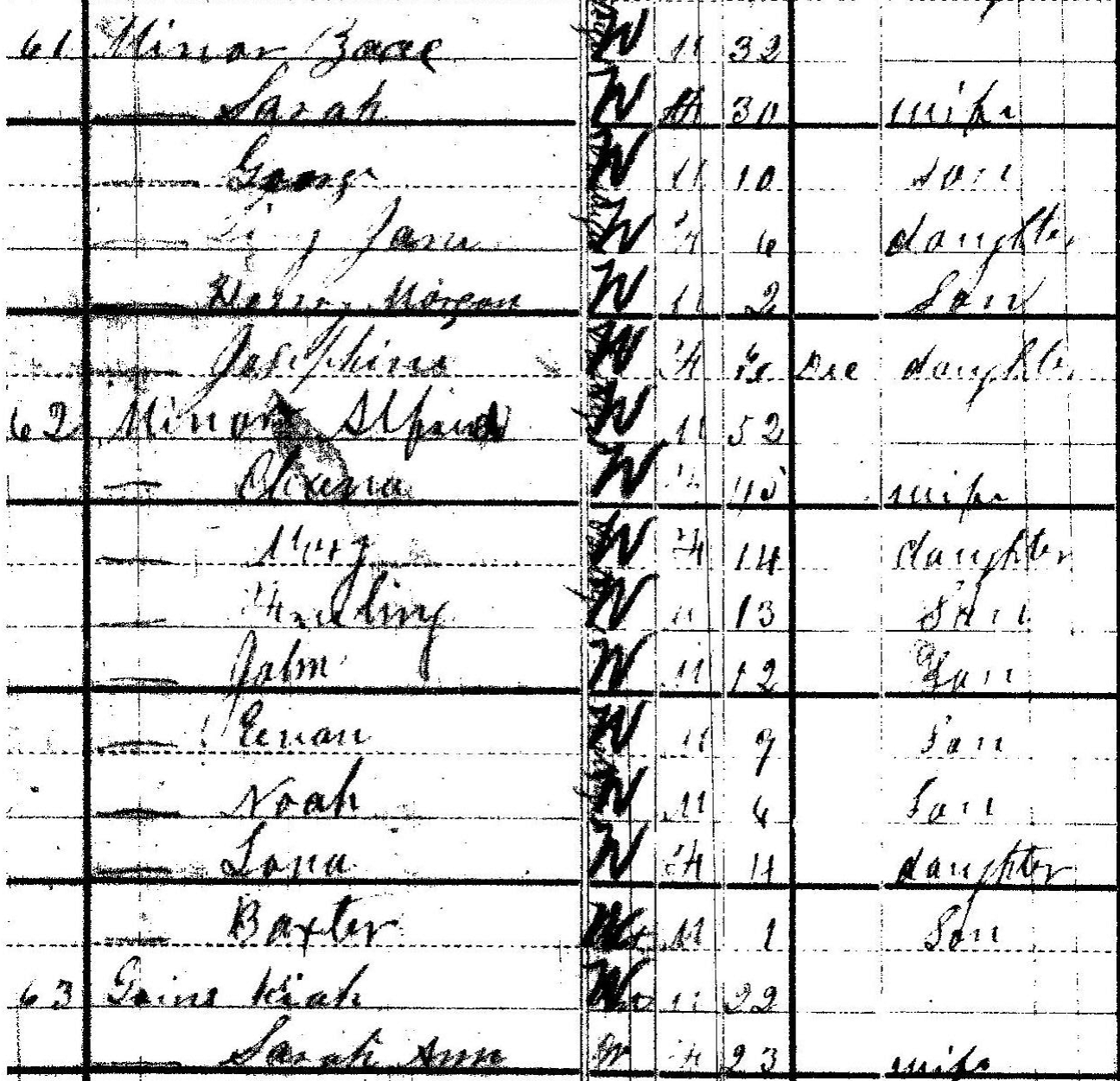
Looking back at the 1910 census, we do find Ilo with her family and indeed her mother is Maud and the siblings match.

Bailey 1910 census

Ilo E. Bailey in the 1910 census was age 6, so born in 1904, and living in Belvidere in Montcalm Co., Michigan.  That means in 1919, she was age 15 when she married “Don Caroles.”  Her parents were John Bailey and Maude E., although her father had died before the 1920 census.  Her grandfather John C. Bailey age 78 also living with them in 1910.

Reconstructing her family between the 1900, 1910 and 1920 census, we find the following:

Ilo’s father, John Bailey was born in 1865 in Ohio and his father was John C. Bailey born in 1832 in Ohio.  Ilo’s father, John, died sometime between the 1910 and 1920 census.  Ilo’s mother was Maude E. born in 1881 in Ohio.  We discover Maud’s maiden name in two of her children’s death records.

Ilo’s sibings:

  • Martha E. Bailey born in October 1898 in Ohio, died Aug 3, 1913 in Belvidere Twp, Montcalm Co. Mi., father, John Bailey, mother, Maude Wable.
  • John C. Bailey born in 1901 in Ohio.
  • Mervin E. Bailey born in 1907 in Ohio (Ervin born Jan 24, 1907 in Van Wert, Ohio, according to Ohio births,) Mervin Eugene died March 11, 1921 in Belvidere, Michigan, his death record says that Ervin born was Jan. 24, 1906 in Van Wert, Ohio, child of John C. Bailey and Maude Wable.
  • May E. Bailey born October 1918 in Michigan.

John Bailey married Maude Wable (Or Woble) in Jackson, Jackson Co., Michigan on March 31, 1897 according to Michigan marriage records.  According to the 1900 census, John already had 3 daughters from a first marriage.

Ok, it surely looks like we have the right Ilo, but where is Ilo in the 1930 census, or, for that matter, anytime after the letter she wrote to William Sterling Estes dated March 22, 1921?

The 1930 census shows no Don Caroles or any other that look familiar at all.  Of 5 Caroles listed nationally, 4 are born in Italy and one in Nebraska.

Once Again, We’ve Run Aground.

Here’s my working theory in terms of what happened surrounding Ilo Bailey and “Don Caroles’” marriage.

William Sterling Estes was actually either 17 or 18 in 1919 but his military ID would have said that he was 22 or 23, born in 1898.  He would not have needed his parents to sign.  Ilo, if she was born in 1903 would have been 16 and if born in 1904, 15 when she married in 1919.  She was obviously pregnant, I’m guessing at least 3 months, so the child was born sometime after the census in January and probably before June.  My sister was born May 22nd that year to another woman.  I wonder if he knew my sister’s mother was pregnant when he married Ilo.

When applying for a marriage license, Ilo claimed she was 19, but her youthful appearance might have caused some suspicion.  Her own mother had a young baby at home herself and was a widow by January 1920, so obviously a woman facing hardships.  It would be easy to surmise that she did not want her daughter finding herself in the same kind of situation and might not have been in favor of her marrying so young.  I suspect that Ollie Bolton went along with the young couple to get their marriage license and then to get married, and posed as “her” mother, not his.  Note that Ilo did not give her correct father’s name either.

I checked Ancestry, Family Search and Rootsweb for Ilo’s family, with no luck.  There is one very sketchy record at Ancestry.  I did leave the contributor a note but also noticed they had not signed on in over a year.  Not a good omen.

I was trying to track Ilo’s siblings forward in time, thinking I might be able to find their obituaries which could lead me to Ilo once again, as an adult, with a married surname…but all I found was two of her siblings death records as young people.   Of the two siblings who lived, I was unable to find anything at all about May Bailey, and John C. Bailey was too general.

So, we’re at a dead end again.

The Ridiculous and the Sublime

Do ridiculously silly questions sometimes haunt you?  If not, l’ll gladly share some of mine!

Here’s a mind-twister that might even stump legal eagle Judy Russell.  If you’re Ilo, and you marry “Don Caroles” and have a baby, and then discover that there is “another woman” and “another baby,” and that your marriage is illegal, probably saving you the trouble of getting divorced – what surname do you file under in court?  Bailey, Caroles or Estes?  And given that, who do you file against, Don Caroles or William Sterling Estes?  And what do you file?  And what kind of a court do you file in?  And what do you ask for, exactly, other than having the scoundrel shot?

When the baby is born, what surname do you give your baby?  Caroles?  If you give the baby the name Caroles, do you then ask for it to be changed when you discover that not only were you illegally married, but not to the man Don Caroles at all?  And changed to what, Estes or Bailey?  Is the child then legally illegitimate?  And assuming all of this is filed, is the entire court record and file now sealed because it involves changing the parentage of a minor, similar to an adoption?  In other words, will I ever be able to find this record, wherever it is, whatever it is?

In Ilo’s letter, she tells William Sterling Estes that “it’s in a lawyer’s hands now” and that she doesn’t need his signature at all.  And besides that, even if she did, exactly which signature would he use???  And wouldn’t you think he would get in trouble with the military for getting married under a fake name, I mean, if he wasn’t already in trouble for being AWOL?  Wouldn’t you think he would think about these things?  Just saying….

And if Ilo then went to remarry, or marry, whatever you call it, what surname would she use in that marriage record?  The 1920s was a long time before women petitioned to take their maiden name back.  In the 1980s, judges were reticent to grant the return to maiden names if children were involved – and that’s 60 light-years later.

One of the reasons that I ask all of this is that I know the “father” was changed on my sister’s birth record to reflect my father’s name, after her mother married my father in December of 1922.  He seemed to like December weddings.  My sister’s birth record was then refiled with the later “delayed” or “adopted” records and given that my sister didn’t know about this, she had fits getting her birth certificate because it had been stricken in the original book with no “pointer” to the new entry.  A clerk finally found it on a fluke and with her standing there refusing to leave without a birth certificate.

Am I ever going to be able to find out what happened to Ilo’s son?  I actually wonder if he died.  My sister who was born within months or weeks (or for all we know days) of Ilo’s child was well known to the family, even if her mother and her mother’s family “didn’t care for” my father, to put it mildly.  So if Ilo’s child died, what surname would his death record have reflected?

I may never figure this out, but still, I want to know…

  • Who was that child?
  • What was his name?  No child should be remembered namelessly.  Even my babies who died all have names.
  • Did he live or die?  Is my brother alive?  Did he have children?
  • If he died, when, and how?

And oh, just one more crazy twisted question.  If you were William Sterling Estes, and you had two women pregnant at the same time in the same town, due, it seems, about the same month…wouldn’t you worry that they might meet each other?  Like at the doctor’s office…or worse yet, wind up being roommates giving birth???

Wait a minute!  Maybe that’s what happened.  He was AWOL from November 1919 through April 1920 when he was arrested.  Arrested?  Maybe he turned himself in….maybe it seemed like the safer choice.  Oh what a tangled web we weave…..

Ilo’s Son

Just as I was ready to call this a draw, again, for about the 100th time in the 36 years I’ve been searching for my brother…another reader sent me a vital piece of information.  Ilo Esther Bailey remarried in Ohio using her maiden name.  And yes, it’s the same Ilo because she gave her parents names.  And for once, the names all match.

On June 9, 1928, Ilo Esther Baily, born in Van Wert, Ohio to John Bailey and Maude Wable married Thomas Devine, son of Mathew Devine and Elizabeth Hawkins.  They both listed their marital status as “single” and they were married in Bowling Green, Wood County, Ohio, just south of Toledo.

The image of the actual application shows that they weren’t just single, but that they both state they have never been married before.

Bailey-Devine marriage app

The 1930 census, just two years later shows this couple with several children, including one named Leo Jr, age 10, so born in 1920, in Michigan.  They were living in Lucas County, where Toledo is located.  Ilo is listed as age 27, so born in 1903.

Bailey-Devine 1930 census

Children listed were:

  • Leo Jr. – 10 – born in Michigan
  • Matthew T. – 8 – born in Ohio
  • Robert J. – 6 – born in Ohio
  • William E. – 3/12th – so born in January of 1930

Leo would have been the son of William Sterling Estes.  How then could he be Leo Jr.?  Did she rename the child after her second husband?  This doesn’t make sense, but then nothing about this entire situation makes sense.

About this time, I recalled what my crazy aunts had told me.  That my father was married about 1920 or so to a Laila LaFountain and they had a son Lee, who eventually took his step-father’s name of “Levi or Levy or something like that.”  Lee wound up in Louisville, Ky studying the ministry in a seminary “or something,” they recalled.  All this time, I thought Laila LaFountain was a different person, if she and Lee even existed at all.  Remember, they were the crazy aunts:)

By 1933, Ilo was in Louisville, Ky., with husband  L. Thomas, as listed in the Louisville, Kentucky City Directory.  L. Thomas Devine is listed with Ilo E., r rear 911 Washington in 1933 and in 1934 Leo T. Devine with Ilo is listed at 1056 Washington.

By 1939, Mrs. Ilo E. Devine is listed by herself at 1005 E. Main.

Another reader found ILA (sic); Leo, Jr., student; and Matthew, living at 412 E. Grey in Louisville, in the 1940 city directory. Ilo is listed as widow of Thomas. There is a Thomas listed in 1940, who is a Laborer at Cavehill Cemetery. There is also a William, but there is no way to know if he is Ilo’s son.

The family is missing in the 1940 census.  In 1940, Ilo’s children would have been:

  • Leo – 20
  • Matthew – 18
  • Robert – 16
  • William – 10

According to the Ohio birth registry, another child, James J. Devine was born Oct. 24, 1923.  Would this be Robert James Devine who died in 1975?  The answer is in Robert’s death certificate and obituary.

And I have to ask…why does this family continue to change their names???  Leo Thomas Jr. became Lee Joseph., James J. became Robert James and William E. became William Douglas???

In 1942, Matthew T. and Robert J. are living at 829 Washington Street. There is also a Thomas.

We know that at least Robert James was alive beyond 1942, because he died in Fort Worth, Texas on July 7, 1975.  His mother is listed as Ilo Esther Bailey and his father as Leo Thomas Devine.

Robert James Devine death cert

I ordered Robert’s obituary from the Fort Worth Library.  It did not list his parents, but did list his siblings.

Robert Devine obit cropped

So we now know that in 1975, Lee, Matthew and William were all still living in Louisville.

According to the birth index, Matthew T. was born January 15, 1922 in Lucas County, Ohio to Ilo and Leo.  This means that this child was conceived in April 1921, approximately 1 month after Ilo wrote the letter to William Sterling Estes.  Perhaps this relationship with Leo Devine, is what Ilo was referring to in her letter when she stated that William, upon his return to Battle Creek, would hear “quite a bit about me.”  If indeed she did return to Michigan in June as she indicated was planned, she was then pregnant with her second child.  It’s interesting that the location from where she wrote the letter to William was Louisville, where she and Leo Devine ultimately wound up living.  Maybe Leo is the “very fine people who are wealthy and willing to take care of baby and I.”

If Leo, or Lee, the child, was raised as part of the Leo Devine family, he may never have known that he was not Leo Devine’s biological child.  But was Lee Devine the biological son of Leo Devine?  As it turns out, Leo Devine was living with his brother Douglas in Battle Creek, Michigan in 1920, per the census, and it appears that Douglas was working at the Army Base.

One thing is for sure, Matthew Devine was positively not the child of William Sterling Estes, because he was in the Leavenworth Disciplinary Barracks, in Kansas, at the time Matthew was conceived.

Matthew Devine died August 19, 1997 and his obituary is as follows:

Matthew Thomas Devine, 75, died Sunday at Caritas Medical Center.  He was a retired employee of the old International Harvester Co., an Army veteran of World War II and a member of Veterans of Foreign Wars Post 1181.

Survivors: his wife, the former Norma J. Taylor; sons David and James Harbin; daughters Mary Scott and Esther Choi; a brother, William Devine; six grandchildren; and a great-grandchild.

Funeral: 1 p.m. Tuesday, Resthaven, 4400 Bardstown Road. Burial: Resthaven Memorial. Visitation: 2-9 p.m. Monday.

From the Ohio Birth Index – William Douglas Devine was born December 31, 1929 son of Leo & Ilo.  His birth date in the SSDI (Social Security Death Index) matches this date.

Here is his  obituary From findagrave.

Devine, William Douglas, 77, of Louisville, passed away on Tuesday, March 27, 2007, at Jewish Hospital. Mr. Devine was a retired captain on the Louisville Fire Department, a member of the Fire Fighter’s Union, Retired Fire Fighters, honorary member of the 10th. Mountain Division, and Guardian Angels Catholic Church. He is survived by his wife of 56 years, Mary Lee Devine; a daughter, Dusty Callahan-Hardin (Tim); and two grandchildren, Ryan and Caitlin Callahan. Funeral Mass will be 10 a.m. Saturday at Guardian Angels Catholic Church, 6000 Preston Highway. Burial will follow in Resthaven Memorial Park. Visitation will be 2-8 p.m. Friday and after 8:30 a.m. Saturday at Arch L. Heady at Resthaven, 4400 Bardstown Rd. Expressions to Guardian Angels Catholic Church.  Published in The Courier-Journal on 3/29/2007.

Unfortunately, this obituary doesn’t say anything about his brother, Lee.

Where is Leo Thomas Devine?

In 1939 and 1940, we find a Lee Joseph Devine attending the University of Louisville in the Liberal Arts program.

In the 1956 City Directory, we find Lee J. Devine with wife Ruth who works for the Pan Am Service Station.  Then we find Matthew T. Devine who works in the same place.  That seems just too much of a coincidence and connects Matthew T. with Lee J. who is married to wife Ruth.  To me, this removes most of the doubt as to whether or not Lee. J. Devine is the same person as Leo T. Devine.  Having said that, this family “ball of string” has thrown me so many loops and blindsided me so many times that I’m very hesitant to conclude anything without definitive proof.  It seems that no one behaves or plays by the rules, or even keeps their names!

By the 1960 directory, we find Lee J. Devine who is now a vice president of Thurston Cook Mercury.

In 1989, we find the death record for Lee J. Devine, also listed as Leo Devine in at least one death record index.  He was born February 24, 1920, obtained his SS number in Louisville prior to 1951 and died in St. Petersburg, Pinellas County, FL on January 21, 1989.  He had a death record both there and in Louisville and was buried in Howe Valley, Hardin Co., KY.  Hardin County borders Jefferson County where Louisville is located.

Devine cemetery stone

Photo taken in January, 2012….and Ruth isn’t buried at that time.

This particular Lee Devine married Cordelia Ruth Lyon on June 26, 1943.  But, is this Lee Devine the son of Ilo Esther Bailey or is this a different Lee Devine?

When in doubt, call the library.  I learned this years and years ago, and once again, it didn’t fail me.  Mark Taflinger, the Data Desk Manager provided me with Lee’s obituary which clearly links him with brothers William and Matthew.

Lee J. Devine, 68, died Saturday in St. Petersburg, Fla.

He was a retired president and administrator of St. Matthews Manor and Mount Holly Convalescent Centers, a former president of the Kiwanis Club of Louisville and the Executive Club, and a member of the Pendennis Club, Boys and Girls Council of the Salvation Army, English Speaking Union, Stephensburg Masonic Lodge, Scottish Rite and Kosair Shrine Temple.

Survivors: his wife, the former Ruth Lyon; and two brothers, Matthew T. and William D. Devine.

Funeral: 10 a.m. Wednesday, Christ United Methodist Church, 4614 Brownsboro Road, with burial in Howe Valley Cemetery in Cecilia. Visitation at Pearson’s, 149 Breckinridge Lane, from 1 to 9 p.m. Tuesday.

But there is one more thing….he had no children.  So I don’t have any nieces and nephews, and there is no one to do DNA testing to prove, or disprove, that Lee was my brother.

From Lee’s obituary, I would have been proud to know this man.  It certainly looks like he made a very positive difference in the world.  Ilo, your son would have made you proud.  I’m just so sorry that I never got the chance to meet him.  But now I know.  I no longer have to wonder.  There will be no mysteriously appearing sibling DNA match, at least not from him.  I can stop waiting.

So, now I must pause to reflect.  It has been an extremely long couple of weeks.

Is Lee Devine My Biological Brother?

Is this man my brother?  I’m sure you’ll understand my need to ask after discovering that my brother Dave was not.  Added to this doubt, in this case, is the fact that Leo Devine was also in Battle Creek in the 1920 census and that Ilo named the child, according to the 1930 census, Leo Thomas Jr. – although his name would somehow evolve over time to Lee Joseph.

I’m sure that this Lee Devine is the man that is supposed to be my brother. We have finally walked, crawled and then sprinted to the end of that trail. But was he really my brother?  The only resource left now is photos and once again, Mark, from the Louisville library came through for me.  Libraries have clipping files.  This photo of Lee Devine is from March 2, 1955.  It’s the only photo in his file.

??????????????????????????????????????????????????????????????????

I have no photos of my father from the time of his military service until about 1950 or so.

Bill about 1950

Here is a photo of my father I’d guess about 1945 or 1950.  And no, I have no idea who the child is…which leads to more questions, that, unless someone recognizes this photo, will forever be unanswered.  It was labeled as “one of his girlfriend’s children” by my brother Dave’s mother, so it’s not Dave.

William Sterling Estes circi 1950 crop

My father about 1950, so about 13 years older than Lee was in the photo taken in 1955.

Bill military 2 cropped

Here, above and below, are photos of my father in the military around 1918, so about age 15.

Bill about 1918 cropped

Bill 1960

Here’s William Sterling Estes about 1960 with my step-mother, Virgie.

Edna 1955 cropped

Here is a photo of my genetically proven sister, the one born in 1920 just three months after Lee, taken about 1955.

Sister age 60

Here’s my proven sister at about age 60.

Estes Publicity

Here is a photo of me taken when I was about 5 years older than Lee was in the photo in 1955.

There are a few more family photos in the “Crazy Aunts” story.  I personally think Lee resembled my father’s brother, Joseph, shown in the family photo in that article, and below.

Estes family 1914 joseph cropped

This is the end of the story.  We’re done.  Case solved, thanks to many contributing people.  It stops here because there are no children to DNA test.  There can be no final chapter, so to speak, no definitive conclusion.

Feelings and Coping

I feel that it’s only appropriate to add a quick note about how I feel about this.  These have been an extremely emotion-filled few days.  I have chosen to share not only this experience in total, step by step, but also how I feel about it, for two reasons.

First, many others will go through this same process.  I didn’t quite expect to go through it publicly, but that is how it started with the Ilo story and I felt obliged to share with you “the rest of the story,” especially given that so many of you contributed the key pieces of the puzzle.  It would not have been solved without the reader contributions.

The resolution of this type of search within a few days is actually very unusual.  Often there are weeks or months between pieces of information and you can deal with each one as they arrive.  For me, this process has been extremely compressed these past few days due to the newly available online records such as the Ohio birth, death and marriage indexes. This process and the emotional roller-coaster attached to each new piece of data feels quite lonely and the emotions are extremely raw, especially if you’re searching for the family you don’t have.  These journeys by virtue of what they are often isolated and alone.  Other than giving birth or burying a family member, these types of searches are one of the most personal journeys you can embark upon.  They will change your life forever, the journey itself, if not the outcome.

For many, especially adoptees, there is a sense of desperation that defines these searches.  The clock is always working against you in the sense of finding the person alive, and working for you in terms of new records becoming available that may help your search.  Your feelings are always a conflicted hodgepodge of hope and fear, often wildly swinging between the two.  Fear of what you will find, what you won’t find, that you’ll find nothing, or that it will be too late.

Second, I’ve shared to help those who never experience this understand the process for those of us who have.  Almost all of us will know someone who goes through this.  Many people experience this over and over trying to find parents and then siblings, having no idea what awaits them….what they will find…if anything.  It never becomes easy or even easier, especially after a few choice rejections and setbacks.  Many times, each one becomes more difficult.  The end of these stories aren’t always happy endings in the classic sense of a tearful, joyful reunion.  Trust me – there is another sister I haven’t told you about.

Anyone who searches for a sibling or parent or child knows that the entire search, for however long it takes, often decades, is fueled by hope.  Some hope for a joyful reunion, for love.  Some just want closure.  Some want to know what that person was or is like.  Many want to find some commonality.  Some of us are almost afraid to hope.  Given the dysfunctional state of my father’s life and his history of drinking, I had no idea what to expect in his child.  Lee was a pleasant surprise.

I clearly knew that it was extremely unlikely that I could ever find this brother, and by this time, more than 90 years after his birth, if I did, he would likely be deceased.  I’m far more surprised that I’ve actually found him than I am that he has passed over.

I was extremely blessed to have found my sister Edna in 1978 and my brother Dave in the early 2000s.  I had a few years with both of them before they passed – years I would not trade for anything.  I think we loved each other more intensely and gratefully to make up for the years we didn’t have.  My sister and I were so very much alike in uncanny ways.  I was utterly devastated at her passing – given and so unexpectedly wrenched away again just a dozen years later. It was many years before I stopped picking up the phone on Sunday afternoons to call her.  The second anniversary of Dave’s passing is next week.  And so – another brother lost, and found, and lost again.

When we obtain closure, it allows us to move on, in our own way, in our own time.  In the meantime, we grieve what wasn’t, what might have been, what we hoped would be and never happened.  Sometimes, depending on the circumstances, we grieve what was.

This discovery, as glad and extremely grateful as I am to have made it, is, in it’s own way, a death.  It’s finally over.  The door has shut, as gently as possible, but it is closed, latched, and he is on the other side…and although I’ve found him, given the murky circumstances, I still don’t know if he is actually my brother.

What I wanted, of course, was a brother, and failing that, the truth.  Had he been alive, or had children, the truth would be easy to discern utilizing DNA testing.  It seems ironically fitting somehow that even at the end of this convoluted journey, the truth would still be permanently unreachable.  For the past 36 years, my brother has always seemed to be just beyond my fingertips, and he still is.

So, in keeping with my quilter’s heart, I bought fabric this week to begin a quilt (for me) for him…to celebrate finding him, to be thankful for my many friends who solved the mystery, to mark the end of this part of the journey, and to honor his life well lived.  When life gives you scraps, make quilts.  There is beauty in everything.  I chose beautiful batik snowflakes to represent the steps in the journey that ended “cold,” in the middle of the toughest winter in decades.

Hoffman Bali tiles

As for whether he is my biological brother, I truly don’t know what to think, so I’m asking you.

Let’s Vote

So, what do you think, based on the pictures?  By the way, your votes are anonymous,  so be truthful.

Is Lee Devine my biological brother?

______________________________________________________________

Disclosure

I receive a small contribution when you click on some of the links to vendors in my articles. This does NOT increase the price you pay but helps me to keep the lights on and this informational blog free for everyone. Please click on the links in the articles or to the vendors below if you are purchasing products or DNA testing.

Thank you so much.

DNA Purchases and Free Transfers

Genealogy Services

Genealogy Research

My Crazy Estes Aunts – 52 Ancestors #2

Do you have some crazy aunts in your family?  I think everybody does.  I certainly did – two of them – my father’s sisters.  They were truly characters.  They also were the gatekeepers to the family secrets – secrets I desperately needed to know!

Estes family 1914

William George Estes and Ollie Bolton Estes family.  Children are left to right, daughter Margaret,  behind Margaret, Joseph “Dode,” tall male is Charles Estle, male at right rear, my father, William Sterling Estes, looking worried, and blonde female at right beside Ollie is Minnie.

The aunts names were, officially, Margaret Lee Estes (born 1906, the brunette at left, above) and Minnie Mae Estes (born 1908, the blonde at right).  I say officially, because they were fond of changing their names from time to time.  That made it really difficult when discussing family items because their names were always different.  Margaret seemed to settle on Jean and Minnie settled somewhat on Betty.  No, I don’t know why.  What I do know is that they were indeed, drama queens and they seemed to have a bit of sibling rivalry from the beginning that lasted, well, to the very end – and they both lived to be just shy of 100.

They started out as drama princesses when they were young.  Both were exceptionally beautiful young women.  Margaret, below, is reported to have done some modeling in Chicago about 1925, and of course she sent her modeling photos to her sister Minnie.

Margaret Estes c 1920

While Margaret went to live with her mother in Chicago after her parents divorced in the mid 19-teens, Minnie didn’t.  She went back to the Claiborne County, Tennessee/Lee County, Virginia area, and in her own words, “was wild as a young buck.”

Minnie Estes

Both women would marry, both had one son.  Both sons died tragically.  Instead of bringing the sisters together, it seemed to further widened the gap.

Some of their crazy stories revolve around the sons and their deaths.  There are allegations of murder, the mob, the mafia, huge stolen insurance policies and such.  From the other sister, the same death story is quite different – homelessness, alcoholism, you get the idea.  What is consistent is a lot of pain surrounding the deaths and jealousy between the sisters.  And what’s worse, or better, is that I discovered that every time either of them discussed the stories, or each other, or anything for that matter, that the stories evolved or changed.  They were never the same.  Peachy, just peachy!

I didn’t find the sisters until they were in their late 70s.  My parents were divorced and my father was killed in an automobile accident when I was in grade school.  We lived about 400 miles from my father’s Tennessee family, and for some reason, my mother really didn’t want me hanging out with my Dad’s moonshining family.  I would probably have loved them, which is exactly what she was worried about.

It wasn’t until many years later, when I was in my 20s, that I began searching for my father’s family to find out something, anything.  That’s when I was directed to the aunts.  They were the only siblings of my father yet living, and I was thrilled to find them.  I initially wrote down every word they said…until I discovered that my notes from conversation to conversation contradicted each other.  And if you asked them about what they said before, they would accuse you of lying, or worse, yet, talking to the enemy – the other sister – who had of course, lied.  For awhile, I truly wondered if somehow I confused my notes and questioned my own sanity.

I’m extremely glad I took those notes.  I put them away and years later, transcribed them.  Margaret told about her homes around the world, and in the next conversation, would discuss her poverty.  One time she told me that her family was spying on her to take her money.  Minnie told about one of her husbands who was a politician and their time “on the hill” which I’m presuming was supposed to be Capitol Hill.  I finally came to view the stories as just amusing and left it at that.  They also did interesting things from time to time.  Minnie/Betty once sent a pair of red sequined ballet slippers to the daughter of her deceased brother with a note that said that “no one in Tennessee loves me.”  Whose slippers they were, we have no idea – she didn’t dance.  Everyone in Tennessee was left someplace between amused and mystified with maybe a little creeped-out added along the edges.

There were nuggets of truth in those stories however, although they were disjoint and mining them has proven to be challenging.  However, these past few days, the crazy aunts’ stories came through .

Margaret was only married once, but Minnie/Betty was married several times.  I couldn’t keep her husbands straight and I don’t think she could either.  However, both aunts loved to discuss my father, because whatever they had done, his escapades made theirs pale by comparison.  The only bad thing was that the aunts seemed to have snippets of this and that.  The all lived in different states and I think most of what they heard was through their mother, Ollie.

They loved to talk about people, and my father with his gallivanting ways proved quite a popular topic of conversation and fodder for a lot of tongue wagging and clicking.  Tisk, tisk, tisk….naughty boy.  Yes, indeed.  But thankfully their love of gossip and “telling on him” and their rivalry to see who could tell the ‘worst” story has provided me with a couple very valuable nuggets.

They told me that my father was married about 1920 or so to a Laila LaFountain and they had a son Lee, they thought, who eventually took his step-father’s name of “Levi or Levy or something like that.”  Lee, if that was his name, wound up in Louisville, Ky studying the ministry in a seminary “or something,” they recalled.  He “might have been a minister.”

As it turns out, they were partially right, except they had Lee’s mother’s name wrong, unless, God forbid, there are two Lees, a possibility I’m going to entirely discount right now, to protect any shred of sanity I have left.

In my 52 Ancestors week #1 article, “ Searching for Ilo’s Son,” as things have developed, we discover that Ilo’s son’s name was Leo and his step-father’s name was Levine and in the 1930s, Ilo was living in Louisville, Ky.  I remember writing years ago to a seminary in Louisville asking about a student from that time frame named Lee Levy, Levi or Estes.  Of course, they didn’t find anything, but now I need to revisit this.  I will catch everyone up on that story, probably next week.  However, if you happen to know of a minister born about 1920 named Lee or Leo Thomas Devine, by all means, let me know.  And score one for the crazy aunts!

Also, were it not for both of those women, I would have no photos of the family – none.  Margaret had hers copied and sent them to me in the 1980s, with much ado and guilt inducing rhetoric.  Remember, they were drama queens, and very experienced ones too.  “No, you can’t pay me for them…I’ll  gladly do without food.” Ok, so maybe not quite that dramatic, but you get the drift.

Minnie shared her photos with her grandson’s x-wife, who graciously shared them with me. In fact, it was the grandson’s x-wife and her boys who helped Minnie/Betty through her elder years.  It’s a good thing we got copies of these photos when we did, because when the aunts died, there were absolutely no personal effects to be found anyplace.

Minnie’s grandson’s x-wife and sons did one more thing too….they got a DNA sample from Minnie during one of their visits, years ago.

Our maternal (mitochondrial) family tree is shown below.

  • Margaret and Minnie Estes
  • Ollie Bolton (1874 Hancock Co. TN – 1955 Chicago, Illinois) married William George Estes (divorced)
  • Margaret N. Claxton/Clarkson (1851-1920 Hancock Co., Tn) married Joseph “Dode” Bolton
  • Elizabeth Speaks (1832 Indiana-1903 Hancock Co. Tn) married Samuel Claxton
  • Ann McKee (1805 Washington Co., Va – 1840/1850 Lee Co., Va.) married Charles Speak
  • Elizabeth last name unknown married Andrew McKee (1766-1814)

This photo is of Elizabeth Speaks and Samuel Claxton in his Civil War uniform.

Elizabeth Speaks Samuel Claxton

I’d love to have a photo of Margaret Claxton/Clarkson and Joseph Bolton, but none have surfaced to date.  I’ve always wondered, though, if this photo taken about 1918, below, is of Margaret Estes (my aunt) and her grandmother, Margaret Claxton, and not her mother, Ollie.  The problem is with the labeling.  Another family member has this photo labeled “Margaret and grandma” which, depending on who wrote it, could be Ollie Bolton Estes or Margaret’s grandmother (Ollie’s mother,) Margaret Claxton.  Ollie would have been about 45-50 in the photo and her mother would have been about 65-70.  It was taken in Chicago, and I do have to wonder if Margaret Claxton would have visited Chicago, but you never know!

Margaret Estes and mother or grandmother

Here is Ollie Bolton Estes and William George Estes about 1914.

Ollie and William Estes

We think this colorized photo is of Ollie, but we’re not sure.  No label.  It was in Minnie’s photos, but it wasn’t in Margaret’s, so we don’t really know.

Possibly Betty's mother

Here’s Ollie as an older woman.

Ollie Bolton 1950s

We may not know Elizabeth MeKee’s maiden name, but we know that she and all of these women, her descendants, are haplogroup H, European.  No hidden Indian princesses here.  The problem is that when I tried to upgrade Minnie’s DNA sample to the full sequence to find out more, it failed.  Not enough DNA or too old.

I’d love to find someone else to test for this maternal line.  There’s a scholarship for anyone descended from any of these women in the maternal family tree through all females to the current generation.  In the current generation, the tester can be a male or female.   Women give their mitochondrial DNA to both genders of their children, but only females can pass it on.  For more info on how genealogy DNA testing works, click here.  If you descend from this line in any fashion, I’d love to hear from you.  You can leave a comment or e-mail me at robertajestes@att.net.

And as for those crazy aunts, I hope they found some common ground in the afterlife that they were unable to find here.  And maybe, just maybe, the family members “over there” are helping in some way to unravel this Ilo Bailey, William Estes, Leo Devine mystery.  Heaven knows, I can certainly use all the help I can get!

______________________________________________________________

Disclosure

I receive a small contribution when you click on some of the links to vendors in my articles. This does NOT increase the price you pay but helps me to keep the lights on and this informational blog free for everyone. Please click on the links in the articles or to the vendors below if you are purchasing products or DNA testing.

Thank you so much.

DNA Purchases and Free Transfers

Genealogy Services

Genealogy Research

Cherokee Mother of John Red Bank Payne

John Red Bank Payne

There is nothing I love more than a happy ending.  Second to that perhaps is to know that my blog or work helped someone, and in particularly, helped someone document their Native heritage.  In doing so, this confirms and unveils one more of our elusive Native people in early records.

I recently received a lovely thank you note from Shawn Potter.  We had exchanged notes earlier, after I wrote “The Autosomal Me” series, about how to utilize small segments of Native American (and Asian) DNA to identify Native American lines and/or ancestors.  This technique is called Minority Admixture Mapping (MAP) and was set forth in detail in various articles in the series.

Shawn’s note said:  “I’ve been doing more work on this segment and others following your method since we exchanged notes.  I’m pretty sure I’ve found the source of this Native American DNA — an ancestor named John Red Bank Payne who lived in North Georgia in the late 18th and 19th centuries.  Many of his descendants believe on the basis of circumstantial evidence that his mother was Cherokee.  I’ve found 10 descendants from four separate lines that inherited matching Native American DNA, pointing to one of his parents as the source.”

Along with this note, Shawn attached a beautiful 65 page book he had written for his family members which did document the Native DNA, but in the context of his family history.  He included their family story, the tales, the genealogical research, the DNA evidence and finally, a chapter of relevant Cherokee history complete with maps of the area where his ancestors lived. It’s a beautiful example of how to present something like this for non-DNA people to understand.  In addition, it’s also a wonderful roadmap, a “how to” book for how to approach this subject from a DNA/historical/genealogical perspective.  As hard as it is for me to sometimes remember, DNA is just a tool to utilize in the bigger genealogy picture.

Shawn has been gracious enough to allow me to reprint some of his work here, so from this point on, I’ll be extracting from his document.  Furthermore, Elizabeth Shown Mills would be ecstatic, because Shawn has fully documented and sourced his document.  I am not including that information here, but I’m sure he would gladly share the document itself with any interested parties.  You can contact Shawn at shpxlcp@comcast.net.

From the book, “Cherokee Mother of John Red Bank Payne” by Shawn Potter and Lois Carol Potter:

Descendants of John Red Bank Payne describe his mother as Cherokee. Yet, until now, some have questioned the truth of this claim because genealogists have been unable to identify John’s mother in contemporary records. A recent discovery, however, reveals both John Red Bank Payne and his sister Nancy Payne inherited Native American DNA.

Considering information from contemporary records, clues from local tradition, John’s name itself, and now the revelation that John and his sister inherited Native American DNA, there seems to be sufficient evidence to say John Red Bank Payne’s mother truly was Cherokee. The following summary describes what we know about John, his family, and his Native American DNA.

John Red Bank Payne was born perhaps near present-day Canton, Cherokee County, Georgia, on January 24, 1754, married Ann Henslee in Caswell County, North Carolina, on March 5, 1779, and died in Carnesville, Franklin County, Georgia, on December 14, 1831.

John’s father, Thomas Payne, was born in Westmorland County, Virginia, about 1725, and owned property in Halifax and Pittsylvania counties, Virginia, as well as Wilkes County, North Carolina, and Franklin County, Georgia.  Several factors suggest Thomas travelled with his older brother, William, to North Georgia and beyond, engaging in the deerskin trade with the Cherokee Nation during the mid 1700s. Thomas Payne died probably in Franklin County, Georgia, after February 23, 1811.

Contemporary records reveal Thomas had four children (William, John, Nancy, and Abigail) by his first wife, and nine children (Thomas, Nathaniel, Moses, Champness, Shrewsbury, Zebediah, Poindexter, Ruth, and Cleveland) by his second wife Yanaka Ayers.  Thomas married Yanaka probably in Halifax County, Virginia, before September 20, 1760.

Local North Georgia tradition identifies the first wife of Thomas Payne as a Cherokee woman. Anna Belle Little Tabor, in History of Franklin County, Georgia, wrote that “Trader Payne” managed a trading post on Payne’s Creek, and “one of his descendants, an offspring of his Cherokee marriage, later married Moses Ayers whose descendants still live in the county.”

Descendants of John Red Bank Payne also cite his name Red Bank, recorded in his son’s family Bible, as evidence of his Cherokee heritage.  Before the American Revolution, British Americans rarely defied English legal prohibitions against giving a child more than one Christian name.  So, the very existence of John’s name Red Bank suggests non-English ethnicity. On the other hand, many people of mixed English-Cherokee heritage were known by their Cherokee name as well as their English first and last names during this period.

Furthermore, while the form of John’s middle name is unlike normal English names, Red Bank conforms perfectly to standard Cherokee names.  It also is interesting to note, Red Bank was the name of a Cherokee village located on the south side of Etowah River to the southwest of present-day Canton, Cherokee County, Georgia.

While some believe the above information from contemporary records and clues from local tradition, as well as John’s name Red Bank, constitute sufficient proof of John’s Cherokee heritage, recently discovered DNA evidence confirms at least one of John’s parents had Native American ancestry. Ten descendants of John Red Bank Payne and his sister Nancy Payne, representing four separate lineages, inherited six segments of Native American DNA on chromosomes 2, 3, 5, 8, 13, and 18 (see Figure 1 for the relationship between these descendants; Figures 2-7 for images of their shared Native American DNA; and http://dna-explained.com/2013/06/02/the-autosomal-me-summary-and-pdf-file/ for an explanation of this method of identifying Native American chromosomal segments).

Upon careful reflection, there seems sufficient reason to believe John Red Bank Payne’s mother truly was Cherokee.

Roberta’s note:  I have redacted the surnames of current testers.

Payne chart

Chromosome 2, Segment 154-161

In this segment, Bert P, Rosa P, Nataan S, Cynthia S, and Kendall S inherited matching Native American DNA described as Amerindian, Siberian, Southeast Asian, and Oceanian by the Eurogenes V2 K15 admixture tool, and as North Amerind, Mesoamerican, South America Amerind, Arctic Amerind, East Siberian, Paleo Siberian, Samoedic, and East South Asian by the Magnus Ducatus Lituaniae Project World22 admixture tool. Since their common ancestors were Thomas Payne and his wife, the source of this Native American DNA must be either Thomas Payne or his wife. See Figures 2a-2g.

Note: Since Native Americans and East Asians share common ancestors in the pre-historic past, their DNA is similar to each other in many respects. This similarity often causes admixture tools to interpret Native American DNA as various types of East Asian DNA. Therefore, the presence of multiple types of East Asian DNA together with Native American DNA tends to validate the presence of Native American DNA.

Payne graph 1

Payne graph 2

Payne graph 3

Payne graph 4

Payne graph 5

Roberta’s Summary:  Shawn continues to document the other chromosome matches in the same manner.  In total, he has 10 descendants of Thomas Payne and his wife, who it turns out, indeed was Cherokee, as proven by this exercise in combination with historical records.  These people descend through 2 different children.  Cynthia and Kendall descend through daughter Nancy Payne, and the rest of the descendants descend through different children of John Red Bank Payne.  All of the DNA segments that Shawn utilized in his report share Native/Asian segments in both of these family groups, the descendants of both Nancy and John Red Bank Payne.

Shawn’s success in this project hinged on two things.  First, being able to test multiple (in this case, two) descendants of the original couple.  Second, he tested several people and had the tenacity to pursue the existence of Native DNA segments utilizing the Minority Admixture Mapping (MAP) technique set forth in “The Autosomal Me” series.  It certainly paid off.  Shawn confirmed that the wife of Thomas Payne was, indeed Native, most likely Cherokee since he was a Cherokee trader, and that today’s descendants do indeed carry her heritage in their DNA.

Great job Shawn!!  Wouldn’t you love to be his family member and one of the recipients of these lovely books about your ancestor! Someone’s going to have a wonderful Christmas!

______________________________________________________________

Disclosure

I receive a small contribution when you click on some of the links to vendors in my articles. This does NOT increase the price you pay but helps me to keep the lights on and this informational blog free for everyone. Please click on the links in the articles or to the vendors below if you are purchasing products or DNA testing.

Thank you so much.

DNA Purchases and Free Transfers

Genealogy Services

Genealogy Research

Thanksgiving Conundrum

First ThanksgivingFirst Thanksgiving at Plymouth Bay (1621) by Jennie A. Brownscombe (1914)

Justin Petrone, like me, is a mixed race person with Native American ancestry, although unlike me, initially, he never thought of himself in those terms.  I’ve always known and since I was a child, self-identified myself in that way.  Like me, Justin has spent years searching for his elusive ancestors, more often than not, hidden in the mists of time with only suggestions of who their ancestors are by words on tax lists and census records like “free person of color.”

Most of the time, Native people were transparent, until they became at least “civilized” enough to be counted on the census, or taxed or they did something else to bring them into the white man’s realm.  More recently, Justin and others like us have been able to confirm, or deny, that heritage via DNA testing.  So even if we don’t know exactly who our ancestor is, we are positive THAT our Native heritage is real.  In some cases, through DNA testing we can learn which of our ancestral lines is Native.

Most of us who grew up knowing we were mixed blood Native learned years ago that if our ancestors’ tribe survived at all, meaning it was not annihilated by warfare or disease, they don’t accept us.  We are not one of “them” and there is no welcome home party.  We don’t have the blood quantum necessary to be a tribal member, and therefore, to them, we don’t exist either.  Not at all, we’re persona non grata.  Yep, you’re “Indian” right up until your admixture level crosses over that magic political line, whatever that is in whichever tribe, and then you’re not Indian at all – don’t exist.  All of your Indianness just evaporates that day I guess.  Apparently, it’s only in our blood, in our genes and in our hearts that we remain Native after that, because the European culture originally tried to kill off the Native people and the “official” Native people today don’t want any more “members” than they already have clamoring to divide a limited size pie.  So we don’t exist.

For many, being denied and relegated to “wannabe” status by “our own people” is devastating, especially for those who really don’t want any part of the financial pie.  Many simply want to belong, to understand the culture and their heritage – to have an educational avenue to recover in some small way that which was stripped and taken from their ancestors so violently.  To have this cultural travesty being perpetrated a second time by the very people who mixed blood descendants feel are their cousins, “their own people,” by being rejected, mocked, and turned away as “not good enough, not Indian enough” is an unexpected emotional blow, a very cold slap in the face and the faces of our Native ancestors.

After all, the tribal members today are the ones who survived comparatively intact, while the descendants of non-tribal member Indians were the ones often most tragically victimized….the ones where the systematic de-Indianization worked.  Logic would suggest that those who survived “as Indians” would welcome the descendants of those who did not and in vindication for what was done to their Indian brethren, would want to share the lost culture with their descendants, to resurrect the Indian in the descendant, and to insure that the cultural heritage continues into posterity.  But that’s not how it works, in the real political world.

I think of this as we approach Thanksgiving every year.  I think of what was taken from our people, my ancestors, and ultimately from me and my children.  I think of the sanitized, feel-good stories we were told as we cut and pasted Indians and Pilgrims in grade school as children.  I think of the heritage we don’t have, what we don’t know, what is lost forever.

I think of how the culture of denial today has played into exactly what those original Europeans wanted – to strip the Indians of their life, often in order to obtain their land, and if they couldn’t kill all of them, then to strip them of their religion, their language and their culture.  There is more than one way to kill an Indian.  The government had an official plan for how to do just that….and now the official Tribes are helping them complete the act by denying that heritage to their descendants.  Soon, in another generation or two, there will be fewer and fewer, and then no official Indians, as they continue to marry outside of the tribes and the blood quantum drops.  Ultimately, the government will have won….by the very hands and rules of the Tribes themselves based on their own blood quantum level required for tribal membership, unless, of course, the tribes change their rules.  In that lies the ultimate irony.

It’s terribly unfortunate that a middle ground can’t be found, where descendants can be “affiliated” with ancestral tribes, not full benefit-receiving members.  In that way, they could be educated in the traditional way, regain and celebrate their culture and heritage.  I would think it would be politically beneficial to the tribes too, because in sheer terms of numbers, there are a whole lot more of “us” non-tribal member descendants than official tribal members.  I would think the tribes would see the benefit in having the large contingent of “us” firmly on their “side” of any political argument, not having been flatly rejected and turned away.  There is tremendous power in numbers.  Just saying….

I try not to feel righteously indignant, but as Thanksgiving approaches and I see the storybook pictures of the Pilgrims and the Indians, and knowing what happened, and continues to happen, I can’t help but feel some level of sadness, anger and sometimes, outrage, at the way the systematic annihilation of the Indian people has been whitewashed and the way their descendants are treated today.  This was what motivated me to begin the Native Heritage Project and the Native Names Project to document the names of the Indian people buried in reams and reams of records.  This is in addition to various DNA projects to find and document those elusive Native ancestors.

And then, there’s Justin.  Poor Justin.  Justin has known for some time that he was a Native descendant.  He has been searching for that connection, exactly which one of his ancestors was the Native person – not easy to discern in colonial America.  So often, Indian heritage was very well hidden due to the various insidious forms of discrimination that were inflicted upon these people and their families well into the 1900s.  Justin and I have exchanged e-mails, back and forth, as he has shared finds and I’ve shared information from the Native Names Project.

But then, Justin found it…and “it” wasn’t at all what he expected.  In addition to being descended from Native people, Justin is also descended from one of the most notorious Indian killers in American history.

“In 1637, in the service of the Massachusetts Bay Colony, Captain John Underhill led an attack, together with Mohegan Indians, on the Pequot fortified village near modern Mystic, Connecticut. They set fire to the village, killing any who attempted to flee. About 400 Pequots died in what came to be called the Mystic Massacre. But Captain Underhill’s soldier of fortune Indian killing was only just beginning. In the service of New Netherland, he slaughtered between 500 and 700 individuals thought to be of the Siwanoy and Wechquaesgeek groups of the Wappinger Confederacy. And in 1644, he cleared Fort Massapequa right here on Long Island, killing about 120 Indians. According to historical accounts, after the Natives were dead and stacked up, Underhill and his men sat down and ate their breakfast.”

So what does Justin do with this horrible event that occurred just 16 years after that first celebration of Thanksgiving?  I mean, most of us have developed this life-long love affair with our Native ancestors, even if we don’t know who they were, exactly.  They were victims, betrayed by European promises, and we have spent untold hundreds, probably thousands or tens of thousands of hours and dollars trying to resurrect them in some small way from the nameless oblivion of history.  Part of who we are is defined by who they were.  We love our ancestors, all of them.  Many of us feel an obligation to do what we can to right the wrongs done to our ancestors in any way possible, even if the only thing we can do is identify them, maybe recover their name or something about them to give them a voice, a definition, a tangible memory to record for posterity.  It’s something, better than nothing, and it defines them as more than an almost anonymous disappearing footnote in history where the European’s put them and the Native tribes of today condemn them to stay.

But never, never do we expect to find an Indian killer, and not only that, a no-excuses, non-penitent repeat offender….so desensitized to human death that he and his cronies sat by the bodies of those families, including women and children, systematically, genocidally murdered and ate breakfast, probably covered in their blood.

In my family story, I know who the good guys are, and the bad guys.  I know who to love and who to hate, who to root for and who were the oppressors. And I’m not descended from really “bad guys,” at least not Indian Killer type bad guys.  I’ve got a few other colorful people, some slave owners, a couple bigamists, a wife-murderer and a moonshiner…but not people who systematically, unemotionally, slaughtered entire tribes of people.  And in those tribes of people were Justin’s ancestors too.  So now, what does Justin do with this?  Who does he love and who does he hate?  How does he come to terms with this, that he carries the genes and ancestry of both?  Do they fight within him from time to time?  Who is Justin?

Happy Thanksgiving.

______________________________________________________________

Disclosure

I receive a small contribution when you click on some of the links to vendors in my articles. This does NOT increase the price you pay but helps me to keep the lights on and this informational blog free for everyone. Please click on the links in the articles or to the vendors below if you are purchasing products or DNA testing.

Thank you so much.

DNA Purchases and Free Transfers

Genealogy Services

Genealogy Research

Be Still my H(e)art…

You’re not going to believe this.  I’m not sure I believe it.

Remember, I closed my article on the Younger family yesterday by saying that I was hopeful that I might solve the mystery of who Marcus Younger’s wife, Susanna, was?  Well, I said that, but I had no real expectation that it would really happen, not after one already huge breakthrough.  I began working through cousin Larry’s matches, sending e-mails, and within six hours or so, I had several replies, one of which was this:

“Hello my name is Andrea. Thank you for sending me this email. I am new to genealogy and have a large interest in my family history. Younger is not a known surname for me, although Hart is. My oldest known Hart ancestor is Anthony Hart born in Oct 1755 in King and Queen, Virginia. He was my 5th great grandfather. He lived in Halifax Virginia in 1840 with his children and grandchildren. How is the surname Hart related to Younger?”

Oh Andrea, let me tell you.  You have made my day, my decade, my 30 years, and yes, indeed, this is the second jackpot hit in two days in the same family line.  I shoulda bought a lottery ticket but I think I’d rather have this:)

It has always been speculated that Marcus Younger’s wife, Susanna, was a Hart.  In fact, it was speculated that she was the possible sister of that one and the same Anthony Hart in Halifax County, Virginia, based on this tax record from King and Queen County, Va. just before Marcus Younger moved to Halifax County.  Robert Hart is believed to be Anthony’s father, but that is unproven.

1785

Alterations of land in King and Queen County

Proprietor’s Name                     QT Land                     of whom had

Anthony Hart                               190a                         Robert Hart

Anthony Hart                                94a                          Marcus Younger

There are a couple of other records in which they appear together too.

Unfortunately, King and Queen County is a burned county.

Now, we have a couple of pretzel twists that need to be considered.  In Larry’s line, Marcus’s son John married Lucy Hart who is mentioned in Anthony Hart’s Revolutionary War pension application in 1832.  So Larry could be expected to match Andrea regardless of who Marcus’s wife was.

However, I don’t descend from the same line as Larry and Andrea matches me as well.  I descend from Marcus through his daughter, Mary, sister to John who married Lucy Hart.  So, I should NOT match Andrea unless I too carry some Hart DNA.  But I do, in two distinct places where I also match Larry.  On the chromosome browser below, Andrea is orange, I am blue and we are being compared to Larry.  You can see that we all 3 match on the same segments on chromosomes 1 and 8.

younger hart 1

Additionally, Andrea matches other cousins descended from my Younger line.

Furthermore, Andrea and David (from the previous article whose pedigree proved that Marcus and Thomas Younger are related) both match Lawson, but they don’t match each other.  This makes perfect sense.  David descends from Thomas Younger, who has no known Hart connection.  So David matches Larry because of the Younger line and Andrea matches Larry because of the Hart line.

You can see in the chromosome browser view below that indeed, both Andrea, orange, and David, blue match Larry, but in no location do they match each other in addition to matching Larry.  No place does their DNA show one under the other, overlapping, when compared to Larry.

younger hart 2

Turning now to the spreadsheet where I can see all of the people who match both Larry and David together, I want to know who else Andrea matches.

First, I confirmed that Andrea does not match anyone else from the Alexander Younger line through sons Thomas and James, and she does not.  If she had, that would put a very big fly in the ointment and would prevent any conclusion about Marcus’s wife.  But since she doesn’t, that obstacle is removed.

Andrea does match the following people on several segments:

  • Me
  • Loujean, our newly found adoptee cousin whose closest autosomal match is Larry
  • Larry
  • Buster, my cousin, who also descends through Marcus’s daughter, Mary

We are all four descended from the Marcus line and she doesn’t match anyone who descends from the Thomas or Alexander lines, which makes perfect sense since Anthony Hart looks to be the probable brother of Marcus Younger’s wife, Susannah, based on the historical records and some relationship is now confirmed by the DNA.

Am I ready to call this a positive match yet and Susannah a Hart?  Technically, I probably could, but I’m rather conservative and I’m just not quite ready to give an unconditional thumbs up.  To make myself feel entirely warm and fuzzy, I’d love to see another Hart match for me or my cousins not descended through John’s line. I’d also love to be able to reconstruct the Hart family back in Queen and King and Essex Counties and have some additional paper document to go along with the results.  That would certainly be easier to accomplish were the Queen and King records not burned.  This family lived on the border between the two and had records in both counties.

Truly, I’m left speechless about my good fortune this weekend.  I’m happy dancing a hole in the floor.

happy dance 2

But I’m also left wondering how many other answers are really there, in the DNA of the people we match and I just haven’t worked with the matches effectively.  Maybe those walls are just waiting to fall….waiting for me to notice them.  Maybe yours are too.

Update: Please note that as of August 2019, this connection is still not proven. Still hoping!

______________________________________________________________

Disclosure

I receive a small contribution when you click on some of the links to vendors in my articles. This does NOT increase the price you pay but helps me to keep the lights on and this informational blog free for everyone. Please click on the links in the articles or to the vendors below if you are purchasing products or DNA testing.

Thank you so much.

DNA Purchases and Free Transfers

Genealogy Services

Genealogy Research

Proving Men Whose Y-Lines Don’t Match Are Related

Younger Store cropped

The old “Younger Store” in Halifax County, Virginia

BINGO – BINGO

Yes, I’m shouting.  This is a 30 year BINGO – a wall that DNA just tore down!!!  WOOHOO

Good thing you can’t see my happy dance.  I wouldn’t care right this moment, but I’m POSITIVE I’d be embarrassed later.

Ok, so taking deep breath here – here’s the story.

The Younger Men

I descend from Marcus Younger of Halifax County, Virginia, through his daughter Mary who married George Estes in 1786.  Marcus was born probably somewhat before 1740 in either Essex County, Virginia.  Our first positive record of him is in 1780 when he gave to the Revolutionary War cause “1 gallon, 2 quarts and 1/2 pint brandy.”  We don’t know who Marcus’s wife was, but she may have been a Hart or a Ferguson.  Marcus moved to Halifax County, Virginia shortly after the war and subsequently died there in 1815 with a will listing his children.  There were also subsequent chancery suits relating to his estate, thankfully, that reveal a great amount of information about his children and their lives.  Marcus had only one son, John, born in 1760.  Mary was probably his second child as her husband, George Estes, was born in 1761.

Also living in close proximity to Marcus Younger in Essex County, near the border with Queen and King, was Thomas Younger who was significantly older than Marcus, but was not his father.  Thomas appears in deeds in Essex County, Virginia in the 1740s, but was in King and Queen County in 1752.  Thomas moved to Halifax County by 1765 when he is found on a tax list and died there in 1791, with a will that was witnessed by both Marcus Younger and Marcus’s son John.  This alone suggests strongly that Marcus was not the son of Thomas because heirs generally did not witness wills unless they were nuncupative wills taken orally just before the person died, and Thomas’s was not.  Furthermore, there were chancery suits following both Thomas and Marcus’s deaths that tell us exactly who their heirs were.  This will-witnessing also suggests an extremely close relationship between Thomas Younger and Marcus Younger.  But what, exactly, was that relationship?

Thomas’s parents were Alexander Younger and Rebecca Mills.  Alexander died in Essex County in 1727, with a will.  He had three sons, Thomas, above, James who married a Nash and is well accounted for, and a John who died between 1725 and 1727 when Alexander’s estate is settled.  Almost nothing is known about John.  In addition, there were 5 sisters, only two of which are even somewhat accounted for beyond 1732 or as adults.  This indeed may be a very important clue to the Marcus puzzle.

Who’s Your Daddy?

Descendants of Thomas Younger and of Marcus Younger both took the Y DNA test some years ago, and we were absolutely stunned to discover that their Y DNA did not match.  We have two descendants of John, only son of Marcus, and they do match each other, but no other Youngers.

The several descendants of Thomas Younger match each other and also the descendants of Alexander’s other son, James.  So Marcus seems to be related to the family, carries the surname, but does not share a direct paternal ancestor on his father’s side.

Our candidates for his parents are quite limited.

Barring a totally unknown Younger person, we have the following candidates.

John Younger, son of Alexander, brother to Thomas – but that would also mean that John was not the biological son of Alexander but did share a mother since Marcus’s descendants autosomally match this line today.  Since Alexander’s estate paid to register the death of John, that implies that John was not yet married at the time of his death and responsible for himself.  This pretty much eliminates John.

The other alternative is that Marcus is the illegitimate child of one of Alexander’s daughters.  His daughters were named Ann, Mary, Janet, Susannah and Elizabeth.  Unfortunately, three of those names are repeated in Marcus’s daughters, but it could effectively eliminate Janet and Ann, unless Marcus had a child with that name that died young and he did not reuse the name as so many people did at that time.  As it turns out, Ann and Janet married about 1732, but we have no information on the other 3 daughters other than they were minors at their father’s death in 1727 and Thomas was appointed their legal guardian in 1732.

This scenario, that Marcus was the child of one of Alexander’s daughters would fit what we do know about this family both genetically and genealogically.

The DNA Jackpot

This brings us to today.  And what a day it is.  Until now, none of the descendants of Marcus Younger autosomally matched the descendants of Thomas Younger, at least not that we could prove.       pot of gold                 

I manage the kit of one of the descendants of John Younger, Marcus’s son, we’ll call him Larry.

I received a query from someone about matching Larry autosomally.  I sent the note that I always do, with some basic genealogy info.  What I received back was a pedigree chart screen shot from the match, who we’ll call David, that included Thomas Younger as his ancestor.  He descended from Thomas via a daughter.

Once again, I was stunned, because here was the link we had sought for so many years…a genetic bond between Thomas and Marcus.

Of course, the first thing I did was to ask about other lines as well through which Larry and David might be related.  There were none.

Then I turned to DNA.  On the Family Tree DNA match list, Larry matches me and Larry matches David, but David is not on my match list.  This could well be because we don’t have any segment matches above the match threshold of approximately 7.7cM at Family Tree DNA, but since we both match Larry, I could look at Larry’s matches and then drop the comparison level to below the matching threshold to see all of our common matches between the three of us.

Here are our default 5cM matches.

I am orange.  David is blue.  Larry is who we are being compared against.

younger 5 cm

Dropping the cM level to 1 shows us that golden nugget we have searched for so diligently.

Look at chromosome 1.  All 3 of us match on a small segment of DNA.  That DNA is Younger DNA.  And that little orange and blue segment proves that indeed, Marcus and Thomas were related.

younger 1 cm

This also means that there will be others who fall into this “too small to be a match but hugely relevant small segment” scenario.  In order to take a look, I triangulated all of the matches for my cousin Larry and David, and there were a total of 15 individuals.

But here’s the amazing part.

There are 16 people in total, including Larry and David who match.

I compared them in the chromosome browser, and downloaded all of them.  I then sorted them by chromosome and start/end segment.  Here is that oh so beautiful “proof” match on chromosome 1.

younger match chart

There are a total of 191 individual segments across all chromosomes where these people match Larry.

Of those 191 segments,  there are also 94 segments on which one or more of us also match each other.  Those are shaded green above for chromosome 1.

Of those 94 segments, only 8 were large enough to be above the matching threshold.  That means that there were a total of 86 segments that were below the matching threshold but that were useful genealogically.  On chromosome 1 above, only Larry and I would have been over that threshold, and we were already shown as matches.

Looking at those 8 large segment matches, some were between known relatives on both sides, like me and Larry on chromosome 1, but until there was someone who connected the dots and matched someone on both sides, like David, on a segment large enough to be counted as a match, the connection wasn’t there and the other matches weren’t meaningful to the question and answer of whether Marcus and Thomas were related.

David matches Larry on a large enough segment to be counted as a match on chromosomes 4 and 10, neither of which is a match to me in that location.

The golden “proof” egg, in this case, for the three of us, was hidden in a very small golden egg croppedsegment on chromosome 1 that would otherwise have gone entirely unnoticed and unreported because it was not over the match threshold.

What’s next, you ask?  I’m sending e-mails to all 15 people, of course, asking how they connect to the Younger family.  Maybe, just maybe, I’ll be doubly lucky today and one of them will descend from one of the unknown wives families.  We have a couple of those surnames that are theorized but unproven.  That would be like hitting the lottery twice in one day!

PS

This story already has a most wonderful PS.  The genealogy Gods are at work.

As soon as I finished composing this article, I had an e-mail from a match to Larry.  This lady is actually his closest match, but was not in the triangulation group I had been working with.  She told me that she is an adoptee and that she was seeking information.  On the off chance that she might fit into the group I had been working with, I downloaded her segments too and added it to the spreadsheet.  Not only does she fit in the group, she also matches me as well and other proven Younger descendants. not on chromosome 1, but on 3 other common locations.

She matches Larry most closely, so she likely descends from John Younger’s line through Larry’s ancestor.  I sent this woman some photos of the Younger descendants in my line, and she replied saying this is the first actual biological family line she has ever found.  She started actively looking in 1994 when she applied for her redacted adoption information and received a razored out paper that was full of holes and looked like Swiss cheese.  I can only imagine how she must have felt.

So, of course, I did what any other insanely addicted genealogist would have done.  I stayed up half the night, literally, putting together all of my “notes” in some semblance of order so she can see her family line, photos of my trip to fine the Marcus Younger cemetery, etc.  I asked her how she feels, and she said she is very excited and it’s also a tad bit scarry.  Yes, I imagine so…knowing you’re related to a crazy genealogist.  But you know, I bet she’s doing her happy dance too.

happy dance 2Note:  Photo of Younger Store taken by Brownie Mackie in 2002 in Halifax County, Va.

______________________________________________________________

Disclosure

I receive a small contribution when you click on some of the links to vendors in my articles. This does NOT increase the price you pay but helps me to keep the lights on and this informational blog free for everyone. Please click on the links in the articles or to the vendors below if you are purchasing products or DNA testing.

Thank you so much.

DNA Purchases and Free Transfers

Genealogy Services

Genealogy Research

Correlating Historical Facts to DNA Test Results

Sometimes DNA tests hold surprising results, results that the individual didn’t expect.  That’s what happened to Jack Goins, Hawkins County, Tn. Archivist and founder of the Melungeon Core DNA project.  Jack, a Melungeon descendant through several ancestors, expected that his Y paternal haplogroup would be either European or Native American, based on oral family history, but it wasn’t, it was E1b1a, African.

Jack’s family and ancestors were key members of the Melungeon families found in Hawkins and Hancock Counties in Tennessee beginning in the early 1800s.  In order to discover more about this group of people, which included but was not limited to his own ancestors, Jack founded the Melungeon DNA projects.

Over time, descendants of most of the family lines had representatives test within both a Y-line and mitochondrial DNA project.  The results were a paper, Melungeons, A Multi-Ethnic Population, published in JOGG, the Journal of Genetic Genealogy, in April 2012.

Many people expected to discover that the Melungeons were primarily Native American, but this was not the outcome of the DNA project.  In fact, many of the direct paternal male lines were African and all of the direct maternal female lines tested were European.  While there are paper records, in one case, that state that one of the ancestors of the Melungeons was Native American (Riddle), and there is DNA testing of another line that married into the Melungeon families that proves that indirect line is Native American (Sizemore), there is no direct line testing that indicates Native ancestry.

Aside from the uproar the results caused among researchers who were hopeful of a different outcome, it also begs the question of whether the documents we do have of those families support the DNA results.  What did the contemporary people who knew them during their lifetime think about their race?  Census takers, tax men and county clerks?  Are there patterns that emerge?  Sometimes, when we receive new information, be it genetic or otherwise, we need to revisit our documentation and look with a new set of eyes.

It’s common practice in genetic genealogy circles when “undocumented adoptions” are discovered, for example, to revisit the census and look for things like a child’s birthdate being before the parents’ marriage.  Something that went unnoticed during initial data gathering or was assumed to be in error suddenly becomes extremely important, perhaps the key to unraveling what happened to those long-ago ancestors.  Like in all projects, some descendant lines we expected to match, didn’t.

Recently Jack Goins undertook such an analysis of the documentary records collected over the years in the various counties where the Melungeon families or their direct ancestors lived.  We know that today, and in the 1900s, most of these families appear physically primarily European, an observation supported by autosomal DNA testing.  So we’re looking for records that indicate minority admixture.

Do the records indicate that these people were black, Native, European, mixed or something else, like Portuguese?  Was the African admixture recent, so recent that their descendants were viewed as mixed-race, or were the African haplogroups introduced long ago, hundreds or thousands of years ago perhaps, maybe in Mediterranean Europe?  If that was the case, then the Melungeon ancestors in America would have been considered “European,” meaning they looked white.  What do the records say about these families?  Were they uniformly considered white, black, mixed or Native in all of the locations where family members moved as they dispersed out of colonial Virginia?

If these men were Native Americans, would they have likely fought against the Indians in the French and Indian War in 1754?  Melungeon ancestors did just that and they are specifically noted as fighting “against the Shawnee.”  Their families were found in census records as “free people of color” and “mulatto” countless times which indicates they were not slaves and were not white.  On one later census record, below, in 1880, Portugee was overstricken and W for white entered.

1880 census
1880 census 2

Melungeon families and their ancestors were listed on tax records and other records as mulattoes, never as mustee and only once as Indian.  Mulattoes are typically mixed black and white, although it can be Native and white, while mustee generally means mixed Indian with something else.  On one 1767 tax list, Moses Riddle, a maternal ancestor of a Melungeon family is listed as Indian, but this is the only instance found in the hundreds of records searched.  The Riddle family paternal haplogroup reflects European ancestry so apparently the Indian ancestor originated in a maternal line.

Court records identify Melungeon families as “colored” and “black” and “African” and “free negroes and mulattoes” as well as white.  In the 1840s, a group of Melungeon men, descendants of these individuals classified as mulattoes and free people of color were prosecuted for voting, a civil liberty forbidden to those “not white,” and probably as a political move to make examples of them.  Some of these men were found not guilty, one simply paid the fine, probably to avoid prosecution due to his advanced age, and the cases were dismissed against the rest.  Some were also prosecuted for bi-racial marriage when it was illegal for anyone of mixed heritage to marry a white person.  In earlier cases, in the 1700s in Virginia, these families were prosecuted for “concealing tithables” specifically for not listing their wives, “being mulattoes.”  In another case, the records indicate an individual being referred to as ‘yellow complected,’ a term often used for a light skinned mulatto.  And yet another case states that while the men were “mulattos,” their fathers were free and their wives were white.

There are many records, more than 1600 in total that we indexed and cataloged when writing the paper, and more have surfaced since.  In all of those records, only one contemporaneous record, the 1767 Riddle tax list, states the person was an Indian.  None, other than the 1880 census record, state that they were Portuguese.  There are many that indicate African or mixed heritage, of some description, and there are also many that don’t indicate any admixture.  Especially in later census, as the families outmarried to some extent, they were nearly uniformly listed as white.  Still, this group of people looked “different” enough from their neighbors to be labeled with the derisive name of Melungeon.

While this group, based on mitochondrial DNA testing, did initially marry European women, generations of intermarriage would have caused the entire group to be darker than the nonadmixed European population in the 1700s and 1800s.  By this time, neither they nor their neighbors were sure what they were, so they claimed Portuguese and Indian.  No one claimed to have black ancestors, in fact, most denied it vehemently.  By this time, so many generations had passed that they may not have known the whole truth, and there is indeed evidence of two Indian lines within the Melungeon community.

In light of these records, the DNA results should not have been as surprising as they were.  However, this body of research had never been analyzed as a whole before.

Since the original paper was published, four additional paternal lines documented as Melungeon but without DNA representation/confirmation in the original paper have tested, and all four of them, Nichols, Perkins, Shoemake/Shumach and Bolin/Bolton carry haplogroup E1b1a.  They are not matches to each other or other Melungeon paternal lines, so it’s not a matter of undocumented adoptions within a community.

The DNA project administrators certainly welcome additional participants who descend from the Melungeon families.  Y-line DNA requires a male who descends from a patriarch via all males, given that males pass their Y chromosome to only sons.

There may indeed be Native American lines yet undiscovered within the female or ancestral lines, and we are actively seeking people descended from the wives of these Melungeon families through all women. Mitochondrial DNA, which tests the maternal line, is passed to both genders of children, but only females pass it on.  So to represent your Melungeon maternal ancestor, you must descend from her through all females, but you yourself can be either male or female.

While the primary focus is still to document the various direct family lines utilizing Y-line and mitochondrial DNA, the advent of autosomal testing has opened the door for other Melungeon descendants to test as well.  In fact, the project administrators have organized a separate project for all descendants who have taken the autosomal Family Finder test at Family Tree DNA called the Melungeon Families project.

The list of eligible Melungeon surnames is Bell, Bolton, Bowling, Bolin, Bowlin, Breedlove, Bunch, Collins, Denham, Gibson, Gipson, Goins, Goodman, Minor, Moore, Menley, Morning, Mullins, Nichols, Perkins, Riddle, Sizemore, Shumake, Sullivan, Trent and Williams.  For specifics about the paternal lines, patriarchs and where these families are historically located, please refer to the paper.

Furthermore, anyone with documented proof of additional Melungeon families or surnames is encouraged to provide that as well.  Surnames are only added to the list with proof that the family was referenced as Melungeon from a documented historical record or is ancestral to a documented Melungeon family.  For example, the Sizemore family was never directly referred to as Melungeon in documented sources, but Aggy Sizemore (haplogroup H/European), daughter of George Sizemore (haplogroup Q/Native) married Zachariah Minor (haplogroup E1b1a/African).  The Minor family is one of the Melungeon family names.  So while Sizemore itself is not Melungeon, it is certainly an ancestral name to the Melungeon group.

For more information, read Jack Goins’ article, Written Records Agree with Melungeon DNA Results.

______________________________________________________________

Disclosure

I receive a small contribution when you click on some of the links to vendors in my articles. This does NOT increase the price you pay but helps me to keep the lights on and this informational blog free for everyone. Please click on the links in the articles or to the vendors below if you are purchasing products or DNA testing.

Thank you so much.

DNA Purchases and Free Transfers

Genealogy Services

Genealogy Research

Daughtered Out – Holding the Torch

Daughtered out – this is a term used early on in genetic genealogy and I haven’t heard it for some time now.

What it means is when you can’t find a descendant of a female ancestor who carries their mitochondrial DNA because there aren’t any to find.  Of course, to carry the mitochondrial DNA of an ancestor, you must have descended from that ancestor through all women between them and you, shown by the red circles below.

yline mtdna

You, yourself, can be a male, like the brother above.  That part doesn’t matter, because both genders of children inherit the red mitochondrial DNA of the mother, but only females pass it on.

Where there are no daughters, or no daughters have children, and in particular female children, the mitochondrial line dies out – it can no longer be passed on – and in that line of the family it exists no more.

In other words, the line has daughtered out – there are no daughters.

But I never thought about this in a personal way before – until today.

Today, I was pondering making a mitochondrial DNA quilt.  Yes, I’m a quiltmaker too – although I don’t have a lot of time to make quilts anymore.  And then I got to thinking about what would happen to the quilt after I’m gone.  My kids “reserve” quilts I make for ultimate ownership “someday.”  I’m glad to know they like them so much.  I try not to think of it as morbid.

I thought to myself, it should go to someone who carries that mitochondrial DNA.  But all of my children carry it.  And then, it struck me, kind of like a ton of bricks, there isn’t anyone in my family line that will carry it into the future.

I realized that I don’t have any grandchildren who carry my mitochondrial DNA.  Then I realized that I’m the only possibility for my generation to pass on mitochondrial DNA, because I don’t have any female siblings on my mother’s side.

Now, suddenly obsessed with knowing who carries my mitochondrial DNA, I began climbing back up my tree on the maternal line, and I discovered that between Elisabetha Mehlheimer, my oldest known ancestor, born about 1800 probably in Goppsmannbuhl (based on her daughter’s birth), Germany and me, that not one person has passed on their mitochondrial DNA to an offspring who has passed it to someone living today.

There are two possible exceptions in the lineage.

  • Elisabetha Mehlheimer – this is her maiden name – born about 1800, she was an unmarried servant when she gave birth to daughter Barbara in 1823 – almost nothing is known about Elisabetha except that she was dead before 1851.
  • Barbara Mehlheimer was born in 1823 in Goppsmannbuhl, Germany, the only known child of Elisabetha Mehlheimer and married George Drechsel (Drexler), immigrating to Aurora, Dearborn Co., Indiana.
  • Barbara had 5 daughters.  One was my ancestor, Barbara, born in 1848 who married Jacob Kirsch, both shown below.  Two other daughters either never married or had males or female children who didn’t marry.  Two daughters are “lost” after moving to Cincinnati, Ohio, living with their married sister after 1881.  Those two daughters are Teresa Maria “Mary” Drechsel (Drexler) and Caroline “Lina” Drechsel (Drexler).  If these two women married and had children, it’s possible that this mitochondrial line is not dead, but if they did not, then the line becomes extinct with me and my children.

kirsch family

  • Barbara Drechsel Kirsch (above, seated at right with black skirt, Jacob behind her) had 4 daughters and only one, Ellenore “Nora” Kirsch born in 1866 who married Curtis Benjamin Lore (couple at left, above), the oil-field playboy, had any children.

lore sisters motorcycle

  • Nora (above, with white hair) had 4 daughters, one of which died as a teenager after contracting tuberculosis from her father while caring for him.  Of the other three (above), aside from my grandmother, Edith (second from left), only one had children and she had all boys.

edith and mom croped

  • My grandmother Edith was born in 1888 Indianapolis, Indiana, married John Ferverda and moved to Silver Lake, Indiana.  She had two children, one boy and one girl, my mother, shown above.  My mother had only one daughter, me, below.

mom and me matching dresses

So this is where it ends – with me.  The end of a very long line of J1c2f women.  I am the end of the road.  I can’t help but feel sad.  I hope that someplace, maybe in or near Goppmannsbuhl, Germany, there is another woman someplace, my distant cousin, who is passing on our particular version of J1c2f – that maybe our line is not truly dead.  The fact that I actually do have full sequence near-matches suggests that it has survived someplace.  Suddenly those matches, even though I can’t genealogically connect to them, are much more important to me.  They represent hope.

Or maybe one of those 2 lost Drechsel (Drexler) sisters actually married and that line hasn’t daughtered out – but that’s doubtful because this family was close and I think documentation would have existed had they married.  My grandmother, Edith, attended “business college” in Cincinnati in the first decade of the 1900s, so she would have known any “great-aunts” living there, and indeed she did know the ones who are documented as having married and having children.

And while I find this turn of events disheartening, I also realize how important it is to document the information about my mitochondrial DNA in some public place or way where future descendants of these people can find the information if they so wish.  Even though they don’t carry her mitochondria, Elizabetha Mehlheimer is still the founding mother of that branch of our family and her mitochondria carries the story of her deep ancestry.  Since her mitochondrial DNA will no longer exist to be tested, documenting the test results and making them available for others is critically important.  In fact, it’s the last chance for this information not to be lost forever.  That would be a second death for Elizabetha.

At that point, for everyone’s line besides mine, Elizabetha Mehlheimer becomes one of those terribly frustrating lines on the pedigree chart where there is no prayer of finding someone to test – so the line sits there, blank, with no clan name, no haplogroup, no information about how that maternal line got to Europe, or America, from Africa and Asia.  Those secrets are held in the mitochondrial DNA that will no longer be available.

I have a couple of those frustratingly blank spots on my tree, below.  The grey Dodson, the green Herrell, the bright green DeJong, the yellow Lentz, the bright pink Hill, and the blue Kirsch, although that one is Yline.

DNA Pedigree

So what I’ll leave her future descendants, since there are no direct mitochondrial descendants, rather than a quilt, and much more important, the ultimate heirloom, will be her genetic code, etched someplace for posterity. I don’t want her to be someone’s blank spot.

Being the last of the line, a line that has daughtered out, carries a level of responsibility, of obligation, I never thought about before.  Maybe I need to look at some of my other lines with an eye out to see if the line is in the process of daughtering out as well.  If so, then it’s imperative to have the last of the line people tested, although how to make the results available at the right time to the right people in the future is another matter entirely.  Instead of passing the torch, as there is no one to pass it to, we need to find a way to hold it eternally.

By all means, test now.

Maybe we need a service called DNA-Vault.  It holds our DNA results until we die, and then they are made permanently, publicly available.

But back where I started, I still haven’t figured out who to leave the quilt to.

______________________________________________________________

Disclosure

I receive a small contribution when you click on some of the links to vendors in my articles. This does NOT increase the price you pay but helps me to keep the lights on and this informational blog free for everyone. Please click on the links in the articles or to the vendors below if you are purchasing products or DNA testing.

Thank you so much.

DNA Purchases and Free Transfers

Genealogy Services

Genealogy Research

Sunday Stories

Sunday

This topic isn’t exclusively about DNA – but then sometimes it’s all about DNA and the discoveries I’ve made in my family using genetic genealogy.

By the time genetic genealogy came along, I had spent 25 years, a quarter of a century, working on my genealogy.  There was no low-hanging fruit left – just the tough stuff – those brick walls and dead ends.  A few fell pretty quickly with DNA, but now, every new piece of genealogy information is like a gold nugget.

This brings me to the topic of Sunday stories.

Every Sunday I write something to my family.  Let’s put this in perspective.  What would you give to have a journal from your great-great-grandmother?  A letter she wrote once a week?

My cousin gave me part of a letter (page 3 of 4 is missing) written by my great-grandmother, Eva Miller Ferverda, to someone about what was going on in her life at that moment.  I cherish that letter and the oh-so-brief glimpse into her personality, writing style and what she thought – as told by her, in her own voice and handwriting that was silenced before I was born.

She lived from 1857 to 1939 – so if she had written Sunday stories, they would have covered what was going on that affected her life from about 1870 or 1880 through 1939 – a span of more than half a century.  Think of all the things she could have discussed and how well we would still know her today.Eva Miller Ferverda

She could have talked about the Spanish American War which took place in 1898 and in which her son fought, in spite of the fact that the family was of the Brethren faith.  That must have caused her a great amount of consternation on several levels.  It seems that topic would have been good for several Sunday stories, all by itself.

She could have talked about getting electricity in her home.  She could have talked about the fact that her son’s house (my grandfather) had indoor plumbing, at least in the bathroom.  In the kitchen, we still pumped water in the 1960s.

She could have talked about riding in a car for the first time, as an adult.

She could have talked about the 1933 Chicago World’s Fair.

She could have talked about moving to town from the farm.

She could have talked about WWI and the effect on both her family and the Brethren Church.

And she could have talked about what her family and church groups were doing.

But she didn’t.  She wrote a letter than someone gave back to the family.  We have pages 1, 2 and 4 from her – and other than a poem she wrote or more likely, copied, and gave to her husband for his 46th birthday, that’s it.  That is all of her voice that is left, and we consider ourselves lucky to have that much.  I know very little about her as a person, aside from those oh-so-dry birth, marriage and death dates.

Eva's Poem


Mickey

A few years ago, I attended the Caruso Leadership Institute.  Joe Caruso hosted this seminar in Hawaii, at Kapalua Bay, an experience unlike any other, and Joe’s father, Mickey, came along.  By the way, if you ever have the opportunity to hear Joe speak, by all means, do.

Kapalua bay

Mickey was a very nice older gentleman, and he was everyone’s father or grandfather.  Born in Italy in a different time, he had all kinds of little anecdotes and tidbits of wisdom.  He made us laugh and cry and we all loved him.

Somewhere in one of our conversations, Mickey told us about what he did every Sunday.  He wrote a letter to his children.  He wrote one original, and then on Monday, he went to the copy store and made enough copies to send to all of his children who were scattered to the winds, across the US.  I asked him what was in the letters, and he said whatever he wanted to write about.  I asked him what was in the last one he wrote, and he said he told his kids about the “old country,” which was Italy, and what life was like there.  He said that he knew that if he didn’t tell them, whether they wanted to know or not at the time, that the knowledge would be lost.  He said that sometimes he wrote about current events, sometimes about what was going on within the family, and sometimes, just shared his thoughts.  At the time, I thought about how wonderful that was, but I thought about it as an adult child, not as the parent.  I thought about how wonderful it would be to receive those letters, and as a grandchild someday, how I would love to receive that box of letters, and how much they would be cherished eventually by descendants a hundred or two hundred years hence.

Someone asked Mickey if he thought his kids actually read the letters.  Mickey’s eyes lit up, and he got this mischievous twinkle in his eye, and he said, “I know they don’t, but someday they will.”  He winked at us, and the topic was changed.  We all knew what he meant.

That was in 1997 or 1998.

A couple of years later, I attended another Caruso event, this time in the midwest, and Joe told us that his father had passed away.  That was a very sad say for us, as we all loved Mickey.

There were several of us at that event that has been to the Hawaii seminar.  At one of the meals, we talked with Joe about Mickey, and someone mentioned the Sunday stories.  I don’t remember if that was his name for them, or mine, truthfully.  In any event, someone, maybe Joe’s brother, said “You wouldn’t believe what happened.”

It seems that after Mickey died, those letters somehow became valuable commodities to his children.  Some of them had been unopened during Mickey’s lifetime.  Can you imagine?  But after Mickey’s death, his kids wanted Mickey to speak with them one more time, and what better way than the letters he wrote to them.  But somehow, some of those letters shoved into drawers got lost.  So the kids set up a “swap” – “I’ll trade you an August 7, 1993 for a September 3, 1996.”

Now, they wanted to read those letters, to cherish every single word.  Now that Mickey couldn’t talk to them, they desperately sought his voice.

But there was a problem.  There were a few letters that no one seemed to have a copy of.  They were entirely lost to posterity.  Do you think we should have told them that Mickey kept the original copy of all of the letters?  The funny thing was that many of us knew that, and not a soul said a word.  We figured that one day, they would stumble across the treasure chest that we knew awaited them someplace.  Mickey’s ultimate poetic justice:)

It was a few years later, after my own grandchildren were born, and after my Mother’s passing, that I decided that yes, Sunday Stories were a wonderful opportunity.  I began to view them from Mickey’s perspective, as the author, instead of being the recipient.  I knew that the torch had somehow been passed to me even though I wasn’t ready for it and surely didn’t want it.

I also realized, from Mickey, that indeed, the stories wouldn’t be read consistently.  I know that to be true, because the “prize” of $100 to the first person to come forth with one particular Sunday story has remained unclaimed.  I intentionally don’t ask questions that would “reveal” whether or not my children have read them.  My goal isn’t to embarrass the kids.  I don’t want them to dread receiving them because they have to read them because they know a quiz is in the offing.  I know that if they don’t read them today….eventually, they will.  Sometimes when I write the stories, it is with “someday” in mind.

What I have to say really isn’t so important that it needs to be read immediately.  These stories are probably more valuable to future generations.  It’s important that the stories be passed on.  And yes, there are many DNA stories – stories about family discoveries, stories about haplogroup discoveries that I’ve been involved with, stories about the National Geographic team, stories about the DNA conferences, and more.  DNA discoveries, the leading edge of this wonderful new scientific field is a part of my life and because of that, it’s also part of the Sunday stories in various ways.

Cat Got Your Tongue???

How are you passing on your important stories to your as yet unborn descendants and relatives?  How will they know you?  What is your voice to the future?  How will they know what important family information you’ve found?  And yes, what about documenting your DNA journey?  If you think finding out about your ancestor getting electricity or maybe their role in the Civil War is exciting, just think about the journey of DNA discovery.  Don’t let your family miss it!  You too are a pioneer.

Don’t know what to talk about?  It doesn’t matter, just talk and be yourself.

Here’s a small example of my recent rants, err, I mean topics…

  • Spring Now and 20 Years Ago – The Blizzard of 1993 (I was trapped in Mt. Airy, NC)
  • Easter and USA Today (family member in the paper)
  • A Sea of Red For Equality (DOMA and Facebook)
  • The Bombing of the Boston Marathon and the Week of Terror
  • Mischief – Saying Goodbye (to the family cat)
  • Near Death Experiences
  • Mother’s Day 2013 (mostly pictures)
  • Dad, Beginning and End (my father’s delayed birth certificate and a photo of his tombstone)
  • John Y. Estes, Confederate Civil War Soldier (new genealogy discovery)
  • PreSchool Graduations and other Happenings
  • I Hope You Dance – June 2013 (dance recitals)
  • Still Missing Dads (Father’s Day memorial to my father and step-father)
  • Elizabeth and the Bowling Family of Charnock Richard, Lancashire

There are a few differences between what I’m doing and what Mickey did.  I’m distributing all of my stories electronically as PDF files which is so much easier.  Size then becomes entirely irrelevant and photos are easy to include.  People like pictures and my stories are photo-rich.

And yes, of course, I keep an “original.”  I print these once a year too and I keep a book of each year – 52 stories.  So that is the functional equivalent of Mickey’s original.  This is my 5th year, so at the end of 2013 there will be approximately 260 stories.  That number sounds overwhelming, but believe me, one at a time, it’s fun and rewarding and helps you organize your own records and thoughts.

Hey, this article, slightly adapted, could be my next week’s Sunday Story!!!

______________________________________________________________

Disclosure

I receive a small contribution when you click on some of the links to vendors in my articles. This does NOT increase the price you pay but helps me to keep the lights on and this informational blog free for everyone. Please click on the links in the articles or to the vendors below if you are purchasing products or DNA testing.

Thank you so much.

DNA Purchases and Free Transfers

Genealogy Services

Genealogy Research

Jasmine’s Journey of Discovery

I am Jasmine’s daughter, well, I guess that would be granddaughter with many greats preceding – but she is my ancient clan mother, nonetheless.

DSC_0027

Looking back now over the past 12 or 13 years since I had my mitochondrial DNA first tested and discovered I was a member of haplogroup J, I’ve realized what a journey of discovery I’ve been on.  Literally.  I was immediately interested in the ancestral journey of J, Jasmine, my ancestor, and as the tests became more refined, I learned more about Jasmine through her subgroups.

I’m now classified as J1c2f which is 4 subgroups downstream of haplogroup J, the original Jasmine, each one more refined and more geographically specific that the previous haplogroup.  Looking at the maps for J, J1, J1c, J1c2 and J1c2f side by side shows the migration path of my ancestor rather clearly.

We know that haplogroup J was born in the Middle East some 30,000-50,000 years ago.  Many subclades of J were also born there, but eventually, some began the slow migration to Europe.  They probably had no destination in mind at that time, but were simply searching for something – fresh water, unsettled land, better hunting…something.   My ancestor was among one of those groups, that long ago day.  I can’t help but wonder what she saw, or thought, or if she even realized she was embarking on any kind of a journey.  Did she have an inkling or was she simply moving next door?

Hap j map

Above, the haplogroup J map from the haplogroup J project at Family Tree DNA.

hap j1c map

The subgroup J1c map is shown above.  You can see it is somewhat smaller and the geography is not quite as widely dispersed.

my matches J1c2f

The haplogroup J project doesn’t group in more refined haplogroup subgroups than J1c, but on the map above you can see the most distant ancestor locations of my full sequence matches, all haplogroup J1c2f.  I’m surprised as how widely spread the ancestors of these participants are, given that by the time you’re 4 or 5 haplogroup generations downstream of a founding mother, J in this case, you’re often looking at distinctive regional clusters.  I find the marker in the Caucasus, north of Turkey, quite interesting.

There are only a limited number of ways to get to Europe if you are coming from the Middle East: over the Caucasus through Russia, the sea route via the Mediterranean or the combined land and sea route, through Turkey, crossing between Europe and Asia at present day Istanbul, or old Constantinople, shown on the map below.

istanbul map

Learning about my haplogroup pushed the genealogical clock back further than I had ever imagined possible – from about 200 years to tens of thousands.  That information fueled within me a vagabond I didn’t know existed, and at a depth I never imagined.

So, a few years later, I went on the “Journey of Jasmine,” at least part of it.  I retraced some of her footsteps and cruised the Mediterranean coastline where many haplogroup J descendants are found today.  I journaled about Jasmine daily and titled the trip, “The Journey of Jasmine.”  I spent a day in Istanbul, Turkey and another day in the majestic ruins of Ephesus near the coast, shown below, and I knew that either my direct descendant or her relatives had stood where I stood, thousands of years ago.

ephesus

When I crossed the Bosphorus River, or rather, sailed up and down the Bosphorus, which forms the border within the city of Istanbul between Europe and Asia, I knew that my ancestor, if she traveled from the Middle East to Europe using that route, had indeed crossed at or near that point.  Constantinople is a very old trade route, established where it was because of its location.  It moved me deeply to know I was likely standing in her footsteps, some thousands of years later.

Of course, it would have looked very different then.  I imagined it without contemporary buildings.

istanbul europe and asia

Above, both the European and Asian sides of Istanbul, with Asia across the River.  Below, the top photograph shows the European side of the bridge that connects the two halves of the city, and the lower photo shows the Asian side.

istanbul europe

istanbul asia

I have not been to Jasmine’s birthplace, the Middle East, but I’d surely love to visit, nor have I been to where my oldest ancestor whose name I know, Elizabetha Mehlheimer, was found in Goppmannsbuhl, Bayern, Germany around 1800, but I’m working on that too.

I have walked in the footsteps of other ancestors that I’ve found through DNA testing and I’m planning two trips within the next two years to do just that again.

This fall I will be visiting the location in Lancashire, England, discovered through a DNA match, where my Speake family originated, and as a bonus, down the road another 25 miles, where my Bowling line, who married into the Speak line, originated as well.  I’ll be sharing that with you as I connect with the past.

I’m also visiting Kent where my Estes line originated, also proven through DNA testing, and then next year, visiting the Frisian roots of my Estes line that was only discovered through DNA testing.

Of course, if I’m visiting Frisian roots, I’ll also be visiting my Dutch roots as well, another powerful connection through DNA, assisted dramatically by a wonderful Dutch genealogist.

I’m Not the Only One

Recently, I saw a couple of other people comment about how their genetic discoveries have inspired them to connect with their distant, or maybe not so distant, past.

One person posted this video of the Tuvan throat singers who have genetic connections to Native American people.

http://www.youtube.com/watch?v=DY1pcEtHI_w

Someone else who tested Native and never knew about that history before is attending a Homecoming Powwow this weekend.  Someone else attended an African Festival in Boston this week.

Another client who also tested Native visited Lake Baikal, the “home” of the Native people in Asia and sent me a photo of him standing on the shores of Lake Baikal to use in his DNA Report.  Below, Shaman Rock in Lake Baikal.

lake baikal

Someone else mentioned that they are attending a Hungarian heritage festival near where they live after discovering their Hungarian heritage.

http://www.festival.si.edu/2013/Hungarian_Heritage/

Opportunities to connect with our ancestors and their culture, our heritage, are all around us.

What About You?

So, I’d like to know – how have your DNA results inspired you?  Have they changed or influenced the journey of your life?  What kind of experiences have you had that you would never have had without DNA testing?  DNA has influenced my life dramatically and provided me with amazing opportunities and adventures – like the Lost Colony archaeology digs, for example.

As my good friend, Anne Poole, who I met through DNA testing, co-founder of the Lost Colony Research Group, pictured at left beside me below, reminds me every time we are on a hot, sweaty, poison ivy and tick-infested archaeology dig together, “it’s all about the journey.”  Indeed it is.  Tell me about yours.

anne and me on dig

______________________________________________________________

Disclosure

I receive a small contribution when you click on some of the links to vendors in my articles. This does NOT increase the price you pay but helps me to keep the lights on and this informational blog free for everyone. Please click on the links in the articles or to the vendors below if you are purchasing products or DNA testing.

Thank you so much.

DNA Purchases and Free Transfers

Genealogy Services

Genealogy Research