Dorothy Durham (1663 – after 1725), No Shrinking Violet, 52 Ancestors #164

Dorothy, born in 1663, was the wife of Thomas Durham by sometime in 1685, because their daughter, Mary, was born on June 5, 1686 in what was then Rappahannock County, Virginia, now referred to as Old Rappahannock. We don’t know if Mary was Dorothy’s first child, but Mary was the first of Dorothy’s children recorded in the North Farnham Parish church records which are known to be incomplete.

We also know that Dorothy had two more children that lived, Thomas Durham born on June 17, 1690 and John Durham on November 23, 1698. By that time, Richmond County had been formed and Rappahannock County was dissolved.

Dorothy appears to be somewhat younger than Thomas Durham, her husband, who was probably born sometime before 1649 based on the fact that he was exempted from paying levies by the court in September of 1699 “by reason of his great age.” Dorothy was all of 36 years old at that time. It wasn’t uncommon for second wives to be significantly younger than their husbands and it looks like Thomas was probably at least 25+ years older than Dorothy, if not more.

Thomas died before June 1, 1715 when his will was probated, leaving Dorothy with children still at home. Dorothy did what colonial wives did, she remarried quickly, in February 1715, before Thomas Durham’s will was probated. Probate of a will generally happened no later than 90 days after the person died although in this case, Thomas had obviously died sometime prior to February when Dorothy remarried. Someone had to manage the plantation, plant the crops, maintain tobacco which necessitated a lot of manual labor and TLC at just the right time, and harvest the tobacco when ripe. Dorothy married Jeremiah Greenham, a well-respected gentleman who had been involved with the family and neighborhood for years.

Jeremiah Greenham died in 1753 and we know that his wife at the time was named Mary. Dorothy was last recorded in a document in 1725 and died sometime between then and 1753, a span of 28 years. Dorothy died between the ages of 62 and 90.

It’s possible that Dorothy had passed away by January 13, 1726 when Jeremiah Greenham sold his Stafford County land to brothers Thomas Dodson and Greenham Dodson. No wife signed a release of dower, so we can’t tell if the lack of a signature was because Jeremiah was unmarried at the time, or it was an oversight. I think this at least suggests that Dorothy might have been deceased by this date.

However, Dorothy was alive a year earlier on February 9, 1725 when Ann Chinn Fox Chichester, Dorothy’s niece who had no children wrote a will wherein she left “my suit of silk crape clothes and a suit of muslin head clothes, with apron, rufels and —“ to her Aunt Dorothy Greenham. Ann’s will was probated on December 10, 1729 but we can’t tell if Aunt Dorothy was alive to collect her suit of silk crepe.

Clothes were expensive in colonial Virginia, and silk crepe, by whatever spelling, would have been a very nice gift that Aunt Dorothy surely would have appreciated.

We don’t know when Dorothy died, but we do know that Jeremiah retained a close relationship with John Durham, Dorothy’s grandson through her son Thomas Durham. Jeremiah Greenham left John Durham his “Great Bible.” Sadly, Jeremiah had no children of his own.

Dorothy Durham had two known sisters, Alice who married first to John Chinn and second to John Stretchly and Thomazin who married first to Abraham Marshall and second to William Goodridge. Dorothy could have had more siblings, but those are the only two mentioned in 1701 and 1725 wills.

The oft-repeated story about Dorothy’s parents is that she is the daughter of William and Jane Smoot, but working with the records, I can tell you that I’m nearly positive that Dorothy is not William Smoot’s daughter, although she is clearly somehow related to William Smoot. I even have some idea about who Dorothy’s parents might have been, but there is no smoking gun yet today. Maybe in due time, utilizing advanced DNA methodologies. Or maybe someone’s “great Bible” will turn up on e-Bay or records from another location will be found. There is always hope!

Colonial Northern Neck Virginia

What was life like in the Northern Neck of Virginia when Dorothy would have lived there?

This area was still suffering from Indian warfare in 1676 when Bacon’s Rebellion gained a foothold. Servants and slaves took the opportunity to escape. Plantations were burned, as was Jamestown, depicted in the engraving below.

Armed men gathered, eager to fight and emotions ran high. In 1677, the Northern Neck settlers dared not venture from their plantations for fear of their lives. If Dorothy’s family lived in tidewater Virginia then, it would have been a frightening place. Dorothy would have been about 13 at that time.

Militia units were formed and frontier patrols were maintained in this region until about 1700 to protect the families from Indian attack from hostile northern Indians. These patrols were reinstituted in 1704 across the Rappahannock River in Essex County. Plantations were distant from each other, and although the area was sparsely settled, it was still in many ways a frontier.

Bacon’s Rebellion resulted in the courts removing the ability for men without land to have a vote. It would be more than 200 years before non-landowners recovered that right. Dorothy’s husband, Thomas Durham, wouldn’t have been able to vote until 1700, when William Smoot deeded land to Dorothy, if indeed Dorothy’s land would have been considered Thomas Durham’s land for purposes of voting. Furthermore, to sit on a jury, one had to be a landowner, so the lack of land was a handicap and detriment to Civil liberties we all take for granted today. Serving at court and voting was reserved for the more successful male residents, in essence creating a defacto class system. While Thomas and Dorothy don’t appear to be poor, based on Thomas’s estate inventory and the fact that they eventually owned land, they certainly had to work their way up the social and economic ladder.

There is no record of Thomas Durham ever purchasing or patenting land although in 1723, Thomas Durham’s son, Thomas Jr. sells land that looks for all the world like it might have originally belonged to his father. If indeed this was Thomas Durham Sr.’s land, the deed was never filed at the courthouse, just passed down by hand.

Deed Book Page 240 Dec 4-10, 1723 – From Thomas Durham of Richmond County to Thomas Dodson Sr. of same 5000 pounds tobacco parcel of 100 acres formerly belonging to Abraham Marshall bearing date of Nov. 25th 1692 situate in Richmond Co and bounded by Charles Dodson, being part of the pat formerly granted to William Thatcher by the main branch of Toteskey. Signed Thomas and Mary Durham. Wit John Hill, William Walker, Jeremiah Greenham. Recorded May 6, 1724 and Mary Durham appeared in court to relinquished dower.

Abraham Marshall is Dorothy Durham’s sister’s husband. By 1723, Thomas Durham Sr. had died and Dorothy was married to Jeremiah Greenham.

Thomas Durham Sr.’s will is confusing. He directly addressed the 50 acres of land deeded to him in 1707 by Mary Gilbert, but he also makes indirect reference to additional land in this statement:

“If said Thomas Durham doth refuse and will not release the said 50 acres of land nor pay the tobacco aforesaid, I do will and bequeath the said plantation whereon I now dwell with all my lands unto my son John Durham and his heirs.”

Was the land Thomas and Dorothy dwelt on the Abraham Marshall land of 100 acres or the 62 acres deeded by William Smoot?  By all rights, Thomas should not have been willing the Smoot land, because Dorothy owned that land severally.  However, I was never able to discover what happened to Dorothy’s 62 acres. Dorothy did not have a will.

Unruly Virginia!

Dorothy and Thomas Durham began their married life at what was economically, probably the worst time possible. Beginning in the early 1680s, too much tobacco caused a glut in the market and tobacco prices plummeted. Planters called for the Virginia government to limit planting and restore prosperity, and when that didn’t happen, plant cutting riots erupted. If the governor wouldn’t help them, then they would take matters into their own hands, literally.

In May of 1682, rioting spread up and down the Rappahannock River and the Northern Neck peninsula, resulting in militias from other counties being called in to keep the peace. This was about the time that Dorothy and Thomas would have been courting and marrying.

One burgess blamed the time of year and cider brewing for the riots, according to the History of Essex County, Virginia, by James Slaughter, stating that, “All plantations flowing with cider, drunk so unripe by our licentious inhabitants that they allow no time for its fermentation but in their brains.”

According to Slaughter, half the tobacco crop was destroyed in Rappahannock County that summer and tensions ran high. Thankfully, tobacco prices rose in 1683 but the specter of “renewed rebellion hung over an unruly Virginia until the end of the century.”

Unruly Virginians, indeed – but the specter of those angry frontiersmen brings a smile to my lips. Yep, those would be my ancestors.

In 1684, a French visitor to Rappahannock County did us the favor of recording his travels and attendance at a wedding celebration, thus:

“The Virginians eat almost no bread, seldom drink during meals, but they did nothing afterwards for the rest of the day and all night but drink, smoke, sing and dance. They had no wine. They drank beer, cider and punch, a mixture of beer, three jugs of brandy, three pounds of sugar and some nutmeg and cinnamon. Mix these well together and when the sugar has melted they drink it and while making away with the first, they prepare another bowl of it.”

Anyone want to try that recipe?

The Frenchman then reported that the next morning he “did not see one who could stand straight.” Guests spent the night at parties in colonial Virginia because travel was difficult. Probably also because people were highly intoxicated. Ladies slept on beds and men on the floor.

The French visitor also mentioned that one “could not enter a house without being served venison. It is very good in pies, boiled and baked.” This tells us that hunting was an important part of the culture of colonial Virginia, and domestic livestock had not yet taken the place of wild game on the tables of the planters and their families.

At least twice, the Rappahannock court sponsored county-wide parties. In 1683, the county declared a public feast to celebrate the birth of a son to King Charles II and in 1689, the birth of a Price of Wales in England.

More than 100 gallons of “rum or other strong liquors with sugar proportionable” so that the party could “be done with all the expressions of joy this county is capable of” were ordered by the court and consumed – mostly on the north side of the Rappahannock River, now Richmond County, where court was in session at the time. I bet that was one very interesting court session!

(Sir Walter) Raleigh’s First Pipe in England, an illustration in Fredrick William Fairholt’s Tobacco, its history and associations

Tobacco smoking was also quite in vogue, according to our traveling Frenchman:

“Large quantities of it are used in this country, besides what they sell. Everyone smokes while working and idling. I sometimes went to hear the sermon. Their churches are in the woods and when everyone has arrived the minister and all the others smoke before going in. The preaching over, they do the same thing before parting. They have seats for that purpose. It was here I saw that everyone smokes, men, women, girls and boys from the age of seven years.”

I must say, I knew that adult men smoked tobacco as a social pastime, and to some extent, it doesn’t surprise me that some women smoked. However, I was taken aback to think about my 7-year- old ancestors, both boys and girls, smoking. It would be another 300 years before we understood how harmful that habit is, and how difficult to break once established. At that time, it was not only popular, tobacco smoking conveyed that one was of the upper class. Tobacco was also believed to have medicinal and curative properties.

Education, if it happened at all, was a private matter. Public schools did not exist in this part of Virginia until after the Civil War, and most people could not read or write. In fact, according to Slaughter, Governor Berkley (1642-1677) said, “I thank God that there are no free schools nor printing, and I hope we shall not have these hundred years; for learning has brought disobedience and heresy and sects into the world, and printing has divulged them, and libels against the best government. God keep us from both.”

Wealthy planters sent their sons to England to be properly educated, but the Durham family certainly did not fall into that category. Dorothy in her 1704 deposition where, among other things, she gave her age as “about 41 years,” signed with a “P” for her mark. Thomas Durham signed his will with a mark as well.

The Deed

In 1700, something quite unusual happened.

William Smoot Sr. deeded land to Dorothy Durham in her own right, meaning the land was in her name only. Her husband could not sell it or otherwise control that land. This is an extremely unusual circumstance and begs the question of why. Unfortunately, any clue we might have is entirely mute.

Richmond County VA Deed Book, August 2, 1700 – Deed of gift. William Smoot Sr. of N. Farnham Parish Richmond Co. for consideration received and for the great love that I have and beare unto Dorothy Durham wife of Thomas Durham of same county and her children do give unto her and her children a 62 acre parcel of land bounded by Thomas Durham, branch of Morattico Creek, land of the same William Smoot Sr., land of Rowland Lawson, line of Mr. Grimes and line of Clare. If in case the said Dorothy Durham die that then the land shall come to Thomas Durham eldest son of the said Dorothy and in case that he die without issue that then the land shall come to John Durham second son of the said Dorothy and in case that he die without issue that the land shall come to Mary Durham eldest dau of the said Dorothy Durham and in case she shall happen to die without issue that then the land shall come to the fourth, fifth, sixth and c children of the same Dorothy, but in case of want of issue that the land shall descend to Ann Fox wife of William Fox of Lancaster Co., gent. Wit John Simmons, Thomas Mackey, ack Aug 7, 1700 Book 3 page 57

Aug 2, 1700 – Power of attorney Jane Smoot wife of William Smoot Sr. having appointed Edward Jones my attorney to ack the above gift to Dorothy Durham and her children. Wit Thomas Mackey, Edmond Overton. Book 3 page 58

Court Order Book Page 56, August 7, 1700 – Ordered that the deed for land ack in this court by William Smoot Sr unto Dorothy Durham, wife of Thomas Durham, be recorded.

It’s also obvious that somehow, William Smoot is related to Dorothy. Not only does he convey this land for “the great love that I beare unto Dorothy…and her children,” but he also reverts the land ownership to Anne Fox, who just happens to be Dorothy’s niece through sister Alice, if Dorothy dies without heirs.

The Deposition

James Gilbert died in 1704, having made a will in January 1701/02 leaving his entire estate to John Mills Jr., instead of his wife and family. James suffered from “fits,” as seizures were called at the time, and based on the 1704 depositions of various neighbors and (possibly) family members, he verbally revoked his will, but didn’t seem to believe that he needed to do so in writing, officially.

Therefore, as you might imagine, there was quite a hullaballoo after his death regarding his will and estate.

Dorothy Durham gave a deposition about the matter in 1704, which is how we discover her age. From the Richmond County, VA Miscellaneous Record Book, we find the following:

Page 27 – Deposition. Dorothy Durham aged about 41 years says that sometime before James Gilbert’s death, being in company of said Gilbert and William Smoote, amongst other discourse, she heard said Gilbert say to said Smoote that he did not know that there was any Resurrection or not, and that had made a will to John Mills, but that it signified nothing, and that your deponent did, several times, hear the said Gilbert say that John Mills was a rogue and that he nor any of his should ever be the better for what he had. Signed Nov. 2, 1704 – Dorothy (P her mark) Dureham

Furthermore, in 1707, after James Gilbert’s estate is (presumably) settled, Mary Gilbert, James Gilbert’s widow sells 50 acres of land to Dorothy and Thomas Durham, with William Smoot quit-claiming the deed.

How are Dorothy, her sister Alice, William Smoot and Mary Gilbert related? We don’t know exactly, but we’ll discuss the various options and data in a separate article about Dorothy’s parents.

Dorothy Was No Shrinking Violet

Women don’t appear much in county records, except for an occasional release of dower rights when their husbands sold land. Even then, most women appointed a male as her power of attorney in order to release her dower right so she did not have to attend court in person.

Dorothy was unique in a couple of ways. She not only owned land in her own right, she also personally appeared in court in a rather controversial case. I can just imagine Dorothy waltzing before the burgesses, in spite of the gasps of the assembled men because of her audacity, showing up in court like that…and taking care of business

The drama that unfolds in 1708 casts Dorothy in quite a different light than any other colonial women I have ever encountered in the records.

The drama didn’t begin as anything unusual. Ann Kelly’s indenture to Thomas Durham begins like normal in 1699 when she was determined to be 14 years old. The court determined Ann’s age so that the length of her indenture could be determined and so that she could be taxed appropriately. In 1704, Ann gave her age to be 20, which would have put her birth in 1684. If she were 14 in 1699, then she would have been born in 1685.

Court Order Book Page 406, June 7, 1699 – Ann Kelly servant to Thomas Durham being presented to this court to have inspection into her age is adjudged 14 years old and ordered to serve her master or his assigns according to act.

However, by 1708, nine years later, Anne was 23 and circumstances had changed.

Court Order Book Page 372, July 7, 1708 – Anne Kelly, servant to Thomas Durham, being brought before the court by her master for committing the sin of fornication and having a bastard child and said Anne refusing to confess who was the father of the child, the court have ordered she be committed to the county goale there to remaine until such time as she shall confess who is the true father of her child and it is also ordered that she serve her master or his assignes after her time by indenture custome or otherwise shall be fully expired according to law in compensation for the trouble of his house during the time of her childbirth.

Imagine how intimidating this must have been for Ann. Not only did all those men, dressed in their finery and powdered wigs “know what she had done,” they were pressuring her for the name of the child’s father. Ann, a servant with nothing of her own, probably dressed in hand-me-down clothes, if not rags, didn’t even have the right to direct her own body.  Ann faced them down and stood firm, probably shaking with fear, even when sentenced to goale (jail.)

Having none of this, Dorothy steps in.

Court Order Book Page 372, July 7, 1708 – This day Dorothy Durham for on the behalf of her husband Thomas Durham confessed judgement to the church wardens of Northfarnham parish to the use of the parish for 500 pounds tobacco the same being the fine of Anne Kelly for committing the sin of fornication and having a bastard child which is ordered to be paid with costs.

I can’t even begin to explain how unusual this was. Not only did Dorothy appear at court, of her own volition, she clearly defied her husband to do so. Not only that, but Dorothy apparently controlled some financial aspects of the household, because there seemed to be no doubt in anyone’s mind that Dorothy was capable and authorized to pay the 500 pounds of tobacco – even though Dorothy did say she was acting “on behalf of her husband.” In every other similar case, some male community member steps forward and posts bail, or not, but no female ever steps forward like Dorothy did.

I’m convinced that posting bail, in most cases, wasn’t so much to help the poor woman who had the child as it was to retain the services of the woman and not be inconvenienced by her absence. In Dorothy’s case, we’ll never know what motivated her to attend court alone, step up in place of her husband AND pay the fine for Anne Kelly. But she did!

Furthermore, in most cases, the female willingly named the child’s father. In this case, we do discover the name of the father the following March, and I wonder if Dorothy knew all along.

Court Order Book Page 4, March 2, 1708/9 – Anne Kelly came into court and made oath that Thomas Durham Jr. is the true father of 2 bastard children borne of her body in the time of her service with his father, Thomas Durham the elder. Upon motion of the Queen’s attorney ordered that Thomas Durham Jr. be summoned to next court to enter into bond with security for the indemnification of the parish and what charge may acrew to the parish for or by reason of the children aforesaid.

In March of 1708/09, Anne Kelly was dragged before the court a second time. This time, however, she named the father of the children – Thomas Durham Jr., the son of Dorothy and Thomas Durham Sr. While Thomas was summoned to post bond to the churchwardens so they would not incur future costs on behalf of the children, Thomas Jr. was not fined for fornication nor did he have to pay Anne Kelly’s fine for fornication and having a bastard child. Men were never fined, prosecuted for the sin of fornication, nor treated with or sentenced to “goale.” I guess those women somehow managed to get pregnant all by themselves!

This time, it wasn’t Dorothy who paid Anne Kelly’s fees, nor Thomas Durham Sr. or Jr., who should have by all rights paid her fines – but Thomas Dodson who was married to Mary Durham, Dorothy’s daughter.

No place in any of this does Thomas Durham Jr. step up – not once.

I’m proud of Dorothy and her chutzpah in defiance of the social norms of the day and for her courage to do what was right, in spite of whatever the personal consequences.

I can just hear the conversation:

Dorothy: “Thomas Durham, if you won’t pay the fine for Anne Kelly, I’ll just go to court and do it myself.”

Thomas: <Chuckling> “Thou will, will thou?”

Dorothy: “Indeed, I will.”

Thomas: “I think not.” <Frowning, not chuckling anymore.>

Dorothy: “The Hell I won’t. You watch.”

Thomas: “Bet me? I forbid it.” <Menacing>

Dorothy: “Bloody Hell. Hold my beer!”

Thomas: <Calling after Dorothy’s back as she whooshes out the door, climbing on their only horse and not bothering to ride side-saddle, as becoming to a respectable gentlewoman.> “Dorothy, it’s not nice to swear.”

Thomas: <Drinks Dorothy’s beer.>

Dorothy, you go girl!!!

Dorothy’s Children

Dorothy had three children that lived and very likely many more that didn’t.

All three of Dorothy’s children’s births are recorded in the North Farnham Parish Register.

  • Daughter Mary Durham was born June 5, 1686 and married Thomas Dodson, the neighbor lad, on August 1, 1701. She would only have been 15 years old. Their first child, and Dorothy’s first grandchild, was George Dodson, born on October 31, 1702. With mother and baby both safe, the Durham and Dodson households were both celebrating!
  • Son John Durham was born on November 23, 1698. John was somewhat of a challenging child. He may have been troubled by the death of his father in 1715, because in 1716, John and his brother, Thomas sued his mother, Dorothy, who had remarried to Jeremiah Greenham. Custody of John was awarded by the court to his brother, Thomas, and John’s share of the estate was distributed. What the heck does a teenage boy need with a bedstead? Regardless, John went to live with his brother Thomas, taking with him all of the items his father left him in the will. It could be argued that perhaps brother Thomas coveted some of those items along with brother John’s labor and hence, encouraged the suit against their mother. John never married and was dead by 1722.
  • Son Thomas Durham was born on June 17, 1690 and died on December 3, 1734. He would have been 44 years old. He married Mary Smoot, daughter of William Smoot and wife Jane sometime around 1710, when his “bastard children” by Ann Kelly would only have been a couple years old and when Ann would still have been indentured to his father, probably serving her additional time for fornication with Thomas. Talk about awkward!

1734 was a terrible year for Mary Smoot Durham, Thomas Durham Jr.’s wife. She gave birth to her youngest child, Millicent on August 4th, buried daughter Wilmoth, 4 years old on October 2nd and her husband, Thomas Durham (Jr.), died on December 3rd, leaving Mary with a 4-month-old baby and 8 other children, although it appears that daughter Margaret was already married by this time and some of the other children may have died.

The Silent Spaces

Understanding that women are typically married and fertile for about 24 years, and presuming all children live to the age of weaning, approximately 12 children are born to each woman before the days of birth control. If some children die at birth or before they are weaned, then more than a dozen children can be born.

We know that Dorothy was born in 1663, so we can presume she would have begun having children about the time she married, with the first child arriving probably about 1684. Therefore, we have many spaces in which she probably had children that died and were buried at the Farnham Parish church in the old location, lost today, with only a general location known.

In the cemetery in the now-lost churchyard, we would find several of Dorothy’s children born in about the following years:

  • 1684
  • 1688
  • 1692
  • 1694
  • 1696
  • 1700
  • 1702
  • 1704
  • 1706
  • 1708 possibly

That’s an awful lot of babies to have died. Nine, maybe ten. Some may have lived long enough to smile, to play, even to talk and run in the warmth of the sunshine. Then they died, taking a piece of their mother’s heart with them. Every single one.

Every child was buried in a tiny grave, probably with a small wooden cross. Each one had a name.  Dorothy probably held each one as they died, cleaned their tiny body and dressed them in the best way she could afford.

One baby girl was probably named Dorothy, her own namesake. Other baby girls would likely have been named Alice and Thomasin, after Dorothy’s sisters. Two more would have been named after her parents and two more after Thomas Durham’s parents as well.

Dorothy probably visited the graveyard to tend the graves of her children, then to visit Thomas, for the duration of her life. She is probably buried beside them. Knowing in her heart she would be reunited with them one day is probably the only thing to relieve her grief, even a little, and only for a short time.

Those children’s birthdays and death days are never forgotten, even if they are unspoken.

Dorothy’s DNA

Dorothy only had one daughter, Mary, that lived. Mitochondrial DNA is passed from mothers to both genders of their children, but only females pass it on. Dorothy’s mitochondrial DNA would have been passed through daughter Mary to her daughters, and so forth on to the current generation, where male children carry it as well.

Mary Durham Dodson had the following daughters:

  • Alice Dodson married William Creel about 1729. It’s unknown what happened to Alice Creel after her father, Thomas Dodson’s death in 1739.
  • Mary Dodson was born in 1715 and married an Oldham by the time her father wrote his will in 1739. Nothing more is known of this line.

It Dorothy’s mitochondrial DNA was passed on, it was through Mary, through one of these daughters.

Dorothy’s and her two sisters both carried their mother’s mitochondrial DNA.  Dorothy’s sister’s mitochondrial DNA was the same as hers, so we can look at descendants of Dorothy’s sisters who descend through all females to view Dorothy’s mitochondrial DNA.

Sister Thomasin who married Abraham Marshall had only one known daughter, Mary, who married Alexander Campbell in 1708. I have not traced this family thoroughly, but what I have found shows only two male Campbell children. If this is the case, then Thomasin’s mitochondrial DNA is no more. Perhaps Mary Marshall did have additional children by Alexander Campbell and daughters would be discovered if the line was thoroughly researched.

Dorothy’s sister Alice who married John Chinn had two daughters. Anne Chinn had no children, but Catherine Chinn married William Heale and had several, including daughters:

  • Ellen Heale married David Ball
  • Anne Heale
  • Catherine Heale married John Canaday
  • Sarah Heale married Lindsay Opie
  • Elizabeth Heale married William Davenport and had 2 daughters, Judith Davenport born April 4, 1747 and Elizabeth Davenport born Dec. 27, 1749, both in Richmond County, Virginia. Nothing more is known about Judith or Elizabeth. Hopefully there are descendants through all females living today.

The females who could have passed Dorothy or her sister’s mitochondrial DNA to currently living descendants are shown in the chart below.  You can click to enlarge.

If anyone (male or female) descends from these females through all females from Dorothy or her sisters to the current generation, I have a DNA testing scholarship for you through Family Tree DNA. You carry the mitochondrial DNA of Dorothy Durham and her mother, whoever she was. Perhaps you carry the answer to the secret of her mother’s identity too!

I’d love to hear from you.

______________________________________________________________

Disclosure

I receive a small contribution when you click on some of the links to vendors in my articles. This does NOT increase the price you pay but helps me to keep the lights on and this informational blog free for everyone. Please click on the links in the articles or to the vendors below if you are purchasing products or DNA testing.

Thank you so much.

DNA Purchases and Free Transfers

Genealogy Services

Genealogy Research

Hugs in the Churchyard – Thanks to Y DNA

Isn’t this just a wonderful picture? Even though the picture is of two very excited female cousins, it’s all because of Y DNA. Don’t tell anyone, but I think we might have jumped up and down a few times too (wink), with very good reason!

This exuberant photo is my cousin, Mary and me, in the cemetery of the church in Downham, Lancashire, England where our ancestor, Thomas Speake was baptized in 1634. How we got here is truly a genetic journey, and we couldn’t have done it without our Speak male cousins who were all too willing to help by Y DNA testing!

Mary and I share ancestor, Nicholas Speaks, who was born in 1782 in Charles County, Maryland and migrated as a child with his father to Washington County, Virginia where he married Sarah Faires. The young couple homesteaded in Lee County, Virginia, establishing the first Methodist Church in the area about 1822.

When Cousin Mary and I began our genealogy journey, along with a few other cousins, years ago, we didn’t have any information prior to Lee County. Where did Nicholas come from and who were his parents?

Over the years, our line was traced back to Maryland in the 1600s to immigrant Thomas Speak. However, we were truly stuck in Maryland, with absolutely no idea where Thomas originated in the UK. It was like looking for a needle in a haystack.

Several Speak men Y DNA tested when DNA testing became available, and then the wait began. A few years later, they matched a man who lived in New Zealand. The Speak cousin from New Zealand knew a lot more about his ancestors in England than we did since they migrated to New Zealand in the 1800s, not the 1600s like our Thomas Speak.

Our newly discovered cousin from down-under pointed us to the little town of Gisburn, where his Speak ancestor was born and baptized. Our Thomas’s baptismal record wasn’t in Gisburn, but working in a circle in surrounding communities turned up Thomas’s baptismal record in 1634 in the tiny village of Downham, just 4 miles distant.

The baptismal record further told us that Thomas was from an even smaller village, if that’s even possible.  Twiston is more of a farming hamlet (shown below), a mile or so away from Downham down a tiny road so twisty that anything larger than a passenger vehicle can’t navigate the road.  Let’s just say I have personal knowledge of this issue:)

Two years later, after our amazing DNA discovery, followed by confirming record discoveries, about 20 descendants of the Speak family of Gisburn and Downham, including our New Zealand cousin, arranged a tour back to our homeland. We met in London, having rented a bus and driver, and off we went to Lancashire on a journey back in time.

This amazing adventure truly was the trip of a lifetime, a dream come true, with cousins near and dear to my heart, finding and honoring our common ancestral homeland.

All, thanks to Y DNA. Y DNA isn’t always a sprint, although sometimes you have an important immediate match. Y DNA is sometimes more of a wait and be patient proposition, as the DNA results are constantly fishing for you – but it’s so, so, worth the wait.

I hope that you too get to hug your cousin in the cemetery where your ancestors are buried on a journey someplace you could never have imagined. But you’ll never get to hug in that cemetery if you don’t start the journey by testing. I couldn’t test myself, being a female, but I surely could test my cousins – and I have – lots of them!

All of genetic genealogy is a collaborative journey and you never know which new tester will make that fateful difference!

With Father’s Day on the horizon, there’s no better time to test your male lines that haven’t yet tested. You truly never know what wonderful adventure or new cousin is waiting. Give the gift of discovery. Click here to order at Family Tree DNA.

______________________________________________________________

Disclosure

I receive a small contribution when you click on some of the links to vendors in my articles. This does NOT increase the price you pay but helps me to keep the lights on and this informational blog free for everyone. Please click on the links in the articles or to the vendors below if you are purchasing products or DNA testing.

Thank you so much.

DNA Purchases and Free Transfers

Genealogy Services

Genealogy Research

Working with Y DNA – Your Dad’s Story

Have you ever wondered why you would want to test your Y DNA? What would a Y DNA test tell you about which ancestors? What would it mean to you and how would it help your genealogy?

If you’re like most genealogists, you want to know every single tidbit you can discover about your ancestors – and Y DNA not only tells males about people they match that are currently living and share ancestors with them at some point in time, but it also reaches back beyond the range of what genealogy in the traditional sense can tell us – past the time when surnames were adopted, peering into the misty veil of the past!

If you aren’t a male, you can’t directly test your Y DNA, because you don’t have a Y chromosome, but that’s OK, because your father or brother or another family member who does carry the same Y chromosome (and surname) as your father may well be willing to test.

What Is Y DNA?

Y DNA a special type of DNA that tells the direct story of your father’s surname line heritage – all the way back as far as we can go – beyond genealogy– to the man from whom we are all descended that we call “Y line Adam.” In the pedigree chart below, Y DNA is represented by the people with blue squares – generally the surname line.

Y DNA is never mixed with the mother’s DNA, so the Y DNA of the blue line of ancestors above remains unbroken and intact and the Y DNA is passed from father to only their male children. The Y chromosome is what makes males male, so females never inherit a Y chromosome. Of course, that means females can’t take Y DNA tests, so they have to ask a family member to test who carries the Y chromosome of the line they are interested in.

Because the surname doesn’t typically change for males between generations, this test is particularly powerful in identifying specific lineages of the male’s surname.  For men looking to identify their paternal line, Y DNA testing is extremely powerful!

Y DNA testing is a great way to determine which ancestral line of a given surname a male descends from.

Want to see how this works?  Family Tree DNA provides 13 great tools for every Y DNA customer. Let’s take a look!

Haplogroup

Everyone who tests their Y DNA at Family Tree DNA receives a haplogroup assignment. Think of a haplogroup as your genetic clan. Haplogroups have a history and a pedigree chart, just like people do. Haplogroups and their branches can identify certain groups of people, such as people of African descent, European, Asian, Jewish and Native American.

While the Y DNA is passed intact with no admixture from the mother, occasionally mutations do happen, and it’s those historical mutations that form clans and branches of clans as generation after generation is born and continues to migrate to new areas.

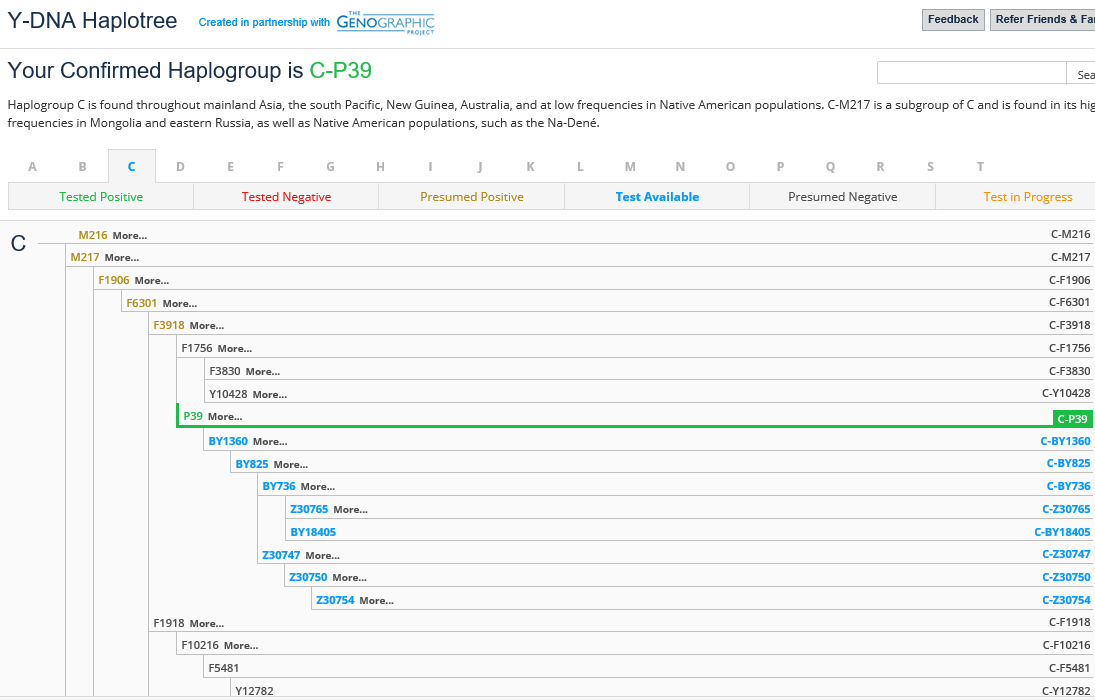
If you take any Y DNA test at Family Tree DNA, you will receive a haplogroup prediction. In the following example, the gentleman received haplogroup C-P39 as his haplgroup prediction.

Haplogroup predictions from Family Tree DNA are very accurate. They are basic in nature, but detailed enough to identify the continent where your ancestors are found as well as sometimes identifying groups like Jewish or Native American. To receive a more refined haplogroup, additional tests are available (individual SNPs, SNP panels and the Big Y), which confirm the original haplogroup assignment and give you the opportunity to find the smallest branch of the haplotree upon which you reside as a leaf.

Let’s look at an example.

Y haplogroup C arose in Asia and subgroups are found today in parts of Asia, Europe and among Native American men.

Recently, by utilizing the Big Y test, an advanced specialized test that scans the majority of the Y chromosome for mutations, the haplogroup C tree was extended by several branches at Family Tree DNA.

With regular STR marker testing, which is the Y DNA test you purchase from Family Tree DNA,  this particular haplogroup C male had his base haplogroup of C identified along with the additional branch of C-P39. With additional advanced testing of some type, such as individual SNP testing, panels of SNPs available for some haplogroups, or the Big Y test – testers can learn more about their haplogroups – and with the Big Y, virtually everything there is to know about their Y chromosome.

However, until testers receive their regular STR results for their markers, advanced tests aren’t available to order, because testers don’t yet know into which haplogroup, or clan, they will be placed.

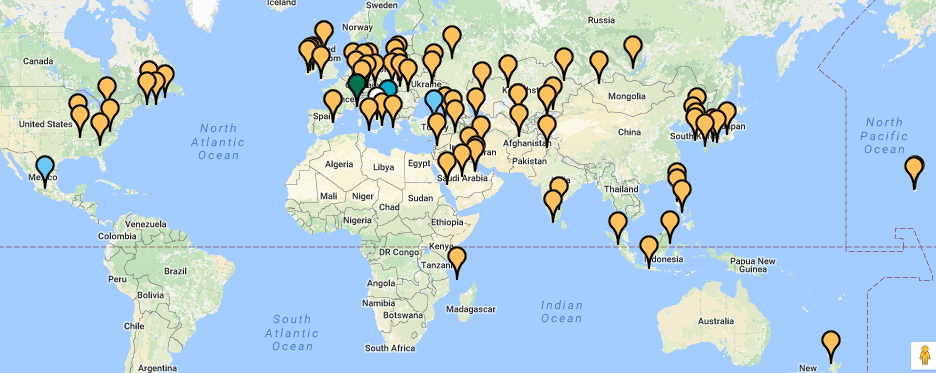
The haplogroup C Y-DNA project at Family Tree DNA provides a map of the most distant known ancestors of Haplogroup C members, including all branches, shown below.

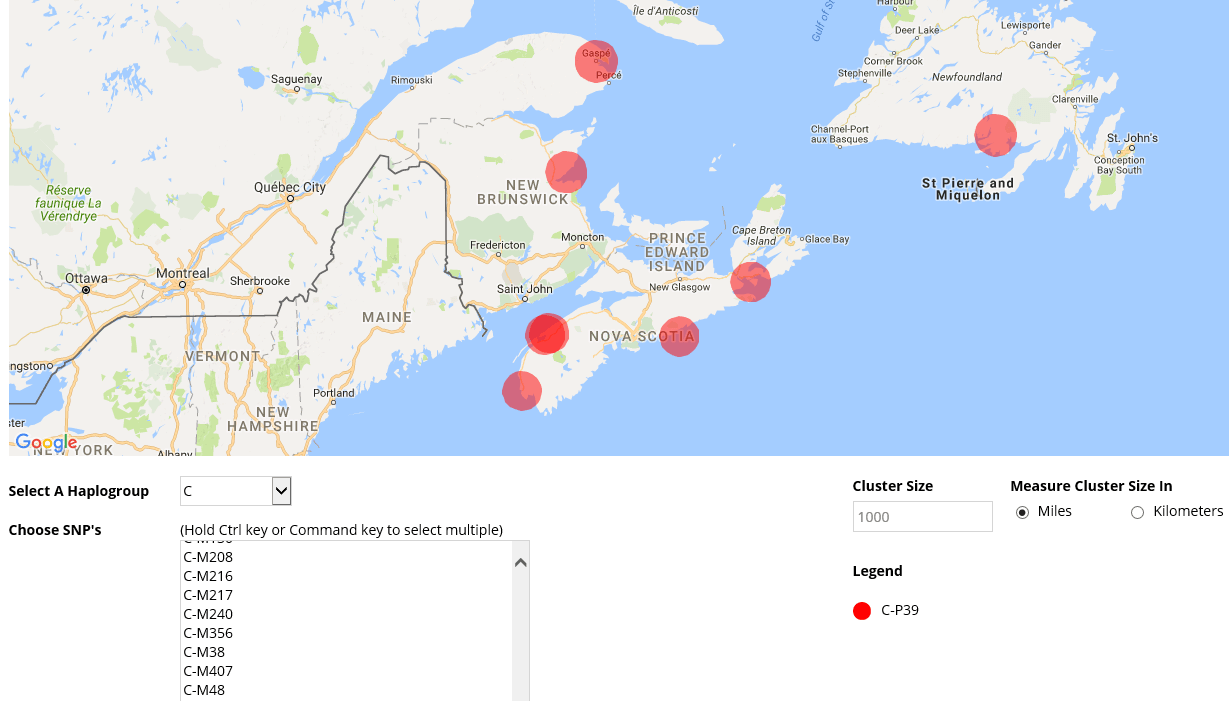
Hapologroup C-P39, a Native American subgroup, is found in a much more restricted geography in the Haplogroup C-P39 project, below.

Tools at Family Tree DNA

At Family Tree DNA, your Y haplogroup is shown in the upper right hand corner on your personal page dashboard.

In the Y DNA section, additional tools are shown. Let’s look at each tool and what it can tell you about your direct paternal line.

You can always navigate to the Dashboard or any other option by clicking on the myFTDNA button on the upper left hand corner and then the Y DNA dropdown.

Matches

The first place most people look is at their Matches page. In the case of our example, he has twenty three 111 marker matches ranging from one person with a genetic distance of 1, meaning one mutation difference, to several with 6 mutations difference. The fewer mutations, in general, the most likely the closer in time your most recent common ancestor with your match.

You can see by just looking at the matches below why entering the name of your earliest known ancestor (under Manage Personal Information, Account Settings, Genealogy) is so important!!! That’s the first thing people see and the best indication of a common ancestor. I always include a name, birth/death date and location.

In this case, it’s very clear the common ancestor of most, if not all, of these men is Germain Doucet born in 1641 in Port Royal, Nova Scotia. And before you ask, yes, it’s rather unusual to have an entire list of men descended from one man, but it’s clearly not unheard of.

As you can see, many of these matches (names obscured for privacy) have trees attached to their results and several have also taken the autosomal Family Finder test.

The different Y-DNA haplogroups listed to the right are a function of the “Terminal SNP,” meaning the SNP that tested positive furthest out towards the tip of the branch of the tree. Four matches have had additional SNP testing which shows their terminal SNP to be either Z30754 or M217.

This gentleman can then view his 67, 37, 25 and 12 marker matches by clicking on that dropdown.

He can also e-mail any of his matches by clicking on the envelope icon or view their trees by clicking on the pedigree icon.

Results

Next, let’s look at the Y-STR results for 67 markers. This page should really probably say “raw results,” because as many people say, “it’s just a page of numbers.”

This page shows your values and mutations at specific markers – in other words, what makes you both different from other people and the same as people you match, which means you share a common ancestor at some point in time in the not too distant past.

The beauty of these numbers, is, of course, in what they tell us in context of matching other people. You can’t have matches without these numbers. You also can’t have maps or anything else without the raw mutation information.

HaploTree and SNP Page

STR markers show mutations in recent timeframes, generally within the past 500-800 years, but SNPs take you back into antiquity – just like your family pedigree chart – working from closest to further back in time .

Your Haplotree and SNP page shows you the tree for your haplogroup – in this case C – designated by SNP M216, shown at the very top, along with all branches of the tree. The branches and leaves are color coded based on whether you have tested for that particular SNP, and if so, whether you were positive, meaning you carry the mutation, or negative, meaning you don’t.

SNP Map

The SNP map shows you cluster locations worldwide where any selected SNP is found.

Matches Maps

One of my favorite tools is the Matches Map because it shows the most distant ancestor for all of your matches that have provided that information.

Hint: you MUST enter the geographic information through the link at the bottom of this map (below) for YOUR ancestor to be displayed on THIS map and also on the maps of your matches.

You can also display your match list by clicking on the link beneath the map. You can click on the pins on the map to display the accompanying information.

Note the legend, as your exact matches are shown in red, 1 step mutations in orange, 2 steps in yellow, and so forth. Be sure to look for clusters, and note that if there are multiple people listed in the same location, their pins will stack on top of each other.

For example, in this case, the orange pin shown has two people’s ancestors in that location, including this tester, and a relevant cluster is clearly shown in Nova Scotia.

Migration and Frequency Maps

Are you wondering how your ancestor and his ancestors arrived where you first find them?

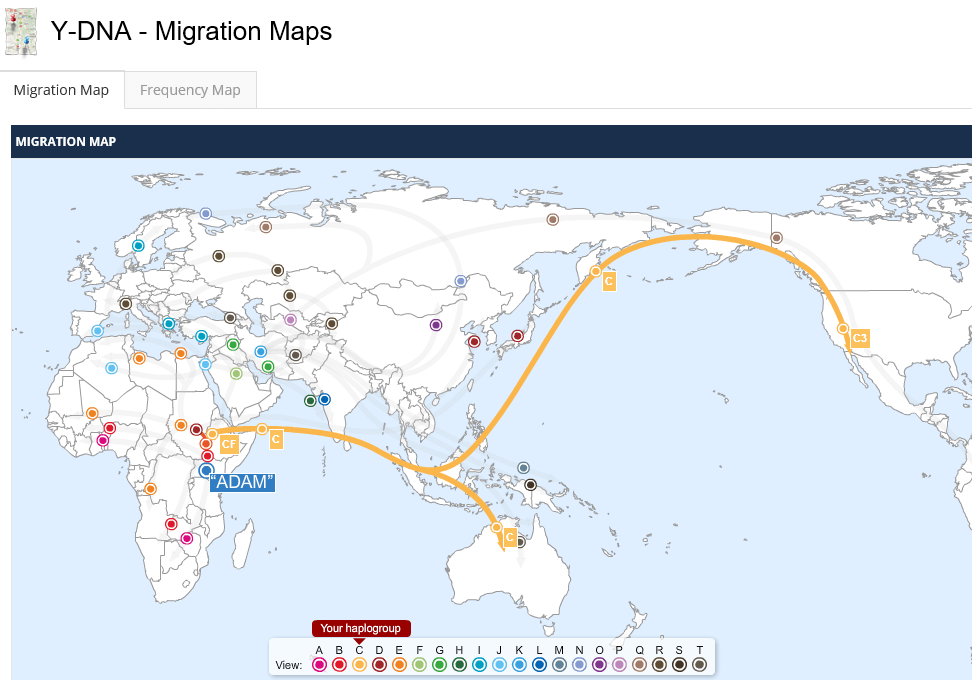
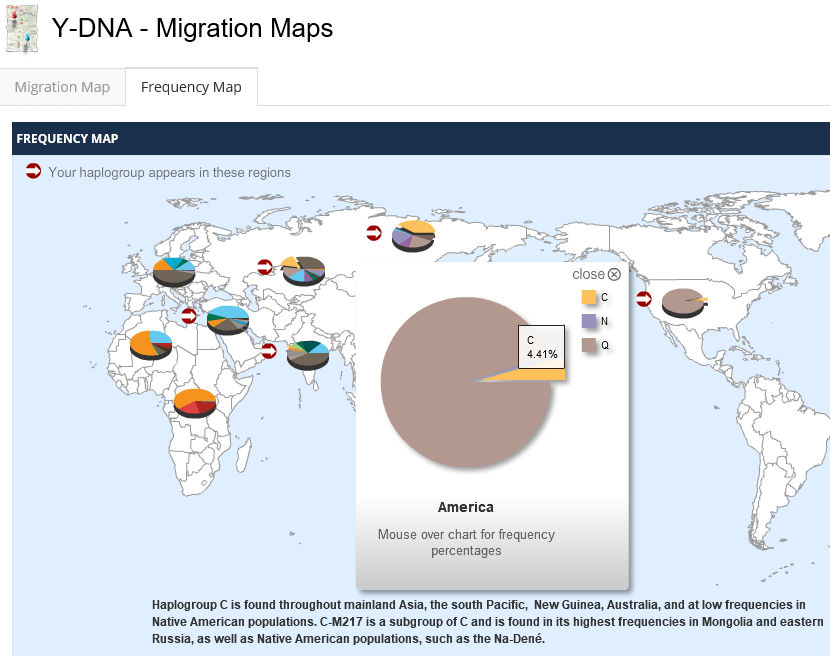
The haplogroup Migration Maps shows you the path from Africa to wherever they are found – in this case, the Americas.

The Frequency Map then shows you how much of the New World population is branches of haplogroup C.

Haplogroup Origins

The Haplogroup Origins tool shows the distribution of the haplogroup, by region, by match type and count.  Please note that you can click on any graphic to enlarge.

For example, this person has one 111 marker C-Z30765 match in Canada.

Ancestral Origins

The Ancestral Origins page shows matches by country along with any comments. These matches don’t have any comments, but comments might be Ashkenazi or MDKO (most distant known origin) when US is given.

Advanced Matching Combines Tools

Another of my favorite tools is the Advanced Matching tool, available under the Tools and Apps tab.

Advanced Matches is a wonderful tool that allows you to combine test types. For example, let’s say that you want to know if any of the people you match on the Y DNA test are also showing up as a match on the Family Finder test. You could further limit match results by project as well.

Be sure to click on “show only people I match in all selected tests” or you’ll receive the combined list of all matches, not just the people who match on BOTH tests, which is what you want.

In this example, I’ve selected 12 markers and Family Finder, because I know I’m going to find a few matches for illustration.

Of course, for adoptees, finding someone with whom you match closely on the Family Finder test AND match exactly (or nearly) on the Y DNA test would be very suggestive of a patrilineal common ancestor in a recent timeframe.

Projects

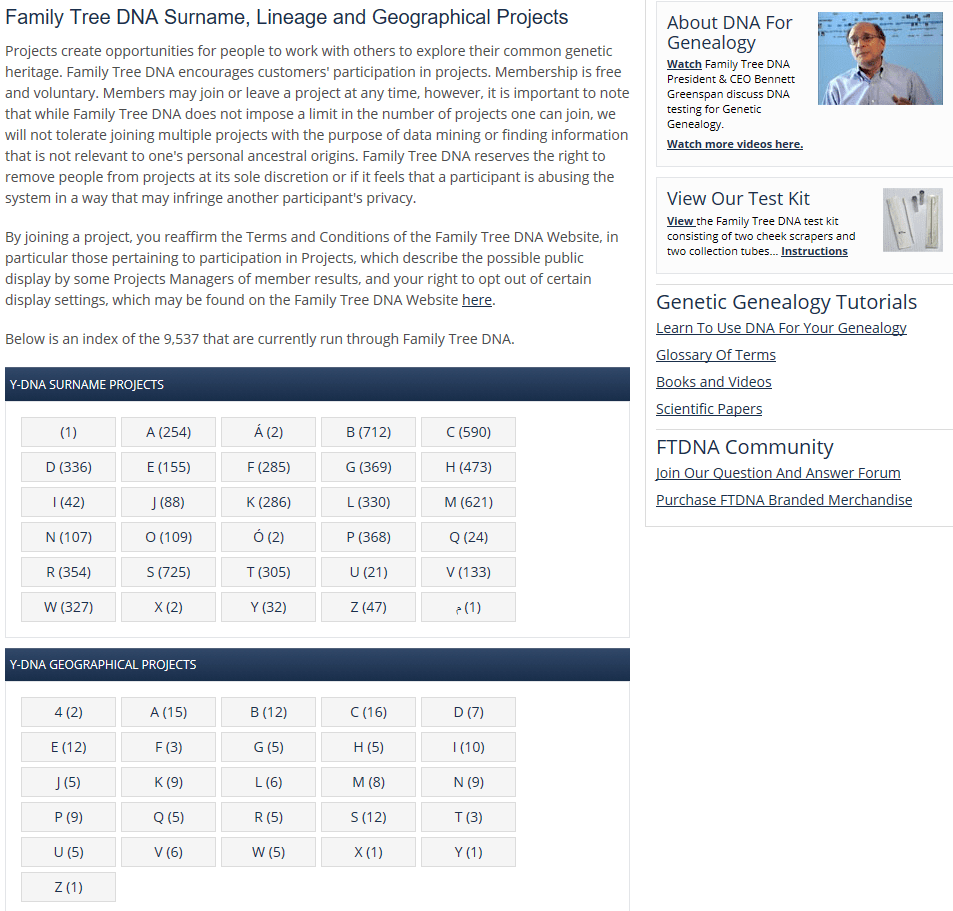
We started our discussion about Y DNA haplogroups by referencing two different haplogroup C projects. Family Tree DNA has over 9000 projects for you to select from.  The good news is that you really don’t have to limit your selections, because you can join an unlimited number of projects.

Thankfully, you don’t have to browse through all the available projects.

  • Haplogroup projects are categorized by Y or mtDNA and then by subgroup where appropriate.
  • Surname projects exist as well and are searchable for your genealogy lines.
  • Geographical projects cover everything else, from geographies such as the Denmark project to the American Indian project.

Some projects focus on Y DNA, some on mtDNA and some include both.  Additionally, some projects welcome people with autosomal results that pertain to that family surname or region.  Every project is run by one or more volunteer administrators that define the focus of the project.

To help people select relevant projects, project administrators can enter surnames that pertain to their project so that Family Tree DNA can match your surname to the project list to provide you with a menu of candidate projects to join.

Of course, you’ll need to read the project description for each project to see if the project actually pertains to you. You can see what is available for other surnames by utilizing the “Search by Surname” function, at the bottom of the menu.

You can also scroll down and browse in a number of ways in addition to surname.

All testers should join their haplogroup project so that everyone can benefit from collaboration.

You can join and manage your projects from your home page by clicking on the Projects tab on the upper left, shown below.

Y DNA Summary

I hope this overview has provided you with some good reasons to test your Y DNA or to better understand your results if you’ve already tested.

If you are a male and are interested in testing a line that is not your surname line, or if you are a female and you can’t test, you can find a male who descends from the ancestral line in question through all males and recruit that gentleman to test.  You can also check existing surname projects to see if someone from your line has already tested.

Y DNA holds the secrets of your patrilineal line. You never know what you don’t know unless you test. You don’t know what kind of surprises are waiting for you – and let’s face it, our ancestors are always full of surprises!

Y DNA Order Options

Family Tree DNA is the only company that offers this type of testing.  Ordering options include 37, 67 and 111 marker tests. You can also order 12 and 25 marker tests within projects. I suggest testing at the highest level the budget will allow, but no less than 37 markers. Most people have matches. Some people have a lot of matches and need the 111 marker test to more fully refine their matches to just the ones that may be genealogically relevant.

You can always upgrade later to a higher marker level later, but the combined original test plus upgrade cost more separately than just purchasing the larger test out the gate. It’s really a personal decision based on your goals and your budget.

Discounts

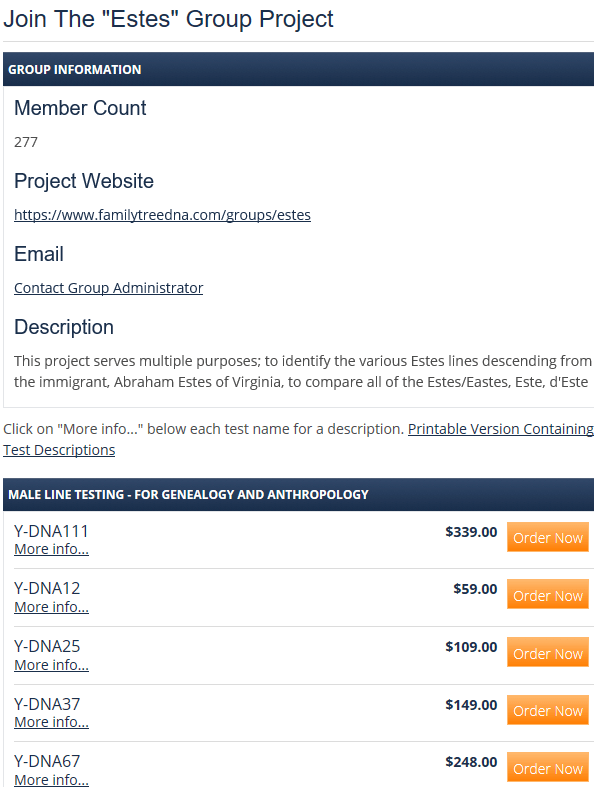
If you have never tested at Family Tree DNA, you can obtain a discount any day of the week by joining through your surname project. Just click here and then enter your surname into the Project Search box, shown upper right below.  I’ve typed Estes for purposes of illustration.

You will be shown a list of projects (at left above) where the various project administrators have indicated that someone with your surname might be interest in their project. Read the project descriptions, then click on the resulting project that best suits your situation – generally your surname – Estes above for example. You will automatically be joined to the project you select when you order a product, shown below. After you order, you can join multiple projects.

Next, click on the test level you wish to order.

By virtue of comparison, the project pricing for 37, 67 and 111 markers, above, saves you $20 off the regular price if you don’t order through a project.

If you already have a kit number at Family Tree DNA and have ordered other products, you can sign in, upgrade and order your Y DNA test by clicking here.

Happy ancestor hunting!

______________________________________________________________

Disclosure

I receive a small contribution when you click on some of the links to vendors in my articles. This does NOT increase the price you pay but helps me to keep the lights on and this informational blog free for everyone. Please click on the links in the articles or to the vendors below if you are purchasing products or DNA testing.

Thank you so much.

DNA Purchases and Free Transfers

Genealogy Services

Genealogy Research

The Parents of Charles Dodson, Jamestown Unraveled, 52 Ancestors #163

First, let me say right out and straight up that we have absolutely NO EVIDENCE whatsoever for who the parents of Charles Dodson ARE. But we do have evidence that strongly suggests who they aren’t!

Having said that, let’s look at the various rumors that persist and let’s see if we can address them.

The most common rumor, and by the way, I fell for it hook, line and sinker too, initially, because I was making the assumption that earlier researchers certainly would have had evidence or they would not have made fantastic claims, is that Charles Dodson is the grandson of John Dod’s of Jamestown through son Jesse Dodson who married Judith Hager.

Furthermore, Ann Dodson, Charles’ wife is rumored to have been his first cousin through Benjamin Dodson, brother to Jesse Dodson.

If anyone ever had evidence, it has disappeared today along with the documentation of whatever it was.

If you have or come across evidence, please, by all means contact me, because I’m still searching and I would actually LOVE to find some evidence that is documented.

What I will share with you is what I and other researchers have been able to assemble from records.

The Reverend Silas Lucas

The go-to resource for the Dodson family is the Dodson Family of North Farnham Parish, Richmond County, Virginia, an exceptional two volume set by the Reverend Silas Lucas published in 1988. He had written an earlier book in 1958 that preceded this more comprehensive set. Reverend Lucas spent 30 years sifting through primary records in every county in Virginia and many other states as well. Dodson researchers owe him a huge debt of gratitude.

On page vi of the introduction, here is what Rev. Lucas has to say:

A word of warning about trying to claim kinship with people with whom we cannot prove a relationship, i.e. “Are we kin to the John Dodson, d (sic, but he meant circa) 1607” of Jamestown, Virginia or Benjamin Dodson c 1652 of Essex County, Virginia? Some people would like to say that these men are the direct ancestors of Charles Dodson who died in 1701(sic). They state that a John Dodson came with Captain John Smith in 1607 and the John Dodson had sons Jesse and William Dodson. It is further stated that the aforementioned Jesse Dodson was the father of Charles Dodson, born about 1649 and died about 1701, in Richmond County, Virginia. Some of these people further state that our Charles Dodson of Richmond county, Virginia married one Anne Dodson, daughter of Benjamin Dodson of Essex County, Virginia. Regardless of how much one would like to claim descendancy from these aforementioned Dodsons, it must be stated unequivocably that no legal records exist to prove this hypothetical descendancy of Charles Dodson. Others have said that Gervais Dodson of Northumberland County, VA c 1650 was the progenitor of our family, but this also has not been proved.

To show how ridiculous this type of false claiming of kinship is, when I first heard of the above claims, I telephoned a lady in Texas who had been making these claims to Dodson descendants who had written her for possible help. I asked her where she got this proof, and she told me that several people who had joined one or more patriotic organizations had used these claims in their affidavits of descendancy, and she told me that it had to be true if one of these patriotic organizations had accepted the person for membership. I tried to point out that some of these organizations were of very recent beginnings and many had no hard-and-fast membership requirements, as to the DAR, Colonial Dames of America, as far as authenticating each detail of descent. Needless to say, I was unable to convince her of the questionable validity of these organizations and her desire to be associated or claim kinship with persons of the Jamestown era was too overwhelming for her to accept the basic premise of genealogical research concerning documenting proof of family descendancy by legal records.
Of course, for any genealogist reviewing this information, the first issue is that Essex County, Virginia didn’t exist in 1652. Neither did Richmond County.

The history of the counties that ultimately became both Richmond and Essex in 1692 when Old Rappahannock was dissolved, is as follows.

Dods and Dodson

From the book Domesday People: Domesday Book by K.S. B. Keats-Rohan, we find that a man named Aluuin Dodesone lived in Hertfordshire in 1086.

The book The Quest for a Lost Race by Paul B. Du Chaillu who proposed the theory that the English were descended from Scandinavians rather than the Teutons – Normans rather than Germans provides the following:

Dodson – The son of Dode, Alwinus Dodesone, occurs in Domesday as a tenant-in-chief. It is an open question whether it is Scandinavian or Anglo-Saxon. Even Lower is doubtful. There is a large connection of this name in Maryland and Kentucky. One branch is connected with the Botelers of Virginia. A good English stock.

The following publication from the Oxford University Press also provides information.

Is this the same as what would become Dodson, and if so, is it our Dodson line? We know positively that there was more than one, according to Y DNA. We have no way of knowing if this line would become our Dodsons.

Ancestry provides us with the following information about the source of the Dodson surname.

Jamestown

For the past two or three years, I’ve been focused on the Virginia and Maryland ancestors. I had the opportunity to visit Jamestown in 2015. When there and in the Virginia archives in Richmond, I checked for Dod, Dods, Dotson and Dodson in early records of both Jamestown and also of the area that became surrounding counties.

I really wanted to find proof, or even a probable trail that indicated my ancestor actually was John Dods who had been at Jamestown.

The following digitized book includes transcriptions of the original early documents.

The original lists of persons of quality; emigrants; religious exiles; political rebels; serving men sold for a term of years; apprentices; children stolen; maidens pressed; and others who went from Great Britain to the American Plantations, 1600-1700 : with their ages and the names of the ships in which they embarked, and other interesting particulars; from mss. preserved in the State Paper Department of Her Majesty’s Public Record Office, England

Jamestown Biographies

When I found the Jamestown Biographies project, and discovered that John Dods, wife Jane, was listed among the available biographies, I quickly purchased one. Thankfully, it was only $5.

It documents that John Dods was in Jamestown and that oral history says that Jane was an Iroquois, daughter of chief Eagle Plume. Oral history? Seriously? And I paid for this? Their source, personal correspondence with Dodson researchers. My heart sank.

A second page repeats the lore that Jane was reported by the family to be the daughter of Chief Eagle Plume, an Iroquois.

There is some good news in this report and that is the additional research. If we, meaning the Charles Dodson Y DNA descendants, ever get a Y DNA match to someone overseas, these very early references may become invaluable because one of them could potentially be our ancestor – whether through John Dods or not.

Jamestown lists two wills, both in the Prerogative Court of Canterbury.  The first dated February 6, 1560 is the will of John Dodd, gentleman of Little Illford, Essex, and the second dated May 7, 1652 is for John Dodd, gentleman of Enfield, Middlesex.

If John Dodd’s on the lists is actually John Dodson, then the Dodd wills, above, are irrelevant.

Dispelling Rumors

Some genealogists contend that John Dodds wife was Jane Dier who came over after the first settlers and that John Dodds then lived and died in Richmond Co., Virginia.

The second part of that contention is impossible, since Jamestown was settled in 1607 and Richmond County was formed in 1692, which would have made John Dodds about 100 years old when Richmond County was formed. Oh, those pesky details.

John Dods did survive the Indian massacre at Jamestown which occurred on March 22, 1622.

According to the Persons of Quality book by Hotten:

The List of Living and Dead on February 16, 1623 shows John Dod’s and Mrs. Dod’s living at “ye neck of land.”

In 1624, at Neck of Land Corporation of Charles Cittie, John Dod’s is listed on the muster as being 36 years old and arriving on the Susan Constant in April 1607. His wife, Jane is listed as age 40 and there is no arrival ship beside her name, which is probably much of what fuels the speculation that she is Native.

In 1626, John Dodd’s is listed with 50 acres at Charles Cittie and with 150 acres at Tappahanna against James Cittie.

There is absolutely no evidence or records to suggest that John had children. The various lists do include “infants,” meaning underage children, and there are no other Dod individuals listed by any surname spelling, and nothing even close.

Other families on this same list had children listed, such as John Price, wife Ann, and Mary, a child aged 3 months. Very few families have children. Many woman arrived between 1620 and 1623.

Most women are younger than Jane. She along with one other woman is 40, and one woman is 50. Not all women have ages. Most are listed with the names of the ships they arrived in. The other woman, aged 40, does not.

There is no evidence that John and Jane, or John and anyone had any children who survived. There are no records of Jesse and/or William, their supposed sons, whatsoever. If other couples with children have their children listed, John and Ann would too. The oldest child born on American soil was age 8, and there was only one. Two children aged 7 were born in Virginia. It appears that there were very few females in the early colony and that children did not survive the 1722 attack. According to Jamestown historians, only three of the original settlers were still living and found on 1723 list of the living – and none with known children.

Given the information we do have, combined with the fact that Jane was age 40 in 1624, it’s reasonable to surmise that John Dodds and Jane never had children that lived. If they did, it would have had to have been in very short order, given Jane’s age.

Given that children are listed among the dead, and there is no Dod, Dods or Dodson listed by any spelling, it’s reasonable to presume that they did not have a child or children that died. Given that there are no other individuals listed with the Dodds surname, it’s reasonable to conclude that there were no other Dodds or Dodson individuals in the colony in 1624.

Under the list of Thomas Dunthorne’s muster, we find “Thomas an Indian Boaye” under the subtitle, “servants.” This suggests that if Ann had been an Indian, a notation beside her name might have said “Indian.”

Following further rumors, the marriage between John Dodson’s son, Jesse Dodson and Judith Hagar is supposed to have occurred on May 7, 1645 in Jamestown. The problem with this information is that there appear to be no records whatsoever of Jamestown marriages that have survived. Furthermore, there is no record of Judith Hagar arriving in Jamestown, either. Nor is there any record of Jesse Dodson. This rumor has struck out altogether.

Another rumor is that Jesse Dodson died in 1680 in Old Rappahannock County, Virginia, but you guessed it already, there is no record of any Jesse Dodson ever living in Rappahannock County or dying in Rappahannock County in 1680 or anytime, for that matter. Furthermore, Charles Dodson had no sons named Jesse.

Where is Charles Cittie?

John Dods owned land in Charles Cittie and James Cittie.  Charles Cittie is now Charles City County.

James Cittie is now James City County, adjoining Williamsburg and including Jamestown, which is, indeed, on a neck of land.

James City County abuts Charles City County.

On the map below, you can see both Jamestown and Charles City, along with the Northern Neck of Virginia, at the top of the map, north of the Rappahannock River, near 360, where Charles Dodson lived.

Jamestown and Charles City are 23 miles distant. John Dod’s land could have been anyplace along this route. His 2 parcels of land could actually have been very close if they were located near the border of Charles Cittie and James Cittie. Given that John Dodd was one of the original settlers, few of whom survived until 1623, my presumption would have been that he would have been allowed land in the original Jamestown settlement, if he wanted land there.

Where Did These Rumors Come From?

In determining whether there is any truth to a rumor, it often helps to determine the source. For example, if this line of descent had been reported in every one of Charles Dodson’s children’s lines, recorded repeatedly before the days of easy access to other people’s work, I would be more likely to consider the possibility that the story actually descended from the original settlers and wasn’t somehow later manufactured or surmised.

I discovered that I’m not the first person who asked that question. Glenn Gohr back in the 1980s and 1990s posted a significant amount of research on his Rootsweb page involving the various Dodson records.

Glenn first found the Dodson information involving Jamestown in a 1908 document:

Ege, Thompson P. Dodson Genealogy, 1600-1907. Philadelphia, PA: Deemer & Jaisohn, 1908.

Page 4 of the above book does have a good clue:

“Colonial Annals of Virginia mention ‘Dodson’s Plantation’ in 1632.”

Some say this is a reference to the plantation of a John Dodson, who they list as the grandfather of Charles Dodson (c1649-c1704) of Rappannock County and North Farnham Parish in Richmond Co., VA. I do not see enough evidence at this time to establish Charles Dodson’s progenitors.

Pages 363-364 lists origins of early Virginia branches of Dodsons. It says:

“The annals of Virginia record the name of a ‘Dodson Plantation’ in 1632. And the traditional story in a large and widely scattered line of descendants is that their ancestor settled along the James River and was one of the early Jamestown Colony.”

This document goes on to give partial more recent lineages for the Tennessee Dodsons, not going back as far as Charles of Richmond County and his sons. The more I read, the less reliable this source seemed to be.

Glenn continues with the following:

No documentation is given for any of the above. Much more is given on descendants in each of these lines. They do not show Charles Dodson of N. Farnham Parish in the lineage, but some of these names, especially the ones in Estanalle Valley of TN are listed in Rev. S. E. Lucas’s 2-vol. book (but) the lineage in the Ege book does not line up with the lineage in the Lucas book. The connection to Jamestown is interesting, and these lineages may provide some clues for researchers, but they cannot be taken as fact.

The above book also covers Dodsons in Maryland and Dodsons in Pennsylvania, and some unplaced Dodsons. There is also mention of 3 early Dodson settlers (2 brothers and a sister–John Dodson, b. March 1655; Mary Dodson, b. 11 Nov. 1664 md. Richard Boyes; Thomas Dodson, b. 19 Oct. 1669; md. Katharine Savill) who settled in New Jersey and were Quakers and children of a Daniel Dodson, b. ca. 1635 of Knaresborough, Yorkshire, England. These appear to be the ancestors of Dodsons in Pennsylvania, New Jersey, and Maryland.

The information about the New Jersey, Pennsylvania and Maryland Dodsons is useful relative to Y DNA testing in the Dodson DNA Project which shows that the Talbot Co., Maryland, New Jersey and Pennsylvania Dodson’s don’t match either the Charles Dodson line, or each other.

Glen then notes another book which repeats the Jamestown story

Ancestors of Robert Dodson and His Descendants, written by Mrs. C. T. Dodson; Illustrated by Miss Oneida Uzzell. Privately published, [1964?]. She included this information:

“The year 1619 brought three important events to Virginia and the colonists. Virginia was permitted to enjoy a measure of self government; a ship load, eighty, of prospective wives arrived from England (probably Jesse (2) Dodson and William (2) Dodson married two of these women). The colonist could secure a wife, with her permission, and by paying her transportation, in the amount of one hundred and twenty pounds of tobacco–about $500 dollars worth; and the first Negro slaves landed in Virginia.”

Glen then provides the information from an application for the Daughters of Colonists that seems to be part of the source for the rumors.

SOURCES FROM MRS. C. T. DODSON’S BOOK

Here follows information on records to get into Daughters of the Colonists by Lillian E. Dodson.

  1. 72-73 (This is quoted word for word from the book, including mispellings or question marked items–gg):

Copied 9 February, 1966 by Edith Wolf Standhardt from handwritten copy lent by O. H. Schwanderman.

From Records to get into Daughters of Colonists by Lillian Elanine Dodson [I think this should be Daughters of the American Colonists– gg]

Name of Ancestor – John Dodson of James River or Jamestown. Served in the Council and General Court of Jamestown, 1622 – 1629.

The undersigned have investigated and approve the applicant and her application

Signature of St. Louis Chapter Officers:

Chapter Regent: Maude Bryan Jenneinzo (?) (Jennings?

E.S.)

Chapter Registrar: Gertrude L. Wingert

Chapter Sec: Clara Sizer Nevling

Date: Nov. 21, 1949

Signature of Missouri State Officers:

State Regent: Mrs. Edwin Lamont Barber

State Registrar: Nell Downing Norton

State Sec: Acenath M. Booth

Date: Nov. 21, 1949

Fee received by National Society: Mabel S. Stoyer, Nat. Treas. Dec. 15, 1949

Signature of National Officers:

Natl. President: Margaret F. Powers

Natl. Registrar: Lillian M. Sanford

Natl. Sec.: Mabel Puffer Martin

Date of Acceptance: Jan. 31, 1950

Endorsed:

Mrs. Clyde Nevling, 4259 Maffit Ave., St. Louis

Mrs. Joseph Jannuzzo, 8016 Seminole Place, Clyton 5, Mo.

Miss Lillian Elanine Dodson, born 4 Feb. 1901, Wayne Co., KY. herein apply for membership in Society by right of descent from John Dodson, a member of the Jamestown Settlement in Virginia, who is mentioned in Va. Mag. Vol. 23, p. 11 in St. Louis Public Library Ref. Room., of Jamestown, Virginia, born in England, died in Virginia, served in Council and General Court of Jamestown 1622-29.

I was born in Steubenville (Wayne Co.) Ky. I am the daughter of John Cornelius Dodson of Steubenville, Ky., born 22 Feb. 1869, died 31 Jan. 1931 – married 22 Feb. 1900 to Nancy Kelly, born 19 Dec. 1869 d. 18 Dec. 1939.

John Cornelius Dodson, son of John Dodson born 23 Nov. 1831, died 11 Aug. 1885, married Sara Phillips, born 23 Nov. 1828

John Dodson is the son of Jesse Dodson born 26 Dec. 1802, died 3 Jan. 1864, married 14 July 1824 Elizabeth Small, born 12 Oct. 1805, d. 12 June 1876.

Jesse Dodson is the son of Thomas Dodson, died prior to 1836. married Jemima Randall.

Thomas Dodson is son of George Dodson of Richmond Co., Va., born 31 Oct. 1737, died 1825 Pittsylvania Co., Va., married twice, Margaret and Elizabeth.

George Dodson is the son of George Dodson, married 30 April 1726 in Richmond Co., Va. to Margaret Dagord.

George Dodson is son of Thomas Dodson born 15 May 1681, died 21 Nov. 1740.

Thomas Dodson is son of Charles Dodson of Richmond Co., Va. born 1649, died 1704.

Charles Dodson is son of Jesse Dodson, Richmond Co., Va. married to Ann.

Jesse Dodson is the son of John Dodson of Jamestown Settlement born in England.

Records to be found: Genealogy traced in “Dodson Genealogy 1600 – 1907” page 364, St. Louis Mo. Library. Will on record in Pittsylvania Co., Courthouse, Va. proved 19 Dec. 1825. Named in father’s will proved 2 Mar. 1740 in Richmond Co., Va.

Named in father’s will (Charles) in Richmond Co., Va. Courthouse, 1704. Abstracts of Richmond Co., Va. Also “Dodson Genealogy”, Ege. Lineage in “Dodson Genealogy 1600-1907” by Rev.. T. P. Ege, Local Library. Mentioned in “Dodson Genealogy”, also Virginia Mag. of History.

Children of Ancestor

Jesse Dodson)

   ) sons of John Dodson

William Dodson)

Authorities proving services of Ancestor: Virginia Mag. of History, Vol. 23, p. 11; his name given in minutes of the Council and General Court, 1622, 1629, and the fact stated that he was a passenger on ship Ann, that he came to Jamestown in the original settlement. He was called to report in the Council on conditions of the ship and provisions for the voyage. He is reported to have been a hunter of some note, a good citizen, and the father of at least two children, sons William and Jesse, listed above in Dodson Genealogy.

Copied by Oliver H. Schwanderman of Fort Recovery, Ohio, Route 3, 4 Feb. 1964. She is a cousin to me by Dodson lineage from Rutha Mary Dodson Schwanderman, 1870 – 1959, Wayne Co., Ky. Champaign Co., Ill.

Ancestors of Robert Dodson and His Descendants. Written by Mrs. C. T. Dodson; Illustrated by Miss Oneida Uzzell. Privately published, {1964?] (Note: This book is 115 p. and is located in the Dallas Public Library, Dallas, TX, call # R929.2 D647d), pp. 73-74:

Article in Virginia Magazine of History and Biography, Vol.23 (1915), pp. 11-12, as quoted in:

*Note: I am quoting this directly from the Virginia Magazine of History and Biography article–there is more than what is quoted, here, but this is the part that refers to John Dodson.–gg

Minutes of the Council and General Court

[ink folio 105]

Mr. Thomas Edwardes beinge Demanded wt he could sayd concerninge the Accomodatinge of passengers yt cam in the shipp called the Ann said that he wold never Desire to be better vsed Yt is ordered Yt mr Daniell Lacye shall haue four acres of grounde in the Islande adioyne on the grounde of mr Kingsmells, wch is the rather granted for that mr Kingsmell Doth Desire the same Moris Thomsone and John Dodson sworne and Exand sayeth that for ye they were a fortnight or three weeks abourde befor they had any breckfast Drinke allowed them, And after they had Complayned, they had to smale Cans of beere for breckfast to 5 men wch Contynued soe for some six weeks or two moneths And they had a quarter can of beere to a meale for 5 men wch Contynued for the space of sixteen weeks, And after that for the space of Six weeks a three weeks they had three smale cans of beere to A messe. And a pounde and a halfe And that they had three pownd of bred a Daye to A messe for the space of some sixteene weeks. And after till theyr cominge in thre bisketts a meale to A mess. And for A sixteen weeks they had thrree flesh Dyes A week, And after that for about a moneth fortnight they had too flesh Dyes a week and after yt 2 flesh meales a week till theire Cominge in foorther they say that ther beere was well condicioned except a butt or two (ink folio 106) And fovrther they say have harde some of the passengers Complayne but wt cause they had they know nott….

Glenn closes by stating the following:

Mrs. Dodson does try to list and include sources about the information she has listed, but there is NOTHING besides “family tradition” which definitely links the John with the 2 sons, William and Jesse. Also nothing besides tradition to link Jesse with Charles Dodson of N. Farnham Parish, Richmond Co., VA.

Still it is fascinating reading, hoping that it all could be true and proven true. I, personally don’t see enough proof for the links.

At least now we know where this came from, thanks to Glenn’s detective work.

The Reverend Elias Dodson, writing about 1859, penned a manuscript titled “Genealogy of the Dodson Familes of Pittsylvania and Halifax Counties in the State of Virginia.” Reverend Lucas had a copy of that document and used it extensively when writing his book. However, Reverend Elias Dodson says nothing at all about Jamestown or John Dods. This is the earliest known family document or history of the Dodson family – and it stands mute.

If Elias had heard about Jamestown, and that Charles was descended from John Dod or his son, Jesse, Elias surely would have included that information.

However, there are records of some additional Dodsons that we should review.

Thomas Dodson of Northumberland County

There is a Thomas Dodson found in Northumberland County in 1658.  Because Charles Dodson names his second eldest son Thomas, and because the eventual Richmond County is taken from part of the original Northumberland, these records deserve close scrutiny.

Thomas Dodson patents land on Dividing Creek in 1658 in Northumberland County, but the patent expires and nothing more is known of Thomas’s land until 1694 after he has lost the land and died. Unfortunately there are no records in this part of Virginia that speak to his death, so he may have died elsewhere.

The book Cavaliers and Pioneers volume 1 by Dennis Ray Hudgins, page 383, documents that Thomas Dodson was granted 1200 acres on Nov. 29, 1658 in Northumberland Co., VA for the transportation of 24 persons. His name appeared on the list, which suggests that he is one of the 24. The fact that he transported (or paid for the transportation of) 24 people suggests that Thomas Dodson is wealthy.

Researcher Michelle Ule found the following:

Patent Thomas Dodson grantee 29 Nov 1658 Northumberland County 1200 acres on the high lands above the head of the Dividing Creeks. Source: Land Office Patents No 4 1655-1664 pg 340 reel 4) Dividing Creeks is south of the Great Wicomico and the river flows into the southern Chesapeake Bay.

1200 acres would be the exact amount, at 50 acres each, for transporting 24 individuals.

Grant Walter Jenkin grantee 30 Nov 1694 Northumberland County 500 acres escheat land part of a tract of land of 1200 acres granted to Thomas Dodson 29 Nov 1658. Southermost &c of sd 1200 acres, adjoining to the lands of Colo. Lee and John Cousins. Source: Northern Neck Grants No 2 1694-1700 pg 88-91 (reel 288)

Grant John Lewis grantee 26 Mar 1695 Northumberland County 150 acres escheat land beginning on the land of Charles Lee, Walter Jenkins, Peter Hammon, and Thomas Haydon. Thomas Dodson, died seized of 1200 acres patent dated Nov. 29, 1658. Source: Northern Neck Grants No. 2, 1694-1700, p. 146-147 (Reel 288).

Grant Grantee Hammon, Peter grantee, Date 26 March 1695.  Note  Location: Northumberland County.  Note  Description: 150 acres escheat land, Thomas Dodson died seized of 1200 acres of land, patent dated Nov. 29, 1658, the 150 acres abutting southerly on the land of Walter Jenkins westerly on the land of Thomas Williams. Source: Northern Neck Grants No. 2, 1694-1700, p. 144-146 (Reel 288)

Source: Land Office Patents No. 6, 1666-1679 (pt.1 & 2)

http://www.lva.lib.va.us/

Another researcher reports the following information pertaining to Thomas of Northumberland.

1663 March Northumberland County land record sale of land by Wilbur and Sarah Mauder to Thomas Dodson – the land upon which he lives.

1664 Northumberland County Power of attorney from Jane Wiley to Symon Dodson.

The above record is the only record that involves Symon Dodson.

One Thomas Dodson apparently lived in Northumberland County between 1658 and 1663, but he was not living there in 1652 when the loyalty oath was taken.  He may have had a relative named Symon.  We don’t find anything about either man after 1664, in Northumberland or any of the spinoff counties.  We do know that by 1694, Thomas had died, apparently still owning his land, and the land reverted, probably due to lack of tax payments or because he never paid the fees or had the land surveyed.  If Thomas had an estate that included underage heirs, such as Charles Dodson, a guardian would have been appointed to protect the assets of the heirs and the land would not have been allowed to escheat back to the colony.  No such records exist, so it’s extremely unlikely that Charles is the son of Thomas.

Charles, born in 1649, would have been age 14 in 1663 when Thomas last appears in the records, obtaining land from Wilbur and Sarah Mauder.

Thomas Dodson died sometime between 1663 and 1694.  Charles never owns or sells land in Northumberland County, nor do we find any record of Thomas’s land from the Mauder’s being sold.

Englishmen non-resident in England had their wills probated through the Canterbury Court. One Thomas Dodson’s will is probated in Canterbury in 1672, but his wife’s name is Sarah, as well as his daughter, and he lived in Great Warley, Essex.  Other Thomas Dodson’s are found in Yorkshire, Kent and one buried in London in 1668.

There is no Charles born in 1649 in any of these locations, and no Charles born to a Thomas in any records that are indexed yet today – although future researchers should check these records again.  There is a Charles born in 1645 to Northamptonshire to John and Joanne Dodson and in 1655 in Shropshire to Edward and Frances Dodson – neither of which look promising, given naming conventions.

Charles first appears in Old Rappahannock County in 1679 in a lease type arrangement with Peter Elmore.  Charles does not purchase his own land until 1686, so he clearly didn’t have funds until that time. Nor did Charles patent land, so apparently someone else took credit for his 50 acre headright.

Other Dodsons

Gervais Dodson appears before Charles Dodson in the records of Northumberland County, VA in 1658, but he appears to have died without issue. Furthermore, there is no Gervais in any of Charles children nor their offspring.

There is a John Dodson line in early Maryland which, via DNA testing, we know does not match our Charles Dodson.

Another researcher reports several other Dodsons:

1622 – 31 July Robert Dodson Jr. came to Virginia at the expense of Robert Dodson Sr aboard the ship James.

I was not able to find any evidence of this Robert Dodson Jr. He is not among the list of living taken in 1623.

1623 – 30 April Robert Dodson Jr. said that he had firsthand knowledge of the plantations east of Jamestown.

I have not been able to confirm this informaton, and he does not appear on the 1624 muster list.

1643 – Thomas Dodson by Richard Richards, Charles River Virginia. Source:  Greer, George Cabell. Early Virginia Immigrants, 1623-1666. Richmond VA: W.C. Hill Printing Co., 1912. Reprinted by Genealogical Publishing Co., Baltimore, 1978. Repr. 1982. Page: 96.

Charles’s wife Ann, Daughter of Benjamin?

A secondary Dodson rumor is that Charles married his first cousin, Ann, daughter of Benjamin Dodson, son of John Dodson, of Jamestown.

If you’ll notice, the original rumor has changed. Originally, John Dodson and Jane had two sons, Jesse and William. However, when Ann’s story got added, she became the first cousin of Charles through Benjamin, the brother of Jesse. Therefore, John Dods (Dodson) of Jamestown would have had three sons, Jesse, William and Benjamin. The rumors aren’t adding up, especially considering that John and his 40 year old wife had no children in 1624.

And then there’s the pesky issue of the fact that we have an immigration record for Benjamin in 1635.

1635 – Benj Dodson Place: Virginia Source:  Greer, George Cabell. Early Virginia Immigrants, 1623-1666. Richmond VA: W.C. Hill Printing Co., 1912. Reprinted by Genealogical Publishing Co., Baltimore, 1978. Repr. 1982. Page: 96.

1635 – 22 June: Captain William Pierce, Esq received 2000 acres for the transportation of 40 persons including Benjamin Dodson.  Virginia Magazine of History and Biography.

Another researcher takes this a step further, providing the following:

Charles Dodson, born about 1649, d 1705 Richmond, Co., Va. m Ann Dodson (dau. of Benjamin Dodson, who gave his daughter a legacy of land on the James River in Essex Co., Va., May 1652.  This joined John Hill, Sr.’s land.  (This Benjamin probably came from England.)  Ann m before 1680 to Charles Dodson (2nd) John Hill, Jr., after Charles’ (3) death.

One thing I can confirm is that indeed, Ann did marry John Hill after Charles died. I can’t confirm that it was John Hill Jr.

I can state unequivocally that there was no Dodson in Northumberland County in 1652 when the loyalty oath was signed, so Benjamin must have been elsewhere at that time.

Capt. Hill does patent land, according to the Virginia County Records Quarterly Magazine March 1911, Vol. IX #1:

Capt John Hill land grand 1669 Rappahannock Co for 650 acres, also in 1670 for 1200

However, Essex County wasn’t formed until 1692, so it’s impossible for Benjamin Dodson to leave anyone a legacy in Essex County in May of 1652. In 1652, this area would have been part of Northumberland or Lancaster.

I review the Essex County records, which includes the original Old Rappahannock records prior to 1692, and there is absolutely no mention of Benjamin Dodson in any type of record, including land, court, church or will/probate.

There is absolutely no record to substantiate the claim that Ann was the daughter of Benjamin Dodson, or that there were any transactions between John Hill and Benjamin Dodson, or that John Hill even owned land in what would become Essex County.

Charles Dodson’s wife was clearly Ann.  Later, in online trees, she rumored to be the daughter of Peter Elmore, which I wrote about here.

Dodd is Not Necessarily Dodson

The Dodd family is also found in Richmond County, VA. It has never been suggested that the Dodd and Dodson families are one and the same, nor am I suggesting that now, but while we Dodson researchers have been incredibly focused on the Dodson surname, we need to be cognizant that the Dodd surname in Richmond County is equally as likely, if not moreso, to be descended from John Dodd at Jamestown – if anyone is.

I did find evidence of John Dod(d) who was married to a Jane in the Richmond county records, according to records beginning in 1696/97 in both deed and court records. This record at the Early Colonial Settlers of Southern Maryland and Virginia’s Northern Neck Counties site reveals more information about this John Dodd, including that he is the son of Richard Dodd who was born in 1634 in England and died in 1678 in Charles County, Maryland. So, clearly, this is not the Jamestown Dod family, nor is he related to our Dodsons.

Summary

Not only do we have absolutely not one shred of evidence that John Dod, Dodd or Dodson of Jamestown is an ancestor of Charles Dodson, we have evidence that he isn’t.

Probably the most compelling evidence is that John and his wife are listed in the 1624 muster without children, where other people are listed with children. Given that Jane is 40 at that time, it would be very unusual for her to bear 3 additional children, Jesse, William and Benjamin, and for all 3 to live.

There is also no information about what happened to John Dod or Dodson, or what happened to his land.

There is no evidence whatsoever that a William, Jesse or Benjamin Dodson lived in Virginia before the record of Benjamin’s arrival in 1635. Neither Jesse nor William are ever reported in any record.

It is possible that some Dodson was living in Virginia by 1632 when Dodson’s plantation was reportedly referenced, although I have not been able to confirm that record.

However, given the fact that Charles Dodson can write suggests strongly that he was not raised in early Virginia. If Charles could write, then he would have been the son of a gentleman. He would likely have been sent back to England to be schooled, and when he returned, it would not have been as a penniless man who contracted to work and improve another man’s land 1679 for a period of 19 years. The son of a gentleman would simply have purchased land. Charles did not – at least not for another 6 years, in 1685. Nor did Charles ever claim a 50 acre land grant for transporting himself, so either he was transported by someone who claimed his headright, or he arrived as an indentured servant.

The best we can piece together is that Charles was probably born in England. I’m hopeful that eventually, a parish record will emerge that shows a Charles born in about 1649, a year revealed by Charles’ own testimony in 1699 stating that he was about 50 years old.

Until then, all we can say is that the parents of Charles Dodson were almost certainly NOT Jesse Dodson and Judith Hagar who supposedly married in 1645 in Jamestown. Unless new information is forth coming with actual documentation of some sort, this couple must be relegated to the annals of myth – along with Charles Dodson being the son of John Dods of Jamestown.

I’m hopeful that one day either a parish register of Charles’ birth will emerge or a Y DNA match to an English Dodson whose lineage is located in a small village and has been since records began. Either one would go a very long way in terms of helping us bridge the gap between Charles and his parents by providing us with a search location in England.  Those records may be waiting in a small village church in England for Dodson researchers to find them – along with Charles’ ancestors in the church cemetery!

______________________________________________________________

Disclosure

I receive a small contribution when you click on some of the links to vendors in my articles. This does NOT increase the price you pay but helps me to keep the lights on and this informational blog free for everyone. Please click on the links in the articles or to the vendors below if you are purchasing products or DNA testing.

Thank you so much.

DNA Purchases and Free Transfers

Genealogy Services

Genealogy Research

MyHeritage Ethnicity Results

I originally wrote about MyHeritage in February 2017, reflecting matching issues and a broken promise regarding providing ethnicity estimates to people who uploaded their raw DNA file from another vendor. I’m glad to say MyHeritage changed their minds about providing ethnicity results and, today, has honored their original commitment and provided free ethnicity results to uploaders. I feel much better about the DNA aspect of MyHeritage given this decision although their challenges with matching remain.

MyHeritage has also provided updated ethnicity results to people who tested directly at MyHeritage.

In an e-mail received today from Aaron Godfrey, their Director of Marketing, he says:

I wanted to let you know that we’ve just launched MyHeritage’s new and improved Ethnicity Estimate. The new analysis, developed by the company’s science team, provides MyHeritage DNA customers with a percentage-based estimate of their ethnic origins covering 42 ethnic regions, many unique to MyHeritage.

In addition, the new Ethnicity Estimate will be provided for free to users who have already uploaded their DNA data to MyHeritage from other services, or who will upload it in the coming months. Users who upload their DNA data to MyHeritage, already enjoy free DNA Matching, and now they will benefit from the new ethnicity analysis too.

Our Ethnicity Estimate is delivered to users through a captivating “reveal” experience featuring animation and, as of this week, original music composed by MyHeritage. Each of the 42 ethnicities has a distinctive tune, based on the region’s cultural elements; all tunes seamlessly connect to each other. You can view an example here:  https://vimeo.com/218348730/51174e0b49

An excerpt from their press release is provided below:

TEL AVIV, Israel & LEHI, Utah, May 30, 2017 – MyHeritage, the leading global destination for family history and DNA testing, and the makers of the successful MyHeritage DNA product, today announced the launch of its new and improved Ethnicity Estimate. The new analysis, developed by the company’s science team, provides MyHeritage DNA customers with a percentage-based estimate of their ethnic origins covering 42 ethnic regions, many available only on MyHeritage, representing the most comprehensive report of its type available on the market. This fascinating report gives users a much better understanding of who they are and where their ancestors came from. The Ethnicity Estimate is presented in an original and engaging format, making it not only interesting but also fun to watch and share.

MyHeritage is unique among the main industry players in allowing users who have tested their DNA already with another service to upload – for free – their data to MyHeritage. Those users receive DNA Matches for free, for finding relatives based on shared DNA. Beginning this week, users who have already uploaded their DNA data to MyHeritage, or who will upload it in the coming months, will receive – for free – the new Ethnicity Estimate. This benefit is not offered by any other major DNA company.

Development of the new Ethnicity Estimate raises the number of ethnic regions covered by MyHeritage DNA from 36 to 42. It was made possible thanks to MyHeritage’s Founder Populations project — one of the largest of its kind ever conducted. For this unique project, more than 5,000 participants were handpicked by MyHeritage from its 90 million strong user base, by virtue of their family trees exemplifying consistent ancestry from the same region or ethnicity for many generations All project participants received complimentary DNA tests and allowed MyHeritage’s science team to develop breakthrough ethnicity models based on the generated data. Thanks to this analysis, MyHeritage DNA has become the only mass-market percentage-based DNA test that reveals ethnicities such as Balkan; Baltic; Eskimo & Inuit; Japanese; Kenyan; Sierra Leonean; Somali; four major Jewish groups – Ethiopian, Yemenite, Sephardic from North Africa and Mizrahi from Iran and Iraq; Indigenous Amazonian; Papuan and many others. In some cases, competing products can identify and report an aggregated region (e.g., Italian & Greek), whereas MyHeritage has better resolution and identifies Greek, Italian and Sardinian ethnicities separately.

MyHeritage’s new Ethnicity Estimate is delivered to users via a captivating “reveal” experience (view example). It features animation and, as of this week, also original music composed by MyHeritage. Each of the 42 ethnicities has a distinctive tune, based on the region’s cultural elements; all tunes seamlessly connect to each other. This makes the report fun to watch and share over social media.

Dr. Yaniv Erlich, Chief Science Officer at MyHeritage, said, “For MyHeritage’s science team, this major update of our Ethnicity Estimate is only an appetizer. There are excellent installments on the way, and users can prepare for a feast! We have detailed plans to increase accuracy, extend our Founder Populations project further, and improve the resolution for ethnicities of great interest to our users from highly diverse origins. Our goal is to use science to further the public good, and to bring the best innovations of our science team to the public.”

If you tested earlier, your results have been updated and your “reveal intro” with music added. Check it out.

If you uploaded previously, you had no ethnicity results, but now you do.

Regions Reported

From my results, the regions that MyHeritage supports, meaning the regions they report, are as follows:

The regions above correlate with the regions shown on the map at the beginning of this article.

My Ethnicity Results

I filmed my own reveal to share with you, but viewing their Vimeo clip linked above is much better quality. I particularly enjoyed the music compositions from the locations where my ethnicity is reported.

As with other vendors who offer ethnicity services, I have compared the MyHeritage ethnicity results with my known genealogy, and then as compared to other vendors.

Let’s look at my results.

The first thing I noticed is that the British Isles is broken into two components, English and then Irish/Scottish/Welsh. Of course, looking at the map, they do overlap almost entirely.

The second thing I noticed is that, according to MyHeritage, I’m indigenous Amazonian.

My reaction to that? You’ve got to be kidding.

Now, the good news is that they did detect my Native American, which, by the way, is either from my mother’s side out of Nova Scotia (Acadian), which is proven in several ancestral lines via mtDNA and Y DNA testing, or from my father’s line from near the Virginia/North Carolina border, or both.

The bad news is that they have badly mislabeled my Native finding. What this really means is that their reference population is from the Amazon. Of course, all Native people spring from a few hearty settlers that crossed Beringia from Russia into what is now Canada someplace between (roughly) 12,000 and 15,000 years ago, so it’s not surprising that I do match the people from the Amazon at some level. However, that does not mean my DNA is indigenous Amazonian, or that my ancestors were ever anyplace NEAR the Amazon or even South America.

Ethnicity vs Genealogy Comparison

In the article, Concepts – Calculating Ethnicity Percentages, I explained how to calculate your expected ethnicity percentages from your genealogy. As each vendor has introduced ethnicity results, or updated previous results, I’ve added to the cumulative chart.

Let’s see how MyHeritage stacks up against my known genealogy.

MyHeritage uses groupings slightly differently than I grouped my genealogy, so in the British Isles region, I’ve used yellow and green to show like groupings of my genealogy as compared to the MyHeritage results. As you can see, the 44.4% England attributed by MyHeritage is very close to the 43.68% found in my genealogy. The Irish/Scottish/Welsh, not quite so close.

MyHeritage Compared to Other Vendors

Adding MyHeritage to the table with the other vendors’ current results, we find the following:

Please note that you can click to enlarge.

The easiest way to compare apples to apples is to look at the pink region totals. The various vendors separate out the geographic regions differently, so it’s difficult to compare one directly to another.

Uploading or Testing at MyHeritage

You can still upload your data file if you tested with another company, for free, and obtain your matches and your ethnicity. You can add a tree up to 250 people for free, but beyond that, you must subscribe. I have had reports of people receiving phone calls from MyHeritage encouraging them to subscribe after utilizing the free tree, although I cannot confirm this personally as I subscribed when I decided to utilize their trees.

Although you can include a tree, MyHeritage does not provide tree matching for people whose DNA matches, showing common surnames or a common ancestor if one is listed.

As always with any vendor, read the Terms and Conditions, Privacy Policy and any other linked documents when considering either a purchase or uploading your DNA results from another testing company. The MyHeritage Privacy Policy is here and Terms and Conditions are here.

You can upload your autosomal DNA results for free here.

______________________________________________________________

Disclosure

I receive a small contribution when you click on some of the links to vendors in my articles. This does NOT increase the price you pay but helps me to keep the lights on and this informational blog free for everyone. Please click on the links in the articles or to the vendors below if you are purchasing products or DNA testing.

Thank you so much.

DNA Purchases and Free Transfers

Genealogy Services

Genealogy Research

Frank Sadowski Jr. – Bravery Under Fire, 52 Ancestors #162

Your name is Frank Sadowski Jr.

You were born on May 8, 1921. You are the consummate all-American boy, a member of the science club in high school in Chicago, then on to Northwestern University studying to be a physician – following in the footsteps of your father.

You are a cherished member of the all-American family, son of an immigrant physician father who worked his way through medical school and “made something” of himself. You are his name-sake, shown with your father, below and your mother, Harriett, a stay-at-home Mom, peeking out the window in the background.

You have a brother, Bobbie, and a sister, Margie, shown below, who is also attending college, majoring in music. In fact, she’s racing you to see who will graduate first.

You have a beautiful girlfriend, Jean, a professional tap and ballet dancer, planned soon to be your wife – as soon as the war is over. She wears your ring in sweet anticipation.

You have it all.

Enlistment

December 7, 1941 – a day that lives in infamy in the history of this nation. Pearl Harbor was bombed by the Japanese, drawing the United States into the midst of WWII. Even today, nearly three quarters of a century later, most Americans know the meaning of that date.

Americans were shocked, then enraged and incensed. The next day, war was declared. Patriotism was running at an all-time high. The unexpected attack on Pearl Harbor, sinking American battleships, united Americans decisively, providing a common cause. It was no longer about warfare or politics, but about integrity and honor. Enlistment and recruitment offices were full to the brim, with long lines of patriotic young men proud and determined to fight for and defend America.

It probably pained you not to join the ranks that day to enlist.

On February 16, 1943, over the objections of family members, you feel you have to DO something. WWII is raging. You’re 21 years and 9 months old, barely old enough to buy a beer. Men are needed. Real men enlist! Emotions are running high. Northwestern University, and finishing medical school, can wait. You have a war to fight. For freedom. For liberty. For what is right. For mankind. To help those who are injured. You’re sure with your medical training that you won’t be on the front lines, so it’s a pretty safe bet.

You enlist in the Army.

Your mother sobbed inconsolably. A fortune-teller told her that two of her sons would serve, and only one would return. Now, the first half has come true.

Your first several months are spent in training in several locations: Texas, the University of Chicago which isn’t so bad, then Oregon and California. Christmas 1944 finds you being deployed to Okinawa in the Pacific Theater on a destroyer.

Before you leave San Francisco, you v-mail (victory mail) a Christmas card to your girlfriend because you won’t be able to later.

You also mail a very private letter to your sweetheart, which, for better or worse, didn’t survive for future generations to read. You talk about your dreams for a life together after the war, about your wedding, about your future children. You miss her terribly, an aching that won’t subside. You write her every single day, whether you can mail the letters or not. In fact, you write to her so much that the other guys, “Joes,” as you call them, tease you – but you don’t care. She is your link to sanity, to hope for the future.

The Letters

On December 9th, 1944 before boarding the ship, you also write a letter to your father, who too is waiting at home for your return. There is no paragraph spacing, because as you’ve said in other letters, writing paper is a scarce and valuable commodity.

Hello Dad,

This is a sloppy mess but so is everything around here. Never-the-less I’d like to write you a bit. You see I’m becoming quite a prompt son in spite of obstacles. Come on, pat me on the back. I’m a bounder as far as that’s concerned. Of course I’m going to thump you on the back, dad. Don’t look now but you’ve been very generous with us kids. Especially me. Of course ? your my favorite anyway. Maybe it’s because you’ve got the biggest darn heart any man has a right to have. I know now how you’ve spoiled me but I can’t help but love you all the more for it. I guess Margie would call me a weak character and apply polishing my dad again. She’s right but I want to do it anyway, pop. You see, I’ve never told you these things quite right till now so it’s a lot like a confession to me. Of course Mom, sis and Bobbie have been pretty good as a whole, but I apple polish you all one at a time. You, pop, were responsible for a very warm Thanksgiving in my heart. Say, Christmas, is probably right on you and though I wish you a Merry Christmas before let me do it again. Dad, I’m in just the pink of condition and kinda happy about having people like you at home thinking about me once in a while.

All my love dad,

Frank

While on board the ship, you write letters, but of course you can’t mail them until the ship docks, nor can you receive any mail. You count the days until mail call again, because that is the only lifeline between you and those you love.

On December 14th, you write a letter to your sister, Marge, who you also call “Red,” for her flaming hair, much to her chagrin, complaining, in a teasing brotherly way, of course, that you receive far fewer letters from her than she receives from you. You then write 4 paragraphs about the food, of all things, because you’re afraid to say goodbye to her. You then ask her, again, to write you more often, directly, no teasing this time. And then you finally say it:

So long sis, your brother sure is beginning to miss you.

The homesickness is dripping from your every word.

On December 22nd, you write a letter to your father that tells him how you’re just fine – because you’re really not and you’re terribly homesick and injured, but you don’t want to admit either.

Then you tell him how unhappy you are that the Army informed your parents that you were injured and you tell your father that it’s nothing, really, just a slight cut on your foot. You don’t tell him that the cutting instrument was an ax, because you know he would worry. You’re someplace on an island in the Pacific for treatment, so you tell him it’s easier on the island to sleep and that you’re always hungry, always first in the chow line and in the best health ever. Me thinks you do protest too much.

You complain that you still don’t have your brother, Bobbie’s address, and ask for someone to please send it to you. He too is serving in the military. You ask if his address is in the mail yet.

You congratulate your sister for graduating first. That must have come hard – but of course, had the war not interfered…

You close to your dad with, “Don’t forget, your son still loves you,” and a PS that says, “That goes for you too Mom and Marge.”

Now, you’re writing home almost every day. You talk about the Christmas carols on the radio and how it’s like Christmas in the middle of July. You reassure your family that you’re “feeling tops,” but of course, you’re not. You tell your father, “no more paternal concern on my score – do you hear!!!” Then you tell him that you worry about him and you want to come home and find him, “in the best health you’ve ever been in.”

And then:

Well, Dad, my time is running out but my love for you and the family isn’t.

Your loving son,
Frank

Finally, Christmas is over. Your letters home are gut-wrenching. The gifts sent by your family never arrived, but none-the-less you tell them you had a wonderful Christmas day doing nothing. Your letter on the 28th hints that you’re not receiving mail either, although you are still on the island recovering from the “minor injury.”

Say, pop, you’d better get a letter out here to me – maybe I’ll have something interesting in response. I write a much better letter when I’m reading one of yours.

Of course, you would never want to admit how desperately you miss your family or how you crave a letter. Some days, you receive 3 or 4 letters in one day, then none again for what seems like eternity.

A few days later, you are back on the ship again and writing your family. In those letters you admit to your sister that in fact, it wasn’t an ax after all, but a machete that slipped and cut your foot and infection followed. Sulfa drugs didn’t work. You were a lot, LOT, sicker than you admitted to your family.

It wasn’t your time to go. Not yet.

In January, you’re off the ship and on terra firma in the Philippine Islands, and you’ve lost your pocket Bible your father gave you to keep you safe. The Chaplain finds another one for you, but you lament the loss to your sister.

You tell your father how proud you are to have “Jr. tagged on your name,” because you are very proud to be his son. You tell him that some men don’t like being a “Jr.,” but you are honored. Your letters are becoming much more openly loving, with more than a hint of urgency.

Your girlfriend is working with the USO back home to put together a show so that she can show up in a performance and surprise you and the troops. I can only imagine the look on your face when you realize who is performing! It was supposed to be a surprise, but your girlfriend’s mother wrote a letter to you and unknowingly revealed the plan.

Wouldn’t that have been something!!!

Your letters continue to your family, but your life is becoming more difficult. You lament that your entire life is packed into one duffle bag, including that precious paper for writing home and an 8X10 picture of your girlfriend that you worry about spoiling. The Bible lives in your pocket. Some of your letters aren’t arriving home now. Your family and your girlfriend are comparing notes to try to piece your life together. The war is escalating and they are desperately worried.

Something is wrong. You are sent to Hawaii and try to pretend to your family it’s because you are sightseeing. Your tone gives you away when you say that “the coldness is sensed by me even more here than before.” And it’s not the weather you’re talking about.

Later in January, you’re gone from Hawaii, probably in the Philippines, and you tell your family that you’re “red-lined.” They don’t know that means that you’re in a thinly spread military unit holding firm against attack. Your letters become less frequent, or at least your family receives fewer of them, and there now seems to be at least a month or two delay between letters sent and a response to a particular letter.  Some letters take even longer.

You tell your family how wonderful it is that your unit has managed to somehow rig up a shower.

On February 9th, you tell your family you’re receiving some additional inoculations, “shots in both arms,” and then you’ll be “ready for shipment.” However, that’s delayed, because on February 12th, you have infectious jaundice and are now hospitalized in the Philippines.

On the 17th, you’re very sick, but you write a couple sentences to your family telling them their mail from 5 months earlier is finally arriving and that your skin color is very yellow.

You don’t write again until March 2nd when you tell your sister that you’ve been in the hospital for 18 days – and you fall asleep while writing.

The letters (apparently) stop, as your sister and father saved every single one. Perhaps you wrote them, but your letters were never received.

Okinawa

We know from your sister’s scrapbooks and family members that you do recover and are shipped to Okinawa, arriving on April 6th.

On April 15th, you were assigned to a medical unit in the thick of the Battle of Okinawa which began on April 1st and lasted 82 days, until June 22nd. This was one of, if not the single bloodiest battles of WWII, with a total of around 165,000 men killed and scores more injured. The battle was known as the “typhoon of steel” in English and the “violent wind of steel” in Japanese, referencing the ferocity of the battle and the intensity of the Japanese attacks.

On April 19, 1945, in the battle of Bloody Ridge, a Japanese sniper shot you in the head as you threw yourself over the body of a wounded soldier, trying to save his life. I hope your death was swift – that you didn’t suffer.

The second half of the fortune-teller’s story had come true.

And I wonder…did my mother somehow know? Did you visit her? Are you the ghost that haunts your parents’ home?

This photo of two abandoned M4 Sherman tanks was taken the following day, April 20th, at Bloody Ridge. The battle was so intense that all of the foliage was blown off of the trees and vegetation was destroyed. The winter of war.

Your life, as we know it, ended that day, but your body didn’t come home for another four years. Your lifeblood watered the soil of Okinawa.

Sadly, we don’t know if the soldier you were trying to save lived.

Your sister’s notes indicate that you received a commendation for “bravery under fire.” Clearly, that would have been posthumously awarded, but somehow that seems very inadequate and understated for your incredible sacrifice. A sacrifice even more profound because of your unrealized potential.

We are left to wonder what that might have been.

Honoring Your Memory

I wonder from reading your letters, or at least the ones I have copies of, if you knew somehow that you would not survive. It seems that you may have had premonitions. Perhaps they drove the urgency with which you told your family over and over again how grateful you were for their presence in your life and how much you loved them.

Your girlfriend, Jean, became my mother a decade after you died. You were supposed to be my father, but sadly, that never happened, nor did the rest of your dreams.

Mother told me that she knew, somehow, the last time that you left the train station in Chicago that you would not be returning home. She stood on the platform and watched through rivers of tears as you disappeared from her life that that day, a proud soldier. She said she cried too hard and grieved too deeply…and she knew. She always “knew” things like that. Your tragic death tore the very fabric of her soul. I can only imagine the anguish as she watched the train disappear down those tracks, escorting you to the merciless future she could not share.

The discovery of your sister’s scrapbooks, salvaged from the trash heap by a wonderful Samaritan provided us with far more insight into your life that we could ever hope to have any other way. We know how much your family loved you and how desperately you loved them.

Of course, you have no way of knowing what happened after your death, how deeply and unremittingly they all grieved for you. You never knew that none of your family, nor my mother, were ever the same.  All these years later, in many ways, we still live in the light cast by your flickering candle.

There was no recovery – there was only plodding forward, one foot at a time in front of the other. You touched and forever changed their lives, just as you touched the life, or perhaps eased the death of that man on the battlefield.

You are, indeed, a hero – by any measure.

Cornerstone of Peace Monument

Today, the Cornerstone of Peace monument, unveiled in 1995 and shown below, located in Itoman on the southern tip of Okinawa by the cliffs of Mobuni near where you died honors more than 240,000 who were killed on Okinawa from the US, Allied Forces, Japan and Okinawa.

Your name is etched here, Frank, commemorating your sacrifice. It’s not much, but it’s something. There is no consolation prize in life and death.

By mdid with Flickr Creative Commons License

Thank You

72 years distant.

From a lifetime and half a world away.

Let me say those words.

Thank you.

Did anyone ever say them?

At your funeral maybe?

Your body languished for 4 long years.

Someplace in Okinawa.

Before you reached your final resting place.

Returning home a fallen hero.

I wonder.

Was it even you in that wooden box?

Covered by a flag.

Thank you.

Those words seem obscenely inadequate.

I don’t know if you can hear them.

I don’t know if you will somehow know.

I need to say them anyway.

Thank you.

Thank you for your service.

Thank you for your bravery.

Thank you for your ultimate sacrifice.

Your life…your love…your dreams.

You gave them all.

The hearts of those you loved died that day too.

We don’t know where your footsteps would have gone.

How many you would have saved.

Had your light not been extinguished.

Too early.

Way too early.

My heart grieves your death.

But oh so grateful that men like you lived.

At all.

At all.

To light the way.

Through the ages.

Your candle held high.

A fine example.

Honor, bravery, integrity.

Thank you.

You are not forgotten.

______________________________________________________________

Disclosure

I receive a small contribution when you click on some of the links to vendors in my articles. This does NOT increase the price you pay but helps me to keep the lights on and this informational blog free for everyone. Please click on the links in the articles or to the vendors below if you are purchasing products or DNA testing.

Thank you so much.

DNA Purchases and Free Transfers

Genealogy Services

Genealogy Research

Quick Tip – Add Most Distant Ancestor and Location

This Quick Tip will help you get the most out of your Y and mitochondrial DNA results at Family Tree DNA in 9 easy steps.  It’s not difficult, so let’s take a look at how this will help you and walk through the steps together.

Finding Your Common Ancestor

As genealogists, our goal is to find our common ancestor with our matches and this is done through matching our DNA and looking at the relevant branches of our and our matches’ trees.

At Family Tree DNA, one of the things each of us can do to help our matches identify our most distant direct matrilineal (mtDNA) and Y DNA matches is to complete the Earliest Known Ancestor fields in our Personal Information.

If you’re wondering how this benefits YOU, just look at the information you see about your matches. How much information you see is entirely dependent on your match completing their Most Distant Ancestor and that ancestor’s location information.

Note that you can click on any of the graphics to enlarge.

In the above example, the matches (names obscured for privacy) happen to be my mitochondrial DNA full sequence matches. Regardless of which matches you’re looking at, all Y and mtDNA matches show the Earliest Known Ancestor – which is absolutely critical information for you to discern whether you can identify a common ancestor, and whether or not the location of that ancestor is someplace near the location of your own earliest known ancestor.

The second screen where Earliest Known Ancestor information appears is the Matches Map, below, which shows you the location of the Earliest Known Ancestor of each of your matches.

My Matches Map for full sequence mitochondrial results is shown above, with my ancestor shown with the white pin. Ancestors and their locations are critically important for determining the relevance of matches.

The more everyone shares, the better for everyone who matches!

Who is My Earliest Known Ancestor?

It’s easy to get confused, because this field isn’t asking for your oldest known ancestor in that entire line, but your DIRECT LINE ancestor, specifically:

  • For mitochondrial DNA – your earliest known ancestor is your direct MATERNAL (matrilineal) ancestor – so, you, your mother, her mother, her mother, etc., until you run out of mothers. If your oldest ancestor in that line is the husband of one of the mothers, that doesn’t count – because you only inherit your mitochondrial DNA from the direct matrilineal females. The person listed in this field MUST BE A FEMALE. If you see one of your matches listing a male, you know they are confused.

To clarify, in the above pedigree chart, you inherit your mitochondrial DNA from the red circle ancestors – so the oldest ancestor in that line is whose name is listed as the Earliest Known Ancestor.

  • For your paternal line, Y DNA for males, your Earliest Known Ancestor would be your surname ancestor on the direct paternal line – shown by blue squares, above.

How Do I Add or Update Ancestors?

Step 1 – On your dashboard, beneath your picture, click on the orange “Manage Personal Information” link.

Step 2 – You will then see the Account Setting toolbar below.

Click on the “Genealogy” tab.

Step 3 – Click on the “Earliest Known Ancestors” link, beneath the Genealogy tab.

Step 4 – Update your Earliest Known Ancestors information, then click on the orange “Save” button on the bottom to save your information.

Step 5 – To add or update the Ancestral Location, click on “Update Location” for the Direct Paternal or Direct Maternal side, shown above.. You will see the following map which displays the locations for your ancestors if you have entered that information.

For females, since you don’t have a Y chromosome, your paternal location, won’t show. Everyone’s mitochondrial DNA location will be displayed on the map.

Step 6 – Below the map, click on “Edit Location.”

A grey box will be displayed with your current information showing. To add information or change a location, click on “Update Maternal Location” or “Update Paternal Location.” The Maternal and Paternal steps are the same, so we’ll use the maternal line as an example.

Step 7 – Enter your direct matrilineal ancestor’s name, birth year and location. This is the information that will show in your match link to others. Be sure it’s your earliest known ancestor in your mother’s direct line; your mother, her mother, her mother, etc.

Then click on “next.”

Step 8 – The system will search for the location you entered, showing in the search location, below, or finding the closest location. The system automatically completes the longitude and latitude, so ignore those fields.

Click on Search. You will be given the option to change the verbiage of the location. This may be useful when the name of the town, region or country has changed from when your ancestor lived there versus the name today.

Step 9 – Your final information will be shown, so click on “Save and Exit.”

Done

Congratulations, you’re finished!  If you want to update your information, just follow the same process.

Now might be a good time to check your information to be sure it’s as detailed and complete as possible. After all, we all want information about our matches, so we need to give them our own!

You can click here to sign in.

______________________________________________________________

Disclosure

I receive a small contribution when you click on some of the links to vendors in my articles. This does NOT increase the price you pay but helps me to keep the lights on and this informational blog free for everyone. Please click on the links in the articles or to the vendors below if you are purchasing products or DNA testing.

Thank you so much.

DNA Purchases and Free Transfers

Genealogy Services

Genealogy Research

Thomas Durham (before 1649-1715), A Governor’s Son?, 52 Ancestors #161

Thomas Durham’s land ultimately fell into Richmond county, on the peninsula of land known as the Northern Neck of Virginia.

We know nothing about Thomas Durham’s early life, except it’s unlikely that he was born on the Northern Neck of Virginia. In 1652, in Northumberland County, part of which ultimately became Richmond County, all men had to sign an oath of loyalty, and there is no Durham name among the signers.

The Northern Neck area was still inhabited by Indians at that time, and the region was not easily settled, although people were pushing into the area and carving out farmsteads – much to the chagrin of the Indians whose land they were settling upon.

According to “A Tricentennial Portrait” by Robert Harper for the Richmond County, Tricentennial Commission:

In September 1661, the area that would become Richmond County had its own version of warfare when Indians killed 3 men in retaliation for the killing of an Indian man in the spring. The situation escalated and for the next 5 years, raids ensued.

In an unrelated, but threatening incident, the Dutch fleet appeared in the Rappahannock River in 1666. They engaged, and most of the men on the ship were killed. Then, on November 8th, 1666, the worst hurricane to hit Virginia in the 17th century arrived, destroying more than 10,000 buildings and hurling hail the size of eggs.

In case you don’t know, hail the size of marbles descends at about 20 miles an hour, but hail the size of baseballs descends at the rate of over 100 miles an hour. A 100 mile an hour baseball sized piece of hail kills people as well as livestock and wildlife.

A fort was erected at the head of Cat Point Creek to protect settlers within a 20 mile radius, which tells us there were few settlers. Fortunately, a treaty was reached with the Dutch before the fort came into use.

In 1675, war with Indians continues, with 2 settlers being killed in Richmond County by Indians from Maryland. A retaliatory force of 30 men crossed the Potomac River into Maryland and killed Indian King and 10 warriors.

On January 21, 1675/1676, a group of northern Indians went to war with the English and killed 36 people in Rappahannock County. Starting near Port Royal, the Indian warriors fanned out in a circle and destroyed everything English. Turning down the river valley, their objective was to kill 10 men for every Indian who had been killed.

Small groups of planters met for protection and begged Governor Berkeley to send them a commissioned leader. Berkley wrote that no leader could be sent until the next Assembly meeting and ordered the residents to build a new fort at the head of the Rappahannock River (Cat Tail Creek.)

Berkley’s idea was that the Indians would attack the fort in number and not harass the isolated farmers. In February of 1676/1677, the Governor sent an order that no more than 10 men could meet as a group due to fear of a general uprising against him. This act was the fuel that the Indians needed and a number of attacks were carried out on the small groups of settlers.

Richmond County wasn’t very safe and was likely not a location one would choose to settle with a family. A decade later, things had calmed, the remnants of the Indians were gone, and births of many English families were being recorded in the Farnham Parish Church register.

Thomas Durham’s Life

I’ve rebuilt Thomas’s life, as best I can, by extracting the records from the early Virginia counties, beginning with the formation of York County in 1633 and for the next hundred years in Northumberland, Lancaster, Old Rappahannock and Richmond as they were formed from the original York County. Richmond and Essex were both formed in 1692 when old Rappahannock was dissolved and divided into half, with Richmond County being on the north of the Rappahannock River and Essex on the South.

We don’t know where Thomas Durham came from, but we do know that the first record that includes Thomas is found in the Farnham Parish church register with the birth of his daughter, Mary, to Thomas and Dorothy Durham on June 5, 1686.

Additional births attributed to Thomas and Dorothy were for son, Thomas on June 17, 1690 and son John on November 23, 1698.

These records suggest that Thomas was already married to Dorothy who has been reported to be related to the Smoots by sometime in 1685, if not earlier. Dorothy’s history will be reviewed in a separate article.

Farnham Parish was split into two when Old Rappahannock County was split into Richmond and Essex County, with Richmond County becoming North Farnham Parish and Essex County becoming South Farnham Parish.

The North Farnham Parish register transcription, which includes the original Farnham Parish records, does still exist, but is fragmentary and known to be incomplete.

Who is Elizabeth Grady?

In a will written by Elizabeth Grady on March 10, 1693/94 and probated on Nov 4, 1702, Mary Smoot daughter of William Smoot is left all of Elizabeth Grady’s land. The executor of the estate is William Smoot, and the witnesses are Thomas Durham, Richard Draper and John Rankin.

Court Order Book Page 184 July 1, 1702 – Will of Elizabeth Grady proved by oaths of John Rankin and Thomas Durham.

This question of Elizabeth’s identity has further reaching implications than it appears, because the people involved are intertwined.

Thomas Durham’s son, Thomas Durham, marries this same Mary Smoot about 1710. Furthermore, based on a 1700 transaction, Dorothy, wife of Thomas Durham is related to William Smoot in some fashion.

Lastly, Thomas Durham and William Smoot appear to be neighbors and lifelong friends.

To answer the question more directly, I have no idea who Elizabeth Grady is, nor why she would be leaving land to Mary Smoot – but tracking Elizabeth Grady and figuring out who she is and how she was connected might well lead to unraveling other mysteries involving the Smooth and Durham families.

The 1700 Deed

August 2, 1700 – Deed of gift. William Smoot Sr. of N. Farnham Parish Richmond Co. for consideration received and for the great love that I have and beare unto Dorothy Durham wife of Thomas Durham of same county and her children do give unto her and her children a 62 acre parcel of land bounded by Thomas Durham, branch of Morattico Creek, land of the same William Smoot Sr., land of Rowland Lawson, line of Mr. Grimes and line of Clare. If in case the said Dorothy Durham die that then the land shall come to Thomas Durham eldest son of the said Dorothy and in case that he die without issue that then the land shall come to John Durham second son of the said Dorothy and in case that he die without issue that the land shall come to Mary Durham eldest dau of the said Dorothy Durham and in case she shall happen to die without issue that then the land shall come to the fourth, fifth, sixth and c children of the same Dorothy, but in case of want of issue that the land shall descend to Ann Fox wife of William Fox of Lancaster Co., gent. Wit John Simmons, Thomas Mackey, ack Aug 7, 1700 Book 3 page 57

Aug 2, 1700 – Power of attorney Jane Smoot wife of William Smoot Sr. having appointed Edward Jones my attorney to ack the above gift to Dorothy Durham and her children. Wit Thomas Mackey, Edmond Overton. Book 3 page 58

Court Order Book Page 56, August 7, 1700 – Ordered that the deed for land ack in this court by William Smoot Sr unto Dorothy Durham, wife of Thomas Durham, be recorded.

This deed is quite interesting and somewhat perplexing.  Just to keep the players straight, William Smoot is the father of Mary Smoot, to whom Mary Grady left her land.  Clearly there is a very close connection between William Smoot and Dorothy Durham.

First, this deed names Dorothy’s living children that are documented in the North Farnham Parish registers. The deed was written in August 1700 and John Durham was born on November 23, 1698.

This deed tells us that of Dorothy’s children, Mary is the eldest living daughter rand John and Thomas are the eldest living sons. Given John’s birth date, they have to be the only living sons. What we don’t know is whether or not the children referenced as 4th, 5th and 6th are living or are speculative in case they exist in the future.

It’s certainly unlikely that between 1686 and 1700 and Dorothy only had 3 children. Six or 7, assuming they all lived until weaned, would be more normal. If the children 4-6 noted in the will, were living, they were assuredly females.

Second, this deed tells us who the neighbors are, that Thomas Durham and William Smoot’s lands abut, and that they live on a branch of Morattico Creek.

Third, who are Ann and William Fox? William Fox’s wife appears to be Anne Chinn, daughter of John Chinn and Alice who is suspected of being a Gilbert and who is Dorothy Durham’s sister.

The following will from Lancaster County by Alice Stretchley indicates that Dorothy Durham is her sister and that Tomassin Marshall is as well.

Abstracts of Lancaster County, Virginia Wills 1653-1800 by Ida J. Lee:

Stretchley, Alice, wife of Jno. Stretchley of St. Mary’s White Chappell. 29 Aug. 1701. Rec. 8 Oct. 1701. Daus: Anne Fox the portion bequeathed her by Jno. Chinn, her father, and by Jno. Stretchley, her father-in-law; Catherine Heale. Sisters: Dorothy Durham and Tomassin Marshall. Son-in-law: Capt. Wm. Fox. Son: Rawleigh Chinn “all money in the hands of Mr. Jno. Pemberton, Mercht. of Liverpool.” Cousin: Mary Dodson. Error: Son, Rawleigh Chinn Wits: Jas. Taylor, Lewis Pugh, David Smith. W.B. 8, p. 106.

Alice Stretchley appears to be Ann Fox’s mother who would have been married first to John Chinn and then to John Stretchley. So Ann Fox would have been Dorothy Durham’s niece.

Fourth, why did William Smoot leave this land to Dorothy separately from her husband, meaning that Thomas Durham could not dispose of this land. This is outside the norms and customs of the day.

How was William Smoot related to both Dorothy and Ann Fox, daughter of Alice Quinn Stretchy?

Thomas Durham’s Great Age

Court Order Book Page 475, Sept 7, 1699 – Ordered that Thomas Durham for the future be exempted from payment of leveys by reason of his great age.

I checked the tithable language in the state of Virginia, and it clearly specifies who shall be taxed, and how, and allows for exemptions for people who were disabled and unable to support themselves, and for people who were aged. The state apparently allowed each county court to determine who was exempted. In other locations, I’ve seen men as young as 45, 55 and as old as 70 being exempted due to age, so I’m guessing that the age at exemption was more a combination of age plus ability to work than age alone.

I would think it would be very unlikely that Thomas Durham was less than 50 years old  with his age referred to as “great” so this would put his birth likely in 1649 or before.

Men in colonial American typically married about the age of 25, which would have been in about 1674 if he were born in 1649. However, we don’t find Mary’s birth until 1686. Was Thomas not married until 1685 or so, or did he have a first wife we don’t know about, or was Dorothy significantly younger than Thomas, or was Thomas younger than age 50 when he was exempted from paying taxes?

It’s also possible that Thomas Durham was an indentured servant and he was not able to marry until his indenture was complete.

Court and Deeds

The ebb and flow of life in colonial Virginia was marked by court sessions that were attended by nearly all men. Deeds were filed, orders made and drinking all around with camaraderie. Thomas Durham witnessed deeds and was found participating in the normal life of colonial planters.

Multiple records indicate a very close relationship with William Smoot(e.)

Court Order Book Page 218 Dec. 3, 1702 – Nonsuite is granted to Thomas Durham and Dorothy his wife for the nonappearance of William Smoote Jr. which is ordered to be paid with costs of suit.

Deed Book March 3, 1704/5 – John Ingo and Martha (Matthew) his wife of Richmond Co. for 36 lb sterling sold to George Glascock of same a 100 acre plantation near the head of Moratico Creek that did formerly belong to John Ingo Sr. father of the same John Ingo and lately purchased of Capt. William Fanteleroy and Catherine his wife bounded by the house of John (blurred), the house of Thomas Durham, house of Edward Ryley, decd and the land of his brother James Ingo. Wit Wells Smoot, John Simmons Ack March 7, 1704. Book 3 page 174

Deed Book Page 352-354 December 1704 – Between John Ingoe and Matthew (sic) his wife and George Glascock…plantation situate near head of Moratico Creek in Richmond County which did formerly belong to John Ingo Sr. father of ye said John Ingo and lately by him sealed with a plantacion together with a considerable quantity of land said John Ingo Sr. purchased of Capt., William Fauntleroy with as much of the said land as lyes within the said John Ingoes bounds beginning ta a marker hickory standing within the house of John Simsted and the said John Ingoes and running along ye line to a swamp issuing out of Miratico Creek hard by the house of Thomas Durham then up said swamp meeting with the line, then NW by the house of Edward Ryley decd then land of his brother James Ingo 100 acres more or less. Signed, John Ingo and Martha Ingo (mark) witness William Smoot and John Simson (mark)

This deed confirmed again that the Durham land was along Moratico Creek.

Court Order Book Page 18 December 6, 1704 – Charles Dodson Jr and Thomas Dodson and Thomas Durham summoned to court for not going to church for two months together.

Court Order BookPage 34 February 7, 1704/05 – Peter Elmore, Thomas Dodson, Charles Dodson Jr. and Thomas Durham summoned to court to answer presentment of grand jury against them for not going to church for 2 months together and not appearing, ordered they be fined according to law and pay same with costs.

The Dodsons, Durhams and Elmores were neighbors and apparently influenced one another, or at least there was comfort among neighbors and safe haven for resistance.  Church attendance was mandatory in colonial Virginia.

Court Order Book Page 68 September 5, 1705 – Power of attorney made by John Ingo to James Ingo proved by oaths of William (?) and Dorothy Durham and ordered to be recorded.

The ? is probably William Smoot from other evidence. If so, once again, Dorothy Durham is found with William Smoot.

James Gilbert and the Depositions

Richmond County Misc. Record Book (1699-1724)

Page 26b Deposition Ann Kelly, aged 20 years or thereabouts, says that on last New Year’s Day, Thomas Durham, your deponent’s master, sent her to James Gilbert’s to desire him to come down to pipe it, and as your deponent and said James Gilbert were coming back, by John Mills his plantation, James Gilbert asked your deponent whether this old woman was at your deponent’s master’s house and your deponent answered, yes, she was, and said James Gilbert held up his 2 hand and said, God’s Curse Light upon that family naming John Mills and all his family and said that if it were not for John Mills and his wife, he and his wife would never have lived at variance as they did, and your deponent told said James Gilbert that it was his own fault, living so, and asked him why he had not fought away his chest and confound that will which he made, and the said James Gilbert said that John Mills and his family had robbed his chest so that they would not agree upon any means that he should fetch it away, and that they were ashamed of it, and the said James Gilbert said that there was a will made but swore by God that he knew not what was in it no more than I did, and your deponent asked said James Gilbert whether he was no sent for to sign his will, but said Gilbert answered, swearing by his God, that he did not sign it, and told your deponent that he had not the sense to make a will, and that John Mills was a rogue for making a false will and that made him and his wife live to discontentedly and further your deponent says that she saw said Gilbert last Feb. count 15 head of cattle for 40. Signed Nov. 2, 1704 by mark

Page 27 Dorothy Durham aged about 41 years says that sometime before James Gilbert’s death, being in company of said Gilbert and William Smoote, amongst other discourse, she heard said Gilbert say to said Smoote that he did not know that there was any Resurrection or not, and that had made a will to John Mills, but that it signified nothing, and that your deponent did, several times, hear the said Gilbert say that John Mills was a rogue and that he nor any of his should ever be the better for what he had. Signed Nov. 2, 1704 – Dorothy (P her mark) Dureham

The two depositions above were given in 1704.  In 1707, Mary Gilbert, as a widow, was deeding and to Thomas Durham and Dorothy.

26 Apr 1707 Richmond County, Virginia Deed Book 4, 1705-1708 page 109a-110a – This Indenture made the six and twentieth day of April anno Domini 1707 and in sixth year of the Reign of our Sovereign Lady Anne by the Grace of God of England, Scotland, France and Ireland Queene, Defender of the faith Between Mary Gilbert of the parish of North Farnham in the county of Richmond and Dominion of Virginia, Widdow of the one part, and Thomas Durham of North Farnham in the county of Richmond and Dominion aforesaid, Planter and Dorothy his wife of the other party. Witnesseth that the said Mary Gilbert for good and valuable consideration in hand payed the receipt whereof the said Mary doth hereby acknowledge and of every part and parcel thereof doth requitt consrate and discharge the said Thomas Durham and Dorothy his wife and theire heires by these presents do give grant, bargaine sole alienate entaile and confirme unto the said Thomas Durham and Dorothy his wife theire heirs and assignes a certain plantation tract or parcele of land scituate lying and being in the parish of North Ffarnham in the county of Richmond and Dominion of Virginia upon a Branch of Ffarnham in the county of Richmond and Dominion of Virginia upon a Branch of Ffarnham Creeke called and knowne by the name of the Buory (Briery) Swamp, containing by estimation fifty acres, now in the tenure and occupation of Walter WRIGHT and bounded as followeth: …corner along land of William Smoot… the said Mary Gilbert for her self, her heires, Exors. and Admns. doth covenant promise, grant and assign to the said Thomas Durham and Dorothy his wife and their heires and assignes In manner and form as followeth, That is to say, that the said Mary Gilbert att the time of the ensealing and delivery hereof hath true title, full power and lawful authority to grant and convey the said bargained land and premisses as aforesaid and allso from time to times and att all times hereafter …… doth hereby grant unto the said Thomas Durham and Dorothy his wife and their heires and assignes with all the rights members and appurtanances thereunto belonging or appurtaining without…..and do Execute and acknowledge any other or further deed or deeds which shall be advised, devised or required by the said Thomas Durham, Dorothy his wife or theire Counsel learned in the law or theire heires or assignes for the better and more sure settlement of all and singular of the premisses hereto granted and every part and parcle of the said land unto the said Thomas Durham and Dorothy his wife and theire heires and assignes forever, In Witness whereof the said Mary Gilbert have hereunto put her hand and seal the day and month and year above written. Signed, sealde and Delivered in the presence of: William Smoot, Mil. Walters Mary M. Gilbert (signed with mark) (seal) Recorded 15 May 1707, Teste: J. Sherlock (Supplement to the History of the Dodson-Dotson Family of Southwest Virginia. Compiled and edited by the Rev. Silas Emmett Lucas, Jr. N.p: the author, 1966., pp. 106-107)

P 110a – William Smoote planter, Farnham Parish, consideration to Thomas Durham of same, planter, quit claim a certain plantation and tract or land situate in upon a branch of Farnham Creek called the Bryery Swamp and bounded (same description as deed between Mary Gilbert and Thomas Durham above) April 20, 1707 signed. Wit Anne Kelly and Mil. Waters

(Note Anne Kelly is Thomas Durham’s indentured servant.)

Court Order Book Page 299 Sept 3, 1707 – Mary Gilbert ack deed to Thomas Durham, ordered recorded.

Court Order Book Page 299 Sept 3, 1707 – William Smoot ack release of right and title of parcel of land sold by Mary Gilbert to Thomas Durham and ordered to be recorded.

I’ve grouped the information about James Gilbert together, because it becomes very important in the story of Dorothy, Thomas Durham’s wife.

The Lay of the Land

We have references to land off of a Branch of Farnham Creek and also Moratico Creek. You can see both of these on the 1859 Bucholtz Map, just below Toreskey and Corbin’s Creeks. Briery Swamp that I believe became Marshy Swamp appeared to be on Totuskey Creek, based on previous Dodson Deeds, and is shown such on this map, but these deeds refer to Briery Swamp off of Farnham Creek, so who knows exactly.

This contemporary map shows Totuskey Creek, Farnham Creek and Morattico Creek. Thomas Dodson lived as far north as Rich Neck and we have Thomas Durham mentioned as far south as Morattico Creek.  Both men owned multiple pieces of land that likely did not abut each other.

On the map above, Rich Neck is at the top, then Totuskey Creek, then Farnham Creek near Sharps, and the lowest arrow is Morattico Creek. As you can see, these creeks have many small feeders across about half of the width of the peninsula.

Today this area is dotted by cleared areas for farming, woodlands and small villages.

The Scandal of Ann Kelly

Ann Kelly’s indenture to Thomas Durham begins like normal in 1699 when she was determined to be 14 years old. The court determined her age so that the length of her indenture could be determined.  In 1704, she gave her age to be 20, which would have put her birth in 1684.  If she were 14 in 1699, then she would have been born in 1685.

Court Order Book Page 406, June 7, 1699 – Ann Kelly servant to Thomas Durham being presented to this court to have inspection into her age is adjudged 14 years old and ordered to serve her master or his assigns according to act.

However, by 1708, things had heated up quite a bit.

Court Order Book Page 372, July 7, 1708 – Anne Kelly, servant to Thomas Durham, being brought before the court by her master for committing the sin of fornication and having a bastard child and said Anne refusing to confess who was the father of the child, the court have ordered she be committed to the county goale there to remaine until such time as she shall confess who is the true father of her child and it is also ordered that she serve her master or his assignes after her time by indenture custome or otherwise shall be fully expired according to law in compensation for the trouble of his house during the time of her childbirth.

Court Order Book Page 372, July 7, 1708 – This day Dorothy Durham for an the behalf of her husband Thomas Durham confessed judgement to the church wardens of Northfarnham parish to the use of the parish for 500 pounds tobacco the same being the fine of Anne Kelly for committing the sin of fornication and having a bastard child which is ordered to be paid with costs.

Court Order Book Page 4, March 2, 1708/9 – Anne Kelly came into court and made oath that Thomas Durham Jr. is the true father of 2 bastard children borne of her body in the time of her service with his father, Thomas Durham the elder. Upon motion of the Queen’s attorney ordered that Thomas Durham Jr be summoned to next court to enter into bond with security for the indemnification of the parish and what charge may acrew to the parish for or by reason of the children aforesaid.

Questions and More Questions

I have so many questions.

Thomas Durham Jr. was born in 1690, so he was 17 when he impregnated Anne Kelly who was then 22 or 23, assuming the child was born in 1708. Given the timing of the second child’s birth, it’s certainly possible that the first child was born even earlier, as in 1706 which means Anne would have gotten pregnant as early as 1705 when Thomas was 15.  Why was she protecting Thomas, even to her own detriment?  Did she believe she would one day marry him?  Or was she fearful?  And if she was fearful, of whom?  And why?

Why did Dorothy step in “on behalf of her husband,” an extremely unusual move for a woman in colonial Virginia?  Why didn’t Thomas Durham step in for himself, or sign a power of attorney?  Instead, Dorothy rode all the way to the court house and appeared personally, instead of Thomas.  This suggests a very strong woman defying her husband’s wishes.  Why?  Did she secretly know that Ann’s child was her grandchild?  Or was it exactly the opposite?  She had no idea and was appalled to make that discovery, which might explain why Thomas Dodson posted Ann’s bond for the second child.

To their credit, between Dorothy Durham and Thomas Dodson, they did not allow Ann to go to jail for something she was only half responsible for, while the non-servant male child of the plantation owner went scot free.  Thomas Dodson was, of course, Mary Durham’s husband and the fact that he posted Anne Kelly’s bond made her indentured to Thomas Dodson after her original indenture ended, according to court order.  Mary Durham Dodson, Thomas’s wife, was the daughter of Thomas and Dorothy Durham.

Oh, what a web we weave!

Then, to add insult to injury, Thomas Durham Jr. married Mary Smoot (who had inherited Mary Grady’s land) about 1710.  Ann Kelly was still serving her additional indentures for having two “bastard children” when Thomas married, given that the additional time to serve was typically 5 years, per child.  She still had years to go.  If Ann had any thought that she would one day marry Thomas Durham Jr., they were assuredly dashed by this point.  Ann is left with two small children, serving additional time as a servant, and Thomas Durham Jr. marries the neighbor girl who inherited land.  After Thomas Durham Jr. and Mary Smoot were married, he legally controlled her land.

This isn’t the first or last time Thomas Durham Jr.’s character would be called into question.

Constable

Court Order Book Page 92, May 6, 1713 – Ordered Thomas Durham officiate as constable for this ensuing year in the roome and stead of Bartholomew Richard Dodson between Moratico and Farnham Creeks and that he repaire to some Justice to be sworn accordingly.

There is no Jr. mentioned, so this looks to be Thomas Durham Sr.  This further confirms the area where Thomas Durham was actually living.

Thomas Durham’s Will

In 1711, Thomas Durham wrote his will, but he didn’t pass away until in 1715.

Thomas Durham’s will was dated August 4, 1711 and proved in court June 1, 1715.

In the name of God Amen, I, Thomas Durham of Northfarnham in the County of Richmond being sick in Body but of sound and perfect Memory. Praise be given unto God therefore calling to Mind His Mortallity of my body and that it is appointed for all Men once to Die, Do make and Ordain this my Last Will & Testament, That is to say– Principally & first of all I Recommend my soul unto the hands of God that gave it and my Body to the Earth to be Buried in Christian and Decent manner at the Discretion of my Executors hereafter named; nothing Doubting but at the generall Resurrection I shall receive the same again by the mighty Power of God; And as touching such Worldly Estate wherewith it hath Pleased God to Bless me in this Life—–

Item. I give and Bequeath unto my Dear & Loving wife Dorothy Durham the use of my Plantations, together with all my Lands & Tenements with all and Every of their Appurtenances–Proffits and Commoditys __________ Belonging or appertaining for & During the _____________ of her natural Life and after her Decease if my Son Thomas Durham and Mary his wife do by some sufficient Instrument in writing under their hands and seals and affording to due forme of Law Release and acquitt all and singular their Right, Title and Interest in and unto Fifty acres of Land being the same Tract & Plantation which we had conveyed us by Mary Gilbert unto my son John Durham and his heirs or pay him the said: John Durham Eight Thousand Pounds of Tobacco in Lieu of His said Land and also pay unto my Daughter Mary Dodson Fifteen hundred pounds of Tobacco that then and upon this consideration——-aforesaid: I do give and bequeath unto my said son Thomas Durham and his heirs Lawfully Begotten and for want of such issue unto my son John Durham and his heirs Lawfully Begotton and in _______ of such issue unto my GrandSon Thomas Dodson and his heirs, But if my said son Thomas Durham doth refuse and will not release the said fifty acres of Land nor pay the Tobacco aforesaid: I do will and Bequeath the said Plantation whereon I now dwell with all my Lands unto my son John Durham and his heirs—

Item. I give and Bequeath unto my Son John Durham Fifty acres of Land more or less being the Plantation with all the Tract and Parcell of Land that was Conveyed us by Mary Gilbert, to have and to hold the said Tract and Parcell of Land with the appurtainances unto my said son John Durham and his heirs Lawfully begotten and for want of such issue unto my GrandSon Thomas Dodson and his heirs—

Item. I give and bequeath unto my Son John Durham one Feather Bed and Furniture, one Cow and calf, one Mare and Iron Pott, Two ____ Dishes and half a dozen Plates

Item I give and bequeath unto my Daughter Mary Dodson Five Thousand Pounds of Tobacco; Fifteen hundred Pounds of the same to be paid by my son Thomas Durham within Nine months after the Decise of my wife and Five hundred the Rest of the said Tobacco to be paid by my Son John Durham at the Decease of my Wife—-

Item. I give and Bequeath all the Residue of my Estate, Goods, Cattle and Chattells unto my wife Dorothy Durham for & During her widowhood, but if she doth Marry that _____ off my Personall Estate, Except what is herein given to John Durham shall be Equally Divided between my wife and my three Children, and I do make and Ordain my Dear & well beloved Wife Sole Executrix of this my Last Will & Testament—Rattifying and Confirming this & none other to be my Last Will & Testament. In Witness whereof I have hereunto set my hand & seal this Fourth Day of August in the year of our Lord, One Thousand Seven Hundred and Eleven. Signed, Sealed & Published and Declared in the presence of us– Joan O Searles her mark, Arthur Kay his mark, Miles Walters Thomas Durham his mark (seal)

Att. at a Court held for Richmond County ye first Day of June 1715 This Will was approved in open Court by the oaths of Arthur Key & Joan Searles ______ of the Witness or tthereto be on admitted to Recored…Tests M: Beckewith C.C.O.”

Thomas Durham’s will entry in the will book looks like the clerk reproduced Thomas’s own mark.

Does this mean that Thomas Durham could never write, or that he was simply too ill or old to sign his will? He didn’t pass away for another 4 years, so he certainly was not on his deathbed when he wrote his will in 1711, although he might have thought he was. He does say that he is “sick in body” but he apparently recovered enough to be appointed constable in 1713. Although there is no Jr. or Sr. mentioned, so the 1713 constable entry could have been for his son.

And speaking of his son, Thomas Jr., Thomas Sr. left an inheritance only to the children “lawfully begotten” with his sons, excluding his grandchildren by Anne Kelly, if either of those children were still living.  In that era, illegitimate children could not inherit from their father unless there was specific verbiage to the contrary.

Thomas Durham, according to his will, apparently has two parcels of land – although the will is confusing and he only mentions the 50 acre parcel obtained from Mary Gilbert specifically. The second, referenced rather obliquely, must surely be the 62 acres that he is living on conveyed to Dorothy from William Smoot in 1700. The fact that Thomas Durham does not include this second piece specifically in his will is likely because William Smoot conveyed the land directly to Dorothy, omitting Thomas.

As it turns out, which of his two sons obtained the land becomes irrelevant, because John died without issue in 1722.

P 212 – Thomas Durham inventory July 6, 1715

Dorothy Remarries

We don’t know exactly when Thomas Durham died, but by the time his will was probated, which is typically within 90 days of death, Dorothy was remarried. This seems soon by today’s standards but wasn’t at all uncommon in colonial Virginia.

The fact that Dorothy had remarried meant that she would only receive a child’s share of Thomas’s estate, one fourth, except for the land which he had already bequeathed to his children.

Court Order Book Page 283, June 1, 1715 – Last will and testament of Thomas Durham decd presented into court by Dorothy Greenham, his executrix who made oath and proved by the oaths of Arthur Key and John Searles, two of the witnesses.

Jeremiah Greenham, Dorothy Greenham, John Doyle and Richard Fowler came into court and ack bond for the said Dorothy Greenham admin for the estate of Thomas Durham, decd.

Thomas Griffin, Thomas Glascock, William Downham and George Davenport or any 3 of them to appraise the estate of Thomas Durham, decd. Oath of appraisers to be sworn and also of Dorothy Greenham, the executrix, for her true discovery thereof.

Thomas Durham’s Estate Inventory

Court Order Book Page 62-63 – Jeremiah Greenham and Dorothy, his wife, John Boyle and Richard Fowler of Richmond Co. held and bound for 200 pounds currant money of Virginia condition that Dorothy Greenham executrix of last will of Thomas Durham decd to make a true and perfect inventory of estate of said decd. Signed Jeremiah Greenham, Dorothy Greenham her mark as a D, John Doyle and Richard Fowler

Court Order Book Page 292 July 6, 1715 – Appraisement for estate of Thomas Durham decd returned and recorded.

Thomas’s inventory was taken on June 27, as follows:

  • One feather bed, bolster, 2 pillows and cafos? (cases?), 3 blankets and one rug, one par of cotton cheets, curtains, valances and bedstead – 6.0.0

Rugs at that time meant bed rugs, which were wool and decorative and functioned as both a layer of warmth and decoration on top of colonial beds.

  • One large table and form – 1.0.0

A form was a type of bench.

  • One small “ – 0.05.0
  • Six wooden chairs and one flagg – 0.10.0
  • One Bible and two old books – 0.05.0

I sure would like to know the names of the books.  It would tell us a lot about Thomas.

  • One butter pott, ditto plate and pann – 0.02.06
  • One brass candlestick and one iron pann – 0.01.0

Just one candlestick?

  • One bedstead – 0.05.0
  • One pair small styl’ds (probably stillyards) – 0.02.06
  • One looking glass – 0.01.03
  • One Huckaback table cloth and one dozen of napkins – 1.11.06

Huckaback was a type of course absorbent cotton or linen fabric typically used for making towels.

  • One small old table cloth, 4 old cotton napkins and 2 linen towels, one sheet of the same cloth and one cotton sheet – 0.12.0

Above Stairs

  • One feather bed, bolster, curtains, valances, 1 rugg ? pair of blankets – 02.10.0
  • One old couch bod an old blanket and a cadord? – 0.10.00
  • One rug, two pillows and one bolster case – 0.15.00
  • Three chests – 0.10.00

In the Kitchin

  • One flock bed and bolster, two blankets, one rug and bedstead – 01.0.0
  • One old “, one blanket, one cadoro – 0.05.0
  • One spinning sheel and hoop of cards – 0.10.00
  • A parcel of old tubs – 0.05.00
  • A parcel of iron work – 0.04.02

Kitchin

  • One large iron pott and hooks, qt 9 gal 4 ? p’s – 01.12.00
  • Five small “with four pair of hooks qt 1345 at “ – 02.04.02
  • Two pair of old pott racks – 0.02.00
  • A pair of tongs, one spit – 0.08.0
  • Two smoothing irons – 0.02.0
  • One old musket and one old frying pann – 0.05.06

If the musket was in the kitchen, it probably wasn’t for self-defense.

  • One pofflo? – 0.05.00
  • Two bags 1’b:6’l a and one old sadle 2’b:6’l, one old chest 1’b:6’l – 0.05.06
  • Five hodgos? 8’b, two pailed, two piggins, one old tubb 5’l – 0.13.0
  • A parcel of white salt a’l 2 bushels 2’l, one cart sadle and harness 1’d:6’l – 0.03.06
  • 35 of good pewter at 10’l pr p’d – 29 of old ditto at 6’l ? pd – 02.04.01
  • Three dozen of pewter spoons at 6’b, 16 of wools at 9’l ? pd, one old sauce pann 2’d – 0.18.02
  • Two cows and calves at 2 each, three yearlings at 15’l each, one bull at 3’l 10’s – 06.15.0
  • Five cows at ? 15’s each, one steer 6 years old in 2’l 10’s, two heifers at ? each – 13.05.00
  • Eight sheep at 6 each, one large mare at 3’l – 5.08.0
  • A servant boy two years and 7 months to serve – 08.0.0

Signed:

Thomas Griffin, Thomas Glascock, George Davenport on June 27, 1715

Apparently Anne Kelly long ago completed her indenture, or at least she is not listed as a servant in 1713.  She would have been about 33 by this time.

I love this inventory because it tells us where various items were located in the house. For example, we know that there is an upstairs, and it’s large enough for a bed that included curtains and valances, so no shoddy place to sleep.

The main living quarters, downstairs, included a bed with all the trappings, a second bedstead, but perhaps without a mattress, 2 tables complete with tablecloths and napkins, chairs, butter molds, a looking glass, but only 1 candlestick.

There’s another bed in the kitchen, maybe for the servant boy. It’s flock instead of a feather bed. Flock is a type of filling made of scraps and wool. The spinning wheel is in the kitchen too.

I’m guessing this house had two rooms downstairs, one room “above the stairs,” and the kitchen which may or may not have been attached. There doesn’t seem to be any furniture for more rooms.

There was no mention of tobacco or any farm implements associated with anything except livestock, although tobacco was mentioned in Thomas’s will, so he clearly farmed tobacco in 1711.

Furthermore, there was no cart or wagon. There is only one horse and an old saddle. There are no pistols, which “gentlemen” would have had, and the old musket is in the kitchen. There is no women’s saddle either.

Thomas Durham does not appear to be a wealthy man, yet he does have pewter and tablecloths.

He does not own any slaves which was very common for plantation owners in that time and place.

What I wouldn’t give for that Bible and the information it contained.  We wouldn’t have to wonder who his parents were, or question his wife’s maiden name.  We might even know who his grandparents were, and where they were from in England.  I wonder what ever happened to that Bible.

Guardian

This looks like some tension might have existed between John, the youngest son, Thomas Jr., the eldest son and Dorothy along with her new husband, Jeremiah Greenham.  Daughter Mary was already married to Thomas Dodson.

Page 351, October 5, 1715 – This day John Durham by his petition prayed that his brother Thomas Durham might be admitted his guardian which was granted and said Thomas Durham gives security. Whereupon the said Thomas Durham together with John Harris and Thomas Elmore acknowledge their bond for the said Thomas Durham’s true performance of his guardianship.

Judgement granted to Thomas Durham as guardian for his brother John Durham against Jeremiah Greenham and Dorothy his wife, executrix of the last will of (page 352) Thomas Durham, decd for 1 feather bed and furniture, 1 cow and calf, 1 mare, 1 iron pott, 2 pewter dishes and half a dozen of plates being legacies left him the said John Durham buy the said Thomas Durham, his late father, decd, in his last will and testament, which is ordered to be paid.

Here, we find the source of the issue.  John who was only 17, wanted his share of the estate, even though he would have still been living at home.  This probably means that John went to live with Thomas…and took with him the bed, furniture, cow, calf, mare pewter and other items.  Thomas obviously did not release the 50 acres to John.

Dorothy probably argued that John, as yet underage, was yet living at home so not yet entitled to any of the estate until he came of age.  Clearly, this was not settled and went through the court process, probably causing very hard feelings between Dorothy and both of her sons.

Thomas Durham sells Land

In 1723, Thomas Durham Jr. sells land which could have been his father’s to Thomas Dodson, his sister’s husband.

Deed Book Page 240 Dec 4-10, 1723 – From Thomas Durham of Richmond County to Thomas Dodson Sr of same 5000 pounds tobacco parcel of 100 acres formerly belonging to Abraham Marshall bearing date of Nov 25th 1692 situate in Richmond Co and bounded by Charles Dodson, being part of the pat formerly granted to William Thatcher by the main branch of Toteskey. Signed Thomas and Mary Durham. Wit John Hill, William Walker, Jeremiah Greenham. Rec May 6, 1724 and Mary Durham appeared in court relinquished dower.

Abraham Marshall is Dorothy Durham Greenham’s sister’s husband.

In 1733, the 100 acres is sold to the Lyell family

Deed Book Page 12, Lease and release, Dec 6-7, 1733 – From Thomas Dodson Sr. and Mary his wife and Thomas Dodson Jr. and Eliza his wife all of NFP to John’n Lyell of same in consideration of a negro woman to be delivered to said Dodson as soon as any comes to Virginia to be sold as the said Dodson Jr. wished about 130 acres in NFP and bounded by Charles Dodson by the main swamp of Totuskey. The other 30 acres of land is bounded by old Cone path formerly belonging to Daniel Oneal, a line of trees that divides the land of Mr. Spencer and the land of Thomas Dusin, corner oak formerly belonging to William Matthews, along Matthews line the land formerly belonging to John Jenly. Of the 130 acres, 100 acres formerly belonged to Abraham Marshall by a deed dates 25 9ber 1692 and from thence conveyed to Thomas Durham and by the said Durham sold to Thomas Dodson Sr. The other 30 acres was formerly sold by Thomas Dusin to Thomas Southern by deed dated 21 7ber 1687. Signed Thomas Dodson Sr. his mark T, Mary her mark M, Thomas Dodson Jr., Elizabeth her mark, wit Robert Reynolds and George Gibson and William Creel Rec April 1, 1734

Deed Book Page 25, May 4 1734 _ From Jane Lawson, John Steptoe Jr. and Joanna his wife of Christchurch parish in Lancaster Co. to Robert Mitchell of St. Mary’s Whiteside in Lancaster 18,000 pounds tobacco and 50# and divers other causes 450 acres in North Farnham Parish bounded on west by a branch of Moratico that divides this land from the land of John Mills, Thomas Durham on the north side, Abraham Goad on the NE, William King and Mr. Anthony Sydnor on the east side, Isaac White on the south. Land part of a patent granted to Thomas Madison dated 1770 (sic) by him sold to Capt. John Purvis and by Purvis to John Ockley and by Ockley given by will to said Jean Lawson. Signed by all.

Drunk at Church

Court Order Book Page 11, Nov. 7, 1721 – Ordered sheriff to summon Thomas Durham of North Farnham Parish to answer presentment of the grand jury against him for coming to his parish church drunk on the 29th day of October last past.

Apparently, Thomas Durham’s son, Thomas Jr., now age 31, was a bit rowdy or couldn’t hold his liquor, or both. Apparently now he’s attending church, but not sober.  He obviously did not like to attend church.  Perhaps his earlier escapades weren’t quite forgiven nor forgotten by parishioners.

We’ll leave Thomas’s life and times on this rather humorous note. Well, it’s humorous if you weren’t there and are looking back from a perspective of nearly 200 years. Perhaps Thomas felt that showing up drunk was better than not showing up at all, a fineable offense, as we already know.  Or perhaps Thomas had a drinking problem.  Drinking alcoholic beverages during that time was a daily affair, especially if the water was suspect in terms of cleanliness – but drunk on Sunday morning to the point that he was actually fined?

The Durham family seems determined to leave us with questions!

The Persistent Rumor about Governor Henry Thomas Durham

If you sign on to Ancestry or any other site and look at trees, you’ll find the persistent rumor that Thomas Durham is the son of Governor Henry Thomas Durham who had a son, Thomas, born about 1634.

Unfortunately, there is not one shred of evidence to connect the two. Several trees also have the Governor passing away in 1694 in North Farnham Parish in Richmond County. I can assuredly tell you that there are absolutely NO records to corroborate this information.

The one piece of evidence I did find was posted in 1999 on GenForum by Gene, as follows:

Sorry, guys, LDS records notwithstanding, Thomas DURHAM 1661/1715 of Richmond Co.VA married to Dorothy ??? is NOT the son of Gov. Henry DURHAM of Bermuda. I bought that story too, but couldn’t prove it was the same Thomas.

Finally, I wrote Bermuda Archives, and received an abstract of a lawsuit filed in Bermuda in 1734 that definitely proved that the Thomas who was born to Gov. Hunt lived and died in Bermuda where he had a son “Richard Durham of Sandys tribe marriner Eldest son and heir of Thomas Durham Late of the same Gent: dec’d, who was the son of Henry Durham, Esq.”  The suit was in regard to property in Bermuda lately in the possession of Judith DURHAM, Henry’s wife.  I would love to know also who the parents of our Thomas of Virginia were, but they weren’t Henry and Judith Hunt Durham of Bermuda. I will say there is an outside chance there could be a collateral relationship, since the father of Henry Durham of Bermuda also named Thomas had other sons, who also may have had a son named Thomas, and of course there was trading, etc. between Bermuda and Virginia during that time, of which scant records were kept. Gene in Gotha.

What Gene didn’t mention is that Thomas is a very common first name.

In case you’re having trouble with all the characters, I charted the relationships of Henry Durham, the Governor.

I think we can put the rumor of Thomas Durham of Richmond County being the son of Henry Durham, the Governor of Bermuda, to bed. Furthermore, a Governor’s son would not show up penniless and not own land until 8 years after he was beyond “a great age,” according to court records.

DNA

I was unable to find any evidence in the Durham DNA project that any male Durham descendants of Thomas Durham had done the Y DNA testing. I was quite hopeful, because, needless to say, a match to a Durham from England would give us someplace to look for the origins of our Thomas.

The Y chromosome is passed from father to son, with no admixture from the mother, so Thomas’s two sons, would have passed their Durham Y chromosome to their sons and so forth to the current generation of Durham men descended from Thomas.

It appears that Thomas Durham’s son, John, died unmarried on September 23, 1722.

Son Thomas Durham, Jr., aside from the illegitimate children he had with Anne Kelly, whose genders are unknown, according to the North Farnham Parish records had several children, as follows, with Mary Smoot:

  • Durham, John son of Thomas and Mary Durham, Dec. 14, 1724/5 (sic)
  • Durham, Mary daughter of Thomas and Mary Durham, May 14, 1728
  • Durham, Susanna daughter of Thomas and Mary Durham, May 14, 1728
  • Durham, Margaret and Dominick Newgent, Dec. 2, 1729 (identity of Margaret who is marrying is entirely unknown)
  • Durham, Wilmoth daughter of Thomas and Mary Durham, May 21, 1730
  • Durham, Kathrine daughter of Thomas and Mary Durham, March 18, 1731
  • Durham, Millicent daughter of Thomas and Mary Durham, Aug. 4, 1734
  • Durham, Willmoth Oct. 2, 1734 (death)
  • Durham, Thomas Dec. 3, 1734 (death)

Poor Mary – a new child born in August, a daughter dead two months later and her husband two months following that.

These births and deaths leave us with Thomas Durham Jr. having only one known son, John, born in 1724. John is reported to have married Sarah Hightower and had three sons, Joshua Durham (1748-1816), Charnel Hightower Durham (1753-1836) and Daniel Durham (1777-1868). The births of both Joshua and Charnel are recorded in the North Farnham Parish records, but Daniel is not.

Summary

I have this nagging feeling that we are missing the first half of Thomas Durham Sr.’s adult life.

The first mention of the Durham surname is in 1686 with the birth of Thomas and Dorothy’s child, Mary. She may have been their first child born and she is the first recorded, but the records are known to be incomplete.

In 1699, we find Thomas exempted from taxes due to his great age, but his wife, Dorothy, in 1704 says she’s about 41 years of age, which would put her birth year at about 1663.

If Thomas was of “great age” in 1699, he would have been at least 50, if not 60 or older. In 1699, Dorothy would have been 37.

Furthermore, Thomas Durham owns no land at all until in 1700 when William Smoot deeds 62 acres to Dorothy, omitting him in the deed, and then in 1707, Mary Gilbert adds another 50 acres.

We know, based on Thomas’s will in 1711 he still owns two pieces of land, one of which is the 50 acre tract.

However, there are some rather unusual things about Thomas. He never, not once, sits on a jury. In Virginia, at that time, I believe you had to be a white landowner to do so. That would likely mean he was not eligible until 1707. Either he or his son were appointed constable in 1713, which means they were respected and trusted within the community.

In 1723, Thomas Durham Jr. sells 100 acres of land that belonged to his mother’s sister’s husband. However, there is no record of either Thomas Jr. or Thomas Sr. purchasing that land. Where Thomas Jr. obtained it is a mystery. If the 1692 notation in the deed refers to when Abraham Marshall sold the land to Thomas, it would have had to be Thomas Sr. because Thomas Jr. was still a child, born in 1690.

In other words, there seems to have been some transactions that were handled by family that were never recorded at the courthouse.

While we know quite a bit about the life of Thomas Durham from 1686 on, we know absolutely nothing about his life before that time. Was he perhaps an indentured servant, fulfilling his obligation before he could marry?

He certainly did not come to the Northern Neck with any money, because he did not purchase land until 21 years after his presence is the area is first known. He never owned slaves which was very common for plantation owners, although he did have at least two indentured servants – one of which gave him two grandchildren.

Thomas Durham Sr. remains, in very large part, a mystery.

______________________________________________________________

Disclosure

I receive a small contribution when you click on some of the links to vendors in my articles. This does NOT increase the price you pay but helps me to keep the lights on and this informational blog free for everyone. Please click on the links in the articles or to the vendors below if you are purchasing products or DNA testing.

Thank you so much.

DNA Purchases and Free Transfers

Genealogy Services

Genealogy Research

DNA in Northampton – Synchronicity and Sculptures

A cousin I discovered through DNA testing, Lisa, decided to embark an on adventure in England, but little did she know what an adventure it would be.

Her first day on the ground was unexpectedly spent in the hospital and her second day was spent having surgery.

However, she’s now on the mend but can’t return home until she recovers – so she is relegated to sightseeing – although that’s not exactly what she intended to be doing. Talk about making lemonade out of lemons!

I knew in my heart she would be roaming around England with DNA kits in her purse, hoping to find male Franklins, given that she is one of the administrators of the Franklin Y DNA Project.  Project administrators almost ALWAYS have a DNA kit someplace handy, especially when traveling.

Then. she proved me right by posting this photo of an establishment she found in Northampton on her Facebook page.

When she asked about the whereabouts of the proprietor, she was informed that “he’s not alive just now,” followed by something about cricket.  Apparently John Franklin was one of the local founding fathers…which…knowing the unbounded tenacity of genetic genealogists, assuredly sent Lisa on a mission to find a local phone book.

I imagine an ensuing conversation might go something like this:

“Hello – are you descended from John Franklin?”

“You are?  Will you DNA test?”

“What do you mean ‘who am I?’ I might be his 5 times great-grand-niece, which is why I need you to DNA test.”

Click.

I know every genetic genealogist is laughing at this hypothetical conversation, knowing they would do the same, maybe a little more tactfully than my madeup example.  You know, a few more pleasantries first and hopefully no “click” at the end.  At the same time, we’re all quite envious of Lisa’s lucky find!  See what unexpected surgery will net you. Talk about synchronicity.

Lisa was kind enough to post a couple very interesting DNA-related photos taken in Northampton where she discovered John Franklin, which she has given me permission to share. Given this sculpture, the Franklin descendants in Northampton should have at least a passing familiarity with DNA already.

I love this piece of very public art. Utter beauty.  This speaks to me of elegance and grace and of the human spirit that soars.  We are at once united and completely unique.

Thanks for sharing, Lisa.  Oh, and good luck with John Franklin!!!

______________________________________________________________

Disclosure

I receive a small contribution when you click on some of the links to vendors in my articles. This does NOT increase the price you pay but helps me to keep the lights on and this informational blog free for everyone. Please click on the links in the articles or to the vendors below if you are purchasing products or DNA testing.

Thank you so much.

DNA Purchases and Free Transfers

Genealogy Services

Genealogy Research

How to Share Without Plagiarizing

Blogging and online articles have become popular as a result of the easy reach of the internet and social media. Most bloggers have an intended audience that follows them closely, as well as follows other social media resources on the same topics.

In other words, bloggers and their audiences share common interests and therefore common Facebook groups, etc.  Therefore, bloggers see what others post – and sometimes, they recognize their own work being posted, but not attributed to them.

It’s easy to become excited and want to share with others – and that is a wonderful attribute. Sharing is a good thing and collaboration makes the genetic genealogy world go around.

However, there’s a wrong way and a right way to share. Most people are very interested in following the rules, if they know what they are.

Our Friendly Lawyer

Let me preface this by saying that I’m not at attorney, so I’m not up to the moment on laws regarding copyright and plagiarism – but I know who is. If you want to read more from the legal perspective, I might suggest checking out any of Judy Russell’s links on the topic. Judy is, after all, The Legal Genealogist.

To quote Judy:

“One of The Legal Genealogist‘s pet peeves is when someone takes something another genealogist has done, strips off the identifying information and reposts it as if it was the second person’s work.

That, by definition, is plagiarism, and it’s a great big ethical no-no in genealogy.

Most of the time, people who do this are doing it without malicious intent. They don’t realize that they’re actually stealing someone else’s work and depriving the other person of credit for the work; most of the time they think they’re just sharing.”

To be very clear, I want my work to be shared, but I also want credit. Notice that when I quoted Judy, above, I not only said it was a quote from Judy Russell, but I also provided links to Judy’s work both in general and the article from which I quoted.

If you look at the bottom of Judy’s articles, you can also see perfectly executed examples of citing sources.

My Articles

Now, back to my work. I’m not dead and copyright clearly hasn’t expired. That expiration line in the sand is sometime around 1923 today, as Judy says here, and the copyright expiration for my work is a long way off. I won’t care by then, and neither will you. In fact, anything I write today about genetic genealogy will probably be viewed after the year 2110, about the time my copyrights would expire, with the looks of incredulity children give dinosaur skeletons in museums.

Copyright aside, taking someone else’s work and posting it, even if it’s edited or recombined slightly, without attribution, is plagiarism, pure and simple, intended or otherwise. Legal or not aside as well, it’s just plain wrong.

Ways to Share in a Good Way

  • Many people ask if it’s alright to post a link to one of by blogs someplace. In my book, it’s ALWAYS alright to post a link which directs people to the article. You don’t need to ask. I figure anyone who is going to post my link to someplace I would disapprove of (racism, sexism, discrimination, porn, etc.) isn’t going to ask anyway.
  • Sharing and forwarding links to my articles or postings on Facebook, Twitter and social media platforms are always just fine. It’s like spreading the word for the genetic genealogy gospel.  Please DO!
  • Republishing, under certain circumstances, is also alright. Some bloggers or rebloggers will use the first paragraph or so as a “leadin” to generate interest then have a link “for further reading” which links to the blog where the content was generated – meaning mine. I’m fine with that too.

Ask First

  • Sometimes I’m asked to allow a group to reprint an article in a journal or newsletter, or to use something from one of my articles or presentations for a conference or other event. I’m generally very generous with my materials, but I DO want to be asked before that type of sharing is done and I want the work to be properly credited to me.

NO NOs

  • Republishing by publishing or posting the entire text of an article, most of the article or even significant parts of an article, even WITH attribution, but WITHOUT permission is not OK with me. No one has ever done that with my work in an actual publication (that I know of,) but people feel freer on the internet.
  • Posting or republishing any part of an article (or graphic) in ANY way WITHOUT attribution is not OK. Changing or recombining the verbiage slightly and republishing is not acceptable either. If the author can recognize their work or material, it’s plagiarism and copyright infringement.

Attribution

Attribution should always include the link to the original article and preferably that link along with the author’s name.  In fact, here’s a perfect example of attribution done correctly on Facebook!

The quote Shannon used was from within the article, clearly is a quote, attributed correctly to me, and the title is a hotlink to the article itself.  Perfectly executed Shannon – thank you!

This is exactly what bloggers DO want.

My Rules

The above “rules” are Roberta’s rules. Other writers may feel differently about some things. If in doubt of any kind, just ask.

People who write and are not writing for an employer or do not sell items such as books are generally performing a public service. If you think writing is “free,” it most certainly is not “free” for the author. Not only is their time valuable, they clearly have to pay to keep the lights on, so to speak.  Please, be respectful of authors and do not kill the goose who laid the golden egg.

Citing Sources

If Judy is the queen of all things legal, Elizabeth Shown Mills is the queen of citing sources. If you want to cite the source perfectly, every single time, refer to Elizabeth’s blog for further instruction.

Personally, I don’t so much care HOW attribution is done, but I surely care a lot THAT it’s done.

Please Share

And yes, no need to ask, please DO share this article!! 😊

______________________________________________________________

Disclosure

I receive a small contribution when you click on some of the links to vendors in my articles. This does NOT increase the price you pay but helps me to keep the lights on and this informational blog free for everyone. Please click on the links in the articles or to the vendors below if you are purchasing products or DNA testing.

Thank you so much.

DNA Purchases and Free Transfers

Genealogy Services

Genealogy Research