Mitochondrial DNA Facebook Group Launches

Mitochondrial DNA has so much untapped potential!

Until now, there hasn’t been an online resource where one could go to find information about and specifically discuss mitochondrial DNA. Even more distressing, in many groups, when the topic of mitochondrial DNA arises, misinformation abounds, discouraging would-be testers.

New Group!

I’m very pleased to announce the new Facebook group, Mitochondrial DNA, here, founded by the National Geographic Society Genographic Project’s lead scientist, Dr. Miguel Vilar. As you know, the Genographic Project’s public participation phase has ended, but the scientific research for those who opted-in for science continues and Miguel is leading the way.

Miguel shares a lifelong passion for mitochondrial DNA, inherited by both males and females from their direct matrilineal line.

Different colored stars represent different Y DNA lines. Different colored hearts represent different mtDNA lines. The paternal and maternal grandfathers carry the mtDNA of their mothers, not shown here.

Mitochondrial DNA informs you about your mother’s mother’s mother’s line – the pink hearts above – both genealogically and historically. In other words, you can break down brick walls in your genealogy and understand the genesis of your matrilineal line before the advent of surnames. We can better answer the question, “where did I come from,” or more succinctly, where did our mother’s direct line come from.

In addition to Miguel, you’ll find other experts in the group, including members of the Million Mito Project, which I wrote about here.

  • Goran Rundfeldt heads the R&D team at FamilyTreeDNA.
  • Paul Maier is a population geneticist and member of the research team at FamilyTreeDNA. He specialized in toad and frog mtDNA in grad school and is now working on the new mitochondrial tree, for humans 😊, among other projects.
  • I’ve always been very interested in mitochondrial DNA, was a member of the Genographic Project design team and the first Genographic affiliate researcher. You can reference my Mitochondrial DNA resource page, here, which includes articles and step-by-step instructions for how to utilize mtDNA results.

Aside from the Million Mito research team, other Mitochondrial DNA group members with a special interest in mitochondrial DNA include:

As I scan down the list of members, I see several more highly qualified people.

Come On Over

Come on over and take a look for yourself to see what kinds of subjects are being discussed. Browse, ask a question, and contribute.

Send other people who have questions, are seeking advice, or are interested in what mitochondrial DNA can do for them.

Do you have a matrilineal brick wall you’d like to see fall? The first step is to test your mitochondrial DNA, preferably at the full sequence level to obtain as much information as possible. The more people who test, the better our chances of making meaningful connections.

Your mitochondrial DNA is a gift directly from your matrilineal ancestors. See what they have to say!

_____________________________________________________________

Disclosure

I receive a small contribution when you click on some of the links to vendors in my articles. This does NOT increase the price you pay but helps me to keep the lights on and this informational blog free for everyone. Please click on the links in the articles or to the vendors below if you are purchasing products or DNA testing.

Thank you so much.

DNA Purchases and Free Transfers

Genealogy Products and Services

Genealogy Research

Johann Georg “Jerg” Kirsch (c1620- 1677/1695), Co-Lessee of the Josten Estate Provides 400 Year Legacy for his Descendants – 52 Ancestors #309

Jerg, or Johann Georg Kirsch, was my 10th generation ancestor, my 8 times great-grandfather, born about 1620 someplace in Germany, probably in the Pfalz region during the first part of the Thirty Years War.

Jerg was the nickname for Georg and all German boys in that time and place whose name wasn’t Johannes were named Johann plus a middle name by which they were called. Hence, Jerg, an affectionate name for Georg.

Actual records involving Jerg are few and far between. The history of the region and what was happening at that time help us flesh out his life. Unfortunately, we don’t know where the Kirsch family came from before we find Jerg in Dürkheim, marrying Margretha Koch on September 9, 1650.

Marriage

My friend Tom found the marriage record and provided the translation too.

On the same day (9 Sept 1650) Hans Georg Kirsch and Margretha, legitimate dau of M Steffan Koch, former pastor in Fussgonheim.

Tom, a retired German genealogist, said that the M might be a sign of respect for Steffan Koch being a minister.

Wow, talk about a bonus – not only Margretha’s father’s name, but his occupation and the fact that the Koch family came from Fussgoenheim.

Dürkheim and Fussgoenheim

This Gazetteer shows both Dürkheim and Fussgoenheim. The map was created to represent every German location mentioned between 1871 and 1918.

click to enlarge

Fussgoenheim is only about 6 miles from Dürkheim. While the distance isn’t far, even walkable, how the Koch family arrived in Dürkheim was a function of the Thirty Years’ War.

The Thirty Year’s War, which I wrote about here, began in 1618 and officially ended in 1648. By 1622, this area of the Pfalz was depopulated, with the residents taking shelter in one of three cities; Dürkheim, Frankenthal, or Speyer. The villages were decimated, completely burned, the fields destroyed. Thirty years later, around 1650, a few people began to very slowly return to some of the villages – or better stated – where the villages had been.

A neighbor village, Seckenheim, only saw 5 families return. Two-thirds of the population was killed during the war plus the people who would have naturally died during a thirty-year period. That meant that minimally, one of two parents in every family died, and 6 or 7 of 10 children. Virtually everyone past child-bearing age at the beginning of the war wasn’t alive to see the end.

Of course, that’s assuming that 10 children survived in each family, which generally wasn’t the case either. Many families would have lost all their children, and many children would have lost both parents and perhaps all of their siblings. The trauma of this war would have haunted survivors and their descendants for generations.

A male marrying in 1650 would have been born, most likely, between 1620 and 1625. In other words, in the worst part of the Thirty Years’ War when his family was seeking refuge, with absolutely nothing more than they could carry with them. His mother could have been, literally, on the run while heavily pregnant.

Jerg Kirsch would have probably been born in Dürkheim, to refugee parents, grew up and married there.

St. John’s Church in Dürkheim

This 1630 drawing of St. John’s church is exactly what Jerg would have seen, and probably Margretha as well. The Latin School was located across the church yard which would have been filled with tombstones of parishioners, already passed over. The children probably wove between them, perhaps playing hide and seek.

The history of the church itself reaches back to the year 946, before the present structure, minus the spire, was built. The spire was added during an 1800s renovation.

The current gothic St. John’s Church, now known at the Castle Church, was begun in 1300 and completed in 1335, so was already 350 years old in 1650.

This church contains many artifacts that shaped what Jerg would have seen every Sunday as he attended services in the beautiful Protestant church, probably approaching up the hill from behind the church in the residential area. This same street remains today.

Between 1504 and 1508 Count Emich (d 1535) IX built a burial chapel with an inaccessible crypt, attached to the south-eastern aisle of the church.

This late Gothic Leininger Burial Chapel has two gables, a saddle roof, ribbed vault and is spatially connected to the church. The “rulers box,” a private viewing area from which the count followed the service is on the right with the smaller window. This division is also visible from the outside. To the west, you can see the burial chapel with its three-part pointed arch window. To the east, a small pointed arch window lets light into the ruler’s box and a separate outer door allows access directly outside.

Von Altera levatur – Eigenes Werk, CC BY-SA 4.0, https://commons.wikimedia.org/w/index.php?curid=53096264

Several Gothic tombstones and Renaissance epitaphs have been preserved, many inside. One, the stone of the Limburg Abbot, above, who died in 1531, was moved outside.

The most important internal monument is the double epitaph of Count Emich XII. von Leiningen-Hardenburg and his wife Maria Elisabeth von Pfalz-Zweibrücken, daughter of Duke Wolfgang von Pfalz-Zweibrücken.

The Speyer sculptor David Voidel created this masterpiece around 1612 and you can see behind the princely figures a relief that shows the buildings of the Hardenburg castle, shown below in 1630, now in ruins.

There are also the grave slabs of the builder, Count Emich IX, in the chapel. von Leiningen and his wife Agnes geb. von Eppstein-Münzenberg (died in 1533), below, as well as remains of Gothic wall paintings.

Jerg would have seen all of this routinely. Did he touch the engraved letters and gaze up at the praying stone figures beneath the crucifix? Or maybe he was so used to seeing them that they didn’t even register anymore.

Baptism

Jerg would have been baptized in this now-orange baptismal font that dates from 1537. Then, it would simply have been carved stone.

This font would have stood silently in the church as Jerg and Margretha repeated their vows to each other, in front of family and God, nearby. This font patiently waited for them to return with their first child a year or 18 months later. This baptismal font would have wetted at least three generations of Kirsch family members, and perhaps more.

Those baptismal records don’t exist today, but assuredly Jerg and Margaretha’s first children were baptized here, in the same font where they were both likely baptized too. Her father, Steffan, may have even been the minister to baptize them!

Their first 5 children were probably baptized here, but in 1660, it appears that Jerg and Margretha moved back to Fussgoenheim.

Co-Lessee of the Jostens Estate

On January 12, 1660 a feudal letter was written naming Jerg as co-lessee of the Josten estate in Fussgoenheim – in other words, a tenant of the church lands.

Of course, as tenant, Jerg and family would have moved the 6 miles down the road to what was left of Fussgoenheim and set about rebuilding – something. There was likely nothing left.

We don’t know who the other co-lessee was, but there were at least two. The church obviously wanted the land to be worked again. A lease of this type was typically hereditary in nature. In other words, this was the family’s ticket to stability and prosperity – perhaps leaving the hunger and strife of life during and after the Thirty Years’ War behind, permanently.

This move would have represented a lot of work, but also opportunity. It would have been a happy family that walked the 6 miles to Fussgoenheim, dreaming of and chattering about the future.

Yes indeed, things were looking up for Jerg!

Children

We know of 7 children, all boys. We discover most of these children in their own records later, or those of their children, in Fussgoenheim. Plus, there’s the matter of the 1743 attempted land grab of Jerg’s hereditary land rights – but I’m getting ahead of myself.

We have to estimate the ages of Jerg’s sons, and all but one was probably born after 1660. That means that his older children born in Dürkheim, with one possible exception, were daughters, or died young. If they perished before the family left Dürkheim, they may reside eternally in that churchyard beside the church.

Based on the ages of his children, we know that Jerg and Margretha were still having children in roughly 1677 which would have put Margretha’s age at about 47, somewhat on the old side to still be bearing children. Of course, we’re assuming that she was Jerg’s only wife and that she was age 20 when they married. That might not have been the case.

In a 1717 document, their son Adam was mentioned as having been born about 1677. If Margretha was born in 1620, she would have been 47 in 1677. Perhaps she was a couple years younger and perhaps his age was misremembered.

Nevertheless, we know Jerg had at least 7 living children with son Johann Adam born about 1677. They probably had 12 or 13 children over the 27 years between 1650 and 1677, with some being daughters and likely, some passing away at birth or as children.

But Then…

Just when it seems like everything was going so well, suddenly, it wasn’t.

In 1673, the King of France declared war on this part of Germany, annexing the lands between France and the Rhine, including Fussgoenheim and all villages in this region.

In 1674, this area was once again ravaged by the French army.

We don’t know where Jerg and his family were during this time. Did they evacuate? If so, how soon? Did they try to stay? Did they stay until their homes were burned again?

We just don’t know. Clearly, the population was in dire straits – no food, not even clothes. You can’t trade if you can’t farm. You can’t eat with no crops in the field.

In the midst of this, their youngest son Adam was born about 1677. The next younger surviving child was born about 1670, before the French incursion.

The Bishop wrote on January 9, 1679.

The town of Lauterburg and the villages around there are in such a desolate and pitiful state that the people don´t even have anything to wear. Some have run away, and those who remain do not even have bread to eat.

Things became even worse in 1688.

In 1688, the French King sent nearly 50,000 men with instructions “that the Palatinate should be made a desert,” launching what would become known as the Nine Years’ War or the War of the Palatine Succession.

The French commander gave the half-million residents a 3-day notice that they must leave their homes, causing thousands to die of cold and hunger. Many who survived became beggars on the streets of other European cities. Again, in a bloody campaign of carnage, France devastated the area, annexing it for their own.

click to enlarge

This etching shows the city of Speyer before and during the fire of 1689 when the French methodically burned almost every town and village in the Palatinate. Speyer was one of the locations where refugees from the villages and farms had sought refuge. Once again, they would have to seek safety elsewhere – the city of Speyer almost totally destroyed.

We know two definitive things about the Kirsch family, and about Jerg.

We know that the family once again sought refuge in Dürkheim, although we don’t know when they left Fussgoenheim. And we know that Jerg was dead by 1695.

Jerg’s Death

Jerg’s son, Johann Wilhelm Kirsch married Anna Maria Borstler on February 22, 1695 in Dürkheim. That marriage record tells us that Jerg had died.

Marriage: 22 Feb 1695

Were married by the pastor J. Darsch? Joh. Willhelm Kirsch, surviving son of the late Joh. Georg Kirsch with Anna Maria, surviving legitimate dau of the late John. Adam Borsler, former resident and kirchengeschworener from here.

The “late Joh. Georg Kirsch” tells us that sometime, in the horrific years between 1777 when Adam was born and 1695 when Johann Wilhelm was married, Jerg had succumbed.

The upheaval in the Pfalz began before Adam was born, assuming 1677 is accurate – so we know that Jerg survived the 1674 attacks. We know the family survived, someplace, with at least 6 children before Adam’s birth.

That means that at least 7 of Jerg’s children survived to adulthood.

So, if there are no church records in Fussgoenheim, few records elsewhere, with the exception of the two Kirsch records, one in 1650 and one in 1695, found in Dürkheim, then how do we know that Jerg had 7 surviving children?

Good question!

Jerg’s Legacy

The Kirsch sons, at least four of them, Johann Jacob, Johann Michael, Johann Wilhelm and Johann Adam returned to Fussgoenheim. Two sons, Johannes and Andreas lived in Ellerstadt, and Johannes died there. We know that Daniel lived to adulthood, but we don’t know more about him.

How do we know this?

The records within Fussgoenheim are scant, but a few do exist.

In 1701, Adam Kirsch is noted as being the mayor. Clearly, with the war having just ended a couple of years before, very few families would have returned, and those who did needed to have some reason, meaning some potential way of earning a living.

The number of families that had returned by 1701 was probably only a handful. It had been nearly a quarter century since they had left – again – after only living in Fussgoenheim about 15 years after returning after the 30 Years’ War. Altogether, in the 100 years between 1618 and 1718, the Kirsch family had lived elsewhere for about 66 years.

Of course, we don’t know if the Kirsch family originated in Fussgoenheim before the Thirty Years War. We only know that Jerg married a wife whose father was the pastor in Fussgoenheim before the war, and that Jerg was the co-lessee of the Josten estate in 1660.

In 1717, we know that both Johann Wilhelm Kirsch and Johann Adam Kirsch participated in a reconstruction of the social customs and morays lost during the century of warfare. Some records of that testimony do exist.

By 1720, the entire village only consisted of 150-200 people, according to village records, or about 15-20 homes by my estimate. Of those, we know that at least four of those residences would have been Kirsch homes. Those Kirsch sons were entitled to Jerg’s “ownership” of the leasehold rights of the Jostens estate. That’s what would have brought Jerg’s family back to Fussgoenheim. They had the right to farm the land that Jerg had the right to farm before the war. The war didn’t change those rights – and those rights were all that his sons had.

In 1733 and 1734, once again, the French sought to invade this part of Germany in the War of Polish Succession. Their military map shows the region, with Fussgoenheim labeled as Fugelsheim. Ellerstadt as Elstatt and Dürkheim as Durckeim. You can see that Durckeim, far left, is walled with corner turrets.

Enlarging this map of Fussgoenheim shows that there are about 9 buildings, clustered around the crossroads at the center of town.

In 1729, the fuedal lord, Jacob Tilman von Hallberg attempted to resurvey the land, meaning that the residents’ rights were dramatically reduced by as much as two-thirds.

Hallberg submitted his redrawn property map to the village elders for a rubber stamp of approval in 1743. None of Jerg’s sons sat on the council by this time, but his grandsons did. By 1743, Jerg’s grandsons had inherited his co-lessee rights, and one, Johann Michael Kirsch was mayor. The village elders, Michael Kirsch included, soundly rejected Hallberg’s revisionist history – and as a result, the Kirsch men and several others were all kicked out of Fussgoenheim.

The Kirsch family had nothing – their homes and belongings left behind and auctioned by Hallberg. They became serfs in nearby Ellerstadt. They had no choice.

However, Jerg would have been proud of his grandsons because, even as impoverished peasants, they stood up and fought – for a decade. In courts across the land. Hallberg ignored the courts’ verdicts ordering him to accept the Kirsch families back into Fussgoenheim and return their homes and land. Hallberg turned an entirely deaf ear, requiring the Kirsch families to return to court, again. I think Hallberg hoped he would simply wear out their resolve, but that didn’t happen.

Eventually, the families did return, but they never reclaimed their original lands. They did however retain the redrawn lands shown on the 1743 map – some of which remained in the Kirsch family beyond WWII.

However, between 1660 when the feudal letter stated that Jerg was the co-lessee of the Jostens estate, and 1753 when the families were allowed back into the village – 93 years has passed, along with at least two entire generations. The third, fourth and fifth generation were living by then. The lines of succession – who was entitled to what portion of Jerg’s leasehold rights were unclear – so an accounting occurred in 1753.

Cousin Walter Schnebel obtained those accounting documents. Now deceased, he lived beside the Kirsch home in Fussgoenheim as a child and spent many years attempting to reconstruct the various family members – many carrying the same names generation after generation. Who was born to whom?

The church records, although incomplete, began in 1726. Large parts are missing altogether and the ones that do exist are often frustratingly sparse with gaping black-holes of time with years unaccounted for.

We know that in 1733, the church was complete because von Hallberg complained that the residents had refused to pay for the church. However, a church is not specifically shown on the 1733/34 French military map.

In that 1753 accounting, according to Walter, and from other information, we glean quite a bit about Jerg’s sons. Some grandchildren are mentioned in the accounting, but the families have been reassembled in part from other church records as well.

  • Daniel (probably Johann Daniel) Kirsch born circa 1660, died before 1723 – nothing more is known. This could mean that he didn’t live in Fussgoenheim, so had no citizenship rights that would have descended from Jerg. He may have had children elsewhere.
  • Johannes Kirsch born about 1665 and died in 1738, single, in Ellerstadt. This was before the 1743 eviction, so he was living in Ellerstadt by his own choice.
  • Andreas (probably Johann Andreas) Kirsch born about 1666 and died in 1734, lived in Ellerstadt and Oggersheim and had no children in Fussgoenheim. This means no one from his line had any rights to Jerg’s leasehold rights. He may have had children elsewhere.
  • Johann Jacob Kirsch, the oldest known son, born about 1655 and died before 1723. He had children:
    1. Maria Catharina Kirsch born about 1695.
    2. Johann Andreas Kirsch born about 1700 died 1774.
    3. Johann Martin Kirsch born about 1702 died 1741, widow Anna Elisabetha Borstler mentioned in the 1753 accounting. He is shown on the 1743 map.
    4. Anna Barbara Kirsch born about 1705 died 1771.
    5. Johann Adam Kirsch born about 1710, widower in 1735.
    6. Johann Wilhelm Kirsch born about 1710 died 1741/42.
  • Johann Michael Kirsch born about 1668, died in 1743. Anna Margaretha Spanier, his widow was mentioned in 1753. They had children:
    1. Johann Daniel Kirsch born about 1700 died 1737.
    2. Johann Jacob Kirsch born 1703 died 1762 in Dürkheim.
    3. Johann Georg Kirsch born 1704, mentioned in 1753 accounting.
    4. Johann Michael Kirsch, the baker, born about 1705, died after 1753, mentioned in the 1753 accounting.
    5. Johann Nicolaus Kirsch born about 1710, mentioned in 1753 accounting along with a possible son, Johann Adam born in 1731, died in 1777. Johann Adam in the 1753 accounting is possibly the son of Johann Jacob Kirsch.
    6. Anna Catharina Kirsch born in 1717, confirmed in 1730, nothing more is known.
  • Johann Wilhelm Kirsch (my ancestor) born about 1760, died after 1717 and before 1723. (Clearly, there is a 1723 demarcation of some sort that Walter found, but I have no idea what it was, or where he found those records.)
    1. Maria Catharina Kirsch (my ancestor) born about 1700 married Johann Theobald Koob in 1730.
    2. Anna Catharina Kirsch born about 1705 – nothing more known.
    3. Johann Andreas Kirsch born in 1716 and died before 1745.
    4. Anna Margaretha Kirsch born in 1718.
    1. Johann Michael Kirsch, the Mayor, (my ancestor) born about 1700 died in 1759. Mentioned in the 1753 accounting. On the 1743 map with three houses.
    2. Johann Wilhelm Kirsch born about 1706. On the 1743 map, shown adjacent the church on the south side.
    3. Johann Jacob Kirsch born about 1710.
    4. Maria Catharina Kirsch born about 1715.
    5. Johann Peter Kirsch born in 1716 died before 1760. Mentioned in the 1753 accounting and is on the 1743 map living across from Michael Kirsch.

The 1743 Map of Fussgoenheim

As you can see on the 1743 map, above, the Kirsch property was scattered throughout the village at locations 1, 7, 8, 14, 15, 22, 24 and possibly a couple more locations that are illegible.

If Jerg was a co-lessee, where was the land of the other lessee, or lessees? The leasehold rights of Jerg’s descendants are scattered across the northern portion of the village, with one house below the church which was considered the line in the sand between the upper and under mayor’s bailiwicks.

Jerg’s Legacy

Jerg may have died sometime after evacuating from Fussgoenheim around 1674 and before his son’s 1695 wedding, but his legacy reached far beyond. In 1753, the court was unraveling his leasehold estate. I don’t know how Jerg initially obtained those leasehold rights, but they were likely the reason the Kirsch family returned to Fussgoenheim. That leasehold may have been why they survived – giving them at least roots from which to grow – a place they could make their home. That’s far more than most peasants could claim.

Jerg did right by his children – but he likely had no idea the magnitude of the gift he was actually bestowing upon future generations.

The home, above, constructed probably not long after the family’s 1690 return and owned by Johann Michael Kirsch, the mayor, in 1743, wrapped the Kirsch family, standing in front in the 1940s, in warmth and safety for another 250+ years.

The Kirsch home, in fact, still stands today, some 300 years later.

We don’t know what the village of Fussgoenheim looked like before the Thirty Year’s War, or before the reconstruction following the return to the area after the Nine Years’ War ended in 1697. Jerg lived in Fussgoenheim in the period between 1660 and 1684. He was deceased by 1695. We know from the records that the church was rebuilt sometime between 1726 and 1733, and the existing homes probably in the same timeframe.

German farm homes then, as now, were arranged such that the houses were close together, generally connected. The farm fields stretched out behind the houses. This view, today, includes the farm area, several homes and the church in the distance.

The 1743 map that emerged from the 1729 resurvey shows Jerg’s sons’ 8 residences/properties scattered throughout the northern portion of the village called the Unterdorf. William Kirsch lived adjacent the church on the south side which was the border between the Unterdorf and Oberdorf which was administratively separate from the Unterforf, having different mayors and councils. The cluster of Kirsch homes in the Unterdorf, combined with the statement that Jerg was co-lessee of the Josten estate in 1660, causes me to  wonder if Jerg had the right to farm, and live on, the entire Unterdorf with the other lessee farming the Oberdorf.

The entire village, according to the 1729 resurvey by Hallberg totaled 532 acres, of which he confiscated 386 for himself, leaving only 146.75 acres in private hands, including the Kirsch families.

While the Oberdorf and Unterdorf, shown approximately in the red square, above, may not have been equal in size, half would be 266 acres. Large for a German farm, but certainly earning the Kirsch family the reputation of being “wealthy farmers” which lasted in family lore into the 20th century. You can still see the farm fields, stretching out behind the homes today. The home of Michael Kirsch, the Mayor in 1743, is noted with a star. This was assuredly at least one of the properties left by Jerg to his sons, and through them, grandsons as well.

Fussgoenheim remains a farming center, albeit expanded somewhat, surrounded by world-class vineyards. You can view beautiful Fussgoenheim, here , here and here.

I can’t help but wonder if this is what Jerg saw, minus the church spire, of course. Fussgoenheim represented hope for Jerg in 1660, and hope that his children would one day return when the family had to leave once again in the 1670s.

This stunning photo as well as this one was taken by Jurgen Kirsch, whom I would love to contact. I wish there was an option to leave a message for the photographers who upload photos to Google maps, but I can’t find any way to contact the photographer.

Is Jergen a cousin, also descending from Jerg Kirsch? Jerg’s namesake all these generations later? I’m dying to know. Perhaps Jergen will be googling one day and find me😊. He has certainly taken a lot of photos of Fussgoenheim, including a short video of a local band in a parade that seems to be taken from an upper window.

Hmmm, it appears that Fussgoenheim has an Oktoberfest. But of course it does – it’s a German village, after all!

Jerg’s legacy reaches far, far beyond anything he could ever have imagined, many generations into the future.

Looking Back

Unless a miraculous record somehow escaped the devastation of the Thirty Years’ War, we’ll never know where Jerg came from.

However, we do have a couple of general clues, such as they are.

First, the Kirsch surname. I don’t know when surnames were adopted in the Pfalz region of Germany, but I know they were in use before 1600, based on the few remaining tombstones, one of which has been preserved in the churchyard in Fussgoenheim from before the Thirty Years’ War.

When surnames were first adopted, they were generally either professions like millers or blacksmiths, or some defining word that would separate that particular man from another man of the same first name.

Kirsch translates to cherry. The Pfalz is the fruit basket of Germany. The Black Forest area of Germany, not terribly far away, traditionally made a lovely cherry brandy called Kirschwasser.

Based on Jerg’s surname, it wouldn’t be unreasonable to speculate that his ancestors might well have raised cherries.

Today, Lindt makes a Kirschwasser chocolate. I might just have to do some tasting – in the name of genealogy of course.

Oh good heavens – as an act of self-preservation, do NOT Google Kirschwasser chocolate. Hmmm, looks like Kirschwasser is also in Black Forest cake. Excuse me for a bit while I excavate this rabbit hole!

Y DNA

It will be the Y DNA of Jerg Kirsch that transports us further back in time, if anything does.

Today, Jerg’s descendant who has Y DNA tested has no matches above 25 markers. His Big Y-500 tells us that Jerg’s haplogroup is R-A6706, but that he has no Big Y (SNP only) matches within 30 mutations, or about 1500 years, today. The one other person who falls into haplogroup R-A6706 does not provide a location. There are several downstream branches which suggests that perhaps if we upgraded my Kirsch cousin’s test to the Big Y-700, we would gain additional information and he might fall actually reside on one of those branches. Eleven other German men have placed beneath R-A6706.

click to enlarge

Sub-branches of R-A6706 appear to have split about 52 generations ago, or roughly 5000 years, and are found across Europe.

I maintain hope that indeed, the various Kirsch lines, other than Jerg’s, weren’t all destroyed during the century of warfare that defined the 1600s.

To date, no Y DNA matches are forthcoming, but the great news is that indeed, DNA is the gift that fishes forever.

In the meantime, I think I’ll find some black forest cake and sip some lovely German wine, relishing my Kirsch heritage and pondering what life must have been like for Jerg.

_____________________________________________________________

Disclosure

I receive a small contribution when you click on some of the links to vendors in my articles. This does NOT increase the price you pay but helps me to keep the lights on and this informational blog free for everyone. Please click on the links in the articles or to the vendors below if you are purchasing products or DNA testing.

Thank you so much.

DNA Purchases and Free Transfers

Genealogy Products and Services

Genealogy Research

Free Y DNA Webinar at Legacy Family Tree Webinars

I just finished recording a new, updated Y DNA webinar, “Wringing Every Drop out of Y DNA” for Legacy Family Tree Webinars and it’s available for viewing now.

This webinar is packed full of information about Y DNA testing. We discuss the difference between STR markers, SNPs and the Big Y test. Of course, the goal is to use these tests in the most advantageous way for genealogy, so I walk you through each step. There’s so much available that sometimes people miss critical pieces!

FamilyTreeDNA provides a wide variety of tools for each tester in addition to advanced matching which combines Y DNA along with the Family Finder autosomal test. Seeing who you match on both tests can help identify your most recent common ancestor! You can order or upgrade to either or both tests, here.

During this 90 minute webinar, I covered several topics.

There’s also a syllabus that includes additional resources.

At the end, I summarized all the information and show you what I’ve done with my own tree, illustrating how useful this type of testing can be, even for women.

No, women can’t test directly, but we can certainly recruit appropriate men for each line or utilize projects to see if our lines have already tested. I provide tips and hints about how to successfully accomplish that too.

Free for a Limited Time

Who doesn’t love FREE???

The “Squeezing Every Drop out of Y DNA” webinar is free to watch right now, and will remain free through Wednesday, October 14, 2020. On the main Legacy Family Tree Webinar page, here, just scroll down to the “Webinar Library – New” area to see everything that’s new and free.

If you’re a Legacy Farmily Tree Webinar member, all webinars are included with your membership, of course. I love the great selection of topics, with more webinars being added by people you know every week. This is the perfect time to sign up, with fall having arrived in all its golden glory and people spending more time at home right now.

More than 4000 viewers have enjoyed this webinar since yesterday, and I think you will too. Let’s hope lots of people order Y DNA tests so everyone has more matches! You just never know who’s going to be the right match to break down those brick walls or extend your line back a few generations or across the pond, perhaps.

You can view this webinar after October 14th as part of a $49.95 annual membership. If you’d like to join, click here and use the discount code ydna10 through October 13th.

_____________________________________________________________

Disclosure

I receive a small contribution when you click on some of the links to vendors in my articles. This does NOT increase the price you pay but helps me to keep the lights on and this informational blog free for everyone. Please click on the links in the articles or to the vendors below if you are purchasing products or DNA testing.

Thank you so much.

DNA Purchases and Free Transfers

Genealogy Products and Services

Genealogy Research

23andMe Changes – Download Matches Now or Lose Many

Recently, 23andMe implemented a new subscription model. In their new model, which requires retesting (with a new sample) on the V5 chip, you can pay a yearly subscription fee of $29 to receive up to 4500 matches.

The subscription service is by invitation, which you can see at this link, excerpt below:

click to enlarge

Current Customers Losing Matches and Losing Out

Unfortunately, without notice to customers, 23andMe is reducing (or has already reduced) the match cap for current, existing, customers from 2000 matches to 1500.

In the past, the 2000 cap was minus the number of matches that had not opted-in to sharing. The new 1500 cap is the top 1500 that HAVE opted-in to sharing.

In my case, I went from over 1700 matches to 1500.

In the past, you could actually retain more than 2000 matches if you had issued a sharing invitation or corresponded with your match. Now, all of that work is gone. One of my friends had more than 4700 matches through years of work and now has 1500.

This purge may not have happened to you yet, as they seem to be rolling through the database in stages. Check your matches and if you have more than 1500, work with them immediately.

More Features are Gone

Furthermore, other features have been removed, such as the ability to sort by haplogroup and notes and possibly more. I haven’t tested everything. What’s clear is that current customers are losing matches, features, and are being “downgraded.”

That’s very unfortunate, as this appears to be arm-twisting in order to encourage people to upgrade to the V5 chip and subscription service to retain existing matches.

Many people can’t upgrade because they have died. For example, if you manage a parent’s kit who is deceased, this purge will hurt you immensely because even if you do upgrade, you’ll not be able to phase your matches against their kit.

Preserving Matches

Unless you upgrade and subscribe, you can’t do anything to preserve your actual matches above 1500, but what you can do is to download your matches in spreadsheet format which, for now, still contains your previous matches.

This opportunity won’t last long, as 23andMe support has replied to an inquiry that they will soon be adjusting the download list to match your new 1500 match list.

We don’t know when this will happen, as 23andMe has communicated absolutely nothing about these changes to customers, so download now.

Downloading Your “Aggregate Data”

click to enlarge

On your DNA Relatives page, scroll to the very bottom.

Click on “Download aggregate data.”

A file will be downloaded to your system which will include a significant amount of information from your matches’ profiles. Of course, important information such as matches-in-common won’t be there, but at least something will be.

Download now before it’s too late.

Opinion

23andMe has always been focused on health, with genealogists being a means to an end. That’s why our matches have been limited and functions such as trees, similar to features at the other three major vendors, have never been implemented. This isn’t news.

23andMe has disregarded questions about where my DNA is being stored, which studies it was included in, and for what purposes before they implemented the opt-in system for medical research, as opposed to the opt-out system.

I opted out of research years ago, because I’m not comfortable not knowing how my DNA is being utilized, and by whom. Furthermore, I have an issue with the amount of money 23andMe is being paid for the DNA information I paid to test. 23andMe states that they have received $791 million in venture capital and lists their investors, here. With 12 million customers, that’s about $66 per customer or $99 for opted-in customer.

That being said, I have previously upgraded from V2 to V3 to V4, paying to retest each time, in part, so that I could write about my experiences for my blog followers.

This time, I’m not upgrading and I’m done. They’ve gone too far by reducing the match cap by 25% of the matches we were previously allowed, an artificial barrier not imposed by any other vendor. And that’s assuming you had done nothing to prevent matches from rolling off your list previously. Not only that, but this purge has been done without notice of any type.

I won’t be removing my DNA, because it’s already there (and I’ve paid for it 3 times), but I won’t be answering any questions for the 23andMe surveys which they aggregate for the data, I won’t be spending any money to upgrade, and I certainly won’t be recommending 23andMe except for adoptees and people seeking unknown close family who haven’t found their answers elsewhere.

As Kenny Rogers said; “Know when to hold ‘em, know when to fold ‘em, know when to walk away…”

_____________________________________________________________

Disclosure

I receive a small contribution when you click on some of the links to vendors in my articles. This does NOT increase the price you pay but helps me to keep the lights on and this informational blog free for everyone. Please click on the links in the articles or to the vendors below if you are purchasing products or DNA testing.

Thank you so much.

DNA Purchases and Free Transfers

Genealogy Products and Services

Genealogy Research

Cool DNA Masks – Plus Tips for Mask Issues & Fogged Glasses

With the advent of the President of the US, First Lady, along with multiple aides, workers, and politicians diagnosed with Covid in the last few days – hopefully, mask-wearing will no longer be viewed through the lens of political allegiance. Each day that goes by sees more and more people who were unknowingly exposed testing positive for Covid.

Mask-wearing is the ONE thing we can all do to protect others from the spread of the virus. Other people’s mask-wearing protects us. Our own mask-wearing protects everyone else. Everyone is responsible to prevent the spread of their own germs.

If we can’t keep the President of the United States safe, and he is distanced from everyone outside of his inner circle – no one is safe without barriers like masks.

Clearly, the virus infected one person, who infected another, who infected another, and so forth. And for the record, the virus is aerosolized and can be caught through airborne transmission, meaning 6 feet distance really isn’t adequate. Virus particles stay in the air and float for some time especially in areas with multiple people and poor ventilation. Viruses don’t understand 6 feet and droplets have been measured as far as 26 feet. Article here with links to studies.

We are still learning about this virus, so what we thought were adequate precautions a few months ago really aren’t.

The best strategy for protection is a combination of:

  • face coverings, including outside when in close proximity
  • hand washing
  • as much distance as possible – more than 6 feet
  • exposure for as little time as possible

In other words, limit exposure in any way you can.

Just today, this new article in The Atlantic summarizes what we’ve learned and what we know today, including the following quote:

In study after study, we see that super-spreading clusters of COVID-19 almost overwhelmingly occur in poorly ventilated indoor environments where many people congregate over time — weddings, churches, choirs, gyms, funerals, restaurants, and such — especially when there is loud talking or singing without masks.

This virus is highly contagious, lethal, and often leaves those who do recover with severe disabilities. This group of people even has a name – the Longhaulers. It’s possible that Covid isn’t something that we entirely recover from, but live with for the rest of our lives with unknown consequences.

Stay home. When you absolutely must go out, wear a mask, and maintain as much distance as possible.

Some people are emboldened when they go out and nothing happens, so they repeat the behavior again and again. Eventually, the sheer probability catches up with them. It would be one thing if only the person who refused to act responsibly became ill – but that’s not what happens. By the time they have symptoms, IF they ever have symptoms, they have infected legions of others.

Just look at the circle of people surrounding the President’s super-spreader rose-garden event. We don’t know who had Covid “first’, and we’ll never know the full extent of who infected whom downstream.

Here’s the bottom line, if the most insulated, protected man in America can get Covid – so can you. If you don’t take precautions and protect yourself from those who don’t – it’s only a matter of time until you’re in the wrong place at the wrong time with or after someone who didn’t wear a mask and left Covid behind.

Once the virus begins its rampage through your body, or your family, there is no redo.

This image from the Northshore School District shows how interconnected we all are, whether we realize it or not.

Covid Strikes Close to Home

As I’ve mentioned in earlier articles, I’ve lost family members to Covid. By now, I can’t imagine that anyone in the US doesn’t know someone who has contracted Covid, and probably at least one person who has died. It’s inching its way closer and closer.

On August 25th, my cousin, Bob died. In his early 50s, Bob worked from and stayed home, ordered grocery delivery even, and had no co-morbidities. Yet, he’s gone.

Currently, my husband’s aunt in her 70s is infected, along with half of the people at her assisted living facility. She is not critically ill – yet – but others are and all of them are contagious. More than half of the staff is infected too and everyone is quarantined. They infected their family members before they knew. Their children attend school and take it to school, infecting others who take it home to their families. And so it flows, this monster creeping through the communities in heartland America. Community spread.

It. Doesn’t. Have. To. Be. This. Way.

I can’t even begin to describe the hellish roller coaster we all lived through while Bob was in ICU, night and day, for a month, 31 very long days, 744 agonizing hours, each of which we hoped and prayed for Bob’s recovery.

Our spirits elevated as one symptom would improve, then plunged again as new, life-threatening ones developed. In the end, blood clots and bacterial pneumonia took him. That’s what’s on his death certificate. Covid was only listed as a contributing factor – but he wouldn’t have had pneumonia, pulmonary embolisms or cardiac embolisms were it not for being infected with Covid.

Some might say that he “didn’t’ die of Covid” which is technically true if you look at the first three causes of death on his death certificate. But that statement isn’t accurate. Covid caused all three conditions, and his death, pure and simple.

But what really stole his life was the fact that this virus is running rampant. Bob’s death occurred when we had experienced 179,000 deaths in the US. Just 6 weeks later, we now have another 31,000 deaths for a total of more than 210,000 and 7.5 million US citizens infected. At this rate, with no increase. we’ll see 300,000 deaths around year-end. Happy New Year.

My heart goes out to every single one of those people and their families.

How Did This Happen?

Someone didn’t wear a mask, was probably asymptomatic and never knew they had the virus, at least not before they spread it – to someone else who did the same, to someone else, to someone else…until it got to Bob at a family gathering where one person didn’t wear a mask.

All it takes is one person. YOU are that one person, for bad or for good.

Here’s how this works. For full effect, just substitute your name or your loved one’s name, maybe your parent, for “Bob.”

The first red person was asymptomatic and still thinks all is well and that nothing bad happened, because they have absolutely no idea that their germs infected three other people and ultimately killed Bob, several people away, someone they might not even know.

If just one person in the contact chain between that first red person and before Bob had broken the chain of contagion by wearing a mask, had distanced and been responsible, the virus would not have been able to make its stealthy way to Bob.

JUST ONE PERSON wearing a mask would have made a life-and-death difference.

That second red person, above, wearing a mask, is literally a life-saver. They unknowingly saved Bob’s life – along with who-knows-how-many other people too.

The second red person contracted the virus from the first red person who did not wear a mask, but the second red person who wore a mask didn’t infect the first green person, who wore a mask, who didn’t infect Bob. That’s just it, everyone assumes, if they aren’t sick, that they are green – but they might not be – and someone clearly wasn’t.

In this scenario, Bob is alive today, not a box of ashes. So is the first green person who has no idea how close they came. The red mask-wearing person may or may not have gotten sick, may or may not have died, but either way, they didn’t spread Covid to others – breaking the chain of misery and death.

God bless the mask-wearers.

However, we are not condemned to suffer those 300,000 deaths by the end of the year. We can help ourselves – but it requires everyone to play by the same rules, including wearing masks. Regardless of what others do, YOU can wear a mask and YOU can make a difference. Please do.

I found some cool DNA masks and have some tips for people who are experiencing challenges wearing masks.

Two Cool DNA Masks

It looks like masks are going to be with us for a while – at least throughout the winter.

If we need to wear a mask, it might as well be cool. Cool masks inject an element of fun!

In my case, I want to wear DNA masks. Recently, other than the DNA masks I’ve made for myself, I found two created by members of our community.

Ordering these helps one of our genealogy vendors and a nonprofit stay afloat in these challenging times.

Tested DNA Mask

This mask from Jeannette at BlingGenealogy, normally a vendor at RootsTech, FGS, and other genealogy conferences, is quite substantial. In fact, with two layers plus an interfacing layer in between, it’s the most substantial mask I’ve seen other than N95 masks.

Yes, I have one. I particularly like the tieable elastic ear bands. You can adjust them easily and they aren’t actual elastic which can be irritating, but soft stretchable ties.  I’ve adjusted mine to pull the mask snug but not uncomfortably so. They don’t bother my ears or my glasses earpiece.

There’s more to this story than a cool DNA mask.

Jeannette mentioned that this mask was tested at Northeastern University, testing better than 2 of the 3 medical-grade surgical masks they tested.

I asked how she managed to get this done, and here’s what she said:

Getting Northeastern University in Boston to test them was interesting. I was sewing like a crazy woman and my husband told me about the article he read that Northwestern was testing masks. I think it was one of the first.

I emailed the engineers that were on the project and told them how I constructed the masks them. They didn’t have any masks that were tested using the interfacing filter I use. In fact, the only reason I had that type interfacing was that I use it in my prairie bonnets, so I had huge bolts of it. None was available anywhere for a few months.

They said to send 3 for testing. I was nervous because I had made a lot of them by then. I felt I would need to make a better one to send to everyone if it didn’t test well. I just couldn’t live with myself if it didn’t test well. I had nurses buying them to wear after hours and wear over their N95 masks to extend their use. But wow, my mask tested better than 2 of the 3 commercial medical grade surgical masks they had tested. So relieved!  Then I started working on genealogy themed masks.

You can see her genealogy masks, here. I need a Mayflower mask too, especially this year with 5 Mayflower ancestors.

Jeannette has other VERY COOL items too. Take a look. I own several which you may recognize from earlier articles.

Jeannette will give you $5 off of anything with the coupon code of DNAeXplained.

MitoYDNA Mask

Another DNA mask or neck gaiter is available through the non-profit, mitoYDNA.

For those who don’t know, mitoYDNA.org is a free, volunteer, upload site for both Y and mtDNA that was created when both YSearch and MitoSearch bit the dust due to GDPR. You can read about them, here, and be sure to watch the videos, here, if you are interested.

I keep meaning to write about mitoYDNA in detail, and I will eventually, but for now, suffice it to say that you can view your matches actual results, meaning mtDNA mutations and Y STR values AND integrate with WikiTree.

I like to support nonprofits when I can, and I love the double helix mask, although I don’t own one of these – yet.

Mask Tips and Tricks

I prefer wearing the cloth masks I’ve made because they are an opportunity to reflect something important to me – DNA, genealogy, quilts, cats, etc. I do, however, always keep a few spare paper masks in the car and tucked elsewhere. Sometimes I give them to other people. It’s so easy to forget and walk out of the house without one!

My biggest mask challenge is that my glasses fog up. The problem is becoming more pronounced as the weather cools, and I expect it’s going to get even more difficult during the winter.

Here are three tips and tricks that may help you.

I made a lot, and I mean a wardrobe of face masks that I wear every time I go anyplace. What I need to do, now, is to add some kind of metal stabilization to my existing masks in order to make the top of the mask conform to my face.

Conforming the mask to my face allows it to fit snugly up under my glasses and helps immensely with the fogging issue. Not only that, but the less air that escapes, the less of my germs escape too.

The fewer gaps, the less I’m breathing in other people’s germs. It’s a win-win.

I found 3 ways to retrofit my existing masks easily.

Option 1 – Aluminum Roasting Pan Nose Bridge Hack

I find this first option to be the one that works best for me, sometimes with the addition of Kleenex – option 3.

Buy relatively substantial aluminum roasting pans or salvage aluminum lids, like the one above, from takeout pans. With scissors, cut 7 inch-long (or the length you desire) by one inch wide pieces.

Fold the one-inch width in half to half an inch wide. I used a ruler to make a crisp fold line.

I also trimmed off the sharp edge of the aluminum corner by rounding so it won’t poke me or damage the fabric.

Here’s a YouTube video providing instructions. Although her metal strip is only 4 inches long, the process is the same.

Sew a small pocket on the back of your existing mask along the center top, leaving one end open. I used a 2.5 by 8-inch strip of fabric. I folded the fabric in thirds lengthwise and sewed it to the back of the mask, turning under the raw ends one-quarter inch. I sewed one end down but left the other open to allow room to insert the aluminum stabilizer, as illustrated below.

Just slip the 7-inch (or however long) by one-half inch piece of aluminum into the little pocket and shape to your nose when you wear the mask.

The reason you leave one end of the little pocket open is so that you can remove the aluminum piece to wash the mask, although if you hand wash, you don’t need to remove.

Look how beautifully this conforms to my face and holds its shape, including my cheekbones which prevent my glasses fogging.

Some people make iron-in metal nose-pieces, but I like the idea that I can retrofit the masks I already have, and that I can remove and replace the metal piece to wash the mask with no problem.

Please note that I’ve found that items like twist-ties and pipe cleaners don’t have enough rigidity to maintain their shape on my face and often aren’t long enough to eliminate fogging.

Option 2 – Salvaging the Nose Support from Throw-Away Masks

The blue throw-away paper masks, available here, have a reasonable rigid nose support that’s about 4-5 inches long.

I cut the paper mask when I’m going to throw it away anyway and just remove the nose piece, inserting it in a pocket of my fabric masks. My friend uses bias tape for the pocket.

I like the aluminum nosepieces better, but you may have ready access to these, they are free and hold their shape reasonably well. I’ve also tried twist ties and pipe-cleaners, and they just don’t have enough rigidity.

Option 3 – Kleenex Tissues Hack

Don’t laugh.

If you STILL have issues with your glasses fogging up, and I sometimes do, Kleenex may be your saving grace. If you need something quickly, you can always grab a tissue.

If your glasses are still fogging, it’s because your hot breath is escaping between the mask and the inside of your glasses lens, creating condensation. This probably occurs beyond where the metal nose bridge reaches if it’s less than the width of your mask.

The tissue gently fills in those gaps between the mask and your face, with the elastic ear-piece pulling the mask just tight enough across the Kleenex to prevent your own breath from escaping behind your glasses.

You’ll want soft tissues, not the more rigid, cheaper ones. Just fold the tissue into a thin line the length of the Kleenex and insert the folded Kleenex inside your mask at the top, between your face and the mask.

Please, Wear a Mask

Masks are our best weapon during this pandemic, second only to staying inside and away from other people,

Masks aren’t political statements. If they ever were, they surely aren’t now that the President and many others in his orbit have been diagnosed with this disease. Hopefully, everyone that was a mask-doubter has experienced a reality reset and realizes that masks, if everyone wears them, prevent or at least reduce Covid infections.

Masks say you care about saving lives and are willing to do this one simple thing to protect other people. Other people protect you with their masks. Beyond kind, it’s essential.

Whatever mask you choose, however you decide to do it – be a hero – wear a mask.

Please feel free to share this article and helpful hints with anyone and everyone.

_____________________________________________________________

Disclosure

I receive a small contribution when you click on some of the links to vendors in my articles. This does NOT increase the price you pay but helps me to keep the lights on and this informational blog free for everyone. Please click on the links in the articles or to the vendors below if you are purchasing products or DNA testing.

Thank you so much.

DNA Purchases and Free Transfers

Genealogy Products and Services

Genealogy Research

Quick Tip – Trees, Death Dates and Unintentionally “Private” Ancestors

I manage trees for a number of DNA tests for my relatives at various vendors. DNA and trees work hand-in-hand to identify common ancestors, providing hints to direct you along that path.

If you don’t have a tree at the sites that support trees, meaning FamilyTreeDNA, Ancestry and MyHeritage, please either create one or upload a GEDCOM file from your genealogy software. Many of the features provided by those vendors depend on both your DNA results and the tree you’re linked to. While 23andMe does not support trees, you can include a link to a tree in another site under “settings,” then “enhanced profile” – so do that.

In many cases, especially for Y and mitochondrial DNA at Family Tree DNA, I only enter the relevant line for the tests taken. That way, anyone who matches my cousin can check their tree and easily view the relevant line for the test.

Often, especially if the person tested at my request, I’m the one who has done the genealogy and I don’t research the wives or collateral lines that are not relevant to the test that was taken. I don’t want to do a lot of maintenance work to export only a small branch from my desktop software, so I create each tree by hand from scratch.

Of course, if they have taken a Family Finder test, I upload a more robust tree for them that includes as much of their various lines as I know.

Uploading or creating trees helps us and other genealogists break through their brick walls too.

Ned Matched John – But Encountered a “Privacy” Roadblock

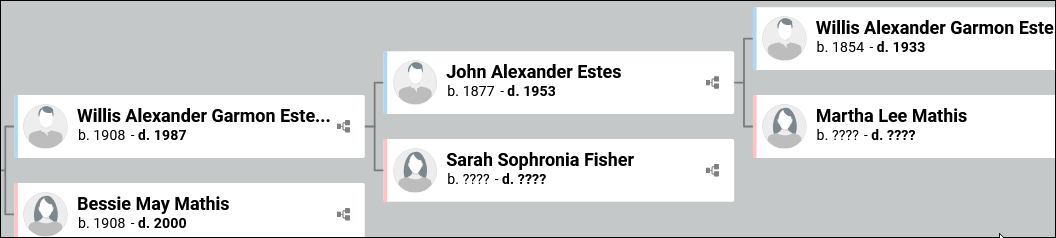
Recently, another Estes tester, we’ll call him Ned, matched the Y DNA of my cousin, John, and emailed me, saying that John’s entire tree was private. I told him that I had not made John’s tree private, so Ned sent me a screenshot.

click to enlarge

There’s no dispute – while the tree itself isn’t private, every single person in the tree is.

What could be causing this? In other words, how do I fix it? That’s not AT ALL what I intended.

Let’s Check the Privacy Settings

The first thing to do, of course, is to check the settings – so I signed in to John’s account.

I checked the privacy settings, located under Account Settings just below the user name of the kit, after you sign in.

According to the Privacy and Sharing settings, John’s tree is not private.

click to enlarge

That seemed odd, so I checked John’s tree myself. It looks fine to me, so I wonder what might be wrong?

click to enlarge

Nothing is showing as private from John’s perspective from within his account.

I decided to send Ned a direct sharing link to see if that made any difference.

The link I shared with Ned made no difference, but reading the information in the red box did! Yay for documentation!

I had not filled in the birth or death dates of the people in question or marked them as deceased. Yes, I know – my bad.

I clicked on the profile and then “View Profile” to verify.

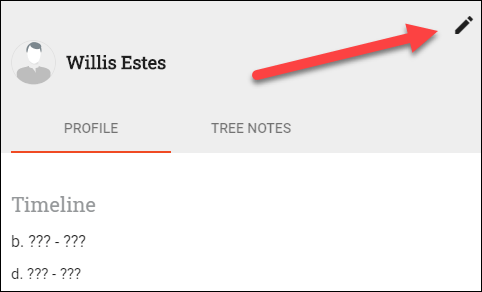
Sure enough – no dates. To edit the profile, click on the pencil.

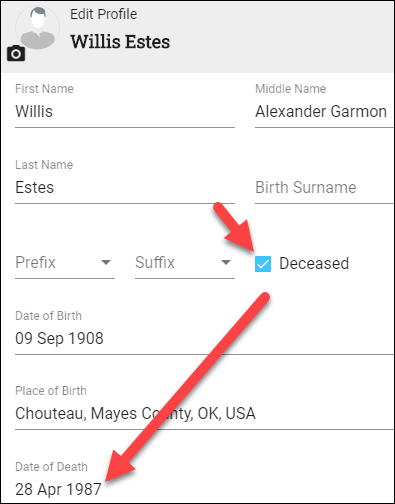
In order to cause the death date and death location fields to display, you must check the “Deceased” box which then turns blue.

Even if you don’t know the death date or location, marking the person as deceased allows their information to be displayed, such as their name, and NOT to be marked as private.

If you do NOT click the deceased box, the person’s profile WILL be marked “private” and will not be shown to anyone except you, the tester, if you sign in. You’ll have no idea that it isn’t showing to other people when you had intended to share all along.

click to enlarge

I marked each person as deceased and added death dates and locations while I was working on the tree.

Did that take care of the problem?

Let’s take a look from Ned’s perspective.

click to enlarge

Sure did.

In order for people to display, you need to kill them off, again😊

Tree Privacy

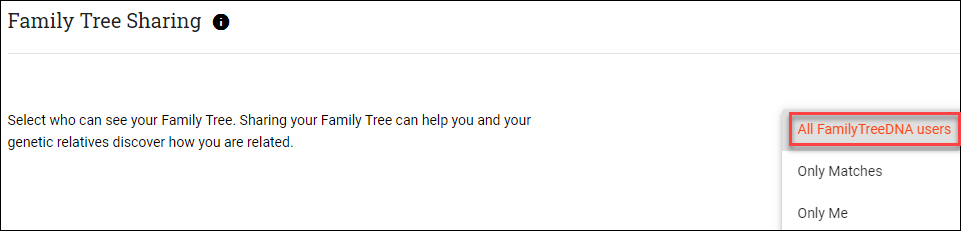
Every vendor has a combination of features that control tree privacy and security. You will be able to mark the entire tree private or shareable. You may be able to make it searchable, or not, depending on the vendor.

No vendor will display known living people to others – but the calculations they use to determine who may be living, unless you specifically mark them as deceased, will vary.

Be sure to check all of those factors, and find a way to view the tree from someone else’s perspective to check and be sure it’s functioning the way you expect.

I would never have known that all of John’s ancestors were private if Ned hadn’t contacted me.

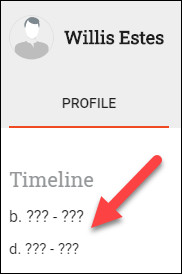
At Family Tree DNA, if you view your own tree and you notice that neither dates nor question marks appear in the date field on the pedigree page – that means you have not marked these people as deceased – so no information for them will show to anyone else.

If you see any dates or question marks beneath the names of people on your tree – then that individual’s profile will show and is not private, unless you have marked the entire tree as private.

Check your trees to see if you have an unknown issue. Those valuable trees provide critical information to your matches. They may not contact you to ask why your tree is private – in fact – most won’t. They assume it’s a choice you meant to make.

Be sure you’re not unintentionally driving cousins away. You never know who’s going to have that crucial piece of information or photo, and you want all of your cousin-bait to function as intended!

_____________________________________________________________

Disclosure

I receive a small contribution when you click on some of the links to vendors in my articles. This does NOT increase the price you pay but helps me to keep the lights on and this informational blog free for everyone. Please click on the links in the articles or to the vendors below if you are purchasing products or DNA testing.

Thank you so much.

DNA Purchases and Free Transfers

Genealogy Products and Services

Genealogy Research

Barbara Mehlheimer’s Letter: A Daughter Found, Photos and a Family Reunited – 52 Ancestors #308

Barbara Mehlheimer (1823-1906) married George Drechsel, apparently twice, once in Germany and once after their arrival in the US. They raised 6 children in Aurora Indiana, the eldest born in 1848 in Germany before their arrival, and the youngest born in 1862 a decade after their arrival.

I wrote about Barbara Mehlheimer and George Drechsel in their own stories back in 2016. When I publish these articles, it’s always with the hope that someplace, someday, somehow they will connect with the right person. Yes, the articles are cousin-bait. Over the years, these articles have been wonderfully effective. It always makes me feel good to provide another researcher with well-documented information.

I’d be fibbing if I told you my motives are entirely altruistic. They aren’t. From time to time, one of those cousins or a complete stranger has something absolutely wonderful to share with me.

Ernest Lent III, my newest cousin, found me recently by posting a comment on an earlier article. He descends from Barbara and George’s lost daughter, baptized as Teresa Maria Drechsel, known better as Mary. Born December 28, 1862, she was living and working at the Kirsch House in Aurora, Indiana in the 1880 census.

The Kirsch House, something akin to a hotel or B&B with rooms to rent, a restaurant and bar, located beside the train depot in the photo above, was owned by Mary’s sister Barbara Drechsel and her husband, Jacob Kirsch.

The building at 506 Second Street doesn’t look a lot different today. But Mary wouldn’t stay in Aurora long. She climbed aboard the train in the station and headed east.

In 1881, the Aurora Lutheran church records show that Mary was living in Cincinnati, then nothing. Radio silence. That is, until recently – 139 years later.

I’d like to share this wonderful journey with you, including our amazing discoveries.

Email from Cousin Ernest

I appreciate your detailed research so much. It certainly helped fill in some gaps in my family history that I assumed were irretrievable.

The few details that I can add to the information about my Great grandmother Mary Drexler are that she was married to Gustav Brehm on September 12, 1883 in Chicago and that she died on April 19, 1953 in Chicago.

I am attaching a photo of Mary Drexler taken around the turn of the century, one of her father George Drexler, and a photo of George at the cooperage where he was employed.

George is the person seated in the bottom row on the far left of the photo. I’m sorry, that particular photo is quite faded now and somewhat damaged.

Wait? What? There Are Photos????

Ernest, I hate to tell you, but these are not just a “few details.” I have never seen these photos before. There are no known photos of George Drechsel. That is, until now.

Do you have ANY idea how important this is to me???

Drum roll….Ernest’s photos….

There are, or were, no known photos of George Drechsel. George had obviously put on his good suit, shirt and bow tie, but his shoes look quite worn.

Here’s George, colorized and enhanced, courtesy of MyHeritage.

George died in 1908 and his wife, Barbara, in 1906. Since she’s not in this photo, and there doesn’t seem to be one of her, I wonder if this picture is George sometime between 1906 and 1908 when he would have been between 83 and 85. He doesn’t quite look that old to me. Maybe more like 60, which would have meant this photo was taken in the 1880s, probably about the same time a photo of Mary was taken. But where was his wife, Barbara Mehlheimer Drechsel, then? Maybe her photo has been destroyed, or yet to be discovered.

George Drechsel along with workers at the cooperage, bottom left corner. In the 1850s, there were at least three cooperage companies in Aurora, making barrels for the steamboats plying the Ohio River. The Wymond Cooperage spanned the entire two blocks adjacent Hogan Creek, behind the Kirsch House, beside the train depot. You can see one of their barrels in the photo.

Mary Drechsel probably circa 1881-1883, after moving to Cincinnati and before her marriage. The photo was taken by J.P. Weckman of Cincinnati, Ohio, listed on the back of the photo.

Mary would have taken the train back and forth from Aurora to Cincinnati as did many of the Aurora residents.

Jogging a Memory

Ernest’s photos jogged a memory for me. A couple years ago, another cousin contacted me. She had some photos too, and in those photos were some people I couldn’t identify.

Barbara Mehlheimer Drechsel’s daughter, Margaretha (1851-1889) married Herm Rabe and had 7 children before she died. Margaretha’s granddaughter contacted me and sent along photos, some of which neither of us could identify.

In this picture, taken in July of 1898, we know that the tallest young lady in the center rear is Eleanor Rabe who would have been 13 in 1898. But who were the rest of these people. We know they were all Barbara’s grandchildren, according to the note with the photo.

I immediately identified the female at bottom right as my grandmother, Edith Lore, born in 1888, but the rest remained a mystery.

Eleanor Rabe had older siblings, but she is clearly the oldest or at least the tallest here. Her one younger sibling was John who was born in 1887, but this boy’s name is Curt, not John.

Let’s make a list of the first names in the photo:

Back row, left to right.

  • Nora – a child, definitely NOT Nora Kirsch born in 1866 who married Curtis Benjamin Lore. I think this is actually Curtis L. Lore, born in 1891, daughter of Nora Kirsch, sister to Edith on the bottom row. They lived in Rushville and it wouldn’t make sense for one daughter to be in Aurora without the other daughter.
  • Eleanor Rabe (identified by her daughter)
  • Lilly – This is probably Lilly Giegoldt, born in 1883, daughter of Lou Drechsel who married Johann Georg Giegoldt.

Front row, left to right:

  • Stella – Stella Brehm born in 1884 to Mary Drechsel and Gustav Brehm, identified by Ernest.
  • Edna – Edna Brehm born in 1888, daughter of Mary Drechsel.
  • Curt – Curt Brehm born in 1889 to Mary Drechsel.
  • Edith Lohr (misspelled, it’s Lore) who is actually Barbara Melhleimer’s great-granddaughter

Before Ernest’s email, I had absolutely NO IDEA who Stella, Edna and Curt were.

Conversely, Ernest had never seen this photo before either.

Look what arrived next:

Well, Roberta, this is getting a bit surreal – first a picture of your grandmother Edith and my grandmother Edna in the same picture – and now this!

Obviously taken within minutes of your photo….

As you might imagine, we chattered back and forth for a few days.

I asked if Ernest thought this unidentified photo might be Mary.

Ernest replied with the genealogists lament that most of us are all too familiar with:

Unfortunately, I never spoke to my grandmother Edna about her family, my interest in genealogy came too late, I’m afraid.

My Dad told me very little about his grandmother Mary Drexler Brehm. He said she was a very strict lady who practiced, in his words, “tough love.” He said that as a young woman in Chicago she would ride streetcars to pick up big baskets of laundry which she would wash and fold and then ride back to return them. I don’t think he ever knew her well, she lived in Chicago and he grew up in Columbia, South Carolina.

I’m sending a photo of Mary when she was elderly, holding my Dad. My grandmother Edna is standing behind her as is my aunt Edna Louise Lent. Mary lived to be 89 years old.

The second picture (below) is of Mary perhaps in her 30’s – I’m not good at telling someone’s age.

The third picture is a family group. I think Mary is second from the right, my grandmother Edna standing in the center, my aunt standing next to her. I’m wondering if you recognize any of the other women.

The Branch Blossoms

Of course, I was excited to add Mary’s family information to my tree. I had always wondered what happened to the “lost sister.”

Ernest noticed:

Thank you for adding Mary Drexler’s information to your family tree, it seemed to me that it somehow symbolically reunites the family.

Rest assured that I asked Ernest if he has done a DNA test. He has, and we match. He’s in the process of transferring his DNA file to Family Tree DNA where so many of our family DNA tests reside, including Kirsch lines and other family members, along with my Mom.

The Letter

Then, almost as an afterthought, Ernest added something very important:

I have an old letter, written in what appears to be an archaic German script, that I’ve been unable to get translated. It was among the effects that my Dad left when he died and I’m not sure to whom it was written or who sent it.

Several people who speak German have looked at it and were unable to make out the gist of the letter, just pick out a few words. If I can attach a photo of the letter do you know someone who might be able to help?

It could be just a “having a good time, wish you were here” letter but it could also contain valuable information.

OMG a letter? Seriously?

Ernest, send it right away!!!!

Here is the letter in 4 parts – sorry some are upside down and sideways, I couldn’t reconfigure them.

I’ve been wondering what it may say for years now, I’m very hopeful that you can get them translated.

Perhaps an epiphany lies within!

OMG!!!!

Ernest continued:

I’m quite eager to learn what the letter says! I’ve been trying to get an accurate translation for years, thinking that having been preserved for over a hundred years it may have something important to tell us. And even if it doesn’t, I’m excited about it because it’s such a direct connection to our family and our past.

In Her Own Hand 

As it turns out, the letter is from Barbara Mehlheimer Drechsel (1823-1906) to her daughter, Theresa Marie Drechsel (Drexel, Drexler), known as Mary, who lived in Chicago at the time.

I had to sit for a while and just stare at this handwriting – holding space with Barbara. This is HER very own handwriting. Not only that, but she COULD write, probably having attended Lutheran school in Goppmansbuhl, Germany in the late 1820s or 1830s. Clearly, she raised her children to speak fluent German. My grandmother, three generations later, still understood German.

These letters to her much-missed daughter were scribed by candlelight using a quill pen dipped in a bottle of ink, at night, when Barbara was bone-tired from dangerous physical work like boiling clothes at 65 years of age. Work, of course, that was never ever done because clothes simply got dirty again and had to be boiled all over again a week or so later. She was “retirement age,” but there was no such thing as retirement.

It looks like Barbara prepared to write by drawing faint lines across the pages to keep her sentences straight – except for page 4 where she stopped drawing guidelines about halfway down the page – and sure enough, her sentences began to list to right. We don’t think about things like that today.

Yet, Barbara’s writing is beautiful, old-world script, despite the fact that she was fatigued and writing in the dark when she had trouble seeing. Other than her photo and fragments of DNA shared by her descendants, this letter is likely the only tangible thing that was actually physically, personally hers that remains on this earth some 132 years after she wrote those pages and almost 197 years after her birth. For most of us today, that’s the equivalent of someplace around the year 2160, with our great-great-great-grandchild unearthing a 4-page handwritten letter we sent today and sharing it with another great-great-great-grandchild – the two of them not previously knowing that each other exists.

Indeed, a mother’s hand – still healing after almost two centuries.

Barbara Mehlheimer Drechsel’s Family

Before going further, here’s a list of Barbara Mehlheimer Drechsel’s children and grandchildren. These relationships are important in sorting out the contents of the letter.

  • Barbara “Babbit” Drechsel 1848-1930, married Jacob Kirsch in 1866 and operated the Kirsch House, a hotel and restaurant/tavern beside the train depot.
    • Ellenore “Nora” Kirsch 1866-1949, married Curtis Benjamin Lore in 1888 in Aurora. Their first child, Edith was born in 1888 and their second child, Curtis, a daughter, was born in 1891. Two additional daughters, Mildred and Eloise were born in 1899 and 1903, respectively.
    • Georg Martin Kirsch 1868-1949, married Maude Powers in 1888 in Aurora, died in Shelbyville, Indiana in 1949. Son Edgar was born in 1899 and daughter Cecile born in 1892.
    • Johann Edward Kirsch 1870-1924 married Emma Miller in 1891 in Dearborn County, Indiana and lived in Aurora during the 1890s. He died in 1924 in Edwardsport, Knox County, Indiana. They had Juanita born in 1892, Deveraux “Devero” born in 1899. Two daughters born later died as infants.
    • Caroline “Carrie” Kirsch 1871-1926 married Joseph Smithfield Wymond in 1902 in Aurora. The wealthy Wymond family owned one of the cooperage companies and whoo-boy, is there a story about this man that rivals any soap opera. Sadly, they had no children.
    • Margaret Louise “Lou” Kirsch 1873-1940 married Charles “Todd” Fiske in 1899 in Aurora and after his suicide, married Arthur Wellesley. She had no children.
    • Ida Carolina Kirsch 1876-1966 married William “Billy” Galbreath in 1921 and had no children.
  • Margaret Drechsel 1851-1889, married Herm Rabe in 1873, lived between Aurora, Indiana and Cincinnati, Ohio, just a few miles away.
    • Mary “Mayme” Rabe 1875-1961 married Albert Weatherby in 1892 in Cincinnati, Ohio. They had three daughters, Lorine 1893-1975, Juanity 1896-1986 and Margaret 1904-1994.
    • Frederick George Rabe 1876-1879
    • Louisa B. “Lou” Rabe 1879-1863 married Irvin Isaac Denison in 1919 and had possibly had one child.
    • Caroline Louise “Leah” Engel Rabe 1880-1951
    • Wilhelm J. Rabe 1883-1886
    • Eleanor Rabe 1885-1961 married Guy Nicholas Young and had 2 daughters, Marian 1908-1978, Eleanor 1910-2006 and two sons, Donald 1915-2000 and Guy 1929-1997.
    • John Rabe 1887-1893
  • Caroline “Lina” or “Lena” Drechsel 1854-1938, married Johannes Gottfried Heinke in Cincinnati about 1895. She may have been married previously with one deceased child, according to the census. Much of her life is a mystery.
  • Johann “John” Edward Drechsel (Drexler, Drexel) born 1856 and died sometime after 1877. It’s believed that he married and had a child in 1882, but there is conflicting information. If so, his wife, Elizabeth Louisa “Lizzie” Uffman remarried in 1888 in Cincinnati. One John Drechsel was married, a tailor and living with her parents in the 1880 census.
    • Alfred Drexel born 1882 in Cincinnati
  • Emma Louise “Lou” Drechsel 1859-1949 married Johann Georg Giegoldt in 1881 in Aurora, Indiana. They lived between Cincinnati and Aurora.
    • Barbara Margaretha Josephine “Nettie” Giegoldt 1882-1908
    • Carolina Louise Lillian “Lilly” Giegoldt 1883-1951, married Theodore Ludwig “Louis” Bosse/Busse and had two children, Raymond born in 1911 and Wilbur born in 1915.
  • Theresa Maria “Mary” Drechsel 1862-1953, lived in Cincinnati from 1881-1883. She married Gustav Brehm in Chicago where she spent the duration of her life.
    • Stella Brehm born 1884
    • Edna Marie Brehm born March 4, 1888, died 1975, married Dr. Ernest Lent in 1913 in Iowa.
    • Curtis Brehm born July 1889
    • Drexel (or Drexler) Brehm born 1900

Christoph Saves the Day

Oh, my faithful German friend Christoph. What would I do without him?!

I hate to always be asking questions and favors – but Christoph is always so very gracious. I told Christoph that he didn’t need to translate the letter word for word. Mostly, I wanted to know who it was from and if the contents shed any light on our ancestors or family history. For all we know, it could have been something totally unrelated.

Fortunately, for us, it wasn’t.

From Christoph

Here is my translation of the letter.

I also add the original German text (with all spelling mistakes) below my translation, just for your records. As you will see, some blanks remain and maybe those will be filled by somebody else in the future. But I think that the main content of the letter is clear anyway. I labeled the blanks in [] brackets and also my comments at some places.

In fact, page four (the one with several “Gutbei” at the end) seems to be a separate letter that was first misplaced and thus sent later (see translation). It is clear however, that it is the same handwriting and from the same person. Since she signs as “your good mother Mrs Drexler, Aurora, Indiana”, I would conclude that the letters were written by Barbara Mehlheimer Drechsler (1823-1906).

Her writing suggests that she had some school education, but still several words are misspelled and interpunctation is missing at times. This is true even more for the English words, she even misspells her daughter Mary`s name “Märi”. There is also “Luiswil” instead of “Louisville”, “flauer” instead of “flour” and then “Gutbei” instead of “Goodbye”. In essence, she seems to spell all English words just the way they sound to her as a native German speaker.

Barbara Drechsler also mentions a “Mrs. Kirsch” at two occasions. I do not think that this refers to her daughter (she would have called her by her first name), but rather to her daughter`s mother-in-law Katharina Barbara Lemmert Kirsch (1807-1889), who seems to have been living very close to her house – maybe across the street?

Next, a “Lina” is mentioned. Lina is a short form of “Carolina” and from the letter it seems it is one of her daughters, too. So this would have to be Caroline Drexler married to Gottlieb Heinke. Similarly, “Luise” would have to be Emma “Louis” Drexler Giegoldt. I am not sure for all the other names, but maybe you have a better clue than me.

When Barbara writes “the father”, I do not think it is her own father, she is speaking of, but rather her husband – father of her daughter Mary. I do not know about this in American English, but it certainly was a habit in German still one generation ago. Quite similarly, my grandmother sent my mother letters, speaking about “father”, when in fact she referred to her husband – her daughter`s father.

As for the date of the letter, it only says March 17th, no year. But I think it is possible to draw out the facts and with their help narrow it down to a certain range.

Barbara`s daughter Mary already had a son, so it would have to be after 1883. But Katharina Barbara Lemmert Kirsch, who died in 1889, was still alive. So if I conclude right that she is the “Mrs Kirsch” mentioned, then the letter would have to be from between 1883 to 1889. What do you think?

So much for my comments. I hope you enjoy your ancestor`s voice from the past! (“Roberta and Ernest, I heard that you are interested in your ancestors` past, so I arranged for an interpreter to make my voice heard to you!”)

Best wishes
Christoph

Christoph, I would hug you if I could!

The Translation 

Letter of Barbara Mehlheimer Drechsler – Transcription and Translation

– page 1 –

Aurora, Indiana, March 17th

Dear children, we greet you all warmly from our hearts. I had intended to write for a long time, but had not found the time so far. Here, many are sick from the [“Krüh” – not clear, what it means. Someone suggested to me it could be a dialect word for scabies. Alternatively, it could be a variant of the word “Grippe” (flu), but these are both just guesses.]. Our father has fallen down and has hurt himself at the hand. It was not too bad, but still he is sick now anyway and cannot work. We had to give up going to church. I do not know, who will take it. [That makes no sense to me, but that is what she wrote.] I always have to take care of somebody over there. The Mrs Kirsch has no maidservant. Furthermore, they all have been sick every few weeks. Babedt [Babette?] has had “remidis” in her right leg. Cähri and Eidi have been sick. Luli and her husband are in Louisville, they both have been sick. Mr Roberts has died, he was 69 years old. Brindi is large and fat and our Luise has caught a cold, when hanging up the laundry out in the snow. I have burnt my left hand, while taking the laundry out of the kettle and it was so …

– page 2 –

… heavy and I lifted it diligently and in the necktie and his shirt was just sliding over my left hand. It frizzled and my entire hand was full of blisters. I immediately have put flour on it and said a prayer. Now my hand is well again. All this happened two weeks ago and last week I have already done the laundry again.

Mary, did you write down, what I have written to you? Put it in your bible, where it will remain safe. And if you have not received it, please let me know, since then I will resend it, it takes away the pain and cures. Now we are all healthy again. Mary, have you received my last letter from Christmas time? I had put inside a thaler painting for your little one and if you did receive it, you are a lucky one! Mister Nibaum had to work so hard, so I always am afraid that you may not have received it.

– page 3 –

I want to let you know, how it went on for the dear Lina. They have been sued, since their milk had been found to be too slurry. How could it have been their fault? They sell it just the way it has been sent to them. They had to pay eighty thaler [dollars ?] fine. That was an awful lot of money for something that had not been their fault. Lina has to work pretty hard. She has to wash big […?], in one of them sweet milk, in the next one buttermilk and in the last one butter. Lina would love me to come and help her, if only I could. Mary, please do not write this in any letter, since I am not supposed to know, because they know that it hurts me. A mother is not free from worries and cannot help nonetheless. My writing is not nice, I can only write at night. I hope and wish that you are all at good health and happy and that you all have work. So please be so good and write me soon, Mary, so that we hear something from you.

– page 4 –

Beloved child, we send you all the greetings from us all. I have to write you another time, since I have not received a reply yet. I do not know, what to think. I hope, you are not all fallen ill! If you do not have the time, then you still have your girls. They may write us a few lines. I always get a hiccup, whenever I think about you. So please be so kind once and write us a little letter about how you are doing.

The father has recovered completely, so thank God we are all healthy again.

The Mrs Kirsch has now a diligent maidservant, so now I do not have to go over to her anymore.

I had put this letter aside and then could not find it anymore. So I wrote another one and sent it to you. Now I have found it again, and so I decided to send it to you as well, so that I do not owe it to you. I hope for your reply soon! I remain your good mother Mrs Drexler. Aurora Indiana

Goodbye, dear children all!
Goodbye, dear children all, be diligent and good and pray as well, so that the good God will help you. Remain healthy all of you!
Goodbye, dear children, goodbye!

Unraveling the Threads

I didn’t want to interrupt the flow of the original letter in Barbara’s own voice, but we do need to see if we can extract additional information from her letter.

Aurora, Indiana, March 17th

Dear children, we greet you all warmly from our hearts. I had intended to write for a long time, but had not found the time so far. Here, many are sick from the [“Krüh” – not clear, what it means. Someone suggested to me it could be a dialect word for scabies. Alternatively, it could be a variant of the word “Grippe” (flu), but these are both just guesses.]. Our father has fallen down and has hurt himself at the hand. It was not too bad, but still he is sick now anyway and cannot work. We had to give up going to church. I do not know, who will take it. [That makes no sense to me, but that is what she wrote.] I always have to take care of somebody over there.

The Mrs Kirsch has no maidservant. Furthermore, they all have been sick every few weeks.

Mrs. Kirsch is indeed very likely Barbara Drechsel Kirsch’s mother-in-law. In fact, I have no idea who else it could be since Katharina Barbara Lemmert and her husband, Philipp Jacob Kirsch were the original immigrants.

In August 1887, Katharina Barbara Kirsch, then a widow, executed a deed to their farm in neighboring Ripley County. She turned 80 the next day and her son who lived with her was disabled from the Civil War. Both she and her son, according to the deed, were living in Dearborn County. I know that her son lived with his brother, Jacob Kirsch, at the Kirsch House until his death. I’m sure that Katharina Barbara Lemmert Kirsch did as well. She died on February 1, 1889, so the letter would have had to have been written before 1889, given that it was dated March 17th.

Barbara goes on to provide some newsy information about her other children to their sister living in Chicago.

Babedt [Babette?] has had “remidis” in her right leg.

Probably rheumatitis. Babbit is Barbara Drechsel Kirsch’s nickname, listed as such on one census.

Cähri and Eidi have been sick.

Cahri was likely Caroline Kirsch, the daughter of Barbara Drechsel Kirsch, born in 1871 who lived at the Kirsch House.

Eidi is probably Ida, born in 1876, also Barbara Drechsel Kirsch’s daughter.

Luli and her husband are in Louisville, they both have been sick.

I’m presuming this is Emma Louise Drechsel, known as “Aunt Lou” who was married to Johann Georg Giegoldt in 1881. They had two daughters, born in 1882 and 1883. I wonder why Barbara didn’t mention the girls.

Mr. Roberts has died, he was 69 years old.

Based on the 1880 census, I can’t find a Roberts in that region that would be roughly the correct age. I wonder why this was important to Mary and her mother. Generally, we find the family interacting with German families.

Brindi is large and fat and our Luise has caught a cold, when hanging up the laundry out in the snow.

Caroline Louise Rabe, born in 1880, would have been the age to hang clothes on the line. I have no clue who Brindi refers to. Everyone in this family had nicknames, some of which bore little or no resemblance to their actual given name.

I wonder if Brindi is a pet or perhaps a pregnant daughter. The only daughter pregnant during this time would have been Margaretha Drechsel, whose nickname I don’t know, who had Eleanor Rabe in March of 1885 and John Rabe in September of 1887. Of course, Mary, the recipient of the letter was pregnant with Stella who was born in June of 1884 and Edna Marie born on March 4, 1888, so she would not have been the person being referred to as “Brindi.”

I have burnt my left hand, while taking the laundry out of the kettle and it was so …

– page 2 –

… heavy and I lifted it diligently and in the necktie and his shirt was just sliding over my left hand. It frizzled and my entire hand was full of blisters. I immediately have put flour on it and said a prayer. Now my hand is well again. All this happened two weeks ago and last week I have already done the laundry again.

This sounds just horrible, but provides perspective on the daily dangers of simply doing laundry. Boiling laundry. Probably miserable at best and horrid in the summer. I had to look the definition of frizzle up and it means to “fry or grill with a sizzling noise.” Ugh – my hand hurts this many years later just thinking about that boiling water. Poor Barbara.

I have never heard of flour as a remedy for burns but googling reveals it as a folk remedy with many warnings against this methodology today.

Mary, did you write down, what I have written to you? Put it in your bible, where it will remain safe. And if you have not received it, please let me know, since then I will resend it, it takes away the pain and cures. Now we are all healthy again.

I surely wonder about that remedy. Was it the flour remedy she was referring to, or something else? Apparently, something she sent earlier. I hope the family still has this Bible someplace, probably given to Mary in the church in Aurora when she was confirmed about 1873 or 1874.

Mary, have you received my last letter from Christmas time? I had put inside a thaler painting for your little one and if you did receive it, you are a lucky one! Mister Nibaum had to work so hard, so I always am afraid that you may not have received it.

“Little one” tells us that Mary had at least one child, so that dates this letter after 1884. Mary’s first child, Stella, was born in June of 1884. I was unable to figure out what a thaler painting is or was, but a thaler was the official coin in Germany until 1908. It could be interpreted as roughly similar to a dollar at that time, which of course was worth much more than a dollar today.

– page 3 –

I want to let you know, how it went on for the dear Lina. They have been sued, since their milk had been found to be too slurry. How could it have been their fault? They sell it just the way it has been sent to them. They had to pay eighty thaler [dollars ?] fine. That was an awful lot of money for something that had not been their fault. Lina has to work pretty hard. She has to wash big […?], in one of them sweet milk, in the next one buttermilk and in the last one butter. Lina would love me to come and help her, if only I could. Mary, please do not write this in any letter, since I am not supposed to know, because they know that it hurts me. A mother is not free from worries and cannot help nonetheless.

I am presuming Lina would be Caroline “Lina” Drechsel who married Johannes Gottfried Heinke in Cincinnati, although that wasn’t until 1895. There’s certainly a big piece of Lina’s life missing during the 1880s. In the 1880 census she was living with the Heinke family as a servant and noted as a cousin. In 1881 she is shown in the City Directory as a housekeeper. Maybe the Lina that Barbara references is someone else since it does refer to “they,” inferring that Lina was married. There may be an earlier marriage we don’t know about. All of the pieces don’t add up for her. Maybe this mystery will be solved one day too.

My writing is not nice, I can only write at night. I hope and wish that you are all at good health and happy and that you all have work. So please be so good and write me soon, Mary, so that we hear something from you.

– page 4 –

Beloved child, we send you all the greetings from us all. I have to write you another time, since I have not received a reply yet. I do not know, what to think. I hope, you are not all fallen ill! If you do not have the time, then you still have your girls. They may write us a few lines. I always get a hiccup, whenever I think about you. So please be so kind once and write us a little letter about how you are doing.

I suspect hiccup means that she cried.

The word “girls” in this sentence suggests that Mary had already had her second child who was born on March 4, 1888, unless she had a child in 1886 that we don’t know about that died.

This is perplexing because this page appears to be the older letter that Barbara enclosed, written before March 17th. We know that the original letter was dated March 17th, and that Barbara had not heard from Mary or at least had not received a letter since Christmas. Mary’s second child was born March 4th, 1888.  We also know that Mrs. Kirsch died in February 1889, so this entry is confounding. Mary’s first child, Stella, was born in June of 1884. No letter year scenario fits all three pieces of evidence well.

The father has recovered completely, so thank God we are all healthy again.

The Mrs. Kirsch has now a diligent maidservant, so now I do not have to go over to her anymore.

I would presume this means Barbara Drechsel Kirsch’s mother-in-law again.

I had put this letter aside and then could not find it anymore. So I wrote another one and sent it to you. Now I have found it again, and so I decided to send it to you as well, so that I do not owe it to you. I hope for your reply soon! I remain your good mother Mrs Drexler. Aurora Indiana

Goodbye, dear children all!
Goodbye, dear children all, be diligent and good and pray as well, so that the good God will help you. Remain healthy all of you!
Goodbye, dear children, goodbye!

It’s of note here that Barbara did not mention Margaretha who was married to Herm Rabe, unless that’s the reference to Brindi who is fat. That might place this letter in 1887 when Margaretha was pregnant.

On a sad note, Barbara also didn’t mention her son, John. We know little about him other than that he was living in Cincinnati by 1877 according to the Aurora church records. He, or at least someone by his name, is listed in the city directory there as a tailor, and is married in 1880 to Lizzy Uffman, living with her parents. Their one child, Alfred, was born in April of 1882. John is not shown in the City Directory after 1881, but a note in the Cincinnati Enquirer Newspaper on Sept. 5., 1882 states that a massive fire in Aurora burned an entire block, a factory, hotel and other buildings. The article says that the property of John Drexel was damaged. There is no other known John Drexel, or similar surname, in Aurora, and the last we knew of John, he was living in Cincinnati. It’s possible that they meant his father, George.

Even more confusing is the May 6, 1880, Cincinnati Daily Star report under the “Aurora, Indiana” heading that says, “Mr. Jacob Kirsch and wife attended the funeral of Mr. John Dreckler in Cincinnati yesterday (Wednesday.)”

If this John Dreckler is Barbara Kirsch Drechsel’s brother, which is likely, then the Alfred born in 1882 is not his child. That John Drechsel/Drexel/Drexler may be someone entirely different. We do know that John’s wife remarried in 1888. There may be multiple John Drechsel’s involved – and “ours” remains a mystery.

A Gift from the Past Reunites Our Family

I’m extremely grateful to Ernest for reaching out and sharing. It allowed us both to connect the leaves and branches and flesh out our trees. Ernest summed this up just perfectly:

Thank you for adding Mary Drexler’s information to your family tree, it seemed to me that it somehow symbolically reunites the family.

This is so gratifying! What a direct connection to our family, to hear our great grandmother speaking to her children over the years through her letter.

First of all, please convey my deepest thanks to Christoph for opening up this insight into our family with his wonderful translation. And to you Roberta for making this happen. I’ve been wanting to know the contents of the letter for years now.

It makes no great pronouncements, It’s just a simple newsy family letter and it’s all the more intimate because it tells of incidents that occurred, accidents that befell them, what’s going on with the neighbors.

Barbara telling Mary about the lawsuit involving Lina and the milk (but don’t tell anybody else because I’m not supposed to know) is such a natural thing to do.

Barbara, possibly in her mid-sixties at the time the letter was written, is still doing laundry by boiling the clothing in a kettle, heavy work and dangerous too.

She has sent something to Mary which she’s supposed to write down and put in her bible which “takes away the pain and cures.” A spell or charm perhaps.

There is such a lot of information to be gleaned from the letter – actually two letters, it seems.

There’s a clue within the letter that may make it possible to narrow down the year it was written. The first paragraph makes mention of so many people being sick and even one death.

The “Russian Flu” was an epidemic that swept through Indiana starting in late 1889 and lasted through 1892. There were hundreds of deaths in Indiana attributed to the flu in 1890. The epidemic spiked in January of 1892 with over 400 deaths in that month alone and then began to decline. It’s possible that the sicknesses mentioned were a result of the flu.  Kind of interesting considering our current pandemic.

Ernest is right. Further research shows that there was a significant spike in deaths in January of 1888 as well, even higher than the peak of the flu in January of 1890. If the March 17th date was in 1888, that would accommodate almost all of our date hints:

  • Written before Mrs. Kirsch died on February 1, 1889 – so the letter must be 1888 or earlier because Mrs. Kirsch was deceased by March 1889.
  • After Mrs. Kirsch deeds her land and moves to town in August 1887.
  • Barbara refers to the “little one” in her letter when describing a thaler painting sent the previous Christmas. Mary’s second child was born on March 4, 1888 and the first in 1884.
  • Page 4, apparently an earlier letter, clearly refers to “girls,” so this had to be after the second daughter’s birth on March 4, 1888 unless an unknown child was born in 1886 and subsequently died. It’s also possible that page 4 is actually from a later letter.
  • However, if Barbara has not heard from Mary, by letter, since Christmas, how did she know that Mary had given birth to a daughter on March 4th, 1888 in order to refer to “girls?” A telegraph message sent to the train depot might be a possibility, or page 4 was from a later letter.
  • Indiana deaths experienced a spike in January 1888, and the March 17th letter refers to the illnesses and death, noting that in March, people are better.

It’s so much fun to peep through that remaining keyhole into their daily lives. My best guess here is that the Match 17th letter was written in 1888. Regardless, it was written near that time and provides us with a rare and wonderful glimpse into Barbara’s life, narrated in her own words.

Thanks again to Ernest and Christoph – and everyone who saved those letters!

Addendum: German Letter Transcription

– Seite 1 –

Aurora Indiana März den 17.

Liebe Kinder seid Alle Herzlich von uns
allen [gegrüßt]. Ich wolde schon lange schreiben, und kam
nicht dazu. Hier sind vühle Laide krank an der
Krüh, unser Vater ist gefahlen aber Er
hat sich weng weh gethan an der Hand
das hätt nichts aus gemacht aber doch ist Er
krank und kan nichts mehr schaffen wir musten
die Kirche auf geben wer es nimt das weis
ich noch nicht, ich mus hald imer wen drüben
aus helfen die Misses Kirsch hat keine Macht(=Magd)
Sie wahren auch Alle baar Wochen krank
Die Babedt [Babette?] hat remidis in rechten Bein
gehabd die Cähri und Eidi wen krank die
Luli und Ihr Mann die sind in Loiswill
Sie wahren baide krank. Der Raberts
ist gestorben Er war 69 Jahre ald die Brindi
st gros und fett u. unsere Loise hat sich
weng verköldet mit Ihren wasch aufhängen
in den grosen Schnee. Ich habe mich gebründ
in meine Linke Hand ich habe die Wasch
aus den Kössel gehoben, und das wahr, so…

– Seite 2 –

…schwär, und ich hebd hald dichdig und in den
schlips über und sein Hemt [stok?] schleidet
sich gerahte über meine Linke Hand das
hat gebüzeld es wahr die ganze Hand vol
Blasen, ich hab gleich recht Flauer drauf,
und habse besprochen jezt ist Sie gans gut
das wahr in zwei Wochen alles geschehen ich
habe die lezte Woche schon wieder gewa-
schen, Märi hast Du das auf geschrieben
wo ich Dir geschikt hab, lechs in die Bibel
da bleibd es sicher, und hast Du es nicht so
las mirs wissen, so wil ich Dirs schücken
den das nimt den schmärzen und heild
so sind wir Goott sei dank wieder
Alle Gesund. Märi hast Du den letzten
Brif beken zu Weihnachten ich habe
für den Kleinen ein Dallerbild einge-
legt wen dus bekomen hast, so machst
du ein großen Pungt. Der Mister
Nibaum die hatten, so zu thun gehabd
das wahr arch, da denk ich immer Ihr habd
den Brif nicht bekomen.

– Seite 3 –

Ich wil Euch noch schreiben wie der
Liebe Lina noch gegangen ist, die sind
verklagt worden über die Milch weil
sie zu din wahr, was haben Sie dafür
könt wie Sis schücken, so verkaufens Sie
und mussten 80. Achtzich daler bezahlen
wahr das nicht ein Sinden Geld wo Mann
nichts davür kan, die Lina mus noch recht hart
schaffen Sie hat so grose [Höfen?] zu waschen
in ein ist Sismichl in ander Butter Milch
in andern Butter, die Lina nehmet mich gern
wen Ich komen könt Märi schreib nichts in kein
Brif den ich sol nichts wissen davon weil Sie
wissen, daß mirs wehe thut. Eine Mutter ist n
nicht frei von sorchen, und kann doch
nichts helfen. Mein Schreiben ist nicht schön
icht mus nur Nachts schreiben. Ich hof und
Wünsch das Ihr Alle recht Gesund und zufrieden
seid und und wen Ihr alle Arbeit habd. So
sei so gut und schreib bald Märi daß wir
auch was fon Eüch hören

– Seite 4 –

Hertz gelibde Kind seit Alle herzlich
gegrüsset von u[ns] Allen.
Ich mus noch ein mahl an Eüch schreiben, weil ich
noch keine Antwort bekomen habe. Ich weis nicht was ich
denken sol, Ihr werdet doch nicht Alle krank sein! Wen
du nicht Zeit hast, so hast du doch eine Mädchen die könen
doch so vühl thun und konen uns ein baar Zeilen schreiben
Ich hab immer Hetscher wen Ich an Dich denk, so ist es
vorbei. So seid doch ein mahl so gut und schreibt uns bald ein
Briflein wie es mit Eüch geht. Der Vader ist wieder gans
gesund, so sind wir Gott sei Dank Alle gesund. Die Misses
Kirsch hat eine fleisiche Macht jezt brauch Ich nicht mehr zu
nüber gehen. Ich habe diesen Brif weggelecht und hab
Ihm nimmer finden könen, so hab ich em anderen geschrieben
und an Euch geschückt, jezt hab ich im gefunden, und so
wil Ich im auch wieder zu Euch schücken so habd mir
nichts vir ungut. Ich Hof eine badige Andwort. Ich ver-
bleibe Eüere gute Mutter Misses Drexler. Aurora Indiana

Gutbei Libe Kinder Alle!
Gutbei liebe Kinder Alle seid Fleisich
und gut und dut auch Beeden, das Eüch
der Liebe Goott auch Hülft seid alle gesunnt
Gutbai Liebe Kinder Gutbai.

Ancient Icelandic Viking Settlers Expand the Y DNA Tree

The harsh yet starkly beautiful volcanic island of Iceland was only settled about 1100 years ago, between 870 and 930 CE (current era). Obviously, the original settlers had to originate in locations where populations were already established. During this time, Vikings had been raiding islands and coastal regions of Ireland, Scotland, and England.

Their DNA, now unearthed, tells their tale.

This 2018 paper, Ancient genomes from Iceland reveal the making of a human population by Ebenesersdóttir et al, along with the supplementary material, here, provides insight into the genomes of 27 ancient Icelanders who are a combination of Norse, Gaelic and admixed individuals. The Irish Times wrote a non-academic article, here.

Unequal contributions of the ancient founders, plus isolation resulting in genetic drift separates the current Icelandic population from the founder populations. These ancient Icelandic genomes, autosomally, are more similar to their founding populations than today’s Icelanders.

While autosomal DNA recombines in each generation, Y and mitochondrial DNA does not, revealing the exact DNA of the original founding members of the population. This, of course, allows us to peer back in time. We can see who they match, historically, and where. Today, we can see if our Y and mitochondrial DNA matches them as well.

The authors of the paper selected 35 ancient individuals, believed to be first-generation founders, to have their whole genomes sequenced, of which 27 were successful. Sometimes the ancient DNA is just too degraded to sequence properly.

Nineteen of these burials are pre-Christian, 2 from Christian burials and one that is “Early Modern,” dated to 1678 CE. Ages are expressed, as follows:

  • Pre-Christian <1000 CE
  • Pre-Christian 950-1050 CE
  • Early modern Born 1678 CE
  • Pre-Christian <1050 cal CE

Dates that say “cal CE” mean that they were carbon 14 dated and calibrated and CE (alone) means that those dates are based on the archaeological context of grave goods, other remains, and environmental indicators such as volcanic ash.

As he did with the 442 ancient Viking genomes that I wrote about, here, Goran Runfeldt who heads the research department at FamilyTreeDNA downloaded the Icelandic genomes, extracted and aligned the mitochondrial and Y DNA results.

Michael Sager analyzed the Y DNA and those results, once again, have refined, enhanced or split at least 8 branches of the Y DNA tree.

For instructions about how to see if your mitochondrial or Y DNA results match any of these ancient genomes, please click here. If you haven’t yet tested, you can order or upgrade a Y or mitochondrial DNA test, here.

The Graves

This map, provided in the paper by the authors, shows the burial locations of the remains, noted by sample numbers. Circles are females, squares are male. Light gray was later excluded from the author’s study.

Some of these burials and grave goods are fascinating. For example, note the horse and dog burials.

Goran and Michael have been kind enough to share their analysis, below, along with comments. Thanks, guys!

Sample: DAV-A9
Location: Dalvík (Brimnes), North, Iceland
Study Information: One of the largest and most studied pre-Christian burial sites in Iceland. Thirteen human skeletal remains, six horse skeletons, and the remains of three dogs were found at the site. In one of the graves, the deceased individual had been placed in a sitting position at the rear of a boat
Age: Pre-Christian 900-1000 CE
Y-DNA: I-FGC21765
FTDNA Comment: Likely splits this branch
mtDNA: H1

Sample: DKS-A1
Location: Öndverðarnes, West, Iceland
Study Information: Grave goods included a sword, a spearhead, a knife, a shield-boss, a bone-pin, and fragments of iron. According to a morphological analysis, the skeletal remains show evidence of developmental delay that could be explained by hypogonadism caused by Klinefelter syndrome, testicular disorder or castration.
Age: Pre-Christian 850-1000 CE
Y-DNA: R-YP6099
mtDNA: U5a1h

Sample: FOV-A1
Location: Fossvellir, East, Iceland
Study Information: The remains are thought to have been placed at the site after the individual was deceased. The bones had been carefully arranged on top of each other and were surrounded by stone slabs and turf.
Age: Christian 1246-1302 CE
Y-DNA: R-DF23
mtDNA: HV17a

Sample: GRS-A1
Location: Grímsstaðir, North, Iceland
Study Information: Three pre-Christian burials were found in close proximity to each other near the site of a farmstead. We analysed one of the skeletal remains (GRS-A1), which were excavated in 1937. No grave goods were found at the site.
Age: Pre-Christian <1050 cal CE
Y-DNA: R-BY92608
mtDNA: K1a1b1b

Sample: GTE-A1
Location: Gilsárteigur, East, Iceland
Study Information: In 1949, field-leveling exposed a pre-Christian burial site near an old farm site. The remains of two skeletons were excavated in 1957. Both burials contained grave goods.
Age: Pre-Christian <1000 CE
Y-DNA: R-CTS4179
mtDNA: H4a1a4b

Sample: HSJ-A1
Location: Hrólfsstaðir, East, Iceland
Study Information: A comb, knife, and pieces of charcoal were found in the grave.
Age: Pre-Christian <1000 CE
Y-DNA: I-BY202281
FTDNA Comment: forms a branch with 2 men (Scotland and England). I-BY202281. The two modern samples share an additional 11 markers that HSJ-A1 is ancestral for
mtDNA: H3g1

Sample: KNS-A1
Location: Karlsnes, South, Iceland
Study Information: Grave goods included a spearhead, a knife, two lead weights, three beads, and a small stone.
Age: Pre-Christian 950-1050 CE
Y-DNA: R-Z290
mtDNA: H5

Sample: KOV-A2
Location: Kópavogur, West, Iceland
Study Information: Two skeletal remains. Based on archaeological evidence, the remains were identified as a female, born 1664, and a male, born 1678. According to historical records, they were executed in 1704 for the murder of the female’s husband. The male was beheaded, and his impaled head publicly exhibited, whereas the female was drowned. Their remains were buried in unconsecrated ground at a site called Hjónadysjar.
Age: Early modern Born 1678 CE
Y-DNA: R-L151
mtDNA: H1

Sample: MKR-A1
Location: Viðar (Másvatn), North, Iceland
Study Information: The remains date to <1477 C.E. based on volcanic ash chronology, and are thought to be from a pre-Christian burial site.
Age: Pre-Christian <1050 cal CE
Y-DNA: R-YP1258
mtDNA: K1c1b

Sample: NNM-A1
Location: Njarðvík, East, Iceland
Study Information: A human skull (NNM-A1) was found at a site considered to be a badly damaged pre-Christian burial.
Age: Pre-Christian <1000 CE
Y-DNA: R-BY56981
mtDNA: H2a2b5a

Sample: ORE-A1
Location: Ormsstaðir, East, Iceland
Study Information: Pre-Christian site near an old farmstead was excavated after being exposed during field leveling. One human skeleton (ORE-A) was found, along with an axe, a knife, and three lead weights. A single human bone from another individual was found nearby.
Age: Pre-Christian 900-1000 CE
Y-DNA: R-PH93
mtDNA: K1a3a

Sample: SBT-A1
Location: Smyrlaberg, North, Iceland
Study Information: Pre-Christian burial site in an old gravel quarry. Two years later its excavation revealed a male skeleton (SBT-A1) and an iron knife. Another grave, badly damaged, was found nearby, but only fragments of bone were recovered.
Age: Pre-Christian <1000 CE
Y-DNA: I-FGC74518
FTDNA Comment: Shares 6 SNPs with a man from England. Forms a branch down of I-BY46619 (Z140). Branch = I-FGC74518
mtDNA: H3g1a

Sample: SSG-A2
Location: Sílastaðir, North, Iceland
Study Information: A cluster of four pre-Christian graves. Based on morphological analysis, three of the skeletons were deemed male, and one female.
Age: Pre-Christian 850-1000 CE
Y-DNA: R-BY41282
FTDNA Comment: Split the R-BY23441 block – derived only for BY41282 (Z246)
mtDNA: J1c3g

Sample: SSG-A3
Location: Sílastaðir, North, Iceland
Study Information: A cluster of four pre-Christian graves. Based on morphological analysis, three of the skeletons were deemed male, and one female.
Age: Pre-Christian 850-1000 CE
Y-DNA: I-FGC9493
mtDNA: T2b2b

Sample: SSJ-A2
Location: Surtsstaðir, East, Iceland
Study Information: The remains of two individuals were found at the site, along with grave goods.
Age: Pre-Christian 850-1000 CE
Y-DNA: I-Y129187
mtDNA: U5a1a1

Sample: STT-A2
Location: Straumur, East, Iceland
Study Information: Pre-Christian burial site was excavated, which included the remains of four individuals (one child, one male, one female, and another adult whose sex could not be determined by morphological analysis). Grave goods included a horse bone, a small axe, thirty boat rivets, a lead weight, two pebbles, and a knife.
Age: Pre-Christian 975-1015 cal CE
Y-DNA: R-FT118419
FTDNA Comment: Shares 22 SNPs with a man from Wales. They form the branch R-FT118419 (Z251)
mtDNA: U4b1b1

Sample: SVK-A1
Location: Svínadalur, North, Iceland
Study Information: Human skeletal remains were brought to the National Museum of Iceland. They had been exposed for many years near an old farmhouse. There were no grave goods found at the site, but the remains are thought to be pre-Christian.
Age: Pre-Christian <1050 cal CE
Y-DNA: I-FGC21682
FTDNA Comment: Joins VK110 and VK400 as an additional I-FGC21682* (P109)
mtDNA: I2

Sample: TGS-A1
Location: Tunga, North, Iceland
Study Information: Human skeletal remains (TGS-A1) were excavated in 1981 by inhabitants at a nearby farm. They were classified at the National Museum of Iceland as having unknown temporal origin. The remains were radiocarbon dated for this study, indicating that they date from the 10th century C.E.
Age: Pre-Christian 943-1024 cal CE
Y-DNA: R-Y10827
FTDNA Comment: Likely R-BY4659. Also PH1220+, but this is a C>T mutation also present in hg I ancient samples R7 and Carrowkeel531.
mtDNA: T2e1

Sample: TSK-A26 / ÞSK-A26
Location: Skeljastaðir, South, Iceland
Study Information: Christian cemetery at Skeljastaðir in Þjórsárdalur. The remains are dated to before 1104 C.E., as the site was abandoned in the wake of a volcanic eruption of Mount Hekla in that year.
Age: Christian 1120 cal CE
Y-DNA: R-Y77406
FTDNA Comment: Shares 2 SNPs with a man from Norway. Forms branch down of R-BY30235 (L448). New branch = R-Y77406
mtDNA: J1b1a1a

Sample: VDP-A6
Location: Vatnsdalur, West, Iceland
Study Information: Boat grave with seven skeletal remains (three females and four males), along with a dog skeleton. Grave goods included a knife, thirty beads, a silver Thor’s hammer, a fragmented Cufic coin (ca. 870–930 C.E.) and jewelry.
Age: Pre-Christian 850-1050 CE
Y-DNA: R-YP1120
mtDNA: H1c3a

Sample: VDP-A7
Location: Vatnsdalur, West, Iceland
Study Information: Boat grave with seven skeletal remains (three females and four males), along with a dog skeleton. Grave goods included a knife, thirty beads, a silver Thor’s hammer, a fragmented Cufic coin (ca. 870–930 C.E.) and jewelry.
Age: Pre-Christian 850-1050 CE
Y-DNA: R-FT209682
FTDNA Comment: Shares 7 SNPs with a man from Sweden. Forms branch down of R-BY71305 (Z18). New branch = R-FT209682
mtDNA: H4a1a1

Sample: YGS-B2
Location: Ytra-Garðshor, North, Iceland
Study Information: The site included the disturbed remains of nine human skeletons (four males, two females, one child and two individuals whose sex could not be inferred based on morphological analysis). There were grave goods in all graves.
Age: Pre-Christian <1000 CE
Y-DNA: R-Y98267
FTDNA Comment: Split the R-Y84777 block (L238). Derived only for Y98267
mtDNA: J1c1a

_____________________________________________________________

Disclosure

I receive a small contribution when you click on some of the links to vendors in my articles. This does NOT increase the price you pay but helps me to keep the lights on and this informational blog free for everyone. Please click on the links in the articles or to the vendors below if you are purchasing products or DNA testing.

Thank you so much.

DNA Purchases and Free Transfers

Genealogy Products and Services

Genealogy Research

MyHeritage Updates Theories of Family Relativity – Who is Waiting for You?

I always love to receive e-mails from Daniel Horowitz, Genealogy Expert at MyHeritage, because I know there is always something good waiting for me.

Today, it was the announcement that MyHeritage has refreshed the Theories of Family Relativity database again. The last time was mid-May.

If you recall, Theories of Family Relativity (TOFR) provide you with theories, aka, hints, as to how you and other people whose DNA you match may be related to each other – through which common ancestor.

According to Daniel:

Since the last update, the number of theories on MyHeritage has grown by 64%, from 20,330,031 to 33,373,070! The number of MyHeritage users who now have at least one Theory of Family Relativity™ for their DNA Matches has increased by 28%.

MyHeritage reruns the connections periodically and updates customer results.

By signing on to your account and clicking on “View Theories,” you can view only the matches that have an associated theory.

I have a total of 67 theories, 5 of which are new.

In my case, I create a note for each match, so I can scroll down my match list and easily identify which people have new TOFR

click to enlarge

You can see in the screenshot that my match, David, has a note, indicated by the purple icon, but Sarah does not. She also has a “New” indication for the TOFR which will remain for 30 days.

I’m excited. I can’t guess based on the 13 people in her tree how we might be connected, which is a little game I like to play, so I’m going to have to click on “View Theory” to make that discovery.

click to enlarge

Aha – William Crumley through daughter Mary who married William Testerman. I’m glad to see this, and I suspect this new connection may be due to the fact that I optimized my trees to enable TOFR to make connections by adding all of the children and grandchildren of my ancestors, with their spouses. This facilitates the “spanning trees” connections, indicated by the red arrows above, where Mary Brown “Polly” Crumley 1803-1881 connects in another tree with Mary Brown 1803-1881 and then further down that tree, James Harold Mitchell 1899-1961 connects with James Harold Mitchell born 1899-deceased. In other words, the theory is that these are the same people and those connections allow us to “cross and connect trees” and walk down them like a genealogical ladder.

Now, of course, I need to verify the connection both genetically and genealogically as well as reach out to my new cousin.

Sarah only has 13 people in her tree. She might be a new researcher. I’d like to provide her with my articles about our common ancestor, assuming the connection verifies. There were multiple William Crumleys and there is a lot of misinformation out there, waiting for unsuspecting genealogists. Maybe my articles will help her avoid the sand traps I landed in and who knows what information she might have to share. Like, if there is a graveyard on her Testerman ancestor’s property – which might be where William is buried. You never know and hope springs eternal!

If you already have DNA results at MyHeritage, sign in, and see if you have new Theories of Family Relativity.

If you don’t have DNA results there, you can transfer from elsewhere for free by clicking here and then either try a trial MyHeritage subscription, here or unlock the advanced features that include TOFR for $29. Or you can order a DNA test from MyHeritage, here.

We don’t know in advance when MyHeritage is going to refresh the database for new TOFR connections, so it’s important to be in the database when that happens.

If you’d like to know more about Theories of Family Relativity, I wrote about how to work with them here, here, and here.

Have fun!!!

_____________________________________________________________

Disclosure

I receive a small contribution when you click on some of the links to vendors in my articles. This does NOT increase the price you pay but helps me to keep the lights on and this informational blog free for everyone. Please click on the links in the articles or to the vendors below if you are purchasing products or DNA testing.

Thank you so much.

DNA Purchases and Free Transfers

Genealogy Products and Services

Genealogy Research

FamilyTreeDNA’s myOrigins Version 3 Rollout

As the fall leaves change colors and people are turning more to inside activities, FamilyTree DNA began rolling out MyOrigins version 3 today.

That’s the good news. The bad news is that everyone is trying to sign on at the same time, so the system is quite slow right now. Maybe that’s actually good news too because it means people are interested AND maybe they will take this opportunity to add trees and link matches if they have not already done so!

What’s Happening?

Yesterday, the following email was sent to group project administrators.

If you’d like to view the list of all populations reported, click here.

The Rollout

I really like the process of prioritizing people who have signed in most recently. They are clearly the most interested in their results.

If you’re wondering if your results have been updated, sign on to your account. Look at your messages to the left of your Autosomal DNA Results.

click to enlarge

If you don’t see this message, then you have the new MyOrigins 3 results, so simply click on MyOrigins.

More Results Coming

Not only are more people going to be receiving results soon, but additional features will be released over time:

  • Population-based chromosome painting, including trace amounts less than 1%. I expect this feature will be released after everyone has received updated results – but that’s my assumption – not from FTDNA.
  • Some people may receive additional population trace amounts not reported in this initial release to facilitate chromosome painting – so check back every couple weeks to see if your results have changed.

My Results

click to enlarge

I have multiple kits at Family Tree DNA – one tested there and one from Ancestry that I use when I write about twins and siblings. Ancestry uses a different chip when processing their DNA tests, and my results at FamilyTreeDNA are somewhat different for the two tests. Keep in mind that the two tests test some of the same locations, but not all.

click to enlarge

I have a 23andMe test I could upload as well. I may do that, simply to compare results, especially since 23andMe also shows my Native segments. Once Family Tree DNA releases their ethnicity chromosome painting, I’ll want to see if the tests report the same locations.

My Comparison

My British Isles are much more specific now. Much of my genealogy from the British Isles is somewhat ambiguous. I know positively that some lines are from there – just not exactly where.

Trace amounts do not contribute to the totals. I wasn’t sure quite how to handle this since we don’t know how much the trace amount actually is – and if it’s noise in some cases.

Here’s the comparison of the four major vendors and their current results, above and below.

I can’t discern the exact amount of Native, although it’s clearly small. I know it’s present and not noise because I’ve proven these segments to the ancestors whose Y and mitochondrial DNA prove their Native origins.

Furthermore, MyOrigins3 essentially matches my Native segments at 23andMe. I know this because I was fortunate enough to have had that sneak peek earlier this year when MyOrigins3 was in beta. You can take a look at Dr. Maier’s presentation about MyOrigins3, here.

Population-based chromosome painting is coming for everyone after the MyOrigins3 rollout is complete. No, I couldn’t pry a more specific date out of anyone😊

How Can Ethnicity Help Your Genealogy?

By clicking on the Shared Origins tab, you can see a list of your matches that have some of the same populations and locations. Of course, this doesn’t mean that your match is because of that population, or within that population, but it does provide you with a place to start – especially if the population is a minority population to you – like my Native American.

I can view the list of my Shared Origins matches, view our matching segments in the chromosome browser to see how we triangulate and share matches with others – hopefully identifying our common ancestor.

In my case, I’ve also painted my known matches at DNAPainter, so most of my segments map to an ancestral line. I compare segment with a specific match to my identified segments at DNAPainter and I’ll probably be able to determine if our matching segment could be assigned that ethnicity by identifying the ancestral line.

Caveats

You all know the caveats I always preach, right?

  • Ethnicity is only an estimate!
  • Just because you don’t show a specific ethnicity doesn’t mean you don’t have that heritage.
  • You don’t inherit exactly half of the DNA of your ancestors. In fact, you may or may not inherit anything measurable from any specific ancestor(s) several generations back in time.
  • Small amounts of ethnicity can be noise.
  • You cannot have an ethnicity that neither of your parents have, although it may be named as something else from the same region. Chromosome painting will help unravel this immensely.
  • Did I mention that ethnicity is only an estimate?

Levity

Now for some much-needed levity

I had forgotten about this, but today, my friend mentioned that this is his favorite ad ever. Yes, an ad. It’s well worth the watch – only a minute or so and I guarantee, it will make you laugh out loud!!!

Go Thor!!!!!!

_____________________________________________________________

Disclosure

I receive a small contribution when you click on some of the links to vendors in my articles. This does NOT increase the price you pay but helps me to keep the lights on and this informational blog free for everyone. Please click on the links in the articles or to the vendors below if you are purchasing products or DNA testing.

Thank you so much.

DNA Purchases and Free Transfers

Genealogy Products and Services

Genealogy Research