Rosalind Franklin Gets a Google Doodle For Her 93rd Birthday

Rosalind_FranklinRosalind Franklin’s 93rd birthday is today.  Don’t know who she is?  Well, you’re not alone.  She is the unsung hero of DNA discovery.

Franklin is best known for her work on the X-ray diffraction images of DNA which led to the discovery of the DNA double helix. Her data, according to Francis Crick, were “the data we actually used” to formulate Crick and Watson’s 1953 hypothesis regarding the structure of DNA. Franklin’s images of X-ray diffraction confirming the helical structure of DNA were shown to Watson without her approval or knowledge. This image and her accurate interpretation of the data provided valuable insight into the DNA structure, but Franklin’s scientific contributions to the discovery of the double helix are often overlooked.

She may have been overlooked elsewhere, and particularly in terms of the Nobel prize awarded to Crick and Watson, but she has not been forgotten and was honored today by Google in a doodle!

rosalind franklin google doodle

http://en.wikipedia.org/wiki/Rosalind_Franklin

______________________________________________________________

Disclosure

I receive a small contribution when you click on some of the links to vendors in my articles. This does NOT increase the price you pay but helps me to keep the lights on and this informational blog free for everyone. Please click on the links in the articles or to the vendors below if you are purchasing products or DNA testing.

Thank you so much.

DNA Purchases and Free Transfers

Genealogy Services

Genealogy Research

Jasmine’s Journey of Discovery

I am Jasmine’s daughter, well, I guess that would be granddaughter with many greats preceding – but she is my ancient clan mother, nonetheless.

DSC_0027

Looking back now over the past 12 or 13 years since I had my mitochondrial DNA first tested and discovered I was a member of haplogroup J, I’ve realized what a journey of discovery I’ve been on.  Literally.  I was immediately interested in the ancestral journey of J, Jasmine, my ancestor, and as the tests became more refined, I learned more about Jasmine through her subgroups.

I’m now classified as J1c2f which is 4 subgroups downstream of haplogroup J, the original Jasmine, each one more refined and more geographically specific that the previous haplogroup.  Looking at the maps for J, J1, J1c, J1c2 and J1c2f side by side shows the migration path of my ancestor rather clearly.

We know that haplogroup J was born in the Middle East some 30,000-50,000 years ago.  Many subclades of J were also born there, but eventually, some began the slow migration to Europe.  They probably had no destination in mind at that time, but were simply searching for something – fresh water, unsettled land, better hunting…something.   My ancestor was among one of those groups, that long ago day.  I can’t help but wonder what she saw, or thought, or if she even realized she was embarking on any kind of a journey.  Did she have an inkling or was she simply moving next door?

Hap j map

Above, the haplogroup J map from the haplogroup J project at Family Tree DNA.

hap j1c map

The subgroup J1c map is shown above.  You can see it is somewhat smaller and the geography is not quite as widely dispersed.

my matches J1c2f

The haplogroup J project doesn’t group in more refined haplogroup subgroups than J1c, but on the map above you can see the most distant ancestor locations of my full sequence matches, all haplogroup J1c2f.  I’m surprised as how widely spread the ancestors of these participants are, given that by the time you’re 4 or 5 haplogroup generations downstream of a founding mother, J in this case, you’re often looking at distinctive regional clusters.  I find the marker in the Caucasus, north of Turkey, quite interesting.

There are only a limited number of ways to get to Europe if you are coming from the Middle East: over the Caucasus through Russia, the sea route via the Mediterranean or the combined land and sea route, through Turkey, crossing between Europe and Asia at present day Istanbul, or old Constantinople, shown on the map below.

istanbul map

Learning about my haplogroup pushed the genealogical clock back further than I had ever imagined possible – from about 200 years to tens of thousands.  That information fueled within me a vagabond I didn’t know existed, and at a depth I never imagined.

So, a few years later, I went on the “Journey of Jasmine,” at least part of it.  I retraced some of her footsteps and cruised the Mediterranean coastline where many haplogroup J descendants are found today.  I journaled about Jasmine daily and titled the trip, “The Journey of Jasmine.”  I spent a day in Istanbul, Turkey and another day in the majestic ruins of Ephesus near the coast, shown below, and I knew that either my direct descendant or her relatives had stood where I stood, thousands of years ago.

ephesus

When I crossed the Bosphorus River, or rather, sailed up and down the Bosphorus, which forms the border within the city of Istanbul between Europe and Asia, I knew that my ancestor, if she traveled from the Middle East to Europe using that route, had indeed crossed at or near that point.  Constantinople is a very old trade route, established where it was because of its location.  It moved me deeply to know I was likely standing in her footsteps, some thousands of years later.

Of course, it would have looked very different then.  I imagined it without contemporary buildings.

istanbul europe and asia

Above, both the European and Asian sides of Istanbul, with Asia across the River.  Below, the top photograph shows the European side of the bridge that connects the two halves of the city, and the lower photo shows the Asian side.

istanbul europe

istanbul asia

I have not been to Jasmine’s birthplace, the Middle East, but I’d surely love to visit, nor have I been to where my oldest ancestor whose name I know, Elizabetha Mehlheimer, was found in Goppmannsbuhl, Bayern, Germany around 1800, but I’m working on that too.

I have walked in the footsteps of other ancestors that I’ve found through DNA testing and I’m planning two trips within the next two years to do just that again.

This fall I will be visiting the location in Lancashire, England, discovered through a DNA match, where my Speake family originated, and as a bonus, down the road another 25 miles, where my Bowling line, who married into the Speak line, originated as well.  I’ll be sharing that with you as I connect with the past.

I’m also visiting Kent where my Estes line originated, also proven through DNA testing, and then next year, visiting the Frisian roots of my Estes line that was only discovered through DNA testing.

Of course, if I’m visiting Frisian roots, I’ll also be visiting my Dutch roots as well, another powerful connection through DNA, assisted dramatically by a wonderful Dutch genealogist.

I’m Not the Only One

Recently, I saw a couple of other people comment about how their genetic discoveries have inspired them to connect with their distant, or maybe not so distant, past.

One person posted this video of the Tuvan throat singers who have genetic connections to Native American people.

http://www.youtube.com/watch?v=DY1pcEtHI_w

Someone else who tested Native and never knew about that history before is attending a Homecoming Powwow this weekend.  Someone else attended an African Festival in Boston this week.

Another client who also tested Native visited Lake Baikal, the “home” of the Native people in Asia and sent me a photo of him standing on the shores of Lake Baikal to use in his DNA Report.  Below, Shaman Rock in Lake Baikal.

lake baikal

Someone else mentioned that they are attending a Hungarian heritage festival near where they live after discovering their Hungarian heritage.

http://www.festival.si.edu/2013/Hungarian_Heritage/

Opportunities to connect with our ancestors and their culture, our heritage, are all around us.

What About You?

So, I’d like to know – how have your DNA results inspired you?  Have they changed or influenced the journey of your life?  What kind of experiences have you had that you would never have had without DNA testing?  DNA has influenced my life dramatically and provided me with amazing opportunities and adventures – like the Lost Colony archaeology digs, for example.

As my good friend, Anne Poole, who I met through DNA testing, co-founder of the Lost Colony Research Group, pictured at left beside me below, reminds me every time we are on a hot, sweaty, poison ivy and tick-infested archaeology dig together, “it’s all about the journey.”  Indeed it is.  Tell me about yours.

anne and me on dig

______________________________________________________________

Disclosure

I receive a small contribution when you click on some of the links to vendors in my articles. This does NOT increase the price you pay but helps me to keep the lights on and this informational blog free for everyone. Please click on the links in the articles or to the vendors below if you are purchasing products or DNA testing.

Thank you so much.

DNA Purchases and Free Transfers

Genealogy Services

Genealogy Research

Combining Tools – Autosomal Plus Y-DNA, mtDNA and the X Chromosome

Sometimes, there’s nothing worse than a little bit of knowledge to get us into trouble.  If you need proof of that, I can show you a picture of one of my first quilts which has thankfully disappeared someplace and was known semi-affectionately as “The Ugly Quilt.”  I even entered it in an “Ugly Quilt” contest and it wasn’t even good enough, or is that bad enough, to win that!!  Fortunately, things have improved!  I’ve learned a lot.

Combine a little knowledge with people who desperately want answers, and you have a situation ripe for mistakes, misinterpretation and misunderstanding.

That’s what sometimes happens when you combine the results of two different genetic genealogy tools and you don’t really understand their differences, their application to the specific problem at hand, or what the results are really telling you.

I’m talking about combining autosomal testing with haplogroup based testing, both Y DNA and mitochondrial DNA.  This comes in two flavors; generic and specific.

Generic Matching – 23andMe

At 23andMe, your match results are displayed in a list along with information which may or may not be relevant to you and your match.  Shown below are my 8 top matches at 23andMe.  I know who these people are – they are my relatives, so there is no question of interpretation here.  Let’s take a look at the information provided.

combining 23andme

I have omitted the name column which is first.  The second column is their relationship to me.  The top row is me.  Everyone has the option to enter geographic (blue tab) and surname information (green tabs,) which I have done.  Not everyone does that as you can see by the information shown for the others.

Note the different haplogroups here.   For mitochondrial (pink tab), you have 7 different haplogroups out of 8.  That’s because these people, other than my son and I, don’t share a common maternal line.  If they did share a haplogroup, it would be coincidence, or very far back in time, because we know the pedigree charts of all of these people and they do not share a known maternal ancestor.

Looking at the Y DNA haplogroups, you’ll notice that there are 4 men and of those 4, three share the same haplogroup.  That is because, in this case, they are cousins who also share the same surname.  If I was an adoptee and made this discovery, I’d be in 7th Heaven, because this would be a very large hint.  However, if these men shared a haplogroup but didn’t share a common surname, again, it could be coincidence or a common ancestor very far back in time.

I put those words in bold because recently I’ve seen the tendency to jump to conclusions about the relevance of common haplogroup information related to autosomal testing.

Let’s use an example. At 23andMe, you are provided with what is considered an extended haplogroup.  Most of the time, these are correct except when the haplogroup designation involves insertions and deletions or reversions which can’t be detected reliably by this type of testing, only by full sequence or SNP testing.  Let’s not go there and let’s presume these are absolutely accurate for purposes of this illustration.  I happen to know my haplogroup listed at 23andMe is out of date.  It is listed as J1c2 and it is actually J1c2f, but that actually enhances the point I’m about to make.

Using the Behar paper supplement to “A Copernican Reassessment of the Human Mitochondrial Tree From its Root,”  the common ancestor for haplogroup J1c2 lived approximately 9700 years ago (plus or minus 2010 years standard deviation).  Therefore, my common ancestor with anyone sharing this haplogroup is anyplace from the current generation (my children or parents) to nearly 10,000 years ago – clearly not relevant for genealogy.  However, looking at my extended haplogroup, not determined by 23andMe, but found in my Family Tree DNA full sequence information, the common ancestor of J1c2f lived about 1900 years ago (plus or minus 3100 years standard deviation).  Clearly that makes about an 8000 year difference, which narrows the window, but it still isn’t necessarily genealogically relevant.

Furthermore, at 23andMe, haplogroup information is provided, but personal mutations are not, for either Y DNA or mitochondrial.  This is why I referred to this type of match at “generic.”  For specific Y DNA or mitochondrial matching, you’ll need to go to Family Tree DNA.

Specific Matching – Family Tree DNA

At Family Tree DNAY DNA, mitochondrial DNA and autosomal results require different tests.  The results are shown on different tabs on your personal page.

combining ftdna

Each tab provides you with a significant number of pages of information about each test and displays your results in different ways.

For both Y DNA and mitochondrial (mtDNA), one of the options is “Matches” which shows you your personal matches at several levels.  For mtDNA, the levels are HVR1, HVR1+HVR2 and Coding Region, which equate to the three levels of tests that you can take – basically introductory, intermediate and advanced.  For Y DNA, the levels are 12, 25, 37, 67 and 111 markers.

My match results are shown below, again, with the first column, names, removed.

combining mt matches

SmartMatching is important here, because Family Tree DNA has already done you the favor of removing anyone who is not a “true match.”  Notice that the first column shown here includes the envelope icon, a notes icon, a pedigree chart icon, and following that, the level of testing taken by this person.  I’m showing my full sequence matches here, so everyone has taken the FMS or full mitochondrial sequence test.

These are the people who also share the extended haplogroup of J1c2f.  This means our common ancestor lived sometime between now and about 2000 years ago (plus or minus the standard deviation.)  When you look at the oldest ancestors and the matches map that goes along with this test at Family Tree DNA, you can see how widely spread these “most distant” ancestors are.  You can also see that one person has listed their grandfather, which means they were confused.  A most distant mitochondrial, maternal, ancestor cannot be a grandfather – so this also calls into question the accuracy of their geographic information as well, shown in the Czech Republic, below.

Combining map

Two thousand years ago (give or take) the common ancestor of all of these people was one person, and their direct descendants, their children, all lived in the same place initially.  You can travel a long way in 2000 years.  My oldest ancestor, the white balloon is found in German and my closest match is found in Norway.

To understand how to use combined tools, you have to understand each individual tool first.

Family Tree DNA does provide a combined matching tool called “Advanced Matching” for Y DNA, mtDNA and autosomal (Family Finder) tests.

Advanced Matching

Advanced matching allows you to combine test types and filter on specific fields.

combining advanced options

The most common advanced matching for autosomal DNA is the combination of the Family Finder test plus either mtDNA or Y DNA results.

As they say, “your mileage may vary” and much of this variance will depend on two things.  First, how many people tested at which testing level of the mtDNA and Y DNA tests and second, the relative rareness of your haplogroup.  Said another way, if your mtDNA haplogroup is H and/or if your Y DNA haplogroup is R, you’re very likely to have a lot, many, low level matches because those haplogroups make up about half of the European population, respectively.  However, if your haplogroup is J1c2f, meaning that your base haplogroup is much less common than H and that you’ve taken the full sequence test, you’re going to get a lot fewer and a lot more meaningful matches.

At the haplogroup H level, which is the most common HVR1 results, your common ancestor lived between 12,000 and 30,000 years ago, depending on whose estimates you use.  Compare that to J1c2f’s 1900 years.  Big difference.  But is it big enough?  It’s a clue, just like any other clue.

What Matches Don’t Mean

Let’s say that on the advanced menu you selected two tests, the Family Finder and the FMS (full mitochondrial sequence) test.  The result is no matches.  IF you had a match at this level, it does NOT mean that your common autosomal match is on the maternal, mitochondrial line.  This is a very common mistake in logic.  It means that you should continue to include this line in your search and maybe you want to focus there.

Let’s look at why.  Autosomal testing reaches back in time to recent ancestors and measures how much of their DNA you share.  In the past 5 or 6 generations, you likely share some DNA from all of your ancestors.  After that, some of your ancestors DNA gets so diluted that it becomes in effect, washed out, or is present in such small quantities that we can’t effectively attribute it’s source.  Mitochondrial DNA however, is never admixed or divided.  Therefore time in terms of recent generations, unless we’re talking about when mutations occurred, like the mutation that set apart haplogroup J1c2f some 2000 years ago, is irrelevant.  Mitochondrial and Y DNA both measure back in time to your earliest ancestor in that line.

The best use of both mtDNA and Y DNA with autosomal is to eliminate possible lines.

What Matches Do Mean

Let’s say I select Family Finder and the HVR1 level and show only people I match in both tests.

At this point, especially if you are haplogroup H, you’re going to get a long list of matches and people get very excited at this point. Don’t.

combining mt no match

Above is an example list.  Here’s also the problem.

Problem 1 – Most people only tested at the HVR1 level.  For haplogroup J, this means the common ancestor lived about 35,000 years ago, plus or minus 5,000.  What this really means is that if these people were to take the full sequence test, chances are they would no longer match you.  There are more than 100 subgroups of haplogroup J and chances are very good that the tester would fall into one of them.

Problem 2 – Some people have tested at the HVR2 level or the FMS level and don’t match you at that level, even though they matched you at the HVR1 level.  Look at the first result, the second column, the X.  This means they did test and they don’t match you.  This means that you’ve just eliminated this direct maternal line as a possible autosomal match, barring a mutation in the past few generations which is not impossible but extremely unlikely.

However, when people are desperate for any shred of evidence, they interpret this as “I match on the HVR1 level so this must be my common line with this person.”  That is flawed logic and is outright wrong in the situation where the person has tested at a higher level and does NOT match.  In fact, it’s just the opposite, you’ve just disproven this line.  Now I think this is a good thing, because that means you can focus elsewhere.

This same logic holds for Y DNA matching as well.  Finding someone you match with at the 12 marker level in haplogroup R, especially R1b1a2 (M269) is quite common.  Finding someone you match at 67 or 111 markers and autosomally might be quite another matter.

A Third, Neglected Tool

There is a third tool that can be added to the mix here, but it’s not nearly as convenient as Advanced Matching.

Both 23andMe and Family Tree DNA test your X chromosome when they do their autosomal testing.

The X chromosome has a unique inheritance path which is different for men and women.  If you recall, women inherit an X from both Mom and Dad, but males only inherit an X from Mom.  They get the Y from Dad which makes them male.  If you match someone on the X chromosome, or you don’t, that too is powerful information.

Blaine Bettinger originally published some wonderful X inheritance charts on his blog, The Genetic Genealogist, in December 2008 and January 2009 documenting how to use the X chromosome for genealogy.

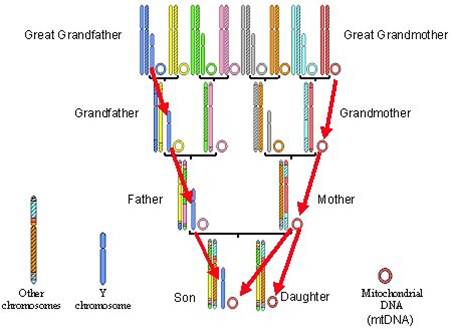
The chart below shows the male inheritance path for the X chromosome via the colored locations.  Because males and females both inherit the X from their mother, the maternal inheritance path of the X chromosome, the right half of this chart, is the same for men and women.  In this case, we’re particularly interested in the mitochondrial DNA path as well, which is the furthest right pink line on the chart, shown with the arrows along the edge.

combined x match

Including the X chromosome matching, here are your three possible outcomes.

  • If you match autosomally, you match at the deepest (full sequence) haplogroup level and you match on the X chromosome, you may indeed have a solid lead in the direct maternal line.  It’s a lead, nothing more.  It’s not confirmation of a common autosomal ancestor in that line.
  • If you match autosomally, you do not match at the haplogroup level, but you do match on the X chromosome, then you know it’s NOT the direct maternal line but it IS one of the other lines where you share an X chromosome.
  • If you match autosomally and you do not match at either the haplogroup level or on the X chromosome, you know that you can eliminate the direct maternal line and your match is probably on a line where you don’t share the X.  I say probably because like any other DNA that is shared in an autosomal fashion, meaning divided by approximately 50% in every generation, it’s possible after several generations to not show as a match on the X but to still be descended from those lines.

Jim Turner created some nice X chromosome inheritance pedigree charts that are easily printable which you can find here.

Take Away

What’s the take-away in all of this?  These are very powerful tools, but they only tools and they provide clues.  Some clues eliminate possible connections, some clues suggest them.  It’s only through multiple tools like triangulation and old-fashioned genealogy research that we confirm them.

We’ve gotten spoiled with the relatively easy Y DNA answers.  A man tests and if he matches other men with the same surname with few mutations, we call it family and all is good.  Women don’t have that luxury and neither do adoptees, although male adoptees clearly have the advantage of a potential solid Y match.  Other types of DNA testing and analysis just aren’t as straightforward or easy, but that doesn’t mean the answer isn’t there.  Perseverance is key.  Common sense, understanding the tools and removing emotion, as much as possible, from the equation are critical.  If you’re in doubt, get help.  It’s a lot better to pay for an hour or two of consulting than to make a critical error in logic that can introduce errors into your family tree or cause you to waste time chasing the wrong lines.

Unraveling the secrets your DNA has to tell you is much like that game of Clue that we played as kids – accumulating pieces of information that, cumulatively, hopefully, lead to an answer.  Miss Scarlet did it in the ballroom with Professor Plum.  Or was it Colonel Mustard, or Reverend Green?

combined clue

______________________________________________________________

Disclosure

I receive a small contribution when you click on some of the links to vendors in my articles. This does NOT increase the price you pay but helps me to keep the lights on and this informational blog free for everyone. Please click on the links in the articles or to the vendors below if you are purchasing products or DNA testing.

Thank you so much.

DNA Purchases and Free Transfers

Genealogy Services

Genealogy Research

The Found Poem

found


i will keep calm

and keep researching…

in spite of my assertion of disappointment

that the ready answer

wasn’t waiting


keener minds have

reminded me…

that

we are really just at the beginning

of this science


all of these different studies

focusing…

on that which may be discovered

through diligence


i am mindful of a great gratitude

for the things that I have been able to discover…

and which knowledge

no other generation of us

ever had even the slightest chance

of discovering


it is a wonderful picture we have been given…

a picture which fastidiously

places us personally

upon the tree of life


the reality of our descent

through ancestors

both known and unknown…

is far removed from youthful thoughts of alienation


generations of relations…

moving

inexorably

through history

is a great gift


hopefully

it is a story

i can pass on

to those who have not yet even been born…

how wonderful


and thanks to M-168

M-70

and even pf7443 whoever he was…

and H2a2a2

that very special lady


harry

______________________________________________________________

Disclosure

I receive a small contribution when you click on some of the links to vendors in my articles. This does NOT increase the price you pay but helps me to keep the lights on and this informational blog free for everyone. Please click on the links in the articles or to the vendors below if you are purchasing products or DNA testing.

Thank you so much.

DNA Purchases and Free Transfers

Genealogy Services

Genealogy Research

Happy First Blogiversary

may you live in interesting times

Today is the first anniversary of the launch of www.dna-explained.com.  In a way it seems like just yesterday and in another way, it seems like DNA-explained has been a part of my life forever.  One thing is for sure, it’s been a very interesting year!

So now, I’m going to tell you a secret.

I was going to retire early and write a book.  I was going to have time on my hands.  I was going to work on my own genealogy and share the journey of what I learned.  I was going to weed my garden.  Are you laughing now?  Holding your sides?  Well, if so, you clearly understand just how unrealistic that expectation was.

I have less, much less, time now than ever.  My little part-time retirement job overtook my original career, and then some.  I’ve never worked harder, had less sleep, nor loved it more.  Is sleep really a necessity?  Seems like so much wasted time.  Spoken like a true genealogist!

Genetic genealogy is the marriage of my two passions, genealogy and science.  I spent my entire career on the very exciting edge of technology, first communications research and discovery, then mapping and specialized software.  Genetic genealogy isn’t much different actually, except it’s more bleeding edge (some days) than leading edge and it’s much more personal and fulfilling.  Not only have I learned volumes about my own ancestors – things there was no prayer of knowing even a decade ago – but I get to help others on that journey too.  Not only that, but I’ve gotten to be personally involved in scientific discovery.  I can’t imagine a better place to be!

And no, I’m not writing a DNA book.  Well, actually, I am, soft of – but just in a different way.  Blogs are the way of the future – so is electronic communication.  The problem with books about fast-moving and highly technical topics is that they move on and change so rapidly that tomorrow, literally, your book can be out of date and you have no way to update it.  Just what I don’t need is another box of boat-anchors in my office.

Not long ago, someone on the ISOGG Facebook page asked for a list of books and someone replied, “forget the books, read the blogs.”  I don’t want to invest the effort into one of those “forgotten books” when the blogosphere beckons and is so much more friendly towards photos, graphics, color and change.  It’s also a lot more personal and flexible.  And it lets me interact with you and vice versa .

So how have we done this first year?  As of yesterday, we surpassed 2100 subscribers and that doesn’t count all of the RSS feed, Facebook and Twitter followers.  My husband bet me I’d have 2000 by summer and I said I wouldn’t.  Good thing I didn’t bet much, because I was wrong.  Thanks to all of you.  Sometimes being wrong is a good thing!

This is the 162nd posting, so about one every other day.  I had goaled one a week.

There have been a total of about 2700 “real” comments and are you ready for this, almost 29,000 spam ones.  No, that is not a typo.  Yes, I do use a spam filter, but I still approve every single comment that is posted – and now you know why.  The spam filter doesn’t catch them all, because spammers are crafty!

In total, the articles are “tagged” in 81 different categories so you can find them by searching.  One of the articles I’ll be writing soon will tell you how to use and search blogs more efficiently, including this one!

http://www.dna-explained.com has had a total of 249,545 views, nearly a quarter million and that doesn’t count the 2100+ people who receive postings via e-mail and RSS.  We average just over 1000 hits per day now.  Wow!

What is the most popular category of blog articles visited?  Autosomal DNA.

How about the most popular article?  Big News! Probable New Native American Haplogroup.  That shocked me.  For a long time, the most popular article had been the kickoff of the Geno 2.0 announcement, National Geographic – Geno 2.0 Announcement – The Human Story published on July 25, 2012.  Older articles have more time to amass hits – and the haplogroup article was just published June 27th.  Indeed it does seem to be big news and is of interest to lots of people.

One of my reasons for creating this blog was as a matter of self-defense.  I receive a lot of inquiries through my various list memberships.

So I decided that if I wrote the answers to the most frequently asked questions, well, including graphics and pictures (which really are worth 1000 words), once, I could use that document to answer people’s questions, over and over again.  The good news is, so can you.  What are the most commonly asked questions and the pages I use to answer them?

  1. What can DNA testing do for me?  That is such a basic question and the answer could be that book I didn’t write.  I use the article 4 Kinds of DNA for Genetic Genealogy to answer this one.
  2. I think my ancestor was Native American and I want to prove it.  This question also has other variants like, proving which tribe, joining a tribe, getting benefits and free education.  I refer people to the article Proving Native American Ancestry Using DNA.
  3. I’m adopted, or I don’t know who my father is, and I want to use DNA testing to find my parents/ancestry.  This is also relevant for people who discover an undocumented adoption in their line that “interferes” with the genealogy they thought they knew.  For this answer, I use I’m Adopted and I Don’t Know Where to Start.  This article, along with many others, links within the article to other resources as well.
  4. What can autosomal testing do for me?  If I had a dollar for every time I’ve received some flavor of this question, I’d be really retired and on that World Cruise!  The article I use for this is Autosomal Basics.
  5. And then the companion question to the one above, my autosomal results are back – what do I do with them now?  For this one, I refer people to the summary article for The Autosomal Me series.  While it is focused on a particular challenge for me, minority Native admixture, the tools and techniques are relevant for everyone.

We’ve had an awesome first year, thanks to all of you, and I’m looking forward to even more breakthroughs and findings in year two.  I love sharing your stories and victories too and always appreciate tips and hints pointing out genetic genealogy items of interest.  I have some fun articles planned for this upcoming year and there are discoveries on the horizon, so stay tuned!!!

And indeed, may we all continue to live in very interesting times!

______________________________________________________________

Disclosure

I receive a small contribution when you click on some of the links to vendors in my articles. This does NOT increase the price you pay but helps me to keep the lights on and this informational blog free for everyone. Please click on the links in the articles or to the vendors below if you are purchasing products or DNA testing.

Thank you so much.

DNA Purchases and Free Transfers

Genealogy Services

Genealogy Research


5,500 Year Old Grandmother Found Using DNA

???????????????????????????????????????????????????????????????????????????????????????????????????????????????????????????????????????????????????????????????????????????????????????????????????????????????????????????????????????????????????????????????????????????????????????????????????????????????????????????????????????????????????????????????????????????????????????????????????????????

Members of the Metlakatla First Nation Community near Prince Rupert, BC who collaborated with an international team of scientists in a genetic study of aboriginal people, including excavated remains that link them to their 5,500 year old Grandmother.  Photograph/handout courtesy of the Metlakatla Treaty Office.

Over the past decade or so, there has been a lot of debate about tribal participation in DNA testing.  Without getting into the politics of the situation which is deep and dangerous water, many tribes see absolutely no possibility that DNA testing could help them, and a significant potential that it might hurt them, one way or another.

For example, we know that the Eastern tribes were heavily admixed with Europeans quite early and we know that the Southwest tribes are equally admixed with the Spanish.  Yet, they are still Native tribes, carrying on the Native customs and cultures, including their own creation and other sacred stories.

Let’s say that a few tribal members test, and their DNA turns out not to be Native, but is European, or African.  Granted, the DNA would only be representative of one genealogical line, either the direct paternal (surname) line for males and the direct maternal line for both males and females, but still, if you expect Native and you get something else – it could be bothersome, and perhaps troublesome.  Add to that a historical situation filled with distrust for a government that routinely broke treaties and you have a situation where tribes would just as soon not open Pandora’s box, thank you very much.

However, not all tribes think this way.  For the past several years, people from Canada’s First Nations tribes have been working with scientists not only to test their DNA, but that of their ancestors as well.  Recently, a paper was published detailing the findings, but those findings didn’t really say much about the effects of the results on the currently living people and tribes involved.

The Vancouver Sun recently carried a human interest story focused on the Metlakatla First Nation Community and the people who were found to be related to the 5,500 year old bones that DNA was extracted from.

The people involved who descend from either this woman or a common ancestor with her are thrilled to be able to make that connection from some 220 generations ago, to be able to honor her as their Grandmother, and the connection cements the fact that these people’s ancestors were indeed on this same land at least 5,500 years ago, not far from where they live today.

This kind of information has great potential to help the tribes involved with land claims and treaty rights.  These deep rooted links to the region simply cannot be denied.  So the First Nations people stand to benefit, the people who match the Grandmother are thrilled, science benefits and they have the ability to confirm their own stories told by the Ancestors for centuries, indeed, for thousands of years.  Sounds like a win-win situation to me.

Congratulations to these First Nations people for this wonderful link to a Grandmother, for their brave participation and leadership role in scientific study, and for not being afraid of finding the truth, whatever it is.  The Ancestors would be proud of you!

______________________________________________________________

Disclosure

I receive a small contribution when you click on some of the links to vendors in my articles. This does NOT increase the price you pay but helps me to keep the lights on and this informational blog free for everyone. Please click on the links in the articles or to the vendors below if you are purchasing products or DNA testing.

Thank you so much.

DNA Purchases and Free Transfers

Genealogy Services

Genealogy Research

Pérez, Peres, Paries, Perica, Perry and Paris on PBS, Oh My

perez signatureYou know, it’s amazing the things you learn filming a PBS documentary.

You learn that no matter what you do, light is going to reflect off of your glasses.

You learn that you can indeed hear an unhappy cat who has been banished to the 3 seasons room through two closed doors.  That same unhappy cat begs to go out there any other time.

You learn that while you are filming, the phone, will, unfailingly ring every time, even if it hasn’t rung in 3 days.

You learn that if you take your phone off the hook, AT&T, now a smarter phone company, figures this out, assumes you made a mistake, and lets the phone ring again anyway.  Sigh….

You learn that if you get one of those annoying recorded sales calls, if you just lay the phone down (or bury it under a pillow), it will play forever and effectively takes the phone “off the hook.”  YES!!!

You learn that if you are a young man in the late 1800s from Guam, you sign on to a whaling ship, and the guys can’t pronounce your name, Dimitrio, they call you John.  Eventually you begin to call yourself John too.  It’s contagious apparently.  You do, however, give two of your children Dimitrio as a middle name, just to torment your descendants with hidden clues.

And you learn that the surname Perez which is pronounced in the US like the word pear with the beginning of the word Ezmerelda is pronounced like the city in France, Paris, in Guam.

You also learn that a man named Juan Perez, also known as Dimitrio Perez can mix his multiple first names and about 6 different ways of spelling Perez in an indefinite number of ways.  His signature as John Paris is shown above.

Indeed, maybe this is a clue to our mystery.

A mystery?  What mystery?  I love a good mystery!!!

The Mystery

Well, Jillette Leon-Guerrero has a fine mystery on her hands with all of the requisite red herrings and twists of fate included.  And she’s making a PBS documentary of her process of finding the answer.  Check out her website, Across the Water in Time.

It’s hard enough to track people whose surnames are misspelled, but to change countries, change pronunciations, change surnames, change first names….and to still be able to be identified…well, now we’ve entered the realm of DNA sprinkled with a little fairy dust for good luck.

So, here is the fundamental question.  Is Juan Perez, aka Dimitrio Perez aka John Paris, who was born in 1843 and died in 1928 in Hawaii related to the Perez family on Guam?

The descendants of John Paris on Hawaii carry an oral history that he was from Guam, then a Spanish colonial colony.  Jillette, from Guam herself, discovers later that they also had an oral tradition that he changed his name from Dimitrio to John.  How she wished she had known that sooner.  Dimitrio is a much easier name to search for than generic apparently-one-size-really-does-fit-all-men-on-a-whaling-ship Juan.

DNA Testing

In order to answer the question, DNA testing was performed, ultimately on three groups of people.  What we wanted to know was whether these people were related and if so, how and how far back in time?

Group 1 – In Hawaii, known descendants of Juan Perez/John Paris, his great-granddaughter Yolanda and her brother, Benjamin Paris.

Group 2 – From Guam, Jillette and her father.

Group 3 – From Guam, Jose Perez.  Jose ultimately tested to be a second cousin of Jillette’s father, but that was unknown prior to DNA testing.

Two different kinds of DNA testing can be utilized to answer the question.  These two types of tests answer fundamentally different questions.

The Perez/Paris Y Tests

The Y DNA test tests only the Y chromosome, handed from father to son, unmixed with the DNA of the mother, so it stays mostly intact generation to generation, except for an occasional mutation.  The inheritance path of the Y chromosome is shown on the following chart in blue.

Perez yline

The Y-line gives us a great deal of information about the direct paternal line, but no information about any other line.  Comparing the Y-line results of 2 men tells us whether they descend from a common ancestor.

In order to determine whether or not the Paris family on Hawaii is genetically the same as the Perez family of Guam, Benjamin Paris, great-grandson of John Paris of Hawaii, and Jose Perez, descendant of the Perez family of Guam, tested.  Indeed, their Y chromosomes do match, with one mutation difference, which would be expected to occur over time.  Initially, only 12 markers were tested, which included the mutation difference, so the tests were expanded to 37 markers each to confirm the match.  The two men match perfectly on the rest of the markers, so at 37 markers, they still have one mutation difference.

Family Tree DNA provides a tool called TIP which estimates the time to a common ancestor between men whose DNA matches based on the mutation rates of different markers and the known generational distance between the men.  For example, we know that these families aren’t related in the past three generations, since Juan Perez came to Hawaii.

The TIP tool estimates that at the 50th percentile, these men are likely to be share a common ancestor between 4 and 5 generations ago.  So it’s very likely that either the father of Juan Perez who immigrated to Hawaii was their common ancestor, or his father.  One thing we know for sure, it was after the adoption of Spanish surnames on Guam.  Guam was colonized in the 17th century after the Spanish claimed it in 1565 and the first Catholic missionaries arrived in 1568 and began to baptize people with Spanish given and surnames.

Therefore, if Juan Perez was born in 1843, his father would have been born approximately 1813 and his father approximately 1783, allowing for the average 30 year generation.

This means that the common ancestor of these two families was probably 5 or 6 generations ago, and possibly more.

Autosomal Tests

The second type of test utilized was autosomal testing which tests all of the DNA passed from both parents to a child, not just the direct Y DNA of the paternal line.  The reason to use this type of test is that it shows you who your cousins are as measured by the amount of DNA that matches.
perez autosomal

DNA is passed to descendants in a predictable way, allowing us to mathematically calculate how closely related two people are – at least roughly.

Each parent gives half of their DNA to a child.  Different children don’t get the same “half” of the parents DNA, so each child inherits somewhat differently.  Therefore,  siblings share approximately half of their DNA.

perez cousins

You can see in the above chart that people receive 50% of their parents DNA, 25%, approximately of each grandparent’s DNA, and so forth up the tree.  By the time we reach the great-great grandparents level, you only inherited about 6.25% of your DNA from each grandparent.

In the case of 5th or 6th generation descent, as in our case, we’re looking at each descendant carrying about 3.12% of the DNA at the 5th generation, and 1.56% at the 6th generation.  Two individuals descended from these common ancestors would both carry an estimated 3.12%, but not necessarily the same 3.12%.  In fact, you only share .78% of common DNA with a third cousin and .195% with a 4th cousin.

I’ve said “on average” and this means that after the parents’ generation, the DNA of each preceding generation is not passed in exactly 50% packets.  In other words, you might not get exactly 25% of the DNA of each of your grandparents, but might receive 20%, 30%, 24% and 26%.

Autosomal testing is a powerful tool, but it’s less and less specific in terms of exactly how closely people are related, the further back in time relationships and common ancestors reach.

Because of this, it’s important to use the oldest generation available for testing.

We tested 4 individuals using the Family Finder autosomal test at Family Tree DNA; Jillette’s father, Jose Perez from Guam and both Yolanda and Benjamin Paris who are siblings from Hawaii.

The results were that Jillette’s father matched Jose Perez from Guam as a second cousin, suggesting that they share a common great-grandfather, and at the third cousin level with both Benjamin and Yolanda, suggesting that they share a common great-great-grandfather with Jillette’s Dad.

Match Name Relationship Range Suggested Relationship Shared cM Longest Block
Jose Perez 2-3rd   cousin 2nd   cousin 222.83 29.77
Yolanda   Paris 2-4th   cousin 3rd   cousin 56.58 22.55
Benjamin   Paris 2-4th   cousin 3rd   cousin 67.52 21.10

Family Tree DNA utilizes the 5cM (centiMorgan) threshold to indicate a match, where we can see to the 1cM threshold on the raw data.  I did this breakout for all parties, and indeed, they did show as related.

On the graph below, each of the three individuals is being compared to Jillette’s Dad.  Notice that in many cases, both Yolanda (blue) and Benjamin (orange), together, match Jillette’s Dad, which would be expected because they are siblings.  There are other cases through where either Yolanda or Benjamin match Jose (green) on the same segment where they both match Jillette’s Dad.  For example, on chromosome 2, you can see the blue stacked on top of the green.  We also see examples of orange and green as well, but no place to we have orange, blue and green together.  This illustrates how differently siblings (Yolanda and Benjamin) inherited DNA from their parents.

perez chromosomes

The Question that Remains

We’ve now proven that the Paris/Perez family is one and the same on Guam and Hawaii utilizing Y-line DNA and that these people are all related at some level.  Of course, in genealogy, answers generally produce more questions.

Jillette will have to utilize genealogy records in Guam to determine who the father of Jose (aka Dimitrio) Perez was, and indeed, she has made inroads in doing so.

The second question is just how is the Perez family related to Jillette’s family?  We know that her father is likely a second cousin to Jose Perez, meaning they share a common great-grandparent, but who?  Keep in mind that these are estimates based on the percentage and length of shared DNA, and the cousin estimate could also fall a generation or half-generation (once removed) in either direction.

Leen tree - Jillette

Jillette’s father’s 8 great-grandparents are as follows:

  • Vincente de Leon Guerrero Y Santos and Maria de Las Nieves Gregario
  • Unknown Fejerang and unknown Guzman
  • Francisco de la Torre and Maria Acosta
  • Fabian de la Cruz and Juliana Ada

You’ll notice, there’s not a Perez among them.  Now what?

This is both a genealogical and a genetic question, and can be approached in both ways simultaneously.  Obviously, were Jillette to discover that the next generation included a Perez, then the mystery would be solved.  However, using genetics can narrow the scope of this hunt.

Jillette needs to utilize known relationships to narrow the scope of which line descends from the Perez family.

The best way to do this is to test another relative of her grandparents, assuming both grandparents are deceased.  The best bet here is to test a sibling of a grandparent.  If you test a sibling of both grandparents autosomally, one of them should match Jose Perez.  That immediately eliminates half of Jillette’s Dad’s ancestors.  If a sibling of Jillette’s Dad’s grandparents isn’t available, then test their children.

Let’s say, by way of example, that we have now limited the search to Jillette’s Dad’s paternal line.  That consists of two grandparents, Rita Guzman Fejerang and Justo Gregario de Leon-Guerro.  The next step, genetically, is to test people who descend from the parents of Rita and Justo, but not the children of Rita and Justo.  So, Jillette needs to find siblings of Rita and Justo and test their siblings oldest descendants.  Again, one line should match Jose Perez.

Utilizing this technique, it’s possible to “walk up the tree,” so to speak.  In the meantime, this technique will help Jillette focus on where to concentrate her genealogical efforts.

ICW – In Common With

Another tool that Jillette can use is the ICW, or “in common with” tool at Family Tree DNA.  This tool is underutilized, as many people don’t realize what it can do.

If you mark a match as a known relative, you can then see matches you have in common with that person.  If you both match an individual, you should contact that individual to see if they have a piece of genealogical information that links to either or both of you.  In Jillette’s case, the mystery of how her family connects to the Perez family in Guam could well be held in the genealogy records of one of the ICW matches.

You can see that Jillette has confirmed the relationship for two matches below.

Perez match

To view your common matches, in the drop down box, select “in common with” and in the box directly below, you’ll see the people you’ve confirmed with a known relationship.  Select the person you want to see your common matches with, and click on the orange “filter” button.

perez in common with

The display you will see are the people who match both of you.  In this case, there are two common matches between Jillette’s father and Jose Perez that are not among the group tested above.  That’s exciting, because we know they are related to both men – the only question is how.  Jillette is working on these questions.

Follow the Story

So if you are a Perez, Paris or anything similar from Hawaii or Guam, please, contact Jillette through her website.  If you are a Leon-Guerrero, contact Jillette.  And if you want to see how this episode of Genetic Genealogy Reality TV turns out, you’ll have to follow Jillette’s blog on her webpage.  Perhaps the PBS special will be widely available or uploaded to YouTube and we’ll all be able to share in the final chapter of this exciting mystery!

______________________________________________________________

Disclosure

I receive a small contribution when you click on some of the links to vendors in my articles. This does NOT increase the price you pay but helps me to keep the lights on and this informational blog free for everyone. Please click on the links in the articles or to the vendors below if you are purchasing products or DNA testing.

Thank you so much.

DNA Purchases and Free Transfers

Genealogy Services

Genealogy Research


Ancient DNA Analysis From Canada

malhi ripan in lab

Recently a new academic paper focused on Native American ancestry hit the news.  Ripan Malhi’s molecular anthropology and ancient DNA lab at the University of Illinois, shown above, in Urbana, Illinois has successfully extracted DNA from remains of individuals whose bones were found in an ancient trash heap in British Columbia and has successfully matched the DNA with living people today, confirming of course that today’s people were related to these ancient people and are a part of the same base population that lived there 5000-6000 years ago and remains today.

malhi paper map

Ripan’s paper, “Ancient DNA Analysis of Mid-Holocene Individuals from the Northwest Coast of North America Reveals Different Evolutionary Paths for Mitogenomes” discusses this in detail.  If you’re not up to this level of detail, a nice article in LiveScience covers the discovery as well.

Ripan has successfully connected the dots between the fossilized remains and currently living members of several Native tribes local to the region where the bones were found.

As part of this study, three new mitochondrial haplogroups were discovered in the Native population.  Two haplogroups, A2ag and A2ah are found alive and well today.  However, another, D4h3a7 has only been found one other time, in remains found in a cave in Alaska, and may have gone extinct.  It has not been found in living people to date, although a lot of people have yet to be tested.

The area where the remains were found is indigenous to the Tsimshian, Haida and Nisga’a tribes.

Today, local tribes are participating in additional research with Dr. Malhi in order to better understand their ancestry and to see if the genetic data supports their extensive oral history which suggests multiple migration waves from Asia into the Americas within the past 5000 years.

______________________________________________________________

Disclosure

I receive a small contribution when you click on some of the links to vendors in my articles. This does NOT increase the price you pay but helps me to keep the lights on and this informational blog free for everyone. Please click on the links in the articles or to the vendors below if you are purchasing products or DNA testing.

Thank you so much.

DNA Purchases and Free Transfers

Genealogy Services

Genealogy Research


James Watson on DNA

James Watson is most likely the most famous living scientist.  Everyone knows that he, along with Francis Crick discovered the DNA molecule back in 1953, 60 years ago.  In 1962, those two along with Maurice Wilkins were awarded the Nobel prize for their discovery.

As we remember scientists and their discoveries, I think we often miss the human element of the process.  How they feel and felt at the time, what they think and thought, the softer side of science.

Watson Crick 1953

This photos shows Francis Crick and James Watson together in 1953 at Cambridge, from the Collection of the Cold Springs Harbor Lab Archives.

CNN interviewed Watson recently, and you can read the article and see the video here.

I found some of his quotes to be very interesting.

“All you can say is that you were very lucky. You were born at the right time and your parents gave you books when you were young.”

I’m all for that.  I was and am an avid reader and I instilled that in both of my children as well.

Watson equates his passion for DNA and genetic research to his ancestor’s passion for the Gold Rush.  I can empathize with that – once the DNA bug bites you, it’s lifelong and unrelenting!  Passion fuels discovery of any type.  Watson discovered a very different kind of gold – the elixir of all humanity.

Of the day they discovered DNA, he says, “We went to lunch.  We had to tell people we’d done something important, but they didn’t know what we were saying.”  That’s certainly not the case today.  “Done something important” is an incredible understatement – perhaps the strongest understatement I’ve ever seen.

He said he felt queasy when they told everyone within hearing distance that they had found the secret of life.  Well, making the discovery of the millennium will do that to you!

I understand how he felt though.  I get the same look he must have received when I explain to my family how excited that I am that we’ve found a new haplogroup.  Thank heavens for our genetic genealogy community today.

Watson’s reaction to the Eureka moment of discovery, “All we could say when we got it: It’s so beautiful.”

watson crick dna model

DNA model built by Crick and Watson in 1953 is on display in the National Science Museum of London.  You can read the amazingly short paper published in Nature here or an annotated version here.

dna diagram from paperAt right is the diagram of DNA from the 1953 paper.  Its elegance, simplicity and symmetry is stunningly beautiful.

For those interested, Nature compiled what they consider to be the 5 classic DNA papers of which the Watson/Crick paper is one, of course.

Interestingly, Watson says he doesn’t want to die before he sees cancer cured and feels it could happen.  I certainly hope so.  Whenever this does happen, you know that genetics will certainly play a prominent role in the cure.  Discoveries in medicine as well as in other genetics fields like molecular biology, evolutionary genetics, population genetics and genetic genealogy continue to be made every day – all stemming from this monumental discovery in 1953.

Watson says of himself, “I wanted to understand the world about me better.  I wanted to do something important with my life.”  Do you think he succeeded?

______________________________________________________________

Disclosure

I receive a small contribution when you click on some of the links to vendors in my articles. This does NOT increase the price you pay but helps me to keep the lights on and this informational blog free for everyone. Please click on the links in the articles or to the vendors below if you are purchasing products or DNA testing.

Thank you so much.

DNA Purchases and Free Transfers

Genealogy Services

Genealogy Research

Mitochondrial DNA Smartmatching – The Rest of the Story

Sometimes, a match is not a match.  I know, now I’ve gone and ruined your day…

One of the questions that everyone wants the answer to when looking at matches, regardless of what kind of DNA testing we’re talking about, is “how long ago?”  How long ago did I share a common ancestor with my match?  Seems like a pretty simple question doesn’t it?

The answer, especially with mitochondrial DNA is not terribly straightforward.  A perfect example of this fell into my lap this week, and I’m sharing it with you.

Mitochondrial DNA – A Short Primer

There are three regions that are tested in mitochondrial DNA testing for genealogy.  The HVR1 and HVR2 regions are tested at most testing companies, and at Family Tree DNA, the rest of the mitochondria, called the coding region, is tested as well with the full mitochondrial sequence test.  This is the mitochondrial equivalent of Paul Harvey’s “the rest of the story,” and of course we all know that the real story is always in “the rest of the story” or he wouldn’t be telling us about it!

Many times, the rest of the story is critically important.  In mitochondrial DNA, it’s the only way to obtain your full haplogroup designation.  If you don’t want to just be haplogroup J or A or H, you can test the coding region by taking the full sequence test and find out that you’re J1c2 or A2 or H21, and discover the story that goes with that haplogroup.  Guaranteed, it’s a lot more specific than the one that goes with simple J, A or H.  Often it’s the difference between where your ancestor was 2000 years ago and 20,000 years ago – and they probably covered a lot of territory in 18,000 years!

Let’s take a quick look at mitochondrial DNA.

To begin with, the HVR1 and HVR2 regions are called HVR for a reason – it’s short for hypervariable.  And of course, that means they vary, or mutate, a lot more rapidly, as compared to the coding region of the mitochondrial DNA.

In layman’s terms, think of a clock.  No, not a digital clock, an old-fashioned alarm clock.

alarm clock

The entire mitochondrial DNA has 16,569 locations.  The HVR1 and HVR2 regions take up the space on the clock face from 5 till until 5 after the hour.   The rest is the coding region – the mitochondrial “rest of the story.”  The coding region mutates much slower than the two HVR regions.

Just to be sure we’re on the same page, let’s talk for just a minute about how mitochondrial haplogroup assignments work.  For a detailed discussion of haplogroup assignments and how they are done, see Bill Hurst’s discussion here.

Generally a base haplogroup can be reasonably assigned by HVR1 region testing, but not always.  Sometimes they change with full sequence testing – so what you think you know may not be the end result.

My full haplogroup is J1c2f.  My base haplogroup is J.  I’m on the first branch of J, J1.  On branch J1, I’m on the third stick, c, J1c.  On the third stick J1c, I’m on the second twig, J1c2.  On the second twig, J1c2, I’m leaf f, or J1c2f.  Each of these branches of haplogroup J is determined by a specific mutation that happened long ago and was then passed to all of that person’s offspring, between them and me today.  The question is always, how long ago?

Mutation Rates – How Long Ago is Long Ago?

While we have a tip calculator at Family Tree DNA for Y-line DNA to predict how long ago 2 Y-line matches shared a most recent common ancestor, we don’t have anything similar for mitochondrial DNA, partly because of the great variation in the mutation rates for the various regions of mitochondrial DNA.  Family Tree DNA does provide guidelines for the HVR1 region, but they are so broad as to be relatively useless genealogically.  For example, at the 50th percentile, you are likely to have a common ancestor with someone whom you match exactly on the HVR1 mutations in 52 generations, or about 1300 years ago, in the year 713.  Wait, I know just who that is in my family tree!

These estimates do not take into account the HVR2 or coding regions.

I did some research jointly with another researcher not long ago attempting to determine the mutation rate for those regions, and we found estimates that ranged from 500 years to several thousand years per mutation occurrence and it wasn’t always clear in the publications whether they were referring to the entire mitochondria or just certain portions.  And then there are those pesky hot-spots that for some reason mutate a whole lot faster than other locations.  We’re not even going there.  Suffice it to say there is a wide divergence in opinion among academics, so we probably won’t be seeing any type of mito-tip calculator anytime soon.

Enter SmartMatching

Family Tree DNA does their best to make our matches useful to us and to eliminate matches that we know aren’t genealogically relevant.

For example, this week, I was working on a client’s DNA Report.  Let’s call him Joe.  Joe is haplogroup J1c2.  I am haplogroup J1c2f.  J1c2f has one additional haplogroup defining mutation, in the coding region, that J1c2 does not have.

Joe and I did not show as matches at Family Tree DNA, even though our HVR1 and HVR2 regions are exact matches.  Now, for a minute, that gave me a bit of a start.  In fact, I didn’t even realize that we were exact matches until I was working with his results at MitoSearch and recognized my own User ID.

I had to think for a minute about why we would not be considered matches at Family Tree DNA, and I was just about ready to submit a bug report, when I realized the answer was my extended haplogroup.  This, by the way, is the picture-perfect example of why you need full sequence testing.

Family Tree DNA knows that we both tested at the full sequence level.  They know that with a different haplogroup, we don’t share a common ancestor in hundreds to thousands of years, so it doesn’t matter if we match exactly on the HVR1 and HVR2 levels, we DON’T match on a haplogroup defining mutation, which, in this case, happens to be in the coding region, found only with full sequence testing.  Even if we have only one mismatch at the full sequence level, if it’s a haplogroup defining marker, we are not considered matches.  Said a different way, if our only difference was location 9055 and 9055 was NOT a haplogroup defining mutation, we would have been considered a match on all three levels – exact matches at the HVR1 and HVR2 levels and a 1 mutation difference at the full sequence level.  So how a mutation is identified, whether it’s haplogroup defining or not, is critical.

In our case, I carry a mutation at marker 9055 in the coding region that defines haplogroup J1c2f.  Joe doesn’t have this mutation, so he is not J1c2f, just J1c2.  So we don’t match.

So – How Long Ago for Me and Joe?

Dr. Behar in his “Copernican Reassessment of the Mitochondrial DNA Tree,” which has become the virtual Bible of mitochondrial DNA, estimates that the J1c2f haplogroup defining mutation at location 9055 occurred about 2000 years ago, plus or minus another 3000 years, which means my ancestor who had that mutation could have lived as long ago as 5000 years.

The mutations that define haplogroup J1c2 occurred about 9800 years ago, plus or minus another 2000.  So we know that Joe and I share a common ancestor about 7,800 – 11,800 years ago and our lines diverged sometime between then and 2,000 – 5,000 years ago.  So, in round numbers our common ancestor lived between 2,000 and 9,800 years ago.  Not much chance of identifying that person!

The ability to eliminate “near-misses” where the HVR1+HVR2 matches but the people aren’t in the same haplogroup, which is extremely common in haplogroup H, is actually a very useful feature that Family Tree DNA nicknamed SmartMatching.  With over 1000 matches at the HVR1 level, more than 200 at the HVR1+HVR2 level and another 50+ at the full sequence level, Joe certainly didn’t need to have any “misleading” matches included that could have been eliminating by a logic process.

So while Joe and I match, technically, if you only look at the HVR1 and HVR2 levels, we don’t really match, and that’s not evident at MitoSearch or at Ancestry or anyplace else that does not take into consideration both full sequence AND haplogroup defining mutations.  Family Tree DNA is the only company that does this.

It’s interesting to think about the fact that 2 people can match exactly at the HVR1+HVR2 levels, but the distance of the relationship can be vastly different.  I also match my mother on the HVR1+HVR2 levels, exactly, and our common ancestor is her.  So the distance to a common ancestor with an exact HVR1+HVR2 match can be anyplace from one generation (Mom) to thousands of years (Joe), and there is no way to tell the difference without full sequence testing and in this case, SmartMatching.

And that, my friends, is the rest of the story!