Elizabeth Ann Speaks (1832-1907) and the Path from Tennessee to Gisburn, England – 52 Ancestors #8

Elizabeth “Bettie” Ann Speaks was born in 1832 in Indiana or Virginia, per the census, although her parents were from Lee County, Virginia.  She died in 1907 in Hancock County, Tennessee.  I never spoke with anyone who actually knew her, but I spoke with people who knew of her.

My grandparents would have known her for between 20 and 30 years, but I didn’t know them.

She married Samuel Claxton, also spelled variantly Clarkson and Clarkston, according to Samuel’s Civil War records,  on August 22, 1850, at the home of Tandy Welch.  Her grandfather, the Reverend Nicholas Speak performed the ceremony.  In the 1850 census, which was taken on December 13th, they are living beside the rest of the Claxton clan in Hancock County, Tennessee, where she would live the rest of her life.  There is no baby yet, but my great-grandmother Margaret Claxton was on the way, being born on July 25, 1851.

We don’t really know much about Elizabeth, who, according to family, was called Bettie.  Family records show her middle name as Ann, but the Civil War pension application consistently shows her middle initial as L.  She apparently did know how to sign her name, as she signed the application for a Civil War pension in 1878.

Elizabeth signaure

The first record, other than the census, is a note in the Rob Camp Church records where Elizabeth Clarkson is “received by experience” on Monday, August 25th, 1858, meaning that she did not transfer from another church, but was “saved” and probably baptized.

In 1860, she was listed with the occupation of “scowering” and had 5 children.  Her birth state is listed in 1860 as Indiana, but is listed as Virginia in other census records.

Her husband, Samuel would cross into Kentucky to join the Union troops in May of 1863 and served during the Civil War in the Tennessee Cavalry Company F, contracting tuberculosis which would kill him nearly a decade later.  He was discharged in May 1865, ill, from the hospital.

This photo of Elizabeth was taken sometime during or after the Civil War and before her husband passed away in 1876, so between 1863 or so and 1875.  That’s Samuel in the photo with her, wearing his uniform.

I must admit, the first thing I noticed about her was her “distinctive nose” as one of my cousins phrased it, and I am every so grateful that I did not inherit that from her.  Genetics was my friend.

Samuel Claxton Elizabeth Speaks

On the second Saturday of April 1869 Rob Camp Baptist Church released the following members from their fellowship:

E..H. Clarkson
Mary Clarkson
William Mannon
Elizabeth Mannon
Mary Muncy
Clarissa Hill
Sarah Shefley
Farwix Clarkson
Agnes Clarkson
Nancy Furry
Elizabeth Clarkson
Margaret Clarkson
William Bolton
James Bolton
John Grimes
Catherine Grimes
Joseph Bolton

These members were released for the purpose of constituting Mount Zion Baptist Church.  On the third Saturday of May 1869 these brothers and sisters met, along with representatives from Cave Springs, Big Spring Union and Chadwell Station to officially constitute a church.  That church, albeit three buildings later, still stands in the same location on land donated by William Mannon, noted above.

Elizabeth Speaks Clarkson is among the members listed, as are her in-laws, Fairwick and Agnes Muncy Clarkson.  Her daughter, Margaret Clarkson, also listed would marry Joseph Bolton, Jr., in 1873.  We don’t know if Joseph Bolton listed above is Jr. or Sr., but I suspect Sr. since Jr. would have only been 16 at that time.  Margaret was 2 years older than Joseph Bolton Jr.

Interestingly, Elizabeth’s husband, Samuel’s name is absent.  However, that is explained by a note in the church records dated Sept. 2, Saturday, 1868 wherein the following is found:

“Excluded Samuel Clarkson for getting drunk and not being willing to make any acknowledgements whatever.”  The same day, “Elected brother Joseph Bolton to the office of Deacon.”

The churches of that time were rather strict, serving as a combination of religious institution, the only social outlet in the area and moral prosecutor.  The church rules as set forth in their covenants included the following gems:

  1. Every male member wishing to speak shall rise from his seat and address the moderator and then speak strictly adhering to the subject matter under consideration.
  2. No member may speak more than 3 times on one subject without liberty obtained from the church.
  3. No member shall have liberty of laughing or whispering in times of public worship.
  4. No member of this church is permitted to address another member in any other appellation other than brother.
  5. No member is permitted to abruptly absent himself in time of business without leave of the moderator
  6. Members shall not neglect attending meetings and shall not remove out of the bounds of the church without applying for a letter of dismissal.

Judging from the disciplinary actions taken against members in the church notes, you also could not play marbles, swear, get drunk, talk badly about or have a dispute with another church member, attend another church, and certainly not one of a different faith, dance, tell a falsehood or commit adultery.  One man had charges brought for “betting and shooting,” although I don’t know if that was one thing or two.  Some of the disciplinary actions read like a soap opera and ran for months in the notes.  The church committed impartial people to help resolve issues between church members, but often, the resolution was that both people either left the church or were dismissed.   Church business was high drama and the soap opera of the day.  Notes often read like court proceedings where offenders were “found guilty” and disciplined.  Fortunately for members, the worse they could do was throw you out of the church.  If you acknowledged your sins, confessed publicly, and promised to try to do better and live a better life, you could be “reinstated to full fellowship.”

In the 1870 census, Elizabeth Speaks and Samuel Claxton have 8 children and are living beside his parents, Fairwick and Agnes Muncy Claxton.

In 1876, Samuel dies officially of pneumonia, but probably of tuberculosis contracted during his Civil War service.

On Oct. 18, 1878, Elizabeth applied for a widow’s pension for her husband’s Civil War service.  In1880, she is noted as a widow with 1 child.

In the 1880 census, Elizabeth is a widow and has 100 acres of land worth $250.

On March 13, 1881, Calvin Wolfe and Rebecca, his wife, deeded to Elizabeth Clarkson land on the North side of the Powell River adjacent Henry Yeary’s gate and Roda Shiplet’s line, Nancy Snavely’ line and the main road.  The acreage isn’t given.  Rebecca Claxton Wolfe was the sister of Elizabeth’s deceased husband, Samuel Claxton.

A few months later, Elizabeth then sells what appears to be the same tract of land of 27.25 acres “laying on the north side of the road leading from Tazewell to Jonesville” to several members of the Overton family, who do not appear to be related.  Elizabeth signs the deed, so she can write her name.

On Sept. 4, 1894, Elizabeth Clarkson petitions the Mount Zion Church for a letter of dismissal.  This typically means the person is moving or wants to join another church and the letter states they have been a member in good standing.

The only other photo we have of Elizabeth is one taken about 1896 with her family.  She is in the dark dress, center, front middle.

Elizabeth Speaks 1896

In the 1900 census, she tells us that she gave birth to 12 children and 9 were living.

  • Margaret N. 1851-1920 married Joseph Bolton
  • Cyrena “Rena” M. 1852-1887
  • Surrilda Jane 1858-1920 married William (Luke?) Monday
  • Clementine 1853-after 1877
  • Sarah Ann 1857-1860/1870
  • Cynthia “Catherine” 1860-1901 married William Muncy
  • John 1861-1899/1900
  • Matilda 1867-1944 never married
  • Henry Clint 1869-1937 married Amanda Jane Estep
  • Mary W. 1872 – after1900 married Martin Parks
  • Jerushia Claxton 1874-1925 married Thomas Monroe Robinson
  • Elizabeth 1876-1877/1878

The family lived along the Powell River in Hancock County, Tennessee where the Clarkson Cemetery, now known as the Cavin Cemetery, is located at the intersection of River Road and Owen Ridge Road.  Elizabeth’s stone is shown below.

Elizabeth Clarkson Stone

You can see this cemetery from River Road.

Clarkson cemetery

This is the guard bull, assuring that overly curious genealogists do not escape from the cemetery, at least not until he says so.

Clarkson bull

Elizabeth’s parents, Charles Speak (1804-1840/50) and Ann McKee (1801/1805-1840/1850) had married in 1823 in Washington County, Virginia, and made their home in Lee County, where Charles’ father, Nicholas Speak was the founding minister of Speaks Methodist Church in about 1820.  Charles mother was Sarah Faires (1786-1862).

The Speakes line in Lee County wasn’t difficult to trace but tracking back from there was more challenging.  We would discover that records became more fragmentary as we moved back in time, and that the ancestors tended to move geographically.  Figuring out where they moved from and to was often nigh on impossible.  It’s not like they left a forwarding address and you have to know where to look to find the records to connect the dots, if those records exist at all.

Over the period of almost 25 years, we managed to track the Speaks line backwards in time – Nicholas Speak (1782-1852) to his father, Charles Beckwith Speake (1741-1793/4) who married Anne (1744-1789), surname unknown.  Charles was the son of Thomas Speake (1698-1755) and Jane (b 1714) and his father was Bowling Speake (1674-1755) who married Mary Benson.  Bowling’s father was Thomas Speake, the immigrant, born about 1633/34 and who died August 6, 1681.  He married Elizabeth Bowling who was born about 1648 and died sometime after her husband and before 1692.

Without the Speak(e)(s) Family Association (SFA) and years of contributed research by others, I would never have been able to find these connections.  My situation wasn’t dissimilar to that of many others.  There were holes in the various genealogy proofs.  We needed to be sure that our Speaks lines really were all one and the same.

The Holy Grail.  “That after which one seeks.”  Of course, everyone approaches DNA testing with their own personal set of goals, their own Holy Grail, but the most universal is to find out where they are from.  Especially people in the Americas, New Zealand and Australia – we are countries of immigrants – mostly from Europe, some from Africa.

Many times during and after the crossing to the new land, the connection to the old country was lost – certainly the challenges of a the new world, a new life, in essence starting new or again – took up every minute of every day.  The old world, while certainly a memory, was not something they talked about daily.  By the time a generation or two had passed, information dimmed, and if we are lucky, we might have an oral history of the country they came from.  Another generation or two and there is nothing left.

If your ancestor immigrated in 1650, there have been approximately 14 generations since the person who immigrated.  That’s a lot of people to pass on an oral tradition – and most of the time it didn’t happen.  Some people are fortunate.  For example, if your surname is something like Campbell, well, you pretty much know you’re Scotch-Irish or Scottish and there isn’t much doubt about where you came from.  But other people aren’t so lucky.  Furthermore, even if you do know which country your ancestor came from, that’s not quite the same as knowing the village where they lived, or the castle if you are landed gentry or royalty.

I approached the SFA about what was then a new technology, DNA testing, and the Speakes DNA project was begun in 2004.  We have since identified several different genetic Speakes lines.  Originally it was a Y DNA project, but today we work with autosomal DNA as well and encourage everyone who descends from a Speak(e)(s)(es)  and has taken the Family Finder Autosomal test at Family Tree DNA to join the project.

Initially, we wanted to learn more about our Thomas Speakes of Maryland.  We knew he was Catholic, was in Maryland by 1660 or so, and married Elizabeth Bowling shortly thereafter, before November 1663 when she was subpoenaed by the Speake surname.  But we didn’t know where he was from, where he married Elizabeth, when he was born, or much else.

Earlier research had shown that Lancashire, in England, was “a nursery of recusants.”  In other words, a hotbed of Catholics who refused to give up their Catholic faith, accept and become members of the Anglican Church.  The biggest difference between the two is that the Pope is the head of the Catholic church and the King is the head of the Anglican church.  To many Catholics, that was a rather important detail.  Most people simply complied, but in Lancashire, many didn’t, including the landed gentry.  They protected their Catholic peasants who worked their lands.

There was also a baptismal record for a Thomas Speake in 1634, about the right time, but then there was also a later death record for Thomas’s wife and daughter.  Of course, we have no way of knowing if this was the same Thomas.  There are many missing records during this time, as you might imagine.  Not only did the English Civil War take place, but also Catholics had their children baptized in secret by priests.  They were only baptized in the Anglican Church when there was no other choice.  Same situation for marriages and deaths as well. When Cromwell was on the throne, there was an 11-year period where many of the records are missing entirely in Lancashire.  Suffice it to say, the records were not only incomplete, the ones that did exist were frustratingly inconclusive.  We, as a family association, had come to believe we might never know any more about our Thomas Speake that we already did.  The association allocated some funds for testing and several Speak(e)(s) men at the convention that year swabbed.  I just happened to have several test kits available.  Imagine that coincidence:)

Between 2004 and 2010, several Speak(e)(s) males tested and we confirmed the DNA of Thomas of Maryland as well as that of both of his sons, John and Bowling.

Speaks chart

You might notice on the chart above, that not all of the “sons” are yellow, the color of John, Bowling and Thomas.  In fact, Capt. Francis and William are blue and red, and John E. is both green and yellow striped.  This means that the descendants who tested in these lines do not match.  Whether that is actually because Francis, for example, really was not the son of Richard, or whether an undocumented adoption has occurred some place in the line or the genealogy is incorrect has yet to be determined.  In order to further define those lines, we need additional men from those lines to test.

Speaks chart 2

John, on the other hand was schizophrenically colored with yellow and green stripes because his two sons lines DNA did not match.  However, we know that the Thomas line is yellow because people from various sons lines all matches the yellow DNA results.

The Charles Beckwith to Nicholas Speaks line is the yellow line to the far right, above.

At this point, we had established the baseline DNA results for Thomas the Immigrant’s line, but we still had no idea where the family originated in England.

But then came Doug Speak from New Zealand.  Ironically, Doug was recruited by one John David Speake, a gentleman who lives in Cambridge, England and whose DNA is shown not to match the DNA of the Thomas Speak of Maryland line.  This was profoundly disappointing to us because we had felt a kinship with John for many years during our joint Speake research.  John David had much better access to English records than we did or do, and we owe him a huge debt of gratitude.

New Zealand is newer country than the US.  Doug’s ancestors had only immigrated to new Zealand in the 1800s, and he knew where they were from in England.  While this was interesting initially, it became vitally important when we learned that his DNA matches the Thomas Speake family line.

This, in genetic genealogy terms, is the Holy Grail.  Now if you discover your match is from London or a large city, that’s not the Holy Grail.  Before the industrial revolution, places like London were merchant cities, not to mention the center of government.  People migrated to cities.

However, if you discover that your surname match came from a small village in an out-of-the-way place – that indeed, is the equivalent of the genetic genealogy Holy Grail.

Gisburn Map

If you look at a map, you can see that Gisburn is about 2 blocks long, has a church, one pub, a deli and one restaurant.  Well, of course, it has a few houses too, but it’s truly a small crossroads village.

Gisburn street

In this church, St. Mary’s, Doug’s ancestors’ were baptized.

St Mary's Gisburn

The Y DNA tells us that we share an ancestor with Doug, but it just doesn’t tell us who, or when.  But no one immigrated TO Gisburn, unless it was from the village up the road, so we know this too is our ancestral land.

The Thomas Speak that immigrated in 1660 may have been baptized in Downham, another village church about 4 miles distant from Gisburn, so this makes sense.  Churches were established where people could easily attend – and attendance meant walking.

In 2011, I announced at the Speakes Family Association convention that we had unlocked the secret of the area where our Speake family was from, I showed a slide of St. Mary’s Church, with their many Speake family records of baptisms, marriages and burials – and said as a throw away comment that I wanted to stand there.  Little could I ever have imagined that indeed, two years later, I would be standing in that very churchyard.

It’s a long way from Hancock County, Tennessee, on the Powell River to Gisburn, Lancashire, England – 6 generations and more than 4000 miles.  Wouldn’t Elizabeth Speaks Claxton be amazed!

So what are we waiting for?  Let’s go see what we found!!!

Join me soon for the article, “Following the Ribble River to Gisburn.”

______________________________________________________________

Disclosure

I receive a small contribution when you click on some of the links to vendors in my articles. This does NOT increase the price you pay but helps me to keep the lights on and this informational blog free for everyone. Please click on the links in the articles or to the vendors below if you are purchasing products or DNA testing.

Thank you so much.

DNA Purchases and Free Transfers

Genealogy Services

Genealogy Research

Generational Inheritance

Autosomal DNA testing has opened up the brave new world for genealogists.  Along with that opportunity comes some amount of frustration and sometimes desperation to wring every possible tidbit of information out of autosomal results, sometimes resulting in pushing the envelope of what the technology and DNA can tell us.

I often have clients who want me to take a look at DNA results from people several generations removed from each other and try to determine if the ancestors are likely to be brothers, for example.  While that’s fairly feasible in the first few generations, the further back in time one goes, the less reliably we can say much of anything about how DNA is transmitted.  Hence, the less we can say, reliably, about relationships between people.

The best we can ever do is to talk in averages.  It’s like a coin flip.  Take a coin out right now and flip it 10 times.  I just did, and did not get 5 heads and 5 tails, which the average would predict.  But averages are comprised of a large number of outcomes divided by the actual number of events.  That isn’t the same thing as saying if one repeats the event 10 times that you will have 5 heads and 5 tails, or the average.  Each of those 10 flips are entirely independent, so you could have any of 11 different outcomes:

  • 0 heads 10 tails
  • 1 head 9 tails
  • 2 heads 8 tails
  • 3 heads 7 tails
  • 4 heads 6 tails
  • 5 heads 5 tails
  • 6 heads 4 tails
  • 7 heads 3 tails
  • 8 heads 2 tails
  • 9 heads 1 tail
  • 10 heads 0 tails

What the average does say is that in the end, you are most likely to have an average of 5 heads and 5 tails – and the larger the series of events, the more likely you are to reach that average.

My 10 single event flips were 4 heads and 6 tails, clearly not the average.  But if I did 10 series of coin flips, I bet my average would be 5 and 5 – and at 100 flips, it’s almost assured to be 50-50 – because the population, or number of events, has increased to the point where the average is almost assured.

You can see above, that while the average does indeed map to 5-5, or the 50-50 rule, the results of the individual flips are no respecter of that rule and are not connected to the final average outcome.  For example, if one set of flips is entirely tails and one set of flips is entirely heads, the average is still 50/50 which is not at all reflective of the actual events.

And so it goes with inheritance too.

However, we have come to expect that the 50% rule applies most of the time.  We knowriffle shuffle that it does, absolutely, with parents.  We do receive 50% of our DNA from each parent, but which 50%?.  From there, it can vary, meaning that we don’t necessarily get 25% of each grandparent’s DNA.  So while we receive 50% in total from each parent, we don’t necessarily receive every other segment or location, so it’s not like a rifle card shuffle where every other card is interspersed.

If one parents DNA sequence is:

TACGTACGTACG

A child cannot be presumed to receive every other allele, shown in red below.

TACGTACGTACG

The child could receive any portion of this particular segment, all of it, or none of it.

So, if you don’t receive every other allele from a parent, then how do you receive your DNA and how does that 50% division happen?  The bottom line is that we don’t know, but we are learning.  This article is the result of a learning experience.

Over time, genetic genealogists have come to expect that we are most likely to receive 25% of our DNA from each grandparent – which is statistically true when there are enough inheritance events.  This reflects our expectation of the standard deviation, where about 2/3rds of the results will be within the closest 25% in either direction of the center.  You can see expected standard deviation here.

This means that I would expect an inheritance frequency chart to look like this.

expected inheritance frequency

In this graph above, about half of the time, we inherit 50% of the DNA of any particular segment, and the rest of the time we inherit some different amount, with the most frequently inherited amounts being closer to the 50% mark and the outliers being increasingly rare as you approach 0% and 100% of a particular segment.

But does this predictability hold when we’re not talking about hundreds of events….when we’re not talking about population genetics….but our own family genetics, meaning one transmission event, from parent to child?  Because if that expected 50% factor doesn’t hold true, then that affects DRAMATICALLY what we can say about how related we are to someone 5 or 6 generations ago and how can we analyze individual chromosome data.

I have been uncomfortable with this situation for some time now, and the increasing incidence of anecdotal evidence has caused me to become increasingly more uncomfortable.

There are repeated anecdotal instances of significant segments that “hold” intact for many generations.  Statistically, this should not happen.  When this does happen, we, as genetic genealogists, consider ourselves lucky to be one of the 1% at the end of spectrum, that genetic karma has smiled upon us.  But is that true?  Are we at the lucky 1% end of the spectrum?

This phenomenon is shown clearly in the Vannoy project where 5 cousins who descend from Elijah Vannoy born in 1786 share a very significant portion of chromosome 15.  These people are all 5 generations or more distantly related from the common ancestor, (approximate 4th cousins) and should share less than 1% of their DNA in total, and certainly no large, unbroken segments.   As you can see, below, that’s not the case.  We don’t know why or how some DNA clumps together like this and is transmitted in complete (or nearly complete) segments, but they obviously are.  We often call these “sticky segments” for lack of a better term.

cousin 1

I downloaded this chromosome 15 information into a spreadsheet where I can sort it by chromosome.  Below you can see the segments on chromosome 15 where these cousins match me.

cousin 2

Chromosome 15 is a total of 141 cM in length and has 17,269 SNPs.  Therefore, at 5 generations removed, we would expect to see these people share a total of 4.4cM and 540 SNPs, or less for those more distantly related.  This would be under the matching threshold at either Family Tree DNA or 23andMe, so they would not be shown as matches at all.  Clearly, this isn’t the case for these 5 cousins.  This DNA held together and was passed intact for a total of 25 different individual inheritance events (5 cousins times 5 events, or  generations, each.)  I wrote about this in the article titles “Why Are My Predicted Cousin Relationships Wrong?”

Finally, I had a client who just would not accept no for an answer, wanted desperately to know the genetically projected relationship between two men who lived in the 1700s, and I felt an obligation to look into generational inheritance further.

About this same time, I had been working with my own matches at 23andMe.  Two of my children have tested there as well, a son and a daughter, so all of my matches at 23andMe obviously match me, and may or may not match my children.  This presented the perfect opportunity to study the amount of DNA transmitted in each inheritance event between me and both children.

Utilizing the reports at www.dnagedcom.com, I was able to download all of my matches into a spreadsheet, but then to also download all of the people on my match list that all of my matches match too.

I know, that was a tongue twister.  Maybe an example will help.

I match John Doe.  My match list looks like this and goes on for 353 lines.

match list

I only match John Doe on one chromosome at one location.  But finding who else on my match list of 353 people that John Doe matches is important because it gives me clues as to who is related to whom and descends from the same ancestor.  This is especially true if you recognize some of the people that your match matches, like your first cousin, for example.  This suggests, below that John Doe is related to me through the same ancestor as my first cousin, especially if John matches me with even more people who share that ancestor.   If my cousin and I both match John Doe on the same segment, that is strongly suggestive that this segment comes from a common ancestor, like in the previous Vannoy example.

Therefore, I methodically went through and downloaded every single one of my matches matches (from my match list) to see who was also on their list, and built myself a large spreadsheet.  That spreadsheet exercise is a topic for another article.  The important thing about this process is that how much DNA each of my children match with John Doe tells me exactly how much of my DNA each of my children inherited from me, versus their father, in that segment of DNA.

match comparison

In the above example, I match John Doe on Chromosome 11 from 37,000,000-63,000,000.  Looking at the expected 50% inheritance, or normal distribution, both of my children should match John Doe at half of that.  But look at what happened.  Both of my children inherited almost exactly all of the same DNA that I had to give.  Both of them inherited just slightly less in terms of genetic distance (cM) and also in terms of the number of SNPs.

It’s this type of information that has made me increasingly skeptical about the 50% bell curve standard deviation rule as applied to individual, not population, genetics.  The bell curve, of course, implies that the 50% percentile is the most likely even to occur, with the 49th being next most likely, etc.

This does not seem to be holding true.  In fact, in this one example alone, we have two examples of nearly 100% of the data being passed, not 50% in each inheritance event.  This is the type of one-off anecdotal evidence that has been making me increasingly uncomfortable.

I wanted something more than anecdotal evidence.  I copied all of the match information for myself and my children with my matches to one spreadsheet.  There are two genetic measures that can be utilized, centimorgans (cM) or total SNPs. I am using cM for these examples unless I state otherwise.

In total, there were 594 inheritance events shown as matches between me and others, and those same others and my children.

Upon further analysis of those inheritance events, 6 of them were actually not inheritance events from me.  In other words, those people matched me and my children on different chromosomes.  This means that the matches to my children were not through me, but from their father’s side or were IBS, Inherited by State.

son daughter comparison

This first chart is extremely interesting.  Including all inheritance events, 55% of the time, my children received none of the DNA I had to give them.  Whoa Nellie.  That is not what I expected to see.  They “should have” received half of my DNA, but instead, half of the time, they received none.

The balance of the time, they received some of my DNA 23% of the time and all of my DNA 21% of the time.  That also is not what I expected to see.

Furthermore, there is only one inheritance event in which one of my children actually inherited exactly half of what I had to offer, so significantly less than 1% at .1%.  In other words, what we expected to see actually happened the least often and was vanishingly rare when not looking at averages but at actual inheritance events.

Let’s talk about that “none” figure for a minute.  In this case, none isn’t really accurate, but I can’t be more accurate.  None means that 23andMe showed no match.  Their threshold for matching is 7cM (genetic distance) and 700 SNPS for the first matching segment, and then 5cM and 700 SNPS for secondary matching segments.  However, if you have over 1000 matches, which I do, matches begin to “fall off,” the smallest ones first, so you can’t tell what the functional match threshold is for you or for the people you match.  We can only guess, based on their published thresholds.

So let’s look at this another way.

Of the 329 times that my children received none of my DNA, 105 of those transmissions would be expected to be under the 700cM threshold, based on a 50% calculation of how many cMs I matched with the individual.  However, not all of those expected events were actually under the threshold, and many transmissions that were not expected to be under that threshold, were.  Therefore, 224, or 68% of those “none” events were not expected if you look at how much of my DNA the child would be expected to inherit at 50%.

Another very interesting anomaly that pops right up is the number of cases where my children inherited more than I had to give them.  In the example below, you can see that I match Jane Doe with 15.2cM and 2859 SNPs, but my daughter matches Jane with 16.3cM and 2960 on the same chromosome.

spreadsheet layout

There are a few possibilities to explain this:

  • My daughter also matches this person on her father’s side at this transition point.
  • My daughter matches this person IBS at this point.
  • The 23andMe matching software is trying to compensate for misreads.
  • There are misreads or no calls in my file.

There of course may be a combination of several of these factors, but the most likely is the fact that she is IBS at this location and the matching software is trying to be generous to compensate for possible no-calls and misreads.  I suggest this because they are almost uniformly very small amounts.

Therefore when my children match me at 100% or greater, I simply counted it as an exact match.  I was surprised at how many of these instances there were.  Most were just slightly over the value of 2 in the “times expected” column.  To explain how this column functions, a value of 1 is the expected amount – or 50% of my DNA.  A value of 2 means that the child inherited all of the DNA I had to offer in that location.  Any value over 2 means that one or more of the bulleted possibilities above occurred.

Between both of my children, there were a total of 75, or 60% with values greater than 2 on cMs and 96, or 80%, on SNPs, meaning that my children matched those people on more DNA at that location than I had to offer.  The range was from 2 to 2.4 with the exception of one match that was at 3.7.  That one could well be a valid transition (other parent) match.

There has been a lot of discussion recently about X chromosome inheritance.  In this case, the X would be like any other chromosome, since I have two Xs to recombine and give to my children, so I did not remove X matches from these calculations.  The X is shown as chromosome 99 here and 23 on the graphs to enable correct column sorting/graphing.

In the chart below, inheritance events are charted by chromosome.  The “Total” columns are the combined events of both my son and daughter.  The blue and pink columns are the inheritance events for both of them, which equal the total, of course.

The “none” column reflects transmissions on that chromosome where my children received none of my DNA.  The “some” column reflects transmission events where my children received some portion of my DNA between 0 (none) and 100% (all).  The “all” column reflects events where my children received all of the DNA that I had to offer.

chromosomal comparison

I graphed these events.

total inheritance graph

The graph shows the total inheritance events between both of my children by chromosome.  Number 23 in these charts is the X chromosome.

son inheritance graph

daughter inheritance graph

These inheritance numbers cause me to wonder what is going on with chromosome 5 in the case of both my daughter and son, and also chromosome 6 with my son.  I wonder if this would be uniform across families relative to chromosome 5, or if it is simply an anomaly within my family inheritance events.  It seems odd that the same anomaly would occur with both children.

son daughter inheritance graph

What this shows is that we are not dealing with a distribution curve where the majority of the events are at the 50% level and those that are not are progressively nearer to the 50% level than either end.  In other words, the Expected Inheritance Frequency is not what was found.

expected inheritance frequency

The actual curve, based on the inheritance events observed here, is shown below, where every event that was over the value of 2, or 100%, was normalized to 2.  This graph is dramatically different than the expected frequency, above.

actual inheritance frequency

Looking at this, it becomes immediately evident that we inherit either all of nothing of our parents DNA segments 85% of the time, and only about 15% of the time we inherit only a portion of our parents DNA segments.  Very, very rarely is the portion we inherit actually 50%, one tenth of one percent of the time.

Now that we understand that individual generational inheritance is not a 50-50 bell curve event, what does this mean to us as genetic genealogists?

I asked fellow genetic genealogist, Dr. David Pike, a mathematician to look this over and he offered the following commentary:

“As relationships get more distant, the number of blocks of DNA that are likely to be shared diminishes greatly.  Once down to one block, then really there are three outcomes for subsequent inheritance:  either the block is passed intact, no part of it is passed on, or recombination happens and a portion of it is passed on.  If we ignore this recombination effect (which should rarely affect a small block) then the block is either passed on in an “all or nothing” manner.  There’s essentially no middle ground with small blocks and even with lots of examples it doesn’t really make sense to expect an average of 50%.  As an analogy, consider the human population:  with about half of us being female and about half of us being male, the “average” person should therefore be androgynous, and yet very few people are indeed androgynous.”

In other words, even if you do have a segment that is 10 cMs in length, it’s not 10 coin flips, it’s one coin flip and it’s going to either be all, nothing or a portion thereof, and it’s more than 6 times more likely to be all or nothing than to be a partial inheritance.

So how do we resolve the fact that when we are looking at the 700,000 or so locations tested at Family Tree DNA and the 600,000 locations tested at 23andMe, that we can in fact use the averages to predict relationships, at least in closely related individuals, but we can’t utilize that same methodology in these types of individual situations?  There are many inheritance events being taken into consideration, 600,000 – 700,000, an amount that is mathematically high enough to over overcome the individual inheritance issues.  In other words, at this level, we can utilize averages.  However, when we move past the larger population model, the individual model simply doesn’t fit anymore for individual event inheritance – in other words, looking at individual segments.

Dr. Pike was kind enough to explain this in mathematical terms, but ones that the rest of us can understand:

“I think that part of what is at stake is the distinction between continuous versus discrete events.  These are mathematical terms, so to illustrate with an example, the number line from 0 to 10 is continuous and includes *all* numbers between them, such 2.55, pi, etc.  A discrete model, however, would involve only a finite number of elements, such as just the eleven integers from 0 to 10 inclusive.  In the discrete model there is nothing “in between” consecutive elements (such as 3 and 4), whereas in the continuous model there are infinitely elements between them.

It’s not unlike comparing a whole spectrum against a finite handful of a few options.  In some cases the distinction is easily blurred, such as if you conduct a survey and ask people to rate a politician on a discrete scale of 0 to 10… in this case it makes intuitive sense to say that the politician’s average rating was 7.32 (for example) even though 7.32 was not one of the options within the discrete scale.

In the realm of DNA, suppose that cousins Alice and Bob share 9 blocks of DNA with each other and we ask how many blocks Alice is likely to share with Bob’s unborn son.  The answer is discrete, and with each block having a roughly 50/50 chance we expect that there will likely be 4 or 5 blocks shared by Alice and Bob Jr., although the randomness of it could result in anywhere from 0 to 9 of the blocks being shared.  Although it doesn’t make practical sense to say that “four and a half” blocks will likely be shared [well, unless we allow recombination to split a block and thereby produce a shared “half block”], there is still some intuitive comfort in saying that 4.5 is the average of what we would expect, but in reality, either 4 or 5 blocks are shared.

But when we get to the extreme situation of there being only 1 block, for which the discrete options are only 0 or 1 block shared, yes or no, our comfortable familiarity with the continuous model fails us.  There are lots of analogies here, such as what is the average of a coin toss, what is the average answer to a True/False question, what the average gender of the population, etc.

Discrete models with lots of options can serve as good approximations of continuous situations, and vice-versa, which is probably part of what’s to blame for confusion here.

Really DNA inheritance is discrete, but with very many possible segments [such as if we divided the genome up into 10 cM segments and asked how many of Alice’s paternal segments will be inherited by one of her children, we can get away with a continuous model and essentially say that the answer is roughly 50%.  Really though, if there are 3000 of these blocks, the actual answer is one of the integers:  0, 1, 2, …, 2999, 3000.  The reality is discrete even though we like the continuous model for predicting it.

However, discrete situations with very few options simply cannot be modelled continuously.”

Back to our situation where we are attempting to determine a relationship of 2 men born in the 1700s whose descendants share fragments of DNA today.  When we see a particularly large fragment of DNA, we can’t make any assumptions about age or how long it has been in existence by “reverse engineering” it’s path to a common ancestor by doubling the amount of DNA in every generation.  In other words, based on the evidence we see above, it has most likely been passed entirely intact, not divided.  In the case of the Vannoy DNA, it looks like the ends have been shaved a few times, but the majority of the segment was passed entirely intact.  In fact, you can’t double the DNA inherited by each individual 5 times, because in at least one case, Buster, doubling his total matching cM, 100, even once would yield a number of cM greater the size of chromosome 15 at 141 cM.

Conversely, when we see no DNA matches, for example, in people who “should be” distant cousins, we can’t draw any conclusions about that either.  If the DNA didn’t get passed in the first generation – and according to the numbers we just saw – 58% doesn’t get passed at all, and 26% gets passed in its entirety, leaving only about 15% to receive some portion of one parent’s DNA, which is uniformly NOT 50% except for one instance in almost 1000 events (.1%) – then all bets for subsequent generations are off – they can’t inherit their half if their half is already gone or wasn’t half to begin with.

Based on mathematical model, Probability of Recombination, Dr. Pike has this to say:

If I’m reading this right, a 10 cM block has a 10% chance of being split into parts during the recombination process of a single conception. Although 10% is not completely negligible, it’s small enough that we can essentially consider “all” or “nothing” as the two dominant outcomes.

This is the fundamental underlying reason why testing companies are hesitant to predict specific relationships – they typically predict ranges of relationships – 1st to 3rd cousin, for example, based on a combination of averages – of the percentages of DNA shared, the number of segments, the size of segments, the number of SNPs etc.  The testing company, of course, can have no knowledge of how our individual DNA is or was actually passed, meaning how much ancestral DNA we do or don’t receive, so they must rely on those averages, which are very reliable as a continuous population model, and apparently, much less so as discrete individual events.

I would suggest that while we certainly have a large enough sample of inheritance events between me and my two children to be statistically relevant, it’s not large enough study to draw any broad sweeping conclusions. It is, after all, only 3 people and we don’t know how this data might hold up compared to a much larger sample of family inheritance events.  I’d like to see 100 or 1000 of these types of studies.

I would be very interested to see how this information holds up for anyone else who would be willing to do the same type of information download of their data for parent/multiple sibling inheritance.  I will gladly make my spreadsheet with the calculations available as a template to anyone who wants to do the same type of study.

I wonder if we would see certain chromosomes that always have higher or lower generational inheritance factors, like the “none” spike we see on chromosome 5.  I wonder if we would see a consistent pattern of male or female children inheriting more or less (all or none) from their parents.  I wonder what other kinds of information would reveal itself in a larger study, and if it would enable us to “weight” match information by chromosome or chromosome/gender, further refining our ability to understand our genetic relationships and to more accurately predict relationships.

I want to thank Dr. David Pike for reviewing and assisting with this article and in particular, for being infinitely patient and making the application of the math to genetics understandable for non-mathematicians.  If you would like to see an example of Dr. Pike’s professional work, here is one of his papers.  You can find his personal web page here and his wonderful DNA analysis tools here.

______________________________________________________________

Disclosure

I receive a small contribution when you click on some of the links to vendors in my articles. This does NOT increase the price you pay but helps me to keep the lights on and this informational blog free for everyone. Please click on the links in the articles or to the vendors below if you are purchasing products or DNA testing.

Thank you so much.

DNA Purchases and Free Transfers

Genealogy Services

Genealogy Research

Coventry and the Ribble Valley

Are you ready for the next leg of our British DNA journey?  Come along.  We’re leaving Cambridge, visiting historic Coventry and arriving in the Ribble Valley, home of our Speak family ancestors, and the Pendle witches, today!

Did I mention that we had some excitement in the hotel in Cambridge the night before we left?  Aside from a very loud and roudy wedding party, the fire alarm went off about 1:30 in the morning.  Jim leaped out of bed, shouting “what is that?”, grabbed his iPad, tore open the cover and frantically started pushing buttons to make the noise stop, thinking it was his alarm, of course.  I started yelling at Jim that it was the fire alarm and to get dressed quickly.  You can’t make someone with a hearing impairment hear over a fire alarm.  So looking something like the keystone cops, we frantically threw clothes on and just as we were about finished and ready to evacuate, the alarm silenced, thankfully.  Indeed, not before we were wide awake though.  I wondered if the alarm had something to do with the wild wedding party.  But justice was served.  Because as we very sleepily boarded the bus the next morning at 8 AM, the alarm went off again, waking up all of those revelers:)  I swear, I was ON the bus and had nothing to do with that.  I have witnesses!  Although I must admit, I did smile a very big smile.  Ahhh, karmic justice!

This trip was arranged in part by a travel agent, and in part by Susan Sills, the president of the Speaks Family Association, with probably too much help and input from members.  The parts that Susan arranged were wonderful.  The parts that the travel agent arranged were, at best, OK.  I think they decided that we had 2 hours and were going past a landmark and we surely needed to stop at that location.  I’m including some of these stops because they really did turn out to be historically interesting, but have omitted others.

Were any of your ancestors skilled tradesmen?  Tilers, bricklayers, stainers, painters, carpenters or merchants perhaps?  If so, they were members of a guild, and guilds had guild halls.  The men spent a lot of time in those halls.  Have you ever wondered about that?  What were they doing?  What did the halls look like?  Well, come with us today, we’re going to visit a pretty amazing one.  Keep your ancestor in mind as we do, because their hall was probably similar to this one!

After leaving Cambridge, we arrived in Coventry, a city very heavily bombed during WW2. It was Churchill’s home town and had lots of manufacturing, so was a very attractive target to the Germans.                       

Coventry guild hall

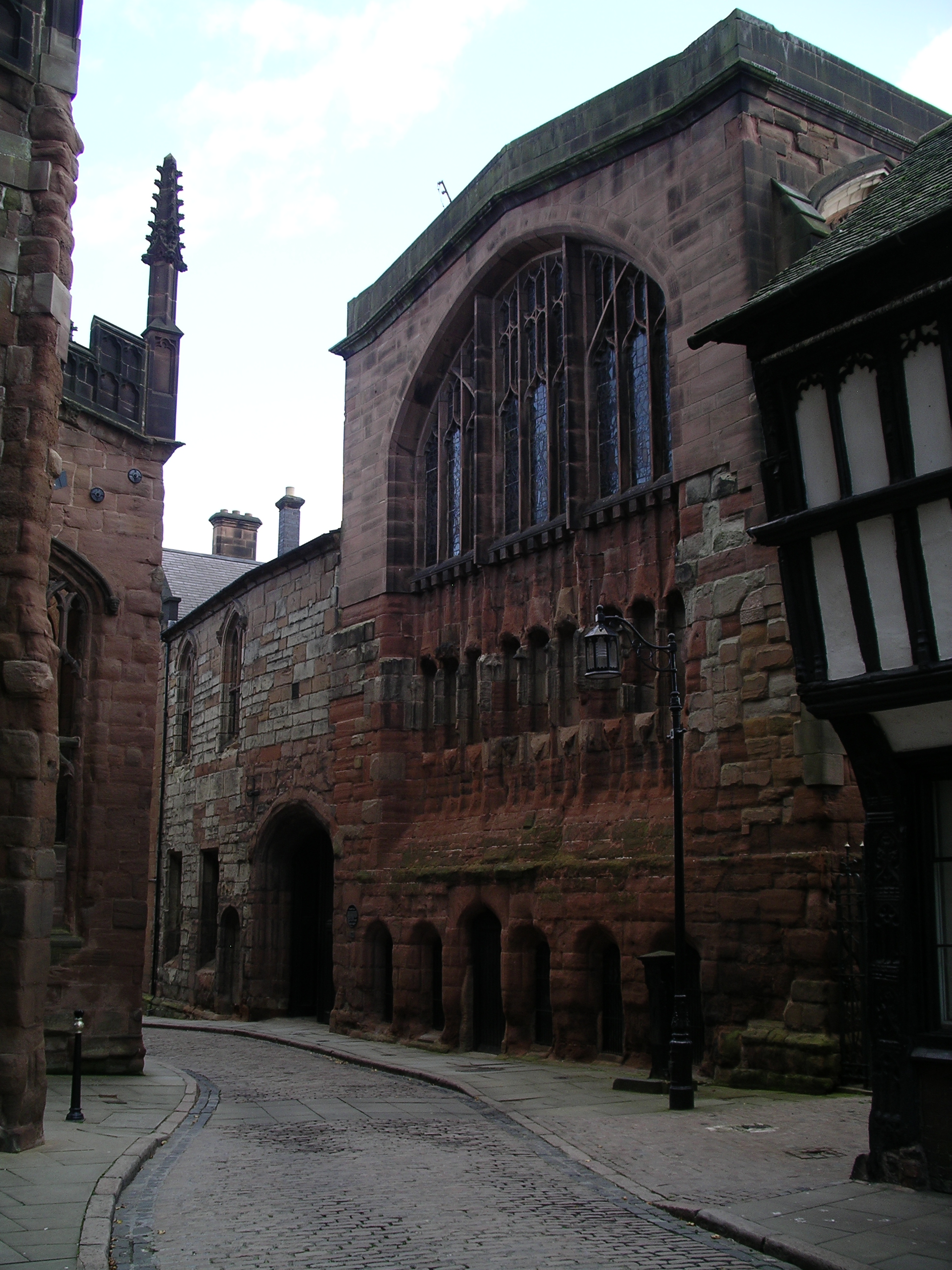
After arriving in Coventry, we met up with our walking guide and our first stop was the medieval St. Mary’s Guild Hall in quaint Bayley Lane. The Guild Hall is the tall building on the right with the archway entrances.  Built in the 1300s or so, it’s one of the city’s oldest buildings.  It was the wealthy merchants guild, and also the town council chambers for a very long time.  No undue influence there.

Coventry guild hall 1810

This 1810 painting is looking from the street through the archway into the courtyard of the Guild Hall.  It doesn’t look much different today.  One difference is that the staircase on the left is enclosed today.  See the railing end in the photos below.

Coventry guild hall piazza

It’s a beautiful buildings, nothing even or straight in the entire place.  It was obviously not the carpenters guild.

Coventry guild hall door

I love the old doors and archways.

Coventry guild hall stair

Upon entering the doors from the courtyard today you turn right and climb the stairs, which were open in the original Guild Hall.  Here’s the original carved railing.

Coventry guild hall door 2

The relative worth of doors, and those who lived behind then, and their ability to stand up to battering from invading “evil forces” was determined by the number of metal studs embedded in the door.  Who knew?

Coventry guild hall princes chamber

Never let it be said that I have not visited the Prince’s Chamber:)  This is how family legends get started, by the way.  “I saw a picture of grandma in the Princes Chamber in England.”  In 3 or 4 or 7 or 8 generations, this will be a MUCH better story!!!

Coventry guild hall tapestry

Behind the glass, under that beautiful stained glass window, hangs a stunning woven tapestry.

Coventry guild hall tapestry close

The ‘Coventry Tapestry’ is the highlight of the historic collections at St. Mary’s Guild Hall.

Manufactured about 1495 to 1500, its significance lies not just in its age and remarkable state of preservation, but also in the fact that, incredibly, it remains hanging on the very wall for which it was created more than five hundred years ago.

At more than nine metres wide and three metres high, this magnificent artwork dominates the north wall of the Great Hall, and is testament to both the skill of its Flemish weavers, and the wealth of the city of Coventry at the end of the fifteenth century.

The scene portrayed includes 75 individual characters, principally members of a Royal court, angels, saints and apostles, with an image of the Virgin Mary at its center, and incorporates numerous examples of symbolism and hidden meaning, some of which remain unexplained. It has even been observed that light from the west windows specifically illuminates the head of the Virgin Mary at certain times of the year, either a strange co-incidence or an inspired feature of the original design.

Here’s a better photo.

OLYMPUS DIGITAL CAMERA

In this photo, you can actually get an idea of the size of the hall itself.  It certainly doesn’t look this large from the street.  This is the area directly to the rear as you were entering the piazza.

Coventry guild hall gables

And the Guild Hall ceiling.  I just can’t help myself, I love the medieval architecture.

OLYMPUS DIGITAL CAMERA

And the beautiful mosaic file floors.

Coventry guild hall spiral stairs

One really interesting piece of history is that there is a small room upstairs, very crooked and sloping, and only accessible via a very small, very steep circular stairway. I’m amazed they let people go up there in terms of safety and liability.  Mary Queen of Scots was hidden here at one time.

Coventry guild hall windows

Looking outside into the courtyard and on into the street under the archway though the windows in Mary Queen of Scot’s hidden room.

OLYMPUS DIGITAL CAMERA

They do have some beautiful furnishings, like the original council chamber, shown here, and a rich history.  They also have some medieval armor that you can “try on.”

Jim viking

Now you know me by now well enough to know I could not bypass this opportunity.  This Viking style helmet was Jim’s favorite.

Jim helmet

Oh yea, I like this French Troubador one best!!!  I think he should use it as his Facebook profile photo, don’t you???

Jim troubador

I think Jim was saying, “No, you are NOT going to put this on the blog, are you?”

What do you mean, where are the pictures of me in the hats???  There are no pictures of me in the hats:)  None.  Nada.  Not anymore.

??????????????????????

These slot windows were defensive – they were created to shoot arrows through when under siege.

Coventry, like all towns that were once Medieval, has a market space and an open area, usually right in the center of town.

Coventry market square

Lady Godiva rode here.  I wasn’t terribly interested in Lady Godiva, or the statue, but I was extremely interested in the Starbucks on the other side of the square.  So you’ll excuse the fact that I had to go to Wiki to find a Lady Godiva statue photo:)  You know where I was!

Lady Godiva

While I was in Starbucks, I also purchased a salad, because we were running late and I knew that on a Sunday morning trying to find a lunch to eat in half an hour would be impossible.  So Jim and I were about to have another impromptu picnic.  Starbucks coffee and salad in the sunshine under beautiful blue skies on a Sunday morning in a church, or what is left of one.  Truly, what could be better?  How can you improve on that?

Coventry cathedral

Our next stop was the earliest church in Coventry, now in ruins, because the Germans bombed the city so relentlessly.  The bombs burned the church, but the walls still stand. It’s a beautiful skeleton.

Coventry cathedral 2

Our guided tour ended here, and our other family members dispersed to try to find a quick lunch.  Jim and I were left to ourselves, or nearly so, in the beautiful sentry standing mute testimony.  Once again, we began our picnic.  But the church just up the street was letting out and the church bells began to peel.  They were beautiful, and the church bells still function, giving voice to this church we thought was silent.

Coventry cathedral 3

We left Coventry and visited Shugborough Historic Estate.  We did a quick tour, because we were running late, again.

Fake library door

One of the most interesting things I found was all of the secret doors found in all of the old manor houses.  Here’s one example where they took library book ends and made the door look like part of the bookshelves.

Shugborough gardens

I found this house to look more “old” than historic.  Probably because they had restored it to between the 1920s and the 1970s when it was last lived in.  However, from the rear, the formal Victorian gardens were remarkable.  The bush shapes remind me of jelly candies:)  I’m sure that’s not what they had in mind.

Shugborough

From there, we still had about 2 and a half hours to Stirk House, where we are staying in the Ribble Valley.  The Ribble Valley is the land of rolling hills and what I would call moors and low mountains; the land of legends as well.  It’s believed that the Hobbit books, in particular, Middle Earth, was written after the Ribble Valley.  The author spent a great amount of time writing here while his son was in school in the area.  It’s a very distinctive area.  Outside of London it’s very much like Michigan or the US – but when you enter the Ribble Valley, it’s immediately different, remote, otherworldly.  It’s also the land of Robin Hood.  In fact, in the Robin Hood stories, there is a “Guy of Gisburne.” Gisburn is where our Speak ancestors are from.

If you remember, this entire trip to the British Isles all began with DNA testing.  Our Speak(e)(s) family finally connected with the source location of our American family in the British Isles, thanks to our cousin, Doug, from New Zealand.  New Zealand was settled much later than the US and Doug’s family knew where they were from in the UK, exactly, and still had contact with family members there.  The Speak(e)(s) family in the US arrived about 1660 and descendants didn’t know where they were from, in England.  We had been searching for that information for years.  We had suspicions and theories, but no proof.

The Speak(e)(s) Family Association meets yearly, and in 2011, I presented the results of the Y DNA testing to our group, ending my surprise presentation with pictures of Gisburn and the throw-away comment of, “I don’t know about you, but I want to go there.  I want to stand in that churchyard.”  Apparently, I wasn’t the only one, because planning began for the 2013 homecoming in Lancashire, England.

Rainbow

The excitement on the bus grew as we traveled. It was palpable.  You could feel it. After all, we had all traveled thousands of miles from around the globe to step back in time, not only figuratively, but literally as well in the Ribble Valley.  On the way, we were graced with a beautiful rainbow,  Getting a picture of the rainbow was a challenge through the bus windows.  We interpreted this incredible rainbow as a welcome from our ancestors.

Turning off the main roads, we began to see signs for places we had researched.  The names began to look familiar, Whalley, Gisburn, Clitheroe.  We knew we were close.

Pendle hill fog

This photo is of Pendle Hill, a local landmark that you can see from anyplace in the Ribble Valley.  To the right is the east end of Longridge Fell. Mist lies in the Ribble valley between them.

Pendle hill panoramic

This panoramic view of Pendle Hill is not from the Ribble Valley, but from Newchurch on the other side of the hill.

Ribble Valley first view

Here is our first view of the Ribble Valley.  These hills are high enough that they are moors on the hill.  Pendle Hill towers over the entire Ribble Valley, along with a ridge and cliffs.  Below was our first view of Pendle Hill.

Pendle Hill first view

The Pendle Hills are full of legends, and sheep.  One of the legends is of the Pendle Witches.  England did not escape the witchcraft craze and several women were executed here in the Pendle area for witchcraft in 1612.  One test of being a witch was to be held underwater for 30 minutes.  If you were dead, you were innocent.  If you were alive, you were then tortured and killed for being a witch.  Talk about being dead right.

One of the issues we had with the travel agent was where to stay in the Ribble Valley.  There aren’t any Holiday Inns.  In fact, the agent wanted the bus driver to take us back each evening to Manchester, 40 miles distant to a sterile Best Western.  We wanted to stay in the Ribble Valley, to be where our ancestors had been.  Susan found a conference/meeting facility, literally, in the middle of the valley, that was a restored manor house.  We wanted to stay there, but the travel agent didn’t have a “working relationship” with the Stirk House.  The day came when we simply told them to figure it out or we would, without them, because we were staying at the Stirk House.

Our cousin, Steve Speak, could not join us in the Ribble Valley, but he did meet us in Cambridge for dinner.  Steve is from the Gisburn area and told us that the Stirk House was purchased in the 1930s or 40s by a Peter Speak and he took the next 20 years to restore the manor house which had deteriorated into a terrible state.  On the way, in the bus, Susan took a look at the Gisburn Church records, and sure enough, a Speak woman died in the 1940s, is buried in Gisburn at the church and her residence was listed as “Stirkhouse, Gisburne.”  Now how uncanny is that.  So regardless of exactly where in this beautiful valley our original Speak ancestor lived, we are indeed staying on historic Speak land at the Stirk House.

The Tudor manor house known as the Stirk House was built in 1635, using stones from
the former Sawley Abbey which had been dismantled a century earlier under the
orders of Henry VIII.

The Stirk House was everything we could have imagined and more.  Beautiful facility, wonderful gardens and nature area, good food and a spa if you’re interested.

Stirk House

Welcome home!

Stirk House gardens

I love the moss and ferns growing on the rock walls.

Fern on walls

We had planned this event with the intention of meeting any Speak family members who might remain in the area, whether they carried the Speak surname or not.  We ran ads in regional genealogy/historical publications as well as in the local newspaper.  We also had an English contact which we thought might have made local people more comfortable.

Several Speak family members joined us for dinner.  The Stirk House had a private dining room for us, beside a meeting room.

Stirk House dinner

We had dinner together in the dining room here, an English country dinner, and then moved on to the evening’s agenda.

Some of our Speaks relatives joined us for the evening. It was nice to meet some of our cousins, no matter how distant.  Three different male Speaks brought their families, David, Stan and Gary.  David brought photos of his family and shared information about his family history and the area.  And yes, all three did a DNA test.  They felt certain that they were not related to each other.

Speak cousin

We are probably at least 15 generations removed, but still, we are indeed cousins.  It’s interesting that even after all of these generations two of our English cousins do share segments of DNA with some of us.  Not all of the results are back.

Now that I think of it, we’re probably related to all of the Pendle witches too.  That makes sense, because they were convicted of talking to cats and dogs and one was convicted because her children testified that she was a witch.  Heavens, that could have been me:)  I need a Pendle Witches t-shirt!

We moved to the meeting room and two local people gave historic presentations about the area, which were really quite interesting.   We ended the evening, finally, at 11:45 PM following a DNA presentation and update as to how our DNA brought us to the Ribble Valley.

Stirk house DNA

I must say, this all seemed very surreal to me, especially after a long day following a short night interrupted both by that loud wedding party and the fire alarm.  If I have one piece of advice, it’s don’t pack too much into a day, and don’t do a DNA presentation late in the evening.  Ok, that was 2 pieces of advice.  Pick on me about it and I’ll put a spell on you:)

Pendle witch

______________________________________________________________

Disclosure

I receive a small contribution when you click on some of the links to vendors in my articles. This does NOT increase the price you pay but helps me to keep the lights on and this informational blog free for everyone. Please click on the links in the articles or to the vendors below if you are purchasing products or DNA testing.

Thank you so much.

DNA Purchases and Free Transfers

Genealogy Services

Genealogy Research

John Curtis Bucher (1942-2012) and the Valentine – 52 Ancestors #7

Our cousin, Cheryl, who grew up across the street from my grandparents’ house where my brother, John, spent a great deal of time mentioned one day in passing that John was known to be a “stinker” as a child.  I’m sure she was not exaggerating.  From all the stories I’ve heard, my brother, John was indeed a handful, and not much ever changed.

When going through Mother’s things after she departed this Earth, I found something, in John’s own hand, from when he was maybe 7 that proved, beyond a shadow of a doubt, that he indeed fully earned his reputation.

John made Mom a Valentine.  As all mothers are, I’m sure she was thrilled to receive something from her child.  And then she opened it. John ValentineThe front is your typical children’s exchange Valentine – and I’m just as sure as I’m sitting here that my grandmother told him to write something to his mother on the back and tell her what he’d been up to…..so he did.

John Valentine back

I got muddy five times.

I got in a fight Wednesday.

I got called down Tuesday.

I got in the coal bin Sunday and was I dirty.

John Valentine back 2

I got a great big clok.

Yours truly,

John Curtus Bucher (Yes, he misspelled his own name.)

Indeed, I’m thinking that every day in John’s life was a new adventure just waiting to happen.  This was probably an ordinary week in John’s life.

Not a lot changed in the following 60 years or so, except the magnitude of the trouble John got into.  In 2011, the story of his weekly adventures started out something like this…..Sunday, I cut my leg with a chain saw…Monday, I got the tractor stuck in the mud…Tuesday, I went back to the woods and a tree fell on me……

My brother, John, passed away in October of 2012, ornery as ever, staunchly refusing to DNA test as he had for the past decade….asserting that he would rather “not know,” even in death.  Actually, what he meant was that wanted to keep me from knowing, just on general principles…just because he could.  Personally, I think he did that…or in this case…didn’t…just to irritate me…and he fully succeeded.

However, whether I agree or not with his motives or choices, I staunchly defend his right to them.  So, for the record, it was NOT me who stole his toothbrush from his hospital room.

Nope, wasn’t me.

I know what you’re thinking.

Was not.

You see, I knew that toothbrush wouldn’t help at all.

I don’t know who used it, took it, or whose it was, but it wasn’t his.

John wore dentures!

______________________________________________________________

Disclosure

I receive a small contribution when you click on some of the links to vendors in my articles. This does NOT increase the price you pay but helps me to keep the lights on and this informational blog free for everyone. Please click on the links in the articles or to the vendors below if you are purchasing products or DNA testing.

Thank you so much.

DNA Purchases and Free Transfers

Genealogy Services

Genealogy Research

Clovis People Are Native Americans, and from Asia, not Europe

In a paper published in Nature today, titled “The genome of a Late Pleistocene human from a Clovis burial site in western Montana,” by Rasmussen et al, the authors conclude that the DNA of a Clovis child is ancestral to Native Americans.  Said another way, this Clovis child was a descendant, along with Native people today, of the original migrants from Asia who crossed the Bering Strait.

This paper, over 50 pages including supplemental material, is behind a paywall but it is very worthwhile for anyone who is specifically interested in either Native American or ancient burials.  This paper is full of graphics and extremely interesting for a number of reasons.

First, it marks what I hope is perhaps a spirit of cooperation between genetic research and several Native tribes.

Second, it utilized new techniques to provide details about the individual and who in world populations today they most resemble.

Third, it utilized full genome sequencing and the analysis is extremely thorough.

Let’s talk about these findings in more detail, concentrating on information provided within the paper.

The Clovis are defined as the oldest widespread complex in North America dating fromClovis point about 13,000 to 12,600 calendar years before present.  The Clovis culture is often characterized by the distinctive Clovis style projectile point.  Until this paper, the origins and genetic legacy of the Clovis people have been debated.

These remains were recovered from the only known Clovis site that is both archaeological and funerary, the Anzick site, on private land in western Montana.  Therefore, the NAGPRA Act does not apply to these remains, but the authors of the paper were very careful to work with a number of Native American tribes in the region in the process of the scientific research.  Sarah L. Anzick, a geneticist and one of the authors of the paper, is a member of the Anzick family whose land the remains were found upon.  The tribes did not object to the research but have requested to rebury the bones.

The bones found were those of a male infant child and were located directly below the Clovis materials and covered in red ochre.  They have been dated  to about 12,707-12,556 years of age and are the oldest North or South American remains to be genetically sequenced.

All 4 types of DNA were recovered from bone fragment shavings: mitochondrial, Y chromosome, autosomal and X chromosome.

Mitochondrial DNA

The mitochondrial haplogroup of the child was D4h3a, a rather rare Native American haplogroup.  Today, subgroups exist, but this D4h3a sample has none of those mutations so has been placed at the base of the D4h3a tree branch, as shown below in a grapic from the paper.  Therefore, D4h3a itself must be older than this skeleton, and they estimate the age of D4h3a to be 13,000 plus or minus 2,600 years, or older.

Clovis mtDNA

Today D4h3a is found along the Pacific coast in both North and South America (Chile, Peru, Ecuador, Bolivia, Brazil) and has been found in ancient populations.  The highest percentage of D4h3a is found at 22% of the Cayapa population in Equador.  An ancient sample has been found in British Columbia, along with current members of the Metlakatla First Nation Community near Prince Rupert, BC.

Much younger remains have been found in Tierra del Fuego in South America, dating from 100-400 years ago and from the Klunk Mound cemetery site in West-Central Illinois dating from 1800 years ago.

It’s sister branch, D4h3b consists of only one D4h3 lineage found in Eastern China.

Y Chromosomal DNA

The Y chromosome was determined to be haplogroup Q-L54.  Haplogroup Q and subgroup Q-L54 originated in Asia and two Q-L54 descendants predominate in the Americas: Q-M3 which has been observed exclusively in Native-Americans and Northeastern Siberians and Q-L54.

The tree researchers constructed is shown below.

Clovis Y

They estimate the divergence between haplogroups Q-L54 and Q-M3, the two major haplogroup Q Native lines, to be about 16,900 years ago, or from between 13,000 – 19,700.

The researchers shared with us the methodology they used to determine when their most common recent ancestor (MCRA) lived.

“The modern samples have accumulated an average of 48.7 transversions [basic mutations] since their MCRA lived and we observed 12 in Anzick.  We infer an average of approximately 36.7 (48.7-12) transversions to have accumulated in the past 12.6 thousands years and therefore estimate the divergence time of Q-M3 and Q-L54 to be approximately 16.8 thousands years (12.6ky x 48.7/36.7).”

Autosomal

They termed their autosomal analysis “genome-wide genetic affinity.”  They compared the Anzick individual with 52 Native populations for which known European and African genetic segments have been “masked,” or excluded.  This analysis showed that the Anzick individual showed a closer affinity to all 52 Native American populations than to any extant or ancient Eurasian population using several different, and some innovative and new, analysis techniques.

Surprisingly, the Anzick infant showed less shared genetic history with 7 northern Native American tribes from Canada and the Artic including 3 Northern Amerind-speaking groups.  Those 7 most distant groups are:  Aleutians, East Greenlanders, West Greenlanders, Chipewyan, Algonquin, Cree and Ojibwa.

They were closer to 44 Native populations from Central and South America, shown on the map below by the red dots.  In fact, South American populations all share a closer genetic affinity with the Anzick individual than they do with modern day North American Native American individuals.

Clovis autosomal cropped

The researchers proposed three migration models that might be plausible to support these findings, and utilized different types of analysis to eliminate two of the three.  The resulting analysis suggests that the split between the North and South American lines happened either before or at the time the Anzick individual lived, and the Anzick individual falls into the South American group, not the North American group.  In other words, the structural split pre-dates the Anzick child.  They conclude on this matter that “the North American and South American groups became isolated with little or no gene flow between the two groups following the death of the Anzick individual.”  This model also implies an early divergence between these two groups.

Clovis branch

In Eurasia, genetic affinity with the Anzick individual decreases with distance from the Bering Strait.

The researchers then utilized the genetic sequence of the 24,000 year old MA-1 individual from Mal’ta, Siberia, a 40,000 year old individual “Tianyuan” from China and the 4000 year old Saqqaq Palaeo-Eskimo from Greenland.

Again, the Anzick child showed a closer genetic affinity to all Native groups than to either MA-1 or the Saqqaq individual.  The Saqqaq individual is closest to the Greenland Inuit populations and the Siberian populations close to the Bering Strait.  Compared to MA-1, Anzick is closer to both East Asian and Native American populations, while MA-1 is closer to European populations.  This is consistent with earlier conclusions stating that “the Native American lineage absorbed gene flow from an East Asian lineage as well as a lineage related to the MA-1 individual.”  They also found that Anzick is closer to the Native population and the East Asian population than to the Tianyuan individual who seems equally related to a geographically wide range of Eurasian populations.  For additional information, you can see their charts in figure 5 in their supplementary data file.

I have constructed the table below to summarize who matches who, generally speaking.

who matches who

In addition, a French population was compared and only showed an affiliation with the Mal’ta individual and generically, Tianyuan who matches all Eurasians at some level.

Conclusions

The researchers concluded that the Clovis infant belonged to a meta-population from which many contemporary Native Americans are descended and is closely related to all indigenous American populations.  In essence, contemporary Native Americans are “effectively direct descendants of the people who made and used Clovis tools and buried this child,” covering it with red ochre.

Furthermore, the data refutes the possibility that Clovis originated via a European, Solutrean, migration to the Americas.

I would certainly be interested to see this same type of analysis performed on remains from the eastern Canadian or eastern seaboard United States on the earliest burials.  Pre-contact European admixture has been a hotly contested question, especially in the Hudson Bay region, for a very long time, but we have yet to see any pre-Columbus era contact burials that produce any genetic evidence of such.

Additionally, the Ohio burial suggests that perhaps the mitochondrial DNA haplogroup is or was more widespread geographically in North American than is known today.  A wider comparison to Native American DNA would be beneficial, were it possible. A quick look at various Native DNA and haplogroup projects at Family Tree DNA doesn’t show this haplogroup in locations outside of the ones discussed here.  Haplogroup Q, of course, is ubiquitous in the Native population.

National Geographic article about this revelation including photos of where the remains were found.  They can make a tuft of grass look great!

Another article can be found at Voice of America News.

Science has a bit more.

______________________________________________________________

Disclosure

I receive a small contribution when you click on some of the links to vendors in my articles. This does NOT increase the price you pay but helps me to keep the lights on and this informational blog free for everyone. Please click on the links in the articles or to the vendors below if you are purchasing products or DNA testing.

Thank you so much.

DNA Purchases and Free Transfers

Genealogy Services

Genealogy Research

STRs vs SNPs, Multiple DNA Personalities

One of the questions I receive rather regularly is about the difference between STRs and SNPs.

Generally, what people really want to understand is the difference between the products, and a basic answer is really all they want.  I explain that an STR or Short Tandem Repeat is a different kind of a mutation than a SNP or a Single Nucleotide Polymorphism.  STRs are useful genealogically, to determine to whom you match within a recent timeframe, of say, the past 500 years or so, and SNPs define haplogroups which reach much further back in time.  Furthermore SNPs are considered “once in a lifetime,” or maybe better stated, “once in the lifetime of mankind” type of events, known as a UEP, Unique Event Polymorphism, where STRs happen “all the time,” in every haplogroup.  In fact, this is why you can check for the same STR markers in every haplogroup – those markers we all know and love.

STR

This was a pretty good explanation for a long time but as sequencing technology has improved and new tests have become available, such as the Full Y and Big Y tests, new mutations are being very rapidly discovered which blurs the line between the timeframes that had been used to separate these types of tests.  In fact, now they are overlapping in time, so SNPs are, in some cases becoming genealogically useful.  This also means that these newly discovered family SNPs are relatively new, meaning they only occurred between the current generation and 1000 years ago, so we should not expect to find huge numbers of these newly developed mutations in the population.  For example, if the SNP that defined haplogroup R1b1a2, M269, occurred 15,000 years ago in one man, his descendants have had 15,000 years to procreate and pass his M269 on down the line(s), something they have done very successfully since about half of Europe is either M269 or a subclade.

Each subclade has a SNP all its own.  In fact, each subclade is defined by a specific SNP that forms its own branch of the human Y haplotree.

So far, so good.

But what does a SNP or an STR really look like, I mean, in the raw data?  How do you know that you’re seeing one or the other?

Like Baseball – 4 Bases

The smallest units of DNA are made up of 4 base nucleotides, DNA words, that are represented by the following letters:

A = Adenine
C = Cytosine
G = Guanine
T = Thymine

TACG

These nucleotides combine in pairs to form the ladder rungs of DNA, shown right that connect the helix backbones.  T typically combines with A and C usually combines with G, reaching between the backbones of the double helix to connect with their companion protein in the center.

You don’t need to remember the words or even the letters, just remember that we are looking for pattern matches of segments of DNA.

Point Mutations

Your DNA when represented on paper looks like a string of beads where there are 4 kinds of beads, each representing one of the nucleotides above.  One segment of your DNA might look like this:

Indel example 1

If this is what the standard or reference sequence for your haplotype (your personal DNA results) or your family haplogroup (ancestral clan) looks like, then a mutation would be defined as any change, addition, or deletion.  A change would be if the first A above were to change to T or G or C as in the example below:

Indel example 2

A deletion would be noticed if the leading A were simply gone.

Indel example 3

An addition of course would be if a new bead were inserted in the sequence at that location.

Indel example 4

All of the above changes involve only one location.  These are all known as Point Mutations, because they occur at one single point.

SNPs

A point mutation may or may not be a SNP.  A SNP is defined by geneticists as a point mutation that is found in more than 1% of the population.  This should tell you right away that when we say “we’ve discovered a new SNP,” we’re really mis-applying that term, because until we determine that the frequency which it is found in the population is over the 1% threshold, it really isn’t a SNP, but is still considered a point mutation or binary polymorphism.

Today, when SNPS, or point mutations are discovered, they are considered “private mutations” or “family mutations.”  There has been consternation for some time about how to handle these types of situations.  ISOGG has set forth their criteria on their website.  They currently have the most comprehensive tree, but they certainly have their work cut out for them with the incoming tsunami of new SNPS that will be discovered utilizing these next generation tests, hundreds of which are currently in process.

STRs

A STR, or Short Tandem Repeat is analogous to a genetic stutter, or the copy machine getting stuck.  In the same situation as above, utilizing the same base for comparison, we see a group of inserted nucleotides that are all duplicates of each other.

STR example

In this case, we have a short tandem repeat that is 4 segments in length meaning that CT is inserted 4 times.  To translate, if this is marker DYS marker 390, you have a value of 5, meaning 5 repeats of CT.

So I’ve been fat and happy with this now for years, well over a decade.

The Monkey Wrench

And then I saw this:

“The L69/L159 polymorphism is essentially a SNP/STR oxymoron.”

To the best of my knowledge, this is impossible – one type of mutation excludes the other.  I googled about this topic and found nothing, nor did I find additional discussion of L69, other than this.

L69 verbiage

My first reaction to this was “that’s impossible,” followed by “Bloody Hell,” and my next reaction was to find someone who knew.

I reached out to Dr. David Mittelman, geneticist and Chief Scientific Officer at Gene by Gene, parent company of Family Tree DNA.  I asked him about the SNP/STR oxymoron and he said:

“This is impossible. There is no such thing as a SNP/STR.”

Whew!  I must say, I’m relieved.  I thought there for a minute there I had lost my mind.

I asked him what is really going on in this sequence, and he replied that, “This would be a complex variant — when multiple things are happening at once.”

Now, that I understand.  I have children, and grandchildren – I fully understand multiple things happening at once.  Let’s break this example apart and take a look at what is really happening.

HUGO is a reference standard, so let’s start there as our basis for comparison.

HUGO variant 1

In the L69 variant we have the following sequence.

HUGO variant 2

We see two distinct things happening in this sequence.  First, we have the deletion of two Gs, and secondly, we have the insertion of one additional TG.  According to Dr. Mittelman, both of these events are STRs, multiple insertions or deletions, and neither are point mutations or SNPs, so neither of these should really have SNP names, they should have STR type of names.

Let’s look at the L159 variant.

HUGO variant 3

In this case, we have the GG insertion and then we have a TG deletion.

In both cases, L69 and L159, the actual length of the DNA sequence remains the same as the reference, but the contents are different.  Both had 2 nucleotides removed and 2 added.

The good news is, as a consumer, that you don’t really need to know this, not at this level.  The even better news is that with the new discoveries forthcoming, whether they be STRs or SNPs, at the leafy end of the branch, they are often now overlapping with SNPs becoming much more genealogically useful.  In the past, if you were looking at a genetics mutation timeline, you had STRs that covered current to 1000 years, then nothing, then beginning at 5,000 or 10,000 years, you have SNPs that were haplogroup defining.

That gap has been steadily shrinking, and today, there often is no gap, the chasm is gone, and we’re discovering freshly hatched recently-occurring SNPs on a daily basis.

The day is fast approaching when you’ll want the full Y sequence, not to further define your haplogroup, but to further delineate your genealogy lines.  You’ll have two tools to do that, SNPs and STRs both, not just one.

______________________________________________________________

Disclosure

I receive a small contribution when you click on some of the links to vendors in my articles. This does NOT increase the price you pay but helps me to keep the lights on and this informational blog free for everyone. Please click on the links in the articles or to the vendors below if you are purchasing products or DNA testing.

Thank you so much.

DNA Purchases and Free Transfers

Genealogy Services

Genealogy Research

John Whitney Ferverda (1882-1962) and the Body in the Garage – 52 Ancestors #6

John Ferverda

My grandfather’s name was John Whitney Ferverda.  I’ve always wondered about that middle name, with no idea where it came from.  It does not appear to be a family name.

He was born on December 26, 1882 in Plain Township, Kosciusco County, Indiana, on a farm to Hiram B. (probably Bauke) Ferverda and Evaline Louise Miller Ferverda.  He died on June 9th 1962.  I was 7 and I remember him, albeit somewhat vaguely.  His wife. Edith Barbara Lore Ferverda who he had married in Rushville, Indiana in 1908 had just died 18 months before, so it had been a rough couple years in the family.  With John Ferverda’s death, the homeplace had to be sold, the furniture divided, and all of those things that signal the end of an era and what we’ve come to know as closure needed to be done.

John and Edith had two children, my mother, Barbara, and one son, Harold Lore Ferverda, known by the family as Lore.

I think I’ll let Mom introduce you to her father, in her own words.  I gave my Mother a book called “Grandmother’s Memories” to complete for her grandchildren and great-grandchildren.  She did, at first in her own hand, and then later, as her handwriting became more difficult to read, she would tell me the answers and I would write them for her.  The book asked questions or gave topic suggestions.

My Father’s name was John Whitley Ferverda.  He was born in 1882 and died in 1962.  He had blue eyes.

My Father’s most precious memory:

When I was so sick with rheumatic fever, every morning he carried me downstairs to the davenport and every evening upstairs to bed.  He always had time to read to me.  I was too sick to read for myself.  I was 7 or 8 and he read everything to me I could get my hands on.  He worked at the Ford Agency in Silver Lake selling cars and trucks.  When I went to school, we walked and went the next half block further to the Ford Agency and asked Dad for a nickel.  When he gave it to me, I promptly went to the drug store and bought a Hershey bar, which Dad knew I’d do.

My Father’s best story about growing up:

He was one of 11 children.  From their farm they walked over to Tippecanoe Lake to swim which was about a mile.  He took enough schooling to be a teacher, but never secured a position with the school. Instead he started with the railroad and was sent to Rushville where he met Mother.

John Ferverda against car

Here’s a bit more info from the “History of Kosciusko County, Indiana” 1919:

John Ferverda is a merchant of successful experience and has been identified with the hardware trade at Silver Lake for a number of years, being one of the live and enterprising business men and citizens of that locality.

He was born in Plain Township of this county Dec. 26, 1882, a son of Hiram B. and Eveline Miller Ferverda, both of whom now reside at Leesburg.  John Ferverda grew up on his father’s farm in Plain Township and was liberally educated.  He attended both the common and high schools of Oswego, being a graduate of both, and also was a student in the Tri-State Normal at Angola.  For his scholarship he was granted a license to teach, but never used it in that profession.  His life was spent largely at home until the age of 22.  Having mastered the art of telegraphy, he entered the service of the Big Four Railway as an operator, and was assigned at different stations along that system and remained in that service about 10 years.  In 1916, Mr. Ferverda left the railroad to take up business and is now a member of the F. and F. Hardware Company of Silver Lake.

John is shown in front of his hardware store, below.

Ferverda and hardware store cropped

In 1907 he married Miss Edith B. Lore, a native of Rush Co., Indiana and a high school graduate.  They have one son, Harold L., born November 24, 1915.  Mr. and Mrs. Ferverda are members of the Lutheran Church and he is affiliated with the Denning Lodge No 88, Ancient Free and Accepted Masons, at North Manchester, and of the Knights of Pythias Lodge.  In politics, he is a republican.

Was he ever a Republican.  I remember Mom talking about her father quizzing potential suitors.  The first question he would ask them is whether or not they were Republican.  Mom said she knew better than to bring home a Democrat!!!  For years Mom had a small ivory elephant watch charm about an inch long that was his that I suspect was meant as the symbol of the Republican Party.

At some point, before his marriage, probably while in college, John was in some sort of a play.  He is the front row, bottom left corner.

ferverda and play

John studied to be a teacher, but for some reason, after graduating, never pursued that avenue.  Instead, he joined the railroad as a telegraph operator and station master.  He was assigned to Rushville, Indiana.  We don’t know exactly when he went to Rushville, but in an article in the Rushville paper, dated January 25, 1907, John was a pallbearer for Miss Maude Foust who died of typhoid.  We also know he sang tenor in a quartet at the Presbyterian Church in Rushville, based on a November 1908 news report .

While in Rushville, John met and married Edith Barbara Lore, daughter of Curtis Benjamin, known as CB, Lore and Ellenore “Nora” Kirsch Lore. She too attended the Presbyterian Church.

Ferverda - Lore marriage license

Ferverda-Lore marriage license

Rushville Republican Newspaper, Jan. 3, 1910 – John Ferveda who was recently transferred to cashier at the local office has been given the agency at Silver Lake in the northern part of the state and will leave here in the next few weeks.

John and Edith moved back to Silver Lake where John served as the station master and where they spent the rest of their lives.

While their immediate family was small, John had many siblings in the area.  He was one of 11 children born to Hiram and Eva Ferverda.  One of his siblings, Roscoe, lived across the street from him in Silver Lake, Indiana.

ferverda family original photo

Ferverda family description cropped

John Ferverda’s parents were Brethren, although it appears that not all of the family continued in that faith which prohibited military service, among other things.  John broke with the Brethren faith by marrying Edith who was a Lutheran, and Roscoe broke with the Brethren faith by serving in WWI.  In fact, four of John and Eva’s sons, in total, served in the military, Ira in the Spanish American War and then Donald, Roscoe and George. Those three sons are standing together in the middle row, with George, on the right, in uniform.

John and Roscoe were close their entire lives, even though there was 9 years between them, Roscoe having been born in 1893.  In fact, when Roscoe returned from military service, he too worked at the station with his brother for the railroad until the depot in Silver Lake closed in 1958 due to declining business.

silver lake depot

John and Edith bought a house in Silver Lake that was located right by the railroad tracks, which were across the field to the right of their house in the photo below.  I loved the large screened-in front porch on this house.  The screens were painted yearly to keep them from rusting, and rocking chairs resided on the porch in warm weather.

One time, Lore was painting the screens and my mother was bothering him in her sisterly way.  He decided to paint her cat’s nose, which infuriated my mother, so he then painted mother’s nose black too….except he “missed” and got her entire face with the side of the large brush he was using.  Mother was scheduled to perform in a dance recital later that day on the courthouse square in Wabash.  I’m sure you can imagine the drama and hullaballoo that results from that little incident.  Paint then was not water soluable and required turpentine and scrubbing to remove.  This was always one of mother’s favorite stories about her brother.

silver lake house

Roscoe bought the house right across the street.  Roscoe and John were thick as thieves.

Roscoe's house

Old newspapers can be a lot of fun.  In the local paper I found some tidbits that give us hints about John’s life.

July 31, 1910

Ferverda news 1910 cropped

Donald Ferverda is visiting with his brother John Ferverda and wife at Silver Lake.

Don was one of the three Ferverda sons who served in the military in WWI.  After returning, he was a cashier at the bank in Leesburg and died relatively young of cancer.

February 5, 1911

Ferverda news 1911

Mr. and Mrs. John Ferverda of Silver Lake visited with Hiram Ferverda and family over Sunday.

Visiting your parents hardly seems like a newsworthy event.  It wasn’t far from Leesburg to Silver Lake – about 18 miles.  However, it’s a lovely tidbit.

July 30, 1912

Ferverda news 1912

Mrs. Gertrude (her name was Nora, not Gertrude) Lore of Rushville is here at present visiting with her daughter, Mrs. John Ferverda and husband.  Mrs. Lore’s two daughters (Mildred, 13, and Eloise, 9) have been here for the past several weeks visiting at the Ferverda home.  The garage building is nearing completion.  The metal ceiling is completed and is now ready for the paint.  The building will be ready for occupancy within a short time.

I originally didn’t think the second paragraph was relevant to the Ferverda family, but with all those females visiting “for an extended period”, maybe my grandfather was taking up residence in the garage:)

October 11, 1912

Ferverda news 1912 - 2

Mr. and Mrs. John Ferverda of Silver Lake are here for a two weeks visit with his parents, Mr. and Mrs. H.B. Ferverda.

October 19, 1912

Ferverda news 1912 - 3

H. L. Anderson of Westport who had been here as a relief agent for Mr. Ferverda during his absence went to Leesburg yesterday where he will be for 15 days while the Leesburg agent takes a trip.

Agent here refers to railway agent.

December 22, 1912

Ferverda news 1912-4

Paul Ferverda of Leesburg is here visiting with his brother, John Ferverda and wife.

John had brothers Ira, Irvin, Ray, George and Donald who lived outside of Silver Lake, but no Paul.  Roscoe lived in Silver Lake across the street from John.

April 19, 1913

Ferverda news 1913

We understand that Ray Ferree who recently was bumped off of the Big Four at North Manchester by one who was older in the service will apply for the station here and if he applies it will almost be sure that the company will award him the position.  The family will then move here and occupy the Mrs. Metzger property near the depot and Mr. Ferverda, the agent, who resides there at present will go to Markleville.

The family never went to Markleville.

February 16, 1914

Ferverda news 1914

H.P. Rager, John Ferverda and Dale Homman were down to North Manchester last evening taking the first steps in the degree work of the Masonic order.

November 13, 1915

Ferverda news 1915

Ray Feree is here this week as relief agent for John Ferverda at the Big Four.  Mr. Ferverda is taking a vacation and will also have his eye operated on upon during his vacation.  He went to Cincinnati the first of the week for that purpose.

This is a week before John Ferverda’s son, Lore was born, on November 24th.  I wonder what kind of eye surgery he had performed, and for what condition.

November 27, 1915

Ferverda news 1915-2

John Ferverda, our genial agent at the Big Four station and wife and Percy Helser the drayman, and wife, are the proudest people in the whole community and passed the most enjoyable Thanksgiving of any.  The stork came to their homes Wednesday afternoon and left a bouncing boy baby at the Ferverda home and at the Helser home he left a sweet little girl.

Rushville Republican Newspaper, Jan. 8, 1916 – J. W. Ferverda, Big Four agent at Silver Lake and well known here has purchased a hardware store there in partnership with R. M. Frye.  He has resigned his position with the railroad company.

January 22, 1916

Ferverda news 1916

J. W. Ferverda has returned home from a trip to Rushville where he was for a couple of days visiting with his wife and son.

September 10, 1916 – Silver Lake News

Ferverda news 1916 - 2

John Ferverda is going about bandaged up on account of a broken rib received a few days ago when he was assisting in unloading some machinery.

In 1918, every man had to register for the draft.  WWI was upon us.  John Whitney Ferverda registered, said that his occupation was in retail hardware and as an implement merchant.  He was described as short, of medium build with light hair and gray eyes.  I never knew he had grey eyes.

John Ferverda WWI draft

February 28, 1918

Ferverda news 1918

Friends and relatives here had just learned of the marriage last month of Roscoe Ferverda, son of Mr. and Mrs. H. B. Ferverda of Leesburg and Miss Effie Ringo of North Vernon, Indiana.  Mr. Ferverda who was a telegrapher at North Vernon enlisted in the signal corps and just before being called for examination was taken sick with measles.  He came home for two weeks and immediately upon his return to North Vernon was examined and sent to the training camp at Vancouver, Washington.  The wedding took place while at North Vernon for the examination.  The bride is expected here tomorrow for a visit with his parents.

So it seems that not only did Roscoe join the military, he married a non-Brethren wife as well, without telling his parents.  Those Ferverda boys, renegades all of them….

In the 1930 census, we know that Roscoe is an agent for the Big 4 Railroad, almost the last person enumerated in the village of Silver Lake, in Lake Township, in Kosciusko County, Indiana.  John Ferverda was the first household enumerated, living directly across the street from Roscoe.  In 1930, John was a salesman at the Ford garage.  With the decrease of rail shipping, jobs with the railroad evaporated.

Below, both the new and old garages in Silver Lake.

Silver lake garages

At some point, and I believe it was before or during the Depression, John Ferverda owned a hardware store in downtown Silver Lake.  The problem was that people couldn’t pay their bills.  Eventually, that business would close, and John would raise chickens in the chicken house behind the house and sell eggs.  There may have been a Depression, but everyone still had to eat.  Eggs and chicken were relatively cheap protein and both eggs and hatchlings were shipped as far as New York.  John loved his chickens, and this one was his favorite and according to the back of the picture, his best producer.

John Ferverda and chicken

Mother remembers cleaning chickens as a child during the Depression, and not fondly, I might add.

Sometime, about this same time, when Lore was a late teen, it seems that he “borrowed” the family car without permission, and managed to get it stuck in the snow.  I don’t know how he managed to get ahold of his father, but he did.  If he thinks he was in trouble with his Dad, he hadn’t seen anything yet because his mother, Edith, relied on that car to get her to the job that supported the family during the Depression.

Ferverda 1937 storm

So off John and Lore set to get Lore unstuck.  I’m not sure who went with them, but I’m guessing it was Roscoe.  The photo above is labeled 1937 in Mom’s photo album.  There is another photo also of a sleigh with a horse pulling it that looks to be about the same time.

Ferverda fam 1937 cropped

Mom kept a photo album, thankfully, and this was labeled as 1937.  Left to right John Ferverda with Buster, Edith Lore Ferverda (John’s wife), Eva Miller Ferverda (John’s mother), Chloe Ferverda Robinson (John’s sister), Charlotte Robinson, Raleigh Robinson (Chloe’s daughter and husband.)

Ferverda fam 1937-2

Two houses down the street was the Methodist Church where the Ferverdas were members.  I have vivid memories of this church when I was little, sitting on the small child sized chairs and belting out Jesus Loves Me at the top of my lungs in Sunday School, which was through the side door on the left and downstairs.  I can still hear it….

“Jesus loves me, this I know,
For the Bible tells me so….”

silver lake methodist church

On the 1940 census, Roscoe and John are shown with 4 residences between them.  Roscoe is still an agent for the railroad and now John is an “owner and overseer” on a chicken and fruit farm.

I had entirely forgotten about the apple orchard and the raspberries.  The entire “back yard” was apple trees and behind the orchard, the property terminated in a huge mass of brambles which they called raspberries.  All I know is that I avoided that area because no matter what I did, they always stuck me, one way or another.  I can’t imagine how they picked those berries, but obviously they did.

My grandparents had a back porch with a hand pump where they washed and processed the apples.  That same pump pumped the water for the kitchen and bathroom, both of which were adjacent to the pump room.  This WAS considered running water at that time.

In 1941, John Whitney Ferverda registered for the WWII draft, even though he was 59 years of age.  His signature is beautiful.

John Whitney Ferverda draft

Silver Lake, where they lived was a small town, but it was not incorporated, so they were part of Lake Township, although Silver Lake made up the most populous part of that township.  From 1943-1950, John Ferverda was township Trustee.

Silver lake 1945 chemistry class

In 1945, the newspaper reported that , “Trustee John Ferverda provided a fully equipped chemistry lab and the course in chemistry was added in the high school.”  John’s son, Lore Ferverda, had graduated from Silver Lake High School in the class of 1933 and went on to become a chemist, eventually holding several patents.

John Ferverda alseep

I do believe this was before recliners had been invented.  I remember my grandmother starching those chair arm and back covers.   My grandfather did this every afternoon.  I think I inherited the propensity from him!  Must be genetic.

Speaking of genetics, we have been fortunate that one of Roscoe’s sons volunteered to take the Y-line DNA test as well at the autosomal test.  Roscoe’s daughter, Cheryl, has taken the autosomal test as well.  In fact, these folks were some of the first testers at 23andMe and are now participating in projects at Family Tree DNA.  There is a Ferverda DNA project, but needless to say, with a name like that, it’s not very large.

Cheryl, and I are in the final stages of planning a trip back to the Ferverda homeland in 2014.  We can hardly wait and I’ll be sharing that with you too, but for now, back to John Ferverda.

John and Edith Ferverda 1959

John and Edith Ferverda with their first great-grandchild, Bruce, born on the 4th of July, 1959.  The family referred to him as “the firecracker with a short fuse.”  I believe this photo was taken at Christmas, 1959.  Edith passed away, a few days later, in January of 1960.

John and Edith 1959 standing

I don’t know where this photo was taken, but it wasn’t their house.  This is a great photo and is exactly how I remember Edith Lore and John Whitney Ferverda.

By the late 1950s or early 1960s, John had tuberculosis.  They believed it had been dormant for decades.  Edith’s father and sister both died of TB in 1909 and 1912, respectively.  He went to the tuberculosis sanitarium where he was treated for several months.  After returning home, he became ill again in 1962, except this time it was inoperable liver and pancreatic cancer.   He passed away on June 9, 1962.

John Ferverda obit

Mom and lore at grave

This photo is of Edith and John’s two children at their gravesite.  Stopping at the cemetery became a regular occurrence anytime we were in that vicinity, or could be without a huge detour.

Since neither of their children lived in Silver Lake, after John passed away, they put the house with the chicken houses and apple trees and raspberry bushes up for sale.  I remember Mom talking about how difficult it was to go through their things.  I also remember finding money hidden in the most unusual places.  I suspect that was a relic of the Depression years when life was extremely difficult.  One time, I picked up a powder box and a false bottom fell out, along with some cash hidden there.  I wonder how much was inadvertently given away, secreted away like that.

Mom and Uncle Lore sold the property, and the new owners turned it into a funeral home.  My mother was utterly mortified.  They enclosed the front screened in porch with plywood painted white, turned the dining and music rooms into viewing parlors (the large window grouping on both sides of the house) and processed the remains in the kitchen and on that back porch.  I would hope they installed a better water system.  The garage, seen behind the house is where the hearse was kept and the bodies loaded, unloaded and well, um, stored.

silver lake house as funeral home

My mother, for years, when someone died in Silver Lake just prayed that the funeral was at the “other” funeral home.  She was utterly mortified that her family home had become a funeral home, and she said she simply could not go inside.  Finally though, someone died, and she had to find a way.

silver lake house as funeral home front

silver lake house as funeral home 2

That someone was Roscoe.  He died, as luck would have it, 36 years ago this week, on the morning of the epic blizzard in Indiana, January 25, 1978.  And when I say epic, I mean epic.  We have photos of family members on drifts level with the roof.

1978 blizzard

These are just the kinds of things the Ferverda family did, especially these two brothers!  Both John and Roscoe would have found that immensely humorous.  Everyone else, not so much.

The roads were closed, for days.  Finally State Road 14 was opened, one way, through snow tunnels.

1978 blizzard snow tunnel

Roscoe’s funeral was held, such as it was, and then, because the snow was too deep and the ground too frozen for too far down…Roscoe got to spend the next several weeks in his brother, John’s, garage.

Gone, But Not Entirely

John and Roscoe may be gone, but their DNA isn’t.  Roscoe’s son provided his DNA, quite graciously, as part of a DNA presentation at the Allen County Public Library a few years ago for Y chromosome testing.  Because of his generosity, we know that the Ferverda men fall into haplogroup I1, and their DNA is quite unusual.  At 25 markers, only 2 matches, and one of those is a Scherp from Germany.

We’ve tested several downstream SNPs as well, to see if we can refine his haplogroup further, but so far, he has tested negative for all of the SNPs tested.

He is a member of the haplogroup I project, where the administrators have grouped him in the I1 generic group.  Each project is grouped differently, according to the project goals and the administrators, but in this case, his grouping tells us that he does not match the other groups, such as “AS” for Anglo Saxon or “N” for Nordic, or Balkan or Iberian, for example.

ferverda dna map

For as unusual as his markers are in the second testing panel, at 25 markers, providing only 2 matches, his 12 marker matches are extremely common in haplogroup I, providing him with 1028 matches.  His 12 marker matches are shown on the map below.

Ferverda 12 markers

Clearly these 12 marker matches don’t hold at 25 markers, and most of these people did test at 25 markers. This is the best example I can think of as to why testing at higher levels is so important.

Edith and John Ferverda stone

______________________________________________________________

Disclosure

I receive a small contribution when you click on some of the links to vendors in my articles. This does NOT increase the price you pay but helps me to keep the lights on and this informational blog free for everyone. Please click on the links in the articles or to the vendors below if you are purchasing products or DNA testing.

Thank you so much.

DNA Purchases and Free Transfers

Genealogy Services

Genealogy Research

You’re Invited to Aleda’s Virtual Funeral

Aleda's Virtual Funeral

We’re having a virtual funeral….and you’re invited.  In fact, this might be a first….the first virtual funeral ever – and you can be part of this groundbreaking event.  It’s a testament to how the electronic, internet, Facebook, DNA age has changed our lives.

Aleda passed away more than a week ago, on January 26th.  Sometimes things don’t always go exactly as we would like, and suffice it to say, Aleda is being buried tomorrow, Friday, February 7, at 2:30, alone.  Well, not entirely alone, the man who mowed her yard since he was a child, and his wife, will be there, and the backhoe operator, of course.

She has a world of online friends and cousins who she met through DNA testing, so, we’re giving Aleda a virtual funeral.  Her favorite reading was the 23rd Psalm, so we’re inviting everyone to participate at 2:30 by reading or reciting the 23rd Psalm, for Aleda, to lift her spirit to the Heavens.  Let’s send her off with a chorus of voices.  Aleda won’t be alone.  We’ll all be sending her home.  And that’s it.  Nothing else for you to do, so it’s very easy to participate.

By the way, I’m being a bit vague about her name and location because of her family’s concerns about the security of her property, which is why there has been no obituary, etc.

Genealogy, and in this case, genetic genealogy changes lives.  In my recent article, “Finding Family the New-Fashioned Way,” I included a poll asking three questions:

Have you become close to someone met through traditional genealogy research.

The results?

43% – Yes, somewhat close, we’re friends
42% – Yes, very close, like family.
14% – No

Have you become close to someone you met through DNA?

43% – Yes, somewhat close, we’re friends.
40% – No
16% – Yes, very close, like family.

Have you met in person the people you’ve discovered during genealogy of DNA research?

62% – Yes
23% – No
14% – No, but have plans to.

Well, I can tell you how Aleda answered those questions, and although the polls are anonymous, I’m sure she answered because she was the consummate contributor and participant.  Aleda would have answered yes to all of the above.

Aleda was a joiner.  In High School, she was a member of several clubs, the editor of the newspaper, and she loved science, especially chemistry.  It’s no surprise then, how quickly she embraced DNA testing decades later when it became available as a genealogy tool.  She was a pioneer, one of the first.

Aleda's high school

Aleda's high school 2

Aleda became interested in genealogy early in life and spent 50 years researching her family history.  She became active in the DAR as well and I believe was a 47 year member.

By the time I met Aleda, in 2006, congestive heart failure had already set in, but that Aleda 2006 croppeddidn’t slow her down much, and it certainly didn’t stop her.  Aleda volunteered to help staff a table for the Lost Colony Research Group in Manteo, NC.  She had to walk slowly, due to the oppressive heat and her health, but walk she did, and she stayed with us all day, talking to people interested in the Lost Colony – or more particular, in figuring out if they descend from Lost Colony survivors.  She was a founding member of The Lost Colony Research Group.

Her family, at least part of it, was from the South, the colonial South, the early South, the South that enslaved Indians and Africans, and she was descended from some combination of all of those people.  Aleda’s DNA, you see, held secrets that would only be divulged when her brother took his first DNA test.

To say Aleda was shocked is an understatement.  But she was also thrilled.  The bad news – it would be 5 long years before her brother would have a DNA match.  Five years is a very long time to wait.  But Aleda didn’t just wait, and she never, once, complained.  Instead, she recruited people.  She researched, she found other people she thought might be related.  She told them of their wonderfully interesting and colorful family history.  And she and her brother took every test they could take.  Aleda was determined to learn everything she could learn by embracing this new technology.

Her brother’s Y DNA is very distinctive.  When he has a match, there is no question that it’s a match.  Aleda gathered her brother’s matches into a research group.

When autosomal DNA became available, she was one of the first to embrace that technology as well, and autosomal matches opened up a whole new world of cousins for Aleda.

As her health deteriorated, it seemed that she worked harder and harder, and began teaching others what she knew.  She had apprentices and taught her research group about file organization, about computers, about DNA and how to research.  She knew her time was limited.  She had come to love them all.

She embraced all things new.  Aleda never had children, but she was a born teacher with a Master’s Degree in Education as well as a second Masters in Liberal Arts from John Hopkins.  It’s no wonder that she always thought innovatively, outside of the box.

Her research group told me that when my blog articles were published, they had to hurry and read them right away, because Aleda would be calling shortly to discuss how to apply them to their research.  They told me how much Aleda looked forward to my blogs.  I never knew.

Aleda 2013As Aleda became increasingly homebound, especially following a stroke a couple years ago, her world became her online friends and cousins with whom she communicated daily.  Her last trip was in the fall of 2013, despite her health challenges, to visit Hancock County, Tennessee, tracking down those pesky ancestors.

She never gave up…not until the last day….not even the last day.  The morning of her death, she was working on X chromosome clusters, and teaching, always sharing her knowledge with her research group.

Aleda loved her cousins.  I don’t meant that lightly.  She truly loved them.  They became her family that she had never had.  They spoke with her daily.  She knew them better than anyone else, even if they were scattered to the winds across the US.

Unfortunately, the fact that we are so scattered, and that we are having an epic winter combined with age and health issues makes attending her burial impossible for her research group.  So, a virtual funeral it is.

What would Aleda think of this virtual funeral?

I’ll let one of her research group cousins tell you:

My dear, dear friend would be so thrilled to think she was having a “virtual funeral.”  She did so like “different things.”

Aleda was not just a friend.  We talked most days and usually had a few projects going at the same time.  She taught my little group of kin what little we know about DNA – and much of it by following whatever Roberta happened to be doing on her blogs.  She spent 50 years in searching for her ancestors and jumped in with both feet when DNA became available.  She said you just couldn’t do enough DNA research.

Because our brothers and my other male kin matched, we became Aleda’s project.  Once I hopped on Aleda’s swiftly moving train, I didn’t get off again until her passing.  She always had a project or two or three or more going at a time and was right in the middle of two big ones to do with the X Chromosome Charts.

She was one of a kind: bright, non-judgmental, generous, loving and forgiving. We lost a super friend, cousin and  dedicated genealogist…the world lost a great lady. Roberta, she so loved your teachings and she in turn taught us.”

Rest in peace dear Aleda.  I thank you for sharing so much of your vast knowledge with us and I really enjoyed our ride.  Hopefully I can be as helpful to others as you were with everyone you knew.”

I think Aleda would love her virtual funeral, her “home-going,” and she would forgive us for not being able to attend in person because that’s how Aleda was.  She always found the positive in everything and everyone.

Please join us at 2:30 Eastern time on Friday to repeat the 23rd Psalm for Aleda.  Please “like” this article if you’ll be virtually attending.

And then, let’s all be a little bit Aleda. She made such a difference to so many who she reached out and touched through genetic genealogy.  The science is simply a means to an end…and what matters in the end is family, however you come to define them.

Update – Aleda’s Virtual Funeral

Aleda had a beautiful virtual funeral.  Thank you to all of the virtual attendees for being your sister’s keeper.  Lots of people participated by reading the 23rd Psalm.  This beautiful version was created and contributed by Donna based on the rose wreath foundation created by www.jaguarwoman.com.

23rd Psalm

Aleda’s virtual funeral included a piano, trumpets, bells tolling, songs and Psalms.

One gentleman in Texas played and sang this.

A lady in Kentucky played the piano and sang.

And in North Carolina, the reading was accompanied by this and bells tolling.

A balloon was released.

In West Virginia, a man took his heirloom family Bible and visited his family cemetery to read the 23rd Psalm.

In Tennessee, a man visited the cemetery that held his 4 great and 5 of his great-great-grandparents, walking from grave to grave as he read the 23rd Psalm and the Lord’s Prayer.

One woman was on an airplane, and several were attending the Rootstech conference in Utah and stole a few minutes away from the hustle and bustle.  My husband was going to excuse himself from a meeting and go to the restroom, but instead, recruited his colleagues in the business meeting he was attending – and they all participated.

Another woman, in Maryland, asked for and received a few minutes relief from her job on the “front desk” in a library.

In fact, Aleda probably had more people at her virtual funeral than she would have been able to have in reality – when you consider the complications of distance and weather.  The map below shows the locations of the people I’m aware of, and I know there were many more because the messages about her virtual funeral were shared over and over again.

This map shows the states where people were who participated.  In Kentucky and Tennessee, there were literally hundreds, followed by Texas.

In addition, there were also several people from the UK, Japan, Israel, Finland and some of our military in Fort Apache, Afghanistan.  It was an international event.  Aleda would have been both surprised and pleased.  I guess maybe this could be called the first virtual surprise “come as you are” funeral.

Funeral States

I’ve been surprised by how many people have told me of special blessings they received while participating in Aleda’s funeral.  In my case, after I did the reading, outside in front of a huge drift in 8 degree, blustery, but sunny, weather, I realized that there was a half moon in the middle of the day, and the spring’s first robin had accompanied me.  I’ve cropped the photo below to show both.

Aleda Moon Robin Cropped

Aleda also had flowers.  Three people sent arrangements with messages from the entire genealogy community.  The florist’s husband attended the burial and took this photo for us, given that the florist had recently had knee surgery.

Cemetery cropped

He said that the funeral home that is adjacent to the cemetery learned of our virtual funeral for Aleda and some of the staff attended in person too, so there were 4 people, plus the florist’s husband and the workers who doubled as her pall-bearers who participated as well.  Everyone read the 23rd Psalm aloud for her.

burial

One virtual participant added something to her reading, something that she felt Aleda wanted.

Psalm 30:11 – You have turned my mourning into dancing for me, you have put off my sackcloth and girded me with gladness.

Rest in Peace our dear friend Aleda, we have truly sung you “over-home.”

Find-A-Grave Memorial

bunch dna card

Aleda flowers

______________________________________________________________

Disclosure

I receive a small contribution when you click on some of the links to vendors in my articles. This does NOT increase the price you pay but helps me to keep the lights on and this informational blog free for everyone. Please click on the links in the articles or to the vendors below if you are purchasing products or DNA testing.

Thank you so much.

DNA Purchases and Free Transfers

Genealogy Services

Genealogy Research

Cavendish Lab at Cambridge University

The old Cavendish Lab at Cambridge University, where Watson and Crick discovered DNA, is kind of like Mecca for people who love genetics.  So is the Eagle Pub where they ate lunch daily and announced their discovery.  I’m not convinced which is the more important.

Our family tour in September, 2013 was scheduled to visit Cambridge, England, after leaving London.  I’ve been truly blessed this trip with the most wonderful coincidences.  In London, our hotel was located just across Hyde Park from the Science Museum where Watson and Crick’s original DNA model is housed.  In Cambridge, we are staying right around the corner from the Cavendish Lab where Watson and Crick discovered DNA.  Talk about literally walking in the footsteps of the masters.

I was pleased when I discovered Cambridge on the itinerary, and I googled to find the Eagle Pub. I was excited to find that it was indeed within walking distance of the Cambridge City Hotel where we were staying.  Although I don’t drink, I would visit the pub and raise a non-alcoholic brew for Watson and Crick’s momentous discovery.  Problem is, I discovered, that they didn’t have any non-alcoholic brew.  In fact, most of England views non-alcoholic brew as “why bother.”  While I agree in concept, sometimes it’s not by choice.

Wondering why the Cavendish Lab is important?

Cavendish 1

The Cavendish Lab at Cambridge University was the birthplace of the discovery of DNA.  James Watson and Francis Crick discovered DNA in this lab in 1953.  This year of course is the 60th anniversary of that discovery and James Watson was interviewed in celebration.  Crick passed away in 2004.

Before visiting Cambridge, I tried to find the Cavendish Lab on a map and it looked to be entirely across the campus, which is not small.  That made no sense to me, since the Eagle Pub was close to the hotel, but I accepted that I might not be able to see the lab.  I’d have to be satisfied with the Eagle Pub.

Why is the Eagle Pub important?  It’s where Watson and Crick lunched and probably did a lot of brainstorming.  Pubs are like that in England.

Cavendish 2

On our day of arrival, a walking tour of the city with a guide, a retired professor, was scheduled for that afternoon.  After we began the tour, around the first corner, on a street that was only wide enough for one car, and then no cars, I remembered to ask the guide about the original Cavendish Lab.  Given that he was a retired professor, I figured if anyone knew, he would.

He smiled broadly, and said “I’m so glad you asked…it’s right up ahead.”  To say I was thrilled is an understatement.  In fact, this is one of the few locations I’m actually IN the photos, um, actually, in most all the photos.  My cousins were so excited because I was excited that they took pictures of me.  This was definitely “my day” on the trip.  This photo of me, taken in front of the Eagle Pub pretty much sets the mood.cavendish me laughing

The Cavendish Lab, it turns out, was on the right hand side, just about where the road narrowed too much for any vehicle.  There was a sign mounted on the wall of the building that this was indeed the old Cavendish Lab.  There is a new Cavendish Lab across campus, the one I had seen on the map.  So far, my luck on the DNA trail had been remarkably good.

I, of course, was thrilled to be where Watson and Crick began what would be a blooming industry 60 years later with a world of promise.  In another 50 years, DNA will be responsible for the cure of many diseases we feel are hopeless or nearly so today.  Like at the Science Museum in London, I was very disappointed to see it relegated to not even the footnotes.  I tried to find a DNA souvenir, t-shirt, hat, something to purchase and there was not one DNA thing in any store.  For shame!  Come on – Double Helix Ale anyone???

???????????????????????????????

Cambridge is an ancient medieval city and it’s evident everyplace.  The Cavendish Lab is arguably on the oldest “street,” or cartpath, in Cambridge.  I say this because the oldest church is right across that cartpath and dates from about the year 1000.  At that time, churches were always at the center of the village.  Today, that cart-path is not wide enough for a car, and there is no room to expand.

Today, the ancient church is of course physically tied into several other buildings and abuts others, as all buildings here generally are, especially old buildings.  This photo shows the oldest church constructed of chocolate brown stones, another very old church as well, and the spires of King’s College Chapel begun by Henry the 6th and finished by Henry the 8th in the distance to the far right.  Note that this is a one lane street at this point that shortly narrows to exclude vehicles.  To put this in perspective, the Eagle Pub is just about where the trees are on the far right, beside the King’s College Chapel spire.

Cavendish 4

In most of England, and assuredly in Cambridge, what we consider is the US to be old buildings, a hundred or two years old are considered to be rather new.  Their old buildings were constructed before Columbus “discovered” the Americas.

I can only imagine the nurturing quality of studying and working among such history.  I suppose one would get used to it, but I hope it would never be taken for granted.

There are two entrances to the lab.  One is through this door.

???????????????????????????????

Watson and Crick exited through this door, walked down this cartway every day for lunch and ate at the Eagle Pub, just a short walk away and around the corner in front of the church.  It’s here that they fined tuned their DNA research as do both students and professors yet today.

The second entrance to the lab is through this archway which actually forms a tunnel under the building.  Half way through the tunnel is an entrance to the buildings on both sides.

Cavendish 6

Walking a short distance down the cobblestone street, just past the chocolate colored church, you intersect a road and slightly to the left is the Eagle Pub, where Watson and Crick ate lunch most days and discussed their projects.  Rest assured that DNA was indeed a hot topic of conversation here. In fact, it’s reported that they were so excited about their discovery that they told everyone in the pub that they had discovered the secret of life, only to have everyone ignore them and just go back to their pint of ale.  It had to be an extremely anti-climactic day for them – but if any patron remembers the crazy men in the pub that day that announced the discovery of the recipe of life itself – they indeed were a witness to a momentous discovery.

Cavendish 7

Inside the pub, in a stairway to the loo (bathroom) we found this sign.

???????????????????????????????

The Pub actually holds more information about the discovery of DNA than the university location does.  I find this really unfortunate, as well as ironic, but maybe not as many people as I imagine might be interested in the history of DNA.

I would think they would at least mark the DNA “Double Helix Trail.”  It could end, or begin, in London at the Science Museum where the helix model resides today.

The pub itself is in a very historic area, literally in the middle of the “old town”.  Here’s a photo of the street itself, the pub, on the right.

???????????????????????????????

Cambridge is a place of thinkers, and obviously, of doers as well.  It turns out that DNA was not the only discovery in the Cavendish labs.

???????????????????????????????

I wonder what other discoveries were made in these hallowed halls.  Did you know that Mitochondrial DNA was first mapped at Cambridge in 1981, hence, the CRS or Cambridge Reference Sequence?  What is it with DNA here?  Rosalind Franklin, pioneer molecular biologist and a key contributor to the discovery of DNA studied at Newnham College at Cambridge, but when she made her x-ray diffraction images of DNA, utilized by Watson and Crick, she was at King’s College in London.

Cambridge is steeped in history never more than a few feet away.  In the photo of the pub, above, if you turn right when the street ends, you’ll be greeted with this scene, the King’s College Chapel with its rich history of starting and stopping construction through the reigns of 3 kings and the English Civil War.  This is the steeple you saw in the distance in the photo of the street where the Cavendish lab is located.

OLYMPUS DIGITAL CAMERA

The architecture of this building is utterly stunning.

Cavendish 12

The first part was built by Henry the 6th for the 70 professors at Cambridge at the time.  The second part to the rear was finished many years later by Henry the 8th, after the War of the Roses and was very opulent with carvings on all the walls, heraldry, etc.  The first part was very simple by comparison.  The picture below is of the second part.

Cavendish 13

One of the most impressive aspects of this chapel, aside from the stunning windows, is the ceiling made of carved stone flying buttresses itself.  Because of the ceiling construction and the amount of glass in the windows, it’s actually very light inside and I could take these photos without flash photography which was prohibited.

Cavendish 14

The church forms part of a 4 building complex that is connected in a square and inside is a courtyard.

Cavendish 15

I can’t even imagine going to school is this wonderfully nurturing environment.  No wonder DNA was discovered here. No one wanted to leave.  My university was constructed of concrete blocks, for the most part, and everyone left as soon as possible.

Bachelor degrees at Cambridge are 3 year degrees, not 4, and if you live in Europe, it’s about 9,000 pounds which would be about 14,000 US dollars without lodging and food which is about another 8,000 pounds.  If you’re from elsewhere, it’s 18,000 pounds plus lodging.  Nurturing and inspiring, yes, but not inexpensive.

Cambridge is a beautiful and inspirational medieval city sprouting seeds for the future. There is a beautiful, ethereal umbilical connection between its past, my present and mankind’s future. It is truly awe-inspiring.  As I pondered and reflected upon all of this, I was struck with the weight of responsibility that all of us who work with DNA carry.

DNA is a gift, indeed, a map, of the past, of the present and a cartographic key to the future.  We have the responsibility and obligation to work with this Divine gift, ethically, morally and with only the best and most honorable of intentions.  We now have the key to the genome, the Holy Grail of humanity.  What will we do with it?  What does the future in another 60 years, 2073, hold?  Everyday in this new field, as we work individually to create a better whole, we are weaving our genetic legacy.

???????????????????????????????

______________________________________________________________

Disclosure

I receive a small contribution when you click on some of the links to vendors in my articles. This does NOT increase the price you pay but helps me to keep the lights on and this informational blog free for everyone. Please click on the links in the articles or to the vendors below if you are purchasing products or DNA testing.

Thank you so much.

DNA Purchases and Free Transfers

Genealogy Services

Genealogy Research

Charting Companion from Progeny Software

I’ve got to tell you, I love Charting Companion.  I’ve used it for many years now with my PAF software, although it is compatible with virtually every genealogy software program on the market, as well as Family Search.

Recently, the owners updated the software to include a wonderful new feature where appropriate on reports.  They map and color the X chromosome inheritance path.  I did have to upgrade my Charting Companion software, but at $29.95, it certainly won’t break the bank….and it’s worth every penny.

If you’re jumping up and down, doing the happy dance and hollering “WooHoooo,” I certainly understand.  I did the same thing.

This option is available for all charts that have ancestors: Ancestor, Fan, Hourglass and Bowtie.

There are several ways to select charts in this software, but the most comprehensive selection in one place is on the menu bar.

chart companion

Select the type of chart you want to produce.  Click through the various options and select the information you want to include on your chart.

To select the X-chromosome option, the user simply selects “X-chromosome” in the Color option tab:

Ancestor chart options

When finished, click preview to be sure it’s what you want.  Here are a couple examples of my reports with the X chromosome selected.

X with Fan

x fan

This fan chart can’t reasonably be made much larger than this, in terms of generations.  If you need more, shift to the Ancestor chart which can span pages.  I would suggest providing at least 10 generations when sending information to people you match on autosomal DNA tests.  I include 12 generations to at least get every ancestor off of US soil and back into the old country – or as many as I can get off of US soil:)

Ancestor – X Pedigree

x pedigree 1

x pedigree 2

I love these X reports.  When you match someone on the X, you can send them one of these and they can visually see which of your lines are available for X matching.  These, utilized in conjunction with the regular Charting Companion Pedigree Chart report are a powerful combinational tool.

My Favorite Report

I generate a pedigree chart for each “side” of my tree, Moms and my Dad’s.  Often, based on my matches, I immediately know which side the new match is from, so I only send them the relevant information.  If need be, I just send both files.

I’ve been a long time user of this software.  I do have a tree at Ancestry but I hate to refer anyone there.  Conversely, I hate receiving links to Ancestry trees.  I much prefer Rootsweb/WorldConnect.

All trees have some inherent problems.  First, how would a match even begin to know what surname to search for or where to find it on my tree.  Secondly, every time I view someone’s tree, Ancestry does me the favor of forever mailing me after that with their updates and such by attaching their tree to my account.  I hate that.  And yes, I know I can go in and one-by-one, undo Ancestry’s favor, but why should I have to do that?  And I certainly don’t want to make anyone else do that either.  Sending a pedigree chart provides them with only the relevant information without being invasive, problematic or being a “forever” thing with an attached tree.  We’re only looking here, not getting married:)

So, I send a pedigree chart of 12 generations in a pdf file with an index at the end.

If you select 4 generations per page, each item will have the associated location information.  5 generations per page makes the 5th generation default to only date information, meaning they won’t be able to see locations, so don’t do that.

Select the index option to add the index at the end.  This makes it easy for people to skim quickly for surnames that look familiar.

Lastly, when you have your selection in order, you can preview, and then the “publish” button saves this to a file on your system.

Please note that if you include submitter information, it includes everything including your address and phone number in the lower left hand corner.  I do not include that information in the pdf file I send to matches.  I wish the software had a submitter name/e-mail only option.  That’s it though, my only suggestion for this software.  I love it!

pedigree chart

Chart above, index below.

pedigree index

_____________________________________________________________

Disclosure

I receive a small contribution when you click on some of the links to vendors in my articles. This does NOT increase the price you pay but helps me to keep the lights on and this informational blog free for everyone. Please click on the links in the articles or to the vendors below if you are purchasing products or DNA testing.

Thank you so much.

DNA Purchases and Free Transfers

Genealogy Products and Services

Genealogy Research

Fun DNA Stuff

  • Celebrate DNA – customized DNA themed t-shirts, bags and other items