Tenth Annual Family Tree DNA Conference Opening Reception

DSC_0017

One of the best things about the Family Tree DNA Conference each year is visiting with old friends, and making new ones.  This picture just warms my heart, because Marja from Finland and Mike from Virginia are meeting in person for the first time here in Houston.  They found each other through DNA testing, and I originally met both of them as clients.  Indeed, if DNA testing has shown us anything at all, it’s how small the world really is and how interrelated we are to the rest of humanity.

This is the 10th year of the conference, and it’s much more like a homecoming or a family reunion that a typical conference.  We’ve been in the same trench for a decade now!

Aside from lots of hugs, one of the things that happens from the time you find your first genetic genealogist on the hotel bus until your ride back to the airport is collaboration. Laptops abound and sharing is continual. It’s such a rich environment.

Tomorrow’s agenda includes:

  • Welcome by Max Blankfeld and Bennett Greenspan
  • DNA Ethics: Why We Can’t Cover Our Eyes by Blaine Bettinger
  • Genographic – Consumer Genomics: The 30,000 Foot View by Spencer Wells
  • Family Finder, How to Succeed with Autosomal DNA by Jim Bartlett
  • Your Origins, Their Origins by Razib Kahn
  • Update on Surname Journal by Brad Larkin
  • An Autosomal DNA Advocate’s Newfound Appreciation for Mitochondrial DNA by CeCe Moore
  • Discovering and Verifying your Ancestry Using Family Finder by Tim Janzen
  • Deep Clade 2.0 by Bennett Greenspan

______________________________________________________________

Disclosure

I receive a small contribution when you click on some of the links to vendors in my articles. This does NOT increase the price you pay but helps me to keep the lights on and this informational blog free for everyone. Please click on the links in the articles or to the vendors below if you are purchasing products or DNA testing.

Thank you so much.

DNA Purchases and Free Transfers

Genealogy Services

Genealogy Research

Thomas Day (1651-1706), Probable Murderer, 52 Ancestors #41

Thomas Day.  Even his name brings a chill to my bones…now that I know who he is and what he very probably did to Elizabeth, his wife.  Thomas and Elizabeth Day are my 7 times great grandparents.  Thomas very probably murdered Elizabeth, in 1699, in their home in Essex County, Virginia.

Thomas Day was probably born about 1651, probably in old, now extinct, Rappahannock County, Virginia and died in 1706 in Essex County, VA.  Old Rappahannock County was incorporated into Essex County when it was formed in 1692.  If Thomas was not the original immigrant, then his parents likely were, as Jamestown was only settled in 1607 – so we aren’t far from the original settlers.

I recently found these early immigrants in the book “Lists of Emigrants to America 1600-1700”.  Thomas’s father has been reported to be another Thomas, but I have never found any documentation for that.  If anyone has more information about these lines, in particular, the immigrant Thomas, I’d be very grateful.

The names Day and Daye are impossible to tell apart so I’m listing them all.

  • Anthony – age 22 to VA on the Ship Pauli July 1635
  • Dorothy – age 17 same as above
  • Hanna – servant age 20 to New England on the Ship Elizabeth and Ann May 1635
  • James – Commander of ship Thomas and Sara, Sept. 18, 1679
  • (3 similar entries for James above)
  • John – age 16 to Bermados (Bermuda or Barbados?) Sept 1635 ship Dors
  • John – living in VA Feb. 16, 1623 at College Land
  • John and his wife – in 1620 on the ship London Merchant – also on the Hogg Doland muster
  • John – in the Sumner Islands
  • Robert – age 30, April 3, 1635 to New England on the ship Hopewell
  • Samuel – listed in index but could not find entry
  • Thomas – listed as “Poor” in Barbados
  • Thomas Dayes – age 20, 1634 to Barbados
  • Mary – age 28, see Robert
  • Richard – age 32, to VA May 1635 ship Plaine Joan
  • Robert – age 30, April 1634 to Ipswich on the ship Elizabeth

In 1676, Thomas Day married widow Dorothy Young Hudson in Old Rappahannock County, Virginia. Dorothy was the daughter of Robert and Anne Parry Young. Dorothy (born circa 1646, died before 1698) was the widow of Edward Hudson with whom she had three children: Serania/Lurana, Anne, and William. The following is reported to be the marriage contract between Thomas Day and Dorothy Young Hudson:

“Know all men by these presents that I Thomas Day of Rappa Planter doe upon consideration of a marriage with Dorothy Hudson as alsoe for and in consideration of a horse received of the said Dorothy hereby engage myselfe my heirs and assigns to buy a mare filly of a yeare old the same to be bought within two years and what female increase comes of the said mare to be equally divided between Laurana, Anne and William Hudson and Mary Bartlet and I do hereby engage that the first two calfes that fall [ends.]”

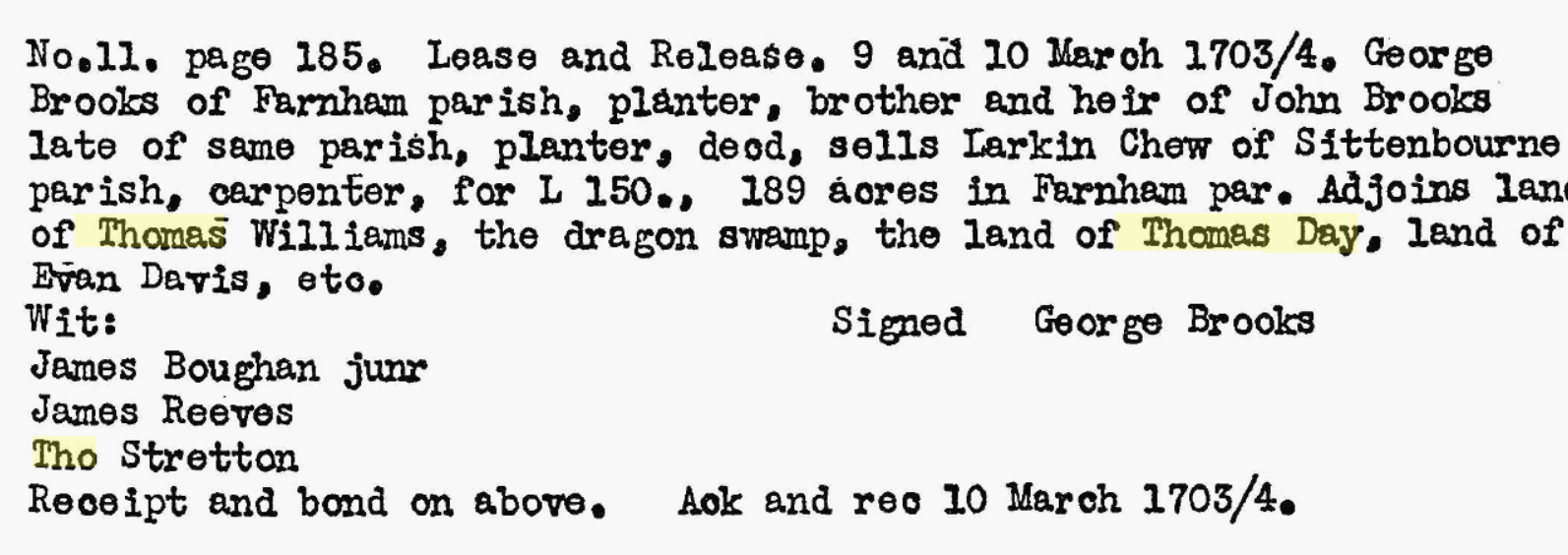
Early records show that Thomas Day purchased land from William Hudson and wife Rebecca Woodnut Hudson located in Essex County, Virginia in 1687. He also purchased 189 acres in Essex County, Virginia from a John Brookes in 1693.

This 1703 transaction gives us at least a waterway in Essex County.

thomasday1

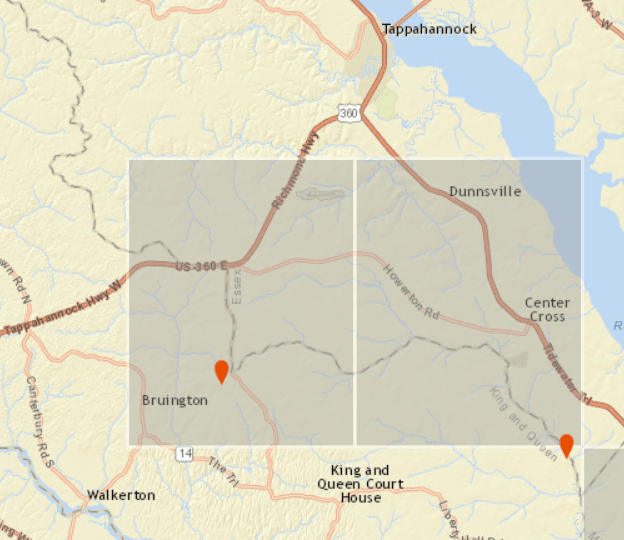
We find his land on the map below, in the area in gray, in essence between the two orange balloons in Essex County, on Dragon Swamp, also known as Dragon Run.  This was an area where the Indians used to hide.

thomasday2

The Mitchell map, below, drawn in 1751 shows Dragon Swamp.

dragon swamp

We know very little about Thomas Day, but we do know what was going on in the region where he lived.

In 1676, the same year that Thomas Day married Dorothy Hudson, Bacon’s Rebellion broke out in this part of Virginia, in fact, Virginia had its own mini-Civil war.  While this sounds “cute,” it was anything but.  Everyone had to choose sides.

In 1676, Nathaniel Bacon and many settlers rebelled against the governor, attacking Native Americans, and eventually burning Jamestown.

You either declared “for” the renegades, or they ransacked your home and maybe worse.

In part, Bacon’s Rebellion was fueled by Bacon’s compulsive, unwielding position that all Indians needed to be attacked and killed.  In addition, the landed class did not like the fact that the governor had signed into law sweeping reforms passed by the House of Burgesses allowing unlanded freemen the right to vote.  Did that apply to Thomas Day?

After passage of these laws, Bacon arrived with 500 followers in Jamestown to demand a commission to lead militia against the Native Americans. The governor, however, refused to yield to the pressure. When Bacon had his men take aim at Berkeley, he responded by “baring his breast” to Bacon and told Bacon to shoot him himself. Seeing that the Governor would not be moved, Bacon then had his men take aim at the assembled burgesses, who quickly granted Bacon his commission. Bacon had earlier been promised a commission before he retired to his estate if he could only be on “good” behavior for two weeks. While Bacon was at Jamestown with his small army, eight colonists were killed on the frontier in Henrico County (where he marched from) due to a lack of manpower on the frontier.

On July 30, 1676, Bacon and his army issued the “Declaration of the People of Virginia“. The declaration criticized Berkeley’s administration in detail. It accused him of levying unfair taxes, appointing friends to high positions, and failing to protect frontier settlers from Indian attack.

Bacon and his men attacked the innocent (and friendly) Pamunkey Indians. The tribe had remained allies of the English throughout other Native American raids. They were supplying warriors to aid the English when Bacon took power.

When Governor Sir William Berkeley refused to march against the Native Americans, farmers gathered around at the report of a new raiding party. Nathaniel Bacon arrived with a quantity of brandy; after it was distributed, he was elected leader. Against Berkeley’s orders, the group struck south until they came to the Occaneechi tribe. After getting the Occaneechi to attack the Susquehannock, Bacon and his men followed by slaughtering most of the men, women, and children at the village.

After months of conflict, Bacon’s forces, numbering 300-500 men, moved to Jamestown. They burned the colonial capital to the ground on September 19, 1676, pictured in the 18th century drawing, below. Outnumbered, Berkeley retreated across the river.

Bacon burning Jamestown

Eventually, the governor prevailed, but that was not the sure and certain outcome for much of the rebellion and probably would not have been had Bacon not died.

Before an English naval squadron could arrive to aid Berkeley and his forces, Bacon died from dysentery on October 26, 1676. John Ingram took over leadership of the rebellion, but many followers drifted away. The Rebellion did not last long after that. Berkeley launched a series of successful amphibious attacks across the Chesapeake Bay and defeated the rebels. His forces defeated the small pockets of insurgents spread across the Tidewater. Thomas Grantham, a Captain of a ship cruising the York River, used cunning and force to disarm the rebels. He tricked his way into the garrison of the rebellion, and promised to pardon everyone involved once they got back onto the ship. However, once they were safely ensconced in the hold, he trained the ship’s guns on them, and disarmed the rebellion. Through various other tactics, the other rebel garrisons were likewise overcome

The 71-year-old governor Berkeley returned to the burned capital and a looted home at the end of January 1677. His wife described Green Spring in a letter to her cousin:

“It looked like one of those the boys pull down at Shrovetide, and was almost as much to repair as if it had been new to build, and no sign that ever there had been a fence around it…”

Bacon’s wealthy landowning followers returned their loyalty to the Virginia Government after Bacon’s death. Governor Berkeley returned to power. He seized the property of several rebels for the colony and executed 23 men by hanging, including the former governor of the Albemarle Sound colony, William Drummond.

After an investigative committee returned its report to King Charles II, Berkeley was relieved of the governorship, and recalled to England. “The fear of civil war among whites frightened Virginia’s ruling elite, who took steps to consolidate power and improve their image: for example, restoration of property qualifications for voting, reducing taxes and adoption of a more aggressive Indian policy.” Charles II was reported to have commented, “That old fool has put to death more people in that naked country than I did here for the murder of my father.” No record of the king’s comments have been found; the origin of the story appears to have been colonial myth that arose at least 30 years after the events.

Indentured servants both black and white joined the frontier rebellion. Seeing them united in a cause alarmed the ruling class. Historians believe the rebellion hastened the hardening of racial lines associated with slavery, as a way for planters and the colony to control some of the poor.

We don’t know what Thomas Day did or his sentiments during Bacon’s Rebellion, but there wasn’t such a thing in that time and place as someone who was uncommitted or ambivalent.  You were on one side or the other, and if you didn’t decide for yourself, someone would be deciding on your behalf.

Before 1698, Thomas married second to Elizabeth.  We don’t know Elizabeth’s surname, nor do we know when she was born, nor where, although probably in Virginia.  We don’t know exactly when she married Thomas Day, but it was sometime after 1687 and before 1698.  She had one child before her death in early 1699.  It’s her death that we know the most about.  Elizabeth was murdered, horrifically murdered, beaten to death, very likely at the hands of her husband, Thomas Day.  And we only discovered this terrible fact, some 314 years after it happened.  Talk about a well-kept family secret.  You would think if any oral history would survive, this juicy piece would.  Maybe the family was ashamed and didn’t speak of it.  Or maybe it was just too painful.

Elizabeth Mary Angelica Day, believed to be the only child of Thomas and Elizabeth, per his will, born between 1687-1698 (probably closer to the 1698 date), married George Shepherd about 1725.  They lived in Spotsylvania County, Virginia.  Their son, Robert would marry Sarah Rash and they would settle in Wilkes County, beginning the Shepherd line in western NC.

Indicted for Murder

Thomas Day was indicted for the murder of his wife, Elizabeth, in 1699. Exactly what transpired concerning this event is not completely clear – but the depositions from the neighbors are pretty damning.

According to recorded testimony, it appears that a neighbor, Mary Hodges, visited the Day home and found Elizabeth Day’s dead body lying on a bed. She had been severely beaten, and Thomas Day also had wounds on his face. Thomas Day said his wife died about two hours before sunrise, but he did not know what had happened to her. He told Hodges that his facial wounds resulted from hitting his head over a “potrack.” A jury indicted Day for the murder of his wife, but he was acquitted. A man named John Smith was later found guilty of Elizabeth’s murder and was executed.

Nothing is recorded concerning Smith’s relation to the Day’s or his motive–only that he was found guilty and executed (presumably hanged).

Testimony concerning this case follows:

Essex Co., VA Deeds and Wills BK 10, Part 1, 1699-1702; page 31A; 10 Feb 1699;

The deposition of Judith Davy aged 27 years or thereabout, being Examd and swoorn saith that upon ye 9th of this instant and going to ye house of Tho. Days of Ffarnham in ye Essex County at ye request of Mary Hodge, her neighbour and seeing ye Days wife lying dead upon ye bed in a most horrod and barborey mannor all gored in blood this depo. asked him how his wife cam to be in that condition who mad answer he know not. Thy Depot. further asked him if he and his wife had been quarrelling who replyed that he and his wife had not had an angry word this many a day also they Depot further asked him if anybody had been lately thoto who answered nither did he see anhbody also they Depot. asked him how he burned his eyes who replyed again ye pott rack and being asked a little while after by this depot. how he hurt himself he answered the Lord Knows, I know not and this Depot. saith furthor that ye Sd. Tho. Day had then and at the same time his face and eyes most greviously bruised and further saith not.

Judith Davy

Sworne before me ye Day and yeare above written; Rich’d. Covington

The deposition of Elizabeth Aeres, aged thirty-eight years or thereabout, being Examined and Sworne saith that upon the ninth of this instant that going to the house of Tho. Daye of Ffarnham parrish in Essex County at the request of Mary Hodge, he neighbour and seeing the sd. Days wife lying dead upon the bed in a most horrod and barboriy mannor all Gored in Blood thy deponent asked him how his wife came to lie in that condition who made answer he knew not this Depo’t further asked him if he and his wife had been quarrelling who replyed that he and his wife had not had an angry word this many day also thy depont. further asked him if anybody had been lately there who answered no neither did he see anybody also this dDepont. asked him how he hurt his Eyes who replyed against the potrack and being asked a little while after by thy depont’ how he hurt himself he answered the Lord knows I know not and thy Depont saith further if the sd. Thomas Daye had then at the same time his face and eyes most greviously brused with severall wound and bruses upon his head and further saith not.

Elizabeth Aeres

Sworn before me the day and yeare above written By me Rich’d Covington in ye Place of A Coroner

The Deposition of Mary Hodges aged seaventy five yeares or thereabouts being Examined and Sworne saith that upon the ninth of this Instant coming from the house of Mr. Tho. Covingtons and going to Tho. Days of Ffarnham Parish in Essex County seeing the sd. Day setting upon a counch by the fire seemed melancholy asked him how he did who answered he did not know his face and eyes being most greviously brused he presently after tould me that his wife was dead. Your Depot asked him how she came to die who presently replyed she died about two houres before day of morning. Your depot further asked him how his face came to be in that condition who tould me he cut it against the potrack that was over the fire upon which I went to the woman, his wife as she lay on the bed and found her dead your depont. seeing her lying in a most horrod and barborous manor all gored in blood upon….Your depont. took Days wife by one of her shoose which was upon her foot and found her legg to be somewhat limber and the sd. Day requesting her to strip her dead body I told him I may not able of myself to perform it and further told him I would goe for more assistance and call of Judith Davy my daughter in law and Elizabeth Aeres which accordingly I did and ye depont. further saith not.

Mary Hodges

Sworn before me the day and yeare above written. Rich’d Covington in Place of Coronor.

The Inquisition

An Inquisition….taken at ye house of Thomas Dayes in Ffarnham Parish in Essex County ye 10 day of February in ye yeare 1699 before me. Rich’d Covington one of his Majesties Justices of ye Peace for ye County of Essex upon view of the body of Elizabeth day ye wife of Thomas Day….then and there lying dead and ye Jurors being good and lawfull men and Sworne to trye and inquire in ye behalfe of our Sovereigne Lord & King how and in what manner ye Eliza Day came by her death and they upon their oath say that ye Elizabeth Day was much beaten and bruised with both her eyes exstreem black with many other bruses on her face and bruise on her right eare and a hole underneath ye smae eare and we of the juror say..ye cause of ye sd. Eliza Days death and wee of ye Jurors further say that Tho. Day at ye same time was much brused and beaten having both his Eyes Extreemly brused and black several cuts in his head and further upon his Examination would not confess anything how Elizabeth his wife came by them blows and wounds now how he came to be soo beaten himself so we Jurors say that in ye parish and county aforsd and on the eight or ninth of this instant to wit: in ye dwelling house of ye sd. Tho. Day that ye Sd. Eliza. Day was barbarously murdered and by all manner of Circumstances we can find or gather that ye aforesaid Thom. Day is Guilty of ye murdering ye said Elizabeth Day. In Reffereance to ye Same I Rich’d Covington as afforsd togeather with the jurory aforsd: have put our hands and seales ye day and date above written.

Richard Covington in ye Place of Coronor

Sam. Farry, Tho. Ewell, Henry Perkins, Richd. Taylor, Tho. Crants, Tho. Johnsone, Tho. Greene, Wm. Price, Sam. Coates, John Brooks, Tho. Cooper, Henry Geare, Jeffrey Dyer, Tho. Williamson February 10, 1699.

Thomas Day of Essex Co., VA was charged with murdering his wife Elizabeth Day. Surprisingly, he was acquitted in the Aprill Generall Court 1700.  I wish desperately that we had those detailed court notes.

Subsequently, John Smith was found guilty of murdering Elizabeth Day and was executed. October Generall Court 1700.

I’m not  lawyer, but I’m going to play prosecutor.  Questioning might have gone something like this, based on the information from the depositions and inquisition:

Q – Thomas Day, were you in the house all night the night your wife died.
A – Yes.

Q – Did you know she was dead?
A – Yes.

Q – When did she die?
A – Two hours before sunrise.

Q – How did she die?
A – I don’t know.

Q – Who killed her?
A – I don’t know.

Q – You were in the house and someone murdered your wife  by beating her to death, and you don’t know who was there?
A – No.

Q – How did your wife come to be “lying dead upon ye bed in a most horrod and barborey mannor all gored in blood?”
A – I don’t know.

Q – Why was your face so bruised?  How did that happen?
A – I hit my head over a potrack.

Q – Your face and eyes were terribly bruised and you did that by hitting your head on a potrack?
A – Lord knows.

Q – What did you do after your wife died?
A – Sat by the fireplace.

Q – So someone killed your wife while you were at home, but you don’t know who.  You didn’t come to her assistance and defend her.  You didn’t call anyone or go for help.  You knew she was dead, but simply sat by the fireplace until your neighbor came to your house.  You changed your story about how your face was wounded and bruised from hitting your head on the potrack to “Lord knows.”  Gentleman of the jury (ladies couldn’t serve on juries at that time)…..I submit to you that Thomas Day killed his wife, Elizabeth, by brutally beating her to death and watched as she lay dying in a pool of her own blood.  What other explanation for his condition and behavior can there possibly be?

However, today’s prosecutor would have an easier job, or the defense attorney one….because we would have DNA evidence.  It would be impossible for someone to brutally beat Elizabeth in the fashion described without leaving some of their DNA on her.  She obviously fought back and would have likely had the murderer’s blood on her  body and their skin under her fingernails.

So today, DNA would have convicted Thomas or removed all doubt, one way or the other.  I wish I had a time machine.

Thomas Day’s Death

Thomas Day didn’t live long himself.  He was ill when he made his will.  It’s unclear who his daughter lived with after his wife’s death and after his death as well.  It’s presumed that he had only the one child because no other children are known or mentioned in the will.

Thomas Day died between December 5, 1705 (the date of his will) and February 11, 1706 (when his will was probated), ironicly, possibly 7 years to the day after his wife’s death. At the writing of his will, an ailing Thomas Day had placed himself and his daughter Elizabeth (still a minor) in the care of John Fargason.

The will of Thomas Day from “Fleets Colonial Abstracts” – Essex County, VA Vol 29, page 81, No 12, page 181

“To all to who these presents shall come Greting know yee that I thomas Day of the parish of South Farnham in the County of Essex in Virginia being in a sickly weake and low condition and noe(ways) waies Capable to tke care of, or provide for myself and that little Estate it hath pleased God to bestow upon me (it chiefly lying in Perishable Creatures) have and by these presents doe Bargain Sell Bind and firmly make over unto Jn’o Fargason of the parish and County aforsaid planter all and singular my said Estate”, etc. In consideration Fargason “to maintain and keep me the said Day During my naturall life with sufficient accomodation of victuals Cloathes washing and lodging and give to Eliza a Mary Angillica Day my Daughter when she arrive to the age of Eighteen or when married one Cowe and Calfe.”

5 Dec 1705 signed Tho x Day Wit: John Fargason Wm. aylett Adam Denning Ack and rec 11 Feb 1705/6

On additional piece of information we obtain about Thomas is that he lived in Farnham Parish in Essex County.

When the North Farnham Parish Register opens (1663-1814), there was no such Parish. It was simply Farnham Parish and covered both sides of the Rappahannock River in Old Rappahannock County, Virginia. In 1684 Farnham Parish was subdivided into North Farnham Parish and the Rappahannock River as the natural boundary. Then, in 1692 Old Rappahannock County was abolished and became the parent of two new counties, South Farnham Parish fell into Essex County and North Farnham Parish Fell into Richmond County.

In Essex County, South Farnham was simply called Farnham Parish.  The first church was built in 1737, long after Thomas Day was dead.  Bishop Meade refers to an earlier church there as “Piscataway.”  Given Elizabeth’s demise, I find it hard to believe that Thomas attended church any more often than was required by law, at that time.

There are no Day(e) entries in the parish register.

We don’t know where Thomas Day is buried, but I’d hazard a guess that it’s not in the churchyard.

Reflecting

I can’t even begin to imagine how or why Thomas Day was acquitted of his wife’s murder.  Looking at the depositions, some 300+ years removed, it appears obvious and nearly conclusive that Thomas murdered Elizabeth.  Perhaps research into the life and social standing of Thomas Day might reveal more information and shed light on this situation.  Records in the Virginia archives might contain more information as well, although there are no chancery suits.

I find it extremely hard to believe that Thomas did not murder his wife.  In fact, how could he NOT have been the murderer, given the circumstances?  The description of her wounds, the severity and the continuous beating that had to have occurred in order to inflict those grave wounds would have been unlikely to have been inflicted by someone simply wanting to get her out of the way, like for a robbery.  Those are wounds of passion, of anger, and it looks like she put up a fight as well.  Thomas had obviously been in a fight as his own face and eyes were bruised, with wounds, according to the indictment.  This was a crime of passion.  Added to that was the fact that Thomas’s wife had died in the night, and he had not sought assistance from anyone.  He was found sitting by the fireplace.  If he had found her bloody and beaten, he would have gone for help, but he didn’t.  Instead, he watched her die and left her lying on the bed in a pool of her own blood for the neighbor to find in the morning, stating that he didn’t know what happened.

Even if Thomas didn’t directly murder Elizabeth, meaning that a stranger broke in, beat them both, killed Elizabeth but not Thomas, and left the house – Thomas still has some culpability for Elizabeth’s death, since he was clearly conscious and knew when she died, according to what he told 3 separate witnesses.  So he wasn’t asleep or unaware, yet he did nothing before she died to try to help her.  He clearly knew she was badly injured.  Had she survived, she surely would have named him as the person who beat her.  Nor was Thomas distraught by her death.  He wasn’t found sobbing at her bedside.

So Thomas Day not only killed his wife, he is also responsible for the death of John Smith in 1700 who was hung for Elizabeth’s murder.  In essence, if Thomas murdered Elizabeth, he murdered John Smith too.  I hope that if John Smith’s family finds out that he was hung in Essex County, Virginia, as a murdered, that they google and find this article.

All of this makes me wonder how his first wife died, assuming that his first marriage ended with the wife’s death.

Chances are that Thomas and Elizabeth’s child, Elizabeth Mary Angelica Day never knew her mother, for whom she was named, or was too small to remember her.  She may well have been in the house when her father murdered her mother, and depending on her age at the time, might well remember the event.  She could also have been an infant.  If she was, then she likely didn’t remember either her mother or her father very well as he died just a few years later, in 1706, as an invalid.  Somehow Thomas’s death not long after Elizabeth’s seems like karmic justice.  If he did in fact murder Elizabeth, we can wish him a long and miserable death, dreading and fearing his own passing, knowing that he would face sure and certain retribution for his actions in the court of ultimate truth.  There is no other justice to be wrought for Elizabeth – none.

As she grew up, Elizabeth the daughter would have known that her mother was murdered, and even though her father was acquitted, she surely would have known about the circumstances surrounding her mother’s death.  When she married George Shepherd about 1727, she may have been all too happy to leave the area and settle in Spotsylvania County, striking out for a new location where she could leave the past behind.  In essence, she had been raised an orphan under the storm cloud of her mother’s terrible death and her father’s inferred guilt.

How her mother’s death must have haunted her.  To lose your mother is bad enough, but to know she died horrifically, and possibly, or probably, at the hands of your own father, is an unspeakable burden for anyone, let alone a child.  How could she embrace the memory of her father who took her mother from her?  In essence, she lost both parents when her mother died, and her father again at his own death.  Of course, it’s also possible that whoever raised her shielded her from the truth, and perhaps that is why this story never descended through the family.  Maybe Elizabeth never knew the extent of her father’s involvement.  Let’s hope not, for her sake and let’s hope Thomas wasn’t abusive to Elizabeth as well.

Of course, since there were no known sons of Thomas Day, we can’t retrieve his Y DNA.  We don’t know who his parents were, so we don’t know if he had male siblings, or who they were, so that avenue is closed to us as well.

There is a Day DNA project, but unfortunately, it is not hosted at Family Tree DNA and the site doesn’t provide any ancestral information, so it’s entirely useless in terms of trying to find a specific line or even a geographic location.  The genealogy site it connects to is no longer being maintained, so a double strike-out.

I think this is one ancestor I’m just as happy to leave among the dead.  I pray that I didn’t inherit very much DNA from him, or any traits.  From now on, I’ll blame my temper on him.  He has to be good for something.  As my mother used to say, if all else fails, you can always serve as a bad example.

The research about the murder of Elizabeth Day compiled by a cousin at http://www.danielprophecy.com/daye.html.

______________________________________________________________

Disclosure

I receive a small contribution when you click on some of the links to vendors in my articles. This does NOT increase the price you pay but helps me to keep the lights on and this informational blog free for everyone. Please click on the links in the articles or to the vendors below if you are purchasing products or DNA testing.

Thank you so much.

DNA Purchases and Free Transfers

Genealogy Services

Genealogy Research

DNA Day with Ancestry

For quite some time now, the genetic genealogy community has been beating the living tar out of Ancestry.com for not listening, among other things. Well, I’m here to say, they are listening.  Now, what I can’t say is how much they are hearing.  The jury is out and we will see. However, we are hopeful.

Ancestry invited a few of the leaders in the genetic genealogy field to come and meet with them this week. They dedicated the resources of eighteen of their scientists and executives to this meeting and they spent the day with us, sharing information about the science underlying their upcoming product changes and having frank discussions with the group.

This was a very cordial, informative and I think, team-building, experience, but there was far from uniform agreement. There was a great deal of discussion which I think helps everyone understand the position and reasoning of the other parties involved. Like anything else, it’s not as simple as one might hope.

Another important aspect of these meeting is that they serve to put faces with names and humanize the other people involved.

I also found it encouraging that most of the people at Ancestry are genealogists and utilize their own tools.

Tim Sullivan, CEO of Ancestry stopped by and talked with us for a few minutes. He asked us what we wanted, why and if we had any questions for him.  He told us about his own genealogy experiences.  And, we discovered, he does read our blogs.  Tim is very actively engaged as is Ken Chahine, Senior Vice President and General Manager DNA, who is in many of the photographs because he was sitting at the end of the screen and was with us for the entire day.

I will be covering different aspects of the content of these meetings as time moves forward and as Ancestry’s new software version is implemented, but for now, I wanted to update you on the two burning questions in the genetic genealogy community.

These, as you might guess, were also the most contentious aspects of the entire meeting.

Will We Receive a Chromosome Brower?

I want to share with you readers that there is absolutely no question that Ancestry heard the message that we need a chromosome browser, loud, clear and uniformly from us. Ancestry is equally as adamant, it appears, as we are, that we don’t need one.

So, the short answer is no.

The longer answer is probably not.

Judy Russell, in comments to her article, “when less is more,” which I strongly encourage you to read, says about the chromosome browser:

“In my personal opinion, speaking only for myself and based solely on my own perceptions of the attitudes of some folks at AncestryDNA and not on any specific representations by anyone else, my judgment is that we may get a chromosome browser at AncestryDNA when hell freezes over.”

This was also followed by a comment about pigs flying…..plus, she took all the good phrases…not much left for me to say.pig fly

I think this pretty well sums it up.

I do want to discuss why Ancestry does not feel a chromosome browser is warranted. This topic was discussed directly and indirectly several times throughout the day.  These concerns listed below are not necessarily in priority order based on discussions, because I couldn’t really discern a priority.

1.  Given that Ancestry will hit the million kit DNA mark sometime in the first quarter of 2015, they feel that very few, a small percentage, of those people would ever utilize, or understand the results of a chromosome browser. Given that, they don’t feel it is a good investment of their engineering time to invest in something that few people, or a small percentage of the whole, will utilize.

2.  Since Ancestry did not begin utilizing chromosome browsing in the beginning, they are concerned about privacy issues having to do with now introducing the feature to people who did not expect to have that to begin with.

3.  Ancestry is concerned about unexpectedly and unintentionally revealing health information. For example, let’s say that today, a particular SNP is included in their information and is not known to be medically relevant. Next year, someone discovers that a particular SNP on chromosome 7 is connected to the genetic propensity for erectile dysfunction. Remember, a genetic propensity does NOT mean you have or will get the particular disease. In this case, of course, that would not apply to women.

Ancestry’s concern is that since they would have already been displaying that match on chromosome 7 between several people for months/years, the cow is proverbially out of the barn and closing the door at that point it a bit late, if possible at all.

Of course, as we pointed out to Ancestry, that’s the entire point of having testers sign a release, and both Family Tree DNA and 23andMe both deal with the same issue.

4.  Ancestry feels that a chromosome browser would provide information to people that they should not be drawing conclusions from, and they are.

For example, as they showed us, there are areas in each person’s chromosome and their matches chromosomes that are what they call “pile up” areas. These are areas that we would call IBS, identical by state as opposed to IBD, identical by descent.  Some of these pileup areas are so old that they could potentially be considered AIMs, or Ancestrally Informative Markers that harken back to continents like Africa, Asia or Europe. my pileup

This slide shows Cathy Ball, VP Genomics and Bioinformatics, showing me my own pileup areas. The two screens are a TV screen to the right where the colors resolved much better, and the larger screen where the display was larger.

my pileup2 crop

What this shows you is that on the chart at left, I have one area that has a very large number of pileups, probably about 800 matches (out of my 12,500 total matches), two areas that have 400 each, two that have about 200. On the chart at right, the top of the chart is 25 match segments, so you can see that most of my matches fall below that.  Ancestry feels that the higher matched segments are less relevant because they match to so many people, that they aren’t really indicative of shared ancestry in a genealogical timeframe.

And no, they did not tell me which chromosome these pileup segments are found on, and I’m DYING to know so that I can relate that to my ancestral chromosome mapping….but no cigar. It’s so frustrating that they know, they have the info, our info, but they won’t share it with us.  I’m not referring here to the slide and my pileup, but the lack of segment information in general.  I don’t know how that’s any worse that allowing customers to infer that a shakey leaf tree match is equivalent to a DNA match…..

Everyone has these pileup areas, which also means that they show up on your chromosome browser as matches. Ancestry is concerned that you will see three people, whether from a common genealogy line or not, who match on one segment and you will presume that they are genealogically related, when perhaps they aren’t, because their match is IBS from a pileup area.

Clearly, those of us who work in this field daily deal with IBS issues routinely, but Ancestry is concerned about the general consumer who doesn’t.

I suggested that the chromosome browser could be even more useful if they had a way to show but “grey out” those pileup areas, so we would be aware that their confidence is low, and to highlight the areas where the rarest alleles match, because those matches are most likely to indicate true genealogical matches. That suggestion met with polite silence.

Roberta’s Opinion

I do agree that many people won’t utilize the chromosome browser, but many people won’t utilize many of their services.  That doesn’t prevent Ancestry from providing those services for those who want to utilize them.  I’m fine with Ancestry making the Chromosome Browser part of a subscription kit so only subscribers have access, just like many of their data bases.

Unfortunately, without a chromosome browser, we are left with nothing concrete to base any matches on, nor the ability to utilize that information in conjunction with chromosome segment information from other companies to map our segments to various ancestors.  The problem of incorrect ancestor attribution remains and will remain present in their matches.

They are changing their matching algorithm and in some ways, it will be improved, but in one way, I am gravely concerned that it will be worse. Ancestry will begin weighting various factors in calculating the match strength, and one of those factors will be the number of trees that list a particular ancestor.  If you’ve just had a coronary…so did we.  I thought one of the genetic genealogists was going to have the big one right there – they turned so red in the face.

A second confidence weighting factor will be the amount of source information for a particular tree which Ancestry feels helps judge the quality of the tree. In a sense, I agree, but attaching source information, perhaps incorrectly, to the wrong family, or having the wrong ancestor you’ve just attached source information to, is still the same large problem.  Clearly, quality is not a matter of quantity, but just as clearly Ancestry cannot look at each tree individually and render an opinion, so they have to develop some automated methodology if they are going down this path.

Ancestry is trying to find ways to improve their matching and predictions of common ancestry. As time moves forward, I’ll be covering these developments.  As someone in the meeting said, first steps first.

But back to the chromosome browser, my gut reaction to this is, and this is my opinion alone, that they don’t want to invest the development effort into something that will make the user experience more complex and may increase their customer support staff load to support and explain matching on a chromosome browser. I don’t think they believe the genealogy community has the ability to utilize and understand this type of tool.  Ancestry is a genealogy marketing company.  They want the user’s experience to be pleasant, easy and fulfilling…not difficult and certainly not upsetting.

Our message did not waiver, we need a chromosome browser and “trust me” simply won’t work.

The Y DNA and mtDNA Data Base

When Ancestry sent the invitation to this meeting, I had to wonder if they really thought through the fact that this meeting would occur less than a week after they decommissioned their Y and mtDNA data base.

Did they really want a group of people that were mad as wet hens arriving to meet with them? I fully expected to receive an “un-invitation” after my article and before the meeting, but I didn’t.

Without going into nitty-gritty detail, Ancestry indicates that the data base that held those results was literally on its last leg and they did not want to invest any money into something they was not bringing in any revenue and for a product they were no longer selling. I do believe that data base was indeed in its death throes because after the denial of service attack in June, it was no longer searchable.

In the ensuing discussion, the genetic genealogy community provided a number of alternative scenarios both within and outside of Ancestry as a way to salvage the information in that database. Ancestry has agreed to take the matter under consideration internally and discuss the various options.  They made no promises, but I personally find it very encouraging that they are willing to discuss the matter and reconsider.

I told them I’d like nothing more than to write a retraction article that says that Ancestry did not, after all, burn the DNA courthouse.

In the same vein, I asked if they had any plans to decommission the Sorenson data base at www.smgf.org and they indicated that they do not have any plans at this point to do that.  Obviously, nothing is forever, and they could reconsider in the future but at least it appears that resource is safe for now and adding the Y and mtDNA records from Ancestry into that data base was one option discussed.

In Conclusion

I do feel this was a productive meeting. The scientific aspects of having a large data base to draw from are quite interesting and I’ll be sharing some those in upcoming articles.  Some of the best conversations took place beside the proverbial “water cooler.”  I am hopeful that we made progress, or at least thawed the ice a little on the issues so critical for the genetic genealogy community, but time will tell.  In a way, I felt like this was a United Nations type of meeting where everyone leaves with a better understanding.

______________________________________________________________

Disclosure

I receive a small contribution when you click on some of the links to vendors in my articles. This does NOT increase the price you pay but helps me to keep the lights on and this informational blog free for everyone. Please click on the links in the articles or to the vendors below if you are purchasing products or DNA testing.

Thank you so much.

DNA Purchases and Free Transfers

Genealogy Services

Genealogy Research

Elizabeth Day (c 1667 – 1699), Murdered, 52 Ancestors #40

rose1

Elizabeth Day, her married name, was my 7th great-grandmother.

  • Roberta Estes
  • William Sterling Estes
  • William George Estes and Ollie Bolton
  • Lazarus Estes and Elizabeth Vannoy
  • Joel Vannoy and Phoebe Crumley
  • Elijah Vannoy and Lois McNiel
  • William McNiel and Elizabeth Shepherd
  • Robert Shepherd and Sarah Rash
  • George Shepherd and Elizabeth Mary Angelique Day(e)
  • Thomas Day (1651-1706) and Elizabeth (murdered 1699), last name unknown

We don’t know Elizabeth’s surname, nor do we know when she was born, nor where, although probably in Virginia.  We don’t know exactly when she married Thomas Day, but it was sometime after 1687 and before 1698.  She had one child before her death in early 1699.  It’s her death that we know the most about.

Elizabeth was murdered, horrifically murdered, beaten to death, very likely at the hands of her husband, Thomas Day.  And we only discovered this terrible fact, some 314 years after it happened.  Talk about a well-kept family secret.

Thomas Day was born about 1651 in Rappahannock, Virginia and died in 1706 in Essex County, VA.  Daughter, Elizabeth Mary Angelica Day, believed to be the only child of Thomas and Elizabeth, per his will, married George Shepherd about 1725.  They lived in Spotsylvania County, Virginia.  Their son, Robert would marry Sarah Rash and they would settle in Wilkes County, beginning the Shepherd line in western NC.

In 1676, Thomas Day married widow Dorothy Young Hudson in Old Rappahannock County, Virginia. Dorothy was the daughter of Robert and Anne Parry Young. Dorothy (b. ca. 1646, d. bef. 1698) was the widow of Edward Hudson with whom she had three children: Serania/Lurana, Anne, and William.

Early records show that Thomas Day purchased land from William Hudson and wife Rebecca Woodnut Hudson located in Essex County, Virginia in 1687. He also purchased 189 acres in Essex County, Virginia from a John Brookes in 1693.

Before 1698, Thomas married a second time to Elizabeth. Thomas and Elizabeth had one daughter, Elizabeth Mary Angelica Day, born between 1687 and 1699.  I suspect her birth was closer to the 1698 timeframe, because her eventual husband was born around 1700.

Thomas Indicted

Thomas Day was indicted for the murder of his wife, Elizabeth, in 1699. Exactly what transpired concerning this event is not completely clear.

According to recorded testimony, it appears that a neighbor, Mary Hodges, visited the Day home and found Elizabeth Day’s dead body lying on a bed. She had been severely beaten, and Thomas Day also had wounds on his face. Thomas Day said his wife died about two hours before sunrise, but he did not know what had happened to her. He told Hodges that his facial wounds resulted from hitting his head over a “potrack.” A jury indicted Day for the murder of his wife, but he was acquitted. A man named John Smith was later found guilty of Elizabeth’s murder and was executed.

Nothing is recorded concerning Smith’s relation to the Day’s or his motive–only that he was found guilty and executed (presumably hanged).

Testimony concerning this case follows:

Essex Co., VA Deeds and Wills BK 10, Part 1, 1699-1702; page 31A; 10 Feb 1699;

The deposition of Judith Davy aged 27 years or thereabout, being Examd and swoorn saith that upon ye 9th of this instant and going to ye house of Tho. Days of Ffarnham in ye Essex County at ye request of Mary Hodge, her neighbour and seeing ye Days wife lying dead upon ye bed in a most horrod and barborey mannor all gored in blood this depo. asked him how his wife cam to be in that condition who mad answer he know not. Thy Depot. further asked him if he and his wife had been quarrelling who replyed that he and his wife had not had an angry word this many a day also they Depot further asked him if anybody had been lately thoto who answered nither did he see anhbody also they Depot. asked him how he burned his eyes who replyed again ye pott rack and being asked a little while after by this depot. how he hurt himself he answered the Lord Knows, I know not and this Depot. saith furthor that ye Sd. Tho. Day had then and at the same time his face and eyes most greviously bruised and further saith not.

Judith Davy

Sworne before me ye Day and yeare above written; Rich’d. Covington

The deposition of Elizabeth Aeres, aged thirty-eight years or thereabout, being Examined and Sworne saith that upon the ninth of this instant that going to the house of Tho. Daye of Ffarnham parrish in Essex County at the request of Mary Hodge, he neighbour and seeing the sd. Days wife lying dead upon the bed in a most horrod and barboriy mannor all Gored in Blood thy deponent asked him how his wife came to lie in that condition who made answer he knew not this Depo’t further asked him if he and his wife had been quarrelling who replyed that he and his wife had not had an angry word this many day also thy depont. further asked him if anybody had been lately there who answered no neither did he see anybody also this dDepont. asked him how he hurt his Eyes who replyed against the potrack and being asked a little while after by thy depont’ how he hurt himself he answered the Lord knows I know not and thy Depont saith further if the sd. Thomas Daye had then at the same time his face and eyes most greviously brused with severall wound and bruses upon his head and further saith not.

Elizabeth Aeres

Sworn before me the day and yeare above written By me Rich’d Covington in ye Place of A Coroner

The Deposition of Mary Hodges aged seaventy five yeares or thereabouts being Examined and Sworne saith that upon the ninth of this Instant coming from the house of Mr. Tho. Covingtons and going to Tho. Days of Ffarnham Parish in Essex County seeing the sd. Day setting upon a counch by the fire seemed melancholy asked him how he did who answered he did not know his face and eyes being most greviously brused he presently after tould me that his wife was dead. Your Depot asked him how she came to die who presently replyed she died about two houres before day of morning. Your depot further asked him how his face came to be in that condition who tould me he cut it against the potrack that was over the fire upon which I went to the woman, his wife as she lay on the bed and found her dead your depont. seeing her lying in a most horrod and barborous manor all gored in blood upon….Your depont. took Days wife by one of her shoose which was upon her foot and found her legg to be somewhat limber and the sd. Day requesting her to strip her dead body I told him I may not able of myself to perform it and further told him I would goe for more assistance and call of Judith Davy my daughter in law and Elizabeth Aeres which accordingly I did and ye depont. further saith not.

Mary Hodges

Sworn before me the day and yeare above written. Rich’d Covington in Place of Coronor.

An Inquisition

An Inquisition….taken at ye house of Thomas Dayes in Ffarnham Parish in Essex County ye 10 day of February in ye yeare 1699 before me. Rich’d Covington one of his Majesties Justices of ye Peace for ye County of Essex upon view of the body of Elizabeth day ye wife of Thomas Day….then and there lying dead and ye Jurors being good and lawfull men and Sworne to trye and inquire in ye behalfe of our Sovereigne Lord & King how and in what manner ye Eliza Day came by her death and they upon their oath say that ye Elizabeth Day was much beaten and bruised with both her eyes exstreem black with many other bruses on her face and bruise on her right eare and a hole underneath ye smae eare and we of the juror say..ye cause of ye sd. Eliza Days death and wee of ye Jurors further say that Tho. Day at ye same time was much brused and beaten having both his Eyes Extreemly brused and black several cuts in his head and further upon his Examination would not confess anything how Elizabeth his wife came by them blows and wounds now how he came to be soo beaten himself so we Jurors say that in ye parish and county aforsd and on the eight or ninth of this instant to wit: in ye dwelling house of ye sd. Tho. Day that ye Sd. Eliza. Day was barbarously murdered and by all manner of Circumstances we can find or gather that ye aforesaid Thom. Day is Guilty of ye murdering ye said Elizabeth Day. In Reffereance to ye Same I Rich’d Covington as afforsd togeather with the jurory aforsd: have put our hands and seales ye day and date above written.

Richard Covington in ye Place of Coronor

Sam. Farry, Tho. Ewell, Henry Perkins, Richd. Taylor, Tho. Crants, Tho. Johnsone, Tho. Greene, Wm. Price, Sam. Coates, John Brooks, Tho. Cooper, Henry Geare, Jeffrey Dyer, Tho. Williamson February 10, 1699.

Thomas Day of Essex Co., VA was charged with murdering his wife Elizabeth Day. He was acquitted in the Aprill Generall Court 1700.

Subsequently, John Smith was found guilty of murdering Elizabeth Day and was executed. October Generall Court 1700.

Thomas Day’s Death

Thomas Day didn’t live long himself.  He was ill when he made his will.  It’s unclear who his daughter lived with after his wife’s death and after his death as well.  It’s presumed that he had only the one child because no other children are known or mentioned in the will.

Thomas Day died between December 5, 1705 (the date of his will) and February 11, 1706 (when his will was probated), ironicly, possibly 7 years to the day after his wife’s death. At the writing of his will, an ailing Thomas Day had placed himself and his daughter Elizabeth (still a minor) in the care of John Fargason.

Reflecting

I can’t even begin to imagine how or why Thomas Day was acquitted of Elizabeth’s death.  Looking at the depositions, some 300+ years removed, it appears obvious and nearly conclusive that Thomas murdered Elizabeth.  Maybe that’s because today we understand much better the profile of wife abusers.

Perhaps research into the life and social standing of Thomas Day might reveal more information and shed more light on this situation.  Records in the Virginia archives might contain more information as well.

I find it extremely hard to believe that Thomas did not murder his wife.  In fact, how could he NOT have been the murderer, given the circumstances?  The description of her wounds, the severity and the continuous beating that had to have occurred in order to inflict those grave wounds would have been unlikely to have been inflicted by someone simply wanting to get her out of the way, like for a robbery.  Those are wounds of passion, of anger, and it looks like she put up a hellatious fight as well – literally, fighting for her life.  Sadly, a battle she did not win.  Thomas had obviously been in a fight as his own face and eyes were bruised.  This was a crime of passion.  Added to that was the fact that Thomas’s wife had died in the night, and he had not sought assistance from anyone.  He was found sitting on the couch by the fireplace hours after she died.  If he had found her bloody and beaten, he would have gone for help, but he didn’t.  Instead, he watched her die and left her lying on the bed in a pool of her own blood for the neighbor to find in the morning, stating that he didn’t know what happened.

Even if Thomas didn’t directly murder Elizabeth, meaning that a stranger broke in, beat them both, killed Elizabeth but not Thomas, and left the house – Thomas still has some culpability for Elizabeth’s death, since he was clearly conscious and knew when she died, according to what he told 3 separate witnesses.  So he wasn’t asleep or unaware, yet he did nothing before she died to try to help her.  He clearly knew she was badly injured.  Had she survived, she surely would have named him as the person who beat her.  Nor was Thomas distraught by her death.  There was no sobbing at her bedside.

So Thomas Day not only killed his wife, he is also responsible for the death of John Smith in 1700 who was hung for Elizabeth’s murder.  In essence, if Thomas murdered Elizabeth, he murdered John Smith too.  All of this makes me wonder how his first wife died, assuming that his first marriage ended with his wife’s death.

Chances are that Thomas and Elizabeth’s child, Elizabeth Mary Angelica Day, never knew her mother, for whom she was named, or was too small to remember her.  She may well have been in the house when her father murdered her mother, and depending on her age at the time, might well remember the event.  She could also have been an infant.  If she was, then she likely didn’t remember either her mother or her father very well as he died just a few years later, in 1706, as an invalid.  Somehow Thomas’s death not long after Elizabeth’s seems like karmic justice.  If he did in fact murder Elizabeth, we can wish him a long and miserable death, dreading and fearing his own passing, knowing that he would face sure and certain retribution for his actions in the court of ultimate truth.  There is no other justice to be wrought for Elizabeth – none.

As she grew up, Elizabeth, the daughter, would have known that her mother was murdered, and even though her father was acquitted, she surely would have known about the circumstances surrounding her mother’s death.  People talk.

When she married George Shepherd about 1727, she may have been all too happy to leave the Essex County area and settle in Spotsylvania County, Virginia, striking out for a new location where she could leave the past behind.  In essence, she had been raised an orphan under the storm cloud of her mother’s terrible death and her father’s inferred guilt.

How her mother’s death must have haunted her.  To lose your mother is bad enough, but to know she died horrifically, and possibly, or probably, at the hands of your own father, is an unspeakable burden for anyone, let alone a child.  How could she embrace the memory of her father who took her mother from her?  In essence, she lost both parents when her mother died, and her father again at his own death.  Of course, it’s also possible that whoever raised her shielded her from the truth, and perhaps that is why this story never descended through the family.  Maybe Elizabeth never knew the extent of her father’s involvement.  Maybe she never knew the terrible truth about how her mother died.

Elizabeth’s DNA

Elizabeth’s one daughter, Elizabeth had two daughters.  We don’t know much about either of them.

Ann Shepherd was born about 1737 in Spotsylvania County and is reported, by some, to have married a Benjamin Holliday or Holloway.

Elizabeth Shepherd was born about 1745 in Spotsylvania County and married Gabriel Shelton.

I have a DNA scholarship for anyone descended from either of these women to the current generation through all women.  The current generation can be either male or female, because women contribute their mitochondrial DNA to all of their children, but only the females pass it on.

I’d love nothing more than to honor Elizabeth by telling more of her story held in her DNA.

Honoring Elizabeth

I wanted to find a way to honor Elizabeth Day.  Regardless of who killed her, she was certainly, unquestionably, a victim.  Her life was taken from her in a most heinous way.

I must admit that it bothers me that some of Thomas Day is in me, even though it is only .39%.  I would still probably carry at least some of his actual DNA, likely about 3,000 of the 700,000 autosomal SNPs tested at Family Tree DNA.  Maybe that explains a bit of my flash temper.

Death or abuse at the hands of one who is supposed to love and protect you is the ultimate betrayal, second only to a betrayal by a parent I think.  Reading the depositions about her death chilled me to the core, knowing what she probably tolerated day to day before the abuse escalated to the point where he killed her.  It probably wasn’t the first time she had been abused.  I could feel her dread and fear.  Perhaps she couldn’t leave.  Maybe she had no place to go.  We’ll never know.  All we know is the outcome, that she died, horribly.  At some point during that terrible night, she realized that the man she loved, whose child she had borne, was killing her – that indeed, she would die, as consciousness slipped away.  Were her last thoughts wondering what would happen to her defenseless daughter, left through her death to her murderous husband?

This was very difficult for me to read and to deal with.

I posted a query about discovering an ancestor you don’t like to the Cumberland Gap list and we discussed dealing with the emotional aftermath of finding ancestors that you don’t really care for – like Thomas Day, and the horrible knowledge of what he very likely did.  Many of the people who participated in that conversation had examples much more current, such as parents and grandparents.

Someone suggested creating a memorial, a virtual cemetery on Find-A-Grave for Elizabeth so that she is not forgotten and is memorialized.  In addition, someone made the following commentary.

“You are most honest and ethical Roberta!  Each of us, if we shake our family tree long and hard enough, will have a few nuts fall out.  Chuck offered good advice. Honor the victim and realize that while you share some of the same genetics, you are not the abuser. The question of nature/nurture will always loom unanswered. We don’t know what causes one member of a family to do monstrous things and another to be acclaimed in their community for their selfless acts of bravery and/or generosity. Do your best to live in the here and now and enjoy this moment. Every shining act that you commit proves the darkness did not win. We can’t change the past but we CAN affect the future.”

That is great advice.

Another person wrote, “We must memorialize if for no one other than ourselves. It is a necessary ritual for all the Pearl Harbors, the Dachaus, Trade Centers, tears, parental betrayals, abandonments and broken promises, the innocent humans of their day and standing insufficiently for each stance of human fragility.  We can raise one in the dancing flame of a candle set near the window, a wish upon a star, or by placing a marker on an unmarked grave—cyber or otherwise We must never lose the trail for the tears.  Darkness is defined by DAY.”  Indeed, in this case, it was.

We can’t bring Elizabeth back and make it possible for her to live out her life.  We can’t restore to her what was taken from her, or her child.  We can’t change the actions or calm the anger of her attacker that night, or mitigate their ripple effect.  We can be aware and wary of the anger issue in our ancestral line, and we can make sure the darkness does not win.

For Elizabeth:

elizabethday2

http://www.findagrave.com/cgi-bin/fg.cgi?page=gr&GRid=114762168

The Virginia research compiled by a cousin at http://www.danielprophecy.com/daye.html.

rose2

______________________________________________________________

Disclosure

I receive a small contribution when you click on some of the links to vendors in my articles. This does NOT increase the price you pay but helps me to keep the lights on and this informational blog free for everyone. Please click on the links in the articles or to the vendors below if you are purchasing products or DNA testing.

Thank you so much.

DNA Purchases and Free Transfers

Genealogy Services

Genealogy Research


More Ancient DNA Samples For Comparison

Felix Chandrakumar has prepared and added three additional ancient DNA kits to GedMatch.  Thanks Felix!  This is a wonderful service you’re performing for the genetic genealogy community!

  • The Linearbandkeramik (LBK) sample, also referenced as “Stuttgart,” reflecting where it was discovered in Germany.  This individual was an early farmer dating from about 7,500 years ago and was one of the samples analyzed for the paper, Ancient genomes suggest three ancestral populations for present-day Europeans. Kit F999916
  • The La Brana-Arintero sample from Leon, Spain, about 7000 years old, represents a pre-agricultural European human genome – in other words, before the agriculturists from the Near East arrived. In an article at Science Daily, they have reconstructed his face. Original academic article available here. Kit F999915
  • The Mal’ta sample, from Siberia, about 24,000 years of age. The results were discussed in article, Native American Gene Flow – Europe?, Asia and the Americas, and the original article is available here. Kit F999914

These kits, along with the ones listed earlier, give us the opportunity to compare our own DNA with that of ancient people in specific populations.  It’s like taking a step back in time and seeing if we carry any of the same small segments as these people did – suggesting of course that we descend from the same population.

This Ancient European DNA map by Richard Stevens shows the European locations where ancient DNA has been retrieved.

ancient dna map2

Recent discussion has focused on determining what matches to these specimens actually mean to genetic genealogists today.  We obviously don’t have that answer at this point.  We know that, due to their age, these samples are not close relatives in terms of genealogy generations, but in some cases, we find that we have matches far larger than one would expect to be found utilizing the 50% washout per generation math.

Endogamy, especially in a closed population such as Native Americans is certainly one explanation.  That doesn’t explain the European matches however – either to Anzick, the Native American specimen, nor Europeans to the European samples.  The higher no-call rate in the autosomal files can contribute as well, but wouldn’t account for all matches.  In some cases, maybe everyone carries the same DNA because the population carries that DNA in very high rates – but the population carries the DNA in very high rates because the ancient ancestors did as well…so this is a bit of circular logic.  All that said, we’re still left wondering what is real and what is Memorex, so to speak?

Ancient DNA is changing our understanding of the human past, and that of our ancestors.  It allows us a connection to the ancient people that is tangible, parts of them found in us today, as unbelievable as it seems.

When Svante Paabo discovered that modern Europeans all carry pieces of Neanderthal DNA, he too was struck by what I’ll call “the disbelief factor,” thinking, of course, that it can’t possibly be true.  He discussed this at length in his book, Neanderthal Man, In Search of Lost Genomes, and the steps taken by his team to prove that the matches weren’t in error or due to some problem with the ancient genome reconstruction process.  Indeed, all Europeans and Asians carry both Neanderthal and Denisovan DNA, and by the same process of the DNA being carried by the entire population at one point, which must be the avenue for contemporary humans to carry other ancient DNA as well.  As we find individual matches to small pieces of DNA with these matches, how much of that is “real” versus convergence or a result of no-calls in the ancient files?

In that vein, I find this article from Dienekes Anthropology Blog quite interesting,  found in the ASHG Titles of Interest from the upcoming Conference in October in San Diego, CA.

Reducing pervasive false positive identical-by-descent segments detected by large-scale pedigree analysis. E. Y. Durand, N. Eriksson, C. Y. McLean.

“Analysis of genomic segments shared identical-by-descent (IBD) between individuals is fundamental to many genetic applications, from demographic inference to estimating the heritability of diseases. A large number of methods to detect IBD segments have been developed recently. However, IBD detection accuracy in non-simulated data is largely unknown. In principle, it can be evaluated using known pedigrees, as IBD segments are by definition inherited without recombination down a family tree. We extracted 25,432 genotyped European individuals containing 2,952 father-mother-child trios from the 23andMe, Inc. dataset. We then used GERMLINE, a widely used IBD detection method, to detect IBD segments within this cohort. Exploiting known familial relationships, we identified a false positive rate over 67% for 2-4 centiMorgan (cM) segments, in sharp contrast with accuracies reported in simulated data at these sizes. We show that nearly all false positives arise due to allowing switch errors between haplotypes when detecting IBD, a necessity for retrieving long (> 6 cM) segments in the presence of imperfect phasing. We introduce HaploScore, a novel, computationally efficient metric that enables detection and filtering of false positive IBD segments on population-scale datasets. HaploScore scores IBD segments proportional to the number of switch errors they contain. Thus, it enables filtering of spurious segments reported due to GERMLINE being overly permissive to imperfect phasing. We replicate the false IBD findings and demonstrate the generalizability of HaploScore to alternative genotyping arrays using an independent cohort of 555 European individuals from the 1000 Genomes project. HaploScore can be readily adapted to improve the accuracy of segments reported by any IBD detection method, provided that estimates of the genotyping error rate and switch error rate are available.”

I’m pleased to see that they are addressing smaller segments, in the 2cM-4cM range, because those are the ranges some are finding in matches to these ancient genomes.  A few matches are even larger.

Of course, all of this ancient matching has caused an upsurge in interest in the cultures and populations of these ancient people whose DNA we carry.

I find this graphic very interesting from the paper, Toward a new history and geography of human genes informed by ancient DNA, just published this month, by Joseph Pickrell and David Reich.  This map, which shows the population movement into and out of geographic regions of the world in the past, is especially interesting in that several back migrations are shown into Africa.  I’ve never seen the “history of the world in population migration” summed up quite so succinctly before, but it helps us understand why certain DNA is found in specific locations.

population man

Copyright @2014 Elsevier Ltd, Trends in Genetics, 2014, 30, 377-389DOI: (10/1016/j.tig.2014.07.007

As we find and fully sequence additional ancient DNA specimens, we’ll be able to better understand how the ancient populations were related to each other, and then, how we descend from each of them.

This is a fascinating age of personal discovery!

______________________________________________________________

Disclosure

I receive a small contribution when you click on some of the links to vendors in my articles. This does NOT increase the price you pay but helps me to keep the lights on and this informational blog free for everyone. Please click on the links in the articles or to the vendors below if you are purchasing products or DNA testing.

Thank you so much.

DNA Purchases and Free Transfers

Genealogy Services

Genealogy Research

Ancestor Reconstruction

No, this is not Jurassic Park and we’re not actually recreating or cloning our ancestors – just on paper.

Back in early 2012, I began to discuss the possibility of using chromosome mapping of descendants to virtually recreate ancestors.

In 2013, I wrote a white paper about how to do this, and circulated it among a group of scientists who I was hoping would take the ball and run, creating tools for genetic genealogists.  So far, that hasn’t happened, but what has happened is that I’ve adapted a tool created by Kitty Cooper for something entirely different than its original purpose to do a “proof of concept.”

Kitty Cooper created the Ancestor Chromosome Mapper to allow people to map the DNA contributed by different ancestors on their chromosomes.  It’s exciting to see your ancestors mapped out, in color, on your chromosomes.

I utilized Kitty’s tool, found here, to map the proven DNA of my ancestors, below, utilizing autosomal matching and triangulation, to create this ancestor map of my own chromosomes.  As you can see there are still a lot of blank spaces.

Roberta's ancestor map2

After thinking about this a bit, I realized that I could do the same thing for my ancestors.

The chromosomes shown would be those of an individual ancestor, and the DNA mapped onto the chromosomes would be from the proven descendants that they inherited from that ancestor.  Eventually, with enough descendants we could create a “virtual file” for that ancestor to represent themselves in autosomal matching.  So, one day, I might create, or find created by someone else, a DNA “recreated” file for Abraham Estes, born in 1647 in Nonington, Kent, or for Henry Bolton, born about 1760 in England, or any of my other ancestors – all from the DNA of their descendants.

I decided a while back to take this concept for a test spin.

I wanted to see a visual of Joseph Preston Bolton’s DNA on his chromosomes, and who carries it today.  I wrote about this in Joseph’s 52 Ancestors article.

Utilizing Kitty Cooper’s wonderful ancestor chromosome mapping tool, a little differently than she had in mind, I mapped Joseph’s DNA and the contributors are listed to the right of his chromosome.  You can build a virtual ancestor from their descendants based on common matching segments, so long as they don’t share other ancestral lines as well.  I have only utilized the proven, or triangulated DNA segments, where three people match on the same segment.

joseph bolton reconstructed

We have a couple more DNA testers that descended from Joseph Bolton’s father, Henry Bolton through children other than Joseph Preston Bolton.  Adding these segments to the chromosome chart generated for Joseph Preston Bolton, we see the confirmed Henry Bolton segments below.

henry bolton proven

On the chart above, I’ve only used proven segments.

On the next chart I have not been able to “prove” all of the segments through triangulation (3 people), but if all of the provisional segments are indeed Bolton segments, then Henry’s chromosome map would have a few more colored segments.  Clearly, we need a lot more people to test to create more color on Henry’s map, but still, it’s pretty amazing that we can recreate this much of Henry’s chromosome map from these few descendants.

henry bolton probably

There’s a lot of promise in this technique.  Henry Bolton was married twice.  By looking at the DNA the two groups of children, 21 in total, have in common, we know that their common DNA comes from Henry himself.  DNA that is shared between only the groups descended from first wife, Catherine Chapman, but not from second wife, Nancy Mann, or vice versa, would be attributed to the wife of the couple.  Since Henry was married twice, with enough testers, it would be possible to reconstruct, in part, at least some of the genome of both wives, in addition to Henry.

Now, think for a minute, a bit further out in time.

We don’t know who Nancy Mann’s parents are for sure, although we’ve done a lot of eliminating and we know, probably, who her father was, and likely who her grandfather and great-grandfather were….but certainty is not within grasp right now.

But, it will be in the future through ancestor reconstruction.

Let’s say that the descendants of John Mann, the immigrant, reconstruct his genome.  He had 4 known sons and they had several children, so that would be possible.  John, the immigrant, is believed to be Nancy’s great-grandfather through son John Jr.

Now, let’s say that some of those segments that we can attribute through Henry Bolton’s children, as described above, are attributable to Nancy Mann.  The X chromosome match above is positively Nancy’s DNA.  How do I know that?  because it came through her son, Joseph Preston Bolton, and men don’t inherit an X chromosome from their father, only their mother.  So today, 3 descendants carry that segment of Nancy Mann’s X chromosome.

Let’s say that one of the Nancy Mann’s proven DNA segments (not the X, because John didn’t give his X to his son John) matches smack dab in the middle of one of the proven “John Mann” segments.  We’ve just proven that indeed, Nancy is related to John.

Think about the power of this for adoptees, for those who don’t know who their parent or parents are for other reasons, and for those of us who have dead end brick walls who are wives with no surnames.  Who doesn’t have those?

We have the potential, within the foreseeable future, to create “ancestor libraries” that we can match to in order to identify our ancestors.  Once the ancestor is reconstructed, kind of like reconstituting something dehydrated with water, we’ll be able to utilize their autosomal DNA file to make very interesting discoveries about them and their lives.  For example, eye color – at GedMatch today there is an eye color predictor.  There are several ethnicity admixture tools.  Want to know if your ancestor was ethnically admixed?  Virtually recreate them and find out.

Once recreated, we will be able to discover hair color, skin color and all of the other traits and medical conditions that we can today discover through the trait testing at Family Tree DNA and the genetic predispositions that Promethease reveals.

Yes, there will be challenges, like who creates those libraries, moderates any disputes and where are they archived for comparison….but those are details that can be worked out.  Maybe that’s one of the new roles of project administrators or maybe we’ll have ancestor administrators.

Someday, it may be possible to construct an entire family tree from your DNA combined with proven genealogy trees – not by intensely laborious work like it’s done today, but with the click of a button.

And that someday is very likely within our lifetimes, and hopefully, shortly.  The technology and techniques are here to do it today.

I surely hope one of the vendors implements this functionality, and soon, because, like all genealogists, I have a list of genealogy mysteries that need to be solved!!!

______________________________________________________________

Disclosure

I receive a small contribution when you click on some of the links to vendors in my articles. This does NOT increase the price you pay but helps me to keep the lights on and this informational blog free for everyone. Please click on the links in the articles or to the vendors below if you are purchasing products or DNA testing.

Thank you so much.

DNA Purchases and Free Transfers

Genealogy Services

Genealogy Research

Ancestry Destroys Irreplaceable DNA Database

fire

In spite of petitions and letters and pleas, from their customers, from the genealogy community and from the leaders in genetic genealogy, Ancestry did exactly what they said they would do – they deleted the Y and mtDNA data bases and in effect, destroyed the contents – tens of thousands of irreplaceable records, gone, forever.

In other words, they burned the courthouse of the County DNA.

Worse yet, several years ago, in 2007, Ancestry had acquired the DNA results of the customers of Relative Genetics and incorporated them into their Y and mtDNA database.   So the results of testing at two companies from the earliest days of genetic genealogy are gone – poof – up in smoke – not available for comparison or searching – the lynchpin of genetic genealogy.

It’s simply beyond me how a company that makes their living from rare historic records, like the census, for example, could be the one lighting the torch on something so valuable as a searchable database containing irreplaceable genetic data.  Many of the early testers are deceased now but through their DNA tests that identified their lineage, their legacy could live on and benefit all genealogists.  Some of those people were the end of their line.

I still can’t believe Ancestry did this.  It’s unfathomable.  Unthinkable.  Unbelievable.

But they did.

I won’t even begin on the topics of responsibility, stewardship and ethics.  It’s pointless.

Ancestry announced their intention to do so in early June, giving people in essence three months to retrieve their data or search the data base.  A few days later, Ancestry suffered a denial of service attack which broke the search function of the data base.  They never repaired that function, so, in essence, other than retrieving your own results, the data base had been non-functional since mid-June.  They extended the deadline to the end of September, but that mattered little since the data base wasn’t operational.

Today, October 1, I checked to see if the data base was in fact, gone, and it is.  We had held out hope to the very end that Ancestry could be persuaded to reconsider, or sell, or combine their results with the Sorenson data base they also maintain (as a function of their Sorenson purchase contract) – something – anything to salvage the resource – but no dice.

Ancestry did do one thing however.  If you tested your Y or mtDNA or hand entered results previously, you can still download or print your own data.  Any matching or other capabilities are gone and in their place, an ad, of course, for their autosomal DNA test….

ancestry download y2

______________________________________________________________

Disclosure

I receive a small contribution when you click on some of the links to vendors in my articles. This does NOT increase the price you pay but helps me to keep the lights on and this informational blog free for everyone. Please click on the links in the articles or to the vendors below if you are purchasing products or DNA testing.

Thank you so much.

DNA Purchases and Free Transfers

Genealogy Services

Genealogy Research


Ancient DNA Matching – A Cautionary Tale

egg

I hope that all of my readers realize that you are literally watching science hatch.  We are on the leading, and sometimes bleeding edge, of this new science of genetic genealogy.  Because many of these things have never been done before, we have to learn by doing and experimenting.  Because I blog about this, these experiments are “in public,” so there is no option of a private “oops.”  Fortunately, I’m not sensitive about these kinds of things.  Plus, I think people really enjoy coming along for the ride of discovery.  I mean, where else can you do that?  It’s really difficult to get a ride-along on the space shuttle!

One of the best pieces of advice I ever got was from someone who was taken from my life far too early.  I had made a mistake of some sort…don’t even remember what…and he gave me a card that said, “The only people who don’t make mistakes are the people who don’t try.”

This isn’t an “oops” moment.  More like an “aha” moment.  Or more precisely, a “huh” moment.  It falls in the “Houston, we’ve got a problem” category.

So, this week’s new discovery is that there seems to be some inconsistency in the matching to the Anzick kit at GedMatch.  Before I go any further, I want to say very clearly that this is in no way a criticism of anyone or any tool.  Every person involved is a volunteer and we would not be making any of these steps forward, including a few backwards, without these wonderful volunteers and tools.

I have reached out to the people involved and asked for their help to unravel this mystery, and I’m sharing the story with you, partly so you can understand what is involved, and the process, partly so that you don’t inadvertently encounter the same kinds of issues and draw unrealistic or incorrect conclusions, and partly so you can help.  If there has been any common theme in all of my articles in the past week or so about the ancient DNA articles, it has been that we really don’t understand what conclusions to draw yet…and we still don’t.  So don’t.

Let’s introduce the players here.

The Players

Felix Chandrakumar has very graciously prepared the various ancient DNA files and uploaded them to GedMatch.  Felix has written a number of DNA analysis tools as well.

John Olson is one of the two volunteers who created and does everything at Gedmatch, plus works a full time job.  By the way, in case you’re not aware, this is a contribution site, meaning they depend on your financial contributions to function, purchase hardware, servers, etc.  If you use this site, periodically scroll down and click on the donate button.  We, as a community, would be lost without John and his partner.

David Pike is a long time genetic genealogist who I have had the pleasure of working with on a number of Native American and related topics over the years. He also has created several genetic genealogy tools to deal with autosomal DNA. David prepared the Anzick files for some private work we were doing several months ago, so he has experience with this DNA as well.  Dr. Pike has a great deal of experience analyzing the endogamous population of Newfoundland, which is also admixed with Native Americans.

Marie Rundquist, also a long time genetic genealogist who specializes in both technology and Acadian history along with genetic genealogy.  Acadians are proven to be admixed with Native Americans.  Marie shares my deep interest and commitment to Native American study and genetics.  Furthermore, Marie and I also share ancestors and co-administer several related projects.   As you might imagine, Marie and I took this opportunity immediately to see if she and her mother share any of Anzick’s segments with me and my mother.

So, a big thank you to all of these people.

The Mystery

When Felix originally e-mailed me about the Anzick kit being uploaded to GedMatch, as you might imagine, I stopped doing whatever I was doing and immediately went to study Anzick and the other ancient DNA kits.

I wrote about this experience in the article, “Utilizing Ancient DNA at GedMatch.”

As part of that process, I not only ran Anzick’s kit utilizing the “one to many” option, I also compared my own kit to Anzick’s.  My proven Native lines descend through my mother, so I ran her kit against Anzick’s as well, at the same thresholds, and I combined the two results to see where mother and I overlapped.

I showed these overlaps in the article, along with which genealogy lines they matched by utilizing my ancestor matching spreadsheet.

Everything was hunky dory…for then.

Day 2

The next day, I received a note from Felix that the Anzick kit may not have been fully tokenized at GedMatch previously, so I reran the Anzick “one to all” comparison and wrote about those results in the second article, “Analyzing the Native American Clovis Ancient Results.”  Because it wasn’t yet fully processed originally, the second results produced more matches, not fewer.

I wasn’t worried about the one to one comparison of Anzick to my own kit, because one to one comparisons are available immediately, while one to many comparisons are not, per the GedMatch instructions.

“Once you have loaded your data, you will be able to use some features of the site within a minute or so. Additional batch processing, which usually takes a couple of days, must complete before you can use some of the tools comparing you to everyone in the data pool.”

So, everything was stlll hunky dory.

Day 3

The next day, Marie and I had a few minutes, sometime between 2 and 3AM, and no, I’m not kidding.  We decided to compare results.  I decided it would be quicker to run the match again at GedMatch than to sort through my Master spreadsheet, into which I had copied the results and added other information.  So, I did a second download of the Anzick comparison, utilizing the exact same thresholds (200 SNPs, 2cM, and the rest left at the default,) and added them to a spreadsheet that Marie and I were passing back and forth, and sent them to Marie.  I noticed that there seemed to be fewer matches, but by then it was after 3AM and I decided to follow up on that later.

Not so hunky dory…but I didn’t know it yet.

Day 4

The following day, Dr. Ann Turner (MD), also a long-time genetic genealogist, posted the following comment on the article.

“These results, finding “what appear to be contemporary matches for the Anzick child”, seemed very counter-intuitive to me, so I asked John Olson of GEDMatch to look under the hood a bit more. It turns out the ancient DNA sequence has many no-calls, which are treated as universal matches for segment analysis. Another factor which should be examined is whether some of the matching alleles are simply the variants with the highest frequency in all populations. If so, that would also lead to spurious matching segments. It may not be appropriate to apply tools developed for genetic genealogy to ancient DNA sequences like this without a more thorough examination of the underlying data.”

I had been aware of the no-calls due to the work that Dr. David Pike did back in March with the Anzick raw data files, but according to David, that shouldn’t affect the results.

Here’s what Dr. Pike, a Professor of Mathematics, had to say:

“Yes, these forensic samples have very high No-Call rates, which may give rise to more false matches than we would normally experience.  Also, be aware that false matches are more prone to occur when using reduced thresholds (such as 100 SNPs and 1 cM) and unphased data.  In this case I don’t think there’s any way around using low thresholds, simply because we’re looking for very small blocks of DNA (probably nobody alive today will have any large matching blocks with the Anzick child).

On the assumption that there will be a nearly constant noise ratio, meaning that most people will have about the same number of false matches with the Anzick child, those who are from the same gene pool should have an increased number of real matches.  So by comparing the total amount of matching DNA, it ought to be possible to gauge people’s affinity with Anzick’s gene pool.”

Here are Felix’s comments about no-calls as well:

“Personally, no calls are fine as long as there are more SNPs matching above the threshold level because the possibility of errors occurring exactly on no-call positions for all the matches in all their matching segments is impossible.”

Courtesy of Felix, we’ll see an example of how no calls intersperse in  a few minutes.

If no-calls were causing spurious matches in the Anzick kit, you’d expect to see the same for the other ancient DNA kits.  I know that the Denisovan and Neanderthal kits also have many no-calls, and based on the nature of ancient DNA, I’m sure all of them do.  So, if no calls are the culprit, they should be affecting matches to the other kits in the same way, and they aren’t.

Hunky-doryness is being replaced by a nonspecific nagging feeling…same one I used to get when my teenagers were up to something.

Day 5

A day or so later, Felix uploaded file F999913 to replace F999912 with the complete SNPs from all of the companies.  The original 999912 kit only included the SNP locations utilized by Family Tree DNA.  Felix added the SNPs utilized by 23and Me not utilized at Family Tree DNA, and the ones from Ancestry as well.  This is great news for anyone who tested at those two companies, but I had utilized my kit from Family Tree DNA, so for me, there should be no difference at all.

I later asked Felix if he had changed anything else in the file, and he said that he had not.  He provided extensive documentation about what he had done.

I waited until kit F999912 was deleted to be sure tokenizing was complete for F999913 and re-compared the data again.  As expected, Anzick’s one to all had more matches than before, because additional people were included due to the added SNPs from 23andMe and Ancestry.

Some of Anzick’s matches are in the contemporary range, at 3.1 estimated generations, with the largest cM segment of 22.8 and total cMs of 202.8.

anzick 999913

These relatively large matches cause Felix to question whether the sample is actually ancient, based on these relatively large segments.  I addressed my feelings on this in the article, Ancient DNA Matches – What Do They Mean?

Marie and Dr. Pike, both with extensive experience with admixed populations addressed this as well.  Marie commented,

“Native DNA found in the Anzick sample hasn’t changed all of that much and may still be found in modern, Native American populations, and that if people have Native American ancestry, they’ll match to it.”

Dr. Pike says:

“I agree with Marie on this… within endogamous populations, there is an increased likelihood of blocks of DNA being preserved over lengthy time frames.  Moreover, even if a block of DNA gets cut up via recombination, within an endogamous population the odds of some parts of the block later reuniting in a person’s DNA are higher than otherwise.  And it exaggerates the closeness of [the] relationship that gets predicted when comparing people.

I have seen something similar within the Newfoundland & Labrador Family Finder Project, whereby lots of people are sharing small blocks of DNA, likely as a result of DNA from the early colonists still circulating among the modern gene pool.

As an anecdotal example, I have a semi-distant relative (with ancestry from Newfoundland) at 23andMe who shares 3 blocks of DNA with my father, 2 with my mother and 5 five me.  As you can imagine, the relative is predicted to be a closer cousin to me than she is to either of my parents!

It doesn’t take an endogamous or isolated population to see this effect.

It can also happen in families involving cousin marriages too, although that would be more pronounced and not quite the same thing as we’re discussing with respect to ancient DNA.”

This addition of other companies SNPs should not affect my matches with Anzick because my kits are both from FTDNA and won’t utilize the added SNPs.

However, I ran my and my mother’s matches again, and we had a significantly different outcome than either of the previous times.

I utilized the same threshold for all downloads and those are the only values I changed – 200 SNPs and 2cM, leaving the other values at default, for all Anzick comparisons to my mother and my kits.

I am not hunky-dory anymore.

The Heartburn

These matches, which should be the same in all three downloads, produced significantly different results.

Here are the number of matches at the same threshold comparing me and Mom to the Anzick file:

Me and Anzick

  • original download 999912 – 47 matches
  • second download 999912 – 21 matches
  • 999913 – 35 matches

Mom and Anzick

  • original download 999912 – 63
  • second download 999912 – 37
  • 999913 – 36

And no, the 36 /35 that mom and I have for 999913 are not all the same.

Kit Number Matches Between Me, Mother and Anzick
#1-F999912 original download 19
#2-F999912 second download 6
#3-F999913 11

Of those various downloads, the following grid shows which ones matched each other.

#1 to #2 #2 to #3 #1 to #3 All 3
# of Matches 6 2 3 2

So, comparing the first download to the last download, of the 19 original matches, we lost 16 matches.  In the third download, we gained 8 matches and only 3 remained as common matches. So of 30 total matches between my mother, myself and Anzick, in two downloads that should have been exactly the same, only 3 matches held, or 10%.

Obviously, something is wrong, but what, and where?  At that point, I asked Marie to download her and her mother’s results again too, and she experienced the same issue.

Clearly a problem exists someplace.  That’s the question I asked Felix, John and David to help answer.

I realize that this spreadsheet it very long, and I apologize, but I think this issue is much easier to see visually.  I’ve compiled the matches by color and shade to make looking at them relatively easy.

My matches to the Anzick kit are in shades of pink – the first match download being the lightest and the last one to kit F999913 being the darkest.  Mother is green, same shading scheme.

The three columns to the right show the matching segments for each download – shaded in green.  You can easily see which ones line up, meaning which ones match consistently across all three downloads.  There aren’t many.  They should all match.

anzick me mom problem

Obviously this led to many questions that I asked of the various players involved.

My first thought was that perhaps a matching algorithm change occurred in GedMatch, but John assured me that he had made no changes.

Next question was whether or not Felix changed something other than adding the 23andMe and Ancestry SNPs.  He had not.

Felix was kind enough to explain about bunching and to do some analysis on the files.

“When you have low thresholds, make sure you don’t allow errors. For example, at 200 SNPs, the default ‘Mismatch Evaluation window’ and in GEDMatch is same as SNP threshold and ‘Mismatch-Bunching limit’ is half of mismatch evaluation window. So, at 200 cM, you are allowing 1 error every 100 SNPs apart from no-calls.

I did some analysis on your phased mother’s kit, PF6656M1 so that at least we know that it is an IBD for one generation.  The spreadsheet (below) are segments I found at 2 cM/200 SNPs threshold without allowing any errors.”

Kit PF6656M1 is one single kit created by phasing my data against my mother’s so that we don’t have to run both kits.  I had not utilized the phased kit previously, so I was interested in his results.

felix anzick

The results above confirm chromosome matches, 2, 17, 19 and 21, but introduce a new match on chromosome 4.  This match was present in the original download, but not in the second or third download, so once again, we have disparate data, except the thresholds Felix used were at a different level.

One of the more interesting things that Felix included is the no-call match information, the three columns to the right.  I want to show what the no-calls look like.  There are not huge segments that are blank and are being called as matches because they are no-calls, when they shouldn’t be.  No calls are scattered like salt and pepper.  In fact, no calls happen in every kit and they are called as matches so they don’t in fact disrupt a valid match string, potentially making it too small to be considered a match.  Of course, ancient DNA has more no-calls that contemporary DNA kits.

Below are the first few match positions from chromosome 2 where mother, Anzick and I have a confirmed match across all downloads.  The genotype shows you that both kits match.

felix no calls

For consistency, I ran the same kits that Felix ran, PF6656M1 and F999913, with the original thresholds I had used, and found the following:

Chr Start Location End Location Centimorgans (cM) SNPs
1 31358221 33567640 2.0 261
2 218855489 220351363 2.4 253
4 1957991 3571907 2.5 209
5 2340730 2982499 2.3 200
17 53111755 56643678 3.4 293
19 46226843 48568731 2.2 250
21 35367409 36761280 3.7 215

This introduces chromosomes 1 and 5, not shown above.   The chromosome 1 match was shown in the first and second download, but not the third, and the chromosome 5 match was shown in the first download only, but not the second or third.

Can you see me beating my head against the wall yet??

In a fit of apparent insanity, I decided to try, once again, an individual download of Anzick compared to my mother and to me, but not utilizing the phased kit – the original F6656 and F9141, and at the original thresholds, for consistency.  I wanted to see if the matches were the same now as they were a day or so ago.  They should be exact.  This first one is mine.

me second 999913

What you should see are two identical downloads.  I have color coded the rows so you can see easily – and what you should see are candy-cane stripes – one red and one white for every match location.

That’s not what we’re seeing.  The kits are the same, the match parameters are the same, but the results are not.  Once again, the downloads don’t match.

I did another match on mother and Anzick, and her results were consistent between the first and second match to kit F999913.

mom second 999913

The begs the next question.  Have mother’s results always been consistent, suggesting a problem with my kit?

I sorted all of her downloads, and no, they are not consistent, except for the first and second download matches to kit F999913, shown above.  The inconsistencies show up in both mother and my kits, although not in the same locations.  Recall also that Marie had the same issue.

In Summary

Something is wrong, someplace.  I know that sounds intuitively obvious – NOW.  But it wasn’t initially and I wouldn’t even have suspected a problem without running the second and third downloads, quite unintentionally.  Most people never do that, because once you’ve done the match, you have no reason to ever match to that particular person again.  Given that, you’ll never know if a problem exists.

So, the only Anzick GedMatch matches I have any confidence in at all, at this point, are the few that are consistent between all of the downloads, and I didn’t add the fourth download into the mix.  I don’t’ see any point because I’ve pretty much concluded that until we determine where the issue resides, that I won’t have confidence in the results.

The next question that comes to mind, and that I can’t answer, is whether or not this issue is present in contemporary matching kits – or if this is somehow an ancient DNA problem – although I don’t know quite how that could be – since matching is matching.

I haven’t saved any matches that I’ve run to other people in spreadsheets, so I can’t go back and see if a GedMatch match today produces the exact same results as a previous match.

Clearly there is no diagnosis or solution in this summary.  We are not yet hunky dory.

What You Can Do

  1. Run your Anzick and ancient DNA matches multiple times, at the same exact thresholds, on different days, to see if your results are consistent or inconsistent. Same kit, same thresholds, the results should be identical.
  2. If you have some saved GedMatch matches with contemporary people, and you are positive of the match thresholds used, please run them again to see if the results are identical. They should be.
  3. No drawing of or jumping to conclusions, please, especially about ancient DNA:) It’s a journey and we are fellow pilgrims!

If your results are not consistent, please document the problem and let the appropriate person know.  I don’t want to overwhelm John at GedMatch but I’m concerned at this point that the problem may not be isolated to ancient DNA matching since the issue seems to extend to Marie’s results as well.

If your results, especially to Anzick, from previous matches to now are consistent, that’s worth knowing too.  Please add a comment to that effect.

Thoughts and ideas are welcome.

______________________________________________________________

Disclosure

I receive a small contribution when you click on some of the links to vendors in my articles. This does NOT increase the price you pay but helps me to keep the lights on and this informational blog free for everyone. Please click on the links in the articles or to the vendors below if you are purchasing products or DNA testing.

Thank you so much.

DNA Purchases and Free Transfers

Genealogy Services

Genealogy Research

deCODEme Consumer Tests Discontinued

decodeme

I hate to see players, especially ones with good products, exit the marketplace, but sadly, that’s what deCODEme genetics is doing.  Initially, they had an excellent, albeit expensive, ethnicity product.  The company filed bankruptcy in 2008/2009 and has been twice sold since that time.  This upheaval occurred about the time that prices came down in the industry, and deCODEme never dropped their prices nor invested in the marketspace by implementing features like genealogy matching to other kits.  I’m not surprised that they have made this decision, but I wish they had been able to take a different fork in the road.  Today, as one of their customers, I received this notice.

Dear deCODEme customer,

This is to notify that the deCODEme service from deCODE genetics is being discontinued.

For this reason, all deCODEme customer accounts will be permanently closed on January 01 2015. However, user accounts will be accessible through December 31, 2014.

For logging in you will need to enter your username and password on the deCODEme login page; http://www.decodeme.com .  In case of a forgotten password, you can select the “Forgot my password” option on the login page, but for a forgotten username you will need to send an email to:

support@decodeme.com.

We encourage customers to save and/or print their results as needed.

deCODEme Customer Service

______________________________________________________________

Disclosure

I receive a small contribution when you click on some of the links to vendors in my articles. This does NOT increase the price you pay but helps me to keep the lights on and this informational blog free for everyone. Please click on the links in the articles or to the vendors below if you are purchasing products or DNA testing.

Thank you so much.

DNA Purchases and Free Transfers

Genealogy Services

Genealogy Research

Margaret N. Clarkson/Claxton (1851-1920), Baptist Church Founder, 52 Ancestors #39

Is Margaret’s surname Claxton, Claxson, Clarkson or Clarkston?  I know one thing for sure, it’s pronounced like Claxton in Claiborne and Hancock County, Tennessee.  There’s no debate about how to say it, only how to spell it.

It’s typically spelled Clarkson, today, but historically I believe the name was Claxton, for two reasons.  First, James Lee Claxton/Clarkson’s widow, Margaret’s great-grandmother, applied for a pension due to James Lee Clarkson’s death in the War of 1812.  After denial, she reapplied and said he was sometimes known as James Lee Claxton which was, in fact, how his records were recorded.

Y DNA testing of his male descendants finds that the Claxton/Clarkson line matches several other Claxton men, so the original surname appears to be Claxton – but it can be, and was, spelled various ways and today is typically Clarkson in Hancock County, Tennessee where the family has lived for generations.  We’ll refer to Margaret with her Clarkson surname.

Margaret N. Clarkson was born to Samuel Clarkson and Elizabeth “Bettie” Ann Speaks on July 28, 1851 on the old home place in Hancock County, Tennessee.  We don’t know what her middle initial, N., stood for.

The Clarkson land bordered the north side of Powell River on River Road.

powell river

These next photos are standing on the McDowell family land looking towards the Clarkson land.  This is a panoramic series from left to right.

clarkson1

clarkson2

clarkson3

The Clarkson land is shown in this hand drawn map of the Parkey survey.

bolton8

I found this land some years ago during a visit and plotted it on a current map.

bolton9

It was here, on the land her ancestors had owned for three generations that Margaret was born.  The farmyard is shown below.  The original house is gone but was probably in this clearing.

clarkson land

The 1860 census shows Margaret, age 8, living with her family in the Alanthus Hill section of Hancock County.  The surname is spelled Claxton.

samuel clarkson 1860 census

Margaret’s life changed dramatically when she was about 11 years old, when the Civil War broke out and Tennessee became involved.  On the night of March 30, 1863, her father, Samuel Clarkson, under cover of darkness, left home and crossed the mountains into Kentucky to enlist in the Union Army.  Did she know he was leaving?  Did the family gather to say a tearful goodbye?  Margaret would have been just 4 months shy of 12 years old.

In addition, Margaret’s first cousin, Fernando Clarkson served in the Union forces as did her uncle, Henry Clarkson who died in the service of his country February 2, 1864.  William Clarkson, another first cousin died  at Camp Dennison, Ohio on May 4th, 1863 and a John Clarkson, relationship if any, unknown, who enlisted the same day as William died on March 22nd, 1863 at Nashville.  The Clarkson family paid a heavy price, all fighting for the Union.  It had to be a sad and frightening time, especially for a little girl.

Margaret’s father, Samuel served for 2 years and 2 months, but became very sick with pneumonia and bronchitis.  He nearly died, and was dismissed in May 1865 when it appeared he would not recover.  Samuel returned home, but his service records show that he was ill for the duration of his life and died of bronchitis or pneumonia resulting from his Civil War service in 1876.  He was never physically able to support his family following the war and the family struggled, along with Samuel’s elderly parents and children, to maintain the family farm.

In September 1868, Samuel Clarkson was excluded from Rob Camp church for getting drunk and not being willing to make acknowledgement.  In other words, he refused to fess up and apologize publicly.  However, his family is still clearly very closely associated with the church, because his wife, mother and father, along with his daughter, Margaret, are all on a list of people who were dismissed from Rob Camp church in 1869 for the purpose of forming Mt. Zion Church.

After Samuel’s death in 1876, his widow applied for a pension.  As part of that process, several people gave depositions.

On December 8, 1879 Nancy A. Snavely aged 42 years of Alanthus Hill, Hancock Co., TN appeared as did Margaret Bolton, age 28, also of Alanthus Hills and said: “We was both present when Mary W. Clarkson, daughter of Samuel and Elizabeth Clarkson, was born on the 18th day of May 1872.  Both women signed.

margreat bolton signature2

Margaret Bolton was Margaret Claxton, the oldest child of Samuel Claxton.   Nancy Claxton, daughter of Fairwick Claxton, married James Snavely and was Samuel Claxton’s aunt.

Calvin Wolfe declared exactly the same thing. Calvin was married to Rebecca Claxton, Samuel Claxton’s aunt.  Tandy Welch was married to Mary Claxton, also Samuel’s aunt.  Sarah Claxton married Robert Shiflet and was also Samuel’s aunt.

So, we know where Margaret’s parents were married and that the wedding was well attended by aunts and uncles.  We also know that Margaret Clarkson attended the birth of her younger sister.

The 1870 census misspells the surname as Caxton, even though living next door is Fairwik Claxton, Margaret’s grandfather.

samuel clarkson 1870 census

In or about 1873, Margaret married Joseph B. “Dode” Bolton, the son of a family who attended the same church that her family did, according to Mount Zion Baptist Church records.  The Bolton family was also near neighbors on Powell River.

Their first child, Ollie, my grandmother, was born on May 5th, 1874 and in June of 1876, their first son, Charles Tipton Bolton was born.

On December 5, 1876, with two small children on a cold, bleak day, Margaret buried her father, Samuel (not Saluel, no matter what the headstone says) Clarkson, here in the Clarkson family cemetery, beside her grandparents and in all likelihood, her great-grandparents as well, although their graves are unmarked.  We know that Nancy Workman Muncy, Margaret’s great-grandmother, in the 1860 census, at age 99, was living with her daughter and husband, Agnes Muncy Clarkson and Fairwick Clarkson, so she is assuredly buried here as well as Fairwick’s mother, Sarah Cook Clarkson who died in 1863.

???????????????????????????????

Margaret would have stood in this cemetery two years earlier too, probably beside this exact same barn, in February 1874, heavily pregnant with my grandmother Ollie when her grandfather, Fairwix Clarkson died and was buried here.  The cemetery is called the Cavin Cemetery today, but it’s really the original Clarkson cemetery.

Clarkson Homesite

In May of 1876, Margaret (often spelled Margret in the church records) and Joseph Bolton were among the 18 people listed as founders of the Little Mulberry Church in Hancock County.

Little mulberry

In 1877, in the Rob Camp Church minutes, Margaret’s two sisters, Clementine and Catharine are baptized with a group of other people, probably during or following a revival.  However, in July 1880, Clementine is cited and then excluded by the church for the horrible infraction of…..dancing.  Now, I bet that was the talk of the neighborhood!!!

But Clementine is not alone.  In 1879, and again in 1887, Joseph Bolton is in trouble at Mt. Zion for drinking and swearing, so they apparently did not remain members at Little Mulberry long.

In 1880, Margaret and Joseph appear to be farming Joseph’s mother’s Herrell land in Hancock County, near the Clarkson land on near the Powell River.  They have three children.

Hancock County was actually a rather small community of sparsely populated mountain valleys.  Word traveled much faster than one would think.  In 1885, the Hancock County courthouse burned.  That must have been the talk of the county for months.  Goodspeed’s History in 1886 says that all records were burned and there were no plans “of yet” to replace the courthouse.  In 1930, the new courthouse burned as well.  Amazingly, some records do remain, mostly chancery suits after the first fire.

The 1890 census is missing of course, but we know that in 1892, Joseph Bolton’s mother had died and the heirs conveyed her land, so it’s very unlikely that Joseph continued to farm that land.

In the 1900 census, Margaret and Joseph appear to have moved as they are found in the 8th District and in 1910, they reportedly live on Back Valley Road as detailed in the article about Samuel Bolton, their son killed in WWI.

In 1907, Margaret’s mother, Elizabeth “Bettie” Speaks Clarkson, died on the old Clarkson home place at 75 years of age.  She outlived her husband by 31 years and never remarried.

Elizabeth Speaks 1896

This is the only family picture known of Bettie Speaks. It’s thought to have been taken about 1896 and it’s possible that Margaret Clarkson Bolton is in this photo.  If so, she would be the eldest child, possibly the person to the furthest left in the middle row or the furthest right in the rear.  Bettie Speaks is in the center of the middle row in the black dress.  If anyone can further identify these people, I’d surely appreciate it!

Margaret Clarkson and Joseph Dode Bolton had 11 children from 1874-1897, of which, at least 2 died young.  They could be buried in the Clarkson cemetery.

  1. Ollie Florence Bolton, my grandmother, born May 5, 1874 in Hoop Creek, Hancock County, died April 9, 1955 in Chicago, Illinois. She married William George Estes in 1893, later divorcing about 1915.
  2. Charles Tipton Bolton born June 30, 1876, died before 1953, enrolled for the WWI Draft in Sonora, Washington Co., AK, listed his father as J.B. Bolton in Hoop, TN.
  3. Elizabeth Bolton born 1879, married E.C. Baker Dec. 20, 1901 in Claiborne Co., died before 1953.  Note:  A family member who personally knew and was friends with “Lizzie” Bolton who was married to E.C. Baker tells me that she was unquestionably the daughter of Daniel Marson Bolton.  So the Joseph’s daughter, Elizabeth, married someone else.
  4. Dudley Hickham Bolton born March 21, 1881, registered for the draft in Hoop, Hancock Co. TN for WWI, married to Tilda, died before 1953.
  5. Dalsey Edgar Bolton born July 26, 1883, died Nov. 9, 1946, El Paso, Texas from a broken back in an auto accident in New Mexico, wife Jennie in 1940 census.
  6. Ida Ann Bolton born May 30, 1886 married Gilbert Scott Saylor, lived in London, KY, taught school, no children, died June 7, 1953 of breast cancer, buried in the Plank Cemetery.
  7. Mary Lee Bolton born June 21,1888 married Tip Richmond Sumpter, died Sept. 25, 1935 in Illinois, buried Brush Creek Cemetery, Divernon, IL.
  8. Estle Vernon Bolton born December 4, 1890, died December 1971, Truth or Consequences, Sierra Co., NM.
  9. Cerenia Elizabeth “Lizzie” Bolton, died young, before the 1900 census.
  10. Samuel Estwell H. Bolton born June 12, 1894, died October 8, 1918, France, a casualty of WWI, buried in the Plank Cemetery, Claiborne Co., TN.
  11. Henry Bolton born May 1897, probably died before 1910 as not in census.

Of these children, only two females lived to have children, other than Ollie.  Ollie has no living descendants who carry her mitochondrial DNA.  I have a DNA testing scholarship for anyone, male or female, who descends from either daughter, Elizabeth or Mary Lee through all females to the current generation.  Mitochondrial DNA is passed from mother to all of their children, but only females pass it on.  Margaret’s mitochondrial DNA would tell us a great deal about her ancestry.

Land

We only know of one parcel of land that was actually owned by Margaret Clarkson and Joseph Bolton.

On March 31st, 1902, a deed was filed in Hancock County by and between S.F. Clarkson who was appointed administrator of the estate of Fernando Clarkson deceased, late of Hancock Co., Tn. by the county of Hancock on Dec. 11, 1900 and Joseph Bolton of Hancock Co., stating:  On July 30, 1896 Fernando Clarkson decd did sell to Joseph Bolton a certain tract of land and execute him a title for the said tract of land lying and being in the 8th civil district of Hancock Co and on the Sulphur Fork of Mulberry Creek and bounded as follows: with L. Overtons line to G. Overtons line and thence east with G Overton’s line to a conditional line between Thomas Reed and Bolton and then with a conditional line in H.S. Fugates line to a small oak on the top of Wallen’s ridge with H.E. Fugate and E. Overton’s line.  S.F. Clarkson does now convey to Bolton together with the right of way for a road through the land now held by Thomas Reed. Signed by S.F. Clarkson and witnessed by R.L. Parkey and Ollie Parkey.

As you can see on the map below, Sulphur Hollow connects directly with Hoop Creek Road to the southwest and to Mulberry Creek to the northeast which follows 63 and then dumps directly in the Powell River.

sulphur hollow

If you look carefully at the map below, you can clearly see the loop of “Slanting Misery” at the top of the map.  The Clarkson land is just to the right of where Mulberry Creek empties into Powell River, so Joseph Bolton and Margaret Clarkson Bolton moved about a mile from the land where she was born.

sulphur hollow mulberry creek

You can see in this satellite view that this land is quite mountainous.  On the map below, you can see the original Clarkson land where the cemetery is located at the red arrow.

sulphur hollow and clarkson land

It’s uncertain whether Margaret and Joseph owned land in 1918 when their son died, or in 1920 when both Margaret and Joseph died of the flu.  Typically, if people owned land, they would be buried in a family cemetery on their own land.  I did not find a deed for the sale of their land in Sulphur Hollow, and it’s possible that their residence in Back Valley and Hoop Creek was actually this same land, but we don’t know for sure.

Passing Over

Margaret and Joseph both died in 1920, within days of each other, during the last part of the Spanish flu epidemic that began in 1918.  Family rumor was that he died and the family put the body in the barn or woodshed and waited for her to die before burying both of them.  According to Joseph’s death certificate, he was buried relatively quickly, so the “double funeral” rumor, although quite romantic, isn’t true.

margaret clarkson bolton death

We know, based on her death certificate that Margaret died in Sedalia, TN, a location that no longer exists in Hancock County. In 1910, this family lived on Back Valley Road. According to this 1888 map, which actually quite general, that Sedalia was located north of Sneedville, near the border with Virginia.

Looking at this current map, it appears that Sedalia might be located in this area today.

Enlarging the map, you can see the intersection of Back Valley, Alton Road and the road to Sneedville.

Here’s the community that exists in that location, today.

However, this looks to be a little far south, based on that 1888 map. Let’s look a little further north.

You can see that in one location what is today, Alton Road, is labeled Back Valley in one location. I suspect that at one time, this entire area was known as Back Valley Road.

There’s a little community there today, too.

Clearly, Margaret lived and died someplace along this stretch of road. Her son, Vernon Bolton, reported her death and he lived here too. Margaret might have been being cared for by her son in her final illness. There is no Bolton Cemetery in Hancock County.

The Plank Cemetery

Margaret is buried beside Joseph Bolton in the Plank Cemetery, in Claiborne County, just across the county line from Hancock County, where Joseph’s father is also buried as well as their son, Samuel, who died in 1918.

bolton14'

There are many unmarked graves in the Plank cemetery.

Bolton15

A Good Story

Recently, someone commented that these articles make “it sound so easy.”  What sounds easy?  Everything about genealogy – especially finding ancestor’s graves and land.  That’s because it’s only the success stories that I’m sharing.  What you see is what I found, positively, about these ancestors – over a cumulative 35 years of research.

What you don’t see are the complete bombs, near misses and unproductive research trips, and let me tell you, there were many.  But even those misadventures have redeeming qualities.  I want to share one wonderful, but not terribly genealogically successful, trip to Claiborne and Hancock County in the 1990s when I met Mary Parkey, a woman who is very likely a cousin, who graciously agreed to show me around.  How I wish we could test Mary’s DNA to confirm that cousin theory.

Without Mary, I would never have found these locations.  This terrain is beautiful, but confusing and inhospitable and I am constantly lost there, even with a map.  We didn’t have GPS then, but GPS doesn’t work today because in many places the mountains are too steep for the GPS to see their satellites.  Cell phones don’t work either.

Sadly, Mary perished in the fire when her home burned on March 9, 2000.  Along with Mary, all of the genealogical records and holdings of the Claiborne County Historical Society perished as well.

Mary and I found Clarkson burials and land.  They were related, cousins, just not MY ANCESTORS, which is who I wanted to find.  So close, literally, but so far away.  So, come on along with Mary and me on our great adventure in 1992!

Roberta and Mary’s Great Adventure

In 1992, during my last research visit to Claiborne County prior to Mary Parkey’s death, Mary and I had a great adventure, which I am recording here as a fond memory, although at the time, parts of it were really pretty frightening.  Genealogy is always full of adventures of one sort or another but these were, well, unique.

I had recently purchased a small red car, a Chrysler Sundance prior to my visit.  I had decided to drive the smaller Sundance instead of my larger mini-van with higher clearance due to the Sundance’s increased gas mileage.  Mary and I visited many graveyards, and in at least one, we needed both a tractor and Boyd Manning to gain entrance to the Clarkson cemetery behind his house and through his pasture.

Mary indicated that she knew where there was either an old Herrell house or a graveyard, or both.  Much of the area we were traversing was very remote, to the point where if you got lost, it might be days until someone found you.  We started down a long one-track path, and clunk, my car bottomed out on a hidden rock in a large puddle, and we couldn’t go anyplace. We were stuck, like a turtle on a post.  No amount of pushing or pulling would help, so we decided in our infinite wisdom to just walk on down the hill toward the Powell River to wherever it was she thought we should visit.

mary parkey

This is Mary beside the area where we were stuck. Powell River was at the bottom of the hill.

Upon turning the corner at the bottom of the hill, we were stuck by two things.  First, the beauty of the river, still untamed and wild after centuries.  There is simply no place more beautiful than Appalachia in the springtime.

mary parkey spring

Peeking at the Powell River through the leaves budding.

mary parkey powell river

The mountains the beautiful pink flowers.

mary parkey buds

However, turning to look the other way, we were greeted with quite another sight.

mary parkey cabin on powell river

Upon investigating this further, I decided to approach and knock on the door, until I saw the skull.  What you can only see the edge of is a huge pile of beer cans in the lower right spilling into the driveway.  This pile was probably the size of a full sized van.  I don’t think this was quite what Mary, a never-married devoutly religious reverend’s daughter, had in mind.  She looked horrified.  Seeing the look on her face, I knew we were in trouble.

mary parkey cabin closeup

After really taking stock of things, this place seemed rather unfriendly and somewhat inhospitable, to put it mildly, and Mary and I decided to leave very quickly, and hike back up the hill.  However, given that our vehicle was in fact blocking the only exit (or entrance) to this location, and we didn’t really want to meet the residents, we had to figure out how to obtain help quickly.  This was before the days of cell phones, and even today, more than 20 years later, cell coverage in the mountains of Tennessee is spotty at best, and this kind of steep terrain is not a good candidate for any reception.  So we started walking on the “main” road which was at least paved.

No one passed us, and several minutes later we came across an orange truck with someone sleeping in it.  We discussed what to do, so we decided to make noise.  No luck.  So we knocked on the window of the truck.  No luck.  So finally we opened the door and woke the poor guy up.  He was scared half out of his wits.

We told him we were stuck and needed to be pulled off of the rock.  He told us that he wasn’t allowed to do that.  We asked if he was allowed to sleep on the job.  That nice gentleman decided to help us after all and here is the photo of the truck and the car after we were pulled out of the large puddle.  But guess who got to crawl under the car in the mud to attach the tow chain.  Well, it certainly wasn’t him.  However, we were grateful for the help regardless.  We figured it beat the heck out of waiting for the residents of the house to return.

mary parkey adventure

My family hadn’t been interested in coming along on this genealogy adventure.  I told them over and over how much I loved the mountains, and they knew well that I’d love to live there, but didn’t because I couldn’t make a living.

One of the areas that we had to traverse to visit the old Clarkson cemetery behind Boyd Mannings took us through a gully that held an old log cabin.  I don’t know who originally owned this cabin, but it could well have been one of our Clarkson family members who owned the land adjoining the Manning (Mannon) land.  One thing is for sure, certainly our family visited there, as everyone visited all the neighbors in those days.  E. H. Clarkson, who is buried in the cemetery on this land was one of the founding members of the Mt. Zion Church which is also very close by.  This was likely his land.

Mary said the current owners had purchased a mobile home and moved “up the holler”, meaning in this case more near to the road.  However, when they left, it was like the cabin in the hollow was suspended in time.  We went inside as there were no locks and the doors weren’t shut, and mason jars lines the shelves, tattered curtains hung on the windows – time just stopped there many years before.  I could well imagine the voices of generations of children when the cabin wasn’t old – children who had long ago died after living long lives and were in fact buried with their parents and grandparents in the graveyard watching over the house like a silent sentinel from the bluffs above.

As we approached this dwelling, I was struck by the realization of how difficult the lives of those who lived here must have been.

mary parkey clarkson land

Mary and I couldn’t imagine how one could ever get a car into this hollow, let alone back out again.  Maybe they couldn’t which is why there were so many car carcasses abandoned here.

mary parkey clarkson land2

I find old cabins fascinating, and I surely wish this one had been more accessible to a road.  Looking at this building closely, we see the evidence of good years and bad years.  The good years are marked in time by the addition of rooms.  Look at the logs whose ends are protruding half way through the house. This surely looks like the house was built in at least two distinct sections.

mary parkey clarkson land3

Take a look at the elopement door on the second floor in the above photo.  Family history tells us that one of our McNiel ancestors eloped out a door like this with her beau, but not this house or these families.  At least, I don’t think so….

The other end shows evidence of mudding.  This could be a third addition, or the original logs were in such poor condition that they simply tried to mud over the entire end of the structure.  Watch that step though, it’s a doosie.

mary parkey clarkson land4

This family was fortunate.  Their water source, a nice spring, emerged from a small cave and was still running into a little collection pond close by.  This fresh spring would have made this location a prime piece of real estate to original settlers.

If I closed my eyes, I could hear the children running with their buckets to the spring to fetch the water.  I could also see the forlorn folks in the winter when times were cold and when sadness visited with the deaths of children, lovingly washed, then taken up the hill to rest forever.  Trips to the well were not always happy events.

mary parkey clarkson spring

In later years, they would bring water for the many washing machines strewn about the place.  Clearly getting things into the holler was so difficult that there was never a need to remove them. Wash was done outside under a somewhat protected area with 3 or 4 tubs.

There was evidence of outside cooking as well.  A summer kitchen was probably used when possible.

mary parkey clarkson land5

I’m sure when this laundry arrangement was achieved, that some woman that I am probably related to was exceedingly happy and quite the envy of her neighbors with her outside laundry and tubs.  No longer did she have to go to the spring or scrub on a washboard in a tub.  Quite a modern convenience.  Again, closing my eyes, I can hear her husband bringing home a labor saving device, relieving her aching back.  Women then had to do laundry, literally, by hand, for their families which might consist of a dozen or more people plus extended relations.  Yes, he would have been a very popular fellow.

mary parkey clarkson land6

Everywhere we looked were the remnants of the testimony of the hard lives people lived. However, with another glance, was also the beauty in which they lived.  Nothing is free – they sacrificed for this right.  I understood with clarity why my family had always been drawn back to this place of stark beauty, charming, enchanting, captivating.  It had captured my heart.  I would return again and again to these hills to find my ancestors, to find myself, to find my past.

The graveyard was large and may have serviced several families who lived close by.  Many unmarked graves lie under plain field stones, in fact, most weren’t marked by name, but everyone knew who was buried where.  People married their neighbors, so everyone was related in one way or another, just a large extended family.

They feuded like family too, the records of which are in the chancery suits of Hancock County.  After Fairwick Clarkson died, his children fought over his land, some even changing their names.  Some were buried on the old home place with him, others were buried here after moving on, off of the original Clarkson land.  The people buried here are the descendants of Henry Clarkson, Fairwick’s brother, who died in his early 20s.

Regardless, this silent sentinel is not telling the secrets of the decades and now centuries of lives it has watched from these stony bluffs.  The only hints are given by the very worn names on the gravestones, and some of them are now speaking so softly we can no longer hear their voices.

Folks then and some now actively visited the graves of their loved ones and conversed with them.  One of the houses in this cemetery holds the grave of Flossie Akers who died young, probably in child birth or of complications.  Her family built a small gravehouse, enclosed her stone, added her photo which was unheard of in that day and time.  They furnished the house with a table, 2 chairs, curtains, decorations including a vase with flowers on the table, and other homelike accoutrements that make it seems like someone just stepped away and never happened back.

flossie akers grave house

Flossie Akers grave house, above and below.

flossie akers grave house2

Locals tell of the family coming here with picnics to visit with Flossie as long as they lived.  Grave houses were not unusual in this community, especially in the Melungeon familys, but this is the only one in this cemetery.

flossie akers grave house inside

This grave house had a window, curtains, and a door to keep the elements at bay.  Flossie’s stone is inside.

flossie akers stone

I have never seen a photo on a stone this old before, nor in an impoverished area.

flossie akers picture

Flossie was a Minter before her marriage.  Her mother was Martha Clementine Claxton or Clarkson who had married Vig Minter.  Martha was the daughter of Edward Hilton (E.H.) Claxton/Clarkson and Mary Marlene Martin, the daughter of Margaret Herrell and Anson Cook Martin.  Margaret Herrell Martin was the second wife of Joseph Preston Bolton.  Edward Hilton Claxton/Clarkson was the son of Henry Claxton and Martha Walker.  Henry was the son of James Lee Claxton/Clarkson.  After Henry died, Martha married Henry’s brother’s son, William.  Are you confused yet?  So am I.  Welcome to my world of Appalachian endogamy where your family tree looks more like a vine!

So, to figure this all out a little more clearly.  Flossie was related to both Joseph “Dode” Bolton and his wife.  Flossie was Joseph’s half-sister’s granddaughter.  Flossie was also the first cousin twice removed from Margaret Clarkson Bolton, Joseph’s wife.  Intertwined relationships like this are very common among the mountain families.  Both Joseph and Margaret would have stood beside her grave, weeping at her young life gone.

Flossie was 22 when she died in 1915, so the tradition of gravehouses and regularly visiting them was still practiced for some time after her death.  People living in 1992 remembered those cemetery visits.  The furniture in the house was old but not unusable in 1992.  Flossie had lots of Clarkson company in that cemetery.

flora clarkson stone

Flora Clarkson is the granddaughter of Martha Walker through her second Clarkson marriage to William “Billy” Clarkson.

This Clarkson cemetery is full of my family, for as far as I could see, my cousins, although not my direct ancestors who, we would discover years later, are buried in a different cemetery a mile or so up the road.  The earliest marked burials here  E. H. (Edward Hilton) Clarkson and his wife, Mary Martin Clarkson, founders, along with the Bolton family, in 1869, of the Mt. Zion Baptist church nearby.

As always, I have very mixed emotions in old graveyards.  While I’m thrilled to find my relatives, I’m also struck with the sadness of those who have buried loved ones over the years, of deaths too young, of wars and ambushes, of slaves and Indians being forced to leave their land and families, of children leaving their parents, and parents leaving their children.  I am left with a feeling of awe, of reverence, of being allowed to visit a sacred space.  I am always somehow a little amazed that my own flesh and blood is here.  I believe my ancestors accompany me on these adventures, pointing the way sometimes, but others, acting as the trickster.  I can tell my ancestors had quite a sense of humor.  As long as we remember them, our ancestors live.

As I look up after my silent prayers for them, whispered thankfulness for being allowed to find them, I am once again greeted with the spring-kissed beauty, contrasted with barrenness.  It was spring and the land was coming back to life after a well-deserved rest.

I know that I will forever be drawn back here, like a moth to the flame.  I have found what is me.

Upon my return home to Michigan, I shared my experiences with my family whose reactions ranged from complete apathy (teenage son), utter horror (former husband) to mild amusement (grade school daughter).  No one but me thought of it as a great adventure, and certainly, no one wanted to repeat it with me. I tried to convince them of the things that call and pull to me from this land, but they were hearing none of it.  They ignored me.

Finally, in utter exasperation, I pulled out the photos of this long abandoned cabin in the hollow with the wash stations and the elderly cars, spread them out like a big fan on the kitchen table.  I then announced with my best Southern belle drawl, starting with a very slow, “Weellllllll…..”, hands firmly on my hips and a smile on my lips that I had a surprise for everyone…….that I had in fact purchased this ancestral home site and we were moving.

The silence was absolutely deafening, the stares astounded.  Given my love for this land, I truly think they believed me, and had it not been for other circumstances involving my husband’s health, I could have milked this for a good long time.  Suddenly instead of worrying about who was going to get to watch TV, they were worried about who had to do the laundry in the outside tubs, if we’d have electricity and more important yet, a phone, and who had to fetch the water.  These were not the joyful children of my musings I might add.  In fact these children weren’t joyful at all.  Oh, this prank was good, so good, while it lasted.  Sadly, it was just that, a prank.  I didn’t buy the house and there was no cabin in the mountains to call my own that my ancestors had called theirs.

However, in the end, what children are infused with in their youth, they carry with them at some microscopic level, like seeds waiting for the perfect spring moment to sprout.  It would be another 20 years before my daughter would return with me as an adult, herself infected with the love of the mountains and hills, and would ask me, “Mom, where is that cabin and do you think it’s still for sale?

______________________________________________________________

Disclosure

I receive a small contribution when you click on some of the links to vendors in my articles. This does NOT increase the price you pay but helps me to keep the lights on and this informational blog free for everyone. Please click on the links in the articles or to the vendors below if you are purchasing products or DNA testing.

Thank you so much.

DNA Purchases and Free Transfers

Genealogy Services

Genealogy Research