Children’s Book About Irish King Inspired by DNA Research

Ireland Map

I wish history had been taught differently when I was a child.

History was dry and boring and consisted of rote memorization of dates of disconnected events.  At least, those events were entirely disconnected from me.  It would only be years later that I understood their relevance and that many of those events were NOT disconnected from me.  My ancestors took part in or many times suffered from those events.

Some of those events directly affect the me I’ve become – where I was born – which was predicated on which ancestors immigrated, and when.  All of the circumstances of today were built on the decisions of our ancestors in the past, and their decisions revolved around those dry and boring events, like war, pestilence and famine…for starters…that were anything but dry and boring if you were living through them.

I needed a different perspective, so I am very glad to see that Lance McNeill has written a children’s book about Niall of the Nine Hostages, a man who is also my ancestor.

Lance sent me the following press release:

DNA Discovery Inspires Fully Illustrated Children’s Book about Irish King, Niall of the Nine Hostages

Austin, Texas March 7, 2016:

Niall and the Stone of Destiny is the first ever fully-illustrated children’s book about the journey of renowned Celtic High King, Niall of the Nine Hostages.

Inspired by his Family Tree DNA test results linking him to Niall, author Lance MacNeill embarked upon months of research to uncover the legend of King Niall. Combining the historical evidence with Celtic mythology and a bit of MacNeill’s own imagination, Niall and the Stone of Destiny was conceived. The book will be available in both e-book and hardcover formats. You can reserve your copy of Niall and the Stone of Destiny now on Kickstarter.

Niall Stone of Destiny

For more than 1,500 years, the story of King Niall was thought to be pure Celtic mythology. According to legend, Niall was born in the late fourth century AD and reigned as the High King of Ireland until sometime in the early fifth century. In 2006, an article was published by a research team at Trinity College in Dublin, Ireland. Their research provided DNA evidence that a common lineage from the Irish Dynasty UÍ Néill, which translated literally means “descendants of Niall,” did in fact originate sometime during the fifth Century AD. They also estimate that nearly 3 million people worldwide are likely descended from Niall. Surnames commonly believed to be linked with the Niall’s family tree include the following: Donnelly, McLoughlin, McManus, Connor, Gormley, McMenamin, Flynn, O’Rourke, Devlin, Hynes, McCaul, McGovern, Molloy, O’Kane, Quinn, Cannon, Bradley, Egan, O’Reilly, Mc(Kee), Campbell, O’Gallagher, O’Boyle, O’Doherty, O’Donnell, O’Neill and MacNeill.

Niall Surnames

Figure 1: Surnames Commonly Believed to be Linked to Niall of the Nine Hostages

With this discovery, Niall is being propelled from the annals of folklore into the books of Irish history.

MacNeill says, “My hope is that this story captures the interest of the next young generation of Niall’s descendants and engages them in their Irish heritage and genealogy.” The book is great for all ages to enjoy, especially for children ages 6 – 10. To learn more, visit the book’s Facebook page or support the Kickstarter project.

Contact: Lance McNeill
LanceMcNeill@outlook.com

KickStarter

As you can see, Lance’s book has been written, but not yet published. Lance sent me a sample page.

Niall page

Lance is funding the publication of this book through Kickstarter.

I have never worked with Kickstarter before, so I needed to know how it works before pledging funds. According to Kickstarter, the credit cards of the people who pledge are not charged until the funding goal is reached. If the project goal is not reached, then no one is charged.  If the funding goal is reached, then Lance will publish the book.

Here’s what Lance has to say about risks and challenges:

This isn’t my first rodeo. I authored and self-published the Comprehensive Crowdfunding Guide on Amazon.com two years ago, so I understand the process of editing, printing and self-publishing.

I’m also mitigating risk with a lean approach to this project. The story of Niall is really 3 times longer than this first book, but by breaking the story up into an iterative series, I can keep overall costs down and receive much needed feedback from early adopters. I’m aiming for a limited printing run of 200 books for this launch, a realistic and achievable goal. I’ve done the research on printing and shipping costs and have certainty that if the funding goal is reached, I will have sufficient funding to deliver as promised.

To learn more about me and the successful projects I’ve been a part of, please visit my LinkedIn profile: https://www.linkedin.com/in/lancejmcneill

Learn about accountability on Kickstarter

There are various options, and the e-version is as little as $3. I would personally want the hardcover version for $20.  In my family, this would be an heirloom item because we are descendants of Niall of the 9 Hostages, along with a couple of million other cousins!

The Rest of the Story  

Now, for the rest of the story – I descend from the Reverend George McNiel from Wilkes County, NC. One of my cousins has tested to represent my McNiel line.  I checked my cousins results as I was writing this article, and guess who appears in his match list.  None other than Lance McNeill, previously unknown to me, but who I now know is my 6th cousin once removed, also descending from the good Reverend.  So, you can bet that I’ll be ordering one of these books for my granddaughters and one for myself too!  I hope he’ll autograph them!

The world gets smaller every day with DNA!

______________________________________________________________

Disclosure

I receive a small contribution when you click on some of the links to vendors in my articles. This does NOT increase the price you pay but helps me to keep the lights on and this informational blog free for everyone. Please click on the links in the articles or to the vendors below if you are purchasing products or DNA testing.

Thank you so much.

DNA Purchases and Free Transfers

Genealogy Services

Genealogy Research

Joseph Hill (1790-1871), The Second Joseph, ShingleMaker, 52 Ancestors #116

I was so thrilled when I discovered the birth record of Rachel Levina Hill in Bristol Township, Addison County, Vermont with her parent’s names, Joseph Hill and Naby.

Rachel Hill birth

How tough could the next generation be? The name wasn’t John Smith and this document gave both parents names.  Addison County wasn’t heavily populated.  This should be a slam dunk.

HA!

Little did I know.

When I started my search for Joseph Hill, my only real piece of data to go on was that Joseph and Nabby were married by 1814 or 1815 when Rachel Levina was born, and were still living in the same area in 1831 when she was married.

So, the 1830 census in Addison County, Vermont seemed like a good starting point.

1830 Census

In the 1830 census, we already have a challenge. There is a Joseph Hill in Bristol Township, a Josephus in Cornwall and two Josephs in Starksboro.

Four Joseph Hills??  Seriously.  In that small area.  How can that be?  Big groan!

Josephus doesn’t seem to fit, either by virtue of his name or location, so I tentatively eliminated him to focus on the three Josephs. All three Joseph’s are age 30-40 in 1830, which is very un-useful, and all the wives are 30-40 as well, so born between 1790 and 1800.  Really?  Really not helpful.

The best I could do was to begin to map the children of the various Josephs in documentation against the children noted on the census. Unfortunately, there would not be an exact fit.

Maybe we’ll have better luck with 1820.

1820 Census

In the 1820 census, we should find Joseph since we know that Rachel Levina was born in Bristol Township in 1815. Joseph Hill does not appear in Bristol Township where Rachel was born, but does appear in the Starksboro group of Hills living beside Ruby Hall, with:

  • one male under 10 (born 1810-1820,) probably a son
  • 1 male 16-26 (born 1794-1814) identity unknown, possibly a son
  • one male 26-45 (born 1775-1794,) Joseph Hill, unless he is the unknown person above
  • one female under 10 (born 1810-1820), has to be Rachel
  • 1 female 16-26 (born 1794-1814), has to be Nabby

Two people are engaged in agriculture.  This means that this Joseph was born between 1775-1794 and living in Starksboro in 1820. It also means that Rachel probably had a brother given the male under 10 and possibly a second brother given the male 16-26, although given Nabby’s age, she could not have a 16 year old child.

1810 Census

In the 1810 census, we find scattered Hill families, with a grouping in Starksboro: Samuel, John, William, Thomas, Latham? and Lemuel.  Joseph is not yet in the census by his own name, suggesting that he either didn’t live in Addison County yet or was not yet married and that one of these Hill men was probably his father or a close relative.

In 1810, Joseph would have been between 16 and 20 years old, depending on which birth year is accurate.  The only Starksboro Hill men in the census, below, who have a male of that age (ages 16-26, third column to the right of the names) or 10-16 (second column to the right of the names) were William, Samuel and Lemuel.  So Joseph is likely living in one of these households, who we later discover are his brothers.

1810 Addison County Vt census

1800 Census

The 1800 census becomes even more difficult. There are several groups of Hill men, one in Bristol Township and 4 in Starksboro.  Given that Joseph was born around 1790, his father, if here, would have been one of these men with a male child of around 10.  The only man in the Bristol/Starksboro group to have any male children of that approximate age is Samuel, but we later determine that Joseph is not Samuel’s son, but his brother.  In fact, all of the Starksboro men except John are brothers.

  • Lewis Hill, Bristol Twp, 1 male 16-25, 1 female under 10, 1 female 26-44
  • Thomas Hill, Starksboro, 1 male 16-25, no females
  • John Hill, Starksboro, 1 male 26-44, 1 female 16-25
  • Samuel Hill, Starksboro, 4 males under 10, 1 26-44, 1 females under 10, 2 26-44
  • William Hill, Starksboro, 1 male 26-44, no females
  • Ambrose Hill, Cornwall, 1 male 10-15, 1 male over 45, 1 female 10-15, one female over 45
  • Titus Hill, Cornwall, 2 males under 10, 2 10-15, 2 16-25, 2 over 45, 1 female under 10, 1 16-25, 1 26-44, 1 over 45
  • Moses Hill, Cornwell, 1 males under 10, 1 26-44, 1female 16-25
  • Elias Hill, Middlebury, 3 males under 10, 1 16-25, 1 26-44, 1 over 45, 1 female 26-44
  • Festus Hill, Middlebury, 1 male under 10, 1 16-25, 1 26-44, 1 female under 10, 1 26-44
  • Calvin Hill, Monkton, 3 males under 10, 1 10-15, 1 16-25, 1 26-44, 1 female under 10, 1 26-44
  • Billiom Hill, New Haven, 1 male over 45, 1 female over 45
  • Reuben Hill, (next door), New Haven, 1 male under 10, 1 10-15, 2 16-25, 1 26-44, 1 female under 10, 1 16-25

On the flip side, 1790 looks significantly easier, because most Hill men aren’t there yet. Perhaps the Hill migration from New Hampshire took place between 1790 and 1800.

1790 Addison Co., Vermont Census

  • Billius Hill, New Haven, 2 males over 16, 2 females under 16

The Blacksmith Ledger

I realize a blacksmith ledger is a really unusual resource, but this one is chocked full of interesting information, representative of that time and life in Vermont.

James Barton, a blacksmith from Ferrisburg Hollow, Addison County, Vermont which appears to be 7-11 miles from Starksboro, kept a ledger from 1828-1832.

James Barton’s descendant tells us the following about the ledger:

Kept by my great-great grandfather and brought to Crawford County, Pennsylvania about 1843, when the family settled in Beaver Township. Other account books may exist, but this was the only known one at the time I photocopied it for my own use in the 1970’s.  The current location of the original book is unknown.

Excerpt transcribed by
Judith Smith Magons
Wadsworth OH
ivjuma@aol.com

I extracted all of the Hill information, with the hope that somehow I could tie something together. I also found it fascinating that this blacksmith wound up in Crawford County, PA, adjacent to Warren County, where Rachel Levina Hill and her husband Anthony Lore would find themselves in 1850.  Was there some connection or was the Warren County/Crawford County area simply a popular migration location from Vermont?

Blacksmith Ledger:

Page 1

July 14 1828      Richard Hill Dr to Shoeing                .34

Page 3

August 12 1828 Samuel Hill Dr to repairing

Single Waggon                                         8.00

15             Richard Hill Dr to mend chains                    .42

Wm Worth 2d to fix saddle trace

By C Hill                                                     .34

Page 5

August 27th 1828  Richard Hill Dr to Shoeing                           .25

Richard Hill Dr to Shoeing                           .50

30              Wm Hill 2d  To Shoeing                              .12

Page 6

Sept 9               Wm Hill 2d to Shoeing                                .25

Page 7

Sept 15th 1828 Thomas Hill Dr to repairing

Wm Worths Waggon                                1.00

20th            Thomas Hill To staple                                 .25

Thomas Hill to reparing wagon                    .75

Wm Hill 2d Dr to mending chains                 .19

Page 8

Sept 26, 1828     Wm Hill 2d Dr to Shoeing                            .13

Richard Hill Dr to Shoeing                         1.00

Do fixing whiffletree                                    .35

29th            Wm Hill 2d Dr to Shoeing                            .67

Oct 1st               Samel Bushnell Dr to Ironing

to horse wagon for John Hill

with extra bands                                     31.50

Do Irons for Box                                       1.50

Page 9

Pct 15th 1828     Richard Hill Dr tp Shoeing                           .60

Page 10

Oct 20 1828       Wm Hill 2d to Shoeing                                .25

Richard Hill to mend Chains                        .32

Do Apple Knife                                           .10

Page 11

Nov 1st 1828      Joseph Hill Dr to making 6 knives               .60

Page 13

November 5th 1828 John Hill 2d Dr to drawing

ox Shoe Iron on credit 60 lb 3 Cents          1.80

Page 14

Nov 12th             Joseph Hill Dr to Laying hatchet               1.00

Page 15

Nov 23 1828      Wm Hill 2d to Shoeing a horse                  1.06

Page 16

Dec 5th 1828      John Hill Dr to Shoeing                             1.17

16              Linal & John Hill Dr to mend chain               .10

Do Cart hook    lb

Page 17

Dec 17th 1828    Wm Hill 2d to horse shoeing                       .92

Do to Ironing a whiffletree                         1.00

Thomas Hill Dr to 6 butter rings                   .36

Richard Hill Dr to horses shod                   1.60

Page 18

January 1st 1829           Thomas Hill Dr to fixing __led Stamp          .25

Wm Hill 2d Dr to Shoeing                            .25

Page 20

January 19 1829                       Wm Hill 2d Dr to 25 nails        .13

Page 21

January 26 1829                       Jos Hill Dr to fix Steel gards          .13

W Hill Dr to a T on Sleigh                            .37

Page 22

January 20th 1829  Munson & Moon Dr to mending

Iron bar by Jos Hill                                    .25

Richard Hill to key for ax Staple                   . 6

Page 23

Feb 6th 1829      Jos Hill Dr to upset ax

and fix a Teakettle bail                                .32

10th            Richard Hill Shoeing 1 toed 3 Set                .54

Page 25

SS March 6 1829 Wm Hill 2d To 1 new Shoe Sett                 .34

9th              Due John Hill Dr to repair trap                     .12

Page 27

March 21st 1829 Wm Hill 2d to Shoeing 1 Set                       .13

23              Wm Hill 2d to mend Chain                          .15

Richard Hill Dr to mend Shovel                    . 8

Page 28

April 1 1829       Jos Hill Dr to baile one for Ellsworth            .53

(meaning bail five pail kettle, as done for another’s entry above)

Page 33

May 1st 1829      Richard Hill Dr to Setting one Shoe              .13

Page 34

May 10th 1829    Joseph Hill Dr to 6 Spikes                          . 9

Richard Hill Dr to a Clevey Bolt palent          .25

Wm & Joseph Hill Dr to mending Dung fork          .17

Wm Hill 2d Dr to Shoeing                            .13

Page 36

June 4th 1829     Joseph Hill Dr to Sharping 2 bars               .17

Do Sharp another bar                                 . 8

Page 38

July 15th 1829    Richard Hill self Dr to Shoeing

2 New 5 old ones                                      1.29

30              John Hill Dr to horse Shoeing                      .30

Lionel & John Hill Dr to

Ironing pari of Whiffletrees                        2.00

Thomas Hill Dr to 24 Spike                          .34

Page 42

Sept 21st 1829   Thomas Hill Dr 2 pair of hinges                  1.00

Do 2 hasps hooks staples                           .34

Do 65 Nails                                                .34

Page 44

January 1830     Richard Hill Dr to mend skimmer                 .25

Page 45

Jan 22 1830       L & John Hill 3d Dr Ironing Sley               18.00

Do Sley wood  $8

L & John Hill 3d to fifty nails                        .37

Page 46

18 Feb 1830      L & J Hill Dr to shoeing 1 new 3 set  .71      .71

Page 47

April 8 1830       Jonth Hill Dr to Bolt & Rivet for plow            .17

Page 48

April 1830          John Hill Dr to 6 bolts & nuts for plow          .75

Wm Hill Dr to 1 bolt & nut                           .13

NOTES

  • “Dr” indicates “Debit”
  • “Do” indicates “Ditto”
  • “Cr” indicates “Credit”
  • “SS” indicates work done by Seaman S. Bushnell, a blacksmith working in Barton’s shop
  • “palent” unknown word
  • “self” indicates Richard did the work himself in Barton’s shop

Keep in mind, there were four Joseph Hills in Addison County in 1830, but even if this isn’t “our” Joseph, this record of the place and time is likely the same kinds of things any farmer in Addison County would have been doing.

Bertha Hanson

Bertha Hanson was a lifelong resident of Starksboro, Vermont, the local genealogist and historian. She was born in 1917 and seemed to be a history sponge.  While she clearly didn’t know Joseph Hill herself, she knew of him.  Unfortunately, Bertha died in 1994 without publishing her works.  If you’re groaning, so was I.  In fact, I’m still groaning because so very much information died with her or is scattered and inaccessible.

In 1998, a book titled “Bertha’s Book, A View of Starksboro’s History,” was published, but it was mostly her annual “town reports” from 1954-1994, which isn’t to diminish its value. It’s just such a small portion of her body of work.

However, various people who have been long-time genealogists seemed to be in possession of select pieces of her research. Obviously, she shared generously.  I was hopeful that I would be able to tie into something she had already done.

I was lucky enough to stumble across John Burbank, a genealogist living in Bristol, in Addison County, who was in possession of some of Bertha’s work on the Hill family. While the Hills weren’t her primary focus, she had still managed to amass enough information that I was able to begin putting together family groups and a timeline, thanks to information sent by John which was a combination of both his and her work.

Hill Family History

According to Bertha, Samuel Hill was the first Hill to settle in Addison County. She originally reported John Hill who settled in Starksboro to be his brother, then later corrected the relationship to be a “cousin of some sort.”

I have extracted this information from John Burbank’s information, much of which was from Bertha’s writings.  The John Hill, below, is the father of Samuel Hill and also of several other men who settled in the Hillsboro section of Starksboro in Addison County.  William, John, Lemuel, Thomas and the Second Joseph were all founders among the Hillsboro Hill families, although the Second Joseph moved westward.  Just wait until you hear about the Second Joseph!

JOHN HILL (#5) (Henry #3, William, William), b. 19 Feb 1737, d. 9 Oct 1804, m. 26 Nov 1761 Catherine, dau. of Capt. Samuel & Elizabeth (___) MITCHELL, b. 9 Oct 1738, bp 16 Aug 1743, d. 21 Jul 1827. The Mitchell’s were from Kittery, ME.

John and his father bought the farm in Barrington, NH and according to Barrington historians, John is the Captain John Hill who had a company at Seaney’s Island in the Revolutionary War.

Bertha (Brown) Hanson of Starksboro indicated in a note to John R. Burbank that she had located the old Hill farm in Barrington, NH:

“Large boulders wall the family cemetery which is at the top of a hill with fields sloping away from it on two sides. Two large, plain, unlettered stones mark the graves of John and Catherine.  The original house, located at the foot of the hill burned many years ago.”

Mrs. Hanson has also done considerable research in the history of Starksboro and has had printed vignettes appearing in the annual Starksboro Town Report for many years. One such from 1957:

“The section of Starksboro known as ‘Hillsboro’ originally included roughly the area between the Hannon farm now owned by the town and the corner above the Ireland school house. The first deed to property in this area was to Samuel Hill of Barrington, New Hampshire, on June 22, 1798.  This was to land near the former Hillsboro school house. The following year his brother, John purchased land near the twin bridges.  {Note: Bertha later indicated that this John was not Samuel’s brother, but probably a cousin of some sort.  Actually he was a second cousin.  When this vignette was published posthumously in 1998 as Bertha’s Book, A View of Starksboro’s History, the word brother was changed to cousin.]

This John Hill of Starksboro is not our Joseph’s father.  The father of our Joseph is John, who died in 1804 in Barrington, NH, John #5 above.

The Ryan, also known as the Hillsboro Cemetery is located “on Hillsboro Road just before reaching Twin Bridges in District #5.”

Hillsboro cemetery

This cemetery holds the graves of many Hill family members including Joseph Hill who died in 1853 and Lemuel and Sylvanus’s adopted children. There are many graves marked only with fieldstones.  The earliest stones seemed to have been placed in the 1840s.

Cem where Samuel Hill buried

Cousin Rick took a photo of Hillsboro Road leading to the cemetery, which he says is in good shape compared to other sections of this road.  Another mile or so beyond the cemetery is the location where Samuel Hill built his grist mill at Twin Bridges.

Hillsboro road

Bertha continues:

The exact date when the brothers (John and Samuel subsequently corrected to cousins) moved their families to Vermont is not clear. However, by the time the U. S. census for 1800 was taken, Samuel, his wife and their six children, John and his wife, and also two other brothers, William and Thomas, who later purchased land near-by, were living in Starksboro.  That year another brother, Lemuel, settled on the farm now known as the Morton Hill place.  The last of the family to locate in town was Francis who, in 1810, purchased land above the present location of the Ireland school house.

Hillsboro was isolated by its location from activities in other parts of town. As early as 1817, Rev. Bowles, an itinerant Baptist minister, began holding church services in the homes of families in that neighborhood.  In September, 1821, the Baptist church was organized with 17 members.  No church building was erected, however, until the present one was built at the village in 1868.

Changing social and economic conditions led many of the second generation to move away from the hill farms. Some went west, some went to other towns, others bought land in the valley.  By 1870 there was only one Hill family living in Hillsboro.  Many of our townspeople, however, number one or more of the Hill brothers among their ancestors.

John Hill (#5) made out his will on 12 Apr 1804 and on 6 Nov 1804, a month after his death, it was entered for probate (Roberta’s note – in Stafford County, NH, probate Volume 14, page 22 and 23,) with his son, Henry, appointed executor as John had ordained.  Henry accepted that trust and “gave bonds for the faithful performance of the same in the sum of $7000 with two sureties.”  The will is interesting and sheds some light on members of the family not otherwise widely known. John starts off by giving one dollar to his oldest living sons and daughters: Samuel, William, John, Lemuel, Thomas, Betsey, Polly, and Susannah.  Many of these were already in VT by the time John wrote his will.  Perhaps the provisions for these was what John had previously given the older boys when they reached maturity.

John’s eldest son, Joseph, was dead, but John still had at home two minor sons, Francis and another Joseph, and an unmarried daughter, whom he remembered as follows:

And I give to My Son Francis Hill three hundred and fifty dollars and one yoke of oxen and one cow when he is twenty one years old and he is to stay his time out and I give to my son Joseph Hill three hundred and fifty dollars and one yoke of oxen and one cow to be paid to him when is is twenty one years old and he is to stay and serve his time out and I give to my daughter Hannah Hill one cow and three sheep to be delivered to her at my desire and to be kept on the place summer and winter and for her to have their income of them, and for her to have the privilege of the back room with the fireplace, and wood to keep as much fire as is nesary while she remains single.”

By far the greatest benefits were bestowed on his wife and son, Henry, age 23, who evidently was running the farm:

I give to my beloved wife all my real estate and three cows and six sheep and half the swine; all the household frunery, the household furnitry is to be for her to dispose of as she shall think best and allso one half of the dwelling house to be for her use during the time that she remains my widow and after she seases to be my widow, I give to my beloved son Henry all my real estate and all my stock and all my farming tools and I appoint and ordain my beloved son Henry Hill my only executor or administrator.

To his grandchildren, James, John, and Catrine, who were probably the children of his deceased son, Joseph, he made the following provision:

And I give to my granson James Hill one hundred dollars to be paid in neat stock or money when he is twenty two years old and I give to my granson John Hill one hundred dollars to be paid in neat stock or money when he is twenty two years old and I give to my grand daughter Catrine Hill fifty dollars in neat stock or house furnitry to be paid when she is twenty two years old.

John’s Children:

  1. Joseph, b. 31 May 1763, d. 24 Sep. 1790, m. possibly Sarah, dau. of ___ & ___ (___) Caverly (this needs further research). He evidently is the Joseph listed on the NH 1790 census of Barrington having in his household 1 male age 16 or older including the head of household (that would be Joseph), 2 males under age 16 (James and John), and 2 females (probably his wife and a dau., Catrine). Joseph is probably buried in the Hill family cemetery on the old Hill farm in Barrington.
  2. Samuel, b. 10 Apr. 1765 Great Barrington, NH (moved to Addison Co., VT)
  3. William, b. 21 Jan. 1767 Barrington, NH (moved to Addison Co. VT)
  4. Elizabeth “Betsey”, b. 2 Feb. 1769 Barrington, NH, d. 17 Mar. 1856, m. 10/12 Feb 1791 Barrington, NH to Samuel Bunker, son of Dodavah & Martha (Smith) BUNKER. Betsey and Samuel settled in Huntington, VT. They were gr. gr. grandparents of Bertha (Brown) Hanson of Starksboro.
  5. Mary “Polly/Molly”, b. 16 Mar. 1771 Barrington, NH, d. 19 June 1859 Cabot VT of pleursy, m. Daniel Smith, son of ___ & ___ (___) Smith, b.___, d. 1 Jan 1828 Cabot VT. Mary and Daniel settled in Cabot VT supposedly because of the Hazen Road. He was said to be the owner of the largest tract of land in the town. They were among the founders of the Methodist Church there. Early meetings were at the “center of town” and to save shoes, the children carried theirs until they had crossed the brook near the meeting place. Their pew in church was the third from front on right hand aisle.
  6. John, b. 28 June 1773 Great Barrington, NH, d.___. As far as is known, he stayed in NH. His birth is the only one among all his siblings which can be verified by NH public records. For a long time he was confused with a second cousin, the John Hill who m. Laura Bushnell in Starksboro.
  7. Susannah, b. 7 May 1775 Great Barrington, NH, d. 12 Mar. 1848 Stratford, NH.
  8. Lemuel, b. 10 Apr 1777 Barrington, NH (moved to Addison Co., VT)
  9. Thomas, b. 31 Jul 1778 Barrington, NH (moved to Addison Co., VT)
  10. Henry, b. 29 Mar 1781 probably Barrington, NH. He inherited the farm in Barrington, NH. Bertha (Brown) Hanson said that a loose paper in the record book gave the following data: Henry Hill d. 7 Oct 1876, m. Anna, dau. of ___ & ___ (___) Young, b.___, d. 26 Sep. 1854.
  11. Hannah, b. 10 Apr. 1783 probably Barrington, NH
  12. Francis, b. 31 Mar 1785 Barrington, NH
  13. Joseph, b. 2 Sep. 1791 probably Barrington, NH (moved to Addison Co., VT, known in this article as The Second Joseph)

John Burbank adds that the date of 1787 for the birth of the second Joseph was found in the papers of Bertha (Brown) Hanson which would mean that his oldest brother, Joseph was still living. Why name another child Joseph when the first has not died? Bertha’s mother told her that it was common to leave a child unnamed for two or three years. If that were true in this instance, then the younger Joseph would have received his name after September 1790 when the first Joseph died. However, family records made in 1880 and preserved by descendants of Marinda Betsey Hill give the date of 1791 for the second Joseph’s birth.

The census subsequently shows dates of 1792 and 1793 for Joseph’s birth and his obituary indicates 1790.

Note that patriarch John Hill’s burial is likely in the Hill Farm Family Cemetery listed on FindAGrave. He never migrated to Vermont although at least five of his sons lived, at least for some time, in Addison County.

SAMUEL HILL (John #5, Henry, William, William), b. 10 Apr 1765 Great Barrington NH, d. 14 Dec 1843 Starksboro VT, m. 31 May 1791 Louden NH, his cousin, Sarah “Sally”, dau. of Lionel & Martha (Mitchell) WORTH, b. 23 Nov 1768 Louden NH, d. 26 Apr 1843 Starksboro VT. The Hill burial plot is in the Harry Hallock-Brown Hill Cem. in Starksboro. His tombstone reads: Far from affliction toil & care // The happy soul is fled // The breathless clay shall slumber here // among the silent dead.”  Her tombstone reads:  “Beneath this clod in peaceful sleep // Her mortal body lies // Surviving friends for her do weep // For virtue never dies.”

Brown Hill cem

Cousin Rick Norton tells us that marker above is not a gravestone for an individual, but a monument to the early Hill family members and looks like a tree with it’s limbs cut off.  He calls this the Hillsboro Road Cemetery.

Samuel Hill d 1843

The Brown Hill Cemetery is in a fairly remote location.

Brown hill cem map

Bertha Hanson in writing about the Hillsboro section of Starksboro which was quoted previously under John Hill #5, said of Samuel that “The first deed to property in this area was to Samuel Hill of Barrington, New Hampshire, on June 22, 1798, recorded in Sep.  This was to land near the former Hillsboro school house.”  To that same article was added the following:

According to tradition, Samuel moved his goods through the woods from New Hampshire on a hand sled. At the time he began clearing his land, the nearest neighbor was three miles away.  In 1805 he became the second man to represent Starksboro in the state legislature.

A similar account is also found in H. P. Smith, ed., History of Addison County Vermont, (D. Mason & Co., Syracuse NY, 1886), p. 632:

Samuel Hill, from Barnstead, N.H., moved his goods through the forest on a hand-sled in 1805, and located upon the farm now occupied by Patrick Leonard and the latter’s son-in-law, John Welch, in the locality now known as ‘Hillsboro.’ Here three miles from any human habitation, he cut the first stick of timber on that farm.  During his long life in Starksboro he held most of the town offices and was the first captain of the militia.  His son Richard reared a family of eleven children, ten of whom survive, their aggregate ages amounting to over 566 years.”

He lived in Starksboro for a while with no family. He owned and operated a saw mill at the “Twin Bridges” in Hillsboro.  The story is told that he worked for someone in the Starksboro village area (possibly a Mr. Bushnell) for a sheep which he carried home on his shoulders.

The Samuel Hill house which no longer exists was similar to the Lemuel Hill house being a large two story building with a central doorway opening into a small hall from which the stairs ascended to the second floor. The Thibault family when they lived in Hillsboro called this house in their neighborhood “the hotel.”  It was still standing in the 1920’s forlorn and empty.

Samuel was a man of strong and marked characteristics, and an earnest working in whatever effort was made to advance the interest of the town. In 1805 he became the second man to represent Starksboro in the state legislature.  Although Free Will Baptist Quarterly Meetings were held in his barn on occasion, Samuel & Sarah were faithful and earnest members of the Methodist Episcopal Church of Starksboro.  He was elected as Grand Juror 1808-9, selectman 1808-10.

An attempt to solidify the family was evidently made at one time as there is a monument of the Hill Reunion erected on top of the ledges going south on Route 116 from Starksboro village. The monument reads:

Hill Reunion – Organized in 1890 – The first settlement of Hills in Starksboro, Vermont, in 1805, in memory of and in honor to past, present, and future Hills and their kindred.

Hill Reunion

Photo by Don Shall

Rich Norton during his visit took a picture of the Hill hill overlooking Starksboro from Hillsboro Road where the Hill family members settled.

Hillsboro road looking at hill where Hills settled

John Burbank’s Hill Family Research

The following information was provided in various communications with John Burbank.

The Hill family is numerous in this area.  Starksboro, the next town north of Bristol on Rt. 116 has an area known as Hillsboro.  Of the numerous Hill’s in that town some have been connected but others have not.  Joseph is one of our unconnected branches and I don’t know any more about his family other than Rachel’s marriage date and the record that her mother was Naby.

John Hill’s sons moved from Barrington, New Hampshire to Addison County, Vermont.

The cemetery is now pretty much in the woods and not too far from my Dad’s farm going up over the mountain by foot or by a jeep road. The Mason Hill Cemetery is also located on a rather primitive hill road in another part of Starksboro. Joseph Hill II and his wife Sarah Mason are buried there.

Process of Elimination

Sometimes genealogy turns into sleuthing work, and that’s exactly what happened in “The Case of the Three Joseph Hills.”

We know that Joseph was in New Hampshire when his father died in 1804 and was age 10 or older, possibly as old as 17, but not yet 21. Some of Joseph’s brothers subsequently settled in Addison County, Vermont.  He likely came with one of his brothers sometime between 1804 and 1813 or 1814 when he was married.  He may have been living in Vermont in the 1810 census, but we don’t know.  Given his father’s verbiage in his will, “stay and serve his time out,” he may have stayed in New Hampshire until he obtained his inheritance, which means he would have come to Vermont between 1811 and 1814, about the time he married, given that what few records we do have indicate he was born between 1790 and 1793.

I set about to try and find Joseph.

First, I found all of the Joseph Hills in 1820 in Maine, Vermont and New Hampshire and accounted for them in 1830, removing men who did not have a daughter in 1820 that was born circa 1815 (which would be the under 10 category in 1820). The one and only piece of information we knew about Joseph in 1820 is that he had at least one daughter who was 5 or 6 years old.

That leaves only two men found in the 1820 census as the candidate for Joseph Hill, father of Rachel. Those men were the Joseph living in Caladonia and the one in Starksboro, Vermont.  Caladonia is roughly 90 miles from Starksboro, and we know that in 1815 Rachel was born in Bristol, so this eliminates the Caladonia Joseph.  In 1820, our Joseph was in Starksboro, probably in the Hillsboro part of Starksboro.

In 1830 there was no Joseph in Caledonia and there were 3 in the Starksboro area, as compared with 1 in 1820, so they had to come from someplace.

The 3 Starksboro area Josephs as extracted from the Hill genealogy compiled by Bertha Hanson:

1. Joseph D. Hill – (William #8, John, Henry, William, William), b. c1793 Barnstead, NH, d. 2 Mar 1869 Lincoln, VT of fever, m. Sarah Mason, dau. of David & Jemima (French) Mason, b. c1800 VT, d. 20 Apr. 1841 Starksboro VT. Joseph and Sarah are buried in the Mason Hill Cem., Starksboro VT. He was a farmer and stone mason.

In 1850 census, this Joseph is living with William W. and his wife Mandana and his son Cyrus. He is age 56 and is reported to be born in Vermont.  His wife is apparently dead and his other children not in the household.

Utilizing Bertha’s information about his children, incorporated into the chart below, and the 1830 census records, I reconstructed his family.  In the 1830 census in Starksboro, he is listed as Joseph 2, probably indicating that is the younger of the two Starksboro Joseph’s.

Joseph D Hill family reconstruct 2

Joseph 1 is not Rachel’s father.  Rachel’s mother’s name is not Sarah.

Let’s look at the second man named Joseph Hill in Addison County, according to Bertha and John’s records:

2. Joseph Hill, Parents unknown, born 1790 Farmington, NH, d. 10 Nov 1853 Starksboro VT. m. 1 Apr 1817 Starksboro VT Catherine/Katherine Hill, dau. of Samuel & Sarah (Worth) Hill. She was b. 15 Apr 1796 Farmington NH, d. 13 Mar 1872 Starksboro VT. They were married by Samuel Hill, JP. They are buried in the Hillsboro Cem., row 2, Starksboro VT. Her name is spelled as Katherine on the gravestones of her children but as Catherine on her own.

Joseph Hill d 1853

Photo contributed by Rick Norton.

An obituary written by R. M. Minard in The Morning Star, a Freewill Baptist paper said:

In 1823 she gave her heart to the Saviour and united with the M. E. church and remained in it until 1844, when she left it and joined the F. B. church in this town and continued a worthy member of it until death. God gave her seven children, and in answer to her fervent prayer she saw them all converted and united with the church she loved so well.

The statement about seven children obviously must refer to those who made it to maturity.

Joseph and Catherine, his wife, were probably cousins but his line has not been established. Bertha (Brown) Hanson says that his picture leads her to believe that he was a fairly close relative to the other Starksboro Hill’s.

The following is a summary Bertha Hanson’s information plus the 1850 census information mapped to the 1830 census for this Joseph in Starksboro. There is a smudge for females “under 5” as if they weren’t sure they could count this child, plus they seem to be one short in that category if the birth dates we have are correct.

Joseph 1790 Family reconstruct

Joseph 2 is not Rachel’s father because Rachel’s mother’s name was not Katherine.

1840 and 1850 for Joseph 1 and 2

By 1840, the Joseph in Bristol Township is showing with 8 family members, probably Joseph 2, above.  The Joseph in Starksboro with 11 children living beside William, likely his father, is most probably Joseph 1.

In 1850, we also have two Joseph’s. One is clearly Joseph 2, living with wife Catherine with six of his children still living at home. He is noted as being born in New Hampshire, so we know this is one of the Joseph’s who arrived between the 1820 and 1830 census.

The other 1850 Joseph appears to be Joseph D., a stone mason born in 1793 because we find him living with his son William D. who had married a woman named Mandana.

This makes sense, because we know that by 1850, our third man named Joseph, below, has moved west.

Joseph 3, Known as “The Second Joseph”

Now for the confusing part.  The third Joseph in Addison County is nicknamed “The Second Joseph” because he was the second son named Joseph born to his parents.  Yes, I know it’s confusing, especially for the ancestor who was supposed to be easy!

3.  The Second Joseph (second Joseph, the son of John#5), b. 2 Sep. 1791 (Roberta’s note – or 1790, 1792 or 1793) probably in Barrington NH.

This is the strangest naming situation I think I’ve ever come across. John Hill (#5) had a son, Joseph, who was born in 1763 and who died Sept. 24, 1790.  He and his wife then name another son, possibly born before the death of the first Joseph in 1790, or about that time, Joseph.  It’s not terribly unusual for a couple to name a second child the same name as a child who died young, but I’ve never seen someone name their last child after their first child who lived to be 27 years old and had a family.

I began the identification of this Joseph by reconstructing the 1830 census.

In 1830 there are two other Joseph Hills living in Addison County. One is identified as living in Bristol Township who, based on census reconstruction, is my first choice, but neither the Bristol nor Starksboro families fit our information exactly.  Neither show a daughter as Rachel’s age of 15, so apparently Rachel was counted as age 14.  Neither shows a daughter in the 15-19 year old female column but both have a younger daughter in the age 10-14 column.

By process of elimination of Joseph 1 and Joseph 2, above, the family of Joseph 3 aka The Second Joseph, is accounted for as follows in 1830.

second Joseph family reconstructed

This family had 7 children, 3 boys and 4 girls, including Rachel.

Mrs. Hanson’s papers state concerning Joseph Hill, the younger, now also known as “The Second Joseph,” is “said to have settled in Waukegan, Ill. and died there.”

My first reaction when I saw that statement was that it certainly needs to be researched – by someone, not me. Then I wondered who said it!  My next reaction was that it was probably wrong.  But then I reconsidered, thinking that no one would pull the location of Waukegan, Illinois out of thin air, and it’s very specific.  It’s not like Waukegan was next door or even a name someone in Vermont would know.  Chicago, maybe, but Waukegan, not likely.

This Second Joseph seemed to be the best bet and only fit left for my Joseph especially since he just happened to be the only stone left unturned after the other two Joseph’s had been eliminated by virtue of their wives.  It slowly dawned on me that it was going to be me to do that research after all. I decided to take the “long shot” look in Waukegan, Illinois. I knew, just knew, I was going on a wild goose chase, but there were no local geese left to chase.

So off to Waukegan, I half-heartedly went, in the census.

What I found stunned me.

Lo and behold, I found Joseph Hill and his wife Nabby, the parents of Rachel Levina Hill, in Waukegon, Lake County, Illinois in the 1850 and 1860 census. I was simply dumbstruck.  This was the last thing I expected to find and the last place I expected to find them.

Thank you Bertha!

Joseph and Nabby’s youngest child was with them in 1850, Rollin C. Hill born April 16, 1836 in Vermont and died December 24, 1918 in Waukegan, Lake County, Illinois. In 1851 he married Louisa Jane Wright.

Joseph and Nabby Hill are not the parents of a Thomas E. Hill also found in Waukegan, Lake County, Illinois born in 1832 in Vermont. He was an author and his bio states that he was born in Bennington, Vermont.

I cannot find Joseph and Nabby in the 1840 census.

In 1850, Joseph and Nabby are in the city of Waukegan, Lake County, Illinois. He is a shingle maker and they own $200 worth of real estate.  He tells us he was born in New Hampshire in 1793.

1850 Waukegan census

In 1860, Joseph still lives in the same city and he is shown as a laborer with no property, born in 1792.

Waukegan 1860 census

But, is this our Joseph Hill, for sure?  It would seem unlikely that two Joseph Hills in Addison County, Vermont, out of 3, would have a wife named Nabby – and a family oral history of going to Waukegan, Illinois.  In fact, we know the wives names of the other Joseph Hills in Addison County, and their wives are not named Nabby, which is one of the pieces of information we utilized to eliminate them as “our” Joseph.

Rachel’s Father is Joseph 3, Known as The Second Joseph

So in summary, by process of elimination, Rachel is the daughter of Joseph number 3, above.  He was known as “The Second Joseph” and moved west sometime after 1836 but probably before 1840.  He was probably the Joseph in Bristol Township in 1830, although the Joseph in Starksboro and in Bristol Township had families who were very similarly constructed.  The Joseph of Starksboro had 4 sons and 3 daughters and the Joseph of Bristol had 3 sons and 4 daughters. There is very little difference in these families and it’s difficult to tell them apart in the 1830 census.  I also found it remarkable that Rachel’s middle name is Levina and Joseph of Starksboro’s eldest daughter’s name is Alvina.  This could be a family naming pattern.  I will watch for a female of a similar name upstream.

Regardless of who was who in 1830, Rachel’s father, Joseph, by process of elimination, had to have been the Joseph in 1820 living in Starksboro.

I have a feeling that if these families could have been further clarified, Bertha would probably have done so.

The Landscape

Starksboro farm

A farm garden in Starksboro, Vermont taking advantage of the rock outcroppings in the beautiful landscape.  Cousin Rick says the land here is very rocky and claylike, not good for farming.

Rick Norton took several photos during a visit in 2012.  In the photo below, he is looking north into Starksboro from Big Hollow Road.

Starksboro N from 116 and Big Hollow Road

Looking towards the village of Starksboro from Hillsboro Road and 116.

Starksboro look N toward village at 116 and Hillsboro rd

Rick says that in this view of Starksboro, the building on the left was once a store operated by the Hill family.

Starksboro, Hill store on left

Starksboro from the south.

Starksboro from south

Sylvanus Hill

I originally thought that Sylvanus Hill might have been the brother of Rachel Levina Hill.  That has been proven untrue.  Sylvanus is the son of Joseph 2 whose wife is Catherine Hill and whose father is unknown.  However, Sylvanus and his father are obviously related in some way to Second Joseph, son of John #5.

However, since I have photos of Sylvanus and his wife, and no photos of any other early Hill family members, I have included Sylvanus’ information here.  He and Second Joseph who moved to Waukegan, Illinois are definitely cousins, but to what degree is undetermined.  Based on what we do know, they are at least first cousins once removed or more distantly related.

Sylvanus Hill tree

The photos below are labeled Sylvanus Hill and Mrs. Sylvanus Hill. They were purchased at the Champlain Valley Antique Center.  Hopefully, their descendants will find these photos and they will find their way back home.

Sylvanus Hill and wife

I wonder if The Second Joseph looked anything like Sylvanus?

Starksboro, Vermont to Otsego, New York to Waukegan, Illinois

The next place to research was Waukegan, Illinois, where I ventured in July of 2009.  But the path to Waukegan was not direct for Joseph.

Their journey to Waukegan, based on information found in Illinois, began in about 1842, in Oswego, New York where they lived after leaving Vermont and before arriving in Illinois. The move from Vermont to Illinois apparently was done in segments and not all at once.

Starksboro to Waukegan

Joseph Hill and Nabby Hall were married sometime about 1814 most likely in Starksboro, Addison County, Vermont where Nabby’s parents, Gershom Hall and Dorcas Richardson lived.

Joseph and Nabby’s daughter, Rachel Levina Hill was born in Addison County, Vermont in April 1814 or 1815, depending on which record you believe.  Rachel married Anthony Lore in 1831 in Starksboro, Vermont.  Rachel and Anthony moved to New York by 1835, but we’re not sure where.  Perhaps they were with or near her parents, although her parents were still in Vermont in 1836 when their son Rollin was born.

We can presume that in 1831 when Rachel Hill married Anthony Lore, her parents were still living in Addison County, Vermont.

However, from 1831 until I found their obituary information, and that of their son, in Waukegan, Illinois in 2009, no one knew anything more about Joseph and Naby (also spelled Nabby, probably short for Abigail) Hill.  Their obituaries informed us about time spent in Oswego, New York.

Two hundred and fifty miles by wagon is not a comfortable trip.  Wagons tend to travel about 10 miles a day in hilly terrain.  That entire region between Starksboro and Oswego is hilly to mountainous.  It would have taken them roughly 25 days to travel from Starksboro, Vermont to Oswego, New York.  They might have lived there in the 1840 census, but although there are Hill families in Oswego, we don’t’ find Joseph, or at least not one that appears to be the correct age.  There are two Josephs back in Addison County, but they appear to be Joseph 1 and Joseph 2, so we don’t know where our Joseph 3, aka, The Second Joseph, was living in 1840. Maybe they were literally “on the wagon” rolling westward when the 1840 census was taken.

Oswego 1855

This old map from 1855 shows what Oswego, on the shores of Lake Ontario, looked like about the time that Joseph and Nabby lived there.

Oswego was an important military town in its early days. The British occupied the area during the early 1700’s and built Fort Oswego and later Fort Ontario. Fort Ontario is clearly visible on the left cliff of the map. In the mid-1800’s, Oswego quickly adapted to the current hydrotherapy movement and established the Oswego Water Cure health spa.  I have never thought of an ancestor as potentially connected with a spa or spa area of any sort.  I wonder if Joseph had any connection.

The steamer “Northerner” is featured in the foreground. It’s possible the next leg of Joseph’s journey was by steamer, but that would have been the “long way” around through all of the Great Lakes.  More likely, the next leg of his journey was by wagon as well.

If the trip from Vermont to New York was long, the one from New York to Waukegan was worse.  That second trip was about 725 miles and would have taken them about 72 days (more than 10 weeks), maybe slightly less if they made good time, or longer if they had trouble, like wagon wheels breaking or mud or other hazards.  Everything they owned would have been packed in that wagon, plus at least the two children that we know made the journey with them.  They likely had more children that we don’t know about, as indicated by the 1830 census.  They may also have left married children behind, never to see them again.

We can be sure they never saw Rachel again, as she died in Warren County, PA between 1870 and 1880, around the same time as her parents.  We don’t know if they said their goodbye’s to Rachel in New York in the mid-1840s as they left for Illinois or in Vermont in the early 1830s as she left for New York with her new husband.

Regardless, Rachel would have been someplace between 15 or 16 and 29 years old when Joseph and Nabby last saw a daughter that had a lot of life left before her – and who would desperately need her parents and family in years to come.  I wonder if they were notified of her death, or she of theirs, and if they wrote letters in the intervening years.

Both Nabby and Rollin’s obituaries in Waukegan give us more information, although neither gives us Nabby’s maiden name.  One tells us that they came to Waukegan in 1842 and the other says they arrived in 1845.  Their daughter, Lucia was married in Waukegan in November of 1844, so they assuredly lived there by that time and Lucia had time to meet an eligible young man, fall in love, and become engaged.  Of course, remembering back when I was a teenage girl, that could all have occurred within about 2 weeks.

Joseph and Nabby would have traveled west from Oswego which was located on Lake Ontario to Buffalo, New York, then circled South around Lake Erie, crossed from Lake Erie to Lake Michigan at about the Indiana/Michigan border, then rounded the tip of Lake Michigan until they reached Waukegan, which at that time was called Little Fort, Illinois.  In May of 1847, someone drew a picture of what Little Fort looked like. In 1849, Little Fort was renamed Waukegan.

Little Fort, Illinois

The population in Little Fort in 1844 was 150, 152 in 1845, 759 in 1846, 1237 in 1847 and 2025 in 1848.  They had a veritable population explosion in 3 years.  Whether Joseph and Naby arrived in 1842 or 1844, there weren’t many people in Little Fort at that time – so Lucia didn’t have a lot of bachelors to choose from.

One of Waukegan’s largest imports was shingles and shingle bolts.  Joseph Hill was a shingle maker, so this was probably a great opportunity for him and probably why they selected Waukegan, although I wonder how they even heard of such a small village in Illinois in the first place.

Wooden shingles were hand made to cover both roofs and the outsides of homes.  Joseph’s handiwork was probably installed on many of the homes that were built for the new residents descending on Little Fort.

wooden shingles

This 1840s building sports a wooden shingle roof.

Joseph and Naby were also recorded in the 1860 census, but Joseph was in his late 60s, nearing 70, by that time.  He was born between 1790 and 1793 in New Hampshire and Naby was born in 1792/1793 in Connecticut.  Joseph gives his age in the 1860 census as 68 years of age.  He has no real estate and no personal cash or anything of value.  He lists himself as a laborer, so at age 68, he is still working.

In the 1870 census, I found a Jo and Nabba Hilon in Hanover, Cook County, Illinois, age 77 and 79, respectively, he born in England and she born in Connecticut. Hanover is  about 35 miles from Waukegan.  I’m not positive this is them, but I hate to think of Joseph performing farm labor at age 79.

Joseph died in 1871, on March 16th.  Waukegan’s paper says he was 80 years and 6 months, which would put his birth in September of 1790 if that was accurate.  This month and year also answers one of the long-standing questions about The Second Joseph. His oldest brother, the first Joseph, died on September 24, 1790.  The Second Joseph was named in honor of his brother, Joseph, just recently deceased.  Now a part of me has to wonder if the two Joseph’s departed and arrived on the same day, hence, why The Second Joseph was named Joseph.  The elder Joseph did not have a son named Joseph.

An aha moment. This “naming” is no longer “strange” but makes sense, well, more sense anyway.

In 1871, there was no obituary as we think of them today, for Joseph, just a death announcement in the local paper.

The Waukegan Weekly Gazette published March 18, 1871 states that “Joseph Hill, of this city, age 80 years and 6 months, died on the 17th instant.”  Instant means this month.

Peterson Funeral Home

Waukegan had a funeral home by then, Peterson’s, which still exists in a wonderful grand old home. Their records indicate that Joseph was buried in Oakwood Cemetery, but no lot number is given.

Peterson Funeral home information:

Age 80
Died of old age.
March 16 1871
lived in Waukegan
buried at Oakwood, nothing more
Book A March 16 1871

Joseph’s daughter, Lucia lost her husband in 1854, before either of her parents died and after only a decade of marriage.

A cemetery lot had been purchased for the family in 1851 when the cemetery was first organized.  The lot had room for 8 graves, so it’s very likely that indeed Joseph and Naby are buried on the same lot with Lucia, her husband and at least two of their children.  The stone of one of the children is shown, below.

Cemetery Weaver

Based on what is known about the cemetery, the burials and the locations with no stones, it’s most likely that Joseph and Nabby are buried in this lovely patch of grass, below.

Cemetery Hill

Within sight, just a few feet away, Rollin is buried as well, having died in the 1918 flu epidemic.  He is buried with his wife who predeceased him in death on her family’s plot.

Cemetery Rollin

Naby died in 1874 and had been living with her daughter Lucia at the time of her death, according to her obituary. The 1871 City Directory even tells us where the daughter was living.  The house still stands.  Peterson’s Funeral Home again tells us she was buried in Oakwood, but no lot number unfortunately.

When you can’t find the location in the cemetery, just set up shop and check FindAGrave on the trunk of your car! Genealogists do whatever is necessary!

Cemetery findagrave

The cemetery is beautiful, overlooking Lake Michigan in the distance. Joseph spent his entire life, it seems, bordering one lake or another.  Rollin is buried in the clump of day lilies, below with the lake in the background.

Cemetery Lake Michigan

Rollin’s obituary tells us more though, as it tells us that Rollin was the last mail stage driver from Waukegan to Chicago.  We know that the train began running in 1855, so he would have no longer driven the stage back and forth to pick up mail.  After that, Rollin became a carpenter and lived most of his life across from the old Court House.  I’m sure he wanted to be right downtown, as the courthouse square was the center of activity in towns of yesteryear.  Everyone went to town to transact business and downtown was a lively bustling place.

Waukegan downtown

Rollin’s obituary also tells us that his first residence “in this vicinity was on a farm on the present site of Great Lakes.”

Great Lakes refers to the Naval Station built in 1906, and this could be where Joseph and Nabby first lived when they arrived. It’s about 3 miles south of present day Waukegan.

Great Lakes Center

For early settlers, this would have been a prime location because it’s located on a creek.

Great Lakes map

Mysteries Remain

While we’ve pieced as much of the life of Joseph together as we can, some mysteries still remain.  Did Joseph and Nabby have other children besides Rachel born in 1815 and Lucia and Rollen born in 1827 and 1836?  Assuredly they did. The census tells of at least 7 by 1830.  Surely some of those children survived.  Women tended to have children every 2 years or so during that timeframe, so we could assume that they had approximately 9 children, given that at least one was born after 1830.  We can probably also presume that not all of those children survived to adulthood.

Based on the 1830 census numbers and their known children, we know of 4 male children and 4 female children, and that’s assuming that only Rollin was born after the 1830 census, which is probably not a legitimate assumption. They could have had 2 or 3 additional children between 1830 and 1836.

In the 1860 census in Waukegan, we find 3 other male Hills who might be connected, although I’ve eliminated at least one of those.  However, there is a Thomas E. Hill who lived one door from Lucia who is a writing teacher who might very well be related, possibly a brother.  He was born in 1832 in Vermont, so is a promising candidate, although I’m unable to find him in the 1850 census.

On an 1861 map, his residence is draw at the corner of Hoyt and Julian. Hoyt is today North Street.  This small house looks to have been his and Lucia lived on one side or the other.

Julian at Hoyt

In the 1900 census, Lucia is shown at 315 Julian Street, so either she moved or the houses have been renumbered, because today the homes above are in the 500 block.

The rest of the Hill men in Waukegan in 1860 were born in New York, and while Joseph and Naby did live there, if indeed Rollen was born in Vermont, and was their youngest child, then it’s unlikely that they moved back and forth from VT to NY to VT to NY.  Moving was not simple.

It’s unlikely that Joseph or Naby Hill had a will.  Joseph had nothing of value in the 1860 census, and he probably didn’t acquire anything between 1860 and 1870 as he got older and could work less.  Naby lived with her daughter, Lucia, before her death in 1874 and likely had contributed anything she had to their household.

I know I checked on wills and probate before, although I do not have a specific note in my files, so I am re-verifying this information.  I have discovered while doing these ancestor articles that by revisiting and confirming my own information, I have found and corrected errors, and sometimes information that was not available before is available now.

Today, Waukegan is a thriving community made up of a harbor, port authority, beach, Abbott Labs and the Great Lakes Navel Training Station.  Although it is north of Chicago, and clearly a Chicago suburb, it has a flavor of its own and a redevelopment effort has revitalized much of the downtown area.

By Éovart Caçeir - Own work, CC BY-SA 3.0

By Éovart Caçeir – Own work, CC BY-SA 3.0

This lovely town was built with the labor of our ancestors, beginning back when it was Little Fort.  It’s nice that the cemetery is peaceful and overlooks the harbor.  Joseph and Naby Hill lived most of their lives, it seems, in close proximity to one of the Great Lakes.  It’s fitting that they spend eternity overlooking the shimmering blue waters of Lake Michigan as well.

Lake Michigan

Military Service

Trying to obtain additional information about the Joseph Hill from Vermont who served in the War of 1812 had been an exercise in frustration. I ordered his records from the National Archives in November of 2014, only to be informed they could not find his records.  However, on Fold3.com, records for a Joseph Hill from Vermont are listed thus with file number 55-34054 and the bounty land warrant as well.

Joseph Hill 1812

Of course, the question remains as to whether our Joseph Hill served in the war, or if it as one of the other Joseph Hills. Given that there is a Bounty Land warrant, when the War of 1812 file scanning is completed, I should be able to obtain this information.  The National Archives may not be able to find the file, but apparently Fold3 did.

Joseph Hill 1812 records

The Lake County, Illinois GenWeb site has a list of military pensioners, and Joseph is not among them, but then again, he may never have applied for a pension.

It’s also possible Joseph might have served out of New Hampshire, but I did not find any evidence for service there.  The one Joseph Hill who did serve from New Hampshire also requested a pension from there in 1878.

If he was born in September 1790, he would have been 22 years old and unmarried, ripe pickins in 1812.

One tidbit that may or may not be relevant is that this is the same unit in which Joseph’s wife’s brothers, Joel and Edmund Hall served.

DNA Matching

DNA suggestions that we actually do have the correct Hill family has come in two different forms.

At Ancestry, I have matches with descendants of Joseph Hill and his wife, Nabby. Unfortunately, they have not downloaded to GedMatch, so I can’t tell you how we match, which means I also can’t triangulate that DNA to others.  This comes in the category of “so close but so far away” or a new form of genealogical torture that should be probihited in the Geneva convention.

For a while at Ancestry, I was part of the Joseph Hill and Nabby Hall Circle too. I don’t know if I’m simply not a member anymore, or if the Circle has gone away entirely, but regardless, the Circle is gone from my page and has been for months.  Wonderful…now I have Circle anxiety.

However, I do match several other people who descend from Nabby Hall’s line as well as Joseph’s father’s line, and not just at Ancestry thankfully.

Between these various pieces of DNA and other evidence, I do feel confident we have identified the correct couple as the parents of Rachel Levina Hill – after tracking them from Starksboro, Vermont to Waukegan, Illinois, a place I would never have looked without the notes from Bertha Hanson’s work.

Sometimes, that one critical sentence is all that it takes, even post-humously. Thank you Bertha!!!

______________________________________________________________

Disclosure

I receive a small contribution when you click on some of the links to vendors in my articles. This does NOT increase the price you pay but helps me to keep the lights on and this informational blog free for everyone. Please click on the links in the articles or to the vendors below if you are purchasing products or DNA testing.

Thank you so much.

DNA Purchases and Free Transfers

Genealogy Services

Genealogy Research

Family Tree DNA and GedMatch Dustup

crystal ball

The Crystal Ball by John William Waterhouse

It’s really unfortunate that a “conversation” that should have been private has gone public, but it has and there is no closing the barn door after the cow has left.

Genetic genealogy, and genealogy, is a highly emotional topic. Many of us feel very strongly, myself included.  After all, it’s our ancestors, flesh and blood we’re talking about.

I know that many people look to my blog for direction and commentary on these matters, so I feel obligated to say something.

For those who are not aware, in the past few days, GedMatch has stopped accepting Family Tree DNA autosomal data file uploads.  Circumstances and timing of events beyond that are murky at best and involve a bit of a “he said – she said” type of situation.  So, I’m not going to fuel any flames by reposting anything because I can’t verify the timing or order since I was not online when it occurred.  If you are a GedMatch user, you can see their announcement and commentary, which is what sparked the public portion of this issue, after signing on to your account and you can see Family Tree DNA’s responses and commentary to GedMatch’s posting on their Facebook page.

In summary, Family Tree DNA became aware of a potential security issue relative to their customer information at GedMatch and reached out to GedMatch to resolve the issue.  From that point forward, what actually happened is unclear, is only known to the “people in the room” at the time and judging from the outcome, may well involve some confusion or misinterpretation.  In any event, the resolution did not occur and GedMatch posted that they were no longer accepting uploads from Family Tree DNA.  (For the record, I am not one of the “people in the room,” so I, like you, don’t know.)

Unfortunately, this announcement fueled rampant speculation and outrage online and does nothing to resolve the potential problem for people whose kits are already being utilized on GedMatch.

So, here’s what I can and can’t tell you, and why.

What I can tell you:

This is not an issue with an individual having or sharing their DNA files.  You can still download your autosomal DNA files from Family Tree DNA.  This is not about paternalism or someone telling you what you should or shouldn’t do.  This is not about the DNA itself.  This is about security and privacy.  Period.

What I can’t tell you:

Having worked in a technology industry for years, I cannot responsibly tell you “the problem,” at least not until it’s resolved, or why it’s a potential problem, because it would then become open season for people to attempt to exploit the potential problem. And yes, they would try, in a heartbeat – just because.  This is why neither GedMatch nor Family Tree DNA have elaborated on this part of the issue.  They are being responsible, but unfortunately, their intentional and responsible ambiguity is feeding rather wild speculation in the larger community – and none of it positive.

No Crystal Ball

No one has a crystal ball. What is perfectly fine one day may not be the next due to changes beyond any one individual or firm’s control.  What is completely secure under one circumstance may not be when you add another vendor or service into the mix.  It happens continually in our high-tech world and it’s not intentional or due to negligence on anyone’s part.  Sometimes issues or potential issues don’t become evident immediately.  When they do, it’s incumbent upon the involved parties to resolve the problem or potential problem.  Where there is more than one party involved, it makes the situation inherently more difficult and calls for cooperation, which is where we are today.

What To Do

The good thing about social media is that it makes communications immediate. The bad thing about social media is that it’s very easy for misinformation and speculation to run like wildfire and to quickly take on the context of fact, fuel everyone’s emotions, and for a mob mentality to take over.  Don’t believe me?  Just look at the political rhetoric and associated “spin” this year, regardless of your position.

Here’s the bottom line. No one really knows what is going on.  Even the parties on both sides really only know “their” side and there are two sides to every story.  For outsiders, which means all of us, to jump into the fray is like the distant family taking sides in a family squabble.  Almost everyone has the information wrong, or only part of the information, but everyone has a very strong opinion based on what they think they know.  Agendas come into play and it gets ugly, very ugly, very quickly, which is again, where we are today.  I have been utterly horrified at some of the vitriol I’ve seen online.

The people who have figured out the problem, and there are a few, generally technology professionals, are doing what they should do and keeping their mouths shut. Let me translate this – they are more concerned for our security and well-being than the perception of the online community that they were “right.”   To those people, from all of us, thank you for your professionalism.

The other bad thing about social media is that even when the problem goes away, the hard feelings generated by speculation and misinformation don’t. The damage done by jumping to early, incorrect conclusions and fueling vilifying social rhetoric may never be undone either.  Damaging, or attempting to damage either party socially or otherwise is not beneficial to a resolution and may actually hinder the resolution that we want to see.  This ultimately damages all of genetic genealogy.

What I’m saying is this: We can’t do anything to actively “help” but we can certainly negatively impact the situation.  We really don’t know what is going on, and as such, should not be speculating or arriving at premature conclusions.  Rampant speculation is not helpful, is inaccurate and has the potential to make the situation much worse.  As a community, we need to give these firms some time and space without fueling the emotional flames which may indeed make their negotiations or communications, or whatever needs to happen, more difficult.

So, in the vernacular of my parenting, I’m asking us all to calm down, take a deep breath and a personal timeout:)  Let’s find something else fun and productive to do for a few days and leave GedMatch and Family Tree DNA alone, relative to this topic.  They have both stated that they want to resolve this situation.  Both of the companies are listening to us, are well-intentioned and engaged, which is far more than we receive from other companies in this field.  What more can we ask at this point?

I have every confidence that both of these firms are committed to genetic genealogists and want to resolve this issue – and that they will, given some time and space out from under the microscope and spotlight.  I’m sure they understand how the community feels regarding this issue – so at this point there is no need to say any more unless the issue isn’t resolved.

In this same vein, I apologize to my sane and rational commenters, but the comments portion of this blog posting is closed. I do not want to add to the online rhetorical issue.  If you have something to say to either party, then send it, in a polite and civil manner that would not embarrass your grandmother, directly to the parties involved.

Update 3-19-2016 – A joint announcement from GedMatch and Family Tree DNA this afternoon:

Family Tree DNA and GEDmatch jointly announce that we are in serious conversations regarding issues that have resulted in GEDmatch discontinuing uploads of FTDNA data. Both companies recognize the importance of these talks to their customers and are committed to quickly resolve differences. We regret any inconvenience that may have been caused and assure our users that our primary focus and efforts are geared toward your benefit.

______________________________________________________________

Disclosure

I receive a small contribution when you click on some of the links to vendors in my articles. This does NOT increase the price you pay but helps me to keep the lights on and this informational blog free for everyone. Please click on the links in the articles or to the vendors below if you are purchasing products or DNA testing.

Thank you so much.

DNA Purchases and Free Transfers

Genealogy Services

Genealogy Research

A Fun DNA Experiment

Granddaughter DNA 2016

My granddaughter was fortunate enough to attend a special event at a local university over the weekend for middle school students.

One of their experiments was extracting DNA from mixed fruits.

Needless to say I’m extremely proud of this “chip off the old helix.”

You can do this experiment too, easily with just items you have at home in your kitchen. This wonderful video not only shows you how to do the experiment, the host explains what is happening.  Sooooo interesting – and easy.

Did you know that you can extract DNA from strawberries, bananas or kiwi fruit and can even extract your own DNA by swishing water in your mouth and using the same extraction process? Maybe you could do all three and compare the results!

Here are some additional references, questions, discussion items and tips for teachers:

http://www.apsnet.org/EDCENTER/K-12/TEACHERSGUIDE/PLANTBIOTECHNOLOGY/Pages/Activity1.aspx

http://www.livescience.com/37252-dna-science-experiment.html

http://www.funsci.com/fun3_en/dna/dnaen.htm

http://www.imb.uq.edu.au/strawberry-dna-extraction-experiment

Have fun!!!

______________________________________________________________

Disclosure

I receive a small contribution when you click on some of the links to vendors in my articles. This does NOT increase the price you pay but helps me to keep the lights on and this informational blog free for everyone. Please click on the links in the articles or to the vendors below if you are purchasing products or DNA testing.

Thank you so much.

DNA Purchases and Free Transfers

Genealogy Services

Genealogy Research

Closing Up Shop at 23andMe and the Trap

How could a DNA testing company be more unfriendly towards genealogists? I don’t know, but if you can think of something, I’m sure 23andMe will implement it.

23andMe has always been the “difficult” company to deal with, adding layers upon confusing layers of authorizations and requests to communicate and share DNA matching results, but the last few months, as far as I’m concerned have put lots of nails in their coffin.

Recently, the final nail went in.

The “upgrade,” and I use that term very loosely, began months ago at 23andMe amid something akin to a meltdown.  Four months later, nothing has improved.  None of the accounts that I manage have been transferred to the new format, communications have been nil and needless to say, any genealogical work has died on the vine for lack of water.

The transition that was supposed to be done by year end isn’t, and no word from 23andMe.

I’ve decided that with the other two testing companies, meaning Family Tree DNA and Ancestry, combined with GedMatch, that I really don’t need the hassles and frustrations inherent in 23andMe anymore.  This is, after all, supposed to be fun.

I signed on at 23andMe to clean up one of my accounts in preparation for deleting it.  The reason I was going to delete my kit is because you cannot opt out of their research entirely, and I didn’t want to simply abandon the kit at 23andMe, allowing their continued use but giving up on my end due to their decisions and business practices relative to genetic genealogy.

So, I signed in like normal, using the e-mail account that I used for this kit as my user ID and then my password.

23andme signin

Little did I know the trap 23andMe has set, but I soon found out.

I decided to check matches one last time and download the V2 data file.  I don’t ever expect to need this data, but just in case.  So I started by downloading the raw data.

In order to download a raw data file, first you have to find the option, hidden under the the drop downs, under your name, under “browse raw data.”

23andMe browse raw data

When you click on the download option, you then have to re-enter your password (hint, you could not be at this screen had you not already entered your password correctly) and then you also have to answer a secret question.

23andMe secret question

Apparently you need to be “extra protected” against yourself and downloading your own raw data.

But next comes the trap.

The Trap

Apparently 23andMe has implemented some sort of “internal timer” and if you haven’t signed in for awhile, they refuse to allow you access to your data, even AFTER you have signed in with the correct e-mail and password, then entered your password again, then entered your secret answer correctly. That’s 4 times you’ve authenticated that you are you – but that is apparently not good enough.

They insisted on sending an e-mail to my e-mail account to verify access. Well, I hate to tell you, but I abandoned that e-mail account long ago.  But there was no reason to change the login at 23andMe to something different because the person who initially took this test is no longer interested in the results and hasn’t been in quite some time.

23andMe confirm e-mail

So I clicked on “send the verification” because I had no choice, hoping that perhaps I could then go and recover the password for that old e-mail account and sign in to that old account just long enough to verify the password. No such luck.

23andme not receiving e-mail

So, the next day, I decided to sign in to 23andMe again to see if I could somehow figure out how to change the e-mail to my current e-mail, but now I’m effectively locked out of my own account until the verification comes back…which of course it never will because it was sent to the old e-mail address that I couldn’t recover.

I clicked on the option for “not receiving the confirmation e-mails.”

23andme reset e-mail

Great – it gave me the option of resetting the e-mail. I entered my current e-mail, which is the same e-mail for the rest of the accounts I manage and received this lovely error message.

23andMe e-mail in use

I can’t use my current e-mail because it’s already in use. It’s already in use because I manage other kits at 23andMe.  And around and around we go.

In order to overcome this obstacle 23andMe has put in the road, I would have to go to a service where I don’t have an e-mail account and create one just to let 23andMe send me a confirmation e-mail so that I can access my account. Really?

So, let me get this right. 23andMe still has the DNA, is still selling and using the DNA with impunity and will forever unless I delete this kit, but I can’t have account access after entering 4 different security challenges correctly plus a new valid e-mail account?  Seriously?  And they somehow think this is acceptable?

Well, all I can say is that it’s a good thing I was already closing up shop at 23andMe, because this is the very last nail in that coffin. They couldn’t make this experience more difficult or painful if they tried.

I absolutely refuse to let them win.  They are not going to gain unfettered permanent access to this DNA because they’ve made it too difficult for me to access.  This overly aggressive “security” is nothing more than a way to exclude legitimate access and retain what they really wanted in the first place, your DNA to utilize and sell.  If you can’t gain access, you can’t opt out of research, as much as one can opt out at 23andMe, and you can’t delete your kit.  This is somehow poetic injustice at its worst.  In other words, yes, it’s a very effective exclusionary trap.

So, I did in fact set up a new e-mail account, and I did confirm the e-mail address, and now I’ll set about deleting the account.  We’ll see how that goes.

Goodbye 23andMe, forever. My only regret is that I waited so long to leave – kind of like a bad marriage.

______________________________________________________________

Disclosure

I receive a small contribution when you click on some of the links to vendors in my articles. This does NOT increase the price you pay but helps me to keep the lights on and this informational blog free for everyone. Please click on the links in the articles or to the vendors below if you are purchasing products or DNA testing.

Thank you so much.

DNA Purchases and Free Transfers

Genealogy Services

Genealogy Research

Native American Haplogroup B2c Discovered in the Eastern US and Canada

Haplogroup B2 and subgroups are found among Native Americans and First Nations people in North, Central and South America.

However, occurrances of B2c, without a subgroup, are quite rare. In fact, outside of academic publications, I have only been able to find 4 individuals who are designed as haplogroup B2c that have been full sequence tested.  There are a few other candidates (at least two of which hail from the Chaco Canyon region,) but to confirm this haplogroup, one must test at the full sequence level at Family Tree DNA, the only testing company that tests the full mitochondria.

Haplogroup B2c

The second interesting part of this equation is that nearly all of haplogroup B2c with subgroups is found in the Southwest US or Mexico. However, three of the four instances of B2c (without subgroups) are NOT found in that region, but in the eastern US and Canada, as shown on the map above, where B2c (including subgroups) has never been previously found.

Individuals who will be designated as B2c at the full sequence level will be estimated as haplogroup B4’5 at the HVR1 or HVR1+HVR2 levels. The mutations that indicate B2c and other haplogroups downstream of B4’5 are found in the coding region, which is only tested by the full sequence test.

If you have only tested to the HVR1 or HVR2 level, and you match anyone with haplogroup B2c, please consider upgrading to the full sequence test. Your results could be both quite unique and very important to understanding the migration and settlement pattern of Native American ancestors.

I’ll be adding these findings to the haplogroup B2c group in the article, Native American Mitochondrial Haplogroups.

You can view more about haplogroup B2 at the Haplogroup B2 Project page here.

______________________________________________________________

Disclosure

I receive a small contribution when you click on some of the links to vendors in my articles. This does NOT increase the price you pay but helps me to keep the lights on and this informational blog free for everyone. Please click on the links in the articles or to the vendors below if you are purchasing products or DNA testing.

Thank you so much.

DNA Purchases and Free Transfers

Genealogy Services

Genealogy Research

Rachel Levina Hill (1814/1815-1870/1880), No Light at the End of the Tunnel, 52 Ancestors #115

Rachel Levina Hill began as one of those borderline ancestors. What is a borderline ancestor?  Some ancestors, like probably your grandparents, have surnames attached in your family records.  Whether they are accurate or not is another matter but they were handed down within your family from someone who personally knew the people who came before who are now dead – so they had a closer connection that we do today.

Then there are the generations of ancestors whose surnames are lost to time and it’s up to us to find them.

Borderline ancestors are those who have surnames in one line of the family, but not in others. It’s not quite the same as going out to shop on Ancestry to see who has a surname for your ancestor, because in this case, the surname was actually handed down in a descendant’s line – in other words, it stands a chance of being true.  It’s a great starting point for research.

In my line of the family, all my great-aunt knew was that the wife of Benjamin Lore (whose name was really Antoine Lord, Americanized to Anthony Lore) was Elvira or Elvina. There was no surname attached, but there was a heartwrenching story.

Benjamin aka Anthony died young, drown in the Allegheny River. The wife and a daughter died shortly thereafter, leaving her son, Curtis, as a child of maybe 10 or 12 “to raise himself.”  Another comment was that “the children raised themselves” which implied multiple children.

That was it, all I knew about Rachel Levina Hill in the beginning. Not much to go on.

Of course, I had a worse problem to solve first, before I could get to Rachel. Rachel’s son was Curtis Benjamin Lore, but we didn’t know that in the beginning either.  Proving that Curtis Benjamin Lore of Indiana was the same Curtis Lore of Warren County, Pennsylvania was no small feat.  Neither was proving that he was the child of Anthony Lore/Lord and wife Rachel, especially when you start out looking for parents with the names of Benjamin and Elvira or Elvina.

As cousin Denny Lore and I turned over every rock we could find researching Anthony Lore, we found his descendants in Wisconsin, descended from his son Frank. That family had Rachel’s name recorded as Rachel, along with a surname having been passed down in the family as Hill – Rachel Levina Hill.

The census told us that she was from Vermont.

Since there was no other location to start, that’s where I began.

Vermont Records

Vermont records are not organized in a way I’m used to for states and counties. Records like births are not kept at a central county location but kept in each village and township.  So if you KNOW that Rachel was born in a certain county, which I didn’t, you would still have to know which town, city, village or township to look in to find her birth record – if one existed.  In Addison County, there are 24 separate record locations in which to search.

No, there is no centralized resource, and no, I don’t know why. But I can tell you this, it makes research almost impossible.

That’s why finding Rachel’s birth records was nothing short of a miracle – and I still don’t have an actual copy from the town of Bristol, but I’m hoping to remedy that this summer.

In Addison County, Vermont, Rachel Hill is listed in the town of Bristol birth records which shows her birth as 1814 but the compiled index records for the State of Vermont show the year as 1815.

Rachel Hill birth

This record gives us the name of her parents, Joseph Hill and Naby. Naby’s surname would evade me for the longest time, many years, and it would take DNA to confirm what I considered to be no more than rumors.  In this case, those rumors were accurate and Naby’s surname is Hall, but finding that tidbit of information is an entirely different story!

Rachel’s birth record at least gave me a location to begin looking, assuming it was the same Rachel. Eventually, I was able to find the marriage record for Rachel as well, to Anthony, but that was quite difficult because not only it is in a different location in Addison County, Starksboro, Anthony’s surname is indexed as Love, not Lore, but it does confirm Rachel’s birth location as Bristol.

Rachel Hill marriage

If these records are accurate, Rachel was only 16 or 17 when she married Anthony Lore, the Acadian from Canada who was born in 1805, so about 10 years her senior.

Was her family pleased with this? Probably not.  On top of a 10 year age difference, and the fact that Anthony was not “from here,” he was Catholic while they were protestant.  Notice there was no church wedding.  Rachel and Anthony were married by the Justice of the Peace.  I wonder if her parents were even in attendance, or if this was a form of elopement.  Given her age, I suspect that her father would have had to give his approval, so elopement was probably out of the question.

This JP marriage might have a couple of meanings, or maybe even all of these meanings combined.

One possible reason that there was no church wedding is because it was a “mixed” Catholic/Protestant marriage. A second possibility is that there was no church wedding because her parents did not approve of the marriage for any number of reasons including his age and/or “profession.”  Third is that there was no church wedding because she was pregnant, which would have given her parents yet another reason to “not approve” of the older Anthony.  Having said that, the oldest child with them in 1850 was born in 1835, so if they had an older child, they either died or had left home by 1850.

Later information and family stories cause me to wonder if maybe Rachel’s parents might have not approved of this marriage for other reasons of well, if Anthony truly was a river pirate – he may have begun these illicit activities earlier on Lake Champlain, also known for pirate activity, which is Addison County’s border to the west. As far as Rachel’s parents would have been concerned, that might have been just one more nail in his coffin.  Of course, if he was a “pirate,” he would have been very exciting to young Rachel, especially if he looked anything like his son, Curtis Benjamin Lore, who was exceptionally handsome.  Those same qualities would have served as a dire warning to her parents – and the quintessential battle of forbidden love may have ensued.  If that’s the case, and at this point, this is all speculation, it would explain a wedge being driven between Rachel and her family, and might also explain why she would have been all too willing to leave Vermont with her new exciting husband on the adventure of a lifetime for points unknown.  Ahhh, young love.

Rachel was born in Bristol, which encompasses more area than the actual town of Bristol, and was married in Starksboro, which is not far distant.

Bristol is shown on the map below, with Starksboro just north

Bristol, addison Co VT

It’s 8 miles from Bristol to Starksboro. Keep in mind that Bristol means that entire area, which in other states would constitute a township.  Starksboro means the same, shown below.

Starksboro, Addison Co VT

It’s not far between Bristol and Starkesboro, the towns, assuming that they lived in the towns, which may not have been a valid assumption at all. Depending on where you lived in relation to the line between Bristol and Starkesboro, you could be neighbors, yet live in different towns.

Bristol to Starksboro VT

Regardless, this is where Rachel was born and grew up, someplace in this 9 mile range.

New York

After their marriage in 1831, the stage goes dark on Rachel and Anthony. In fact, it’s not until 1850 that we find them again, and can piece some of their earlier lives together based on the census, which is consistent, and the information from their children’s lives.

The 1850 census tells us that their oldest child was born in 1835, in New York.

Now I don’t for one minute believe that their first child was born four years after their marriage. A 16 year old female is a as fertile as a guppy and most brides were pregnant and had delivered their first child well before their first wedding anniversary, even those who weren’t already pregnant when they married.

William Henry Lore was born in December of 1835. This tell us the sad tale that Rachel lost at least her first two children, and possibly her first 3 or even 4, depending on how rapidly she got pregnant after the birth of a child, and if the child died immediately following birth or later.  Typically, nursing mothers did not get pregnant again right away, not until they stopped nursing at about 9 months.  Children during that time were spaced between 18 months and 2 years, assuming the child lived.  If the child did not live, babies often arrived within a year of each other.

If Rachel got pregnant immediately after marrying, the first child would have been born in roughly August of 1832, the second child 2 years later in August 1834 and the next child, William Henry, 16 month later in December 1835. If either of those two children born in 1832 or 1834 died as infants, then there is room for another one or two children.

Losing any child is devastating. But thinking about Rachel being so young, probably in a distant area without family and certainly without her mother, and losing at least two children just makes my heart ache for her.  Believe me, when a crisis like that happens, it doesn’t matter how big a tiff you had with your mother over your marriage, you just want your mother.

By December of 1835, Anthony and Rachel were living someplace in New York.

Only one of Rachel’s older children, meaning the ones born in New York, told us where they were born, and that was Frank, aka Francis, aka Franklin. His family indicated that he was born in Jamestown, New York.  Looking at a map, Jamestown is almost directly north of Warren County, PA, just 20 miles or so, and is located on Chautauqua Lake, which in turn is near Lake Erie.

Jamestown NY 2

This is the only hint we have. Franklin was born in 1843, so I was hopeful that we could find the family in the 1840 census.  I read each page of the Chautauqua county census and Anthony Lore, by any spelling, is not there.  So they might have been living in or near Jamestown in 1840, or they could have been living elsewhere.  Regardless, the 1840 census index does not show them in any location.

Warren County, PA

By 1850, Rachel and Anthony were living in Warren County. The 1850 census shows the family together.  If they had children born before 1850 that lived, they could potentially have already left home, but there are no other Lore candidates in Warren County.

1850 Warren co census

In the 1850 census, they are living in Columbus Township, which is north of Spring Creek, where we know they lived later. Anthony lists himself as a laborer.

Columbus Township reaches all the way to the state line and borders Chautauqua County on the north. So they may not have so much moved from New York to Pennsylvania, as in a big more, as much as they just moved down the road which may have just happened to be into the next state.

Columbus Twp Warren Co PA

The 1850 census shows the family living among lumbermen, a mill operator, a merchant, a carpenter, a blacksmith, a cabinet maker, a wagon maker, a shoemaker, a physician, an innkeeper, a stage driver, a tailor, a miller, a couple of farmers and several laborers. In other words, this does not appear to be the remote boondocks, but a village or area wherein commerce is taking place.

Rachel is now 39 years old and Anthony is 40. A bit of revisionist history perhaps.  Rachel is actually 36 or maybe 37 and Anthony was actually 45.

All of their children were born in New York including the youngest who is 2 years old.

Based on the spacing of these children, Rachel lost more than the children born before William Henry in 1835. There is a 10 year gap between William and Francis.

Then there are two 5 year olds, one 4 year old, and two 2 year olds.

Were there really 2 sets of twins, or did Rachel have two sets of children less than a year apart?

Given this spacing, it looks like Rachel bore the following children.

  • 1832 – died
  • 1834 – died
  • 1834 – William Henry – lived
  • 1836 – died
  • 1838 – died
  • 1840 – died
  • 1842 – died
  • 1844 – died
  • 1845 – twins Francis and Nathaniel lived to 1850
  • 1846 – Mariah – died in 1892
  • 1848 – twins Mary and Minerva, lived to 1850

That’s a lot of heartache and burying babies in a dozen years. I would think it would be very difficult to move away from those little graves.

I checked for land transactions for Anthony Lore in Warren County and he never owned land, which is consistent with the census data.

The 1860 census shows the family maturing. They have moved to a different area, Spring Creek where their neighbors on the adjoining two census pages are now a grocer, a cooper, several laborers, farmers, a mason, lumbermen and 3 labeled as “Sawyer” which I thought at first said “Lawyer.”

1860 census Warren Co

Anthony lists himself as a farmer, but owns no land.

Rachel’s children are now accounted for as follows:

  • William – born 1839 – lives to 1914
  • Franklin – born 1843 – male – lies to 1913
  • Francis – born 1845 – female in1850, male in 1860 – dies before 1870
  • Maria – born 1846 – NY – died 1892
  • Mary – gone
  • Minerva – gone
  • Tunis – born 1849 or 1850 – Pennsylvania – probably dies before 1870
  • Adin – born 1852 – lives to 1913
  • Simon (Solomon) – born 1854 – lives to 1914
  • Curtis – born 1856 – lives to 1909
  • Marilla – born 1859 – dies before 1880

There could have been another child born between Curtis and Marilla, given that Curtis is born in April.

Notice I didn’t label Mary and Minerva as “dead,” although it certainly appears by their absence in the census when they should have been about age 12 that they died. The names of Minerva and Mary show up later as a wife to Henry Ward and the wife is shown as Minerva or Mary Lore.  I have no idea if this information is sourced, or if someone simply looked in the census for a Minerva born at the right time and “gifted” the surname of Lore.  Some people even show Henry married to both Mary and Minerva Lore, because one census gives his wife’s name as Minerva and one as Mary.  So the fates of Mary and Minerva Lore are uncertain.

Rachel has likely had a total of 16 children, if not 18 by 1860 and 19 before she was done.

The Decade From Hell

Between 1860 and 1870, Rachel’s life fell apart. Not a little bit, not a time of trials and tribulations, but fell entirely, completely apart.  Sadly, we don’t know any details, but the snippets we do have tell of a devastating time.

Rachel would have her last child, Alonzo, probably in 1860 after the census or maybe in 1861. We only know this by other family records and inference.  For example, Alonzo appears in the 1880 census as age 18.  Curtis reports having a brother that his children called “Uncle Lawn.”  If Rachel was born in 1814 and Alonzo was born in 1862, Rachel was 48 years old when she had her last child.

On June 2, 1862, Rachel’s husband, Anthony, would apply for citizenship in Warren County, so we know he is living in 1862.

On August 12, 1862, Rachel’s daughter married Elisha Stephen Farnham. Their first child in the 1870 census is shown as being born in 1867, so it stands to reason that Rachel’s daughter lost her first couple of children as well during this time.

Rachel’s son, Franklin Lore as well as her son-in-law, Elisha Farnham served in the Civil War in Company C, 16th Regiment, PA Cavalry. This unit was organized between September and November of 1862 at Harrisburg, PA and mustered out August 11, 1865.

The Civil War would have been a time of great concern to Rachel, both for her daughter, son-in-law and her son.  Not to mention, you had no assurances that battles would not come to be fought where you lived or that roaming troops would not devastate and terrorize the region as well.  At best, the Civil War was a time of turmoil,  and at worse, a time of terror.

Anthony would have been eligible for his naturalization to be complete and his citizenship to be effective in June of 1867, 5 years after his original application date, but Anthony never returned to complete his paperwork.

He had died sometime between June of 1862 and June of 1867.

Curtis Benjamin Lore tells us that his father drown on the river, that the family was in dire straits, that his mother and younger sister subsequently died, and that the children, in essence, raised themselves.

Adin’s daughter, Georgia, wrote a letter stating that her grandparents, meaning Anthony and Rachel, had died young, that relatives raised the children, and that the children seemed to be strangers to each other.

Let’s say that Anthony died in 1864 or 1865, half way through the 5 year waiting period. What would Rachel’s life have looked like at that point in time, in the middle of the Civil War?

Rachel and Anthony owned no land, and as best we can tell, Anthony’s livelihood was somehow attached to the River, perhaps as a lumberman, a trader, a rafter, or perhaps as a pirate, as one of the family stories reveals. Regardless of whichever of these is accurate, Rachel had no capacity to take up where he left off.  Had they owned land, she could have worked the ground with her children, or hired it done, or rented the land out, or raised livestock, or sold the property, but it looks like Rachel was left with no resources and several hungry mouths to feed.

Based on what we do know about Anthony Lore, the land where they lived was not cleared for farming, so that wasn’t how they were earning a living. In fact, it was extremely remote and remains so even today.

Jackson Farm satellite 2

The area in this satellite shot, above Punkey Hollow, is likely where they lived. Today, the cleared area is an abandoned farm, shown below in 2004.

End of Jackson Hill road

In 1865, Rachel would have had the following children in varying circumstances:

Married or Gone From Home

  • William Henry Lore – married before 1865
  • Franklin – serving in the Civil War
  • Maria – married in 1862 – probably living with her parents while her husband served in the Civil War

Uncertain or Dead

  • Francis born 1845 probably dies between 1860 and 1870, in 1865 he or she would have been about 15 or perhaps already dead
  • Mary born 1846 – uncertain, may have died
  • Minerva born 1846 – uncertain, may have died
  • Tunis – born 1850, died between 1860 and 1870, so in 1865 either age 15 or dead

Living

  • Adin – age 13
  • Solomon – age 11
  • Curtis – age 9
  • Marella – age 7 or 8, died after 1870
  • Alonzo – age 3 or 4

Rachel’s oldest two male children, who could have helped her the most were either married or serving in the military. On top of the seven children Rachel had already buried, she loses at least two more and possibly four more.

Rachel is now responsible for taking care of and providing for five children age 13 or under, and possibly a few more depending on death dates. She has no husband, no family, no land and no resources.

I’d say Rachel was probably pretty much a wreck.  The future simply held no hope, and neither did the present.

The 1870 census shows us that Rachel is living with her daughter’s mother and father-in-law, keeping house for them. The Farnhams did own land.  Rachel’s daughter Margaret, called Marilla in the 1860 census, is living with her.  However, the rest of the children are all missing.

1870 Warren Co RL Lore

Curtis is the only child I can find, and he, at age 14 is hired out as farm labor, in the same county.

However, that leaves 4 other children, under the age of 15. Where were they, including the baby, Alonzo?  We know at least 3 of them lived into the 1900s, so they aren’t dead.

When Anthony died, did Maria’s in-laws feel sorry for Rachel and take her in?

I simply can’t imagine Rachel not keeping her children with her, at all costs – especially the youngest ones. In 1865, Alonzo would only have been age 3 or maybe 4.  This situation had to be beyond Rachel’s control and was probably further devastating for her.

This rather suggests to me that perhaps Rachel was unable to care for those children, and I mean beyond money and food. Perhaps with the cumulative deaths of her children and probably her first grandchildren by Maria, followed by the death of her husband in such traumatic circumstances, Rachel herself had some sort of breakdown.  Or, conversely, at roughly age 45+, it’s not beyond the realm of possibility that Rachel had some sort of physical disability or illness, especially after bearing at least 16 children, if not more.

We will never know what, but I suspect that something was wrong with Rachel or she would have been living in some fashion with her children.

This situation also begs the question of why she didn’t just pack those kids up and head for her parents who were still living and where she had at least two adult siblings. Indeed, that’s not something one wants to do at age 45-50, but it’s better than starving, which, from the description given by Curtis may have indeed been, literally, what happened.  Had Rachel severed all ties with her parents?  Granted, Rachel’s parents were elderly in 1865, roughly 75 years old, but still, living with her parents, Rachel could have fed her children and kept them together.  This makes me wonder if Rachel simply wasn’t capable at that point of doing any more than she was doing which was keeping house for the Farnham family.  And “keeping house” may have been their way of attempting to gain some compensation for Rachel and her daughter living with them.  Keeping house in exchange for room and board.  Or maybe the Farnham’s were simply kind-hearted people, extending charity to their son’s wife’s mother and sister in a time of extreme need.

By 1880, both Rachel and Marilla/Margaret are gone.

We don’t know where Rachel is buried, and here are no markers for any Lore family members, but the cemetery where the Farnham’s and other local residents are buried is called Spring Creek. It’s the only cemetery in the area.

I’m sure that this is where Rachel and her children who died after arriving in Warren County are buried. I found these three unmarked graves in the cemetery when I visited, so I think of these as Rachel’s and two of her children.  There are a lot of graves there with no stones as all.  In reality, Rachel and her children who died in Warren County are probably among those with only green grass marking their final resting place.

Spring Creek cemetery

Anthony’s body was never recovered, so his grave is the river.

Rachel’s DNA

Rachel’s mitochondrial DNA would have been passed to her daughters who in turn would have passed it to their daughters as well. Women pass their mitochondrial to children of both sexes, unmixed with any DNA from the father.  However, only females pass it on, so to carry Rachel’s mitochondrial DNA, you have to be descended from Rachel through all females to the current generation.  In the current generation, males can test too because they received their mitochondrial DNA from their mother who descends from Rachel through all females.  Only two of Rachel’s daughters are known to have survived and had female children.  And of those two, one is iffy.

  1. Rachel’s daughter Maria married Elisha Stephen Farnham and had one daughter, Jennie Mae Farnham who married a Goss and had one daughter, Ethel Goss, born in 1894. Ethel Goss married Earl Wickwire and had daughter Ethel, born in 1916, Elizabeth born in 1917 and Virginia born in 1925. Ancestry accounts indicate Virginia married James Roden had female children that may well be living today.
  2. It’s possible that Mary or Minerva survived childhood and did marry Henry Ward. I’m not sure that Minerva/Mary Ward was indeed Mary or Minerva Lore, because if the Lore girls were living, they would have been age 12 in 1860 and should have been living with their parents in the census.  However, if Henry Ward’s wife was indeed one of the Lore women, their daughters would carry her mitochondrial DNA. They had Lillie Ward born in 1874 who married a Hilden, Myrtle Ward about whom nothing further is known, so possibly died and Daisy Ward born in 1883 who married Amos Snyder and had two daughters, Altheta and Leora.  Lastly was another daughter whose name is unknown but who married Jessie Clemm.

If a descendant of Mary/Minerva and Henry Ward were found, I’d like to do an autosomal DNA test to be sure that Mary/Minerva was indeed a Lore. Unfortunately, the census is confusing about Henry’s wife’s name, calling her Minerva in one census and Mary in another, which is why someone may simply have found Mary and Minerva Lore and decided that was a good fit.  Mary/Minerva’s death certificate or an obituary might hold the key to the mystery.

Out of all of the children Rachel brought into this world, it’s hard to believe that there are only 2 potential females who survived to adulthood and produced offspring.

I have a DNA testing scholarship for the first person directly maternally descended from Rachel Lore.

No Light at the End of the Tunnel

As humans, those of us who tend to see the glass half full tell ourselves over and over that “things will be alright.”  But you know what?  Sometimes they just aren’t alright, and never will be.  You can either adjust to the “new” or you’re going to be miserable.

The problem is, of course, that it appears that Rachel couldn’t adapt or adjust. She was a the end of her resources with no one else to ask.  She lived with her daughter’s in-laws, and then a decade later she and her daughter were both gone.  According to family members her unfortunate circumstances and ultimate death left the children to raise themselves or be raised by others.  Perhaps Rachel was ill on top of everything else.

The death of her youngest daughter, Marilla, seems such a cruel and unnecessary blow on top of everything else Rachel had endured. Maybe Rachel died before Marilla and didn’t have to witness her daughter’s death, but then it would have been Marilla who suffered watching her last parent pass away under terrible circumstances, before succumbing herself.

I wonder, why did Rachel keep Marilla with her and not Alonzo and the other younger children? Perhaps Marilla had something wrong with her too – with Downs Syndrome coming to mind immediately, given Rachel’s age.

So, I have to ask myself, what did you do in a day without welfare and public assistance programs when your husband died, your older sons are grown and gone, you have no family in the area and you still have small children to raise and no resources with which to do it?  If your husband had been a pirate, no one would be reaching out to help you, that’s for sure.

Of course, we’ll never know exactly what happened or why Rachel made the choices and decisions that she did.  Perhaps she had very few options, if any, and her choices were very limited.  She simply had to live the best she could under the circumstances. It’s unlikely that a lost diary will come to light now and even if one did, I’m sure there would be no happy ending.  Perhaps just a better understanding of what happened.

All I can say is that I hope that whatever concept of Heaven that Rachel believed in is true – at least in her world. Hopefully life on the other side is better than the hellish one she had here, where there simply was no light at the end of the tunnel.

______________________________________________________________

Disclosure

I receive a small contribution when you click on some of the links to vendors in my articles. This does NOT increase the price you pay but helps me to keep the lights on and this informational blog free for everyone. Please click on the links in the articles or to the vendors below if you are purchasing products or DNA testing.

Thank you so much.

DNA Purchases and Free Transfers

Genealogy Services

Genealogy Research

Concepts – Identical by…Descent, State, Population and Chance

In genetic genealogy, what does it mean when someone says they are “identical by” something…and what are those various somethings?

In autosomal DNA, where your DNA on chromosomes 1-22 (and sometimes X) is compared to other people for matches of a size that indicates a genealogical relationship, you can actually match people in different ways, for different reasons.

But first, let’s make one thing perfectly clear. There is only one way to obtain your autosomal DNA – and that’s through your parents, 50% from each parent.  However, how much of their (and your) ancestor’s DNA you receive is not necessarily half of what they received from that ancestor.

If you receive ANY DNA from that ancestor, it MUST BE through your parents. There is no other way to inherit DNA.

Period.

No. Other. Way.

If you would like to read the Concepts article about inheritance and matching, click here. If you don’t understand autosomal DNA inheritance and matching concepts, you won’t be able to understand the rest of this article.

Identical by Descent (IBD)

When you match someone because you share DNA from a common ancestor, that is called Identical by Descent, or IBD. That’s what you want.  That’s a good thing, genealogically speaking.

Let’s take a look at how an IBD segment of DNA works. In the graphic below, the strand location is in the first column.  The next two pink columns are the two strands that your mother carries, one from her Mom and one from her Dad – and the values in each location from each parent.  Columns 4 and 5 are the two blue strands of DNA carried by your Dad, one from his Mom and one from his Dad.  The final two columns are what you inherited from both your mother and your father.  In this case, we made it easy and you simply inherited one of each of their strands entirely.  Yes, that does happen in some cases for a particular chromosome segment, but not all of the time.  Conceptually, for this example, it doesn’t matter.

Identical 1

Your Inheritance

In this example, you inherited strand 1 from your Mom, all As and strand 2 from Dad, all Gs. Your match, shown in the graphic below, matches you on all As, so also matches your mother.  This phenomenon is called parental phasing, which means we know it’s a legitimate match because the person matches both you and one of your parents.

For purposes of this conceptual discussion you must match on all 10 locations for this to be considered a matching segment. So in this case, your matching threshold is “10 locations.”

Identical 2

Your Match Matches You and Your Mother’s DNA – Identical by Descent

Now, understand that while I’ve shown “You” with your strands color coded so you can see who you received which pieces of DNA from – that’s not how your DNA really looks. There is no color coding in nature.  I’ve added color coding to make understanding these concepts easier.

This is how you and your parents DNA really look:

Identical 3

Notice that in your parents, their parent’s strands are mixed back and forth, so you really can’t tell which DNA came from whom.  It’s the same for you too.

What the matching software has to do is to look for a common letter between you and your match.

So, at location 1, you inherited an A and a G from your parents. Your match has an A and a T, so you and your match share a common A.  If you look at all of your matches locations, they share a common A with you on all of those locations.  It just so happens you received that A from your mother – but without your Mom to compare to – you have no way to know which parent that particular DNA value came from.  So, the best matching software can do is to tell you that indeed, you do match – on 10 locations in a row – so this is considered a match and will be reported as such on your match list.

Why you match is another matter altogether.

And, ahem….there is another way to match someone, aside from receiving ancestral DNA from your parents. I know, this is a bad joke isn’t it.  Yes, it is, but it’s real.

So, to summarize, there is no other way to obtain your DNA except 50% from one parent and 50% from the other.

However there are two ways to match someone:

  • Identical by Descent, IBD, meaning you match someone because you share the same DNA segment that you received from an ancestor through a parent, as shown above.
  • Identical by Chance, IBC, meaning that you match someone, but randomly – not by inheritance.  How the heck can that happen?

Let’s look at how that can happen.

Identical by Chance (IBC)

Because you receive a strand of DNA from each of your parents, but that DNA is all intermixed in you, you can possibly match someone else by virtue of the fact that they aren’t actually matching your ancestral DNA segment inherited from an ancestor, but by chance they are matching DNA that bounces back and forth between your parents’ DNA.

Identical 4

Your Match Matches Neither of your Parents’ Strands of DNA – Identical by Chance

In this example, you can see the that you inherited the same strands from your parents as in example 1 above, but your match is now matching you, not on your mother’s strand 1, all As, but on a combination of A from your mother and G from your father. Therefore, they don’t match either of your parents on this segment, because they are matching you by chance and not because you share a strand of DNA that you received from a common ancestor on this segment with your match.

This is easy to discern because while they match you, they won’t match either of your parents on that segment, because the match is not on an ancestral DNA segment, passed down from an ancestor. Using parental phasing, you compare your matches to your parents to see which “side” they fall on.  If they fall on neither parents’ side, then they are IBC or identical by chance.

Identical 5

Identical By Chance Identified Through Parental Phasing

In this example, you can see that you match all of these people. By using parental phasing, you can tell that you are identical by descent (IBD) to everyone except John, who matches neither of your parents, so your match to John is identical by chance (IBC).  We will talk more in an upcoming article about Parental Phasing.

If you don’t have your parents to compare to, and you match multiple people on the same segment, there should be 2 groups of people who all match each other on that segment – one group from your Mom’s side and one from your Dad’s side – even if you can’t identify your common ancestor. If there are people who don’t fit into either of those two groups, because they don’t match those group members, then the misfits are identical by chance.

Even if your parents are unavailable, this is a situation where testing other relatives helps, and the closer the better, because those relatives will also fall into those match groups and will help identify which group is from which side of your family, and which ancestral line.

In the example below, using the same people from the phased parent example above, we no longer have our parents to compare to, but we do have an aunt, Mom’s sister, and an uncle, Dad’s brother. By comparing those who match us to our close relatives – if everyone in the match group matches each other, then we know they are IBD and the come from Mom’s side of the family or Dad’s side of the family.

Identical 6

Identical By Chance Identified Through Close Family Match Groups

In general matching, meaning not on specific segments, just on your match list, if John and I match, but John doesn’t match mother’s sister, it could mean that John matches me on a different segment that my aunt didn’t inherit from my grandparents but that my mother did. So the match could be valid, even though he doesn’t match my aunt.

However, moving to the segment matching level, shown above, we can differentiate, at least for that segment.  This is yet another example of why segment analysis tools are so critically important.

If we only had one matching group, the green above, we would not be able to say that John was IBC on this segment, because John might be matching me on Dad’s side.

But in this case, we have proof points on both sides of this same segment, with two match groups, green from Mom and blue from Dad.  Mom’s side has a match group of 4+me (including her sister) who all match each other on this same segment, indicating that they all descend through my mother’s side of my tree.  On Dad’s side, we have his brother and two other people who match each other and me on those same segments.

Since John matches no one in either match group on either side, his match to me on this segment must be IBC.  You can read more about match groups and confidence here.

Identical by chance segments tend to be smaller segments, because the chances of matching more locations in a row by chance diminish as the number of locations increases.

Ok, so now you’ve got this – the two ways to match. Identical by descent (IBD) and identical by chance (IBC,) nature’s cruel joke.

So, what the heck are identical by state (IBS) and identical by population (IBP).

Good questions.

Identical by State (IBS)

Identical by state is really an archaic term now, but you’ll likely still run into it from time to time. Understand that genetic genealogy is still a really new field of discovery.  Initially, terms weren’t defined very well and have since evolved.  IBD was used to mean a match where you could find a common ancestral line.  IBS, or identical by state, was often used when one could not find the ancestral line.  What this implied was that the match was not genealogical in nature.  But that often wasn’t true.  Just because we can’t determine who the common ancestor is, doesn’t mean that common ancestor doesn’t exist.  After we have more matches, we may well figure out the common ancestor at a later time.

What are some reasons we might not be able to figure out who our common ancestor is?

  • There’s a NPE or undocumented adoption in one line or the other.
  • The pedigree chart of one or both people doesn’t go back far enough in time.
  • The pedigree chart of one or both people is incorrect.
  • Not enough people have tested to connect the dots between the DNA. For example, we may share a common surname, Dodson, but be unable to actually pinpoint which Dodson line/ancestor we share.
  • The match is identical by population (IBP) and not in a genealogical timeframe. We see this most often in highly endogamous populations.
  • The match is identical by chance (IBC) and there is no common ancestor.

The tendency in the past has been to assume that if you can’t find the ancestor, then the problem MUST be that the match is Identical by State. But the problem is that identical by state includes two categories that are mutually exclusive; Identical by Chance and Identical by Population.

Identical by chance means there is no common ancestor, as we illustrated above.

Identical by Population means there IS a common ancestor, and you did receive your DNA from that ancestor, but you may not be able to figure out who it was because it’s too far back in time and many people from that same population base share that DNA segment.

So, today, we don’t say IBS anymore, we say either IBD and if it’s not IBD then it’s either IBC or IBP, but not IBS. If someone says IBS, you need to ask and see if you can determine whether they mean, IBC or IBP, or if they are trying to say something else like “I can’t identify the common ancestor so it must be IBS.”

Identical by Population (IBP)

Identical by population means that a large portion of a population group shares a particular segment of DNA. Some people feel IBP segments are not useful and want all of these segments to be stripped away by population (or academic) based phasing software.

In some cases, if an individual is 100% Jewish, for example, they will have many IBP segments from within the highly endogamous Jewish population. They don’t have any other ancestral DNA segments from ancestors who aren’t Jewish to contrast against in their DNA, so their IBP segments are not useful to them, and are in fact, just in the opposite.  There are too many IBP segments and they are in the way – often referred to as “noise” because they are not genealogically useful, even though they are descended from an ancestor (IBD).  So, yes, IBP is a subset of IBD.

However, for someone who has the following genealogy, these same population based endogamous segments can be extremely useful and informative.

Identical 7

In this conceptual pedigree chart, the Jewish person married a non-Jewish person with deep colonial American ancestry. Their child “Colonial Jew” married someone who was mixed “Irish Asian.”  The person at the bottom, “me,” is not themselves endogamous but has several widely variant lines in their heritage including endogamous lines.

If I’m lucky enough to have an African population segment, that tells me very clearly which genealogical line that match is probably from. But if those IBP segments are removed, they can’t inform me in this situation.

Same with Jewish, or Asian, or Native American.

Let’s see how this might work in real matching.

Let’s say your mother’s A value is only found in African populations, and it’s found in very high proportions in African populations and much less frequently anyplace else in the world, except for where Africans settled.

Identical 8

Identical By Population Example Where Mother’s A Equals African

A few match outcomes are possible:

  1. You match with someone and you can discern a common ancestor or at least an ancestral line because you have only one African genealogical line – an ancestor in your mother’s line, like in the pedigree chart above.
  2. You match with someone and you cannot discern a common ancestor because many or all of your lines are African, similar to the Jewish example.
  3. You match with someone and you identify a common ancestor, but later a second genealogical line matches on that same segment because the segment is so common in the African population. This means you could have received that actual DNA segment from either ancestral line.
  4. Some DNA testing company runs academic or population based phasing software against your DNA and removes that segment entirely because they’ve decided that it occurs too frequently in a population to be useful. In this case, you won’t match that person at all.
  5. Some DNA testing company runs academic or population based phasing software against your DNA and removes that segment entirely because they’ve decided that particular segment in your results is “too matchy” so it must therefore be “invalid” and population based. This is often referred to as a “pile-up” and means that you have proportionally more matches on that segment than you do on other segments. If your “pile-up” segments are removed in this case, again, you won’t match at all. This is exactly what happened to my Acadian matches when Ancestry implemented their Timber phasing software, which removes pile-ups.

The graph below was provided to me at Ancestry DNA Day as an example of my own “pile-up” areas in my genome.

genome pileups

Ancestry with their Timber routine uses population phasing and removes your areas they deem “too matchy”? This helps Jewish and other heavily endogamous people by removing truly population based matches that are spurious and the contributing ancestor impossible to discern.  An endogamous individual could achieve much of the same effect by utilizing a higher matching threshold for their own matches, although that’s not an option at Ancestry.

However, for those of us who are not entirely endogamous, but who may have endogamous lines or lines from different parts of the world, population based phasing removes valuable informational segments and therefore, prevents valuable matches. When Ancestry ran Timber against my results, I lost all but one of my Acadian matches.  Yes, Acadians are heavily endogamous, but in my case, that line accounts for 1 of my 16 great-great-grandparents.  Believe me, if I had a tool to put all of my autosomal matches in one of 16 buckets, I would think it was a wonderful day!!!

16 gggrandparents

Because of endogamy, I actually carried MORE Acadian DNA that I would otherwise carry from a non-endogamous population – so yes, I am very matchy to my Acadian cousins, especially on smaller segments – or I was until Ancestry stripped all of that way.  Thankfully, I still have all of my matches at Family Tree DNA.

Why is endogamous DNA more matchy? Because endogamous populations only have the founders’ DNA and they just keep passing the same founder DNA around and around.

Ironically, another word for this kind of phasing is called “excess IBD” phasing. This means that “someone” decides unilaterally how much matching one “should” have and just chops the rest off at that threshold.  Clearly, that threshold for a fully Jewish person and me would be very different – and one size absolutely does NOT fit all.

I want to show you one more example of what population based phasing does. It chops the heart out of segments that would otherwise match.

People whose parents also test should match their parents on exactly 22 segments, one for each chromosome – because each child is a 100% match to their parents. If there is a read error or two (or three), then let’s say they could have as many as 25 matches, because some chromosomes are chopped in two because of a technical issue.  It occasionally happens.

At Ancestry, we’re seeing 80 to 120 matches for each parent/child pair, which means Timber is removing 58 to roughly 100 legitimate segments that you received from your parent.  One individual reported that they match one parent on 150 different segments, meaning that Ancestry removed 128 segments they decided are “too matchy” but are very clearly ancestral, or IBD, because all of your DNA must match your parents DNA on the strand they gave you.  However because of Timber’s removal of “too matchy” segments, the person no longer matches their parent on that removed segment – or on any of those 58 to 128 removed segments.  And remember, there is only one way to receive your DNA, so all of your DNA must match that of your parents.  You have no invalid matches to your parents DNA.  You can read more here.

Here’s a visual of what IBP phased matching does to you. Recall in our example that you need 10 contiguous matching locations to be considered a match.  I’m showing 20 locations in this example.

Identical 9

Normal Matching – No Population or Academic Phasing

In this first example, the DNA you inherited from your mother is a combination of T and A, where A=African. Notice that only part of what you inherited from your mother is the A this time.

In normal matching without IBP phasing, above, the matching threshold is still 10, but you match your match on a segment that totals 20 locations or units. Now it’s up to you to see if you can identify your common ancestor.

In the IBP phased example, below, your African DNA is removed as a result of population based phasing software. Your African DNA used to be where the red spot with no values is showing in the You 1 column.  Therefore, you still match on the Ts, but you only have a contiguous run of 7 Ts, then the 7 As phasing deleted, then 6 more matching Ts.  The problem is, of course, that instead of a nice matching segment of 20 units, above, you now have no match at all because you don’t have 10 matching locations in a row.  Of course, the same IBP phasing would apply to your mother, so your match would not match your mother either, which means that a valid parentally phased match is not reported.

Identical 10

Population Based Phased Matching Example Removing African

What’s worse, you’ll never have that opportunity to see if you can find your common ancestor, because you and your match will never be reported as a match. This is a lost opportunity.  In the first “normal matching” example, you may never BE able to find that common ancestor, but you have the opportunity to try.  In the second IBP phased matching example, you certainly won’t ever find your common ancestor because you’re not shown as a match.  When population based or academic phasing is involved, you’ll never know what you are missing.

This chopping phenomenon is not a rare occurrence with population based phasing. In fact, if you divide 100 removed segments by 22 chromosomes, there are approximately 4 artificial “chops” taken out of every one of your 22 chromosomes with each parent at Ancestry, and in some cases, more.  The person who now matches their parent on 150 segments has an average of 5.8 artifical phasing induced chops in each chromosome.  When Ancestry implemented Timber, many people lost between 80% and 90% of their total matches.  Mine went from 13,100 to 3,350, a loss of about 75%.  At least some of those were valid and we had identified common ancestral lines.

So, identical by population (IBP) doesn’t necessarily mean bad, unless you’re entirely endogamous. If you’re entirely endogamous, then IBP means challenging and can generally be overcome by looking at larger matching segments, which are less likely to be either IBP or IBC.

Identical by population can be very useful in someone not entirely endogamous in that it preserves ancestral DNA in a given population. In people who carry a combination of different endogamous lines, such as Jewish and Acadian, this phenomenon can actually be very useful, because it increases your chances of matching other individuals from that ancestral line – and being able to assign them appropriately.

Identical by What?

So, in summary, you are either identical because you received DNA from a common ancestor (IBD) or identical by chance (IBC) because nature is playing a mean joke on you and you match, literally, by chance because your match’s DNA is zigzagging back and forth between your parents’ DNA.  And by the way, you can match someone IBD on one segment and the same person IBC or IBP on others.

If you match someone but that person does not also match either of your parents, then it’s an IBC, identical by chance, match. Measuring a match against both yourself and your parents to determine if the match is IBC or IBD is called parental phasing.  We will have a Concepts article shortly about Parental Phasing, so stay tuned.

If you don’t have parents to match against, your matches on any segment should cleanly cluster into two matching groups where you match them and your matches also match each other on that same segment. One group for your mother’s side and one group for your father’s side.  Those who match you but don’t fall into one group or the other are identical by chance, like John in our example.  Of course, you won’t be able to sort these out until you have several matches on that segment.  This is also why testing all available upstream family members is so useful.

If you’re not IBC, you’re IBD meaning that you and your match received that DNA segment from a common ancestor, whether or not you can identify that ancestor.

Identical by population (IBP) is a type or subset of identical by descent (IBD) where many people from that same population group carry the same DNA segment. This is seen in its most pronounced fashion in heavily endogamous populations such as Ashkenazi Jews.

If you are from a highly endogamous population, you will have many IBP matches, generally on smaller segments that have been chopped up over time, and you will want to use a higher matching threshold, perhaps up to 10cM, for genealogical matching, or higher.

If you have endogamous lines in your tree, but are not entirely endogamous, IBP segments may actually be beneficial because you may be able to attribute matches to a specific line, even if not the specific ancestor in that line.

The smaller the segment, the more likely it is to be less useful to you, whether IBD or IBP – but that isn’t to say all small segments should be disregarded because they are assumed to be either IBC or not useful. That’s not the case.  Some are IBD and all IBD segments have the potential to be very useful.  Kitty Cooper just recently reported another wonderful success story using a 6cM triangulated segment.

If you’re highly endogamous, or only looking only for the low hanging fruit, which is more likely to be immediately rewarding, then work with only larger segment matches. They are less likely to be IBC or IBP and more likely to yield results more quickly.  I always begin with the largest matching segments, because not only are they easier to assign to an ancestor, but those matching people may also have smaller matching segments that I can tentatively (pending triangulation) attribute to that specific ancestor as well.

Here’s a handy-dandy cheat sheet if you’re having trouble remembering “Identical by What.”

Identical by Chart

Understand that working with genetic genealogy and autosomal DNA is much like panning for gold. You may get lucky and find a large nugget or two smiling at you from on top the pile, but the majority of your rewards will be as a result of hard work sifting and panning and accumulating those small golden flakes that aren’t immediately obvious and useful.  Cumulatively, they may well hold your family secrets and the keys to locks long ago frozen shut.

Here’s hoping all your matches are IBD!!!!!

______________________________________________________________

Disclosure

I receive a small contribution when you click on some of the links to vendors in my articles. This does NOT increase the price you pay but helps me to keep the lights on and this informational blog free for everyone. Please click on the links in the articles or to the vendors below if you are purchasing products or DNA testing.

Thank you so much.

DNA Purchases and Free Transfers

Genealogy Services

Genealogy Research

Genealogy in Time Magazine’s Top 100 Genealogy Websites of 2016

top 100

2016 marks the fifth year in a row that Genealogy In Time Magazine has ranked genealogy websites worldwide.

This ranking is far more than a popularity contest, utilizing statistical information from Alexa, an internet analysis tool which measures not only traffic (clicks) but how long a visitor spent on a website and how many pages they visited. In other words, Alexa tries to measure not just if you went there, but if you found value and utilized the content.

You can see their Top 100 list here.  I suggest that you also take time to read the associated commentary – the article is 10 pages long – because they have some very insightful analysis and observations.  For example, DNA is moving up, fewer sites are run by individuals and one of 7 genealogy site visits is to Ancestry.com in one flavor or another.

I particularly like the fact that their ranking is worldwide, because genealogy is also becoming more international as records in other countries become increasingly accessible and as DNA connects us. Additionally, more international professional genealogists are becoming highly visible, like Yvette Hoitink with her very successful Dutch Genealogy blog.  No, she’s not in the 100 sites listed, but then again, her blog and focus is very specific – the Netherlands.  However, genealogy and genetic genealogy is becoming dramatically more accessible internationally due to the visibility generated on the web by the larger commercial genealogy sites combined with specialty sites and services such as Yvette’s.  It was only in 2012 that I made the fateful statement that my Dutch genealogy line was beyond my reach – which prompted Yvette to show me that it was not – which started an amazing journey.

The bad news is that because of the way ranking was done by international site, Ancestry takes up three slots of the top 10 which means that Family Tree DNA is ranked at #11.  I was thrilled to see a DNA testing company listed so high in the rankings though, which tells me how far we’ve come in the past few years.  GedMatch, my favorite genetic genealogy tool site is also listed at #20.

Another favorite of mine, Judy Russell’s The Legal Genealogist is listed at number 76 and is one of only three blogs on the list.  Not only is Judy’s blog amazing, but so is Judy in person, so if you ever get the opportunity to see her speak, take it, regardless of the topic.  Whoever thought I’d ever WANT to listen to an attorney.  (Sorry Judy.)

And yes, in case you were wondering, my blog, www.DNA-eXplained.com is there too, at number 92.  That really made me smile and was great news to wake up to this morning.  My blog wasn’t on the list last year, but the article indicated that it’s ranking has increased by 31 locations, so apparently last year I would have been at 123.

Thank you everyone who has visited this site and found useful information. Given that I provide my blog as a service to the genetic genealogy community, I have never sought or focused on “rankings” or viewed them as a measurement of success – but it does feel good to be recognized by virtue of visitor site usage as a valuable contributor, especially since most websites on the list are corporate – so the competition is stiff.

Speaking of blogs, although unfortunately not on this list, I subscribe to Canada’s Anglo-Celtic Connections, which is where I found out about the Genealogy in Time article.  John Reid provides a lot of great information and not just to Canadian genealogists.  Thanks John.

I want to thank Genealogy in Time Magazine for their efforts in gathering the information, doing the analysis and producing this list.  That undertaking is not trivial.

I found several sites I wasn’t aware of on the Top 100 list.  No, I don’ know how that happened.  I must have been sleeping under a rock with my double helix, because obviously a lot of other people knew about these sites.  So now, if you’ll excuse me, I need to go and visit some new websites!  There might be some ancestral tidbit waiting for me.  MooseRoots, here I come….

______________________________________________________________

Disclosure

I receive a small contribution when you click on some of the links to vendors in my articles. This does NOT increase the price you pay but helps me to keep the lights on and this informational blog free for everyone. Please click on the links in the articles or to the vendors below if you are purchasing products or DNA testing.

Thank you so much.

DNA Purchases and Free Transfers

Genealogy Services

Genealogy Research

Anthony Lore (1805-1862/1867), River Trader or Pirate?, 52 Ancestors #114

Anthony Lore, or more accurately Antoine Lore, who was actually baptized Antoine Lord was one of the toughest genealogical nuts I’ve ever had to crack. Of course, it didn’t help any that he also moved from one country to another, neither of his names was accurate after he arrived, and he left no bread crumbs for me.  In fact, I’m of the mind that  Anthony may have very specifically tried NOT to leave any breadcrumbs while he was alive, and he did a damned fine job, I must say.

I know this probably sounds corny, but I’m going to say it anyway. Sometimes ancestors want to be found, and sometimes they don’t.  I know that sounds ridiculous, but in the case of Anthony, had it not been for several, not just one, but a series of events that were extremely unlikely to happen individually, let alone in series, I would never have found him, nor verified that the Antoine Lord baptized in the Catholic church records in Canada was one and the same Anthony Lore in Warren County, PA half a century later.

I could not have done this without synchronicity, sheer and utter stubbornness, err, I mean perseverance, DNA…and a lot of help from several people who just happened to pop up at the exact right time – including Santa Clause.  I’m serious.  In the flesh.  Just wait…you’ll see.

As brick walls go, this was probably the largest brick wall to ever fall, because Antoine was the gateway ancestor to my Acadian line, but of course, I had no idea before the wall fell. Antoine was the last full blooded Acadian in my line.  And as my cousin Paul says, if you’re related to one Acadian, you’re related to all Acadians.  Finding Antoine opened up a whole new world for me, historically and genealogically as well.  To put this discovery in perspective, with the help of others, I now have identified more than 100 ancestors of Antoine Lore.

Now the sad part. My mother never knew.  She was Antoine’s great-granddaughter.  Mom passed away just a couple years before the big breakthrough.  I like to think she had a hand in this discovery since she and I spent a nontrivial amount of time out beating the bushes for ancestors together.  So I don’t really know if she knows or not, or if she helped from the other side or not, but I tell myself she did.

That’s my story and I’m sticking to it.

Benjamin

Anthony didn’t start out, in my world, to be Anthony. His son, Curtis Benjamin Lore told the family that his father’s name was Benjamin Lore.  That’s also what his wife put on Curtis’s death certificate.  So of course, given that Curtis’s daughter told me that Curtis’s father’s name was Benjamin, which agreed with his Curtis’s death certificate, I set off looking for Benjamin Lore.

Guess what. I looked for years.  I didn’t find him.  That’s because he didn’t exist.

Curtis’s daughter, my “Aunt Eloise” who was actually my great-aunt, thought Curtis’s mother’s name might have been Elvira or Elvina. Eloise knew of two siblings, a sister that died and a brother, “Uncle Lawn.”  The only other thing she knew, aside from Benjamin’s name, which was wrong of course, was that Curtis’s father had died young, drowned in the Allegheny River.  Following Benjamin’s death, the family was desperately poor.  The mother and sister subsequently died as well, and Curtis was on his own from about the age of 10 or 12.  That was all she knew, or at least all she ever told.  She was an incredibly positive person, even in the face of adversity, and she didn’t much care to discuss anything negative.

Have you ever talked to someone about a topic where there was no need for them to be uncomfortable, but they clearly were? That’s how Eloise was about Benjamin Lore.  I could never figure this out.  There was no one left to ask but her, as her entire generation had gone on to the other side.  So it’s not like I had any other options.

Finally, one day, the source of her discomfort was revealed. It seems that Benjamin Lore was a river pirate, and he drown as a result of that “occupation.”  She didn’t go so far as to say he died in the act of pirating, but that was certainly the inference.  That little river pirate issue was certainly the family scandal and secret – and knowing how guarded the family was about “premature” births of babies after weddings, those paled by comparison to her discomfort over this scandalous pirate information.  Holy cow!!!

I should have taken that information and run with it while she was alive, but I had two small children, worked full time and was earning a master’s degree on top of everything else. So, that information languished in a folder for more than a decade.  Ok, so a lot more than a decade.

When I got that folder out again and blew the dust off, after Eloise’s death, here’s what I had to work with. Curtis Benjamin Lore was born in 1860 or 1861 in Pennsylvania to Benjamin Lore whose wife’s name might have been Elvira or Elvina.  Benjamin was a river pirate who drowned when Curtis was about 10 or 12, so about 1870 to 1872.  Curtis also had a younger sister and a brother, “Uncle Lawn.”  Curtis had come to Indiana in the 1880s as a well driller and met Nora Kirsch while drilling for gas wells near Aurora, Indiana.

Given this information, I should be able to find Benjamin Lore in 1860 and 1870 in Pennsylvania in the census, but that wasn’t the case because Benjamin didn’t exist.

Finding the Family

There was no single aha moment. I was looking for that smoking gun, but there never was one.  There were a lot of pieces of suggestive evidence but nothing that either individually or together let me draw any conclusion, at least not until that final DNA testing.  Thank Heavens for DNA testing, my mother’s willingness to take every available test while she was alive, and cousin Denny.

However, before the days of DNA testing, I did what all genealogists do – I began with the census.

Knowing, or thinking I knew that Curtis Benjamin, known as C. B. Lore, was born in 1860 or 1861 in Pennsylvania, I checked in the 1870 census – on microfilm, not on Ancestry like today.  So, I had to order those index and census rolls in to the local Family History Center or go to a major library that might have them on site.  I still have those index card printouts in my files.  If you’re shuddering, you too are a long-time genealogist.  If you have no idea what I’m talking about, just say a little prayer of thanks:)

1870 census Warren co

The 1870 Warren Co., Pennsylvania census shows us that Curtis Lore, age 14 is a farm hand in Columbus Township, born in PA – living with the George Morrison family, his wife and 19 year old son.

Finding Curtis Lore on his own at age 14 reinforces the story that Eloise told about his father having died young and the kids “raising themselves” but there are a couple flies in this ointment. First, Curtis was supposed to have been born in 1860 or 61 and this Curtis was born in 1856.  Second, if Curtis was born in 1860 or 1861, and his father died when he was 10 or 12, he probably would not have been dead by June of 1870, although it’s possible.  Things that make you go hmmmm….

On another page, we find Curtis’s mother, but at that time, I couldn’t connect those dots and didn’t know it was his mother.

Lore, RL age 54 – female born Vermont, keeping house
Margaret 12 b Pa

R.L. and Margaret are on census page, 25, living with the Elisha Farnham family.  Elisha Farnham is age 54 and a farmer.

I remember thinking at that time that if RL was Curtis’s mother, he would surely have been living with her. More hmmm….

Then I moved back to the 1860 census, not expecting to find “my” Curtis who was born in 1860 or 1861, but one never knows. He could have been a baby, less than a year old.

The 1860 census shows the Lore family living in Spring Creek Township. They don’t own any real estate, but they do have $75 in personal assets.  This is not a wealthy family, but they seem to be holding their own.

1860 census Warren Co

However, there is Curtis, born in 1856, which matches exactly with the Curtis in 1870, but since my Curtis was born in 1860 or 1861, I still had my doubts that this was the right family. The birth year was wrong, the father and mother’s names were both wrong.  Just too much was wrong.

In the 1900 census in Indiana, Curtis’s father is reported as being born in France and his mother in New York. So nothing was matching, except the name Curtis.  The problem was that he was the only Curtis Lore in Pennsylvania.

I looked back to the 1850 census, knowing Curtis wouldn’t be there, but hoping to gain some perspective on this family.

The 1850 census is below. As late as 1848 this family was living in New York.

1850 Warren co census

Questions are introduced by this census. Was Franklin really the child listed as Nathaniel in 1850?  Two of their daughters died between 1850 and 1860.  That must have been heartbreaking.  Five more children were born, including Curtis, clearly before 1860 or 1861.  Although their other children’s names and ages are not consistent, Curtis’s name and age are both confirmed in the 1870 and 1880 census.

Are there really 2 sets of twins, or two sets of children born within 12 months of each other?

Note that in the 1850, Anthony cannot read and write. I suspect this is reading and writing English, as their boarder. Francis Brewer, also cannot read and write and he too is French.

Is Francis Brewer a relative, or has he simply found a family to live with who speaks French and with whom he can communicate?  Brewer is not a French name?

So many questions and no answers.

Was this the right family? Was this Curtis the same Curtis that came to Indiana in the 1880s?  How could I ever tell?

I moved forward to the 1880 census, hoping to learn more. What I learned about Curtis was shocking.  In fact, it pretty well convinced me I had the wrong Curtis.

1880 Warren Co census

In 1880, Curtis Lore, now age 24, is married to a Mary and has 2 children. When I found this, I was very nearly positive this was NOT our Curtis, because our Curtis had never been married before, plus the little age discrepancy and parental names issues.

I was within a hair’s breadth of throwing in the towel on Curtis of Warren County – but the problem was that I had no other Curtis to research, so I just held onto a tiny shred of hope. I know this sounds hokey too, but something told me not to give up.

Out of other options, I resorted to scattering genealogical breadcrumbs on various Rootsweb and GenForum lists and message boards to see if anyone anyplace knew anything useful.

Denny Lore and Warren County

In 2003, the first of several breakthrough’s happened when I met Denny Lore, who just happened to have grown up in Warren County, PA.

One of Denny’s friends happened to read the Warren County rootsweb list and noticed the Lore surname. A few days later, at his class reunion, he saw Denny and mentioned that coincidence.  Denny was interested and followed up, contacting me and asking me what information I was looking for.  Little did I know at the time, but this “chance encounter” would be one of the lynchpins in this search.

Denny had some wonderful pieces of information, but nothing compelling enough that either of us could confirm we were working with the same family.  We were so close it seemed, but no cigar.

Denny and I researched together, passed information back and forth and talked on the phone for hours – but despite our best efforts – we could not connect those elusive dots. Just like everything else about this family – tantalizingly close, but out of reach.  I just know our ancestors were sitting someplace watching us and have a jolly laugh!

In 2004, I decided it was time to visit Warren County, full well knowing it could have been a wasted trip genealogically – but I would meet Denny and that would be fun.

Unbeknownst to me, the Warren County courthouse was in the midst of a remodel and let’s just say no one was happy about anything. The staff wasn’t happy that we were there asking questions and wanting to see records.  I wasn’t happy because I had just driven hundreds of miles and wasn’t about to be turned away.  Denny, who, by the way, has been Warren County’s Santa Clause for decades now, just wanted everyone to be happy.  In retrospect, had he worn the suit, our quest might have been easier.  I mean, who in their right mind is going to tell Santa “no”?

Denny Santa

Based on the 1850 and 1860 census, we knew that Anthony was born in Canada between 1806 and 1810, so I knew to look for immigration papers and an application for citizenship. The staff tried to tell me those papers were unavailable and I’d have to come back later.  Denny was trying to convince the “nice lady” that we needed to see the records now – I was asking someone else for help while Denny bent her ear trying to reason with the unreasonable.

I think it took two supervisors and a lot of arm twisting (me) and sweet talking (Santa,) but between us, we finally got access to those records. They assured me there would be no records and I was wasting my (and their) time, but alas there were records. Thankfully.

Anthony applied in Warren County on June 2, 1862 for citizenship. The brief entry in the book says “In the matter of Anthony Lore, a native of Canada, declaration of Anthony Lore of his intention to become a citizen of the United States filed and certificate given.”  It gave his birth as 1806 in Canada.  He would have been eligible to become a citizen on June 2, 1867, but he never returned to complete that task.  And of course, the 1867 form would have contained a lot more information.

In his citizenship application, Anthony Lore stated that he was born in 1806 in Canada. We had suspected this, as his native language on a census was listed as French, but in a later census, the native language of the parents was switched.  However, Anthony did not say where he was born in Canada, and Canada is a very large place.  He had apparently died before his 5 year waiting period expired, so the second set of papers was never filed.  At least we now had a bracket for his death date which just happens to be dead center on top of the Civil War.  Is that relevant?  I don’t know, but it’s an interesting coincidence.

Given that Anthony had been in the US since at least 1835, why did he wait until 1862 to apply for citizenship? Was there something prompting him in 1862 or deterring him previously?

By the 1880 census, R.L. (Rachel Lavina) is no longer listed, so she has passed away, and Curtis’s “younger sister” that died may well have been Margaret, age 12. Let’s take a look at the family of Anthony and Rachel and see if we can rebuild their family using various census and other records.

Anthony Lore children*Maria is age 24 and married to Stephen Farnham in 1870 with son Henry, age 3.
**Mary is age 31 and married to Henry Ward who works in a tannery.

Alonzo isn’t shown in any census with Anthony or Rachel, but there is enough other evidence to add him as a child, given that Anthony died between the 1860 and 1870 census, and the family was terribly scattered in 1870. If nothing else, writing this article has caused me to reevaluate the evidence and realize one of Anthony’s children was missing.

C.B. Lore’s obituary said that he was survived by 4 brothers and said nothing about sisters. Of course, obituaries can be very wrong.  We know that William, Franklin, Adin and Solomon are living in 1909.  We don’t know about Alonzo.  If Henry Ward’s wife is Mary or Minerva Lore, she died in 1921.  So perhaps we should say that in 1909, at least 4 of Curtis’ siblings were living, and those 4 were brothers.

Stuck

We now have Anthony in Pennsylvania, but we don’t know where he came from, aside from Canada. Furthermore, we still have no record at all connecting Curtis Lore of Warren County to Curtis Benjamin Lore in Indiana.  That is, until we found the divorce records of Mary Bills Lore and Curtis Lore.

In those records, it doesn’t say that Curtis went to Indiana, but it does say that he left his wife and family in June of 1886, abandoning them, and Mary was divorcing Curtis in November 1887. Curtis Lore of Indiana got Nora Kirsch pregnant in November of 1887 and married her in January of 1888, before the divorce from Mary Bills was final.  Of course, the fact that  Nora’s father, Jacob, was a crack shot and had been involved with a lynching about 18 months earlier might have influenced that decision.  But were those two Curtis’s one and the same?

At this point, I was stuck. Really stuck.  How do you bridge a gap like that?

Adding to this mystery, we had been unable to discover Anthony’s wife’s last name, but the census indicated she was born in Vermont. I didn’t want to spend too much time on his wife before I knew if this was the right family.

Small hints would appear, but lead no place. In an old box in his aunt’s attic, Denny found Canadian coins and paper money drawn on a bank in Montreal.  That was very interesting because research revealed that Canadian banks began issuing notes that could be redeemed for coins in 1817 – in particular the Bank of Montreal.  In the 1830s, large numbers of banks were doing this.  The note Denny found was for the Bank of Montreal, which suggested we should look in that direction.
?????????????????????????????????????????????????????????

However, Canadian research proved very difficult for me and I was unable to find anything useful.  Ancestry.com, for all the strength it has in American records was, at that time, pitifully silent on Canadian records.

Another important clue was a researcher who provided the last name for Anthony Lore’s wife, Hill, and my subsequent discovery of a birth record for her in upstate Vermont near the Canadian border, if it was the same person. That helped substantially and at least gave me a “path” but once, again, tantalizing tidbits but no confirmation.  I kept wanting to scream, “Where’s the meat?”

Other research avenues were pursued unsuccessfully, until I was at a complete loss. This line after nearly 30 years of genealogical research stood as my largest challenge and the line I had made the least progress with by several generations.  I had not been able to get even as far back as 1800 and I still didn’t know if the Warren County Lore line was mine.  At that point, I clearly had not seen Curtis Lore’s obituary where it stated he was born in Warren County.

Y DNA

In 2004, Denny Lore submitted a DNA sample hoping we would match other Lore males. He did not, although at that time, there were few Lore males who had tested.  He also did not match anyone else by any other surname.

That’s not the case today. Denny matches two Lore/Lord men and two by other individuals who carry another surname as well, but it took several years of patient (or impatient) waiting for that to happen.

Life Moved On

While this research was at a standstill, life moved on. Mother, sadly, passed away in April of 2006. I had remarried, moved, and the economy forced unanticipated changes.

In the early summer of 2007, I established the Lost Colony DNA projects and along with others, The Lost Colony Research Group which was and is a loosely knit group of individuals with an interest in the history and genealogy of Eastern North Carolina, specifically with the goal of determining whether or not Sir Walter Raleigh’s Lost Colonists who had been stranded on Roanoke Island survived. To facilitate collaboration of our research, we set up a newsgroup so we can share information and visit.  Not only did we share Lost Colony related information we also got a bit chatty from time to time.

One day, a gentleman mentioned, in passing, his research along the Canadian-Vermont border. That is the area where my Lore research had been so unfruitful.  He suggested a resource I had never found, a woman, Marlene Simmons, with a very large data base of records she has extracted and compiled for nearly 30 years.

I contacted Marlene and indeed, she did have an Antoine Lore birth record. My heart nearly stopped.  How many years had it been now with no new information and no hope?

Blairfindie

I cautiously optimistic that we had broken the 30 year wall. Marlene sells her services and of course waits for checks to clear, so I mailed my check and prepared to wait for 2-3 weeks.  Every day that I waited, I felt increasingly hopeful and confident.  I felt sure she would reply by e-mail, but instead a letter arrived, just like the old days.  Indeed, there were several Lore and Lord records in her data base of an extended family in the area between Montreal and the Vermont border, and the names were the right names, BUT, it was a generation too late – those births occurring in the 1840s and 1850s.  The neighbors probably heard my screams of anguish.

However, I knew this had to be the right family because the names like Antoine, Solomon and Francois (Franklin) are so unusual and repeated in that family and they were the names of the sons of our Anthony Lore. More research was in order, and I tried diligently.  French and old scripted handwriting are both severe deterrents, aside from the fact that the records are organized differently than they are here and many are missing.  Can you sense my mounting level of frustration?

I discovered that there was an 1825 census, but unlike the states, the census districts are separate from the counties, and both the census districts and the county names have changed names many times between now and then. I could not figure out what census to search, and none of them were online or had been transcribed, so I would have to order original microfilm again.  Finally, I decided to ask Marlene which census I should order.  She also mentioned that she had burial records for two Lore families so I asked about that information as well as it would provide an important clue to where they lived.  People aren’t buried far from where they lived.

Another check left in an envelope, and the days waiting seemed interminable, but at least this time Marlene replied via e-mail, saying that she did in fact have a Lore family in Blairfindie in the 1825 census. Blairfindie.  What an unusual word.

What is Blairfindie?

Where is Blairfindie?

Googling very quickly told me that the location is a historical location and extinct today, but it also showed me where it was and it is in the middle of an area called l’Acadie which is where the church records for Antoine Lore in the 1850s (a generation too late) are located. So now I have a location.  I also discovered that the protestant church in Grande Ligne, l’Acadie where Antoine was born in the 1850s was only established in 1838 when Methodist missionaries arrived.  Before that everyone was Catholic.

An old Catholic Church exists called Ste Marguerite de Blairfindie, established in 1768. There’s that word again.  Further research shows that this was the only Catholic church in this very sparsely inhabited area until after the year 1800, and, tells us that this church served the French Acadian families that streamed into the area about 1768.  They were refuges from the forced relocation and extermination of the Acadians called the Dispersion or “Le Grand Derangement” which occurred in 1755 by the English in Port Royal, Acadia.  Many of these exiles were sent to various locations in the US, and the group that founded L’Acadie in 1768 found themselves deported to Massachusetts in 1755.

Marlene had indicated that there were several other families of French extraction that were allied with the Lore family, including one named Commeau.  This was determined through the earliest records which begin for the Lore family in the early 1800s, as determined by their marriage and death records in the protestant church. As Marlene said, the records are sketchy, and she had not transcribed the Catholic Church records.  She suggested I look in the Catholic records for earlier births.  Those records were available online, but unreadable due to language and handwriting barriers, but I would overcome those shortly.

Googling further using combinations of words, Blairfindie, the church name, Acadian, Lore, Lord and Commeau brought me to the Acadian.org history and genealogy research site. They have census records from as early as 1686 from Port Royal, the original Acadian colony established on the east coast of New France (Canada) in 1604, predating both Jamestown and Plymouth.  So, a quick check for Commeau and the records are full of this name.  And then, entering the name of Lore and Lord into the search engine and holding my breath.  YES, Yes, yes.  There was Lore, and Lord and L’Or and Lor and Laure, all pronounced the same way.  And even better yet, Julien Lore, the first Lore/Lord immigrant, is listed in the census, born in 1653, married to Charlotte Anne Girouard, with their 4 children, living with her mother, Jeanne Aucoin, widow of Francois Girouard.

OMG. Could it be?  Is this the beginning of our Lore family?  This Lord family is  Acadian, part of a small group of founders of the nation called Canada today.

I marvel at the synchronicity here and wonder if there is really such a thing a coincidence. How the Lost Colony led me to Marlene who led me to L’Acadie that led me to  Blairfindie which led me to Acadia where I found Julien Lord.  It’s amazing how one word, just one word, unlocked the gate to solve the 30 year old mystery in my family.  Blairfindie.  Amazing.

Indeed, the power of one word.

Perseverence.

The Real McCoy

St Marguerite de Blairfindie

Above, St. Marguerite de Blairfindie from the book, Histoire de L’Acadie, Provence de Quebec, published in 1908.

In the Catholic church records, we find that Antoine Lord, born March 24, 1805, is the son of Honore Lord and Marie Lafaille and was baptized at St. Marguerite de Blairfindie, above.

His actual baptism record is shown below.  What, you can’t read that?  Well, neither could I.  Thank goodness for genealogy friends.

????????????????????????????

The baptismal record for Antoine is on the top of the second page.

????????????????????????????

Baptismal act of Antoine Lord.

Le vingt cinq mars mil huit cent cinq, par nous pretre soussigné, a été baptisé Antoine, né hier du legitime mariage d’Honoré Lord, menuisier, et de Marie Lafay de cette paroisse.  Le parrain a été Antoine Crotteau et la marraine Rosalie Guerin, qui ont déclaré ne savoir signer.  Le père a signé avec nous.

s/Honoré Lore
s/R.P. Lancto, Ptre.

Translation:

The 25th of March 1805, we the undersigned have baptized Antoine, born yesterday of the legitimate marriage of Honoré Lord, joiner, and of Marie Lafay of this parish.  The godfather was Antoine Crotteau and godmother was Rosalie Guerin, who (both) declared they did not know how to write.  The father has signed with us.

s/ Honoré Lore (sic)
s/ R. P. (Rev. Père) Lancto, Priest

St Marguerite de Blairfindie and cem

But is this our Anthony?

Rootsweb Fishing

I’ve used Rootsweb message boards and lists extensively over the years. The great thing about Rootsweb and GenForum for that matter as well is that they are searchable and were designed to archive discussions.  Today, they also appear in Google search results, so if you’re looking for “Anthony Lore of Warren County, Pennsylvania” and he appears in any Rootsweb forum, you can find him.

In this case, I not only used the surname forums, but the location forums too, so I would use the Lore and Lord groups for Anthony, along with Warren County, PA and anyplace else I could think of that might be relevant.

One forum that would become particularly useful, later, would be the Acadian group, although as I write this, the rootsweb lists are hopefully only temporarily inoperable. The archives of this list do appear to be available.

I didn’t know anything about the Blairfindie family, and I was constrained by a language issue, and a surname issue. It was time once again for breadcrumbs.

I posted a query including the information that I had about Anthony Lore/Antoine Lord and hoped that someone, someplace had some research that would tie into this family. Perhaps the Antoine Lord in Blairfindie wasn’t the correct Antoine Lore/Lord.  There could be more.  One Antoine Lore or Lord, someplace, had been born about 1806 and had come from Canada to the US.

Before too long, I received a wonderful message from a Sylvain Lord in Canada. Little did I know he had researched the Lord family for decades, in essence, conducting a “one name” study.  Sylvain said:

In my records, I have a Antoine Lord born and baptized March 24, 1805. Antoine was the 13th child of Honore Lord and Marie Lafaille from l’Acadie (parish Ste-Marguerite-de-Blairfindie); Honore and Marie had 17 children. That Antoine is my closest match to what you’ve described. The ascendance of Antoine is as follows: Antoine -> Honore -> Honore -> Jacques -> Julien. I have all the details about his siblings and ancestor up to Julien Laure dit Lamontagne born in France about 1654. I am the author of the book “La descendance de Julien Laure dit Lamontagne”. If you need more information I will be glad to provide it to you.

Finding Sylvain, or Sylvain finding me, was a jackpot!

This information seemed reasonable, but still, I needed something to connect the Blairfindie family with Anthony Lore who was found near Starksboro, Addison County, Vermont in 1831.

L’Acadie, where Antoine Lore was baptized was located about 90 miles North of Starkesboro along the highway today that borders Lake Champlain all the way from L’Acadie on the Richlieu River in Quebec which is the headwater for Lake Champlain to Addison County. At that time, the lake would have been the highway.

Lacadie to starksboro

This was a dream come true, except for one tiny little tidbit. While Sylvain spoke impeccable English, his book was written in French.  The good news was that Sylvain was willing to translate critical sections for me and I still retained some minimal memory of French class taken a life-time ago.  Had I know how important French was going to be, I would have paid more attention!

I suspect that the Antoine born to Honore is indeed the correct one, but I’d surely like to make that connection for sure in some way. Does the Antoine born to Honore and Marie disappear from that area?  Maybe there is a notation in the church books. I asked Sylvain.

Sylvain said that Antoine Lord/Lore disappeared from the Catholic records in L’Acadie when he was about 20 years old, which would have been about 1826 or so.

Sylvain checked the Catholic church records, looking for Antoine and perhaps Rachel, but if they had not married Catholic, they would not have been allowed to witness baptisms or other events in the Catholic Church. Bless his heart, Sylvain adopted this “finding Antoine” project as his personal mission.  He wanted to complete his records, and I wanted to find Antoine.

Sylvain wrote:

This week, I spent a few minutes checking for witnesses in the records of Grande-Ligne (Baptist church of l’Acadie). Unfortunately, the minister did not indicate any witness or godparents. I did not have the time to check the catholic records; I will next week. While looking at the Grande-Ligne records, I noticed that Antoine’s siblings moved quite a lot; they were once in Vermont, New York and Quebec. It seems that they always came back to Grande-Ligne for church events.

If there is a part of you wondering how an Acadian Catholic family turned protestant, I assure you, there is one whale of a story behind that door, but it will have to wait for the article about Antoine’s mother, Marie Lafaille.  Stay tuned.

DNA

Sylvain descended from Julian Lore, one of the founding Acadian settlers who arrived in Port Royal sometime before his marriage there in 1675.

If our Anthony Lore line was indeed Antoine Lord born in 1805, then we too descended from Julian, but through another son.

The good news is that if Denny’s Y DNA and Sylvain’s Y DNA matched, it confirmed that the common Y DNA marker values held by both Denny and Sylvain indeed did come from Julien. So not only were we descended from a common ancestor, but there had been no adoptions in the lines between Julien and either Sylvain or Denny.

Julien to Denny and Sylvain

Even though Denny and Sylvain were 7th cousins, Y DNA, unlike autosomal doesn’t “wash out” with time.  Sometimes mutations do occur and accumulate, but within 8 generations, the two men should still match satisfactorily.  Besides that, Denny’s marker values were rare, as in very rare, and we still had no matches to anyone.  Today, Denny only has 4 matches total at 12 markers, and two of those are to Lore/Lord men – and the other two are to another French family.

Sylvain agreed to test, and I excitedly had a kit sent to him. A few weeks later, we confirmed that at 12 markers, Denny and Sylvain’s DNA matches exactly.  Denny finally had a match, and our ancestor was confirmed to have the same Y DNA as Sylvain’s ancestor – Julien Lor/Lord/Laure, the Acadian founder.  Why just 12 markers?  because Denny’s DNA is so rare that a match would be evident and there was no need to test more markers out the gate.

Given all of these pieces of evidence, the opportunity for the common ancestor to be anyone but Julien Lord was remote, and given that Sylvain had spent years tracking down all of the Lore and Lord descendants he could find, along with their lines, the likelihood of there being another Antoine Lore born in 1805 or 1806 in Canada, who disappeared from the records but did not die, and who appeared in America about the time the man from Canada disappeared, is extremely remote.  Sylvain didn’t know of any other candidates.

Still, I wanted to know for sure, plus we still had that pesky little issue of whether or not my Curtis was the same Curtis as the Warren County Curtis. This paternal identity issue seems to run in the family doesn’t it!

Autosomal DNA

About this time, autosomal DNA testing became available, and even though Mother had passed away, her DNA was archived at Family Tree DNA, and she was one generation closer to Antoine than me, meaning she would carry more of his DNA. I had mother and Denny’s DNA both upgraded to the Family Finder test.  I wanted to see how closely Denny and mother matched, if at all, and if the size match properly indicated the expected “cousin level.”

Denny Mom pedigree

If Mom and Denny were second cousins once removed. They could be expected to share at least some autosomal DNA.

concept generational match

According to Family Tree DNA, 90% of third cousins share DNA and more than 99% of second cousins, so Mom and Denny would be extremely likely to share autosomal DNA if their common ancestor was Anthony found in Warren County. Indeed, if their common ancestor was not Anthony, here were no other Lore men in Warren County and no other Curtis males that I could find – so there was no OTHER way for Mom and Denny to legitimately match at the 2nd or 3rd cousin level.  If they were more distantly related, then the chances of them sharing measurable DNA were dramatically reduced.

The ISOGG wiki focused on autosomal statistics reflects that second cousins once removed could be expected to share about 106.25 centiMorgans of DNA, on average, although there is a significant range in actuality. Second cousins share approximately 212.50 cM and third cousins, 53.13.  So, let’s see how Mom and Denny did.

Sure enough, Mom is Denny’s closet match and they share a total of 198.39 centiMorgans of DNA, so well above the 106 expected and nearly to the 212 cM of full third cousins. That’s fine, because in matching, more is always better and reduces doubt!

Denny Mom match 2

This does in fact confirm that our Curtis Benjamin Lore is one and the same as the Curtis found in the 1860, 1870 and 1880 records in Warren County, PA before leaving for the gas fields of Indiana where he met and married his second wife, from whom my line descends. Curtis was the son of Anthony, whose other son was Solomon, from whom Denny descends.

This part of the equation is now proven, or as well proven as it would be until some years later when additional people from the Lore line would test and match both Denny and Mom.

It would be this same autosomal matching process that would also prove that Anthony Lore in Warren County is one and the same as Antoine Lore in l’Acadie. Thank goodness for those wonderfully large Catholic families who have many descendants to test today!

From finding Anthony, and confirming that Curtis in Indiana was most likely the Curtis in Warren County, in about 2004, until final proof via autosomal DNA of Anthony’s connection to his family in l’Acadie took all of a dozen years. Unfortunately, sometimes all you can do is wait for the right person to test!

So now that we’ve confirmed that Anthony left l’Acadie and wound up in Vermont, let’s take a look at what we know about him after L’Acadie and before Warren County in 1850.

Vermont and New York

We don’t know what brought Antoine Lord to Vermont where he became Anthony Lore. However, the Richelieu River runs right through the center of L’Acadie, widening as it flows southward and after crossing the border between the US and Canada, becomes Lake Champlain which divides New York from Addison County, Vermont.

Rachel Levina Hill’s family is well-documented in Addison County, but the only record of Anthony Lore I’ve ever found in Addison County is his marriage record in Starksboro, Addison County, Vermont on October 13, 1831 to Rachel Levina Hill. Rachel would have been 16 and a half years old, and Antoine was 26.

Given their first child in the 1850 census was born in 1835, it looks to me like they lost their first two, if not 3, children.

By 1835, they had left Addison County and were living someplace in New York, where the 1850 census tells us their oldest child was born.

Anthony and Rachel lived in New York someplace, possibly Chautauqua County until at least 1848, but they were in Warren County, Pennsylvania by the 1850 census.

lacadie to spring creek

I have not been able to locate this family in New York, in spite of having read the Chautauqua County 1840 census in its entirety page by page, although I suspect they were probably in or near Chautauqua County which borders Warren County, PA on the North and also borders Lake Erie and includes the town of Jamestown, often associated with this family. It’s only about 20 miles from Blue Eye, PA to Jamestown, NY.  Rugged terrain, water and forest continues to be a recurring theme in this family and the areas where we repeatedly find them, so this would be an area that fits that description.

For all intents and purposes, the 19 years between Anthony and Rachel’s marriage in 1831 and their re-emergence in the 1850 census in Warren County are lost to us, with the exception of a few hints along the way.

We know that all of the children born to Rachel and Anthony before 1850, beginning with William born in December of 1835, were born in New York State, although I have been unable to confirm a location.

Perhaps part of the reason they were transparent was because Antoine Lord aka Anthony Lore did not want to be found.

Was Antoine Lore a Pirate?

The rivers provided easy and accessible transportation. They were the highways before highways.  Indians used them, settlers used them, traders used them, pirates used them.

Were it not for Aunt Eloise’s recanting what her father told her about his father, we would never have known the river pirate story. However, other family lines also had stories of Anthony drowning, but the circumstances were always different.

Eloise didn’t even know C.B.’s father by his correct name. She called him “Old Benjamin.” It seems, retrospectively, there was always something shady about the situation but neither Eloise nor I knew that at the time. Eloise has been on the “other side” now for 20 years. I wonder if she is amused as I write this.

According to what Eloise had been told, C.B.’s father, Anthony aka Benjamin was an “Indian Trader” on the Allegheny river and drown. After discussing this for a while, Eloise fessed up that C.B.’s father was really a “river pirate.”  I had never heard of river pirates, but later research revealed the fact that river pirates on the Allegheny River did exist in that timeframe.  That much of the story was accurate.

Eloise clearly thought that the river pirate part of the story qualified as the “black sheep” story in the family, so why would she, or her father, make up something that was obviously portrayed and perceived as negative?

Those river pirates weren’t pirates in the traditional sense with a patch over one eye, a sword and a peg leg, but were bootleggers and traders – not really a “profession” one could be proud of, at least not in this context.  They flew under the radar, as tavern keepers had to be licensed to sell liquor in a fixed location.  The “traders” produced their own liquor, had no permanent location, as their business was from their boats providing their illicit wares to rafts and the bored men on those rafts traveling the Allegheny. The traders would wait by the sides of the river, hidden in alcoves and when they saw a raft approaching, they would row out to “meet” the rafts as they drifted downriver.  Whether they conducted illegitimate business in a legitimate way, or coerced the men on the rafts to part with their money in whatever means necessary is open to speculation.  Hence, perhaps, the term “pirate.”

In the article, ‘River Pirates-Old Time Tales of Warren County,” we hear the following:

In the years when Warren County’s great green forests of pine were crashing to the woodsman’s axe and logs and planks were being borne away on the river, to the expanding markets of the south and west in endless processions of gliding rafts; in the years when rafts were running on every rise and “following the river” was a regular trade with hundreds of hard-fisted, leather-booted men who liked their whiskey straight, and plenty of it; there were abroad on the waters of the Allegheny, “river pirates”, pioneer bootleggers, who moved from place to place in rowboats and sold liquor, both good and bad to the raftsmen.

Goodness knows there was no particular need for any man to deal with bootleggers in the earlier days. Whiskey, brandy, rum, gin and wine were sold in grocery stores as well as in saloons and no man with the money to buy a quart, need go thirsty long. But the “river pirates” as they were called knew their raftsmen well. They knew the three day trip down the river from Warren County to Pittsburgh was often tedious and provocative of deep and insistent thirst. Also they may have realized that to bring the market to the consumer is to stimulate trade, and in addition may have understood enough of human nature, to know that an added tang is attached to indulgence in illicit things, be they stolen fruits, kisses or illegal whiskey.

The nearer the raftsmen approached Pittsburgh the more numerous were the river pirates. They would row out from some obscure landing in their skiff, make fast to the raft, come aboard and offer their wares to the crew. If there was any money among the men, the river pirates usually made a sale. Sometimes when they couldn’t sell their bottled goods for money they traded for something or other.

Based on Antoine’s connection to the Richelieu River and Lake Champlain, and the mixed race Acadians, I have often wondered if Antoine began by being a “voyageur” in Canada, one who traded with the Indians. Voyageurs were often of mixed heritage. Antoine may simply have transported his known occupation to a new location and slightly different circumstances. Research shows the history of Lake Champlain is also replete with pirates and smuggling.

When Antoine died, he was no inexperienced youth. According to Eloise’s story, Anthony was murdered, and it apparently wasn’t under good circumstances, as that was just another chapter to the dark side of the story she wished she didn’t have to tell. Eloise seemed to be embarrassed that he WAS a pirate and additionally embarrassed that he was murdered being a pirate. There seemed to be no redemption for Anthony, who she knew as Benjamin.

Perhaps Eloise felt that way because Curtis felt that way. Maybe there is more to this story that we don’t and never will know.

And maybe there is another side to the story. Eloise was Curtis’s youngest child. She was 6 when he died, so much of what she remembered was probably repeated to her by her mother or sisters.

Mildred was 4 years older than Eloise, born in 1899, so she was 10 and a half when her father died. Mildred also used to ride along with Curtis Lore as he made his rounds in his buggy checking on his horses, wells and other projects.

A few years ago, I met Mildred’s granddaughter who told me the following, as told to her by Mildred:

“Curtis Lore’s father drown on a raft on the river, possibly the Ohio River. He was a tradesman and traded off of the raft. He was trading with the Indians and he was drown and never found. His raft was found capsized. After that, Curt’s mother died.”

This tidbit calls several things into question. First, I don’t think there were any organized Indians left to trade with on the Allegheny in the 1860s, but the word trader may have been equated with Indian trader. Most of the river trade seemed to be focused towards wood and other wares in Pittsburg.  Or, perhaps, Anthony has previously been an Indian trader, a Voyageur.

Second, the fact that she used the word “raft” may be an important clue. A man on a raft would not have been a pirate, but he would have been a trader. Pirates used swift moving canoes, not rafts meant to accommodate both people and loads for several days. You can see various photos of log rafts here including one from the Allegheny River in 1885. Rafts were reported to be very dangerous because they were extremely difficult to steer.  And I expect that got even more tricky with whiskey added to the mix. I read one man’s comment to the effect that the oceans were much safer than the rivers from the perspective of a rafter.

log raft

Log rafts near Clearfield, PA, photos from Lycoming County Museum.

log raft 2

The fact that she said “raft” and not “boat” suggests to me that this term is likely a historic term used by Curtis, because raft is not a term one would normally associate with either a trader, a pirate or a river – in that context. Raft implies floating downriver, which is exactly what the traders did.  It was a three day “float” from Warren County to Pittsburg.

Eventually I would find three additional descendant lines of Anthony Lore’s family. All three lines would share a “death by drowning” story, but the circumstances were different in each version.  One would have him die at sea, one murdered while returning to or from France for his inheritance, Mildred’s version of drowning while trading on the river, but with no mention of being a pirate, and finally, our family line’s pirate version where he was either murdered or drown, or both.  The fact that my grandmother never told this story in any form to my mother causes me to suspect the worst.

Knowing what we know now, we can discount that “going back to France for his inheritance” story, because Anthony’s Acadian ancestor’s had been in Canada (and deported from Canada to the US, then back to Canada) since the mid-1600s, so no French inheritance for Anthony.  That ship sailed 200 years before, pardon the pun.

Maybe Anthony was going back to Canada for his inheritance, on Lake Champlain. That doesn’t work either, because Anthony’s father and mother had died in 1834 and 1836, respectively, so any inheritance would have been disbursed long before 1862/1867.

Maybe he went to get Rachel’s inheritance? Nope. Her parents were still living and had moved to Illinois, and her grandparents were long dead, so we’ve just struck out entirely on the inheritance story from every reasonable angle.

One thing seems certain, Anthony probably did drown. That part is consistent.  All stories involved water and travel.  Two included murder.  Eloise and Mildred both said his body was never found.  Perhaps that is where the murder theory arose. Perhaps he simply drown. Perhaps his raft flipped over. Or, perhaps he was indeed robbed and murdered, his raft found adrift and upsidedown.  A flipped raft would be the perfect cover for a murder.  No one would give it a second thought.

Allegheny bend

When I visited Warren County, Pennsylvania, I fully expected to find this family having lived on or near the Allegheny River, above, the county’s only major water thoroughfare.  This was not the case.  The Lore family lived in a very remote area of the county near a small stream, Spring Creek and a slightly larger waterway, Brokenstraw Creek that Curtis could have floated down to the Allegheny. All streams in that area do eventually empty into the Allegheny, so this does not preclude the raft story, but it certainly wasn’t what I expected.  Or, maybe Anthony kept his family safely away from the river and pirates. Back in that secluded area would have been a good place to distill liquor.

Eloise went on to say that after C.B.’s father’s death, when he was young, that C.B. and the other children “pretty much raised themselves.” There was one sister apparently, and the story says that both the mother and sister died.  The impression I had from this story was that they died under very dire circumstances, were desperately poor, and  on the doorstep of starvation, if not across that threshold.  This may indeed have been true.  Records found later do indicate that Rachel, C.B.’s mother and younger sister indeed did have to live with another family after Anthony’s death.

Certainly Anthony’s death had a devastating effect on his family, and in particular, on Curtis who was hired out as a farm hand by the age of 14. Apparently Anthony had died when Curtis was 10 or 12, so he could have been hired out already in 1870 for several years. Not much of a childhood.

Anthony’s son, A.D. Lore had a daughter, Georgia, who wrote a letter – quoting in part: “My Grandmother and Grandfather died when their family was young and they [the children] were raised by relatives. They [the children] seemed to be strangers to each other.”

A. D. Lore would have been 4 years older than Curtis, according to the census.

Anthony Lore’s Children

Much of what we know about Anthony actually does come from his children. Thankfully, Denny Lore had rescued his Uncle Stanley’s genealogy from sure and certain destruction, literally from the curb after his death.

Uncle Stanley who also descended from Anthony’s son, Solomon, documented this family by using existing family records. Stanley was born in 1911 and died in 1998, so his research was completed post 1930.  Instead of doing “research” like I was doing, Stanley was documenting what he knew.  The challenge for Denny and I was to connect the dots between the two methodologies and see if these were indeed the same family.

We began with Uncle Stanley’s records, added what I had accumulated about Curtis Lore, and began to build from there.

Anthony’s Widow, Rachel and Daughter, Marilla

In 1870, Rachel is keeping house for the Farnham family with her daughter, Margt., age 12. Marie, Rachel’s older daughter, is age 25 and married to Stephen Farnham.  Sadly, we find nothing more about Margaret or her pet name, Marilla.  With as much sadness as Rachel has already endured, it would be very sad to think this youngest daughter died too, but that too would be right in line with the oral history, that CB’s mother and sister both died.

Let’s take a look at what we know about each of Anthony and Rachel’s children.

Curtis Lore

In 1870, Curtis at 14 is hired out as a farm hand. His very interesting story can be found here.

William Henry Lore

We know William Henry Lore, the eldest, survived because we find him in many records including his obituary.

In 1863, his descendant Hugh Lavery find his Civil War draft card in Saybrook-Ashtabula, Ohio, but by 1866, he was back in Warren County, PA where he paid tax as a 3rd class peddler, working along the Allegheny River with one horse or mule.  This makes me wonder if he learned the “trading” trade from working with his father.  Hugh wrote about William here.

William had his first child in 1865 in Ohio and his second in 1866 in Pennsylvania.

William  would go on to marry a total of 4 times and have at least 14 children.  Among them we find the names of Ben, Frank or Francis, Lavina and Evaline.  He died in 1914 in Petrolia in Butler County, Pa.

Uncle Stan’s records are somewhat vague about William. He clearly did not have a lot of information on him directly.  The information on that page seems to be a mixture of William (01) Lore’s children and their children and descendants.  It’s very difficult to tell the difference.  Before presenting Stan’s information, I’ve included census and other information from various sources in hopes of clarifying Stan’s information.  William (01) refers to William son of Anthony and Rachel.  William (02) refers to his son William.

We eventually know from the census and obituaries that William was married a total of 4 times, and he had children by each one of his wives. We don’t really know what happened to the children of his first wife.

William (01) Lore married Eliza Mary Davis who was born in April 1847 in New York. Her parents were Ezra and Eunice Davis.  William and Eliza had 4 children:

  • Eunice Lavine (Vine) born Oct 1865, died Sept. 6, 1945 in Corry, Erie Co, Pa., was married to James R. Apps in 1882 and married second Eli Bender.
  • Eveline Lore born 1866
  • Betsy Lore born 1869 (probably real name Elizabeth)
  • Alice Oliva Lore born July 5, 1870, died Mary 23, 1913 in Union City, Erie, Pa. She married Andrew Henry in about 1888 and married secondly to Henry Perry in 1893.

We never do find either Evaline or Betsy. However, in the Warren Co. Historical Society, we found a very interesting letter dated October 1987 from a Mary P. Lavery, 7 Paris Avenue, Corinth, NY 12822, inquiring as to the birth, marriage or death certificate in Warren County prior to 1906 for Evaline and Betsy Lore who she thought might possibly have been in the asylum in Conewago Township and who were possibly involved in the murder of a caretaker or caretakers in the asylum.

Mary also mentions in her letter that there is a William J.H. Lore in the asylum in the 1910 census but she does not think he is related. I looked at this record as well, and there is no family slot for this person, and I’m not sure his name is Lore.  We can probably dismiss him, at least for now – although with this family, you never really know for sure.

Given what Uncle Stan’s sheet tells us, if we are reading it correctly, it seems that the 4 daughters of William all married, so if Mrs. Lavery was looking for them by the last name of Lore, she would never have found them.

In 1870 I don’t find William, but we do find his wife and children living with her parents in Corry, Erie Co, Pa.

  • Ezra Davis, 56
  • Eunice 53
  • Alice 15
  • Samuel 13
  • Alonzo 12
  • Betsy 10
  • Eliza Lore 23
  • Louisa 6
  • Eveline 3
  • Betsy 1

In 1880, William is listed in Butler Co. as a widower with 3 children as follows:

  • William Lore, age 36, boarder, widower
  • George age 8 (born 1872)*
  • William (02) age 6 (born 1874)*
  • Frank age 4 (born 1876) – seems to be John and or Joseph Francis Lore found later.*

We also find Eliza in Waterford in Erie Co, Pa as follows in 1880:

  • Eliza Lore 33
  • Eunice 15
  • Evaline 14
  • Betsy 11
  • Alice 9

*Indicates that the child is mentioned in William’s obituary.

William and Eliza appear to be divorced, judging from the births, between 1871 (Alice’s birth) and 1872 (George’s birth). No grass grew under William’s feet.  William apparently remarried and his wife who is unknown subsequently died.

In 1910, William H. Lore is listed in Butler Co. in the census as born in 1840. W. H. (probably William H.) Lore is born in 1875, John Lore* is born 1878, and George W. is born in 1875.  Given the above census info, are John and Frank the same person, or was there a 2 year old child missing from William in 1880?

William Henry Lore died on May 22, 1914 in Petrolia, PA.

William lore obit

Homer and Mary, mentioned in the obituary, are not listed in any census document. William Henry apparently had a total of 14 children.  Even though they are not mentioned, several children from his earlier marriages were living at the time of his death.

William’s wives and children were:

  • Mary Eliza Davis born in 1847, married before 1865 and divorced after 1870 – 4 children: Eunice Lavina, Evaline, Betsy and Alice Oliva
  • Rachel Salmon born about 1840 in Ireland or England, died before 1880 – 4 children: William Henry, George W., Joseph Francis “Frank”, John Francis
  • unknown spouse, died, had 3 children between 1881 and 1888: Lillian, Gordon, Ben
  • Sarah Zimmerman born 1870, married 1898, died 1931 – 3 children: Samuel, Mary Homer

William Henry Lore is buried in the Bear Creek Cemetery in Petrolia, Butler County, PA without a stone, according to family members.

In a very confusing turn of events, a descendant provided this Record of Veteran Burial provided by the State of Pennsylvania in the 1940s for one Frank Lore who served for 3 years in the same Unit as William Henry Lore’s brother Frank aka Franklin aka Francis Lore who unquestionably died in Wisconsin.  The burial record for this Frank Lore is in the Bear Creek Cemetery, with no marker.  This causes me to wonder if they is some confusion of identity, or if multiple people were using the name Frank Lore.  This family is assuredly confusing.

Frank Lore PA Civil War Burial

Maria Lore

Maria was born June 27, 1846, died in 1892 and is buried in the Spring Creek Cemetery, probably near her mother and other family members. She was married on August 8, 1862 to Steven Farnham 1844-1935.  They had the following children:

  • Henry Anthony born 1861, died 1916, had at least 2 sons.
  • Jennie Mae born 1873, married first a Goss and then a Moore and is widowed again by 1930.
  • Frank Arnold born April 1, 1873 and died Oct. 12, 1948, buried in Spring Creek, married Emma Mable Brundage
  • Jessie b 1884 married about 1802 to a Bassett, a widow in 1930 in Boylan, Skamania, Washington.
  • Charlie b 1882, in 1930 in Columbus Twp. in Warren Co with wife Minnie and no children. Died 1955.

The historical society card file shows that Maria was born 1846 and died in 1892. It also shows that Elisha S. Farnham, her husband, was born in 1844 and died in 1935.  He served in Company C – 16th Pa. in the Civil War.  This is the same unit where Franklin Lore served.

The Spring Creek Cemetery transcription in Warren Co. Pa shows several Farnham graves, but I was unable to find them when I visited. The list is in alphabetical order and it does not say if these graves are together.  Graves are as follows:

  • Alton Farnham, 1883-1884 (with Elisha and Maria)
  • Elisha S. Farnham 1844-1930 Co C 16th Pa Cav. G.A.R.
  • Frank A. Farnham 1874-1948 (next to Maria Z. Farnham)
  • Maria Farnham 1846-1892 Wife of Elisha S
  • Marie Z. Farnham 1907-1908

Rachel may be buried with or near Maria, her daughter, and Elisha.

Tunis, Nathaniel, Francis (the female) and Mary Lore

We find nothing more about these three. They probably died as children.  I do wonder if Tunis was a nickname for Antoine Jr.?

Adin or A.D. Lore

Given the oral history of the Indiana Curtis family involving an “Uncle Lon” or “Uncle Lawn,” and knowing that Curtis (CB) had a brother A.D., noted in one census as Adin, could Adin be Alonzo D. Lore?  This is certainly possible, but I believe that’s not the case, because in at least one census, they are both listed separately..

Uncle Stanley shows that A.D. Lore married Sophia B. Morley, daughter of Alonza Morley and Polly Hopkins. He shows one daughter:

  • Maria Lore born about 1878. She is also known as Mina apparently. She marries Charles Griffits (Griffis).

Stan’s records show (parenthesis mine):

A.D. Lore – deceased (born in 1852 according to 1860 census)
Mrs. “ – Albion, Pa (Erie Co.)
A girl
Mrs. Charles Griffits (is this the girl or is this another person?)

In the 1930 census, we show Sophia Lore, 76, born 1854, married in 1877, born in PA, parents in NY. She was living in the town of Albion in Erie Co., Pa. on Cherry St.  She is widowed and was first married at age 23.

In 1880 we find in Conneaut Twp of Erie Co., Pa:

  • D. Lore, 28, (so born 1852), farmer, born Pa, father born Canada, mother born Maine
  • Sophia 27 born Pa, parents NY
  • Mina 2, her and parents born Pa

A.D. Lore died in 1913, still married to Sophia, so A.D. Lore is not Alonzo Lore.

Denny sent a copy of Georgia R. Lore’s marriage application on October 14, 1922 where she gives her parents’ names as A. D. Lore and Sophia. Father is deceased but was born in Spring Creek, PA.

A.D. Lore’s letters of estate administration were filed in Erie County, PA on November 17, 1913 listing his death date as October 30, 1913 in Albion, PA. Sophia is his wife, Mina Griffis is his daughter who lives in Albion, Gertrude Prussia is his daughter who lived in Springboro and Georgia Lore is his daughter who lives in Albion.  He apparently worked in the oil fields because he has drilling tools and carpenter tools, and that was pretty much it.

According to Sylvia Lore’s estate papers in 1938, Georgia married a Heath and lives in Albion.

Alonzo Lore

I originally believed that A.D. Lore and Alonzo were one and the same person, but they aren’t.

Based on what Aunt Eloise said, “Uncle Lawn” came to visit his brother, Curtis Lore, one time in Indiana. Eloise’s sisters, Edith and Mildred, quite the mischievous pranksters, put a pin in the horsehair soft so that “Uncle Lon” would sit on it, and he did.  He got up, enraged, told Curtis that his girls were awful, and stormed out, never to return.

So, Curtis did have a brother “Lon” or “Lawn.”

We know this event had to happen between 1895, or so, and 1903. Curtis was the youngest of those two sisters, born in 1891.  Eloise, who was born in 1903, said the incident occurred before she was born.

In 1880 we find Alonzo Lore, age 18 so born in 1861 or 1862, a laborer born in PA, father born in Canada, mother in Canada, living with the Wilson Wells family in Spring Township, district 11, Crawford County.

This Alonzo could well be Rachel’s last child, although if these dates are correct, she would have been 47 when he was born.

The name Alonzo Lore is interesting. It is a very unusual combination.  Other Alonzo Lore’s include:

  • 1860 Alonzo Lore age 5 born 1855 in NJ, living in Downe, Cumberland NJ
  • 1870 Alonzo 14 born 1855 living in Ward 8 Dist 24 Philadelphia Pa
  • 1880 A.D. Lore born 1852, farmer, married to Sophia, father born Canada and mother born in Maine (this is CB’s brother)
  • 1880 Alonzo 19 born 1861 living in Spring, Crawford Pa, born Pa, parents Canada (ironic that both men’s father’s are born in Canada)
  • 1900 Alonzo Lore born 1855 in Indiana (could be last name of Love), parents born KY
  • 1910 Alonzo Lore age 52 born 1857 in NJ, living in 15-WD, Philadelphia Pa, wife Marie 48, daughter May
  • Social Security Death Index – Alonzo C. Lore born Mar. 12, 1888, issued in Pa, last resided in Upper Darby, Delaware, Pennsylvania, died January 1974, SS181-22-1865. WWII draft registration says he was born in Dividing Creek, NJ.

Ancestry.com lists Joseph C. Lore b 1831 in Cumberland Co NJ as the father of Alonzo F. Lore born in 1856 in NJ. Source is given as the Glouchester Co. Historical Soc. in Woodbury NJ, Vol. 1 page 64 in the James, John and Thomas Sheppard book.  His wife’s name was Cornelia Sheppard, born Dec. 3, 1833 in Cumberland Co NJ.  Provided by rwilson154@prodigy.net in July 2004.

The Alonzo Lore in Crawford Co. in 1880 is a mystery, but the other Alonzo in NJ is accounted for.

We find a Mary Lore divorcing Alonzo Lore Feb. 3, 1898 in Warren Co. in the following court record:

Book 59-49 – Mary Lore libellant vs Alonzo Lore respondent.

  • 3, 1898 – Subpoena filed and returned unable to find respondent
  • Feb 8th – Alonzo is served in Warren Borough.
  • April 9, 1898 – Libellant bill of particulars filed. I hunted for this document in court house when I visited during the court house remodeling in 2004. They were to find and mail when the remodel was done, but subsequently “forgot” and then refused.
  • April 11, 1898 Case heard and respondent not appearing.
  • April 12, 1898 Respondent files answer.
  • April 13 1898 Divorce granted.
  • 1901 and 1903 fees finally paid

It looks like Alonzo may have done basically the same thing that Curtis did. He was born in 1861 or 1862, hired out as a laborer and lived on his own or with others after his father’s death between 1862 and 1867.  In 1870, he isn’t living with Rachel and I can’t find him in the census.  He married and divorced in Crawford and Warren County, PA, respectively, as did his brother Curtis.  We don’t know where he lived or anything about him beyond that, except that he was alive between roughly 1895 and 1905 and he didn’t much care for his brother’s misbehaved daughters!  If Curtis Lore’s obituary is correct, and may well not be, Alonzo may have been dead by 1909 when Curtis died.

Solomon Jehiel Lore

Solomon Jehile Lore was born in 1854 in Blue Eye, Warren County, Pennsylvania. This is Uncle Stanley and Denny Lore’s ancestor.  Solomon married Candace “Virginia” Cummings between 1880 and 1882.  The Cummings family was a neighbor to the Lore family.  Solomon died in 1914 in Erie, Pa.  Denny found remnants and fragments of this family in the attic of his aunt.  Among other things, he found a coin that had been drilled and worn on a chain, possibly as a good luck token in the Civil War, although we have not found records that Solomon served.  Denny also found Canadian money, in particular, a bank note from Montreal.  This helped us focus upon an area between Montreal and Vermont where Anthony’s wife, Rachel, was born.  Anthony and Rachel married in Starksboro, Vermont in 1831.

Solomon had two children:

  • Blanche Lore born in 1881, married Ray Killian and died after 1947 (1 child)
  • Albert Lore born in 1883, married Merle Irvin(e) and died in 1959 (2 children)

Solomon died on January 31, 1914 in the hospital in Erie, PA.

Maggie/Minerva Lore married Henry Ward

At the historical society, Denny and I found an index entry for Minerva Ward, an adult, baptized at Spring Creek, Sept. 23, 1883, from the Garland Methodist Church Records. She would have been 35 years old.

If this is the same Minerva, she did in fact survive childhood. Where was she in the 1860 census?  By 1870 she was apparently married and by 1880 we find the following in Spring Creek District 274 in Warren Co. PA.

  • Henry Ward 35 works in tannery (born 1845)
  • Minerva 31 born Pa father born France mother born New York
  • Ernest 10 born in Michigan at school
  • Seillie M (female) 6 at school born Pa
  • Franklin J 5 born Pa
  • Stephen A 2 born Pa

The 1900 we find in Fayette County, Pa., Henry married to Viola for 9 years with sons Joseph and Howard 19 and 14. Perhaps these are Minerva’s children before she died.  We find Henry in 1920 in Warren Co, age 75 married to Viola J. age 61.  If this is the correct Henry Ward, Minerva died between 1886 and 1891.

In the death records, we find Maggie Ward, age 32-10-8, died October 18, 1893 of a bowel inflammatory in Sugar Grove on Hazeltine Rd., buried on Stilson Hill. So Maggie was born about 1860, while Mary and Minerva were born in 1848, so this is not likely to be the same person. Maggie’s parents were not listed on her death certificate but her gravestone on FindAGrave says Maggie Waters, wife of G. U. Ward, so this eliminates this Maggie.

Records from Minerva’s descendants on Ancestry.com show that Mary or Minerva, wife of Henry Ward, was indeed a Lore, daughter of Anthony and Rachel, and that Mary died in 1921. One tree shows that Henry was first married to Minerva and then to Mary.  Of course, there is no source information and I take Ancestry trees with a very big grain of salt.  Unfortunately, there is no gravestone for either Mary or Minerva Ward.  Fortunately, this isn’t my direct line.  If anyone ever really needs to know, an autosomal DNA test to see if they match the Lore cousins would solve the mystery.

It seems apparent that there were twins, Mary and Minerva, born in 1848, since they both appears in the 1850 census. Both are missing in 1860, but one may have survived to marry Henry Ward.

Franklin (Francis) “Frank” Lore

Franklin survives as well, and lived an extremely interesting life.

Both Franklin’s descendant, Don Lore, now deceased, and Stanley Lore’s records contain a very old photo of a man. Don Lore’s family says that it is the father of Franklin Lore and shows his name as Joseph.  Denny has him as “the progenitor,” but with no name.  Denny could have received the photo from the Wisconsin line.

After speaking with Don over the phone, he told me that he had taken the photo out of its original frame and the photo had the name of a studio in Coudersport. Given that piece of information, I am beginning to suspect that this photo is actually of Francis (Frank) and not his father.  I suspect this because this man looks to me to be between 40 and 50 and that is the age that Francis would have been in about 1880 when he married Loretta Butler in Coudersport, Pa.  For this photo to have been taken of Anthony, given his birth about 1806, the photo would have been taken between 1846/1856 which may be somewhat early for this quality of a photo and we have no record of Anthony being in Coudersport, Pa., although that isn’t to say he couldn’t have been there.  That is very early for a portrait which had become very popular by the 1880s, with studios popping up.

We know that Anthony died between 1862-1867 when the camera was not yet widely in use, in fact not in use much at all before the Civil War. Of course, we also know that Franklin Lore, aka Francis Lore left Pennsylvania between 1881 and 1883, so if this is his photo, taken in Coudersport, he would have been about 40 years old, or perhaps he came back to visit.

Franklin Lore

Regardless, this is allegedly either Franklin Lore or his father Anthony Lore. If this is Franklin, he probably looks similar to his father, Anthony, and this is as close as we will ever get to seeing Anthony.

Franklin served in the Civil War as a logger and surveyor. He enlisted in the US Cavalry on Aug. 16, 1862 and was honorably discharged September 6, 1865 in Erie Co., Pa.

According to the census, Francis was born in 1845. Stan’s records show nothing except his name, probably because he left the area.

The following photo of Francis “Frank” Lore below was contributed by Jane Funcheon,

Frank Lore

The records of Don Lore show that Francis was called Frank, born Dec. 5, 1843 in Jamestown, Chautauqua, NY. He died January 17, 1913 in Iron River, Bayfield, Wisconsin and is buried in the Iron River City Cemetery.

The Northern Great Lakes Visitor Center very kindly provided me with information from their index that says “Francis Lore was found dead in the woods on January 19, 1913” along with a note that there was a long article about him.

The ”long article” below, printed in the Iron River, Wisconsin Newspaper on January 23, 1913:

Francis Lore

Francis Lore, whose sudden death occurred Friday night in his hunting camp in this town, was my old time friend and associate for more than 22 years. For the last 15 years we have traveled with our crew over hill and dale, through swamps and mire, and hewed our way through windfalls and jungles: we have endured the scorching sun of summer and faced the biting winds of 30 degrees below in the winter.  We have met in the wilderness, the fiercest storms of summer and winter.  We have located and established logging railroads, town and country highways and government lines in every direction from the Brule River to the Chequamegon Bay, and from the bold shores of Lake Superior to the Sawyer County line; there are few miles in this territory that we have not traveled over together.  Francis Lore was an honest man.  A minister in Superior East end directed me to him, and told me he would use me right.  I came to Francis when I was looking for a homestead, and he did not show me the wrong land, or tell me that there were three million feet of timber when there was only two.  He has collected my money and always turned it over to me to the cent.  No timber baron could bribe him to run a crooked line, to take in timber that did not belong to the baron.  He was reliable and faithful and a tried and true friend to me.  Francis possessed a wonderful mind, the retina of which took in every detail of the object and every minute occurrence connected with it, and that picture never faded.  Fifteen years later, he would recall every detail as though it happened on the day previous.  He was one of the best witnesses that ever took the witness stand.  Every detail would be told just as it occurred, convincing everyone that he was telling the whole truth.  He had his faults – but who has not.

Last Wednesday, he took his last walk into the wilderness he always loved so well. His legs that had carried him so many thousand miles, refused to carry him further, so he went to that Beautiful Isle of Somewhere.  I shall miss him so much. – Winfield E. Tripp

Francis was married April 19, 1879 in Jamestown (Coudersport according to Jane Funcheon) to Loretta Hanna Butler, known as “Etta”. She was born in July 9, 1859 in Coudersport, Pa. and died Feb. 17, 1923 in Baudette, Lake of the Woods, Minnesota. She was brought back and buried beside Francis in Iron Mountain.

Jane indicates that Loretta was the first white woman to take up an abode in or near the present village of Iron River, Wisconsin. She and her husband began the first year of their marriage in her home state of PA before they moved west and settled in Merril, Wisconsin for a year before moving again to Superior, Wisconsin.  They came to Iron River in 1883 where they built a shanty and filed a claim on it.  A portion of today’s present Iron River Village is built on that claim.

Don Lore (now deceased) indicated that there is a museum that has a family Bible on the site, but the Bible belonged to one of Francis’ children and it contains nothing that is genealogically of note.

Both Frances Lore and his wife are buried in the Iron River City Cemetery.

Their children are:

  • Frederick Ancil (Ansel) Lore born Oct. 11, 1881 in Butler, Butler Co Pa, (Jane Funcheon indicated born in Coudersport) died July 31, 1972 in Kelly Lake, St. Louis, MN and was buried in Nashwauk, Itasca, MN He married Anna Olson Dec. 15, 1905.
  • Ella Lavina Lore born June 11, 1885 in Superior, Douglas, Wisconsin, died Apr. 17, 1935 and was married to James Luther Deeth Jan 31, 1905 in Iron River, Bayfield, Wisc.

February 1905 Marriages from the Iron Mountain Newspaper James Deeth, stepson of ________Fargo, to Ellen Lore, daughter of Mr. & Mrs. Frank Lore, in Duluth, before Feb. 16

Ellen Lore Deeth 2

James Luther Deeth and Ella Lavina Lore (daughter of Franklin Lore, granddaughter of Anthony Lore,) photos contributed by Jane Funcheon and Don Lore.

Deeth stones

  • Charles George Lore born July 30, 1888 in Iron River, died Jan 26, 1952 in Red Oak, Iowa and is buried in Pine Lawn Cemetery on Long Island, NY and was married to Josephine Marie Delaney, “Jo”, June 23, 1919. His delayed birth certificate issues in 1940 lists his father’s place of birth as York, PA and his mother’s as Germantown, PA.
  • Frances Jeanette Lore born Feb. 5, 1894 in Iron River, died Jan. 13, 1962 in Lansing Michigan and was married to John William Huntoon, “Jack”, Dec. 14, 1911 in Ashland Wisconsin and subsequently divorced and remarried. Her delayed birth certificate issues in 1940 lists her father’s birth location as NY State and her mother’s as Pennsylvania.
  • Estelle Loretta Lore born May 21, 1896 in Iron River, died June 20, 1973 in Lansing, Michigan and was married to Clifton Smith “Deke” April 28, 1936 in Lansing Michigan.

I searched for this family in 1880 and could not find them.

The 1895 Wisconsin state census lists “Soldiers of other states in Wisconsin” and includes an entry for Francis Lore, Private, Company C, Regiment 16, from Pennsylvania now in Iron River.

A very odd twist to this family is that for some reason Franklin Lore inherits land in Warren County, PA from a William M. Jackson in 1893, nearly 15 years after Franklin left Warren County and ten years after he left for Wisconsin. It is 50 acres of land listed on a plat map found in Warren County as Jackson’s estate.  This further pinpoints where the Lore’s lived, as this property borders the Farnham and Cummings properties which helps us triangulate where the Lore family lived.  Two of Anthony Lore’s children married into these families.  William Jackson had no heirs, and despite repeated efforts, I have been unable to discover the reason for the inheritance.

Of note, A.D.’s daughter said that after Anthony and Rachel died, “relatives” raised the children. I never saw any signs of “relatives” but perhaps this is a hint as to who some of those relatives might have been.  Clearly, someone took those kids in and they were not kept as a group.

Two of the Lore children bought and sold land in Spring Creek Township and the section numbers, 314 and 318 are given. Today, this into the old farmhouse at the end of Jackson Hill Road, and the property just beyond that as well, on Punkey Hollow Road.

Jackson Hill road map

At the point that the road ends today, it abruptly turns to the right and becomes Punkey Hollow Road and there is an old abandoned farm on the left side of the road, right at the bend.  This is lot 314.

End of Jackson Hill road

You can see where at one time there was a fork in the road and another branch went to the left at the junction where the road turns to the right. That road to the left went to the Cummings land.  Solomon Lore married a Cummings.  The Farnham’s lived just past the Cummings where there are no roads today.  One of the Lore daughters, Maria, married a Farnham, and Rachel was living with the Farnhams after Anthony’s death.  Given that the daughters married men from this geography, and two of the boys owned land here, this is where the family lived, possibly on the 50 acres that Franklin inherited.

Jackson plat map

On the map above, the house shown on section 314 that says “HR Jackson” may well be the house shown below. Today, the dotted line road above the “314” and below the “W. Jackson 50 A Est.” that I’ve highlighted is the turnout shown in the photos below.

The next photo shows the turnoff that led back to the Farnham and Cummings properties in the plat map and probably as well to where the Lore family lived.

Jackson turnout

The photograph above is the cut away from the “road” today which is just north of the abandoned farmhouse which looks to have at one time led to the Cummings and Farnham properties which included the Lore area and the associated families, according to the plat maps of the late 1800s. This would have been the “road” to their land.  Perhaps the Lore family actually lived on the 50 acres that Franklin inherited.  I wonder if he (or he and his father) cleared it for Mr. Jackson in return for allowing the family to live there.  Note that on the map there is no house on the Jackson property.

The area cleared for the abandoned farm is shown below.
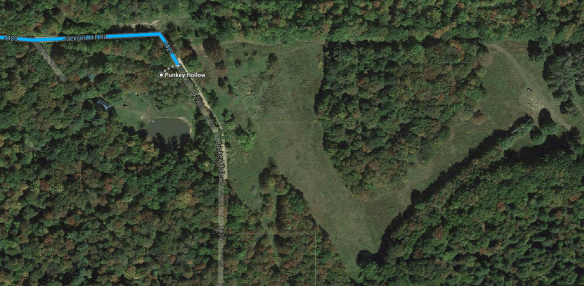
Jackson farm satellite

Today this road is clearly abandoned, and the area is rife with bears and very isolated, not affording cell phone coverage. Even with a Jeep, it was very muddy and I was not of the mind to challenge my mortality.

Jackson Farm satellite 2

There is no driveway back there today so this house is very likely gone. Notice on the plat map above there is no road to the Farnham house, even then.  This area is extremely remote and rugged and today as is seen on the following current atlas, the area is now State Game Land.  The satellite views show just how rugged this area remains.

The “Big Farm” noted with an X is a very old, very large production farm that was known for many years to employ many young men. This farm is no longer in production, but it is a very good candidate for where C.B. Lore was working in the 1870 census.

The cemetery where the Farnham’s are buried and were Rachel Levina Lore is most likely buried in an unmarked grave is located on Cemetery Road across from where the “ce” in cemetery is placed on the map. If is a relatively large cemetery and impossible to miss.

Spring Creek map

This photo was taken in the cemetery closest to where our Lore ancestors lived – on Cemetery road. I was unable to find the stones that were supposed to be there – those of the Farnham family that Rachel Lore lived with after Anthony’s death, but I had to wonder if this group of 3 were the unmarked graves of Anthony’s wife and maybe two children.  Anthony from all stories drowned someplace so he would not have been buried if the body was not recovered.

Spring Creek cemetery

The map below shows the cemetery at the red balloon at top, and the location of the abandoned farm near where they lived at the bottom.

Spring Creek Cem to Jackson Hill

Satellite view of the same area.

Spring creek cem satellite

By the way, those little cleared postage stamp squares between Jackson Hill Road and Brokenstraw Creek are not farms, they are oil pumping and storage facilities.

The Cemetery was on the paved road before one turned left onto Jackson Hill road, which was and is still dirt, or mud, shown in the next photo.

The following photo is “the long road,” Jackson Hill Road. Was this named for Mr. Jackson whose land Franklin Lore inherited?  This area is so remote that as the road petered to a 2 track then worse, I actually turned my Jeep around for fear of getting stuck, having no cell reception and fear of being a snack for the local bears if I had to walk the miles to a paved road.  When I say this area is remote, it’s the head of the Allegheny National Forest and several other wilderness areas as well.  I was not yet ready to follow Anthony to the great beyond, a victim of the relentless Allegheny natural forces.

Jackson Hill road view

This is the house at the end of Jackson Hill road where the road turns to trail. I believe our ancestors lived just north-east (left) of this point.

Jackson Hill farm

Was this near where they lived, or actually where they lived?

Jackson Hill clearing

Directly across the road from the abandoned farm house is another piece of cleared property which was clearly used at one point for farming.

Jackson Hill field

Above, a picture of an area on the South side of Jackson Hill road that could have been owned by the Lore family, according to the plat maps. Even if this isn’t it exactly, it’s very similar.

Jackson Hill oil

Given the Lore family’s long history of oil speculation, I don’t know if it’s relevant or not that today we find this oil storage tank on land that could have been owned by the Lore family. That would somehow be fitting as several of Anthony’s sons and grandchildren were workers in the oil field business.

Sweet Taste of Success

Given that we began with several strikes against us, it’s amazing that we ever found Benjamin Lore, aka Anthony Lore aka Antoine Lord. His name wasn’t Benjamin or Lore.  The only other thing we knew about him was that his son Curtis aka C. B. was from Pennsylvania and born in 1860 or 1861, except that birth year was wrong too by 5 years.  Not only is it amazing that we found either Curtis or Anthony, but that we’ve now proven that this is the right family, our family, and that Anthony Lore of Warren County, PA in 1850 is the same Anthony Lore as found in Addison County, Vermont in 1831 is the same Antoine Lord born and baptized in L’Acadie in Quebec in 1805.

Fortunately, we had multiple records that indicated Anthony was born in Canada, although records, even multiple records, can sometimes still be wrong. Still, Canada is a big place.

Denny’s Canadian money, found in his aunt’s attic, provided clues as to a potential location in Canada, pointing us towards the Montreal area. A drilled coin, found in the same box, looking to have been worn around someone’s neck on a chain begs so very many questions. We know at least one of Anthony’s sons, Franklin, fought in the Civil War.  Did he wear the coin around his neck as a good luck charm, as has been suggested by family members?  Or did that coin belong to Solomon, in whose descendants possession it was found?

Ultimately, finding and proving Benjamin/Anthony/Antoine Lore/Lord of Warren County, PA was the same man found in Addison County Vermont marrying Rachel Hill who was the same man born in Blairfindie was the most difficult part of the challenge. I don’t think we could have done this without DNA testing.  We waited for years to find the right people to prove the family tie via DNA testing.  If there is a lesson to be learned here it’s that your DNA is fishing for you 24X7X265, so never give up.

This was a case where we needed both Y DNA to confirm that actual paternal line and autosomal DNA to prove our branch of that paternal family line. Fortunately, Family Tree DNA offers both tests and we took full advantage of them, including DNA archived by my mother before her death. I can’t thank Family Tree DNA enough for their free archival services.  Having her results has made a world of difference.

I am forever grateful to Sylvain Lord as well as my cousin Denny Lore, both for their individual research and assistance, and for agreeing to DNA test. DNA is the gift that keeps on giving, and it was through their combined participation that we have been able to prove the connection to Julien Lor/Lord.  In fact, just this week, we’ve had another amazing breakthrough on the Lore/Lord line, but that story will have to wait for a future article!

Anthony, or Antoine

Of course, I’d love to know what Anthony looked like. We have only two photos of his children.  The photo below, at right is definitely Anthony’s son Curtis Benjamin Lore, and at left probably Francis aka Franklin or Frank Lore.  I say probably, because both Denny and the family in Wisconsin have this labeled as “the Progenitor” and Franklin’s father, respectively, so there is a possibility this photo is Anthony himself, not his son Franklin.  The Wisconsin family has the name as “Joseph.”  Well, Anthony was Benjamin in Indiana so maybe he is Joseph in Wisconsin.  Stranger things have happened in this family!

Franklin and CB Lore

As I look at these two photos, the family resemblance escapes me. We know positively the photo of Curtis is Curtis, and we know that he is Anthony’s son, but we don’t know if the photo at left is misidentified, although it is from Coudersport where Franklin aka Francis Lore married in 1879.  Given how far we’ve come identifying Antoine, it’s somehow fitting that the only possible photo remains a mystery – and all for lack of someone writing on the back.

Reflections

As I reflect upon Anthony or Antoine, I wonder whether he was truly a river pirate. I can’t imagine why a family would concoct a story that brought them shame, so I tend to believe the story, or at least I believe that Eloise believed it to be true.  I might feel differently if Eloise was bragging or boasting when she told the story, or thought it was “cool,” but she clearly wished she didn’t have to convey that information.

On the other hand, the information from Curtis’s other child, Mildred suggests that he might not have been a pirate, but might have instead been a trader.

So now we have a quandary.  Was he a good guy or a bad guy?

Information from all sources suggests that he died on the river. Perhaps he tussled with river pirates, and lost.  In other words, as a rafter, he could have been a victim of pirates. Perhaps his raft hit something and capsized.  Perhaps he was a river pirate.  I wish there was a way to know.

Was Antoine a “voyageur” before moving to Warren County? Did he love the river? Was it in his blood?  Was he tied to the water and the woods? Was he a woodsman like his son Francis?  Was his Native heritage speaking to him?

Did Antoine make his own moonshine? Did he feed his family off of the land, in true pioneer spirit?  How else would one make a living in an uncleared area?

Was Anthony an opportunist, making an honest living off the river as a highway, a moonshiner making a relatively honest living off of thirsty rafters who welcomed his wares, or was he an evil man, a pirate, taking unfair advantage of others?

Was he simply doing what he needed to do to feed his family, or did he enjoy the pirating lifestyle?

Why did none of his 7 children who had children name one of his 47 grandchildren after him, with the exception of Maria Farnham who gave one of her children Anthony for a middle name?  Four of them named a child after their mother.

We really know so very little about Anthony, the man, and we understand even less.

Anthony’s sons were certainly attracted and tied to an adventurous lifestyle. Were they following in his footsteps or did they perhaps suffer from a lack of parenting and direction after their parents died?  Three of his sons were divorced, a very uncommon occurrance for that timeframe.

Franklin, Anthony’s second oldest child was himself a woodsman, living on the frontier, one of the first whites to settle in northern Wisconsin. Did he learn these skills from Anthony?  If not, how could he have learned them to the degree that they were a second sense, second nature?  Who would have or could have taught him?

Acadians were staunch Catholics, but Anthony clearly was not, although he was raised in the church. Did he actively leave the faith, or did he simply drift away, down the river, so to speak?  His wife’s family was protestant, but there is no evidence at all of any religious affiliation until a couple of generations later with Minerva’s adult baptism.  Was religious estrangement a function of Anthony’s belief system or simply reflective of the extremely rugged and remote lands where he lived?  Or maybe a result of his “career” choice?  Anthony’s son, William Henry, felt very negatively towards Catholics and warned his children to stay away from the Catholic church.  He felt Catholic churches were involved in some type of conspiracy.  Was that a reflection of Anthony’s feelings, or were they simply William’s own opinions?

I do know one thing, I can never look at the Allegheny River again without thinking about Anthony and wondering about his life…and death. The Allegheny River, below, near where Brokenstraw Creek empties into the river is likely where Anthony would have connected up with the Allegheny as he drifted downriver from his home back in the rugged mountain country off of Jackson Hill Road.   Brokenstraw Creek was literally in Anthony’s back yard, the riverman’s highway.  The Allegheny itself serves as Anthony’s grave marker.

Allegheny near brokenstraw

Rest in peace, Anthony. We found you.  You’re not lost anymore and you’ll never be lost again.

______________________________________________________________

Disclosure

I receive a small contribution when you click on some of the links to vendors in my articles. This does NOT increase the price you pay but helps me to keep the lights on and this informational blog free for everyone. Please click on the links in the articles or to the vendors below if you are purchasing products or DNA testing.

Thank you so much.

DNA Purchases and Free Transfers

Genealogy Services

Genealogy Research