That Unruly X….Chromosome That Is

Iceberg

Something is wrong with the X chromosome.  More specifically, something is amiss with trying to use it, the way we normally use recombinant chromosomes for genealogy.  In short, there’s a problem.

If you don’t understand how the X chromosome recombines and is passed from generation to generation, now would be a good time to read my article, “X Marks the Spot” about how this works.  You’ll need this basic information to understand what I’m about to discuss.

The first hint of this “problem” is apparent in Jim Owston’s “Phasing the X Chromosome” article.  Jim’s interest in phasing his X, or figuring out where it came from genealogically, was spurred by his lack of X matches with his brothers.  This is noteworthy, because men don’t inherit any X from their father, so Jim’s failure to share much of his X with his brothers meant that he had inherited most of his X from just one of his mother’s parents, and his brothers inherited theirs from the other parent.  Utilizing cousins, Jim was able to further phase his X, meaning to attribute portions to the various grandparents from whence it came.  After doing this work, Jim said the following”

“Since I can only confirm the originating grandparent of 51% my X-DNA, I tend to believe (but cannot confirm at the present) that my X-chromosome may be an exact copy of my mother’s inherited X from her mother. If this is the case, I would not have inherited any X-DNA from my grandfather. This would also indicate that my brother Chuck’s X-DNA is 97% from our grandfather and only 3% from our grandmother. My brother John would then have 77% of his X-DNA from our grandfather and 23% from our grandmother.”

As a genetic genealogist, at the time Jim wrote this piece, I was most interested in the fact that he had phased or attributed the pieces of the X to specific ancestors and the process he used to do that.  I found the very skewed inheritance “interesting” but basically attributed it to an anomaly.  It now appears that this is not an anomaly.  It was, instead the tip of the iceberg and we didn’t recognize it as such.  Let’s look at what we would normally expect.

Recombination

The X chromosome does recombine when it can, or at least has the capacity to do so.  This means that a female who receives an X from both her father and mother receives a recombined X from her mother, but receives an X that is not recombined from her father.  That is because her father only receives one X, from his mother, so he has nothing to recombine with.  In the mother, the X recombines “in the normal way” meaning that parts of both her mother’s and her father’s X are given to her children, or at least that opportunity exists.  If you’re beginning to see some “weasel words” here or “hedge betting,” that’s because we’ve discovered that things aren’t always what they seem or could be.

The 50% Rule

In the statistical world of DNA, on the average, we believe that each generation receives roughly half of the DNA of the generations before them.  We know that each child absolutely receives 50% of the DNA of both parents, but how the grandparents DNA is divided up into that 50% that goes to each offspring differs.  It may not be 50%.  I am in the process of doing a generational inheritance study, which I will publish soon, which discusses this as a whole.

However, let’s use the 50% rule here, because it’s all we have and it’s what we’ve been working with forever.

In a normal autosomal, meaning non-X, situation, every generation provides to the current generation the following approximate % of DNA:

Autosomal % chart

Please note Blaine Bettinger’s X maternal inheritance chart percentages from his “More X-Chromosome Charts” article, and used with his kind permission in the X Marks the Spot article.

Blaine's maternal X %

I’m enlarging the inheritance percentage portion so you can see it better.

Blaine's maternal X % cropped

Taking a look at these percentages, it becomes evident that we cannot utilize the normal predictive methods of saying that if we share a certain percentage of DNA with an individual, then we are most likely a specific relationship.  This is because the percentage of X chromosome inherited varies based on the inheritance path, since men don’t receive an X from their fathers.  Not only does this mean that you receive no X from many ancestors, you receive a different percentage of the X from your maternal grandmother, 25%, because your mother inherited an X from both of her parents, versus from your paternal grandmother, 50%, because your father inherited an X from only his mother.

The Genetic Kinship chart, below, from the ISOGG wiki, is the “Bible” that we use in terms of estimating relationships.  It doesn’t work for the X.

Mapping cousin chart

Let’s look at the normal autosomal inheritance model as compared to the maternal X chart fan chart percentages, above, and similar calculations for the paternal side.  Remember, the Maternal Only column applies only to men, because in the very first generation, men’s and women’s inheritance percentages diverge.  Men receive 100% of their X from their mothers, while women receive 50% from each parent.

Generational X %s

Recombination – The Next Problem

The genetic genealogy community has been hounding Family Tree DNA incessantly to add the X chromosome matching into their Family Finder matching calculations.

On January 2, 2014, they did exactly that.  What’s that old saying, “Be careful what you ask for….”  Well, we got it, but “it” doesn’t seem to be providing us with exactly what we expected.

First, there were many reports of women having many more matches than men.  That’s to be expected at some level because women have so many more ancestors in the “mix,” especially when matching other women.

23andMe takes this unique mixture into consideration, or at least attempts to compensate for it at some level.  I’m not sure if this is a good or bad thing or if it’s useful, truthfully.  While their normal autosomal SNP matching threshold is 7cM and 700 matching SNPs within that segment, for X, their thresholds are:

  • Male matched to male – 1cM/200 SNPs
  • Male matched to female – 6cM/600 SNPs
  • Female matched to female – 6cM/1200 SNPs

Family Tree DNA does not use the X exclusively for matching.  This means that if you match someone utilizing their normal autosomal matching criteria of approximately 7.7cM and 500 SNPs, and you match them on the X chromosome, they will report your X as matching.  If you don’t match someone on any chromosome except the X, you will not be reported as a match.

The X matching criteria at Family Tree DNA is:

  • 1cM/500 SNPs

However, matching isn’t all of the story.

The X appears to not recombine normally.  By normally, I don’t mean something is medically wrong, I mean that it’s not what we are expecting to see in terms of the 50% rule.  In essence, we would expect to see approximately half of the X of each parent, grandfather and grandmother, passed on to the child from the mother in the maternal line where recombination is a possibility.  That appears to not be happening reliably.  Not only is this not happening in the nice neat 50% number, the X chromosome seems to be often not recombining at all.  If you think the percentages in the chart above threw a monkey wrench into genetic genealogy predictions, this information, if it holds up in a much larger test, in essence throws our predictive capability, at least as we know it today, out the window.

The X Doesn’t Recombine as Expected

In my generational study, I noticed that the X seemed not to be recombining.  Then I remembered something that Matt Dexter said at the Family Tree DNA Conference in November 2013 in Houston.  Matt has the benefit of having a full 3 generation pedigree chart where everyone has been tested, and he has 5 children, so he can clearly see who got the DNA from which of their grandparents.

I contacted Matt, and he provided me with his X chromosomal information about his family, giving me permission to share it with you.  I have taken the liberty of reformatting it in a spreadsheet so that we can view various aspects of this data.

Dexter table

First, note that I have sorted these by grandchild.  There are two females, who have the opportunity to inherit from 3 grandparents.  The females inherited one copy of the X from their mother, who had two copies herself, and one copy of the X from her father who only had his mother’s copy.  Therefore, the paternal grandfather is listed above, but with the note “cannot inherit.”  This distinguishes this event from the circumstance with Grandson 1 where he could inherit some part of his maternal grandfather’s X, but did not.

For the three grandsons, I have listed all 4 grandparents and noted the paternal grandmother and grandfather as “cannot inherit.”  This is of course because the grandsons don’t inherit an X from their father.  Instead they inherit the Y, which is what makes them male.

According to the Rule of 50%, each child should receive approximately half of the DNA of each maternal grandparent that they can inherit from.  I added the columns, % Inherited cM and % Inherited SNP to illustrate whether or not this number comes close to the 50% we would expect.  The child MUST have a complete X chromosome which is comprised of 18092 SNPs and is 195.93cM in length, barring anomalies like read errors and such, which do periodically occur.  In these columns, 1=100%, so in the Granddaughter 1 column of % Inherited cM, we see 85% for the maternal grandfather and about 15% for the maternal grandmother.  That is hardly 50-50, and worse yet, it’s no place close to 50%.

Granddaughter 1 and 2 must inherit their paternal grandmother’s X intact, because there is nothing to recombine with.

Granddaughter 2 inherited even more unevenly, with about 90% and 10%, but in favor of the other grandparent.  So, statistically speaking, it’s about 50% for each grandparent between the two grandchildren, but it is widely variant when looking at them individually.

Grandson 1, as mentioned, inherited his entire X from his maternal grandmother with absolutely no recombination.

Grandsons 2 and 3 fall much closer to the expected 50%.

The problem for most of us is that you need 3 or 4 consecutive generations to really see this happening, and most of us simply don’t have data that deep or robust.

A recent discussion on the DNA Genealogy Rootsweb mailing list revealed several more of these documented occurrences, among them, two separate examples where the X chromosome was unrecombined for 4 generations.

Robert Paine, a long-time genetic genealogy contributor and project administrator reported that in his family medical/history project, at 23andMe, 25% of his participants show no recombination on the X chromosome.  That’s a staggering percentage.  His project consists of  21 people in with 2 blood lines tested 5 generations deep and 2 bloodlines tested at 4 generations

One woman’s X matches her great-great-grandmother’s X exactly.  That’s 4 separate inheritance events in a row where the X was not recombined at all.

The graphic below, provided by Robert,  shows the chromosome browser at 23andMe where you can see the X matches exactly for all three participants being compared.

The screen shot is of the gg-granddaughter Evelyn being compared to her gg-grandmother, Shevy, Evelyn’s g-grandfather Rich and Evelyn’s grandmother Cyndi. 23andme only lets you compare 3 individuals at a time so Robert did not include Evelyn’s mother Shay, who is an exact match with Evelyn.

Paine X

Where Are We?

So what does this mean to genetic genealogy?  It certainly does not mean we should throw the baby out with the bath water.  What it is, is an iceberg warning that there is more lurking beneath the surface.  What and how big?  I can’t tell you.  I simply don’t know.

Here’s what I can tell you.

  • The X chromosome matching can tell you that you do share a common ancestor someplace back in time.
  • The amount of DNA shared is not a reliable predictor of how long ago you shared that ancestor.
  • The amount of DNA shared cannot predict your relationship with your match.  In fact, even a very large match can be many generations removed.
  • The absence of an X match, even with someone closely related whom you should match does not disprove a descendant relationship/common ancestor.
  • The X appears to not recombine at a higher rate than previously thought, the previous expectation being that this would almost never happen.
  • The X, when it does recombine appears to do so in a manner not governed by the 50% rule.  In fact, the 50% rule may not apply at all except as an average in large population studies, but may well be entirely irrelevant or even misleading to the understanding of X chromosome inheritance in genetic genealogy.

The X is still useful to genetic genealogists, just not in the same way that other autosomal data is utilized.  The X is more of an auxiliary chromosome that can provide information in addition to your other matches because of its unique inheritance pattern.

Unfortunately, this discovery leaves us with more questions than answers.  I found it incomprehensible that this phenomenon has never been studied in humans, or in animals, for that matter, at least not that I could find.  What few references I did find indicated that the X seems to recombine with the same frequency as the other autosomes, which we are finding to be untrue.

What is needed is a comprehensive study of hundreds of X transmission events at least 3 generations deep.

As it turns out, we’re not the only ones confused by the behavior of the X chromosome.  Just yesterday, the New York Times had an article about Seeing the X Chromosome in a New Light.  It seems that either one copy of the X, or the other, is disabled cell by cell in the human body.  If you are interested in this aspect of science, it’s a very interesting read.  Indeed, our DNA continues to both amaze and amuse us.

A special thank you to Jim Owston, Matt Dexter, Blaine Bettinger and Robert Paine for sharing their information.

Additional sources:

Polymorphic Variation in Human Meiotic
Recombination (2007)
Vivian G. Cheung
University of Pennsylvania
http://repository.upenn.edu/cgi/viewcontent.cgi?article=1102&context=be_papers

A Fine-Scale Map of Recombination Rates and Hotspots Across the Human Genome, Science October 2005, Myers et al
http://www.sciencemag.org/content/310/5746/321.full.pdf
Supplemental Material
http://www.sciencemag.org/content/suppl/2005/10/11/310.5746.321.DC1

______________________________________________________________

Disclosure

I receive a small contribution when you click on some of the links to vendors in my articles. This does NOT increase the price you pay but helps me to keep the lights on and this informational blog free for everyone. Please click on the links in the articles or to the vendors below if you are purchasing products or DNA testing.

Thank you so much.

DNA Purchases and Free Transfers

Genealogy Services

Genealogy Research

Promethease – Genetic Health Information Alternative

People are beginning to ask about how they can obtain some of the health information that they were previously receiving from 23andMe.  For $5, at Promethease,  you can upload any of the autosomal files from either Family Tree DNA, 23andMe or Ancestry.com.  They will process your raw data and provide you with a report that is available to download from their server for 45 days.  They also e-mail you a copy.

At Promethease, your raw data file is deleted within 24 hours of completion of your report, and your report file will be deleted after 45 days, so be sure to download your report for future reference.  Currently they process about 20,000 genotypes, or SNPs.  They do note that they update their data base regularly from SNPedia, fed from PubMed publications.  Therefore your report in the future will include SNPs that won’t be in your report today and what we’ve learned about those SNPs may differ as well.

They have also noted that you receive different items in your report based on which vendor’s full data file you submit.  That’s true.  I uploaded all 3 of my raw data files, from Ancestry, 23andMe and Family Tree DNA and ran Promethease against each of them.  While 23andMe optimized their chip for medical and health results, Family Tree DNA intentionally removed some medically relevant data in order to avoid any FDA type of issues.  It’s unknown how Ancestry treats medically significant SNPs, but I’m running all 3 vendor’s files to view differences.

  • The Promethease report utilizing the 23andMe raw data file reported on 20,080 genotypes.
  • The Promethease report utilizing the Family Tree DNA raw data file reported on 8179 genotypes.
  • The Promethease report utilizing the Ancestry raw data file reported on 10,498 genotypes.

To start the process of uploading your file and running your report, visit:

https://promethease.com/ondemand

Of course, you’ll need to take care of housekeeping, sign up and pay.

You will then be asked to select an ethnicity.  I always hate this question, because I’m more than one and the categories never fit.  If you don’t fit any category well, select the closest.   Promethease says it only affects the sort order.  That was a relief to me, as I always wonder what I’m missing by making one selection over another.

While the report actually runs, which takes about 15-20 minutes, amuse yourself by watching the video about how to download, read and understand your results.  Or you could write a blog, like me!

Promethease instructional video

You can review this video at any time by visiting the original link.  It does make more sense after you have your report in hand.

My report only took 8 minutes to run, and according to the front page of my report, they analyzed over 20,000 SNPs or known mutation locations.  I’m excited to see what my report holds.

One of the reasons I’ve been interested in this type of DNA reporting is that my mother was “diagnosed” with Parkinson’s Disease. I put diagnosed in quotes, because Parkinson’s is a diagnosis of exclusion, for which there is no specific diagnostic test, meaning the diagnosis is one made after other alternative diseases for which there are tests, are excluded.  However, she never had some of the traditional symptoms, like the specific walking gait typical in Parkinson’s patients, nor some of the other symptoms, nor were the Parkinson’s medications effective in controlling her hand tremors. Her father also had the same tremors, which I’ve always suspected was Familial Tremor, not Parkinson’s.  I wanted to see if Mom or I carried elevated risk for Parkinson’s.  Mom’s DNA was archived at Family Tree DNA, so I could run the Family Finder test even though she had passed away by the time autosomal testing was available.  So I uploaded and ran her file at Promethease too, and compared with my own.

So, let’s look at my report based on the 23andMe raw data file.

Promethease report

At this point, you have to choose to click on “Bad News” or “Good News” first.  Someone should do a study about whether you select bad or good is genetically influenced.

In my case, I was interested to see if my “bad news” was the same “bad news” that 23andMe provided.  My top “bad news” item is indeed the same item that is reported at 23andMe.  Having said that, there are a lot more and different items here that were not reported at 23andMe.  After looking at the varied results from Promethease, I suspect that 23andMe was trying to distill data on my behalf.

However, Promethease does not attempt to analyze your results.  Some mutations are known to be connected to multiple conditions, so they simply tell you that.  In some cases, you will have some negative and some positive mutations for the same disease.  Again, they simply inform you, complete with a reference.  It’s worth noting that for one disease I’m particularly interested in, Parkinson’s, I have a lot of conflicting data, pages worth.  This just goes to show how complex interpreting this information really is, and shows that genetic predisposition, positive or negative, with only a few exceptions, is not genetic predetermination.

My good news made me feel really good.  I’m at decreased risk of frontotemporal dementia or Alzheimer’s and Parkinson’s.  I’m optimistic and empathetic.  I wonder if this has anything to do with selecting the bad news option first – I knew I had the good news to look forward to.  Get the bad stuff over with and get on with it…

Ironically, some of my good news items are in direct conflict with some of my bad news items.  And yes, some are Parkinson’s, which has apparently been more heavily studied that some other diseases.  Hopefully, the decreased and elevated risks will cancel each other out and I’ll just be average.

However, when running my Ancestry data file at Promethease, one of my elevated risks was Parkinson’s, based on the SNPs discovered in the 23andMe research, which conflicts directly with the information provided based on the 23andMe raw data file.  Searching further, different SNPs have been reported to either be associated with increased or decreased incidence of the disease – and I carry some of each – but none are extremely elevated.

So where does this leave me in terms of whether Mom had Parkinson’s, or not?  There is nothing to indicate an extremely high risk of Parkinson’s.  Some indicators are for elevated risk, some for reduced risk.  Compared to the one condition I know she had, which has a very highly elevated risk in all 3 reports, the Parkinson’s risk is simply unremarkable and doesn’t stand out.  Bottom line – I still don’t know for sure, but I still don’t think she had Parkinson’s.  Had I found highly elevated risk factors,  I would have rethought my opinion.

Many diseases have multiple genetic components along with other external factors.  Of course, not all studies report the same findings, and this report is based on academic medical studies.

Rarely are genetic predispositions more than just that, a slightly increased or decreased probability.  Few are fatal and some are more of a life sentence than a death sentence.  Having said this, there are notable exceptions, and if you really don’t want to know a worst case scenario, or aren’t prepared to deal with the results, don’t participate in DNA testing or reporting for medical or health information.  If you have reason to suspect your family may carry one of the genetic terminal illnesses, visit your doctor for advice.

And speaking of physicians, much of this information, such as the information about how certain medications are metabolized could be critically important.  In my case, I’m actually taking one of the mediations that is referenced where I have a decreased sensitivity.  Yep, I knew that, but now I can provide this information to my physician.

For those who tend to worry and borrow trouble they don’t yet have, running this type of report might not be a good idea.  It’s certainly not for hypochondriacs – IMHO.  It’s a personal choice, and a very inexpensive one at that, so financially available to everyone.  If what it contains is going to worry you, don’t do it.  I noticed that there are several anxiety categories in these reports – but then you have to run the report to see if you carry them – kind of a catch 22 if you tend to be anxious and worry.

My personal perspective is that there may be information here that is valuable to me, or to my physicians, or to my children.  The worst “bad news” item I already knew about through 23andMe, but I also anticipated that condition, without genetic testing, because my mother had this same disease in old age.  I’m not referring now to the Parkinson’s, but a vision related condition that she definitely did have.  This item was also consistently reported at a high degree of risk utilizing the data files of 23andMe, Family Tree DNA and Ancestry.  Thankfully, it is an old age problem and one that can be treated, if not cured today.  The Promethease reports, along with 23andMe’s report, have simply reinforced that I need to be proactive and vigilant and to eat lots of veggies.  The good news is that many items include preventative measures in the verbiage or associated studies that your Promethease report links to at SNPedia.

How does this report compare to the 23andMe experience, assuming 23andMe was still an option or might be again in the future for health information?  The 23andMe customer interface is much smoother and more user friendly.  It seems to be focused on more “fun” and less “worry.”  The Promethease report is that, a report, although they do a great job making it interactive.  There is no sugar coating – just the facts Ma’am.  And I think it’s actually much easier to use.  You can easily search by disease, by category, and the searches actually work.

Promethease differs in another way too.  Personally I like the idea that my data is mine, I’m in complete control of it, and it’s not being sold by Promethease out the back door for studies or purposes I might not be too thrilled about.  I don’t want my DNA to be used to patent genes that cause the tests for the condition to be restricted to the patentee at dramatically inflated prices.  While the Supreme Court determined that genes can’t be patented in the case of the BRCA breast cancer genes, the fight continues with lawsuits being filed, and 23andMe holds a Parkinson’s patent that was obtained by utilizing customer data.   Nor do I want my data to be used to patent the technology for “designer babies.”  If my DNA is going to be utilized for research, I want the ability to authorize that use, specifically.

Therefore, I feel much better about uploading a raw data file from an autosomal test at a firm like Family Tree DNA, who NEVER sells or otherwise divulges my data without first requesting permission.  I thereby maintain complete control over my genetic results, rather than utilizing companies who either sell (or otherwise utilize) my results or reserve the right to do so.  This is the case with both 23andMe and Ancestry.com, and to be clear, they have never claimed otherwise.?????????????????????????????

And oh, I forgot to mention…I am just so relieved….I have a decreased risk of baldness….

______________________________________________________________

Disclosure

I receive a small contribution when you click on some of the links to vendors in my articles. This does NOT increase the price you pay but helps me to keep the lights on and this informational blog free for everyone. Please click on the links in the articles or to the vendors below if you are purchasing products or DNA testing.

Thank you so much.

DNA Purchases and Free Transfers

Genealogy Services

Genealogy Research

2013’s Dynamic Dozen – Top Genetic Genealogy Happenings

dna 8 ball

Last year I wrote a column at the end of the year titled  “2012 Top 10 Genetic Genealogy Happenings.”  It’s amazing the changes in this industry in just one year.  It certainly makes me wonder what the landscape a year from now will look like.

I’ve done the same thing this year, except we have a dozen.  I couldn’t whittle it down to 10, partly because there has been so much more going on and so much change – or in the case of Ancestry, who is noteworthy because they had so little positive movement.

If I were to characterize this year of genetic genealogy, I would call it The Year of the SNP, because that applies to both Y DNA and autosomal.  Maybe I’d call it The Legal SNP, because it is also the year of law, court decisions, lawsuits and FDA intervention.  To say it has been interesting is like calling the Eiffel Tower an oversized coat hanger.

I’ll say one thing…it has kept those of us who work and play in this industry hopping busy!  I guarantee you, the words “I’m bored” have come out of the mouth of no one in this industry this past year.

I’ve put these events in what I consider to be relatively accurate order.  We could debate all day about whether the SNP Tsunami or the 23andMe mess is more important or relevant – and there would be lots of arguing points and counterpoints…see…I told you lawyers were involved….but in reality, we don’t know yet, and in the end….it doesn’t matter what order they are in on the list:)

Y Chromosome SNP Tsunami Begins

The SNP tsumani began as a ripple a few years ago with the introduction at Family Tree DNA of the Walk the Y program in 2007.  This was an intensively manual process of SNP discovery, but it was effective.

By the time that the Geno 2.0 chip was introduced in 2012, 12,000+ SNPs would be included on that chip, including many that were always presumed to be equivalent and not regularly tested.  However, the Nat Geo chip tested them and indeed, the Y tree became massively shuffled.  The resolution to this tree shuffling hasn’t yet come out in the wash.  Family Tree DNA can’t really update their Y tree until a publication comes out with the new tree defined.  That publication has been discussed and anticipated for some time now, but it has yet to materialize.  In the mean time, the volunteers who maintain the ISOGG tree are swamped, to say the least.

Another similar test is the Chromo2 introduced this year by Britain’s DNA which scans 15,000 SNPs, many of them S SNPs not on the tree nor academically published, adding to the difficulty of figuring out where they fit on the Y tree.  While there are some very happy campers with their Chromo2 results, there is also a great deal of sloppy science, reporting and interpretation of “facts” through this company.  Kind of like Jekyll and Hyde.  See the Sloppy Science section.

But Walk the Y, Chromo2 and Geno 2.0, are only the tip of the iceburg.  The new “full Y” sequencing tests brought into the marketspace quietly in early 2013 by Full Genomes and then with a bang by Family Tree DNA with the their Big Y in November promise to revolutionize what we know about the Y chromosome by discovering thousands of previously unknown SNPs.  This will in effect swamp the Y tree whose branches we thought were already pretty robust, with thousands and thousands of leaves.

In essence, the promise of the “fully” sequenced Y is that what we might term personal or family SNPs will make SNP testing as useful as STR testing and give us yet another genealogy tool with which to separate various lines of one genetic family and to ratchet down on the time that the most common recent ancestor lived.

http://dna-explained.com/2013/03/31/new-y-dna-haplogroup-naming-convention/

http://dna-explained.com/2013/11/10/family-tree-dna-announces-the-big-y/

http://dna-explained.com/2013/11/16/what-about-the-big-y/

http://www.yourgeneticgenealogist.com/2013/11/first-look-at-full-genomes-y-sequencing.html

http://cruwys.blogspot.com/2013/12/a-first-look-at-britainsdna-chromo-2-y.html

http://cruwys.blogspot.com/2013/11/yseqnet-new-company-offering-single-snp.html

http://cruwys.blogspot.com/2013/11/the-y-chromosome-sequence.html

http://cruwys.blogspot.com/2013/11/a-confusion-of-snps.html

http://cruwys.blogspot.com/2013/11/a-simplified-y-tree-and-common-standard.html

23andMe Comes Unraveled

The story of 23andMe began as the consummate American dotcom fairy tale, but sadly, has deteriorated into a saga with all of the components of a soap opera.  A wealthy wife starts what could be viewed as an upscale hobby business, followed by a messy divorce and a mystery run-in with the powerful overlording evil-step-mother FDA.  One of the founders of 23andMe is/was married to the founder of Google, so funding, at least initially wasn’t an issue, giving 23andMe the opportunity to make an unprecedented contribution in the genetic, health care and genetic genealogy world.

Another way of looking at this is that 23andMe is the epitome of the American Dream business, a startup, with altruism and good health, both thrown in for good measure, well intentioned, but poorly managed.  And as customers, be it for health or genealogy or both, we all bought into the altruistic “feel good” culture of helping find cures for dread diseases, like Parkinson’s, Alzheimer’s and cancer by contributing our DNA and responding to surveys.

The genetic genealogy community’s love affair with 23andMe began in 2009 when 23andMe started focusing on genealogy reporting for their tests, meaning cousin matches.  We, as a community, suddenly woke up and started ordering these tests in droves.  A few months later, Family Tree DNA also began offering this type of testing as well.  The defining difference being that 23andMe’s primary focus has always been on health and medical information with Family Tree DNA focused on genetic genealogy.  To 23andMe, the genetic genealogy community was an afterthought and genetic genealogy was just another marketing avenue to obtain more people for their health research data base.  For us, that wasn’t necessarily a bad thing.

For awhile, this love affair went along swimmingly, but then, in 2012, 23andMe obtained a patent for Parkinson’s Disease.  That act caused a lot of people to begin to question the corporate focus of 23andMe in the larger quagmire of the ethics of patenting genes as a whole.  Judy Russell, the Legal Genealogist, discussed this here.  It’s difficult to defend 23andMe’s Parkinson’s patent while flaying alive Myriad for their BRCA patent.  Was 23andMe really as altruistic as they would have us believe?

Personally, this event made me very nervous, but I withheld judgment.  But clearly, that was not the purpose for which I thought my DNA, and others, was being used.

But then came the Designer Baby patent in 2013.  This made me decidedly uncomfortable.  Yes, I know, some people said this really can’t be done, today, while others said that it’s being done anyway in some aspects…but the fact that this has been the corporate focus of 23andMe with their research, using our data, bothered me a great deal.  I have absolutely no issue with using this information to assure or select for healthy offspring – but I have a personal issue with technology to enable parents who would select a “beauty child,” one with blonde hair and blue eyes and who has the correct muscles to be a star athlete, or cheerleader, or whatever their vision of their as-yet-unconceived “perfect” child would be.  And clearly, based on 23andMe’s own patent submission, that is the focus of their patent.

Upon the issuance of the patent, 23andMe then said they have no intention of using it.  They did not say they won’t sell it.  This also makes absolutely no business sense, to focus valuable corporate resources on something you have no intention of using?  So either they weren’t being truthful, they lack effective management or they’ve changed their mind, but didn’t state such.

What came next, in late 2013 certainly points towards a lack of responsible management.

23andMe had been working with the FDA for approval the health and medical aspect of their product (which they were already providing to consumers prior to the November 22nd cease and desist order) for several years.  The FDA wants assurances that what 23andMe is telling consumers is accurate.  Based on the letter issued to 23andMe on November 22nd, and subsequent commentary, it appears that both entities were jointly working towards that common goal…until earlier this year when 23andMe mysteriously “somehow forgot” about the FDA, the information they owed them, their submissions, etc.  They also forgot their phone number and their e-mail addresses apparently as well, because the FDA said they had heard nothing from them in 6 months, which backdates to May of 2013.

It may be relevant that 23andMe added the executive position of President and filled it in June of 2013, and there was a lot of corporate housecleaning that went on at that time.  However, regardless of who got housecleaned, the responsibility for working with the FDA falls squarely on the shoulders of the founders, owners and executives of the company.  Period.  No excuses.  Something that critically important should be on the agenda of every executive management meeting.   Why?  In terms of corporate risk, this was obviously a very high risk item, perhaps the highest risk item, because the FDA can literally shut their doors and destroy them.  There is little they can do to control or affect the FDA situation, except to work with the FDA, meet deadlines and engender goodwill and a spirit of cooperation.  The risk of not doing that is exactly what happened.

It’s unknown at this time if 23andMe is really that corporately arrogant to think they could simply ignore the FDA, or blatantly corporately negligent or maybe simply corporately stupid, but they surely betrayed the trust and confidence of their customers by failing to meet their commitments with and to the FDA, or even communicate with them.  I mean, really, what were they thinking?

There has been an outpouring of sympathy for 23andme and negative backlash towards the FDA for their letter forcing 23andMe to stop selling their offending medical product, meaning the health portion of their testing.  However, in reality, the FDA was only meting out the consequences that 23andMe asked for.  My teenage kids knew this would happen.  If you do what you’re not supposed to….X, Y and Z will, or won’t, happen.  It’s called accountability.  Just ask my son about his prom….he remembers vividly.  Now why my kids, or 23andMe, would push an authority figure to that point, knowing full well the consequences, utterly mystifies me.  It did when my son was a teenager and it does with 23andMe as well.

Some people think that the FDA is trying to stand between consumers and their health information.  I don’t think so, at least not in this case.  Why I think that is because the FDA left the raw data files alone and they left the genetic genealogy aspect alone.  The FDA knows full well you can download your raw data and for $5 process it at a third party site, obtaining health related genetic information.  The difference is that Promethease is not interpreting any data for you, only providing information.

There is some good news in this and that is that from a genetic genealogy perspective, we seem to be safe, at least for now, from government interference with the testing that has been so productive for genetic genealogy.  The FDA had the perfect opportunity to squish us like a bug (thanks to the opening provided by 23andMe,) and they didn’t.

The really frustrating aspect of this is that 23andMe was a company who, with their deep pockets in Silicon Valley and other investors, could actually afford to wage a fight with the FDA, if need be.  The other companies who received the original 2010 FDA letter all went elsewhere and focused on something else.  But 23andMe didn’t, they decided to fight the fight, and we all supported their decision.  But they let us all down.  The fight they are fighting now is not the battle we anticipated, but one brought upon themselves by their own negligence.  This battle didn’t have to happen, and it may impair them financially to such a degree that if they need to fight the big fight, they won’t be able to.

Right now, 23andMe is selling their kits, but only as an ancestry product as they work through whatever process they are working through with the FDA.  Unfortunately, 23andMe is currently having some difficulties where the majority of matches are disappearing from some testers records.  In other cases, segments that previously matched are disappearing.  One would think, with their only revenue stream for now being the genetic genealogy marketspace that they would be wearing kid gloves and being extremely careful, but apparently not.  They might even consider making some of the changes and enhancements we’ve requested for so long that have fallen on deaf ears.

One thing is for sure, it will be extremely interesting to see where 23andMe is this time next year.  The soap opera continues.

I hope for the sake of all of the health consumers, both current and (potentially) future, that this dotcom fairy tale has a happy ending.

Also, see the Autosomal DNA Comes of Age section.

http://dna-explained.com/2013/10/05/23andme-patents-technology-for-designer-babies/

http://www.thegeneticgenealogist.com/2013/10/07/a-new-patent-for-23andme-creates-controversy/

http://dna-explained.com/2013/11/13/genomics-law-review-discusses-designing-children/

http://www.thegeneticgenealogist.com/2013/06/11/andy-page-fills-new-president-position-at-23andme/

http://dna-explained.com/2013/11/25/fda-orders-23andme-to-discontinue-testing/

http://dna-explained.com/2013/11/26/now-what-23andme-and-the-fda/

http://dna-explained.com/2013/12/06/23andme-suspends-health-related-genetic-tests/

http://www.legalgenealogist.com/blog/2013/11/26/fooling-with-fda/

Supreme Court Decision – Genes Can’t Be Patented – Followed by Lawsuits

In a landmark decision, the Supreme Court determined that genes cannot be patented.  Myriad Genetics held patents on two BRCA genes that predisposed people to cancer.  The cost for the tests through Myriad was about $3000.  Six hours after the Supreme Court decision, Gene By Gene announced that same test for $995.  Other firms followed suit, and all were subsequently sued by Myriad for patent infringement.  I was shocked by this, but as one of my lawyer friends clearly pointed out, you can sue anyone for anything.  Making it stick is yet another matter.  Many firms settle to avoid long and very expensive legal battles.  Clearly, this issue is not yet resolved, although one would think a Supreme Court decision would be pretty definitive.  It potentially won’t be settled for a long time.

http://dna-explained.com/2013/06/13/supreme-court-decision-genes-cant-be-patented/

http://www.legalgenealogist.com/blog/2013/06/14/our-dna-cant-be-patented/

http://dna-explained.com/2013/09/07/message-from-bennett-greenspan-free-my-genes/

http://www.thegeneticgenealogist.com/2013/06/13/new-press-release-from-dnatraits-regarding-the-supreme-courts-holding-in-myriad/

http://www.legalgenealogist.com/blog/2013/08/18/testing-firms-land-counterpunch/

http://www.legalgenealogist.com/blog/2013/07/11/myriad-sues-genetic-testing-firms/

Gene By Gene Steps Up, Ramps Up and Produces

As 23andMe comes unraveled and Ancestry languishes in its mediocrity, Gene by Gene, the parent company of Family Tree DNA has stepped up to the plate, committed to do “whatever it takes,” ramped up the staff both through hiring and acquisitions, and is producing results.  This is, indeed, a breath of fresh air for genetic genealogists, as well as a welcome relief.

http://dna-explained.com/2013/08/07/gene-by-gene-acquires-arpeggi/

http://dna-explained.com/2013/12/05/family-tree-dna-listens-and-acts/

http://dna-explained.com/2013/12/10/family-tree-dnas-family-finder-match-matrix-released/

http://www.haplogroup.org/ftdna-family-finder-matches-get-new-look/

http://www.haplogroup.org/ftdna-family-finder-new-look-2/

http://www.haplogroup.org/ftdna-family-finder-matches-new-look-3/

Autosomal DNA Comes of Age

Autosomal DNA testing and analysis has simply exploded this past year.  More and more people are testing, in part, because Ancestry.com has a captive audience in their subscription data base and more than a quarter million of those subscribers have purchased autosomal DNA tests.  That’s a good thing, in general, but there are some negative aspects relative to Ancestry, which are in the Ancestry section.

Another boon to autosomal testing was the 23andMe push to obtain a million records.  Of course, the operative word here is “was” but that may revive when the FDA issue is resolved.  One of the down sides to the 23andMe data base, aside from the fact that it’s not genealogist friendly, is that so many people, about 90%, don’t communicate.  They aren’t interested in genealogy.

A third factor is that Family Tree DNA has provided transfer ability for files from both 23andMe and Ancestry into their data base.

Fourth is the site, GedMatch, at www.gedmatch.com which provides additional matching and admixture tools and the ability to match below thresholds set by the testing companies.  This is sometimes critically important, especially when comparing to known cousins who just don’t happen to match at the higher thresholds, for example.  Unfortunately, not enough people know about GedMatch, or are willing to download their files.  Also unfortunate is that GedMatch has struggled for the past few months to keep up with the demand placed on their site and resources.

A great deal of time this year has been spent by those of us in the education aspect of genetic genealogy, in whatever our capacity, teaching about how to utilize autosomal results. It’s not necessarily straightforward.  For example, I wrote a 9 part series titled “The Autosomal Me” which detailed how to utilize chromosome mapping for finding minority ethnic admixture, which was, in my case, both Native and African American.

As the year ends, we have Family Tree DNA, 23andMe and Ancestry who offer the autosomal test which includes the relative-matching aspect.  Fortunately, we also have third party tools like www.GedMatch.com and www.DNAGedcom.com, without which we would be significantly hamstrung.  In the case of DNAGedcom, we would be unable to perform chromosome segment matching and triangulation with 23andMe data without Rob Warthen’s invaluable tool.

http://dna-explained.com/2013/06/21/triangulation-for-autosomal-dna/

http://dna-explained.com/2013/07/13/combining-tools-autosomal-plus-y-dna-mtdna-and-the-x-chromosome/

http://dna-explained.com/2013/07/26/family-tree-dna-levels-the-playing-field-sort-of/

http://dna-explained.com/2013/08/03/kitty-coopers-chromsome-mapping-tool-released/

http://dna-explained.com/2013/09/29/why-dont-i-match-my-cousin/

http://dna-explained.com/2013/10/03/family-tree-dna-updates-family-finder-and-adds-triangulation/

http://dna-explained.com/2013/10/21/why-are-my-predicted-cousin-relationships-wrong/

http://dna-explained.com/2013/12/05/family-tree-dna-listens-and-acts/

http://dna-explained.com/2013/12/09/chromosome-mapping-aka-ancestor-mapping/

http://dna-explained.com/2013/12/10/family-tree-dnas-family-finder-match-matrix-released/

http://dna-explained.com/2013/12/15/one-chromosome-two-sides-no-zipper-icw-and-the-matrix/

http://dna-explained.com/2013/06/02/the-autosomal-me-summary-and-pdf-file/

DNAGedcom – Indispensable Third Party Tool

While this tool, www.dnagedcom.com, falls into the Autosomal grouping, I have separated it out for individual mention because without this tool, the progress made this year in autosomal DNA ancestor and chromosomal mapping would have been impossible.  Family Tree DNA has always provided segment matching boundaries through their chromosome browser tool, but until recently, you could only download 5 matches at a time.  This is no longer the case, but for most of the year, Rob’s tool saved us massive amounts of time.

23andMe does not provide those chromosome boundaries, but utilizing Rob’s tool, you can obtain each of your matches in one download, and then you can obtain the list of who your matches match that is also on your match list by requesting each of those files separately.  Multiple steps?  Yes, but it’s the only way to obtain this information, and chromosome mapping without the segment data is impossible

A special hats off to Rob.  Please remember that Rob’s site is free, meaning it’s donation based.  So, please donate if you use the tool.

http://www.yourgeneticgenealogist.com/2013/01/brought-to-you-by-adoptiondna.html

I covered www.Gedmatch.com in the “Best of 2012” list, but they have struggled this year, beginning when Ancestry announced that raw data file downloads were available.  GedMatch consists of two individuals, volunteers, who are still struggling to keep up with the required processing and the tools.  They too are donation based, so don’t forget about them if you utilize their tools.

Ancestry – How Great Thou Aren’t

Ancestry is only on this list because of what they haven’t done.  When they initially introduced their autosomal product, they didn’t have any search capability, they didn’t have a chromosome browser and they didn’t have raw data file download capability, all of which their competitors had upon first release.  All they did have was a list of your matches, with their trees listed, with shakey leaves if you shared a common ancestor on your tree.  The implication, was, and is, of course, that if you have a DNA match and a shakey leaf, that IS your link, your genetic link, to each other.  Unfortunately, that is NOT the case, as CeCe Moore documented in her blog from Rootstech (starting just below the pictures) as an illustration of WHY we so desperately need a chromosome browser tool.

In a nutshell, Ancestry showed the wrong shakey leaf as the DNA connection – as proven by the fact that both of CeCe’s parents have tested at Ancestry and the shakey leaf person doesn’t match the requisite parent.  And there wasn’t just one, not two, but three instances of this.  What this means is, of course, that the DNA match and the shakey leaf match are entirely independent of each other.  In fact, you could have several common ancestors, but the DNA at any particular location comes only from one on either Mom or Dad’s side – any maybe not even the shakey leaf person.

So what Ancestry customers are receiving is a list of people they match and possible links, but most of them have no idea that this is the case, and blissfully believe they have found their genetic connection.  They have found a genealogical cousin, and it MIGHT be the genetic connection.  But then again, they could have found that cousin simply by searching for the same ancestor in Ancestry’s data base.  No DNA needed.

Ancestry has added a search feature, allowed raw data file downloads (thank you) and they have updated their ethnicity predictions.  The ethnicity predictions are certainly different, dramatically different, but equally as unrealistic.  See the Ethnicity Makeovers section for more on this.  The search function helps, but what we really need is the chromosome browser, which they have steadfastly avoided promising.  Instead, they have said that they will give us “something better,” but nothing has materialized.

I want to take this opportunity, to say, as loudly as possible, that TRUST ME IS NOT ACCEPTABLE in any way, shape or form when it comes to genetic matching.  I’m not sure what Ancestry has in mind by the way of “better,” but it if it’s anything like the mediocrity with which their existing DNA products have been rolled out, neither I nor any other serious genetic genealogist will be interested, satisfied or placated.

Regardless, it’s been nearly 2 years now.  Ancestry has the funds to do development.  They are not a small company.  This is obviously not a priority because they don’t need to develop this feature.  Why is this?  Because they can continue to sell tests and to give shakey leaves to customers, most of whom don’t understand the subtle “untruth” inherent in that leaf match – so are quite blissfully happy.

In years past, I worked in the computer industry when IBM was the Big Dog against whom everyone else competed.  I’m reminded of an old joke.  The IBM sales rep got married, and on his wedding night, he sat on the edge of the bed all night long regaling his bride in glorious detail with stories about just how good it was going to be….

You can sign a petition asking Ancestry to provide a chromosome browser here, and you can submit your request directly to Ancestry as well, although to date, this has not been effective.

The most frustrating aspect of this situation is that Ancestry, with their plethora of trees, savvy marketing and captive audience testers really was positioned to “do it right,” and hasn’t, at least not yet.  They seem to be more interested in selling kits and providing shakey leaves that are misleading in terms of what they mean than providing true tools.  One wonders if they are afraid that their customers will be “less happy” when they discover the truth and not developing a chromosome browser is a way to keep their customers blissfully in the dark.

http://dna-explained.com/2013/03/21/downloading-ancestrys-autosomal-dna-raw-data-file/

http://dna-explained.com/2013/03/24/ancestry-needs-another-push-chromosome-browser/

http://dna-explained.com/2013/10/17/ancestrys-updated-v2-ethnicity-summary/

http://www.thegeneticgenealogist.com/2013/06/21/new-search-features-at-ancestrydna-and-a-sneak-peek-at-new-ethnicity-estimates/

http://www.yourgeneticgenealogist.com/2013/03/ancestrydna-raw-data-and-rootstech.html

http://www.legalgenealogist.com/blog/2013/09/15/dna-disappointment/

http://www.legalgenealogist.com/blog/2013/09/13/ancestrydna-begins-rollout-of-update/

Ancient DNA

This has been a huge year for advances in sequencing ancient DNA, something once thought unachievable.  We have learned a great deal, and there are many more skeletal remains just begging to be sequenced.  One absolutely fascinating find is that all people not African (and some who are African through backmigration) carry Neanderthal and Denisovan DNA.  Just this week, evidence of yet another archaic hominid line has been found in Neanderthal DNA and on Christmas Day, yet another article stating that type 2 Diabetes found in Native Americans has roots in their Neanderthal ancestors. Wow!

Closer to home, by several thousand years is the suggestion that haplogroup R did not exist in Europe after the ice age, and only later, replaced most of the population which, for males, appears to have been primarily haplogroup G.  It will be very interesting as the data bases of fully sequenced skeletons are built and compared.  The history of our ancestors is held in those precious bones.

http://dna-explained.com/2013/01/10/decoding-and-rethinking-neanderthals/

http://dna-explained.com/2013/07/04/ancient-dna-analysis-from-canada/

http://dna-explained.com/2013/07/10/5500-year-old-grandmother-found-using-dna/

http://dna-explained.com/2013/10/25/ancestor-of-native-americans-in-asia-was-30-western-eurasian/

http://dna-explained.com/2013/11/12/2013-family-tree-dna-conference-day-2/

http://dna-explained.com/2013/11/22/native-american-gene-flow-europe-asia-and-the-americas/

http://dna-explained.com/2013/12/05/400000-year-old-dna-from-spain-sequenced/

http://www.thegeneticgenealogist.com/2013/10/16/identifying-otzi-the-icemans-relatives/

http://cruwys.blogspot.com/2013/12/recordings-of-royal-societys-ancient.html

http://cruwys.blogspot.com/2013/02/richard-iii-king-is-found.html

http://dna-explained.com/2013/12/22/sequencing-of-neanderthal-toe-bone-reveals-unknown-hominin-line/

http://dna-explained.com/2013/12/26/native-americans-neanderthal-and-denisova-admixture/

http://dienekes.blogspot.com/2013/12/ancient-dna-what-2013-has-brought.html

Sloppy Science and Sensationalist Reporting

Unfortunately, as DNA becomes more mainstream, it becomes a target for both sloppy science or intentional misinterpretation, and possibly both.  Unfortunately, without academic publication, we can’t see results or have the sense of security that comes from the peer review process, so we don’t know if the science and conclusions stand up to muster.

The race to the buck in some instances is the catalyst for this. In other cases, and not in the links below, some people intentionally skew interpretations and results in order to either fulfill their own belief agenda or to sell “products and services” that invariably report specific findings.

It’s equally as unfortunate that much of these misconstrued and sensationalized results are coming from a testing company that goes by the names of BritainsDNA, ScotlandsDNA, IrelandsDNA and YorkshiresDNA. It certainly does nothing for their credibility in the eyes of people who are familiar with the topics at hand, but it does garner a lot of press and probably sells a lot of kits to the unwary.

I hope they publish their findings so we can remove the “sloppy science” aspect of this.  Sensationalist reporting, while irritating, can be dealt with if the science is sound.  However, until the results are published in a peer-reviewed academic journal, we have no way of knowing.

Thankfully, Debbie Kennett has been keeping her thumb on this situation, occurring primarily in the British Isles.

http://dna-explained.com/2013/08/24/you-might-be-a-pict-if/

http://cruwys.blogspot.com/2013/12/the-british-genetic-muddle-by-alistair.html

http://cruwys.blogspot.com/2013/12/setting-record-straight-about-sara.html

http://cruwys.blogspot.com/2013/09/private-eye-on-britainsdna.html

http://cruwys.blogspot.com/2013/07/private-eye-on-prince-williams-indian.html

http://cruwys.blogspot.com/2013/06/britainsdna-times-and-prince-william.html

http://cruwys.blogspot.com/2013/03/sense-about-genealogical-dna-testing.html

http://cruwys.blogspot.com/2013/03/sense-about-genetic-ancestry-testing.html

Citizen Science is Coming of Age

Citizen science has been slowing coming of age over the past few years.  By this, I mean when citizen scientists work as part of a team on a significant discovery or paper.  Bill Hurst comes to mind with his work with Dr. Doron Behar on his paper, A Copernican Reassessment of the Human Mitochondrial DNA from its Root or what know as the RSRS model.  As the years have progressed, more and more discoveries have been made or assisted by citizen scientists, sometimes through our projects and other times through individual research.  JOGG, the Journal of Genetic Genealogy, which is currently on hiatus waiting for Dr. Turi King, the new editor, to become available, was a great avenue for peer reviewed publication.  Recently, research projects have been set up by citizen scientists, sometimes crowd-funded, for specific areas of research.  This is a very new aspect to scientific research, and one not before utilized.

The first paper below includes the Family Tree DNA Lab, Thomas and Astrid Krahn, then with Family Tree DNA and Bonnie Schrack, genetic genealogist and citizen scientist, along with Dr. Michael Hammer from the University of Arizona and others.

http://dna-explained.com/2013/03/26/family-tree-dna-research-center-facilitates-discovery-of-ancient-root-to-y-tree/

http://dna-explained.com/2013/04/10/diy-dna-analysis-genomeweb-and-citizen-scientist-2-0/

http://dna-explained.com/2013/06/27/big-news-probable-native-american-haplogroup-breakthrough/

http://dna-explained.com/2013/07/22/citizen-science-strikes-again-this-time-in-cameroon/

http://dna-explained.com/2013/11/30/native-american-haplogroups-q-c-and-the-big-y-test/

http://www.yourgeneticgenealogist.com/2013/03/citizen-science-helps-to-rewrite-y.html

Ethnicity Makeovers – Still Not Soup

Unfortunately, ethnicity percentages, as provided by the major testing companies still disappoint more than thrill, at least for those who have either tested at more than one lab or who pretty well know their ethnicity via an extensive pedigree chart.

Ancestry.com is by far the worse example, swinging like a pendulum from one extreme to the other.  But I have to hand it to them, their marketing is amazing.  When I signed in, about to discover that my results had literally almost reversed, I was greeted with the banner “a new you.”  Yea, a new me, based on Ancestry’s erroneous interpretation.  And by reversed, I’m serious.  I went from 80% British Isles to 6% and then from 0% Western Europe to 79%. So now, I have an old wrong one and a new wrong one – and indeed they are very different.  Of course, neither one is correct…..but those are just pesky details…

23andMe updated their ethnicity product this year as well, and fine tuned it yet another time.  My results at 23andMe are relatively accurate.  I saw very little change, but others saw more.  Some were pleased, some not.

The bottom line is that ethnicity tools are not well understood by consumers in terms of the timeframe that is being revealed, and it’s not consistent between vendors, nor are the results.  In some cases, they are flat out wrong, as with Ancestry, and can be proven.  This does not engender a great deal of confidence.  I only view these results as “interesting” or utilize them in very specific situations and then only using the individual admixture tools at www.Gedmatch.com on individual chromosome segments.

As Judy Russell says, “it’s not soup yet.”  That doesn’t mean it’s not interesting though, so long as you understand the difference between interesting and gospel.

http://dna-explained.com/2013/08/05/autosomal-dna-ancient-ancestors-ethnicity-and-the-dandelion/

http://dna-explained.com/2013/10/04/ethnicity-results-true-or-not/

http://www.legalgenealogist.com/blog/2013/09/15/dna-disappointment/

http://cruwys.blogspot.com/2013/09/my-updated-ethnicity-results-from.html?utm_source=feedburner&utm_medium=email&utm_campaign=Feed%3A+Cruwysnews+%28Cruwys+news%29

http://dna-explained.com/2013/10/17/ancestrys-updated-v2-ethnicity-summary/

http://dna-explained.com/2013/10/19/determining-ethnicity-percentages/

http://www.thegeneticgenealogist.com/2013/09/12/ancestrydna-launches-new-ethnicity-estimate/

http://cruwys.blogspot.com/2013/12/a-first-look-at-chromo-2-all-my.html

Genetic Genealogy Education Goes Mainstream

With the explosion of genetic genealogy testing, as one might expect, the demand for education, and in particular, basic education has exploded as well.

I’ve written a 101 series, Kelly Wheaton wrote a series of lessons and CeCe Moore did as well.  Recently Family Tree DNA has also sponsored a series of free Webinars.  I know that at least one book is in process and very near publication, hopefully right after the first of the year.  We saw several conferences this year that provided a focus on Genetic Genealogy and I know several are planned for 2014.  Genetic genealogy is going mainstream!!!  Let’s hope that 2014 is equally as successful and that all these folks asking for training and education become avid genetic genealogists.

http://dna-explained.com/2013/08/10/ngs-series-on-dna-basics-all-4-parts/

https://sites.google.com/site/wheatonsurname/home

http://www.yourgeneticgenealogist.com/2012/08/getting-started-in-dna-testing-for.html

http://dna-explained.com/2013/12/17/free-webinars-from-family-tree-dna/

http://www.thegeneticgenealogist.com/2013/06/09/the-first-dna-day-at-the-southern-california-genealogy-society-jamboree/

http://www.yourgeneticgenealogist.com/2013/06/the-first-ever-independent-genetic.html

http://cruwys.blogspot.com/2013/10/genetic-genealogy-comes-to-ireland.html

http://cruwys.blogspot.com/2013/03/wdytya-live-day-3-part-2-new-ancient.html

http://cruwys.blogspot.com/2013/03/who-do-you-think-you-are-live-day-3.html

http://cruwys.blogspot.com/2013/03/who-do-you-think-you-are-live-2013-days.html

http://genealem-geneticgenealogy.blogspot.com/2013/03/the-surnames-handbook-guide-to-family.html

http://www.isogg.org/wiki/Beginners%27_guides_to_genetic_genealogy

A Thank You in Closing

I want to close by taking a minute to thank the thousands of volunteers who make such a difference.  All of the project administrators at Family Tree DNA are volunteers, and according to their website, there are 7829 projects, all of which have at least one administrator, and many have multiple administrators.  In addition, everyone who answers questions on a list or board or on Facebook is a volunteer.  Many donate their time to coordinate events, groups, or moderate online facilities.  Many speak at events or for groups.  Many more write articles for publications from blogs to family newsletters.  Additionally, there are countless websites today that include DNA results…all created and run by volunteers, not the least of which is the ISOGG site with the invaluable ISOGG wiki.  Without our volunteer army, there would be no genetic genealogy community.  Thank you, one and all.

2013 has been a banner year, and 2014 holds a great deal of promise, even without any surprises.  And if there is one thing this industry is well known for….it’s surprises.  I can’t wait to see what 2014 has in store for us!!!  All I can say is hold on tight….

______________________________________________________________

Disclosure

I receive a small contribution when you click on some of the links to vendors in my articles. This does NOT increase the price you pay but helps me to keep the lights on and this informational blog free for everyone. Please click on the links in the articles or to the vendors below if you are purchasing products or DNA testing.

Thank you so much.

DNA Purchases and Free Transfers

Genealogy Services

Genealogy Research

Chromosome Mapping aka Ancestor Mapping

This article really should be called “Identifying Prodigal Great-Grandpa by Ancestor Mapping Your Chromosomes,” because that’s what we’re going to be doing.  It’s fun to map your ancestors to your chromosomes, but there is also a purpose and benefit to be derived.  So you can have guilt-free fun because you’re being productive too!  Oh, and yes, you can work on finding Prodigal Great-Grandpa.

I constantly receive questions similar to this:

“How can I find the identity of my mother’s mother’s father?  My great-grandmother went to her grave with this secret.  That’s one eighth of my ancestry.  What can I do?  How can I find out?”

The answer is that it’s not easy, but it is sometimes possible.  Note the word sometimes.  A good part of the definition of “sometimes” is how willing you are to do the requisite work and if you are lucky or not.  Luck favors those who work hard.  And let’s face it, you’ll never know if you don’t try.  I mean, Prodigal Great-Grandpa is not going to text you from the other side with his name and date of birth.

What we’re going to do is basically work through a process of elimination.  The term for what we are going to do is called chromosome mapping your ancestors or more simply, chromosome mapping or ancestor mapping. In essence, you are going to map your own chromosomes based on which ancestor contributed that part of your DNA.

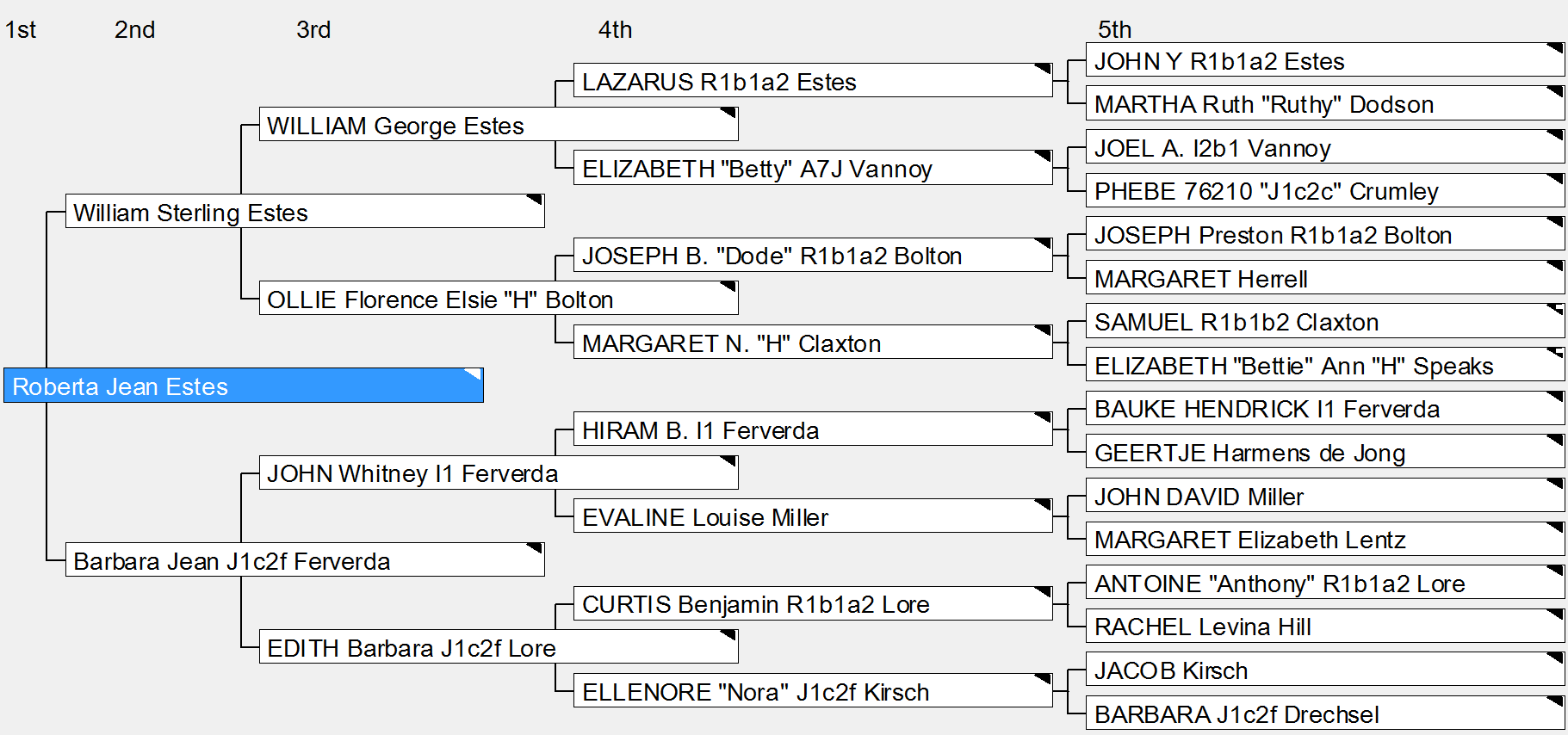
I have simplified this process greatly in order to explain the concept in a way you can easily follow.  I’m going to use my own pedigree chart as an example.  We’ll pretend we don’t know the identity of Curtis Benjamin Lore.  And yes, for those of you wondering, all of these people are deceased.

Mapping pedigree chart

I realize that you are going to have more than the 32 autosomal matches shown on my example spreadsheet.  You’re also not going to be able to find common ancestry with many of your matches due to things like dead ends, incorrect ancestry, segments identical by state (IBS) or DNA that comes from older ancestors that is not recognizable today after name changes in many generations when descended through females.  There are lots of reasons why you might not be able to find genealogy matches.  It’s the other matches, the ones where you can decipher and determine your common ancestor that help a great deal, and that is where we’ll focus.  These are the ones that matter and the keys to identifying Prodigal Great-Grandpa.

In my example here, we live in a perfect world.  We are looking to map the DNA of my 8 great-grandparents in order to figure out the identity of mother’s mother’s father.  Of course, there is no Y-DNA to test in this instance, so we must rely on autosomal DNA.  Ok, so maybe it’s not such a perfect world.  In a perfect world, you’d be a male trying to find the identity of your father’s father’s father and you could test your own Y-DNA – but then we wouldn’t have a good story nor would we need autosomal DNA.  And most people aren’t that fortunate.

Three generations isn’t that far back – or four – if you count yourself as the first generation.  If you’re quite lucky, you can test one or both of your parents, and maybe even a grandparent or great-aunt or uncle.  Failing that, you should be able to find some cousins from your various lines to test.  This entire exercise will be much MUCH easier for you if you can test multiple people descended from each of the 4 couples involved because you’ll be able to tell which lines your matches do, and don’t, match based on which cousins they also match.  Take DNA test kits to family reunions!

Obviously, you won’t be able to test anyone directly descended from your unknown great-grandfather, except perhaps his children.  The more of his children you can test, either directly or through their children, if deceased, the better your chance of identifying your Prodigal Great-Grandfather because each child inherits some different DNA from their parents.  In my case, we’re going to presume that there are no other known children, other than my grandmother.  So how do we find Prodigal Great-Grandpa?

First, download all of your matches with corresponding segment data from your testing vendor, either 23andMe or Family Tree DNA, into a spreadsheet.  Ancestry does not allow you to do this, which is a significant drawback in terms of testing at Ancestry.  You can do this today at 23andMe and at Family Tree DNA most easily by utilizing www.dnagedcom.com download software.  You can also do this directly at Family Tree DNA on the Chromosome Browser page.

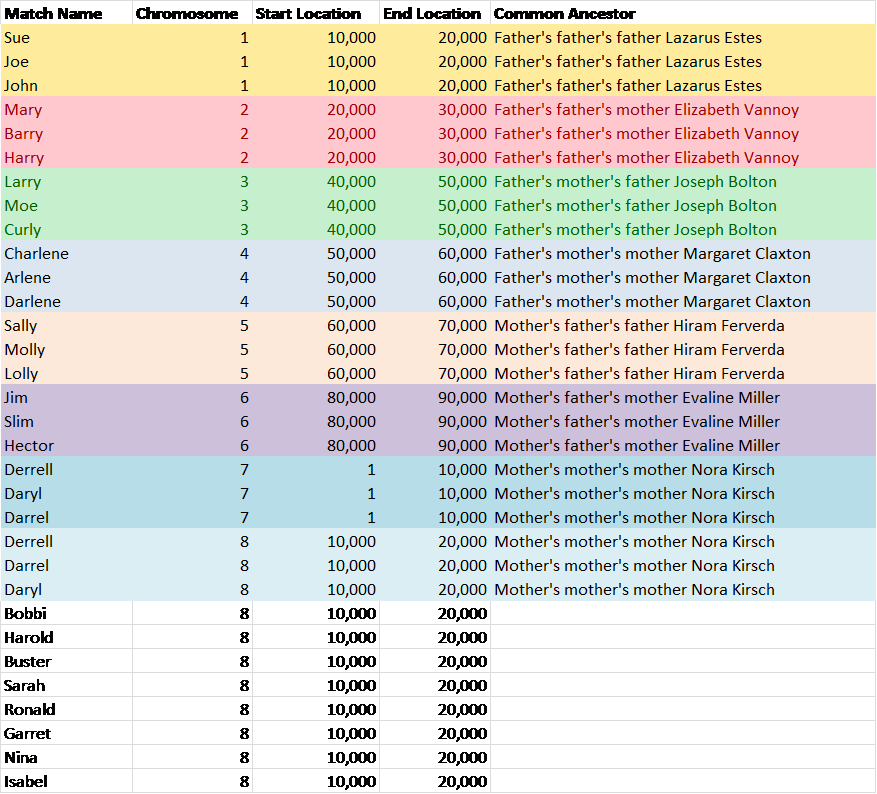
Your spreadsheet will look something like this, but without the colors.  That’s what you’ll be adding, along with the Common Ancestor column.

Mapping spreadsheet

Step 1 – Identify a common ancestor with those individuals you match on common DNA segments.  This is really two steps, the common ancestor part, and the common DNA segment part.  If these people are on your match list, we already know you have a common DNA segment over the vendor’s match threshold.  The presumption here is that if you have 3 people that match on the same segment from the same ancestor, that’s a confirmed “yes” that this particular DNA segment is descended from that ancestor.  You can also label these with only two confirmed descendants from the same ancestor, but I like to see three to be sure, especially if here is any doubt whatsoever that you’re dealing with the same ancestral family.  For example, if you are dealing with 2 people who carry the same surname from the same location, but you can’t quite find the common ancestor – you’ll need 3 matches to identify this segment.

In this case, I was able to test cousins so I know that on chromosome 1, Sue, Joe and John all match me on the same segment and they are all descended from Lazarus Estes.  I know this because one of them descends from Lazarus Estes and his wife, Elizabeth Vannoy, but the other two, Joe and John descend from an Estes upstream of Lazarus, let’s say, his father, John Y. Estes, through another child, which allows me to positively identify this segment as coming not just from the couple, Lazarus Estes and Elizabeth Vannoy, but from Lazarus specifically.

I’ve colored this segment mustard to represent Lazarus and so that you can visually see the difference between the 8 ancestors we’re working with.

2.  Repeat the same process with your other matches, hopefully utilizing cousins, to identify DNA segments of your other ancestors.  I’m only showing a very small subset of all of my DNA on my spreadsheet, and all matches are the exact same 10,000 cM blocks and only on one chromosome, for illustration purposes, but as you work through your matches, you’ll be able to color more and more of your DNA and assign it to different ancestral couples.  Each of your chromosomes will have different colors as different parts of each chromosome come from different ancestors.

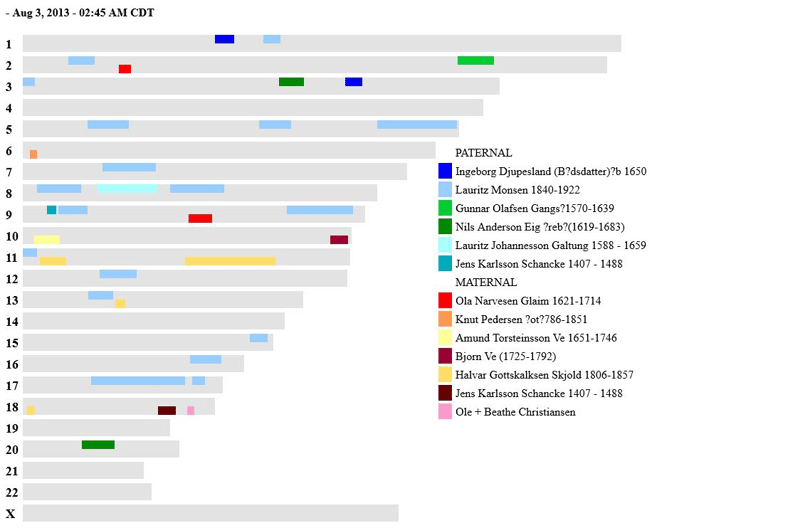
Kitty Cooper released a tool to utilize AFTER you do this hard grunt-work part that paints a pretty picture of your ancestors mapped on to your various chromosomes.  Here’s her example.  Notice that each chromosome has 2 sides, Mom’s and Dad’s inheritance side.  We’re going to use that to our advantage and it’s one facet of how we’re going to find Prodigal Great-Grandpa .

mapping kitty cooper

In my case (not this example), I have several segments that I can’t identify to a particular couple, but I can assign it to a group.  This is my Acadian group and is terribly admixed because of extensive intermarriage.  I also have a “Mennonite” segment labeled in the same way for the same reason.  So while I don’t know specifically who, I do know where and that helps a lot too.  But in our perfect world in our example, we don’t have any of that.

3. Now that I have most of my genome colored in and assigned to ancestors, except for Prodigal Great-Grandpa, I can see where all new matches fall.  Let’s say I get a new match on chromosome 1 in the segments between 10,000 and 20,000 and they also match Sue, Joe and John.  Even if the new match is an adoptee and has no genealogy, I can tell them which line they descend from.  And let me tell you, there is no greater gift.  This is exactly how we told new cousin Loujean she descended from the Younger line.

However, if someone matches me on this chromosome 1 segment but NOT Sue, Joe and John, since Sue,Joe, John and I all match on the entire segment from 10,000-20,000, then the new match has to be matching me on my other parent’s side (or is IBS – identical by state, a circumstantial match.)  Never forget that you have two “sides” to each chromosome – Mom’s and Dad’s (except for the X chromosome in males which we are not addressing here.)

4.  The only part of my match spreadsheet left uncolored, since this is a perfect world, would be the part that would probably come from my Prodigal Great-Grandfather.  So let’s look at chromosome 8 and map it.

What we don’t know, and have to determine, is whether or not some of these parts of chromosome 8 really belong to ancestors identified in color above.  However, remember that we are dealing with fairly close matches, only 3 generations, and in some cases, only 2 generations, depending on which cousins tested.  So let’s say you found several cousins to test because grandma had a large family.  Based on the test results of several of your aunts and uncles along with other people descended from great-grandma’s ancestral lines, you are able to map most of the DNA of your great-grandmother.  In this case, we mapped this segment of chromosome 8 to my three cousins, Derrell, Darrell and Daryl.  (Yes, I really do have those cousins.)

The result is that now I have 8 matches that do match me, and based on other cousin matches, do descend from Great-Grandma/Great-Grandpa but don’t match the Derrell trio indicating Great-Grandma’s line.  What this tells me is that the people who aren’t assigned, because they don’t match my cousins Derrell, Daryl and Darrel, or any other distant groups, must then be from Prodigal Great-Grandpa’s side or are “problem matches.”  Problem matches are those that are IBS (Identical by State) or have a technical issue and we’re not going to deal with that here, because this is a perfect world and we’re only concerned with people whose genealogy we have and that match each other.  By this definition, problem matches are automatically eliminated.  So let’s look at the 8 people above who don’t match me or the Derrell cousins on Great-Grandma’s/Great-Grandpa’s side, beginning with Bobbi and ending with Isabel.

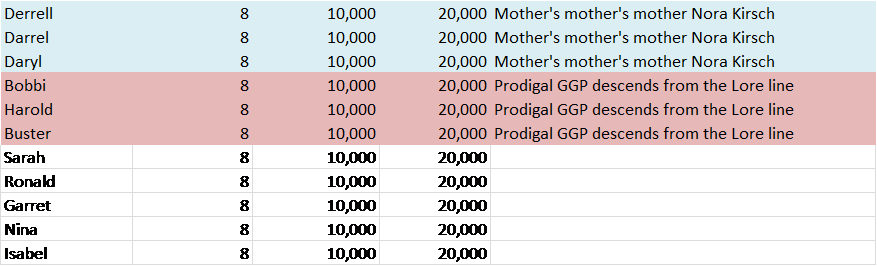
5.  Now we turn to genealogy.  We know that these 8 people all share a common ancestral line with Prodigal Great-Grandpa, we just don’t know who that is.  Let’s say that of this group, we discover that Bobbi, Harold and Buster are all related to each other, and glory be, they all know who their common ancestor is, or at least the common ancestral line.  Let’s say that Bobbi and Buster are first cousins in the Lore line and that Harold matches them closely as well, but he is descended from a Lore ancestor further upstream from Bobbi and Buster.  Therefore, we can now say, positively, that Prodigal Great-Grandpa descended somehow from the Lore line.

We still don’t know how Sarah, Ronald, Garret, Nina and Isabel connect to Prodigal Great-Grandpa, and that’s OK.  We can simply leave them uncolored for now.  We can select a color for Bobbi, Harold and Buster and assign then to Prodigal Great-Grandpa who descends from the Lore line.

Mapping PGG Lore

6.  Now it’s time for that luck to kick in.  We don’t know that Prodigal Great-Grandpa carried the surname Lore.  His mother could have been a Lore, or any of his ancestors.  All we have is a common surname and a common ancestor between three people who all match me on the same segment.  So, let’s assemble a tree of our cousins to see if we can narrow the scope of maybe who and where and then let’s get busy with the census and other records.  Geography is important.  Begatting requires proximity and many times, we can find the begatter in the neighborhood.  Also, check your genealogy software data base for this surname.  You may find the surname in an allied line.  Remember, families married their neighbors and often intermarried as well.

Sure enough, look there, in our perfect world, we discover that Nora Kirsch is working in her parents inn named the Kirsch House on the Ohio River in 1880.  The Kirsch House was also a boarding house, and a restaurant and pub.  One of their boarders in 1880 was none other than Benjamin Lore.  Hmmm.  Surely makes you wonder.  Further research on Benjamin Lore shows that he was a wildcat oilfield well driller working in the county where Nora lived and became something of a local legend for discovering the “Blue Lick” water well.  Well, now we have a name, proximity and maybe an opportunity.

7.  Well, peachy, but what next?  Further research on Benjamin Lore shows that he was married in the census, but where was his wife?  In previous census records, we find Benjamin Lore in Warren County, PA with his parents.  In the Warren County records, we find that he married Mary Bills, and additional research shows in 1880 a Mary Lore with 2 children, but no husband.  Court records show they later divorced, with 4 children.  Find those children!!!  They are the key to confirming the identity of Benjamin Lore as Prodigal Great-Grandpa.  If Benjamin’s other children had children about the same time as grandmother, each line should have 3 generations between Benjamin and the current generation.  Benjamin’s great-grandchildren through his first wife would be half-second cousins to me which would be the same as second cousins once removed.  They of course would be a generation closer to my mother whose DNA I also happen to have.

ISOGG has a wonderful Autosomal DNA Statistics page, and here you can see that second cousins once removed would share about 1.5% of their DNA in what is hopefully a large enough segment to match some of the cousins that have already tested.   My mother’s generation, first cousins once removed would share approximately 6.25%.

Mapping cousin chart

Benjamin’s descendants through his first wife may not match all of my cousins, but they will, hopefully, match some of the descendants of Prodigal Great-Grandpa, confirming, as best we can, that Benjamin Lore was grandmother’s father.  The best litmus test of course is how closely they would match the closest generations, like mother or great-aunts/uncles, if they were living.

Full Disclosure Note:  I used my own ancestors for purposes of illustration, even though Curtis Benjamin Lore (shown at right) was not prodigal in quite the way I portrayed in this article, well, at least not from my family’s perspective.  However, he was no saint Lore, CBeither and he may well have other descendants looking for him in this exact situation.  Aside from what we do know, there is the rumor of an illegitimate son showing up on his widow’s doorstep looking for him, albeit, a little too late.  We know that Curtis Benjamin (known as C.B.) Lore did marry Nora Kirsch in Dearborn County, Indiana, in 1888.  These photos are their “wedding photos” but interestingly, there is no photo of them together.

We also know that Curtis Benjamin Lore married Mary Bills in Warren County, PA., had four Lore children, 3 males (Sid, John Curtis and Herbert Judson Lore) and one female (Maud who married a Hendrickson), none of whom we have never been able to find.  Also, Curtis Benjamin Lore was not divorced from Mary until, ahem, after he was married to Nora Kirsch when Mary filed for divorce on the grounds of desertion.Kirsch, Nora

Apparently, his marriage to Nora Kirsch (pictured at right) fell, literally, according to the secret family story, into the “shotgun” category, so one has to understand that his choice of marriage versus death was fairly defensible.  I’m sure Nora’s father, a crusty old Civil War veteran, had no idea that he was already married or Curtis Benjamin would have been on the business end of that shotgun and marriage would not have been a choice.

The family took great care that this “uncomfortable” shotgun marriage situation never be discovered, to the point of falsifying the marriage date in the family Bible and also by “adjusting” the birth of the child by a year, also recorded incorrectly in the family Bible.  Were it not for the fact that I checked the church records in Dearborn County, I would never have discovered the discrepancy.  A child cannot be baptized months before it is born.  I might note that it was only AFTER this discovery that my mother was forthcoming with the “family secret” about the shotgun wedding.  Birth certificates were not issued at that time and my grandmother’s delayed birth certificate was issued based on the falsified family Bible information.

Benjamin probably would not have been bothered by this revelation at all, given what we know about him, but I’m sure Nora’s parents rolled over in their grave once or twice when I made the discovery and now that I’m, ugh, discussing it, and publicly at that.

Rogues and handsome scoundrels.  They are colorful and interesting aren’t they and provide a great amount of spice for family stories.  Hopefully these tools will help you find yours!!!

______________________________________________________________

Disclosure

I receive a small contribution when you click on some of the links to vendors in my articles. This does NOT increase the price you pay but helps me to keep the lights on and this informational blog free for everyone. Please click on the links in the articles or to the vendors below if you are purchasing products or DNA testing.

Thank you so much.

DNA Purchases and Free Transfers

Genealogy Services

Genealogy Research

23andMe Suspends Health-Related Genetic Tests

23andme suspends health

We seem to have part of the answer as to what 23andMe will be doing in the short term.  Tonight when I went to the 23andMe site, I was greeted with this message.

In case it’s too small to read, it says:

Welcome to 23andMe.

At this time, we have suspended our health-related genetic tests to comply immediately with the U.S. Food and Drug Administration’s directive to discontinue new consumer access during our regulatory review process.

We are continuing to provide you with both ancestry-related genetic tests and raw genetic data, without 23andMe’s interpretation.

If you are an existing customer please click the link below and then go to the health page for additional information. If you are a customer that purchased before 11/22/13, you will still have access to your health-related results.

We remain firmly committed to fulfilling our long-term mission to help people everywhere have access to their own genetic data and have the ability to use that information to improve their lives.

Upon entering the site, please confirm you understand the new changes in our services.

I understand that 23andMe only sells ancestry reports and raw genetic data at this time. I understand 23andMe will not provide health-related reports.  However, 23andMe may provide health-related results in the future, dependent upon FDA marketing authorization.

I clicked on “I Understand” and was then taken to the normal sign on screen where their test kit is marketed solely as a genetic genealogy kit, with all mention of health removed.

23andme suspends 3

After signing on, the health button on the main page is gone, but by clicking on “My Results” I can still see the Health Overview and proceed from there.  They mentioned additional information on the Health page, but I did not see anything additional.  Perhaps more is yet to come.

23andme suspends health 2

I do notice that the Research Surveys, Health Profile, and Key Health Recommendations are still present and the health reports/interpretation portions are still there in my account.  I was a customer prior to November 22, 2013.  But still, I’m surprised that all of the health surveys and questions remain.  They are clearly still data-gathering with their existing clients, so obviously hopeful about the FDA resolution.

23andme suspends 4

It appears that the genetic genealogy portion is “safe,” for now, although we don’t know what the future holds for 23andMe as they move through the regulatory process with the FDA.  I also wonder if the genetic genealogy marketspace, which has never been a priority to them, can financially sustain them long enough to complete the FDA process.  Part of that answer would likely rest upon how long the process takes and the depth of their pockets.  So far, they are 5 years and counting, but we don’t know how far along they are in the process.  Perhaps additional information will be forthcoming as the deadline of December 13, 15 or 16, depending on how you count, approaches.

I would still suggest downloading your information, just in case, and I wouldn’t wait until the last minute.  No matter how well intentioned they are, they may find themselves in a situation where they cannot provide extensive notification about impending changes.

______________________________________________________________

Disclosure

I receive a small contribution when you click on some of the links to vendors in my articles. This does NOT increase the price you pay but helps me to keep the lights on and this informational blog free for everyone. Please click on the links in the articles or to the vendors below if you are purchasing products or DNA testing.

Thank you so much.

DNA Purchases and Free Transfers

Genealogy Services

Genealogy Research

23andMe Pulls Affiliate Marketing Program

alarmYou know those ads you see everyplace on the internet for 23andMe?  Well, you won’t anymore.  23andMe has cancelled their affiliate marketing program according to an e-mail sent to affiliates yesterday.

23andMe Affiliate Program Update

We are writing to let you know that 23andMe is suspending its affiliate program at this time.

We appreciate all the work you have done with us and sincerely hope we will be able to work together again in the future.

Today we have set all our publisher accounts, including yours, to expire from our Commission Junction program. After the standard 7 day grace period, you will stop receiving commission.

We ask you to remove any 23andMe links and promotions from your site.

Please let us know if we can answer any questions.

We appreciate your understanding and cooperation.

Best,

CJ Swenson, Online Marketing Manager

For a company whose entire business presence is electronic, this doesn’t bode well for the future.  It’s obvious that 23andMe is working to comply with the FDA’s 15 day cease and desist mandate.  It’s equally obvious that the resolution is not going to be simply another extension of time to comply with the FDA requirements while business continues as usual.

You know, last week, when I said that I wasn’t an alarmist and I really felt that 23andMe would pull through this and be OK….well, I’m not so sure anymore.

So, folks it’s time to start copying health results, downloading files and contacting your matches to be sure they have your e-mail.  Remember, your only way to contact them is through the 23andMe system, and 23andMe’s longevity is in grave doubt today.

Yep, I’m sounding the alarm.  The 15 business day grace period given to 23andMe by the FDA, depending on how you count the Thanksgiving holiday ends either on Friday the 13th (no joke) or on Monday or Tuesday, the 16th or 17th.  It’s time to get busy, just in case.

______________________________________________________________

Disclosure

I receive a small contribution when you click on some of the links to vendors in my articles. This does NOT increase the price you pay but helps me to keep the lights on and this informational blog free for everyone. Please click on the links in the articles or to the vendors below if you are purchasing products or DNA testing.

Thank you so much.

DNA Purchases and Free Transfers

Genealogy Services

Genealogy Research

Now What? – 23andMe and the FDA

I’m sure everyone reading this knows by now that 23andMe has been ordered to stop marketing their DNA test until they comply with previous FDA requirements.  I wrote about this earlierForbes and several others have weighed in too.  The Forbes article is particularly interesting because it is written by Matthew Herper who has covered the FDA for 13 years, so has significant perspective.

Since that time, a firestorm of questions, comments and emotions have been forthcoming, from all directions.  As consumers, we feel trapped, caught in the middle of a battle, along with our DNA and results.  And sadly, it looks like the battle didn’t have to occur, had 23andMe not ignored the FDA for months after promising results it never delivered.   I want to make a couple of comments, then talk about what we, as consumers, can do to prepare for the worst case.

But before I do that, I want to make it very clear that I don’t expect that the worst case scenario will happen.  What would that be?  23andMe going out of business.  I don’t think that will happen.  Even though they, according to the FDA letter, have been negligent in taking care of business and meeting their commitments, they have bright minds and deep pockets….and 15 days to make some sort of conciliatory peace with the FDA.  Now I’m not a psychic, but I’m betting that 23andMe headquarters is very busily figuring out all of the things they need to do to put this ugly public chapter behind them.  Of course, I could be wrong.  This could be the death knell for 23andMe.  But I don’t think so, unless they cannot prove the accuracy of their product or they continue to ignore the FDA and fail to meet commitments.

Most of the questions and concerns voiced today by consumers revolve around what will happen to results they already have on the 23andMe website.

There is no reason to think that the results would be removed as long as the website is functional.  And their website is their link with the world, so as long as there is 23andMe, there will be a website.

However, the unthinkable has happened before, and 23andMe appears to have been somewhat negligent, so, just in case, what can we do?

1. Print your health results for future reference

On your personal page at 23andMe, select the “Health Overview” option which will then display your elevated risks in each of 4 option categories..

23andMe FDA1

For each of the 4 sections, Health Risks, Inherited Conditions, Traits and Drug Response, there is a blue link at the bottom that says “see all 122 risk reports,” for example.  Click on the “see all” link and then simply print the results in each of the 4 categories.  If you want to preserve any of the more detailed information in any of the categories, you’ll have to use screen shots.

2. Download your raw data file

Regardless of what you do, or don’t, do with these results, they are yours.  After downloading your file, you can simply save the results for later, you can upload them to donation based www.gedmatch.com (when GedMatch is again accepting files, currently estimated to be Dec.1) or you can transfer your file to Family Tree DNA to add your results to their data base and avail yourself of their matches and tools.  Right now, the transfer price for either 23andMe or Ancestry files is only $49, which is significantly less than taking a new test at $99 (although the $99 test currently comes with a $100 restaurant.com giftcard.)  This gives you the ability to find new matches with people who haven’t tested at 23andMe.

23andme fda2

To download your raw data file at 23andMe, sign on to your account, then click on your name in the upper right hand corner of the screen, then on “Browse Raw Data,” then on “Download” in the upper right hand corner of the screen.  You’ll then be prompted for your password again and the answer to your secret question.  Default will be set to download all data.  Leave it that way.  You’ll then be asked if you want to open the file or save it.  Save it.  On a Windows PC, if you don’t direct otherwise, it will be saved in the Downloads directory with a file name where the word “genome_” preceeds the name of the person who tested.  Mine is “genome_Roberta_Estes_Full_20131125XXXXXX.

Word of Warning…..

In the past month, 3 of the 5 files I’ve downloaded from 23andMe have been incomplete.  I’ve been working with 23andMe for three very frustrating weeks now via e-mail to try to figure out why they are incomplete.  So far, I have no answers and I’ve asked if these incomplete files have affected my (and my families) results posted at 23andMe.  To date, I’m still getting their standard reply about not being responsible for third party upload sites, which of course is not the question I asked, at all.

A normal 23andMe file will have about 950,000 rows on a spreadsheet, each one representing a single location tested.  23andMe confirmed this number last week.  For example, I have 991,000 plus change and my niece has 960,000 plus change.  All 3 of the incomplete files have only 574,515 lines each, exactly.  And yes, all of them are build 37, and no, they did not test at the same time.  I even downloaded them a second, third and fourth time, from different locations using different computers, etc.  The files are simply massively incomplete.

These incomplete files cannot be uploaded and utilized by other tools (www.gedmatch.com) or firms, including Family Tree DNA because 40% of the data is missing.

Given this experience, the FDA’s concerns about accuracy have certainly given me pause to reflect….

You can get a good idea as to whether your file is complete or not by the zipped file size when it downloads.  The zipped size of the incomplete files is around 5K (4901 to be exact) and the zipped size of the correct files is about 8K (8262 and 8013K to be exact).

Good luck getting help if your file is incomplete.  In order to contact the 23andMe customer service department, you have to jump through hoops, stand on your head, pat your stomach and rub your foot at the same time while chewing gum and blowing bubbles.  Ok, tiny exaggeration.  You really only have to click on “help” then use the “what’s your question” function, and then at the end of that exercize when you don’t receive the answer you need, you can submit a question to them via a form….but not until you go through that process.  They’ll get back with you in about a week with a canned reply and then you can begin the back and forth dialogue, with 2-3 day intervals between each e-mail.

3. Contact your matches

If you haven’t contacted all of your matches already, now would be a wonderful time to send invitations.  I send a message with each one that includes my e-mail address.  Unfortunately, you are forced to utilize the in-house messaging system at 23andMe, so unless you’ve exchanged e-mail addresses with your matches, if the 23andMe system goes away, you have no way to contact anyone ever again.

4. Send your e-mail address to all of the people who have already accepted match requests

Obviously, this is for the same reason.  Otherwise, your ability to communicate with your matches will disappear if the website does.  Personally I far prefer e-mail rather than the messaging system anyway, so this is not a wasted opportunity.

I want to say, again, that I don’t believe that anything horrible will happen to 23andMe.  I don’t want to be an alarmist.  They have deep pockets and lots of lawyers.  They may get a slap on the hand, but in the long run, I think they’ll be around in one form or another, assuming, of course, that they can prove their results are accurate.  I do have to ask myself why 23andMe has been unable to do this in 5 years.  Was it just not a priority, corporate arrogance, or is there a real problem lurking?  However, as for my data and results, better safe than sorry, and we should  probably be taking these steps anyway.  I’m glad I downloaded the data files for my family, because it has exposed a problem that I otherwise wouldn’t have known existed.  Hopefully, I’ll still have time to get it resolved.

______________________________________________________________

Disclosure

I receive a small contribution when you click on some of the links to vendors in my articles. This does NOT increase the price you pay but helps me to keep the lights on and this informational blog free for everyone. Please click on the links in the articles or to the vendors below if you are purchasing products or DNA testing.

Thank you so much.

DNA Purchases and Free Transfers

Genealogy Services

Genealogy Research

FDA Orders 23andMe to Discontinue Testing

23andme logo

Never, ever, mess with the big guns.

The FDA has issued a cease and desist letter to 23andMe and ordered the firm to stop selling their DNA tests based on concerns of accuracy, failure to comply with FDA requirements and the fact that they are providing “specific health recommendations” to their clients.

Here is the actual letter.

“The Food and Drug Administration (FDA) is sending you this letter because you are marketing the 23andMe Saliva Collection Kit and Personal Genome Service (PGS) without marketing clearance or approval in violation of the Federal Food, Drug and Cosmetic Act.

Therefore, 23andMe must immediately discontinue marketing the PGS until such time as it receives FDA marketing authorization for the device.”

Normally, the DTC (direct to consumer) test concerns voiced are about people misinterpreting their results, or being frightened by them, without the involvement of a physician.  In other words, the move until now has been to force you to visit a doctor to obtain a prescription for this type of test.  Of course, the underlying assumption is that the physician will then be available and have expertise in all of the areas that the test covers.  That, of course, would mean another follow-up visit, and if all you really wanted was the genealogically relevant results, this would in effect kill that part of their business.  In fact, it would probably kill the business entirely, at least under the current marketing model.

The FDA says that the product that 23andMe sells is a medical device, especially since it involves important medical information such as the detection of the BRCA-related breast cancer gene and sensitivity to the blood-thinner, warfarin.

Again from the FDA to 23andMe letter:

“Some of the uses for which PGS is intended are particularly concerning, such as assessments for BRCA-related genetic risk and drug responses (e.g., warfarin sensitivity, clopidogrel response, and 5-fluorouracil toxicity) because of the potential health consequences that could result from false positive or false negative assessments for high-risk indications such as these.”

The FDA wants 23andMe to show that these tests are accurate.  They are concerned, for example, that the BRCA test provided by 23andMe might provide either a false positive or, even worse, a false negative.  A false positive would, of course, provide an individual with a great deal of angst, but they would certainly immediately visit a physician who would prescribe industry-standard follow-up testing where the “false positive” would be caught.  A false negative, on the other hand, might mask a deadly situation, delaying detection until too late.

The FDA states that they have been working with 23and Me who has failed to provide the necessary proof.  From the looks of this letter, and understanding there are two sides to every story, it looks like 23and Me has not taken the FDA seriously.

“As part of our interactions with you, including more than 14 face-to-face and teleconference meetings, hundreds of email exchanges, and dozens of written communications, we provided you with specific feedback on study protocols and clinical and analytical validation requirements, discussed potential classifications and regulatory pathways (including reasonable submission timelines), provided statistical advice, and discussed potential risk mitigation strategies. As discussed above, FDA is concerned about the public health consequences of inaccurate results from the PGS device; the main purpose of compliance with FDA’s regulatory requirements is to ensure that the tests work.

However, even after these many interactions with 23andMe, we still do not have any assurance that the firm has analytically or clinically validated the PGS for its intended uses, which have expanded from the uses that the firm identified in its submissions. In your letter dated January 9, 2013, you stated that the firm is “completing the additional analytical and clinical validations for the tests that have been submitted” and is “planning extensive labeling studies that will take several months to complete.” Thus, months after you submitted your 510(k)s and more than 5 years after you began marketing, you still had not completed some of the studies and had not even started other studies necessary to support a marketing submission for the PGS. It is now eleven months later, and you have yet to provide FDA with any new information about these tests.  You have not worked with us toward de novo classification, did not provide the additional information we requested necessary to complete review of your 510(k)s, and FDA has not received any communication from 23andMe since May. Instead, we have become aware that you have initiated new marketing campaigns, including television commercials that, together with an increasing list of indications, show that you plan to expand the PGS’s uses and consumer base without obtaining marketing authorization from FDA.”

I do believe the FDA has their undivided attention now.

“Therefore, 23andMe must immediately discontinue marketing the PGS until such time as it receives FDA marketing authorization for the device.”

23andMe has 15 days to reply and if they don’t, it could get even uglier.

“Please notify this office in writing within fifteen (15) working days from the date you receive this letter of the specific actions you have taken to address all issues noted above. Include documentation of the corrective actions you have taken. If your actions will occur over time, please include a timetable for implementation of those actions. If corrective actions cannot be completed within 15 working days, state the reason for the delay and the time within which the actions will be completed. Failure to take adequate corrective action may result in regulatory action being initiated by the Food and Drug Administration without further notice. These actions include, but are not limited to, seizure, injunction, and civil money penalties.”

Yep, never mess with the big guns.

In 2010, five different companies, including 23andMe, were served with warning letters when Pathway Genomics announced it would sell its DNA testing product at Walgreen, a plan that never came to fruition after the warning letter.  However, this is the first letter of this type to be served on a genomics testing company.

What’s next?  We just don’t know.  23andMe has yet to comment, but it looks from this letter like they have limited choices at the moment.

Stay tuned for the next episode of the Wild West in DTC Testing.

______________________________________________________________

Disclosure

I receive a small contribution when you click on some of the links to vendors in my articles. This does NOT increase the price you pay but helps me to keep the lights on and this informational blog free for everyone. Please click on the links in the articles or to the vendors below if you are purchasing products or DNA testing.

Thank you so much.

DNA Purchases and Free Transfers

Genealogy Services

Genealogy Research

Genomics Law Report Discusses Designing Children

I’m sure most of my readers are familiar with the upheaval caused by 23andMe’s patent dubbed “Designer Babies” earlier this fall.  Opinions on this were highly divergent with some folks feeling like it couldn’t really be done, so nothing to reasonably worry about, some who couldn’t wait and others who were appalled for various reasons.  Today, Genomics Law Report (GLR) published what I feel is a very balanced article about the patent, the technology, the fallout and the future in an article titled “Designing Children.”

With this post the GLR introduces a new Contributing Writer, Jonathan Webber. Jonathan is a web editor at Robinson, Bradshaw & Hinson, the law firm that sponsors the GLR. His duties include copy-editing the GLR. That exposure, together with his background in anthropology—he came to RBH with a degree in anthropology and experience as both a field archaeologist and cultural educator for a state park system—has sparked his interest in some of the cultural and ethical issues that genomics raises. In this first post he brings his perspective to bear on the implications of 23andMe’s “designer babies” patent, and we look forward to more of his insight in the future.”

The aspect in this article that surprised me the most was the “ethical parenting” commentary about New York City.  I truthfully, had no idea that parents were “training” their children for pre-school entrance exams and more, nor that they were medicating them for the purpose.

As a parent myself, I know that any parent would avail themselves of any technology that would prevent or avert genetic diseases in their children.  But what about selecting for high intelligence?  That’s understandable too, whether one agrees with it or not, and 13% of parents in a survey said they would select for that, if they could.  But what about athletic prowess?  Ten percent of the parents said they would select for athletic prowess.  Is this now into the frivolous?  Or what about a selecting for a blonde haired, blue eyed, slim daughter that the parents are hoping will be a beauty queen or a cheerleader?  And of course, we haven’t even touched on the dark side of this in terms of parental motivation.  All parents are not good parents nor do they all have their children’s best interests at heart.

Lots of questions and few answers about ethics, social responsibility and what the future holds.  I hope you enjoy the article.

______________________________________________________________

Disclosure

I receive a small contribution when you click on some of the links to vendors in my articles. This does NOT increase the price you pay but helps me to keep the lights on and this informational blog free for everyone. Please click on the links in the articles or to the vendors below if you are purchasing products or DNA testing.

Thank you so much.

DNA Purchases and Free Transfers

Genealogy Services

Genealogy Research

Determining Ethnicity Percentages

Recently, as a comment to one of my blog postings, someone asked how the testing companies can reach so far back in time and tell you about your ancestors.  Great question.

The tests that reliably reach the furthest back, of course, are the direct line Y-Line and mitochondrial DNA tests, but the commenter was really asking about the ethnicity predictions.  Those tests are known as BGA, or biogeographical ancestry tests, but most people just think of them or refer to them as the ethnicity tests.

Currently, Family Tree DNA, 23andMe and Ancestry.com all provide this function as a part of their autosomal product along with the Genographic 2.0 test.  In addition, third party tools available at www.gedmatch.com don’t provide testing, but allow you to expand what you can learn with their admixture tools if you upload your raw data files to their site.  I wrote about how to use these ethnicity tools in “The Autosomal Me” series.  I’ve also written about how accurate ethnicity predictions from testing companies are, or aren’t, here, here and here.

But today, I’d like to just briefly review the 3 steps in ethnicity prediction, and how those steps are accomplished.  It’s simple, really, in concept, but like everything else, the devil is in the details.devil

There are three fundamental steps.

  • Creation of the underlying population data base.
  • Individual DNA extraction.
  • Comparison to the underlying population data base.

Step 1:  Creation of the underlying population data base.

Don’t we wish this was as simple as it sounds.  It isn’t.  In fact, this step is the underpinnings of the accuracy of the ethnicity predictions.  The old GIGO (garbage in, garbage out) concept applies here.

How do researchers today obtain samples of what ancestral populations looked like, genetically?  Of course, the evident answer is through burials, but burials are not only few and far between, the DNA often does not amplify, or isn’t obtainable at all, and when it is, we really don’t have any way to know if we have a representative sample of the indigenous population (at that point in time) or a group of travelers passing through.  So, by and large, with few exceptions, ancient DNA isn’t a readily available option.

The second way to obtain this type of information is to sample current populations, preferably ones in isolated regions, not prone to in-movement, like small villages in mountain valleys, for example, that have been stable “forever.”  This is the approach the National Geographic Society takes and a good part of what the Genograpic Geno 2.0 project funding does.  Indigenous populations are in most cases our most reliable link to the past.  These resources, combined with what we know about population movement and history are very telling.  In fact, National Geographic included over 75,000 AIMs (Ancestrally Informative Markers) on the Geno 2.0 chip when it was released.

The third way to obtain this type of information is by inference.  Both Ancestry.com and 23andMe do some of this.  Ancestry released its V2 ethnicity updates this week, and as a part of that update, they included a white paper available to DNA participants.  In that paper, Ancestry discusses their process for utilizing contributed pedigree charts and states that, aside from immigrant locations, such as the United States and Canada, a common location for 4 grandparents is sufficient information to include that individuals DNA as “native” to that location.  Ancestry used 3000 samples in their new ethnicity predictions to cover 26 geographic locations.  That’s only 115 samples, on average, per location to represent all of that population.  That’s pretty slim pickins.  Their most highly represented area is Eastern Europe with 432 samples and the least represented is Mali with 16.  The regions they cover are shown below.

ancestry v2 8

Survey Monkey, a widely utilized web survey company, in their FAQ about Survey Size For Accuracy provides guidelines for obtaining a representative sample.  Take a look.  No matter which calculations you use relative to acceptable Margin of Error and Confidence Level, Ancestry’s sample size is extremely light.

23andMe states in their FAQ that their ethnicity prediction, called Ancestry Composition covers 22 reference populations and that they utilize public reference datasets in addition to their clients’ with known ancestry.

23andMe asks geographic ancestry questions of their customers in the “where are you from” survey, then incorporates the results of individuals with all 4 grandparents from a particular country.  One of the ways they utilize this data is to show you where on your chromosomes you match people whose 4 grandparents are from the same country.  In their tutorial, they do caution that just because a grandparent was born in a particular location doesn’t necessarily mean that they were originally from that location.  This is particularly true in the past few generations, since the industrial revolution.  However, it may still be a useful tool, when taken with the requisite grain of salt.

23andme 4 grandparents

The third way of creating the underlying population data base is to utilize academically published information or information otherwise available.  For example, the Human Genome Diversity Project (HGDP) information which represents 1050 individuals from 52 world populations is available for scrutiny.  Ancestry, in their paper, states that they utilized the HGDP data in addition to their own customer database as well as the Sorenson data, which they recently purchased.

Academically published articles are available as well.  Family Tree DNA utilizes 52 different populations in their reference data base.  They utilize published academic papers and the specific list is provided in their FAQ.

As you can see, there are different approaches and tools.  Depending on which of these tools are utilized, the underlying data base may look dramatically different, and the information held in the underlying data base will assuredly affect the results.

Step 2:  Your Individual DNA Extraction

This is actually the easy part – where you send your swab or spit off to the lab and have it processed.  All three of the main players utilize chip technology today.  For example, 23andMe focuses on and therefore utilizes medical SNPs, where Family Tree DNA actively avoids anything that reports medical information, and does not utilize those SNPs.

In Ancestry’s white paper, they provide an excellent graphic of how, at the molecular level, your DNA begins to provide information about the geographic location of your ancestors.  At each DNA location, or address, you have two alleles, one from each parent.  These alleles can have one of 4 values, or nucleotides, at each location, represented by the abbreviations T, A, C and G, short for Thymine, Adenine, Cytosine and Guanine.  Based on their values, and how frequently those values are found in comparison populations, we begin to fine correlations in geography, which takes us to the next step.

ancestry allele snps

Step 3:  Comparison to Underlying Population Data Base

Now that we have the two individual components in our recipe for ethnicity, a population reference set and your DNA results, we need to combine them.

After DNA extraction, your individual results are compared to the underlying data base.  Of course, the accuracy will depend on the quality, diversity, coverage and quantity of the underlying data base, and it will also depend on how many markers are being utilized or compared.

For example, Family Tree DNA utilizes about 295,000 out of 710,000 autosomal SNPs tested for ethnicity prediction.  Ancestry’s V1 product utilized about 30,000, but that has increased now to about 300,000 in the 2.0 version.

When comparing your alleles to the underlying data set one by one, patterns emerge, and it’s the patterns that are important.  To begin with, T, A, C and G are not absent entirely in any population, so looking at the results, it then becomes a statistics game.  This means that, as Ancestry’s graphic, above, shows, it becomes a matter of relativity (pardon the pun), and a matter of percentages.

For example, if the A allele above is shown is high frequencies in Eastern Europe, but in lower frequencies elsewhere, that’s good data, but may not by itself be relevant.  However if an entire segment of locations, like a street of DNA addresses, are found in high percentages in Eastern Europe, then that begins to be a pattern.  If you have several streets in the city of You that are from Eastern Europe, then that suggests strongly that some of your ancestors were from that region.

To show this in more detailed format, I’m shifting to the third party tool, GedMatch and one of their admixture tools.  I utilized this when writing the series, “The Autosomal Me” and in Part 2, “The Ancestor’s Speak,” I showed this example segment of DNA.

On the graph below, which is my chromosome painting of one a small part of one of my chromosomes on the top, and my mother’s showing the exact same segment on the bottom, the various types of ethnicity are colored, or painted.

The grid shows location, or address, 120 on the chromosome and each tick mark is another number, so 121, 122, etc.   It’s numbered so we can keep track of where we are on the chromosome.

You can readily see that both of us have a primary ethnicity of North European, shown by the teal.  This means that for this entire segment, the results are that our alleles are found in the highest frequencies in that region.

Gedmatch me mom

However, notice the South Asian, East Asian, Caucus, and North Amerindian. The important part to notice here, other than I didn’t inherit much of that segment at 123-127 from her, except for a small part of East Asian, is that these minority ethnicities tend to nest together.  Of course, this makes sense if you think about it.  Native Americans would carry Asian DNA, because that is where their ancestors lived.  By the same token, so would Germans and Polish people, given the history of invasion by the Mongols. Well, now, that’s kind of a monkey-wrench isn’t it???

This illustrates why the results may sometimes be confusing as well as how difficult it is to “identify” an ethnicity.  Furthermore, small segments such as this are often “not reported” by the testing companies because they fall under the “noise” threshold of between about 5 and 7cM, depending on the company, unless there are a lot of them and together they add up to be substantial.

In Summary

In an ideal world, we would have one resource that combines all of these tools.  Of course, these companies are “for profit,” except for National Geographic, and they are not going to be sharing their resources anytime soon.

I think it’s clear that the underlying data bases need to be expanded substantially.  The reliability of utilizing contributed pedigrees as representative of a population indigenous to an area is also questionable, especially pedigrees that only reach back two generations.

All of these tools are still in their infancy.  Both Ancestry and Family Tree DNA’s ethnicity tools are labeled as Beta.  There is useful information to be gleaned, but don’t take the results too seriously.  Look at them more as establishing a pattern.  If you want to take a deeper dive by utilizing your raw data and downloading it to GedMatch, you can certainly do so. The Autosomal Me series shows you how.

Just keep in mind that with ethnicity predictions, with all of the vendors, as is particularly evident when comparing results from multiple vendors, “your mileage may vary.”  Now you know why!

______________________________________________________________

Disclosure

I receive a small contribution when you click on some of the links to vendors in my articles. This does NOT increase the price you pay but helps me to keep the lights on and this informational blog free for everyone. Please click on the links in the articles or to the vendors below if you are purchasing products or DNA testing.

Thank you so much.

DNA Purchases and Free Transfers

Genealogy Services

Genealogy Research