DNAeXplain Archives – Intermediate DNA Articles

Today, another group from the DNAeXplained archives.  This time, we’ll be looking at Intermediate DNA.  The various categories are:

  • Historical or Obsolete – these are items that were interesting at the time by aren’t really relevant today – except in a historical context. An example would be the announcement of the Genographic 2 project in July of 2012. You may wonder why I didn’t delete these. Looking back, these are somewhat like a genetic genealogy journal.
  • General Information – these are generally articles about DNA and genealogy. They don’t presume that you’re actually working with the results.
  • Basic Education – this may be basic genealogy or basic DNA fundamentals. These articles provide a foundation for working with your results. Think of it as pre-bootcamp.
  • Introductory DNA – these articles do presume you are working with your results. Bootcamp begins here.
  • Intermediate DNA – these topics are a little more challenging and you’ll probably need the basics and introductory understanding to be able to work at this level.
  • Advanced DNA – very few articles are advanced. In fact, I try very hard to avoid this, when possible. Mostly, these have to do with advanced autosomal techniques and research.
  • Examples – these are examples of using genealogy and DNA together seamlessly. My 52 Ancestors stories fall into this category. Think of these as story problems that include the answers!
  • Educational – educational opportunities such as classes, books and videos.
  • Entertainment – just for fun, like the Who Do You Think You Are series, some of these have no DNA content.
  • Project Administration – articles written for project administrators at Family Tree DNA. Project administrators, of course, will be interested in all of the rest.
  • In the past we’ve covered Historical, General Information, Basic Education and Introductory DNA. Today, let’s look at Intermediate DNA.
Title Date Link
To SNP or not to SNP? 8-10-2012 http://dna-explained.com/2012/08/10/to-snp-or-not-to-snp/
Phasing the X Chromosome 12-30-2012 http://dna-explained.com/2012/12/30/phasing-the-x-chromosome/
The Autosomal Me – Unraveling Minority Admixture 2-6-2013 http://dna-explained.com/2013/02/06/the-autosomal-me-unraveling-minority-admixture/
The Autosomal Me – The Ancestors Speak 2-10-2013 http://dna-explained.com/2013/02/10/the-autosomal-me-the-ancestors-speak/
The Autosomal Me – Who Am I? 2-13-2013 http://dna-explained.com/2013/02/13/the-autosomal-me-who-am-i/
The Autosomal Me – Testing Company Results 2-24-2013 http://dna-explained.com/2013/02/24/the-autosomal-me-testing-company-results/
The Autosomal Me – Rooting Around in the Weeds Using Third Party Tools 3-3-2013 http://dna-explained.com/2013/03/03/the-autosomal-me-rooting-around-in-the-weeds-using-third-party-tools/
The Autosomal Me – DNA Analysis – Splitting Up 3-12-2013 http://dna-explained.com/2013/03/12/the-autosomal-me-dna-analysis-splitting-up/
The Autosomal Me – Start, Stop, go – Identifying Native Chromosome Segments 3-18-2013 the-autosomal-me-start-stop-go-identifying-native-chromosome-segments
The Autosomal Me – Extracting Data Segments and Clustering 4-8-2013 http://dna-explained.com/2013/04/08/the-autosomal-me-extracting-data-segments-and-clustering/
The Autosomal Me – The Holy Grail – Identifying Native Genealogy Lines 5-31-2013 http://dna-explained.com/2013/05/31/the-autosomal-me-the-holy-grail-identifying-native-genealogy-lines/
The Autosomal Me Summary and PDF File 6-2-2013 http://dna-explained.com/2013/06/02/the-autosomal-me-summary-and-pdf-file/
Kitty Cooper’s Chromosome Mapping Tool Released 8-3-2013 http://dna-explained.com/2013/08/03/kitty-coopers-chromsome-mapping-tool-released/
Family Tree DNA Updates Family Finder and Adds Triangulation 10-3-2013 http://dna-explained.com/2013/10/03/family-tree-dna-updates-family-finder-and-adds-triangulation/
Mitochondrial DNA Convergence and Matches 10-11-2013 http://dna-explained.com/2013/10/11/mitochondrial-dna-convergence-and-matches/
Family Tree DNA’s Family Finder Match Matrix Released 12-10-2013 http://dna-explained.com/2013/12/10/family-tree-dnas-family-finder-match-matrix-released/
Introducing the Autosomal DNA Segment Analyzer 1-9-2014 http://dna-explained.com/2014/01/09/introducing-the-autosomal-dna-segment-analyzer/
That Unruly X…Chromosome That Is 1-23-2014 http://dna-explained.com/2014/01/23/that-unruly-x-chromosome-that-is/
Big Y Matching 6-24-2014 http://dna-explained.com/2014/06/24/big-y-matching/
Big Y DNA Results Divide and Unite Haplogroup Q Native Americans 6-25-2014 http://dna-explained.com/2014/06/25/big-y-dna-results-divide-and-unite-haplogroup-q-native-americans/
Utilizing Ancient DNA at GedMatch 9-22-2014 http://dna-explained.com/2014/09/22/utilizing-ancient-dna-at-gedmatch/
Ancient DNA Matches – What Do They Mean? 9-25-2014 http://dna-explained.com/2014/09/25/ancient-dna-matches-what-do-they-mean/
Ancient DNA Matching – A Cautionary Tale 9-30-2014 http://dna-explained.com/2014/09/30/ancient-dna-matching-a-cautionary-tale/
Chromosome Browser War 11-30-2014 http://dna-explained.com/2014/11/30/chromosome-browser-war/
How Phasing Works and Determining IBD Versus IBS Matches 1-2-2015 http://dna-explained.com/2015/01/02/how-phasing-works-and-determining-ibd-versus-ibs-matches/
Just One Cousin 1-11-2015 http://dna-explained.com/2015/01/11/just-one-cousin/
Lazarus – Putting Humpty Dumpty Back Together Again 1-14-2015 http://dna-explained.com/2015/01/14/lazarus-putting-humpty-dumpty-back-together-again/
Demystifying Autosomal DNA Matching 1-16-2015 http://dna-explained.com/2015/01/17/demystifying-autosomal-dna-matching/
Estes Big Y DNA Results 3-26-2015 http://dna-explained.com/2015/03/26/estes-big-y-dna-results/
Are You Native? – Native American Haplogroup Origins and Ancestral Origins 5-21-2015 http://dna-explained.com/2015/05/21/are-you-native-native-american-haplogroup-origins-and-ancestral-origins/
4 Generation Inheritance Study 8-23-2015 http://dna-explained.com/2015/08/23/4-generation-inheritance-study/
Phasing Yourself 8-27-2015 http://dna-explained.com/2015/08/27/phasing-yourself/
Ancestry Shared Matches Combined With New Ancestor Discoveries 8-28-2015 http://dna-explained.com/2015/08/28/ancestry-shared-matches-combined-with-new-ancestor-discoveries/

______________________________________________________________

Disclosure

I receive a small contribution when you click on some of the links to vendors in my articles. This does NOT increase the price you pay but helps me to keep the lights on and this informational blog free for everyone. Please click on the links in the articles or to the vendors below if you are purchasing products or DNA testing.

Thank you so much.

DNA Purchases and Free Transfers

Genealogy Services

Genealogy Research

Finding Hidden Treasure in Estate Inventories

Recently, I spent an entire day in Richmond at the Library of Virginia, also known as the State Archives.  Like always, I prepared a research list.  While most of my research procured nothing, which isn’t unusual after you’re already plucked all the fruit you can readily see – I did come up with one big winner.

The estate inventory of Edward Mercer who died sometime between May 4th 1763 when he last appears in the Frederick County, Virginia court minutes in a road order, and November 1, 1763 when his estate was probated.  At that same court session, he was replaced as overseer or the road, so he apparently was still “working” up to a few months before he died, even though he prepared his will “being sick, aged and weak of body” in September of 1762.  Edward was probably just shy of 60, certainly not an old man – so his estate should reflect an active life, not a “retirement,” if there was such a thing then.

The first bingo I found in the library was a book of transcribed wills and estate inventories.  I was quite relieved because that meant I might not have to ask them to pull the microfilm and read that.  Old books on microfilm are not always legible nor is the indexing ever complete.  The only individuals indexed are the primary individual – not witnesses or wives or anyone else.  Many times the “rest of the story” is told in who surrounds individuals during their lifetime – so we need all of that additional information.

So, when I found Edward Mercer’s estate inventory listed in the transcribed book, I was ecstatic.  I read the estate inventory, and it was short and general.  It listed things like, “agricultural produce and farm animals.”  Well, I have to tell you, I’ve seen a lot of colonial wills and I have never seen one list something like that.  They list the produce and they list the animals, individually, or at least by breed.  In other words, you in far more danger of receiving far more information that you wanted than not enough, if an estate inventory was taken and filed.

It appeared that I was going to have to get the microfilm after all.

Estate inventories are a vastly overlooked source of information not available elsewhere.  The wills tell who your ancestors left his or her worldly goods to, but the estate inventory tells you what those goods were and those goods tell a huge story about your ancestor’s life.  In addition to what IS in the estate inventory, what ISN’T in the inventory tells a story too – especially in the context of the time and place in which they lived.

Many men did have a will.  Most wills were not written much in advance.  Sometimes wills were made verbally as the individual was on death’s doorstep to whomever was nearby.  These are called noncupative wills.  Sometimes, death was unexpected and there no opportunity for a will.

Most women did not have wills because most women did not own items outright, meaning outside of a marriage where the man was assumed to be the owner of the land (except for her dower rights.)  Often women retained what is known as a “life estate” where the woman holds either property or other items for the term of her life, at which point their ownership reverts to others, generally one or several children as specified in her husband’s will when he died.

If the woman dies before the man, the husband automatically owns everything so no will for the wife is necessary.  I’m talking about historical US wills, not current law.  I’m not a lawyer…I don’t play one on TV or anyplace else:)

Understanding how wills and ownership of both property and personal items worked helps in unraveling what estate inventories tell us.

When the man died, an inventory of everything was taken, even if the wife was to retain “household items.”  While that seems vastly unfair, especially since she often had to bid to buy her own cooking utensils back at a sale, it’s a huge boon for genealogists.

Sometimes individuals are mentioned in inventories – and in some cases, an item is left to a daughter in a will, but by the time she collects that item, she is married and a married name is listed.  In other cases, if something is left specifically to an individual, it is not included in the appraisal.  It doesn’t seem standardized, you say?  It’s not – and often it helps to look at other wills and estates from that county and time to observe what was customary.  Any deviation from custom must have been caused by something…and that something could be interesting to a genealogist.

Even the individuals who appraise your ancestor’s estate are important.  In Virginia, if your ancestor’s spouse was still living, one person who was from the “wife’s family” was chosen, keeping her interests in mind, the largest debtor of the person who died was selected, keeping their interests in mind, and one person completely disinterested in the outcome of the estate appraisal was selected.

With that information, you can sometimes add to your knowledge of the family, especially if you know the wife’s family is likely in the area.  How would you know that?  If your ancestor lived in that area when he married, his wife’s family would have been from that area too.  Young people often met at church or social functions – and with limited transportation – that social group wasn’t from any great distance.

People often married their neighbors or individuals from just a mile or two away.  Courting was likely done on foot, or maybe on horseback.  You can’t marry someone you can’t court!

So, let’s take a look at Edward Mercer’s will and see what is actually in the estate inventory.

The subscribers by virtue of an order of Frederick County Court being first sworn has met and appraised such of the estate of Edward Mercer, deceased, as was brought to our view by Ann Mercer and Joseph Fanset the executors – viz –

The values would be given in pounds, shillings and pence.

Edward Mercer estate 1

  • One old loom 0-15-0
  • Red Cow 0-15-0
  • 1 Cow and bell 3-0-0
  • 1 brindle cow 2-10-0
  • A brindle cow 2-0-0
  • A white cow 2-10-0
  • White back heifer 2-0-0
  • White bull 2-0-0
  • White heifer 1-15-0
  • Speckled heifer 2-0-0
  • Red yearling steer 1-0-0
  • White steer 1-7-0
  • White faced heifer 1-10-0
  • Brindle calfe 0-15-0
  • A pide yearling 1-0-0
  • A brindle yearling 1-0-0
  • Six calves 3-6-0
  • 2 pide steers 3-15-0
  • 2 heifers 2-10-0
  • One stear 2-10-0
  • A roan horse 6-0-0
  • An old mare 2-10-0
  • A mare and colt 3-10-0
  • A bay mare and colt 5-0-0
  • Old wagon and gears 9-0-0
  • A pen and gears 1-3-0

Edward Mercer estate 2

  • Eight swine 0-?-0
  • 2 sows and pigs 0-16-0
  • Harrow pens 0-10-0
  • Cart wheels 1-0-0
  • A rick of hay 3-0-0
  • 2 ricks of hay 6-10-0
  • Hay in the barn 2-0-0
  • Grain in the barn 12-0-0
  • Unbreak flax 0-5-0
  • 2 caskes and flax seed 0-9-0
  • Corn foder 0-10-0
  • Hay in the stable 0-15-0
  • A mall and wedges 0-5-0
  • 2 old axes 0-5-0
  • Indian corn 2-0-0
  • 2 old hoes 0-7-0
  • Small grind stone 0-3-0
  • An old gun 0-15-0
  • Another old gun 0-10-0
  • 2 bells and collar 0-5-0
  • Some old carpenters tools 0-14-0
  • Old iron 0-2-6
  • A pair of small stilliards 0-5-0
  • Few nails 0-2-0
  • Some more carpenters tools 0-10-0
  • An old saddle 1-5-0
  • Suit of cloathes 5-10-0
  • Side saddle 1-5-0
  • Old lumber 0-6-0
  • 8 old chairs 1-0-0
  • Old dough trough 0-3-0
  • A chaf (?) bed and cloaths 1-15-0
  • One bed and furniture 4-0-0
  • Seven old bags 0-7-0
  • Old casks and reel 0-5-0
  • Old chest 0-10-0
  • A morter 0-2-6
  • A warming pan 1-0-0
  • Old reeds and wifts (or mosts or wefts) 0-4-0

Edward Mercer estate 3

  • Some salt 0-6-6
  • Smoothing box and candlestick 0-3-0
  • Hand and gridirons 0-8-0
  • Iron poths (pots?) hangers and frying pan 1-3-0
  • Old books 0-6-0
  • Puter (pewter) 2-6-0
  • Some old tins 0-2-0
  • Sythes and hangings 0-14-0
  • Old copper 0-1-3
  • 3 old casks 0-5-6
  • 1 cask of cyder 1-4-1
  • 2 old whelbs(?) and branding iron and old tea kettle 0-11-0
  • Warping barrs and boxes 0-5-0
  • Hannah Mercers puter 5-0-0
  • Her bed and furniture 8-0-0

Jesse Pugh, Joseph Babb, Peter Babb

At court held for Frederick County the first day of May 1764.  This appraisement was returned and ordered to be recorded by the court.

The first thing this inventory tells us is that Edward Mercer was very involved in animal husbandry and likely only farmed enough to feed his animals.  He did not have plows and other typical farming implements and had many more animals than the typical farmer.

Edward’s family had chairs, not just a bench to sit on. And almost enough chairs for each person to sit at the same time.  He had 7 children, so the estate is one chair short for the entire family to sit together.  Perhaps one chair broke.  They are described as “old.”  However, there is no table listed.  That’s rather odd.

Edward was a good-hearted person.  He did not kill his old mare who was probably no longer useful.

Edward was likely a carpenter.  Every man on the frontier had a specialty skill, and his appears to be carpentry based on his tools.  This means that when you find homes built in that timeframe in that area, Edward may have worked on those.

Edward owned no slaves, but he clearly could have afforded slaves had he so chosen.  His lack of slaves then must have been either a personal moral judgment or a religious conviction.  However, other Quakers did own slaves including the family his daughter, Hannah, married into.

The flax and loom suggest that his wife and daughter spun and wove, although interestingly enough, a spinning wheel is not listed.  However, you can’t get from flax to weaving without spinning it into thread first.

There is cyder, but no alcohol.  There is no still.  This is highly ironic, since Edward Mercer was kicked out of the Quaker church in 1759 for…you guessed it….drinking.  In fact, “too frequently drinking strong drink to excess.”

Edward Mercer signed his will and owned books, so obviously this man could read and write.  How I’d love to know what those books were.

There is no Bible, although Edward was a Quaker up until he was kicked out of the church in 1759, ironically, for drinking, not attending meetings and not being penitent about either.

Other than Hannah’s furniture, which did include a bed, there were two other beds mentioned.  Was there a bed for the parents, then a boys bed and a girl’s bed?  There were two girls and five boys.

And speaking of Hannah, she is mentioned in the estate inventory, but it’s very likely that she was married by this time.  However, the fact that she is mentioned by her maiden name does not prove that Hannah was not married.  They may simply have referred to her as she was listed in the will. I have often wondered if she was already married when the will was written, even though Edward does not refer to Hannah by a married name.  The reason I question this is because Edward says that the “puter” (pewter) is already “in her possession.”  That would likely mean that she is not living at home, but unless she were married, where else would she be living?  Edward said the same thing about Hannah’s 6 head of cattle as well, that they are already in her possession.  But then he goes on to say she can leave her mare on his plantation as long as she remains unmarried, so obviously she is not married at that time.  There must be something here that I’m missing.  Perhaps she was living with another family member before she married.

Edward does have two old guns, and he fought in the French and Indian War, so this makes sense.  These are likely the guns he carried with General George Washington at Fort Necessity.  What I wouldn’t give to see those guns.

And speaking of things I’d love to see…that old chest is one.  I want to open that chest and see what is inside.  I’m guessing that might be where Edward kept any spare clothes he had or anything of value – like maybe letters!!!

We also know that Edward’s wife, Ann, was living because she was one of the individuals who administered his will and “presented” his estate to the court.

We know that the family had candles.  The poorest families didn’t and worked only by the light of the sun.  Sundown meant bedtime.

In Edward’s case, either his estate was not sold at public auction, or there is no court record of the sale.  Many times, the sale is recorded, item by item, and who was present at the sale can tell you a huge amount.  In some cases, you can track valuable family heirlooms this way.

In one case, I knew who bought my ancestor’s family Bible – which means I know who subsequently lost it by leaving it when they sold a house and moved (in the 1880s.)  Yep, it’s in the possession of the family of the new homeowners who have no idea WHY they have this old German family Bible – but they are convinced that it’s important and valuable.  The good news is that they are protecting it.  The bad news is that they do not wish to part with it.

The moral of this story?  Don’t think you’ve found everything when you find your ancestors will, or even if you don’t find a will.  There is likely to be an estate appraisement with or without a will, and sometimes the information in the estate inventory tells you far more about your ancestors life and how they actually lived than the will itself.  Wills tell you who is supposed to get what, but estates tell you the story of your ancestors life through what they left behind.

If you look around your own house, you’ll realize that your sewing machine and quilting tools, for example, at my house, are far more personal and representative of what you do with your daily life than the land you own.

In terms of getting to know your ancestor, their stuff is far more important than their land.

Let me close with one very personal example.

The farm I grew up on was lost to the family through a long series of estate errors and complex legal maneuvers.  I swore I’d never return.  However,  I decided a couple years ago to “drive by” out of curiosity when I was driving cross country to a speaking engagement and had to drive within a couple of miles of the property.  The draw was just too strong and several years had passed since all of the drama.  The individual who wound up with the property immediately sold it, so there was no one living there that I knew.  The coast seemed to be clear.

I pulled into the driveway by the road, not pulling up any further, and about a minute later, a man in a pickup truck approached from behind asking if he could help me.  I could tell he wasn’t terribly happy.  I explained who I was and why I was there.

The man in the truck was the current owner (who I didn’t know and who was not involved in the legal mess) and he was very kind and gracious.  It was a very emotional visit for me (understatement!), as it was the first time I had been back since I moved my mother to town back twenty years before, after Dad’s death.

We chatted for a few minutes, talking about the property, and he asked me if I wanted to walk around with him.  The house had burned, which was another shock, but the barn looked just the same, just with a new coat of paint.

It was the barn that represented Dad in my mind anyway, so we walked in that direction.  We went inside and I was sharing with him my memories of how the barn used to be, when I spotted something in the hayloft, right above where my Dad used to sit in his favorite “barn chair.”  I asked the owner what it was.  He climbed up in the hayloft and retrieved an old box, handing it down to me.

It was Dad’s old box.  I recognized it right away.  He made it years ago and kept “stuff” in it.  Dad was always making something utilitarian like this out of almost nothing.

There were only a couple small things of no value in the box, plus some straw, but it was undoubtably, unquestionably his box.

Dad's box open

I no longer cared about the land or the farm, but I desperately wanted this box that my Dad had made with his own hands.  The current owner said he liked old boxes like that, and my heart just sank.  He had every right, of course.  But then, he gave me the box. I was ever so grateful.

This box which carries the spirit of the man who crafted and made it with his hands means far more to me than the land.

Dad's box closed2

I feel like this was a wink from Dad.  A special gift to me some 20 years after he left this earth.

Perhaps there is a surprise ancestor-wink waiting for you in an estate inventory too.

______________________________________________________________

Disclosure

I receive a small contribution when you click on some of the links to vendors in my articles. This does NOT increase the price you pay but helps me to keep the lights on and this informational blog free for everyone. Please click on the links in the articles or to the vendors below if you are purchasing products or DNA testing.

Thank you so much.

DNA Purchases and Free Transfers

Genealogy Services

Genealogy Research

Lady Godiva (c1040-1066/1086), Gift of God, 52 Ancestors #93

You just never know who you’re going to find hanging around in your family tree.

OLYMPUS DIGITAL CAMERA

In the upper left hand corner of the wonderful royal lineage chart created by Ky White for me, you can see Lady Godiva on her trusty steed.

Chart Godiva crop

Lady Godiva, of all people, is my 32 times great-grandmother.  Yes, that means that the word great appears 32 times before the word grandmother.  Amazing isn’t it.  And you know, the very first thing I wonder is if I carry any of her autosomal DNA at all.  As remote as it seems, at the 34 generation level, I obviously carry the DNA of some of my ancestors from 34 generations ago, or I would have no DNA at all.

The problem with finding DNA at this genealogical distance is first, that the DNA would likely be chopped into such small pieces that it would be extremely difficult to differentiate from other DNA – like IBP (identical by population) or even DNA inherited from other common ancestors.  I have just one line back this far, so in the past 32 generations, were I to match someone else who also descended from Lady Godiva, it’s very possible, if not probable, that we both descend from other common ancestors as well.  So DNA, at least today, isn’t an option for proving descent.

Discovering Lady Godiva as an ancestor was fun.  Researching her was fun too.  Of course, as luck would have it, I discovered that I descended from Lady Godiva about a year AFTER I stood in the square in Coventry (England), by her statue, entirely oblivious.  Couldn’t she have whispered in my ear????

Wanna hear something really bad??  I left because I spotted a Starbucks down the street as the tour guide was talking about Lady Godiva.  No kidding.  I’m kicking myself now, let me assure you!  My husband even said I was probably related to her, and I assured him that I was not.  Duh.  DUH!!!!!  Kicking self.

I had not found my gateway ancestor yet at that time, who connected me back many generations through lots of royalty.  A gateway ancestor is kind of a jackpot – because once you find them, a whole new world of royalty opens up to you.  The difference between royalty and peasantry is that someone has done the genealogy of royalty already!  Woohoooo.

So, let’s take a look at Coventry and the life of Lady Godiva.

Coventry, Warwickshire, England

The first chronicled event in the history of Coventry took place in 1016 when King Canute and his army of Danes were laying waste to many towns and villages in Warwickshire in a bid to take control of England, and on reaching the settlement of Coventry they destroyed the Saxon nunnery.  Leofric, Earl of Mercia and his wife Lady Godiva (a corruption of her given name, “Godgifu”) rebuilt on the remains of the nunnery to found a Benedictine monastery in 1043 for an abbot and 24 monks, dedicated to St. Mary.  Leofric had been appointed Earl by Canute and was one of the three most powerful men in the country, while Godiva was already a woman of high status before marriage and owned much land.

“He [Leofric] and his wife, the noble Countess Godgifu, a worshipper of God and devout lover of St Mary ever-virgin, built the monastery there from the foundations out of their own patrimony, and endowed it adequately with lands and made it so rich in various ornaments that in no monastery in England might be found the abundance of gold, silver, gems and precious stones that was at that time in its possession. ”

— John of Worcester

Edward the Confessor, who had been crowned King by this time, favored pious acts of this nature and granted a charter confirming Leofric and Godiva’s gift.

So, Lady Godiva was a powerful woman in her own right.

Lady Godiva by John Collier

“Lady Godiva by John Collier” by John Collier in about 1897 – Unknown. Licensed under Public Domain via Wikimedia Commons – https://commons.wikimedia.org/wiki/File:Lady_Godiva_by_John_Collier.jpg#/media/File:Lady_Godiva_by_John_Collier.jpg

Godiva, or Godgifu in old English, known as Lady Godiva, lived from about 1040 to about 1067.  She was an Anglo-Saxon noblewoman who, according to a legend dating back at least to the 13th century, rode naked – only covered in her long hair – through the streets of Coventry in order to gain a remission of the oppressive taxation imposed by her husband on his tenants.

This sounds like the ultimate marital disagreement and subsequent dare.  Never challenge a strong woman!

The name “Peeping Tom” for a voyeur originates from later versions of this legend in which a man named Tom had watched her ride and was struck either blind or dead.

Godiva was the wife of Leofric, Earl of Mercia. They had one proven son Aelfgar, Earl of Mercia.  So much for my hopes of mitochondrial DNA!

Godiva’s name occurs in charters and the Domesday survey, though the spelling varies. The Old English name Godgifu or Godgyfu meant “gift of God”; Godiva was the Latinized version. Since the name was a popular one, there are contemporaries of the same name.

Ely Cathedral

“Ely Cathedral by John Buckler” by John Buckler (1770-1851) – http://oxfordprints.com/Cambridge%20Prints.htm (cropped and straightened by uploader). Licensed under Public Domain via Wikimedia Commons – https://commons.wikimedia.org/wiki/File:Ely_Cathedral_by_John_Buckler.JPG#/media/File:Ely_Cathedral_by_John_Buckler.JPG

If she is the same Godiva who appears in the history of Ely Abbey, now the Ely Cathedral in Ely, Cambridgeshire, the Liber Eliensis, written at the end of the 12th century, then she was a widow when Leofric married her. Both Leofric and Godiva were generous benefactors to religious houses. In 1043 Leofric founded and endowed a Benedictine monastery at Coventry on the site of a nunnery destroyed by the Danes in 1016.  Writing in the 12th century, Roger of Wendover credits Godiva as the persuasive force behind this act. In the 1050s, her name is coupled with that of her husband on a grant of land to the monastery of St Mary, Worcester and the endowment of the minster at Stow, St. Mary, Lincolnshire.

Lady Godiva and her husband are commemorated as benefactors of other monasteries at Leominster, Chester, Much Wenlock and Evesham. She gave Coventry a number of works in precious metal made for the purpose by the famous goldsmith Mannig, and bequeathed a necklace valued at 100 marks of silver. Another necklace went to Evesham, to be hung around the figure of the Virgin accompanying the life-size gold and silver rood, a type of medieval cross, she and her husband gave, and St. Paul’s Cathedral in the City of London received a gold-fringed chasuble. She and her husband were among the most munificent of the several large Anglo-Saxon donors of the last decades before the Conquest.  The early Norman bishops made short work of their gifts, carrying them off to Normandy or melting them down for bullion.

So, all things considered, she is the last person I’d expect to find riding naked through town.

Maidstone

“Maidstone 018” by Linda Spashett Storye_book – Own work. Licensed under CC BY 3.0 via Wikimedia Commons – https://commons.wikimedia.org/wiki/File:Maidstone_018.jpg#/media/File:Maidstone_018.jpg

Maidstone side

The manor of Woolhope in Herefordshire, along with four others, was given to the cathedral at Hereford before the Norman Conquest by the benefactresses Wulviva and Godiva – usually held to be this Godiva and her sister. The church there has a 20th-century stained glass window representing them.

Her signature, “di Ego Godiva Comitissa diu istud desideravi”, [I, The Countess Godiva, have desired this for a long time], appears on a charter purportedly given by Thorold of Bucknall to the Benedictine monastery of Spalding. However, this charter is considered spurious by many historians. Even so it is possible that Thorold, who appears in the Domesday Book as sheriff of Lincolnshire, was her brother.

The Nude Ride

The legend of the nude ride is first recorded in the 13th century, in the Flores Historiarum and the adaptation of it by Roger of Wendover.  Despite its considerable age, it is not regarded as plausible by modern historians, nor is it mentioned in the two centuries intervening between Godiva’s death and its first appearance, while her generous donations to the church receive various mentions.

According to the typical version of the story, Lady Godiva took pity on the people of Coventry, who were suffering grievously under her husband’s oppressive taxation. Lady Godiva appealed again and again to her husband, who obstinately refused to remit the tolls. At last, weary of her entreaties, he said he would grant her request if she would strip naked and ride on a horse through the streets of the town. The painting below, from 1892, depicts her moment of decision.

Lady Godiva took him at his word, and after issuing a proclamation that all persons should stay indoors and shut their windows, she rode through the town, clothed only in her long hair. Just one person in the town, a tailor ever afterwards known as Peeping Tom, disobeyed her proclamation in one of the most famous instances of voyeurism. In the story, Tom bores a hole in his shutters so that he might see Godiva pass, and is struck blind. A wooden statue of “Peeping Tom” shown in an 1826 article is shown below.

Peeping Tom

“Peeping Tom effigy Coventry-Gentlemans Magazine-vol96(1826)-p20” by W. Reader – Reader, W. “Peeping Tom of Coventry and Lady Godiva”, p.20-, “Show Fair at Coventry described,” p.22- Gentleman’s Magazine: and Historical Chronicle. Vol. XCVI (Jul-Dec 1826) (books.google). Licensed under Public Domain via Wikimedia Commons – https://commons.wikimedia.org/wiki/File:Peeping_Tom_effigy_Coventry-Gentlemans_Magazine-vol96(1826)-p20.png#/media/File:Peeping_Tom_effigy_Coventry-Gentlemans_Magazine-vol96(1826)-p20.png

In the end, Lady Godiva’s husband keeps his word and abolishes the onerous taxes.

So, if this is true, then indeed, Lady Godiva is a heroine, a martyr of sorts and probably venerated by the townspeople.  Too bad all she is remembered for is the naked part.

Some historians have discerned elements of pagan fertility rituals in the Godiva story, whereby a young “May Queen” was led to the sacred Cofa’s tree, perhaps to celebrate the renewal of spring. Cofa’s Tree was likely the source of the name Coventry and may have been a central or boundary tree around which Coventry sprung up.

The oldest form of the legend has Godiva passing through Coventry market from one end to the other while the people were assembled, attended only by two knights. This version is given in Flores Historiarum by Roger of Wendover (died 1236), a somewhat gullible collector of anecdotes, who quoted from unnamed earlier writers.

The truth of the matter is likely much more mundane.

Coventry was still a small settlement, with only 69 families (and the monastery) recorded in the Domesday Book some decades later. At that time, the only recorded tolls were on horses. Thus, it’s questionable whether there is any historical basis for the famous ride. The story is particularly doubtful since Countess Godiva would herself have been responsible for setting taxation in Coventry; Salic law, which excluded females from the inheritance of a throne or fief, did not apply in Anglo-Saxon society, and Coventry was unquestionably Anglo-Saxon. If only because of the nudity in the story, its popularity has been maintained, and spread internationally, with many references in modern popular culture – including a brand of chocolate named after her.

Other attempts to find a more plausible rationale for the legend include one based on the custom at the time for penitents to make a public procession in their shift, a sleeveless white garment similar to a slip today and one which was certainly considered “underwear” at that time.

Thus Godiva might have actually travelled through town as a penitent, in her shift. Godiva’s story could have passed into folk history to be recorded in a romanticized version. Another theory suggests that Lady Godiva’s “nakedness” might refer to her riding through the streets stripped of her jewelry, the trademark of her upper class rank. However, these attempts to reconcile known facts with legend are both weak; in the era of the earliest accounts, the word “naked” is only known to mean “without any clothing whatsoever.”

A modified version of the story was given by printer Richard Grafton, later elected MP for Coventry. According to his Chronicle of England (1569), “Leofricus” had already exempted the people of Coventry from “any maner of Tolle, Except onely of Horsse (sic.)”, so that Godiva (“Godina” in text) had agreed to the naked ride just to win relief for this horse tax. And as a pre-condition, she required the officials of Coventry to forbid the populace “upon a great pain” from watching her, and to shut themselves in and shutter all windows on the day of her ride. Grafton was an ardent Protestant and sanitized the earlier story.

The ballad “Leoffricus” in the Percy Folio (ca. 1650) conforms to Grafton’s version, saying that Lady Godiva performed her ride to remove the customs paid on horses, and that the town’s officers ordered the townsfolk to “shutt their dore, & clap their windowes downe,” and remain indoors on the day of her ride.

Godiva's ride

Marshall Claxton: Lady Godiva (1850), the Herbert, Coventry

Lady Godiva’s Death

After Leofric’s death in 1057, his widow lived on until sometime between the Norman Conquest of 1066 and 1086. She is mentioned in the Domesday survey as one of the few Anglo-Saxons and the only woman to remain a major landholder shortly after the conquest. By the time of this great survey in 1086, Godiva had died, but her former lands are listed, although now held by others. Thus, Lady Godiva apparently died between 1066 and 1086.

The place where Godiva was buried has been a matter of debate. According to the Chronicon Abbatiae de Evesham, or Evesham Chronicle, she was buried at the Church of the Blessed Trinity at Evesham, which is no longer standing, although the bell tower (below) remains today.

Evesham Belltower

According to the account in the Oxford Dictionary of National Biography, “There is no reason to doubt that she was buried with her husband at Coventry, despite the assertion of the Evesham chronicle that she lay in Holy Trinity, Evesham.”

Dugdale (1656) says that a window with representations of Leofric and Godiva was placed in Trinity Church, Coventry (below), about the time of Richard II (1367-1400)

Trinity Church, Coventry

No matter when she lived or died, or whether she rode naked or not, Lady Godiva is certainly a venerated figure of both mythology and history in Coventry today.  And regardless, she is my ancestor.  I’m so grateful that information about her does exist, and that it’s so very interesting.

A beautiful statue celebrates Lady Godiva’s ride forever in the old marketplace at Coventry.

OLYMPUS DIGITAL CAMERA

______________________________________________________________

Disclosure

I receive a small contribution when you click on some of the links to vendors in my articles. This does NOT increase the price you pay but helps me to keep the lights on and this informational blog free for everyone. Please click on the links in the articles or to the vendors below if you are purchasing products or DNA testing.

Thank you so much.

DNA Purchases and Free Transfers

Genealogy Services

Genealogy Research


Family Societies – Converting a Doubter

For those of you who don’t know me well, I’m not a joiner. I’m not a member of the DAR, although I qualify on several lines and all I’d really have to do is connect to another cousin who has already done the work. I’m a member of a small quilt group, but no large guilds. I’m not an alumni society member from the universities where I graduated either. I’m just not likely to become involved with organizations of any type. Yes, I know there are benefits, but I’ve just never been a joiner.

So, having said that, I’m going to tell you why family groups or societies are really incredibly important. Sound a bit odd? It took a huge, and I mean a HUGELY inspirational motivation for me to join….but I did and I couldn’t be happier. However, it took me more than 20 years to get to that point. Let’s hope it doesn’t take you that long.

I’ve been involved with research on several family lines with different researchers for many years, but there are collaborative benefits an organization can offer that just can’t be matched by individuals.

More than 30 years ago, back in the days of pen and ink letters that were mailed in envelopes with stamps affixed, I was introduced to my cousin, Dolores. She and I wrote back and forth sporadically for years. She suggested at some point that I join the Speak(e)(s) Family Association (SFA). I was hesitant, extremely hesitant, but she indicated that they had done rather extensive research on my, our, line and that it would be beneficial for me to receive the newsletters. I joined, albeit very reluctantly.

Sometime, and I really don’t know when, Dolores introduced me to Lola-Margaret, another cousin from the same line. I really don’t remember knowing Dolores and not knowing Lola-Margaret. These two cousins have been a part of my life now for more than half of my life.  Although I’ve known them for a long time, I’ve only become quite close to them in the past few years.  This is the story of how that happened.

Our common ancestor was the Reverend Nicholas Speak and his wife Sarah Faires who died in Lee County, Virginia in 1852 and 1865, respectively. However, during and after the Civil War, their descendants were scattered far and wide, and we didn’t know each other through family. We found each other through genealogy.

Over the past many years, we’ve shared the deaths of our parents. Not just one of our parents, all of our parents. We’ve suffered through the deaths of siblings and our own health issues. We’ve celebrated the births of grandchildren, marriages and more.

In the mid-80s, while I was raising young children, the Speaks Association had their yearly “convention” in Nashville. Part of the activities took place at the Grand Ole Opry. In the newsletter, there were a few photos and the group talked about how much fun they had, and the presentations…and for the first time ever, I actually wanted to attend one of those types of functions. I felt like I was missing out.

You see, my family was so small that we never had reunions. Three of my grandparents and my father were all dead before I was 8. I never knew my fourth grandparent. My mother only had one sibling who lived hundreds of miles away, so I never had close relations with extended family. I had no concept of what that was like. A reunion in my family was anytime there were more than two of us in the same room at the same time.

I wouldn’t be able to attend a Speaks Family Association “convention” until 2004 when the event was held just 100 miles from my home and I had absolutely no excuse NOT to attend. Plus, I had a new reason.

DNA.

????????????????????????????????????

Yep, DNA is what got me there. We had established the Speak DNA project and we needed people to test. Cousins are much more likely to become DNA participants if they hear a presentation personally and have the opportunity to ask questions – and if they feel they can actually make a positive contribution.

That year, I asked for a small amount of money from the SFA organization to fund DNA testing for those who would be beneficial participants but might not be able to fund the testing themselves. We refer to these as scholarships, and the SFA has generously funded several for more than a decade now.

Seven years…it took 7 whole years – but our investment eventually paid off. In 2011, we discovered where our ancestors originated in England when a Y DNA participant from New Zealand matched our US immigrant Y DNA line. Our New Zealand cousin knew where his ancestors were from, exactly…as in had the church christening records. Two years later, in 2013, twenty of us, including that gentleman, would be standing on that very land. The photo below shows the group at St. Mary’s Church in Whalley.

Speak Family at St Mary Whalley

The funding for the DNA testing and the trip planning and organization were all accomplished by the SFA – along with arranging for testing of three more Speak males from that part of England.

In 2014, the SFA funded another round of testing including 4 Big Y tests to help establish when and how certain lines dating back to the 1600s are related. We’ve made incredible discoveries with our genealogy that would never and could never have been made prior to DNA testing.

  • Without the funding power of the organization, none of this would have happened.
  • Without the organizational power of the group, none of this would have happened.
  • Without the conventions that brought people together physically, none of this would have happened.
  • Without the volunteers, none of this would have happened.

While genealogy was my driving force for originally joining the organization, and DNA my driving force for originally attending conventions, those things are no longer my motivation. You see, I’ve come to love my cousins, not just as research partners, but as family that is near and dear to my heart – my “sisters and brothers of another mother,” so to speak. My own siblings and family are all gone now. My husband, children, grandchildren, family of heart and my cousins are all that I have. I envy people with large families and siblings.

These next few photos explain this in a way I can’t even begin to. I can’t imagine life without my cousins and I can’t wait to see them again. Each time is richer and more meaningful and we’ve built something far more valuable than I could ever, ever have imagined. Our time together is utterly joyful, filled with laughter and love. I’m just sorry it took me so long to arrive.

????????????????????????????????????

We three cousins. This is not a “proper” society hug, but a full fledged “I am so glad to see you and I love you with all my heart” hug.

????????????????????????????????????

One of our cousins, Lola-Margaret, left, could not go on our trip to England. She is a missionary in India and was busy performing minor miracles like building an orphanage and a widow’s home. So, I bought fabrics and made her a quilt. (Ok, I made myself a quilt too, as well as one for Susan, our president, as a thank you for planning the English trip.) So Lola-Margaret was with us and now we and our trip are with her. This is her “English Flower Garden” quilt and each fabric has a story. We love Lola-Margaret and are so glad she is back with us this year at the convention!  Thank goodness we can all stay in touch and “see” each other via Facebook!  Above and below, the cousins at this year’s convention in Richmond, VA who were on the England trip gather around Lola-Margaret’s quilt.

????????????????????????????????????

Lola-Margaret, me, Dolores and another cousin, Susan, above.  I’m telling the story of something.  Just look at the smiles.  We’re all so happy.

societies5

Me, Susan and Lola-Margaret. Discovering and walking on our ancestors land. Sharing our lives, our ancestors, and our DNA. Metaphorically walking through life together, united in the shadow or our common ancestor in so many ways.

societies6

Life just doesn’t get better!!!  I just wish I hadn’t waited so long.  Amazing what DNA begat and the discoveries we’ve made by all pulling together as a group!

The moral of the story – join, participate, test – and don’t wait!  You could be the one person to make that huge difference!

______________________________________________________________

Disclosure

I receive a small contribution when you click on some of the links to vendors in my articles. This does NOT increase the price you pay but helps me to keep the lights on and this informational blog free for everyone. Please click on the links in the articles or to the vendors below if you are purchasing products or DNA testing.

Thank you so much.

DNA Purchases and Free Transfers

Genealogy Services

Genealogy Research

The Huge Surprise on Contrary and Northeast Creeks in Louisa County, Virginia

Louisa1

Google maps has been such a gift to genealogists. Today, we can look at the deeds of our ancestors, and if they have landmarks, especially multiple landmarks, we can then check Google maps and sometimes find those landmarks today. Utilizing the satellite view, we can “see” our ancestors land, and if street view is available where they lived, we can even virtually “drive down” the roads and take a look today, providing the road is paved. That rules out about half my ancestral lands right there.

In the 1980s and 1990s, I drove all over the eastern part of the US chasing down deeds in courthouses, road orders and eventually, my ancestor’s land. Google maps makes it tempting not to make the effort to visit if we don’t have to.

Today, I’ve become quite selective about limiting my DNA speaking engagements to places I really want to visit.

Louisa2

Recently, I visited Virginia to speak at a conference and let’s just say this was a home run of unprecedented proportions.

Louisa County, Virginia

Let’s take a look at Louisa County, for example. My Moses Estes lived there when he was first married. We don’t know when he first arrived, because Louisa was created out of Hanover County in 1742. That was a huge benefit, because Hanover County’s early records are almost entirely gone, except for deed books from 1734-1736, but Louisa’s still exist. We do know that Moses is first found in Hanover County when he buys 100 acres land jointly with his brother, Robert, in 1734. Moses married about this time to Elizabeth whose surname is unknown, so his wife’s family likely lived in this area as well.

In 1736, Moses patented 370 acres in Hanover County adjacent his brother, Robert’s patent.

In 1742, Louisa Splits from Hanover, and sure enough, in 1744 and 1746 we find both Moses and Robert assigned as road hands in the Louisa County court order books.

In 1748, Robert Compton sells 185 acres he bought in 1742 from Moses Estes and that land is located on Contrary and Northeast Creek. Then, in 1749, Moses, now listed as “of Amelia County” sells another 185 acres in Fredericksville Parish adjacent John Cumpton’s corner…on said Estes line adjacent Robert Estes line. So we have been gifted with two key coordinates.

When I wrote the original article about Moses Estes Sr., I found this land on a current map based on the description of land that included both Contrary and Northeast Creeks, or parts of them. That was a very lucky break, because there is only one section of land that conforms to that description allowing us to find that land almost 300 years later. That, alone, is absolutely amazing.

Moses would have lived on this land from the time he married in 1734 or 1735 until about 1748 or early 1749 when he moved to Amelia County – about 15 years. He and Elizabeth only have 3 known children, John, Moses Jr. and William, all born between their marriage and 1742 or so. This means that all 3 of those children were born on this land. It also means that probably many more children are buried someplace in this earth – on the land that Moses owned. That’s speculation of course, but given that couples if they were fertile had children every 18 months to two years, that means that Moses and Elizabeth would have had a total of about a dozen children – and we only know of three males.

Here’s what we know about Moses and his land in Louisa County.

This land is rich in minerals, or was at one time. The town of Mineral is either adjacent this land, or on this land, and was named Mineral because of the rich mineral deposits. There were pyrite and sulphur mines, and there are hidden mineshafts lurking today on this land as booby-traps. And there was and is….gold.

It is extremely rough and overgrown today.

Louisa3

The town of Mineral was originally known as Tolersville, but adopted its current name when it incorporated in 1902 due to the mining industry that supported the community. It was the center of gold mining activity in Louisa County, and during its heyday, there were fifteen gold mines located within two miles of the town.

Clearly, Moses Estes never knew the bounty on his land, or he would likely never have sold. Talk about literally sitting on a goldmine.

Ironically, the Native people may have known about this. The current land owner told me that when she was digging to put in a garden, years ago, they dug up many Native artifacts and arrowheads. This is very near the headwaters of Contrary Creek, an area that would be very attractive to both Native people and settlers due to the need for clean, fresh, water. Given that Moses patented this land, it begs the question of whether there was an Indian village there at that time. This was likely the Monacan people, but could also have been Powhatan.

Native people valued minerals for their medicinal value and for both trade and jewelry. We know that when the first Native people visited the earliest settlers and explorers, they wore copper, possibly gold, and pearls. Everybody loves jewelry. It’s not unlikely that the Native people knew about the valuable minerals on Moses Estes’ land – even if Moses never did.

Visiting Moses’ Land

It was a cloudy afternoon in September. I was driving along I64 between Beckley, West Virginia and Richmond, when I saw the sign on the road that announced I had crossed into Louisa County. I had been grateful that this day would only entail about 5 hours of driving, after a hard day the day before – although much of the day’s drive was through extremely hilly mountains. I hate being passed in curves in the mountains. And I hate rain in the mountains too. It had stopped raining by the time that I saw the Louisa County sign – a good omen.

I quickly asked my husband to check on his gadgetry to see how far Mineral was from I64 – because it occurred to me that it would be better to visit “now,” if I could, rather than “later” which would take a special trip. Right? Hubby was not nearly as impressed with my bright idea but we detoured anyway.

It was a bit further than we thought – but we got to see Louisa Court House too, in the town of Louisa, and travel down the road from Louisa to Mineral that Moses would have traveled every time he went to court and back home. Since court days, then, were the primary source of entertainment, all able-bodied men attended when court was held, four times a year – hence the name “Court of Please and Quarter Sessions.”

This was the road Moses would have been assigned to as a road hand too – to keep in repair.

As it turns out, I know all too well what that means – because part of that old road has been abandoned by the state and has returned to its natural state, or at least it’s trying to.

Louisa4

Moses owned a total of at least 470 acres which includes his 370 acre grant and the 100 acres he owned with his brother. There could have been more, but with the loss of early Hanover County records we’ll never know.

First, we found the headwaters of Northeast Creek near Shortman’s Road.

Louisa5

That too is a dead end, but we drove to the end and took photographs. It looks low here, so I’m guessing this land was never directly farmed, but it has clearly been logged since then.

Louisa6

Next, we drove into Mineral and back out again, down 208 to the other end of Chopping Road and then along Chopping road which parallels Contrary Creek back to 208 which is also 22.

????????????????????????????????????

Confusing? Think of this as a big triangle. We know that Moses owned the bottom part of the triangle.

Along 208, we crossed Contrary Creek. You can tell by looking at the creek that there are lots of minerals. Keep in mind that the headwaters are only a couple of miles away – and it’s already this mineralized.

Louisa8

The creek and tributaries are beautiful just the same. Look at this stunning boulder.

Louisa9

I can just see Moses or maybe his boys sitting there fishing – can’t you?

We don’t know how far north, but we know Moses owned the land across the road and where the Louisa County High School is located today because that land is between Contrary and North East Creek.

Louisa10

As we drove down Chopping Road, we drove into a subdivision that is just being developed. The lots are for sale, and these would likely have been on Moses land. You can see that some of these very old trees have likely not been logged and may have been here when Moses owned the land. If trees could only talk, what tales they could tell.

????????????????????????????????????

When we arrived at the intersection of Chopping Road and 208/22, we noticed a road named “Old County Road” that paralleled 208/22 on the north side of the RR tracks, so we turned down that road to see where it led. It looked to be closer to the headwaters of Contrary Creek than any other avenue we attempted.

We turned east on Old County Road, and came to the end where the pavement ended and as sign said “state maintenance ends” and it turned into a 2 track.

????????????????????????????????????

There were houses on both sides of the road, both with no trespassing signs. I wasn’t about to go further, but I did turn into the edge of one driveway to turn around – and to take pictures of the raptors that were flying in circles and landing in a field. I figured that was as close to Contrary Creek as I would get.

But then…a woman came walking down that two track, towards me. I started walking towards her.  I was incredibly glad to see her, although I don’t think she was nearly as happy to see me.

????????????????????????????????????

She is the landowner of the land beyond where the state maintenance ends – on the part of the road still “au naturalle,” so to speak. Just like it was when Moses maintained that same road and rode his horse up and down that road to town and back. That lady was so nice and helpful, and even gave me a rock from Moses’ land. She too loves rocks.

Louisa14

????????????????????????????????????

We had such a nice visit. And she had such wonderful historic stories about the land and its current and former owners.

Louisa16

Sure enough, the old road labeled 745 is the original road, abandoned by the county and state at one point, and then when the road turned into a sea of mud, the residents once again deeded the land back to the government to get it paved. Well, at least partially paved. It seems that the state would only pave the road if everyone deeded their land back – meaning the land that was the original road – and like always there is always one person with a “different” view. One resident deeded the land in front of his house back, but not his land further down because he wanted an assurance that a particular pear tree would not be cut down.

Louisa17

So the road is paved in front of his house, but his neighbors further east not only don’t have a paved road, they have to maintain it themselves and they have assured me, it’s muddy and mucky and in some places, past their houses, impassible. In the aerial photo above, the green treed area is pink and is where the head of Contrary Creek is located. This is also where the old mines are located, and abandoned shafts, and an old pyrite furnace. Not terribly safe there. The owner knows where it is, but I’ll not be hiking back to find it. She was also bitten by a copperhead a couple years ago. No thank you. Moses can keep his copperheads.

But as I look down the abandoned part of this road, I can look into the past and feel Moses there…

Louisa18

Directly across the main road from this area, just to the right of the oval track by the school, sits a log cabin, restored beautifully. The land is for sale today, including the cabin.

Louisa19

I just caught my breath when I saw this, because this was unquestionably Moses land.

Louisa20

Was the cabin there when Moses owned the land? Was this his cabin?

Louisa21

If this was not Moses’s cabin, they it was likely built during that same time period.

Louisa22

Because the cabin and another house are for sale on a 15 acre parcel, I was able to visit it on the web. It’s truly my lucky day.

Louisa23

This chimney has likely been rebuilt. Often the chimneys are rebuilt using the original stones. The cabin has also clearly been rechinked as well. Someone took very good care of this cabin, while retaining its original flavor.

Louisa24

Wouldn’t Moses be surprised to see today’s kitchens? He wouldn’t know what to think.

Louisa25

I’m betting that is the original floor.

Louisa26

http://www.zillow.com/homedetails/475-Davis-Hwy-Mineral-VA-23117/90114638_zpid/

If you want this cabin…and oh yes…the house that goes with it, you can have it for an incredible price. Just for the record, I bought an extra lottery ticket, and if I win, this cabin is my new office!!!!

For me, this journey, and in particular, running into the land owner, was an incredible gift. Like I told her, driving down that old abandoned section of county road, the original road, the one where Moses owned land…was like driving back into time. I couldn’t have asked for anything more on this impromptu Louisa County adventure. No google map trip can ever compare to the real thing – it’s only a distant second best – but it’s a wonderful starting and sometimes ending point. Never forego the opportunity to visit in person. You just never know what surprises might be waiting for you!

______________________________________________________________

Disclosure

I receive a small contribution when you click on some of the links to vendors in my articles. This does NOT increase the price you pay but helps me to keep the lights on and this informational blog free for everyone. Please click on the links in the articles or to the vendors below if you are purchasing products or DNA testing.

Thank you so much.

DNA Purchases and Free Transfers

Genealogy Services

Genealogy Research

Nora Kirsch (1866-1949), Quilter Extraordinaire!, 52 Ancestors #92

Nora motorcycle

Nora Kirsch on a motorcycle with 3 of her daughters, Eloise, Mildred, Nora and Edith, my grandmother.  These women were always up to some sort of mischief!  I come by it honestly!!!

Nora, or actually, Elnora or Ellenora Kirsch lived a remarkable life for a woman born in 1866, immediately following her father’s service in the Civil War.  Nora, as she preferred to be called, was born on Christmas Eve in Aurora, Indiana, on the Ohio River in the location known as the Kirsch House.  Proprietors of the Kirsch House for nearly 50 years were her father, Jacob Kirsch and her mother, Barbara Drechsel, who were married May 27, 1866.  Jacob and Barbara were both born in Germany.

Yes, indeed, if you’re counting on your fingers, it was a brief pregnancy – something that the family would spend the next several generations trying in a number of ways to hide – not the least of which was falsifying the family Bible.  It was the church records that would finally spill the family secret, more than 125 years later.

Aurora St. Paul Church

We know that Nora was baptized in 1868 at the St. Paul Evangelical Lutheran Church in Aurora.  In fact, that’s the only place her name is recorded as Ellenora.  According to her daughter, she didn’t like the name and never used it.  Witnessing her christening were Barbara and Georg Drechsel (also spelled Drexler), her grandparents.  We know that the Kirsch girls all attended the subscription Lutheran school held in the Lutheran church, above.

At that time, proprietors of hotels or inns lived in the establishment and oversaw the running of the restaurant and bar, plus the rooms and guest services of course.

Kirsch House 2008

Today (above), the Kirsch House building still stands, although for how much longer is questionable.  In the summer of 2008, I visited the Mayor of Aurora and he was kind enough to take me on a tour of the old building which has been abandoned for well over a decade.  The City at that time was hopeful of obtaining funding to restore the building.

I assured him that if I won the lottery, he would have his money, but instead of calling it the Neaman Hotel, for the proprietors following the Kirsch’s, they would have to rename it.  He laughingly said that if we funded the restoration, we could name it anything we wanted.  I’m still buying lottery tickets.  Sadly, the building is in very poor shape with many of the previous owners’ “improvements” compromising the structural integrity of the building.  It was nice to see it one more time, and to be able to see inside, especially upstairs in the private areas, which we had been unable to do before when mother and I visited in the 1980s.

Nora Kirsch probably

This photo was unlabeled.  By process of elimination, I believe this is Nora Kirsch as a child.

Nora spent her childhood at the Kirsch House with her 3 sisters and two brothers, all born before the end of 1876, meaning that Barbara had 6 children under the age of 10 years old.  How Barbara handled this, while running a hotel, is utterly beyond me, but she did and raised lovely young women. In one census, one of Barbara’s sisters lived there to help.

Nora must have helped to care for her siblings. Nora who would have been 10 at the end of 1876 must have had a lot of responsibility and received little individual attention.

In addition to caring for the children, Barbara cooked for the Kirsch House and she cleaned the rooms after the guests. On Tuesdays, she would make her famous “mock turtle soup” (no turtles, just beef) and the girls would deliver it to families who had ordered a “pail,” in their wagon, up and down the streets of Aurora.  A bowl of turtle soup and a beer was 10 cents at the Kirsch House and was served at the bar, shown here with Mother in the 1990s.

Kirsch house 1990s

The Kirsch House must have been a very interesting place to grow up.  The discussions of the politics of the time must have permeated the walls and one would not be able to avoid becoming enchanted with the various handsome strangers.  Some men would not come and go quickly, but would take up residence for quite some time, affording the family an opportunity to get to know them.

The photo below, laminated onto the bar of the Kirsch House, but now no longer in the building, shows the Kirsch House (at right) and the Aurora train station.  Notice the “taxi” waiting for passengers getting off of the train.

Three blocks directly down the street was the dock where passengers would board various steamers and paddleboats on the Ohio River.

Kirsch house map

The Kirsch House, at 506 Second Street (upper left hand corner of map above with little grey balloon,) was in an ideal location – close to both forms of primary transportation and hopefully high enough in elevation that the Ohio River floods didn’t reach that far north.  Sometimes it did and sometimes it didn’t.  The family tells stories of the floods.

Kirsch House street view

Here’s a view today of the train depot, the Kirsch House on the left and a view down Second street to the Ohio River where you see the trees in the distance.

Aurora landing

This is the Ohio River at the end of Second Street where passengers used to board the steamers.  It’s called Aurora Landing today.

Meet the Family

This is the only photo where all of the Kirsch children are present with both of their parents.  Left to right, I can identify people as follows:

  • Seated left – one of the Kirsch sisters – possibly Carrie.
  • Standing male left behind chair – CB Lore – which places this photo before November 1909
  • Seated in chair in front of CB Lore – Nora Kirsch Lore
  • Male standing beside CB Lore – Martin or Edward Kirsch
  • Male standing beside him with no tie – Martin or Edward Kirsch
  • Woman standing in rear row – Kirsch sister, possibly Lula.
  • Standing right rear – Jacob Kirsch.
  • Front adult beside Nora – Kirsch sister, possibly Ida.
  • Child beside Nora – Mildred Lore
  • Adult woman with black skirt – Barbara Drechsel Kirsch
  • Young woman beside Barbara to her left – probably Curtis Lore

kirsch family

Inside the Kirsch House

The Kirsch House was much less grand than the stories lead one to believe.  The rooms aren’t large, and the living area for the proprietor and the guests does not seem to be removed from each other.  One room is slightly larger than the rest and I would presume this is the owner’s bedroom.

There is a parlor, which we would consider a living room, and that seems to be the only common living area for the family or guests.  There were many small guest rooms.  The mayor had been in the building many times, as it had become the local “flop-house” when he was a paramedic.  A sad finale for such a fine civic landmark.

Nonetheless, in the late 1800s, the Kirsch House was a fine establishment and the Kirsch family was well-respected within the community.  They raised their daughters and sons here and sent them to private Lutheran schools.  They were literate and intelligent and went on to live successful, healthy, productive lives.

Ellenore “Nora” Kirsch was the first child born to Jacob Kirsch and Barbara Drechsel Kirsch in December 1866.  Nora would marry Curtis Benjamin Lore, known as “CB” Lore, at 4:30 PM January 18, 1888 at the Kirsch House.  Nora’s daughters shared the story that she made her own wedding gown (and wedding cake) and descended the spiral staircase into the parlor to meet her groom.

Kirsch house staircase

Our visit revealed that the spiral staircase wasn’t spiral, and it wasn’t open either (photo above), but nonetheless, the memory of the bride greeting her groom was joyfully shared for at least 3 generations.

Alas, I’m not at all sure that her life was as joyful as it was portrayed.

Nora’s Wedding

Nora Kirsch wedding invitation

The photo below was Nora’s wedding picture.  She is such a beautiful young woman.

Nora Kirsch wedding

Even though Nora married C.B. Lore on January 18, 1888, you might note in her Bible, below, she recorded her wedding at having taken place in 1885, which my mother corrected to 1888.  Nora must have rolled over in her grave.  THAT was indeed the family skeleton, but not nearly as large a skeleton as a secret that C.B. Lore harbored.

The following Bible pages were sent to me by Nora’s daughter, Eloise, and are from Nora’s Bible.

Nora's Bible cropNora's Bible2So, why did Nora modify her wedding date?

Nora and CB were married January 18, 1888 and their daughter Edith was born August 2, 1888 in Indianapolis.  At this time, this “early birth” was a social faux pas, but in this case, it carried even greater significance.  It is the key to a secret that has stayed buried for 120 years and only divulged itself in the overheated, oppressively dusty archives in the attic of a Pennsylvania courthouse on a humid August day.  It begs the question:  Who was Curtis Benjamin Lore?  Perhaps he wasn’t quite who he seemed to be.

Curtis Benjamin (known as C.B.) Lore

C.B. (Curtis Benjamin) Lore was a man who worked the oil and gas fields.  The census in Indiana says he was born in 1860 or 1861, but the 1860 census in Warren County, Pennsylvania shows us that he was born in 1856.

In 1887 when he came to Indiana from Pennsylvania, he was 31 years old, hardened and tan, a strong, worldly and extremely handsome man.  Nora was 21 and had little experience with men.  It’s no wonder that he subtracted a few years from his age, reducing the 10 year divide between their ages to a less questionable 6 years.  I don’t know whether she ever knew the truth or not, but his redesigned birth year stayed with him for the duration of his life, in the census and on his tombstone.

Below, C. B. Lore’s wedding photo.  Odd that there isn’t one of the two of them together…until you realize that Jacob Kirsch, Nora’s father signed for their marriage the very day they married.  This marriage was a bit hurried, one might say.  There probably wasn’t ‘time to prepare for much of anything.

Lore Kirsch Marriage

Little did Nora know that C. B. was not yet divorced from his wife in Pennsylvania. Ummmm, mmmmm, mmmm…as the old ladies used to say.

Curtis Lore Wedding

Curtis Benjamin Lore, most handsome rogue!

We have very few photos of Curtis (C.B.) Lore.  The one below is Curtis Lore (right) with his brother-in-law Martin Kirsch.

CB Lore Martin Kirsch

This photo belies the very rough childhood experienced by C. B. Lore.  His father would be dead before C. B. was 10, leaving C. B.’s mother to struggle to feed her children.  Sometimes she couldn’t.  At 14, C. B. was working as a farm hand and a decade later, by 1880, his mother would be dead too.  He spoke of this as a tragedy, although we don’t have any details.  In 1876, at age 20, C. B. Lore married Mary Bills in Warren County, PA.

In 1886 C. B. would move to Indiana, leaving Mary, to work the oil and gas fields as a driller and by late 1887 would fall in love with Nora Kirsch.  It’s unclear whether C. B. intended to “leave” Mary or if he just intended to work and then return home.  In any case, the leaving turned out to be permanent.

C. B.’s wife, Mary sued for divorce in November of 1887 which was final 4 months after his marriage in January 1888 to Nora Kirsch.  I suspect strongly that old Jacob Kirsch, Nora’s father gave C. B. the choice of the business end of a shotgun or the preacher, and being an intelligent man, C. B. selected the preacher.   His soon-to-be-x-wife was hundreds of miles away, would likely never know and might not care, and the gun was but a few inches distant in the hands of an angry father of a pregnant daughter who was a crack shot.

After their marriage, C. B. and Nora moved to Indianapolis, where their first child was born.  They then moved to Rushville, Indiana where they had 3 more daughters.  Curtis Benjamin Lore contracted tuberculosis, reportedly in Kentucky tending his race horses, and died in 1909.  His daughter, also named Curtis, contracted tuberculosis caring for him and died three years later, in 1912.

Nora must have been devastated.  Two of her sisters had also lost their husbands between 1908 and 1910 as well, one from suicide and one from syphilis.  This family had no shortage of drama and tragedy.

Nora’s parents were aging.  Jacob would pass away in 1917 and Barbara would hold onto the Kirsch house until 1921 when she would sell it and move in with her daughter Carrie, in Indianapolis.  Carrie would die in 1926, of syphilis contracted from her husband, hospitalized in an asylum.  There was no cure for syphilis at that time.  First it destroyed your body, then your mind.

A Stranger Knocks at the Door

One day, after C. B. Lore died, my grandfather, John Ferverda, Edith Lore’s husband,, was standing in the kitchen of his mother-in-law, Nora, in Rushville.  A man knocked at the door.  Nora answered the door, and the stranger said that he was looking for C. B. Lore, his father.

A long poignant silence fell over the small group. Nora seemed to recover her ability to talk within a minute or so, and then asked the young man inside.  She told him that C. B. had passed away.  The young man was too late to meet his father.

Both my mother and Eloise, mother’s Aunt (Nora’s daughter), told me about this event.  It was quite the scandal and was apparently one final blow to Nora.  Let’s just say that C. B. had not left her in the best of circumstances and had apparently accepted money for services he did not provide.  Perhaps it was because he was ill, but regardless, it was left to Nora to make things right after his death.

Unfortunately, Mother never knew the name of the young man, nor did she tell me any details.  I don’t think her father told her.  He may have left Nora and the young man alone to talk privately.  I’m sure the situation was quite distressing and embarrassing for all involved.

Poor Nora.  And the poor young man too.  I can’t help but wonder what happened to him.

Nora’s Second Marriage

Nora married Tom McCormick on October 28, 1916 in Rushville, Indiana, a man with whom she was never happy.  The only example we have of Nora’s signature is on her marriage document to Tom McCormick.

Lore, Nora marriage to McCormick

They lived happily never after.  They never divorced, but neither did they live together after a short time.  Nora is buried in Rushville beside C. B. Lore.

By 1920, Nora had moved with Tom McCormick to Chicago where they lived at 3820 Washington Boulevard Per the 1920 census) and he was listed as a superintendent in a factory.  Eloise said that he managed the woodworking for the Victrola factory.

Nora Chicago location today

The location of the address is this vacant lot today, but the property in the photo above looks almost exactly like the backs of the apartments show in the photo below.

Nora and Claude Martin 1920 Chicago

Nora Kirsch Lore McCormick and Claude Martin, probably about 1920.  At least she is smiling and laughing in this photo.  The men both have white hats – must have been the style of the day.

Below is a photo of Nora with Tom McCormick.  He looks like Scrooge and she looks miserable.  She was better off without him.  Mom says he deserted her but somehow the family eventually received word that he had died.

Nora and McCormick in Chicago

Below are the fronts of the buildings in Chicago whose backs are showing above, so it’s likely that the building Nora lived in looked much like these.

Nora Chicago building fronts

This is less than a block from Garfield Park, complete with a pool and an observatory.  At that time, this would have been a rather posh neighborhood.

However, let’s take a step back in time.

A Visit To Rushville, Indiana

In the 1910 census, Nora and the girls were living at 324 W. First Street in Rushville which is, today, the state highway through town.  Nora is listed as a widow at the same address in the 1916 City Directory as well, with Mildred listed as a sales clerk and “Elouise” as a student.

Wabash 324 w first

Nora sold fabric and such, after C. B.’s death, so this would have been a perfect location for her business, as it is the main street through town.

I don’t know if she lived in this location when C.B. Lore was alive, but I suspect that she did not move unless she was forced to.  To my knowledge, they never owned property.

Judging from the photos in Mother’s box, her visit with me was not the first time she visited Rushville.  She apparently visited with her mother at least twice, once about 1940 and then again after Nora’s death in 1949.

Rushville Willkie

Our family was connected with Wendell Wilkes’s ill-fated 1944 run for the presidency.  Willke’s wife was from Rushville and judging from a newspaper article, Nora and his wife were friends, and their children had attended school together.

Willkie sign

In the photo below, Mom stands near the memorial to Wendell Willkie in the cemetery where C. B. Lore and Nora Kirsch Lore McCormick along with their daughter Curtis Lore are buried.

Rushville Mom and Willkie memorial

The following newspaper article from Mom’s scrapbook is very interesting, not only in terms of the Willke family, but in terms of information about Nora herself.

Rushville newspaper article

In 1940, Nora is living with her daughter in LaFontaine, Indiana and is thinking of returning to Wabash.  She states that her husband has died.  I suspect his means McCormack.  Nine years later, Nora would pass away in Lockport with Eloise.  I find her final comment very telling, not only about her life, but about women’s lives in general, particularly in the generations born before the 1950s when women would begin to have more generous choices.  I hope she got to do the things she aspired to before her death and hat she missed doing in her younger life.  I wish she had shared with us what they might have been.  It’s sad that the most intimate glimpse of her life’s aspirations and her only “voice” remaining is through a newspaper article.

It’s too bad there were no photographs accompanying the article.  This trip must have been very exciting for mother, who would have been about 18.  Had things gone differently, she could have met the man who would have been president.

After we finished at the courthouse and cemetery, we went on to find the Graham School that the Lore girls would have attended, which was located a couple of blocks from their house, which was on Main Street according to the census.  It was abandoned in the 1990s, but when the girls would have gone to school, it would have been a bustling place full of youthful voices.

Rushville school

Below is the First Presbyterian Church in Rushville.  I can’t recall exactly what we discovered, if they attended this church, if C.B. Lore helped to construct this church, or both.  Whatever the connection, Mom was very excited to find their church and is standing in front in the photo.  In Aurora they were Lutheran.  By the time Edith would move to Silver Lake, the family would be Methodist.  Mom would become Baptist.  Our German ancestors would be appalled.

Rushville church

Life Growing Up in Rushville, Indiana

Having a houseful of 4 daughters must have provided some very special times.  I can hear the laughter, giggling and squeals in my imagination.  The 4 girls were born in sets of 2, the younger 2 and the older 2, over a span of 14 years.

Buggy ride

Eloise, Nora’s youngest daughter, told me that the girls used to go with C. B. Lore in the buggy when they were young. He had race horses and oil wells, and visited Kentucky often, probably having to do with his horses.  He would check on them in local places as well, and the girls would ride along.  Eloise in particular loved those rides.  I initially thought this photo above was of the Lore daughters, but Mom’s photo says this is Aunt Carrie and Aunt Lula Kirsch and that the horse is Dexter.  It seems that buggy rides were popular with all of the family females.

Rushville 1908

This photo shows Nora’s daughters Mildred and Eloise in Rushville in 1908.  According to Eloise, both Mildred and Eloise were sent to live with their grandmother, Barbara Drechsel at the Kirsch House in Aurora for two years while their father was terminally ill with tuberculosis.  That probably saved their lives.

Aurora 1907

Eloise and Mildred in 1907 in front of Depot in Aurora.  The building behind them looks like the Kirsch house and this is a train wagon.

Kirsch sisters at the lake

1911 – the Kirsch sisters at the lake.  The photo says 1905 on the back, but 1911 on the front.

Let’s meet the girls!

Curtis Lore

Curtis, a female born in March of 1891, was the second oldest child of Nora Kirsch and C. B. Lore.  Edith always said that when her sister died on February 9, 1912, she lost her best friend.

Curtis Lore baby

Curtis’ photos are distinguished by her large ears.  Thankfully the baby picture and the one below were labeled.

Curtis Lore teen

Eloise told me that at that time home remedies for tuberculosis included keeping the person in a very cold environment.  Eloise said they had to put Curtis on the enclosed porch and it nearly killed Nora to see her there so cold.

Nora felt responsible for Curtis’s death to some extent, as Curtis was wanted to go to the southwest (Arizona) with her boyfriend’s family.  Nora had told her she could not go, and so she remained in Rushville, to succumb to tuberculosis.  Nora believed that had she gone, she either would not have contracted the disease, or would have survived it.

Curtis’s obituary:

Rushville Republican, Feb. 9, 1912

Curtis Lore Succumbs

Curtis Lore, age 21 years, daughter of Mrs. C. B. Lore of West 1st street died late this afternoon after suffering with tuberculosis for several weeks.  She took treatment at the state sanatorium near Rockville for some time but did not improve.  She is survived by her mother and three sisters.

John Ferverda, the beau and eventual husband of Edith Ferverda would develop tuberculosis as well, but not until the 1950s or early 1960s.  The doctors told him his lungs were scarred and he had probably harbored the virus for all the years since C. B. Lore and Curtis both contracted and died from the disease.  Mom and I had to have chest x-rays and TB tests for years.  Mom’s lungs were scarred as well.

Eloise Lore

Eloise, born October 8, 1903, was always a beautiful girl, young lady and woman.  She was kind hearted and loved her family.  She never had children, so she adopted those of her sisters as her own.  Mother was very close to Eloise who was always a bit of a renegade.  I liked her a lot.  She was always the one to do the thing that was unconventional.  I recall her dancing with me on the dance floor alone at the Elks Club long before that was accepted practice in “good company.”

Eloise 1907

Eloise in 1907.

This is probably a school photo and may have been Eloise’s graduation photo.

Eloise graduation

The photo of Eloise, below, was taken in Wabash, not in Rushville or Chicago.  Eloise would have graduated in about 1921 and given that they were living in Chicago in 1920, it’s likely Eloise graduated in Chicago. She looks a bit older than 18 in this photo as well.

Eloise portrait

The 1920 census shows us that Eloise was living with her mother, Nora and her step-father, T. H. McCormick at 3820 Washington Blvd, in Chicago, Illinois.  McCormick was a superintendent in the Victrola factory, which was what took them to Wabash, Indiana.  Eloise is noted as a high school student.  Eloise said she went to school her Freshman and Sophomore years in Wabash, then her Junior and Senior years in Chicago where she graduated.  The family moved back to Wabash, where McCormick left Nora, “up and left, just disappeared” as Eloise put it.

In 1929, Eloise would marry Warren Cook.  He apparently had a disease of some sort, and he had a stroke very young, shortly after they were married.  Eloise would remain his wife and become the breadwinner of the family for the duration of their marriage. He died in 1970.  He and Eloise were married for 41 years.

Apparently Nora felt that Warren’s mother had the responsibility to tell Eloise about the disease that Warren had before Eloise married him.  The Lore family felt that Warren’s family withheld information from Eloise which caused a life-long rift.

In spite of the situation, Eloise made sure she had a full life and never once did I know her to feel sorry for herself.  On the contrary, she was an inspiration to everyone she met.

Eloise Lore Warren Cook 1955

Eloise and Warren about 1955.

Eloise and Mildred in Florida

This photo is more how I remember Eloise.  She had downgraded from a motorcycle to a bicycle, but she is riding, coifed to the max, with her sister Mildred, in Florida.

After Warren’s death, Eloise remarried Al Rutland, “a younger man,” who outlived her.  The family liked Al, even if that younger man thing was scandalous.  Most of us cheered her on!  We figured at the pace Eloise lived, it took a younger man to keep up with her.  Eloise and Al were able to travel together and have much more of a normal life than she was able to have with Warren.  We were grateful Eloise had that opportunity.

Eloise and Al Rutland

In the photo below, Eloise is visiting with my parents.  Note the old wood shingled roof, the burn barrels and the outhouse behind the garage, complete with sidewalk.  That was life on the farm.

Eloise on the farm 1970s

Eloise was an amazing woman and died on June 5, 1996 in Lake County, Florida.  She was blind in her later years.

My memories of Eloise are of how sharing she was, and of how she was a woman born several decades before her time.  She was always positive and understanding of everyone’s differences.  She was an early supporter of women’s, gay and lesbian rights and equality for all, regardless of race or any other factor you could think of.  She could be comfortable around almost anyone, in any circumstances, and inspired everyone she met with her quiet solidarity.  She was indeed a shining example.

She mentioned to me one time that Curt, her father, brought the girls souvenir spoons home after he traveled, and she wondered out loud if one of those spoons might hold a clue to some genealogy question.  Her eyesight was failing, so I asked if she could have Al read me what was engraved on the spoon.  She said, “I’ll just send you the spoon.”

She not only sent he spoon, she sent her mother’s wedding invitation and a note from Nora’s Bible.  I’m not sure what Nora was trying to do, but it appears to have been done in 1890 and she was calculating ages, apparently.  Aside from Nora’s signature on her marriage application for McCormick, this is the only example of her handwriting that we have.

Nora Bible note

Note that while Nora shows Edith’s age correctly, in spite of the birth versus marriage date, she shows her own birth a year later than it was.  It’s possible that Nora never knew what year she was actually born.  Nora also thought Curt was born in 1860.  Eloise wrote her mother’s death date and initialed her work, ELC being Eloise Lore Cook.  That must have been a very sad day for Eloise.  It’s hard enough when it happens, but recording that death date in the Bible is so final.

Mildred Elvira Lore
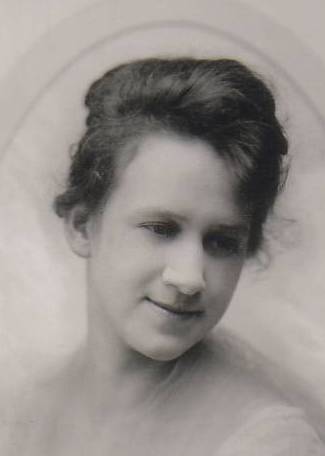
Copy of Mildred Lore

Mildred was the third child born April 8, 1899.  Mildred’s “first love,” a doctor’s son from Wabash, died during WWI, an event very difficult for Mildred to cope with.  Mildred would go on to marry Claude Martin on June 3, 1920 in Wabash, Indiana and live a long and happy life.  During their lifetimes, she and Claude would live in Indiana, Texas and Michigan, and possibly other locations.  They had 2 children, Jim born in 1922 and Jerry born in 1924.  Jerry died in 1954, and I have little information about his family other than he married Shirley and some of the photos with Eloise are with this family.  Eloise adopted people within the family, so perhaps she adopted Shirley and the boys as well after Jerry’s death.

Jim Martin eventually moved to Michigan, living in Drayton Plains and his daughters would include Judy who provided a large number of the Kirsch photos years ago, and Patty who contributed a number of Rushville photos.   I remember visiting Jim and his wife Inez with Mom in the 1980s.

Judy thought that there was a box of photos that had gotten drywalled into a closet in her parents old home.  We never were able to check, so some of our Kirsch photos may well be “archived” forever in a wall in Michigan.  Jim, Judy’s father, told me that there was a trunk of photos that got “pitched” when they moved and what didn’t get thrown away then, got thrown away in the next move to Roanne, Indiana.  I just felt sick.  I can’t bear to think about what might have been there.

Mildred and Edith about 1918

Mildred and sister Edith with husbands and Edith’s son, Lore, above.

Mildred and Claude Martin 50th anniversary

Above, Mildred and Claude Martin’s 50th wedding anniversary.

Mildred died on May 30, 1987 in Houston, Texas, living with her son.

Edith Barbara Lore

Edith as a child cropped

Edith Barbara Lore was the eldest child of Nora Kirsch and C.B. Lore, born in Indianapolis, Marion County, Indiana August 2, 1888.  Edith is my grandmother.

It appears that there is some confusion about Edith’s birth year.  Apparently either her mother was embarrassed about her birth not occurring more than 9 months after her marriage, or Edith was embarrassed about it.  The family story was that her birth had artificially been set back a year for insurance purposes.  Regardless, Edith was born in 1888, not 1889.  Apparently at some time she needed a delayed birth certificate and she didn’t realize she had been born in Marion County (Indianapolis), not in Rushville.

Edith married John Whitney Ferverda on November 17, 1908 in Rushville, Indiana.

Their life together would begin in Rushville, Indiana where he worked at the depot for the “Big 4” Railroad as the telegraph operator.

Edith umbrella postcard

The above photo of Edith was made into a postcard.  Here’s the back.

Edith postcard back

Apparently all of that flirting was effective.  They were married the next year.

The marriage license for Edith Lore and John Ferverda in 1908 was huge so I scanned it in halves and have “sewed” them back together digitally below.  He is a telegraph operator and she is a stenographer.

Lore Ferverda marriage application

By 1910, the census shows that Edith and John had moved to Lake Township in Kosciusko County, where Silver Lake is located.  His occupation is shown as a telegraph operator.

Edith young woman

Edith was truly a beautiful young woman.  I see mother’s eyes when I look at the photo above.

Edith was an unusual woman for her time as she worked her entire life.  During the depression, when John’s hardware business went belly up, it was her job that saved the family.  She lived with her grandmother, Barbara Drechsel Kirsch at the Kirsch House and attended business school in Cincinnati before her marriage in 1908 to John Ferverda.

The 1930 census shows John as a salesman for the Ford garage and Edith as the bookkeeper for the chicken hatchery.  They own their home, it’s worth $3500, which is more than most of the other homes, and they also own a radio which was quite the luxury.

Edith died in 1960, living her adult life in Silver Lake, Indiana.  This color photo of Edith and John was taken not long before she passed away.  This is how I remember her.

John and Edith 1959 standing

Nora after Rushville

Nora did not stay long in Rushville after C. B. Lore died.  In her 1913 photo, below, she does not look happy.  Of course, her husband had died and so had her daughter in 1912.

Nora Kirsch Lore 1913

Below, Nora is on the left in Florida with either her Aunt Lou Fisk or her Aunt Ida Kirsch on the right.  There was discussion of some property that was owned in Florida near a beach.  No one knows how or when it was disposed of, or even where it was.  Gotta love the hat!

Nora Florida

By 1920, Nora would be married to McCormick. Ironically, Eloise, who lived with the couple from the time she was 13 never said anything about this man.  Maybe she was practicing the old adage of “if you can’t say something nice, don’t say anything at all.”

We don’t know a great deal about Nora between 1920 and 1930, but we do have a few photos.

Nora 1920

Nora Kirsch Lore McCormick and Harold Lore Ferverda, probably about 1920 judging from his age.  I think my mother and her brother both inherited their noses from Nora.

I love the old car which was probably a new car then.

Nora 4 gen 1922

Four generation picture with Barbara Drechsel Kirsch (far right), Nora Kirsch Lore (far left), Mildred Lore Martin (center) and Jim Martin, infant, born in 1922, above.  This would have been about a year after Barbara sold the Kirsch House and moved north with her daughters.  I’m surprised at how much Nora doesn’t look like Barbara.

After that, Barbara would move to Wabash, Indiana, living with Nora in “the little house” as mother remembered it, and would pass away in 1930.

Nora 1923

Above, Nora Kirsch Lore McCormick, James Martin, Harold Lore Ferverda and Barbara Jean Ferverda in 1923.  Mom was 2 months old here.  Nora is obviously enjoying her grandchildren a great deal and below, enjoying her garden.  Her love of flowers is reflected in her quilts.

Nora garden

Maybe I received the gardening gene from her.  Flowers I love, weeds not so much, nor do I like pulling them.

Nora 1939

Dad (John Ferverda), Warren (Cook), Grandma (Nora), Me (Jean Ferverda), Mother (Edith), Eloise, Mildred, Jimmy (Martin).  At least Mom put these in a scrapbook and labeled them.  Thank you Mother!

Nora 1944

Mildred Kirsch Martin, Warren (Eloise’s husband), Jerry Martin, Eloise, and Nora.  Nora is beginning to look quite elderly here.  But everyone is dressed up, so this must have been some occasion.  Based on Jerry’s approximate age here of maybe 20, this was probably about 1944 and she would have been 78 years old.

Nora 1940s

This photo is Nora Kirsch Lore in her later years, in the 1940s.  She looks like she may have had dementia.

Nora, Mildred and Eloise

Mildred, left. Nora Kirsch Lore, seated, and Eloise, right.

Wabash

Nora Kirsch Lore McCormick moved to Wabash, Indiana first about 1916, then again between 1920 and 1930 because of Tom McCormick’s job.  Mom, born in 1922, remembers visiting her there when she was young.  Nora was a quilt maker, and it is here that she made the wonderful quilts that would eventually win a trip to the 1933 Chicago World’s Fair to represent the State of Indiana.  Mom said that the quilt frame would be lowered by pulleys from the ceiling to above the table in the dining room.  She said the house was quite small and this was the only way she could have enough room to quilt.  Mom would play under the table while Nora would quilt.

Mom and I went to Wabash, and Mom showed me the “little house” where Nora lived.  I don’t know if she owned or rented the house.  This is probably where she lived with McCormick, but I really don’t know.

Mother never said anything about him except that they weren’t married very long and that he left her when they lived in Wabash, but they never divorced.  Eventually Nora received word that he had died from one of his children from his first marriage.  However, he is in some photos that range apparently from the 1920s through the early 1940s.  Maybe he came and went.

Wabash noras

Back to Rushville

At some point, Nora moved to Lockport, NY to live with Eloise, where she passed away on September 13, 1949.  Her body was returned to Rushville, Indiana where she was buried by her first husband, C. B.  Lore.  According to her daughter, Mildred, she had specifically asked for the McCormick surname not to be put on her gravestone.  I’m not sure if that was where her heart was or not, but it is where she rests for eternity.  C.B. Lore may have been her true love, despite everything.

In the 1990s, Mom, Gretchen and I would revisit the area (in addition to Aurora) to see what kind of genealogical evidence we could find.  We had a difficult time finding the tombstones, but we were eventually successful.  The photos below were taken by C.B. Lore’s headstone when Mom was probably 28 or 29.

Mom Rushville 1940s

The grave looks fairly new in this photo, and this is Nora’s burial, so I suspect that Mom’s visit was shortly after Nora’s September 1949 death, perhaps in the spring of 1950.

The Payne family crypt is located in front of the stones, so getting a good photo is difficult.  However, it makes a great landmark when trying to find the stones.

Lore graves Rushville

Lore graves Rushville2

The 3 Lore family members in a row.  Note no grass on Nora’s grave.  This must have been a very sad visit for Mom  and her mother, Nora’s daughter, Edith.  At least she had Mom with her.

Rushville Payne memorial

The Lore headstones are to the left of the Payne memorial or mausoleum in the photo above.  It’s one heck of a lot easier to find the Payne building than the Lore headstones.

Nora Kirsch Lore stone

Nora stone with CB and Curtis

Nora is buried with her daughter and her first husband, C. B. Lore.  Her grave was difficult to find, because by request, her surname on the stone is Lore, but in the sextant’s book, she is registered as McCormick.  I found her by finding Curtis’ grave.

Curtis Lore stone

CB Lore stone

Nora’s Quilts

Nora was a master quilt-maker, a quilt-maker extraordinaire – and that’s not because she was my great-grandmother.  She truly was, as confirmed by the fact that her quilt was one that represented the State of Indiana in the 1933 Chicago World’s Fair.

There is absolutely no question about where my interest in needlework, lacemaking and quilt-making came from.  It’s ironic that this gift seems to have followed the direct mitochondrial DNA line.  Of course, mother’s do influence daughters, whether they realize it at the time or not – although my mother was not a quilter nor a lace-maker and neither was my grandmother.  I think they had to work too hard, for too many hours, to develop hobbies that were also time intensive.  They did not have the electronic assistants and time saving tools we have today.  Everything was done by hand then, from food growing to prep to dishes to sewing.

The Needlework

Kirsch lace collar

No discussion of the Kirsch women would be complete without mentioning their absolutely stunning needlework.  Barbara Drechsel’s and possibly Nora Kirsch’s lacework above and below.

Kirsch Lace handkerchief

It’s a tradition in our family that every female that marries selects one of the remaining lace handkerchiefs and carries in as she marries.

Barbara Drechsel Kirsch was a lacemaker, and her daughters likely learned the craft from the time they were young, at home as well as in the German schools.

Kirsch lace collar2

In 1994, mother and I were asked to create an exhibit for the Allen County Public Library that included both their needlework and a genealogical aspect of the history of the family.  The Allen County Public Library in Fort Wayne, Indiana is a nationally known and widely respected genealogical library.  Mother was particularly thrilled as so much of her family and her own personal history centered in and near Fort Wayne.

We titled the exhibit Six Generations of Hoosier Needlewomen and included lace works from Barbara Drechsel Kirsch, her daughters, including Nora’s wonderful collection of quilts, Edith’s work making doll clothes, Mother’s beautiful fine crocheting, my quilts, counted thread works and lacemaking, and my daughter’s  crosstitch. Of those 6 individuals, at least 4 are national level award winners.

Kirsch lace collar3

We displayed Nora’s quilts in a number of locations over the years. Rockome Gardens, an Amish village in Illinois was renowned for both their counted thread show and competition, as well as a companion exhibit for quilts a week or so later.

Mother particularly loved Nora’s Climbing Vine quilt.  Mom made an afghan that was similar, and I designed a counted thread piece in her honor that won the 1988 Embroiderers’ Guild National Event.  Below, my “Needlewoman’s Enchanted NeedleGarden” sampler is displayed in front of Nora’s Climbing Vine quilt, the inspiration for the sampler, at Rockome Gardens.

Needlegarden with Climbing Vine

Mother and I traveled to the Embroiderers’ Guild Awards Banquet in Louisville, KY as well as to Rockome where they displayed all of the related pieces together.  We thoroughly enjoyed those trips and our wonderful heritage.  How I wished I could have known Nora.  How glad I am that Mom and I did these things, together, while we had the opportunity.

Below, Nora’s Climbing Vine quilt, dated 1932, to the left, Picket Fence to the right and Mother’s Climbing Vine afghan in the center.

Nora's quilts and Mom's afghan

Nora’s Climbing Vine quilt was featured in the 1933 Chicago World’s Fair.  Unfortunately, we have no photographs of it at the fair, but Mother told the story of their visit to the fair to see her quilt.

Nora had entered the quilt in the local Sears competition, then it progressed to the regional and then the state competitions, finally winning and going to the World’s Fair.

The depression was in full swing, and money was scarce.  The family could not afford to go for an overnight to Chicago, so they got up very early and left from Silver Lake, Indiana with Nora and the entire family packed into an old black Model T Ford.  They drove to the World’s Fair, took their food and picnicked, and the entire family saw the quilt hanging in its splendor in the exhibition hall.  Then they drove the entire way back home, arriving in the middle of the night.  All in all, the trip was about 24 hours in duration.  The photo below is Mom, me and my daughter at a quilt exhibit with Climbing Vine.

Climbing vine family photo2

Nora was 66 years old when she created this World’s Fair award-winning quilt.

climbing vine quilt

This work is all hand appliqué with fine hand quilting.  Everything in Nora’s quilts was done by hand, including the piecing.

Needlewomen display case

The photo above is from the Six Generations exhibit and it shows my lace in a tray, center, Mom’s crocheted afghan and baby booties, rear, a table runner made by the Kirsch sisters that mother displayed on the piano and some lace in the far right corner.

Needlewomen display case2

This photo shows Mother’s crocheted afghans, shawls and table covers, the doll clothes made by Edith for Mother, embellished handkerchiefs, and beautiful, but tiny, crocheted gloves.  Those Kirsch women had tiny little hands. Nora’s hands were so tiny she had to step on her thimbles to bend them to keep them on her fingers.

The quilt below is called Picket Fence.  Mom also referred to it as Flower Garden.  I always particularly liked this quilt, as it reminds me of the perfect family that everyone wants, and doesn’t exist anyplace.  But the beauty within our family is nurtured and grows within the white picket fence.  This quilt is dated 1931.  The fence is hand pieced, the flowers are appliquéd and the entire quilt is hand quilted with small, fine stitches.

Picket fence quilt

This red and green quilt below, sometimes called the Christmas Tree quilt, was made by Nora, as were the rest of the quilts here.  This quilt was on Mom’s bed for years. Mom said that it was on the bed in Silver Lake too, and when her parents passed away, other people were interested in the “show quilts,” but no one was interested in the ones used for bedding, so Mom took them.  I have very fond memories of this quilt.  Can you find the “error”?  Quilters have a proverb that one cannot make a perfect quilt, because only God is perfect. Some quilters will intentionally introduce an error in the pattern.  I don’t need to do that.  I make plenty of mistakes without trying.  I don’t know if Nora was aware of this or not, but the proverb is not a new one and is not of the current generation, so it is likely she had at least heard it.  Today, that’s “our excuse” when we make a mistake.

This quilt’s colors are known as “depression green and depression pink” in the antique fabric world.

Nora's pink and green quilt

The yellow and white quilt below reminds me of sunshine.  This nine patch and snowball block quilt was never used.  Before Eloise passed away, she sent this to Mother, along with some other needlework and family items.  I’m sure that Mildred would have had some quilts as well.  I wonder what hers looked like.  This quilt was made in 1927 or 1928.

Mom told me that when she went to visit Nora in the little house in Wabash, that she had a large quilt frame set up.  All of these quilts are hand quilted and hand pieced.  I can’t think of a better way to spend retirement – creating family heirlooms and memories.  Those scalloped edges are quite difficult.  Nora would have been about 61 when she made this quilt.

Nora's snowball quilt

The oldest quilt is shown In the photo below, a crazy quilt made at least in part by Carrie Kirsch, age 11, is shown hanging on Mom’s quilt rack that was behind the couch.  Carrie (Caroline Kirsch) was 11 in 1884, so this quilt is almost 125 years old.  Unfortunately, the quilt is now in very bad repair.  From this we know that the Kirsch girls were quilting at the Kirsch House and they started as children.

Kirsch crazy quilt

The quilt below, although it looks pathetic, is one of my all-time favorite quilts. This quilt, without the handkerchiefs, was the quilt that was always on the bed in Kokomo, on the farm.  I slept under it, my kids slept under it, and we used it on the couch for a couch quilt.

All those years, I never really knew about Nora, but I knew that this particular quilt had seen so much within our family and was a constant companion and continuous source of comfort.  Mom washed it several times, and over time, it began to deteriorate with use.  It was well loved.

Not wanting to throw it away, Mom asked me if I could make something out of it, like maybe teddy bears for the kids.  I told her I surely could, and took the quilt home to give it yet another life as teddy bears.  I told the kids.  They cried and cried.  My daughter said, “you can’t cut up Mawmaw’s quilt.”  Little did they know it was Mawmaw’s Mawmaw’s quilt.  I really didn’t know what to do, but clearly, I could not do what we had planned without causing my children permanent psychological trauma.

There were actual holes through the quilt, so I had to find a way to reconstruct some fabric and restuff parts of it with batting.  I remembered my grandmother’s handkerchiefs, safely tucked away for some wonderful future project.

The future had come. I took the Kirsch and Lore women’s handkerchiefs and used them to create fabric for the old much-loved quilt.  I gave the quilt back to Mom, and it served another decade or two before retiring permanently.

Ironically, when I go to quilt shows and tell this story, everyone loves to look at and discuss the beauty and history of Climbing Vine and Picket Fence, but this is the quilt that makes everyone smile…and cry.

Handkerchief quilt

Quilting was obviously a very important part of Nora Kirsch Lore’s life.  Her quilts are her legacy that she passed to us, through the two intermediate generations.  Quilters say that wrapping up in a quilt is like a hug from the quilter.  Thank you so much Nora.

Not only did I receive 12.5% of Nora’s autosomal DNA, her mitochondrial DNA and the quilting bug, which I am attempting to pass on to the next generation, I received so much more.

Through her quilts, Nora triumphs above the finality of death and reaches across the generations and decades to touch us with the beauty and warmth that her hands and heart created.  Even some 66 years later, I can still have a hug from Nora, an ancestor who died before I was born..  I wonder if she knows how much her legacy is cherished.

______________________________________________________________

Disclosure

I receive a small contribution when you click on some of the links to vendors in my articles. This does NOT increase the price you pay but helps me to keep the lights on and this informational blog free for everyone. Please click on the links in the articles or to the vendors below if you are purchasing products or DNA testing.

Thank you so much.

DNA Purchases and Free Transfers

Genealogy Services

Genealogy Research

DNAeXplain Archives – Introductory DNA

Today, another group from the DNAeXplained archives.  This time, we’ll be looking at Introductory DNA.  The various categories are:

  • Historical or Obsolete – these are items that were interesting at the time by aren’t really relevant today – except in a historical context. An example would be the announcement of the Genographic 2 project in July of 2012. You may wonder why I didn’t delete these. Looking back, these are somewhat like a genetic genealogy journal.
  • General Information – these are generally articles about DNA and genealogy. They don’t presume that you’re actually working with the results.
  • Basic Education – this may be basic genealogy or basic DNA fundamentals. These articles provide a foundation for working with your results. Think of it as pre-bootcamp.
  • Introductory DNA – these articles do presume you are working with your results. Bootcamp begins here.
  • Intermediate DNA – these are a little more difficult and you’ll probably need the basics and introductory understanding to be able to work at this level.
  • Advanced DNA – very few articles are advanced. In fact, I try very hard to avoid this, when possible. Mostly, these have to do with advanced autosomal techniques and research.
  • Examples – these are examples of using genealogy and DNA together seamlessly. My 52 Ancestors stories fall into this category. Think of these as story problems that include the answers!
  • Educational – educational opportunities such as classes, books and videos.
  • Entertainment – just for fun, like the Who Do You Think You Are series, some of these have no DNA content.
  • Project Administration – articles written for project administrators at Family Tree DNA. Project administrators, of course, will be interested in all of the rest.

In the past we’ve covered Historical, General Information and Basic Education. Today, let’s look at Introductory DNA.

Title Date Link
What Project do I Join? 7-19-2012 http://dna-explained.com/2012/07/19/what-project-do-i-join/
The Dreaded “Middle East” Autosomal Result 7-23-2012 http://dna-explained.com/2012/07/24/the-dreaded-middle-east-autosomal-result/
Where is my Haplogroup From? 8-7-2012 http://dna-explained.com/2012/08/06/where-is-my-haplogroup-from/
Autosomal Results – The Basics 8-19-2012 http://dna-explained.com/2012/08/19/autosomal-results-the-basics/
Matches – Family (IBD) vs Population (IBS) 9-3-2012 http://dna-explained.com/2012/09/03/matches-family-ibd-vs-population-ibs/
Doug McDonald on Biogeographical Analysis 9-9-2012 http://dna-explained.com/2012/09/09/doug-mcdonald-on-biogeograpical-analysis/
Germain Doucet and Haplogroup C3b 9-18-2012 http://dna-explained.com/2012/09/18/germain-doucet-and-haplogroup-c3b/
X Marks the Spot 9-26-2012 http://dna-explained.com/2012/09/27/x-marks-the-spot/
Working with Mitochondrial DNA Results 10-4-2012 http://dna-explained.com/2012/10/04/working-with-mitochondrial-dna-results/
What to Order?  – Geno 2.0 vs Family Tree DNA Products 10-14-2012 http://dna-explained.com/2012/10/14/what-to-order-geno-2-0-vs-family-tree-dna-products/
Averages, TIP Calculator and One Size Fits All 11-29-2012 http://dna-explained.com/2012/11/29/averages-tip-calculator-and-one-size-fits-all/
little a, BIG A, Mitochondrial DNA 12-2-2012 http://dna-explained.com/2012/12/02/little-a-big-a-mitochondrial-dna/
Projects, Administrators and Expectations 2-2-2013 http://dna-explained.com/2013/02/02/projects-administrators-and-expectations/
Is the Family Tree DNA 12 Marker Test Worthwhile? 3-13-2013 http://dna-explained.com/2013/03/13/is-the-family-tree-dna-12-marker-test-worthwhile/
Triangulation for Y DNA 6-18-2013 http://dna-explained.com/2013/06/18/triangulation-for-y-dna/
Triangulation for Autosomal DNA 6-21-2013 http://dna-explained.com/2013/06/21/triangulation-for-autosomal-dna/
Mitochondrial DNA SmartMatching – The Rest of the Story 6-28-2013 http://dna-explained.com/2013/06/28/mitochondrial-dna-smartmatching-the-rest-of-the-story/
Combining Tools – Autosomal Plus Y-DNA, mtDNA and the X Chromosome 7-13-2013 http://dna-explained.com/2013/07/13/combining-tools-autosomal-plus-y-dna-mtdna-and-the-x-chromosome/
Autosomal DNA, Ancient Ancestors, Ethnicity and the Dandelion 8-5-2013 http://dna-explained.com/2013/08/05/autosomal-dna-ancient-ancestors-ethnicity-and-the-dandelion/
Black, White or Red – Changing Colors 8-11-2013 http://dna-explained.com/2013/08/11/black-white-or-red-changing-colors/
Why Don’t I Match My Cousin? 9-29-2013 http://dna-explained.com/2013/09/29/why-dont-i-match-my-cousin/
Determining Ethnicity Percentages 10-19-2013 http://dna-explained.com/2013/10/19/determining-ethnicity-percentages/
Why Are My Predicted Cousin Relationships Wrong? 10-21-2013 http://dna-explained.com/2013/10/21/why-are-my-predicted-cousin-relationships-wrong/
Chromosome Mapping aka Ancestor Mapping 12-09-2013 http://dna-explained.com/2013/12/09/chromosome-mapping-aka-ancestor-mapping/
One Chromosome, Two Sides, No Zipper – ICW and the Matrix 12-15-2013 http://dna-explained.com/2013/12/15/one-chromosome-two-sides-no-zipper-icw-and-the-matrix/
Free Webinars from Family Tree DNA 12-17-2013 http://dna-explained.com/2013/12/17/free-webinars-from-family-tree-dna/
X-Chromosome Matching at Family Tree DNA 1-2-2014


http://dna-explained.com/2014/01/02/x-chromosome-matching-at-family-tree-dna/
STRs vs SNPs, Multiple DNA Personalities 2-10-2014 http://dna-explained.com/2014/02/10/strs-vs-snps-multiple-dna-personalities/
Haplogroup Comparisons Between Family Tree DNA and 23andMe 3-24-2014 http://dna-explained.com/2014/03/24/haplogroup-comparisons-between-family-tree-dna-and-23andme/
Mitochondrial – the Maligned DNA 3-29-2014 http://dna-explained.com/2014/03/29/mitochondrial-the-maligned-dna/
What Does “Sharing Genomes” at 23andMe Mean? 3-31-2014 http://dna-explained.com/2014/03/31/what-does-sharing-genomes-at-23andme-mean/
Family Tree DNA Releases myOrigins 5-11-2014 http://dna-explained.com/2014/05/11/family-tree-dna-releases-myorigins/
Ethnicity Percentages – Second Generation Report Card 5-19-2014 http://dna-explained.com/2014/05/19/ethnicity-percentages-second-generation-report-card/
Finding Native American Ethnic Results in Germanic People 5-21-2014 http://dna-explained.com/2014/05/21/finding-native-american-ethnic-results-in-germanic-people/
Haplogroups, SNPs nd Family Group Confusion 6-23-2014


http://dna-explained.com/2014/06/23/haplogroups-snps-and-family-group-confusion/
Identifying Possible Common Ancestors Utilizing Multiple Tests 7-6-2014 http://dna-explained.com/2014/07/06/identifying-possible-common-ancestors-utilizing-multiple-tests/
Autosomal DNA Matching Within Projects 8-2-2014 http://dna-explained.com/2014/08/02/autosomal-dna-matching-within-projects/
What Does and Doesn’t A Y DNA Match Mean 9-4-2014 http://dna-explained.com/2014/09/04/what-does-and-doesnt-a-y-dna-match-mean/
One Match, Two Ancestors, Never Assume 11-17-2014 http://dna-explained.com/2014/11/18/one-match-two-ancestors-never-assume/
Ancestry’s Better Mousetrap – DNA Circles 11-19-2014 http://dna-explained.com/2014/11/19/ancestrys-better-mousetrap-dna-circles/
Mitochondrial DNA Mutation Rates and Common Ancestors 12-5-2014 http://dna-explained.com/2014/12/05/mitochondrial-dna-mutation-rates-and-common-ancestors/
Secondary Genealogical and Genetic Lines 1-29-2015 http://dna-explained.com/2015/01/29/secondary-genealogical-and-genetic-lines/
Getting the Most Out Of AncestryDNA 2-2-2015 http://dna-explained.com/2015/02/02/getting-the-most-out-of-ancestrydna/
MyGroups is Here 2-17-2105 http://dna-explained.com/2015/02/17/mygroups-is-here/
Why Autosomal Response Rate Really Does Matter 2-24-2015 http://dna-explained.com/2015/02/24/why-autosomal-response-rate-really-does-matter/
Haplogroups and The Three Brothers 2-26-2015 http://dna-explained.com/2015/02/26/haplogroups-and-the-three-brothers/
Finding Your American Indian Tribe Using DNA 4-1-2015 http://dna-explained.com/2015/03/31/finding-your-american-indian-tribe-using-dna/
Help System at Family Tree DNA Updated Today 4-1-2015 http://dna-explained.com/2015/04/01/help-system-at-family-tree-dna-updated-today/
Proving Your Tree 5-7-2015 http://dna-explained.com/2015/05/06/proving-your-tree/
Mother’s Day – Tracking the Mitochondrial DNA Line 5-10-2015 http://dna-explained.com/2015/05/10/mothers-day-tracking-the-mitochondrial-dna-line/
The Logic and Birth of a Bad NAD (New Ancestor Discovery) 8-12-2015 http://dna-explained.com/2015/08/12/the-logic-and-birth-of-a-bad-nad-new-ancestor-discovery/

______________________________________________________________

Disclosure

I receive a small contribution when you click on some of the links to vendors in my articles. This does NOT increase the price you pay but helps me to keep the lights on and this informational blog free for everyone. Please click on the links in the articles or to the vendors below if you are purchasing products or DNA testing.

Thank you so much.

DNA Purchases and Free Transfers

Genealogy Services

Genealogy Research

A Visitation by Sarah Faires Speak (1786 -1865), 52 Ancestors #91

With Lola-Margaret Speak Hall as Sarah Faires Speak

Lola Margaret as Sarah

Introduction by Roberta Estes

Lola-Margaret Speak Hall is the great-great-great-great-granddaughter of Sarah Faires Speak, wife of Nicholas Speak through their son Samuel Patton Speak and their great-great-great-granddaughter through their daughter Rebecca Speak.  Lola-Margaret’s ancestors, Joseph Hardy Speak, great-grandson of Nicholas and Sarah Faires Speak through Samuel Patton Speak’s son William Hardy Speak and Frances Rebecca Rosenbaum through William Henderson Rosenbaum and Rebecca Speak, daughter of Nicholas and Sarah, are shown in the photo below.

Speak, Joseph Hardy and Frences Rebecca Rosenbaum

Nicholas and Sarah Faires Speak married in Southwest Virginia in Washington County on August 12, 1804.  Their first 9 children were born there.

speaks chapel 1 cropped

In 1823 they moved to Lee County, Virginia, purchased land and settled down to a life of farming.  In 1828, Nicholas Speak founded the Methodist Church, now known at the Speaks Chapel Methodist Church, built the church and in 1839 donated the land and church to trustees to maintain the church after his death.  One of those trustees was his son, Charles Speak.

Sometime between their marriage in 1804 and 1828, Nicholas and Sarah had converted from being Presbyterian to Methodist.  There is a record of Bishop Asbury visiting the home of Sarah’s father, Gideon Faires, in Washington County, Virginia, so that may have signaled the beginning of the Methodist conversion of the Speak(s) family.

I also descend from Nicholas and Sarah Faires Speak, being their great-great-great-granddaughter through their eldest son, Charles.  His daughter Elizabeth married Samuel Clarkson/Claxton about 1849.  Samuel fought for the Union in the Civil War.  Samuel and Elizabeth are shown here, he dressed in his military uniform.

Samuel Claxton Elizabeth Speaks

This means that Lola-Margaret and I are both 4th cousins, and 4th cousins once removed.  She has a double dose of the Speak DNA.  This explains why Lola-Margaret and I match on autosomal DNA tests while other cousins, about as distant, don’t.  Lola-Margaret really isn’t that distant, she’s about half that distant, genetically.  Endogamy, or intermarriage will make people appear to be more closely related generationally than they actually are and even one intermarriage can make a big difference.  We find this repeatedly in groups like the Mennonites, Amish, Acadians and Jewish families, and of course, we find it in Appalachia too.

Lola-Margaret isn’t just any cousin, however.  She is a very special one, and I’m sure greatly endeared to her great-great-great-(great-)grandmother, Sarah Faires Speak, who looks down upon her regularly, showering her with special blessings.  Why is Lola-Margaret special?  Lola-Margaret lived in Sarah’s skin, walked in her shoes, retraced her steps, visited her land, her church and her grave…..for a year….in preparation to become Sarah Faires Speak.  And become Sarah she did.  Faithfully.

speaks service 2009 cropped

On October 10th, 2009, as all of us cousins gathered at the little white church at the crossroads of Pleasant View and Speaks Branch roads in Lee County, Virginia, Sarah Faires Speak visited us.

Sarah Faires arriving

Sarah entered from the back of the church, greeting all of her descendants just as she had greeted her children, grandchildren and neighbors when she and Nicholas held church every Sunday morning more than 159 years ago, except when the entire church went to camp meetings in the summer.  She made her way to the front and settled in her rocker.

Sarah Faires in rocker cropped 2

Sarah opened her well worn Bible and leafed through it, recanting the details of her life as each entry brought forth memories…some cherished, such as her marriage, jubilation at the birth of her children and their marriages, and then of course, the grief and sadness that comes with death, especially her cherished husband, Nicholas, who died in 1852, 13 years before her own “passing over.”  She saw too many of her own children and grandchildren die untimely deaths.

Lola-Margaret, as Sarah, shared Sarah’s life with us at the Speaks Chapel Methodist church on a beautiful, crisp, fall morning.  An unbelievably moving gift that still leaves me with cold-chills all these years later.

Sarah and Nicholas were with us. We could all feel them.  They were no longer in the Speaks branch road croppedcemetery across the road where our ancestors are buried with their families, settled comfortably around them under the field stones that serve as headstones.  They were with us, beside us, in the little white church on Speaks Branch road.

So come on in, sit a spell by me in the pew and share a few sacred minutes as Sarah Faires Speak touches us from across the years and shares her memories.  As Lola-Margaret, Sarah, spoke that day, from her rocker, she could see out the door of the church and looked directly at the cemetery where so many of her family members were buried.

Speaks cemetery

Listen closely as Sarah speaks from across the years…

My, it is getting so chilly outside.  But it sure feels good to be right here on this hallowed ground. It always warms my heart to be right here on Sundays.

Sarah praying

It’s nice to have that fire right there in the middle of the room, always burning when we got here.  I can’t remember who it was that’s always built that fire, but he must have been a good man.

With winter coming on in these parts, I always seem to feel the loneliest. Seems like Sundays are the hardest.  That’s when I miss my Nicholas so.

Sundays were busy days for us, with preaching and all. Oh – my Nicholas was a good man, and those were good years.  He’s been gone now 10 – no, I believe its 12 years. One misses a really good man!

There were so many good times here at this little church.  Of course, hearing the preaching of God’s word was the most important.  And Nicholas Speak could do that like nobody else I ever heard!

Speaks Chapel painting

And then, oh my, those dinners on the ground. Those are good memories, and one must learn to dwell on the good memories.

There was a lot of kin folks living in this area, and the kids always had such a good time playing with their cousins after services were over.

Speaks old cabin cropped

Our cabin, it’s just up the road a ways in that direction.  Nicholas built that cabin for us and our 9 children when we settled here in Lee County in 1823.

We only had 9 then.  They were all born in Washington County.  Frances Jane and Rebecca, they were born right there in that cabin. Oh my the tales those old logs could tell!

Speaks boards

The years of laughter as 11 children played on those floors.  Well -10, Charles married the year we left Washington County.

And Sarah Jane, I shouldn’t count her – she was 16, nearly grown, hardly playing on the floor anymore.

Now there’s a whole new crop growing up here. Sarah Jane and James built that house just down that road back behind the church.

But at our cabin now, it’s just me and Fannie, we always called Frances Jane, Fannie. It’s just the two of us to look after everybody now.

Her William Henderson won’t be coming home from this awful war.  The union soldiers captured him, horse and equipment, and carried him off to Federal Prison at Camp Douglas, Illinois.

My grandson, Samuel – that’s Samuel Pattons’s son, was captured, too.  We got word a couple of months back that the both of them died there in that prison.  The Union buried them up there.

Sarah Faires reading

My poor Fannie, she never even got to pay her last respects to William.

She’s got another baby coming next month that will never know its father.

And the 2 little boys, William and Alfred, they just don’t understand their Daddy being gone for good.

Speaks old stone

Then there’s Rebecca’s 4 children with us. Henderson was their Daddy, too. That’s seven children under 10 years old.

You see, Fannie married William Henderson Rosenbaum after her sister Rebecca died. Rebecca was married to him first.  My dear, Rebecca.  She was my baby.  She passed from this life on her 5th wedding anniversary, February 9, 1859.  She’d given birth to a little daughter only 5 days before.  Our precious little Frances Rebecca. She’s 5 now – almost 6. Reminds me so much of her mother.

Yes, it is a terrible time now.  So much going on. Sons and fathers going off to war. This terrible war has even divided our families.  Most of the boys right here have joined with the Confederacy.

speaks old stones

Our son, Jesse, and his son – they moved on to Kentucky – they fought with the Union. We don’t hear much from them since they left Lee County, but we did get word they were both wounded two times.   I do hope they are all right.  It tears a mother’s heart out, but still a mother loves them, whatever side they choose to fight on.

All this war and turmoil.  The Union troops burned the courthouse at Jonesville.  Earlier this year President Lincoln was shot and killed.  You wonder just how long this can go on.  It seems to me I’ve been mourning forever!

But, as I’ve said before, one should dwell on the good things – and the crops have been good this year.  Maybe it’s enough to have a roof over our heads and plenty to eat.

This Lee County soil is rich and gives a good yield.  The boys, Samuel, John and James have been so good to me.  They helped me get the crops in and sold.

I won’t forget the first harvest after Nicholas died.  He left me with crops in the field!  If it hadn’t been for the boys, I don’t know what I would have done.  But that is how my Nicholas raised his boys.

Nicholas stone

One should even be thankful for chilly Sunday mornings.  It’s such a good time for recalling memories.  A life time of memories.  This old Bible holds a lot of memories.  I love this old Bible.  It belonged to my Grandmother Faires, on my Father’s side. She was of Scots-Irish descent, and quite proud of it.  They lived near us where I grew up on the north side of the south fork of the Holston River.???????????????????????????????

There is a lot of family history recorded here in this Bible.  Makes one want to go back over one’s life.

I remember growing up – the stories my Father would tell us – I had 5 brothers and 4 sisters you know – stories about the Revolutionary War.  He had served as a private under Col. William Christianson on an expedition to lead a battalion of militia against the “Overhill” Cherokees in East Tennessee.  Father said the British called them “Overhill’ because they were 24 mountains away from the lower lands of the Carolina Cherokees.

These Indians were being encouraged by the British to attack the frontier settlements. The Cherokees were a powerful tribe, but Father’s company subdued them on their home ground and forced them to sign the treaty of Long Island in 1777.

He told us stories about the ferocious Indian, “Dragging Canoe,” and about Nancy Ward. She was a wonderful Indian woman who married a white man, and she became a friend to the white settlers.  She was a friend to Joseph Martin, an agent for Indian Affairs who lived just up the road.  Their friendship saved the lives of many white settlers in the lower corner of Virginia.

You see, the land between Rose Hill and Jonesville had been occupied by the Cherokees. Joseph Martin had built the first white settlement near there, so Indian attacks were a great danger.  The settlers warred with the Shawnee in 1774 and again with the Cherokee in 1776.  It wasn’t far from right here that Captain Vincent Hobbs killed Chief Benge and ended the terrible attacks on the frontiers of Virginia.

Cumberland Gap 1

Our lower corner of Virginia was very important as an outpost for those preparing expeditions into the Cumberland Gap on their way to explore the West.  Daniel Boone camped here many times.

Oh my! I seem to just be going on and on – but, I hope you will humor an old woman!

???????????????????????????????

Here it is!  Right here in this old Bible. The record of our marriage. Nicholas Speak to Sarah Faires, August 12, 1804, signed by Reverend Charles Cummings. You remember, we still lived in Washington County then.

I was so proud! My Nicholas was such a handsome man. I was 18 and he was 22.

This Bible was a gift when we were married you know. I’ve had this Bible in church with me every Sunday now for more than 60 years.  The pages are thin and worn I’ve turned them so much.  Why, I know it almost by heart.  The ink is so faded I can hardly read it anymore.  My Nicholas wrote every birth and death in the front of our Bible.  I remember him sitting by the fireplace with his pen after each of our children was born.

Look, here’s where our first child Charles was born – November 11, 1805.

And here’s where Sarah Jane was born on May 23, 1807.  And then came Samuel Patton, on January 29, 1809.

John was next – born January 2, 1812. Grandmother Faires, God rest her soul, died that same year.  Joseph came along July 20, 1813.

There was another war going on.  That was just known as the War of 1812.

Nicholas was drafted to serve in that war in August 1814.  He was a private in the 7th Regiment of Virginia Militia in the Company of Captain Abram Fulkerson and served at Fort Barbour at Norfolk, Virginia.

Fort Barbour

When he came home 6 months later, we were all greatly relieved, though he had tales to tell of “being sick unto dying” in that war.

Next, came our son, Thomas on November 26, 1816.  My father died in 1818, the same year Jane was born.

rock spring cemetery

Two years later in July of 1820, Jesse was born.

Mother died the year after and we buried her beside Father in the old Rock Spring Cemetery behind the old church back in Washington County.

Rock spring church

Our youngest son, James, was born June 18, 1822.

Seemed like I’d been pretty busy having babies.  But they do grow up, and in February of 1823, our first born, Charles, married his lovely Ann.

Nicholas felt it was time to move on.  My parents had passed on, and he moved our family to Lee County where he bought 520 acres on Glades Branch. We’ve been right here ever since.

nicholas land entry

Oh yes! Here’s where Samuel Patton married Sarah Hardy in 1827.

Nicholas farmed this land with all his boys help, and then on Sunday we’d all come to church.  We all loved to hear him proclaim the Word of God.  One might say “Nicholas Speak was a tiller of the soil during the week and a tiller of souls on Sunday.”  How we loved those dinners on the ground and ice cream suppers in the hot summer time.  Nicholas loved this little church.  He gave the very ground it’s built upon.

Speaks chapel 1910

In the summers we’d all get in the wagon and go to the Jonesville Camp Grounds for revivals.  People would come for miles around to hear those sermons and join in singing praises to God.   Sometimes, if I close my eyes really tight, I can still hear that beautiful singing from so long ago.

Amazing grace cropped

Then in 1829, our Sarah married James Bartley and John married Mary Dean.

Next was Joseph’s wedding to Leah Carnes in 1832.  I remember how proud Nicholas was to do that ceremony.

He also married Jane to George W. Ball in 1835.  I know he was proud to do that one, too, but we sure did hate to see them move off to Kentucky.

Seems like there for awhile we were having weddings as fast as we’d had babies earlier.

Thomas and Mary Polly Ball married in 1837.   Then Jesse married his Mary Polly Haynes in December of 1842.

Thomas died in 1843.  He and Polly had only been married about 5 years.  He was so young.  Only 28 years.

The next year, 1844, James married Mary Jane Kelly.

We laid Joseph and Thomas to rest along with Charles and his wife.  It was hard for Nicholas to bury his children.

Then Jesse moved his family to Kentucky and Joseph’s widow and her children moved west to Kansas.  Seems like our family was getting smaller as quickly as it had grown.

And then…in 1852…I lost my Nicholas.  Can anything be as hard as losing the one you love so dear?  Then, Joseph died that same year too.  So much sorrow.

Nicholas graves

But we had to carry on.  My Fannie and Rebecca and me.  There was so much to do and to think about.  Things I had never handled before.  The will – John took care of that.  Then there was a land bounty grant that was due to Nicholas for service in the 1812 War.  The boys have been such a help to me.

We were all so happy for Rebecca when she married William Henderson Rosenbaum on February 9, 1854.  A fine man, he was.  But then, Rebecca died just 5 years later.  I miss her so.

In 1855 John had his own sorrows when his son, Reuben – he was only 21 – died at Martins Creek.  Two years later John’s little Margaret passed away.  Only 2 sweet year’s old.  So little time to love her.

That same year Charles’ granddaughter, she was named Margaret also, died at 11 months old.  And 3 years later Jesse’s 2 children, 5 year old Martha, and 1 year old Jesse died with the measles.  They are all buried together, right there in the cemetery, near Nicholas.

Oh, that a mother could spare her children of these sorrows.

nicholas church bell

Oh my! I have born 11 children and 5 are still living. Yes, we lost Sarah in 1859, right about the time her sister Rebecca died, and then Samuel in 1861, just before the war.

I have some 75 grandchildren, and it will be 76 when Fannie gives birth. 68 of those grandchildren are still alive.  These are my treasures!

You know, really when one comes to the end of a long good life, what does she have to pass on?

Many times I’ve looked around our little cabin.  There’s an old clock, a looking glass, some books, an old table, a smoothing iron and a couple of old bells.

But the memories – oh the memories!  They will always be there.

There is a time to live and a time to die, and life goes on for those you leave behind.  It’s the heritage and those fond old memories that will forever remain.

NIcholas signature cropped

Sarah signature cropped

Lola Margaret at church door cropped

Thank You

I want to say a very special thank you to my wonderful cousin, Lola-Margaret Speak Hall for this exceptional gift.  Because of you, Lola-Margaret, Sarah lives for all of us today, and through your gift, will continue to live for her future descendants.  Bless you.

Index of Photographs

Normally in a article of this type, I label the photographs with titles, footnote them or describe them in the text, but I did not want to detract in any way from the flow of what Sarah Faires Speak had to say to us through Lola-Margaret, or distract from the continuity, so I’ve chosen to describe the photos here in the order they are displayed.

Lola-Margaret Speak Hall as Sarah Faires Speak in the Speaks Chapel United Methodist Church after her presentation on October 10, 2009.

Photo of Joseph Hardy Speak and Frances Rebecca Rosenbaum.

Photo of Speaks Chapel taken in the mid 1990s by Roberta Estes from across the road in the cemetery.

Photograph of Elizabeth Speak with her husband Samuel Clarkson/Claxton.  Elizabeth is the grandchild of Nicholas and Sarah Faires Speak through their son Charles and his wife Anne McKee.

Photograph of all of the Speak(e)(s) cousins assembled in the Speaks Chapel Church sanctuary on October 10th before Lola-Margaret’s entrance and before the service.  Photograph of Sarah Faires Speak (aka Lola-Margaret) greeting her relatives from across the years as she enters the church.

Photograph of Sarah Faires Speak (Lola-Margaret) with her Bible.

Photograph of the road sign outside the Speaks Chapel Church.

Photograph of the headstones in the Speaks Cemetery directly across the road from the church.  Sarah could see the stones of her family through the window as she spoke to us.

Sarah Faires Speak (Lola-Margaret) in prayer.  Painting of the Speaks Chapel Church.  Photograph of the cabin belonging to and probably built by Nicholas Speak and Sarah before it was abandoned in the 1960s and subsequently dismantled and rebuilt in the 1980s.

Photographs of the old logs salvaged from the original Speaks Methodist church, reused in the barn of Jewell Davis, also a Speak(s) descendant.  Photograph of Sarah Faires Speak (Lola-Margaret) reminiscing from her Bible.

Headstone of Sarah’s grandmother, Deborah Faires, maiden name unknown, wife of William Faires.  Deborah was born June 10, 1734 and died March 22, 1812.  She is buried in the Green Springs Cemetery in Washington County, Virginia and died at the age of 77 years, 9 months and 12 days.  This church was established in 1794, but her stone is one of the oldest with inscribed dates, not just a fieldstone.  It’s believed that her husband, William, who died in 1776 is buried at the now defunct Ebbing Springs cemetery.  The church perished early, to be replaced by another church in a different location, and later, a farmer pushed the cemetery stones into the creek in order to farm the land.

Headstone marking the graves of Nicholas and Sarah Faires Speak set by their descendants in the 1990s.

Sarah Faires Speak (Lola-Margaret) recounting her life.

Early drawing of the Cumberland Gap as it would have appeared to early settlers.

Sarah Faires Speak (Lola-Margaret) reading through her children’s births recorded in the Bible.

Civil War era drawing of a second fort, fort Norfolk, still in existence today and located in front of Fort Barbour in Norfolk Virginia.  Nicholas was stationed at and dismissed from Fort Barbour, located at the present day intersection of Church Street and Princess Anne Road, but he surely was familiar with this fort as well and spent time in both.

The cemetery and church where Sarah’s parents, Sarah McSpadden and Gideon Faires are buried in Washington County, Virginia.  The Rock Spring cemetery and church were established in Lodi in 1784.  Other family names are found among the early burials as well.

The 1824 Lee County, Virginia tax list is shown with Nicholas Speak’s name listed as a landowner.

Early photograph of Speaks Chapel Church taken by Charles Thomas in the late 1910s before the addition of the rear kitchen and bathroom area.  The woman in the photo is probably his wife.  Charles was the son of Nancy Bartley and Josiah Clemans Thomas.

Amazing Grace from the bulletin for our family service at Speaks Chapel on October 10, 2009.

Speak family cemetery showing the family stone with surrounding field stones marking the graves of family members.

The Speaks Chapel church bell, now mounted beside the church.

Signature of Nicholas Speak on his War of 1812 bounty land application and the later mark of Sarah Faires Speak.  She was apparently unable to read and write, or she was too old and frail to sign her name.

Lola-Margaret Speak Hall outside the door of the Speaks Chapel United Methodist Church on October 10, 2009 in Lee County, Virginia.

______________________________________________________________

Disclosure

I receive a small contribution when you click on some of the links to vendors in my articles. This does NOT increase the price you pay but helps me to keep the lights on and this informational blog free for everyone. Please click on the links in the articles or to the vendors below if you are purchasing products or DNA testing.

Thank you so much.

DNA Purchases and Free Transfers

Genealogy Services

Genealogy Research

Autosomal DNA Matching Confidence Spectrum

Are you confused about DNA matches and what they mean…different kinds of matches…from different vendors and combined results between vendors.  Do you feel like lions and tigers and bears…oh my?  You’re not alone.

As the vendors add more tools, I’ve noticed recently that along with those tools has come a significant amount of confusion surrounding matches and what they mean.  Add to this issue confusion about the terminology being used within the industry to describe various kinds of matches.  Combined, we now have a verbiage or terminology issue and we have confusion regarding the actual matches and what they mean.  So, as people talk, what they mean, what they are trying to communicate and what they do say can be interpreted quite widely.  Is it any wonder so many people are confused?

I reached out within the community to others who I know are working with autosomal results on a daily basis and often engaged in pioneering research to see how they are categorizing these results and how they are referring to them.

I want to thank Jim Bartlett, Blaine Bettinger, Tim Janzen and David Pike (in surname alphabetical order) for their input and discussion about these topics.  I hope that this article goes a long way towards sorting through the various kinds of matches and what they can and do mean to genetic genealogists – and what they are being called.  To be clear, the article is mine and I have quoted them specifically when applicable.

But first, let’s talk about goals.

Goals

One thing that has become apparent over the past few months is that your goals may well affect how you interpret data.  For example, if you are an adoptee, you’re going to be looking first at your closest matches and your largest segments.  Distant matches and small segments are irrelevant at least until you work with the big pieces.  The theory of low hanging fruit, of course.

If your goal is to verify and generally validate your existing genealogy, you may be perfectly happy with Ancestry’s Circles.  Ancestry Circles aren’t proof, as many people think, but if you’re looking for low hanging fruit and “probably” versus “positively,” Ancestry Circles may be the answer for you.

If you didn’t stop reading after the last sentence, then I’m guessing that “probably” isn’t your style.

If your goal is to prove each ancestor and/or map their segments to your DNA, you’re not going to be at all happy with Ancestry’s lack of segment data – so your confidence and happiness level is going to be greatly different than someone who is just looking to find themselves in circles with other descendants of the same ancestor and go merrily on their way.

If you have already connected the dots on most of your ancestry for the past 4 or 5 generations, and you’re working primarily with colonial ancestors and those born before 1700, you may be profoundly interested in small segment data, while someone else decides to eliminate that same data on their spreadsheet to eliminate clutter.  One person’s clutter is another’s goldmine.

While, technically, the different types of tests and matches carry a different technical confidence level, your personal confidence ranking will be influenced by your own goals and by some secondary factors like how many other people match on a particular segment.

Let’s start by talking about the different kinds of matching.  I’ve been working with my Crumley line, so I’ll be utilizing examples from that project.

Individual Matching, Group Matching and Triangulation

There is a difference between individual matching, group matching and triangulation.  In fact, there is a whole spectrum of matching to be considered.

Individual Matching

Individual matching is when someone matches you.

confidence individual match

That’s great, but one match out of context generally isn’t worth much.  There’s that word, generally, because if there is one thing that is almost always true, it’s that there is an exception to every rule and that exception often has to do with context.  For example, if you’re looking for parents and siblings, then one match is all you need.

If this match happens to be to my first cousin, that alone confirms several things for me, assuming there is not a secondary relationship.  First, it confirms my relationship with my parent and my parent’s descent from their parents, since I couldn’t be matching my first cousin (at first cousin level) if all of the lines between me and the cousin weren’t intact.

confidence cousins

However, if the match is to someone I don’t know, and it’s not a close relative, like the 2nd to 4th cousins shown in the match above, then it’s meaningless without additional information.  Most of your matches will be more distant.  Let’s face it, you have a lot more distant cousins than close cousins.  Many ancestors, especially before about 1900, were indeed, prolific, at least by today’s standards.

So, at this point, your match list looks like this:

confidence match list

Bridget looks pretty lonely.  Let’s see what we can do about that.

Matching Additional People

The first question is “do you share a common ancestor with that individual?”  If yes, then that is a really big hint – but it’s not proof of anything – unless they are a close relative match like we discussed above.

Why isn’t a single match enough for proof?

You could be related to this person through more than one ancestral line – and that happens far more than I initially thought.  I did an analysis some time back and discovered that about 15% of the time, I can confirm a secondary genealogical line that is not related to the first line in my tree.  There were another 7% that were probable – meaning that I can’t identify a second common ancestor with certainty, but the surname and location is the same and a connection is likely.  Another 8% were from endogamous lines, like Acadians, so I’m sure there are multiple lines involved.  And of those matches (minus the Acadians), about 10% look to have 3 genealogical lines, not just two.  The message here – never assume.

When you find one match and identify one common genealogical line, you can’t assume that is how you are genetically related on the segment in question.

Ideally, at this point, you will find a third person who shares the common ancestor and their DNA matches, or triangulates, between you and your original match to prove the connection.  But, circumstances are not always ideal.

What is Triangualtion?

Triangulation on the continuum of confidence is the highest confidence level achievable, outside of close relative matching which is evident by itself without triangulation.

Triangulation is when you match two people who share a common ancestor and all three of you match each other on that same segment.  This means that segment descended to all three of you from that common ancestor.

This is what a match group would look like if Jerry matches both John and Bridget.

confidence example 1 match group

Example 1 – Match Group

The classic definition of triangulation is when three people, A, B and C all match each other on the same segment and share a known, identifiable common ancestor.  Above, we only have two.  We don’t know yet if John matches Bridget.

A matches B
A matches C
B matches C

This is what an exact triangulation group would look like between Jerry, John and Bridget.  Most triangulation matches aren’t exact, meaning the start and/or end segment might be different, but some are exact.

confidence example 2 triangulation group

Example 2 – Triangulation Group

It’s not always possible to prove all three.  Sometimes you can see that Jerry matches Bridget and Jerry matches John, but you have no access to John or Bridget’s kits to verify that they also match each other.  If you are at Family Tree DNA, you can run the ICW (in common with) tool to see if John and Bridget do match each other – but that tool does not confirm that they match on the same segment.

If the individuals involved have uploaded their kits to GedMatch, you have the ability to triangulate because you can see the kit numbers of your matches and you can then run them against each other to verify that they do indeed match each other as well.  Not everyone uploads their kits to GedMatch, so you may wind up with a hybrid combination of triangulated groups (like example 2, above) and matching groups (like example 1, above) on your own personal spreadsheet.

Matching groups (that are not triangulated) are referred to by different names within the community.  Tim Janzen refers to them as clusters of cousins, Blaine as pseudo triangulation and I have called them triangulation groups in the past if any three within the group are proven to be triangulated. Be careful when you’re discussing this, because matching groups are often misstated as triangulated groups.  You’ll want to clarify.

Creating a Match List

Sometimes triangulation options aren’t available to us.  For example, at Family Tree DNA, we can see who matches us, and we can see if they match each other utilizing the ICW tool, but we can’t see specifically where they match each other.  This is considered a match group.  This type of matching is also where a great deal of confusion is introduced because these people do match each other, but they are NOT (yet) triangulated.

What we know is that all of these people are on YOUR match list, but we don’t know that they are on each other’s match lists.  They could be matching you on different sides of your DNA or, if smaller segments, they might be IBC (identical by chance.)

You can run the ICW (in common with) tool at Family Tree DNA for every match you have.  The ICW tool is a good way to see who matches both people in question.  Hopefully, some of your matches will have uploaded trees and you can peruse for common ancestors.

The ICW tool is the little crossed arrows and it shows you who you and that person also match in common.

confidence match list ftdna

You can run the ICW tool in conjunction with the ancestral surname in question, showing only individuals who you have matches in common with who have the Crumley surname (for example) in their ancestral surname list.  This is a huge timesaver and narrows your scope of search immediately.  By clicking on the ICW tool for Ms. Bridget,  you see the list, below of those who match both the person whose account we are signed into and Ms. Bridget, below.

confidence icw ftdna

Another way to find common matches to any individual is to search by either the current surname or ancestral surnames.  The ancestral surname search checks the surnames entered by other participants and shows them in the results box.

In the example above, all of these individuals have Crumley listed in their surnames.  You can see that I’ve sorted by ancestral surname – as Crumley is in that search box.

Now, your match lists looks like this relative to the Crumley line.  Some people included trees and you can find your common ancestor on their tree, or through communications with them directly.  In other cases, no tree but the common surname appears in the surname match list.  You may want to note those results on your match list as well.

confidence match list 2

Of course, the next step is to compare these individuals in a matrix to see who matches who and the chromosome browser to see where they match you, which we’ll discuss momentarily.

Group Matching

The next type of matching is when you have a group of people who match each other, but not necessarily on the same segment of DNA.  These matching groups are very important, especially when you know there is a shared ancestor involved – but they don’t indicate that the people share the same segment, nor that all (or any) of their shared segments are from this particular ancestor.  Triangulation is the only thing that accomplishes proof positive.

This ICW matrix shows some of the Crumley participants who have tested and who matches whom.

confidence icw grid

You can display this grid by matching total cM or by known relationship (assuming the individuals have entered this information) or by predicted relationship range.  The total cMs shared is more important for me in evaluating how closely this person might be related to the other individual.

The Chromosome Browser

The chromosome browser at Family Tree DNA shows matches from the perspective of any one individual.  This means that the background display of the 22 Chromosomes (plus X) is the person all of the matches are comparing against. If you’re signed in to your account, then you are the black background chromosomes, and everyone is being compared against your DNA.  I’m only showing the first 6 chromosomes below.

confidence chromosome browser

You can see where up to 5 individuals match the person you’re comparing them to.  In this case, it looks like they may share a common segment on chromosome 2 among several descendants.  Of course, you’d need to check each of these individuals to insure that they match each other on this same segment to confirm that indeed, it did come from a common ancestor.  That’s triangulation.

When you see a grouping of matches of individuals known to descend from a common ancestor on the same chromosome, it’s very likely that you have a match group (cluster of cousins, pseudo triangulation group) and they will all match each other on that same segment if you have the opportunity to triangulate them, but it’s not absolute.

For example, below we have a reconstructed chromosome 8 of James Crumley, the common ancestor of a large group of people shown based on matches.  In other words, each colored segment represents a match between two people.  I have a lot more confidence in the matches shown with the arrows than the single or less frequent matches.

confidence chromosome 8 match group'

This pseudo triangulation is really very important, because it’s not just a match, and it’s not triangulation.  The more people you have that match you on this segment and that have the same ancestor, the more likely that this segment will triangulate.  This is also where much of the confusion is coming from, because matching groups of multiple descendants on the same segments almost always do triangulate so they have been being called triangulation groups, even when they have not all been triangulated to each other.  Very occasionally, you will find a group of several people with a common ancestor who triangulate to each other on this common segment, except one of a group doesn’t triangulate to one other, but otherwise, they all triangulate to others.

confidence triangulation issue

This situation has to be an error of some sort, because if all of these people match each other, including B, then B really must match D.  Our group discussed this, and Jim Bartlett pointed out that these problem matches are often near the vendor matching threshold (or your threshold if you’re using GedMatch) and if the threshold is lowered a bit, they continue to match.  They may also be a marginal match on the edge, so to speak or they may have a read error at a critical location in their kit.

What “in common with” matching does is to increase your confidence that these are indeed ancestral matches, a cousin cluster, but it’s not yet triangulation.

Ancestry Matches

Ancestry has added another level of matching into the mix.  The difference is, of course, that you can’t see any segment data at all, at Ancestry, so you don’t have anything other than the fact that you do match the other person and if you have a shakey leaf hint, you also share a common ancestor in your trees.

confidence ancestry matches

When three people match each other on any segment (meaning this does not infer a common segment match) and also share a common ancestor in a tree, they qualify to be a DNA Circle.  However, there is other criteria that is weighted and not every group of 3 individuals who match and share an ancestor becomes a DNA Circle.  However, many do and many Circles have significantly more than three individuals.

confidence Phoebe Crumley circle

This DNA Circle is for Phebe Crumley, one of my Crumley ancestors.  In this grouping, I match one close family group of 5 people, and one individual, Alyssa, all of whom share Phebe Crumley in their trees.  As luck would have it, the family group has also tested at Family Tree DNA and has downloaded their results to GedMatch, but as it stands here at Ancestry, with DNA Circle data only…the only thing I can do is to add them to my match list.

confidence match list 3

In case you’re wondering, the reason I only added three of the 5 family members of the Abija group to my match list is because two are children of one of the members and their Crumley DNA is represented through their parent.

While a small DNA Circle like Phebe Crumley’s can be incorrect, because the individuals can indeed be sharing the DNA of a different ancestor, a larger group gives you more confidence that the relationship to that group of people is actually through the common ancestor whose circle you are a member of.  In the example Circle shown below, I match 6 individuals out of a total of 21 individuals who are all interrelated and share Henry Bolton in their tree.

Confidence Henry Bolton circle

New Ancestor Discoveries

Ancestry introduced New Ancestor Discoveries (NADs) a few months ago.  This tool is, unfortunately, misnamed – and although this is a good concept for finding people whose DNA you share, but whose tree you don’t – it’s not mature yet.

The name causes people to misinterpret the “ancestors” given to them as genuinely theirs.  So far, I’ve had a total of 11 NADS and most have been easily proven false.

Here’s how NADs work.  Let’s say there is a DNA Circle, John Doe, of 3 people and you match two of them.  The assumption is that John Doe is also your ancestor because you share the DNA of his descendants.  This is a critically flawed assumption.  For example, in one case, my ancestors sister’s husband is shown as my “new ancestor discovery” because I share DNA with his descendants (through his wife, my ancestor’s sister.)  Like I said, not mature yet.

I have discussed this repeatedly, so let’s just suffice it to say for this discussion, that there is absolutely no confidence in NADs and they aren’t relevant.

Shared Matches

Ancestry recently added a Shared Matches function.

For each person that you match at Ancestry, that is a 4th cousin or closer and who has a high confidence match ranking, you can click on shared matches to see who you and they both match in common.

confidence ancestry shared matches

This does NOT mean you match these people through the same ancestor.  This does NOT mean you match them on the same segment.  I wrote about how I’ve used this tool, but without additional data, like segment data, you can’t do much more with this.

What I have done is to build a grid similar to the Family Tree DNA matrix where I’ve attempted to see who matches whom and if there is someone(s) within that group that I can identify as specifically descending from the same ancestor.  This is, unfortunately, extremely high maintenance for a very low return.  I might add someone to my match list if they matched a group (or circle) or people that match me, whose common ancestor I can clearly identify.

Shared Matches are the lowest item on the confidence chart – which is not to say they are useless.  They can provide hints that you can follow up on with more precise tools.

Let’s move to the highest confidence tool, triangulation groups.

Triangulation Groups

Of course, the next step, either at 23andMe, Family Tree DNA, through GedMatch, or some combination of each, is to compare the actual segments of the individuals involved.  This means, especially at Ancestry where you have no tools, that you need to develop a successful begging technique to convince your matches to download their data to GedMatch or Family Tree DNA, or both.  Most people don’t, but some will and that may be the someone you need.

You have three triangulation options:

  1. If you are working with the Family Inheritance Advanced at 23andMe, you can compare each of your matches with each other. I would still invite my matches to download to GedMatch so you can compare them with people who did not test at 23andMe.
  2. If you are working with a group of people at Family Tree DNA, you can ask them to run themselves against each other to see if they also match on the same segment that they both match you on. If you are a project administrator on a project where they are all members, you can do this cross-check matching yourself. You can also ask them to download their results to GedMatch.
  3. If your matches will download their results to GedMatch, you can run each individual against any other individual to confirm their common segment matches with you and with each other.

In reality, you will likely wind up with a mixture of matches on your match list and not everyone will upload to GedMatch.

Confirming that segments create a three way match when you share a common ancestor constitutes proof that you share that common ancestor and that particular DNA has been passed down from that ancestor to you.

confidence match list 4

I’ve built this confidence table relative to matches first found at Family Tree DNA, adding matches from Ancestry and following them to GedMatch.  Fortunately, the Abija group has tested at all 3 companies and also uploaded their results to GedMatch.  Some of my favorite cousins!

Spectrum of Confidence

Blaine Bettinger built this slide that sums up the tools and where they fall on the confidence range alone, without considerations of your goals and technical factors such as segment size.  Thanks Blaine for allowing me to share it here.

confidence level Blaine

These tools and techniques fall onto a spectrum of confidence, which I’ve tried to put into perspective, below.

confidence level highest to lowest

I really debated how to best show these.  Unfortunately, there is almost always some level of judgment involved. In some cases, like triangulation at the 3 vendors, the highest level is equivalent, but in other cases, like the medium range, it really is a spectrum from lowest to highest within that grouping.

Now, let’s take a look at our matches that we’ve added to our match list in confidence order.

confidence match list 5

As you would expect, those who triangulated with each other using some chromosome browser and share a common ancestor are the highest confidence matches – those 5 with a red Y.  These are followed by matches who match me and each other but not on the same segment (or at least we don’t know that), so they don’t triangulate, at least not yet.

I didn’t include any low confidence matches in this table, but of the lowest ones that are included, the shakey leaf matches at Ancestry that won’t answer inquiries and the matches at FTDNA who do share a common surname but didn’t download their information to be triangulated are the least confident of the group.  However, even those lower confidence matches on this chart are medium, meaning at Ancestry they are in a Circle and at FTDNA, they do match and share a common surname.  At Family Tree DNA, they may eventually fall into a triangulation group of other descendants who triangulate.

Caveats

As always, there are some gotchas.  As someone said in something I read recently, “autosomal DNA is messy.”

Endogamy

Endogamous populations are just a mess.  The problem is that literally, everyone is related to everyone, because the founder population DNA has just been passed around and around for generations with little or no new DNA being introduced.

Therefore, people who descend from endogamous populations often show to be much more closely related than they are in a genealogical timeframe.

Secondly, we have the issue pointed out by David Pike, and that is when you really don’t know where a particular segment came from, because the segment matches both the parents, or in some cases, multiple grandparents.  So, which grandparent did that actual segment that descended to the grandchild descend from?

For people who are from the same core population on both parent’s side, close matches are often your only “sure thing” and beyond that, hopefully you have your parents (at least one parent) available to match against, because that’s the only way of even beginning to sort into family groups.  This is known as phasing against your parents and while it’s a great tool for everyone to use – it’s essential to people who descend from endogamous groups. Endogamy makes genetic genealogy difficult.

In other cases, where you do have endogamy in your line, but only in one of your lines, endogamy can actually help you, because you will immediately know based on who those people match in addition to you (preferably on the same segment) which group they descend from.  I can’t tell you how many rows I have on my spreadsheet that are labeled with the word “Acadian,” “Brethren” and “Mennonite.”  I note the common ancestor we can find, but in reality, who knows which upstream ancestor in the endogamous population the DNA originated with.

Now, the bad news is that Ancestry runs a routine that removes DNA that they feel is too matchy in your results, and most of my Acadian matches disappeared when Ancestry implemented their form of population based phasing.

Identical by Population

There is sometimes a fine line between a match that’s from an ancestor one generation further back than you can go, and a match from generations ago via DNA found at a comparatively high percentage in a particular population.  You can’t tell the difference.  All you know is that you can’t assign that segment to an ancestor, and you may know it does phase against a parent, so it’s valid, meaning not IBC or identical by chance.

Yes, identical by population segment matching is a distinct problem with endogamy, but it can also be problematic with people from the same region of the world but not members of endogamous populations.  Endogamy is a term for the timeframe we’re familiar with.  We don’t know what happened before we know what happened.

From time to time, you’ll begin to see something “odd” happened where a group of segments that you already have triangulated to one ancestor will then begin to triangulate to a second ancestor.  I’m not talking about the normal two groups for every address – one from your Mom’s side and one from your Dad’s.  I’m talking, for example, when my Mom’s DNA in a particular area begins to triangulate to one ancestral group from Germany and one from France.  These clearly aren’t the same ancestors, and we know that one particular “spot” or segment range that I received from her DNA can only come from one ancestor.  But these segment matches look to be breaking that rule.

I created the example below to illustrate this phenomenon.  Notice that the top and bottom 3 all match nicely to me and to each other and share a common ancestor, although not the same common ancestor for the two groups.  However, the range significantly overlaps.  And then there is the match to Mary Ann in the middle whose common ancestor to me is unknown.

confidence IBP example

Generally, we see these on smaller segment groups, and this is indicative that you may be seeing an identical by population group.  Many people lump these IBP (identical by population) groups in with IBC, identical by chance, but they aren’t.  The difference is that the DNA in an IBP group truly is coming from your ancestors – it’s just that two distinct groups of ancestors have the same DNA because at some point, they shared a common ancestor.  This is the issue that “academic phasing” (as opposed to parental phasing) is trying to address.  This is what Ancestry calls “pileup areas” and attempts to weed out of your results.  It’s difficult to determine where the legitimate mathematical line is relative to genealogically useful matches versus ones that aren’t.  And as far as I’m concerned, knowing that my match is “European” or “Native” or “African” even if I can’t go any further is still useful.

Think about this, if every European has between 1 and 4% Neanderthal DNA from just a few Neanderthal individuals that lived more than 20,000 years ago in Europe – why wouldn’t we occasionally trip over some common DNA from long ago that found its way into two different family lines.

When I find these multiple groupings, which is actually relatively rare, I note them and just keep on matching and triangulating, although I don’t use these segments to draw any conclusions until a much larger triangulated segment match with an identified ancestor comes into play.  Confidence increases with larger segments.

This multiple grouping phenomenon is a hint of a story I don’t know – and may never know.  Just because I don’t quite know how to interpret it today doesn’t mean it isn’t valid.  In time, maybe its full story will be revealed.

ROH – Runs of Homozygosity

Autosomal DNA tests test someplace over 500,000 locations, depending on the vendor you select.  At each of those locations, you find a value of either T, A, C or G, representing a specific nucleotide.  Sometimes, you find runs of the same nucleotide, so you will find an entire group of all T, for example.  If either of your parents have all Ts in the same location, then you will match anyone with any combination of T and anything else.

confidence homozygosity example

In the example above, you can see that you inherited T from both your Mom and Dad.  Endogamy maybe?

Sally, although she will technically show as a match, doesn’t really “match” you.  It’s just a fluke that her DNA matches your DNA by hopping back and forth between her Mom’s and Dad’s DNA.  This is not a match my descent, but by chance, or IBC (identical by chance.)  There is no way for you to know this, except by also comparing your results to Sally’s parents – another example of parental phasing.  You won’t match Sally’s parents on this segment, so the segment is IBC.

Now let’s look at Joe.  Joe matches you legitimately, but you can’t tell by just looking at this whether Joe matches you on your Mom’s or Dad’s side.  Unfortunately, because no one’s DNA comes with a zipper or two sides of the street labeled Mom and Dad – the only way to determine how Joe matches you is to either phase against Joe’s parents or see who else Joe matches that you match, preferable on the same segment – in other words – create either a match or ICW group, or triangulation.

Segment Size

Everyone is in agreement about one thing.  Large segments are never IBC, identical by chance.  And I hate to use words like never, so today, interpret never to mean “not yet found.”  I’ve seen that large segment number be defined both 13cM and 15cM and “almost never” over 10cM.  There is currently discussion surrounding the X chromosome and false positives at about this threshold, but the jury is still out on this one.

Most medium segments hold true too.  Medium segment matches to multiple people with the same ancestors almost always hold true.  In fact, I don’t personally know of one that didn’t, but that isn’t to say it hasn’t happened.

By medium segments, most people say 7cM and above.  Some say 5cM and above with multiple matching individuals.

As the segment size decreases, the confidence level decreases too, but can be increased by either multiple matches on that segment from a common proven ancestor or, of course, triangulation.  Phasing against your parent also assures that the match is not IBD.  As you can see, there are tools and techniques to increase your confidence when dealing with small segments, and to eliminate IBC segments.

The issue of small segments, how and when they can be utilized is still unresolved.  Some people simply delete them.  I feel that is throwing the baby away with the bathwater and small segments that triangulate from a common ancestor and that don’t find themselves in the middle of a pileup region that is identical by population or that is known to be overly matchy (near the center of chromosome 6, for example) can be utilized.  In some cases, these segments are proven because that same small segment section is also proven against matches that are much larger in a few descendants.

Tim Janzen says that he is more inclined to look at the number of SNPs instead of the segment size, and his comfort number is 500 SNPs or above.

The flip side of this is, as David Pike mentioned, that the fewer locations you have in a row, the greater the chance that you can randomly match, or that you can have runs of heterozygosity.

No one in our discussion group felt that all small segments were useless, although the jury is still out in terms of consensus about what exactly defines a small segment and when they are legitimate and/or useful.  Everyone of us wants to work towards answers, because for those of us who are dealing with colonial ancestors and have already picked the available low hanging fruit, those tantalizing small segments may be all that is left of the ancestor we so desperately need to identify.

For example, I put together this chart detailing my matching DNA by generation. Interesting, I did a similar chart originally almost exactly three years ago and although it has seemed slow day by day, I made a lot of progress when a couple of brick walls fell, in particular, my Dutch wall thanks to Yvette Hoitink.

If you look at the green group of numbers, that is the amount of shared DNA to be expected at each level.  The number of shared cMs drops dramatically between the 5th and 6th generation from 13 cM which would be considered a reasonable matching level (according to the above discussion) at the 5th generation, and 3.32 cM at the 6th generation level, which is a small segment by anyone’s definition.

confidence segment size vs generation

The 6th generation was born roughly in 1760, and if you look to the white grouping to the right of the green group, you can see that my percentage of known ancestors is 84% in the 5th generation, 80% in the 6th generation, but drops quickly after that to 39, 22 and 3%, respectively.  So, the exact place where I need the most help is also the exact place where the expected amount of DNA drops from 13 to 3.32 cM.  This means, that if anyone ever wants to solve those genealogical puzzles in that timeframe utilizing genetic genealogy, we had better figure out how to utilize those small segments effectively – because it may well be all we have except for the occasional larger sticky segment that is passed intact from an ancestor many generations past.

From my perspective, it’s a crying shame that Ancestry gives us no segment data and it’s sad that 23andMe only gives us 5cM and above.  It’s a blessing that we can select our own threshold at GedMatch.  I’m extremely grateful that FTDNA shows us the small segment matches to 1cM and 500 SNPs if we also match on 20cM total and at least one segment over 7cM.  That’s a good compromise, because small segments are more likely to be legitimate if we have a legitimate match on a larger segment and a known ancestor.  We already discussed that the larger the matching segment, the more likely it is to be valid. I would like to see Family Tree DNA lower the matching threshold within projects.  Surname projects imply that a group of people will be expected to match, so I’d really like to be able to see those lower threshold matches.

I’m hopeful that Family Tree DNA will continue to provide small segment information to us.  People who don’t want to learn how to use or be bothered with small segments don’t have to.  Delete is perfectly legitimate option, but without the data, those of us who are interested in researching how to best utilize these segments, can’t.  And when we don’t have data to use, we all lose.  So, thank you Family Tree DNA.

Coming Full Circle

This discussion brings us full circle once again to goals.

Goals change over time.

My initial reason for testing, the first day an autosomal test could be ordered, was to see if my half-brother was my half-brother.  Obviously for that, I didn’t need matching to other people or triangulation.  The answer was either yes or no, we do match at the half-sibling level, or we don’t.

He wasn’t.  But by then, he was terminally ill, and I never told him.  It certainly explained why I wasn’t a transplant match for him.

My next goal, almost immediately, was to determine which if either my brother or I were the child of my father.  For that, we did need matching to other people, and preferably close cousins – the closer the better.  Autosomal DNA testing was new at that time, and I had to recruit cousins.  Bless those who took pity on me and tested, because I was truly desperate to know.

Suffice it to say that the wait was a roller coaster ride of emotion.

If I was not my father’s child, I had just done 30+ years of someone else’s genealogy – not a revelation I relished, at all.

I was my father’s child.  My brother wasn’t.  I was glad I never told him the first part, because I didn’t have to tell him this part either.

My goal at that point changed to more of a general interest nature as more cousins tested and we matched, verifying different lineages that has been unable to be verified by Y or mtDNA testing.

Then one day, something magical happened.

One of my Y lines, Marcus Younger, whose Y line is a result of a NPE, nonparental event, or said differently, an undocumented adoption, received amazing information.  The paternal Younger family line we believed Marcus descended from, he didn’t.  However, autosomal DNA confirmed that even though he is not the paternal child of that line, he is still autosomally related to that line, sharing a common ancestor – suggesting that he may have been born of a Younger female and given that surname, while carrying the Y DNA of his biological father, who remains unidentified.

Amazingly, the next day, a match popped up that matched me and another Younger relative.  This match descended not from the Younger line, but from Marcus Younger’s wife’s alleged surname family.  I suddenly realized that not only was autosomal DNA interesting for confirming your tree – it could also be used to break down long-standing brick walls.  That’s where I’ve been focused ever since.

That’s a very different goal from where I began, and my current goal utilizes the tools in a very different way than my earlier goals.  Confidence levels matter now, a great deal, where that first day, all I wanted was a yes or no.

Today, my goal, other than breaking down brick walls, is for genetic genealogy to become automated and much easier but without taking away our options or keeping us so “safe” that we have no tools (Ancestry).

The process that will allow us to refine genetic genealogy and group individuals and matches utilizing trees on our desktops will ultimately be the key to unraveling those distant connections.  The data is there, we just have to learn how to use it most effectively, and the key, other than software, is collaboration with many cousins.

Aside from science and technology, the other wonderful aspect of autosomal DNA testing is that is has the potential to unite and often, reunite families who didn’t even know they were families.  I’ve seen this over and over now and I still marvel at this miracle given to us by our ancestors – their DNA.

So, regardless of where you fall on the goals and matching confidence spectrum in terms of genetic genealogy, keep encouraging others to test and keep reaching out and sharing – because it takes a village to recreate an ancestor!  No one can do it alone, and the more people who test and share, the better all of our chances become to achieve whatever genetic genealogy goals we have.

______________________________________________________________

Disclosure

I receive a small contribution when you click on some of the links to vendors in my articles. This does NOT increase the price you pay but helps me to keep the lights on and this informational blog free for everyone. Please click on the links in the articles or to the vendors below if you are purchasing products or DNA testing.

Thank you so much.

DNA Purchases and Free Transfers

Genealogy Services

Genealogy Research

Ancestry Shakey Leaf Disappearing Matches: Now You See Them, Now You Don’t

Do you ever have one of those days where you say, “If one more thing goes wrong….”?

Well, I was and I did and it did.

One of the things I do daily as a reward and a fun thing is to sign in to Ancestry to check my DNA matches – in particular shakey leaf matches because it means we also share a common, identified, ancestor.

I keep a spreadsheet of my shakey leaf matches.  I know exactly how many I have, and if my “shared ancestor hint” match number has changed, I then go and look for my new match.

Ancestry shakey leaf matches

I check to see the identity of our common ancestor, and then I put them on my spreadsheet, tracking them, the common ancestor and if we have other common ancestors or surnames.

Sometimes my number goes down by 1 or so which always makes me go “hmmmm.”  Sometimes my number increases by one or two but there are no “blue dots” for new matches.  I just chalked it up to, well, Ancestry being Ancestry.

Today, I signed in and my match number had increased, but no new blue dot match.  I noticed a relatively close match that I didn’t recognize, so I checked my spreadsheet to see if they were there – and they weren’t.

So, I checked the next 10 or 20 and guess what – more were missing.

My day went from bad to worse.

I had 175 prior shakey leaf matches, 176 with my newest one today.

I went back and checked all of my shakey leaf matches.

There were 30 “new” matches that have never shown up with a new “blue” button – so I have never put them on my spreadsheet.  And no, in case you’re wondering, no one but me has access to my account.

However, there were 44 previous matches that are missing entirely.  Where the devil did they go?  That’s 25%.  Poof.  Gone.  Just gone.  And these are people I DNA match with AND share a common ancestor.  What’s going on????

These weren’t all distant matches either.  Six were 3rd or 4th cousins, some of which I know are legitimate because we have also tested at Family Tree DNA and/or are at GedMatch and triangulate.

Altogether, that’s a total 74 “changes” that happened.  So, the truth is, I actually had a total (after Ancestry’s phasing purge) of 220 shakey leaf matches but since the 44 disappeared gradually as the 30 arrived, the shift was very subtle and went unnoticed.

If we can’t depend on Ancestry’s match numbers nor the “new match” blue dot indication, then we’re going to have to go through and reconcile our shakey matches one by one, by hand, from time to time.  You can’t download this information.  This wasn’t fun.  It shouldn’t be necessary.  It’s ridiculous that we have to do this.

I hate to say this, but trying to deal with substandard software in the form of bad NADs,  unannounced matches and disappearing matches in combination with no chromosome browser to verify anything is making this more and more like work and less and less like fun.  Yet, we don’t need a chromosome browser because we are supposed to trust Ancestry.  Yea, right….when pigs fly.

I’m becoming increasingly disillusioned and frustrated.  This is not some cute parlor game – for Heaven’s sake – this is my ancestors, my flesh and blood, my DNA.  This is sacred to me.  This matching shell game is not amusing in the least.

I don’t know whether to beat my head against the wall, cry, throw in the towel with Ancestry or just keep plugging with the hope that maybe, someday, Ancestry will get their act together.  How many years does it take???  Given that every iteration so far has been supposed to be “right,” how will we ever know when things really are accurate – especially without any tools to verify?  Maybe this is why we don’t have those tools?

Twenty five percent lost matches of people with both DNA and tree matches and we’re supposed to have any modicum of confidence?  This isn’t exactly a minor adjustment.  And it’s not like this is the first problem we’ve seen with Ancestry’s DNA product, or an anomaly.  There has been issue after issue.

So, if you’re not tracking your Ancestry shakey leaf matches independently, you need to start.  If you are already tracking them, check to see if you have unannounced new matches and matches that have disappeared.  You probably have a few surprises waiting.

As for me, I’m taking two aspirin and going to bed.  It’s so late it’s early and tomorrow just HAS to be a better day!

______________________________________________________________

Disclosure

I receive a small contribution when you click on some of the links to vendors in my articles. This does NOT increase the price you pay but helps me to keep the lights on and this informational blog free for everyone. Please click on the links in the articles or to the vendors below if you are purchasing products or DNA testing.

Thank you so much.

DNA Purchases and Free Transfers

Genealogy Services

Genealogy Research