Charles Campbell (c1750 – c1825) and the Great Warrior Path – 52 Ancestors #19

When I discovered that I was going to be visiting Scotland in the fall of 2013, I couldn’t bypass the opportunity to visit the seat of the Clan Campbell.

Campbell isn’t my maiden name, but it was the maiden name of my ancestor, Elizabeth Campbell born about 1802 who married in about 1820, probably in Claiborne County, TN, to Lazarus Dodson, born about 1795.  Elizabeth’s father was John Campbell, born 1772-1775 in Virginia and her mother was Jane “Jenny” Dobkins.  John’s brother is believed to be George Campbell, born around 1770-1771.  We are fairly certain that their father was one Charles Campbell who died before May 31, 1825 in Hawkins County, Tennessee when a survey for his neighbor mentions the heirs of Charles Campbell.

Charles Campbell was in Hawkins County by about 1788.  A Charles Campbell was mentioned in Sullivan County, the predecessor of Hawkins, as early as 1783, but we don’t know if it’s the same man.  The history of Charles Campbell’s Hawkins County land begins in 1783 when it was originally granted to Edmond Holt.

1783, Oct 25, 440 (pg 64 Tn Land Entries John Armstrong’s office) – Edmond Holt enters 300 ac on the South side of Holston river near the west end of Bays Mountain, includes a large spring near the mountain and runs about, includes Holt’s improvement at an Indian old War Ford, warrant issued June 7, 1784, grant to Mark Mitchell.

Hawkins view of Campbell land

This photo shows the area of Dodson’s creek from across the Holston River atop a high hill.  Dodson’s Creek, today, is located beside the TVA power plant.  In this photo, Dodson’s Creek would be just slightly to the right of the power plant in the distance.  You can’t see the Holston River in this photo, but it is just in front of the power plant.  This is a good representation of the rolling mountains of this region.  I stayed in this house for nearly a week while doing research in Hawkins County before realizing that the land I was looking at, daily, out the back door, off of the porch swing, was the land of both my Campbell and Dodson ancestors.  Talk about a jolting moment.

The Old War Ford is the crossing of the Holston River at the mouth of Dodson Creek where the Indians used to camp and cross, on the Great Warrior Path.

Indian war path

My cousin helped me locate the Great Warrior Path crossing and I took the  photos below during a visit to locate the Dodson and Campbell lands.

1790, May 26 – Mark Mitchell to Charles Campbell 100# Virginia money, Dodson’s Ck, Beginning at a synns on the nw side Bays mountain thence on Stokely Donelson’s, north 60 then west 218 poles to a small black and post oak on a flat Hill then south 30 west 219 to two white oaks in a flat, then s 60 east 218 poles to a stake then north 30 east 219 poles along Bays Mountain to the beginning containing 300 acres. Signed, wit John (I) Owen mark, William Wallen, George Campbell mark (kind of funny P), R. Mitchell (it appears that this transaction actually took place in 1788, but wasn’t registered until later.) south side of the Holston on the west fork of Dodson Creek.

Today, the road that originally led to the ford of the Holston River dead ends into a road and the part of the road that was the “ford” is gone.  A field exists in its place, and a historical marker, and that’s it.  Not even any memories as the ford was no longer needed when bridges were built, and by now, there have already been several generations of bridges.

old war ford

Here’s the field.  The trees grow along the river and help to control erosion from flooding today.  Walking up to the area, you can see the actual ford area, although there is nothing to give away the fact that this used to be a ford of the river.  The locals say there is bedrock here.

old war ford 2

This area is flood plain, so one would not live here.  The old cemetery where we believe Raleigh Dodson is buried is across the current road and up the hill.  The land where we think Charles Campbell lived is just up Dodson Creek from this area as well, but on somewhat higher ground.

Possible Campbell land

I believe this is or is very near the current day location of the Charles Campbell land.  Dodson Creek runs adjacent the road, and you have to cross the creek to get to the farmable land from the road.  You can see the makeshift bridge above.

Beautiful pool at the bend in Dodson Creek where it leaves the road.

Dodson Creek is beautiful and lush.

Dodson Creek 2

1793/1794 – Charles Campbell to George and John Campbell, all of Hawkins County, for 45#, 150 acres on the south side of the Holston, west fork of Dodson Ck beginning at 2 white oaks then (metes and bounds), signed, John Payne witness.

1802, Feb 26 – George Campbell and John Campbell of Hawkins County to Daniel Leyster (Leepter?, Seyster, Septer) of same, 225# tract on west fork of Dodson’s Creek being same place where said John Campbell now lives, 149 acres, then (metes and bounds) description. Both sign,  Witness, Charles Campbell, Michael Roark and William Paine.  Proven in May session 1802 by oath of Michael Roark (inferring that the sellers are gone from the area).

Is the difference between 149 and 150 acres a cemetery, a church or a school?

Dodson Creek is where Charles Campbell lived.  This is the Dodson family who John Campbell’s daughter, Elizabeth, would marry into a generation later in Claiborne County.  Dodson Creek was also just a few miles from Jacob Dobkins’ home, whose daughter’s George and John Campbell would marry.  Jacob Dobkins, George and John Campbell and their Dobkins wives would be in Claiborne County, Tennessee by 1802.

We believe Charles Campbell came from the Augusta or Rockingham County area of Virginia, but we don’t know for sure.  Unfortunately the deed where his heirs conveyed his land is recorded in the court record, but never in the deed book, so we have no idea who his heirs were.  The will of his neighbor, Michael Roark, who was born in Bucks County, PA and then lived in Rockingham Co., VA stated that he bought the land of Charles Campbell from his heirs joining the tract “I live on.”  Charles’ other neighbor was a Grigsby, and so was Michael Roark’s wife. It’s not unlikely that Charles Campbell was related to one or both of these men.

Michael Roark’s will dates August 25, 1834 and proven on February 4, 1839 says, among other things, that he leaves to grandson James Rork, son of John, tract of land that I now live on after wife and I die, son John 4 shares of tract of land that I bought of the heirs of Charles Campbell joining the tract I live on and containing about 150 acres. Unfortunately, the deed between the Campbell heirs and Michael Roark was never registered.

In a deed from Michael Roark to Neil and Simpson with John Scruggs as their trustee, registered July 17, 1835, where Michael Roark had in essence mortgaged his land in November of 1830 and by 1835 was unable to pay his debt.  The verbiage says in part that Michael not only conveys his land, which is described, but he adds “and also the interest I have in the shares of the 4 legatees of Charles Campbell, decd, to a tract of land lying on Dodson’s Creek.”  He does not say that his wife is a daughter of Charles Campbell, but it’s certainly possible.  He described one of the two tracts of Roark land he is conveying as having been conveyed to him by James Roark in 1811.

This 1835 entry tells us that Charles Campbell’s land apparently had not yet been sold and that there were at least 4 legatees.

Roark, Michael cabin

Years ago, in a book in the library in Hawkins County, I stumbled across this photo of a picture of the cabin of Michael Roark.  You know that Charles Campbell’s cabin didn’t look much different.  A quite elderly descendant of Michael, Libby Roark Schmalzreid, claimed that her grandfather built his house on this land, and is buried on a hill just above the home he built.  She was in her 90s more than half a decade ago, and never said who her grandfather was.  She did say on Rootsweb that the location is on Dodson Creek not far from Strahl.  Given that Michael Roark and Charles Campbell were neighbors, if we find Michael’s cabin, we can also find Charles land.  I mean his actual land, not just a general area.  On the map below, Dodson Creek is shown by the arrows, and Strahl is marked as well.  It’s about 2000 feet from Strahl to the red arrow below noting Dodson Creek.  Dodson Creek and its branches wanders all over this neighborhood.  So, if anyone knows who Libby’s grandfather was, where he built his house or where he is buried, please give me a shout.

Strahl

Perhaps the key to finding Charles Campbell back in Virginia is to find both Michael Roark and the Grigsby family as well.

On the 1783 Shenandoah Co., VA, tax list, we find both Charles Campbell and Jacob Dobkins in Alexander Hite’s district. Jacob Dobkins is the father of Jane “Jenny” Dobkins who would eventually marry John Campbell and her sister,  Elizabeth Dobkins who would marry George Campbell, believed to be the brother of John Campbell.

Of course, there were also 2 Charles Campbells in Rockingham County, VA in 1782 and 1 in Fayette and one in Lincoln, both in 1787.

Several years ago, we DNA tested both a male Campbell descendant of both John and George and confirmed that indeed, these line match each other as well as the Campbell clan line from Scotland and that the descendants of the lines of both men also match autosomally as cousins, further confirming that John and George were most likely brothers.  This was good news, because even though we don’t know the exact names of Charles ancestors, thanks to DNA, we still know the history of those ancestors before they immigrated, probably in the early 1700 with the first waves of the Scotch-Irish.

So, for me, the opportunity to visit the clan seat, and meet the current Duke of Argyll, the 26th chief of the Clan Campbell and the 12the Duke of Argyll, Torquhil Campbell, personally, was literally the chance of a lifetime.

The Duke, Torquhil Campbell, is much different from other aristocracy.  He lives at Inveraray Castle, the clan seat, but parts of the castle are open to the public.  In addition, the castle is his actual full time residence and he actively manages the estate, including signing books about Inveraray in the gift shop in the castle.

OLYMPUS DIGITAL CAMERA

You can’t miss him if he’s there, as he has on an apron that says “Duke.”  He’s a lot younger than I expected as well, born in 1968, but extremely gracious and welcoming.  There must be tens of thousands of Campbell descendants and many probably make their way back to Inverary like the butterflies return to Mexico every winter.

While I was visiting Inveraray, I purchased two books about the clan Campbell and a third, written by the Duke himself, about Inveraray. The Campbell clan origins are shrouded in myth and mists, as you might imagine, but let me share them with you anyway.

Campbell coat of arms

The first origin story, from a book called “Campbell, The Origins of the Clan Campbell and Their Place in History” by John Mackay, says :

“The first Campbells were a Scots family who crossed from Ireland to the land of the Picts.  The Clan Campbell originated from the name O’Duibhne, one of whose chiefs in ancient times was known as Diarmid and the name Campbell was first used in the 1050s in the reign of Malcolm Canmore after a sporran-bearer or purse-bearer to the king previously called Paul O’Duihne was dubbed with his new surname.

Historians after such obscure and legendary times, have agreed that the can name comes from the Gaelic ‘cam’ meaning crooked and ‘beul’ meaning the mouth, when it was the fashion to be surnamed from some unusual physical feature, in this case by the characteristic curved or crooked mouth of the family of what is certainly one of the oldest clan named in the Highlands.

It was the Marquis who insisted that he was descended from a Scots family in Ireland who had crossed to what was then mostly the land of Picts to establish the first Scots colony in the district of Dalriada – a comparatively small part of what we know today as Argyll at the heart of what would in time become the kingdom of Scotland.  It is marked by the fort of Dunadd, of the A816, a few miles north of Lochgilphead, set in the inlet called Loch Gilp off from Loch Fyne.”

Loch Fyne is where the current castle of Inveraray, clan seat, is located and where I visited.

The second source is a booklet called “Campbell, Your Clan Heritage,” by Alan McNie, which is condensed from a larger book, Highland Clans of Scotland by George –Eyre-Todd published in 1923.

It says:

“Behind Torrisdale in Kintyre rises a mountain named Ben an Tuire, the “Hill of the Boar.”  It takes its name from a famous event in Celtic legend.  There, according to tradition, Diarmid O’Duibhne slew the fierce boar which had ravaged the district.  Diarmid was of the time of the Ossianic heroes.

Diarmid is said to have been the ancestor of th race of O’Duibhne who owned the shores of Loch Awe, which were the original Oire Gaidheal, or Argyhll, the “Land of the Gael,”

The race is said to have ended in the reign of Alexander III in an heiress, Eva, daughter of Paul O’Duibhne, otherwise Paul of the Sporran so named because as the kings treasurer, he was supposed to carry the money-bag.  Eva married a certain Archibald of Gillespie Campbell, to whom she carried the possession of her house.  This tradition is supported by a charter of David II in 1368 which secured to Archibald Campbell of that date certain lands of Loch Awe ‘as freely as there were enjoyed by his ancestor, Duncan O’Diubhne.’

Who the original Archibald Campbell was remains a matter of dispute.  By some he is said to have been a Norman knight by the name of De Campo Bello.  The name Campo Bello, however, is not Norman but Italian.  It is out of all reason to suppose that an Italian ever made his way into the Highlands at such a time to secure a footing as a Highland Chief.”

This book then goes on to recite the “crooked mouth” story as well.

A third origin story is recorded in the book written by the current Duke, himself, “Inveraray Castle, Ancestral Home of the Dukes of Argyll.”  In this book, the Duke says:

“The Campbells, thought to be of British stock, from the Kingdom of Strathclyde, probably arrived in Argyll as part of a royal expedition in circa 1220.  They settled on Lochaweside where they were placed in charge of the king’s land in the area.

The Chief of Clan Campbell takes his Gaelic title of ‘MacCailein Mor’ from Colin Mor Campbell – ‘Colin the Great’ – who was killed in a quarrel with the MacDougalls of Lorne in 1296.

His son was Sir Neil Campbell, boon companion and brother-in-law to King Robert the Bruce, whose son, Sir Colin was rewarded in 1315 by the grant of the lands of Lochawe and Ardscotnish of which he now became Lord.

From Bruce’s time at least, their headquarters had been at the great castle of Innischonnell, on Loch Awe.   Around the mid 1400s, Sir Duncan Campbell of Lochawe, great-grandson of Sir Colon, moved his headquarters to Inveraray, controlling most of the landward communications of Argyll.”

From the Campbell DNA Project website, we find this pedigree chart of the Clan Campbell, beginning with the present Duke at the bottom.

Campbell pedigree

Let’s see if Y chromosome DNA results can tell us about the Campbell Clan history.

Originally, the DNA testing told us that the Campbell men were R1b1.  The predicted haplogroup was R1b1a2, now known as R-M269, but some of the Campbell men who have tested further are haplogroup R1b1a2a1b4, or R-L21.

Looking at my cousin’s matches map at 37 markers, below, the Campbell men cluster heavily around the Loch Lomond/Greenock region which is very close to the traditional Campbell seat of Inverary.

Campbell cluster

At 12 markers, the cluster near Greenock, slightly northwest of Glasgow, is quite pronounced.  Most of these matches are Campbell surnames.

Campbell Greenock cluster

Another item of interest is that several men in this cluster have tested for SNP L1335.  This is the SNP that Jim Wilson announced is an indicator of Pictish heritage, although it is widely thought that this was a marketing move with little solid data behind it.  Otherwise, Jim Wilson, a geneticist, would surely be publishing academically, not via press announcements from a company that has previously damaged their own credibility, several times.

Regardless, our Campbell group tested positive for this SNP.  I contacted Kevin Campbell, the Campbell DNA project administrator, who is equally as cautious about the Pictish label, but we both agree that this marker indicates ancient, “indigenous Scots,” and yes, they could be Picts.  Time will tell!

In the next few days, I’ll be writing about my visit to Inverary.  I hope you’ll join me!

______________________________________________________________

Disclosure

I receive a small contribution when you click on some of the links to vendors in my articles. This does NOT increase the price you pay but helps me to keep the lights on and this informational blog free for everyone. Please click on the links in the articles or to the vendors below if you are purchasing products or DNA testing.

Thank you so much.

DNA Purchases and Free Transfers

Genealogy Services

Genealogy Research

2014 Y Tree Released by Family Tree DNA

On April 25th, DNA Day and Arbor Day, Family Tree DNA updated and released their 2014 Y haplotree created in partnership with the Genographic project.  This has been a massive project, expanding the tree from about 850 SNPs to over 6200, of which about 1200 are “terminal,” meaning the end of a branch, and the rest being proven to be duplicates.

If you’re a newbie, this would be a good place perhaps to read about what a haplogroup is and the new Y naming convention which replaces the well-known group names like R1b1a2 with the SNP shorthand version of the same haplogroup name, R-M269.  From this time forward, the haplogroups will be known by their SNP names and the longhand version is obsolete, although you will always see it in older documents, articles and papers.  In fact, this entire tree has been made possible by SNP testing by both academic organizations and consumers.  To understand the difference between regular STR marker testing and SNP testing, click here.

I’ve divided this article into two parts.  The first part is the “what did they do and why” part and the second is the “what does it mean to you” portion.

This tree update has been widely anticipated for some time now.  We knew that Family Tree DNA was calibrating the tree in partnership with the Genographic project, but we didn’t know what else would be included until the tree was released.

What Did Family Tree DNA Do, and Why?

Janine Cloud, the liaison at Family Tree DNA for Project Administrators has provided some information as to the big picture.

“First, we’re committed to the next iteration of the tree and it will be more comprehensive, but we’re going to be really careful about the data we use from other sources. It HAS to be from raw data, not interpreted data. Second, I’ve italicized what I think is really the mission statement for all the work that’s been done on this tree and that will be done in the future.”

Janine interviewed Elliott Greenspan of Family Tree DNA about the new tree, and here are some of the salient points from that discussion.

“This year we’re committing to launching another tree. This tree will be more comprehensive, utilizing data from external sources: known Sanger data, as well as data such as Big Y, and if we have direct access to the raw data to make the proof (from large companies, such as the Chromo2) or a publication, or something of that nature. That is our intention that it be added into the data.

We’re definitely committed to update at least once per year. Our intention is to use data from other sources, as well as any SNPs we can, but it must be well-vetted. NGS and SNP technology inherently has errors. You must curate for those errors otherwise you’re just putting slop out to customers. There are some SNPs that may bind to the X chromosome that you didn’t know. There are some low coverages that you didn’t know.

With technology such as this you’re able to overcome the urge to test only what you’re likely to be positive for, and instead use the shotgun method and test everything. This allows us to make the discovery that SNPs are not nearly as stable as we thought, and they have a larger potential use in that sense.

Not only does the raw data need to be vetted but it needs to make sense.  Using Geno 2.0, I only accepted samples that had the highest call rate, not just because it was the best quality but because it was the most data. I don’t want to be looking at data where I’m missing potential information A, or I may become confused by potential information B.  That is something that will bog us down. When you’re looking at large data sets, I’d much rather throw out 20% of them because they’re going to take 90% of the time than to do my best to get 1 extra SNP on the tree or 1 extra branch modified, that is not worth all of our time and effort. What is, is figuring out what the broader scope of people are, because that is how you break down origins. Figuring one single branch for one group of three people is not truly interesting until it’s 50 people, because 50 people is a population. Three people may be a family unit.  You have to have enough people to determine relevance. That’s why using large datasets and using complete datasets are very, very important.

I want it to be the most accurate tree it can be, but I also want it to be interesting. That’s the key. Historical relevance is what we’re to discover. Anthropological relevance. It’s not just who has the largest tree, it’s who can make the most sense out of what you have is important.”

Thanks to both Janine and Elliott for providing this information.

What is Provided in the Update?

The genetic genealogy community was hopeful that the new 2014 tree would be comprehensive, meaning that it would include not only the Genographic SNPs, but ones from Walk the Y, perhaps some Chromo2, Full Genomes results and the Big Y.  Perhaps we were being overly optimistic, especially given the huge influx of new SNPs, the SNP tsunami as we call it, over the past few months.  Family Tree DNA clearly had to put a stake in the sand and draw the line someplace.  So, what is actually included, how did they select the SNPs for the new tree and how does this integrate with the Genographic information?  This information was provided by Family Tree DNA.

Family Tree DNA created the 2014 Y-DNA Haplotree in partnership with the National Geographic Genographic Project using the proprietary GenoChip. Launched publicly in late 2012, the chip tests approximately 10,000 Y-DNA SNPs that had not, at the time, been phylogenetically classified.

The team used the first 50,000 male samples with the highest quality results to determine SNP positions. Using only tests with the highest possible “call rate” meant more available data, since those samples had the highest percentage of SNPs that produced results, or “calls.”

In some cases, SNPs that were on the 2010 Y-DNA Haplotree didn’t work well on the GenoChip, so the team used Sanger sequencing on anonymous samples to test those SNPs and to confirm ambiguous locations.

For example, if it wasn’t clear if a clade was a brother (parallel) clade, or a downstream clade, they tested for it.

The scope of the project did not include going farther than SNPs currently on the GenoChip in order to base the tree on the most data available at the time, with the cutoff for inclusion being about November of 2013.

Where data were clearly missing or underrepresented, the team curated additional data from the chip where it was available in later samples. For example, there were very few Haplogroup M samples in the original dataset of 50,000, so to ensure coverage, the team went through eligible Geno 2.0 samples submitted after November, 2013, to pull additional Haplogroup M data. That additional research was not necessary on, for example, the robust Haplogroup R dataset, for which they had a significant number of samples.

Family Tree DNA, again in partnership with the Genographic Project, is committed to releasing at least one update to the tree this year. The next iteration will be more comprehensive, including data from external sources such as known Sanger data, Big Y testing, and publications. If the team gets direct access to raw data from other large companies’ tests, then that information will be included as well. We are also committed to at least one update per year in the future.

Known SNPs will not intentionally be renamed. Their original names will be used since they represent the original discoverers of the SNP. If there are two names, one will be chosen to be displayed and the additional name will be available in the additional data, but the team is taking care not to make synonymous SNPs seems as if they are two separate SNPs. Some examples of that may exist initially, but as more SNPs are vetted, and as the team learns more, those examples will be removed.

In addition, positions or markers within STRs, as they are discovered, or large insertion/deletion events inside homopolymers, potentially may also be curated from additional data because the event cannot accurately be proven. A homopolymer is a sequence of identical bases, such as AAAAAAAAA or TTTTTTTTT. In such cases it’s impossible to tell which of the bases the insertion is, or if/where one was deleted. With technology such as Next Generation Sequencing, trying to get SNPs in regions such as STRs or homopolymers doesn’t make sense because we’re discovering non-ambiguous SNPs that define the same branches, so we can use the non-ambiguous SNPs instead.

Some SNPs from the 2010 tree have been intentionally removed. In some cases, those were SNPs for which the team never saw a positive result, so while it may be a legitimate SNP, even haplogroup defining, it was outside of the current scope of the tree. In other cases, the SNP was found in so many locations that it could cause the orientation of the tree to be drawn in more than one way. If the SNP could legitimately be positioned in more than one haplogroup, the team deemed that SNP to not be haplogroup defining, but rather a high polymorphic location.

To that end, SNPs no longer have .1, .2, or .3 designations. For example, J-L147.1 is simply J-L147, and I-147.2 is simply I-147.  Those SNPs are positioned in the same place, but back-end programming will assign the appropriate haplogroup using other available information such as additional SNPs tested or haplogroup origins listed. If other SNPs have been tested and can unambiguously prove the location of the multi-locus SNP for the sample, then that data is used. If not, matching haplogroup origin information is used.

We will also move to shorthand haplogroup designations exclusively. Since we’re committing to at least one iteration of the tree per year, using longhand that could change with each update would be too confusing.  For example, Haplogroup O used to have three branches: O1, O2, and O3. A SNP was discovered that combined O1 and O2, so they became O1a and O1b.

There are over 1200 branches on the 2014 Y Haplogroup tree, as compared to about 400 on the 2010 tree. Those branches contain over 6200 SNPs, so we’ve chosen to display select SNPs as “active” with an adjacent “More” button to show the synonymous SNPs if you choose.

In addition to the Family Tree DNA updates, any sample tested with the Genographic Project’s Geno 2.0 DNA Ancestry Kit, then transferred to FTDNA will automatically be re-synched on the Geno side. The Genographic Project is currently integrating the new data into their system and will announce on their website when the process is complete in the coming weeks.  At that time, all Geno 2.0 participants’ results will be updated accordingly and will be accessible via the Genographic Project website.

In summary:

  • Created in partnership with National Geographic’s Genographic Project
  • Used GenoChip containing ~10,000 previously unclassified Y-SNPs
  • Some of those SNPs came from Walk Through the Y and the 1000 Genome Project
  • Used first 50,000 high-quality male Geno 2.0 samples
  • Verified positions from 2010 YCC by Sanger sequencing additional anonymous samples
  • Filled in data on rare haplogroups using later Geno 2.0 samples

Statistics

  • Expanded from approximately 400 to over 1200 terminal branches
  • Increased from around 850 SNPs to over 6200 SNPs
  • Cut-off date for inclusion for most haplogroups was November 2013

Total number of SNPs broken down by haplogroup

A 406 DE 16 IJ 29 LT 12 P 81
B 69 E 1028 IJK 2 M 17 Q 198
BT 8 F 90 J 707 N 168 R 724
C 371 G 401 K 11 NO 16 S 5
CT 64 H 18 K(xLT) 1 O 936 T 148
D 208 I 455 L 129

myFTDNA Interface

  • Existing customers receive free update to predictions and confirmed branches based on existing SNP test results.
  • Haplogroup badge updated if new terminal branch is available
  • Updated haplotree design displays new SNPs and branches for your haplogroup
  • Branch names now listed in shorthand using terminal SNPs
  • For SNPs with more than one name, in most cases the original name for SNP was used, with synonymous SNPs listed when you click “More…”
  • No longer using SNP names with .1, .2, .3 suffixes. Back-end programming will place SNP in correct haplogroup using available data.
  • SNPs recommended for additional testing are pre-populated in the cart for your convenience. Just click to remove those you don’t want to test.
  • SNPs recommended for additional testing are based on 37-marker haplogroup origins data where possible, 25- or 12-marker data where 37 markers weren’t available.
  • Once you’ve tested additional SNPs, that information will be used to automatically recommend additional SNPs for you if they’re available.
  • If you remove those prepopulated SNPs from the cart, but want to re-add them, just refresh your page or close the page and return.
  • Only one SNP per branch can be ordered at one time – synonymous SNPs can possibly ordered from the Advanced Orders section on the Upgrade Order page.
  • Tests taken have moved to the bottom of the haplogroup page.

Coming attractions

  • Group Administrator Pages will have longhand removed.
  • At least one update to the tree to be released this year.
  • Update will include: data from Big Y, relevant publications, other companies’ tests from raw data.
  • We’ll set up a system for those who have tested with other big data companies to contribute their raw data file to future versions of the tree.
  • We’re committed to releasing at least one update per year.
  • The Genographic Project is currently integrating the new data into their system and will announce on their website when the process is complete in the coming weeks. At that time, all Geno 2.0 participants’ results will be updated accordingly and accessible via the Genographic Project website.

What Does This Mean to You?

Your Badge

On your welcome page, your badges are listed.  Your badge previously would have included the longhand form of the haplogroup, such as R1b1a2, but now it shows R-M269.

2014 y 1

Please note that badges are not yet showing on all participants pages.  If yours aren’t yet showing, clicking on the Haplotree and SNP page under the YDNA option on the blue options bar where your more detailed information is shown, below.

Your Haplogroup Name

Your haplogroup is now noted only as the SNP designation, R-M269, not the older longhand names.

2014 y 2 v2

Haplogroup R is a huge haplogroup, so you’ll need to scroll down to see your confirmed or predicted haplogroup, shown in green below.

2014 y 3

Redesigned Page

The redesigned haplotree page includes an option to order SNPs downstream of your confirmed or predicted haplogroup.  This refines your haplogroup and helps isolate your branch on the tree.  You may or may not want to do this.  In some cases, this does help your genealogy, especially in cases where you’re dealing with haplogroup R.  For the most part, haplogroups are more historical in nature.  For example, they will help you determine whether your ancestors are Native American, African, Anglo Saxon or maybe Viking.  Haplogroups help us reach back before the advent of surnames.

The new page shows which SNPs are available for you to order from the SNPs on the tree today, shown above, in blue to the right of the SNP branch.

SNPs not on the Tree

Not all known SNPs are on the tree.  Like I said, a line in the sand had to be drawn.  There are SNPs, many recently discovered, that are not on the tree.

To put this in perspective, the new tree incorporates 6200 SNPs (up from 850), but the Big Y “pool” of known SNPs against which Family Tree DNA is comparing those results was 36,562 when the first results were initially released at the end of February.

If you have taken advanced SNP testing, such as the Walk the Y, the Big Y, or tested individual SNPs, your terminal SNP may not be on the tree, which means that your terminal SNP shown on your page, such as R-M269 above, MAY NOT BE ACCURATE in light of that testing.  Why?  Because these newly discovered SNPs are not yet on the tree. This only affects people who have done advanced testing which means it does not affect most people.

Ordering SNPs

You can order relevant SNPs for your haplogroup on the tree by clicking on the “Add” button beside the SNP.

You can order SNPs not on the tree by clicking on the “Advanced Order Form” link available at the bottom of the haplotree page.

2014 y 4

If you’re not sure of what you want to do, or why, you might want to touch bases with your project administrators.  Depending on your testing goal, it might be much more advantageous, both scientifically and financially, for you to take either the Geno2 test or the Big Y.

At this point, in light of some of the issues with the new release, I would suggest maybe holding tight for a bit in terms of ordering new SNPs unless you’re positive that your haplogroup is correct and that the SNP selection you want to order would actually be beneficial to you.

Words of Caution

This are some bugs in this massive update.  You might want to check your haplogroup assignment to be sure it is reflected accurately based on any SNP testing you have had done, of course, excepting the very advanced tests mentioned above.

If you discover something that is inaccurate or questionable, please notify Family Tree DNA.  This is especially relevant for project administrators who are familiar with family groups and know that people who are in the same surname group should share a common base haplogroup, although some people who have taken further SNP testing will be shown with a downstream haplogroup, further down that particular branch of the tree.

What kind of result might you find suspicious or questionable?  For example, if in your surname project, your matching surname cousins are all listed at R-M269 and you were too previously, but now you’re suddenly in a different haplogroup, like E, there is clearly an error.

Any suspected or confirmed errors should be reported to Family Tree DNA.

They have made it very easy by providing a “Feedback” button on the top of the page and there is a “Y tree” option in the dropdown box.

2014 y 5

For administrators providing reports that involve more than one participant, please send to Groups@familytreedna.com and include the kit numbers, the participants names and the nature of the issue.

Additional Information

Family Tree DNA provides a free webinar that can be viewed about the 2014 Y Tree release.  You can see all of the webinars that are archived and available for viewing at:  https://www.familytreedna.com/learn/ftdna/webinars/

What’s Next?

The Genographic Project is in the process of updating to the same tree so their results can be synchronized with the 2014 tree.  A date for this has not yet been released.

Family Tree DNA has committed to at least one more update this year.

I know that this update was massive and required extensive reprogramming that affected almost every aspect of their webpage.  If you think about it, nearly every page had to be updated from the main page to the order page.  The tree is the backbone of everything.  I want to thank the Family Tree DNA and Genograpic combined team for their efforts and Bennett Greenspan for making sure this did happen, just as he committed to do in November at the last conference.

Like everyone else, I want everything NOW, not tomorrow.  We’re all passionate about this hobby – although I think it is more of a life mission for many – and surpassed hobby status long ago.

I know there are issues with the tree and they frustrate me, like everyone else.  Those issues will be resolved.  Family Tree DNA is actively working on reported issues and many have already been fixed.

There is some amount of disappointment in the genetic genealogy community about the SNPs not included on the tree, especially the SNPs recently discovered in advanced tests like the Big Y.  Other trees, like the ISOGG tree, do in fact reflect many of these newly discovered SNPs.

There are a couple of major differences.  First, ISOGG has an virtual army of volunteers who are focused on maintaining this tree.  We are all very lucky that they do, and that Alice Fairhurst coordinates this effort and has done so now for many years.  I would be lost without the ISOGG tree.

However, when a change is made to the ISOGG tree, and there have been thousands of changes, adds and moves over the years, nothing else is affected.  No one’s personal page, no one’s personal tree, no projects, no maps, no matches and no order pages.  ISOGG has no “responsibility” to anyone – in other words – it’s widely known and accepted that they are a volunteer organization without clients.

Family Tree DNA, on the other hand has half a million (or so) paying customers.  Tree changes have a huge domino ripple effect there – not only on their customers’ personal pages, but to their entire website, projects, support and orders.  A change at Family Tree DNA is much more significant than on the ISOGG page – not to mention – they don’t have the same army of volunteers and they have to rely on the raw science, not interpretation, as they said in the information they provided.  A tree update at Family Tree DNA is a very different animal than updating a stand-alone tree, especially considering their collaboration with various scientific organizations, including the National Geographic Society.

I commend Family Tree DNA for this update and thank them for the update and the educational materials.  I’m also glad to see that they do indeed rely only on science, not interpretation.  Frustrating to the genetic genealogist in me?  Sure.  But in the long run, it’s worth it to be sure the results are accurate.

Could this release have been smoother and more accurate?  Certainly.  Hopefully this is the big speed bump and future releases will be much more graceful.  It’s easy to see why there aren’t any other companies providing this type of comprehensive testing.  It’s gone from an easy 12 marker “do we match” scenario to the forefront of pioneering population genetics.  And all within a decade.  It’s amazing that any company can keep up.

______________________________________________________________

Disclosure

I receive a small contribution when you click on some of the links to vendors in my articles. This does NOT increase the price you pay but helps me to keep the lights on and this informational blog free for everyone. Please click on the links in the articles or to the vendors below if you are purchasing products or DNA testing.

Thank you so much.

DNA Purchases and Free Transfers

Genealogy Services

Genealogy Research


Haplogroup Comparisons Between Family Tree DNA and 23andMe

Recently, I’ve received a number of questions about comparing people and haplogroups between 23andMe and Family Tree DNA.  I can tell by the questions that a significant amount of confusion exists about the two, so I’d like to talk about both.  In you need a review of “What is a Haplogroup?”, click here.

Haplogroup information and comparisons between Family Tree DNA information and that at 23andMe is not apples and apples.  In essence, the haplogroups are not calculated in the same way, and the data at Family Tree DNA is much more extensive.  Understanding the differences is key to comparing and understanding results. Unfortunately, I think a lot of misinterpretation is happening due to misunderstanding of the essential elements of what each company offers, and what it means.

There are two basic kinds of tests to establish haplogroups, and a third way to estimate.

Let’s talk about mitochondrial DNA first.

Mitochondrial DNA

You have a very large jar of jellybeans.  This jar is your mitochondrial DNA.

jellybeans

In your jar, there are 16,569 mitochondrial DNA locations, or jellybeans, more or less.  Sometimes the jelly bean counter slips up and adds an extra jellybean when filling the jar, called an insertion, and sometimes they omit one, called a deletion.

Your jellybeans come in 4 colors/flavors, coincidentally, the same colors as the 4 DNA nucleotides that make up our double helix segments.  T for tangerine, A for apricot, C for chocolate and G for grape.

Each of the 16,569 jellybeans has its own location in the jar.  So, in the position of address 1, an apricot jellybean is always found there.  If the jellybean jar filler makes a mistake, and puts a grape jellybean there instead, that is called a mutation.  Mistakes do happen – and so do mutations.  In fact, we count on them.  Without mutations, genetic genealogy would be impossible because we would all be exactly the same.

When you purchase a mitochondrial DNA test from Family Tree DNA, you have in the past been able to purchase one of three mitochondrial testing levels.  Today, on the website, I see only the full sequence test for $199, which is a great value.

However, regardless of whether you purchase the full mitochondrial sequence test today, which tests all of your 16,569 locations, or the earlier HVR1 or HVR1+HVR2 tests, which tested a subset of about 10% of those locations called the HyperVariable Region, Family Tree DNA looks at each individual location and sees what kind of a jellybean is lodged there.  In position 1, if they find the normal apricot jellybean, they move on to position 2.  If they find any other kind of jellybean in position 1, other than apricot, which is supposed to be there, they record it as a mutation and record whether the mutation is a T,C or G.  So, Family Tree DNA reads every one of your mitochondrial DNA addresses individually.

Because they do read them individually, they can also discover insertions, where extra DNA is inserted, deletions, where some DNA dropped out of line, and an unusual conditions called a heteroplasmy which is a mutation in process where you carry some of two kinds of jellybean in that location – kind of a half and half 2 flavor jellybean.  We’ll talk about heteroplasmic mutations another time.

So, at Family Tree DNA, the results you see are actually what you carry at each of your individual 16,569 mitochondrial addresses.  Your results, an example shown below, are the mutations that were found.  “Normal” is not shown.  The letter following the location number, 16069T, for example, is the mutation found in that location.  In this case, normal is C.  In the RSRS model of showing mitochondrial DNA mutations, this location/mutation combination would be written as C16069T so that you can immediately see what is normal and then the mutated state.  You can click on the images to enlarge.

ftdna mito results

Family Tree DNA gives you the option to see your results either in the traditional CRS (Cambridge Reference Sequence) model, above, or the more current Reconstructed Sapiens Reference Sequence (RSRS) model.  I am showing the CRS version because that is the version utilized by 23andMe and I want to compare apples and apples.  You can read about the difference between the two versions here.

Defining Haplogroups

Haplogroups are defined by specific mutations at certain addresses.

For example, the following mutations, cumulatively, define haplogroup J1c2f.  Each branch is defined by its own mutation(s).

Haplogroup Required Mutations  
J C295T, T489C, A10398G!,   A12612G, G13708A, C16069T
J1 C462T, G3010A
J1c G185A, G228A,   T14798C
J1c2 A188G
J1c2f G9055A

You can see, below, that these results, shown above, do carry these mutations, which is how this individual was assigned to haplogroup J1c2f. You can read about how haplogroups are defined here.

ftdna J1c2f mutations

At 23andMe, they use chip based technology that scans only specifically programmed locations for specific values.  So, they would look at only the locations that would be haplogroup producing, and only those locations.  Better yet if there is one location that is utilized in haplogroup J1c2f that is predictive of ONLY J1c2f, they would select and use that location.

This same individual at 23andMe is classified as haplogroup J1c2, not J1c2f.  This could be a function of two things.  First, the probes might not cover that final location, 9055, and second, 23andMe may not be utilizing the same version of the mitochondrial haplotree as Family Tree DNA.

By clicking on the 23andMe option for “Ancestry Tools,” then “Haplogroup Tree Mutation Mapper,” you can see which mutations were tested with the probes to determine a haplogroup assignment.  23andMe information for this haplogroup is shown below.  This is not personal information, meaning it is not specific to you, except that you know you have mutations at these locations based on the fact that they have assigned you to the specific haplogroup defined by these mutations.  What 23andMe is showing in their chart is the ancestral value, which is the value you DON’T have.  So your jelly bean is not chocolate at location 295, it’s tangerine, apricot or grape.

Notice that 23andMe does not test for J1c2f.  In addition, 23andMe cannot pick up on insertions, deletions or heteroplasmies.  Normally, since they aren’t reading each one of your locations and providing you with that report, missing insertions and deletions doesn’t affect anything, BUT, if a deletion or insertion is haplogroup defining, they will miss this call.  Haplogroup K comes to mind.

J defining mutations

J1 defining mutations

J1c defining mutations

23andMe never looks at any locations in the jelly bean jar other than the ones to assign a haplogroup, in this case,17 locations.  Family Tree DNA reads every jelly bean in the jelly bean jar, all 16,569.  Different technology, different results.  You also receive your haplogroup at 23andMe as part of a $99 package, but of course the individual reading of your mitochondrial DNA at Family Tree DNA is more accurate.  Which is best for you depends on your personal testing goals, so long as you accurately understand the differences and therefore how to interpret results.  A haplogroup match does not mean you’re a genealogy match.  More than one person has told me that they are haplogroup J1c, for example, at Family Tree DNA and they match someone at 23andMe on the same haplogroup, so they KNOW they have a common ancestor in the past few generations.  That’s an incorrect interpretation.  Let’s take a look at why.

Matches Between the Two

23andMe provides the tester with a list of the people who match them at the haplogroup level.  Most people don’t actually find this information, because it is buried on the “My Results,” then “Maternal Line” page, then scrolling down until your haplogroup is displayed on the right hand side with a box around it.

Those who do find this are confused because they interpret this to mean they are a match, as in a genealogical match, like at Family Tree DNA, or like when you match someone at either company autosomally.  This is NOT the case.

For example, other than known family members, this individual matches two other people classified as haplogroup J1c2.  How close of a match is this really?  How long ago do they share a common ancestor?

Taking a look at Doron Behar’s paper, “A “Copernican” Reassessment of the Human Mitochondrial DNA Tree from its Root,” in the supplemental material we find that haplogroup J1c2 was born about 9762 years ago with a variance of plus or minus about 2010 years, so sometime between 7,752 and 11,772 years ago.  This means that these people are related sometime in the past, roughly, 10,000 years – maybe as little as 7000 years ago.  This is absolutely NOT the same as matching your individual 16,569 markers at Family Tree DNA.  Haplogroup matching only means you share a common ancestor many thousands of years ago.

For people who match each other on their individual mitochondrial DNA location markers, their haplotype, Family Tree DNA provides the following information in their FAQ:

    • Matching on HVR1 means that you have a 50% chance of sharing a common maternal ancestor within the last fifty-two generations. That is about 1,300 years.
    • Matching on HVR1 and HVR2 means that you have a 50% chance of sharing a common maternal ancestor within the last twenty-eight generations. That is about 700 years.
    • Matching exactly on the Mitochondrial DNA Full Sequence test brings your matches into more recent times. It means that you have a 50% chance of sharing a common maternal ancestor within the last 5 generations. That is about 125 years.

I actually think these numbers are a bit generous, especially on the full sequence.  We all know that obtaining mitochondrial DNA matches that we can trace are more difficult than with the Y chromosome matches.  Of course, the surname changing in mitochondrial lines every generation doesn’t help one bit and often causes us to “lose” maternal lines before we “lose” paternal lines.

Autosomal and Haplogroups, Together

As long as we’re mythbusting here – I want to make one other point.  I have heard people say, more than once, that an autosomal match isn’t valid “because the haplogroups don’t match.”  Of course, this tells me immediately that someone doesn’t understand either autosomal matching, which covers all of your ancestral lines, or haplogroups, which cover ONLY either your matrilineal, meaning mitochondrial, or patrilineal, meaning Y DNA, line.  Now, if you match autosomally AND share a common haplogroup as well, at 23andMe, that might be a hint of where to look for a common ancestor.  But it’s only a hint.

At Family Tree DNA, it’s more than a hint.  You can tell for sure by selecting the “Advanced Matching” option under Y-DNA, mtDNA or Family Finder and selecting the options for both Family Finder (autosomal) and the other type of DNA you are inquiring about.  The results of this query tell you if your markers for both of these tests (or whatever tests are selected) match with any individuals on your match list.

Advanced match options

Hint – for mitochondrial DNA, I never select “full sequence” or “all mtDNA” because I don’t want to miss someone who has only tested at the HVR1 level and also matches me autosomally.  I tend to try several combinations to make sure I cover every possibility, especially given that you may match someone at the full sequence level, which allows for mutations, that you don’t match at the HVR1 level.  Same situation for Y DNA as well.  Also note that you need to answer “yes” to “Show only people I match on all selected tests.”

Y-DNA at 23andMe

Y-DNA works pretty much the same at 23andMe as mitochondrial meaning they probe certain haplogroup-defining locations.  They do utilize a different Y tree than Family Tree DNA, so the haplogroup names may be somewhat different, but will still be in the same base haplogroup.  Like mitochondrial DNA, by utilizing the haplogroup mapper, you can see which probes are utilized to determine the haplogroup.  The normal SNP name is given directly after the rs number.  The rs number is the address of the DNA on the chromosome.  Y mutations are a bit different than the display for mitochondrial DNA.  While mitochondrial DNA at 23andMe shows you only the normal value, for Y DNA, they show you both the normal, or ancestral, value and the derived, or current, value as well.  So at SNP P44, grape is normal and you have apricot if you’ve been assigned to haplogroup C3.

C3 defining mutations

As we are all aware, many new haplogroups have been defined in the past several months, and continue to be discovered via the results of the Big Y and Full Y test results which are being returned on a daily basis.  Because 23andMe does not have the ability to change their probes without burning an entirely new chip, updates will not happen often.  In fact, their new V4 chip just introduced in December actually reduced the number of probes from 967,000 to 602,000, although CeCe Moore reported that the number of mtDNA and Y probes increased.

By way of comparison, the ISOGG tree is shown below.  Very recently C3 was renamed to C2, which isn’t really the point here.  You can see just how many haplogroups really exist below C3/C2 defined by SNP M217.  And if you think this is a lot, you should see haplogroup R – it goes on for days and days!

ISOGG C3-C2 cropped

How long ago do you share a common ancestor with that other person at 23andMe who is also assigned to haplogroup C3?  Well, we don’t have a handy dandy reference chart for Y DNA like we do for mitochondrial – partly because it’s a constantly moving target, but haplogroup C3 is about 12,000 years old, plus or minus about 5,000 years, and is found on both sides of the Bering Strait.  It is found in indigenous Native American populations along with Siberians and in some frequency, throughout all of Asia and in low frequencies, into Europe.

How do you find out more about your haplogroup, or if you really do match that other person who is C3?  Test at Family Tree DNA.  23andMe is not in the business of testing individual markers.  Their business focus is autosomal DNA and it’s various applications, medical and genealogical, and that’s it.

Y-DNA at Family Tree DNA

At Family Tree DNA, you can test STR markers at 12, 25, 37, 67 and 111 marker levels.  Most people, today, begin with either 37 or 67 markers.

Of course, you receive your results in several ways at Family Tree DNA, Haplogroup Origins, Ancestral Origins, Matches Maps and Migration Maps, but what most people are most interested in are the individual matches to other people.  These STR markers are great for genealogical matching.  You can read about the difference between STR and SNP markers here.

When you take the Y test, Family Tree DNA also provides you with an estimated haplogroup.  That estimate has proven to be very accurate over the years.  They only estimate your haplogroup if you have a proven match to someone who has been SNP tested. Of course it’s not a deep haplogroup – in haplogroup R1b it will be something like R1b1a2.  So, while it’s not deep, it’s free and it’s accurate.  If they can’t predict your haplogroup using that criteria, they will test you for free.  It’s called their SNP assurance program and it has been in place for many years.  This is normally only necessary for unusual DNA, but, as a project administrator, I still see backbone tests being performed from time to time.

If you want to purchase SNP tests, in various formats, you can confirm your haplogroup and order deeper testing.

You can order individual SNP markers for about $39 each and do selective testing.  On the screen below you can see the SNPs available to purchase for haplogroup C3 a la carte.

FTDNA C3 SNPs

You can order the Geno 2.0 test for $199 and obtain a large number of SNPs tested, over 12,000, for the all-inclusive price.  New SNPs discovered since the release of their chip in July of 2012 won’t be included either, but you can then order those a la carte if you wish.

Or you can go all out and order the new Big Y for $695 where all of your Y jellybeans, all 13.5 million of them in your Y DNA jar are individually looked at and evaluated.  People who choose this new test are compared against a data base of more than 36,000 known SNPs and each person receives a list of “novel variants” which means individual SNPs never before discovered and not documented in the SNP data base of 36,000.

Don’t know which path to take?  I would suggest that you talk to the haplogroup project administrator for the haplogroup you fall into.  Need to know how to determine which project to join, and how to join? Click here.  Haplogroup project administrators are generally very knowledgeable and helpful.  Many of them are spearheading research into their haplogroup of interest and their knowledge of that haplogroup exceeds that of anyone else.  Of course you can also contact Family Tree DNA and ask for assistance, you can purchase a Quick Consult from me, and you can read this article about comparing your options.

______________________________________________________________

Disclosure

I receive a small contribution when you click on some of the links to vendors in my articles. This does NOT increase the price you pay but helps me to keep the lights on and this informational blog free for everyone. Please click on the links in the articles or to the vendors below if you are purchasing products or DNA testing.

Thank you so much.

DNA Purchases and Free Transfers

Genealogy Services

Genealogy Research

Clovis People Are Native Americans, and from Asia, not Europe

In a paper published in Nature today, titled “The genome of a Late Pleistocene human from a Clovis burial site in western Montana,” by Rasmussen et al, the authors conclude that the DNA of a Clovis child is ancestral to Native Americans.  Said another way, this Clovis child was a descendant, along with Native people today, of the original migrants from Asia who crossed the Bering Strait.

This paper, over 50 pages including supplemental material, is behind a paywall but it is very worthwhile for anyone who is specifically interested in either Native American or ancient burials.  This paper is full of graphics and extremely interesting for a number of reasons.

First, it marks what I hope is perhaps a spirit of cooperation between genetic research and several Native tribes.

Second, it utilized new techniques to provide details about the individual and who in world populations today they most resemble.

Third, it utilized full genome sequencing and the analysis is extremely thorough.

Let’s talk about these findings in more detail, concentrating on information provided within the paper.

The Clovis are defined as the oldest widespread complex in North America dating fromClovis point about 13,000 to 12,600 calendar years before present.  The Clovis culture is often characterized by the distinctive Clovis style projectile point.  Until this paper, the origins and genetic legacy of the Clovis people have been debated.

These remains were recovered from the only known Clovis site that is both archaeological and funerary, the Anzick site, on private land in western Montana.  Therefore, the NAGPRA Act does not apply to these remains, but the authors of the paper were very careful to work with a number of Native American tribes in the region in the process of the scientific research.  Sarah L. Anzick, a geneticist and one of the authors of the paper, is a member of the Anzick family whose land the remains were found upon.  The tribes did not object to the research but have requested to rebury the bones.

The bones found were those of a male infant child and were located directly below the Clovis materials and covered in red ochre.  They have been dated  to about 12,707-12,556 years of age and are the oldest North or South American remains to be genetically sequenced.

All 4 types of DNA were recovered from bone fragment shavings: mitochondrial, Y chromosome, autosomal and X chromosome.

Mitochondrial DNA

The mitochondrial haplogroup of the child was D4h3a, a rather rare Native American haplogroup.  Today, subgroups exist, but this D4h3a sample has none of those mutations so has been placed at the base of the D4h3a tree branch, as shown below in a grapic from the paper.  Therefore, D4h3a itself must be older than this skeleton, and they estimate the age of D4h3a to be 13,000 plus or minus 2,600 years, or older.

Clovis mtDNA

Today D4h3a is found along the Pacific coast in both North and South America (Chile, Peru, Ecuador, Bolivia, Brazil) and has been found in ancient populations.  The highest percentage of D4h3a is found at 22% of the Cayapa population in Equador.  An ancient sample has been found in British Columbia, along with current members of the Metlakatla First Nation Community near Prince Rupert, BC.

Much younger remains have been found in Tierra del Fuego in South America, dating from 100-400 years ago and from the Klunk Mound cemetery site in West-Central Illinois dating from 1800 years ago.

It’s sister branch, D4h3b consists of only one D4h3 lineage found in Eastern China.

Y Chromosomal DNA

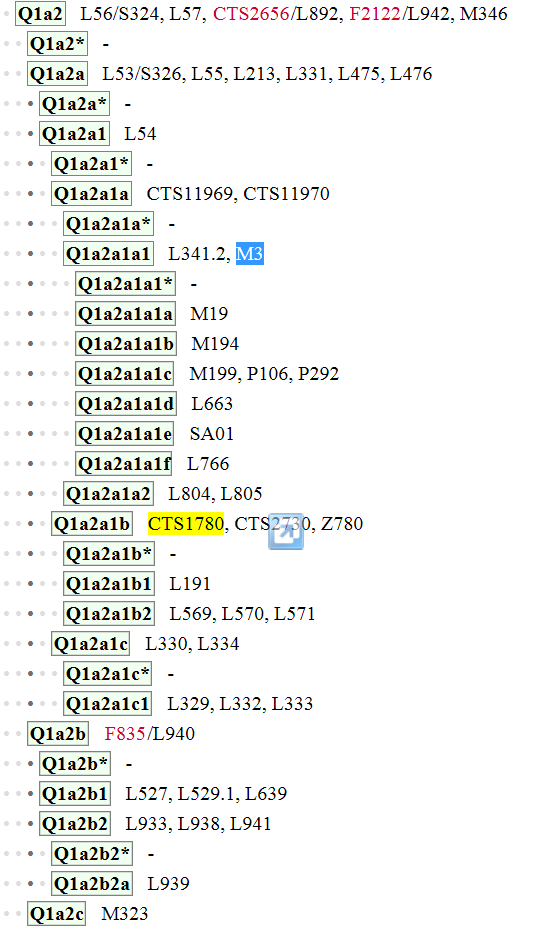
The Y chromosome was determined to be haplogroup Q-L54.  Haplogroup Q and subgroup Q-L54 originated in Asia and two Q-L54 descendants predominate in the Americas: Q-M3 which has been observed exclusively in Native-Americans and Northeastern Siberians and Q-L54.

The tree researchers constructed is shown below.

Clovis Y

They estimate the divergence between haplogroups Q-L54 and Q-M3, the two major haplogroup Q Native lines, to be about 16,900 years ago, or from between 13,000 – 19,700.

The researchers shared with us the methodology they used to determine when their most common recent ancestor (MCRA) lived.

“The modern samples have accumulated an average of 48.7 transversions [basic mutations] since their MCRA lived and we observed 12 in Anzick.  We infer an average of approximately 36.7 (48.7-12) transversions to have accumulated in the past 12.6 thousands years and therefore estimate the divergence time of Q-M3 and Q-L54 to be approximately 16.8 thousands years (12.6ky x 48.7/36.7).”

Autosomal

They termed their autosomal analysis “genome-wide genetic affinity.”  They compared the Anzick individual with 52 Native populations for which known European and African genetic segments have been “masked,” or excluded.  This analysis showed that the Anzick individual showed a closer affinity to all 52 Native American populations than to any extant or ancient Eurasian population using several different, and some innovative and new, analysis techniques.

Surprisingly, the Anzick infant showed less shared genetic history with 7 northern Native American tribes from Canada and the Artic including 3 Northern Amerind-speaking groups.  Those 7 most distant groups are:  Aleutians, East Greenlanders, West Greenlanders, Chipewyan, Algonquin, Cree and Ojibwa.

They were closer to 44 Native populations from Central and South America, shown on the map below by the red dots.  In fact, South American populations all share a closer genetic affinity with the Anzick individual than they do with modern day North American Native American individuals.

Clovis autosomal cropped

The researchers proposed three migration models that might be plausible to support these findings, and utilized different types of analysis to eliminate two of the three.  The resulting analysis suggests that the split between the North and South American lines happened either before or at the time the Anzick individual lived, and the Anzick individual falls into the South American group, not the North American group.  In other words, the structural split pre-dates the Anzick child.  They conclude on this matter that “the North American and South American groups became isolated with little or no gene flow between the two groups following the death of the Anzick individual.”  This model also implies an early divergence between these two groups.

Clovis branch

In Eurasia, genetic affinity with the Anzick individual decreases with distance from the Bering Strait.

The researchers then utilized the genetic sequence of the 24,000 year old MA-1 individual from Mal’ta, Siberia, a 40,000 year old individual “Tianyuan” from China and the 4000 year old Saqqaq Palaeo-Eskimo from Greenland.

Again, the Anzick child showed a closer genetic affinity to all Native groups than to either MA-1 or the Saqqaq individual.  The Saqqaq individual is closest to the Greenland Inuit populations and the Siberian populations close to the Bering Strait.  Compared to MA-1, Anzick is closer to both East Asian and Native American populations, while MA-1 is closer to European populations.  This is consistent with earlier conclusions stating that “the Native American lineage absorbed gene flow from an East Asian lineage as well as a lineage related to the MA-1 individual.”  They also found that Anzick is closer to the Native population and the East Asian population than to the Tianyuan individual who seems equally related to a geographically wide range of Eurasian populations.  For additional information, you can see their charts in figure 5 in their supplementary data file.

I have constructed the table below to summarize who matches who, generally speaking.

who matches who

In addition, a French population was compared and only showed an affiliation with the Mal’ta individual and generically, Tianyuan who matches all Eurasians at some level.

Conclusions

The researchers concluded that the Clovis infant belonged to a meta-population from which many contemporary Native Americans are descended and is closely related to all indigenous American populations.  In essence, contemporary Native Americans are “effectively direct descendants of the people who made and used Clovis tools and buried this child,” covering it with red ochre.

Furthermore, the data refutes the possibility that Clovis originated via a European, Solutrean, migration to the Americas.

I would certainly be interested to see this same type of analysis performed on remains from the eastern Canadian or eastern seaboard United States on the earliest burials.  Pre-contact European admixture has been a hotly contested question, especially in the Hudson Bay region, for a very long time, but we have yet to see any pre-Columbus era contact burials that produce any genetic evidence of such.

Additionally, the Ohio burial suggests that perhaps the mitochondrial DNA haplogroup is or was more widespread geographically in North American than is known today.  A wider comparison to Native American DNA would be beneficial, were it possible. A quick look at various Native DNA and haplogroup projects at Family Tree DNA doesn’t show this haplogroup in locations outside of the ones discussed here.  Haplogroup Q, of course, is ubiquitous in the Native population.

National Geographic article about this revelation including photos of where the remains were found.  They can make a tuft of grass look great!

Another article can be found at Voice of America News.

Science has a bit more.

______________________________________________________________

Disclosure

I receive a small contribution when you click on some of the links to vendors in my articles. This does NOT increase the price you pay but helps me to keep the lights on and this informational blog free for everyone. Please click on the links in the articles or to the vendors below if you are purchasing products or DNA testing.

Thank you so much.

DNA Purchases and Free Transfers

Genealogy Services

Genealogy Research

Native American Haplogroups Q, C and the Big Y Test

Sicangu man c 1900I’m writing this to provide an update about Native American paternal research, and to ask for your help and support, but first, let me tell you why.  It’s a very exciting time.

If you don’t want the details, but you know you want to help now….and we have to pay for these tests by the end of the day December 1 to take advantage of the sale price…you can click below to help fund the Big Y testing for Native American haplogroups Q and C.  Both projects need approximately $990.  Everything contributed goes directly to testing.

To donate to the American Indian project, in memory of someone, a family member perhaps, or maybe in honor of an ancestor, or anonymously, click this link:

https://www.familytreedna.com/group-general-fund-contribution.aspx?g=AIP

In order to donate to haplogroup C-P39 project, please click this link:

http://www.familytreedna.com/group-general-fund-contribution.aspx?g=Y-DNAC-P39

Now for the story…

As many of you know, haplogroup Q and C are the two Native American male haplogroups.  To date, every individual with direct paternal Native American ancestors descends from a subgroup of either haplogroup Q or C, Q being by far the most prevalent.  Both of these haplogroups are also found to some extent in Asia and Europe, but there are distinct and specific lineages found in the Americas that represent only Native Americans.  These subgroups are not found in either Europe or Asia.

In December, 2010, we found the first SNP (single nucleotide polymorphism) marker that separated the European and the Native American subclades of haplogroup Q.  Since that time, additional markers have been found through the Walk the Y program and other research.

How did this happen?  A collaborative research approach between individual testers and project administrators.  In this case, Lenny Trujillo was a member of the haplogroup Q project and he agreed to take the WTY (Walk the Y) test, which indeed, discovered a very unique SNP marker that defines Native American haplogroup Q, as opposed to European haplogroup Q.

Much has changed in three years.  The WTY test which was focused solely on research is entirely obsolete, being replaced by a new much more powerful test called the Big Y, and at a reduced cost.  The Big Y sequences a much larger portion of the Y chromosome, which will allow us to discover even more markers.

Why is this important?  Because today, in haplogroups Q and C, we are learning through standard STR (short tandem repeat) surname marker tests who is related to whom, and how distantly, but it’s not enough.  For example, we have a group of haplogroup Q men in Canada who match each other, but then another group with a different SNP marker that is located in the Southwest, Mexico, and then in the North Carolina/Virginia border area.  Oh yes, and one more from Charleston, SC.  Most Native American men who carry haplogroup C are found in Northeastern Canada….but then there is one in the Southwest. What do these people have in common?  Is their relationship “old” or relative new?  Do they perhaps share a common historical language group?  We don’t know, and we’d like to.  In order to do that, we need to further refine their genetic relationship.  Hence, the new tool, the Big Y.

The Big Y sequences almost all of the Y chromosome – over 10 million base pairs and nearly 25,000 known SNPs.  But the good news is that the Big Y, like its predecessor, the WTY, has the ability to find new SNPs.  And they are being found by the buckets – so fast that the haplogroup trees can’t even keep up.  For example, the haplogroup project page still lists most Native people as Q1a3a, but in reality many new SNPs have been discovered.

That’s the good news – that the Big Y represents a huge research opportunity for us to make major discoveries that may well divide the Native groups in the Haplogroup C and Q projects into either language groups, or maybe, if we are lucky, into tribal “confederacies,” for lack of a better word.  I hate to use the word tribes, because the definition of a tribe has changed so much.  What we would like to be able to do it to tell someone from their test results that they are Iroquoian, for example, or Athabascan, or Siouian.  This has been our overarching goal for years, and now we’re actually getting close.  That potential rests with the Big Y.

The bad news is that the test costs $495, and that’s the sale price good only through Dec. 1., and we need funding.  In the haplogroup Q project, we do have a few people who are testing.  Everyone who did the WTY has been sent a $50 coupon to apply towards the Big Y test.  I hope everyone who did do the WTY will indeed order the Big Y as well.  If not, then the coupon can be donated to us, as project administrators, to apply towards the Big Y test of someone else in the group who is testing.  If you’re not going to test, please donate your coupon.

In haplogroup Q, we have two additional men who we desperately want to take the Big Y test, and 2 in haplogroup C as well.  We’re asking for two things.  First, for unused $50 coupons and second, for contributions against the $495 price.  We’d certainly welcome large contributions, or a sponsor for an entire test, but we’d also welcome $5, $10, $25 or whatever you’d like to contribute.  Every little bit helps.

To donate to the American Indian project and to help fund this critical research, click this link:

https://www.familytreedna.com/group-general-fund-contribution.aspx?g=AIP

In order to donate to haplogroup C-P39 project for this research, please click this link:

http://www.familytreedna.com/group-general-fund-contribution.aspx?g=Y-DNAC-P39

Thank you everyone, in advance, for your help.  We can’t do this without you.  This is what collaborative citizen science is all about.  Of course, we’ll report findings as we receive them and can process the information.

______________________________________________________________

Disclosure

I receive a small contribution when you click on some of the links to vendors in my articles. This does NOT increase the price you pay but helps me to keep the lights on and this informational blog free for everyone. Please click on the links in the articles or to the vendors below if you are purchasing products or DNA testing.

Thank you so much.

DNA Purchases and Free Transfers

Genealogy Services

Genealogy Research

Native American Gene Flow – Europe?, Asia and the Americas

Pre-release information from the paper, “Upper Palaeolithic Siberian genome reveals dual ancestry of Native Americans” which included results and analysis of DNA sequencing of 24,000 year old skeletal remains of a 4 year old Siberian boy caused quite a stir.  Unfortunately, it was also misconstrued and incorrectly extrapolated in some articles.  Some people misunderstood, either unintentionally or intentionally, and suggested that people with haplogroups U and R are Native American.  That is not what either the prerelease or the paper itself says.  Not only is that information and interpretation incorrect, the paper itself with the detailed information wasn’t published until November 20th, in Nature.

The paper is currently behind a paywall, so I’m going to discuss parts of it here, along with some additional information from other sources.  To help with geography, the following google map shows the following locations: A=the Altai Republic, in Russia, B=Mal’ta, the location of the 24,000 year old skeletal remains and C=Lake Baikal, the region from where the Native American population originated in Asia.

native flow map

Nature did publish an article preview.  That information is in bold, italics and I will be commenting in nonbold, nonitalics.

The origins of the First Americans remain contentious. Although Native Americans seem to be genetically most closely related to east Asians1, 2, 3, there is no consensus with regard to which specific Old World populations they are closest to4, 5, 6, 7, 8. Here we sequence the draft genome of an approximately 24,000-year-old individual (MA-1), from Mal’ta in south-central Siberia9, to an average depth of 1×. To our knowledge this is the oldest anatomically modern human genome reported to date.

Within the paper, the authors also compare the MA-1 sequence to that of another 40,000 year old individual from Tianyuan Cave, China whose genome has been partially sequenced.  This Chinese individual has been shown to be ancestral to both modern-day Asians and Native Americans.  This comparison was particularly useful, because it showed that MA-1 is not closely related to the Tianyuan Cave individual, and is more closely related to Native Americans.  This means that MA-1’s line and Tianyuan Cave’s line had not yet met and admixed into the population that would become the Native Americans.  That occurred sometime later than 24,000 years ago and probably before crossing Beringia into North America sometime between about 18,000 and 20,000 years ago.

The MA-1 mitochondrial genome belongs to haplogroup U, which has also been found at high frequency among Upper Palaeolithic and Mesolithic European hunter-gatherers10, 11, 12, and the Y chromosome of MA-1 is basal to modern-day western Eurasians and near the root of most Native American lineages5.

The paper goes on to say that MA-1 is a member of mitochondrial (maternal) haplogroup U, very near the base of that haplogroup, but without affiliation to any known subclade, implying either that the subclade is rare or extinct in modern populations.  In other words, this particular line of haplogroup U has NOT been found in any population, anyplace.  According to the landmark paper,  “A ‘‘Copernican’’ Reassessment of the Human Mitochondrial DNA Tree from its Root,” by Behar et al, 2012, haplogroup U itself was born about 46,500 years ago (plus or minus 3.200 years) and today has 9 major subclades (plus haplogroup K) and about 300 branching clades from those 9 subclades, excluding haplogroup K.

The map below, from the supplemental material included with the paper shows the distribution of haplogroup U, the black dots showing locations of haplogroup U comparison DNA.

Native flow Hap U map

In a recent paper, “Ancient DNA Reveals Key Stages in the Formation of Central European Mitochondrial Genetic Diversity” by Brandt et al (including the National Geographic Consortium) released in October 2013, the authors report that in the 198 ancient DNA samples collected from 25 German sites and compared to almost 68,000 current results, all of the ancient Hunter-Gatherer cultural results were haplogroup U, U4, U5 and U8.  No other haplogroups were represented.  In addition, those haplogroups disappeared from the region entirely with the advent of farming, shown on the chart below.

Native flow Brandt map

So, if someone who carries haplogroup U wants to say that they are distantly related to MA-1 who lived 24,000 years ago who was also related to their common ancestor who lived sometime prior to that, between 24,000 and 50,000 years ago, probably someplace between the Middle East where U was born, Mal’ta, Siberia and Western Europe, they would be correct.  They are also distantly related to every other person in the world who carries haplogroup U, and many much more closely that MA-1 whose mitochondrial DNA line is either rare as chicken’s teeth (i.e. never found) or has gone extinct.

Let me be very clear about this, there is no evidence, none, that mitochondrial haplogroup U is found in the Native American population today that is NOT a result of post-contact admixture.  In other words, in the burials that have been DNA tested, there is not one example in either North or South America of a burial carrying mitochondrial haplogroup U, or for that matter, male Y haplogroup R.  Native American haplogroups found in the Americas remain subsets of mitochondrial haplogroups A, B, C, D and X and Y DNA haplogroups C and Q.  Mitochondrial haplogroup M has potentially been found in one Canadian burial.  No other haplogroups have been found.  Until pre-contact remains are found with base haplogroups other than the ones listed above, no one can ethically claim that other haplogroups are of Native American origin.  Finding any haplogroup in a contemporary Native population does not mean that it was originally Native, or that it should be counted as such.  Admixture and adoption have been commonplace since Europeans first set foot on the soil of the Americas. 

Now let’s talk about the Y DNA of MA-1.

The authors state that MA-1’s results are found very near the base of haplogroup R.  They note that the sister lineage of haplogroup R, haplogroup Q, is the most common haplogroup in Native Americans and that the closest Eurasian Q results to Native Americans come from the Altai region.

The testing of the MA-1 Y chromosome was much more extensive than the typical STR genealogy tests taken by consumers today.  MA-1’s Y chromosome was sequenced at 5.8 million base pairs at a coverage of 1.5X.

The resulting haplotree is shown below, again from the supplementary material.

Native flow R tree

 native flow r tree text

The current haplogroup distribution range for haplogroup R is shown below, again with comparison points as black dots.

Native flow R map

The current distribution range for Eurasian haplogroup Q is shown on the map below.  Haplogroup Q is the most common haplogroup in Native Americans.

Native flow Q map

Similarly, we find autosomal evidence that MA-1 is basal to modern-day western Eurasians and genetically closely related to modern-day Native Americans, with no close affinity to east Asians. This suggests that populations related to contemporary western Eurasians had a more north-easterly distribution 24,000 years ago than commonly thought. Furthermore, we estimate that 14 to 38% of Native American ancestry may originate through gene flow from this ancient population. This is likely to have occurred after the divergence of Native American ancestors from east Asian ancestors, but before the diversification of Native American populations in the New World. Gene flow from the MA-1 lineage into Native American ancestors could explain why several crania from the First Americans have been reported as bearing morphological characteristics that do not resemble those of east Asians2, 13.

Kennewick Man is probably the most famous of the skeletal remains that don’t neatly fit into their preconceived box.  Kennewick man was discovered on the bank of the Columbia River in Kennewick, Washington in 1996 and is believed to be from 7300 to 7600 years old.  His anatomical features were quite different from today’s Native Americans and his relationship to ancient people is unknown.  An initial evaluation and a 2010 reevaluation of Kennewick Man let to the conclusion by Doug Owsley, a forensic anthropologist, that Kennewick Man most closely resembles the Ainu people of Japan who themselves are a bit of an enigma, appearing much more Caucasoid than Asian.  Unfortunately, DNA sequencing of Kennewick Man originally was ussuccessful and now, due to ongoing legal issues, more technologically advanced DNA testing has not been allowed.  Nova sponsored a facial reconstruction of Kennewick Man which you can see here.

Sequencing of another south-central Siberian, Afontova Gora-2 dating to approximately 17,000 years ago14, revealed similar autosomal genetic signatures as MA-1, suggesting that the region was continuously occupied by humans throughout the Last Glacial Maximum. Our findings reveal that western Eurasian genetic signatures in modern-day Native Americans derive not only from post-Columbian admixture, as commonly thought, but also from a mixed ancestry of the First Americans.

In addition to the sequencing they set forth above, the authors compared the phenotype information obtainable from MA-1 to the Tyrolean Iceman, typically called Otzi.  You can see Otzi’s facial reconstruction along with more information here.  This is particularly interesting in light of the pigmentation change from darker skin in Africa to lighter skin in Eurasia, and the question of when this appearance change occurred.  MA-1 shows a genetic affinity with the contemporary people of northern Europe, the population today with the highest frequency of light pigmentation phenotypes.  The authors compared the DNA of MA-1 with a set of 124 SNPs identified in 2001 by Cerquira as informative on skin, hair and eye pigmentation color, although they also caution that this method has limited prediction accuracy.  Given that, they say that MA-1 had dark hair, skin and eyes, but they were not able to sequence the full set of SNPs.  MA-1 also had the SNP value associated with a high risk of male pattern baldness, a trait seldom found in Native American people and was not lactose tolerant, a trait found in western Eurasians.  MA-1 also does not carry the mutation associated with hair thickness and shovel shaped incisors in Asians.

The chart below from the supplemental material shows the comparison with MA-1 and the Tyrolean Iceman.

Native flow Otzi table

The Tarim Mummies, found in the Tarim Basin in present-day Xinjiang, China are another example of remains that seem out of place.  The earliest Tarim mummies, found at Qäwrighul and dated to 1800 BCE, are of a Europoid physical type whose closest affiliation is to the Bronze Age populations of southern Siberia, Kazakhstan, Central Asia, and the Lower Volga.

The cemetery at Yanbulaq contained 29 mummies which date from 1100–500 BCE, 21 of which are Mongoloid—the earliest Mongoloid mummies found in the Tarim Basin—and eight of which are of the same Europoid physical type found at Qäwrighul.

Notable mummies are the tall, red-haired “Chärchän man” or the “Ur-David” (1000 BCE); his son (1000 BCE), a small 1-year-old baby with brown hair protruding from under a red and blue felt cap, with two stones positioned over its eyes; the “Hami Mummy” (c. 1400–800 BCE), a “red-headed beauty” found in Qizilchoqa; and the “Witches of Subeshi” (4th or 3rd century BCE), who wore 2-foot-long (0.61 m) black felt conical hats with a flat brim. Also found at Subeshi was a man with traces of a surgical operation on his neck; the incision is sewn up with sutures made of horsehair.

Their costumes, and especially textiles, may indicate a common origin with Indo-European neolithic clothing techniques or a common low-level textile technology. Chärchän man wore a red twill tunic and tartan leggings. Textile expert Elizabeth Wayland Barber, who examined the tartan-style cloth, discusses similarities between it and fragments recovered from salt mines associated with the Hallstatt culture.

DNA testing revealed that the maternal lineages were predominantly East Eurasian haplogroup C with smaller numbers of H and K, while the paternal lines were all R1a1a. The geographic location of where this admixing took place is unknown, although south Siberia is likely.  You can view some photographs of the mummies here.

In closing, the authors of the MA-1 paper state that the study has four important implications.

First, we find evidence that contemporary Native Americans and western Eurasians shareancestry through gene flow from a Siberian Upper  Palaeolithic population into First Americans.

Second, our findings may provide an explanation for the presence of mtDNA haplogroup X in Native Americans, which is related to western Eurasians but not found in east Asian populations.

Third, such an easterly presence in Asia of a population related to contemporary western Eurasians provides a possibility that non-east Asian cranial characteristics of the First Americans derived from the Old World via migration through Beringia, rather than by a trans-Atlantic voyage from Iberia as proposed by the Solutrean hypothesis.

Fourth, the presence of an ancient western Eurasian genomic signature in the Baikal area before and after the LGM suggests that parts of south-central Siberia were occupied by humans throughout the coldest stages of the last ice age.

The times, they are a changin’.

Dr. Michael Hammer’s presentation at the 9th Annual International Conference on Genetic Genealogy may shed some light on all of this seeming confusing and somewhat conflicting information.

The graphic below shows the Y haplogroup base tree as documented by van Oven.

Native flow basic Y

You can see, in the lower right corner, that Y haplogroup K (not to be confused with mtDNA haplogroup K discussed in conjunction with mtDNA haplogroup U) was the parent of haplogroup P which is the parent of both haplogroups Q and R.

It has always been believed that haplogroup R made its way into Europe before the arrival of Neolithic farmers about 10,000 years ago.  However, that conclusion has been called into question, also by the use of Ancient DNA results.  You can view additional information about Hammer’s presentation here, but in a nutshell, he said that there is no early evidence in burials, at all, for haplogroup R being in Europe at an early age.  In about 40 burials from several location, haplogroup R has never been found.  If it were present, especially in the numbers expected given that it represents more than half of the haplogroups of the men of Europe today, it should be represented in these burials, but it is not.  Hammer concludes that evidence supports a recent spread of haplogroup R into Europe about 5000 years ago.  Where was haplogroup R before spreading into Europe?  In Asia.

Native flow hammer dist

It appears that haplogroup K diversified in Southeast Asian, giving birth to haplogroups P, Q and R. Dr. Hammer said that this new information, combined with new cluster information and newly discovered SNP information over the past two years requires that haplogroup K be significantly revised.  Between the revision of haplogroup K, the parent of both haplogroup R, previously believed to be European, and haplogroup Q, known to be Asian, European and Native, we may be in for a paradigm shift in terms of what we know about ancient migrations and who is whom.  This path for haplogroup R into Europe really shouldn’t be surprising.  It’s the exact same distribution as haplogroup Q, except haplogroup Q is much less frequently found in Europe than haplogroup R.

What Can We Say About MA-1?

In essence, we can’t label MA-1 as paternally European because of Y haplogroup R which now looks to have had an Asian genesis and was not known to have been in Europe 24,000 years ago, only arriving about 5,000 years ago.  We can’t label haplogroup R as Native American, because it has never been found in a pre-Columbian New World burial.

We can say that mitochondrial haplogroup U is found in Europe in Hunter-Gatherer groups six thousand years ago (R  was not) but we really don’t know if haplogroup U was in Europe 24,000 years ago.  We cannot label haplogroup U as Native because it has never been found in a pre-Columbian New World burial.

We can determine that MA-1 did have ancestors who eventually became European due to autosomal analysis, but we don’t know that those people lived in what is now Europe 24,000 years ago.  So the migration might have been into Europe, not out of Europe.  MA-1, his ancestors and descendants, may have lived in Asia and subsequently settled in Europe or lived someplace inbetween.  We can determine that MA-1’s line of people eventually admixed with people from East Asia, probably in Siberia, and became today’s First People of North and South America.

We can say that MA-1 appears to have been about 30% what is today Western Eurasian and that he is closely related to modern day Native Americans, but not eastern Asians.  The authors estimate that between 14% and 38% of Native American ancestry comes from MA-1’s ancient population.

Whoever thought we could learn so much from a 4 year old?

For anyone seriously interested in Native American population genetics, “Upper Palaeolithic Siberian genome reveals dual ancestry of Native Americans” is a must read.

It’s been a great month for ancient DNA.  Additional recent articles which pertain to this topic include:

http://www.nytimes.com/2013/11/21/science/two-surprises-in-dna-of-boy-found-buried-in-siberia.html?src=me&ref=general&_r=0

http://www.sciencedaily.com/releases/2013/11/131120143631.htm

http://dienekes.blogspot.com/2013/11/ancient-dna-from-upper-paleolithic-lake.html

http://blogs.discovermagazine.com/gnxp/2013/11/long-first-age-mankind/#.Uo0eOcSkrIU

http://cruwys.blogspot.com/2013/11/day-1-at-royal-societys-2013-ancient.html

http://cruwys.blogspot.co.uk/2013/11/day-2-at-royal-societys-2013-ancient.html

http://www.sciencedaily.com/releases/2013/11/131118081251.htm

______________________________________________________________

Disclosure

I receive a small contribution when you click on some of the links to vendors in my articles. This does NOT increase the price you pay but helps me to keep the lights on and this informational blog free for everyone. Please click on the links in the articles or to the vendors below if you are purchasing products or DNA testing.

Thank you so much.

DNA Purchases and Free Transfers

Genealogy Services

Genealogy Research

2013 Family Tree DNA Conference Day 2

ISOGG Meeting

The International Society of Genetic Genealogy always meets at 8 AM on Sunday morning.  I personally think that 8AM meeting should be illegal, but then I generally work till 2 or 3 AM (it’s 1:51 AM now), so 8 is the middle of my night.

Katherine Borges, the Director speaks about current and future activities, and Alice Fairhurst spoke about the many updates to the Y tree that have happened and those coming as well.  It has been a huge challenge to her group to keep things even remotely current and they deserve a huge round of virtual applause from all of us for the Y tree and their efforts.

Bennett opened the second day after the ISOGG meeting.

“The fact that you are here is a testament to citizen science” and that we are pushing or sometimes pulling academia along to where we are.

Bennett told the story of the beginning of Family Tree DNA.  “Fourteen years ago when the hair that I have wasn’t grey,” he began, “I was unemployed and tried to reorganize my wife’s kitchen and she sent me away to do genealogy.”  Smart woman, and thankfully for us, he went.  But he had a roadblock.  He felt there was a possibility that he could use the Y chromosome to solve the roadblock.  Bennett called the author of one of the two papers published at that time, Michael Hammer.  He called Michael Hammer on Sunday morning at his home, but Michael was running out the door to the airport.  He declined Bennett’s request, told him that’s not what universities do, and that he didn’t know of anyplace a Y test could be commercially be done.  Bennett, having run out of persuasive arguments, started mumbling about “us little people providing money for universities.”  Michael said to him, “Someone should start a company to do that because I get phone calls from crazy genealogists like you all the time.”  Let’s just say Bennett was no longer unemployed and the rest, as they say, is history.  With that, Bennett introduced one of our favorite speakers, Dr. Michael Hammer from the Hammer Lab at the University of Arizona.

Bennett day 2 intro

Session 1 – Michael Hammer – Origins of R-M269 Diversity in Europe

Michael has been at all of the conferences.  He says he doesn’t think we’re crazy.  I personally think we’ve confirmed it for him, several times over, so he KNOWS we’re crazy.  But it obviously has rubbed off on him, because today, he had a real shocker for us.

I want to preface this by saying that I was frantically taking notes and photos, and I may have missed something.  He will have his slides posted and they will be available through a link on the GAP page at FTDNA by the end of the week, according to Elliott.

Michael started by saying that he is really exciting opportunity to begin breaking family groups up with SNPs which are coming faster than we can type them.

Michael rolled out the Y tree for R and the new tree looks like a vellum scroll.

Hammer scroll

Today, he is going to focus on the basic branches of the Y tree because the history of R is held there.

The first anatomically modern humans migrated from Africa about 45,000 years ago.

After last glacial maximum 17,000 years ago, there was a significant expansion into Europe.

Neolithic farmers arrived from the near east beginning 10,000 years ago.

Farmers had an advantage over hunter gatherers in terms of population density.  People moved into Northwestern Europe about 5,000 years ago.

What did the various expansions contribute to the population today?

Previous studies indicate that haplogroup R has a Paleolithic origin, but 2 recent studies agree that this haplogroup has a more recent origin in Europe – the Neolithic but disagree about the timing of the expansion.

The first study, Joblin’s study in 2010, argued that geographic diversity is explained by single Near East source via Anaotolia.

It conclude that the Y of Mesololithic hunger-gatherers were nearly replaced by those of incoming farmers.

In the most recent study by Busby in 2012 is the largest study and concludes that there is no diversity in the mapping of R SNP markers so they could not date lineage and expansion.  They did find that most basic structure of R tree did come from the near east.  They looked at P311 as marker for expansion into Europe, wherever it was.  Here is a summary page of Neolithic Europe that includes these studies.

Hammer says that in his opinion, he thought that if P311 is so frequent and widespread in Europe it must have been there a long time.  However, it appears that he and most everyone else, was wrong.

The hypothesis to be tested is if P311 originated prior to the Neolithic wave, it would predict higher diversity it the near east, closer to the origins of agriculture.  If P311 originated after the expansion, would be able to see it migrate across Europe and it would have had to replace an existing population.

Because we now have sequences the DNA of about 40 ancient DNA specimens, Michael turned to the ancient DNA literature.  There were 4 primary locations with skeletal remains.  There were caves in France, Spain, Germany and then there’s Otzi, found in the Alps.

hammer ancient y

All of these remains are between 6000-7000 years old, so prior to the agricultural expansion into Europe.

In France, the study of 22 remains produced, 20 that were G2a and 2 that were I2a.

In Spain, 5 G2a and 1 E1b.

In Germany, 1I G2a and 2 F*.

Otzi is haplogroup G2a2b.

There was absolutely 0, no, haplogroup R of any flavor.

In modern samples, of 172 samples, 94 are R1b.

To evaluate this, he is dropping back to the backbone of haplogroup R.

hammer backbone

This evidence supports a recent spread of haplogroup R lineages in western Europe about 5K years ago.  This also supports evidence that P311 moved into Europe after the Neolithic agricultural transition and nearly displaced the previously existing western European Neolithic Y, which appears to be G2a.

This same pattern does not extrapolate to mitochondrial DNA where there is continuity.

What conferred advantage to these post Neolithic men?  What was that advantage?

Dr. Hammer then grouped the major subgroups of haplogroup R-P3111 and found the following clusters.

  • U106 is clustered in Germany
  • L21 clustered in the British Isles
  • U152 has an Alps epicenter

hammer post neolithic epicenters

This suggests multiple centers of re-expansion for subgroups of haplogroup R, a stepwise process leading to different pockets of subhaplogroup density.

Archaeological studies produce patterns similar to the hap epicenters.

What kind of model is going on for this expansion?

Ancestral origin of haplogroup R is in the near east, with U106, P312 and L21 which are then found in 3 European locations.

This research also suggests thatG2a is the Neolithic version of R1b – it was the most commonly found haplogroup before the R invasion.

To make things even more interesting, the base tree that includes R has also been shifted, dramatically.

Haplogroup K has been significantly revised and is the parent of haplogroups P, R and Q.

It has been broken into 4 major branches from several individual lineages – widely shifted clades.

hammer hap k

Haps R and Q are the only groups that are not restricted to Oceana and Southeast Asia.

Rapid splitting of lineages in Southeast Asia to P, R and Q, the last two of which then appear in western Europe.

hammer r and q in europe

R then, populated Europe in the last 4000 years.

How did these Asians get to Europe and why?

Asian R1b overtook Neolithic G2a about 4000 years ago in Europe which means that R1b, after migrating from Africa, went to Asia as haplogroup K and then divided into P, Q and R before R and Q returned westward and entered Europe.  If you are shaking your head right about now and saying “huh?”…so were we.

Hammer hap r dist

Here is Dr. Hammer’s revised map of haplogroup dispersion.

hammer haplogroup dispersion map

Moving away from the base tree and looking at more recent SNPs, Dr. Hammer started talking about some of the findings from the advanced SNP testing done through the Nat Geo project and some of what it looks like and what it is telling us.

For example, the R1bs of the British Isles.

There are many clades under L 21.  For example, there is something going on in Scotland with one particular SNP (CTS11722?) as it comprises one third of the population in Scotland, but very rare in Ireland, England and Wales.

New Geno 2.0 SNP data is being utilized to learn more about these downstream SNPs and what they had to say about the populations in certain geographies.

For example, there are 32 new SNPs under M222 which will help at a genealogical level.

These SNPs must have arisen in the past couple thousand years.

Michael wants to work with people who have significant numbers of individuals who can’t be broken out with STRs any further and would like to test the group to break down further with SNPs.  The Big Y is one option but so is Nat Geo and traditional SNP testing, depending on the circumstance.

G2a is currently 4-5% of the population in Europe today and R is more than 40%.

Therefore, P312 split in western Eurasia and very rapidly came to dominate Europe

Session 2 – Dr. Marja Pirttivaara – Bridging Social Media and DNA

Dr. Pirttivaara has her PhD in Physics and is passionate about genetic genealogy, history and maps.  She is an administrator for DNA projects related to Finland and haplogroup N1c1, found in Finland, of course.

marja

Finland has the population of Minnesota and is the size of New Mexico.

There are 3750 Finland project members and of them 614 are haplogroup N1c1.

Combining the N1c1 and the Uralic map, we find a correlation between the distribution of the two.

Turku, the old capital, was full or foreigners, in Medieval times which is today reflected in the far reaching DNA matches to Finnish people.

Some of the interest in Finland’s DNA comes from migration which occurred to the United States.

Facebook and other social media has changed the rules of communication and allows the people from wide geographies to collaborate.  The administrator’s role has also changed on social media as opposed to just a FTDNA project admin.  Now, the administrator becomes a negotiator and a moderator as well as the DNA “expert.”

Marja has done an excellent job of motivating her project members.  They are very active within the project but also on Facebook, comparing notes, posting historical information and more.

Session 3 – Jason Wang – Engineering Roadmap and IT Update

Jason is the Chief Technology Officer at Family Tree DNA and recently joined with the Arpeggi merger and has a MS in Computer Engineering.

Regarding the Gene by Gene/FTDNA partnership, “The sum of the parts is greater than the whole.”  He notes that they have added people since last year in addition to the Arpeggi acquisition.

Jason introduced Elliott Greenspan, who, to most of us, needed no introduction at all.

Elliott began manually scoring mitochondrial DNA tests at age 15.  He joined FTDNA in 2006 officially.

Year in review and What’s Coming

4 times the data processed in the past year.

Uploads run 10 times faster.  With 23andMe and Ancestry autosomal uploads, processing will start in about 5 minutes, and matches will start then.

FTDNA reinvented Family Finder with the goal of making the user experience easier and more modern.   They added photos, profiles and the new comparison bars along with an advanced section and added push to chromosome browser.

Focus on users uploading the family tree.  Tools don’t matter if the data isn’t there.  In order to utilize the genealogy aspect, the genealogy info needs to be there.   Will be enhancing the GEDCOM viewer.  New GEDCOMs replace old GEDCOMs so as you update yours, upload it again.

They are now adding a SNP request form so that you can request a SNP not currently available.  This is not to be confused with ordering an existing SNP.

They currently utilize build 14 for mitochondrial DNA.  They are skipping build 15 entirely and moving forward with 16.

They added steps to the full sequence matches so that you can see your step-wise mutations and decide whether and if you are related in a genealogical timeframe.

New Y tree will be released shortly as a result of the Geno 2.0 testing.  Some of the SNPs have mutated as much as 7 times, and what does that mean in terms of the tree and in terms of genealogical usefulness.  This tree has taken much longer to produce than they expected due to these types of issues which had to be revised individually.

New 2014 tree has 6200 SNPS and 1000 branches.

  • Commitment to take genetic genealogy to the next level
  • Y draft tree
  • Constant updates to official tree
  • Commitment to accurate science

If a single sample comes back as positive for a SNP, they will put it on the tree and will constantly update this.

If 3 or 4 people have the same SNP that are not related it will go directly to the tree.  This is the reason for the new SNP request form.

Part of the reason that the tree has taken so long is that not every SNP is public and it has been a huge problem.

When they find a new SNP, where does it go on the tree?  When one SNP is found or a SNP fails, they have run over 6000 individual SNPs on Nat Geo samples to vet to verify the accuracy of the placement.  For example, if a new SNP is found in a particular location, or one is found not to be equivalent that was believe to be so previously, they will then test other samples to see where the SNP actually belongs.

X Matching

Matching differential is huge in early testing.  One child may inherit as little as 20% of the X and another 90%.  Some first cousins carry none.

X matching will be an advanced feature and will have their own chromosome browser.

End of the year – January 1.  Happy New Year!!!

Population Finder

It’s definitely in need of an upgrade and have assigned one person full time to this product.

There are a few contention points that can be explained through standard history.

It’s going to get a new look as well and will be easily upgradeable in the future.

They cannot utilize the National Geographic data because it’s private to Nat Geo.

Bennett – “Committed to an engineering team of any size it takes to get it done.  New things will be rolling out in first and second quarter of next year.”  Then Bennett kind of sighed and said “I can’t believe I just said that.”

Session 4 – Dr. Connie Bormans – Laboratory Update

The Gene by Gene lab, which of course processes all of the FTDNA samples is now a regulated lab which allows them to offer certain regulated medical tests.

  • CLIA
  • CAP
  • AABB
  • NYSDOH

Between these various accreditations, they are inspected and accredited once yearly.

Working to decrease turn-around time.

SNP request pipeline is an online form and is in place to request a new SNP be added to their testing menu.

Raised the bar for all of their tests even though genetic genealogy isn’t medical testing because it’s good for customers and increases quality and throughput.

New customer support software and new procedures to triage customer requests.

Implement new scoring software that can score twice as many tests in half the time.  This decreases turn-around time to the customer as well.

New projects include improved method of mtDNA analysis, new lab techniques and equipment and there are also new products in development.

Ancient DNA (meaning DNA from deceased people) is being considered as an offering if there is enough demand.

Session 5 – Maurice Gleeson – Back to Our Past, Ireland

Maurice Gleeson coordinated a world class genealogy event in Dublin, Ireland Oct. 18-20, 2013.  Family Tree DNA and ISOGG volunteers attended to educate attendees about genetic genealogy and DNA. It was a great success and the DNA kits from the conference were checked in last week and are in process now.  Hopefully this will help people with Irish ancestry.

12% of the Americans have Irish ancestry, but a show of hands here was nearly 100% – so maybe Irish descendants carry the crazy genealogist gene!

They developed a website titled Genetic Genealogy Ireland 2013.  Their target audience was twofold, genetic genealogy in general and also the Irish people.  They posted things periodically to keep people interested.  They also created a Facebook page.  They announced free (sponsored) DNA tests and the traffic increased a great deal.  Today ISOGG has a free DNA wiki page too.  They also had a prize draw sponsored by the Ireland DNA and mtdna projects. Maurice said that the sessions and the booth proximity were quite symbiotic because when y ou came out of the DNA session, the booth was right there.

2000-5000 people passed by the booth

500 people in the booth

Sold 99 kits – 119 tests

45 took Y 37 marker tests

56 FF, 20 male, 36 female

18 mito tests

They passed out a lot of educational material the first two days.  It appeared that the attendees were thinking about things and they came back the last day which is when half of the kits were sold, literally up until they threatened to turn the lights out on them.

They have uploaded all of the lectures to a YouTube channel and they have had over 2000 views.  Of all of the presentation, which looked to be a list of maybe 10-15, the autosomal DNA lecture has received 25% of the total hits for all of the videos.

This is a wonderful resource, so be sure to watch these videos and publicize them in your projects.

Session 6 – Brad Larkin – Introducing Surname DNA Journal

Brad Larkin is the FTDNA video link to the “how to appropriately” scrape for a DNA test.  That’s his minute or two of fame!  I knew he looked familiar.

Brad began a peer reviewed genetic genealogy journal in order to help people get their project stories published.  It’s free, open access, web based and the author retains the copyright..  www.surnamedna.com

Conceived in 2012, the first article was published in January 2013.  Three papers published to date.

Encourage administrators to write and publish their research.  This helps the publication withstand the test of time.

Most other journals are not free, except for JOGG which is now inactive.  Author fees typically are $1320 (PLOS) to $5000 (Nature) and some also have subscription or reader fees.

Peer review is important.  It is a critical review, a keen eye and an encouraging tone.  This insures that the information is evidence based, correct and replicable.

Session 7 – mtdna Roundtable – Roberta Estes and Marie Rundquist

This roundtable was a much smaller group than yesterday’s Y DNA and SNP session, but much more productive for the attendees since we could give individual attention to each person.  We discussed how to effectively use mtdna results and what they really mean.  And you just never know what you’re going to discover.  Marie was using one of her ancestors whose mtDNA was not the haplogroup expected and when she mentioned the name, I realized that Marie and I share yet another ancestral line.  WooHoo!!

Q&A

FTDNA kits can now be tested for the Nat Geo test without having to submit a new sample.

After the new Y tree is defined, FTDNA will offer another version of the Deep Clade test.

Illumina chip, most of the time, does not cover STRs because it measures DNA in very small fragments.  As they work with the Big Y chip, if the STRs are there, then they will be reported.

80% of FTDNA orders are from the US.

Microalleles from the Houston lab are being added to results as produced, but they do not have the data from the older tests at the University of Arizona.

Holiday sale starts now, runs through December 31 and includes a restaurant.com $100 gift card for anyone who purchases any test or combination of tests that includes Family Finder.

That’s it folks.  We took a few more photos with our friends and left looking forward to next year’s conference.  Below, left to right in rear, Marja Pirttivaara, Marie Rundquist and David Pike.  Front row, left to right, me and Bennett Greenspan.

Goodbyes

See y’all next year!!!

______________________________________________________________

Disclosure

I receive a small contribution when you click on some of the links to vendors in my articles. This does NOT increase the price you pay but helps me to keep the lights on and this informational blog free for everyone. Please click on the links in the articles or to the vendors below if you are purchasing products or DNA testing.

Thank you so much.

DNA Purchases and Free Transfers

Genealogy Services

Genealogy Research

2013 Family Tree DNA Conference Day 1

This article is probably less polished than my normal articles.  I’d like to get this information out and to you sooner rather than later, and I’m still on the road the rest of this week with little time to write.  So you’re getting a spruced up version of my notes.  There are some articles here I’d like to write about more indepth later, after I’m back at home and have recovered a bit.

Max Blankfield and Bennett Greenspan, founders, opened the conference on the first day as they always do.  Max began with a bit of a story.

13 years ago Bennett started on a quest….

Indeed he did, and later, Bennett will be relating his own story of that journey.

Someone mentioned to Max that this must be a tough time in this industry.  Max thought about this and said, really, not.  Competition validates what you are doing.

For competition it’s just a business opportunity – it was not and is not approached with the passion and commitment that Family Tree DNA has and has always had.

He said this has been their best year ever and great things in the pipeline.

One of the big moves is that Arpeggi merged into Family Tree DNA.

10th Anniversary Pioneer Awards

Quite unexpectedly, Max noted and thanked the early adopters and pioneers, some of which who are gone now but remain with us in spirit.

Max and Bennett recognized the administrators who have been with Family Tree DNA for more than 10 years.  The list included about 20 or so early adopters.  They provided plaques for us and many of us took a photo with Max as the plaques were handed out.

Plaque Max and Me 2013

I am always impressed by the personal humility and gratitude of Max and Bennett, both, to their administrators.  A good part of their success is attributed, I’m sure, to their personal commitment not only to this industry, but to the individual people involved.  When Max noted the admins who were leaders and are no longer with us, he could barely speak.  There were a lot of teary eyes in the room, because they were friends to all of us and we all have good memories.

Thank you, Max and Bennett.

The second day, we took a group photo of all of the recipients along with Max and Bennett.

With that, it was Bennett’s turn for a few remarks.

Bennett remarks

Bennett says that having their own lab provides a wonderful environment and allows them to benchmark and respond to an ever changing business environment.

Today, they are a College of American Pathologists certified lab and tomorrow, we will find out more about what is coming.  Tomorrow, David Mittleman will speak about next generation sequencing.

The handout booklet includes the information that Family Tree DNA now includes over 656,898 records in more than 8,700 group projects. These projects are all managed by volunteer administrators, which in and of itself, is a rather daunting number and amount of volunteer crowd-sourcing.

Session 1 – Amy McGuire, PhD, JD – Am I My Brother’s Keeper?

Dr. McGuire went to college for a very long time.  Her list of degrees would take a page or so.  She is the Director of the Center for Medical Ethics and Health Policy at Baylor College of Medicine.

Thirteen years ago, Amy’s husband was sitting next to Bennett’s wife on an airplane and she gave him a business card.  Then two months ago, Amy wound up sitting next to Max on another airplane.  It’s a very small world.

I will tell you that Amy said that her job is asking the difficult questions, not providing the answers.  You’ll see from what follows that she is quite good at that.

How is genetic genealogy different from clinical genetics in terms of ethics and privacy?  How responsible are we to other family members who share our DNA?

What obligations do we have to relatives in all areas of genetics – both clinical, direct to consumer that related to medical information and then for genetic genealogy.

She referenced the article below, which I blogged about here.  There was unfortunately, a lot of fallout in the media.

Identifying Personal Genomes by Surname Inference – Science magazine in January 2013.  I blogged about this at the time.

She spoke a bit about the history of this issue.

Mcguire

In 2004, a paper was published that stated that it took only 30 to 80 specifically selected SNPS to identify a person.

2008 – Can you identify an individual from pooled or aggregated or DNA?  This is relevant to situations like 911 where the DNA of multiple individuals has been mixed together.  Can you identify individuals from that brew?

2005 – 15 year old boy identifies his biological father who was a sperm donor.  Is this a good thing or a bad thing?  Some feel that it’s unethical and an invasion of the privacy of the father.  But others feel that if the donor is concerned about that, they shouldn’t be selling their sperm.

Today, for children conceived from sperm donors, there are now websites available to identify half-siblings.

The movement today is towards making sure that people are informed that their anonymity may not be able to be preserved.  DNA is the ultimate identifier.

Genetic Privacy – individual perspectives vary widely.  Some individuals are quite concerned and some are not the least bit concerned.

Some of the concern is based in the eugenics movement stemming from the forced sterilization (against their will) of more than 60,000 Americans beginning in 1907.  These people were considered to be of no value or injurious to the general population – meaning those institutionalized for mental illness or in prison.

1927 – Buck vs Bell – The Supreme court upheld forced sterilization of a woman who was the third generation institutionalized female for retardation.  “Three generations of imbeciles is enough.”  I must say, the question this leaves me with is how institutionalized retarded women got pregnant in what was supposed to be a “protected” environment.

Hitler, of course, followed and we all know about the Holocaust.

I will also note here that in my experience, concern is not rooted in Eugenics, but she deals more with medical testing and I deal with genetic genealogy.

The issues of privacy and informed consent have become more important because the technology has improved dramatically and the prices have fallen exponentially.

In 2012, the Nonopore OSB Sequencer was introduced that can sequence an entire genome for about $1000.

Originally, DNA data was provided in open access data bases and was anonymized by removing names.  The data base from which the 2013 individuals were identified removed names, but included other identifying information including ages and where the individuals lived.  Therefore, using Y-STRs, you could identify these families just like an adoptee utilizes data bases like Y-Search to find their biological father.

Today, research data bases have moved to controlled access, meaning other researchers must apply to have access so that their motivations and purposes can be evaluated.

In a recent medical study, a group of people in a research study were informed and educated about the utility of public data bases and why they are needed versus the tradeoffs, and then they were given a release form providing various options.  53% wanted their info in public domain, 33 in restricted access data bases and 13% wanted no data release.  She notes that these were highly motivated people enrolled in a clinical study.  Other groups such as Native Americans are much more skeptical.

People who did not release their data were concerned with uncertainly of what might occur in the future.

People want to be respected as a research participant.  Most people said they would participate if they were simply asked.  So often it’s less about the data and more about how they are treated.

I would concur with Dr. McGuire on this.  I know several people who refused to participate in a research study because their results would not be returned to them personally.  All they wanted was information and to be treated respectfully.

What  the new genetic privacy issues are really all about is whether or not you are releasing data not just about yourself, but about your family as well.  What rights or issues do the other family members have relative to your DNA?

Jim Watson, one of the discoverers of DNA, wanted to release his data publicly…except for his inherited Alzheimer’s status.  It was redacted, but, you can infer the “answer” from surrounding (flanking regions) DNA.  He has two children.  How does this affect his children?  Should his children sign a consent and release before their father’s genome is published, since part of it is their sequence as well? The academic community was concerned and did not publish this information.  Jim Watson published his own.

There is no concrete policy about this within the academic community.

Dr McGuire then referenced the book, “The Immortal Life of Henrietta Lacks”.  Henrietta Lacks was a poor African-American woman with ovarian cancer.  At that time, in the 1950s, her cancer was considered “waste” and no release was needed as waste could be utilized for research.  She was never informed or released anything, but then they were following the protocols of the time.  From her cell line, the HeLa cell line, the first immortal cell line was created which ultimately generated a great deal of revenue for research institutes. The family however, remained impoverished.  The genome was eventually fully sequenced and published.  Henrietta Lacks granddaughter said that this was private family information and should never have been published without permission, even though all of the institutions followed all of the protocols in place.

So, aside from the original ethics issues stemming from the 1950s – who is relevant family?  And how does or should this affect policy?

How does this affect genetic genealogy?  Should the rules be different for genetic genealogy, assuming there are (will be) standard policies in place for medical genetics?  Should you have to talk to family members before anyone DNA tests?  Is genetic information different than other types of information?

Should biological relatives be consulted before someone participates in a medical research study as opposed to genetic genealogy?  How about when the original tester dies?  Who has what rights and interests?  What about the unborn?  What about when people need DNA sequencing due to cancer or another immediate and severe health condition which have hereditary components.  Whose rights trump whose?

Today, the data protections are primarily via data base access restrictions.

Dr. Mcguire feels the way to protect people is through laws like GINA (Genomic Information Nondiscrimination Act) which protects people from discrimination, but does not reach to all industries like life insurance.

Is this different than people posting photos of family members or other private information without permission on public sites?

While much of Dr. McGuire’s focus in on medical testing and ethics, the topic surely is applicable to genetic genealogy as well and will eventually spill over.  However, I shudder to think that someone would have to get permission from their relatives before they can have a Y-line DNA test.  Yes, there is information that becomes available from these tests, including haplogroup information which has the potential to make people uncomfortable if they expected a different ethnicity than what they receive or an undocumented adoption is involved.  However, doesn’t the DNA carrier have the right to know, and does their right to know what is in their body override the concerns about relatives who should (but might not) share the same haplogroup and paternal line information?

And as one person submitted as a question at the end of the session, isn’t that cat already out of the bag?

Session 2 – Dr. Miguel Vilar – Geno 2.0 Update and 2014 Tree

Dr. Vilar is the Science manager for the National Geographic’s Genographic Project.

“The greatest book written is inside of us.”

Miguel is a molecular anthropologist and science writer at the University of Pennsylvania. He has a special interest in Puerto Rico which has 60% Native mitochondrial DNA – the highest percentage of Native American DNA of any Caribbean Island.

The Genographic project has 3 parts, the indigenous population testing, the Legacy project which provides grants back to the indigenous community and the public participation portion which is the part where we purchase kits and test.

Below, Dr. Vilars discussed the Legacy portion of the project.

Villars

The indigenous population aspect focuses both on modern indigenous and ancient DNA as well.  This information, cumulatively, is used to reconstruct human population migratory routes.

These include 72,000 samples collected 2005-2012 in 12 research centers on 6 continents.  Many of these are working with indigenous samples, including Africa and Australia.

42 academic manuscripts and >80 conference presentations have come forth from the project.  More are in the pipeline.

Most recently, a Science paper was published about the spread of mtDNA throughout Europe across the past 5000 years.  More than 360 ancient samples were collected across several different time periods.  There seems to be a divide in the record about 7000 years ago when several disappear and some of the more well known haplogroups today appear on the scene.

Nat Geo has funded 7 new scientific grants since the Geno 2.0 portion began for autosomal including locations in Australia, Puerto Rico and others.

Public participants – Geno 1.0 went over 500,000 participants, Geno 2.0 has over 80,000 participants to date.

Dr. Vilar mentioned that between 2008 and today, the Y tree has grown exponentially.  That’s for sure.  “We are reshaping the tree in an enormous way.”  What was once believed to very homogenous, but in reality, as it drills down to the tips, it’s very heterogenous – a great deal of diversity.

As anyone who works with this information on a daily basis knows, that is probably the understatement of the year.  The Geno 2.0 project, the Walk the Y along with various other private labs are discovering new SNPs more rapidly than they can be placed on the Y tree.  Unfortunately, this has led to multiple trees, none of which are either “official” or “up to date.”  This isn’t meant as a criticism, but more a testimony of just how fast this part of the field is emerging.  I’m hopeful that we will see a tree in 2014, even if it is an interim tree. In fact, Dr. Vilars referred to the 2014 tree.

Next week, the Nat Geo team goes to Ireland and will be looking for the first migrants and settlers in Ireland – both for Y DNA and mitochondrial DNA.  Dr. Vilars says “something happened” about 4000 years ago that changed the frequency of the various haplogroups found in the population.  This “something” is not well understood today but he feels it may be a cultural movement of some sort and is still being studied.

Nat Geo is also focused on haplogroup Q in regions from the Arctic to South America.  Q-M3 has also been found in the Caribbean for the first time, marking a migration up the chain of islands from Mexico and South America within the past 5,000 years.  Papers are coming within the next year about this.

They anticipate that interest will double within the next year.  They expect that based on recent discoveries, the 2015 Y tree will be much larger yet.  Dr. Michael Hammer will speak tomorrow on the Y tree.

Nat Geo will introduce a “new chip by next year.”  The new Ireland data should be available on the National Geographic website within a couple of weeks.

They are also in the process up updating the website with new heat maps and stories.

Session 3 – Matt Dexter – Autosomal Analyses

Matt is a surname administrator, an adoptee and has a BS in Computer Science.  Matt is a relatively new admin, as these things go, beginning his adoptive search in 2008.

Matt found out as a child that he was adopted through a family arrangement.  He contacted his birth mother as an adult.  She told him who his father was who subsequently took a paternity test which disclosed that the man believed to be his biological father, was not.  Unfortunately, his ‘father’ had been very excited to be contacted by Matt, and then, of course, was very disappointed to discover that Matt was not his biological child.

Matt asked his mother about this, and she indicated that yes, “there was another guy, but I told him that the other guy was your father.’  With that, Matt began the search for his biological father.

In order to narrow the candidates, his mother agreed to test, so by process of elimination, Matt now knows which side of his family his autosomal results are from.

Matt covers how autosomal DNA works.

This search has led Matt to an interest in how DNA is passed in general, and specifically from grandparents to grandchildren.

One advantage he has is that he has five children whose DNA he can then compare to his wife and three of their grandparents, inferring of course, the 4th grandparent by process of elimination.  While his children’s DNA doesn’t help him identify his father, it did give him a lot of data to work with to learn about how to use and interpret autosomal DNA.    Here, Matt is discussing his children’s inheritance.

Matt dexter

Session 4 – Jeffrey Mark Paul – Differences in Autosomal DNA Characteristics between Jewish and Non-Jewish Populations and Implications for the Family Finder Test

Dr.Jeffrey Paul, who has a doctorate in Public Health from John Hopkins, noticed that his and his wife’s Family Finder results were quite different, and he wanted to know why.  Why did he, Jewish, have so many more?

There are 84 participants in the Jewish project that he used for the autosomal comparison.

What factors make Ashkenazi Jews endogamous.  The Ashkenazi represent 80%of world’sJewish population.

Arranged marriages based on family backgrounds.  Rabbinical lineages are highly esteemed and they became very inbred with cousins marrying cousins for generations.

Cultural and legal restrictions restrict Jewish movements and who they could marry.

Overprediction, meaning people being listed as being cousins more closely than they are, is one of the problems resulting from the endogamous population issue.  Some labs “correct” for this issue, but the actual accuracy of the correction is unknown.

Jeffrey compared his FTDNA Family Finder test with the expected results for known relatives and he finds the results linear – meaning that the results line up with the expected match percentages for unrelated relatives.  This means that FTDNA’s Jewish “correction” seems to be working quite well.  Of course, they do have a great family group with which to calibrate their product.  Bennett’s family is Jewish.

Jeffrey has downloaded the results of group participants into MSAccess and generates queries to test the hypothesis that Jewish participants have more matches than a non-Jewish control group.

The Jewish group had approximately a total of 7% total non-Ashkenazi Jewish in their Population Finder results, meaning European and Middle Eastern Jewish.  The non-Jewish group had almost exactly the opposite results.

  • Jewish people have from 1500-2100 matches.
  • Interfaith 700-1100 (Jewish and non)
  • NonJewish 60-616

Jewish people match almost 33% of the other Jewish people in the project.  Jewish people match both Jewish and Interfaith families.  NonJewish families match NonJewish and interfaith matches.

Jeffrey mentioned that many people have Jewish ancestry that they are unaware of.

This session was quite interesting.  This study while conducted on the Jewish population, still applies to other endogamous populations that are heavily intermarried.  One of the differences between Jewish populations and other groups, such as Amish, Brethren, Mennonite and Native American groups is that there are many Jewish populations that are still unmixed, where most of these other groups are currently intermixed, although of course there are some exceptions.  Furthermore, the Jewish community has been endogamous longer than some of the other groups.  Between both of those factors, length of endogamy and current mixture level, the Jewish population is probably much more highly admixed than any other group that could be readily studied.

Due to this constant redistribution of Jewish DNA within the same population, many Jewish people have a very high percentage of distant cousin relationships.

For non-Jewish people, if you are finding match number is the endogamous range, and a very high number of distant cousins, proportionally, you might want to consider the possibility that some of your ancestors descend from an endogamous population.

Unfortunately, the photo of Dr. Paul was unuseable.  I knew I should have taken my “real camera.”

Session 5 – Finding Your Indian Prince(ss) Without Having to Kiss Too Many Frogs

This was my session, and I’ll write about it later.

Someone did get a photo, which I’ve lifted from Jennifer Zinck’s great blog (thank you Jennifer), Ancestor Central.  In fact, you can see her writeup for Day 1 here and she is probably writing Day 2’s article as I type this, so watch for it too.

 Estes Indian Princess photo

Session 6 – Roundtable – Y-SNPs, hosted by Roberta Estes, Rebekah Canada and Marie Rundquist

At the end of the day, after the breakout sessions, roundtable discussions were held.  There were several topics.  Rebekah Canada, Marie Rundquist and I together “hostessed” the Y DNA and SNP discussion group, which was quite well attended.  We had a wide range of expertise in the group and answered many questions.  One really good aspect of these types of arrangements is that they are really set up for the participants to interact as well.  In our group, for example, we got the question about what is a public versus a private SNP, and Terry Barton who was attending the session answered the question by telling about his “private” Barton SNPs which are no longer considered private because they have now been found in three other surname individuals/groups.  This means they are listed on the “tree.”  So sometimes public and private can simply be a matter of timing and discovery.

FTDNA roundtable 2013

Here’s Bennett leading another roundtable discussion.

roundtable bennett

Session 7 – Dr. David Mittleman

Mittleman

Dr. Mittleman has a PhD in genetics, is a professor as well as an entrepreneur.  He was one of the partners in Arpeggi and came along to Gene by Gene with the acquisition.  He seems to be the perfect mixture of techie geek, scientist and businessman.

He began his session by talking a bit about the history of DNA sequencing, next generation sequencing and a discussion about the expectation of privacy and how that has changed in the past few years with Google which was launched in 2006 and Facebook in 2010.

David also discussed how the prices have dropped exponentially in the past few years based on the increase in the sophistication of technology.  Today, Y SNPs individually cost $39 to test, but for $199 at Nat Geo you can test 12,000 Y SNPs.

The WTY test, now discontinued tsted about 300,000 SNPs on the Y.  It cost between $950 (if you were willing to make your results public) and $1500 (if the results were private,)

Today, the Y chromosome can be sequenced on the Illumina chip which is the same chip that Nat Geo used and that the autosomal testing uses as well.  Family Tree DNA announced their new Big Y product that will sequence 10 million positions and 25,000 known SNPs for an introductory sale price of $495 for existing customers.  This is not a test that a new customer would ever order.  The test will normally cost $695.

Candid Shots

Tech row in the back of the room – Elliott Greenspan at left seated at the table.

tech row

ISOGG Reception

The ISOGG reception is one of my favorite parts of the conference because everyone comes together, can sit in groups and chat, and the “arrival” adrenaline has worn off a bit.  We tend to strategize, share success stories, help each other with sticky problems and otherwise have a great time.  We all bring food or drink and sometimes pitch in to rent the room.  We also spill out into the hallways where our impromptu “meetings” generally happen.  And we do terribly, terribly geeky things like passing our iPhones around with our chromosome painting for everyone to see.  Do we know how to party or what???

Here’s Linda Magellan working hard during the reception.  I think she’s ordering the Big Y actually.  We had several orders placed by admins during the conference.

magellan.jpg

We stayed up way too late visiting and the ISOGG meeting starts at 8 AM tomorrow!

______________________________________________________________

Disclosure

I receive a small contribution when you click on some of the links to vendors in my articles. This does NOT increase the price you pay but helps me to keep the lights on and this informational blog free for everyone. Please click on the links in the articles or to the vendors below if you are purchasing products or DNA testing.

Thank you so much.

DNA Purchases and Free Transfers

Genealogy Services

Genealogy Research

Native American Maternal Haplogroup A2a and B2a Dispersion

Recently, in Phys.org, they published a good overview of a couple of recently written genetic papers dealing with Native American ancestry.  I particularly like this overview, because it’s written in plain English for the non-scientific reader.

In a nutshell, there has been ongoing debate that has been unresolved surrounding whether or not there was one or more migrations into the Americas.  These papers use these terms a little differently.  They not only talk about entry into the Americas but also dispersion within the Americans, which really is a secondary topic and happened, obviously, after the initial entry event(s).

The primary graphic in this article, show below, from the PNAS article, shows the distribution within the Americas of Native American haplogroups A2a and B2a.

a2a, b2a

Schematic phylogeny of complete mtDNA sequences belonging to haplogroups A2a and B2a. A maximum-likelihood (ML) time scale is shown. (Inset) A list of exact age values for each clade. Credit: Copyright © PNAS, doi:10.1073/pnas.0905753107

As you can see, the locations of these haplogroups are quite different and the various distribution models set forth in the papers account for this difference in geography.

One of the aspects of this paper, and the two academic papers on which it is based, that I find particularly encouraging is that the researchers are utilizing full sequence mitochondrial DNA, not just the HVR1 or HVR1+HVR2 regions which has all too often been done in the past.  In all fairness, until rather recently, the expense of running the full sequence was quite high and there were few (if any) other results in the academic data bases to compare the results with.  Now, the cost is quite reasonable, thanks in part to genetic genealogy and new technologies, and so the academic testing standards are changing.  If you’ll note, Alessandro Achilli, one of the authors of these papers and others about Native Americans as well, also comments towards the end that full genome testing will be being utilized soon.  I look forward to this new era of research, not only for Native Americans but for all of us searching for our roots.

Read the Phys.org paper at: http://phys.org/news/2013-09-mitochondrial-genome-north-american-migration.html#jCp

The original academic papers are found here and here.  I encourage anyone with a serious interest in this topic to read these as well.

______________________________________________________________

Disclosure

I receive a small contribution when you click on some of the links to vendors in my articles. This does NOT increase the price you pay but helps me to keep the lights on and this informational blog free for everyone. Please click on the links in the articles or to the vendors below if you are purchasing products or DNA testing.

Thank you so much.

DNA Purchases and Free Transfers

Genealogy Services

Genealogy Research

Native American Mitochondrial Haplogroups

Today, what I’m sharing with you are my research notes.  If you follow my blogs, you’ll know that I have a fundamental, lifelong interest in Native American people and am mixed blood myself.  I feel that DNA is just one of the pieces of history that can be recovered and has a story to tell, along with early records, cultural artifacts and oral history.

In order to work with Native American DNA, and the various DNA projects that I co-administer, it’s necessary to keep a number of lists and spreadsheets.  This particular list was originally the first or earliest reference or references to a Native American mitochondrial (maternal line) haplogroup where it is identified as Native in academic papers.  I have since added other resources as I’ve come across them.

For those wondering why I’ve listed Mexican, this article speaks to the very high percentage of Native American mitochondrial DNA in the Mexican population.

Please note that while some of these haplogroups are found exclusively among Native American people, others are not and are also found in Europe and/or Asia.  In some cases, branches are exclusively Native.  In other cases, we are still sorting through the differences.  For haplogroups though to be only Native, I have put any other submission information, which is often from Siberia.

I have labeled the major founding haplogroups, as such.  This graphic from the paper, “Beringian Standstill and the Spread of Native American Founders” by Tamm et al, provided the first cumulative view of the mitochondrial Native founder population.

beringia map

Haplogroups A, B, C, D and X are known as Native American haplogroups, although not all subgroups in each main haplogroup are Native, so one has to be more specific.

Please note that I am adding information from haplogroup projects at Family Tree DNA.  This information is self-reported and should only be utilized with confidence after confirming the accuracy of the information.

Please note that in earlier papers and projects, not all results may have been tested to the full sequence level, so results in base haplogroups, like A and B, for example, may well fall into subclades with additional testing.

The protocol and logic for adding the Anzick results for consideration, along with other evidence is discussed in this article.  In short, for the 12,500 year old Anzick specimen to match any currently living people at relatively high thresholds, meaning 5cM or over, the living individual would likely have to be heavily Native.  Most matches are from Mexico, Central America and South America.  Many mitochondrial DNA haplogroups are subgroups of known Native groups, but never before documented as Native.  Therefore, the protocol I followed for inclusion was any subgroup of haplogroups A, B, C, D, M or X.  Some individuals are unhappy that some haplogroups were among the Anzick results and that I have not removed them at their request, in particular, M23.  To arbitrarily remove a haplogroup listing would be a breach of the protocol I followed.  Research does not always provide what is expected.  I have includes links to notes where appropriate.

Phylotree Versions

The Phylotree is the document that defines the mutations that equate to haplogroup names.

Please note that most papers don’t indicate which version of the Phylotree they used when sequencing the DNA. Haplogroup names sometimes change with new versions of the Phylotree.  Phylotree builds occurred as follows:

Family Tree DNA updated from build 14 to 17 in March 2017.

As of April 2017, 23andMe is still utilizing Build 12 from 2011.

Roberta’s Native Mitochondrial DNA Notes

Haplogroup A

A

Many samples classified as haplogroup A, with no subgroup, were not tested beyond the HVR1 or HVR1+HVR2 regions. Most, but not all, people will receive more granular haplogroups if the full mitochondrial sequence test is taken.

  • Tribes or peoples include Cherokee, Choctaw, Chippewa, Cree, Huron, Mi’kmaq, and PeeDee found in 2021 in the Haplogroup A project , Acadian AmerIndian Ancestry project and American Indian projects at Family Tree DNA.
  • Ancestral locations in 2021 include Alaska, Alberta, Argentina, Arizona, Bahamas, Belize, Brazil, British Colombia, California, Canada, Chile, Colombia, Costa Rica, Cuba, Dominican Republic, El Salvador, Guatemala, Honduras, Indiana, Kuna-Panama, Louisiana, Manitoba, Mexico, New Mexico, Nicaragua, North Carolina, Nova Scotia, Ohio, Panama, Puerto Rico, Saskatchewan, South Carolina, Texas, Wisconsin, Venezuela.
  • Anzick Provisional Extract, Estes 2014
  • Anzick Provisional Extract, Estes January 2015 – (32 As with no subgroup)
  • New Native American Mitochondrial DNA Haplogroups, Estes, 2017

Ancient A

  • Ancient samples from Antaura (1) and Puca (5) 1100-1500 BC. Baca, 2014
  • Ancient sample named Kwäday Dän Ts’ìchi, Long-Ago Person Found  from the glacier at Tatshenshini-Alsek Park, Canada, dates from about 1420 CE, Monsalve 2002
  • Ancient samples (2) from Tompullo and Andaray, Peru dating from about 1450 CE, Baca, 2012

A-T152C!

A1

  • Mexican – 2007 Peñaloza-Espinosa
  • Rumsen, Esselen, Salinan from Monterey, California – Breschini and Haversat 2008
  • New Native American Mitochondrial DNA Haplogroups, Estes, 2017
  • In Build 17, previous haplogroup A4a became A1
  • Please note that in 2021, haplogroups A1 and A1a appear not to be Native, but there remains some question. In the next version of the haplotree as a result of the Million Mito Project, we can hopefully resolve this question.

A1a

  • In Build 17, previous haplogroup A4a1 became A1a
  • Please note that in 2021, haplogroups A1 and A1a appear not to be Native, but there remains some question. In the next version of the haplotree as a result of the Million Mito Project, we can hopefully resolve this question.

A2

  • Native, Beringian Founder Haplogroup – 2008 Achilli
  • Hispanic American – 2008 Just
  • Mexican – 2007 Peñaloza-Espinosa
  • Mexican, Achilli, 2008
  • Eskimo – Volodko, 2008
  • Dogrib – Eskimo – Volodko, 2008
  • Apache – Volodko, 2008
  • Mexico and Central America – Eskimo – Volodko, 2008
  • Apache – Volodko, 2008
  • Ache and Guarani/Rio-das-Cobras and Katuana and Poturujara and Surui and Waiwai and Yanomama and Zoro – Fagundes 2008
  • Waiwai, Brazil, Zoro, Brazil, Surui, Brazil, Yanomama, Brazil, Kayapo, Brazil, Arsario, Colombia, Cayapa, Ecuador, Kogui, Colombia – Fagundes 2008
  • Arsario and Cayapa – Tamm 2007
  • Kogui – Tamm 2007
  • Colombia – Hartmann 2009
  • Waorani tribe, Ecuador – Cardoso 2012
  • Anzick Provisional Extract, Estes January 2015 – (192 A2s with no subgroup),
  • Inupiat people from Alaska North Slope – Raff 2015
  • Ancestral locations found in March 2021 in the Haplogroup A project, Acadian AmerIndian Ancestry project and American Indian projects at Family Tree DNA include: Argentina, Brazil, California, Canada, Cuba, Ecuador, Guatemala, Mexico, New Brunswick, Nicaragua, Ontario, Puerto Rico, Quebec, Washington State, Mississippi
  • Tribes in 2021 include Algonquin and Choctaw.

Ancient A2

  • Ancient remains from Lauricocha cave central Andean highlands – Fehren-Schmitz 2015
  • Gran Chaco, Argentina – Sevini 2014
  • Chumash – Breschini and Haversat 2008
  • New Native American Mitochondrial DNA Haplogroups, Estes, 2017
  • Wari Culture, Huaca Pucllana, Peru – Llamas, 2016
  • Lima Culture, Huaca Pucllana, Peru – Llamas, 2016
  • Chancay culture, Pasamayo, Peru – Llamas, 2016
  • Lauricocha culture, Lauricocha, Peru – Llamas, 2016
  • Tiwanaku culture, Lauricocha, Peru – Llamas, 2016
  • Paisley 5 Mile Point Caves, 11,000-10,800 YBP – Gilbert et al, 2008
  • Manabi, San Ramon, Pichincha, Quito, Imbabura, Chimborazo, Riobamba, Tungurahua, Pillaro, Cotopaxi, Salcedo, Azuay and Cuenca in Ecuador, Native and Cayapa, also Peru, 6 ancient and several contemporary – Brandini, 2017
  • Argentina, Brazil, Canada, Chile, Cuba, Ecuador, El Salvadore, Guatemala, Mexico, Nicaragua, Puerto Rico, Peru, Venezuela, in Canada – British Columbia, New Brunswick, Northwest Territory, Nova Scotia, Ontario, Quebec, Vancouver Island, in the US – Alabama, Alaska, Caswell County, NC, Crawford County, PA, Michigan, Mississippi, tribes – Choctaw, Mi’kmaq – Haplogroup A2 Mitochondrial Project at Family Tree DNA, August 7, 2019
  • Ancient samples (3) from San Nicolas Island, CA dating from approximately 2100-2400 BCE, Scheib et al, 2018
  • Ancient samples (2) from Pampa Grande, Argentina, Candelaria culture dating from about 400 CE, Carnese et al 2010
  • Ancient samples (2) from the Lauricocha, Highlands of Peru  with 2 dating from about 6500-6700 BCE and one from 1600 BCE, Fehren-Schmitz 2015
  • Ancient samples (5) from Lapa do Santo, Brazil dating from about 7500-7900 BCE, Posth 2018
  • Ancient samples (2) from Arroyo Seco II, Argentina dating from about 5620 BCE, Llamas 2016
  • Ancient sample from Pampas, Laguna Chica, Argentina dating from about 5000 BCE, Posth 2018
  • Ancient samples (2) from Laranjal, Brazil dating from about 4600-5000 BCE, Posth 2018
  • Ancient sample from Caleta Huelen, Chile daring from about 600-800 CD, Nakatsuka 2020
  • Ancient samples (9) from Atajadizo, Dominican Republic dating from about 700 BCE (8 samples) and 1300 BCE (1), Fernandes 2020
  • Ancient sample from Monserrate, Puerto Rico dating from about 800 CE, Fernandes 2020
  • Ancient sample (3) from South Andros Island (Sanctuary Blue Hole,), Bahamas dating from about 1245 CE and 900 CE, Fernandes 2020
  • Ancient samples (6) from Juan Dolio, Dominican Republic dating from about 1200-1250 CE, Fernandes 2020
  • Ancient samples (3) from Andres, Dominican Republic dating from about 995 CE and 650 CE, Fernandes 2020
  • Ancient sample from La Union, Dominican Republic dating from about 700 CE, Fernandes 2020
  • Ancient sample from de Savaan, Curaco dating from about 1160 CE, Fernandes 2020
  • Ancient sample from Canimar Abajo, Cuba dating from about 950 BCE, Fernandes 2020
  • Ancient sample from Los Corniel (Rancho Manuel), Dominican Republic, dating from about 1150 CE. Fernandes 2020
  • Ancient sample from Caba Rojo, Puerto Rico dating from about 1000 CE. Fernandes 2020
  • Ancient samples (3) from La Caleta, Dominican Republic dating from about 1100 CE, Fernandes 2020 
  • Ancient sample from Cueva Juana near Cape of Samana, Dominican Republic dating from about 825 CE. Fernandes 2020
  • Ancient sample from Paso del Indio, Puerto Rico dating from about 1100 CE. Nägele 2020
  • Ancient samples (3) from Lavoutte (Cas-en-Bas), St. Lucia dating from about 1200-1300 CE. Nägele 2020
  • Ancient sample from Los Indios, Puerto Rico dating from about 1350 CE.Nägele 2020
  • Ancient sample from Guayabo Blanco (near Punto Brava), Cuba dating from about 600 BCE. Nägele 2020
  • Ancient sample from Playa del Mango, Rio Cauto, Granma, Cuba dating from about 20 CE. Nägele 2020
  • Ancient samples (2) from Cueva Calero (Matanzas), Cuba dating from about 400-500 CE. Nägele 2020
  • Ancient samples (2) from Canimar Abajo, Cuba dating from about 500-600 CE. Nägele 2020
  • Ancient sample from Cueva del Perico, Cuba dating from about 700 CE. Nägele 2020
  • Ancient samples (2) from Paso del Indio, Puerto Rico dating from about 1000-1250 CE.Nägele 2020
  • Ancient sample from Pica Ocho, Coast of Chile dating from about 1300 CE. Posth 2018
  • Ancient sample from Arroyo Seco, Argentina dating from about 5800 BCE. Posth 2018
  • Ancient sample (2) from the island Chumash, San Miguel Island, Canada dating from about 1830 CE and 1600-1800 CE. Scheib et al, 2018
  • Ancient sample from mainland Chumash, Carpenteria, CA dating from about 400-550 CE. Scheib et al, 2018
  • Ancient sample from island Chumash, Santa Cruz Island, CA dating from about 1500-1800 CE. Scheib et al, 2018
  • Ancient sample from San Sebastian, Cusco, Highlands of Peru dating from about 1450 CE. Nakatsuka 2020
  • Ancient sample from Huaca Pucllana, Lima Peru dating from about 700 CE. Nakatsuka 2020
  • Ancient sample from El Brujo, Peru dating from about 1000 CE. Nakatsuka 2020
  • Ancient sample from southwest of Buenos Aires, Argentina dating from about 400 BCE. Nakatsuka 2020
  • Ancient samples (6) from the central Andes of southern Peru dating from about 300-1450 BCE. Fehren-Schmitz 2015
  • Ancient sample from the middle Andes of southern Peru dating from about 1000 BCE. Fehren-Schmitz 2015
  • Ancient samples from the Kotosh culture in La Galgada, Peru dating from about 2050 BCE, Llamas 2016
  • Ancient sample from the Chinchorro culture in Camarones, Chile dating from about 1800 BCE, Llamas 2016
  • Ancient sample from the Tiwanaku culture in Tiwanaku, Bolivia dating from between 500 and 1000 CE, Llamas 2016
  • Ancient samples (4) from the Wari and Lima Cultures in Huaca Pucllana, Lima, Peru dating from between 500 and 1000 CE, Llamas 2016
  • Ancient sample from the Chancay culture in Pasamayo, Peru dating from between 1000 and 1470 CE, Llamas 2016
  • Ancient sample from the Inca culture in San Sebastian, Peru dating from about 1400 CE, Llamas 2016
  • Ancient sample from the Late Central Andes culture from Cuncaicha, Highlands of Peru dating from 2250 BCE, Llamas 2016
  • Ancient samples (2) from Pica, Chile dating to between 500 and 1000 BCE, Llamas 2016
  • Ancient samples (5) from Checua, Colombia dating from 6000-7800 BCE and 2 samples dating from about 3000 BCE, Diaz-Matallana 2016
  • Ancient sample from the Chinchorro culture in Arica, Chile dating from about 3800 BCE, Raghavan 2015
  • Ancient sample from the Enoque culture from Toca do Enoque in Serra da Capivara, Piaui, Brazil, dating from about 3500 BCE, Raghavan 2015
  • Ancient sample from Big Bar Lake, British Columbia, Canada dating from about 3600 BCE, Moreno-Mayar 2018
  • Ancient samples (4) from the Wari era from Cochapata, Peru dating from about 600-1000 CE, Kemp 2009
  • Ancient samples (3) from the Wari Era from Huari-MQ, Peru dating from about 1000-1450 BCE, Kemp 2009
  • Ancient sample from the Caribbean culture from Santa Elena, Puerto Rico dating from between 900-1300 BCE, Fernandes 2020
  • Ancient samples (4) found in Tibanica, Colombia from about 1000 BCE, Perez 2015
  • Ancient sample from Tilcara, Quebrada de Humahuaca, Jujuy, Argentina dating from about 1100 BCE, Mendisco 2014
  • Ancient sample from Banda de Perchel, Quebrada de Humahuaca, Jujuy, Argentina dating from about 1150 CE, Mendisco 2014
  • Ancient samples (13) from Los Amarilloes, Quebrada de Humahuaca, Jujuy, Argentina dating from about 980-1467 CE, Mendisco 2014
  • Ancient samples (2) from Fuerte Alto, Calchaqui Valley, Salta, Argentina dating from about 1000-1500 CE, Mendisco 2014
  • Ancient sample from Tero, Calchaqui Valley, Salta, Argentina dating from about 1000-1500 CE, Mendisco 2014
  • Ancient samples (2) from the Inca period from Esquina de Huajra (Quebrada de Humahuaca), Argentina dating from about 1500 CE. Russo 2017
  • Ancient samples (4) from Doncellas, Argentina dating from about 1000-1450 CE, Postillone 2017
  • Ancient sample from Casabindo, Argentina dating from about 1000-1450 CE, Postillone 2017
  • Ancient sample from Agua Caliente, Argentina dating from about 1000-1450 CE, Postillone 2017
  • Ancient sample from Doncellas, Argentina dating from about 1000-1450 CE, Postillone 2017
  • Ancient samples (2) from the Athabaskan culture from Tochak McGrath, Upper Kuskokwim River, Alaska, one dating from about 1050-1400 CE, and one from about 550-900 CE, Flegontov 2019. This paper is fascinating – take a look.
  • Ancient sample from Tequendama, Colombia dating from between 4000-5000 BCE, Delgado 2020
  • Ancient sample from Ubate, Colombia dating from about 3600 BCE. Delgado 2020
  • Ancient samples (4) from Aguazuque (Soacha), Colombia, two dating from about 1900 BCE, one from about 2600 BCE, and one from about 775 BCE. Delgado 2020
  • Ancient sample from Canimar Abajo, Cuba dating from about 1100 BCE, Nägele 2020
  • Ancient sample from Restigouche River, near the town of Atholville in northern New Brunswick, Canada dating from about 1500 CE. Raghavan 2015
  • Ancient sample from the lnca Late Horizon from Chincha, Peru dating from about 1500 CE. Bongers 2020

A2a and A2b

  • Paleo Eskimo, identified in only Siberia, Alaska and Natives from the American SW (Achilli 2013)
  • Raff 2015 – Inupiat people from Alaska North Slope
  • Ancient sample, Holas Island, Canada, about 2400 BCE,

A2a

  • Aleut – 2008 Volodko
  • Eskimo – Volodko, 2008
  • Apache – Volodko – 2008
  • Siberian Eskimo, Chukchi, Dogrib, Innuit and Naukan – Dryomov, 2015
  • Anzick Provisional Extract, Estes January 2015 – (2 A2a)
  • Common among Eskimo, Na-Dene and the Chukchis in northeasternmost Siberia, Athabaskan in SW (Achilli 2013), circumpolar Siberia to Greenland, Apache 48%, Navajo 13%
  • New Native American Mitochondrial DNA Haplogroups, Estes, 2017

Ancient A2a

  • Ancient samples (3) from Ekven, Russia, from a 2000 year old Eskimo cemetery near Uelen on the easternmost spit of land in the Bering Strait, one sample dating from about 100 BCE, one from about 900 BCE and one from about 30 BCE, Sikora 2019
  • Ancient samples (5) from Ekven, Russia, from a 2000 year old Eskimo cemetery representing the Old Bering Sea culture near Uelen on the easternmost spit of land in the Bering Strait, dating from about 700-1000 CE, Flegontov 2019
  • Ancient sample from Kagamil Island Warm Cave, Aleutian Islands, Alaska dating from about 1600 CE, Flegontov 2019
  • Ancient samples (2) from Uelen, Chukotka, Russia on the easternmost spit of land in the Bering Strait dating from about 1000 CE and about 250 CE, Flegontov 2019
  • Ancient sample from the Palm Site (Cook Inlet) from the Alaskan Athabaskan culture dating from about 1850 CE, Scheib et al, 2018
  • Ancient sample from Punta Candelero, Puerto Rico dating from about 158 CE, Nägele 2020
  • Ancient samples (2) from Ekven, Russia, from a 2000 year old Eskimo cemetery representing the Old Bering Sea culture near Uelen on the easternmost spit of land in the Bering Strait, dating from about 800-1000 CE, Harney 2020

A2aa

  • Waiwai and Poturujara tribes in Brazil Fagundes, 2008
  • Peru – Brandini, 2017

A2ab

A2ac

  • Chimborazo, Pallatanga, Riobana, Pichincha, Cayambe, Quito, Mejia in Ecuador, Mestizo and Cayapa – Brandini, 2017
  • Hispanic – Just, 2015
  • Colombia – Rieux, 2014
  • Venezuela – Brandini, 2017

A2ac1

  • Colombia, Cuba – Behar, 2012
  • Colombia – HGDP

A2ac2

  • Chimboro, Penipe, Santo Domingo, El Poste, Pichincha, Quito, Bolivar, Chimbo in Ecuador, Native Tsachila and Mestizo – Brandini, 2017

A2ad

A2ac

A2am

A2ar

  • Guatemaula – Sochtig, 2015

A2a1

  • Selkup and Innuit – Dryomov, 2015
  • New Native American Mitochondrial DNA Haplogroups, Estes, 2017
  • Ancient samples (2) from Ekven, Russia, from a 2000 year old Eskimo cemetery representing the Old Bering Sea culture near Uelen on the easternmost spit of land in the Bering Strait, dating from about 850 CE, Flegontov 2019
  • Ancient sample from Tochak McGrath, Upper Kuskokwin River, Alaska from the Athabaskan culture dating from about 1225 CE, Flegontov 2019
  • Ancient sample from Ekven, Russia, from a 2000 year old Eskimo cemetery representing the Old Bering Sea culture near Uelen on the easternmost spit of land in the Bering Strait, dating from about 3 CE, Sikora 2019
  • Ancient sample from Ekven, Russia, from a 2000 year old Eskimo cemetery representing the Old Bering Sea culture near Uelen on the easternmost spit of land in the Bering Strait, dating from about 800 CE, Harney 2020

A2a2

Ancient A2a2

  • Ancient sample from Ekven, Russia, from a 2000 year old Eskimo cemetery representing the Old Bering Sea culture near Uelen on the easternmost spit of land in the Bering Strait, dating from about 250 BCE, Sikora 2019
  • Ancient sample from Ekven, Russia, from a 2000 year old Eskimo cemetery representing the Old Bering Sea culture near Uelen on the easternmost spit of land in the Bering Strait, dating from about 1150 CE, Flegontov 2019
  • Ancient sample from Uelen, Chukota, Russia on the easternmost spit of land in the Bering Strait, dating from about 1150 CE, Flegontov 2019

A2a3

Ancient A2a3

  • Birnirk (ancient sample,) Chukchi, Naukan, Innuit in Canada and Greenland – Dryomov 2015
  • Ancient sample from Ulaanzuukh, Sukhbaatar, Mongolia dating from about 1200 CE, Jeong 2020
  • Ancient sample from the Pucuncho Basin, Cuncaicha, Peru dating from about 2250 BCE, Nakatsuka 2020
  • Ancient sample from the Cuncaicha Highlands, Peru dating from about 2230 BCE,  Llamas, 2016

A2a4

A2a5

A2ab

A2ac

A2ac1

A2ad

A2ae

A2af

A2af1a

A2af1a1

A2af1a2

A2af1b1

A2af2

A2ag

A2ah

A2ai

A2ak

A2al

A2am

A2ao

  • Ancient sample from Cuncaicha, Highlands of Peru dating from about 1420 CE, Posth 2018

A2ao1

A2ap

A2aq

A2ar

A2as

A2as1

A2at

A2at1

A2au

A2av

  • Hispanic – Just, 2008

A2av1

  • Pichincha, Quito, El Oro, Zaruma in Ecuador, Mestizo and Native Panzaleo, also Peru – Brandini, 2017

A2av1a

  • Tungurahua, Pillaro, Ambato, Chimborazo, Riobamba in Ecuador, Mestizo and Native Panazaleo, also Peru – Brandini, 2017

A2aw

  • Carchi, Tulcan, Carchi, Montufar San Gabriel in Eduador, Mestizo and Native Cayambe – Brandini, 2017

A2b

A2b1

A2c

A2c-C64T

A2d

A2d1

A2d1a

A2d2

A2e

A2f

A2f1

A2f1a

A2f2

A2f3

A2g

A2g1

A2-G153A!

A2 – G16129A!

A2h

A2h1

A2i

A2j

A2j1

A2k

A2k1

A2k1a

A2l

A2m

A2n

A2p

A2p1

A2q

A2q1

A2r

A2r1

A2t

A2-T16111C!

A2u

A2u1

A2u2

A2v

A2v1

A2v1a

A2v1b

A2v1-T152C!!!

A2w

A2w1

A2x

A2y

A2y1

  • Chimborazo, La Moya, Imbabura, San Rafael, in Ecuador, Native Otavalo, Mestizo and Waorani, also Peru – Brandini, 2017

A2z

A2z1

  • Peru – Brandini, 2017
  • Puerto Rico – Behar, 2012
  • Puerto Rico – HGDP
  • Hispanic – Just, 2008
  • Hispanic – Just, 2014

A2z2

A2-C64T

A2-C64T-A189G (please note that under Build 17, most of haplogroup A2 has been reassigned)

A2-C64T-T16111C! (please note that in Build 17, this haplogroup is now A2-T16111C!)

A3

A4 (Please note that in Build 17, people previously assigned A4 were reassigned to other haplogroups based on their mutations, including haplogroups A, A18, A2-T16111C!, A2-G153A!, A-T152C!, A-T152C!-A200G, A A2ao, A2q1, A12a and possibly others. Haplogroup A4 itself no longer exists.)

A4a (please note that in Build 17, A4a became A1)

  • Kumar 2011 – Siberian founder of A2, not found in Americas

A4a1 (please note that in Build 17, A4a1 became A1a)

A4b (please note that in Build 17, A4b became A12a)

A4c (Please note that in Build 17, A4c became A13)

  • Siberian founder of A2, not found in Americas – Kumar 2011

A5

A5a

  • Anzick Provisional Extract, Estes January 2015 – (1 A5a)

A6

A7

A8

A9

A10

A11

A12

A12a

  • In Build 17, previous haplogroup A4b became A12a

A13

Haplogroup B

B

B1

B2

  • Native, Beringian Founder Haplogroup – 2008 Achilli, 2007 Tamm
  • Mexican – 2007 Peñaloza-Espinosa
  • Quecha and Ache and Gaviao and Guarani/Rio-das-Cobras and Kayapo-Dubemkokre and Katuena and Pomo and Waiwai and Xavante and Yanomama – Fagundes 2008
  • Ache, Paraguay, Gaviano, Brazil, Xavante, Brazil, Quechua, Bolivia, Guarani, Brazil, Kayapo, Brazil, Guarani, Brazil, Yanomama, Brazil, Cayapa, Ecuador, Coreguaje, Colombia, Ngoebe, Panama, Waunana, Colombia – Fagundes 2008
  • Hispanic American – Just 2008
  • Colombia – Hartmann 2009
  • Mexican American – Kumar 2011
  • Cayapa and Coreguaje and Ngoebe and Waunana and Wayuu and Coreguaje – Tamm 2007
  • Pima – Ingman 2000
  • Native American – Mishmar 2003
  • Colombian and Mayan – Kivisild 2006
  • Anzick Provisional Extract, Estes, September 2014, kits F999912 and F999913
  • Colombia – Hartman
  • Yaqui – FTDNA
  • Shown with European and Mexican and South American entry in the Haplogroup B project at Family Tree DNA
  • Anzick Provisional Extract, Estes January 2015 – (2 B2)
  • Ancient remains from Lauricocha Cave central Andean highlands – Fehren-Schmitz 2015
  • Ancient sample, central Alaska, Upper Sun River site from circa 11,500 before present – 2015, Tackney et al
  • Gran Chaco, Argentina – Sevini 2014 
  • Aymara, Atacameno, Mapuche, Tehuelche in Chile and Argentina, South America – de Saint Pierre, 2012
  • New Native American Mitochondrial DNA Haplogroups, Estes, 2017
  • Ychsma culture, Huaca Pucllana, Peru – Llamas, 2016
  • Lima culture, Huaca Pucllana, Peru –  Llamas, 2016
  • Pica-Tarapaca culture, Pica-8, Chile – Llamas, 2016
  • Inca culture, Pueblo Viejo, Peru – Llamas, 2016
  • Chancay culture, Pasamayo, Peru – Llamas, 2016
  • Lauricocha culture, Lauricocha, Peru – Llamas, 2016
  • Tiwanaku culture, Tiwanaku, Bolivia – Llamas, 2016
  • Aceramic culture, Cueva Cadelaria, Mexico – Llamas, 2016
  • Upward Sun River, Tackney 2015
  • Ancient samples, high percent B2 published populations: Yakama, Wishram, N. Paiute/Shoshoni, Washo, Fremont (500-1500 YBP,) Tommy Site (850-1150 YBP,) Anasazi (1010-2010 YBP,) Navajo, Jemez, Hualapai, Pai Yuman, Zuni, River Yuman, Delta Yuman, Tohono O’odham (Papago), Akimal O’odham (Pima,) Quechan/Cocopa, Nahua-Atopan, Embera, Puinave, Curriperco, Ingano, Uungay, San Martin, Peruvian Highlanders (550-450 YBP,), Yacotogia 1187 YBP, Ancash, Arequpa, Chimane, Puno (Quecha,) Quechua 2, Aymara 2, Trinitario, Quebrada de Humahuaca, Atacamenos, Chorote, Gram Chaco – Tackney 2015 supplement 2
  • Ancient samples, Sinixt, Quecha, Coreguaje, Waunana, Wayuu – Tackney 2015 supplement 1
  • Paisley 5 Mile Point Caves, 11,000-10,800 YBP – Gilbert et al, 2008
  • LatacungaCotopaxi, Angamarca, Loja, Ganil, Saquisili, Canar, Azogues, Pichincha, Quito in Ecuador, Mestizo and Native, also Peru,  5 ancient and several Mestizo – Brandini, 2017
  • Washington State, Oregon, California, Arizona, New Mexico, Texas, Illinois, North Carolina, Ecuador, Peru, Bolivia, Chile, Argentina, Brazil – Haplogroup B project at Family Tree DNA August 2019

B2a

  • Found just to the south of A2a, widespread in SW and found in one Chippewa clan, one Tsimshian in Canada and tribes indigenous to the SW, Mexico, possibly Bella Coola and Ojibwa, evolved in North America – Achilli 2008 and 2013,
  • Chihuahua, Mexico – Achilli, 2013
  • Found with Mexican entry and descended from Dorothee Metchiperouata b.c.1695 (Illinois) in the Haplogroup B project at Family Tree DNA
  • Anzick Provisional Extract, Estes January 2015 – (14 B2a)
  • New Native American Mitochondrial DNA Haplogroups, Estes, 2017

B2aa

B2aa1

B2aa1a

B2aa2

  • Mexico – Behar, 2012
  • Mexico – Kumar, 2011

B2ab

  • Peru, ancient and contemporary – Brandini, 2017
  • Bolivia, ancient sample – Llamas, 2016

B2ab1

B2ab1a

B2ab1a1

B2ac

B2ad

B2ae

B2ag

B2ag1

B2ah

B2a1

B2a1a

B2a1a1

B2a1b

B2a2

B2a3

B2a4

B2a4a

B2a4a1

B2a5

B2b

  • Achilli, 2008
  • Yanomama, Pomo, Xavante, Kayapo – Fagundes, Cayapa – Tamm
  • Shown in Mexico and South America in the Haplogroup B project at Family Tree DNA
  • Anzick Provisional Extract, Estes January 2015 – (40 B2b)
  • Gran Chaco, Argentina – Sevini 2014 
  • New Native American Mitochondrial DNA Haplogroups, Estes, 2017
  • Yschsma culture, Huaca Pucllana, Peru – Llamas, 2016
  • Wari culture, Huaca Pucllana, Peru – Llamas, 2016
  • Lima culture, Huaca Pucllana, Peru – Llamas, 2016
  • Inca culture, Pueblo Viejo, Peru – Llamas, 2016
  • Chancay culture, Pasamayo, Peru – Llamas, 2016
  • Cayapa – Tackney 2015 supplement 1
  • Loja, Tungurahua, Pichincha, Pedro vicente Malonado in Ecuador, Native, Mestizo and Native Saraguro, also Peru, ancient and contemporary – Brandini, 2017
  • Pomo in California – Fagundes, 2008
  • Xavante in Brazil – Fagundes, 2008
  • Colombia – HGDP
  • Hispanic – Just, 2015
  • Bolivia – Taboada-Echalar, 2013
  • Hoopa Tribe – private correspondence to Roberta Estes, August 2019

B2b1

B2b2

B2b2a

  • Bolivia – Toboada-Echalar, 2013

B2b3

B2b3a

B2b4

  • Mexico – Kumar, 2011

B2b5

  • Pichincha, Juan Montalvo, Cotopaxi, Mulalo, San Miguel de Los Bancos, Imbabura, Ibarra, Loja, Onocapa, Quito in Ecuador, Native Cayambe, Cayapa and Mestizo, also Peru and Venezuela – Brandini, 2017

B2b5a

B2b5a1

B2b5b

B2b5b1

B2b5b1a

B2b5b1a1

  • Pichicha, Ruminaui, Loja, Linderos, Ganil, Onocapa, Bolivar, Pinato in Ecuador, Native, Native Quincha, Mestizo – Brandini, 2017

B2b6a

B2b6a1

  • Pichincha, Quito, Ruminahui, Loja, Ganil in Ecuador, Native and Mestizo, also Peru – Brandini, 2017

B2b6a1a

  • Chimborazo, Riobamba, Chimborazo, Colta, Cotopaxi, Salcedo, Loja, Onacapa, Loja, Ganil, Quito, Pichincha, Pujili, Machachi in Ecuador, Native Puruha, Native Quitu-Cara/Cayambe Mestizo and Native – Brandini, 2017

B2b6b

B2b6b1

B2b6b1a

  • Loja, Gonzanama in Ecuador, Mestizo and Native, also Peru – Brandini, 2017

B2b7

B2b8

B2b8a

B2b9

B2b9a

B2b9b

B2b9c

  • Los Rios, Babahoyo in Ecuador, Mestizo, also Peru, 2 ancient – Brandini, 2017

B2b10a

B2b10b

B2b11

B2b11a

B2b11a1

B2b11a1a

B2b11b

B2b11b1

B2b12a

  • Morona-Santiago, Yaupi in Ecuador, Native Shuar, also Peru – Brandini, 2017

B2b12b

B2b13

B2c

  • Achilli, 2008
  • Anzick Provisional Extract, Estes, September 2014, kits F999912 and F999913
  • Hispanic – Parsons
  • Asia – Herrnstadt
  • Anzick Provisional Extract, Estes January 2015 – (2 B2c)
  • New Native American Mitochondrial DNA Haplogroups, Estes, 2017
  • Ottawa River, Canada, Fulton Co., Pennsylvania, Orange Co., New York, Martin Co., North Carolina and San Luis Potosi, Mexico – Haplogroup B project at Family Tree DNA in August 2019

B2c1

B2c1a

B2c1b

B2c1c

B2c2

B2c2a

B2c2b

B2d

B2e

B2f

B2g

B2g1

B2g2

B2h

B2i2

B2i2a1a

B2i2b

B2i2b1

B2j

B2k

B2l

  • Peuhuenche, Mapuche, Huilliche, Mapuche ARG and Tehuelche Chile and Argentina, South America – de Saint Pierre, 2012
  • Wintu tribe descendant, Wintu DNA Project at Family Tree DNA, August 2019

B2l1

  • Mexico – HGDP

B2l1a

B2l1a1

B2m

B2n

B2o

B2o1

  • Loja, Quilanga, Chimborazo, El Altar in Ecuador, Mestizo – Brandini, 2017

B2o1a

  • Bolivia – Taboada-Eschalar, 2013

B2p

B2q

B2q1

  • Pichincha, Zambiza, Loja, Catacocha, Onacapa in Ecuador, Native and Mestizo, also Peru – Brandini, 2017

B2q1a

  • Loja, Ganil, El Oro, Arenillas in Ecuador, Mestizo, also Peru – Brandini, 2017

B2q1a1

B2q1b

B2r (Phylotree V17)

B2s

B2t

B2u

B2v

B2w

B2y

B2y1

B2y2

B2z

B2z1

  • Cotopaxi and Sigchos in Ecuador, Mestizo and Native Panzaleo (Quincha) – Brandini, 2017

B2z1a

  • Loja, Ganil, Onacapa in Ecuador, Native and Mestizo – Brandini, 2017

B2-T16311C!

B4

B4a1a

  • Anzick Provisional Extract, Estes, September 2014, kits F999912 and F999913
  • Anzick Provisional Extract, Estes January 2015 – (1 B4a1a)

B4a1a1

  • Found in skeletal remains of the now extinct Botocudos (Aimores) Indians of Brazil, thought to perhaps have arrived from Polynesia via the slave trade.  Goncalves 2013, Polynesian motif,
  • Anzick Provisional Extract, Estes January 2015 – (1 B4a1a1) – full genome sequencing shows these remains to be entirely Polynesian, Malaspinas, 2015, Estes 2015.
  • Note August 30, 2016 – Te Papa’s archival records dating back to 1883/84 indicate that a Māori skull and a Moriori skull were sent to the National Museum in Rio de Janeiro in the early 1880s. In 2013-14, the findings of DNA research which included samples of Botocudo Indians housed at National Museum in Rio de Janeiro indicated that two of the Botocudo ancestors had typical Polynesian DNA sequences. It seems likely that these two “Botocudo Indians” with Polynesian DNA are the Tupuna (ancestors) that were sent from the Wellington Colonial Museum (now Te Papa) in the 1880s.   

B4a1a1a

  • Found in skeletal remains of the now extinct Botocudos (Aimores) Indians of Brazil, thought to perhaps have arrived from Polynesia via the slave trade.  Goncalves 2013, Polynesian motif – full genome sequencing shows these remains to be entirely Polynesian, Malaspinas, 2015, Estes 2015. See August 30, 2016 note for B4a1a1.

B4a1b

B4a1b1

B4b

B4b1

B4bd

B4c1b

B4f1

B4’5

  • Anzick Provisional Extract, Estes, September 2014, kits F999912 and F999913
  • Shown as European and East Asian and Mexican and South America and Nicaragua and Guatemaula and Cuba and Pacific Islands and identified as Ho-Chunk and descended from Pistikiokonay Pushmataha, b. 1766 (Choctaw) and Eastern Cherokee and Chickasaw and Creek in the Haplogroup B project at Family Tree DNA
  • Anzick Provisional Extract, Estes January 2015 – (15 B4’5)
  • Please note that not all B4’5 is Native

B5b2

  • Native American branch of haplogroup B with roots in the Altai-Sayan Upland.  Starikovskaya, 2005

B5b2a

B5b2a2

B5b3

B2e

  • Gran Chaco, Argentina – Sevini 2014 

B21

  • Found in skeletal remains of the now extinct Botocudos (Aimores) Indians of Brazil, thought to perhaps have arrived from Polynesia via the slave trade, Goncalves 2013

Haplogroup C

C

C1

  • Native – 2008 Achilli, 2007 Tamm
  • Mexican – 2007 Peñaloza-Espinosa, Kumar 2011
  • Poturujara – Fagundes 2008
  • Hispanic American – Just 2008
  • Arara do Laranjal and Quechua and Yanomama and Waiwai and Zoro – Fagundes 2008
  • Waiwai, Brazil, Zoro, Brazil, Quechua, Bolivia, Arara, Brazil, Poturujara, Brazil – Fagundes 2008
  • Native American – Mishmar 2003
  • Warao – Ingman 2000
  • Anzick Provisional Extract, Estes January 2015 – (25 C1 with no subgroup)
  • Remains from Wizard’s Beach in Nevada– Chatters, 2015
  • Aymara, Atacameno, Mapuche, Huilliche, Kawesqar, Mapuche, Teheulche and Yamana in Chile and Argentina, South America – de Saint Pierre, 2012
  • New Native American Mitochondrial DNA Haplogroups, Estes, 2017
  • Tiwanaku culture, Tiwanaku, Bolivia – Llamas, 2016
  • Wizard’s Beach, Nevada – Tackney, 2016
  • High Percent C1 published populations: Norris Farms 700 YBP, Cecil (3600-2860 YBP,) Cook 2000 YBP, Hualapai, Delta Yuman, Akimal O’odham (Pima,), La Calenta (Tainos) (1330-320 YBP,) Arawaken, Guambiano, Desano, Movina, Ignaciano

C1a

C1b

  • Beringian Founder Haplogroup – 2008 Achilli
  • Wayuu – 2007 Tamm
  • Pima, Mexico – Hartmann 2009
  • Mexican American – Kumar 2011
  • Quechua and Zoro and Arara and Poturujara – Fagundes 2008
  • Peru – Tito
  • Colombia – Zheng
  • Samish on Guemes Island and Fidalgo Island, British Columbia, American Indian DNA Project, 2014
  • Anzick Provisional Extract, Estes January 2015 – (26 C1b)
  • Central Alaska from circa 11,500 before present – 2015 Tackney et al
  • Gran Chaco, Argentina – Sevini 2014
  • Mexico and Ecuador in the Haplogroup C project at Family Tree DNA
  • New Native American Mitochondrial DNA Haplogroups, Estes, 2017
  • Inca culture, Llullaillaco, Argentina – Llamas, 2016
  • Ychsma culture, Huaca Pucllana, Peru – Llamas, 2016
  • Wari culture, Huaca Pucllana, Peru – Llamas, 2016
  • Lima culture, Huaca Pucllana, Peru – Llamas, 2016
  • Inca culture, Pueblo Viejo, Peru – Llamas, 2016
  • Chancay culture, Pasamayo, Peru – Llamas, 2016
  • Chullpa Botigiriayocc, Peru- Llamas, 2016
  • Tiwanaku culture, Tiwanaku, Bolivia – Llamas, 2016
  • Aceramic culture, Cueva Candelaria, Mexico – Llamas, 2016
  • Mexico, Peru, Ecuador, Colombia, Brazil – Gomez-Carballa 2015
  • Upward Sun River, Alaska – Tackney, 2015
  • Canary, Hispanic, Pima – Tackney 2015 supplement 1
  • Pichincha, Quito, Chimborazo, Guamote, Cotopaxi, Salcedo, Machachi, Azuay, Cuenca, Loja in Ecuador, Mestizo, Native Quitu-Cara/Cayambe and Native Puruha, also in Peru, 7 ancient and 16 contemporary, Mestizo – Brandini, 2017
  • Wintu tribal survivors, private correspondence to Roberta Estes, August 2019

C1b1

C1b1a

  • Mexico, USA – Gomez-Carballa, 2015

C1b1b

  • Mexico, USA – Gomez-Carballa 2015

C1bi

  • Gomez-Carbala, 2015, Complete Mito Genome of 500 Year Old Inca Child Mummy

C1b2

C1b2a

C1b2a1

C1b2b

  • Puerto Rico – Gomez-Carballa 2015

C1b3

C1b4

C1b5

C1b5a

  • Hispanic – Parsons
  • Mexican – Kumar
  • Mexico, USA – Gomez-Carballa 2015

C1b5b

C1b6

  • Yanomama – Fagundes
  • Brazil – Gomez-Carballa 2015

C1b7

C1b7a

C1b7a1

  • Mexico, USA – Gomez-Carballa 2015

C1b7b

  • Mexico, USA – Gomez-Carballa 2015

C1b8

C1b8a

C1b8a1

  • Mexico, USA – Gomez-Carballa 2015

C1b9

C1b9a

C1b10

C1b10a

  • Mexico, USA – Gomez-Carballa 2015

C1b11

C1b11a1

  • Mexico, USA – Gomez-Carballa 2015

C1b11b1

  • Mexico, USA – Gomez-Carballa 2015

C1b12

C1b12a

  • Mexico, USA – Gomez-Carballa 2015

C1b13

  • Found in skeletal remains of the now extinct Botocudos (Aimores) Indians of Brazil, thought to perhaps have arrived from Polynesia via the slave trade, Goncalves 2013
  • Chilean and Kolla – de Saint Pierre, Dec. 2012
  • Atacameno, Pehuenche, Mapuche, Huilliche, Kawesqar, Mapuche, Tehuelche and Yamana in Chile and Argentina, South America – de Saint Pierre, 2012
  • New Native American Mitochondrial DNA Haplogroups, Estes, 2017
  • Chile, Argentina – Gomez-Carballa 2015

C1b13a

C1b13a1

C1b13a1a

C1b13b

C1b13c

C1b13c1

C1b13c2

  • Chile, Argentina – Gomez-Carballa 2015

C1b13d

C1b13e

C1b14

C1b11

C1b15

C1b15a

  • Brazil – Gomez-Carballa 2015

C1b16

C1b17

C1b18

C1b19

  • Peru – Gomez-Carballa 2015
  • Peru, 9 ancient and 2 contemporary – Brandini, 2017

C1b20

C1b21

C1b21a

  • Peru – Gomez-Carballa 2015
  • Peru, 2 ancient and 2 contemporary – Brandini, 2017

C1b22

C1b23

  • Loja, Tuncarta, Onacapa, Ganil, Catacocha in Ecuador, Native, Native Saraguro and Mestizo – Brandini, 2017

C1b24

C1b25

C1b26a

C1b26a1

C1b27

C1b28

C1b29

  • Bolivar, Cotopaxi, Mana, Quito, Loja in Ecuador, Native and Mestizo – Brandini, 2017

C1ba

C1b-T16311C

C1c

C1c1

C1c1a

C1c1b

C1c2

C1c3

C1c4

C1c5

C1c6

C1c7

C1c8

C1c8-A19254G, C16114T

C1d

  • Beringian Founder Haplogroup – 2008 Achilli
  • Coreguaje – 2007 Tamm
  • Coreguaje, Colombia – Fagundes 2008
  • Tamaulipas and Guanajuato and Chihuahua and Kolla-Salta and Buenos Aires and Boyacá, Colombia and Mexico – Perego 2010
  • Chihuahua, Mexico, Salta, Argentina – Perego 2010
  • Mexican American – Kumar 2011
  • Anzick Provisional Extract, Estes January 2015 – (4 C1d)
  • New Native American Mitochondrial DNA Haplogroups, Estes, 2017
  • Hispanic, Coreguaje – Tackney 2015 supplement 1

C1d-C194T

  • Mexico, and Argentina and Colombia – Perego,

C1d1

  • Warao, Venezuela – Ingman 2000
  • Rio Grande do Sul, Brazil and Lima, Peru and Buenos Aires and Loreta, Peru and Imbabura, Ecuador and Mestizos in Colombia and Minas Gerais, Brazil and Cajamarca, Peru and Huanucu,Peru and Puca Puca, Peru and Mato Grosso do Sul, Brazil and Chaco, Paraguay and Kolla-Salta and Piura, Peru and Huancavelica, Peru and Corrientes and Los Lagos, Chile and Oklahoma and Kuna Yala, Panama and Darien, Panama and Puerto Cabezas, Nicaragua and Eduador and Uruguay and Nicaragua – Perego 2010
  • Fagundes 2008
  • Tamm, 2007
  • Coreguaje – Tamm
  • Warao – Ingman
  • American – Kivisild
  • Hispanic – Parsons
  • Brazil – Rieux
  • New Native American Mitochondrial DNA Haplogroups, Estes, 2017
  • Loja, Ganil in Ecuador, Mestizo, also Lima in Peru and 1 ancient sample – Brandini, 2017

C1d1a

C1d1a1

C1d1b

  • Argentina and Kolla-Salta and Diaguita-Catamarca and Buenos Aires and Rio negro and Corrientes and Flores, Uruguay – Perego 2011
  • Rio Grande do Sul, Brazil, Buenos Aires, Argentina, Loreto, Peru, Minas Gerais, Brazil, Cajamarca, Peru, Huánuco, Peru, Puca Pucara, Peru, Chaco, Paraguay, Huancavelica, Peru, Los Lagos, Chile, Panama – Perego 2010
  • Gran Chaco, Argentina – Sevini 2014 
  • New Native American Mitochondrial DNA Haplogroups, Estes, 2017

C1d1b1

C1d1c

C1d1c1

C1d1d

C1d1e

C1d1f

  • Imbabura, Pichincha, Ruminahui, Quito, Cotopaxi in Ecuador, Mestizo – Brandini, 2017

C1d2

C1d2a

C1d3

C1d-C194T

C1e

C2

  • Mexican – 2007 Peñaloza-Espinosa

C2b

C4

  • 2007 Tamm
  • Anzick Provisional Extract, Estes January 2015 – (4 C4 with no subgroup)
  • Chippewa – White Earth Reservation, Minnesota – private test at 23andMe
  • Inupiat people from Alaska North Slope – Raff 2015
  • New Native American Mitochondrial DNA Haplogroups, Estes, 2017

C4a

C4a1

C4b

C4c

Beringian Founder Haplogroup – 2008 Achilli

C4c1

C4c1a

C4c1b

C4c2

C4e

Haplogroup D

D

D1

  • Native, Beringian Founder Haplogroup – 2008 Achilli
  • Coreguaje – 2007 Tamm
  • Mexican – 2007 Peñaloza-Espinosa
  • Hispanic American – 2008 Just
  • Mexican American – Kumar 2011
  • North American – Henstadt 2008 and Achilli 2008
  • Katuena and Poturujara and Surui and Tiryo and Waiwai and Zoro and Gaviao and Guarani/Rio-das-Cobras  – Fagundes 2008
  • Gaviao, Brazil, Surui, Brazil, Waiwai, Brazil, Katuena, Brazil, Poturujara, Brazil, Tiryo, Brazil – Fagundes 2008
  • Karitiana, Brazil – Hartmann 2009
  • Guarani – Ingman 2000
  • Native American – Mishmar 2003
  • Guarani and Brazilian and Que Chia and Pima Indian – Kivisild 2006
  • British Colombia found in the Haplogroup D project at Family Tree DNA
  • Anzick Provisional Extract, Estes January 2015 – (59 D1)
  • D1 from 12,000-13,000 skeletal remains found in the Yukatan, Chatters et al 2014, Chatters et al 2015
  • Gran Chaco, Argentina – Sevini 2014
  • Chumash, Rumsen, Yokuts, Tubatulabal, Mono, Gabrielino – Breschini and Haversat 2008
  • Aymara, Atacameno, Huilliche, Kawesqar, Mapuche, Yamana in Chile and Argentina, South America – de Saint Pierre, 2012
  • Rio Negro, Argentina, Buenos Aires, Argentina, Tarapaca, Chile, Maule, Chile, Atacama, Chile, Mapuche, Argentina, Biobio, Chile, Cordoba, Argentina, Valparaiso, Chile – Bodner 2012
  • New Native American Mitochondrial DNA Haplogroups, Estes, 2017
  • Ychsma culture, Huaca Pucllana, Peru – Llamas, 2016
  • Inca culture, Pueblo Viejo, Peru – Llamas, 2016
  • Chancay culture, Pasamayo, Peru – Llamas, 2016
  • Loja in Eduador, Mestizo, also several Peru, Mestizo and 3 ancient samples

D1a

D1a1

  • Brazil – Kivisild 2006

D1a1a1

D1a2

D1b

D1c

D1d

D1d1

D1d2

D1f

D1f1

D1f2

D1f3

D1g

  • Found in skeletal remains of the now extinct Botocudos (Aimores) Indians of Brazil, thought to perhaps have arrived from Polynesia via the slave trade, Goncalves 2013
  • Aymara, Pehuenche, Mapuche, Huilliche, Mapuche, Tehuelche, Yamana in Chile and Argentina, South America – de Saint Pierre, 2012
  • New Native American Mitochondrial DNA Haplogroups, Estes, 2017

D1g1

D1g1a

D1g2

D1g2a

D1g3

D1g4

D1g5

D1g6

D1h

D1i

  • Native American Mitochondrial DNA Haplogroups, Estes, 2017

D1i2

  • Native American Mitochondrial DNA Haplogroups, Estes, 2017

D1j

  • Gran Chaco, Argentina – Sevini 2014 

D1j1a

  • Gran Chaco, Argentina – Sevini 2014 
  • Native American Mitochondrial DNA Haplogroups, Estes, 2017

D1j1a1

  • Gran Chaco, Argentina – Sevini 2014 

D1k

  • Native American Mitochondrial DNA Haplogroups, Estes, 2017
  • Mexico – HGDP
  • Hispanic – Just, 2008
  • Mexico – Kumar, 2011

D1k1

D1k1a

D1m

  • Native American Mitochondrial DNA Haplogroups, Estes, 2017

D1n

D1o

D1p

D1q

D1q1

D1r

D1r1

D1s

D1s1

D1t

D1u

D1u1

D2

  • Aleut, Commander Islands and Eskimo, Siberia – 2002 Derbeneva
  • 2007 Tamm
  • Mexican – 2007 Peñaloza-Espinosa
  • Tlingit, Commander Island – Volodko 2008
  • Inupiat people from Alaska North Slope, ancient Paleo-Eskimos – Raff 2015
  • Miwok – Breschini and Haversat 2008
  • Native American Mitochondrial DNA Haplogroups, Estes, 2017

D2a

  • NaDene – 2002 Derbeneva
  • 2008 Achilli
  • Eskimo in Siberia – Tamm 2007
  • Late Dorset ancient sample, Tlingit (Commander Island) – Dryomov 2015
  • Inupiat people from Alaska North Slope – Raff 2015
  • Native American Mitochondrial DNA Haplogroups, Estes, 2017

D2a1

  • Aleut Islanders and northernmost Eskimos, Saqqaq Ancient sample, Middle Dorset ancient sample – Dryomov 2015
  • Native American Mitochondrial DNA Haplogroups, Estes, 2017

D2a1a

  • Aleut – 2008 Volodko
  • Aleut – Dryomov 2015
  • Native American Mitochondrial DNA Haplogroups, Estes, 2017
  • Commander Islands – 2008 Volodko (100%)

D2a1b

  • Sireniki (Russian) Eskimo – Dryomov 2015
  • Native American Mitochondrial DNA Haplogroups, Estes, 2017

D2a2

  • Chukchi – Derenko, Ingman, Tamm and Volodko
  • Eskimo – Tamm and Volodko
  • Siberia – Derbeneva
  • Eskimos and Chikchi – Dryomov 2015
  • Native American Mitochondrial DNA Haplogroups, Estes, 2017

D2b

  • 2007 Tamm
  • Aleut 2002
  • Derbeneva, Russia – Derenko
  • Siberian mainland cluster – Dryomov 2015
  • Native American Mitochondrial DNA Haplogroups, Estes, 2017

D2c

  • Eskimo – 2002 Derbeneva
  • Native American Mitochondrial DNA Haplogroups, Estes, 2017

D3

  • Inuit – 2008 Achilli
  • 2007 Tamm
  • Inupiat people from Alaska North Slope (noted as currently D4b1a) – Raff 2015
  • Ancient Neo-Eskimos, Kitanemuk, Kawaiisu – Breschini and Haversat 2008
  • Native American Mitochondrial DNA Haplogroups, Estes, 2017

D3a2a

  • Greenland – 2008 Volodko

D3a2a

  • Canada – 2008 Volodko

D4

  • 2007 Tamm
  • Cayapa, Ecuador – Fagundes 2008
  • Anzick Provisional Extract, Estes January 2015 – (2 D4)
  • Chumash – Breschini and Haversat 2008
  • Native American Mitochondrial DNA Haplogroups, Estes, 2017

D4b1

  • Anzick Provisional Extract, Estes January 2015 – (1 D4b1)

D4b1a

  • Inupiat people from Alaska North Slope (noted as formerly D3), ancient Neo-Eskimos – Raff 2015
  • Native American Mitochondrial DNA Haplogroups, Estes, 2017

D4b2a2

  • Anzick Provisional Extract, Estes January 2015 – (1 D4b2a2)
  • Native American Mitochondrial DNA Haplogroups, Estes, 2017

D4e1

  • Mexican American – Kumar 2011
  • Native American Mitochondrial DNA Haplogroups, Estes, 2017

D4e1a1

  • Anzick Provisional Extract, Estes January 2015 – (1 D4e1a1)
  • Native American Mitochondrial DNA Haplogroups, Estes, 2017

D4e1c

  • Kumar 2011 – found in Mexican Americans (2 sequences only)
  • Native American Mitochondrial DNA Haplogroups, Estes, 2017

D4g1

  • Anzick Provisional Extract, Estes, September 2014, kits F999912 and F999913
  • Native American Mitochondrial DNA Haplogroups, Estes, 2017

D4h1a

  • Anzick Provisional Extract, Estes, September 2014, kits F999912 and F999913
  • Native American Mitochondrial DNA Haplogroups, Estes, 2017

D4h1a1

  • Anzick Provisional Extract, Estes, September 2014, kits F999912 and F999913
  • Native American Mitochondrial DNA Haplogroups, Estes, 2017

D4h1a2

  • Anzick Provisional Extract, Estes, September 2014, kits F999912 and F999913
  • Native American Mitochondrial DNA Haplogroups, Estes, 2017

D4h3

  • Beringian Founder Haplogroup – 2008 Achilli
  • 2007 Tamm
  • Anzick Provisional Extract, Estes January 2015 – (1 D4h3)
  • Native American Mitochondrial DNA Haplogroups, Estes, 2017

D4h3a

  • Veracruz, Mexico, Arequipa, Peru, Loreto, Peru, Ancash, Peru, San Luis Potosi, Mexico, Maranhao, Brazil – Perego 2009
  • Mexican American – Kumar 2011
  • Anzick Provisional Extract, Estes, September 2014, kits F999912 and F999913
  • Anzick Provisional Extract, Estes January 2015 – (2 D4h3a)
  • Raff and Bolnick, Nature February 2014 – Anzick’s haplogroup
  • Remains from On Your Knees Cave in Alaska, Chatters, 2015
  • Gran Chaco, Argentina – Sevini 2014 
  • Aymara, Mapuche, Huilliche, Kawesqar, Tehuelche, Yamana in Chile and Argentina, South America – de Saint Pierre, 2012
  • Native American Mitochondrial
  • DNA Haplogroups, Estes, 2017
  • On Your Knees Cave, Alaska, 10,300 YPB – Lindo 2017
  • Peru and Ecuador, Cayapa and Mestizo – Brandini, 2017

D4h3a1

  • Coquimbo, Chile, O’Higgins, Chile, Coquimbo, Chile, Santiago, Chile, Los Lagos, Chile, Bio-Bio, Chile – Perego 2009

D4h3a1a

  • Native American Mitochondrial DNA Haplogroups, Estes, 2017

D4h3a1a1

  • Native American Mitochondrial DNA Haplogroups, Estes, 2017

D4h3a2

  • Gran Chaco, Argentina – Sevini 2014 

D4h3a3

  • Chihuahua, Mexico, Tarahumara, Mexico, Nuevo Leon, Mexico – Perego 2009

D4h3a4

D4h3a5

  • Maule, Chile, Los Lagos, Chile, Santiago, Chile – Perego 2009
  • Equador and Peru – Brandini, 2017

D4h3a6

  • Native American Mitochondrial DNA Haplogroups, Estes, 2017
  • Cotopaxi, Farahugsha in Ecuador, Native Panazleo (Quincha), also Peru – Brandini, 2017

D4h3a7

  • British Columbia ancient sample 939, may be extinct – Ciu 2013
  • Native American Mitochondrial DNA Haplogroups, Estes, 2017

D4h3a8

  • Native American Mitochondrial DNA Haplogroups, Estes, 2017

D4h3a9

D4h3a11

D4j

  • Anzick Provisional Extract, Estes January 2015 – (2 D4j)
  • Native American Mitochondrial DNA Haplogroups, Estes, 2017

D4j8

  • Gran Chaco, Argentina – Sevini 2014 

D5

D5a2a

  • Anzick Provisional Extract, Estes, September 2014, kits F999912 and F999913
  • Native American Mitochondrial DNA Haplogroups, Estes, 2017

D5b1

  • Anzick Provisional Extract, Estes, September 2014, kits F999912 and F999913
  • Native American Mitochondrial DNA Haplogroups, Estes, 2017

D6

D7

D8

D9

D10

Haplogroup F

F1a1

  • Native American Mitochondrial DNA Haplogroups, Estes, 2017 – Mexico in American Indian Project

Haplogroup M

M

  • Discovered in prehistoric sites, China Lake, British Columbia – 2007 Malhi
  • Anzick Provisional Extract, Estes, September 2014, kits F999912 and F999913
  • Native American Mitochondrial DNA Haplogroups, Estes, 2017

M1

  • Native American Mitochondrial DNA Haplogroups, Estes, 2017- Probably Native

M1a

M1a1b

  • Anzick Provisional Extract, Estes January 2015 – (1 M1a1b)

M1a1e

  • USA – Olivieri
  • Many Eurasian in Genbank

M1b1

M2a3

  • Anzick Provisional Extract, Estes January 2015 – (1 M2a3)

M3

M5b3e

M7b1’2

  • Anzick Provisional Extract, Estes, September 2014, kits F999912 and F999913
  • Anzick Provisional Extract, Estes January 2015 – (1 M7b1’2)

M9a3a

M18b

  • Native American Mitochondrial DNA Haplogroups, Estes, 2017

M23

M30c

M30d1

  • Anzick Provisional Extract, Estes January 2015 – (1 M30d1)

M51

Haplogroup X

X

  • A founding lineage – found in ancient DNA Washington State –  2002 Malhi
  • 2007 Tamm
  • Anzick Provisional Extract, Estes, September 2014, kits F999912 and F999913
  • Native American Mitochondrial DNA Haplogroups, Estes, 2017

X2

  • Anzick Provisional Extract, Estes, September 2014, kits F999912 and F999913
  • Native American Mitochondrial DNA Haplogroups, Estes, 2017

X2a

X2a1

X2a1a

  • Anzick Provisional Extract, Estes, September 2014, kits F999912 and F999913
  • Sioux and USA – Perego
  • Anzick Provisional Extract, Estes January 2015 – (1 X2a1a)
  • Native American Mitochondrial DNA Haplogroups, Estes, 2017

X2a1a1

  • Jemez and Siouian – Fagundes
  • Native American Mitochondrial DNA Haplogroups, Estes, 2017

X2a1b

X2a1b1

  • USA – Perego
  • Native American Mitochondrial DNA Haplogroups, Estes, 2017

X2a1b1a

  • Anzick Provisional Extract, Estes, September 2014, kits F999912 and F999913
  • Western Chippewa and Chippewa – Fagundes
  • Anzick Provisional Extract, Estes January 2015 – (2 X2a1b1a)
  • Native American Mitochondrial DNA Haplogroups, Estes, 2017

X2a1c

X2a2

  • Navajo – Mishmar
  • USA – Perego
  • Anzick Provisional Extract, Estes January 2015 – (1 X2a2)
  • Manawan in Quebec, Newfoundland Island, Cape Breton, Nova Scotia, Newfoundland and Labrador – Haplogroup X Project at Family Tree DNA
  • Estes X2a (2016)
  • Native American Mitochondrial DNA Haplogroups, Estes, 2017

X2b

  • European – note that 2008 Fagundes removed a sample from their analysis because they believed X2b was indeed European not X2a Native
  • Anzick Provisional Extract, Estes January 2015 – (2 X2b)
  • Native American Mitochondrial DNA Haplogroups, Estes, 2017

X2b-T226C

  • Anzick Provisional Extract, Estes, September 2014, kits F999912 and F999913
  • Anzick Provisional Extract, Estes January 2015 – (1 X2b-T226T confirmed Irish, not Native)

X2b3

  • America – Kivisild

X2b4

X2b5

  • Not Native American – Cherokee DNA Project

X2b7

  • Native American Mitochondrial DNA Haplogroups, Estes, 2017 – Not Native

X2c

  • Native American Mitochondrial DNA Haplogroups, Estes, 2017 – not Native

X2c1

  • Native American Mitochondrial DNA Haplogroups, Estes, 2017 – not Native

X2c2

X2d

  • Anzick Provisional Extract, Estes, September 2014, kits F999912 and F999913
  • Native American Mitochondrial DNA Haplogroups, Estes, 2017- probably not Native

X2e1

  • Anzick Provisional Extract, Estes, September 2014, kits F999912 and F999913
  • Behar notes two submissions at mtdnacommunity that are likely European
  • 2 confirmed X2e1 from Valcea , Romania at Family Tree DNA
  • Native American Mitochondrial DNA Haplogroups, Estes, 2017 – probably not Native

X2e2

  • Anzick Provisional Extract, Estes, September 2014, kits F999912 and F999913
  • Anzick Provisional Extract, Estes January 2015 – (1 X2e2)
  • Native American Mitochondrial DNA Haplogroups, Estes, 2017 – probably not Native

X2g

  • Identified in single Ojibwa subject – Achilli 2013
  • Ojibwa – Perego

X2e

  • Altai people, may have arrived from Caucus in last 5000 years

X2e1

X6

  • Found in the Tarahumara and Huichol of Mexico, 2007 Peñaloza-Espinosa

MtDNA References

Mitochondiral genome variation and the origin of modern humans, Ingman et al, Natuer 2000, http://www.nature.com/nature/journal/v408/n6813/full/408708a0.html

Mitochondrial DNA and the Peopling of the New World, Theodore Schurr, American Scientist, 2000, http://www.sas.upenn.edu/~tgschurr/pdf/Am%20Sci%20Article%202000.pdf

Brief Communication: Haplogroup X Confirmed in Prehistoric North America, Ripan Malhi et al, American Journal of Physical Anthropology, 2002, http://deepblue.lib.umich.edu/bitstream/handle/2027.42/34275/10106_ftp.pdf

Analysis of Mitochondrial DNA Diversity in the Aleuts of the Commander Islands and Its Implications for the Genetic History of Beringia, Olga Derbeneva et al, American Journal of Human Genetics, June 2002, http://www.ncbi.nlm.nih.gov/pmc/articles/PMC379174/

High Resolution SNPs and Microsatellite Haplotypes Point to a Single, Recent Entry of native American Y Chromosomes into the Americas, Zegura et al, Oxford Journals, 2003, http://mbe.oxfordjournals.org/content/21/1/164.full.pdf

Ancient DNA – Modern Connections: Results of Mitochondrial DNA Analyses from Monterey County, California by Gary Breschini and Trudy Haversat published in the Pacific Coast Archaeological Society Quarterly, Volume 40, Number 2, (written 2004 although references are later than 2004, printed 2008)

Ancient individuals from the North American Northwest Coast reveal 10,000 years of regional genetic continuity by John Lindo et al, published in PNAS April 2017

Mitochondrial haplogroup M discovered in prehistoric North Americans, Ripan Malhi et al, Journal of Archaeological Science 34 (2007), http://public.wsu.edu/~bmkemp/publications/pubs/Malhi_et_al_2007.pdf

Beringian Standstill and Spread of Native American Founders, Erika Tamm et al, PLOS One, September 2007, http://www.plosone.org/article/info:doi/10.1371/journal.pone.0000829

Characterization of mtDNA Haplogroups in 14 Mexican Indigenous Populations, Human Biology, 2007

Achilli A, Perego UA, Bravi CM, Coble MD, et al. (2008) The Phylogeny of the Four Pan-American MtDNA Haplogroups: Implications for Evolutionary and Disease Studies. PLoS ONE 3(3): e1764. doi:10.1371/journal.pone.0001764 http://www.plosone.org/article/info:doi/10.1371/journal.pone.0001764

Complete mitochondrial genome sequences for 265 African American and US “Hispanic” individuals, Forensic Science Int. Genetics, 2 e45-e48, 2008, Just et al

Mitochondrial population genomics supports a single pre-Clovis origin with a coastal route for the peopling of the Americas, American Journal of Human Genetics, 82, 583-592, 2008 Fagundes et al

The Phylogeny of the Four Pan-American MtDNA Haplogroups: Implications for Evolutionary and Disease Studies, Achilli et al, PLOS, March 2008, http://www.plosone.org/article/info%3Adoi%2F10.1371%2Fjournal.pone.0001764

Mitochondrial genome diversity in arctic Siberians with particular reference to the evolutionary history of Beringia and Pleistocenic peopling of the Americans, Natalia Volodko, et al, American Journal of Human Genetics, June 2008  http://www.ncbi.nlm.nih.gov/pubmed/18452887

A Reevaluation of the Native American MtDNA Genome Diverstiy and Its Bearing on the Models of Early colonization of Beringia, Fagundes et al, PLOS One, Sept. 2008, http://www.plosone.org/article/info%3Adoi%2F10.1371%2Fjournal.pone.0003157

Validation of microarray-based resequencing of 93 worldwide mitochondrial genomes, Hum. Mutat. 30, 115-122, (2009)H Hartmann et al

Distinctive Paleo-Indian migration routes from Beringia marked by two rare mtDNA haplogroups, Current Biology 19 1-8 (2009) Perego et al

Initial peopling of the Americas: A growing number of founding mitochondrial genomes from Beringia, Genome Research 20, 1174-1179, 2010 Perego et al

Large scale mitochondrial sequencing in Mexican Americans suggests a reappraisal of Native American origins, Kumar et al, Congress of the European Society for Evolutionary Biology, October 2011, http://www.biomedcentral.com/1471-2148/11/293

Large scale mitochondrial sequencing in Mexican Americans suggests a reappraisal of Native American origins, Kumar et al, 2011, Evolutionary Biology, http://www.biomedcentral.com/1471-2148/11/293/

Decrypting the Mitochondrial Gene Pool of Modern Panamanians, Ugo Perrego, et al, PLOS One, June 2012, http://www.plosone.org/article/info%3Adoi%2F10.1371%2Fjournal.pone.0038337

An Alternative Model for the Early Peopling of Southern South America Revealed by Analyses of Three Mitochondrial DNA Haplogroups, de Saint Pierre et al, 2012, PLOS

Rapid coastal spread of first Americans: Novel insights from South America’s Southern Cone mitochondrial genomes, Genome Research 22, 811-820, 2012, Bodner et al

Arrival of Paleo-Indians to the Southern Cone of South America: New Clues from Mitogenomes, de Saint Pierre et al, Dec. 2012, PLOS

Genetic uniqueness of the Waorani tribe from the Ecuadorian Amazon, Heredity 108, 609-615, 2012, Cardoso et al

Reconciling migration models to the Americas with the variation of North American native mitogenomes, Alessandro Achjilli et al, PNAS Aug. 2013, http://www.pnas.org/content/early/2013/08/08/1306290110.full.pdf+html

Ancient DNA Analysis of Mid-Holocene Individuals from the Northwest Coast of North America Reveals Different Evolutionary Paths for Mitogenomes, Yinqui Ciu et al, PLOS One, July 2013  http://www.plosone.org/article/info%3Adoi%2F10.1371%2Fjournal.pone.0066948

Identification of Polynesian mtDNA haplogroup in remains of Botocudo Americndians from Brazil, Goncalves et al, 2013, PNAS  http://www.ncbi.nlm.nih.gov/pmc/articles/PMC3631640/

Late Pleistocene Human Skeleton and mtDNA Link Paleoamericans and Modern Native Americans” by James Chatters et al, May 2014, Science

Genetic roots of the first Americans, Raff and Bolnick, (February 2014), Nature

Late Pleistocene Human Skeleton and mtDNA Link Paleoamericans and Modern native Americans by Chatters, et al, Science, Vol 244, May 16, 2014

Two ancient genomes reveal Polynesian ancestry among the indigenous Botocudos of Brazil, by Malaspinas et al, Current Biology, November 2014

Botocudo Ancient Remains from Brazil, by Roberta Estes, July 2015

Two contemporaneious mitogenomes from terminal Pleistocene burials in eastern Beringia, Tackney et al, 2015, PNAS

The complete mitogenome of 500-year old Inca child mummy, 2015, Nature, Gomez-Carballa et al

Does Mitochondrial Haplogroup X Indicate Ancient Trans-Atlantic Migration to the Americas? A Critical Re-Evaluation, 2015, PubMed, Raff and Bolnick

Mitochondrial diversity of Iñupiat people from the Alaskan North Slope provides evidence for the origins of the Paleo- and Neo-Eskimo peoples by Raff et al, (April 17, 2015) American Journal of Physical Anthropology  http://onlinelibrary.wiley.com/doi/10.1002/ajpa.22750/
http://www.eurekalert.org/pub_releases/2015-04/nu-dsa042715.php

Mitochondrial genome diversity at the Bering Strait area highlights prehistoric human migrations from Siberia to northern North America – Dryomov et al, European Journal of Human Genetics, 2015  

MtDNA Haplogroup A10 Lineages in Bronze Age Samples Suggest That Ancient Autochthonous Human Groups Contributed to the Specificity of the Indigenous West Siberian Population by Pilipenko, et al, PLOS One, 2015

A Reappraisal of the early Andean Human Remains from Lauricocha in Peru by Fehren-Schmitz et al, PLosS ONE 10 (6)(2105)

Ancestry and affiliations of Kennewick Man by Rasmussen et al, Nature, June 18, 2015

Ancient mitochondrial DNA provides high-resolution time scale of the peopling of the Americas, Llamas et al, Science Advances April 1, 2016 Vol. 2 No. 4, e1501385     http://advances.sciencemag.org/content/2/4/e1501385     

Native American Haplogroup X2a – Solutrean, Hebrew or Beringian?, 2016, Estes

X2b4 is European, Not Native American, Estes, September 2016

‘Human mitochondrial genomes reveal population structure and different phylogenies in Gran Chaco (Argentina)’ by Sevini, F., Vianello, D., Barbieri, C., Iaquilano, N., De Fanti, S., Luiselli, D., Franceschi, C. and Franceschi, Z., sequences submitted to GenBank in January 2016 from 2014 unpublished paper

Archaeogenomic evidence reveals prehistoric matrilineal dynasty by Kennett et al, 2017, Nature Communications

New Native American Mitochondrial Haplogroups by Roberta Estes, March 2, 2017

DNA from Pre-Clovis Human Coprolites in Oregon, North America by M. Thomas P. Gilbert et al, published in Science May 9, 2008

The Paleo-Indian Entry into South America According to Mitogenomes by Brandini, et al, Molecular Biology and Evolution, Volume 35, Issue 2, February 2018, Pages 299–311

Mitochondrial DNA Diversity in Indigenous Populations of the Southern Extent of Siberia, and the Origins of the Native American Haplogroups by Elena B. Starikovskaya et al, Annals of Human Genetics, January 2005 (only haplogroup B5 posted above)

Locals, resettlers, and pilgrims: A genetic portrait of three pre‐Columbian Andean populations. American Journal of Physical Anthropology, Baca, M., Molak, M., Sobczyk, M., Węgleński, P., & Stankovic, A. (2014). 154(3), 402-412

Brief communication: Molecular analysis of the Kwäday Dän Ts’ finchi ancient remains found in a glacier in Canada.” Monsalve, M. Victoria, et al., American Journal of Physical Anthropology: The Official Publication of the American Association of Physical Anthropologists 119.3 (2002): 288-291

Ancient DNA reveals kinship burial patterns of a pre-Columbian Andean community, Baca, M., Doan, K., Sobczyk, M., Stankovic, A., & Węgleński, P. (2012) BMC genetics, 13(1), 30.

Ancient human parallel lineages within North America contributed to a coastal expansion. Scheib, C. L., Li, H., Desai, T., Link, V., Kendall, C., Dewar, G., … & Kerr, S. L. (2018). Science, 360(6392), 1024-1027.

Paleogenetical study of pre‐columbian samples from Pampa Grande (Salta, Argentina), Carnese, F. R., Mendisco, F., Keyser, C., Dejean, C. B., Dugoujon, J. M., Bravi, C. M., … & Crubézy, E. (2010), American Journal of Physical Anthropology: The Official Publication of the American Association of Physical Anthropologists, 141(3), 452-462

A re-appraisal of the early Andean human remains from Lauricocha in Peru. Fehren-Schmitz, L., Llamas, B., Lindauer, S., Tomasto-Cagigao, E., Kuzminsky, S., Rohland, N., … & Nordenfelt, S. (2015), PloS one, 10(6), e0127141.

Reconstructing the deep population history of Central and South America. Posth, C., Nakatsuka, N., Lazaridis, I., Skoglund, P., Mallick, S., Lamnidis, T. C., … & Broomandkhoshbacht, N. (2018), Cell, 175(5), 1185-1197.

Ancient mitochondrial DNA provides high-resolution time scale of the peopling of the Americas. Llamas, B., Fehren-Schmitz, L., Valverde, G., Soubrier, J., Mallick, S., Rohland, N., … & Romero, M. I. B. (2016). Science advances, 2(4), e1501385.

A Paleogenomic Reconstruction of the Deep Population History of the Andes. Nakatsuka, N., Lazaridis, I., Barbieri, C., Skoglund, P., Rohland, N., Mallick, S., Posth, C., et al. (2020), Cell, 181 (5), 1131-1145.e21.

A genetic history of the pre-contact Caribbean. Fernandes, D. M., Sirak, K. A., Ringbauer, H., Sedig, J., Rohland, N., Cheronet, O., … & Adamski, N. (2020), bioRxiv

Genomic insights into the early peopling of the Caribbean. Nägele, K., Posth, C., Orbegozo, M. I., de Armas, Y. C., Godoy, S. T. H., Herrera, U. M. G., … & Laffoon, J. (2020). Science.

El análisis genético de paleo-colombianos de Nemocón, Cundinamarca proporciona revelaciones sobre el poblamiento temprano del Noroeste de Suramérica. Díaz-Matallana, M., Gómez Gutiérrez, A., Briceño, I., & Rodríguez Cuenca, J. V. (2016). Rev. Acad. Colomb. Cienc. Ex. Fis. Nat., 40(156), 461-483.

Genomic evidence for the Pleistocene and recent population history of Native Americans, Raghavan, M., Steinrücken, M., Harris, K., Schiffels, S., Rasmussen, S., DeGiorgio, M., … & Eriksson, A. (2015). Science, 349(6250).

Early human dispersals within the Americas. Moreno-Mayar, J. V., Vinner, L., de Barros Damgaard, P., De La Fuente, C., Chan, J., Spence, J. P., … & Rasmussen, S. (2018). Science, 362(6419).

Genetic continuity after the collapse of the Wari empire: Mitochondrial DNA profiles from Wari and post‐Wari populations in the ancient Andes. Kemp, B. M., Tung, T. A., & Summar, M. L. (2009). American Journal of Physical Anthropology: The Official Publication of the American Association of Physical Anthropologists, 140(1), 80-91

Aportes genéticos para el entendimiento de la organización social de la comunidad Muisca Tibanica (Soacha, Cundinamarca). Pérez, L., 2015. Ph.D. Dissertation, Departamento de Ciencias Biológicas, Universidad de los Andes, Bogotá, Colombia.

Genetic diversity of a late prehispanic group of the Quebrada de Humahuaca, northwestern Argentina. Mendisco, F., Keyser, C., Seldes, V., Rivolta, C., Mercolli, P., Cruz, P., … & Ludes, B. (2014). Annals of Human Genetics, 78(5), 367-380.

Linajes mitocondriales en muestras de Esquina de Haujra (Jujuy, Argentina): Aportes al estudio de la ocupación incaica en la región y la procedencia de sus habitantes. Russo, M. G., Gheggi, M. S., Avena, S. A., Dejean, C. B., & Cremonte, M. B. (2016).

Linajes maternos en muestras antiguas de la Puna jujeña: Comparación con estudios de la región centrosur andina. Postillone, M. B., Fuchs, M. L., Crespo, C. M., Russo, M. G., Varela, H. H., Carnese, F. R., … & Dejean, C. B. (2017). Revista Argentina de Antropología Biológica, 19(1), 3.

Palaeo-Eskimo genetic ancestry and the peopling of Chukotka and North America. Flegontov, P., Altınışık, N.E., Changmai, P. et al. Nature 570, 236–240 (2019)

A paleogenetic perspective of the Sabana de Bogotá (Northern South America) population history over the Holocene (9000–550 cal BP). Delgado, M., Rodríguez, F., Kassadjikova, K., & Fehren-Schmitz, L. (2020). Quaternary International. In Press, Journal Pre-proof

Integration of ancient DNA with transdisciplinary dataset finds strong support for Inca resettlement in the south Peruvian coast. Bongers, J. L., Nakatsuka, N., O’Shea, C., Harper, T. K., Tantaleán, H., Stanish, C., & Fehren-Schmitz, L. (2020). Proceedings of the National Academy of Sciences

The population history of northeastern Siberia since the Pleistocene. Sikora, M., Pitulko, V.V., Sousa, V.C. et al. Nature 570, 182–188 (2019)

A Minimally Destructive Protocol for DNA Extraction from Ancient Teeth. Harney, É., Cheronet, O., Fernandes, D. M., Sirak, K., Mah, M., Bernardos, R., … & Oppenheimer, J. (2020). bioRxiv

A dynamic 6,000-year genetic history of Eurasia’s Eastern Steppe. Jeong, C., Wang, K., Wilkin, S., Taylor, W. T. T., Miller, B., Ulziibayar, S., … & Kradin, N. (2020). bioRxiv

Y Chromosome analysis of prehistoric human populations in the West Liao River Valley, Northeast China. Cui, Y., Li, H., Ning, C. et al., BMC Evol Biol 13, 216 (2013)

Mitochondrial lineage A2ah found in a pre‐Hispanic individual from the Andean region.  Russo, M. G., Dejean, C. B., Avena, S. A., Seldes, V., & Ramundo, P. (2018). American Journal of Human Biology, 30(4), e23134.

A Paleogenomic Reconstruction of the Deep Population History of the Andes. Nakatsuka et al, Cell, May 7, 2020

Archaeogenomic evidence reveals prehistoric matrilineal dynasty. Kennett et al, Nature Communications (February 2017)

New Evidence of Ancient Mitochondrial DNA of the Southern Andes (Calchaqui Valleys, Northwest Argentina, 3,600-1,900 Years before Present). Parolin et al, Human Biology, (Fall 2019) Vol 91, No. 4, pages 225-247

Biological kinship in 750 year old human remains from Central Argentina with signs of interpersonal violence. Nores et al, Forensic Science, Medicine and Pathology, September 11, 2020

The Role of Selection in the Evolution of Human Mitochondrial Genomes, Kivisild et al, Genetics January 1, 2006, Volume 172, Issue 1

Please note that submissions styled with the researcher’s surname and no paper date, such as “Chippewa – Perego” are from GenBank submissions and are cited as recorded at GenBank.

Page History

  • Updated September 26, 2014
  • Updated December 6, 2014 – Anzick data, please note that I only added extracted information for haplogroups where no academic publication had previously identified the haplogroup as Native
  • Updated December 7, 2014 – GenBank submissions utilizing Ian Logan’s GenBank by Haplogroup Program and Haplogroup A, A2, A4, B, C, D, M and X projects at Family Tree DNA
  • Updated January 2, 2015 – added kit numbers to 2014 Anzick extracted data
  • Updated January 8, 2015 with haplogroups from Dryomov et al, Chatters et al
  • Updated January 9, 2015 with Anzick extraction, including the number of results for each haplogroup.  In the previous Anzick extraction, I only added haplogroups that were not identified previously in academic papers.  In this extraction, I included all haplogroup A. B, C, D, M and X that were not excluded based on e-mail communications with kit owners that would exclude their results based on their family genealogy or geography.
  • Updated April 29, 2015 with results of 2015 Raff study, Estes, Haplogroup A4 Unpeeled study, Raff and Bolnick 2014 and a few private test results
  • Updated May 20, 2015 with A10 results from Pilipenko 015
  • Updated June 19, 2015 with Kennewick Man and results from Chatters paper
  • Updated June 30, 2015 with Fehren-Schmitz paper
  • Updated July 4, 2015 with Malaspinas paper regarding full genome sequencing of Botocudo
  • Updated July 12, 2015 haplogroup C1b7 and C1b7a information
  • Updated November 11, 2015 with Tackney, 2015 and Gomez-Carbala, 2015, information
  • Updated February 2, 2015, X2a Estes paper and C4c1 American Indian Project
  • Updated August 30, 2016 Botocudo Remains
  • Updated September 14, 2016, haplogroup X2b4
  • Updated January 16, 2017 with Sevini’s haplogroups from Gran Chaco, Argentina
  • Updated February 25, 2017 with Kennett’s B2y1 haplogroup from Kennett’s paper
  • Updated February 28, 2017 Monterey, California burials by Breschini and Haversat
  • Updated March 3, 2017 with de Saint Pierre, 2012
  • Updated March 3, 2017 to bulletized format
  • Updated March 3, 2017 with New Native American Mitochondrial DNA Haplogroups by Estes
  • Updated March 26, 2017 added haplogroup B2r
  • Updated April 27, 2017 to add Llamas 2016 ancient DNA sequences
  • Updated April 27, 2017 to add Fagundes (2008), Ingman (2000), Just (2008), Perego (2009), Hartmann (2009), Perego (2010), Bodner (2012), Cardoso (2012), Achilli (2013)
  • Updated January 9, 2018 to add Gomez-Carballa 2015 Figure 2 C1b clades
  • Updated February 4, 2018 to add ancient locations from Cui 2008 paper and all references from Tackney 2015 paper
  • Updated August 5, 2019 to add locations from Brandini 2017 paper
  • Updated January 2020, added information about B5b2, B5b2a
  • Updated October 25, 2020, added Cherokee B2o
  • Updated March and April 2021 with sources and additional haplogroup A and subgroup

______________________________________________________________

Disclosure

I receive a small contribution when you click on some of the links to vendors in my articles. This does NOT increase the price you pay but helps me to keep the lights on and this informational blog free for everyone. Please click on the links in the articles or to the vendors below if you are purchasing products or DNA testing.

Thank you so much.

DNA Purchases and Free Transfers

Genealogy Services

Genealogy Research