Haplogroup Comparisons Between Family Tree DNA and 23andMe

Recently, I’ve received a number of questions about comparing people and haplogroups between 23andMe and Family Tree DNA.  I can tell by the questions that a significant amount of confusion exists about the two, so I’d like to talk about both.  In you need a review of “What is a Haplogroup?”, click here.

Haplogroup information and comparisons between Family Tree DNA information and that at 23andMe is not apples and apples.  In essence, the haplogroups are not calculated in the same way, and the data at Family Tree DNA is much more extensive.  Understanding the differences is key to comparing and understanding results. Unfortunately, I think a lot of misinterpretation is happening due to misunderstanding of the essential elements of what each company offers, and what it means.

There are two basic kinds of tests to establish haplogroups, and a third way to estimate.

Let’s talk about mitochondrial DNA first.

Mitochondrial DNA

You have a very large jar of jellybeans.  This jar is your mitochondrial DNA.

jellybeans

In your jar, there are 16,569 mitochondrial DNA locations, or jellybeans, more or less.  Sometimes the jelly bean counter slips up and adds an extra jellybean when filling the jar, called an insertion, and sometimes they omit one, called a deletion.

Your jellybeans come in 4 colors/flavors, coincidentally, the same colors as the 4 DNA nucleotides that make up our double helix segments.  T for tangerine, A for apricot, C for chocolate and G for grape.

Each of the 16,569 jellybeans has its own location in the jar.  So, in the position of address 1, an apricot jellybean is always found there.  If the jellybean jar filler makes a mistake, and puts a grape jellybean there instead, that is called a mutation.  Mistakes do happen – and so do mutations.  In fact, we count on them.  Without mutations, genetic genealogy would be impossible because we would all be exactly the same.

When you purchase a mitochondrial DNA test from Family Tree DNA, you have in the past been able to purchase one of three mitochondrial testing levels.  Today, on the website, I see only the full sequence test for $199, which is a great value.

However, regardless of whether you purchase the full mitochondrial sequence test today, which tests all of your 16,569 locations, or the earlier HVR1 or HVR1+HVR2 tests, which tested a subset of about 10% of those locations called the HyperVariable Region, Family Tree DNA looks at each individual location and sees what kind of a jellybean is lodged there.  In position 1, if they find the normal apricot jellybean, they move on to position 2.  If they find any other kind of jellybean in position 1, other than apricot, which is supposed to be there, they record it as a mutation and record whether the mutation is a T,C or G.  So, Family Tree DNA reads every one of your mitochondrial DNA addresses individually.

Because they do read them individually, they can also discover insertions, where extra DNA is inserted, deletions, where some DNA dropped out of line, and an unusual conditions called a heteroplasmy which is a mutation in process where you carry some of two kinds of jellybean in that location – kind of a half and half 2 flavor jellybean.  We’ll talk about heteroplasmic mutations another time.

So, at Family Tree DNA, the results you see are actually what you carry at each of your individual 16,569 mitochondrial addresses.  Your results, an example shown below, are the mutations that were found.  “Normal” is not shown.  The letter following the location number, 16069T, for example, is the mutation found in that location.  In this case, normal is C.  In the RSRS model of showing mitochondrial DNA mutations, this location/mutation combination would be written as C16069T so that you can immediately see what is normal and then the mutated state.  You can click on the images to enlarge.

ftdna mito results

Family Tree DNA gives you the option to see your results either in the traditional CRS (Cambridge Reference Sequence) model, above, or the more current Reconstructed Sapiens Reference Sequence (RSRS) model.  I am showing the CRS version because that is the version utilized by 23andMe and I want to compare apples and apples.  You can read about the difference between the two versions here.

Defining Haplogroups

Haplogroups are defined by specific mutations at certain addresses.

For example, the following mutations, cumulatively, define haplogroup J1c2f.  Each branch is defined by its own mutation(s).

Haplogroup Required Mutations  
J C295T, T489C, A10398G!,   A12612G, G13708A, C16069T
J1 C462T, G3010A
J1c G185A, G228A,   T14798C
J1c2 A188G
J1c2f G9055A

You can see, below, that these results, shown above, do carry these mutations, which is how this individual was assigned to haplogroup J1c2f. You can read about how haplogroups are defined here.

ftdna J1c2f mutations

At 23andMe, they use chip based technology that scans only specifically programmed locations for specific values.  So, they would look at only the locations that would be haplogroup producing, and only those locations.  Better yet if there is one location that is utilized in haplogroup J1c2f that is predictive of ONLY J1c2f, they would select and use that location.

This same individual at 23andMe is classified as haplogroup J1c2, not J1c2f.  This could be a function of two things.  First, the probes might not cover that final location, 9055, and second, 23andMe may not be utilizing the same version of the mitochondrial haplotree as Family Tree DNA.

By clicking on the 23andMe option for “Ancestry Tools,” then “Haplogroup Tree Mutation Mapper,” you can see which mutations were tested with the probes to determine a haplogroup assignment.  23andMe information for this haplogroup is shown below.  This is not personal information, meaning it is not specific to you, except that you know you have mutations at these locations based on the fact that they have assigned you to the specific haplogroup defined by these mutations.  What 23andMe is showing in their chart is the ancestral value, which is the value you DON’T have.  So your jelly bean is not chocolate at location 295, it’s tangerine, apricot or grape.

Notice that 23andMe does not test for J1c2f.  In addition, 23andMe cannot pick up on insertions, deletions or heteroplasmies.  Normally, since they aren’t reading each one of your locations and providing you with that report, missing insertions and deletions doesn’t affect anything, BUT, if a deletion or insertion is haplogroup defining, they will miss this call.  Haplogroup K comes to mind.

J defining mutations

J1 defining mutations

J1c defining mutations

23andMe never looks at any locations in the jelly bean jar other than the ones to assign a haplogroup, in this case,17 locations.  Family Tree DNA reads every jelly bean in the jelly bean jar, all 16,569.  Different technology, different results.  You also receive your haplogroup at 23andMe as part of a $99 package, but of course the individual reading of your mitochondrial DNA at Family Tree DNA is more accurate.  Which is best for you depends on your personal testing goals, so long as you accurately understand the differences and therefore how to interpret results.  A haplogroup match does not mean you’re a genealogy match.  More than one person has told me that they are haplogroup J1c, for example, at Family Tree DNA and they match someone at 23andMe on the same haplogroup, so they KNOW they have a common ancestor in the past few generations.  That’s an incorrect interpretation.  Let’s take a look at why.

Matches Between the Two

23andMe provides the tester with a list of the people who match them at the haplogroup level.  Most people don’t actually find this information, because it is buried on the “My Results,” then “Maternal Line” page, then scrolling down until your haplogroup is displayed on the right hand side with a box around it.

Those who do find this are confused because they interpret this to mean they are a match, as in a genealogical match, like at Family Tree DNA, or like when you match someone at either company autosomally.  This is NOT the case.

For example, other than known family members, this individual matches two other people classified as haplogroup J1c2.  How close of a match is this really?  How long ago do they share a common ancestor?

Taking a look at Doron Behar’s paper, “A “Copernican” Reassessment of the Human Mitochondrial DNA Tree from its Root,” in the supplemental material we find that haplogroup J1c2 was born about 9762 years ago with a variance of plus or minus about 2010 years, so sometime between 7,752 and 11,772 years ago.  This means that these people are related sometime in the past, roughly, 10,000 years – maybe as little as 7000 years ago.  This is absolutely NOT the same as matching your individual 16,569 markers at Family Tree DNA.  Haplogroup matching only means you share a common ancestor many thousands of years ago.

For people who match each other on their individual mitochondrial DNA location markers, their haplotype, Family Tree DNA provides the following information in their FAQ:

    • Matching on HVR1 means that you have a 50% chance of sharing a common maternal ancestor within the last fifty-two generations. That is about 1,300 years.
    • Matching on HVR1 and HVR2 means that you have a 50% chance of sharing a common maternal ancestor within the last twenty-eight generations. That is about 700 years.
    • Matching exactly on the Mitochondrial DNA Full Sequence test brings your matches into more recent times. It means that you have a 50% chance of sharing a common maternal ancestor within the last 5 generations. That is about 125 years.

I actually think these numbers are a bit generous, especially on the full sequence.  We all know that obtaining mitochondrial DNA matches that we can trace are more difficult than with the Y chromosome matches.  Of course, the surname changing in mitochondrial lines every generation doesn’t help one bit and often causes us to “lose” maternal lines before we “lose” paternal lines.

Autosomal and Haplogroups, Together

As long as we’re mythbusting here – I want to make one other point.  I have heard people say, more than once, that an autosomal match isn’t valid “because the haplogroups don’t match.”  Of course, this tells me immediately that someone doesn’t understand either autosomal matching, which covers all of your ancestral lines, or haplogroups, which cover ONLY either your matrilineal, meaning mitochondrial, or patrilineal, meaning Y DNA, line.  Now, if you match autosomally AND share a common haplogroup as well, at 23andMe, that might be a hint of where to look for a common ancestor.  But it’s only a hint.

At Family Tree DNA, it’s more than a hint.  You can tell for sure by selecting the “Advanced Matching” option under Y-DNA, mtDNA or Family Finder and selecting the options for both Family Finder (autosomal) and the other type of DNA you are inquiring about.  The results of this query tell you if your markers for both of these tests (or whatever tests are selected) match with any individuals on your match list.

Advanced match options

Hint – for mitochondrial DNA, I never select “full sequence” or “all mtDNA” because I don’t want to miss someone who has only tested at the HVR1 level and also matches me autosomally.  I tend to try several combinations to make sure I cover every possibility, especially given that you may match someone at the full sequence level, which allows for mutations, that you don’t match at the HVR1 level.  Same situation for Y DNA as well.  Also note that you need to answer “yes” to “Show only people I match on all selected tests.”

Y-DNA at 23andMe

Y-DNA works pretty much the same at 23andMe as mitochondrial meaning they probe certain haplogroup-defining locations.  They do utilize a different Y tree than Family Tree DNA, so the haplogroup names may be somewhat different, but will still be in the same base haplogroup.  Like mitochondrial DNA, by utilizing the haplogroup mapper, you can see which probes are utilized to determine the haplogroup.  The normal SNP name is given directly after the rs number.  The rs number is the address of the DNA on the chromosome.  Y mutations are a bit different than the display for mitochondrial DNA.  While mitochondrial DNA at 23andMe shows you only the normal value, for Y DNA, they show you both the normal, or ancestral, value and the derived, or current, value as well.  So at SNP P44, grape is normal and you have apricot if you’ve been assigned to haplogroup C3.

C3 defining mutations

As we are all aware, many new haplogroups have been defined in the past several months, and continue to be discovered via the results of the Big Y and Full Y test results which are being returned on a daily basis.  Because 23andMe does not have the ability to change their probes without burning an entirely new chip, updates will not happen often.  In fact, their new V4 chip just introduced in December actually reduced the number of probes from 967,000 to 602,000, although CeCe Moore reported that the number of mtDNA and Y probes increased.

By way of comparison, the ISOGG tree is shown below.  Very recently C3 was renamed to C2, which isn’t really the point here.  You can see just how many haplogroups really exist below C3/C2 defined by SNP M217.  And if you think this is a lot, you should see haplogroup R – it goes on for days and days!

ISOGG C3-C2 cropped

How long ago do you share a common ancestor with that other person at 23andMe who is also assigned to haplogroup C3?  Well, we don’t have a handy dandy reference chart for Y DNA like we do for mitochondrial – partly because it’s a constantly moving target, but haplogroup C3 is about 12,000 years old, plus or minus about 5,000 years, and is found on both sides of the Bering Strait.  It is found in indigenous Native American populations along with Siberians and in some frequency, throughout all of Asia and in low frequencies, into Europe.

How do you find out more about your haplogroup, or if you really do match that other person who is C3?  Test at Family Tree DNA.  23andMe is not in the business of testing individual markers.  Their business focus is autosomal DNA and it’s various applications, medical and genealogical, and that’s it.

Y-DNA at Family Tree DNA

At Family Tree DNA, you can test STR markers at 12, 25, 37, 67 and 111 marker levels.  Most people, today, begin with either 37 or 67 markers.

Of course, you receive your results in several ways at Family Tree DNA, Haplogroup Origins, Ancestral Origins, Matches Maps and Migration Maps, but what most people are most interested in are the individual matches to other people.  These STR markers are great for genealogical matching.  You can read about the difference between STR and SNP markers here.

When you take the Y test, Family Tree DNA also provides you with an estimated haplogroup.  That estimate has proven to be very accurate over the years.  They only estimate your haplogroup if you have a proven match to someone who has been SNP tested. Of course it’s not a deep haplogroup – in haplogroup R1b it will be something like R1b1a2.  So, while it’s not deep, it’s free and it’s accurate.  If they can’t predict your haplogroup using that criteria, they will test you for free.  It’s called their SNP assurance program and it has been in place for many years.  This is normally only necessary for unusual DNA, but, as a project administrator, I still see backbone tests being performed from time to time.

If you want to purchase SNP tests, in various formats, you can confirm your haplogroup and order deeper testing.

You can order individual SNP markers for about $39 each and do selective testing.  On the screen below you can see the SNPs available to purchase for haplogroup C3 a la carte.

FTDNA C3 SNPs

You can order the Geno 2.0 test for $199 and obtain a large number of SNPs tested, over 12,000, for the all-inclusive price.  New SNPs discovered since the release of their chip in July of 2012 won’t be included either, but you can then order those a la carte if you wish.

Or you can go all out and order the new Big Y for $695 where all of your Y jellybeans, all 13.5 million of them in your Y DNA jar are individually looked at and evaluated.  People who choose this new test are compared against a data base of more than 36,000 known SNPs and each person receives a list of “novel variants” which means individual SNPs never before discovered and not documented in the SNP data base of 36,000.

Don’t know which path to take?  I would suggest that you talk to the haplogroup project administrator for the haplogroup you fall into.  Need to know how to determine which project to join, and how to join? Click here.  Haplogroup project administrators are generally very knowledgeable and helpful.  Many of them are spearheading research into their haplogroup of interest and their knowledge of that haplogroup exceeds that of anyone else.  Of course you can also contact Family Tree DNA and ask for assistance, you can purchase a Quick Consult from me, and you can read this article about comparing your options.

______________________________________________________________

Disclosure

I receive a small contribution when you click on some of the links to vendors in my articles. This does NOT increase the price you pay but helps me to keep the lights on and this informational blog free for everyone. Please click on the links in the articles or to the vendors below if you are purchasing products or DNA testing.

Thank you so much.

DNA Purchases and Free Transfers

Genealogy Services

Genealogy Research

Big Y Release

Drum roll…the big day is finally here.

Family Tree DNA held a webinar meeting today to explain the new Big Y product features for a number of us who blog or otherwise educate within the genetic genealogy community.

First, the results will begin rolling today, not tomorrow.  100 will initially be released today and the balance of the initial orders will be released as they finish QA over the next month, at which point, Family Tree DNA anticipates their backlog will be resolved.  There were thousands of tests ordered.  They aren’t saying how many thousands.

First, a little background.  There are 36,562 known Y SNPs in the Family Tree DNA data base that everyone is being compared to.  In the example we saw of the delivered product, 25,749 has been found and callable at a high confidence rate in the individual being tested and were reported.  Low confidence calls are not reported on this personal delivery page, but are included in the data download files.

Big Y landing

On the customer’s personal page, there are two tabs.  The first Tab is for reporting against known SNPs.

Y page 1 cropped

The second is for Novel Variations, in other words, SNPs not on the list of 36,562 known and previously named SNPs.

Y page 2

In essence, Family Tree DNA has implemented a 4 step process.

  1. An individual’s sequenced data is compared to the SNP data base and divided into two categories, known and previously unknown.  The customer’s data is delivered based on these two categories.
  2. All customer data is being loaded into a mammoth size data base at which point it will be determined which SNPs (please see the definition of a SNP here) are actually undiscovered SNPs that will be named, and which are truly novel, family or clan variants.
  3. New SNPs that are found in enough of the population will be named and will be added to the haplotree.
  4. Novel variants will remain that, and will continue to be reported on client pages.

Family Tree DNA is still working on items 2-4.  In addition, they are working on a white paper which will be out in the next 6 weeks or so that will discuss things like the average number of novel SNPs per person being discovered, mutation rates, performance metrics and cross validation of platforms between the next gen sequencing Illumina equipment, Sanger sequencing and chip based sequencing, like the Geno 2.0 chip.

What’s Being Reported?

According to Dr. David Mittelman, the Y chromosome has about 60 million letters.  About half of those are inverted repeats and are therefore not sequenceable.

Of the balance, there are several with poor readability, for example, some that simulate the X, etc.  These are also not useful or reliable to read.

That leaves about 10 million, these being the gold standard of Y sequencing.  Family Tree DNA tries to read about 13.5 million of these base pairs.  They promised 10 million positions when they announced this product.  They are delivering between 11.5 and 12.5 million positions per person.  They also promised about 25,000 common variants, meaning known SNPs and they are delivering between 25,000 and 30,000 per person.  This is only counting medium to high confidence calls.  The low confidence calls are included in the download files, but not counted in this total or shown on your personal page.

Exactly how many locations are reported for any individual are shown on the bottom left hand side of the page.  This example is generic.  Yours might say something like, “Showing 1 of 10 of 25,000 of 36,564.”  In this case, 25,000 would be the number of SNPs read and called on your test.

Big Y total

All 25,000 or so results are being shown, both positive and negative.  That way, there is no question about whether a specific location was tested, or the outcome.  Of course, the third and fourth outcome options are a no-call or poor confidence call at that location.

All novel mutations are being reported by reference number so that they can be compared to like data from any source, as opposed to an “in-house” assigned number.

Insertions and deletions are also in the download files, but not reported on the customer’s delivery page.

Personal data is also searchable by SNP.

SNP search

Individual SNP Testing

After steps 2 and 3 have occurred, it has to be determined which SNPs are found in a high enough percentage of a population to warrant primer development to test individual SNP positions.

Family Tree DNA also clarified something from the November conference.  The 2000 SNP limit is only how many SNPs can be loaded at one time, not the total number they will ever develop primers for or test for.  They will do what makes sense in terms of the SNP being present in enough of the market to warrant primer development.  With the very large number of Novel SNPs being discovered, it wouldn’t make much sense to purchase 50 individual SNP tests at $39 each.  The break even point today, at $39, would be 17 individual SNPs, as compared to the $695 Big Y test.  I expect that eventually the demand for individual SNP testing will decrease substantially.

Downloadable Files

Available on everyone’s page is the ability to download 2 files, a VCF (variant call file) which lists the variants identified as compared to the human reference sequence and the BED file which is a text file which shows a range of positions that passed the QC.

They will also be making available the BAM raw data files within the next week or so, but are finalizing the delivery methodology due to the very large file sizes involved.

The Much Anticipated HaploTree

If I had a dollar for every time someone has asked when the new tree would be available, I’d be a rich woman.  As we all know, there have been a couple of problems with the tree.  The new tree is 7 to 8 times the size of the 2010 tree.  The tree, of course, has been cast in warm jello, an ever-moving target.  And with the SNP tsumani that has been arriving with the full sequencing of the Y chromosome, that tree will very shortly be much larger still.

Bennett Greenspan said today that an updated tree is, “Needed, desired and will be delivered.”  He went on to say that they have had two teams working together with Nat Geo for the past couple of months to both finalize the tree itself and to work on the customer interface.  Since the tree is much larger, it’s not as easy as the older trees which could be seen at a glance and easily navigated.  Furthermore, there is also the matter of integration with National Geographic.

Bennett says an updated tree will be delivered “within the next several weeks.”

New SNPs that are discerned to be SNPs and not novel/clan or family variations will then be named and added to the tree.

Integration

The initial release of Big Y data will be just that, a release of the results of the data, displayable on your personal page and downloadable.  The newly found SNPs will not initially update the current haplotree on your personal page.  This is the same issue we have today with the transfer and integration of Nat Geo data, because the tree is not current, so this is nothing new.  The implementation of the new tree however, will remedy both problems.

The Future

Never happy with what we have, genetic genealogists will want a way to match to other people on SNPs, just like we do today with STR markers.  In fact, we’ll want a way to integrate that matching and discern what it means to our own private family or clan situations.

Family Tree DNA is aware of that, planning for it, and welcomes feedback for how they can make this information even more useful in the future than it is today.

New Orders

I expect this delivery of new information via Big Y results will indeed spur a new interest in ordering this test from people who were waiting to see exactly what was being delivered.  For those people ordering now, they can expect an 8-10 week turnaround, so long as additional vials aren’t required for testing.

For More Information

Elise Friedman is holding the free Big Y Webinar tomorrow, Friday, February 28th.  You can read about it, sign up and learn how to access this and other webinars after their initial showing at this link.

Family Tree DNA FAQ pages you’ll want to visit are here and here.

______________________________________________________________

Disclosure

I receive a small contribution when you click on some of the links to vendors in my articles. This does NOT increase the price you pay but helps me to keep the lights on and this informational blog free for everyone. Please click on the links in the articles or to the vendors below if you are purchasing products or DNA testing.

Thank you so much.

DNA Purchases and Free Transfers

Genealogy Services

Genealogy Research

Free Big Y Webinar

Big YOn Friday, February 28th, Family Tree DNA is sponsoring a free webinar to compliment their new Big Y product release.  The webinar announcement and registration as provided by Family Tree DNA.

Elise Friedman has kindly agreed to do an introduction webinar on BIG Y results this Friday. Here are the details.

FTDNA Product Launch Webinar: Getting to Know BIG Y Results

Presenter: Elise Friedman
Time: Fri, Feb 28, 2014 12:00 PM – 1:30 PM CST

On Friday, February 28, 2014, Family Tree DNA will release the first set of Big Y results! This webinar will provide an overview of the Big Y product, as well as demonstrate and explain the Big Y results page in myFTDNA. The webinar will be recorded, so if you cannot attend live, you’ll be able to view the recording instead. Recordings are typically available within 24 hours of the live presentation.

You may always see a list of scheduled webinars on the Family Tree DNA webinar page.  http://www.familytreedna.com/learn/ftdna/webinars/

______________________________________________________________

Disclosure

I receive a small contribution when you click on some of the links to vendors in my articles. This does NOT increase the price you pay but helps me to keep the lights on and this informational blog free for everyone. Please click on the links in the articles or to the vendors below if you are purchasing products or DNA testing.

Thank you so much.

DNA Purchases and Free Transfers

Genealogy Services

Genealogy Research


STRs vs SNPs, Multiple DNA Personalities

One of the questions I receive rather regularly is about the difference between STRs and SNPs.

Generally, what people really want to understand is the difference between the products, and a basic answer is really all they want.  I explain that an STR or Short Tandem Repeat is a different kind of a mutation than a SNP or a Single Nucleotide Polymorphism.  STRs are useful genealogically, to determine to whom you match within a recent timeframe, of say, the past 500 years or so, and SNPs define haplogroups which reach much further back in time.  Furthermore SNPs are considered “once in a lifetime,” or maybe better stated, “once in the lifetime of mankind” type of events, known as a UEP, Unique Event Polymorphism, where STRs happen “all the time,” in every haplogroup.  In fact, this is why you can check for the same STR markers in every haplogroup – those markers we all know and love.

STR

This was a pretty good explanation for a long time but as sequencing technology has improved and new tests have become available, such as the Full Y and Big Y tests, new mutations are being very rapidly discovered which blurs the line between the timeframes that had been used to separate these types of tests.  In fact, now they are overlapping in time, so SNPs are, in some cases becoming genealogically useful.  This also means that these newly discovered family SNPs are relatively new, meaning they only occurred between the current generation and 1000 years ago, so we should not expect to find huge numbers of these newly developed mutations in the population.  For example, if the SNP that defined haplogroup R1b1a2, M269, occurred 15,000 years ago in one man, his descendants have had 15,000 years to procreate and pass his M269 on down the line(s), something they have done very successfully since about half of Europe is either M269 or a subclade.

Each subclade has a SNP all its own.  In fact, each subclade is defined by a specific SNP that forms its own branch of the human Y haplotree.

So far, so good.

But what does a SNP or an STR really look like, I mean, in the raw data?  How do you know that you’re seeing one or the other?

Like Baseball – 4 Bases

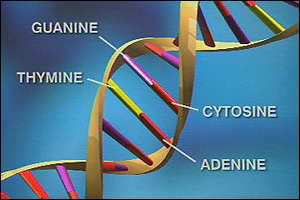
The smallest units of DNA are made up of 4 base nucleotides, DNA words, that are represented by the following letters:

A = Adenine
C = Cytosine
G = Guanine
T = Thymine

TACG

These nucleotides combine in pairs to form the ladder rungs of DNA, shown right that connect the helix backbones.  T typically combines with A and C usually combines with G, reaching between the backbones of the double helix to connect with their companion protein in the center.

You don’t need to remember the words or even the letters, just remember that we are looking for pattern matches of segments of DNA.

Point Mutations

Your DNA when represented on paper looks like a string of beads where there are 4 kinds of beads, each representing one of the nucleotides above.  One segment of your DNA might look like this:

Indel example 1

If this is what the standard or reference sequence for your haplotype (your personal DNA results) or your family haplogroup (ancestral clan) looks like, then a mutation would be defined as any change, addition, or deletion.  A change would be if the first A above were to change to T or G or C as in the example below:

Indel example 2

A deletion would be noticed if the leading A were simply gone.

Indel example 3

An addition of course would be if a new bead were inserted in the sequence at that location.

Indel example 4

All of the above changes involve only one location.  These are all known as Point Mutations, because they occur at one single point.

SNPs

A point mutation may or may not be a SNP.  A SNP is defined by geneticists as a point mutation that is found in more than 1% of the population.  This should tell you right away that when we say “we’ve discovered a new SNP,” we’re really mis-applying that term, because until we determine that the frequency which it is found in the population is over the 1% threshold, it really isn’t a SNP, but is still considered a point mutation or binary polymorphism.

Today, when SNPS, or point mutations are discovered, they are considered “private mutations” or “family mutations.”  There has been consternation for some time about how to handle these types of situations.  ISOGG has set forth their criteria on their website.  They currently have the most comprehensive tree, but they certainly have their work cut out for them with the incoming tsunami of new SNPS that will be discovered utilizing these next generation tests, hundreds of which are currently in process.

STRs

A STR, or Short Tandem Repeat is analogous to a genetic stutter, or the copy machine getting stuck.  In the same situation as above, utilizing the same base for comparison, we see a group of inserted nucleotides that are all duplicates of each other.

STR example

In this case, we have a short tandem repeat that is 4 segments in length meaning that CT is inserted 4 times.  To translate, if this is marker DYS marker 390, you have a value of 5, meaning 5 repeats of CT.

So I’ve been fat and happy with this now for years, well over a decade.

The Monkey Wrench

And then I saw this:

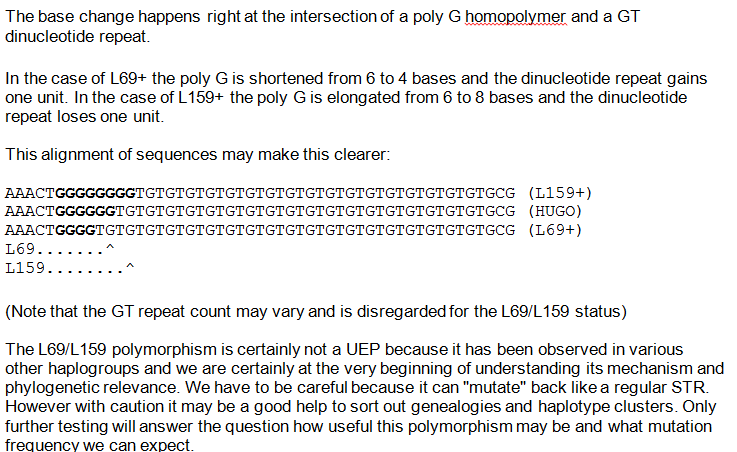
“The L69/L159 polymorphism is essentially a SNP/STR oxymoron.”

To the best of my knowledge, this is impossible – one type of mutation excludes the other.  I googled about this topic and found nothing, nor did I find additional discussion of L69, other than this.

L69 verbiage

My first reaction to this was “that’s impossible,” followed by “Bloody Hell,” and my next reaction was to find someone who knew.

I reached out to Dr. David Mittelman, geneticist and Chief Scientific Officer at Gene by Gene, parent company of Family Tree DNA.  I asked him about the SNP/STR oxymoron and he said:

“This is impossible. There is no such thing as a SNP/STR.”

Whew!  I must say, I’m relieved.  I thought there for a minute there I had lost my mind.

I asked him what is really going on in this sequence, and he replied that, “This would be a complex variant — when multiple things are happening at once.”

Now, that I understand.  I have children, and grandchildren – I fully understand multiple things happening at once.  Let’s break this example apart and take a look at what is really happening.

HUGO is a reference standard, so let’s start there as our basis for comparison.

HUGO variant 1

In the L69 variant we have the following sequence.

HUGO variant 2

We see two distinct things happening in this sequence.  First, we have the deletion of two Gs, and secondly, we have the insertion of one additional TG.  According to Dr. Mittelman, both of these events are STRs, multiple insertions or deletions, and neither are point mutations or SNPs, so neither of these should really have SNP names, they should have STR type of names.

Let’s look at the L159 variant.

HUGO variant 3

In this case, we have the GG insertion and then we have a TG deletion.

In both cases, L69 and L159, the actual length of the DNA sequence remains the same as the reference, but the contents are different.  Both had 2 nucleotides removed and 2 added.

The good news is, as a consumer, that you don’t really need to know this, not at this level.  The even better news is that with the new discoveries forthcoming, whether they be STRs or SNPs, at the leafy end of the branch, they are often now overlapping with SNPs becoming much more genealogically useful.  In the past, if you were looking at a genetics mutation timeline, you had STRs that covered current to 1000 years, then nothing, then beginning at 5,000 or 10,000 years, you have SNPs that were haplogroup defining.

That gap has been steadily shrinking, and today, there often is no gap, the chasm is gone, and we’re discovering freshly hatched recently-occurring SNPs on a daily basis.

The day is fast approaching when you’ll want the full Y sequence, not to further define your haplogroup, but to further delineate your genealogy lines.  You’ll have two tools to do that, SNPs and STRs both, not just one.

______________________________________________________________

Disclosure

I receive a small contribution when you click on some of the links to vendors in my articles. This does NOT increase the price you pay but helps me to keep the lights on and this informational blog free for everyone. Please click on the links in the articles or to the vendors below if you are purchasing products or DNA testing.

Thank you so much.

DNA Purchases and Free Transfers

Genealogy Services

Genealogy Research

2013’s Dynamic Dozen – Top Genetic Genealogy Happenings

dna 8 ball

Last year I wrote a column at the end of the year titled  “2012 Top 10 Genetic Genealogy Happenings.”  It’s amazing the changes in this industry in just one year.  It certainly makes me wonder what the landscape a year from now will look like.

I’ve done the same thing this year, except we have a dozen.  I couldn’t whittle it down to 10, partly because there has been so much more going on and so much change – or in the case of Ancestry, who is noteworthy because they had so little positive movement.

If I were to characterize this year of genetic genealogy, I would call it The Year of the SNP, because that applies to both Y DNA and autosomal.  Maybe I’d call it The Legal SNP, because it is also the year of law, court decisions, lawsuits and FDA intervention.  To say it has been interesting is like calling the Eiffel Tower an oversized coat hanger.

I’ll say one thing…it has kept those of us who work and play in this industry hopping busy!  I guarantee you, the words “I’m bored” have come out of the mouth of no one in this industry this past year.

I’ve put these events in what I consider to be relatively accurate order.  We could debate all day about whether the SNP Tsunami or the 23andMe mess is more important or relevant – and there would be lots of arguing points and counterpoints…see…I told you lawyers were involved….but in reality, we don’t know yet, and in the end….it doesn’t matter what order they are in on the list:)

Y Chromosome SNP Tsunami Begins

The SNP tsumani began as a ripple a few years ago with the introduction at Family Tree DNA of the Walk the Y program in 2007.  This was an intensively manual process of SNP discovery, but it was effective.

By the time that the Geno 2.0 chip was introduced in 2012, 12,000+ SNPs would be included on that chip, including many that were always presumed to be equivalent and not regularly tested.  However, the Nat Geo chip tested them and indeed, the Y tree became massively shuffled.  The resolution to this tree shuffling hasn’t yet come out in the wash.  Family Tree DNA can’t really update their Y tree until a publication comes out with the new tree defined.  That publication has been discussed and anticipated for some time now, but it has yet to materialize.  In the mean time, the volunteers who maintain the ISOGG tree are swamped, to say the least.

Another similar test is the Chromo2 introduced this year by Britain’s DNA which scans 15,000 SNPs, many of them S SNPs not on the tree nor academically published, adding to the difficulty of figuring out where they fit on the Y tree.  While there are some very happy campers with their Chromo2 results, there is also a great deal of sloppy science, reporting and interpretation of “facts” through this company.  Kind of like Jekyll and Hyde.  See the Sloppy Science section.

But Walk the Y, Chromo2 and Geno 2.0, are only the tip of the iceburg.  The new “full Y” sequencing tests brought into the marketspace quietly in early 2013 by Full Genomes and then with a bang by Family Tree DNA with the their Big Y in November promise to revolutionize what we know about the Y chromosome by discovering thousands of previously unknown SNPs.  This will in effect swamp the Y tree whose branches we thought were already pretty robust, with thousands and thousands of leaves.

In essence, the promise of the “fully” sequenced Y is that what we might term personal or family SNPs will make SNP testing as useful as STR testing and give us yet another genealogy tool with which to separate various lines of one genetic family and to ratchet down on the time that the most common recent ancestor lived.

http://dna-explained.com/2013/03/31/new-y-dna-haplogroup-naming-convention/

http://dna-explained.com/2013/11/10/family-tree-dna-announces-the-big-y/

http://dna-explained.com/2013/11/16/what-about-the-big-y/

http://www.yourgeneticgenealogist.com/2013/11/first-look-at-full-genomes-y-sequencing.html

http://cruwys.blogspot.com/2013/12/a-first-look-at-britainsdna-chromo-2-y.html

http://cruwys.blogspot.com/2013/11/yseqnet-new-company-offering-single-snp.html

http://cruwys.blogspot.com/2013/11/the-y-chromosome-sequence.html

http://cruwys.blogspot.com/2013/11/a-confusion-of-snps.html

http://cruwys.blogspot.com/2013/11/a-simplified-y-tree-and-common-standard.html

23andMe Comes Unraveled

The story of 23andMe began as the consummate American dotcom fairy tale, but sadly, has deteriorated into a saga with all of the components of a soap opera.  A wealthy wife starts what could be viewed as an upscale hobby business, followed by a messy divorce and a mystery run-in with the powerful overlording evil-step-mother FDA.  One of the founders of 23andMe is/was married to the founder of Google, so funding, at least initially wasn’t an issue, giving 23andMe the opportunity to make an unprecedented contribution in the genetic, health care and genetic genealogy world.

Another way of looking at this is that 23andMe is the epitome of the American Dream business, a startup, with altruism and good health, both thrown in for good measure, well intentioned, but poorly managed.  And as customers, be it for health or genealogy or both, we all bought into the altruistic “feel good” culture of helping find cures for dread diseases, like Parkinson’s, Alzheimer’s and cancer by contributing our DNA and responding to surveys.

The genetic genealogy community’s love affair with 23andMe began in 2009 when 23andMe started focusing on genealogy reporting for their tests, meaning cousin matches.  We, as a community, suddenly woke up and started ordering these tests in droves.  A few months later, Family Tree DNA also began offering this type of testing as well.  The defining difference being that 23andMe’s primary focus has always been on health and medical information with Family Tree DNA focused on genetic genealogy.  To 23andMe, the genetic genealogy community was an afterthought and genetic genealogy was just another marketing avenue to obtain more people for their health research data base.  For us, that wasn’t necessarily a bad thing.

For awhile, this love affair went along swimmingly, but then, in 2012, 23andMe obtained a patent for Parkinson’s Disease.  That act caused a lot of people to begin to question the corporate focus of 23andMe in the larger quagmire of the ethics of patenting genes as a whole.  Judy Russell, the Legal Genealogist, discussed this here.  It’s difficult to defend 23andMe’s Parkinson’s patent while flaying alive Myriad for their BRCA patent.  Was 23andMe really as altruistic as they would have us believe?

Personally, this event made me very nervous, but I withheld judgment.  But clearly, that was not the purpose for which I thought my DNA, and others, was being used.

But then came the Designer Baby patent in 2013.  This made me decidedly uncomfortable.  Yes, I know, some people said this really can’t be done, today, while others said that it’s being done anyway in some aspects…but the fact that this has been the corporate focus of 23andMe with their research, using our data, bothered me a great deal.  I have absolutely no issue with using this information to assure or select for healthy offspring – but I have a personal issue with technology to enable parents who would select a “beauty child,” one with blonde hair and blue eyes and who has the correct muscles to be a star athlete, or cheerleader, or whatever their vision of their as-yet-unconceived “perfect” child would be.  And clearly, based on 23andMe’s own patent submission, that is the focus of their patent.

Upon the issuance of the patent, 23andMe then said they have no intention of using it.  They did not say they won’t sell it.  This also makes absolutely no business sense, to focus valuable corporate resources on something you have no intention of using?  So either they weren’t being truthful, they lack effective management or they’ve changed their mind, but didn’t state such.

What came next, in late 2013 certainly points towards a lack of responsible management.

23andMe had been working with the FDA for approval the health and medical aspect of their product (which they were already providing to consumers prior to the November 22nd cease and desist order) for several years.  The FDA wants assurances that what 23andMe is telling consumers is accurate.  Based on the letter issued to 23andMe on November 22nd, and subsequent commentary, it appears that both entities were jointly working towards that common goal…until earlier this year when 23andMe mysteriously “somehow forgot” about the FDA, the information they owed them, their submissions, etc.  They also forgot their phone number and their e-mail addresses apparently as well, because the FDA said they had heard nothing from them in 6 months, which backdates to May of 2013.

It may be relevant that 23andMe added the executive position of President and filled it in June of 2013, and there was a lot of corporate housecleaning that went on at that time.  However, regardless of who got housecleaned, the responsibility for working with the FDA falls squarely on the shoulders of the founders, owners and executives of the company.  Period.  No excuses.  Something that critically important should be on the agenda of every executive management meeting.   Why?  In terms of corporate risk, this was obviously a very high risk item, perhaps the highest risk item, because the FDA can literally shut their doors and destroy them.  There is little they can do to control or affect the FDA situation, except to work with the FDA, meet deadlines and engender goodwill and a spirit of cooperation.  The risk of not doing that is exactly what happened.

It’s unknown at this time if 23andMe is really that corporately arrogant to think they could simply ignore the FDA, or blatantly corporately negligent or maybe simply corporately stupid, but they surely betrayed the trust and confidence of their customers by failing to meet their commitments with and to the FDA, or even communicate with them.  I mean, really, what were they thinking?

There has been an outpouring of sympathy for 23andme and negative backlash towards the FDA for their letter forcing 23andMe to stop selling their offending medical product, meaning the health portion of their testing.  However, in reality, the FDA was only meting out the consequences that 23andMe asked for.  My teenage kids knew this would happen.  If you do what you’re not supposed to….X, Y and Z will, or won’t, happen.  It’s called accountability.  Just ask my son about his prom….he remembers vividly.  Now why my kids, or 23andMe, would push an authority figure to that point, knowing full well the consequences, utterly mystifies me.  It did when my son was a teenager and it does with 23andMe as well.

Some people think that the FDA is trying to stand between consumers and their health information.  I don’t think so, at least not in this case.  Why I think that is because the FDA left the raw data files alone and they left the genetic genealogy aspect alone.  The FDA knows full well you can download your raw data and for $5 process it at a third party site, obtaining health related genetic information.  The difference is that Promethease is not interpreting any data for you, only providing information.

There is some good news in this and that is that from a genetic genealogy perspective, we seem to be safe, at least for now, from government interference with the testing that has been so productive for genetic genealogy.  The FDA had the perfect opportunity to squish us like a bug (thanks to the opening provided by 23andMe,) and they didn’t.

The really frustrating aspect of this is that 23andMe was a company who, with their deep pockets in Silicon Valley and other investors, could actually afford to wage a fight with the FDA, if need be.  The other companies who received the original 2010 FDA letter all went elsewhere and focused on something else.  But 23andMe didn’t, they decided to fight the fight, and we all supported their decision.  But they let us all down.  The fight they are fighting now is not the battle we anticipated, but one brought upon themselves by their own negligence.  This battle didn’t have to happen, and it may impair them financially to such a degree that if they need to fight the big fight, they won’t be able to.

Right now, 23andMe is selling their kits, but only as an ancestry product as they work through whatever process they are working through with the FDA.  Unfortunately, 23andMe is currently having some difficulties where the majority of matches are disappearing from some testers records.  In other cases, segments that previously matched are disappearing.  One would think, with their only revenue stream for now being the genetic genealogy marketspace that they would be wearing kid gloves and being extremely careful, but apparently not.  They might even consider making some of the changes and enhancements we’ve requested for so long that have fallen on deaf ears.

One thing is for sure, it will be extremely interesting to see where 23andMe is this time next year.  The soap opera continues.

I hope for the sake of all of the health consumers, both current and (potentially) future, that this dotcom fairy tale has a happy ending.

Also, see the Autosomal DNA Comes of Age section.

http://dna-explained.com/2013/10/05/23andme-patents-technology-for-designer-babies/

http://www.thegeneticgenealogist.com/2013/10/07/a-new-patent-for-23andme-creates-controversy/

http://dna-explained.com/2013/11/13/genomics-law-review-discusses-designing-children/

http://www.thegeneticgenealogist.com/2013/06/11/andy-page-fills-new-president-position-at-23andme/

http://dna-explained.com/2013/11/25/fda-orders-23andme-to-discontinue-testing/

http://dna-explained.com/2013/11/26/now-what-23andme-and-the-fda/

http://dna-explained.com/2013/12/06/23andme-suspends-health-related-genetic-tests/

http://www.legalgenealogist.com/blog/2013/11/26/fooling-with-fda/

Supreme Court Decision – Genes Can’t Be Patented – Followed by Lawsuits

In a landmark decision, the Supreme Court determined that genes cannot be patented.  Myriad Genetics held patents on two BRCA genes that predisposed people to cancer.  The cost for the tests through Myriad was about $3000.  Six hours after the Supreme Court decision, Gene By Gene announced that same test for $995.  Other firms followed suit, and all were subsequently sued by Myriad for patent infringement.  I was shocked by this, but as one of my lawyer friends clearly pointed out, you can sue anyone for anything.  Making it stick is yet another matter.  Many firms settle to avoid long and very expensive legal battles.  Clearly, this issue is not yet resolved, although one would think a Supreme Court decision would be pretty definitive.  It potentially won’t be settled for a long time.

http://dna-explained.com/2013/06/13/supreme-court-decision-genes-cant-be-patented/

http://www.legalgenealogist.com/blog/2013/06/14/our-dna-cant-be-patented/

http://dna-explained.com/2013/09/07/message-from-bennett-greenspan-free-my-genes/

http://www.thegeneticgenealogist.com/2013/06/13/new-press-release-from-dnatraits-regarding-the-supreme-courts-holding-in-myriad/

http://www.legalgenealogist.com/blog/2013/08/18/testing-firms-land-counterpunch/

http://www.legalgenealogist.com/blog/2013/07/11/myriad-sues-genetic-testing-firms/

Gene By Gene Steps Up, Ramps Up and Produces

As 23andMe comes unraveled and Ancestry languishes in its mediocrity, Gene by Gene, the parent company of Family Tree DNA has stepped up to the plate, committed to do “whatever it takes,” ramped up the staff both through hiring and acquisitions, and is producing results.  This is, indeed, a breath of fresh air for genetic genealogists, as well as a welcome relief.

http://dna-explained.com/2013/08/07/gene-by-gene-acquires-arpeggi/

http://dna-explained.com/2013/12/05/family-tree-dna-listens-and-acts/

http://dna-explained.com/2013/12/10/family-tree-dnas-family-finder-match-matrix-released/

http://www.haplogroup.org/ftdna-family-finder-matches-get-new-look/

http://www.haplogroup.org/ftdna-family-finder-new-look-2/

http://www.haplogroup.org/ftdna-family-finder-matches-new-look-3/

Autosomal DNA Comes of Age

Autosomal DNA testing and analysis has simply exploded this past year.  More and more people are testing, in part, because Ancestry.com has a captive audience in their subscription data base and more than a quarter million of those subscribers have purchased autosomal DNA tests.  That’s a good thing, in general, but there are some negative aspects relative to Ancestry, which are in the Ancestry section.

Another boon to autosomal testing was the 23andMe push to obtain a million records.  Of course, the operative word here is “was” but that may revive when the FDA issue is resolved.  One of the down sides to the 23andMe data base, aside from the fact that it’s not genealogist friendly, is that so many people, about 90%, don’t communicate.  They aren’t interested in genealogy.

A third factor is that Family Tree DNA has provided transfer ability for files from both 23andMe and Ancestry into their data base.

Fourth is the site, GedMatch, at www.gedmatch.com which provides additional matching and admixture tools and the ability to match below thresholds set by the testing companies.  This is sometimes critically important, especially when comparing to known cousins who just don’t happen to match at the higher thresholds, for example.  Unfortunately, not enough people know about GedMatch, or are willing to download their files.  Also unfortunate is that GedMatch has struggled for the past few months to keep up with the demand placed on their site and resources.

A great deal of time this year has been spent by those of us in the education aspect of genetic genealogy, in whatever our capacity, teaching about how to utilize autosomal results. It’s not necessarily straightforward.  For example, I wrote a 9 part series titled “The Autosomal Me” which detailed how to utilize chromosome mapping for finding minority ethnic admixture, which was, in my case, both Native and African American.

As the year ends, we have Family Tree DNA, 23andMe and Ancestry who offer the autosomal test which includes the relative-matching aspect.  Fortunately, we also have third party tools like www.GedMatch.com and www.DNAGedcom.com, without which we would be significantly hamstrung.  In the case of DNAGedcom, we would be unable to perform chromosome segment matching and triangulation with 23andMe data without Rob Warthen’s invaluable tool.

http://dna-explained.com/2013/06/21/triangulation-for-autosomal-dna/

http://dna-explained.com/2013/07/13/combining-tools-autosomal-plus-y-dna-mtdna-and-the-x-chromosome/

http://dna-explained.com/2013/07/26/family-tree-dna-levels-the-playing-field-sort-of/

http://dna-explained.com/2013/08/03/kitty-coopers-chromsome-mapping-tool-released/

http://dna-explained.com/2013/09/29/why-dont-i-match-my-cousin/

http://dna-explained.com/2013/10/03/family-tree-dna-updates-family-finder-and-adds-triangulation/

http://dna-explained.com/2013/10/21/why-are-my-predicted-cousin-relationships-wrong/

http://dna-explained.com/2013/12/05/family-tree-dna-listens-and-acts/

http://dna-explained.com/2013/12/09/chromosome-mapping-aka-ancestor-mapping/

http://dna-explained.com/2013/12/10/family-tree-dnas-family-finder-match-matrix-released/

http://dna-explained.com/2013/12/15/one-chromosome-two-sides-no-zipper-icw-and-the-matrix/

http://dna-explained.com/2013/06/02/the-autosomal-me-summary-and-pdf-file/

DNAGedcom – Indispensable Third Party Tool

While this tool, www.dnagedcom.com, falls into the Autosomal grouping, I have separated it out for individual mention because without this tool, the progress made this year in autosomal DNA ancestor and chromosomal mapping would have been impossible.  Family Tree DNA has always provided segment matching boundaries through their chromosome browser tool, but until recently, you could only download 5 matches at a time.  This is no longer the case, but for most of the year, Rob’s tool saved us massive amounts of time.

23andMe does not provide those chromosome boundaries, but utilizing Rob’s tool, you can obtain each of your matches in one download, and then you can obtain the list of who your matches match that is also on your match list by requesting each of those files separately.  Multiple steps?  Yes, but it’s the only way to obtain this information, and chromosome mapping without the segment data is impossible

A special hats off to Rob.  Please remember that Rob’s site is free, meaning it’s donation based.  So, please donate if you use the tool.

http://www.yourgeneticgenealogist.com/2013/01/brought-to-you-by-adoptiondna.html

I covered www.Gedmatch.com in the “Best of 2012” list, but they have struggled this year, beginning when Ancestry announced that raw data file downloads were available.  GedMatch consists of two individuals, volunteers, who are still struggling to keep up with the required processing and the tools.  They too are donation based, so don’t forget about them if you utilize their tools.

Ancestry – How Great Thou Aren’t

Ancestry is only on this list because of what they haven’t done.  When they initially introduced their autosomal product, they didn’t have any search capability, they didn’t have a chromosome browser and they didn’t have raw data file download capability, all of which their competitors had upon first release.  All they did have was a list of your matches, with their trees listed, with shakey leaves if you shared a common ancestor on your tree.  The implication, was, and is, of course, that if you have a DNA match and a shakey leaf, that IS your link, your genetic link, to each other.  Unfortunately, that is NOT the case, as CeCe Moore documented in her blog from Rootstech (starting just below the pictures) as an illustration of WHY we so desperately need a chromosome browser tool.

In a nutshell, Ancestry showed the wrong shakey leaf as the DNA connection – as proven by the fact that both of CeCe’s parents have tested at Ancestry and the shakey leaf person doesn’t match the requisite parent.  And there wasn’t just one, not two, but three instances of this.  What this means is, of course, that the DNA match and the shakey leaf match are entirely independent of each other.  In fact, you could have several common ancestors, but the DNA at any particular location comes only from one on either Mom or Dad’s side – any maybe not even the shakey leaf person.

So what Ancestry customers are receiving is a list of people they match and possible links, but most of them have no idea that this is the case, and blissfully believe they have found their genetic connection.  They have found a genealogical cousin, and it MIGHT be the genetic connection.  But then again, they could have found that cousin simply by searching for the same ancestor in Ancestry’s data base.  No DNA needed.

Ancestry has added a search feature, allowed raw data file downloads (thank you) and they have updated their ethnicity predictions.  The ethnicity predictions are certainly different, dramatically different, but equally as unrealistic.  See the Ethnicity Makeovers section for more on this.  The search function helps, but what we really need is the chromosome browser, which they have steadfastly avoided promising.  Instead, they have said that they will give us “something better,” but nothing has materialized.

I want to take this opportunity, to say, as loudly as possible, that TRUST ME IS NOT ACCEPTABLE in any way, shape or form when it comes to genetic matching.  I’m not sure what Ancestry has in mind by the way of “better,” but it if it’s anything like the mediocrity with which their existing DNA products have been rolled out, neither I nor any other serious genetic genealogist will be interested, satisfied or placated.

Regardless, it’s been nearly 2 years now.  Ancestry has the funds to do development.  They are not a small company.  This is obviously not a priority because they don’t need to develop this feature.  Why is this?  Because they can continue to sell tests and to give shakey leaves to customers, most of whom don’t understand the subtle “untruth” inherent in that leaf match – so are quite blissfully happy.

In years past, I worked in the computer industry when IBM was the Big Dog against whom everyone else competed.  I’m reminded of an old joke.  The IBM sales rep got married, and on his wedding night, he sat on the edge of the bed all night long regaling his bride in glorious detail with stories about just how good it was going to be….

You can sign a petition asking Ancestry to provide a chromosome browser here, and you can submit your request directly to Ancestry as well, although to date, this has not been effective.

The most frustrating aspect of this situation is that Ancestry, with their plethora of trees, savvy marketing and captive audience testers really was positioned to “do it right,” and hasn’t, at least not yet.  They seem to be more interested in selling kits and providing shakey leaves that are misleading in terms of what they mean than providing true tools.  One wonders if they are afraid that their customers will be “less happy” when they discover the truth and not developing a chromosome browser is a way to keep their customers blissfully in the dark.

http://dna-explained.com/2013/03/21/downloading-ancestrys-autosomal-dna-raw-data-file/

http://dna-explained.com/2013/03/24/ancestry-needs-another-push-chromosome-browser/

http://dna-explained.com/2013/10/17/ancestrys-updated-v2-ethnicity-summary/

http://www.thegeneticgenealogist.com/2013/06/21/new-search-features-at-ancestrydna-and-a-sneak-peek-at-new-ethnicity-estimates/

http://www.yourgeneticgenealogist.com/2013/03/ancestrydna-raw-data-and-rootstech.html

http://www.legalgenealogist.com/blog/2013/09/15/dna-disappointment/

http://www.legalgenealogist.com/blog/2013/09/13/ancestrydna-begins-rollout-of-update/

Ancient DNA

This has been a huge year for advances in sequencing ancient DNA, something once thought unachievable.  We have learned a great deal, and there are many more skeletal remains just begging to be sequenced.  One absolutely fascinating find is that all people not African (and some who are African through backmigration) carry Neanderthal and Denisovan DNA.  Just this week, evidence of yet another archaic hominid line has been found in Neanderthal DNA and on Christmas Day, yet another article stating that type 2 Diabetes found in Native Americans has roots in their Neanderthal ancestors. Wow!

Closer to home, by several thousand years is the suggestion that haplogroup R did not exist in Europe after the ice age, and only later, replaced most of the population which, for males, appears to have been primarily haplogroup G.  It will be very interesting as the data bases of fully sequenced skeletons are built and compared.  The history of our ancestors is held in those precious bones.

http://dna-explained.com/2013/01/10/decoding-and-rethinking-neanderthals/

http://dna-explained.com/2013/07/04/ancient-dna-analysis-from-canada/

http://dna-explained.com/2013/07/10/5500-year-old-grandmother-found-using-dna/

http://dna-explained.com/2013/10/25/ancestor-of-native-americans-in-asia-was-30-western-eurasian/

http://dna-explained.com/2013/11/12/2013-family-tree-dna-conference-day-2/

http://dna-explained.com/2013/11/22/native-american-gene-flow-europe-asia-and-the-americas/

http://dna-explained.com/2013/12/05/400000-year-old-dna-from-spain-sequenced/

http://www.thegeneticgenealogist.com/2013/10/16/identifying-otzi-the-icemans-relatives/

http://cruwys.blogspot.com/2013/12/recordings-of-royal-societys-ancient.html

http://cruwys.blogspot.com/2013/02/richard-iii-king-is-found.html

http://dna-explained.com/2013/12/22/sequencing-of-neanderthal-toe-bone-reveals-unknown-hominin-line/

http://dna-explained.com/2013/12/26/native-americans-neanderthal-and-denisova-admixture/

http://dienekes.blogspot.com/2013/12/ancient-dna-what-2013-has-brought.html

Sloppy Science and Sensationalist Reporting

Unfortunately, as DNA becomes more mainstream, it becomes a target for both sloppy science or intentional misinterpretation, and possibly both.  Unfortunately, without academic publication, we can’t see results or have the sense of security that comes from the peer review process, so we don’t know if the science and conclusions stand up to muster.

The race to the buck in some instances is the catalyst for this. In other cases, and not in the links below, some people intentionally skew interpretations and results in order to either fulfill their own belief agenda or to sell “products and services” that invariably report specific findings.

It’s equally as unfortunate that much of these misconstrued and sensationalized results are coming from a testing company that goes by the names of BritainsDNA, ScotlandsDNA, IrelandsDNA and YorkshiresDNA. It certainly does nothing for their credibility in the eyes of people who are familiar with the topics at hand, but it does garner a lot of press and probably sells a lot of kits to the unwary.

I hope they publish their findings so we can remove the “sloppy science” aspect of this.  Sensationalist reporting, while irritating, can be dealt with if the science is sound.  However, until the results are published in a peer-reviewed academic journal, we have no way of knowing.

Thankfully, Debbie Kennett has been keeping her thumb on this situation, occurring primarily in the British Isles.

http://dna-explained.com/2013/08/24/you-might-be-a-pict-if/

http://cruwys.blogspot.com/2013/12/the-british-genetic-muddle-by-alistair.html

http://cruwys.blogspot.com/2013/12/setting-record-straight-about-sara.html

http://cruwys.blogspot.com/2013/09/private-eye-on-britainsdna.html

http://cruwys.blogspot.com/2013/07/private-eye-on-prince-williams-indian.html

http://cruwys.blogspot.com/2013/06/britainsdna-times-and-prince-william.html

http://cruwys.blogspot.com/2013/03/sense-about-genealogical-dna-testing.html

http://cruwys.blogspot.com/2013/03/sense-about-genetic-ancestry-testing.html

Citizen Science is Coming of Age

Citizen science has been slowing coming of age over the past few years.  By this, I mean when citizen scientists work as part of a team on a significant discovery or paper.  Bill Hurst comes to mind with his work with Dr. Doron Behar on his paper, A Copernican Reassessment of the Human Mitochondrial DNA from its Root or what know as the RSRS model.  As the years have progressed, more and more discoveries have been made or assisted by citizen scientists, sometimes through our projects and other times through individual research.  JOGG, the Journal of Genetic Genealogy, which is currently on hiatus waiting for Dr. Turi King, the new editor, to become available, was a great avenue for peer reviewed publication.  Recently, research projects have been set up by citizen scientists, sometimes crowd-funded, for specific areas of research.  This is a very new aspect to scientific research, and one not before utilized.

The first paper below includes the Family Tree DNA Lab, Thomas and Astrid Krahn, then with Family Tree DNA and Bonnie Schrack, genetic genealogist and citizen scientist, along with Dr. Michael Hammer from the University of Arizona and others.

http://dna-explained.com/2013/03/26/family-tree-dna-research-center-facilitates-discovery-of-ancient-root-to-y-tree/

http://dna-explained.com/2013/04/10/diy-dna-analysis-genomeweb-and-citizen-scientist-2-0/

http://dna-explained.com/2013/06/27/big-news-probable-native-american-haplogroup-breakthrough/

http://dna-explained.com/2013/07/22/citizen-science-strikes-again-this-time-in-cameroon/

http://dna-explained.com/2013/11/30/native-american-haplogroups-q-c-and-the-big-y-test/

http://www.yourgeneticgenealogist.com/2013/03/citizen-science-helps-to-rewrite-y.html

Ethnicity Makeovers – Still Not Soup

Unfortunately, ethnicity percentages, as provided by the major testing companies still disappoint more than thrill, at least for those who have either tested at more than one lab or who pretty well know their ethnicity via an extensive pedigree chart.

Ancestry.com is by far the worse example, swinging like a pendulum from one extreme to the other.  But I have to hand it to them, their marketing is amazing.  When I signed in, about to discover that my results had literally almost reversed, I was greeted with the banner “a new you.”  Yea, a new me, based on Ancestry’s erroneous interpretation.  And by reversed, I’m serious.  I went from 80% British Isles to 6% and then from 0% Western Europe to 79%. So now, I have an old wrong one and a new wrong one – and indeed they are very different.  Of course, neither one is correct…..but those are just pesky details…

23andMe updated their ethnicity product this year as well, and fine tuned it yet another time.  My results at 23andMe are relatively accurate.  I saw very little change, but others saw more.  Some were pleased, some not.

The bottom line is that ethnicity tools are not well understood by consumers in terms of the timeframe that is being revealed, and it’s not consistent between vendors, nor are the results.  In some cases, they are flat out wrong, as with Ancestry, and can be proven.  This does not engender a great deal of confidence.  I only view these results as “interesting” or utilize them in very specific situations and then only using the individual admixture tools at www.Gedmatch.com on individual chromosome segments.

As Judy Russell says, “it’s not soup yet.”  That doesn’t mean it’s not interesting though, so long as you understand the difference between interesting and gospel.

http://dna-explained.com/2013/08/05/autosomal-dna-ancient-ancestors-ethnicity-and-the-dandelion/

http://dna-explained.com/2013/10/04/ethnicity-results-true-or-not/

http://www.legalgenealogist.com/blog/2013/09/15/dna-disappointment/

http://cruwys.blogspot.com/2013/09/my-updated-ethnicity-results-from.html?utm_source=feedburner&utm_medium=email&utm_campaign=Feed%3A+Cruwysnews+%28Cruwys+news%29

http://dna-explained.com/2013/10/17/ancestrys-updated-v2-ethnicity-summary/

http://dna-explained.com/2013/10/19/determining-ethnicity-percentages/

http://www.thegeneticgenealogist.com/2013/09/12/ancestrydna-launches-new-ethnicity-estimate/

http://cruwys.blogspot.com/2013/12/a-first-look-at-chromo-2-all-my.html

Genetic Genealogy Education Goes Mainstream

With the explosion of genetic genealogy testing, as one might expect, the demand for education, and in particular, basic education has exploded as well.

I’ve written a 101 series, Kelly Wheaton wrote a series of lessons and CeCe Moore did as well.  Recently Family Tree DNA has also sponsored a series of free Webinars.  I know that at least one book is in process and very near publication, hopefully right after the first of the year.  We saw several conferences this year that provided a focus on Genetic Genealogy and I know several are planned for 2014.  Genetic genealogy is going mainstream!!!  Let’s hope that 2014 is equally as successful and that all these folks asking for training and education become avid genetic genealogists.

http://dna-explained.com/2013/08/10/ngs-series-on-dna-basics-all-4-parts/

https://sites.google.com/site/wheatonsurname/home

http://www.yourgeneticgenealogist.com/2012/08/getting-started-in-dna-testing-for.html

http://dna-explained.com/2013/12/17/free-webinars-from-family-tree-dna/

http://www.thegeneticgenealogist.com/2013/06/09/the-first-dna-day-at-the-southern-california-genealogy-society-jamboree/

http://www.yourgeneticgenealogist.com/2013/06/the-first-ever-independent-genetic.html

http://cruwys.blogspot.com/2013/10/genetic-genealogy-comes-to-ireland.html

http://cruwys.blogspot.com/2013/03/wdytya-live-day-3-part-2-new-ancient.html

http://cruwys.blogspot.com/2013/03/who-do-you-think-you-are-live-day-3.html

http://cruwys.blogspot.com/2013/03/who-do-you-think-you-are-live-2013-days.html

http://genealem-geneticgenealogy.blogspot.com/2013/03/the-surnames-handbook-guide-to-family.html

http://www.isogg.org/wiki/Beginners%27_guides_to_genetic_genealogy

A Thank You in Closing

I want to close by taking a minute to thank the thousands of volunteers who make such a difference.  All of the project administrators at Family Tree DNA are volunteers, and according to their website, there are 7829 projects, all of which have at least one administrator, and many have multiple administrators.  In addition, everyone who answers questions on a list or board or on Facebook is a volunteer.  Many donate their time to coordinate events, groups, or moderate online facilities.  Many speak at events or for groups.  Many more write articles for publications from blogs to family newsletters.  Additionally, there are countless websites today that include DNA results…all created and run by volunteers, not the least of which is the ISOGG site with the invaluable ISOGG wiki.  Without our volunteer army, there would be no genetic genealogy community.  Thank you, one and all.

2013 has been a banner year, and 2014 holds a great deal of promise, even without any surprises.  And if there is one thing this industry is well known for….it’s surprises.  I can’t wait to see what 2014 has in store for us!!!  All I can say is hold on tight….

______________________________________________________________

Disclosure

I receive a small contribution when you click on some of the links to vendors in my articles. This does NOT increase the price you pay but helps me to keep the lights on and this informational blog free for everyone. Please click on the links in the articles or to the vendors below if you are purchasing products or DNA testing.

Thank you so much.

DNA Purchases and Free Transfers

Genealogy Services

Genealogy Research

Native American Haplogroups Q, C and the Big Y Test

Sicangu man c 1900I’m writing this to provide an update about Native American paternal research, and to ask for your help and support, but first, let me tell you why.  It’s a very exciting time.

If you don’t want the details, but you know you want to help now….and we have to pay for these tests by the end of the day December 1 to take advantage of the sale price…you can click below to help fund the Big Y testing for Native American haplogroups Q and C.  Both projects need approximately $990.  Everything contributed goes directly to testing.

To donate to the American Indian project, in memory of someone, a family member perhaps, or maybe in honor of an ancestor, or anonymously, click this link:

https://www.familytreedna.com/group-general-fund-contribution.aspx?g=AIP

In order to donate to haplogroup C-P39 project, please click this link:

http://www.familytreedna.com/group-general-fund-contribution.aspx?g=Y-DNAC-P39

Now for the story…

As many of you know, haplogroup Q and C are the two Native American male haplogroups.  To date, every individual with direct paternal Native American ancestors descends from a subgroup of either haplogroup Q or C, Q being by far the most prevalent.  Both of these haplogroups are also found to some extent in Asia and Europe, but there are distinct and specific lineages found in the Americas that represent only Native Americans.  These subgroups are not found in either Europe or Asia.

In December, 2010, we found the first SNP (single nucleotide polymorphism) marker that separated the European and the Native American subclades of haplogroup Q.  Since that time, additional markers have been found through the Walk the Y program and other research.

How did this happen?  A collaborative research approach between individual testers and project administrators.  In this case, Lenny Trujillo was a member of the haplogroup Q project and he agreed to take the WTY (Walk the Y) test, which indeed, discovered a very unique SNP marker that defines Native American haplogroup Q, as opposed to European haplogroup Q.

Much has changed in three years.  The WTY test which was focused solely on research is entirely obsolete, being replaced by a new much more powerful test called the Big Y, and at a reduced cost.  The Big Y sequences a much larger portion of the Y chromosome, which will allow us to discover even more markers.

Why is this important?  Because today, in haplogroups Q and C, we are learning through standard STR (short tandem repeat) surname marker tests who is related to whom, and how distantly, but it’s not enough.  For example, we have a group of haplogroup Q men in Canada who match each other, but then another group with a different SNP marker that is located in the Southwest, Mexico, and then in the North Carolina/Virginia border area.  Oh yes, and one more from Charleston, SC.  Most Native American men who carry haplogroup C are found in Northeastern Canada….but then there is one in the Southwest. What do these people have in common?  Is their relationship “old” or relative new?  Do they perhaps share a common historical language group?  We don’t know, and we’d like to.  In order to do that, we need to further refine their genetic relationship.  Hence, the new tool, the Big Y.

The Big Y sequences almost all of the Y chromosome – over 10 million base pairs and nearly 25,000 known SNPs.  But the good news is that the Big Y, like its predecessor, the WTY, has the ability to find new SNPs.  And they are being found by the buckets – so fast that the haplogroup trees can’t even keep up.  For example, the haplogroup project page still lists most Native people as Q1a3a, but in reality many new SNPs have been discovered.

That’s the good news – that the Big Y represents a huge research opportunity for us to make major discoveries that may well divide the Native groups in the Haplogroup C and Q projects into either language groups, or maybe, if we are lucky, into tribal “confederacies,” for lack of a better word.  I hate to use the word tribes, because the definition of a tribe has changed so much.  What we would like to be able to do it to tell someone from their test results that they are Iroquoian, for example, or Athabascan, or Siouian.  This has been our overarching goal for years, and now we’re actually getting close.  That potential rests with the Big Y.

The bad news is that the test costs $495, and that’s the sale price good only through Dec. 1., and we need funding.  In the haplogroup Q project, we do have a few people who are testing.  Everyone who did the WTY has been sent a $50 coupon to apply towards the Big Y test.  I hope everyone who did do the WTY will indeed order the Big Y as well.  If not, then the coupon can be donated to us, as project administrators, to apply towards the Big Y test of someone else in the group who is testing.  If you’re not going to test, please donate your coupon.

In haplogroup Q, we have two additional men who we desperately want to take the Big Y test, and 2 in haplogroup C as well.  We’re asking for two things.  First, for unused $50 coupons and second, for contributions against the $495 price.  We’d certainly welcome large contributions, or a sponsor for an entire test, but we’d also welcome $5, $10, $25 or whatever you’d like to contribute.  Every little bit helps.

To donate to the American Indian project and to help fund this critical research, click this link:

https://www.familytreedna.com/group-general-fund-contribution.aspx?g=AIP

In order to donate to haplogroup C-P39 project for this research, please click this link:

http://www.familytreedna.com/group-general-fund-contribution.aspx?g=Y-DNAC-P39

Thank you everyone, in advance, for your help.  We can’t do this without you.  This is what collaborative citizen science is all about.  Of course, we’ll report findings as we receive them and can process the information.

______________________________________________________________

Disclosure

I receive a small contribution when you click on some of the links to vendors in my articles. This does NOT increase the price you pay but helps me to keep the lights on and this informational blog free for everyone. Please click on the links in the articles or to the vendors below if you are purchasing products or DNA testing.

Thank you so much.

DNA Purchases and Free Transfers

Genealogy Services

Genealogy Research