Triangulation in Action at DNAPainter

Recently, I published the article, Hitting a Genealogy Home Run Using Your Double-Sided Two-Faced Chromosomes While Avoiding Imposters. The “Home Run” article explains why you want to use a chromosome browser, what you’re seeing and what it means to you.

This article, and the rest in the “Triangulation in Action” series introduces triangulation at FamilyTreeDNA, MyHeritage, 23andMe, GedMatch and DNAPainter, explaining how to use triangulation to confirm descent from a common ancestor. You may want to read the introductory article first.

This first section, “What is Triangulation” is a generic tutorial. If you don’t need the tutorial, skip to the “Transfers” or “Triangulation at DNAPainter” section.

What is Triangulation?

Think of triangulation as a three-legged stool – a triangle. Triangulation requires three things:

  1. At least three (not closely related) people must match
  2. On the same reasonably sized segment of DNA and
  3. Descend from a common ancestor

Triangulation is the foundation of confirming descent from a common ancestor, and thereby assigning a specific segment to that ancestor. Without triangulation, you might just have a match to someone else by chance. You can confirm mathematical triangulation, numbers 1 and 2, above, without knowing the identity of the common ancestor.

Reasonably sized segments are generally considered to be 7cM or above on chromosomes 1-22 and 15cM or above for the X chromosome.

Boundaries

Triangulation means that all three, or more, people much match on a common segment. However, what you’re likely to see is that some people don’t match on the entire segment, meaning more or less than others as demonstrated in the following examples.

FTDNA Triangulation boundaries

You can see that I match 5 different cousins who I know descend from my father’s side on chromosome 15 above. “I” am the grey background against which everyone else is being compared.

I triangulate with these matches in different ways, forming multiple triangulation groups that I’ve discussed individually, below.

Triangulation Group 1

FTDNA triangulation 1

Group 1 – On the left group of matches, above, I triangulate with the blue, red and orange person on the amount of DNA that is common between all of them, shown in the black box. This is triangulation group 1.

Triangulation Group 2

FTDNA triangulation 2

Group 2 – However, if you look just at the blue and orange triangulated matches bracketed in green, I triangulate on slightly more. This group excludes the red person because their beginning point is not the same, or even close. This is triangulation group 2.

Triangulation Group 3 and 4

FTDNA triang 3

Group 3 – In the right group of matches, there are two large triangulation groups. Triangulation group 3 includes the common portions of blue, red, teal and orange matches.

Group 4 – Triangulation group 4 is the skinny group at right and includes the common portion of the blue, teal and dark blue matches.

Triangulation Groups 5 and 6

FTDNA triang 5

Group 5 – There are also two more triangulation groups. The larger green bracketed group includes only the blue and teal people because their end locations are to the right of the end locations of the red and orange matches. This is triangulation group 5.

Group 6 – The smaller green bracketed group includes only the blue and teal person because their start locations are before the dark blue person. This is triangulation group 6.

There’s actually one more triangulation group. Can you see it?

Triangulation Group 7

FTDNA triang 7

Group 7 – The tan group includes the red, teal and orange matches but only the areas where they all overlap. This excludes the top blue match because their start location is different. Triangulation group 7 only extends to the end of the red and orange matches, because those are the same locations, while the teal match extends further to the right. That extension is excluded, of course.

Slight Variations

Matches with only slight start and end differences are probably descended from the same ancestor, but we can’t say that for sure (at this point) so we only include actual mathematically matching segments in a triangulation group.

You can see that triangulation groups often overlap because group members share more or less DNA with each other. Normally we don’t bother to number the groups – we just look at the alignment. I numbered them for illustration purposes.

Shared or In-Common-With Matching

Triangulation is not the same thing as a 3-way shared “in-common-with” match. You may share DNA with those two people, but on entirely different segments from entirely different ancestors. If those other two people match each other, it can be on a segment where you don’t match either of them, and thanks to an ancestor that they share who isn’t in your line at all. Shared matches are a great hint, especially in addition to other information, but shared matches don’t necessarily mean triangulation although it’s a great place to start looking.

I have shared matches where I match one person on my maternal side, one on my paternal side, and they match each other through a completely different ancestor on an entirely different segment. However, we don’t triangulate because we don’t all match each other on the SAME segment of DNA. Yes, it can be confusing.

Just remember, each of your segments, and matches, has its own individual history.

Imputation Can Affect Matching

Over the years the chips on which our DNA is processed at the vendors have changed. Each new generation of chips tests a different number of markers, and sometimes different markers – with the overlaps between the entire suite of chips being less than optimal.

I can verify that most vendors use imputation to level the playing field, and even though two vendors have never verified that fact, I’m relatively certain that they all do. That’s the only way they could match to their own prior “only somewhat compatible” chip versions.

The net-net of this is that you may see some differences in matching segments at different vendors, even when you’re comparing the same people. Imputation generally “fills in the blanks,” but doesn’t create large swatches of non-existent DNA. I wrote about the concept of imputation here.

What I’d like for you to take away from this discussion is to be focused on the big picture – if and how people triangulate which is the function important to genealogy. Not if the start and end segments are exactly the same.

Triangulation Solutions

All vendors except Ancestry offer some type of triangulation.

If you and your Ancestry matches have uploaded to GedMatch, Family Tree DNA or MyHeritage, you can triangulate with them there. Otherwise, you can’t triangulate Ancestry results, so encourage your Ancestry matches to transfer.

I wrote more specifically about triangulation here and here.

Transfer your results in order to obtain the maximum number of matches possible. Every vendor has people in their data base that haven’t tested elsewhere.

Transfers

Have you tested family members, especially everyone in the older generations? You can transfer their kits from Ancestry or 23andMe if they’ve tested there to FamilyTreeDNA, MyHeritage and GedMatch.

Here’s how to transfer:

Now that we’ve reviewed triangulation at each vendor; FamilyTreeDNA, MyHeritage, 23andMe and GedMatch, let’s looking at utilizing triangulation at DNAPainter.

Triangulation at DNAPainter

Once you identify your ancestral segments with matches, or using triangulation, you can paint them on your maternal or paternal chromosomes utilizing DNAPainter.

The great aspect of DNAPainter is that you don’t have to triangulate in order to use DNAPainter. Just identifying matches as maternal or paternal allows you to visually see where on your maternal or paternal chromosomes your matches fall, in essence triangulating groups for you.

DNAPainter assigns colors to each ancestor and shows your match names, which I’ve disabled in this example for privacy. I’ve also optionally painted my ethnicity segments from 23andMe, which I discussed in this article.

Triangulation DNAPainter chr 22.png

Above, on chromosome 22, I’ve painted matches that I know descend from either my mother’s (pink) or father’s (blue) side. At DNAPainter, I DO have both a maternal and paternal chromosome, but they are only useful AFTER I figure out which side of my family a match comes from, or if I paint my Family Matching bucketed maternal and paternal matches in an upload file from Family Tree DNA. I wrote instructions for how to do that, here. The combination of Family Matching and DNAPainter is awesome!

Looking at the graphic above, I know that three separate people who match me descend from the bright pink ancestor on my maternal chromosome; Curtis Lore and his wife. I’ve assigned Curtis the bright pink color, and now every match that I paint assigned to Curtis and his wife is colored pink.

One person descends from Curtis’s parents, Anthony Lore and his wife Rachel Hill who I’ve assigned as green.

Until someone else matches me and descends either from Anthony Lore’s parents or Rachel Hill’s parents on this green segment, I won’t know which of those two ancestors, or both, provided (pieces of) that segment to me.

Anthony Lore and Rachel Hill are my great-great-grandparents and Curtis Lore is their son. Even if I only have 2 matches on this segment, one pink and one green, I would know that the green portion of my maternal chromosome 22 is attributed to Anthony and Rachel which means I inherited that green segment from my pink ancestor, Curtis Lore.

In order to determine the source of the two pink triangulated matches at far right, I’ll need to wait until someone from either Curtis’s line or his wife Nora Kirsch’s line match me on that same segment.

We build these groups of triangulated segments slowly, creating in essence a timeline on our chromosomes. It seems like it’s taking forever, but four generations distance with 2 separate triangulated segments really isn’t bad at all!

At DNAPainter, triangulation is as simple as painting your identified matches, either individually, one by one, or using the group import features. I would only recommend utilizing that feature at Family Tree DNA where their Family Matching software divides your matches into maternal and paternal, allowing DNAPainter to paint them on the correct chromosome. Otherwise, the segments are painted, but you can’t tell which side, maternal or paternal, they come from, so I don’t find painting all matches useful without some way to differentiate between maternal and paternal. After all, the point and power of a chromosome browser is to determine how each person is related, from which side, and from which ancestor.

In the article, DNAPainter Instructions and Resources, I compiled my various articles about the many ways to use DNAPainter, including an introduction.

Transfer

Be sure to test at or transfer to each vendor who provides segment information. Unfortunately, Ancestry does not, but you can transfer your ancestry results to Family Tree DNA, MyHeritage and GedMatch, each of which has unique features that the others don’t have. Transferring and matching is free at each vendor.

I wrote transfer instructions for each vendor, here.

Then, paint and triangulate all in one step at DNAPainter.

Have fun!

______________________________________________________________

Disclosure

I receive a small contribution when you click on some of the links to vendors in my articles. This does NOT increase the price you pay but helps me to keep the lights on and this informational blog free for everyone. Please click on the links in the articles or to the vendors below if you are purchasing products or DNA testing.

Thank you so much.

DNA Purchases and Free Transfers

Genealogy Services

Genealogy Research

Pandemic Journal: Things I Never Thought I’d Do, But Here I Am

What week is this?

What day is this?

What day of the week is it?

What time is it?

Yes, we’ve all lost track of these kinds of things now because our days blend one into the next with no delineators like going to work on weekdays and doing other activities on weekends. Even if you don’t work in a different location, most of us have some sort of routine that has been disrupted by social isolating.

I hope you ARE isolating, because the sooner everyone actually does this, the sooner this pandemic will be over, the fewer people will die, and we can all resume our pre-Covid lives again.

I must say, these once-in-a-lifetime measures have wrought some quite unexpected challenges and in some cases, despite the circumstances, we just have to laugh.

A group of us crazy genealogists cooked up something quite unique and fun, so read on😊

But first, let’s get the deadly serious stuff out of the way. Trying to find a silver lining by no means suggests that the situation we find ourselves in isn’t the most serious threat to our lives in this generation, and probably in the past century.

First is Not Good

My Mom used to say that being first wasn’t always a good thing. I always had images of the road runner tricking the coyote into running off the edge of the cliff. We’ve sort of done just that.

On the website Worldometers, cases of Covid-19 are tracked, and a few days ago, the US became #1 in the world. You can see the breakdown here by country worldwide and by state here.

On March 26th, the US outpaced all of the other countries in the world with a record number of Covid-19 cases, and that’s just the confirmed positives. We haven’t tested nearly the number of people, or the percentage of the population that either China or Italy have.

Pandemic us first

The deaths are still somewhat comparatively low, thankfully, but we are no where near the peak while China and Italy are beyond that point. The numbers won’t be apples and apples until after we are beyond the peak as a country too.  Let’s hope they stay low, but I’m not optimistic.

I never, ever wanted the US to be #1 in quite this way. Like everyone else, I’m deeply concerned and anxiety is running at an all-time high for many people.

It’s important, after we take care of life-sustaining tasks to find something to take the edge off – preferably other than eating or drinking or we’ll emerge pickled and unable to get through the door when this is all over.

Have you done something quite unusual since this isolating began, other than inventorying your pantry and planning “blizzard meals” out of whatever ingredients you find?

Here are four things I never thought I’d do.

Signing My Will in a Drive Through

My husband and I had been working on creating wills and trusts since last fall. It’s a challenge with a blended family and we are trying to do our best to provide for each other as well as fairly to descendants.

We had intended to get this sewn up and signed before we left for down under at Christmas time, but our attorney was traveling. Then we were traveling. Upon our return, we were having back and forth discussions when the virus hit, quickly followed by social distancing and shutdowns. It became apparent that this situation was worse than anticipated and that we might need those documents sooner than later.

We are in the high-risk category, and here we sat with no wills or trusts. This meant that we would have no control over what happens to each other or how our assets would be distributed to our heirs. That’s clearly not what we want, which is why we were working on those documents in the first place.

Plus, you know how Murphy works – that’s like an invitation for disaster. Our best insurance of staying alive? Get those documents signed, somehow.

But how on earth could we get our wills and trust documents signed and notarized with two witnesses? That’s 5 people, one with a specialized skill, the notary, all of whom need to be in the same place at the same time when we are all supposed to be social distancing? Our attorney is in an office building that is closed, so that won’t work. Finding an online notary, although they do exist, was unsuccessful.

None of my friends are notaries and neither are the grocery stores which are open. I messaged a well-connected friend. He found a local bank branch that is notarizing documents through the drive-through window and they agreed to notarize our wills, so long as they did not have to attest that we were of sound mind, cause we obviously are not.😊

Pandemic will

Having not been out of the house in a couple of weeks, the drive to the bank was lovely although we stopped no place and talked to no one. Here we are in the drive though, signing as they watch, passing documents back and forth to the notary and witnesses, one by one, for half an hour, complete with hand sanitizer and wipes.

I know this is a somber time, and signing one’s will isn’t exactly joyful either – but the other-worldly irony of a couple signing wills and related documents in a bank drive-through during a pandemic stuck us as quite humorous. It struck the bank employees the same way, and dare I say, we had fun. They probably had a fun story to tell their family and we do too.

Of course, the (sealed) bag of chocolate we took them as a thank you for going way above and beyond didn’t hurt anything.

Pandemic picnic

Afterwards, to celebrate, we pulled into the parking lot behind the bank branch and enjoyed a picnic in the sunshine in our car.

We are livin’ large, I’m telling you!

The next day, when the US became #1 in the world in terms of positive Covid-19 cases, we were greatly relieved to have this task behind us, just in case.

Now we can focus on living, and keeping everyone else living too.

Making Face Masks

Over the years, we’ve done some really unusual things as a family, but making face masks is something I never even pondered.

Of course, the biggest problem is that the only family we can see right now is the other person who lives here, and the cats.

Normally, if I were making masks or other charity items, it would be with my quilt sisters, but you can’t really socially isolate and sew at the same table. Plus, there’s no reason to take a chance.

My husband has done something HE never thought he’s be doing either – ironing the ties for face masks. Before that, he was so bored he was cleaning…so ironing was actually a welcome break, well, up until the iron broke and drained water all over the ironing board and floor.

He magnanimously volunteered to go to the store for groceries AND a new iron. He’s rather shop then either clean or iron, so that worked out well.

There are several steps to making these masks that appear to be quite simple and shouldn’t take much time at all. The masks are deceptive taking roughly an hour each when you combine all the steps. I sure hope these get washed and reused, but regardless, they are saving lives and that’s all that matters.

Let me share with you the construction crew.

Pandemic mask front

First, you have to cut the mask face panel and sew the two sides together, supervised by Kitters, of course.

Pandemic chai

Mom, I think you forgot this pile over here. I’ll hold these others down for you.

Pandemic chai sleeping

This work is EXHAUSTING. Time for a nap.

Pandemic Kitters sewing

Chai needed to call in the reserves. Kitters, can you take over supervising mother, please?

Pandemic Chai pressing

Next, the masks must be pressed, either by an iron or in a pinch, a cat taking a bath sitting on the pile will do.

Pandemic kitters pillow

A pile of masks on the ironing board also makes a wonderful pillow.

Pandemic ties

Next, the ties are cut and stacked on the ironing board for pressing.

Pandemic ties kitters

The ties must be held down or they will jump off of the ironing board. Of course, the ties might be assisted in jumping off the ironing board by one of the other cats batting the ends of the ties, just saying’.

Pandemic masks

It’s amazing with all this “help” that I’ve gotten any masks at all finished. These 7 and more are being contributed to workers at the hospital where my daughter, her husband and another family member go to work every day regardless of the personal risk involved. The very least I can do is to try to keep them as safe as possible.

Later in the day, I got a very bad case of cabin fever though.

Garden Intrigue

I’ve stayed inside this house as long as I can, nearly a month with only two outings. Going to the grocery never looked so good.

It’s still cold in the north where I live, so being outside in the yard isn’t terribly attractive either.

For my mental health, and in the interest of marital harmony, I really need to go outside at least once a day, even if it is just walking around my yard looking for any hint of green. Yes, I’m literally watching the plants grow – an indication that spring, color and warmth will be here soon. I can’t wait until it’s warm enough to open the windows.

Come along, take a walk with me. There are hints of green now that the snow from a few days ago has melted. Maybe a few other goodies have surfaced too.

Pandemic plants

Look here…I think this might have just grown an eighth of an inch in the past hour or so. Maybe if I just walk around the house once more, new growth will appear. What do you think? Let’s take a lap and see what else we can find.

Pandemic 72

Wait!! What’s this? OMG! Why, I think this might be important. A hint perhaps? A “green leaf” of sorts – kind of like a chocolate trail, maybe. This is intense alright. What is this and where does this lead?

Hmmm, let’s keep walking.

Pandemic toblerone

Wow, this plant is trying to bloom. The very first one, and look what’s tucked in right alongside – Toblerone. Someone obviously didn’t want me to miss this. We must be in Switzerland now – the Swiss Alps perhaps?

Wow, this is a great journey!

Pandemic carmel

Indeed, some creature must be trying to tell me something or lure me someplace with chocolate? That’s not very difficult, actually. I already very nearly met my Maker once already thanks to chocolate.

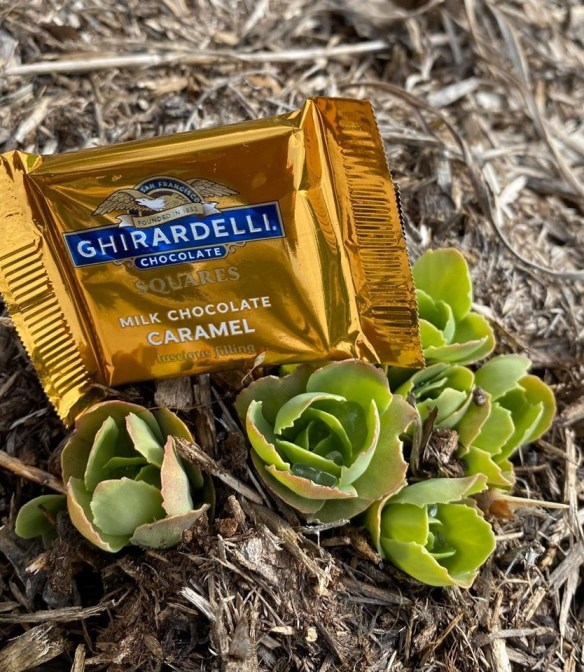
Next, we find Ghirardelli milk chocolate staking out a beautiful green plant, waking up and yawning. This looks just succulent to me.

Pandemic Iceland

On to the northlands we find chocolate in Iceland as well. Mmm, volcanic and rich – my favorite.

Pandemic sea salt

Where to next? Crossing the sea, of course, with sea salt carmel. Yum…

How far will we sail until we hit land again?

Pandemic Kia Ora

Oh, oh, now we’ve gone “down under.” Indeed, Kia Ora to my New Zealand peeps.

Pandemic Godiva

Now we’re obviously in the mountains someplace. Hidden in the crags is a truffle, probably discovered by one of those truffle-loving pigs. Good thing it wasn’t a chocolate-loving pig. I’d be wrestling with that pig for sure.

Pandemic Hokey Pokey

What’s this? My eagle has brought me something magical called dark chocolate “Hokey-Pokey.” Makes me feel like dancing, “Put your left foot in, put your left foot out…“

It too came from “down under” as you can see in the background. I’ll take this magic any day!

Pandemic english

Dark chocolate in English Ivy. We must be in the British Isles now. Wow. This is some amazing chocolate trail!

Pandemic rabbit hole

Uh oh! Oh no. You know what that is don’t you?

The dreaded rabbit hole.

Should I?

Or shouldn’t I?

I’m a genealogist, I should know better than to go down a rabbit hole. Right?

But…but…there might be another clue down there…..or chocolate.

Where does it go?

What should I do?

What would you do?

Ok, let’s see what’s down that hole.

Pandemic basket

Hey look, we found the rabbit along with a lovely basket of goodies. Sometimes it pays to go down those rabbit holes.

Maybe watching the plants grow isn’t such a bad idea after all, and it just might be entertaining. Plus, there’s chocolate and “that’s what it’s all about.”

Speaking of entertaining, there’s one more thing I never thought I’d be doing, but here I am. “Performing,” in a variety type of entertainment show.

Saturday Night Virtual Entertainment Show

This last Saturday night, a group of obviously incredibly bored genealogists joined forces for 2 hours – virtually – to entertain each other and the members of the VGA who were available to tune in last minute.

Courtesy of Thomas MacEntee and coordinated by Katherine Wilson of the Virtual Genealogy Association (which you might be interested in joining), our “Virtual Entertainment Show” was performed live from around the world.

Indeed, this is what happens when genealogists are placed into isolation. We might be physically distant, but we’re not exactly isolated.

We’re not star-studded in the traditional sense, but everyone showed something we enjoy, generally not something genealogy related although some were, because genealogy weaves itself into the very fiber of our lives.

Several people showed skills and hobbies from the rest of their lives. You didn’t know genealogists had any “rest of their life” did you😊. Me either, but getting to know people better was one of the benefits of this show.

Dreamed up only a day in advance, this pop-up event was quite literally a variety show. There was origami from Germany, traditional Irish storytelling from Ireland, of course (where else), sign language, piano from England, the most amazing textile art created from discarded constitutional law books, amazing papercrafts, art jewelry in a number of formats, including turning old watches into small photo frames sporting family pictures that you can wear, wire molding, quilting, instrumental music, singing, comedy, dollhouse miniature making, rowing instruction and more, much more.

Each “performer” had 5 minutes and the participants thoroughly enjoyed themselves. I hope the attendees did too.

Pandemic origami

Here’s Marcel from Germany instructing us how to make an origami frog.

For my part, I showed a few quilts and useful quilted items like my quilted vest, purse and laptop sleeve. I had a great deal of help as I prepared the “studio” in advance. In fact, several of the performers had assistance, which made the event even that much more enjoyable.

Pandemic quilts

Thanks to Katherine, the VGA, Thomas and the rest of my genealogy peeps for pitching in to do something none of us ever imagined we’d be doing and providing a couple hours of blessed distraction.

Pandemic Journal

That does it for this edition of the Pandemic Journal. What have you done recently that you never thought you’d ever do?

_____________________________________________________________

Disclosure

I receive a small contribution when you click on some of the links to vendors in my articles. This does NOT increase the price you pay but helps me to keep the lights on and this informational blog free for everyone. Please click on the links in the articles or to the vendors below if you are purchasing products or DNA testing.

Thank you so much.

DNA Purchases and Free Transfers

Genealogy Products and Services

Genealogy Research

Fun DNA Stuff

  • Celebrate DNA – customized DNA themed t-shirts, bags and other items

Isabel (circa 1753 – 1840/1850), Wife of Michael McDowell – 52 Ancestors #278

We’ve gathered quite a bit of information about Michael McDowell, here, here and here, but not so about his wife, Isabel. It appears that Isabel lived to be at least 87 years old and possibly as old as 97 years. That’s amazing, even today – but especially remarkable at a time when there were no antibiotics and childbirth carried the threat of death every year and a half for 20 or 25 years of a woman’s life.

Not to mention that Isabel appears to have crossed the mountains moving to a new home twice in her life, once when she was about 30 and again another quarter century later. Not an easy trip under the best of circumstances and the best of circumstances probably didn’t exist.

Isabel, spelled Isbell, is only mentioned one time – ever. If it was not for the deed that she signed with her husband, Michael, on February 16, 1793 in Wilkes County, North Carolina, selling their 75 acres of land on the Blackwater River in Franklin County, Virginia – we wouldn’t even know her name.

Michael McDowell Blackwater 1793 sale

Isbel signed with an X, three times, indicating that she could not read or write – and neither could Michael who signed with an X as well.

We don’t really know, positively, that Isbel, or Isabel, was Michael’s wife before or after that time.

We presume, and that’s a really dangerous word in genealogy, that Isabel was the mother of Michael’s children – including Mary McDowell, Michael’s daughter, born about 1785 in Wilkes County, 8 years before “Isbell” signed that deed.

We don’t find the name Isabel, by any spelling, among any of the children of Michael’s known children. But then again, we don’t know who all of Michael’s children were, nor do we know who all of his grandchildren were.

What we do know is that Michael was born about 1747, according to his Revolutionary War Pension application, and began having children when he lived in Bedford County, Virginia.

Who did Michael marry? We have no idea. Marriage records exist during that time in Bedford County, but Michael isn’t there. Of course, those records may be incomplete, but there’s no McDowell and no Isabel or Isbel.

Michael’s son, Edward was born possibly as early as 1773, but likely in either 1774 or 1775, which tells us that Isabel was probably born around 1753, assuming she was Michael’s only wife and the mother of all of his children.

When Edward was young, Isabel spent time alone in their cabin, without Michael at home. I hope she had other family members nearby.

Michael fought in the Revolutionary War in parts of 1777, 1778 and 1779. Michael reveals in his pension application that he initially marched to the lead mines and built a fort, taking at least 6 months, probably beginning about April 1777. After returning home, he was summoned again and “joined with some neighbors and friends with the citizens of the country calling themselves spies, to protect women and children from the skelping knife of the savage.”

Michael marched off to war at least 2 additional times, coming home in-between.

During the many months that Michael was gone, Isabel would have had to function alone on the frontier – not knowing if she would ever see her husband again.

It’s likely that Isabel was pregnant and probably had a second or perhaps even a third child during Michael’s 3 tours of duty. One of those children may have been their son, also named Michael, and other children may have not survived.

Whether Michael was present at home or not, life had to go on.

Isabel was responsible for cultivating the fields, planting seeds or tobacco plants, depending on what they were growing, tending animals and harvesting crops if necessary – not to mention taking care of toddlers. There was no “good time” for Michael to be gone – nor was Isabel ever safe.

Michael did eventually return home. Isabel must have been incredibly relieved. Finally, they could actually begin to plan their lives without the spectre of war constantly hanging over their heads.

On September 24, 1783, Michael bought 75 acres of land on the north side of the Blackwater River in Bedford County where they were living according to the tax list of 1782.

In 1783, Michael owned 2 horses and 4 cows, but in 1784, he was no longer on the tax list of Bedford County. We do find a Michael McDowell in Botetourt County, but then he’s gone from there too.

Michael is absent for a couple of years, but on February 4, 1786, Michael McDowell bought 161 acres of land from John Hall Sr. in Wilkes County, North Carolina characterized as “the plantation where Michael McDowell now lives.”

We know Michael was already living on this land at that time, but we don’t know how long he had been there.

Michael and Isabel didn’t sell their land in Virginia until 1793 from Wilkes County, when Isabel signed as his wife. Were they unsure about staying in Wilkes County? By the time they sold their Virginia land, they had been landowners in Wilkes County for at least 7 years and possibly as long as 9.

About Those Halls

I almost hate to say this, but I’ve wondered for some time if Isabel was a Hall. This is speculation, so please, please do NOT run over to your tree and add Hall as her surname.

It’s equally as likely that Michael married Isabel who was not a Hall in Bedford County, Virginia and was married to her for his entire life. Still, I feel compelled to at least look at Michael’s relationship with the Halls and the possibility that Isabel was, herself, a Hall.

Michael is heavily involved with the Hall family in Wilkes County. The Halls began entering land in 1778 on Mulberry Creek. Wilkes County Genealogy Society writes about the Hall family, here. WeRelate provides information about the family of Thomas Hall of Colonial Virginia, here.

Not only does Michael McDowell purchase land from the Halls, he fights with them as well.

No one fights as much as people who are related.

On January 24, 1786, Michael McDowell, along with Owen Hall posts a bastardy bond for William Profit who was charged with begetting a bastard child on Ann Hooper or Hoper. Both Michael and Owen signed with an X.

In November 1786, Michael is referred to in a deed between Owen and Robert Hall for 156 acres on Andrew Vannoy’s line, Mickel (sic) McDowell’s corner and the line between Hall and McDowell.” This confirms that they are neighbors.

In 1787 on the tax list, Michael has in his household 1 white male age 21-60, 2 males under 21 or over 60 and one white female. The man 21-60 would be Michael himself. There are only two children, both males?

  • If Edward was born in 1773, where are the children born between 1773 and 1787? That’s 15 years and only two surviving children? Isabel would have born in approximately 1753 or earlier if Edward was born in 1773.
  • If James McDowell who witnessed a deed in 1801 is the son of Michael and Isabel, he would have been born about 1779, so that would be the a second male.
  • Son John was born about 1782 or 1783, possibly in Virginia which would be a third male.
  • Son Michael witnesses a deed in 1799, so he would have been born before 1778, a fourth male.

According to these calculations, there should have been 4 sons living with Michael and Isabel in 1787. Where are the other boys?

In 1787, Michael is in court for a trespass case brought by the state. The same jury is ordered to hear Michael’s case as is hearing one between Owen Hall and John Hall Senior and wife, a “case for words” found in favor of Owen. The court then moved Michael’s case to the civil docket and finds him guilty as charged. Those cases seem to be connected.

Did the Hall family come from Bedford County, or an adjacent county? Where were they before Wilkes? There are Halls in Bedford County, but that certainly doesn’t mean they are the same Hall family.

However, in a letter dated 1782 from Henry Innes of Bedford County, Virginia to Ralph Smith of “The Pocket,” he says, “There is a large bull in this neighborhood which was formerly the property of Hezekiah Hall.” The 1782 Bedford County tax list includes both Owen and Hezekiah Hall as well as John Hall Jr. and Sr., two Williams and a Robert Hall. In 1773, we first discover Owen Hall on the Pittsylvania County, Virginia Tax list, so he appears to be about the same age as Michael McDowell.

That’s VERY interesting.

Michael McDowell’s’ father, also named Michael, spent time in Halifax County, adjacent Pittsylvania as well, but at least 20 years before Owen was found in Pittsylvania County.

It’s also possible that Michael was a widower when he moved to Wilkes County, or became a widower shortly thereafter?

By April 1785 in Wilkes County, Owen Hall was selling land to John Shephard on Mulberry Creek that runs with the lines of Owen Hall and Jesse Hall.

In 1790, Michael McDowell continued his involvement with Owen Hall when the state prosecuted Michael McDowell, Owen Hall and William Abshers who on July 20, 1790 “did beat, wound and ill treat Betty Wooten.”

Wow. I can’t help but wonder if they had been drinking. I also wonder what Isabel had to say to Michael. I sure hope she wasn’t on the receiving end of that kind of treatment.

Wooten Creek is a small creek feeding into Mulberry Creek near where the Hall, Absher, Vannoy and McDowell families lived, just south of Hall Mountain.

Isabel Hall Mountain.png

In the 1790 census, Owen Hall was Michael McDowell’s neighbor and probably about 40 years old. Robert Hall was Michael’s neighbor on the other side, probably about the same age. John, Jesse and William Hall live a few houses away.

Michael McDowell in the census has 1 male over 16, 4 males under 16 and 2 females. This tells us they have 4 sons and one daughter.

In July 1792, the court granted Michael McDowell permission to rebuild his mill. I wish they had told us what happened, but I’m guessing a fire. It would have had to be either fire, flood or tornado.

We know there was an arson in the neighborhood in 1789 when John Roberts burned the cabin of Braddock Harris and his wife Rachel Hickerson. The Hickerson family lived slightly south on Mulberry Creek. Arsons did happen, and it’s certainly possible. It seems the entire neighborhood was feuding during this timeframe, judging from the court cases.

On July 23, 1792, a deed was executed between Owen Hall and Robert Hall for 115 pounds, 156 acres adjacent Andrew Vannoy’s line, Michael McDowell’s corner, line between Hall and Michael McDowell including the land Owen Hall bought of John Hall Sr., witness Jacob McGrady, signed Owen X Hall, page 269.

I wish I knew if John Hall Sr. was Owen’s father, but there are no clues.

In February 1793, Michael McDowell and Isabel sold their land in Virginia. Perhaps they needed the money to pay bills given that their mill was out of commission. Or maybe they needed the funds to rebuild the mill. Note that today on Mulberry Creek, very near this location, we find Halls Mills.

In 1799, Michael sold his land to the local preacher, Jacob McGrady who lived just north of Hall Mountain and whose wife was Amiah, reportedly born about 1760 in Bedford County, Virginia, daughter of Owen Hall. Michael signed the deed but Isabel is glaringly absent. The property is located on Mulberry Creek, abuts Robert Hall’s line and is witnessed by Michael and Edward McDowell as well as Robert Hall. However, no mill is mentioned.

It’s difficult to deduce much about the relationship between the McDowell family and the Halls since they are clearly neighbors. Specifically, it looks like Michael is literally surrounded by Hall men.

Following that 1799 sale, Michael officially owned no land. How did the family earn a living? In 1799, Michael is shown with 200 acres but there are no deeds. Perhaps he was renting or we have an unrecorded deed.

In the 1800 census, Michael was 53 years old, Isabel is apparently still alive, even though her signature was absent on the 1799 deed, given that a female over age 45 is living in the household. Additionally, they have 2 males age 0-10, 1 female 10-16 and 2 females 0-10. It looks like the older sons have left the nest, but we don’t know where they are.

On November 23, 1805, a deed of conveyance occurs between Owen Hall, Russell Co., VA, and Robert Hall, 60 pounds for 156 acres, Andrew Vannoy line, Michael McDowell corner, marked line between Hall and McDowell, Witness William Abshire, Hezekiah Hall and James Quyth (?) Signed Owen Hall, page 287

Owen Hall moved north too, apparently.

December 5, 1805, a deed between Robert Hall and John Abshire, 150 pounds, 156 acres, Andrew Vannoy line, Michael McDowells corner marked line between said Hall and McDowell. Wit Jacob McGrady, William McGrady and Owen X McGrady. Signed Robert x Hall

Claiborne County, Tennessee

In 1809, Mary McDowell married William Harrell, the neighbor’s son. Harrell was spelled Harrold at the time and the family lived on Harrold Mountain, just to the east. Within the year, Michael, and presumably Isabel, along with most of their children left for Claiborne County, Tennessee. Mary McDowell and William Harrell moved with Michael too.

A younger Michael McDowell, presumably Michael’s son, stayed in Wilkes County, but the rest of the McDowell family left for the Powell River on the border of Claiborne County, Tennessee and Lee County, Virginia.

As Michael and Isabel packed up the wagon to set out over those mountains for Tennessee, Michael would have been 63 years of age and Isabel wasn’t far behind. Given that four children were born between 1790 and 1800, we can infer that Isabel would have had her last child about 1797 or 1798, suggesting she was born about 1754 which is in line with Edward McDowell having been born about 1773.

After arriving in Claiborne County, Michael McDowell settled on land named Slanting Misery. I’ve always wondered why they chose that land, because it truly was slanted and miserable, both. Or maybe it was meant to be tongue-in-cheek. They were certainly used to mountains from living in Wilkes County, so maybe Slanting Misery simply felt like home.

Slanting misery panorama

The 1810 census is missing, but the 1810 tax list in Lee County, Virginia, on the Powell River, shows Michael and two of his sons.

Four year later, in 1814, Michael begins claiming and amassing land in Claiborne County, just across the border from Lee County, beside his son-in-law, William Harrell who was married to his daughter, Mary McDowell.

Sons John and William McDowell live beside and claim land adjacent Michael as well.

Unfortunately, the 1820 census is lost too, but in 1830, a female is living with Michael, age 70-80, so born 1750-1760. That surely looks like Isabel.

In 1840, a female age 80-90 is living with Mary and William Herrell and it appears that Michael may have been living with the rather unfriendly preacher, Nathan McDowell.

It’s worth noting that two McDowell males, Nathan S. McDowell and John P. McDowell, clearly with ties to Michael McDowell based on deeds transferred to them “for love” are probably too young to be children of Michael and Isabel. It’s possible that these males were grandchildren of Michael and Isabel, especially given that we don’t have a full accounting of their children.

Children

In summary, the children attributed to Michael and Isabel are as follows:

  • Michael McDowell born between 1774-1778, either dead or gone from Wilkes County by 1820. (I’m confident of this relationship, but Michael is not confirmed as Michael’s son.)
  • Edward McDowell born possibly as early as 1773 or as late as 1780 (confirmed)
  • John McDowell born 1782 or 1783 (confirmed)
  • Mary McDowell born 1787 (confirmed)
  • Luke McDowell born circa 1792 (confirmed)
  • William McDowell born circa 1795 (confident, but not genetically confirmed)
  • Daughter born between 1790-1800 (no further information)
  • Daughter born between 1790-1800 (no further information)

Nathan and John P. McDowell are unlikely to be Isabel’s children, although it’s not impossible, given that Isabel was born about 1753 or possibly slightly earlier. If born in 1753, Isabel would have been 44 in 1797 and 49 in 1802.

There are two sons born between 1790 and 1800 as well – one of which could be Nathan.

Based on their transactions and activities, Nathan and John P. certainly appear to be related to the family in some fashion. I’m betting on grandsons, possibly through son Michael who stayed in North Carolina. A persistent rumor exists that the son, Michael McDowell, died on September 3, 1823 in Stokes County and is buried in Winston-Salem. A Billion Graves entry shows us a stone that says the Michael who died was in the 42nd year of his age, which would put his birth in 1781. I’m not convinced that this Michael is the Michael who was the son of Michael McDowell of Wilkes County, but it is a possibility..

  • Nathan S. McDowell born 1797 could be Isabel’s son or possibly a grandson or related in some other way. Nathan did not live close to Michael, roughly 20 miles away, and had no children, so this can never be proven genetically one way or another.
  • John P. McDowell born about 1802 is probably not Isabel’s son, especially since John born about 1782 is proven to be Michael’s son. John P. is probably a grandson or related in some other way.

Without documentation that doesn’t exist today, we’ll never know for sure.

DNA

Mary McDowell’s mitochondrial DNA is haplogroup U5b2b1a1, inherited directly from her mother’s matrilineal line. Of course, we’re presuming here that since Mary was born in 1785 in North Carolina that indeed she is the daughter of Isabel McDowell whose birth surname is unknown.

U5b2b1a1 is found mostly in the British Isles, although with some mutations, also in Scandinavia and central Europe.

Given that we first find Isabel in (probably) Bedford County, Virginia, it’s likely that she either descended from the Scotch-Irish population, Germanic settlers or from colonial English stock. We need more testers before we can draw any conclusions, although there are matches to a few families in this region in the right timeframe.

Isabel Mito map.png

We find Mary’s earliest known ancestor migration map matches scattered across the rather traditional migration path, so nothing unusual here.

Autosomal DNA

I was really hoping to find a smoking gun, or maybe a smoking Hall in my own DNA matches that might suggest that Isabel was a Hall.

I have neither ThruLines nor Theories of Family Relativity that suggest Halls, although Isabel is 6 generations back in my tree.

Looking to sift out more information, I used two wonderful tools which were both inconclusive.

First, I ran the Genetic Affairs cluster analysis along with tree reconstruction and didn’t find anything suggestive of a Hall connection. I was hoping for a fortuitous tree reconstruction, but it was not to be had unfortunately.

I then utilized DNAGedcom.com’s service that obtains the direct line ancestors in the trees of my matches, and indeed I do have a significant number of DNA matches with Hall ancestors out of Wilkes County.

The problem, of course, is that the Hall family remained in Wilkes and were neighbors of my family members with the following surnames:

  • McDowell
  • Herrell/Harrold/Herrald
  • McNiel
  • Shepherd
  • Hickerson
  • Vannoy

It’s very likely that I share a different line with these people who have Hall in their trees. In fact, I do share multiple ancestors with two of the most promising matches. This what happens when everyone stays up on that mountain and marries their neighbors. Within a generation or two, everyone is related to everyone else, and the neighbors are marrying are their cousins because everyone is a cousin.

Unfortunately, what this means is that for autosomal testing, I would really need to find a group of people who descend from Hall ancestors from this same line BEFORE they migrated to Wilkes, and who don’t share a different line with me.

Colonial Virginia is a tough nut to crack in this type of situation, especially this far back in time. Isabel would have been born in the early 1750s and many Virginia counties have experienced record loss of one kind of another. Unfortunately, there is no recorded marriage for Michael McDowell, nor a will that leaves anything to Isabel or any Michael McDowell from a father-in-law – so we’re out of luck unless something turns up one day in a previously buried record.

Or of course, if the right person just happens to DNA test, that could turn the tide as well😊

Hope springs eternal.

If you descend from Michael McDowell and Isabel or the Hall line, please be sure you’re in all of the databases (Family Tree DNA, Ancestry, MyHeritage, GedMatch and 23andMe). It’s not just who you match, but who your matches also match. The power of the newer tools is found in groups of matches that descend from the same ancestral couple – and each vendor has unique matches and tools that other vendors don’t have.

_____________________________________________________________

Disclosure

I receive a small contribution when you click on some of the links to vendors in my articles. This does NOT increase the price you pay but helps me to keep the lights on and this informational blog free for everyone. Please click on the links in the articles or to the vendors below if you are purchasing products or DNA testing.

Thank you so much.

DNA Purchases and Free Transfers

Genealogy Products and Services

Genealogy Research

Fun DNA Stuff

  • Celebrate DNA – customized DNA themed t-shirts, bags and other items

The Shared cM Project Version 4 Released

Version 4 of the Shared cM Project has been released, utilizing over 60,000 known relationship results submitted by genealogists. The Shared cM Project was begun in 2015 by Blaine Bettinger in order to crowd-source the actual number of shared centiMorgans, cMs, of variously related people who match each through autosomal DNA testing.

Obviously, in order to contribute to the Shared cM Project and participate, you must know how you are related to your matches. You can read about the earlier versions of the project, here.

The Shared cM Project has been very useful for genealogists attempting to determine potential relationships of unknown testers, in particular, because sometimes what we “expect” to see based on academic predictions and models isn’t actually what happens.

Of course, the flip side of that is that sometimes people who contribute relationships don’t understand or report relationships accurately; specifically relationships such as “half,” and “removed.” Nonetheless, with enough data, these reporting errors become statistical outliers. You can participate by contributing your known relationship data through the portal, here.

Blaine’s blog about the new V4 version is here and the full 56-page pdf paper about the results and methodology is here. If you want to understand how the project works, not only is this paper essential reading, it’s a wonderful educational source.

DNAPainter

By far, the most common usage of The Shared cM Project results is the interactive tool created at DNAPainter by Jonny Perl.

V4 DNAPainter

The Shared cM Project tools are found under the Tools and WATO tab, here.

V4 DNAPainter shared

Click on Shared cM Tool when navigating from the main DNAPainter page.

V4 DNAPainter complete chart

You’ll see the updated V4 relationship chart, with the field to enter the amount of shared cMs between you and a match above the chart, shown partially above.

V4 DNAPainter result

Selecting a cM number at random, I entered 1300. The results show the probabilities of various relationships between two people who match at 1300 cMs.

V4 DNAPainter table

1300 shared cMs can be any of the relationships shown, above. The grey, faded background relationships are not candidates at 1300 cMs, according to V4 of the Shared cM Project.

V4 DNAPainter histogram

A new feature added by Jonny provides the ability to click on a relationship and view the histogram from The Shared cM Project showing the submitted relationship amounts. For aunt/uncle at 1300 cMs, 26 people reported that matching amount. The most common amount of shared DNA was 1800 for that relationship category.

You can read Jonny’s latest blog introducing these new features, here.

Thanks to all of the 60,000+ contributors, Blaine and Jonny who made this possible.

_____________________________________________________________

Disclosure

I receive a small contribution when you click on some of the links to vendors in my articles. This does NOT increase the price you pay but helps me to keep the lights on and this informational blog free for everyone. Please click on the links in the articles or to the vendors below if you are purchasing products or DNA testing.

Thank you so much.

DNA Purchases and Free Transfers

Genealogy Products and Services

Genealogy Research

Fun DNA Stuff

  • Celebrate DNA – customized DNA themed t-shirts, bags and other items

Pandemic: For the Love of All That’s Holy – STAY HOME, and Sew a Mask

Everything that happened to China and Italy and now Spain and much of the rest of Europe is happening here too.

After we’re on the other side of the tsunami that is rushing over us, we can talk about how we got here and why, but right now, none of that is important. What IS critically important is what we do right now. Today – this hour!

Everyone knows about covering a cough, washing hands and to some extent, social distancing, but not everyone is taking social distancing seriously.

Whether they don’t believe the authorities are correct, think they are invincible or something else isn’t for me to say. What I am saying is one thing – this pandemic isn’t just coming, it’s here. There’s no discussion anymore about maybe. The only debate left now is how many will die.

Covid March Michigan

Here’s the chart for Michigan. The very first case was less than 2 weeks ago. Beginning on the 17th, the cases began increasing rapidly every day, and on the 18th, the first death. Southeast Michigan hospitals are already out of ventilators for patients and masks for staff.

The Michigan governor ordered:

  • Schools closed on March 13th
  • Restaurants and bars to close to the public, open only for takeout on March 16, along with restrictions of public gatherings
  • Shelter-in-place lockdown today, March 23rd

New York is ahead of Michigan in terms of infections and deaths, as are a few other states, but many are not. Don’t think it won’t arrive – it already has. Look here for the state by state cases.

There is no consistent survival directive for the entire US. Each state and sometimes each city or county is left to its own devices to decide what to do, and when.

However, you are in charge of you, and possibly of other people too – family members. Those you can’t control, you may be able to influence.

The most important thing you can do, and people’s lives depend on it is…

Covid stay home

Right now, there is nothing more important. If everyone simply stayed home for the next 2 or 3 weeks while the cases currently developing worked their way through the system, we’d see a downturn in 3 weeks.

If we don’t, the cases will continue rise and the outcome will be catastrophic, like we’re seeing in Italy right now.

Remember, you’re contagious for as long as 2 weeks before you actually exhibit symptoms. You may have a mild case of the illness and not know it – meaning you’re contagious for a lot longer than 2 weeks.

You will be touching doors and other public places during that time, unaware that you are infecting others.

NOW YOU KNOW

Now that you know, you’re responsible for protecting yourself from becoming infected which means you’re also protecting others – your family, your neighbors, friends and the vulnerable population.

Everyone over 60 is considered vulnerable, but they aren’t the only ones. Many people have diseases or conditions you can’t see, like asthma or diabetes. If you risk being contaminated, you risk the health of everyone else too.

And you risk killing your own family members.

People Are Dying

In the past couple of days, this insidious virus has moved from the threatening to the deadly. I know people who have it. My friend’s nephew, a physician. Another friend’s neighbor died. This is just the beginning and there is still time to avoid the worst outcomes.

This virus is real, deadly and here.

The people who die and have already died will probably never know HOW they were exposed to the virus, because it was likely from someone else who didn’t know they were ill yet.

Illness and deaths today are reflective of what was happening 2-4 weeks ago – the day before that first case was reported in Michigan. All of these cases were percolating among the population at that time – deadly time bombs. We just didn’t know it.

Be a Hero

It’s never been easier to be a hero – because all you literally have to do is nothing. Sit on the couch.

Only go out when necessary, and then keep a distance of 6 feet. Practice pandemic hygiene.

We’ve limited our trips out to once a week, and only then if necessary. No, buying a newspaper or your child having a play-date is not necessary. Neither is buying a lottery ticket. Besides that, you’re much more likely to get exposed to Covid than win. 

Yes, working one of the essential jobs is necessary.

You may also be able to do things to help out.

Urgent Need – Masks!!

Project N95 was begun just 72 hours ago as an entirely volunteer effort to coordinate the need and delivery of N95 (covid) masks and other personal protective gear for our medical professionals. Click here to see what’s needed and where.

An army of sewers and quilters have taken up the mantle to provide masks to individuals who need masks, but not necessarily the Covid-19 masks, freeing up those masks for those who really do need them.

If you would like to help with a donation of material, time, money or sewing masks, please coordinate to be sure that the masks are being accepted by a facility near you. Also, note that elastic does not survive an autoclave. I’ve been using bias tape for the ties or t-shirt material which is stretchy and doesn’t fray.

Some institutions only accept specific patterns, so don’t start sewing with great intentions only to have your masks be rejected or thrown away.

Here’s a FaceBook group, COVID Mask Crafters, that is coordinating request, supplies, sewing and distribution efforts.

JoAnn Fabric in many locations is coordinating both requests and masks through their local stores. Some are even providing free kits for people willing to make the masks.

Covid masks

EQuilter has provided this information:

Dear Sewing Community,

Passing on this message:

There is a critical shortage of face masks for health professionals and first-responders.

We have been asked to mobilize our community to do what we do best: sew.

We are calling on you all now to share the “Keep Calm and Sew a Mask” campaign on all of your social media platforms.

There is a tremendous need for masks that tie at the top and the bottom, as seen above.

A large hospital uses hundreds of thousands of masks a week — so we need to move as quickly as we can.

To start making an impact, get your materials ready and click the link below:
https://freesewing.org/docs/patterns/fu/instructions/

Also see these crucial details offered by our friend Rachel Wallis:
https://docs.google.com/…/15Y2_5fFWuog_o4q3CjhpdfFC8LX…/edit

Many thanks to Andover Fabrics for sharing this today.

Providence Hospital is desperately asking for people who sew to join their “100 Million Masks” challenge.

Call your local hospital, EMTs, police and firefighters, doctors’ offices, senior living facilities, rehabilitation facilities or elder-care facilities. Masks are needed for so many people in our health care system, including janitorial staff.

Opportunities to Help

How else might you be able to help?

Local Businesses

Restaurants are still open for takeout in most places. Not only do people need to eat, but supporting restaurants reduces the economic impact at least to some extent. Business like GrubHub and delivery services are functioning in most places as well as grocery shopping and shipping services.

Many restaurants have implemented a curbside pickup and no-contact delivery.

Many times restaurant staff and gig-workers have few or no benefits like sick time, paid vacation or insurance and often depend heavily on tips. Be as generous and patient as you can be.

The Vulnerable

Call your neighbors, especially anyone who is a little older, lives alone or who is vulnerable. Ask if they need assistance with shopping or picking up medications. They may not know how to order online delivery or be comfortable doing do. You can pick up their groceries when you pick up your own and drop them off on their doorstep.

They may also be lonely and frightened, isolated from their family as well, and a friendly voice may be quite welcome.

What Else?

What else can you think of to do to help?

We are all in this together and we need to do what we can, individually.

Heroes

I want to say a very special thank you to medical professionals – our doctors, nurses and first-responders along with all of the other people who make their jobs possible. People you don’t necessarily think about or see, but people who are at risk of contracting the virus by virtue of working in a hospital or medical setting. Everyone from receptionists to nurses aids to lab personnel to cooks in the hospital kitchens to cleaning staff.

Medical facilities simply cannot run without these people and we need them so desperately. They are risking their lives every single day right now to go to work and care for ill people.

Let’s all of us do our part by making sure we aren’t exposed, and exposing them, any more than possible – just stay home and practice your best couch potato, read a book, do some genealogy or sew a mask.

Please share this article.

_____________________________________________________________

Disclosure

I receive a small contribution when you click on some of the links to vendors in my articles. This does NOT increase the price you pay but helps me to keep the lights on and this informational blog free for everyone. Please click on the links in the articles or to the vendors below if you are purchasing products or DNA testing.

Thank you so much.

DNA Purchases and Free Transfers

Genealogy Products and Services

Genealogy Research

Fun DNA Stuff

  • Celebrate DNA – customized DNA themed t-shirts, bags and other items

US Census 2020 – It’s That Time!!!

The census is important to us as citizens and US residents for a variety of reasons.

  • First and foremost, how we are represented in the government is determined to some extent by population, so every person needs to be counted.
  • Secondly, government assistance to municipalities such as grants and programs not visible to the typical citizen are also predicated upon population. Here are some examples of important programs based on the census.
  • Third, of course is genealogy – but that’s for future generations. The census isn’t released for 72 years, and based on what I saw today, genealogists are going to be very disappointed in 2092.

The 2020 Census Form

I completed my 2020 census online today. I received a letter with a census ID code to sign on to my2020census.gov to complete the census which took about 5 minutes.

This is super convenient for me, and much less prone to errors if someone actually completes and submits their own information. No lost mail, no transcription errors, no misspelled names by enumerators. However, not everyone has technology, although most do. What about the elderly and homeless?

The census information here and here indicates that at least 5 mailings will be made followed by an in-person enumerator visit. Hopefully, unlike was done with our ancestors, they won’t just ask the neighbors.

This census is quite unique, given the current pandemic situation. I have to wonder how the census might be affected in terms of timing, completion and accuracy.

census 2020 welcome

Nearly every question has a help or information button explaining the intent of the question along with example responses.

However, there are no instructions for enabling cookies. I would guess most people already have cookies enabled.

census 2020 login

After logging in, you’re asked to confirm that you’re answering the census for your specific address. The census is by address/household, not by person.

The next question made me laugh.

“On April 1, 2020…will you be living or staying at…address?”

Seriously, April Fool’s Day – in a pandemic???

The form is divided into two sections, household questions and personal questions.

Household Questions

The household questions revolve around who lives in the household, and how they are related to each other, or not.

Census 2020 questions

Questions are sparse indeed; name, phone and birth date.

No birthplace or parents’ names are requested, let alone the questions about where their parents were born and other information we’ve come to cherish. No income or occupation questions. Nothing other than whether the home is owned or rented, and if by someone living in the in the household

Adding a second person in the household was a bit confusing. Answer yes until you see all of the people listed in your household on the next page. It’s easy to go back and forward using the arrows. Don’t use the browser forward and back buttons.

Person Questions

Individual questions are provided for each person living in the residence.

census 2020 hispanic

I wonder why this is a complex question/answer with its own page, and the rest of the categories are not.

The next page allows you to fill in various categories labeled “race” and also has a free space area for typing things such as German, Dutch, Scottish, etc. I wonder what people who don’t know are entering, and how much ethnicity predictions provided by DNA testing companies are influencing these answers. A company that erroneously reports a high amount of Italian, for example, could cause an onslaught of people with Italian heritage on the census.

Next, relationship questions are asked.

census 2020 relationship

I must admit, I was surprised to see such an inclusive list. One additional option was “not related.”

Now’s a Good Time

While you’re in lockdown, self-isolation, or are social distancing, you might be bored out of your mind, so complete your census form. Who knows, maybe this will be the most complete census in history.

_____________________________________________________________

Disclosure

I receive a small contribution when you click on some of the links to vendors in my articles. This does NOT increase the price you pay but helps me to keep the lights on and this informational blog free for everyone. Please click on the links in the articles or to the vendors below if you are purchasing products or DNA testing.

Thank you so much.

DNA Purchases and Free Transfers

Genealogy Products and Services

Genealogy Research

Fun DNA Stuff

  • Celebrate DNA – customized DNA themed t-shirts, bags and other items

Down Under: Christchurch, New Zealand – 52 Ancestors #277

This is the third article of a multi-part series about my trip to Australia and New Zealand. You can read about Australia, here, and Tasmania, here.

My Phone Becomes My Camera

I’ve received numerous questions about what camera I’m using. It’s my iPhone 11 Pro. I have a love-hate relationship with this phone.

For years, I’ve carried my phone plus a “real” 35 mm digital camera. I love the quality of the digital camera, but it has drawbacks.

  • No ability to upload directly to social media
  • Must upload to laptop or similar device
  • Heavy
  • Bulky
  • Not quick to take photo by the time you turn it on and get it ready

What I really want is a high-quality, small, lightweight camera with cellular and the convenience of my phone. If they can make one of those, I’m all in.

Wait, that’s almost my phone.

My iPhone needed to be replaced this past fall, so an iPhone 11 Pro was the way to go. The 11 Pro had 3 built in cameras – not one camera with a digital zoom which is not the same as a real SLR zoom.

Once I started using the 11 Pro, I never looked back.

However, it has downsides too:

  • No capability for telephoto and those types of lenses
  • Resolution not the quality of the 35 mm digital

However, a significant upside is that:

  • It’s not heavy
  • I’m carrying it anyway
  • Small footprint
  • Cellular and ability to upload directly onto social media
  • On screen editing

After this trip, I may never carry the 35 mm again, BUT, I’m very, very angry with Apple right now.

They just up and decided to invent a new file type – HEIC.

Never heard of it, right? Well, not only had I never heard of it, I didn’t realize I had 3400+ photos in that format. Apple made it the default file type in the 11 Pro. You may not care about this, because you can upload to Facebook and Instagram.

You’ll care a lot if you upload your photos on to a Windows PC and do anything, or try to do anything. If you’re a blogger, guess what – unsupported file type.

This means that you have to convert each file to .jpg format. There is no good way. You can read more here.

Now I have more than 3400 files of my own, plus Jim’s that I cannot use for my blog without an extra two steps for every single picture, nor can I drop them into a word document or share them with someone with an Android phone. Nothing NADA.

I HATE THIS!

I feel like Apple is holding my pictures hostage, trying to make me stay within the Apple family of products. It won’t surprise you to discover that you can upload to a MAC without any apparent problem. I can’t vouch for that, because I haven’t tried. I do know that I’ve now invested 3 days in something I shouldn’t have had to do at all.

Had I any idea, I would either have used the 35mm, or I would have purchased the older iPhone 10, hoping that by the time I needed to upgrade the next time, Windows and WordPress (my blogging platform) will both have figured out how to deal with Apple’s frustrating HEIC file format.

I did discover after I returned home that you can change that option in your phone by accessing: Settings> Camera> Formats and changing it back to .jpg. Photos will take more space on your phone. Frankly, that’s the least of my concerns.

I did find free tools online such as https://freetoolonline.com/heic-to-jpg.html. Some tools convert your first couple photos for free, or individual conversions for free one by one, but I have 3400 to convert. I’m always at least somewhat suspicious of what “free tools” are doing, because there has to be some motivation for someone to do something – and there is a lot of motivation for people to find ways to creep into our computer systems. What better way than helping us salvage our photos from an intrusive file format that we don’t discover until it’s too late.

This is probably more than you ever wanted to know. Hopefully it can save someone from these same issues. Unfortunately, it was part of this experience.

New Zealand

The South Island is the larger of the two major islands that comprise New Zealand. The North Island is smaller but has a larger population today. The South Island was more heavily populated at one point due to a gold rush in the 1860s.

All of New Zealand was the land of the Māori people before European colonization. The Māori arrived from Polynesia sometime between 1250 and 1300, settling on the islands and developing a distinctive culture.

In 1840, the Māori agreed in the Treaty of Waitangi to British sovereignty.

Nearly all locations have an English name and an equivalent Māori name as well. In fact, New Zealand itself is called Aotearoa in Māori, translated as “land of the long white cloud.”.

European settlement of New Zealand began in 1823. Today, the Queen of England is still the monarch, with a Governor General appointed.

Wellington is the capital, although Auckland is the largest city. The Ross Dependency is New Zealand’s territorial claim in Antarctica where it operates the Scott Base research facility.

Christchurch island map.png

Our ship stopped first to visit Christchurch, then Wellington, Napier, Tauranga and finally, Auckland.

The Dogs Pole

The first thing I encountered after we docked in Lyttelton Harbour, the cruise ship gateway to Christchurch, is a mystery that has yet to be solved. Maybe one of my Kiwi followers can educate us all.

christchurch dogs pole.png

The Dogs Pole. Notice that the Dogs Pole is entirely fenced, so the dogs can’t possibly get to the dogs pole to do what dogs do on poles. It’s also plural, not possessive.

One of my New Zealand friends suggested it might be an acknowledgement of the Antarctic expeditions that begin here. You can read more about those here.

Here, in 1957 dogs are helping to unload the Endeavor after a mishap in Lyttleton Harbour

Or maybe it’s an inside joke meant to baffle tourists and make people scratch their heads.

Harbour Cruising

This day dawned cloudy and cold. The weather in Australia and New Zealand can vary by a season in a day. How is it possible to be 120 degrees in Australia at the same time it’s cold in neighboring New Zealand?

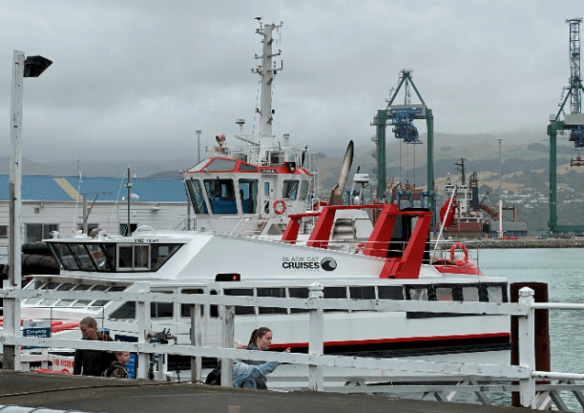
Christchurch catamaran.png

We set out on a catamaran for some serious whale, dolphin and penguin watching – or at least we hoped to.

christchurch harbour cruise.png

Sometimes on these types of adventures, you get really lucky, and sometimes you don’t.

Christchurch dolphin.png

That’s the dolphin. As in, the only dolphin.

Christchurch dolphin skin.png

This is as close as we got to a dolphin – on the boat.

Christchurch island.png

The scenery, however, was stunning.

Christchurch shoreline.png

My normal perch on these kinds of adventures is right up front. You can’t photograph what you can’t see.

It was so cold and extremely windy that I had to go in and out.

Christchurch harbour mountains.png

I had a sweatshirt with me, and a light windbreaker for rain – but nothing more. I don’t even want to admit this to you, but I bought a thinsulate jacket. Hard to believe it was 120 degrees just a couple days earlier and I had been sweating to death.

We’re calling that jacket a souvenir. I actually do really like it.

Christchurch caves.png

We were told that you can often see penguins and seals in these caves and rocky outcrops along the waterline, but we didn’t.

Christchurch caves 2.png

I look at caves partly submerged in water and wonder if there are human remains there from hundreds or even thousands of years ago, and if we could obtain their DNA.

Christchurch waterline cave.png

The whitewash is bird poo. Jim saw a couple of birds happily perching above one of the caves.

Christchurch birds.png

There they are!

Christchurch banks peninsula.png

This area is known as Banks Peninsula, but today was not our lucky day. Not even many birds.

So much for that.

Christchurch, New Zealand

You may recall that Christchurch was devastated by a violent earthquake in February of 2011, causing massive damage to the central portion of Christchurch. Aftershocks continued for months, with smaller quakes continuing to this day.

Not only did buildings fall and sustain structural damage, but the soil liquified in Christchurch.

One might expect that the damage from this quake would be repaired 9 year later, but that’s not the case, at least not uniformly. Most of the structures that need to be removed have been, but not all. Rebuilding in some areas has simply not occurred.

Christchurch street.png

The older timber buildings, like the ones painted blue, yellow and green fared better than either taller structures, or ones made of brick or stone.

christchurch cathedral.png

The Cathedral midtown is still in a state of disrepair and indecision.

christchurch rubble.png

At first, I thought these were gravestones, until I looked closer and realized it is the remains of a building, with a window in the wall for pedestrians.

christchurch basic.png

There are many, many simply vacant spaces – in a sort of timeless limbo.

christchurch church.png

Battles over what to preserve in its current state, tear down or restore continue.

christchurch church of the blessed sacrament

The Catholic church of the Blessed Sacrament waits on its verdict.

christchurch church fenced.png

The church is fenced off to protect the church, residents and visitors.

Christchurch church old.png

We can see how the basilica used to look.

Christchurch basilica.png

Parishioners of this church are already worshipping in another location, but the debate about whether to repair, restore or tear down this historic building continues. A decision was made in August 2019 by the Bishop to demolish the building, but not everyone is convinced that the decision is final.

christchurch mural.png

Murals grace the walls of many buildings. Parking lots sprung up where buildings used to be.

christchurch music mural.png

christchurch art.png

Like other cities, art is everyplace.

christchurch art numbers.png

Sometimes I wasn’t sure exactly what the art depicted.

christchurch art chairs.png

These chairs were painted white and roped off, so I’m presuming you’re not supposed to sit down.

christchurch construction barricade.png

This mural, which I think is actually a construction barricade, reminds me of a quilt pattern. Hmmm, maybe for my New Zealand quilt?

christchurch barriacade photos.png

Look closely. These triangles actually hold images of New Zealand.

christchurch graffiti art.png

If you watch carefully, you can see graffiti art in several places.

christchurch park.png

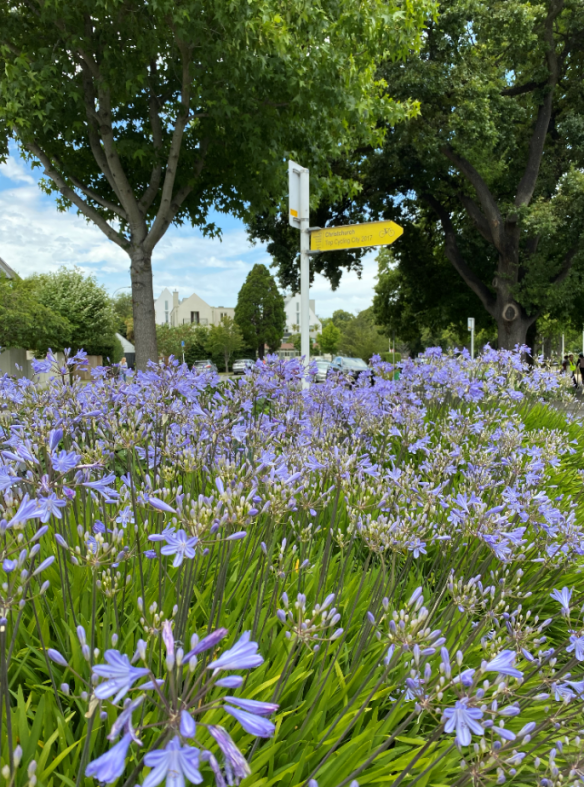
Parks abound.

christchurch bike.png

It felt just lovely to walk in the warmth and sunshine knowing how cold it was back home.

christchurch flowers.png

Let’s Go Punting!!!

Our plan for the afternoon is to go punting on the River Avon.

Don’t know what punting is? Neither did I.

Punting is an Edwardian activity wherein a person with a very large stick pushes you along in a boat on the River Avon. Think of gondolas in Vienna, but different.

It’s best if I just show you.

christchurch boat sheds.png

Adjacent the botanical gardens and museum, we walked to those green and white striped buildings in the distance where the boats are housed.

christchurch old photos.png

Christchurch residents and visitors have been punting for a long time.

christchurch jackets.png

The punters of yesteryear wore these jackets and hats, and so did ours today.

christchurch boats.png

Each boat has a punter standing at the rear.

christchurch happy punter.png

There is only one female punter.

christchurch punting.png

Thankfully, the temperature had warmed up after we left the coast and the sun came out.

christchurch female punter.png

It morphed into a glorious day.

christchurch punting selfie.png

Jim and I sat at the rear of our boat, just in front of our punter. Taking selfies of places where we’re having fun has become a bit of a ritual, along with the obligatory trip leaving and returning picture.

christchurch our punter.png

Our punter seemed to be having a great time too. His smile was infectious.

christchurch bridge.png

The punter had to duck as we slipped beneath the bridge.

christchurch water flowers.png

There are flowers everyplace along the water.

christchurch gardens.png

The botanical gardens line the river.

christchurch kayakers.png

Kayakers paddle among the flat-bottom punting boats.

christchurch white birds.png

Wildlife enjoys the sunshine too.

christchurch willow.png

Willow trees love water. Not sure if this is a willow, but it certainly looks similar.

christchurch trees.png

Trees overreach the water forming green archways.

christchurch ducks.png

The ducks enjoy napping along the waterway.

christchurch couple.png

Some things are universal.

christchurch boat sheds 2.png

Back at the boat sheds, we disembarked.

After our punting adventure, we still had an hour before catching the bus, so we decided to go for a walk.

christchurch trolley.png

The University of Canterbury campus was just across the street.

University of Canterbury

christchurch university of canterbury.png

The architecture here is very reminiscent of England.

christchurch sidewalk.png

I would have loved to sit in the sidewalk cafe, but it wasn’t open.

christchurch archway.png

This building reminds be a great deal of the University of Cambridge.

christchurch tower.png

The entryway leads to central common areas.

christchurch plaza.png

Students gather inside in the piazza.

christchurch construction.png

Construction repair from the earthquake 9 years ago.

christchurch art fence.png

Modern art intertwined with the classic buildings such as this wrought iron fence in front of the University of Canterbury at the market area.

christchurch canterbury building.png

The farmer’s market is parked in the lot reserved for the University during weekdays.

christchurch paua shell.jpg

We found Paua shell hair barrettes and a polished and sealed shell in the open-air shops surrounding the farmer’s market. I would like to have found Paua pearls, but they are rather rare and our time was limited. If you’d like to view stunning jewelry, just google “Paua pearls.”

We found Paua shells later on the beach, but you aren’t allowed to take those off of the cruise ship, so we couldn’t bring them home.

Headed Back to the Coastline

christchurch fields.png

New Zealand has been dry too, as you can see from the color of the foliage.

christchurch tunnel.png

Leaving Christchurch, a tunnel under the mountain connects the city with the coast.

christchurch shoreline in sun.png

The harbor is stunningly beautiful as we drive along the coast on the way back to the ship.

christchurch pilot harbour.png

Back in our cabin, we see the pilot boat approaching. Pilot boats carry captains who are specialists in navigating the local waters.

christchurch pilot boat.png

The local pilot assists the cruise ship’s Captain navigate the harbor. The pilot boat motors alongside until the ship passes the dangerous area.

Then, the pilot boat pulls up as close as possible to the water-level door, but not bumping the cruise liner, while the pilot waits for the perfect moment and jumps, yes jumps, from the open door to the deck of the pilot boat, even if it’s slippery and wet. One mis-judgement or misstep and the pilot is either possibly injured and miserably wet, or worse, crushed between the two boats. If that’s not the definition of nerve-wracking, I don’t know what is. First time I saw this, I couldn’t believe my eyes and my heart leaped into my throat.

Next port, Wellington.


Bob McLaren, Beloved Clan McLaren Genealogist Meets His Ancestors

McLaren Profile.jpg

Compliments of Scott Stewart, photographer.

Bob McLaren, Clan McLaren genealogist and founder of the McLaren DNA Project, was one of the most beloved people in the genealogy community. He tried hard to be a curmudgeon, but he mostly failed at that. His smile and laughing eyes gave him away.

McLaren solo 2

Photo, compliments of Janine Cloud.

Bob’s sense of humor was dry, the same way he liked his Glenmorangie 12, single malt scotch whiskey, neat. Yep, he could tell you all about that, and don’t even think of mentioning some heresy about Cardhu. Unless of course, you wished to debate for the evening. Bob had been known to leave establishments, as is more than once, for having NO acceptable scotch in house.

Bob was Scottish, and Scotch apparently, through and through – always wearing his McLaren plaid kilt and educating anyone who would listen – at genealogy events, conferences and bars around the world. Bob was the consumate ambassador in every sense of the word.

Bob joined his McLaren ancestors on March 17th, St. Patrick’s Day, probably in protest of the danged Irish kidnapping a perfectly good Scotsman, Patrick, born Maewyn Succat in Scotland about the year 387, taking him to Ireland and turning him into a Saint. Waste of a perfectly good Scotsman in Bob’s book. Bob took his Scottish history seriously, very seriously, indeed. Just ask. Well, on second thought, no need to ask – he’d tell you one way or the other.

McLaren early

I remember the first time I ever saw Bob in person, from afar, at the 2004 Family Tree DNA Conference – wearing his kilt and dagger. Yes, dagger – known as Sgain-dubh in Gaelic, in his sock. At first, I was struck by his kilt, but then I couldn’t stop looking at his sock.

McLaren dagger

Courtesy of ISOGG, photo contributed by Candy Camprise.

Even when Bob had a cast on his leg, that sock and dagger were still very much present. After 9-11, he had to stop traveling while wearing his dagger. Airlines frowned on that for some reason.

McLaren talking

Courtesy ISOGG, photograph by Candy Camprise.

The never-failing commonality in all pictures of Bob is that he is always talking to someone, always educating, always sharing. Extremely outgoing with a “let’s get it done” attitude, Bob was passionate about every aspect of genealogy.

McLaren Jeremy

Photo courtesy Family Tree DNA.

Bob McLaren with Jeremy Balkin at the Family Tree DNA project administrators’ conference in 2013.

McLaren Kherlen.JPG

Photo compliments of Katherine Borges.

Bob, with Kherlen, volunteer project administrator for the Mongolian DNA Project at the 2014 conference reception.

Bob not only attended the conferences, he was a presenter from time to time as well.

Ever-present, we never thought about the day that Bob wouldn’t be with us. He seemed timeless. A tall man with a wizard-like beard, he seemed a bit like he was transplanted from another era. Maybe at first a little intimidating – at least before you got to know him and realized that his gruffness was mostly bluster. Underneath, Bob was a kind-hearted, gentle teddy-bear of a soul. Bob wasn’t trying to intimidate anyone, he just wanted to provoke you enough to get you to engage in an interesting conversation. I soon learned that two could play that game.

At one of the early FTDNA conferences, my husband and I had walked across the street from the hotel to a restaurant for dinner. I had seen Bob from a distance, but never actually met him. He was always talking to someone else!

He sat at a table near us, by himself. I walked over to his table and asked if he’d like to join us. A genealogist eating by themselves is a perfectly wasted opportunity. Of course, had Bob realized at that moment that I was a descendant of the dreaded Campbell clan, he might not have accepted that invitation.

I’m glad he did, because that dinner sparked a friendship that deepened over the years as the Family Tree DNA conferences became like family reunions – and Bob became family – to me and so many others too.

Bob was a man on a mission – genealogy and McLaren clan genealogy specifically. He didn’t so much love genetic genealogy for the genetics part of the equation, but for the fact that DNA could, did and would unravel the knots in genealogical mysteries. In particular, his goal was to document the various paternal branches of the McLaren clan through Y DNA mutations.

Bob also realized that collaboration was the only way to achieve this goal – hence his constant presence at various conferences, like NGS, RootsTech, FGS and others.

In order to interact with the maximum number of people and convince them of the benefits of DNA testing, Bob volunteered at the FamilyTreeDNA booth at many conferences – wearing his signature kilt of course. Everyone knew him, it seemed, and came by to say hello.

I don’t think Bob would ever admit it, but as he aged, it was a lot easier for him to sit in one place and let the conference walk by him rather than walk through the conference – especially large conferences like RootsTech in particular.

McLaren Rootstech 2015

RootsTech 2015, compliments of Family Tree DNA.

Just don’t make the mistake of telling Bob you were a Campbell, or even worse, a McGregor. He’d educate you on clan history right then and there.

McLaren table.jpg

Photo compliments Janine Cloud.

When an employee became ill at a conference, Bob along with Doug Miller, at right, volunteered and stepped in at the FTDNA booth at the FGS conference in 2011. That’s the kind of guy Bob was.

McLaren listening

Photo courtesy of Janine Cloud.

Bob was a wonderful listener, utilizing his decades of experience to dispense advice about genealogy research, clan history, trees, DNA testing, or pretty much anyone someone needed. He was a marvelous teacher.

Of course, Bob loved nothing more than to buddy with other genealogists, especially other Scottish men wearing kilts.

McLaren Moffitt

Photo courtesy of Robert Moffitt.

Here, posed with friend Roger Moffitt, Bob would call Roger “Laddie” and tell him he was a bad Scottsman when Roger failed to wear his kilt. Roger pays his respects to Bob, here, on his own Facebook page.

You may need to be Roger’s friend to see this and other Facebook postings about Bob.

McLaren dressed up.jpg

Photo courtesy of Scott Stewart.

I didn’t realize that there were casual and dress kilts and regalia, but Scott Stewart took this absolutely dashing photo of Bob “dressed up” for the 2009 NGS banquet standing beside fellow Scotsman, John Ralls.

Bob chastised Scott for not wearing his kilt too. No one escaped Bob’s encouragement😊

McLaren Beidler leiderhosen kilt

Photo courtesy James M. Beidler.

That Leiderhosen/kilt ad…well, here they are.

Bob and I were volunteers on various committees together, so I knew that he had become rather frail over the past couple of years. I was concerned about him last year at RootsTech and also at the NGS conference in May 2019 in St. Louis.

For a man who did not participate in social media and didn’t much care to have his picture taken, there are certainly a lot of photos out there that feature Bob and…well… everybody it seems.

That’s because Bob was quite kindhearted, despite what he would have you believe, and never denied anyone anything. Except maybe a McGregor.

In the 24 hours of so since the word of Bob’s passing crept out on social media, many people have shared such heartwarming stories about Bob. I’ve been smiling and laughing through my tears.

McLaren me

This photo was taken of me and Bob in February 2019 at RootsTech. I told Bob I loved his black leather purse, or bag, whatever it was. Acting quite offended, which I knew he wasn’t of course, he very quickly schooled me on the fact that it was NOT a purse and it WAS a sporran. Call it what you want, Bob😊

We had an absolutely lovely week at RootsTech, running into each other several times.

McLaren Benihana

Attendees tend to form groups that eat together. This particular evening, part of the MyHeritage team and the FTDNA team invited me along and we had dinner at Benihana. One person in the group had a birthday and the photographer took a photo of the group together. We teased the birthday person mercilessly – Bob goading him into drinking some birthday Glenmorangie 12 in celebration.

I asked Bob if Campbells were allowed Genmorangie 12. He said, “absolutely not” and that he would have to drink mine for me.

We gave this picture to the birthday person, and I discovered this morning that he placed it on his fridge where it remains today, as a memento of a lovely evening with friends.

What happy times we had, and how we need those memories desperately today.

McLaren Addy

Photo compliments of Jennifer Zinck.

For some reason, Bob was especially inspirational to young people, and they in turn were drawn to him. One person mentioned that he is a sort of father-figure for her, and now he’s gone. Someone else said that he reminds them of the grandfather they wish they had known.

Addie Zinck, above, with her friend, Franklin the spider, attended her first Family Tree DNA conference in 2018. She too is missing her friend, Bob, today. Addie, don’t worry, Bob’s still with you.

Community Memorials

McLaren Katherine.jpg

Katherine Borges, Director of ISOGG, has known Bob almost as long as I have. She too had a very special relationship with Bob and remembers him, here, on the ISOGG Facebook page with this commentary and poem:

I’ve know Bob since the first Family Tree DNA conference in 2004. I’ve been blessed to get to know him better over the years because he had a huge heart and a wonderfully dry sense of humor. I used to tease him that I was going to buy him some McGregor whisky and he’d pull his skean dhu on me in reply. 😆

God willing and the creek doesn’t rise, I will dress in full Scottish regalia at the FTDNA conference in November in memory of Bob. And we’ll toast the life of this wonderful man with a wee dram.

“An honest man here lies at rest,
The friend of man, the friend of truth,
The friend of age, and guide of youth:
Few hearts like his, with virtue warm’d,
Few heads with knowledge so inform’d;
If there’s another world, he lives in bliss;
If there is none, he made the best of this.”

– Robert Burns

Many people have replied to Katherine’s post with their own memories, so do take a look.

McLaren Borges Magellan

Photo courtesy Katherine Borges.

Bob with his fellow Scots, Linda Magellan and Katherine Borges, above. Looks to me like Bob, Linda and Katherine are plotting something!

McLaren Beidler Southard.jpg

Photo compliments of James M. Beidler.

Blaine Bettinger posted this photo, with Diahan Southard and James M. Beidler – and memorializes Bob here in the Genetic Genealogy Tips and Techniques group with this commentary:

In Memoriam. Robert “Bob” McLaren, who passed away yesterday, was a fixture of the Family Tree DNA booth at just about every conference. Bob was a project administrator, DNA expert, DNA educator, and all around incredibly nice person. Over the years he educated and assisted 1000s of people with all aspects of DNA. And I’ve rarely seen someone as proud of their heritage! He will be very much missed.

Be sure to read the many comments on this post too. Bob inspired so many.

It’s incredibly gut-wrenching when these iconic legends pass over.

The McLaren Quilt

This year, just before RootsTech, Bob became ill and was unable to travel. Based on what he said and the medical testing underway, we knew that he needed a care quilt.

Folks at Family Tree DNA and RootsTech that knew Bob signed blocks, although we were being quiet about his illness and his privacy.

McLaren quilt.png

I quickly ordered McLaren tartan fabric from a custom design/print shop. The signature blocks were overnighted to me from Utah and Texas after RootsTech and I pieced the top. The quilt was quickly quilted over a weekend with a Scottish thistle design, bound on Monday and overnighted, arriving the morning of Tuesday, the 17th.

Sadly, Bob never received his quilt. I spoke to Mrs. McLaren today, and she said that the quilt is now spread on the couch with the family admiring it and telling stories. That’s what Bob would have wanted anyway – although I am gravely regretful that I couldn’t somehow have gotten it there a day or two earlier. If it was humanly possible, I would have. I hope his “McLaren Quilt” will bring his family comfort, knowing how many loved Bob and reading their caring messages.

Several people have said to me, “Bob sees it now,” and I desperately hope they are right. I wish now that I had told him it was on the way, but I wanted it to be a surprise and I had absolutely no idea Bob would only be with us another 24 hours.

I am incredibly glad that I called Bob on Monday and spoke with him at length, explaining how he had inspired me, thanking him for being such a strong pillar and foundation in our community.

Bob was planning to be dismissed the next day and his wife was preparing for the same at home. Bob told me, among other things, that he hoped and indeed, planned, to be at the next Family Tree DNA conference in November 2020 in Houston. After that, he said, “it’s probably lights out.” By this time, Bob was aware of his diagnosis although he was optimistic and encouraged to think that he would attend one more conference. I had already spoken with his wife and was surprised to hear Bob planning for November, but make no mistake, if any human could have pulled that off, it indeed was Bob.

Sadly, that wasn’t in the cards, as Bob slipped away the next day with his family gathered round.

While I’m crushed, as are decades’ worth of friends and acquaintances in addition to his family, I’m incredibly grateful to have had Bob’s presence in my life. I’m glad I told him that, in so many words, and thanked him for being an inspiration to a whole generation, or two, of young people.

I know he’s no longer suffering, and knowing Bob, he’s still close by, silently encouraging us.

In fact, I strongly suspect that indeed he has seen the quilt – including my block that I signed, “Your Campbell Cousin.” I know he would have smiled, in spite of himself. I think he secretly forgave me for that Campbell thing long ago.

He’s probably quite amused that his funeral is on hold due to this virus, although I’m sure his family is not.

Update: Bob’s obituary and funeral information is here:

Bob McLaren’t funeral information is included in his obituary, here: https://www.jeffersonfuneralchapel.com/obituaries/Robert-Mclaren/#!/Obituary

But I have news for Bob – it’s not lights out. Not at all. In fact, the illuminating light of Bob’s life will continue to shine for a very long time – through the generations by virtue of the thousands and thousands of people he helped, those he encouraged to DNA test who are one step closer to unraveling the mystery of their own ancestors and the young people who look up to him as a role model and (grand)father figure.

That’s one heck of a legacy, one we all can and should aspire to.

Rest in Peace, Bob McLaren, Sir. Well done.

I know you have flown to the McLaren homeland, Creag an Tuirc.

McLaren homeland

By User:JacobiteMacLaren, CC BY-SA 3.0, https://commons.wikimedia.org/w/index.php?curid=41255504, Balquhidder from Creag an Tuirc, the gathering place of the Clan MacLaren

Condolences, Memorials and Family Contact

Bob’s funeral plans are on hold for now due to the pandemic.

Update: Obituary and funeral information:

Bob McLaren’t funeral information is included in his obituary, here: https://www.jeffersonfuneralchapel.com/obituaries/Robert-Mclaren/#!/Obituary

Those who wish to share stories or pictures of Bob over the years may either comment on this article, send photos to me via e-mail at roberta@dnaexplain.com and I’ll post them in this section of the article along with a description and your comment, so long as I have permission from the people in the photo.

I told Bob’s family that they are welcome to use download and use any portion of this article for his service or any other purpose that brings them comfort.

To contact the family directly, send an email to Bob’s son, Sean at sean.r.mclaren@gmail.com.

To send cards, Bob’s address is given on the Clan McLaren website, here. I do not know if anyone will check Bob’s personal email again, so I would not suggest reaching out that way.

Contributed Memories

From Ally Woods in California:

Sir MacLaren will always bring a smile whenever I hear his name …

Ar dheis Dé go raibh a anam

McLarenn and Ally Woods.jpg

From Marie in New Zealand:

Scottish Gaelic

Caud ye the door laddie – snak it my loon
Breng o’er  a cher and Sett Doon man, Sett Doon
It’s ainly but richt that yer  Kinfolk shud courl
To gie ye advice Tae gang oot in this worl’

Means:

Close you the door laddie – snib it my loved one
Bring over a chair and Sit Down man, Sit Down
It’s only but right that your Kinfolk should care-at-all
To give you advice to go out in this World

My best to you Roberta –
On losing a fine friend who would have heard and kenned / known this from an early age.


Pandemic Journal: Sanity & Strategies to Keep It

Covid 19

Will we have any sanity left when this is over? And what does “over” mean in this context? “Over” isn’t going to be just escaping or surviving (hopefully) the virus, but also the resulting economic havoc that is being wrought every day that we are in lockdown.

We have no idea what to expect because we, none of us, has ever seen anything like this before. This is uncharted territory.

Mind you, I absolutely agree that these measures are necessary, and had we done it sooner, we might well have avoided what we are now facing in the next few weeks. A tsunami so different that none of us know exactly what to expect – other than it’s going to be bad, very bad. We need to prepare for the worst and hope for the best.

Yes, like everyone else, I’m frightened and anxious. It’s like the enemy that we can’t see but know is coming, stealthily, invisibly until it’s upon us and too late.

And then, of course, there are the people who don’t believe this pandemic is real – don’t understand that it’s up to all of us to avoid contamination so that we don’t infect others. It’s a matter of life and death.

If you know a doubter who needs convincing, or you’re uncertain yourself, here’s a lighthearted but very poignant  shortclip from the comedy Scrubs, 14 years ago, that shows with green the infection path and why this is so deadly. Take a look, here.

Fear and Anxiety

Everyone has their own personal reasons why they are afraid. In my case, two of my closest family members work in the medical field, at a major hospital where they and their housemate will certainly be exposed, and another close family member works in a public facing service role where he is as I type this.

Some family members have compromised heath which means they are more susceptible to death when, not if, they become infected. I’m hopeful that we can keep them safe long enough for the worst to be over, for the virus to mutate to a less deadly form, or a vaccine to be developed. Yes, we’re still allowed to hope.

One of my best friends along with a police officer was exposed to the virus this week in her role as a medical professional. Another friend played cards with a person who was later confirmed to have the virus. And then there are my friends in NYC and in the epicenter outside of Seattle.

This is just the beginning and today will look like the good old days soon.

As I said to someone yesterday, now when I tell someone that I love them, or goodbye, the gravity and importance of those words weighs heavy upon my heart.

Lockdown and Me

I’ve been trying to decide how to appropriately handle this situation and my blog.

I don’t want to seem unconcerned and glib by ignoring the situation that is changing the everyday life of every single person – immediately – as people transition to working at home with their home-working spouses and children not at school. Or, worse, transition to not having a job or income at all. That’s not a transition, it’s a bomb.

But then again, I don’t want to allow this to overtake my entire life either. I certainly hope there is a life worth living after Covid-19.

It seems to be that there has to be a balance of some sort – and I’m trying to find it. And I’m taking you along with me through my articles.

A Way Forward

I will from time to time run a “pressure relief valve” type of article. I’ll be sharing what I’m doing to try to retain what shreds of sanity I have left. Maybe asking for or sharing hints and tips. Kind of like we are just having coffee or tea and talking.

I don’t know what I’ll have to say in these articles, because I’ve never lived through anything this momentous before.

Life will go on, somehow – just differently, and sadly, probably without some of the people who are here now.

In addition to an occasional Pandemic article, I’ll also run my regular articles so that there is some semblance of normalcy – plus – you may have extra time now to work on your genealogy! There has to be a silver lining someplace, right?

There’s a section at the end of this article that you may enjoy with several goodies.

Working at Home

I don’t know how many of you have worked from home previously, but I’ve had a home office for years now and I love it.

Structure is important, especially in terms of making time for other family members, and other activities.

I should talk, because it’s literally 1:30 in the morning and I’m “working” by writing this article.

I would wager that you’ve already guessed that I really enjoy writing and that activity brings a level of composure to my life. I feel like I’m organizing things and helping others at the same time.

Writing helps me gather my thoughts and in terms of genealogy and genetics, to organize my research.

Make sure your work area is comfortable and that you get up and walk around at least once an hour. Go outside (just not around other people) and enjoy some sunshine. Exercise in some way.

Meter the Bad News

I’m to the point where I almost hate to open my eyes every morning because right now, there’s always bad news. Everyone needs an emotional break, so I’ve implemented a metering system.

I do check in the morning, because if I need to actually know or do something, I do not wish to be ignorant. Plus, I have those immediate family members in harms way, daily. For me, the anxiety of not knowing is worse than the anxiety of knowing the worst, but everyone is different.

I also read a chapter of an ongoing “book” that the Appalachian Storyteller author, Stephen Hollen, posts every single morning on his personal page on Facebook. I can’t tell you how much I look forward to this. He might be responsible for any sanity I have left in the end😊. I will actually grieve when this series is finished.

I check CNN but I do not check what I consider to be inflammatory news sources – ever. I’ve taken a “just the facts” approach.

I do check the headlines 2 or 3 times a day for “big news,” but that’s it. Big news today is the earthquake in Salt Lake City. I’m glad all of my friends there are checking in, shaken (literally) but OK.

If there is truly something critical, I will notice it on FaceBook which I also monitor periodically, but not constantly.

In the evening, I watch one particular program that provides a factual summary of the day’s important news.

In other words, I control the amount and timing of what I’m exposed to. Otherwise, I’d just be overwashed with constant negativity.

Relief

Everyone has their own “go to” activities that make them feel better. Self-medicating, hopefully in a healthy way. Mine are, in no particular order:

  • Genealogy
  • Genetic genealogy
  • Reading
  • Quilting
  • Writing (articles like this, 52 ancestor stories, etc.)

I have trouble concentrating on the first three items if something else is bothering me. I think genealogy requires too much analytical skill when I’m stressed and reading allows my mind to wander off. But quilting forces me to focus just enough that I can escape almost anything – maybe because it requires both body and mind.

I make care quilts for others which is a personal mission of sorts.

Bob quilt blurred.jpg

I shipped this one of those overnight on Monday and it arrived Tuesday morning to wrap the recipient in love. This is a signature quilt from this person’s dear friends, so I’ve blurred some of the blocks on purpose for privacy, but you can see the love nonetheless.

laptop sleeve.jpg

I also made a laptop sleeve and power supply bag over the last few days out of quilted scraps from my DNA vest. My laptop sleeve was a RootsTech casualty. This is much more “me” than a boring old black sleeve anyway and maybe with this ditty bag for the power supply, I won’t lose another one of those either. Fingers crossed.

Social Distancing

Social distancing is not new for me. Not only have I worked at home for a long time, but I’m not fond of stores and crowds. I’m perfectly happy staying at home and working on my genealogy or other projects most of the time.

In fact, several genealgists that I know are gleeful to be forced to stay at home and isolate. Do I ever understand that. A few others aren’t as pleased, because now their entire family is at home and they can’t get much genealogy done.

However, this is week 3 for me. Lots of people were ill at and following RootsTech, so I have pretty much stayed home and away from others since my return. I’ve been fine – no symptoms – but if I was going to get sick, I didn’t want to become typhoid Roberta.

I’ve never thought about social distancing much, at least not as as we now know it, until the past couple of weeks. Now as the restrictions tighten, of course every thought is measured against social distancing and what would be required, or risked. How to minimize exposure.

While we aren’t under a complete lockdown where I live, schools, restaurants and bars are closed and most people are working from home. The next step would be to “shelter in place” which I expect soon.

I’d rather do that than suffer the alternative.

Activities in Isolation

Today, my husband and I inventoried the pantry to see what we really have, and now long our food supply will last. Never did I imagine I’d ever be doing this, at least not for this reason. We discovered that we have 3 boxes of Rice-a-Roni and a whole lot of other things we had forgotten about. Who knew!!

We also have a couple cans of Spam that worked their way to the back corner. They are out of date, of course, but if we are hungry, we’re not going to care and we’d be grateful for food. Clearly, Spam would not be my first choice. I’m not sure who bought those cans or why, because I guarantee you – they weren’t on my shopping list.

We might just have a little contest to see who can come up with the most innovative creation – kind of like one of those cooking shows. Anyone for Spam-a-Roni?? Maybe fried Spam and gravy? Now that doesn’t sound too bad.

Based on what I’m seeing on Facebook, I’m thinking a whole lot of people are going to get to learn to cook “from scratch” over the next few weeks.

Having had so much luck with the pantry inventory, I suggested we start spring cleaning, which sent my husband scurrying into hibernation – self-isolating in his office. That’s OK, I really didn’t want to clean anyway.

Instead, I did a number of other things, including;

  • Worked on client’s Y DNA report (normal activity for me)
  • Published The Million Mito Project article (is that cool or what!!!)
  • Spoke with friend whose husband is gravely ill ☹ (not virus related, but very tough especially since his family can’t come to visit)
  • Petted the cats (which according to them I haven’t done in years)
  • Watched Blaine’s free webinar (still free today), LucidChart and Other Tools for Genetic Genealogy at Legacy Family Tree Webinars. I need to try MedBetterDNA.
  • Email, which is never-ending and increasing now because, hey, I needed to know how stores the American Girl Doll stores are handling the Covid-19 issue
  • Made 3 quilt blocks

Quilting

Quilting – now we’re finally to the really fun stuff.

When the going gets rough, I quilt.

It was St. Patrick’s Day, and even though that somehow got lost in the hubbub, I decided to work on a green quilt block to share with my online Genea-Quilter peeps. I grabbed the block with green, thinking it was the St. Patty’s Day block.

Christmas cat block.jpg

I discovered it was Christmas instead. Guess that one’s done several months early.

Did I mention that I had help?

Kitters helping.jpg

Meet Kitters. She and her sister, Chai, steal my pins and deposit them in their food dish and in my husband’s shoes. Gifts of the highest order.

If you have pets, be sure you have enough food for them too and shower them with extra love and attention. You’ll both benefit.

This unfinished quilt project has been laying around for some time, so I decided to make another block.

St. Pat's quilt block.jpg

Yes, this one actually IS the St. Patty’s Day block.

Winter cat quilt block.jpg

And one more for good measure. We’re supposed to get more snow this weekend, so this is appropriate.

Helpful and Uplifting Links

Thank goodness for the internet – that’s all I can say. While we are distanced physically, we can still stay in touch with people – can still interact and share.

Music is incredibly uplifting and soothing. I suggest going to YouTube, enter the name of your favorite artist, and just listen. You can also create playlists there and on your phone or iPad as well. Music helps us vocalize or express what we can’t ourselves.

Here’s a list of inspirational and useful links for your enjoyment:

  • Here’s possibly my all-time favorite song (and performer) – Joseph Groban in You Raise Me Up. This pandemic has brought home just how much we truly are dependent on the actions of each other. We must raise each other up and protect each other, now, as never before. Please listen to this soul-moving beauty.
  • Celine Dion and Josh Groban, The Prayer – this one is for you! I often play this, close my eyes and just listen – but watch it the first time because the visuals are amazing too. Melts my heart.
  • Here’s “Ode to Joy” played by musicians in a neighborhood Spain under lockdown.
  • This pianist and jazz musician is my favorite “virus video,” both playing from separate balconies.
  • Applause from balconies in Spain as people expressed their gratitude for Spain’s doctors. Doctors, medical professionals and first responders are literally on the front line risking their lives.
  • My article, Fun Genealogy Activities for Trying Times
  • Judy Russell with some additional ideas in Opportunity Knocking.
  • Looking for beauty that combines nature, gardens, flowers and inspiration? Try my other blog, Victory Garden, Day by Day.
  • I’m not LDS nor encouraging or recommending any particular religion, but preparation for being without food for a year is part of the LDS scripture. You can see what is recommended for adults and children for a year, here, and about food storage, here.

Sharing is Caring

Now that I’ve shared all of the excitement at my house, what are you doing, both to prepare for what’s approaching and as a way to keep your sanity as you implement social distancing? How are you coping? Where are you finding peace and solace?

Sharing is caring – a coping mechanism, a way of making our burdens seem lighter because we’re not alone, even though we’re socially distanced, so please share. Your ideas and comments may help someone else.

_____________________________________________________________

Disclosure

I receive a small contribution when you click on some of the links to vendors in my articles. This does NOT increase the price you pay but helps me to keep the lights on and this informational blog free for everyone. Please click on the links in the articles or to the vendors below if you are purchasing products or DNA testing.

Thank you so much.

DNA Purchases and Free Transfers

Genealogy Products and Services

Genealogy Research

Fun DNA Stuff

  • Celebrate DNA – customized DNA themed t-shirts, bags and other items

The Million Mito Project

I’m so pleased to introduce The Million Mito Project and to explain why you should join in the quest to trace the family tree of womankind. The Million Mito Project depends upon you!

Million Mito intro.png

I was honored to announce The Million Mito Project at RootsTech on February 29, 2020. I’m sharing my slides with you here, along with the narrative.

Million Mito team.png

The Million Mito Project is a collaborative citizen science project to update the phylotree of womankind.

Team members include:

  • Miguel Vilar, Lead Scientist of the National Geographic Society’s Genographic Project
  • Paul Maier, Population Geneticist at FamilyTreeDNA
  • Goran Runfeldt, Head of Research and Development at FamilyTreeDNA
  • Roberta Estes, DNAeXplain, scientist, genetic genealogist, Genographic Project Affiliate Researcher

Genographic Project Public Participation Phase Ended

The Genographic Project was launched on April 13, 2005 as a 5-year non-profit citizen-science-fueled research project with testing performed by the lab at Family Tree DNA. Unimaginably successful, the Genographic Project celebrates its 15th anniversary in 2020. I can’t tell you what a wonderful opportunity it has been to be involved with the Genographic project from its inception, and to be a part of the next chapter in this legacy of humanity.

It’s important to note that the public participation phase of the Genographic Project came to an end in 2019, meaning that kits can no longer be purchased. The Genographic database will remain online through June 30, 2020, but will be shuttered down after that time.

If you do not retrieve your Genographic results, or transfer them elsewhere before June 30, 2020, they will no longer be available to you. You can read more, here.

Even though the public participation phase has come to an end, the scientific study continues. That’s the legacy of the Genographic Project, the gift that keeps on giving.

Why DNA?

Every human alive carries the mitochondrial DNA inherited from their direct matrilineal line – your mother, her mother, her mother on up the tree into the mists of history.

This means that the Million Mito Project is relevant for every human living today – and carries critical genealogical and historical information passed to us from our matrilineal ancestors. Mitochondrial DNA is the one way that every human alive can see beyond the confines of records and available genealogy by using the gift of DNA that our ancestors bestowed up us.

It was 67 years ago on February 28th, the day before my RootsTech presentation, that Watson and Crick “discovered” DNA at Cambridge University in the Cavendish Lab.

“Discovered” is in quotes because there remains significant controversy about the fact that their discovery was predicated upon the research of Rosalind Franklin, who died and never received proper credit for her co-discovery. So really, the discovery should be credited to Watson, Crick and Franklin.

Million Mito Cambridge.png

The slide above shows me standing in the doorway of the building in which this revolutionary discovery was made a few years before I was born. Ironically, it was DNA that drew me to England.

Y DNAwas the tool that allowed the US Speaks family to connect with the UK Speaks family in Lancashire through a man who had immigrated to New Zealand. Without Y DNA, the relevant deeply-buried records would not have been found, nor the genetic “glue” to tie records to people on three continents around the world, reuniting our widely-scattered family back in our ancestral homeland. Therein lies the amazing power of DNA.

Given my career choice, I absolutely had to visit the Cavendish Lab at Cambridge, a genetic “Mecca” of sorts, as well as the British Science Museum to see the infamous DNA model. This is where the DNA journey for all genetic genealogists began.

After their momentous discovery back in 1953, Watson and Crick walked the short distance to the Eagle Pub where they lunched regularly, shown above, at right, and excitedly announced to everyone within earshot that they had just discovered “the secret of life.”

Of course, 67 years ago, in the Eagle Pub, no one understood or cared.

We care, a lot, today. Beginning 20 years ago with the founding of FamilyTreeDNA, DNA fundamentally changed genealogy forever, allowing us to unravel mysteries that could never have been solved before.

Inseparable Technologies

Million Mito inseparable.png

Today, genealogy, genetic genealogy which focuses on the DNA aspects of genealogy and science are all inseparably intertwined. Scientific discoveries feed the genealogy and tests taken by genealogists fuel the science. It’s an infinite loop of discovery, education and unraveling.

Many times, the pieces of genealogical information we so desperately seek simply aren’t available in existing records, but we can piece together relationships and clues using the three different kinds of DNA: mitochondrial, Y DNA and autosomal. Each type of DNA has specific characteristics and provides us with unique information not obtainable any other way.

3 Kinds of DNA Address 3 Unique Challenges

Million Mito 3 Types.png

Y DNA, inheritance path shown by the blue arrow above, is passed from father to son and therefore tracks back to a male’s direct patrilineal ancestors in their tree. The Y chromosome is only contributed to male children, who pass it on to their male children, not mixed with any DNA from the mother. Therefore, except for occasional mutations, Y DNA is identical from generation to generation.

The occasional mutations are what make it possible for us to use Y DNA and mitochondrial DNAas breadcrumbs, following them infinitely back into time, before records, and eventually, before written history by connecting those mutation breadcrumbs as dots.

Today, men test their Y DNA which follows the direct patrilineal line, which is the same as the surname line in western culture, although naming practices vary in different countries and parts of the world across time. Regardless, the Y DNAconnects male testers with their ancestors through their father’s, father’s, fathers’ line – in close relationships, meaning fathers and grandfathers, as well as distantly, into the history of clans and then before the advent of surnames.

In western cultures, men taking Y DNA tests expect at least some of their matches to carry the same or similar surnames, assuming other men from that line have also tested.

Only males can test for Y DNA, because only males carry a Y chromosome. Women need to ask their brothers, father, grandfather, uncles, etc. that represent the line they wish to test.

Mitochondrial DNA, inheritance path shown by the red arrows above, is passed from mothers to both sexes of their children, but only female children pass it on. Therefore, both men and women inherit their mitochondrial DNA from their mother’s direct matrilineal line. Men and women can both test for mitochondrial DNA, which reflects their mother’s, mother’s, mother’s mitochondrial DNA, on up the matrilineal line indefinitely.

In genealogical terms, mitochondrial DNA is perceived to be more difficult to use, so fewer people test, but I view mitochondrial DNA as exactly the opposite. Mitochondrial DNA represents an opportunity that cannot be afforded by other type of testing and isn’t any more difficult to use than autosomal.

The surname changes in each generation, but the DNA provides us with a rock-solid path to those common matrilineal ancestors, if people would simply test and upload their trees. Mitochondrial DNA has the potential to, and does OVERCOME the challenges surname changes in a way that no other tool can. The answers are written in our mitochondrial DNA along with the mitochondrial DNA of all of the people who descend from that female ancestor through all women to the current generation, which can be male or female.

When discouraging people from mitochondrial testing by telling them not to bother because it’s hard to use, the genealogical community actually perpetuates the problem. Here’s a wonderful series about how to understand and utilize mitochondrial DNA.

If EVERYONE would test their mitochondrial DNA, we would be breaking through brick walls at lightning speed. Mitochondrial DNA isn’t difficult because it’s harder to use, it’s difficult because not enough people have tested.

The surnames in autosomal lines are different from that of the tester too, yet genetic genealogists don’t hesitate for one second to take an autosomal test where they will need to build out trees to attempt to determine which line their matches connect through. The great news about mitochondrial DNA is that you already know which line  the connection is through – your matrilineal line.

Mitochondrial DNA and Y DNA provide laser-sighted focus on the history of one specific line, reaching deeply back in time with no admixture from the other parent. Autosomal DNA is broad, but not deep, because it is divided in half in each generation as it’s passed from parent to child.

I wrote a series of articles, here, about mitochondrial DNA with step-by-step instructions about how to use mitochondrial DNA successfully.

Autosomal DNA, the third kind of DNA testing is the Family Finder test at Family Tree DNA, or the  MyHeritageDNA, AncestryDNA and 23andMe tests which provide matches to people from all of our genealogical lines. In the graphic above, I’ve represented autosomal DNA by the broken green arrow, indicating that autosomal provides matches and links to some of the people who descend from common ancestors, but not all.

In each generation, autosomal DNA is divided in half, meaning that each person receives half of their mother’s and half of their father’s autosomal DNA. We match all of our first and second cousins, but only about 90% of our third cousins who descend from our common great-great-grandparents, in the green arrow generation. As we move further back in time generationally, we match fewer and fewer of the people who descend from common ancestors.

Therefore, I classify autosomal DNA as broad, meaning we match descendants from more than one line, but not deep, because it only positively reaches back 3 generations, often reaches back about 5 or 6 generations, but generally not more than 9 or 10 generations. The ONLY way to see back further in time than autosomal matching is Y and mitochondrial DNA.

Y and mitochondrial DNA is deep, meaning we each match only one line for each type of DNA, reaching very far back in time, but not broad. Therefore, in order to “collect” the Y and mitochondrial DNA of each of our ancestors, we need to find the appropriate cousins to test to provide us with that information.

What Can Y and Mitochondrial DNA Do for Us?

Fortunately, Y and mitochondrial DNA have the ability to help us with close relatives and matches as well as more distant history.

Y and mitochondrial DNA both have the ability to:

  • Assist us genealogically to connect in recent generations utilizing surnames, trees and geography
  • Facilitate identification of each lineage further back in time by utilizing full haplogroups
  • Provide us with the ability to view the geographic locations of the earliest known ancestors of our matches on our Matches Map at Family Tree DNA which can provide clues as to the identity of common ancestors
  • Document our ancestors’ migrations and locations where haplogroup clusters are found throughout the world
  • Identify the “ethnicity” of those ancestors by haplogroups that occur only in specific portions of the world (like the Americas), or unique populations (such as Jewish people.)
  • Granular personal haplogroup allowing testers to use the public Y tree and public mitochondrial tree.

Trees of Mankind and Womankind

Aside from our own personal genealogy, Y and mitochondrial DNA testing, tracking those mutations back in time, has scribed the history of the migration of mankind – and womankind – which means it tells us where our ancestors came from, and went.

Million Mito trees.png

On the map at left, the basic Y DNA haplogroups are shown expanding out of Africa, into the Middle East and then into Europe, Asia, the Pacific Islands and Americas. Think of haplogroups as large genetic clans, defined by mutations that group us together, and separate us apart as well.

Mitochondrial DNA haplogroups followed the same paths of course. Different locations in the world have specific haplogroups further broken down into sub-haplogroups associated with general geographic locations.

For example, Native American aboriginal people in North, Central and South America are defined by subsets of Y DNA haplogroups C and Q, and mitochondrial haplogroups A, B, C, D  and X.

It’s testing by many people, citizen scientists and genealogists, people just like you, that have allowed scientists to define these haplogroups and their migration paths across the world. We still continue to discover, define and refine that pathway today. We’ve only seen the tip of the iceberg. Our knowledge is ever-changing and expanding. There’s so much more to learn. That’s why we’ve launched The Million Mito Project.

Connecting the Dots Using Mutations

How do scientists, and genealogists, connect those dots from today’s testers to their ancestors?

Mutations, called SNPs, single nucleotide polymorphisms, occur at a specific point in time and the resulting variant (mutated value) is then passed to all of the descendants of the person in whose DNA they occurred.

These haplogroup-defining mutations accumulate over time to form twigs, then branches, then the haplotree backbone as we move further back in time. On the slide below:

  • Branches – green and magenta dots
  • Twigs – white, yellow and grey dots
  • Leaves – teal, violet (line 10) and black dots

Million Mito mutations.png

In this example, the progenitor is shown as a male, but the concept is the same for any mutation.

  • The progenitor has two sons, “Line 1” and Line 2.”
  • A magenta mutation occurred between the father and son in “Line 1”, and you can see that it’s passed to every descendant of “Line 1.”
  • A green mutation occurred between the father and son in “Line 2”, which is also passed to all of Line 2’s descendants.
  • “Line 3” had a white mutation, which was passed to his descendants.
  • “Line 6” had a grey mutation which was passed to his descendants, and so forth.

In real life, mutations generally don’t accrue this rapidly, but the compressed time in this illustration makes the generational inheritance of mutations easy to see.

In both Y and mitochondrial DNA, SNPs are what form branches of the tree. In our case, the progenitor would be the trunk, Line 1 and Line 2 would be major branches, and with each succeeding SNP generation, smaller branches and twigs being created. Multiply this mutation process over hundreds and thousands of years to construct the Y tree of mankind and the mitochondrial tree of womankind.

The Explosive Expansion of the Y DNA Tree

In the past decade, great strides have been made in fleshing out the Y DNA tree.

Million Mito Y tree.png

The key to this success has been thousands of men purchasing the Big Y test at Family Tree DNA with the hope of learning more about their paternal genealogy; first the Big Y, then the Big Y-500 and then in 2019 upgrading to the Big Y-700 with significantly increased capabilities.

Every tester can see their place on the Y block tree on their personal page, along with their matches.

Everyone, whether they have taken the Y DNA test or not can view any haplogroup’s location on the Family Tree DNA public Y DNA tree, here.

Mitochondrial DNA Tree

However, mitochondrial DNA has been neglected. The goal of the Million Mito Project is to change that.

Million Mito builds.png

In March 2017, FamilyTreeDNA updated to mitochondrial DNA Build 17 of the mitochondrial tree which included 5437 haplogroups extracted from just under 25,000 sequences. Family Tree DNA created an easily accessible public tree, here, complete with geographic locations for testers assigned to each haplogroup.

To date, the various mitochondrial builds have been created using GenBank submissions, but the majority of testers don’t upload their results to GenBank.

The Genographic Project and FamilyTreeDNA databases together hold more than half a million full sequence mitochondrial tests, far more than the 25,000 utilized for Build 17.

What is a Full Mitochondrial DNA Sequence?

Mitochondrial DNA is comprised of 16,569 locations in total. Initial DNA testing was expensive, so the mitochondria was divided into three regions for testing, analogous to a clock face:

Million Mito clock.png

  • HVR1 (hypervariable region 1) – think of this area as 5 till the hour until the hour (5 minutes)
  • HVR2 (hypervariable region 2) – think of this as the hour until 5 after the hour (5 minutes)
  • Coding region (CR) – think of this as the space between 5 after the hour to 5 till the hour (50 minutes)

All three regions together, meaning the entire clock face, is known as the full mitochondrial sequence, or FMS.

In order to obtain a complete haplogroup designation, one must test the entire mitochondrial sequence, all 16,569 locations. The full sequence is also necessary for maximum genealogical usefulness.

Tests like 23andMe and LivingDNA provide testers with a base haplogroup as part of an autosomal test by testing a subset of approximately 1200 mitochondrial locations known to define the upper branches of the mitochondrial haplotree. I wrote about the differences, using examples, here.

There is nothing wrong with those tests, as far as they go, but they aren’t useful except as an exclusion for genealogy. In other words, if you are estimated to be haplogroup J1c, you clearly aren’t related on that line to someone that’s H1a. You may or may not be related in hundreds or thousands of years to someone else who is estimated as haplogroup J1c. You need both a full haplogroup designation, which in my case is J1c2f, and matching to make that determination. You can only receive those features by testing your full mitochondrial sequence at FamilyTreeDNA.

For mitochondrial DNA to be relevant for genealogy, or science, every location must be tested and matched to other testers. To do otherwise is analogous to having only a few of the words in your ancestor’s will and attempting to draw conclusions from only a small portion of the available data.

Full sequence mitochondrial DNA tests benefit genealogy and science too. Better yet, mitochondrial DNA gives us something to work with when we’ve exhausted all records and we have nothing else available.

Million Mito benefits.png

Estimates today are that at least 30 million people have taken autosomal tests for genealogy, yet less than a million have taken a mitochondrial DNA test.

When autosomal testing was new, close matches were seldom found, but as the number of testers increased, it became common to find close matches of family members you didn’t realize were testing – or close relatives you don’t know. In other words, the usefulness of these tests is in direct proportion to the number of people who test.

Approximately 2% of autosomal testers have taken full mitochondrial sequence tests. Imagine how many brick walls would come crashing down if all testers, male and female, tested their mitochondrial DNA AND provided trees.

We have many examples of success stories today, even with limited testing. People discover that their ancestors were Native American, or not, Jewish, or not, African, or not. They discover their ancestor’s siblings along with breadcrumbs connecting records and people in two places as descendants of the same family.

You can read a few success stories here, here, here, here, here, here, and here – you get the idea, right?

Sometimes mitochondrial DNA is all we have when a woman’s surname is missing. But guess what – before you can be successful – you have to test. It pains me greatly to hear well-intentioned but misinformed people discouraging potential test takers.

Please add your own mitochondrial DNA success story to the comments at the end of this article so genealogists can see for themselves the power of mitochondrial DNA.

Benefits

The Million Mito Project will benefit testers in the following ways:

  • Additional testers and matches
  • Adding to and refining the haplotree which results in providing more useful genealogical information between matches
  • Identification of and naming many new haplotree branches
  • Aging and dating of the branches of the mitochondrial haplotree, enabling groups of testers to estimate when their most recent common ancestor lived

Comparing my own results to those of my closest matches, and those of individuals within the projects I administer that have authorized me to view their full sequence results, I can see that many groups of people exist that share common mutations and likely qualify to become a sub-haplogroup.

As with the Y-DNA tree, FamilyTreeDNA and the Genographic Project are in the best position, collaboratively, to combine forces to rewrite the tree of womankind. Given that 25,000 samples resulted in 5,000 haplogroups previously, I can only imagine the impact of one million testers.

Will you be part of that million?

Participation

Here’s how you can participate.

Million Mito participation.png

  • If you tested with the Genographic Project before November of 2016, you can transfer your results to FamilyTreeDNA, for free, by clicking here, then “Upload DNA Data,” then click on “Nat Geo’s Geno 2.0 DNA,” shown below.

Million Mito transfer.png

The Genographic version 1 and 2 results are partial, not full sequence, and after transferring you will be able to upgrade to the full sequence level.

  • If you tested with the Genographic Project after November 2016, your test was run in a different lab, on a different chip platform, and you cannot transfer your results to FamilyTreeDNA.
  • If you opted-in to anonymous research through the Genographic Project, your results will be included. If not, you can still participate by purchasing a full sequence test at FamilyTreeDNA and you’ll receive genealogical matching as well.
  • If you tested with Genographic after November 2016 and don’t know if you opted-in to research through the Genographic project, but you would like to, please contact Dr. Miguel Vilar at mvilar@ngs.org. If you tested before November 2016, simply transfer your results to FamilyTreeDNA as described above.
  • If you tested directly at Family Tree DNA at the HVR1 or HVR2 level which is called the “Plus” test, you can upgrade to the full sequence level by signing on to your account and clicking on “Full” to upgrade.

Million Mito Plus.png

  • If you’ve tested at FamilyTreeDNA at the full sequence level, there’s nothing to purchase. You’re all set – and thank you!

Million Mito full.png

Million Mito Genographic Transfer and Participation Summary

I’ve created a grid to summarize the three Genographic test types and how each can participate in The Million Mito Project. None of the Genographic results will be available to testers or to transfer after June 30, 2020.

Genographic Test Type Date Participate in Million Mito Project? FTDNA Transfer available (before June 30, 2020) What Transfers? Upgrade Needed to Full Sequence?
Geno 1 2005-2015 Yes, via transfer Yes HVR1 values Yes
Geno 2 July 2012-Nov 2016 Yes, via transfer Yes Partial haplogroup SNPs only Yes
Geno 2 Next Generation Nov 2016-2019 (tested through Helix) Through Genograhic, only if opted- in to Genographic Research, otherwise test at Family Tree DNA No Transfer not available Order full sequence test from FTDNA to obtain matching and other benefits

Family Tree DNA Participation Summary

Test Type Participate in Million Mito Project? Upgrade Needed to Full Sequence?
HVR1, HVR2 Yes, need upgrade Yes
Full Mitochondrial Sequence (FMS) Yes No upgrade needed

Be One in a Million

Science needs you.

Your ancestors are waiting to be found.

Will you join us in the quest to advance science while solving the mystery of your ancestors by taking or upgrading to a full sequence mitochondrial DNA test?

Million Mito test.png

Become a part of history. Click here to test, upgrade or transfer your mitochondrial results, today!

_____________________________________________________________

Disclosure

I receive a small contribution when you click on some of the links to vendors in my articles. This does NOT increase the price you pay but helps me to keep the lights on and this informational blog free for everyone. Please click on the links in the articles or to the vendors below if you are purchasing products or DNA testing.

Thank you so much.

DNA Purchases and Free Transfers

Genealogy Products and Services

Genealogy Research

Fun DNA Stuff

  • Celebrate DNA – customized DNA themed t-shirts, bags and other items