About Roberta Estes

Scientist, author, genetic genealogist. Documenting Native Heritage through contemporaneous records and DNA.

Katharina Barbara Lemmert (1807-1889), The Pregnant Immigrant, 52 Ancestors #108

I don’t know if my mother was named Barbara for Katharina Barbara Lemmert or for Nora Kirsch Lore’s other grandmother, Barbara Mehlheimer.  Nora’s mother was Barbara Drechsel.  She married Jacob Kirsch and they had Ellenora, known as Nora, whose middle name I could have sworn was Barbara.  However, there is no record of any middle name for Nora, so apparently she simply passed the name Barbara on to her daughter, Edith Barbara Lore who passed it on to my mother.  Unfortunately, it ended with my mother’s generation.  I love the name Barbara.  Roberta – well, not so much.

barbara pedigree

True to the German naming tradition, my mother’s name was Barbara Jean, and she was called by her middle name. Everyone knew her as Jean, unless it was her mother using both names when she was in trouble, or someone who didn’t know mother well.  That’s how we knew if she was receiving “spam” phone calls.  If they asked for Barbara, Barbara was never at home.  If they asked for Barbara Jean, we asked who was calling.  If they asked for Jean, she was home and we generally knew the caller by voice.

In my generation, I only wish I had been named Barbara. I carry my mother’s middle name, but am called by my first name.  I would have much preferred Barbara.  However, by the time I was born, we were five generations out of Germany, five generations in which to “modernize” and lose the old traditions, and female children were no longer being named the same name as their mother.  It’s odd, males maintained that proud naming tradition, but it was considered very unusual and nearly unheard of for women in my generation.  One MIGHT be named for a grandmother or aunt, but never the same name as your mother.

I wish we had a picture of Katharina Barbara Lemmert. We don’t.  There might have been one missed opportunity, and that was when her granddaughter, Nora Kirsch was married at the Kirsch House in January of 1888.  If Katharina Barbara was able, you know she would assuredly have been at that wedding.  A photo was taken of both the bride and the groom, separately, although those photos might have not been taken that day since there are no “family” pictures.  I so very much wish that occasion had been memorialized with photos.

Three of Nora Kirsch’s four grandparents were living when she married and lived in the area. What a missed opportunity.

German Beginnings

Katharina Barbara Lemmert was born on September 1, 1807 in Mutterstadt, Germany to Johann Jacob Lemmert and Gerdraut Steiger.

Katharina Barbara Lemmert 1807 birth

The church registry above records the birth of Catharina Barbara Lemmert, also spelled as Katharina, and shows her baptism the next day, Sept. 2, 1807. It  gives her parents’ names, and indicates that her godparent is Catharina Barbara Wetzler, unmarried.  Typically godparents are related in some fashion to the child’s parents, but I don’t know how Catharina Barbara Wetzler was connected.  In Mutterstadt, everyone was related to everyone else.  Occasionally, a godparent it is an honorary position, such as a mayor.

The German church records were all translated by Elke Hall, now retired, but my trusty interpreter of both German language and customs for many years.

Katharina Barbara Lemmert never knew her father, because he died on February 28, 1808, exactly 6 months less one day after she was born. He was a farmer, noted as a fieldman. He was only 33 years old when he died.  I wonder what took him so early.  I always wonder about some kind of farm accident.  One thing is for sure – it wasn’t old age.

Katharina’s mother was young and had three daughters, the oldest of which would have been just under 7. Yet, Gerdraut did not remarry for another 7 years, not until 1814.  There are no church records of additional children for Gerdraut, although we may have missed them due to the name change.

We do know that Gerdraut was living in 1829 due to Katharina Barbara’s marriage record that says the following:

Kirsch Lemmert 1829 marriage

Today the 22nd of December 1829 were married and blessed Philipp Jacob Kirsch from Fussgoenheim, the legitimate, unmarried son of the deceased couple, Andreas Kirsch and Margaretha Koehler and Katharina Barbara Lemmerth the legitimate unmarried daughter of the deceased local citizen Jacob Lemmerth and his surviving wife Gertrude Steiger, both of protestant religion.

One of my favorite things about German records is that the females, even after marriage, are always referred to by their maiden name so you can tell who they are!

We don’t know what happened to the middle sister, but Katharina Barbara’s oldest sister, Anna Maria Lemmert, born in 1801, married Philip Jacob Krick in 1824 in Mutterstadt, according to church records. She reportedly immigrated in 1848 to Indiana with her sister, Katharina Barbara, but I have not been able to find any record of that happening.  I hope it did, because it would have meant that Katharine Barbara had family here.

We do know that Katharina Barbara’s husband’s sister, Anna Margaretha Kirsch who had married Johann Martin Koehler (born 1796 Ellerstadt) did immigrate after his death in 1848 or 1849, so Katharina Barbara did know someone here, other than her husband and the Weynacht family who immigrated from Mutterstadt on the same boat with the Kirsch family. The Weynacht family would live as neighbors to the Kirsch family in Ripley County.  German families tended to stay together in the new land.  It probably felt very good to have someone else in close proximity whose native language was the same as yours and whose family history was from the same place.

After they arrived, but not long after they arrived, something odd happened.

Katharina Barbara Lemmert and Philip Jacob Kirsch arrived in New Orleans on July 4, 1848 and they were married in America on July 27, 1848 in Ripley Co., Indiana. I found this exact scenario with another ancestral couple, and I discovered the other couple was never married in Germany, but that is assuredly not the case for Katharina Barbara Lemmert and Philip Jacob Kirsch, because we have their church marriage record, shown above, and their subsequent children’s baptism records.  Germans of that time were very anal about stating very explicitly if a child’s parents were married or not married.

So why would a couple decide to remarry and immediately after arriving in the US? They arrived in New Orleans on July 4th and the trip to Aurora took 8 days by steamer.  Let’s give them a day on either end for transfers, which brings us to about July 14th.  This means they were married 13 days later in Ripley County.  This suggests two things to us.

First, they already knew where they were going. They didn’t have to scout around for a location – and they had some way to get there.

Second, getting married in the US was considered to be very important for some reason. I have never been able to figure this out, nor has anyone else been able to enlighten me.  If anyone knows why this happened, please do tell.  There has to be some significance.

Not only had they been married for nearly 20 years, Katharina Barbara was pregnant for their last child, Andreas, who would be born in February of 1849.

That wedding must have been something with the couple’s 6 stair-step children in attendance, the bride holding a child of 18 months, and 2 months pregnant for another child.

On February 6, 1849, just 7 months later, Katharina Barbara would give birth to her last child they would name after her husband’s father, Andreas, who had died when he was just 13.

Roots in Ripley County, Indiana

The 1850 census shows the family having settled in on a farm in Franklin Township of Ripley County, near Milan. They own real estate worth $1200.  Indeed, they had realized the American dream – land ownership was something they couldn’t have achieved in Germany and was one of the primary immigration motivations.

Kirsch 1850 ripley

They live beside the Andrew Waynacht family who came over on the same ship with them.  They too had achieved the dream of land ownership.  The German Rader family is also a neighbor, although there are farmers from other areas too, including Scotland, NY, PA and Ohio.  This looks to be a good area in which to settle with lots of diverse neighbors seeking the same thing – opportunity.

This adorable ginger-bread house sits on their land today and certainly looks like it could be from that timeframe.  I can just see Katharina Barbara standing here.  She would have lived here from the time she was about 41 until her death, 41 years later, just shy of her 82nd birthday.  She literally lived half of her entire life here, so it was assuredly “home” in the most heartfelt way.

Kirsch ripley house

Katharina Barbara walked this land, toiled in her garden which would have been behind the house and probably watched for people arriving down the road from the front porch, if the porch existed then.  She would have sat in the shade of the trees, wearing her apron over her housedress, and “snapped” beans in her lap.  She would have cleaned peas, shucked sweet corn or maybe hulled luscious strawberries for a rare dessert treat.  Every morning, she would have walked the rows of the garden, inspecting the plants and gathered what was ripe while the dew was still glistening on the leaves, before the oppressing heat of the day.

A few hours later, those veggies plus whatever meat they had would become lunch for the family as they came in from the fields after working half the day, literally since sunup, the coolest part of the day that included daylight.  What was available in the garden often was the determining factor in terms of what she prepared for the family to eat that day.

The main meal was eaten at noon and farm wives fed everyone working on the farm that day, plus whoever happened by.  Often they didn’t know exactly how many they would be feeding, so they made a lot of whatever they made.

Plus, there was always a pot of beans simmering.  If all else failed, beans!  If you ran out of something, beans!  Need a snack, beans!  Beans was always the fallback answer, along with potatoes at my house.  Root vegetables and those that could be stored for long periods (carrots, cabbage, potatoes,) dried (beans,) or ground (corn, wheat) were staples that never failed you. I grew up on a farm much like this in Indiana and little changed in the intervening century, except for tractors with engines.

To the best of my knowledge, this was the only farm this couple would ever own. Philip Jacob Kirsch would live another 30 years and Katharina Barbara would live almost 40 more years.  It seems that once they hit solid land they put down roots and never moved again.  I can hardly say that I blame them.

The good news is that the Lutheran church they helped to found and attended wasn’t far away.

Kirsch land and cemetery

Their farm was located at the left red arrow and the Lutheran church they helped to found was at the right, about a mile and a half distant. They were Lutheran in Germany and Lutheran in Ripley County as well.  That much didn’t change.  They brought their religion with them.

Deaths, Marriages and Births – The Cycle of Life

The sad news is that the church had a small cemetery and they buried little Andreas there likely the day after he died, on September 8th, probably in 1851. His stone is so worn that the death year has been variously recorded as 1853, 1821 and 1891, but the month and day are always September 8th.  Katharina Barbara’s baby was gone.

Andreas Kirsch stone

Every time she went to church, she was reminded of that loss. Was this comforting in some way for her, or simply a weekly painful reminder of the death of her youngest child, the one that would forever be her baby? I’ve wondered if Andreas was a Down’s child.  Katharina Barbara was in her 40s when he was born.

The St. Peter’s Evangelical Lutheran Church was established by a small group of pioneers in Franklin Township in 1847, but it was disbanded in 1855. The cemetery where Andreas is buried abuts a clearing that probably held the church.

Lutheran lost church cemetery

This burial begs more questions, because Katharina Barbara’s oldest daughter, also Katharina Barbara Kirsch, married Johann Martin Koehler in Fink’s Church in June of 1851, three months before Andreas died. Perhaps the Koehlers attended Finks.  Or perhaps they didn’t have a minister at St. Peters to marry them at that time.  Or perhaps only St. Peter’s had a cemetery and that’s why Andreas was buried there.  St. Peters was less than two miles from where Barbara Katharina lived, and Fink’s was about 9 miles, via our roads today.  I suspect at that time that there were wagon roads that reduced that distance a couple of miles or more.  You can see the remnants of those roads today on the satellite map and on the 1884 plat map as well.  The map below shows Finke Church on the left, the cemetery where Andreas Kirsch is buried on the right and their home a mile or so west of old Milan where the address is displayed.

Finks to house to lost lutheran

Did Katharina Barbara begin attending Fink’s before St. Peter’s dissolved in 1855?  Did she visit Andreas’ grave often, or did she just take his passing pretty well in stride, perhaps feeling lucky that only one of her children had died?  Children’s graves tend to draw mothers, regardless of how painful.

Katharina Barbara’s first grandchildren arrived shortly after her daughter’s marriage, perhaps helping a bit to sooth her grief over the death of Andreas.

Katharina Barbara Kirsch and Martin Koehler would have 4 daughters, three of which lived to adulthood.  Sadly, Katharina Barbara Lemmert would bury her granddaughter in Aurora in 1860 when she was just 3 years old.

Johannes Kirsch would be Katharina Barbara’s next child to marry, in 1856.  It’s unclear exactly where Johannes went after his marriage in Ripley county to Mary Blotz or Blatz, as I was unable to find them in the 1860 census, but they were having babies by 1858 and by 1870, were living in Indianapolis.

The 1860 census tells us that Katharina Barbara and her family are doing well in Ripley County. They own land worth $2000 and have $400 in personal assets.  They also have two other children living with them.  Elizabeth Kaiter, age 6, born in Indiana and Matthew Weis, age 9 born in Bavaria.  I don’t find any more about Elizabeth, although her surname could be misspelled.  I do find a Matthew Weis living in Aurora Indiana in 1920, so this is likely the same man, but it doesn’t tell me why he was living with Katharina Barbara Lemmert Kirsch in 1870.  Regardless of why, these children were too young to be “servants” so Katharina was clearly acting as their mother, or foster-mother.  These two would have been her children of heart.

1860 Ripley census

We don’t know a lot about the time after Katharina Barbara and Philip Jacob immigrated and before the Civil War, but we do know that Katharina Barbara’s son, Jacob, had his “eye put out” with a gun, and I do mean literally. It’s not funny, but I do have to laugh, remembering all those warnings by mothers immemorial about not doing whatever because “you’ll put your eye out.”  Well, Jacob was living proof.  I wonder if his mother told him not to do what he was doing…

The family story says that Jacob and another boy were quail hunting and Jacob was hiding behind a bush. Apparently, and I’m extrapolating here, the other boy thought Jacob was the was a quail and shot him in the eye – or maybe the two boys were just horsing around.  I surely would have loved to hear Jacob tell this story. It’s probably a good thing they weren’t using very powerful guns, or Jacob would have lost far more than his eye and I wouldn’t be here today!

The Dark Cloud of the Civil War

The 1860s had to be an extremely difficult time for Katharina Barbara. The Civil War descended upon these people.  She had four service aged sons and all able-bodied men between the ages of 20 and 45 were required to report.  We know for sure that at least 3 of her sons served, and probably all 4.

Katharina Barbara’s oldest son, Philip Kirsch, became very ill but served the full three years of his enlistment. He did return home, but never recovered.  He lived with his parents for the rest of their lives, then lived with his brother Jacob until Philip’s own death in 1905 where he left his meager estate to his siblings, nieces and nephews.

One John Kirsch did serve, but I can’t tell if it was Katharine Barbara’s second son, John, or not. John worked with wood and it would have taken $300 for him to hire a replacement for his service – assuming he could find a replacement.  Not likely for a woodworker.

Katharina Barbara’s third son, Martin Kirsch, enlisted and is recorded in the “strictly German” 32nd Regiment, Indiana Volunteer Infantry, Company D, but is never heard of again.  We don’t know if he died or what, but he was never discharged.  Perhaps as the balance of the Civil War records are digitized, we’ll learn his fate.  We know that he was not mentioned in his brother’s will in 1905.

The fourth son, Jacob Kirsch, was the son who had the perfect “out,” meaning he didn’t pass the civil war physical, but the family history tells us he served anyway as a teamster and cook. He must have felt strongly about this cause.  After his death, Jacob’s widow filed for a pension and was declined for non-service, but the Indiana roster records do show Jacob Kirsch.

Katharine Barbara had plenty to worry about for several years, and probably got to either bury son Martin, or never got to bury son Martin because his body was not returned. Most soldiers were buried on or near the battlefield where they fell or the “hospital” where they died.

By late 1864, her sons that survived had mustered out or served their time. It has been a very long three years.  Katharina Barbara was probably trying very hard to help Philip Jacob recover from his persistent, and as it turns out, lifelong, intestinal issues.

Sunlight Again

On November 22, 1864, Katharina Barbara’s youngest daughter Anna Marie Kirsch would marry John Kramer in Dearborn County. After the years of the war, this had to be an very welcome happy event, a celebration.  By 1870, Anna Marie (Mary) and John were living in Illinois, so Katharina Barbara probably didn’t get to see much of her daughter or those grandchildren. In the 1900 census, Mary Kramer is a widow and has 9 children, all living.  In the 1920 census, she gives her parents birth location at Mutterstadt, so this is unquestionably the right Mary Kramer living in Collinsville, Madison County, Illinois, across the river from St Louis, Missouri where Jacob Kirsch’s 1917 obituary says his sister, Mary Kramer, lives.

The next wedding would be son Jacob Kirsch to Barbara Drechsel in 1866. I’m sure Katharina Barbara was relieved that they were living in Aurora.  Yes, it was a few miles, about 15, but only a few miles.  The day before Christmas, Jacob and Barbara’s first daughter, Nora, my great-grandmother, arrived in the world.  I’m sure the Christmas of 1866 was joyful.  The war was over, Jacob was married and there was a new baby.  Nora’s generation always celebrated Christmas on December 24th, a typical German tradition, so Nora’s arrival on the 24th gave everyone something extra-special to celebrate.  I sure wish we had pictures!

Katharina Barbara’s son William Kirsch followed by marrying in 1870 to Carolyn Kuntz, although we don’t know much about them. We know that William was dead by 1905 when his brother Philip remembered William’s 2 male and 1 female children in his will.  William was probably the William Kirsch that died in Nebraska in February 1891, wife Carrie, with sons Edward and Henry and daughter Mattie, the oldest of which was born in Indiana.

The 1870 census reflects Katharina Barbara’s shrinking family in Ripley County as her children married and began families of their own.

1870 Ripley census

Interestingly, in addition to Katharina Barbara, her husband and son, we also find Mathias White, age 19, now listed as farm labor, which is probably the same person as Matthew Weis in 1860. Weis is the German word for white.  He would not have been old enough to serve in the war, Mathias was very probably a great help to Philip Jacob and Katharina Barbara on the farm during the war years.

In 1874, son Philip who was living on the farm with his parents applied for a Civil War pension saying that his father’s situation had become very strained and that he, Philip (the son), could not do any manual labor due to his Civil War injuries. Philip Jacob Kirsch, the father, would have been 68 years old and Katharina would have been 67.  Indeed, their years and miles were likely wearing on them.

Grandchildren and Great-grandchilden

Katharina Barbara had a total of 24 grandchildren, but 4 died during her lifetime. Of her children, only Philip Kirsch, Jacob Kirsch and Katharine Barbara Kirsch Koehler stayed relatively close.  Philip lived with his parents, Jacob lived in Aurora in Dearborn County and Katharina Barbara Kirsch Koehler lived in both Aurora and Lawrenceburg at various times.  The rest of Katharina Barbara’s grandchildren were with her children who were scattered in Illinois, Indianapolis and possibly Nebraska.  Of course, three of Katharina Barbara’s children didn’t have children.

In 1876, Katharina Barbara’s first great-grandchild was born to Lizzie Koehler Knoebel, a boy, Harry Knoebel. Another generation began.

In 1878, Katharina Barbara’s second born great-grandchild was born to Lizzie Koehler Knoebel and would die. What would Katharina Barbara have said to her grieving granddaughter as she stood beside her at the graveside burying her baby? Barbara had certainly stood in Lizzie’s shoes a few years earlier in the little cemetery beside the log cabin church in Ripley County.  Did Katharina Barbara simply hug Lizzie and stand silently, sharing a grief for which there were no words, or did she have some words of wisdom and comfort for Lizzie.

Two years later, on April the 26th, 1880, Lizzie had a third child, a son, that would live, but just a few days later, the grim reaper would visit the family, just the same.

On May 10, 1880, Katharina Barbara’s husband, Philip Jacob Kirsch, died. Two days later, on a spring day, he was buried in the Riverview Cemetery south of Aurora where their son, Jacob lived.  Flowers were probably blooming, birds chirping, but there was no joy in the Kirsch family that day.

riverview entrance

Jacob bought the plot in which many members of the Kirsch family would be buried, including the Knoebel baby. The information at the cemetery says that Philip Jacob died of “old age” and that the couple lived near Milan.

In the 1880 census, taken just a month or so later, Katharina Barbara is living on the old home place with her son, Philip Jacob, the Civil War veteran. Philip is 49 with a disability and Katharina Barbara is 73.  Neither one of them are spring chickens, and life must have gotten very difficult for them about this time.  Did their neighbors help them out?  Did their married children that still lived locally come to help?  How did they manage to farm, given that farming was very physically labor intensive?

1880 Ripley census

The Indiana 1880 mortality census records are not yet digitized and available at Ancestry. When they are, there may be additional information about Philip Jacob Kirsch’s death.

On July 1, 1884, Katharina Barbara’s granddaughter, Lizzie Koehler died, just past her 30th birthday. I wonder if her death had anything to do with childbirth.  Lizzie is buried on the Kirsch plot in the Riverview Cemetery with her child that had died a few years before her in 1878.

Barbara would once again have visited the cemetery.  She probably put flowers on Philip Jacob’s grave before her granddaughter’s funeral and maybe pulled a few stray blades of grass growing over the base of the stone.  I know that mother always felt that “cleaning up the stone” was in essence doing something for or taking care of the person who was buried there.  Kind of like pushing the hair off of their forehead.  They didn’t much care but the person performing the caring gesture felt better.

I don’t know if Jacob had the current stone set before or after his mother passed.  Katharina Barbara probably also realized that she was in essence visiting her own final resting place too.  By this time, Katharina Barbara had been through several dress rehearsals.

On August 29, 1887, Katherina Barbara, along with all of her children and their spouses would execute a deed selling the farm in Ripley County.  Katherina Barbara turned 80 on September 1st, and son Philip, who had lived with her was 50 and disabled.  I’m sure they simply could not maintain the farm any longer, so they sold.  Fortunately, that deed is very descriptive and confirmed the location of the farm, along with the names and locations of all the living children.  Interestingly enough, Katharina Barbara and Philip were both living in Dearborn County by this time, according to the deed.  I’m sure they were living with son Jacob Kirsch and his wife, Barbara Drechsel Kirsch at the Kirsch House in Aurora.

On January 18, 1888, Katharina Barbara’s granddaughter, Nora Kirsch (below) married Curtis Benjamin Lore at the Kirsch House in Aurora. I know that, weather permitting, Katharina Barbara would have been present for that wedding.  This was her first grandchild through son Jacob to marry.

Nora Kirsch wedding

On August 2, 1888, my grandmother and Katharina Barbara’s great-granddaughter, Edith Barbara Lore was born in Indianapolis.

Edith as a child cropped

Was Nora able to take the baby back to Ripley or Dearborn County to see her grandmother? I hope so. All grandmothers love their grandchildren and particularly love babies.   Oh, how I wish there was a generational photo of the family that year.

This would be the last baby Katharina Barbara would get to love. The last set of fingers to kiss, the last baby to smile and laugh and probably drool on her as well.  The last feet to tickle, the last child to rock and sing to sleep.

Barbara Passes On

Katharine Barbara Lemmert died February 1, 1889 and was buried beside Philip Jacob Kirsch on a cold winter’s day, seven months shy of her 82th birthday, 60 years after marrying Philip Jacob (the first time) and 41 years after first setting foot on American soil. What a journey!

Barbara had seen a lot in her life, lived in two countries on two continents, crossed the ocean in either a sailing ship or a steamer, and plied the Mississippi and Ohio Rivers in a steamboat paddlewheeler…pregnant…with 7 children…and a husband. Two weeks later, she married that same husband for the second time…just to be sure I guess.  Just over a decade later, at least three of her sons, if not four, fought in the Civil War, and one of them probably perished.  Two children, four grandchildren, a great-grandchild and her husband would precede her in death.  At least, on that far shore, much the same as the far shore of America, she had someone waiting for her.

Kirsch Philip Jacob stone

Mitochondrial DNA

Katharina Barbara Lemmert’s mitochondrial DNA was passed to her by her mother. Woman pass it on, men don’t, so Katharina Barbara’s sisters would have passed it on as well.  However, since we don’t know much about those sisters, we don’t know of any descendants to test today.

Katharina Barbara’s two daughters both had daughters who passed her mitochondrial DNA on through their daughters who hopefully passed it on to someone who still carries it today. In the current generation, males also carry their mother’s mitochondrial DNA, so they can test.  They just don’t pass that kind of DNA on to their offspring.  Only females pass it on.

Katharina Barbara Kirsch who married Johann Martin Koehler had the following daughters who lived:

  • Mary Koehler, born January 6, 1852, married Henry Hornberger in 1871 in Dearborn County, Indiana. He is shown alone in Nebraska in the 1880 census, so she has apparently died by this time. There is no record of any children, but the family sources do indicate that “they went to Nebraska.” The Riverview cemetery shows her burial on January 22, 1880, age 28, and having been sent for burial from Omaha.
  • Elizabeth “Lizzie” Koehler born in 1854 married Christian Knoebel and had two male children. Lizzie died in 1884.
  • Mamie Koehler born in 1869 married John Fichter in 1892 and had two daughters, Florence and Alberta. Family oral history said that Mamie is a foster or adopted child. Not all the family agrees with that commentary – but all of the people who would have known are now dead. Mamie is shown with Barbara on the 1880 census, but in the 1870 census when she would have been one year old, she does not show in the census with this family in Aurora, Dearborn County, Indiana.

Anna Maria Kirsch born in 1847 married John Kramer and became known as Mary Kramer. She died in 1929 in Collinsville, Madison County, Illinois with her birthplace listed as Mutterstadt.  She had 9 children of which 6 were daughters.

  • Ida Kramer, 1867-1944 never married
  • Nettie Kramer, 1869-1940, married a Huber
  • Louisa Kramer, born in 1871, married Mathias Phillips and had 6 daughters
  • Lilly Kramer born in 1873, was single in 1940, so apparently never married
  • Elizabeth Kramer born in 1875, married John Bell and had one daughter
  • Florence Kramer 1887-1911, never married

It appears that the only possible individuals living today who carry Katharina Barbara’s mitochondrial DNA are people who descend from Nettie, Louisa or Elizabeth Kramer through all females to the current generation.

If this description fits you, I have a DNA testing scholarship with your name on it. I’d love to find out more about our ancestor, Katharina Barbara Lemmert.

______________________________________________________________

Disclosure

I receive a small contribution when you click on some of the links to vendors in my articles. This does NOT increase the price you pay but helps me to keep the lights on and this informational blog free for everyone. Please click on the links in the articles or to the vendors below if you are purchasing products or DNA testing.

Thank you so much.

DNA Purchases and Free Transfers

Genealogy Services

Genealogy Research

Genealogy and Ethnicity DNA Testing – 3 Legitimate Companies

Big 3 logos

Update: Please note that a 4th company has now been added to this list, MyHeritage.

As with any industry that has become popular, especially quickly, there are the front runner companies, and then there is an entire cadre of what I am going to call “third tier” companies that spring up and are trying to play off of the success of the front runners and the naivety of the consuming public. I’m going to avoid the use of the words snake oil here, because some of them aren’t quite that bad, but others clearly are.  You get the drift, I’m sure.  There is a very big gulf, as in a chasm, between the three front-runners, Family Tree DNA, Ancestry and 23andMe, whose recognizable logos you see above and the rest of the pack.

Recently, we’ve seen a huge raft of people finding these “third tier” companies, purchasing their products thinking they’re getting something they aren’t, often due to what I would call corporate weasel-wording and snazzy ads, and then being unhappy with their purchase. Unfortunately, often the purchasers don’t understand that they’ve in essence “been had.”  This type of behavior tarnishes the entire genetic genealogy industry.

So, if you find a test on LivingSocial or a Groupon coupon that “looks familiar” it may by the AncestrybyDNA test that people mistakenly purchase instead of the AncestryDNA kit sold by Ancestry.com.  They think they are getting a great deal on the AncestryDNA test.  They aren’t.  It’s not the same thing at all.  AncestrybyDNA is an old, inaccurate, ineffective test called DNAPrint that has been rebranded to be sold to the unsuspecting.  Don’t buy this Groupon item.

There are other useless tests too, probably too many to mention by name, plus I really don’t want to give them any publicity, even inadvertently.

I also want to be clear that I’m only talking about genetic genealogy and ethnicity testing, not about medical DNA testing or traditional paternity testing, although some of the labs that offer paternity testing services also offer the less than forthright tests, in fact, those very two mentioned above.  I’m also not talking about add-on services like GedMatch and DNAGedcom which don’t provide DNA testing and do provide much valued services within the genetic genealogy community.  I’m also not talking about the Genographic project testing which does provide great information but is not in essence a genetic genealogy test in the sense that you can’t compare your results with others.  You can, however, transfer your results from the Genographic project to Family Tree DNA where you can compare with others.

Twisting the Truth

One of the biggest areas ripe for harvesting by sheisters are the thousands of people who descend, or think they descend from, or might descend from Native Americans. It’s a very common question.

If you find a company that says they will tell you what Indian tribe you descend from, and believe me, they’re out there, just know that you really can’t do that today with just a DNA test.  If you could identify a tribe that quickly and easily, these three leading companies would be doing just that – it would be a booming consumer product.  “Identifying my tribe” is probably my most frequently asked question and a highly sought after piece of information, so I’m not surprised that companies have picked up on that aspect of genetic genealogy to exploit.  I wrote about proving Native heritage and what it takes to identify your tribe here and here.  If that’s how they’re trying to hook you, you’re either going to be massively disappointed in your results, or the results are going to be less than forthright and truthful.

Yes, the DNA truth can be twisted and I see these “twisted results” routinely that people have paid a lot of money to receive and desperately want to believe.

Let me just give you one very brief example of DNA “fact” twisting. Person one claims (“self-identifies” in the vernacular), with no research or proof, that their maternal grandma is Cherokee, a very common family story.  Their mitochondrial haplogroup is H3, clearly, unquestionably European and not Native.  You test and share haplogroup H3 with person one.  I’ve seen companies that then claim you descend from the same “Cherokee line” as person one with haplogroup H3 and therefore you too are magically Cherokee because you match someone in their data base that is “Cherokee.” Congratulations!  I guess all Europeans who carry haplogroup H3 are also Cherokee, using that same logic.  Won’t they be surprised!

This H3=Cherokee analogy is obviously incorrect and inaccurate in several different ways, but suffice it to say that, as a hopeful consumer, you are now very happy that you are now “proven” to be Cherokee and you have no idea or understanding that it’s all predicated on one person’s “self-identification” that allows the less-than-ethical company to then equate all other H3 people to a “Cherokee lineage.” The problem is that you aren’t either proven Native nor Cherokee on your direct matrilineal line. And you’ve been snookered.  But you’re obliviously happy.

What a shameful way to exploit Native people and their descendants, not to mention the consuming public.

Unfortunately, there are lots of ways to twist the truth, intentionally or inadvertently.  If you’re looking for direction on this topic, there is a FaceBook group called Native American Ancestry Explorer: DNA, Genetics, Genealogy and Anthropology that I would recommend.

In genetic genealogy, meaning for both genealogy and ethnicity, there are three companies that are the frontrunners, by any measure, and then there are the rest, many of whom misrepresent their wares and what they can legitimately tell you. Or they tell you, and you have no idea if what they say is accurate or their own version of “truth” from their own “private research” and data bases, i.e., H3=Cherokee.

The Big 3

So, here are the Big 3 testing companies, in my preference order.

  1. Family Tree DNA
  2. Ancestry
  3. 23andMe

Not only are these the Big 3, they are the only three that give you the value for your money as represented, plus the ability to compare your results to others.

Family Tree DNA is the only company to provide mitochondrial and Y DNA testing and matching.

All three of these companies provide autosomal tests and provide you:

  • Ethnicity estimates
  • Autosomal DNA Results (downloadable)
  • Autosomal DNA Matching to others in their data base
  • Different tools at each company that vary in quality and completeness

If it’s not one of these three companies, don’t buy, JUST DON’T.

You can debate all day about which of these three companies is the best for you (or maybe all three), but that is what the debate SHOULD be about, not whether to use one of these companies versus some third tier company.

I’m am not going to do a review of these companies in this article. Suffice it to say that my 2015 review holds relatively well EXCEPT that 23andMe is still going through something of a corporate meltdown with their genetic genealogy product which has caused me to take them off of my recommended list other than for adoptees who should test with all three vendors due to their data base matching.  Also, if you’re trying to make a decision in relation to the Big 3 companies and testing, you might want to read these two articles, here and here, as well.

I will do a 2016 review after 23andMe finishes their transition so we know how the genealogy aspect of their new services will work.

Personally, I think that everyone interested in genetic genealogy should test their mitochondrial DNA (males and females both,) and Y DNA (males only) at Family Tree DNA and their autosomal DNA (males and females both) at both Ancestry and Family Tree DNA. Family Tree DNA offers a $39 transfer from Ancestry, so you can put together a nice testing package and reap all of the benefits.  Here’s a basic article about the different kinds of DNA testing, what they cover and how, based on your family tree.

Bottom Line

So, here’s the bottom line – as heated as the debate gets sometimes within the genetic genealogy community about which of the three vendors, Family Tree DNA, Ancestry or 23andMe, is best, that really IS the question to debate.  The question should NEVER be whether to use a third tier company for genetic genealogy or ethnicity instead of one of these three.

So spread the word and hopefully none of our genealogy friends or well-meaning spouses or family members purchasing gifts with the very best of intentions will get sucked in. Stick with the Big 3.

______________________________________________________________

Disclosure

I receive a small contribution when you click on some of the links to vendors in my articles. This does NOT increase the price you pay but helps me to keep the lights on and this informational blog free for everyone. Please click on the links in the articles or to the vendors below if you are purchasing products or DNA testing.

Thank you so much.

DNA Purchases and Free Transfers

Genealogy Services

Genealogy Research

Saying Hello in the DNA World

Hey Baby, what’s your sign?  Remember that?  I surely do.  It was the worst introductory, aka “pickup line” ever!

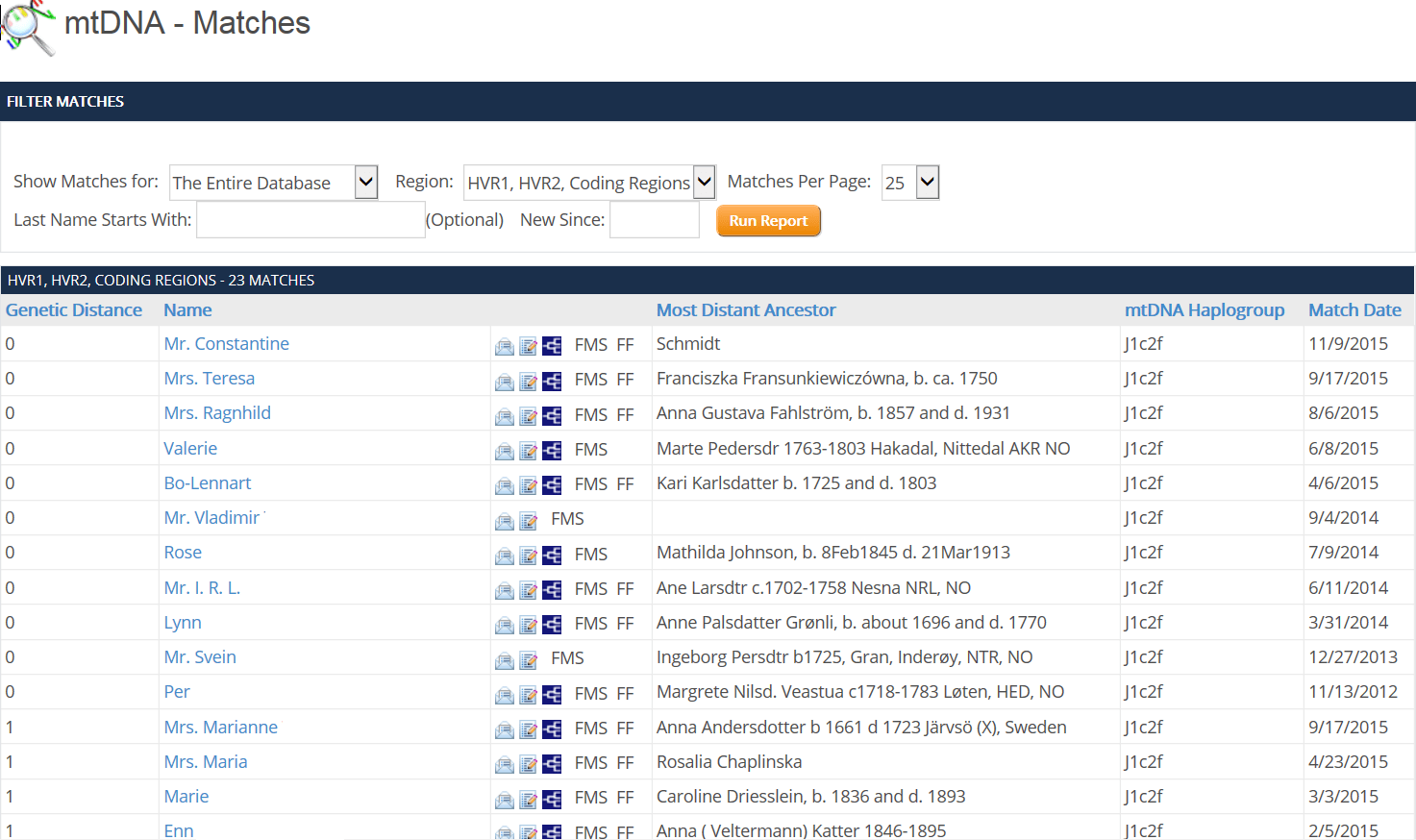
If someone asked me that today, after rolling my eyes of course, I’d just have to show them a double helix on my Kerchner R1b piniphone or maybe just look at them deadpan and say “R1b,” M269” or “J1c2f.” If they know what means, well, there might be hope…

Ok, so what DO you say to someone with whom you match on your DNA?  How do you appropriately say “hello?”

When you receive a match from a vendor or via tools like GedMatch, what do you say to that new match that will elicit a response that might be useful and not make you look either like an idiot or predatory in the process? In part, that has to do with what kind of DNA match it is, meaning Y, mitochondrial or autosomal, and in part, how you ask for information.

So, first, let’s talk about some basics of how to obtain good responses and secondly, let’s look at each type of match.

The Basics

I know some of these basics sounds, well, really basic, but I wouldn’t have included them if I didn’t receive a lot of e-mails from people who obviously don’t understand these basic communications “good manners.”

  1. Do use capitals and punctuation. If you don’t you’re conveying the message to the recipient that they don’t matter enough to bother constructing a complete sentence. E-mails like this are apt to be immediately deleted.
  2. Don’t put the entire question in the subject line. These get deleted too.
  3. Include the person’s name who you match. Don’t assume that the person whose e-mail is on the kit is the person who tested.  Many people manage multiple (as in many) kits.
  4. Don’t write “dear match” e-mails and copy several people at once.
  5. Title the e-mail with something relevant like “DNA Match to Robert Doe at Family Tree DNA.”  You don’t want your e-mail to wind up in their spam filter.
  6. Include the basics of the match including the match’s name on the kit (or kit number) and the company (or service like GedMatch) where the match occurred.  I always add the test type as well, and if the match is particularly close.
  7. Don’t say, “Can you tell me how we’re related?” without giving any other information. That comes across as sounding a bit “entitled” and the response it gets from the receiver generally isn’t positive.
  8. Do not tell your life story. They won’t read it and they’ll delete it.
  9. Include friendly, short, concise basic information, depending on the kind of test.
  10. I always end my communications with a question for them to answer and a short, positive comment.

Y-DNA

Y-DNA tests are between males, so if you’re a female, you might want to mention that you’re the custodian for the kit for your brother, or father, John Doe. Give basic surname and lineage information for the Doe line.

Here’s an example of a contact e-mail for Y DNA:

Dear Robert Doe,

I’m the custodian for the DNA kit at Family Tree DNA of John Doe, my father. I noticed that he matches Robert Doe, which I presume is you, on the Y DNA test at 67 markers with only one mutation.  In addition, these two men carry the same surname which suggest a common ancestor.  I’ve also checked and you two don’t seem to match on the Family Finder test, so perhaps the common ancestor between you and my father is a few generations back in time.

Here is my father’s direct Doe lineage:

y pedigree

As you can see, I’m stuck with Martin Doe in Virginia. I’m hoping that our match might be helpful in getting beyond this brick wall.

Who is your oldest Doe ancestor and where were they located?

Thank you for your time. Here’s hoping we can find our common ancestor or at least some hints!

Jane Doe

Mitochondrial DNA

Mitochondrial DNA is a little more challenging genealogically, because the surnames change with every generation. Therefore, locations become very important clues in terms of finding a common ancestor.

Here’s an example of a mitochondrial DNA contact e-mail:

Dear Susie Smith,

I’m the custodian for the DNA kit at Family Tree DNA for my mother, Barbara Jones. I noticed that mother and Susie Smith, which I presume is you, share mitochondrial DNA at the full sequence level with no mutations difference.  This means that our common relative could be in recent generations, or maybe further back in time.  Since you’ve both also taken the Family Finder test, I noticed that you also match in the 2nd to 4th cousin range, meaning you and mother could potentially share great-grandparents to great-great-great-grand-parents. That could possibly be from Barbara Brown, Ellen Green or Mary on my pedigree chart below.

Here is my mother’s matrilineal line as far back as I have information:

mtDNA pedigree

Of course, it’s possible that our common ancestor is further back in time, but I’m hopeful that some of these names or locations might look familiar or be where your matrilineal family members are from too.

Do you see anything here that looks promising in terms of a common ancestor or location?  Where is your most distant maternal ancestor from?

I look forward to hearing from you. Maybe we can solve this puzzle together.

Jane Jones

Autosomal DNA

Autosomal DNA is, of course, genealogically more complex than either Y or mitochondrial DNA in that your matches can be from any of your family lines. That also means this test is full of potential as well, but it’s more difficult to provide your matches with enough information to obtain a useful response without overwhelming them.  With three different vendors plus GedMatch, a one-size-fits-all introductory letter doesn’t work

The first thing I do is to see if I can tell how this person may match me.

For example, my mother has taken the Family Finder test at Family Tree DNA as well, so the first thing I check on any match is to see if that person matches both me and my mother. If so, then that match is through my mother’s side of the tree.

This is easy to do with the ICW (in common with) button at Family Tree DNA.  The ICW button looks like crossed arrows and is blue, below.

Joy compare

The list of matches returned will either show my mother or it won’t.

If the person doesn’t match my mother, and Joy doesn’t, I see who else they do match in addition to me.  For example, let’s see who Joy matches that I match as well.

Joy ICW

I can tell based on the ICW cousins that Joy and I both match that indeed, this match is on my father’s side and that it’s in the Vannoy line. That’s actually very helpful, because it helps me provide my match with some direction and gives us someplace to go.  This also illustrates the benefit of testing every cousin you can find!

Here’s an example of a Family Finder contact e-mail:

Dear Joy,

I notice that I have a match to Joy Smith, which I presume is you, at Family Tree DNA on the Family Finder test.  Our connection is estimated to be at the 2nd to 4th cousin level. This is exciting because it means we may be able to find our common ancestor.

Based on the fact that you match several of my cousins, including Stacy, Charlene, Christopher, Debbie and 3 Vannoy cousins, our common ancestor seems to be either in the Vannoy line, from which we all descend, or a common ancestral line to all of these cousins.

I’m attaching a copy of my father’s pedigree chart in pdf format so that it’s easily readable. Please note that his grandmother was Elizabeth Vannoy and take a look at her lineage. There is an index in the back of the document so you can easily scan to see if anyone looks familiar.

Are any of her ancestors your ancestors too?

I’m excited to see if we can make a family connection. I look forward to hearing from you,

Roberta Estes

Of course, if you’re sending a message to someone you match at either 23andMe or Ancestry.com, it would read a little bit differently because their tools are different from those provided at Family Tree DNA. For those vendors, my contact verbiage reads somewhat differently, in part, because my mother’s DNA is not at either of those vendors and I have much less flexibility in terms of tools and usage.

For example, at 23andMe the contact request is “blind” and you can’t see anything about matches until the contact and DNA sharing requests are accepted. This is changing shortly at 23andMe, but exactly how all of this will work is uncertain.  Also, not all 23andMe kits can be transferred to Family Tree DNA.

At Ancestry, they have no chromosome browser, so you can’t look at any comparative chromosome information. You can see who else you match in common though, in addition to the Circles.

The message is also different because both Ancestry and 23andMe contacts must be made through their internal message system where you cannot attach files and you are limited in terms of message size. Also, remember to sign your full real name.  Your screen name may not be the same and that’s all the recipient will see in the message they receive through the vendor.  I also include an e-mail address.

Here’s an example of a 23andMe or Ancestry contact message.

I notice that we are a DNA match. That’s great news.  I believe that we may match through the Estes line, but I’m not positive.  I have a number of Estes cousins who have tested from this line at Family Tree DNA that you might match as well.  You can upload your results to Family Tree DNA and see your matches for $39 instead of retesting, which is a real value.  You can also join the Estes project at Family Tree DNA.  Many of my cousins have uploaded their results to GedMatch too.  Have you uploaded your DNA results to http://www.GedMatch.com yet?  It’s a free service provided by genealogists for genealogists and allows people who have tested at different companies to compare their kits for matching.  I’d love to send you my pedigree chart, my GedMatch kit number, provide instructions for transferring your kit to Family Tree DNA and GedMatch, or answer questions.  You can e-mail me at xxxxxx@att.net.  I look forward to seeing if we can find our common ancestor.  Do you have any Estes ancestors in your tree?  Genealogy sure has gotten exciting since DNA has been added as a tool.

Roberta Estes

If I can make this contact more personal, I do. For example, if we share a common ancestor in a tree or a Circle at Ancestry, I always include that information.  I tend, in general to get more responses where I can tell the recipient at least something about how we do or might match, even if it’s nonspecific.

If you want to read more about autosomal DNA contacts tips for success, you can read this more extensive contact article here and one for adoptees here.

Making the contact takes very little effort. Not all contact requests work, of course, but I’ve found some real gems in those that do.

Let me know in the comments what contact techniques work well for you.

Have fun!!!

______________________________________________________________

Disclosure

I receive a small contribution when you click on some of the links to vendors in my articles. This does NOT increase the price you pay but helps me to keep the lights on and this informational blog free for everyone. Please click on the links in the articles or to the vendors below if you are purchasing products or DNA testing.

Thank you so much.

DNA Purchases and Free Transfers

Genealogy Services

Genealogy Research

Phillip Jacob Kirsch (1806-1880), German Immigrant, 52 Ancestors #107

Following many years of genealogical detective work, we have been able to track several lines that were ancestral to the Kirsch family in Germany.  We, in this case, involves several people over a period of about 30 years.  Mom and I searched as did Irene Bultman, our cousin in Dearborn County, Indiana, before her death.  Heike and her mother Marliese, cousins in Germany, found invaluable information as well.  I ordered rolls and rolls of microfilm from my local Family History Center.  Elke Hall, now retired, served as my friend and interpreter for years.

Oh, how I loved the days when packets of translated records would arrive in the mailbox from Elke, before the days of internet. Often, I would take those envelopes into the bathroom, the ONLY place in the entire household that included children, dogs, cats and a husband where one was afforded any privacy at all, and read those packets in uninterrupted luxury.

Dearborn County, Indiana is located at the far southeastern corner of Indiana bordered by the mighty Ohio River on the South and by Cincinnati, Ohio a few miles to the East.  The photos of the Rhine River and the Ohio look remarkably similar, although the land surrounding the Ohio appears to be somewhat less rugged and friendlier towards farming.  The Ohio is the photo on the left and the Rhine is on the right below.

Rhine Ohio

It’s no wonder that my German ancestors felt at home along the Ohio.

Using electronic mapping tools today, we are able to easily find the locations in Germany where our ancestors lived. Mannheim and Ludwigshaven were the predominant areas where we find the Kirsch family in Germany.  When I first started searching German records, even finding a village on a German map was a process.  Things have changed dramatically.

Kirsch Germany map

The above locations where ancestors of the Kirsch family originated all surround the city of Mannheim, on both sides of the Rhine River, and are located within about 15 miles from point A to point I. People who lived pre-1900s most often died within 12 miles of where they were born.  Especially in Germany, many died in the same house where they were born.  Homes, even if they were on leased land, stayed within the same family for centuries.

  • A=Ellerstadt
  • B=Fussgoenheim
  • C=Ruchheim
  • D=Mutterstadt
  • E=Reingoenheim
  • F=Neckarau
  • G=Schwetzingen
  • H=Ladenburg
  • I=Heidelberg

The first of our Kirsch family immigrated from Mutterstadt to America, leaving on June 14th, 1848 from the port of LeHavre, as recorded in the immigration records of the Mutterstadt Civil Register, which actually says 1847. Philipp Jacob Kirsch (Sr.) and his wife, Katharina Barbara Lemmert, along with their 7 children, arrived in New Orleans on July 4, 1848.

Why New Orleans?

Steamboats plied the waters of the Mississippi River, and you could arrive in Aurora, Indiana only 8 days after leaving New Orleans. It was the easiest route to Aurora from Germany.

Why Aurora, Indiana?

There were probably already people from Mutterstadt, and possibly family members, living there. A welcoming committee and other people who spoke German.  Although we think of the days before the telephone as continents separated by oceans being disconnected, they weren’t.  Letters arrived and departed then as now – they just took a lot longer to be delivered.

It was a long trip from Mutterstadt to the port of Le Havre, over 450 miles, which may account for the 1847 civil register date. Goodbyes must have been very difficult.  Those leaving knew they would never see their family who remained in Germany again.  Philip Jacob Kirsch’s parents were both dead, as was Katharina Barbara’s father, but her mother could still have been living.  Those goodbyes, to parents and siblings, must have been terribly difficult.  However, Philip Jacob’s sister and family immigrated and one of Katharina Barbara’s sisters may have as well.

Many immigrants wrote glowing letters back home hoping to entice those left behind to join them in the new land. Given that the Kirsch family obviously had a specific location in mind, as they sailed directly for Aurora, it’s likely that family members were waiting on the dock for their arrival, welcoming the newest Americans.

Mutterstadt LeHavre map

  • A=Mutterstadt
  • B=LeHavre

They probably brought few things with them, and the things they did bring that weren’t essential were probably near and dear to their hearts. Family legend tells us that they brought the chocolate pot and the beer stein, still in the family.

stein

The plates that Jacob Kirsch, their son, used in the Kirsch House in Aurora were also German, but I have to wonder if they ordered them later instead of his parents having brought them on their initial journey.

Let’s take a look at the area of Germany where the Kirsch family lived. The top part of the map below, showing Mannheim on the Rhine and through Eberback on the Neckar was Kirsch stomping grounds.

Rhine Neckar map

What caused our German ancestors to migrate to the United States? Was it the failed uprising of 1848 in which citizens sought democracy and obtained only more restrictions? Most likely not, although the 1850s were one of the peaks of German immigration, with over a million Germans arriving in that decade.

German immigrants

German immigrants boarding a ship in the 1800s are shown above.

The primary reasons for migration seemed to be for the proverbial American dream. In Germany, inheritance laws such as primogeniture, which allowed only the eldest son to inherit land, and forbade him from selling, giving or sharing that inheritance with his other siblings caused a constantly expanding peasant class.

Land was becoming very scarce and expensive, beyond the reach of peasants. Opportunities were only in the cities, which were overcrowded and disease-ridden, forcing people back into the countryside, or to America, the land of opportunity, jobs and land available for farming.

The first members of our German Kirsch family to immigrate to America were Philipp Jacob Kirsch, a farmer, and his wife Katharina Barbara Lemmert.

Fussgoenheim church

According to the Lutheran Church records, Philipp Jacob Kirsch was born in Fussgoenheim, Germany (above and below) in the province of Bayerne, later to become Bavaria on August 8, 1806 to Andreas Kirsch and Margaretha Elizabetha Koehler.

Fussgoenheim, Germany

Today this area is the Pfalz- Palatinate. Katharina Barbara Lemmert, his wife was born September 1, 1807 in Mutterstadt, a neighboring village.

Mutterstadt postcard

This postcard from 1905 from Mutterstadt probably isn’t terribly different than when the Kirsch family left in the 1850s.  The protestant church on the left is where their children were baptized.

Kirsch Lemmert 1829 marriage

Philip Jacob Kirsch and Barbara Lemmert were married in Mutterstadt on December 22, 1829, shown in the church record, above. The record is translated, as follows:

Today the 22nd of December 1829 were married and blessed Philipp Jacob Kirsch from Fussgoenheim, the legitimate, unmarried son of the deceased couple, Andreas Kirsch and Margaretha Koehler and Katharina Barbara Lemmerth the legitimate unmarried daughter of the deceased local citizen Jacob Lemmerth and his surviving wife Gertrude Steiger, both of protestant religion.

Mutterstadt is near Fussgoenheim – about 5 miles distant.

Mutterstadt Fussgoenheim

Philip Jacob Kirsch left the French port of Le Havre on June 14, 1848 and arrived in New Orleans July 4, 1848 with his wife and children whose names are given on the ship’s passenger list, below.

1848 Ship Manifest

The wonderful thing about this passenger list is that it gives the names and ages of all of the children. Many don’t.

In New Orleans, the family would have transferred to yet another boat, a steamer, and steamed up the Mississippi to the Ohio River, and on to the docks at Aurora. These photos were taken in 1848 of the budding city of Cincinnati, just a few miles upstream from Aurora.  The Aurora waterfront probably didn’t look a lot different.  Notice all the steamboats.

1848 Ohio steamboat

This may well be a peek into what types of scenes they saw on the steamboat in 1848. Their son, Jacob, my ancestor, would have been six at the time and for a boy of that age, this must have been an amazing adventure.

1848 Ohio steamboat cincy

On the map of Dearborn County below, you can see the City of Aurora at the bend in the River, and Lawrenceburg upstream towards Ohio. Ripley County borders Dearborn County on the West.  The Kirsch family lived not too far west of Moore’s Hill.  Kelso Township is in the north part of the county where yet another Kirsch or Kersh family resided.  All of these locations hold significance for the Kirsch family story as it unfolds.

Dearborn map

The Kirsch family settled in Ripley County near the town of Milan.

Milan to Aurora

It wasn’t terribly far from Aurora to the 80 acre farm where we find Philip Jacob Kirsch in the 1850, 1860 and 1870 census.

1883 Kirsch plat map crop

The above Plat Map is of Franklin Township in Ripley County, in 1883. Notice the old town of Milan and to the east, the Cemetery by Fordes Hill.

Two years after the family arrived, in the 1850 census, we find Philip Jacob Kursch listed as a farmer in Ripley County, Indiana. Ironically, he is living next door to the Weynacht family, who is also listed along with him on the same ship arriving in New Orleans.  Clearly, these two families immigrated together and were likely related.  But then again, judging from those church records, everyone in Mutterstadt was related several times over.

Kirsch 1850 ripley

Their youngest Kirsch child, Andreas, was born after their arrival in 1848 and died in about 1851. He is buried in a small rural cemetery called the “Old Lutheran Cemetery” about one half mile East of old Milan, where there used to be an old log church.

old Lutheran cemetery

The cemetery is located on the left side of the road as one leaves Old Milan by the road that runs by the present Old Milan Church.

Andreas Kirsch stone

The St. Peter’s Evangelical Lutheran Church was established by a small group of pioneers in a log cabin in Franklin Township in 1847, but it was disbanded in 1855. The cemetery where Andreas is buried abuts a clearing that probably held that church.

Lutheran lost church cemetery

There is a gravestone there that says “Andreas Kirch geb.den Feb. 6, 1817 gest den Sept. 19 1891.

At FindAGrave, Andreas death date is shown as 1821 instead of 1891. As old as this stone it, it’s hard to tell the correct dates.  Andreas is missing from the 1860 census, so this must be the child, Andreas Kirsch who was born in 1847 and the death year was probably 1851.

Irene Bultman, now deceased, believed the family attended a church called Fink’s after that. She had found at least one marriage record of a Koehler family member.  Katharina Barbara Kirsch, daughter of Philip Jacob Kirsch, married Johann Martin Koehler in that church in 1851.  Irene told me that the church records still exist, but they are in German and the current minister in the 1980s when she visited could not translate them.  Today, Finke Church is located at 6960 N. Finks Road in Delaware, Indiana, not terribly distant from where the Kirsch family lived.

In 1860, the census shows Philipp Kersch living in the same location, owning land and living with his wife and youngest children, William and Mary. Two additional children Elizabeth Kaiter and Matthew Weis are living with them, although we have no idea why or if they are related.

1860 Ripley census

Andrew Wenaicht is still living next door. Checking FindAGrave for Andrew, we find Andreas Weinacht born in 1809 in Mutterstadt. So indeed, it appears that Andreas was likely a close friend of Philip Jacob Kirsch.  Looking in my family records, it appears that the Weinacht family was in Mutterstadt for quite some time as they do marry into other families as well.

By 1860, Philip Kirsch, a cooper, was living in Aurora, Indiana with his sister Barbara and her husband Martin Koehler, a hotel keeper. Along with 26 or 27 other people – boarders at the hotel.  While Martin Koehler’s occupation is noted as hotel keeper, given that the other people who lived there were residents and all had occupations such as cooper, bar keeper, carpenter, shoemaker, tailor, cigar maker, clerk, tinner, saddler, rectifier, stave cutter, ferrier and blacksmith, it looks to be more of a boarding house for single men.  There were also several servants living there.

Philip Jacob Kirsch filed his intent to be naturalized, and was in fact naturalized in 1868 in Ripley County, Indiana, according to court records.

But first, the Civil War would interrupt their lives.

The Civil War

On March 3, 1863, Congress passed the Conscription Act which calls for all able-bodied males between the ages of 20 and 45 to serve for 3 years. A drafted man, however, was allowed to pay $300 to hire a substitute.

Three hundred dollars at that time would buy a small farm. Few people had or could come up with that kind of money, and Philip Jacob Kirsch had 4 boys in that age range, although Philip Jacob himself was too old.

As German immigrants who had filed to become American citizens, Philipp Jacob Kirsch and his wife Katharina Barbara Lemmert, saw at least three of their sons serve in the Civil War – Philipp, Martin and probably Jacob. There are records for a John Kirsch as well, but I can’t tell if the John who served in the Civil War is the son of Philip Jacob Kirsch or not. John is such a common name.

Philipp Kirsch served in the Civil War in the US Army Company D 3rd Regiment. He was mustered out Aug. 22, 1861 at Madison, Indiana for the duration of the war.  He owned his own horse, but the equipment was furnished by the government.  He was in Capt. Keister’s company where all the men all owned their own horses.  Philipp was mustered out at the end of the war on Sept. 9, 1864 in Indianapolis, Indiana.  He served a total of just over 3 years.

The 3rd Regiment Indiana Cavalry (East Wing) (or Right Wing), consisting of Companies A, B, C, D, E and F, organized at Madison, Indiana, August 22, 1861, that were intended for service with the 1st Regiment Indiana Cavalry. On October 22, the six companies were designated the 3rd Cavalry and assigned to the Army of the Potomac in the eastern theater of the war. The East Wing saw action at the Battle of Antietam.

The Battle of Antietam (also known as the Battle of Sharpsburg, particularly in the South), fought on September 17, 1862, near Sharpsburg, Maryland.  The Battle of Antietam Creek was the first major battle in the Civil War to take place on Northern soil. It was the bloodiest single-day battle in American history, with almost 23,000 casualties. Phillip would likely have been there.  The picture below was the bridge over Middle Antietam Creek taken in September of 1862.

Antietam Creek Sept 1862

It’s greatly ironic that this battle took place on the land (below) of the Miller descendants of my mother’s father’s grandmother’s line. The Kirsch family is my mother’s mother’s grandfather’s line.  This twist of fate would bring these men from different family lines into close proximity some 45 years before a marriage in northern Indiana would forever cement the blood of these two families.

Battle of Antietam Miller

From the Dearborn Co. History book, we find the list of men in the 32nd Regiment, Indiana Volunteer Infantry, strictly a German regiment, recruited in Sept 1861.  Dearborn Co. furnished most of two companies.  Company C with John L. Giegoldt of Aurora Captain, and Company D that included Martin Kirsch and Valentine Kirsch.

Ripley county offered a $20 bounty for every man drafted, then in 1864, they offered a $100 bounty for every man who either served or found a suitable substitute within the county.

The 45th Regiment, Indiana Volunteer Infantry was known as the third Cavalry.  Company D was from Dearborn Co. and included Philip Kirsch.

Only one known photo exists of Philipp Kirsch who served in the Civil War.  In the photo below Philip is on the left, Barbara Drechsel Kirsch in the middle and her husband, Philipp’s brother, Jacob Kirsch on the right. This photo had to have been taken before Philipp’s death in 1905.  Jacob Kirsch doesn’t look nearly as gray as he does in later photographs.

Kirsch family pre-1905

Sadly, Philipp Kirsch suffered the rest of his life due to some type of intestinal issue that occurred during the Civil War. According to his service records, he was twice hospitalized, but never recovered either during the war or afterwards from diarrhea that he contracted during his service period.  He applied for an increase in his disability pension in 1874, stating that he had been living with his father since the war and that his father’s circumstances had become very strained.  As a result of his disability, Philip was unable to do any physical labor. He later died of complications from the effects of chronic and prolonged diarrhea.  The rather graphic description in his service records cause me to feel very sorry for the man and the chronic pain he lived with.  Philip Jacob lived with his father in Ripley County until his father’s death in 1880, then with his mother until her death in 1889, then with his brother Jacob at the Kirsch house until Phillip’s own death in 1905.

Martin Kirsch also served in the Civil War, and may have been killed or died of disease. I find nothing after the Civil War for Martin. Martin was recruited in 1861 and served in Company D 32nd  Indiana Regiment, the state’s “only German regiment” in the Civil War. Part of the Army of the Ohio, the 32nd fought at Rowlett’s Station in Kentucky; Shiloh, Stones River, Missionary Ridge in Tennessee; and Chickamauga in Georgia.  The brothers served in the same unit and would have mustered in the same day.  That also means that Phillip may have witnessed his brother, Martin’s, death.

I believe that our ancestor, Jacob Kirsch, also served in the War. He certainly was of the age where militia participation was required, and given that he was not yet married, it’s unlikely that he sought and paid for a replacement. Three hundred dollars at that time would buy a farm.

Jacob’s wife, Barbara, applied for a Civil War pension after Jacob’s death. Her pension application was declined, but she gives his unit number as the Indiana 137th Regiment Infantry, This unit was organized at Indianapolis, Ind., and mustered in May 26, 1864. If Jacob was in this unit, he was ordered to Tennessee and assigned to duty as Railroad Guard in Tennessee and Alabama, Dept. of the Cumberland, until September, 1864. She says he was mustered out September 21, 1864, at the end of the war.  Given that Barbara likely knew Jacob during the Civil War, I find it unlikely that Jacob did not serve.  Furthermore, we have a painting of Jacob in uniform.

I researched the unit in question, and found a diary kept by another soldier, removing all doubt about whether or not that soldier served. That man’s name was also not on the roll of the unit.  It appears that records were not well kept during the Civil War.  However, in a surprise turn of events, even though the federal government said Jacob did not serve in that unit, I found his service records listed with that unit in Indiana’s records, so Jacob and Barbara are both vindicated – although not without more than a little confusion and more than a century after the fact.

A painting of Jacob in which he appears to be wearing a Union uniform exists within the family and a picture of the painting is show below.

Jacob Kirsch civil war painting

Philip Jacob Kirsch, listed erroneously as Peter, was still living in Ripley County in 1870. Son Philip, now 38, having served in the Civil War, is listed as a cooper, and Mathias White is living with them as farm labor.

1870 Ripley census

In the 1880 census, we find that Philip Jacob Kirsch has just died, and Barbara, his widow, is still living on the home place with their son Philip Jacob Kirsch, the Civil War veteran who never married. For many years, I thought of Philip as the benevolent son, staying on the farm to care for his aging parents.  Now, perhaps that visage needs to change, because it appears that Philipp may have been living with his parents due to his disability or inability to work.  So maybe they all took care of each other as best they could.

1880 Ripley census

Final Resting Place

Philip Jacob Kirsch and Katharina Barbara are both buried in the Riverview Cemetery south of Aurora along the Ohio River, as is their son Philipp.  It’s somehow fitting that he watches over the Ohio River for eternity.  His life was closely connected to rivers, first the Rhine, then the Mississippi and Ohio.

riverview entrance

Philip Jacob’s tombstone says that he died in 1879, but the cemetery records say he died in 1880, as does this snippet from the Aurora Dearborn Independent on May 13, 1880.

Philip Kirsch Death crop

I was surprised to discover that there was no service for Phillipp in the church.  I was also surprised that the body was sent by train and not by horse and wagon, although the depot was right beside the Kirsch House.  The Fifth Street German Reformed Church is not the church that Jacob Kirsch, Philipp’s son who lived in Aurora, belonged to.  I don’t know if Philipp’s services were conducted by this Reverend because there was a difference in the beliefs of the two German churches, reflecting Phillipp’s personal beliefs, or maybe just because this particular German minister was available to bury a body already 2 days dead in mid-May.

Kirsch Philip Jacob stone

Cemetery records tell us that Philip Jacob was a farmer, was married, lived in Ripley County, near Milan, and died of old age. “Father of Jacob Kirsch of this city, he was 73 years, 9 months and 2 days old and is buried in section H 28” in Riverview.  The section 80 permit was obtained by Jacob Kirsch and is number #803.  Philip Jacob Kirsch was buried May 12, 1880, two days after his death.  Parents listed as “Pilip (sic) Jacob Kirsch mother Barbara Deubert.”  According to Mutterstadt church records, his parents’ names are listed incorrectly.  This is a relatively common occurrence.  Keep in mind in this instance that Philip Jacob’s children never met their grandparents, so it’s not surprising they would not remember their names.

Calculating his death date by his age given, which was calculated from his death date originally, we do indeed find that he died in 1880. This stone was likely set later.  The stone of his son, Philip Jacob, who served in the Civil War and died 25 years after Philip Jacob, the father, is shown in the right corner of the photo.

Philip Jacob’s Land

When Mom and I visited in the 1980s, I vaguely remember finding Philip’s land, or at least we thought we had.

I was quite thrown for a bit, because the roads and landmarks just weren’t lining up, until I realized that today’s Milan was not the same Milan as when Philip Jacob Kirsch lived there.

Milan map

In fact, today, it’s called “Old Milan” and once I realized that, everything fell right into place.  On the map above, Old Milan is just above Milan at the intersection of Old Milan Road and County Road 475 North, which is the road the Kirsch family lived on.

It’s a lot easier today with Google maps in conjunction with the plat map.

Kirsch land and cemetery

On the satellite map above, you can see Philip Jacob’s house location – the red arrow on the left. The address is 5828-6202 East Co Road 475 N, Milan.  The arrow at right is the location of the cemetery where their child, Andreas Kirsch, is buried.

Here is the street view. I love this house. It’s ole enough that it could be original.  It looks like a ginger-bread house.  I wonder if Philip Jacob Kirsch built this house and planted those trees, at least some of them?

Kirsch ripley house

Across the road, the barns.  Hoosier barns, corn in the field beside the house and summer dried grass always make me feel so at home.  I can still hear the crunch of gravel as the truck turned off of the macadam road into the driveway.  The slamming of the kitchen screen door.  The rustling movements and musty smell of the farm animals.  The tractor’s engine.  A dog barking and chasing after someone or something – maybe one of the barn cats that were both pets and working animals too.  Their job was to keep the barns and house mouse-free.

Kirsch Ripley barns

Often, on old farms, the barn is across the road from the house.  This road dissects Phillip’s property almost in half.

Kirsch Ripley roads

Looking down the road.

Kirsch Ripley road 2

And the other way. Roads are just SOOO inviting to me.

Kirsch top of Ripley land

This satellite view shows Philip Jacob’s land with the arrow pointing to the northernmost boundary.

Sale

Seven years after Philip Jacob’s death, his children and widow sold the land.  I’d wager that it was just too much for Barbara, his widow, and Philip, his disabled son, to maintain.

When I first saw this deed, I thought perhaps the family all came back and were together one last time on the farm, signed the deed, and had a glorious reunion.  Then, as I read the deed and the notary statements, I realized that isn’t what happened at all.  Even the family in Marion County didn’t sign in person.

kirsch-1887-deed

This indenture witnesseth that Barbara Kirsch, Jacob Kirsch Jr., Philip Kirsch of Dearborn County, Indiana and John Kirsch and Mary Kirsch of Marion County, Indiana, William Kirsch and Caroline Kirsch of Fremont, Nebraska, Mary Kramer and John Kramer of Collinswell, Illinois convey and warrant to Douglas Martin of Dearborn County for the sum of $1200 the receipt whereof is hereby acknowledged the following described real estate in Ripley County, Indiana, to wit:

The east half of the NE quarter of section 14, township 8, north of range 12 east, containing 80 acres more or less.

In witness whereof the said Barbara Kirsch, Jacob Kirsch, Barbara Kirsch Jr. and Philip Kirsch, John Kirsch, Mary Kirsch, William Kirsch, Caroline Kirsch, Mary Kramer and John Kramer have hereunto set their hands and seals this 29 of August 1887.

Signed:

  1. Jacob Kirsch
  2. Barbara Kirsch
  3. John Kramer
  4. Mary Kramer
  5. Charles Schnell
  6. B Barbara Schnell
  7. John Kirsch
  8. Mary Kirsch
  9. William Kirsch
  10. Caroline Kirsch
  11. Barbara Kirsch
  12. Philip Kirsch

Before me James F. Honson a notary public in and for the county of Dodge, State of Nebraska, personally appeared William Kirsch and his wife Caroline Kirsch and acknowledged the executrion of the annexed and foregoing deed.

September 3, 1887

State of Indiana, Marion County, before me Robert Knoff a Notary Public in and for said Marion County, Indiana personally appeared John Kirsch and his wife Mary Kitsch and acknowledged the annexed and foregoing deed. September 15, 1887

Deed Book 59, Sept 1887-Nov 1888, page 45

kirsch-1887-deed-2

Madison County, State of Illinois – Before me a Notary Public in and for the County of Madison in the state of Illinois, personally appeared Mary Kramer and her husband John Kramer and acknowledged the execution of the annexed and foregoing deed. Sept. 6, 1887

Dearborn County, Indiana – On the 12th day of September 1887 before me the undersigned Notary Public personally appeared Jacob Kirsch Barbara Kirsch his wife also Philip Kirsch and Karbara Kirsch and acknowledged the execution of the foregoing deed.

Recorded October 18, 1887 at 11 o’clock AM.

Deed book 59, September 1887-November 1888, page 46

German Naming Patterns

German families typically gave their children first names of Saints, even those who weren’t Catholic, and they were addressed by their second name. This makes records particularly challenging to locate, since the name you know the person by is often not their first name.

One pronounced exception to that rule is the name Johannes.  As a Saint’s name, the child is named Johann Jacob Kirsch, for example, but when the first name Johannes is used, then that is the only name and his actual name is Johannes.  Johannes Kirsch, for example.  Johann(es) is the German form of John.

Often many children in the family were given the same first name.  For example, Johann Michael and Johan Jacob.  Neither child would have been called Johann, but both would have been called  by their middle names, Michael and Jacob.  Also, the names of deceased children were recycled for later births, sometimes more than once.

Add to that that the names became Americanized over here.  Anna Maria Kirsch in German baptismal records became Mary Kirsch in Indiana and then Mary Kramer when she married.  Try tying Mary Kramer who died in 1929 in Illinois to Anna Maria Kirsch in the 1840s in Mutterstadt, Germany.

Philip Jacob Kirsch became Jacob Kirsch, but then so did his brother Jacob Kirsch whose name was probably actually Johann Jacob Kirsch.  So the father Philip Jacob Kirsch was (generally) called Jacob, the son Philip Jacob was (generally) called Phillip to differentiate his from his brother Jacob who was always called Jacob.  Nope, not confusing at all…..

Children of Philipp Jacob Kirsch and Katharina Barbara Lemmert

Philip Jacob Kirsch immigrated in 1848 with his wife, Katharina Barbara Lemmert and his children. Those children would join the others in the melting pot called America.  His children spoke German, of course, and they naturally gravitated towards other German-speaking children as their playmates and eventual spouses.  They were probably quite close to the Weinaught family next door.  I’m actually surprised there was no intermarriage.

The Kirsch children’s births are recorded in the Protestant church in Mutterstadt, and documentation sent by Friedrich Kirsch many years ago from Germany that he obtained in Mutterstadt (I believe, from the municipality) confirms the following:

  • The marriage date of Philip Jacob Kirsch and Katharina Barbara Lemmert
  • Their birth dates
  • Their parents, his from Fussgoenheim and hers from Mutterstadt
  • Their children and their birth dates
  • That they emigrated to America in 1847
  • That both Philip Jacob and Katharina Barbara and their parents were farmers

Their first child, a son, Philipp Jacob Kirsch was born in 1830.  He never married and lived out his life with his brother, Jacob Kirsch and his family at the Kirsch House in Aurora after his mother’s death in 1889.

Kirsch, Philip Jacob 1830

The Mutterstadt church registry entry above in 1830 gives us the date of the birth and baptism of Philipp Jacob Kirsch, that he was confirmed in 1844, and that he immigrated with his parents to America in 1847. Furthermore, it states his parent’s names, and that his godparents were Philipp Jacob Ellenberger and his wife Anna Maria Lemmert who was the sister of Katharina Barbara Lemmert.

Their second child, daughter Katharina Barbara Kirsch born in 1833 married Johann Martin Koehler, also born in Fussgoenheim, in 1851 in Ripley Co., Indiana. After Martin’s death, she remarried to Charles Schnell. Barbara died in 1900 in Dearborn County, Indiana and is buried at Riverview Cemetery, on the Jacob Kirsch lot under her remarried name, Schnell .

Kirsch, Barbara Katharina 1833

The church registry above records the birth of Katharina Barbara Kirsch in 1833. She was confirmed in 1846 before immigrating with her parents in 1847.  It gives her godparents as Katharina Barbara Reimer, wife of the barrel maker George Seitz.

Their third child, son Johann Kirsch born in 1835 was living when his brother Philip Jacob Kirsch died in 1905. When Jacob Kirsch died in 1917, his obituary said that his brother John was living in Indianapolis.  John married Mary Blatz in 1856 in Ripley County and subsequently moved to Indianapolis where we find him from 1870 until his death in 1927.

Kirsch, John 1835

The church registry entry above in 1835 for Johannes Kirsch shown his birth on the 14th, then his christening 7 days later on June 21st and says he emigrated to America with his parents in 1847, gives his parents’ names and names his godparents as Johannes Weihnacht and his wife Katharina Barbara Zimmer.  There’s the Weinaught family again.

The fourth child, Martin Kirsch born in 1838 fought in the Civil War, but then there is no more information except that he is not mentioned in his brother, Philipp’s 1905 will. I have checked www.fold3.com several times to see if I can find further records for Martin, with no luck. The full Civil War service packs are not yet entirely digitized.

Kirsch, Martin 1838

The church registry above for Martin Kirsch says he was born and baptized Sept. 16, 1838 names his parents, notes that he emigrated, and gives his godparents as Martin Kohler and his wife Maria Kirsch from Fussgoenheim.  Maria Kirsch was the sister of Philip Jacob Kirsch who was married to Martin Koehler who was also Philip Jacob Kirsch’s first cousin.

Jacob Kirsch, born in 1841, our ancestor, married Barbara Drechsel, a young German woman from Aurora.

Kirsch, Jacob 1841

The church registry in Mutterstadt above records the birth of Jacob Kirsch on May 1st, 1841 and his baptism on May the 5th. It states the names of his parents as well as his godparents, “Jacob Krick II and Anna Maria Lemmert, Protestant couple from here.”  It also says he immigrated with his parents in 1847.  Anna Maria Lemmert is the sister of Katharina Barbara Lemmert.  Anna Maria was married to Jacob Krick.  So, we now know that Jacob was named after Jacob Krick, his godfather.  In the German tradition, this also meant that if something happened to Jacob Kirsch’s parents, his godparents would be the people to raise him.  Maybe naming the child after the godparent was a way to “connect” them emotionally to each other, just in case.

Johann Wilheim Kirsch, born in 1844 married Carolyn Kuntz. We know he is dead before 1905 and that he had 1 girl and 2 boys.

Kirsch, William 1844

The church registry record above gives us the birth date of Johann Wilhelm Kirsch, his baptismal date four days later on January 7, 1844, the names of his parents and gives his godparents as Johann Wilhelm Kirsch and Katharina Barbara Koob, protestant couple from Fussgoenheim.  Johann Wilhelm Kirsch who is married to Katharina Barbara Koob is the brother of Philip Jacob Kirsch.

Anna Maria Kirsch, born January 11, 1847 married John Kramer in 1864 in Indiana and was living in St. Louis in 1917 when her brother Jacob Kirsch died, according to his obituary. Mary Kramer died in Madison County, Illinois, just across the Mississippi River from St. Louis in 1929, her birth location given as Mutterstadt.

Kirsch Anna Marie 1847 crop

The church registry above records the birth of Anna Maria Kirsch and states that she was baptized January 17th in the Protestant school house in Mutterstadt, that Philipp Roeder and his wife Anna Maria nee Baumann, Protestants, were her witnesses (godparents).

Andrew Kirsch, their only child born in the US, Feb. 6, 1849, died in roughly 1851 (one record says 1853) and is buried at the old Lutheran Cemetery near Fordes Hills near Milan. This means that Barbara, his mother, was pregnant on her journey to the US on a rocking ship, then on a riverboat steamer.  A brave woman, indeed.

Had Andreas been born in 1848, his birth would have been recorded in Germany. It wasn’t.  Instead, we find repeated commentary in the church records that the family immigrated in 1847.  They may have left Mutterstadt in 1847, but it wasn’t until June of 1848 that they left the French port of LeHavre and not until July 4th, 1848 that they arrived in New Orleans.  Truly Independence Day!

Surprisingly, we don’t know a huge amount about Philip Jacob Kirsch, the person. We know he was a Lutheran farmer who was either brave enough or foolhearty enough to sail across the ocean with his entire family of 7 children and his pregnant wife.

He surely worried when at least 3 of his 4 sons left to fight in the Civil War. I wonder if he somehow knew one of them might not come home.  Maybe he was secretly just a little thankful that Jacob had shot his eye out as a child so that Jacob wouldn’t have to put his life in danger.  However, that logic didn’t work, because Indeed, Jacob did serve.  Was Philip Jacob Kirsch proud of his American sons and their loyalty, or was he regretful that he had come for opportunities and one of the opportunities they got was civil war, just 13 years later – far above and beyond what they ever had reason to expect.

Did Philip Jacob view this as somewhat ironic in a wry way? Did he view it as a crisis?  Was he worried or accepting?  Did he take strength from his religion, and then comfort in times of death, or was he simply a “habitual attender” who attended church more out of habit (or his wife’s persuading) than conviction?  Unfortunately, we don’t have a periscope to look back in time, at least not at these questions.

Y DNA

The only periscope we do have available to us would be Philip Jacob Kirsch’s Y DNA. Unfortunately, there are very few DNA candidates.  I tracked Philipp Jacob’s son, John, forward in time with the hope of finding a DNA candidate in that line. I’m hopeful that it indeed will work.  There are some additional candidates as well.

  • Jacob Kirsch’s son Edward Kirsch had a son Deveraux “Devero” Kirsch who died in 1975 in Vigo County, Indiana.  He had a son, William Kirsch.
  • Jacob’s son Martin Kirsch had a son, Edgar, who married Frieda Neely in 1929. I don’t show any children for this couple.
  • Philip Jacob’s son, Johann William Kirsch, known as William, was dead before 1905 and had 3 children, 2 of whom were sons.  We know he married Caroline Kuntz in 1870 in Indiana.  I have found a William Kirsch living in Pohocco, Saunders County, Nebraska in the 1885 Nebraska state census, wife Carrie, daughter Mittie (13) born in Indiana and sons Edward (11) born in Nebraska and Henry (9) also born in Nebraska. This William died in February of 1891 and was apparently involved in some kind of accident going over the Platte River Bridge in December of 1889. His son Edward died in 1967 and married Beatrice.  In 1910 they had been married 12 years, had 2 children, but none were living.  Edward was living with his mother in 1930.  Henry was alive, 55 and unmarried in the 1930 census, so it’s unlikely that he has any descendants.  It appears that there are no male Kirsch descendants through this line, if this is the correct William Kirsch.
  • Philip Jacob’s son, John Kirsch, moved to Indianapolis and had son Frank Kirsch and son Andrew Kirsch.

Let’s hope that one of these sons or grandsons continued to have male children and that one of them will find us through an interest in genealogy. I have a DNA testing scholarship for any male Kirsch descended from this line.

The “Other” Kirsch Family of Lawrenceburg

As luck would have it, it appears that the neighboring Lawrenceburg (Indiana) Kirsch family may be from Fussgoenheim as well, although I did not originally think that was the case because the 1870 census shows the birth location as Rheinbier, Bavaria. However, that is a misspelling of Rheinpfalz or Rheinbayern which means the southern portion of the current Rheinland-Pfalz.  However, according to Ancestry trees, descendants think that Rheinbier is the village name based on the census.

As fate would have it, I stumbled across the records for this family in the Mutterstadt church records.

I found the marriage of Johannes Kirsch, son of George Heinrich Kirsch and Anna Barbara Elsperman marrying to Margaretha Boeckman, daughter of Immanual Bockmann and Margaretha Elisabetha Ermel in Mutterstadt on September 6, 1831.

Children subsequently baptized in the same church by this couple include:

  • Johannes born Nov. 13, 1831
  • Heinrich born Dec. 5, 1833
  • Catharina born March 8, 1835
  • Valentin born March 27, 1836
  • Johannes born Jan. 21, 1838
  • Johan Georg born June 8, 1840

I can’t find John in the 1850 census, which, based on his 1860 census information, means the family was still in Germany at that time.

In 1860 John Kirsch is living in Lawrenceburg with son George, age 20, a cigarmaker, son John born 1838 who had married.  John also had several younger children:

  • Valentine age 15 (born 1845 in Germany)
  • Jacob age 12 (born in 1848 Germany)
  • Helena age 9 (born in 1851 Germany)

Dearborn County, Indiana records indicate that:

  • Valentine Kirsch married Mary Elizabeth Kohlerman in Lawrenceburg in 1866.
  • Heinrich Kirsch married Elizabeth Schleicher in 1856.
  • Son John (Johannes) married Margaretha Bultman in1859.  In the 1860 census, they have a new son, John, as well.

This sure looks to be the same family!

So, the Lawrenceburg Kirsch family was (apparently) from Fussgoenheim as well. I don’t have John’s father, Georg Heinrich Kirsch connected on back to my Kirsch line in Mutterstadt, but I’m betting money he connects.

So, I wonder, are there any Kirsch’s still around in Lawrenceburg today?

It surely would be fun to test a Kirsch male from each line to see if indeed, they do share a common Kirsch ancestor prior to the first church records.

It would also be fun to test any descendants, male or female (with any surname), of these couples to see if we match each other autosomally. If so, that means that we can identify which segments of our ancestral DNA was inherited through the Kirsch lines, or those lines that fed the Kirsch lineage.

______________________________________________________________

Disclosure

I receive a small contribution when you click on some of the links to vendors in my articles. This does NOT increase the price you pay but helps me to keep the lights on and this informational blog free for everyone. Please click on the links in the articles or to the vendors below if you are purchasing products or DNA testing.

Thank you so much.

DNA Purchases and Free Transfers

Genealogy Services

Genealogy Research

The Ancestry 200

Sounds like a race doesn’t it, but it isn’t. It’s a milestone checkpoint of sorts, so I thought I’d take a few minutes and take a look at where my Ancestry DNA shakey leaf tree matches are, and how they are performing.

On January 13th, 2016 I reached 200 shakey leaf DNA matches at Ancestry.  In case you don’t know, a shakey left hint with someone means that our DNA matches AND our trees indicate that we have a common ancestor.  As far as I’m concerned this is the low hanging fruit at Ancestry, and pretty much all I bother with except in rare circumstances.  But those shakey leaf matches are just plain fun.  It’s like getting a bite of genealogist-crack-candy when I get a new shakey leaf.

200 leaf

Where Are We Today?

I have a total of 150 pages at 50 matches each for a total of 7500 matches today at Ancestry. That’s roughly half of the number of matches I had pre-Timber phasing introduced in November of 2014 and double the number I had after Timber.  I wrote about the introductory Timber/phasing rollout here.

Pre-Timber After Timber Intro Nov 2014 January 2016
Total Matches 13,100 3,350 7,500
Shakey Leaf Matches 36 18 200

Today, my 200 shakey leaf matches represent 2.67% of my total matches. Not a terribly good return, but again, the tree matching makes seeing the (potential) connection with these matches much easier.  The other 97%…not so easy.

New Ancestor Discoveries (NADs)

Let’s look at the first thing you see on your page. New Ancestor Discoveries, or what I (not so) affectionately call Bad NADs, because these are not my ancestors.

200 NAD

And since April 2015, Ancestry, bless their hearts, has given be 6 bad NADs, New Ancestor Discoveries that aren’t. In one case, Robert Shiflet is the husband of my ancestor’s sister.

Shiflet NAD chart

So, while I share DNA with Robert’s children, it’s not Robert’s DNA that I share, but his wife’s. Actually, Ancestry has given me 8 bad NADS, but they also take them away from time to time. But then, some come back again! Kind of like a light bulb flickering off and on, trying to burn out.

In all fairness, there is some DNA connection somehow, but not necessarily through the individual portrayed. Unfortunately, this leads many, MANY people far astray as they take these projections as gospel, and they are far from gospel.  They are much more like a leap of ill-placed faith.  I wish NADs had been labeled “hints” with the explanation that you share some DNA with people who descend from this individual.  And I wish they were someplace at the bottom of the page, hidden away – not the first thing you see.  It’s deceiving – and just plain wrong to say that I’m a “Descendant of Robert Shiflet.”  I’m not.  He was married to my ancestor’s sister.  I’m not only not his descendant, I don’t share ANY blood connection with Robert Shiflet.

200 shiflet

Today, these NADs are labeled such that it flat out says you are a “descendant of” this person, which is in my case, unequivocally untrue for all of these NADs.

On to more useful topics.

DNA Circles

Ancestry has also put me into 19 DNA Circles. Actually, they have put me into 21 DNA Circles, but two of those circles have disappeared as well.  I suspect this is due to a change in Ancestry’s ranking algorithm because they disappeared at the same time.

A DNA Circle means that you have DNA matches with at least two other people who share a common ancestor with you in their tree. That’s the claim.  However, I have two cases where I only match one other person and I’m in a Circle, and many cases where I match many people and I’m not in the circle.

A match or being included in a Circle does NOT mean you match on the same segment, or that anyone in the tree matches on the same segments – only that you match and show a common ancestor in your trees. In other words, you could be matching as a result of a different ancestor entirely on entirely different segments, and there are no tools available (like a chromosome browser or triangulation tools) to verify this connection.

200 circle 1

However, DNA Circles are useful. For example, it’s unlikely, if you are matching an ancestor through different children, and there are many matches, that your connection isn’t through this ancestral couple, or someone who contributed to the DNA of this ancestral couple.  Yes, the language here gets wishy washy.

200 circle 2

I view Circles as a way to generally confirm that my genealogy is most likely accurate. Yea, I know, more wishy washy words – but that’s because the tools we have don’t provide us with a path to clarity.

200 circle 3

Shakey Leaf Matches

I have 200 shakey leaf matches with people, meaning that we share DNA and a common ancestor in our trees. We may or may not be in a Circle together, because Circles aren’t created unless you match at least two(?) other individuals from this common ancestor, plus some other proprietary weighting factors.

I particularly like that we can see how the other people we match descend from this same ancestor. This suggests that the match really can’t be due to a NPE (nonparental event, also known as an undocumented adoption) downstream of this ancestor. If that were the case, you would only match people through the same child.

200 shakey match

Non-Shakey Leaf Matches

Let’s take a look at my best, meaning my closest, matches. Unfortunately, my highest matches don’t have trees with a common ancestor with me – so no shakey leaves.  The second closest match has no tree at all.  This lack of trees or private trees is one of the most frustrating aspects of genetic genealogy – and particularly at Ancestry because their usefulness depends so heavily on the trees.  Regardless, given that these are my closest matches, let’s see if we can’t determine our common ancestor.

200 closest

So, using deductive reasoning, let’s see what we can discover about my three highest matches. In August, Ancestry introduced the feature called “Shared Matches” meaning Ancestry shows you who you both match in common for any match that is 4th cousin or closer, meaning 6 generations or closer.  So keep in mind, you both will have matches further back in time or predicted to be more distant matches, but they won’t show in the shared matches.

So let’s look at my closest match, PR, estimated to be a second to third cousin.

Clicking on Shared Matches with PR, I have a total of 13. That’s hopeful.  Of those 13:

  • 3 have no tree
  • 1 tree is unavailable
  • 1 shakey leaf match that’s private – who never answered the inquiry message I sent them and hasn’t signed in since February 2015

200 closest shared matches

Ugh, this isn’t hopeful anymore, it’s frustrating. I was very much hoping to be able to deduce the common ancestor by seeing who else I matched – and hoping that there were some shakey leaf people with common ancestor’s already identified in the match list, but that is not to be.

Let’s move to my second closest match and try to find my common ancestor with MH who has no family tree. I can’t imagine how they are using this tool without a family tree.  However, judging from the fact that they haven’t signed in since September 3rd, maybe they aren’t doing anything with these results.  With MH, I have 12 matches, of which:

  • 3 have no tree
  • 4 have shakey leaf hints

Now those shakey leaf hints are very hopeful, so let’s see if they all point to the same ancestor!

  • 2 point to Andrew McKee
  • 1 points to Samuel Claxton and Elizabeth Speaks
  • 1 points to Fairwick Claxton and Agnes Muncy, but not through son Samuel

Uh, that would be a no, they don’t all point to the same ancestor. But three of these people are in the same line, and the fourth, well, not really.

Andrew McKee is the father of Ann McKee who married Charles Speaks who had Elizabeth Speaks who married Samuel Claxton. So the three people who descend from these ancestors are legitimately from the same line.

200 McKee

However, there is no DNA pathway from Andrew McKee to Fairwick Claxton and his wife, Agnes Muncy, but Fairwick is in both people’s trees. In this case, MH must be matching the last person through a different line, and not through Andrew McKee.  The only way Fairwick could even be insinuated is if the person descends through Samuel Claxton, Fairwick’s son who married Agnes Muncy, but that isn’t shown in their tree.  Their descend from Fairwick is through a different child.

200 Claxton

So, this trip into deductive reasoning should have worked, but didn’t exactly work quite as planned due to what I’ll call “inferential tree assumptions.” That assumption would be that if your DNA matches, and you have a common ancestor in a tree, that your DNA link is THROUGH that common ancestor.  Sometimes, in fact many times, that’s true, but there are cases where the link is through a different common ancestor. In this case, it’s likely that one way I match MH is through Andrew McKee, but I may well have a second line through Fairwick Claxton and Agnes Muncy.  These people do live in the same geography.

200 multiple leafs

I see secondary and multiple lineages far more than I would have expected. When Ancestry can see that there are multiple ancestors in your trees that match, they show that you have “Shared Ancestor Hint 1 of X”, but they can only note what’s recorded and matches in both your trees.

Moving on to my third closest match, that’s a lost cause too because it’s the same line as the first match.

Indeed, working with shakey leaf matches are indeed your best bet at Ancestry.

However, let’s take a look at this matching data in a different way.

Matches and Circles by Ancestor

There may be 200 shakey leaf matches today, but there have been a total of 263 shakey leaf matches, of which 63 have either disappeared through the magic of Timber or for some other, unknown reason. A few were adoptees trying to work with various experimental trees, so I’ve eliminated them from the totals.  I’ve kept track of my matches by ancestor though, so let’s see how many of my matches are in circles and how many of my ancestral lines are represented.

The generations column is the number removed from me to that ancestor counting my parent as generation 1.  Remember, Ancestry does not report shakey leaf matches beyond 9 generations. Total matches is how many people whose DNA match mine also show this ancestor in their tree. Circle is yes or no, there is a Circle or there isn’t for one or both of the ancestral couple.  How many of my matches are in the circle and how many total individuals are in that circle.  Note that the Total Matches (to me) should be one less than the Matches in the Circle which includes me.

Ancestor Generations Total Matches Circle Matches in Circle incl Me Total in Circle incl Me
Abraham Estes & Barbara 9 8
Andrew McKee & Elizabeth 5 5 Andrew Andrew 6 Andrew 15
Antoine Lore & Rachel Levina Hill 4 1
Catherine Heath 8 1
Charles Hickerson & Mary Lytle 7 1
Charles Speak & Ann McKee 5 1
Charlotte Ann Girouard 8 1
Claude Dugas & Francoise Bourgeois 9 3
Cornelius Anderson & Annetje Opdyke 9 4
Daniel Garceau and Anne Doucet 7 1
Daniel Miller & Elizabeth Ulrich 6 8
David Miller & Catherine Schaeffer 5 3 David David 4 David 6
Edward Mercer 8 2
Elisha Eldredge and Doras Mulford 8 1
Elizabeth Greib (m Stephen Ulrich) 7 1
Elizabeth Mary Algenica Daye 8 1
Elizabeth Shepherd (m William McNiel) 6 6
Fairwick Claxton & Agnes Muncy 5 2 Fairwick

Agnes

Fairwick 4

Agnes 4

Fairwick 7

Agnes 7

Frances Carpenter 5 1
Francois Broussard & Catherine Richard 9 3
Francoise Dugas 8 3
Francois Lafaille 6 2
George Dodson & Margaret Dagord 8 12
George Estes & Mary Younger 6 2
George McNiel & Sarah 7 7
George Shepherd & Elizabeth Angelica Daye 8 3
Gershom Hall 7 3
Gershom Hall & Dorcas Richardson 6 1
Gideon Faires & Sarah McSpadden 7 2
Henry Bolton & Nancy Mann (Henry had 2 wives) 5 12 Nancy

Henry

Nancy 7

Henry 8

Nancy 20, Henry 22
Henry Bowen & Jane Carter 9 2
Honore Lore & Marie Lafaille 5 1
Jacob Dobkins 7 1
Jacob Lentz & Frederica Moselman 5 2 Frederica Jacob Frederica 3 Jacob 3 Frederica 12, Jacob 12
Jacque Bonnevie & Francoise Mius 8 1
James Crumley & Catherine 8 1
James Hall & Mehitable Wood 7 2
James Lee Claxton 6 2
Jan Derik Woertman & Anna Marie Andries 9 1
Jeanne Aucoin 9 1
Joel Vannoy & Phoebe Crumley 4 8 Joel

Phoebe

Joel 8

Phoebe 8

Joel 8

Phoebe 8

Johann Michael Miller & Suzanna Berchtol 8 11
Johann Nicholas Schaeffer & Mary Catherine Suder 8 2
John Campbell & Jane Dobkins* 6 5 Jane

John

Jane 6

John 3

Jane 10 John 5
John Cantrell & Hannah Britton 7 7
John Francis Vannoy & Susannah Anderson 7 7
John Hill & Catherine Mitchell 6 1 John John 2 John 3
John R. Estes & Nancy Moore* 5 5 John

Nancy

John 2

Nancy 3

John 6

Nancy 6

Joseph Cantrell & Catherine Heath 8 4
Joseph Carpenter & Frances Dames 8 4
Joseph Preston Bolton (multiple wives) 4 3 Joseph Joseph 5 Joseph 9
Joseph Rash & Mary Warren 9 3
Joseph Workman & Phoebe McMahon 7 2
Jotham Brown & Phoebe 7 11
Lazarus Estes & Elizabeth Vannoy 3 1
Michael DeForet & Marie Hebert 9 2
Moses Estes Jr 7 1
Moses Estes Sr 8 1
Nicholas Speaks & Sarah Faires 6 3 Nicholas Sarah Nicholas 5 Sarah 5 Nicholas 25, Sarah 24
Peter Johnson 8 2
Philip Jacob Miller & Magdalena 7 8
Pierre Doucet & Henriette Pelletret 9 1
Rachel Levina Hill (husband Anthony Lore not shown) 4 4 Rachel Rachel 4 Rachel 4
Raleigh Dodson & Elizabeth 7 1
Robert Shepherd & Sarah Rash 7 6
Rudolph Hoch 9 1
Samuel Claxton & Elizabeth Speaks 4 1
Stephen Ulrich 7 6
Thomas Dodson & Dorothy Durham 9 6
William Crumley (2nd) 5 1
William Crumley (1st) 7 1
William Hall & Hester Matthews 9 1
William Herrell & Mary McDowell 5 1

This chart is actually very interesting. Two couples have different tallies for the mother and father.  In these cases, bolded* above, the couple was not married more than once, so the matches should equal.  This has to be a tree matching issue. Remember, these tree matches are based on the information in the trees of the people who DNA test – and we all know about tree quality at Ancestry.  GIGO

Initially tree matches were going to be restricted to 7 generations or below, but have now been extended to 9 generations. Circles are apparently still restricted to 7 generations.

I also noticed that when counting the matches by looking at them individually, the count does not always equal the Matches in the Circle, even after allowing for one difference in the Matches in Circles. So, apparently not all matches are “strong enough” to be shown in Circles.

Relationships and Matches

This is all very nice, but what does it really mean on my pedigree chart?

I’ve divided my pedigree into half, one for each parent.

On the chart below, my father’s ancestor tree matches are blue, and the circles are green. You can click on the image to see a larger version.

200 father pedigree blue

Please note that the first 6 generations (beginning with my parent) are complete, but generations 7-9, I’ve only listed ancestors that are matches to someone through a shakey leaf.

On the chart below, the same information for my mother’s side of the house.

200 mother pedigree blue

This visual demonstration is actually quite interesting in that the circles all fall in the 4th, 5th and 6th generations, meaning we’ve had enough time in the US to have enough children to produce enough descendants for there to be some who are interested enough in genealogy to test today.

Remember, Ancestry does not create circles further back in the tree, so this clustering in these generations is to be expected. In my case, some of the matches in earlier generations are every bit as significant as the ones that created Circles.

Proven Connections

In the charts below, all of the proven connections and ancestors are in red. Yes, I said red, as in RED.

200 father inferred blue

What, you don’t see any red?  That’s because there isn’t any.  That’s right, not one single one of these matches is proven.

Why not?  How can that be?

Because Ancestry doesn’t give us a chromosome browser or equivalent tools to be able to show that we indeed match other testers from the same lineage on the same segments, proving the match to that ancestor. That, of course, is called triangulation and is the backbone of autosomal genetic genealogy.

If you’re lucky, you can get the people you need most to download to GedMatch, but most people don’t, and furthermore don’t understand (or don’t care) that these matches are all inferred. Yes, I said inferred.  Fuzzy.  As in might not be accurate.

Granted, a great number of them will be legitimate, but we have hundreds of examples where the matches are NOT from the same line as the Circle indicates. Or much worse, the NADs.  NADs are almost always bad.

And you can’t prove that a match is or isn’t legitimate unless you either download to GedMatch or transfer your results to Family Tree DNA, or preferably both.

Ok, so there’s no red, but let’s look at the inferred lineage confirmations.

If, and that’s a very BIG IF, all of these matches and Circles pan out to be accurate, the chart above, on my father’s side shows ancestors with Circles in green. Yellow infers the lineages that could potentially be proven if we had a chromosome browser to triangulate the matches both within and outside of the circles.  Remember, a match and a name does not an ancestor make. It’s a hint, nothing more.

This next chart is my mother’s side of the tree.

200 mother inferred blue

I have far fewer inferred lineage confirmations in mother’s tree because two of her grandparents were recent immigrants, in the mid-1800s, and there aren’t enough descendants who have tested. Neither are there people in the old country who have tested, so mother’s inferred confirmed lineages are confined to two grandparents’ lines.

I have confirmed some of these lines at GedMatch and at Family Tree DNA, but not all. The ones I’m desperate for, of course, haven’t even answered an inquiry.  That’s how Murphy’s Law works in genetic genealogy.

We really do need that chromosome browser at Ancestry so we can begin to confirm these instead of having to infer these connections. Infer, in this case is another way of saying assume, and you all know about assume I’m sure.

As I evaluate these matches and try to figure out which ones might be more reliable than others, I refer back to two documents. First, the chart I showed earlier in the article which is derived from a spreadsheet I maintain of all of my Ancestry matches that shows me which child of the identified common ancestor my match descends from.  Ancestors with a high number of matches through different children of a common ancestor stand a better chance of being legitimate lineage matches.

Secondly, I refer to an article I wrote last fall, Autosomal DNA Matching Confidence Spectrum, in which I discuss the various type of matches and how much weight to give each type of match. Let’s face it, Ancestry is likely to provide a chromosome browser about the time that we inhabit the moon and most of your matches are unlikely to be willing to go to the time and effort to transfer anyplace, and that’s assuming that they answer a contact request, and that’s assuming that contact request gets delivered to them in the first place.  So, you will likely have to do the best you can with the situation at hand.

In my own case, because I was heavily involved in testing before Ancestry entered the autosomal testing market, I had recruited heavily, often utilizing Y DNA projects, and have had many cousins test at Family Tree DNA. Those who tested at 23andMe have transferred their tests, or in the case of V2 tests, retested at Family Tree DNA.

Because of this very fortunate grouping outside of Ancestry, I know that most of the lines above do triangulate on my personal triangulation spreadsheet. Therefore, many, but not all, of these matches on these two pedigree charts are indeed proven and triangulated at Family Tree DNA and GedMatch. But until and unless Ancestry gives us a chromosome browser type tool, they will never, ever be proven at or through Ancestry.  Come on Ancestry, where’s the meat?

In Summary

I know that the holiday season brings in a lot of sales for Ancestry and we should start seeing the results of that testing shortly. I wonder how long it will be until I have 500 shakey leaf matches, if we will have a chromosome browser by then so I can turn some of those ancestors red (stop snorting), and if any more of my missing lines will have tested.

______________________________________________________________

Disclosure

I receive a small contribution when you click on some of the links to vendors in my articles. This does NOT increase the price you pay but helps me to keep the lights on and this informational blog free for everyone. Please click on the links in the articles or to the vendors below if you are purchasing products or DNA testing.

Thank you so much.

DNA Purchases and Free Transfers

Genealogy Services

Genealogy Research

Finding Immigrant Descendants – aka- Identifying John Kirsch

Often, people ask how they can find someone to DNA test for a line whose surname they don’t carry.

There are indeed ways to do this, to stitch information snippets together, and if anyone can do this, a genealogist can excavate those gems and tie them back together. Genealogists have been described as crazy, insane, extremely focused, OCD and let’s not forget, tenacious.  And you know what, that’s all true – every word of it.  We tend to wear all that as a badge of honor, actually.

But sometimes, immigrants in particular can really test our mettle. Often, relatively recent immigrants are the worst to find DNA candidates for.

Why?

Because people in the old country don’t often embrace DNA testing, or genealogy for that matter, with the same veracity we do, if at all.

Why not?

Because they know where they are from, or at least they think they do, because their family “has been there forever.”

How long is forever?

Who knows, but long enough that they don’t think they were ever from anyplace else. And so, no need for searching for ancestral roots because they are “here,” wherever here happens to be, right underfoot.

Not to mention the little issue of a language barrier between us in the here and now and them in the ancestral country.

On the other hand, once one of the family line immigrates to the New World, be it the US, Canada, Australia or someplace else, the process of ancestral forgetting begins and within a couple of generations, events and places are no more than a fuzzy memory of a half-remembered story that may or may not be accurate. You know, like those three brothers stories.

If that ancestor arrived in say, 1650, they have had 300+ years to have accumulated descendants since arriving. Doing a bit of math, if they had 10 children who each had 10 children in each 25 year generation, between now and then, they now have about 1 billion descendants.  Ok, so let’s say only 5 children survived in each generation and the generation average is 30 years.  Now we only have 2 million or so.  Ok, but let’s say that the past 100 years since the advent of birth control, the number of descendants didn’t increase, just maintained itself.  Then we’d only have between 15,000 and 80,000 descendants.  And at least a few of those would surely be males who carry the surname.  At least one can hope.

Contrast that to Philip Jacob Kirsch, born in Mutterstadt, Germany in 1806, married in 1829 to Katharina Barbara Lemmert and had their first child in September of the following year. They were fortunate, because most of their children survived.  I am fortunate because the births of all of their children except the last child are dutifully recorded in the church in Mutterstadt.

Child Birth Death Marriage Offspring
Philipp Jacob Sept. 19, 1830 Sept. 9, 1905 Never married None
Katharine Barbara Kirsch Jan. 6, 1833 Aug. 2, 1900 Johann Martin Koehler 4 daughters, 2 lived, one uncertain, 4 grandchildren
Johannes June 14, 1835 Living in Indianapolis in 1917 per brother Jacob’s obituary ? ?
Martin September 16, 1838 Not heard of after Civil War, not mentioned in his brother’s 1905 will None known None known
Jacob May 1, 1841 July 23, 1917 Barbara Drechsel 4 daughters, 2 sons, 2 grandsons
Johann William Kirsch January 3, 1844 Before September 1904 Caroline Kuntz His brother’s will in 1905 says he is dead and has 1 girl and 2 boys
Anna Maria Kirsch Jan. 11, 1847 After 1917, per brother Jacob’s obituary Bernard Kramer Per census, 9 children, 4 living in 1910
Andrew Kirsch Feb. 6, 1849 Circa 1851, before 1860 None None

As you can see, our chances of finding a male Kirsch to Y DNA test aren’t wonderful, but there are possibilities through some male children, bolded above.

The total number of next generation descendants for Philip Jacob and Katharina Barbara were 8 children, 7 of which lived past childhood. Those children only produced 14 known grandchildren, with a few more possibilities.  In other words, the descendants doubled themselves, but after this generation, birth control came into play and large families became the exception and not the norm.

Unfortunately, these descendants tended to move away, and their names of John and William were quite common, so they are very difficult to identify if you don’t know where to look.

A couple years ago, a genealogist, Mike, who descended from one John Kirsch contacted me. He was looking for possible parents of his John Kirsch who lived in Indianapolis, had found Philip Jacob Kirsch in the Ripley County 1850 census with a son John, added two and two together and came up with parents.

I was skeptical. Not only did that seem just too convenient, but also because John is such a common name.  There were other John Kirsch’s too, like another John Kirsch in Lawrenceburg, Dearborn County, right next door to Ripley County, who was born in about 1838.  Mike’s John Kirsch’s tombstone says he was born in 1837, not 1835 as the actual church record, below, says of Philip Jacob Kirsch’s son, Johann (John in the US,) from Ripley county.

Johann 1835 church record

The Mutterstadt church registry entry above in 1835 for Johannes Kirsch shows his birth on June 14th and then his christening 7 days later on June 21st.  It also says he emigrated to America with his parents in 1847 and gives his parents’ and godparents’ names.

Maybe John Kirsch who died in 1927 in Indianapolis is neither of these John Kirsch’s.

To make matters even worse, there is a possibility that the Kirsch family in Lawrenceburg is related back in the old country to the Kirsch family in Ripley County, who subsequently moved to Aurora, also in Dearborn County. Let me translate, if that is true, autosomal DNA could give a match between John’s descendant, Mike, and my mother and it would not confirm that John was the son of Philip Jacob Kirsch.

So, the only thing to do was to set out to prove, or disprove, John as the son of Philip Jacob Kirsch of Ripley County.

But how?

Mike provided the information that his John was buried at Crown Hill Cemetery and had died on January 10, 1927, according to the markers at the cemetery. John was buried with his wife, Mary, and his son, Frank.

John Kirsch headstone

The headstones from FindAGrave confirm this and showed us that Frank also died in 1927, the same year as his father, and was born in 1858.

Frank Kirsch headstone

Mike personally knew these to be his family members and had been to the cemetery.

Mike had found a marriage record in Ripley County for a John Kirsch to a Mary Blatz or Blotz on February 18, 1856 – but we couldn’t tell if that John and Mary was this John and Mary. We also didn’t know if that Ripley County John was the son of Philip Jacob Kirsch.

From here, we begin to follow the breadcrumb trail.

We agreed that we needed to do three things at that time:

  • Contact the cemetery to see if they have additional information
  • Contact the Indianapolis Public Library to see if they hold an obituary for John or Mary
  • Obtain a death certificate for John Kirsch

There were fees associated with the cemetery records and the death certificate, not to mention restrictions on who can order death certificate and that they sometimes take forever to arrive. I wrote a letter to the Indianapolis Public library, but received no reply.  The letter found its way to the bottom of my pile where it reposed for a year.

However, as I began writing the 52 Ancestor’s article for Philip Jacob Kirsch, finding son John became more important. I thought I recalled that Mike’s John Kirsch had a son…and maybe…just maybe…a DNA candidate.

I contacted Mike again, and he had gotten busy too, so neither of us had obtained John’s records.

So, I set about a course of discovery.

First, I reviewed all census records I could find for John.

In 1850, he is living with his parents.

In 1860, I can’t find him anyplace, but he would have been married and had son Frank already, who was born in 1858. I do find a John Kirsch in Lawrenceburg, Indiana, born in 1838, married to a Margaret, with a young son, John, age 3 months.   That John is the son of an older John Kirsch, also living in Lawrenceburg.

In 1870, I find Frank and Mary in Indianapolis with son Frank, 12, confirming that 1858 birth year, and a daughter, Louisa, age 3. John works in a spoke factory.

In 1880, we find the John Kirsch of Lawrenceburg still living in Lawrenceburg, still married to Margaret, with an ever-growing family including children whose names do not include Frank and Louisa. We also find John Kirsch in Indianapolis, wife Mary, daughter Louisa, now age 12 and son, Andrew age 2.  Furthermore, we now know that Mary is Mary Blotz because Lena Blotz, age 68, John’s mother-in-law, is living with them.  A big bingo!

John Kirsch 1880 census

The 1890 census is missing, of course, but the 1900 Indianapolis census shows us that John gives his birth month and year as June of 1835, not 1837 as his cemetery stone says. He says he immigrated in 1846, has lived in the US for 53 years, is a spoke turner and has had 6 children, but only three are living.  By process of elimination, those children have to be Frank, Louisa and Andrew.

John Kirsch 1900 census

I called the Crown Hill cemetery and they provided additional information about Mary. She died on December 26, 1905.

Sure enough, the 1910 census shows us that John, a widow, is now living with daughter Louisa and her husband Oliver Hald, that John immigrated in 1847 and is naturalized. He is listed as the father-in-law.

In 1920, John is still living with Louisa and Oliver and says he immigrated in 1845 and is naturalized.

John dies in 1927.

The Crown Hill Cemetery told me over the phone that they sometimes have records provided by the family, and for a nominal fee, they will look “in the vault.” And even better news.  Instant gratification.  They take credit cards!!!

Indeed, the treasure from the vault tells us that John’s birthplace is given by the family as “Mutterstadt” in Germany and his birth date is given as June 16, 1837. His age was given as 89, but in reality, he was 91 years and 7 months.  John got shortchanged.

John, Mary and son Frank are buried on the Hald plot along with their daughter Louisa and her husband, Oliver.

The Indianapolis Public Library searched for an obituary for both John and Mary Kirsch in all three Indianapolis newspapers of the time, to no avail.

However, it has been a great research day, not because of one big find, but by several  puzzle pieces connecting together, we have a much clearer picture of John Kirsch and who he is:

  • We’ve confirmed that this John of Indianapolis is indeed the John who married Mary Blotz in Ripley County in 1856 by virtue of his mother-in-law living with them in the 1880 census.
  • We’ve confirmed that he is not the John of Lawrenceburg who was born in 1838 and continued to live there while this John was living in Indianapolis, also by virtue of the 1880 census. Their children also have different names, thankfully.
  • We’ve confirmed that John’s birthplace was in Mutterstadt, the same location as Philip Jacob’s son, Johann, was born in 1835, by virtue of the records held by the Crown Hill Cemetery and the Mutterstadt church records.
  • We’ve also obtained, from the 1900 census, information given by John himself, that his birth month and year was in June of 1835, not 1837 as is carved on his tombstone. 1835 matches the birth and baptismal records for Johann Kirsch, son of Philip Jacob Kirsch and Katharina Barbara Lemmert in Mutterstadt.
  • John named his last child Andrew. Andreas was the name of his grandfather he would never have known and also the name of his baby brother who died at the age of about 2 and a half, when John would have been 15 or 16, living in Ripley County.
  • Lastly, Jacob Kirsch of Aurora, Indiana, the son of Philip Jacob Kirsch and Katharina Barbara Lemmert of Ripley County, died in 1917.  Jacob’s obituary says that his brother, John Kirsch lives in Indianapolis.  There is no other John Kirsch in Indianapolis in either the 1910 or 1920 census who is born within 25 years of 1835, so by process of elimination, this John Kirsch is the only candidate to be Jacob’s brother.

Ironically, John Kirsch’s death certificate arrived today.  His father’s name?  John.  However, his mother’s name and information was entirely blank.  John’s birth month and year were off too, based on what we know.  I can’t tell you how many times I’ve seen incorrect death certificates, especially when it comes to the mother’s name.  Generally, they at least provide her first name, but not in this case.

However, with the combined information, I feel confident at this point that I have correctly identified the John Kirsch in Indianapolis as the son of Philip Jacob Kirsch and Katharina Barbara Lemmert of Mutterstadt, Germany and Ripley County, Indiana.  Yes, in spite of the death certificate data, provided by a distraught family.  Ironically, the cemetery and census information was far more useful.  It’s a good thing I didn’t receive the death certificate first and just give up, assuming it was correct and that John who died in 1927 was not our John.

What’s Next

I hope DNA.

I hope that Mike, being a genealogist, will agree to test autosomally.

Mike also has male Kirsch cousins he has agree to approach about Y DNA testing.  There is so much to be learned from this test.  Where did the Kirsch family come from?  What is their history before they adopted surnames?  I’m very excited about the possibility of Y DNA testing.  I truthfully thought we’d never find a candidate.

My fingers are crossed.

My toes are crossed.

My eyes are crossed.

My everything is crossed….

Here’s hoping!

______________________________________________________________

Disclosure

I receive a small contribution when you click on some of the links to vendors in my articles. This does NOT increase the price you pay but helps me to keep the lights on and this informational blog free for everyone. Please click on the links in the articles or to the vendors below if you are purchasing products or DNA testing.

Thank you so much.

DNA Purchases and Free Transfers

Genealogy Services

Genealogy Research

Frank’s Ring Goes Home – 52 Ancestors #106

Sometimes the rest of the story is still unwritten, even 70 years later – seven decades after an untimely death.

Sometimes we don’t even know there is a “rest of the story.”

Sometimes we are granted breaths of life we never expected.

Sometimes our faith in humanity is restored.

Sometimes those who have gone on can reach across miles, decades and generations.

And so it has come to be.

Frank.

Frank Sadowski

Frank Sadowski

The man who was supposed to be my father – but was instead killed saving others in WWII.

Frank.

The man who had no children, no legacy, no future because he gave everything for another human in need. He made the ultimate sacrifice.

Frank.

The man my mother loved with all of her heart.

Frank’s ring was what she had left of him after the war.

That was all.

Just the ring.

Nothing else.

Life was harsh.

That ring comforted her and nourished her soul for the next 61 years.  Then, she joined Frank and left the ring with me.

Frank's ring

Life was not kind to my mother.

Mom spent the decade after Frank’s death just trying to patch her life back together in a large city where she had no family.

Mom dance

Mom continued to dance professionally in Chicago, with the Dorothy Hild dance troupe at the Edgewater Beach Hotel and performing across the country in major cities. It sounds glamourous, but it was a brutal life.  Mom said they practiced all day and performed all evening until late at night.  She said she often lost 10 pounds a day and she had to work hard to keep her weight up.

Dorothy Hild Dancers slick

To give you some perspective, a few years ago, some of the former Dorothy Hild dancers were interviewed.

Alice Ann Knepp, Dorothy Hild dancer: Dorothy Hild was terrible to work for. She was very unpopular, but she got results. Every month, she would always have some kind of big production number with a big band. Our job included room and board and our salary was $30 a week. If you lived at home, the girls got $40 a week. We were free to choose what we wanted from the menu.

When you’re young, you can do it. I think we were ahead of our time with aerobics. Dorothy was very strict. During the summer she would prohibit us from getting suntans, and we weren’t allowed to mix or mingle with the people in the hotel. The costumes were just awful.

Ruth Homeuth, line captain, Dorothy Hild Dancers: It wasn’t as glamorous as it looked. It was like a reformatory. We used to wear uniforms and we were supposed to go to our rooms right after the show. We did get by with things, though. We had a little door on the side of the hotel that went through the garage where we would sneak out. Once in a while we used to catch Dorothy coming in the same time we did.

Ironically, the key to how mother met Frank is held in that interview. Frank’s sister was a dancer too – and Mom went home with Frank’s sister to visit.  Or maybe Frank came to see his sister dance.  But the “mingling” rules didn’t apply to Frank, because he was a dancer’s family.

After Frank’s Death

After Frank’s death, Mom just lost heart…in particular…she lost her spirit for anything. Mom went through the motions but part of her had died with Frank.

Nearly a decade later, she would meet my father. Let’s just say that relationship was rocky and doomed from the beginning.  When it ended, Mom found herself alone once again, but now with a daughter.  Then in her 30s, Mom was no longer dancing, but trying to make her way as a bookkeeper, what she had always wanted to do as a profession from the beginning.

I have vague memories of my mother wearing a ring on a chain under her clothes when I was young. After my father died in a car accident, she dated a man for a few years and was “hopeful” but thankfully, they never married.  After the split with that man, I noticed the ring again, but I never said anything.

When I was about 10 or so, I found the ring in a ring box in mother’s “special” jewelry box.  Not realizing it was a ring with special significance, I took it out, put it on and came waltzing out into the kitchen wearing the ring and waving it around on my hand like a diva princess. Until just recently, it’s the only time I ever really handled that ring.

Mom whipped around like she had been shot.  I was stunned by the intensity in her eyes.  She snatched the ring away from me.  I began to ask questions, but she was very clearly unable to answer.  That wound wasn’t healed at all…it was still very raw and open, more than 20 years later.  I really didn’t understand what I was seeing, but I certainly understood the depth of those emotions.

I had no idea about Frank at that time except for some passing references.  She would share the painful story later, much later.

A Second Chance

Mom met my step-father in the early 1970s. He was a widower with a son about my age and their relationship began simply as friends.  That friendship blossomed and they married in the fall of 1972.  Dean was a wonderful man.  I loved him dearly.

Mom began to act differently after she married Dean and moved to the farm. She began singing little ditties as she would cook in the kitchen.  She danced too, mostly kicking up her feet in the kitchen as she moved from stove to sink and back again.  Sometimes, she danced while she vacuumed.  I don’t think I’ve ever been that happy:)

Mom laughed, and smiled. I never realized, before talking to Curtis about Frank, how sad Mom had been, for years and years.  I never really put two and two together before, realizing the stark difference.  When I did, I felt desperately sorry for my mother.  She did what she needed to every day to support us, she put one foot in front of the other, but never did I realize what a joyless forced march life was for mother for more than 27 years after Frank’s death and before she married my step-father.

The Dancing Stops

Then, in 1994, after 22 years of marriage, Dean died, leaving Mom alone once again. The dancing stopped, the singing stopped, the smiling stopped, and once again, Mom went through the motions.  She tried, but it was simply never the same.  This time I realized she was unhappy and lonely, but I had no idea what to do about it. There are simply some wounds that cannot be healed.

I realized once or twice that she was wearing something around her neck on a chain again. Sometimes it was a conglomeration of “stuff” my step-father had…like the bullet he accidentally shot himself with.  (No, that was not what killed him and the entire incident became a huge family joke.)  But sometimes, it was Frank’s ring again.  Sometimes she wore both.  By this time, Frank had been gone more than 60 years, yet my mother still grieved for Frank, for their lost life, for his lost opportunity…for those dreams…hers and his both – and theirs of course.

Lost.

She was lost.

Mom’s Ring

Mom wore one particular ring all of her life. Her parents gave it to her when she turned 16.  She wore it literally until her last hospital stay when I took it off of her hand for safekeeping because she was in a coma.

A few months before Mom had the stroke that took her, she decided it was time to give me some valuable things. Not valuable in terms of money, but valuable to her – and me.

One of the most difficult discussions I ever had with mother was the “end planning” discussion. Oh God, spare me from anything like that ever again.  Mom told me she thought she had maybe 6 months left.  She was very close to right.  After a discussion about her wishes, Mom picked up a ring box from her vanity.

Frank ring box

I knew the box well. After all of the years of opening and closing, the hinge was a little worn and the top slightly crooked.

Frank's ring in box

Mom tried to give me both Frank’s ring and her ring, the one on her hand I had never seen her without – ever. That was probably one of the most difficult moments of my entire life.

I simply gave them back to mother, put her ring back on her hand, even though the ring was by then far too large as she had become very frail, and told her those rings needed to be with her.

It wasn’t time yet.

Time would come all too soon.

It arrived in late April of 2006.

Some years earlier, I had chosen to inherit the small modest ring Mom wore daily instead of the “valuable” diamond cluster ring that went to my brother’s family. Money means very little to me and I knew how much the ring my mother wore meant to her.  That’s the ring I wanted.

After Mom’s death, I wanted to wear her ring, but I didn’t want to have it sized. I wanted it to remain much like she wore it.  I had my local jeweler attach loops on the shank for a chain which allowed the ring to lie flat…and I wear it…you guessed it…beneath my clothes next to my heart.  Not every day, but often. And especially on difficult days.  Mom goes with me that way.  It feels good to have her along.

Mom's Ring

After Mom’s death, Frank’s ring remained in Mom’s special jewelry box, it’s home for the past many decades. Of course, that jewelry box is now mine.

I didn’t really know what to do with Frank’s ring.  It felt far too personal for me to even handle the ring – like I was intruding into a very private and sacred space.  I knew what a hole in my mother’s heart Frank had left…and conversely…how blessed she had been for a very short time to have known love to that depth.  That love and grief was just too private for me to intrude, even by handling Frank’s ring after her death.

I looked at the ring in the box from time to time and then put it back away, wondering what my children would do with it. There was no evident answer.

That question haunted me.

Memorializing Frank

On Memorial Day 2015, I felt the unexplained need and inspiration to memorialize Frank. True, he was not my father nor any relative, but still, he was near and dear to my mother’s heart…and if I wasn’t going to do it…who would?  There was no one else.  Frank deserved at least what little I could offer.

I wrote the article, “Frank Sadowski (1921-1945), Almost My Father,” about his service, his life and his death.  I felt like I had done what I could do for Frank.  I included every tidbit of information I had or could find about Frank…except one thing.

What did I leave out?

A photograph of the ring. Somehow, I just couldn’t.  I don’t know why.  It still seemed so raw.

Little did I know about the rest of the story…that part yet unwritten that would unfold shortly.

Curtis

On June 26th, one day less than a month after I published the article about Frank, a man named Curtis Sadowski in Illinois got a strange urge to type his uncle’s name into a google search engine.  His uncle, Frank Sadowski, had been dead since before Curtis was born.  Frank was killed in WWII, in 1945 – so why Curtis suddenly decided to google Frank in 2015, 70 years later, will forever remain a mystery.  But he did.

In Curtis’s words, he was utterly stunned when my article was the first item returned in the Google search. Curtis clicked, and for the first time, saw a photograph of his grandparents.

Frank Sadowski and father

Due to a family situation beyond the control of Curtis’s father, Frank’s brother, the family had no, and I mean no, photographs of their grandparents, or of Frank.

Curtis told me that for years after Frank died, on the piano in the living room in Frank’s parents’ home, a single photo of Frank in his military uniform “watched” the goings-on of the family and household. Curtis’s father told him that it seemed that Frank’s eyes followed you everyplace you went.

Frank’s sister lived in her parents’ home after their death, and her husband continued to live there after her death. They had no children, and when the sister’s husband died, all of the Sadowski family photos and memorabilia bit the dust – or more likely the trash can by the road.

That just made me sick to hear, but it’s not an unfamiliar story and happens all too often.

So imagine Curtis’s shock when he clicked on my blog to see his Uncle Frank, his grandfather, also named Frank Sadowski, and his grandmother looking out the door in the background.

Curtis posted a comment on my blog which started an intensely emotional back and forth exchange lasting several days. Both of us had to take breaks from time to time to gather ourselves.  Frank’s siblings joined in the conversation, and so did his son, Bert.

Bert, short for Robert, posted the following:

“Thank you for sharing this touching story with the world, I know it must’ve been hard. My name is SPC Robert Sadowski. PFC Frank Sadowski Jr. was my great uncle (my grandfather’s brother). I heard the he died as a medic during WWII, but no one in my family had any more details than that. I’m glad I got to learn more of the story, even if it’s so sad. I’m proud to be carrying on his fight.”

But there is more to Bert’s story that he didn’t share.

Bert

Before Bert enlisted in the Army four years ago to serve our country, he drove with his father to Chicago from central Illinois specifically to visit Frank’s grave. For some reason, Bert draws inspiration from his great-Uncle, Frank.  Bert had never seen a photo of either his great-grandparents or the man, Frank, who inspires him so.

Bert told his father he was taking up where Frank left off and he was going to “get it right.”  Bert is assigned to the medical corps…but right now…he’s on special assignment in the honor guard – laying to rest fallen soldiers and bringing a modicum of comfort to their families.

Bert is extremely proud to be assigned to this detail, having volunteered for a second “tour.”  A soldier can only serve in the honor guard twice.  I can’t tell you how proud I am of this exemplary young man.  I wish I had a younger unmarried daughter:)

Bert Sadowski in uniform

Here’s Bert on his way to a weekend funeral in Texas – proud to be serving.

I was also struck by how much Bert looks like Frank. Now, I do realize they are in the same family…but still.

Bert and Frank Sadowski

I knew in my heart as this scenario unfolded like scripts from a play in front of me where Frank’s ring needed to go.

Beyond any doubt.

I knew.

Yet, it was so hard to do…to wrap my head around…that I was considering giving away the ring so valuable to my mother. Without doubt, one of her most cherished possessions.

I spent several agonizing days going back and forth… talking to myself…taking both sides of the argument. Playing devil’s advocate.

I asked mother what she wanted.

I asked my quilt sisters what they thought.

I asked my daughter, my son, my daughter-in-law, my husband, my friend in NC, my friend in SC – all people who are my family of heart.

Yes, I was pretty much a wreck over this decision.

Curtis knew nothing of this. I didn’t share any of this with him.

My husband, always the pragmatic one, asked how I knew that someone in the Sadowski family wouldn’t just hock the ring. It is gold.

I told my husband that if Curtis was willing to drive half way, to meet me in Fort Wayne, Indiana, to pick up two original photographs, one of Frank and one of Frank and his grandfather…both of which were already scanned on my blog and free for the taking…that they would never hock the ring. That trip represented a several hour investment over 2 days and an overnight stay.  The photos on my blog were already there and free for the taking with no effort, at least not as compared to a trip to Fort Wayne, Indiana.  Not exactly a tourist mecca.

So, that was to be the test.

I offered Curtis the original photos but told him I was not willing to mail them. He never suggested that I should.  We discussed arrangements and decided to meet in Fort Wayne on July 15th.  By this time, we wanted to meet each other…it wasn’t just about the pictures.  The trip was a several hour drive for both of us, and Curtis is not in good health, so it was a real commitment for both he and his wife, Janet…far more than I realized initially.

Curtis never asked me about the ring, even though I mentioned it in the original article. So he had no idea if I even had the ring.

Rings Reunited

As long as I was going to visit Fort Wayne, I was going to research at the Allen County Public Library – a world-class genealogy research center.

I left for Fort Wayne the morning of the 15th and was planning to spend half a day in the library…but what to do with Frank’s ring during that time?  I wasn’t about to leave it in the car.  I couldn’t check into the hotel at noon and I wouldn’t leave it there anyway, and I was even afraid to leave it in my purse in case I turned my back in the library.  If anyone was ever going to steal my purse, it would have been that day.  I’m down to only one option – wear the ring.

Yes, wear the ring.  The sacred ring.

Would lightening strike and would I turn to dust?

I took the ring out of the box and put it on the chain around my neck with Mother’s ring. Somehow, to let the rings spend one last day nestled together, touching, as they must have when Mother and Frank held hands, seemed somehow very fitting.

I could feel their combined warmth, next to my heart.

I also took the opportunity to photograph Frank’s ring. His initials, FS, are engraved inside the band.  Frank graduated in 1940.

Frank's ring initials

Recovery

Curtis confirmed that Frank was in medical school at Northwestern University when he enlisted. Franks death not only tore my mother’s life apart, it did the same thing to Frank’s family.

Frank’s mother blamed his father for encouraging Frank to enlist.  Their other son, Curtis’s father, also served in the war and survived, but suffered terribly from survivor guilt.  Curtis said the family never really recovered.  Neither did my mother.  It’s a real testimony to Frank that he was so deeply loved, but I know that Frank would not have wanted his death to destroy the lives of those he left behind.  That’s not the kind of man Frank was.  I think Frank was the shining star, the “brightest hope” of many who loved him and he took a lot of light out of the world when he left.

The night before I left for Fort Wayne, I realized I had to SAY something to Bert. Bert doesn’t know, as I write this, that he is going to receive the ring.  Curtis is waiting until Bert comes home on his next leave, probably at Christmas, because Curtis isn’t willing to ship the ring either.

The letter to Bert began:

“Dear Bert,

You’re probably wondering what kind of crazy woman would give her mother’s soul mate’s ring to someone she doesn’t know. I’ve been asking myself that very question now since I met you and your father online after your Dad reached out to me when he found the article about Frank.”

I explained to Bert that Frank was still alive to my mother, through her memories and Frank’s ring that she cherished so dearly her entire life. By passing the ring to Bert, and along with it, the torch, I can in a small way give Frank another breath of life.  Frank can be the wind beneath Bert’s wings, his guardian angel, his inspiration.

Bert wants to live to carry on what Frank could not do.

Mother would want Frank to live on in this way. It’s the only way left to give Frank life, through a legacy of inspiration and hope.

And like I told Bert…it’s up to him now. Frank did his part, Mom did hers, I’ve done mine…and now…it’s up to him.

I have sent Frank home.

Life has come full circle.

I know, beyond a doubt, Frank’s ring is once again right where it is supposed to be. You see, it fits Bert perfectly.

When I saw this picture, it literally took my breath away, and still does every time I see it!

Mom needed Frank’s ring, but I was only it’s keeper for a little while. It has a job to do, a life of its own.  I hope Bert wears it with honor for the rest of his life and cherishes it like Mom did.  I hope that Frank’s, now Bert’s, ring continues to inspire the Sadowski family for generations to come.  What better legacy for Frank.  For Bert to achieve what Frank could not.

God Bless and protect Bert as he serves his country, and after, and may he walk in the Grace of protection, with Frank as his guardian angel. May Frank truly be the wind beneath his wings and his protector as Bert is deployed shortly to Kuwait.

Bert, may Frank raise you up so you can stand on mountains, and may you be that same inspiration to others. The torch is now yours, for a while.  Then, someday, in some way, you too will pass it on.

But until that day, may you and Frank walk together as partners in silent camaraderie.

God Bless you both.

army seal

January 2016 Update – Bert’s Comments:  I shed a few tears when I read the letter, and again just now as I lie in bed, about to get up to face the day. I don’t know if I’ll succeed, but I’ll try to do Frank’s memory justice. The ring is currently with me in San Antonio, and while I haven’t worn it since that picture was taken, I see it every day on my dresser, and it fills me with determination. Thank you, Roberta, for this gift that was so hard for you to part with. I’ll treasure it and keep it safe until it’s time for it to inspire a new Sadowski. Until then, it’ll remind me that I’m fighting with the willpower of two men, and that I’ll always have someone watching my back, even when I feel alone.

2017 Update – Bert is now deployed in the Middle East, with Frank’s ring.  May it bring him protection and comfort.

______________________________________________________________

Disclosure

I receive a small contribution when you click on some of the links to vendors in my articles. This does NOT increase the price you pay but helps me to keep the lights on and this informational blog free for everyone. Please click on the links in the articles or to the vendors below if you are purchasing products or DNA testing.

Thank you so much.

DNA Purchases and Free Transfers

Genealogy Services

Genealogy Research

We Match…But Are We Related?

Last week, I received this question from a reader, we’ll call him Jim:

“I match Susie on the HVR1 and HVR2 regions of our mitochondrial DNA….but I was just wondering….are we related?’

Well, the answer is yes…and maybe.

You see, the answer hinges on the definition of the word “related.”

If Jim means related at any point in time, the answer is yes.  If Jim and Susie share the same haplogroup, at any level, then they did indeed share an ancestor at some point in the past. The question is – how long ago?  And that part of the answer isn’t easy.

Now, if what Jim means is related in the sense of “in a genealogically meaningful timeframe,” which is generally anytime from the present back in time roughly 500 or maybe as long as 800 years….the answer is a resounding maybe.

And of course, the answer differs a bit, depending on whether you’re talking about mitochondrial DNA, Y DNA or autosomal DNA.

Let’s look at all 3 types of DNA tests.

Mitochondrial DNA

First, Jim doesn’t have enough information to make that “genealogically meaningful” determination. To do that, he and his match both need to test at the full sequence level for mitochondrial DNA.  The full sequence test tests all 16,569 locations of the mitochondria, where the HVR1+HVR2 tests only 1135 locations.  Family Tree DNA is the only testing company to provide this level of testing.

Jim needs more information.

If Jim and Susie match at the full sequence level too, then the genealogical timeframe becomes possible. If they match with no mutations, meaning a genetic distance of zero, it becomes even more likely, but it’s certainly not a given – nor is figuring out who the common ancestor might be.  For example, below are my closest full sequence matches and my most distant matrilineal ancestor was from Germany.  Most of these matches are Scandinavian.

match mito

However, exact full sequence matches are where you start to look for a common ancestor. No common ancestor found?  Then at least look for common geography.

One of the easiest ways to do that, for both mitochondrial DNA and Y DNA, at Family Tree DNA, is by utilizing the Matches Map, available on your toolbar.

match matches map'

Assuming your matches have completed their most distant ancestor’s location (which is not always the case,) it’s easy to look for match groups and clusters on the map. Your most distant ancestor’s balloon will be white, with your matches color coded.  You can click on any of the balloons to see the match, their ancestor and location.  These are my full sequence matches.  Surprisingly, my closest matches aren’t in Germany at all!!!  Hmmm….time to start looking at what happened in history that might account for this population movement.

In many cases, people will match at the HVR1 and HVR2 levels, but not match at higher levels. In fact, they may both be haplogroup H (for example) at the HVR1 and HVR2 levels, but the full sequence testing refines their haplogroups and their extended haplogroups may no longer match each other.  For example Jim’s refined haplogroup could be H2 and Susie’s ’s H6.  Both are subgroups of H, who was born roughly 12,800 years ago, according to “A ‘Copernican’ Reassessment of the Human Mitochondrial DNA Tree from its Root” by Behar et al, published in The American Journal of Human Genetics 90, 675–684, April 6, 2012.

So, yes, Jim and Susie are definitely related in the past 12,000 years – but I’m not thinking this is what Jim was really asking. I refer to this as “haplogroup cousins.”

However, a lot has happened in 12,000 years. As in, mutations happened, and subgroups emerged.  So while Jim and Susie might both be members of haplogroup H, they are not both members of the same subgroup, so their ancestors both developed mutations which classify them into subgroups H2, born not long after H was born, and H6, born about 11,000 years ago.

So, the bottom line is if you don’t match at the full sequence level, you’re not related in a genealogically meaningful time frame. If you do match at the full sequence level, you might be related in a genealogically meaningful timeframe.

A couple years ago, I set about looking at mitochondrial DNA mutation rates and discovered that the only academic paper published that addressed this in the HVR1, HVR2 and coding regions was written about penguins. Not exactly what I was looking for, but it does explain why there is no TIP type calculator for mitochondrial DNA.

Family Tree DNA does provide some guidelines in their learning center.

    • Matching at the HVR1 level means that you have a 50% chance of sharing a common maternal ancestor within the last fifty-two generations. That is about 1,300 years.
    • Matching on HVR1 and HVR2 means that you have a 50% chance of sharing a common maternal ancestor within the last twenty-eight generations. That is about 700 years.
    • Matching exactly on the Mitochondrial DNA Full Sequence test brings your matches into more recent times. It means that you have a 50% chance of sharing a common maternal ancestor within the last 5 generations. That is about 125 years.

I personally think that the 5 generation estimate of a 100% match for the full sequence is overly optimistic. In fact, a lot overly optimistic.  I do find people who do share common ancestors at the full sequence level, but it’s the exception and not the rule – although part of that may be because the surname changes every generation so it’s genealogically difficult to track.  However, genealogical matches would be much more common if more people tested their mitochondrial DNA.

You can see a good example in this article of how mitochondrial DNA told me a story I didn’t know about my matrilineal line – and would never have known without full sequence testing.

What I didn’t include in this article is that many of my mitochondrial DNA matches shared their mutation information with me, and I created a “tree” that showed exactly where each mutation happened and who shared a common ancestor with whom.

I obviously can’t share that chart publicly, but the chart below conveys the methodology. The oldest known ancestors of these matches lived in the locations listed at the bottom of the chart.

match 1

In the above case, you can clearly see that it’s very likely that the founder lived in Scandinavia because at least some of the descendants of all three unique mutation groups, A, B and C live in Scandinavia today. However, Mutation J is found in Germany.  This suggests that sometime after the common mutation, F, an individual migrated from Scandinavia to Germany.  Mutation K, who also shares mutation F, is still in Scandinavia today.

Y DNA

It’s a bit easier to answer the “are we related” question for Y DNA because the surnames are often the same. So yes, if you match on STR markers (those are panels for 12, 25, 37, 67 and 111 markers) and you carry the same surname, you’re likely related in a genealogically relevant timeframe.  Don’t you hate it when you see those weasel words like “likely?”

However, if your surname is Smith, or something else very common, and you only match at 12 markers, and you don’t match at higher levels, then again, you’re probably a haplogroup cousin. Names like Smith and Miller are occupation names and every village across continental Europe had at least one at all times.  So, there are lots of Smiths and Millers that have the same base haplogroup and aren’t related in a genealogically meaningful timeframe.

You can see an example of this in my Miller-Brethren project. These are Miller families, German in origin, who belonged to the small German Brethren religious group.

Match Miller 1

Match Miller 2

I thought this would be a relatively small, easy project, but not so much. There were a lot more genetically different Miller surname groups even within the small Brethren church than I expected.

As you can see, many of these groups share haplogroups, especially major haplogroups like R-M269.

In some groups, some individuals have tested additional SNPs by taking either individual SNP tests, the Big Y or SNP panel tests, offered on their individual pages.

So, for example, you may see the haplogroup designations of R-M269 and R-CTS7822 in the same family grouping where the STR markers match exactly or nearly. Confusing?  Yes, but that means that one individual had taken additional testing.  If you look at the haplogroup trees, you would see that CTS7822 is downstream of M269 in haplogroup R.

The important thing for finding genealogically relevant matches is matching high numbers of STR markers. I encourage everyone to test at 67 markers, and I like to see 111 if the budget allows.

If you match someone at 67 markers, exactly, there’s a very good chance you’re very closely related.

For example, cousin Rex matches cousin Richard at 67 markers with only 3 differences. I happen to have their genealogy, and I know when these two men’s lines diverge.  They descend from two different sons of Michael Miller (Mueller) who was born in 1692.  Three cumulative Y STR mutations have happened since that time in these men’s two lines.

Match Miller 3

Rex’s haplogroup is R-M269, but Richard took the Big Y test, so his haplogroup is shown as R-CTS7822 and he now sits as proxy for the rest of the Michael Miller descendant group.

Y matches have access to the TIP calculator, that little orange box shown on the match page above to the right of each matches name.  The TIP calculator provides generational estimates to a common ancestor, weighted by haplogroup marker mutation frequency.

The TIP calculator shows us that, based on their mutations at 67 markers, these two men are most likely to be related between 6 and 7 generations. At the 50th percentile, they are as likely to be related sooner as later, so the 50th percentile is the number I tend to use for an estimate of the distance to the most recent common ancestor.

Match tip

In fact, their common ancestor is 7 generations ago, counting their parents as generation 1.

The more markers tested, the more data you, and the TIP calculator, have to work with. I’ve found the TIP calculator to be quite accurate at 67 and 111 markers when using the 50th percentile as a predictor.

What? You say you don’t match anyone with your surname?

That’s more common than you think.

One of two things could have happened.

First, your paternal surname line may simply have not tested yet.

You may be able to search in the appropriate surname project and find a group of people who descend from “your” ancestor with different DNA. That’s a pretty big hint too, assuming the genealogy is accurate.  If the genealogy is accurate, and your line is the “odd man out,” the next question is always “when did the genetic break occur,” and why.  That leads us to the second scenario.

Second, there could be an undocumented adoption in your line. I’m using undocumented adoption in the most general sense here, meaning anything from a child taking a step father’s name to a true adoption.  The surname does not match the biological line and we don’t know why – so some “adoption” of some sort took place someplace.

The question is, one or two?

I first ask people if they really want to know the answer, because once you pursue this avenue, you can’t close Pandora’s box.

If the answer is yes, they are sure, then I suggest they find a male with their surname that they know should be related and test him.

The answer will become obvious at that point, and the test plan from there forward should reflect the discovery from that test.

Autosomal

The question of “are we related” can be more obtuse when discussing autosomal DNA.

On the other hand, like with Y DNA, the answer can be very evident.

In fact, there is an entire spectrum of autosomal DNA matches and I wrote about how much confidence you should put in each type.

But let’s get down to the very basic brass tacks.

There are only two ways you can match someone’s autosomal DNA.

Either you share a common ancestor or you are matching by chance.

When you receive DNA from your parents, that DNA came from their ancestors as well. All of the DNA you receive from your parents came from some ancestor.

Then, how can you match someone by chance?

You have two strands of autosomal DNA. Think of two lanes of a street.  However, the houses on both sides of that street have the same address.  Your Mom’s DNA value goes in front of one house, in one lane, and your Dad’s goes in front of the house with the same address in the other lane, but we don’t know whose DNA is whose and there is no consistency in whose DNA goes in which lane.

So, it looks like this.

match autosomal strands

You can see in this example that you received As in all positions from Mom and Cs in all positions from Dad. However, these alleles can be positioned in either your strand 1 or 2, so the entire roughly 700,000+ locations typically tested for genealogy is mixed between Mom and Dad.  So, there is no way to tell, just by looking at your DNA, which DNA in any position (strand 1 or 2 at any address) came from whom.

You can also see, looking at the chart above, that if someone matches you on all As, they match you on your Mom’s side, and if they match you on all Cs, they match you on your Dad’s side. This is called identical by descent.  This means, yes, you are related.

But what happens if someone has ACA? They match you too, by zigzagging back and forth between your Mom and Dad’s DNA.  That’s called identical by chance, and it’s not a valid genealogical match. This means, no, you’re not related, at least not on this segment.

I wrote more about this phenomenon and tools to work with your DNA in “One Chromosome, Two Sides, No Zipper.”

How can you tell the difference between identical by descent (related) and identical by chance (not related)? Therein lies the big question.

If you match someone who also matches one of your parents, then you match them through that side of your family – identical by descent from a common ancestor.

Don’t have parents to test?  Then how about your parents siblings, aunts, uncles, first cousins….etc.  Often the best way to tell if a match is a legitimate match is by who else they match that also matches you.  This is why we encourage people to test all of their relatives!

And that, of course, leads to identifying the common ancestor. For example, if you match someone who also matches your first cousin on the same segment, your common ancestor has to be in that same genealogical line shared by you and your first cousin.  This technique is called triangulation.

I wrote more about cousin matching too, in “Just One Cousin.”

You can read more on this general topic here and here, as well.

I wrote a primer for folks just getting autosomal results back called “Autosomal DNA Testing 101 – Now What?”

Combination Tools

There are several ways to match people. Sometimes looking at combinations of tools is quite helpful as well.

One of my favorite and little known methodologies is to combine two tools together.  This is only available at Family Tree DNA, because they are the only vendor who also performs the mitochondrial and Y DNA tests in addition to the autosomal testing.

For example, if you match someone on the Y or mitochondrial DNA, notice if they have taken the Family Finder test as well. If they have, the little icon by their name on your match list will say “FF.”

If so, by using the Advanced Matching tool, available under “Tools and Apps” on your personal page Toolbar at Family Tree DNA, you can query to see who matches you utilizing multiple tools.

match toolbar

For example, for cousin Rex, I wanted to know who he matched on BOTH his Y 12 marker test and the Family Finder test. Sure enough, two individuals match him on both.

match combo

Please note that I could also have performed this same search within any project by utilizing the “show matches for” drop down box.

Summary

I hope this quick broad-brush survey of the various DNA testing tools and what your matches mean for each type has helped you to take some of those matches from the “maybe” to the “yes” or “no” category.

After all, the fun in all of this is to discover as much as we can about our ancestors by who we are related to. Guilt by genetic association.  There is something to be learned from every match or group of matches if we’re listening…even if it is that your German 4Xgreat-grandmother’s lineage was likely originally Scandinavian.  I don’t know about you, but that tidbit of knowledge and the doors it opens was well worth the price of admission, all by itself.

And just think, you’ll never have the opportunity to find out if you’re related if you don’t test and work with your results!  There is so much waiting to be discovered.

______________________________________________________________

Disclosure

I receive a small contribution when you click on some of the links to vendors in my articles. This does NOT increase the price you pay but helps me to keep the lights on and this informational blog free for everyone. Please click on the links in the articles or to the vendors below if you are purchasing products or DNA testing.

Thank you so much.

DNA Purchases and Free Transfers

Genealogy Services

Genealogy Research

Susanna Agnes Berchtol or Bechtol (1688-1748/1754), Wife of Johann Michael Mueller, 52 Ancestors #105

Susanna Agnes Berchtol was born on May 3, 1688, probably in Krottelbach, Germany, shown below, to Hans Berchtol and his wife Anna Christina, whose last name is unknown.

Krottelbach Germany

I say probably, because the church that the family attended and where her birth was recorded was in Konken, but since her father’s residence at the time of his death is stated in the Konken Church records as being Krottelback, just a few miles away, that’s likely where the family resided when Susanna was born as well. There was no church in Krottelbach at that time.

Another researcher shows that Susanna was born in a neighboring small town, Ohmbach, but since I don’t have the original church records of either, I’ll withhold final judgement until the records are retranslated by a professional genealogist in Germany.

The name was written as both Berchtol, Bechtol and Bechtel at various times and locations, but was primarily Berchtol in Germany and Bechtol in the US with it morphing to Bechtel in the later 1800s.

The Berchtols were one of several Swiss pietist refugee families who settled in this part of Germany. Other Swiss families included the Johann Michael Mueller family.  This Johann Michael Mueller would be “the first” or at least the first that we know of.  His son, Johann Michael Mueller (the second) would be born in 1692. Ironically, Susanna’s parents, Hans Berchtol and his wife Christina were the godparents at the baptism of Johann Michael Mueller (the second) in 1692, in Steinwenden, about 15 miles distant.  Susanna Agnes Berchtol was four years and five months old when Michael was born.

These two families were previously acquainted, because in 1686, Hans Berchtol was also the Godfather to another child of Johann Michael Mueller (the first) and his wife. That child died.  Many times, the families tried to spread the godparent responsibility out among several adults and relatives in their village.  Along with being the godparent at birth, and carrying the responsibility for the child’s religious education (which was often their only education), the godparents also were the acknowledged “foster parents” should something happen to the child’s biological parents.  All too often, that unfortunate eventuality did happen before the child was of age – and having foster parents already designated removed any doubt about intention or who was raising the children.

In the case of Johann Michael Mueller (the second), that’s exactly what happened. His parents were both dead by the time he was three years of age, which may have played a very large role in his future marriage to Susanna Agnes Berchtol.  Since Michael’s parents lived several miles distant from the Berchtols, had he been raised in Steinwenden where he was born, he would have had very limited exposure to the Berchtol family.

Susanna Agnes Berchtol’s father died on June 15, 1711, according to the Reformed church records.

We don’t know if, Anna Christina, Susanna’s mother was still living in 1711 when Han’s Berchtol died, but in either case, the family would have needed help to survive. Susanna’s youngest sibling that we know of was born in 1698, so there would have been young children still at home.

Susanna was the oldest daughter and the second oldest child, according to the church records. Of course, there could have been other children born to Susanna’s parents before they arrived in Germany in the mid-1680s.

Johann Michael Mueller, age 19 in 1711, would have been a strapping youth with a debt to repay. Not an official debt, but a debt of gratitude to his godparents who could well have raised him after his parents’ death.  Hence, Johann Michael Mueller’s presence in Krottelbach and in the Berchtol household.  Michael likely knew Susanna his entire life and may have been raised in the same household, at least for part of that time.

After her birth, the first record we find of Susanna is her marriage to Johann Michael Mueller on January 4, 1714 in Krottelbach.

Their first child was baptized in that same church a year and 15 days later on January 19, 1715.  That must have been a radiant year for Susanna – her marriage and her first child.

After that, the official records that include Susanna go silent, but we can infer a lot based on what we know about Michael.

There is a possibility that Susanna and Michael moved to Lambshein in 1721. There is a record of a Michael Mueller becoming a resident there, but we have no further records.  It would be interesting to see if the Reformed Church records exist for Lambshein, and if Johann Michael Mueller with wife Susanna Agnes are present.  Those two names, in combination, are fairly unique.

Typically, German children were called by their middle names. We know that Johann Michael was called Michael.  Most male children’s first name was Johann, a saint’s name.  Using this same tradition, Susanna Agnes would have been called Agnes, not Susanna, but for some reason I’ve always thought of her as Susanna – which of course makes absolutely no logical sense.

Regardless of how she was called, either name, Susanna or Agnes was fairly rare and that in combination with Johann Michael Mueller or just Michael Mueller would certainly identify this couple.

We believe that son Lodowich was born about 1724 and son Philip Jacob Mueller was born about 1726, someplace in Germany. We have the naturalization record for Philip Jacob, so there is no question about where he was born.  We have an undated naturalization record for Lodowich as well as one for a John Miller.  Lodowich is fairly unique, especially living in Frederick County, Maryland and being naturalized in Pennsylvania.  John is a much more common name, although he too lived in Frederick County, Maryland and was naturalized in Pennsylvania, so I’m betting it’s the same family.

Michael and Susanna and however many children they had at the time sailed for the American colonies in the summer of 1727, arriving in Philadelphia on October 2, 1727 on the ship Adventure from Rotterdam, last from Plymouth, England.

We don’t know how long the Miller family was in Holland before departing.  Some Brethren lived with the Mennonites in Holland for years before departing.

The records don’t say how the immigrants arrived in Rotterdam, but since the Rhine River was the primary “road” in Medieval times, it’s most likely they arrived by boat to Rotterdam and at Rotterdam camped outside the city, then transferred to a sea-worthy vessel. Rotterdam was “the” embarkation point for both the British Isles and the land that would one day become America.

This map shows the path of the Rhine in Europe.

Rhine map

“Rhein-Karte2” by Ulamm (talk) 02:45, 13 May 2014 (UTC) – File:Rhein-Karte.png by Daniel Ullrich (Threedots). Licensed under CC BY-SA 3.0 via Commons

Steinwenden is about equidistant between Mannheim and Bingen on the Rhine River in the yellow section. Konken is probably slightly closer to Bingen.  In either case, Susanna Berchtol and Michael Miller needed to connect with a ship on the Rhine River so they could reach their destination of Rotterdam.

The trip from Krottelbach to Rotterdam is not an easy trip. It’s more than 450 miles overland.  They surely would have taken river boats if they could.  Today a canal covers most of this distance, but then, the Meuse river winds its way towards Rotterdam as does the Rhine River which they could have connected with in several nearby cities.

Krottelback to Rotterdam crop

I visited Rotterdam in 2014 via the Rhine River. That’s Rotterdam on the horizon, below.  Susanna and her family likely traversed this same path.

Rotterdam approach

The old part of the city as seen from the water.

Rotterdam from Rhine

Except for modern buildings and ships, the approach to Rotterdam probably hasn’t changed much from when Susanna would have seen it in the 1720s and now.

Rotterdam from Rhine 2

This etching shows Rotterdam in 1665.  That looks a lot like the same church above and below.

Rotterdam 1665

Rotterdam was very much a canal city, shown below in this 1652 map.

Rotterdam map

The pietists of the 1720s didn’t follow far behind the heels of the 1709 Palatinates who swamped the city of Rotterdam and camped, by the tens of thousands, in makeshift shacks on dikes outside the city walls waiting for transportation to England and the colonies. Did the Brethren find themselves in the same location, or did they stay with people who lived inside the city?  How did Rotterdam cope with being the last stop on the European continent for Germans trying to leave for better opportunities across the sea?  How did these people eat?  Where did they obtain food?  What about bathroom facilities and hygiene?  They surely only had the barest necessities with them, anticipating a long and crowded journey in a ship.

After leaving Rotterdam, their vessel would have stopped in Plymouth, in Devon England, a regular stopping point, a port city and the last possible location to take on food, clean water, beer (for drinking as the water was often very foul), cargo and sometimes passengers if there was any space left.

Sometimes passengers got to disembark one more time in Plymouth, and sometimes not. This map was from the siege of 1643, but Plymouth probably hadn’t grown a great deal in the following 75 years and the old part of the city would remain the same.

Plymouth map

This house, now the oldest house in Plymouth built in 1498, stood at the time that Susanna would have stopped in Plymouth on the way to America. In fact, by that time, this house would have been more than 200 years old, still young by European standards.  If Susanna got a few minutes to stroll along the quay in Plymouth, she surely would have seen this house that we still can see today.

What did she think as she looked at these houses, knowing she would not set foot on terra firma or see houses for several weeks, if ever, again? Or was Susanna simply too busy with small children to take a walk?

Plymouth house

How did Susanna feel on these boats as she left everything and everyone she had ever known behind, with the exception of her husband, his step-brother and their children?  Did she know anyone else on the boat?  Was she frightened, excited or maybe some of each?  What were her thoughts as land disappeared from sight?  Was she looking forward or backward?  Did she know anyone at all in the new land, or were they simply following rumors of a better life and opportunity?

Transatlantic crossings were not without risk, and most ships buried at least someone at sea. Some ships buried many.  Children were especially vulnerable.  Not only was the ship itself in danger of sinking or passengers washing overboard in bad weather, but the passengers were always in danger due to poor health and illness, often induced by rotten food and bad water.  And then, of course, there was the ever-present issue of sea-sickness.  While it won’t kill you, at least not directly, it will make you incredibly and unrelentingly miserable.

How many children did Susanna have along with her? Did the journey end with as many children as it began, or were they “up” or “down” a child or two.  Was Susanna pregnant on the boat, or God forbid, giving birth?  Those trips typically took from 4 weeks to 3 months, depending on the winds, weather and luck.  The average was about 6 weeks.

Given that their first child was born in 1715, Susanna could have had about 8 children, if all babies born survived. We do know that at least three sons had been born who did survive, and possibly four.

Were Michael and Susanna joining people already established in the colonies, which would certainly lessen the fear, or were they simply arriving in Philadelphia and would figure it out from there? Was someone meeting them at the docks?  Did they have instructions about where to go and who to ask for?  They spoke German in a country that spoke English.

Did they stay in Philadelphia or did they leave immediately for Chester County, where they were first found in 1732?  Where were they from 1727 to 1732?  If they couldn’t pay for their own passage, they would have been indentured to someone for up to 7 years, which would have been 1734, unless their indenture was for a shorter amount of time.  If they weren’t indentured, how did they pay for their passage for a family of at least five, if not more?

Their arrival in Philadelphia in 1727 probably looked something like this. I would bet that when Susanna set foot on dry ground, she never wanted to see another ship again.  If she had survived the voyages and lost no children, she was truly fortunate.  Susanna would have turned 39 years old in May as they were preparing for this trip.

Philadelphia waterfront

This oil painting by Matthew Birth in 1820 shows the Philadelphia waterfront with a shipyard in the foreground. This harbour view probably looked something like what greeted Susanna and Michael when they arrived nearly 100 years earlier.

Philadelphia waterfront 1820

Only the adult males were listed on the passenger list, so we don’t know positively that Susanna was with Michael, but it’s the most likely scenario. The pietists brought their families and did not tend to leave them behind with the idea they would join them later.  There was no way for families left behind to survive.  In many cases, these families had little or nothing when they left.

At that time, Germans were vassals and did not personally own land. Generally, they owned some livestock, which could be quickly sold, and some farm implements, and that’s it.  Not difficult to pick up and leave.

We know that Samuel Bechtol arrived, at some point, and given the joint land ownership between Johann Michael Mueller and Samuel Bechtol, it’s very likely that Susanna was related to him. Some people indicate they were siblings, but I haven’t seen any documentation stating such.  Susanna did have a brother, Hans Jacob Berchtol, born in 1686 who married Anna Marie Glosselos, but I found no record of a Samuel as Susanna’s sibling.  Of course, it’s entirely possible that we don’t have all of the birth records.  Some children could have been born in Switzerland before the family came to Germany.

There is a Hans Simon Berchtol family in Steinwenden where the Mueller family lived who did have a son named Hans Samuel born in 1685 with a Hans Michael (surname illegible) as godfather. Clearly these families were interconnected in some fashion, both in Germany and in Pennsylvania.  There is one immigration record from September 1743 for Samuel Bechtol, but that might be somewhat late.  There is a 1737 record for Jacob (IB) Bechtel.  Estimates are that only about one third of the immigration records from this time frame have been preserved, and none before 1727 when the oath of allegiance began to be required.

We don’t know where Susanna was living from 1727 to 1732 but they were assuredly in or nearby Philadelphia in one of the German communities. It’s unclear when this family became Brethren as opposed to either Mennonite or Reformed.

There were congregations of both in Chester County.

I asked Merle Rummel, a long-time Brethren minister who is also a historian about the differences between Mennonites and Brethren in that timeframe. He was kind enough to send me some information, including his publication, “The Pietists,” which I’m trying to distill here.  I wanted to understand the differences between the Brethren and Mennonites, which, to me, an outsider and from a perspective of nearly 300 years later, look an awful lot alike.

Issue or Belief Brethren Mennonite
Pietism, Radical Pietism – separated from Protestant churches, specifically Lutheranism Anabaptist – delays baptism until adult confession of faith, rebaptizes those baptized as infants
Pacifist (against war) Yes Yes
Celibacy In some cases No
Worship Day Generally Sunday, some groups on Saturday, being the 7th day Sunday
Churches Initially in homes or barns. Sometimes walls were moveable for services.  Eventually built churches where men and women sat of opposite sides of the church.  Loud services and singing.
Also Known as Baptizing Brethren, Baptist Brethren, Dunkers, Tunkers
Method of Baptism Adult trine (triple) immersion in the name of the Father, Son and Holy Ghost Adult baptism, but not trine immersion and sometimes not immersion at all
Communion service Feet washing, agape, love feast, holy kiss Traditional communion
Focus Faith, Biblical studies, cultivation of personal piety Obedience
Divisions Moravians, Brethren, Ephrata Brethren, from the Moravians – the Methodists Mennonite, Amish, Hutterites, River Brethren
Formation Brethren – 1708 Schwarzenau, Germany, Pietist movement – 1680 in Germany 1500s
Beliefs Obedience to Christ as opposed to a church, nonviolence, nonswearing, nonconformity, refusal to take oaths, charity, Bible study, refusal to go to court or sue, simplicity of life and dress, temperance but not abstinence towards alcohol No taking of oaths, no participation in military action, no participation in civil government, simplicity of life and dress.
Affiliation Closely affiliated and lived with Mennonites in exile in Holland between 1719-1729, but became distinct and separate religion in Pennsylvania. Died out in Europe. Survived and widespread in Europe today.
Goals To establish a personal relationship with Jesus, within or outside of any religion, or for people with no religion, not to change churches. Initially did not intend to become a separate religion, just a way of worship.  Inclusive of all initially, eventually excluded many.

I can see that the differences in the ways the two religious groups approached both baptism and communion would be enough to cause them to become or remain two different groups.  Those beliefs are fundamental to the Brethren and they would not be willing to compromise on those tenets.

By 1738, three of the families that Susanna Bechtol and Michael Miller are found with throughout their lives are founding the Little Conewago Church, 80 miles west of Philadelphia in Hanover Township, York County. These are the Ulrichs, Cripes and Jacob Stutzman, Michael Miller’s step-brother who arrived on the boat with Michael and Susanna and their children.  Jacob Stutzman was born in 1706, so was significantly younger than Michael and Susan and they may have felt very parental towards him.  He was not quite young enough to be their eldest child, but he was close.

The lack of Michael Miller’s name as a founding member of Little Conewago could mean that the records are lacking or that he was Mennonite at this time. However, by 1744, Alexander Mack’s letters mention Michael, so it’s likely he was Brethren by this time.  By 1754, Michael had married a Brethren widow, so he was assuredly Brethren by that time.

On the map below, the path from Chester County to the Black Rock Church, the main Brethren church in the area where Little Conewago was located is shown, a distance of about 75 miles.

Chester Co to Little Conewago

We know Susanna and Michael were living in York County in 1744 when on February 7th, Michael bought 400 acres of land northeast of Hanover with Nicholas Garber and Samuel Bechtol.  These families had also lived in Chester County.

The Bechtol family never left York County, PA. Johann Michael Mueller sold his portion of that land to Samuel Bechtol in 1752.  As administrator of the estate of Nicholas Garber, Michael likely sold Nicholas’s portion to Samuel Bechtol as well.  By 1754, Michael Miller had married Elizabeth, the widow of Nicholas Garber.

The Johann Michael Mueller family was likely Brethren by this time, because their resistance to filing documents with the county had manifested itself. Not all deeds were filed, and neither was the marriage between Johann Michael Miller and Nicholas Garber’s widow.  We only know of this because it says in a 1754 court record that Johann Michael Mueller is now married to Elizabeth, the widow of Nicholas Garber and administering his estate.

So, this also tells us that Susanna had assuredly died by 1754. Some researchers feel she had died by 1752 when Johann Michael Mueller sold his land to Samuel Bechtol.  Michael Mueller had purchased land in Frederick County, MD in 1745 and was preparing to move to that area.  Susanna did not sign off on her dower rights on the 1752 deed, but then again, if the deed was to her brother or other family member, maybe they didn’t feel the need.  Some researchers feel that the lack of her signature indicate that she had died by this time.

In 1752, Susanna would have been 64 years of age. She probably had her last child at least 20 years prior, so there would have been no small children left at home.

It’s believed that Michael Miller actually moved to Frederick County, MD after the 1752 sale of his land in York County, PA. He wouldn’t have had any place to live otherwise.

Chester Co to Maugansville

The trip from Hanover to Maugansville was only about 60 miles, right down the new Monocacy Road.

So, Michael sold his land to a man who was possibly his deceased wife’s brother, almost certainly a relative, remarried to the widow of the other one-third property owner, sold that land as well, and removed to Maryland. It certainly appears that Susanna Agnes had died by 1752 and assuredly had by 1754..

In that time and place, widows and widowers did not remain single for long – mostly as a matter of survival, not a social or cultural preference. Life on the frontier was safer and easier with two people, you had a helpmate and a partner.  Pure and simple.

So, it’s likely that Susanna died something between 1748 when Nicholas Garber died and 1752 when Michael sold his land to Samuel Bechtol.

Since we don’t know when Susanna died, we don’t know where she is buried, but we do have a hint – such that it is.

In 1748, a land dispute that had been unfolding in York County, PA became much worse. In a letter to the governor asking for assistance it says that many of the Germans have “gone already and the rest say they will.”  This dispute turned into a war, and indeed, most of the Germans, at least the pietist ones, did leave for Maryland just over the border with Pennsylvania.  This dispute turned violent and several people were killed.  We don’t know if Susanna was perhaps an undocumented victim of these activities.  The date of Nicholas Garber’s death calls this into question for him as well.

We do know the location of the land in York County, thanks to Gene Miller’s work. The Miller/Bechtol/Garber land was dead center in the middle of the disputed land area.  These pacifist people must have wondered if God had a perverse sense of humor – all things considered.  What we do know is that Susanna’s husband was on a list of wanted men (if it was her Michael Miller) and another member of the Brethren family group, an Ullery, told the sheriff to “go to the devil” – something VERY un-pietist like and so unusual that it was recorded.  These people had been pushed to the breaking point.

Miller page 15

The land owned by the three men, Johann Michael Mueller, Samuel Berchtol/Bechtol and Nicholas Garber is shown above overlayed with dotted lines onto an 1886 map created by Gene Miller.  In the lower corner with the red arrow, you can see the notation Mennonite Church Cemetery on the land owned by these joint landowners.  You can also see that Bechtols by the surname spelling of Bechtel still live on this very land in 1886, 130+ years later.  Today that cemetery is known as the York Road Cemetery and also as Bair’s Mennonite Church Cemetery.

Bair's mennonite church

This cemetery is where Samuel Bechtol who died in 1785 is buried. The Berchtol/Bechtol family was known to be Mennonite.  It’s certainly possible that Susanna Agnes Berchtol was Mennonite as well before shifting slightly to the Brethren faith, which is very similar.  It’s also possible that both Susanna and Michael were Mennonite until after Susanna’s passing when Michael could have become Brethren to marry Elizabeth Garber.  One thing is evident – these three families were of somewhat different faiths, Brethren and Mennonite, and it didn’t seem to cause any problems between them.  The Brethren and Mennonite faiths were very similar except for their forms of baptism and communion.

Regardless, Susanna had to be buried someplace. The fact that Berchtols were buried here some time later might suggest that earlier burials occurred here as well.  Perhaps Susanna isn’t buried far from Samuel.  The church itself was not established until 1774 but a family or community cemetery certainly could have pre-dated the church in this location.

If Susanna did make it to Frederick County, Maryland, she may have been one of the first Brethren to be buried there.

Children

Beginning in the 1760s, Michael began to distribute his remaining land to his children and his step-children. By the time of his death, he owned no land and had no estate probate – unfortunately.  Therefore, the only way we have to connect the dots with his children is via land transactions.

Because Michael did not have a will, we only know of three or four children positively, and a possible fifth. The rest of the individuals attributed to Michael and Susanna are speculation, and there is a lot of speculation online.  If someone does have other children and documentation for such, I would love to add that child.  I have not included any speculative children below.

  • Hans (probably Johann) Peter Mueller, baptized on January 19, 1715, at Konken. We don’t know if this child lived to adulthood. If so, he would probably have married when the family was living in Chester Co, PA. He may be John Miller below.
  • Lodowich Miller probably born 1724 or earlier in Germany. Migrated with his parents and lived in or near Hanover, PA and Hagerstown, MD before marrying Barbara, surname unknown, and migrating to Rockingham Co., VA about 1782 where he likely died in 1792. We have an undated naturalization record for Lodowich.
  • Philip Jacob Miller born about 1726 in Germany. Migrated with his parents and lived near Hanover, York Co., PA. Inherited land from his father in formerly Frederick, present day Washington County, MD near Maugensville. Married Magdalena, probably in York County, who was reported to be a Rochette, although I have never found any documentation or that surname. Philip Jacob remained in Frederick County until 1796 when he, along with his children, migrated to Campbell County, KY where he died in 1799.
  • John Miller inherits part of Ash Swamp from Michael in 1765 and lived there until he died in 1795, likely being buried on his own land on a 50 by 50 foot cemetery plot, now lost to time. He may be Hans Peter Mueller born in 1715. There is an undated naturalization record in Pennsylvania for a John Miller in Maryland, although we can’t tell if this is the same man for sure.
  • Hans Michael Miller is given money to purchase land.
  • Michael Miller Junior is given land.

Sadly, we know of no daughters, although they almost certainly existed. There are numerous people who have suggested individuals in the community as Michael’s daughters, but so far, none have produced any evidence whatsoever.

Susanna lived in several places during her childbearing years and the rest of her marriage years. In other words, if she had other children who died, they could have been baptized and buried in a number of places.  If this happened, it must have been exceedingly difficult for Susanna to move on, leaving her children’s graves behind, and alone.  As a mother, I can tell you that there is always a part of you that remains with those children.

  • 1714-1715 – Krottelback
  • 1716-1721 – Unknown location in Germany
  • 1721 – Possibly Lambshein
  • 1721-1727 – Unknown location in Germany
  • 1727 – Rotterdam, then ship to America
  • 1727-1732 – Unknown location in Pennsylvania
  • 1732-1740 – Coventry Township, Chester County, PA
  • 1740-1744 – Unknown location in Pennsylvania
  • 1744-1752 – Near Hanover, York County, PA
  • 1752+ – Frederick County, MD

If Susanna did not pass away before 1752 when Michael sold his York County land, she could have moved with him to Frederick County, Maryland in 1752, but she was assuredly departed by 1754.

Most women of this timeframe in history never ventured more than ten miles distant from their European home. Susanna Agnes Berchtol was no stereotypical woman and saw a great deal of adventure in her life.  I wonder if she chose this path or if it was chosen for her.  Did she even get to vote on the matter?  Did she look ahead in anticipation, or did she cry every time she left her familiar home?  She did a lot of leaving in her lifetime.  A lot of climbing onto boats, into wagons and probably walking.

Daughters?

Unfortunately, because we don’t have the mitochondrial DNA line of Susanna, we can’t use the unbroken female line mitochondrial DNA to prove a daughter relationship. To do that, we would need to have two individuals who both believe they descend from Susanna through all females – and their mtDNA would need to match at the full sequence level.  Then, we could probably be fairly sure they both do indeed descend from Susanna (or at least a common matrilineal ancestor) – but not Susanna positively without proven genealogical descent.  Of course, finding someone who descends through all females from any of Susanna’s sisters would provide Susanna’s mtDNA as well, since mitochondrial DNA is passed from females to both genders of their children, but only females pass it on.  If you have proven descent from Susanna’s sisters, Barbel (Barbara) born about 1693 or Ursula born about 1696, through all females to the current generation, which can be male, I have a DNA testing scholarship for you.

There’s another kind of test for anyone who descends from Johann Michael Mueller and Susanna Agnes Berchtol through any children, male or female, and through any combination of male and female children down that line. It’s an autosomal test called Family Finder at Family Tree DNA. Several people known to descend from this couple through male children have already tested.  If people who believe they descend through female children also test, and match, that’s evidence to suggest that Michael and Susanna Agnes did have female children – and to identify who they are.

If anyone believes they descend from Susanna Agnes Bechtol and Johann Michael Mueller through a female child, they can take the autosomal Family Finder test at Family Tree DNA and join the Miller Brethren project. In this project, we have gathered together many of the descendants of Johann Michael Mueller and Susanna Agnes Berchtol and we can compare autosomal DNA against these descendants as well.  Yes, that connection would be several generations back in time.  One could not expect to match all of their descendants, but they could certainly match some of their descendants.  In this situation, the most difficult caveat would be that none of those individuals being compared share any other surname lines.  Of course, in the Brethren community, that’s a difficult goal to achieve.

Still, it’s not beyond the realm of possibility and I encourage everyone who descends from this line to test autosomally and join the Miller Brethren project. I also encourage participants to upload their results to GedMatch where we can adjust match thresholds individually.  In the cases of people matching distantly, this can make quite a difference in terms of whom matches whom.

I have to wonder what Susanna Agnes Berchtol would think of us discussing her DNA. Of course, Susanna would have had no idea what DNA was, although she certainly didn’t seem to be dissuaded by new frontiers.  These small pieces of her DNA are the ties that bind her descendants to her in an unbroken chain of life.

______________________________________________________________

Disclosure

I receive a small contribution when you click on some of the links to vendors in my articles. This does NOT increase the price you pay but helps me to keep the lights on and this informational blog free for everyone. Please click on the links in the articles or to the vendors below if you are purchasing products or DNA testing.

Thank you so much.

DNA Purchases and Free Transfers

Genealogy Services

Genealogy Research

Scattering Breadcrumbs – Your 2016 Genetic Genealogy Goal

breadcrumbs4

Consider this an invitation to be messy.

Yep, I’m asking you to scatter some bread crumbs.

As I look at each new year, I try to focus on something I can finish or at least make progress with.

I’m inviting you to do the same.

In 2016, what is your most pressing genetic genealogy goal? Or maybe your most important genealogy goal that DNA might be able to help you with?

Limit yourself to one ancestor or couple, please, and list their name first so it’s easy for people to see. Be specific so that someone who sees the breadcrumbs can follow them and can determine whether or not they are from the right family line to help you.

Here’s my example.

My 2016 Brick Wall That Needs to Fall

I am brick walled on my Moore line.

James Moore, born about 1721, was first found in Amelia County, Virginia in 1742 on the tax lists. That part of Amelia would later become Prince Edward County, Virginia.  He was a neighbor to Joseph and Rachel Rice and married their daughter, Mary, around 1745.  James Moore is mentioned in Joseph Rice’s will in 1766 as his son-in-law.  By 1770, James and Mary Rice Moore are living in Halifax County, VA, where they live for the rest of their lives.  James and Mary’s death dates are uncertain and there is no will.  Their children are:

  • James (marries Susanna and believed moved to Stokes Co., NC)
  • William (Methodist minister, marries Lucy, stays in Halifax Co.)
  • Lydia (unproven, marries Edward Henderson, stays in Halifax Co.)
  • Mackness (marries Sarah Thompson, moves to Grainger Co., TN)
  • Rice (Methodist minister, marries Elizabeth Madison, moves to Grainger Co., TN)
  • Thomas (unproven, married Polly Baker, dead by 1804 in Halifax leaving 2 orphans)
  • Sally (marries Martin Stubblefield, moves to Grainger/Hawkins Co., TN)
  • Mary (marries Richard Thompson)

We do have Y DNA samples from three of James’ sons’ lines, so we know what his Y DNA looks like. But we cannot find any matches to any Moores other than the Moore men that we know and love as cousins or who are also disconnected at a later date.

My shout-out is this. If you’re a Moore male whose early lineage comes from Virginia or even Pennsylvania, and your line hasn’t been Y DNA tested, please, PLEASE Y DNA test at Family Tree DNA. The only way we’re ever going to connect James with an ancestral line is through Y DNA testing.  I’ve already combed the records of relevant and even just potential feeder counties with no luck.  Many records have burned.

There is a wonderful Moore DNA project that helps people connect with their Moore line.  So whether you connect to my Moore line or not, you’ll likely connect to some line.

Also, if anyone is descended from James Moore’s children’s lines, please take the autosomal Family Finder test at Family Tree DNA or contact me if you already have tested at Family Tree DNA or elsewhere.

Your Turn

Please feel free to list your 2016 genetic genealogy goal in the comments section. You don’t know who is going to read your goal and be or know the right person to solve your problem.  People Google 24X7, and yes, my blog shows up in google search results.  As I used to tell my kids, “If you don’t ask, the answer is no.”

So….ask away and scatter a few breadcrumbs. Nothing ventured, nothing gained.  You just never know what wonderful discovery may be waiting in the shadows, or who is going to find your breadcrumbs.  As you can see, someone already found mine and it didn’t take long at all!

breadcrumbs3

______________________________________________________________

Disclosure

I receive a small contribution when you click on some of the links to vendors in my articles. This does NOT increase the price you pay but helps me to keep the lights on and this informational blog free for everyone. Please click on the links in the articles or to the vendors below if you are purchasing products or DNA testing.

Thank you so much.

DNA Purchases and Free Transfers

Genealogy Services

Genealogy Research