The Red Cup

I’m sure we’ve all heard the brouhaha over the red cup.

red cup 1

Oh no, not those red cups, these, and in particular, the ones Starbucks introduced this holiday season without the snowflakes and other decorations.

red cup 2

Yes, seriously.

I typically try to avoid any controversial subjects in this blog, but I thought, just this once, I’d see what the ancestors have to say about the topic of the red cup, with or without the snowflakes and reindeer.

I often wonder what my ancestors would think of questions and problems in my life and times, so I “interviewed” a few of my ancestors and asked them what they thought of the red cup.

James Crumley, my Quaker ancestor who died in 1764 owning a still, several gallons of liquor and with a bunch of people owing him money:

“Red cups?  Great – we can put hard cyder in them with some cinnamon and charge five pounds.  You can put it on account.”

Edward Mercer, my Quaker ancestor who got thrown out of the Quaker church for excessive drinking in 1759.  By the way, his daughter married the son of neighbor, James Crumley, above:

“Red, who cares.  What’s in the cup?”

Ann Mercer, Edward’s wife:

“Oh for Heavens sake Edward, haven’t you gotten in enough trouble already???”

Johann Michael Mueller, my Pietist ancestor:

“Red is too bright.  Are there black or brown cups?”

John David Miller, my Brethren ancestor who requested his gravestone not be highly polished:

“The cup is too shiny.  Is there a duller version?”

Evaline Miller Ferverda, my Brethren great-grandmother:

“Sinful, it’s all sinful.  Red, coffee, shiny – if it’s pretty and you like it – it’s sinful.”

William George Estes, my bootlegging grandfather:

“Put some whiskey in that coffee.  Oh, was the cup red?

Sarah Faires Speak, my ancestor who had 76 grandchildren:

“I’m a widow living with my daughter and have nothing to give my grandchildren for Christmas.  I think 76 red cups would be wonderful.  I can’t write, either, so writing their names on each one would be perfect?  No snowflakes, don’t worry – the kids can decorate them.”

Philip Jacob Kirsch, the proprietor of the Kirsch House in Aurora, Indiana:

“The customers would love red cups!  Bring ‘em on.  Beer is good in any color cup.”

King Henry IIIHenry III shield

“Red is a royal color.  Let’s put my shield on the cup?”

Fairwick Claxton, my ancestor who disowned his children who had abandoned him.”

“Only Samuel should get a red cup.  The rest of you should have no cups at all.”

Agnes Muncy Clarkson, Fairwick’s wife:

“I begged Fairwick to give red cups with snowflakes to everyone, but alas, he would not hear of it.  Perhaps you could have some red cups with no snowflakes?”

Moses Estes, “distiller of fine brandy and cyder”:

“Why put coffee in that cup?  Brandy would be much better.”

George Estes, my Revolutionary War Veteran who served three different terms of service in the same war:

“It’s cold as hell out here and I’d give anything to have a hot cup of any beverage in any color cup.”

John Y. Estes, prisoner of war during the Civil War”

“Could I eat the cup?”

My mother, Barbara Jean Ferverda, who survived the depression…and my father.

“Five dollars for a cup of coffee and the cup is disposable????!!!!!!!”

My father, William Sterling Estes, who had multiple wives at the same time and was not Mormon:

“Can I please get several cups?  Oh, names?  Uhhh…just write “Merry Christmas” on all of them.”

Personally, I think they should just put a double helix on the cup – because everyone, without fail, has one of those – and it is what unites us all:)

______________________________________________________________

Disclosure

I receive a small contribution when you click on some of the links to vendors in my articles. This does NOT increase the price you pay but helps me to keep the lights on and this informational blog free for everyone. Please click on the links in the articles or to the vendors below if you are purchasing products or DNA testing.

Thank you so much.

DNA Purchases and Free Transfers

Genealogy Services

Genealogy Research

Johann Michael Mueller the First (1655-1695), Pietist Refugee, 52 Ancestors #97

The Johann Michael Mueller, now Miller, family began in the Germanic area of Europe long before the advent of written records.

European Beginnings

With the decline of the Roman Empire in the 5th century, the Elbe Germani moved south into Southern Germany and Austria.  The Alemannians lived in what are now Bavaria and the Baden areas, but was then called Swabia.  Around 500 AD, or 2500 years ago, the Burgundians (French speaking) moved into western Switzerland.  The Allemannians (German speaking) moved into what is the Middleland area of Switzerland. The Alemannians were an agricultural people, but pagan and barbarian.  The Franks who lived in central Germany and who also moved into Switzerland conquered the Alemanni tribe and after a struggle, “Christianized” the people and set the moral code for the next generations.  They also introduced feudalism to the area.

Bern 2

Thus a roaming Germanic tribe was given a moral and religious structure as they resided in and farmed the area later known as the Canton of Berne, where our German speaking Miller family is first found.

Bern 3

These ancestors lived in small villages and small inter-related family groups called clans.  This organization was similar to that which was seen later on the American frontier.  Many family surnames associated early in this part of Switzerland are seen later in Pennsylvania and Ohio among the Pietist religions. Hence the family associations that are seen in relationship to the Millers on the American frontier were linkages that go back many, many generations into Europe.

For many generations these people farmed the land in Switzerland and most likely were faithful Catholics.

When the Protestant Reformation came to the Canton of Berne, Switzerland, some of these rural families followed the teachings of Zwingli and became part of the Reformed Church.  Others followed the teachings of Conrad Grebel and became part of the Anabaptist movement in Switzerland. These became known as the Swiss Brethren.  The map below shows Berne as a fortified city in 1638.  Perhaps our ancestors walked those very ramparts, entered through the city gate, conducted business and sold their wares.

Bern 4

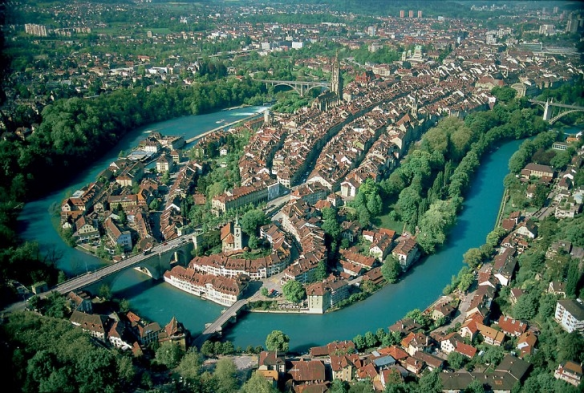
Here’s an aerial view of the old part of the city today.
Bern 5

In the later part of the 17th century, the Swiss Pietists split into two groups; the Swiss Mennonites under the leadership of Hans Reist and the Amish who derived their name from Jacob Ammann of Erlenbach.

Thus the small clans and inter-related family groups who were farmers in the valleys of Switzerland now become members of three separate religious movements, namely the Reformed, Mennonite and the Amish.  This is why years later on the frontier in America, the Reformed (now transformed into German Baptists known as Brethren or Dunkards), the Mennonites and the Amish have similar and seemingly related surnames and practices.

Switzerland to Germany

Our Miller family line begins in Switzerland with Johann Michael Mueller, born in 1655 in Zollikofen, Switzerland.

Zollikofen 1

Zollikofen is just outside of Bern.

Zollikofen 2

During the first half of the seventeenth century, Switzerland was relatively untouched by the horrors of the Thirty Years’ War, (1618-1648), a Catholic-Protestant conflict, fought principally on German soil. Switzerland enjoyed peace and prosperity and had a good market for its excess products. During the second half of the same century a social reaction set in, which was made acute by political and religious confusion. In 1653, the peasants of the Cantons of Bern, Lucerne, Solothurn and Basel revolted against the authorities, chiefly for social reasons. Since there were good opportunities for new settlers in depopulated Germany, many people left the Canton of Bern during this period and journeyed northward into foreign parts, specifically Germany.

The Rhine River was the way out of Switzerland and these families settled wherever it led.  Beyond Germany, emigration into the “lowlands” (Netherlands) as the destination of the emigrants used to be called, lasted into the eighteenth century and was much more numerous than emigration to America – although many did eventually emigrate. The Millers, (then spelled Mueller), came from a village about 10 miles north of Bern Switzerland, called Zollikofen and were a part of the Reformed church there.

The earliest ancestor that has been documented is Johann Michael Mueller, who is believed to have been born in 1655, in the City of Zollikofen, Canton of Bern, Switzerland.

Richard Miller

The Zollikofen church, above, shown inside today, built in 1306, still stands.  Our cousin, the Reverend Richard Miller is, appropriately, standing in the pulpit.

Zollikofen church 1

Above, a view of the beautiful church from a distance and below, a street view thanks to Google maps street view.

Zollikofen church 2

It is likely that in the late 1680’s the Miller family along with perhaps other friends and relatives moved north along the Rhine River and settled in the Rhineland-Pfaltz area of southern Germany. They became part of the Steinwenden and Konken (Germany) Reformed parish churches and records of their respective families are recorded in the church records. The Steinwenden records began in 1684 and Konken in 1653, but the churches reach further back in time.  There are other churches in the area whose records to not exist and those may have held other family records as well.

The Konken records include those of the Berchtoll family, including Hans Berchtol, whose daughter would marry the son of Johann Michael Miller (the first.)

Johann Michael Mueller married Irene Charitas, whose last name is unknown.  That’s right, Charitas is NOT her last name, as is reflected universally on internet trees, but her middle name as recorded in church records, as was the custom of the time.

Cousin Reverend Richard Miller visited Zollikofen and provided the following information.

“On Friday, 04 October 1996, I was in Steinwenden and was entertained by the Burgermeister of Steinwenden. A television crew from Mainz came and interviewed me for a personal interest story of me coming back to the home of my ancestors, i.e., Johan Michael Mueller. Also present was genealogist Roland Paul of the Institue für Pfälzische Geschichte und Volkskünde located in Kaiserlautern. The Burgermeister of Steinwenden and the television station had asked Roland to research Johan Michael Müller, born 1692 in Steinwenden. The attached are two records which Roland gave me. He asserted that Michael’s mother’s maiden name is unknown, and that Irene Charitas is her first and middle name rather than first and maiden name.”

Steinwenden 1

Irene may have been related to the Schlosser family, as there was a 1689 confirmation of Irene Charitas Schloser, daughter of Conrad Schlosser, of Steinwenden, if I’m reading this correctly.

At this time however, Irene Charitas was already married to Michael Mueller as they had their first child’s birth recorded in the church records in June of 1685, or earlier.  They likely married in 1684.  Their children were baptized in the Reformed church in Steinwenden, Germany, near Mannheim.

Steinwenden 2

Steinwenden 3

The bell tower of the original Steinwenden church is all that is left standing (1996) and is shown here.

Steinwenden 4

Johann Michael Mueller and Irene Charitas Mueller had 6 children.  Sadly, all of their children died other than Johann Michael Mueller who was the youngest, born October 5th, 1692.  I can’t imagine the depth Irene’s grief at the deaths of her first 5 children – and her joy at the one that lived.

We don’t know where those children are buried, but my best guess would be the churchyard.

Steinwenden, Germany

The village of Steinwenden is shown below, photography courtesy of Richard Miller during his visit to the Miller homeland.

Steinwenden 5

Steinwenden 6

Irene may have been joyful about her son that lived, but her husband, Johann Michael, their father, died three years later on January 31, 1695, still a young man, at age 40.

Some genealogical records show that Irene died and Michael remarried to Anna Loysa Regina, but the church records indicate that all of Johann Michael Mueller’s children were born to Irene Charitas.  The summary record, below, provided to Richard Miller when he visited Steinwenden in 1996 lists Irene Charitas (with no last name listed) as the mother for all 6 children born between 1685 and 1692.

Steinwenden 7

Many times the people who were designated as Godparents were relatives of the father or mother of the children.  Godparents at that time were extremely important, and the children were generally named after the Godparents.  In the case of the death of the parents, which happened all too often, it was the Godparents who would raise the children.  The Godparents of these children were Hans George Shoemaker and his wife, Mich. Stahl – I can’t tell if this is two people or three.  The second is Abraham, Hans Berchtol, Hoffman.  Third was Samuel Hoffman.  Fourth is Maria Catherine.  Fifth is Eva ?, Catherine, Samuel Shoemaker.  Finally, the sixth child’s Godparents standing up with Johann Michael Mueller born on October 5, 1692 were Johann Michael Shoemaker, Hans Berchtol and wife.

Little did they know that Hans Berchtol’s daughter, then 4 years old, would one day marry this baby boy.

After Johann Michael’s death, his widow reportedly married Jacob Stutzman whose wife had died.  However, there exists a great deal of confusion about who Jacob Stutzman married.  In the Gene Miller book, he attributes Jacob Stutzman’s wife, Anna Loysa Regina as the widow of Johann Michael Mueller – but as we’ve seen – based on the church records, Johann Michael Miller’s wife was one Irene Charitas, not Anna Loysa Regina, at least as late as 1692.  Perhaps Irene died and Johann Michael Miller remarried to Anna Loysa Regina before his death in 1695.  This conflicting information may never be entirely resolved, at least not until the entire set of church records is transcribed and translated, in full, such that the various families can be reassembled.  However, there were many little villages in this area and people didn’t always stay in one place.

Johann Michael Mueller, born in Switzerland in 1655, died in the Steinwenden German Reformed congregation on January 31, 1695, at the age of 40 years.  His reported widow, Anna Loysa Regina Mueller remarried a Hans Jacob Stutsman of the Konken German Reformed Congregation on September 29, 1695.  If this is accurate, and Anna Loysa Regina was the widow of Johann Michael Mueller, that would indicate that Irene Charitas died between January 1692 when her only child to survive was born and 1695 when her husband died – and with enough time for him to remarry.   That could explain why they didn’t have another child in 1694 – perhaps she was dead or perhaps she and the child both died during childbirth.  If this is the case, the only mother Johann Michael Mueller would have known was Anna Regina and the only father, her second husband Jacob Stutzman.  No children are attributed to Johann Michael Mueller and Anna Loysa Regina in church records, although she did have children with Johann Jacob Stutzman..

The Pietist Movement

Lake Thun 2

The Stutzman family was originally from the Lake Thun area in Switzerland, according to the book, “Jacob Stutzman, His Children and Grandchildren” by John Hale Stutesman, Jr. who reports that they fled from religious persecution to the welcoming Palatinate in Germany before 1700.  Of course, this is also the area where the Mueller family originated as well.

Ironically, this is less than an hour away from where I lived in the summer of 1970 – one of the most stunningly beautiful areas I’ve ever had the privilege of seeing.

Lake Thun crop

This drawing of Thun isn’t far from Zollikofen where the Miller family is first found.  So it appears that the Mueller and Stutzman families were located in the same area of Switzerland.  One might surmise that they were part of a group that migrated together to Germany.

“Thunersee” by Roland Zumbühl, Arlesheim

A beautiful view of Lake Thun today.

In Germany, later, the combined Miller/Stutzman family is found near Bad Dürkheim where Johann Jacob Stutzmann was born on January 1, 1706, on the Weilacher Hof, near Hardenburg, son of the tenant farmer on the Weilacher Hof, Johann Jacob Stutzmann and his wife Regina Elisabetha.

Given that Johann Jacob Stutzman married Regina Elisabetha Mueller after the death of Johann Michael Mueller (the first), and in 1706 Jacob Stutzman’s wife’s name was recorded as Regina Elisabetha – it’s likely that Irene Charitas had died before 1695 when Johann Jacob Mueller died given that Johann Jacob Stutzman apparently married his widow.  This makes Johann Jacob Stutzman (the second) born in 1706 a “step-brother” to Johann Michael Mueller (the second.)  Said differently, Johann Michael Mueller’s step mother remarried after his father’s death and his step-mother and her new husband had a son, Johann Jacob Stutzman (the second.)  This son and his “step-brother” Johann Michael Mueller were lifelong friends and companions – eventually immigrating to America together and moving in tandem across the frontier.

Many of the Swiss families had Pietist leanings.  Some were Mennonite and eventually became Brethren, as did Johann Jacob Mueller (the second) and Johann Jacob Stutzman (the second.)

The Brethren sect itself began in 1708 in the village of Schwarzenau, in Wittgenstein, Germany with the rebaptism of eight people.  The Brethren faith spread rapidly and it was only 11 years later that the first group of Brethren landed in Philadelphia.

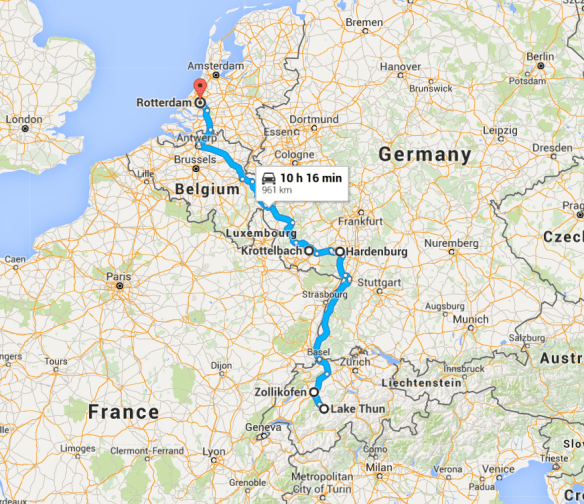
It’s certainly possible that an entire group of Anabaptist leaning families relocated from Switzerland to the Bad Dürkheim area in Germany.  In 1714, the Miller family was in Krottelback, not far from Hardenburg.

Lake Thun Krottelbach

The next step for these families, of course, was to safety in Holland, then on the ship Adventure in 1727 to America.  Justin Replogle states that the Brethren in Holland had been in exile since 1720.  It’s unlikely that Michael was among this group, because his son Philip Jacob was born in Germany in about 1726.
Lake Thun Rotterdam

I surely would like to know the individual stories of the families involved and what prompted these decisions.  What kinds of factors were involved?  Did they know they would be kindly received when they relocated from Switzerland to Germany, then from Germany to Rotterdam and then from Rotterdam to Philadelphia, or was the future entirely unknown?  Were they joining families who had already departed and were doing well in the new lands?  What prompted the entire group of Brethren to depart – in fact causing the sect to die out in Europe?  Were these families Brethren before they left, or did they convert after arriving in the US?  We know the Bechtol family was Mennonite.

The 30 Years War may have had a lot to do with the decision to leave Switzerland.  Germany was depopulated after the 30 Years War which ended in 1648, with some areas being entirely devastated.  Overall, the population loss was from 25-40% with the Palatinate being particularly hard hit, losing 75 to 80% of the population.  After the war, settlers from other part of Germany and Switzerland were invited to repopulate the area which included both Catholic and Lutheran (Protestant) churches.

According to the book, “Becoming German: The 1709 Palatine Migration to New York,” (pages 12-14), misery in this area wasn’t over yet.  From 1688-1697, the War of the Palatine Succession brought French armies overrunning the German southwest, laying waste to vineyards, farmland and the regions cities and smaller towns.  Mannheim was destroyed and Speyer stood uninhabited for 10 years.  Farmland stood abandoned and German rulers sought to attract new settlers by offering tax concessions and religious toleration which specifically included Catholics, Lutherans, Mennonites and Jews.

This may have been part of the reason these Protestant families selected this area.

Colonies of religious dissidents moved to Germany from neighboring counties, in particular, Switzerland.  In 1656 and 1657, more than 1000 Swiss moved to the Palatinate.  In 1671, over 1600 Mennonites arrived from Bern.  Portuguese Jews attracted by the elector’s concessions settled in Mannheim.  Huguenot refugees followed as well.

Migration became a fact of life in this part of Germany.  In one study, it was found that between 1593 and 1780, about half of one town’s citizens were not born there.

This area of Germany became extremely religiously diverse.  In 1705, an edict called the Religionsdeklaration clarified the religious situation, unquestionably giving religious freedom to all individuals.  Lutherans fell under the Reformed, as did other Protestant sects, which may be why we find both the Miller and Stutzman children baptized in Reformed or Lutheran churches.  By this time, the pietists, an offshoot of the Lutherans, were calling for a more inward-looking and emotional faith than the established churches but were meeting privately, not able to establish open churches.

In 1675, Philipp Jacob Spener, a Lutheran pastor in Frankfurt encouraged his followers to create small, private groups to read and discuss the Bible.  He didn’t intend for those groups to leave the established churches, but they formed what they called conventicles which further split the already fractured religious communities in Germany.  Pietists become very closely bound within their own group, and the pietist groups throughout Germany tended to bind together tightly as well, between villages which weren’t spaced very far apart, forming a network.

What were these early Brethren people like?

To begin with, they didn’t care much about official clergy and buildings.  They preferred to hear their neighbor farmer preach who farmed the other 6 days a week, gathered in his barn.  The word congregation did not necessarily mean a stand-alone church building, it may have meant only a gathering of like-minded people.

Pietists did not stress the intellectual side of Christianity.  They emphasized the literal text of the Bible and didn’t worry about theory.  The community stressed humility, work and service to others.  The Brethren were plain people, pacifists, remaining aloof during the worldliness of political office, military service, oaths, litigation and filing anything in court or at the courthouse, unfortunately including deeds and marriages.

The Brethren practiced shunning of church members and even their children who did things they did not approve of.  Alexander Mack Jr., the son of the founder of the Brethren church shunned both of his daughters.  One for marrying outside the faith and because the marriage “was performed with a license.”  The second, who was shunned to the point where the family would not even eat with her, was shunned for doing something we’ll have to surmise, but it was said that the “sin was not so great because they had been engaged never to leave each other.”  An entire Brethren congregation shunned another young woman because she sat in the lap of a man who was trying to force her into immorality, for an hour, pretending to be asleep.”  Her father argued that she had not actually committed fornication, and left the congregation, taking several members with him.

Church historian Morgan Edwards summarized Brethren like this in 1770: “They use great plainness of language and dress, like the Quakers; and like them will neither swear nor fight.  The will not go to law; nor take interest for the money they lend.  They commonly wear their beards…They have the Lord’s supper…love feasts, washing of feet, kiss of charity…use the trine immersion…as the party kneels down to be baptized…”  (Replogle)

We see this same culture in the Brethren, Mennonite and Amish, then as now.

The area where I grew up in Indiana had a well-established Amish, Mennonite and Brethren community.  They tended to live in the same area, but they did not intermix, or at least not much.  As much as they looked “alike” to those of us who were not members of those religions, their differences, to them, were chasms, especially the adoption of modern technology and conveniences like electricity, farm equipment and automobiles.

The Amish, typically called the “Old Order” were the most restrictive, not embracing any modern technology at all.  These were and are the horse and buggy families.

The Mennonites were in the middle.  They would ride in or drive cars, but they had to be very plain – always black, nothing shiny, no hubcaps or radios.  The local car dealership always had to special order a group of Mennonite cars.

The Brethren were the least restrictive.  Their men dressed almost normally, although some still had beards.  Their women often still wore prayer bonnets, but their clothes weren’t always black.  Their homes were plain, but did include modern conveniences.  However, in our family, one will includes instructions for the man’s gravestone not to be highly polished.  They were known as highly conservative “plain people.”

ferverda family original photo

This photo is of my mother’s Brethren grandparents, Hiram Bauke Ferverda and Evaline Louise Miller, and their family taken about 1918.  Other than their relatively “plain” dress, you would never know they were Brethren.  Their son, third from right in the front row is also wearing a uniform, having served in WWI – something VERY un-Brethren.  In this photo, the women are not wearing prayer bonnets, but mother said that she distinctly remembers this woman, her grandmother, wearing a prayer cap.  My mother’s father, John Whitney Ferverda (b1882) is the second from right, back row.

john david miller family

This photo taken about 18 years earlier, around 1900, of Evaline Louise Miller, middle, and her parents, Margaret Lentz Whitehead and John David Miller looks much more typically Brethren.  The men have beards and the women are wearing darker colors and prayer bonnets, covering their hair.

My mother’s family was Brethren until my grandfather, gasp, married a Lutheran woman and because there was no Brethren or Lutheran church in the small town where they lived, they chose to become Methodist!  Oh, the scandal!  With that religiously “mixed” marriage ended at least a 7 generations long line of Pietists who became Brethren, reaching back hundreds of years into Germany and Switzerland – back into the mists of time so far that we no longer have records, only the knowledge of how strongly those people must have felt about their religion to willingly suffer the persecution and displacement that they withstood.

I’m suspecting they literally rolled over in their graves to know that one of their descendants married outside the faith and became something un-Pietist.

The Miller DNA

One of our Miller participants has tested to 111 markers and taken the Big Y test.  Although our haplogroup is a subgroup of typically European R1b, we have only Miller matches at 12 through 111 markers, except at 25 and 37 markers where we have a match to a Morgan man whose ancestor, Morgan Morgan, hails from Wales and was born in 1688.

The Big Y DNA results, a test which not only checks for all known SNPs, but scans for new and unknown mutations as well, shows that our Miller participant most closely matches a man from Bulgaria.  In this case, the word close does not mean in a genealogical timeframe.  This match reaches back before the advent of surnames, as there are 3 known SNP differences and only 58 of 100 novel variants or previously unknown SNPs.  This means that our common ancestor with this man is probably someplace around  3,000 or 4,000 years ago.  Our next closest match is from Austria and from about as long ago.  These are followed closely by three English surnames and a Spanish surname.

The Miller terminal SNP, which defines our haplogroup, is called R-Z2106.

The Y haplotree looks like a branching tree or a pedigree chart on steroids.  Our twig, R-Z2106 is a part of a larger stick which is a part of a larger branch, etc.

z2106 tree crop

Each of these branches becomes increasingly smaller and more granular.  The 100 or so novel variants found in the Miller DNA will also become branches someday, so there may be several more.  As DNA mutates, new novel variants, which are unnamed SNPs because they have just been discovered, continue to occur every few generations in each line.  This means that our own personal branch of the tree may have several SNPs or mutations that no one else has.  Whatever valley our ancestors may have been isolated in hundreds or thousands of years ago, perhaps during the last glacial maximum, may hold many men with the same mutations that today will become a small subgroup of a haplogroup – like Z2106.  We don’t know the history, but by looking at groups of men with these same mutations, and estimating when the mutation happened, and pairing that with what we know historically and geologically was happening in the world at that time, we can piece some semblance of our own deep personal history together.

This is a map of the distribution of haplogroup L23.  It’s estimated that L23 occurred in the first male about 7000 years ago.

L23 map

Generally, the darker or most saturated regions are the origins of the haplogroup.  L23 is interesting because it is typically not found in high frequencies in Europe, typically less than 5% or haplogroup R, except in Switzerland’s Upper Rhone Valley where it is found at 27%.  That could be a clue for us.

This same paper, “Massive migration from the steppe is a source for Indo-European languages in Europe” by Haak et al, 2015, states that there is virtually no haplogroup R1b found in Europe before the period beginning about 4500 years ago in the Late Neolithic and Bronze Ages, and that this R1b found in these Russian burials appears to be mixed with Near East (Anatolian) DNA as well.  This implies, of course, that one of the migration routes to Europe was north through Russia, and one was crossing at present day Istanbul and going through the Baltic.

Z2103 map

Subgroup Z2103 is referred to as the Balkan and Asian branch of the L23 tree.  Z2103 is found in a high percentage of Armenian men today.

Armenia map

Armenia is, of course, dead center in the middle of the migration path from the Near East to the Russian steppes, shown on the map above with a red balloon.

Referencing the Armenian DNA project, two men within that project carry the R-Z2106 SNP – the same one the Miller men carry.  SNP Z2106 is exceedingly rare.  I’ve been able to locate less than a dozen samples.

However, there are 21 men who carry the Z2103 SNP and 14 men who carry the Z2109 SNP in the Armenian project.  Another 2109 SNP is found in Iraq and one in Germany.

Balkans 2400 BC

This map shows what was occurring in the Balkan region about 4500 years ago.

In 2015, six graves were excavated near Samara, Russia, shown on the map below, that represent the Yamna culture and of those, four carried the mutation Z2103 which is estimated to have been born about 6000 years ago, as are SNPs Z2109 and Z2106.

SNPs Z2106 and Z2109 were not reported in the ancient burials, but we don’t know if they were tested for or not.

These men of the Yamna culture lived between 2700 and 3300 years ago (BCE).  We share a common ancestor with these men. Where and when is the question that remains.

Samara, Russia

It is in the history of these maps, these peoples and our DNA that the story of our ancestry is told.  We’re still trying to put the pieces together, but looking at these maps, and our SNPs and novel variants, we know that our ancestors were first found in Switzerland in contemporary records, but their history extends back into Eastern Europe and back to Anatolia before that.  They may have moved into Europe with the waves of farmers from that region, or they may have arrived from the Russian steppes.  Given where our other SNPS, Z2103 and Z2109 are (and aren’t) found, I’m betting that they migrated from Anatolia across the Balkan region into eastern Europe as part of the migration of the European Neolithic farmer culture.

Neolithic Europe

None of this is cast exactly in concrete – more like in jello molds.  We continue to make discoveries and learn every day in this emerging field.  However, what we do know is exciting and tantalizing and every puzzle piece we find adds to the story of our Mueller family.

Wouldn’t Johann Michael Mueller be surprised to know the secrets his DNA shared with his irreverent Methodist descendants!  But Johann Michael, take heart, because there are still many Miller Brethren families.  In fact, we even have a Miller-Brethren DNA project to help sort and reconstruct those families!

If you descend from a Brethren Miller family, you are most welcome to join.

______________________________________________________________

Disclosure

I receive a small contribution when you click on some of the links to vendors in my articles. This does NOT increase the price you pay but helps me to keep the lights on and this informational blog free for everyone. Please click on the links in the articles or to the vendors below if you are purchasing products or DNA testing.

Thank you so much.

DNA Purchases and Free Transfers

Genealogy Services

Genealogy Research

Ancestry’s New “Amount of Shared DNA” – What Does It Really Mean?

Yesterday, Ancestry quietly introduced a new feature of their AncestryDNA autosomal product called “Amount of Shared DNA.”

This can be seen when you view your match, beside the confidence bar, as shown below.  Fly over the little “i.”

shared dna

It’s nice to know how much DNA we share and across how many DNA segments – but what does this really mean, how is it calculated, and how do these calculations stack up against the same information from other vendors?

Why would it be any different, you ask?

Because Ancestry runs their academic phasing program, Timber, and removes segments identified as matching to many people, constituting pileup areas.  Remember when Timber was introduced and people lost more than half of their matches?  I went from 13,500 to 3,350.  Today, 50 weeks later, I have about 6,700.

Real phasing is when you utilize your parents DNA to divide your own DNA into half.  Half your matches match you and your mother, and half your matches match you and your father.  If not, then they are not IBD matches.

Timber attempts to remove segments that are too matchy – areas where Ancestry feels you have too many matches so they might be “population” based match segments instead of real genealogical segments.

This new “Amount of Shared DNA” feature gives us the opportunity to test their matching against other vendors.

Thankfully, my cousin Harold has tested at all the vendors and uploaded to GedMatch, as have I.

Therefore, we can compare our results on all platforms.

shared dna 2

Why is the Ancestry total cM so much smaller than the other vendors, at any threshold?  Timber.  Ancestry is removing many segments that other vendors are counting and using, even at higher thresholds like 10 cM.  In fact, at GedMatch, their maximum threshold is 10cM and even at that level, the total match cM was 135, 21 more than Ancestry, and the SNPs were all well over 1000.

shared dna 3

The Acid Test

I’ve believed since the introduction of Timber that it removed too many segments – segments that are valid and useful – thereby removing valid matches.

However, the acid test is a parent/child match.  Each child should match their parents on exactly 23 segments (or 22 if Ancestry is not counting the X chromosome), one complete match for each chromosome.  Once in a while you’ll have a read error that may divide a chromosome into two match segments, so an occasional 24 or 25 wouldn’t be surprising.

What are we seeing?  A quick read of forums and looking at the results I have access to shows me that parent match segments are ranging from about 85 to about 110, which, in case you are counting, is from 64 to 87 more than the 22 (or 23 counting the X) chromosomes that we have.

What this tells us is twofold:

  1. Timber is removing 64 to 87 VALID segments in parent/child matching, believing that pileups are invalid. Rule #1 of DNA – you must match your parents. If you double this number, because you have two parents, each person has in the ballpark of from 130 to about 200 areas where their DNA is “too matchy” and segments/matches are removed. This illustrates the magnitude of the Timber problem.
  2. You cannot draw or correlate any relationship inferences from either the total amount of shared DNA nor the number of segments by utilizing the typical tools utilized by genetic genealogists because Ancestry’s totals will be lower and their segments will be broken into more pieces due to the removal of segments identified by Timber as invalid matches.  Blaine Bettinger is beginning to collect information at this link on Ancestry’s shared cM data for known relatives.  This information will be made public for all to utilize, as has his earlier shared cM work.  Please contribute if you can.

Hopefully Ancestry will take this opportunity to address the Timber issue, and hopefully they will eventually provide a chromosome browser type tool.  Now all we need is the chromosome number and start/end addresses for those chopped up segments.  These tidbits and pieces of solutions are not appeasing the genetic genealogy community and this new “amount of shared DNA” feature will not “do” in place of a chromosome browser.  I know this sounds like a broken record…and it is.  While Ancestry seems to be inching in the chromosome browser direction by providing additional information….I wouldn’t hold my breath.  I don’t think it will ever happen – but I would really, REALLY like for Ancestry to prove me wrong!

Fortunately, Ancestry’s tree matches and Circles are useful and thankfully, we can download our autosomal DNA results to both Family Tree DNA and to GedMatch and utilize their chromosome browsers and other tools.  Unfortunately, not everyone is willing to download, so we do really need that chromosome browser.

______________________________________________________________

Disclosure

I receive a small contribution when you click on some of the links to vendors in my articles. This does NOT increase the price you pay but helps me to keep the lights on and this informational blog free for everyone. Please click on the links in the articles or to the vendors below if you are purchasing products or DNA testing.

Thank you so much.

DNA Purchases and Free Transfers

Genealogy Services

Genealogy Research

The 23andMe Transition – First Step November 11th

If you tested through 23andMe, certainly by now you know they are undergoing a rather dramatic facelift and change of how their webpage, tools and matching works.

What’s Changing?

After November 11th, many changes will occur and many matches will no longer be available to you, especially if they are anonymous or use a nickname.  Here is a complete list of what will and will not be available.

The genetic genealogy community is struggling to understand exactly what this means to us, in terms of matches and functionality – both lost and gained.  Suffice it to say that a lot of confusion remains, so be on the safe side and download both your individual match list and your COA (Countries of Ancestry) matches if you utilize those.

Countries of Ancestry Matches

I recently discovered that many people don’t know about COA, so here is some brief information so you can utilize this information before it’s too late.

The Countries of Ancestry feature was meant to allow you to see where your matches’ ancestors are from if all 4 of their grandparents were born in the same place.  The idea being that if all 4 grandparents were born in the same place, then the family lines likely run deep there – and perhaps your ancestors were born there too.  For more information, sign on to your 23andMe account, go to Countries of Ancestry, and click on the “see how this works” link.

23andme change 1

To download your individual match ancestry and segment information, go to Ancestry Tools, Countries of Ancestry, and click on the blue button below your chromosome map.

To download the information for your matches, click on the down arrow in the box with your name, and you will see your matches information which is available for download.

23andme change1

The benefit of COA information was that Anonymous individuals’ information was available to you – and it is beneficial to know that you match someone on a particular chromosome whose 4 grandparents were all born in Ireland, for example.

23andme change 2

Additional Information

When I signed on recently, this message, below was waiting for me and provides additional information.  But remember, whatever you are going to do in preparation – do it now, before November 11th.  It’s somewhat uncertain exactly what will and will not be available after that date.  It’s also uncertain what “partially available” means.  Better safe than sorry – so download anything you want now.  You may not able to do so later.

As part of the updates and transition to the new 23andMe, many features will be undergoing significant changes. While we are working to transition customers to the new site, some changes will have an immediate impact on the customer experience in the current 23andMe site, including introductions in DNA Relatives.

To provide some context for the changes to DNA Relatives introductions, it may be helpful to review what purpose introductions served in the current DNA Relatives; namely, introductions brokered communication between anonymous participants and allowed participants to remain anonymous during communication.

In the new 23andMe, anonymous participation in DNA Relatives will no longer be an option. To support this change, several things will happen in the existing DNA Relatives starting November 11, 2015:

* Customers currently using nicknames in DNA Relatives will be converted to anonymous In order to access and participate in the new DNA Relatives, customers will select how to display their profile name or initials; “nicknames” will no longer be an option. If your current settings in DNA Relatives are “Show me as [ Nickname ]” instead of “Show me as [ Profile Name ]” on November 11 this setting will revert to “Keep me anonymous.”

Your profile name may still be an alias or a name of your choosing; for more information about when a legal name is required, see https://www.23andme.com/you/community/thread/41020/5/#skip_to_ddaefb41b87904dd

* Anonymous participants can no longer send or receive introductions The introduction system is what allowed messages to be exchanged anonymously. Copying pending introductions as messages in the new DNA Relatives would expose the names of participants who had been anonymous.

* Pending introductions will be canceled Both incoming and outgoing introductions will be deleted from your inbox.

We realize that canceling pending introductions will have a significant impact for some customers. To date, a pending introduction would keep a match on your list indefinitely so pending introductions allowed members to view and maintain matches beyond the cap of 1 thousand. There are several additional DNA Relatives updates that should help mitigate the cancellation of introductions:

First, the cap on the number of matches that will be available in DNA Relatives is being raised. We expect to be able to provide each customer with their closest 2 thousand matches, which is double the current cap.

Second, we are introducing an Open Sharing option within DNA Relatives. If 2 customers both choose to participate in Open Sharing, they will be able to view one another’s ancestry and segment information without extending and accepting a sharing invitation.

Third, anonymous participation in DNA Relatives will no longer be an option. Currently anonymous customers who wish to continue participating in the feature will need to select new settings (although until they do they will remain as an anonymous match). Participation in DNA Relatives also includes messaging tools, and any participant can send a message to any other participant.

When customers transition to the new 23andMe, the following will apply:

* Any established sharing settings will be maintained.  This will not affect any sharing connections; if you are sharing genomes with another member, that will remain in place.

* Accepted introductions will be saved.  The content of messages for introductions that have been accepted will be copied over to the updated messaging system in the new DNA Relatives.

* Currently anonymous customers who wish to continue participating in the feature will need to select new settings. Until they do they will remain anonymous.

______________________________________________________________

Disclosure

I receive a small contribution when you click on some of the links to vendors in my articles. This does NOT increase the price you pay but helps me to keep the lights on and this informational blog free for everyone. Please click on the links in the articles or to the vendors below if you are purchasing products or DNA testing.

Thank you so much.

DNA Purchases and Free Transfers

Genealogy Services

Genealogy Research

Free Access to Native American Records – Limited Time

free access

Many people have an oral history of Native American heritage.  Fold3.com is offering free access to their Native American Collection until November 15th, 2015.

Finding that your DNA carries a history of Native heritage often is just the beginning of a search.  The next question, if of course, which tribe.  That information generally comes from genealogy research.

Conversely, the lack of autosomal DNA evidence does not mean your ancestor was not Native – it may mean they were just too many generations back in time for their DNA to become evident in today’s ethnicity results – although they may still show in Y and mitochondrial DNA – depending on where they fall in your family tree.

Regardless of how your Native history or heritage is presented in your family – DNA or not – enjoy searching these free records.

Titles in this collection include:

  • Ratified Indian Treaties (1722-1869): Ratified treaties that occurred between the United States government and American Indian tribes. Also included are presidential proclamations, correspondence, and treaty negotiation expenses.
  • Indian Census Rolls (1885-1940): Census rolls submitted annually by agents or superintendents of Indian reservations as required by an 1884 Act of Congress. Only persons who maintained a formal affiliation with a tribe under Federal supervision are listed on these census rolls.
  • Dawes Packets: Applications between 1896 and 1914 from members of the Cherokee, Creek, Choctaw, Chickasaw, and Seminole tribes to establish eligibility for an allotment of land in return for abolishing their tribal governments and recognizing Federal law.
  • Dawes Enrollment Cards (1898-1914): Enrollment cards, also referred to as “census cards,” prepared by the staff of the Commission to the Five Civilized Tribes, commonly known as the Dawes Commission. The cards record information provided by applications submitted by members of the same family group or household and include notations of the actions taken.
  • Eastern Cherokee Applications (1906-1909): Applications submitted for shares of the money that was appropriated for the Eastern Cherokee Indians by Congress on June 30, 1906.
  • Enrollment of Eastern Cherokee by Guion Miller (1908-1910): The Guion Miller Roll is perhaps the most important source for Cherokee genealogical research. There are an estimated 90,000 individual applicants from throughout North America included within this publication.
  • Cherokee Indian Agency, TN (1801-1835): The records of the agent of Indian Affairs in Tennessee, including correspondence, agency letter books, fiscal records, records of the Agent for the Department of War in Tennessee, records of the Agent for Cherokee Removal, and miscellaneous records.
  • Rinehart Photos – Native Americans (1898): Photographs of over 100 Native Americans taken by Frank A. Rinehart, a commercial photographer in Omaha, Nebraska. Rinehart was commissioned to photograph the 1898 Indian Congress, part of the Trans-Mississippi International Exposition.

______________________________________________________________

Disclosure

I receive a small contribution when you click on some of the links to vendors in my articles. This does NOT increase the price you pay but helps me to keep the lights on and this informational blog free for everyone. Please click on the links in the articles or to the vendors below if you are purchasing products or DNA testing.

Thank you so much.

DNA Purchases and Free Transfers

Genealogy Services

Genealogy Research

Get Your Ducks in a Row – Time May Be Shorter Than You Think

ducks

Helen Rutledge is my cousin.  She and I have been sniffing around the same records in the same counties for many years now.  I only wish we had met earlier so we could have shared more of the chase.

Helen is no “spring chicken” as we say on the farm.  In fact, Helen has continued to research far into her golden years – being in her 90s now.  Want to hear the great irony? Helen has no children to leave her work to – but this does not deter her.  Helen is the aunt that every one of us wants to have in our family.

Recently Helen sent me an e-mail that both saddened me and inspired me, and with her permission, I’m sharing it with you.  I have omitted some of the more personal portions.

After 13 days in the hospital I returned to long term nursing care. I brought my computer and genealogy records from Assisted Living to my new level of care. However, now instead of researching, I am organizing my research to leave for my nephew and some research archives. I have been forewarned in the most urgent way that there may not be time to think about how I will do this when the research is done. Well, we all know research is never finished.

Keep urging perseveration of research on your blog. It is as important as the research itself. Answers are no good if I am the only one who knows the answer to the puzzle…I must share it with others whether they give me credit or not. I thank you for alerting me to that truth and God for allowing me extended days to get my records in order as a gift to other researchers. Oh, the many little tidbits I have garnered, documented, and put together for those who follow in my footsteps with our family lineage.

Organization is not just entering our data into a genealogy program. It is documenting, making copies of the documents available when possible, and recording the ORDER of our research so those who are not familiar with the records, can follow the generations and become acquainted with their ancestors.

Be honest, say information is not documented, when such is the case, and challenge your readers to find documentation. Try to inspire descendants to fill in the blanks and record those who are yet unborn. While they will miss the thrill of solving the puzzle after years of frustration, they will know the joy of learning who they are.

Thank you, Helen, for your lovely, inspirational message. Sometimes we aren’t fortunate enough to receive a warning. (Note – Helen passed away in February, 2018.)

Another e-mail this week told of another cousin’s husband who died suddenly, with no warning, and he was 30 years younger than Helen.

DNA in Perpetuity

I would add one thing though, and that is to record your user names and passwords – especially relative to DNA accounts and tests and anyplace, like GedMatch, you have uploaded your results.  Your DNA can never, and I repeat, NEVER, be replaced, while genealogy research could be with enough effort.  Don’t let your DNA results become inaccessible.

At Family Tree DNA, you can designate a beneficiary.

On your personal page, under “Your Account” on the left hand side, select “Manage Personal Information.”

ducks2

Then select Beneficiary Information and complete the form which includes your beneficiary’s name, e-mail and phone number.  If you should pass away, this is who Family Tree DNA will allow to access your account.  Other companies, to the best of my knowledge don’t include this information or provide this option, so you’ll need to be sure to leave your account access information available for your family members.

ducks3

If you have not prepared for the inevitable, please take a few minutes to do so.   You can make the DNA arrangements now, and easily.

Remember, at Ancestry, your DNA won’t be available unless your account (subscription and login) remains active, so you’ll need to take how to handle that into consideration.

You might want to download not just your raw data files, but matches as well when possible.

Public Sites

Upload your Y and mitochondrial DNA to sites like http://www.ysearch.org and http://www.mitosearch.org.  Be sure to record the most distant ancestor and enough information to positively identify them, like birth and death dates, locations and spouse’s name.  This is the only way to get your info into a public data base that is accessible without having DNA tested for a match.  You can also enter Y and mito info at http://www.wikitree.com and attach it to the proper ancestor.  This helps others in the future learn about their ancestors.  Be sure to include your full haplogroup in the notes and a link to anything you may have published about that line.

Upload your autosomal results to http://www.gedmatch.com and upload trees where possible.

Don’t put all of your eggs in one basket, because baskets aren’t forever either.  Think about how many genealogy companies have come and gone and what happened to our Y and mitochondrial DNA with both Ancestry and Sorenson (also destroyed by Ancesty).

Genealogy Research

You can take a few minutes to put together a plan for how to preserve and present the balance of your genealogy information.  Preserving and publishing my genealogy research has been on my bucket list for some time now and is the purpose of the 52 Ancestors articles I’ve been writing for the past 18 months.  I’ll write them until every ancestor is covered….or I can no longer write the articles – and I sincerely hope I have the opportunity to finish.  Not just for my own sake, but for the benefit of everyone else who follows.  I hope future researchers make huge breakthroughs and add immensely to what I know today.  My work will at least give them a firm foundation to start from and they won’t have to replow the same ground.

One of the avenues to preserve your work online is a blog.  WordPress offers free blogs and they will be available into perpetuity, whatever that really means.  I am also printing my articles and will be donating them to archival facilities like the Allen County Public Library.  And of course, I’ll have a set of binders for each of my children.

WikiTree is another public resource for your trees, your Y and mtDNA results and additional information, although that’s not the same as offering the detail in an article.

So, however you choose to do whatever you choose to do… just do it.

And do it now.

You may not have an opportunity later.

Time may be shorter than you think.

Get your ducks in a row.

______________________________________________________________

Disclosure

I receive a small contribution when you click on some of the links to vendors in my articles. This does NOT increase the price you pay but helps me to keep the lights on and this informational blog free for everyone. Please click on the links in the articles or to the vendors below if you are purchasing products or DNA testing.

Thank you so much.

DNA Purchases and Free Transfers

Genealogy Services

Genealogy Research

John Combs Wife (c1710-c1749) and The Eagle, 52 Ancestors #96

We don’t know her name.  In my genealogy software she is simply listed as “unknown” or “wife 1.”  But assuredly, she lived, because she had a daughter named Luremia, my ancestor, a daughter Martha and a son George.  She may have had other children too, before she died an untimely death.

Her husband, John Combs was born about 1705, so she was probably born about the same time or maybe slightly later. Let’s say she was born about 1710.  We know she had three children, at least three that survived, and they were born around 1740-1743.  Then she died.  Sometime before 1750 when her husband remarried.  She died knowing she was leaving three small children behind – and perhaps more.  Did she die in childbirth?  Did she know she was dying?  Maybe she prayed that her husband would find another wife who would love those children.  What does a dying woman pray for under those circumstances, other than a miracle?

We may not know her name, when or where she was born, or to whom, but we do know where she lived.  Amelia County, Virginia.  I was able to visit Amelia County in the fall of 2015.  I was able to find the lands of John Combs and his unknown wife as well as the land of Moses Estes whose son, Moses Estes Jr. would marry their daughter, Luremia Combs.  These families were close neighbors and their families intermarried.

Amelia County carries a chapter of the Estes family history that intersects with the Combs family.  That’s also the chapter of Luremia’s mother with the unknown name.  Moses Estes Jr. married Luremia Combs who was born about 1740, probably in Amelia County, to John Combs and his first wife.  John’s wife, Luremia’s mother, is buried someplace here, as is John himself following his death in 1762.  John’s second wife, Frances Elam, married him on September 11, 1750 knowing he had three motherless children, had 4 more children with John Combs, remarried and outlived him significantly, until sometime after 1778.  Luremia Combs and Moses Estes Jr. married about the time John died.

The Estes Land

Moses Estes Jr., Luremia’s husband, was likely born in Hanover County.  It’s unclear when the Estes family, at least Moses Sr., moved to Amelia County, but he is listed in a deed in 1749 selling land in Louisa County and noted as “of Amelia County.”

By 1769, both Moses Sr. and his brother Elisha were living in Amelia County when Moses sued his brother relative to his father’s estate, and in the very early 1770s, Moses Sr. and Moses Jr. had moved to Halifax County, Virginia.

We know that in Amelia County, Moses Estes owned land that abutted Nicholas Gillington’s land, and Gillington’s land was on Horsepen Branch of Raleigh Parish which would put Horsepen Branch on Flatt Creek, located 3 or 4 miles east of the Grub Hill Church on 636, Lodore Road.

Combs wife 1

Yes, I know chasing the neighbors’ property is the long way around to find my ancestors – but sometimes that is the only way to find your ancestor’s property, and it can be done.  Thank heavens for landmarks with names.  If you pull the deeds for all of the neighbors, at least one of them will likely have a creek name or some landmark you can find today.  You then know, based on the land description, where your ancestor’s land was located in proximity to the land and landmark you just found.

Is this a royal pain in the patoot?  Oh yea.  Does it work?  Oh yea!!!!

Combs wife 2

Today you can visit the location of Moses Estes’ land on Lodore Road.

Combs wife 3

Dykeland Road (632) crosses Horsepen Branch.  Moses’ land seems to be closer to this location.

Combs wife 4

You can’t visit the Dykeland Road location on Google street view, probably because it’s dirt.

The Combs Land

John Combs and Luremia’s mother lived in very close proximity to the Egglestetton family and the Booker family, making his land easier to find, in general terms.  Grub Hill Church seems to be the center of this entire neighborhood and probably was then too.

Combs wife grub hill

Starting our tour at Grub Hill Church, founded in 1754, so known to the Estes and Combs families, I have to wonder if this is where John Combs and Luremia’s mother are buried.  Luremia’s mother died before 1750, so she may be buried on John’s farm, but then again, this cemetery could predate the church, so one never knows.  For all I know, this cemetery could have been ON the Combs farm.

Combs wife grub hill 2

This church was rebuilt in the 1800s, but this is the old section of the cemetery.

John died in 1762, and I’d bet he is buried with Luremia’s mother, wherever she is buried.

The Egglestetton family lived on Egglestetton Road, which, combined with the fact that one of the Egglestetton homes is on the register of historic places, and well-marked, makes them easy to find.

Combs wife eggletetton

After I returned home, I also discovered a second Egglestetton historic home, Locust Grove, located at the end of route 638 off the north side of Route 681.

Robert Farguson patented 400 acres on the lower side of Flatt Creek on Sept. 28, 1732 and sold it to Thomas Pettus who sold it to William Egglesten in 1753 – the land beginning at the mouth of Cabbin Branch.

According to the book, “Old Homes and Buildings of Amelia County, Virginia, Volume II” by Gibson McConnauhey, Locust Grove was the original Egglestetton plantation, and this included the land that was sold to Egglestetton by John Combs.

On December 23, 1778, William Egglestetton purchased from Frances Hubbard and her husband, Joseph, Frances’s dower right in the land of her late husband, John Combs, which had been patented to him on September 28, 1732.  This confirmed that indeed, John’s land is very near Locust Grove, if not the land of Locus Grove itself.

In 1798, Judith Egglestetton gave to her son, Edward, the life estate in the 400 acres that her husband, William Egglestetton had purchased of John Combs (DB20, p 425).

On the map below, the Locust Grove location is noted with the grey balloon and to the right, 630 is Egglestetton Road where the other historic Egglestetton home is located.

Combs wife 5

Looking at this map, I have to wonder if Haw Branch was formerly called Cabbin Branch when Joseph Ferguson patented the land.

It looks like Ferguson’s bridge could be the one over Flatt Creek on Lodore Road.  Even today, this is a wooden bridge.

Combs wife 6

What we know is that John Combs land was someplace in this area, and that he was keeping the road from the Flatt Creek bridge to the courthouse open and in order.

Combs wife 7

John’s land was between Nibbs and Flatt Creek and it looks like Combs bridge is the bridge on Grub Hill Church Road over Flatt Creek, shown above with the grey balloon.  The Farguson land and bridge is where N. Lodore Road crosses Flatt creek, on the left.

The Booker Home

Edmund Booker was a very wealthy planter in Amelia County – THE rich and influential man in the neighborhood.  He was also the neighbor of John Combs and his wife.

Combs wife 8

The old Edmund Booker home is now a lovely restored Bed and Breakfast and wedding event center called Winterham.  I stopped and was fortunate enough to find the owner available to talk for a few minutes.  It turns out that she is a history buff and has written several of the Amelia County articles and books.  She also shared with me a map of Winterham from 1869 which shows the original lines of the Booker plantation.

Combs wife Winterham survey

Combs wife Winterham survey 2

You can see the Egglestton lines to the left in the top photo.  North is not at the top.

Riding Down Egglestetton Road

Combs wife Egglestetton road

So let’s take a ride down Egglestetton Road.

This is the land on the southwest corner of Grub Hill Church Road and Egglestetton Road.  This is what most of the area looks like.  Slightly rolling and fertile.  This was indeed good land to patent.

Combs wife 10

Part of Egglestetton Road is still forested.

Combs wife 11

We found this lovely old tractor on one of the farms along Egglestetton Road.

Combs wife 12

I do believe this is a bit of a fixer upper.

Combs wife 13

It’s just beautiful farm country here.

Combs wife 14

Flatt Creek

From here we rode north on  Grub Hill Church Road to see George Combs bridge on Flatt Creek.

Combs wife 15

Flatt Creek isn’t terribly large here, but it is large enough that a bridge would have been needed.

A second small bridge exists today on Grub Hill Church Road but south of Flatt Creek, yet north of Egglestetton Road.  This may well have been the branch that Edmund Booker referred to on George Combs land that he agreed to keep open.

At court, in January 1747, John Booker requests that the road near his house on the way to Richard Booker’s mill be stopped and the old road near John Comb’s be kept open and Booker agrees to build a bridge over the run near Comb’s house and keep it in repair.

Of course, the road has changed between now and then, so perhaps this is not the exact same location, but there aren’t many candidates.

Combs wife 16

This is a branch of Nibbs Creek on Grub Hill Church Road, north of the church but before Flatt Creek.

Combs wife 17

If that is George Combs branch, then this is George Combs land.

Combs wife 18

Luremia’s Mother’s DNA

We may not know her name, but we can still perhaps discover more about Luremia’s mother.

Luremia’s mother had two daughters, both of whom would have passed on her mitochondrial DNA to her granddaughters through both daughters.  Mitochondrial DNA is passed from mothers to all of their children, but only the females pass it on.

Therefore, both daughters, Luremia and Martha would pass their mother’s mitochondrial DNA to their daughters, who would pass it on through their daughters, to the current generations.  Mitochondrial DNA is never combined with the DNA of the father.

  • Luremia Combs married Moses Estes Jr. and had the following daughters:
  • Patience Estes born before 1780 and married Peter Holt in Halifax County, VA.  Patience died before 1837, lived in Smith County, TN, and had at least one daughter, Cointhiana (or Cintha) Holt who married Johnson Moorefield.
  • Clarissa Combs Estes born in the 1760s, married Frances Boyd in Halifax County in 1786, lived in Georgia in 1837, and had daughters May Isabel Irving Boyd, Lorany Combs Boyd, Clarice Combs Boyd and Nancy Lawson Boyd.
  • Judith Estes born before 1787, married Andrew Juniel in Halifax County in 1806 and died before 1837 in Henderson County, KY.  She had daughters Sally, Nancy, Luraney and Jane.
  • Patsy Martha Estes, married before 1799 to Robert Jackson (also spelled Hackson) and was married in 1837 to a Lax, children unknown.
  • Maga Estes married in 1792 in Halifax County to William Patrick Boyd, children unknown.  Not mentioned as a child in 1837 suit.  Either she was dead with no heirs, or perhaps she was not a child of Moses and Luremia.

Luremia’s sister, Martha Combs married James Bowlen or Bowls, but nothing more is known of this couple.

If you descend from Luremia Combs Estes or Martha Combs Bowlen (or Bowls) through all females, I have a DNA testing scholarship for you.

Wouldn’t it be ironic to not know Luremia’s mother’s name, but to know about her ancestors through her DNA.

A Hint

We do have one hint as to a possible identity of Luremia’s mother – and it comes through lawsuits that followed John Combs death.  In those lawsuits, Jamie Farguson is refered to as George Combs uncle.  George Combs is Luremia’s brother, both children of John Combs and his unknown wife.

Now we know that the surnames are different, so Jamie Farguson/Ferguson is not John Combs’, brother unless he is a half-brother.

So, either James Farguson’s wife is a Combs, or John Combs first wife, Luremia’s mother, was a Farguson, now spelled Ferguson.  That’s certainly possible, because the Farguson/Ferguson family and the Combs family arrived at about the same time in Amelia County and their land was adjacent.

Tracking down the Ferguson family, it appears that John Ferguson was the first and only Ferguson of his generation to patent land in Amelia County – although his son, Robert, wasn’t far behind.  John was the son of James Ferguson of Essex County, and James Ferguson’s daughters seem to be accounted for – with no Combs involved, so perhaps John’s wife, Elizabeth was indeed a Combs.  Or perhaps John’s son, James married a Combs.  John Combs died in 1778, with a will, and mentions his children and some of his grandchildren, but no Combs.  Of course, if Luremia’s mother was John Combs daughter, she predeceased him. It’s also possible that the John who died in 1778 was the son of the original John.

Unfortunately, we have nothing more than this one vague reference to “uncle Jamie Farguson.”

If descendants of Luremia, George and Martha Combs stumble over any unusual Ferguson DNA matches, this could be the source.  However, having said that, John Ferguson who died in 1778 has a daughter who married an Estes man, so Luremia Estes’ descendants may well match with Ferguson descendants due to the Estes DNA, if their matches descend through John Ferguson’s daughter Kesia.

Truthfully, the Ferguson family, while prolific and using the same names repeatedly, is fairly well documented.  It think it’s much more likely that Jamie Ferguson’s wife, Polly, was a Combs than that John Comb’s unknown first wife was a Ferguson.

The Guide

This Virginia trip included an incredible gift.  The Amelia County adventure was part of a 2 week trip to Virginia that encompassed several counties and side trips to ancestral lands.  I was hoping for some fall color.

Various raptors have been with us for most of the way – soaring on the thermals and keeping a watchful eye on us.

However, in Amelia County, an eagle joined us near the Booker plantation, which, according to the map at Wintherham, abutted the Egglestetton land which had originally been that of John Combs and his unidentified wife.  I was here that John Combes wife and Luremia’s mother lived and bore her children.  It is here that she died, knowing she was leaving small, helpless children behind.  It was here that those children were raised and married.  It is here that Luremia’s mother is buried.  Someplace nearby.

Combs wife eagle

The eagle landed in the tree and surveyed us.

Combs wife eagle 2

He then lifted off beautifully, his white tail glowing in the sunshine.

Then, he led the way.  Maybe he was telling me where Luremia’s mother was buried.

Combs wife eagle 3

What an absolutely amazing gift and a wonderful way to end my visit to Amelia County.  If you’re a Combs or Estes descendant, and you decide to take this drive, I hope the eagle accompanies you too.

______________________________________________________________

Disclosure

I receive a small contribution when you click on some of the links to vendors in my articles. This does NOT increase the price you pay but helps me to keep the lights on and this informational blog free for everyone. Please click on the links in the articles or to the vendors below if you are purchasing products or DNA testing.

Thank you so much.

DNA Purchases and Free Transfers

Genealogy Services

Genealogy Research

DNAeXplain Archives – Advanced DNA Articles

Today, another grouping of articles from the DNAeXplained archives.  This time, we’ll be looking at Advanced DNA.  The various categories are:

  • Historical or Obsolete – these are items that were interesting at the time by aren’t really relevant today – except in a historical context. An example would be the announcement of the Genographic 2 project in July of 2012. You may wonder why I didn’t delete these. Looking back, these are somewhat like a genetic genealogy journal.
  • General Information – these are generally articles about DNA and genealogy. They don’t presume that you’re actually working with the results.
  • Basic Education – this may be basic genealogy or basic DNA fundamentals. These articles provide a foundation for working with your results. Think of it as pre-bootcamp.
  • Introductory DNA – these articles do presume you are working with your results. Bootcamp begins here.
  • Intermediate DNA – these are a little more difficult and you’ll probably need the basics and introductory understanding to be able to work at this level.
  • Advanced DNA – very few articles are advanced. In fact, I try very hard to avoid this, when possible. Mostly, these have to do with advanced autosomal techniques and research.
  • Examples – these are examples of using genealogy and DNA together seamlessly. My 52 Ancestors stories fall into this category. Think of these as story problems that include the answers!
  • Educational – educational opportunities such as classes, books and videos.
  • Entertainment – just for fun, like the Who Do You Think You Are series, some of these have no DNA content.
  • Project Administration – articles written for project administrators at Family Tree DNA. Project administrators, of course, will be interested in all of the rest.
  • In the past we’ve covered Historical, General Information, Basic Education, Introductory and Intermediate DNA. Today, let’s look at Advanced DNA.
Title Date Link
Generational Inheritance 2-19-2014 http://dna-explained.com/2014/02/19/generational-inheritance/
Big Y Release 2-27-2014 http://dna-explained.com/2014/02/27/big-y-release/
Ancestor Reconstruction 10-3-2014 http://dna-explained.com/2014/10/03/ancestor-reconstruction/
A Study Utilizing Small Segment Matching 1-21-2015 http://dna-explained.com/2015/01/21/a-study-utilizing-small-segment-matching/

There are very few advanced DNA topics.  I like to break things down into simpler stems when possible, so by the time you get to advanced,  you understand all of the components individually.  You’ll notice a lot of educational links in all of the advanced articles.

______________________________________________________________

Disclosure

I receive a small contribution when you click on some of the links to vendors in my articles. This does NOT increase the price you pay but helps me to keep the lights on and this informational blog free for everyone. Please click on the links in the articles or to the vendors below if you are purchasing products or DNA testing.

Thank you so much.

DNA Purchases and Free Transfers

Genealogy Services

Genealogy Research

Thinking Outside the Box

Some of you may know that I’m speaking again at the Family Tree DNA Conference for project administrators being held in November in Houston.  This is the 11th conference, and I’ve attended them all.

I want to first and foremost thank Bennett Greenspan and Max Blankfeld for hosting this legendary conference, for the 11th time, and for the opportunity and honor to speak to the attendees.

As I’ve been getting my thoughts and my presentation together for this conference, a couple of things have come to mind that I’d like to share.

My conference topic is “Y DNA to Autosomal Case Study – Kicking it Up a Notch.”

I know, the title doesn’t sound terribly interesting, but believe me, after beginning innocently enough, it turned out to be the project from Hell.  Followed by very interesting discoveries whereby it redeemed itself from Hell.

The session description is:

The Crumley surname project was relatively small and had already answered the burning question for which it was created.  Had it served its only purpose?  What else could be done?  The project administrators transitioned this Y DNA project to a Y-plus-autosomal DNA project quite successfully – and made some surprising discoveries along the way.  How did they go from a base of 5 to more than 50 participants in a few weeks?  What did they discover?  How do the descendants of two men born in the 1730s compare autosomally? (Yes, we have autosomal comparative data to 9th cousins.)  What can you learn and how can existing Y projects become the foundation of a hugely successful autosomal project?

But I have to tell you the truth….I made myself insane with this project.  I have over 50 people that had to be hand compared to each other – one by one.  If you’re counting, that’s 1250+ individual comparisons.  The results had to be compiled – which resulted in a spreadsheet of almost 9000 rows.  The relationships of the participants had to be defined, their genealogy collected and assembled and the results analyzed.  Which is what, of course, led to the discoveries I’ll be discussing at the conference.

During the time when I was doing all of those comparisons, I asked myself over and over, “why the dickens am I doing this?”

I realized sometime in the middle of the night last night – the answer to “why I’m doing this,” is really the answer to all of the questions about genetic genealogy research.

In fact, it’s exactly like this quilt.

Thinking Outside the Box

Ok, so what is a quilt doing in the middle of this genetic genealogy article?

Is it even a quilt?

It’s not square like a quilt…but it has blocks – well triangle blocks, three layers and a binding…and it was made by a quilter.  Me.  So it must be a quilt – but it’s unlike any other quilt in many ways.

Its name?

Thinking Outside the Box

That’s at once the disease and the cure!  And it’s the answer.

And it all started with Bennett Greenspan.

undeniable bennett

In the middle of the night, I realized that the fundamental questions in all of genetic genealogy research begin with the words, “Why can’t we…..”

Had Bennett Greenspan not asked that question, and not once, but repeatedly, until he received a satisfactory answer, the field of genetic genealogy would never have existed.

For those not familiar with this legendary story, Bennett, a genealogist (just like the rest of us) back in the prehistoric days of 1999, wanted to know why he couldn’t compare the Y chromosome of one man with a particular surname to another man with the same surname to see if they shared a common ancestor.  He took that question to scientists who worked with the Y chromosome.  Let’s just say the scientists weren’t terribly receptive.

Bennett was politely refused, then more firmly refused, but Bennett persisted until Michael Hammer gave up resisting and just ran the test to get rid of Bennett.  But that didn’t work either, because Bennett had more questions.  Couldn’t someone form a company to do this?  Couldn’t Michael Hammer’s lab at the University of Arizona run those tests for that company, which would come to be known as Family Tree DNA.  Questions begat questions.  History was, unknowingly, being made.  The answers and results of course, we all know about…but had it not been for Bennett’s bravery to ask that initial question – and to persist in the face of rejection and adversity – none of this would have happened.

Bennett didn’t have a crystal ball.  He couldn’t have known that an entire industry would evolve from his simple act of genealogical frustration.  But Bennett is who he is and he continued to ask that question and pursue the answer.

As I spent days and days working through the 50 participants’ data in the Crumley project, I often wanted to quit, but I’m either too anal or too OCD or too persistent to do that.  (No, we’re not voting on that topic:)  I had to finish.  And thank goodness I did, because the discoveries were there waiting for me – but I couldn’t have known that until AFTER I did the work that revealed them.  Had I stopped or never begun, I would never have known.  Same with Bennett – thank goodness he persisted.

So first, I had to first ask the question, “Why can’t we….?” Or more appropriate, “What can we…?” and proceed to find out.

In the field of genetic genealogy, and much more broadly applicable as well, if you never ask that question, you’ll never be wrong or make mistakes.  You’ll never be made fun of.  Your work will never be criticized.  You’ll never be rejected.  You’ll be entirely safe.

But you know what else????

You’ll never be right either.

You’ll never push the frontier.

You’ll never inspire other people to ask that same question.

You’ll never make that discovery.

Because you never took the risk of thinking, and acting, outside the box.

Thanks Bennett.

For being brave enough to persist in the face of adversity…

For allowing that question to burn you to action…

For the revolution you started…

For being a leader, an inspiration and our champion…

For providing a supportive and encouraging environment to conduct our own personal and broader genetic genealogy research…

For facilitating our insanity as citizen scientists…

For thinking outside of the box…

THANK YOU!

______________________________________________________________

Disclosure

I receive a small contribution when you click on some of the links to vendors in my articles. This does NOT increase the price you pay but helps me to keep the lights on and this informational blog free for everyone. Please click on the links in the articles or to the vendors below if you are purchasing products or DNA testing.

Thank you so much.

DNA Purchases and Free Transfers

Genealogy Services

Genealogy Research

Ann Mercer (1699/1705-c1786/1790), Weaver and Quaker Mother, 52 Ancestors #95

The first actual documentation of Ann’s name is found in a 1760 lease where Ann and her husband, Edward Mercer, are leasing land in Frederick County, Virginia to their son, Moses Mercer.  This land was located “under the mountain on the easternmost part of Back Creek.”  Both Edward and Ann sign, so Ann was able to at least sign her name.

Mercer 1

This is a picture of that land today.

This branch of the Mercer family was found in Back Creek Valley during the 18th and 19th centuries very near and adjacent to Babb’s Mountain.

Edward Mercer died in 1763, and he named his wife Ann in his will, in addition to his children.

Edward stipulates:

I give and bequeath unto my son Edward Mercer the plantation whereon I now Live containing two hundred and nine Acres and also a survey adjoining thereto containing Ninety six Acres of Land to him his Heirs and assigns forever.

I also Will that my wife shall have the best Rooms in the new House now part built until my son Edward shall build her a compleat house on some part of the plantation at his proper cost which House shall be sixteen foot wide and Twenty foot Long. I also give to my wife Ann Mercer one third part of my parsonal Estate that may remain after the debts and Legacies mentioned are paid.

Lastly I constitute and ordain my well beloved wife Ann Mercer and my son Edward Mercer and Joseph Foset my sole Executors of this my Last Will and Testament revoking and declaring void all former wills and Testaments by me made and done in witness whereof I have hereunto set my hand and seal.

It’s interesting that Edward stipulated that Ann received a new house.  At that time, a house the size of 16X20, especially for only one person, was indeed a luxury.  This also tells us that there were two houses involved, an older home and a new house, partly built.  If Edward Jr. built the new house for his mother, there would be a third house too.

Of course, without more completely identifying the land and doing deed work, we would never be able to tell exactly which land was his and if any of the houses are still standing today.  It’s certainly possible that at least one of them remains.  There are a number of historic houses in the area.

Who was Edward Mercer’s wife, Ann?

A letter written by one Harrington to Wilmer Kerns on Oct. 27, 1993 states that Edward Mercer married Ann Croat, Croats (or Coats) in 1726, and he married second to Mary Gamble. However, we know that Edward was married to Ann when he died, based on his will, so this makes no sense.  Another rumor bites the dust – at least the Mary Gamble portion.

Unfortunately, the Croat portion may be incorrect as well.  We have no direct evidence and only scanty indirect evidence that isn’t particularly positive.

The indirect evidence consists of none of the descendants of Ann Mercer matching anyone with a Croat family  line – except for people who have entered Ann Croat in their family tree.  Even if Ann’s surname was Croat, we might still not have an autosomal DNA match for several reasons.

People from that line might not have tested or the line could have died out, at least the American part of the line.  Europeans aren’t nearly as likely to DNA test as Americans. Or, maybe Croat descendants have tested, but we just just not have inherited any of the same DNA from our common ancestors, or not in sufficient quantity, nine generations later.  So while DNA could potentially prove the Croat surname, it can never truly disprove it unless we discover a different surname to prove – and do.

Edward Mercer was born about 1704 or maybe slightly earlier.  Edward and Ann were having children by about 1724, or shortly thereafter, so Ann was probably born about this same time or maybe just a couple years later.  Aaron Mercer was her youngest child and was not of age in 1762 when Edward wrote his will, so Aaron was born after 1741.  Aaron obtained his own land grant in 1774.  This puts Aaron’s birth between 1741 and 1753, which puts Ann’s birth, if she was age 42 when she had her last child, at between 1699 and 1712.  We know she was born before 1712, because she was having children by 1724, so Ann was likely born between 1699 and 1705.

Edward Mercer Jr. began selling land in 1786 when he sold land near Thomas Babb’s fence and in 1790 when he sold the land left to him my his father, which abutted Thomas Babb’s corner.  This would be the land that his mother was supposed to have the house built upon, so this likely tells us that Ann was deceased by this time, although there is an Ann Mercer on the Southampton County tax list in 1791.  Doubtful that this is her, at the other end of the state and at about 90 years of age, but then again, you never know – and the age fits.  Ann, were she living, would have been about 90 in 1790, give or take a couple years.

Ann and Edward first appear in Frederick County in 1744.  Most of their children would already have been born wherever they came from before Frederick County.  Unfortunately, we don’t know where that was, although from the work done for the Edward Mercer article, it appears that this family was in Chester County, PA at least for a while, and before that possibly in New Castle or Marcus Hook, Delaware.

Rumor states that Edward Mercer immigrated in 1737, but this is very unlikely, unless Ann and children came with him.

Another rumor says that youngest child Aaron’s Revolutionary War pension papers state that he was born in Ireland.  This would mean that his parents were still in Ireland between 1741 and 1753 which we know are the bracketing years of Aaron’s birth.  We know that Edward was already in the court records in Frederick County in 1744, so this gives a brief window of 1741-1742 IF Aaron was actually born in Ireland.

I doubt this evidence seriously, especially in light of the fact that Aaron died in 1800, a full 18 years before the first Revolutionary War pensions were given for those veterans who were destitute.

Aaron Mercer stone

Regular pensions weren’t awarded until 1832.  The only way Aaron could have a Revolutionary War pension application is if his widow lived long enough to collect, and never remarried.  Just to be safe, I checked www.fold3.com and found no Revolutionary War pension application for Aaron.  If this actually does exist someplace, please send it in my direction.  I’d be very grateful.

Aaron did receive a bounty land warrant for his Revolutionary War service , however, which may be how and why he migrated to Hamilton County, Ohio in the 1790s, building Mercer Station with his sons and sons-in-law at what became Cincinnati.  I did not find bounty land application for Aaron at Fold3 either, but if it exists, his birth information might be included in that document.

Life in Frederick County

What was Ann’s life like in Frederick County, Virginia?  She lived there for at least 20 years and probably 30 or 40.  Ann lived here while the French and Indian War was escalating.  Her husband, Edward, marched off in 1754 to Fort Necessity with General George Washington to participate in the Washington’s first defeat.  What did Edward do?  He did what every self-preserving Virginian would do under the circumstances.  He turned tail and ran, with the rest of the Virginians, back to the fort, leaving the professional soldiers standing alone in an unprotected field to face the French and Indians.  Then, the Virginia men broke into the liquor and got drunk.  Probably not Edward’s proudest moment.  But maybe Ann never knew.  Maybe what happens in Fort Necessity stays in Fort Necessity.  And it would have too, were it not for George Washington’s report describing the event.  But the people of Frederick County would never have seen that report.

What was Ann doing while Edward was off chasing French and Indians?  She was home defending the homestead if need be.  She would have had 2 children who were adults, possibly two more who were of age, and several at home.  She needed to do everything that had to be done with her husband present, except without her husband.  If the family was lucky, they had two guns.  One for Edward to take with him, and one for Ann to use at home.  Edward’s estate showed “2 old guns” so perhaps this is exactly what happened.  I’m betting Ann could shoot with the best of the men.  Frontier women had to be able to take care of themselves – and their family.  It was that or perish – and we know that Ann’s family did not perish.

Edward and Ann also owned land abutting the Indian trader, John VanMeter and his sons.  It’s certainly possible that the friendly relations garnered by the VanMeter family, and the Tuscarora living on the land of neighbor James Crumley paved the way for these families to be left alone – although many of their neighbors up and down the valley were killed or kidnapped.

The brutality was unrelenting.  George Washington reported that many families had abandoned their land and returned back east.  He further said that there were no settlers beyond Winchester, that Winchester was now the edge of the frontier.  That means that they could no longer defend anything further west, and the line of mountains that we see in these photos was indeed the edge of the frontier, where raids occurred daily and one’s property was very likely to be burned.  Only the brave or crazy stayed, and maybe those who remained were some of each.  Needless to say, the Mercer’s remained, but they may have had friends among the traders and Native people that helped pave the way.

Someone else writing about this timeframe also said that anyone who lived in this region has surely lost at least one family member.  Unfortunately, there are no records, but I have to wonder what life was like for Ann, especially when Edward was gone to war.

The year 1763 brought another terror in the form of Pontiac’s War where Chief Pontiac tried and very nearly successfully eradicated European settlers to the seacoast.  Once again, farms were abandoned and life was quite tentative.  Most of Maryland along the eastern side of the mountains was abandoned.  The Virginians weren’t quite as likely to leave – they didn’t in 1754.  But as Quakers, they weren’t very likely to fight either.  These attacks abated in 1765 when Pontiac was killed and the Indians realized their French cohorts were truly defeated.

If Ann lived long enough, she would also have lived to see the Revolutionary War which began another decade later, in 1776.  In many ways, the Revolutionary War was the second or third act of the French and Indian War which culminated with a treaty relative to European settlement that was almost immediately broken, before the ink was even dry.  The Proclamation Line of 1763 might as well not have existed, for all the good it did.  This line was the boundary of which settlers were not to encroach.  That lasted about half a day, if that long.  It’s no wonder that the Native people were constantly furious with the Europeans and their broken promises.  In this case, it appeared that this promise was never meant to be kept and only made to appease the Indians immediately.  If that was the case, it was very short-sighted and caused an immense amount of grief on the frontier.

Line of 1763

Apple Pie Ridge

The area of Frederick County where Ann and Edward Mercer settled was bountiful, a good farming area without too many rocks and with plentiful game and clean water.

The area received its name from the numerous apple trees in the area which still exist in abundance today.

mercer 2

Everyplace you look you find apple trees weighted heavily with fruit.  Today, the area is a major exporter for apple juice, but it has always been an apple harvest area.

Mercer 3

The ridge, ever-present and always in the distance marked the border and boundary for a long time.  For the Native people, it marked the north/south path across this part of the continent, which became the Wagon Road and then contemporary interstate 81.

Mercer 4

We’re fortunate that we are able to generally locate Ann and Edward Mercer’s land based on the proximity to both the Babb Family and James CrumleyHannah Mercer, Ann’s daughter married William Crumley, the son of James Crumley, who also lived on Apple Pie Ridge Road.  The photo above is taken on the land between Edward Mercer’s land and William Crumley’s land, near the border of Virginia and West Virginia, in northern Frederick County.  The ridge however, runs the entire distance of the county, and much further.  Winchester, Virginia is not called the gateway to the Shenandoah Valley for nothing.

I was recently able to take a driving tour of the area that would have encompassed Ann and Edward Mercer’s land in Frederick County.

On this map of Frederick County, the forested area to the right of and above Cedar Grove is Babb’s Mountain.  To the right of Babb’s Mountain would have been Babb’s Great Meadow.  Cattail Run is the eastern most portion of Back Creek.  The road labeled 677 is known as “Old Baltimore Road” and it is the old way, literally, from the east coast.  You can always tell which are the truly old roads by the age of the homes on the road.

Mercer 5

Just slightly on north, we find White Hall and then just north, at the top of this screen shot, the James Crumley home on Apple Pie Ridge Road (just above the 739 sign) – about 3 miles today between the Mercer area and the James Crumley area.

Mercer 6

Let’s take a driving tour and see what the area is like.

Babb’s Mountain and the Old Baltimore Road

Mercer 7

Starting at Old Baltimore Road and Babb’s Mountain Road, the area looking towards Apple Pie Ridge is quite pleasant.  People graze cattle, as Edward Mercer did.  The could well have been the area called “Babb’s Great Meadow.”

Mercer 8

Looking back toward Babb’s Mountain, which can be seen from anyplace within several miles proximity, we can clearly see the mountain and the lands at the base or “under the mountain” as the early deeds said.

Mercer 9

This is the land of beautiful barns.  Stunningly beautiful barns.  The Mercer’s barn was surely much larger than their house.  They were then and still are today.

Mercer 10

And of course, this is the land of never-ending apple trees with the ever-present ridge in the background.

Mercer 11

When a man died in Virginia in the 1700s, his estate inventory included everything in the household.  The wife had to “buy back” whatever she wanted, AFTER his debts were settled, if anything was left, so the estate inventory was comprehensive.

Edward Mercer’s estate inventory would reflect Ann’s possessions too, although legally, she didn’t have any possessions except her dower right which was one third of the value of the land.  Edward left Ann one third of his personal possessions, which would have included furniture, pots and pans and such.  I’ve always wondered how the man though his wife would “make do” without two thirds of her things – meaning all of the tools she had been using before his death to take care of the family.  Two thirds of the need didn’t disappear because he did.  Some men just split everything between the children and omitted the wife entirely.  Of course, I’m sure the wife wasn’t absolved of the work, just relieved of most of her tools to do that work.

Edward’s estate included apple cyder, of course, which tells us they had apple trees.  Apple presses, similar to the one shown below, were used to extract the juice from the apples before it became cyder, or hard cyder.

Mercer 12

Apples not made into cyder were boiled in large cauldrons and turned into apple butter which was used in place of butter.

Mercer 13 v2

Interestingly enough, a newly found cousin who grew up in Frederick County sent me this tidbit about local apple tradition:

“When I was a kid, the neighbors annually gathered and snitzed apples for cider on Friday, then all day Saturday would be cooking down apple butter.  A high school classmate of mine lives near where you were in Virginia and they continue the ritual every year.”

Of course, I had to ask what snitzing apples was.

“Scnitz or Snitz is Pennsylvania “Dutch” for dried apple slices. We used it as a verb (to make snitz’s) as we sat around peeling, coring and slicing the apples. We didn’t dry them.. they went for apple butter.  As a kid, my favorite part was the apple peeling machine. I was pretty happy over there cranking away watching the apple whirl around while the blade took the peeling off.”

Thank you so much cousin Tom for sharing a bit of our apple culture heritage.

Another item in Edward’s estate that certainly wasn’t his was a loom.  The loom would have been paired with the unbroken flax (flax that had not yet been shelled) which would have eventually been spun and woven.  Interestingly enough, there is no spinning wheel, which makes me wonder why.  Was Ann only a weaver and someone else did the spinning.  A loom is no small item, which maybe is why Edward stipulated the size of Ann’s house to be built.  Colonial Williamsburg includes a wonderful page on Weaving, Spinning and Dyeing practices of this timeframe.

This, along with casks of flax seeds tells us that one of the plants grown on the Mercer plantation was flax, used to spin linen threads which was then woven into cloth, then made into clothing.  It’s no wonder that clothes were listed in estate inventories and most people only had one outfit – and that’s what they were buried in.

Cloth itself was quite valuable, not just within the home, but as a commodity.  Thread and linen fabric was quite difficult to make and required several discrete steps after harvest including shelling, bleaching, drying, crimping, cleaning, combing or hackling and spinning.  It was easier to spin linen if you added a bit of wool, hence linsey-woolsey.  In spite of this, the average frontier home would produce about 62 yards of cloth per year.  Of course this had to clothe everyone.  A good piece of clothing would buy 20 acres or more.

Ironically, those women who wove that valuable cloth went barefoot in the summer – hence the saying, “barefoot and pregnant.”

Religion

Religion, in some cases, is guilt by association.  That’s the way Quakers are.  We know that Ann was a Quaker because Edward was a Quaker.  We know Edward was a Quaker because he got thrown out of the Quaker church in 1759 for drinking to excess.
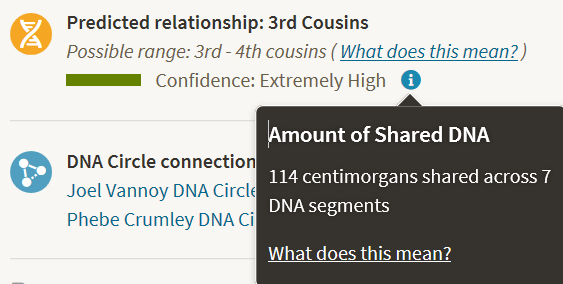
Ironic isn’t it that his estate had absolutely no liquor, nor still.  Perhaps Edward was too friendly with his Quaker neighbor, James Crumley, who did indeed own a still.  Edward’s daughter Hannah married James Crumley’s son, William.  James and Edward would have been contemporaries.  James died in 1764, about the same time that Edward died.  They lived down the road from each other for the entire time they lived in Frederick County, and they attended the same church – well – up until Edward got the boot.  There is a good possibility that they came to Frederick County together, because both men are first found there in 1744.  During this time, there was a significant migration of Quakers from the Chester County, PA region – and Ann and Edward Mercer may have been among them.
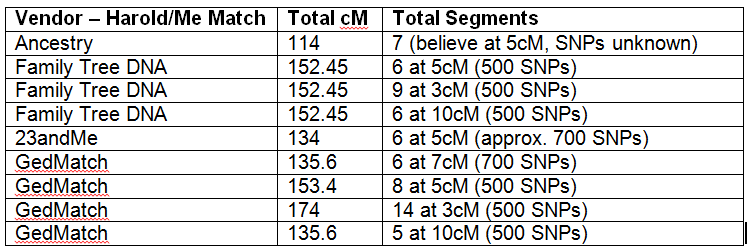
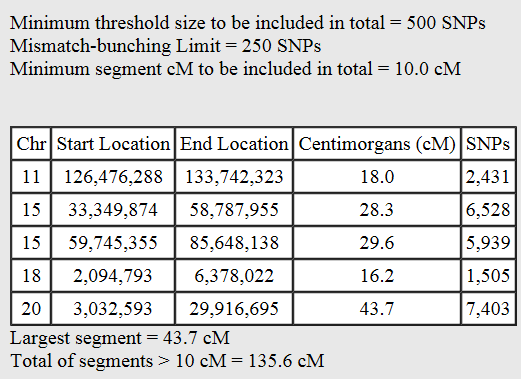
If Ann was not a Quaker, Edward would have been thrown out of the church much sooner, for marrying outside the church.  Therefore we know Ann was Quaker.

Mercer 14

The Hopewell Friends Meeting House was established in Frederick County in 1734 and this is the church that both the Crumleys and Mercers would have attended.

Mercer 15

Ann would certainly have attended this church from 1744 up until 1759 when Edward got himself removed from the church.  How Ann reacted to this is unknown.  She still had young children at home.  Was Ann too embarrassed to attend church after Edward got into trouble?  Was she painted with the same brush?  Was she ostracized or unwelcome because of his behavior?  Or did Ann just lift up her chin and attend, deciding that she could not control Edward but she was going to go to church with him or without him?  Was that allowed once he had gotten himself in trouble?  How did Edward’s actions affect Ann’s relationship within the church, officially and unofficially?

Mercer 16

How did this episode affect Ann’s relationship with others in the community?  How did if affect Edward’s relationship with Ann?  Was she supportive of Edward or disgusted with him?  Was she simply tolerant of his activities, or actively opposed?  Did Edward truly have a drinking problem, or did he have a wild Saturday night?  From the church statement, it appears that he is “drinking to excess” not just having an isolated binge or having too much fun at an apple snitzing.  This is also the same church that overlooked the fact that James Crumley was distilling liquor and made him a vestryman in the Anglican church representing the Quaker interests.

Did Edward have a drinking problem by “Quaker standards” or did Edward truly have a drinking problem?  I hope he was not mean to Ann or the children.  Alcoholism seems to be such a continuing theme in my family.

Mercer 17

How this affected the family has a direct impact on where Ann was buried.  Was she still a Quaker at her death?  Was she a practicing Quaker?  Did her children bury her in the Quaker Cemetery or did they bury her beside Edward, who was surely NOT buried in the Quaker Cemetery?

Mercer 18

This also makes me wonder where Ann’s son, John Mercer, was buried in 1748 when he died.  Is he buried in the Hopewell Cemetery?  This was before Edward Mercer got himself into trouble, so it’s likely that Ann and Edward’s son, John, is buried here.  I surely wonder what caused the death of a young man.  And I wonder if Ann is buried by John or by Edward.  Ann outlived Edward by at least 23 years and possibly more.  A lot can change in that time.  Had she initially been very angry with him, that could have mellowed, especially after his death.

One of my friends whose husband had been exceedingly difficult for her to deal with for many years was grieving her husband after his death.  Talking to her before his death, I would have expected her to be the merry widow.  I knew her well enough to ask her about the discrepancy, and she blessed me with these words of wisdom, “Honey, some of them are a lot easier to love after they are dead.”  Touche!!!

Furthermore, Ann didn’t have to decide where she was going to be buried.  That fell to her children.

Mercer 19

Perhaps the earliest burials at Hopewell are found here, in the center, under this ancient tree who stands silent sentry.  Perhaps Ann rests here.  If trees could only talk.

Children and Descendants

Ann and Edward Mercer had seven children that lived to adulthood.  Son John died before both Edward and Ann in 1748, in Frederick County, already an adult.

  • Richard Mercer could have been the Richard who married a woman named Mary and lived in Berkeley County. John Mercer mentioned a brother Richard in his 1748 will that was filed in Winchester.  It’s difficult to tell when Richard first appears in the records because there is an earlier Richard that is found with Edward Mercer as well.
  • Elizabeth Mercer was born about (or after) 1724 and married by 1748 to William Heath who was born on Sept. 18, 1724. William was mentioned in the 1748 will of his brother-in-­law, John Mercer.
  • John Mercer was born circa 1727 and died in 1748, apparently unmarried. John lived in Frederick County, where his will is on file in the courthouse. His father, Edward Mercer, was named administrator for his estate.
  • Moses Mercer was of age and leasing land from his father by 1760. Moses was born in 1732 and died in 1805, in Frederick County. Appraisers of Moses’ estate were Jacob Rinker, Richard Barrett, and Thomas Babb. Moses married Dinah Morrison, who was called Dianna in his will. She was born Dec. 24, 1729, and died in April 1810. After Moses’ death in 1804, Dinah received all moveable property during her natural life, plus one-third of profits from real estate. She wrote her will on April 10, 1810 and it was probated June 7, 1810. Witnesses were Aaron and John Mercer, and John Barnard. Her close friend, Abraham Lewis was named the executor. Moses and Dinah signed their names with an X “His mark” and “Her mark,” respectively.
  • Hannah Mercer married William Crumley about 1763 and had died by 1774. Hannah was mentioned in the will of her brother John in 1748, and in the will of Elizabeth Morris in 1760. This begs the question of the identity of Elizabeth Morris? Might this be a clue to the identity of Hannah’s mother, Ann?
  • Edward Mercer (Jr.) was given “the plantation where I now live – 209 acres plus adjoining 96 acre survey” by his father. Edward was born about 1744. His age was proven from a deposition given in the Augusta County Circuit Court. The name of his spouse is not known.
  • Aaron Mercer, the youngest son, not of age in 1752 – served in Revolutionary War. On October 28, 1799 he obtained a Virginia Revolutionary War land grant in Ohio and moved to Ohio. Reportedly in his pension application (which is not at www.fold3.com as of 9-15-2015) he says he was born in Ireland. Aaron died on December 17, 1800 in Hamilton County, Ohio and is buried in the Old (Columbia) Baptist Graveyard. Given that there were no Revolutionary War pensions before 1818, there would have been no pension application by him, although if his wife, Elizabeth Carr, was still living, she could have applied in either 1818 as destitute or 1832/33 as a surviving veteran’s wife. She is reported to have died in 1820, so I’m quite suspicious of the claim that his Revolutionary War pension paperwork stated that he was born in Ireland.

Of these children, only two are females.  Both Ruth and Hannah had daughters.  These daughters would propagate the mitochondrial DNA of Ann Mercer.  Woman give their mitochondrial DNA to both genders of their children, but it is only passed on by the females.  Today, to see what Ann’s mitochondrial DNA looks like, we need to find someone who descends from Ann through all females to the current generation.  The current generation can be male.  From Ann’s mitochondrial DNA, we can look through a periscope back in time to see where her ancestors were from in the world – and we might be lucky enough to match a Croat female line.  Could we be that lucky?

  • Hannah Mercer married William Crumley and had daughter Ann who married Thomas Reese and had four daughters, Hannah, Nancy, Rachel and Sarah.
  • Hannah Mercer Crumley also had daughter Catherine who married James Mooney and then John Eyre. She had daughters Catherine, Mary (Polly), Eliza, Hannah and Nancy. This family migrated to Fayette County, Ohio.
  • Ann’s daughter Elizabeth Mercer married William Heath. Nothing further is known about this couple.

If you descend from these women, I’d love to hear from you and if you descend through all females to the current generation (you can be a male), there is a DNA scholarship waiting for you!

Mercer 20

______________________________________________________________

Disclosure

I receive a small contribution when you click on some of the links to vendors in my articles. This does NOT increase the price you pay but helps me to keep the lights on and this informational blog free for everyone. Please click on the links in the articles or to the vendors below if you are purchasing products or DNA testing.

Thank you so much.

DNA Purchases and Free Transfers

Genealogy Services

Genealogy Research