John Whitney Ferverda (1882-1962) and the Body in the Garage – 52 Ancestors #6

John Ferverda

My grandfather’s name was John Whitney Ferverda.  I’ve always wondered about that middle name, with no idea where it came from.  It does not appear to be a family name.

He was born on December 26, 1882 in Plain Township, Kosciusco County, Indiana, on a farm to Hiram B. (probably Bauke) Ferverda and Evaline Louise Miller Ferverda.  He died on June 9th 1962.  I was 7 and I remember him, albeit somewhat vaguely.  His wife. Edith Barbara Lore Ferverda who he had married in Rushville, Indiana in 1908 had just died 18 months before, so it had been a rough couple years in the family.  With John Ferverda’s death, the homeplace had to be sold, the furniture divided, and all of those things that signal the end of an era and what we’ve come to know as closure needed to be done.

John and Edith had two children, my mother, Barbara, and one son, Harold Lore Ferverda, known by the family as Lore.

I think I’ll let Mom introduce you to her father, in her own words.  I gave my Mother a book called “Grandmother’s Memories” to complete for her grandchildren and great-grandchildren.  She did, at first in her own hand, and then later, as her handwriting became more difficult to read, she would tell me the answers and I would write them for her.  The book asked questions or gave topic suggestions.

My Father’s name was John Whitley Ferverda.  He was born in 1882 and died in 1962.  He had blue eyes.

My Father’s most precious memory:

When I was so sick with rheumatic fever, every morning he carried me downstairs to the davenport and every evening upstairs to bed.  He always had time to read to me.  I was too sick to read for myself.  I was 7 or 8 and he read everything to me I could get my hands on.  He worked at the Ford Agency in Silver Lake selling cars and trucks.  When I went to school, we walked and went the next half block further to the Ford Agency and asked Dad for a nickel.  When he gave it to me, I promptly went to the drug store and bought a Hershey bar, which Dad knew I’d do.

My Father’s best story about growing up:

He was one of 11 children.  From their farm they walked over to Tippecanoe Lake to swim which was about a mile.  He took enough schooling to be a teacher, but never secured a position with the school. Instead he started with the railroad and was sent to Rushville where he met Mother.

John Ferverda against car

Here’s a bit more info from the “History of Kosciusko County, Indiana” 1919:

John Ferverda is a merchant of successful experience and has been identified with the hardware trade at Silver Lake for a number of years, being one of the live and enterprising business men and citizens of that locality.

He was born in Plain Township of this county Dec. 26, 1882, a son of Hiram B. and Eveline Miller Ferverda, both of whom now reside at Leesburg.  John Ferverda grew up on his father’s farm in Plain Township and was liberally educated.  He attended both the common and high schools of Oswego, being a graduate of both, and also was a student in the Tri-State Normal at Angola.  For his scholarship he was granted a license to teach, but never used it in that profession.  His life was spent largely at home until the age of 22.  Having mastered the art of telegraphy, he entered the service of the Big Four Railway as an operator, and was assigned at different stations along that system and remained in that service about 10 years.  In 1916, Mr. Ferverda left the railroad to take up business and is now a member of the F. and F. Hardware Company of Silver Lake.

John is shown in front of his hardware store, below.

Ferverda and hardware store cropped

In 1907 he married Miss Edith B. Lore, a native of Rush Co., Indiana and a high school graduate.  They have one son, Harold L., born November 24, 1915.  Mr. and Mrs. Ferverda are members of the Lutheran Church and he is affiliated with the Denning Lodge No 88, Ancient Free and Accepted Masons, at North Manchester, and of the Knights of Pythias Lodge.  In politics, he is a republican.

Was he ever a Republican.  I remember Mom talking about her father quizzing potential suitors.  The first question he would ask them is whether or not they were Republican.  Mom said she knew better than to bring home a Democrat!!!  For years Mom had a small ivory elephant watch charm about an inch long that was his that I suspect was meant as the symbol of the Republican Party.

At some point, before his marriage, probably while in college, John was in some sort of a play.  He is the front row, bottom left corner.

ferverda and play

John studied to be a teacher, but for some reason, after graduating, never pursued that avenue.  Instead, he joined the railroad as a telegraph operator and station master.  He was assigned to Rushville, Indiana.  We don’t know exactly when he went to Rushville, but in an article in the Rushville paper, dated January 25, 1907, John was a pallbearer for Miss Maude Foust who died of typhoid.  We also know he sang tenor in a quartet at the Presbyterian Church in Rushville, based on a November 1908 news report .

While in Rushville, John met and married Edith Barbara Lore, daughter of Curtis Benjamin, known as CB, Lore and Ellenore “Nora” Kirsch Lore. She too attended the Presbyterian Church.

Ferverda - Lore marriage license

Ferverda-Lore marriage license

Rushville Republican Newspaper, Jan. 3, 1910 – John Ferveda who was recently transferred to cashier at the local office has been given the agency at Silver Lake in the northern part of the state and will leave here in the next few weeks.

John and Edith moved back to Silver Lake where John served as the station master and where they spent the rest of their lives.

While their immediate family was small, John had many siblings in the area.  He was one of 11 children born to Hiram and Eva Ferverda.  One of his siblings, Roscoe, lived across the street from him in Silver Lake, Indiana.

ferverda family original photo

Ferverda family description cropped

John Ferverda’s parents were Brethren, although it appears that not all of the family continued in that faith which prohibited military service, among other things.  John broke with the Brethren faith by marrying Edith who was a Lutheran, and Roscoe broke with the Brethren faith by serving in WWI.  In fact, four of John and Eva’s sons, in total, served in the military, Ira in the Spanish American War and then Donald, Roscoe and George. Those three sons are standing together in the middle row, with George, on the right, in uniform.

John and Roscoe were close their entire lives, even though there was 9 years between them, Roscoe having been born in 1893.  In fact, when Roscoe returned from military service, he too worked at the station with his brother for the railroad until the depot in Silver Lake closed in 1958 due to declining business.

silver lake depot

John and Edith bought a house in Silver Lake that was located right by the railroad tracks, which were across the field to the right of their house in the photo below.  I loved the large screened-in front porch on this house.  The screens were painted yearly to keep them from rusting, and rocking chairs resided on the porch in warm weather.

One time, Lore was painting the screens and my mother was bothering him in her sisterly way.  He decided to paint her cat’s nose, which infuriated my mother, so he then painted mother’s nose black too….except he “missed” and got her entire face with the side of the large brush he was using.  Mother was scheduled to perform in a dance recital later that day on the courthouse square in Wabash.  I’m sure you can imagine the drama and hullaballoo that results from that little incident.  Paint then was not water soluable and required turpentine and scrubbing to remove.  This was always one of mother’s favorite stories about her brother.

silver lake house

Roscoe bought the house right across the street.  Roscoe and John were thick as thieves.

Roscoe's house

Old newspapers can be a lot of fun.  In the local paper I found some tidbits that give us hints about John’s life.

July 31, 1910

Ferverda news 1910 cropped

Donald Ferverda is visiting with his brother John Ferverda and wife at Silver Lake.

Don was one of the three Ferverda sons who served in the military in WWI.  After returning, he was a cashier at the bank in Leesburg and died relatively young of cancer.

February 5, 1911

Ferverda news 1911

Mr. and Mrs. John Ferverda of Silver Lake visited with Hiram Ferverda and family over Sunday.

Visiting your parents hardly seems like a newsworthy event.  It wasn’t far from Leesburg to Silver Lake – about 18 miles.  However, it’s a lovely tidbit.

July 30, 1912

Ferverda news 1912

Mrs. Gertrude (her name was Nora, not Gertrude) Lore of Rushville is here at present visiting with her daughter, Mrs. John Ferverda and husband.  Mrs. Lore’s two daughters (Mildred, 13, and Eloise, 9) have been here for the past several weeks visiting at the Ferverda home.  The garage building is nearing completion.  The metal ceiling is completed and is now ready for the paint.  The building will be ready for occupancy within a short time.

I originally didn’t think the second paragraph was relevant to the Ferverda family, but with all those females visiting “for an extended period”, maybe my grandfather was taking up residence in the garage:)

October 11, 1912

Ferverda news 1912 - 2

Mr. and Mrs. John Ferverda of Silver Lake are here for a two weeks visit with his parents, Mr. and Mrs. H.B. Ferverda.

October 19, 1912

Ferverda news 1912 - 3

H. L. Anderson of Westport who had been here as a relief agent for Mr. Ferverda during his absence went to Leesburg yesterday where he will be for 15 days while the Leesburg agent takes a trip.

Agent here refers to railway agent.

December 22, 1912

Ferverda news 1912-4

Paul Ferverda of Leesburg is here visiting with his brother, John Ferverda and wife.

John had brothers Ira, Irvin, Ray, George and Donald who lived outside of Silver Lake, but no Paul.  Roscoe lived in Silver Lake across the street from John.

April 19, 1913

Ferverda news 1913

We understand that Ray Ferree who recently was bumped off of the Big Four at North Manchester by one who was older in the service will apply for the station here and if he applies it will almost be sure that the company will award him the position.  The family will then move here and occupy the Mrs. Metzger property near the depot and Mr. Ferverda, the agent, who resides there at present will go to Markleville.

The family never went to Markleville.

February 16, 1914

Ferverda news 1914

H.P. Rager, John Ferverda and Dale Homman were down to North Manchester last evening taking the first steps in the degree work of the Masonic order.

November 13, 1915

Ferverda news 1915

Ray Feree is here this week as relief agent for John Ferverda at the Big Four.  Mr. Ferverda is taking a vacation and will also have his eye operated on upon during his vacation.  He went to Cincinnati the first of the week for that purpose.

This is a week before John Ferverda’s son, Lore was born, on November 24th.  I wonder what kind of eye surgery he had performed, and for what condition.

November 27, 1915

Ferverda news 1915-2

John Ferverda, our genial agent at the Big Four station and wife and Percy Helser the drayman, and wife, are the proudest people in the whole community and passed the most enjoyable Thanksgiving of any.  The stork came to their homes Wednesday afternoon and left a bouncing boy baby at the Ferverda home and at the Helser home he left a sweet little girl.

Rushville Republican Newspaper, Jan. 8, 1916 – J. W. Ferverda, Big Four agent at Silver Lake and well known here has purchased a hardware store there in partnership with R. M. Frye.  He has resigned his position with the railroad company.

January 22, 1916

Ferverda news 1916

J. W. Ferverda has returned home from a trip to Rushville where he was for a couple of days visiting with his wife and son.

September 10, 1916 – Silver Lake News

Ferverda news 1916 - 2

John Ferverda is going about bandaged up on account of a broken rib received a few days ago when he was assisting in unloading some machinery.

In 1918, every man had to register for the draft.  WWI was upon us.  John Whitney Ferverda registered, said that his occupation was in retail hardware and as an implement merchant.  He was described as short, of medium build with light hair and gray eyes.  I never knew he had grey eyes.

John Ferverda WWI draft

February 28, 1918

Ferverda news 1918

Friends and relatives here had just learned of the marriage last month of Roscoe Ferverda, son of Mr. and Mrs. H. B. Ferverda of Leesburg and Miss Effie Ringo of North Vernon, Indiana.  Mr. Ferverda who was a telegrapher at North Vernon enlisted in the signal corps and just before being called for examination was taken sick with measles.  He came home for two weeks and immediately upon his return to North Vernon was examined and sent to the training camp at Vancouver, Washington.  The wedding took place while at North Vernon for the examination.  The bride is expected here tomorrow for a visit with his parents.

So it seems that not only did Roscoe join the military, he married a non-Brethren wife as well, without telling his parents.  Those Ferverda boys, renegades all of them….

In the 1930 census, we know that Roscoe is an agent for the Big 4 Railroad, almost the last person enumerated in the village of Silver Lake, in Lake Township, in Kosciusko County, Indiana.  John Ferverda was the first household enumerated, living directly across the street from Roscoe.  In 1930, John was a salesman at the Ford garage.  With the decrease of rail shipping, jobs with the railroad evaporated.

Below, both the new and old garages in Silver Lake.

Silver lake garages

At some point, and I believe it was before or during the Depression, John Ferverda owned a hardware store in downtown Silver Lake.  The problem was that people couldn’t pay their bills.  Eventually, that business would close, and John would raise chickens in the chicken house behind the house and sell eggs.  There may have been a Depression, but everyone still had to eat.  Eggs and chicken were relatively cheap protein and both eggs and hatchlings were shipped as far as New York.  John loved his chickens, and this one was his favorite and according to the back of the picture, his best producer.

John Ferverda and chicken

Mother remembers cleaning chickens as a child during the Depression, and not fondly, I might add.

Sometime, about this same time, when Lore was a late teen, it seems that he “borrowed” the family car without permission, and managed to get it stuck in the snow.  I don’t know how he managed to get ahold of his father, but he did.  If he thinks he was in trouble with his Dad, he hadn’t seen anything yet because his mother, Edith, relied on that car to get her to the job that supported the family during the Depression.

Ferverda 1937 storm

So off John and Lore set to get Lore unstuck.  I’m not sure who went with them, but I’m guessing it was Roscoe.  The photo above is labeled 1937 in Mom’s photo album.  There is another photo also of a sleigh with a horse pulling it that looks to be about the same time.

Ferverda fam 1937 cropped

Mom kept a photo album, thankfully, and this was labeled as 1937.  Left to right John Ferverda with Buster, Edith Lore Ferverda (John’s wife), Eva Miller Ferverda (John’s mother), Chloe Ferverda Robinson (John’s sister), Charlotte Robinson, Raleigh Robinson (Chloe’s daughter and husband.)

Ferverda fam 1937-2

Two houses down the street was the Methodist Church where the Ferverdas were members.  I have vivid memories of this church when I was little, sitting on the small child sized chairs and belting out Jesus Loves Me at the top of my lungs in Sunday School, which was through the side door on the left and downstairs.  I can still hear it….

“Jesus loves me, this I know,
For the Bible tells me so….”

silver lake methodist church

On the 1940 census, Roscoe and John are shown with 4 residences between them.  Roscoe is still an agent for the railroad and now John is an “owner and overseer” on a chicken and fruit farm.

I had entirely forgotten about the apple orchard and the raspberries.  The entire “back yard” was apple trees and behind the orchard, the property terminated in a huge mass of brambles which they called raspberries.  All I know is that I avoided that area because no matter what I did, they always stuck me, one way or another.  I can’t imagine how they picked those berries, but obviously they did.

My grandparents had a back porch with a hand pump where they washed and processed the apples.  That same pump pumped the water for the kitchen and bathroom, both of which were adjacent to the pump room.  This WAS considered running water at that time.

In 1941, John Whitney Ferverda registered for the WWII draft, even though he was 59 years of age.  His signature is beautiful.

John Whitney Ferverda draft

Silver Lake, where they lived was a small town, but it was not incorporated, so they were part of Lake Township, although Silver Lake made up the most populous part of that township.  From 1943-1950, John Ferverda was township Trustee.

Silver lake 1945 chemistry class

In 1945, the newspaper reported that , “Trustee John Ferverda provided a fully equipped chemistry lab and the course in chemistry was added in the high school.”  John’s son, Lore Ferverda, had graduated from Silver Lake High School in the class of 1933 and went on to become a chemist, eventually holding several patents.

John Ferverda alseep

I do believe this was before recliners had been invented.  I remember my grandmother starching those chair arm and back covers.   My grandfather did this every afternoon.  I think I inherited the propensity from him!  Must be genetic.

Speaking of genetics, we have been fortunate that one of Roscoe’s sons volunteered to take the Y-line DNA test as well at the autosomal test.  Roscoe’s daughter, Cheryl, has taken the autosomal test as well.  In fact, these folks were some of the first testers at 23andMe and are now participating in projects at Family Tree DNA.  There is a Ferverda DNA project, but needless to say, with a name like that, it’s not very large.

Cheryl, and I are in the final stages of planning a trip back to the Ferverda homeland in 2014.  We can hardly wait and I’ll be sharing that with you too, but for now, back to John Ferverda.

John and Edith Ferverda 1959

John and Edith Ferverda with their first great-grandchild, Bruce, born on the 4th of July, 1959.  The family referred to him as “the firecracker with a short fuse.”  I believe this photo was taken at Christmas, 1959.  Edith passed away, a few days later, in January of 1960.

John and Edith 1959 standing

I don’t know where this photo was taken, but it wasn’t their house.  This is a great photo and is exactly how I remember Edith Lore and John Whitney Ferverda.

By the late 1950s or early 1960s, John had tuberculosis.  They believed it had been dormant for decades.  Edith’s father and sister both died of TB in 1909 and 1912, respectively.  He went to the tuberculosis sanitarium where he was treated for several months.  After returning home, he became ill again in 1962, except this time it was inoperable liver and pancreatic cancer.   He passed away on June 9, 1962.

John Ferverda obit

Mom and lore at grave

This photo is of Edith and John’s two children at their gravesite.  Stopping at the cemetery became a regular occurrence anytime we were in that vicinity, or could be without a huge detour.

Since neither of their children lived in Silver Lake, after John passed away, they put the house with the chicken houses and apple trees and raspberry bushes up for sale.  I remember Mom talking about how difficult it was to go through their things.  I also remember finding money hidden in the most unusual places.  I suspect that was a relic of the Depression years when life was extremely difficult.  One time, I picked up a powder box and a false bottom fell out, along with some cash hidden there.  I wonder how much was inadvertently given away, secreted away like that.

Mom and Uncle Lore sold the property, and the new owners turned it into a funeral home.  My mother was utterly mortified.  They enclosed the front screened in porch with plywood painted white, turned the dining and music rooms into viewing parlors (the large window grouping on both sides of the house) and processed the remains in the kitchen and on that back porch.  I would hope they installed a better water system.  The garage, seen behind the house is where the hearse was kept and the bodies loaded, unloaded and well, um, stored.

silver lake house as funeral home

My mother, for years, when someone died in Silver Lake just prayed that the funeral was at the “other” funeral home.  She was utterly mortified that her family home had become a funeral home, and she said she simply could not go inside.  Finally though, someone died, and she had to find a way.

silver lake house as funeral home front

silver lake house as funeral home 2

That someone was Roscoe.  He died, as luck would have it, 36 years ago this week, on the morning of the epic blizzard in Indiana, January 25, 1978.  And when I say epic, I mean epic.  We have photos of family members on drifts level with the roof.

1978 blizzard

These are just the kinds of things the Ferverda family did, especially these two brothers!  Both John and Roscoe would have found that immensely humorous.  Everyone else, not so much.

The roads were closed, for days.  Finally State Road 14 was opened, one way, through snow tunnels.

1978 blizzard snow tunnel

Roscoe’s funeral was held, such as it was, and then, because the snow was too deep and the ground too frozen for too far down…Roscoe got to spend the next several weeks in his brother, John’s, garage.

Gone, But Not Entirely

John and Roscoe may be gone, but their DNA isn’t.  Roscoe’s son provided his DNA, quite graciously, as part of a DNA presentation at the Allen County Public Library a few years ago for Y chromosome testing.  Because of his generosity, we know that the Ferverda men fall into haplogroup I1, and their DNA is quite unusual.  At 25 markers, only 2 matches, and one of those is a Scherp from Germany.

We’ve tested several downstream SNPs as well, to see if we can refine his haplogroup further, but so far, he has tested negative for all of the SNPs tested.

He is a member of the haplogroup I project, where the administrators have grouped him in the I1 generic group.  Each project is grouped differently, according to the project goals and the administrators, but in this case, his grouping tells us that he does not match the other groups, such as “AS” for Anglo Saxon or “N” for Nordic, or Balkan or Iberian, for example.

ferverda dna map

For as unusual as his markers are in the second testing panel, at 25 markers, providing only 2 matches, his 12 marker matches are extremely common in haplogroup I, providing him with 1028 matches.  His 12 marker matches are shown on the map below.

Ferverda 12 markers

Clearly these 12 marker matches don’t hold at 25 markers, and most of these people did test at 25 markers. This is the best example I can think of as to why testing at higher levels is so important.

Edith and John Ferverda stone

______________________________________________________________

Disclosure

I receive a small contribution when you click on some of the links to vendors in my articles. This does NOT increase the price you pay but helps me to keep the lights on and this informational blog free for everyone. Please click on the links in the articles or to the vendors below if you are purchasing products or DNA testing.

Thank you so much.

DNA Purchases and Free Transfers

Genealogy Services

Genealogy Research

You’re Invited to Aleda’s Virtual Funeral

Aleda's Virtual Funeral

We’re having a virtual funeral….and you’re invited.  In fact, this might be a first….the first virtual funeral ever – and you can be part of this groundbreaking event.  It’s a testament to how the electronic, internet, Facebook, DNA age has changed our lives.

Aleda passed away more than a week ago, on January 26th.  Sometimes things don’t always go exactly as we would like, and suffice it to say, Aleda is being buried tomorrow, Friday, February 7, at 2:30, alone.  Well, not entirely alone, the man who mowed her yard since he was a child, and his wife, will be there, and the backhoe operator, of course.

She has a world of online friends and cousins who she met through DNA testing, so, we’re giving Aleda a virtual funeral.  Her favorite reading was the 23rd Psalm, so we’re inviting everyone to participate at 2:30 by reading or reciting the 23rd Psalm, for Aleda, to lift her spirit to the Heavens.  Let’s send her off with a chorus of voices.  Aleda won’t be alone.  We’ll all be sending her home.  And that’s it.  Nothing else for you to do, so it’s very easy to participate.

By the way, I’m being a bit vague about her name and location because of her family’s concerns about the security of her property, which is why there has been no obituary, etc.

Genealogy, and in this case, genetic genealogy changes lives.  In my recent article, “Finding Family the New-Fashioned Way,” I included a poll asking three questions:

Have you become close to someone met through traditional genealogy research.

The results?

43% – Yes, somewhat close, we’re friends
42% – Yes, very close, like family.
14% – No

Have you become close to someone you met through DNA?

43% – Yes, somewhat close, we’re friends.
40% – No
16% – Yes, very close, like family.

Have you met in person the people you’ve discovered during genealogy of DNA research?

62% – Yes
23% – No
14% – No, but have plans to.

Well, I can tell you how Aleda answered those questions, and although the polls are anonymous, I’m sure she answered because she was the consummate contributor and participant.  Aleda would have answered yes to all of the above.

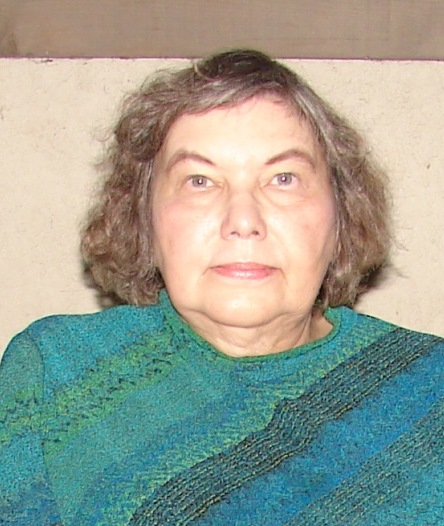
Aleda was a joiner.  In High School, she was a member of several clubs, the editor of the newspaper, and she loved science, especially chemistry.  It’s no surprise then, how quickly she embraced DNA testing decades later when it became available as a genealogy tool.  She was a pioneer, one of the first.

Aleda's high school

Aleda's high school 2

Aleda became interested in genealogy early in life and spent 50 years researching her family history.  She became active in the DAR as well and I believe was a 47 year member.

By the time I met Aleda, in 2006, congestive heart failure had already set in, but that Aleda 2006 croppeddidn’t slow her down much, and it certainly didn’t stop her.  Aleda volunteered to help staff a table for the Lost Colony Research Group in Manteo, NC.  She had to walk slowly, due to the oppressive heat and her health, but walk she did, and she stayed with us all day, talking to people interested in the Lost Colony – or more particular, in figuring out if they descend from Lost Colony survivors.  She was a founding member of The Lost Colony Research Group.

Her family, at least part of it, was from the South, the colonial South, the early South, the South that enslaved Indians and Africans, and she was descended from some combination of all of those people.  Aleda’s DNA, you see, held secrets that would only be divulged when her brother took his first DNA test.

To say Aleda was shocked is an understatement.  But she was also thrilled.  The bad news – it would be 5 long years before her brother would have a DNA match.  Five years is a very long time to wait.  But Aleda didn’t just wait, and she never, once, complained.  Instead, she recruited people.  She researched, she found other people she thought might be related.  She told them of their wonderfully interesting and colorful family history.  And she and her brother took every test they could take.  Aleda was determined to learn everything she could learn by embracing this new technology.

Her brother’s Y DNA is very distinctive.  When he has a match, there is no question that it’s a match.  Aleda gathered her brother’s matches into a research group.

When autosomal DNA became available, she was one of the first to embrace that technology as well, and autosomal matches opened up a whole new world of cousins for Aleda.

As her health deteriorated, it seemed that she worked harder and harder, and began teaching others what she knew.  She had apprentices and taught her research group about file organization, about computers, about DNA and how to research.  She knew her time was limited.  She had come to love them all.

She embraced all things new.  Aleda never had children, but she was a born teacher with a Master’s Degree in Education as well as a second Masters in Liberal Arts from John Hopkins.  It’s no wonder that she always thought innovatively, outside of the box.

Her research group told me that when my blog articles were published, they had to hurry and read them right away, because Aleda would be calling shortly to discuss how to apply them to their research.  They told me how much Aleda looked forward to my blogs.  I never knew.

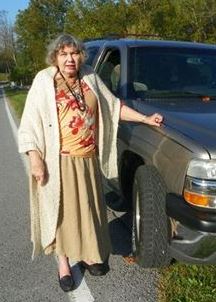
Aleda 2013As Aleda became increasingly homebound, especially following a stroke a couple years ago, her world became her online friends and cousins with whom she communicated daily.  Her last trip was in the fall of 2013, despite her health challenges, to visit Hancock County, Tennessee, tracking down those pesky ancestors.

She never gave up…not until the last day….not even the last day.  The morning of her death, she was working on X chromosome clusters, and teaching, always sharing her knowledge with her research group.

Aleda loved her cousins.  I don’t meant that lightly.  She truly loved them.  They became her family that she had never had.  They spoke with her daily.  She knew them better than anyone else, even if they were scattered to the winds across the US.

Unfortunately, the fact that we are so scattered, and that we are having an epic winter combined with age and health issues makes attending her burial impossible for her research group.  So, a virtual funeral it is.

What would Aleda think of this virtual funeral?

I’ll let one of her research group cousins tell you:

My dear, dear friend would be so thrilled to think she was having a “virtual funeral.”  She did so like “different things.”

Aleda was not just a friend.  We talked most days and usually had a few projects going at the same time.  She taught my little group of kin what little we know about DNA – and much of it by following whatever Roberta happened to be doing on her blogs.  She spent 50 years in searching for her ancestors and jumped in with both feet when DNA became available.  She said you just couldn’t do enough DNA research.

Because our brothers and my other male kin matched, we became Aleda’s project.  Once I hopped on Aleda’s swiftly moving train, I didn’t get off again until her passing.  She always had a project or two or three or more going at a time and was right in the middle of two big ones to do with the X Chromosome Charts.

She was one of a kind: bright, non-judgmental, generous, loving and forgiving. We lost a super friend, cousin and  dedicated genealogist…the world lost a great lady. Roberta, she so loved your teachings and she in turn taught us.”

Rest in peace dear Aleda.  I thank you for sharing so much of your vast knowledge with us and I really enjoyed our ride.  Hopefully I can be as helpful to others as you were with everyone you knew.”

I think Aleda would love her virtual funeral, her “home-going,” and she would forgive us for not being able to attend in person because that’s how Aleda was.  She always found the positive in everything and everyone.

Please join us at 2:30 Eastern time on Friday to repeat the 23rd Psalm for Aleda.  Please “like” this article if you’ll be virtually attending.

And then, let’s all be a little bit Aleda. She made such a difference to so many who she reached out and touched through genetic genealogy.  The science is simply a means to an end…and what matters in the end is family, however you come to define them.

Update – Aleda’s Virtual Funeral

Aleda had a beautiful virtual funeral.  Thank you to all of the virtual attendees for being your sister’s keeper.  Lots of people participated by reading the 23rd Psalm.  This beautiful version was created and contributed by Donna based on the rose wreath foundation created by www.jaguarwoman.com.

23rd Psalm

Aleda’s virtual funeral included a piano, trumpets, bells tolling, songs and Psalms.

One gentleman in Texas played and sang this.

A lady in Kentucky played the piano and sang.

And in North Carolina, the reading was accompanied by this and bells tolling.

A balloon was released.

In West Virginia, a man took his heirloom family Bible and visited his family cemetery to read the 23rd Psalm.

In Tennessee, a man visited the cemetery that held his 4 great and 5 of his great-great-grandparents, walking from grave to grave as he read the 23rd Psalm and the Lord’s Prayer.

One woman was on an airplane, and several were attending the Rootstech conference in Utah and stole a few minutes away from the hustle and bustle.  My husband was going to excuse himself from a meeting and go to the restroom, but instead, recruited his colleagues in the business meeting he was attending – and they all participated.

Another woman, in Maryland, asked for and received a few minutes relief from her job on the “front desk” in a library.

In fact, Aleda probably had more people at her virtual funeral than she would have been able to have in reality – when you consider the complications of distance and weather.  The map below shows the locations of the people I’m aware of, and I know there were many more because the messages about her virtual funeral were shared over and over again.

This map shows the states where people were who participated.  In Kentucky and Tennessee, there were literally hundreds, followed by Texas.

In addition, there were also several people from the UK, Japan, Israel, Finland and some of our military in Fort Apache, Afghanistan.  It was an international event.  Aleda would have been both surprised and pleased.  I guess maybe this could be called the first virtual surprise “come as you are” funeral.

Funeral States

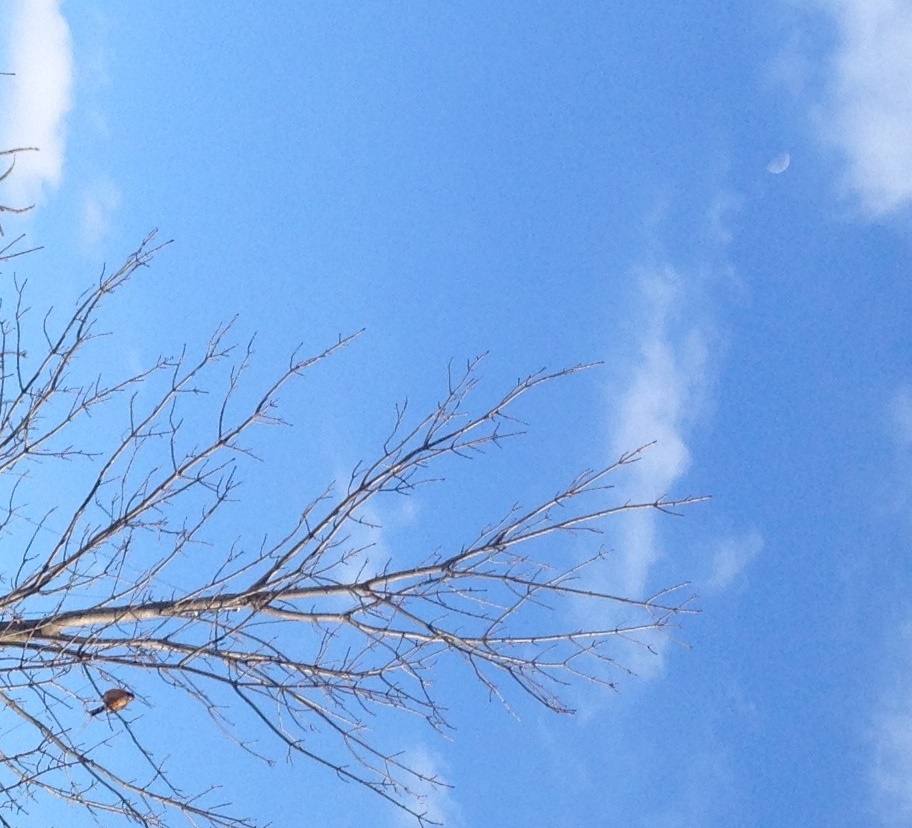
I’ve been surprised by how many people have told me of special blessings they received while participating in Aleda’s funeral.  In my case, after I did the reading, outside in front of a huge drift in 8 degree, blustery, but sunny, weather, I realized that there was a half moon in the middle of the day, and the spring’s first robin had accompanied me.  I’ve cropped the photo below to show both.

Aleda Moon Robin Cropped

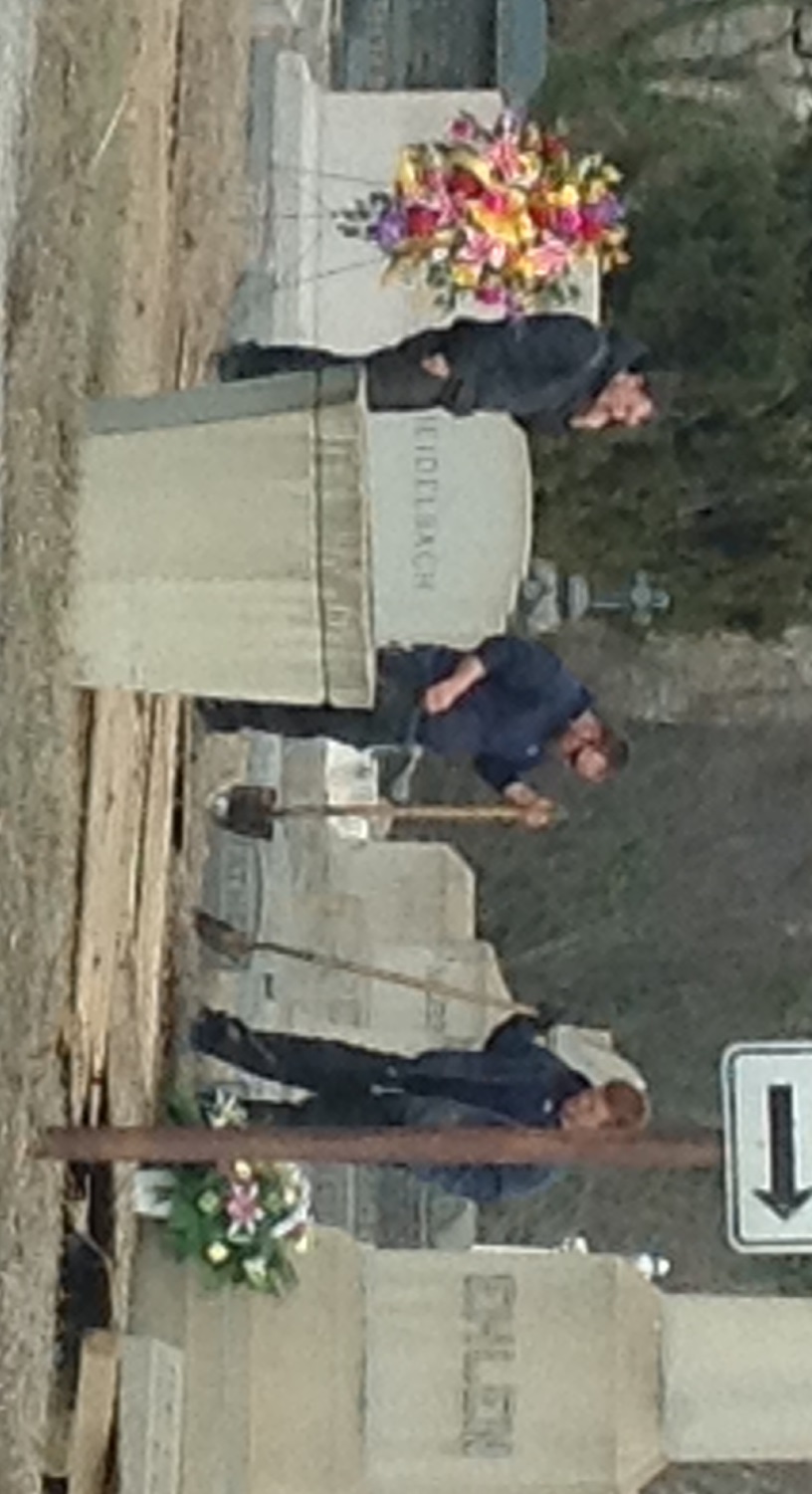
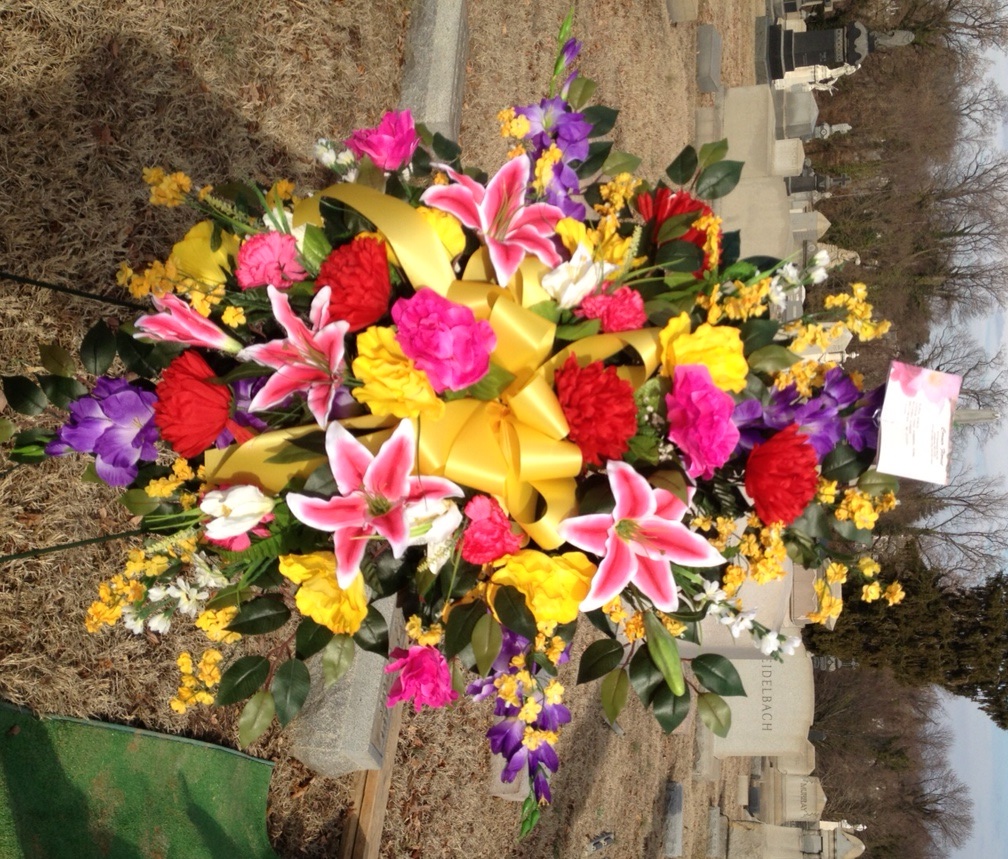
Aleda also had flowers.  Three people sent arrangements with messages from the entire genealogy community.  The florist’s husband attended the burial and took this photo for us, given that the florist had recently had knee surgery.

Cemetery cropped

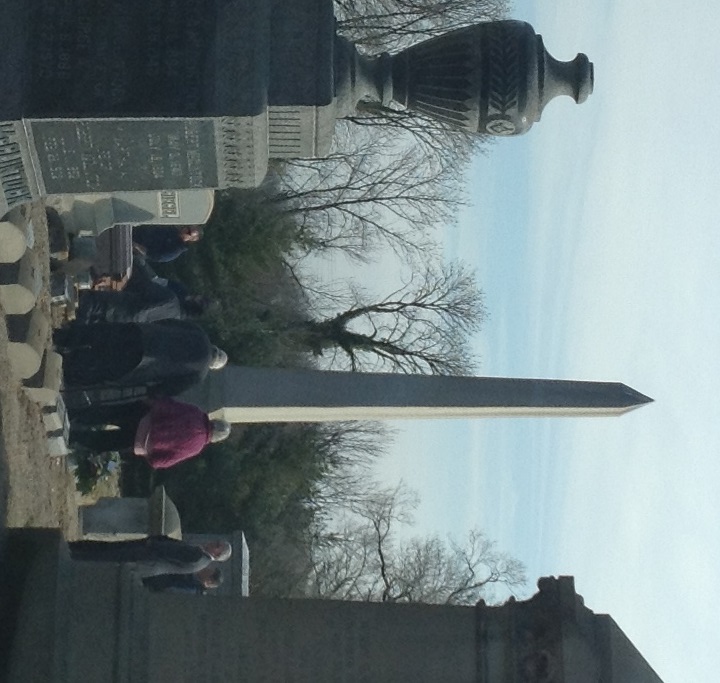
He said that the funeral home that is adjacent to the cemetery learned of our virtual funeral for Aleda and some of the staff attended in person too, so there were 4 people, plus the florist’s husband and the workers who doubled as her pall-bearers who participated as well.  Everyone read the 23rd Psalm aloud for her.

burial

One virtual participant added something to her reading, something that she felt Aleda wanted.

Psalm 30:11 – You have turned my mourning into dancing for me, you have put off my sackcloth and girded me with gladness.

Rest in Peace our dear friend Aleda, we have truly sung you “over-home.”

Find-A-Grave Memorial

bunch dna card

Aleda flowers

______________________________________________________________

Disclosure

I receive a small contribution when you click on some of the links to vendors in my articles. This does NOT increase the price you pay but helps me to keep the lights on and this informational blog free for everyone. Please click on the links in the articles or to the vendors below if you are purchasing products or DNA testing.

Thank you so much.

DNA Purchases and Free Transfers

Genealogy Services

Genealogy Research

Cavendish Lab at Cambridge University

The old Cavendish Lab at Cambridge University, where Watson and Crick discovered DNA, is kind of like Mecca for people who love genetics.  So is the Eagle Pub where they ate lunch daily and announced their discovery.  I’m not convinced which is the more important.

Our family tour in September, 2013 was scheduled to visit Cambridge, England, after leaving London.  I’ve been truly blessed this trip with the most wonderful coincidences.  In London, our hotel was located just across Hyde Park from the Science Museum where Watson and Crick’s original DNA model is housed.  In Cambridge, we are staying right around the corner from the Cavendish Lab where Watson and Crick discovered DNA.  Talk about literally walking in the footsteps of the masters.

I was pleased when I discovered Cambridge on the itinerary, and I googled to find the Eagle Pub. I was excited to find that it was indeed within walking distance of the Cambridge City Hotel where we were staying.  Although I don’t drink, I would visit the pub and raise a non-alcoholic brew for Watson and Crick’s momentous discovery.  Problem is, I discovered, that they didn’t have any non-alcoholic brew.  In fact, most of England views non-alcoholic brew as “why bother.”  While I agree in concept, sometimes it’s not by choice.

Wondering why the Cavendish Lab is important?

Cavendish 1

The Cavendish Lab at Cambridge University was the birthplace of the discovery of DNA.  James Watson and Francis Crick discovered DNA in this lab in 1953.  This year of course is the 60th anniversary of that discovery and James Watson was interviewed in celebration.  Crick passed away in 2004.

Before visiting Cambridge, I tried to find the Cavendish Lab on a map and it looked to be entirely across the campus, which is not small.  That made no sense to me, since the Eagle Pub was close to the hotel, but I accepted that I might not be able to see the lab.  I’d have to be satisfied with the Eagle Pub.

Why is the Eagle Pub important?  It’s where Watson and Crick lunched and probably did a lot of brainstorming.  Pubs are like that in England.

Cavendish 2

On our day of arrival, a walking tour of the city with a guide, a retired professor, was scheduled for that afternoon.  After we began the tour, around the first corner, on a street that was only wide enough for one car, and then no cars, I remembered to ask the guide about the original Cavendish Lab.  Given that he was a retired professor, I figured if anyone knew, he would.

He smiled broadly, and said “I’m so glad you asked…it’s right up ahead.”  To say I was thrilled is an understatement.  In fact, this is one of the few locations I’m actually IN the photos, um, actually, in most all the photos.  My cousins were so excited because I was excited that they took pictures of me.  This was definitely “my day” on the trip.  This photo of me, taken in front of the Eagle Pub pretty much sets the mood.cavendish me laughing

The Cavendish Lab, it turns out, was on the right hand side, just about where the road narrowed too much for any vehicle.  There was a sign mounted on the wall of the building that this was indeed the old Cavendish Lab.  There is a new Cavendish Lab across campus, the one I had seen on the map.  So far, my luck on the DNA trail had been remarkably good.

I, of course, was thrilled to be where Watson and Crick began what would be a blooming industry 60 years later with a world of promise.  In another 50 years, DNA will be responsible for the cure of many diseases we feel are hopeless or nearly so today.  Like at the Science Museum in London, I was very disappointed to see it relegated to not even the footnotes.  I tried to find a DNA souvenir, t-shirt, hat, something to purchase and there was not one DNA thing in any store.  For shame!  Come on – Double Helix Ale anyone???

???????????????????????????????

Cambridge is an ancient medieval city and it’s evident everyplace.  The Cavendish Lab is arguably on the oldest “street,” or cartpath, in Cambridge.  I say this because the oldest church is right across that cartpath and dates from about the year 1000.  At that time, churches were always at the center of the village.  Today, that cart-path is not wide enough for a car, and there is no room to expand.

Today, the ancient church is of course physically tied into several other buildings and abuts others, as all buildings here generally are, especially old buildings.  This photo shows the oldest church constructed of chocolate brown stones, another very old church as well, and the spires of King’s College Chapel begun by Henry the 6th and finished by Henry the 8th in the distance to the far right.  Note that this is a one lane street at this point that shortly narrows to exclude vehicles.  To put this in perspective, the Eagle Pub is just about where the trees are on the far right, beside the King’s College Chapel spire.

Cavendish 4

In most of England, and assuredly in Cambridge, what we consider is the US to be old buildings, a hundred or two years old are considered to be rather new.  Their old buildings were constructed before Columbus “discovered” the Americas.

I can only imagine the nurturing quality of studying and working among such history.  I suppose one would get used to it, but I hope it would never be taken for granted.

There are two entrances to the lab.  One is through this door.

???????????????????????????????

Watson and Crick exited through this door, walked down this cartway every day for lunch and ate at the Eagle Pub, just a short walk away and around the corner in front of the church.  It’s here that they fined tuned their DNA research as do both students and professors yet today.

The second entrance to the lab is through this archway which actually forms a tunnel under the building.  Half way through the tunnel is an entrance to the buildings on both sides.

Cavendish 6

Walking a short distance down the cobblestone street, just past the chocolate colored church, you intersect a road and slightly to the left is the Eagle Pub, where Watson and Crick ate lunch most days and discussed their projects.  Rest assured that DNA was indeed a hot topic of conversation here. In fact, it’s reported that they were so excited about their discovery that they told everyone in the pub that they had discovered the secret of life, only to have everyone ignore them and just go back to their pint of ale.  It had to be an extremely anti-climactic day for them – but if any patron remembers the crazy men in the pub that day that announced the discovery of the recipe of life itself – they indeed were a witness to a momentous discovery.

Cavendish 7

Inside the pub, in a stairway to the loo (bathroom) we found this sign.

???????????????????????????????

The Pub actually holds more information about the discovery of DNA than the university location does.  I find this really unfortunate, as well as ironic, but maybe not as many people as I imagine might be interested in the history of DNA.

I would think they would at least mark the DNA “Double Helix Trail.”  It could end, or begin, in London at the Science Museum where the helix model resides today.

The pub itself is in a very historic area, literally in the middle of the “old town”.  Here’s a photo of the street itself, the pub, on the right.

???????????????????????????????

Cambridge is a place of thinkers, and obviously, of doers as well.  It turns out that DNA was not the only discovery in the Cavendish labs.

???????????????????????????????

I wonder what other discoveries were made in these hallowed halls.  Did you know that Mitochondrial DNA was first mapped at Cambridge in 1981, hence, the CRS or Cambridge Reference Sequence?  What is it with DNA here?  Rosalind Franklin, pioneer molecular biologist and a key contributor to the discovery of DNA studied at Newnham College at Cambridge, but when she made her x-ray diffraction images of DNA, utilized by Watson and Crick, she was at King’s College in London.

Cambridge is steeped in history never more than a few feet away.  In the photo of the pub, above, if you turn right when the street ends, you’ll be greeted with this scene, the King’s College Chapel with its rich history of starting and stopping construction through the reigns of 3 kings and the English Civil War.  This is the steeple you saw in the distance in the photo of the street where the Cavendish lab is located.

OLYMPUS DIGITAL CAMERA

The architecture of this building is utterly stunning.

Cavendish 12

The first part was built by Henry the 6th for the 70 professors at Cambridge at the time.  The second part to the rear was finished many years later by Henry the 8th, after the War of the Roses and was very opulent with carvings on all the walls, heraldry, etc.  The first part was very simple by comparison.  The picture below is of the second part.

Cavendish 13

One of the most impressive aspects of this chapel, aside from the stunning windows, is the ceiling made of carved stone flying buttresses itself.  Because of the ceiling construction and the amount of glass in the windows, it’s actually very light inside and I could take these photos without flash photography which was prohibited.

Cavendish 14

The church forms part of a 4 building complex that is connected in a square and inside is a courtyard.

Cavendish 15

I can’t even imagine going to school is this wonderfully nurturing environment.  No wonder DNA was discovered here. No one wanted to leave.  My university was constructed of concrete blocks, for the most part, and everyone left as soon as possible.

Bachelor degrees at Cambridge are 3 year degrees, not 4, and if you live in Europe, it’s about 9,000 pounds which would be about 14,000 US dollars without lodging and food which is about another 8,000 pounds.  If you’re from elsewhere, it’s 18,000 pounds plus lodging.  Nurturing and inspiring, yes, but not inexpensive.

Cambridge is a beautiful and inspirational medieval city sprouting seeds for the future. There is a beautiful, ethereal umbilical connection between its past, my present and mankind’s future. It is truly awe-inspiring.  As I pondered and reflected upon all of this, I was struck with the weight of responsibility that all of us who work with DNA carry.

DNA is a gift, indeed, a map, of the past, of the present and a cartographic key to the future.  We have the responsibility and obligation to work with this Divine gift, ethically, morally and with only the best and most honorable of intentions.  We now have the key to the genome, the Holy Grail of humanity.  What will we do with it?  What does the future in another 60 years, 2073, hold?  Everyday in this new field, as we work individually to create a better whole, we are weaving our genetic legacy.

???????????????????????????????

______________________________________________________________

Disclosure

I receive a small contribution when you click on some of the links to vendors in my articles. This does NOT increase the price you pay but helps me to keep the lights on and this informational blog free for everyone. Please click on the links in the articles or to the vendors below if you are purchasing products or DNA testing.

Thank you so much.

DNA Purchases and Free Transfers

Genealogy Services

Genealogy Research

Charting Companion from Progeny Software

I’ve got to tell you, I love Charting Companion.  I’ve used it for many years now with my PAF software, although it is compatible with virtually every genealogy software program on the market, as well as Family Search.

Recently, the owners updated the software to include a wonderful new feature where appropriate on reports.  They map and color the X chromosome inheritance path.  I did have to upgrade my Charting Companion software, but at $29.95, it certainly won’t break the bank….and it’s worth every penny.

If you’re jumping up and down, doing the happy dance and hollering “WooHoooo,” I certainly understand.  I did the same thing.

This option is available for all charts that have ancestors: Ancestor, Fan, Hourglass and Bowtie.

There are several ways to select charts in this software, but the most comprehensive selection in one place is on the menu bar.

chart companion

Select the type of chart you want to produce.  Click through the various options and select the information you want to include on your chart.

To select the X-chromosome option, the user simply selects “X-chromosome” in the Color option tab:

Ancestor chart options

When finished, click preview to be sure it’s what you want.  Here are a couple examples of my reports with the X chromosome selected.

X with Fan

x fan

This fan chart can’t reasonably be made much larger than this, in terms of generations.  If you need more, shift to the Ancestor chart which can span pages.  I would suggest providing at least 10 generations when sending information to people you match on autosomal DNA tests.  I include 12 generations to at least get every ancestor off of US soil and back into the old country – or as many as I can get off of US soil:)

Ancestor – X Pedigree

x pedigree 1

x pedigree 2

I love these X reports.  When you match someone on the X, you can send them one of these and they can visually see which of your lines are available for X matching.  These, utilized in conjunction with the regular Charting Companion Pedigree Chart report are a powerful combinational tool.

My Favorite Report

I generate a pedigree chart for each “side” of my tree, Moms and my Dad’s.  Often, based on my matches, I immediately know which side the new match is from, so I only send them the relevant information.  If need be, I just send both files.

I’ve been a long time user of this software.  I do have a tree at Ancestry but I hate to refer anyone there.  Conversely, I hate receiving links to Ancestry trees.  I much prefer Rootsweb/WorldConnect.

All trees have some inherent problems.  First, how would a match even begin to know what surname to search for or where to find it on my tree.  Secondly, every time I view someone’s tree, Ancestry does me the favor of forever mailing me after that with their updates and such by attaching their tree to my account.  I hate that.  And yes, I know I can go in and one-by-one, undo Ancestry’s favor, but why should I have to do that?  And I certainly don’t want to make anyone else do that either.  Sending a pedigree chart provides them with only the relevant information without being invasive, problematic or being a “forever” thing with an attached tree.  We’re only looking here, not getting married:)

So, I send a pedigree chart of 12 generations in a pdf file with an index at the end.

If you select 4 generations per page, each item will have the associated location information.  5 generations per page makes the 5th generation default to only date information, meaning they won’t be able to see locations, so don’t do that.

Select the index option to add the index at the end.  This makes it easy for people to skim quickly for surnames that look familiar.

Lastly, when you have your selection in order, you can preview, and then the “publish” button saves this to a file on your system.

Please note that if you include submitter information, it includes everything including your address and phone number in the lower left hand corner.  I do not include that information in the pdf file I send to matches.  I wish the software had a submitter name/e-mail only option.  That’s it though, my only suggestion for this software.  I love it!

pedigree chart

Chart above, index below.

pedigree index

_____________________________________________________________

Disclosure

I receive a small contribution when you click on some of the links to vendors in my articles. This does NOT increase the price you pay but helps me to keep the lights on and this informational blog free for everyone. Please click on the links in the articles or to the vendors below if you are purchasing products or DNA testing.

Thank you so much.

DNA Purchases and Free Transfers

Genealogy Products and Services

Genealogy Research

Fun DNA Stuff

  • Celebrate DNA – customized DNA themed t-shirts, bags and other items

The African Diaspora Conference Videos Available

HeywoodIn September,  2013, The African Diaspora: Integrating Culture, Genomics and History was held at the Smithsonian Natural History Museum in Washington DC.  Sadly, I had commitments elsewhere and could not attend.

The National Human Genome Research Institute, the National Museum of African American History and Culture, and the National Museum of Natural History held a full-day symposium that brought together scholars, scientists and practitioners from various disciplines who are exploring the African Diaspora throughout historical, cultural and genomic lenses with the purpose of understanding a person’s ancestry and how that impacts individual health and collective identity.

The symposium’s objectives were to foster interdisciplinary dialog on what we can learn about:

  • Ancestral history from genomic information and historical records.
  • Ethnic identity and cultural diversity from historical and genomic information.
  • The arts and culture from ancestral information.

I was not able to attend, but reports from those who did were very positive.  Fortunately, the videos are now available to view, for free.

http://www.genome.gov/27555386

Furthermore, I’d like to mention that one of the papers I co-authored with Jack Goins, Janet Crain and Penny Ferguson, Melungeons, A Multi-Ethnic Population was cited  by Dr. Linda Heywood.

Dr. Linda Heywood is a Professor of African American Studies and History at Boston University.  I was impressed with her throughout this panel discussion.  At about 6:48 she discussed identity, and her comment, “History, it’s personal, it’s communal, it’s national, it’s identity.”

She mentions our paper at about 57:46.  At 22:54 she comments about various Africans being incorporated into the Portuguese settlements in Africa before being shipped out as slaves, something we also mentioned in our paper.  And finally at 1:15:00 she referred to the paper again as a resource.

I was also very impressed with Dr. Sarah Tiskoff and was disappointed to see that there were not any individual sessions by her.

I hope you’ll take an opportunity to watch a few of these videos, and a big thank you to the Smithsonian for making them available.

______________________________________________________________

Disclosure

I receive a small contribution when you click on some of the links to vendors in my articles. This does NOT increase the price you pay but helps me to keep the lights on and this informational blog free for everyone. Please click on the links in the articles or to the vendors below if you are purchasing products or DNA testing.

Thank you so much.

DNA Purchases and Free Transfers

Genealogy Services

Genealogy Research

William Sterling Estes – The Missing Years – 52 Ancestors #5

William Sterling Estes was my father.  He was commonly called Bill, and sometimes Sterl, by family members.  He was probably born in either 1902 or 1903, or maybe 1901, records vary, and he died, positively, in 1963.  That’s one of the few positive things we know about him.  His life was anything but ordinary, and he was missing for many years.  And that’s just the beginning…

My father was a study in polar opposites.  He was extremely intelligent, helping his step-son with physics in graduate school, yet did incredibly stupid things that landed him in a heap o’ trouble – and I’m not talking just about that Ilo incident where he married under a fictitious name and then went AWOL.  There were more.  Many more….

Moonshine and Rough Beginnings

My father’s issues began when he was young.  This isn’t meant as overtly critical, but my father’s early years were anything but stable.  He was born near the turn of the century in Claiborne County, Tennessee.  That area, deep in Appalachia was both stunningly beautiful and equally as poverty stricken.

cumberland gap panoramic

Land there, what was farmable, was already taken and the “next generation” had to find something else to do.  But there was nothing else there, so many moved on west.  In the case of my grandparents, they tried several avenues, one of which was moonshining.

Moonshining wasn’t anything unusual in the hills, nor among the original settlers. In fact making your own liquor had been a staple on every farm for hundreds of years in the US, until the law made it illegal over taxation.  It was never a moral issue until Prohibition.  Moonshining or bootlegging has been illegal for awhile, actually a long while, in one form or another, but in Appalachia, mostly everyone ignored that.  Moonshining increased during Prohibition and has been a staple of that region ever since.  My family shares stories of painting milk jugs white and having the kids deliver moonshine in milk jugs in the coal camps from their red wagon.  The family survived and ate together, or didn’t.  Everyone was expected to contribute.  There wasn’t any other choice.

The Estes family in Halifax County, Virginia, some 4 generations earlier had been known for their fine brandies distilled from their orchards.  The difference was, I’m guessing, is that they paid taxes, or they greased the right palm.

In any case, my grandfather, William George Estes was a moonshiner, a photographer and a farmer, among other things.  A veritable Appalachian Renaissance man.  He married my grandmother, Ollie Bolton, in September of 1892.  In July of 1893, their first child, was born, and a year later, in August of 1893, that son, Samuel would pass away and was buried in the family cemetery in Estes Holler behind his grandfather, Lazarus Estes’, house.

Estes cem

Three months later, a second child was born, Estel, who lived.  Two years later, another child whose name we don’t even know for sure, and in another 2 years, Robert, who would burn to death.

Life was rough.  The 1900 census gives us a glimpse. William George Estes states that he was out of work for 9 months the previous year.

Sometime between 1900 and 1910, the family moved to Springdale. Arkansas where Ollie took care of the children and ran a boarding house and William George fished off the bridge down the street from the boarding house, and drank.  By this time, they had several children, and it seemed there were always more on the way.  In the 1910 census, Ollie has borne 8 children and only 5 were living.

Ollie 1907

This picture of Ollie and the children was taken in 1907.  The child, Robert, the blond boy on the chair, would perish when their cabin burned, sometime before the 1910 census.  Cousin George Estes, in the 1980s, showed me where that cabin stood and told me he planted a willow tree there in honor of the child.  Estel, the oldest child, standing in the rear in this photo, age 13 in 1907, had been left in charge and tried to save Robert, who hid under the bed, to no avail.  Estle did manage to get my father, standing in front, and Margaret, held by Ollie, out safely.  That memory alone could scar a person for life.  Robert too is probably buried in the family cemetery just a few feet away, but there is no marker.

By 1913, the family had moved to Fowler, Indiana and become tenant farmers.  Ollie and William George’s marriage was coming unraveled too.  It seems that Ollie’s young female cousin was visiting from Tennessee, and Ollie came home and caught William George and her cousin “in the act.”  She grabbed either a bull whip or a horse whip and proceeded to use it on them, specifically on him, with the full intention of killing him.  The family stories are that it took 5 adult men to restrain her long enough for him to escape.  The family story, from the Crazy Aunts, of course, also says she was pregnant with twins which she subsequently had prematurely and died. If so, the Benton County, Indiana death records contain no record of this birth/death.  They could have been too small, or not born alive.

Divorce followed, but according to Aunt Margaret’s letters which she wrote to my step-mother after my father’s death, Ollie went to Chicago, taking the two girls with her, and William George headed back for Tennessee, but no one wanted the two middle boys, my father and Joseph.  Estel by this time, about 20, was old enough to make his own way. My father was about 12 and Joseph, about 10.

Joseph and my father hopped a train in Indiana and found their way back to Tennessee, and when they arrived at their grandparents house in Estes Holler, extremely hungry, dirty and threadbare, having walked a great distance, and with stories to tell…there was hell to pay.  When William George Estes, their father, arrived sometime later, he was literally run out of Estes Holler by his father, Lazarus Estes, under threat of death, for what he had done both to Ollie and to those boys.  William George crossed over the mountains and settled in Harlan County, Kentucky, known as bloody Harlan, where he very successfully moonshined for decades up in the roughest section of Black Mountain, the roughest area in Kentucky, near the coal camps. My Mom visited once with my father and refused to ever return.

Unfortunately, all of William George’s boys learned to drink, and none of them learned to drink in moderation.  I was told that when there was no food to eat, the children were given liquor to drink, to make them feel better, or maybe, to make them go to sleep.  I found that hard to believe…until I found the death certificate of a child from William George’s third marriage, William James, who died at the age of 2 years and 6 months, in 1935, and the coroner indicated that the child had died from “improper feeding.”  I was sick the day I read that, physically ill, because I knew all the things I had heard about my father’s young life and were too horrible to believe, were probably true.

The reason I mention this at all is because while my father certainly had a huge number of issues, perhaps not all of them were entirely his fault.  He was probably an alcoholic while yet still a child.  Alcohol both ruled and ruined his life, and certainly affected the lives of all the people around him, including, and maybe especially those who loved him.  Alcohol certainly affected the lives of his brothers the same way, and his sisters, well, they became the Crazy Aunts.

William Sterling Estes Joins the Military

My father joined the military in 1917 during WWI, “adjusting” his birthdate to be 1898 instead of 1901, 1902 or 1903. So did his even younger brother Joseph, nicknamed “Dode,” after his grandfather, Joseph “Dode” Bolton.  The military was most likely a better option for my father than any of the alternatives.

Bill and Virgie

Sometime about this time, my father met a young gal in Dunkirk, Indiana, named Virgie.  My father was extremely handsome, and he certainly understood how to win a young girl’s heart.  Look at this picture.  He brought Virgie a kitten (see his shoulder) and two baby ducks.

Bill ducks

These photos were sent to me after her death in 1989 by her daughter, along with the flag from my father’s coffin.

Bill kitten

Now the kitten is on her lap.  I wonder who took the photos.

Bill gone

This photo is just heart-wrenching to me.  I suspect this is when he married Ilo or maybe my sister’s mother, or at least during that timeframe.

Why did Virgie still have these photos, some 70 year later?  Because, she did eventually marry my father, in 1961, some 44 years after these pictures were taken.  She was his last wife.  They both claimed they were soulmates, and indeed, perhaps they were.  She was the only woman I ever met that had something good to say about my father.  In fact, she never said one bad thing about him.  She was a truly lovely lady.

As a child, I had no concept of my father’s constant woman problems, the betrayal of trust, his problem drinking, or the fact that he had “another family.”  I didn’t know I had a brother, Dave, who was only 5 months older than I was.  My mother, who was terribly embarrassed about the situation, managed to hide that from me, as did the “other woman,” from her child too.

My Father’s Daughter

I never knew my father as an adult.  I knew him as a child and I loved him, wholly and completely, in my childish way.  My father would come and visit and I would absolutely adore him, much to my mother’s chagrin.  It must have been tough from her perspective.  She did all the work and he got all the glory for simply showing up.  I remember once when he bought me a rocking chair, which I still have to this day, at Krogers.  I was maybe 4 or 5 and it was for my birthday or maybe Christmas.  Mother was so angry with him, because that is what she was going to get me and he “scooped” her.

I remember another time too when she was furious with him.  I understood that she was angry, very angry, and that it wasn’t directed at me, but I didn’t know why.  The phone rang, very late at night.  She got me up and we went for a drive. I was excited as this was a great adventure in my pajamas.  When we got “there,” my Dad was there, which made me very happy.  I got to sit on his lap for a few minutes, but then we had to leave, taking his little dog, Timmy, with us, who I thought was my dog.  Turns out, Dave thought Timmy was his dog too, and we both had photos of us with Timmy.  Here I am in that coveted rocking chair holding Timmy.

Me and Timmy

Years later, I asked Mom about this very foggy recollection.  Turns out, “there” was the jail in the next county. Why?  Because he has been arrested for drunk driving.  That’s what we called it then, no politically correct terms like “impaired operation of a motor vehicle.”  I asked Mom why she went at all and she said, in a semi-growl, “for the dog.”  Yep, she would have done that and she would have been furious with him both for having to go and retrieve the dog that wasn’t even hers, and for doing what he did….again.

His Death

My father’s death in 1963 in an automobile accident, like every other event in his life, was filled with contradictions.  My step-mother told me he was on the way to the preacher’s house to pick him up to go fishing, stone cold sober.  Her daughter told me that my father had been seen at the park earlier in the day, intoxicated.  Regardless, he reportedly had an angina attack while driving, missed the brake, stomping instead on the gas, and hit a telephone pole head on.

As an adult, after talking to my mother and his part-time employer at the time, which happened to be the funeral home, I wonder if he committed suicide.  On Friday, he backed the hearse into the garage, which in that small town doubled as an ambulance (isn’t that creepy – imaging waking up in the hearse and not knowing if you are dead or alive), and telling the funeral director that he would need it over the weekend.  And indeed, he did.  My father rode in it as an ambulance to the hospital on Sunday and a few days later rode in it as a hearse to the cemetery.

As I got older, everything I knew about my father seemed to be contradicted by something or someone else.  I wanted to love the man, but in some ways, he didn’t seem to be very nice – rather unlovable.  I finally came to the conclusion that while my adult woman self would not like him very much at all,  it was just fine for my young child self to continue to love him.  My mother once said to me in a fit of unbridled honesty that the best thing my father probably ever did for me was to die when I was young before I painfully discovered his betrayals personally. She managed to shield me from most of his drinking.

If I couldn’t know him personally, I wanted to know of him, to understand him.  I was insatiably curious about him.  He seemed so mysterious.  After all, I carried part of him in me.  What was that part and what made my Dad tick, aside from alcohol?  Sadly, I came to discover that alcohol and the actions he took under its influence truly did rule his life.

The Timeline

I started creating a timeline trying to make sense of my father’s life.  There were so many disjoint pieces. I wrote for his military records, but most of them were destroyed in a fire in the St. Louis records center in 1973.  The military helped reassemble as much as possible from other sources.

1917 – In a letter from the VA it says that he served in the Army from Aug. 24, 1917 until honorably discharged on May 19, 1919.  His last rank was private.  He was born Oct. 1, 1898 and died on Aug. 27 1963.  He enlisted May 14, 1917 at Fort Benjamin Harrison, Indiana, 18 years 24 days of age, born in Tazewell, Tennessee. Subsequent service – enlisted May 20, 1919.

I have a copy of this discharge, Sergeant first class, honorably discharged on May 19, 1919 at Camp Custer, Michigan.  His second discharge was honorable as well, even given his time spent in the Disciplinary Barracks at Fort Leavenworth, which really surprised me.

1919, May 20 – My father reenlisted in the Army at Camp Custer.

November 1919 – AWOL from the Army.

December 1919 – Married Ilo Bailey in Battle Creek, Michigan, under the name of Don Carlos.  Aunt Margaret remembered her name as Laila LaFountaine and said that “she hooked him to the plow and drove him like a horse.”

February 1920 – Son Lee born, eventually to be called Lee Devine, in Battle Creek to Ilo.

April 1920 – Arrested for being AWOL – sent to Fort Leavenworth Disciplinary Barracks in Kansas.

May 1920 – My sister, Edna born, also in Battle Creek, Michigan, to Martha Dodderer.

November 28, 1921 – Honorably discharged from the military at Fort Leavenworth.

December 12, 1921 – Married Edna’s mother in Battle Creek, Michigan.

1924 – Martha Estes (Edna’s mother) was paying an attorney for her divorce.  His name was Joseph Hooper and he lived in Battle Creek.  The divorce appears to have been final Feb. 26, 1924. Edna stated in a 1960 letter than before 1950, no one had heard from him in 29 years.  We don’t know where William Sterling Estes was in 1924.

1927 – William Sterling Estes enlisted in the military January 8, 1927 at Fort Sheridan in Chicago.  He was AWOL on May 23, 1927.

1924-1930 – William Sterling Estesmarried” again during this time, probably in southwestern Michigan, possibly Benton Harbor, having a daughter named Violet, about whom very little is known.  Violet married a Golliday or Galliday.  Violet later married a Blevins and joined a religious commune in the Ozark Mountains in or near Licking, Missouri.  Given this and some additional information provided by my sister Edna, who knew Violet, I decided not to pursue this relationship.  Violet was still living in the 1980s, to the best of my knowledge.

The Crazy Aunts told me that Violet’s mother may have been underage, because there was a statutory rape allegation, charge or conviction in western Michigan, possibly in the Benton Harbor area, having to do with the age of the pregnant female.  Michigan prison records held in the State Archives don’t reveal any William Estes having been a prisoner during this timeframe.

Apparently, the Crazy Aunts weren’t the only ones who were suspicious, because Ellen, the “other woman” to whom my father was married in the 1950s wrote a letter to the warden at Jackson State Prison in Michigan inquiring about whether or not my father could have been a prisoner there under an alias.

A letter from the warden of Jackson State Prison to Ellen on Feb. 21, 1957 states that inmate number #24884, Paul LeMarr, alias William Estes, sentenced March 2, 1929 to 10-15 years for statutory rape, was discharged on March 20, 1942.  He was sentenced in Benton Harbor, Michigan and he was age 29 in 1929.  The warden believed that from photos submitted by Ellen that Paul LaMarr could have been William Sterling Estes.

1937 – William Sterling Estes filed for his social security card in Chicago, Illinois.  He is working at Printers Finishing Company and gives his birth date as Oct. 1, 1902, which I believe to be correct.  The signature is my father’s.

Estes, William SS 1937

This proves that my father is not Paul LeMarr, because Paul LeMarr was not released from prison until 1942.  Was Paul LeMarr using William Estes as an alias?  Finally, something in Dad’s favor!  But where did that statutory rape rumor come from?  Was it Violet’s mother and did the charge “go away” because he married her?

So if he wasn’t in prison in Michigan, where was he from 1927 to 1937?

The Crazy Aunts said he was in prison or jail in Michigan at one time, and that one of them visited him there.  But then again, they are the Crazy Aunts and he could have been in “jail” for a few days for who knows what.

There is a rumor about him being in prison in Illinois (Joliet) based on a statement he made to my mother about where he had made someone’s acquaintance.  On the way to Florida in the early 1950s, he stopped at the Georgia prison and visited with the prison guards, the very men who had been his guards.  He made friends with everyone everyplace he went and the man did not know a stranger.  I suspect he could have sold ice cubes to Eskimos.

It’s hard to believe that after being married 3 or 4 times in less than 10 years that he became a monk for the next decade.  Maybe he wasn’t as good at getting divorced as he was at getting married.   He had to be someplace doing something.  And I’m betting that there may be children out there someplace lurking that were conceived between the 1920s when Edna, Lee and Violet were born, and the 1950s when Dave and I were born.  I doubt that he discovered how to prevent pregnancy in the late 1920s and suddenly forgot in the 1950s.

The next hint we have about William Sterling Estes is about 1938.

In March 2006, I visited with the daughter of Estel Estes.  My cousin said that my father came to stay with their family in Fleming, Kentucky in 1938 or 1939.  She was a little girl at the time.  They went for walks together and they found a baby duck without a mother, which they rescued and raised.  She said that the duck was old when it finally died.  My father stayed with their family for a month or 6 weeks.  She said that there was talk that he had gotten out of prison.  There was diphtheria wherever he had been.

1938, Oct. 31 – Discharged from Service – “Other than honorable.”  This is maddeningly brief.  Is this the discharge that matches up with the enlistment from 1927?  This makes no sense.  This also doesn’t tell us where he is, just that this action occurred.

The Unbelievable Story – 2 for 1

Now, let me tell you an unbelievable story.  This is one of two, actually, that kind of fit together like two insane puzzle pieces, and you’ll see why I was convinced that my Crazy Aunts were indeed, crazy.  As time went on, it wasn’t just the Crazy Aunts though that told this story, but my step-mother and others who lived in Claiborne County at the time this was happening.

The Doctor

I remember, when I was a child, there was an old doctor who had his Norman Rockwellish office in the front part of his home down the street from where we lived in Indiana.  I went there one time when I was older, maybe a teen, for something, when the old gentleman said that he remembered my father and that my father was a doctor too. I told him that I was sure he had the wrong man, and he repeated his name and told me, no, that he was not mistaken, that he remembered me, and that my father was indeed a doctor.  He dug around in a drawer, pulled out my father’s file, and showed me where it said he was a doctor.

Being raised in a time when one did not contradict your elders, at least not ones that weren’t your mother, I didn’t say anything, but I was sure this man was wrong.  However, I never forgot the story.  It always nagged at me, the feeling that something wasn’t quite right or that there was something that I didn’t know.

I went to visit my step-mother from the time I was a child.  I first went to visit my Dad and Virgie, my step-Mom, when I was young, before Dad passed away.  I loved to visit.  Virgie’s elderly mother lived there too, Grandma, whom I dearly loved.  Grandma would tell me how smart my Dad was.  I found this kind of odd.  He worked on furnaces and had his own furnace shop at that time in Dunkirk, Indiana.  She said not to let that fool me, that he had once been a great man.  Oh, the rantings of an old woman.  I loved her just the same.  We contented ourselves looking at ViewMaster reels and its predecessor, the stereoscope.  My favorite was Niagara Falls.  Grandma would tell me all about the images while I looked and they came to life.  I loved spending time with Grandma.

Niagara stereograph

After my father and Grandma were both gone, I visited Virgie from time to time until her death.  They were always such pleasant visits.  She told me wonderful stories about the loving man she knew as her husband.  Yes, I mean my father.

Before his death, he hid love letters and notes around the house for her to find later.  I’m sure he knew his time was limited.  My mother told me that based on his health, she thought he might have had cancer.  I’m more suspicious of cirrhosis of the liver, but regardless, he was not a healthy man.  One time, Virgie shared with me a note she had just found stuck behind a picture frame.  It was so sweet and personal and it was nice to know him in this lovely way.  She also kept all of his letters he wrote to her when he was in the service.  Her daughter sent those to me after Virgie’s death.  Even though I felt like I was intruding into a personal vignette, I did read them.  They were both sorrowful and beautiful, especially from my perspective, looking backwards in time and knowing what happened.

Virgie told me that my father understood physics and helped her son when he was studying for his PhD.  I questioned this, and she said that she didn’t know how he had come upon that knowledge, but that he had worked at Oak Ridge, Tennessee, and that at some time, in some way, he was a doctor.  Truthfully, I found all of this quite unbelievable.  I knew that Virgie was not one of the Crazy Aunts, and that she would never tell me something she didn’t believe. She told me that he had done those things before he “went into the hospital.”  What she didn’t add was that the hospital stay was the VA hospital to “dry out.”

Apparently, he “dried out” several times, but never was able to stay dry, although he desperately wanted to.  It’s too bad that Alcoholics Anonymous did not exist then. He might have stood a fighting chance.  I discounted all of this, figuring that most of it was fanciful stories he had made up – but that didn’t explain how he could ever help a college student studying for an advanced degree that included physics.

When I started my genealogy search, I contacted people in Claiborne County, Tennessee.  All I started with was the name of a town, from my mother, Tazewell.  I called the telephone operator and told her to connect me to any Estes family there – and she did.  I eventually made my way from person to person to the family historian and my relatives.  They told me stories about my father and grandparents.  They knew them.  Of course, all of those old people are gone now.

I went to visit and met many of these lovely people who opened their hearts, shared their photos albums and family stories with me.  They told me that my father was a doctor and he treated people locally, for years.  In fact, people would find out when he was coming home and line up to see him.  He was a favorite.  And he performed surgery.  Surgery?  More than one person told me this.  They also told me that he practiced at the VA hospital in Knoxville, Tennessee until a patient bit him and he hit the patient.

They told me that at one time, he worked at Oak Ridge, and that he worked on ‘the bomb,” and that he was never “right” after that.  His drinking increased.  At that time, he was living in Claiborne County and these people knew him.  He was their neighbor.  These were family members who had known him their entire life.  They were not all making this up – but where was the kernel of truth in these seemingly conflicting, albeit very interesting, stories?

How could he have been a doctor, as in medical doctor, and also a physicist?  Furthermore, he had no more than a high school education to the best of my knowledge, if that, except that we really don’t know what he did or where he was for that 10 year period.  Was he in the military that entire time doing something “special’ that we don’t know about?  Those records for that time are entirely missing.

He could have learned about medicine while serving in a hospital someplace, but I don’t think you can learn physics that way.  Physics is extremely difficult under the very best of circumstances.

The requirement for a doctor to practice, legitimately, in Tennessee at that time are foggy, but in general, by 1930, nearly all medical schools required a liberal arts degree for admission and provided a 3- to 4-year graded curriculum in medicine and surgery. Many states also required candidates who wanted to get their medical license to complete a 1-year internship in a hospital setting in addition to holding a degree from a recognized medical school.  That presumes that one is doing things legally and by the book.  Of course, in Appalachia, healers had been treating their families and those of their neighbors for decades, and local neighborhood healers were probably trusted much more closely that “outsiders.”  Joseph, my father’s brother, was also a practitioner, a family herbal healer.  Death certificates during that time in Claiborne County are rife with comments like “refused to go to the hospital because did not want to split up the family” and many included reports of people refusing to see a doctor.

My brother, Dave, told me that he thought William Sterling was arrested for performing illegal abortions in or near Chicago in the 1950s or 1960s.

There is obviously some truth in here someplace, because there were too many witnesses….but where…and what was that truth?  Back to the timeline.

Many Wives – Too Many

1944 – I reached out to the Tennessee State Archives who provided me with information that William Sterling Estes began working for the Eastern State Mental Hospital on Dec. 29, 1944 and that he was dismissed March 12, 1945.  He was an attendant.  His legal voting residence was Claiborne Co., Tn. but he lived in Harlan Ky., while he worked at the State Hospital.  He was married, no wife’s name given, but he had relatives in state service – Dortha Estes also at Eastern State.

They could provide me no information about Oak Ridge or the VA Hospital.

1940s – Per Aunt Margaret’s (his sister) letter to Virgie, William Sterling was married to a woman in Oak Ridge, Tn., although she knew of no children by her.  Margaret also states that he got in trouble in the 1940s by “taking a girl over the state line,” perhaps to Kentucky, and spent some time in jail, but Ethel was apparently faithfully waiting for him.  Who was Ethel?

Late 1940s – The next we know of William Sterling was in the (possibly) late1940s when he was married to a woman named Ethel and living with his aunt, Cornie Epperson in Claiborne County, working at Oak Ridge Tennessee, possibly in a hospital there.  We know of no children from this marriage.  Cornie’s daughter says he was a doctor in the VA hospital.  Aunt Dorothy says he operated on her foot.  While this was reported as late 1940s, it sounds to me like it may have occurred before 1945.

1945 – March 15 – William Sterling Estes, now about age 42 or 43, married a 17 year old young female in Walker County, Georgia.  Note that this is only 3 days after his dismissal from Eastern State Mental Hospital in Knoxville, Tennessee, assuming that he was actually present in Knoxville at the time he was dismissed.  He could have been dismissed for not showing up at work. Regardless, the Georgia courtship seems very abbreviated.

I am not including the name of the gal he married in Walker County, because I believe she is still living.  He gives his age as 34, born Oct. 1, 1911 and residence as Chicago.  Shortly after this marriage, her father filed papers against him for bigamy, giving his other wife’s name as Dorothy Kilpatrick.  I surely wonder how her father made that discovery.  Did Dorothy show up?  Maybe right after the wedding, shouting, “I object!”

1945 – 1948 – In the Superior Court of Walker Co. Georgia on June 15, 1945, three months to the day after his marriage, William Sterling Estes was convicted of bigamy and sentenced to 5 years in prison.  According to prison records, he was discharged Dec. 13, 1948.  His wife on arrival at the prison was listed as Dorothy Estes, also listed as Dorothy Kilpatrick in court papers, Trailer Camp, NW 5th St., Richmond, Indiana.  He was in the Georgia State Prison at Reidsville, Georgia.  The specific court records no longer exist, nor do the prison records.

A few years ago, I spoke to the Georgia wife.  She did not have any children by William Sterling and said the marriage was annulled.  She did marry and have one child, about 5 years later.  I verified this child’s age and he was not born at a time when he could have been my father’s child.

So what happened to Dorothy?  And Ethel? And the young gal he “took over the state line.”  Or was that story really the bigamous marriage in Georgia?

Back to Chicago

1949 – Apparently, after William Sterling was released from prison in Georgia, he returned to Chicago where his mother lived.  He lost no time marrying again, this time to an Ellen in Cook. Co., Illinois on Feb. 19, 1949.  This must be some kind of record.  An entire courtship and marriage in less than 2 months.  Quick courtships seemed to be his style.  Apparently Dorothy divorced him while he was in prison?  But then again….um….maybe not.

1950 – William Sterling Estes finds my sister, Edna, in Michigan after a hiatus of almost 30 years.  Edna’s mother has passed away and Edna was none too pleased with her prodigal father.

1952 – His delayed birth certificate issued in Tennessee gives his address as 2210 Broadway, Fort Wayne, Indiana.

The “Other Woman’

1955 – Both my brother David and I were born within 5 months of each other, to different wives.  No, my father was not Mormon.

Mother told me years later that he filed for divorce from Ellen in 1955, in Florida, but somehow the waiting period got “messed up,” as in one day short.  Therefore the divorce didn’t happen, but apparently he thought it had.  My reaction to this?  “Likely story.”

I checked the Florida divorce index and there is nothing for a William, William Sterling or any Estes male involving a woman named Ellen.  That’s assuming that he used his correct name to get divorced.  I did verify the name on his marriage license to Ellen to be sure it was correct.

1956, April 3 – Mom wrote my sister, Edna a letter that includes information about my father.  She says “Bill is working very hard right now and when spring comes his business starts to be pretty heavy.  He wasn’t too well this winter but we hope he will be better when the weather gets nice.  He was out working through in spite of the way he felt.”

The photo below, I believe, is the only photo of me with my father, taken in 1956.  I have no idea who the other child in the photo, beside my father, is.  Makes me wonder…

Me and Dad

1956 – November 3.  My father is a passenger in a head on car accident that nearly kills him.  He flies through the windshield.  This is before the days of seatbelts or safety tempered glass.  I still vividly remember the scar on his forehead and the skin graft they did from his leg to his face and head.  This car accident was his undoing in more than one way though.  You see, it’s how he got caught with 2 wives, in the worst possible soap opera scenario.

Busted

Mom actually heard the sirens that day.  She remembers saying something like “I hope that’s not Bill.”  But it was.  Sometime later, the police came and took us to the hospital.  My father was not expected to live.  He had lost a great deal of blood and was badly injured.

At the hospital, employees had dug through his billfold and other personal information to figure out who to contact.  He was not conscious.

Mother and I were sitting by his bedside.  I remember none of this of course.

A few hours later, another woman, also with a baby walks into the room, looking for her husband.  Mother motioned to the next bed, but the woman came back and said no, that the man in this bed, my father, was her husband.

Both women stared at each other, and their babies, incredulously, as the awful truth slowly sunk in, and then they began to talk, as he lay comatose.  He’s a very lucky man indeed, that they simply did not finish him off.  I think they wanted him to regain consciousness so they could beat him senseless.  Needless to say, they were both furious.

Yes, they were both his wives.  Ellen lived in Chicago (or Fort Wayne) at that time.  My father traveled selling and arranging installations of industrial furnaces and he literally had a wife at both ends of the track, so to speak.   Can you imagine the stories the doctors and nurses had to tell when they went home that day.  “You are not going to believe this…..”  My mother couldn’t believe it either, and neither could Ellen.

There is another family story that has something to do with my father,  my (Brethren) grandfather and a baseball bat…but I never did get that entire story.  I got the general drift though and I’m guessing it might have happened about this time.

Dad Holland car

Above, my father outside one of the Holland Furnace company offices, from my mother’s photos.  Below, my father outside the Holland Furnace company facility from Ellen’s photos.

Dad Holland window cropped

My mother wasn’t as forgiving as Ellen who stayed married to him…at least for awhile.

1960, Oct. 3 – A letter from the Cook Co., Illinois Adult Probation Dept. to my sister saying that William Estes is under the supervision of that office and his whereabouts are no longer known to them.  Unless they are able to locate him, a warrant will be issued for his arrest for probation violation.  William D. Meyering is the person who wrote the letter and he is the chief probation officer.

Edna wrote a letter to the Cook Co. Adult Probation Department, replying to their letter of inquiry.  She said she had not had contact with him for 4 years and had not seen him in 6.  She says in 1956 he was with my mother and working for Holland Furnace Co.  She said she did not believe he would come to her house because she did not know him well, had only seen him about 10 times in her life, and all in the past 10 years.  Before then it had been 29 years since anyone had heard from him.  Doing the math, this means that she corresponded with him from 1950-1956 to some degree, and before that it had been 1921, the year she was born.  She asked why he was on probation, but did not receive a reply.

Mother said that about this time, Bill was working in Wisconsin, near Chicago.  He showed up in Indiana with a small station wagon that was brand new, an electric skillet, a toaster, clothes and toys.  The police arrested him for something to do with fraud.  The title for the car he traded was not clear, or something to that effect.  She said he served several months in the Chicago jail, which ironically would be the same Cook Co. jail where I installed inmate tracking software some 20 years later.

David thought he might have been sent to jail for performing illegal abortions in Wisconsin.

1960 – There is a dated photo of Bill sitting in the living room at Ellen’s house in Fort Wayne.  David remembers him living with them in Fort Wayne.  The city directory confirms that as well.

1960-1962 – This is the timeframe when Mom and I went to pick Timmy up from the jail.  My mother did not bail him out, much to his dismay, but took Timmy and left.  Mom said that when he got out of jail, the time we went to get Timmy, that he came by the house, and then went to Virgie’s in Dunkirk, and was unhappy that no one had come to see him.

Mom said that he spent time in jail in Terre Haute, Indiana, at some time, for repeated drunk driving offences.  I am unclear about when that might have been, but I got the idea it was when she knew him and perhaps after she was no longer romantically involved with him.

Married for the Last Time

1961, April 24 – William Sterling Estes married Virgie, his childhood sweetheart, in Rome, Georgia under the name William S. Este’ (no final s).  I would think that given what happened to him previously in Georgia when he was married to two women, he would have avoided Georgia entirely and would have been as nervous as a long-tailed cat in a room full of rockers just being in the state.  Can you believe he did this again, and in Georgia no less?  He was not divorced from Ellen.

According to mother, she is the one who told Virgie that he was not legally divorced from Ellen so Virgie and my father had to go to Florida and “take care of it.”

Virgie’s daughter says he worked in a heating place in Fort Wayne for about a year before they married.  He was likely living with Ellen during this time, unbeknownst to Virgie.  This man could never pull this off today in the age of cell phones, texting, e-mail and FaceBook.

Despite his “misrepresentation” of things, Virgie loved him dearly.  Apparently, among other things, he told Virgie that my mother was his sister.  My Mom was hopping mad about that one.  Virgie wrote to me after his death “that no matter what people say, there is a lot that goes into human behavior and your father is not ALL bad.”

1961 – There is an envelope from Jopling, Darby and Duncan, Attorneys at Law, People’s Hardware Building, Lake City, (Columbia County) Florida dated October 17, 1961 addressed to William S. Estes at 501 Hickory St., Dunkirk, Indiana.  This may have to do with the divorce from Ellen that somehow went awry.  Someone said that the lawyers filed it a day late.

Dad and Virgie

This is the last known picture of William Sterling Estes, with Virgie, obviously at Christmas time, in the early 1960s.  I would guess this is Christmas 1961 or 1962.

1963, Aug. 27 – William Sterling Estes died.   From funeral home information, it says in WWI he was hit ?? in a??.  Looks like he was hit in the arm with something.  It also says that he had a ruptured right col??.  Right side of page is cut off.

His obituary says he is a member of the Ralph Burgess post 227 of the American Legion “here”, the Williamson-Smiley Post 401 of Redkey, and the DAV post in Portland.

After my step-mother died, her daughter sent me items related to my father.  In fact, one day, I went to the mailbox to discover the flag from my father’s coffin stuffed in the back of the mailbox in one of those heavy Tyvek mailing envelopes.  Thankfully, the envelope held.

Among other things she sent me, unfortunately, attempting to reuse the same envelope some 30 years later, was a condolence card from the White House, to Virgie, “signed” by President Kennedy and postmarked Sept. 10, 1963, just a few weeks before Kennedy’s own untimely death.

White House Envelope

Estes condolence from Kennedy

My Favorite Memories

Although I don’t have a lot of memories of my father, I do have some and a few that stand out.

There are a couple things that have struck me over the years.  Most all of the photos I have ever seen of him show him in either a suit or a dress shirt.  There is maybe one or two in a t-shirt and jacket.  He did not talk, act or look like a “jailbird,” in any way.  He always looked and acted professional and sophisticated, from my perspective and that of many others as well.  He either was as he appeared, or he was a supreme con artist – or maybe both.

Dad against wall

Dad in suit 2

He loved to fish.  Dave and I both share memories of fishing with him.  Here he is with his can of worms and his ever-present coffee cup.  Wherever he was in his lifetime, he found a place to fish. He was drawn to it like a moth to a flame.

Dad fishing

And speaking of coffee, Dad started me drinking coffee.  Actually, today they would be called lattes because they consisted mostly of milk and sugar with a little coffee added in.  I loved them then and still do.

My Dad also rescued critters, animals in need.  Dogs, cats, ducks and even a raccoon.  The mother raccoon got killed.  He scooped the baby up and rescued it off of the road.  It traveled with him for a long time, but I don’t know what ever happened to said raccoon.  I believe Timmy was a rescue of some kind too.

You’re going to laugh when I tell you this, but he loved kids.  I’m not sure he loved the responsibility that went along with them, but he did love them, and I don’t just mean creating them.  Dave and I both have very good memories with him.

I remember going to the VFW post with Virgie and my Dad and he used to let me pull the arm of the slot machine.  I thought watching the spinning dials was great fun, and if I ever won anything, I got to keep it.  I was a very rich 5 or 6 year old with a jarfull of pennies!  My mother was appalled, both about the slots and the coffee drinking!

I remember one Easter when I was maybe 2 or 3 that Mom and Dad hid a little red wagon behind the couch.  I was ecstatic, and I found a purple easter egg too.  I’ve always loved purple and that egg was so richly colored.

And I remember when Dad brought me a small handmade stuffed doll we named Sleepy because her eyes were simply stitches and she appeared to be asleep all of the time.  She was maybe 6 inches long, and we made a bed for her out of a tomato crate that held 3 tomatoes and we made her a blanket for her bed that fit her perfectly.  I had Sleepy until I was an adult when she disintegrated.

I remember when Dad took me to my first Indian Powwow.  I was about 5.  Powwows were illegal then, and mother was utterly furious that he had taken me to something illegal.  I, on the other hand, loved it.  They had braided my hair.  I had danced.  For the first time, I felt like I belonged someplace.  They gave me a beautiful beaded belt and braid ties.  He bought me a fringed leather jacket.  But he did more than that, far more than he knew or anyone could have guessed. He introduced me to my people, to my heritage, to a people and heritage I take great pride in.  He introduced me to my future, that day, at the illegal powwow, and planted a seed that blossoms today.  Thank you Dad.

And then, there is my final memory, and it’s not directly of Dad.  Virgie told me that as he lay dieing in the hospital, that gave her a message for me.  First, he asked her to be sure I graduated…although I’m not sure from what, although I expect he meant college.  Then he told her to tell me that I’m smart and I can do absolutely anything I want to do.  His words would be echoed, almost word for word, a decade later from my step-father, almost like an arrow shot through time.

Neither of those men, I’m sure, had any idea of the power or the inspiration of those words, or the comfort they would bring me.  My faith in difficult times, in the face of a fearful future was rooted, in part, in the knowledge that I knew they both had total confidence in me, even if I didn’t, that they loved me to the depth of their souls, and neither of them would ever steer me wrong.

Just because our family members can’t overcome their personal demons doesn’t mean they don’t love us.

The DNA

You might suspect that with all of this chronic uncertainly swirling around in my father’s life that I had some doubt that any or all of his children were actually his, including me.  I desperately, and I do mean desperately, wanted his DNA.  Initially, I was seeking his Yline, but then I realized he had Ollie’s mtDNA and now of course, I’d love to have his autosomal.

I discovered hairs under his hatband and I attempted to have DNA extracted from them, as well as from an envelope mailed in the 1960s from my grandfather to my father.  No luck with any of those, and we tried three times.  You can read all about that in the article, “Digging Up Dad, Exhumation and Forensic Testing Alternatives.”  And for the record, no, I didn’t.  I do, however, still have a couple of hairs and someday when the technology has improved, I’d still love to have his DNA.  Maybe by then, I can do a full genome sequence.

Fortunately, I was able to go back upstream a couple of generations and find one male Estes descended from Lazarus Estes, my father’s grandfather, left to test.  This gave me the Yline, and it did match the known Estes line, which of course, disproved my brother Dave’s descent from my father.  The grown up me thinks that it’s somehow fitting that the ultimate scammer, in terms of women and drama, got scammed himself.

I upgraded that same cousin’s DNA to autosomal when that test became available, and thankfully, I match him.  I heaved a huge sigh of relief that day, let me tell you.

Fortunately, several cousins were willing to test, along with my sister’s granddaughter, so we’ve proven the rest of the relationships, at least those available to us.  And because my mother tested before she passed over, I in essence have half of my father’s autosomal DNA by subtracting my mother’s half from mine.  Not the same, granted, but certainly not bad for a guy who has been dead now for more than half a century.

What’s Next?

I think it’s possible that people are still living who were involved with or knew William Sterling Estes.  For example, there may be someone out there who knows something about Ethel, last name unknown, but probably Estes at one time, or Dorothy Kilpatrick Estes – the two women he was involved with in the 1940s and probably married to in Tennessee…or maybe Indiana.

I suspect that there may be more wives in the 1930s.  I suspect even more strongly that there may be more children.  It find it hard to believe that he [supposedly] fathered 3 children in the 1920s, 2 in the 1950s and none inbetween.  For all I know, he may have had several more families.  He’d certainly get married in the blink of an eye.  His haunt seemed to be from Michigan to Florida, but my mother met him on a train from Philadelphia to Chicago.

I nearly had a coronary writing this article when I found on Ancestry that someone had attached a wife and several children to him in Harlan County, KY in the 1920s and 1930s.  I don’t think it’s him, mostly because if it was, the Crazy Aunts and the rest of the family would have known about a wife, Addie, and a half dozen kids in that vicinity.  And truthfully, I can’t imagine him being with one woman for more than a decade.  It didn’t seem to be his style.  Plus I know he was in Chicago in 1937, but still…he was a slippery guy.  I’ve sent the woman who owns the tree a note asking how she knows that Addie was married to William Sterling Estes….just in case.  She hasn’t answered, and I don’t expect she will.  I figure she just attached Addie to the closest William Estes and my grandfather, William George Estes, was living nearby and had a son, William Sterling, of about the right age.

If you can fill in any blanks, please let me know.  I hope we can complete the missing chapters to his story, one way or another, or at least add some puzzle pieces.  I’ve love to figure out where he was for a decade.

And yes, I’m still waiting for that DNA match that one day, I just know is going to happen!

Dad stone

______________________________________________________________

Disclosure

I receive a small contribution when you click on some of the links to vendors in my articles. This does NOT increase the price you pay but helps me to keep the lights on and this informational blog free for everyone. Please click on the links in the articles or to the vendors below if you are purchasing products or DNA testing.

Thank you so much.

DNA Purchases and Free Transfers

Genealogy Services

Genealogy Research

Neanderthal Genome Further Defined in Contemporary Eurasians

DNA X

A new study released by Howard Hughes Medical Institute at Harvard Medical School on January 29th titled “When Populations Collide” provides some interesting insights about Neanderthal DNA in modern humans.  This study compared the full Neanderthal genome to that of 1004 living individuals.

In general, people in East Asia carry more Neanderthal than Europeans who carry 1-3%, and Africans carry none or very little.  It appears, according to David Reich, that Neanderthal DNA is not proportionately represented in contemporary humans, meaning that some areas of Neanderthal DNA are commonly found and others not at all.  Some Neanderthal genes are carried by more than 60% of Europeans or Asians, most often associated with skin and hair color, or keratin.  Reich’s thought is that people exiting Africa assimilated with Neanderthals and selected for these genes that gave them an adaptive and survival advantage in the cooler non-African climate.

One particularly big Neanderthal genetic desert is the X chromosome, a phenomenon called hybrid sterility.  Reich suggests that this means that when Neanderthals and humans exiting from Africa interbred, they were on the cusp of being unable to reproduce successfully.  Reich explains that “when two populations are distantly related, genes related to fertility inherited on the X chromosome can interact poorly with genes elsewhere in the genome and that interference can render males, who carry only one X, sterile.”

Given the recent discussions about the X chromosome and the possibility that it may be inherited in an all-or-nothing manner more often than the other chromosomes, I had to wonder how they determined that this was hybrid sterility and not an case of absence of recombination.

Reich’s team apparently had the same question, so they evaluated the genes related to the function of the testes, confirming they too had a particularly low inheritance frequency of Neanderthal DNA.  These, combined, would eventually cause the X to be present in very small quantities in the genome of descendants since the Neanderthal X could only be inherited from women and then would cause the resulting males to be sterile.  So in essence, only females could pass the X on and only their daughters would pass it further.  Males carrying that X not only wouldn’t pass the X, they wouldn’t pass anything at all due to sterility.

If, in addition to this, the X has unusual recombination features, that could exacerbate the situation.  Conversely, if the X is inherited intact more often than not at all, it could increase the likelihood of the X being brought forward in the population.

Reich says his team is now focused on looking at Neanderthal DNA and human disease genes.  He says that his new study revealed that lupus, diabetes and Crohn’s Disease likely originate from Neanderthals.

Another study, published the same day in Science titled “Resurrecting Surviving Neandertal Lineages from Modern Human Genomes,” reaches the same conclusions about the Neanderthal inherited traits related to skin color.  This study compared the full genomes of 379 East Asians and 286 Europeans to Neanderthal genomes and discovered that they could map about 20% of the Neanderthal DNA in those individuals today.  This, conversely, means that 80% of the Neanderthal genome is missing, so either truly missing or simply missing in the people whose DNA they sequenced.  It will be interesting to see what is found as more contemporary genetic sequences are compared against Neanderthal, and as more Neanderthal DNA is found and sequenced.

Fortunately, recent advances in dealing with contaminated ancient DNA hold a great deal of promise in terms of increasing our ability to sequence DNA that was previously thought to be useless.  This report is described in the article “Separating endogenous ancient DNA from modern day contamination in a Siberian Neanderthal” and was used in the sequencing and analysis of the Neanderthal toe bone found in Siberia.

To better understand the legacy of Neanderthals, Dr. Reich and his colleagues are collaborating with the UK Biobank, which collects genetic information from hundreds of thousands of volunteers. The scientists will search for Neanderthal genetic markers, and investigate whether Neanderthal genes cause any noticeable differences in anything from weight to blood pressure to scores on memory tests.

“This experiment of nature has been done,” says Dr. Reich, “and we can study it.”

______________________________________________________________

Disclosure

I receive a small contribution when you click on some of the links to vendors in my articles. This does NOT increase the price you pay but helps me to keep the lights on and this informational blog free for everyone. Please click on the links in the articles or to the vendors below if you are purchasing products or DNA testing.

Thank you so much.

DNA Purchases and Free Transfers

Genealogy Services

Genealogy Research

What If You Die?

coffinWell, it’s not exactly a what-if question, it’s a given.  You’re going to.  The only real question is when, and will you be prepared?

By prepared, I’m not talking about your will, I’m talking about your DNA.

The unspeakable happened this past weekend.  A long time researcher and close friend, Aleda, died, rather unexpectedly.  She has been chronically ill for some time, but not critically.  On Saturday, she read my blog and worked with her research group on the Autosomal DNA Segment Analyzer.  Then, in the afternoon, she said she didn’t feel well and got into her chair to take a nap.  Nothing unusual about that.  Aleda didn’t feel well a lot, but she persevered anyway, always helping and guiding her research group.  But this time was different.  Aleda was gone.

Her research group is wandering around like a group of lost souls.  It’s like someone shot a hole through the middle of all of us.  This isn’t a large well organized group with an official structure, but a small group of closely and not so closely related researchers trying to figure out their DNA and genealogy connections.

If you are a significant contributor, you will be sorely missed.  If you are reading this, and have had your DNA tested, you are one of the contributors.

The research group members are already asking, “What next?  How do we access the DNA records of the people Aleda had tested?”  Good question.  Let’s talk about preparing for the inevitable.

Aleda had given the kit passwords to a friend, who is now so upset she can’t find them.  As the project administrator of one of the projects that includes one of Aleda’s family member’s kits, I can see some of the information.

E-Mail

I can see that Aleda set up a special DNA e-mail address which I’m presuming she used for all of the kits.  Unfortunately, there is no alternate e-mail address.

When Family Tree DNA, and virtually all the companies, do a password reset, they send the password information to the e-mail address on file.

Does anyone, other than Aleda, have the password to that e-mail account?

Project administrators cannot change primary e-mail addresses.  Only the kit owner can do that.

If you change your password to your e-mail account, you’ll need to remember to provide the new password to your trusted other as well.

Passwords

If you share your password with someone, that’s fine, but if they can’t find it, or if you change it and don’t tell them, that won’t be helpful.  You might want to add their e-mail as an alternate.  You might want to provide this information to multiple people, just in case your chosen person predeceases you, or some other unfortunate situation exists, like a fire, system crash or losing the passwords.

At 23andMe, to download a raw data file, a password isn’t enough.  You also have to know the answer to the secret question.

Beneficiary Information

Family Tree DNA goes one step further and provides people with a beneficiary form for situations just like this.

Unfortunately, Aleda’s family member’s form is blank, and she protected his information by changing the setting to prevent project administrators from completing this form.

beneficiary form

Covering all the Bases

Don’t forget about 3rd party sites like GedMatch where you may also be registered.

What to do?

1. Family Tree DNA is the only company to provide the option of beneficiary information.  Take advantage of this and complete the form.  It’s only 3 lines – name, phone and e-mail of your beneficiary.  You can find it under the “My Account” tab on the blue/black bar at the top of your personal page.

beneficiary dropdown

2. Add an alternate e-mail address.

3. Provide password and e-mail password information to a trusted other, and maybe a few trusted others.

4. Remember to notify password holders when you change passwords to either e-mail or DNA kits.

5. If you are a project administrator, try your best to find a co-administrator and share information, such as genealogy provided by participants.

6. Provide a notification list for your family that includes important genealogy and DNA contacts, including Family Tree DNA if you are a project administrator.  Many times I’ve received an e-mail from someone’s account with their name as the subject.  I’ve learned to cringe when I see them, because I know what’s coming…but at least the family has taken the trouble to notify those of us who communicate electronically with that person instead of leaving us to wonder forever what happened.

7. Preparing for the inevitable doesn’t just apply to DNA testing, but to all aspects of online life.  Think about Facebook, for example.  My brother died 2 years ago, today, and no one has his password.  We post to his page from time to time, but like a ghost ship, his Facebook account will sail off into the indefinite captainless future.

______________________________________________________________

Disclosure

I receive a small contribution when you click on some of the links to vendors in my articles. This does NOT increase the price you pay but helps me to keep the lights on and this informational blog free for everyone. Please click on the links in the articles or to the vendors below if you are purchasing products or DNA testing.

Thank you so much.

DNA Purchases and Free Transfers

Genealogy Services

Genealogy Research

Evaline Louise Miller Ferverda (1857-1939) – 52 Ancestors #4

It was early spring in 2002, March the 2nd to be exact.  There was still snow on the ground in places where there had been drifts, but the first spring flowers were shyly peeking their heads out into the warm sunshine as the last of the snow melted.  Mom and I were sitting at her kitchen table, chatting about much of nothing, in the way that mothers and daughters do once they’ve survived the miserable teenage years and become fast friends as adults.

We had been discussing family history, one of the interests we had in common.  Ironically, I gave her a family history book to be completed about 10 years earlier.  She kept it for a few months, then gave it back to me.  Empty.  I quizzically looked at her and asked why it was empty.  She said that she thought I should do the book.  I told her I didn’t know anything about the family history, which is why I gave the book to her.  She smugly looked at me and said, “Well, I guess we’ll have to do it together then won’t we.”  Touché, Mom!  We had great adventures for the next decade doing just that!

In passing, that sunfilled spring morning, mother mentioned that her grandmother, Evaline Miller, known as Eva, always wore her “white hat.”  White hat?  What white hat?  And why?  Mom didn’t know.  She said she never thought to ask, it was just always a part of her grandmother and she never thought anything of it.  Little did she know it was the hint that would launch a search and lead to the discovery of an entire branch of the family.

Mother mentioned that Eva and her family were from the New Paris area in Northern Prayer capIndiana, not far from where we were sitting that day.  Not being terribly familiar with the various German immigrant groups at that time, I presumed this meant Eva was Amish or Mennonite, the two most prevalent in the region.  The women of both religions practice “plain dressing” and wore prayer caps.  Having grown up in this area, I was familiar with the practice and the people, but had always viewed them as “other,” separate from me.  Them, those nice quiet people who never got into trouble.  Definitely not connected to me, or so I thought.

Since Eva married a Dutch (as in fresh from the Netherlands Dutch) man, Hiram Ferverda, I figured she was Mennonite, because the Amish would not have allowed her to marry outside the church.  I was wrong.  The Miller family would prove to be German Baptist, commonly called Dunkards, now known as Brethren, with a long history of religious perseverance, and so, apparently, were the Ferverdas, at least in the US.

After immigrating from the Netherlands in the late 1860s, the Ferverdas joined the Brethren Church.  Apparently Hiram Ferverda’s father had been Lutheran in Holland, but his first and second wives, both Dutch, has been Mennonite.  So, as you might guess, the family adopted a pietist faith.  Anyone who thinks the wife doesn’t run the family hasn’t been married very long:)  The beliefs of the Brethren and Mennonite are not drastically different.

Grandma Evaline Miller Ferverda

The picture above is Eva Miller Ferverda, sitting on the porch of her home in Leesburg, Indiana.  I had always wondered at the significant of the three stars in the window behind her, if any.  I discovered that the window star banner was adopted in 1917 displayed during WWI to indicate family members fighting in that War.  Three of Eva’s sons were serving.

On the document below found in the probate records of Eva’s father, her signature is recorded, along with those of her two full siblings and her mother, Margaret, who could not write and signed with an “X” as her mark.

Eva's signature

Evaline Louise Miller, known as Eva (rhymes with Bev – the Ev sounds like the ev in Bev), was born on March 29, 1857 to John David Miller and his second wife, Margaret Elizabeth Lentz.  Margaret had also been previously married, to Valentine Whitehead III.  These families were all Brethren in Elkhart County, Indiana and in Montgomery County, Ohio, where they lived before settling in Elkhart County in the 1830s when land first became available.  They had migrated as part of a Brethren group who settled on what was then the frontier.

Unfortunately, we don’t have a sample of the Eva’s mitochondrial DNA, so I’ll be listing her siblings and bolding female relatives whose descendants could potentially provide a sample of DNA inherited maternally from Eva or her matrilineal ancestors.  There is a fully paid scholarship for the first person who qualifies.

John David Miller and his first wife, Mary Baker, had 11 children, as follows:

  • Matilda “Tillie” Miller b 1845 married John Dubbs.
  • Sarah Jane Miller married David Blough
  • Aaron B. Miller b 1843 married Sarah E. Myers
  • Hester Miller b 1833 married Jonas Shively
  • Maryann Miller b 1841 married Michael W. Treesh
  • Martha Miller b 1847
  • George Washington Miller b 1851/52 married Lydia Miller
  • David B. Miller b 1838 married Susan Smith
  • Samuel Miller died before 1893
  • John N. Miller died before 1893
  • Catherine Miller died before 1893

None of the above people carry the mitochondrial DNA of Eva Miller.  They are her half-siblings through her father.  Mary Baker Miller died March 12, 1855 and John David Miller remarried to Margaret Elizabeth Lentz Whitehead a year later on March 30, 1856.  Both had children to raise.

Margaret had at least 5 children with Valentine Whitehead III, as follows:

  • Emanuel Whitehead b 1849 married Elizabeth Ulery
  • Mary Jane Whitehead b 1851 married John D. Ulery
  • Jacob Franklin Whitehead b 1846 married Eva Bowser
  • Lucinda Whitehead b 1842 married Joseph B. Haney
  • Samuel Whitehead b 1844 married Henrietta, last name unknown

Of the above half-siblings, only the descendants of the women carry their mother’s mitochondrial DNA.  Therefore, only descendants through females carry Eva’s mitochondrial DNA.  That would be both Mary Jane and Lucinda Whitehead.  In the current generation males can test, because females give their mitochondrial DNA to all of their offspring, but only females pass it on.

John David Miller and Margaret Elizabeth Lentz had 3 more children of their own.

  • Evaline Louise Miller b 1857 married Hiram Ferverda
  • Ira J. Miller b 1859 married Rebecca Rodibaugh
  • Perry Miller b 1862

Since there are no females, none of the above brothers’ descendants carry the mitochondrial DNA of Eva and her mother.

Eva’s mother, Margaret Elizabeth Lentz Whitehead Miller (1822-1903) also had siblings.  Margaret was born in 1822 in Pennsylvania to Jacob Lentz (1783-1870) and Frederica Moselman (also Musselman) (1788-1863), both born in Germany and both died in Montgomery County, Ohio.

Their children were:

  • Jacob Franklin Lentz b 1822 married Sophia Schweitzer
  • George W. Lentz b 1806 married Catherine M. Blessing
  • Johann Adam Lentz b 1819 married Margaret Whitehead and Elizabeth Neff
  • Benjamin Lentz b 1826 married Sarah Overlease and Catherine Halderman
  • Fredericka “Fanny” Lentz b 1809 married Daniel Brusman
  • Mary Lentz b 1829 married Henry Overlease

Of the above siblings, only Fredericka’s and Mary’s descendants would carry their mother’s (and Eva’s) mitochondrial DNA, assuming they descend from her through all females to the current generation, where males too can test.

Miller Ferverda marriage

Eva married Hiram Ferverda on March 10, 1876 in Goshen, Elkhart County, Indiana.  They started their family of eleven children and a few years later,  moved to neighboring Kosciusco county and bought a farm.  Another decade later, in 1893, they moved to nearby Leesburg where they lived for the rest of their lives.

Eva Miller and Hiram Ferverda’s children were:

  • John Whitney (or Whitley) Ferverda b 1882 married Edith Barbara Lore (mother’s parents)
  • Ira Ferverda b 1877 married Ada Frederickson
  • Edith Ferverda b 1879 married Tom Dye (had daughter)
  • Irwin G. Ferverda married Jessie Hartman
  • Elizabeth Gertrude Ferverda b 1884 married Louis Hartman (had daughters)
  • Chloe E. Ferverda b 1886 married Rolland Robinson (had daughter)
  • Ray Ferverda b 1891 married Grace Driver
  • Roscoe Ferverda b 1893 married Effie Ringo and Ruby Mae Teeter
  • George M. Ferverda b 1895 married Lois Glant and Elizabeth Haas
  • Donald M. Ferverda b 1899 married Agnes Ruple
  • Margaret Ferverda b 1902 married Chester Glant (had daughters)

The women whose names are bolded carry the same mitochondrial DNA as Eva Miller, and all 4 had daughters whose children could well be alive today.

Mother said that her Grandmother, Eva Ferverda, always came to stay with her when she was sick.  My mother had Rheumatic Fever as a child (which I thought was Romantic Fever when I was a child) and was sick a lot, so she spent a lot of time with her grandmother.  Sadly, Mom said that when she was about 15, she was sick when her grandmother passed away and could not attend her funeral.

This tidbit of information about when Eva died led me to the Allen County Public Library where I found the census and cemetery records, and then to the Goshen/New Paris area to find the cemetery where Eva’s parents were buried on a cold rainy October day in 2002.

I found the Rodibaugh cemetery, and the graves of Eva’s parents, John D. Miller and Margaret Lentz Whitehead Miller, but had to wonder with the overwhelming number of Miller families in the area how I would ever figure out who was who and how they were connected.

???????????????????????????????

Over the next year, I did some online genealogy and searched available records, pretty much to no avail.  It seemed that no one else was researching the Elkhart Miller families.  Mostly, the families still lived there and knew each other, so no one needed to research – they just asked someone.

John David Miller Photo

The photo above is from a small family history book published by the Ferverda family.  This is the only known picture of Margaret Lentz Whitehead Miller and John David Miller, both seated, with five of their children.  Grandma Ferverda is Eva Miller Ferverda.

In October 2003, I returned to Goshen to the local library.  In the Indiana room, I found obituaries and references to this family in various books.  Finally, I pieced enough information together to determine that John David Miller’s father, David Miller, came to Elkhart County in the early 1830s, along with his brother John Miller.  Their initial winter was spent living in a lean-to type of shelter with a flap for a door, among the Native families, who directed them where to select good land the next spring.

The house below is where Eva Miller was born, according to deed records.  It’s rather unusual in that it’s turned sideways to the present-day road.

John David Miller home

The Ferverda family had a reunion about 1978.  At that time, the older family members who had visited the Ferverda homeland in Holland had printed a small book about their discoveries.  In that book, some photos were included, thankfully.

Ferverda homeplace cropped

The photo above is labeled “The Old Home Place” in the Ferverda book, so this would either be the farmhouse in Kosciusco County or after they moved to Leesburg.  I suspect it’s the Leesburg farm because it’s where they lived the longest, almost 50 years, and last.  In Leesburg, they owned a farm a couple miles outside of town and also a house in town where Hiram Ferverda was a banker.

Eva maintained her strong religious convictions throughout her life.  On the occasion of her husband’s 56th birthday, in the year 1900, Eva wrote him a note which was found in his Bible sometime after his death in 1925.  In her handwriting, it says,

“Search the scriptures for in them you shall find eternal life.”

Followed by:

Remember me when this you see,
While traveling o’er life’s troubled sea,
If death our lives should separate,
I pray we’ll meet at the Golden Gate.

Your wife, Eva.

Eva card to Hiram

Indeed, death did separate them, but it would be Hiram that was taken first, in 1925, followed by Eva in 1939, at age 82.

From the Silver Lake Record newspaper Dec. 21, 1939, page 1 column 1.:

Mother Dies Wednesday

Mrs. Louise Evelyn Ferverda, long time resident of the Leesburg community, died Wednesday night at the home of a daughter, Mrs. Robinson, at Leesburg.  She had been critically ill for several weeks from heart trouble and hardening of the arteries.  The family had been pioneer residents of that locality, she and Mr. Ferverda buying a farm near Leesburg in 1893 and rearing a family of 11 children.  Four girls and 5 sons survive, including Roscoe and John of Silver Lake.  Funeral services will be held Saturday afternoon at Salem Church, near Leesburg.

New Salem Brethren Church

On January 6th, 1940, the Brethren publication, The Gospel Messenger, included the following:

Eva Miller Ferverda was born March 29, 1857 in Elkhart County, Indiana and passed away at the home of her daughter, Mrs. Rollo Robinson of Leesburg, Indiana. She was married to Hiram Ferverda. The early part of their married life was spent in Elkhart County. Forty-sever years ago they moved on a farm near Leesburg, Indiana. Brother Ferverda passed away in 1916. Since that time, Sister Ferverda made her home with her children. Brother and Sister Ferverda were charter members of the New Salem church. She was a faithful attendant at all church services whenever she could get there. She is greatly missed by all, especially the senior Bible class and Aid Society. She will be remembered by the Women’s Work organizations of Northern Indiana because of her ability to give readings. She was the faithful mother of seven sons and four daughters. Two sons preceded her in death. She leaves five sons, four daughters, 27 grandchildren and 24 great-grandchildren. Funeral services were held in the New Salem church by Brethren Manly Deeter and J. J. Kreider. Burial was in the cemetery near by. Written by Dora A. Stout, Milford, Indiana.

New Salem Brethren Church, above, was founded by 1906, or at least the cemetery was, as there is a wrought iron marker above the gate with that date.  Rex Miller, grandson of Eva’s brother, says that when he was a child, he went to the Miller/Ferverda reunions every year on the farm of Don Ferverda who lived about 1/2 mile south of the church near the old home farm.

This photo of Hiram Ferverda and Eva Miller Ferverda was taken on the farm at Leesburg.  John Whitley (or Whitney) Ferverda, mother’s father, is in the back row, second from right. Based on the ages of Hiram and Eva and the military service banner in the window, I would estimate that this picture was taken about 1917-18.

Ferverda family

After their deaths, Hiram and Eva were both buried in the Salem churchyard just up the road from their farm, at the church they had attended since moving to Leesburg.

Hiram and Eva Ferverda stone

Mom says that she did not remember her grandfather, or only vaguely, as he died when she was 2 years old.  She did remember her grandmother, Eva, vividly and very fondly.  Eva came to stay with whomever was sick in the family.  Because of Mom’s rheumatic fever, her grandmother, whom she called Mawmaw, came to stay with them often.  Eva did not drive so someone had to go and get her and take her where she wanted to go next.  She took care of all of her sick grandkids, so she was always busy all winter.

Mom said she was too sick to go to Eva’s funeral and she resented her parents greatly for making her stay at home.

It’s unusual for a woman in this timeframe to speak at all, much less historically, in their own voice, with strong opinions.  Most Brethren women were quiet and obedient.  Fortunately, for us, Eva wrote a letter or article, of which we have several pages.  The final page and a half are missing.  However, from her letter, we hear her own voice and understand some of her opinions, which were nigh on radical for a Brethren woman of the time which she wrote them, especially considering her strong faith.

Keep in mind that this open letter about opportunity and college education for women, penned sometime before 1939, is written by the first generation of women in our family who could read and write.  Her mother, Margaret Elizabeth Lentz Miller, signed her name with an X.  So these statements and views are indeed very powerful and foresightful.  It’s also a foreshadowing of many successful women to come in this genealogical line, her descendants, most of whom also pushed the limits of the time in which they lived.

Eva’s faith and patience must have been gravely tried, because, of her children, not everyone apparently embraced the pietist faith in quite the same way she did.  One of the primary beliefs of the pietists is that violence in any form is wrong.  This belief, in time of war, qualified one as a Conscientious Objector.  These families had followed, believed and been persecuted for these beliefs for generations.  In other words, these beliefs and this religion was a strongly held family value, one for which they were willing to, and did sometimes, sacrifice their lives.

John, my grandfather married outside the faith to a Lutheran and their family became Methodist.  Eva’s son, Ira, fought in the Spanish American War, for 3 years.  Brethren typically do not “take up arms.”  Donald, Roscoe and George Ferverda all served in WWI.  The 3 star banner in Eva’s window indicates 3 family members serving in the War.  Both Irvin and Elizabeth followed the Brethren faith, and other children probably did as well.

The article written by Eva Miller Ferverda is shown below.  I’ve transcribed it to make it easier to read.  There is no date, nor do we know why she wrote it nor the intended recipient.  For whatever reason, I’m glad she did, because this and the card to her husband are all we have of her voice.

Some Things Our Women Are Doing

Women in the olden times were in the main appendages of men.  They [were] mere servants in some capacity and were not supposed to need any special intellectual training.

The women of olden time were not educated in the school as they now are, but now in our times, her real worth is more properly estimated, and her education is held of equal importance with man.  Education is power, and when rightly used sharpens the mind, it kindles ambition, awakens self respect.  The intelligence of woman is rapidly increasing.

Women are graduating from our colleges, with equal honors with men.  This enlarged intelligence of women should vastly increase the intelligence of our homes.  Ignorance in the home never will promote its welfare.  Ignorance in the mother is never any benefit to her children.  Ignorance never made a womans work of any better quality.  Ignorance in the women of a neighborhood never promotes the better interests of the neighborhood, the church or Aid So[ciety].  It does promote gossip, scandal, backbiting, jealousy, folly, coarsemess, lone life.  Ignorance is on the level with these things and is the mother of them all.  But womans day has come and with renewed womanhood and Christian intelligence, are prepared to do a good work wherever their lot shall be, in the home, the church, the S.S [Sisters Society] of Aid.

We have noted women of old history who had great influence in private and public life.  Miriam Sister of Brother Moses aiding much in the deliverance of her people.  Deborah who ruled and judged Israel.  Hannah noted for her trust in the Lord, being the mother of Samuel.  In the time of Christ and the apostles there were many noted women, zealous in their devotion to the new religion, the religion which opened new encouragements and hopes to women, the religion of Jesus Christ which placed women on an equality with men.  Paul in Rom 16th speaks of some good women in his day.  He commends Phebe our sister who is a servant of the church.  Also Priscilla, sister Aqualia and Tryphena, sister Tryfanosa who labored much in the church.  We have the Marys and Dorcas and we might name many more noted women.

Women can do great things.  Think once of the crusaders some women of our time.  That awakening of moral conviction and spiritual power such as perhaps has not been known since the early days of Christianity.  They came on bended knee and tearful eyes and prayed for all the guilty offenders, that they might repent and be forgiven.  They lifted the cause to the throne of God and hold it there still.  They made it his cause.  They joined in with his church.  This took the cause of temperance up to the summit level of practical Christian life, and made it what it all along should have been, a high, holy, divine cause.  All this some of our good Christian women have done and through their efforts we shall soon have worldwide temperance.  What other women have done we can do and our women of today are doing things.  Our Sister Aid Society is doing a great work.  We have about 16,000 women engaged in the various activities of the Aid Society.

Page 6 missing.

…attend our Aid Society.  The Lord gives us health.  When we are well we can surely give one day every two weeks for this good work and we know we shall be blessed for every good deed we do.  It is the little deeds we do which count for so much for a cup of cold water, given in his name we shall be blessed….

Indeed Eva, women can do great things.  You were a wise and prophetic woman.  But it is in “the little deeds we do” that most of us will be remembered, what kind of a person were and how we made those around us feel.  Eva is remembered as a lovely lady, a kind and loving Grandmother who came to stay and cared for her grandchildren when they were ill.

Eva Miller letter 1

Eva Miller letter 2

Eva Miller letter 3

Eva Miller letter 4

Eva Miller letter 5 cropped

Page 6 missing.

Eva Miller letter 7 cropped

______________________________________________________________

Disclosure

I receive a small contribution when you click on some of the links to vendors in my articles. This does NOT increase the price you pay but helps me to keep the lights on and this informational blog free for everyone. Please click on the links in the articles or to the vendors below if you are purchasing products or DNA testing.

Thank you so much.

DNA Purchases and Free Transfers

Genealogy Services

Genealogy Research

Genetic Genealogy: The Basics and Beyond by Emily Aulicino

emily bookI am extremely pleased to announce that genetic genealogist, Emily Aulicino has authored a new book, “Genetic Genealogy, the Basics and Beyond.”  I’m sure you all know Emily as a long time member of the genetic genealogy community and the author of the blog, dna-genealem’s genetic genealogy.

We have so desperately needed a new up-to-date book that includes not only information about Y-line and mitochondrial DNA, but  autosomal DNA as well, how to use the various tools and how to get the most out of your DNA testing experience.  After all, no one embarks on this journey to become a geneticist.  Instead, from Emily’s book, the experience starts something like this:

“There is an underlying desire in most men and women to know their history; not the history of their culture alone, but their personal background — their ancestors. We often ask ourselves: who are we; from where did we come.”

And from there a genealogist and then a genetic genealogist is born.  This book is the birthing guide and is destined to be the Genetic Genealogy Bible.

Press Release:

Finally, in the rapidly evolving field of genetic genealogy an up-to-date resource is here! A Genetic Genealogy Handbook: The Basics and Beyond provides genealogists with the knowledge and confidence to use DNA testing for family research. The book guides genealogists in understanding various tests and determining what DNA segments came from which ancestor. The book explains how DNA testing helps when written records stop and discusses how testing proves or disprove oral family history. Learn which tests help adoptees; understand why you resemble your relatives and how testing can connect you with cousins you never knew. Discover how to encourage potential cousins to test and learn guidelines for becoming a project administrator, genetic genealogy speaker or facilitator for your genealogical society’s DNA interest group. A Genetic Genealogy Handbook: The Basics and Beyond helps experienced and fledgling researchers become genetic genealogists able to use DNA testing to resolve genealogical roadblocks.

You can purchase your copy (paperback or electronically for the Nook or Kindle) at:

AuthorHouse:  Genetic Genealogy
Amazon:  Genetic Genealogy
Barnes & Noble:  Genetic Genealogy

Congratulations Emily!!!

______________________________________________________________

Disclosure

I receive a small contribution when you click on some of the links to vendors in my articles. This does NOT increase the price you pay but helps me to keep the lights on and this informational blog free for everyone. Please click on the links in the articles or to the vendors below if you are purchasing products or DNA testing.

Thank you so much.

DNA Purchases and Free Transfers

Genealogy Services

Genealogy Research