Something is wrong with the X chromosome. More specifically, something is amiss with trying to use it, the way we normally use recombinant chromosomes for genealogy. In short, there’s a problem.
If you don’t understand how the X chromosome recombines and is passed from generation to generation, now would be a good time to read my article, “X Marks the Spot” about how this works. You’ll need this basic information to understand what I’m about to discuss.
The first hint of this “problem” is apparent in Jim Owston’s “Phasing the X Chromosome” article. Jim’s interest in phasing his X, or figuring out where it came from genealogically, was spurred by his lack of X matches with his brothers. This is noteworthy, because men don’t inherit any X from their father, so Jim’s failure to share much of his X with his brothers meant that he had inherited most of his X from just one of his mother’s parents, and his brothers inherited theirs from the other parent. Utilizing cousins, Jim was able to further phase his X, meaning to attribute portions to the various grandparents from whence it came. After doing this work, Jim said the following”
“Since I can only confirm the originating grandparent of 51% my X-DNA, I tend to believe (but cannot confirm at the present) that my X-chromosome may be an exact copy of my mother’s inherited X from her mother. If this is the case, I would not have inherited any X-DNA from my grandfather. This would also indicate that my brother Chuck’s X-DNA is 97% from our grandfather and only 3% from our grandmother. My brother John would then have 77% of his X-DNA from our grandfather and 23% from our grandmother.”
As a genetic genealogist, at the time Jim wrote this piece, I was most interested in the fact that he had phased or attributed the pieces of the X to specific ancestors and the process he used to do that. I found the very skewed inheritance “interesting” but basically attributed it to an anomaly. It now appears that this is not an anomaly. It was, instead the tip of the iceberg and we didn’t recognize it as such. Let’s look at what we would normally expect.
Recombination
The X chromosome does recombine when it can, or at least has the capacity to do so. This means that a female who receives an X from both her father and mother receives a recombined X from her mother, but receives an X that is not recombined from her father. That is because her father only receives one X, from his mother, so he has nothing to recombine with. In the mother, the X recombines “in the normal way” meaning that parts of both her mother’s and her father’s X are given to her children, or at least that opportunity exists. If you’re beginning to see some “weasel words” here or “hedge betting,” that’s because we’ve discovered that things aren’t always what they seem or could be.
The 50% Rule
In the statistical world of DNA, on the average, we believe that each generation receives roughly half of the DNA of the generations before them. We know that each child absolutely receives 50% of the DNA of both parents, but how the grandparents DNA is divided up into that 50% that goes to each offspring differs. It may not be 50%. I am in the process of doing a generational inheritance study, which I will publish soon, which discusses this as a whole.
However, let’s use the 50% rule here, because it’s all we have and it’s what we’ve been working with forever.
In a normal autosomal, meaning non-X, situation, every generation provides to the current generation the following approximate % of DNA:
Please note Blaine Bettinger’s X maternal inheritance chart percentages from his “More X-Chromosome Charts” article, and used with his kind permission in the X Marks the Spot article.
I’m enlarging the inheritance percentage portion so you can see it better.
Taking a look at these percentages, it becomes evident that we cannot utilize the normal predictive methods of saying that if we share a certain percentage of DNA with an individual, then we are most likely a specific relationship. This is because the percentage of X chromosome inherited varies based on the inheritance path, since men don’t receive an X from their fathers. Not only does this mean that you receive no X from many ancestors, you receive a different percentage of the X from your maternal grandmother, 25%, because your mother inherited an X from both of her parents, versus from your paternal grandmother, 50%, because your father inherited an X from only his mother.
The Genetic Kinship chart, below, from the ISOGG wiki, is the “Bible” that we use in terms of estimating relationships. It doesn’t work for the X.
Let’s look at the normal autosomal inheritance model as compared to the maternal X chart fan chart percentages, above, and similar calculations for the paternal side. Remember, the Maternal Only column applies only to men, because in the very first generation, men’s and women’s inheritance percentages diverge. Men receive 100% of their X from their mothers, while women receive 50% from each parent.
Recombination – The Next Problem
The genetic genealogy community has been hounding Family Tree DNA incessantly to add the X chromosome matching into their Family Finder matching calculations.
On January 2, 2014, they did exactly that. What’s that old saying, “Be careful what you ask for….” Well, we got it, but “it” doesn’t seem to be providing us with exactly what we expected.
First, there were many reports of women having many more matches than men. That’s to be expected at some level because women have so many more ancestors in the “mix,” especially when matching other women.
23andMe takes this unique mixture into consideration, or at least attempts to compensate for it at some level. I’m not sure if this is a good or bad thing or if it’s useful, truthfully. While their normal autosomal SNP matching threshold is 7cM and 700 matching SNPs within that segment, for X, their thresholds are:
Male matched to male – 1cM/200 SNPs
Male matched to female – 6cM/600 SNPs
Female matched to female – 6cM/1200 SNPs
Family Tree DNA does not use the X exclusively for matching. This means that if you match someone utilizing their normal autosomal matching criteria of approximately 7.7cM and 500 SNPs, and you match them on the X chromosome, they will report your X as matching. If you don’t match someone on any chromosome except the X, you will not be reported as a match.
The X matching criteria at Family Tree DNA is:
1cM/500 SNPs
However, matching isn’t all of the story.
The X appears to not recombine normally. By normally, I don’t mean something is medically wrong, I mean that it’s not what we are expecting to see in terms of the 50% rule. In essence, we would expect to see approximately half of the X of each parent, grandfather and grandmother, passed on to the child from the mother in the maternal line where recombination is a possibility. That appears to not be happening reliably. Not only is this not happening in the nice neat 50% number, the X chromosome seems to be often not recombining at all. If you think the percentages in the chart above threw a monkey wrench into genetic genealogy predictions, this information, if it holds up in a much larger test, in essence throws our predictive capability, at least as we know it today, out the window.
The X Doesn’t Recombine as Expected
In my generational study, I noticed that the X seemed not to be recombining. Then I remembered something that Matt Dexter said at the Family Tree DNA Conference in November 2013 in Houston. Matt has the benefit of having a full 3 generation pedigree chart where everyone has been tested, and he has 5 children, so he can clearly see who got the DNA from which of their grandparents.
I contacted Matt, and he provided me with his X chromosomal information about his family, giving me permission to share it with you. I have taken the liberty of reformatting it in a spreadsheet so that we can view various aspects of this data.
First, note that I have sorted these by grandchild. There are two females, who have the opportunity to inherit from 3 grandparents. The females inherited one copy of the X from their mother, who had two copies herself, and one copy of the X from her father who only had his mother’s copy. Therefore, the paternal grandfather is listed above, but with the note “cannot inherit.” This distinguishes this event from the circumstance with Grandson 1 where he could inherit some part of his maternal grandfather’s X, but did not.
For the three grandsons, I have listed all 4 grandparents and noted the paternal grandmother and grandfather as “cannot inherit.” This is of course because the grandsons don’t inherit an X from their father. Instead they inherit the Y, which is what makes them male.
According to the Rule of 50%, each child should receive approximately half of the DNA of each maternal grandparent that they can inherit from. I added the columns, % Inherited cM and % Inherited SNP to illustrate whether or not this number comes close to the 50% we would expect. The child MUST have a complete X chromosome which is comprised of 18092 SNPs and is 195.93cM in length, barring anomalies like read errors and such, which do periodically occur. In these columns, 1=100%, so in the Granddaughter 1 column of % Inherited cM, we see 85% for the maternal grandfather and about 15% for the maternal grandmother. That is hardly 50-50, and worse yet, it’s no place close to 50%.
Granddaughter 1 and 2 must inherit their paternal grandmother’s X intact, because there is nothing to recombine with.
Granddaughter 2 inherited even more unevenly, with about 90% and 10%, but in favor of the other grandparent. So, statistically speaking, it’s about 50% for each grandparent between the two grandchildren, but it is widely variant when looking at them individually.
Grandson 1, as mentioned, inherited his entire X from his maternal grandmother with absolutely no recombination.
Grandsons 2 and 3 fall much closer to the expected 50%.
The problem for most of us is that you need 3 or 4 consecutive generations to really see this happening, and most of us simply don’t have data that deep or robust.
A recent discussion on the DNA Genealogy Rootsweb mailing list revealed several more of these documented occurrences, among them, two separate examples where the X chromosome was unrecombined for 4 generations.
Robert Paine, a long-time genetic genealogy contributor and project administrator reported that in his family medical/history project, at 23andMe, 25% of his participants show no recombination on the X chromosome. That’s a staggering percentage. His project consists of 21 people in with 2 blood lines tested 5 generations deep and 2 bloodlines tested at 4 generations
One woman’s X matches her great-great-grandmother’s X exactly. That’s 4 separate inheritance events in a row where the X was not recombined at all.
The graphic below, provided by Robert, shows the chromosome browser at 23andMe where you can see the X matches exactly for all three participants being compared.
The screen shot is of the gg-granddaughter Evelyn being compared to her gg-grandmother, Shevy, Evelyn’s g-grandfather Rich and Evelyn’s grandmother Cyndi. 23andme only lets you compare 3 individuals at a time so Robert did not include Evelyn’s mother Shay, who is an exact match with Evelyn.
Where Are We?
So what does this mean to genetic genealogy? It certainly does not mean we should throw the baby out with the bath water. What it is, is an iceberg warning that there is more lurking beneath the surface. What and how big? I can’t tell you. I simply don’t know.
Here’s what I can tell you.
The X chromosome matching can tell you that you do share a common ancestor someplace back in time.
The amount of DNA shared is not a reliable predictor of how long ago you shared that ancestor.
The amount of DNA shared cannot predict your relationship with your match. In fact, even a very large match can be many generations removed.
The absence of an X match, even with someone closely related whom you should match does not disprove a descendant relationship/common ancestor.
The X appears to not recombine at a higher rate than previously thought, the previous expectation being that this would almost never happen.
The X, when it does recombine appears to do so in a manner not governed by the 50% rule. In fact, the 50% rule may not apply at all except as an average in large population studies, but may well be entirely irrelevant or even misleading to the understanding of X chromosome inheritance in genetic genealogy.
The X is still useful to genetic genealogists, just not in the same way that other autosomal data is utilized. The X is more of an auxiliary chromosome that can provide information in addition to your other matches because of its unique inheritance pattern.
Unfortunately, this discovery leaves us with more questions than answers. I found it incomprehensible that this phenomenon has never been studied in humans, or in animals, for that matter, at least not that I could find. What few references I did find indicated that the X seems to recombine with the same frequency as the other autosomes, which we are finding to be untrue.
What is needed is a comprehensive study of hundreds of X transmission events at least 3 generations deep.
As it turns out, we’re not the only ones confused by the behavior of the X chromosome. Just yesterday, the New York Times had an article about Seeing the X Chromosome in a New Light. It seems that either one copy of the X, or the other, is disabled cell by cell in the human body. If you are interested in this aspect of science, it’s a very interesting read. Indeed, our DNA continues to both amaze and amuse us.
A special thank you to Jim Owston, Matt Dexter, Blaine Bettinger and Robert Paine for sharing their information.
I receive a small contribution when you click on some of the links to vendors in my articles. This does NOT increase the price you pay but helps me to keep the lights on and this informational blog free for everyone. Please click on the links in the articles or to the vendors below if you are purchasing products or DNA testing.
When I first started doing genealogy, I didn’t even realize “it” had a name, or that I was doing “it.” I am truly the accidental genealogist. I simply wanted to find out something about my father’s family. He died in a car accident when I was in grade school and we didn’t live anyplace close to his family. I think the nesting instinct had set in. I was pregnant for my second child.
I did discover some information, but that ended with the memory of older family members. And then, my genealogy endeavors took a decade long holiday while I finished my master’s degree and other life events happened.
One day, I saw an announcement in the newspaper that the local Mormon Church was having a genealogy workshop. They invited you to bring your sticky problem and come on by. I took that same child with me that evening, somewhat apprehensive about the session being a “trap” to get folks into the church. The Mormon people never use genealogy as a way to entrap non-Mormons – so no worry there.
As genealogists have discovered, one discovery leads to two at least more questions. I was hooked that night at the Mormon church. We found the marriage record of my Lazarus Estes and Elizabeth Vannoy on microfiche. I still remember the awe and thrill of that moment, looking at that scratchy old record. Anyone who asks when you’re going to be finished with your genealogy just doesn’t understand the blank noncomprehending stare they receive in reply.
What I expected to find, after my initial foray to find some living relatives, was history. I didn’t expect to find a lifelong obsession. And I had no idea I’d find other, more distant family, that I would become very close to.
My cousin Daryl comes to mind. We met over the internet researching a common family line a decade ago. She has become my sister-of-heart and my travel companion. In fact, here’s a photo we took, trapped inside a cemetery in Tennessee. Thankfully, it WAS fenced and the fence was between us and the bull, even if we were trapped inside. I’m still not sure if that bull was unhappy with our presence in HIS field or hopeful of adding us to his harem. Yep, these are things you only do with very close friends or family! And what great memories we’ve made.
I was thinking this morning about how genealogy has changed. For years, we wrote letters. Remember watching for the mailman to arrive and running to the mailbox? I surely do, especially when you had written someplace for a record and were expecting its arrival. All genealogists knew exactly what time the mail was supposed to arrive!
As time evolved, the advent of e-mail has been a huge boon to genealogy. Now, we very seldom write letters and we interact in the space of minutes or hours with new and old cousins.
I’ve also stopped trying to quantify “cousin.” If we’re related and not a parent/sibling aunt/uncle niece/nephew, then we’re “cousins,” kin, and that’s all that matters. With the advent of DNA testing, I’ve discovered I’m “cousin” to more people than I’m not! My, how the world has both grown and shrank in one fell swoop. I am so very blessed to have so many genealogically discovered cousins, here, as well as many who live in other countries – Marja in Finland who I met in November, David in Australia, Doug in New Zealand who I met up with in England, John in Japan, Yvette in the Netherlands who I’ll meet this year, and the list goes on.
The next big connector was and is Facebook. Now, the first question you ask a new cousin is “are you on Facebook.” While e-mails are personal, directed to you individually, you can get to know your cousins on Facebook in another way, by watching what they do and say. I have a new cousin Loujean, discovered just before Thanksgiving. We are Facebook friends, and I think I know her better than I know my nieces and nephews who are not on Facebook. And yes, I’m dead serious. I have no idea what those nieces and nephews are doing, but I can tell you all about Loujean:)
So, now I’m curious about your experiences with both genealogy and genetic genealogy. Aside from the answers to historical questions, has genealogy or genetic genealogy enhanced your life by adding people to your list of family that you care about? Has it changed your life? If so, how? You can answer the polls below, or leave comments, or both.
I receive a small contribution when you click on some of the links to vendors in my articles. This does NOT increase the price you pay but helps me to keep the lights on and this informational blog free for everyone. Please click on the links in the articles or to the vendors below if you are purchasing products or DNA testing.
Well, this certainly wasn’t at all what I intended to write about for week #3 of 52 Ancestors, but we’ll let synchronicity have a run here and go with the flow.
This amazing mystery has turned from a search for the nameless son of a young lady named Ilo, with no last name, to a search for Ilo E. Bailey, born sometime between 1901 and 1904 in Ohio, who lived in Battle Creek, Michigan by 1920, daughter of John Bailey and Maude Wable. Then it went one step further and became the search for Leo Thomas Devine, and then Lee Joseph Devine. Yes, that’s the name of Ilo’s infant son and then what he was called as an adult.
You’re invited…come along…but word of warning…this is a theme park thriller stand-in-line-for-an-hour ride as it unfolds. Except you don’t have to stand in line and you have a front row seat! And, at the end, you get to vote….but I’m not going to reveal the question because it would spoil the story. And what a story it is! Pull up a chair…
My week #1 ancestor of Amy Johnson Crow’s 52 Ancestors in 52 Weeks challenge was Searching for Ilo’s Son. Wow – what a mind-boggler this has turned out to be. Remember the game Twister? This is a lot the same. I feel like I’ve been living on an emotional roller coaster for the past two weeks.
A short summary is that my father, William Sterling Estes had a child in 1920 with a woman in the Battle Creek/Kalamazoo area of Michigan, near Camp Custer, where he was stationed. I had been unable to find either the woman, Ilo, or the male child, but a letter she left, included in the week #1 article, provided several clues.
Many people left comments and several of the commenters hit pay dirt. I could not have put this puzzle together without all of you. So let me say a very, VERY, big thank you to readers Carole, Laurie, Phyllis, Donna, Jerry, William and librarian in Louisville, Mark Taflinger. I hope I didn’t miss anyone.
This exercise just goes to show why you should always obtain the actual record, no matter what the abstract or index says, and why you absolutely must think way, far, outside the box – and check even the unlikely.
This is the third time that viewing an actual record provided critically vital information. You’d think I would have learned.
I had previously found the marriage record between an Ilo Baily and a Don Caroles in Battle Creek and discarded it because my father’s name was William Estes and an Ilo marriage to a Don Caroles seemed irrelevant. It was the only Ilo record in that time and place and I felt that Caroles marriage eliminated that Ilo. As it turns out, that marriage was far from irrelevant.
William Sterling Estes was the son of Ollie Bolton and William George Estes of Claiborne County, Tennessee. Around 1910, the family came north to live in Indiana and in the late 19-teens, Ollie and William George divorced, with Ollie Bolton Estes moving to Chicago and William George Estes moving to Harlan County, Ky. My Dad joined the Army.
Ollie Bolton’s mother was Margaret Claxton. Why is this the least bit relevant, you ask? Good question, because I certainly never thought it would be to Ilo Baily and Don Caroles. But, it looks like Don Caroles just might not be who he said he was.
This is the actual marriage index entry on two pages. I don’t know why it’s marked through, but it is and 2 others are on the same page are as well.
Ilo Bailey lists her parents as James I. Bailey and Ollie Bolton, but Ollie Bolton was the mother of William Sterling Estes.
Don Caroles says he was born in New Mexico and his parents are George Caroles and Mary Claxton. Claxton? Ollie Bolton’s mother’s surname??
Perhaps even more important is the note under their marriage record that says “In War Service Against Germany from Clayborn Co., Tenn.” Clayborn is a misspelling of Claiborne which is where the Estes family hailed from.
Checking the 1910 census, there is no Don Caroles nor any Caroles born in New Mexico. Maybe more importantly, there were no Caroles in Claiborne County, Tn., either. My Estes and Bolton families were from Claiborne County, and I have many reference books. There were no Caroles. To be absolutely positive, I checked the Claiborne Pioneer Project too, and nada. There was Carroll, but no Don.
By now I’m extremely suspicious, so I checked further. The 1920 census showed Ilo and Don Caroles. The census date was Jan. 13, 1920, just a month after their marriage, and there is no baby yet, but they are living with Maud E. Bailey. Maud looks for all the world to be Ilo’s mother. And notice that Ilo’s age has been reduced by 2 years in the month since she got married. Hmmm…usually marriage ages people! Don Caroles’ occupation was “fireman” and then “locomotive” which is what William Sterling Estes did in WWI at Camp Custer.
Ilo is living in the same house with Maud Bailey, probably her mother.
William Sterling Estes is not listed in Michigan in the 1920 census, but we know positively that he was stationed at Camp Custer at that time. However, he was also AWOL, from November 1919, before he married Ilo, through April 1920, so maybe this is her family’s attempt to hide him.
Looking back at the 1910 census, we do find Ilo with her family and indeed her mother is Maud and the siblings match.
Ilo E. Bailey in the 1910 census was age 6, so born in 1904, and living in Belvidere in Montcalm Co., Michigan. That means in 1919, she was age 15 when she married “Don Caroles.” Her parents were John Bailey and Maude E., although her father had died before the 1920 census. Her grandfather John C. Bailey age 78 also living with them in 1910.
Reconstructing her family between the 1900, 1910 and 1920 census, we find the following:
Ilo’s father, John Bailey was born in 1865 in Ohio and his father was John C. Bailey born in 1832 in Ohio. Ilo’s father, John, died sometime between the 1910 and 1920 census. Ilo’s mother was Maude E. born in 1881 in Ohio. We discover Maud’s maiden name in two of her children’s death records.
Ilo’s sibings:
Martha E. Bailey born in October 1898 in Ohio, died Aug 3, 1913 in Belvidere Twp, Montcalm Co. Mi., father, John Bailey, mother, Maude Wable.
John C. Bailey born in 1901 in Ohio.
Mervin E. Bailey born in 1907 in Ohio (Ervin born Jan 24, 1907 in Van Wert, Ohio, according to Ohio births,) Mervin Eugene died March 11, 1921 in Belvidere, Michigan, his death record says that Ervin born was Jan. 24, 1906 in Van Wert, Ohio, child of John C. Bailey and Maude Wable.
May E. Bailey born October 1918 in Michigan.
John Bailey married Maude Wable (Or Woble) in Jackson, Jackson Co., Michigan on March 31, 1897 according to Michigan marriage records. According to the 1900 census, John already had 3 daughters from a first marriage.
Ok, it surely looks like we have the right Ilo, but where is Ilo in the 1930 census, or, for that matter, anytime after the letter she wrote to William Sterling Estes dated March 22, 1921?
The 1930 census shows no Don Caroles or any other that look familiar at all. Of 5 Caroles listed nationally, 4 are born in Italy and one in Nebraska.
Once Again, We’ve Run Aground.
Here’s my working theory in terms of what happened surrounding Ilo Bailey and “Don Caroles’” marriage.
William Sterling Estes was actually either 17 or 18 in 1919 but his military ID would have said that he was 22 or 23, born in 1898. He would not have needed his parents to sign. Ilo, if she was born in 1903 would have been 16 and if born in 1904, 15 when she married in 1919. She was obviously pregnant, I’m guessing at least 3 months, so the child was born sometime after the census in January and probably before June. My sister was born May 22nd that year to another woman. I wonder if he knew my sister’s mother was pregnant when he married Ilo.
When applying for a marriage license, Ilo claimed she was 19, but her youthful appearance might have caused some suspicion. Her own mother had a young baby at home herself and was a widow by January 1920, so obviously a woman facing hardships. It would be easy to surmise that she did not want her daughter finding herself in the same kind of situation and might not have been in favor of her marrying so young. I suspect that Ollie Bolton went along with the young couple to get their marriage license and then to get married, and posed as “her” mother, not his. Note that Ilo did not give her correct father’s name either.
I checked Ancestry, Family Search and Rootsweb for Ilo’s family, with no luck. There is one very sketchy record at Ancestry. I did leave the contributor a note but also noticed they had not signed on in over a year. Not a good omen.
I was trying to track Ilo’s siblings forward in time, thinking I might be able to find their obituaries which could lead me to Ilo once again, as an adult, with a married surname…but all I found was two of her siblings death records as young people. Of the two siblings who lived, I was unable to find anything at all about May Bailey, and John C. Bailey was too general.
So, we’re at a dead end again.
The Ridiculous and the Sublime
Do ridiculously silly questions sometimes haunt you? If not, l’ll gladly share some of mine!
Here’s a mind-twister that might even stump legal eagle Judy Russell. If you’re Ilo, and you marry “Don Caroles” and have a baby, and then discover that there is “another woman” and “another baby,” and that your marriage is illegal, probably saving you the trouble of getting divorced – what surname do you file under in court? Bailey, Caroles or Estes? And given that, who do you file against, Don Caroles or William Sterling Estes? And what do you file? And what kind of a court do you file in? And what do you ask for, exactly, other than having the scoundrel shot?
When the baby is born, what surname do you give your baby? Caroles? If you give the baby the name Caroles, do you then ask for it to be changed when you discover that not only were you illegally married, but not to the man Don Caroles at all? And changed to what, Estes or Bailey? Is the child then legally illegitimate? And assuming all of this is filed, is the entire court record and file now sealed because it involves changing the parentage of a minor, similar to an adoption? In other words, will I ever be able to find this record, wherever it is, whatever it is?
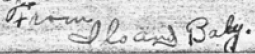
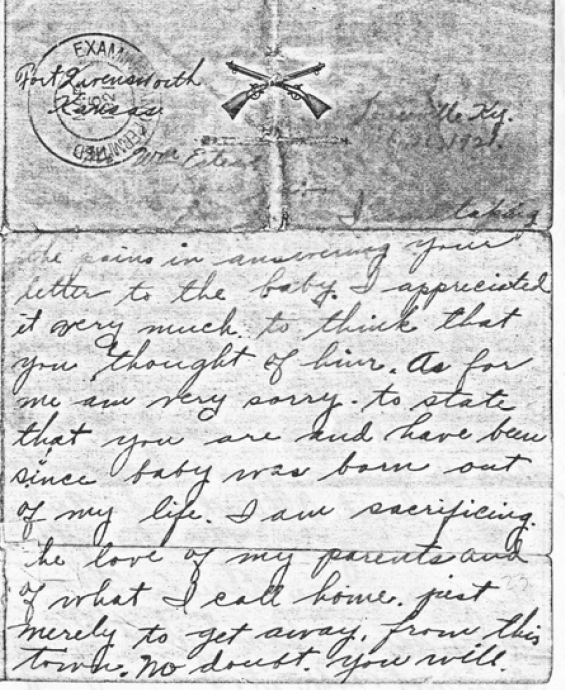
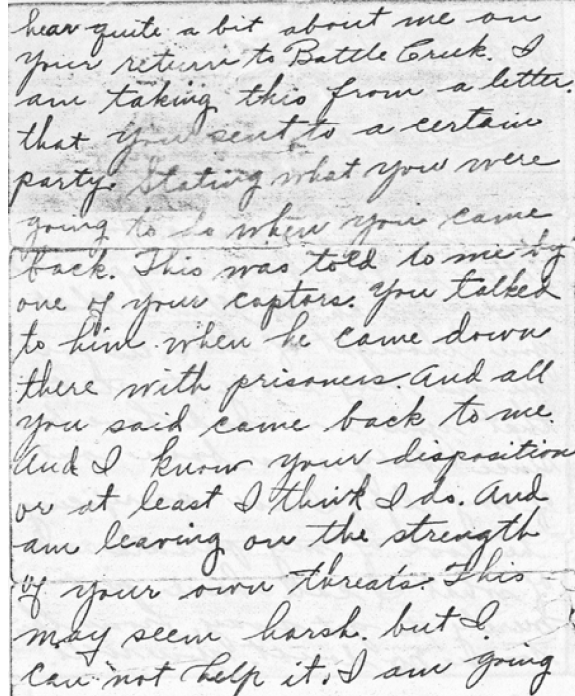
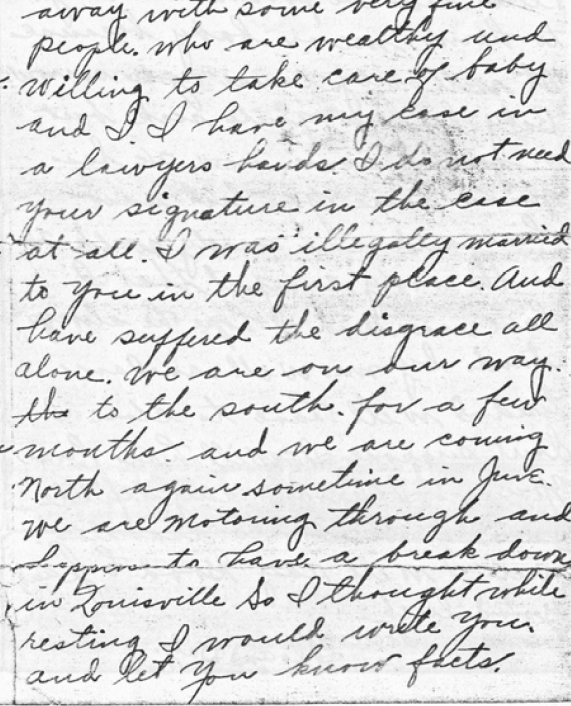
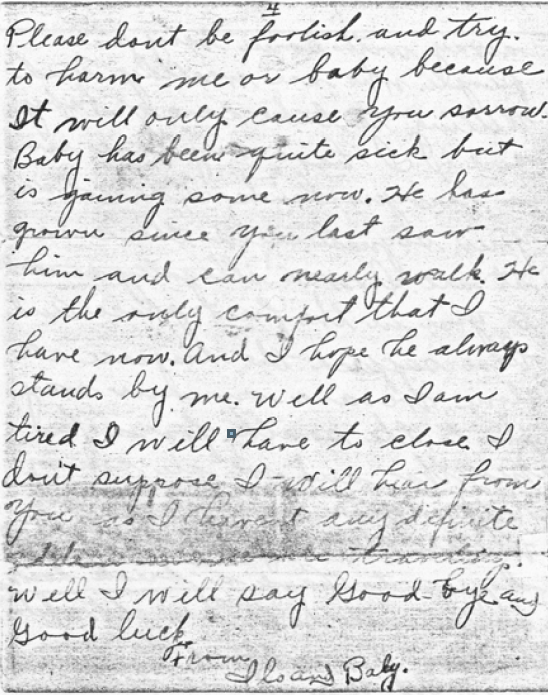
In Ilo’s letter, she tells William Sterling Estes that “it’s in a lawyer’s hands now” and that she doesn’t need his signature at all. And besides that, even if she did, exactly which signature would he use??? And wouldn’t you think he would get in trouble with the military for getting married under a fake name, I mean, if he wasn’t already in trouble for being AWOL? Wouldn’t you think he would think about these things? Just saying….
And if Ilo then went to remarry, or marry, whatever you call it, what surname would she use in that marriage record? The 1920s was a long time before women petitioned to take their maiden name back. In the 1980s, judges were reticent to grant the return to maiden names if children were involved – and that’s 60 light-years later.
One of the reasons that I ask all of this is that I know the “father” was changed on my sister’s birth record to reflect my father’s name, after her mother married my father in December of 1922. He seemed to like December weddings. My sister’s birth record was then refiled with the later “delayed” or “adopted” records and given that my sister didn’t know about this, she had fits getting her birth certificate because it had been stricken in the original book with no “pointer” to the new entry. A clerk finally found it on a fluke and with her standing there refusing to leave without a birth certificate.
Am I ever going to be able to find out what happened to Ilo’s son? I actually wonder if he died. My sister who was born within months or weeks (or for all we know days) of Ilo’s child was well known to the family, even if her mother and her mother’s family “didn’t care for” my father, to put it mildly. So if Ilo’s child died, what surname would his death record have reflected?
I may never figure this out, but still, I want to know…
Who was that child?
What was his name? No child should be remembered namelessly. Even my babies who died all have names.
Did he live or die? Is my brother alive? Did he have children?
If he died, when, and how?
And oh, just one more crazy twisted question. If you were William Sterling Estes, and you had two women pregnant at the same time in the same town, due, it seems, about the same month…wouldn’t you worry that they might meet each other? Like at the doctor’s office…or worse yet, wind up being roommates giving birth???
Wait a minute! Maybe that’s what happened. He was AWOL from November 1919 through April 1920 when he was arrested. Arrested? Maybe he turned himself in….maybe it seemed like the safer choice. Oh what a tangled web we weave…..
Ilo’s Son
Just as I was ready to call this a draw, again, for about the 100th time in the 36 years I’ve been searching for my brother…another reader sent me a vital piece of information. Ilo Esther Bailey remarried in Ohio using her maiden name. And yes, it’s the same Ilo because she gave her parents names. And for once, the names all match.
On June 9, 1928, Ilo Esther Baily, born in Van Wert, Ohio to John Bailey and Maude Wable married Thomas Devine, son of Mathew Devine and Elizabeth Hawkins. They both listed their marital status as “single” and they were married in Bowling Green, Wood County, Ohio, just south of Toledo.
The image of the actual application shows that they weren’t just single, but that they both state they have never been married before.
The 1930 census, just two years later shows this couple with several children, including one named Leo Jr, age 10, so born in 1920, in Michigan. They were living in Lucas County, where Toledo is located. Ilo is listed as age 27, so born in 1903.
Children listed were:
Leo Jr. – 10 – born in Michigan
Matthew T. – 8 – born in Ohio
Robert J. – 6 – born in Ohio
William E. – 3/12th – so born in January of 1930
Leo would have been the son of William Sterling Estes. How then could he be Leo Jr.? Did she rename the child after her second husband? This doesn’t make sense, but then nothing about this entire situation makes sense.
About this time, I recalled what my crazy aunts had told me. That my father was married about 1920 or so to a Laila LaFountain and they had a son Lee, who eventually took his step-father’s name of “Levi or Levy or something like that.” Lee wound up in Louisville, Ky studying the ministry in a seminary “or something,” they recalled. All this time, I thought Laila LaFountain was a different person, if she and Lee even existed at all. Remember, they were the crazy aunts:)
By 1933, Ilo was in Louisville, Ky., with husband L. Thomas, as listed in the Louisville, Kentucky City Directory. L. Thomas Devine is listed with Ilo E., r rear 911 Washington in 1933 and in 1934 Leo T. Devine with Ilo is listed at 1056 Washington.
By 1939, Mrs. Ilo E. Devine is listed by herself at 1005 E. Main.
Another reader found ILA (sic); Leo, Jr., student; and Matthew, living at 412 E. Grey in Louisville, in the 1940 city directory. Ilo is listed as widow of Thomas. There is a Thomas listed in 1940, who is a Laborer at Cavehill Cemetery. There is also a William, but there is no way to know if he is Ilo’s son.
The family is missing in the 1940 census. In 1940, Ilo’s children would have been:
Leo – 20
Matthew – 18
Robert – 16
William – 10
According to the Ohio birth registry, another child, James J. Devine was born Oct. 24, 1923. Would this be Robert James Devine who died in 1975? The answer is in Robert’s death certificate and obituary.
And I have to ask…why does this family continue to change their names??? Leo Thomas Jr. became Lee Joseph., James J. became Robert James and William E. became William Douglas???
In 1942, Matthew T. and Robert J. are living at 829 Washington Street. There is also a Thomas.
We know that at least Robert James was alive beyond 1942, because he died in Fort Worth, Texas on July 7, 1975. His mother is listed as Ilo Esther Bailey and his father as Leo Thomas Devine.
I ordered Robert’s obituary from the Fort Worth Library. It did not list his parents, but did list his siblings.
So we now know that in 1975, Lee, Matthew and William were all still living in Louisville.
According to the birth index, Matthew T. was born January 15, 1922 in Lucas County, Ohio to Ilo and Leo. This means that this child was conceived in April 1921, approximately 1 month after Ilo wrote the letter to William Sterling Estes. Perhaps this relationship with Leo Devine, is what Ilo was referring to in her letter when she stated that William, upon his return to Battle Creek, would hear “quite a bit about me.” If indeed she did return to Michigan in June as she indicated was planned, she was then pregnant with her second child. It’s interesting that the location from where she wrote the letter to William was Louisville, where she and Leo Devine ultimately wound up living. Maybe Leo is the “very fine people who are wealthy and willing to take care of baby and I.”
If Leo, or Lee, the child, was raised as part of the Leo Devine family, he may never have known that he was not Leo Devine’s biological child. But was Lee Devine the biological son of Leo Devine? As it turns out, Leo Devine was living with his brother Douglas in Battle Creek, Michigan in 1920, per the census, and it appears that Douglas was working at the Army Base.
One thing is for sure, Matthew Devine was positively not the child of William Sterling Estes, because he was in the Leavenworth Disciplinary Barracks, in Kansas, at the time Matthew was conceived.
Matthew Devine died August 19, 1997 and his obituary is as follows:
Matthew Thomas Devine, 75, died Sunday at Caritas Medical Center. He was a retired employee of the old International Harvester Co., an Army veteran of World War II and a member of Veterans of Foreign Wars Post 1181.
Survivors: his wife, the former Norma J. Taylor; sons David and James Harbin; daughters Mary Scott and Esther Choi; a brother, William Devine; six grandchildren; and a great-grandchild.
From the Ohio Birth Index – William Douglas Devine was born December 31, 1929 son of Leo & Ilo. His birth date in the SSDI (Social Security Death Index) matches this date.
Devine, William Douglas, 77, of Louisville, passed away on Tuesday, March 27, 2007, at Jewish Hospital. Mr. Devine was a retired captain on the Louisville Fire Department, a member of the Fire Fighter’s Union, Retired Fire Fighters, honorary member of the 10th. Mountain Division, and Guardian Angels Catholic Church. He is survived by his wife of 56 years, Mary Lee Devine; a daughter, Dusty Callahan-Hardin (Tim); and two grandchildren, Ryan and Caitlin Callahan. Funeral Mass will be 10 a.m. Saturday at Guardian Angels Catholic Church, 6000 Preston Highway. Burial will follow in Resthaven Memorial Park. Visitation will be 2-8 p.m. Friday and after 8:30 a.m. Saturday at Arch L. Heady at Resthaven, 4400 Bardstown Rd. Expressions to Guardian Angels Catholic Church. Published in The Courier-Journal on 3/29/2007.
Unfortunately, this obituary doesn’t say anything about his brother, Lee.
Where is Leo Thomas Devine?
In 1939 and 1940, we find a Lee Joseph Devine attending the University of Louisville in the Liberal Arts program.
In the 1956 City Directory, we find Lee J. Devine with wife Ruth who works for the Pan Am Service Station. Then we find Matthew T. Devine who works in the same place. That seems just too much of a coincidence and connects Matthew T. with Lee J. who is married to wife Ruth. To me, this removes most of the doubt as to whether or not Lee. J. Devine is the same person as Leo T. Devine. Having said that, this family “ball of string” has thrown me so many loops and blindsided me so many times that I’m very hesitant to conclude anything without definitive proof. It seems that no one behaves or plays by the rules, or even keeps their names!
By the 1960 directory, we find Lee J. Devine who is now a vice president of Thurston Cook Mercury.
In 1989, we find the death record for Lee J. Devine, also listed as Leo Devine in at least one death record index. He was born February 24, 1920, obtained his SS number in Louisville prior to 1951 and died in St. Petersburg, Pinellas County, FL on January 21, 1989. He had a death record both there and in Louisville and was buried in Howe Valley, Hardin Co., KY. Hardin County borders Jefferson County where Louisville is located.
Photo taken in January, 2012….and Ruth isn’t buried at that time.
This particular Lee Devine married Cordelia Ruth Lyon on June 26, 1943. But, is this Lee Devine the son of Ilo Esther Bailey or is this a different Lee Devine?
When in doubt, call the library. I learned this years and years ago, and once again, it didn’t fail me. Mark Taflinger, the Data Desk Manager provided me with Lee’s obituary which clearly links him with brothers William and Matthew.
Lee J. Devine, 68, died Saturday in St. Petersburg, Fla.
He was a retired president and administrator of St. Matthews Manor and Mount Holly Convalescent Centers, a former president of the Kiwanis Club of Louisville and the Executive Club, and a member of the Pendennis Club, Boys and Girls Council of the Salvation Army, English Speaking Union, Stephensburg Masonic Lodge, Scottish Rite and Kosair Shrine Temple.
Survivors: his wife, the former Ruth Lyon; and two brothers, Matthew T. and William D. Devine.
Funeral: 10 a.m. Wednesday, Christ United Methodist Church, 4614 Brownsboro Road, with burial in Howe Valley Cemetery in Cecilia. Visitation at Pearson’s, 149 Breckinridge Lane, from 1 to 9 p.m. Tuesday.
But there is one more thing….he had no children. So I don’t have any nieces and nephews, and there is no one to do DNA testing to prove, or disprove, that Lee was my brother.
From Lee’s obituary, I would have been proud to know this man. It certainly looks like he made a very positive difference in the world. Ilo, your son would have made you proud. I’m just so sorry that I never got the chance to meet him. But now I know. I no longer have to wonder. There will be no mysteriously appearing sibling DNA match, at least not from him. I can stop waiting.
So, now I must pause to reflect. It has been an extremely long couple of weeks.
Is Lee Devine My Biological Brother?
Is this man my brother? I’m sure you’ll understand my need to ask after discovering that my brother Dave was not. Added to this doubt, in this case, is the fact that Leo Devine was also in Battle Creek in the 1920 census and that Ilo named the child, according to the 1930 census, Leo Thomas Jr. – although his name would somehow evolve over time to Lee Joseph.
I’m sure that this Lee Devine is the man that is supposed to be my brother. We have finally walked, crawled and then sprinted to the end of that trail. But was he really my brother? The only resource left now is photos and once again, Mark, from the Louisville library came through for me. Libraries have clipping files. This photo of Lee Devine is from March 2, 1955. It’s the only photo in his file.
I have no photos of my father from the time of his military service until about 1950 or so.
Here is a photo of my father I’d guess about 1945 or 1950. And no, I have no idea who the child is…which leads to more questions, that, unless someone recognizes this photo, will forever be unanswered. It was labeled as “one of his girlfriend’s children” by my brother Dave’s mother, so it’s not Dave.
My father about 1950, so about 13 years older than Lee was in the photo taken in 1955.
Here, above and below, are photos of my father in the military around 1918, so about age 15.
Here’s William Sterling Estes about 1960 with my step-mother, Virgie.
Here is a photo of my genetically proven sister, the one born in 1920 just three months after Lee, taken about 1955.
Here’s my proven sister at about age 60.
Here is a photo of me taken when I was about 5 years older than Lee was in the photo in 1955.
There are a few more family photos in the “Crazy Aunts” story. I personally think Lee resembled my father’s brother, Joseph, shown in the family photo in that article, and below.
This is the end of the story. We’re done. Case solved, thanks to many contributing people. It stops here because there are no children to DNA test. There can be no final chapter, so to speak, no definitive conclusion.
Feelings and Coping
I feel that it’s only appropriate to add a quick note about how I feel about this. These have been an extremely emotion-filled few days. I have chosen to share not only this experience in total, step by step, but also how I feel about it, for two reasons.
First, many others will go through this same process. I didn’t quite expect to go through it publicly, but that is how it started with the Ilo story and I felt obliged to share with you “the rest of the story,” especially given that so many of you contributed the key pieces of the puzzle. It would not have been solved without the reader contributions.
The resolution of this type of search within a few days is actually very unusual. Often there are weeks or months between pieces of information and you can deal with each one as they arrive. For me, this process has been extremely compressed these past few days due to the newly available online records such as the Ohio birth, death and marriage indexes. This process and the emotional roller-coaster attached to each new piece of data feels quite lonely and the emotions are extremely raw, especially if you’re searching for the family you don’t have. These journeys by virtue of what they are often isolated and alone. Other than giving birth or burying a family member, these types of searches are one of the most personal journeys you can embark upon. They will change your life forever, the journey itself, if not the outcome.
For many, especially adoptees, there is a sense of desperation that defines these searches. The clock is always working against you in the sense of finding the person alive, and working for you in terms of new records becoming available that may help your search. Your feelings are always a conflicted hodgepodge of hope and fear, often wildly swinging between the two. Fear of what you will find, what you won’t find, that you’ll find nothing, or that it will be too late.
Second, I’ve shared to help those who never experience this understand the process for those of us who have. Almost all of us will know someone who goes through this. Many people experience this over and over trying to find parents and then siblings, having no idea what awaits them….what they will find…if anything. It never becomes easy or even easier, especially after a few choice rejections and setbacks. Many times, each one becomes more difficult. The end of these stories aren’t always happy endings in the classic sense of a tearful, joyful reunion. Trust me – there is another sister I haven’t told you about.
Anyone who searches for a sibling or parent or child knows that the entire search, for however long it takes, often decades, is fueled by hope. Some hope for a joyful reunion, for love. Some just want closure. Some want to know what that person was or is like. Many want to find some commonality. Some of us are almost afraid to hope. Given the dysfunctional state of my father’s life and his history of drinking, I had no idea what to expect in his child. Lee was a pleasant surprise.
I clearly knew that it was extremely unlikely that I could ever find this brother, and by this time, more than 90 years after his birth, if I did, he would likely be deceased. I’m far more surprised that I’ve actually found him than I am that he has passed over.
I was extremely blessed to have found my sister Edna in 1978 and my brother Dave in the early 2000s. I had a few years with both of them before they passed – years I would not trade for anything. I think we loved each other more intensely and gratefully to make up for the years we didn’t have. My sister and I were so very much alike in uncanny ways. I was utterly devastated at her passing – given and so unexpectedly wrenched away again just a dozen years later. It was many years before I stopped picking up the phone on Sunday afternoons to call her. The second anniversary of Dave’s passing is next week. And so – another brother lost, and found, and lost again.
When we obtain closure, it allows us to move on, in our own way, in our own time. In the meantime, we grieve what wasn’t, what might have been, what we hoped would be and never happened. Sometimes, depending on the circumstances, we grieve what was.
This discovery, as glad and extremely grateful as I am to have made it, is, in it’s own way, a death. It’s finally over. The door has shut, as gently as possible, but it is closed, latched, and he is on the other side…and although I’ve found him, given the murky circumstances, I still don’t know if he is actually my brother.
What I wanted, of course, was a brother, and failing that, the truth. Had he been alive, or had children, the truth would be easy to discern utilizing DNA testing. It seems ironically fitting somehow that even at the end of this convoluted journey, the truth would still be permanently unreachable. For the past 36 years, my brother has always seemed to be just beyond my fingertips, and he still is.
So, in keeping with my quilter’s heart, I bought fabric this week to begin a quilt (for me) for him…to celebrate finding him, to be thankful for my many friends who solved the mystery, to mark the end of this part of the journey, and to honor his life well lived. When life gives you scraps, make quilts. There is beauty in everything. I chose beautiful batik snowflakes to represent the steps in the journey that ended “cold,” in the middle of the toughest winter in decades.
As for whether he is my biological brother, I truly don’t know what to think, so I’m asking you.
Let’s Vote
So, what do you think, based on the pictures? By the way, your votes are anonymous, so be truthful.
I receive a small contribution when you click on some of the links to vendors in my articles. This does NOT increase the price you pay but helps me to keep the lights on and this informational blog free for everyone. Please click on the links in the articles or to the vendors below if you are purchasing products or DNA testing.
You may have seen the headlines and the announcement this week by Illumina, manufacturer of gene sequencing equipment, that the $1000 genome is finally here. Hallelujah – jump for joy – right? Sign me up – where can I order???
Well, not so fast.
It’s a great headline – and depending on how you figure the math – it’s not entirely untrue, but it’s a real struggle to get there. Some marketing maven did some real spreadsheet magic! What is that old saying, “lies, damned lies and statistics”? Maybe that’s a little harsh, but it’s not too far off.
So, is the $1000 genome here or not? Well, kindof. It depends on how you count, and who you are. You see, it’s a math thing.
It’s kind of like a mortgage. How much did your house cost? Let’s say $100,000 – that was the price on the “for sale” sign. But by the time you get the mortgage paid off, 30 years later, the cost of that house is way more than $100,000, probably more than $250,000 and if you add in the cost of taxes, closing costs and maintenance, even more. This will only depress you, so don’t think about, especially when you sell your house for $150,000 and declare that you “made” $50,000. But I digress…
So, let’s translate this to the $1000 genome.
Dr. David Mittleman, Chief Scientific Officer for Gene by Gene, Ltd., parent company of Family Tree DNA, was at the conference this week where the Illumina announcement was made. I asked him several questions about this new technology and if it was ready for prime time yet.
His first comment shed some light on costs.
“The HiSeqX Ten system is actually a ten-pack of new HiSeq instruments, each costing 1 million dollars. So you have to spend $10 million on equipment before you can even get started.”
Ouch. I guess I won’t be buying one anytime soon!
To begin with, without the cost of the kits or processing or staff or software or installation or financing or support contracts or profit, a company would have to sell 10,000 kits at $1000 to even bring the cost of the equipment to $1000 per kit.
So, how did Illumina figure the cost of the $1000 genome? The $1000 is broken down as $800 on reagents, $135 on equipment depreciation over 4 years, and $65 on staff/overheads.
This means that to obtain that $1000 per genome price, you have to run the equipment at full capacity, 24X7, 18,000 kits per year, for 4 full years. And that still doesn’t include everything. You also need service contracts, installation, additional labor, etc. You can read more about the math and cost of ownership here.
And sure enough, when I asked David about who has purchased one so far, there are two buyers and both are institutions. This is an extremely high end product, not something for the DTC consumer marketspace.
Now this isn’t to say this announcement is a bad thing – it’s not – it’s just not exactly what the headlines suggest. It’s the $1000 genome for those with deep pockets who can purchase a $10,000,000 piece of gear and then run 18,000 samples, for 4 years, plus expenses. But yes, it does technically break down to $1000 per test as long as you hit all of those milestones and ignore the rest of the expenses. If you can afford $10 million and have the staff to run it, you probably don’t care about the cost of installation, labor and support contracts. They are just necessary incidentals – like gas for my lawn mower!
In spite of the fancy math, it’s truly amazing how far we’ve come when you consider that a single full genome sequence still cost about 3 million in 2007, and in November 2012 Gene by Gene was the first to offer full sequencing commercially and offered it to their customers for an introductory price of $5495. Of course, with no analysis tools and few testers, I can’t imagine what one would do with those results. This has changed somewhat today. The full genome with some analysis is available today to consumers for $7595, but the question of what is available that is genealogically useful to do with these results still remains, and will, until many more people test and meaningful comparisons are available.
The Illumina announcement also raises the issue of software investment to do something useful with the massive amount of data this new equipment will generate…also nontrivial, and that software does not exist yet today.
There are other issues to be addressed as well, like open access libraries. Will they exist? If so, where? Who cares for them? How are they funded? Who will have access? Will this data be made available in open access libraries, assuming they exist?
Illumina has reported that entire countries have approached them asking for their population to be sequenced, which also begs questions of privacy, security and how exactly to anonymize the samples without them becoming useless to research. This high tech watershed announcement may spur as many questions as answers, but these issues need to be resolved in the academic environment before they trickle down to the consumer marketspace.
This is not to minimize the science and technology that has propelled us to this breakthrough. It is a wonderful scientific and technological advancement because it will allow governments or large institutes to do huge population-wide studies. This is something we desperately need. Think for a minute if our Population Finder ethnicity results were based on tens of thousands of samples instead of selected hundreds.
For genetic genealogists, we are poised to benefit in the future, probably the more distant than the near future. The $1000 genome for consumers not only isn’t here, it’s not even within sniffing distance. So put your checkbooks away or better yet, buy a Big Y or a Family Finder test for a cousin, something that will benefit you in the short term.
This next step in the world of genetic discovery is exciting for research institutes, but it’s not yet ready for consumer prime time. We will be the beneficiaries, but not the direct consumers….yet…unless you want to move to one of those countries who wants their entire population sequenced. Our turn will come. Maybe the next time we see an announcement for the $1000 genome it will be calculated in normal home-owning-human terms.
I receive a small contribution when you click on some of the links to vendors in my articles. This does NOT increase the price you pay but helps me to keep the lights on and this informational blog free for everyone. Please click on the links in the articles or to the vendors below if you are purchasing products or DNA testing.
You know, there are just some things in this world that defy words. Some things are stunning in photos, but in person, they are absolutely unspeakable – there are no words adequate to describe them. Overwhelming, majestic, none of those words are “enough.”
Stonehenge is one of those places. Maybe that’s why people have been attracted here for thousands of years. It’s a magnet calling to our human spirit.
This was my second day in London. Jim and I had just spent a rather sleepless night in the Kenner’s Easy Bake Oven, a very small hotel room with no air conditioning, in a heat wave. However, nothing was going to keep us from visiting Stonehenge, so off we went to find the tour company, something much easier said than done, it turns out.
We wanted to sign up for a bus tour, but the company said we had to come down to their office to physically make those arrangements, in person. So, we took a subway tour by accident to get to the bus tour. Thank Heavens we left lots of time. To get to Stonehenge from London, you ride about 2 hours each way on the bus through what I would term nondescript farmland for the hour and a half visit at Stonehenge, but it was worth every minute of that ride and even being lost on the subway too.
But Jim and I had a special treat. Our breakfast was included in our hotel room. It was a real breakfast too, not just cereal and milk. I think it’s because they felt guilty about that Kenner’s Easy Bake Oven thing. In any case, the breakfast was really wonderful. It included several kinds of fresh baked breads, cheeses including brie and freshly made raspberry jelly sitting in little jelly cups in icewater so they would set up quickly.
They also had normal breakfast things like eggs and “bacon” which was really good and not bacon as we know it in the US, and baked beans, which is a breakfast staple in England. This rather unique combination, complete with tomatoes and mushrooms, is known as the English Full Breakfast and you can see some pictures here. And yes, it does include “blood pudding” also known as black pudding which isn’t pudding at all. There is a picture of me trying that…but I won’t publish it. I will try almost anything once, and I did, and guaranteed, there will not be a second time.
I decided that the freshly baked bread was calling to me and so was the cheese. Not only is that my farm upbringing, but it’s also the result of living in Switzerland as a student. It’s all coming back now and I have this indescribable urge to have some wine with my bread and cheese:)
I noticed that the tour description said nothing about food, nor about stopping anyplace, so I presumed we needed to be prepared. Let me translate – go to the bathroom just before leaving and take food or water or anything you’re going to need.
So, I made us a picnic lunch. It was the best lunch ever, with petit pain and brie and jelly (in packets, not the homemade raspberry – no way to transport that) and a banana and a pear and a tomato slice. Yepper, a killer picnic lunch and we had it sitting on the grass at Stonehenge. It was really squishy, but it was really, really good. And yes, we had to lick our fingers. Welcome to our picnic at Stonehenge. After we ate, we took pictures from our picnic site. I mean, how many times in your life do you get to picnic at Stonehenge?
Jim, by the way, refuses to smile in photos. Still, I think this one is very cool. He’s thinking about smiling and trying hard not to! BTW – this photo is now on the cover of Jim’s iphone – a nifty Christmas gift!
There are lots of theories and myths about Stonehenge, the why and how, including aliens and Merlin, but the truth is that no one really knows why it was created, or how, or by whom. However, no culture would invest so much time and labor into something that wasn’t sacred to them in some way.
Below, the oldest known depiction of Stonehenge.
From a manuscript of the Roman de Brut by Wace in the British Library (Egerton 3028), a giant helps Merlin build Stonehenge.
You can’t sit in the beauty and majesty of his incredible monument without pondering and thinking, about Stonehenge itself, and also about the people who created this megalithic structure. And I wondered of course, if I was related to them. Are they my ancestors? I certainly have several British Isles ancestors. Were some of them here then? Did they participate in some way, either in building the monument or whatever form of worship followed? What do we know about Stonehenge?
Stonehenge is a prehistoric monument in Wiltshire, England, about 2 miles (3.2 km) west of Amesbury and 8 miles (13 km) north of Salisbury. One of the most famous sites in the world, Stonehenge is the remains of a ring of standing stones set within earthworks. It is in the middle of the most dense complex of Neolithic and Bronze Age monuments in England, including several hundred burial mounds. It sits simply in the middle of a plain. In fact, while driving through that area, there are little burial mounds everyplace. This is through the bus window, so pardon the glare on the glass. The mounds are to the right and also in the distance mid-photo.
Archaeologists believe Stonehenge was built anywhere from 3000 BC to 2000 BC. Radiocarbon dating in 2008 suggested that the first stones were raised between 2400 and 2200 BC, whilst another theory suggests that the bluestones, from Wales, may have been raised at the site as early as 3000 BC
Stonehenge was built in three phases between 3000 B.C. and 1600 B.C. Archaeologists agree it was a temple — but to what god or gods, and exactly how it was used, remains unclear.
Archaeological evidence found by the Stonehenge Riverside Project in 2008 indicates that Stonehenge could have been a burial ground from its earliest beginnings for elite families. The dating of cremated remains found on the site indicate that deposits contain human bone from as early as 3000 BC, when the ditch and bank were first dug. These burials locations are marked by bluestones. The Stonehenge stones may be the largest headstones ever! Such deposits continued at Stonehenge for at least another 500 years.
Stones for Stonehenge, much of which still stands, were brought from up to 175 miles (280 kilometers) away. Construction continued for centuries, and the site may have been a temple for Druid worship, a giant astronomical calendar, a place of healing, or maybe all of the above.
Evidence suggests large crowds gathered at Stonehenge for the summer and winter solstices, a tradition that continues today.
Senior curator Sara Lunt says there are still major discoveries to be made — more than half the site remains unexcavated. But the original purpose of Stonehenge may remain a mystery.
“We know there was a big idea” behind Stonehenge and other stone circles built across the British Isles in the Neolithic period, she said. But “what the spiritual dimension of this idea is — that is the key, and that is what we can’t get.”
The surrounding circular earth bank and ditch, which constitute the earliest phase of the monument, have been dated to about 3100 BC. The site and its surroundings were added to the UNESCO’s list of World Heritage Sites in 1986 in a co-listing with Avebury Henge. Stonehenge is owned by the Crown and managed by English Heritage, while the surrounding land is owned by the National Trust.
When we were visiting, they were in the process of completing a new visitor’s center. We didn’t see the new center, as it is about a mile and a half away and completely out of view. The then-current center is just out of sight of Stonehenge itself. The idea of the new center is to remove all of the modern day trappings and distractions, including motor noise, so that visitors can enjoy the monument in a more pristine and natural environment. That seemed to be a very volatile subject and not everyone is happy about the changes.
Recently the new facility was opened.
Among the exhibits in the new facility is the reconstructed face of one 5,000-year-old local resident from his skull. Oscar Nilsson, a forensic sculptor, created the bust and says that he had good teeth and handsome features, in a shaggy, prehistoric kind of way. Actually, I think he looks uncannily like my x-husband on a good day….which kind of gives me the creeps and makes me desperately want to know about his haplogroup.
I was very disappointed to discover that they have not, to date, performed DNA testing. My inquiry to English Heritage about DNA testing on these and other remains found in close proximity received the following reply:
Dear Ms Estes,
Many thanks for your email regarding the human remains on display at the new Stonehenge visitor and exhibition centre. I have been asked to respond on behalf of the Project team.
Dr Simon Mays, Senior Osteologist for English Heritage has provided the Interpretation and Curatorial team with some information regarding further testing following the recent sampling carried out on the Winterbourne Stoke 1 human remains that he guided. He advises that analysis of DNA is destructive and we would only consider using such a technique on ancient material if the results would help to answer compelling questions about the human remains that could not be answered in any other way: only then would the destruction of a piece of human bone be ethically justifiable. In this case, DNA analysis was not relevant to the questions that we considered important, which included the man’s place of origin and early development, his mobility and his age at death.
Although a fairly common procedure nowadays for historic and recent material, attempts to extract DNA from ancient skeletons fails in the majority of cases because of, inter alia, poor preservation of the relevant molecule. When DNA does survive from ancient material, it is often in very poor condition, so the information it can supply is strictly limited.
Any destructive analysis that English Heritage might wish to carry out in the future on the human remains in the Visitor Centre would be subject to the agreement of the institutions which have loaned them to English Heritage.
I hope this goes some way to answer your query, but please let me know if you need further information.
Kind regards,
Let’s hope they reconsider in the future. If you have feedback for them about how DNA won’t answer questions about the history of this man…their contact information is listed above. I encourage you to share your opinion with them and perhaps ask some pointed questions. I have to wonder if any of the cremains might be a possibility. They are already “destroyed,” so to speak, and the heat of the cremation fire might not have been hot enough to destroy all of the DNA. I know that contemporary cremations are at much higher temperatures and do destroy the DNA. It might be worth having Dr. King or another individual who has successfully extracted ancient DNA do an evaluation. Furthermore, while they are accurate, the process is destructive – it is minimally so. A small piece of bone needs to be drilled – significantly smaller than a tooth. It seems a shame not to utilize the tools available to us.
I have to wonder just who this reconstructed man is, in terms of ancient ancestry and clans. Were these people from Europe or Scandinavia, perhaps? Were they haplogroup R, like about half of Europe is today, or would they carry a different haplotype?
Recent work by Dr. Michael Hammer and first presented at the Family Tree DNA Administrators Conference in November of 2013 indicated that there was no early haplogroup R yet found in early burials. Initially, haplogroup R1b had been thought to have overwintered the ice ace about 12,000 years ago in Anatolia and Iberia, repopulating Europe after the ice melted. However, if that is true, then were are the R1b burials? Instead, we are finding haplogroup G and I and some E, but not any R. The first site to show any haplogroup R is R1b from a German Bell Beaker site dated to the third millennium BCE, or about 5,000 years ago.
The Neolithic timeframe covers the expansion of agriculture from the Middle East across Europe beginning about 10,000 BC and continuing across Europe to about 5,000 BC. Haplogroup R, it appears, did not accompany this expansion, but arrived later, post-Neolithic, potentially with the Bell Beaker Culture between 2,000 and 3,000 BC.
This culture is named after its distinctly shaped drinking vessels.
3,500 years old, 40 cm (16 in) high “Giant Beaker of Pavenstädt”, Gütersloh town museum, Germany. Other Beaker culture items, below.
It’s also believed that mitochondrial haplogroup H spread into Europe with the Bell Beaker culture as well.
Beakers arrived in Britain around 2500 BC, declined in use around 2200-2100 BC with the emergence of food vessels and cinerary urns and finally fell out of use around 1700 BC. The earliest British beakers were similar to those from the Rhine but later styles are most similar to those from Ireland In Britain, domestic assemblages from this period are very rare, making it hard to draw conclusions about many aspects of society. Most British beakers come from funerary contexts.
From Wiki, this map shows the generalized movement of the Bell Baker culture.
The most famous site in Britain from this period is…drum roll please…Stonehenge. Many barrows surround it and an unusual number of ‘rich’ burials can be found nearby, such as the Amesbury Archer who lived contemporarily with the construction of portions of Stonehenge.
The Amesbury Archer is an early Bronze Age man whose grave was discovered during excavations at the site of a new housing development in Amesbury near Stonehenge. The grave was uncovered in May 2002, and the man is believed to date from about 2300 BC. He is nicknamed the “archer” because of the many arrowheads that were among the artifacts buried with him. Had he lived near the Stones, the calibrated radiocarbon dates for his grave and dating of Stonehenge suggest the sarsens and trilithons at Stonehenge may have been raised by the time he was born, although a new bluestone circle may have been raised at the same time as his birth.
In spite of what English Heritage said, DNA testing could help answer many of these questions about who these early people were, where they came from and who they were descended from and related to.
When we visited Stonehenge, the guide suggested that historically there may have been processions from Avesbury, across the Salisbury plain, following the Avon River and then up the hill to Stonehenge. The Avon River, 2 miles distant, and with parallel ditches leading from Stonehenge to the River, is theorized to be how the stones were transported to the Salisbury Plain from their origins in Wales, hundreds of miles distant.
Evidence on the banks of the river of huge fires between two avenues connecting Stonehenge with another nearby Neolithic site, Durrington Walls, shown below, suggests that both sites were linked.
I can’t help but think how wonderful this would be, to retrace the steps of the original people of Avesbury and the Salisbury plains, whoever they were. Hugh Thomson, the author of the “Magic Circles” article hyperlinked above, probably sums it up the best with this commentary:
“I can’t help thinking how much better it is to arrive at Stonehenge on foot. The comparison that comes to mind, and which I know well, is the Inca Trail to Machu Picchu. The experience of trekking to both sites is immeasurably richer, not just because you’ve “earned it”, but because both sets of ruins are only properly understood in the context of the sacred landscape that surrounds them.”
It’s probably much different that arriving on a tour bus after being lost on the subway.
If I ever return to England, I’ll have to come back to Stonehenge. I would very much like to visit at sunrise and now, I’d like to retrace the walk of the original inhabitants, whoever they were. And yes, I’d like to know if I might be distantly related to one of these people buried in these barrows, shown below, surrounding Stonehenge. Think how you’d feel standing here if you knew your ancestors did as well. It could only enhance the visitor experience and the science would, of course, help resolve the many unknowns in the history of Stonehenge. I hope English Heritage gets their curiosity peaked and reconsiders DNA testing, as they seem a bit behind the curve. After all, they have Dr. Turi King, with the University of Leicester, of King Richardfame, quite nearby.
Truly, we had a wonderful day at Stonehenge. The weather was perfect, no rain and sunny. Beautiful photos. Just a few people here, no large crowds, and our lovely picnic.
After our visit, on the bus on the way back to London, I thought, “guess I can check this off of my bucket list,” but then I realized, I really don’t have a bucket list. My life has provided me with so many rich opportunities that I never dreamed that I would have. I never imagined that I would ever have the opportunity to visit Stonehenge, so it actually wasn’t ON my bucket list. However, now that I’ve been here, I’d love to come back.
You know, there’s something wrong with this picture. I thought you visited places to check them off the list, not to add them to the list as a return visit! But Stonehenge, well, it’s a magical place, and it will do that to you…consider this fair warning!
I receive a small contribution when you click on some of the links to vendors in my articles. This does NOT increase the price you pay but helps me to keep the lights on and this informational blog free for everyone. Please click on the links in the articles or to the vendors below if you are purchasing products or DNA testing.
Do you have some crazy aunts in your family? I think everybody does. I certainly did – two of them – my father’s sisters. They were truly characters. They also were the gatekeepers to the family secrets – secrets I desperately needed to know!
William George Estes and Ollie Bolton Estes family. Children are left to right, daughter Margaret, behind Margaret, Joseph “Dode,” tall male is Charles Estle, male at right rear, my father, William Sterling Estes, looking worried, and blonde female at right beside Ollie is Minnie.
The aunts names were, officially, Margaret Lee Estes (born 1906, the brunette at left, above) and Minnie Mae Estes (born 1908, the blonde at right). I say officially, because they were fond of changing their names from time to time. That made it really difficult when discussing family items because their names were always different. Margaret seemed to settle on Jean and Minnie settled somewhat on Betty. No, I don’t know why. What I do know is that they were indeed, drama queens and they seemed to have a bit of sibling rivalry from the beginning that lasted, well, to the very end – and they both lived to be just shy of 100.
They started out as drama princesses when they were young. Both were exceptionally beautiful young women. Margaret, below, is reported to have done some modeling in Chicago about 1925, and of course she sent her modeling photos to her sister Minnie.
While Margaret went to live with her mother in Chicago after her parents divorced in the mid 19-teens, Minnie didn’t. She went back to the Claiborne County, Tennessee/Lee County, Virginia area, and in her own words, “was wild as a young buck.”
Both women would marry, both had one son. Both sons died tragically. Instead of bringing the sisters together, it seemed to further widened the gap.
Some of their crazy stories revolve around the sons and their deaths. There are allegations of murder, the mob, the mafia, huge stolen insurance policies and such. From the other sister, the same death story is quite different – homelessness, alcoholism, you get the idea. What is consistent is a lot of pain surrounding the deaths and jealousy between the sisters. And what’s worse, or better, is that I discovered that every time either of them discussed the stories, or each other, or anything for that matter, that the stories evolved or changed. They were never the same. Peachy, just peachy!
I didn’t find the sisters until they were in their late 70s. My parents were divorced and my father was killed in an automobile accident when I was in grade school. We lived about 400 miles from my father’s Tennessee family, and for some reason, my mother really didn’t want me hanging out with my Dad’s moonshining family. I would probably have loved them, which is exactly what she was worried about.
It wasn’t until many years later, when I was in my 20s, that I began searching for my father’s family to find out something, anything. That’s when I was directed to the aunts. They were the only siblings of my father yet living, and I was thrilled to find them. I initially wrote down every word they said…until I discovered that my notes from conversation to conversation contradicted each other. And if you asked them about what they said before, they would accuse you of lying, or worse, yet, talking to the enemy – the other sister – who had of course, lied. For awhile, I truly wondered if somehow I confused my notes and questioned my own sanity.
I’m extremely glad I took those notes. I put them away and years later, transcribed them. Margaret told about her homes around the world, and in the next conversation, would discuss her poverty. One time she told me that her family was spying on her to take her money. Minnie told about one of her husbands who was a politician and their time “on the hill” which I’m presuming was supposed to be Capitol Hill. I finally came to view the stories as just amusing and left it at that. They also did interesting things from time to time. Minnie/Betty once sent a pair of red sequined ballet slippers to the daughter of her deceased brother with a note that said that “no one in Tennessee loves me.” Whose slippers they were, we have no idea – she didn’t dance. Everyone in Tennessee was left someplace between amused and mystified with maybe a little creeped-out added along the edges.
There were nuggets of truth in those stories however, although they were disjoint and mining them has proven to be challenging. However, these past few days, the crazy aunts’ stories came through .
Margaret was only married once, but Minnie/Betty was married several times. I couldn’t keep her husbands straight and I don’t think she could either. However, both aunts loved to discuss my father, because whatever they had done, his escapades made theirs pale by comparison. The only bad thing was that the aunts seemed to have snippets of this and that. The all lived in different states and I think most of what they heard was through their mother, Ollie.
They loved to talk about people, and my father with his gallivanting ways proved quite a popular topic of conversation and fodder for a lot of tongue wagging and clicking. Tisk, tisk, tisk….naughty boy. Yes, indeed. But thankfully their love of gossip and “telling on him” and their rivalry to see who could tell the ‘worst” story has provided me with a couple very valuable nuggets.
They told me that my father was married about 1920 or so to a Laila LaFountain and they had a son Lee, they thought, who eventually took his step-father’s name of “Levi or Levy or something like that.” Lee, if that was his name, wound up in Louisville, Ky studying the ministry in a seminary “or something,” they recalled. He “might have been a minister.”
As it turns out, they were partially right, except they had Lee’s mother’s name wrong, unless, God forbid, there are two Lees, a possibility I’m going to entirely discount right now, to protect any shred of sanity I have left.
In my 52 Ancestors week #1 article, “ Searching for Ilo’s Son,” as things have developed, we discover that Ilo’s son’s name was Leo and his step-father’s name was Levine and in the 1930s, Ilo was living in Louisville, Ky. I remember writing years ago to a seminary in Louisville asking about a student from that time frame named Lee Levy, Levi or Estes. Of course, they didn’t find anything, but now I need to revisit this. I will catch everyone up on that story, probably next week. However, if you happen to know of a minister born about 1920 named Lee or Leo Thomas Devine, by all means, let me know. And score one for the crazy aunts!
Also, were it not for both of those women, I would have no photos of the family – none. Margaret had hers copied and sent them to me in the 1980s, with much ado and guilt inducing rhetoric. Remember, they were drama queens, and very experienced ones too. “No, you can’t pay me for them…I’ll gladly do without food.” Ok, so maybe not quite that dramatic, but you get the drift.
Minnie shared her photos with her grandson’s x-wife, who graciously shared them with me. In fact, it was the grandson’s x-wife and her boys who helped Minnie/Betty through her elder years. It’s a good thing we got copies of these photos when we did, because when the aunts died, there were absolutely no personal effects to be found anyplace.
Minnie’s grandson’s x-wife and sons did one more thing too….they got a DNA sample from Minnie during one of their visits, years ago.
Our maternal (mitochondrial) family tree is shown below.
Margaret and Minnie Estes
Ollie Bolton (1874 Hancock Co. TN – 1955 Chicago, Illinois) married William George Estes (divorced)
Margaret N. Claxton/Clarkson (1851-1920 Hancock Co., Tn) married Joseph “Dode” Bolton
Elizabeth Speaks (1832 Indiana-1903 Hancock Co. Tn) married Samuel Claxton
Ann McKee (1805 Washington Co., Va – 1840/1850 Lee Co., Va.) married Charles Speak
Elizabeth last name unknown married Andrew McKee (1766-1814)
This photo is of Elizabeth Speaks and Samuel Claxton in his Civil War uniform.
I’d love to have a photo of Margaret Claxton/Clarkson and Joseph Bolton, but none have surfaced to date. I’ve always wondered, though, if this photo taken about 1918, below, is of Margaret Estes (my aunt) and her grandmother, Margaret Claxton, and not her mother, Ollie. The problem is with the labeling. Another family member has this photo labeled “Margaret and grandma” which, depending on who wrote it, could be Ollie Bolton Estes or Margaret’s grandmother (Ollie’s mother,) Margaret Claxton. Ollie would have been about 45-50 in the photo and her mother would have been about 65-70. It was taken in Chicago, and I do have to wonder if Margaret Claxton would have visited Chicago, but you never know!
Here is Ollie Bolton Estes and William George Estes about 1914.
We think this colorized photo is of Ollie, but we’re not sure. No label. It was in Minnie’s photos, but it wasn’t in Margaret’s, so we don’t really know.
Here’s Ollie as an older woman.
We may not know Elizabeth MeKee’s maiden name, but we know that she and all of these women, her descendants, are haplogroup H, European. No hidden Indian princesses here. The problem is that when I tried to upgrade Minnie’s DNA sample to the full sequence to find out more, it failed. Not enough DNA or too old.
I’d love to find someone else to test for this maternal line. There’s a scholarship for anyone descended from any of these women in the maternal family tree through all females to the current generation. In the current generation, the tester can be a male or female. Women give their mitochondrial DNA to both genders of their children, but only females can pass it on. For more info on how genealogy DNA testing works, click here. If you descend from this line in any fashion, I’d love to hear from you. You can leave a comment or e-mail me at robertajestes@att.net.
And as for those crazy aunts, I hope they found some common ground in the afterlife that they were unable to find here. And maybe, just maybe, the family members “over there” are helping in some way to unravel this Ilo Bailey, William Estes, Leo Devine mystery. Heaven knows, I can certainly use all the help I can get!
I receive a small contribution when you click on some of the links to vendors in my articles. This does NOT increase the price you pay but helps me to keep the lights on and this informational blog free for everyone. Please click on the links in the articles or to the vendors below if you are purchasing products or DNA testing.
Well, there’s nothing like embarrassing yourself, and publicly at that. This past weekend, I sent a bulk message as a Family Tree DNA group project administrator (GAP) and it was a mess when it arrived. Let’s look at what happened and how you can avoid having this happen to you. Or conversely, if you receive one that looks like this – you’ll know it’s not that your volunteer administrator is an idiot, and you can send them this link.
I use MS Word – every day – and I’m pretty proficient with it.
I don’t use the GAP bulk message tool very often to communicate with my projects. Some projects are just too big (think Cumberland Gap) and I’ve told all of them to subscribe to my blog to get up-to-date general information. Therefore, when I send a GAP bulk message to project members, it’s about the project specifically, generally a surname project. I do this about once a year kind of as a round-up for everyone.
But this year, my message came out as an embarrassing mess.
I typed it in Word with minimal formatting – nothing special. Then I just copy/pasted it into the bulk mail tool. It looked good, and I was done. I pressed send and it was on its way to project members. However, how it looked when it arrived was not what it looked like when I pressed send, and was embarrassing, to say the least.
Here’s just the first couple sentences. I can’t bear to look at any more. The red I’ve added so you don’t have to suffer through reading it.
Hello EstesProject Members and Happy New Year,
Once a year Itake an overall look at our project, do any cleanup I need to do, group orregroup people if they had taken additional tests, and do general maintenance.
You can seethe updated grouping at this link, and if you see anything that you think isincorrect, or amiss, please let me know.
Note the words that are all run together. As administrators, we give advice and ask people to do things like upgrade their tests. We need to be credible, and in this case, the tool we have makes us look anything but. We don’t have to shoot ourselves in the foot – it’s already taken care of for us.
However, I discovered that, hidden away, is a fix. The problem is that you have to KNOW to utilize it and how many people would know that? I clearly didn’t.
Here’s what the body of the bulk e-mail tool looks like. Your message goes below the toolbar.
On the toolbar, there is a little W button. Turns out it’s the magic “Word Behave” button.
Here it is even closer.
When you’re ready to paste from a Word document, instead of doing “paste,” click on this little W button and follow the instructions to then press Ctl+V. That tells the GAP tools that this is a Word document and apparently, not to “fix anything.”
And just so you know, this isn’t the only place this little gotcha is lurking. This same editor tool is utilized in the Public Website page and in the Welcome E-mail as well, so if you’re going to copy/paste from Word, utilize the magic “Word Behave” button instead of using copy/paste. Can’t remember what you did? Maybe it’s time to go and check to see what your page looks like and what your automated welcome message looks like when it arrives.
I receive a small contribution when you click on some of the links to vendors in my articles. This does NOT increase the price you pay but helps me to keep the lights on and this informational blog free for everyone. Please click on the links in the articles or to the vendors below if you are purchasing products or DNA testing.
I decided to participate in Amy Johnson Crow’s 2014 challenge, “52 Ancestors in 52 Weeks.” Of course, I didn’t find out about it until yesterday, so I’m already a week behind, but I can catch up….and so can you.
I think Amy’s challenge is a really great idea for a couple of reasons. First, it forces us to focus and breakthroughs seldom happen out of the blue. Focus is the precursor to success. Second, it gets the information out there – where it can be fishing for us – for cousins, for information, or for people who can DNA test. Take a look at the week #1 recap.
I’m not sure I can turn out 52 weeks of stories that involve DNA, and this is a DNA blog, but I can certainly do a few.
I’ve always been much better at thinking outside the box than coloring in the lines, so I’m beginning my 52 ancestors by writing about someone I don’t know. A half-brother I know that I had, at one time, but I don’t know anything more about him, except his approximate age and his mother’s first name, Ilo, and that in 1922 they had been living in the Battle Creek, Michigan area. According to her letter, her family was from there, but she has suffered humiliation all alone.
You see, my real father was a bit of a rogue, a “ladies man” as they used to say. Mom called him a Scallywag and that was one of the nicer things she had to say.
My father, William Sterling Estes, met Ilo during the first World War. He was born about 1903. We’re not sure of his real birth year as he had “adjusted” his birth year to 1898 to join the military after his parents divorced and he found himself on his own. He joined the Army in May of 1917, at age 14, and in 1919, was in the infirmary at Camp Custer, an Army base where he was stationed, outside Battle Creek, Michigan. The flu epidemic had run rampant at Camp Custer, and I presume, but don’t know for sure, that that was why he was in the hospital. He met his first wife there, my sister’s mother, and he also met Ilo. In reality Ilo might have been his first “wife.” We just don’t know for sure.
When my step-mother died in 1989, her daughter sent me a lot of my father’s things that she had kept over the years, including a box of letters. In that box was a letter from Ilo to my father.
The Ilo letter is postmarked March 22, 1921 and it was addressed to Mr. William Estes, Fort Leavenworth, Kansas, Disc. Barracks. Yes, that’s Fort Leavenworth as in the prison. Imagine my surprise! The letter wasn’t exactly “friendly” in tone, not that I can blame Ilo. She and my mother probably shared a common opinion of my father for many of the same reasons.
“I was taking the pains in answering your letter to the baby. I appreciated it very much to think that you thought of him. As for me am very sorry to state that you are and have been since baby was born out of my life. I am sacrificing the love of my parents and of what I call home just merely to get away from this town. No doubt you will hear quite a bit about me on your return to Battle Creek. I am taking this from a letter that you sent to a certain party. Stating what you were going to do when you came back. This was told to me by one of your captors. You talked to him when he came down there with prisoners. And all you said came back to me. And I know your disposition, or at least I think I do. And am leaving on the strength of your own threats. This may seem harsh but I cannot help it. I am going away with some very fine people who are wealthy and willing to take care of baby and I. I have my case in a lawyers hands. I do not need your signature in the case at all. I was illegally married to you in the first place and have suffered the disgrace all alone. We are on our way to the south for a few months and we are coming North again sometime in June. We are motoring through and happened to have a breakdown in Louisville so I thought while resting I would write you and let you know facts. Please don’t be foolish and try to harm me or baby because it will only cause you sorrow. Baby has been quite sick but is gaining some now. He has grown since you last saw him and can nearly walk. He is the only comfort that I have now and I hope he always stands by me. Well as I am tired I will have to close. I don’t suppose I will hear from you and I haven’t any definite address ???? traveling. Well I will say goodbye and good luck. Ilo and Baby.”
Oh, that she had simply written that baby’s name…
It seems that my father was in Fort Leavenworth because he had been AWOL, and it seems that him being AWOL just might have had something to do with having two women, in the same town, pregnant at the same time. Remember, my father was only 16 at the time, really, a mere child himself. He deserted in November 1919, after re-enlisting for a second term in May of 1919. He was gone from the Army through April, 1920 when he was arrested for being AWOL.
My sister was born in May of 1920, so conceived in August of 1919. This unnamed male child of Ilo’s appears to have been born between December 1919 and July of 1920, assuming he walked at the normal time babies learn to walk. Therefore, he would have been conceived between March 1919 and October of 1919. So Dad was busy indeed, with all this begatting going on.
When my father was released from Leavenworth in November of 1921, he traveled back to Michigan and married my sister’s mother 2 weeks later. On that marriage application, he says he has never been married before. But in Ilo’s letter, she says they were married, but it was illegal. Clearly he had himself in a very uncomfortable position and could have been trying to decide which father was more likely to pull the trigger on the shotgun. He and my sister’s mother divorced a couple of years later and he went on his merry and marrying way, but that is a story for another time.
Here’s a timeline:
March to October 1919 – Ilo’s son conceived
May 1919 – William Sterling Estes reenlists at Camp Custer in Battle Creek, Michigan
August 1919 – my half-sister conceived
November 1919 – William Sterling Estes is AWOL
December 1919 to July 1920 – Ilo’s son born
April 1920 – William Sterling Estes arrested for being AWOL
May 1920 – my half-sister born
March 22, 1921 – Ilo’s letter to William Sterling Estes saying they had been married but it was illegal
November 1921 – William Sterling Estes released from Leavenworth, Kansas
December 12, 1921 – William Sterling Estes married my half-sister’s mother
But what happened to Ilo and to her young son?
Megan Smolenyak and I both tried to resolve this situation. There are no court records to be found in Battle Creek or the neighboring County, at least not that we have been able to find. I have significant doubts that I’ve seen everything as I was not allowed to review the court index books. Their protocol was that you have to give the clerk the information and she would tell you whether it was there or not. Camp Custer is located partly in two counties, so we were dealing with both Calhoun and Kalamazoo Counties.
Megan found an Ilo from that area and then her son. We contacted this man, and he is too young to be my brother. He said he had a brother that was about 18 months older that died. I sent him the letter from Ilo but he said it was not his mother’s handwriting, that she was nearly illiterate. And there, if that was the trail at all, it went cold. It stayed cold. It’s still cold. Was my brother the child who died? Ilo said he had been sickly.
We don’t know the male child’s name, first, or last. We don’t know Ilo’s surname.
There are so many stories about people with surprise half-sibling matches through autosomal testing. I keep waiting for a half-sibling match, or maybe one slightly more removed. Ilo’s son is likely deceased now, but he might have had children or grandchildren. He may never have known who his father was. Ilo was a young woman, obviously embarrassed by the situation as it was, and likely went on to marry and have a family. I hope she found happiness. Assuming she remarried, Ilo’s son’s step father could simply have “adopted” him by giving him his surname and until DNA testing, no one would ever know the difference.
So, if your mother or grandmother’s name was Ilo (or possibly Flo, although the signature looks like Ilo) and she lived in or near Battle Creek or Kalamazoo, Michigan, would have been maybe 18 or 20 or so about 1920, and had a male child, maybe she is the missing Ilo.
I’ve included the letter below, for handwriting comparison.
I receive a small contribution when you click on some of the links to vendors in my articles. This does NOT increase the price you pay but helps me to keep the lights on and this informational blog free for everyone. Please click on the links in the articles or to the vendors below if you are purchasing products or DNA testing.
We have a brand new toy in our DNA sandbox today, thanks to Don Worth, a retired IT professional. I just love it when extremely talented people retire and we, in the genetic genealogy community, are the benefactors of their Act 2 evolution. Our volunteers make such a cumulative difference.
Drum Roll please.
Introducing…..the Autosomal DNA Segment Analyzer, or ADSA.
The name alone doesn’t make your heart skip beats, but the product will. This tool absolutely proves the adage that a picture is worth 1000 words.
Don described his new tool, which, by the way, is free and being hosted by Rob Warthen at www.dnagedcom.com, thus:
I created this tool in an attempt to put all the relevant information available that was needed to evaluate segment matches on a single, interactive web page. It relies on the three files for a single test kit that DNAgedcom.com collects from FamilyTreeDNA.com. These files include information about your matches, matching segment locations and sizes, and “in common with” (ICW) data. Using these files, the tool will construct a table for each chromosome which includes match and segment information as well as a visual graph of overlapping segments, juxtiposed with a customized, color-coded ICW matrix that will permit you to triangulate matching segments without having to look in multiple spreadsheets or on different screens in FamilyTreeDNA. Additional information, such as ancestral surnames, suggested relationship ranges, and matching segments and ICWs on other chromosomes is provided by hovering over match names or segments on the screen. Emails to persons you match may also be generated from the page. The web page produced by this program does not depend on any other files and may be saved as a stand-alone .html file that will function locally (or offline) in your browser. You can even email it to your matches as an attachment. You can play with a working sample output here.
Who wants to play with sample output? I wanted to jump right in. Word of caution…read the instructions FIRST, and pay attention, or you’ll wind up downloading your files twice. The instructions can be found here.
I can’t tell you how many times, when I’ve been working with matches, that I’ve wondered to myself, “How many other people match us on this segment?” For quite a while you could only download 5 people at a time, but now you can download the entire data file. I’m a visual person. To me, visually seeing is believing and the ADSA makes this process so much easier. Truly, a picture is worth 1000 words.
I knew right away there were three things I wanted to do, so I’m going to run through each one of the three by way of examples to illustrate what you can do with the power of this wonderfully visual tool. I’ve also anonymized the matches.
1. Clusters of matches.
I know I’ve told you that I’m mapping my DNA to ancestors. When I first saw Don’s output, I knew immediately that this tool would be invaluable for grouping people from the same ancestral lines.
Barbara, the second row, is my mother and her DNA in this equation is extremely useful. It helps me identify right away which side of my family a match comes from. If you don’t have a parent available, aunts, uncles, cousins, all help, especially cumulatively.
Before we begin working with the results, take a minute and just sit and look at the graphic below. These two clusters shown on this page, one near the top and the other at the bottom….they represent your ancestors. Two very different ones in this case. This may be the only way you’ll ever “see” them, by virtue of a group of their descendants DNA clustered together. A view through the keyhole of time provided by DNA. Isn’t it beautiful?
All of these results in this “cluster of matches” example are my matches. In other words, the file is mine and these are people who are matching me. You can see that this tool provides us with start and end segments, total cMs and SNPs, and e-mails, but the true power is in the visual representation of the ICW (in common with) matrix. The mapped segments are a nice touch too, and Don has listed these in progressive order, meaning from beginning to end of the segment (left to right.)
Look at this initial clustered group, shown enlarged below. The first individual matches me and mother on one pink segment, but matches me on two segments, a pink and a black. That means he’s from Mom’s side, or at least through one line, but probably somewhat distant since that one segment is his only match on any chromosome. Because he also matches me on a segment where he doesn’t match Mom, he could also be related to me on my father’s side, or maybe we had a misread error on the black segment when comparing to Mom’s DNA. It is the adjoining segment. In essence, there isn’t enough information to do much with this, except ask questions, so let’s move on to something more informative.
Beginning with the third person, the next grouping or cluster is entirely non-matching to mother, so this entire cluster is from my father’s side AND related to each other.
There are 6 solid matches here, and then they start to trail off to matches that aren’t so solid.
By flying over the match names with my cursor, I might be able to tell, based on their surnames, which line is being represented by this cluster of matches. If I already have a confirmed cousin match in the group, then the rest of the group can be loosely attributed to that line, or a contributing (wife) line. Unfortunately, in this case, I can’t tell other than it looks like it might be through Halifax County, VA. I do have an NPE there and some wives without surnames.
Let’s look on down this chromosome. There is another very solid cluster, also on my Dad’s side. In this second cluster, I have identified a solid cousin and I can tell you that this is a Crumley grouping. My common ancestor with my Crumley cousin is William Crumley born about 1765 in Frederick Co., Va. and who died about 1840 in Lee Co., Va. His wife is unknown, but we have her mitochondrial DNA. Now this doesn’t mean that everyone in this group will all have a Crumley ancestor, they may not. They may instead have a Mercer, a Brown, a Johnson or a Gilkey, all known wives’ surnames of Crumley men upstream of William Crumley. But someplace, there is a common ancestor who contributed quite a bit of chromosome 1 to a significant number of descendants, and at least two of them are Crumleys.
At first, I found it really odd that my mother had almost no matches with me on chromosome 1. Some of my mother’s ancestors came to the States later, from the Netherlands and from Germany. Many of these groups are under-represented in testing. However other ancestral groups have been here a long time, Acadians and Brethren Germans. My father’s Appalachian, meaning colonial, ancestors seem to have more descendants who have tested.
However, looking now at chromosome 9, we see something different.
The second person, Doris, doesn’t match Mom anyplace, so is obviously related through my father, but look at that next grouping.
I can tell you based on hovering over the matches name that this is an Acadian grouping. The Acadians are a very endogamous French-Canadian group, having passed the same DNA around for hundreds of years. Therefore, a grouping is likely to share a large amount of common DNA, and this one does.
Based on this, I can then label all of these various matches as “Acadian” if nothing more.
Within a cluster, if I can identify one common ancestor, I can attribute the entire large group to the same lineage. Be careful with smaller groups or just one or two rectangle matches. Those aren’t nearly as strong and just because I match 2 people on the same segment doesn’t mean they match each other. However, when you see large segments of people matching each other, you have an ancestral grouping of some sort. The challenge of course is to identify the group – but a breakthrough with one match means a likely breakthrough with the rest of them too, or at least another step in that direction.
2. Source of DNA
I have several cousins who match me on two or more distinct lines. This tool makes it easy, in some cases, to see which line the DNA on a particular chromosome comes from.
I have both Claxton (James Lee Claxton/Clarkson born c 1775-1815 and Sarah Cook of Hancock Co., TN) and Campbell (John Campbell b c 1772-1838 and Jane Dobkins born c 1780-1850/1860 of Claiborne Co., Tn.) ancestry. My cousins, Joy and William do too. In this case, you can see that Joy matches a Claxton (proven by Y DNA to be from our line) and so does William on the first green matching segment. The second green segment is not found in the Claxton match, so it could be Claxton and the Claxton cousin didn’t receive it, or it could be Campbell, but it’s one or the other because Joy, William and I all three carry this segment.
What this means is that the light green segments are Claxton segments, as are the fuchsia segments. The source of the darker green segment is unknown. It could be either Claxton or Campbell or a third common line that we don’t know about.
3. Untangling Those Darned Moores
I swear, the Moore family is going to be the death of me yet. It’s one of my long-standing, extremely difficult brick walls. It seems like every road of every county in Virginia and NC had one or more Moore families. It’s a very common name. To make thing worse, the early Moores were very prolific and they all named their children the same names, like James and William, generation after generation.
The earliest sign I can find of my particular Moore family is in Prince Edward County, Virginia when James Moore married Mary Rice (daughter of Joseph Rice and wife Rachel) in the early 1740s. By the 1770s, the family was living in Halifax County, Virginia and their children were marrying and having children of their own of course. They were some of the early Methodists with their son, the Reverend William Moore being a dissenting minister in Halifax County and his brothers Rice and Mackness Moore doing the same in Hawkins and Grainger County, TN. Another son, James, went to Surry Co., NC. We have confirmed this with a DNA descendant match.
We have the DNA of our Moore line proven on the Y side through multiple sons. At the Moore Worldwide DNA project, we are group 19. Now there are Moores all over the place in Halifax County. I know, because I’ve paid for about half of them to DNA test and there are several distinct lines – far more than I expected. Ironically, the Anderson Moore family who lived across the road from our James and then his son Rev. William, who raised the orphan Raleigh Moore, grandson of the Rev. William Moore, is NOT of the same Moore DNA line. Based on the interaction of these two families, one would think assuredly that they were, which raises questions. This Anderson Moore was the son of yet another James Moore, this one from Amelia County, VA., found in the large group 1 of the Moore project. If this is all just too confusing and too close for comfort for you, well, join the crowd and what we Moore descendants have been dealing with for a decade now.
This raises the question of why there are so few matches to our Moore line. Was our Moore line a “new Moore line,” born perhaps to a Moore daughter who gave the child her surname. However, the child of course would pass on the father’s Y chromosome, establishing a “new” Moore genetic line. I’m not saying that is what happened, just that it’s odd that there are so few matches to a clearly colonial Moore line out of Virginia. With only one exception, someone genealogically stuck in Kentucky, to date, all DNA matches are all descendants of our James. We do know that there was a William Moore, wife Margaret, living adjacent to James Moore in Prince Edward County but he and his wife sold out and moved on and are unaccounted for.
I’ve seen this same pattern with the Younger family line too, and sure enough, we did prove that these two different Y chromosome Younger families in fact do share a common ancestor.
So you can see why I get excited when I find anything at all, and I mean anything, about the Moore family line.
A Moore descendant of Raleigh, the orphan, has taken the autosomal Family Finder test, and he matched my cousin Buster, a known Moore descendant, and also another Cumberland Gap region researcher, Larry. Larry also matches Buster. I was very excited to see this three way match and I wrote to Larry asking if he had a Moore line. Yes, he did, two in fact. The Levi Moore line out of Kentucky and an Alexander Moore line out of Stokes County, NC, after they wandered down from Berks Co., PA. sometime before 1803.
Groan. Two Moores – I can’t even manage to sort one out, how will I ever sort two?
Then Larry told me that he had 4 of his cousins tested too. Bless you Larry.
And better yet, one of Larry’s Moore lines is on his mother’s side and one on his father’s. Even better yet. Things are improving.
Now I’m really excited, right up until I discover that my cousin Buster matches two of Larry’s 3 cousins on his mother’s side and my Moore cousin from Halifax County, Virginia, matches the cousin on Larry’s father’s side.
How could I be THIS unlucky???
So I started out utilizing the ICW and Matrix tools at Family Tree DNA. Because these people all matched Larry on overlapping segments on the chromosome browser, my first thought was maybe that these two Moore lines were really one and the same. But then I pushed the ICW matches through to the Family Finder Matrix, and no, Larry’s paternal cousin does not match any of the three maternal cousins, who all match each other. So the two Moore families are not one and the same.
Crumb. Thank Heavens though for the Matrix which provides proof positive of whether your matches match each other. Remember, you have two sides to each chromosome and you will have matches to both sides. Without the Matrix tool, you have no way of knowing which of your matches are from the same side of your chromosome, meaning Mom’s side or Dad’s side.
Just about this time, as I was beginning to construct matrixes of who matches whom in the ICW compares between all of the ICW match permutations, I received a note from Don that he wanted beta testers for his new ADSA application. I immediately knew what I was going to test!
I started with my cousin Buster’s kit. Buster is one generation upstream from me, so one generation closer to the Moore ancestors.
On Larry’s maternal line, descended from the Levi Moore (Ky) line, he tested three cousins. Buster had the following match results with Larry and his maternal line cousins.
Larry – match
Janice – no match
Ronald – match
B.J. – match
I have redacted the e-mails and surnames below, but want to draw your attention to the individuals with the red arrows, as noted above.
On the graphic below, I’m showing only the right side, so you can see the matching ICW (in common with) block patterns. Larry is last, I’m second from last and Larry’s two cousins are the first and second red arrows. We are all matching to my cousin, Buster.
You can see that all of these people match Buster. Larry has blocks that are pink, red, fuchsia, gold, navy blue and lime green. All of the group above, except me and two other people, one of which is my known cousin on another line, match Larry on these blocks, or at least most of these blocks. I, however, match none of this group on none of these blocks, nor do my other known cousins who also descend through this same Moore line. This means that this group matches Buster through Buster’s mother’s line, not through the Estes line, which means that this Moore line is not the James Moore line of Halifax County. So the Levi Moore group of Kentucky is not descended from the James Moore group of Prince Edward and Halifax County.
Of course, I’m disappointed, but eliminating possibilities is just as important as confirming them. I keep telling myself that anyway.
The male Moore descendant in Halifax Co., proven via Y line testing, does match with Chloa, Larry’s paternal cousin, and with Larry as well, as shown below. Let’s see if we can discern any other people who match in a cluster, which would give us other people to contact about their Moore lines. Keep in mind that we don’t know that the DNA in common here is from the Moore line. It could come from another common line. That is part of what we’d like to prove.
Let’s take a closer look at what this is telling us.
First, there’s a much smaller group, and this is the only chromosome where Chloa matches our Moore cousin.
So let’s look at each line. The first person, John, doesn’t match anyone else, so he’s not in this group.
Larry and his cousin, Chloa are second and third from the bottom, and they form the match group. You can see that they match exactly except Chloa has one brighter green segment that matches our Moore cousin in a location with no other matches. However, the match group of navy blue, periwinkle, lime green and burgundy form a distinctive pattern. In addition to Chloa and Larry, Virginia, and Arlina share the same segments, plus Arlina had a pink segment that Larry and Chloa don’t have. Donald may be a cousin too, but we don’t know if Donald would also match the rest of the group. Linda might match Donald, but doesn’t look like she matches the group, but she could. At this point, we can drop back to Family Tree DNA and the matrix and take a look to see if these folks match each other in the way we’d expect based on the ADSA tool.
Just like we expected, John doesn’t match anyone. As expected, Larry, Chloa, Arlina, and Virginia all matched each other. As it turns out, Linda does not match the rest of the group, but she does match Donald, who does match Arlina. Therefore, our focus needs to be on contacting Arlina, Donald and Virginia and asking them about their Moore lines, or the surnames of known Moore wives, such as Rice in my James Moore line or wives surnames in Larry’s Moore line. Just on the basis of possibility, I would also contact Linda and ask, but she is the long shot. However, like the lottery, you can’t win if you don’t play, so just send that one extra e-mail. You never know. Life is made up of stories about serendipity and opportunities almost missed.
If Larry’s Moore line is the same as our Moore cousin’s line, genetically, maybe we can make headway by tracking Larry’s line. Larry was kind enough to provide me with a website, and his Moore line begins with daughter Sarah. Her father is Alexander Moore born in 1730 who married Elizabeth Wright. His father was Alexander born in 1710 and who lived in Bucks Co., PA. The younger Alexander died in Stokes Co., NC in 1803.
Our next step is to see if this Alexander Moore line has been Y DNA tested. Checking back at the Moore Worldwide project, this family line is not showing, but I’ve dropped a note to the administrators, just the same. Unfortunately, not everyone enters their most distant ancestor information which means that information is blank on the project website.
If this Alexander Moore line has been Y tested, then we already know they don’t match our group paternally. The connection, in that case, if this genetic connection is a Moore line, could be due to a daughter birth. If this Moore line has not been Y tested, then it means that I’ll be trying to track down a Moore descendant of one of these Alexander Moores to do the DNA test. It would be wonderful to finally make some headway on the James Moore family. We’ve been brick walled for such a long time.
If you descend from either of these Moore family lines, the James Moore (c 1720-c 1798) and Mary Rice line, or the Alexander Moore and Elizabeth Wright or Elizabeth Robinson line, please consider taking the Family Finder autosomal DNA test at Family Tree DNA. If you know of a male Moore who descends from the Alexander Moore line, let’s see if he would be willing to Y DNA test.
There is a great deal of power in the combined results of descendants, as you can clearly see, thanks to Don Worth and his new Autosomal DNA Segment Analyzer tool.
I receive a small contribution when you click on some of the links to vendors in my articles. This does NOT increase the price you pay but helps me to keep the lights on and this informational blog free for everyone. Please click on the links in the articles or to the vendors below if you are purchasing products or DNA testing.
Randy Seaver of Genea-Musings blog fame creates a “Best of” blog about once a week during the year. I have no idea how the man reads as much as he does – but I’m glad he does so I don’t have to. He’s my guilt relief – as long as he’s reading I don’t have to feel guilty about what I’m missing – because he’s doing Cliff Notes for the rest of us! At year end, he creates a “Best of the Best of” blog which are the 20 or so best bloggers of the year – genealogically speaking of course.
This year there were a total of 23 different blogs who were included, because there were a few ties for positions 1-20. I found it significant that there were three genetic genealogy blogs in that number. Well, technically, I guess there were only 2 and 1/7th.
That’s because CeCe Moore and yours truly were among the honorably mentioned at positions 20 and 14, respectively, with our full-time genetic genealogy blogs, but Judy Russell skunked the rest of us at #1, and I do mean that. Her dynamo blog, The Legal Genealogist, received 35 “Best of” mentions during the year. That’s one every 10 days, for Heavens sake! Most bloggers feel lucky to receive just one! Judy produces an amazing amount of extremely high quality content, publishing an article daily. Does she sleep?
Every Sunday, Judy writes about genetic genealogy, so she’s 1/7th genetic genealogy blogger, but she’s a 100% A#1 author, no matter how you slice, rice and dice it. Randy’s not the only one who thinks so either!
You can read Randy’s entire article here – and maybe subscribe to his blog if you don’t already. It really is a wonderful resource.
Thanks Randy and congratulations Judy!!! Both of you…keep up the great work!
I receive a small contribution when you click on some of the links to vendors in my articles. This does NOT increase the price you pay but helps me to keep the lights on and this informational blog free for everyone. Please click on the links in the articles or to the vendors below if you are purchasing products or DNA testing.