Edith Barbara Lore Ferverda (1888-1960) and the Road to Hell – 52 Ancestors #10

Edith was my grandmother, my mother’s mother.

I knew her as a buxom, heavy-set woman who always wore dresses, usually dark, that buttoned up the front, an apron, and black lace-up shoes.  With her grey hair, she was the consummate loving grandmother, and I remember her running to greet us when we arrived, every time we arrived, and giving me a big hug.  I’m glad I have that repeated memory, as she passed away when I was four of a sudden heart attack.  This picture of me on her lap is exactly as I remember her.

Edith and Me cropped

As I look at her birth date, it’s just so hard for me to comprehend that someone I knew in my lifetime was born in the 1880s.  My personal knowledge by talking to that person stretched from today back 126 years in time.  That’s the width, or length, if you will, of her personal testimony.  Until my mother passed away, in 2006, her length of personal testimony stretched back to 1866 with her mother’s mother, Nora Kirsch Lore and 1857 with her father’s mother, Eva Miller Ferverda.  That’s 149 years that personal recollection in the family covered at one time.  Both of those women, of course, would have had personal memories of their grandparents that reached back into the 1700s that they could have conveyed.  Of course, that’s assuming Mother had the presence of mind and interest to ask the right questions – which – of course – she didn’t!

Isn’t that so often the bane of genealogists – learning too late that we should have asked those important questions when we could have.

The photo below, cropped from a larger family meal photo, serves as a 3 generation photo of me, Mom and her mother.
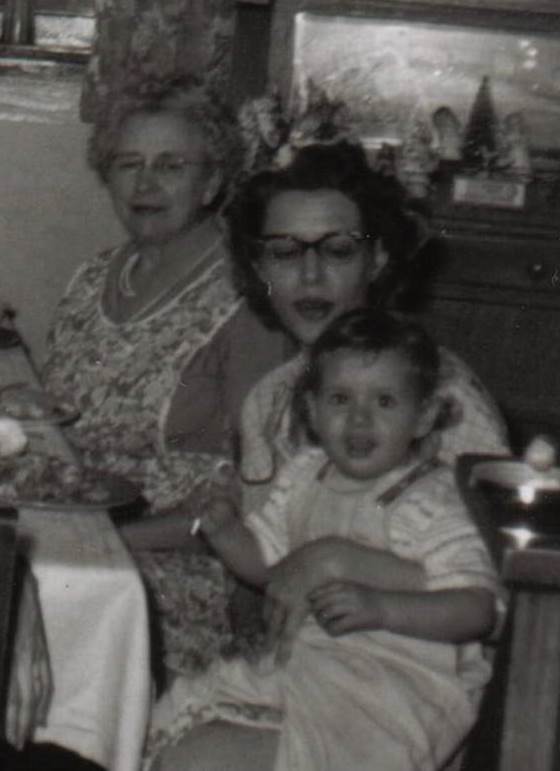
Me Mom Edity

You could also call this a mitochondrial DNA picture, because we all carry the mtDNA of Edith’s mother, Nora, passed to Edith, then through Edith to mother and then on to me, and now to my children as well.

The Early Years

Edith’s parents,  Ellnore “Nora” Kirsch and Curtis Benjamin Lore were married at the Kirsch House, the Inn where the family lived, in Aurora, Dearborn County, Indiana on January 18, 1888.  Nora made her wedding dress and descended the spiral staircase in the parlor.  This photo was taken on her wedding day.
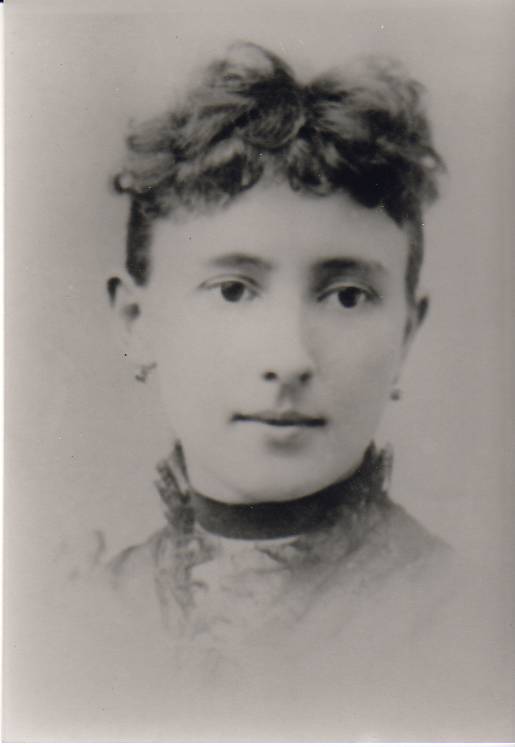
Nora Kirsch wedding

Church baptismal records indicated that their first child, my mother’s mother, was born August 2, 1888.  In case anyone is counting, that’s not 9 months.  That means the baby was “2 months premature,” and of course, the baby wasn’t premature, Nora was pregnant when they married.

The family took great pains to hide this fact, going so far as to enter the year as 1889 in various places.  Edith’s said that her birth year had been recorded incorrectly as 1888 for insurance purposes, which was probably something she had been told.

This seemed like a great deal of trouble to hide a pregnancy, especially since others in the same family had suffered from the same “prematurity” issue.  But in reality, it wasn’t the pregnancy that was being hidden, but what they “did,” you know, that three letter s-word, to cause the pregnancy.  Harumph….for shame….

However, today, we view these types of things from our cultural perspective and their perspective in 1888 was quite different.  This was well into the Victorian Era which lasted from about 1850 to about 1900.  Victorian morality could be described as any set of values that espouse sexual restraint, low tolerance of crime and a strict social code of conduct.  Obviously that “sexual restraint” part had been an issue.  Hmmm….

My mother recalled that they had a terrible time finding Edith’s birth certificate at all, because Edith thought she was born in Rushville, Indiana but she wasn’t it turns out, but in Indianapolis, Indiana.  This was during a time period when the family would do just about anything to disguise a pregnancy before marriage, including sending the young woman away, which may be why the baby was born in Indianapolis and neither in Aurora where Nora was raised or Rushville where they subsequently lived.

Curtis Lore Wedding

Nora, Edith’s mother, had married a wildcatter oil driller from Pennsylvania, Curtis Benjamin Lore [Lord], known as “C.B.”  Roguishly handsome, I do believe he got to look down the business end of a shotgun held by Nora’s father, Jacob Kirsch, who was none too shy about using said gun.  Jacob fought in the Civil War, led a lynch mob who meted out justice to an itinerant bricklayer who killed a man, and I’m sure he had no great love for this “older man” who got his daughter pregnant.  Had Jacob known that Curtis Benjamin Lore had a wife and family back in Pa., Curtis Benjamin Lore would have died in March 1888 of a shotgun blast instead of 24 years later in 1912 of TB.

Also, back then, when a woman married, she often dropped her middle name and inserted her maiden name in its place, so Nora Kirsch would have become Nora K. Lore and Edith Barbara Lore would have become Edith L. Ferverda when she married John Ferverda.  For whatever reason, that seemed to be tradition, at least in that part of Indiana, kind of a rite of passage into marriage, but it could and would certainly serve to confuse an unsuspecting genealogist a few decades later, well, maybe a hundred years later.  I think our ancestors have a sense of humor and enjoy doing things like this to us!

Edith as a child cropped

I have always loved this photo of Edith as a young child, wearing a gold bead necklace still in the family today.

Edith grew up in Rushville, Indiana where she would meet the agent who worked for the railroad, John Whitney Ferverda.  They married on November 17, 1908.

Rushville Republican Newspaper, Nov. 18, 1908 – Miss. Edith Barbara Lore and Mr. John Whitney Ferveda were quietly married at the Presbyterian church parsonage in North Harrison Street last night by Rev. J. L. Cowling.

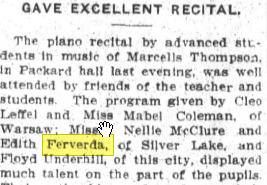
Rushville Republican Newspaper, Nov. 21, 1908 – Greenville News: Miss Edith Lore of Rushville and John W. Ferverda were married Tuesday afternoon. Miss Edith was one of the famous Watson “Beauty Bunch” composed of the 9 young women stenographers employed in Mr. Watson’s office during the campaign. She is a daughter of Curt B. Lore who drilled the first gas well in this city.

The photo of Edith, above was made into a postcard which was a popular way to say hello to someone when she was young.  This was probably about the time she married John Ferverda.  She did send at least one post card to him.

Edith umbrella postcard

The back of the postcard, below.

Edith postcard back

Their courtship must have lasted some time, because this postcard was a year and 10 days before their marriage.  They were at least flirting by November 1907.

A Woman with Aspirations

Edith young woman

Edith was not a “normal girl” for her time.  In fact, she never was “normal” when compared to her contemporaries of that time.
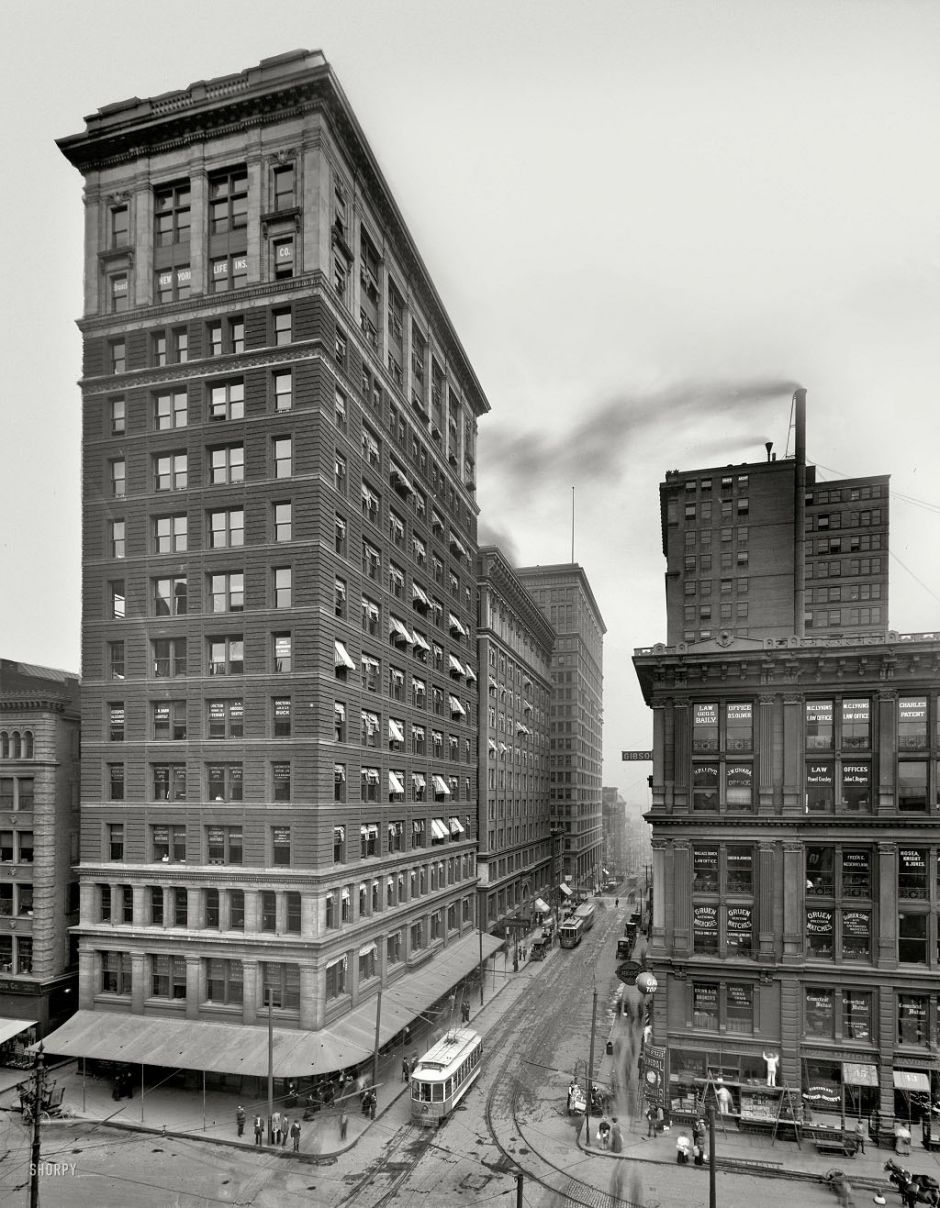
Cincinnati 1910

She went to business school in downtown Cincinnati, shown above in 1910, by commuting daily on the train from the Kirsch House where her grandparents lived, in Aurora, Indiana.  Edith had aspirations, first, for herself and then for her family.  She was a frustrated adult, because given the time in which she lived, and then the Great Depression, things didn’t quite work out the way she had in mind.

The Watson Beauty Bunch

The Rushville Republican Newspaper provides us with wonderful coverage of the Watson Beauty Bunch, a group of stenographers that assembled then used as “advertising,” for lack of a better term my a political candidate.  I’ll just let the newspaper articles tell the story. The best part is Edith’s picture.

watson-beauty-bunch

Click to enlarge.

watson-beauty-2

watson-beauty-3

And one more article.

watson-beauty-4

The Watson Beauty Bunch would have been considered very sexist today, in essence exploiting women, and not for their benefit. I don’t know how Edith felt about this, then or later – although she often told stories about this time to her family. I do know that my mother mentioned it, and not in a negative context, simply as something interesting and an involvement with politics. Edith and the other “Beauty Bunch” women experienced some amount of notoriety and their involvement was exciting and unique for that time.

Mother said that James Watson, a career lawyer and politician, wanted Edith to accompany him to Washington DC, but she declined – a decision she always regretted. Watson, a Republican, was defeated in his 1908 bid for Indiana governor after resigning his seat in the House of Representatives to run, but continued to be very influential in politics, eventually returning to Washington in the Senate.

It’s sad that in 1908 women couldn’t yet vote and the extent of their contributions were as stenographers.

Another perspective would be that while Watson certainly couldn’t help how women were socially perceived and the institutionalized discrimination that existed at that time, he was giving credit where credit was due, allowing those typically marginalized to the shadows to experience some limelight.

A stenographer was “one who transcribes,” according to Wikipedia, “such as a secretary who takes dictation,” often in shorthand.

Edith’s stint in business school wasn’t really about business at all, but focused more on secretarial skills that were supportive to those in business. Few job or career opportunities were available to women at that time, and stenography was one that was. Despite the sexist nature of the job, it was this skill set that saw the family through the Great Depression.

The Great Depression

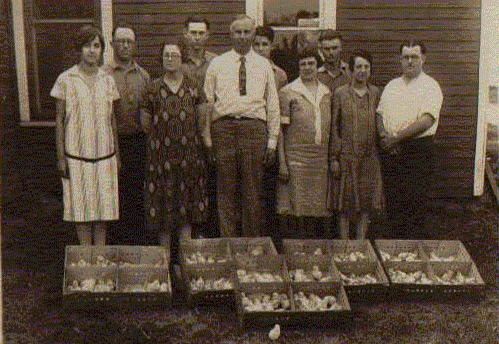
In fact, during the Depression, it would be Edith that supported the family.  Her husband John lost his hardware business sometime between 1920 and 1930, a devastating personal blow.  In the 1920s and 1930s, Edith worked at the chicken hatchery as the bookkeeper.  She is third from right, front row, below.
Chicken Hatchery

In 1951, she went to work as a stenographer for the Welfare Department until her death in 1960.

Lore women on motorcycle

The women in my family have TRIED to behave themselves, for generations, but overall, we haven’t been terribly successful.  In a moment of wild abandon, my grandmother, Edith, on the rear of this motorcycle, her mother, Nora in front of her and her two sisters, Eloise and Mildred in front leading the pack.  Yes, they did ride motorcycles, but not all 4 on one!  No, their husband’s did not approve. No, they did not stop, well, at least not because of that.  And even after they stopped, they had a little relapse from time to time.  Yes, my grandmother was a biker chick, a Harley Mama.  Way, way ahead of her time.

Edith Lore and John Ferverda moved back to his home town of Silver Lake, Indiana, away from the hustle and bustle and excitement of the big city and politics, where they spent the rest of their lives.  I think in many ways this was really difficult for Edith.

In the Family Memory book I gave to Mom to record her memories, here’s what she had to say about her mother, Edith:

“Mother went to business school in Cincinnati.  She commuted from Aurora at the Kirsch House to Cincy by train.  After that, she worked for a man who became a state senator from Rushville.  This was in the early 1900s before she and John [Ferverda] were married.  He wanted her to come to Washington DC and be his secretary but she turned it down because she had met John and did not want to leave Rushville.  She wanted to stay and marry my father and when he misbehaved, she reminded him that she could have gone to Washington instead.  This was before women could even vote which happened in about 1918 when women become franchised.  There were 8 or 9 young women who were the “Barnard Beauty Bunch” who worked his campaign. He selected her from that group but she turned him down.”
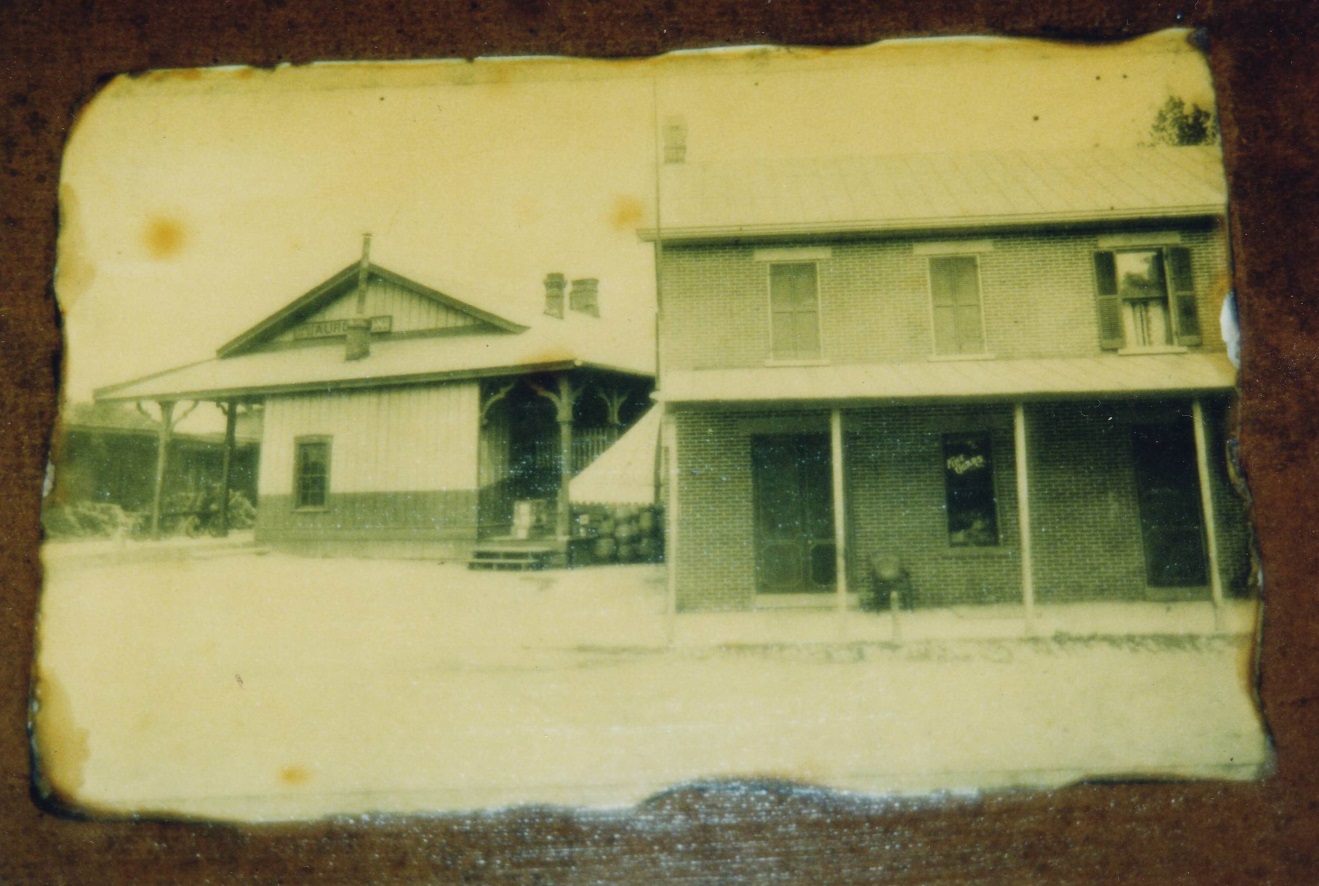
Kirsch House postcard

The Kirsch House, shown above at right, was located right beside the train depot, at left, so commuting to Cincinnati was easy.

Mom couldn’t remember the name of the man who ran for Congress.  Google, being my friend, I discovered that William O. Barnard was elected from that district in 1908.  This also makes sense in terms of the first name to go with the “Beauty Bunch”.  While we think of this as highly sexist today, it was apparently effective then and thought of as normal.  He was not reelected in 1910 and returned to practice law and become a judge in the area.  This would have had to have been the politician and it also makes sense in that John and Edith married on Nov. 17, 1908, just days after the election.

Mom’s Most Precious Memory of Edith

Here’s what Mom said in answer to the question, “What is your most precious memory of your mother?”

“There are so many. For many years she drove me 40 miles nightly after work to Fort Wayne two or three times a week to attend dancing school from which I at one point emerged as a professional tap dancer for approximately 5 years.  I first danced in Warsaw for a couple of years, then in Wabash, then in Fort Wayne.  That particular career ended when I fell and broke a bone in my foot.  She would go to work early and take her lunch so she could get her 8 hours in just in time to make the bank deposit and get me to class.  When I got home and she didn’t get home till 5 it was getting dark.  Lore, my brother, was delivering his papers and I was alone.  A couple of times Mom found me sitting under the street light at the corner because I didn’t want to be alone in the house.  After that she left work at 4.

In a small town there really wasn’t a sitter because there were so many neighbors watching to be sure that you weren’t doing something that your mother needed to be told about so she could get it stopped.  Busy bodies did serve a purpose. Once it rained and neighbor boy Frank and I were playing in gutters.  I heard the phone ring and I knew I’d better get inside and answer it or I’d be in trouble.  “Barbara Jean – you get in the house and you stay out of the street – NOW.”  We’d been having a “splashing good time”.”

My mother had Rheumatic Fever as a child which left her with a heart murmur, among other issues.  The doctor at the time recommended dancing as a way to strengthen her heart, so dance she did.  And she danced very well too, even with her “late start.”  But Mom’s story is one for another time.

As Mom got older, a teen, she taught dancing and her mother played the piano for that as well as for the local Methodist church. In the piano room in the house in Silver Lake, a hardwood floor was installed for Mom’s dancing and teaching.

Edith managed to break both of her wrists roller skating, which, ironically, she would not let my mother do because she was afraid she would hurt herself and not be able to dance.  Mom was 14 or 15 when Edith broke her wrists, so Edith would have been just under 50. Edith wanted to try and skate, but she fell and lit on her behind, catching herself with her hands, shattering both wrists.  The Doctor said they were not repairable because she had crushed the bones.  She practiced the piano to loosen them and worked out the pain because she was NOT going to give up playing for Mom’s dancing and recitals.  That woman had tenacity!

Newspaper articles from the local paper give us some additional glimpses of information about her life after she and John Ferverda moved back to Silver Lake.

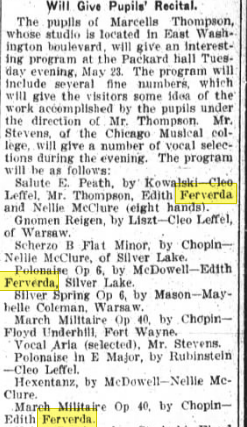
May 22, 1911
Newspaper 1911 cropped

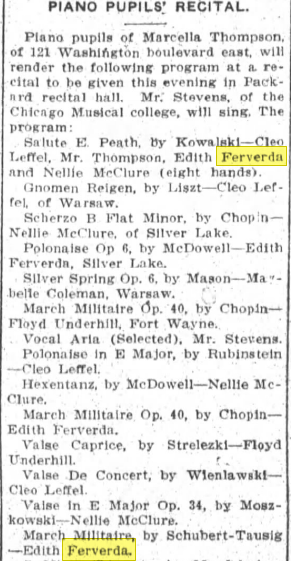
Edith used to accompany various students both for dance and voice.  She had married John in 1908 and their first child did not arrive until 1915.  This would have been after she married but before the responsibilities of children.

May 23, 1911
Newspaper 1911 2

May 24, 1911

Newspaper 1911 3

They were apparently pleased as she played for the students a second year as well.

July 30, 1912
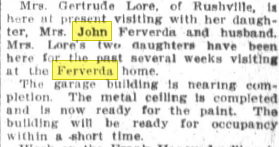
Newspaper 1912

Mrs. Gertrude (her name was Nora, not Gertrude) Lore of Rushville is here at present visiting with her daughter, Mrs. John Ferverda and husband.  Mrs. Lore’s two daughters (Mildred, 13, and Eloise, 9) have been here for the past several weeks visiting at the Ferverda home.  (I don’t think the following paragraph is relevant to the Ferverda family, but with all those females maybe my grandfather was taking up residence in the garage.)

October 11, 1912
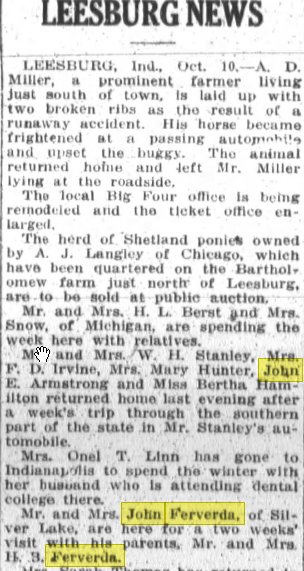
Newspaper 1912 2

Mr. and Mrs. John Ferverda of Silver Lake are here for a two weeks visit with his parents, Mr. and Mrs. H.B. Ferverda.

April 25, 1914

Newspaper 1914

Mrs. Ferverda and Miss McClure entertained a crowd of young people at the McClure home Wednesday night.

July 10, 1915
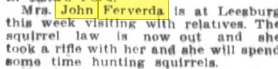
Newspaper 1915

Mrs. John Ferverda is at Leesburg this week visiting with relatives.  The squirrel law is now out and she took a rifle with her and she will spend some time hunting squirrels.

What?  My grandmother shooting squirrels.  Her first child, Harold Lore Ferverda was born in November 24, 1915.  So she was shooting a rifle in July of that year?  Amazing.

Nov. 27, 1915
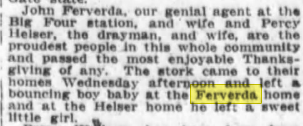
Newspaper 1915 2

John Ferverda, our genial agent at the Big Four station and wife and Percy Helser the drayman, and wife, are the proudest people in the whole community and passed the most enjoyable Thanksgiving of any.  The stork came to their homes Wednesday afternoon and left a bouncing boy baby at the Ferverda home and at the Helser home he left a sweet little girl.

There was a doctor in Silver Lake.  Everyone knew him of course.  But Edith’s two babies were not delivered by the doctor, but by a midwife.  Edith truly was a woman of the Victorian Era.  The doctor was not allowed to see her unrobed, and I don’t believe my grandfather, or any other man, ever did either.  This was typical for the time.  Hard to believe her granddaughters were bra burners and wore those immodest things called bikinis!!!

Jan. 22, 1916

Newspaper 1916

J. W. Ferverda has returned home from a trip to Rushville where he was for a couple of days visiting with his wife and son.

From the sounds of this, perhaps Edith took her new baby and went home to be with her mother for a few weeks.

October 14, 1916

Newspaper 1916-2

Mrs. John Ferverda and son have returned home from Aurora where they had been for a week visiting with relatives and many friends.

August 11, 1917

Newspaper 1917

Mrs. John Ferverda and son are down to Wabash this week visiting with relatives and friends.

Nora’s mother eventually moved from Rushville to Wabash, Indiana.  From the looks of this article, I’d say it was in 1917.  Wabash was much closer to Silver Lake than Rushville and it was probably a welcome move for both women.

Family Life

I tried every Sunday to write something about Mom’s life.  Her health was deteriorating by then, so I felt the need to record as much as possible while I still could.

Mom described her life and surroundings after she was born in1922.  In doing so, of course, she also described her parents’ lives during that time.

“Search and discovery led to many new items that made life easier and better for many, many people.  Medicine and surgical procedures were progressing.  Surgery was softer and easier to handle.  Penicillin was in the 30s.  Inside bathrooms became the norm instead of the exception.  We purchased the house where I grew up when I was about 3 [1925].  For several years we had an outside privy but then when I was about 8 [1930] a room was taken inside the house and water and drainage installed so we had an inside bathroom with a toilet, sink and bathtub.  As a child, I took a bath in the foot tub.  Adults washed all over from a washbasin and they were clean and smelled alright.”

“The electric refrigerator from GE had a big ball on top.”
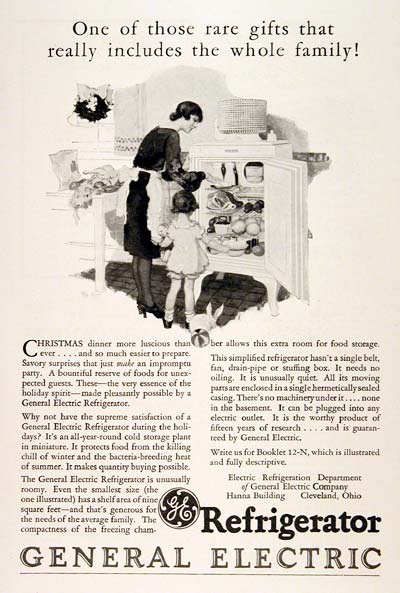
GE Refrigerator

‘Before that we had an ice box in the basement and an ice truck came by twice a week to put ice in the ice box.  The ice was cut from Silver Lake in the winter.’

Silver Lake ice house

“Mother made her sewing room a bathroom.  I sat on her lap while she pedalled the machine and I guided the fabric, or vice versa.  It was a Wheeler and Wilson machine which was at that time a very good machine but the wheel ran backwards.  I could not pedal and work the wheel and guide the fabric all at once. I could stretch to reach the pedal which we had to pump back and forth.  I was about 10 then.  That is the only sewing machine she ever had.”

Wheeler and Wilson sewing machine

“We had electricity in the new house when we moved into it in 1925.  We had an electric stove and oven.  That was a luxury.  Four burners and the oven to the right side on the same level as the burners.”
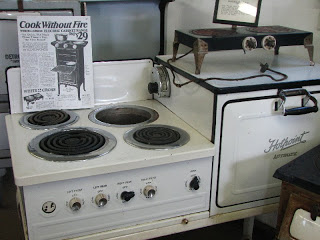
1925 electric stove

“We had a phone in both houses.  You would pick up the phone and ring the phone for the operator by cranking.  She would answer and say “number please.”  You would tell her the number you wanted to connect to.”
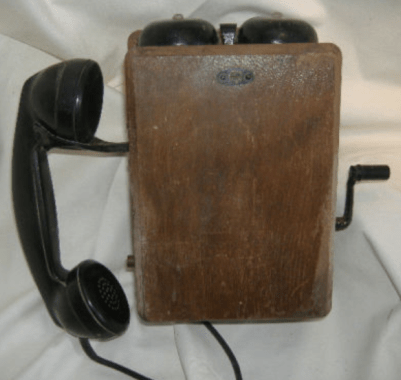
crank phone cropped

“You could call long distance too but most people avoided it because it was expensive.  Today it is still expensive, but we call long distance more freely and more people have phones too.”

On another page of the family book, the topic is “my mother’s kitchen”.  It asks questions about the most wonderful thing about your mother’s kitchen, how she let you help and about Mother’s best recipe.

Here’s what Mom had to say:

“Mother had a really good fudge recipe.  She was at work and I was home by myself. I got the recipe out and made fudge, beat it until thick enough to put into pan, so I sampled it, and sampled it some more. By the time Mother came home, there were 2 pieces left which I gave to her and was so proud of myself that I had made fudge.  Never occurred to me I shouldn’t have eaten the whole batch.”

For those of you who are adventurous souls, I scanned the recipe out of Mom’s recipe box and it’s below.  White syrup is Karo Syrup.  The chocolate referred to below is unsweetened.

Mom's fudge recipe cropped

My daughter made that same “from scratch” fudge recipe for my Mom as a gift for Christmas more than once.

I have a special memory of that kitchen too.  My grandmother had bluebird pie tins with holes in the bottom.

Bluebird pie pan cropped

My grandmother and grandfather had an apple orchard and a raspberry patch, so pies were always a staple.  She made her own pie crusts of course, because at that time, frozen foods weren’t available at the grocery store.  When she had a little extra dough left over she would spread it thinly in the bottom of the pie pan, butter it and sprinkle it with sugar and cinnamon and bake it special for me.  I love those pie crust pies better than any other!

The next page in the family book asks about lessons learned from Mother, and here’s what Mom had to say:

“The road to Hell is paved with good intentions.”

I can’t tell you how many times Mother said this to me.  Somehow seems appropriate, considering the fudge situation anyway:)

The Road to Hell

That was true of our DNA too….that good intentions, road to hell thing.  We’ve learned a lot in the past decade plus.

As I mentioned before, Nora, Edith, Mom and I all carry the same mitochondrial DNA, passed from mothers to all of their children, not admixed with any DNA from the father.  But only females pass it on.  So it’s a special grandmother-mother-daughter-granddaughter kind of bond.  It also means that to test to discover the mitochondrial DNA of an ancestor, you have to find someone descended from that ancestor to the current generation through all females.  But in the current generation, males can test too, because they inherit their mother’s mitochondrial DNA, but just don’t pass it on.

When DNA testing first began, in about the year 2000, we didn’t have full mitochondrial DNA sequencing available like we do today.  We know, for example, that our full haplogroup is J1c2f because every single location of our 16,569 mitochondrial DNA locations has been read.  There is no more to read, no mitochondrial DNA upgrades to be had…so we’re done.  Now the only way our haplogroup will “grow” is if new subclades within our subgroup of J1c2f are found and we fit into them, and then we might be classified as J1c2f1, for example.

For a long time, because we initially tested so early, all I knew was that my haplogrop was J, then J1, then J1c…you get the drift.  So we tried to make connections with people, and their ancestry, who matched us only on the HVR1 and then on the HVR1+HVR2 when we could test for both regions.  We found a match with a woman, Clara, whose ancestors were from a village not far from where Nora Kirsch’s great-grandmother was from in Germany.  Clara’s ancestors were Jewish and had vacated that area in Germany to journey into the Russian mountains into an enclave where they felt they would be safe several hundred years before Nora’s great-grandmother lived there in 1800.

While Clara and I could not connect genealogically, we felt that the coincidence of a 50 mile close connection, even if a few hundred years apart, was too much to be purely happenstance.  So, I thought, at that time, that it was very possible that our ancestors had at one time, been Jewish.

I was wrong.  We didn’t have enough information at that time but we didn’t realize it.

As additional testing became available, both Clara and I took the full sequence test and discovered that we are in different extended haplogroups.  This means that our common ancestors weren’t just 50 miles apart and a few hundred years, but 50 miles and a few thousand years, before the time of Christ and before the advent of the Jewish religion – back in the Near East.  Yes, they had both wound up in Germany, but their paths there were very different.  Clara’s ancestor as a Jewish woman and mine probably with the neolithic expansion of agriculture, thousands of years earlier.

Today, Clara and I don’t even show as matches.  This is because of smart-matching.  Family Tree DNA knows that if your full extended haplogroup doesn’t match, you really aren’t matches, so you are no longer shown at the HVR1 and HVR2 region as matches either.

How could we have been so wrong?  Partial data – it’s a dangerous thing.

First, initially we had few matches.  Second, some were Jewish.  He’s an excerpt of my haplogroup origins page.  Looks Jewish to me.  Right?
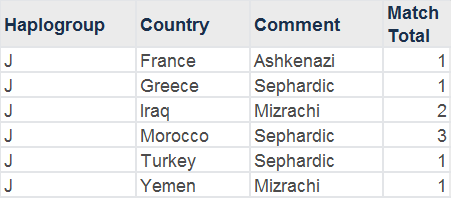
Hap J Jewish table

Right up until I tell you that these are ONLY HVR1 matches, ONLY 6 of 86 entries, so 7% of the HVR1 entries, and that none of my HVR1+HVR2 matches nor any of my full sequence matches are Jewish.  So were these HVR1 matches to test further, to the HVR2 or full sequence level, it’s very unlikely that any of them would continue as matches.  Now you’re not so excited anymore are you?  Well, this is the discovery sequence that happened over the years to our Jewish theory as well.

Fortunately in our case, we didn’t have a horse in the race, meaning we didn’t “want to be” Jewish or “not want to be” Jewish.  We were ambivalent about it.  We did however, want to know the truth, whatever it was – Jewish or not.  Our DNA gave us that, once full sequence testing was available.

Some people, on the other hand, become very unhappy, even disbelieving, when their pet theory has a scientific blowout.  Let’s just say this isn’t the first time that I’ve been thrown out of what I thought was my family tree.  The bad news is that more often than not, I’ve been the one sawing on the branch!  Ah yes, that road to hell thing…maybe it’s genetic:)
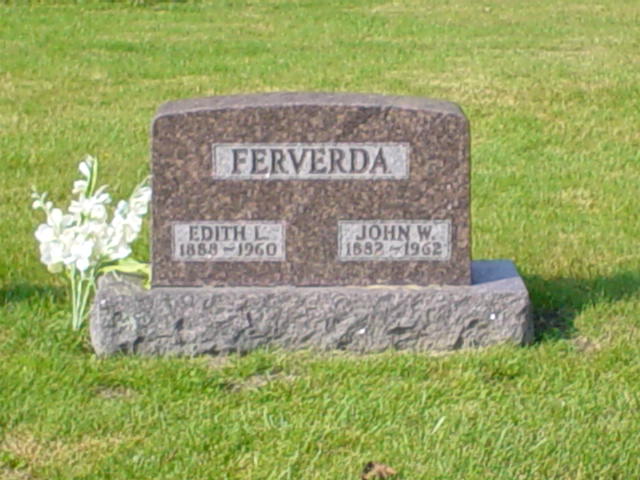
Ferverda stone

______________________________________________________________

Disclosure

I receive a small contribution when you click on some of the links to vendors in my articles. This does NOT increase the price you pay but helps me to keep the lights on and this informational blog free for everyone. Please click on the links in the articles or to the vendors below if you are purchasing products or DNA testing.

Thank you so much.

DNA Purchases and Free Transfers

Genealogy Services

Genealogy Research

The Loo

Bathrooms are a bit of a conundrum in England, as I discovered much to my dismay during the trip in the fall of 2013.

To start with, they aren’t called bathrooms, or toilets.  They are called “the loo” and no, I have absolutely no idea why.  But the differences don’t stop there, that is just the beginning.

First, they don’t have washcloths.  And no, I have no idea what they use instead. Nothing, I suspect.  Washcloths must be an American invention.

Thankfully, we were forewarned (thank you Katherine Borges and ISOGG) and brought some washcloths with us, leaving them sprinkled around hotels in England.  I expected most hotels would have them but they don’t.  I’m sure that’s the final “knife twist” for that pesky little insurrection we called the Revolutionary War.  And what’s worse, when you call the front desk to ask for a washcloth, they pretend like they have absolutely NO IDEA what you are talking about.  And I know, positively, every American who stays there calls the front desk and asks the same question.  I know they are all secretly laughing at us.

They could make a lot of money putting wash clothes in vending machines or offering them as room service.

Most bathrooms are painfully small, which is why they were initially referred to as “water closets.”  They, literally, were.  You can see one here or here in these rather, ahem, irreverent (but very funny) videos.  The first watercloset we experienced, in the Henry the 8th Hotel was literally about 3 feet by 5 feet and the shower was half of that.  We heard of another one where you sit on the toilet to shower.  Seriously!

By the time we got to the Stirk House, we had been in England for several days, and time after time, I was baffled by how some bathroom apparatus worked.  And once I got that one figured out, the next one was different.  There was no standardization.  Now I know how utterly ridiculous this sounds, being confused by a bathroom, so I’ll just share my morning with you.

Keep in mind, this was the morning after the DNA presentation that went to midnight, which was the day we visited Coventry, which was the morning after the fire alarm had gone off in the middle of the night in Cambridge, probably as a result of the drunken wedding party that kept us awake much of that night.  So, um, to say I was a bit tired and grouchy was probably an understatement.

In fact, this was me on the bus the day before.  Well, it was raining and the bus was rocking and we didn’t even get invited to the wedding party that kept us all awake.

 Me sleeping

At the Stirk House, we were in a new wing, so bathrooms were not an afterthought. You know, when many/most houses don’t have central heat, complaining about the size of a bathroom seems kind of, well, trifling.

I was glad to see a normal sized bathroom, but nothing else is normal at all, at least not for us Americans.  First, there is a towel warmer.  Now that’s a good idea!  We used to put towels over the radiator when I was a kid, along with our clothes.  I had never seen one in the US, or when I was in Europe in 1970.  This is the second one I had encountered in England.  I think it has to do with that no central heat thing.  It’s doggone cold when you’re buck nekked…

towel warmer

However, trying to figure out how the towel warmer worked was a challenge.  It seems that every electrical outlet in England also has a switch installed beside it – or sometimes not beside it…hidden elsewhere.  The red “on” light is always burned out, so you can’t tell whether it is off or on, and no, there is no standard position.  That is a ridiculous idea.  And the switches are always hidden behind a door by the baseboard in the lowest position possible, sometimes no place close to the item they control.  And sometimes, there are 2 or 3 switches together that control what?????

Whether the towel warmer works or not is really irrelevant, but other bathroom activities are simply not avoidable.  You have to figure out how those items work.  Thankfully, the toilet flush was always obvious, well, except for once.

The best kept secret, however, is how to make the shower work.  In fact, it seems to be a game.  I’m positive they have secret cameras installed to record what happens and we’re all going to see ourselves on YouTube one day.

Early on, I figured out that there were two knobs, one for temperature and one for water flow.  Ok, got that.  Some places have a button too.  Got that too.  So far, so good.  That’s three things to potentially go wrong.  What is wrong with one knob?

My husband, Jim, is a morning person and he loves breakfast.  Is there a gene for that?  I have absolutely no idea how the two of us managed to connect, because the beginning of my night is just prior to the beginning of his day.  So Jim hops right up at the crack of dawn, an ungodly hour.  I have no idea what he does at that hour, but whatever it is, he does it daily.  He could have an entire second family for all I know, and at 5:30 AM, I would not care.  Before noon, however, both the caffeine and the warrior gene, with a pinch of Scotch-Irish clan temper thrown in would have kicked in, and I’d be livid, so don’t get any bright ideas Jim.  Besides that, you can’t afford jewelry for two wives.

So Jim got out of bed, took a shower, then left for breakfast without waking me up.  While that may sound like he did me a favor, and it would be most days, it wasn’t THAT day.  He was SUPPOSED to wake me up, because we had to be on the bus by 8 AM.  I woke up, mortified to see what time it was, and hurried into the shower, only to discover I could not make it work, no matter what I did.  I turned dials, looked for hidden buttons, all to no avail.  How tough can this be, after all???

shower

I waited for Jim, who I knew would be back shortly since he didn’t wake me up.  I thought maybe he had done something really nice, like went to get me breakfast….but no….he had forgotten entirely about me and was having a leisurely full English breakfast in the restaurant with the family.  My family.

Finally, as the minutes ticked by, I couldn’t wait any longer, so I put on dirty clothes and hurried to the restaurant to find him, complete with bedhead, and asked him how to make the shower work.

Jim, irritated at being interrupted, at first claimed he didn’t know but I KNEW he knew since he HAD showered.

So I asked him again to no avail.  Then I told him in my best “irritated wife” voice that he did SO know – because he HAD showered.  Suddenly, the room went silent.

He finally turned around and actually looked at me, surveyed the situation, looked me up and down, seeing my bedhead cowlick….and then the man first chuckled a bit and then began to outright laugh.  Yes he did!

Had he lost his mind?  Does he not recall that in addition to it being the middle of my personal night and me without coffee, that I have the “Warrior Gene?”  Albeit the female version, which is supposed to be the Happiness Gene, but when a woman’s not happy, it reverts immediately to warrior status.  You know that old saying…if Mama ain’t happy…ain’t nobody happy.  We invented the Warrior Gene.

And Jim supposedly carries the “avoidance of errors” gene….you know….the one that keeps you from making the same mistake twice.  I have proof.  See below – that’s his result on his Family Tree DNA page.  “More likely to avoid errors.”  So much for genetics.

Jim Avoidance of errors cropped

You’d think after leaving his wife in a lurch just 2 days before that he’d been none too eager to do that again.  But then again, genetics is not determinism….and obviously there is some other genetic factor or conditioning or SOMETHING else at play here, because Jim did NOT avoid the error of his ways.  My quilt sisters would call this testosterone poisoning which I guess is genetic because it is connected to the Y chromosome…but I digress.

By now, my cousins eating breakfast with Jim are no longer able to stifle their laughter.  It seemed to be contagious.  Finally someone asked if I pulled the chain.

I asked, “What chain?”  I figured they were pulling MY chain.  I could barely speak civilly at this point.

Some toilets in Europe flush by a chain, but what doesn’t have anything to do with the shower.

“The chain over the toilet.”

“Huh?”

“The one with the red light over the toilet….”

“Isn’t that for handicap assistance or an emergency?”

“No, pull the chain over the toilet, then turn the water knobs.”

“Bloody Hell.”

“You’re not a morning person are you.”

What popped into my mind at just that moment did not come out of my mouth, blessedly.

Oh, and by the way, this gem of information did NOT come from Jim, who obviously HAD figured this out to take a shower, but from a cousin who took sympathy on me.  Or maybe he took sympathy on Jim, but thankfully, he took pity on one of us.

I figured this was actually a plot to make me set the fire alarm off or some such thing.  I knew they were all sitting over there just waiting…and stone cold sober in the morning too.  That kind of practical joke would be much funnier half in the bag around midnight.

However, out of sheer and utter desperation, I cringed and pulled the chain in the ceiling, waiting for the inevitable alarm.  Instead, the shower finally worked…. well, after I switched the water box to “on” too, and twisted the knob.

bathroom

So, yes, I did get my shower.  I did make it to the bus in time.  I did not get any breakfast, nor did Jim bring me any.  I reminded Jim of that all morning.  My cousins snickered and guffawed all morning.  Indeed, it was the beginning of a wonderful day….someone had to provide entertainment and it was obviously my turn.

So, in England, when in doubt, pull the cord over the toilet to take a shower.  Yep, makes perfect sense to me.

Now I know why we revolted!!!  Bloody Hell!

______________________________________________________________

Disclosure

I receive a small contribution when you click on some of the links to vendors in my articles. This does NOT increase the price you pay but helps me to keep the lights on and this informational blog free for everyone. Please click on the links in the articles or to the vendors below if you are purchasing products or DNA testing.

Thank you so much.

DNA Purchases and Free Transfers

Genealogy Services

Genealogy Research

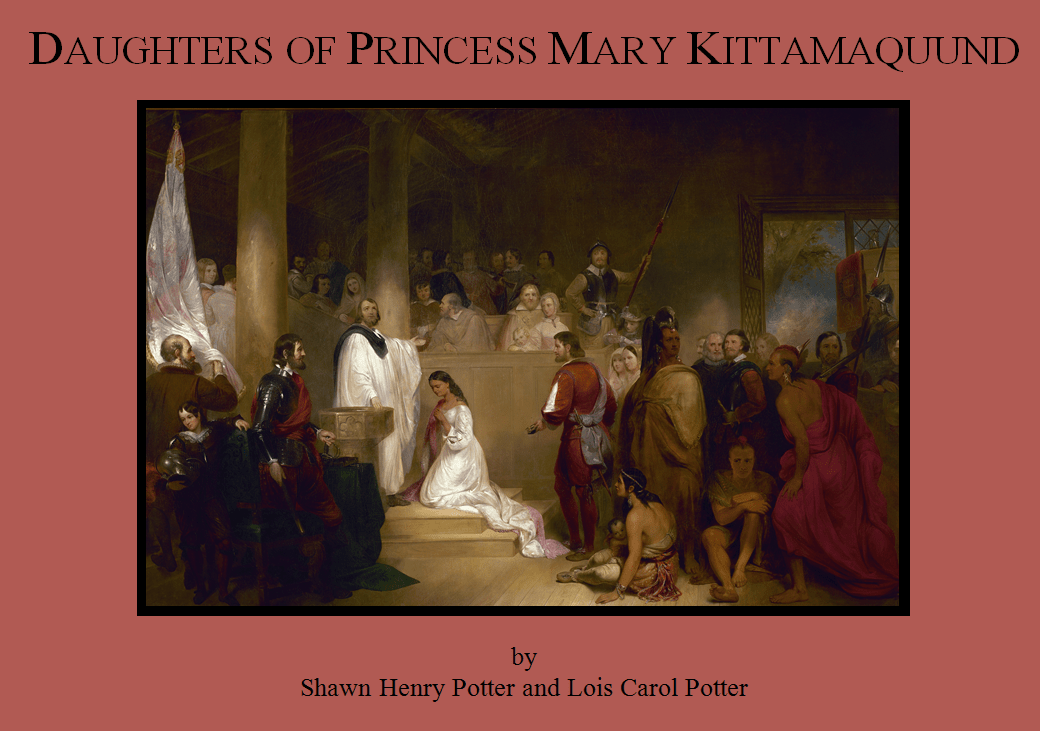
Daughters of Princess Mary Kittamaquund

Daughters book cover

Recently Shawn and Lois Potter utilized the Minority Admixture Mapping technique I developed, utilized and described in the series “The Autosomal Me” to establish that the mother of John Red Bank Payne was Native American.  Shawn and Lois were so encouraged after that positive experience that they set forth to document another Native ancestor.

They produced this report as a beautiful and fully sourced booklet which they have very graciously given permission to reproduce in part here.

Daughters of Princess Mary Kittamaquund

Every student of American history has heard about Pocahontas—the young Indian princess who struggled to establish peace between the Powhatan Indians and Virginia colonists, married Englishman John Rolfe, and left descendants through her son Thomas Rolfe.  But, few have heard about Mary Kittamaquund—another young Indian princess who likewise promoted peace between the Piscataway Indians and Maryland colonists, married Englishman Giles Brent, and, as revealed by archival research combined with DNA analysis, left descendants through her daughters.  Both women lived heroic yet brief lives; and both should be remembered for their devotion to their people in an age of momentous danger and change.  The following sketch introduces Princess Mary Kittamaquund and her daughters.

Mary Kittamaquund, daughter of the Tayac (Paramount Chief) of the Piscataway Indians, was born in Maryland probably about 1631.[i]  Her father ruled over as many as 7,000 people between the Potomac and Patuxent Rivers.[ii]  Following about six months of dialogue and study with Jesuit Missionary Father Andrew White, Mary’s father converted to Christianity and was baptized on July 5, 1640.[iii]  Soon after February 15, 1640/1, Mary too was baptized, and her father sent her to the English settlement called St Mary’s City, near the mouth of the Potomac River, to be educated by Governor Leonard Calvert and his sister-in-law, Margaret Brent.[iv]

Mary married Giles Brent, brother of Margaret Brent, before January 9, 1644/5.[v]  A band of Parliamentarians led by Richard Ingle and William Claiborne attacked St Mary’s City on February 14, 1644/5, and carried Giles Brent, Father Andrew White, and others in chains to England.  Upon his arrival in London, Giles brought suit against his captors and returned to Maryland before June 19, 1647.[vi]  Mary and Giles moved to present day Aquia, Stafford County, Virginia, after November 8, 1648, and before August 20, 1651.[vii]  Mary died probably after April 18, 1654, and before September 4, 1655.[viii]  Giles Brent died in Middlesex County, Virginia, on September 2, 1679.[ix]

Scholars disagree about the number of children born to Mary Kittamaquund and Giles Brent.  Some list only three children named in the 1663 and 1671 wills of sister and brother Margaret and Giles Brent.[x]  Margaret appointed her brother Giles “and his children Giles Brent, Mary Brent, and Richard Brent” executors of her estate.[xi]  Giles left bequests to his son Giles Brent and daughter Mary Fitzherbert.[xii]  Other historians, such as Dr. Lois Green Carr, Maryland Historian at the Maryland State Archives, on the basis of information gleaned from provincial court records, probate records, and quitrent rolls, identify six children of Mary and Giles, including Katherine Brent (who married Richard Marsham), Giles Brent (who married his cousin Mary Brent), Mary Brent (who married John Fitzherbert), Richard Brent (who died after December 26, 1663), Henry Brent (who died young), and Margaret Brent (who also died young).[xiii]

Some researchers further believe daughter Mary Brent divorced John Fitzherbert before April 26, 1672, and married second Charles Beaven.  This belief is supported by (1) a reference to the divorce of Mary and John in a letter of this date from Charles Calvert to his father, (2) a statement regarding “my brother iñ Richard Marsham” in the June 20, 1698 will of Charles Beaven, (3) the appointment of “my well beloved Richard Marsham” by Mary Beaven to be executor of her 1712 will, and (4) other circumstances demonstrating kinship ties between these families.[xiv]  Still others refuse to accept this relationship without further evidence, lamenting the loss of contemporary records which has “confused researchers for a hundred years.”[xv]

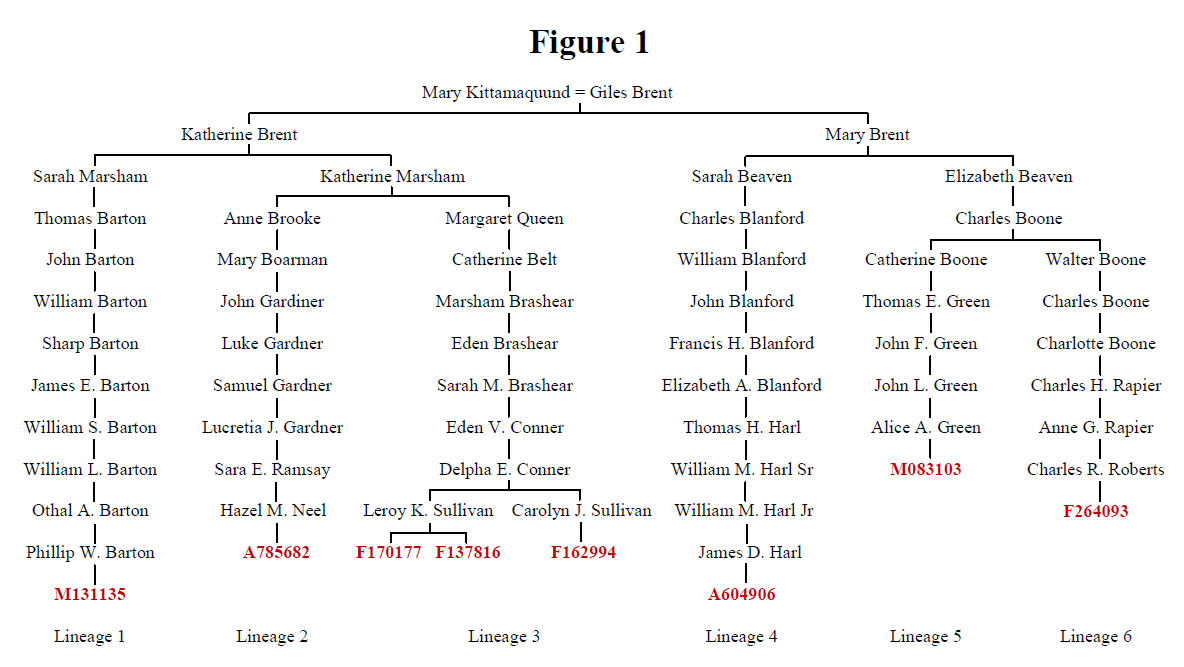
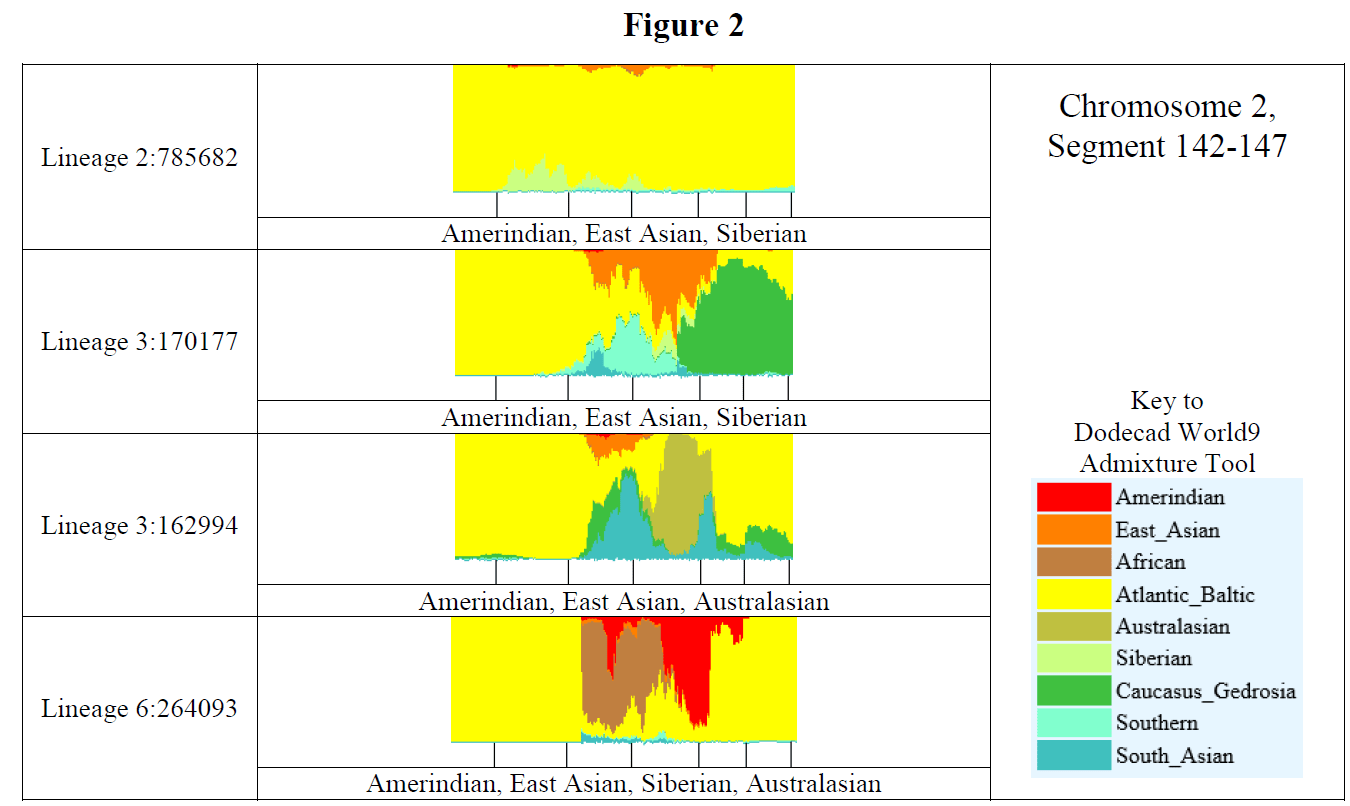
Recent DNA analysis, however, reveals six descendants of Katherine and Richard Marsham and three descendants of Mary and Charles Beaven, representing six separate lineages, inherited at least sixteen matching segments of Native American DNA on chromosomes 2, 3, 4, 5, 6, 7, 8, 13, 15, 16, 20, and 22.  Figure 1 shows the relationships between these descendants; and Figures 2-17 illustrate the sixteen matching Native American chromosomal segments (see Figures 18-33 for additional images of these segments produced by four independent admixture tools; and also see http://dna-explained.com/2013/06/02/the-autosomal-me-summary-and-pdf-file/ for information about Minority Admixture Mapping).  These matching chromosomal segments point to a common Native American ancestor, who, because other possibilities can be eliminated, must have been the mother of Katherine and Mary.[xvi]  Considering this DNA evidence in light of contemporary records, it now seems certain Mary Kittamaquund and Giles Brent were the parents of Katherine, wife of Richard Marsham, and Mary, wife first of John Fitzherbert and second of Charles Beaven.

Genealogical Summary

Katherine Brent was born probably in Aquia, Stafford County, Virginia, say about 1650.  She may have served an unknown period of indentured service to Thomas Brooke, perhaps following the death of her mother, before she married Richard Marsham perhaps before December 26, 1663, and certainly before March 11, 1664/5.[xvii]  Richard immigrated to Maryland in 1658, where he served three-years of indentured service to John Horne for his transatlantic voyage.[xviii]  Katherine died in Calvert County, Maryland, before October 26, 1670.[xix]  Richard married second Anne Calvert, widow first of Baker Brooke Sr., and second of Henry Brent, after April 30, 1695, and before February, 1696.[xx]  Richard died in Prince George’s County, Maryland, between April 14 and 22, 1713.[xxi]  Katherine and Richard were the parents of the following children:

1. Sarah Marsham was born in Calvert County, Maryland, say about 1667, married first Basil Waring say about 1685, married second William Barton after December 29, 1688, married third James Haddock after April 19, 1703, and died in Charles County, Maryland, after January 8, 1733.[xxii]

2.  Katherine Marsham was born in Calvert County, Maryland, say about 1669, married first her future step-brother Baker Brooke Jr. say about 1689, married second Samuel Queen after May 27, 1698, and died in St Mary’s County after March 18, 1712, and before April 14, 1713.[xxiii]

Mary Brent was born probably in Aquia, Stafford County, Virginia, say about 1654.[xxiv]  She married first John Fitzherbert before 1671.[xxv]  Mary and John divorced before April 26, 1672.[xxvi]  Mary married second Charles Beaven say about 1674.  Charles died in Prince George’s County, Maryland, between June 20, 1698, and June 21, 1699.[xxvii]  Mary died in Prince George’s County between April 28, 1712, and June 13, 1713.[xxviii]  Mary and Charles were the parents of the following children:

1. Richard Beaven was born in Calvert County, Maryland, say about 1676, married Jane Blanford before June 11, 1703, and died in Prince Georges County, Maryland, before August 9, 1744.[xxix]

2.  Sarah Beaven was born in Calvert County, Maryland, say about 1678, married Thomas Blanford on June 20, 1698, and died in Prince Georges County, Maryland, after August 7, 1749.[xxx]

3.  Margaret Beaven was born in Calvert County, Maryland, say about 1680, and died in Prince George’s County, Maryland, between April 28, 1712, and June 13, 1713.

4. Elizabeth Beaven was born in Calvert County, Maryland, say about 1682, married John Boone about 1708, and died in Prince Georges County, Maryland, before October 30, 1725.

5. Katherine Beaven was born in Calvert County, Maryland, say about 1684, married Henry Culver about 1711, and died in Prince Georges County, Maryland, before December 20, 1762.[xxxi]

6. Charles Beaven was born in Calvert County, Maryland, say about 1686, married Mary Finch about 1712, and died in Prince Georges County, Maryland, on December 16, 1761.[xxxii]

Daughters pedigree

Following this lineage information, Shawn and Lois included a chromosome by chromosome analysis of the various individuals who tested.  I am including only one example, below.

Daughters DNA

Following the many pages of genetic comparison information, Shawn and Lois included quite a bit for their readers about the Piscataway History and Culture.  After all, DNA without genealogy and history is impersonal science.  Included were early drawings and paintings of Native people and villages, an account of the people by Father Andrew White in 1635 as well as anonymous documents from 1639 and 1640.  Their food, language and vocabulary were discussed as well with historical events being presented in timeline format.

Piscataway Timeline

1550           Piscataway Tayac governed c. 7,000 people between Potomac and Patuxent Rivers

1608           John Smith explored the Potomac River; Piscataway welcomed him with kindness

1622           Powhatan Indians attacked at least 31 Virginia settlements along the James River

1623           Virginia colonists attacked Moyaone, killing many and burning houses and corn

1634           Piscataway Tayac Wannas permitted Leonard Calvert to establish St Mary’s City

1640           Piscataway Tayac Kittamaquund was baptized by Jesuit Father Andrew White

1644           Wahocasso succeeded as Tayac, who was succeeded by Uttapoingassenem in 1658, who was succeeded by Wannasapapin in 1662, who was succeeded by Nattowasso (son of Wahocasso—breaking the tradition of matrilineal succession) in 1663

1666           Facing increasing encroachments by European settlers, the Piscataway petitioned the Maryland council, saying: “We can flee no further.  Let us know where to live, and how to be secured for the future from the hogs and cattle.”

1695           Maryland Governor Francis Nicholson “advised the council to find a way of depriving Indians beyond Mattawoman Creek of their lands, in order to ‘occasion a greater quantity of Tobacco to be made.'”

1697           Piscataway Tayac Ochotomaquath and about 400 others fled to northern Virginia; then they allied with the Iroquois in 1701 and moved to Pennsylvania.

1699           Maryland colonists estimated Piscataway military strength at 80-90 warriors

Although many Piscataway left Maryland by the end of the 17th century in the face of encroaching European settlements, others remained on their homeland, intermarrying with Europeans and Africans, while preserving their cultural traditions.  In 1996, an advisory committee appointed by the Maryland Historical Trust voted unanimously to recommend state recognition of the Piscataway Indian Nation, citing genealogical, linguistic, cultural, and political continuity between the earliest Piscataway people and their modern descendants.  On January 9, 2012, Maryland Governor Martin O’Malley issued two executive orders, granting official state recognition to the Piscataway Indian Nation (about 100 members), and the Piscataway Conoy Tribe—consisting of the Piscataway Conoy Confederacy and Subtribes (about 3,500 members), and the Cedarville Band of Piscataway (about 500 members).

St Mary's City 1634 Indian Village

This drawing of St Mary’s City in 1634 by Cary Carson from the Maryland State Archives Map Collection shows the Native people living outside the city fortifications.

This 262 page book is a wonderful combination of genealogy, genetics and history, and does exactly what genetic genealogy is supposed to do.  It enables us to document and better understand our ancestors, and in this case, to prove they were indeed, Native American.  Shawn and Lois would welcome inquiries about the book or the family lines included and you can contact them at shpxlcp@comcast.net.


               [i] Most scholars estimate her year of birth as 1634, because an unidentified Catholic missionary made the following statement about her.  “On the 15th of February we came to Pascatoe, not without the great gratulation and joy of the inhabitants, who indeed seem well inclined to receive the christian faith.  So that not long after, the king brought his daughter, seven years old, (whom he loves with great affection,) to be educated among the English at St. Mary’s; and when she shall well understand the christian mysteries, to be washed in the sacred font of baptism.”  See “Extracts from Different Letters of Missionaries, from the Year 1635, to the Year 1638,” in E.A. Dalrymple, ed., Relatio Itineris in Marylandiam.  Declaratio Coloniae Domini Baronis de Baltimoro. Excerpta ex Diversis Litteris Missionariorum ab Anno 1635, ad Annum 1638, Narrative of a Voyage to Maryland, by Father Andrew White, S.J.  An Account of the Colony of the Lord Baron Baltimore.  Extracts from Different Letters of Missionaries, from the Year 1635 to the Year 1677 (Baltimore: Maryland Historical Society, 1874), 76.  But, the circumstances of Mary’s life suggest she was born a few years earlier.  So, we suspect the author of this letter underestimated her age.

               [ii] Father Andrew White, “Annual Letter of the English Province of the Society of Jesus, 1639,” in Clayton Colman Hall, ed., Narratives of Early Maryland, 1633-1684 (New York: Barnes & Noble, Inc., 1910), 126.

               [iii] Ibid.

               [iv] Ibid., 131.

               [v] John Lewger to Governor Leonard Calvert, January 9, 1644/5, in Proceedings of the Council of Maryland, 1636-1667, Vol 3, pp. 162-163 (original pages 186-187), Archives of Maryland Online.  “To the horle Governor.  Sir  I doe signify unto you that Mr Giles Brent hath delivered unto me 2. petitions nerewth sent unto you; and I desire you by vertue of the Law in that behalfe, that you wilbe pleased to give him a competent security for his indemnification in the possession of the lands at Kent, mentioned in one of the said petitions, & for iustification of his title in them, according to the said petition, dated 7. January instant: & likewise to satisfy unto him 5700l tob & cask, demanded in the other petition for damage of non pformance of a covenant to his wife Mary touching certaine cattell; or els to shew cause why you refuse to doe either; and to appoint some time when the Counsell shall attend you for it, betweene this & Monday next.  So humbly take leave to rest  Yor servant  S. Johns. 9th Jan: 1644 John Lewger.”  See also Margaret Brent, “Account of the Estate of Governor Leonard Calvert,” June 6, 1648, in Judicial and Testamentary Business of the Provincial Court, 1637-1650, Vol. 4, pp. 388-389 (original pages 159-160).  “By payd to Mrs. Mary Brent Kittamagund 0748.”

               [vi] For information about the arrest and transport of Giles Brent to London during Richard Ingle’s Rebellion, see “Richard Ingle in Maryland” in Maryland Historical Magazine, Vol. 1(1906), 125-140.  For the terminus ad quem (limit to which—latest possible date) Giles Brent returned to Maryland, see Maryland State Archives, Judicial and Testamentary Business of the Provincial Court, 1637-1650, Vol. 4:312-313.  “June 19th This day came Margaret Brent Gent, & desyred the testimony of the prnt Gouernor Mr Tho: Greene concerning the last will & Testamt of the late Gouernor Leonard Calvert Esqr And the sd Gouernor did authorize Giles Brent Esqr one of his Lops Counsell to administer an oath unto him the sd Gouernr concerning the foresd busines.  The sd Gouernor Tho: Greene Esqr answered uppon oath concerning the last will & Testamt of Leo: Calvert Esqr aforesd That the sd Leo: Calvert, lying uppon his death bed, some 6 howres before his death, being in prfect memory, directing his speech to Mrs Margarett Brent sayd in pnce of him the sd Mr Greene & some others I make you my sole Exequutrix, Take all, & pay all.  After wch words hee the sd Leon: Calvert desyred every one to depart the roome & was some space in priuate conference wth Mrs Marg: Brent aforesd Afterwards the Mr Greene comeing into the roome againe, he heard the sd Mr L: Calvert appoint certaine Legacies in manner following.  Viz I doe giue my warring cloaths to James Linsay, & Richard William my servants, specifying his coath suite to Rich. Willan & his black suite to James Linsey. & his waring Linnen to be diuided betweene them.  Aliso I giue a mare Colt to my God sonne Leon: Greene.  Allso hee did desyre tht his exequutrix should giue the first mare Colt tht should fall this yeare, (& if non fall in this yeare, then the first tht shall hereafter fall) unto Mrs Temperance Pippett of Virginea.  And further he deposeth not.  Recognit Teste mc Willm Bretton Clk.”

               [vii] The terminus a quo (limit from which—earliest possible date) for the relocation of Giles Brent from Maryland to Virginia is the date Giles Brent appeared in court at St. Mary’s on November 8, 1648, requesting compensation for destruction of his property on the Isle of Kent by anti-Papists.  See Archives of Maryland, November 8, 1648, Liber A, Folio 205.  The terminus ad quem (limit to which—latest possible date) Giles Brent removed from Maryland to Virginia is the date Giles Brent patented Marlborough in Potomac Neck, Virginia, on August 20, 1651.  See entry from Mercer Land Book cited by W.B. Chilton, ed., “The Brent Family,” The Virginia Magazine of History and Biography, Vol. 16, No. 1 (Jul., 1908), 96-97.

               [viii] Virginia Magazine XVI, 211.  On April 17, 1654, Giles conveyed his personal estate in Virginia and Maryland to his sister Mary, in trust to educate his children and allow maintenance to his wife Mary.  See also Lurene Rose Bivin in “Brent-Marsham-Beaven-Blandford Article: A Closer Look,” Maryland Genealogical Society Bulletin, Vol. 37, No. 3, 328-334.  “In the grant to John Harrison (dated 4 September 1655), he refers to his “sister” as Mrs. Frances Harrison (Nugent, p. 319).”  Giles may have been engaged to marry his second wife, Frances Whitgreaves, widow of Jeremiah Harrison, on this date, because John Harrison made a provision for Giles.

               [ix] W.B. Chilton, ed., “The Brent Family,” The Virginia Magazine of History and Biography, Vol. 16, No. 2 (Oct., 1908), 212.  “‘Register of Christ Church, Middlesex County, Virginia.  Collo Giles Brent of Potomac departed this life 2d of September 1679 and was buried in the Great Church Yard ye next day following.'”

               [x] For example, see Douglas Richardson, Magna Carta Ancestry: A Study in Colonial and Medieval Families (Baltimore: Genealogical Publishing Co., Inc., 2005), 129.  “They had two sons, [Col.] Giles and Richard, and one daughter, Mary (wife of [Capt.] John Fitzherbert).”  See also, Robert W. Barnes, British Roots of Maryland Families (Baltimore: Genealogical Publishing Co., Inc., 1999), 73-74.

               [xi] W.B. Chilton, Vol. 16, No. 1 (Jul., 1908), 98-99.  “The Will of Margaret Brent.  In the name of God Amen.  I Margaret Brent of Peace in the County of Westmoreland in Virginia considering the casualtys of human life do therefore make this my last Will and Testament as followeth my soul I do bequeath to the mercies of my Savior Jesus Christ and my worldly estate to be disposed of by my Executors as followeth to my nephew George Brent I give all my rights to take up land in Maryland except those already assigned to my cousin James Clifton to my niece Clifton I give a cow and to my neece Elizabeth Brent I give a heifer; to Ann Vandan I give a cow calf; to my neece Mary Brent daughter of my Brother Giles Brent I give all my silver spoons which are six; to my nephew Richard Brent son of my brother Giles Brent I give my patent of lands at the Falls of Rappahanock River also my lease of Kent Fort Mannor in Maryland saving yet power to his Father my brother Giles Brent that if he shall like to do so he may sell said lease and satisfye to his son other where as he shall think fitt in lands good or money and in case of my said nephew Richard Brents death under age and without heirs of his body lawfully begotten his legacy thereto to go to his brother Giles Brent or his sister Mary Brent or to the heirs of my brother Giles Brent or otherwise as my said brother shall dispose it by his Deed or last Will to my brother Giles Brent and to his heirs forever I give all my lands goods and chattles and all my estate real and personal and all that is or may be due to me in England Virginia Maryland or elsewhere still excepting the before disposed of in this my last will and Testament and I do appoint him my said Brother Giles Brent and his children Giles Brent Mary Brent and Richard Brent or such of them as are living at the time of my death the Executors of this my last Will and Testament.  In witness whereof I have hereunto set my hand and seal this 26th day of December, Anno Domini, 1663.”

               [xii] W.B. Chilton, Vol. 16, No. 1 (Jul., 1908), 98.  “The Will of Giles Brent.  In the Name of God Amen.  I Giles Brent of the Retirement in Stafford County in Virginia Esquire contemplating the uncertainty of my time of death do ordain this my last Will and Testament in manner and form following my body to the earth and my Soul I bequeath to the mercy of my Savior Christ all my worldly estate I appoint to my Exectors to be disposed of as followeth to my daughter Mary Fitzherbert I give five ewes and a ram to my son and heir Giles Brent and to the heirs of his body lawfully begotten I give for ever all my lands rights unto lands and reversions of lands any ways due to me in either England Virginia or Maryland and for want of such heirs then unto mine own right heirs and for want of such then to the right heirs of my Honored Father Richard Brent, Esquire, deceased Antiently Lord of the mannors of Admington and Lark Stoke in the County of Gloucestershire in England after my debts paid I give all my goods moveable or immoveable whatsoever to be disposed of as followeth three thousand pounds of good tobacco with cask to be given by them my Executors unto pious use where and to whom they shall see fitt for which doing and how and to whom given I Will that to none else but God they shall be accountable.  I also Will that to Mr. Edward Sanders they give four ewes and a ram and to John Howard four ewes and a ram.  Executors of this my last Will and Testament I appoint my son Giles Brent and my Brother Richard Brent and my Brother William Brent both in England and as Attorneys in their Executorship untill my said Brothers shall otherwise order and I do appoint Mr. Edward Sanders and John Howard above mentioned both of Stafford County to be and to act and it is my Will that after my debts and my Legacies paid my said Executors stand possessed of all my goods and personal estate to the sole use of my son Giles Brent then to be delivered into his sole dispose when it shall please God that he hath arrived to the age of one and twenty years.  In witness unto this my within written last Will and Testament I have hereunto set my hand and seal this last day of August, Anno Domini, 1671.”

               [xiii] Image SC4040-0166-1, Dr. Lois Green Carr’s Biographical Files of 17th and 18th Century Marylanders, Maryland State Archives, http://msa.maryland.gov/megafile/msa/speccol/sc4000/sc4040/000001/000166/html/sc4040-0166-1.html.  Note: Dr. Carr lists the children in the following order: Mary, Giles, Richard, Katherine, Henry, Margaret.

               [xiv] See excerpt from Charles Calvert to Cecilius Calvert, April 26, 1672, in William Hand Browne, ed., Proceedings of the Council of Mayland: 1671-1682 (Baltimore: Maryland Historical Society, 1896), xiv.  “Major Fitzherbert’s brother who maryed the Indian Brent, has civilly parted with her, and (as I suppose) will never care to bed with her more; soe that your Lordship needs not to feare any ill consequence from that match, butt what has already happened to the poore man, who unadvisedly threw himself away upon her in hopes of a great portion which now is come to little.”  See also Will of Charles Beaven, signed June 20, 1698, proved June 21, 1699, Prerogative Court (Wills) Vol. 2, pp. 182-183, Liber 6, Folios 285-286.  See also Will of Mary Beaven, signed April 18, 1712, proved June 13, 1713, Prerogative Court (Wills) Vol. 3, p. 240, Liber 13, Folio 513.  See also Maryland Land Patents, BB#37:374.  On March 15, 1696/7, Richard Marsham transferred 600 acre grant called The Hickory Thickett to Charles Beaven by assignment.

               [xv] Lurene Rose Bivin in “Brent-Marsham-Beaven-Blandford Article: A Closer Look,” Maryland Genealogical Society Bulletin, Vol. 37, No. 3, 328-334.

               [xvi] Four potential scenarios explain this matching DNA considered together with Charles Beaven’s reference to Richard Marsham as “my brother iñ Richard Marsham.”  The first scenario is Richard Marsham and Charles Beaven were brothers.  This scenario almost certainly is not true because Richard Marsham and Charles Beaven had different last names and the written reference by Charles Beaven to Richard Marsham as “my brother iñ” appears to have been a standard contraction of “my brother-in-law.”  The second scenario is Richard Marsham and Mary, wife of Charles Beaven, were brother and sister.  This scenario almost certainly is not true because Mary referred to Richard Marsham as “my well beloved Richard Marsham.”  If Richard Marsham and Mary had been brother and sister, Mary surely would have referred to Richard as her brother.  The third scenario is Charles Beaven and Katherine, wife of Richard Marsham, were brother and sister.  This scenario almost certainly is not true because their descendants inherited matching segments of Native American DNA.  Charles Beaven immigrated from England to Maryland in 1666 (Skordas, Liber 9, folio 455), so he surely did not inherit Native American DNA from his parents.  The fourth and most compelling scenario is Katherine, wife of Richard Marsham, and Mary, wife of Charles Beaven, were sisters, and they also were daughters of a parent with Native American ancestry.  This scenario is consistent with other indications that Katherine and Mary were daughters of Mary Kittamaquund and Giles Brent.

               [xvii] Maryland Colonial Land Records, Liber 7, Folio 582, 583, Maryland State Archives.  “March xith 1664.  Came David Bowens and demands land for these rights following John Barnes, Clement Barnes, Margaret Whitthe, Martha Garbett, Catherine Marsham by Assign and Francis Street by Assign as follows–Know all to whom these presents may concern, that I Katherine Marsham doe assigne all my Right and Title of a Right due to mee the said Katherine for fifty acres of land unto David Bowing as witness my hand this Eleventh of March One Thousand six hundred sixty foure.  Katherine Marsham (her K mark).  Witness Richard Marsham, Robert Turner.  Know all men by these presents to whom this may concern that I Francis Streete doe assigne all my Right and Title of a right due to mee the said Francis Streete for fifty acres of Land unto David Bowing as witness my hand this Eleventh of March One Thousand six hundred sixty four.  Francis Streete.  Witness Richard Marsham, Robert Turner.”  See also Maryland Colonial Land Records, Liber 12, Folio 512, Maryland State Archives.  “May 11th 1670.  Came Richard Marsham of Calvert County and proved right to fifty acres of land it being due to him for the time of service of Katherine his wife performed to Major Thomas Brooke, Warrant then issued in the name of the said Richard Marsham for fifty acres of land it being due to him for the causio oraem above.  Certified the 11th of August next.”  Note: Even though these two documents indicate Katherine was due a total of 100 acres, the first 50 acres for an unstated cause and the second 50 acres for service to Thomas Brooke, neither record says Katherine was transported to Maryland, and both records may result from fraudulent claims.  If these records reflect legitimate claims, they do not say or prove Katherine was transported to Maryland, since some claims were granted for people who were born in Maryland.  For example, a patent for 1,644 acres was granted to Mary Brent on November 17, 1652, for the transportation of 33 persons, including “Mrs. Mary Brent, wife to Capt. Brent.”  See Nugent, pp. 266-267.  This Mrs. Mary Brent was Mary Kittamaquund, wife of Giles Brent, who certainly was born in Maryland.  Furthermore, according to Abbott Emerson Smith (“The Indentured Servant and Land Speculation in Seventeenth Century Maryland,” in The American Historical Review, Vol. 40, p. 467), “A great many of the warrants which were granted were for rights proved by the wife of a freedman.  It is not unlikely that some persons managed to get freedom dues in land, although they had never been in indentured service.”  Finally, if Katherine did serve a term of indenture, her service may have resulted from the death of her mother at a time when she was old enough to begin providing for her own maintenance.  It was not unusual during this era for children of deceased well-to-do colonists to serve a term of indenture.

               [xviii] See Maryland Colonial Land Records, Liber 4, Folio 4, Maryland State Archives.  “May the 7th 1659.  John Home demands Land for the transportation of himself and his Servants, Richard Marsham & John Edmondson, in 1658.”  See also Maryland Colonial Land Records, Liber 5, Folio 295, Maryland State Archives.  “Know all men that I Richard Marsham do give and make over to Thomas Pagett my right as is due to me as being a Servant, and now being free in Roberto McJohn Hearen as witness my hand the 16th of September 1661.  Richard Marsham.  Wit: Robert Coberthwail, Michael Coreuly.”

               [xix] See Maryland Colonial Land Records, Liber 12, Folio 512, Maryland State Archives, as cited above.  “May 11th 1670.  Came Richard Marsham of Calvert County and proved right to fifty acres of land it being due to him for the time of service of Katherine his wife performed to Major Thomas Brooke, Warrant then issued in the name of the said Richard Marsham for fifty acres of land it being due to him for the causio oraem above.  Certified the 11th of August next.”  See also Maryland Colonial Land Records, October 26, 1670, Liber 14, Folio 228.  “Patent for 50 acres in St. Mary’s County, originally Calvert County, to Richard Marsham, tract called St. Katherine’s.”  Note: This patent establishes the terminus ad quem (limit to which—latest possible date) for Katherine’s death, because Richard would be unlikely to name this property Saint Katherine’s unless Katherine had died.

               [xx] The terminus a quo (limit from which—earliest possible date) for Richard’s marriage to Anne Calvert is established by the date of a Prerogative Court record concerning the estate of Henry Brent naming Anne Brent executrix.  See Prerogative Court Records, April 30, 1695, Liber 13A, folio 291, Maryland State Archives.  The terminus ad quem (limit to which—latest possible date) for Richard’s marriage to Anne Calvert is the date they were named as husband and wife on a probate record.  See Provincial Court Judgments, February Court 1696, Liber P. L. #3, Folios 556-557, Maryland State Archives.  Richard Marsham with Ann Marsham, administrator of Henry Brent, against Thomas Collier.

               [xxi] Will of Richard Marsham, signed April 14, 1713, probated April 22, 1713, Maryland Prerogative Court (Wills), Liber xiii, Folio 514-520, Maryland State Archives.

               [xxii] The approximate year of Sarah’s marriage to Basil Waring is estimated from the year of Basil’s death preceded by four years to account for the births of two children.  See Will of Basil Waring, signed December 8, 1688, probated December 29, 1688, Maryland Calendar of Wills, Vol. 2, p. 50, and Liber 6, Folio 66.  Basil named his wife Sarah and sons Marsham and Basil.  The terminus a quo (limit from which—earliest possible date) for Sarah’s marriage to William Barton is determined by the probate date of the will of her first husband Basil Waring.  See Will of Basil Waring, signed December 8, 1688, probated December 29, 1688, Maryland Calendar of Wills, Vol. 2, p. 50, and Liber 6, Folio 66.  The terminus a quo (limit from which—earliest possible date) for Sarah’s death is determined by her deed to Robert Mackhorn.  See Deed from Sarah Haddock to Robert Mackhorn, signed January 8, 1733, recorded March 18, 1733/4, Charles County Land Rcords: 1733-1743, Book O #2, page 28.  “Sarah Haddock, widow, of Prince George’s County, formerly wife of William Barton, late of Charles County, Gent., deceased, to Robert Mackhorn of Charles County, planter.  William Barton by his will, divised to his son-in-law, Basil Waring, 300 acres, being part of this tract of land called Hadlow, lying in Charles County, and the rest of Hadlow to his wife, being now the aforementioned Sarah Haddock.  Now this deed witnesses that sd. Sarah Haddock, for 4500 lbs tobacco, has sold to said Robert the rest of Hadlow, lying in Charles County, bounded by Thos. Gerard, the division line made by sd. Sarah Haddock and Basil Waring.  Signed Sarah Haddock.  Wit. Jas. Haddock Waring, Henry Keen.”

               [xxiii] The approximate year of Katherine’s marriage to Baker Brook is estimated from the year of Baker’s death preceded by eight years to account for the births of four children.  See Will of Baker Book, signed February 5, 1698, probated May 27, 1698, Maryland Calendar of Wills, Vol. 2, p. 142, and Liber 6, Folio 83.  Baker named his wife Katherine and four children Baker, Leonard, Richard, and Ann.  The terminus ad quem (limit to which—latest possible date) for Katherine’s marriage to Samuel Queen is determined by the probate date of the will of her first husband Baker Brooke.  See Will of Baker Book, signed February 5, 1698, probated May 27, 1698, Maryland Calendar of Wills, Vol. 2, p. 142, Liber 6, Folio 83.  The terminus a quo (limit from which—earliest possible date) for Katherine’s death is determined by the date her husband’s will was probated.  See Will of Samuel Queen, signed January 10, 1711, probated March 18, 1712, Maryland Prerogative Court (Wills), Vol. 3, p. 222, Liber 13, Folio 389, Maryland State Archives.  The terminus ad quem (limit to which—latest possible date) for Katherine’s death is determined by the date of the will of her father, Richard Marsham, which provides for her children but does not mention her.  See Will of Richard Marsham, signed April 14, 1713, probated April 22, 1713, Maryland Prerogative Court (Wills), Liber 13, Folios 514-520, Maryland State Archives.

               [xxiv] On April 5, 1673, Giles Brent Jr., son of Col. Giles Brent and Mary Kittamaquund, deeded 500 acres, which he had inherited from his father, to his uncle George Brent of Woodstock, Stafford County, Virginia, stating he had reached the age of 21—a condition set in his father’s will for his ability to take possession of the land.  This suggests Giles Brent Jr. was born about 1652.  See W.B. Chilton, Vol. 16, No. 1 (Jul., 1908), 99-100.

               [xxv] Will of Giles Brent, signed August 31, 1671, in W.B. Chilton, Vol. 16, No. 1 (Jul., 1908), 98.

               [xxvi] See excerpt from Charles Calvert to Cecilius Calvert, April 26, 1672, in William Hand Browne, ed., Proceedings of the Council of Mayland: 1671-1682 (Baltimore: Maryland Historical Society, 1896), xiv.  “Major Fitzherbert’s brother who maryed the Indian Brent, has civilly parted with her, and (as I suppose) will never care to bed with her more; soe that your Lordship needs not to feare any ill consequence from that match, butt what has already happened to the poore man, who unadvisedly threw himself away upon her in hopes of a great portion which now is come to little.”

               [xxvii] Will of Charles Beaven, signed January 20, 1698/9, proven June 2, 1699, Prince Georges County Wills, Liber 6, folios 285-286,  Maryland State Archives.

               [xxviii] Will of Mary Beavan, signed April 28, 1712, proven June 13, 1713, Prince Georges County Wills, Liber 13, folio 513, Maryland State Archives.

               [xxix] Will of Richard Bevan Sr., signed February 27, 1738/9, proven May 21, 1739, Maryland Calendar of Wills, Vol. 8, p. 789, Liber 22, folio 58, Maryland State Archives.  For the terminus ad quem (limit to which—latest possible date) of Richard’s marriage to Jane Blandford, see Administration of the Will of William Bayly, June 11, 1703, Liber 24, folio 16a, Prince Georges County, MD.  “Executrix, Mrs. Jane Beven, wife of Richard Beven.”

               [xxx] Will of Thomas Blandford, signed June 17, 1749, proven August 7, 1749, Maryland Calendar of Wills, Maryland State Archives.  Thomas named his wife Sarah executrix.

               [xxxi] Will of Catherine Culver, signed October 6, 1762, proven December 20, 1762, Maryland Calendar of Wills, Vol. 31, pp. 890-891, Maryland State Archives.

               [xxxii] Charles Beaven signed a deposition in 1728, claiming to be 42 years of age.

______________________________________________________________

Disclosure

I receive a small contribution when you click on some of the links to vendors in my articles. This does NOT increase the price you pay but helps me to keep the lights on and this informational blog free for everyone. Please click on the links in the articles or to the vendors below if you are purchasing products or DNA testing.

Thank you so much.

DNA Purchases and Free Transfers

Genealogy Services

Genealogy Research

If There was a Death Test, Would You Take It?

my_tombstone

You might remember that I said one time that I had never met a DNA test that I wouldn’t take.  I’m asking myself if I feel the same way about a different kind of test.

This week, an article was published titled “”Death test” that reveals if you’ll be alive in five years: Blood sample will identify those as risk from range of diseases.”  I love headlines.  They grab your attention, but they don’t necessarily portray things quite accurately.

First, let me say that this isn’t a DNA test.  This is a medical or “biomarker” test.  Second, it does NOT tell you if you’ll be dead within 5 years.

Still, the article itself is a good read.  The second sentence in the article really sums up the study quite well.  “It uses a sample of blood to identify those at high risk of being killed by diseases ranging from heart disease to cancer.”

That’s vastly different than telling you yes, or no, you’ll be dead within 5 years.

The underlying paper titled “Biomarker Profiling by Nuclear Magnetic Resonance Spectroscopy for the Prediction of All-Cause Mortality” An Observational Study of 17,345 Persons” was published last week in PLOS Medicine.  You can see clearly why the article had to come up with a new title.

The paper itself says, in summary, that a combination of biomarker tests is highly predictive of people who will pass away within 5 years, or are dead at the 5 year marker, even seemingly healthy people.  This includes causes of death such as heart disease and cancers which have not yet been diagnosed.  These tests, when combined, are much more reliable than any of these tests individually at picking up the general fragility of the human body that may be stressed but at such a low level that we don’t know it yet.

“Individuals with a biomarker score in the top 20% had a risk of dying within five years that was 19 times greater than that of individuals with a score in the bottom 20% (288 versus 15 deaths).”

This type of testing indeed may prove to be a powerful tool, eventually.  It’s not here yet, it’s not soup yet, and there is a lot more study that needs to be done.  The editors also caution people not to confuse correlation with causation.  In other words, these biomarkers measured are not causing the problems, they are simply measureable symptoms.

Having said this, a small group of online friends was having a discussion about this topic last evening.  The question was, “If there was a death test that actually would tell you if you’re going to be dead within 5 years, would you take it?”  Of course, there were the requisite jokes, but there was also serious discussion about what would change.  Like, no more saving for a rainy day, I’d retire now and you can eat as many Thin Mint Girl Scout cookies as you want!  What, you think that’s not serious???

So, if the 5-Year-Death-Test was a reality, would you take it?  You can vote here but tell me in the comments what you think and how your life would differ if the answer was yes, or even if the answer was no.  How would the knowledge conveyed by that test change your life?

______________________________________________________________

Disclosure

I receive a small contribution when you click on some of the links to vendors in my articles. This does NOT increase the price you pay but helps me to keep the lights on and this informational blog free for everyone. Please click on the links in the articles or to the vendors below if you are purchasing products or DNA testing.

Thank you so much.

DNA Purchases and Free Transfers

Genealogy Services

Genealogy Research

Ollie Bolton Estes Robbins (1874-1955) and the Wrath of a Woman Scorned – 52 Ancestors #9

Ollie Bolton 1950s

Ollie Bolton was born on May 5, 1874 in a neighborhood called Hoop Creek in Hancock County, Tennessee near the Claiborne/Hancock County line in 1874 to Joseph B. “Dode” Bolton and Margaret N. Claxton/Clarkson.  We don’t know the middle names of either of her parents.

Hoop Creek Map cropped

Ollie was my grandmother, my father’s mother, but I never knew her.  She died in April, 1955, before my birth.

She is the least known of my grandparents.  My Estes family told me stories of her first husband, my grandfather, William George Estes, who she married in Claiborne County, Tennessee on September 26, 1892, but there was no one to tell me stories about Ollie.

We don’t even know Ollie’s middle name for sure.  In some places it’s recorded as Florence, but on my father’s Social Security application, he gives it as Ollie Elsie Bolton.

Ollie applied for a social security number on July 31, 1939.  She is living at 117 S. Hamilton in Chicago.  She is not employed and is age 65 at her last birthday.  She gives her birthdate as May 5, 1874 and her parents as Joseph Bolton and Margreat Clarkson.  No, that is not a typo.

Life Was Hard

Ollie’s life was hard.  She lost her first baby at six weeks of age, the year after she was married, a month and 6 days before her first wedding anniversary.  Her second child followed in 1894.  Not long thereafter, Ollie and William George Estes moved to Springdale in Washington County, Arkansas where Ollie ran a boarding house and tended to her children, with little help from William George.

They moved back to Claiborne County and were living there in 1900, but William George was out of work more than he wasn’t, and he drank.

The 1907 photo of Ollie doesn’t portray her as a happy woman.  Of course, photos can be poor or deceiving, but as of the time this photo was taken, 3 of the 7 children she had born were dead, and one had died tragically.

Estes family 1907

This photo was labeled “1907 Cumberland Gap.”

According to the 1910 census, three of Ollie’s children had died.  We know who two of them are, Samuel who died at 6 weeks of age, and Robert who died when their cabin burned, but there appears to be a third child who died as well – probably born in the spot between 1894 and 1898 – and probably buried in Arkansas.  It’s sad, that child is lost to us and we only knew of their existence from the census records.

Margaret says the family Bible was destroyed in the fire.  It would have told us more.

The death of the child in the cabin fire must have been torturous for Ollie.  The family in Estes Holler says that Ollie had left the children to go to a party.  They don’t say where William George was.  Odd that her absence is mentioned, somewhat scornfully, but his was simply accepted without mention.

It looks like Robert died before 1907.  He was born in 1898 and the photo of the children in 1907 is without Robert.  We know he died after they returned to Claiborne County, which was before the 1900 census.  Cousin George showed me where the cabin that burned had stood, and the willow he planted in honor of the child who died.

I have often wondered if I was named after this child.  It was my father that selected my name of Roberta.

Moving to Indiana

Shortly after the 1910 census, the family moved to Fowler, Indiana and were tenant farmers.

Estes Fowler Indiana

There appear to be some happy times there.  Well, Ollie looks happy even if William George doesn’t. Ollie and William George are on the left and Howard Friar, with wife Mary “Ropp” Bolton. These two couples stood up for each other when they married. Aunt Ropp was Ollie’s half first cousin, a granddaughter of Joseph Preston Bolton and Mary Tankersley.

Estes 1913 Fowler cropped

This family photo is labeled “1913, Fowler, Indiana,” although Aunt Margaret said the photo was taken in Boswell, Indiana on Easter Sunday.

The adults, other than Ollie and George to the right in the back row, are Ollie’s cousins, Clara and Mont Bolton, far left, and possibly family friend Ted Barnes third from left in the read. Beside Ollie is Elizabeth Bolton, sister of Mont and wife of George Smith. One of their sons, Joseph was missing in this photo, reportedly at scouts. My father, William Sterling Estes is the youngest male in the front row on the left beside his brother, their oldest son, Estle.  Beside Estle at the right of the front row are cousins Lee and George Smith.

The Crazy Aunts, adversaries for life, Margaret, brunette on the left and Minnie, blonde on the right, are standing in the second row.

Estes family 1914

This is the only existing photo of the entire family.  Margaret said that it was taken by setting a timer on William George’s camera.  This photo was also taken about 1913 or 1914.

Shortly thereafter, the family scuttlebutt is that Ollie’s young cousin came to visit.  By young, the young lady was born about the time that Ollie and William George were married.  Ollie came home and discovered her cousin and William George in “the act.”  Ollie grabbed either a bullwhip or a horsewhip, stories vary, but it really doesn’t matter, and proceeded to use it on him/them.  The only thing that saved them was that there were others nearby.  The Crazy Aunts tell us that it took “5 grown men” to restrain her.  Never underestimate the wrath of a woman scorned.

Sadly, the parents didn’t just separate, but the family was divided in half. Margaret said, ” we had no home,” and that “neither Mama nor Daddy would take the boys.”

All the Children

Ollie Bolton and William George Estes had the following children, for sure, in Claiborne County, Tennessee, unless noted otherwise.

  • Samuel T. Estes born July 8, 1893, died August 20, 1893
  • Charles Estel Sebastian Estes born November 1, 1894, died August 26, 1972
  • Unknown child per the 1910 census, probably born and died in Arkansas
  • Robert Estes born June 1898, Arkansas, died before 1907, Claiborne County, TN
  • William Sterling Estes born October 1, 1901, 1902 or 1903, died August 27, 1963, Jay County, Indiana
  • Joseph “Dode” Harry Estes born September 13, 1904 died December 9, 1994, Wayne Co., IL
  • Margaret LeJean Estes born November 16, 1906, died August 6, 2005, California
  • Minnie May Estes born October 1, 1908, died February 3, 2008, Steinhatchee, Florida

Moving on to Chicago

There are other family stories surrounding this time as well.  One story says that Ollie was pregnant with twins, that she lost after the scandalous “cheating husband” event.  Another story says that another child, Elsie, was born and eventually died, and that Elsie was “retarded.”  From what was said, Elsie likely had Downs Syndrome.  One Crazy Aunt said Elsie died in Chicago, but there is no death record to support this, or any photos, nor any other indication that this child existed.  Another rumor said there was also a second set of twins that died.  By 1914, Ollie was 40 years old.  She could well have had a Downs Syndrome baby.  However, neither Benton County, Indiana, nor Cook County, Illinois records show the birth or death of any Elsia Estes or infant twins.

Ollie and Margaret 1918

The photos above and below were labeled by Aunt Margaret as “Ollie Bolton Estes and Margaret 1918 Franklin Park, Illinois.”  I have always questioned whether this was Ollie or Ollie’s mother.  Another cousin has this same photo labeled differently which might imply that the women is Ollie’s mother, Margaret Claxton/Clarkson.  The identifier “grandmother” is a matter of perspective.  However, Crazy Aunt or not, Margaret was there in the photo and she should have known if it was her mother or grandmother.

Ollie and Margaret 1918 2

I have a note in my file that Ollie moved to Chicago in 1919, and Margaret sent a photo of Minnie in Chicago in 1922, if she is correct about where it was taken.  I cannot find Ollie in the census in 1920.

In the 1930 census, Ollie had remarried and she and John Robbins lived on Flournoy St. in Chicago.  They had been married for 6 years which tells us that they married in 1924.  She was 55 and he was 47.   He was a clerk with the railroad.  Minnie said she married John Robbins in Chicago, but Chicago marriage records don’t include their marriage.

Ollie was noted in her sister’s obituary in 1935 as Ollie Robbins.  However, in 1953, she is called Ollie Estes in her sister, Ida’s obituary.

In 1939, Ollie applied for a Social Security card in Chicago.

Estes, Ollie SS

We know she could write, based on this document, and we have her signature.

In the 1940 census, John and Ollie Robbins are living at 117 Hamilton.  He is 56 and she is 66.  They indicate they lived in the same location in 1935.  Ollie says that she completed the 8th grade.  The 1940 census included several employment questions.  It looks like neither of them were working and neither are seeking work. Ollie indicates she is unable to work.  They rent for $12 a month, which is about half of what other rents seem to be.  There were a few at $10 but mostly they ranged from about $16-$25 with $25 being very common.

By the time my mother met Ollie, about 1950, Ollie was already ill.  Mother didn’t know if John Robbins had died or they were divorced, but he was not in the picture.  Ollie lived with my mother and father during her last illness during my mother’s pregnancy.

Ollie’s death certificate lists her death date as April 9, 1955 and her address as 639 N. Kedzie in Chicago.  Ollie Bolton Robbins, widowed, born May 5, 1872, age 82, was a housewife at home, born in Tennessee and lists her parents as Joseph Bolton and Margaret Claxton.  She was never in the armed forces and the informant was William S. Estes,  listed at the same address, and he signed as her son.  Note that her birth year is off by two years on her death certificate.  I’ve seen this situation many, many times.

Ollie is buried in the Elmwood Cemetery in Chicago.  John Robbins is not buried there.  I visited several years ago and let me say that this grave was not easy to find and the Chicago traffic was abysmal.  I’d rather climb over fences and brave brambles any day.

Cemetery records show that my father bought the lot and the stone, although one of the Crazy Aunts claims that she did, along with two extra plots, asserting that “someone” had then sold the extra plots and pocketed the money.  That’s not what the cemetery records showed, however.  It’s beyond me why anyone would purchase extra plots there.  There was no one else to bury.  But then again, that’s why we call them the Crazy Aunts!  They did make life very interesting with their various wild goose chases!  Every now and then, one produced a goose, or at least a few feathers.

Ollie’s X Chromosome

My father carried all of Ollie’s X chromosome.  Men only inherit an X from their mother, because they inherit the Y chromosome, which makes them male, from their father.  Therefore, I too carry Ollie’s X chromosome, intact, because my father only had one X chromosome to give me.  Therefore, one of my 2 X chromosome is actually Ollie Bolton’s X and theoretically half of what I gave to my children is Ollie’s.  In reality, my children could have inherited anyplace between all and nothing of Ollie’s X, but I definitely carry it intact.

Ollie X fan cropped

My father’s autosomal DNA has never been tested, as he died in 1963, but by phasing my mother’s DNA against mine, I can, in this case, determine my father’s X chromosome and therefore, Ollie’s too.

Phasing is a process where, by process of elimination, when you don’t have both parents DNA, you can determine which DNA belongs to which parent.  For every DNA location, every person carries two nucleotides, either T, A, C or G.  So let’s say that I carry a T and a C for one particular address.  If my Mom carries two Cs, or a C and an A, then we can say for sure that the T came from Dad.  This method isn’t foolproof, because if Mom carried both a T and a C, we have no way of knowing which she gave me and which came from Dad, but it’s better than nothing.

X phased

Therefore, when dealing with X matches, if an X match doesn’t also match my mother, then I know it came from my father, and therefore, also from Ollie.  It’s interesting, the innovative ways we are discovering to identify, “obtain” and utilize the DNA of those long gone.

Ollie stone

______________________________________________________________

Disclosure

I receive a small contribution when you click on some of the links to vendors in my articles. This does NOT increase the price you pay but helps me to keep the lights on and this informational blog free for everyone. Please click on the links in the articles or to the vendors below if you are purchasing products or DNA testing.

Thank you so much.

DNA Purchases and Free Transfers

Genealogy Services

Genealogy Research