little a, BIG A, Mitochondrial DNA

During my webinars this week for APG, someone asked a question about mitochondrial DNA and I told them I would follow up on my blog.  I thought I knew the answer, but I needed to be sure.

When I displayed the slide of my full sequence in the RSRS format, they noticed some of the letters were lower case.  Truthfully, since client comparisons are still in the CRS format, I hadn’t paid a lot of attention to my RSRS values except for an initial look-see when the corresponding paper came out (“A ‘Copernican’ Reassessment of the Human Mitochondrial DNA Tree from its Root”)  and the RSRS results were added to our personal page information.  I know, my bad.

In my blogs titled Citizen Science, the CRS and the RSRS and What Happened to My Mitochondrial DNA?, I explained about the CRS and the RSRS.  In a nutshell, the RSRS, the Reconstructed Sapiens Reference Sequence is the new way of interpreting mitochondrial results, comparing them to a “reconstructed” Eve instead of someone who tested in Cambridge in 1981.  That 1981 person set the standard for the CRS, or Cambridge Reference Sequence.

But soon, we will be using the RSRS.  My understanding is that the Geno 2.0 results, although only providing the haplogroup defining mutations, will be given in RSRS format.

So let’s take a look at what this person saw that caused a question.

RJE RSRS

In the last mutation in the coding region, all the way at the end, you see that a mutation is noted as C15452a.

Now let’s take a look at the CRS version.

RJE CRS

You see the same mutation, but it’s noted differently, as 15452A.

What is the difference, or maybe better asked, why the difference?

On the CRS page, the mutations are shown, as above, but there is also a second part of that page, shown below.

rje crs2

On this second part of the results, the normal value in the CRS, and the value carried by the person with the mutation in 1981, is shown.  So this is a translation table for your results.  You can see that it shows that the CRS value for location 15452 is normally C and my value is an A.

What are those Cs and As? Or for that matter the other two letters, T and G?  Well, referring to Tuesday’s introduction class, these are the 4 base nucleotides that make up the “rungs” in the DNA double helix ladder.

T,A,C,G

T, A, C and G are short for Adenine, Cytosine, Thymine and Guanine.  You can see these nucleotides as they each make up half of the connection between opposite sides of the double helix as it uncoils.  Normally, a T is paired with a C and the A is paired with the G.  However, not always.  When a mutation happens, sometimes the pairing is inverted and a C gets paired with an A or a T gets paired with a G.

When a typical mutation happens, meaning T/C and A/G, it’s called a transition.  When a more unusual mutation happens, meaning C/A, A/C, G/T and T/G, it’s called a transversion.  I think this is what I said the other night, but given how often I use these terms, which is almost never, it would have been easy to get them switched.

I know, by now you’re VERY sorry you asked aren’t you:)

But we’re not quite to the answer yet, so please, bear with me and read on.  Remember, this could qualify you to win the new Genetic Genealogy Trivial Pursuit game whenever that version emerges.  We are almost to the punch line….

In order to make life easier and to eliminate the need for a translation table, the new RSRS refers to mutations a little differently.  You’ve guessed by now, haven’t you.  Yep, you’re right, my mutation shown as C15452a has its own translation table built right in.  The mutation location is 15452.  The normal value, meaning the one Eve had (RSRS), as well as the CRS, was a C.  However, my value is an A, but since it’s a little a, we know that this is a transversion, not a transition.  You can see another transversion at my location 825.

Why is this important in genetic genealogy?  It’s not, really, because it’s already taken care of for you.  If someone else has a value there of C15452T, they simply won’t be shown as a match to me with my value of C15424a.  So you don’t have to figure this out, it’s taken care of for you in the matching routine.  But hey, you wanted to know, and now you do.  Good eye for the catch!

You can read more about the RSRS in the paper by Dr. Behar et al, “A ‘Copernican’ Reassessment of the Human Mitochondrial DNA Tree from its Root” or by visiting the website mtDNA Community launched in conjunction with the paper.  And if you’re really a glutton for punishment, check page 677 in the paper for more about different notations and what they mean for mitochondrial DNA.  There is more than just T, A, C and G for inquiring minds that want to know!

______________________________________________________________

Disclosure

I receive a small contribution when you click on some of the links to vendors in my articles. This does NOT increase the price you pay but helps me to keep the lights on and this informational blog free for everyone. Please click on the links in the articles or to the vendors below if you are purchasing products or DNA testing.

Thank you so much.

DNA Purchases and Free Transfers

Genealogy Services

Genealogy Research

Averages, TIP Calculator and One Size Fits All

Averages.  We all know what that means, conceptually.  You add a group of numbers together and divide by the total of the numbers you added together.  For example, 9 number locations that have a value of 10 each totals 90.  If you divide 90 by the number of number locations, 9, you get 10 as the average.  Of course, that’s a very simple example, but the concept applies no matter how many number locations or how big or small the numbers.

Often, we don’t grasp a good working knowledge of how to apply that math concept as it relates to our DNA results.

What I’m referring to here is the TIP calculator provided by Family Tree DNA, but this concept applies equally as well to any TMRCA (Time to Most Recent Common Ancestor) calculation, regardless of who is calculating it.  The underpinnings, are, by necessity, the same.

At Family Tree DNA, the TIP calculator, the little orange button above, is available to you to compare Y-line results to matches and it will give you a rough idea of how long ago you can expect to have a common ancestor.

One of the most common questions I receive reads something like this:

“The TIP calculator says that we should be related at 99% within 12 generations, but my genealogy shows that it should be 8 generations.  What is wrong?”

Or something like this:  “The TIP calculator says we are related, but I have no idea how to interpret any of these numbers.”

The answer is that nothing is wrong and these are ranges of possibilities, based on average mutation rates of individual markers.  Having said that, we know absolutely that mutations are random events.  You can see this demonstrated in the Estes project where Abraham Estes (born 1647) who had 12 sons produced one line who has several people with no mutations as compared to Abraham, and another descendant whose line from another son has 8 mutations in the same  timeframe.  Now it’s obvious that both of these are on the outer bands of the spectrum, and the average is 4, which really is not reflective of either of these lines, but is dead center accurate for two of Abraham’s other sons’ lines.

Recently, I was working with the Nemaha Half-Breed Allottee, a list of names of mixed European/Native American individuals who received individual land allotments in 1860 in Nebraska from the government as a result of an 1830 treaty.  When analyzing the 365 people who had European names, I realized that this is the perfect example of averages and how they do, and don’t, work.  So let’s visit the Nemaha for a minute.

There are 122 different surnames represented, and the average then is that 2.99 people should carry each surname.  365 divided by 122=2.99.  So let’s say 3 people, as it’s very close.

In reality, here’s how the surname distribution breaks down.

Number of People Carrying Surname Number of Surnames
1 54
2 18
3 10
4 12
5 8
6 6
7 4
8 3
9 2
10 0
11 1
12 0
13 0
14 0
15 1
16 0
17 0
18 1

You can see that only 10 surnames actually have 3 people who carry them, for a total of 30 people, or about 12%.  For the remainder, 90 surnames have fewer than 3 people, for a total of 25%, and 63% of the surnames have more than 3 people who carry that surname.

Stated a little differently, this average is accurate for 12% of the people, and inaccurate for 88%. It is close for many.  About 23% fall directly on either side, meaning 2 people or 4 people carry that surname.

So what is the message here?  Averaging tools, TIP included, do the best with what they have, which includes results at both ends of the spectrum.  In this case, it includes the 54 surnames with only one person each, and the 3 surnames who each have over 10 people each, 11, 15 and 18, totaling 44 people.  If these people were trying to make sense of these averages, 3 people per surname, these numbers would be totally irrelevant to them.

So the lesson here is to use these tools as a guideline, and nothing more. You could be in the middle and these tools could apply to your family exactly, or you could be in the family who has 18 people carrying one surname instead of the “average” of 3.

This reminds me very much of the ‘one size fits all” nightshirt that got passed around for some years at home when I was a kid.  “One size fits all” really meant “fits no one” and translated into “no one was happy.”  Of course, if you don’t understand the meaning of “one size fits all” and averages, you might be happy and think you have an answer that you don’t.

______________________________________________________________

Disclosure

I receive a small contribution when you click on some of the links to vendors in my articles. This does NOT increase the price you pay but helps me to keep the lights on and this informational blog free for everyone. Please click on the links in the articles or to the vendors below if you are purchasing products or DNA testing.

Thank you so much.

DNA Purchases and Free Transfers

Genealogy Services

Genealogy Research

What to Order? – Geno 2.0 vs Family Tree DNA Products

Update: Please note that the Genographic kits are no longer available, but the Family Tree DNA products are. You can click here to order.

There have been a lot of questions lately about what to order from whom and why relative to the Geno 2.0 kit and the Family Tree DNA products.  I’ve but together the following table as a “cheat sheet” that includes the basic reasons that people order one versus the other, or both.

In a nutshell, if it’s genealogy you’re interested in, then you want to order the Family Tree DNA products because they provide you with specific mutation locations, the mutation values and a list of matches to other people based on those mutations.  The Geno 2.0 tests are more anthropological (deep ancestry) in nature.  In some cases, specifically the Y-line testing, these tests go hand in hand.

Product Desired Family Tree DNA Geno 2.0
Y-Line
Markers for genealogy, matches with other people in a genealogical timeframe 12, 25, 37, 67 and 111 markers and values, includes matches and other tools No
Haplogroup assignment Included with purchase of above markers at a general level.  Can then order additional SNP tests or Geno 2.0 to obtain deeper results. Extensive – deepest available within industry and inclusive of SNPs discovered through November 2011
Ethnicity of that specific line based on haplogroup assignment Yes Yes
Maps, haplogroup origins Yes Yes
Mitochondrial DNA
Mutations for genealogy, matches with other people in a genealogical timeframe mtDNA (HVR1), mtDNAPlus (HVR1+HVR2) and full sequence mutations, includes matches and other tools. No
Haplogroup assignment Included with purchase at general level.  Full assignment at deepest level with the full sequence. Yes, deepest level.
Ethnicity of that specific line based on haplogroup assignment Yes Yes
Maps, haplogroup origins Yes Yes
Autosomal Family Finder
Ethnicity percentages for all ancestral lines combined* Yes Yes
Cousin matches Yes, list of matches provided with common surnames if information provided by tester No
Download of data Yes Yes
Transfer to Family Tree DNA N/A Yes – must be manually initiated
Social Networking Tools No Yes – not at initial release

*Note that the ethnicity percentages will be calculated using different base populations and the results will likely be somewhat different.  The National Geographic product is using new SNP data gathered through their field work within the Genographic Project.  So while this information is provided in both tests, I would not presume it will be the same nor that it is duplicative.

This table isn’t meant to be a description or comparison of every feature in the various tests, but the decision criteria to purchase one type of test versus the other.

______________________________________________________________

Disclosure

I receive a small contribution when you click on some of the links to vendors in my articles. This does NOT increase the price you pay but helps me to keep the lights on and this informational blog free for everyone. Please click on the links in the articles or to the vendors below if you are purchasing products or DNA testing.

Thank you so much.

DNA Purchases and Free Transfers

Genealogy Services

Genealogy Research

Working with Mitochondrial DNA Results

I recently received this query.  It made me smile.  I receive a lot of e-mails similar to this.

“I always thought I was an intelligent woman but I am absolutely stymied on how to proceed with the DNA results from Family Tree DNA.

My mtDNA has 65 pages of HVR1 and HVR2 matches.  What does this mean?  Is there somewhere I can find a step by step procedural on how to proceed after getting DNA testing and how to apply it to genealogical research?  What should I do first?”

These are all good questions.  Unfortunately, mitochondrial DNA is more difficult to use genealogically because of the name changes in every generation.  What we really need is a big centralized data base someplace where we an enter our mitochondrial line names to see if anyone in that line has tested, but that data base doesn’t exist.  That data base would provide the same type of function for mitochondrial DNA that surname projects do for paternal lines.  If you want to know if your Johnson Y-line has tested, you just go and look in the Johnson project.  You can’t do that with mitochondrial DNA, so it’s everyone for themselves.  This means we need to be sure we do everything we can to help ourselves which gives us the best odds for success.  My Dad used to say that luck was 99% elbow grease!

What this lady didn’t say was whether or not she had tested to the full sequence level or just to the HVR1+HVR2 level.  From what she did say, I’m betting that she is haplogroup H, the most common haplogroup in Europe, carried by about 50% of the people, and that she did not get her full sequence tested.  If you are haplogroup H, and you have any HVR2 matches at all, the only reasonable way to sort out who is related in a genealogical timeframe is to take the full sequence test.  Otherwise, trying to work with 65 pages of matches is kind of like swatting at flies.

However, not everyone is reasonable, and maybe few of the people you match have taken the full sequence test.  Even if you have taken the full sequence test, there is nothing you can do about those who haven’t and you’d like to be able to use the results you have to see if anyone is a genealogical match to you.

In my experience, a short, less than one page, e-mail sent to your matches with some very specific information is the best way to garner a response.  No one wants to have to sort through a rambling e-mail, so organize it concisely so that the person receiving the e-mail can immediately see the relevant information.  What you’re hoping is that they will take a look and say “Hey, I know that ancestor,” or maybe “My ancestor is from that location too.”

In my case, I have 222 HVR1+HVR2 matches, but no full sequence matches.  Many of my HVR1+HVR2 matches have taken the full sequence test, and I know they are NOT matches to me at the full sequence level, so I don’t need to send them the e-mail.  They’ve been eliminated.

On the list above, there are only 4 people are showing as matches who did not take the full sequence (FMS) test, so they will receive the following e-mail message with relevant information about each generational ancestor, including name, birth and death years and locations, spouses name and where they lived if it wasn’t where they were born or died:

Hello <their name>,

At Family Tree DNA, you and I show as mitochondrial DNA matches at the HVR1+HVR2 level.  This means that someplace back in time, we shared a common ancestor.  I have tested at the full sequence level as well, so if you were to upgrade we could confirm that we continue to match, and in a genealogically relevant timeframe, or we would know that we don’t, and we can discontinue our search because our common ancestor was hundreds to thousands of years ago. 

I’m hopeful that perhaps we can identify our common ancestor, or perhaps just a common location. 

My ancestors on my maternal, mitochondrial line, are as follows: 

  • Me
  • My mother
  • My mother’s mother – Edith Barbara Lore born 1888 Indianapolis, Indiana, died 1960 Rochester, Indiana, married to John Ferverda, lived in Silver Lake, Indiana
  • Edith’s mother – Nora Kirsch born 1866 Dearborn County, Indiana died 1949 Lockport, NY, married Curtis Benjamin Lore, lived in Rushville and Wabash, Indiana
  • Nora’s mother – Barbara Drechsel (also spelled Drexler) born 1848 Goppmannsbuhl, Bayern, Germany, died 1930 Wabash, Indiana, married Jacob Kirsch, lived in Aurora, Indiana
  • Barbara’s mother – Barbara Mehlheimer born 1823 Goppsmannbuhl, Bayern, Germany, died 1906 Aurora, Dearborn County, Indiana, married George Drechsel
  • Barbara’s mother – Elisabetha Mehlheimer, born about 1800 probably in Goppmannsbuhl, Germany, died before 1851

Goppmannsbuhl is a small village outside Speichersdorf, close to Bayreuth and the Czech border, not too far from Nuremburg in Germany.  You can see the location on the Google map below.

https://maps.google.com/maps?f=q&source=s_q&hl=en&geocode=&q=G%C3%B6ppmannsb%C3%BChl,+Speichersdorf,+Germany&aq=1&oq=goppmann&sll=37.0625,-95.677068&sspn=43.25835,101.513672&vpsrc=0&t=h&ie=UTF8&split=0&hq=&hnear=G%C3%B6ppmannsb%C3%BChl,+95469+Speichersdorf,+Oberfranken,+Bayern,+Germany&z=16&iwloc=A

Do any of these families or locations look familiar to you?  Sometimes even if we can’t find a common ancestor, we discover that our ancestors were from the same general area.  Where does your mitochondrial DNA line come from?

Roberta Estes

You’ll note that I did three things here.  I mentioned major landmarks nearby that might be familiar to people, including the Czech border.  At least one of my matches is from Czech Republic and if I don’t mention how close my ancestors lived to that border, people from there will see Germany and dismiss any possible match.  I also included a map that people can click on.  Sometimes that helps.  Lastly, I clearly show the mitochondrial path so that if they don’t understand how that works, they can use my example – me to mother to her mother, etc.  You’d be amazed at how many people are unclear about this.

Oh, and one last thing, I don’t include the information about my mother.  She is deceased, but they just don’t need that.

While we are waiting for replies, we can upload our  information to Mitosearch and continue our search there.  You can do that by clicking on the “upload to Mitosearch” link on the bottom of your Matches page at Family Tree DNA, or you can enter your results manually if you tested elsewhere.  We can also upload our GEDCOM files to both locations.  That makes it easier for potential matches to see if there is anything relevant.

For the most part, you’ll find the same people at Mitosearch that you’ll find at Family Tree DNA.  There are a few exceptions, but generally, people who test elsewhere either don’t know about Mitosearch or aren’t motivated to add their information there.  In some cases, I think people get discouraged and don’t do what they can to find out about their matches.  Case in point is that I seldom receive query e-mails about potential matches, and no, it’s not because I send them an e-mail immediately.  You know, the cobblers kids and no shoes:)

The great thing about Mitosearch is that you can click on the User ID to see information provided by your matches when they were uploading or entering their information.  There are various search criteria. I always select the option to compare me only to those who have tested both the HVR1 and HVR2 regions, and only show me people who match in both.

Here’s my entry.

Unfortunately, in Y-search, Mitosearch’s companion data base, you can search by surname, but Mitosearch doesn’t contain that feature.  Not only does YSearch give you matches, but it also provides you with a list of pedigree charts that the name appears in.  For names like Smith, this probably isn’t terribly useful, but for Mehlheimer, one match would be a goldmine.

I click through the User Ids of all my exact matches.  An exact match is when both “differences” columns equal zero.

If you want to know more about your mitochondrial DNA and the secrets it holds for you, you can purchase a Personalized DNA Report.

______________________________________________________________

Disclosure

I receive a small contribution when you click on some of the links to vendors in my articles. This does NOT increase the price you pay but helps me to keep the lights on and this informational blog free for everyone. Please click on the links in the articles or to the vendors below if you are purchasing products or DNA testing.

Thank you so much.

DNA Purchases and Free Transfers

Genealogy Services

Genealogy Research

X Marks the Spot

When using autosomal DNA, the X chromosome is a powerful tool with special inheritance properties.  Many people think that mitochondrial DNA is the same as the X chromosome.  It’s not.

Mitochondrial DNA is inherited maternally, only.  This means that mothers give their mitochondrial DNA to all of their children, but only the females pass it on.  So tracking mitochondrial DNA back up your tree, it goes to your mother, to her mother, to her mother, until you run out of direct line mothers on that branch.  The mitochondrial DNA is shown by the red shading below.  The Y chromosome is blue.

Mitochondrial DNA is not one of the 23 chromosomes you obtain from both of your parents.

The X chromosome is different.  The X chromosome is one of the 23 pairs of chromosomes.  The 23rd pair is the pair that dictates the gender of the child.  If a child has an X and a Y, it’s a male.  Remember that the father contributes the Y chromosome to male children only.  If the child has two X chromosomes, it’s a female.

The inheritance patterns for the X chromosome for males and females is therefore different.  Men inherit only one X chromosome, from their mother, while women inherit two Xs, one from their mother and one from their father.  In turn, their parents inherited their X in a specific way as well.  All ancestors don’t contribute to the X chromosome.

In my paper published in the Journal of Genetic Genealogy (Vol. 6 #1) in the fall of 2010, in a paper titled Revealing American Indian and Minority Heritage Using Y-line, Mitochondrial, Autosomal and X Chromosomal Testing Data Combined with Pedigree Analysis, in addition to other types of analysis, I analyzed my X chromosome and what it told me about where some of my Native and African inheritance came from.

At that time, the only company returning ethnicity information about the X chromosome was deCode genetics.  My X chromosome showed that I carried Native American heritage on the X chromosome as well as on some other chromosomes.

I’m going to share the part of this paper involving the X chromosome and how it can be used genealogically and in particular, to identify candidates who could have contributed this Native and African ancestry.

Blaine Bettinger granted me permission to use 2 charts in the paper and again for this blog.  Thanks much, Blaine.  He originally published them on his blog, The Genetic Genealogist, in December 2008 and January 2009 in his blogs about how to use the X chromosome for genealogy.

The first chart shown below is the male’s X chromosome inheritance chart.  You can see that he only obtains his X chromosome from his mother who inherited it from both her mother and father, but only from some of her ancestors on either side.

The next chart is the female’s inheritance chart.  She obtains her X from both of her parents.

Blaine color coded these, pink for females and blue for males, so I was then able to quickly use them to fill in my ancestor’s names.  I know this next chart looks messy, but it’s what I did and I still refer to this regularly.  I don’t’ expect you to READ this, I expect you’ll DO something like this with your own pedigree chart.  So excuse the look into my messy closet:)

I numbered the slots so that I could work with them later.

The results were quite surprising.  The first thing that became immediately evident is that I didn’t have to worry about a few lines.  On the chart below, you can see that my mother’s German lines could be immediately eliminated, because we know they were not the source of the Native American heritage.

This leaves only three individuals on the mother’s side as candidates for Native ancestry.  Those are the numbered slots between the German lines.

The people below correspond to the numbered slots above.  See, I told you that you didn’t need to read the chicken scratch chart.

5 – Naby (probably short for Abigail), last name unknown but may be Curtis, born in Connecticut in about 1793.

7 – Capt. Samuel Mitchell, born probably about 1700, possibly in Kittery, Maine or possibly in Europe, mother unknown.  This line is probably eliminated.

8 – Captain Mitchell’s wife, Elizabeth, last name unknown

Using the pedigree chart, we narrowed the mother’s side from 21 possible slots to 5 with one more probably eliminated.  Of these, mitochondrial DNA sampling of the descendants of the two women whose last name is unknown would produce the answer to the question of maternal Native or African ancestry.

The father’s side is more complex because many of his ancestors immigrated in the colonial era.  Candidates for Native ancestry are as follows:

20 – Mary, wife of John Harrold (Herrald, later Harrell), born about 1750, died in 1826 in Wilkes County, NC.  She was rumored to have been Irish.

21 – Michael McDowell, born 1747 in Bedford Co., Va. – his mother is unknown.  His father was a second generation immigrant who lived in Halifax and Bedford Counties in Virginia.

22 – Isabel, wife of Michael McDowell, probably born about 1750, surname unknown, located in Virginia.

27 – Elizabeth, born about 1765, wife of Andrew McKee of Virginia.

28 – Agnes Craven is the last slot on the chart, but not the last in the line.  Her father was Col. Robert Craven born 1696 in Delaware and was well to do.  His mother is unknown.  Robert’s wife was Mary Harrison, born in Oyster Bay, New York to Isaiah Harrison and Elizabeth Wright.  These lines appear to reach back to Europe but are unconfirmed, probably eliminating these lines.

30 – Phoebe McMahon, wife of Joseph Workman, born 1745 York Co., Pa, daughter of Hugh McMahon, mother unknown.

31 – Gideon Faires’ mother was Deborah, born 1734, possibly in Augusta Co., Va.

32 – Sarah McSpadden’s father was Thomas McSpadden born 1721 in Ireland, eliminating this line.  Sarah’s mother was Dorothy Edmiston whose father was born in Ireland, eliminating that line.  Dorothy’s mother was named Jean and was born in 1696 but nothing further is known.

33 – Martha McCamm, born before 1743, wife of Andrew Mackie of Virginia, parents unknown.

On the father’s side, we began with 13 slots, positively eliminating one and probably eliminating a second, leaving 11.  Of these, 7 could be resolved on the maternal line by mitochondrial DNA testing.  Taken together, this side of the pedigree chart is a much better candidate for both Native and African DNA sources.  Notice all of the females who have no surnames.  These are excellent places to look for Native ancestry.  On my chicken scratch version, these are highlighted in yellow.

While the X chromosomal pedigree chart analysis is not the perfect scenario, the pedigree chart has 128 slots.  Using the X chromosome narrows the candidates to 34 slots.  Genealogy narrowed the slots to 15 and focused mitochondrial DNA testing could narrow them to 6.  Further genealogy research on those ancestors could potentially eliminate them by placing them “over the pond” or by discoveries which would facilitate DNA testing.

Marja and Me

You might recall that Marja and I are also related on our X chromosome.  In this case, since she is from Finland, the probabilities are exactly the opposite.  It’s much less likely that our connection is on my father’s or mother’s British Isles lines, and much more probable that it’s through my mother’s German lines. The early colonial settlers tended to be from the British Isles and certainly the people filling the X chromosome slots from my father’s side appear to be, with names like McDowell, McSpadden, etc.

Mother’s Anabaptist line (Brethren) is the German grouping through my mother’s father and descends from France and Switzerland,although these particiular lines don’t appear to have become Brethren until after immigrating to America.  Marja also has other matches with people from the Anabaptist project.

Those end-of-line people are:

  • Barbara Kobel – born 1713 probably Scholarie Co., NY
  • Anna Maria Deharcourt – born 1687 Muhlhofan, France, died Oley Valley, Berks Co., Pa., probable parents Jean Harcourt and wife, Susanna
  • Veronica – wife of Rudolph Hoch, born 1683 Basel, Switzerland, died 1728 Oley Valley, Berks Co., Pa.
  • Susanna Herbein – born 1698, Switzerland, father Jacob, died 1763 Oley Valley, Berks Co., Pa.
  • Jacob Lentz – born 1783 Wurttemburg, Germany, died 1870, Montgomery Co., Ohio
  • Fredericka Moselman – born 1788 Wurttemburg, Germany, died 1863 Montgomery Co., Ohio

Mother’s Dutch line is eliminated, because it’s through her father’s father.  Marja and I thought that might be a possibility, but we can see from this chart that it is not.  My father also has a Dutch line that was eliminated because it came from his paternal line.

Mother’s Lutheran Palatinate line, end-of-line ancestors show below, is though Mother’s maternal line.

  • Johann Jacob Borstler – born about 1659 Beindersheim, Bayern, Germany
  • Anna Stauber – born 1659, Schaeurnheim, Germany, father Johannes Stauber
  • Johann Peter Renner – born 1679, Mutterstadt, Bayern, Germany
  • Anna Catherina Schuster – born about 1679 probably in Mutterstadt, Germany
  • Maria Magdalena Schunck – born 1688 probably Mutterstadt, Germany, father Johann George Schunck
  • Johann Martin Weber – born about 1700 Mutterstadt, Germany
  • Rudolph Sager and wife Elizabetha – born about 1669 Ruchheim, Bayern, Germany
  • Rosina Barbara Lemmert – born 1669 Mutterstadt, Bayern, Germany
  • Anna Blancart – born 1642 Mutterstadt, possibly French
  • Johann George Hoertel and wife, Anna Catharina – born about 1642, Mutterstadt, Bayern, Germany
  • Matthaus Matthess – born 1695/1715 Rottenback, Bayern, Germany, wife unknown
  • Anna Gerlin – born 1697, Windischerlaibac, Bayern, Germany
  • Johannes Buntzman – born 1695/1720 Fulgendorf, Bayern, Germany
  • Barbara Mehlheimer – mitochondrial line J1c2 – born 1823 Goppsmannbuhl, Bayern, Germany, mother Elizabetha, unmarried

Note that the mitochondrial line is indeed one of the lines that contributes to the X chromsome inheritance path, but only one of many.

So Marja, it looks like we have to be related through one of my British Isles ancestors, listed in the first part of this article, or from one of Mother’s two German groups.  Personally, I’m betting on the German groups, but you never know.  DNA is full of surprises.

The good news is that my mother’s information is also at GedMatch, along with mine and Marja’s, so by process of elimination, we can at least figure out whether to focus on the pink or the blue side of my chart.

Today, downloading your raw results to GedMatch, combined with Blaine’s X charts above, is really the only good way of working with X chromosome matches.

I’m planning to package this article as a pdf file and send it to my X chromosome matches.  You can substitute your information for mine and do the same thing.  Hopefully, your matches will then understand the X chromsome, its unique inheritance properties, and will provide their X end-of-line ancestors for you as well.

______________________________________________________________

Disclosure

I receive a small contribution when you click on some of the links to vendors in my articles. This does NOT increase the price you pay but helps me to keep the lights on and this informational blog free for everyone. Please click on the links in the articles or to the vendors below if you are purchasing products or DNA testing.

Thank you so much.

DNA Purchases and Free Transfers

Genealogy Services

Genealogy Research

Germain Doucet and Haplogroup C3b

I love a good mystery, don’t you?  Well, the Doucet family has one and it’s a doosey.

Marie Rundquist, the founder and administrator of the Amerindian Ancestry Out of Acadia project at Family Tree DNA has recently written a new paper about the C3b results within the project.

Marie’s paper, titled “C3b Y Chromosome DNA Test Results Point to Native American Deep Ancestry, Relatedness, Among United States and Canadian Study Participants,” tells about the project and the findings relative to haplogroup C3b.  Her raw data is available within the project.  The Native American people involved are the Mi’kmaq and ironically, while we have found several Mi’kmaq men who carry haplogroup C3b, we haven’t found any carrying the much more common Q1a3a.

The Acadian people were French and settled in the eastern-most region of Canada beginning in 1605 in Port Royal, Nova Scotia.  They mixed freely with the Native people and intermarried.  Beginning in 1710 and continuing until 1755, when they were forcibly deported, they were in conflict with the English government and refused to sign an oath of loyalty to England. The families were highly endogamous.  Today, if you discover you descend from an Acadian family, you will discover that you descend from many Acadian families.  I have one cousin who discovered that he and I are related 132 different ways.

The map below shows Acadia just before the Acadians were deported.

Marie’s paper shows that 6 different families with different surnames carry haplogroup C3b and all are related within 16 generations, or between 400 and 500 years.  Many are, of course, related much more closely.

The Doucet family is represented by 8 different males who all tested as haplogroup C3b.  They descend from various sons of Germain Doucet, born in 1641.  Germain was always presumed to be the son of the French founder, Germain Doucet, born in 1595 in France, the commander of Fort Royal.

Hmmm, this is known as a fly in the ointment.  Indeed, the original descendants of Germain Doucet (1595) who had tested carried haplogroups of R1b1a2, clearly European, just as we would expect.  But then, there was another Doucet test and he was discovered to be haplogroup C3b.

Keith Doucet, the man who tested to be C3b, and Marie subsequently wrote about their discovery and the process they went through to find other men to confirm that DNA result in a story titled “Confirmed C3b Y DNA Results Test the Heritage of Cajun Cousin Keith Doucet.”

This of course, raises questions, none of which can be readily answered.  Doesn’t every genealogy find raise at least two new questions?  Well, this one raises a few more than two.

The other son of Germain Doucet (1595), Pierre tests to be R1b1a2, while “son” Germain (1641) tested to be C3b.  Obviously, these man cannot both be the genetic children of Germain Doucet (1595) and unless a Native American Mi’kmaq male made their way to France sometime in the distant past, Germain (1641)’s father was not from France and was not Germain Doucet (1595).

We know that Germain Doucet (1595) arrived in Port Royal in 1632, was noted as the commander in 1640 and returned to France in 1654 after Port Royal fell to the English, leaving at least two of his 4 children who had married in Port Royal.

So what happened?  Here are some possibilities.

  • Germain Doucet (1595) and his wife adopted an Indian child and named him Germain Doucet
  • One of Germain Doucet’s older daughter’s had an illegitimate child and named him Germain Doucet, in honor of her father.
  • Germain’s wife became pregnant by a Native man.
  • A Native person adopted Germain Doucet’s name out of respect.  When Native people were baptized in the Catholic faith, they were given non-Native names.

So, through Marie’s project and hard work, we’ve solved one mystery and introduce yet another.

______________________________________________________________

Disclosure

I receive a small contribution when you click on some of the links to vendors in my articles. This does NOT increase the price you pay but helps me to keep the lights on and this informational blog free for everyone. Please click on the links in the articles or to the vendors below if you are purchasing products or DNA testing.

Thank you so much.

DNA Purchases and Free Transfers

Genealogy Services

Genealogy Research

Doug McDonald on Biogeograpical Analysis

Dr. Doug McDonald developed what is known at BGA software, meaning Biogeographical Analysis, before either 23andMe or Family Tree DNA offered their products.  In fact, Doug contracted with Family Tree DNA to write the underlying code for their Population Finder ethnicity software.

I have worked with Doug for years on several projects.  He has always been very gracious with his time and resources in the genetic genealogy community, for which I am always grateful.

There has been a lot of discussion about the meaning of various descriptions of ethnicity, specifically, Orkney and Middle Eastern, in the Family Finder results. I asked Doug about this and his reply is below.

“The  Family Tree DNA population database was generated before an English comparison panel became available. Hence, Orcadian had to be used. Irish is quite different from English or Orcadian.

So, to fit typical English, something more southern and eastern has to be mixed in. However, the proportion is usually fairly small, unless French fits well, which it frequently does not. Thus the program chooses some place in Eastern Europe or the Mideast, or, rarely, Pakistan or India. There is nothing “wrong” with this genetically. There is, however, something “wrong” genealogically on a genealogical time scale. Pop Finder was designed to do as well as possible on a recent time scale. That it does, but this leads to seeing, sometimes, these “strange” results.

The problem is that the people using these results from FTDNA and Ancestry are genetic genealogists and not population geneticists and at the genealogical level it seems that many people are taking their results far too literally so I was really trying to caution against this approach. If people see that they have this Middle Eastern percentage they are sometimes trying to find explanations in their recent ancestry. They think that the Middle Eastern component might represent Jewish ancestry, Native American ancestry, Moorish ancestry, etc, whereas in reality this is mostly not the case at all, if the rest is Orcadian/Irish.

Mideast won’t represent American! But it does mean something! There are several possibilities.

1)    If a person is shown as mostly Orcadian and just a few percent Mideast, the Mideast probably means that they are, as mentioned above, on average from a few percent of the way from the Orknies to the Mideast.  If the Mideast percentage is getting up to 15% or more then one must start considering that the Mideast is real and recent.

2)    If a person is listed as mostly from somewhere in France or Spain, then the first thought for Mideast is that it is real. Small bits of African listed make it likely that there is North African.

3)    People from far southern Italy (Calabria), Sicily, Malta, Greece, etc. should expect large amounts of Mideast listed along with Spanish/Italian/Tuscan. Part or all of the Mideast in these cases is usually listed as Jewish, for two reasons: these people derive from the same ancestral populations as the Jews, and large numbers of Jews moved to Sicily after the Inquisition.

Also …

4)    Native American is listed as just that. It is quite uncommon for it to be listed in error … except for genuine people from Siberia and Saami. FTDNA does not mistakenly show American as Asian.  “Mayan” is the usual listing for any Native American north of Panama, through all of Mexico, and east of the Rockies in the USA and Canada.

5)    South Asian also sometimes appears in otherwise near-pure Europeans for the same reason as Mideastern.

6)    People who are highly mixed on a continental level are generally fairly accurately represented. However, FTDNA does have a fairly high threshold for listing small components, like Native American in Europeans or Afro-(European)Americans.

For the genetic genealogist, a single “canned” report like provided by FTDNA can provide valuable clues on a continental level.  For a clearer picture on a detailed level, people need more analysis from third party tests on their raw files. There are several ones out there, of varying nature.

The best place to start other than my own reports are those from Dienekes Pontikos, such as “DIYDodecad” and “Dodecad Oracle” which “cover the field” and are very accurate. Some of these are somewhat user unfriendly, however, because they require you to load programs on your computer and run them.

People often suggest that data on more populations will help with the “Mideast in Europe” problem. It would, but only for people who are of one, unadmixed, present-day European population. Otherwise it will just muddy the waters.”

I want to thank Doug for his explanation.  Doug’s analysis is complementary, but you’ll need to contact him at  mcdonald@scs.uiuc.edu and send your raw autosomal data files.

I noticed that at www.gedmatch.com, John Olson offers an admix page where he has included several different software tools to evaluate admixture, including five versions of Dodecad.  This eliminates the need to install software on your computer.  However, you do need to upload your raw autosomal data files to GedMatch in order to be able use his utilities.  You can see instructions for uploading your file from either Family Tree DNA or 23andMe on the home page.

GedMatch is free, but donations are always welcome and needed.  GedMatch really is a very useful tool in many ways.  You can see by the commentary on their main page that they are experiencing significant issues to to high usage and desperately need a new server.  You can scroll to the bottom of the main GedMatch page to donate.  I just did!

______________________________________________________________

Disclosure

I receive a small contribution when you click on some of the links to vendors in my articles. This does NOT increase the price you pay but helps me to keep the lights on and this informational blog free for everyone. Please click on the links in the articles or to the vendors below if you are purchasing products or DNA testing.

Thank you so much.

DNA Purchases and Free Transfers

Genealogy Services

Genealogy Research

Matches – Family (IBD) vs Population (IBS)

Recently, I received the following query from one of our blog followers.

Family Finder matches are based on autosomal DNA inherited from both male and female sides of the family. The FAQ indicates that we may share some autosomal DNA with cousins beyond genealogical times “as remote as 20th cousins.”    Population Finder ethnic admixture percentages are also based on autosomal DNA, but cover a range of 100 to 2000 years (up to 80 generations), according to the Population Finder FAQ.  Why does the ethnic admixture calculation extend over a longer period than the Family Finder matches, since both are based on (the same?) autosomal DNA?”

This is a great question.  Let’s look at autosomal DNA and how DNA works, and we’ll soon see why genealogical and anthropological (ethnic admixture) DNA overlap.  And by the way, kudos for reading the FAQ!

In each generation, the child receives half of their DNA from Mom and half from Dad.  As you look back in time, you can see the inheritance percentages, approximately, in the table below.  Why do I say approximate?  Because when the DNA of Grandma and Grandpa that Mom (or Dad) carries is being selected to be passed on to the child, there may be a little more or less of Grandma or Grandpa’s so while the child does receive exactly 50% from Mom and Dad, they don’t receive exactly 25% from each grandparent.  It could be 60-40 or even just 49-51.  It’s here that things begin to get complicated.

Generation Percent of DNA carried by the current Generation
Parents 50%
Grandparents Approximately 25%
Great-grandparents Approximately 12.5%
GG-grandparents Approximately 6.25%
GGG-Grandparents Approximately 3.125%
GGGG-Grandparents Approximately 1.5625%
GGGG-Grandparents Approximately 0.7813%

You can see that in just 7 generations, we are below the threshold of 1%.  This is why Family Tree DNA says that their ethnicity prediction is reliable through about the 5th or 6th generation.  Beyond that, you’re at less than 1% of any one GGGG-grandparent.

Over time, the DNA from any specific ancestor, especially one from 20 generations ago is likely to “wash out”, meaning that in the next generation, the child is less and less likely to receive anything from that ancestor, and what they do receive would be in increasingly small pieces.  However, that’s not always true, because we clearly do inherit our DNA from someone.

So let’s look at an example using the Family Finder Chromosome Browser from Family Tree DNA which allows you to compare the inherited pieces of DNA of multiple people.

The graphic above shows the comparison of my mother to me, shown in orange, and then to a Miller cousin, shown in blue.  My mother and I share half of all of our DNA, so my orange matches her on every chromosome.

My mother and the Miller cousin, shown in blue, share a great grandparent, John David Miller.  So both the Miller cousin and my mother could expect to inherit approximately 12.5% of their DNA from that Miller great-grandparent.  While they wouldn’t inherit exactly the same DNA from that Miller grandparent, they would very likely inherit some of the same DNA from John David Miller.  In fact, they could expect to inherit approximately 3.12% of the same DNA from him.

Looking at chromosome 5, for example, you can see that Mom and her Miller cousin share a total length of 62.18 cM (centimorgans, a unit for measuring genetic linkage, the distance between chromosome positions).

If you look at my comparison, below, with Mom and the Miller cousin, again, shown in blue, you can see that I inherited 33.13 cM of the same DNA, slightly more than half (53%) of the Miller DNA that Mom shares with her cousin.

You can also choose to view this data in a table.

Mom’s table, above, shows that the length of 62.18 cM is comprised of 14,024 individuals SNPs.  For me, the same table, below, shows that my inheritance on chromosome 5 is really in 2 separate segments.  The 33.13 segment contains 8100 SNPs, so more than half of the number (57%) my Mom’s carries.  A second segment of 2.14 cM carries 500 SNPs for total Miller inheritage on chromosome 5 of 8600 SNPs (61%) .  Why didn’t the second segment show up on the Chromosome Browser?  Because I have the threshold set at 5cM, the default.  In the card shuffle between Mom and Dad that decided which SNPs I received, a little segment of Mom’s other parent’s DNA got inserted in the Miller segment, so the Miller segment was no longer intact, but pieces of it are still there and one piece is large.

You can change the cM threshold, but for people who are not known to be family, 5cM is a reasonable threshold to differentiate between identical by state, IBS which means happenstance or a common root population, and identical by descent, IBD, because you share a common ancestor in a genealogical timeframe.

This Miller comparison is a good example of how SNPs are inherited and shows that while approximately 50% of the DNA from each of your ancestors gets inherited in every generation, it’s never really exactly 50%, either in length or in the number of SNPs inherited.  It also shows how larger blocks of DNA are broken into smaller segments in each generation and how chunks move from being IBD to IBS over time and mutiple inheritances.

SNPs, or single nucleotide polymorphisms, are the basic unit of inheritance.  We look at 4 nucleotides to determine the condition, or state of that SNP.  Sometimes SNPs repeat, are in essence strung together, and these are the STRs, short tandem repeats, we are so familiar with in the Y chromosome in genetic genealogy.  These are our markers and the marker values are the number of repeats at marker location 390, for example.

Most of the time, we’re just looking at one SNP location and the nucleotide held at that location.  The magic of course, is when there are many of these nucleotides that are found in common as a group.  A large grouping indicates a common ancestor, like we’ve seen above.

However, for population genetics, the individual nucleotides and groupings of smaller segments are very important, because just like large blocks indicate families and common genealogical ancestry, smaller blocks indicate common populations.  This is how population geneticists identify populations, and how tools like Population Finder identify specific populations from which we descend.  Populations, however, blend, so this is rarely cut and dried, but occasionally, it is.

The Duffy-Null allele is a great example.  The Duffy Null allele is found only in African populations, and is therefore an important informative marker to determine African heritage.  Currently this marker is found in about 68% of American blacks and in 88-100% of African blacks.  If you have the Duffy Null allele, you have African heritage.  Of course, you don’t know which line or which ancestor it came from, but it assures you that you do in fact have African Heritage  This is one of the factors considered when determining percentage of ethnicity.

The relevance of the Duffy Null allele is determined by the number of other “African” markers that appear in high quantity.  If there are few other African markers, then African ancestry was likely further back in time.  If there are many, then African ancestry was likely more recent.  These statistical calculations are how the importance of autosomal markers is determined and how percentages or estimates of ethnicity are calculated.

Most of the time, SNPs and clusters of SNPs aren’t this specific and are found in many populations in varying frequencies. It’s learning how to put this puzzle together, or rather, tease it apart, that keeps population geneticists busy.

What all of this really means is that genealogical relatedness and population relatedness aren’t really two different things, but two different ends of a continuum where genealogical relatedness is evident by a high number of cMs and contiguous SNPs that match.  We saw that in the Miller example.

We know that if two people only show matches if you adjust the threshold to 1cM, for example, they are likely IBS, or only related via a population or region of the world.

However, it’s the grey area inbetween that becomes confusing.  For example, trying to determine whether someone who might be a cousin really is, or not, based on very small matching DNA segments.  For situations such as these, the best answer is to test more cousins to see if they may have inherited differently.  I guess that’s both the bad news and the good news in autosomal genetic genealogy, there’s always hope (and clarity) if you just test more people!!!

______________________________________________________________

Disclosure

I receive a small contribution when you click on some of the links to vendors in my articles. This does NOT increase the price you pay but helps me to keep the lights on and this informational blog free for everyone. Please click on the links in the articles or to the vendors below if you are purchasing products or DNA testing.

Thank you so much.

DNA Purchases and Free Transfers

Genealogy Services

Genealogy Research

Autosomal Results – The Basics

With more and more people taking the Family Finder test at Family Tree DNA, the 23andMe test and the AncestryDNA test at Ancestry.com, people get their results back, and then wonder what to do with them.  Let’s take a look at why people test and what to do with the results.

Remember, this is just the basics.  If you want a detailed analysis, that too is available. This article isn’t focused on everything you could possibly do and how to do it, but on getting the excited newbie through the first day:)  OK, maybe the first week!

What you Get

These three tests provide you with two basic genealogy related items, aside from the health information at 23andMe which we are not discussing here.

1. Percentages of ethnicity.  These tests are the most reliable way to obtain your ethnic breakdown.  Remember, these tests test all of your DNA, inherited from all of your ancestors.  By testing the Y-line and mitochondrial DNA, you can determine the ethnicity of those specific lines, but autosomal determines the ethnicity breakdown of all of you, not just those two genealogical lines.

2. Lists of people you are related to.  How each company provides this information varies a bit, but the essence is that you receive a list of people you match, and estimates of how closely.  Figuring out your common ancestry is up to you.

Why you Test

There are, in general, only 4 reasons, again, aside from the health information at 23andMe, to test autosomal DNA.

  1. You want your percentages of ethnicity.
  2. You want to see who you match and you’re willing to do the work to find out how.
  3. You have a theory that you’d like to test.
  4. You’re an adoptee or someone who doesn’t know who both of their parents are, and you’re hoping for a close match.

In reverse order, Providence will take care of number 4.  You can increase the odds of Providence helping you by fishing in multiple pools.  Remember that Providence has a sense of humor.

A good example of a theory that’s easy to test relative to reason number 3 is to see if two people are really half-siblings vs whole siblings or not siblings at all.  The results will provide you with the answer to this question easily.  This example only requires testing the two people directly involved.

A less straightforward testing theory example is attempting to determine which of 4 brothers born in the 1750s produced your ancestor who was born in the 1780s.  This scenario requires lots of hard work to find people whom you match who carry the surnames of the wives of the four brothers.  In addition, you may also want to do some of what is called “directed testing” where your find descendants of specific individuals or families and test several people to see if any of them match you, or any of your cousins in that line, using these autosomal tests.  This is a much more involved project and can be expensive.  However, if it’s your last best hope, or your only hope, somehow the cost doesn’t matter so much.  It’s probably less than a trip to another state.

Many people think the test does the hard work.  It doesn’t.  It does the easy work.  The hard work is left up to you….the genealogy research that must go along with these matches.  All the DNA test can do is to tell you that you DO match.  It can’t tell you how.  Your match could come from any of your ancestral lines and it’s up to you and the person you match to figure out how you match and who your common ancestor is.  Every single match is a new opportunity for research, work and discovery.

Results

Let’s take a look at the results at Family Tree DNA.

Click on Family Finder, then on Matches.  The first mistake people make is that they don’t realize you’re not initially seeing all of your matches, just the “close and immediate” ones.

In the drop down box  for “relations,” you’ll see “show all matches.”  Choose that option.

Matching Surnames

If you have entered your surnames under Account Setting, Most Distant Ancestors and then Surnames, or if you have uploaded your Gedcom file, you will see your matching surnames with your matches in bold.  In the example above, Barbara is my mother.  Harold is my third cousin on my father’s side.  Harold has entered his surnames, and the ones we match “float to the top” and are bolded.  You can see the beginning of that list; Brown, Crumley, Lowery.

This is where the work for you begins, determining how you and your match connect to these surnames and if they are the same family.

Relationship Predictions

You can see that Family Tree DNA predicted that my mother was either my mother or my child.  They use the amount of shared DNA to make that calculation.  You share 50% of the DNA of each parent, and your child shares 50% of your DNA, so someone you match at 50% has to be either a child or a parent to you.  It’s that simple.

Of course, in each generation, after your parents, the percentage of DNA that you receive from any given ancestor is not exactly 50% of the previous generation.  But it’s close, and it’s the only number that we can accurately use for predicting relationships.

The following percentages show how much DNA is shared with different family members.

  • 50% mother, father and siblings
  • 25% grandfathers, grandmothers, aunts, uncles, half-siblings, double first cousins
  • 12.5% first cousins
  • 6.25% first cousins once removed
  • 3.125% second cousins, first cousins twice removed
  • 0.781% third cousins

You may be able to see these relationships easier on the following graphic.

You can read more about autosomal inheritance on the ISOGG “Autosomal DNA Statistics” page.  At the bottom of that page are some other good articles about working with autosomal DNA results.

Family Tree DNA and 23andMe both use calculations that involve the total centimorgans shared and the longest contiguous block.  You don’t need to understand these calculations.  (Remember, this is just the basics.)  What you need to understand is that the relationship predictor can get close, but the further back in time you go, the less accurate it will be.  Remember that every generation, DNA is passed at random to the next generation.  You can see on my match page that my third cousin Harold is predicted to be a second cousin, but the range is 2nd to 3rd cousin.  That means that Harold and I share a little more DNA than most third cousins.

If you need help, you can always click on “page help”.

Ancestor Fishing and the Chromosome Browser

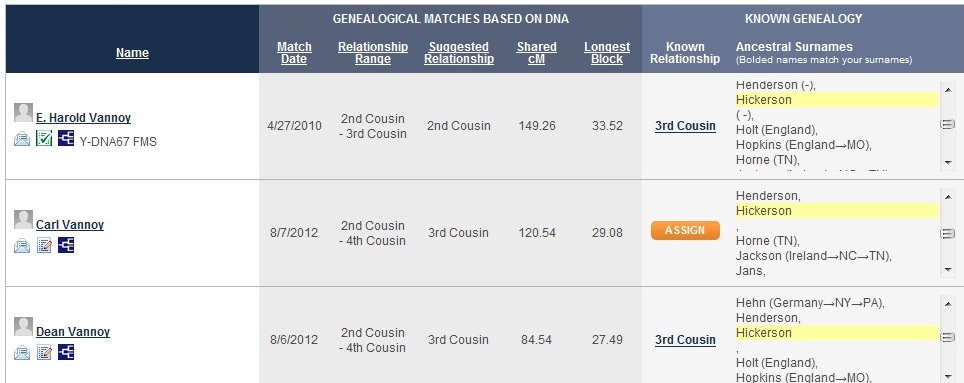
Let’s say I think that I might have found a new surname in my line.  It want to see everyone who has the surname Hickerson who is on my match list.  I enter that surname in the “ancestral surname” box, and click on “run report.”  The results returned will all carry the Hickerson surname, which you can see by scrolling for the highlighted names.

Now I want to see if these three people share common DNA not just with me, but with each other.  If we all share a common segment of DNA, then that confirms a common ancestor and attributes that DNA at that address on that chromosome to that specific ancestral family.

In my case, the known ancestral family is Vannoy, so let’s look at the Vannoy cousins as compared to me.
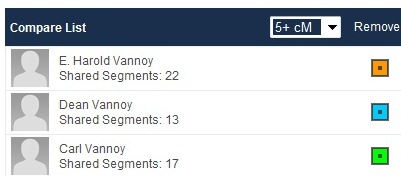
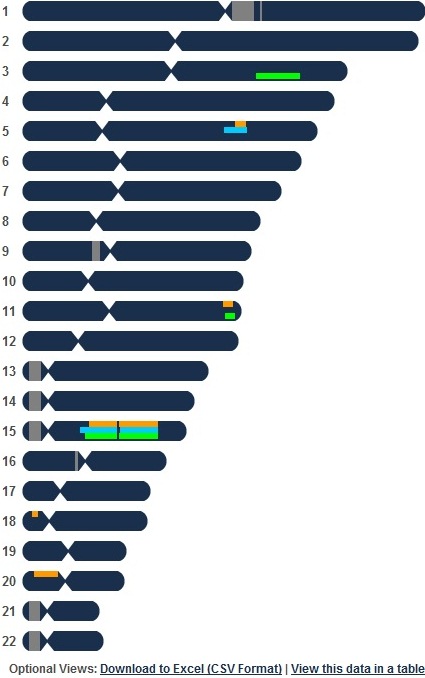
Each of the participants results are color coded.  On the page below, you can see that each matching segment of the chromosomes are colored.  It turns out that all of us share a fairly large segment on Chromosome 15.  So now we can attribute that segment to Elijah Vannoy, our oldest proven ancestor in that line.  You can also see some areas where one or two of my cousins match my DNA, but not all of us.  Those can also be attributed to Elijah Vannoy’s line since we share no other (known) common ancestors.

This cousin match is simple because the men share the same surname, but if this was 3 women with different surnames, the matching would still work.  The challenge of course would be to find the common ancestor.  In this case, if all 3 women had Elijah Vannoy in their tree, we could still tell that this segment of Chromosome 15 was attributed to the Vannoy family.

You can also download the results into a spreadsheet so you can do this matching without selecting 5 at a time.  Of course on a spreadsheet, there is no pretty and graphic chromosome browser.

Color your Chromosomes

You know, using these simple tools, you could “color in” your own DNA on your chromosomes so you can identify which part of your DNA was contributed by which ancestor.  Yes, I know, this is terribly geeky.

Reconstruct a Virtual Ancestor

Conversely, you could also “reconstruct” an ancestor. In fact, I think we’re well on the way with Elijah Vannoy.  Heck, I’ve already got most of chromosome 15 completed and parts of 3, 5, 11, 18 and 20!

Find a Guide – Consulting

If you’re trying to do something more complex, or have a specific goal in mind, you probably need some level of guidance if you are the proverbial Newbie.

There are three of us in the genetic genealogy community that provide various autosomal consulting services.

I provide DNA test planning, meaning helping you figure out who to test to achieve your desired results, and also after testing follow-up in the form of a Quick Consult.  I also write specialty reports upon request.  You can see the various options on my webpage or you can e-mail me directly at robertajestes@att.net to discuss.

Cece Moore is another consultant in this space.  She works with a lot of adoptees and beginners.  You can reach Cece at cecemoore@hotmail.com.  You’re probably familiar with Cece through her blog, http://www.yourgeneticgenealogist.com/.

Tim Janzen, MD, provides consulting as well.  His specialty is called phasing which determines which part of your genome came from which parent/ancestor.  Now this is easy if you have parents yet alive, but if not, and you have to try to figure this out by piecing together matches from various cousins, it’s not straightforward at all.  Tim uses the phased DNA data in conjunction with data from known relatives to create chromosome maps of your genome.  These maps are very helpful when you are trying to figure out how you are related to your matches at 23andMe and in the Family Finder database.  You can reach Tim at tjanzen@comcast.net.

You might be surprised to see me recommending other people on my blog in what might be considered a competitive arena.  Don’t be.  We work together.  We know who is the best at which aspects of genetic genealogy and we refer people routinely to the best resource for their needs.

The Magic of Connecting

Your level of success with autosomal testing and finding cousin matches is directly proportional to the amount of work you’re willing to invest in contacting your matches and sometimes helping them with their genealogy.

However, the results can be incredibly rewarding.  One of my clients is an adoptee.  She, of course, was hoping for a half-sibling match, but she’s not that lucky….at least not yet.  In the mean time, three of her matches also matched each other, and 2 of them share part of the same chromosomal segment with her.  The surname involved is very unique, French Canadian, found initially in only one family in one location.  So while we don’t know who her parents are, or her hoped-for siblings, we were able to gift her with one ancestor that is, absolutely, positively, hers.  This is a gift she has never had in her entire life.  She has never known one biological family member, ever.  And she has cousins too, an entire list of them.  For her, autosomal DNA has provided the ability to put her family tree together backwards, working our way forward in time from distant ancestors, slowly…..while still hoping for that “lottery winning” sibling match!

______________________________________________________________

Disclosure

I receive a small contribution when you click on some of the links to vendors in my articles. This does NOT increase the price you pay but helps me to keep the lights on and this informational blog free for everyone. Please click on the links in the articles or to the vendors below if you are purchasing products or DNA testing.

Thank you so much.

DNA Purchases and Free Transfers

Genealogy Services

Genealogy Research

Where is my Haplogroup From?

This is a very common question.  The answer can be as simple as a Wiki search, or a little more complex, but offering a much more personal answer.

First, if you have not joined a haplogroup project relevant to your haplogroup, do so.  This applies to both Y-line and mitochondrial results.

We discussed how to do this in the “What Project do I Join?” post.

Joining haplogroup projects does two things.  First, it provides you with a group of “like people,” who have common ancestors with yours.  Second, it provides the project administrators with DNA sequences to work with.  It’s that “working with” part that will play an important part in the answer to this question.

If you’ve already looked at Wiki, and you’re ready for more, you can take a look at your personal page.  At Family Tree DNA, both the Y-line and mtDNA have a haplogroup Migration Map option.

Clicking on this option shows you the migration map for your haplogroup.

Clicking on the Haplotree option, and scrolling to the bottom, you’ll see a link for the Haplogroup FAQ, right under the “about my haplogroup” verbiage.  The FAQ holds lots of information about haplogroups, how they are determined and such.

For Ancestry customers, your haplogroup description is at the top of the “View Results” page.

Clicking on the “learn more” provides you with an additional paragraph or so.

Note: Ancestry no longer has Y or mitochondrial DNA testing at all.

Ancestry does not have haplogroup projects, SNP testing, or additional haplogroup tools, so the rest of this will refer only to Family Tree DNA clients.

Let’s now turn to the haplogroup projects.  The most personal answer to the question, “where did my haplogroup come from” will come from within haplogroup projects.

How haplogroup administrators handle projects varies, based on their level of involvement, interest and experience of the administrator or administrators.  And remember, we are all volunteers.  Having said that, these people do an amazing and incredible job.

Family Tree DNA provides a mapping function, for free, along with their other project administration tools, for haplogroup projects.  If a project doesn’t have a map available, then it’s because the administrator chose not to opt for the map when setting up the project.

I’m using the haplogroup R1a1a project as an example.  It’s well organized, grouped by haplogroup and many people fall into this haplogroup.   The various options for viewing haplogroup projects are listed on the top bar within the project.

Clicking on the “classic” options shows you the various groups that the administrator has created, and how they have grouped individuals within the project.

By searching for you kit number, you can find the group you’ve been assigned to.  Note that if the project extends over more than one display page, you may need to search on subsequent pages as well. You can also change the number of results displayed per page in the “page size” box at the top.

Depending on the project, administrators group participants differently.  Some projects group people by geographic location.  Most Y-line projects group them by haplogroup subgroup, or SNP, plus groups of STR markers within SNP groups.  The SNP (single nucleotide polymorphism) is the location that is tested to see if you are a member of a haplogroup, or haplogroup subgroup.  Your terminal SNP is the one furthest down on the tree that provides you with the most resolution as to where your ancestors were located.  Your individual markers further refine SNP groupings.

Let’s look at the maps.

Projects have the option of displaying the location of the oldest ancestor.  Of course, this means that each participant will need to have entered the geographic location of their oldest ancestor on the Migrations Maps tab on their personal page.  This is critically important for haplogroup project mapping, because without the locations of oldest ancestors, there is no way for your results to appear on the map.

To see all of the project participants on a map, click on “Map” and then in the dropdown box, select “all.”

In the R1a1a project, the “all” selection shows the following map.  This is the answer to the question “where did my haplogroup come from.”

However, a much more personal answer to that question lies in the subgroups.  The haplogroup R1a1a project has grouped participants by SNPs and has given the resulting clusters identification names.  Let’s assume that your kit is listed in the group A1 which they’ve defined as Z283+, M458+, L260+ and named the “West Slavic Subcluster ‘A’” – all listed in the group title for this subgroup on the map selection.  The numbers, Z283+ indicate the SNP name and the plus or minus indicates that the people in the group have tested that location, and if they have it (+) or not (-).  If the administrator does not clearly define how they’ve identified the subgroups, then you’ll have to contact them directly.  Every administrator runs their project differently.

The map for this subgroup clearly shows where these participants’ ancestors are found. If you are in this group, this means that these people share a common haplogroup ancestor with you, some hundreds to thousands of years ago, depending on the haplogroup subgroup age.  This is the personal level of the answer to the question “where did my haplogroup come from.”

I hope this has given you several different methods to answer the question, “where did my haplogroup come from?”

I also answer this question for clients, in context of their own ancestry and family history, when writing their Personal DNA Reports.

This is a companion article to “To SNP or not to SNP.”

______________________________________________________________

Disclosure

I receive a small contribution when you click on some of the links to vendors in my articles. This does NOT increase the price you pay but helps me to keep the lights on and this informational blog free for everyone. Please click on the links in the articles or to the vendors below if you are purchasing products or DNA testing.

Thank you so much.

DNA Purchases and Free Transfers

Genealogy Services

Genealogy Research