National Geographic – Geno 2.0 Announcement – The Human Story

Have you ever dealt with something so massive and overwhelming it took a few days just to get your head wrapped around it?  Well, that’s how I’ve been feeling about the new National Geographic Geno 2.0 announcement.  It’s not just what has been announced, but the utterly massive amount of scientific research behind the scenes, and what it means to the rest of us.

If you think of all of the discoveries and progress that has been made in the 12 years since the advent of genetic genealogy, what you’re about to hear today dwarfs it all.  Hold on tight – this is a white knuckle ride of a lifetime.  The day I heard about this, I wandered around somewhat starry-eyed in amazement and kept muttering something terribly intelligent like “Wow, oh Wow.”

I’d like to share with you some of today’s big news and hope that you too share my sense of awe to be alive in such an exciting time, and to have not only a front row seat, but participating in making history.  This isn’t a movie, it’s the real McCoy!

Let’s start with a bit of history about Nat Geo 1.0, the Genographic Project.  Fasten your seatbelt, your E ticket ride starts here and now!

Nat Geo 1.0

Eight years ago, in April 2005, the National Geographic Genographic project was announced. The goal was to sell a total of 100,000 kits over 5 years to help fund the indigenous part of the project, which was to collect samples from indigenous peoples around the world to better understand population migration.

According to Nat Geo, this has been the most successful program they have ever undertaken.  That in and of itself it an amazing statement, especially considering that there was a lively debate within Nat Geo prior to the project launch.

Someone opined to Spencer Wells that they wouldn’t even sell 10,000 kits, let alone 100,000.  Well, they were wrong, 10,000 kits were sold the first day alone.  I’m guessing that Bennett and Max at Family Tree DNA, whose test kits Nat Geo uses, has a sense of controlled panic about that time.  The 100,000 kits were sold in the first 8 months and they still sell between 40,000 and 50,000 kits per year today.

How is that project doing?  Well, it was scheduled to run for 5 years, and it’s now into its 7th year.  They have collected over 75,000 samples from indigenous people and on the public side, over 750,000 people in over 130 countries have bought kits to help fund the research.  32 publications either have been released or will be shortly. Of the 45 million dollars the project has grossed, National Geographic has contributed more than 1.7 million dollars to the Legacy Fund for investment back into the indigenous communities that participated in the Genographic project.

You might recall that the original Nat Geo project only tested 12 markers for men and the HVR1 region on the maternal side.  At that time, 7 years ago, $99 for each of those was a great deal and the projects received a lot of new participants.  About 20% of the Nat Geo participants transferred their result to Family Tree DNA, for free, so they could join projects and participate in genetic genealogy.

Today, 12 markers is quite light and so is HVR1 testing alone.  Project administrators cringe when we see those, because we know it’s really not enough to do much with today.  We’ve learned so much in the past 7 years.  You don’t realize how much things have changed until you take a minute to look back.

At the same time we were learning, technology was also advancing.  Seven years ago, running autosomal tests was simply cost prohibitive. If you consider that computer technology has decreased in price and doubled in speed every year or two (Moore’s Law), the advances in DNA sequencing technology and understanding are moving in the same directions (increased capability and decreased costs) by a factor of 5 as compared to computer technology. Literally, we are moving at the speed of light.  See, I told you to hold on.  I meant it!

Geno 2.0 – The Big Announcement

It’s amazing that something this big has been kept this quiet.  Those of us involved have been bursting at the seams with excitement, and today is the big day.  Last night about 9 o’clock we received word that the countdown had begun.

For a look at the new National Geographic webpage, go to www.genographic.com.  This is the heart of the new Geno 2.0.

Geno 2.0 is still comprised of the 3 core components as before, the indigenous portion, the Legacy fund and the public participation portion.  However the technology is changing, dramatically, and the public participation arena is expanding.   Public participation will now include some “citizen science” projects, grants, an educational segment meaning kits in classrooms, and community based projects.  All of this is made possible by advances in the core sciences and technology.  This, plus the focus of the “Dream Team” of genetic genealogy and population genetics.

Thankfully, Spencer Wells at National Geographic and Bennett Greenspan and Max Blankfeld at Family Tree DNA prepared us in advance for what was coming, as much as you can prepare for a technological tsunami!

Let’s take a look at the technology and scientific advances that have occurred and what it means to us today.

New Chips and New Partnerships

The days of sequencing 12 markers in the lab are gone forever, replaced by high-speed sequencing that looks at half a million markers, or more, at a time, and for the same price as a 12 marker test and the mitochondrial DNA test, together, would have cost in Nat Geo 1.0.

However, when you’re looking at just the Y DNA and the mitochondrial, you’re missing 98% of the human genome, the part that isn’t Y or mitochondrial DNA.  And that 98% holds many secrets, the secrets of our ancestors.

The National Geographic Society recruited one of the top geneticists in the world at Johns Hopkins, focused on autosomal genetic markers.  He has spent the past two years identifying every known marker relevant to ancestry or population genetics that is NOT medically relevant.  This includes the X and Y chromosomes, mitochondrial DNA and the balance of the autosomal markers.

Are you sitting down?  Here’s the first of several bombs!

Relative to Y-line DNA, in 2010, just 2 years ago, the YCC SNP 2010 tree had a total of just over 800 SNPs that has been discovered.  Today it still hasn’t reached 900.  You can see the current tree at  http://www.isogg.org/tree/index.html.  Notice that all of the L SNPs were discovered by Thomas Krahn in the Family Tree DNA lab with the assistance of Family Tree DNA’s customers and project administrators.  This is truly “crowd-science” in the flash mob sense.

Today, after a concerted effort of discovery involving many people, there are a total of 12,000 Y SNPS and of that, 10,000 of them are unique and new and have never been seen or published before.  This means that your haplogroup will automatically be determined to the furthest branch of the tree with no additional SNPs to be tested.  As this test becomes available to Family Tree DNA clients as an upgrade, it will signal the demise of the deep clade test.

If there is a project administrator sitting next to you, they have just fainted.  The magnitude of this is simply mind-boggling.

Relative to mitochondrial DNA, 3352 unique (non-haplogroup defining) mutations have been discovered.  To measure all of the relevant mitochondrial DNA mutations, including insertions and deletions, over 31,000 probes (locations) are needed on the new high density chips.  Before this new approach, chip technology was unable to account for insertions and deletions, but that has been remedied by a new approach to an old problem.  This means that haplogroups will be determined to their deepest level and they will be accurate, including insertions and deletions critical to haplogroup assignment.

Relative to autosomal DNA, over 75,000 Ancestrally Informative Markers (AIMs) have been discovered and included on the new chip, and that’s after removing any that might be considered medically informative.  This astronomical number of SNPs will allow us to detect ethnicity and improve accuracy on a scale that we’ve never even dreamed about before.  I specifically asked Spencer Wells if this will help resolve those “messy” situations where we have European, Native American and African admixture, and he indicated that it would.  I can hardly wait.  For those of us what have been waiting patiently, and some not so patiently, to be able to identify small amounts of admixture, this is the best news you could ever hope to hear!  I told you that something wonderful was on the way!

Relative to admixture with Neanderthal, Denisovan and Melanesian man, meaning interbreeding, more than 30,000 SNPs have been identified that will signal interbreeding where it occurred between modern humans and ancient hominids.  And yes, this means that it did occur!  So indeed once again, you can begin wondering about your brother-in-law.  He’s probably wondering about you too.

Relative to the X chromosome, it’s included.  The X chromosome, because of its special inheritance pattern, gives us an additional, special tool when working with genetic genealogy.  We’ll cover this in a future blog.

The New Chip

In total, the new SNP count to be included on the new Nat Geo 2.0 chip (photo above) includes both new and known existing SNPs in the following amounts:

  • Autosomal including X – 147,000
  • Neanderthal – 26,000
  • Denisovan – 1,500
  • Aboriginal – 13,000
  • Eskimo – 12,000
  • Chimpanzee – 1,100
  • Y Chromosome – 12,000
  • mtDNA – 31,000

This chip has been designed to distinguish between populations.

OMG – What Happened to the Haplotree?

We’re not done yet with bombshells.

After this new chip was created by Illumina specifically for National Geographic, about 1200 samples were run as proof of concept, including 400 WTY (Walk the Y), 350 mitochondrial full sequence and 500 Y samples.  All of the samples run are checked and tested for all of the SNPs on the chip.  Of course, females’ samples will fail on all of the Y haplogroup locations, etc.

Just based on this test run alone of 900 Y chromosome kits, the haplotree expanded from 862 SNPs to a total of 6153.  If you’ve just said something akin to “Holy Cow,” you’re on the right track.  Imagine what it will do with another 1000 or 10,000 or 100,000 tests.  Right now, we’re making discoveries so fast we can hardly deal with them.

What Does This Mean?

In reality, what this means is that we will very soon use SNPs to determine heritage down to a genealogical meaningful timeframe, meaning 500 to maybe 1000 years.  The standard STR (Short Tandem Repeat) markers we know and love will become the leaves on the branches of the tree and these will likely be used when there are no more SNPs to determine family groupings and line marker mutations within families.

New National Geographic Geno 2.0 Website

Needless to say, all of this discovery has prompted National Geographic to redo their website entirely.  New maps are forthcoming.  Yeah!!  New maps include the migration maps as well as new haplogroup “heat maps” where the colors are graduated based on frequency.

There are entirely new capabilities too.  The new website will show you as the center of a circle and you’ll be able to contact people who have tested at Nat Geo who are located near to you in the circle.  Those closest to you, you’re most closely related to.  Further away, more distantly related.  Before, there was no matching between Nat Geo participants.

And yes, Geno 2.0 participants will still be able to transfer into Family Tree DNA for free.  I hope they make that option much more visible or interactive.

A New Test Kit

Anyone wanting to participate in Geno 2.0 will have to order a new kit from National Geographic.  The previous Nat Geo kits, if you recall, were anonymous unless you chose to transfer to Family Tree DNA, plus the permission you gave was specifically for mtdna or Y-line, not autosomal testing.

Furthermore, the DNA in many kits will be too old and will have degraded too much to use.  Everyone ordering the new Geno 2.0 kit will receive a new swab kit, in an heirloom box.  The comprehensive Y-line (haplogroup only), mtdna (haplogroup only) and autosomal testing will cost $199.

For Family Tree DNA clients who will be offered the upgrade in the late summer or fall, you will be able to upgrade if your DNA is less than 4 or 5 years old.  Otherwise, you’ll receive a new swab kit too.

All processing will be done at the Family Tree DNA Houston facility.

New Results Pages

The new test of course requires all new results pages for participants.

Take a look at a few of the pages you can expect.

The results will be presented as a personal story.

Your story will also include information such as maps of where your ancestors lived and where they migrated.

I asked Spencer if participants will be able to download their results so that we can continue to compare them as we do today, using various phasing tools.   Spencer replied, “Yes, raw results WILL be available for download.  In the Genographic Project, you will always own your DNA results, and the genotype data will be yours to do with as you please.  I feel very strongly that this is a cornerstone of ethical DTC genetic testing.”  Way to go Spencer!!

As Geno 2.0 moves forward, additional analytical tools will be added.

Ordering

National Geographic is accepting pre-orders now.  They will ship before the end of October, and they expect to be shipping significantly before that.

In Summary

Our world is changing, rapidly, and for the better.  The door we’ve been peeking through for a decade now is swinging wide open.  More brick walls will fall.  We’ll find and meet new cousins.  Ethnicities will be identified at a level never before possible.  We’ll learn about our ancestors and the story of our past through their DNA that we carry today.  It is the frontier within.  DNA is truly the gift that keeps on giving!

“One small step for man, one giant leap for mankind.”

Neil Armstrong, July 20, 1969

______________________________________________________________

Disclosure

I receive a small contribution when you click on some of the links to vendors in my articles. This does NOT increase the price you pay but helps me to keep the lights on and this informational blog free for everyone. Please click on the links in the articles or to the vendors below if you are purchasing products or DNA testing.

Thank you so much.

DNA Purchases and Free Transfers

Genealogy Services

Genealogy Research

The Trouble with Ancestry.com Matches

Update: Ancestry no longer provides Y and mitochondrial DNA testing, but I’m leaving this article for historical context.

While working on a client’s mitochondrial DNA report, I came across the worst case I’ve seen in a long time of mismatches being shown as matches at Ancestry.com.  This has been a pervasive problem for a long time.

10 Point Question – If you match another person exactly on every location, HVR1&HVR2, must you have the exact same haplogroup?

Answer:  Most of the time.

You didn’t think this was going to be easy did you?

Because Family Tree DNA is the only company to test to the full sequence level, their clients are going to have far more advanced, detailed and accurate haplogroup assignments than people who test at companies who only offer the HVR1+HVR2 regions.

Therefore, like in this case, we see a client whose haplogroup is H1.  The “1” part of H1 is determined by location 3010A, a position found in the coding region that can only be read by full sequence testing.  So, at Ancestry, and in other data bases outside of Family Tree DNA, we would expect to see matches to both haplogroup H and H1 (assuming the data base allows outside results to be input), and possibly some other H haplogroups as well, if the HVR1+HVR2 region mutations match those of our H1 person.

OK – next 10 point question.  Will someone who is haplogroup H match someone who is haplogroup M or N or some other haplogroup?

Answer: No, not an exact match, but they may share some common mutations.

Then why does Ancestry show them as matches when a simple comparison would eliminate them?

The answer is two-fold.  Part of the issue could be how Ancestry assigns haplogroups.  We really don’t know how they do it, and they aren’t as forthcoming about these things as Family Tree DNA is.  Secondly, and probably the biggest issue is that Ancestry allows people to enter their own data from other labs into their data base, including their haplogroup, apparently without any verification process.  So, in essence, Ancestry has muddied their own waters.

My client’s 251 matches at ancestry were all shown with “0” differences which means they are exact matches.  That’s exciting to see, except it isn’t real.

I clicked on the “download matches” button, which dumps everything into a spreadsheet, a wonderfully handy feature.  As we talk about this, keep in mind that my client had a total of 5 mutations in the HVR1+HVR2 regions, so based on “0” differences, everyone on that list should share all of those mutations with no additional mutations.

Here’s what I found after sorting the spreadsheet.

Exact matches = 32, hardly the 251 displayed on the match page.

Of the 251 “exact” matches shown, the haplogroup breakdown is shown below:

A – 10 (Native American)

B- 7 (Native American)

C – 3 (Native American)

D – 2 (Native American)

H – 154, over half with no matching markers at all to client

HV – 10

I – 5

J – 5

K – 4

L – 12 (African)

M – 4

N – 5

R – 6

T – 7

U – 11

V – 3

W – 1

X – 1

Z – 1

But even this isn’t the worst part.  Of the 251 matches shown with “0” differences, 32 are actually exact matches.  Of those exact matches, we find 4 different haplogroups, including 3 in haplogroup M, a generally Asian haplogroup which is rare as hen’s teeth here in the US.  Hmmm….anyone spot a problem?

Of the remaining 219, 162 have no mutations whatsoever that match the clients, so they not only shouldn’t be shown with “0” differences, they shouldn’t be shown at all.  So this means that the balance of the matches that do share at least one marker but aren’t exact matches, 57 in number, are shown incorrectly, with “0” differences.

So let’s give Ancestry a report card on this.  32 out of 251 correct equals 13% correct.

Last 10 point question – What letter grade do you get for 13% right, which is 87% wrong?

In my book, and in any school I ever attended, that was a big fat F!

And no, this is not just a recently introduced software bug.  It’s been like this forever.

So now that we know how well Ancestry does on basic things like mitochondrial DNA matches, which are exceedingly easy, anyone feel good about how they’ll do with autosomal DNA?  Comparatively speaking, that’s the tough stuff.

______________________________________________________________

Disclosure

I receive a small contribution when you click on some of the links to vendors in my articles. This does NOT increase the price you pay but helps me to keep the lights on and this informational blog free for everyone. Please click on the links in the articles or to the vendors below if you are purchasing products or DNA testing.

Thank you so much.

DNA Purchases and Free Transfers

Genealogy Services

Genealogy Research

The mtDNA Community

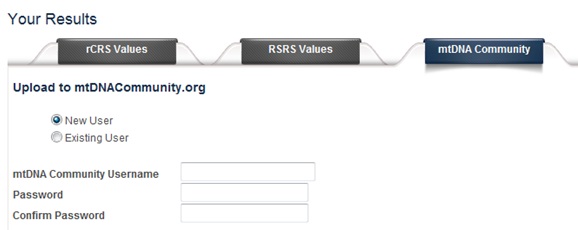
When you look at your mitochondrial DNA results on your personal page at Family Tree DNA, the third tab, after rCRS and RSRS is the mtDNA Community. You will only see this tab if you have taken the full sequence test.

The mtDNA Community software was developed to facilitate easy donation of your full sequence mitochondrial DNA sequences for scientific research purposes.  You can read about it here:  http://www.mtdnacommunity.org/default.aspx and here: http://www.mtdnacommunity.org/about.aspx

You too can be a part of science research by uploading your mitochondrial DNA sequence so that it can be included in the sequences studied by scientists.

Many of the leaps and bounds in genetic genealogy, the discovery of new haplogroups and learning how the people who carried them lived and where they settled has been through the volunteer efforts of genetic genealogists, just like yourself.

Let’s talk a minute though about what this means.  First, we don’t yet have a FAQ about the mtDNA Community from Family Tree DNA.  Much of what is known now is through working with the products personally, Rebekah Canada and Bill Hurst, both of whom have been rather intimately involved in the research and rollout process and Max Blankfeld, the President of Family Tree DNA – all of whom made themselves available over the weekend to sort through this.

There are really two levels of research here, but one leads to the other.  If you authorize your full sequence results to be uploaded to mtDNA Community you are authorizing your results to be included in scientific research.  In the mtDNA Community, you are not anonymous.  This means that your sequence can be tracked back to you.  This is neither a bad thing or a good thing, it’s just the way it works. Of course, there are benefits to you, other than being altruistic, for uploading your information.  We’ll discuss those in a minute.

The second part of the research quotient is that when papers are written using mitochondrial DNA sequences, most of the time those sequences are uploaded, anonymously, to GenBank.  At GenBank, the contact information is the submitting researcher and paper that the sequence is associated with.  This is done, at least in part, so that this research can be corroborated by others.  So if you upload your results to mtDNA Community, you are in essence granting permission for your results to be uploaded anonymously at some point in the future to GenBank.

What is GenBank?

The GenBank sequence database is an open access collection of all publicly available nucleotide sequences and their protein translations. This database is produced and maintained by the National Center for Biotechnology Information (NCBI) as part of the International Nucleotide Sequence Database Collaboration (INSDC). The National Center for Biotechnology Information is a part of the National Institutes of Health in the United States. GenBank and its collaborators receive sequences produced in laboratories throughout the world from more than 100,000 distinct organisms. In more than 20 years since its establishment, GenBank has become the most important and most influential database for research in almost all biological fields, whose data were accessed and cited by millions of researchers around the world.

You can read more about GenBank here:  http://en.wikipedia.org/wiki/GenBank and here:  http://www.ncbi.nlm.nih.gov/genbank/

Why is this important?

The science of genetic genealogy has grown by leaps and bounds in the past few years as a result, at least in part, of vast amounts of data becoming readily available through the genetic genealogy community and citizen scientists.  Without these sequences to study, scientific advances like the RSRS model wouldn’t have happened, at least not yet.

Is providing your mitochondrial DNA sequence for research the right choice for you?

For me, it was.  I provided my sequence to GenBank some time ago.  For everyone, it might not be.  It’s a personal decision.  But once it’s uploaded and in the scientific “stream” so to speak, there is no recalling it.  Even if the mtDNA community administrators would remove your sequence, and the same for GenBank, that doesn’t mean that someone hasn’t already downloaded it for study.

Is there a downside?

I can’t tell you that there is not.  What I can say is that I don’t know of any.  The mtDNA Community is new software released in conjunction with Dr. Behar’s paper in order to facilitate the study of mitochondrial DNA.  Before, submitting your results to GenBank was not straightforward and took quite a bit of effort on your part.  Now it’s as easy as clicking….and there are some benefits to you too.  So whether you do or not, follow along as I upload my results to the mtDNA Community.

Uploading your Results

Uploading your results is easy.  Just click on the mtDNA Community tab, shown above, on your personal page.  Fill in the blanks and click on the orange Upload button which you will see to the right of the blanks (not shown here).

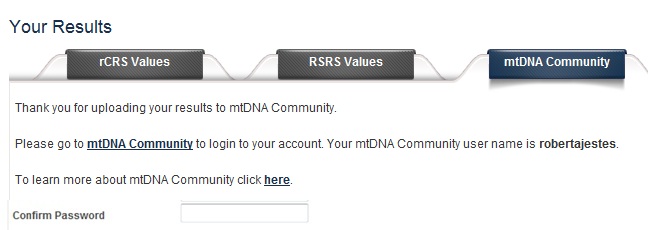
You will then see the screen, above.  Click on the words “mtDNA Community” which will take you to the website to create your account.

Once you’re on the mtDNA Community website, you’ll need to do some setup.  It’s minimal, but do complete the profile questions, because that process leads you to the good stuff.  And yes, there is a bug in the year selection for your oldest ancestor, but I’m sure that will be fixed shortly.

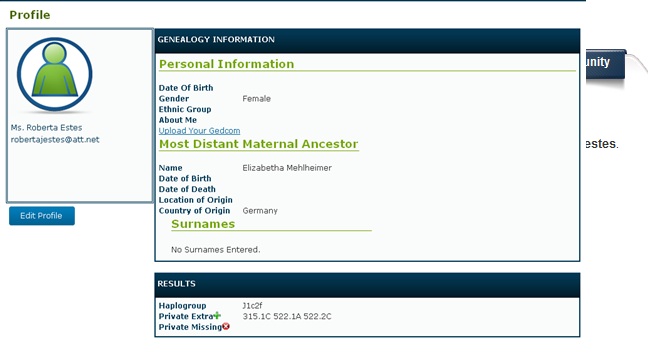
The important part of this is the information in the Results box, shown at the bottom, above, and shown enlarged below.  You will notice that these are not all of your mutations.  The mutations you carry that are part of the haplogroup designation are not shown here. 

This information displays your new, extended haplogroup under the RSRS model, but even more important, it shows you any “private mutations.” These are important, because they are your family mutations, meaning those not found in the haplogroup as a whole.  These have developed in your family line, and everyone you are related to in a genealogically relevant timeframe will carry these as well.  These are your personal filters that differentiate your family from everyone else in the larger haplogroup, or your extended clan.

There are also other matching features, but it’s unclear how this would differ, at least today, from your matches at Family Tree DNA.  Maybe eventually this data base will hold more sequences other than those donated from Family Tree DNA.  If so, this would provide us with new avenues to find matches.

We will know more when the FAQ is released and as we use this tool a bit more.

______________________________________________________________

Disclosure

I receive a small contribution when you click on some of the links to vendors in my articles. This does NOT increase the price you pay but helps me to keep the lights on and this informational blog free for everyone. Please click on the links in the articles or to the vendors below if you are purchasing products or DNA testing.

Thank you so much.

DNA Purchases and Free Transfers

Genealogy Services

Genealogy Research


Sorenson (SMGF) Update

Update: Ancstry discontinued the Sorenson database.

Many of you know about using the DNA records at www.smgf.org.  The good news is that those  of you who don’t will still get the opportunity to make discoveries by searching their data bases, at least for awhile.  They have provided, for some number of years, free data base searches to their records for both Y-line and mitochondrial DNA.

Sorenson’s assets were recently acquired by Ancestry.com, a move which has caused a non-trivial amount of consternation among genetic genealogists.  In particular, people, me included, contributed their DNA and their pedigree charts and they want to know what is going to happen to that information.  The testing was performed for free.  People never received individual results, but as their tests were processed, their results were added to a publicly searchable data base, so you could find and identify yourself with a little effort.  Equally as important, it’s a resource that many genealogists use for finding additional matches outside of the commercial testing companies.

Although today’s update from Sorenson doesn’t answer all of the questions about what will happen, or when, they do tell us that the data base will be available for some time to come.  I hope that Ancestry continues to maintain this free service, as it is certainly in line with the expectations of the people who donated their DNA/pedigree charts and also the vision of James Sorenson who founded SMGF several years before his death.  It does call into question, however, what is going to happen to these records.  Are they going to be absorbed into the Ancestry.com databases without notifying the participants?  As a participant myself, that certainly wasn’t what I expected or signed up for.

As of this morning, the new records have been added to the data base for this last and final update, but early reports also indicate that some records previously included are now missing.

Here’s what Sorenson had to say today:

Dear Friends of SMGF,

SMGF is happy to announce the addition of new haplotypes and genealogical records to the Sorenson mtDNA and Y-chromosome databases. We invite you to search these updated databases to find new family connections at http://www.smgf.org.

From the time it was founded in 1999 by molecular genealogy pioneer, James Levoy Sorenson, the mission of SMGF has been to support an important public purpose, namely the advancement of DNA-based genealogy research. Thanks to the continued philanthropic support of Mr. Sorenson and his family and the generosity of enthusiastic SMGF participants, SMGF has built the most comprehensive database of linked DNA and pedigree information in the world. Additionally, SMGF has contributed greatly to the emerging field of genetic genealogy in other ways, such as providing online DNA databases to the public and publishing numerous scientific articles detailing new discoveries.

In order to remain a leader in this rapidly growing and dynamic field, SMGF’s resources and capabilities would have to be substantially increased. Therefore, SMGF has decided that AncestryDNA is better positioned to provide the benefit to the public that is central to SMGF’s mission. For this reason, SMGF’s DNA-related assets were acquired by AncestryDNA in March 2012. SMGF is very excited to join AncestryDNA, and we are confident that the pioneering work begun at SMGF will continue to grow and have an even greater impact on the future scientific understanding and public outreach of genetic genealogy.

As we redirect our efforts to the integration with AncestryDNA it will be necessary to discontinue updates to the smgf.org website. Therefore, this will be the last update made to the Sorenson online databases. This update includes all of the Y-chromosome and mtDNA haplotypes that were generated by SMGF over the course of its operations.

The smgf.org site will continue to operate for the foreseeable future as a freely accessible tool for the genetic genealogy community, so we invite users to continue searching for family connections on smgf.org. We express our sincerest thanks to all those who participated in the SMGF project.

Sincerely,

The SMGF Team

______________________________________________________________

Disclosure

I receive a small contribution when you click on some of the links to vendors in my articles. This does NOT increase the price you pay but helps me to keep the lights on and this informational blog free for everyone. Please click on the links in the articles or to the vendors below if you are purchasing products or DNA testing.

Thank you so much.

DNA Purchases and Free Transfers

Genealogy Services

Genealogy Research

Did You Test at GeneTree???

If you ever tested at GeneTree, then this message affects you.  I received the following information from GeneTree about the DNA records of their clients.  They recently sold their assets to Ancestry.com.  So if you tested there, you may want to download your records while you still can.

Dear GeneTree Customer,

You may have recently heard the exciting news that GeneTree has been acquired by AncestryDNA™ ( http://corporate.ancestry.com/press/press-releases/2012/05/ancestry.com-dna-launches/ ). As we redirect our efforts to the integration with AncestryDNA it will be necessary to discontinue the GeneTree.com website. However, as a valued GeneTree customer, you will be able to access GeneTree.com through the rest of this year, until January 1, 2013. Following this date, access to your account will no longer be available through the GeneTree site, so we recommend that you download your DNA results and pedigree data while the site is still available.

If you’d like to learn more about how to download and continue using your information and family tree outside of GeneTree, see click here To help answer some frequently asked questions, please visit our FAQs. We greatly appreciate you being a part of GeneTree and hope that you continue with your genetic genealogy and family history research.

Sincerely, The GeneTree Team

______________________________________________________________

Disclosure

I receive a small contribution when you click on some of the links to vendors in my articles. This does NOT increase the price you pay but helps me to keep the lights on and this informational blog free for everyone. Please click on the links in the articles or to the vendors below if you are purchasing products or DNA testing.

Thank you so much.

DNA Purchases and Free Transfers

Genealogy Services

Genealogy Research