Ancestry’s DNA Survey

I received an e-mail asking me to take a survery for Ancestry.com about my experience with their autosomal AncestryDNA product.  Glory be – did they realize what they were asking???

Always anxious to improve our experience, and somewhat curious, I took the survey.  Most of the questions had “buttons” ranging from strongly agree to strongly disagree.  Many questions were very general in nature and asked if you had discovered something new about yourself or your family, if you had made a connection with someone new, etc.  I can just see the resulting marketing now: “More than 90% of our customers found a new relative as a result of DNA testing.  You can too!”

In one case, I indicated that I “strongly disagreed” and the next question was a text box and a question about why I disagreed, but not all “strongly disagree” answers produced text boxes.  I took that opportunity to say that I was unhappy about not having chromosome mapping or raw data to download.  As the questions continued, it became clear why these tools are not a priority to Ancestry.

The clincher, and the real driving factor behind these tests was revealed with this question:  “How likely are you to continue subscribing to Ancestry.com as a result of your AncestryDNA experience?”  Of course, they didn’t preface the question by telling people that if they don’t continue subscribing, they won’t have access to their matches.  And at Ancestry, the are no “results” as we think if them at other companies – so your matches ARE your result, aside from percentages of ethnicity.

The phrasing of the questions and the focus was clearly on the “social” aspect of connecting with people.  The Ancestry experience is not about science, and those of us who want to use it as such are simply frustrated and unhappy, and unfortunately, probably in the minority.

However, the Ancestry interface is easy to use, cleanly written and for those whom the science frustrates and who don’t understand how to use chromosome mapping tools, or why one would want to, the Ancestry experience is “easier” and “more fulfilling” to quote someone from a list earlier in the week.

I am hopeful that as Ancestry matures this product, they will also provide the value and tools for their more scientifically inclined customers.  This is not new technology and these tools are clearly available, because Family Tree DNA and 23andMe provide them, but Ancestry does not.

If Ancestry did that, well, then I MIGHT be inclined to remain subscribed BECAUSE of my AncestryDNA results.  And I might be inclined to REFER people, especially adoptees who need to fish in every pool available.  Did you hear that Ancestry?

Today, all those match results do is to frustrate me because I so desperately need the chromosome data that Ancestry holds hostage.

We may be a minority, but we must continue to be a vocal minority, that squeeky wheel.  If you have the opportunity to take this survey, please use the opportunity to ask for the features and functions we so badly need.  Speak to them in terms they understand – Ancestry.com subscriptions.

______________________________________________________________

Disclosure

I receive a small contribution when you click on some of the links to vendors in my articles. This does NOT increase the price you pay but helps me to keep the lights on and this informational blog free for everyone. Please click on the links in the articles or to the vendors below if you are purchasing products or DNA testing.

Thank you so much.

DNA Purchases and Free Transfers

Genealogy Services

Genealogy Research

Is The Y Pool Too Shallow?

Update: This article is no longer current, but I am leaving it for historical context.

On one of the lists I follow, there was some discussion recently about why some people have no matches.  Someone expressed the rather unpleasant opinion that this was “just a way to rip people off.”  I explained that when I do the Personalized DNA Reports for people, I see this regularly, even in haplogroup R1b, because of rare marker values. 

Someone else then said that “it is because the pool at present is too narrow and unfortunately for many people it is still very early yet to find any matches. . .not that it is a rip off, but you do have a marketing strategy and it is rather robust and full of promises which may not be met for another five to ten years depending on how many more people test.”

Hmmmm…..really?  I don’t think so, but let’s take a look.

First, let’s take a look at the size of the pool.  Family Tree DNA alone, not counting records from other testing companies, or the Genographic participants who did not transfer to Family Tree DNA, which I estimate is about 400,000 in total (mtdna and yline), as of October 5th, 2012, has 243,921 Y records.  Of those, 156,396 tested at 25 markers, 136,335 at 37 markers and 63,265 at 67 markers.  Not a terribly shallow pool, it would seem.

Let’s look at this another way.  The population of the US is about 311,000,000.  If you divide the quarter million people who have Y line tests at Family Tree DNA, alone, into that total, you come up with 1,244, meaning one of every 1,244 people has had their Y-line DNA tested.  If you take into consideration that approximately half of that population doesn’t have a Y chromosome that means that one of every 622 men has had their Y-line DNA tested. Of course, all of the participants aren’t from the US, but hopefully the math puts it into perspective.  Not bad for a brand new industry 12 years ago!!!

I decided to do a little scientific survey for myself.  When I do Y-line DNA reports for people, one of the things I do for them is to explain why they have the number of matches they do at each level.  This invariably has to do with both the haplogroup, subgroup and the rarity of the individual markers.  I have built a very large chart of marker frequencies for each haplogroup over the years I’ve been doing the Personalized DNA Reports.

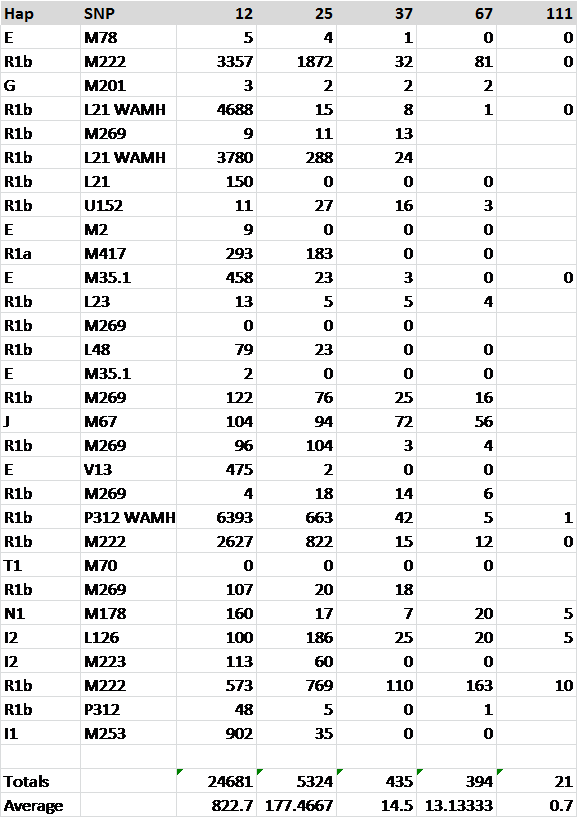
So, let’s look at 30 people, selected at random, in no particular order.  The only selection criteria I used is that they must have tested at 37 markers or more.

In the table below, the numbers in the marker columns are the number of matches.  Blank means that the individual did not test at that level.  Zero means they did test and have no matches. 

So let’s see what we have here.

Lots of 12 marker matches.  The most for one person was 6393.  This person was fortunate though, because they had rare markers to whittle that down to 663 at 25 markers, then 42, 5 and 1, respectively on the higher panels. 

Being a WAMH (Western Atlantic Modal Haplotype), the most common 12 marker value grouping in Europe (allowing for one mutation to still be considered WAMH) means a lot of matches in the first panel, but has little influence past that.

Two people had no matches, one R1b and one T1.  When I first started doing these reports, I was surprised to see R1bs with no matches, but I probably have as many of those as all other haplogroups combined.  We think of R1b being extremely common, and it is as a whole, but there are obviously lots of pockets of rare lines out there just waiting to be discovered.

The average person has about eight hundred 12 marker matches, just under 200 25 marker matches, fourteen 37, thirteen 67 and not quite one 111 marker match.  There still aren’t a lot of folks who have tested at the 111 marker level. The good news is that if you have a 111 marker match, it’s generally a very solid genealogical match.  Most people use the 111 marker test to resolve 67 marker matches or to find line marker mutations within a family to identify specific ancestral lines.

But back to the original question.  Is this pool too shallow to produce results?  It think all of those 24,000+ people who have matches at 12 markers don’t think so.  I think the 28 of the 30 people who have matches at any level don’t think so.  The “average” guy who has matches at every level doesn’t think so.  The 2 who don’t have any matches might wonder.  I don’t think so, but I’ll let you wade in for yourself.   Does this look like a shallow pool to you or a way to rip people off?

______________________________________________________________

Disclosure

I receive a small contribution when you click on some of the links to vendors in my articles. This does NOT increase the price you pay but helps me to keep the lights on and this informational blog free for everyone. Please click on the links in the articles or to the vendors below if you are purchasing products or DNA testing.

Thank you so much.

DNA Purchases and Free Transfers

Genealogy Services

Genealogy Research

Family Tree DNA Conferences

It’s hard to believe, but the 8th Annual International Genetic Genealogy Conference for project administrators is upcoming Nov. 9-10 in Houston.  And wow, where did the last 8 years go?  I remember how excited we were when the first conference was announced.  I think the spaces filled for that one the very first day registration was open.  Now there are more spaces available, but it does fill, and there is a cutoff, so if you want to sign up, don’t wait too long. You sign up from your GAP administrator page or you could also call Family Tree DNA.

There aren’t too many of us who have been to all of the conferences.  Probably a handful of diehards!  And yes, I am one of them, along with several others.

Family Tree DNA often doesn’t publish the actual agenda until fairly close to the conference date.  I’ve received e-mails asking about what former conferences have been like from people who are trying to decide whether to sign up or not.

So this blog posting is really a chat and a run down memory lane.  I’ll be introducing you to some of the folks you can expect to see at the conference too.

I’m going to work from last year’s agenda.  Yes, I’m so geeky that I have every one of the notebooks we’ve been given, and I can even put my hands on them.  If you knew how much paper is in my office, you’d know just how remarkable that is!

We normally fly in on Friday in the day.  There are some “events” that aren’t on the Family Tree DNA schedule.  Some special interest groups meet at one time or another, and Friday later afternoon or early evening is a favorite time. Its about the only time.

Friday evening, at about 7 or 8, is a reception.  Now I can’t remember which evening is the ISOGG reception and which one is the FTDNA reception.  One is Friday and one is Saturday.  You don’t really need to remember which is which, just where to show up and what time.  We all pitch in for the ISOGG reception too.  Some kind of munchies or something to drink (alcoholic or not.)  There is a cash bar at the FTDNA reception.

Our group sort of takes over the lobby and the lobby bar and restaurant as well.  We all have nametags so we just all walk up and introduce ourselves.  After 8 years for us who have been before, it’s much like a homecoming.  I can’t wait to see all my friends again and a few of my cousins that I didn’t know were cousins before DNA testing came along.

Newbies or oldtimers, it’s a wonderful opportunity to meet people, talk over challenges or successes, and just enjoy the company of those with like interests.  It’s also great to put a face with a name.  Of course, I can remember the face forever, but the names get a bit skewed.  Oh well, that’s what nametags are for.

The actual conference and registration begins on Saturday morning, fairly early.  They have a full day of sessions both Saturday and Sunday.  The hotel does not have a complimentary breakfast and let’s just say it’s not inexpensive, or quick, in the restaurant.

I do know who a few of the speakers will be this year, but it’s not my place to steal that thunder, so I won’t. I’m looking forward to the ones I know about though, I assure you.

Max (below) and Bennett (above) always provide a warm welcome to everyone.

Last year, Spencer Wells, the Scientist in Residence for the Genographic project opened the conference with an update called “News from the Field.”  Spencer (below) is always interesting.  And that’s the understatement of the year.  I live vicariously through Spencer’s adventures!

Bruce Walsh, a mathematician from the University of Arizona, who we all know and love, followed Spencer.  Not an enviable slot.  These men are as different as night and day.  But if you have a math question, or even if you don’t, Bruce will answer it for you….then he will explain to you in terms you can’t possibly understand the theory of relativity:)

I remember the first session I attended the first year with Bruce.  I walked out of that session with my eyes glazed over like donut holes.  I remember him saying “It’s simple……then writing an impossibly long string of numbers.”  Keep in mind that I’m a computer science graduate….back when computer science was in the engineering school….so I understand math and science….but not at the PhD level, no matter how easy that PhD level is to a PhD!  I talked to Catherine Borges later who said “I think I understood a few words.”  Yep Katherine, we’re on the same page.

Suffice it to say that we’ve all learned a lot since then, but we all need something to stretch the limits of our understanding and Bruce always does.  Well, except the one year he really toned it down to undergrad level and we told him it was too simple that year.  We always look forward to Bruce’s sessions.  I understand full sentences now, most years!  Dr. Walsh has a little tradition too.  I won’t tell you what it is, but the photo above holds a hint.

Mid morning there were breakout sessions.  Max and Bennett always try to have a wide variety of topics and levels of sessions.  These were “Phasing and Other Analysis of Family Finder Results” by David Pike, who has written a phasing utility, and “Walk Through the Y” with Thomas Krahn (below) who runs the lab at Family Tree DNA.

My husband always goes with me and we split up between these breakouts because I can never decide which one I wasn’t going to go to and try as I might, I can’t clone myself so I can go to both.

Lunch, the most popular session of the day.  Lunch is provided, and is generally a buffet type of event.  Lots of visiting and socializing going on.  The ice is well broken by now.

After lunch, Dr. Michael Hammer spoke about “Neanderthals in our Midst: Just How Modern is our Genome” which was a fascinating session.  Michael, Family Tree DNA’s Chief Scientist, runs the Hammer Lab (yes, named after him) at the University of Arizona who has partnered with Family Tree DNA all these years.  I don’t know what he was saying in the photo below, but it must have been pretty good because I seem to be hanging on every word.

Next on the agenda was Stephen Morse with his “One Step Web Pages.”  No this wasn’t exactly DNA, but it wasn’t terribly separate either and by this time, our minds needed something that we didn’t have to think too hard about.  Steve has great tools and is wonderfully entertaining, especially for genealogists.

The favorite conference sessions seem to be the Q&A panel and sessions.  The official agenda closes each day with Q&A where attendees get to ask questions and the speakers of the day answer them.  This is one of the best parts of the conference.  Each of the speakers, below, have thier questions and Matt Kaplan is answering his.  Matt, by the way….has been “finishing” his PhD for nearly all 8 years.  I have to go this year to see if he finished!!!

Dinner is on your own, but don’t be late back for the evening reception.  Lots of other fraternizing goes on in the lobby, which has couches and conversation areas, in the lobby bar and restaurant.

Sunday’s agenda starts even earlier than Saturdays because the ISOGG (International Society of Genetic Genealogy) meeting is generally at 8 AM.  Katherine Borges, below, the Director, keeps everyone current with what is going on in the genetic genealogy areana and needs our attention.  Last year the big topic was the FDA and their attempts to regulate DTC testing.

The first official Sunday session was with Elliott Greenspan.  If the surname looks familiar, yes, Elliott is Bennett’s son, but Elliott is perfectly well qualified, even without the Greenspan name.  Elliott is in charge of the IT department and he did a session about the year in review and the year ahead. He does something like this every year and I expect this year will be no exception.

That was followed by Peter Hrechdakian’s “Armenian DNA Project.”  I wasn’t terribly excited about this, but was I ever glad that I didn’t skip out on this one and read my e-mail or something.  It was wonderful, inspirational and enlightening, and had implications far beyond Armenia.

That session was followed by Peter Biggins and Thomas Roderick with the “DNA of the Three Collas.”  I did have to step out and didn’t see that session.  I think that’s when Cece Moore (above, notice her necklace) was filming my segment for the FTDNA infomercial (below).  See, I told you all kinds of things were going on.

Steve Morse followed with a second presentation called “One Step Web Pages, Part II.”  I learned things that I still use regularly.

Lunch is provided again on Sunday.  The food is always good there.  But warning, get dessert early if you want it.

The afternoon session was led off by Jessica Roberts, a lawyer, who talked about “DNA Tests and the Law and the Potential Use of Ancestry Tests for Immigration.”  Ok, it wasn’t the most exciting session of the conference.

However, the final speaker, Dick Hill, was just wonderful and had us all spellbound as he gave his session “An Adoptees Journey to His Ancestral Surname.”  As you know, Dick has gone on to publish his story as a book, “Finding Family”.

On the last day, the closing panel is very popular, and you’ll be very disappointed if you decide to leave early to catch your plane.  Been there, done that.  Don’t expect the sessions to end until 5.  The final panel is the same format as the day before, with attendees writing their questions and the panelists answering them.

And after that, it’s goodbyes and a mad dash for the airport, which isn’t far because the hotel is one of the airport hotels.  Still, you have to have enough time to ride the hotel bus, which may be full, and get there in time for all of the security checks.

So now that you’ve had a whirlwind tour of last year’s conference, you have some idea of what to expect.

If I had to describe it in one sentence, I would say that it is something like drinking from a firehose fueled by the best educators in the genetic genealogy and population genetics world.  Some are from the academic world, some from the business and genealogy environments, and some of them, folks, are us.  If you’re not really serious about genetic genealogy, this conference would likely be overwhelming. If you want to come and learn, you’ll have every opportunity.  Every single one of us had a first conference and a first day in genetic genealogy.  We all start at the same level.  These conferences are one way to grow from there!

If you can’t attend, several bloggers do cover it, although not immediately.  We barely have time to go to the “loo” while we are there.  Several people do tweet as well and a few e-mail to the lists….but I guarantee you, it’s not the same as being there in person.

Katherine Borges, Bennett Greenspan and Emily Aulicino enjoying a relaxing minute.  Actually, I think Katherine is begging Bennett for some new feature!!!  A lot of that goes on that the conference too:)  We all hope to see you there!

______________________________________________________________

Disclosure

I receive a small contribution when you click on some of the links to vendors in my articles. This does NOT increase the price you pay but helps me to keep the lights on and this informational blog free for everyone. Please click on the links in the articles or to the vendors below if you are purchasing products or DNA testing.

Thank you so much.

DNA Purchases and Free Transfers

Genealogy Services

Genealogy Research

Ancestry Autosomal Results are Back

My cousin, Harold, e-mailed me and asked me to check my Ancesry results to see if I matched a certain nickname (user).  I told him I’d be glad to when my results come in, sometime in October.  He replied that my results are in and have been for a couple days, as I’ve been showing as a match to him.  Hmmm….would have been nice if Ancestry had notified me.  We’ll chalk this up to the internet troll eating the e-mail notification message.  Thank you cousin Harold.

When Ancestry received my kit on August 21st, they said to expect my results in 6-8 weeks.  They beat their own mark by at least 50%.  It took about 3 weeks instead of 6-8.  Everyone is always happy receiving something early.  It’s all about setting expectations correctly, and they did.

I was excited to take a look.  Sure enough, there was cousin Harold, right up at the top of the match list.  Harold and I have been working on a particulary elusive genealogy problem for some time now, so both of us test everyplace we can in the hopes of cracking this tough nut.  In a future blogs, we’ll talk about using genetic genealogy to do focused testing and solve very specific problems.

I only have just a few minutes this morning, so it’s a good thing that Ancestry’s user interface is easy and intuitive.

I was disappointed to see that Scandinavian show up.  I know beyond any doubt that I’m not 12% Scandinavian.  That’s equivalent to one great-grandparent.  I did a pedigree analysis as part of a paper titled Revealing American Indian and Minority Heritage Using Y-line, Mitochondrial, Autosomal and X Chromosomal Testing Data Combined with Pedigree Analysisthat was published in the Journal of Genetic GenealogyCeCe Moore has already reported on this false Scandinavian problem at Ancestry.

Given my time constraints this morning, I had to limit myself to a quick test drive.  I have one 3rd cousin match, Harold, nineteen 4th cousins and 90 distant matches.  In total 122 matches and of those, only 14 don’t have pedigree charts, although I’ve noticed that some charts are very skeletal, with only parents and maybe grandparents listed.

I couldn’t resist scrolling down the list and clicking on “review match” links for the 4th cousins.  I find the “nicknames” frustrating.  Some are marginally recognizable.  I use my full name in mine, but others are entirely obfuscated.

I had no idea who Alyssa2309 was, but she is listed third on my 4th cousin list, so I clicked on Review Match.  Much to my surprise, she is truly a cousin.  My great-grandfather is her great-great-great-grandfather.  I was very glad at this moment that I had taken the time to manually enter my pedigree chart information for 10 generations.  Without that information, Ancestry could not have connected our common ancestors on our trees.

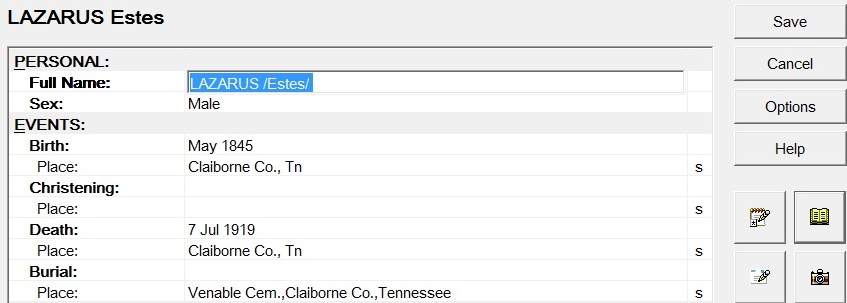
Ok, that’s very cool.  This isn’t a brick wall line for me, but it’s still fun to find a new cousin.  Maybe she has some photos that I don’t, or vice versa.  Alyssa2309, I’ll be in touch, count on it!  Here’s a picture of our common ancestors, Lazarus Estes (1845-1919) and Elizabeth Vannoy (1846-1918).

I continued clicking.  It has now taken on an addictive quality and I’m only through about 5.  Oops, I’ve hit my first “private” tree.  How disappointing.  I wish Ancestry had done the common surname analysis so I know whether or not to bother attempting to contact this person.

You can see, above, that Ancestry compares the charts of the two people who match and shows you the shared surnames, in this case, the very common Miller and Moore.  You can then click and go to that surname on the person’s pedigree chart, or you can simply scan down the chart, displayed to the right through 10 generations.  This is a very nice feature.

I finished a quick look at my nineteen 4th cousins.  Of those nineteen, there are three where I can clearly identify our common ancestor, and there are two or three more that with some genealogy digging, we might well be able to connect the dots.  One of those is a dead end brick wall line for me, so I’m hopeful.  More than half show no common surnames.

More than ever, now I really desperately need more information and the raw data to continue with my ancestor matching project.  While the Ancestry match information is a tantalizing teaser, that’s all it is.  They don’t show how or where you match, how much, segment size or number of SNPs, the chromosome(s), start and stop locations, nor the raw data, of course.  No chromosome matching or mapping like at both Family Tree DNA and at 23andMe.  How frustrating. It’s like showing you the tip of the iceberg and refusing to provide you with the rest, although you know full well it’s there and available, because other testing companies using the same test platform provide this information.  This is SO FRUSTRATING!

In essence, we have the shiny user interface (complete with erroneous population data), and the surface matching information, but no substance.  Nothing under the hood.  Knowing there is information there that I need and can’t have is worse than not knowing at all.

______________________________________________________________

Disclosure

I receive a small contribution when you click on some of the links to vendors in my articles. This does NOT increase the price you pay but helps me to keep the lights on and this informational blog free for everyone. Please click on the links in the articles or to the vendors below if you are purchasing products or DNA testing.

Thank you so much.

DNA Purchases and Free Transfers

Genealogy Services

Genealogy Research

23andMe – 16 Days Door to Results

On August 16th, I put kits for both Ancestry and 23andMe in the mail.

On August 21st, I received an e-mail from Ancestry telling me that my sample had arrived in their lab and that I could expect results in 6 to 8 weeks.  That’s mid to late October.

On August 24th, I received an e-mail from 23andMe telling me that my sample had arrived in their lab and that I could expect results in 2-3 weeks.  Only 7 days later, I received another e-mail that my results were ready.  In total, 16 days door to computer, and only 7 days in the lab.  That’s pretty amazing.

This kit was an upgrade from the first kits they had issued.  This new kit was required for their new platform and one test in particular that I was interested in – the Alzheimer’s genetic susceptibility.

I’m very happy to report that I’m less than half as likely to develop Alzheimer’s than the general population. I’m sure my kids will be relieved to hear that too.  Now if I could just remember where I put  the phone, I’d call them and tell them:)

There are a couple of things I do think 23andMe could do a little differently.

1.  I would like to have known what, other than the Alzheimer’s risk, was available to me on the new platform that wasn’t previously.  There was no notification and had I not specifically known to look for the Alzheimer’s risk, I would have had no idea what I had received for my money.

2.  Every time I sign in, they default to my daughter’s account which I manage.  Now I love my daughter, but I want my account to default to, well, my account.

3.  Finding the genealogy pieces of their offering is not at all straightforward.  For example, where is the link to download raw results located?  Just try to find it.  Go ahead.  And I know that the reason I can’t ever find it has nothing to do with Alzheimer’s.  Actually, I have the link saved because wherever they’ve hidden it, they did a fine job.

4.  I would surely love to see a “genealogy dashboard” for those of us who are so inclined.  I think that would help with finding things and general friendliness of their site.  I thought I saw something at one time in this vein, but if it’s there, well, I can’t find it.

One thing I noticed that I really like is the section under “23andMe” and then “Research Discoveries.”  As customers, we take surveys and based on those surveys, they look for genetic similarities between those who do and don’t have the trait or conditions in question.  On this page, they list their discoveries and tell you whether one of the surveys you took was involved.  It made me feel good to know that I had contributed in a meaningful way.

And just for the record, in case you were wondering, no, I do not have back hair:)

______________________________________________________________

Disclosure

I receive a small contribution when you click on some of the links to vendors in my articles. This does NOT increase the price you pay but helps me to keep the lights on and this informational blog free for everyone. Please click on the links in the articles or to the vendors below if you are purchasing products or DNA testing.

Thank you so much.

DNA Purchases and Free Transfers

Genealogy Services

Genealogy Research

GEDCOMs, FamilySearch and Curing the Curse

Sometimes when you’ve done something, like genealogy, for a very long time, it’s hard to remember what it was like as a beginner.  Add to that computers, and the age of the “typical” Baby Boomer genealogist being someplace near retirement, and the frustration rises.

One of our blog subscribers, Robert, expressed some frustration a few days ago with the fact that so few people upload GEDCOMS and asked for direction to obtain software to create a GEDCOM file.  For those who don’t know, GEDCOM is short for Genealogical Data Communication and the GEDCOM file is the universal standard for passing around genealogy files.  At Family Tree DNA and at Ancestry, you can upload a GEDCOM file from your Genealogy software to enhance your DNA experience.  Without some associated genealogy, the autosomal tests are much less useful.  The power of those cousin-identifying tests is in matching family names of others who test.

I have used Personal Ancestral File (PAF), a free product from the Mormon Church for as long as there have been computers.  I began in the 1980s, seriously, with this product.  It was free then and it’s still free.  There is a companion printing product which they sell for under $10 if you want pedigree charts, etc.  And yes, it creates GEDCOM files.  It’s very basic and simple to use.  You can download it at this link:  https://familysearch.org/products

One note about using this product. It has a notes field.  I keep everything about this person in this field.  It seems to be unlimited in size.  These notes can print, or not, on reports.  You can see how easy the user interface is, below, and the notes button is the one with the pencil.  Very intuitive.

In spite of how easy PAF is to use, judging from Robert’s e-mail, it’s easy to get bogged down in the details about the product on the FamilySearch website and discouraged.  Good thing he didn’t give up.  He was kind enough to send some helpful feedback too, which I’d like to share with you and will make you smile.  Maybe we can all break the Curse that Robert speaks of!  Today is GEDCOM day.  If you haven’t uploaded yours to Family Finder, today is the day!

Hi Roberta,

Thanks for directing me to Family Search.org and their Personal Ancestral File.

My limited browsing skills struggled for a few minutes trying to find the Personal Ancestral File (PAF) download on the Family Search website.    One needs to begin at “Products” under “Resources” at the bottom of the Family Search home page.

At some point during my search for PAF, I came across a description of PAF 5.2.   It was so loaded with details about the program’s operation and capabilities, that I almost closed the site.   Every paragraph left me more confused than the previous one.

I finally said to hell with all the user unfriendly details, and then completed whatever actions it took to open PAF 5.2.    To my surprise, the chart that I wanted appeared when I clicked on “pedigree”  at the top of the page.    The format was designed to begin my family tree with me on the left, proceeding to the right with blocks for parents, grandparents, etc.   Clicking on each block produced a small window in which one inputs the basics (date and place of birth, death, and marriage, etc.) for each ancestor.    Editing was also a breeze.

I had been searching for an easy method of preparing just a basic GEDCOM/family tree in an exportable format, without having to purchase a complicated program.    Apparently PAF 5.2 is all that is needed to produce one’s basic GEDCOM/family tree  which can then be exported to one’s Family Finder website.

Maybe you can use this information in your blog to break the digital curse that prevents many of us from preparing and submitting our family tree to our Family Finder website.    Seniors are probably the age group most affected by the curse.

Many thanks.

Robert

______________________________________________________________

Disclosure

I receive a small contribution when you click on some of the links to vendors in my articles. This does NOT increase the price you pay but helps me to keep the lights on and this informational blog free for everyone. Please click on the links in the articles or to the vendors below if you are purchasing products or DNA testing.

Thank you so much.

DNA Purchases and Free Transfers

Genealogy Services

Genealogy Research

Y DNA – Family Tree DNA vs Ancestry

I’m regularly asked about a comparison between the Y DNA products of Family Tree DNA and Ancestry.com.

Update: Ancestry no longer has Y DNA testing, but Family Tree DNA does and this article still provides a good overview.

The price changes periodically at both companies, and as far as I’m concerned, the more compelling purchase criteria are features and functions, not price.  The prices are usually relatively close.

Marker Results

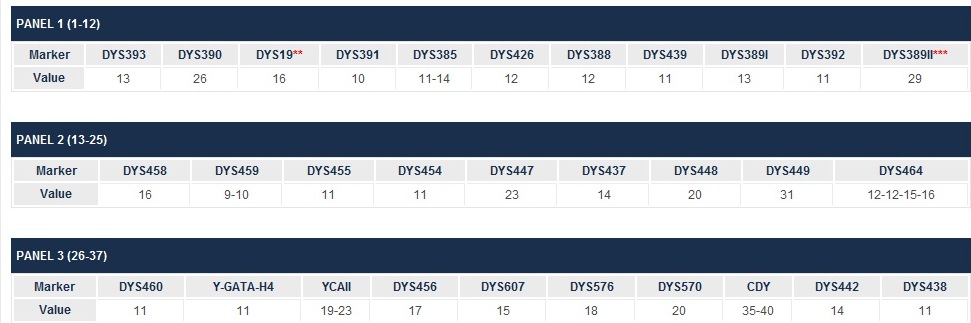
At Family Tree DNA and at Ancestry, marker results are displayed for the person who tested.  Ancestry tests either 33 or 46 markers. Family Tree DNA tests 12, 25, 37, 67 or 111 markers.

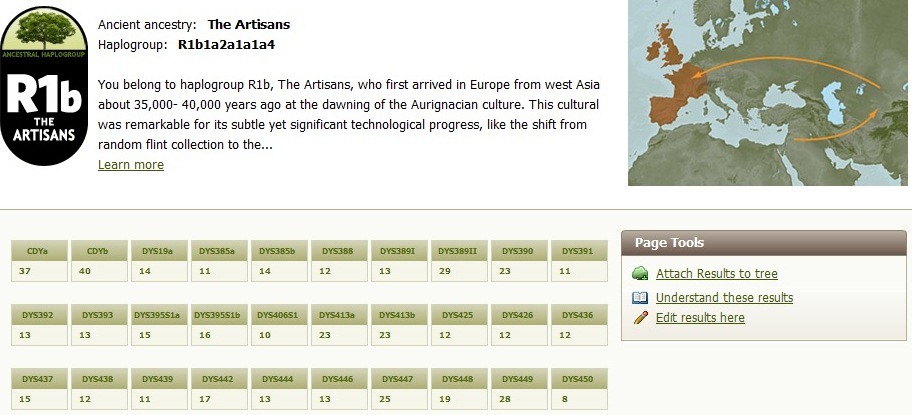
Family Tree DNA results are above.  Ancestry, below.

Haplogroup Maps

At Ancestry, the map, haplogroup description and results are all on one page, shown above, while at Family Tree DNA, they are displayed on separate pages.  At Family Tree DNA, the map is interactive.

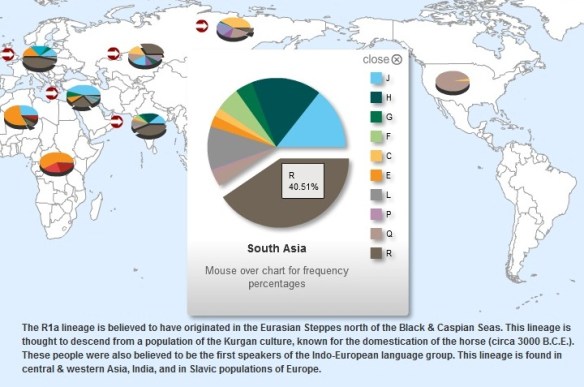
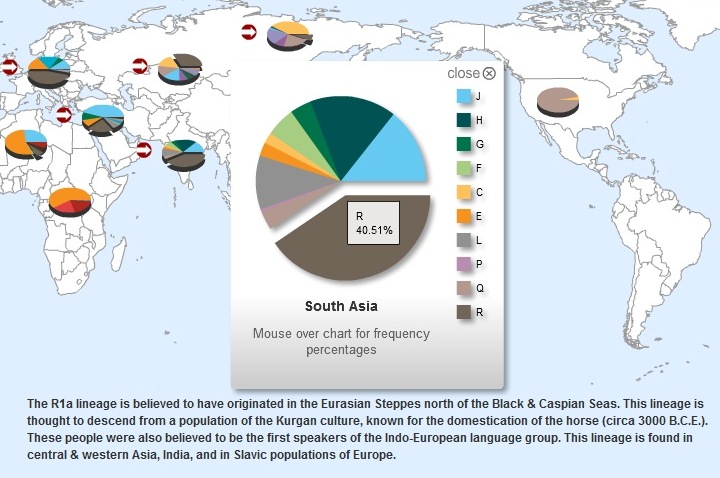
A second Haplogroup tab at Family Tree DNA also provides frequencies worldwide for the haplogroup.  Ancestry doesn’t provide anything similar.

Frequency Map
Matches

Both companies, of course, provide a list of matches.

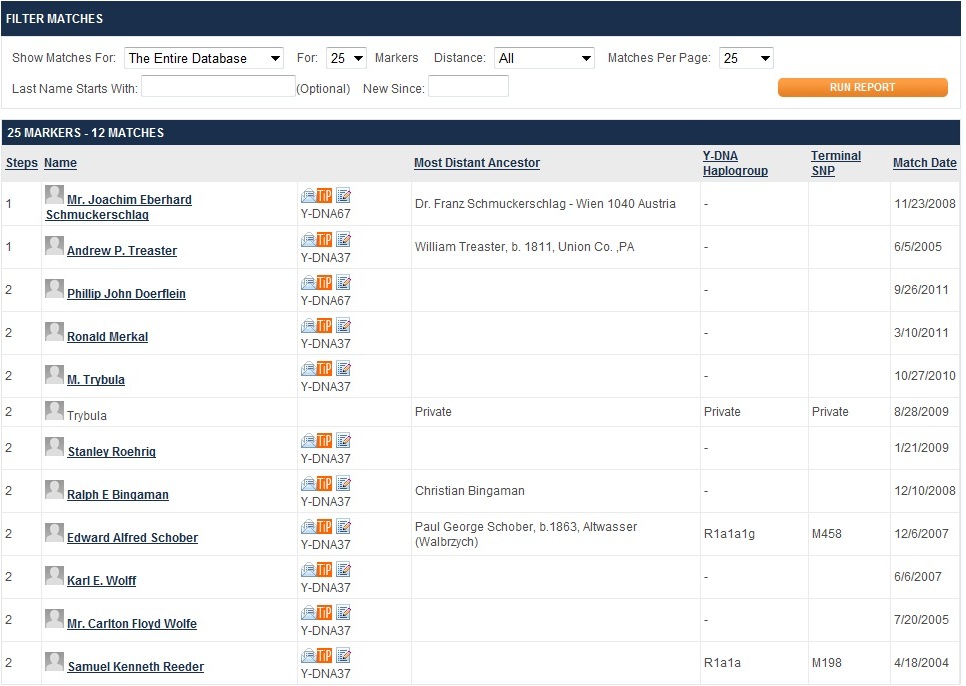
At Family Tree DNA, above, your matches have real e-mail addresses that you access by clicking on the little envelope.  You don’t have to contact them through a messaging system.  The TIP calculations provide time to the Most Recent Common Ancestor and allows you to modify that calculation with known genealogical information. We discussed the MRCA function and compared the calculations between Family Tree DNA and Ancestry in the blog posting, “What Does MCRA Really Mean?”.

One of the must useful features is the Most Distant Ancestor field, which allows you to see at a glance if any of these matches share an ancestor with you, or in the geography of your ancestors.

Family Tree DNA has a privacy option, which allows your match to be shown, but no details.  You can directly attach a Gedcom file that is available only to your matches.

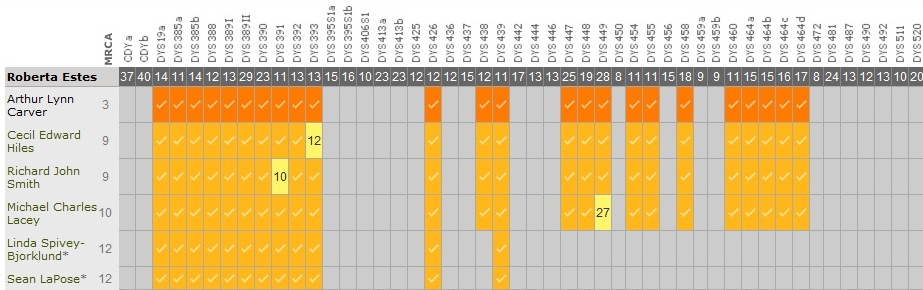
At Ancestry, your actual marker values are displayed compared with people you match, so you can see which markers you do and don’t match.  Non-matches are highlighted.  However, not all markers are displayed on the page.  You have to scroll right at the bottom of the page to see the rest. All people at Ancestry are encouraged to upload thier family tree, and attach their results to the tree.  That tree then becomes a part of Ancestry.com, although you can make it private.

Haplogroups are not displayed and neither are SNPs because Ancestry doesn’t test SNPs.  This means that they estimate all of their haplogroups, and occasionally incorrectly.  Complex haplogroup names, such as R1b1a2a1a1a4, mean those results have been hand entered by someone who tested elsewhere.  Ancestry can’t estimate to that level.

Manual Entry Issues at Ancestry

Furthermore, the results displayed, when entered by hand by people who tested at other companies often contain “clerical mutations,” otherwise known at typos.  This is the old GIGO concept – Garbage In, Garbage Out.  People identified with an asterisk have entered their results by hand, including a haplogroup name.

There are 4 markers that must be adjusted at Ancestry for Family Tree DNA results to be equivalent to the same markers at Ancestry.  In other words, the two companies “score” these markers differently.  Initially, you had to know this and compensate.  Then, Ancestry changed and began to do the compensation for you when you enter the results.  That was a definite improvement, but the result is that you have no idea if the results you are looking at are equalized or not.  The message here is that if you see an “*”, know to beware.

Furthermore, you can only have one set of results attached to your account, at least if you hand enter, and therefore if you want to check on matches for different relatives in your family, you need to edit the results from one person’s results to another.  In this case, you must do the compensation math on the markers yourself.  Fortunately, the list of markers is on the edit page, assuming people read, understand what to do and remember to adjust those values.

Advanced Matching

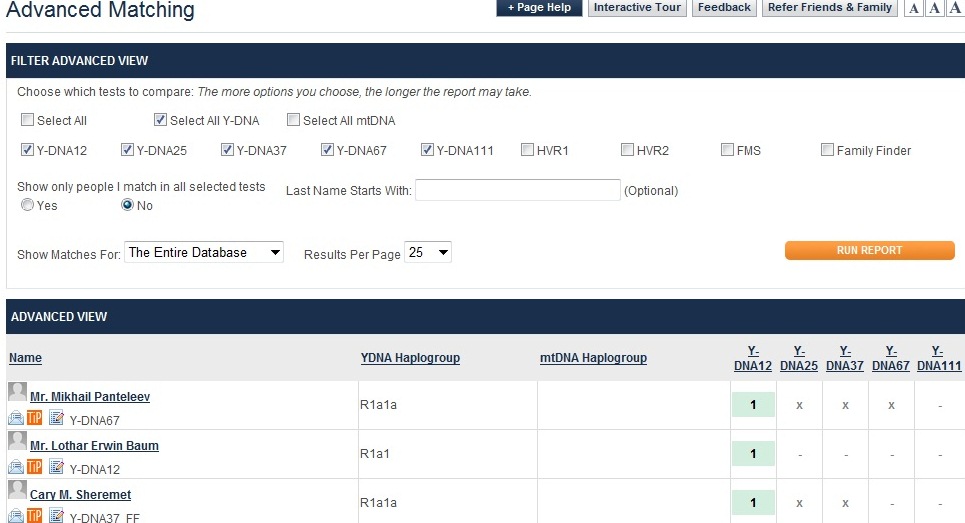
Family Tree DNA, in their last major update, added an advanced matching feature across their products that includes surname, partial name, project and combined tests matching.  This is an extremely powerful tool.  Ancestry has nothing similar.

Haplotrees

Family Tree DNA provides a haplotree.  Ancestry doesn’t test SNPs, so they have nothing to put on a haplotree. Family Tree DNA guarantees that if they can’t predict your haplogroup by an exact match at 12 markers to another individual who has been SNP tested, that they will SNP test, for free, until they can successfully tell you at least which base haplogroup you are a member of.  This test is called the Backbone test.  They seldom need to do this anymore, but I do still occasionally see the Backbone test where the individual’s marker values are very unusual.

You can tell that Ancestry has spent a lot of time making their user interface very friendly, and it is.  Some would refer to this as “dumbed down,” but regardless, haplotrees, SNPs, changing haplogroup names and all of that tends to be confusing, certainly to the novice.  Most of Ancestry’s customers fall into the novice category.  Ancestry’s marketing is directed at the impulse “feel good” purchase.  They do a good job catering to that marketspace and that group of consumers doesn’t have any idea what a SNP is, or that there is anything more than what Ancestry provides them.

Ancestry doesn’t have a haplotree and their customers don’t miss it, at least not until someone who has tested at Family Tree DNA gets ahold of them, they need something more or want to join a project at Family Tree DNA.  Fortunately, now Family Tree DNA does provide an option for Ancestry customers to “transfer in” for a reduced fee.

Haplogroup Origins

Haplogroup Origins is very powerful tool provided by Family Tree DNA and often overlooked.  Haplogroup origins are haplogroup matches, based on STR markers, that point the direction to where your ancestors lived before surnames.  This is invaluable in determining general locations for people trying to find their ancestors in Europe.

Ancestral Origins

Ancestral Origins is another extremely powerful tool provided by Family Tree DNA that is similar to haplogroup origins, but brings the match time closer to the present.  These are the locations of the oldest ancestors of people that match you on STR markers, not based on your haplogroup.  Again, extremely useful for people trying to find their ancestor’s location overseas and/or trying to verify a particular ethnicity, such as Jewish.

Matches Maps

Both Ancestry and Family Tree DNA offer a map of matches, but they are significantly different.

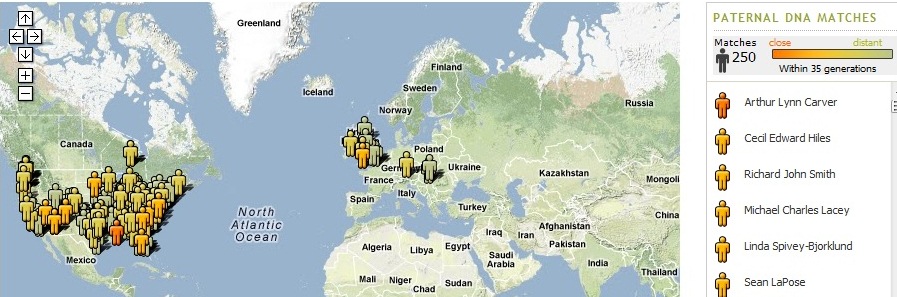
At Ancestry, the matches shown on the map are the current addresses of the people who tested, NOT their oldest ancestor.  Personally, I find this a bit creepy, as I really don’t want someone knowing where I live.  Having said that, it’s a wonderful tool for adoptees and I use this feature constantly looking for location matches for my adoptee clients.  Most recently, I found someone’s closest match genetically in the city where they were born.  That’s a big clue.  Matches are sorted in closest to furthest order and you can click on either the person icon or the name and see additional information on the map, such as the location, the name and how close the match is.

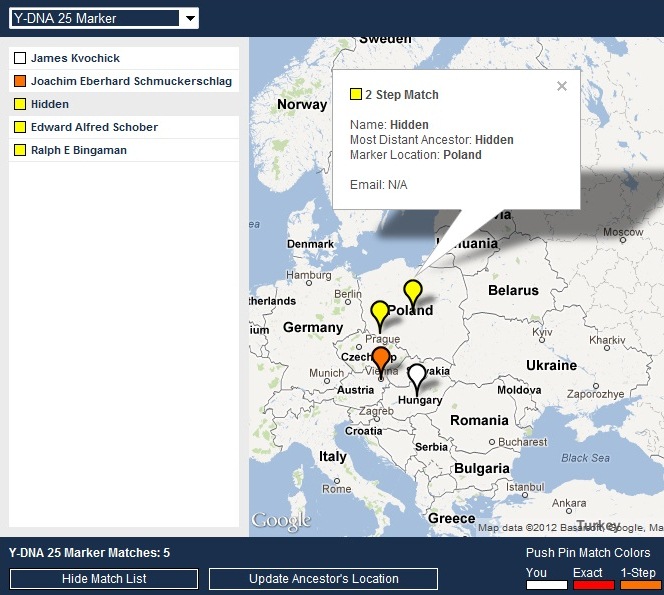
At Family Tree DNA, the matches shown are the locations of the oldest ancestors of the people you match.  This is really much more relevant to genealogists in general.  In addition, a match list can be displayed, and by clicking on either the person’s name, or a balloon, additional information is displayed including an e-mail option.  This is an extremely powerful tool for someone looking for geographic matches or trying to determine which matches to contact.

SNP Map

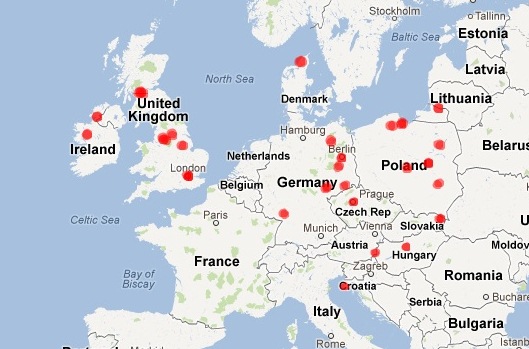
Family Tree DNA has a new SNP mapping feature.  Of course, Ancestry doesn’t have this, because they don’t test SNPs.  This new mapping feature allows you to map clusters of SNPS.  I selected clusters of 10 of R1a1-M198 just as an example.

This can be beneficial in tracking groups of haplogroup ancestors.  As haplogroups connect with more modern times, this tool will become more powerful and useful to the typical genealogist.

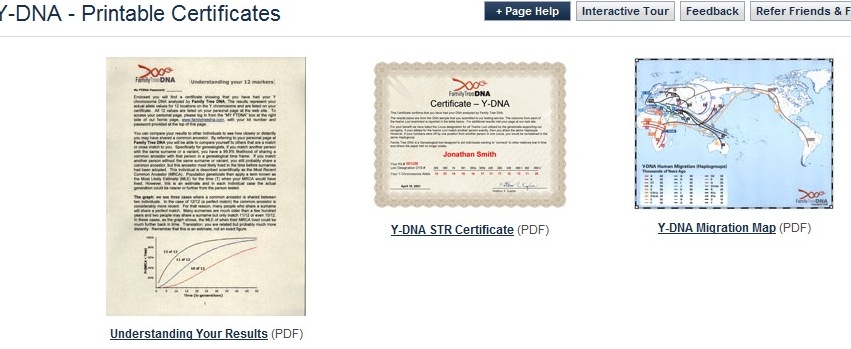
Print Certificates and Maps

Family Tree DNA has a print option for certificates and maps.  While this isn’t particularly important to me, it is to many.

Projects

At Family Tree DNA, aside from personal matches, much of the power of matching comes through projects.  Volunteer administrators lovingly manage these and many, many discoveries have been made through projects.

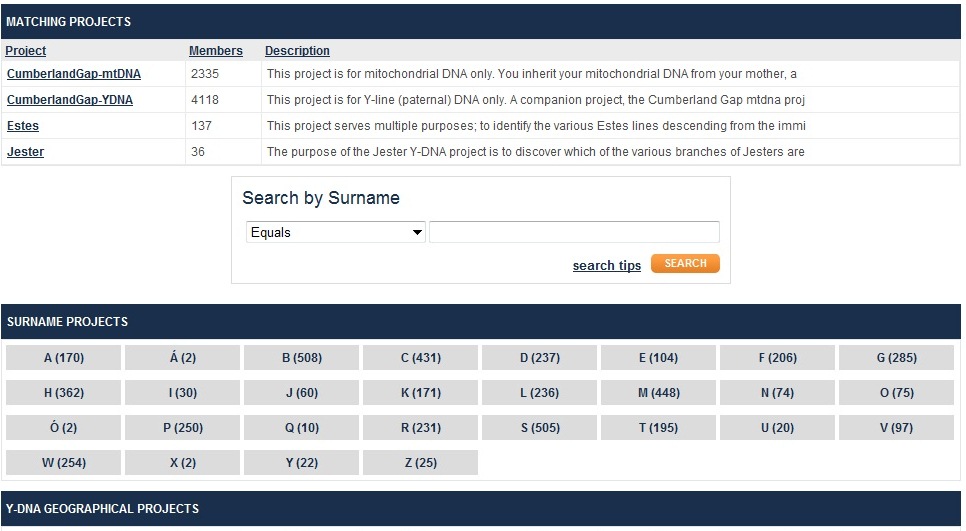
Family Tree DNA provides oversight so that projects aren’t created willy-nilly, and projects fall into 3 main categories, surname, haplogroup and geographic projects.

Surname projects are obvious, as are haplogroup projects.  Occasionally there are multiples in these categories.  For example, there is a Miller project and then I have a Miller-Brethren project for the Miller families who were of the Brethren faith.

Haplogroup projects often have subgroups studying particular SNPs or large subgroups, such as haplogroup E1b1a (Sub-Saharan Africa) and E1b1b (North Africa/Mediterranean), which are different projects.

Geographic projects are pretty much anything else.  My Cumberland Gap projects are there, both y-line and mitochondrial DNA, the Lost Colony projects, the Acadian project, Native American projects, the Bahamas and Puerto Rican projects, and many more.  Many times academic researchers and population geneticists work with these project administrators.

Projects are absolutely wonderful resources providing the opportunity to work with others who have similar interests to learn more about the people within your group.  For example, the Cumberland Gap group has provided a venue for genetic matching within the region, but we also offer a Yahoo group for project members where we share cultural and historical aspects of the Cumberland Gap area as well as genealogy.

While it is beyond the scope of this Y DNA comparison, Family Tree DNA also provides many tools to project administrators.

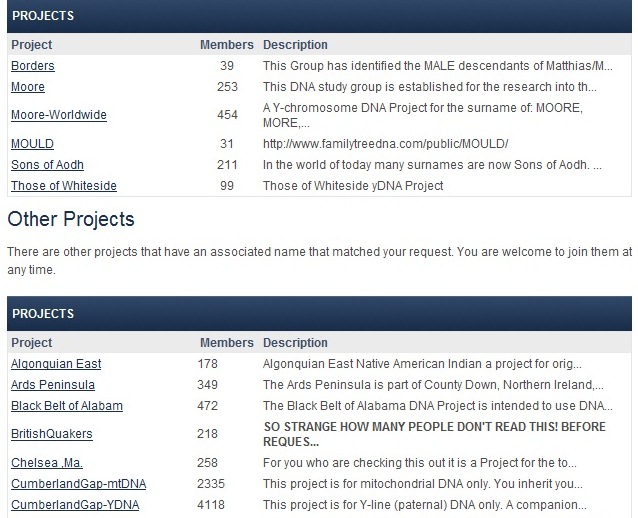
Family Tree DNA provides a search feature for projects that includes key words and surnames, plus an alphabetical browse, by category, shown above.  They also display a list of projects that include the surname of the person who is signed on and doing the search.  I was signed on when I did the above search, and you can see that there are 4 projects that include the surname Estes in their project profile, Estes, Jester and the Cumberland Gap Y-line and mitochondrial DNA projects.

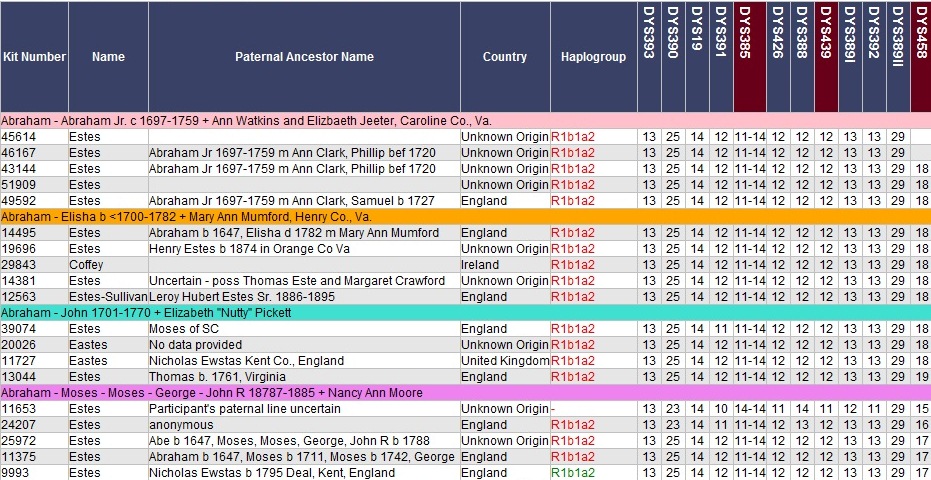
In addition, Family Tree DNA provides a public webpage for every project that includes participant grouping capabilities, shown below, colorized matches within groups, and mapping.

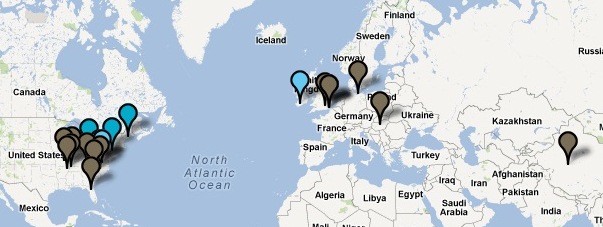
Project maps can display the oldest ancestor location of an entire project or of any selected subgroup.

This is a very powerful tool, especially in relation to haplogroup maps.

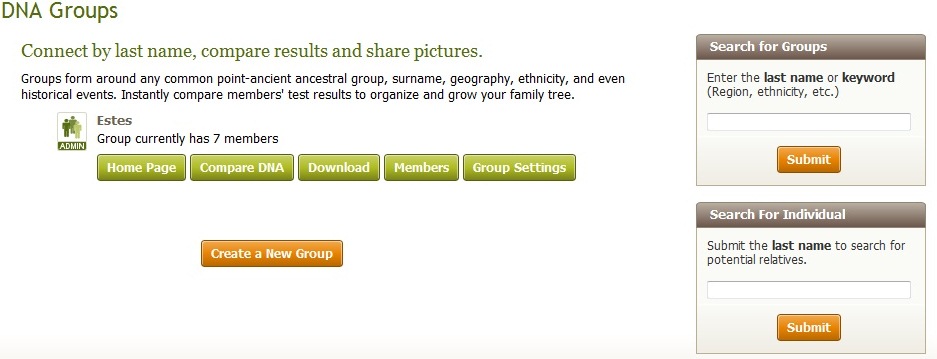
At Ancestry, shown below, you can search for either groups or individual surnames.  The surname search is a useful tool.  I searched for Estes.  I can see that people by that surname have tested and their haplogroup, but I can’t see their results.  Of course, if I enter Estes marker results, by process of elimination, I can figure out who I do and don’t match from this list. To contact these people, I have to go through Ancestry’s message service.  My experience has been that few Ancestry contact requests are successful.

Unfortunately, at Ancestry, everyone is encouraged to “create a group.”  Anyone can join whether they have DNA tested or not.  It doesn’t matter if their DNA test is for a genealogy line relevant to the project, meaning paternal or direct maternal, and there is no oversight ability or control.  In essence, these are individual or family study groups, not DNA projects, per se.

I entered the surname Moore, one of my brick walls.  The number of “Moore” groups was overwhelming.  It’s clear from looking at these that many people have created what I would term personal family study groups, but sorting through them and trying to find something useful is overwhelming.  There were 25 groups including several who were listed as the Moore Paternal surname group, with 1, 2 or 3 participants in each.  The oversight provided at Family Tree DNA avoids this type of mess.

Compare this to the projects at Family Tree DNA that list the surname Moore.  Additionally, Family Tree DNA tells me that 824 people with the surname of Moore have tested.  Of those, 454 are in the Moore Worldwide project.  Yep, if I’m a male Moore, that’s where I’d want to be – where I can compare to other Moore lines.

Other Resources

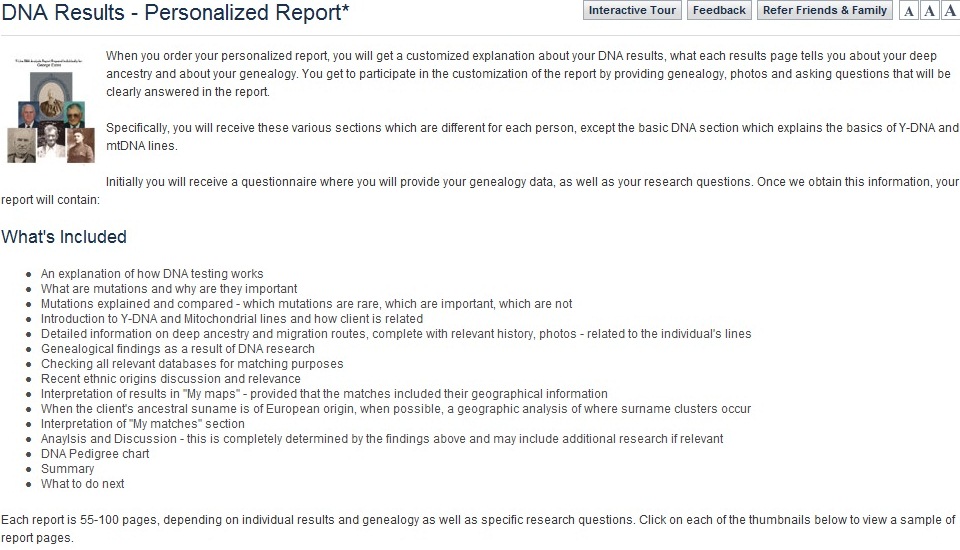
On the Other Resources tab, Family Tree DNA has a list of several other resources, all free.  In addition, you can download a free e-book about how to interpret your results, or you can order a customized Personal DNA Report.  None of these additional items are available at Ancestry.

Populating DNA up Trees

One feature that Ancestry has that Family Tree DNA does not is the ability to populate the DNA up a tree.  Obvious pitfalls are twofold.  First, the DNA may not be relevant to people up the tree if a nonparental event has occurred, also known as an undocumented adoption.

Second, the genealogy may not be correct and you’ve just genetically populated the wrong people.  Not everyone views this “tree population” as a positive feature.  Many view this with a very high level of trepidation, understanding that the many incorrect trees at Ancestry will eventually also have incorrect genetic information as part of that family record.  There is also concern that in time, this will actually discourage DNA testing because people will find these DNA populated trees and believe that their line has already been tested, so they will think they don’t need to test.

Comparison Chart

As an easy comparison, I’ve created the following chart to compare the Y-line DNA testing and products.

Feature Family Tree DNA Ancestry
Marker Results Yes, 12, 25, 36, 67 or 111 markers Yes, 33 or 46 markers
Migration Map Yes – interactive Yes
Haplogroup Description Yes Yes
Haplogroup Frequency Map Yes No
SNP testing Yes, Individual SNPs, Deep Clade and Geno 2.0 No
Matching Yes, most distant ancestor listed, direct e-mail Yes, marker comparison provided
Haplotree Yes, includes free SNP Backbone test if haplogroup cannot be predicted No
Advanced Matching Yes, by surname, partial name, project and varying test combinations No, but does have general surname search for participants
Ancestral Origins Yes No
Haplogroup Origins Yes No
Matches Map Yes, location of oldest ancestors Yes, location of person who took the test
SNP Map Yes No
Print Certificates and Maps Yes No
Projects Yes, tools and oversight provided, surname, haplogroup and geographic, includes web page, groups and maps Yes, encourages everyone to create project, lack of organization and tools
Additional Resources Personal DNA Reports, free e-book, Multiple FAQs, Forum, Newsletter, Genographic Project, Glossary, Ysearch, Mitosearch, News, Release Notes, Academic papers, Annual Administrator’s  Conference, Mitochondrial DNA testing (full sequence), Autosomal DNA testing (with data download), Walk the Y (WTY) General FAQ, Mitochondrial DNA testing (no full sequence), Autosomal DNA testing (no data download), normal Ancestry subscription services, “ability” to populate DNA up trees


______________________________________________________________

Disclosure

I receive a small contribution when you click on some of the links to vendors in my articles. This does NOT increase the price you pay but helps me to keep the lights on and this informational blog free for everyone. Please click on the links in the articles or to the vendors below if you are purchasing products or DNA testing.

Thank you so much.

DNA Purchases and Free Transfers

Genealogy Services

Genealogy Research

What the Heck is WTY?

Update: The WTY has been superceded by the Big Y test, but I’m leaving this article for historical continuity.

What the heck is WTY….and why do I care?

One of the reasons I started a blog is to continue what I do for my clients when I write their DNA reports. I make DNA understandable and fun for the normal air-breathing genealogist.

The past few days has been a whirlwind of information and announcements, some which tend to leave folks who don’t have a lot of experience in the dust.

For that, I do apologize.  However, I’d like to tackle a much easier topic now, and that’s the WTY test.  What is it and why is it so important?

WTY is short for Walk the Y, as in walk down the Y chromosome.

The tests we all order and love, at Family Tree DNA, that would be the 12, 25, 37, 67 and 111 marker tests, tell us about genealogy – who we are related to in the past several hundred years.

Deeper ancestry, anthropological in nature, a line I draw about the time when surnames were being adopted, is different and little information of that nature is exposed by the STR (short tandem repeat) genealogy markers.

By the way, short tandem repeat means those locations in our DNA that are prone to develop repeated sequences.  Think of them as genetic stutters.  They are important to us as genealogists, because on the Y chromosome, we count the number of those stutters and that is the marker value reported.

For example, below, we see that for marker 393, we have a value of 13.  That means there were 13 repeats of the same sequence.  Obviously, combining all of these sequences, or marker values, together creates our own genealogical genetic profile or fingerprint.  This, of course, is what we use to compare to others to see whom we match.

However, deep ancestry, identified by our haplogroup, is determined by a different kind of mutation, called a SNP, a single nucleotide polymorphism.

These are mutations that happen in only one location, and they are considered to be once in the lifetime of man mutations.  In actuality, these mutations sometimes happen independently in different haplogroups, but the cumulative sequence of SNP mutations defines our haplogroup.

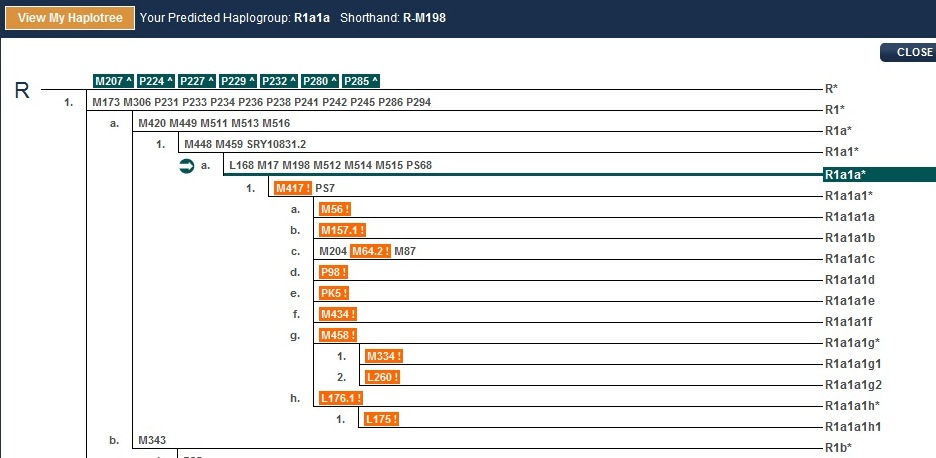
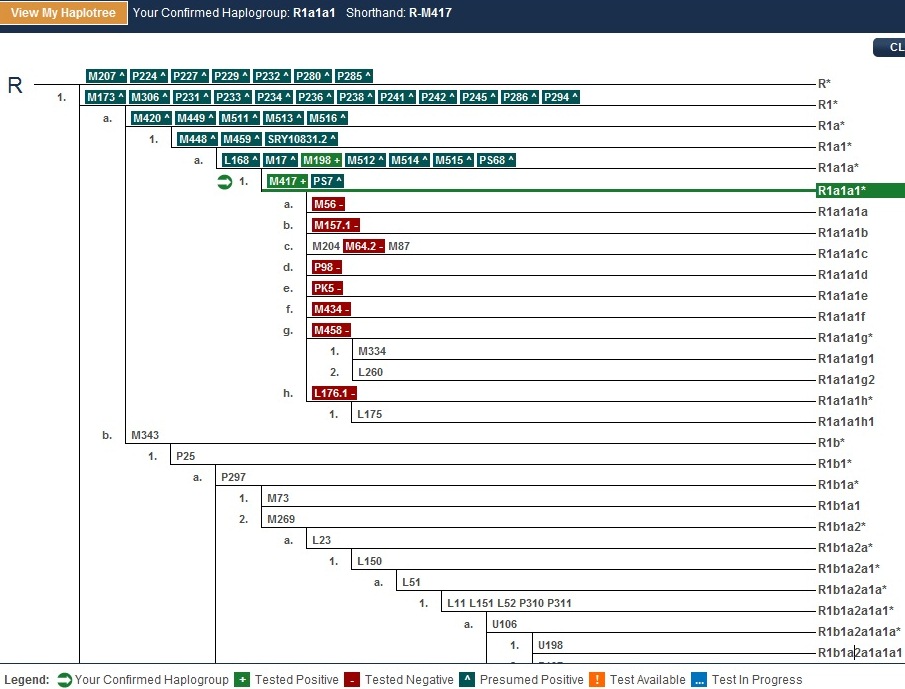
You can see, for example, below, a haplotree from a Family Tree DNA client’s results page.

This person tested positive for the light green SNP, M417.  The plus means that they have this specific mutation.  In his case, this is his terminal SNP, meaning the one furthest down the tree that defines his haplogroup, as we know it today.  That would be R1a1a1.

The SNPs shown in red, below M417 are ones that he has also been tested for, but does not have, so he knows he is not a member of those haplogroups.  These are shown with a minus sign, such as M56-.

Now for the problem that WTY has been helping to solve.

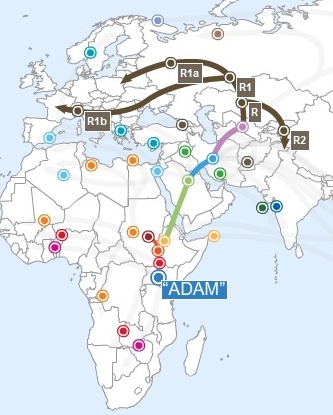
If your STR markers take you back about 500 years, in round numbers, and your haplogroup tells you where your ancestors were between 3000 and 4500 years ago, in this case, where were they in-between?  What were they doing?  Where did they live and how did they get from where they were 4500 years ago to where you find them 300 or 400 years ago, if you’re a lucky genealogist and can go back that far?

There is a significant gap in the timeframe between STR genealogy markers and haplogroup SNP markers.  Finding additional SNPs will eventually close the gap between STR genealogy markers and haplogroups.  We will have a complete timeline of our ancestors.  In some cases, we’re even finding family-specific SNPs, known as “personal SNPs.”  How cool is that?  A new haplogroup is born in your family!

Did you notice on the tree above that some of the SNP markers begin with L?  Every SNP discovered is prefaced with a letter that tells people which lab or university discovered the SNP.  The L SNPs have all been discovered at Family Tree DNA’s Genomics Lab in Houston, Texas, run by Thomas Krahn.  They are the product of the WTY discovery process.

When there is reason to believe that a SNP might be lurking undiscovered in the DNA of a person or a group, then the WTY becomes an option.  Generally, the clue would be STR markers that are significantly different than any previously seen, or part of a small and quite unusual cluster.

Today, we test all of the known downstream SNPS, the ones in red above, and then if none are found, we would apply to Family Tree DNA to do a WTY test.  This test is quite labor intensive.  In essence, they manually look at between 450,000 and 500,000 positions to see if they spy any new mutations.

If they do, they begin the SNP naming process and the process of getting the SNP officially added onto the tree.  You can see the most current haplotree (Y SNP tree) at the ISOGG site.  Because of the long naming and authentication process, sometimes trees at different locations aren’t quite in sync.  The ISOGG tree, maintained by volunteer genetic genealogists, has become what most people look to and use as the gold standard today.

In any case, this process is how new SNPs are discovered.  The Geno 2.0 project includes 12,000 SNPs for the Y chromosome, an exponential growth from the current 862, or so.  At least some of these SNPs were discovered at Family Tree DNA, as a result of savvy project administrators and others who are familiar enough with DNA results to suspect that a new SNP might exist, and who advocated with the tester and Family Tree DNA for WTY testing.

Hopefully, you now understand better about the WTY and why WTY tests are so critically important.

How might you know if you or a family member is a good candidate?

If you have tested to 67 or more markers and have no matches, you may be a candidate.  You would need to do a deep clade test, which tests all relevant downstream SNPS at this point.  In the past this has been the Deep Clade test, but today it would be the Geno 2.0 test.  If you think you might be a candidate, you’ll want to work with your haplogroup administrator to see if there are any experimental SNPS to test for after the deep clade/Geno 2.0 is completed.

The WTY is the perfect example of collaborative citizen science.  Participants fund part of the testing, haplogroup administrators identify good candidates, Family Tree DNA underwrites part of the testing fee and of course performs the test, and everyone benefits.  Before you know it, you’ve got 12,000 new SNPs combined with new technology that promises to do more than we’ve ever dared dream before!!!

______________________________________________________________

Disclosure

I receive a small contribution when you click on some of the links to vendors in my articles. This does NOT increase the price you pay but helps me to keep the lights on and this informational blog free for everyone. Please click on the links in the articles or to the vendors below if you are purchasing products or DNA testing.

Thank you so much.

DNA Purchases and Free Transfers

Genealogy Services

Genealogy Research

Geno 2.0, WTY, mtDNA Full Sequence Participants, and More

As we know, some of the WTY (Walk the Y) discoveries were used in the creation of the Geno 2.0 chip.  The entire point, of course, for the WTY test is to sequence the Y chromosome to search for new mutations.  As we can see by the plethora of new L SNPs on the SNP Tree at ISOGG, this has been quite successful.

What you may not know is that the WTY product has two prices.  A price, subsidized by Family Tree DNA for the test if you agree to allow the use of the data for scientific research, and the private price.  The application for the WTY at Family Tree DNA clarifies the expectations and the pricing.

Therefore, anyone who did not pay the higher, private price of $1500, has agreed for their results to be used for research. In essence, those who did agree to participate in research received a significant discount, 38%, amounting to 950.

Thank you Bennett and Max for underwriting this important scientific effort!

Speaking with Bennett about the process of vetting the new Geno 2.0 chip, he indicated that many of the WTY samples used were internal, meaning not customers.  Only 23 public WTY samples were used.

Spencer Wells, today, clarified the situation for those few whose results were used:

“The WTY and whole-mtDNA genome customers used in the chip validation process will receive their results when the results section of the website goes live for all Geno 2.0 participants this fall.  Your data belongs to you.  There will be no charge to them for this, and we hope that they enjoy the new Geno 2.0 experience and will become cheerleaders for the project.”

I notice, in addition to the WTY samples used, this also extends to any mtDNA full sequence results used as well.  Thank you Spencer!

Now, of course the next question will be what happens for those who have already placed orders.  Spencer says, “They will be able to cancel their orders, or give the kit to a friend or family member (which of course we would prefer…;-).  I really want to encourage them to help us expand our database.  It will benefit everyone, themselves included, and will allow us to make the 2.0 experience richer for everyone – especially the community features.  They will receive the whole Geno 2.0 experience, just like people who purchase kits.  We’ll provide them with GPIDs to use for logging in via email.”

In addition, an article appeared in BioArray News today by Justin Petrone that provides some additional information on the Illumina BeadChips used.  It’s free, but you do have to register to read it.  I’m providing the highlights below that add to the information we’re already received.

Justin interviewed Spencer, who provides background information on the Genographic project.  He mentions that about 520,000 people have participated to date.

In addition to discussing the SNPs on chips information that Spencer has previously provided to our community, he also says that ‘National Geographic and its partners are preparing two publications that discuss the new chip and have submitted an abstract for the American Society of Human Genetics annual meeting, which will be held in San Francisco in November.”

Spencer also spoke a little about the new National Geographic online community capability.  This will be in addition to the option for participants to transfer their results to Family Tree DNA, for free.  He says that “participants will have the opportunity to choose to register for the Genographic online community to connect with other participants and find shared ancestry, helping to fill in the gaps between what they know about their recent genealogy and their genetic results.”

______________________________________________________________

Disclosure

I receive a small contribution when you click on some of the links to vendors in my articles. This does NOT increase the price you pay but helps me to keep the lights on and this informational blog free for everyone. Please click on the links in the articles or to the vendors below if you are purchasing products or DNA testing.

Thank you so much.

DNA Purchases and Free Transfers

Genealogy Services

Genealogy Research
Geno 2.0 Answers from Spencer Wells

Lots of folks have had questions about the Geno 2.0 kits and different aspects of the testing.  Dr. Spencer Wells, National Geographic’s Scientist in Residence for the Genographic Project has been kind enough to answer some of the questions he’s been receiving.  I know the genetic genealogy community appreciates the continued communication and involvement from Dr. Wells.  Thanks Spencer!!

1.    How many SNPs do we have in the test?

A total of around 146,000 ancestry-informative markers (AIMs):  ~130,000 autosomal and X-chromosomal, ~13,000 Y-chromosomal, and ~3200 mtDNA

2.    What is the different between the Genographic Project and the 23andme test?  And ancestry.com?

Genographic is a non-profit National Geographic research project focused on mapping the human journey, and encompasses three core components:  scientific research, public participation and the Legacy Fund.  Our public participation component is available through the purchase of a Geno 2.0 DNA testing kit.  Our custom-designed genotyping chip looks at the markers outlined above, and is simply the best available platform for the study of genetic ancestry.  For-profit companies, including Ancestry and 23andMe, use slightly modified off-the-shelf chips which were optimized for medical research, not population history.
3.    Do we offer ancestry painting?

I assume you are referring to the chromosomal “painting” on the 23andMe website, and no – at this time we don’t offer this feature.  It is relatively straightforward to implement, however, and if there is sufficient interest among our participants, we may offer it in the future.

4.    Do we give African Americans their Asian percentage?

Everyone receives a breakdown of their regional affiliations, expressed as percentages.  This might include northeast Asian or southeast Asian in African Americans, if such components are present.
5.    Do we plan on adding a West African or East African to the affiliation?

We are continuing to refine our analysis of the chip data, and may be expanding our list of regional affiliations.

6.    How are we different from population finder?

It’s all about the markers:  again, because we have created our chip specifically for the study of ancestry, we feel that it is the most accurate tool for determining population affiliation.  Our AIMs were drawn from more than 450 world populations, and were chosen on the basis of their ancestry informativeness.  We are continuing to refine our analytical methods to provide the best ancestry testing experience available anywhere.

______________________________________________________________

Disclosure

I receive a small contribution when you click on some of the links to vendors in my articles. This does NOT increase the price you pay but helps me to keep the lights on and this informational blog free for everyone. Please click on the links in the articles or to the vendors below if you are purchasing products or DNA testing.

Thank you so much.

DNA Purchases and Free Transfers

Genealogy Services

Genealogy Research