Concepts – Percentage of Ancestors’ DNA

A very common question is, “How much DNA of an ancestor do I carry and how does that affect my ethnicity results?”

This question is particularly relevant for people who are seeking evidence of a particular ethnicity of an ancestor several generations back in time. I see this issue raise its head consistently when people take an ethnicity test and expect that their “full blood” Native American great-great-grandmother will show up in their results.

Let’s take a look at how DNA inheritance works – and why they might – or might not find the Native DNA they seek, assuming that great-great-grandma actually was Native.

Inheritance

Every child inherits exactly 50% of their autosomal DNA from each parent (except for the X chromosome in males.) However, and this is a really important however, the child does NOT inherit exactly half of the DNA of each ancestor who lived before the parents. How can this be, you ask?

Let’s step through this logically.

The number of ancestors you have doubles in each generation, going back in time.

This chart provides a summary of how many ancestors you have in each generation, an approximate year they were born using a 25 year generation and a 30 year generation, respectively, and how much of their DNA, on average, you could expect to carry, today. You’ll notice that by the time you’re in the 7th generation, you can be expected, on average, to carry 0.78% meaning less than 1% of that GGGGG-grandparent’s DNA.

Looking at the chart, you can see that you reach the 1% level at about the 6th generation with an ancestor probably born in the late 1700s or early 1800s.

It’s also worth noting here that generations can be counted differently. In some instances, you are counted as generation one, so your GGGGG-grandparent would be generation 8.

In general, DNA showing ethnicity below about 5% is viewed as somewhat questionable and below 2% is often considered to be “noise.” Clearly, that isn’t always the case, especially if you are dealing with continental level breakdowns, as opposed to within Europe, for example. Intra-continental (regional) ethnicity breakdowns are particularly difficult and unreliable, but continental level differences are easier to discern and are considered to be more reliable, comparatively.

If you want to learn more about how ethnicity calculations are derived and what they mean, please read the article Ethnicity Testing – A Conundrum.

On Average May Not Mean You

On average, each child receives half of the DNA of each ancestor from their parent.

The words “on average” are crucial to this discussion, because the average assumes that in fact each generation between your GGGGG-grandmother and you inherited exactly half of the DNA in each generation from their parent that was contributed by that GGGGG-grandmother.

Unfortunately, while averages are all that we have to work with, that’s not always how ancestral DNA is passed in each generation.

Let’s say that your GGGGG-grandmother was indeed full Native, meaning no admixture at all.

You can click to enlarge images.

Using the chart above, you can see that your GGGGG-grandmother was full native on all 20 “pieces” or segments of DNA used for this illustration. Those segments are colored red. The other 10 segments, with no color, were contributed by the father.

Let’s say she married a person who was not Native, and in every generation since, there were no additional Native ancestors.

Her child, generation 6, inherited exactly 50% of her DNA, shown in red – meaning 10 segments..

Generation 5, her grandchild, inherited exactly half of her DNA that was carried by the parent, shown in red – meaning 5 segments..

However, in the next generation, generation 4, that child inherited more than half of the Native DNA from their parent. They inherited half of their parent’s DNA, but the half that was randomly received included 3 Native segments out of a possible 5 Native segments that the parent carried.

In generation 3, that child inherited 2 of the possible 3 segments that their parent carried.

In generation 2, that person inherited all of the Native DNA that their parent carried.

In generation 1, your parent inherited half of the DNA that their parent carried, meaning one of 2 segments of Native DNA carried by your grandparent.

And you will either receive all of that one segment, part of that one segment, or none of that one segment.

In the case of our example, you did not inherit that segment, which is why you show no Native admixture, even though your GGGGG-grandmother was indeed fully Native..

Of course, even if you had inherited that Native segment, and that segment isn’t something the population reference models recognize as “Native,” you still won’t show as carrying any Native at all. It could also be that if you had inherited the red segment, it would have been too small and been interpreted as noise.

The “Received” column at the right shows how much of the ancestral DNA the current generation received from their parent.

The “% of Original” column shows how the percentage of GGGGG-grandmother’s DNA is reduced in each generation.

The “Expected” column shows how much DNA, “on average” we would expect to see in each generation, as compared to the “% of Original” which is how much they actually carry.

I intentionally made the chart, above, reflect a scenario close to what we could expect, on average. However, it’s certainly within the realm of possibility to see something like the following scenario, as well.

In the second example, above, neither you nor your parent or grandparent inherited any of the Native segments.

It’s also possible to see a third example, below, where 4 generations in a row, including you, inherited the full amount of Native DNA segments carried by the GG-grandparent.

Testing Other Relatives

Every child of every couple inherits different DNA from their parents. The 50% of their parents’ DNA that they inherit is not all the same. The three example charts above could easily represent three children of the GG-Grandparent and their descendants.

The pedigree chart below shows the three different examples, above.  The great-great-grandparent in the 4th generation who inherited 3 Native DNA segments is shown first, then the inheritance of the Native segments through all 3 children to the current generation.

Therefore, you may not have inherited the red segment of GGGGG-grandmother’s Native DNA, but your sibling might, or vice versa. As you can see in the chart above, one of your third cousins received 3 native segments from GGGGG-grandmother. but your other third cousin received none.

You can see why people are always encouraged to test their parents and grandparents as well as siblings. You never know where your ancestor’s DNA will turn up, and each person will carry a different amount, and different segments of DNA from your common ancestors.

In other words, your great-aunt and great-uncle’s DNA is every bit as important to you as your own grandparent’s DNA – so test everyone in older generations while you can, and their children if they are no longer available.

Back to Great-Great-Grandma

Going back to great-great-grandma and her Native heritage. You may not show Native ethnicity when you expected to see Native, but you may have other resources and recourses. Don’t give up!

Reason Resources and Comments
She really wasn’t Native. Genealogical research will help and mitochondrial DNA testing of an appropriate descendant will point the way to her true ethnic heritage, at least on her mother’s side.
She was Native, but the ethnicity test doesn’t show that I am. Test relatives and find someone descended from her through all females to take a mitochondrial test. The mitochondrial test will answer the question for her matrilineal line unquestionably.
She was partly, but not fully Native. This would mean that she had less Native DNA than you thought, which would mean the percentage coming to you is lower on average than anticipated. Mitochondrial DNA testing someone descended from her through all females to the current generation, which can be male, would reveal whether her mother was Native from her mother’s line.
She was Native, but several generations back in time. You or your siblings may show small percentages of Native or other locations considered to be a component of Native admixture in the absence of any other logical explanation for their presence, such as Siberian or Eastern Asian.

Using Y and Mitochondrial DNA Testing to Supplement Ethnicity Testing

When in doubt about ethnicity results, find an appropriately descended person to take a Y DNA test (males only, for direct paternal lineage) or a mitochondrial DNA test, for direct matrilineal results. These tests will yield haplogroup information and haplogroups are associated with specific world regions and ethnicities, providing a more definitive answer regarding the heritage of that specific line.

Y DNA reflects the direct male line, shown in blue above, and mitochondrial DNA reflects the direct matrilineal line, shown in red. Only males carry Y DNA, but both genders carry mitochondrial DNA.

For a short article about the different kinds of DNA and how they can help genealogists, please read 4 Kinds of DNA for Genetic Genealogy.

Ethnicity testing is available from any of the 3 major vendors, meaning Family Tree DNA, Ancestry or 23andMe. Base haplogroups are provided with 23andMe results, but detailed testing for Y and mitochondrial DNA is only available from Family Tree DNA.

To read about the difference between the two types of testing utilized for deriving haplogroups between 23andMe and Family Tree DNA, please read Haplogroup Comparisons between Family Tree DNA and 23andMe.

For more information on haplogroups, please read What is a Haplogroup?

For a discussion about testing family members, please read Concepts – Why DNA Testing the Oldest Family Members is Critically Important.

If you’d like to read a more detailed explanation of how inheritance works, please read Concepts – How Your Autosomal DNA Identifies Your Ancestors.

______________________________________________________________

Disclosure

I receive a small contribution when you click on some of the links to vendors in my articles. This does NOT increase the price you pay but helps me to keep the lights on and this informational blog free for everyone. Please click on the links in the articles or to the vendors below if you are purchasing products or DNA testing.

Thank you so much.

DNA Purchases and Free Transfers

Genealogy Services

Genealogy Research

Unwelcome Discoveries and Light at the End of the Tunnel, 52 Ancestors #156

Mother used to say that things happen in groups of 3. These past couple weeks have proven her old adage to be true. What an emotional roller-coaster!

Sooner or later, every genealogist meets an ancestor they really don’t like. One whose personal values are diametrically opposed to their own in a way that causes the genealogist some amount of…well…let’s just say consternation. Maybe even soul searching as you struggle to understand. And maybe you can’t understand and you wish the ancestor just wasn’t yours.

I met one of those when I wrote about Thomas Day, the probable wife murderer. When I discovered his murderous history, which looks very much like he beat his wife to death, given that he was found sitting by her dead body, I even checked my pedigree chart to see how far back he fell. The answer is 9 generations, meaning that if I carry any of his DNA at all, today, it would be on average 0.195% of his DNA, less than one fifth of 1%. I felt like I dodged that bullet. Whew!!

Coping Mechanisms

It’s interesting to see how people cope with revelations like this. This ancestor is so distant that you can emotionally distance yourself in many ways – by saying he might not be a murderer after all, by compensating for his behavior by making excuses, by minimizing the negative information, by emotionally divorcing yourself from him, or by accepting the evidence, feeling empathy for his spouse and realizing that he, 9 generations ago, really has nothing to do with you today.

But let’s face it. Who wants an icky ancestor?

Each of the ancestors in our tree has bad and good, some more bad than good, and some vice versa. We know so very little about any of our ancestors that we define them by the snippets, good or bad, that we do know. Keep in mind that each of those people did indeed do one thing that was very important to you – and that’s to beget your ancestor who begot another ancestor who a few generations later had one of your parents who had you. You would not exist, as you, without them – regardless of anything else in their life. You are their legacy every bit as much as what they did when they were alive.

We can simply hope we don’t “inherit” the “murderous” proclivity, genes, or whatever brought that person to that place in time in a way that led to that behavior – whether the driving factor was some something social, situational or genetic. We hope that the trait or tendency was not passed to us, today, either through genetics or family dynamics, meaning learned behaviors by example.

Whatever it was, we don’t want it!

Mental Illness – The Untouchable Topic

Of course, there is the possibility that mental illness was involved. Mental illness tends to be the topic that no one, and I mean no one, discusses.

Imagine my surprise when I discovered that, in my family line, a descendant of Thomas Day, Joel Vannoy, Thomas Day’s great-great-grandson was in fact committed to the Eastern State Mental Hospital for the insane in Knoxville, Tennessee. Joel was my great-great-grandfather.

The people in Tennessee who told me all kinds of things when I first began visiting and talking about genealogy never revealed that. They talked about wife cheaters and wife beaters and women having children not fathered by their husbands and “carrying on” with the preacher, but no one ever talked about mental illness. That was THE taboo subject.

After I made that discovery, quite by happenstance, in the court records, it turned out that people knew. Then the uncomfortable discussion immediately turned to which side of the family the “crazy came down from.” Everyone was very anxious to distance themselves not from Joel himself, but from the possible spectre of mental illness – and by virtue of the unsaid, that it was or could be found in their line as well.

Joel wasn’t dangerous, just “preachin’, swearin’, and threatenin’ to fight,” according to his hospital paperwork, but his grandson, my grandfather might have been a different matter.

Smoke and Fire

My grandfather, William George Estes, seemed to have a somewhat distant relationship with a moral compass. He not only cheated on my grandmother, Ollie Bolton, but with her own young cousin. After my grandmother divorced him, he married that cousin. They moved to Harlan County, Kentucky where he was a moonshiner and then cheated on her with her cousin. See a pattern here, perhaps? Divorced and married again, he treated that third wife very poorly, according to my mother who visited a grand total of one time. Mother was horrified and did not wish to discuss the situation.

Sometimes oral history is right, and sometimes it’s wrong, but there is often some sort of fire where there is smoke. In the case of William George Estes, there are troubling whispers about the murder of a revenue agent. I have no idea if that story is true, but I do know that one of his children starved to death, according to the death certificate. No one talked about that either. In fact, until I found the death certificate quite by accident, I never knew the child existed. I wanted to believe that the cause of death was wrong, but then I recalled that my father’s sister reported that when they were young, they didn’t have enough food and the children were fed moonshine to keep their hungry stomachs from hurting and so that they would sleep.

Imagine hearing this about your parent and grand-parents. Imagine living like that as a child. Imagine being my father.

Then, add to that the fact that the Aunt, who was somewhat inclined to embellish, said that when your grandparents divorced, when your father was about 12, neither parent wanted your father or his brother who was younger by two years. The boys, desperate, hopped on a freight train with the hobos, finally making their way back to Tennessee, from Indiana, to their grandparents’ home. They arrived very hungry and dirty. I didn’t want to believe that, but after being told the same thing by three different people with personal knowledge, I realized it was true.

Mind you, the mother who didn’t want him is the mother my father cared for, at home, for months, in her final lengthy illness in 1955. He did not betray her as she had betrayed him.

That unwanted 12 year old child turned into a 14 year old who lied about his age to enter the service in World War I. Anything was probably better than trying to scavenge. It’s no wonder he spent the majority of his life, “lookin’ for love in all the wrong places” and trying to pretend everything was OK when it wasn’t.

I have never believed, nor do I believe today, that the past is necessarily a predictor or deterministic of the future. I don’t believe that parents’ actions dictate what the child will turn out to be, either bad or good, although they certainly have an influence. The world is full of examples that disprove that logic, in both directions. I fully believe that nurture can either overcome or mediate nature – excepting of course for barriers like Down’s Syndrome that people are born with – and that our own personal decisions are what drives and determines our lives. Of course, sometimes there seems to be no nurture, but still, we have the ability to choose and to change – to create our own destiny.

My father was no angel. He was human. I have no idea how much of his behavior sprung from his early environment, but I know that later he made choices that were not in his own best interest and he paid dearly for them.

The Father I Knew

The father I knew loved me, doted on me in fact, for just short of 8 years. He was killed in an automobile accident in 1963.

He spent quality time with me when I did see him. He made special meals and I got to have special “coffee” with him. Coffee parties instead of tea parties. Of course, “coffee” was really warm milk and sugar with enough coffee to look like today’s latte. He played dolls with me, pulled me in my red wagon and often held me as I slept. I have no bad or negative memories of him.

My parents separated when I was young. While my father was a doting father to me, he was also doting in a different way, it appears, on women other than my mother.  A long-time pattern with my father it seems, as with his father.

My “half-brother,” Dave, who also knew my father, remembered him in the same affectionate way.

The father we knew took us fishing and was a man we adored. Our father rescued animals in need, a raccoon whose mother was killed on the road, an orphan duck and a little dog named Timmy. He rescued people too, including two orphan children from the orphanage in Knightstown, Indiana with his last wife, Virgie.

Dave and I who were born when my father was in his 50s have very different memories about my father than my sister, Edna, who was born when my father was in his 20s.

Edna did not know our father as a child and her opinion of him was formed entirely from her mother’s perspective.

My father did find Edna as an adult and tried to establish a relationship, as best you can after a prolonged absence. Pictured above, my father with Edna’s children between about 1958-1960.

I surely don’t blame Edna’s mother for how she felt, as my father was anything but a model husband – at least until his last marriage.
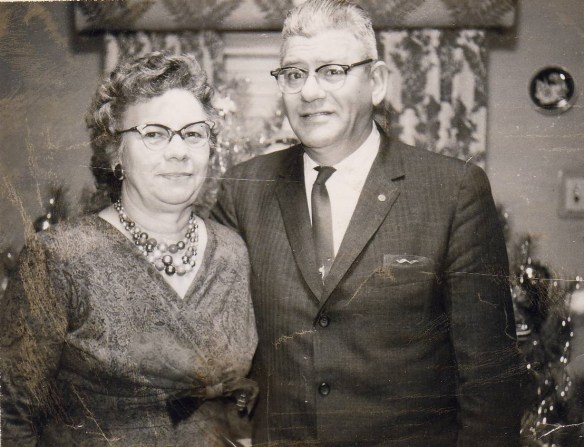
His last wife, Virgie, a lovely woman, knew him, understood him and loved him. In a letter to me after his death, she wrote that no matter what anyone said about him, no one knew what he had survived as a child and that he was not all bad. Perhaps he at last finally found the love he sought so desperately. I hope so. He was killed two years and 3 days after their marriage.

Our Identity

Our identity, in many ways, is tied to our family – to our parents. It’s tied to knowing that our parents are our parents, that our father is our father, that our siblings are indeed our siblings. It’s rooted in what we believe to be true and in good memories that make us feel warm, wanted and loved.

Our identity is uprooted when we discover something that contradicts, challenges or disproves that identify, and to say it’s upsetting is just about as big an understatement as can be made.

It shakes our very worldview, of ourselves and our place in the family. It makes us question if we are somehow less worthy because of circumstances beyond our control. We wonder if we were unwanted, a mistake, or an inconvenience.

We question who we really are. These types of discoveries are life-shaking and life-altering.

Grief

I’ve always felt that many times, I’ve been brought to and through something to provide me with perspective so that I can help others. Perhaps that’s one way of making bad things alright – of finding a plateau for acceptance – or maybe it’s just my justification for why bad or painful things happen. The silver living, so to speak. Regardless, it’s a way of helping others through situations that are almost impossible to understand without having walked a mile in those shoes.

Sometimes that mile is awfully long, uphill and freefalling at the same time, and treacherous, let me tell you. The worst roller-coaster ride you’ll ever experience.

Such was the case with the discovery that my brother, Dave, wasn’t really my brother. I then spent months doubting that my father was my father, only to discover that he was my father, and not Dave’s father. It was a miserable few months filled with doubt, dread and anxiety. The end was a mixture of relief for myself and anguish for Dave’s loss – information I never shared with him because he was terminally ill at that point.

In essence, I twice, within a few months, lost the brother I so loved.

That experience gave me the opportunity to experience the agony that others would as well, but also to learn that love really has nothing to do with biology. The depth of suffering is equal to the depth of love.

When we lose what we believe, there is grief involved. Grief over the lost truth, over the part of what we believed ourselves to be that isn’t, doesn’t exist, and dies before the rebirth of a revised identity.

Sometimes grief over the fact that someone lied to us, or hid the truth – even if they believed it was for our own good or their own protection. Grief has many reasons and many forms. But when we lose something we held dear, in any form, we grieve.

The Double Whammy

When grief is mixed with betrayal, it’s even worse. Betrayal takes a couple of forms too. Betrayal of oneself, of a moral compass, or personal betrayal by someone we love and thought we could trust.

Think of betrayal of a moral compass as occurring when someone does something that they know they shouldn’t – and do it anyway. And I’m not talking about eating chocolate here – but actions that are socially, culturally or legally unacceptable – generally addressed by legal or severe personal consequences.

Think of personal betrayal as when you discover that your spouse cheated on you.

Sometimes betrayals involved both kinds of issues. Those are particularly ugly.

Times Three

This past week or two, I’ve gotten to experience up close and personal three different betrayal/grief situations – although they are not all three mine. Two belong to close friends, which means I share their pain as I have been involved in their respective journeys.

In one case, a woman accidentally discovered through DNA that her mother and her uncle are half instead of full siblings. Yes, there are all kinds of reasons why that might be, but the first assumption out the gate is always that grandma cheated. That may not be the case, but other options, like the possibility that nonconsensual sex might be involved is also disturbing. Most of us clearly know what is involved in begetting, but we really don’t want to know the details of grandma’s sex life. TMI.

Regardless of why, the revelation that the person you grew up with believing was your full sibling is not, and the entire family lived in ignorance, except for one person, who probably lived a lie – is very disturbing on several levels. It means rethinking everything and everyone involved. It also means you’ll probably never know what really happened, but you get to deal with all of the possibilities. A homework assignment no one signs up for.

Been there, done that. It’s ugly and it takes time to get used to your new identity that you don’t like nearly as well as your old one. Your family members get new identities too. And grandma? You’re just confused about her, at the same time remembering that women at that time had very few options. All I can say is try not to judge.

It takes time to process through all of this very emotional high drama, especially when you suddenly realize you’ve spent several decades working on the genealogy of a line that isn’t yours. One more thing to grieve.

In the second case, a friend discovered the identity of his father, after decades of looking, being one of two brothers. Along with that, he discovered why the secret was closely guarded by his mother for her entire life. It’s one of those stories that would make a wonderful soap opera or reality TV show – so long as it’s not your own story. It’s also incredibly sad on so many levels.

My friend is well adjusted. He’ll absorb this, he’ll deal with it and go on. He now owns the truth he sought for so long. However, I know he was hoping that maybe his father had “only been a married man.” At one time, his mother having an affair with a married man seemed scandalous, but compared to the truth, it’s the tame option.

While these types of events are extremely interesting and colorful if they aren’t your ancestors, they are far from amusing when you discover that they pertain to your parent.

Which leads me to the third situation. My own.

Let’s just say that sometimes you have to go through a really dark tunnel to emerge into the light.

The Dominoes Fall

There is a great irony to the fact that I am probably the only person, ever, that knows, or will know when I’m finished, the truth about my father’s life. Except for my father, William Sterling Estes, himself, of course.

The dominoes began to fall a couple weeks ago. And they haven’t stopped. Just when I think there can’t possibly be any more left to discover, there is. It there a bottom to this barrel?

While the two circumstances with my friends involved DNA, one as the accidental medium of discovery, and one as the solution to the long-standing question of paternity, my situation, ironically, has nothing at all to do with DNA.

What are the chances, right?

Sometimes people think that only DNA reveals unsettling surprises, but that’s not the case. Unmasking the truth is as old as genealogy and research itself.

I’ve been prepared for years to find an unknown sibling, or two, or maybe three. Kind of hopeful, actually, since all of the ones I know about are deceased. Nope, that didn’t happen via DNA.

What I have discovered is why there was such a big gap in my father’s life.

Pandora’s Box

Let’s just say I’m struggling through this. I am extremely grateful for the woman who sent me the information, but man alive, has it ever opened a Pandora’s box. Like my friend who unveiled the identity of his father, I got what I wanted but the situation discovered is very disturbing on several different levels – which is obviously why it was hidden by anyone who knew.

The information revealed that my father was using an alias, and was prosecuted for statutory rape after marrying a 15 year old girl. The female in question had listed her age on the marriage license as 18, and had previously told him she was 24 when they met. The testimony asserts that the girl’s mother told my father that the female in question was 15 five days before they were married, which means that he committed statutory rape, because he was an adult. And yes, he went to prison for a felony – for having sex with his wife, who was less than 30 days away from being 16 which was the legal age of consent in that state at that time.

Scratching your head as to how that makes sense? Me too.

The first thing I did was to have a huge meltdown when I saw the words statutory rape. I mean, the second word is horrible enough, before the addition of the first word. That was before I discovered the details, almost two weeks into this nightmare, specifically the age discrepancy issue and the fact that the wife lied about her age on the marriage license – and that the “event” was consensual. I breathed a huge sigh of relief about the consensual part, because I really did not want to think of my father in the way I typically think of a rapist.

There had been vague rumblings in the family about a situation like that, but I thought I had disproved those rumors years ago, based on when and where my father applied for his Social Security card. I was wrong. This was something entirely different. The original rumbling was probably two stories conflated together or someone who only knew a tidbit. That old smoke and fire thing again.

I found it difficult to believe that my father was sentenced to prison under the stated circumstances, so I talked to a historian at the archives in the state where this occurred and then visited the county where the trial proceedings remain.  The verdict; yes, that is exactly what happened and why. If a male over the age of consent had sex with a female under the age of consent, it was considered statutory rape. There was absolutely no legal differentiation between that and forcible rape, and the mandatory sentence was the same too.

The woman who sent me the original information assumed I knew about “it” and had omitted the information from his timeline because of what “it” was. Believe me, “it” was news to me.

If you’re saying “Holy Cow” or the same phrase with another word in place of cow, so was I. I walked around for days shaking my head and doing the facepalm. I desperately want to grab ahold of my father, shake him, and scream, “What the hell were you thinking?”

An alias and an underaged girl – what was he thinking? My mother had a saying about that kind of behavior too – something to do with thinking with the wrong body part.

Of course, I’m assuming here that my father did in fact know her true age, but I suspect that he had no idea he could be prosecuted if they were married. Perhaps that’s why they married. Or maybe he believed the girl’s version of her age. His testimony is not included in the case because he changed his plea from not guilty to guilty.

Why did he do that, considering the length of a sentence for statutory rape? Perhaps to spare his wife from having to testify about very private things? Maybe he didn’t fully understand. We’ll never know, because I clearly can’t ask him what he was thinking.

I do know, based on his letters, that he didn’t realize that his wife divorced him a couple years later. How sad is that?

And in the greatest of ironies, the judge who sentenced him wound up trying to help him, saying that his hands were tied in the situation by the guilty plea and the mandatory sentence required.

The Maze

I feel like I’ve spent the past two weeks or so living in a twisty-turny maze that rivals any spine-tingling gripping can’t-put-it-down novel I’ve ever read. Except this is no novel.

As any good genealogist knows, there are clues to be followed. And yes, because I can’t not know, I dug into every clue with the tenacity of a beagle after a fresh bone.

It’s been a productive search too, finding records at state and county archives. Many records. Some with depositions and testimony. Some include heartbreaking letters…from my father.

My father did go to prison, but he was not a violent man. He seemed to have been somewhat impulsive and he loved too many women, the wrong women, too closely together. I can’t help but wonder if there are more wives and marriages yet to be discovered, but because he was using an alias or aliases, I’ll likely never know. If you’re up for some high drama entertainment, you can read more about my father’s story here.

I’m guessing alcohol played a part in his errant decisions too. I’m not surprised, given what we know about his childhood. Both of his brothers had alcohol issues as well. Maybe nature and nurture were both stacked against them.

My mother and others said that my father fought with the demon, alcohol, and tried repeatedly to “get clean.” Those were the days before AA. At his death, Virgie, his wife at the time, said he was clean and had “dried out” in the VA hospital in Fort Wayne. Her daughter said he had fallen off the wagon. Regardless of whether he ultimately won that battle in his 60s or was defeated one last time by alcohol, alcoholism surely informed many of his decisions and negatively affected the relationships in his life in the years my mother knew him – and probably earlier as well.

Yes, my father’s life was “colorful” in a very sad way and the price he paid was heart-wrenching and dark. I shudder to think about his life in prison. I’m still struggling with the reality of my father and prison and all of the associated connotations and baggage.

A history of prisons in the state where he served exists, and it’s so horrid I haven’t been able to read more than a few paragraphs at a time. Yes, prisoners deserve to serve time, but they don’t deserve to be chained together for up to 18 hours a day, working on road construction in the unrelenting heat as, one by one, they fall and die. That’s torture, not punishment or rehabilitation.  He served during that time. Is it any wonder that the prison’s detailed inmate records for this time period have somehow disappeared over the years?

More than once in these past couple of weeks I have wondered if it would have been an easier discovery to find out he wasn’t my father at all – rather than to discover my father was not quite who I thought he was.

Conflict

I will be sharing more with you as I can, while respecting the privacy of people who may still be living. When you’re doing genealogy, you really never expect the big reveal to be your parent – and certainly not in quite this way.

But first, before I can share more, I have to finish the research and get through this dark space and out of the tunnel into the light.

I’m both very angry with my father for his behavior that can’t be called anything but massively stupid, at best, and predatory at worst. It’s very difficult to wrap my head around that and to know that I’ll probably never really know whether he was in some ways a victim himself or whether he was, in truth, a slimy bottom feeder. Or some combination of both.

At the same time, my heart aches terribly for him based on some of the evidence that has come forward. He was, after all, my father, the man I loved and adored. The thought of him being tortured, for years, tears at the very fabric of my soul. Yet, he survived, and so will I.

It’s hard to feel this conflicted about someone you dearly loved and idolized as a child and who was ripped from your life by death. It’s also very difficult to reconcile the man I knew with the man in the impersonal black and white words of the legal proceedings staring back at me resolutely and unblinkingly from paper yellowed with age.

I am sharing this most difficult journey because I want others who find themselves in this darkness, regardless of the details of what put you into this space, to know that you are not alone.

The Light at the End of the Tunnel

For all of you who might make or have made an inconvenient or unwelcome discovery – through DNA or through traditional genealogical records – there is a light at the end of the tunnel. And yes, it’s really dark and ugly and lonely in the tunnel, because it’s a tunnel you have to walk alone.

As you struggle in that dark place, I want you to remember something.

You are YOU, not someone else. You may be a biological product of your parents, but more so you are a product of your own hard work and your personal decisions. Your accomplishments and your decisions are yours. Parents don’t get the credit and they don’t get the blame.

Whatever the dark space, you are the awesome outcome, regardless of anything else. You have the opportunity and potential to shine.

Unwelcome discoveries like this may cause you to doubt or devalue yourself. Don’t.

Just. Don’t. Go. There.

There is a fork in the road, multiple forks in the road, for all of us, and it’s the choice you make at those forks that matters. Those forks define your life.  Your forks – your decisions, not theirs. Their forks do not reflect on you.

Your life is your book. Your parents only get an opening chapter. You get to write the rest. Those are your blank pages to fill. Yours. Only yours.

You are only in control of you. Your ancestor’s decisions, while they clearly affect your life in terms of your existence, where you were born and your economic circumstances, do not define who you are or dictate the kind of person that you evolve to be or the choices you make.

Regardless of the creepy critters in the dark haunted tunnel, the trap doors and the spider webs, there is a light at the end and you will emerge a better and more empathetic person than you entered. It’s painful, but not fatal.

Just keep walking, putting one foot in front of the other, and don’t be afraid. The discovery is the worst part, and by the time you’re walking in that tunnel, the discovery is over. You’re now in the healing process. Your wounds will become scars that testify to your strength and survival. Be proud of your resilience.

Just. Keep. Walking.

As I used to say to my kids, “the only way to it is through it.”

Feel the feelings you need to feel, but don’t let those consume you or define you either – and don’t wallow there. No good will come of that. Purposefully walk through the tunnel and out the other end into the warmth and light. The rest of your life is waiting for you, and you ARE the light for others.

Easter is, after all, a time of resurrection and redemption – of the earth when flowers joyfully spring from their long sleep and as our souls emerge from colorless hibernation as well.

Take heart, spring always arrives, no matter how long, cold or bleak the winter in the tunnel!

______________________________________________________________

Disclosure

I receive a small contribution when you click on some of the links to vendors in my articles. This does NOT increase the price you pay but helps me to keep the lights on and this informational blog free for everyone. Please click on the links in the articles or to the vendors below if you are purchasing products or DNA testing.

Thank you so much.

DNA Purchases and Free Transfers

Genealogy Services

Genealogy Research

John Stamos – Who Do You Think You Are – “Honor and Family”

On this Sunday’s episode of Who Do You Think You Are? at 10/9c on TLC, actor John Stamos explores his Greek heritage for the first time and learns more about his grandfather’s sad childhood. He also meets a relative he never knew and hears firsthand about his family’s enduring strength. In a suiting coincidence and homage to John’s heritage, the episode premieres on Greek Easter, which is usually celebrated on a different date but this year coincides with the Western calendar’s Easter Sunday.

Warning – get the box of Kleenex.  Yep, this is one of those – in a good way.

John begins by explaining that he never wanted to go to college, and how supportive his parents were of his decision to pursue acting.  John’s parents and grandparents were all very family focused.

His parents are gone now, and of course, he and his sisters wish they had asked many more questions while they could have. 

He said, “I always thought Mom and Dad would be around.”  Yea, John, you and so many others, right up until they aren’t anymore.

As it turns out, for John, the information he was able to glean from a trip to Greece wasn’t anything that his parents were likely to have known.

John’s grandfather, for whom John’s father and John himself are both named, certainly did know, and perhaps intentionally left that part of the family story back in Greece.

John and his sisters think they remember the village name in Greece, but they have different memories, so John will need help figuring out where his family is from.  He thinks they were from someplace near Tripoli. Turns out that he was close – about 40 miles or so distant. And of course, the family name was changed in America.

John heads to the Greek National Archives to begin unraveling his own personal Greek tragedy.

Courtesy TLC

At the National Archives, John works with a historian who has put together as much as she can from what is in essence a Greek census document and school records that show John’s grandfather as a 13 year old boy and have him marked as an orphan.

John never knew this about his grandfather, and wants to know more, but of course, he must return to the county where his grandfather was raised.

The Greek countryside is stunningly beautiful, but be prepared…for snow.  I had no idea it snowed in Greece, and John is driving on those mountain roads in the snow, with the flocks of sheep.

John’s next stop is the notarial archives which have records of things like land sales.  Indeed, John’s grandfather’s mother sold land in 1916.  The historian explained to John that this was her dower land, near and dear to her heart because it was given to her when she married.  To sell it would have probably meant she was in some kind of trouble.

As John said, “a desperate act of a desperate woman.”

But to find out why, John had to go on to the actual village, Kakouri, to discover what was actually going on, and why. John is now in the part of the world where villages hang on mountainsides, roads are one lane and addresses are given by description.  “Look for the house with the green gate.”

John discovers that he is literally related to half the village, and probably the other half too, if he went back more than a couple generations or did some DNA testing.  I couldn’t help but think how much fun it would have been to do a village genealogy and DNA test everyone, but I digress.

John discovers the secret that his grandfather very clearly knew, and left behind.  He meets a most amazing woman and finds a photo of his grandfather’s mother, hanging on the wall and learns the story of this amazingly strong woman from someone who knew her.  She sacrificed her dower land for honor and family. 

John’s reunion in the village and his discoveries there are nothing short of amazing, and heartwarming, and heart-wrenching too.

Courtesy TLC

I’m so glad John made this journey and took all of us along. The views of Greece and the cemetery, especially if you are a cemetery buff, are worth watching alone. I love learning about the cultures and records of other countries.

But for John, it truly was a journey home in ways he could never have imagined.  It’s amazing how much “distance’ is created in just two generations, and how much can be recovered when you physically visit the location where your ancestor lived.  There is just something about standing where they stood and seeing what they saw that gives you roots.

Don’t forget the Kleenex, and enjoy!  It’s wonderful way to spend Easter evening.

______________________________________________________________

Disclosure

I receive a small contribution when you click on some of the links to vendors in my articles. This does NOT increase the price you pay but helps me to keep the lights on and this informational blog free for everyone. Please click on the links in the articles or to the vendors below if you are purchasing products or DNA testing.

Thank you so much.

DNA Purchases and Free Transfers

Genealogy Services

Genealogy Research

Autosomal DNA Transfers – Which Companies Accept Which Tests?

Somehow, I missed the announcement that Family Tree DNA now accepts uploads from MyHeritage.

Other people may have missed a few announcements too, or don’t understand the options, so I’ve created a quick and easy reference that shows which testing vendors’ files can be uploaded to which other vendors.

Why Transfer?

Just so that everyone is on the same page, if you test your autosomal DNA at one vendor, Vendor A, some other vendors allow you to download your raw data file from Vendor A and transfer your results to their company, Vendor B.  The transfer to Vendor B is either free or lower cost than testing from scratch.  One site, GedMatch, is not a testing vendor, but is a contribution/subscription comparison site.

Vendor B then processes your DNA file that you imported from Vendor A, and your results are then included in the database of Vendor B, which means that you can obtain your matches to other people in Vendor B’s data base who tested there originally and others who have also transferred.  You can also avail yourself of any other tools that Vendor B provides to their customers.  Tools vary widely between companies.  For example, Family Tree DNA, GedMatch and 23andMe provide chromosome browsers, while Ancestry does not.  All 3 major vendors (Family Tree DNA, Ancestry and 23andMe) have developed unique offerings (of varying quality) to help their customers understand the messages that their unique DNA carries.

Ok, Who Loves Whom?

The vendors in the left column are the vendors performing the autosomal DNA tests. The vendor row (plus GedMatch) across the top indicates who accepts upload transfers from whom, and which file versions. Please consider the notes below the chart.

(Chart updated September 28, 2017)

Please note that on August 9, 2017, 23and Me began processing on the Illumina GSA chip which is not compatible with earlier versions.  As of late September 2017, only GedMatch accepts their upload and only in their Genesis sandbox area, not the normal production matching area.  This is due to the small overlap area with existing chips.  You can read more about the GSA chip and its ramifications here

  • Family Tree DNA accepts uploads from both other major vendors (Ancestry and 23andMe) but the versions that are compatible with the chip used by FTDNA will have more matches at Family Tree DNA. 23andMe V3, Ancestry V1 and MyHeritage results utilize the same chip and format as FTDNA. 23andMe V4 and Ancestry V2 utilize different formats utilizing only about half of the common locations. Family Tree DNA still allows free transfers and comparisons with other testers, but since there are only about half of the same DNA locations in common with the FTDNA chip, matches will be fewer. Additional functions can be unlocked for a one time $19 fee.
  • Neither Ancestry, 23andMe nor Genographic accept transfer data from any other vendors.
  • MyHeritage does accept transfers, although that option is not easy to find. I checked with a MyHeritage representative and they provided me with the following information:  “You can upload an autosomal DNA file from your profile page on MyHeritage. To access your profile page, login to your MyHeritage account, then click on your name which is displayed towards the top right corner of the screen. Click on “My profile”. On the profile page you’ll see a DNA tab, click on the tab and you’ll see a link to upload a file.”  MyHeritage has also indicated that they will be making ethnicity results available to individuals who transfer results into their system in May, 2017.
  • LivingDNA has just released an ethnicity product and does not have DNA matching capability to other testers.  Living DNA imputes DNA locations that they don’t test, but the initial download only includes the DNA locations actually tested.
  • WeGene’s website is in Chinese and they are not a significant player, but I did include them because GedMatch accepts their files. WeGene’s website indicates that they accept 23andme uploads, but I am unable to determine which version or versions. Given that their terms and conditions and privacy and security information are not in English, I would be extremely hesitant before engaging in business. I would not be comfortable in trusting on online translation for this type of document. SNPedia reports that WeGene has data quality issues.
  • GedMatch is not a testing vendor, so has no entry in the left column, but does provide tools and accepts all versions of files from each vendor that provides files, to date, with the exception of the Genographic Project.  GedMatch is free (contribution based) for many features, but does have more advanced functions available for a $10 monthly subscription. The GedMatch Genesis platform is a sandbox area for files from vendors that cannot be put into production today due to matching and compatibility issues.
  • The Genographic Project tested their participants at the Family Tree DNA lab until November 2016, when they moved to the Helix platform, which performs an exome test using a different chip.
  • The Ancestry V2 chip began processing in May 2016.
  • The 23andMe V3 chip began processing in December 2010. The 23andMe V4 chip began processing in November 2013. Their V5 chip August 9, 2017.

Incompatible Files

Please be aware that vendors that accept different versions of other vendors files can only work with the tested locations that are in the files generated by the testing vendors unless they use a technique called imputation.

For example, Family Tree DNA tests about 700,000 locations which are on the same chip as MyHeritage, 23andMe V3 and Ancestry V1. In the later 23andMe V4 test, the earlier 23andMe V2 and the Ancestry V2 tests, only a portion of the same locations are tested.  The 23andMe V4 and Ancestry V2 chips only test about half of the file locations of the vendors who utilize the Illumina OmniExpress chip, but not the same locations as each other since both the Ancestry V2 and 23andMe V4 chips are custom. 23andMe and Ancestry both changed their chips from the OmniExpress version and replaced genealogically relevant locations with medically relevant locations, creating a custom chip.

Update:  In August 2017, 23andMe introduced their V5 chip which has only about 20% overlap with previous chips.

I know this is confusing, so I’ve created the following chart for chip and test compatibility comparison.

(Chart updated Sept. 28, 2017)

You can easily see why the FTDNA, Ancestry V1, 23andMe V3 and MyHeritage tests are compatible with each other.  They all tested utilizing the same chip.  However, each vendor then applies their own unique matching and ethnicity algorithms to customer results, so your results will vary with each vendor, even when comparing ethnicity predictions or matching the same two individuals to each other.

Apples to Apples to Imputation

It’s difficult for vendors to compare apples to apples with non-compatible files.

I wrote about imputation in the article about MyHeritage, here and also more generally, here. In a nutshell, imputation is a technique used to infer the DNA for locations a vendor doesn’t test (or doesn’t receive in a transfer file from another vendor) based on the location’s neighboring DNA and DNA that is “normally” passed together as a packet.

However, the imputed regions of DNA are not your DNA, and therefore don’t carry your mutations, if any.

I created the following diagram when writing the MyHeritage article to explain the concept of imputation when comparing multiple vendors’ files showing locations tested, overlap and imputed regions. You can click to enlarge the graphic.

Family Tree DNA has chosen not to utilize imputation for transfer files and only compares the actual DNA locations tested and uploaded in vendor files, while MyHeritage has chosen to impute locations for incompatible files. Family Tree DNA produces fewer, but accurate matches for incompatible transfer files.  MyHeritage continues to have matching issues.

MyHeritage may be using imputation for all transfer files to equalize the files to a maximum location count for all vendor files. This is speculation on my part, but is speculation based on the differences in matches from known compatible file versions to known matches at the original vendor and then at MyHeritage.

I compared matches to the same person at MyHeritage, GedMatch, Ancestry and Family Tree DNA. It appears that imputed matches do not consistently compare reliably. I’m not convinced imputation can ever work reliably for genetic genealogy, because we need our own DNA and mutations. Regardless, imputation is in its infancy today and due to the Illumina GSA chip replacing the OmniExpress chip, imputation will be widely used within the industry shortly for backwards compatibility.

To date, two vendors are utilizing imputation. LivingDNA is using imputation with the GSA chip for ethnicity, and MyHeritage for DNA matching.

Summary

Your best results are going to be to test on the platform that the vendor offers, because the vendor’s match and ethnicity algorithms are optimized for their own file formats and DNA locations tested.

That means that if you are transferring an Ancestry V1 file, a 23andMe V3 file or a MyHeritage file, for example, to Family Tree DNA, your matches at Family Tree DNA will be the same as if you tested on the FTDNA platform.  You do not need to retest at Family Tree DNA.

However, if you are transferring an Ancestry V2 file or 23andMe V4 file, you will receive some matches, someplace between one quarter and half as compared to a test run on the vendor’s own chip. For people who can’t be tested again, that’s certainly better than nothing, and cross-chip matching generally picks up the strongest matches because they tend to match in multiple locations. For people who can retest, testing at Family Tree DNA would garner more matches and better ethnicity results for those with 23andMe V2 and V4 tests as well as Ancestry V2 tests.

For absolutely best results, swim in all of the major DNA testing pools, test as many relatives as possible, and test on the vendor’s Native chip to obtain the most matches.  After all, without sharing and matching, there is no genetic genealogy!

______________________________________________________________

Disclosure

I receive a small contribution when you click on some of the links to vendors in my articles. This does NOT increase the price you pay but helps me to keep the lights on and this informational blog free for everyone. Please click on the links in the articles or to the vendors below if you are purchasing products or DNA testing.

Thank you so much.

DNA Purchases and Free Transfers

Genealogy Services

Genealogy Research

WWI – 100 Years Ago – Thou Art Gone, 52 Ancestors #155

World War I was billed as The War to End All Wars, except, of course, it didn’t. This past week saw the commemoration of 100 years since the United States entered WWI. 100 years, a century…and to think my father served.

After three years of keeping the United States out of the war, on April 2, then President Woodrow Wilson appeared before Congress and called for Congress to declare war on Germany, saying that “the world must be made safe for democracy.” Four days later, Congress did just that.

On April 6, 1917, the United States entered WWI by declaring war on Germany after the sinking of 8 neutral US ships by German submarines in February of 1917 along with the discovery of a German plot to encourage Mexico to wage war on the US. The war no longer belonged only to Europe. We were involved, whether we wanted to be or not.

Shortly thereafter, more than 4.7 million Americans rallied to the cry and enlisted. A sampling of the recruitment posters is shown below.  You can click to enlarge.

Twenty-one months later, Germany was defeated and an armistice was signed on November 11, 1918.

That’s the short dry version of America’s involvement in WWI, but there was more, so much more.

Families

Those 4.7 million men – they were our fathers and grandfathers and uncles and great-uncles and cousins. Every one of those men left families behind and went to war. 53,402 of those men would be killed in battle, and another 63,114 men would die in service from non-combat injuries and illnesses, including the Spanish Flu which struck with a vengeance beginning about March 1918.

Soldiers, stationed and living in close quarters, were particularly susceptible. This photo from 1918 shows a hospital ward of soldiers suffering from the Spanish Flu in Fort Riley, Kansas. Many military hospitals couldn’t handle the onslaught of patients and temporary hospital quarters were set up in gymnasiums and anyplace additional space could be found.

Ultimately, about one third of the world population became infected, and of those, 10-20% died.

For the soldiers who were taken ill, not only were they very sick, sometimes gravely so, they were far from home and loved ones. They must also have been worried about family at home, if they contracted the flu, and how they fared. Were family members alive or dead?

Both of my father’s paternal grandparents died in July and October of 1918, while he was serving his country.

The Agony of Departure

No matter how much one believes in the cause and wants to fight for all that is right, no matter how patriotic the family, the agony of departure with its uncertainty of return is universal.

This screen shot from The History Place shows soldiers and their families with such poignancy.

My father, a young enlistee, left behind a girlfriend, Virgie…who…as fate would have it, he married not as a young man, but some 44 years later in his sunset years, just two years before his death. The heart-wrenching photo below is of my father, but the handwriting is hers.

Virgie kept and cherished this photo for 44 years until they were reunited, and it was then passed to me after her death, more than another 30 years later – when they were both truly gone.

The Draft

Voluntary enlistments didn’t provide enough manpower. Beginning May 18th, 1917, men born between 1872 and 1900, between the ages of 18 and 45, regardless of citizenship status, were required to register for the draft, providing genealogists today with a peek into the lives of those men sometimes not otherwise available. After all, it was a full century ago.

24 million men registered, or about 25% of the total population.

Today, those registration cards are available at Ancestry and additional information is available at www.fold3.com. At the Ancestry link, be sure to scroll down for history about the registration itself and hints for searching. If your ancestor isn’t present in the draft cards, perhaps it was because he had already enlisted.

The Records

My grandfather’s draft card is shown below. I didn’t know where William George Estes was living at that time, as he moved between Indiana and Tennessee and eventually settled in Harlan County, Kentucky. However, I did know his birthdate, so it was relatively easy to find his draft card with a combination of name and birthdate. Will, as he was called, didn’t use his middle name on his draft registration, but he did sign the card. This is the only copy of his signature that I have.

He was white, 45 years old, his nearest relative was his wife, Joisie (Joyce) and he was of medium height and build with brown eyes and black hair.

While I do have a few photos of my grandfather, you can’t ascertain much of that information from photos.

Will and my grandmother had divorced in Indiana, and I wasn’t sure if he was married at that time, or not. The date of his registration is September, 12, 1918, which gives us a snapshot of him at that point in time. He was never called to serve.

Sons

William George Estes had 3 living sons:

  • Charles Estel Sebastian Estes born November 1, 1894
  • William Sterling Estes, my father, born October 1, 1902
  • Joseph “Dode” Harry Estes born September 13, 1904

Of those sons, only one would have been required to register for the draft initially, Charles, who went by the name Estel, was the only son old enough. I was unable to find his draft registration, even though I think I know where he lived at that time.

The other two sons, far too young to enlist, did just that – enlisted.

Enlistment

How could William and Joseph “Dode” have enlisted? They were too young. No place near 18 years of age.

Both boys “adjusted” their birth year.

My father recorded his birth year upon enlistment as 1898 and his brother, two years younger, did the same. We know, positively, via the census and later Social Security records that neither was born before 1900.

In the 1900 census, above, you can see that neither William nor Joseph were members of the family.  Only Estel and Robert, the son who died when the house burned.

In the 1910 census, Sterl is age 8, so born in October of 1901, and Doad is age 5, born in September of 1904. These years may be off by one year, as Joseph’s SS record says he was born in 1903 and my father’s says he was born in 1902 – but still, they were far younger than 18 years old in 1917.

How the heck did those boys pull that off? I have no idea, but they unquestionably did.

Unfortunately, my father’s military service records burned in the July 1973 fire in the National Personnel Records Center in St. Louis, Missouri. That blaze was so intense that it burned for 2 days and most of the records were destroyed. However, between various alternate record sources, the Veteran’s Administration and I were able to piece some of his information together.

For example, we know that William Sterling Estes enlisted on May 14, 1917 at Fort Benjamin Harrison, Indiana, near Indianapolis, giving his age upon enlistment as 18 years and 24 days of age. He was actually 14 years, 6 months and 13 days old. So young to be trained how to kill.

Fourteen. Years. Old.

Enrolling in the military.

Fighting a war.

And that is assuming that my father was actually born in 1902, not 1903 as some records, such as his delayed birth certificate, sworn to by his father and with the family Bible as evidence, state. So, he could have been 15 years old if he was born in 1901 as the census suggests, 14 based on other records such as social security, or 13 years old if he was born in 1903.

Giving his birth year as 1898 would have made him old enough to enlist. So, yes, there are primary source records that show my father’s birth year ranging from 1898 through 1903.

William Sterling Estes during WWI, above.  His brother, Dode, was two years younger.

Joseph “Dode” Estes during WWI.

I don’t have Dode’s service records, so I’m not sure whether he actually enlisted with his brother, or later, but the family story is that they enlisted together and “Dode was 12.”  It’s hard enough to believe my father enlisted and served at 14, but he did, let alone Dode at age 12.

Fort Benjamin Harrison

Fort Benjamin Harrison was a welcome center and training ground for recruits before they were sent elsewhere.

Men were assigned to housing known as cantonments.

They were trained in combat skills.

Training and study took place outside, between the cantonments.

Including inspections.

Quarters were close.

The mess tent was camp style.

You can see additional photos of Fort Benjamin Harrison at the World War I Museum, here.

To the best of my knowledge, my father never served overseas and never had to use his bayonette skills. I don’t really know though, because his military records were destroyed.  He died in 1963 and there is no one left to ask. On his funeral home record, it does record a war injury, so the question of overseas service remains unanswered.

After training was complete, the men were sent to their assignment.  I know that my father spent most, if not all, of his first enlistment at Camp Custer, near Battle Creek, Michigan, where he was honorably discharged on May 19, 1919 and re-enlisted the following day.

Camp Custer

Camp Custer was built in 1917 for military training during World War I. Named after Civil War cavalry officer General George Armstrong Custer, the facility trained or demobilized more than 100,000 troops during World War I.

Construction began on July 1, 1917 and on December 5, less than six months later, the completed camp was turned over to the government.

A booklet, “Souvenir of Camp Custer,” published in 1918, gives an excellent contemporary view of the camp and its resources.

Camp Custer was called a “national university that takes a young man from the farm, the shop and the office and in a few short months graduates soldiers, trained and equipped, ready to fight the battles of democracy.

Camp Custer is a wonder place. Nothing like it was ever built in America before — and this is one of thirty-six such cantonments, all built in an amazingly short time to meet the country’s emergency needs.

The site of Camp Custer was as peaceful and quiet stretch of countryside as existed in America. Then came the declaration of war, and in five months a complete military city of two thousand buildings, with comfortable quarters for 36,000 men, stretched its length over four miles of territory.

This aerial view taken in 1918 shows what was at that time an expansive complex.

From my father’s letters to Virgie, we know that he contracted the Spanish Flu and was hospitalized at Camp Custer, at least twice in 1918. It was during that time that he met a hospital volunteer, Martha Dodderer, who was destined to become his wife and the mother of my half-sister.

In 1918, displays of patriotism became very popular. At that time, a human shield was formed at Camp Custer, utilizing 30,000 men and officers dressed for their position in the shield. My father would have been in this photo, someplace.

According to the brochure, this photo was taken from the top of the water tower.

I wish I knew more about the role my father played during the war. I know nothing other than his occupation was listed as a fireman.

The last veteran of WWI has died. It’s unusual to find someone whose father served. I was a very late in life child for my father causing me to be a generation off-shifted.

Your Tree

Take a look at your tree to see who was of the age to either serve in WWI or register for the 1917 draft.

In my tree, only one other male qualified, my Brethren grandfather. Brethren were pietists, but he did register and not as a conscientious objector.

This registration does solve one long-standing question about John Ferverda’s middle name. Was it Whitney or Whitley? Since he signed this card himself, his middle name is clearly Whitney! I also didn’t know he had grey eyes and light hair. By the time I knew him, his hair was clearly “light,” as in grey. There is only one color photo and it’s late in his life.

John Whitney Ferverda is shown below.

Earlier photos don’t really show his hair to be remarkably light.

John Whitney Ferverda never served, but, surprisingly three of his brothers did, and two more registered for the draft, telling me that several men in his family had grey eyes and dark hair. One had blue eyes and light hair. I really had no idea this family was more fairly complected with lighter skin and eyes. I guess we always think of our family as similar to ourselves.

The three stars in the window found in this picture of Evaline Miller Ferverda indicate that this family has three sons serving in WWI. That’s pretty amazing for a Brethren family.  If I hadn’t actually looked, I would have assumed that none of their sons served…and I would have been dead wrong and overlooked a great deal of information.

Siblings

Take a look in in the WWI draft registrations for your ancestor’s siblings as well. You never know what you might discover. WWI draft cards are an underutilized resource.

Samuel Bolton was my father’s uncle – his mother’s brother. He was born on June 12, 1894, so he was relatively close to my father’s age.

Samuel turned 23 years old a week after his draft registration. Samuel did serve in the war, being inducted on September 20, 1917, just 3 months after registering. He was sent overseas in May of 1918 and was killed on October 8, 1918, on the battlefield, in France. Sadly, there are no photos of Samuel, nothing, other than this one.

I was able to discover the name and number of Samuel’s unit, which allowed me to track Samuel, with his unit, to that fateful day in France. If you can find the unit name and number in which your family member served, you can figure out where they were, when, and put together the story of what happened to them during that time in their life.

Honoring Our Veterans

Thankfully, WWI was not on American soil. It was not the war to end all wars. In fact WWII followed just over two decades later. Sadly, as we have seen since, warfare seems to be a perpetual state someplace in the world and even as I write this, American men and women are serving in harm’s way.

Other than the short-lived Spanish American War in 1898, in which comparatively few American men participated, WWI was the first conflict since the Civil War in the 1860s. The Civil War produced some draft registrations for northerners, but did not produce draft registration cards on this scale, so WWI is the first resource that offers genealogists a type of nationwide census of military eligible men.

How did WWI touch your ancestors? Was it through their own service, or the service of a spouse, brother or parent? Did they return home, or are some buried in cemeteries like the one at Camp Custer or even on foreign soil?

Please take a minute to silently honor those who served and to think about how our lives today might have been different had WWI not occurred, or had the outcome been different in either a global or personal sense.

______________________________________________________________

Disclosure

I receive a small contribution when you click on some of the links to vendors in my articles. This does NOT increase the price you pay but helps me to keep the lights on and this informational blog free for everyone. Please click on the links in the articles or to the vendors below if you are purchasing products or DNA testing.

Thank you so much.

DNA Purchases and Free Transfers

Genealogy Services

Genealogy Research

Smokey Robinson – Who Do You Think You Are – “Overcome with Joy”

Courtesy TLC

On this Sunday’s episode of Who Do You Think You Are? at 10/9c on TLC, Motown legend and icon Smokey Robinson dives into his late mother’s family history. He searches for answers behind the mystery of why his grandfather disappeared from his children’s lives, and finds a man tangled in a swirl of controversy. Then Smokey uncovers the story of his great-grandfather, and comes face to face with an unbelievable history.

Anyone in my generation is familiar with Smokey Robinson, nicknamed “Smokey Joe,” from his days with The Miracles beginning in the mid-1950s through his more recent continuing performances even though he’s no youngster anymore.

You can hear his infamous “Agony and “Ecstasy” here.

One of the aspects of this episode that I really enjoyed was that Smokey seems so “real.” He’s not an actor, and you can tell that what he says is absolutely sincere and often, the same exact emotions we feel as genealogists. It’s so easy to relate to him. In fact, I checked the We’re Related app, just to see, with no luck.

Smokey’s music is iconic, as is the man himself. Someone many can identify with, struggling through and triumphing over poverty, infidelity, drugs and many other stumbling blocks that life has to offer.

As it turns out, his ancestors, and probably many of ours as well, struggled with the same temptations in one form or another.

I have one thing to say to Smokey Robinson – “I feel you!”

Many people whose ancestry reaches back into the times of slavery find pursuing their genealogy somewhat difficult, but they aren’t the only people with this problem. I have the exact same issues with one of my family members who just seems to “disappear” from time to time, and in both cases, Smokey’s and mine, it has nothing to do with slavery at all. It has to do with human choices!

Smokey’s Parents

Smokey begins by telling us the story of his parents. His mother, Flossie Mae Smith, born in Memphis, Tennessee in 1907, died when Smokey was 10, and as he said, “the world stopped.” She was his closest friend. Such a sad moment. Even more than half a century later, these early painful memories are so close to the surface.

Courtesy TLC

Smokey’s parents were divorced when he was 3, so he didn’t know much about either side of his family. He did know that the Warr surname was one he had heard on his mother’s side, but he didn’t know how it connected and was anxious to find out. Smokey said he knows that his mother is going with him on this journey.

Yes, Smokey, I’m sure she did.

Smokey met with a genealogist at the LA Public Library to review what he did know, finding census records showing his mother as a child in the 1910 census. However, that record proved to be confusing, because while his mother was age 2, and his grandmother’s marital status was married, her husband was not listed with the family.

Who was the grandfather and where was he? Why was he not with the family in the census? Why had Smokey never heard one thing about the man?

I swear, I think Smokey and I must be related, because my father’s side of the family is full of this kind of intrigue. It’s fun when it’s someone else’s story, but it’s not one bit fun when it’s your story AND you can’t find the next step.

Thankfully, Smokey had help.

Memphis, Tennessee

Smokey was off to Memphis, Tennessee where he met with both an archivist and a professional genealogist at a restaurant in old town that I thought sure had something to do with the show, but apparently did not.  I kept waiting for the genealogist to say, “And this is the building he owned” or “where he worked,” but it didn’t happen. I would have loved to have vicariously sampled some southern food.

Smokey found his grandfather, Ella Smith’s husband, Benjamin J. Smith, in various records in Memphis, including a 1914 divorce record. That does explain why Smokey had never heard of him, but it doesn’t explain where he was on the 1910 census.

Smokey says, “I want to know where he was.” Can I ever understand that feeling. How DARE our ancestors be missing in a census!

Smokey knows that his uncle, Dewey, was born in 1901, so by inference he knows that his grandmother was married to Benjamin Smith since at least 1900 until their divorce in 1914.

Or does he?

Enter Euzelia – the other woman. Except no, maybe she wasn’t the other woman. Maybe his grandmother was.

GRANDMA??? The other woman?? Nooooooo

No one wants to think of grandma as the other woman. Surely, there is some mistake here.

Looking at the 1900 census, sure enough, Benjamin was married to Euzelia. Ok, so maybe they got divorced.

They did, in 1902.

Uh, Ok.

But Uncle Dewey was born in 1901?????

Smokey said, “I am very confused.”

Like I said Smokey, I feel you.

But then, but then….they found Benjamin in 1910.

In Birmingham, Alabama.

Doing the last, and I mean the VERY last thing you would have expected him to be doing.

I don’t want to spoil the surprise, but you will be…let’s just say…shocked.

Smokey got it right when he said that his grandfather was “A Player” and he didn’t mean in musical terms.

Warr

Having reached the end of the Smith line with Benjamin, Smokey shifted to his grandmother’s side of the family to see if he could discover where the Warr surname came from – which involved a trip to the National Archives in Washington, DC.

Unlike grandfather Benjamin’s death certificate which listed his parents as “unknown,” his grandmother Ella’s death certificate listed her parents as Adam Warr and Sarah, surname unknown.

Ella was born in 1889, in Fayette County, near Memphis, so Smokey has already gone back quite some time using her death certificate information. Once again, using the census, they found Adam Warr in 1870, living with his family. With a lot of digging, they discovered one document where Adam Warr gave a deposition, in his own words. That was an amazing discovery, actually, given the circumstances…and something we all hope for. Those are the only words from Adam’s mouth that Smokey will ever hear.

Since they were looking at original documents, the “X” where his grandfather signed was also by his own hand.

The genealogist told Smokey that she had found the location where Adam Warr lived, in Fayette County, Tennessee. So back Smokey went, to Fayette County, outside Memphis.

Roots in the Land

Smokey is a man after my own heart. He had to go back to his ancestor’s land. He was drawn there. He wondered if his grandmother, Ella, visited there often. That’s probably where she was born. This is the field where the grandmother he knew and loved would have played as a child. She walked here, and so did her parents, Adam and Sarah.

Courtesy TLC

Smokey needed to stand where Adam stood. Where Adam lived, where he worked, and probably, where he breathed his last.

Courtesy TLC

Adam’s bones as well as Sarah’s may even rest on this land.

Courtesy TLC

Smokey is simply “overcome with joy.”

This is such a positive, uplifting story. I was sorry to see it end. But isn’t that the best way to feel at the end of anything. I hope you enjoy it on Sunday evening as much as I did during the screening.

______________________________________________________________

Disclosure

I receive a small contribution when you click on some of the links to vendors in my articles. This does NOT increase the price you pay but helps me to keep the lights on and this informational blog free for everyone. Please click on the links in the articles or to the vendors below if you are purchasing products or DNA testing.

Thank you so much.

DNA Purchases and Free Transfers

Genealogy Services

Genealogy Research

Introducing the Match-Maker-Breaker Tool for Parental Phasing

A few days after I published the article, Concepts – Segment Size, Legitimate and False Matches, Philip Gammon, a statistician who lives in Australia, posted a comment to my blog.

Great post Roberta! I’m a statistician so my eyes light up as soon as I see numbers. That table you have produced showing by segment length the percentage that are IBD is one of the most useful pieces of information that I have seen. Two days to do the analysis!!! I’m sure that I could write a formula that would identify the IBD segments and considerably reduce this time.

By this time, my eyes were lighting up too, because the work for the original article had taken me two days to complete manually, just using segments 3 cM and above. Using smaller segments would have taken days longer. By manually, I mean comparing the child’s matches with that of both parents’ matches to see which, if either, parent the child’s match also matches on the same segment.

In the simplest terms, the Segment Size article explained how to copy the child’s and both parents’ matches to a spreadsheet and then manually compare the child’s matches to those of the parents. In the example above, you can see that both the child and the mother have matches to Cecelia. As it turns out, the exact same segment of DNA was passed in its entirety to the child from the mother, who is shown in pink – so Cecelia matches both the child and the parent on exactly the same segment.

That’s not always the case, and the Segment Size article went into much greater detail.

For the past month or so, Philip and I have been working back and forth, along with some kind volunteers who tested Philip’s new tool, in order to create something so that you too can do this comparison and in much less than two days.

Foundation

Here’s the underlying principle for this tool – if a child has a match that does NOT match either parent on the same segment, then the match is not a legitimate match. It’s a false match, identical by chance, and it is NOT genealogically relevant.

If the child’s match also matches either parent on the same segment, it is most likely a match by descent and is genealogically relevant.

For those of you who noticed the words “most likely,” yes, it is possible for someone to match a parent and child both and still not phase (or match) to the next higher generation, but it’s unusual and so far, only found in smaller segments. I wrote about multiple generation phasing in the article, “Concepts – Segment Survival – 3 and 4 Generation Phasing.” Once a segment phases, it tends to continue phasing, especially with segments above about 3.5 cM.

For those who have both parents available to test, phased matching is a HUGE benefit.

But I Have Only One Parent Available

You can still use the tool to identify matches to that one parent, but you CANNOT presume that matches that DON’T match that parent are from the other (missing) parent. Matches matching the child but not matching the tested parent can be due to:

  • A match to the missing parent
  • A false match that is not genealogically relevant

According to the statistics generated from Philip’s Match-Maker-Breaker tool, shown below, segments 9 cM and above tend to match one or the other parent 90% or more of the time.  Segments 12 cM and over match 97% of the time or more, so, in general, one could “assume” (dangerous word, I know) that segments of this size that don’t match to the tested parent would match to the other parent if the other parent was available. You can also see that the reliability of that assumption drops rapidly as the segment sizes get smaller.

Platform

This tool was written utilizing Microsoft Excel and only works reliably on that platform.

If you are using Excel and are NOT attempting to use MAC Numbers, skip this section.  If you want to attempt to use Numbers, read this section.

I tried, along with a MAC person, to try to coax Numbers (free MAC spreadsheet) into working. If you have any other option other than using Numbers, so do. Microsoft Excel for MAC seemed to work fine, but it was only tested on one MAC.

Here’s what I discovered when trying to make Numbers work:

  • You must first launch numbers and then select the various spreadsheets.
  • The tabs are not at the bottom and are instead at the top without color.
  • The instructions for copying the formulas in cells H2-K2 throughout the spreadsheet must be done manually with a copy/paste.
  • After the above step, the calculations literally took a couple hours (MacBook Air) instead of a couple minutes on the PC platform. The older MAC desktop still took significantly longer than on a Microsoft PC, but less time than the solid state MacBook Air.
  • After the calculations complete, the rows on the child’s spreadsheet are not colored, which is one of the major features of the Match-Maker-Breaker tool, as Numbers reports that “Conditional highlighting rules using formulas are not supported and were removed.”
  • Surprisingly, the statistical Reports page seems to function correctly.

How Long Does Running Match-Maker-Breaker Tool on a PC Take?

The first time I ran this tool, which included reading Philip’s instructions for the first time, the entire process took me about 10 minutes after I downloaded the files from Family Tree DNA.

Vendors

This tool only works with matches downloaded from Family Tree DNA.

Transfer Kits

It’s strongly suggested that all 3 individuals being compared have tested at Family Tree DNA or on the same chip version imported into Family Tree DNA.

Matches not run on the same chip as Family Tree DNA testers can only provide a portion of the matches that the same person’s results run on the FTDNA chip can provide. You can run the matching tool with transferred results, but the results will only provide a subset of the results that will be provided by having all parties that are being compared, meaning the child and both parents, test at Family Tree DNA.

The following products versions CAN be all be compared successfully at Family Tree DNA, as they all utilize the same Illumina chip:

  • All Family Finder tests
  • Ancestry V1 (before May 2016)
  • 23andMe V3 (before November 2013)
  • MyHeritage

The following tests do NOT utilize the same Illumina testing platform and cannot be compared successfully with Family Finder tests from Family Tree DNA, or the list above. Cross platform testing results cannot be reliably compared. Those that DO match will be accurate, but many will not match that would match if all 3 testers were utilizing the same platform, therefore leading you to inaccurate conclusions.

  • Ancestry V2 (beginning in May 2016 to present)
  • 23andMe V4 (beginning November 2013 to present)

The child and two parents should not be compared utilizing mixed platforms – meaning, for example, that the child should not have been tested at FTDNA and the parents transferred from Ancestry on the V2 platform since May 2016.

If any of the three family members, being the child or either parent, have tested on an incompatible platform, they should retest at Family Tree DNA before using this tool.

What You Need

  • You will need to download the chromosome match lists from the child and both parents, AT THE SAME TIME. I can’t stress this enough, because any matches that have been added for either of the three people at a later time than the others will skew the matching and the statistics. Matches are being added all the time.
  • You will also need a relatively current version of Excel on your computer to run this tool. No, I did not do version compatibility testing so I don’t know how old is too old. I am running MSOffice 2013.
  • You will need to know how to copy and paste data from and to a spreadsheet.

Instructions for Downloading Match Files

My recommendation is that you download your matches just before utilizing this tool.

To download your matches, sign on to each account. On your main page, you will see the Family Finder section, and the Chromosome Browser. Click on that link.

At the top of the chromosome browser page, below, you’ll see the image of chromosomes 1 through X. At the top right, you’ll see the option to “Download all matches to Excel (CSV Format). Click on that link.

Next, you’ll receive a prompt to open or save the file. Save it to a file name that includes the name of the person plus the date you did the download. I created a separate folder so there would be no confusion about which files are which and whether or not they are current.

Your match file includes all of your matches and the chromosome matching locations like the example shown below.

These files of matches are what you’ll need to copy into the Match-Maker-Breaker spreadsheet.

Do not delete any information from your match spreadsheets. If you normally delete small segments, don’t. You may cause a non-match situation if the parent carries a larger portion of the same segment.

You can rerun the Match-Maker-Breaker tool at will, and it only takes a very few minutes.

The Match-Maker-Breaker Tool

The Match-Maker-Breaker Tool has 5 sheets when you open the spreadsheet:

  • Instructions – Please read entirely before beginning.
  • Results – The page where your statistical results will be placed.
  • Child – The page where you will paste the child’s matches and then look at the match results after processing.
  • Father – The page where you will paste the father’s matches.
  • Mother – The page where you will paste the mother’s matches.

Download

Download the free Match-Maker-Breaker tool which is a spreadsheet by clicking on this link: Match-Maker-Breaker Tool V2

Please don’t start using the tool before reading the instructions completely and reading the rest of this article.

Make a Copy

After you download the tool, make a copy on your system. You’ll want to save the Match-Maker-Breaker spreadsheet file for each trio of people individually, and you’ll want a fresh Match-Maker-Breaker spreadsheet copy to run with each new set of download files.

Instructions

I’m not going to repeat Philip’s instructions here, but please read them entirely before beginning and please follow them exactly. Philip has included graphic illustrations of each step to the right of the instruction box. The spreadsheet opens to the Instructions page. You can print the instruction page as well.

Copy/Pasting Data

When copying the parents’ and child’s data into the spreadsheets, do NOT copy and paste the entire page by selecting the page. Select and copy the relevant columns by highlighting columns A through G by touching your cursor to the A-G across the top, as shown below.  After they are selected, then click on “copy.” In the child’s chromosome browser download spreadsheet, position the curser in the first cell in row 1 in the child’s page of the Match-Maker-Breaker spreadsheet and click on “paste.”

Do NOT select columns H-K when highlighting and copying, or your paste will wipe out Philip’s formulas to do calculations on the child’s tab on the spreadsheet.

The example above, assuming that Annie is the last entry on the spreadsheet, shows that I’ve highlighted all of the cells in columns A-G, prior to executing the copy command. Your spreadsheets of course will be much longer.

I wrote a very quick and dirty article about using Excel here

The Match Making Breaking Part

After you copy the formulas from rows H2 to K2 through the rest of the spreadsheet by following Philip’s instructions, you’ll see the results populating in the status bar at the bottom. You’ll also see colors being added to the matches on the left hand side of the spreadsheet page and counts accruing in the 4 right columns. Be patient and wait. It may take a few minutes. When it’s finished, you can verify by scrolling to the last row on the child’s page and you’ll see something like the example below, where every row has been assigned a color and every match that matches the child and the father, mother, both or is found in the HLA region is counted as 1 in the right 4 columns.

In this example, 5 segments, shown in grey, don’t match anyone, one, shown in tan is found in the HLA region, and three match the father, in blue.

Output

After you run the Match-Maker-Breaker tool, the child’s matches on the Child tab will be identified as follows:

This means that segment of the child that matches that individual also matches the father, the mother, both parents, the HLA region, or none of the above on all or part of that same segment.

What is a Match?

Philip and I worked to answer the question, “what is a match?” In the Concepts article, I discussed the various kinds of matches.

  • Full match: The child’s match and parent’s match share the same exact segment, meaning same start and end points and same number of SNPs within that segment.
  • Partial match: The child’s match matches a portion of the segment from the parent – meaning that the child inherited part of the segment, but not the entire segment.
  • Overhanging match: The child’s match matches part or all of the parent’s segment, but either the beginning or end extends further than the parents match. This means that the overlapping portion is legitimate, meaning identical by descent (IBD), but the overhanging portion is identical by chance (IBC.)
  • Nested match: The child’s match is smaller than the match to the parent, but fully within the parent’s match, indicating a legitimate match.
  • No match: The person matches the child, but neither parent, meaning that this match is not legitimate. It’s identical by chance (IBC).

Full matches and no matches are easy.

However, partial matches, overlapping matches and nested matches are not as straightforward.

What, exactly, is a match? Let’s look at some different scenarios.

If someone matches a parent on a large segment, say 20cM, and only matches the child on 2cM, fully within the parent’s segment, is this match genealogically relevant, or could the match be matching the child by chance on a part of the same segment that they match the parents by descent? We have no way to know for sure, just utilizing this tool. Hopefully, in this case, the fact that the person matches the parent on a large segment would answer any genealogical questions through triangulation.

If the person matches the parent but only matches the child on a small portion of the same segment plus an overhanging region, is that a valid match? Because they do match on an overhanging region, we know that match is partly identical by chance, but is the entire match IBC or is the overlapping part legitimate? We don’t know. Partly, how strongly I would consider this a valid match would be the size of the matching portion of the segment.

One of the purposes of phasing and then looking at matches is to, hopefully, learn more about which matches are legitimate, which are not, and predictors of false versus legitimate matches.

Relative to this tool, no editing has been done, meaning that matches are presented exactly as that, regardless of their size or the type of match. A match is a match if any portion of the match’s DNA to the child overlaps any portion of either or both parent’s DNA, with the exception of part of chromosome 6. It’s up to you, as the genealogist, to figure out by utilizing triangulation and other tools whether the match is relevant or not to your genealogy.

If you are not familiar with identical by descent (meaning a legitimate match), identical by population (IBP) meaning identical by descent but because the population as a whole carries that segment and identical by chance (IBC) meaning a false match, the article Identical by…Descent, State, Population and Chance explains the terms and the concepts so that you can apply them usefully.

About Chromosome 6

After analyzing the results of several people, the area of chromosome 6 that includes the HLA region has been excluded from the analysis. Long known to be a pileup region where people carry significant segments of the same DNA that is not genealogically relevant (meaning IBP or identical by population,) this region has found to be often unreliable genealogically, and falls outside the norm as compared to the rest of the segments. This area has been annotated separately and excluded from match results. This was the only region found to universally have this effect.

This does not mean that a match in this region is positively invalid or false, but matches in the HLA region should be viewed very skeptically.

The Results Tab – Statistics

Now that you’ve populated the spreadsheet and you can see on the Child tab which matches also match either or both parents, or neither, or the HLA region, go to the Results tab of the spreadsheet.

This tab gives you some very interesting statistics.

First, you’ll see the number and percent of matches by chromosome.

The person compared was a female, so she would have X matches to both parents. However, notice that X matching is significantly lower than any of the other chromosomes.

Frankly, I’ve suspected for a long time that there was a dramatic difference in matching with the X chromosome, and wrote about it here. It was suggested by some at the time that I was only reporting my personal observations that would not hold beyond a few results (ascertainment bias), but this proves that there is something different about X chromosome matching. I don’t know what or why, but according to this data that is consistent between all of the beta testers, matching to the X chromosome is much less reliable.

The second statistics box you will see are statistics for the matches to the child that also match the parents. The actual matches of the child to the parents are shown as the 23 shown under “excluded from calculations.”

The next group of statistics on your page will be your own, but for this example, Philip has combined the results from several beta testers and provided summary information, so that the statistics are not skewed by any one individual.

Next, the match results by segment size for chromosomes 1-22. Philip has separated out segments with less than 500 SNPs and reports them separately.

You will note that 90% or more of the segments 9 cM and above match one of the two parents, and 97% or more of segments 12cM or above.

The X chromosome follows, analyzed separately. You’ll notice that while 27% of the matches on chromosomes 1-22 match one or both parents, only 14% of the X matches do.

Even with larger segments, not all X segments match both the child and the parents, suggesting that skepticism is warranted when evaluating X chromosome matches.

Philip then calculated a nice graph for showing matching autosomal segments by cM size, excluding the X.

The next set of charts shows matches by SNP density. Many people neglect SNP count when evaluating results, but the higher the SNP count, the more robust the match.

Note that SNP density above 2,200 almost always matched, but not always, while SNP density of 2,800 reaches the 97% threshold..

The X chromosome, by SNP count, below.

X segment reach the 100% threshold about 1600, however, we really need more results to be predictive at the same level as the results for chromosomes 1-22.  Two data samples really isn’t adequate.

Once again, Philip prepared a nice chart showing percentage of matching segments by SNP count, below.

Predictive

In the Segment Survival – 3 and 4 Generation Phasing article, one can see that phased matches are predictive, meaning that a child/parent match is highly suggestive that the segment is a valid segment match and that it will hold in generations further upstream.

Several years ago, Dr. Tim Janzen, one of the early phasing pioneers, suggested that people test their children, even if both parents had already tested. For the life of me, I couldn’t understand how that would be the least bit productive, genealogically, since people were more likely to match the parents than the children, and children only carry a subset of their parent’s DNA.

However, the predictive nature of a segment being legitimate with a child/parent match to a third party means that even in situations where your own parent isn’t available, a match by a third party on the same segment with your child suggests that the match is legitimate, not IBC.

In the article, I showed both 3 and 4 generations of phased comparisons between generations of the same family and a known cousin. The results of the 5 different family comparisons are shown below, where the red segments did not phase or lost phasing between generations, and the green segments did phase through multiple generations.

Very, very few segments lost phasing in upper (older) generations after matching between a parent and a child. In the five 4-generation examples above, only a total of 7 groups of segments lost phasing. The largest segment that lost phasing in upper generations was 3.69 cM. In two examples, no segments were lost due to not phasing in upper generations.

The net-net of this is that you can benefit by testing your children if your parents aren’t available, because the matches on the segment to both you and the child are most likely to be legitimate. Of course, there will be segments where someone matches you and not your child, because your child did not inherit that segment of your DNA, and those may be legitimate matches as well. However, the segments where you and your child both match the same person will likely be legitimate matches, especially over about 3.5 cM. Please read the Segment Survival article for more details.

If you want to order additional Family Finder tests for more family members, you can click here.

Group Analysis

Philip has performed a group analysis which has produced some expected results along with some surprising revelations. I’d prefer to let people get their feet wet with this tool and the results it provides before publishing the results, with one exception.

In case you’re wondering if the comparisons used as examples, above, are representative of typical results, Philip analyzed 10 of our beta testers and says the following:

The results are remarkably consistent between all 10 participants. Summing it up in words: with each person that you match you will have an average of 11 matching segments. Three will be genuine and will add to [a total of] 21 cM. Eight will be false and add to [a total of] 19 cM.

Philip compiled the following chart summarizing 10 beta testers’ results. Please note that you can click to enlarge the images.

The X, being far less consistent, is shown below.

We Still Need Endogamous Parent-Child Trios

When I asked for volunteer testers, we were not able to obtain a trio of fully endogamous individuals. Specifically, we would like to see how the statistics for groups of non-endogamous individuals compare to the statistics for endogamous individuals.

Endogamous groups include people who are 100% Jewish, Amish, Mennonite, or have a significant amount of first or second cousin marriages in recent generations.

Of these, Jewish families prove to be the most highly endogamous, so if you are Jewish and have both Jewish parents’ DNA results, please run this tool and send either Philip or me the resulting spreadsheet. Your results won’t be personally identified, only the statistics used in conjunction with others, similar to the group analysis shown above. Your results will be entirely anonymous.

Philip’s e-mail is philip.gammon@optusnet.com.au and you can reach me at roberta@dnaexplain.com.

Caveat

Philip has created the Match-Maker-Breaker tool which is free to everyone. He has included some wonderful diagnostics, but Philip is not providing individual support for the tooI. In other words, this is a “what you see is what you get” gift.

Thank You and Acknowledgements

Of course, a very big thank you to Philip for creating this tool, and also to people who volunteered as alpha and beta testers and provided feedback. Also thanks to Jim Kvochick for trying to coax Numbers into working.

Match-Maker-Breaker Author Bio:

Philip’s official tagline reads: Philip Gammon, BEng(ManSysEng) RMIT, GradDipSc(AppStatistics) Swinburne

I asked Philip to describe himself.

I’d describe myself as a business analyst with a statistics degree plus an enthusiastic genetic genealogist with an interest in the mathematical and statistical aspects of inheritance and cousinship.

The important aspect of Philip’s resume is that he is applying his skills to genetic genealogy where they can benefit everyone. Thank you so much Philip.

Watch for some upcoming guest articles from Philip.

______________________________________________________________

Disclosure

I receive a small contribution when you click on some of the links to vendors in my articles. This does NOT increase the price you pay but helps me to keep the lights on and this informational blog free for everyone. Please click on the links in the articles or to the vendors below if you are purchasing products or DNA testing.

Thank you so much.

DNA Purchases and Free Transfers

Genealogy Services

Genealogy Research

Family Tree DNA myOrigins Ethnicity Update – No April Foolin’

The long-anticipated myOrigins update at Family Tree DNA has happened today. Not only are the ethnicity percentages updated, sometimes significantly, but so are the clusters and the user interface.

Furthermore, because of the new clusters and reference populations, the entire data base has been rerun. In essence, this isn’t just an update, but an entirely new version of myOrigins.

New Population Clusters

The updated version of myOrigins includes 24 reference populations, an increase of 6 from the previous 18 clusters.

The new clusters are:

African

  • East Central Africa
  • West Africa
  • South Central Africa

Central/South Asian

  • South Central Asia
  • Oceania
  • Central Asia

East Asian

  • Northeast Asia
  • Southeast Asia
  • Siberia

Europe

  • West and Central Europe
  • East Europe
  • Iberia
  • Southeast Europe
  • British Isles
  • Finland
  • Scandinavia

Jewish Diaspora

  • Sephardic Diaspora
  • Ashkenazi Diaspora

Middle Eastern

  • East Middle East
  • West Middle East
  • Asia Minor
  • North Africa

New World

  • North and Central America
  • South and Central America

Note that this grouping divides Native American between North and South America and includes the long-awaited Sephardic cluster.

New User Experience

Your experience starts on your home page where you’ll click on myOrigins, like always. That part hasn’t changed.

The next page you’ll see is new.

This myOrigins page shows your major category results, with a down arrow to display your subgroups and trace results.

Now, for the great news! Family Tree DNA is now displaying trace results! Often interpreted to be noise, that’s not always the case. However, Family Tree DNA does provide an annotation for trace amounts of DNA, so everyone is warned about the potential hazard.

It’s now up to you, the genealogist, to make the determination whether your trace amounts are valid or not.

Trace DNA inclusion has been something I’ve wanted for a long time, so THANK YOU Family Tree DNA!

MyOrigins now identifies my North and Central American ancestry, which translates into Native American, proven by haplogroups in those particular family lines.

Clicking on the various subcategories shows the location of the cluster on the map, along with new educational material below the map.

Pressing the down arrow beside any category displays the subcategories.

Clicking on “Show All” displays all of the categories and your ethnicity percentages within those categories.

Clicking on “View myOrigins Map” shows you the entire world map and your cluster locations where your DNA is found in those reference populations.

The color intensity reflects the amount of your DNA found there. In other words, bright blue is my majority ethnicity at 48% in the British Isles.

In the information box in the lower left hand corner, you can now opt to view your shared origins with people you match and share the same major regions, or you can view the regional information.

Accuracy

I’ve already mentioned how pleased I am to find my Native American ancestry accurately reported, but I’m also equally as pleased to see my British Isles and Germanic/Dutch/French much more accurately reflected. My mother’s results are more succinct as well, reflecting her known heritage almost exactly.

The chart below shows my new myOrigins results compared to the older results. I prepared this chart originally as a part of the article, Concepts – Calculating Ethnicity Percentages. The new results are much more reflective of what I know about my genealogy.

Take a look at your new results on your home page at Family Tree DNA.

Summary

All ethnicity estimates, from all sources, are just that…estimates.  There will always be a newer version as reference populations continue to improve.  The new myOrigins version offers a significant improvement for me and the kits I administer.

Ethnicity estimates are more of a beginning than an end.  I hope that no one is taking any ethnicity estimate as hard and fast fact.  They aren’t.  Ethnicity estimates are one of the many tools available to genetic genealogists today.  They really aren’t a shortcut to, or in place of, traditional genealogy.  I hope what they are, for many people, is the enticement that encourages them to jump into the genealogy pool and go for a swim.

For people seeking to know “who they are” utilizing ethnicity testing, they need to understand that while ethnicity results are fun, they aren’t an answer.  Ethnicity results are more of a hint or a road sign, pointing the way to potential answers that may be reaped from traditional genealogical research.

If your results aren’t quite what you were expecting, or even if they are and you’d like to understand more about how ethnicity and DNA works, please read my article, Ethnicity Testing – A Conundrum.

______________________________________________________________

Disclosure

I receive a small contribution when you click on some of the links to vendors in my articles. This does NOT increase the price you pay but helps me to keep the lights on and this informational blog free for everyone. Please click on the links in the articles or to the vendors below if you are purchasing products or DNA testing.

Thank you so much.

DNA Purchases and Free Transfers

Genealogy Services

Genealogy Research

Jessica Biel – A Follow-up: DNA, Native Heritage and Lies

Jessica Biel’s episode aired on Who Do You Think You Are on Sunday, April 2nd. I wanted to write a follow-up article since I couldn’t reveal Jessica’s Native results before the show aired.

The first family story about Jessica’s Biel line being German proved to be erroneous. In total, Jessica had three family stories she wanted to follow, so the second family legend Jessica set out to research was her Native American heritage.

I was very pleased to see a DNA test involved, but I was dismayed that the impression was left with the viewing audience that the ethnicity results disproved Jessica’s Native heritage. They didn’t.

Jessica’s Ethnicity Reveal

Jessica was excited about her DNA test and opened her results during the episode to view her ethnicity percentages.

Courtesy TLC

The locations shown below and the percentages, above, show no Native ethnicity.

Courtesy TLC

Jessica was understandably disappointed to discover that her DNA did not reflect any Native heritage – conflicting with her family story. I feel for you Jessica.  Been there, done that.

Courtesy TLC

Jessica had the same reaction of many of us. “Lies, lies,” she said, in frustration.

Well Jessica, maybe not.

Let’s talk about Jessica’s DNA results.

Native or Lies?

I’ve written about the challenges with ethnicity testing repeatedly. At the end of this article, I’ll provide a reading resource list.

Right now, I want to talk about the misperception that because Jessica’s DNA ethnicity results showed no Native, that her family story about Native heritage is false. Even worse, Jessica perceived those stories to be lies. Ouch, that’s painful.

In my world view, a lie is an intentional misrepresentation of the truth. Let’s say that Jessica really didn’t have Native heritage. That doesn’t mean someone intentionally lied. People might have been confused. Maybe they made assumptions. Sometimes facts are misremembered or misquoted. I always give my ancestors the benefit of the doubt unless there is direct evidence of an intentional lie. And if then, I would like to try to understand what prompted that behavior. For example, discrimination encouraged many people of mixed ethnicity to “pass” for white as soon as possible.

That’s certainly a forgivable “lie.”

Ok, Back to DNA

Autosomal DNA testing can only reliably pick up to about the 1% level of minority DNA admixture successfully – minority meaning a small amount relative to your overall ancestry.

Everyone inherits DNA from ancestors differently, in different amounts, in each generation. Remember, you receive half of your DNA from each parent, but which half of their DNA you receive is random. That holds true for every generation between the ancestor in question and Jessica today.  Ultimately, more or less than 50% of any ancestor’s DNA can be passed in any generation.

However, if Jessica inherited the average amount of DNA from each generation, being 50% of the DNA from the ancestor that the parent had, the following chart would represent the amount of DNA Jessica carried from each ancestor in each generation.

This chart shows the amount of DNA of each ancestor, by generation, that an individual testing today can expect to inherit, if they inherit exactly 50% of that ancestor’s DNA from the previous generation. That’s not exactly how it works, as we’ll see in a minute, because sometimes you inherit more or less than 50% of a particular ancestor’s DNA.

Utilizing this chart, in the 4th generation, Jessica has 16 ancestors, all great-great-grandparents. On average, she can expect to inherit 6.25% of the DNA of each of those ancestors.

In the rightmost column, I’ve shown Jessica’s relationship to her Jewish great-great-grandparents, shown in the episode, Morris and Ottilia Biel.

Jessica has two great-great-grandparents who are both Jewish, so the amount of Jewish DNA that Jessica would be expected to carry would be 6.25% times two, or 12.50%. But that’s not how much Jewish DNA Jessica received, according to Ancestry’s ethnicity estimates. Jessica received only 8% Jewish ethnicity, 36% less than average for having two Jewish great-great-grandparents.

Courtesy TLC

Now we know that Jessica carries less Jewish DNA that we would expect based on her proven genealogy.  That’s the nature of random recombination and how autosomal DNA works.

Now let’s look at the oral history of Jessica’s Native heritage.

Native Heritage

The intro didn’t tell us much about Jessica’s Native heritage, except that it was on her mother’s mother’s side. We also know that the fully Native ancestor wasn’t her mother or grandmother, because those are the two women who were discussing which potential tribe the ancestor was affiliated with.

We can also safely say that it also wasn’t Jessica’s great-grandmother, because if her great-grandmother had been a member of any tribe, her grandmother would have known that. I’d also wager that it wasn’t Jessica’s great-great-grandmother either, because most people would know if their grandmother was a tribal member, and Jessica’s grandmother didn’t know that. Barring a young death, most people know their grandmother. Utilizing this logic, we can probably safely say that Jessica’s Native ancestor was not found in the preceding 4 generations, as shown on the chart below.

On this expanded chart, I’ve included the estimated birth year of the ancestor in that particular generation, using 25 years as the average generation length.

If we use the logic that the fully Native ancestor was not between Jessica and her great-great-grandmother, that takes us back through an ancestor born in about 1882.

The next 2 generations back in time would have been born in 1857 and 1832, respectively, and both of those generations would have been reflected as Indian on the 1850 and/or 1860 census. Apparently, they weren’t or the genealogists working on the program would have picked up on that easy tip.

If Jessica’s Native ancestor was born in the 7th generation, in about 1807, and lived to the 1850 census, they would have been recorded in that census as Native at about 43 years of age. Now, it’s certainly possible that Jessica had a Native ancestor that might have been born about 1807 and didn’t live until the 1850 census, and whose half-Native children were not enumerated as Indian.

So, let’s go with that scenario for a minute.

If that was the case, the 7th generation born in 1807 contributed approximately 0.78% DNA to Jessica, IF Jessica inherited 50% in each generation. At 0.78%, that’s below the 1% level. Small amounts of trace DNA are reported as <1%, but at some point the amount is too miniscule to pick up or may have washed out entirely.

Let’s add to that scenario. Let’s say that Jessica’s ancestor in the 7th generation was already admixed with some European. Traders were well known to marry into tribes. If Jessica’s “Native” ancestor in the 7th generation was already admixed, that means Jessica today would carry even less than 0.78%.

You can easily see why this heritage, if it exists, might not show up in Jessica’s DNA results.

No Native DNA Does NOT Equal No Native Heritage

However, the fact that Jessica’s DNA ethnicity results don’t indicate Native American DNA doesn’t necessarily mean that Jessica doesn’t have a Native ancestor.

It might mean that Jessica doesn’t have a Native ancestor. But it might also mean that Jessica’s DNA can’t reliably disclose or identify Native ancestry that far back in time – both because of the genetic distance and also because Jessica may not have inherited exactly half of her ancestor’s Native DNA. Jessica’s 8% Jewish DNA is the perfect example of the variance in how DNA is actually passed versus the 50% average per generation that we have to utilize when calculating expected estimates.

Furthermore, keep in mind that all ethnicity tools are imprecise.  It’s a new field and the reference panels, especially for Native heritage, are not as robust as other groups.

Does Jessica Have Native Heritage?

I don’t know the answer to that question, but here’s what I do know.

  • You can’t conclude that because the ethnicity portion of a DNA test doesn’t show Native ancestry that there isn’t any.
  • You can probably say that any fully Native ancestor is not with in the past 6 generations, give or take a generation or so.
  • You can probably say that any Native ancestor is probably prior to 1825 or so.
  • You can look at the census records to confirm or eliminate Native ancestors in many or most lines within the past 6 or 7 generations.
  • You can utilize geographic location to potentially eliminate some ancestors from being Native, especially if you have a potential tribal affiliation. Let’s face it, Cherokees are not found in Maine, for example.
  • You can potentially utilize Y and mitochondrial DNA to reach further back in time, beyond what autosomal DNA can tell you.
  • If autosomal DNA does indicate Native heritage, you can utilize traditional genealogy research in combination with both Y and mitochondrial DNA to prove which line or lines the Native heritage came from.

Mitochondrial and Y DNA Testing

While autosomal DNA is constrained to 5 or 6 generations reasonably, Y and mitochondrial DNA is not.

Of course, Ancestry, who sponsors the Who Do You Think You Are series, doesn’t sell Y or mitochondrial DNA tests, so they certainly aren’t going to introduce that topic.

Y and mitochondrial DNA tests reach back time without the constraint of generations, because neither Y nor mitochondrial DNA are admixed with the other parent.

The Y DNA follows the direct paternal line for males, and mitochondrial DNA follows the direct matrilineal line for both males and females.

In the Concepts – Who To Test article, I discussed all three types of testing and who one can test to discover their heritage, through haplogroups, of each family line.  Every single one of your ancestors carried and had the opportunity to pass on either Y or mitochondrial DNA to their descendants.  Males pass the Y chromosome to male children, only, and females pass mitochondrial DNA to both genders of their children, but only females pass it on.

I don’t want to repeat myself about who carries which kind of DNA, but I do want to say that in Jessica’s case, based on what is known about her family, she could probably narrow the source of the potential Native ancestor significantly.

In the above example, if Jessica is the daughter – let’s say that we think the Native ancestor was the mother of the maternal great-grandmother. She is the furthest right on the chart, above. The pink coloring indicates that the pink maternal great grandmother carries the mitochondrial DNA and passed it on to the maternal grandmother who passed it to the mother who passed it to both Jessica and her siblings.

Therefore, Jessica or her mother, either one, could take a mitochondrial DNA test to see if there is deeper Native ancestry than an autosomal test can reveal.

When Y and mitochondrial DNA is tested, a haplogroup is assigned, and Native American haplogroups fall into subgroups of Y haplogroups C and Q, and subgroups of mitochondrial haplogroups A, B, C, D, X and probably M.

With a bit of genealogy work and then DNA testing the appropriate descendants of Jessica’s ancestors, she might still be able to discern whether or not she has Native heritage. All is not lost and Jessica’s Native ancestry has NOT been disproven – even though that’s certainly the impression left with viewers.

Y and Mitochondrial DNA Tests

If you’d like to order a Y or mitochondrial DNA test, I’d recommend the Full Mitochondrial Sequence test or the 37 marker Y DNA test, to begin with. You will receive a full haplogroup designation from the mitochondrial test, plus matching and other tools, and a haplogroup estimate with the Y DNA test, plus matching and other tools.

You can click here to order the mitochondrial DNA, the Y DNA or the Family Finder test which includes ethnicity estimates from Family Tree DNA. Family Tree DNA is the only DNA testing company that performs the Y and mitochondrial DNA tests.

Further Reading:

If you’d like to read more about ethnicity estimates, I’d specifically recommend “DNA Ethnicity Testing – A Conundrum.

If you’d like more information on how to figure out what your ethnicity estimates should be, I’d recommend Concepts – Calculating Ethnicity Percentages.

You can also search on the word “ethnicity” in the search box in the upper right hand corner of the main page of this blog.

If you’d like to read more about Native American heritage and DNA testing, I’d  recommend the following articles. You can also search for “Native” in the search box as well.

How Much Indian Do I Have In Me?

Proving Native American Ancestry Using DNA

Finding Your American Indian Tribe Using DNA

Native American Mitochondrial Haplogroups

______________________________________________________________

Disclosure

I receive a small contribution when you click on some of the links to vendors in my articles. This does NOT increase the price you pay but helps me to keep the lights on and this informational blog free for everyone. Please click on the links in the articles or to the vendors below if you are purchasing products or DNA testing.

Thank you so much.

DNA Purchases and Free Transfers

Genealogy Services

Genealogy Research

Jessica Biel – Who Do You Think You Are – “Lore, Legend or Lies”

On this Sunday’s episode of Who Do You Think You Are? at 10/9c on TLC, actress Jessica Biel makes surprising discoveries that change what she thought she knew about her heritage. She sets out to debunk, or confirm, three tales of family lore.

Jessica starts with her father’s side where she had always heard that her Biel side was German, and that there was a small village in Germany by that name.

The episode begins with a genealogist in Los Angeles who helps Jessica find her Biel family in Chicago in the census records. Jessica and the genealogist locate the census records for her ancestors from 1910, finding the immigrant ancestors. Instead of Germany, Jessica’s ancestors were from the Austro-Hungarian empire, the part that is now Hungary. The political configuration of countries has changed and borders between then and now have moved several times.

However, the contents of the census revealed information lost in the past 100 years to Jessica’s family. Morris Biel, shown below, is Jessica’s great-great-grandfather, and Edward, age 15, is her great-grandfather.

Can you spot the clue?  You can click to enlarge.

And the clue is….Yiddish.

Morris’s daughter-in-law speaks Yiddish, and Yiddish equates to Jewish heritage. Jewish people marry Jewish people.

Sometimes all you need is one clue – and as Jessica said, “This changes everything.”

Chicago

Jessica’s first trip takes her to Chicago, Illinois where she meets with a specialist in Jewish history. He explains about Jewish migration to the US, and translates what this means to Jessica’s family.

The immigration dates from the census are utilized to continue to find additional information for Jessica, but I wanted to use this example to do something else – that the program doesn’t include.

Where Did They Live?

In the census records, you can often find actual street addresses. That was the case in this episode. In the census, the street is written to the left side, and it’s the same street for all of the residents on that page. The house number on the street is 3318.

Jessica’s ancestors lived at 3318 Lexington Street.

You can also find addresses in newspapers. I use www.newspapers.com extensively. In Jessica’s case, an article in 1926 tells about her ancestor’s 50th wedding anniversary and includes their pictures in addition to giving their address in Chicago.

Courtesy TLC

Morris and Ottilia had moved sometime between 1910 and 1926. Can we find those properties today, and do the original homes still exist? Maybe we’ll be lucky.

Using Google Maps, enter the address, in this case, 1315 Granville Avenue, Chicago, Illinois. You may want to follow along using Google Maps, step by step, if you’ve never done this before.

The pin locates the property on the map.

Click on the Earth view, in the bottom left corner of the map, shown above. The property will still be highlighted with a red pin and look much more real.

Before going to the next step, orient yourself. In this case, Granville is heavily treed. There are two buildings that on the map are located side by side to the right of the red balloon and labeled as the church. 1315 is right next door. Now, click on the street directly in front of 1315 Granville.

A small grey pin will appear.

Click in the middle of the small picture in the center bottom of photo, shown above, beside the words “1310-1314 Granville.”

The map will then orient itself towards that location from the street at the grey pin location, although Google Maps doesn’t always drop you directly in front of the house you expect.  That’s why it’s important to orient yourself as to how many houses from the corner, etc.

In this case, I can see the church building and both houses, but I need to move slightly left.

By navigating with arrows up and down the street, and clicking on the street itself in the direction you want to move, you can put yourself in front of the house directly.

By moving up and down the street and scrolling in and out, you can get a better view yet.

So, Jessica could have seen where her ancestors lived in 1926 when they celebrated their 50th wedding anniversary.

Depending on the location, sometimes you can obtain views from sidestreets and even paved alleys.

Here’s the back from the alley.

You can look around at the neighborhood and get an idea of how they lived. It’s a beautiful little neighborhood, with gardens in the front between the street and the sidewalks.

In the 1910 census, the family lived at 3318 Lexington Street, which is the white house with the green steps, in the picture below. It’s easy to see those green steps from the satellite view, so this home is unmistakable.

This neighborhood looks less prosperous than the homes on Granville, so Jessica’s great-great-grandparents truly were “moving on up,” as George Jefferson used to say.

You can also enter both locations into Google Maps to give some idea of proximity. In their case, they moved quite a distance.

I hope the genealogists in the episode helped Jessica find her ancestral homes. Her family lived in Chicago for more than 3 decades, so these locations are quite relevant to their story. This was “home” to them.

The wonderful thing about Google maps is that you can find your ancestor’s locations too, without going to Chicago! Have fun looking for all the places your ancestors lived!

I also Google the address and look for real estate sites.  Even if the property isn’t for sale today, it may have been and there may be an inside tour and more information available.  You never know if you don’t look.

More Surprises

Jessica continues her search for her Native American ancestor and a third ancestor, whose name is unknown, but who is rumored to have been killed somehow crossing a river. Tune in for a history lesson on the Civil War in Missouri and to see just what Jessica discovers on the banks of the Mississippi.

______________________________________________________________

Disclosure

I receive a small contribution when you click on some of the links to vendors in my articles. This does NOT increase the price you pay but helps me to keep the lights on and this informational blog free for everyone. Please click on the links in the articles or to the vendors below if you are purchasing products or DNA testing.

Thank you so much.

DNA Purchases and Free Transfers

Genealogy Services

Genealogy Research