The Shoes

During my recent overseas adventure, I visited both Nuremburg, Germany and Budapest, Hungary, among other locations. These two cities, especially in combination, were intensely moving.

My husband’s family immigrated from the Austrian-Hungarian empire in the early 1900s. The area had been ravaged by multiple wars followed by desperate economic strife and geographic displacement of the residents – not to mention changing national borders. However, that history, as difficult as it was, was overshadowed a few years later by the horrible history of the Nazi era. It’s a good thing his family left when they did, because they would likely have not escaped later. Many did not.

He probably would not have been on this earth today.

Nuremberg

It’s sad that a city lives in infamy for its worst moments. Thankfully, today, rather than attempt to whitewash the past, the Nuremburg citizens realize that they can use the past as a source of education about what they refer to as “our dark time in history.”

Wikipedia contains a short description about Nuremburg history during this timeframe:

Nuremberg held great significance during the Nazi Germany era. Because of the city’s relevance to the Holy Roman Empire and its position in the centre of Germany, the Nazi Party chose the city to be the site of huge Nazi Party conventions — the Nuremberg rallies. The rallies were held 1927, 1929 and annually 1933–1938 in Nuremberg. After Adolf Hitler’s rise to power in 1933 the Nuremberg rallies became huge Nazi propaganda events, a centre of Nazi ideals. The 1934 rally was filmed by Leni Riefenstahl, and made into a propaganda film called Triumph des Willens (Triumph of the Will). At the 1935 rally, Hitler specifically ordered the Reichstag to convene at Nuremberg to pass the anti-Semitic Nuremberg Laws which revoked German citizenship for all Jews and other non-Aryans. A number of premises were constructed solely for these assemblies, some of which were not finished. Today many examples of Nazi architecture can still be seen in the city.

We all know what happened next.

As a member of the human race, one my biggest fears is that discrimination, racism and misogyny on this level will once again manifest itself.

Visiting Nuremburg, seeing those places for myself was at the same time sobering and spine-chilling. The cavernous locations of Hitler’s rallies, large enough to encompass a full city block and drive multiple busses around inside the arena. The arena below was filled with people and you’re only seeing about one fourth of the size.

The now-silent cheers of Hitler’s legions of Nazi supporters haunt this place, those who would advance his agenda and follow his lead to condemn millions of Jews and other “undesireables” to death – simply because of how they looked or their religion. Fear-incited genocide propagated by a charismatic leader sewing fear and mass hysteria.

Hitler is known for systematically killing Jews, but they weren’t his only targets. Additionally, he singled out LGBTQ individuals, the physically and mentally disabled, Roma gypsies, Poles and other Slavic peoples, Jehova’s Witnesses, blacks, mixed race “mulattos” and members of political opposition groups. According to the Virtual Jewish Library, Hitler killed more than 11 million people in total – 6 million Jews and 5 million others.

Eleven. Million. People.

Think about that for a minute.

New York City’s’s estimated population in 2016 was only 8.5 million. Eleven million is the size of New York City and Chicago, combined. The equivalent populations of both of those cities, today, died at Hitler’s hands.

In 1986, the Hands Across America benefit united 6.5 million people in a human chain from literally sea to sea. If every person stood 4 feet apart, 6.5 million people would have covered the contiguous 48 states. So, 11 million people standing shoulder to shoulder would stretch about the same distance – or standing at 4 feet – across America – twice.

By Buchoamerica at English Wikipedia, CC BY-SA 3.0, https://commons.wikimedia.org/w/index.php?curid=4213272

Eleven million is an astounding number. I have to ask myself, how did Hitler, or anyone, manage to convince so many Europeans that the horrific murder of 11 million people was not only alright, but justified, AND convinced them to assist and abet this mass murderer by either willfully participating or turning a blind eye?

And in case you’re feeling particularly self-righteous as an American, our collective hands were not without bloodstain. In 1939, a ship, the MS St. Louis, carrying 937 Jewish refugees sailed from Hamburg first to Cuba, where only 29 individuals were allowed to disembark, and then to Florida and Canada seeking asylum, where the ship was not allowed to dock. The ship’s captain subsequently attempted to find safe haven for his passengers in European ports, having no place left to go, but 254 of those turned away by Cuba, the US and Canada were subsequently killed in the Holocaust after the ship and her 907 remaining passengers (one died in route) were forced to return.

Turning a blind eye to fellow humans is aiding and abetting. Failing to condemn horrific behavior is aiding and abetting.

The poem, “First They Came,” was written by German Lutheran pastor Martin Niemöller (1892–1984), a former Nazi supporter who survived a Nazi prison. His poem addresses the cowardice of German intellectuals following the Nazis‘ rise to power and subsequent purging of their chosen targets.

First they came for the Socialists, and I did not speak out—
Because I was not a Socialist.

Then they came for the Trade Unionists, and I did not speak out—
Because I was not a Trade Unionist.

Then they came for the Jews, and I did not speak out—
Because I was not a Jew.

Then they came for me—and there was no one left to speak for me.

And then, there are the heroes, like Sir Nicholas Winton who saved 669 Jewish children from the Nazi death camps. For a tear jerker, watch Nicholas meet those children decades later as adults. Just ordinary people – look at them. Get the Kleenex, because you will not get through this with dry eyes, I guarantee. You’re in good company, because neither could Nicholas.

Speaking about Nicholas, the Dalai Lama said,

“We must carry his spirit generation to generation.”

To forget history, or to ignore it, is to repeat it.

Budapest

A few days after Nuremberg, we arrived in the lovely city of Budapest, an incredible combination of the old medieval city shown by the spires in the distance combined with a cosmopolitan modern city that was sporting the international diving championships (the blue scaffold) along the Danube while we were visiting.

Having injured my knee at the beginning of the trip, I was skipping out on many of the walking tours, because I simply couldn’t handle that many hours on my feet.

However, as we returned to the ship after a bus tour in the morning, I noticed the shoes.

The tour guide, busy talking about the diving championships, didn’t say anything about the shoes, but I knew immediately what they were when I saw them.

In 1944 and 1945, 3,500 people, 800 of them Jews, were killed in Budapest by the Hungarian fascist party by being lined up on the banks of the Danube River, ordered to remove their shoes, then shot at the edge of the water so that their bodies fell into the river and were whisked away – like so much human rubbish.

By Tamas Szabo at English Wikipedia, CC BY-SA 3.0, https://commons.wikimedia.org/w/index.php?curid=2054459

The Shoes on the Danube Bank memorial was created with 60 period-appropriate shoes cast of iron and affixed along the riverbank for 40 meters. If all 3,500 pairs of feet had been represented, shoes side by side, the memorial would have stretched for the length of more than a mile.

I walked alone along the riverbank on a sweltering summer afternoon in the middle of a heat wave named Lucifer for its punishing intensity, the sun searing and miserable. This memorial is not something you should be comfortable seeing. Discomfort, as well as pain, was welcome and appropriate – and nothing compared to what those people, and their families, endured.

Can you imagine the fear, the horror of seeing your family members, your parents, your siblings, your children, murdered – and knowing you were marching to your sure and certain deaths? The only unknown was how much you would suffer, and for how long.

And it wasn’t just Jews, but anyone who had the audacity to speak up for what was right, which was politically very unpopular – unpopular to the point of death. Death, intimidation, torture, murder, subjugation and annihilation was the Nazi way.

As my gaze was fixed on the empty shoes representing this waste of humanity, I was struck by how much potential was washed away, not just with these 3,500, but with the 11 million in total. How many never contributed to the good of humanity, but would have? Did the person destined to save us from cancer die? What is the unknown cost to us all?

After all, we all bleed blood – the great equalizer, along with birth and death.

What did we do to ourselves, not only with the wasted lives and unrealized potential of those who died, but with the horrid gash we inflicted upon our own souls?

I didn’t want to look, yet I couldn’t look away. I could see their bodies falling into the water, gasping for breath, hopefully, mercifully, dead by the time they hit the water. I pray their deaths were at least swift.

None of us can afford to look away. We must, in the name of humanity, prevent this from ever happening again.

I spent the afternoon alone, in contemplative silence, although surrounded by other walkers.  I sat behind and among the shoes, reflecting not only upon the deaths of so many innocents, but the challenges we face today in a worldwide atmosphere where rampant hatred and discrimination based on the slight differences of human form and our different religious choices seems to be making a virulent comeback.

I felt shame that we, in a global sense, and as individuals, let this happen. That we failed so many.  We must never let it happen again. We must be wiser now.

More the Same Than Different

The DNA of all humans is 99.9% the same, with very few differences. While we depend upon those differences for genetic genealogy, for the most part, we match every other living human.

Remember how many people whose DNA you match that you didn’t expect and don’t know, but you’re somehow related to?

Think about how many of those 11 million people that died you were related to.

Think you’re not?

I have over 30,000 matches among Ancestry’s data base of 5 million – and even if you generously subtract 25% with the assumption they are false positives, that means that I’m related to about 22,000 of 5 million people I don’t know. That means that I would probably have been related to many of the people who died in the Holocaust, maybe between 45,000 and 60,000 of them. That brings it a lot closer to home.

I’m not Jewish, and still, I’m sure that some of my relatives died.  Assuredly, my husband’s did.

The Future

The Holocaust is no longer simply a lesson in history that happened three quarters of a century ago, it’s a dire warning about what is happening today as well.

Because.

Today we have Charlottesville. The re-emergence of the horrific.

Today we hear, on our own soil, horrible racial and anti-Semitic epithets, espousing hatred and bigotry. As far as I’m concerned, it doesn’t matter who leads this country or which party is in power, wrong is wrong.

Hatred is hatred.

Seeds of discrimination and hatred sew discrimination and hatred that leads to violence which is the exact scenario that led to Hitler’s massive genocide.

Refusal to condemn and combat hatred and discrimination on an individual level, as well as a national level, simply begets more of the same. We’ve already seen where that leads. Do we have to go there again?

The recorded history of the world, to date, has been punctuated repeatedly by horrific wars (30 Years War, Revolutionary War, Civil War, WWI and II with its atomic bomb, to name a few), slavery (African, Native American, Moorish and English, as a beginning) on every continent except Antarctica, genocide (Native American, Jewish, South American, African, as examples) and the murder and/or displacement of millions of people due to their religious differences (Catholics, Protestants, Muslims, aboriginals, perceived witches and the Crusades for starters).

Not one of us lives today whose ancestors weren’t affected by these factors.

Not. One.

Probably every single one of us had ancestors who were enslaved, killed or displaced – one way or another suffering at the hands of other humans within a genealogical timeframe. On this continent – Acadians, Native Americans and Africans come quickly to mind. In the UK, Catholics and the Irish.  The list goes on – all at the hands of a ruling class that either lost or never had a moral compass.

Are we condemned to repeat that past?

Not on my watch.

Never again.

Not if I can do anything about it.

Not as long as there is a breath in my body.

In the words of Nobel Peace Prize recipient, Nelson Mandela:

No one is born hating another person because of the color of his skin or his background or his religion. People must learn to hate, and if they can learn to hate, they can be taught to love. For love comes more naturally to the human heart than its opposite.

I hope that our DNA connections show us how much we have in common with others and serve to bring us together as the human race, celebrating our diverse roots and our humanity. Remember, the Momondo DNA Journey where 67 people were tested to celebrate diversity around the world and travel to where their ancestors were from? Take a look, here for one example. It’s an amazing story, really, that challenges pre-conceived notions and biases.

In one participant’s words:

“There would be no such thing as, like, extremism in the world, if people knew their heritage like that.”

We’re all cousins.

Remember The Shoes…

…and pray, pray, that no one ever has to stand in them again.

This time, it could be you.

______________________________________________________________

Disclosure

I receive a small contribution when you click on some of the links to vendors in my articles. This does NOT increase the price you pay but helps me to keep the lights on and this informational blog free for everyone. Please click on the links in the articles or to the vendors below if you are purchasing products or DNA testing.

Thank you so much.

DNA Purchases and Free Transfers

Genealogy Services

Genealogy Research

Using Spousal Surnames and DNA to Unravel Male Lines

When Y DNA matching at Family Tree DNA, it’s not uncommon for men to match other males of the same surname who share the same ancestor. In fact, that’s what we hope for, fervently!

However, if you’re stuck downstream, you may need to figure out which of several male children you descend from.

If you’re staring at a brick wall working yourselves back in time, you may need to try working forward, utilizing various types of information, including wives’ surnames.

For all intents and purposes, this is my Vannoy line, in Wilkes County, NC, so let’s use it as an example, because it embodies both the promise and the peril of this approach.

So, there you sit, disconnected from the Vannoy line. That little yellow box is just so depressing. So close, but yet so far. And yes, we’ve already exhausted the available paper trail records, years ago.

We know the lineage back through Elijah Vannoy, who was born between 1784-1786 in Wilkes County, or vicinity. We know my Vannoy cousin Y DNA matches with other men from the Vannoy line upstream of John Francis Vannoy, the known father of four sons in Wilkes County, NC and the first (and only) Vannoy to move from New Jersey to that part of North Carolina.

Therefore, we know who the candidates are to be Elijah’s father, but the connection in the yellow box is missing. Many Wilkes County records have gone missing over the years and births were not recorded in that timeframe.  The records from neighboring Ashe County where Daniel Vannoy lived burned during the Civil War, although some records did survive. In other words, the records are rather like Swiss cheese. Welcome to genealogy in the south.

Which of John Francis Vannoy’s four sons does Elijah descend from?

Let’s see what we can discover.

Contact Matches and Ask for Help

The first thing I would do is to ask for assistance from your surname matches.

Let’s say that you match a known descendant of each of these four men, meaning each of John Francis Vannoy’s sons. Ask each person if they know where the male Vannoy descendants of each son went along with any documentation they might have. If your ancestor, Elijah in this case, is not found in the same location as the sons, geography may be your friend.

In our case, we know that Francis Vannoy migrated to Knox County, Kentucky, but that was after he signed for his daughter’s marriage in Wilkes Co., NC in 1812. It was also about this time that Elijah Vannoy migrated to Claiborne County, TN, in the same direction, but not the same location. The two locations are an hour away by car today, separated by mountains and the Cumberland Gap, a nontrivial barrier.

We also know that Nathaniel Vannoy left a Bible that did not list Elijah as one of his children, but with a gap large enough to possibly encompass another child.  If you’re thinking to yourself, “Who would leave a child’s birth out of the Bible?,” I though the same thing until I encountered it myself personally in another line.  However, the Bible record does make Nathaniel a less likely father candidate, despite a persistent rumor that Nathaniel was Elijah’s father.

Our only other clues are some tax records recording the number of children in the household of various ages, but none are conclusive. None of these men had wills.

Y DNA Genetic Distance

Your Y DNA matches will show how many mutations you are from them at a particular marker level.

Please note that you can click to enlarge any graphic.

The number of mutations between two men is called the genetic distance.

The rule of thumb is that the more mutations, the further back in time the common ancestor. The problem is, the rule of thumb doesn’t always work. DNA mutates when it darned well pleases, not on any clock that we can measure with that degree of accuracy – at least not accurately enough to tell which of 4 sons a man descends from – unless that line has incurred a defining mutation between the ancestor and the current generation. We call those line marker mutations. To determine the mutation history, you need multiple men from each line to have tested.

You can read more about Y DNA matching in the article, Concepts – Y DNA Matching and Connecting with your Paternal Ancestor.

Check Autosomal DNA Tests

Next, check to see if your Y DNA matches from all Vannoy lines have also taken the autosomal Family Finder test, noted as FF, which shows matches from all ancestral lines, not just the paternal line.

You can see in the match list above that not many have taken the Family Finder test. Ask if they would be willing to upgrade. Be prepared to pay if need be – because you are, after all, the one with the “problem” to solve.

Generally, I simply offer to pay. It’s well worth it to me, and given that paper records don’t exist to answer the question – a DNA test under $100 is cheap. Right now, Family Finder tests are on sale for $69 until the end of the month.

Check for Intermarriage

While you’re waiting for autosomal DNA results, check the pedigrees for all for lines involved to see if you are otherwise related to these men or their wives.

For example, in Andrew Vannoy’s wife’s line and Elijah Vannoy’s wife’s line, we have a common ancestor. George Shepherd and Elizabeth Mary Angelique Daye are common to both lines, and John Shepherd’s wife is unknown, so we have one known problem and one unknown surname.

You can tell already that this could be messy, because we can’t really use Andrew Vannoy’s wife’s line to search for matches because Elijah’s line is likely to match through Andrew’s wife since Susannah Shepherd and Lois McNiel share a common lineage. Rats!

We’ll mark these in red to remind ourselves.

Check Advanced Matching

Family Tree DNA provides a wonderful tool that allows you to compare matches of different kinds of DNA. The Advanced Matching tab is found under “Tools and Apps” under the myFTDNA tab at the upper left.

In this case, I’m going to use the Advanced Match feature to see which of my Vannoy cousin’s Y matches at 37 markers, within the Vannoy DNA project, also match him autosomally.

This report is particularly nice, because it shows number of Y mutations, often indicating distance to a common ancestor, as well as the estimated autosomal relationship range.

You can see in this case that the first Vannoy male, “A,” is a close match both on Y DNA and autosomally, with 1 mutation difference and falling in the 2nd to 4th cousin range, as compared to the second Vannoy male, “D,” who is 3 mutations different and falls into the 4th to remote cousin range.

Not every Vannoy male may have joined the Vannoy project, so you’ll want to run this report a second time, replacing the Vannoy project search criteria with “The Entire Database.”

Unfortunately, not everyone that I need has taken the Family Finder test, so I’ll be contacting a few men, asking if I can sponsor their upgrades.

Let’s move on to our next tactic, using the wives’ surnames.

Search Utilizing the Wife’s Surname

We already know that we can’t rely on the Shepherd surname, so we’ll have to utilize the surnames of the other three wives:

  • Millicent Henderson – parents Thomas Henderson born circa 1730 Virginia, died 1806 Laurens, SC, wife Frances, surname unknown
  • Elizabeth Ray (Raye) – parents William Ray born circa 1725/1730 Herdford, England, died 1783 Wilkes Co., NC (the portion now Ashe Co.,) wife Elizabeth Gordon born circa 1783 Amherst Co., VA and died 1804 Surry Co., NC
  • Sarah Hickerson – parents Charles Hickerson born circa 1725 Stafford Co., VA, died before 1793 Wilkes Co., NC, wife Mary Lytle

Utilizing the Family Finder match search function, I’m going to search for matches that include the wives surnames, but are NOT descended from the Vannoy line.

Hickerson produced no non-Vannoy matches utilizing the matches of my first Vannoy cousin, but Henderson is another matter entirely.

Since the Henderson line would be on my cousin’s father’s side, the matches that are most relevant are the ones phased to his paternal line, those showing the blue person icon.

The surname that you have entered as the search criteria will show as blue in the Ancestral Surname list, at far right, and other matching surnames will show as black. Please note that this includes surnames from ANY person in the match’s tree if they have uploaded a Gedcom file, not just surnames of direct ancestral lines. Therefore, if the match has a tree, it’s important to click on the pedigree icon and search for the surname in question. Don’t assume.

Altogether, there are 76 Henderson matches, of which 17 are phased to his paternal line. You’ll need to review each one of at least the 17. Personally, I would painstakingly review each one of the 76. You never know where a shred of information will be found.

Please note, finding a match with a common surname DOES NOT MEAN THAT YOU MATCH THIS PERSON THROUGH THAT SURNAME. Even finding a person with a common ancestor doesn’t mean that you both descend from that ancestor. You may have a second common ancestor. It means that you have more work to do, as proof, but it’s the beginning you need.

Of course, the first thing we need to do is eliminate any matches who also descend from a Vannoy, because there is no way to know if the matching DNA is through the Vannoy or Henderson lines. However, first, take note of how that person descends from the Vannoy line.

You can see your matches entire surname list by clicking on their profile picture.

The surname, Ray, is more difficult, because the search for Ray also returns names like Bray and Wray, as well as Ray.

But Wait – There’s a Happy Ending!

If you’re thinking, “this is a lot of work,” yes, it is.

Yes, you are absolutely going to do the genealogy of the wives’ lines so you can recognize if and how your matches might connect.

I enter the wives’ lines into my genealogy software and then I search for the ancestors found in my matches trees to see if they descend from that line.

One tip to make this easier is to test multiple people in the same line – regardless of whether they are males or carry the desired surname. They simply need to be descendants – that’s the beauty of autosomal DNA and why I carry kits with me wherever I go.  And yes, I’m really serious about that!

When you have multiple testers from the same line, you can utilize each test independently, searching for each surname in the Family Finder results.  Then, from the surname match list, select a sibling or other close relative with that same surname in their list, then choose the ICW feature. This allows you to see who both of those people match who also carries the Henderson surname in their surname list.

Not successful with that initial cousin’s match results – like I wasn’t with Hickerson?

Rinse and repeat, with every single person who you can find who has descended from the line in question. I started the process over again with a second cousin and a Hickerson search.

About the time you’re getting really, really tired of looking at all of those trees, extending the branches of other people’s lines, and are about to give up and go to bed because it’s 3 AM and you’re discouraged, you see something like this:

Yep, it’s good old Charles Hickerson and Mary Lytle.  I could hardly believe my eyes!!! This Hickerson match to a cousin in my Vannoy line descends from Charles Hickerson’s son, Joshua.

All of a sudden…it’s all worthwhile! Your fatigue is gone, replaced by adrenalin and you couldn’t sleep now if your life depended on it!

Using the ICW (in common with feature) to find additional known cousins who match the person with Charles Hickerson and Mary Lytle in their tree, I found a total of three Vannoy cousins with significant matches.

Using the chromosome browser to compare, I’ve confirmed that one segment is a triangulated match of 12.69 cM (blue) on chromosome 2.

You can read more about triangulation in the article, Concepts – Why Genetic Genealogy and Triangulation? as well as the article, Concepts – Match Groups and Triangulation.

Do I wish I had more than three people in my triangulation group? Yes, of course, but with a match of this size triangulated between cousins and a Hickerson descendant who is a 30 year genealogist, sporting a relatively complete tree and no other common lines, it’s a great place to begin digging deeper! This isn’t the end, but a new beginning!

After obsessively digging through the matches of every Elijah Vannoy descended cousin I can find (sleep is overrated anyway) and whose account I have access to, I have now discovered matches with four additional people who have no other common lines with the Vannoy cousins and who descend from Charles Hickerson and Mary Lytle through sons David and Joseph Hickerson. I can’t tell if they triangulate without access to accounts that I don’t have access to, so I’ve sent e-mails requesting additional information.

WooHoo Happy Day!!! There’s a really big crack in the brick wall and I’ve just witnessed the sunrise of a beautiful, amazing day.

I think Elijah’s parents are…drum roll…Daniel Vannoy and Sarah Hickerson!

Which walls do you need to fall and how can you use this technique?

______________________________________________________________

Disclosure

I receive a small contribution when you click on some of the links to vendors in my articles. This does NOT increase the price you pay but helps me to keep the lights on and this informational blog free for everyone. Please click on the links in the articles or to the vendors below if you are purchasing products or DNA testing.

Thank you so much.

DNA Purchases and Free Transfers

Genealogy Services

Genealogy Research

The Day My Ancestors (and Chocolate) Tried to Kill Me

Yes, seriously.

I know it sounds like a tall tale, but it isn’t.  It’s a true story, I swear.  And less than a month old.

It was a trap.

A trap, I’m telling you – set by ancestors and baited with…chocolate.

If you’ve been reading my blog long, you’ll know that I’ve been involved in genealogical tourism since long before that term existed.

One of the things I dearly love to do is go back to where my ancestors lived, find their land, maybe their house, their church and understand their lives by immersion as best I can from the distance of time.

Earlier this month, I returned for my second trip to the Netherlands with Dutch genealogist, Yvette Hoitink.

Yvette replied to a comment I had made in an article on my blog about the hopelessness of my Dutch lines, back in August of 2012. Those lines were absolutely NOT hopeless, as I ‘ve come to discover through Yvette’s research, and I probably know more about these lines now than I do about many colonial lines. If you know how to work with Dutch records, know the language and history – the records in the Netherlands are fantastic. Of course, I can’t read the language, or the script, so Yvette is absolutely indispensable. Yes, I’ll share her. No, you can’t have her all to yourself😊 I’m permanently inked into her schedule.

Yvette had found absolutely amazing records, and items, and locations – enough to lure me back once again. And yes, you will hear about each and every one of these in my 52 Ancestors series, but today’s topic is, um, er, a bit different. It’s about a near death experience – literally.

The Island of Vlieland

On my second day in the Netherlands, we visited the island of Vlieland, about 30 miles off of the coast of the Netherlands in the North Sea.

Please note that you can click any image to enlarge.

You can see, on the map above, that Vlieland, outlined in red, is part of an island chain. Vlieland at one time used to be connected to its southern neighbor, Texel.

By zooming out, you can see evidence that this chain at one historic time connected to the part of Holland where Amsterdam is now located. Based on Amsterdam’s location, you can also see why any ship leaving Amsterdam for the new world had to slip between the islands of Texel and Vlieland.

Geography is so important, because in one of my ancestral lines, my ancestor died on the ship after leaving Amsterdam and was buried on the island of Texel. But I digress and will resume that story in the 52 Ancestor’s series. Take a moment to imagine how thrilled I was to be standing there, on Vlieland, looking at Texel – some 4000 miles from home.

Island Enchantment

I happen to have a penchant for islands, almost a primal magnetic draw. Always have, and maybe now I know why. I love the isolation and charm – and in this case, the fact that my ancestors lived on Vlieland back in the early 1600s. The closest port on the mainland was Harlingen, and sure enough, my ancestor married a merchant in Harlingen in 1665.  Seventy-seven years later, in 1742, her grandson had a daughter, whose birth Yvette found documented in the very most unusual birth record EVER – a silver inscribed birth spoon.

Just one picture – I can’t resist. Ok, maybe two.

Courtesy Yvette Hoitink

Yvette took this lovely photo of me looking dreamily at that birth spoon, as well as the photo below. The Fries Scheepvaart Museum where the spoon is housed was beyond helpful and had removed it from the case prior to our visit so I could hold it and “commune” up close and personal. I can’t even begin to describe this moment to you – connecting back in time to that lovely celebration. Perhaps Yvette’s photo describes it better than I ever could.

Courtesy Yvette Hoitink

Birth spoon of Geertje Gerrijts Heslinga, born 15 December 1742. Geertje’s great-grandmother, Janke Gerrits, was born and lived on the island of Vlieland, leaving the island to marry Teunis Foppes in Harlingen on March 18, 1665.  Photos and research courtesy Yvette Hoitink.

Island Life

If I have a bit of wanderlust in my soul, I’m blaming it on my ancestors. Mariners, people who lived on an island being swallowed by the sea – tell me those people didn’t have a “adventure” gene, if there is such a thing. They were clearly free spirits, in every sense of the word.

The island of Vlieland looks out into the expansive sea, a remote world of hope, opportunity and sometimes, death. Separated from the mainland in the horrible storm surge flood of December 14, 1287, on neither side of the island can you see the mainland, not even in the distance to the east. At night, the sky in the summer never darkens entirely. It’s on the same latitude with Newfoundland in Canada.

By Garli (talk) (Uploads) – Garli (talk) (Uploads), CC BY-SA 3.0, https://en.wikipedia.org/w/index.php?curid=40196314

Today, as then, accommodations exist for visitors. As ships arrived from near and far, Vlieland welcomed them. Ships and passengers had yet another day’s sailing to the mainland.

Only one village exists on the island, Oost-Vlieland (East Vlieland) as the little village of West Vlieland was swallowed by the sea in 1736. Today, a few mom and pop hotels dot the lovely, serene maritime landscape. Suffice it to say, Vlieland is off the beaten path, even in peak season. Let’s just say I couldn’t even find a touristy t-shirt saying Vlieland.

Life is different on Vlieland. This is the view from breakfast, across the deck.

The blanket? In case you get chilled from the ever-present sea breeze. Provided by the hotel restaurant, which is often filled with locals and not tourists.

In fact, there’s a stack of blankets on a chest near the restrooms just waiting for anyone who is chilly.

You can also find a bookcase with children’s games as well as board games and books for anyone to borrow or use while visiting.  The winters are probably very long on Vlieland.

The sparrow, eating my breakfast leftovers? People on Vlieland don’t worry about things like doors and screens, or birds. They exist in harmony with nature, including birds that come right in to eat with you. Yes, inside.

People in Holland are very laid back about things Americans are very up-tight about – and some vice-versa.  Cultures are so interesting.

I could barely wait to start the day, because we were going to walk down the very streets where my ancestor walked. Where she grew up.  Where her parents and sister lived as well.  I was going to walk in her footsteps.

The main street of town looks much like it did in the time my ancestor lived here. Even though we don’t (yet) know exactly which house they lived in, it was assuredly one of the houses in the village and likely still remains. We started at one end and walked to the other, past shops, houses, the town hall, the church and cemetery, of course.

In Europe, everyone walks or rides bicycles.  There just isn’t room for vehicles and many areas, especially historic regions, simply don’t allow them. No one feels inconvenienced or cares.

This house, built in 1662, was here when my ancestor, Janke, and her family walked this street.

Down the street, just a hair, we find the local bakery flying the white flag and seats in front for weary walkers, or excited eaters enjoying their delightful wares. Can you tell that I went inside?

Just take a look at their creative cookies. A joy to behold.

The entire bakery is full of wonderful delights.

Westers Bakery has the best, and I mean the very best, bar none, chocolate “thingy” in the world.

Thingy, you ask?

Well, I don’t know exactly what it is.

It’s kind of a cake brownie hybrid, dusted with more dark chocolate and maybe powdered sugar, that isn’t terribly sweet. Something like a brownie texturally, but not exactly. And it was nearly my doom.

This, you see, is where the trouble started. Well, actually in front of the bakery.

I initially bought one chocolate thingy, but one wasn’t enough, shared between the three of us, so I was going back for more. That’s when I fell into the trap.

See these things? They are called cobblestones and they are medieval torture devices with which our ancestors paved the streets, but today are used to lure unsuspecting descendants to their doom.

On my way hurrying back to the bakery, lured by the chocolate with which the trap had been cunningly set, I tripped on a cobblestone. Well, actually, it reached right up and grabbed the toe of my shoe, I’m sure. In any event, after a very undignified dance that I’m extremely grateful no one filmed, I decided that the best plan of attack, or descent, was to tuck and roll since it was obvious that I was going down.

My goal, at that moment, was temporarily distracted from chocolate to trying not to break any bones, hit my head or break my glasses.  Any one of which would have ruined the vacation entirely AND interfered with chocolate acquisition.

So, down I went, on the cobblestones. I hit pretty hard, since I had been nearly running as I tried to regain my balance. I found myself on the hard, uneven, cobblestones which were poking painfully into various body parts, taking a body part census one by one – “does it move? Is anything broken?,” to which, thankfully, the answer was “I can move it and it doesn’t seem to be broken.” But some parts hurt, a lot. Cobblestones are very unforgiving. Do not try this at home!

Then, of course, I had to attempt to regain my composure. It’s just so embarrassing to find yourself on the ground, stone cold sober.

As I lay there on the ground, still taking inventory of my various body parts, when my husband finally figured out I’d gone missing and came back to fetch me, I told him to go inside and buy that doggone chocolate, lest someone else purchase it and the bakery would run out! I mean, I didn’t sacrifice my dignity for nothing, after all!!!

Yes, I really did do that, and so did he. Here’s proof. He’s holding the white bag from the bakery.

My chocoholic friends will be proud.

I skinned my knee and I knew it would be bruised. I’ve been scuffed and bruised before. I used to be a mountain backpacker. I’ve even been sewed up by a guide on a raft on the Snake river using glacial melt riverwater as the only numbing agent available, plus a beer. So, I’m tough and I wasn’t going to let a little thing like a skinned knee put a damper on the trip.

So, I did what any person with Dutch mariner resolution running in their veins would have done. I got up, brushed myself off and kept on walking.

And because I’m either stubborn, or stupid, or both, here’s me about 5 minutes later having my photo taken with a goat statue in the street trying to pretend that nothing happened. Note the fact that I can’t bend the knee. I think the goat’s name was Lucifer and he was laughing at me, but I can’t be sure.

Guaranteed, I wasn’t smiling as much later, once reality (and swelling) set in.

Decisions

Yvette and I discussed options. There is no doctor on the island. The island folk, an extremely independent bunch, tell you that the doctor and the vet is one and the same person. I have no idea if they are kidding or not, but perseverance and time seemed like they would do the job and there was no need to displace Fido’s rabies shot with my knee non-emergency.

There is limited ferry service to the mainland, plus, we had a schedule and things to do.

The knee was painful, but didn’t seem to be “broken,” so there was no point disrupting our plans. I just limped and winced and carried on. That resilient, tenacious Dutch blood.

The River Cruise

As the days passed, the leg seemed to be getting worse, not better. I’ll spare you the pictures, but I began messaging with a person who works in medicine in the US. I was black and blue and swollen to my ankle and there was nothing I could do to get comfortable. I was tired because I couldn’t sleep well. Everything hurt.

By this time, Jim and I had embarked on a Viking River Cruise – and there is really no deviation from that schedule. The only option is to get left behind.

My medical resource in the states began to question whether I had a blood clot in the leg. Is there heat to the touch? Does it hurt? More questions. There was swelling and severe bruising, but no heat to the touch and no pain in just one place – it hurt everyplace. So, I thought the answer was no.

Things Turn Serious

My medical resource told me in no uncertain terms that the results of clots in the leg, if they break free, can be pulmonary embolisms, heart attacks and strokes – and are often fatal. Silent killers.

I’m not afraid of death, but I’m terrified of being disabled, an invalid, a stroke victim. I’ve seen that more times in my family than I care to recall.

However, it’s important to keep moving, so I walked up and down more cobblestone streets in small picturesque villages along the Rhine River. I even climbed rocks at a medieval castle. I kept moving, because I thought that’s what I should be doing.

I also got the opportunity to find three different pharmacies, in various countries that spoke little or no English.

Pharmacies in Europe only dispense drugs, not like general purpose stores here. And they aren’t open on weekends, evenings or holidays. Trying to find one on a walking tour of a medieval village during their “summer holiday” is a challenge, trust me.

Two days past the continental divide, in the wonderful medieval town of Passau, I found this lovely pharmacy, known there as an apotheke. And no, the pharmacist did not speak any English.

Even the pharmacy was located in a historic building, color coded on the outside as to the medieval function of the inhabitant, and complete with ceiling murals. You can see that this building had been an apothecary since at least 1589.

Insurance

My medical resource “encouraged me,” which is putting it mildly, to go have a doppler scan done of my leg for blood clots. I realized, about this time, that my insurance is not valid outside the US.

That is no anomaly – but the way much or most US insurance policies work.

Didn’t know that? Well, I never really thought about it either.

Just as an example, here’s Blue Cross’s web page about coverage outside of the US.

Notice that some policies cover emergency services, but what about admissions? And if your insurance policy doesn’t cover you, what does the local hospital do with you?

I just happen, by accident, to know that answer for the UK where their citizens and unfortunate visitors are all covered by socialized medicine, but outside of the UK, I have no idea. None, nada. And I wasn’t in the UK. By that time we were in Germany, Austria and Hungary.

You could easily go bankrupt with a hospital admission.

Not to mention the language barrier issue.

Believe me, I was in no hurry to discover the answer to any of these things first hand.

If you’re wondering about travel insurance, we did have a policy through Viking for that portion of our trip which covered cancellation for any reason.  For ocean-going ships, they agree to airlift you off of a boat, etc., a medical evacuation – but I had no clue about this type of problem on an inland river cruise.

Travel insurance also covers cancellation of a trip, but we were already on the trip when I discovered the magnitude of the problem.

In fact, by this time, we were within a week of leaving for home.  Surely I could just gut it out.

I was tired, tired of pain, tired of limping around, and tired of staying in my cabin with my leg elevated. I also contracted an upper respiratory infection, which normally would have been an annoyance, but when you’re already feeling crummy was sort of the last straw.

I was extremely glad to be coming home. Not exactly the way I had planned to spend or end the vacation of a lifetime visiting my ancestors’ homelands.

The Plane

Suffice it to say, I will never, ever, in my lifetime fly Air France again. As God is my witness.

I flew Delta from the US to the Netherlands and the Airbus had 6 seats across with one aisle. The same plane on the Air France trip back had 8 seats across with two aisles and people were packed in like sardines. Talk about one miserable flight. In addition, some piece of equipment was bolted to the floor in in my leg space, under the seat in front of me.

Did I mention that blood clots in the legs (DVTs or deep vein thrombosis) are nicknamed “economy class syndrome” and there is currently a lawsuit seeking to require the FAA to do something about “the incredible shrinking airline seat.” CNN Money reports that a group named:

Flyers Rights had said it’s concerned that small airline seats are actually a safety hazard, putting passengers at risk for conditions like deep vein thrombosis. That’s a potentially fatal condition that can cause blood clots in people’s legs.

Hmmm….you think???

The Clot

I arrived home late Saturday, and the leg was worse on Sunday. Not more painful, just more swelling, in the foot and ankle which had not been swollen before. By Monday morning, I was waiting on my doctor’s doorstep and later that morning, I was in the hospital. I spent a lovely day there, and yes indeed, I did have a clot in my leg.

Most of my life, I have never presented for diseases or health issues like anyone else. Sometimes unique is not a good thing, especially when your symptoms are different from the norm.

The location of the clot itself was not painful. The injury was in the front of my leg but the clot was in the back of the calf. The actual clot location was not red or swollen. But it was there, and life-threatening.

They told me, in absolutely no uncertain terms, as they started the blood thinners, that I was lucky to be alive and un-impaired – unless of course you consider my innate stubbornness as an impairment.

I learned that clots, once formed, take about 6 months to dissolve and reabsorb into your body – and the entire time you are a walking time bomb, hoping the clot doesn’t decide to break free and make a mad dash for someplace else in your body like a batter running for home plate.

I’m updating my will, just in case.

Who is at Risk?

Everyone is at risk for blood clots. Everyone needs to be able to clot so we don’t bleed to death from a hangnail.

If you sustain an injury, you are at risk for a clot leaving its source of origin, so be vigilant. Clots often form in legs, are known at DVTs (deep vein thrombosis), but not always. And people over 30 are at higher risk than younger people.

Risks include:

  • Sitting for extended periods, especially in cramped quarters
  • Crossing your legs
  • Wearing constrictive clothing from the waist down
  • Long car or plane trips
  • Oral contraceptives
  • Hormone replacement therapy
  • Smoking
  • Surgery
  • Age
  • Immobility
  • Dehydration
  • Caffeine

More than 400,000 Americans develop DVTs each year. Of those, when clots break loose and lodge in the lungs, more than one third of the people die, and those deaths exceed the number who die from AIDS and breast cancer, combined.

Certainly not a trivial problem.

Please see this article by WedMD about preventing clots during travel.

Air travel, in particular, increases the risk of clots. According to the American Association of Hematology, your risk of developing a blood clot during air travel is increased by the following:

  • Use of oral contraceptives
  • Pregnancy
  • Cancer
  • Recent surgery
  • Older age
  • Obesity
  • History of previous blood clots
  • Restrictive seats
  • Genetic predisposition to blood clots

Yes, your genes play a part here too.

Let’s take a look.

About the Genetics

At one time, on the V3 version of their product, before the FDA issue in November 2013, 23andMe reported on susceptibility for DVTs. In the V3 report, three genes were tested. People who tested under the V3 version can find their information about DVTs in their archived health reports. I had no increased susceptibility in either of the three genetic locations tested.

23andMe no longer provides information as detailed in the current version, but they do provide something in the V4 version.

People who tested more recently under the V4 platform, since November 2013, receive the results from two locations associated with clotting.

You’ll find this under “Reports, “ then “Genetic Health Risks” then “Hereditary Thrombophilia” where only two genes are tested and reported to consumers.

23andMe follows this information by stating, more than once, that this test is limited, does NOT test for all possible variants and that the variants are most commonly found in people of European descent.

They also emphatically state that other factors, such as lifestyle and environment can influence blood clotting, and that even if you don’t have the variant, you can still potentially develop clots. I’m the perfect example of that.

Interestingly, they state that about 1 in 20 people of European descent carry one of these genetic variants.

One in 20 is a LOT of people.

I wanted to know more.

Next, I utilized Promethease.com to see if I carried any additional known high risk clotting variants. I uploaded my Genos Exome file, because that test offers the greatest coverage of all the autosomal tests I’ve taken. However, you can upload autosomal raw data from tests at Family Tree DNA, Ancestry and/or 23andMe. Yes, that “and” was supposed to be in there. You can upload multiple files for Promethease to combine in order to provide you with the most comprehensive report possible. The cost is $5 for one file or up to $10 for multiple or large files. Very inexpensive.

One note, I don’t recommend that you use the imputed dna.land file, because imputed DNA is not your DNA, but presumed additional DNA based on what most people carry in various locations – added to your test.

I’ll be writing once again about Promethease shortly, but the answer is, no, I don’t have any high or increased risk variants in the 6 locations that Promethease reports on relative to clotting.

While this is somewhat of a relief, please do understand that medical discoveries continue to be made every single day, and it’s likely that there are clotting variants yet to be discovered.

If you have questions about the medical or genetic aspect of blood clots, DVTs and risk, especially related to flying, talk to your doctor. My physician provided me with some advice, but every person’s advice from their physician will differ based on their own individual circumstances that include variables such as age, medication and other diagnoses.

While the lack of known genetic clotting risk removes one worrisome factor, that doesn’t mean the risk from clots is removed, nor does an increased risk mean that one of those pesky clots will attack you.

What’s Next?

I’m going to be fine. I’m too darned stubborn for anything else. Plus, I’m following doctor’s orders. Yes, really.

There’s nothing to motivate compliance like knowing the grim reaper is eyeing you with unholy desire.

I’m still planning to go to Dublin in October (assuming the doctor says I can go) – and I will NOT be flying Air France, guaranteed. Furthermore, I will be upgrading to business class where I can easily stand up every hour and move freely.

In deference to my seatmates, I’ll be attempting to reserve an aisle seat.

I will also be getting a prescription pair of support hose to help prevent clots. BTW – support hose are NOT just for woman. Men, no one will know that you are wearing them except for the TSA agent when you get the lucky strip search.

Considerations

Why am I sharing this with you? I don’t want you to find yourself in a similar situation, so I’m compiling a list of travel considerations that everyone should think about and prepare for when they are planning an adventure, especially out of the country and particularly in a location where the native language is not English.

  • Car Insurance – is likely not valid outside of the US, including our neighboring Canada and Mexico. Check before leaving and see what you need to do if taking your vehicle out of the country. If you’re renting a car, your auto insurance (probably) won’t cover that either, so take the extra insurance offered at the car rental location.
  • Understand what documentation you will need to return to the US – and what you can and cannot bring across the border in either direction.
  • Health Insurance – is yours valid out of the country, and for what, where and under what circumstances?
  • Health Insurance – what steps do you need to take if a problem arises, and is there a 24-hour international 800 number?
  • What kind of health care do the places where you will be traveling have?
  • What happens to travelers with health emergencies in the locations where you will be traveling?
  • What kind of arrangements does your tour operator provide? For example, cruises at sea have an on-board ship’s doctor. On my river cruise, there wasn’t even aspirin, Tylenol or motion sickness medication available on board.
  • What will you do if you need to communicate with someone in another language? Note that iPhones have language translation apps.
  • If you are on an organized tour, what will happen to you should you and a travel companion have to leave the tour? Will you be able to catch up, and how? What kind of assistance will the travel company or tour operator provide you to rejoin the tour again?
  • Consider trip insurance that provides you with the ability to cancel the trip. Understand the provisions, meaning under what circumstances, and when, you can cancel.
  • Understand the provisions of your trip insurance for unexpected happenings during the trip – what is covered and what is not.
  • I don’t know that trip insurance is available for privately arranged flights and hotel stays – meaning those not made through cruise agencies and tour operators. I do know that I’ve since discovered that my hotel reservations made through booking.com and for my airfare booked through the airlines three months in advance for October are both nonrefundable/nontransferrable – even two months in advance. Situations like this make travel arrangements something you need to think twice about, and balance the need for booking early to procure rooms or a seat on the flight, versus waiting and not risking the entire amount of the flight and hotel reservation if something goes wrong between now and then. Makes optional travel much less appealing, doesn’t it.
  • Does your travel companion, if you have one, know your health history, prescriptions you are taking and diagnoses? If not, carry a one page document with you which could be translated into another language – including the phone number and name of your primary care physician.
  • If you have a health issue, does your travel companion’s travel insurance cover them during the time that they are accompanying you? Does yours? They won’t be admitted to a hospital, but will have to be staying unexpectedly in a hotel, in a location where they aren’t the least bit familiar.
  • When you fly, get up and walk every hour on the hour. Yes, seriously. It doesn’t matter how much you irritate your seat mates. Do butt squeezes (on yourself, not your seatmate) and move your legs.
  • Don’t drink alcohol or caffeine within 24 hours of your flight. Do drink water during the trip. Wear compression hose, but not ones that bind at the top of the hose.
  • Notify your credit card companies that you will be traveling, when and where to avoid issues when charging.  This is good advice traveling within the US too.
  • Check here for more tips.

If you think there is any possibility that you have a health issue, especially a blood clot – don’t wait. I was insanely lucky. I thought I was OK, but I wasn’t. My leg did not get better within the time it should have, and the leg swelled below the knee area where the injury was sustained. Clots are silent killers – lurking stealthily until they strike with vicious, disabling and often fatal results.

The Last Word

There’s something else extremely unique about the island of Vlieland.

Poetry.

And tire tracks.

Actually, poetry in tire tracks. Inscribed in the actual tire tread.

Special tires have been created to reflect the poetry of island poet, Gerda Posthumus.

You can find this poetry along the deserted beaches, on the “other side” of the protective dune.

This photo shows the poetry on the deserted beach, and the island of Texel in the distance where my ancestor is buried.

What an utterly beautiful and jaw dropping discovery.

Who expects to discover poetry in tire tracks on a deserted beach on an island 30 miles out to sea?

How prescient, with Texel in the distance.

The poem?

According to Yvette, it says:

What makes the deepest impression

Will be touched by the water.

Let no man disturb.

The sea will have the last word.

Yes, indeed, the sea.

Just ask my ancestor, buried on Texel.

Or my ancestors buried on Vlieland, perhaps in the part of the island consumed by the sea, where the original Anabaptist Mennonite community was located.

The sea, reaching across time immemorial – touching them, then, in death.

Touching my ancestor, in life, as Janke Gerrits rode on the ship to her new life on the mainland as a bride preparing to marry in 1665.

Three generations later her great-granddaughter’s birth was commemorated with that lovely silver spoon. In another four generations, her descendants climbed aboard a ship, once again, still as Mennonites, sailing on to America to begin a new life in Indiana.

And then, three more generations later, there’s me, yet alive, thankfully, having returned to find those ancestors who “reached out” to me in their own special way. Was it, perhaps, Janke Gerrits who was born on Vlieland who tripped me up, saying, “Hey, look, it’s me. I’m here. Right HERE.This house. Whoa! Stop!”  Oops.

Wouldn’t it be something if that toe-grabbing ancestor trap baited with chocolate thingys was in front of her house?

Time, with the help of Yvette, will tell.

______________________________________________________________

Disclosure

I receive a small contribution when you click on some of the links to vendors in my articles. This does NOT increase the price you pay but helps me to keep the lights on and this informational blog free for everyone. Please click on the links in the articles or to the vendors below if you are purchasing products or DNA testing.

Thank you so much.

DNA Purchases and Free Transfers

Genealogy Services

Genealogy Research

Quick Tip – Calculating Cousin Relationships Easily

Lots of people struggle with figuring out exactly how two people are related.

Most genealogy programs include a relationship feature, but what if you are working with a new genetic cousin whose line isn’t yet in your genealogy software? Hopefully, that happens often!

There are also nice reference charts available, like this one provided by Legacy Tree Genealogists.

However, rather than trying to figure out who fits where, it’s easier and quicker for me to quickly sketch this out by hand on a scrap piece of paper. I can do this while looking at someone’s tree or an e-mail much more easily than I can deal with charts or software programs.

Rather than make you look at my chicken scratches, I’ve typed this into a spreadsheet with some instructions to make your life easier.

Common Couple Ancestor

This first example shows a common couple ancestor – as opposed to calculating a relationship to someone where your common ancestor’s children were half siblings because the ancestor had children by two spouses. 

Down one side, list your direct line from that ancestor couple to you.

On the other side, list your matches direct line from that ancestral couple to them.

The first generation, shown under relationship, will be siblings.

The next generation will be first cousins

The next generation will be second cousins, and so forth.

You can see that Ronald and Louise are one generation offset from each other. That’s called “once removed,” so Ronald and Louise are third cousins once removed, or 3C1R.

If Ronald’s child had tested, instead of Ronald, Ronald’s child and Louise would be third cousins twice removed, because they would be two generations offset, or 3C2R.

See how easy this is!

Half Sibling Relationships

In the circumstance where Ronald and Louise didn’t share an entire ancestral couple, meaning their common ancestor had a different spouse, the relationship looks like this:

The only difference in the relationship chart is that Jane and Joe are half siblings, not full siblings, and each generation thereafter is also “half.”

The relationship between Louise and Ronald is half third cousins once removed.

It’s easy to figure relationships using this quick methodology!

Update:  I can tell from the comments that the next question is how much DNA to these various relationships share, on average.  The chart below is from the article Concepts – Relationship Predictions, where you can read more about this topic and the chart.

______________________________________________________________

Disclosure

I receive a small contribution when you click on some of the links to vendors in my articles. This does NOT increase the price you pay but helps me to keep the lights on and this informational blog free for everyone. Please click on the links in the articles or to the vendors below if you are purchasing products or DNA testing.

Thank you so much.

DNA Purchases and Free Transfers

Genealogy Services

Genealogy Research

Concepts – Mirror Trees

What are mirror trees, and why would I ever want to use one?

Great question.

You’ll hear genealogists, especially adoptees or persons trying to find a missing parent mention using mirror trees.

Mirror trees are a technique that genealogists use to help identify a missing common ancestor by recreating the tree of a match and strategically attaching your DNA to their tree to see who you match that descends from which line in their tree.

I have used mirror trees to attempt to determine the common line of a close cousin whose common ancestor (with me) I simply CANNOT discover. Notice the words “attempt to.”  Mirror trees are not a sure-fire answer, and they can sometimes lead you astray.

Foundation Concept

The foundation concept of a mirror tree is very straightforward.

Let’s say you match Susie as a second cousin. This means that you should share a great-grandparent with Susie. A relationship this close OUGHT to be relatively simple to figure out – except sometimes it isn’t.

Note that vendor relationship estimates are just that, estimates of relatedness based on total and longest cM, and they can be off in either direction.

In the case of third cousins or closer, vendor estimates are generally pretty accurate.

You can view the ranges of cMs and relationships in this chart.

Of course, when you match someone, you don’t know who the common ancestor is, nor do you necessarily have access to their pedigree chart or tree. If you do, and you can easily see the identity of the common ancestral couple, that’s great – but life isn’t always that simple.

In Practice

In my case, I match Susie, and no place in our trees, at ALL, is a common ancestor, let alone three generations back in time. Furthermore, her entire line and my father’s line were all from Appalachia, so common geography doesn’t help.

We matched at Ancestry, so we both uploaded to GedMatch, where we match almost exactly the same, and the relationship prediction is the same as well. Someplace, in one of our trees, is an NPE, a misattributed parentage – because both of our trees are complete back beyond those generations.

Uh oh.

So, I created a tree in my Ancestry account, duplicating Susie’s tree, and making it private – at least one generation beyond great-grandparents – just in case the estimate is wrong. Then, I connected my DNA to her tree, as her.

In my case, I have two DNA tests at Ancestry, my V1 results and my V2 results. I never really thought about this as a way to keep one set of results working for me, connected to my own tree, and to have a second set of results to connect to mirror trees – but that’s exactly what I’ve done. I utilize the second set of results as my “working on a problem” results while the first set of results just stays connected to my own tree.

After connecting my DNA results to the mirror tree and giving Ancestry a couple of days to cycle through, creating connections and green leaf “shared ancestor” hints, I checked to see who my DNA attached to her tree says I match, and which line in her tree “lights up” with match hints. If I can’t tell by connecting my DNA as her, I can also connect my DNA to her parents and grandparents, one at a time – again – looking for green leaf shared ancestor hints in those lines. No hints = wrong line.

This process shows me in which of her lines our common lineage is found – even if I can’t exactly pinpoint the common ancestors just yet.

Instructions

I had planned to provide step by step directions for how to create a mirror tree and then how to utilize the results, but then I discovered that someone else has done an absolutely wonderful job of writing mirror tree instructions. There is absolutely no reason to recreate the wheel, so I’m linking to two articles from the blog, Resurrecting Roots, as follows:

After building a mirror tree, their next article explains what to do next.

Now, if I could just figure out that common ancestor with my second cousin match. You may encounter the same type of challenge.

If the right people haven’t tested yet, you may not be able to achieve your goal on the first try. Or, in my case, it appears that we may have more than one common ancestor – complicating matters a bit. If this happens to you, wait a few weeks/months and connect the tree again, or build it out another generation to increase your changes of a green leaf hint.

The great thing about genetic genealogy is that more people are testing every single day. Give mirror trees a try if you’re an adoptee, trying to find an unidentified family member in a relatively close generation, or are being driven absolutely batty with a relatively close match that you can’t solve!

If you need help solving these types of problems, I suggest contacting dnaadoption and taking one of their classes.  They aren’t just for adoptees.

______________________________________________________________

Disclosure

I receive a small contribution when you click on some of the links to vendors in my articles. This does NOT increase the price you pay but helps me to keep the lights on and this informational blog free for everyone. Please click on the links in the articles or to the vendors below if you are purchasing products or DNA testing.

Thank you so much.

DNA Purchases and Free Transfers

Genealogy Services

Genealogy Research

X Matching and Mitochondrial DNA is Not the Same Thing

Recently, I’ve noticed a lot of confusion surrounding X DNA matching and mitochondrial DNA. Some folks think they are the same thing, but they aren’t at all.

It’s easy to become confused by the different types of DNA that we can use for genealogy, so I’ll try to explain these differences two or three different ways – and hopefully one of them will be just the ticket for you.

Both Associated with Females

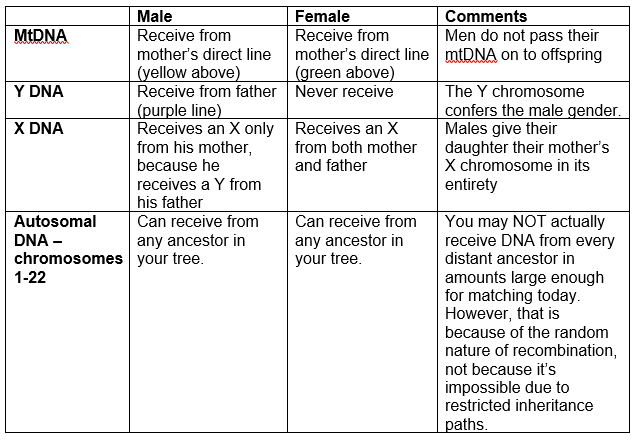
I suspect the confusion has to do with the fact that mitochondrial DNA and the X chromosome are both associated in some manner with female inheritance. However, that isn’t always true in the strictest sense, as women also inherit an X chromosome from their father.

Males Inherit:

  • An X chromosome from their mother
  • Mitochondrial DNA from their mother

Females Inherit:

  • An X chromosome from their mother
  • An X chromosome from their father
  • Mitochondrial DNA from their mother

The difference, as you can quickly see, is that females inherit an X chromosome from both parents, while males only inherit the X from their mothers. That’s because males inherit the Y chromosome from their father instead – which is what makes males male.

As a quick overview about inheritance works, you might want to read the article, 4 Kinds of DNA for Genetic Genealogy.

The good news is that both mitochondrial DNA and the X chromosome have very specific inheritance paths that can be very useful to genealogy, once you understand how they work.

Who Gets What?

Mitochondrial DNA Inheritance

Mitochondrial DNA is inherited by both genders of children from their mothers. Mitochondrial DNA is NEVER recombined with the mitochondrial DNA of the father – so it’s passed intact. That’s why both males and females can test for their direct matrilineal line through their mitochondrial DNA.

In the pedigree chart above, you can see that mtDNA (red circles) is passed directly down the matrilineal line, while Y DNA is passed directly down the patrilineal (surname) line (blue squares.)

I’ve written an in-depth article titled, Mitochondrial DNA – Your Mom’s Story that might be useful to read, as well as Working with Y DNA – Your Dad’s Story.

The X Chromosome

The X Chromosome is autosomal, meaning that it recombines in every generation. If you are a female, the X recombines just like any other autosome, meaning chromosomes 1-22. You receive a copy from each parent.

The 23rd pair of chromosomes is the X and Y chromosomes which convey gender. Males receive an X from their mother and Y from their father. The Y chromosome makes males male. Females receive an X chromosome from both parents, just like the rest of chromosomes 1-22.

Inheritance Pathways

If you are a male, the inheritance path of the X chromosome is a bit different from that of a female, because you inherit your X only from your mother.

Females inherit their father’s ONLY X chromosome intact, which he inherited from his mother. Females inherit their X chromosome from their mother in the normal autosomal way. A mother has two X chromosomes, so the mother can give a child either chromosome entirely or parts of both of her X chromosomes.

Because of the different ways that males and females inherit the X chromosome, the inheritance path is different than chromosomes 1-22, portions of which you can inherit from any of your ancestors. Conversely, you can only inherit portions of your X chromosome from certain ancestors. You can read about more about this in the article, X Marks the Spot.

Female X inheritance chart. For male distribution, look at my father’s side of the tree.

My own colorized X chromosome chart is shown above, produced from my genealogy software and Charting Companion. An X match MUST COME from one of the ancestors in the pink and blue colored quadrants. It’s very unlikely that I would inherit parts of my X chromosome from all of these ancestors, but these ancestors are the only candidates from whom my X originated. In other words, genealogically, these are the only ancestors for me to investigate when I have an X DNA match with someone.

Because of this unbalanced distribution of the X chromosome, if you are a male and you match someone on the X chromosome, assuming it’s a legitimate match and not a match by chance, then you know the match MUST come from your mother’s side of the family, and only from her pink and blue colored ancestors – looking at my father’s half of the tree as an example.

If you are a female the match can come from either side, but only from a restricted number of individuals – those colored pink or blue, as shown above.

X chart with Y line included in purple, for males, and mitochondrial line in green.

My mitochondrial line, shown on the X chart would consist of only the women on the bottom row, extending to the right from me, colored in green above. My father’s Y DNA line would be the purple region, extending along the bottom at left. Of course, I don’t have a Y chromosome, because I’m female.

Of the individuals carrying the purple Y DNA, the only one with an X chromosome that a female could inherit would be the father. A female would inherit both the mtDNA of all of the green women, plus could also inherit an X chromosome (or part of an X) from them too.

For males, looking at my father’s half of the chart. He can inherit no X chromosome from any of the purple Y DNA portion, because those men gave him their Y chromosome. My father would inherit his mitochondrial DNA from his direct matrilineal line, shown in yellow, below.

X chart with mitochondrial inheritance line for mother (and child) shown in green, for father shown in yellow.  Both yellow and green lines can contribute to the X chromosome for males and females.

In my father’s case, the females in his tree that he can inherit an X chromosome from are quite limited, but people who have the opportunity to pass their X chromosome to my father are never restricted to only the people that pass his mitochondrial DNA to him. However, the X chromosome contributors always include the mitochondrial DNA contributors for both males and females.

In my father’s case, above, he inherits his X chromosome from his mother, who can only inherit her X from the people on his side of the chart shown in yellow, blue or pink. In essence, the people in yellow or to the left of the yellow with any color.

As his daughter, I can inherit from any of those ancestors as well, since he gives me his only X, who he inherited from his mother. I also inherit an X from my mother from anyone who is green, pink or blue on her side of my chart.

As you can see, my X can come from many fewer ancestors on my father’s side than on my mother’s side.

It just happens that ancestors in the mitochondrial line also are able to contribute an X chromosome and either gender can inherit parts of their X chromosome from any female upstream of their mother in the direct matrilineal line. However, only the direct matrilineal line (yellow for your father and green for your mother) contributes mitochondrial DNA. None of the other ancestors contribute mtDNA to this male or female, although females contribute their mtDNA to other individuals in the tree. For a more detailed discussion on inheritance, please read the article, “Concepts – ‘Who to Test Series”.

Special Treatment for X Matches

While the generally accepted threshold for autosomal DNA is about 7cM, for X DNA, there appears to be a much higher incidence of false matches at higher levels than the rest of the chromosomes, as documented by Philip Gammon as in his Match-Maker-Breaker tool.  This appears to have to do with SNP density.

I would encourage genetic genealogists to consider someplace between 10 and 15 cM as an acceptable threshold for an X chromosome match. This of course does not mean that smaller segment matching can’t be relevant, it’s just that X matches are less likely to be relevant at levels below 10-15 cM than the rest of the chromosomes.

Summary

As you can see, the mitochondrial DNA is passed from one line only – the direct matrilineal line – green to my mother and then me, yellow to my father. The mitochondrial DNA has absolutely NOTHING to do with the X chromosome, as they are entirely different kinds of DNA. It just so happens that the individuals who contribute mitochondrial DNA are also some of the ancestors who can contribute an X chromosome to either males or females.

The yellow and green ancestors always contribute mitochondrial DNA, but the pink and blue NEVER contribute mitochondrial DNA to the father and mother in our chart.

The X chromosome has a very distinctive inheritance path, shown in the first fan chart, that will help identify potential ancestors who may have contributed your X chromosome – which is wonderful for genealogists. If your ancestor is not colored pink or blue, in the first chart, they did not contribute anything to your X chromosome – so an X match MUST come from a pink or blue ancestor (which includes yellow and green in the later charts.)

By color, the people in the fan chart provide the following:

  • Purple – Y chromosome to father only.  Y is passed on to a male child, but not to females.
  • Yellow – Mitochondrial always to father. X always from mother to males but X can come from either yellow or pink and blue ancestors upstream.
  • Green – Mitochondrial always to the mother.  Females receive an X chromosome from their green mother and also from their father, who received his X chromosome from his yellow mother.
  • PInk and blue on father’s side – contribute to the father’s X chromosome, in addition to yellow.
  • Pink and blue on mother’s side – contribute to the mother’s X chromosome, in addition to green.


If you are a male and see an X match on your father’s side of the tree, you know that match is either actually coming from your mother’s side of the tree, or the match is false, meaning identical by chance.

The great news is that X matching is another tool with special attributes in the genealogist’s toolbox, along with both mitochondrial and Y DNA.

Your X chromosome test is included as part of the Family Finder test. You can order the Family Finder or the mitochondrial DNA tests here.

______________________________________________________________

Disclosure

I receive a small contribution when you click on some of the links to vendors in my articles. This does NOT increase the price you pay but helps me to keep the lights on and this informational blog free for everyone. Please click on the links in the articles or to the vendors below if you are purchasing products or DNA testing.

Thank you so much.

DNA Purchases and Free Transfers

Genealogy Services

Genealogy Research

Enforced Bastardry in Colonial America – A DNA Monkey Wrench

Sometimes when men Y DNA test, their results are returned with matches to different surnames, meaning surnames other than their own. In fact, it’s not unusual, but hopefully, they will also match several men who carry their own surname with the idea that those matches will help the tester further their genealogy by being able to connect to ancestors further back in time.

Best case, to identify the actual ancestor.

Worst case, to find hints to lead to their own ancestor through the matching DNA of others.

The Holy Grail

The Holy Grail, for many genealogists, is to find a Y DNA surname match overseas, in a small village, where the local church still has records. That’s what we did in both the Estes and Speak Y DNA projects. The DNA matches confirmed where those lines originated and the church and other traditional genealogical records confirmed we had discovered the origin location of the actual immigrant ancestor.

You can read one of several articles about the trip back to Lancashire for the Speak line here and to Kent for the Estes line here. DNA made confirming the connection between the American/New Zealand lines and the British lines possible.

However, for some, that overseas match never arrives. I’m here to tell you, 16 years and waiting on my Moore line and we still have only a few matches, and only from the brickwall ancestor in Virginia to current – nothing before and no matches with any other Moore line.

Patience may be a virtue, but it isn’t one of mine!

In some cases, like my Moore line, the surname in question only matches people downstream from the known ancestor.

Talk about frustrating.

Surname Matching Issues and Indentured Servitude

One of the reasons surname matching issues can occur, but that we seldom think of, is the situation in colonial American where indentured servants, those who sold away from 5 to 9 years of their life in exchange for for passage to America, were forbidden to marry.  Therefore, if a female became pregnant, she was forced to have the child outside of marriage – meaning the child took her surname.

If a male indentured servant impregnated someone, he too was forbidden to marry – so the child took the mother’s surname and life went on.

Based on the court notes from Richmond County, Virginia, beginning in 1692, and from Rappahannock County, before that, this was a lot more common that one would think.

Now, fast forward 300 years – the surname and the Y DNA don’t match. Better stated, the person carrying a particular surname today doesn’t match any or many people of the same surname.

Making matters worse, according to the records in North Farnham Parish, in Virginia, beginning in 1600s when the area was Old Rappahannock County and reaching through the 1800s when it was Richmond County, “bastard” children don’t appear in the baptismal records. Having said that, the records are known to be incomplete, even for children born to married parents, but given the number of illegitimate births, it’s difficult to believe that somehow all of those records just happen coincidentally to be missing.

Richmond County is lucky to have any church records. Many locations don’t.

So, if your ancestor was one of the illegitimate children born, there is:

  • Generally no record of their name in the court record.
  • No record of their name in the baptismal records.
  • Often no record of their father’s name.
  • No record of the gender of the child born to the mother.
  • Generally, no record of what happened to them.

If you’re lucky, a court record will exist where the mother was brought before the court and prosecuted for “the sin of fornication” and with having a “bastard child.” Generally, that’s not the kind of record a genealogist is looking for. They are looking for males with their specific surname in wills and deeds, not court cases involving female indentured servants bearing children out of wedlock.

As punishment, the woman’s indenture was extended, from a year in early cases, as seen in the examples below, to 5 years in a later case in Halifax County, Virginia.

Sometimes in these cases, the pregnancy causes the woman to fall into perpetual indentured servitude, as we can see in the Thatchill case.

The father? What happened to him?

Sometimes he had to pay a fee of tobacco to the church to assure that the church would not end up paying to raise the child – because an unwed mother was generally condemned to a life of misery and poverty – unable to support her child after her indenture was over.

Furthermore, many indentured servants didn’t survive. While working a slave to death was counterproductive, because the owner wanted the slave to live long and reproduce for the economic benefit to the owner, indentured servants only served for a number of years, so masters often worked these people relentlessly and maintained them in the poorest of conditions.

Enforced Bastardry

While researching my ancestors in Richmond County, Virginia, I stumbled across the three following cases of what I’m terming “enforced bastardry.” I find it somehow ironic that the very men, court and church that condemned these women for “fornicating” had arranged and condoned the very system that forced them to remain unmarried – in essence forcing them to bear those “bastard” children.

In the following cases, the word “master” does not denote a master/slave relationship in the sense of an African or Native American slave who was a slave for life. These were white European immigrant women who were indentured for a set period of time, to be freed after their indenture was served, assuming they survived, not permanently enslaved.

Permanent slaves never officially “married” within the law, and were not prosecuted for “fornication.” In fact, their owners wanted them to reproduce because children of slaves were born into the status of the mother. If the mother was a slave, so were the children.

This was a very profitable arrangement for the slave owner, because slaves that had to be purchased were expensive and in early America, often in short supply. Very occasionally, slave children were baptized, but when so, they were listed under the master’s name, generally not the name of the child and never the name of the parent or parents.

Case 1 – Katherine Thatchill and Catherine Perry, servants to Abraham Marshall

Richmond County Court Order Book, July 2, 1701 – Katherine Thatchill servant to Abraham Marshall by and with her own consent is ordered to serve her master or his assignes the full terms of one years after her time by indenture custome or otherwise be fully expired being for the payment of her fine for committing the sin of fornication.

This day Abraham Marshall confesed judgement to the churchwarden of Farnham Parish for the use of the parish for 500 pounds good tobacco in cask which this court have ordered to be paid with costs of suit. Exo. Being the fine due from Katherine Thatchill for committing the sin of fornication.

Ordered that Katherine Thatchill do serve Abraham Marshall her present master according to act for the care and trouble of her childbirth of a bastard child.

It being evidently made appear to the court that Catharine Parry, servant to Abraham Marshall did fugitively absent herself from her said master’ service the space of 15 days and that her said master hath expended 300 pounds of tobacco for percuring her againe, the court have ordered that the said Katherine do serve her said master or his assignes the full terms of one years after her time and be fully expired being for the payment of her fine for committing the sin of fornication.

These items appeared in consecutive order on the same court order page on the same day. Given the fourth paragraph, it appears that indeed, there were two women, one Katherine Thatchill and one Catharine Perry.

Amazingly, Catharine Perry only “missed” 15 days of “work” but she paid for it with another year of her life, because her master paid her fine.

Court Order Book May 6, 1702 – Capt. John Tarpley one of the churchwardens of the parish of North Farnham certifying to this court that Thomas Tatchall being a parish charge and Abraham Marshall being willing to discharge the said parish of ye said Thomas, the court have ordered that the said Thomas Tatchall do serve the said Abraham Marshall and Thomazin his wife their heires and assignes until he shall attaine to the full age of 21 years.

Apparently, Katherine Thatchill’s child lived and is now also indentured until he is 21. The only way Katherine can be with her child it to remain on Abraham Marshall’s plantation, assuming she is still alive. In essence, Abraham Marshall has now obtained two indentured servants for the next 21 years.  By that time, where is Katherine Thatchill going to go and how will she survive?  She will probably remain a servant for her entire life, in exchange for food and shelter.  Perhaps her son will do better.

Case 2 – Elinor Hughes, servant to James Gilbert

Richmond County, Virginia Court Order Book, Nov. 4, 1702 – Appearing to this court that Elinor Hughes has by her own confession fugitively absented herself out of the service of her master, James Gilbert, the space of 23 days, the court have ordered that she serve her said master or his assignes the space of 46 days after her time by indenture custome or otherwise be fully expired.

Elinor Hughes, servant to Gilbert Jones being presented to this court for having a bastard child, the court have ordered that she serve her said master or his assignes according to act in consideration for the trouble of his house during the time of her childbirth.

This day James Gilbert confessed judgement to the church wardens of North Farnham Parish for the use of the parish for 500 pounds tobacco it being the fine of Elinor Hughes for committing the sin of fornication and having a bastard child to be paid with costs also.

Ordered that Elinor Hughes servant to James Gilbert by and wither own consent do serve her said master of his assignes the space of one whole yeare after her time by indenture custome or otherwise be fully expired in satisfaction for his paying her fine for committing the sin of fornication and having a bastard child.

It’s appears that Elinor had to “pay” double the time she missed for “troubling” her master with her pregnancy, and a year for the fine he paid.  These laws and customs never benefitted the servant, always the master.

Case 3 – Ann Kelly, Servant to Thomas Durham

The drama involving Ann Kelly didn’t begin as anything unusual. Ann Kelly’s indenture to Thomas Durham begins like normal in 1699 when she was determined to be 14 years old. The court determined Ann’s age so that the length of her indenture could be determined and so that she could be taxed appropriately. Indentures of children not only involved a certain number of years, but lasted until they attained a specific age, minimally.

In 1704, in a deposition, Ann gave her age to be 20, which would have put her birth in 1684. If she were 14 in 1699, then she would have been born in 1685, so this fits.

Court Order Book Page 406, June 7, 1699 – Ann Kelly servant to Thomas Durham being presented to this court to have inspection into her age is adjudged 14 years old and ordered to serve her master or his assigns according to act.

However, by 1708, nine years later, Anne was 23 and circumstances had changed.

Court Order Book Page 372, July 7, 1708 – Anne Kelly, servant to Thomas Durham, being brought before the court by her master for committing the sin of fornication and having a bastard child and said Anne refusing to confess who was the father of the child, the court have ordered she be committed to the county goale there to remaine until such time as she shall confess who is the true father of her child and it is also ordered that she serve her master or his assignes after her time by indenture custome or otherwise shall be fully expired according to law in compensation for the trouble of his house during the time of her childbirth.

Imagine how intimidating this must have been for Ann. Not only did all those men, dressed in their finery and powdered wigs “know what she had done,” they were pressuring her for the name of the child’s father. Ann, a servant with nothing of her own, not even the right to direct her own body, stood firm, even when sentenced to jail.

Having none of this, Dorothy Durham, Thomas’s wife, steps in.

Court Order Book Page 372, July 7, 1708 – This day Dorothy Durham for on the behalf of her husband Thomas Durham confessed judgement to the church wardens of Northfarnham parish to the use of the parish for 500 pounds tobacco the same being the fine of Anne Kelly for committing the sin of fornication and having a bastard child which is ordered to be paid with costs.

I can’t even begin to explain how unusual this was. Not only did Dorothy appear at court, of her own volition, she clearly defied her husband to do so. Not only that, but Dorothy apparently controlled some financial aspects of the household, a very unusual situation for a woman in colonial Virginia. There seemed to be no doubt in anyone’s mind that Dorothy was capable and authorized to pay the 500 pounds of tobacco – even though Dorothy did say she was acting “on behalf of her husband.”

In every other similar case, some male community member steps forward and posts bail, or not, but no female ever steps forward like Dorothy did. I’m convinced that posting bail, in most cases, wasn’t so much to help the poor woman who had the child as it was to retain the services of the woman and not be inconvenienced. In Dorothy’s case, we’ll never know what motivated her to attend court alone, step up in place of her husband AND pay the fine for Anne Kelly. But she did!

Furthermore, in most cases, the female willingly named the child’s father. In this case, we do discover the name of the father the following March, and I wonder if Dorothy knew all along.

Court Order Book Page 4, March 2, 1708/9 – Anne Kelly came into court and made oath that Thomas Durham Jr. is the true father of 2 bastard children borne of her body in the time of her service with his father, Thomas Durham the elder. Upon motion of the Queen’s attorney ordered that Thomas Durham Jr. be summoned to next court to enter into bond with security for the indemnification of the parish and what charge may acrew to the parish for or by reason of the children aforesaid.

In March of 1708/09, Anne Kelly was dragged before the court a second time. This time, however, she named the father of the children – Thomas Durham Jr., the son of Dorothy and Thomas Durham Sr. While Thomas Jr. was summoned to post bond to the churchwardens so they would not incur future costs on behalf of the children, Thomas Jr. was not fined for fornication nor did he have to pay Anne Kelly’s fine for fornication and having a bastard child. Men were never fined. I guess those women managed to fornicate and get pregnant all by themselves!

This time, it wasn’t Dorothy who paid Anne Kelly’s fees, nor Thomas Durham Sr. or Jr., who should have by all rights paid her fines – but Thomas Dodson who was married to Mary Durham, Dorothy’s daughter. Anne Kelly, according to another court note, was assigned by Thomas Durham Sr. to Thomas Dodson, so was already serving at Thomas Dodson’s house, which adjoined the land of Thomas Durham Sr. In any event, after her original indenture, plus extra time for the first pregnancy, Anne was obligated to serve additional time working for Thomas Dodson because he paid her fine for the second pregnancy, caused by his brother-in-law.

Court Order Book Page 5 March 2, 1708/09 Anne Kelly servant to Thomas Dodson being this day brought before this court for committing the sin of fornication and having a bastard child the court have ordered Anne Kelly to serve Thomas Dodson or his assignes according to law after her time by indenture or otherwise is fully expired, in consideration of his paying her fine for committing the offence aforesaid.

Court Order Book Page 5 March 2 1708/09 Thomas Dodson confest judgement to the churchwardens of North Farnham parish for the use of the parish for 500 pounds tobacco being the fine of Anne Kelley for committing the sin of fornication and having a bastard child and it ordered that he pay the same with costs.

Anne Kelly arrived in June of 1699 at the age of 14. By 1709, she is still serving as an indentured servant, has had two illegitimate children, sired by her “master’s” son and still has at least two years left to serve on her indenture time, based on the court records. From this we know that Anne’s original indenture was at least for 9 years, because she was still a servant in July of 1708. A year later, in 1709, she is still serving, and has had 2 years added on to her time. This means that she will be serving until at least 1711 sometime, if not longer, and presuming she doesn’t get fined for fornicating again. This means that her indenture time beginning in 1699 when she was 14 is now extended to when she is minimally 26 years old, when she will be released with a suit of clothes to somehow make her way with two children.

And the greatest irony of all, Thomas Durham Jr. married the daughter of the neighbor planter in about 1710, beginning his “legitimate” family with her. So, while Anne Kelly is still paying with the days of her life for her crime of “sinning” with Thomas Durham Jr. on one farm, he has married the daughter of the neighbor and is setting up housekeeping – probably within view everyday of Anne Kelly.

No hard feelings there, I’m sure. I can’t help but wonder what happened to these women and their children.

Note that in  only one of these cases do we have any idea of the gender of the child and his name from a later record. In the rest of the cases, and normally, there are no names, and no birth dates, although we can at least surmise a year. We also don’t know if the children survived. There are no records in Richmond County in later years for any individual that appears to be the offspring of these women.

In colonial Virginia, the stigma of illegitimacy never washed away. The best way to remove it? Move. Far away. Preferably to the frontier where pioneers were far too busy clearing land and eking out a living to ask questions. Marry someone and start a life far distant from those damning court records and community knowledge.

If you think this scenario might fit your family situation, what do you do?

What To Do?

Unfortunately, these cases are very difficult, if not impossible, to crack.

Hints that enforced bastardry might be involved would include:

  • Few Y DNA matches to your surname
  • Significant close Y DNA matches to another surname
  • Y DNA matches to your surname only downstream of your brick wall ancestor, never at an earlier date and never overseas
  • Ancestor seems to appear out of no place in colonial America
  • No records. Bastard children were not recognized legally as the children of the father so there would be no inheritance.

Of course, the problem is that any of these circumstances mentioned above can be caused by other factors. Few Y DNA matches can be caused by few (or no) descendants or the fact that your line just hasn’t tested. No overseas matches can stem from the same thing, or the Y line has simply died out in the original location. If you’d like to read more, Concepts –  Undocumented Adoptions vs Untested Y Lines discussed more about this topic.

Matches to other surnames can result from a common ancestor before the advent of surnames or misattributed parentage, also known as NPEs or non-parental events, in other lines, as well as your own.

Ancestors who seem to appear out of no place can be a result of records destruction, or ancestors arriving as indentured servants or convicts, remaining poor and never owning land. A combination of these factors is particularly devastating for the genealogist, because it appears that our ancestor literally dropped out of the sky, arriving via the stork.

One approach I take is to look for common geography between my ancestor and the ancestors of other people with closely matching surnames. For example, in the case of Ann Kelly, we know that the father of her children was Thomas Durham, Jr. If the children were male, their surname would be Kelly, but their Y DNA would be Durham. Once you focus on a geography for the Y DNA line, you can turn to autosomal matching for that same surname to see if other people emerge as matches who are not directly descended from the paternal line.

Another avenue, and don’t laugh, is to google the various terms together, such as “Durham, Kelly, 1700, Virginia.” I’ve often found the old Rootsweb and GenForum lists to be wonderful sources of earlier research that has never made it into print or into trees anyplace. – and they both show up in Google searches.

However, in the Kelly/Durham case, as irony would have it, Thomas Durham Sr. had only one surviving son.   Thomas Durham Jr.’s only son, John, had three sons. Just recently, a Durham male descendant of Thomas Jr. through grandson Charnel was discovered and Y DNA testing is currently underway.

It will be very interesting to see if our Durham tester matches any Kelly males.

Testing

In order to utilize Y DNA, you must find a male from your desired line who is descended from the ancestor in question through all males to take a Y DNA test. Typically, this means a male who carries the same surname, assuming no name changes or adoptions.

Today, the only vendor offering Y DNA testing and matching is Family Tree DNA. Fortunately, they also offer autosomal testing with the Family Finder test, and Advanced Tools so that you can see if a Y DNA match also matches you autosomally. Their Family Finder matching tool also allows you to search by both current and ancestral surnames.

Click here to order either test. You’ll need both a Y DNA test and the Family Finder test to do the combined search for people who match on both the Y DNA and autosomal results.

You may also want to read the short article, 4 Kinds of DNA for Genetic Genealogy, which explains about the different kinds of DNA that can be utilized for genealogy research.

______________________________________________________________

Disclosure

I receive a small contribution when you click on some of the links to vendors in my articles. This does NOT increase the price you pay but helps me to keep the lights on and this informational blog free for everyone. Please click on the links in the articles or to the vendors below if you are purchasing products or DNA testing.

Thank you so much.

DNA Purchases and Free Transfers

Genealogy Services

Genealogy Research

Concepts – Who To Test for Your Father’s DNA

If the first thing you thought when you read the title of this article was, “Well duh – test your father,” you would be right…unless your father is deceased.  Then, it’s not nearly as straightforward, because you have to find other family members who carry the same Y DNA and mitochondrial DNA as your father.

These same concepts and techniques can be applied to testing for other men’s lines as well – so please read, even if Dad is sitting right beside you.

Before beginning this article, you might want to read “4 Kinds of DNA for Genetic Genealogy” to understand the very basics of how different kinds of DNA are inherited, and how they can help you.

I was inspired to write this series of “Who to Test” articles to help people determine how to obtain the DNA they need to solve family mysteries from ancestors in their tree. For the most part, those ancestors are deceased, so one must understand how to obtain their DNA by testing living descendants descended in special ways.

Click to enlarge any graphic

In this series, we’ll be discussing how to test all of the individuals above for their mitochondrial DNA and males for their Y DNA.

Y DNA lineages are shown by blue lines and mitochondrial DNA lineages are shown by pink lines. In the charts below, different colored boxes and hearts showing the descent of blue male lines and pink(ish) mitochondrial lines.

In other words, the son at the bottom inherits his father’s light blue Y DNA, but his mother’s pink mitochondrial DNA that is the same as his sister’s and his mother’s mitochondrial line. Hence, his pink heart.

What Can Y and Mitochondrial DNA Tell You?

Both Y DNA and mitochondrial DNA can tell you about your clan, meaning where your ancestors in that particular line were found. Many people have been surprised to find that these particular lines descended from Native American, Asian, Jewish, European or African ancestors. Some clan assignments, known as haplogroups, can be quite specific, but others are more general in nature.

You also receive matches and can communicate to find your common ancestor. Males can look for surnames the same or similar to their own.

You can read more about what mitochondrial DNA can do for you in the article, Mitochondrial DNA – Your Mom’s Story.

You can read more about what Y DNA can do for you in the article, Working with Y DNA – Your Dad’s Story.

Your Father’s DNA

Testing your father’s Y DNA and mitochondrial DNA is easy, if your father is living. You can simply test your father.

As you can see in the chart above, your father inherited his Y DNA from the light blue line, from his father, which is typically the surname line.

Your father inherited his mitochondrial DNA from his direct matrilineal line, meaning the magenta line – your paternal grandmother and her direct maternal ancestors.

Your father did NOT pass his mitochondrial DNA to either of his children and he only passed his Y DNA to his son. His daughter has no Y DNA and her mother’s mitochondrial DNA.

You can test both your father’s Y DNA and mitochondrial DNA by simply testing your father. However, testing becomes more challenging if your father is not available to test.

Your goal then becomes to find people who carry the same light blue Y DNA as your father, and the same magenta mitochondrial DNA that he carried as well. Let’s look at various ways to achieve that goal.

Testing Uncles and Siblings

If you are a male, meaning the son in the chart above, just test yourself for your father’s Y DNA.

Of course, you carry your mother’s mitochondrial DNA, shown by the pink heart that matches your sister, so you will have to find someone else who carries the same mitochondrial DNA as your father.

If you are a female, you can’t test for either your father’s Y DNA or his mtDNA line. However, all is not lost.

If your father has any full male siblings, that’s your next best bet, because they will carry the same Y DNA and the same mitochondrial DNA as your father, because they share the same parents. You can test the same uncle for both Y DNA and mitochondrial DNA. A brother and sister to your father have been added to the chart, below.

In the above chart, your father has two siblings, a male and a female. All three share the same mitochondrial DNA, but only the males share the Y DNA. Your father’s brother shares both. Your father’s sister shares his mitochondrial DNA, but not his Y DNA, shown above.

However, let’s say you’re the daughter and that your father and his brother are deceased. You can test your father’s sister for her mitochondrial DNA and you can test your own brother for your father’s Y DNA, shown below.

Don’t have a brother but your father’s brother had a son? No problem. Test the brother’s son who will carry his father’s Y DNA, which is the same as your father’s Y DNA, assuming nothing unknown.

You say your father’s sister is deceased too, but she had a child of either gender. No problem, you can test that child, whether they are a male or female for the sister’s mitochondrial DNA, which is the same as your father’s mitochondrial DNA.

In the chart above, all of the people with sky blue squares can test for your father’s Y DNA and all of the people with magenta squares or magenta hearts can test for your father’s mitochondrial DNA.

As you can see, you may well have lots of options.

Potential Testers

Father’s Y DNA Father’s mtDNA
Your Father Yes Yes
You Yes, if you are a male, No if you are a female No – you inherit your mtDNA from your mother
Your sibling Yes, if your sibling is a male, No if your sibling is a female No – your father does not pass his mtDNA to his children
Your father’s brother Yes Yes
Your father’s sister No – she didn’t inherit a Y chromosome from her father Yes
Your father’s brother’s children Yes, if male, No if female No – he didn’t pass his mitochondrial DNA to his children
Your father’s sister’s children No Yes – both genders

What Tests to Order

Family Tree DNA is the only testing vendor that offers Y DNA and mitochondrial DNA testing that allows you to match to others. Additionally, they provide additional tools to understand the message Y and mtDNA carries for you.

For Y DNA testing, you can order either the 37, 67 or 111 marker test. I recommend that you purchase what the budget can afford. You can always upgrade later, but the cost of the original test plus an upgrade is somewhat more than just purchasing the larger test initially.  The greater the number of markers you purchase, the higher the level of specificity in the match results. The more closely you match someone, the more closely related you are to that person, and the closer in time your common ancestor lived. If you’re unsure what to purchase, 37 markers is a great place to begin.

For mitochondrial DNA testing, you can order the mtDNA Plus test, which is a subset of the mtFull Sequence test. In order to receive your full haplogroup designation, the entire mitochondrial DNA needs to be tested. I recommend the full sequence test be ordered.

For autosomal DNA testing, everyone can test, and as long as you’re placing an order, I’d suggest that you go ahead and order the Family Finder test. You can discover your ethnicity percentage estimates for several worldwide regions, including breakdowns of Europe, Africa and Asia as well as Native American and Jewish.

Additionally, while the Y DNA and mitochondrial DNA tests reach back deep into time on those two specific lines, and only those two lines, the autosomal test tests the DNA of all of your ancestral lines, but may not reach back reliably in time for matches before the past 5 or 6 generations. Think of Y and mtDNA as viewing recent as well as very deep ancestors on just those lines, and Family Finder as broadly surveying all of your ancestors, but just in the past 7-10 generations.

The fun of autosomal DNA testing, aside from ethnicity estimates, is to discover which cousins you match and find your common ancestor.

In order for Family Tree DNA to be able to provide you with phased Family Finder matches, which indicates on which side of your tree (maternal or paternal) your match is found, helping to identify common ancestors – it’s critical for known relatives to test. The older the relative, generationally, the more helpful the testing is to you – so test those older family members immediately, while you still can.

You can order your tests and upgrades here:

______________________________________________________________

Disclosure

I receive a small contribution when you click on some of the links to vendors in my articles. This does NOT increase the price you pay but helps me to keep the lights on and this informational blog free for everyone. Please click on the links in the articles or to the vendors below if you are purchasing products or DNA testing.

Thank you so much.

DNA Purchases and Free Transfers

Genealogy Services

Genealogy Research

The Unexpected Bounty of DNA Testing – Friends and Family of Heart

Bill and Sandie Lakner, with me in the middle.

When I first started with genetic genealogy in the year 2000, I was interested in proving (or disproving) specific stories about my Estes ancestors as well as learning more about as many family lines as I could.

I hoped that I would meet new cousins that perhaps would have information that I don’t, and who would be willing to share.

What I never imagined, and I almost hate to admit this, is that I’d find a whole new group of friends.

I have always been a rather solitary researcher, in part because I don’t live anyplace near where my ancestors did. There are no records where I live for what I need to research, so the local genealogy societies hold little allure for me. In fact, in my state, I AM the immigrant, more or less. The ‘more or less” part of that comment will have to wait for another day and has to do with my father being stationed nearby in the military.

Several years ago, when autosomal DNA was added to the genetic genealogists menu, I began to hear from LOTS and LOTS of people. In fact, so many that one of the reasons I introduced my blog and began to write educational articles was as a form of self-defense. Between the blog and the projects I administer at Family Tree DNA, I found myself answering the same questions over and over again, so writing a nice article with graphics where I could refer people seemed like a great idea. Never did I imagine the blog would actually increase the amount of communications, but it did!

It’s hard for me to believe I’ve been doing this for 17 years now, almost half of my adult life. I’ve met people at conferences and many have become friends. There are people I’ve been fortunate to find that have my back when I need help or am in some kind of pickle. I know just who to refer to for what topic and I’ve been the beneficiary of MANY excellent researchers and kind souls. I’m grateful to and for every one.

Project administrators and those of us with specialty skills try to help everyone, but demand has been increasing like a tsunami. Now, that’s the good news, because an incredible number of people are testing, but it’s also the bad news because it necessitates brevity sometimes and a standard reply to many inquiries.

Somehow in the midst of this swirl, over the years, I have found new friends that stand apart from the rest and are truly near and dear to my heart. Some have specific interests that are similar to my own, but others, for some reason, have simply become friends, close friends, near and dear to my heart.

I’ve even adopted a new brother, John, not to be confused with my half-brother John. (Yes, I now have my brother John and my other brother John.)

It’s like we were all destined to meet and have been waiting for this moment all of our lives. Once we do finally meet, it’s like we’ve always known each other.

If you’re one of those people, you know who you are. You are my family of heart.

Family of heart becomes increasingly important as your family of blood becomes smaller and smaller and is geographically distant. In my case, exacerbating the situation, I moved away. I’m not alone though, because many other people are displaced too, becoming effectively an immigrant family of one in a new community someplace with no family nearby. Those people are much more likely, I think, to develop family of heart relationships.

E-mail, Facebook and other forms of communications have made distant friendships easier. It’s easier for family to keep current with each other as well.

Bill and Sandie Lakner

Enter Bill and Sandie Lakner, several years ago.

I would like to tell you that I remember the first communication from Sandie, but I don’t. I do know that what began as questions about DNA results years ago has evolved into shared genealogy hunts, finds, discussions about children, grandchildren, pets, movies, gardens and Hurricane Sandy – not to be confused with Sandie.

Our topics jump around like neighbors chatting over the fence.

We don’t “talk” daily, but often and usually electronically.  We keep in touch and have for years now, defying the odds of internet friendships and short attention spans. We check on each other when we know something difficult is happening in someone’s life or bad weather is bearing down.

Then, last week, I received an e-mail from Sandie telling me that she and Bill would be passing nearby while returning home from a visit to Minnesota in the next day or so.

Could they meet us for coffee?

Could they?

I was so excited and was hoping the schedule would allow more than coffee. As luck would have it, our time was limited, but we made the most of it.

The Quest

What fun we had!

We immediately began discussing Bill’s “secret quest,” or better stated, his quest to solve the family secret.

Bill was hoping his trip to Minnesota would yield information, and maybe, just maybe, a descendent of each of the male children of Joseph Lakner (1876-1926) who is willing to DNA test. Yes, we were discussing paternal ancestry and DNA.

More particularly, which of Joseph Lakner’s sons is Bill’s father?

By the way, if you are the child, either male or female, of one of Joseph Lakner’s male children and are willing to DNA test, please contact me (and I’ll put you in touch with Bill) or simply order a Family Finder test through this link at Family Tree DNA.

Social Faux Pas

Genetic genealogists sometimes forget that our topics aren’t entirely mainstream.

As we sat at our corner table in the local Big Boy, excitedly talking, I said to Bill, “You remember, that was my brother who wasn’t my brother…..”

About that time, the server who was entering orders into a computer turned around with a slack-jawed, rather incredulous, look on his face. I think he had to see just WHO was having this discussion, because…you know…”old people” don’t discuss those kinds of things. These kinds of “things” and resulting scandals were invented by the younger generation…said with tongue firmly in cheek.

The server was standing behind Bill, so Bill couldn’t see, but Sandie and I could. I fought laughter, immediately lowered my voice and attempted to do some amount of social recovery, but in the midst of the next sentence that had something to do with my father being married to both mothers at the same time, the server’s head came whipping around again, this time, with him staring over the top of his glassed to garner a better view.

I mean, who *are* these rowdy people anyway, and did they escape from the facility down the street? They are clearly demented. Should I call someone?

Sandie and I both saw this entire exchange and both began laughing uncontrollably, to the point that we couldn’t speak to explain. The look on Bill’s face only made it funnier, and then the server turned around once again and asked if we were laughing at his shock. Then he tried social recovery, but ran out of words and finally just muttered, “Hmmm….” and shook his head.

The entire exchange left everyone laughing to the point of tears. My poor husband was looking around, hoping no one recognized him.

It felt so good to be laughing together – friends who had been friends “forever” but had never met before.

Family of Heart

By the end of our very short hour or so, we were left wishing we were those neighbors who could visit over the fence. If we lived near each other, Sandie would know where everything in my kitchen is kept and vice versa and the guys would know how to start each other’s lawn mowers. Our kids would know each other, and our pets would greet each other like family. We had met our family of heart.

The field of genetic genealogy has truly blessed me in ways that I never expected and could never have imagined. Not only does DNA connect us across the world, literally, the topic of DNA connects us to one another as well.

Initially Bill’s search was to find his paternal family, specifically which Lakner male is his father. It’s a story to rival any soap opera, is still not solved and Bill would love to find the answer.

But never in our wildest dreams did we ever imagine that through this process, we would become family of choice. Sometimes it’s the human part of the connection that is the most important and not the genetics. Sometimes our family of choice is the best family of all!

______________________________________________________________

Disclosure

I receive a small contribution when you click on some of the links to vendors in my articles. This does NOT increase the price you pay but helps me to keep the lights on and this informational blog free for everyone. Please click on the links in the articles or to the vendors below if you are purchasing products or DNA testing.

Thank you so much.

DNA Purchases and Free Transfers

Genealogy Services

Genealogy Research

Quick Tip – How to Unjoin a Project at Family Tree DNA

Oops!  Did you accidentally join a project at Family Tree DNA in error, or just need to do some housekeeping?

Some folks think that only project administrators can remove people from projects, but people can unjoin themselves – and don’t have to wait on the administrator.

Removing yourself from a Family Tree DNA project is easy. Just click on the Projects tab, at the top right of your personal page, then on “Manage my projects.”

You will then see a list of the projects you have joined where you are currently a member. Click to enlarge the graphic below.

At the far right, you can click on “Leave Project” to unjoin yourself from the project.

The next screen you will see asks you to provide a reason for leaving.

Type something in the box, but please be nice – administrators are all volunteers – then click submit.

Understand that your reason is sent to the administrator, but they have no avenue to reply to you after you have left the project. So don’t expect to hear from them, because they can’t.  If you have a question for the admins or a discussion item, prior to leaving, just send them an e-mail.

Easy peasy!!

If you’re looking for how to select and join a project, you might enjoy How to Join a DNA Project.

______________________________________________________________

Disclosure

I receive a small contribution when you click on some of the links to vendors in my articles. This does NOT increase the price you pay but helps me to keep the lights on and this informational blog free for everyone. Please click on the links in the articles or to the vendors below if you are purchasing products or DNA testing.

Thank you so much.

DNA Purchases and Free Transfers

Genealogy Services

Genealogy Research