Dutch Genealogy – Maybe Not So Hopeless Afterall…

When we blog, we think about helping others.  I never thought that it might help me….but it has and in a most unexpected way.

One of the blog subscribers, a lovely lady named Yvette Hoitink, posted the following comment in response to my DNA Pedigree Chart blog where I mentioned that my Dutch line was pretty much hopeless:

“I’m sorry that you’re having such a hard time finding your Dutch ancestors. BTW, it’s not true that Dutch people didn’t have surnames until 1811. When surnames became hereditary differs greatly from province to province. In Friesland, most people used patronymics like you described until 1811.  In provinces like Zuid-Holland and Noord-Brabant, most people had hereditary surnames by the end of the medieval period.

What are your Dutch brick walls? Perhaps I can help you break through them.”

We began an e-mail exchange at that point.  Never being one to turn away a possible ancestor lead, I answered Yvette:

“Thank you very much for your offer of help.  I am obviously ignorant of Dutch resources and I appreciate your kindness.

I have primarily three Dutch lines.  One is rather recent and that is the one I’d love to break through the most.

Bauke Hendrick Ferverda was born, probably in Leeuwarden, where his father lived and was a school teacher, on Jan. 26, 1830.  He married Geertje Harmens de Jong probably in 1853 as their first of 3 children was born in Sept. of 1854.  She died on October 3rd, 1860.  Their daughter, Lysbertus, was born on Nov. 21 1859 and died on July 23, 1860.  I would guess that the mother and daughter are buried someplace together.

Bauke remarried in 1863 in the Netherlands.  He and his new wife immigrated to the states in 1868.

Back in the 1970s, one of the Ferverda family members went back to Holland, to Leeuwarden and discovered quite a bit about the Ferverda family side, but they neglected her side of the family.

I don’t even know where to begin to look for information in the Netherlands, or where the records might be.  Do you have any online research tools?

Thank you in advance for any enlightenment.”

Yvette’s answer gave me hope like I haven’t had in years.

“Boy do we have online resources:)  I think the Netherlands has a great combination of very reliable records, many of which are available online for free.”

Ok, Yvette, now you have my attention.

“Ferverda sounds like an Americanization of Ferwerda. That’s a typical Frisian name, which they probably took in 1811 to denote that they came from the municipality of Ferwerderadeel. In Friesland, most people had patronymics only until 1811.”

She’s right, it did used to be Ferwerda.  I’m impressed.

“Some Frisian resources: http://www.tresoar.nl (Friesland provincial archives) and http://www.allefriezen.nl (genealogical database + images, all free!).

On the Alle Friezen website, which is also available in English by clicking the British flag, you can find a lot of the birth, marriages and death records of the period of the civil registration (1811 onwards). You can use the Advanced search option to search for first person – family name: Ferwerda and first name: Bauke and second person – family name: Jong (careful: don’t include “de” because that is a prefix and not considered to be a part of the family name). This will yield 3 results. The first is their marriage, with the option to click through to a scan.”

You know, I’m sure, that I never read the next paragraph for several hours.  When I discovered that my ancestor’s marriage record was on that site…I slipped into some type of genealogical stupor from which I only regained consciousness after I had tried every single family member’s name in that website’s search engine.  I then discovered it was the middle of the night.  It was afternoon when I started.

“Both the index and the scan provide you with her parents’ names: Harmen Gerrits de Jong and Angenietje Wytses Houtsma. You can now repeat the same process by searching for the first person: Jong and second person: Houtsma to find their marriage certificate which shows their parents names.  Their marriage would have been prior to 1811, so you can’t find that on AlleFriezen but you may have more luck on the Tresoar site (see below). You can try to find their death records as chances are that they died after 1811.”

Oh no, a new brick wall….

“Go to http://asksam.tresoar.nl/ (no English version) and select Dopen voor 1811 (baptisms before 1811), Trouwen voor 1811 (Marriage before 1811) and Begraven voor 1811 (Burials before 1811) and then type in the names you’re searching for in the ‘Zoeken naar’ (Search for) textbox and then click “Zoek” (Search). You can first try to search for their family name but it’s very probably that they only started using this name since 1811 so search for the first name and patronymic as well.”

Ok, now this is getting tough.  That “no English version” put a bit of a damper on things….but then again, Yvette obviously speaks and reads Dutch.  Hmmmm……

“You can also consult the records of who took which name by going to http://www.tresoar.nl/mmtresoar/main/content_pagina_volledig.jsp?lang=nl&pagina=famnaam&stylesheet=onderzoek.css%20target= and type in the family name in the “Zoek op” (search for) textbox and then press “Zoek” (Search).”

These are the actual naming records.  I think I’ve died and gone to Heaven.  They tell you who was in the family in 1811 when they adopted their surnames.

“Another good site is http://www.archiefleeuwardercourant.nl/, which is a newspaper archive of the most popular provincial newspaper. Just type in a last name to see what pops up.”

Well, the only thing that popped up was Dutch.  Of course.

“By using these sources, you should be able to go back to at least the middle of the 18th century. If you’re lucky, the family will have some unusual first names and you’ll be able to go back further. Feel free to ask me again once you’ve hit your new brick walls:)”

Why yes, I’ve already hit new ones already.  That didn’t take long at all.

“You might also be interested in the slides of a presentation I gave earlier this year. The slides are available at http://www.dutchgenealogy.nl/index.php?option=com_content&task=view&id=159&Itemid=1 and give an overview of the most important records for Dutch research. The focus is mainly on records that are available online.”

Am I really drooling on myself???

“Another favorite website of mine is http://www.geneaknowhow.net/digi/resources.html. That’s a portal website with links to all online sources, transcriptions, scans and databases. Just click the ‘internet’ link below Friesland and you’ll find more than enough to get you through the winter.”

Wow, Yvette, Wow!  I haven’t slept in 3 days.  I love those words, online and free.  And on many of these sites are the actual images.  I saw my ancestor’s actual SIGNATURE!  An incredible find for a genealogy junkie.  I just love bureaucracy because it taxed people, kept records of them and made them sign things.  YES!!!

I mined and dug and browsed and it all worked well, until I ran out of dates.  Since I can’t read Dutch, I couldn’t read the various documents to determine if the Jan Ferwerda in question was mine.  And while Ferwerda (Ferverda) is an extremely unique name here, believe me, it’s like Smith in the village where they lived in Holland.

Now what?

Yvette to the rescue again.  Turns out, Yvette is also a professional genealogist.  Who-hoooo….my lucky day.  But it gets better.  She works at the National Archives.  I’ve died and gone to Dutch ancestor Heaven.  Be still my beating heart!

Here’s the website about her services….but only on one condition….you folks can’t have her until I’m done:)

http://www.dutchgenealogy.nl/index.php?option=com_content&task=view&id=160&Itemid=77

Yvette sent me a wonderful research plan based on what I have (not a lot) and what I want (well, duh….everything) and we get started tomorrow.  She of course had to tell me what was reasonable given the extant records….and there is actually an amazing amount.  And just think, I thought this line was hopeless.  Apparently not!

And maybe, just maybe, I can add to my number of ancestors found, including wonderful details of their lives.  Maybe eventually, I can also to the list of those whose DNA I have as well.  I can hardly wait as I embark on this unexpected genealogical journey through Friesland in Holland, the land of my ancestors with Yvette!  Let’s go!

______________________________________________________________

Disclosure

I receive a small contribution when you click on some of the links to vendors in my articles. This does NOT increase the price you pay but helps me to keep the lights on and this informational blog free for everyone. Please click on the links in the articles or to the vendors below if you are purchasing products or DNA testing.

Thank you so much.

DNA Purchases and Free Transfers

Genealogy Services

Genealogy Research

Surprise Y Matches – What do they Mean?

One of our blog followers, Tom, encountered the following situation, which, really isn’t so uncommon.

“I started up a Y-DNA surname project and recruited my only three living male 1st cousins who carry that name.

The first set of 67 results have recently been posted and within a day an exact match appeared with an individual who had only tested to 37 markers back in 2008.  Apparently the individual has had very few close matches and never a perfect match like my cousin’s.  But the individual has a different surname.

Is it possible to have an identical match as a random event?  How common are such occurrences?  What possible explanations could there be?”

Let’s look at Tom’s situation from different perspectives and see what we can find.

When I do DNA Reports for people, I still find people who don’t have any matches.  It’s not as unusual as people think.  In a way, it’s a blessing as compared to people who have so many matches that they can’t even begin to sort through them.  But to the person who doesn’t have any matches, it surely doesn’t seem like there’s a positive side to the situation.

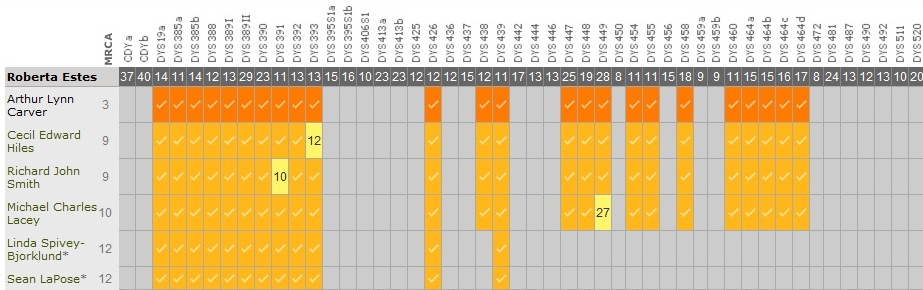
First of all, remember that mutations can happen at any time in any generation….or not.  In the Estes line, Abraham Estes, one of two Estes immigrants to colonial America was born in 1647.  He had 8 sons.  We had DNA from the descendants of all 8 sons.  We reconstructed Abraham’s DNA using triangulation, so we know what his original genetic “signature” looked like.  One of those sons’ lines has 4 mutations in 8 generations, and one line has none.  The rest fall in the middle someplace.

I only mention this to illustrate that mutations are truly random events.  We use statistics to look at the “most likely” scenario, based on averages, but mutations are personal events and while they, as a whole, fall nicely into statistical models, individually, they happen when they happen.  You can see that the mutation rate can vary quite a bit, even within families.  Keep that in mind during the rest of this discussion.

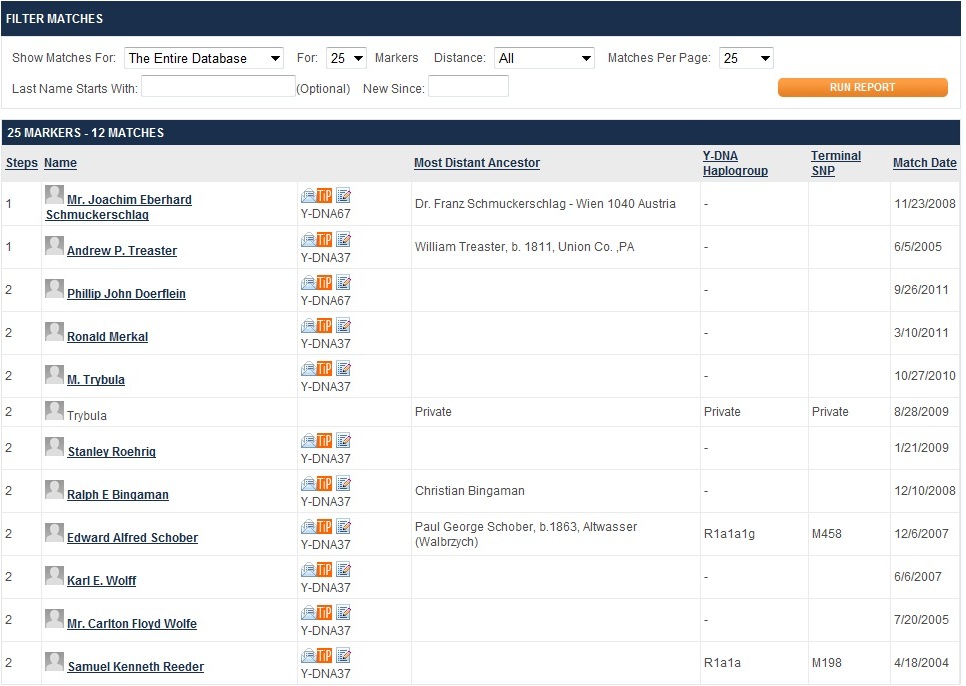
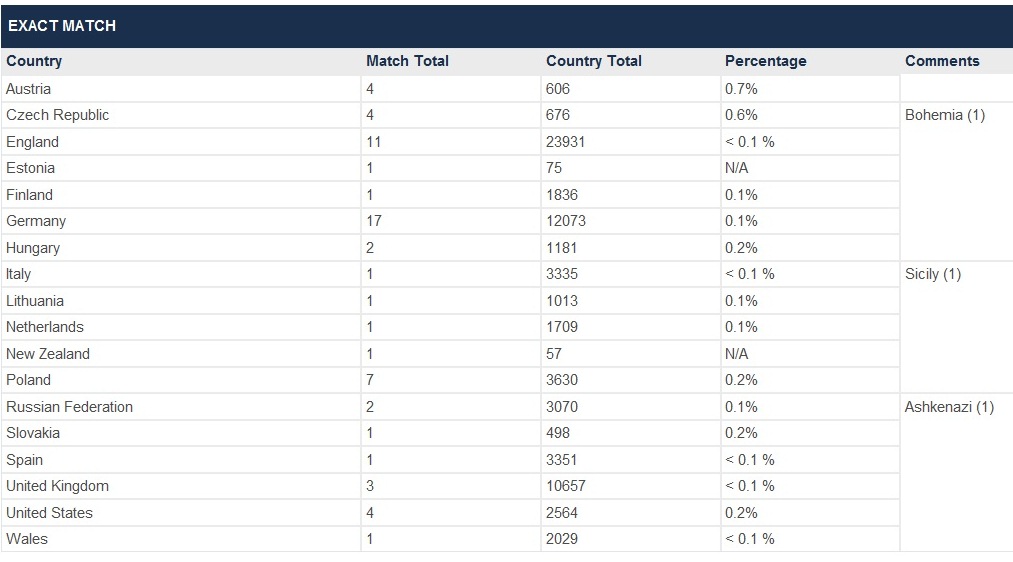
Family Tree DNA gives us some tools to work with these kinds of situations.  The TIP calculator, available for every match by clicking on the little orange TIP button, tells us, statistically, how likely people are to match at which generational level.  This is called the time to the most recent common ancestor, or MRCA.  I did an earlier blog about this.

Comparing two exact 37 marker matches, below, we see that, statistically speaking, on the average, these two people are most likely to share a common ancestor about the second generation, meaning grandparents.  Again, word of caution, these are averages, which is why you have a range shown here.  DO NOT TAKE THEM LITERALLY.  I can’t tell you how many people obsess over these numbers and think that these numbers are telling them exactly when they share a common ancestor.  They don’t.

So let’s answer the questions that Tom asked.

Is it possible to have an identical match as a random event?

No, it’s not.  These men share a common ancestor at some point.  The question is, when and where.  However, it is possible to match on many markers, and then not on others.  I would suggest that these men upgrade to 111 markers and see how closely they match at that level.  I have seen at least one instance where 2 men matched at 37 and then had 5 or 6 mutations at the 67/111 marker level.  Unusual?  Yes.  Impossible?  No.

How common are such occurrences?

This isn’t as unusual as you would think.  I see this fairly often.  I always tell people to do four things.

First, upgrade the people you have to 111 markers.  If they continue to match at 111 markers, exactly, you probably have a very close match genealogically.

Second, find a second person to test from each line, as far back as possible.  In other words, if you’re testing the Abraham Estes line, you would want to find another son from Abraham to test to see if the DNA of the two sons match.  If they do match, then you know you have the lines proven back to 1647.  If not, then you know you have a non-paternal event (NPE) of some type, otherwise known as an undocumented adoption.  I call them undocumented adoptions because everyone knows what that means, and regardless of how it happened, it’s “undocumented” because we didn’t know about it.  In Tom’s case, he already has his 3 cousins, so his line is proven back to the common ancestor of those men.  Hopefully the person with the other surname can also find someone else from his line to test.

Third, enter the results into Sorenson at www.smgf.org and also into www.Ancestry.com for Y-line results to see if you come up with any other people who also match with that surname.  This is especially useful if you are having difficulty finding people to test.

Note: Neither SMGF nor Ancestry’s Y data base are available.

Fourth, look around the neighborhood – genealogically.  Are there reports of the two families in question being allied or intermarried in some location?  Were they neighbors in the same county?  In many cases, once you figure out that an undocumented adoption occurred – you can figure out in which generation through selective DNA testing, and often, which families were involved through DNA combined with historical and genealogical records.

In essence, to solve this type of puzzle, you need to become somewhat of a genealogical detective.

Tom’s last question was what kinds of situations could explain these results.

In some cases, especially where there are some mutations involved (meaning not exact matches), suggesting some time distance between common ancestors, matches between surnames occur because the families involved simply adopted different surnames.  When surnames were adopted varies dramatically by the location of the families and the circumstances involved.  For example, in the US, some Native American families were still using Native names in the 1880s.  Freed slaves adopted surnames upon obtaining their freedom in the late 1860s and early 1870s, and sometimes changed that surname at will.  In the Netherlands, some families didn’t take names until in 1811 when Napoleon mandated that they do so.  In England, some wealthy families had surnames by 1066, but peasants didn’t adopt surnames, for the most part, until in the 1200s and 1300s.  Jewish families in some parts of Europe didn’t adopt surnames until in the early 1800s.

Sometimes surname changes that look to us like undocumented adoptions occurred not at birth, but later in life.  Some people simply changed their names for a variety of reasons.

In one case, a man named John though he killed a man in Tennessee, ran off to the frontier which was at that time in Texas and changed his name, only to discover years later that not only had the man he shot not died, but that man had then married John’s wife he abandoned when he left.  Hmmm….karma at work.

One of the most common reasons for ‘undocumented adoptions’ is that a step-father raised the children and the kids simply used his name….forever.  So maybe John’s kids, above, took the surname of the man John shot.  Now this is getting interesting!!!  No wonder we have trouble figuring these things out retrospectively.

Another reason, of course, is that illegitimate children took the mother’s surname, but carry the father’s DNA signature.  In Native American cultures, matrilineal naming was very common, as is it in the African American culture, especially immediately after the end of slavery.  Children took whatever surname their mother adopted at that time.

Of course, the one thing we haven’t mentioned is the obvious….where someone was unfaithful.  Generally, that’s the first thing people think of…but it’s really not the most common reason.  But sometimes, indeed, it appears that Granny might have been a “loose woman.”  Don’t judge Granny too hardly though, because you really never know what happened in Granny’s life.  She could have had no choice in the matter, or her husband could have been abusive. We often see these conceptions during periods of war, especially the Civil War.  In one case, we know that a woman exchanged sexual favors for food for her children.  It’s really hard to be critical of that woman.

So the real answer for Tom is that there is no cut and dried answer, but lots of possibilities to explore.  You’re going to have to get out your Columbo tools and sleuth away….

______________________________________________________________

Disclosure

I receive a small contribution when you click on some of the links to vendors in my articles. This does NOT increase the price you pay but helps me to keep the lights on and this informational blog free for everyone. Please click on the links in the articles or to the vendors below if you are purchasing products or DNA testing.

Thank you so much.

DNA Purchases and Free Transfers

Genealogy Services

Genealogy Research

GEDCOMs, FamilySearch and Curing the Curse

Sometimes when you’ve done something, like genealogy, for a very long time, it’s hard to remember what it was like as a beginner.  Add to that computers, and the age of the “typical” Baby Boomer genealogist being someplace near retirement, and the frustration rises.

One of our blog subscribers, Robert, expressed some frustration a few days ago with the fact that so few people upload GEDCOMS and asked for direction to obtain software to create a GEDCOM file.  For those who don’t know, GEDCOM is short for Genealogical Data Communication and the GEDCOM file is the universal standard for passing around genealogy files.  At Family Tree DNA and at Ancestry, you can upload a GEDCOM file from your Genealogy software to enhance your DNA experience.  Without some associated genealogy, the autosomal tests are much less useful.  The power of those cousin-identifying tests is in matching family names of others who test.

I have used Personal Ancestral File (PAF), a free product from the Mormon Church for as long as there have been computers.  I began in the 1980s, seriously, with this product.  It was free then and it’s still free.  There is a companion printing product which they sell for under $10 if you want pedigree charts, etc.  And yes, it creates GEDCOM files.  It’s very basic and simple to use.  You can download it at this link:  https://familysearch.org/products

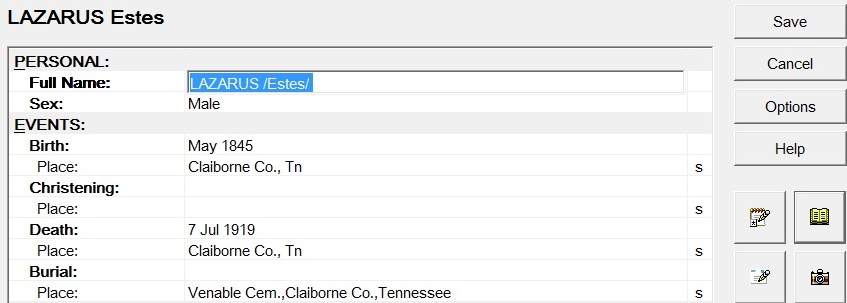
One note about using this product. It has a notes field.  I keep everything about this person in this field.  It seems to be unlimited in size.  These notes can print, or not, on reports.  You can see how easy the user interface is, below, and the notes button is the one with the pencil.  Very intuitive.

In spite of how easy PAF is to use, judging from Robert’s e-mail, it’s easy to get bogged down in the details about the product on the FamilySearch website and discouraged.  Good thing he didn’t give up.  He was kind enough to send some helpful feedback too, which I’d like to share with you and will make you smile.  Maybe we can all break the Curse that Robert speaks of!  Today is GEDCOM day.  If you haven’t uploaded yours to Family Finder, today is the day!

Hi Roberta,

Thanks for directing me to Family Search.org and their Personal Ancestral File.

My limited browsing skills struggled for a few minutes trying to find the Personal Ancestral File (PAF) download on the Family Search website.    One needs to begin at “Products” under “Resources” at the bottom of the Family Search home page.

At some point during my search for PAF, I came across a description of PAF 5.2.   It was so loaded with details about the program’s operation and capabilities, that I almost closed the site.   Every paragraph left me more confused than the previous one.

I finally said to hell with all the user unfriendly details, and then completed whatever actions it took to open PAF 5.2.    To my surprise, the chart that I wanted appeared when I clicked on “pedigree”  at the top of the page.    The format was designed to begin my family tree with me on the left, proceeding to the right with blocks for parents, grandparents, etc.   Clicking on each block produced a small window in which one inputs the basics (date and place of birth, death, and marriage, etc.) for each ancestor.    Editing was also a breeze.

I had been searching for an easy method of preparing just a basic GEDCOM/family tree in an exportable format, without having to purchase a complicated program.    Apparently PAF 5.2 is all that is needed to produce one’s basic GEDCOM/family tree  which can then be exported to one’s Family Finder website.

Maybe you can use this information in your blog to break the digital curse that prevents many of us from preparing and submitting our family tree to our Family Finder website.    Seniors are probably the age group most affected by the curse.

Many thanks.

Robert

______________________________________________________________

Disclosure

I receive a small contribution when you click on some of the links to vendors in my articles. This does NOT increase the price you pay but helps me to keep the lights on and this informational blog free for everyone. Please click on the links in the articles or to the vendors below if you are purchasing products or DNA testing.

Thank you so much.

DNA Purchases and Free Transfers

Genealogy Services

Genealogy Research

The DNA Pedigree Chart – Mining for Ancestors

Judy Russell blogged a few days ago about counting up the number of ancestors you have found, of the total number available in the past 10 generations in her blog, “More Lost than Found.”  Judy had a tidy total of 12% after the 10th generation, counting your parents as generation 1. She has only been researching for 12 years.  A veritable youngster.  I’ve been researching for 34 years, so I was hopeful that my percentage would be somewhat better.  At 1% per year, I should rack up about 34%.  We’ll see.

In my presentations, I always talk to people about building their DNA pedigree chart.  I use my own as an example.  It took a lot of work, not to mention money and in some cases, some significant arm-twisting to accomplish this.

It pains me that there are blanks at the top, and some of them can never be filled.  The one person who could test for the Ruthy Dodson Estes (Claiborne Co., Tn.) mitochondrial line, won’t.  The Kirsch family has few male descendants here in the US, and so far, the only one I can find isn’t interested in testing.

With some heavy duty elbow-grease, I should be able to find someone to test for the Margaret Herrell Cook Bolton (Claiborne County, TN) and the Margaret Lentz Miller (Montgomery Co., OH and Elkhart Co., IN) lines.

Some lines are simply dead.  The deJong line had no daughters and we don’t know who her parents were in the Netherlands, so we can’t go upstream.  I can’t find Rachel Hill Lore’s daughter’s descendants from Warren County, Pa.

Instead, I focus on the 10 lines whose DNA I do have.  I thought this was pretty good, actually.  Of these 16 ancestors, I have the DNA of 10 of them.

Last week, when I read Judy’s article, I wondered exactly how my DNA pedigree chart would compare to the number of ancestors in total and the number found.  I wouldn’t say this comparison has been fun, but it has been enlightening in a number of ways.

On the chart below, the generation is noted, the total number of end-of-line ancestors in that generation, the number of ancestors I’ve identified, the percentage that represents, followed by the number whose DNA I have and the percentage compared to the total number of ancestors possible.  The percent would look a lot better if compared it with the number of ancestors identified….but that wouldn’t be playing quite fair.

Generation

Ancestors Total

Ancestors Identified

Percent

IDed

DNA Anc

%

DNA

1 – parents

2

2

100

2

100

2 – grandparents

4

4

100

4

100

3 – great-grandparents

8

8

100

7

88

4 – gg-grandparents

16

16

100

10

63

5 – ggg – grandparents

32

32

100

22

69

6 – gggg – grandparents

64

52 (6 women no surname)

87

20

31

7 – ggggg – grandparents

128

72 (5 women no surname)

56

19

15

8 – gggggg-grandparents

256

90 (7 women no surname)

35

21

8

9 – ggggggg-grandparents

512

106 (12 women no surname)

21

23

4

10 – gggggggg-grandparents

1024

101 (4 women no surname, 8 duplicate ancestors on Mom’s side)

10

25

2

Total

2046

483

24

153

7

I wound up doing an extra generation that Judy didn’t do.

So comparing my 9th generation with Judy’s number, I had a total of 382 ancestors found out of 1022 possible, for 37%.  At 1% per year, I’m three years ahead of schedule!

Expanding this number to the 10th generation reduced my percentage to 24%, but still not bad for 300 years ago, or so.

So Judy, take heart, in another 22 years you’ll be up to 37%, about one third of the way there.  It looks like one gains about 1% per year, so at this rate you’ll only need to live for another 88 years to be done.  I can die when I’m only 119.  I sure hope my retirement money holds out that long!

Finding Ancestors DNA

On the chart, the “DNA Anc” column heading means DNA ancestor’s located and the next column, “% DNA,” is the associated percentage.  While significantly smaller than the number found, this information is still quite interesting for a number of reasons.

First, my pedigree collapse didn’t begin until the 10th generation.  On my Mom’s side, I have a lot of ethnic groups, for lack of a better term for them.  I have the Brethren, the Acadians, the Dutch and other non-Brethren German immigrants, all of which lived in clusters and intermarried after arriving in the states.  The pedigree collapse, where the same ancestor is found in your tree more than once, occurred in both the Acadian line and the immigrant non-Brethren German lines back in Germany.

In order to make sure I actually had gathered up all of my ancestral DNA lines that are available, I checked the projects at Family Tree DNA.  Most of the projects are quite useful, but there were some exceptions.  I’d like to make a plea for all surname administrators to please, PLEASE, enable the oldest ancestor field on your Family Tree DNA public webpages.  Without that information, you can’t even begin to figure out if your line is represented and the page is virtually useless.

And folks who have tested, please, PLEASE, enter your oldest ancestor information with identifying data; birth, death, location and spouse would be good for starters.  This means for the Y-line, your oldest paternal ancestor and for mtDNA, your oldest female maternal ancestor.  You would be amazed how many men’s names I see in the oldest maternal ancestor field.  This is your mitochondrial DNA lineage – your mother, her mother, her mother, etc on up the tree until you run out of mothers.

Aside from the surname projects, I found the French Heritage project, the Mother’s of Acadia project and the Acadian American Indian projects quite useful.  For one thing, they had taken the time to enter relevant surnames into their project profiles, so when one of my surnames popped up, I knew to check their projects.

I had checked existing projects previously for all of my surnames, but quite a few more ancestral lines that I could readily identify as mine had been added since I last checked.  In some cases, I couldn’t tell for sure, so I omitted those.  Unfortunately, some surnames don’t have projects.

I decided to check Ysearch, although I really didn’t think it would be very productive.  I was very pleasantly surprised.  First, it’s a lot easier to search there, even with the captchas, because you can see the location.  Then you can click on the User ID to see more genealogical info…hopefully.  People tend to enter more when they are prompted and in Ysearch does that in the transfer or data entry process.  I wish Family Tree DNA did more of this type of prompting on their website.  The only thing I couldn’t see that would have been quite helpful was the oldest ancestor info without clicking on the User ID.

Surprisingly, I picked up several DNA lines from Ysearch.  They fell into three categories.  First, the unusual names that did not have projects at Family Tree DNA.  Second, surnames from projects that were poorly displayed at Family Tree DNA, meaning the oldest ancestor info wasn’t shown, so one couldn’t tell if their family was represented or not.  Third, surnames with many matches.  It was easier to tell if there was a possible fit at Ysearch than in projects at Family Tree DNA.  I compared a couple of surnames at both locations, and people do tend to enter more info at Ysearch than they do at Family Tree DNA in terms of the oldest ancestor.

On the other hand, searching at Ancestry was entirely futile.  They do have an option to see if a surname has tested.  If so, they show you the name of the person who tested and their haplogroups. Not useful.  The only way to do anything more is to look at the profile of every person to see if their tree is connected or to contact them.  Very, very not useful.

While checking projects for the paternal surnames at Family Tree DNA and at Ysearch was easy, looking for females who descended from my ancestors and who have tested was quite difficult.  We need a mitochondrial DNA data base that has the maternal ancestors of everyone who has tested that we can search to see if our maternal line is represented.  I think we’re missing a lot of opportunities by not having this functionality.

One thing that happened that I didn’t expect is that in each generation, I lost lines, but I also picked up other lines and sometimes, they had been DNA tested.  By “picked up,” I mean that if we have a female marrying into the family, back one generation, we have her father.  Some of those ancestral lines had been DNA tested.  I expected that since many were quite far back in my tree, there wouldn’t be DNA lines for them, but that wasn’t the case as long as I had enough information to uniquely identify them and the correct end-of-line person.  In other words, just having Nicholas Estes doesn’t cut it, but having Nicholas Ewstas born 1495, Deal, Kent, England, died 1533, same location, wife’s name Anny is clearly enough to identify this man.

Unfortunately, I have a lot of Dutch on my Mom’s side, and a few generations back, on my Dad’s as well.  Relative to surnames, projects and DNA testing, Dutch lines tend to be rather hopeless, especially when you’re back to when surnames were being formed, unless you know someone from that line to ask to test.

The Dutch used patronymics where the father’s name was used plus an ending -zoon for sons, -dochter for daughters. For instance, Abel Janszoon Tasman is “Abel son of Jan Tasman”, or simply Abel Janszoon.  In written form, these endings were often abbreviated as -sz. and -dr. respectively e.g. Jeroen Cornelisz. “Jeroen son of Cornelis”, or Dirck Jacobsz. Of course, the next generation would be Jan son of Dirk, or Jan Dirckszoon or Dircksz.

This means there was a different “surname” in every generation.  In the village, everyone knew who you were, but outside the village….and beyond that century, it’s a nightmare.  Patronymics were used in Holland until 1811, whereupon emperor Napoleon forced the Dutch to register and adopt a distinct surname.  Often, they simply made the patronymics the new family names, and modern Dutch patronymic-based surnames such as Jansen, Pietersen and Willemsen abound. Others chose their profession or habitat as family names: Bakker (baker), Slachter (butcher), van Dijk (of dike) etc.  But then, the spelling changed, within families and when immigrating.  All of this, combined, makes finding Dutch ancestors very challenging and surname projects difficult.

Germans adopted surnames long before the Dutch, in most cases, so we find a few more that have projects and have tested.  In my case, I often only have one or two generations here, at most, and then the line jumps overseas.  Names are spelled differently and the European people don’t have the love affair with genetic genealogy that we Americans have.  I think it has a lot to do with the fact that we are looking for our roots and they just look outside the window to see theirs.

The Pietistic faiths are difficult too.   Many of the descendants still practice the faith, or if not, a very conservative related faith.  It’s difficult to convince people who sometimes don’t have electricity and who don’t own a car, preferring  a horse and buggy, that DNA testing is something they want to do.  However, when I actually visit, I’ve had pretty good luck, at least with the more radical segments who have telephones (but not cell phones) and drive cars now.

So where does this leave me?  I’m a little richer than when I began this comparison.  I didn’t find new ancestors, but discovered DNA information about the ones I already had.  I know more about them now, and about their ancestors, and where they were before I found them in my family tree.  I know about their clan, who was Celtic, Anglo, Viking and Native American.

I also got to add two more confirmed Native American lines to my chart today.  That made me feel great.  I’m glad we’re unearthing the truth about our ancestors that was only held in whispered stories and shadows before.

Who can you find to test for your own DNA Pedigree chart?

______________________________________________________________

Disclosure

I receive a small contribution when you click on some of the links to vendors in my articles. This does NOT increase the price you pay but helps me to keep the lights on and this informational blog free for everyone. Please click on the links in the articles or to the vendors below if you are purchasing products or DNA testing.

Thank you so much.

DNA Purchases and Free Transfers

Genealogy Services

Genealogy Research


Marja and Me

Sometimes things just don’t go as we have planned.  Some people just refuse to stay in the box where they are supposed to be.  Marja is one of those kind of out-of-the-box people.  As it turns out, that is a very good thing!

Marja is Finnish and started e-mailing me in March.  She was referred by Family Tree DNA, and she had lots and LOTS of questions.  In one long paragraph, she asked me 17 different questions pertaining to 4 different kits.  And that was one of her shorter e-mails!

To say I was a bit overwhelmed is probably an understatement. However, I could tell that her questions were a result of exuberance and a desire to learn about this fascinating new field, all in one large bite if possible.  She had been doing her homework.  Seldom do I have a new client using words like Genbank and understanding what it is.

So, we sorted the questions into groups pertaining to specific kits and Marja ordered two reports, one for her father’s Y-line, and one for her mitochondrial.

Normally, I send a form to each new client for them to complete.  They send me the completed form which includes their questions, with their photos, and when their results are all back from the lab, I schedule their work.  Simple, structured, and everything works.

Like I said, Marja operates outside the box.  Marja is history buff and a communicator.  Given that I’m a history buff and a sponge, and I knew little about Finland, I welcomed the opportunity to learn.  By the time I began the first report, I had over 100 e-mails to sort through from Marja, all with tidbits of information about Finnish history, farm names, which is how people take surnames there….and by the way, the surnames change when they changed farms.  Now that’s a genealogists headache.  I learned wonderful things from Marja and she learned from me.

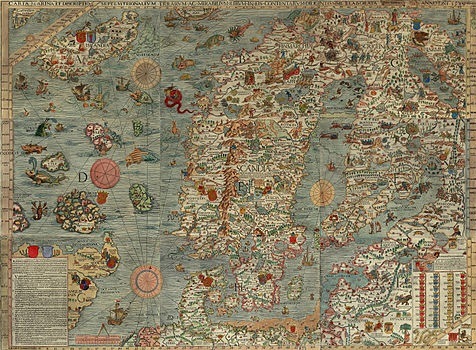
Over the ensuing months, we became friends.  We made some fascinating discoveries.  We both love maps.  I did graduate work in GIS Systems back in the 1990s.  We both particularly love antique maps.  I always include maps in reports.  She sent me a beautiful, ancient map of Finland to include in her reports.

Marja and I both love bridges too, especially really unusual bridges.  Marja and I both love and use math and statistics.  Marja is a physicist with a degree in experimental physics, topped by an MBA.  It was at that moment I truly understood Marja and appreciated all of her questions.  Her specialty is error theory.  My undergrad is in Computer Science, topped by an Information Systems MBA.  One day Marja and I stumbled across the fact that we both love space.  She met her husband at a space exhibit.  My husband and I do geeky things like visit the old Mission Control at the Johnson Space Center and stay awake half the night to watch the Mars Curiosity land.  The list of uncanny coincidences was growing.

But then, it happened.  Surely, it was inevitable.  I received an e-mail from Marja and she asked if I had noticed we were related.  What?  Really?  Well, the cobblers kids have no shoes and I had not been keeping track of my Family Finder matches nor those at GedMatch.  She had.

But how could we possibly be related?  Marja is Finnish, through and through.  I am a Heinz 57 mutt, but with no Finnish.  On my Mom’s side, lots of German and Dutch, but nothing in Scandinavia at all.  Or so we thought.  But there it was, a segment of matching DNA, big as life.  There was no doubt….Marja and I are related.  I’m convinced that on that segment lies the bridge/map/space/geeky-female genes.

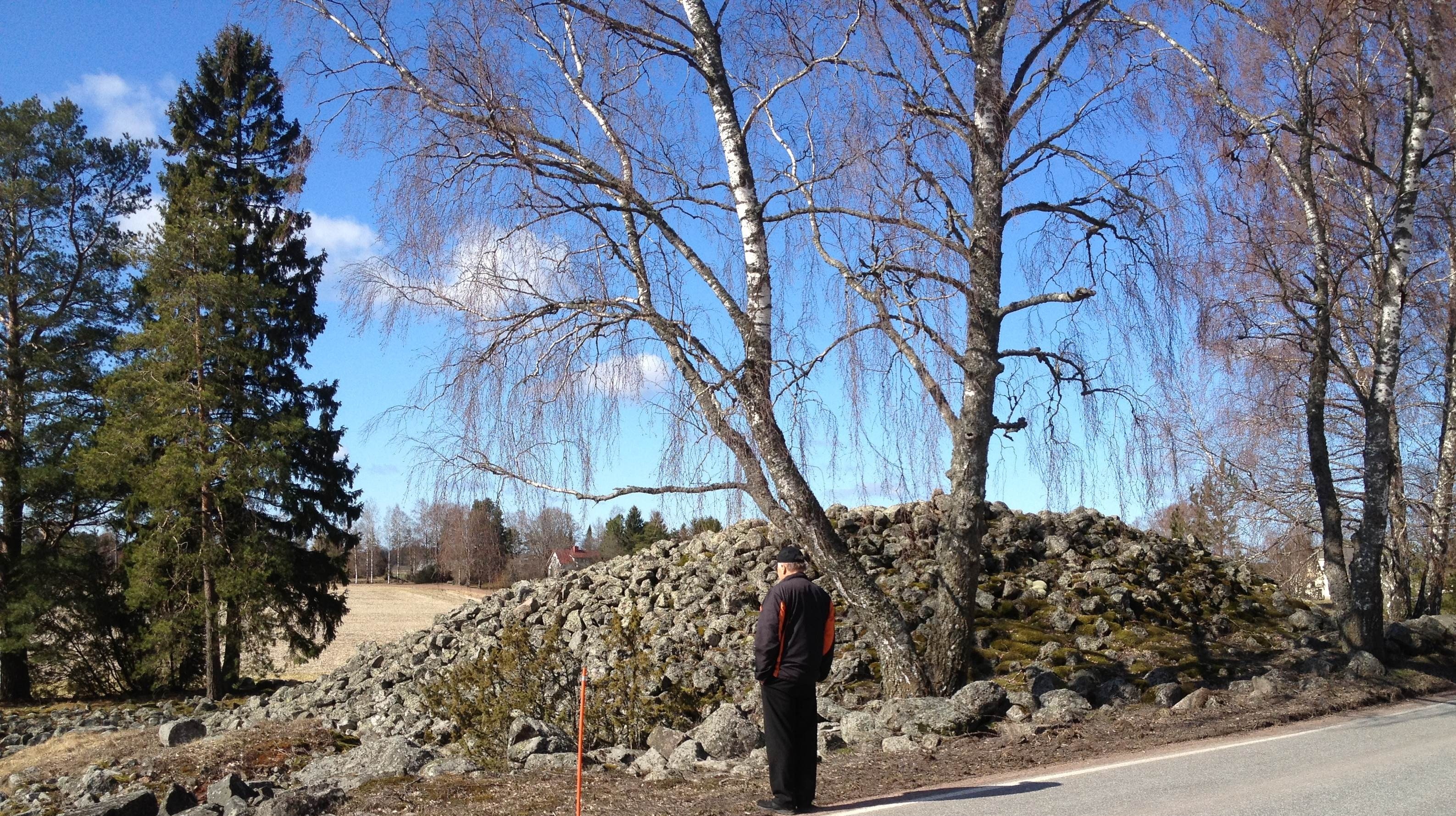
When I finished Marja’s father’s report, I had included a photo of an archaeological site that I though was relevant to her father’s story.  Kuninkaanhauta, the King’s Grave, is the largest bronze-age barrow in Finland and likewise amongst the most eminent in the Nordic countries.  These hillgraves are made of very large piles of stones and this one is very near where her father’s ancestors lived.

After I delivered the report, Marja asked me to replace that photo with another.  I was kind of disappointed, as I was so pleased to have found that archaeological site and photo.  But then I looked at the photo Marja had sent me.  It was exactly the same mound, but WITH her father standing alongside.

Marja and I also discovered that we share a love of archaeology and the ancient history it unearths.

We began to mine the history of Germany, Finland and the Netherlands, along with our families, to see how we might connect.  It may be through the Mennonites, as we both have some matches there.  Perhaps before they were Mennonites.  My mother’s family was Brethren, another Anabaptist faith, not terribly far removed from the Mennonites.

And it might be through Marja’s Finnish Fleming family who may have been German originally.  It might be through the people from what is now the Netherlands who settled in Finland.  It might be from the Saxons who greatly influenced the Finnish culture, although that is an awfully long way back to have an unbroken segment of DNA of this size.

As we went through this process, I finished her reports and our client/customer relationship had long since evolved into one of friendship.  We also discovered our love of jewelry and of hearts.  I think jewelry is an international language among women.

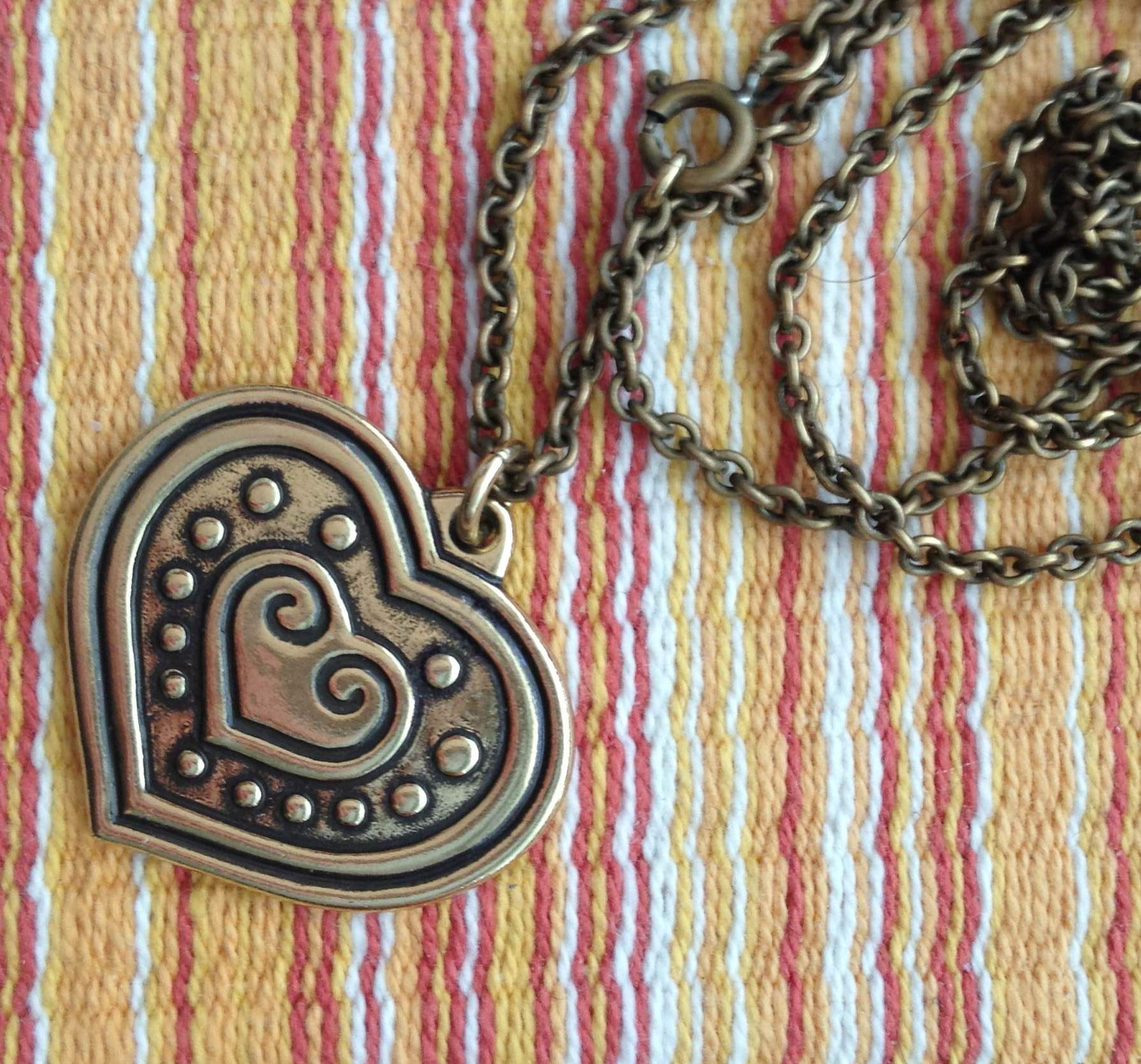
One day, Marja wrote, “This I want to share with you, Euran sydän Eura’s heart. I bought it from Kalevala Koru. Based on the archaeological findings in Eura, from the Viking time 850-1150. (Eura  includes Kiukainen again nowadays as it did in the history) . Kalevala Koru is an old company established by Finnish women. They have many fine products based on archaeological findings. More to less every Finnish woman has got Kalevala Koru jewelry. Who knows, it might have been cousin Mike’s and my ancestor who has given this kind of heart to his wife. Funny enough, when I showed this to my sister she remembered she had a similar one in her jewelry box.”

The Kalevala Jewelry company has beautiful items, designed from historical and archaeological finds in Finland.  What a wonderful idea.

You can take a look at www.kalevalakoru.com.

And then one day, I opened my mailbox to find a box from Finland, and inside the box was Eura’s heart.  What a beautiful gift and a lovely gesture.  I felt like a kid at Christmas unwrapping the beautiful box with the bow.  Now, not only are Marja and I connected by our genetic ancestors, whoever they were, some hundreds of years ago, who contributed to us our common DNA segment, but by our friendship and also, now, our Eura hearts.

http://www.kalevalakoru.com/jewelry/catalog/Pendants/1095/2

Thank you so much Marja.  You are indeed a lovely cousin.  I’m so glad we met.  Isn’t genetic genealogy great, and isn’t this what it’s all about?  Finding and meeting family and developing relationships!  And in this case, in the most unexpected of ways.  Marja is herself a gift indeed.

As Marja says, “I love this journey of ours.  It’s absolutely crazy that we found each other…7 billion people in the world….based on things we love…and then to find out we’re related.”  Yes, indeed, it’s almost unbelievable.

But our story isn’t finished yet.  A few days later, I received another e-mail from Marja.  She said, “Did you know that you are related to my cousin on the X-chromosome?”  What?  You’re kidding?  How can that be?  She is Finnish through and through and I am not.  Or so we think.  Here we go again, except with one small difference.  The X chromosome has special properties that make it easier to track.  If you want to know more about how to use the X chromosome, you’ll have to join me for a future blog, “X Marks the Spot.”

______________________________________________________________

Disclosure

I receive a small contribution when you click on some of the links to vendors in my articles. This does NOT increase the price you pay but helps me to keep the lights on and this informational blog free for everyone. Please click on the links in the articles or to the vendors below if you are purchasing products or DNA testing.

Thank you so much.

DNA Purchases and Free Transfers

Genealogy Services

Genealogy Research

Autosomal Results – The Basics

With more and more people taking the Family Finder test at Family Tree DNA, the 23andMe test and the AncestryDNA test at Ancestry.com, people get their results back, and then wonder what to do with them.  Let’s take a look at why people test and what to do with the results.

Remember, this is just the basics.  If you want a detailed analysis, that too is available. This article isn’t focused on everything you could possibly do and how to do it, but on getting the excited newbie through the first day:)  OK, maybe the first week!

What you Get

These three tests provide you with two basic genealogy related items, aside from the health information at 23andMe which we are not discussing here.

1. Percentages of ethnicity.  These tests are the most reliable way to obtain your ethnic breakdown.  Remember, these tests test all of your DNA, inherited from all of your ancestors.  By testing the Y-line and mitochondrial DNA, you can determine the ethnicity of those specific lines, but autosomal determines the ethnicity breakdown of all of you, not just those two genealogical lines.

2. Lists of people you are related to.  How each company provides this information varies a bit, but the essence is that you receive a list of people you match, and estimates of how closely.  Figuring out your common ancestry is up to you.

Why you Test

There are, in general, only 4 reasons, again, aside from the health information at 23andMe, to test autosomal DNA.

  1. You want your percentages of ethnicity.
  2. You want to see who you match and you’re willing to do the work to find out how.
  3. You have a theory that you’d like to test.
  4. You’re an adoptee or someone who doesn’t know who both of their parents are, and you’re hoping for a close match.

In reverse order, Providence will take care of number 4.  You can increase the odds of Providence helping you by fishing in multiple pools.  Remember that Providence has a sense of humor.

A good example of a theory that’s easy to test relative to reason number 3 is to see if two people are really half-siblings vs whole siblings or not siblings at all.  The results will provide you with the answer to this question easily.  This example only requires testing the two people directly involved.

A less straightforward testing theory example is attempting to determine which of 4 brothers born in the 1750s produced your ancestor who was born in the 1780s.  This scenario requires lots of hard work to find people whom you match who carry the surnames of the wives of the four brothers.  In addition, you may also want to do some of what is called “directed testing” where your find descendants of specific individuals or families and test several people to see if any of them match you, or any of your cousins in that line, using these autosomal tests.  This is a much more involved project and can be expensive.  However, if it’s your last best hope, or your only hope, somehow the cost doesn’t matter so much.  It’s probably less than a trip to another state.

Many people think the test does the hard work.  It doesn’t.  It does the easy work.  The hard work is left up to you….the genealogy research that must go along with these matches.  All the DNA test can do is to tell you that you DO match.  It can’t tell you how.  Your match could come from any of your ancestral lines and it’s up to you and the person you match to figure out how you match and who your common ancestor is.  Every single match is a new opportunity for research, work and discovery.

Results

Let’s take a look at the results at Family Tree DNA.

Click on Family Finder, then on Matches.  The first mistake people make is that they don’t realize you’re not initially seeing all of your matches, just the “close and immediate” ones.

In the drop down box  for “relations,” you’ll see “show all matches.”  Choose that option.

Matching Surnames

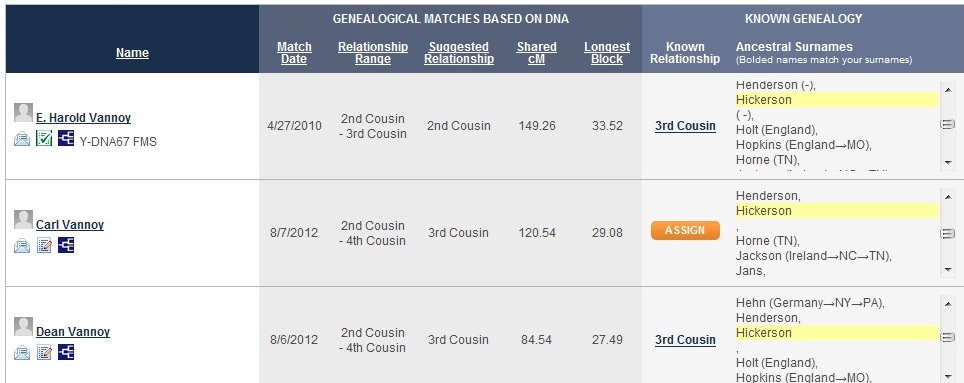
If you have entered your surnames under Account Setting, Most Distant Ancestors and then Surnames, or if you have uploaded your Gedcom file, you will see your matching surnames with your matches in bold.  In the example above, Barbara is my mother.  Harold is my third cousin on my father’s side.  Harold has entered his surnames, and the ones we match “float to the top” and are bolded.  You can see the beginning of that list; Brown, Crumley, Lowery.

This is where the work for you begins, determining how you and your match connect to these surnames and if they are the same family.

Relationship Predictions

You can see that Family Tree DNA predicted that my mother was either my mother or my child.  They use the amount of shared DNA to make that calculation.  You share 50% of the DNA of each parent, and your child shares 50% of your DNA, so someone you match at 50% has to be either a child or a parent to you.  It’s that simple.

Of course, in each generation, after your parents, the percentage of DNA that you receive from any given ancestor is not exactly 50% of the previous generation.  But it’s close, and it’s the only number that we can accurately use for predicting relationships.

The following percentages show how much DNA is shared with different family members.

  • 50% mother, father and siblings
  • 25% grandfathers, grandmothers, aunts, uncles, half-siblings, double first cousins
  • 12.5% first cousins
  • 6.25% first cousins once removed
  • 3.125% second cousins, first cousins twice removed
  • 0.781% third cousins

You may be able to see these relationships easier on the following graphic.

You can read more about autosomal inheritance on the ISOGG “Autosomal DNA Statistics” page.  At the bottom of that page are some other good articles about working with autosomal DNA results.

Family Tree DNA and 23andMe both use calculations that involve the total centimorgans shared and the longest contiguous block.  You don’t need to understand these calculations.  (Remember, this is just the basics.)  What you need to understand is that the relationship predictor can get close, but the further back in time you go, the less accurate it will be.  Remember that every generation, DNA is passed at random to the next generation.  You can see on my match page that my third cousin Harold is predicted to be a second cousin, but the range is 2nd to 3rd cousin.  That means that Harold and I share a little more DNA than most third cousins.

If you need help, you can always click on “page help”.

Ancestor Fishing and the Chromosome Browser

Let’s say I think that I might have found a new surname in my line.  It want to see everyone who has the surname Hickerson who is on my match list.  I enter that surname in the “ancestral surname” box, and click on “run report.”  The results returned will all carry the Hickerson surname, which you can see by scrolling for the highlighted names.

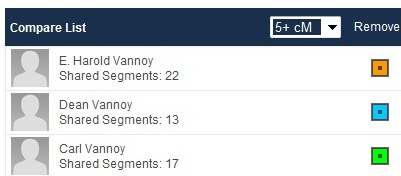
Now I want to see if these three people share common DNA not just with me, but with each other.  If we all share a common segment of DNA, then that confirms a common ancestor and attributes that DNA at that address on that chromosome to that specific ancestral family.

In my case, the known ancestral family is Vannoy, so let’s look at the Vannoy cousins as compared to me.

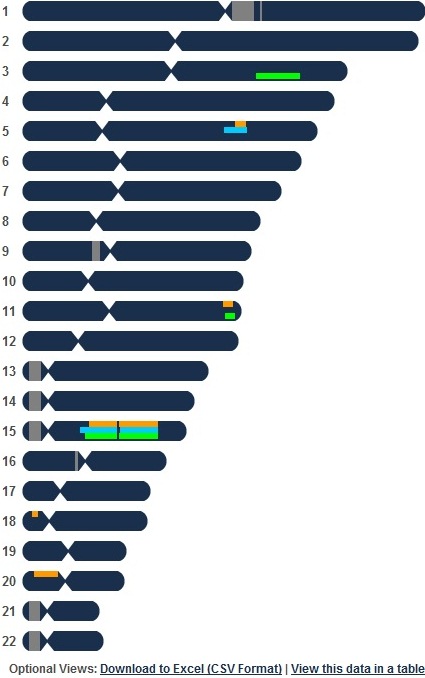
Each of the participants results are color coded.  On the page below, you can see that each matching segment of the chromosomes are colored.  It turns out that all of us share a fairly large segment on Chromosome 15.  So now we can attribute that segment to Elijah Vannoy, our oldest proven ancestor in that line.  You can also see some areas where one or two of my cousins match my DNA, but not all of us.  Those can also be attributed to Elijah Vannoy’s line since we share no other (known) common ancestors.

This cousin match is simple because the men share the same surname, but if this was 3 women with different surnames, the matching would still work.  The challenge of course would be to find the common ancestor.  In this case, if all 3 women had Elijah Vannoy in their tree, we could still tell that this segment of Chromosome 15 was attributed to the Vannoy family.

You can also download the results into a spreadsheet so you can do this matching without selecting 5 at a time.  Of course on a spreadsheet, there is no pretty and graphic chromosome browser.

Color your Chromosomes

You know, using these simple tools, you could “color in” your own DNA on your chromosomes so you can identify which part of your DNA was contributed by which ancestor.  Yes, I know, this is terribly geeky.

Reconstruct a Virtual Ancestor

Conversely, you could also “reconstruct” an ancestor. In fact, I think we’re well on the way with Elijah Vannoy.  Heck, I’ve already got most of chromosome 15 completed and parts of 3, 5, 11, 18 and 20!

Find a Guide – Consulting

If you’re trying to do something more complex, or have a specific goal in mind, you probably need some level of guidance if you are the proverbial Newbie.

There are three of us in the genetic genealogy community that provide various autosomal consulting services.

I provide DNA test planning, meaning helping you figure out who to test to achieve your desired results, and also after testing follow-up in the form of a Quick Consult.  I also write specialty reports upon request.  You can see the various options on my webpage or you can e-mail me directly at robertajestes@att.net to discuss.

Cece Moore is another consultant in this space.  She works with a lot of adoptees and beginners.  You can reach Cece at cecemoore@hotmail.com.  You’re probably familiar with Cece through her blog, http://www.yourgeneticgenealogist.com/.

Tim Janzen, MD, provides consulting as well.  His specialty is called phasing which determines which part of your genome came from which parent/ancestor.  Now this is easy if you have parents yet alive, but if not, and you have to try to figure this out by piecing together matches from various cousins, it’s not straightforward at all.  Tim uses the phased DNA data in conjunction with data from known relatives to create chromosome maps of your genome.  These maps are very helpful when you are trying to figure out how you are related to your matches at 23andMe and in the Family Finder database.  You can reach Tim at tjanzen@comcast.net.

You might be surprised to see me recommending other people on my blog in what might be considered a competitive arena.  Don’t be.  We work together.  We know who is the best at which aspects of genetic genealogy and we refer people routinely to the best resource for their needs.

The Magic of Connecting

Your level of success with autosomal testing and finding cousin matches is directly proportional to the amount of work you’re willing to invest in contacting your matches and sometimes helping them with their genealogy.

However, the results can be incredibly rewarding.  One of my clients is an adoptee.  She, of course, was hoping for a half-sibling match, but she’s not that lucky….at least not yet.  In the mean time, three of her matches also matched each other, and 2 of them share part of the same chromosomal segment with her.  The surname involved is very unique, French Canadian, found initially in only one family in one location.  So while we don’t know who her parents are, or her hoped-for siblings, we were able to gift her with one ancestor that is, absolutely, positively, hers.  This is a gift she has never had in her entire life.  She has never known one biological family member, ever.  And she has cousins too, an entire list of them.  For her, autosomal DNA has provided the ability to put her family tree together backwards, working our way forward in time from distant ancestors, slowly…..while still hoping for that “lottery winning” sibling match!

______________________________________________________________

Disclosure

I receive a small contribution when you click on some of the links to vendors in my articles. This does NOT increase the price you pay but helps me to keep the lights on and this informational blog free for everyone. Please click on the links in the articles or to the vendors below if you are purchasing products or DNA testing.

Thank you so much.

DNA Purchases and Free Transfers

Genealogy Services

Genealogy Research

DNA Melody

Sometimes DNA is just for fun.  23andMe has a “sandbox” feature called Ancestry Labs.  Sometimes the things there are a great deal of fun.

Yesterday, I received a message to go and listen to my DNA Melody.  My DNA Melody?  What’s that?  I didn’t know I had one.

23andMe has created a unique DNA melody by using our individual DNA sequences.

23andMe took different aspects of my DNA sequence and used them to determine different properties of my DNA Melody.

What fun.  Want to hear what my DNA Melody sounds like?  Click on the link below.  You can even select the instrument.  I personally like the marimba.  I wonder if that’s genetic….

https://www.23andme.com/published/labs/music/4999223f30e303a2/e57b558bbe9cb60e/

______________________________________________________________

Disclosure

I receive a small contribution when you click on some of the links to vendors in my articles. This does NOT increase the price you pay but helps me to keep the lights on and this informational blog free for everyone. Please click on the links in the articles or to the vendors below if you are purchasing products or DNA testing.

Thank you so much.

DNA Purchases and Free Transfers

Genealogy Services

Genealogy Research

Ancestry’s Consent Form for AncestryDNA Autosomal Test

When I ordered my Ancestry autosomal kit, called AncestryDNA, I said that I’d blog my way through the process so you can join me.  The kit arrived in about ten days, and then it laid on my desk for the next two weeks, looking at me accusingly every single day, silently nagging me.  Today, I capitulated, like I had  been meaning to do every single day for the past two weeks.

I opened the kit and followed the instructions to register the kit.  Easy enough.  Enter the bar code on the vial.  That bar code connected the kit with my account at Ancestry, and after I entered the code, I saw this next form as part of the activation process.

They ask for my birth year, which they indicate they use in relationship calculations.  That certainly seems kosher, so I entered mine.  And no, the year displayed above is not my birth year.  I’m pretending just for today:)
I clicked on gender and then I clicked in both the Consent Agreement and the Terms and Conditions boxes.  I was just about to click on the “Activate this test” button when that little voice started to speak to me.

Now long ago, I used to ignore that little voice, much to my own detriment.  When I was younger, it used to say things to me like “you should do what your mother said.”  I hated it.  When I was in college, it used to say things like “you really should go home and study statistics rather than have another beer.”  I REALLY hated it then.  I won’t even tell you what it said when I got engaged the first time.  You get the idea.

But that little voice said to me, “Hmmm, that’s odd.  Why two things to click?”  And having always suffered when I ignore the little voice, I’ve finally learned to pay attention, for the most part.

So I went and clicked on both the “Consent Agreement” and the “Terms and Conditions” links, and was I ever glad that I did.

The words “Consent Agreement” look so benign, especially after working with Family Tree DNA’s consent agreement which is about 2 sentences and very straightforward.  This one is anything but, AND, I was mortified to see what I was consenting to, other than what I expected, which was to process my kit for genealogy purposes. 

Let me say right here and now that you do NOT have to agree to the Consent Agreement to activate your kit, although it doesn’t say that on this page.  And given where this box is placed, it certainly gives the impression that you need to click both these boxes to activate the kit, but you don’t.  The word “optional” doesn’t appear.  There is also nothing to alert you, on this page, that what you are consenting to is research, not simply consenting for your test to be run.  Whoda thought???

I did not agree to the Consent Agreement.  I did agree to the Terms and Conditions, which are required, and my kit was activated.  I’m betting most people don’t even read this verbiage, and I’m betting Ancestry is counting on that fact.  In this techno-world, people have come to expect that you have to “click” to agree to whatever, so they click because they feel they have no other option if they want the product…in this case…to activate the kit which they have aleady purchased.  While this is the case for the Terms and Conditions, it’s not for the Consent Agreement, which should really be termed optional.

What You’re Giving Consent For

  1. Unnamed and unidentified research projects that Ancestry can identify so long as they fall under their “Human Genetic Diversity Project.”
  2. Ancestry will be using, and potentially SELLING your DNA results, including MEDICAL and genealogical information.
  3. In the Terms and Conditions, which is required to activate your kit, you are granting them a TRANSFERRABLE LICENSE to any information you put into ancestry, plus your DNA results.  See items 4 and 7 in the Terms and Conditions section, below.

Oh yes, and just for grins and giggles, here is what they have to say in section 10 about quality, just in case you were wondering:

“In addition, we do not make any representations as to the accuracy, comprehensiveness, completeness, quality, currency, error-free nature, compatibility, security or fitness for purpose of the AncestryDNA Website, Content or Service.”

The Issue

When I gave consent at 23andMe, I signed something very similar to this.  But 23andMe is a company that specializes in health traits and risks.  I EXPECT them to be doing research.  In fact, they are very up-front about the fact that they are doing this.  I WANT them to make advancements in science based on crowd-sourcing.

But Ancestry.com is not 23andMe.  Their primary purpose in life is not medical testing or health traits.  It’s genealogy and family history.  I ordered this test to discover more about my family history, to be matched against others who also took the test, not to make my DNA available outside of that realm.

I had to agree to the Terms and Conditions, so whether I want my DNA and genealogy records to be transferrable to whomever, wherever, whenever, or not, they will be.  That is apparently the price of admission to genealogy testing, at least autosomal testing, at Ancestry.com.

When I saw that Ancestry gave away thousands of kits initially, followed by selling several thousand more at $99, I wondered how it was that they could afford to do that when the same test, in essence, was being sold by Family Tree DNA for $289 and by 23andMe for $299.  Maybe the verbiage that includes medical information tied to genealogy information and the requirement to give up rights to your information in order to test is part of the reason that they can afford to sell this test for $99.  Hmmmm….

Maybe that little voice that was saying to me, “if it sounds too good to be true, it probably is,” is right.

Of course, the next step in the kit activation process are prompts to begin your genealogy tree or to upload your GEDCOM file.  If you’re going to take the autosomal test, Ancestry’s matching would be very ineffective without the tester providing genealogy information about themselves.  I did enter a few generations, as I wasn’t about to upload my entire GEDCOM file, but I also realize that I’ve forever released the information I entered, including the names of my parents and my birth year, into the great transferrable abyss.  The little voice is not happy with me.  I’m just not convinced that this is ultimately in my best interest.

Below, Ancestry’s Information and Consent Form as well as their Terms and Conditions are copied directly from their webpage.  All verbiage, links, highlighting, etc., from here down, is entirely theirs.

Information and Consent Form

We would like you to be part of a research project. This Consent Form gives you information to help you decide if you would like to participate in the research project to be performed by Ancestry.com DNA, LLC (“AncestryDNA,” “us” or “we”). We believe in being transparent so you can understand this consent form and what we are attempting to accomplish through the research project described below. If you have any questions, please contact us using the information below and feel free to discuss your participation with anyone you choose in order to better understand this research project and your options.

Anyone who is using the AncestryDNA service to find out about their genetic ancestry may also voluntarily participate in this research project. You do not have to be in this research project if you don’t want to.

If you are the parent or guardian of a minor who may wish to participate in this research project, you should talk with your child and go over the information in this form with him/her before you and your child make a decision about whether to participate. Your child does not have to participate if he/she does not want to.

Please read this Consent Form carefully; you should print out a copy and keep it somewhere safe. A copy of it is also always available on our website.

1. What is the research project?

The AncestryDNA’s Human Genetic Diversity Project (“The Project”) will collect, preserve and analyze genetic information, genealogical pedigrees, historical records, surveys, medical and health records and other information (collectively, “Information”) from people all around the world in order to better understand human evolution and migration, population genetics, ethnographic diversity and boundaries, genealogy, and the history of our species. Researchers hope that the Project will be an invaluable genealogic tool for future generations and will engage the interest of a wide range of scholars interested in genealogy, anthropology, evolution, languages, cultures, medicine, and other topics. The Information will not be used for medical purposes in the treatment or diagnosis of any individuals.

This Consent Form is consistent with National Institutes of Health Regulations and Ethical Guidelines and explains:

2. What information will be collected?

The Project will collect genetic, genealogical and health information that has been stripped of any personally identifiable information in order to study the history of our species. Genes are in your cells, and they are what make you different from anyone else. Some genes control things like the color of your hair or eyes. Genetic information includes your genotype that is discovered when AncestryDNA processes your saliva or is otherwise provided by you to AncestryDNA (the “Genetic Information”) when you choose to use the AncestryDNA service. Genealogical information is your pedigree, ethnicity, family history, and other information about you that is either provided by you or is gleaned from publicly available documents on Ancestry.com’s website and other locations (the “Genealogical Information”). Health information includes self-reported information from you such as medical conditions, diseases, other health-related information, personal traits, and other information that is either provided by you or is gleaned from publicly available sources, documents on Ancestry.com’s website and other resources (the “Health Information”).

In all cases for this Project, personally identifiable information about specific study participants (such as name and birth date) is removed from the Information before it is compiled as part of this Project.

The Project will take all of this information (that is already stripped of personally identifiable information) and compile it into a single data summary to minimize the possibility that any individual participant can be identified by any researcher or other individual from the Information.

3. How will the information be used?

Your Information will be combined with others and used to further the Project’s objectives of increasing our understanding of the components that define the history of our species. Discoveries made as a result of this research could be used in the study of genealogy, anthropology, evolution, languages, cultures, medicine, and other topics. In any publication of the studies or results, the genetic, genealogical and health information will be stripped of any personally identifiable information.

4. How do I take part in the Project?

To participate, you need to follow the instructions on our website to submit a Test Kit (i.e., a cheek swab sample).

Once you send your DNA samples to us, you must then register the Test Kit with AncestryDNA. During that process, you will be asked to click “accept” at the end of this Information and Consent Form which will allow AncestryDNA to use your samples and information for this Research Project. You will also be required to read and accept our Terms & Conditions and Privacy Policy.

Study staff may contact you to ask you to complete a questionnaire or to ask you if you are willing to be interviewed.

5. What are the costs and will I receive compensation?

The costs of participating in the Project and having your DNA analyzed are the same as having your DNA analyzed on Ancestry.com and not participating in the Project. You will not be charged for participating in the Project.

You will not get paid for being in this Project. The sample(s) you provide for this genetics Project might benefit AncestryDNA in the future. AncestryDNA will own the results of the research and any subsequent publication of the results. You will remain the owner of the samples you provide. Your samples will be stored until AncestryDNA destroys them.

6. What are the benefits of participating?

Participating in this Project may not benefit you directly. But your participation in this Project will assist scientists to better understand our species, including our shared anthropology and medical and genetic traits. Your individual DNA results will be communicated to you regardless of whether or not you consent to be in this Project, including information about genetic relatives, geographic origin, and ethnicity.

7. Are there any risks to participating?

Presently, there are no known health risks involved in obtaining a DNA sample. Your test results may reveal information about members of your biological family (blood relatives). But there are no physical risks for having your sample and information used in this Project. As in any research study, there is a risk that private personal or health information could be compromised and/or that other means could be used to identify you. But, as described herein, we will not disclose your personally identifiable information except as required by law. Please note that a federal law called the Genetic Information Nondiscrimination Act (GINA) generally makes it illegal for health insurance companies, group health plans, and most employers to discriminate against you based on your genetic information. Be aware that this new law does not protect you against genetic discrimination by companies that sell life insurance, disability insurance, or long-term care insurance. There may also be additional risks to participation that are currently unforeseeable. We do our best to ensure that this does not happen and you should read our Privacy Policy and FAQs for more information.

8. How will you protect my information?

AncestryDNA uses a range of physical, technical, and administrative procedures to protect the privacy of your Health Information, your Genetic Information, and your Genealogical Information. For example, we restrict access to our data center and databases by using industry standard passwords and pass cards, your connections to the AncestryDNA website are encrypted, and all Internet computer servers have firewall protection in place. Although AncestryDNA may collaborate with external third parties, these parties will only have access to pooled information stripped of personal identifying Information. AncestryDNA will never release your individual information without asking for and receiving your explicit authorization to do so, except as required by law, and your identity will not be disclosed by us in any publication of the research. Genetic Information will be segregated from other information and only specifically authorized individuals will have access to the Genetic Information. These measures are described in more detail in the AncestryDNA Privacy Policy.

Be aware that your study records (which include your genetic and other information as described above) will be shared and copied as needed for the Project.

9. Could my participation end without my consent?

AncestryDNA has the ability to terminate the Project in its discretion without your consent. AncestryDNA will protect your Information even after the study is terminated.

10. How do I withdraw from this Project?

Participation in this study is purely voluntary. You can decide not to be in this Project and, at any time, you may choose to withdraw some or all of the Information provided by sending a request to consent@ancestry.com. There will be no penalty to you, and you won’t lose any benefits. AncestryDNA will cease using your Information for the Project as soon as it reasonably can after receipt of your request. Any research using your Information that has been performed or published prior to this date will not be reversed, undone, or withdrawn.

If you choose not to participate in the Project, you will still receive your genetic information (i.e., genetic relationships/matching and ethnicity).

11. Further Information and FAQs.

You can ask questions about this research Project at any time. You can contact AncestryDNA at any time if you have any concerns or complaints or if you have questions about the Project. If you wish to contact us then you can do so as follows;

AncestryDNA Member Services
Memberservices@ancestrydna.com
360 W. 4800 N.
Provo, Utah 84604
801-705-7000 or fax to 801-705-7001

If you have questions about what it means to be in a research study, you can call Quorum Review (a research ethics board that reviews this study) at 888-776-9115 begin_of_the_skype_highlighting              888-776-9115      end_of_the_skype_highlighting, or visit the Quorum Review website at www.quorumreview.com.

Ancestry.com DNA, LLC

US Terms and Conditions – Revision as of May 3, 2012

Welcome to AncestryDNA. We offer DNA testing and genealogical analysis to help users discover, preserve, and share their family history. Below are our detailed terms and conditions which you must read and accept before using our services.

These Terms and Conditions apply to users visiting or registering on or after May 3, 2012. For existing Users (as defined below), these Terms and Conditions will be come effective on June 3, 2012. For the previous version of the Terms and Conditions, please click here.

Please note that hyperlinks embedded in these terms and conditions (this “Agreement”) may only be accessed through our website. If you are reviewing this Agreement through mobile devices, you may need to visit the website to use the hyperlinks.

1. Overview

Before using this website, ordering a DNA testing kit or having access to the results of the DNA testing, you must review and accept this Agreement which defines your rights and responsibilities as a user of the website and DNA testing service (“User”) operated by Ancestry.com DNA, LLC (“AncestryDNA” or “we”) and located at AncestryDNA.com or via the section of Ancestry.com’s website located at dna.ancestry.com (the “AncestryDNA Website”). The AncestryDNA Website is operated and services are provided in the United States of America. DNA testing and access to the AncestryDNA Website are governed by this Agreement, which, in turn, is governed by the laws of the State of Utah and the United States. Registering as a User and having DNA tested as a part of this service results in your personal and genetic information being stored and processed in the United States, and you specifically consent to AncestryDNA’s storage and processing the DNA and other personal data you submit. The AncestryDNA Website and services provided herein are intended for adults. If any minor gains access to the AncestryDNA Website, the parent or guardian of that minor will be held strictly responsible for that minor’s actions. If you submit a DNA sample of a minor, you must represent that you are the minor’s parent, legal guardian and/or have explicit permission from the minor’s parent or legal guardian. If you do not agree with any provision of this Agreement, or if you have any objections to the AncestryDNA Privacy Statement, you must not use the AncestryDNA Website or be a User.

2. Description of Service

AncestryDNA is part of the Ancestry family of websites, which includes, among others, ancestry.com, rootsweb.com, and familytreemaker.com, as well as international websites such as ancestry.co.uk, ancestry.de, ancestry.fr, ancestry.it, ancestry.se. AncestryDNA offers both a DNA test to help discover your ancestors and an online service where Users view the results of their DNA test (together the “Service”). The AncestryDNA Service can be used in conjunction with the Ancestry family of websites to enable Users to discover, research, and save family history by searching extensive databases of records on www.ancestry.com’s website (or through certain other websites in the Ancestry family of websites) and by utilizing Ancestry.com’s family tree services. AncestryDNA Users and users of the Ancestry family of websites may also communicate with each other in order to collaborate and exchange family history related information (the “Ancestry.com Community”).

3. Limited Use License

The AncestryDNA Website contains graphics, information, data, user generated information, editorial and other content accessible by users (the “Content”). All Content is owned, licensed to and/or copyrighted by AncestryDNA and may be used only in accordance with this limited use license. The AncestryDNA Website is protected by copyright as a collective work and/or compilation, pursuant to U.S. copyright laws, international conventions, and other copyright laws. You may use the Service, access the Ancestry Website, use the graphics, information, data, editorial and other Content only for personal or professional family history research. Republication or resale of any of the Content or other protected data is prohibited. You may use the software provided on the AncestryDNA Website only while online and may not download, copy, reuse or distribute that software, except where it is clearly stated that such software is made available for offline use. AncestryDNA and its licensors retain title, ownership and all other rights and interests in and to all information and Content on the AncestryDNA Website. Bots, crawlers, spiders, data miners, scraping and any other automatic access tool are expressly prohibited. Violation of this limited use license may result in immediate termination of your membership and may result in legal action against you.

Each of the Ancestry family of websites is subject to terms and conditions different from those found here and it is your responsibility to ensure that you have read and understood them before using those websites.

4. DNA Testing

All DNA testing performed by AncestryDNA on samples submitted for testing or by uploading a digital version of a DNA analysis is done for genealogical research only, including population and ethnic group-related analyses, and not for individual medical or diagnostic purposes. Before providing a DNA sample for testing, you represent that you are eighteen (18) years of age or older. In addition, you represent that any sample you provide is either your DNA or the DNA of a person for whom you are a legal guardian or have obtained legal authorization to provide their DNA to AncestryDNA. By submitting DNA samples to AncestryDNA, you give permission to AncestryDNA to extract the DNA from the samples, perform genetic tests on the DNA using test methods available now and developed in the future, to disclose the results of the tests performed to you and others that you authorize, to store the samples for additional genetic testing and archiving purposes, and to store the results of the DNA tests in accordance with this Agreement and with the AncestryDNA Privacy Statement. Any DNA sample submitted to us cannot be returned and shall be stored by AncestryDNA or its agents. AncestryDNA does not claim any ownership rights in the DNA that is submitted for testing. Any genetic information derived from the DNA continues to belong to the person who submitted the DNA sample, subject only to the rights granted to AncestryDNA in this Agreement. In addition, you understand that by providing any DNA to us, you acquire no rights in any research or commercial products that may be developed by AncestryDNA that may relate to or otherwise embody your DNA.

By submitting DNA to AncestryDNA, you grant AncestryDNA a transferable license to use your DNA, and any DNA you submit for any person from whom you obtained legal authorization as described in this Agreement, and to use, host, sublicense and distribute the resulting analysis to the extent and in the form or context we deem appropriate on or through any media or medium and with any technology or devices now known or hereafter developed or discovered. You hereby release AncestryDNA from any and all claims, liens, demands, actions or suits in connection with the DNA sample, the test or results thereof, including, without limitation, errors, omissions, claims for defamation, invasion of privacy, right of publicity, emotional distress or economic loss. See indemnification provision below.

If you are a User residing outside the United States and providing a DNA sample, you confirm that this submission is not subject to any export ban or restriction in the country in which you reside. You also agree that you have the authority, under the laws of the state or jurisdiction in which you reside, to provide the representations in this Agreement and you explicitly waive any laws or regulations relating to DNA testing and storage from the state or jurisdiction in which you reside. You agree that the sample will be tested and stored in the United States as provided in this Agreement. You further agree that you may only be accessible through the AncestryDNA Website and that you may not be able to use the results in a website targeted to your country of residence or hosted outside the United States.

5. Rules of Conduct

Before using the AncestryDNA Website, you agree to comply with all applicable laws and refrain from infringing any third-party rights or interests (for example, privacy and intellectual property rights). You must also agree that you will provide valid and complete contact information, and that you will always have a valid email address on file with AncestryDNA. In addition, the following policies are part of this Agreement and must be followed anytime you access the AncestryDNA Website:

A. You must not post or publish any information that you know is false or misleading, such as impersonating any person or entity, falsely misrepresenting your affiliation with any person or entity, falsely claiming an endorsement that you do not have, or misrepresenting that you are an employee or representative of AncestryDNA or otherwise affiliated with AncestryDNA.

B. You must not reproduce, copy or sell any portion of AncestryDNA or AncestryDNA database contents or systematically download the Content and data of the AncestryDNA database to make or populate another database or for any other purpose.

C. You must not interfere or attempt to interfere with the AncestryDNA Website in any manner. For example, you may not use any software program, virus or routine to block, obscure, overwrite or modify any Content or web pages or to destroy the software, hardware or telecommunications equipment of the AncestryDNA Website or another person.

D. You must not use the information from the AncestryDNA website or DNA tests in whole or in part for any discrimatory or otherwise illegal activity (for example, to make insurance or employment decisions).

These Rules of Conduct are not exclusive. If we believe, in our sole discretion, that you are in breach of this Agreement, are acting inconsistently with the letter or spirit of this Agreement or otherwise interfering with the efficient management or delivery of the AncestryDNA Website, Service or Content, we may limit, suspend or terminate your access to our AncestryDNA Website. In such a case, no portion of your subscription payment will be refunded. Should we decide to suspend or terminate your access for any reason other than your actions or omissions which we believe to be inconsistent with this Agreement we will refund to you any unused portion of your payment, which will be your sole and exclusive remedy upon such a suspension.

6. AncestryDNA Fees and Payments

Users of the AncestryDNA Website may be unregistered visitors or paying members. The different payment options and services offered will be published on the AncestryDNA Website or at the time a DNA test or other service is offered. The terms and conditions applying to such items or services will be incorporated into this Agreement.

You must be 18 years or older to order the AncestryDNA Service. You must provide AncestryDNA with accurate, complete, and up-to-date registration information. Failure to do so will constitute a breach of this Agreement.

Cancellations and Refunds Cancellations may be made by calling AncestryDNA at 1-800-958-9124 begin_of_the_skype_highlighting              1-800-958-9124      end_of_the_skype_highlighting and providing the same information that you provided when you ordered your AncestryDNA Service. If you cancel within the first 30 days of placing your order, and before you returned a DNA sample to AncestryDNA, you will receive a refund equal to the price paid for the AncestryDNA Service minus $25. If you cancel within the first 30 days of placing your order but after you have returned a DNA sample to AncestryDNA, you will receive a partial refund equal to one half of the price paid for the AncestryDNA Service. AncestryDNA does not refund shipping & processing charges or any applicable taxes paid. Your credit will be provided via the credit card you used to purchase the AncestryDNA Service. Please allow a reasonable time for the credit to reach you.

Replacement Testing Kits Should you require a replacement DNA testing kit, you may call AncestryDNA at 1-800-958-9124 begin_of_the_skype_highlighting              1-800-958-9124      end_of_the_skype_highlighting and providing the same information that you provided when you ordered your AncestryDNA test. Replacement kits are $25 per kit (plus applicable shipping and handling).

Prices Subject to Change. Prices may be changed by AncestryDNA at any time.

7. User Provided Content

Portions of the AncestryDNA Website allow you and other Users to contribute material to be displayed on the AncestryDNA Website (“User Provided Content”). For User Provided Content, AncestryDNA is merely hosting and providing access. We cannot, and expressly do not, accept any liability with regard to such User Provided Content (including with respect to its accuracy). While we cannot preview or monitor User Provided Content, we may apply, at our discretion, automated filtering tools to monitor and/or delete any content that AncestryDNA believes to be in violation of this Agreement. We reserve the right to act expeditiously to remove or disable access to any User Provided Content that we believe violates this Agreement. We are also sensitive to the copyright and other intellectual property rights of others. For complaints regarding copyright infringement, illegal or inappropriate content, click here.

The decision to upload information to the AncestryDNA Website is your responsibility and you should only submit content that belongs to you or that will not violate the rights of others. Be aware that content belongs to the creator of that content and you should not reproduce or submit anything without permission of the owner. By submitting material to the AncestryDNA Website, you represent that you have the right to do so or that you have obtained any necessary third party consents (e.g., under privacy or intellectual property laws). Upon the request of AncestryDNA you agree to furnish AncestryDNA with any documentation, substantiation and releases we deem necessary or appropriate to verify and substantiate your compliance with this provision.

By submitting User Provided Content to AncestryDNA, you grant AncestryDNA a transferable license to use, host, sublicense and distribute your submission to the extent and in the form or context we deem appropriate on or through any media or medium and with any technology or devices now known or hereafter developed or discovered. You hereby release AncestryDNA from any and all claims, liens, demands, actions or suits in connection with the User Provided Content, including, without limitation, any and all liability for any use or nonuse of your User Provided Content, claims for defamation, invasion of privacy, right of publicity, emotional distress or economic loss. Except for the rights granted in this Agreement, AncestryDNA acquires no title or ownership rights in or to any content you submit and nothing in this Agreement conveys any ownership rights in the content you submit to us.

8. Promotions

Any sweepstakes, contests, raffles or other promotions (collectively, “Promotions”) made available by AncestryDNA may be governed by rules that are separate from this Agreement. If you participate in any Promotions, please review the applicable rules as well as our Privacy Statement. If the rules for a Promotion conflict with this Agreement, the Promotion rules will apply to those specifically conflicting sections only.

9. Modifications to this Agreement

AncestryDNA has the right, at its sole discretion, to modify this Agreement at any time. Changes will be posted on the AncestryDNA Website and by changing the date of last revision on this Agreement. If any portion of this Agreement or any change to the AncestryDNA Website is unacceptable to you or will cause you to no longer be in compliance with the Agreement, you may cancel your subscription by following the instructions in this Agreement. Continued use of the AncestryDNA Website following posted changes in this Agreement means that you accept and are bound by the changes.

10. Liability Disclaimer

No Warranty. We make no express warranties or representations as to the quality and accuracy of the Content, AncestryDNA Website or Service, and we disclaim any implied warranties or representation to the maximum amount permissible under applicable law. We offer the DNA testing and AncestryDNA Website on an “as is basis” and do not accept responsibility for any use of or reliance on the AncestryDNA Website, Content or Service, or for any disruptions to or delay in the AncestryDNA Website, Content or Service. In addition, we do not make any representations as to the accuracy, comprehensiveness, completeness, quality, currency, error-free nature, compatibility, security or fitness for purpose of the AncestryDNA Website, Content or Service. AncestryDNA does not guarantee the adequacy of the Service or AncestryDNA Website or compatibility thereof to your computer equipment and environment and does not warrant that this AncestryDNA Website, the Content, the Service, its servers, or any emails which may be sent from AncestryDNA are free of viruses or any other harmful components. AncestryDNA does not control or endorse any actions resulting from your use of the AncestryDNA Website, Content or Service and specifically disclaims any liability regarding any actions that may result from your use of the Service or AncestryDNA Website.

Limitation of Liability; Exclusive Remedy.We limit our liability to the maximum amount permissible under applicable law. In particular, we shall not be liable for any damages that we cause unintentionally and we shall not be liable to you for any actual, incidental, indirect, special, punitive or consequential loss or damage howsoever caused, provided that nothing in this Agreement will be interpreted so as to limit or exclude any liability which may not be excluded or limited by law. If you are dissatisfied with any portion of the AncestryDNA Website, or with any clause of these terms, as your sole and exclusive remedy you may discontinue using the AncestryDNA Website.

Third Party Services. AncestryDNA may, from time to time, provide opportunities to users of the AncestryDNA Website to purchase services from third parties. The websites of those third parties are subject to terms and conditions different from those found here and it is your responsibility to ensure that you have read and understood them. AncestryDNA makes no warranty concerning, is not responsible for and does not endorse any third party provided goods or services, and you agree that any recourse for dissatisfaction or problems with those goods or services will be sought from the third party provider and not from AncestryDNA.

11. Disputes

If a dispute arises between you and AncestryDNA, our goal is to provide you a neutral and cost effective means of resolving the dispute quickly. To that end, you agree to first contact AncestryDNA Customer Support at 1-800-958-9124 begin_of_the_skype_highlighting              1-800-958-9124      end_of_the_skype_highlighting to describe the problem and seek a resolution. If that does not resolve the issue, then you and AncestryDNA agree to the following methods to resolve any dispute or claim between us. First, you agree that this Agreement is governed by the laws of the State of Utah, without regard to its principles on conflicts of laws, and the federal law of the United States of America. Second, you agree that you will seek arbitration consistent with the rules set forth below before initiating any litigation. If arbitration cannot resolve the issue, you agree to submit to the personal jurisdiction of the courts located within Utah County, Utah for the purpose of litigating all such claims or disputes.

Any arbitration will be governed by the Commercial Dispute Resolution Procedures and the Supplementary Procedures for Consumer Related Disputes of the American Arbitration Association (collectively, “AAA Rules”). The AAA Rules and costs are available online at www.adr.org or by calling the AAA at 1-800-778-7879 begin_of_the_skype_highlighting              1-800-778-7879      end_of_the_skype_highlighting. YOU AND ANCESTRYDNA AGREE THAT EACH MAY BRING CLAIMS AGAINST THE OTHER ONLY IN YOUR OR ITS INDIVIDUAL CAPACITY, AND NOT AS A PLAINTIFF OR CLASS MEMBER IN ANY PURPORTED CLASS OR REPRESENTATIVE PROCEEDING. Further, unless both you and AncestryDNA agree otherwise the arbitrator may not consolidate more than one person’s claims, and may not otherwise preside over any form of a representative or class proceeding. Notwithstanding the foregoing, this arbitration agreement does not preclude you from bringing issues to the attention of federal, state, or local agencies. Such agencies can, if the law allows, seek relief against us on your behalf. This arbitration provision shall survive termination of this Agreement.

12. Miscellaneous

We reserve the right to assign or transfer our rights and obligations under this Agreement. These terms are personal to you and, as a result, you may not without the written consent of AncestryDNA assign or transfer any of your rights and obligations under this Agreement.

You acknowledge and agree that AncestryDNA may disclose your information to third parties subject to this Agreement, the AncestryDNA Privacy Statement and if AncestryDNA believes that it is required to do so by law or a court order or when you give permission to make such a disclosure.

In the event that any term of this Agreement is held to be invalid or unenforceable, the remainder of this Agreement shall remain valid and enforceable. Any failure by us to enforce any term of the terms of this Agreement shall not affect our right to require performance at any subsequent time, nor shall the waiver by us of any breach by you of any provisions of these terms be taken to be a waiver of the provision or provisions itself.

You agree to indemnify us against all liabilities, claims and expenses that may arise from any breach of this Agreement by you or otherwise as a result of your contribution of User Provided Content or your use of the Services or AncestryDNA Website.

Official correspondence must be sent via postal mail to:

Ancestry.com DNA, LLC
Attn: Member Services
360 W 4800 N
Provo, UT 84604

This Agreement, including any terms, conditions and policies expressly referenced herein, shall constitute the complete understanding and agreement between you and us, and shall supersede and cancel any prior or contemporaneous understandings and agreements, except as expressly provided otherwise by AncestryDNA.

______________________________________________________________

Disclosure

I receive a small contribution when you click on some of the links to vendors in my articles. This does NOT increase the price you pay but helps me to keep the lights on and this informational blog free for everyone. Please click on the links in the articles or to the vendors below if you are purchasing products or DNA testing.

Thank you so much.

DNA Purchases and Free Transfers

Genealogy Services

Genealogy Research

Y DNA – Family Tree DNA vs Ancestry

I’m regularly asked about a comparison between the Y DNA products of Family Tree DNA and Ancestry.com.

Update: Ancestry no longer has Y DNA testing, but Family Tree DNA does and this article still provides a good overview.

The price changes periodically at both companies, and as far as I’m concerned, the more compelling purchase criteria are features and functions, not price.  The prices are usually relatively close.

Marker Results

At Family Tree DNA and at Ancestry, marker results are displayed for the person who tested.  Ancestry tests either 33 or 46 markers. Family Tree DNA tests 12, 25, 37, 67 or 111 markers.

Family Tree DNA results are above.  Ancestry, below.

Haplogroup Maps

At Ancestry, the map, haplogroup description and results are all on one page, shown above, while at Family Tree DNA, they are displayed on separate pages.  At Family Tree DNA, the map is interactive.

A second Haplogroup tab at Family Tree DNA also provides frequencies worldwide for the haplogroup.  Ancestry doesn’t provide anything similar.

Frequency Map

Matches

Both companies, of course, provide a list of matches.

At Family Tree DNA, above, your matches have real e-mail addresses that you access by clicking on the little envelope.  You don’t have to contact them through a messaging system.  The TIP calculations provide time to the Most Recent Common Ancestor and allows you to modify that calculation with known genealogical information. We discussed the MRCA function and compared the calculations between Family Tree DNA and Ancestry in the blog posting, “What Does MCRA Really Mean?”.

One of the must useful features is the Most Distant Ancestor field, which allows you to see at a glance if any of these matches share an ancestor with you, or in the geography of your ancestors.

Family Tree DNA has a privacy option, which allows your match to be shown, but no details.  You can directly attach a Gedcom file that is available only to your matches.

At Ancestry, your actual marker values are displayed compared with people you match, so you can see which markers you do and don’t match.  Non-matches are highlighted.  However, not all markers are displayed on the page.  You have to scroll right at the bottom of the page to see the rest. All people at Ancestry are encouraged to upload thier family tree, and attach their results to the tree.  That tree then becomes a part of Ancestry.com, although you can make it private.

Haplogroups are not displayed and neither are SNPs because Ancestry doesn’t test SNPs.  This means that they estimate all of their haplogroups, and occasionally incorrectly.  Complex haplogroup names, such as R1b1a2a1a1a4, mean those results have been hand entered by someone who tested elsewhere.  Ancestry can’t estimate to that level.

Manual Entry Issues at Ancestry

Furthermore, the results displayed, when entered by hand by people who tested at other companies often contain “clerical mutations,” otherwise known at typos.  This is the old GIGO concept – Garbage In, Garbage Out.  People identified with an asterisk have entered their results by hand, including a haplogroup name.

There are 4 markers that must be adjusted at Ancestry for Family Tree DNA results to be equivalent to the same markers at Ancestry.  In other words, the two companies “score” these markers differently.  Initially, you had to know this and compensate.  Then, Ancestry changed and began to do the compensation for you when you enter the results.  That was a definite improvement, but the result is that you have no idea if the results you are looking at are equalized or not.  The message here is that if you see an “*”, know to beware.

Furthermore, you can only have one set of results attached to your account, at least if you hand enter, and therefore if you want to check on matches for different relatives in your family, you need to edit the results from one person’s results to another.  In this case, you must do the compensation math on the markers yourself.  Fortunately, the list of markers is on the edit page, assuming people read, understand what to do and remember to adjust those values.

Advanced Matching

Family Tree DNA, in their last major update, added an advanced matching feature across their products that includes surname, partial name, project and combined tests matching.  This is an extremely powerful tool.  Ancestry has nothing similar.

Haplotrees

Family Tree DNA provides a haplotree.  Ancestry doesn’t test SNPs, so they have nothing to put on a haplotree. Family Tree DNA guarantees that if they can’t predict your haplogroup by an exact match at 12 markers to another individual who has been SNP tested, that they will SNP test, for free, until they can successfully tell you at least which base haplogroup you are a member of.  This test is called the Backbone test.  They seldom need to do this anymore, but I do still occasionally see the Backbone test where the individual’s marker values are very unusual.

You can tell that Ancestry has spent a lot of time making their user interface very friendly, and it is.  Some would refer to this as “dumbed down,” but regardless, haplotrees, SNPs, changing haplogroup names and all of that tends to be confusing, certainly to the novice.  Most of Ancestry’s customers fall into the novice category.  Ancestry’s marketing is directed at the impulse “feel good” purchase.  They do a good job catering to that marketspace and that group of consumers doesn’t have any idea what a SNP is, or that there is anything more than what Ancestry provides them.

Ancestry doesn’t have a haplotree and their customers don’t miss it, at least not until someone who has tested at Family Tree DNA gets ahold of them, they need something more or want to join a project at Family Tree DNA.  Fortunately, now Family Tree DNA does provide an option for Ancestry customers to “transfer in” for a reduced fee.

Haplogroup Origins

Haplogroup Origins is very powerful tool provided by Family Tree DNA and often overlooked.  Haplogroup origins are haplogroup matches, based on STR markers, that point the direction to where your ancestors lived before surnames.  This is invaluable in determining general locations for people trying to find their ancestors in Europe.

Ancestral Origins

Ancestral Origins is another extremely powerful tool provided by Family Tree DNA that is similar to haplogroup origins, but brings the match time closer to the present.  These are the locations of the oldest ancestors of people that match you on STR markers, not based on your haplogroup.  Again, extremely useful for people trying to find their ancestor’s location overseas and/or trying to verify a particular ethnicity, such as Jewish.

Matches Maps

Both Ancestry and Family Tree DNA offer a map of matches, but they are significantly different.

At Ancestry, the matches shown on the map are the current addresses of the people who tested, NOT their oldest ancestor.  Personally, I find this a bit creepy, as I really don’t want someone knowing where I live.  Having said that, it’s a wonderful tool for adoptees and I use this feature constantly looking for location matches for my adoptee clients.  Most recently, I found someone’s closest match genetically in the city where they were born.  That’s a big clue.  Matches are sorted in closest to furthest order and you can click on either the person icon or the name and see additional information on the map, such as the location, the name and how close the match is.

At Family Tree DNA, the matches shown are the locations of the oldest ancestors of the people you match.  This is really much more relevant to genealogists in general.  In addition, a match list can be displayed, and by clicking on either the person’s name, or a balloon, additional information is displayed including an e-mail option.  This is an extremely powerful tool for someone looking for geographic matches or trying to determine which matches to contact.

SNP Map

Family Tree DNA has a new SNP mapping feature.  Of course, Ancestry doesn’t have this, because they don’t test SNPs.  This new mapping feature allows you to map clusters of SNPS.  I selected clusters of 10 of R1a1-M198 just as an example.

This can be beneficial in tracking groups of haplogroup ancestors.  As haplogroups connect with more modern times, this tool will become more powerful and useful to the typical genealogist.

Print Certificates and Maps

Family Tree DNA has a print option for certificates and maps.  While this isn’t particularly important to me, it is to many.

Projects

At Family Tree DNA, aside from personal matches, much of the power of matching comes through projects.  Volunteer administrators lovingly manage these and many, many discoveries have been made through projects.

Family Tree DNA provides oversight so that projects aren’t created willy-nilly, and projects fall into 3 main categories, surname, haplogroup and geographic projects.

Surname projects are obvious, as are haplogroup projects.  Occasionally there are multiples in these categories.  For example, there is a Miller project and then I have a Miller-Brethren project for the Miller families who were of the Brethren faith.

Haplogroup projects often have subgroups studying particular SNPs or large subgroups, such as haplogroup E1b1a (Sub-Saharan Africa) and E1b1b (North Africa/Mediterranean), which are different projects.

Geographic projects are pretty much anything else.  My Cumberland Gap projects are there, both y-line and mitochondrial DNA, the Lost Colony projects, the Acadian project, Native American projects, the Bahamas and Puerto Rican projects, and many more.  Many times academic researchers and population geneticists work with these project administrators.

Projects are absolutely wonderful resources providing the opportunity to work with others who have similar interests to learn more about the people within your group.  For example, the Cumberland Gap group has provided a venue for genetic matching within the region, but we also offer a Yahoo group for project members where we share cultural and historical aspects of the Cumberland Gap area as well as genealogy.

While it is beyond the scope of this Y DNA comparison, Family Tree DNA also provides many tools to project administrators.

Family Tree DNA provides a search feature for projects that includes key words and surnames, plus an alphabetical browse, by category, shown above.  They also display a list of projects that include the surname of the person who is signed on and doing the search.  I was signed on when I did the above search, and you can see that there are 4 projects that include the surname Estes in their project profile, Estes, Jester and the Cumberland Gap Y-line and mitochondrial DNA projects.

In addition, Family Tree DNA provides a public webpage for every project that includes participant grouping capabilities, shown below, colorized matches within groups, and mapping.

Project maps can display the oldest ancestor location of an entire project or of any selected subgroup.

This is a very powerful tool, especially in relation to haplogroup maps.

At Ancestry, shown below, you can search for either groups or individual surnames.  The surname search is a useful tool.  I searched for Estes.  I can see that people by that surname have tested and their haplogroup, but I can’t see their results.  Of course, if I enter Estes marker results, by process of elimination, I can figure out who I do and don’t match from this list. To contact these people, I have to go through Ancestry’s message service.  My experience has been that few Ancestry contact requests are successful.

Unfortunately, at Ancestry, everyone is encouraged to “create a group.”  Anyone can join whether they have DNA tested or not.  It doesn’t matter if their DNA test is for a genealogy line relevant to the project, meaning paternal or direct maternal, and there is no oversight ability or control.  In essence, these are individual or family study groups, not DNA projects, per se.

I entered the surname Moore, one of my brick walls.  The number of “Moore” groups was overwhelming.  It’s clear from looking at these that many people have created what I would term personal family study groups, but sorting through them and trying to find something useful is overwhelming.  There were 25 groups including several who were listed as the Moore Paternal surname group, with 1, 2 or 3 participants in each.  The oversight provided at Family Tree DNA avoids this type of mess.

Compare this to the projects at Family Tree DNA that list the surname Moore.  Additionally, Family Tree DNA tells me that 824 people with the surname of Moore have tested.  Of those, 454 are in the Moore Worldwide project.  Yep, if I’m a male Moore, that’s where I’d want to be – where I can compare to other Moore lines.

Other Resources

On the Other Resources tab, Family Tree DNA has a list of several other resources, all free.  In addition, you can download a free e-book about how to interpret your results, or you can order a customized Personal DNA Report.  None of these additional items are available at Ancestry.

Populating DNA up Trees

One feature that Ancestry has that Family Tree DNA does not is the ability to populate the DNA up a tree.  Obvious pitfalls are twofold.  First, the DNA may not be relevant to people up the tree if a nonparental event has occurred, also known as an undocumented adoption.

Second, the genealogy may not be correct and you’ve just genetically populated the wrong people.  Not everyone views this “tree population” as a positive feature.  Many view this with a very high level of trepidation, understanding that the many incorrect trees at Ancestry will eventually also have incorrect genetic information as part of that family record.  There is also concern that in time, this will actually discourage DNA testing because people will find these DNA populated trees and believe that their line has already been tested, so they will think they don’t need to test.

Comparison Chart

As an easy comparison, I’ve created the following chart to compare the Y-line DNA testing and products.

Feature Family Tree DNA Ancestry
Marker Results Yes, 12, 25, 36, 67 or 111 markers Yes, 33 or 46 markers
Migration Map Yes – interactive Yes
Haplogroup Description Yes Yes
Haplogroup Frequency Map Yes No
SNP testing Yes, Individual SNPs, Deep Clade and Geno 2.0 No
Matching Yes, most distant ancestor listed, direct e-mail Yes, marker comparison provided
Haplotree Yes, includes free SNP Backbone test if haplogroup cannot be predicted No
Advanced Matching Yes, by surname, partial name, project and varying test combinations No, but does have general surname search for participants
Ancestral Origins Yes No
Haplogroup Origins Yes No
Matches Map Yes, location of oldest ancestors Yes, location of person who took the test
SNP Map Yes No
Print Certificates and Maps Yes No
Projects Yes, tools and oversight provided, surname, haplogroup and geographic, includes web page, groups and maps Yes, encourages everyone to create project, lack of organization and tools
Additional Resources Personal DNA Reports, free e-book, Multiple FAQs, Forum, Newsletter, Genographic Project, Glossary, Ysearch, Mitosearch, News, Release Notes, Academic papers, Annual Administrator’s  Conference, Mitochondrial DNA testing (full sequence), Autosomal DNA testing (with data download), Walk the Y (WTY) General FAQ, Mitochondrial DNA testing (no full sequence), Autosomal DNA testing (no data download), normal Ancestry subscription services, “ability” to populate DNA up trees


______________________________________________________________

Disclosure

I receive a small contribution when you click on some of the links to vendors in my articles. This does NOT increase the price you pay but helps me to keep the lights on and this informational blog free for everyone. Please click on the links in the articles or to the vendors below if you are purchasing products or DNA testing.

Thank you so much.

DNA Purchases and Free Transfers

Genealogy Services

Genealogy Research

To SNP or not to SNP??

I received an e-mail the other day from someone who had been asked to take a SNP test by their project administrator.  What they asked me was, “Why would I want to do this and what’s in it for me?”  Seems like a simple enough question, but not exactly.

The quick answers are twofold:

  1. It further defines your haplogroup and…
  2. You can participate in science research.

Unfortunately, this just leads to the next question, “Why do I care?”

So here’s the longer but more accurate answer….and by the way…when you’re done reading this, you’ll understand why it matters, personally, to you.  And you’ll probably want to order a SNP test or two.

I’m going to use the haplogroup E project for an example.  I’m a co-administrator of the project, along with two other individuals, one of which is a population geneticist.  I am very, very grateful for Aaron’s interest in the project.

As project administrators, we feel that it’s our responsibility to group people within the project in a way that is both helpful to them and to scientific research.  Fortunately, these goals do not conflict and are one and the same.

The haplogroup E1b1a, which is the core haplogroup of this project, as opposed to brother haplogroup E1b1b, is defined by a series of SNPs.  Each letter and number after the initial E is defined by a SNP.  So each additional letter or number makes the resulting haplogroup more specific.  More specific means more granular in both geography and time when the haplogroup, and subgroups, were born.

  • Haplogroup E, itself, is defined by L339 and 10 more “equivalent” SNPS
  • E1 is defined by P147
  • E1b is defined by P177
  • E1b1 is defined by P179 and 4 more equivalent SNPs
  • E1b1a is defined by M2 and 9 more equivalent SNPs

In the haplotree, there was a big split between E1b1a, which is Sub-Saharan African and E1b1b, which is North African/Mediterranean, known colloquially as the Berber haplogroup.  Therefore, two separate projects make sense.

The project is officially known as the E1b1a-M2 project.  M2 is what is known at the “terminal SNP,” meaning the one furthest down the tree that defines E1b1a.

On the haplotree above, you can see the lighter green M2+ SNP that was tested to confirm that this person was indeed in haplogroup E1b1a.  The plus means that they have the SNP.  If they didn’t have this SNP, then they would not be in this subgroup of haplogroup E1b1.

The orange SNPs listed below the E1b1a branch, on the haplotree above, are all of the SNPs available to be tested to see if you are in those haplogroup subgroups.  Want to know which branch is yours?  If so, then now you know why you’d want to test.

Let’s look at the project map to see why you might want to determine a subhaplogroup.

The map below shows the entire E1b1a project with all of the participants.

Do you see all of those people in the Americas?  Well, those are participants who are people of African heritage who very much would like to see their balloon in the African continent, not on the shores of the Americas.  The only way to determine where these people originated in Africa is to do the research that will connect the dots genetically, because we can’t do it via paper records, to where their ancestors lived in Africa.

In order to do this, people need to take SNP tests for specific markers so that their results can be correlated with African groups.  Tests for individual SNPs are only $29 each, so really quite inexpensive for the benefit you, and science, receive.

Aaron, the haplogroup E1b1a geneticist, has divided the participants into groups, and using his expertise, has determined which individual SNPs are the most beneficial.  A Deep Clade test is $139, but generally, Aaron can tell which subgroup people are likely to fall into, so he requests just a SNP or two.  You can test a lot of individual SNPS for $139.  Additionally, sometimes Family Tree DNA makes SNPs available for research testing that are not on the price list yet, and the only way to get these tested is via what is called “boutique testing,” where you order one at a time, through the haplogroup administrator.

When Aaron sees someone who would benefit from this kind of test, he e-mails the person and asks them if they will take the specific SNP test.

Let’s look at an example.

We have a very, very interesting situation where we have a man whose ancestral line is confirmed to be from Austria.  This is highly unusual, as E1b1a is very clearly African and is seldom to never found in Europe ancestrally.  However, this genealogy is well documented.

You can see on the above map that Aaron has grouped a number of people together whose DNA has similar characteristics, meaning groups and values of markers.  He wants all of these people to take specific SNP tests, which you can see on the drop down box as the title of the group.  This is standard practice for haplogroup project administrators.

On the map, you can see where these participants’ oldest ancestors are found. One in Austria, one in Africa and the rest in the Americas who are brick walled.

This map shows project participants.  In order to look at where the research papers place these people ancestrally using genetic information, we need to use a different tool.

We don’t know the African location origins of this particular group of people, which is why these SNP tests are so critically important.  We need to match them in research data bases with other people who have these same SNPs.

Let’s look at the haplogroup origins of someone within a different subgroup of E1b1a who is also brickwalled in the US. Shown below is the Haplgroup Origins chart from their personal page, showing their matches.

You can see that several haplogroup matches, progressively more detailed (E1b1a to E1b1a7 to E1b1a7a3), have origins in Africa.  The more detailed your SNP test, the more detailed your haplogroup, the more detailed and specific your location can and will be, if not today, then eventually.

You can see above that this person, who has only tested to the E1b1a level, matches an E1b1a7a3 individual who is from the Bakola Pygmy tribe in Cameroon.   If this person were to take the SNP tests, they would know if they too are haplogroup E1b1a7a3.  If so, there is a very good possibility they too are a descendant of the Bakola Pygmy tribe in Cameroon. This is extremely powerful information for someone searching for their roots – the Holy Grail of genetic genealogy.  But they will never know if they don’t SNP test, either by individual SNPs ($29 or $39 each) or the Geno 2.0 test ($199).

If you’re lucky, the research on your particular SNP location in Africa has already been done.  But you’re never too late to this party, because as new SNPs are discovered, there are always new opportunities to test.  That’s the ying and the yang of pushing the frontiers of science.

We are REALLY fortunate, because we live in a time where we can be participants in scientific discovery that not only helps us find your our own ancestors, but helps many others who are brick walled with no other hope of finding their ancestral homeland.  This doesn’t just apply to the African haplogroups, but to all haplogroups.  This is exactly how the revolutionary discoveries of the past few months and years that led to the new Geno 2.0 test came about.  One person and one SNP test at a time.

Want to find your ancestors AND make science happen???  SNP test!

This is a companion article to Where is my Haplogroup From?

______________________________________________________________

Disclosure

I receive a small contribution when you click on some of the links to vendors in my articles. This does NOT increase the price you pay but helps me to keep the lights on and this informational blog free for everyone. Please click on the links in the articles or to the vendors below if you are purchasing products or DNA testing.

Thank you so much.

DNA Purchases and Free Transfers

Genealogy Services

Genealogy Research